Comus
FROM the time they left the Ledanois
house with Lucie, Gramont had no
opportunity of seeing his chauffeur
in private until, later in the afternoon, he
left the Maison Blanche building. He had
enjoyed a thoroughly satisfactory interview
with Jachin Fell. So wholly had Gramont's
thoughts been given over to the business, indeed,
that it was almost a shock to emerge into
Canal Street and find everyone else in the
world thinking only of the water carnival and
the Rex parade.
As for the Midnight Masquer and the
mystery of the boxes of loot, all this had
quite fled Gramont's mind before larger and
more important things. The car was waiting
for him in Royal Street, not far from the
Monteleone, and Gramont approached it to
find Hammond in deep worry over the outcome
of the interview with Fell.
"Well, cap'n!" he exclaimed, anxiously, as
Gramont drew up. "You're smilin', so I guess
it ain't a pinch!"
Gramont laughed gaily. "Those boxes?
Nonsense! Say, sergeant, you must have
been scared stiff when you saw them!"
"Scared? I was ready to flop, that's all!
And how in the name o' goodness did they
get in her house? What's behind all this?"
Gramont glanced around. He walked with
Hammond to the front of the car, where he
could speak without being overheard by the
passersby.
"It seems that I was more or less mistaken
about Fell being on our trail," he explained,
reflectively. "We had a very frank talk
about it, and he disclaimed all knowledge of
the boxes themselves. I gathered from little
things he dropped that some criminal had
looted the stuff from the car, and that it came
to his attention yesterday in a legal capacity——"
"Legal capacity, hell!" snorted Hammond.
"Did you swallow all that?"
"My swallowing capacity was pretty good,"
and Gramont chuckled. "It seems that he
opened one of the boxes, and found the note
I had written. This explained the business,
and by way of a little joke he turned over the
loot to Miss Ledanois and she had a bit of fun
with us. Fell, in fact, proved to be a pretty
good fellow——"
"He sure handed you out a fine line of
bull!" commented Hammond, savagely.
"What gets me is your falling for all that
dope! Looks like you wanted to believe
him, cap'n."
"Perhaps I did." Gramont shrugged his
shoulders. "Why not? I've no reason to
disbelieve him. The note made it plain that
we were not criminals; now the whole affair
is cleaned up and out of the way. We're
out of it in good shape, if you ask me!"
"You said something there," agreed Hammond,
not without a sigh of relief. "All
right, if you say so, only I ain't sure about
this Fell——"
"Don't worry. The stuff is returned, and
the matter is now closed. We can forget all
about the Midnight Masquer. Now, there's
another and more important thing that I
want to speak with you about, a matter of
business——"
"Hold on, cap'n!" interrupted Hammond,
quietly, his eye on a spot behind Gramont.
"One of your friends is headed over this way,
and if I know anything about it, he's got
blood in his eye."
Gramont turned, to see Bob Maillard approaching.
The latter addressed him without
any response to his greeting.
"Have you a moment to spare, Gramont?"
"All afternoon," answered Gramont, cheerfully.
He affected not to observe Maillard's
air of heavy business, nor the frowning suspicion
that lurked half-veiled in the other's
glowering features. "By the way, I've been
looking up a New Orleans landmark without
much success—the Ramos gin fizz establishment.
It seems to be gone!"
"It is," returned Maillard, sourly. "Prohibition
killed it, like it's killing everything.
François moved into the place last September
from Old 27, and it's become his restaurant
now. But look here, Gramont!" The two
were standing a bit apart, and Hammond was
fussing with one of the headlights, but Gramont
suspected that the chauffeur was listening
avidly. "I've just come from a talk with
dad. How did it happen that you sold him
that stock of yours in the company?"
Gramont smiled a little. He was amused
by the way Maillard was endeavouring to
keep down an outburst of angry passion.
"I happened to need the money. Why?"
"But why the devil didn't you hang on to
that stock? Or if you needed money, why
didn't you come to me?" exploded the other,
angrily.
"Heavens!" drawled Gramont, who was
quite willing to exasperate young Maillard to
the limit. "You seem frightfully concerned
about it! What's the big idea, anyway? I
don't recall that any of us went into an
agreement not to sell if we wanted to. I
offered the stock to your father at a discount.
He realized that it was a good buy, and took
it. What's wrong with that?"
"Nothing wrong, if you put it that way,"
snapped Maillard, angrily. "But it's a confounded
sly way of doing things——"
"Now, just wait right there!" Gramont's
easy smile vanished. "I don't take that
kind of talk, Maillard. One more such
insinuation, and you'll need to use a mask at
the ball to-night, I promise you! I'll show
you how sly I am, my friend! I'm off in the
morning to start work on that report I was
engaged to make. When the report comes in,
my resignation comes with it."
"All right. Let it come here and now,
then." Maillard's tone was ugly. "If you're
so blamed anxious to get out of the company,
get out!"
"Thanks. I'll be glad to be relieved of the
job." Gramont turned and addressed his
chauffeur. "Hammond, you'll kindly remember
this conversation, in case your future
testimony is needed——"
"Confound you, what d'you mean talking
that way?" broke out Maillard. "Do you
suppose I'll deny firing you?"
"I don't care to have you offer any reflections
on my actions, Maillard," said Gramont,
evenly. "My course in this matter is
perfectly open and above board, which is more
than you can say for your doings."
"What?" Maillard clenched his stick and
took a forward step, anger working in his
face. "What the devil d'you mean?"
"Exactly what I say—and perhaps I can
prove it. Remember the oil concern to
which you persuaded your precious father to
sell some of Miss Ledanois's bayou land?
Remember the real estate company to which
you persuaded him to sell her St. Landry
parish property? You had interests in both
concerns; I don't imagine you'd care to have
your share in those transactions exposed.
Further, I entirely understand your indignation
over my getting rid of this stock before
the crash, and it ill becomes you to assume
any such attitude."
Maillard glared at him for a long moment,
a red tide of rage flooding and ebbing from
his heavy countenance. Then, mastering
himself, he turned and strode away without
further speech.
"Hurray!" observed Hammond, when he
was gone. "Cap'n, that guy is off you for
life! I bet he'd like to meet you alone on a
dark night!"
Gramont shook his head. "He's a bad
enemy, all right. Here, get into the car!"
He climbed in beside Hammond.
"Don't drive—I want to speak with you.
Now that Maillard has relieved me of the
necessity of making any report to his company,
I'm free, and glad of it! I've been
talking business with Mr. Fell, and I'm to
have my own company."
"With him?" Hammond sniffed.
"Yes. He's matching his money against
mine, and we're going to look for oil on some
land owned by Miss Ledanois. It'll be a
close corporation, and if we strike oil, we'll
all three have a good thing. We may go
broke, and we may go rich; if you're saving
any coin out of your salary and feel like taking
a gamble, I'll get you a bit of the stock
after Mr. Fell gets things in shape. You can
think it over——"
"I don't want to think it over," broke in
Hammond, eagerly. "I'm on, here and now—and
it sure is mighty good of you, cap'n!
Say, I ain't had any chance to tell you before,
but I pulled two hundred out o' the lottery
last week——"
"Lottery!" Gramont looked at him
quickly. "What lottery?"
Hammond looked a trifle sheepish. "Well,
it's against the law, o' course, but they run
'em right along just the same. A bunch of
the chauffeurs here are wise to it; they put up
some coin for me last week, and as I was
sayin' I pulled out two hundred. I got most
of it left, and have some saved up on the side.
I'll stick it all in, huh?"
Gramont nodded. "Well, we'll see later.
You're free until morning, sergeant. I'm
going to the Comus ball to-night as a guest of
the Lavergnes, and they'll call for me. Enjoy
yourself, keep out of jail, and be ready to
start at six in the morning for Terrebonne."
Leaving Hammond to take the car home,
Gramont headed for Canal Street to mingle
with the carnival crowd and revel in his new-found
sense of freedom. Now that he was his
own master, he felt like a new man.
Overnight, it seemed, all weights had
dropped from his shoulders. On the score of
the Midnight Masquer, he was vastly relieved;
all that was over and forgotten.
Financially, he had achieved what was nothing
less than a masterly triumph. In a
business way, he was free of all ties and able
to look forward to decisive action on his own
behalf and that of a partner in whom he
could feel a perfect reliance.
Consequently, he began really to enjoy
Mardi Gras for the first time, and plunged
into the eddying crowds in a free and light-hearted
manner which had not been his for
years.
It was the moment for the carnival spirit
to seize on him, and seize him it did. With
a boyish abandon he tramped the streets
merrily, exchanging jests and confetti, shoves
and bladder-blows, laughs and kisses. Madness
and reckless gaiety were in the very
air, and Gramont drank deep of these youthful
tonics. When at last he wandered home
to his pension, he was footsore, weary, disarranged,
and touseled—and very happy. The
wine of human comradeship is a good wine.
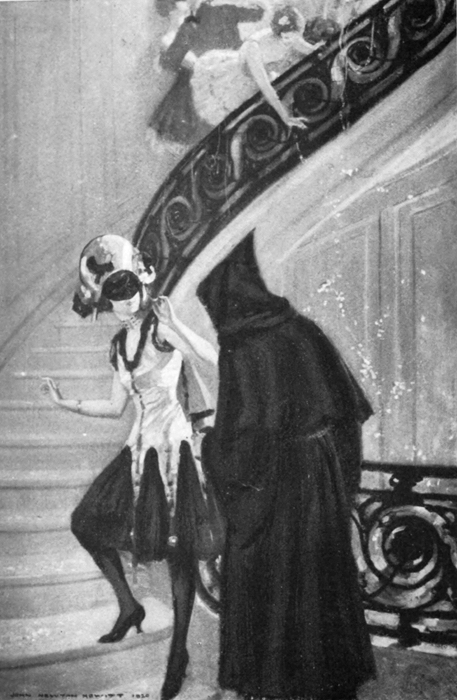
That evening the Comus ball, the most
exclusive revel of the most exclusive aristocracy
of the southland, crowded the edifice in
which it was held to capacity. Here evening
dress was prescribed for all the guests. The
Krewe of Comus alone were masked and
costumed, in grotesque and magnificent costumes
which had been in the making for
months. The Krewe is to the South what
the Bohemian Club is to the western coast,
with the added enhancement of mystery.
Despite the revels of the Krewe, however—despite
the glittering jewels, the barbaric
costumes, the music, the excitement—an
indefinable air of regret, almost of sadness,
pervaded the entire gathering. This feeling
was something to be sensed, rather than observed
definitely. Some said, afterward, that
it was a premonition of the terrible event that
was to happen this night. Wrong! It was
because, for the first time in many generations,
the Comus ball was held in one of the
newer public buildings instead of in its accustomed
place. Everyone was speaking of
it. Even Maillard the banker, that cold man
of dollars, spoke uneasily of it when Gramont
encountered him in the smoking room.
"It doesn't seem like Comus," said Maillard,
with a vexed frown. "And to think that
we had just finished redecorating the Opera
House when it was burned down! Comus
will never be the same again."
"I didn't know you could feel such emotion
for a ruined building, Maillard," said Gramont,
lightly. The banker shrugged a trifle.
"Emotion? No. Regret! None of us, who
has been brought up in the traditions of the
city but regarded the French Opera House
as the centre of all our storied life. You
can't understand it, Gramont; no outsider can.
By the way, you haven't seen Bob? He's
in costume, but he might have spoken to
you——"
Gramont answered in the negative, with a
slight surprise at the question.
It was not long before he came to comprehend
more fully just what the loss of the old
French Opera House meant to the assembly.
He heard comparisons made on every hand,
regretful allusions, sighs for the days that
were no more.
This present building, to be sure, was one
of the city's finest, up to date in every way,
with an abundance of room—and yet everyone
said that Comus would never be the same.
About the Opera House had clung the romance
of many generations. About it, too, had
clung the affections of the people with a
fierceness beyond reason. More famous buildings
had been allowed to go to ruin, like the
Hotel Royale, but the Opera House had been
kept in repair for Mardi Gras. It was itself—a
landmark. Nothing else would ever be like
it.
From his seat in the Lavergne box Gramont
contented himself during the early evening
with the common rôle of all the "blackcoats"—that
of looking on idly. More than once he
saw Lucie Ledanois called out, among others
of the fair sex, as a dancing partner for some
member of the Krewe. None of the male
guests, however, was allowed to participate
in the festivity until Rex and his queen should
arrive—at midnight; thus, Gramont saw almost
nothing of Lucie during the evening.
There was, inevitably, more or less visiting
in boxes and foyers, and not a little lounging
in the smoking room. The building was a
huge structure, and richly furnished. Only a
portion of it was in use by the Krewe; the
remainder was, of course, deserted for the
time being.
While in search of smoking companions,
Gramont encountered many of his acquaintances,
and among them Doctor Ansley and
Jachin Fell. In order to enjoy Fell's proffered
El Reys in a somewhat clearer atmosphere
these three strolled off together into one of the
unused passages leading to other parts of the
building. They opened a window and stood
watching the crowd that surged in the street
below, constantly increasing as the hour
grew later, for the procession of Rex would be
well worth seeing and nobody meant to miss
anything upon this night of nights.
Suddenly, at the sound of an approaching
footstep, the three men turned. The electric
lights were going in all of the hallways, and
they perceived that the individual approaching
them was a member of the Krewe of Comus.
He was also, it became evident, giving a share
of his allegiance to Bacchus, for his feet were
obviously unsteady. He was clad in a parti-coloured
costume, which was crowned by an
exaggerated head of Mephisto.
"Good evening to you, worthy gentlemen!"
He came to a fuddled halt and stood there,
laughing at the stares of the three. "Evening,
I say."
They responded to his liquor-tinged words
with a laughing reply.
"Wonderin' who I am, aren't you!" he
hiccuped. "Well, don't wonder; 'sall between
ol' friends to-night! Tell you what, m'
friends—come with me and I'll find you a
li'l drink, eh? No prohibition booze, upon
m' honour; real old Boone pinchneck—got it
from some boys in Louisville, been savin'
it up for to-night."
He wagged his head at them, and pursued
his subject in a half-maudlin burst of confidential
assurance. An unsteady hand waved
down the hallway.
"Havin' a little party in one of the rooms,"
he continued. "All of us friends—lots more
fun than dancin'! And say! I'm going pull
something great, positively great; you don't
want to miss it, gentlemen! You come along
with me and I'll fix it for you. Come on,
Gramont, that's a good fellow! You'n I had a
dis'greement to-day—don't matter to-night,
nothin' matters to-night, nothin' at all.
Mardi Gras only comes once a year, eh?
Come along, now."
Jachin Fell very civilly refused the invitation,
as did the others. Gramont, who now
recognized their accoster, was less civil in his
refusal. Mephisto sadly wagged his huge
headpiece and regarded them with vinous regret.
"No 'joyment in you any more? Better
come along. Tell you, I've got the biggest
joke of the season ready to pull off—something
rich! Gramont, come on!"
"Thanks, no," responded Gramont, curtly.
The masquer gave up the struggle and
moved on down the empty hallway. The
three "blackcoats" watched in silence until
the grotesque figure had vanished.
"I wonder who that was, now?" mused
Doctor Ansley, frowning. "Evidently, someone
who knew us; at least, he recognized you,
Gramont."
"So it seemed," put in Jachin Fell. His
tone, like his eyes, held a sombre fire. "A
party of them drinking, eh? that will make
trouble. The Krewe won't like it. Ten to
one, that young man and his friends will
start the makings of a fine scandal and the
Krewe will come down hard on them—mighty
hard. Who was he, Gramont?
Sounded like——"
"Young Maillard." At Gramont's response
a whistle broke from Doctor Ansley. Jachin
Fell nodded assent.
"You took the words out of my mouth.
So Bob is drinking again, eh? And they've
occupied one of the rooms somewhere, and
are enjoying a bit of liquor and a card game
by themselves. Cursed slippery going, as
Eliza said when she crossed the ice! The
Krewe will expel them. Hello, Gramont—where
to?"
Gramont tossed his cigar through the open
window.
"I think I'll make my adieux, Fell. I intend
to be up early in the morning and get off
to work——"
"What?" protested Ansley in astonishment.
"You must stay until Rex comes, at least!
Why, that's the event of the carnival! The
evening hasn't started yet."
"I'm growing old and sober, doctor," and
Gramont chuckled. "To tell the truth,"
and he gave Fell a whimsical glance, "I am
head over ears in some new business matters
which have actually fired me with the divine
afflatus of enthusiasm. What's more, I was
drifting with the crowds all afternoon, and I've
just begun to realize that I'm dead tired.
Rex or no Rex, I'm afraid that I'd best say
good-night, gentlemen."
Gramont persisted in his intention, and
bade the other two good-night. In truth, he
cared very little about Rex, and a very great
deal about getting off to Bayou Terrebonne
early in the morning. The oil matter filled
his mind. He had formed a thousand plans,
he was fired with enthusiasm, and was anxious
to make his preliminary investigation.
Returning to the auditorium, Gramont
sought out his hosts and made his farewells,
although not without encountering some opposition.
At length he was free, he had obtained
his hat and coat, and as he passed out
of the building he again met Fell and Ansley,
who were finishing their cigars at the entrance.
He bade them a final adieu and plunged into
the crowd.
It lacked half an hour of midnight. The
streets were filled with merrymakers, who
were making the night riotous with songs,
yells, and noise-producing apparatus, anticipating
the arrival of Rex. For a little Fell
and Doctor Ansley stood talking, then tossed
away their cigars and turned into the building.
They halted in the foyer before the appearance
of two men—Joseph Maillard, looking
extremely agitated, and behind him old Judge
Forester, who wore a distinctly worried expression.
"Ah, here are Fell and Ansley!" exclaimed
Maillard, almost with relief. "I—ah—my
friends, I don't suppose you've seen Bob
recently?"
Ansley was silent. Jachin Fell, however,
responded with a cold nod of assent.
"Yes," he said in his peculiarly toneless
manner. "Yes, we have. At least, I believe
it was he——"
"I'm worried," said Maillard, anxiously,
hurriedly. He made an expressive gesture of
despair. "He's in costume, of course. I've
been given to understand that—well, that he
has been—well, drinking."
"He has," said Jachin Fell, without any
trace of compassion. "A number of the
Krewe are occupying one of the rooms in the
building, and they must have been visiting it
frequently. I trust for your sake that the
fact hasn't become generally known inside?"
Maillard nodded. Shame and anger lay
heavily in his eyes.
"Yes, Jachin. I—I was asked to exert my
influence over Bob. The request came to me
from the floor. This—this is a disgraceful
thing to admit, my friends——"
Judge Forester, in his kindly way, laid his
hand on the banker's arm.
"Tut, tut, Joseph," he said, gently, a fund of
sympathy in his voice. "Boys will be boys,
you know; really, this is no great matter!
Don't let it hit you so hard. I'll go with you
to find the room, of course. Where is it,
Jachin?"
"We'll all go," put in Ansley. "We'll
have a little party of our own, gentlemen.
Come on, I believe we'll be able to discover the
place."
The four men left the foyer and started
through the corridors. Among them was a
tacit understanding, a deep feeling of sympathy
for Joseph Maillard, a bond which held them
to his aid in this disgrace which had befallen
him. Jachin Fell, who felt the least compassion
or pity, cursed Bob Maillard—but under
his breath.
They walked through the empty, lighted
corridors, following the direction in which Fell
and Ansley had seen young Maillard disappear.
"I hear," said Judge Forester to Doctor
Ansley, as they followed the other two, "that
there has been astonishing news to-day from
the Midnight Masquer. It seems that a
number of people have received back property
this afternoon—loot the bandit had taken.
It came by mail, special delivery. One of the
Lavergne boys tells me that they received a
box containing everything that was taken at
their home, even to cash, with a note asking
them to return the things to their guests. It
appears to have been some sort of a carnival
joke, after all."
"A poor one, then," responded Ansley,
"and in doubtful taste. I've heard nothing
of it. I wouldn't mind getting back the little
cash I lost, though I must say I'll believe the
story when I see the money——"
He broke off quickly.
As they turned a corner of the corridor to
the four men came realization that they had
attained their goal. From one of the rooms
ahead there sounded snatches of a boisterous
chorus being roared forth lustily. As they
halted, to distinguish from which door the
singing proceeded, the chorus was broken off
by an abrupt and sudden silence. This silence
was accentuated by the preceding noise, as
though the singers had checked their maudlin
song in mid-career.
"Damn it!" muttered Maillard. "Did
they hear us coming? No, that wouldn't
matter a hang to them—but what checked
them so quickly?"
"This door," said Fell, indicating one to
their right. He paused at it, listening, and
over his features came a singular expression.
As the others joined him, they caught a low
murmur of voices, a hushed sound of talk, a
rattle as a number of chips fell from a table.
"Cursed queer!" observed Jachin Fell,
frowning. "I wonder what happened to them
so abruptly? Perhaps the deal was finished—they're
having a game. Well, go ahead,
Joseph! We'll back you up as a deputation
from the blackcoats, and if you need any moral
support, call on Judge Forester."
"Correct!" assented that gentleman with
dignity. "I'll give these jackanapes a little
advice! It's going a bit far, this sort of thing;
we can't have Comus turned into a common
drinking bout. Ready, Joseph?"
He flung open the door, and Maillard entered
at his side. They then came to a
startled halt, at view of the scene which
greeted them.
The room was large and well lighted, windows
and transom darkened for the occasion.
Tobacco smoke made a bluish haze in the air.
In the centre of the room stood a large table,
littered with glasses and bottles, with scattered
cards, with chips and money.
About this table had been sitting half a
dozen members of the Krewe of Comus. Now,
however, they were standing, their various
identities completely concealed by the grotesque
costumes which cloaked them. Their
hands were in the air.
Standing at another doorway, midway between
their group and that of the four unexpected
intruders, was the Midnight Masquer—holding
them up at the point of his
automatic!
There was a moment of tense and strained
silence, as every eye went to the four men in
evening attire. It was plain what had cut
short the boisterous song—the Masquer must
have made his appearance only a moment or
two previously. From head to foot he was
hidden under his leathern attire. His unrecognizable
features, at this instant, were
turned slightly toward the four new arrivals.
It was obvious that he, no less than the others,
was startled by this entry.
Maillard was the first to break that silence
of stupefaction.
"By heavens!" he cried, furiously. "Here's
that damned villain again—hold him, you!
at him, everybody!"
In a blind rage, transported out of himself
by his sudden access of passion, the banker
hurled himself forward. From the bandit
burst a cry of futile warning; the pistol in his
hand veered toward his assailant.
This action precipitated the event. Perhaps
because the Masquer did not fire instantly,
and perhaps because Maillard's mad
action shamed them, the nearer members of
the drinking party hurled themselves at the
bandit. The threat of the weapon was forgotten,
unheeded in the sweeping lust of the
man-hunt. It seemed that the fellow feared
to fire; and about him closed the party in a
surging mass, with a burst of sudden shouts,
striking and clutching to pull him down and
put him under foot.
Then, when it seemed that they had him
without a struggle, the Masquer broke from
them, swept them apart and threw them off,
hurled them clear away. He moved as though
to leap through the side doorway whence he
had come.
With an oath, Maillard hurled himself forward,
struck blindly and furiously at the
bandit, and fastened upon him about the
waist. There was a surge forward of bodies
as the others crowded in to pull down the
Masquer before he could escape. It looked
then as though he were indeed lost—until
the automatic flamed and roared in his hand,
its choking fumes bursting at them. The
report thundered in the room; a second report
thundered, deafeningly, as a second bullet
sought its mark.
Like a faint echo to those shots came the
slam of a door. The Masquer was gone!
After him, into the farther room, rushed
some of the party; but he had vanished utterly.
There was no trace of him. Of course,
he might have ducked into any of the dark
rooms, or have run down the corridor, yet his
complete disappearance confused the searchers.
After a moment, however, they returned
to the lighted room. The Masquer had gone,
but behind him had remained a more grim and
terrible masquer.
In the room which he had just left, however,
there had fallen a dread silence and
consternation. One of the masqued drinkers
held an arm that hung helpless, dripping
blood; but his hurt passed unseen and uncared
for, even by himself.
Doctor Ansley was kneeling above a motionless
figure, prone on the dirty floor; and
it was the figure of Joseph Maillard. The
physician glanced up, then rose slowly to
his feet. He made a terribly significant
gesture, and his crisp voice broke in upon the
appalled silence.
"Dead," he said, curtly. "Shot twice—each
bullet through the heart. Judge
Forester, I'm afraid there is no alternative
but to call in the police. Gentlemen, you
will kindly unmask—which one of you is
Robert Maillard?"
Amid a stunned and horrified silence the
members of the Krewe one by one removed
their grotesque headgear, staring at the dead
man whose white face looked up at them with
an air of grim accusation. But none of
them came forward to claim kinship with the
dead man. Bob Maillard was not in the
room.
"I think," said the toneless, even voice of
Jachin Fell, "that all of you gentlemen had
better be very careful to say only what you
have seen—and know. You will kindly remain
here until I have summoned the police."
He left the room, and if there were any
dark implication hidden in his words, no one
seemed to observe it.