PART I The Manufacture of Whole Tomato Pulp or Puree — Table of Contents — CHAPTER I OBTAINING GOOD TOMATO STOCK — Value of Good Tomato Stock — Plant Raising — Use of Fertilizer — Methods in East and West — Shipping Tomatoes — Tomato Crates — Degrees of Ripeness for Shipping — Careful Handling at Factory — Varieties — Storing Tomatoes — Stemless Tomatoes — CHAPTER II WASHING AND SORTING — Washing and Sorting Equipment — Rotary Washer — Water Bath With Compressed Air — Importance of Agitation — Plain Sorting Belt — Number of Sorters — Tomato Turning Device — Divided Sorting Belt — Sorting — Forms of Decay — Cleanliness of Equipment — Molds, Yeasts and Spores, and Bacteria — CHAPTER III PRINCIPAL METHODS IN USE FOR PULPING — Cold Pulping — Care of Cyclone — Hot Pulping — Advantages Claimed for Hot Pulping — Objections to Hot Process — Crushing — Conveying to Kettle — Value of Pumice — CHAPTER IV CONDENSING THE STRAINED OR CRUSHED TOMATOES — Vacuum Pan — Types of Open Kettles — Steam Pressure — Copper-Jacketed Kettles — Tinning Kettles — Advantages of Various Types of Kettles — Glass-Lined Tank — Cypress Tank — Cleaning Kettles — Coil Leaks — Starting the Cooking — Methods of Gauging Finishing Point — Cooking to a Gauge on Kettle — Cooking a Definite Length of Time — Determining Specific Gravity by Weight — Objections to Weighing Method — Testing With Hydrometer — Method of Using Hydrometer — Finishing the Cooking — CHAPTER V CONVEYING THE CONDENSED, STRAINED, OR CRUSHED TOMATOES TO THE FINISHING MACHINE AND FINISHING SAME — Conveying to Finisher — Receiving Tanks — Finishing — Screen Metal for Finisher — Effect of Finishing on Mold Count — Finishing Before Cooking — CHAPTER VI FILLING THE FINISHED PULP AND STORING THE CANNED PRODUCT — Filling Devices for Five Gallons — Square Can and Round Can — Testing for Leaks — Washing and Steaming — Filling and Capping — Handling Filled Cans — Advantages of Separating Batches — How to Stack — Processing — Life of Cans — Washing and Drying Cans — Protection From Dust — Testing Used Cans — Packing 10’s and 1’s — Packing Barrel Pulp — Metal Drums — A Method of Preserving Pulp in Barrels — CHAPTER VII THE MICRO-ORGANISMS OF TOMATO PRODUCTS; THE ATTITUDE OF THE PURE FOOD AUTHORITIES TOWARD THEM; AND THE INTERPRETATION OF ANALYSES — Micro-Organisms; What They Are — Molds — Bacteria — Yeasts — Spores — How Germs Retard Their Own Growth — Rapidity of Growth — The Government Attitude on Micro-Organisms — Government Regulations — State Food Officials — Checking Up Daily Runs — How to Interpret Analyses
v
vii
| PART I |
| |
| THE MANUFACTURE OF WHOLE TOMATO PULP OR PUREE |
| |
| |
|
|
PAGE |
| Chapter I. Obtaining Good Tomato Stock |
1 |
| |
| |
Value of good tomato stock—plant raising—use of fertilizer—methods in east and west—shipping tomatoes—tomato crates—degrees of ripeness for shipping—careful handling at factory—varieties—storing tomatoes—stemless tomatoes. |
|
| |
| |
| Chapter II. Washing and Sorting |
8 |
| |
| |
Washing and sorting equipment—rotary washer—water bath with compressed air—importance of agitation—plain sorting belt—number of sorters—tomato turning device—divided sorting belt—sorting—forms of decay—cleanliness of equipment—molds, yeasts and spores, and bacteria. |
|
| |
| |
| Chapter III. Principal Methods in Use for Pulping |
20 |
| |
| |
Cold pulping—care of cyclone—hot pulping—advantages claimed for hot pulping—objections to hot process—crushing—conveying to kettle—value of pumice. |
|
| |
| |
| Chapter IV. Condensing the Strained or Crushed Tomatoes |
26 |
| |
| |
Vacuum pan—types of open kettles—steam pressure—copper jacketed kettles—tinning kettles—advantages of various types of kettles—glass-lined tank—cypress tank—cleaning kettles—coil leaks—starting the cooking—methods of gauging finishing point—cooking to gauge on kettle—cooking a definite length of time—determining specific gravity by weight—objections to weighing method—testing with hydrometer—method of using hydrometer—finishing the cook. |
|
| |
| |
| viiiChapter V. Conveying the Condensed, Strained, or Crushed Tomatoes to the Finishing Machine, and Finishing Same |
38 |
| |
| |
Conveying to finisher—receiving tanks—finishing—screen metal for finisher—effect of finishing on mold count—finishing before cooking. |
|
| |
| |
| Chapter VI. Filling the Finished Pulp and Storing the Canned Product |
41 |
| |
| |
Filling devices for five gallons—square can and round can—testing for leaks—washing and steaming—filling and capping—handling filled cans—advantages of separating batches—how to stack—processing—life of cans—washing and drying cans—protection from dust—testing used cans—packing No. 10’s and No. 1’s—packing barrel pulp—metal drums—a method of preserving pulp in barrels. |
|
| |
| |
| Chapter VII. The Micro-Organisms of Tomato Products; the Attitude of the Pure Food Authorities Toward Them; and the Interpretation of Analyses |
51 |
| |
| |
Micro-organisms; what they are—molds—bacteria—yeasts—spores—how germs retard their own growth—rapidity of growth—the government attitude on micro-organisms—government regulations—state food officials—checking up daily runs—how to interpret analyses. |
|
| |
| |
| PART II |
| |
| THE MANUFACTURE OF TOMATO CATSUP, CHILI SAUCE, TRIMMING PULP, AND TOMATO SOUP |
| |
| Chapter VIII. A Discussion of Preservative and Non-Preservative Catsups; and the Most Frequent Cause of Inferiority |
73 |
| |
| |
Unfavorable publicity on preservatives—“natural” preservatives—proper acidity—processing catsups—advantage of benzoate catsups—causes of poor color and flavor—advantage of direct conversion of tomatoes into catsup—thickness—spicing and sweetness—“black neck”—general attractiveness. |
|
| |
| |
| ixChapter IX. A Discussion of the Ingredients of Catsup; When and How They Should Be Added; and the Amounts of Each per 100 Gallons of Finished Catsup |
80 |
| |
| |
Measuring the volume of tomato juice—amount of tomatoes—keeping batches uniform—use of spices in a sack—use of spices direct and when to add them—use of spices in two batches—what is extracted—storing spices—quality of flavor—use of essential oils—how to add essential oils—paprika—quantities of spices and oils per batch—essential oils economical—adulteration of ground spices—onions and garlic—sugars—sugar syrups—use of sugar in large quantities—salt—vinegar—transference of vinegar—adding the vinegar—acidity—testing finishing point—holding batches—making catsup from pulp—use of benzoate of soda. |
|
| |
| |
| Chapter X. Finishing, Bottling, Sterilizing, and Storing the Catsup |
97 |
| |
| |
The receiving tank and finisher—filling and sealing—washing the filled bottles—processing—advantages of omitting processing—process method—time and temperature—temperature controlling and recording devices—non-process method—which method is the better?—labeling and casing—stacking catsup to avoid “black neck”—packing gallons and No. 10’s. |
|
| |
| |
| Chapter XI. The Manufacture of Chili Sauce and the Pulping of Tomato Trimmings |
107 |
| |
| |
Grading the tomatoes—method of handling tomatoes—amount of tomatoes and onions—spices—salt, sugar and vinegar—testing finishing point—filling, sealing and sterilizing—microscopical counts—pulping the trimmings—government attitude on trimming pulp—method of handling tomatoes when trimmings are pulped. |
|
| |
| |
| Chapter XII. The Manufacture of Tomato Soup |
112 |
| |
| |
Convenience and economy of canned soup—factors upon which success depends—unpalatability—proper sweetness—gradual souring of pulp—sampling—proper acidity—price and quality—microscopical counts—beginning the cook and adding soda—butter, onions, and spices—sugar and salt—testing thickness before adding flour—adding flour—filling and processing—shaking and labeling. |
|
1
Obtaining a good quality of tomatoes at a price which is not
prohibitive is a problem which in many localities is becoming
more difficult to canners and catsup makers each year. Every
experienced manufacturer knows that regardless of the expertness
with which he may work up his tomatoes into the finished
product, he cannot expect to get good quality unless he has good
stock to begin with. It is true that by using intelligence and
extreme care in the manufacturing processes one manufacturer
will make better pulp or catsup from tomatoes of fair quality
than another man can get from the best quality of stock. This
same care and intelligence applied, however, in working up high
quality tomatoes will probably show a greater difference in the
finished products than was apparent in the tomatoes from which
these products were made; in other words, the goodness of good
tomatoes becomes accentuated by the manufacturing process.
In order to insure as large a proportion as possible of good
quality stock, as well as a good yield per acre in tonnage, manufacturers
are each year realizing the necessity of closer co-operation
with the farmer. Where in growing tomatoes under contract
it was formerly largely up to the farmer to buy his seed
and raise his plants and set them out, it is now the usual custom
to supply the farmer with seed of the desired variety and of high
germination test, and in many cases to go a step farther and
supply him with plants six to eight inches high, ready for setting
out in the field. Unquestionably, the best results are secured by
growing the plants for the farmer. The average farmer does not
go about the raising of his plants in an intelligent way, and he
will not devote the time to the plant-raising business that it
should have.
Most packers are agreed that the best plant is raised by
starting the seeds in rows in hot beds, transplanting to cold
2frames when they are two to four inches high to harden them
and make them stocky, and again transplanting to the field when
the plants are six to eight inches high. This method produces
a dark green, bushy, thick-stemmed plant of high vitality, which
is so essential to a good yield. What a contrast to the average
plant raised by the farmer—the seed often broadcasted, either in
a hot bed or in a spot in the garden where the soil has not been
specially prepared for plant raising, and when the plants, a
large number of which are thin, pale green, and spindly looking,
attain a height of anywhere from six inches to a foot they are
all set out in the field and allowed to struggle along as best they
can. When one looks at the kind of plants that are so often
set out he can see at least one reason why yields of from three
to seven tons per acre are so often obtained from ground which
should yield twice that much, and why the plants are easy
victims to blight and other diseases.
A prominent canner recently told me that by raising the
plants for his farmers he had increased the average yield 4
tons per acre.
So many articles have been written on tomato culture for
canning plants by experienced horticulturists that the subject
will not be dealt with extensively here. In these articles emphasis
is usually laid on the desirability of the use of commercial
fertilizer, not only to increase the yield, but to hasten the
maturing of the crop so that a large proportion of it can be
harvested before frost.
My experience testifies to the wisdom of this in practically
all cases, and with late maturing varieties such as the Stone
tomato, in regions subject to early frost, and especially where
planted on low ground, it is absolutely essential that fertilizer
be used if a good percentage of the crop is to be harvested.
In the Tri-States—that is, Delaware, Maryland, and New
Jersey—quite a different situation exists from that in the middle
west or far west. The western packer has practically all of his
tomatoes grown under contract, while the Tri-State packer,
although he tries to contract as much acreage or tonnage as
possible at a reasonable figure, is up against the competitive
buying of the open market for a large proportion of his raw
3stock, as there are always a large number of farmers who are
willing to gamble that the coming season will be a good one for
playing the open market. In this case the buyer usually cannot
be as particular about the quality of the tomatoes he buys
as can the packer who has his tomatoes all grown under contract
at a specified price, and who can exercise supervision over his
farmers. This is particularly true in seasons of short crop, when
the grower sells his tomatoes on the market and can afford to
be very independent, and buyers are wildly forcing up the price
by competitive bidding, and taking whatever they can get. Even
if the eastern grower is under contract for his entire crop, if the
crop is short, and high prices are prevailing on the market, it is
the exceptional grower who will live up to his contract, and often
to get an excuse for breaking his contract he will deliver very
poor tomatoes right along in the hope that they will be objected
to, thus giving him the liberty of disposing of them elsewhere.
The eastern packer, however, is blessed with a longer season
in which to operate. While in the west there are seldom enough
tomatoes to justify a run at the factory before August 15th, the
Tri-States packer starts in on the early crop about the 25th of
July, and his crop is not as liable to be severely injured by an
early frost as is the western crop.
Canning and preserving plants in the west, being scattered
rather sparsely over a very large territory, and being farther
away from the large centers of population than in the east, the
western packer is able to get a large percentage of his tomatoes
hauled to the factory by wagon. This is indeed a big advantage,
not only in the saving of freight and handling expense, but in
the condition of the fruit when delivered to the factory. Probably
having been picked not more than twenty-four hours before
delivery, the wagon-hauled tomatoes are solid, and because the
skin is not broken by repeated handling, thus preventing the
growth of molds, they require very little sorting, in fact, no
sorting at all in some cases. A load of tomatoes which requires
no sorting at all, however, is unusual. If the packer can get
his growers to use spring wagons for hauling tomatoes, it is a
big advantage, especially if the fruit must be held any length
of time at the factory. If the wagon-hauled tomatoes can be
worked up quickly the packer gets 100 per cent value for them,
which he very seldom does get on shipped tomatoes, which commonly
undergo a loss of between 5 and 20 per cent in shipment,
depending upon the time involved in shipment, the ripeness
of the fruit, the amount of handling it received, the condition
4of the weather, the kind of crate in which the fruit is packed,
and the amount of ventilation it received in transit.
Shipment by water, although slow, has the advantage of
smoothness of transit, and the crates or baskets of tomatoes
are not subjected to the frequent joltings of rail shipments, and
it is to be remembered that every jolt makes the tomatoes settle
to a certain extent in the crates and mashes the tomatoes in the
bottom layers. The best car for rail shipments is the slatted car
or stock car, which permits of better circulation than any of
the other types. A box car should never be used, as it allows
the fruit to heat very badly, and there is no circulation of air.
The crates in the slatted cars should be so stacked as to allow as
much circulation of air through the car as possible. However,
care must be taken that the crates are so stacked that they
will not shift. A small air space can always be left at the end
of every other row on each side without endangering the stability
of the crates, and a large air space can be left at the top.
One advantage in the use of the basket over the crate in shipments
is the advantage of better circulation of air through the
piled baskets of fruit, due to the conical shape of the basket.
Good ventilation is thus supplied without danger of the baskets
shifting during shipment. The ⅝-bushel basket is used almost
universally in the east, while in the west the crate holding a
bushel is the common container. The construction of the crate
is a more important item than is often thought. The most
important point, of course, is strength in construction, and the
use of a wood which will not warp easily by alternate soaking
and drying out, allowing the nails to become loose and the bottoms
to begin to fall out of the crates after a half season’s use.
The slats of the crates should have rounded, smooth edges so
as not to cut the surface of the tomatoes when they are jolted
and weighted down during shipment. The slats should be only
close enough together to hold the small tomatoes, so as to permit
of as much air circulation as possible. This particularly applies
to the bottom of the crates, which become soggy and musty after
a little use, and the openings soon become clogged up with
tomato substance. It is important to turn a steam hose over
5the bottoms of such crates to clean them out before returning
to the point of shipment. If the empty crates pass along on a
chain belt after dumping, this steaming can be accomplished
easily. Accumulated decaying tomato substance in the bottom
slats not only rots out the crates, but contaminates otherwise
good tomatoes every time the crate is used. The crate should
also be as shallow as will permit of easy handling, so as to distribute
the weight of the tomatoes over as much surface as possible.
A shallow, broad crate is preferable to a deep, narrow
one.
The proper degree of ripeness for tomatoes to be shipped
depends, of course, upon the length of time it will take for them
to arrive at their destination. Dead-ripe tomatoes will stand very
little handling and shipping, particularly if the weather is warm
and damp, as it so frequently is during tomato season. It is important,
too, not to have the tomatoes delivered to the shipping
station too underripe, as they are very apt to rot before they
become red enough to cook up into a product of good color. That
the employee in charge of receiving tomatoes at the shipping point
should be a man of experience and good judgment as well as tact
in dealing with the farmers, is apparent. So much depends upon
the control he exercises over the farmers in getting them to pick
their fruit at the proper degree of ripeness. If he falters, is
uncertain, and changes his mind a few times, he is lost, as the
farmers soon lose confidence in his judgment.
It is always difficult to impress upon the farmer the fact
that tomatoes gain in weight during the ripening process, and
the riper they have their tomatoes the more they get in dollars
when they drive up on the scales. This argument cannot be
advanced when the tomatoes are bought by the basket, as they
are in the east, but when paid for according to weight and not
volume, the ripeness of his tomatoes is an important point for
the farmer to watch. At the tail end of the season when frosts
are threatening, this argument of the increased weight of tomatoes
which are red ripe all over of course loses its effect
entirely. All the farmer is interested in at that time is in getting
as many of his tomatoes as possible accepted before a heavy
frost finishes them. At this time increased vigilance at the
receiving end is necessary.
6
The less handling crates or baskets of tomatoes receive, the
better. Every packer wants to eliminate handling as much as
possible to conserve labor, but when one sees the laborers around
the average plant heaving crates of tomatoes around as though
they were pig iron, he wonders if the manager fully realizes the
effect of this bouncing of heavy crates of tomatoes on to trucks,
receiving platforms, etc. It is just as easy, or almost as easy,
to set the crates down gently, but the laborers who do this work
must be constantly reminded of it. You do get tired of constantly
hammering at them, but it is surely worth the effort. A common
attitude for the men to take is that the tomatoes are all going
to get mashed up anyway pretty soon, so what’s the difference.
When you consider the fact that crates of tomatoes are commonly
handled from six to eight times before they reach the
sorting belt, this handling often consisting of dropping the crates
down so hard that the top tomatoes almost bounce out, it is no
wonder that when they are spread out on the sorting belt the
bottom layer of each crate is mashed and moldy, so that half
of these bottom tomatoes have to be thrown away.
Any of the brilliant red varieties of tomatoes are suitable
for catsup or pulp making. Those varieties having a purplish
cast should be avoided, as they cook up into a product having
a brownish color. The smooth, round varieties, such as the
Stone, are especially good for peeling, while the flat varieties,
and those having a very coarse, uneven surface, are well suited
for pulp or catsup.
For storing the tomatoes at the factory until they can be
put over the sorting belts the open-air storage is used almost
universally, and it seems to be the only method which can be
economically employed at a plant which handles large quantities
of tomatoes. I have seen the wet storage method in use at a
small plant where the receipts only amount to a few hundred
bushels a day on good days, and less than a hundred on many
days when the weather is very bad, and it was liked very much
by the plant manager. The tomatoes, as soon as received, were
dumped into a large concrete tank of cold water, which was
kept fairly fresh by letting fresh water run into it constantly,
7with an overflow at the other side of the tank, and a large
revolving paddle at one side of the tank kept the water in
motion. Attached to this paddle was a series of flights on an
endless chain, which, when thrown into gear, carried the tomatoes
to the sorting belt.
The argument advanced in favor of the wet storage method
by the operator of this plant was that at certain times in the
season their receipts of tomatoes were very small, that is, at the
beginning and at the close of the season, and during stretches
of cold, rainy weather, and at such times they only made a run
every other day, or possibly only twice a week, and that the
tomatoes kept much better in wet storage.
The tomatoes were clean when delivered to the sorting belt,
and although they received very little sorting, and only one
spraying after they left the storage tank, the count of molds,
yeasts and spores and bacteria on their pulp was fairly low.
The wet storage method could undoubtedly be used at large
plants, and might prove profitable during periods of glut, as there
is no doubt but what tomatoes will keep better in wet storage
than in the open air. It would take a lot of tanks for a large
plant, however, and large operators are not inclined to look
favorably on the idea.
In open-air storage the crates of tomatoes should be stacked
so as to leave an air space between each crate, and if stacked
inside of a building, all the windows and doors should be thrown
open to allow as free a circulation of air as possible.
Most tomatoes are delivered to the factory with the stems
on, but I know of one plant where they are all received stemless,
and the quality of the pulp made from them simply cannot be
beat. There surely must be an undesirable taste imparted by all
these green stems in the cooking process. Of course, where the
cold pulping process is used, that is, the tomatoes pulped cold directly
after sorting and washing, these stems are eliminated
before any cooking is done. In the hot pulping process, however,
and when the tomatoes are put in a crusher instead of a pulp
machine, the stems are cooked along with the rest of the pulp.
The operator of the plant referred to above pays a bonus of a
dollar a ton to his contractors for having the tomatoes delivered
stemless, and he believes he gets that dollar back and more, too,
in the price he gets for his product, which is very fancy.
8
A great many outfits for washing and sorting tomatoes have
been placed on the market, some of which have many good points,
and others are very inadequate. The type of washer best adapted
to one plant may not be the best for another one. If tomatoes
are grown on clay ground a friction washer is necessary, while
for fruits grown on sandy soil it is very infrequent that much
friction is needed to properly clean the tomatoes.
As to sorting belts, as a rule one type will serve as well in
one place as in another. A majority of the sorting belts used
are subject to many criticisms; some are too narrow, some too
short, some travel at a speed of 100 feet or more per minute,
while others move as slowly as 10 feet per minute. The latter
speed is much better than the former, although both are extremes,
25 feet per minute being about right.
For tomatoes grown on clay ground the cylindrical rotary
washer or squirrel cage type made of 1–inch mesh heavy wire
is very satisfactory. When tomatoes come to the plant caked
with clay, as they are after a hard rain followed by strong sunshine,
a friction washer of this type is about the only thing that
will clean them. This type of washer also does excellent work
on late tomatoes, and this applies to all localities. A large
percentage of late tomatoes become deeply cracked at the stem
end, and although these cracks, or fissures, usually appear to be
healed over, an examination will generally reveal the presence
of mold in them, and in many cases large tufts of mold like cotton
completely filling them. By merely passing such tomatoes
through a water bath, even though the water is thoroughly agitated
by means of many inlets of compressed air, this imbedded
mold will be scarcely affected. A rotary, heavy wire, reel washer,
inclined at an angle of about 1 foot in 8, and rotating slowly,
with a heavy, sharp spray of water striking the rolling tomatoes
9from the time they are dumped in until they roll out, will take
out a very large proportion of this mold, besides cleaning the
entire surface of the tomato thoroughly.
The washer should deliver about two bushels of tomatoes
per minute to the sorting belt. As the wire cylinder revolves,
the tomatoes are carried half way up the side and are then
thrown back again, being carried slowly and steadily toward the
outlet. A 1½-inch pipe at the top of the cylinder, and running
from end to end, with small holes bored at intervals of an inch,
should direct a sharp, cutting shower of water on the tomatoes as
they revolve and rub each other. A fine, sharp spray will accomplish
more than a less forceful but larger stream of water coming
from a larger opening. The dirt, mold, etc. is washed through
the wire mesh into a drip pan, and thence to the sewer.
Some of the rotary washers used are of solid metal, and others
constructed of wooden slats have been used. Both of these
should be avoided, as the solid metal produces a sliding, instead
of a rolling action, and the wooden slats mold quickly and become
slimy. Also, some of the washers are slightly too narrow, and
the tomatoes are so crowded while they are rotating that many
of them do not come in contact with the wire, but merely roll
on top of other tomatoes. Other washers are considerably wider
than necessary. If the tomatoes are to be fed to the belt at
the rate of 2 bushels per minute, a reel (squirrel cage) washer
2 to 2½ feet in diameter, and about 8 feet long, having an inclination
of about 1 foot in 8, and revolving at about 20 revolutions
per minute, will usually give satisfactory results. These
are the figures recommended by Mr. Howard of the Bureau of
Chemistry, who has made a very extensive study of the efficiency
of rotary washers.
By having the tomatoes thoroughly clean, with no mud and
scarcely any mold adhering to the surface when they drop on
the sorting belt, the amount of sorting required is not only
greatly lessened, but the spots of black rot and other forms of
decay show up prominently on the surface.
It is important that the reel deliver the tomatoes to the sorting
belt at a uniform rate, which is seldom done when the crates
are dumped into the reel without any system of timing them.
At present a hopper for feeding the reel is being experimented
with, and it is hoped that it will be an improvement over the
uncontrolled system that is now used.
The chief objection made to the reel cylinder is that when
tomatoes are overripe, having been shipped a long distance, or
10held at the factory for a day or two, the rubbing action of the
wire on the tomatoes, and of the tomatoes against each other,
is too severe, and considerable tomato substance is lost by being
forced down through the wire mesh by the sharp sprays of water
from overhead. The loss in this case is not nearly as great as
would be imagined, and what tomato substance is thus lost should
be discarded anyway, as it is so soft that in all probability the
fiber is permeated with growths of mold, yeasts, and bacteria,
which no amount of washing would eliminate.
The reel washer is not so common in the east as in the west,
and the reason is, as previously stated, that during the greater
part of the season at least, tomatoes grown on loose, sandy soil
can be washed satisfactorily by other devices which are less
cumbersome and can be more easily rigged up. One of these
devices which is in satisfactory operation is a shallow water
bath through which the tomatoes pass on a chain carrier, and in
which the water is kept “boiling” (that is, it has the appearance
of boiling) by compressed air which is forced into the water
bath through small pipes, and at a number of different places.
The tomatoes are thus bounced around and knocked against each
other in a very lively manner and receive a thorough cleansing.
It is very doubtful, however, if this device would give such good
results on tomatoes that had clay baked hard on the surface, or
on those which had mold deeply imbedded in cracks at the stem
end.
It is always advisable to wash the tomatoes before sorting
them, as it makes the sorter’s work so much easier. After the
tomatoes leave the sorting belt they can pass under a few strong
sprays which will put on the finishing touches. Warm or hot
water is sometimes used in washing tomatoes, but cold water
does the work just as well. Neither will accomplish much more
than wetting the surface unless the tomatoes are agitated. Some
devices which I have seen are almost worse than nothing, as they
merely consist of a long water bath through which the tomatoes
are conveyed by means of a large worm or helicoid. The tomatoes
are not only washed insufficiently, but are contaminated by
rubbing against the surface of the worm, which soon becomes
coated with a film of mold, and, being enclosed in a cylinder, this
worm cannot be cleaned as it should be. It is essential that
11every part of the equipment with which the tomatoes come in
contact be readily accessible to the brush and the steam hose.
Mold accumulates very rapidly, clings very tenaciously to the
surface on which it grows, and a damp surface in a dark place
is ideal for its growth.
The type of sorting belt used most commonly is the ordinary
plain wire or metal belt 18 to 24 inches in width and about
10 to 12 feet in length. Canvas belts are also used quite
frequently, but the packer can now obtain wire belts of such
strong, sturdy construction that they give scarcely any trouble
and are very satisfactory in every way. Eighteen to twenty
inches has been found to be about the best width.
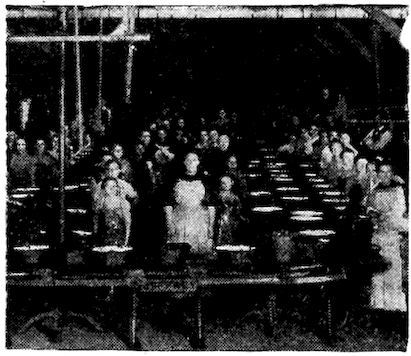
The number of sorters which should be employed on each
belt depends upon whether they are going to do both the inspecting
and trimming, or the inspecting alone, and also upon the
rate at which the tomatoes are fed to the belt, the length of
the belt, and the quality of the fruit. Some pulp makers prefer
to feed the belt at a uniform rate regardless of the quality of
the fruit and to vary the number of sorters, employing about
14 or 16 to a belt when the quality is poor, and about half that
number when the tomatoes are almost entirely sound and need
very little trimming done to them. Others prefer to use the
same number of sorters and trimmers on the belt all the time
and to vary the speed of the belt according to the quality of the
fruit, using a variable speed transmission for this purpose. When
running on solid fruit, with very little decay, the maximum speed
can be employed, say 40 feet per minute, and when running on
stock that is not so good the speed can be decreased to about
10 feet per minute.
The Bureau of Chemistry advises very strongly against the
practice of having the women who do the inspecting do the
trimming also. They contend that inspecting and trimming
should be two distinct and separate operations and each should
be done by a different set of women. By this method the women
on the sorting belt merely pick out all the tomatoes which are
imperfect and throw them into receiving boxes which are attached
to the framework of the sorting belt by a bracket, there
being about four of these boxes to a table—two on each side.
12One or two women stand at each receiving box, pick out the
defective tomatoes from this box, and trim out the bad part,
which is dropped into a chute, which directs the material down
to a drain underneath the table through which is flowing the
waste water from the rotary washer. This stream, properly
placed, has sufficient current to carry away the waste matter.
The trimmer throws the good part of the tomato back on to
the sorting belt. By using this system there is no lugging of
boxes or buckets back and forth from the sorting table.
This method, which is the one approved by the Bureau of
Chemistry, accomplishes the work more thoroughly than can be
done if the inspecting and trimming are all done on the sorting
belt by the same set of women. The minimum cost of sorting
and trimming in this manner is from 2 to 3 cents per bushel,
according to the government figures.
If the women on the sorting belt are to be used for both
inspecting and trimming, a longer belt should be used than if inspecting
alone is to be done. About 2 feet of belt should be
allowed to each sorter.
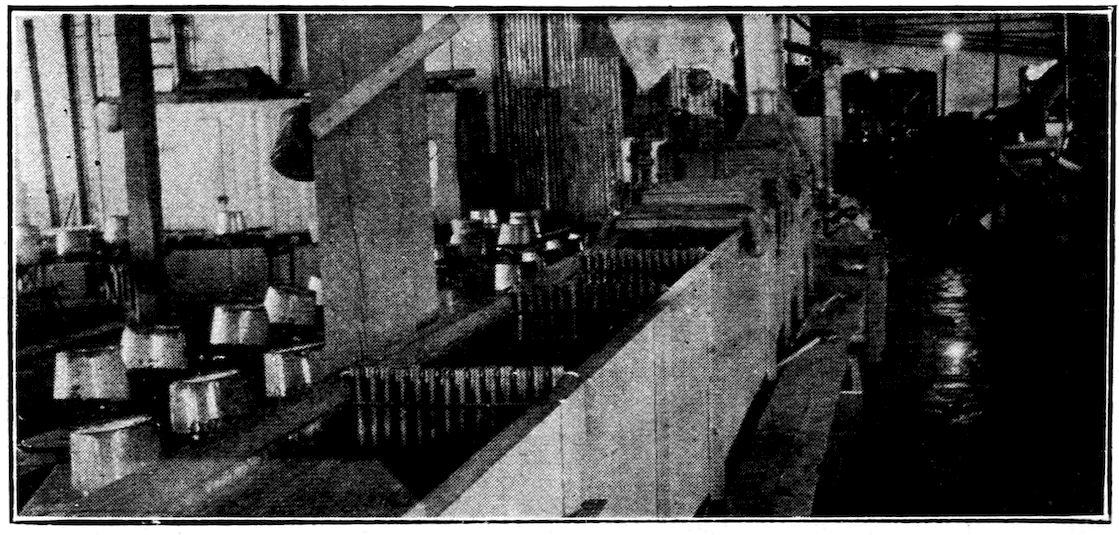
Fig. 1.—Tomato turning device on sorting belt.
There is another feature which helps greatly in sorting, and
that is a tomato turning device, which is illustrated in Figure 1.
This device turns a very large percentage of the tomatoes if they
are fed to the belt properly, that is, if they are spread out evenly
13and are not too thick on the belt. The turning device allows
them to be inspected from all angles, and is described in Bulletin
569 of the U.S. Department of Agriculture as follows:
“For an apron (sorting belt) 18 inches wide, 14 pieces of
¾ inch iron pipe (1 inch outside) were cut, each piece about
7 inches long. About one-half inch from one end of each piece
a hole was drilled through the pipe large enough to permit of
the pipes being strung on a ¼ inch steel rod. In order to
insure freedom of movement, a thin washer was placed between
each pipe and the one next to it. The whole set was then suspended
by means of the steel rod across the sorting apron with
the lower ends one-half inch above the apron. A back-stop rod
is put in behind the set to prevent the pipes from swinging back
past the center. This was found necessary to prevent them from
swinging so far back as to strike and gouge the oncoming tomatoes. * * * In operation the weight of the pipes is sufficient
to roll the tomatoes over as they pass under.”
“In order to obtain satisfactory operation it is most important
that the tomatoes do not cover more than 50 per cent of
the apron area, otherwise they do not have room to turn properly.
A test at one plant showed that 70 to 80 per cent of the
tomatoes were turned each time they passed under a set of the
pipes. It was found also that this turning device worked better
on the open metal apron than on the canvas or rubber type,
owing to the fact that the tomatoes slipped badly on aprons
made of canvas or rubber.”
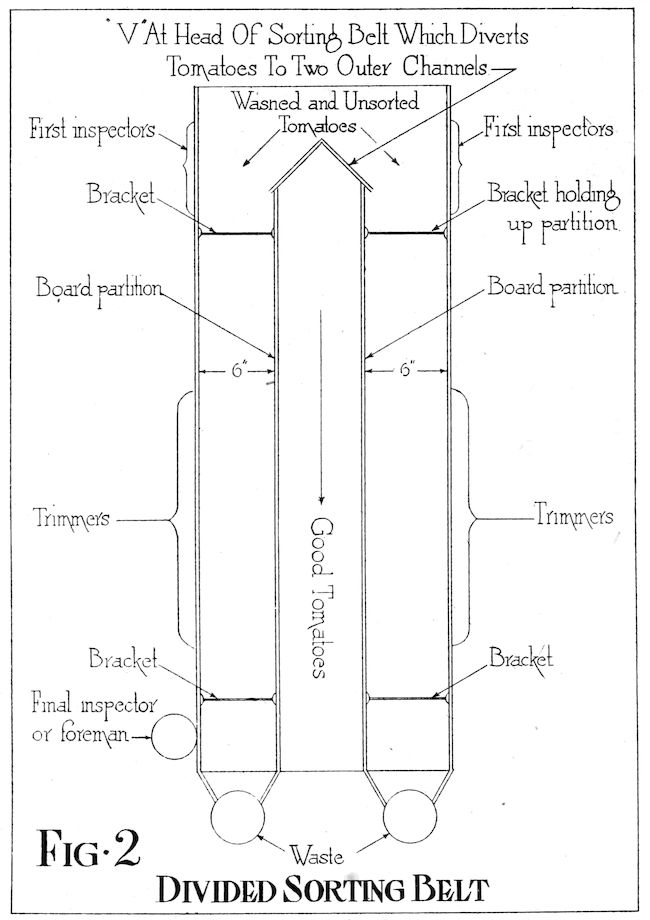
There is a modification of the plain belt which is in use
at several plants, and which some operators like very much.
This belt is illustrated in Fig. 2. Note that it is divided into
three partitions by two boards which run lengthwise. These
boards are about 3 inches high and are raised a fraction of an
inch above the belt so as to allow the belt to slide under them
easily. At the head of the belt the board partitions connect in
a “V”. The tomatoes strike this V and are guided into the two
outer channels, where they are given a hasty inspection by the
first four sorters, who throw all those which are perfectly
sound into the center partition. As the tomatoes which remain
in the two outside partitions pass down to the rest of the sorters
they are inspected, the bad parts cut out, and the good part
thrown into the center partition. The bad parts which are cut
out are left on the outside partitions, where they are carried
along into two waste barrels, which are provided for this purpose
at the end of the belt.
14
15By using this method no tomatoes but good ones can go through
unless bad ones are carelessly thrown into the center partition
and every tomato HAS to be picked up. Of course, some bad
tomatoes are thrown into the center carelessly, where they will
remain unless taken out by the final inspector, who is supposed
to watch this. However, the number which are thus thrown in
are not great if the first four women on the belt are trained
as they should be—that is, to only throw those tomatoes in the
center which a hasty inspection shows are perfectly sound, and
to leave all doubtful ones pass by.
By this method each good tomato is only inspected once, which
is not the case with any of the other systems, and in that respect
it is more efficient. One good tomato is not picked up, looked
at, and placed on the belt again by a number of different sorters.
When a tomato is picked up by a sorter some disposition is made
of it at once. If good it is tossed in the center and is never looked
at again except by the final inspector. If bad, the good part is
thrown in the center and the bad allowed to remain on the outside,
to be conducted to the waste barrel. All the sorters except the
first four can spend their entire time working on tomatoes which
need to have bad parts cut out of them.
The main objection which is made to the divided belt system
is that the first four women get careless and throw unsound tomatoes
into the center partition and they are never looked at
again. However, if care is used in the selection of these women,
and a reliable sorter is placed at the end of the belt to inspect
the center partition before it leaves the belt, such carelessness
can be checked and held down to a minimum. Another objection
that is advanced is that there is the possibility of partly good
tomatoes going into the waste barrels due to the fact that the
women might not always keep up on them. In my experience
with the system I have had practically no trouble in this regard.
If a long belt is used, as many trimmers as desired can be put
on, and the belt can be slowed down or the rate at which it is
fed slowed up if the tomatoes are running particularly bad. Then,
in extreme cases, it is always possible to have someone go over
the waste barrels before they are dumped.
An average grade of tomatoes can be handled quite rapidly
by the divided belt system. Some packers who have used it
several seasons like it very much, and an analysis of their product
16will generally show a low count of molds, yeasts and spores,
and bacteria. I understand, also, that other packers that have
used the method have discarded it.
By far the greater part of the trouble packers have with
their goods not complying with the government regulations as
to molds, yeasts and spores, and bacteria is due to inadequate
sorting. At least ninety per cent of this trouble could be overcome
right at the sorting belt. Packers often say they can’t
understand why the mold is running high on their pulp and
catsup, as they are sorting their tomatoes carefully. However,
the chances are ten to one the trouble is they are not sorting
them carefully enough. One who has not had much experience
managing help on the tomato sorting belt would imagine that
almost any woman could step up there and sort out the good
tomatoes from the bad, and know what to cut out, and what not
to cut out. But such is not the case. The tomato sorters must
be instructed. Someone who is competent to do so must work
with each one of them and show them just what is a good tomato
and what is not. Otherwise they will be spending part of their
time cutting out black, fibrous growths on the surface of the
tomatoes which are absolutely normal and entirely free from
molds, etc., and allowing tomatoes to pass by them which have
black spots on the surface no bigger than a dime, but indicating
to the trained eye that probably half of the tomato is eaten up
with black rot. They will allow a tomato to pass by which is
cracked open, and the edge of the skin on each side of the crack
will be as white as a piece of paper. Unless they are instructed,
they may not realize that this is mold, and they certainly will
not realize the amount of damage a small percentage of tomatoes
like that can do. They know nothing about mold counts, but
most women can be impressed with the importance of watching
for moldy streaks and spots in mashed and split tomatoes, and
the importance of eliminating every bit of tomato tissue that is
so effected.
Every sorting belt should have a boss—a competent sorter
who knows his or her business, and who stands at the end of
the belt and inspects the tomatoes just as they are about to
leave the belt. This person can order the speed at which the
tomatoes are fed to the sorters increased or decreased according
to the quality, can see just what form of decay is predominating
17and caution the sorters to watch out for it, can see the
mistakes that are being made in the sorting and try to correct
them, and in addition can throw out into a receptacle such
bad tomatoes as have passed by the sorters so that they can
be sorted over again. It is not safe to put a bunch of women
on the sorting belt with no one in authority who is on that
particular job every minute, and expect an entire day’s run to
come within the government limits.
There are many forms of rot, but the most common are the
black rot, soft rot, and the mold growths in cracked tomatoes,
either those which have cracked deeply around the stem end
during their growth, or have been cracked or mashed in shipment.
Just as soon as the skin is broken, either in a natural
or unnatural way, molds start growing on that broken surface
immediately, and develop very rapidly.
There is also the brown spotted tomato, which is not so common,
but which has been very bad in some localities. I remember
one field of tomatoes in southern Ohio several years ago which
was absolutely worthless for canning purposes, due to the fact
that practically all of the tomatoes were covered with brown
spots, and under each one of these spots was a lump of white
mold and mold spores. This field was plowed up before half of
the tomatoes were picked, as the pulp plant which had contracted
them refused to receive any more after having cooked
several batches of pulp on which the mold ran very high due to
this condition, which had never been met with before. The
brown spots were soft and concave, and if once the character
of the spot was fixed in the memory one could never fail to
quickly detect that type of tomato if it was run across again.
The disease appeared in both central and southern Indiana
the following year and I sent samples of the tomatoes to the
Department of Agriculture at Washington and to the Indiana
state experiment station, but it was new to them and they had
no remedy for it. Whether it has appeared since I do not know,
but it was very bad while it lasted. It is almost impossible to
sort such tomatoes, as the spots are so numerous on the surface,
and every spot would have to be cut out. When the spots are
small, as they frequently are, they are very apt to pass by the
sorters unnoticed, or at any rate considered harmless, but it
doesn’t take many bushels of such tomatoes to send a batch over
the limit in mold count.
18Extremely soft spots which will yield to very slight pressure
with the finger are usually receptacles for the growth of yeasts
and bacteria and should be cut out. Nine times out of ten such
spots are offensive to the nose when the skin of the tomato is
broken. However, one quickly learns to pick them out by sight.
It is important that the sorting belt be well lighted with
100–watt lamps overhead provided with large reflectors. On
dark days good sorting is impossible unless the belt is adequately
lighted, and, of course, for sorting in the early morning or late
evening adequate light is absolutely essential.
To dwell upon the necessity of thoroughly cleaning all washing
and sorting equipment each night, as well as to frequently
change the water in water baths, in case a water bath is used,
would seem almost unnecessary, yet there are many packers
who do not comprehend the trouble that can be caused by
inadequate cleaning of the washing, sorting, and conveying
equipment.
Does the sorting and washing equipment in every pulp plant
impart a clean, fresh, sweet smell when the morning’s work is
begun? It does not, and the reason is that it was not properly
cleaned the night before. Those surfaces which were easy to get
at and which are easily seen in a hasty inspection are clean, of
course, but how about the dark corners and almost inaccessible
places that are hard to clean? Can you run your fingernail over
the surface of one of the bucket conveyors, or “flights,” for example,
and scrape off a thin, slimy film? If you can, you can
be sure it is mold, and that the only way to get it off is with a
very stiff brush—even a wire one may be necessary—hot water,
and soda ash. If the bucket conveyors or “flights” are covered
with a thin film of mold, the tomatoes will carry along a small
part of this mold with them every time the conveyor is used, and
as fast as the mold is rubbed off the conveyor by the tomatoes
more mold will grow on again.
The same care should be taken with this equipment as is
given to the equipment in a milk bottling or condensing plant.
My experience has been that the only safe way to check up the
thoroughness of the cleaning job is to go over it with a spot
light, with particular attention to the most inaccessible parts, and
to do everything possible to make every part of the equipment
accessible.
19
An understanding of the nature of molds, yeasts and spores,
and bacteria is very helpful to any packer. A knowledge of the
rapidity of their growth and the conditions under which they
multiply most rapidly is also helpful. The average packer
has a very vague idea of this subject, yet it is easy of comprehension.
In CHAPTER VII a discussion of it will be found,
which it is hoped will help to clear up the misty atmosphere
surrounding this subject, and in the same chapter the government
attitude toward micro-organisms is also discussed.
20
The chief methods in use for preparing the tomatoes for
the cooking kettle are: first, cold pulping; second, hot pulping;
third, crushing without cycloning.
The cold pulping method is probably the most common, and
requires less equipment than the hot method, with results that
are considered by many packers just as good, if the pulp machine
is operated by a careful man who will not feed it too fast, and
who will keep it clean. Sometimes, with this method, the tomatoes
are run through a crusher before pulping, and sometimes
not.
It is important that the outlet from the receiving box under
the cyclone be directly from the bottom, and not from the side
of the box near the bottom. The box must drain completely so
as not to leave any tomato juice lying in it to ferment. A tapering
enamel lined receptacle which drains itself completely is best
to use under the cyclone.
The steam hose should be turned into both the cyclone and
receiving box several times during the day to arrest growths
of micro-organisms, and clean out adhering tomato fiber. It is
particularly important to do this just before the noon hour, as
considerable fermentation can take place in the cyclone during
that hour if it is not cleaned out beforehand.
By the hot pulping method the tomatoes are conveyed, usually
by means of a series of “flights,” or a bucket conveyor, to “breaking
tanks” which are arranged above the cyclones. These “breaking
tanks” hold about 1000 gallons, and are usually constructed
of cypress. At the bottom of the tank are open brass steam pipes
running horizontally in four directions. These pipes are about
21two feet in length, and are open at the ends so that the steam
comes directly in contact with the tomatoes. The tomatoes are
conveyed direct from the sorting belt to the “breaking tanks,”
and as soon as the brass pipes are covered the steam is turned
on full and the breaking up process begins. It usually takes about
30 minutes to break up the tomatoes, and they are then cycloned.
The tank should have a concave bottom and large outlet, preferably
3 inch, so that the broken up tomatoes can be let out of the
tank easily. Iron pipes should, of course, be avoided, as the
acid of the tomato attacks the iron, producing an iron salt which
is apt to discolor the product, particularly if it is to be used for
catsup, and this dissolved iron comes in contact with the tannic
acid of the spices. This will be discussed further under the
manufacture of catsup.
Some packers object to brass and copper coming in contact
with the tomatoes on account of the slight amount of copper
which goes into solution by the action of the tomato acid. In the
case of the “breaking tank,” however, the few short brass pipes
offer a very small surface to the action of the tomato acid, and
the amount of metal dissolved would be negligible. These brass
pipes can be plated with tin if it is desired to avoid contact with
brass altogether, and this is frequently done.
Those who use the hot pulping method like it for a number
of reasons. In the first place, the tomatoes are brought to a
boil while they are still whole, and this eliminates any chance
of fermentation due to the crushing of the tomatoes before
they are cooked. By bringing the tomatoes to a boil quickly,
that is, as soon as the washing and sorting is completed, any
incipient fermentation is arrested immediately. As the tomato
juice is near the boiling point when it is cycloned and delivered
to the cooking kettles, no multiplication of yeasts, bacteria, etc.
can take place between the sorting and the final condensing,
unless the juice is allowed to cool considerably at some point
between the “breaking tank” and the cooking kettle.
Another advantage claimed for the hot process is that the
pulp of the tomato is more completely separated from the seed
and skin than when the tomatoes are pulped cold, and therefore
the tomatoes will give a slightly larger yield of pulp. It is also
claimed that a better color can be obtained by the hot pulping
process, as the color cells of the tomato lie in greatest abundance
22directly next to the skin, and by making a clean cut separation
of the skin from these color cells by boiling in a “breaking tank,”
none of this color will be lost in the pumice during the cycloning.
Although this argument does appear reasonable, I have failed to
see that tomatoes which are pulped by the hot process give any
better color than those which are pulped cold.
The hot process is also liked where the tomatoes are to be
manufactured directly into catsup or tomato soup, as the “breaking
tank” can be filled up to a certain mark with the boiling
tomatoes and that gives the measure of tomatoes for the catsup
or soup batch, and no other measuring devices for this purpose
need be employed.
The chief objection to the hot process is that it requires a
lot of additional tanks for breaking the tomatoes, which are
entirely dispensed with when cold pulping is used. The tanks
are not only an additional expense to the equipment, but require
one or two operators to tend to them, and they take up a lot of
room, and consume a lot of steam. No seed can be saved from
tomatoes which are pulped hot, as the cooking either kills the
germ or renders it impotent. Quite a few canners save the seed
from cold pulped tomatoes, and the revenue from it proves to be
a profitable item.
As to whether the slightly increased yield to be obtained by
the hot pulping method, and the decreased danger of multiplication
of yeasts and bacteria, more than compensate for the advantages
to be obtained by the cold process is a question which
the individual packer must decide for himself.
Crushing the tomatoes without cycloning them is a very good
method where the tomatoes are going to be made into pulp or
puree, as the finishing machine will convert the crushed cooked
tomatoes into a very smooth product. Where catsup is to be made
direct from the tomatoes, however, cycloning is to be preferred
to crushing. If the final product is to be soup, cycloning is
necessary. This will be discussed further in the chapters on
catsup and soup.
When a crusher is used it takes the place of the cyclone or
pulp machine, although it performs an entirely different kind
of an operation, and the tomatoes go through exactly the same
23process as in cold pulping, except that instead of removing the
seeds and skins from the tomatoes before cooking, the tomatoes
are chopped very fine and conveyed to the cooking kettles—seeds,
skin and all. It is obviously somewhat harder to gauge the
finishing point of a batch of pulp where the skins and seeds are
present, however a little practice largely eliminates this difficulty,
and there is always the method of determining the specific gravity
by weight to fall back on. The seeds and skins will not
interfere with making the specific gravity test as it is usually
carried out in the cook room with a large copper flask, small trip
balance, and set of weights.
If the plant is so arranged that the pulped or crushed tomatoes
can be conveyed to the cooking kettles by gravity, that is an
advantage, as it does away with a pump and someone to tend
to it, and the fewer the pumps, the better; however, in most
plants it is necessary to pump the pulped or crushed stock into
the cooking kettles. Unless the plant consists of several floors
and the tomatoes start at the top and come out as finished pulp
at the bottom, or the plant is built on a terraced plan, as one
plant is in Indiana, which is built on the side of a hill, it is
necessary to do a certain amount of pumping. An ordinary pump
will not do, as there would be contamination by iron, and considerable
rusting, while the pump was idle, of those parts of
the pump with which tomato juice comes in contact, this rust
to be carried along with the tomato juice the first time the pump
is used again. The rotary pump constructed partly of bronze or
nickel is very good for this purpose, and offers as little opportunity
for metallic contamination as any pump does.
The pipe used for the conveying of this tomato stock should
by all means be enamel lined. Enamel lined pipe, if properly
made, will last for many years without chipping or cracking.
Just how long it will last on the average I cannot say, but I
have often taken down lines of enamel lined pipe that have been
in use for several years, and it looked practically as good as
new. The flanged pipe with flanged fittings is better than that
with the ordinary screw ends, as it makes practically a continuous
white tube without any pipe threads in which molds,
yeasts, and bacteria can lodge and multiply.
Wooden troughs are still used in many plants for conveying
tomato juice and pulp, but they are a relic of the old days,
24and have no place in the modern pulp or catsup plant. Wooden
troughs are hard to keep clean, they mold very quickly after
they become damp, they are open to contamination from ceilings
and roofs which aren’t always in good condition, and they are
usually wasteful. It will pay any packer who still uses even a
few wooden troughs to invest in enamel lined pipe. Wooden
pipe is also unsanitary for this purpose, as mold grows in it
and clings so tightly to the porous, damp surface that it cannot
possibly be flushed out.
This chapter, which deals principally with cycloning, seems to
be a fitting place to discuss the value of the pumice which comes
as a waste product from the cyclone. Although it has been
repeatedly demonstrated by chemical analysis that this pumice
or tomato waste is a valuable by-product, every time the question
has come up of its utilization and preparation into a salable
product or products, the decision has been that the expense involved
would be too great to make it pay. This by-product is
profitably handled in Italy, producing an oil of commercial value,
and an oil cake which is used for stock feed; however, the conditions
in Italy and in this country are very different. In the
Parma district of Italy there are forty factories very close together,
and little expense is involved in bringing the waste to
a central point where enough of it can be had to keep a drying
outfit and an oil press or oil extraction outfit busy. Labor is also
very cheap and plentiful, and there is a ready market for the
product, the oil being used as a soap stock, and the oil cake finding
ready sale as a stock feed. In this country, however, there is
not enough waste at even one of the largest plants to pay for
the operation of a drying outfit and the pulp plants are so scattered
that hauling or shipping charges to a central point would be
expensive. Furthermore, labor is scarce and expensive.
That quite a little labor is involved in the preparation of the
waste is soon discovered by a little experimenting. As the waste
ferments quickly it must be handled as produced, or preserved
in some way, which would be a questionable operation, as the
oil cake is used for stock feed. As the skins are practically valueless,
they must be separated from the seeds in which all the
value lies. This separation can either be carried out in the moist
state by a gravity separation in water, in which the seeds, being
heavy, sink, and the skins float; or by the use of a fanning mill
25after drying, in which case the dried skins, being very light, are
blown out. Before drying either the seeds alone or the unseparated
waste, the excess moisture must be pressed out with a
hydraulic press. The pressed product must then be broken up
and put through a steam or hot air dryer of the rotary, cylindrical
type. After the seeds are dried to a 10 per cent moisture
basis they must then be ground, and the oil extracted either by
pressure, or by dissolving it out with a chemical agent, such as
carbon tetrachloride. The oil cake which remains would then
be sacked for stock feed.
This briefly gives an idea of the labor involved, and the difficulties
surrounding the situation. It may be successfully worked
out some time, but will require close co-operation from a number
of large pulp plants which are near each other to be a success.
Some plants are giving the waste to farmers if they will haul it
away, and I know of one farmer who has for years fattened a
bunch of hogs cheaply during the tomato season in this way. It
is a queer thing, though, that most farmers turn up their noses at
the idea.
The seed, when dried to a 10 per cent moisture basis, contains
about 23 per cent protein and from 20 to 25 per cent of
fat. After the fat is extracted the protein in the cake will run
close to 30 per cent.
In a test made by the U. S. Department of Agriculture the
ground cake ran 37 per cent in protein, which puts it in about the
same class with cottonseed meal. They also refined some of the oil
and are of the opinion that it has the qualities of an edible oil.
If a factory uses the cold pulping method the most profitable
way to handle the pumice is to ferment it and then separate the
seed and dry it, and use it for planting the following season.
Care must be taken, however, to keep out undesirable strains and
varieties foreign to the one which is being grown.
26
Practically all of the tomato products made in this country are
cooked in an open kettle under atmospheric pressure—either a
copper-jacketed kettle, or a tank with a closed coil. The vacuum
pan is used, however, in several plants, and makes a very high
grade product—a better product as a rule than can be made by
condensing under atmospheric pressure. When tomato juice is
condensed in vacuum it boils at anywhere from 54 degrees F. to
175 degrees F., depending upon the degree of vacuum obtained.
At sea level, under atmospheric pressure, it boils at 212 degrees
F. By employing a low temperature, and condensing rapidly,
which can be done in the vacuum pan, the natural bright red color
of the tomatoes is affected very little by the cooking. High temperatures
and continued boiling are the agents which destroy
tomato color as well as flavor. The vacuum pan produces a
pulp of not only fine color, but of very fine flavor. The reason
the vacuum method is not used more frequently than it is is
undoubtedly due to the difficulty in getting the vacuum equipment,
and also to the expense of the equipment when it can be
obtained.
The open kettle method produces a very satisfactory product
when the proper precautions are taken, and if the cooking and
subsequent processes are carried out intelligently, the finished
product compares very favorably with that which is condensed
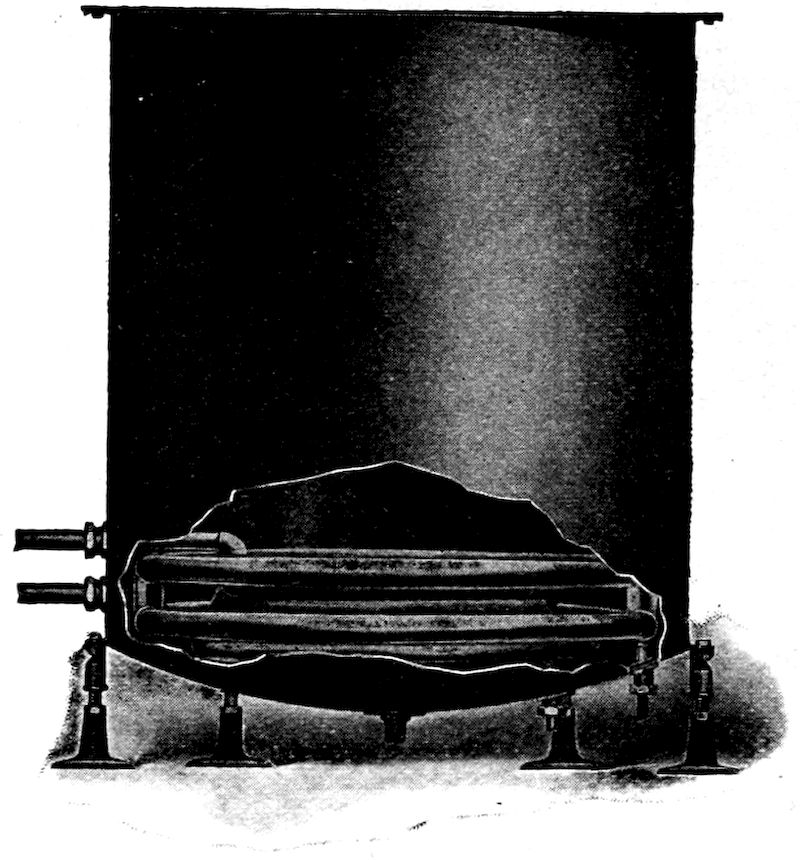
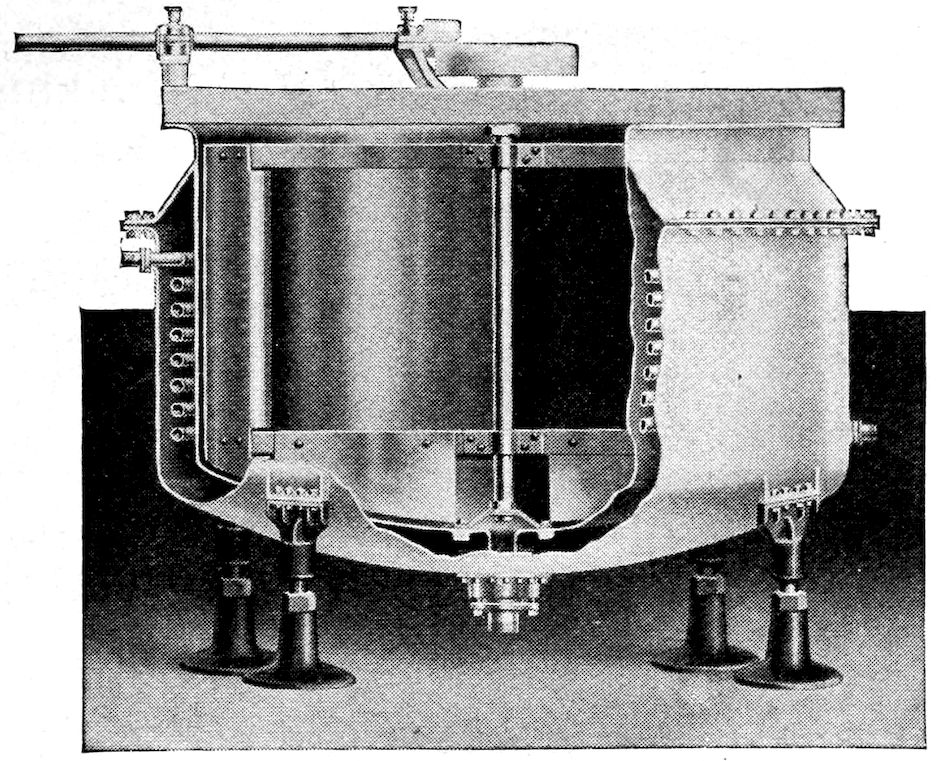
in vacuum. The types of kettles in most common use are the
copper jacketed kettle, the glass-lined tank with closed copper
coil, and the cypress tank with closed copper coil. All of
these give good results where the jacket or coil is properly constructed,
the steam trap is of the right type and takes care of
all of the condensation without allowing it to back up into the
coil, and the kettle has a good head of steam so that a vigorous
boil can be maintained throughout the cooking.
27
If the steam pressure at the boiler is kept above 75 lbs., and
too much is not lost by radiation from uncovered pipes, and
by leaks at poorly packed flanges, etc., there should be no difficulty
in maintaining a vigorous boil. The evaporation should be
so rapid that the vaporizing steam will burn the hand, even if
placed over the kettle for a second. If you can hold your hand
over a kettle of boiling pulp, even for a few seconds, you can
be sure that you are not getting a proper boil. A pressure of
100 lbs. is, of course, to be preferred to 75, as it will effect a
quicker condensation, however there is not a large percentage of
boilers in tomato pulp plants that are permitted to carry as much
as 100 lbs.
The kettles should be close to the boiler room, and the steam
pipes feeding them should be as straight and short as possible,
and covered with magnesia pipe covering to prevent excessive
loss of heat by radiation. It is not an uncommon sight in canning
plants to see the main pipe from the boiler to the cooking
kettles pass through an areaway between two buildings, and
have no protective covering whatever. Such sights, however,
are becoming more infrequent, as packers are plugging up many
of the leaks through which dollars have escaped every day in
years gone by. The condensation from the steam traps can, of
course, be used right over again in the boilers.
Copper-jacketed kettles used for condensing tomato products
range all the way from 50 gallons capacity to 500 gallons, the
larger size making a batch of finished pulp of about 250 gallons
as a rule. A larger batch than this can be cooked in a 500–gallon
kettle, but it is not advisable to keep pumping fresh tomato
juice into the kettle too long, as it gives too long a cook to the
first that goes in. Forty-five minutes should be the absolute limit
for a batch of pulp, no matter what kind of a kettle it is cooked
in, and it is much better to confine the cooking time to 30 minutes
or less. The shorter the cook, the better the color and flavor
of the finished product, other things being equal.
Copper kettles are frequently lined with block tin to prevent
the acid of the tomato from dissolving some of the copper. The
28desirability of this is argued both from a standpoint of health
and flavor, as dissolved copper, even in small quantity, has a
very bitter taste. It should be remembered, however, that the
acid of the tomato, which is generally thought to be citric acid,
is a weak organic acid, and the amount of copper dissolved in a
batch cooked not over an hour is exceedingly small; certainly
so small as to have no ill effect upon health. As to the question
of flavor, it would indeed take a very delicate palate to detect
among a half dozen samples which ones were cooked in an
unlined copper kettle, and which in a kettle lined with block tin
or silver. The latter is said to be used by some packers.
It is a good idea, however, to play safe, and line all kettles
with block tin, as we know that there is a small amount of copper
taken up in solution in the pulp. This is more important in
the case of catsup and chili sauce than where the kettles are
used for pulp alone, as vinegar and salt act on the copper much
more severely than tomato acid does. As to the thickness of the
block tin lining, an inspection of the kettles used by various
packers shows this to run all the way from a good half-inch thick
to a coating so thin that in one season’s use it is almost all
scraped off by friction in cleaning the kettle. The kettles should
be plated heavy enough to last several seasons without re-tinning,
however a coating a half-inch thick is unnecessary and wasteful
of steam. The same remarks apply to the tinning of copper coils.
Although copper-jacketed kettles have the advantage of being
very easily cleaned, and also the advantage of wasting very little
of the product when the finished batch is being discharged,
the large tanks of either cypress or glass-lined steel are coming
into use more and more because of their greater capacity. It is
true that they are very slightly more wasteful than the jacketed
kettles, but this really amounts to very little if the tanks are
built with a concave bottom. They take up no more room than
the jacketed kettles, and will hold a much larger volume, as
they can be built so much higher. If one were to buy a series
of copper-jacketed kettles to cook batches as large as are commonly
cooked in tanks equipped with copper coils, the expense
would be very heavy, there would be much exposure to metal,
and the results obtained would be no better, or possibly not as
good. In the tank equipped with a coil, batches of 300 or 400 gallons
are often cooked, and the juice can generally be condensed
to a specific gravity of 1.035 in 25 to 30 minutes.
29
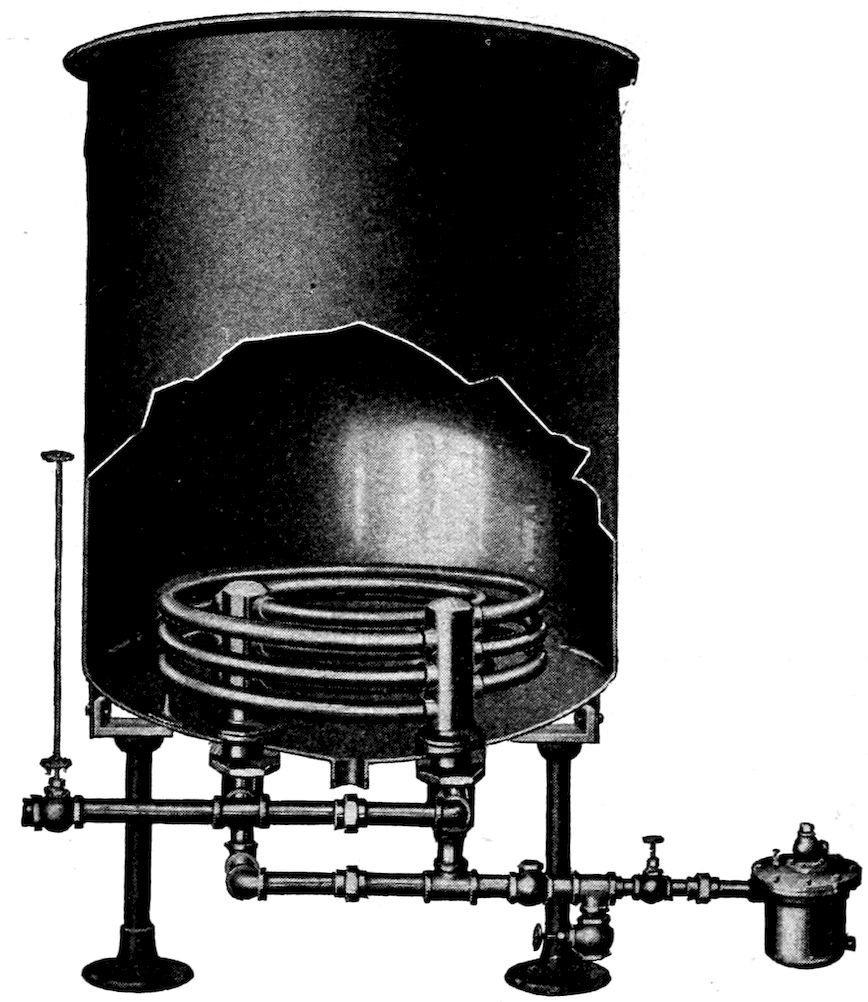
During the last few years quite a few packers, when adding
to their cooking capacity, have put in glass-lined steel tanks.
The glass-lined tank is equipped with coil and steam trap in
the same manner as the cypress tank, and it has certain advantages
which make it very nice to work with, even though the first
cost is considerably more than that of a cypress tank of equal
capacity. The only objection I have heard to the glass-lined tank
is that it radiates more heat than a wooden tank, and on very
hot days, unless it is insulated, makes the cook room more uncomfortable
than the same capacity in cypress tanks would.
However, when the tank is covered with cork insulation, or
asbestos, or even wood staves, it radiates no more heat than a
cypress tank.
The glass-lined tank is perfectly sanitary, and is very easily
cleaned. It is really the most sanitary thing we have to cook
in. The surface is smooth and entirely free from any irregularities
such as there are bound to be between the staves of the
cypress tank. It is always ready for use, and does not have to
be swelled and then scrubbed for a half day after standing idle
for a while before it is fit to use again. There are no places
for molds to creep in and multiply. Furthermore, being of metal
and all in one piece, a battery of glass-lined tanks will not shake
like cypress tanks will when you are running heavy and have
several tanks going full blast at the same time. This may seem
rather unimportant, but it is quite a relief to the cook and his
helpers, as they can go about their work without having their
nerves rattled. Just how long a glass-lined tank will last under
average conditions in a pulp or catsup plant is not known, as
they have not been in use a great many years for this purpose;
however, one would guess that they would be serviceable almost
indefinitely.
Cypress tanks should be constructed of 2–inch material and
made with a sloping or concave bottom, preferably the latter.
They will not impart any foreign taste to the product, as is
sometimes thought, even after becoming charred by long usage,
and if kept clean they will remain sweet as long as they are
kept in continuous use. A musty taste is sometimes imparted
to pulp or catsup cooked in a cypress tank if it has been standing
idle for a long time and is not thoroughly cleaned and boiled
out with soda before it is used again. Cypress tanks have the
30advantage of being cheap, and also of having large cooking capacity.
Cooking tanks and kettles should be cleaned thoroughly
after every batch. If the steam trap is working properly the
burning on the coils and sides of the kettle will be so slight that
almost all of it can be washed off with the hose if the water pressure
is strong and the hose is bushed down to one-eighth inch.
The best things to use to take off the material which burns
on hard and black is a pot chain for coils, and for the jacketed
kettles a wire brush or very stiff fiber brush does very well. If
any of the baked on pulp is not removed before the next batch
is cooked it will interfere with the cooking by lengthening the
time required to finish the batch, and by causing the coils to
burn still harder next time. The cook should be instructed to
get down in the tanks frequently, and feel underneath his coils
to see that they are properly cleaned. The manager should
also make it a point to do this several times a day. His quality
will depend in no small degree on the way his coils are cleaned.
Leaks in coils should be attended to immediately, as they cut
down the available steam pressure, and soon become so large
that it becomes impossible to cook satisfactorily. An ordinary
soldering job will only hold them for a day or two, and it is
necessary to take out the coil and braze it if the leak is to be
permanently mended.
We will say that we are now pumping over the cycloned
or crushed tomatoes into the cooking kettle. Some packers pour
a cupful of cottonseed oil in the kettle to assist in breaking the
boil, others rub the sides of the kettle with fat, such as a piece
of cocoa butter, while others use no oil or fat at all, but take
care to feed the kettle slowly and carefully, and cut the foam
with a sharp spray of water from the hose to assist in breaking
the boil. The oil or fat does seem to help some, but it is not
necessary if the kettle is fed carefully. As soon as the coil or
jacket is covered the steam can be turned on full; however, the
exhaust should be opened immediately, and not closed until all
the condensation which has collected in the coil or jacket runs
31out and the steam comes through perfectly dry. The condensation
of the pulp should then be conducted as rapidly as possible,
pumping over more of the tomato juice as the kettle is able to
take care of it, and boiling continuously. The eye soon learns to
judge the approach of the finishing point, and then the exact
finishing point must be determined. There are many ways of
doing this, and a number of ways have been recommended. No
method can succeed which is not simple and quick, and which
offers scarcely any chance for error when used by a cook, whom,
it must be remembered, is a man of very ordinary intelligence.
The simplest method is gauging the finishing point by the
eye, but this method is also the least accurate in the hands of
the average cook. Cooks who have had years of experience with
tomato pulp sometimes get to be very expert in gauging the
finishing point by the eye, and can determine it with surprising
accuracy. Such a cook is the exception, however, and most
packers have to use some sort of a mechanical method by which
at least fair accuracy can be counted on. These methods consist
of: first, condensing the pulp to a certain mark on the kettle,
a definite volume of juice having been taken to start with;
second, cooking a certain length of time; third, determining the
specific gravity of the hot pulp by weighing a definite quantity
on a small balance; fourth, estimating the gravity by the use
of a hydrometer.
With the first method the amount of tomato juice pumped
into the kettle, or the number of bushels of tomatoes from which
this juice was derived, must be measured. This is a nuisance,
and is not necessary with any of the other methods except the
second. Furthermore, even though every batch of pulp cooked
during the season be made from a measured quantity of tomatoes
or tomato juice, and cooked to the same point on the measuring
stick, the pulp will not all be of the same specific gravity, because
tomatoes are very watery at some seasons of the year and
very firm and solid at other times. The watery tomatoes will
make a thin pulp, and the firm tomatoes will make a heavier
pulp.
32
Cooking for a certain length of time is not dependable because
the steam pressure is not always the same, the coils do
not always condense the pulp with the same efficiency, and the
character of the tomatoes varies during the season. With this
method it is also necessary to start with a definite quantity of
tomato stock for each batch.
The third method—that of determining the specific gravity
by weight—is used as commonly as any of the others. The specific
gravity of pulp merely means the comparison between the
weight of a definite volume of the pulp and the weight of the
same volume of water at the same temperature. If pulp has a
specific gravity of 1.035, that means that a gallon of it is 1.035
times as heavy as a gallon of water.
The determination, as carried out in the cook room, is made
with a small trip balance, a set of weights, and a copper flask
which is tin lined. The weight of the empty flask is taken. Then
the weight of the flask filled to the top with boiling water is
taken. The difference between these two weights is the weight
of water at the boiling point which the flask contains. When
the boiling pulp approaches the finishing point, the flask is filled
to the top with the boiling pulp. This should be done rapidly,
as the pulp cools quickly, and as it cools, decreases in volume.
The weight of the flask filled with pulp at the boiling point is
taken. This weight, minus the weight of the empty flask, equals
the weight of pulp at the boiling point which the flask contains.
You now have the weight of boiling water the flask contains,
and the weight of boiling pulp the flask contains. Divide the
former into the latter, and the result (the quotient) is the specific
gravity. For example, if the water weighs 1,000 grams, and
the pulp weighs 1,035 grams, the specific gravity is 1.035. If
the specific gravity of cold pulp is taken, then cold water of the
same temperature must be taken as the comparison. The weight
of cold pulp must not be compared with the weight of hot water,
and vice versa.
One of the objections to the use of this method is that there
is usually a certain amount of air bubbles and foam in the boiling
33pulp and this causes an error, as the air takes up volume
but does not weigh anything. Another objection is that the determination
is often not made rapidly enough, with the result
that while the flask is being filled with boiling pulp, the pulp
is cooling and correspondingly decreasing in volume, and by the
time the flask is full, it contains more pulp than it should, that
is, instead of containing 1,000 cubic centimeters of pulp at 210
degrees F., it will contain about 1,010 cubic centimeters of pulp
at 200 degrees F., or possibly lower. One reason for this delay
is that the foam caused by filling the flask with boiling pulp
rises in the neck of the flask, and makes it hard to judge when
the flask is exactly full. The main difficulty with the method,
however, is that pulp cooks do not have scientific minds, they
do not appreciate the importance of doing the determination in
a strictly scientific way, and the results they get are not very
accurate. I have frequently checked up on pulp cooks using
this method, and sometimes they were very decidedly off.
The estimation of the gravity of the boiling pulp by the use
of a hydrometer is not in very general use, and it has been
stated by some scientific men that a hydrometer is no good
for tomato pulp or catsup except where the sample on which the
test is made is previously filtered so as to get a clear liquid. A
test which involves filtering, is, in my opinion, entirely unsuited
for everyday use on the cooking platform.
I have used the hydrometer for testing pulp and catsup direct
from the kettle for seven years, and have had more success with
this method than with any other.
The hydrometer was never intended to be used with semi-solid
substances such as tomato pulp, but only with liquids such
as brine, sugar syrup, etc., in which there is no solid matter in
suspension. With liquids, the number of degrees registered on
the hydrometer when it is immersed in the liquid is equal to
a definite specific gravity. This is not true with semi-solids
such as tomato pulp, as each packer must work out the relation
between the degrees of the hydrometer and the specific gravity
on pulp under the conditions which obtain in his plant. This
is a very simple thing to do, and once the packer has established
this relation, it will hold good as long as he is in the pulp
packing business. The reason why this relation is not the same
for all packers is because tomato juice is not screened to the
34same degrees of fineness in all plants, and because all
hydrometers having the same scale will not work the same on
pulp. This is because they have different shapes. The shapes
may only vary slightly, which will not interfere with their
accuracy on clear liquids, but it will make a difference when
the hydrometer is used in tomato pulp. Furthermore, some of
the hydrometers will probably have too much variation in their
diameter at different points, which is a disadvantage when they
are used in tomato pulp. I have therefore always had the
hydrometers which I have used for this test made to order and
to conform to certain specifications which I laid down.
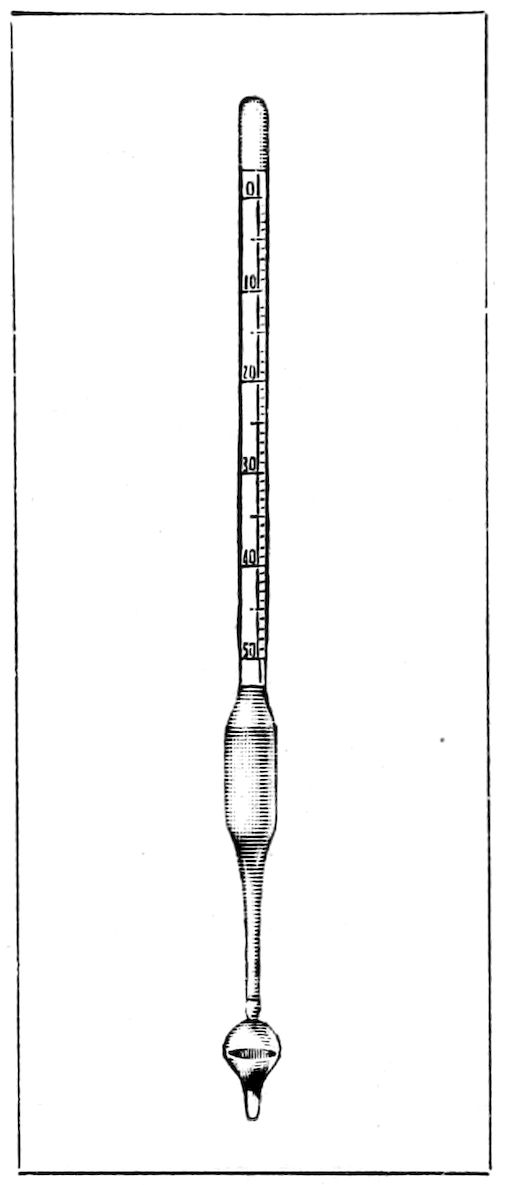
Fig. 3. Special hydrometer for testing tomato pulp and catsup.
(C. J. Tagliabue Mfg. Co.)
In Fig. 3 is illustrated a hydrometer
which is manufactured by the C. J. Tagliabue
Mfg. Co. of Brooklyn, and which
is made to conform to these specifications,
which are: first, perfect balance; second,
a minimum amount of variation in the
diameter of the various parts of the
spindle with the slope very gradual;
third, a Beaume scale reading from 0 to
50 degrees; fourth, that it can be obtained
in exact duplicate in any quantity.
If the diameter at various points in
the spindle is slight, with the slope very
gradual, it seems to be an advantage. It
is, of course, necessary that exact duplicates
can be obtained to use when the
first one, on which your calculations are
based, is broken.
In order to avoid disappointments
which would be very apt to result from
the use of a hydrometer which was not
particularly adapted to this test, and
which would very likely be difficult of
exact duplication, the type illustrated
above should be adhered to, and it will
be found to give good results when used
as directed in this chapter.
Two pulps of the same specific gravity, and of practically
the same degree of fineness, if tested hot, will register the same
on the same hydrometer, or on two hydrometers which are exactly
alike in every respect. (The hydrometer does not work
well on cold pulp unless the pulp is thin.)
35Two pulps of the same specific gravity, showing a very
marked difference in their degree of fineness, will not register
the same on the same hydrometer, because, even though a
definite volume of each will weigh the same, the two pulps are
of different thicknesses, which will have an effect on the degree
to which the hydrometer will sink when placed in the pulp. However,
if a packer cyclones his tomatoes before condensing them,
and uses the same mesh of wire screen in his cyclone all the
time, his pulp will all be of the same degree of fineness, and this
point is eliminated. Every pulp packer who cyclones his tomatoes,
and who uses the same mesh of screen in his cyclone
throughout the season, can use the hydrometer for testing his
pulp and can obtain uniformity without the use of any complex
apparatus.
The relation between the hydrometer reading and the desired
specific gravity is arrived at as follows:
When the boiling pulp approaches the finishing point, pour
a sample into a tall gallon measure and take the hydrometer
reading immediately. Save this sample, put it through the finishing
machine along with several additional gallons dipped from
the kettle so as to get a good sized sample through the finisher,
taking care that the brushes are dry so as not to dilute the sample,
and have the specific gravity determined on this finished
sample when it gets cold. Take other samples from the kettle
at five-minute intervals, and save them for the same purpose,
after getting the hydrometer reading. We will say that one of
these samples, when tested for specific gravity, ran 1.035. The
packer looks up the hydrometer reading he got on this sample,
when taken hot from the kettle, and finds the reading was
18 degrees. He then knows that for pulp of the degree of fineness
he gets from his cyclone, 18 degrees on his hydrometer
equals specific gravity 1.035 after finishing. He may also find
that for the sample that was taken from the kettle five minutes
later, specific gravity 1.04 is equivalent to 24 degrees under
the same conditions. He now has established a relation between
the degrees on his hydrometer and the actual specific
gravity. (The reason for putting the pulp through a finisher
before determining the specific gravity is that he wants to make
this test under the same conditions that the buyer would
make it.)
Now, if the packer decides that he wants to condense his
season’s run of pulp to 1.035, he simply cooks it all to 18 degrees
36on his hydrometer, providing this is the comparison he got.
Under his conditions he may find that 16 or 20 degrees equals
specific gravity 1.035. As stated before, each packer must determine
this for himself.
The cook should fill a tall gallon measure with the boiling
pulp and allow the spindle to sink into it slowly. Do not drop
it into the pulp so that it will fall suddenly, as the weight of
the mercury or shot in the bottom will carry it farther than it
should go. It will be noticed that the spindle will sink rapidly
for a few seconds and then almost come to a standstill. At this
point—when a standstill is almost reached—the reading should
be taken. It requires quite a little time to reach an absolute
standstill, and this is not necessary, as it is easy, with a little
practice, to catch the other point and take the reading. After
the reading is taken, lift out the spindle, stir the pulp with it,
and allow it to sink again as a check determination, merely for
the satisfaction of being doubly sure. You will find that you
get the same reading unless you wait so long before making the
check determination that the sample has had a chance to cool
considerably. As the test only takes ten seconds, the two tests
can be made in a half minute at the most, which gives the pulp
no chance to cool.
The hydrometer method is not absolutely fool proof, but it
is as near fool proof as anything I know of. Neither is it the
acme of perfection in a pulp testing method, but it is, in my
opinion, far better than anything that has been suggested to date.
It is simple, and accurate enough for all practical purposes, and
any ordinary laborer can be shown in a few minutes how to
make the test, and the chances of error are very small indeed.
This method will not work where crushed tomatoes are being
condensed. It is necessary that the tomato juice be previously
cycloned. The pulp must be homogeneous and not lumpy
and full of skins to be capable of being tested by the direct
hydrometer method. When determining the finishing point on
crushed tomatoes it is best to use either the eye or the specific
gravity test by weighing.
The steam should be kept on the kettle continuously until
the batch is done. While testing is being done it is not necessary
37to shut off the steam. If salt is used it should be scattered
over the batch slowly a few minutes before it is done. Salt
increases the specific gravity, and also the hydrometer reading.
The relation between the hydrometer reading and the specific
gravity can be worked out just as well where salt is used as
when it is not used.
The addition of salt does add to the flavor, and some buyers
prefer it, while others do not. I have seen buyers pick out a poor
quality pulp with salt in it in preference to a much better quality
with no salt.
As soon as the steam valve is closed the exhaust should
be opened to discharge the steam from the coil or jacket and
allow it to cool as quickly as possible.
It is often necessary to hold batches in the cooking kettles
for some time after the cooking is finished. This darkens the
pulp some, both because of contact with the air, while hot, and
from long contact with the sides of the kettle or coil, which remain
hot. Cooked pulp should therefore be discharged from the
kettle just as soon as possible. If held over 30 minutes in the kettle
it should be given a momentary boil before letting it down.
Be careful to avoid contamination in the kettle after the steam
is shut off, such as cold dirty water dripping in from rafters
overhead, and leaks from pipes over the kettles through which
cold tomato juice is flowing. Such material will not become
sterilized merely by contact with the hot pulp, and may cause
swells in the canned product if there is very much of it.
38
The fewer pipes and receiving tanks the condensed pulp
passes through before being filled in the cans, the better. All
of this conveying and finishing equipment offers possibilities
of contamination, and allows the cooked pulp to cool to some
extent before it is filled. Eliminate as much equipment as possible
between the cooking kettle and the filler, and have the pulp
enter the cans at at least 170 degrees F., and if possible, at 180
degrees or above. A receiving tank between the cooking kettles
and the filler should be dispensed with if possible, and the
finishing machine draw the cooked pulp direct from the kettle
by means of a short line of enamel lined pipe.
Unfortunately the arrangement of many plants is such that
it is almost necessary to use a receiving tank; at least in such
cases it would be a disadvantage not to have one. Where
a tank must be used here it should be in such a position that it is
easily accessible, so that it will not be necessary for a man to be
an acrobat to get into it, inspect it, and see that it is kept clean,
and that an inch of pulp is not allowed to lie in it and get cold
while waiting for another batch to come down.
The best kind of a tank for this purpose is an enamel or glass-lined
tank with a rounded, tapering bottom so that it will almost
drain itself completely, and what little adheres to the
sides can be scraped down in a few seconds if it is necessary
to wait five or ten minutes for a fresh, hot batch to come down.
Even if it isn’t scraped at all it will probably not cause any
trouble in a tank like this. Wooden tanks will do, of course,
but it would pay a packer who must use a tank here to throw
out his wooden one and put in a tank such as is recommended
above. It is hard to construct a wooden tank so that it will
39drain well; in fact, nine out of ten scarcely drain themselves
at all; they are never kept as clean as they should be, and wet
wood seems to be a favorite spot for molds to grow, so that
frequent scrubbing is necessary if it is kept sanitary. It is
most important to inspect the receiving tank carefully before it
is first used in the morning, as they sometimes mold slightly
over night, or dirt falls into them from overhead. A steam
hose should be kept close to a wooden tank to sterilize it at
night after it is scrubbed out.
Whether or not a receiving tank is used, the finishing machine
should be as close to the cooking kettles as possible, and
should receive constant attention from a careful operator who
can comprehend to some degree the importance of keeping it
clean. If the filling department gets ahead of the cooking department
and is obliged to wait fifteen minutes or a half hour
for a fresh batch of pulp to come down, the man who tends to
the finisher should take it apart at once, wash it off, steam
it off thoroughly with the steam hose, and put it together again
so that it will be clean and practically sterile when it receives
the next batch. Otherwise the screen and the brushes will be
clogged up with cold pulp when the fresh batch comes down,
which is a bad condition, especially if the pulp is not to be
sterilized after it is filled, which is usually the case with 5–gal.
pulp. Even though the finisher is operated continuously through
the day, it should be taken apart and cleaned at least twice during
the morning and twice during the afternoon.
The finishing machine should be operated slowly, so that the
pumice will come out dry. The small receiving box under the
finisher should drain completely so that it does not have a foot
of cold pulp lying in it when the finisher is idle.
The best kind of screen for the finisher is made of monel
metal. The brass screen is more common; however, the same
thing can be had in monel metal, and it does not offer the opportunity
for metallic contamination that the brass screen
does. The monel metal screens wear very well and have proven
themselves to be satisfactory in every respect. Aluminum
should not be used, as it is eaten up by the tomato acid and
will not last long.
40
The opinion has often been expressed that the brushing of
the pulp through the fine meshes of the screen breaks up the
small clumps of mold and scatters them in small threads throughout
the mass, thus increasing the mold count, since this count
is not based on the total quantity of mold present, but upon the
number of microscopic fields containing molds. Thus, by scattering
the mold, instead of allowing it to be retained in comparatively
large clumps, the number of microscopic fields containing
mold threads would be increased.
Although one might reasonably expect this to take place, experiments
have proven that it does not take place. Several
years ago, in order to determine this point, I analyzed thirty
batches of catsup just before entering the finisher and again
just after coming through the finisher. In every case the percentage
of microscopic fields containing molds after finishing
was practically the same as before finishing. A cone-shaped
finisher with three revolving brushes and fine mesh screen was
used for this test.
Although the finishing machine, if properly tended to, is
probably responsible for very little of the spoilage in pulp, it
has been suggested to use the finisher before the pulp is condensed.
Then the pulp can be drawn direct from the kettle
to the cans, and the chance of contamination and cooling in the
finisher can be eliminated. This idea is well worth experimenting
with, as the pulp could be filled at almost the boiling point.
I have not tried out this idea, but offer it here as a possibility
which has advantages which are well worth looking into. Packers
who are having spoilage trouble which they cannot attribute
to other causes would do well to experiment with it. As to
whether both the pulp machine and finisher would have to be
used before the cooking, or whether the finisher alone would do,
providing the tomatoes were previously crushed, or cooked in a
“breaking tank,” would have to be determined by experiment.
The method may be in use now by some packers; however, I
have not heard of it being used.
41
The most commonly used containers for pulp are the five-gallon
can, the No. 10 and the No. 1 can.
The usual method of filling 5–gal. cans is to draw the pulp
from the finishing machine by means of a large, heavy wall,
single line hose filling one can at a time. Some packers use a
manifold by which five cans can be filled at once. This requires
a lot of valves and enamel lined pipe fittings, and unless the
operator is very expert the manifold will not do the work any
faster than a single line hose.
The square 5–gal. can is preferred by nearly all packers to
the round can. The round can is hard to handle, hard to stack,
and is very wasteful of space wherever it is stacked. The square
can is to be preferred in every way.
When new cans are being used it shouldn’t be taken for
granted that they are absolutely free from leaks, as it is sometimes
found that a large percentage of a car of cans will run
bad, and the packer should test representative samples from
the car as soon as it is received, so that he can reject it and
secure other cans if the car doesn’t test up right. The best
way to do this testing is with a small tank of water, a one-eighth
inch air line, giving about four pounds pressure, and a can
tester. A simple kind of can tester can be easily constructed
in any blacksmith shop, and merely consists of an iron brace
to fit around the can and which can be quickly tightened over
the can and released, and a soft rubber semi-circle to fit tightly
into the cap hole and which is gripped at the top and held in
place by one side of the brace. The one-eighth inch brass air
pipe passes through the center of the rubber semi-circle and
42into the can. As soon as the can is tightly clamped and the cap
hole sealed by the rubber, the air is turned on and the can is
immersed in the water. The leaks show up very quickly under
a four-pound pressure, and a dozen cans can be tested in as
many minutes.
New cans, as well as old ones, should be thoroughly washed
and steamed before filling. There is often a fine, light colored
dust in new cans which a good strong spray of water properly directed
into the inverted cans will remove. Through the same
pipe which directs the spray of water into the cans, the cans
can be steamed by means of a simple arrangement of valves
on the steam and water pipes. A washing and steaming rack
can easily be fitted up which will wash and steam a half dozen
cans at once. A single stream of water entering the cap hole of
the inverted can is not sufficient to clean it. The pipe which
enters the cap hole should be capped, and about three holes
drilled into this cap at a slight slant so that the upward spray
of water will strike three different spots in the bottom of the inverted
can, and make the washing thorough.
If the average packer could see just how little of the inside
surface of his 5–gal. cans is actually washed, he would be surprised.
About fifteen seconds is sufficient time to spray the inside
of the cans, and then the water valve can be closed and the
steam valve turned on. The steam should be kept on for a full
minute and kept on strong. The idea is not merely to heat the
can but to sterilize it, at least to some degree, before the pulp
is admitted. The average employee steaming 5–gal. cans leaves
the steam on ten seconds at the most, and often not more than
three seconds. Such a short steaming does very little good. The
space of time between the steaming and filling should be just
as short as possible. The employees should not be permitted to
keep a half dozen cans steamed ahead all the time so that they
are cold by the time the pulp enters them.
As stated in the previous chapter, the temperature of the pulp
when it is filled should be at least 170 degrees F. and preferably
above 180 degrees. The cans should be filled clear to the top with
the pipe or hose which conducts the hot pulp from the finisher;
they should not be topped off out of a dipper which contains luke
43warm pulp and is used for topping purposes. It is not necessary
to do this topping and the practice should not be permitted. The
sponges which are used for wiping the edges of the cap hole
should be kept in a bucket of clean, hot water, and put back in
the bucket after being used on a truckload of cans. The capping
and tipping job should undergo inspection before the cans
are trucked away.
Cans of filled pulp should be handled carefully. The cans
should be set down easily, so as to strain the seams as little as
possible. Of course the laborer wants to let go of cans of red-hot
pulp just as quickly as possible, but it is not necessary to drop
them several inches, and the employees should be taught to set
the can on edge and then let its weight straighten it up. If the
employee is given good thick gloves it is just as easy to handle
the cans carefully. I had occasion at one time to check up on
the percentage of swells resulting from one pile of pulp which
was stacked by an old hand who knew how to handle pulp easily
and carefully, and another pile from the same day’s run which
was stacked by a gang of new and uninstructed help who simply
picked the cans off the truck and dropped them in place. These
were second-hand cans, and the difference was considerable.
Both filled cans and empty cans should be handled almost like
eggs. One large pulp packing concern is particularly cautious
about this, and it is certainly soothing to the nerves to see their
employees handling 5–gal. cans after witnessing the rough and
tumble methods in the average plant. They know that it pays to
be particular, and that they can get three years’ use out of almost
all of their 135–lb. plate cans, and not have many swells either.
This concern rarely sells any of their pulp, but puts it up for their
own use, to be made into bean sauce, catsup, soup, etc., during
the winter months.
Some packers stack their pulp away without dating it; others
date each day’s run; while others stack each batch separately.
The latter system is practicable where the pulp is cooked in
large batches of about 300 gallons or more and in working up the
pulp during the winter months it is a great help. For instance,
suppose part of the pulp is to be used for catsup and part for
bean sauce. The packer can take batches one to fifty, for example,
44open one can from each batch, examine it for color and
microscopical analysis and he knows exactly what he has in that
stack of pulp, which may be three thousand cans. He can select
the various batches to be used for the purpose to which they are
best adapted, and he can be absolutely sure that each can in a
batch is exactly the same in every respect.
Take another example: We will say that the packer is selling
his pulp. His records show that on September 20th and on
October 2nd, for instance, he had a lot of bad tomatoes; shipments
received on those days were unavoidably held up and he
had to make the best of the situation. He knows, however, that
on those same dates he had a lot of good tomatoes which came
in by wagon haul and that they were run up at the same time.
He has a large order for pulp from a catsup maker who is very
particular about the microscopical analysis of the goods he buys.
In order to play absolutely safe, the packer can take a sample
from each batch of the pulp run on September 20th and October
2nd, and if a half dozen batches run too high he can omit them
when he makes the shipment to this buyer. If he preserved a
sample from each batch run on these dates at the time they were
run, which is the better way, it makes the sorting out of this
pulp a very easy matter. He thus eliminates the danger of the
loss of a good buyer by sending him even a comparatively small
quantity of pulp which is high in micro-organisms.
It may seem to one who has never tried it that stacking each
batch of pulp separately would involve an awful lot of extra labor,
and loss of valuable space when stacking. As a matter of
fact, it involves no extra labor at all and no extra space. I have
had a season’s pack of pulp amounting to 75,000 5–gal. cans at
one plant and cooked in batches of 300 gallons each, stacked each
batch separate and it was no trouble at all. The inspector who
examined the tipping and capping job, or the tipper, if the inspecting
was done by him, merely took a fine stiff brush and a
marking pot and marked the batch number on the cap of each
can. This only takes a half minute for a truck load. The date
was not marked on the can, as a record of the batch numbers run
on each date during the season was kept at the office. When
the pulp was piled away each batch was stacked together, and
where one batch left off and another one began a slip of wood
was inserted between two of the cans.
On days when the tomatoes are running bad, or there is a
scarcity of help for the sorting belt, it is wise to preserve a sample
from each batch and have an analysis made of it for reference
45when the pulp is shipped out. On days when a good grade of
tomatoes are being run it is hardly necessary to analyze every
batch, but a sample of about every third batch can be taken.
Stacking each day’s run separate is, of course, better than no
separation at all. However, there are not many days when the
entire run will have a similar analysis; the best becomes inseparably
mixed up with the worst, and when the pulp is worked
up the packer is working in the dark. To stack a season’s run
away without any system of separating various divisions of it is
the worst kind of folly, and is almost sure to lead to trouble.
When the pulp is stacked away a space of at least an inch
should be left between each can to allow the air to circulate
and prevent stack burning. If this is not done, a pile of pulp may
hold the heat for a week or ten days, and the pulp, particularly
that on the inside, will become brown or even black, due to the
long exposure to the heat. The quicker the pulp can be cooled,
the more the bright red color of the tomato will be retained.
The height to which the pulp is stacked depends upon the
heaviness of the plate of which the can is made, and also, of
course, upon the weight the floor of the warehouse is able to
stand. As a rule it is not wise to pack 5–gal. cans of 107–lb. plate
over four high, and not over five high for cans of 135–lb. plate.
Dry, sheltered storage should be provided for pulp, and it will be
found to pay in the end. Exposure to the elements is very hard
on the cans, and alternate freezing and thawing of the pulp is
a great strain on the seams of the can. A comparison of the leaks
and swells on pulp stored in shelter, and that stored in the open,
will convince the packer that it pays to construct dry storage
space.
Narrow aisleways should be provided for between the stacked
pulp so that it can be frequently inspected for leaks and swells.
By pulling out a leaker in time, several other cans are prevented
from becoming leakers, as the leaking pulp from one can will run
down on several others, and the pulp, in connection with the
oxygen of the air, will eat through the tin plate, causing rust
spots, and then pin holes. Frequent inspection of the pulp pile
and pulling out cans when they are just beginning to leak or
swell will save the packer a lot of money.
Cans should not be stacked on thin boards which will leave
the surface of the can close to the ground, as the moisture of the
46ground will quickly rust the tin. It almost seems foolish to
mention such a point, but much pulp is stacked this way and the
entire bottom layer when turned up will be moldy and rusty on
one side. The surface of the can should be at least two inches
from the ground. Lacquering will help some, but will not prevent
rusting if the cans are close to the ground.
Nothing has up to this point been said about the processing
of 5–gal. pulp. Very few packers process their pulp, and many
unprocessed packs have been put up that have not shown over 1
per cent of leaks and swells where new cans were used and the
various manufacturing processes were carried out as they should
be. In many cases a long shipment of such pulp, after having
been stored in a sheltered place for several months, has produced
very few additional swells.
One large packer of pulp has for years given his 5–gal. cans
a 30–minute process in boiling water, having them pass slowly
through a boiling water bath on a chain carrier, the speed of
which is regulated so as to give each can the required time in
bath. The cans are placed on the chain as soon as they are
capped and tipped. Although this packer is very careful in his
manufacturing methods he processes as a matter of insurance,
principally because a great deal of his pulp is shipped long distances.
He must figure that it pays him or he wouldn’t keep it
up, as the processing involves quite a little extra handling and
extra equipment, and of course has a tendency to darken the
pulp somewhat.
Thirty minutes at boiling temperature is, of course, not sufficient
time to bring the center of the can near the boiling point,
but it will sterilize the can itself and that portion of the pulp
which is near the outside. If the pulp is filled very hot, that portion
of it which is in the center of the can, being the last to cool,
should practically sterilize itself.
Where a packer puts up pulp in 5–gal. cans for his own use
during the winter months he ought to be able to get two years’
use out of all of his cans, and three years out of a large percentage
of them. It is questionable whether it is ever advisable
to use a can over three seasons. One reaches a point where the
percentage of swells is so large with old cans that the saving of
47the cans is unprofitable. When a new can is first used, the year
should be indelibly stamped on the can, so that at any time the
packer can go through his stock of used cans and tell how many
seasons’ use each can has had. This will prove a help in making
a decision on which cans are worth holding over for another season,
and which ones are not. It also gives him a line on the kind
of can that gives him the most value for his money.
Enamel lined cans are now being used a great deal, and as a
rule they seem to give a little better service than the plain tin,
although this is not always the case. Some packers think the
enamel imparts a very slight foreign taste to the pulp, but I have
never been able to detect it. Enameling or lacquering of the
outside of the cans is essential if there is not sufficient sheltered
storage for the pulp, or if it must be stacked in a damp warehouse.
An excessive amount of moisture in the air will quickly start
the tin to rusting on plain cans, and many cannery warerooms
are entirely too moist for stacking cans, as they are near the
process room, and the air is often misty with the presence of condensing
steam from the process tanks. If there is ample dry
storage space, the outside enameling of the cans does not seem
to be an advantage.
When the season’s pack of pulp is being worked up, the cans
which are to be saved for another season’s use should be
thoroughly washed out in a tub with hot water. Spraying devices
will not work, as the top of the can will probably have a layer of
pulp stuck to it, due to the receding of the pulp in the can when
it cooled, and even a heavy spray will not remove all of this. The
cans must be partially filled with hot water and shaken hard to
properly clean them. The foreman should inspect the washed
cans at frequent intervals by means of a small electric light which
is wired to a short rod and which can easily be inserted in the
can through the cap hole. If the washing is not thoroughly done
this will show it up quickly.
After as much of the water as possible is shaken out of the
cans they should be put in a drying oven and left over night. In
the morning the cans should be thoroughly dry if sufficient steam
is kept in the oven radiators. The oven is made with a partition
which divides it into two parts, and one part can be filled with the
wet cans while the other side is being emptied of the dry cans.
48
After the cans are dried, a pasteboard insert should be placed
in the cap holes to keep the dust out of them while they are in
storage during the winter and spring. One of the can companies
at least, supplies these pasteboard inserts or inverted caps with
their cans, and they fit snugly into the cap hole.
Before the old cans are used the following year they should
all be tested for pin hole leaks and the leaks patched up. They
should then be re-tested and not used until they are shown to
be tight under air pressure when immersed in water. This can
be done during the spring and summer months, and the packer
can then be reasonably sure that his old cans are in good shape
for the next season’s run. If the cans are very old and the seams
are very rusty, new pin holes will be opened up every time air
pressure is put in them. Such cans should, of course, be thrown
away.
Pulp packed in No. 10 and No. 1 cans is usually filled with a
rotary filling machine, although No. 10’s are often filled from a
single line pipe and the filling can be done quite rapidly where
the operator is expert at the job. If it is necessary to top any of
the cans, it should be done from a small jacketed kettle which is
connected up near the filler, so that the pulp used for topping can
be kept hot. The cans should be put through a can washer and
steamer before filling.
No. 1 pulp should have a much larger call from the consumer
than it has, and it could be made very popular if a high standard
of quality was set and maintained, and the advantage of its use
advertised to the housewife. Many consumers who have purchased
the small size pulp or puree for use in making tomato
sauce, spaghetti, tomato soup, etc., have been disappointed in the
quality, and after one trial have gone back to canned tomatoes
for these purposes.
For No. 10’s a process in boiling water of 40 minutes in the
old style straight process tank is usually considered sufficient;
this is to be followed by a very gradual cooling in water so that
the cans will not buckle badly. For the No. 1 size a 20–minute
process in boiling water is sufficient. It is always well to cool
49the cans about ten minutes so they will not retain the heat a
great length of time. A better color and flavor can be maintained
if the goods are cooled in water after processing. If a
continuous agitating cooker is used for processing the lengths
of time given above can be cut down at least 60 per cent.
Barrel pulp is scarcely being packed any more, as the barrel
has shown itself to be unfit for pulp which is packed without preservative.
The use of barrels today is usually only resorted to
in emergency cases when cans for the purpose are not available.
If the pulp is to undergo long storage and shipment, or any great
amount of handling, barrel goods will usually show quite a big loss,
not only because much of the pulp is spoiled so that the spoilage
is evident at once upon inspection, but because of the growth of
yeasts and bacteria in the pulp while it has been in storage, and
because of loss of color due to the action of air seeping into the
barrel. Wooden barrels as a rule are not absolutely air tight,
and it is hard to make them so.
I have packed pulp in good uncharred whisky barrels, using
5 lbs. of salt to the barrel, and rolled the barrels to a sheltered
place where they would not be disturbed until they were ready
to open, and after two or three months’ storage the pulp was
all right. If this pulp had been moved, or held until a spell of
warm weather came on, it is doubtful if it would have shown up
so well. The barrels should be washed out well and steamed for
about five minutes before being filled, and the bungs should be
burlapped.
Ingot iron drums, such as are used for shipping oil, have been
recommended for tomato pulp and I have tried them, but they
will not do, as the tomato acid dissolves too much of the iron.
As a method of preserving pulp in barrels one packer for a
number of years put hydrochloric acid in it. This, being a strong
acid, is also quite a good preservative, and evidently kept the
pulp in good shape. When the pulp was worked up, enough bicarbonate
of soda was added to neutralize this acid, and the
result of the neutralization was sodium chloride, or common salt.
50There evidently could be no objection made to this from a pure
food standpoint, as none of the acid was left in the pulp after
the neutralization, and sodium chloride is a common ingredient
of pulp. However, the process darkened the pulp, which was an
objection. As to whether or not the flavor was impaired by this
treatment I do not know.
51
By micro-organisms we mean molds, yeasts, bacteria, and their
spores. The term “micro-organisms” takes in all of these.
This chapter will deal with the subject in as short and concise
a manner as possible, with the object of giving the manufacturer
a working knowledge of it that will help him in his
everyday factory routine. Although volumes have been written
about micro-organisms in food, it is not necessary for the packer
of tomato products to have an accurate, detailed scientific knowledge
of the subject in all its ramifications, but a general understanding
of it will suffice for practically all purposes.
What are molds, yeasts, spores, and bacteria? Are they animals
or plants? Where do they grow, and under what conditions
do they multiply most rapidly? Are they harmful, or are
the kinds found in tomatoes all harmless varieties? If they are
harmless, why does the government object to them? Why is a
product containing a certain number considered all right, while
when a larger number is present the product is said by the
government to consist in whole or in part of a filthy, decomposed,
putrid vegetable substance? Aren’t such foods as Roquefort
cheese, cottage cheese, buttermilk, and sauerkraut fairly
swarming with the same kinds of germs as tomato pulp? Aren’t
these foods all considered healthful? Then why object to these
germs in tomato pulp? Aren’t the germs all killed by the boiling,
anyway? These are questions often asked by pulp packers,
and it is hoped that the following will throw some light on
the subject.
Molds, yeasts, spores, and bacteria are very tiny plants, not
animals. They are so small that they can only be seen by the
naked eye when there are very large masses of them together,
consisting, in the case of bacteria and yeasts, of hundreds of
52millions of small individual plants, and in the case of molds,
of many individual mold plants closely massed together.
You have all seen large tufts of white mold on tomatoes,
and black mold covering a loaf of bread, but you probably did
not realize the enormous numbers of individual mold plants
that were present, or the rapidity with which they multiplied
themselves. You have all seen swelled cans of tomato pulp, and
after the cans were opened you have noticed the bubbles rising
in the pulp, and have noted the very sour taste and often an
extremely disagreeable odor. In every thimbleful of that sour
pulp there were hundreds of millions of bacteria and yeast cells,
so small in size that many thousand could collect at the same
time on the point of a pin and they would not be noticed
by the naked eye. It was these tiny bacteria and yeast plants
which caused the physical and chemical changes in that pulp.
Just as a parasitic vine winds itself around a tree and sucks
the life out of it, so these millions of bacteria and yeast plants
sucked all the goodness out of this tomato pulp, and left nothing
but sour, decomposed tomato fiber, acid, and foul-smelling gas.
The structure of the mold plant is similar to that of a very
small vine, the branches of which are many and are closely
massed together. The tiny threads or filaments of mold resemble
the vine and its branches. These threads keep sending out
new shoots which spread rapidly all over the surface the mold
is growing on, and the fruit of the mold plant, which is called
spores, is similar to the little berries which grow at the ends of
the branches of a vine. These berries are the fruit of the vine;
spores are the fruit of the mold plant. Just as the berries contain
seeds which reproduce the plant, so the tiny spores contain
the seed which will reproduce the mold plant. These spores
grow at the end of the mold threads or branches, and when
ripe, either fall on the surface directly beneath, or are carried
away by a breath of air and move along with the dust.
The spores of the mold plant will remain alive for months
in a dry state, floating in the air, or if the air be very still,
falling to the surface. The air everywhere is full of them,
and as soon as they light upon a moist surface, such as tomato
juice, for example, which contains nourishment for them, they
begin to send out shoots of mold threads and reproduce another
mold plant.
53
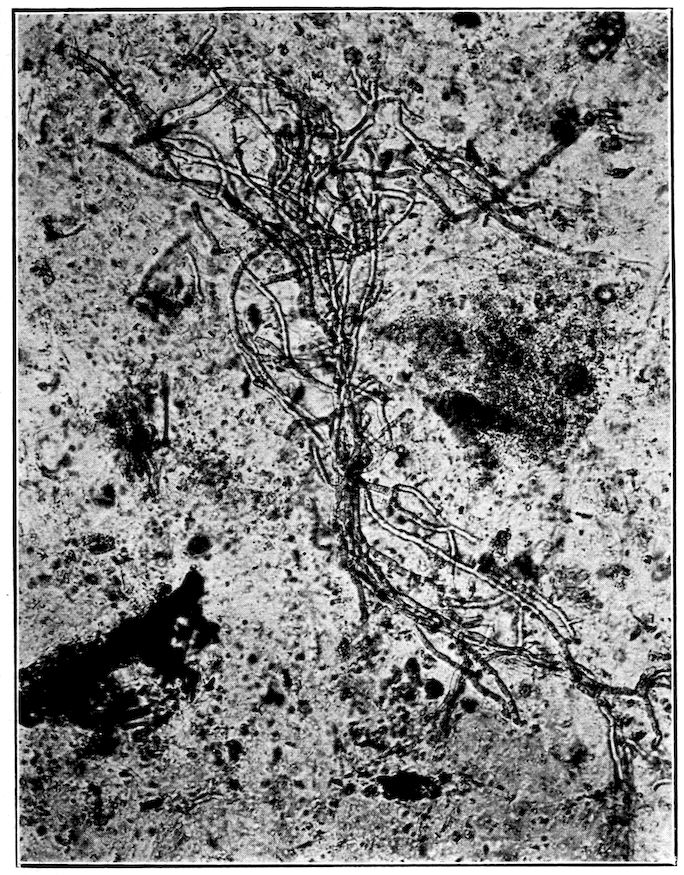
Fig. 4.—Mold filament from catsup. (×150.)
Mold grows most rapidly upon a warm surface, preferably
about the temperature of the human body. It will not grow
on a surface which is at freezing temperature, or on a very hot
54surface. Under these extremes of temperature it is unable to multiply
itself. Boiling kills the mold plant, and continued boiling of
15 minutes or more also kills the seeds or spores of practically
all species. That is one reason why it is desirable to bring
peeled tomatoes or tomato juice to a boil as soon as possible—so
that the mold and mold spores which are always on these
surfaces will be killed before they have an opportunity to grow.
There are many different species or varieties of mold plants
which thrive on tomatoes and tomato pulp, but they are all very
similar; they reproduce themselves in exactly the same way,
and they are all arrested in their growth by extremes of temperature,
and are killed by continued boiling. It should not
be thought, however, that boiling for a very few minutes will
kill all mold spores, as they have a tough surface which has
considerable resistance to heat. I have seen 5–gal. pulp packed
which was only given a very short boil on account of low steam
pressure, and molds grew in the sealed cans after packing to such
an extent that the pulp all had to be thrown away. It is safe
to assume, however, that a 15–minute boil will kill mold spores
and prevent the growth of molds in the cans after they are
sealed, providing, of course, that the pulp is filled hot into cans
which are clean and almost sterile.
Bacteria and yeasts are very much smaller plants than molds.
While an individual mold plant, growing as stated above like a
very small vine, branches out and spreads over considerable surface,
bacteria (that is, those forms in which the pulp packer is
interested) are very short, single rods, which, when multiplied
in size 500 times by the microscope, appear to be from 1
32 to
⅛ of an inch long. Yeasts, when multiplied in size 500 times,
usually appear to be from two to five times as large as a pin
head.
The rod-shaped bacteria referred to above are mainly the
lactic acid, and acetic acid bacteria, both of which produce fermentation
in tomato products. The lactic acid germ is the same
one which causes milk to sour, while the acetic acid germ is the
one which produces the acetic acid of vinegar. There are many
other kinds of bacteria in tomato pulp, many of which are
small, round cells. However, the bulk of these probably come
from the soil and are natural to the tomato, and are not
counted when the number of bacteria per cubic centimeter are
estimated. The rod-shaped types indicate fermentation.
55
Fig. 5.—Rod-shaped bacteria from tomato pulp, common in bad catsups. (×500.)
Bacteria reproduce themselves with amazing rapidity. It has
been found out by watching them multiply under the microscope
that under favorable conditions one germ reproduces
itself every 30 minutes, and in some cases reproduction is
known to have been even more rapid than that. The method
of reproduction is by simple division. The rod-shaped bacterium
is just like a match in shape, only many thousand times
smaller, and in the space of about 30 minutes it will divide itself
56in the middle, thus changing itself into two shorter rods. Each
of these rods grows in length, and each of them then divides,
making four rods. In 30 minutes more the four rods change
into eight, etc. It is the simplest method of reproduction
there is.
Bacteria also have another method of reproducing themselves
which they resort to when conditions become unfavorable for
their growth and they can no longer multiply themselves by
the simple division method. Such an unfavorable condition
would be the drying up of the moist surface on which they are
growing. In this case the rod-shaped bacterium forms one or
more spores within itself. These bacteria spores are somewhat
similar to mold spores, but are much smaller. However,
they are only produced by bacteria under unfavorable conditions,
while the mold plant produces them under all conditions. The
bacteria spores, like mold spores, have a tough surface which
gives them high resistance, and they contain the germ of bacteria
life which can reproduce the species when favorable conditions
for growth are again encountered. The bacteria spores, therefore,
float through the air as do the mold spores, remaining in the dry
state without nourishment for months at a time, and as soon as
they light upon a moist surface containing the elements for
growth, even to a very small degree, they reproduce the rod-shaped
bacteria form, which begins to multiply itself again by
the simple division method.
Although most bacteria spores are killed by boiling for 10
or 15 minutes, there are a few species of extremely high resistance
which have been known to remain alive after several
hours’ boiling. Spores of this nature are infrequent, however,
and the packer might as well forget that they exist. Not one
case of spoilage out of a hundred is caused by the presence
of such spores, and if all food products were cooked a length
of time sufficient to kill all bacteria spores which might possibly
be present, the foods would be cooked to death, and unfit
to eat.
Yeasts are very tiny individual cells, and multiply by
budding, instead of by simple division, as bacteria do. Instead
of the yeast cell dividing in half, thus producing two cells, it remains
intact, but a bud forms on its outer surface. This bud
grows in size until it becomes almost as large as the cell which
produced it, and then it separates from the mother cell, and
57we have two yeast cells. Each of these two cells then produces
buds, which again separate, and so on. Like bacteria,
the multiplication is very rapid under favorable conditions.
Favorable conditions for yeasts and bacteria are the same as
they are for mold, that is, a warm temperature, preferably near
blood heat, and a moist substance which is not too strongly
acid, and which contains the elements necessary for growth,
preferably the natural sugar of fruits and vegetables.

Fig. 6.—Yeasts and spherical bacteria from decaying tomatoes. (× 500.) [The oval bodies are the yeasts, some in budding stage; the bacteria appear as small spheres, or pairs of spheres.]
Yeasts are the principal gas-forming agents in the fermentation
58of pulp. In the production of this gas they consume the
natural sugar of the tomato. They will multiply by the budding
method described above as long as they are in a medium which
is favorable for their growth. As soon as this medium drys
up, or for some other reason becomes an unfavorable medium
for the multiplication of the yeast cells, the yeasts resort to spore
forming, just as bacteria do. These spores are formed within
the yeast cell, and when the cell wall breaks the spores pass
off into the air. Like all other spores, they have a high resistance,
and will float around in the dry state and remain
alive for a very long time. When they light upon a medium in
which they can grow they reproduce the yeast species, in the
same manner in which the bacteria spore reproduces the bacteria
species from which it was derived.
The spores, then, which are found in tomato products are of
three different kinds, namely, mold spores, yeast spores, and
bacteria spores. The greater number are almost always mold
spores, since the mold plant produces spores under all conditions,
while yeasts and bacteria only produce them under unfavorable
conditions. When microscopical analyses of tomato
products are reported, the mold spores and yeast spores are included
with the yeasts in the term “Yeasts and Spores.” This
is because a large number of the spores are very similar to yeast
cells in appearance, and as it would be a laborious process for
the analyst to separate them, the yeasts and spores are included
in one figure, which greatly simplifies the analysis. The
bacteria spores are not included in the count of “Yeasts and
Spores.”
We will say that we have stacked away a 5–gal. can of pulp
which contains several living spores of bacteria, as is apt to
be the case, since the air is full of them, and the pulp is constantly
open to contamination from the air after it is cooked;
also the spores may be in the empty cans at the time they are
filled. Why is it, since these few spores are alive, and in a
favorable medium for their growth, that the rod-shaped bacteria
forms which they produce do not multiply to such an extent
that they will ferment the can of pulp. It was stated
above that bacteria do not multiply in a strongly acid medium.
59Since the bacteria produce acid as a by-product of their own
growth, they surround themselves with an acid medium, and
they thus retard and finally stop their growth by the product
of their own reproduction. When this acid medium reaches a
certain strength the bacteria can no longer multiply, and if
that can is not moved until used, the chances are it will be
all right when opened. But if the can is moved, the contents
are agitated, and these living bacteria are shaken away from
the acid medium in which they have been suspended, and they
are shaken into a fresh, sweet medium in which they can again
begin to multiply. It may therefore follow that if this can is
moved several times it would be at least partly fermented when
opened, while if it was left alone it would have remained sweet.
This illustration shows the desirability of moving pulp as little
as possible, and as carefully as possible when moving becomes
imperative. The lack of air in the can will, of course, also retard
bacterial growth, but there is usually a small amount of
air in the can, and many species of bacteria do not need any
air whatever for their growth.
Fig. 7.—Mold spores and filaments. A type frequently found in decaying tomatoes. (×300.)
60
Yeasts and bacteria multiply more rapidly than do the molds,
and that is why pulp which is made from tomatoes or tomato
peelings which are handled slowly or carelessly usually shows
a high content of yeasts and bacteria, while the molds may be
low. As a rule, most of the mold found in pulp was present in
the original tomatoes, and is found in the pulp because it
wasn’t eliminated in the sorting. But, as a rule, tomatoes are
not full of yeasts and bacteria unless they are very soft and
mushy, and it is evident on looking at them that they have
fermented to some extent. If pulp contains a high count of
yeasts or bacteria it usually means that this fermentation took
place in the factory at some stage in the manufacturing process,
or that the product has been contaminated by fermented tomato
substance lodged in pipes, troughs, and conveying equipment.
Often it is due to delay in getting the tomato stock to a boil.
The laxness in this regard in some factories is surprising, and
their pulp is almost always high in yeasts and bacteria.
When you consider the extreme rapidity with which these
germs multiply, the folly of allowing tomato peelings or tomato
juice to be very slowly conveyed to a large tank for an hour or
more before the steam is turned on becomes apparent. Much
has been written about the rapidity of bacterial reproduction,
and yet extreme delay in working up tomato stock continues in
many plants, and we frequently see bacteria counts of a hundred
million or more per cubic centimeter, all of which could
be easily avoided if the packer would just make up his mind to
get to the bottom of the cause and apply the simple remedy.
Just as an illustration we will say that we are putting up
trimming pulp, and the tomato receipts are rather light and
the peelers are working slowly, or that there aren’t many peelers
working. The trimmings are passed along on a belt conveyor
61where they go to a bucket carrier and are lifted to a
large cypress tank with a coil. They drop into the tank slowly,
and it may take two hours for the coil to be covered so that
the steam can be turned on; or after a foot or two of the trimmings
have been put in the tank it is lunch time, and it is
an hour before the filling of the tank continues. This may make
it three hours before these peelings are brought to a boil.
Suppose at the time those peelings go into the tank they contain
enough bacteria so that if they were cooked at once, the
pulp would run 10 million to the cubic centimeter. This is
very probable. However, they are not cooked at once and at
the end of 30 minutes you have peelings which, when condensed
and cycloned, would show close to 20 million bacteria. In an
hour the first peelings which entered that tank would yield
40 million, and in 1½ hrs., 80 million. This is on the basis of
the bacteria reproducing themselves every 30 minutes. Even if
they multiply much more slowly than that you can see that in
the course of a little over an hour you are getting into dangerous
ground, and in the course of two or three hours the bacteria
have multiplied to such an extent that the product would
almost be sure to be condemned if it was picked up by an inspector.
If the tomatoes had quite a few soft spots in them
when they were peeled it is very likely that the peelings would
yield 20 million bacteria if worked up immediately, and then
if delay of an hour or more comes on top of that you can see
where you will be on the bacteria count. The yeasts are also
probably multiplying at the same time, and the molds are
growing to some extent.
Now what this packer should do is to put a small open
steam jet in the bottom of his cypress tank, with four pipes
running horizontally, as in a “breaking tank,” and turn on the
steam as soon as the peelings cover these pipes, which lie right
on the bottom of the tank. The peelings are thus kept at a boil
until the steam can be turned on the coil, and then the steam
from the open jet can be shut off. This is a very simple arrangement
to make and will save no end of trouble.
It must not be thought that because micro-organisms multiply
most rapidly in a warm medium they will not multiply in
a cold medium, or one which is considerably warmer than blood
heat—the degree of temperature most favored. The only safe
extremes are 33 degrees F. for the lower extreme, and 150
degrees F. or above for the higher extreme. Anywhere between
these two extremes of temperature there is danger of germ
62activity, and the nearer the medium is to 98 degrees F., the
more rapid is the multiplication of the germs.
As tomato juice contains all the nutritive requirements for
the growth of micro-organisms, and is not strongly acid, it is
an ideal medium for them to grow in. There doesn’t seem to be
any medium whatever that molds, yeasts, and bacteria prefer
to tomatoes and tomato juice.
What are the objections of the pure food authorities to the
presence of large numbers of micro-organisms in tomato products,
and how do they substantiate their objections? We know
that all of these germs that grow in tomato products are harmless.
Even if an occasional harmful germ should enter it would
not be discovered by the method of analysis employed, and
unless it was in the spore form and of extremely high resistance
it would be killed by the boiling.
We know that buttermilk and sauerkraut are full of bacteria,
and that the latter is also full of yeasts, and that these two
foods are recommended by physicians as being particularly
healthful because of the lactic acid they contain, which is produced
by the lactic acid bacteria—the same kind that are condemned
in tomato products.
In sauerkraut we know that these lactic acid bacteria and
yeasts are killed by the cooking, just as they are in tomato
products, which seems to make the two cases analogous. In
buttermilk and cottage cheese, however, they are alive and
growing, and these products are considered healthful. Roquefort
cheese is full of a green mold which gives it its characteristic
flavor and color, and it is considered healthful. Then why
object to molds in tomato products?
The difference is that in one case we have a controlled
and regulated fermentation, which is confined to one or more
species, which in combination with the characteristic elements
of that particular food produce a healthful by-product or desirable
flavor. In the other case we have an unregulated and
uncontrolled fermentation, produced by a variety of species of
micro-organisms. In tomatoes we have a number of species
of molds; we have a great many different species of wild yeasts,
many of which produce by-products of a disagreeable character;
and we have a number of species of bacteria, chief among which
are the lactic acid and acetic acid types, which change the
63tomato pulp from a sweet product, as it should be, to a sour one.
The objections of the government are therefore more confined
to the by-products which are produced by the growth of
these germs than to the germs themselves. It is the contention
that the by-products produced in tomato products by many of
these germs are such as to be classed as a filthy, putrid, decomposed
vegetable substance. Just how many of these germs a
product may contain before it is sufficiently decomposed to be
classed as filthy and putrid is a question. The government
tries to play safe in the matter, and give the packer a fair
deal. When they condemn a tomato product as unfit for food it
isn’t because it contains only an average quantity of micro-organisms,
but because the number of germs present, and the
decomposition produced, is such as to indicate extreme laxness
in sanitation and lack of care in the manufacturing processes,
or the admittance of quite a large percentage of rotten material.
The spoilage may be either primary or secondary, that is, it
may be due to the use of a lot of partly rotten, moldy tomatoes
at the start, which were not carefully sorted, or it may be due
to fermentation which takes place in the factory, caused by
extreme delay or by unsanitary equipment. In primary spoilage
the mold is usually very high and the yeasts and bacteria may
be low, while in secondary spoilage either the yeasts or bacteria,
or both, will be high, and the molds may be low. This
will be explained further later in this chapter.
When the government regulations on tomato products were
first published it was stated that for catsup the microscopical
counts should not run above the following:
Molds in 25% of the microscopic fields.
Yeasts and spores—25 in 1/60th cubic millimeter.
Bacteria—25 million per cubic centimeter.
It was also stated that pulp which was to be converted
into catsup should not contain more than half this number of
micro-organisms, as allowance must be made for the increase
due to concentration.
The fact that pulp and catsup can be made to keep within
these limits has been demonstrated a number of times, but
I have yet to see a season’s run, all of which, or even 50% of
which, will come within these limits. It is easy enough to run
64individual batches which by careful supervision over the sorters
will have a very low count of molds, etc., but regardless of the
precautions a man will take to safeguard himself, there is
almost bound to be at some time in the season some manufactured
goods that will run over these limits. The packer, however,
should keep these limits in mind as an ideal to work to,
not on one batch, but on a season’s run, but it is not an easy
goal to attain, and in my opinion the government doesn’t expect
it to be attained very often. The packer has to contend with
a glut of tomatoes in September almost every year; it is difficult
to get good help to do the sorting and to supervise the
sorting; unfavorable weather conditions make the tomatoes
moldy and full of rot; delayed shipments come in in very bad
condition; machinery breaks down at the most unexpected times,
and necessitates delay in the factory at critical moments; the
help get careless about the cleanliness of the equipment, and
run through some goods before the unclean parts are discovered;
accidents occur in the power plant and the plant may have to
run on inadequate steam for two or three days, etc., etc. Every
packer has been up against these things, but as a rule pure food
inspectors have not, and they are sometimes slow to appreciate
the packers’ side of the case. This is particularly true of local
health inspectors who have had no experience with food manufacturing
problems, and sometimes permit a packer to receive
a lot of unfavorable and unjust newspaper publicity.
The heads of the government pure food departments, that is,
the high officials of the Bureau of Chemistry, intend to play
very fair with canners, and it must be admitted that they will
go a long way with a man who is making an honest and determined
effort to pack his goods in the right way, and who
is taking advantage of the opportunities he has to post himself
on modern methods of packing his products. The packer should
remember that the product of a plant that is run in an unsanitary
way is always under suspicion by the government, and that
shipments from these plants are the ones which are apt to be
watched by the government agents. The government can go
into any railroad office, whether government or privately controlled,
ask the agent to show them the bills of lading on shipments,
and notify their inspector at destination to take samples
of the car on arrival.
Getting back to the subject of established limits for micro-organisms,
in the fall of 1916 the government authorities named
the point at which they were recommending condemnation proceedings.
65The notice, which was issued by the Bureau of
Chemistry of the Department of Agriculture, stated that at the
present time they were not advising condemnation of tomato
products unless the micro-organisms exceeded at least one of
the following counts:
Molds in 66% of the microscopic fields.
Yeasts and Spores—125 in 1/60th cubic millimeter.
Bacteria—100 million per cubic centimeter.
This is a long way from the limit of 25 on each count, which
the government formerly stated should not in their opinion
be exceeded. At the same time, however, Mr. Howard of the
Bureau of Chemistry made a statement to the effect that they
still considered it possible under manufacturing conditions to
make these products to comply with the original 25–25–25 limit,
and that it was their intention to approach the original limits
more closely. It should not be understood that the government
thinks that products which run below the higher limits are good
enough, because they decidedly do not, but at present they are
not recommending for condemnation those products which run
below these figures.
What about the state pure food boards? Do they follow
the government lead in this matter or act according to their
own ideas? Some follow the government and some do not.
Some state officials are quite lenient while others are very strict.
A product which one would pass as being all right, another would
condemn. I have seen state officials condemn catsup which I
am quite sure the government would pass, although it wasn’t as
good as it should have been. If the manufacturer had cared to
carry it to the courts there would have been an even chance of
him winning out. However, the loss of prestige due to the publicity
of such action is often greater than the loss of the manufactured
goods would be and as a rule the manufacturer does not
contest the case. Publicity is a powerful whip in the hands of
the government and state officials.
What is the manufacturer to do about checking up his
daily runs of pulp and catsup during the season? Is it better
for him to send his samples to a commercial laboratory, or to
employ an analyst to work at his factory, or to do the best he can
66in the sorting and in the factory routine, assuming that if he
uses proper care here his products are sure to analyze all right
and he doesn’t need to worry.
This problem has been discussed a great deal. To employ
an analyst on the place is usually rather expensive for a small
packer if the man is fully competent to do the work, and unless
he is, he is worse than useless. To send samples to an outside
laboratory often involves considerable delay in getting the
reports, and by the time the results are known the goods are
stacked away and almost forgotten. If they ran high in micro-organisms
there was some cause for it, and that cause should
have been remedied at once, and probably would have been had
the analysis been reported within a day or two. Therein lies
the chief advantage of getting an analysis quickly. An analysis
on products which have been run a week previously is, of course,
better than nothing, but it is far from being satisfactory.
The third method, that is, relying upon care in the factory
and having no analysis made, was at one time recommended,
but it is not now considered good policy. In a great many cases
where this policy was adopted it was found out when it was too
late that much of the goods that was thought to be all right was
decidedly off. There were undiscovered errors in the manufacturing
process, and they remained undiscovered because there
was no means of checking them up.
My advice in this matter is to have an analyst trained for
this work and employ him at your factory if you are so far
from a reputable analyst that it will take some little time to
get a report. The Research Laboratories of The National Canners
Association at Washington is undertaking the training of
men in this analytical work for those companies that desire it.
If the packer is close enough to a reputable analyst to get a
report within a day or two he will find that such an arrangement
is usually satisfactory, and he should rush his samples
with all possible speed, and request the analyst to wire the
report if the analysis is high.
Then there is the problem of what laboratory to send
samples to. Will any reputable chemical or bacteriological laboratory
do for this purpose? Many packers have made a mistake
right here, and the analyses they have received have been
worse than nothing because they were not only grossly inaccurate
but misleading. They have gone on thinking their
goods were all right and have found out later by some accident
that they were all wrong.
67Although an analyst may be a good microscopist and fully
competent to do general bacteriological or biological work, he
cannot possibly get a correct microscopical analysis on tomato
products unless he is familiar with the Howard method as
used by Mr. Howard. This means that he must use the exact
technique that Mr. Howard uses in his laboratory. Every
manipulation, no matter how slight, must be made in precisely
the same manner that Mr. Howard makes it; otherwise the
results are worthless. An analyst, in order to be competent to
use the method, must either work with Mr. Howard until he
can check him on all kinds of samples, or he must work with one
of the analysts that have been closely associated with Mr.
Howard in this work. If the analyst has had factory experience
and can assist the packer in running down the causes of
high counts, that is a great advantage.
We will say that a sample of pulp taken from one of the
daily runs has been sent to an analyst, and the report on it
is as follows:
Molds in 70% of microscopic fields.
Yeasts and Spores—10 in 1/60th cubic millimeter.
Bacteria—12 million per cubic centimeter.
What does that analysis mean?
The first item means that the analyst examined through the
microscope 50 views of a thin layer of the pulp on a slide, and
that out of these 50 views, 35 of them contained sufficient mold
to count them as positive fields, so that molds were found to be
present in 35 out of 50 fields, or in 70% of them.
The second item means that from another prepared slide of
this pulp (which slide is so ruled that the volume of liquid on
any given space of it can be measured) there were found to
be 10 yeasts and spores in 1/60th of a cubic millimeter. A cubic
millimeter is about ⅕th of a drop, and 1/60th of a cubic millimeter
is therefore about 1/300th of a drop—an exceedingly small
quantity, almost inconceivable. The best way to conceive it is to
think of one drop of pulp mixed in 299 drops of water, and a
drop taken from this exceedingly dilute mixture. In this
almost inconceivably small amount of pulp there were 10 yeasts
and spores.
The third item means that in the same slide in which the
68yeasts and spores were counted there were found to be 12
million rod-shaped bacteria in each cubic centimeter. A cubic
centimeter is about 20 drops.
More important to the packer than the above, however, is
the interpretation of the analysis from the factory standpoint.
What does it indicate about the way the tomatoes were handled
and worked up? The molds are high and the yeasts and bacteria
are low. It means that in all probability the tomatoes were
not properly sorted, but that they were worked up rapidly
enough after the sorting. It indicates primary spoilage, but
little or no secondary spoilage. If there had been secondary
spoilage, either the yeasts or bacteria or both would be high.
It is a tip for the packer to watch the sorting belt closely.
We will say that the report on another sample is as follows:
Molds in 20% of the microscopic fields.
Yeasts and Spores—70 in 1/60th C. M.
Bacteria—110 million per C. C.
What is indicated by that analysis?
It shows that the tomatoes were probably sorted all right,
and that the primary spoilage is probably small, but that there
is a very strong indication of secondary spoilage, that is, spoilage
which took place in the factory. Unless the tomatoes were
extremely soft and partially fermented when they were run up,
there was probably great delay at some stage in the manufacturing
process, or some of the equipment was in a very unsanitary
condition and the fresh goods became contaminated with
fermented tomato substance which was carried over with it a
little at a time.
Suppose the analysis ran as follows:
Molds in 20% of the microscopic fields.
Yeasts and Spores—25 in 1/60th C. M.
Bacteria—110 million per C. C.
This also indicates secondary spoilage. The same conditions
are indicated in this analysis as in the preceding one. The only
difference is that instead of the fermentation being conducted
by both yeasts and bacteria, it was conducted by bacteria alone.
In other cases the yeasts and spores may run high and the
bacteria low, indicating that the fermentation was one of yeasts,
and not bacteria. If all three of the counts run high it indicates
that either the tomatoes were very moldy and soft to
begin with and were improperly sorted, or that they were
69both improperly sorted and that the pulped juice was improperly
handled in the factory. It is almost a sure indication of primary
spoilage, and points very strongly to secondary spoilage also.
There has been considerable criticism of the Howard method
of analyzing tomato products, and it cannot be denied that the
method is far from being ideal. It is the best method that we
have, however, and the packer can be sure of one thing, namely,
that if his products are made right they will never show a
high test by this method. It is true that all improperly made
goods do not give a high test by this method, and that is one
objection to it. These cases, however, are infrequent. The
method of estimating all three counts has also been criticized
as being unfair and not in accordance with the best bacteriological
practice. If anything better was suggested the Bureau
of Chemistry would no doubt be glad to adopt it, but so far as
I know, no improvement has been offered.