The Manchester and Glasgow Road I — II — III — IV — V — VI — VII — VIII — IX — X — XI — XII — XIII — XIV — XV — XVI — XVII — XVIII — XIX — XX — XXI
Beyond any possible doubt, there is more history—and more varied
history—to the mile, along the lengthy road from London to Glasgow
than on any other highway in this historic England of ours; with the
sole possible exception of the road to Dover. The Great North Road
itself is romantically historic, and there are 389 miles of it, but it
is not so compact of historic and domestic incident as the Manchester
and Glasgow Road—and it is not quite so long. The difference, to be
sure, is trifling—merely a matter of 11¼ miles—but the long miles
to Manchester, and on to Glasgow, are more plentifully set with towns
and villages than the Great North Road, which, upon the whole, takes an
austere and aloof course; and there is a wealth of detail on the way
that presents at times an embarrassing choice for the historian.
The Manchester and Glasgow Road, according to the best modern
authorities, measures from the General Post Office, London, to the
Royal Exchange, Glasgow, 400¼ miles. Before Telford in 1816,
under authority of the Government of that day, took the Carlisle and
Glasgow division of it in hand, and eventually shortened it by various
engineering expedients, the whole distance was 409¼ miles.
There is not the slightest hesitancy to be entertained about the course
of this great road. It suited the Post Office in the old mail-coach
days to send the mails along the Great North Road to Boroughbridge,
and thence across country to Penrith, and so forward to Glasgow, and
the contractors made the distance only 397¾ miles; but the route
was that adopted here; through St. Albans, the historic towns of
Northampton, Leicester, and Derby, Manchester, Preston, Lancaster, and
Carlisle. The mere names of those places conjure up many a scene in
the stirring annals of the nation, and suggest crowded incidents in
the scarcely less interesting story of industrial progress; while the
scenery along the road is in many districts of a high order of beauty,
ranging between such extremes as the quiet pastoral country beyond St.
Albans, through Northamptonshire and Leicestershire, to the wild moors
of Staffordshire, the solemn beauty of Lancaster and Solway Sands,
the stark heights of Shap Fell, and the bleak moors between Moffat and
Douglas Mill.
THE FIRST GLASGOW COACH
The first stages of the road are common to the Great North Road and
the Holyhead Road. At Hadley Green, beyond Barnet, we bid good-bye to
the first, and at Hockliffe, 37½ miles from our starting-point, we
branch off to the right from the second of those great highways.
Through communication between London and Glasgow was undreamed of in
the earliest days of coaching; and never, in the very nature of things,
was the journey often made without a break, until railway travelling
came to entirely alter the complexion of affairs. But Glasgow was
early convinced of the necessity for public conveyances between itself
and other parts; and at so remote a date as 1678 had succeeded in
establishing what would appear to have been a municipally supported
coach service between Glasgow and Edinburgh. This coach was maintained
by William Hoorn, Hoon, or Hume, “marchand in Edinburge,” who received
a grant of £22 4s. 5d., and an annual subsidy of £11 2s. 3d.,
paid two years in advance, and for a term of five-and-a-half years,
from the magistrates. The fare was 8s. in summer, and 9s. in
winter; the burgesses of Glasgow to have the preference.
It set forth once a week, and by dint of much labour its six horses
dragged it the 44 miles in three days.
How long a time this daring service lasted is not known, but probably
not for any extended period. Again, in 1743, the Town Council of
Glasgow is found attempting to set up a stage-coach or “lando,” to go
once a week in winter and twice in summer. Negotiations were opened
with one John Walker, and the fare proposed was 10s.; but it was not
until 1749 that regular communication between Glasgow and Edinburgh was
established.
Meanwhile there was nothing in the nature of a coach service between
Glasgow and London. To reach the metropolis by public conveyance,
you were obliged to go first by this rate-aided conveyance of Mr.
William Hume, and then, arrived at Edinburgh, to secure a seat for the
tremendous journey southward. It is no mere figure of speech to name
that early coach-journey to London “tremendous”; for it took, according
to circumstances and the season of the year, from nine to twelve days.
The enterprise of Glasgow, it will thus be perceived, was not equal to
so great an undertaking.
At a time when the able-bodied—who, after all, were the only people who
could endure this kind of thing—were the only people who travelled,
except under the extremest pressure of necessity, a horseman would
ride the distance in six or seven days, and the postboys who carried
the mails before the establishment of mail-coaches commonly did it
in five; and so, possibly, those enterprising Glasgow town-councilmen
considered there was no necessity at that period to support a coach to
London.
STAGE AND MAIL TO GLASGOW
It was thus comparatively late in the history of coaching that Glasgow
and London were connected by a direct coach service, but London and
Carlisle Post Coaches were announced, going by Boroughbridge, and
starting from December 26th, 1773. They travelled between the “George
and Blue Boar,” Holborn, and the “Bush,” Carlisle; setting out from
London on Wednesday evenings, and from Carlisle on Sunday evenings, and
performing the journey in three days. They held six inside passengers,
and two outsides; and the fares were, inside, £3 16s., and out, £2
6s. Passengers taken up on the road paid from twopence to threepence
per mile. Dogs were strictly forbidden, under a penalty of £5.
It is not until 1788 that we learn of “Plummer’s Glasgow and London
Coach,” which travelled the distance in sixty-five hours. In the
same year, on July 7th, the first mail-coach arrived at Glasgow from
London, after a journey of sixty-six hours; at a speed averaging about
6 miles an hour. Its route was along the Great North Road, so far as
Boroughbridge, whence it continued by Leeming Lane, Catterick, Greta
Bridge, and Brough, on to the Manchester and Glasgow Road at Penrith.
Arrived at Carlisle, it halted, and a second coach took up the running
to Glasgow.
In the era of mails carried on horseback, thus brought to an end,
Glasgow had received and despatched its London post through Edinburgh,
at second-hand, as it were, and this newly won independence wrested
from the rival city was greeted with becoming enthusiasm, crowds of
rejoicing citizens riding out to view the coming of the mail, and to
escort it to its destination.
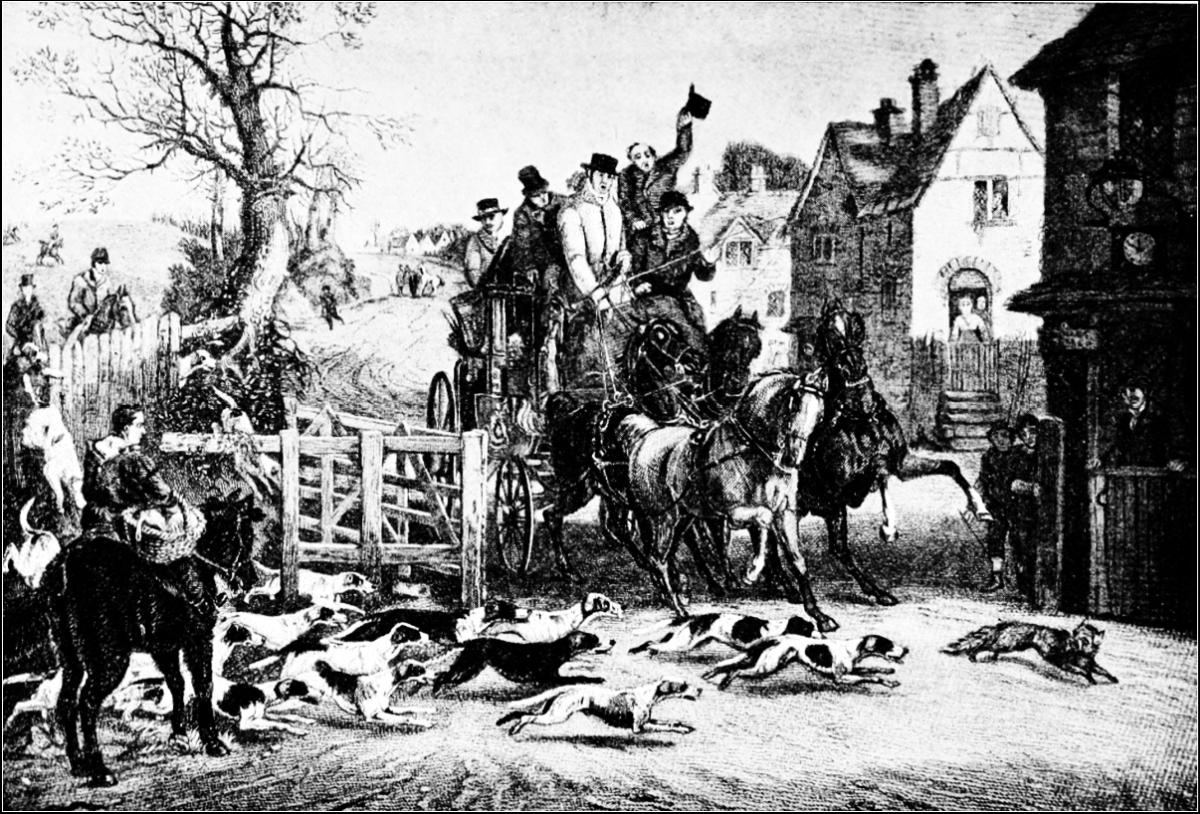
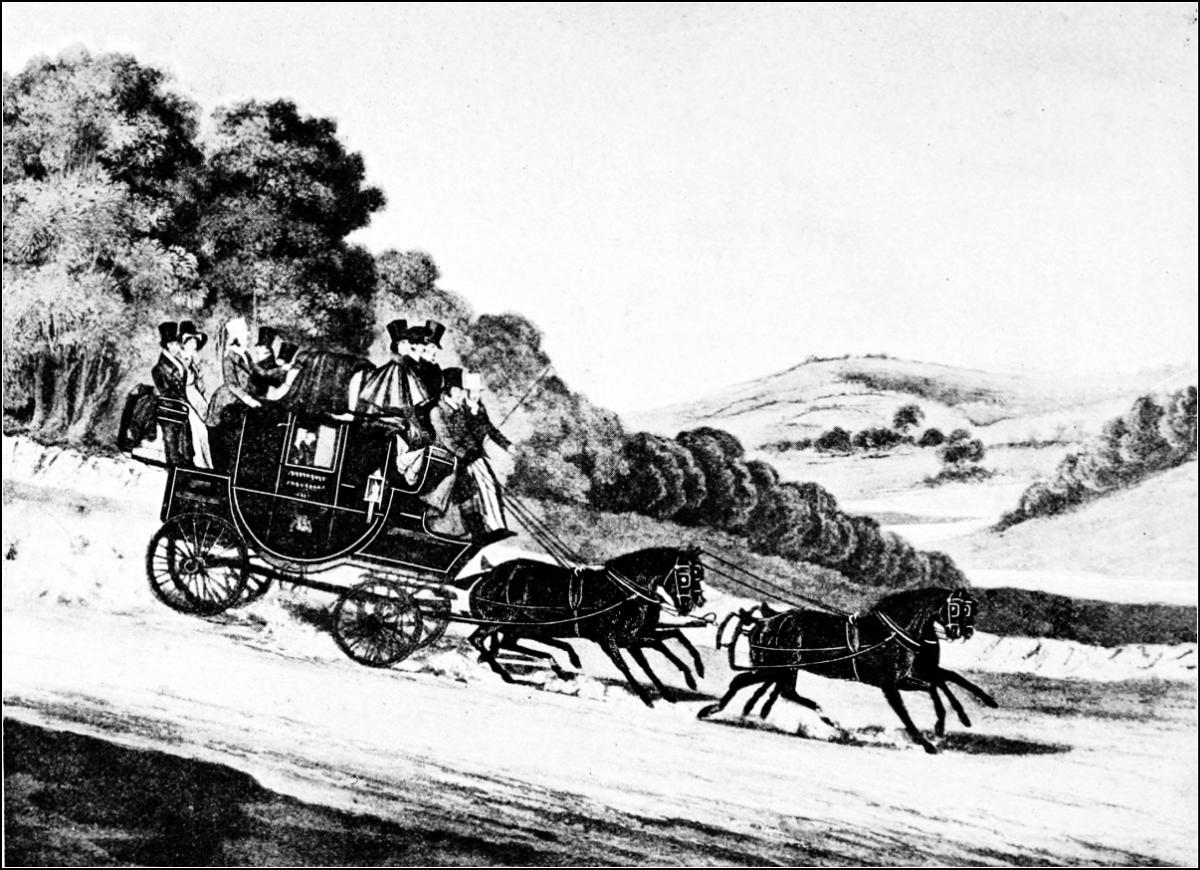
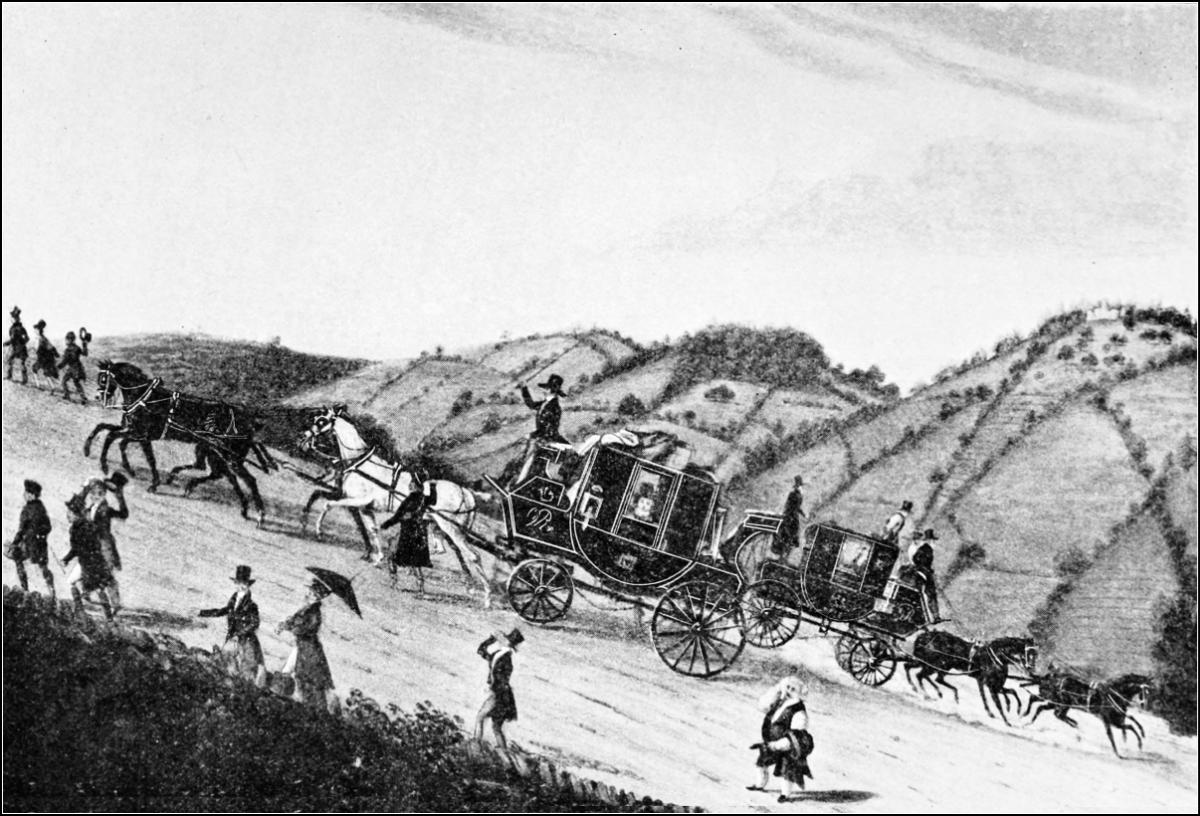
What the mail looked like in the first twelve years or so of its
existence we perceive in the illustration after James Pollard, on the
opposite page; although we may be quite sure that the coach never in
its slowest time progressed in the slow and stately fashion—resembling
the mournful deliberation of a funeral—pictured here. This is merely
the early Pollard convention, seen in many of his productions.
The first Glasgow mail was by no means direct, and between
Boroughbridge and Penrith it passed over wild and difficult country, so
that it often did not succeed in keeping time. But, in spite of these
difficulties, this route was kept—varied only by occasional divagations
taking in Leeds and Ripon—until 1835, and, owing to road improvements
between London and Doncaster, a number of accelerations were even
possible.
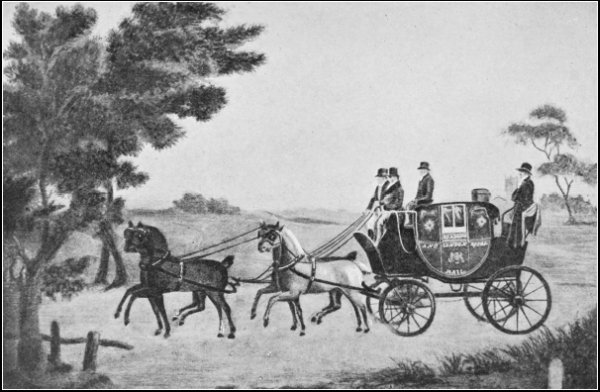
THE GLASGOW MAIL, ABOUT 1800.
[After J. Pollard.
It must have been at an early period of these revisions of the
time-table that Professor John Wilson, the athletic “Christopher
North,” accomplished the walking exploit credited to him. Disappointed
at not securing a place on the up mail from Penrith to Kendal, he gave
his coat to the coachman and set off to walk the 26 miles, arriving
at Kendal some time before the coach. He then walked on to his home at
Elleray.
ACCELERATIONS
When that fine old sportsman, Colonel Hawker, travelled from London
to Glasgow in 1812, the journey occupied close upon fifty-seven hours
of continuous unrelaxing effort on the part of the many relays of
coachmen, guards, and horses, and of passive fortitude on that of the
travellers, who, after all, had the worst of it; for while horses,
guards, and coachmen were changed frequently on the way, and passed
like fleeting ghosts before their wearied vision, they endured to
the bitter end. Well for those who were obliged to go through at one
sitting, if it were summer when these three nights and two days of
discomfort were being endured; but the stoutest might have quailed
before the prospect of such a journey in winter.
In 1821 the coach arrived at Carlisle in what was considered the
excellent time of 41 hours 40 minutes from London, a speed, for the
311 miles, of something under 7¾ miles an hour. But still it was
only at 1.40 on the afternoon of the third day that the mail entered
Carlisle; reaching Glasgow at 4.50 the next morning. Time, from London
to Glasgow, 56 hours 50 minutes.
By 1825, however, a further acceleration was made. The mail came
dashing into Carlisle at 6.7 a.m.; so much as 7 hours 33 minutes
earlier. People held up their hands in astonishment, and were of
opinion that wonders would never cease: a frame of mind fully shared
by the Glasgow folk, who with satisfaction ill-concealed by natural
Scottish calm, saw the mail draw up at the Post Office proportionately
early.
They were absolutely correct: wonders did not cease; for in 1837
a further saving of 1 hour 50 minutes was effected to Carlisle, the
mail-coach arriving at 4.17 a.m. on the second morning from London,
time, 32 hours 17 minutes; and drawing up at Glasgow at two o’clock
that same afternoon: forty-two hours for the entire journey. This truly
astonishing advance upon early performances was only made possible by
the long series of improvements effected on the road between Carlisle
and Glasgow from 1798 to 1834, by which not only had the gradients and
the surface been improved, but newer and shorter stretches of road had
been struck out, reducing the actual mileage from 405 miles to 397
miles 6 furlongs.1
The mail at this final period was not, throughout, one of the crack
coaches run under the direction of the Post Office; coming only
thirteenth in the list for speed, and showing a performance of an
average 9·34 miles per hour as compared with that of the swift Bristol
mail, speeding along the road at 10·3, almost a mile an hour quicker.
Analysed, however, it discloses for the 95 miles along Telford’s
splendid Carlisle and Glasgow Road an even slightly higher speed than
that of the Bristol mail itself; and there were for many years after
the disappearance of the coaches admiring oldsters who recollected with
an admiration not unmixed with terror the terrific speed of the up
Glasgow mail as it tore down the side of Stanwix Brow, outside Carlisle.
THE MAILS
The accompanying official time-bills of the London and Carlisle and the
Carlisle and Glasgow mails, as run in 1837, will prove interesting:
GENERAL POST OFFICE-THE EARL OF LICHFIELD. HER MAJESTY’S
POSTMASTER-GENERAL.
| Time Bill, London and Carlisle Mail. |
| Contractors’ Names. |
Miles
and
furlongs. |
Time
allowed. |
|
| |
|
|
Despatched from the General Post
Office the of 183 , at 8 p.m.
Coach No. sent out. |
| |
|
H. M. |
With timepiece safe No.
to . |
| Sherman |
11 2 |
1 18 |
Arrived at Barnet, 9.18 |
| |
8 4 |
|
Hatfield. |
| |
5 4 |
1 28 |
Arrived at Welwyn, 10.46. |
| W. & G. Wright |
6 3 |
|
Stevenage. |
| |
5 7 |
1 20 |
Arrived at Baldock, 12.6. |
| |
7 5 |
|
Biggleswade. |
| |
1 4 |
0 56 |
Arrived at Caldecot, 1.2 a.m. |
| |
8 4 |
0 53 |
Arrived at Eaton Socon, 1.55. |
| Arnold |
5 4 |
|
Buckden. |
| |
5 1 |
1 4 |
Arrived at Alconbury, 2.59. |
| Coveney |
9 2 |
0 57 |
Arrived at Stilton, 3.56. |
| T. Whincup |
8 5 |
|
Wansford. |
| |
6 0 |
1 32 |
Arrived at Stamford, 5.28. |
| H. Whincup |
8 0 |
0 50 |
Arrived at Stretton, 6.18. |
| Burbidge |
5 1 |
|
Colsterworth. |
| |
8 1 |
1 22 |
Arrived at Grantham, 7.40.
by timepiece, by clock.
Coach No. gone forward.
Delivered the time-piece
safe, No. to . |
| |
|
0 40 |
Forty minutes allowed. |
| |
6 0 |
0 36 |
Arrived at Foston, 8.56. |
| Lawton |
8 0 |
0 48 |
Arrived at Newark, 9.44. |
| |
13 1 |
1 19 |
Arrived at Ollerton, 11.3. |
| Lister |
8 4 |
0 49 |
Arrived at Worksop, 11.52. |
| Dawson |
8 3 |
0 48 |
Arrived at Bagley, 12.40. |
| |
4 1 |
0 23 |
Arrived at Wadsworth, 1.3 p.m. |
| Dunhill |
4 1 |
0 23 |
Arrived at Doncaster, 1.26. |
| Outhwaite |
14 3 |
1 27 |
Arrived at Pontefract, 2.53. |
| |
10 0 |
0 59 |
Arrived at Aberford, 3.52. |
| Cleminshaw |
7 4 |
0 44 |
Arrived at Wetherby, 4.36.
Coach No. gone forward.
By timepiece
at ; by
clock ;
off at ,
by timepiece. |
| |
|
0 35 |
Thirty-five minutes allowed. |
| |
12 1 |
1 12 |
Arrived at Boroughbridge, 6.23. |
| Cook |
12 1 |
1 12 |
Arrived at Leeming Lane, 7.35. |
| Couldwell |
11 0 |
1 6 |
Arrived at Catterick Bridge, 8.41. |
| Fryer |
9 0 |
0 54 |
Arrived at Foxhall, 9.35. |
| Martin |
4 4 |
0 27 |
Arrived at New Inn, Greta Bridge, 10.2. |
| |
10 0 |
1 8 |
Arrived at New Spital, 11.10. |
| |
9 4 |
1 5 |
Arrived at Brough, 12.15. |
| Fryer |
8 0 |
0 52 |
Arrived at Appleby, 1.7 a.m. |
| Doulim |
13 4 |
1 21 |
Arrived at Penrith, 2.28. |
| Teather |
9 3 |
0 55 |
Arrived at Hesketh, 3.23. |
| Barton |
8 6 |
0 54 |
Arrived at the Post Office,
Carlisle, the of ,
183 , at 4.17 a.m.
Coach No. arrived.
By timepiece ; by
clock . |
| |
302 7 |
32 17 |
|
| Time Bill, Carlisle and Glasgow Mail. |
| Contractors’ Names. |
Miles
and
furlongs. |
Time
allowed. |
|
| |
|
|
Despatched from the Post
Office, Carlisle, the of ,
183 , at 5. a.m. by timepiece;
by clock, .
London Mail arrived 4.17 a.m.
Manchester Mail arrived 4.48 a.m.
Coach No. sent out.
With timepiece safe,
No. ; to . |
| |
|
H. M. |
|
| Teather, junr. |
9 6 |
0 55 |
Arrived at Gretna, 5.55. |
| Burn & Paton |
9 2 |
0 53 |
Arrived at Ecclefechan, 6.48. |
| |
5 6 |
1 1 |
Lockerbie. |
| |
5 0 |
Arrived at Dinwoodie Green, 7.49. |
| Wilson |
9 3 |
0 53 |
Arrived at Beattock Bridge Inn, 8.42. Bags dropped for Moffat.
Toll Bar. Bags dropped for Leadhills. |
| |
14 0 |
1 44 |
Arrived at Abington, 10.26. |
| |
4 3 |
| Burn & Paton |
9 0 |
0 52 |
Arrived at Douglas Mill, 11.18. Bags
dropped for Lesmahago. |
| |
6 0 |
0 46 |
Arrived at Knowknack, 12.4. |
| |
2 0 |
| |
9 3 |
0 53 |
Arrived at Hamilton, 12.57. |
| |
11 0 |
1 3 |
Arrived at the Post Office, Glasgow,
the of , 183 , at 2 p.m. by
timepiece; at by clock.
Coach No. arrived
Delivered the
timepiece safe,
No. , to . |
| |
94 7 |
9 0 |
|
In their last years, however, the Carlisle and Glasgow and the Carlisle
and Edinburgh mails were run to clear 11 miles an hour: the time
between Carlisle and Glasgow being cut down to 8 hours 32 minutes.
Cautious folk steered clear of such performances, for accidents were
frequent. But it was not speed that caused the dreadful accident to the
up Manchester mail from Carlisle, overturned at Penrith on September
25th, 1835. The coach was passing the “Greyhound” inn when the horses,
startled by a sudden thunderstorm, upset the coach. A gentleman on
the roof was killed, and three other outsiders and the coachman were
stunned.
But this was not the full measure of the Glasgow mails. The London
and Manchester mail, once proceeding no further than Manchester, was
extended by a second coach to Carlisle. This and the regular old
Glasgow mail were in later years timed to meet at Penrith at four
o’clock in the morning, and went on together to Carlisle. Carlisle was
thus a busy centre for the mails, and in addition sent out, besides
its local coaches and a mail for Edinburgh, a four-horse mail-coach
for Portpatrick, carrying the mails for the north of Ireland. This
also went along the main road so far as Gretna, whence it branched
for Dumfries; continuing from that town to Portpatrick as a two-horse
affair.
The cost of being conveyed by mail-coach from London to Glasgow was
enormous. It is possible to voyage in these days to America, a distance
of 3,000 miles, for less. In 1812 it cost an inside passenger, all
the way to Glasgow, for fare alone, apart from the necessary tips to
coachmen and guards, and exclusive of expenditure for food and drink
all those weary hours, no less than £10 8s.: at the rate of about
61⁄8d. a mile. To-day, the fastest train takes exactly eight hours,
and the first-class fare, answering to the mail-coach fare, is £2
18s.; while one may travel, third class, in greater luxury than the
old passengers by mail, for 33s.
DISCOMFORTS OF TRAVELLING
No one ever in coaching days thought it worth while to write the story
of the Glasgow mail. The hard, dry facts of it may be sought, and with
some diligence found and collated, in Parliamentary Papers, and in the
pages of Cary, or in the coaching information common to directories
of that age; but intimate accounts are sought in vain. Travellers who
experienced the miseries of long-distance journeys were only too glad
to be done with them, and to dismiss the memory of their sufferings.
To have passed nearly forty-two hours continuously on the roof of a
coach in severe weather, with every hair standing up like a porcupine’s
quills, and with rain, dew, and hoar-frost as one’s dreary portion,
forbade all that glamour with which that old era is regarded at this
convenient distance of time.
Those who could endure such a journey without a break were few; and
to those few, obliged from any cause to hasten from end to end, the
recollection must have seemed a veritable phantasmagoria of dimly
shifting scenes and aching, weary limbs.
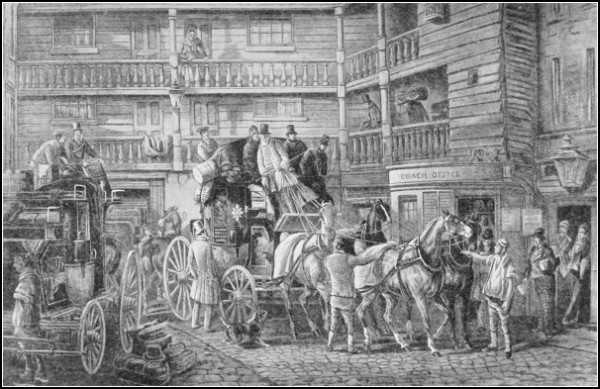
THE GLASGOW MAIL LEAVING THE YARD OF THE “BULL AND
MOUTH.”
[After C. Cooper Henderson.
Thus it is that we obtain only brief and disconnected glimpses of the
mail’s progress. The most eloquent picture of misery is undoubtedly
that presented by Charles Kirkpatrick Sharpe, writing in November 1800,
describing a journey from Carlisle to London:
“After passing a sleepless night at Carlisle, I was hurried away next
morning without a morsel of breakfast, and grew so very sick and ill
in a little while that I had almost fainted twice. When we stopt at
Penrith and took up an old gentleman, I then got a large dram of gin,
which did me much service; and we proceeded through snow and ice far
and far, and farther than I can tell, till I fell asleep and got a much
better night’s rest than at that accursed Carlisle. During the night
(but Heaven knows where) we picked up two men going to London; and, lo!
about daylight another qualm seized me. And when we got to Stilton, it
blew such a hideous storm, with hail, snow, and wind, that for an hour
and twenty minutes the six horses would not move forward, but attempted
always to retreat to the stables. Such kicking, such rearing of beasts,
such cursing and swearing of men (who had a stronger smack of the big
brute in them than even their cattle), I never met with before; and
after every cudgel in the house—yea, even my landlady’s private stick
wherewith she corrects her spouse—had been bent or broken over their
backs, they got on so slowly that we reached London only at eight in
the morning. Here was no peace for the wicked. The ‘Bull and Mouth,’
which is the filthiest place you ever saw, gave me such an aversion to
remaining where I was, that I took a place in the heavy coach which
went on at one that day, and lay down on a bed till the time for
departure. Here my head grew very bad indeed, so that I slept not a
wink.”
AN AFFECTED TRAVELLER
“Stinking, noisy stye,” he elsewhere calls the “Bull and Mouth,” but
we must recollect that Sharpe was very affected, a bundle of fine
feelings, and a poseur: one, in short, born a hundred years before
his time, and by no means one of those robust Englishmen to whom noise
and stable-smells were but the ordinary and commonplace incidents of
coach-journeys and coaching hostelries.
Nothing, you clearly perceive, could have roused Sharpe to enthusiasm.
But there were some wildly enthusiastic people on the road then, and
they had often cause, in the stirring news they brought with them,
to feel exultation of spirits. For with the mail came news of the
Battles of the Nile, of Trafalgar, of Waterloo; and many a wayside
park was despoiled of laurel branches to deck out the coach in the
emblems of victory. Many a time did the mail enter Glasgow in that
fashion: decorated with the bays, a red flag flying from the roof,
the guard in his best scarlet coat and gold-laced hat, sounding his
bugle as the horses galloped at a thundering pace along the Gallowgate.
Arrived at the foot of Nelson Street, at about seven o’clock in the
morning, his duty was, on these historic occasions, to thrice discharge
his blunderbuss in the air. Every one then rushed to the “Tontine”
coffee-room to learn the news and get the papers: some one with a
stentorian voice being generally elected to read the despatches aloud,
for the common benefit.
A thrilling story of those old days, when we were generally at war with
France, is that of one Archibald Campbell, a Glasgow merchant who had
omitted to insure one of his ships, and, in the last few weeks before
she fell due, repented of his omission. Alarmed, he sought to effect
insurance with a Glasgow office, but found the premium so high that
he resolved to insure ship and cargo in London. Accordingly, he wrote
to his London broker, instructing him to insure on the best terms
possible. The letter was posted and left by the up mail-coach at 2
p.m. At seven o’clock that night he received an express from Greenock,
announcing the safe arrival of his ship, and instantly despatched his
head clerk in pursuit of the coach, with instructions to overtake it if
possible, or, if he could not do so, to proceed to London and deliver a
note to the broker, countermanding the insurance.
But, in spite of making every effort to urge on the postillions, the
clerk was unable to overtake the mail, with its five hours’ start. He
arrived in London shortly after, and proceeded, early in the morning,
to the residence of the broker, before the morning delivery, and thus
countermanded the order; with the result that an insurance which would
have cost £1,500 was saved at the expense of £100.
FASTER THAN THE MAIL
Such were the incidents that accompanied the mail on its long journey;
but they had already faded from general knowledge, and were treasured
chiefly in the memories of a few oldsters, when its last days were
come, in February 1848. They had been “piping times of peace” ever
since the echoes of Waterloo had died away, in 1815; and for two
reasons the news of great issues was no longer brought by the mail.
Firstly, because great national events had become more rare; and
secondly, because when there was especially momentous intelligence,
enterprising folks, travelling even faster than the mail-coach, and
setting out at any hour they chose, had stolen away the prime position
of that old-time national intelligencer. For example, when at length
the great Reform Bill passed the House of Lords, after a long period
of hazardous political agitation, at 6.35 in the morning of Saturday,
April 14th, 1832, a Mr. Young, of The Sun newspaper, left the Strand
sixty-five minutes later in a post-chaise and four, with copies of The
Sun he had caused to be printed between 6.30 and 7.30, containing a
report of the debate and division, and travelled literally “post-haste”
to Glasgow. At 7.30 p.m. on the next day, Sunday, he alighted at the
house of his agent, Thomas Atkinson, Miller Street, Glasgow, having
performed the journey in 35 hours 50 minutes: a speed, including
stoppages for changing horses, of 11¼ miles an hour throughout.
There were, it would appear, others on the road on this occasion,
similarly engaged, for John Bright spoke in after years of having
travelled up from Manchester to London at the time, by the “Peveril
of the Peak,” and of having, in common with the other passengers,
“observed something coming towards us. We saw horses galloping, and
carriages coming at great speed. By-and-by we saw two chaises with four
horses, each chaise with two or three men inside. They were throwing
out parcels from each window as they went past, galloping as fast as it
was possible for horses to travel. These were express chaises, coming
from London, bringing the news to all the people of the country—for
there were then no telegraphs and no railways—of the glorious triumph
of popular principles, even in the House of Lords, for that House had
sat all night, and it was not until the morning that the House divided
and the second reading of that great measure was carried by a majority
of nine votes.” Men thought the millennium was come, but events have
proved that it had not; and, according to latest advices, it has not
been signalled, even yet.
THE “FLYING COACH”
Manchester, less than half the way to Glasgow, was in later years very
abundantly supplied with coaches from London; but London and Manchester
were not in direct communication by coach until 1754; and had London
been left to establish a line of coaches to Manchester, the date would
no doubt have been much later. Indeed, it is to be noted that, almost
without exception, the earlier coaches between London and the provinces
were established by provincials seeking to reach London. The metropolis
was always magnificently indifferent; but when the provincial
manufacturing towns began to arise, the manufacturers, seeking business
with that greatest of markets, and finding nothing for it but to ride
horseback to and from London, speedily set up coach services. Thus it
was that the first coach ever to run between Manchester and London was
established by an association of Manchester men. This was the “Flying
Coach” of 1754, which was announced with the statement that “However
incredible it may appear, this coach will actually (barring accidents)
arrive in London in four days and a half after leaving Manchester.”
Really and truly! as the children say. Here we smile; but those
eighteenth-century projectors manifestly took things very seriously, as
they had every reason to do; and doubtless considered the establishment
of this flier a wonderful achievement.
Six years later, in 1760, Messrs. Handforth, Howe, Glanville &
Richardson’s coach is found performing the journey in three days “or
thereabouts”; and in 1770 the “London Flying Machine,” by Samuel
Tennant, began to wing its way every Monday, Wednesday, and Friday in
summer, in two days, from the “Royal Oak,” Market Street. It set out in
summer at the shocking hour of one o’clock in the morning, but conceded
4 a.m. in the winter months; when, however, it required another whole
day for the journey.
The earlier coaches seem to have been discontinued, for Tennant’s
“Flying Machine” was in 1770 the only one between London and
Manchester; but for the less moneyed and more leisured classes whose
time was of small value, and expedition was therefore of little
moment, there were Matthew Pickford’s stage-waggons (“Flying Waggons”
he called them), which, generally at a penny a mile, conveyed
passengers and goods between London and Manchester in four and a half
days. They went from the “Swan,” Market Street Lane, on Wednesdays
and Saturdays; but had several rivals: notably Bass’s waggons, on
Fridays, from the “Fountain”; Cooper’s, from the “Star,” Deansgate, on
Wednesdays and Saturdays; Hulse’s, from the “Windmill,” on the same
days; Washington’s, from the “Pack Horse,” Mill Street Lane, Tuesdays;
and Wood’s, from the “Coach and Horses,” Deansgate, Wednesdays and
Saturdays.
THE MANCHESTER MAIL
In 1776-7, serious competition began for the coaching traffic between
London and Manchester, two rival concerns—the “London New and Elegant
Diligence” and the “New Diligence”—each setting out from Manchester
three times a week and taking only two days to perform the journey. The
“New and Elegant” competitor set out from the “Upper Royal Oak” inn,
Market Street Lane, and went by Macclesfield and Derby. Its complement
was thirteen passengers, who were allowed 14 lb of luggage each, free;
and the fare was £2 6s. or 3d. a mile. Among the proprietors of
this coach occurs the name of Pickford.
The “New Diligence” (which appears to have been established before its
“New and Elegant” fellow) went by way of Matlock and Derby.
The next great event was the establishment of the Manchester mail,
in 1785. It left the yard of the “Swan with Two Necks,” in Lad Lane,
every weekday evening at 7.30 p.m., and the General Post Office half an
hour later, and came to H. C. Lacy’s “Bridgewater Arms,” Manchester,
at 6 p.m. the next day. Time, 22 hours; a speed of close upon 8½
miles an hour. At its best period, from 1825 to the end, in 1837, it
accomplished the journey in exactly 19 hours, at the average speed of
9·66 miles per hour.
Meanwhile, during the fifty-two years that witnessed the whole career
of the mail-coach, down to its final run, stage-coaching along the road
to Manchester was utterly revolutionised. Rivalry and competition,
as fierce as that on any road, brought the coaches to such a degree
of perfection that for comfortable travel, as then understood, it was
ahead of all other routes; and to such a turn of speed that it was
equal to the best for rapid transit.
During all this period, the districts north of Manchester were more or
less beyond the ken of the London stage-coach proprietors, to whom the
comparatively lean traffic of the road on to Lancaster, Carlisle, and
Glasgow offered no great inducements for through bookings. Moreover,
Manchester and Carlisle were themselves great coaching centres, whose
coach proprietors were very well able to work by themselves and take
such long-distance competition at a disadvantage. From the “Bridgewater
Arms,” High Street, Manchester, went numbers of branch mails; from the
“Star” inn, Deansgate, and the “Mosley Arms,” Market Place, went a long
list of stage-coaches to Lancaster, Kendal, Carlisle, and Glasgow, as
well as others along the important cross-roads; while from the “Swan”
inn, the “Flying Horse,” the “Palace” inn, and the “Talbot,” Market
Street; the “Golden Lion” and “Bush,” Deansgate; “Lower Turk’s Head,”
Shude Hill; “Buck,” Hanging Ditch; “Boar’s Head,” Hyde’s Cross, and
others a swarm of short-distance coaches set out.
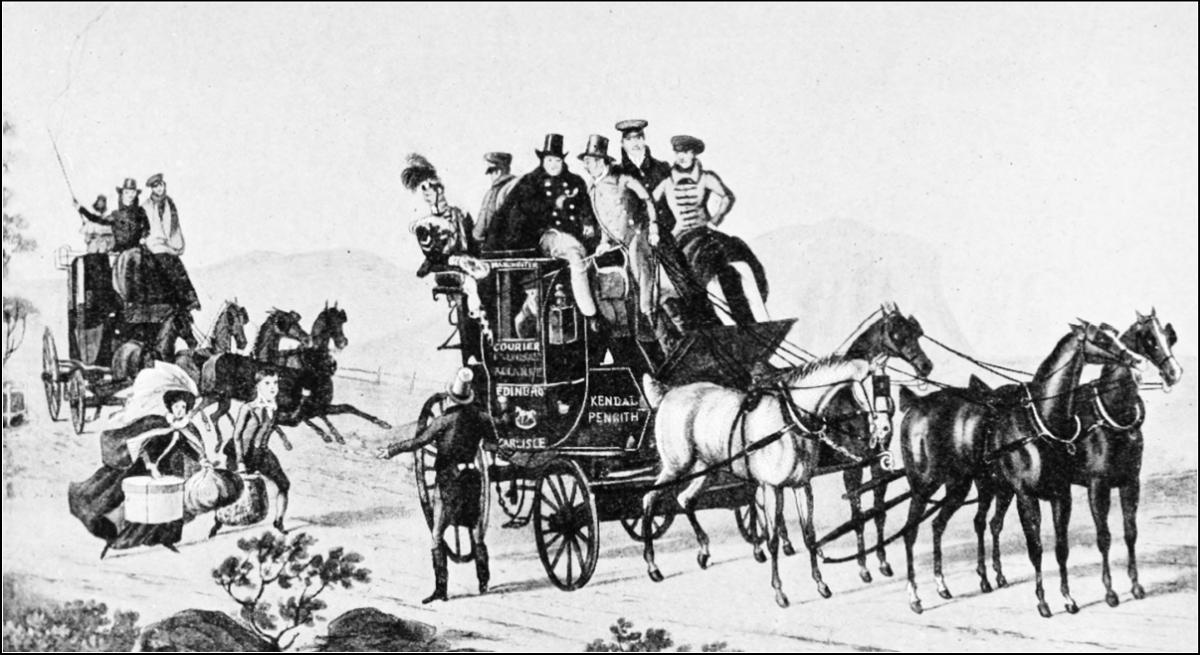
THE “COURIER,” MANCHESTER, CARLISLE, AND GLASGOW COACH.
[After C. B. Newhouse.
The chief mail contractor at Manchester in the early days of coaching
was Alexander Paterson, who removed from the “Lower Swan” inn,
Market Street Lane, to the “Bridgewater Arms” in 1788. He was succeeded
by H. C. Lacy, who in 1827 removed to what had until then been a
private mansion at the corner of Market Street and Mosley Street, and
opened it as the “Royal Hotel and New Bridgewater Arms.”
The older inn has long since been converted into warehouses, occupied
at the present time by Messrs. Woodhouse, Hambly & Co.
THE DAY COACHES
Among the few stage-coaches advertised to run through the whole
distance from London to Manchester and Glasgow was the “Courier,” which
was started in later years and ran until the opening of the railway. It
set out from the “Belle Sauvage,” Ludgate Hill, and from the “Castle
and Falcon,” Aldersgate Street, every weekday at 3 p.m., and connected
by a branch coach at Carlisle with Edinburgh.
Strange portents were seen upon the road to Manchester in the early
years of last century. About 1824 began the era of the fast day
coaches, and fine vehicles, handsome horses, and decent harness were
provided for the travelling public, instead of the springless tubs,
wretched cattle, and harness composed chiefly of odd pieces of worn
leather eked out with string, which made up the uncomfortable old night
coaches. It was a new era in more than one sense, for this was that
now historic period when horseless vehicles were first put upon the
public roads.
The ’twenties of the nineteenth century were almost as remarkable for
those early horseless vehicles, the steam carriages, as the present
era is for petrol-driven and electric motor-cars. Railways, too, began
early to threaten stage-and mail-coaching; and long, whirling, and
involved controversies on road and rail traffic occupied the columns of
the press, and overflowed into innumerable pamphlets.
Few people had sufficient imagination to foresee an era of mechanical
locomotion; but one pamphleteer, who unfortunately elected to
remain anonymous, published in 1824 what modern journalists with an
insufficient English vocabulary would doubtless call a brochure on
the subject. This booklet, entitled The Fingerpost, is, according to
its title page, “By???.” Whoever he may have been who thus veiled his
identity behind those triple notes of interrogation, he certainly was a
seer. He foresaw our own times with limpid vision—and smelt them, too.
He thought it “reasonable to conclude that the nervous man will ere
long take his place in a carriage drawn or impelled by a Locomotive
Engine with more unconcern and with far better assurance of safety
than he now disposes of himself in one drawn by four horses of unequal
powers and speed, endued with passions that acknowledge no control but
superior force, and each separately, momentarily, liable to all the
calamities that flesh is heir to. Surely an inanimate power, that can
be started, stopped, and guided at pleasure by the finger or foot of
man, must promise greater personal security to the traveller than a
power derivable from animal life.”
A GLANCE INTO THE FUTURE
“I must ask him,” he continues, “to indulge his imagination with an
excursion some twenty or thirty years forward in the regions of time;
when the dark, unsightly, shapeless machine that now offends him,
even in idea, shall he metamorphosed into one of exquisite symmetry
and beauty, and as superbly emblazoned with heraldic honours as any
that are now launched from the floors of Long Acre—a machine that
may regale his nostrils with exhalations from some genial produce of
the earth whose essence may be extracted at an insignificant cost,
and its fragrance left on the breeze for the sensitive traveller’s
gratification; that, instead of the rumble of coaches, may delight his
ear with the concord of sweet sounds.”
Wonderful man: penetrating intuition! But barbaric conservatism blocked
the way, and not thirty years, but a weary period of seventy-two,
intervened between his day and the fulfilment of his dream. In 1896
the Motor Car came, and we have now our fill of “exhalations,” whose
“fragrance” is “left on the breeze” in the form of stinking petrol and
fried lubricating oil; while streets and roads are smothered in dust
and, in a “concord of sweet sounds,” resound to the crashing of gears
and the bellowing of motor-horns, like the bulls of Bashan afflicted
with bronchitis.
But in that early experimental period a London and St. Albans Steam
Carriage Company (among others) was formed, and made several trips
with its uncouth monsters. Proposals were even made to establish a
“steam-coach” service to Manchester, the coach to haul behind it a
number of goods-waggons; but the turnpike authorities at Dunstable,
anxious for the condition of their roads, hearing early of this
proposition, were prepared for the unwelcome visitors, and, procuring
cartloads of immense stones, strewed the highway with them. They
certainly brought the “steam-coach” to a halt, but at the same time
nearly wrecked the down Manchester mail; and it was a long while before
the Post Office allowed them to forget their excess of zeal.
THE “DEFIANCE”
Up to 1821 there had been comparatively little coaching competition
along the Manchester Road. In that year there ran along the Coventry,
Atherstone, Lichfield, and Congleton route to Manchester (which is
not the Manchester Road as considered in these pages) the “Prince
Cobourg” coach, which set out from the “Swan with Two Necks,” and was
at Manchester in exactly twenty-six hours; but the “Defiance” was in
the first flight upon the route adopted here. It was not very swift,
for it set out at half-past two every afternoon from the “Swan with
Two Necks,” Lad Lane, and did not arrive at the “Bridgewater Arms,”
Manchester, until 5.30 the next afternoon: twenty-seven hours. That
was just before the era of the great Chaplin, and at that time the
“Swan with Two Necks” was still kept by one Kingsford, while the
Coach Office in its yard remained in the hands of William Waterhouse,
who had carried on business there as a mail contractor and coach
proprietor since 1792, and was well content with the old leisurely
ways. Such as it was, the “Defiance” was only equalled in that year
by the “Regulator,” which, running from the same establishment, was
no competitor, having a slightly different route, taking it through
Buxton. It also performed the journey in twenty-seven hours. The
“Manchester Telegraph” at that time took thirty hours.
But in 1822, probably nerved to great deeds by the establishment of a
smart rival, the “Independent,” which worked on alternate days from
Nelson’s “Bull” inn, Whitechapel, and the “Spread Eagle,” Gracechurch
Street, and leaving London every evening at 6 p.m. reached Manchester
in twenty-four hours, he did manage to expedite the “Defiance” by two
hours and a half. In that year it made the journey in twenty-four and
half hours. In 1826 it had become the “Royal Defiance,” and, starting
at 6.30 p.m., was at Manchester in twenty-four hours.
These successive accelerations were probably due to William Chaplin,
who seems to have become interested by degrees in the business so long
carried on by Waterhouse, and to have finally succeeded him about 1825.
The “Defiance” had in its earlier years very little to contend against.
In 1821 there was a “Manchester Telegraph” from the “Castle and
Falcon,” Aldersgate Street, also starting at 2.30 p.m., but taking
no less than twenty-nine and half hours to perform the journey: a
very modest pace of some six miles an hour. But in 1823 a powerful
rival appeared in Edward Sherman, who then established himself at
the “Bull and Mouth,” St. Martin’s-le-Grand, as a coach proprietor.
He had come up to London as a boy, from Wantage, Berkshire, with the
traditional half-crown in his pocket; and found work in Oxford Market
as a boy-porter, earning 8d. a day. Out of this scanty wage he saved
a daily 2d. According to some accounts, he found his way on to the
Stock Exchange, in some connection with one Levy, a wealthy farmer
of the turnpike tolls, who helped to establish him at the “Bull and
Mouth.” He was a tall, dark, fine-looking man; one of the very few who
at that time wore a moustache, the mark then of the fast, wild young
fellow. He married the wealthy widow proprietress of the “Oxford Arms,”
Warwick Lane. She soon died, and was not long afterwards followed by
her sister, who left him her property. He then married his wife’s niece.
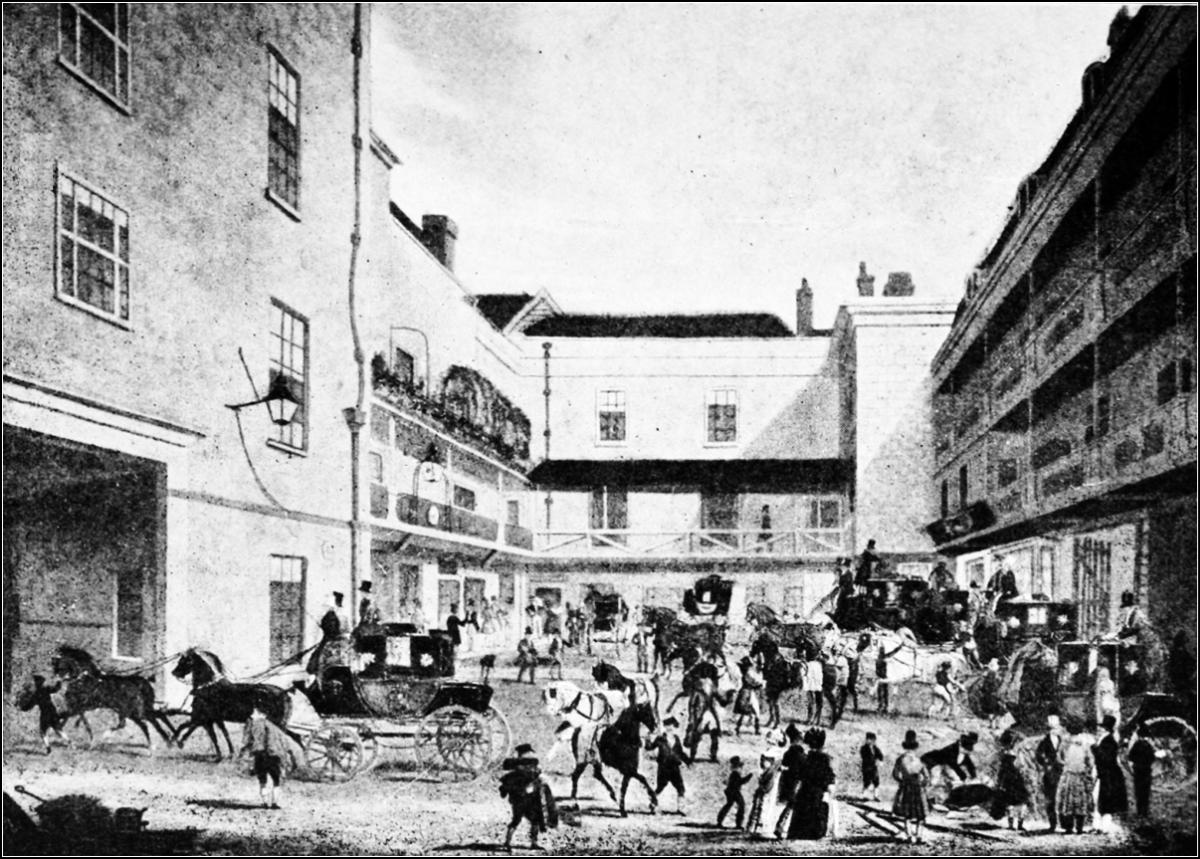
MAILS LEAVING THE YARD OF THE “SWAN WITH TWO NECKS,” 1834
[After J. Pollard.
Eventually he raised himself to the first rank of coachmasters; almost
rivalling the great Chaplin himself, and running several coaches in
keen competition with him. He rebuilt the “Bull and Mouth,” and in his
prime owned seven hundred horses. Over fifty mail and stage-coaches,
chiefly for the northern and north-western roads, left his capacious
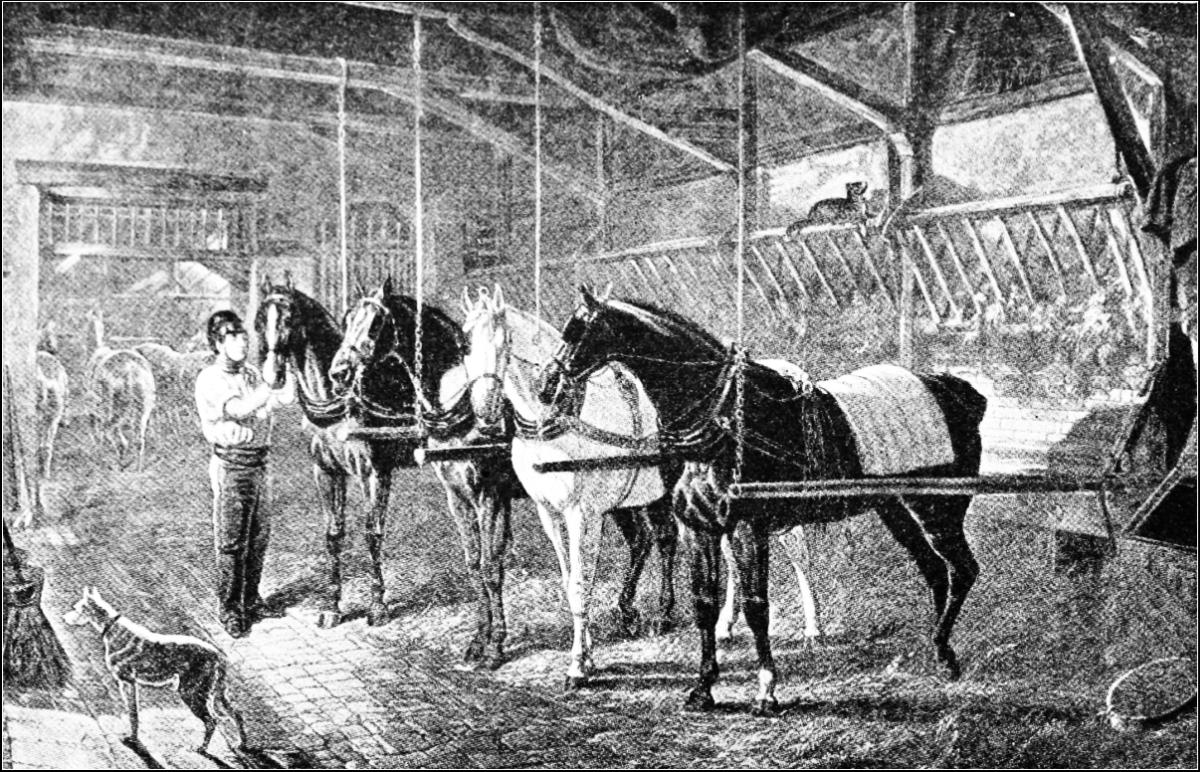
yard every twenty-four hours. The great stables were likened to a small
town.
He was not a horsey man, but his horses and coaches were of the best.
The coaches were easily distinguishable among all others, their lower
panels and wheels being painted a light yellow, and the upper quarters
black.
THE MANCHESTER TELEGRAPH
The famous “Manchester Telegraph” day coach, established by Sherman in
1833, left the “Bull and Mouth” at 5 a.m. and reached Manchester at
half-past eleven o’clock the same night. As competition with Chaplin’s
“Defiance” grew hotter, its speed was accelerated by a half, and then
by one whole hour; when the pace, allowing for twenty minutes at Derby,
where “the coach dined,” and reckoning the various changes, worked out
at just under twelve miles an hour.
To safely negotiate this, in parts, hilly road at so high an average
rate of speed, the “Telegraph” coach was especially designed and
constructed with flat springs, which gave it a comparatively low centre
of gravity.
The strict conduct of coaching business may readily be perceived by a
glance at the appended time-sheet carried on every journey:
| TIME BILL, “TELEGRAPH” LONDON AND MANCHESTER COACH, 1833 |
| Down. |
Guard.................... |
| |
Leave the “Bull and Mouth,” 5 a.m. |
| |
Left the “Peacock,” 5.15 a.m. |
| Proprietors. |
Places. |
Miles. |
Time
allowed. |
Should
arrive. |
Did
arrive. |
|
| |
|
|
H. M. |
H. M. |
|
|
| Sherman |
St. Albans |
19½ |
1 54 |
7 9 |
|
|
| Liley |
Redbourn |
4½ |
0 22 |
7 31 |
|
|
| Fossey |
Hockliffe |
12½ |
1 10 |
8 41 |
|
|
| |
Northampton
Breakfast |
|
0 20 |
|
|
|
| Shaw |
Harboro’ |
47½ |
4 30 |
1 31 |
|
|
| |
Leicester
Business |
|
0 5 |
|
|
|
| Pettifer |
Loughboro’ |
26 |
2 27 |
4 3 |
|
|
| |
Derby
Dinner |
|
0 20 |
|
|
|
| Mason |
Ashbourne |
30 |
2 48 |
7 11 |
|
|
| Wood |
Waterhouses |
7½ |
0 43 |
7 54 |
|
|
| Linley |
Bullock
Smithy |
29½ |
2 46 |
10 40 |
|
|
| Wetherald & Co. |
Manchester |
9 |
0 50 |
11 30 |
|
|
| |
|
186 |
18 15 |
|
|
|
| Guard (Sign your Name) .................... |
Timepiece No. ...... |
Observe.—That a fine of 1s. per minute will be incurred
by each proprietor for every minute of time lost over his stage or
stages, to one-half of which the coachman and guard will be held
equally liable between them, should their employers see sufficient
cause for enforcing the same.
Misdating the time-bill, or neglecting to date at all (either with
pen and ink or pencil), at any of the above places, the moment he
arrives, will subject the guard to a fine of 5s. for each default.
The guard is also to leave his time-bill in the office on his arrival
at the “Bull and Mouth,” or forfeit 5s. for each omission.
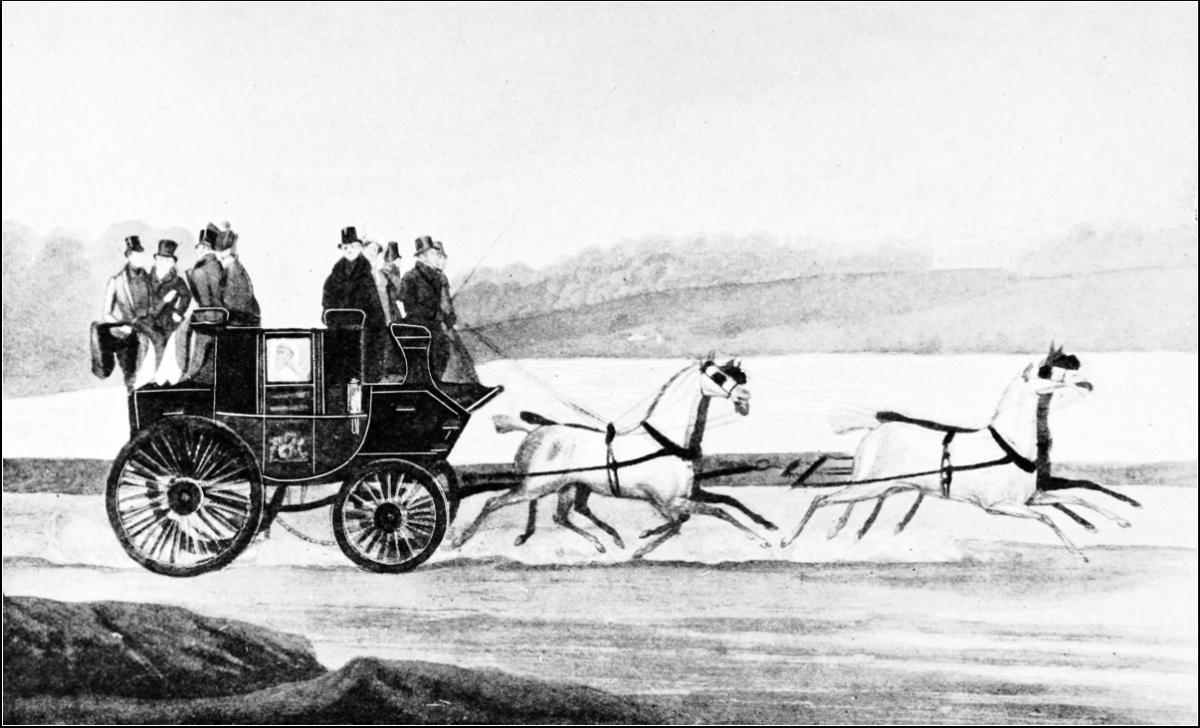
THE “MANCHESTER TELEGRAPH,” 1834
[After Robert Havell.
Sherman’s “Estafette” was a great advance in coaching luxury, and was
a product of the keen competition in the last few years of coaching.
The interior was lighted with a reflector lamp, illuminating an
elegantly engraved ivory tablet, showing a table giving all towns on
the route, distances, and intermediate times.
SPEED AND LUXURY
A very prosperous coach in later years, always loading well, was
the “Peveril of the Peak,” competing with the “Telegraph” and the
“Defiance” by dint of leaving London at a somewhat later hour. Another
fast night coach was the “Red Rover,” by Robert Nelson, of the “Belle
Sauvage,” Ludgate Hill. It started at 7 p.m. and accomplished the
journey, by way of the comparatively level Holyhead Road to Birmingham
and Wolverhampton, and thence by Newcastle-under-Lyme and Congleton,
in twenty hours. There was no mistaking the “Red Rover,” for not
only was the coach itself red, but the guards wore red hats and red
coats. Sherman soon bought out Nelson, and took the “Red Rover”; but
Nelson immediately put on another along the same route, calling it
the “Beehive.” It went to the other extreme, and set out at 8 a.m.,
arriving at Manchester at 4 o’clock the next morning. It sounded
the last note in coaching convenience, for not only was it fitted
inside with a reading-lamp, and the inside seats provided with spring
cushions, but every seat was numbered in order to avoid disputes.
In 1834, competition between coach proprietors on the chief routes
grew so keen that a war of extermination broke out; the stronger men
striving to crush the smaller by reducing fares below a paying level.
On this road it became possible for a while to travel at half the
former fares, and to journey the 186 miles to Manchester for 40s.
inside, and 20s. out; but cheap travel was dearly bought in the
accidents occasioned through this extravagant rivalry. In addition,
were the usual and inevitable mischances of the highway. Thus the
Manchester “Defiance” was upset in August 1835 at Brailsford, through
the horses shying at a white gate, when a Mr. Holbrook was killed; and
the “Peveril of the Peak” was overturned in September 1836, a passenger
and the coachman being crushed to death.
Those coach proprietors with the longest purses would, of course, in
time have crushed the smaller men in this war of cheap prices; and
already, before the railway came to sweep big men and little into one
common limbo, those with slender resources were feeling the pinch
of daily expenses, and could sometimes hardly settle their turnpike
accounts—especially heavy on this road.
The onerous burden of the tolls payable by stage-coaches can scarcely
be realised, save by stating a specific example. The amount incurred on
a single journey to Manchester was no less than £5 13s. 5d., and
this was by no means exceptional. Of course, the coach did not stop
to pay toll at every gate, the practice being to settle monthly. The
burden seems a heavy one for coach proprietors, but was, like every
other tax, levied in the end upon the consumer, being finally paid by
the coach passengers in their fares, calculated on the basis of the
coach proprietors’ expenses.
At last, in 1837, with the opening of the London and Birmingham Railway
to Manchester, this petty warfare was stilled, and the business of the
coach proprietors seemed to be ended. In 1836, when the railway had
been opened as far as Birmingham, Chaplin and Benjamin Worthy Horne,
two of the largest proprietors, had been induced to withdraw from the
road, and to throw their interest on the side of the new methods;
but Sherman refused to hear anything of the kind. He was the most
courageous, not to say the most obstinate, of men; thoroughly British
in the characteristics of doggedness and unwillingness to own himself
beaten. He did not believe in railways, until the stern fact of his
coaches running empty along the road convinced him, at a considerable
loss; and when in 1837 temporary trouble arose between the public and
the railway, and some were already regretting the old days, he dashed
in and re-established his “Red Rover” coach, which lasted a year or
more, losing money heavily when the Manchester people and the railway
had composed their quarrel.
EDWARD SHERMAN
The character-sketch of Sherman, here begun, may here be fitly
concluded. Without doubt a man of strong character, he had many
peculiarities, among them a decided taste for extravagance in dress and
jewellery, remarkable even at that time, when dress was very exuberant
indeed. Instead of sporting a shirt front, his chest displayed an
expanse of black satin, plentifully covered with diamond pins. One
day a thief came behind him in the street, reached a hand over his
shoulder, and made off with a valuable specimen. Sherman afterwards had
them all attached to a chain.
His fighting temper, if it stood him in good stead among his fellow
coach proprietors, certainly, as we have seen, involved him in heavy
losses in quarrelling with railways, before he found them too strong
for him. To lose money was to him an especial grief. The very sight of
sovereigns was a solace to him, and he kept a hundred in a tankard,
deposited in his safe at the “Bull and Mouth,” so that he might always
have the pleasure of handling the gold.
He had—according to private information—a number of children “that he
ought not to have had,” whatever that may mean. His last years were
sad, for his relatives exploited his temper and some eccentricities he
had developed, and procured his committal, as a lunatic, to Bethlem
Hospital, where he died in 1866. There are those yet living who
remember him there, and tell how he was put away with little legitimate
excuse.
The “Bull and Mouth” was carried on by his executor, E. Sanderson,
until 1869, when it was purchased by the late Quartermaine East, and
re-named the “Queen’s Hotel.”
Nowadays, the most ruinously low coach fares of that competitive time
before railways are made to look absurdly high by even the ordinary
third-class railway fare, 15s. 5½d., to Manchester: and
excursions are frequently run at the price of a few shillings.
THE COACHMEN
We cannot well leave the subject of coaching without some fleeting
reminiscences of the coachmen and guards who worked up and down
the road. Not all of them have earned a measure of fame. They
formed, indeed, a very considerable body of men, and there were
some generations of them; beginning with the poor old red-nosed and
many-caped Tobys who, wrapped up in many wrappings and swathed about
the feet and legs with hay-and-straw bands, sat on the box like partly
animated mummies; and ending with coachmen who were in many attributes
considered gentlemen. A love of strong spirits was common to the
earlier and later generations, but those of the earlier were merely
“drivers,” if you please, and the later were “coachmen.” The old Tobys
drove chiefly through the night, and in times when speed did not exist
and skill was not essential: the rather flashy “swell” coachmen of a
later era cut a dash in the daytime, with a cigar between their teeth,
and had extraordinary skill with the reins. These were the two chief
classes, subdivided again and again by individual peculiarities; and
then there were the guards.
Coaching experts were never tired of sounding the praises or noting
the peculiarities of the fine coachmen on this road. Bob Snow, of
the “Telegraph,” was, according to “Nimrod,” who took his position
as a coaching critic very seriously indeed, “all right—a pink in
his way, and as well dressed for the road as a gentleman ought to
be for Almack’s.” Great, too, was his admiration for Harry Douglas,
another coachman on the “Telegraph.” He was “about the size of two
ordinary men.” Not only could he gallop a coach without it swinging,
but he could drink as much as would scald a porker. As Dibdin sang of
Tom Bowling, “his virtues were so rare.” He was, moreover, “a great
favourite with the Manchester gentlemen, and an artist of the first
order. His right arm”—for taking it out of the horses in tender places
with the whip—“was terrible. Jovial, singing many excellent songs,” he
appears to have been a prominent figure.
But Joe Wall was the unapproachable, the unsurpassed, at whose
magnificence the road gaped with astonishment. In the height of his
fame he drove the “Telegraph” the thirty-seven miles between London
and Hockliffe. He was “a tremendous swell,” keeping one or two hunters
at that place, and thus occupying the hours he passed there, waiting
to take his seat on the up coach. On one occasion he had a fall in
the hunting field, preventing him taking the “Telegraph” up to town
that night. Fortunately an able and experienced amateur hand was on
the coach, and took his place. None other less accomplished could have
been
trusted with so fast a coach, going at night through the crowded
approach to town.
WHIPS OF THE “TELEGRAPH”
Meecher, on the other hand, although a competent whip on the
“Telegraph,” was a satirical and gloomy person: a kind of masculine
Gummidge. He was a reduced gentleman, and as such found the world out
of joint. In revenge, he “took it out of” the commercials travelling on
the coach, and lost much by refusing to allow any one who was not also
a gentleman to treat him. Exactly how he arrived at his estimate of
gentility or the want of it does not appear.
His humour was certainly of the sardonic kind, as appears by a story
told of him. “Pity those women have nothing to do,” exclaimed a
passenger on the box-seat, eyeing a gossiping group in the road.
“I’ll give them something,” said the saturnine Meecher; and, pulling
up to them, he asked in his gloomiest tones if any of them missed any
of their children; “for,” said he, “I’ve just run over and killed one,
down the road.” They all flew off, agonised, and Meecher grinned.
He came at last, in the general ruin of coaching, to drive a one-horse
railway omnibus; but he never ceased to consider himself a gentleman.
Another whip on the same coach, Samuel Inns, who—if names go for
anything—should certainly have become an innkeeper, became, instead,
a farmer, and grew prosperous; and yet another, Tom Davies, was
discovered, years afterwards, as a rural postman.
William Jervis, of the “Defiance,” was almost as “gentlemanly” as
Meecher, and a good deal more impudent, He would hold forth to
the box-seat passenger unfortunate enough to travel by his coach
upon the happy days when he had been in service with the Marquis
of Exeter—although, to be sure, he had been nothing more than a
stable-boy at Burghley House—and would affect to deplore those days,
“when he associated with gentlemen.” “And now, sir,” he would bitterly
remark, “I’ve got to drive d—d cotton-spinners and calico-printers.”
It mattered not at all that it was probably a calico-printer or a
cotton-manufacturer who was sitting by him at that moment. Indeed,
there was that in his nature which led him to seize the opportunity
to hurt the feelings of worthy Manchester men. It naturally followed
that the tips he received suffered in number and in value from this
extraordinary bias towards quarrelling with his inoffensive passengers:
and the balance was not redressed by the rare occasions on which he
found a peer or a landed proprietor by his side.
How the coachmen found themselves so constantly and so plentifully
in choice cigars of the most expensive kind must remain mysterious.
Jervis—who, by the way, refused to be known as “Bill” and was always
addressed as “Mr. William Jervis”—smoked the best Havanas as a rule,
and could not endure inferior brands. One memorable day, a passenger
beside him was puffing happily away at a cheap and nasty smoke—a real
Flor de Cabbage—when Jervis turned upon him, and, without further
ado, snatched it from his mouth and threw it away.
“Can’t stand a bad cigar,” said Jervis, in not very adequate
explanation: “take one of mine.”
The end of this bold and haughty fellow was sad. When railways
superseded coaching, he hanged himself behind a stable-door of the
“Swan with Two Necks.”
THE GUARDS
The guards were, to a man, of more consideration and urbanity. Their
cue was a general heartiness to every one, from an ostler to a county
magnate; but there was much scope for development in the character of a
guard, for he came into intimate personal relations with the passengers
in general, while the coachman had but one companion—the passenger
beside him on the box-seat. Guards were entrusted, not only with
parcels of all kinds, but with buying-commissions in town for rural
customers; and acted frequently, as was sufficiently well known to the
more shady characters of the countryside, as interested intermediaries
between poachers and those poulterers in London who did not mind
dealing in poached game.
Comparatively little has come down to us, save in general terms, of
the guards who manned the coaches on this road; but Venables, one
of those upon the “Manchester Telegraph,” stands out prominently.
He was not, like so many of his brethren, a performer upon the
key-bugle, but possessed a beautiful tenor voice which he lifted up in
sentimental song along the roads on sunny days, greatly to the delight
of passengers, and to his own profit. He had at least one dramatic
experience, in being very nearly chloroformed and flung off the coach
by three confederated thieves, who had by some means learned of an
extremely valuable case of jewels that had been entrusted to him,
which he had, for greater safety, deposited in a locked box under his
seat. With the exception of the box-seat passenger, these enterprising
would-be jewel thieves formed the only passengers on the roof, and they
had reckoned on stifling the guard and heaving him over the side, in
the darkness between Ashbourne and Leek, trusting to the noise made
by the coach to drown the sound of any scuffle. What they would then
have done, after securing the jewels, is only to be guessed at, for the
behaviour of the conspirators had early attracted Venables’ suspicions,
and no sooner had one whipped out his chloroform-pad than he felt
himself struck full in the face with stunning force. The coachman’s
attention was aroused, and the coach was on the point of being stopped
when the three jumped off the roof and disappeared in the night.
Venables in later years became a guard on the London and Birmingham
Railway.
JIM BYRNS
Skaife, himself a man of some musical abilities, and a good performer
on the bass-viol, became landlord of the “Graham Arms,” Longtown. Jim
Byrns, guard on the Glasgow mail between Preston and Carlisle, was in
the next era station-master at Preston, and saw the trains go by on
their way to Shap, whose bleak uplands he had travelled thousands of
times. Standing up for miles together, and blowing his horn continually
to prevent a collision on foggy nights; or wading through the drifts of
a snowstorm and saddling one of the leaders to ride off to a farmhouse
and rouse the farm-labourers to come and help with their shovels to dig
out His Majesty’s mails, he had earned all he received, and a bit over.
“Jim,” says one who knew him, “was the right man in the right place, a
rare hand at the head of a fatigue-party with shovels, and a perfect
master of the carpenter’s tools in case of a break-down.”
No traveller along this road, not excepting even kings and queens,
statesmen, and other great historical figures, has left so striking
and interesting an account of travelling along it as the narratives
of two pedestrian journeys between London and Manchester, written by
Samuel Bamford. These accounts are supremely interesting in themselves,
because they were written by one of the people, and because they put
on record, as no other chronicler has done, or could have done, the
England of 1807 and 1819, as seen by an intelligent and thinking
working-man on tramp. It is an England removed not only by the space of
a century from our England, but a crowded century such as never before
was seen.
But if we would thoroughly understand Bamford’s intensely interesting
narratives, which I do not scruple to reprint here at length, we must
learn what manner of man he was who wrote them.
SAMUEL BAMFORD
Samuel Bamford was born in 1788, at Middleton, near Manchester, and was
a weaver and a descendant of weavers. He was by temperament something
more; was, indeed, blest, or curst, with the literary taint in its
extreme form; was, in short, a poet. At the time when Bamford was
growing up, and an eager recipient of ideas, England—and especially
the operatives’, the artisans’, and the agricultural labourers’
England—was not the free country it is now. The working-classes had no
votes, practically no education, and only too often, as the result of
troubles caused by incessant foreign warfare, insufficient food. The
country seethed with discontent—not a passing discontent, but a long,
wretched era of sullen ill-will that outlasted Bamford’s own active
period, and culminated in the Chartist agitation of 1839. Bamford,
of course, was not fully informed. His writings teem with pictures
of the wrongs of Lancashire operatives, while from his descriptions
of rural England it might almost be supposed that the agricultural
labourer of that time lived an ideal existence; which of course was by
no means the case. He only knew at first hand the case of the weavers
and the cotton-spinners, which was desperate enough; for that was the
era when machinery began to supplant the hand-loom, and manufacturers
were growing rich while many of the workers starved in the combined
circumstances of dear food and lack of employment. For himself, as
a youth, he seems to have been light-hearted enough, and it was the
sufferings, the wrongs, and the disabilities of others, rather than of
himself, that eventually led him to become a political agitator. He
could, however, scarce help being a rebel, for he came of those who had
been convinced Jacobites, and had, later, become Methodists; and was
himself, as we have seen, an idealist and something of a homespun poet.
His career was that of not a few intelligent working men of his time.
He was a “peaceful” agitator at a period when even the arguments of
the peaceful were met by Governments with the more stern, and in their
own way unanswerable, arguments of force. To-day, when agitators spout
violence, and advocate reform by explosive bomb, and are regarded with
indifference by the authorities, they come at last to Cabinet rank in
governments; but in Bamford’s day a mere assemblage was considered by
the authorities a dangerous thing, and was generally dispersed. Bamford
himself was arrested, with others, in 1817, on suspicion of high
treason, and sent up by coach, in chains, to London, to be examined
before the Privy Council. He escaped that time; but, two years later,
was arrested in connection with the famous Reform meeting in St.
Peter’s Field, Manchester, August 16th, 1819, which resulted in the
tragedy of “Peterloo.”
“This time,” he was assured, “you will certainly be hanged,” but the
proceedings resulted in a year’s imprisonment at Lincoln, where he
was regarded as an amiable poetic visionary, and greatly indulged and
liked. As he grew older, his opinions mellowed, and by the time of the
Chartist agitation he had to all intents and purposes ceased to be a
Radical, and was decidedly Whiggish. The trend of events since then has
so altered the outlook that Bamford would probably be now considered a
Tory.
In 1852 the Government offered him a post at Somerset House: a position
he accepted for a while, and then resigned with disgust, as being a
sheer waste of time. It was not an exalted post, the duties consisting
of arranging and cataloguing a vast number of dusty and useless papers
connected with forgotten inland revenue affairs: papers that only a
Government department would save from the waste-paper dealer. Clearly
Bamford was born before his age. Were it all to do now, he would be
standing, the head of his Department, in the House of Commons. It is
really—this coming into a world not yet ripe for you—a tragedy, if you
do but consider it; but there are compensations. He might have been
born a century earlier, when, for such as he, life would have ended in
a veritable tragedy of flesh and blood. Happy, perhaps, after all, in
being born into the midmost era, he died at last, in his eighty-fourth
year, in 1872.
So much for a broad view of his career, which, had he followed an
early impulse, would have been very different. In his nineteenth year
he took to seafaring, shipping aboard the Æneas, a coasting brig
plying between South Shields and London. Soon growing tired of the
life, he determined to give it up, and with seven shillings in his
pockets, deserted his ship in the London Docks. That was in 1807, when
likely looking sailormen were always in danger of being snapped up by
the press gang. His plan of walking the 185 miles home to Manchester
was therefore, with so little money, and at such risks, highly
adventurous. He hung about in an eating-house in Ratcliffe Highway
until dusk, and then set out upon the long journey.
BAMFORD’S WALK TO MANCHESTER
“I thence,” he says, “went into the city, to St. Paul’s, inquiring
my way into Aldersgate Street, and when there I ventured to accost
a respectable-looking person and requested him to be so kind as to
direct me towards Islington, which, of course, he did, and I passed
through that suburb without stopping or being questioned. An officer,
in naval uniform, whom I met, certainly took more notice of me than
was quite to my liking, but he passed on and did not speak. I next
inquired the way to Highgate, knowing that if I got there I should be
on the direct great northern road, and at Highgate, whilst stopping at
a public-house, I ascertained that the next place on my route would be
Whetstone, and the next after that Barnet. I accordingly walked through
Whetstone and through Barnet without stopping. I now considered myself
fairly launched on my journey. I had been fortunate in getting clear of
the vicinity of the shipping and of the city without being questioned,
and was now ten miles from St. Paul’s. I once more breathed the sweet
country air; the smell of mown meadows sometimes came across my path.
I had seven shillings in my pocket, and though as yet uncertain of my
success, I was full of hope and delighted with the present enjoyment
of freedom. I had not gone far, however, before I became somewhat
embarrassed, the night was getting far advanced, the country less
populous, and I was uncertain both as to the name of my next stage and
the course I should keep. I had not gone far, however, before I met
a man to whom I put the necessary questions, and who told me to keep
on the broad highway, to the left, and that the next town of any note
which I should arrive at would be St. Albans. I thanked the man for his
information, when he said, ‘stop; I know what you are, and what you are
about.’
“‘Do you?’ said I, rather surprised, but in a good-humoured manner.
“‘Indeed I do,’ replied the man; ‘you are a sailor, and are running
away from your ship.’
“‘You might be a wizard,’ I said, ‘for what you say is perfect truth.’
“‘Well, now,’ said he, ‘as you have been as candid as I was frank,
I’ll tell you something which may be of use to you.’
“I thanked him.
DANGERS OF THE ROAD
“‘At St. Albans,’ he continued, ‘a party of marines are stationed, who
press every sailor that appears in the town. They even press them off
the coaches, or other vehicles, if they get a sight of them. Through
St. Albans, however, you must go, and you will be pressed if you appear
in the streets; you must, therefore, get through the town without being
seen, if possible. Fortunately it may be done. In a short time you will
overtake a waggon, which carries goods on this main road. You must get
to ride inside of it, get stowed amongst the packages, and never show
your face until you are clearly on the other side of the town.’
“I thanked him most gratefully for his information, and begged that he
would not mention to any one having seen such a person as myself on the
road. He desired that I would make myself easy on that score, and so
with expressions of thankfulness on my part, and of kindly wishes on
his, we separated.
“It was now about midnight; all was still and silent on the road. I
was about eight miles from St. Albans, and by the time I had shortened
the distance by three I overtook the waggon, the tail of which being
full of soldiers’ wives and their children, I could not get in there;
the driver, however, offered me a snug place in the hay-sheet—a large
and strong horse-hair cloth which fastened in front of the vehicle,
and presented a resting-place as comfortable as a hammock, and quite
large enough to conceal me. I, therefore, got into my hiding-place, and
was almost instantly fast asleep. I must have ridden about four miles,
though to me it seemed but a few minutes since I got in, when the
driver awoke me and asked which road I was going when I got through the
town?
“‘Why, the main road, to be sure,’ I said.
“‘Yes, but which main road?’ asked the man.
“‘The main road down into the north; into Lancashire,’ I said. ‘There
is no other, is there?’
“‘Oh, yes,’ said the man, ‘there is the main road to Bedford and those
parts, and that’s the road I’m a-going.’
“Instead of saying, ‘Well, drive me to Bedford then, or anywhere else,
so you don’t land me here in sight of the press-gang;’—instead of so
considering in my own mind, I might have suddenly become demented, for
I alighted from my covert, and shaking the hay-seeds from my clothes as
well as I could, I gave the man some copper, and walked right into the
broad street of St. Albans.
“It was a very fine summer’s morning, and being Saturday, the
market-place was occupied by numbers of country people setting out
their standings of butter, eggs, poultry, and vegetables. Directly
through the midst of these market people lay my way, and I stepped it
with seeming equanimity, and as much of real indifference as I could
muster, for, after all, as I reflected, if the very worst happened, I
should only be disappointed in present hope, and be sent on board a
ship of war as many hundreds had been before me. So I walked forward,
the people almost lifting their eyes in wonder at seeing a tall, gaunt,
weather-browned sailor traversing that perilous ground.
THE PRESS-GANG
“I had got clear of the market-place, and was proceeding down a flagged
footpath leading to the outskirts of the town, and already breathing
more freely, when the sound of a light slip-shod step approached behind
me. I thought it was some servant girl going out for her morning’s milk
or hot roll, and never turned my head. A slap on the shoulder, however,
and the salutation, ‘Hollo, shipmate,’ caused me to face about, when
what should stand before me but a marine, in his blue overcoat and
girdled hat without feather.
“At that moment I felt as little ruffled as if we had been old
acquaintance, determined, however, not be taken if either presence of
mind or resistance could prevent it.
“‘Hollo, shipmate,’ said I.
“‘What are you?’ asked the man.
“‘What am I? I’m a servant,’ I replied. A term not used in the Royal
Navy, but by which persons under contract are distinguished in the
trade of our Eastern Coast.
“‘A servant?—what’s that?’
“‘Why, a servant—that’s all,’ I replied.
“By this time three other marines had joined us.
“‘Where’s your pass, to pass you through the country?’ asked the first
man.
“‘I have no pass,’ I said; ‘I’m a free-born subject of this kingdom,
and can travel this or any other high-road without carrying a pass at
all.’
“The men looked at each other, and then at me. They could not
comprehend the reason of my cool manner and unusual language. They had
no idea of free-born subjects, nor of sailors travelling without passes.
“‘Then you have no papers?’ said the first man, who seemed to be the
superior of the party.
“‘Why, as for that,’ I said, ‘I daresay I can show a kind of a small
matter which will, perhaps, satisfy you for the present.’ Saying which,
I took my protection from an old black pocket-book which I carried in
my hat.
“‘Oh, if you have any written papers to show,’ he said, ‘you must go
with us to our captain: I can’t read writing.’
“So much the better, I thought, and straightway displayed the document
at length, knowing if it could do me no good, neither could it do me
any harm. ‘Do you see that?’ I asked, pointing to the broad seal of the
Admiralty, stamped with an anchor.
“‘Oh! be d—d,’ said the man; ‘you have been discharged from a
man-of-war.’
ESCAPE
“‘Why, you lubber,’ I said, in a half-familiar way, ‘do you think if I
hadn’t I should have come here?’
“‘Ah! he won’t do,’ said one or two of the party.
“‘You may go about your business,’ said the first man, turning to walk
off with the others.
“‘Ahoy, there,’ I said, ‘are you going to stop a shipmate on shore this
way, without standing so much as a glass of grog for him?’
“‘You be d—d,’ said the corporal, and hastened up the street to join
his comrades.
“Several decent-looking farmers, who had left their produce in the
market, stood in the cart-road watching the whole proceeding, and when
the marines had left, they said, ‘Well, young fellow, you are the first
blue-jacket that has slipt through the fingers of yonder scoundrels
this long time.’ I entered into friendly conversation with these men,
and as they were going my way I had their company on the road as far as
Redbourn, where, after partaking with them a glass or two of ale, we
parted.
“I next passed through Market Street, and Dunstable, always concealing
myself, as well as I could, when I heard a coach coming either way,
until it passed. At Hockliffe I rested some time, and had a good sleep
behind a hedge. I thence went through Woburn, and afterwards through
Newport Pagnell, and when night came, and the glow-worms were shining
in the hedges I found myself opposite to a small lone public-house,
near the village of Stoke Goldington, in Buckinghamshire, and about
eleven miles from Northampton.
“Into this humble hostelry I entered and got some bread and cheese and
ale for supper. The house appeared to be kept by an elderly couple,
with a woman servant, and when I mentioned my wish to stop there for
the night, they said they could not find me a bed in the house, but if
I would put up with a good litter of straw in the stable, I should be
welcome to rest there. I accepted their kind offer with pleasure, and
lay down, thanking God that I could rest without the hated ‘starboard
watch, ahoy’ breaking my slumbers; and save that once or twice I was
awaked by rats tripping over me, and by the cackling of fowls and the
quacking of ducks, a king never enjoyed sounder repose. In the morning,
it being Sunday, I brushed my shoes, washed myself well at the pump,
and turned my linen the cleaner side out, after which I got a basin of
milk and bread for breakfast, and demanding my shot, the old folks told
me I had nothing to pay, and so with truly grateful thanks for their
kindness I bade them farewell, and continued my journey.
COUNTRY DELIGHTS
“It was a lovely morning, and my way lay through a tract of country
which at every bend and undulation of the road, presented some object,
or group, or opening upon scenery, which was continually suggestive
of the fact, that this was indeed a land where men and women knew how
to live and be happy at their own homes. Here, on one hand, would be
a substantial farmhouse, with its open door displaying much plenty
within, its strong-limbed hinds feeding the horses or cleaning the
stables, and its ruddy-brown damsels milking the kine, which stood
sleepily lashing their tails on their backs or flapping their ears in
the sun. The next habitation would probably be a little white cottage,
with a low door, and small leaded windows shadowed by vinery, and the
eaves of the thatch slouched down, as if to prevent the wind from
upturning them. A whine and a grunt would be heard in the stye, and a
broad garden, darkened at one end by fruit trees, would be abundant
Of herbs and other country messes.
Next a clear tiny rill comes trickling by the road-side; soon we are
under a tall young wood, with an old tree here and there matted with
ivy or robed in hoar lichen. Soon we perceive a house of the higher
order, with its palisades, its gravelled walk, its bright evergreens,
its clean steps, and its stately and decent quietude; although if the
white blinds were rolled up instead of being down, it would seem all
the more frank, cheerful, and Christian like. Next, perhaps, we have
a glimpse of a spire rising above tall trees, or the turret of a grey
old-looking bell tower sends forth its summons to the villagers for
their morning’s devotion. Wending on our journey, hills and vales,
with meads, pastures, and green crops spread all over their ridges
and down to their brook margins, are laid out luxuriantly before the
ever-pleased eye; whilst far off, in the opening of hoary old woods,
are seen tower and battlement of some lordly hall.
THE GIPSIES
“Through such a country as this, and breathing an air sweeter than
which none ever wafted over Paradise, had I walked some five or six
miles, when the bark of a dog, and the appearance of sundry low tents,
a horse, a mare and her foal, an ass or two, a heap of panniers, a
lurcher and a couple of terriers, pans, pots, and a kettle on a fire,
which a lad was blowing into red heat, made me aware that I was, for
the first time, about to behold a family of gypsies, in their favourite
state of encampment. The tribe consisted of three stout men and as many
women, one of them very old and deformed, and one, a superb being,
with majestic golden pendants, that touched the crimson hood on her
shoulders; a coil of luxuriant hair lay across her knees, as thick as a
mainshroud and as glossy as a skein of silk, whilst her magnificently
black and darkly shadowed eyes were like two gems, light-emittent
through midnight. Two of the men and one female were asleep in tents,
some children were also at rest, a boy or two were engaged with the
dogs; the horses and the asses were pasturing, one man was smoking a
short pipe, and skinning a rabbit the while, the queen sat plaiting
what seemed to be a girdle of many colours, and the old one was tending
a cake in the embers. A young damsel sat there—a beauty such as I had
never before beheld, not even in Lancashire, for she was different
from them all, though not surpassing—nothing human could do that—but
this had a feminine grace, and a faultless beauty of a type which was
entirely new to me. A scarlet strap and a short sleeve were the only
covering to her shoulders, her neck and arms being entirely bare. Over
the front of a laced bodice of various hues, hung a small bib of fine
linen, which so far covered her bosom as modesty required. A green
kirtle bound her waist and fell below her knees, leaving her legs and
feet, which were models of symmetry, as innocent of hose or pumps as
they were at her birth. Her complexion was a clear olive, whilst her
features I can only describe as being strikingly impressive from their
beauty, and much like those which I had seen in the portraits and on
the statues of Oriental nymphs and goddesses of antiquity. Her hair,
of raven lustre, was plaited and wreathed on her head, where it was
bound with ribbons of bright and grave colours mingled, and held by a
comb, and thence dividing, fell in graceful locks over her shoulders,
and below her bosom. She was on her knees, sipping broth from a china
basin, and with a silver spoon. I accosted the party with the usual
salutation of ‘good-morning,’ to which the man and the two women
replied. We chatted as I stood there respecting various matters, as the
road, the weather, fellow wayfarers whom I had met, and things of that
kind, and in the course of our conversation the man informed me that
my best way to Leicester would be through Welford, and not through
Market Harborough, which was the more common route. After satisfying my
curiosity as well as I could consistently with a decent observation,
I bade them good-bye, and was coming away when the mistress of the
party, or queen, as I may call her, asked me if a mess of broth would
be acceptable. I had been thinking before that never had broth smelled
so temptingly as this did; I therefore expressed my thankful acceptance
of her offer, and taking a seat on the sod I partook of a breakfast
such as I had little expected to find at such a table, for besides
the broth, the young nymph, by direction of the queen, placed before
me bread, cold mutton, fowl, cheese, with mustard, and green onion
as a relish, so I laid to as freely and as plenteously, according
to my wants, as ever did alderman at a corporation feast. My kind
entertainers seemed the more pleased the more freely I partook, and
after making a most excellent meal, during which I was neither annoyed
by many questions, nor embarrassed by ceremony—for they mostly spoke
to each other, and that in a language I did not understand—I again
expressed my sincere thanks and pursued my journey, deeply interested
by the scene I had quitted, and particularly so by the two amazing
beauties I had beheld.
SUNDAY
“Northampton, a garrison town, was the next place through which I had
to pass, and as a recruiting party of marines was stationed there—as
my friend the gypsy had informed me, though whether or not they had
orders to press he could not tell—I waited outside until the quiet hour
when people had all gone home from church, and had got seated at their
dinners, before I essayed the perilous experiment of walking through.
The wished-for time soon came, the bells had all ceased tolling,
and the streets were nearly deserted, when I stepped at a leisurely
calm pace, as if in no great haste to be gone, along the clear broad
causeway of that neat and cleanly town. Everything seemed to my wish;
it was a hot day: the sun glared on the pavement and against the
windows; the blinds and curtains were nearly all closed; the doors were
open to let in air, and I could hear the children laughing, the mothers
scolding, and the knives and forks clattering as the good folks were
partaking their happy meal. I envied them not, I only wished in my
heart that every soul in the place might be compelled to eat, and never
cease eating, until I had walked clear and far away of that burning
pavement and blistering flag-road; and in sooth I began to think it
certainly would be so, the streets were so quiet, when all at once,
pondering as I went, and with my hat pulled over my brow, I found I
was approaching a marine, who was crossing me at right angles. I would
have given the world if the fellow had only been like the townsfolks,
quietly employed with his pudding, instead of being where he was,
but I took care not to betray any outward sign of either alarm or
dissatisfaction. He was alone, and no other person was in sight, and
if he stopped me, and my old protection trick failed, I had nothing to
do but either to out-run him, or knock him down, or both, and so decide
the matter. These thoughts, however, and these resolves, which came as
quick as a throb, were no sooner present, than, to my surprise as well
as satisfaction, the man merely looked at me in an ordinary way, and
nodding, said, ‘Good voyage, shipmate,’ to which I readily replied,
‘Good quarters, shipmate,’ and each passed on.
“And now, as the protection which I have once or twice mentioned
will not be any more alluded to, I may as well explain, that these
documents, which were given to apprentices, were no protection at all
save whilst the apprentice was on board the ship to which he belonged,
or if on shore, was engaged in the lawful service of his master. If
the navy was greatly short of hands, not only apprentices were seized
despite of their protections, but even carpenters and mates of coasting
vessels would sometimes be made free with. In my case, therefore, who
was absconding from my service, the document, had it been perused,
instead of being a protection would have been a detection, inasmuch
as it would have required a degree of ingenuity beyond my command to
have shown why I, an apprentice on board a coasting vessel on the
North Sea, should be found traversing the streets of St. Albans, or of
Northampton, the king’s veritable terra firma—instead of being on his
other element, the ocean.
RURAL ENGLAND
“This escapade was a great relief to my mind, since having now passed
this second garrison town I had not much fear of being interfered with
by press-gangs, though, wherever there was a party of marines, it
was possible that I might be questioned. The weather was, as I have
intimated, that of a truly English summer’s day. Towards evening, when
the heat was mitigated to a joyous coolness, came a breeze that swept
odours from the wild rose and the honey-bine. Then, by the hill-sides,
or along the valleys, or up the meadow paths, appeared young and happy
couples, the lads in their clean smock-frocks, and the lasses in their
new pumps, smart caps, and ribbons, and all seemingly so full of happy,
contented, and hopeful love, that the tears dimmed my eyes as I looked
towards them. ‘Ah!’ I thought, ‘and will not I be walking with one as
dear and as bonny as any of them before long?’ And thus as I wandered
forward waned that sweet Sabbath eve, and small indeed was the amount
of ‘cash in my locker’ wherewith to procure a lodging, but on I went,
and I must have passed some seven or eight miles beyond Welford, when,
it being nearly dark, I stopped at a good-looking public-house, and
after paying for a glass of beer, which took nearly the last copper
I had, I asked the landlord if there was not a snug corner in his
stable or hay-loft in which I could be allowed to rest till morning?
He said the cattle all slept and pastured out, and he had not so much
as a lap of straw on the premises; but if I would walk on a couple
of miles or so, I should arrive at a place called Wigston, where the
yearly feast was being held, and if I only got amongst the young
fellows there, I would have all I wanted, and that too for nothing. So
thus discouraged in one respect, and encouraged in another, I again
commenced my journey, and walked a long way, the eve settling into
darkness, and not a glimmer from a house, nor the bark of a sheep-dog,
nor any other indication of inhabitants to be seen or heard. I kept on
in this way until I became quite tired, and looked in vain for some
barn, or outhouse, or cattle-shed, in which I might lay down, but not
a vestige of cattle or cattle-shed was to be seen. Not even the tinkle
of a sheep-bell could be heard in that vast stillness. At length I
thought I espied something like swathes of grass on the other side of
a low fence, and climbing over, I found them to be what I expected.
I straightway therefore commenced making my bed, and collecting a
number of swathes together I lay down on part of them, and pulled
the remainder over me until I was pretty well covered, and so, with
a bunch under my head for a pillow, and my hat for a sleeping cap, I
bade good-night to one star which hung winking above, and in a moment
care was no more. When I awoke it was broad day, and the lark was
singing overhead. I jumped up, shook off the dewy grass and clover, and
thanking God for so excellent a bed, with freedom, I leaped over the
fence, and pursued my journey.
WAYS AND MEANS
“It was now evident that unless I could hit upon some plan whereby
I could procure sustenance on the road, my travels must soon cease.
My last penny had been expended that morning in the purchase of a
cake, and I had not a single halfpenny towards carrying me eighty-six
miles. As for having recourse to dishonest means, that never entered
my thoughts, whilst to beg I could not yet bemean myself. Something,
however, must be devised, and as I wore under my trousers a pair of
stout woollen drawers, nearly new, I concluded on selling them, if I
could meet with a customer; and accordingly I went over the hedge into
a quiet little corner, and stripped off my drawers, tying them up in
a small pocket-handkerchief which I had taken care to preserve. I was
so entirely satisfied with this proceeding, so easy with respect to
present means of subsistence, that I fell into a profound sleep, and
so continued during a considerable time. On arriving at Leicester,
I stopped at a clothes shop, at the door of which an elderly female
stood, of a very decent appearance. I accosted her, and entering the
shop, offered her my drawers on sale. She examined them, and asked
how much I expected for them? ‘Well,’ I said, ‘I should not be very
particular, but I thought they would be cheap at two shillings.’
“‘Two shillings!’ said the dame her keen eyes fixed upon me—‘Why, young
man, I would not give two shillings for all the clothes you have on
your back.’
“I said I was sorry to hear her say that, but how much would she give,
then?
“‘You are a sailor, I suppose.’
“‘I am, or at least have been,’ I replied.
“‘I have a son that is a sailor also,’ she said.
“‘I wish him a safe return then,’ I replied.
“‘Aye, a safe return, with plenty of prize money,’ she quickly added.
“‘Be it as you wish,’ I replied.
“‘Are you going to see your friends?’ she asked.
“‘I’m going to stay with them, I hope.’
“‘Well, I’ll tell you what I’ll do,’ said the dame. ‘I’ll just give you
sixpence for the drawers, and that’s what I call dealing handsomely
with you.’
“‘Could you not give me something more, mother,’ I said, trying to
soften her by that tender appellation, though but with small hope of
success.
“‘Not one half-farthing more shall I give, if you talk till night,’
said the dame, ‘and if I ever get the money back again, I shall be
lucky.’
“I still chaffered with her, trying to obtain a small advance, but it
was of no use, and considering that I might dodge round the whole town,
and be no better, I resigned the drawers.
“‘Where’s the napkin they were tied in?’ she asked.
“‘It’s here,’ I replied, showing it.
A HARD BARGAIN
“‘Oh,’ she said, ‘I must have that, you know. I bid at the whole lot.’
“My anger was equalled only by my disgust—the little napkin was very
dear to me—and taking up the drawers I was about replacing them in the
napkin with a view to leave the shop, when judging as I supposed my
purpose, she threw down a sixpence, saying, ‘Give me the drawers: if
you were my own son I could not behave better to you.’
“I first secured the sixpence, and, then putting down the drawers,
said, ‘God help the son who has such a mother as you to come to,’ and
left the place.
“My next business was to buy a small loaf, which I soon did, and ate
it with a voracious appetite as I went on my way. I proceeded down the
street and out of the town without being once annoyed by the appearance
of either marine or recruiting party. I passed through Montsorrel and
Loughborough without stopping, and took my rest and a draught of porter
at a small public-house beyond the latter place. After this, towards
evening, I met a company of women coming from the hayfield; they were
disposed to be merry, and dancing and singing with their forks and
rakes on their shoulders, they formed a ring around me. At length one
of the youngest of them sang a snatch of a popular song:
I will be sure to return back again
If I go ten thousand miles, my dear,
If I go ten thousand miles.
“They next produced a keg and a basket, and the kind creatures made me
sit down amidst them, and partake of their brown bread and hard cheese,
which I did heartily, and quenched my thirst with a good draught of
their home-brewed ale, after which, with many thanks on my part, and
kind wishes on theirs, we separated.
“If I could have made up my mind to begging, here had been a fine
opportunity for trying my talents in that line on these kind and
sisterly beings, but I could not find in my heart to inform them
how sorely I was distressed: and though I knew that unless I either
solicited relief on the road, or some unforeseen assistance came to
hand, I must at least endure two days of horrible starvation and
fatigue, I could not humble myself to the act of craving charity.
So still cherishing a kind of irrational and gloomy hope beyond
hope—whilst my benefactors returned to their cheerful and welcome
homes, I advanced into the shades of evening, and the grey and solemn
stillness of a summer’s night had enshrouded all around when I arrived
at the village of Shardlow.
“At one little window only could I see a blinking light. I knocked
at the door, and it was opened; an old couple who were preparing to
retire to rest seemed somewhat alarmed at my entrance, so I hastened
to make known to them that I was a stranger on the road, and would
thank them to direct me either to a hayrick or a cattle-shed, where I
could find shelter for the night. They commiserated the hardship of
my lot in being necessitated to ask such a question, and directed
me to a stable connected with a public-house a little farther on the
way, the residents of which would probably be gone to bed. I thanked
the old folks, and without much trouble found out the house and the
stable alluded to. All was dark and silent around; the stable was quite
unoccupied, and not a straw nor a lock of hay could I find within the
place. I tried to make the manger my sleeping berth—not without a
grateful remembrance of the one at Bethlehem—but I could not fit my
shoulders to the trough, and sleep being denied me there, I lay down
on the bare pavement below, thinking, carnal though I was, that if the
manger once served as a bed for a heavenly Lord, the stones beneath one
might even suffice for a wandering sinner like me; and so I stretched
my wearied limbs on the floor and fell asleep. In the morning I rose as
refreshed as if my bed had been one of down, and leaving my sleeping
apartment in as tidy a condition as I found it, I quietly shut the
door after me, and continued my journey. I spent my last penny in the
purchase of a cake as I entered Derby, and as penny cakes were rather
small concerns in those days, mine was quickly devoured.
STABLE QUARTERS
“I passed through the town without stopping, and soon found myself once
more amid the beautiful scenery of which our island is so rife. After
walking a mile or two I overtook a little crabbed-looking middle-aged
man, who, notwithstanding that he limped on one foot, and travelled
with a stick, got over the ground rather cleverly. I soon found out
that he was a stay and corset-maker by trade, was a great professor
of religion, and was going to Manchester, as he said, to pick up a
penny in the way of business, and ‘to speak a word to the heathen’
when opportunity offered. And now, I thought to myself, if this man
has only money enough about him to carry us both to Manchester, and
will undertake to provide for me on the way, I shall look upon him as
one sent by Divine providence. I was not long in ascertaining that he
had the means to assist me, and then, in return for his communication,
I gave him a short history of my adventures, without letting him know
the whole truth, and concluded by a proposal that as we were both
journeying to one town, we should keep company, and that he should
furnish the means for my very frugal subsistence till we arrived
there, when I would introduce him to my friends, who would thank him
for his kindness, and amply repay him besides. The prospect of turning
a good penny on the road appeared, from the manner in which I stated
the case, so plain and certain, that the little man assented to the
proposal, and we jogged on to Ashbourne, where he paid for a basin of
milk, and a pennyworth of bread for each, and this was our breakfast.
Soon after leaving Ashbourne, we fell into company with a private of
light dragoons, going home on furlough. At first his presence was not
very agreeable to me, but I soon had reason to conclude that he had
not, for the present at least, any designs of entrapping me, so we
three journeyed together. We now began to mount the hills over which
we had to pass to Buxton, and a long, dreary twenty-four miles the
journey would be, as I was given to understand. The day was very hot,
and I required refreshment in order to enable me to support the heat
and fatigue, but I found my commissary was not going to be at all
prodigal of supplies. In walking about ten miles he paid for one gill
of sorry treacle beer only, and shortly afterwards, finding I could
not keep pace with my comrades, I sat down on a knoll by the roadside,
and they went forward, disappearing over the long moors. After some
time, having got a draught of blessed water at a little rill, I made an
essay to proceed, and had not gone far ere I arrived at a large inn and
posting-house called New Haven. A haven it was indeed to me. I asked
one of the stable men for permission to lie down on the hay-baulks,
which he civilly granted, and there I remained sleep-bound until far in
the afternoon. On awaking I set forward again, quite refreshed and in
good spirits, and was the more anxious to get to Buxton since I should
then be only twenty-two miles from home, a distance which I thought
I should be able to walk with the refreshment of water only, should
chance not throw in my way a particle of solid food. Encouraged thus by
the consciousness of being almost on the verge of my native county, and
of being now traversing the tops of some of those hills which I had so
often contemplated from our playground at Middleton, I stepped forward
with a light heart, over a country of waste and cheerless moors, and of
rolling, billowy hills. Though greatly fatigued, as much probably from
the heat of the three last days as from the want of food, I continued,
with many cheering anticipations, to urge my feeble steps in the
direction of my hoped-for resting-place for the night, though God only
knew what sort of a resting-place that was to be. Another opportunity
now occurred for my asking charity, and I made up my mind to do it. It
was a secluded place in the bottom of a valley. I was descending one
side, and a gentleman, mounted and walking his horse at a quiet pace,
was coming down the other. We met nearly at the bottom, and I looked
at him and lifted my hat, but when my hand should have been extended,
and the words of supplication should have passed my lips, I could not
do either the one or the other, and the gentleman, merely nodding in
return to my civility, passed on.
WAYSIDE REST
“Shortly after this I began to feel sickly; my head became confused,
and I sat down merely as I thought to rest and take breath, but
I probably fainted, since when consciousness returned night had
completely set in. I however got up as well as I could, and again put
my now stiffened limbs in motion, and had not proceeded more than a
mile ere I became aware that I was approaching numerous habitations,
and pressing forward I was soon at the entrance into the village of
Buxton.
ANGELS UNAWARES
“My first endeavour was to discover, if I could, a stable or outhouse
of some sort, in which I could take up my lodgings—the last of the sort
which I should want on my present journey. I had not hovered about
the street long ere I espied a ladder reared against what appeared to
be a hay-loft, so I crept up as daintily as if I had been mounting to
a curtained bed of down, and found to my great joy that I was on a
boarded floor, well-stored with hay. Here, then, was my bed at once,
and now all my troubles were over. I was groping about for a place to
make my bed, when, as sudden as a flash, I fell through the floor, and
found myself lying on my back in a lower place. I was rather confused
at first, and scarcely conscious of what had happened, but was soon
made aware that something was vastly wrong by screams of murder, with
occasional prayers and imprecations. Presently a door opened, and
several men entered the place with lights, when I found that I was
lying in the stall of a stable, with my legs across the body of a
female, who continued making a great noise, and whose dress was not
in the most decorous condition. Though shaken by the fall and still
confused, I immediately got upon my feet, when one of the men, holding
a lanthorn to my face, demanded to know why I brought my strumpet into
his stable. In vain I protested that I knew nothing whatever of the
woman. He insisted that I did, and that probably I should have laid
hands on other game also if I found anything worth carrying away. To
this insinuation I had no reply save a repetition of the assertion that
I was innocent, and I added that I only became aware that any living
being was in the place by the accident of falling through the hole in
the floor above, which I pointed out, and also stated my motive for
going there. By this time the woman had risen from the straw, and was
busy arranging her dress.
“‘Why,’ said one of the men, ‘is not that the girl that has been in
company with the limping fellow and the soldier all night?’
“‘The very same,’ said another.
“‘Oh! I see how it is,’ rejoined a third—‘where is the old fox
concealed? he has not been in the tap-room since this woman left it.’
“‘He’s somewhere in the place,’ said one of the men.
“‘He’ll be found not far off,’ said another.
“Instantly they began to search, when a slight noise in the next stall
led them to look that way, and they discovered a pair of legs sticking
out from under some straw.
“Straight that hunting note which is raised on the taking of a fox was
shouted by half-a-dozen voices, and seizing the legs, they pulled out
my little lame friend, the stay and corset-maker, with whom I joined
company that morning.
“‘Here he is, sure enough,’ said one of the men, when they had done
shouting.
CAROUSE
“‘The old dog bagged alive,’ said another.
“‘Well, how has this come about?’ asked the owner of the place. ‘What
account can you give of yourselves?’ he continued.
“Here a scene and a dialogue ensued, which, however diverting it might
be to those present, I will take the liberty to omit from my narrative.
Suffice it to say, that the landlord cleared the place, locked the
door, and put the key in his pocket, the whole of the party, the woman
excepted, entering the public-house to which the stable was attached,
and from whence the greater part of them had issued hearing the noise.
Here several persons were drinking, smoking, and singing in a kind of
kitchen or family room, and amongst them, drunk and nearly asleep,
was my other fellow traveller of the morning, the young dragoon. The
stay-maker was now sadly bantered on account of his adventure, and at
last, in order to make his peace with the landlord and the company, he
paid for a quart of hot ale and gin, of which I took one or two small
glasses, though I would much rather have had something to eat.
“After I had sat in this company a considerable time, weary and longing
for repose, I espied an opportunity to slip out of the place, and
again mounting the ladder to the hay-loft, I made sure of not falling
through that time. Quickly was I oblivious of all care, and did not
awaken until the morning was far advanced. On descending from my bed I
inquired about the soldier and the stay-maker, and being informed that
they had started three hours before, I turned my steps through the
village and followed them.
“Wearily, and rather faintly, though with a good heart, I mounted the
hills which enclose Buxton on the Lancashire side, and then, with
greater ease, I began to descend the long road down to Whaley Bridge,
my only refreshment being now and then a draught of water from the
small mountain rills which trickled through their rock channels on
the moors. After passing Whaley Bridge I began to ascend, slowly
enough, the steep old road to Disley. The day was again very hot, and
when I had mounted this hard path of the olden time to a considerable
distance, I rested on a stone wall opposite some cottages, at the door
of one of which I soon espied an old woman winding bobbins. I asked
her for a draught of water, when she immediately rose to oblige me,
and brought forth a basin of delicious butter-milk. I thanked her most
gratefully, and as I stood leaning against the doorpost, much fatigued,
she asked if I could eat some oaten cake, and on my saying I could
with pleasure, she invited me to come in and sit down, and speedily
presented me with half of a good substantial cake, baked thick and
without being riddled. I quickly dispatched the cake, when the old
woman—a fine-looking old mother, she was—casting on me a glance of
womanly feeling said, ‘Bless me, lad—for thou art somebody’s lad, I
dare say—thou hast been famished, almost dying of hunger, I’m sure;
couldst thou eat another piece of cake?’ I said I could, and informed
her that this was the first food I had tasted since I left Ashbourne
the morning previous. She accordingly gave me the other half of the
cake, part of which I ate, and the remainder, with some cheese, she
made me put in my pocket, as a snack on the road.
HOME AGAIN
“Blessings on the memory of that kind old woman! I thought she was much
like what I remembered of my own mother, only more aged. I stole many
a look at her as she moved about the house. Blessings be ever with her
memory!
“After leaving this cottage, refreshed and somewhat rested, I was
soon at Disley, and from thence I passed through Bullock Smithy and
Stockport to Manchester, where I arrived at dusk, and took up my
quarters at the house of a friend until night had set in, when I
visited my father and other relations, and was received by them with
a joyful welcome. I thought it rather strange, however, that they
expressed not any surprise at my return, and on further conversation
I learned that my kind friend, the little stay-maker, had visited
them the same day, and had prepared them for my coming. He had made
them quite easy respecting my condition, having told them that he had
advanced me money sufficient to carry me home comfortably, and that
I was coming on at my leisure. The rascal was consequently very well
received by them, and went away trebly repaid for what he said he had
advanced to me. My father, however, though he abhorred the fraud and
the deception, said, ‘Never mind the money. “My son was dead, and is
alive again; he was lost, and is found.”’”
Fate willed it so that Bamford was again to tramp this long road. It
was in 1819, when he journeyed the reverse way, from Manchester to
London, to surrender to his recognisances and to stand his trial on a
charge of seditious assembly. Omitting his preliminary reflections of
the first few miles, we will join him as he walks into Macclesfield:
“I now walked on at a quick pace, and had not gone many miles before
I overtook a young man and his wife, who I soon learned were going to
Macclesfield that night. I said I was going to that place, and somewhat
further; and when I told them of my destination, and that I intended
to walk the journey, they were quite glad of my company, and we agreed
to travel together. I soon learned they were going from Preston to
Loughborough, where they intended to settle amongst the woman’s
relatives. They were a very good-looking couple—he a stout, florid
young fellow, and she a tall, handsome-featured woman; she was also a
good walker, which he was not, being already foot-sore.
“On our arrival at Macclesfield my companions rested at a public-house,
whilst I went in search of some honest Radicals, to whom Saxton had
given me letters of introduction. They were chiefly working men; some
of them were in pretty good circumstances, being master weavers. I soon
found them, and they took myself and fellow travellers to a decent
inn, where we got refreshments, and spent a very agreeable evening. In
the morning, when our bill was called for, there was no charge against
me, the kind friends who were with us the night before having settled
everything which stood to my account.
TO LONDON
“We set off from Macclesfield about six o’clock on a lovely morning,
and soon were in a finely variegated and wooded country, as any one
will allow who has travelled betwixt Macclesfield and Leek. After
walking some four or five miles we began to talk about breakfast, and
my male companion said he would have cheese and bread and ale, whilst
I anticipated a good breakfast of tea, with couple of eggs, if they
were to be had. Soon after the man stopped, and his wife said as we
went forward, she was glad I preferred tea for breakfast. I asked her
why, and she said her husband was a very hard-working man, and a good
husband on the whole, but he was a little too greedy, and expected
her to fare as he did on the road, instead of letting her have a few
indulgences, such as tea and coffee. It was not from want of money,
she said, for he had enough with him, nor was it want of kindness to
her—it was over-carefulness alone which made him so. But now, as I was
for having tea, he would hardly for shame deny her having some also.
I promised, if it was necessary, to put a word in for her, and she
thanked me. Having travelled a little further we came to a neat little
tap-house, on the descent of a valley, where the cool shadow of trees
made the air grateful and refreshing, and a tiny wimpling rill ran like
melted pearls over dark gravel, beneath young-leafed hazels, and by
green-swarded margins. Here we agreed to stop and take what the house
afforded. The smart-handed landlady soon placed a nice repast of tea,
bread-and-butter, and a couple of eggs before me, whilst a jug of ale,
with bread and cheese, was presented to my fellow-travellers. The woman
said she could not eat, and I asked her to come and join me at tea,
adding very likely the cost would be little more for tea than for the
breakfast they had before them. On hearing this opinion, her husband
told her to get some tea, and then with great pleasure the woman came
to my table and made a hearty breakfast.
“We rested awhile at this pleasant little hostel; the man and I (I
might as well call him John at once) each smoked our pipe, with the
window thrown up, and the cool breeze wafting around us. It was
delicious to breakfast as we had done, and then to repose after a
fine, health-creating morning’s walk. John, however, I soon found, had
not many conversational matters at his command. He was a plain honest
bricksetter; knew something of the value of work in his line, could
make out an estimate of the expense of buildings and such things,
and those were the most of what he understood. Not so his wife:
she was a sensible, well-informed woman for her station, and it was
evident that on most subjects (except the purse-keeping) she was his
superior, and exercised much influence over him. She had been, as she
afterwards informed me, a servant at an inn at Loughborough, where
the young bricksetter, then on tramp, fell in love with and married
her. They went down to Preston to settle amongst his friends; he was
very wild and reckless, and one day he fell from some scaffolding and
was shockingly maimed, so that he could never be so stout again as he
had been. Latterly he had been more steady, and had saved a trifle of
money, and as they had no children she had prevailed on him to return
with her and live amongst her relations, and that was the cause of
their journey.
“At Leek we rested again during an hour, took some refreshment, and
then resumed our journey towards Ashbourne. In passing through the
streets of Leek we noticed a number of weavers at their looms, and
obtained permission to go into the weaving places to see them. The
rooms where they worked were on the upper floors of the houses;
they were in general very clean; the work was all in the silk
small-ware line, and many of the weavers were young girls—some of them
good-looking, most of them very neatly attired, and many with costly
combs, earrings, and other ornaments of value, showing that they earned
a sufficiency of wages, and had imbibed a taste for the refinements
of dress. The sight of these young females, sitting at their elegant
employment, producing rich borderings and trimmings, in good,
well-aired, and well-finished apartments—some of them approached by
stairs with carpets and oilcloths on them—the girls also being dressed
in a style which two hundred years before would have been deemed rich
for a squire’s daughter, was to me very gratifying; whilst to my
travelling companions it was equally surprising, and they expressed
their feelings by sundry exclamations of astonishment.
“The afternoon was very hot, and we walked slowly—that is, I and the
woman did—for poor John was sadly hobbled with his sore feet, and we
had to keep sitting down and waiting on the road for him to come up.
At length we gave him an hour’s respite by stopping at a public-house
about four miles from Ashbourne. It was almost dark when we entered
that very clean and pleasant little town. At the first inn we went into
we found accommodation, and, after partaking a good warm supper, with
some hearty draughts of old ale and pipes for dessert, we sought that
repose which had now become necessary.
“The next morning we were up again early and continued my plan of
travelling—namely, to walk a good stretch before breakfast. We sat
down after walking about six miles: our meal was as good as we could
wish—coffee and eggs for the woman and myself, and ale, cheese,
and bread for friend John. We were now in a right farming country
where large stacks, barns, and cattle-sheds were quite common on the
roadsides. The roads were broad and in good condition, and there were
very often wide slips of good land on each side, apparently much
trodden by cattle. Occasionally we came to a neat, homely-looking
cottage, with perhaps a large garden and a potato-ground attached,
and with rose shrubs and honey-bine clustering around the door. These
were specimens of our real English homes; there was no mistaking them;
in no other country do such exist, and he or she who leaves this land
expecting to meet with like homes in foreign ones, will be miserably
disappointed. In England alone is the term ‘home,’ with all its
domestic comforts and associations, properly understood. May it long
continue the home of the brave, and eventually become the home of the
really free!
“ENGLAND, MY ENGLAND”
“We stopped but a short time at Derby; I visited, however, the grave
of Jeremiah Brandreth, in St. Werburgh’s churchyard, and paid to the
remains of that deluded victim a tribute of heartfelt emotion. I then
joined my comrades and we hastened on, as well as John’s feet would
allow him, towards Shardlow. There he got into a cart, and the female
and I walked on, promising to wait at Kegworth till the cart arrived.
Some rain had fallen a few days before; the Trent had been flooded, and
of all the verdant pastures I had ever beheld, none have surpassed the
rich, vivid green of the meadows between Shardlow and Kegworth. It was
refreshing to look upon them, and as the sweet air came across them,
cooling one’s dewy brows, one almost felt tempted to stop and seek an
abiding-place in the delicious valley.
“During our walk we had a very agreeable chat; I entered into some
particulars of my early life and into matters always interesting to
females, namely, the histories of some tender attachments which I had
formed, but which had lapsed, either through my own indifference,
or, as I was pleased to suppose, the faithlessness of the objects I
loved. This seemed to touch a tender chord in my companion, she was
all attention, and when I paused, she put questions which compelled
me to resume my narrative. I spoke of the noble and exalted pleasures
of true affection, and pictured the sickening pangs of love betrayed,
and the unhappiness which must eventually haunt the betrayer, whether
man or woman. I repeated some verses of poetry, which heightened
the picture, and at last, on looking aside, I found that her cheeks
were glistening with tears. She now became more communicative, and
informed me that she had somewhat to accuse herself of with respect
to a young man, the first indeed whose addresses she had encouraged:
that she now often thought she behaved coldly towards him without any
just cause, and that, in consequence, the lad enlisted and joined his
regiment before his friends knew what had become of him; that she soon
afterwards was married, and he was killed in battle. Weeping freely,
she added that at times she accused herself of having been the cause
of his death. I consoled her as well as I could by the reflection that
her conduct appeared to have risen more from youthful carelessness than
want of feeling. She said he was an only child, and his mother was
still living, and she thought if she could get settled down beside the
old woman it would afford her some consolation to assist her and be
a child to her in her old age. I approved of this with all my heart;
and now, being at Kegworth, we stepped into a public-house and awaited
the arrival of the cart, which soon came up, and after a cup or two of
ale betwixt John and myself, and a whiff of tobacco, we set forward,
and a short journey through a pleasant neighbourhood brought us to
Loughborough.
SENTIMENT
“Nothing would satisfy my fellow travellers but my accompanying them to
the house of the old folks, as they called them. I was not much averse
to going with them, especially as I knew that I must stop somewhere
in the town all night. I accordingly accompanied them along several
streets and turnings, until we were in a humble, but decent-looking
thoroughfare, when, knocking at the door, the woman in a whisper told
me her parents lived there. A tall, venerable-looking dame opened the
door, and in a moment our female traveller was locked in her arms. A
cheerful, clear-complexioned old man at the same time got up from his
chair and shook John heartily by the hand, and on John mentioning me
as a follow traveller, he gave me a like frank reception. He then
embraced his daughter, and when the first emotions of tenderness were
over, we sat down to a very comfortable but homely refection, and the
family party became quite cheerful and communicative. Meantime the news
had got abroad amongst the neighbours, several came in, and in a short
time we were joined by a fine-looking girl, a younger daughter of the
old folks, who had been at work in one of the manufactories. In short,
we had a joyful family and neighbourly meeting; liquor was sent for, a
young fellow tuned up his fiddle, and the old couple led off a dance,
which was followed by others; liquor was brought in abundance, and the
hours flew uncounted.
“John and I and the old man were seated in a corner smoking and
conversing, when I observed the younger sister come in somewhat
fluttered. She took the old mother and her sister aside, and by the
expression of their countenances and the motion of her hands, I
perceived that something troublesome and mysterious had occurred. In
fact, she was explaining to them, as I afterwards learned, that in
going to the public-house for more liquor she had to pass a stage-coach
which was stopped, and that on looking up she saw a young soldier
getting off the coach, with his knapsack slung on one shoulder and a
foraging-cap pulled over his face, but she saw enough to convince her
that he was Robert—the same who once courted her sister and who they
had heard was killed in battle. This news, as may be imagined, was soon
known in the house, and caused a great sensation, especially amongst
the women. We had just learned the cause of their whisperings, when the
door opened and a young fellow, pale, slender, and well formed, wearing
regimentals and an undress cap, and with a knapsack properly adjusted,
stepped respectfully into the room and, seeing the old woman, he put
out his hand and took hers and spoke to her affectionately, calling her
mother. She gazed a moment on his face, as if incredulous of what she
beheld. The company had drawn in a half circle at a distance around
them; John, myself and the old man kept our seats, the younger sister
stood beside her mother, and the married one was on a low seat behind
her.
A DRAMATIC SITUATION
“‘I scarcely know what to say to you, Robert,’ said the old woman. ‘I
am glad to see you have escaped death, for your mother’s sake, but I
almost wish you had not called here to-night.’
“‘And why not, mother? my other mother,’ he said, trying to force
a smile. ‘Why not call at a house where I left friends, and mayhap a
little of something more than friendship?’
“‘Nothing beyond friendship now, Robert,’ said the mother, endeavouring
to appear cool.
“‘Why, where is Margaret?’ he said; ‘I hope nothing has befallen her?’
“‘Margaret is your friend,’ said the old woman, ‘but she is nothing
more now. Yonder sits her husband,’ pointing to John.
“John advanced towards the young man and took his hand, and, looking
towards Margaret, said he believed she had been his wife about two
years.
“The soldier trembled, and staggered to a seat.
“Margaret got up and gave her hand to the young soldier, saying she
welcomed him home with all the regard of a sister. She was now married,
as he had heard, and was about to settle in Loughborough, and if he
had never returned, his old mother should not have wanted the tender
offices of a child whilst she lived.
“‘Thank you, Margaret,’ he said; ‘that is some consolation; you
wouldn’t neglect my old mother, I know.’ He put his hand over his eyes
and burst into tears.
“‘I would not, Robert,’ she said, ‘and if in former times I did not
value you as perhaps you deserved, I was willing to make the only
atonement I could by cheering the drooping years of your supposed
childless parent.’
“‘That is very good!’ ‘very fair on both sides!’ ‘very handsome!’ said
a number of voices. Neither of the interested parties spoke, they were
both deeply affected.
“The old woman and youngest daughter then conducted Margaret into
another room. The old man shook hands with the soldier and endeavoured
to cheer him. Meantime, information had been conveyed to Robert’s
mother, and she now entered the room, shaking and leaning on a stick.
The meeting was most tender; it was such as could only take place
betwixt a parent and child equally affectionate. The dancing had at
first been given up; a warm, substantial supper was in a short time
spread on the board; Robert and his mother took some of the refreshment
and then went home. Margaret did not make her appearance. Shortly after
supper I was conducted to lodgings at an inn, and spent most of the
night in confused dreams of the strange scenes which, like those of a
romance, had passed before me.
MARGARET WANTED BOTH
“The following morning I breakfasted at the old folks’, according to
promise. I asked not any question, nor did I hear anything further.
Margaret’s eyes appeared as if she had been weeping. John was attentive
to her, and she seemed as if she valued his attentions, but could not
entirely cast the weight from her heart. I left the family, to pursue
my way, and John accompanied me as far as Quorn, where we parted, and I
never saw him afterwards.
“I merely walked through Mountsorrel, and leaving Rothley on my right,
where many Knights Templars lie interred, I pushed on to Leicester,
where, having spent the remainder of the day in looking at various
antiquities, particularly the chamber in which Richard III. slept on
the night previous to the battle of Bosworth, and the bridge over
which his dead body was thrown on its return, I took up my abode for
the night at a respectable-looking little pot-house. Here I met with
excellent accommodation, and enjoyed the lively conversation of some
stocking-weavers, who, when they learned from whence I came and the
share I had borne in Lancashire politics, would almost have carried me
in their arms.
“The following morning I pursued my journey, and passing through a
fine country, consisting of sheep pastures and arable land, I dined at
Market Harborough, and in the afternoon went on to Northampton.
GOOD COMPANY
“I scarcely knew where to apply for lodgings; there were so many
snug-looking public-houses that I was spoiled with choice. At length I
entered one of the said neat-looking places and asked a decent elderly
woman if I could have lodgings there. She frankly said at once that
I could not, they were full of soldiers; and, in fact, I had seen a
large number on parade as I came through the town. I asked if she
could direct me to a place, and she pointed to a respectable-looking
house a little higher in the street. I went there, but received the
same reply; they were ‘full of soldiers,’ and I learned that the
latter were but just come into the town and were on their march to
Liverpool, for Ireland. I now was directed to a public-house where
coachmen and guards stopped, and where many travellers were in the
habit of resting. It was getting late and almost dark, and I determined
not to be shuffled out of this next place by any pretence. I entered
a rather handsome bar parlour, where a numerous company was sitting,
apparently farmers, who were taking their pipes and glass, after the
fair or market. I asked the landlady, a smart but unassuming woman,
if I could have a bed for the night. From the moment I entered she had
been eyeing me over, and seeing, as I suppose, my shoes all dust, and
myself, a brown, and not a very polished-looking customer, she said
she was very sorry, but there was not a bed to spare in the house,
so many soldiers had brought billets, they were quite full. I drew
my hand across my brows, looked at my feet, rather feelingly, and
requesting she would serve me with a pint of ale, I sat down. The ale
was brought, and I gave it a hearty pull, and then asked for a pipe and
tobacco, which were placed before me. My next order was for something
to eat, intimating that a chop or a steak, with a hot potato, would be
preferred. Meantime, I drank up my ale and called for another pint,
and sat smoking and chatting with the farmers quite in a comfortable
way. When they heard I came from Lancashire they made many inquiries
as to late events and present prospects, and I told them all they
required so far as my information went, and as candidly and fairly as
my judgment enabled me, and we became very agreeable company. When my
supper was brought in I dispatched it with a hearty relish, and then,
having ordered some brandy and water, I called the landlady to receive
my shot, observing that it was time I should look out for lodgings—for
I wished to try what fair means would do first. ‘Oh!’ she said, ‘make
yourself comfortable, young man; you seem to be very good company, and
we’ll make you a bed somehow or other, you shall see.’ ‘Another glass,
sir, did you say?’ asked the maid, who stood at her mistress’s elbow.
I nodded assent, and thus got installed for the night, and had a most
excellent lodging.
“I have been the more circumstantial in narrating this transaction,
inasmuch as it contains a useful intimation to foot travellers. I have
never since, save on two occasions, tried the experiment of getting
lodgings at a public-house in the way I put the question on this night,
and on those occasions I took the plan more from curiosity than any
other motive. A foot traveller, if he is really desirous to obtain
lodgings, should never stand asking about them. He should walk into
a good room—never into the common tap-room—put his dusty feet under
a table, ring the bell pretty smartly, and order something to eat
and drink, and not speak in the humblest of tones. He will be served
quickly and respectfully—that is, if those two things happen to be
understood at the house. After his repast he should take his pipe or
cigar if he be a smoker, and whether he be or not, he should drink,
chat, and make himself quite at ease until bed-time, when all he has
to do will be to call the chambermaid and ask her to light him to
bed. That will be done as a matter of course, and he will probably
have saved himself a tramp round the town in search of lodgings, and
probably, after all, the making of his own bed under a manger or in a
hay-loft.
“At six o’clock the following morning, the weather still delightful,
I left Northampton. With feelings of veneration I stopped to admire
the fine old cross, as it is called, erected on the spot where the
body of Eleanor, Queen of Edward I., rested on its way to London. Near
this place, as I was informed by a finger-post, the road to Needwood
Forest diverged, and I longed for an opportunity to range through these
interesting haunts of our English yeomen of old, but my imaginative
wanderings were soon checked by the information which a countryman gave
me, that the forest lands were nearly all enclosed.
REMINISCENCE
“At a little quiet, retired public-house on the Northampton side of
Stoke Goldington I stopped for breakfast. I chose to halt here for two
reasons: the first, because I wished to pay my respects to a worthy old
couple, if they were still living, and the second, because I had walked
about eleven miles, and was hungry. When, in my nineteenth year, I was
absconding from a ship at London, weary, exhausted, and anxious lest
I should be pressed, I called at nightfall at this public-house, then
kept by a decent elderly man and his wife with several children. I was
in my sailor’s dress, with but little money in my pocket, and I told
the good folks my situation. They could not find me a bed in the house,
but they took pity on me, and shook me down some good clean straw in an
out-building, where, with the ducks for my companions in one corner,
and the fowls in the other, I spent a night of sleep that might have
blessed a king. The kind people also gave me a breakfast of milk and
bread in the morning, and when very gratefully and willingly I offered
payment, they refused to receive anything. I could not therefore pass
their door without calling to thank them, but I found them not there;
they were both, I believe, dead, and the people now at the house knew
nothing about the circumstance which had made me a debtor to their
predecessors.
“Whilst I sat enjoying my repast, a portly, country-looking personage,
with an air of some authority, came into the kitchen where several
others were. He was followed by a neatly and plainly attired young
woman, who sat down at a respectful distance, and seemed to shun
observation. I soon learned from the tenor of his conversation with
the landlord that he was a kind of deputy-constable in some of the
neighbouring townships, and that the young woman was going with him
before a magistrate, on a charge which would send her to prison, for
having become a mother without producing a legitimate father for her
offspring. This was enough to interest me in behalf of the girl, even
had not the coarse jokes of the constable and one or two others excited
my disgust and strong aversion. I once or twice put in a word of a
civil and rather exculpatory tendency, for which I almost got laughed
at by the men, but was repaid by the modest and grateful looks of the
poor girl. The son of the squire’s coachman had, as I understood, been
courting the damsel two or three years, but when she was in a way for
bringing a charge upon him, he had nearly ceased visiting her, and had
entirely given over talking about marriage. These circumstances, which
to the young woman must be matters of deep affliction and shame, were
to the country boors subjects for scornful and bitter joking, all of
which she bore very meekly and, what made me think better of her, with
a good sense and self-respectful manner which prevented her from making
the least reply. She sat with her head not entirely downcast, but with
an air of shame, indignation, and repentance, whilst blushes, paleness,
and tears were alternately visible on her cheeks. I ardently wished for
an opportunity for getting her out of the hands of these ruffians, and
particularly of the one who had charge of her, and as I had learned
the constable and she were going my way, I determined to avail myself
of any chance for that purpose. I therefore fell to cultivating a good
opinion with the functionary; I gave him some tobacco, and my glass
to drink from, and in a short time he was telling about the numerous
perils he had gone through in his apprehension of thieves, poachers,
and trespassers; on the sound judgment his office required, and the
courage and activity he had on sundry occasions displayed, whilst I
wondered how so rare a constable could have remained so long in a
humble country situation. At length he must go, and as he said he
should be glad of my company as far as we went, we all three left the
public-house.
ADVENTURE
“We had not got far ere a young fellow, apparently a farm labourer,
climbed over a stile from the fields and joined us. He was going to a
doctor, he said, having had his face, some weeks before, injured by a
young colt kicking him. His head and features were bandaged so that
none of them were visible save his eyes and part of his nose. He walked
with us, saying very little, but occasionally sighing, as it were from
pain. I observed the young woman glancing rather doubtfully towards
him once or twice, but neither she nor the constable seemed to know
him. After walking some distance the constable said he had to turn off
across the fields to a village. He said I might as well go that way,
as the foot-road led into the highway again, and was short, and there
was an excellent tap at the alehouse, where we could have a glass after
his business was done. I agreed, for I wanted to see something more of
this affair, and so I stepped with him, his prisoner and the young man
into the meadow path—for the doctor also lived in the same village.
We soon arrived at the little hamlet, and the constable inquired of a
servant in livery if ‘his worship was at home?’ He said he was, and
would be downstairs in half an hour, and if he called then he would
see him. We stepped into a public-house, where we ordered some ale,
and having found it very good, we began to smoke, having agreed, very
philosophically, that it was the wisest course to ‘take things easy in
this world.’ We had sat thus, blowing clouds for some time, and going
on our second jug, when the young fellow came suddenly into the room,
and, gazing wildly, said a person was killed just above, and the doctor
had sent him for a constable, as they could not remove the body until
one arrived. Our active officer then, potent with ale and authority,
laid down his pipe, pulled out his staff, took a huge draught, and
charging me with the custody of the young woman until he returned, he
hurried out of the house. As soon as he had disappeared, ‘here,’ I said
to the girl, ‘take that shilling, and run for thy life.’ The young
fellow at the same time pulled his bandages from his face; a scream
burst from the girl, he laid hold of her arm, I turned to light my
pipe, and the next instant they had disappeared.
COMEDY
“I then hastened up the lane in search of my active coadjutor, and met
him coming down swearing and brandishing his truncheon. ‘Where are
they?’ I said, for I thought I would be first to speak. ‘Where are
who?’ he asked. ‘Why, the young Jezebel and that fellow with the broken
face?’ ‘Where are they?’ he repeated, glaring on me with his two eyes
as if they would have started from his head. ‘Where are they indeed?’
‘You should know where one is at least.’ I then told him in a somewhat
deprecatory tone that I only turned to the fire to light my pipe, and
when I looked again both the prisoner and the young fellow were gone.
‘But you are not gone at any rate,’ he replied, ‘nor shall you go until
you have been before the justice to answer for this. Come along,’ he
said, ‘come this way,’ and laying hold of my arm he reconducted me to
the public-house. ‘Heigh ho!’ I said, ‘there’s nothing like taking
things easy in this world.’ ‘D—— you and your easiness,’ he retorted,
quite in a rage. ‘John,’ he said to the ostler, ‘go and see if his
worship is astir yet.’ John went and soon returned with the tidings
that his worship was ready. My conductor and I then went into the
house of the worthy magistrate, and were met at the yard door by a
set of very cross pointers and cock-dogs, who made a general assault
as if they would have worried us, and myself in particular, for they
seemed to have barked at my companion before. We were conducted into
a neat carpeted room, where his worship and his clerk sat at a table
covered with a green cloth, and with a number of papers and writing
materials before them. ‘Well, Andrew!’ said the clerk, a thin, sallow,
suspicious-eyed person, ‘where is the girl you were to bring?’ ‘Lord
bless his honour’s worship,’ said Andrew, ‘I left her in the custody
of this here man and he’s let her run away.’ ‘How’s that?’ asked his
worship, lifting his eyes from a Game Act which he had been perusing.
‘How did you come to leave her in this man’s charge? I thought you
had been an older officer and had known better than that,’ said his
worship. ‘May it please your honour’s worship,’ said the constable, ‘I
and the girl and this said prisoner, that now is, were awaiting your
honour’s pleasure in the public-house, when in comes a scurvy knave as
was awaiting o’ the doctor, and said there was a person killed, and I
must go and take charge of the corpse; so I ’livered my prisoner into
this man’s charge, and away I went arter the corpse; and when I had
run up and down o’ the village, I couldn’t hear o’ no corpse, and the
people all, sir, a-laughing at me.’
MORE COMEDY
“The clerk gave a dark and bitter frown, the magistrate burst out
a-laughing heartily. I laughed too; in fact, I had been doing so in
my mind during the last half-hour. When the clerk saw the magistrate
laugh, he was suddenly taken with a like cheerful sensation, and we all
three laughed at Andrew, the constable.
“‘Well,’ said the magistrate, composing himself, ‘but what has this to
do with the loss of your prisoner?’
“‘Please your honour,’ said the constable, ‘before I went a-seeking
the corpse I left the girl in charge of this man, who I believe is no
better than he should be, and when I came back he tells me the girl had
run away whilst he was a-lighting of his pipe.’
“‘How was it?’ asked the magistrate, addressing me. I gave him the
same account I had given the constable, on which he first, and then
the clerk, burst into a hearty fit of laughter, to the apparently sore
puzzlement of the constable, who seemed to think it a subject of too
grave a nature for such light entertainment.
“‘What do you wish his worship to do in this case, Andrew?’ asked the
clerk.
“‘I wish his honour would send this here man to jail instead of the
girl,’ was the reply.
“‘Can we do that?’ asked the magistrate, half serious, half joking.
“‘We can hold him in sureties if Andrew undertakes to prefer a bill
against him at the assizes,’ was the reply in the same strain.
“‘Let it be done then,’ said his worship. ‘Andrew, you will be bound in
a bond of fifty pounds to prosecute this charge at the next assizes.’
“‘Please your honour’s worship, I’d rather be excused,’ said Andrew,
looking alarmed. ‘Who’s to pay expenses?’
“‘I rather think the prisoner won’t pay, at any rate,’ said his
worship; ‘those who prosecute will have the first chance of that.’
“‘Then I couldn’t do it,’ said the constable; ‘I’d rather not have any
hand in the affair.’
“‘Is the man to be discharged then?’ asked the magistrate.
“‘Yes, if your honour pleases,’ said the constable; ‘I don’t like them
’ere bonds.’
“The magistrate then asked me what I was and where I came from, and I
told him I was a weaver and came from Lancashire.
“He asked me where I was going to and for what purpose, and I told him
I was on my way to London in expectation of getting a place.
“Had I relatives in London, and what sort of a place did I expect to
obtain? I said I had not any relatives in London, but I had some good
friends, and I had little doubt of getting a situation under Government.
DISCHARGED
“‘Under Government,’ said he, with surprise; the clerk also elevated
his eyebrows.
“‘Yes, sir,’ said I, half laughing; ‘I’m going up in expectation of a
Government place.’
“‘The man is non compos,’ said the magistrate in an undertone.
“‘Very likely, sir,’ replied the clerk.
“‘You are discharged, then,’ said the magistrate. ‘We can’t do anything
with you unless there be an undertaking to prosecute.’
“I bowed respectfully to his worship, gave the clerk a questionable
smile, and quitting the room, I made the best of my way to the
public-house, where I had left my bundle and stick.
“Another person had come in whilst we were away, and the landlady had
told him about the girl running off and my being taken prisoner. This
person was an attorney’s clerk, and he took up my cause earnestly,
and advised me to prosecute the constable for a false imprisonment,
he was giving me that advice when the constable returned. I pretended
to entertain the project, and when the official became aware of the
subject on which we were deliberating, he became very uneasy, and
seemed almost willing to make any compromise rather than be under
the clutches of the other ‘limb of the law.’ At length, after I had
sufficiently tormented him, I agreed to a settlement, the terms
of which were that he should pay for a quantity of ale, I and the
attorney’s clerk, whom I found to be a queer, ironical fellow,
agreeing to pay for as much to come in after his was drunk.
“We had sat here rather a considerable time, and had got into high
good humour with each other and the liquor, when the sounds of voices
and a fiddle were heard approaching the house, and in a minute after
in walked the girl we had prisoner in the morning, arm in arm with
a young fellow, who, by his speech and dress, we recognised as the
one with the patched face; in short, they were the two runaways,
followed by some half a dozen young men, two young women, and an
elderly person fiddling. They had been at church and had got wed, the
banns having been published there some months before. They were now
all ready for dancing, singing, and mirth; I scarcely ever saw a set
of happier-looking countenances; the lad was in raptures; the bride
seemed to have more self-command than any in the place. She thanked
me most gratefully for the kindly feelings I had evinced; her husband
joined her, and I found it of no use offering to break up from the
wedding party. The constable was quite reconciled, as the charge, he
said, would be taken off the township, and the ratepayers would deem it
no bad day’s work of his. The attorney offered his friendly services
in reconciling the squire’s coachman to the match, and the landlady
brought in a posset of spiced ale for the wedding feast. The fiddler
rosined his bow afresh, and played up a jig that set all the lads
a-capering. In short, we ate and drank and danced the afternoon away.
Evening followed, night came, and then the noon of night; and the last
scenes I committed to memory were the fiddler falling from his chair
and smashing his viol, and the attorney painting the constable’s face
delicately with a blacking-brush whilst the latter person was fast
asleep.
THE HAUGHTY HOSTELRY
“The next morning I was at Newport Pagnell at an early hour. The place
had a most romantic appearance as I approached it. There must have
been heavy rains upwards, for the Ouse had overflowed its banks, and
numerous cattle were grazing on small green islets surrounded by the
flood. The weather continued all that a foot traveller could wish,
and I walked on leisurely, enjoying the cooling breeze, the odour of
flowers, and the music of birds some six or eight miles until I arrived
at the celebrated village of Woburn, where I stepped into the first
public-house I came to on the left-hand side—I think it was the sign of
the ‘Bedford Arms.’ The place seemed very fine, and the people I saw
moving about looked, I thought, in a strange supercilious way at me;
none of them stopped to ask what I wanted. At length I desired a woman
to bring me a glass of ale, intending it as a preliminary to breakfast.
She did not pause a moment to receive my order, but looking down, swept
past me. ‘Bless us,’ I thought, ‘what sort of a public-house have I got
into now?’ No one attended to me, and soon after I asked again for a
glass of ale; this servant also went away without speaking, but in a
short time a female of a superior appearance came and said they did
not entertain foot travellers. I expressed my surprise at that, and
assured her I was both able and willing to pay for whatever I called
for. She said she did not doubt it, but it was an invariable rule of
the house not to serve persons travelling on foot, and the rule could
not be departed from. Could I not have a draught of ale? I asked. No,
foot travellers could not have anything there. I accordingly rose,
and replacing my bundle on my shoulder, I begged her to inform her
employer that the rule of the house might bring trouble and humiliation
sometime, inasmuch as, if other engagements did not press me, I would
go before the nearest magistrate or the Duke of Bedford himself, and
prefer a complaint against the occupier for refusing to entertain a
traveller without sufficient cause. She smiled at my law (as well she
might, having scanned my appearance, and thence formed an opinion of my
purse), and said there were other places in the village where I might
have whatever refreshment I wanted; and then, probably thinking she had
wasted time enough on me, she turned and walked off, and I came out of
that inhospitable and pride-infected place. At another inn I met with a
reception the very reverse of the first; the people, both landlord and
servants, were very obliging and attentive. I made a good breakfast,
rested, chatted, and received an invitation to call there again if I
came that way.
“I wonder whether the people of the Duke’s Arms are yet in business?
and if they are, whether, like scores of their arrogant brotherhood,
they have not been so far humbled by those great levellers, the
railways, that if a wayfaring man now enters their house he can have a
cup of ale for money?
JOURNEY ENDED
“I walked to Redbourn to dinner, which consisted of a plain but
delicious repast at a very humble pothouse. Here I remarked a horseshoe
nailed inside the weather board of the door, and on my pretending
ignorance of its purpose, and asking what it was for, an old wrinkled
dame, seemingly the mother of the household, told me with perfect
seriousness that it was to keep all witches and bewitched persons and
things out of the place, and that so long as it remained there nothing
under the influence of witchcraft could enter.
“At St. Albans I walked amid the ruins of the Old Abbey, having
previously passed a fragment of a wall in the meadows below,
undoubtedly a part of the remains of the British city of Verulam. I
lingered rather long with these scenes, and it was getting dark when
I passed the Obelisk at Barnet, where the famous battle was fought in
the Wars of the Roses. Every step I advanced to-day, the people, their
houses, and their manners, became more Londonish; and it will not then
appear surprising that at the first public-house I went into I was
made welcome to comfortable quarters, and so remained there during the
night. The next morning I walked into London, and took my breakfast at
a coffee-house.”
Islington is but a mile and a quarter from the General Post Office.
Even eighty years ago it was only semi-rural. London, in fact, is
really after all a slow-moving monster, and although there are, here
and there, instances of swift extension, the Great City enlarges itself
as a rule with elephantine deliberation. At Islington, in the heyday of
the coaching era, you first experienced the sensation of being on the
road to anywhere in particular; for there, on Islington Green, stood
the first turnpike gates. On the hither side was London: once through
them, and you were definitely in the country. As the illustration
shows, characteristically urban streets of houses had then begun to
appear, but the cocks and hens and the drove of sheep in the road
present a rural appearance, and in the distance the church seems to
stand amid rustic bowers.
Beyond the village of Islington lay the open road again, and travellers
still, as they came to Ring Cross, spoke fearfully of the gibbet that
had stood there, and hoped the memory of such things had not died out,
nor ceased to be a warning to malefactors.
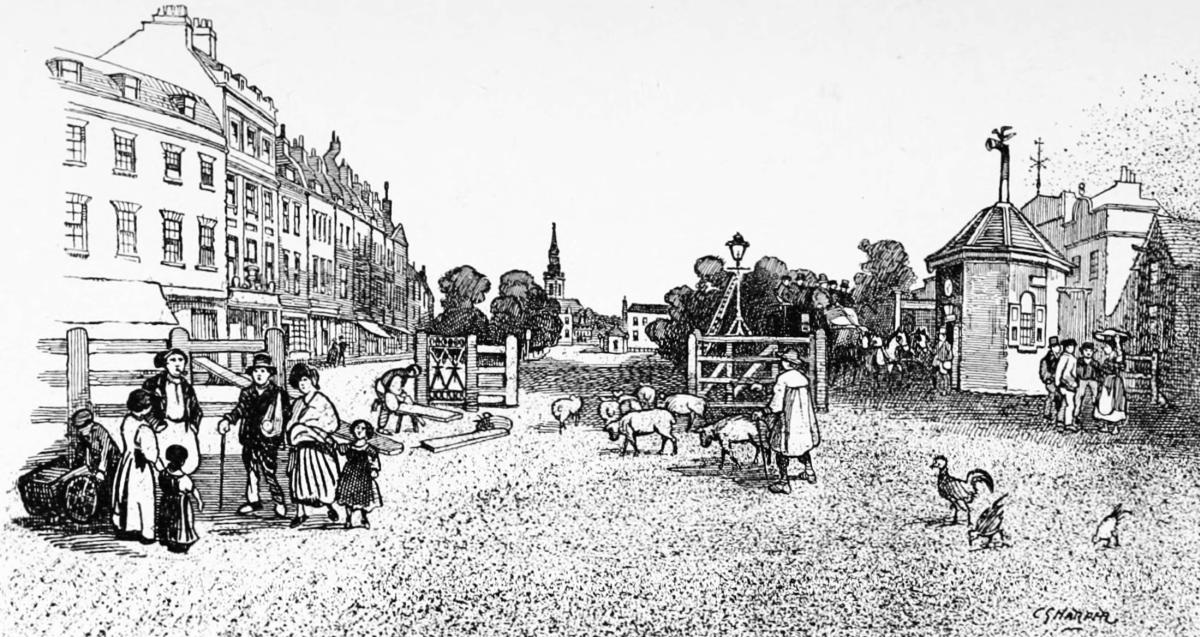
ISLINGTON GREEN, 1825.
Ring Cross has long since disappeared from the map. It stood, according
to such careful cartographers as John Rocque and his coadjutors
in 1746, at a point three and a half miles from London, now to be
identified with the junction of the Holloway Road and the Benwell
and Hornsey Roads, which then, under the fearful name of “Devil’s
Lane,” led to the remote hamlet of Crouch End.
SCENES OF DREAD
The neighbourhood was of ill omen. There many a tattered body, slowly
disintegrating, had hung in chains; most notable among them that of
John Price, the hangman, who on May 31st, 1718, was himself hanged
for robbing and murdering one Elizabeth White in Bunhill Fields, his
body being afterwards suspended here. The horror of it was revived in
1827, when a skeleton with the gibbet-irons was found at “Catherine
Street, near the main road, Holloway”; the gibbet and the remains
being afterwards exhibited at the “Coach and Horses” public-house near
by, perhaps to be identified with the house of that name now at 214,
Holloway Road.
Highgate formed in those times another settled spot, where London
citizens lived a rural life and cultivated the virtues and ruddy
cheeks, amid villainously ill-reputed wastes to north and south.
Finchley Common and its fringing Alsatias stretched north, as far as
that other civilised interval, Barnet; and through the great common
of Finchley ran the road which all who travelled north must pass, as
messieurs the highwaymen knew full well.
In days before any kind of coach travelled the road, it was the usual
thing for a traveller to get astride his own horse and so, bumping in
the saddle, to come to his destination. Others, who, although owning
no horses, had a good eye for horseflesh and were good at a bargain,
would often purchase a mount and at the end of a long journey sell him
to advantage. It was one of these travellers who, having bought a fine
horse in London at a very moderate price, found when he had come to
Finchley Common that he had acquired a very singular bargain indeed.
Riding across the lonely waste, he saw another horseman advancing;
whereupon his own horse, in the most curious manner, edged up to the
stranger and pushed in so threatening a way against him that he, with
every sign of fear, handed over his purse. The horse had obviously been
the property of a highwayman.
The Manchester Mail changed horses at the “Old White Lion,” Finchley,
as the print after James Pollard shows; and whether or not Pollard
intended to convey any such idea, it looks distinctly a hostelry and
a neighbourhood in which it would not be prudent for a stranger with
much money about him to linger long after the mail had duly changed and
driven off. What an astonishing change is that which has now come upon
the scene!
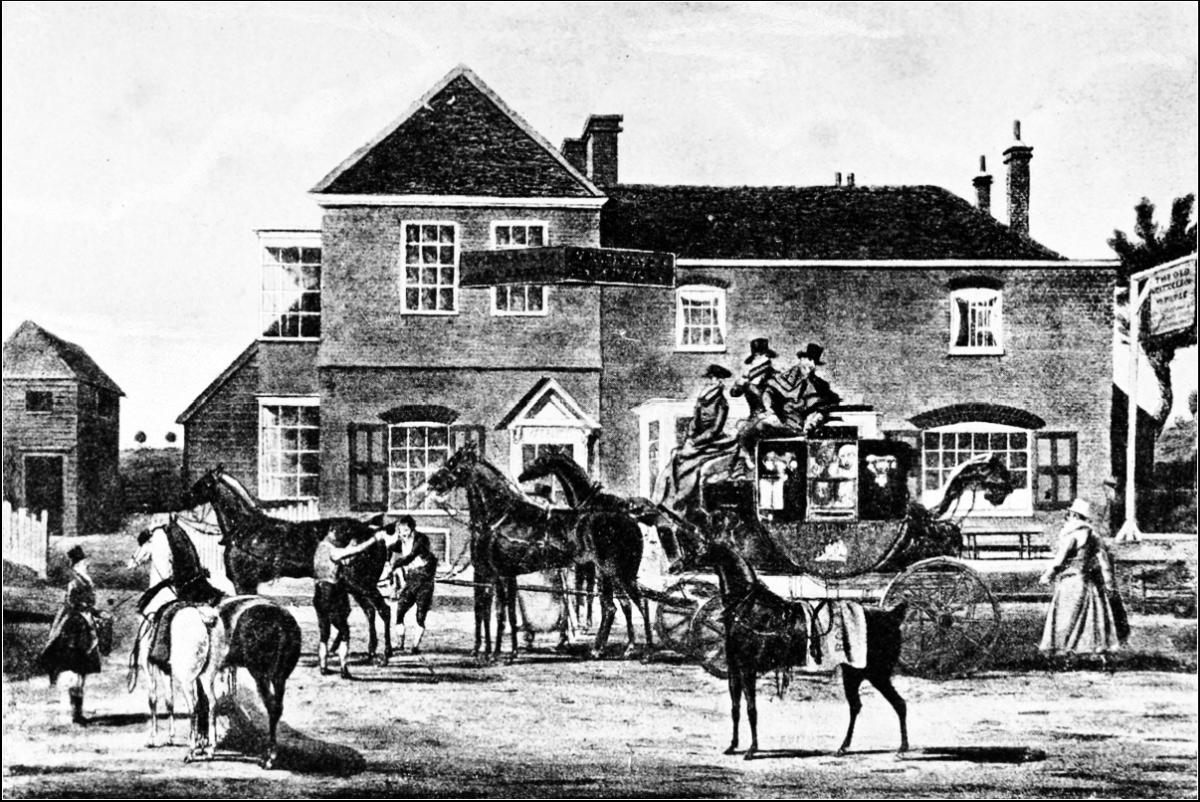
THE MANCHESTER MAIL CHANGING HORSES AT THE “OLD WHITE
LION,” FINCHLEY, 1835.
[After James Pollard.
Change, in fact, looms large upon the home stretches of the road, and
even Barnet Fair is threatened with extinction. Threatened men and
threatened institutions live long, but at last some one or something
puts a period to their existence; and they are in the end, when people
have almost come to consider them immortal, cut off with suddenness.
Barnet Fair will doubtless in the near future follow most other fairs
into the past tense; but meanwhile, although considered moribund
by many, it is without doubt extremely lively. And it is just this
lusty liveliness that will, paradoxically, cause its abolition; for
the crowds of horse-dealers, and East-End and low-life Londoners in
general, who are attracted to it for its annual three days, commencing
on the first Monday in September, are not favourably regarded by
the “residential” classes of Barnet and the district; although the
tradespeople seem to look upon them with tolerably friendly eyes.
Opinions are divided, as they must needs be when such opposite
ideals of life prevail. The “residents” want peace and quietness:
the tradespeople want trade, and they apparently have the ear of the
vestry, which so long since as 1888 passed a resolution that as the
fair at that time brought over 20,000 people into the district and
was the means of some £10,000 to £12,000 being spent there, it would
be a great hardship to the commercial classes in Barnet if it were
abolished. A memorial was presented to the then Home Secretary praying
that the fair should be continued, and the petition proved successful.
BARNET FAIR
“Improvements” have not been lacking of late in Barnet. That they are
improvements admits of no doubt, for they have caused the widening of
the roadway at a narrow point, and have disclosed the noble parish
church to view, It was built in at its eastern end, at some bygone
period, with a quaint old house and shop; a picturesque jumble, and
one which has, to some, left an aching void in its disappearance. This
odd excrescence was an old-world baker’s shop, with carpenter-Gothic
stuccoed little house above: not (as may be gathered) admirable for
the purity of its style. Like the fly in amber, it was neither rich
nor rare, but one speculated on what brought it in such a strange
conjunction, built on to the end of the church in such a manner
that the uninstructed stranger was at a loss to tell where the
ecclesiastical building ended and the merely secular one began.
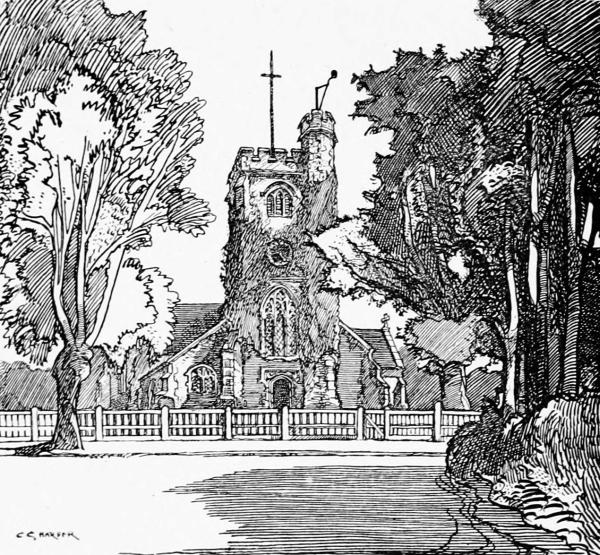
MONKEN HADLEY CHURCH.
Barnet has been already fully treated of in the pages of the Great
North Road and the Holyhead Road, and there remains
little else to say of it; but it, among other places, cherishes the
diverting story of the postmaster’s wife handing out her husband’s
leathern breeches from the bedroom window to the up night mail, instead
of the postal bags. The guard did not discover the mistake until
Highgate was reached, when he returned on horseback to exchange the
wearing apparel for His Majesty’s mails.
The mail-bags themselves were once stolen here. The incident happened
in February, 1810, whiles the horses were being changed. Thieves made
off with the bags for places from Hatfield to Grantham, and thence to
Spilsby and Boston, and although the notice issued on March 1st by
the Postmaster-General offered a reward of one hundred pounds for the
apprehension of the robber, no one was ever captured, nor did the bags
ever reappear.
COCKFOSTERS
A weird place-name, prominent upon the signposts along the road,
irresistibly invites to a further exploration. “To Cockfosters,” says
the signposts. Certainly, by all means. You cannot choose but go to see
what manner of place this may be; but after all—as in countless other
instances—nothing so very remarkable meets the explorer’s gaze. It is,
in fact, a little woodland hamlet on the borders of the three parishes
of Hadley, East Barnet, and Enfield; and the name, in the lack of any
actual evidence, is presumed to derive from the ancient French phrase,
Bicoque forestière, a little settlement amid unenclosed forest land.
MONKEN HADLEY
More meets the eye at Monken Hadley, a village not yet overwhelmed
by the suburban tide. The centre of local interest is, of course, as
usual, in the church, and the interest of the church itself is centred
on the tower.
The date of the tall tower is readily fixed by the quaint arabic
figures over the doorway, which, deciphered, give the year 1494.
But the great curiosity of Monken Hadley church is, of course, the
fire-pot, or beacon, which arouses such speculation on the part of
strangers at a distance.
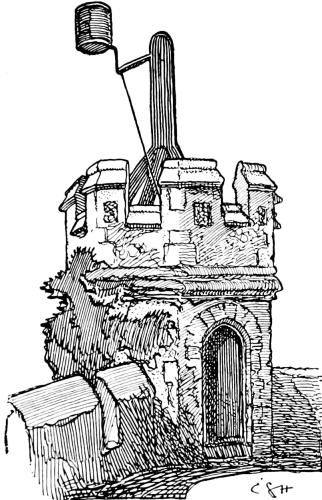
THE FIRE-POT, MONKEN HADLEY.
How far back such a beacon existed on this, or any earlier,
tower-turret here must remain uncertain; but its purpose is plain
enough. The light of it was intended to guide travellers benighted
in the once dense and far-spreading Enfield Chase. The elevated site
of the church itself was known as “Beacon Hill” in the time of Queen
Elizabeth, and even then had long borne that name. There is evidence
that the beacon was lighted in the troubled times of 1745, when the
Scottish rebels were hourly expected to descend upon London and
replace King George with a Stuart sovereign. Blown down in the great
gale of January 1st, 1779, the existing one is, of course, merely a
restoration. It was lighted on the night of the rejoicings over the
Diamond Jubilee in 1897, and again at the Coronation of Edward the
Seventh.
The Battle of Barnet, in which Monken Hadley and all the surrounding
district were involved, is an oft-told tale, and romantic novelists
have long had their way with it. Lord Lytton was probably the last, as
he was certainly the greatest, to make that great contest of 1471 the
vehicle for a story; and he wrote of it so convincingly that an ancient
and weatherbeaten fragment of a huge oak tree marking the border of
Enfield Chase is pointed out as a legitimate historic landmark of
that great contest. It is the “gaunt and leafless tree” whereon Friar
Bungay hangs his hated rival, Adam Warner, whilst at its foot lay the
lifeless form of his daughter Sibyll and “the shattered fragments of
the mechanical ‘eureka’ on which he had spent the labours of his life.”
The old trunk, long ago divested of its bark, was upset some years ago
by some drunken volunteers, but it has been replaced in its original
position and enclosed within a railing.
Taking by preference the old road, across Hadley Green, by the obelisk,
called “Hadley Highstone,” marking the site of the battle, instead
of following the “new” road out of Barnet constructed by Telford in
1823, we pass Dyrham Park. The imposing stone-built entrance to this
beautiful domain is sufficient to attract attention by itself, without
the aid of historic association; but it has, according to oft-repeated
story, the added interest of having originally been a triumphal arch
erected in London to welcome Charles the Second, at his Restoration in
1660.
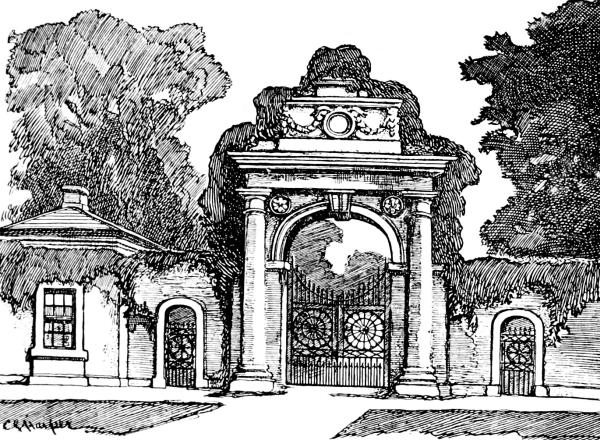
THE GATEWAY, DYRHAM PARK.
The old road comes to a junction again with the new at South Mimms, and
old and new proceed together from this point to St. Albans, up Ridge
Hill, and so by London Colney. Here and there stretches of the old
way may be found, to right or left; hollow, overshaded by trees, and
solitary, save for those expertest of expert wayfarers, the gipsies and
the tramps, who may often be found there, under the greenwood tree,
secure from the dust and the hustling of this new century which has
discovered the roads again, but has not the time nor the inclination to
know them intimately, or as anything else than a race-track.
ST. ALBANS
In 1826, seventy-two coaches passed through St. Albans every
twenty-four hours, and it was calculated that the travellers passing
through in the same time numbered no fewer than 1,000, of whom the
coaches conveyed 600. The rest were those at the extremes of poverty
and wealth, who rode in the waggons or walked; or sped by swiftly and
luxuriously, in post-chaises or in their own private chariots. How
many, one wonders, are the motor-cars that now daily speed, in clouds
of dust, up Ridge Hill and so through London Colney and St. Albans
to North Wales, or to Manchester and then, across the Border, into
Scotland?
The streets of St. Albans are by no means adapted for the hurrying
methods of to-day; and although the town or the city, as we must now
style it—is but twenty-one miles from the centre of London, it is even
yet a place of narrow and winding ways. There is, indeed, to this day
a certain savour of monasticism about St. Albans, largely though the
place has grown of late years. The Abbey, on its crowning ridge, of
course dominates everything; but, apart from that chief feature, you
have old churches, old houses of every degree of antiquity down to
the time of George the Third (after which period houses cease to be
antique), and old inns. And with all these evidences of a venerable
age there is yet a lively air, a bustling cheeriness, about St. Albans
that render it really lovable. Much might be said of St. Albans: of
the ruins of Sopwell nunnery, down in the quelchy water-meadows as you
come in from London; of St. Stephen’s, the tiny village on its height,
looking down upon the city; of the ancient Abbey Gatehouse, proudly
known as “the oldest school in England.” Indeed, something must needs
be said of this last. It stands immediately by the West Front of the
Abbey, and is the last relic of the vanished monastery.
ARISTOCRATIC CHURCHMEN
The Gatehouse is only by chance the Grammar School, for the school,
itself founded about the year 1095 by the monks, was only removed
hither in 1869. After the suppression of the Abbey and the demolition
of most of its domestic buildings, the Gatehouse became the Sessions
House and prison for St. Albans until 1651. Thenceforward, until 1869,
it served the not dissimilar purpose of a House of Correction. Indeed,
throughout its history, from the building of it in 1380, the great
Gatehouse has served like purposes: the stewards of my lords abbots
having held assize in the upper rooms and consigned offenders to the
dungeons below. Offenders were many, for those ancient Churchmen,
who lorded it autocratically over St. Albans, in temporalities as
well as in spiritual matters, obtruded into all things. They were, as
already shown, for education, and at an extraordinarily early period
established the Grammar School: but they took care to excommunicate
every other school in the neighbourhood, and none might buy nor sell,
nor hold any privileges of market without the Church took toll of them.
That there were those who, even in early days, kicked against the
pricks of this combined jurisdiction over body and soul duly appears
in the records of St. Albans; and they suffered in the Gatehouse the
penalties awarded to all fire-brands, malcontents, and agitators, and
all such pestiferous fellows. Wherefore the grey old building is a very
interesting old relic indeed of those times which certain parties in
the State (who ought properly to be flogged at the cart-tail) are eager
to bring back.
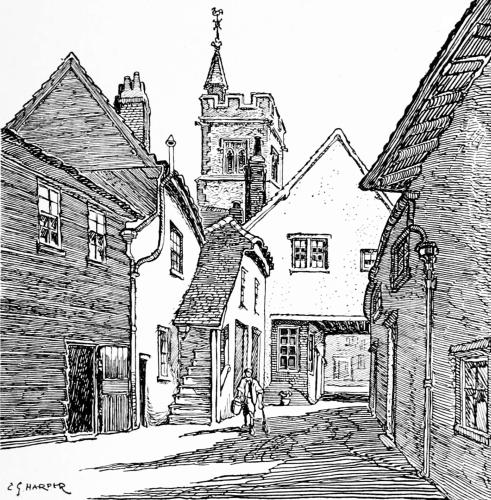
THE “FLEUR DE LIS.”
Of the inns of St. Albans I shall say little in this place, for much
has been said of them in the pages of the Holyhead Road and
the Great North Road. But a word or two, and a sketch, must
be reserved for the “Fleur de Lis” inn, close by the Market Place.
Like Canning’s “Needy Knife-Grinder” it has no story to tell, but
its courtyard, with the odd little external staircase shown here,
sufficiently justifies notice, even though in history, national or
local, the house has no place. An effective item in the view—the object
resembling a church-tower—is entirely extrinsic. It has nothing to
do with the inn, except serving the purpose of composing a picture;
nor is it even strictly ecclesiastical, being a fourteenth-century
curfew-tower, once of remarkable interest, but shorn of much of that
quality after Sir Gilbert Scott laid his heavy restoring hand on it,
some forty years ago.
ST. ALBAN THE MARTYR
The Cathedral of St. Albans, as it must now be called, for the ancient
Abbey became the Cathedral Church of a new diocese in 1875, was said
by Freeman to be “the vastest of English ministers.” He was not quite
correct, for the huge Cathedral of Winchester is ten feet longer; but
the bold and elevated site on which St. Albans stands advertises its
bulk in the supremest degree, while the site of Winchester Cathedral,
being flat, and its precincts enclosed, the dimensions of that most
interesting of all English Cathedrals are not fully displayed.
The reasons that impelled the first architects of St. Albans Abbey to
so greatly distinguish their church, for size, above all others, are
found in the fact that it was here that St. Alban, the first British
martyr, suffered, in the dim era of the Diocletian persecution, in the
Roman domination of Britain. “This year,” says the Saxon Chronicle,
referring to A.D. 283, “suffered St. Alban the Martyr,” but
Bede, in his “Ecclesiastical History,” places the date at A.D.
305, and as the death of St. Alban was a direct result of the
savageries instituted by Diocletian, decreed two years earlier by that
tyrant, the historian is probably correct.
Bede died in A.D. 735, four hundred and thirty years after
the event he recorded. He and the even earlier chronicler, Gildas,
who wrote in A.D. 564, mention a church of sorts being very
early built upon the site of the martyrdom; but all earlier buildings
were swept away on the coming of the Normans, and already in 1077, only
eleven years after the Conquest, Abbot Paul de Caen had cleared the
ground and began the immense building of which the existing Cathedral
is the representative, still retaining large portions of his work;
including the tower, transepts and choir, nine bays on the north side
of the nave and three on the south.
There was at that time no spot even distantly approaching the especial
holiness of this, and none could have foreseen the tragedy at
Canterbury in 1170, that was, in little less than one hundred years, to
completely overshadow St. Alban and set the Blessed St. Thomas à Becket
above him.
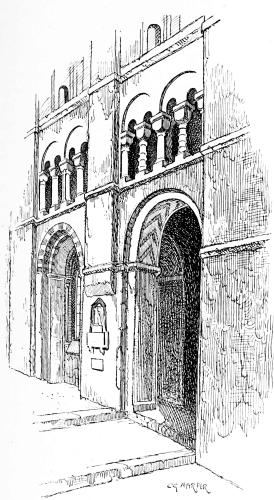
RELICS OF THE SAXON CHURCH IN THE NORTH TRANSEPT, ST.
ALBANS.
Abbot Paul’s great building was imposing, but it was not beautiful.
What is left of his original work has become venerable through age,
but there can be no doubt that, could we see it in all its freshness,
as it was built, we should consider it very gaunt and ugly indeed. He
antedated the typical American in his desire to “lick creation,” and
he thought in feet and yards, rather than in terms of beauty. There
was much to provoke him to this. He had the relics of the then holiest
indigenous martyr, and those of St. Amphibalus, scarcely less holy, in
his charge, and ready to his hand lay huge piles of building materials,
the bricks, tiles, and stones of the ruined Roman city of Verulamium,
that had stood in the valley. The bulk of these materials was formed
of tiles, and with these the abbot reared his walls and piers, and the
central tower, bedding the tiles in mortar as thick as themselves:
so that to modern observers it seems remarkable that, with such a
pudding-like mass as this must have been before it dried out, the walls
ever consented to stand upright. Some few ornamental features were
incorporated from the Saxon church built by Offa, King of the Mercians,
in A.D. 793. These are the celebrated balusters, of undoubted
Saxon character, which, fitted with Norman capitals and bases, serve as
columns in the triforia of the transepts.
Abbot Paul’s building was of the most stark and naked early Norman
character. He willingly forswore ornament, if he could thereby
add another bay to the length of his Abbey Church, and he and the
mid-nineteenth-century builders join hands, in the spirit, across
the tremendous gap of seven centuries and a half. Both delighted in
plaster, and both hated to show the real materials of which they built.
Abbot Paul covered the entire exterior of his Abbey, as well as the
interior, from east to west, and up to the topmost battlements of his
central tower, with plaster, thick and slab, and thought the result
beautiful. And so did his contemporaries. We may take leave to look
with a considerable measure of contempt upon their taste. Traces of
the plaster facing of the tower, indeed, remained until 1870, when, in
course of restoration works, it was removed, revealing the beautiful
dark red hue of the Roman tiles of which it is constructed.
A COSTLY ENTERPRISE
The proverb that “the old order changeth, giving place to new,” is
most strikingly emphasised in the appearance and history of any great
Cathedral. Each successive abbot seems here, as elsewhere, to have
desired to do something much better than that done by his predecessors;
and so we find Abbot John de Cella, in 1195, with the particularly
inadequate sum of one hundred marks left for the purpose by the last
abbot, beginning to rebuild Abbot Paul’s gigantic church. De Cella
was a supreme artist, but unhappily an idealist who did not count the
cost of what he was doing. He pulled down the West Front, and began to
rebuild it in the Early English style. Before he had done more than get
in the foundations of his new work, bang went the hundred marks, with
much else: a circumstance which led the historian, Matthew de Paris, to
gibe cruelly at him; saying, very caustically, he wondered the abbot
had not recollected the ancient proverb,—“That he who is about to build
should compute the cost, lest all begin to jeer at him, saying, ‘This
man began to build, and was unable to finish it.’”
How de Cella tried in every direction to raise money for his works is a
pitiful story: how he visited, travelled, petitioned, and begged, first
of one person, and then of another; how he was “looked coldly upon”
and snubbed. Finally, after a great number of years, during which the
works were only spasmodically in progress, de Cella died, in 1214, with
the porches of his West Front only half finished.
The Early English architecture of de Cella remained, a lovely specimen
of the artistic feeling of the period, until 1882, when Lord Grimthorpe
destroyed it, on the excuse that it was decayed and could not be made
good by modern workmen: building a West Front of his own, in a style
which has justly been called “Dissenting Gothic.”
William de Trumpington succeeded de Cella as abbot, and in his
one-and-twenty years rebuilt four bays on the north side of the nave
and five on the south, in the Early English style. Five others on the
south side are of the Decorated period, and are the work of Abbot
Eversden, in the fourteenth century. The remainder of the nave is the
original gaunt early Norman.
It would be a lengthy treatise that should duly tell the architectural
and other history of St. Albans Cathedral: and this is not the place
for so prolonged an exercise. Let it be sufficient, then, to tell
something of the things done to the fabric in modern times, in the name
of “restoration.”
Celia Fiennes wrote, over two hundred years ago, that the “great
Church wch is dedicated to St. Albans is much out of repaire. I
see the places in the pavement hat was worn like holes for kneeling
by the devotes of ye Religion and his votery’s as they tell you, but
the whole Church is so worn away that it mourns for some Charitable
person to help repaire it.” That person was forthcoming in the fulness
of time, in that ferocious controversialist and amateur architect,
Lord Grimthorpe, who “restored” the Cathedral at his own expense. As a
result, it mourns, and others mourn for it, more than ever. Enormous
sums of money have been expended upon the vast building, amounting to
over £160,000. Of this amount £40,000, raised by public subscription,
went upon the works executed between 1870 and 1879. The remaining
£120,000 or more was spent by Lord Grimthorpe in playing at being an
architect.
NEW WAYS WITH AN OLD ABBEY
The Abbey had, indeed, been gradually falling into decay for many
years, and, about the middle of the nineteenth century, had at last
become quite ruinous. In 1833, some reparations had been made to the
tower, but these were slight, and work was only seriously begun in
1856, following a faculty granted to a committee which, calling itself
“national,” was nevertheless impotent to raise more than £30,000.
Some slight accretions were made to this fund as the result of the
added interest upon the Abbey being made the Cathedral Church of a new
diocese, in 1875; but these were soon engulfed in the mere work of
securing the sinking foundations. Sir Gilbert Scott was then called
in to undertake the work, and instantly shored up the great tower,
then on the point of falling. Until 1833, it had been crowned with a
dwarf timber and leaden spire, but this had been removed, and the
ring of eight bells had, three years earlier, been silenced, for fear
of bringing the heavy mass down. Great cracks had appeared in the
walls of the transepts, being slowly ground to powder by the settling
of the tower, and the interior of the building was always filled with
an impalpable dust, from the same cause. Still the tower sank slowly,
and it was seen that the four great piers at the crossing, which had
hitherto supported it, were at last failing. The real marvel was that
they had not failed before, for a singular discovery was made at this
time, at the base of the south-west pier, by which it was proved that
at some distant period—probably about that of the dissolution of the
monasteries under Henry VIII.—an attempt had been made to wreck the
place. A kind of cavern, some six feet wide, had been excavated in the
foundation and strutted with timbering which had evidently been placed
there for the two-fold purpose of protecting the excavators, and of
firing it when the undermining process had been completed. Why this
brutal idea had been abandoned, when so near completion, must be left
to conjecture; but it is plain to see that in all those centuries the
congregations and visitors to the Abbey had been in danger, at any
moment, of being crushed to death by a possible sudden collapse of the
tower.
This injury was repaired, and new foundations were laid, down to the
solid chalk, and the upper parts of the tower were secured. Funds at
that time permitted of little else being done. In 1871, an appeal
for £50,000 was issued, resulting in a subscription of about £21,000;
and in 1875, a further appeal for £30,000. Then the clerestory began
to fall. A new faculty was granted, and more subscriptions came in,
but by 1879 all these funds were again exhausted, and the restoration
committee resigned. Then came the great opportunity which Lord
Grimthorpe had long desired, of getting the restoration entirely into
his own hands. He was an incredibly wealthy man,2 with a passion for
exercising the part of amateur architect, and an equal passion for
controversy. He procured a new faculty, granting him unlimited power
at his own expense, to “restore, repair, and refit the Church.” Thus,
disastrously for antiquity, was the old building made over to him,
without let or hindrance, to do as he would.
LORD GRIMTHORPE
The handiwork of Lord Grimthorpe is writ large, all over the building.
He did the most extraordinary things. In restoring the transepts he put
in what purported to be “Early English lancets,” with false heads that
look like genuine heads from without, but from within are seen to be
cut off square; and was so enamoured of the red Roman tiles that give
so noble an appearance to the exterior that, in rebuilding the walls,
he supplied the lack of genuine ones for the new work by especially
manufacturing “Roman” tiles of his own, to form the walls of the south
transept; designed in what has been very fitly styled “Railway-station
Gothic.”
LORD GRIMTHORPE.
It would be wearisome to follow Lord Grimthorpe in detail, in his new
way with an old Abbey. With extraordinary passion and virulent contempt
for public opinion, he swept away genuine Norman work, and in many
places gave a brand-new appearance where had before been the bloom of
antiquity. Controversy followed upon controversy, during the progress
of these works, and Lord Grimthorpe went grimly on his way, replying to
arguments with the personal abuse of which he was a better master than
he was of architecture. His critics were “the usual howlers”; Street
to him was “the immortal author of the worst great Gothic building in
the world,” by which, of course, he meant the Law Courts; the foremost
architects and antiquaries talked “ignorant nonsense,” and were
persons who would “call everything destruction on which they have not
got a percentage.” Here, indeed, be “words that sting, and thoughts
that burn.” They are vehement, and they hurt, which was the object of
them. Like Alan Breck, he was a “bonnie fighter,” even though, as an
architect, he did not begin to exist. One of his worst atrocities was
the hateful wash-tub done in stone, which serves for pulpit in the nave.
His work is, indeed, only too evident all over the building, and he
himself is represented in sculptured stone in a spandrel over one of
the western porches; and is shown in the likeness of a recording angel,
with a pen and a scroll upon which he is probably entering the sins of
architects, or writing some new Evangel on matters architectural. But
the sculptor, although the portrait is excellent, has made a mistake
in representing him apparently at a loss for a word. Whether pleading
a case in court, or abusing fellow-controversialists, his eloquence
suffered from no such impediment.
ST. ALBAN’S SHRINE
But enough of Lord Grimthorpe and his doings. Let us see the “holy of
holies” of this Cathedral: the Shrine of St. Alban, in its beautiful
chapel, directly east of the great altar-screen. After the Shrine
was destroyed, in the troubles attendant upon the Reformation, none
expected it to be ever seen again. It disappeared utterly, and only the
worn pavement, where the pilgrims had knelt, showed where it had stood.
All around were signs that this had been no lightly regarded Shrine;
and to this day the mid-fifteenth-century Watching Loft remains, in
which the Feretrarius, or Relic Keeper, and his monastic brethren kept
guard night and day.
It was in 1866 that, during some alterations to the Lady Chapel, many
pieces of carved Purbeck marble were found, built up with bricks and
rubble into some sixteenth-century work. It was readily guessed that
they were portions of the vanished Shrine, and in 1872, when Sir
Gilbert Scott was at work in the south choir-aisle, an immense quantity
of carved fragments were discovered. A further quest led to the
recovery of nearly the whole of the marble Shrine; and it now stands,
pieced together, in its ancient place.
The carved work of this strangely found relic is particularly
beautiful, and includes groups representing the beheading of St. Alban
and the scourging of St. Amphibalus. The cresting of the structure is
of the most ornate character.
All this elaborate work was, however, but the support for the actual
reliquary, the casket containing the relics of the Saint, which was
gorgeous in silver and gold, and blazing with jewels. This was too
precious a sight to be on view every day, and was covered at most
times with an “operculum,” which could be raised or lowered at will
by means of cords or pulleys. On special high days and holy days it
was displayed to view. The twisted shaft seen outside the Shrine is a
fragment of the six that formerly supported the six wax lights kept
burning on those special days.
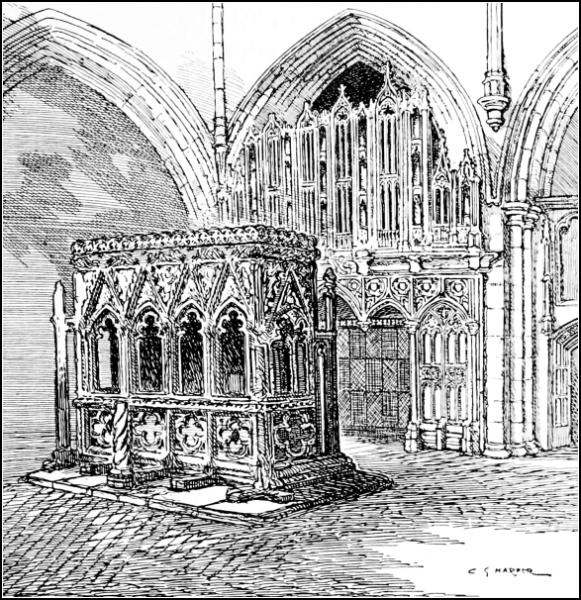
SHRINE OF ST. ALBAN, AND TOMB OF DUKE HUMPHREY.
ST. AMPHIBALUS
The Shrine of St. Amphibalus was discovered in a similar manner, and
was also pieced together in the same way. It stands now in a darkling
corner of the North Choir Aisle. There have been sceptical antiquaries
daring enough to suggest that Amphibalus, the persecuted Christian who
was secreted by Alban, with the result that both were martyred, is a
myth. No such person, they contend, ever existed. “Amphibalus,” it
seems, was really the name of a kind of long cloak worn at that period;
and such a cloak was worn by Alban when he was taken to execution.
Monkish legends personified it, and it was, thus marvellously changed
from an article of clothing into a human being, at length canonized. It
is a little shocking to find old clothes admitted into the hierarchy of
saints, and considerably lessens the very slight modicum of respect one
might entertain for monastic lore.
If the following story, told by John Wesley in his Diary of 1769, is
correct, some people must have queer tastes, and strange stomachs:
“2nd Aug.—Some friends from London met us at St. Albans. Before
dinner we took a walk in the Abbey, one of the most ancient buildings
in the kingdom, near a thousand years old; and one of the largest,
being 560 feet in length3 (considerably more than Westminster Abbey)
and broad and high in proportion. Near the east end is the tomb and
vault of good Duke Humphrey. Some, now living, remember since his body
was entire; but after the coffin was opened, so many were anxious to
taste the liquor in which it was preserved, that in a little time the
corpse was left bare, and soon mouldered away. A few bones are now all
that remain.”
“GOOD” DUKE HUMPHREY
The Duke Humphrey referred to was Humphrey Plantagenet, Duke of
Gloucester, uncle to Henry the Sixth, who was renowned for his
hospitality, and commonly called “The good Duke Humphrey.”
The “goodness” of Duke Humphrey must be, at the very least, an historic
doubt. Born in 1391, the youngest son of Henry the Fourth, he was a
man of affable and easy manners, cultured, and a patron of literature,
and considered by the people a patriot. Those were the days when to
be a “patriot” with one party was to be a “traitor” with another, and
jealousy on the part of Queen Margaret, consort of his nephew, Henry
the Sixth, caused his arrest at Bury St. Edmunds in 1447. The day
after his arrest, the Duke died, not without suspicion of foul play;
the times being such that the sudden death of any prominent person
could never be put down to natural causes; which sufficiently shows
the uncomfortable nature of those times. It seems, however, clear that
he died from paralysis, brought on through a life of debauchery, and
hastened by the shock of his arrest; but, if we may judge by the temper
of the age, his death happened in time to prevent the political murder
that assuredly would have been committed.
IMPOSTURE
So much for the “goodness” of the “good Duke,” who, whatever his
morals, was, if we are to believe the story told of him by Sir Thomas
More, a good deal more keen-witted than most people. It seems that he
completely exposed an impostor who claimed to have been born blind,
but to have recovered his sight at the shrine of St. Alban. The Duke
asked him the colours of the clothes himself and his suite were
wearing, and they were readily given by the man, who did not perceive
that, had he been born blind, he could not possibly know the names of
colours. The answer exposed him, and he was put in the stocks. The
story was long a favourite one at St. Albans, and forms a scene in the
second part of King Henry the Sixth; and by the same token fortifies
many in the belief that Bacon, and not Shakespeare, wrote that play.
MIRACLES WHILE YOU WAIT
Enter a Townsman of St. Albans, crying, “A miracle!”
Gloucester. What means this noise?
Fellow, what miracle dost thou proclaim?
Towns. A miracle! a miracle!
Suffolk. Come to the king and tell him what miracle.
Towns. Forsooth, a blind man at St. Alban’s shrine,
Within this half hour, hath received his sight;
A man that ne’er saw in his life before.
K. Henry. Now, God be praised, that to believing souls
Gives light in darkness, comfort in despair!
Enter the Mayor of St. Albans and his brethren, bearing Simpcox,
between two in a chair; Simpcox’s Wife following.
Cardinal. Here comes the townsmen on procession,
To present your highness with the man.
K. Hen. Great is his comfort in this earthly vale,
Although by his sight his sin be multiplied.
Glo. Stand by, my masters: bring him near the king;
His highness’ pleasure is to talk with him.
K. Hen. Good fellow, tell us here the circumstance,
That we for thee may glorify the Lord.
What, hast thou been long blind and now restored?
Simpcox. Born blind, an’t please your grace.
Wife. Ay, indeed, was he.
Suf. What woman is this?
Wife. His wife, an’t like your worship.
Glo. Hadst thou been his mother, thou couldst have better told.
K. Hen. Where wert thou born?
Simp. At Berwick in the north, an’t like your grace.
K. Hen. Poor soul, God’s goodness hath been great to thee:
Let never day nor night unhallow’d pass,
But still remember what the Lord hath done.
Q. Margaret. Tell me, good fellow, camest thou here by chance,
Or of devotion, to this holy shrine?
Simp. God knows, of pure devotion; being call’d
A hundred times and oftener, in my sleep,
By good St. Alban, who said, “Simpcox, come,
Come, offer at my shrine, and I will help thee.”
Wife. Most true, forsooth; and many time and oft
Myself have heard a voice to call him so.
Car. What, art thou lame?
Simp. Ay, God Almighty help me!
Suf. How camest thou so?
Simp. A fall off of a tree.
Wife. A plum-tree, master.
Glo. How long hast thou been blind?
Simp. O, born so, master.
Glo. What, and wouldst climb a tree?
Simp. But that in all my life, when I was a youth.
Wife. Too true; and bought his climbing very dear.
Glo. Mass, thou lovedst plums well, that wouldst venture so.
Simp. Alas, good master, my wife desired some damsons,
And made me climb, with danger of my life.
Glo. A subtle knave! but yet it shall not serve.
Let me see thine eyes: wink now: now open them:
In my opinion yet thou seest not well.
Simp. Yes, master, clear as day, I thank God and St. Alban.
Glo. Say’st thou me so? What colour is this cloak of?
Simp. Red, master; red as blood.
Glo. Why, that’s well said. What colour is my gown of?
Simp. Black, forsooth; coal-black as jet.
K. Hen. Why then, thou know’st what colour jet is of?
Suf. And yet, I think, jet did he never see.
Glo. But cloaks, and gowns, before this day a many.
Wife. Never, before this day, in all his life.
Glo. Tell me, sirrah, what’s my name?
Simp. Alas, master, I know not.
Glo. What’s his name?
Simp. I know not.
Glo. Nor his?
Simp. No, indeed, master.
Glo. What’s thine own name?
Simp. Saunder Simpcox, an if it please you, master.
Glo. Then, Saunder, sit there, the lyingest knave in
Christendom. If thou hadst been born blind, thou mightst
as well have known all our names, as thus to name the
several colours we do wear. Sight may distinguish of
colours, but suddenly to nominate them all, it is impossible.
My lords, St. Alban here hath done a miracle;
and would ye not think his cunning to be great, that
could restore this cripple to his legs again?
Simp. O, master, that you could!
Glo. My masters of St. Albans, have you not beadles
in your town, and things called whips?
Mayor. Yes, my lord, if it please your grace.
Glo. Then send for one presently.
May. Sirrah, go fetch the beadle hither straight.
[Exit an Attendant.
Glo. Now fetch me a stool hither by and by. Now,
sirrah, if you mean to save yourself from whipping, leap
me over this stool and run away.
Simp. Alas, master, I am not able to stand alone:
You go about to torture me in vain.
Enter a Beadle with whips.
Glo. Well, sir, we must have you find your legs.
Sirrah beadle, whip him till he leap over that same stool.
Bead. I will, my lord. Come on, sirrah; off with
your doublet quickly.
Simp. Alas, master, what shall I do? I am not able
to stand.
[After the Beadle hath hit him once, he leaps over
the stool and runs away; and they follow and cry,
“A miracle!”
K. Hen. O God! seest thou this, and bearest so long?
Q. Mar. It made me laugh to see the villain run.
Glo. Follow the knave; and take this drab away.
Wife. Alas, sir, we did it for pure need.
Glo. Let them be whipped through every market-town,
till they come to Berwick, from whence they came.
[Exeunt Wife, Beadle, Mayor, etc.
Car. Duke Humphrey has done a miracle to-day.
Suf. True; made the lame to leap and fly away.
Glo. But you have done more miracles than I;
You made in a day, my lord, whole towns to fly.
There are a good many market-towns on the 317 miles between St. Albans
and Berwick.
The Duke was buried hard by the shrine of St. Alban, where his
magnificent chantry tomb, built by Abbot Wheathampstead, still remains,
bearing amid its delicate sculptures the antelope, his badge. The
leaden coffin of the Duke was opened in 1703, when the body was found
“lying in pickle.”
The once well-known phrase, “dining with Duke Humphrey,” is variously
explained. It seems to have originated with a visitor to the Abbey
in the late sixteenth century having been accidentally locked in the
chantry chapel all night. The humour of it spread to London and found
a more poignant note in its application to the beggars and insolvent
debtors who, with nothing else to do, paced the aisles of Old St.
Paul’s. They went dinnerless, without the will to it, and were said to
“dine with Duke Humphrey.”
That famous fourteenth-century traveller and writer of travel-lore,
Sir John Mandeville, was, according to his own statement, born at St.
Albans: a statement which, coming from such an accomplished liar as he
who, more than any other before or since, has made “travellers’ tales”
a byword, does not necessarily bear the stamp of truth. Indeed, modern
commentators are not altogether satisfied that there ever was such a
person as this Mandeville, who, if these carping critics be correct,
was so incorrigible a fibber that he lied in saying he was ever born
at all! Here we begin to flounder in heroics and the immensities; and
the further we inquire, the more marvellous and inexplicable grows the
mystery. Whether you take him as a real person, or as a myth, it is
equally remarkable that an existent, or a non-existent, body should be
buried in two places, as is claimed for Mandeville’s.
SIR JOHN MANDEVILLE
What purports to be the grave of the famous traveller is shown in this
Abbey of St. Alban, near the west end of the nave. A tablet placed on
the pillar above it formerly stated that Sir John Mandeville was born
here, and here buried in 1372, having commenced his famous travels in
1322, and continued them through the greater part of the world during
thirty-four years. There still remains on the pillar the curious
black-letter inscription:—
Lo, in this tomb of travellers do ly
One rich in nothing but memory,
His name was Sir John Mandeville, content,
Having seen much mirth, with small confinement;
Towards which he travelled ever since his birth,
And at last pawned his body to the earth,
Which by a statute must in mortgage be
Till a Redeemer come to set it free.
This seems very straightforward and matter-of-fact, and might stand,
were it not that an equally matter-of-fact tomb, with a long Latin
epitaph to the same person, was frequently noted by visitors to the
church of the Frères Guillemins in Liège, until 1798, when the church
was destroyed, during the troubles of the French Revolution.
Such marvels as these are thoroughly in keeping with this prototype
of Munchausen, whose wildest flights of acknowledged fancy do not
approach the magnificent fictions of Mandeville, who appropriated all
the most stupendously tall stories of Marco Polo and other narrators
of the thing that was not, and added a skyscraping superstructure
of audacious inventions of his own. Modern writers, with the fear of
others who have been there, may well envy Mandeville, who could write
of men whose heads grew under their arms, and yet be regarded by his
contemporaries as truthful; or could convincingly talk of Ethiopia,
after this sort:
“In Ethiope there are such men as have but one foot, and they go so
fast that it is a great marvel; and that is a large foot, for the
shadow thereof covereth the body from Sun or Rain when they lie upon
their backs.”
Every man his own umbrella; what a splendid ideal!
The interest of St. Albans and its surroundings is not easily to be
compressed into a few pages. Everywhere are memories, and in most
places visible remains, wherewith to fortify imaginations not of a
robust order. The walls of Roman Verulamium yet remain in fragmentary
condition, to south and west of the Abbey, and close by them stands the
village of St. Michael’s, in whose church, sadly spoiled by the late
Lord Grimthorpe’s restoring zeal, is the statue of the great Francis
Bacon, Lord Verulam and Viscount St. Albans, whose genius was probably
keen enough to have made him capable of writing Shakespeare’s plays:
although, despite the contentions of fanatics to the contrary, he did
nothing of the sort. The ruins of his father’s and his own house of
Gorhambury are still visible a mile away, in the park, and close to the
great ugly eighteenth-century classic mansion of Gorhambury, seat of
the present Earl of Verulam.
GORHAMBURY.
GORHAMBURY
To seek Gorhambury on some thymy morning in May, when the pink
horse-chestnuts are in bloom, when the air is moist with recent
rain and suppressed heat, and a blue haze settles over the wooded
landscape, is delightful. Then the scene of the great Chancellor’s
pride, and of his despairing retirement, is beautiful indeed. The
“wisest, wittiest, meanest of mankind” was housed sufficiently well,
as the porch, the best-preserved portion of the building, shows. It is
a typical Elizabethan Renaissance building, with panels of marble,
and terra-cotta medallion heads of Roman Emperors; but it looks so
small and toylike. Propped though it be with brickwork and iron rods,
it cannot much longer survive, and the elaborate shield of the royal
arms, the defaced statues and shattered columns are surely falling from
picturesque into complete ruin. Apart from the chief group of crumbling
walls there stands a poor old battered one-legged and headless statue,
said to represent Henry the Eighth, but unrecognisable, scored
amazingly with the penknives and the initials of generations of Toms,
Dicks, and Harrys. The scene of past pomps and vanities is scarcely
mournful, as some might find it; the sight of it makes history live
again as human experience, not as we read it in the dulled pages of
historical exercise.
A field-path across the pleasant water-meadows of the river Ver leads
from Gorhambury to Prae Mill House and so on to the road again, and
thence to Redbourne, a sleepy village with a sleepy railway-station,
fringed with meadows where donkeys and ponies graze and ducks and geese
march and countermarch aimlessly, their inevitable later association
with green peas and sage-stuffing happily hidden from them. Redbourne
is one of those “bourne” places which, without adequate reason, appears
to discard the final “e.” According to an emphatic inhabitant, “we
spell it with a hen, without a he at the hend.” Through the village and
out again upon the broad highway, we come presently to Friar’s Wash,
once a water-splash across the road, now a tiny row of cottages and
a wayside inn, the “Chequers,” standing beside the little river Ver
where the old road of pre-Telford days goes off to the right. Flamstead
(i.e. Verlamstead) church on the hilltop, its characteristic
Hertfordshire spirelet, with the appearance as though the greater
portion had subsided through the roof, looks down upon the quiet scene.
Beyond comes Markyate.
MARKYATE CELL.
ROGER, THE HERMIT
Markyate Street, as it is how, is a wayside village, with a number
of more or less decayed coaching and drovers’ and waggoners’ inns in
its narrow street. The lovely old mansion of Markyate Cell, beyond,
standing removed from the dusty road, in its beautiful park, owes its
name to the spot having once been the hermit’s cell of one Roger, a
monk of St. Albans, who, returning from pious pilgrimage to Jerusalem,
was confronted by three angels, who there and then laid the vocation
of hermit upon him, and conducted him to this spot, where he lived
ever after: not altogether happy, for he suffered constant persecution
from the Devil, who, according to Roger’s own account, tried once to
drown him, and once set light to his hood. Had he ceased praying, there
can be no doubt the worst would have befallen him; but he continued,
unmoved, under these most alarming circumstances, and the Enemy was
foiled.
After a while in this solitude, a “holy virgin,” Christina by name,
came from Huntingdon and settled near by the equally holy Roger, who
afforded her religious instruction, until he was called away from this
vale of tears, when his body was laid in St. Albans Abbey. Christina
established the Benedictine Convent of Markyate Cell, and became first
Prioress of it in 1145. The mansion that now stands on the site in the
wooded park is a veritable dream of peace and beauty; but there are
hiding-holes in it, which sufficiently prove, if proof were wanted,
that not always was peace and security the dominant note.
At one mile before Dunstable we leave Hertfordshire and enter
Bedfordshire. It was a standing joke with all the coach-guards to ask
their passengers “What comes after Herts?” and to answer, before their
victims had time to reply, “Beds, if the Herts are serious enough.”
Fortunately, even the weakest jokes that would be anæmic enough by
the fireside seem quite robust in the fresh air; and the tedium of a
long journey was such that even this wretched specimen was not usually
resented.
Dunstable’s long and very broad chief street was until quite recently
a pleasant gravelled stretch of road, but since fast motor-cars have
come in crowds upon the highway, the townsfolk, in an attempt to save
themselves from the dust they raise, have been obliged to resort to the
expedient of treating the thoroughfare with a tarry preparation; with
the result that the dust nuisance has not been thoroughly abolished,
and instead of the old, cleanly-looking surface there is an ugly,
coaly-looking way, smelling abominably.
Of Dunstable, or “Dunstaple” as it was formerly written, you may read
more fully in the Holyhead Road; but attention may here be
drawn to the old seal of the town, in which one of the once favourite
punning allusions is found: here in a double-barrelled form, the
representation of a horseshoe standing both for the mythical stable of
the legendary robber, Dun, and for a staple, or hasp.
HOCKLIFFE
And so at last, through Dunstable town and out by the deep cutting
that carries the road on the level, through the chalk downs, we come
to Hockliffe, where the Holyhead Road goes off by itself, straight
ahead, and the Manchester and Glasgow Road turns sharply to the right,
continuing henceforward an independent course.
To compare small things with greater, Hockliffe was to the coaches to
and from the north-west of England very much what Rugby Junction is
now. Onward swept the coaches for Coventry, Birmingham, and Holyhead,
while the traffic for Manchester, Liverpool, and Glasgow bore away to
Woburn.
Turning suddenly from the Holyhead Road at this not very conspicuous
corner, the telegraph-poles that have hitherto made so brave a show are
missed, and the Manchester Road, for lack of them, seems of less than
the first-class importance it really owns. Solitary runs the road for
some miles, the sequence of trees and well-plashed quick-set hedges of
this well-cared-for district varied only by the companionable signposts
bearing the quaint or sonorous names of places on either side: places
to which you do not want to go, and of which you have probably never
before heard: but you like the information all the same. For one thing,
they are earnest of the fact that the country really is inhabited:
which the emptiness of the road would lead one to doubt. You speculate
idly as to what manner of place “Simpson” may be: “Eaton Bray” is
alluring, “Ellesborough” attractive; but it is still over 360 miles to
Glasgow, and the invitation into the byways is resisted.
There is a reason for this apparent—and in some sense
real—depopulation. We are here within the radius of the blighting
influence exercised by the Dukes of Bedford, whose immense seat of
Woburn Abbey we are approaching. And even where the Russell tentacles
do not reach, there are numerous other great parks. Away to the
right, is, for instance, Wrest Park, one of the finest domains in
Bedfordshire. Were there aught in the sound of that name, Wrest in Beds
should be an ideal place for the born-tired.
THE EARTH IS THE LORDS’
By reason of these great landowners, the district through which the
road runs for some ten miles is wholly park-like, and the villages
to either side are mere insignificant incidents. There is at Milton
Bryant, on the right-hand side of the road, a highly instructive
example of the manner in which these influences work. The local
Wesleyan chapel, greatly resembling a small barn, stands beside the
village pond, and indeed, until recently stood in it, being supported
above the water on posts. In that manner the tiny chapel was originally
built in 1861, it being impossible to obtain land elsewhere for the
purpose.
Now comes the park-wall of Woburn Abbey, skirting the road for two
miles. And not merely a wall, but a hedge in front of it, as well.
At such pains have their Graces of Bedford been to obtain additional
seclusion in a country where you will scarcely ever meet one person in
a mile.
On the way to the little town of Woburn, the chief entrance to this
great park is passed; the iron gates, painted an agonising blue which
in a mere commoner would be shocking bad taste, recessed from the road
at the rear of about half an acre of grass-plot. That grass-plot is
instructive, for it is earnest of the truly ducal scale on which things
are done at Woburn.
Woburn Abbey was from 1145 until 1537 a home of Cistercian monks whose
Abbots do not figure in history. They performed their religious duties
and ruled the brethren and brought their land out of a wild state into
an excellent agricultural condition. Only the last Abbot of this long
line lives in history. This was Robert Hobbs, who, torn by a tender
conscience and uncertain in what way to act for the best, first made
submission to Henry the Eighth and then threw in his lot with the
insurgents of the Pilgrimage of Grace, a movement to re-establish the
monasteries and to replace the ejected monks. The unfortunate Abbot,
taken in arms, was executed with dramatic completeness, being hanged on
an oak-tree in front of his own Abbey.
Ten years later, that luckiest of Russells, John Russell of Kingston
Russell in Dorsetshire, who by fortunate circumstance and courtly
address rose from the condition of an obscure country squire to be
Earl of Bedford, was granted these lands of Woburn and the fabric of
the Abbey, together with much other monastic property in different
parts of the country. Other families were recipients of many broad
acres, but the Russells were gorged to repletion. Burke in 1796 truly
declared that “the grants to the House of Russell were so enormous as
not only to outrage economy, but even to stagger credibility”; and the
results of those favours are evident to this day in the huge and varied
properties of which the Dukes of Bedford are landlords. The great
London estates of Bloomsbury and Covent Garden, the lands of Tavistock
Abbey, vast districts in the Fens, once the property of Thorney Abbey;
and other manors here, there, and everywhere render them really “rich
beyond the dreams of avarice.”
THE RUSSELLS
The more superstitious among the Roman Catholics have ever dwelt upon
the disasters prophesied to the House of Russell, as the beneficiaries
to so enormous a degree of the spoliation of the Church; but let us
inquire into the subsequent history of the family.
The first Earl of Bedford died in the fulness of time, in his bed,
without anything in the supernatural way affecting him. He was
succeeded by his son, who was not so fortunate, for three of his four
sons died before him, the third being killed by the Scots, on the
Borders. His fourth son, Edward, succeeded him as third Earl. He in
turn died, in 1627, childless, and the title and estates fell to his
cousin Francis. Believers in judgment awaiting sacrilege began at this
period to remember the discredited old legends which had declared that
no Earl of Bedford should be succeeded by his eldest son.
The family history from this time began thoroughly to support believers
in the supernatural, for Francis, the fourth Earl, had two sons, one of
whom died without issue, before his father. The second son, who became
the fifth holder of the title, was a man upon whom sorrow laid a heavy
hand. His two sons died before him; the eldest unmarried, the second,
Lord William Russell, beheaded in 1683 for complicity in the political
movement resulting in the Rye House Plot.
That must have been a hollow and barren honour which was conferred upon
the bereaved man in 1694, when William the Third created him a Duke,
“to solace his excellent father for so great a loss, to celebrate the
memory of so noble a son, and to excite his worthy grandson, the heir
of such mighty hopes, more cheerfully to emulate and follow the example
of his illustrious father.” The fifth Earl and first Duke had often
before been offered a dukedom, but had declined; so it would seem that
the “solace” could have been little comfort to him. He died in his
eighty-seventh year, in 1700, and his grandson, Wriothesley, became
second Duke, who died eleven years later, and was followed by his
son, Wriothesley, third Duke, who died childless in 1732. His brother
stepped into his place, and survived until 1771. He was twice married,
but his eldest son died on the day of his birth, the second in infancy,
and the third, the Marquis of Tavistock, was killed by a fall in the
hunting field, in 1767; and he was therefore followed by his grandson,
Francis, the fifth Duke;, killed in 1802 by a blow from a tennis-ball.
The sixth Duke was brother of the last. He died in 1839, and his son
Francis, the seventh Duke, reigned in his stead until 1861. His
son William next enjoyed the title until 1872, when it fell to his
cousin, Francis, the ninth Duke, who in 1891, in his seventy-second
year, committed suicide by shooting himself, under somewhat mysterious
circumstances. An unsuccessful attempt was made to hush up the affair:
the first reports to the newspapers declaring that he had died from
congestion of the lungs.
WOBURN ABBEY.
A DUCAL SUICIDE
The tenth Duke was a man of bloated and unwieldy proportions, who died
suddenly in 1893, and was followed by his brother. It would appear,
therefore, to recapitulate, that of the fourteen successive holders of
the titles of Earl and Duke of Bedford, five only have been succeeded
by their eldest sons. In all, there have been six deaths by various
forms of violence, including those of the aged Lord William Russell,
murdered in 1840 by his valet, Courvoisier, in Park Lane, and Lord
Henry Russell, who was killed on shipboard in 1842, by a block falling
on his head.
The Russells are by tradition Liberals in politics, but it is really
only an astute abstract Liberalism, calculated to impress the
unthinking, that they affect. I think of them, living behind their
park walls, in their huge, hideous house, as a succession of bloated
spiders, gorged but still unsatisfied, incredibly rich, incredibly
wealthy, shamelessly mean: deriving from their London ground-rents an
income that emperors might envy, and yet sharing no burdens and doing
no work for the State.
The great mansion of Woburn Abbey stands in the middle of a park
twelve miles in circumference: that is to say, for purposes of ready
comparison, a quarter larger than Richmond Park. Of the Abbey itself
nothing is left, and on the site of it stands the vast gloomy building
begun by Flitcroft in 1744 for the fourth Duke, and looking more like
some public institution of the asylum sort than a residence. It is a
veritable treasure-house of art, jealously closed against visitors,
except grudgingly, once a year, on the August Bank Holiday; but public
paths run through a great portion of the park, lovely with its woody
glades, still lakes, and couching fawns.
WOBURN.
WOBURN
There is no doubt possible to even the most hurried wayfarer as to who
owns the tiny townlet of Woburn, just outside the park. The great
old coaching inn, the “Bedford Arms,” proclaims it, alike in its name
and in the heraldic signboard, displaying the arms of the Russells
and their motto, Che sara sara—i.e. “What will be, will be.” And,
judging from the demeanour of the few people to be seen, the Dukes of
Bedford own them too. It is not enough for the Dukes that they reside
secluded in the midst of their wide-spreading park. They look with
disfavour upon a town at their gates, even though that town be in fact
but a village; and in consequence there is no new building in the
place. If the prevailing Russell characteristic were not parsimony,
there can scarce be any doubt that they would have razed Woburn to the
ground; but that would cost something, an excruciating thought to this
frugal race. Therefore Woburn remains very much what it was a hundred
years ago. Cobblestones of the “petrified kidney” kind pave the road
and footpaths, and the shops are of the kind in which Jane Austen might
have bought her linen and her groceries. Quaint shop-fronts they are,
with windows patterned like the glazed doors of antique bureaus. In
short, Woburn is a rare and interesting relic of times past.
Expansion of business is a thing unthinkable here, and some shops, and
some of the one-time many inns, have given up in despair. The only new,
or comparatively new, things in Woburn are the parish church and the
town hall: the last-named built in 1830, and the church in 1868, with
alterations in 1890.
It is somewhat difficult to characterise the new church. When you have
called it “Early English,” you momentarily think you have the style,
but no: there is a florid, alien, meretricious manner in it that
refuses classification. The peculiarly chalky white stone of which
it is built is not pleasing. At any rate, it was ducally expensive:
having cost the eighth Duke £30,000. The chief idea was the greater
glorification of future Russells, whose tombs were intended to be
placed here; but the constant reminder outside their own park that even
Dukes of Bedford must die did not commend itself to others of the clan,
and so their historic burial-place at Chenies, in Buckinghamshire, many
miles distant, is retained. The angles of the church tower are finished
off, against the sky-line, with four devils whose weird aspect,
horse-like heads and curled manes impress me more than anything else,
unless indeed it be the perfection of the magnificent lawn that slopes
steeply to the road.
All the way from sleepy old Woburn to the modern, very much up-to-date,
and bustling town of Woburn Sands the road passes through beautiful
woodlands, echoing with the voices of pheasants, and rich in the
odours of pine and beech and laurel. In midst of this scenery, the
half-timbered “Henry the Eighth’s Lodge,” with clipped yew-trees, in
shape like so many Stilton cheeses, is very striking. After these
solitudes, Woburn Sands comes very much as a surprise, and to some
perhaps not altogether a welcome one.
EX-HOGSTYE END
Woburn Sands is an entirely modern name. You will look in vain for it
in the pages of Cary or Paterson, for in the old days of the road the
place was merely an insignificant hamlet known by the unlovely name
of Hogstye End. But things have happened since then. A branch line of
the London and North-Western Railway was constructed, crossing the
road at this point, and with a station at the roadside. Thus brought
into touch with the outer world, the simple souls of Hogstye End arose
as one man, and demanded a new name for the place: and so the title
of Woburn Sands was invented. To-day, the astonished traveller sees a
typical twentieth-century township on the site of Hogstye End: a rosy,
red-brick place, growing at the expense of Woburn itself; and making
strenuous claims to be a health-resort, by reason of the sandy soil and
the wide-spreading fir-woods. The observant traveller will notice a
singular testimony to the belief, until recently prevailing, that the
days of the road were done, in the arrogant behaviour of the railway
company at this point, in actually encroaching upon the main highway
with the out-buildings of their station and the obstructing position of
the gates of their level-crossing, often closed for ten minutes at a
time during shunting operations.
Leaving Woburn Sands, we incidentally leave Bedfordshire and enter
Bucks, coming in seven miles, past the unremarkable villages of
Wavendon and Broughton, to the town of Newport Pagnell.
Newport Pagnell is not a port nor is it new, and the Paganels who gave
it the second half of its name have been extinct so many centuries that
there are not even any monuments of them left in the church. There is
indeed nothing feudal in the appearance of the little town, and the
very site of the great Norman castle built by Fulke Paganel is obscure.
ANOTHER QUEEN ANNE
It is a little, lop-sided town, calm and cleanly, with houses,
stone-built and brick, chiefly of Queen Annean and Georgian dates,
situated on the river Ouse. To enter the town, you cross over that not
very broad river by an iron bridge, built in 1810; and there you obtain
the prettiest view in all Newport. Immediately across the bridge is
“Queen Anne’s,” or St. John’s Hospital, looking very new, for it has
recently been rebuilt. One of its many rebuildings was that by Queen
Anne, in 1615: not the Queen Anne who (as the saying goes) is dead, but
another Queen Anne who is, if possible, even more dead: the Anne of
Denmark, who was Queen of James the First. Even the hospitallers who
are still advantaged by her re-founding of the ancient almshouse are in
a state of benighted ignorance as to her identity: they either suppose
her to be the Anne, Queen Regnant, whom we all know; or else frankly
say they “dunno nawthin’ about who she wor,” and might with equal truth
add that they don’t care.
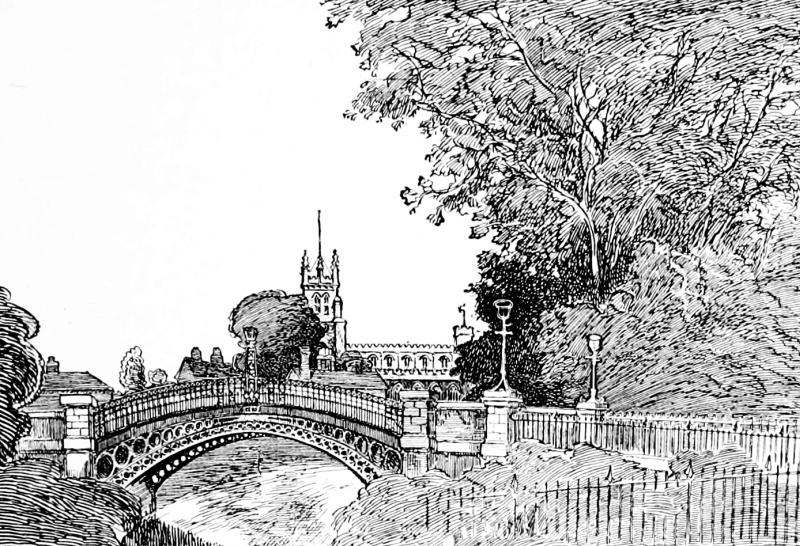
NEWPORT PAGNELL.
Almost all that remains of the old building is a tablet, with
inscription very difficult to be read, and weirdly misspelled,
imploring:
Alyov good christiams that here dooe pas
By give soome thimg to thes poore people
That im St. Johmns Hospital doeth ly.
1615.
Newport Pagnell has already been referred to as “lop-sided,” a
phenomenon occasioned by the railway station at the western end of
the town. It is not a large station, and it is only the terminus of a
short branch from Wolverton, but it has caused the little building that
has taken place in Newport in the last sixty years to be done almost
exclusively here. Near by, in a house called “The Green,” there once
lived an eccentric medical man, a Dr. Patrick Renny, who was born in
1734, and died here in 1805; being buried, by the terms of his will, in
the garden, where an obelisk over his grave—now entirely overgrown with
ivy, and looking like an ancient tree—may still be seen.
JOHN WESLEY
In leaving Newport Pagnell, we may depart in imaginary company
with John Wesley, who was riding horseback this way to Northampton
on May 21st, 1742, when he overtook one who eventually proved to
be a Calvinist, “a serious man with whom I immediately fell into
conversation. He presently gave me to know what his opinions were,
therefore I said nothing to contradict them. He was quite uneasy to
know ‘whether I held the doctrines of the decrees as he did’; but I
told him over and over ‘We had better keep to practical things, lest
we should be angry with one another.’ And so we did for two miles, till
he caught me unawares and dragged me into the dispute before I knew
where I was. He then grew warmer and warmer; told me I was rotten at
heart, and supposed I was one of John Wesley’s followers. I told him
‘No, I am John Wesley himself.’ Upon which he would gladly have run
away outright. But being the better mounted of the two, I kept close to
his side and endeavoured to show him his heart till we came into the
street of Northampton.”
Let us hope that Calvinist was duly convinced of error.
To the north, on our road to Northampton, Newport has grown not at all:
for reasons sufficient to the observation of all who pass this way: the
river Ouse and its adjacent wet meadows, over which the road is taken
on a bridge and a causeway, forbidding, even if the parish boundary did
not.
Here is Lathbury, whose church and few houses are to be sought off
the road by turning to the left at a point where a formal red brick
mansion, formerly “Lathbury Inn,” stands. There was some little trouble
here in 1745, when Mrs. Symes, of Lathbury Park, an ardent Jacobite,
refused the Duke of Cumberland and his army a passage through her
estate: with the result (as she did not possess an army of her own)
that they passed through, riotously and destructively, instead of
decently and in good order.
The little church of Lathbury is a singularly beautiful village church,
with oddly diminishing tower walls. The interior, Norman and Early
English, still preserves abundant traces of frescoes of Renaissance
character, with texts and the beautiful Lord’s Prayer. A small brass,
dated 1661, to one Davies, son of a former rector, is placed here,
according to the inscription, so that other “Cambria-Brittaines,”
passing, should see it. “Cambria-Brittaine” appears to be
seventeenth-century pedant’s language for “Welshman.”
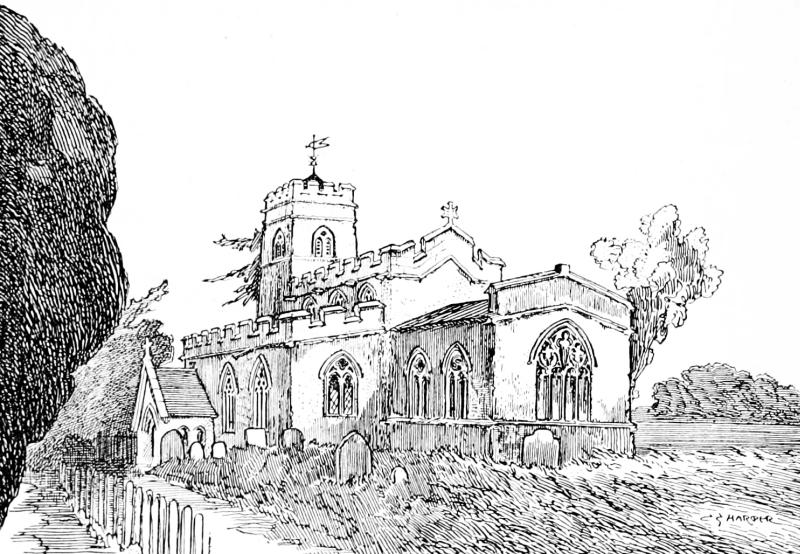
LATHBURY CHURCH.
A GUNPOWDER PLOTTER
The stable-clocks of Gayhurst and Tyringham chiming from either side
of the road advertise the whereabouts of those places, effectively
hidden though they be in summer by wayside foliage, save for a glimpse
here and there. The historic manor-house of Gayhurst might readily
be missed, were it not for the lodge-gates; and that would be a loss
indeed, for the place is historic in very dramatic sort. The present
house dates back in its oldest portions to 1500, when an Early
Renaissance mansion was erected by the Nevill family, who ended in an
heiress whose marriage brought the estate into the family of Mulso.
It was Thomas Mulso who in the time of Queen Elizabeth remodelled
the house, and, like many another loyal gentleman of that age, gave
it a ground-plan representing the letter E, in compliment to his
sovereign: the end limbs of the E being represented by the wings, and
the middle limb by the projecting porch. Soon again, however, for lack
of heirs male, Gayhurst changed hands, when Mary Mulso married the
handsome young Catholic gentleman, Sir Everard Digby, in 1596. The
old hiding-places, secret chambers, and uncomfortable quarters in the
chimney-flues, with which the house had been thoughtfully provided,
were found very useful in the rash young Sir Everard’s time, for he
was one of the participants in the Gunpowder Plot, and entertained his
fellow-plotters here. Realising the risks he ran, he made over Gayhurst
by deed of gift to his son, Kenelm, then but twelve months old. Thus,
by early application of the Heaven-sent limited-liability principle, he
preserved the estate from the otherwise inevitable confiscation that
awaited unsuccessful treason; and went to the scaffold in January 1606,
easy on that head. And so, in due course, Sir Kenelm came to his own,
and although he endured persecutions and whips and scorns under the
Commonwealth, was not altogether unhappy.
The large edible snails he introduced from the South of France, in
the hope of curing his consumptive wife, Venetia, still have their
descendants in the woods here: the woods that represent those early
boskages whence Gayhurst obtained its original name of Goddeshurst,
which gradually, by way of “Gotehurst”, i.e. “God’s Wood”, and
“Gothurst”, has become what it is now.
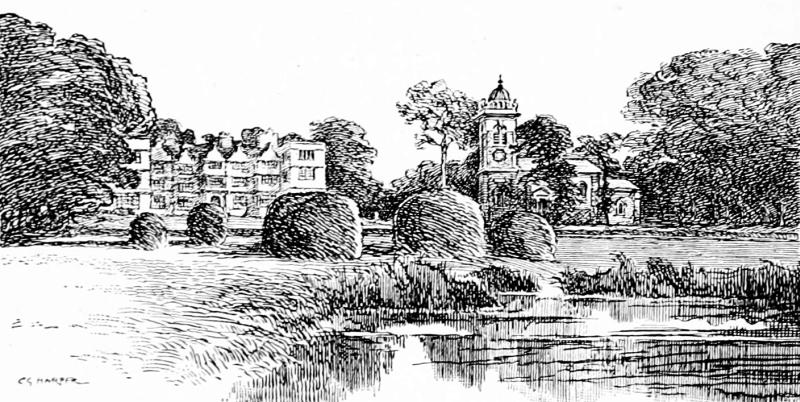
GAYHURST.
The Digbys ended in two unmarried sisters, who in 1704 sold their
ancestral home to Sir Nathan Wrighte, Queen Anne’s Keeper of the Seals,
whose monumental effigy, gorgeously robed, lies in the classic church
hard by the house; and the Wrightes themselves parted with it in 1830.
Beside historic associations, Gayhurst has literary memories, for this
is the poet Cowper’s country, and he often visited the Mr. Wrighte of
that age, travelling from Olney, little more than four miles away, to
admire the gardens, the hot-houses, and “the orange-trees, the most
captivating creatures of the kind I ever saw.” But he does not enlarge
upon the interesting Early Renaissance architecture of the older part
of the house, which is very justly admired nowadays. The Queen Anne
additions, comparatively recent as they were in his time, were better
thought of, and the classic church considered exquisite. It was one of
Sir Christopher Wren’s last designs, but the great architect never saw
it built, for he died, aged ninety-two, in 1723, and it was not begun
until the following year.
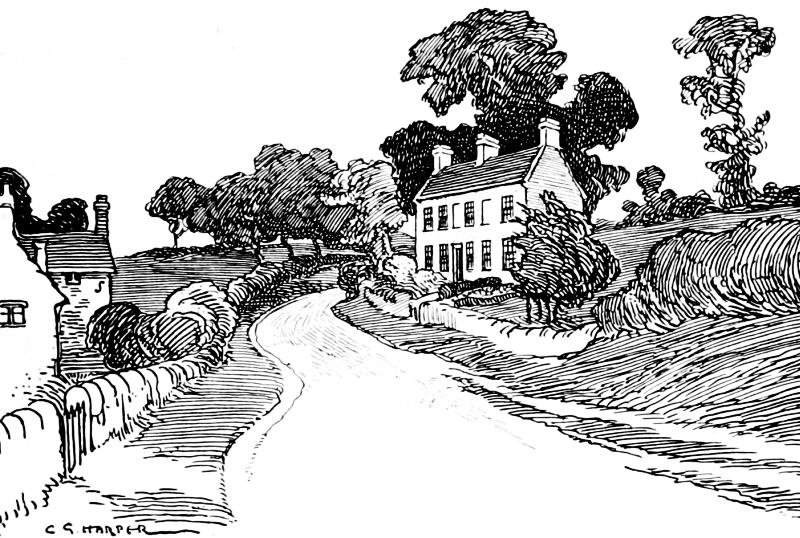
THE “GEORGE AND DRAGON,” EAKLEY LANE.
EAKLEY LANE
The Ouse, glinting steel-blue amid the green meadows, is seen away to
the right of the road, on the way to Eakley Lane, winding placidly and
sluggishly along. It is, of course, Cowper’s Ouse:
Ouse, slow-winding through a level plain.
Passing through the village of Stoke Goldington, where the golden-brown
stone of Northamptonshire—the “sugar-stone,” as it is locally styled—is
first noticed in the buildings, Inckley, or Eakley Lane is reached.
“Eakley,” which appears to derive from “Ea” = water, and “lea” = a
meadow, referring to the neighbouring water-meadows of the Ouse, is the
proper name, but the spot was known indifferently by either spelling in
coaching days, when it was notable for two inns, the “Bull’s Head” and
the “George and Dragon.” Both houses are still in existence, but have
long since ceased to be inns.
Old houses that were once inns are indeed remarkably plentiful in
these next few miles. At Horton there stands what was formerly “Horton
Inn,” now a handsome country residence. Obviously it was built in
two separate periods; beginning business in a modest way and then
enlarged to twice its original size. Doubtless further enlargements and
improvements were in contemplation when the era of railways came in and
doomed all such hopes to failure. A spacious drive once led up to the
house, but that was long ago walled in and converted into a garden.
Here we come into Northamptonshire, uphill, into the region that was
once known as Salcey Forest, which, with the Forest of Rockingham to
the east and that of Whittlebury on the west, was in the days of the
Plantagenet kings a portion of a vast chase, in which the red deer were
of far more account than men.
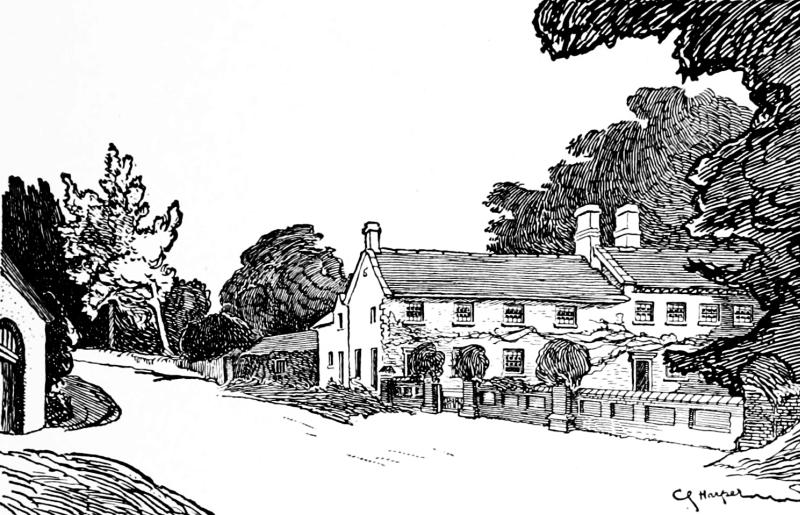
HORTON INN.
“SUGAR-STONE”
Northamptonshire, which takes its name from Northampton, the county
town (itself originally merely “Hampton,” and afterwards styled
“North Hampton” for the express purpose of distinguishing it from
Southampton), is an undulating shire of what Horace Walpole was pleased
to style, rather aptly, “dumpling hills.” It is rich in building-stone
of various kinds, largely of that beautiful golden-russet ferruginous
sandstone, already referred to as “sugar-stone”; hence the fine
substantial character of local buildings. Brick is not introduced
largely into the architecture of its towns and villages.
Fuller, who was a native of this shire, writing of it two hundred and
fifty years ago, said there was as little waste ground here as in any
county of England, and compared Northamptonshire with “an apple without
core to be cut out, or rind to be pared away.” His praise was not
extravagant, for the country contains little or nothing in the way of
bleak heath or barren moor.
This “shire of squires and spires” is also in old folk-rhyme that
of “spinsters and springs,” and of “pride, poverty, and puddings,”
ascriptions not readily to be understood, unless they be merely
examples of a rustic passion for alliteration reduced to an absurdity;
for spinsters abound in other shires, and no one surely would seriously
contend that Northamptonshire was favoured above the ordinary in the
matter of springs, conceit, pauperism, and puddings. But the spires
are, at any rate, an indubitable and a beautiful architectural fact.
Passing through Horton, we make a first acquaintance with them at
Piddington, a village of the smallest dimensions with a church of the
largest. Both are situated a few hundred yards off the road, the Early
English church spire peaking up magnificently among the trees, with a
peculiar richness of outline. Restoration recently in progress with
the particularly vivid yellow-brown stone from the Duston quarries,
two miles from Northampton, makes the restored patches stand out with
glaring offensiveness; but Time will remedy that—as all other ills.
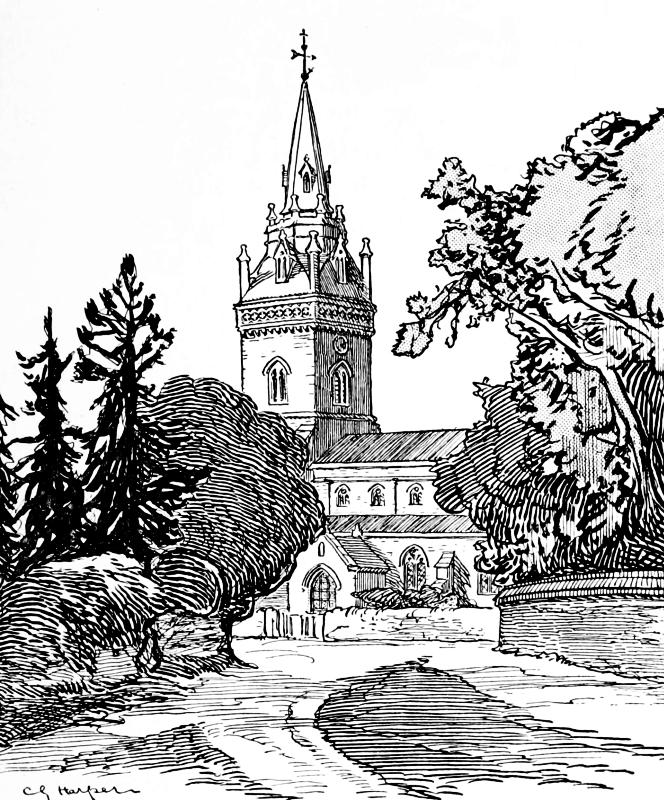
PIDDINGTON CHURCH.
HACKLETON
Hackleton, a large but rather characterless place, quickly follows
upon Horton and Piddington, and is the last village before reaching
Northampton, five miles away. Its position, the next place out of the
town on the road to London, made it, in the days before railways a very
special halting-place for drovers and the humbler wayfarers, and its
inns were many. Superior to the rest was the “New Inn,” now a private
residence, but for long years after it had retired from trade bearing
on its front the legend “Wines and Spirits: Entertainment for Man and
Beast”; with the not unnatural result that the privacy of the occupants
was frequently invaded by seekers after that entertainment.
Little more than one mile from Northampton town, near by the junction
of the road to Stony Stratford, where the highway assumes a magnificent
breadth, stands on a grassy bank the finest of the famous Eleanor
Crosses, raised by Edward the First to the memory of his Queen, Eleanor
of Castile, who died of a lingering fever at Harby, in Nottinghamshire,
November 28th, 1290. It is placed in a solitary position, on a grassy
selvedge of the road, at a spot in the parish of Hardingstone, close by
the grounds of what was once the Abbey of Delapré, or De Pratis, the
Abbey of the Meadows, founded for an establishment of Cluniac nuns by
Simon of Senlis, the crusading Earl of Northampton, in the late Norman
period.
The dearly loved Queen of Edward the First died in what was then the
remote district of Sherwood Forest, but the King decided that her body
should rest at Westminster Abbey, and so, with impressive deliberation,
the long journey was made.
QUEEN ELEANOR
Although travelling was a slow and tedious process in those days, it
was not necessarily so slow as this lengthy funeral procession. On
December 4th, the body of the Queen having been previously removed
from Harby to Lincoln Cathedral, the solemn pageant set out for
Westminster, but did not reach London until eleven days later, and
the entombment did not take place in the Abbey until the 17th of the
month. The reasons for the length of time taken are twofold, and are
to be found in the pompous circumstances under which the journey was
taken, and in the circuitous route chosen. The usual route was by way
of Stamford and Huntingdon, and so by Royston and Cheshunt, but it was
intended that the procession should pass through a more frequented line
of country and districts where the Queen had been better known. Another
object was to take some of the greater religious houses on the way, and
thus have suitably dignified places where to rest at the close of every
day. The route chosen was, therefore, Grantham, Stamford, Geddington,
Northampton, Stony Stratford, Woburn, Dunstable, St. Albans, Waltham,
West Cheap, and Charing.
The greatest magnificence marked the occasion, and twelve memorial
crosses, of different design, were afterwards erected on the places
where the bier had rested. Charity was given and masses paid for, and
here at Hardingstone, close by the Abbey of Delapré, in whose chapel
the body of the Queen rested for the night, this most beautiful of the
three remaining crosses was erected. “Living, I loved her dearly,”
the King wrote to the Abbot of Cluny, “and dead I shall never cease
to love her”; and so with every care the great officers of State who
accompanied the procession were directed to mark with particular care
those resting-places the King thought sacred, so that no doubt might
arise as to the exact spot where these memorials should be built.
The detailed accounts of the cost of these crosses exist to this day
in the Record Office, where, inscribed in crabbed Latin on parchment
rolls, they may be readily seen, if not so readily deciphered. From
them may be gathered the names of the masons and the sculptors engaged:
John de Bello being the chief architect of the crosses at Hardingstone,
Stony Stratford, Woburn, Dunstable, and St. Albans; and “Alexander le
Imaginator,” otherwise Alexander of Abingdon, and William of Ireland
the chief sculptors of the statues. Master Richard de Crundale was
principal “cementarius,” or master-mason.
A very special care that the Cross should be frequented is to be
observed in the remains of the stone-flagged pathway from Northampton,
constructed at the time when the Cross was built, for the purpose of
ensuring an easy journey to the spot, where the devout might pray for
the soul of the departed Queen. The cost of this is set down in the
accounts in payments of forty and sixty marks.
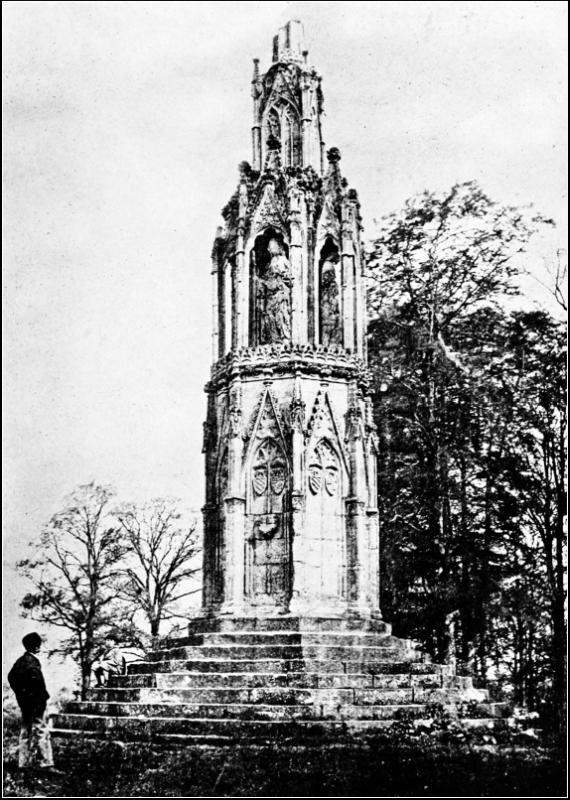
QUEEN ELEANOR CROSS.
From a photograph taken before the restoration of 1881.
In spite of the weathering of over six hundred years, and the
mischief wrought by thoughtless people, the Cross is still a finely
preserved work, and the graceful statues of the Queen under their
protecting canopies in the upper stage are yet beautiful. But more than
shoulder-high, the initials of the obscure, carved numerously in the
stone, bear witness to that passion for remembrance that belongs to
all classes, and has written itself deeply on venerable monuments such
as this, in tree-trunks, on the margins of books, on walls, and on
window-panes innumerable.
HOW NOT TO DO IT
Many restoring hands, and others that can scarcely be so described,
have been laid upon “Queen’s Cross,” as it is locally styled. In the
reign of Queen Anne, a good deal was done, and was complacently alluded
to in a long Latin inscription on a huge tablet which, together with
the Royal Arms, was actually affixed to the Cross, in company with a
sundial on each of the eight sides. We may judge of the self-sufficient
spirit of those “restorers” in this English version of the inscription:
“For the perpetual commemoration of conjugal affection, the honourable
Assembly of Magistrates, or Justices, of the County of Northampton,
resolved to restore this monument to Queen Eleanor, nearly falling into
ruins by reason of age, in that most auspicious year 1713, in which
Anne, the glory of her mighty Britain, the most powerful avenger of the
oppressed, the arbitress of peace and war, after that Germany had been
set free, Belgium made secure by garrisons, the French overthrown in
more than ten battles, by her own, and by the arms of her allies, made
an end of conquering, and restored peace to Europe, after she had given
it freedom.”
Dear me!
A charming afterthought, showing that the justices could descend from
Imperial heights to domestic levels, was the placing of a pair of
stocks at the base.
In 1762 it was thought necessary to have another shy at the venerable
relic, and evidence long remained of it, in another tablet, with the
words, “Again repaired and restored in the second year of King George
the Third, and of our Lord 1762.” The combination of loyalty and piety
is rich indeed.
Again, in 1832 a restoration was effected, at a cost of £300. Happily,
no more tablets were affixed, and more happily still, the existing
ones were removed. Further, in 1884, the restorations of earlier years
were re-restored at a cost of £320. The shattered cross crowning the
structure, destroyed at some remote period, has never been replaced.
Whatever the truth of the old saying that the traveller might know, by
the smell of the leather and the noise of the lapstones, when he was
within a mile of Northampton, it scarcely holds good now, for although
bootmaking, the ancient and distinctive trade of the town, is still its
great staple industry, and is, as every one knows, infinitely larger
and more important than ever before, it is scarcely to be distinguished
at this distance.
NORTHAMPTON
Of course, as everywhere, the distant view of the town is nowadays
largely a prospect of gasometers, and unless the traveller already
knew of Northampton’s bootmaking trade he might, entering by the London
Road and Cotton End, well believe he was come to a town of breweries,
another Burton-on-Trent: for there, beside the railway level-crossing
and the river Nene, stands the great brewery of Phipps & Co.
“Northampton on the Nene”: that is a piece of school geography not
readily forgotten, but, however greatly that information may bulk in
the memory, both by reason of its alliteration and being so early
insisted upon, the river Nene is not, truth to tell, so very much in
evidence. The uninstructed might suppose it to be a canal, and a dirty
one at that.
It is not a prepossessing entrance, this narrow street of old and
grimy, but not ancient, houses and third-rate shops, that leads up
into the town, but many surprises await the explorer who, primed with
armchair knowledge, sets out upon the road to correct his reading by
his own observation. Such an one would find that only strangers speak
of “Northampton” as spelled, giving full value to the “North.” To the
townspeople it is “N’Thampton.” Each style seems quaint to those who
favour the other.
The stranger would expect to find Northampton, as a factory town,
a place of squalor and grime; but coming here, and emerging
into the market-place from the not very pleasing entrance, his
expectations are utterly shattered. There are few towns of the size
of Northampton—whose population is now considerably over 89,000—that
are so bright and clean, and prosperous-looking, as this; and the
stranger, to whom its Radical politics are familiar, and to whom its
choice for many years of such Parliamentary representatives as Mr.
Henry Labouchere and Bradlaugh argued (reasonably or not I will not
declare) brutality and atheism, is pleasurably surprised at not finding
the ancient and beautiful churches of the town become “temples of
Reason,” lecture-halls, or other things in the secular way. Nor does he
perceive, as he had half-anticipated, scowling Radical-Atheists engaged
in violence, or shouting insults after the clergy and every person
with a good coat upon his back. The picture thus drawn seems farcical,
but it does by no means belie the ideas of a great many people who
have never been in Northampton and instinctively form a picture of it
from tales of its ancient election turbulence and from its choice of
representatives in modern times. Northampton is nothing like that:
dignity and beauty characterise its chief streets, and municipal
effort so long ago as 1864 sought to beautify the town with a splendid
Guildhall. Poetry springs—albeit unconsciously—even in the breasts of
its Town Councillors and Poor Law Guardians: where none would seek it.
Sir William Gilbert makes Bunthorne suspect, in Patience, that
Nature, in all thy works
Something poetic lurks,
Even in colocynth and calomel
POETRY
How true that is! Even in the prosaic person of a Poor Law Guardian,
the fount of true poesy may be bubbling, all unknown; as in that of
a member of the Board of Guardians at Northampton, who, in January
1907, challenged the workhouse master’s expenditure of £6 10s. on
marking-ink. Said he (he bore the great name of Dickens), lisping in
numbers:
I want to speak to you and the Board very plain;
I trust my appeal will not be in vain;
I hope you will pause and seriously think
Before ordering any more marking-ink.
It does not quite scan, but to a man who speaks poetry unawares,
inspired by such a domestic detail as marking-ink, a little practice
should make perfect. To what heights might he not rise on the subject
(say) of baths or drains!
The Guildhall, already referred to, is a building of extremely ornate
character, designed by Godwin, with a florid, many-niched and canopied
front, furnished with statues of the chief makers of Northampton’s
history, and with even the capitals of its columned vestibule carved
after the mediæval manner with groups of tiny figures. But in 1864
architectural sculptors had but begun to recover the forgotten arts of
the mediæval craftsman, and the execution of the designs is at once
coarse and feeble. The interior, except the light and very fine, but
barbarically coloured great hall, is of a truly Gothic gloom.
We first find mention of “Hamtune,” as it was originally styled, in
the Saxon Chronicle, when the Middle Angles occupied this district
of the kingdom of Mercia. Then the Danes, who came first to ravage,
settled in this part of the country, and the history of the town, which
even then was a considerable place, for very many years remained one
of fighting, and the victories of first one and then another. So often
as it was burned, it was again rebuilt: no difficult matter then, when
the houses were chiefly of timber. In 1065, the year before the coming
of the Conqueror, it was again burnt, in the jealous struggles between
the Saxon rulers; and there can be little doubt that, wearied of being
ground to powder between the upper and the nether millstones of these
ambitions, the people of Hampton were not altogether averse from being
ruled by a stronger hand, in whose time a little peace might be assured.
Certain it is that Northampton flourished under Norman rule, perhaps
more than any other provincial town. The great castle then built has
utterly disappeared, but other signs of great expansion remain, in the
ancient Norman churches; and history tells us how favourite a place
this was with the Norman and the Plantagenet sovereigns, who hunted
in the vast surrounding forests, and held council in the great hall
of the castle. The most famous of these councils was that of 1164,
when Becket’s ultimate fate was foreshadowed. The fierce contest for
the supremacy of the Church, or of its subordination to the State in
the person of the monarch, had for some time past been in progress.
A number of charges had been preferred against the Archbishop, and he
was summoned to Northampton to meet them. He arrived and was refused
the ceremonial kiss of peace by the King: his bishops renounced his
authority, and when he marched to the hall of the castle, carrying his
own archiepiscopal cross, the King and court withdrew, leaving him and
a few faithful attendants alone. Dwell upon the scene for a moment,
and picture the ominous and dramatic grandeur of it. Becket, already
threatened with exile or death, fled to the coast and expatriated
himself for six years; returning at last to his martyrdom at Canterbury.
HISTORY
The battles of Northampton in after years carried on the early warlike
associations of the town: the first in 1264, when the revolting barons
shut themselves up here, and the town and castle were besieged and
taken by Prince Edward; the second in 1460, when the Yorkists defeated
the Lancastrians with great slaughter, in the Delapré meadows outside
the town, and captured the person of Henry VI. himself. By all historic
precedents Northampton should have been the scene of a contest in the
long struggle between King Charles and his Parliament; but, fortunately
for the burgesses, who were commercial folk and not greatly interested,
the castle was too far gone in decay to be useful to either side, and
the great Northamptonshire battle of Naseby was fought twelve miles
away.
Boots and shoes were Northampton’s chief interest, and whoso would
might fight for King or Parliament, so only the business of the
town were let alone; but in 1648 the town supplied Cromwell’s army
with fifteen hundred pairs. The beginnings of this ancient trade go
deep down into history. King John bought a pair of boots described
as “single-soled.” The transaction is recorded in Latin—“pro 1 pari
botarum singularum,” and the price was twelve pence, probably for cash,
for no one who could possibly help himself would have thought of giving
credit to so shabby a fellow as King John.
And so throughout the centuries. Scarce a war happened but Northampton
benefited by the increased demand for shoe-leather. Old Fuller in the
long ago declared that it “may be said to stand chiefly on other men’s
legs,” and there is probably a deep-seated conviction in the minds
of the townsfolk that the state of the boot-and-shoe trade is a more
sure index of the prosperity of the nation than that of the iron and
shipbuilding trades, usually regarded as the chief indicators of the
national welfare.
This conviction of the prime importance of foot-gear has in its
time led to some quaint doings; notably when Queen Victoria and the
Prince Consort came through the town in 1844, when the Mayor gave the
Prince—who did not want them—a pair of boots. I suspect there have been
many thousands of wayfarers through the town who did sorely want a
pair, and never had the offer.
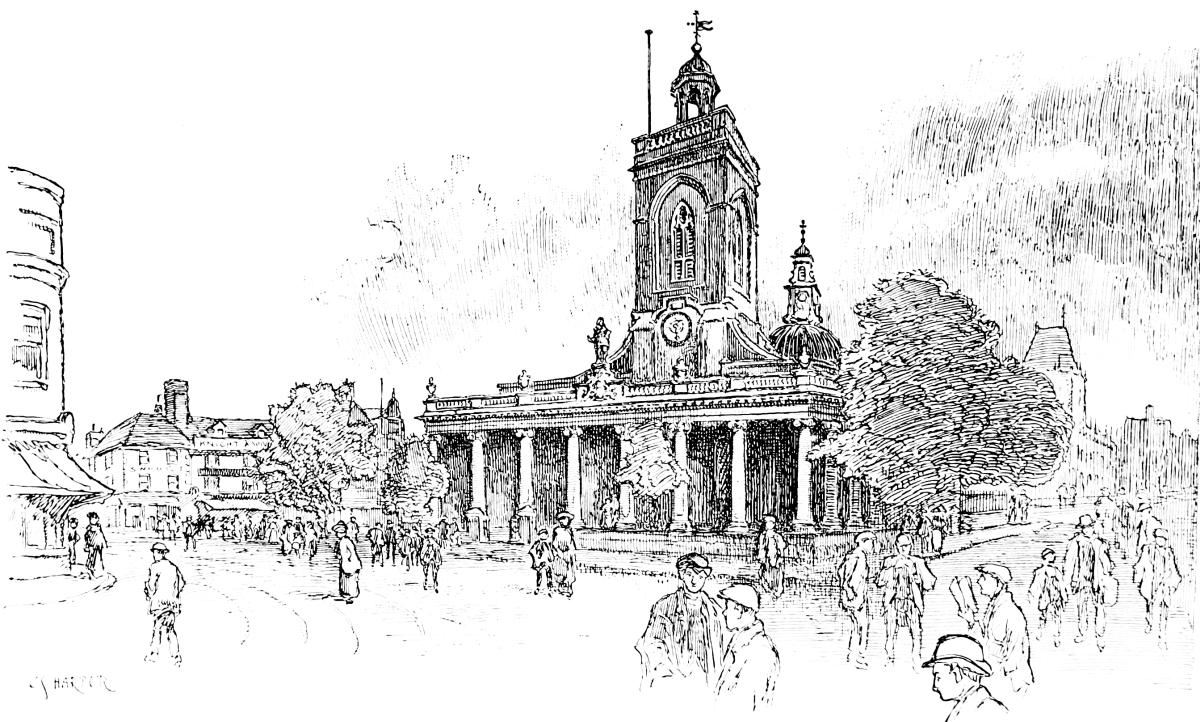
NORTHAMPTON: MARKET PLACE AND ALL SAINTS’ CHURCH.
Thousands of pairs of mud-boots were despatched hence to the Army
in the Crimea; but whence came the brown paper and cardboard boots
supplied by contractors to our poor fellows in that mismanaged
campaign? Not from Northampton, I trust.
“VOTE EARLY, AND OFTEN”
Of the Northampton Parliamentary elections, famed in the long ago for
the bitterness with which they were fought, none are more celebrated
than the “great spendthrift election,” waged in 1761 between my lords
Northampton, Spencer, and Halifax, for the privilege of nominating a
member. The enormous expenses incurred were not the most remarkable
thing about this contest, although they were unprecedented; nor was
the fourteen days’ duration of the poll a thing unheard of. The really
startling feature was the heaviness of that poll. Northampton had not
only voted its full strength of 930 electors, but 217 over. A petition
followed, and was settled, in the sporting manner of the age, by a
toss. Lord Spencer won, and nominated his man—who resided in India.
The old churches of Northampton are very fine, and highly interesting
in their several ways. There are four of them: St. Peter’s, St.
Giles’s, Holy Sepulchre, and All Saints’. It seems strange, considering
how ancient is the distinctive trade, that there is no church dedicated
to St. Crispin, the patron saint of bootmakers and cobblers. Of all
these churches that of the Holy Sepulchre is the most archæologically
interesting; but to most people it is the great church of All Saints,
in the Market Square, that stands for Northampton. And rightly
so, for it is not merely in the centre of the town, but in a most
striking and emphatic position; it is also the church selected by the
Corporation for its state attendance of Divine worship, as the fine
Mayor’s Chair in it—inscribed “Anno Majoratus 2do Ricardi White,
Anno Dom. 1680”—proves; and its curious architectural appearance gives
to Northampton a distinct personality among English towns. This is in
its present form no mediæval building, but a very remarkable structure
of the time of Charles the Second, as we may readily perceive from the
statue of him, clad in flowing wig and Roman toga, that surmounts the
pillared west front.
Along the entablature above the imposing Ionic colonnade runs the
insertion: “This statue was erected in memory of King Charles II., who
gave a thousand tun of timber toward the rebuilding of this church and
to this town.” The circumstance that made the rebuilding necessary and
prompted the gift of timber (which came from the neighbouring Forest of
Whittlebury) was the almost complete destruction of the old building in
the great fire of 1675, when six hundred houses were also burnt. The
tall tower, cased, bell-turreted, and balustraded, is a relic of the
incinerated church.
INTERIOR, CHURCH OF THE HOLY SEPULCHRE.
THE TEMPLARS’ CHURCHES
St. Sepulchre’s—properly the “Church of the Holy Sepulchre”—generally
known as “Pulker’s Church,” or “St. Pulker’s,” one of the four round
churches in England—or five if we may include the round chapel in
Ludlow Castle—is ascribed to the influence of the Templars, whose
churches were avowedly built on the model of the Holy Sepulchre at
Jerusalem. Like the Temple Church and others, it is the nave portion
of the building that is circular; the choir and presbytery branching
eastwards from it. It is in a massive and gloomy Transitional Norman
style, the eight huge pillars surmounted by pointed arches. It is
magnificent in its austerity and in the warm golden-brown hue of the
stone.
St. Giles’s, of nearly all styles from Norman to Perpendicular, and
St. Peter’s, a fine late Norman work, built about 1160, complete the
ancient churches of the town, with the exception of the mouldering old
St. John’s Hospital, now used as a French Catholic church.
The electric tramways, without which no town nowadays considers itself
fully furnished, run far out to the north, through the extended
boundaries of “Greater Northampton” to the village of Kingsthorpe: the
prosperity of the town certified to every beholder in the long lines of
newly completed streets butting on to the fields, and in the new boot
and shoe factories, from which you do not indeed hear the noise of the
lapstones—such things being obsolete in these days of machinery—but the
purr and the humming of wheels.
Just outside the borough boundaries are even more factories, built
there for the frugal purpose of avoiding the borough rates; and so,
in one way and another, Kingsthorpe, which was not so long since a
rural village, with quiet village green, has now been invaded by the
restless spirit of the age. Even the village inn has been rebuilt by
the inevitable Phipps & Co., and might now, to all appearance, save
for the sign of it, be a Jacobean mansion, renovated.
A PUZZLING MONUMENT
The apparent prodigality of the highway authorities at Kingsthorpe,
in the matter of milestones, is a standing wonder to all wayfarers,
for there, side by side, are two cast-iron “stones,” each giving
sixty-seven miles to London, with distances to other places. The
explanation of this singularity is that here, in the old days, the
Kingsthorpe and Welford Trust and the Northampton and Market Harborough
Trust met. The “stone” erected by the first gives thirteen miles to
Welford, twenty-nine to Leicester, and one to Northampton: the other
indicates sixteen miles to Market Harborough and one to Northampton.
To the right of the road on to Brixworth rises among a group of trees
on the skyline a tall obelisk that piques curiosity. Traversing muddy
lanes to the base of it, the explorer afflicted with an inquiring mind
discovers, to his disgust, that it bears no inscription, and local
inquiries result only in vague rustic talk of its being a monument
to the great Duke of Wellington. Research proves it to be to a Duke
of Devonshire; but although the rustics are thus proved to be wrong,
the attitude of mind that leads them astray is, it will be allowed,
entirely in order. From father to son the story has been handed down
that it is in memory of a Duke: what other Duke, therefore, should
be possible than the great warrior who still bulks so large in their
imagination? They rightly cannot conceive that a Duke who has merely
succeeded to a dukedom, and just existed in that state, has a claim
to such recognition. But the thing is not without its sardonic irony.
Built to keep alive the memory of an obscure dead Duke, it is known in
all the countryside as a monument to one whose fame will not die, and
needs no such memorial.
This monument that has missed its mark stands at the parish of Boughton
(locally pronounced “Bowghton”), famous, together with the adjoining
Boughton Green, for the exploits of “Captain Slash.” There was once
a church, dedicated to St. John Baptist, at Boughton Green, but the
tower and spire fell in 1785, and the district becoming gradually
depopulated, the body of the church has long been a roofless ruin.
The green is nowadays, except for one annual occasion, merely a
desolate common. In former days, however, it was bordered by the
cottages of more or less virtuous and contented peasantry, who did
so excellently well during the old three-days’ horse-fair held here
in June that they lived in comfort all the rest of the year. To the
old horse-fair resorted horsey blackguards from many a shire, who
swindled the innocent and each other, and fought and got drunk and
slept in the ditches, whereupon the simple rustics, recognising that it
was harvest-time, promptly went over their pockets. But the good old
days are done. The police established a lock-up on the ground for the
drunken and for other offenders, and then by degrees the fair itself
decayed, until to-day it is but a one-day ghost of itself. The brick
hut used as a lock-up still stands on the green.
“CAPTAIN SLASH”
But we must not forget “Captain Slash,” whose real name was George
Catherall, a desperado of the highwayman type, who did a little
rick-burning and general rural outraging in the ’20’s of the nineteenth
century, and brought his lawless career to a dramatic close in 1826.
He attempted, with the gang he captained, to let loose the lions in
the menagerie on the fairground, hoping in the confusion to make away
with a rich haul; but this desperate proposal was defeated on the eve
of accomplishment. Very ancient gaffers at Boughton still tell the
tale of dread as they heard it in their youthful days: how “Haaron
Gardner ‘it’n auver th’ yed with a nedge stake,” and so brought about
his capture, and how “Slash” was sentenced to death, and on July 21st
was duly executed at Northampton Gaol, and the land had peace. It
was certainly very late in the day for outlaws, but not too late for
superstition, for newspaper reports of the execution tell how “a number
of females immediately ascended the drop and had their wens rubbed.”
And so, passing the site of the old “Bowden” or Boughton Inn of
coaching days, to Brixworth, meeting, possibly, on the way, a straining
field of the Pytchley Hunt, in whose country we now are. You must be
careful how you enunciate “Pytchley.” John Bright once mentioned it in
the House of Commons. He called it the “Pitchley,” and stood aghast
at the howl of derision which arose from the assembled fox-hunters
masquerading as legislators. It was a fox-hunting House then, and
“Labour” (i.e. well-paid agitators acting the part) was not dreamt
of. Pytchley is your only way, although to be sure there are heretics
who call it the “Patchley.” But they are worse barbarians than Bright,
who knew no better.
Brixworth is an old, old place, truly “old arnshunt,” as the rustics
say; but the latter-day discovery that it is profitable to work the
ironstone beds situated here is just beginning to hustle the grey Roman
and Saxon antiquity of it, with a fringe of red-brick cottages. Red
brick in a country where building stone is of the plentifullest!
Many evidences of the presence here of the Romans have been discovered,
and the great grim church of Brixworth, built largely of Roman brick
and tile, has been thought by antiquaries to be, in fact, a Roman
basilica. Roman coins have also been found in fairly large numbers;
but history tells of no camp or town of that people here; and this is
no Roman road. The church, locally said to be the “oldest in England,”
appears to have been built or adapted by the Saxons so far back as
A.D. 690, and thus “Briclesworde,” as it is styled in Domesday
Book, was of a hoary antiquity even when that genuine antique, William
the Conqueror, “came over.” The church was then a dependency of the
great monastery of Medehamsted—the “Peterborough” of to-day—and until
the vicarage was rebuilt, some fifty years since, remains of a monastic
house were visible in its cellars.
BRIXWORTH CHURCH.
BRIXWORTH
The exterior and interior of the church are alike very striking, and
the curious staircase tower added to the west side of the original
tower is of particular interest, having been built on to the early
Saxon tower in later and unsettled times, for the purpose of putting
the church in a defensible condition against the forays of the Danish
rovers then laying waste the country. The entrance was formerly by a
door in the western face of the tower, but this semi-circular addition
abolished all access that way. The upper stages and the spire are, of
course, very much later, having in fact been built in the Decorated
style of the fourteenth century. Rude masonry and irregularly disposed
herring-bone patterns of Roman tile form the walls.
The interior, as of most other Saxon churches, is more curious than
beautiful, however archæologically rare it may be. It consists nowadays
of nave, chancel, semi-circular apse, and south chapel; but there were
formerly narrow north and south aisles, as the walled-in nave arcades
show. At what period these were destroyed does not appear. The apse
is a modern rebuilding of the original, destroyed about 1460, but the
ambulatory around it was not rebuilt. Large Gothic windows at various
periods replaced the original Saxon small round-headed windows of
the nave, but they have been abolished, and replicas of the Saxon
work placed in their stead; which, however pleasing to sticklers for
uniformity in matters architectural, was archæologically a crime
demanding the penalty of peine forte et dure, or something especially
excruciating. To destroy a genuine Decorated or Perpendicular window
for the purpose of inserting a modern “Saxon” one—probably framed in
with specially made “Roman” tiles—is distinctly Grimthorpian, and
not playing the game according to the rules understood by the most
enlightened. Recent excavations have brought to light the bases of
Roman columns in the churchyard and in the church itself, and in
short, ever since about a century ago, when people grow curious about
antiquities, the building has been a kind of archæological lucky-bag.
You scrape the plaster off a pier and discover a stone sculptured with
a Roman eagle; disregarding spiders and immemorial dust, you thrust
a hand into an ancient hole in the nave wall, and lo, out comes a
reliquary containing the “Adam’s apple” that once waggled in the holy
throat of Bishop Boniface. In fact, anything is possible at Brixworth:
More broken pans, more gods, more mugs,
Old snivel-bottles, jordans, and old jugs,
as Peter Pindar might say; while many intimate anatomical belongings of
the saints are doubtless even yet secreted on the premises.
WATER FLOWS UNWANTED
The road in the centre of Brixworth street dips down steeply in a
tree-shaded hollow, and is very narrow, with stone walls on either
side. In one of these may still be seen, recessed slightly, the spring
representing “Bartlet’s Well,” opened in 1631 by Margaret Bartlet “for
the use of travellers.” But although the spring is in going order, I
observe that the travellers who pass this way prefer the tipple kept at
the inn, hard by.
Two miles and a half ahead, and then less than a quarter of a mile to
the right hand, lies Lamport, but so hidden that none would suspect its
existence. The wayside “Swan” inn, opposite the by-road, derives its
sign from the Swan crest of the Ishams, the ancient owners of Lamport
(whose name, by the way, is pronounced I-sham, not Ish-am). Lamport
is a village of whose kind there are still, happily, many hundreds in
England, in spite of the hurry and fever of the age. It is small, it
is beautiful in a mild way, it is quiet, and no celebrated or merely
notorious person has ever done it the honour to be born within its
bounds. A little more beauty, a slight connection with history, and
it would become a place of resort. I suspect that this something less
than a quarter of a mile remove from the road must in these latter
days be a profound source of congratulation to the inhabitants, who
live, by virtue of it, “the world forgetting and by the world forgot,”
or at least by those undesirables who thunder along the main road
in motor-cars, enveloped, and enveloping others, in clouds of dust.
Such an one passed me on the road, equipped with some damnable new
contrivance in place of the usual horn: a shrieking something like a
soul in torment. As the yelling abomination died away and the dust
began to settle down, and the trees could again be seen and the birds
heard, I wondered why such things could be permitted to exist.
Lamport church stands by the wayside, and opposite is Lamport Park,
the seat of the Ishams. The Hall, though by no means remarkable for
its architecture, is curious by reason of the family mottoes and pious
sentiments carved on the exterior, by which you gather that the Ishams
have always been amiable persons, and prone to find amusement in small
things. Even their name seems ever to have afforded them a perennial
source of enjoyment. It suggested to some remote forbear the idea of
a punning Latin motto, Ostendo non ostento; Englished as “I show I
sham not.” This is duly set forth along the front of the Hall, together
with “In respect of things etarnal, life is vayn and mortal,” and “In
things transitory resteth no glory.”
LAMPORT CHURCH.
THE ISHAMS
Most amiable of all this amiable race was the late Sir Charles Isham,
who did indeed give Lamport a kind of minor celebrity. I think he was
the gentlest and courtliest of creatures, who, if indeed he left the
world in no respect better than he found it, at least left it none
the worse, and, ending at a ripe old age a rather aimless life, was
regretted in perhaps a derogatory way as “a harmless old gentleman.”
Thus lived and died the tenth Baronet, defeating the superstition that
all baronets are bad.
For over forty years he busied himself in constructing a miniature
rock-garden at one side of the Hall. Amid boulders piled up to
represent a mountain-range, with gullies, rock-pools and caves, he
planted dwarf-trees and rare shrubs of the stunted kind the Japanese
know so well how to grow; and there he placed among the caves and on
the miniature cliffs, groups of little gnomes: fairy miners, with
wheelbarrows and pickaxes, with the verse:
Eight hours’ work,
Eight hours’ play,
Eight hours’ sleep,
And eight bob a day.
Day after day he would sit contemplating this life-work, with one of
his pet hawks on his wrist, and his tame owls in the holes he had
constructed for them overhead. And now the hawks and the owls are gone,
and the rock-garden is uncared for.
In Lamport church a monumental brass with long inscription to his wife
reveals the man he was:
Emily
Wife of the
tenth Baronet
commenced real life
Sept. 6th, 1898, aged 74 years,
after an union of 51 years with her
thankful husband, who through spiritual light
finds that joy is triumphant over grief.
Thoughtful towards others,
Kindness itself,
Beloved by all,
At her dear wish is added
this Message,—
“Bear ye one another’s burdens.”
EPITAPH
The last words were: “I’m dying” No! my wife, This is the Portal of
the Higher Life:
I spoke no more, and neither did I weep. Next morn at nine she passed
in sweetest sleep.
Sleep on! Sleep on, my Dearest; sleep your best; After such years of
weariness now rest.
Or are you full awake? It may be so; Or in some happy dreamland? who
doth know,
That home-made elm casket deftly wrought, Betokens love: also
inspired the thought.
Although at times we might not quite agree, All knew I lived for you,
and you for me.
Oh! lovely Lamport, now she’s gone from here, I have consigned thee
to my cousin Vere.
I spake these words in truth, I show I sham not, Isham I
am, and Isham yet I am not.
The second motto “In things transitory Resteth” (and not
without some truth) “No glory,”
But still, may gifts from Heaven on thee rest, And thus that house
be glorified and blest.
Whatever there may still remain of life, At night and morn I
contemplate my wife,
And at the time appointed may we meet, And her sweet Spirit be the
first to greet.
Reader, observe, the life inscribed above, Evinced much happiness,
more pain, most love.
Charles Edmund survived his beloved until
April 7, 1903, aged 83.
This also is his monument, he objects to more.
The living of Lamport is held jointly with that of Faxton, a good
three miles away: a place with no road to it for the best part (or?
“worst part”) of one of those three miles. Why, then, does the explorer
explore in such forbidding circumstances? Aye, why indeed? I ask myself
as, quartering a succession of phenomenally water-logged meadows in
search of spots free from the fathomless mud, I make slow and painful
progress, horribly aware that the way I have come is the only route
back. Well, there is a reason in all things; even in this. In Faxton
church there is a monument to Sir Augustine Nichols, Justice of the
Common Pleas, who formerly resided here, and was poisoned in 1616, when
on circuit at Kendal, by four women, to prevent him passing sentence of
death on one of their relatives. Another monument is in Kendal church,
where he is buried.
FAXTON.
The effigy of him is kneeling at a desk, and on either side he
is supported by figures representing Justice and Fortitude, with
Temperance and Prudence above. Justice once held her appropriate
scales, but they have been broken off. The villagers, to whom classic
imagery was unknown, were firmly convinced that the scales represented
the weighing of the poison that put an end to the judge.
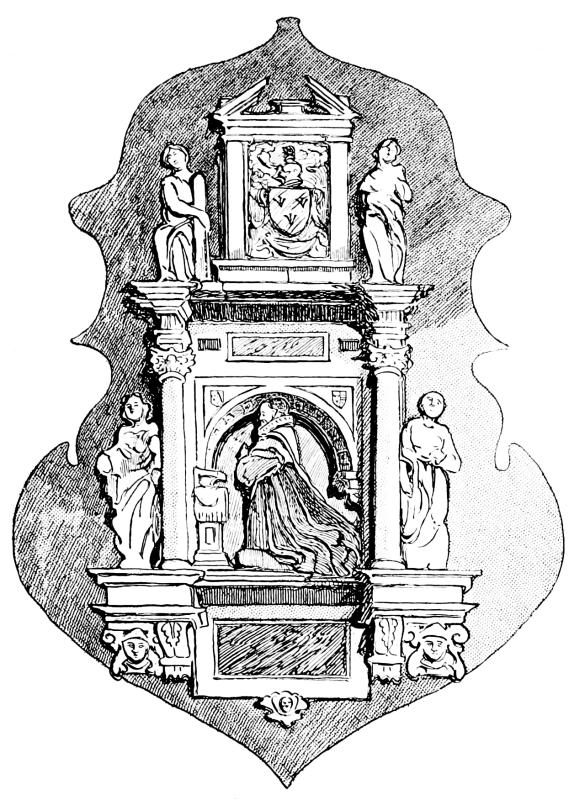
MONUMENT TO JUDGE NICHOLS.
FAXTON
The little church of St. Denis, Faxton, stands on the edge of a
wide, common-like expanse showing many traces of old foundations of
buildings, and bordered by half-a-dozen cottages, most of them far gone
in decay and deserted. There is no semblance at all of any roadway into
the place. The church itself is rotting with damp and mildew, and
giant fungoid growths, unreal and fantastic-looking as the imaginings
of pantomime, fasten themselves upon its walls, and heave up the stones
of the floor. An afternoon service every Sunday more than fulfils the
needs of the few inhabitants. But the church, of the interesting period
between the Early English and Decorated styles, shows many traces of
beauty, and there are finely sculptured corbels, an ancient font, and
a sand-table—on which, in the quaint educational methods of over a
century ago, children were taught to form the letters of the alphabet
with finger-tips in the sand.
Returning to the main road from the muddy hazards and chances of
Faxton, a steep descent leads down to the railway level-crossing at
Lamport station, and thence steeply up again to the crest of Hopping
Hill, where a “Traveller’s Rest” in the form of an elaborate wooden
seat stands on the grass, inscribed, “Rest ye, wearie traveller.
Jubilee, 1897. Reginald Loder.” It was the squire of the adjoining
Maidwell Hall who placed the seat. They do not all jubilate who
rest here, for I perceive the inscription, among others, “Sat here,
pennyless, June 1st, 1906. J. West, stoney-broke. Pray for me.”
A fine elm avenue conducts into the well-cared-for village of Maidwell,
and thence out again. On the left hand is Kelmarsh with church floridly
restored and its chancel elaborately lined with beautiful (but
incongruous) marbles which the squire, one Naylor, brought home in
his yacht from old villas in Rome. At a loss what to do with them, he
eventually gave them to the church. He lies outside, in the churchyard,
under a tomb of polished granite of the gigantesque and vulgarian
orders of architecture. All other tombstones have been abolished, and
he lies in a solitude that looks truly imperial.
THE BATTLE OF NASEBY
Away on the left, three miles and a half distant, is the field of
Naseby, on the ridge yonder, crowned by the obelisk for remembrance.
There, on that lofty plateau, on June 13th, 1645, in shock of battle,
the cause of King Charles was finally ruined, and the pursuit that
followed the fight tailed away in slaughter towards the north-west. The
unfortunate King showed to better advantage at Naseby than at almost
any other period in his career. Clad completely in armour, he was in
the thick of the fight, and would have rallied his disheartened cavalry
for a last effort, had he not been restrained. “Face about once more:
give one charge more and recover the day,” he cried, and was placing
himself in advance, when the Earl of Carnwath laid his hand upon the
bridle of his horse, and restrained him. “Will you go upon your death
in an instant,” he said, and turned the horse’s head into the flight
that then became general. It is a fine incident, but it had been
better, after all, had the Earl let the unhappy King have his way, and
go to his death in arms for his cause.
The road, descending from Kelmarsh by Clipston railway station, passes
the unremarkable village of Oxendon, and thence comes into the growing
town of Market Harborough, where we finally leave the district of the
good Northants building-stone and come across the river Welland, into
the clays of Leicestershire, and towns and villages of red brick.
Leicestershire is pre-eminently a hunting county. To name the Quorn
among hounds is to name the best known, and to mention Melton Mowbray
is to name the metropolis of fox-hunting; while the hunting-field is so
largely composed of peers that the rustics commonly address the wearer
of pink as “my lord,” leading to the well-known retort of a sporting
commoner that they “don’t know a gentleman when they see him.”
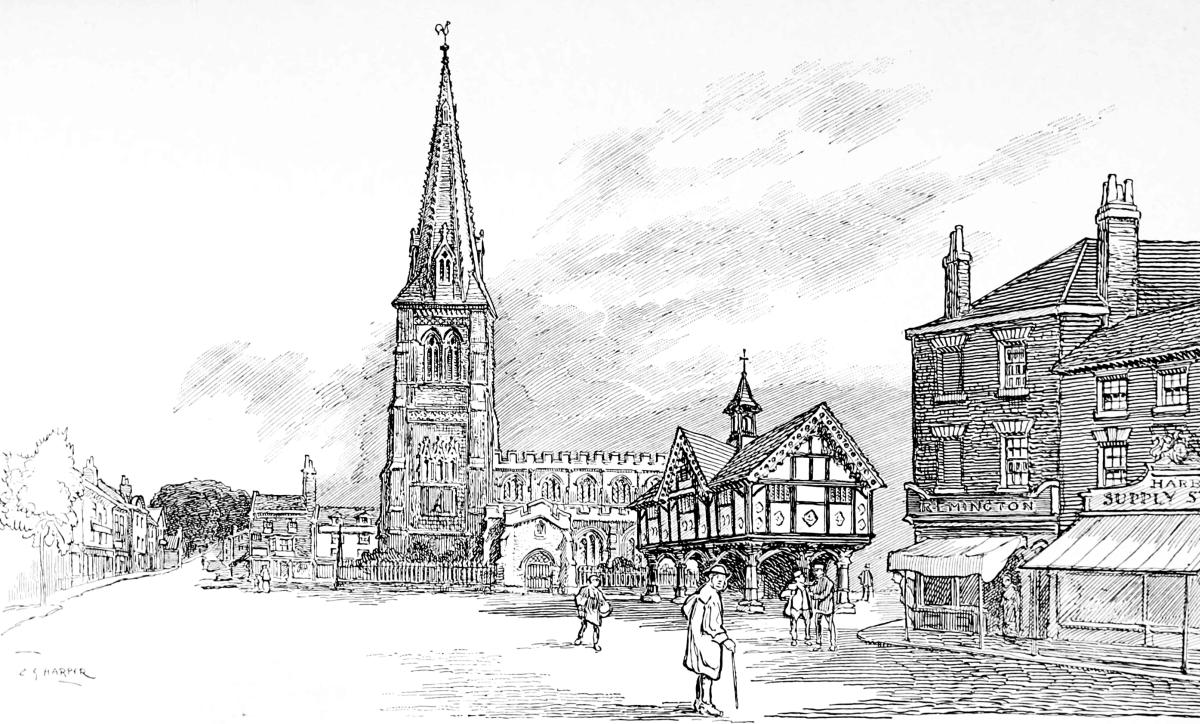
MARKET HARBOROUGH.
It is the county of pork-pies, and once claimed to rear the largest
sheep and grow the heaviest fleeces. Not so much has been said of
Leicestershire as an industrial county, but its hosiery trade is the
largest in England. Despite the stockingers, the bootmakers, and
in some districts the coal-miners, Leicestershire is nevertheless
a very agricultural and rural county. “Bean-belly” Leicestershire
Drayton calls it, and there is a “Barton-in-the-Beans” near Gopsall;
but there is, on the other hand, also a “Barton-in-Fabis,” or
“Barton-in-the-Beans,” in Nottinghamshire. The corollary of being
“bean-bellied” seems to be dull-witted; but, if we are to judge from
Leicestershire folklore, the people are gifted with exceptional humour,
of the saturnine kind, as witness this reproof to the boastful:
If all the waters wer one sea,
And all the trees wer one tree,
And this here tree was to fall into that there sea,
My sakes! what a splish-splash there would be!
And here is another example:
Yew thowt, did ’ee? Aiy,
’Yew thowt a lig,
Loike Hudson’s pig.
“Like Hudson’s pig?”
“Yais. ’Niver hard on ’em, ’a s’pose?”
“No.”
“Whoy, ’a thowt, th’ silly feller, as they wer a-gwine ter kill ’en,
and they wuz on’y arfter putten a ring trew ’is noaze.”
JOE STOKES’S PIG
There is a tragical variant of this, in which “Joe Stokes’s” pig is the
unfortunate hero—“Ye’re loike Joe Stokes’s pig: ’e thowt as how ’e wer
a-gwine ter hev ’is brekfuss, but they wuz a-gwine ter mek poark on
’en.”
The days when Market Harborough was a little market-town, interested in
nothing else but agriculture and hunting, are done. It is now, indeed,
a busy little place, and, with its various industrial enterprises, not
so little as it was. Chief of these is Symington’s corset factory,
employing 580 hands; but elsewhere may be noticed manufactories of
rubber soles and heels, pea-flour, and numerous other articles of
commerce. Its remarkably broad chief street, where the cattle-markets
and the October Fair have been held for many centuries, is still,
however, on ordinary days singularly empty; and now that a Cattle
Market, costing £28,000, has been built, is less characteristic than of
old. But it is a magnificent picture, this of Harbro town, that unfolds
itself before the traveller as he comes in along the road. There,
peaking up grandly, are the exquisite tower and crocketed spire of the
ancient church, very lovely and worshipful, with the old timber-framed
Grammar School humbly beneath, founded in 1614 by Robert Smyth, an old
City of London official, its sides decorated with plaster panels and
its stout timbers adorned with pious mottoes: the open space beneath
designed for use as the Butter Market.
The church is dedicated to St. Dionysius the Areopagite. No one need be
very greatly ashamed of not knowing precisely what that was, by way of
a profession. The Oblate Fathers suggest a problem in Euclid, and to be
an Areopagite suggests a performer on the flying trapeze; but really
St. Dionysius was not so flighty a character. He was the judge of the
Areopagus in Athens, before whom St. Paul disputed on the subject of
worshipping the Unknown God, and whom he converted. Dionysius became
Bishop of Athens, and suffered martyrdom in A.D. 95.
The interior of the great building disappoints expectations aroused by
the beauty of the outward view.
ST. MARY-IN-ARDEN
It was not until 1614 that this became the parish church of the town.
Magnificent though it be, it was formerly only a “chapel-of-ease,”
and the mother-church was that of St. Mary-in-Arden, a mile distant.
The remains of that church may yet be seen, in its grim, crowded, and
disused churchyard, woefully overhanging the railway sidings, busy
night and day, and noisy always.
I thought the dead had peace, but it is not so,
as Tennyson says.
Here the inquisitive stranger may find the epitaph of “Susanna Wells,
Cook of the Three Swans in Market Harborough, Forty-one Years. She died
19 June 1774. Aged 59 Years.” A simple calculation proves that she
began to cook early. I had rather have partaken of the cooking of her
fifty-eighth year than of her eighteenth.
In two miles from Market Harborough, as proclaimed by the
milestones—which spell the name of the town and Leicester, “Harbro”
and “Lester”—one comes to Gallow Hill, with a fragment of old road,
rugged and sunken, on the right hand, where the highwaymen used to lurk
under the shadow of the gibbet-tree. At the cross-roads below stands
what was once an inn, now divided into squalid tenements; and on the
tall ridge to the right stand the villages of East, or Church, Langton,
Thorpe Langton, and Tur Langton, remarkable for the doings of a former
incumbent.
William Hanbury, born 1725, died 1778, rector of East Langton early in
the time of George III., was a forceful person. He became rector in
1753, his father, a wealthy man, having purchased the advowson; but
he had already, two years earlier, begun his huge planting operations
in the neighbourhood. He introduced plants and seeds from all parts
of the world, but was particularly enthusiastic in the cultivation
of fruit-trees, and the neighbourhood is still, as a result of his
labours, and the example he set, exceptional in fruit-growing. In 1758
he wrote and published “An Essay on Planting, and a Scheme for Making
it Conducive to the Glory of God and the Advantage of Society.” He was
a man of ideas that grew steadily larger and more impracticable. The
first proposal, to annually dispose of the produce of the fruit-trees
and thus to create a fund of £1,500, of which the interest was to
provide for the decoration of the church, developed into a plan for
amassing a £4,000 fund for the building of a hospital and schools,
and this in its turn became a grandiose scheme for a series of Church
Musical Festivals to be held in the surrounding districts. The income
from all these sources was to accumulate until it reached a total sum
sufficient to produce an income of £10,000 or £12,000, which was to
be expended in founding a minster, a choral establishment, a public
library, picture-galleries, a hospital, schools, a printing office,
and many other things. The minster was to be in relation to all other
cathedrals what cathedrals are to chapels. A central tower was to
rise to a height of 493 feet, and its other dimensions were to be in
proportion: the western towers themselves to be 399 feet high. No other
cathedral that ever was, or would be, should rival this. St. Paul’s?
Pooh! The most magnificent buildings yet known were to be squalid
beside its walls, floors, and columns of marble, and the porphyry and
jasper that were to decorate its choir.
A GRAND PROJECT
A city, so this odd projector anticipated, would spring up around
these institutions, and included in it were to be, in his own words,
“two pompous inns.” If any difficulty were experienced in the carriage
of building materials, a canal from quarries in the neighbourhood
of Stamford was to be dug to Market Harborough, and if possible the
quarries of Ketton and Weldon were to be purchased.
When he anticipated all these things would come to pass does not
appear. A capital sum of at least a quarter of a million sterling would
be required, to yield the income he considered sufficient: and you
could not, even with £12,000 per annum, make much headway with such a
cathedral, to say nothing of these expensive sideshows.
In 1770, the income of the trust was £190 17s.; and by 1863 it had
risen to £900, when the trustees successfully applied to the Court of
Chancery to vary the trust deed, for the purpose of expending a sum
of £5,000 upon necessary repairs to the three Langton churches, and of
applying a further sum to school purposes.
The church of Church Langton is a massive Early English structure on
a large scale, containing monuments of this singular projector and
successors of his kin. It has been very thoroughly renovated from the
funds released by sanction of the Court. Hanburys still preside here.
There is a good deal of interest in the immediately surrounding
country. Away across the meadows on the other side of the road are
Foxton Locks, on the Leicestershire and Northamptonshire Union
Canal. Every visitor to Harbro hears of Foxton Locks, and is bidden
go see them; and indeed they are remarkable achievements in modern
engineering, putting those of the old canal engineers to the blush.
They are visible quite a long way off, looking like the gear at
the mouth of a colliery, and consist of an elevated engine-house
installed with powerful machinery that raises or lowers the modern
lock—practically a large tank—with barges floating in it. This replaces
the remarkable old series of ten locks that scale the hill like some
Jacob’s ladder, and are now discarded. The new lock, completed in 1898
at a cost of £37,000, was undertaken for the purpose of saving water,
wasted in large quantities in the old order of things, but a great deal
of time is also incidentally saved by the new methods.
Proceeding again along the road, the church tower of Kibworth appears
among clustered woods on a height above the railway station of that
name. The Midland Railway and other moderns call the place “Kibworth”
merely, but it is properly Kibworth Beauchamp, while adjoining is the
infinitely more handsome twin-village of Kibworth Harcourt, which,
however, has no church of its own.
“A PLAGUE O’ BOTH YOUR HOUSES”
A quaint memorandum in the register of Kibworth Beauchamp, under date
of 1641, seems to have been made by the parson as the readiest means
of absolving himself from blame for not properly keeping his books. It
runs:
“Know all men that the reason why little or nothing is registered from
this year 1641 until the year 1649, was the Civil Wars between Charles
and his Parliament, which put all into a confusion till then; and
neither minister nor people could quietly stay at home for one party or
the other.”
There is a suspicion, in the wording of this, that the parson was
heartily sick of both sides.
The Rev. James Beresford was presented to the living by Merton College,
and held it for very many years, dying in 1840, aged seventy-seven.
He was author of a book on the “Miseries of Human Life,” published in
1826, which, in spite of its doleful title, is not the work of one
who has surveyed existence and found all to be vanity; but is cast
in a humorous form, as humour was then understood. He possessed a
pretty wit, and a quaint sarcastic manner, showing prominently in the
story told of him and some junior fellows of Merton whom he observed
prospecting over his garden wall, in view of his possible decease, and
the living falling vacant.
He went out to them and politely said, “Walk in, gentlemen, walk in and
take stock, not only of the parsonage, but of the present incumbent.
Most happy at all times to do anything to oblige you—except die.”
An epitaph in the churchyard to “Mr. Lewis Powel Williams, Surgeon,”
who died in 1771, aged forty, declares “He was the first that
Introduced into Practice; Inoculation without Preparation.” A similar
claim is made at Worth Matravers, in Dorset, for Benjamin Jesty in
1774, but with the careful proviso that he was the first “known” to
have practised it.
Glen Magna, three miles onward, more commonly known by the English
form, “Great Glen,” is said by the villagers (of neighbouring villages)
to contain “more dogs than honest men.” The sting of this saying is
supposed to reside in the alleged fact that Great Glen has ever been
singularly deficient in dogs. And so it remains to this day; and, so
far as the observation of the present writer goes, the deficiency
extends to houses and inhabitants as well. Great Glen, in short, is
one of those many places that are great in name and ludicrously small
in fact. The wayside church is almost all the wayfarer sees. It has
a Norman south porch with carvings of weird horses whose tails stand
erect over their backs, like Scotch pines: a kind of horse not known
outside the region of nightmare.
THE “LONDON WAYE”
At Oadby, in another two miles, the influence of the great and still
rapidly growing town of Leicester begins to be felt. The old church
stands in the centre of the village, and narrows the road almost into
the semblance of a lane. The east window of the north aisle, looking
upon the road, is of the Decorated period of Gothic and is enriched
with the comparatively rare “ballflower” moulding. An epitaph on three
brothers and three sisters Davenport, “who lived together in a state
of Celibacy in the same House 54 years, deservedly esteemed for their
suitable demeanour and punctual integrity,” and died in the years
1820-7, seems to show that their “race suicide” was more approved then
than it would be now apostles of increase are raising their voices.
The electric tramways run far out from Leicester, and in the town
itself form a maze of lines that only the Leicester people themselves
can readily understand. The long approach by the London road, composed
as it is of the residential quarters of the wealthier classes, is the
best of all the entrances, just as Belgrave, on the north, is the
worst; but in the olden days this was “Gallowtree Gate,” leading uphill
from the hollow in which the town stands, to the place of execution.
Here you pass the Victoria Park, and so come at length to the centre
of the busy place, at the Clock Tower. But in 1600 the “London Waye,”
as Speed on his map of that date describes it, was the Welford Road,
on the left hand, which, branching from our road at Northampton, and
avoiding Harborough, came into Leicester in a mile and a half less. It
led through the town by way of Highcross Street, North Bridge, and Frog
Island. But Ogilby, in his Britannia, of seventy years later, gives
the London road as now used.
The Clock Tower, the centre of modern Leicester, is what the Forum
was to ancient Rome. Everything centres around it. Dr. Johnson said
that the tide of London life ran most strongly at Charing Cross, and
even more justly it may be said that the tide of Leicester’s busy days
eddies with greatest force at the Clock Tower. This is a particularly
fine stone structure with spire, standing in the centre of the road
where the five great thoroughfares of Gallowtree Gate, Belgrave Gate,
Church Gate, Humberstone Gate, and High Street meet. It was built in
1868, as a tribute to the memory of four Leicester worthies: Simon de
Montfort, Earl of Leicester; William of Wyggeston, the founder, in the
early part of the sixteenth century, of the Wyggeston Hospital, whose
money now also supports the Wyggeston Schools; Sir Thomas White, and
Gabriel Newton, benefactors of the sixteenth and eighteenth centuries.
Roman Leicester centred around the site of the mediæval castle, some
distance away, the Clock Tower standing outside the East Gate.
RATÆ
The antiquity of Leicester is indeed undoubted. Not only are the
remains of the Romans numerous, and continually discovered in the
course of building operations, but it is well known to have been the
station of Ratæ Coritanorum, and here the Fosse Way and the so-called
“Via Devana” meet. The Jewry Wall, so named from this quarter having
been that part of the mediæval town where the Jewish community lived,
marks the western limit of Ratæ. It is a mass of brickwork, with a
number of arched recesses, and remains to-day the chief visible relic
of old Rome. The best-received opinions hold that this is a portion of
the Roman West Gate, with fragments of a temple to Janus.
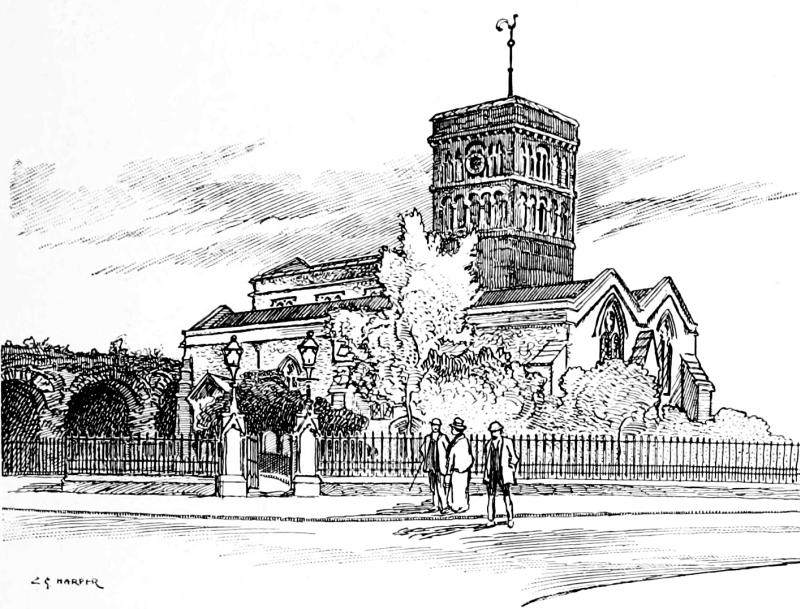
ST. NICHOLAS AND THE ROMAN WALL.
Ratæ, to have been so carefully and massively walled, must have
been a populous and a wealthy place, facts that seem additionally
evident in the many fine tesselated pavements discovered at various
times. There is an example on its original site here. They call it,
on a notice-board, “the most beautiful tesselated pavement in the
world,” and charge you 2d. to see it, but that is an ex parte
statement, and there is a better than the best a little way off, for
which the appropriately higher charge of 3d. is made. Where the
supremely bestest is to be seen, and at what cost, this chronicler
dares not presume to say. The twopenny pavement is a private show, and
the superlative example belongs, or did belong, to the Corporation.
A curious modern history belongs to it. Discovered in 1832, in
digging foundations for a house, it formed for many years the floor
of a cellar. In 1890, the house was purchased by the Corporation,
and then in 1896 came the Great Central Railway to Leicester, on its
extension to London, with its embankment and arches, and abolished many
things, among others a Quaker burial ground. The Quakers, therefore,
lie nowadays very much deeper than those who laid them there ever
contemplated; and at the same time the house with the Roman pavement
was levelled. To move the pavement would have been to injure it, and in
the end arrangements were made by which the railway company constructed
a special room, lined with glazed white bricks; and there in this
species of shrine it rests, while the trains roll overhead.
But to return to the Jewry Wall, hard by the Norman church of St.
Nicholas. It is grimy with modern filth, but reverend in its age of
some 2,000 years, and of giant strength, so that you cannot but smile
at sight of the recent flimsy pillars of brick that “support” it, and
are already themselves decrepit.
THE ROMAN MILESTONE
But the most interesting of all Leicester’s relics of Roman Britain is
stored in the Museum. This is the milestone discovered so long ago as
1771, on the Fosse Way, near Thurmastone, two miles from the town; on
its original site, as the inscription on it proves. It is a cylindrical
block of sandstone, rudely incised with a long, highly characteristic
statement in a shockingly abbreviated and ill-spaced form, which,
translated, runs, “During the Emperorship of the Divine, August, Most
Great and Noble Cæsar, Hadrian, son of the Divine, August, Most Great
and Noble Trajan, Conqueror of Parthia, in the Fourth Year of his
Tribunal Power: thrice Consul. To Ratæ, Two Miles.”
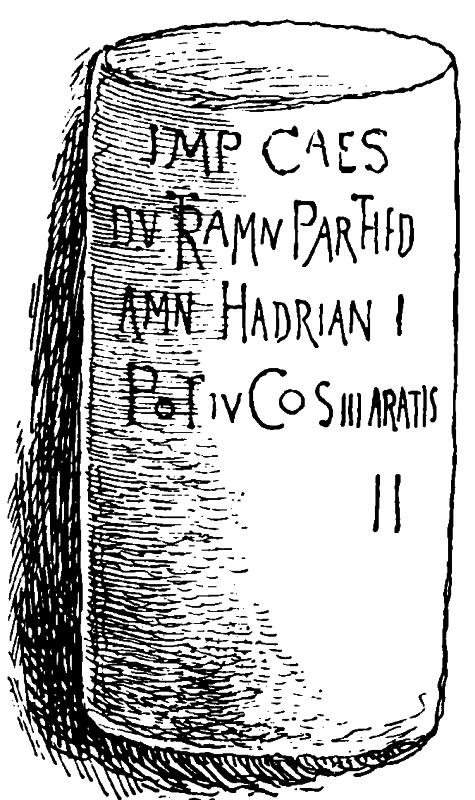
THE ROMAN MILESTONE.
I cannot withhold my astonishment, either at the miracles of condensed
information displayed in this inscription, which outvies Pitman’s,
or any other, shorthand system; or at the diabolic cleverness of
whoever first solved the problem it must have presented. It must have
puzzled even a good many Roman travellers, and to-day looks very like
a “Bill ⁄ Stumps his mark” order of monument. The Romans evidently did
not understand the first function of a milestone: to present clear
and concise information. A modern milestone made in like manner, and
inscribed: “During the Kingship of His Most Gracious Majesty Edward the
Seventh, son of Her Most Gracious Majesty, Queen Victoria, Conqueror of
the Boer Republics, in the seventh year of his reign, Emperor of India.
To Leicester, Two Miles”—would, it may be suspected, be the subject of
unfavourable criticism.
It is not a little wonderful that this relic of an earlier civilisation
has survived the rough usage that followed its discovery. It was
removed to a garden close at hand, and would have been converted into
a garden-roller, had it not been for the timeous intervention of Dr.
Percy. A little later it narrowly escaped a worse fate, for it was
claimed by one of the road commissioners, who would have had it broken
up for road metal, had not public interest become aroused; with the odd
result that this hoary relic was placed on a pedestal in midst of the
town, crowned with a conical-shaped stone, and surmounted by—of all
things—a lamp-post! Thus it remained until 1844, when, having been
nearly ruined by exposure to the elements, and to wanton mischief, it
was removed to its present home.
DESTRUCTION OF RATÆ
Ratæ suffered under fire and sword when the protection of the Romans
was withdrawn, and lay, the charred funeral pyre of its inhabitants,
for long years, the Saxons, after their custom, settling outside the
ruined place, alike for sanitary and superstitious reasons. They called
their settlement Leir-ceastre, after the original British name, Caer
Leir, and thus the name of Ratæ disappeared, save in historical
records; becoming the “Leicester” of our day; the “Less-ess-tare” of
French visitors, who cannot reconcile the spelling of the name with its
pronunciation of “Lester.”
The claim of Leicester having been the home of King Lear is based
merely on the phonetic likeness of his name to that of the British town.
The place had a new era of troubles when, in their turn, the
Anglo-Saxons decayed and a more virile race invaded the land. Then
Leicester fell a prey to the Danes, whose settlements may be traced at
this day in the characteristic ending of Leicestershire place-names in
the syllable “by,” peculiar to places of Danish origin: Oadby, Rearsby,
Dalby, Sileby, and many others.
The old churches of Leicester are fairly numerous, and very
interesting. St. Nicholas’ was built in Saxon and early Norman times,
chiefly from the materials of the Roman wall, by whose remains it
stands. Here Leicester is seen in its latest development, the
neighbourhood having been cut up and largely rebuilt since the advent
of the Great Central Railway. There remained until that event a curious
street at the side of St. Nicholas, known as “Holy Bones,” but in the
great clearances “Holy Bones” disappeared, and only gaunt remains of
houses and factories mark the site of it. The name arose from a great
find of bones here, supposed to be relics of sacrifices made in the
Temple of Janus. Their sanctity, seeing that they are thought to be the
bones of oxen, has been challenged.
St. Mary de Castro, whose spire is one of the most prominent landmarks
of the town, is unquestionably the finest church, but extraordinarily
dark. It is Norman, Early English, and Decorated, and has two naves.
But an architectural account of St. Mary’s would occupy many pages. I
like to think how here, in this very building, Henry the Sixth, at the
time only five years of age, but already four years a king, passed the
midnight vigil that formed part of a new knight’s probation. With him,
forty others were received into the ranks of chivalry. How many of them
survived the bloody Wars of the Roses that raged in after years around
the person of that unhappy King?
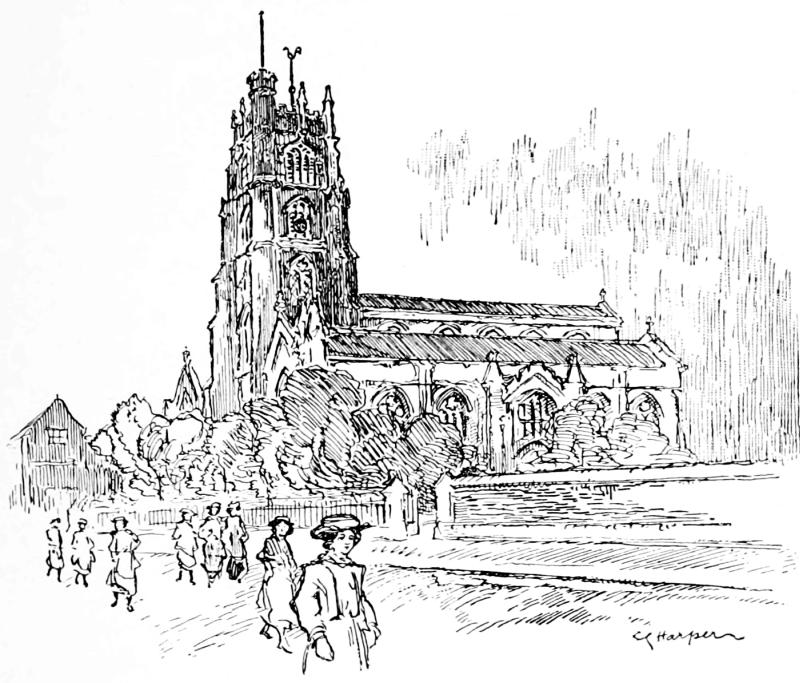
ST. MARGARET’S.
“SMOKE FARTHING”
St. Margaret’s, down in the low-lying, soggy Church Gate, is not,
in its present form, the oldest church, having been rebuilt in the
Perpendicular period, but it is the successor and representative of the
mother-church of the town, built about
A.D. 600, when Leicester was the seat of a Saxon bishop. It
stands not so far from the site of Leicester Abbey, and the street of
“Sanvey Gate,” at the corner, indeed derives its name from “Sancta
Via,” having been the way by which the mediæval religions processions
came and went. The great imposing tower, built from the proceeds of
a tax of “Smoke Farthing,” levied on the domestic hearths of the
parish, is now a very weathered and crumbling mass, but all the more
venerable-looking; and when the proposed restoration has taken place,
it is to be feared that much of the majesty of it, will have vanished
until such time as the surrounding factories have deposited more soot.
But that will take a considerable time, for Leicester is not a sooty
place.
For an example of thorough and unsparing restoration we must turn to
St. Martin’s. Strangers, gazing at the exterior and the tall broach
spire, imagine they have before them a new structure, but it is chiefly
an Early English building, and, as the interior proves, a very fine
one, and built on the site of a Roman temple to Diana. An epitaph of
strange human interest is seen by the south porch:—
“Enquiring mortal, whoe’er thou art, ponder here on an incident which
highly concerns the whole progeny of Adam. Near this place lieth the
body of John Fenton, who fell by violence May 17th, 1778, and remains
a sad example of the incompetency of judicial institutions to punish
a Murderer. He left to mourn his untimely fate a mother, a widow, and
two children. These, but these alone, are greatly injured: personal
security received a mortal wound when vengeance was averted from his
assassin by the sophistical refiners of natural justice.”
The man who slew Fenton was one François Soulés, a French officer then
prisoner-of-war at Leicester, who was at the time a guest in Fenton’s
house. The affair took place in a quarrel over a game of billiards.
Soulés was condemned to death, but the sentence was revised, and he was
in the end acquitted.
All Saints’ is chiefly interesting from the curious clock over the
south porch, originally set up about 1610, removed in 1875, and
in 1900 restored and replaced. So not all restoration is to be
reprobated. Time, edax rerum, is represented on it, with his scythe,
and above, in two little tabernacles, are a couple of miniature
Jacks-smite-the-Clock, in the costume of James the First’s time, who
strike the quarters.
TRINITY HOSPITAL
The Collegiate Church of St. Mary, in the Newarke, founded in 1331 by
Henry, Earl of Lancaster, in conjunction with his magnificent Hospital
of the Blessed and Undivided Trinity, has utterly disappeared, and
with it, by all accounts, the grandest architectural work Leicester
ever possessed. “Knights and Squires commended it as being the most
fairest they had ever seen.” I like that old phrasing: by “most
fairest” something supremely fair must surely have stood here. But the
old Knights and Squires had not, it may be supposed, seen everything,
and their testimony is not conclusive. Every one who has read ancient
accounts of fine churches knows that each one was the finest, and makes
allowances accordingly.
But it was very fine. The Reformation did well in many ways, but it
did not so in the destruction of St. Mary’s, whose only fragments may
now be seen in a cellar.
Henry, Earl of Lancaster, ancestor of Henry the Fourth, founded church
and Hospital in the four acres of ground adjoining the Castle. He
surrounded them with a wall and a defensible gateway—the “Magazine
Gateway,” as it is now called. By Hospital, of course, we understand
almshouse. It was designed, oddly enough, for fifty infirm old men,
and five women as nurses. The Hospital, “restored” in 1776, was again
restored, and very largely rebuilt, in 1902; the work excellently
well done. Interesting relics of ancient days are preserved in the
hall. There stands the so-called “Duke of Lancaster’s Porridge-pot,”
a fine bell-metal cauldron of sixty-one gallons capacity, whence the
Hospitallers were helped. What a capacity for porridge! Others more or
less resembling it are found in England, notably the Nuns’ Cauldron at
Laycock Abbey, Wiltshire.
TRINITY HOSPITAL PORRIDGE-POT.
In the hall is also to be seen “Queen Elizabeth’s Pocket Piece,” a
salt-box or nutmeg-grater dated 1579, inscribed “This belongeth to the
Olde Ospitall”; and with the moral maxims: “Thinke ° wel ° and ° say
° wel ° bvtrather ° do ° wel”; and “Flee ° idilness ° and ° be ° wel °
occupied.”
THE TOWN WATCH
In the chapel is the finely robed effigy of Mary de Bohun, mother of
Henry the Fifth. Seven morions and a number of breastplates, with a
group of halberds disposed upon the walls, once belonged to the Town
Watch, and are relics of the way in which Leicester was policed in Good
Queen Bess’s glorious days.
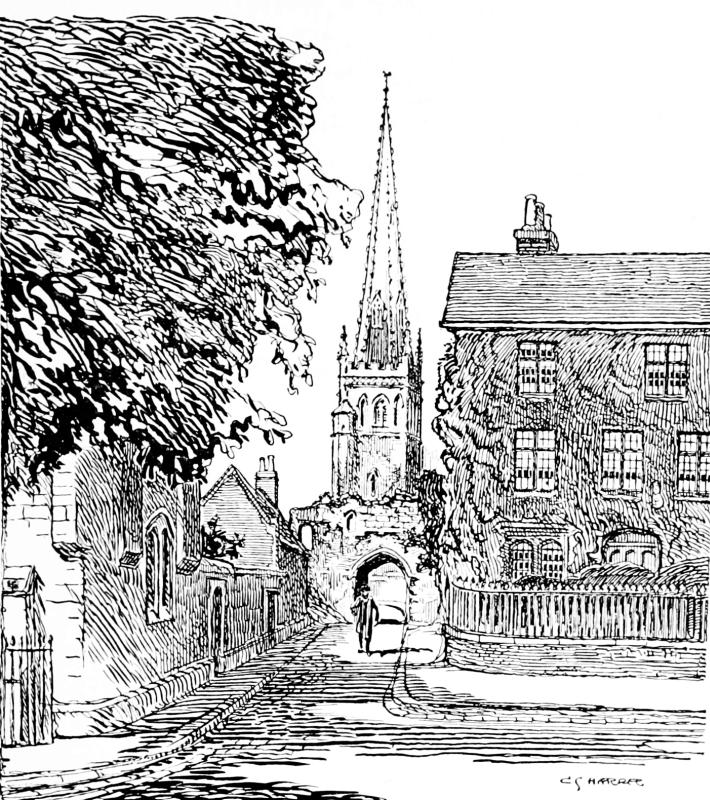
ST. MARY’S.
The Newarke is changing, like all else. A sign of the times is the
new Technical School on the site of St. Mary’s. But that is a striking
view as you enter by Wyggeston’s Chantry House, and see the spire of
St. Mary de Castro behind one of the old Castle arches. The Castle
is a mere memory now, and where the Keep stood is at this time a
bowling-green; but the Great Hall remains, where Parliaments met in
1414, 1426, and 1450; in those days when the Legislature was a more or
less perambulating body, following the King to heel, like a dog. Faced
nowadays with brick, none would suspect the antiquity of the Great
Hall, now used as an Assize Court.
The natural pendant to the Assize Court is, of course, the Gaol; but
that is removed by the length of a long street from the place of
judgment. In it is stored the Leicester gibbet, last used in 1832,
when one Cook, a bookbinder, who carried on business in a yard off
Wellington Street, was hanged for a peculiarly revolting murder. A
Mr. Paas, of London, a manufacturer of brass ornaments used in the
bookbinding trade, had been accustomed to call upon him, and Cook,
expecting his visit, had evidently prepared to murder him for sake
of the gold he carried. The unfortunate man put up at the “Stag and
Pheasant” inn, and, saying he would soon return, made his call upon
Cook the last of the day. He was never again seen alive. Cook appears
to have killed him with the iron handle of his press, afterwards
hacking his body in pieces and burning it on an immense fire. His story
of a quarrel, and of accidentally killing Mr. Paas, was, in view of
the preparations he had made—of laying in an unusual quantity of coal,
having a hatchet re-ground, and giving his errand-boy a holiday—not
believed; and eventually he pleaded guilty and posed as a contrite
sinner. After he had been duly hanged, his body was gibbeted in Saffron
Lane, on the outskirts of the town. The spectacle seems to have been
popular, according to the following testimony:
THE GIBBET
“Leicester, Aug. 12.—Our town is like a fair to-day, with
the people who are come to see Cook hanging in chains. He was put
up yesterday afternoon, at four o’clock, when all the market people
flocked in thousands to see the sight, and continued going all the
night. To-day they are coming from the villages all round; some have
walked as far as fourteen miles. Last night there were ginger-bread and
other stalls at the place, but the mayor has put a stop to all that.
It is not far from our new county gaol, which perhaps you remember.
His brother says his body shall not hang long, but it would be no
easy matter to remove it. It hangs about 35 feet from the ground, and
is dressed in the same clothes as when he was hanged. We hear his
bowels have been taken out, to try the experiment of burning them. It
is currently reported his father has died to-day of a broken heart.
I think it is very likely to be true, as he was very ill last week.
The Ranters have been preaching under the gibbet this morning, before
breakfast, and will again to-night. It is thought there were 40,000
people to see him hanged, but there will be many more to see him now
hanging, if they continue to come as they do to-day.”
Riots followed, and the body was speedily removed. Two years later, the
custom of gibbeting, or hanging in chains, was abolished by statute,
chiefly owing to the disgraceful scenes enacted here.