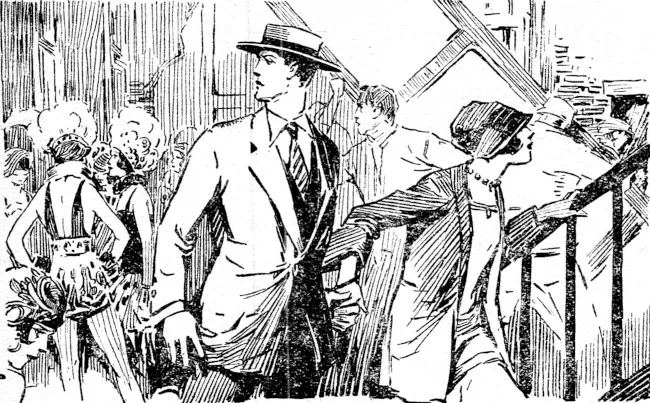
They stood at the stage door. "We'll leave you here," said McGuire.
Chuck nodded. "The West car followed us all the way."
"Sure. They'll be out front. Maybe they'll want to see you after the
show, or during the show. Don't you see 'em, kid!"
"No, I won't."
"Dr. Adams and I will come up to your dressin' room—"
"At ten thirty," Elsie put in.
"Right. An' don't worry, West ain't goin' to try any strong-arm
stunts. Not around a theater. An' not when he knows now that you got a
bodyguard."
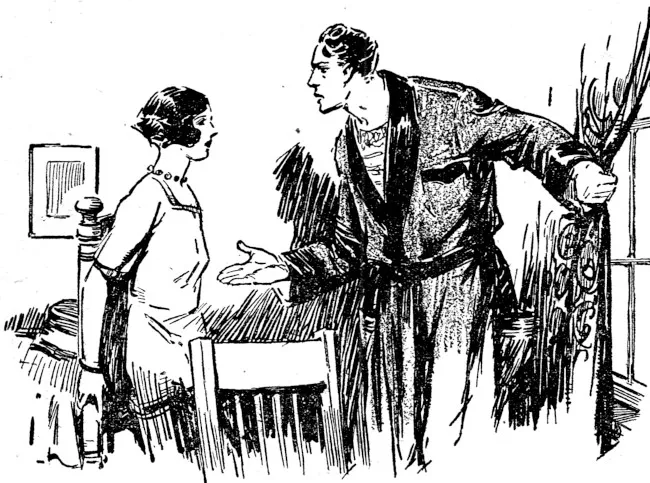
Dr. Adams drew Chuck aside. "Keep your mind off this, lad. For the next
few hours, get into the spirit of your work. Chuck Daniels—opening
night—you've got work to do."
"It would queer him in the show if he didn't keep his mind on it," said
Elsie.
The physician added, "But I mean more than that. Dr. West will be out
front. In a box, probably, where you'll see him. Perhaps he'll have his
family with him—your family, Leslie."
Chuck started. Went pale. The physician saw it, and gripped him by the
arm. "That's just what I mean, boy! You're brave enough—my God, I can
appreciate what you're fighting! And West knows it. When you see him
out front you'll feel more like his son than you do now. He's playing
on that. He'll ask you to meet him, and your mother. You won't feel
like refusing! Leslie West, denying his father and his mother, and
his fiancée, that girl Gloria—for what? For me, a stranger? And this
detective?"
Chuck stood shaking. "Don't talk like that!"
Elsie clung to him. "He's only warnin' you, Chuck."
"I know. I'll be careful. You said you had a surprise—"
"Forget it!" Dr. Adams commanded sharply. "Forget everything but Chuck
Daniels—on his job, making good in this performance."
"I will," Chuck promised. "Elsie, from the minute we go inside, I'm
Chuck Daniels, get me? Chuck Daniels, helpin' us put our act over.
We're gonna make a hit, baby. We'll hold Zanetti up for a raise by
to-morrow."
The physician shook his hand. "That's the talk."
"Well, see you later," said McGuire. "We'll be in the orchestra,
wishin' you luck."
They departed. Chuck and Elsie went through the stage door. It was just
eight o'clock. The place was a hustle and bustle of confusion. The
nervousness back stage was at once apparent. It permeated every one,
from the suave, debonair Zanetti with his fiercely upturned mustache
down through the principals and chorus girls to the lowliest call boy.
The stage hands cursed unreasonably when a rope got tangled. To-night,
of all nights, ropes were tangling frequently. The electricians cursed
the lights. Out front the orchestra leader gazed over the musicians and
wondered if they would go dumb and forget how to read music. To-night,
of all nights!
The doorman said, "Good you're on time. Zanetti's raisin' hell. An' you
missin' the rehearsal this afternoon."
"Not raising hell with us," said Elsie. "Man, he wouldn't dare speak to
us. We ain't takin' nothin' from nobody to-night. Come on, Chuck, let's
get upstairs."
They reached Chuck's dressing room.
"I wonder if they're out front, Elsie?"
"They?"
"The Wests."
"Forget 'em." She gazed at him anxiously, then turned and left the
room. He donned his costume and put on his make-up. He grinned at
himself in the mirror, but the grin was wrong. It didn't match his
staring eyes. What was the surprise Dr. Adams had for him? No, he
mustn't think of things like that. He was Chuck Daniels, afraid of
nothing. But his father, maybe his mother also, and Gloria, would be
out front.... No! Those were Leslie West's people!
Alone here in the dressing room, he was conscious of the thoughts and
the fears which were the Leslie West in him. He was Leslie West! He
thought, "God, I'm two people! It's horrible."
"Nervous, Chuck?" It was Elsie's voice from the room next door.
"Don't be nervous, honey—we'll be the hit of the show." He heard her
laugh—but it was a high-pitched, almost hysterical laugh.
At nine o'clock she was ready, and she came in. A little black and
white Columbine. He thought he had never seen her look so alluring.
She eyed him. "You all right, Chuck? I mean, not nervous over the show?"
"No."
"Then come on, let's go."
The hosiery girls were crowding back stage. Zanetti was striding up and
down, furious at something; and then smiling, waving his fat hands.
"It is beautiful. It goes most beautiful. Everybody do their best
to-night, see?" He smiled at the girls. "You are most beautiful, girls.
Never forget that. Out front they love you."
The hosiery girls were herded off to the wings. They stood at the side
where the stage was visible. Beyond it the left-hand box showed. The
Wests were there! Elsie tried to stand in front of Chuck, but he saw
them.
Gloria was resplendent, with calm, haughty dignity in the front of the
box. The reflected light from the footlights gleamed on the satin-white
smoothness of her neck and arms. Behind her, in a position not so
prominent but still perfectly visible, sat Mrs. West. Leslie's mother.
All Chuck's flooding memories told him it was so. Cold and haughty.
Disdainful. Her gray-black hair rose in a wave from her forehead. Her
ample bosom was wide with lace, and jeweled with a brooch and a rope of
pearls.
As Chuck stood watching, she raised her lorgnette and surveyed the
audience with a cold, haughty stare. Behind her and Gloria in the dim
seclusion of the loge showed the white shirt fronts of Dr. West and
Gloria's brother Leamington.
The hosiery girls did their dance.
Elsie whispered, "Almost us, Chuck. Get your nerve."
She had not mentioned the Wests. Chuck said nothing. He was staring at
his mother. And then he was out on the stage, dancing with Elsie. He
tried to forget his mother. He would not look that way. He gloated in
the laughter of the audience; they liked him, anyway!
He was horribly nervous at first. His knees quaked as he danced on the
sides of his shoes; but the nervousness presently passed. It was going
big. Chuck and Elsie! Going big. He carried Elsie off on his shoulder.
They took their bows. There was more applause to-night than last night
in the hick town.
"Great stuff, Chuck. We knocked 'em."
He did not answer. He felt suddenly that Leslie West was surging
uppermost in him. His mother out there. There was a moment when
Chuck was wholly conscious of the fight within him. His mind was a
battleground. And then he no longer thought of it that way. Chuck
Daniels was being submerged; he began thinking, reasoning unconsciously
as Leslie West.
He stood with Elsie, watching the stage. The comedian and his fat wife
were buying hosiery. Chuck could see his mother here from where he
stood in the wings. He could feel her shrinking at the coarse jokes.
"But listen, Momma, how can we buy what we don't see?"
And that other, worse crack, "Momma, listen, I got to measure these
stockings, don't I? You can't go by the marked sizes."
He could feel his mother shrinking at the coarseness of it. Putting
herself through this to appeal to him. And Gloria was appealing,
too. Could a man with any sense of decency and honor break his word
to a girl whom he had promised to marry? She sat there so beautiful,
cultured, refined. That was it: refined. So different from this tawdry
tinsel of the stage. Was this all the decent side of life appealing to
him; trying to win him from the coarseness, vulgarity?
He was very silent as he and Elsie went back upstairs. Elsie noticed
the change. She was white and tense, but she said nothing. She left
him, to change her costume for the Egyptian scene. He sat staring into
his mirror. He was hardly conscious of the time passing. Then Elsie
came back. She swaggered across the room with her anklets clanking. She
stood at his dressing table and powdered the white flesh of her legs,
her arms, her neck. The vivid red of her loin cloth, the red and gold
breast plates, the red of her angular Egyptian headdress all matched
her painted lips. A red and white temptress. Was that what she was?
She dashed the powder over him and laughed. And then something his
father said last night echoed in his mind, "You're a rich man's son,
Leslie. Don't get mixed up with a chorus girl."
"We're knockin 'em dead, honey. Zanetti's tickled."
He said vacantly, "It's going all right, then?"
"Yeh, great."
Presently they were again on the stage. Bathed in the moonlight of the
flood-lights, with the shimmering Nile behind them. Hundreds of admiring
eyes staring from out front. But from the dark void there Chuck could
feel only the stare of his mother. Elsie was dancing around him. Red
and white temptress. Mockingly beautiful, alluring. In the play she was
tempting this country youth from the States who had wandered down here
on the banks of the Nile with his wide pants and his foolish grin. A
pantomime. Neither of them throughout the show had a line to speak.
He danced his loose-jointed, eccentric dance, Elsie writhed in a circle
around him. Her slender white arms were like sinuous snakes. The music
was exotic, sensuous. But cleverly mingled with a jazz rhythm. He
seized her. He whirled her aloft. His hand was gripping her bare leg.
The thought flashed to him, "Gloria is out there." Gloria shrinking.
His hand on Elsie's leg was burning him. Gloria's love for him would be
disillusioned.
He tossed Elsie away. He stood grinning at her. He went through all
the gestures of the pantomime. He held her close with a grotesque
simulation of passion. Held her against him; and she leaned far back,
her face mocking, smiling up at him. Her painted lips whispered, "Great
stuff, Chuck, we're doin' fine."
They took their encore. "Gee, we put it over, Chuck. We sure did."
The performance went on. At nine thirty a note came from Dr. West:
Leslie, I will see you at the stage door after the performance. Do not
deny your mother, son. She is pleading for you.
He and Elsie stared at it.
"They can't see you, Chuck."
"I—"
"Oh, Chuck, darlin'." It terrified her. "Chuck, remember what Dr. Adams
said!"
In Chuck there had always been a strong urge of love for a mother. An
instinct—Elsie had spoken of it. Chuck Daniels had written a "mother
song." Zanetti had accepted it for the show. Chuck had written it with
a flash of genius—an inspiration—an instinct.
He felt now within him a surge of love for his mother. This mother out
there in the box, with her weak heart, was pleading for him. He was
disappointed in this mother, but the instinct to love her was there.
"Chuck!"
"But I must see them, Elsie! My mother—"
She stared. She shook him by the arm. "Chuck! You can't!"
He thought vaguely, "No, I can't! I'm slipping." He said, "Well, you
see—"
"I'll send 'em the answer." She seized a pencil and scribbled on the
note. She showed it to Chuck:
"That all right, Chuck?"
He was slumped in his dressing room chair. She dashed out and
dispatched the note.
He strove to get hold of himself. At nine fifty he was ready for their
last scene in the show: the Tenement Scene. He was dressed now as a
poor but romantic young man of the tenements. His shirt, smeared with
the dirt of honest toil, was open at the throat, exposing his bronzed
neck. He was made up to look as handsome as he could. Elsie said that
he was handsome.
He stared at himself in his dressing room mirror. He tried to appraise
his face, strongly masculine but sensitive, almost poetical; romantic
blue eyes, curly brown hair, brushed smoothly back. A delicate-looking
fellow, but not sickly. That's the way Elsie had sometimes described
him. He wondered suddenly how Gloria would describe him. In this
tenement scene would Gloria see him as the romantic young toiler,
seated all day in the factory at his soulless machine, but with his
sensitive soul dreaming his dreams, and now come home to his tenement
singing his song of those dreams? Would Gloria see it that way, or
would She think it all very cheap and tawdry?
Elsie came in; she was dressed like a little factory girl.
"Time, Chuck." She put her arms around him as he stood up. "Honey,
dear, you're not yourself. Buck up, kid, put this over. This is the big
scene."
Then once more he was on the stage. Alone on the stage now, holding
this vast audience. The painted walls of the tenement kitchen were
around him. He sat in the broken rocking chair by the stove. The stage
was dim. A single lamp stood on the kitchen table, on top of the red
tablecloth. The lamp shade hung crooked. He hitched his chair so
that the circle of lamplight would strike the side of his face. The
auditorium was dim and hushed. He caught the leader's eye. The baton
went up. The strains of his sweetheart song began.
He sat singing it:
"How a girl like you could love a boy like me,
Is something I can't understand—"
He stared off into vacancy. Behind him lights were lighting back of a
transparent drop. A vision of Elsie, his little factory sweetheart, was
showing.
He sang the song through:
"And so you are in love—with just me."
The vision of Elsie was fading now. He thought suddenly, "I wonder if
Gloria is sneering?"
The applause died away. Zanetti had said, "A novelty, see? One song on
top of the other." From the sweetheart song, before the applause had
ceased, the orchestra modulated into the different key of his mother
song.
He began it. He cleared his throat nervously. He was nervous; nervous
as the devil. He saw the orchestra leader flash him a warning glance;
he began singing, and there was no nervousness in his full, rich
barytone voice. Untrained, but winning for that very quality—its
youth, its strength, its untrained naturalness.
"I've a dear old pal who's waitin'
In a cottage by the sea—"
His song. He had composed it, as Elsie said, inspired by genius. A
flash, like a vision, of himself seated at the piano composing it, came
to him. He rose from the broken chair—the familiar business of the
performance. He wandered to the footlights, still singing.
He threw himself full length on the stage, on his stomach, with his
elbows down, his face raised, his chin cupped in his hands, singing,
staring at the audience over the footlights.
"Mother mine, you built a little nest,
Mother mine, you always did your best—"
But out there in the crowded darkness was the reality of his mother. He
did not see her. He did not want to look at her. But the vision of her
was clear before him. Sitting out there with her upraised lorgnette.
She thought all this was banal, childish, tawdry. It seemed a mockery
to him that this should be his mother. Or was his song a mockery? He
had written it in the fog of blurred memory. Inspired—Elsie had said
that.
He heard the applause ring out. This theater-full of people didn't
think it was banal. It gripped them. They could feel what it meant to
have a mother who was a dear old pal.
He was singing again, the second verse now. He still lay stretched full
length on the stage, peering over the footlights to make the audience
feel that they were his vision of his mother; to make every mother out
there in the audience respond to him. Every mother but his....
"Mother mine, I know you're waitin',
Patient, gentle, kind and true—"
Every mother but his. Then in spite of himself he turned his glance
to the box; and he caught a glimpse of that upraised lorgnette. A
travesty. A mockery of motherhood. He faltered in the song. Almost a
sob was in his voice. It was a cry of protest from his heart.
The orchestra leader's face was near him, just to the right, hardly
fifteen feet away. He caught another warning glance. He steadied his
voice, thinking, "I never had a mother, a real mother."
The audience thought his sob blended with the song. It did. It was very
real.
He ended the second chorus:
"I could never find a better pal, mother mine,
An' so I'm comin' back, I'm comin' back to you."
The strains of the orchestra died away. He stood up to take the
applause. He bowed with a graceful dignity which had been taught him;
then found himself in the wings, listening to the applause.
"Gee, Chuck, that was great."
"Was it?"
"It sure was. Wonderful. The hit of the show, honey."
She pushed him and he went back out, bowing again. His gaze was
attracted to the right-hand stage box. It was directly opposite the one
the Wests were occupying. It had been empty all evening, but there was
a movement there now. People were coming in to take their seats.
Chuck stood stricken: stood staring at a white-haired,
bewildered-looking woman in black; and two men with her—Detective
McGuire and Dr. Adams! They came in and sat down, secluded in the rear
of the box, carefully hidden from the audience by the portières.
Chuck was standing frozen. Elsie reached for his arm, jerked him into
the wings.
"Easy, kid! Take your encore, honey."
He whispered: "But—" And then he knew. It flooded him. "My mother! My
mother!"
"Sure it is, honey!"
"My mother!"
"Yeh, Mrs. Daniels! Widow of Charles 'Happy' Daniels. The
old-timer—your father, Chuck!"
He hardly heard her words. "My mother!"
"Sure, darlin', that's who it is. You can remember now, Chuck! You got
to remember."
"I do! I do!" he whispered.
She pushed him. The audience was still applauding.
"Go out and take another bow!" Elsie whispered vehemently. "Let 'em
rave an' then give 'em the encore."
He went back onto the stage. He bowed. His gaze was on the right-hand
box. His mother!
And then he saw her recognition; saw her half start to her feet and
then sink down again; saw her hands go out to him, and then saw her
shrink back as Dr. Adams whispered to her.
Chuck bowed; he retreated into the wings. He waited until the applause
was almost gone. He muttered to himself: "I'll sing it for 'em!"
A triumph swept him. A weight had suddenly vanished; freedom had come,
as though shackles were fallen away. Leslie West was gone! He knew
now, at last, that he was the real Chuck Daniels. Leslie West was the
phantom, the intruder. A flood of new memories were raging in Chuck. He
muttered: "That dirty crook West!"
But his thoughts were checked by the need for action. The stage was
waiting. He sang his song again:
"I've a dear old pal who's waitin'
In a cottage by the sea—"
He realized that he was singing it as never before. Lying there,
prone at full length, staring over the footlights; staring into that
right-hand box.
He was only vaguely conscious of the song. His memory was winging back.
This was his mother! He could see her smiling at him with tear-stained
face as he ended:
"I'm comin' back, I'm comin' back to you."
There was a genuine wild burst of applause when the song closed. The
detective leaned over and pulled the portières more closely to cover
the shrinking woman. His mother!
He found himself back in the wings, with Elsie's arms around him.
"Wonderful, darlin'! You lifted 'em out of their seats! You got 'em all
snifflin'."
He stammered: "You found her?"
"We sure did. It wasn't very hard. She was right there in Sea Cove,
Delaware. The name of the town you gave me last night."
"Of course! Of course she lives there! That's where I was born and
brought up."
"Oh, Chuck, you can remember it all now?"
His eyes were flashing. "That damnable villain West! Come on upstairs,
Elsie. I want to see my mother."
"They're bringin' her here."
"An' I want to see Dr. Adams right away! That man West—he's
diabolical!"