Not everywhere did the phenomenon of darkness make its appearance
so quietly. In London a bright sunshiny morning had been in being.
The streets were filled with traffic. Children played in Kensington
Gardens. Small tugs puffed importantly up and down the rather
inadequate Thames.
In the houses of Parliament an impassioned debate was going on upon
the subject of the manorial rights surviving in the village of Muttle
Deeping, West Harborough, Hants. At the palace, a popular member of the
royal family was in the act of entering a motor car to lay his fourth
cornerstone for the week. London was, it is clear, in the middle of a
normal, sunshiny morning.
Then the sky flickered, and all at once it was night. The sky was a
dead, jet black. For a moment the city was stunned, before motor car
headlights flamed into being. Two minutes later electric light bulbs
began to glow in buildings. They dimmed, however, as the drain upon the
power houses grew far more swiftly than the dynamos could be prepared
to meet the load.
It was half an hour before the street lamps began to glow dully, and
over an hour and a half before the city was illuminated as in a normal
night, by which time the first and natural explanation of an eclipse in
being was patently untrue. No eclipse ever lasted so long. And panic
swept over London and all England.
In Budapest the darkness fell at high noon. In Madrid at eleven. At
Stamboul—Constantinople—the sky was blotted out while myriads of the
faithful bowed in prayer. In Calcutta the colors of the sunset were
wiped out by an instantaneous curtain of utter darkness.
At Flagstaff, Arizona, an astronomer was peering patiently through a
giant telescope at the planet Mars when the planet and all the stars
beyond abruptly seemed to cease to be. He thought the telescope had
met with some accident. Even later, when from the outside of the
observatory the whole sky was seen to be blotted out, he still thought
the obscuration due to an extremely heavy bank of clouds. But he
puzzled bewilderedly over the suddenness of their forming.
Professor Schaaf was probably the first man in the whole world to
evaluate the phenomenon at its true value. As May the fifth was the
wedding day of his bosom friend Hines, Schaaf had spent the previous
night at his flat, to listen patiently to the advantages of matrimony.
He had shooed Hines benevolently to bed at two in the morning, and had
slept peacefully himself. But at seven Schaaf was awake and found it
dark outside.
The scientist looked at his watch and blinked, and listened to its
ticking. He got up and stared out over the city, illuminated as if at
midnight and already stirring. He saw the bright ribbon of an elevated
train, several blocks away. He could see that it was filled with people.
He went to the telephone and called the apartment telephone operator.
The Negro's voice came up gladly:
"Ya-as, suh, Professuh Schaaf! Seben o'clock. But, Professuh! Ah wish
yo'd tell me 'bout dishere eclipse. Hit's dark outside, suh. How long's
the eclipse goin' to last, suh? Sev'l of the tenants done asked me
a'ready, suh."
Schaaf grunted, and turned around to squint out of the windows again.
"Der defil! Hm... Giff me der Meteorological Bureau. Find der number
and call me back. I find out."
He padded to a window in carpet slippers. He heard Hines breathing
evenly and regularly in the next room. Schaaf raised a window and
stared up at the sky. An even, velvety black. No variation anywhere.
As black as ink—blacker. Blacker than the darkness of an eclipse,
because even during the moments of totality the stars can be seen. And
starlight even upon a thick blanket of clouds would give more light
than this.
Schaaf put down the window, blinking. He stood quite still, a
disreputable figure in dressing-gown and slippers, with his luxuriant
blond beard uncombed. And suddenly his eyes opened very wide, and he
began to swear softly to himself.
He went back to the telephone.
"Der Meteorological Bureau? Professor Albert Schaaf speaking. Will
you giff me der bolometer-reading of der moment?... Der bolometer
reading! Der amount of heat being radiated to der earth from der sky!
Yes!"
He fumed and fretted while the telephone receiver was silent. Then he
became intent.
"Yes... Hm... That is larger than a night reading, hein?... What
would be der reading during der moments of totality of an eclipse?..."
He shook his head impatiently. "Nefer mind der corrections for
latitude. Abbroximate! Giff me der figures!"
Again he fumed nervously.
"Fery well. Thank you. Abbroximately one-fourth der normal amount of
heat is being radiated to der earth from der sky. Which is too much
for an eclipse, and fery much too much for night-time. I thank you. I
thought I was cuckoo in der head."
He hung up the receiver and swore classic German profanity while he
jiggled the hook.
"Der verdammt deffil!" he said bitterly; then, into the telephone:
"Get police headquarters at once. Hurry!"
He scowled at the universe, represented by a section of Hines's library
wall, until a voice answered. "Hello!" he said savagely into the
transmitter. "This is der Herr Professor Albert Schaaf. You know me?"
A prompt affirmative came over the wire. In those few circles where
Schaaf was unknown on his own account—few indeed after his notable
part in battling the scientific fiend Preston—he was known as a friend
of Police Inspector Hines, who had directed those fights.
"Now listen carefully. I am in Hines's apartment. He is still asleep.
I haff not wakened him because he is going to need sleep before this
thing is finished. But I giff an order in his name. Send some police at
once to giff adequate protection to Miss Kathryn Bush, who is to marry
Inspector Hines to-day. I haff reason to think she is in danger. Send
them at once, and send plenty of them! You understand?"
A grunt of astonishment at the other end of the wire. Then the incisive
voice of a man of action.
"Good!" said Schaaf, nodding into the telephone transmitter. "Fery
good. And then if you haff more men to Spare, send them up to watch
ofer Hines and me. We need them. And speed is der essence of der
contract."'
The incisive voice asked a question.
"Think!" said Schaaf sardonically. "Look out of der window and think,
if you can, of one man who makes a specialty of raising hell with der
heafens, and who has no fondness for Hines and me. That is der answer.
Good-by!"
He hung up decisively, drummed nervously on his knee, and called
Kathryn Bush. She was not only Hines's fiancée, she was a very capable
newspaper woman, and Schaaf alternately scolded and flattered her
outrageously. He liked Kathryn very much, and since Hines was going to
marry somebody, Schaaf approved his choice.
Her voice came clearly, hurried and uneasy.
"Hello! What is it?"
"Miss Bush," began Schaaf apologetically, "I am sorry that I am not
Hines, but—"
"I'm leaving now," said Kathryn in a strained voice. "How is he,
Professor Schaaf? Is he conscious yet?"
Sweat stood out suddenly on Schaaf's forehead.
"Gott in Himmel!" he said unsteadily. "I am just in time! Miss
Bush! What kind of message haff you got? Hines is all right. There is
nothing wrong. What haff you heard?"
Her voice—doubtful and desperately anxious—came over the wire, "Your
note said there'd been an explosion and you both were hurt—"
"It is a forgery!" snapped Schaaf. "For der lofe of Gott, do not leafe
your apartment! Call to der police! Raise der deffil! But stay where
you are! Did you not look out of der window?"
There was a little pause, and he heard her gasp of amazement.
"I—I was awakened by the message," she said unsteadily, "and I didn't
think of anything.... It's Preston, isn't it?"
"Der bolometer-reading has his name on it," said Schaaf grimly. "I haff
telephoned der police to go to your house at once. I haff not waked
up Hines, because I just found out what has happened. It must be der
Heaviside Layer gone cuckoo. Stay where you are!"
"I will, I—I'm glad you telephoned."
"And so am I," said Schaaf from his heart. "You will telephone, Miss
Bush, efery few minutes until der police come? They are on der way, but
it may be minutes yet before you are safe. I am going to wake up Hines
now."
"A-all right," said Kathryn. "Don't be afraid for me."
He heard the click of her receiver on its hook. And Schaaf wiped great
droplets of sweat from his face.
"That deffil," he said unsteadily. "Oh, that damned deffil!"
He went padding into Hines's bedroom and shook the sleeping man.
Outside, the world was dark save for a multitude of electric bulbs,
which pierced the darkness with the effect of magic. Elevated trains
were roaring all over the city, now. The people of the cities of the
Atlantic coastline took the sun's absence with a quite astounding
calmness. They classed the darkness as that of an eclipse, and
thousands of offices opened, and hundreds of factories began their
work with nearly full forces of workers on hand, though the telephone
switchboards were nearly swamped with vain demands on the newspaper
offices and weather bureau for information they did not have.
In his bedroom, Hines sat up and blinked, and was wide awake. He
grinned at Schaaf.
"Good morning! This is my wedding day, isn't it?"
"I haff my doubts," said Schaaf soberly. "Hines, damned near der worst
has happened. Preston is on der job again."
Hines was on his feet in seconds. "Kathryn—?"
"Is all right," said Schaaf. "I telephoned her minutes ago. She is all
right and she is going to stay all right. Look out of der window and
then at der clock." Hines stared blankly. Brightly lighted streets.
Brilliantly illuminated stores. Elevated trains like streamers of fire,
moving along distant steel trestles. Eight o'clock in the morning, and
the sky was black with an utter, unrelieved blackness.
"But—it's night!" said Hines blankly.
"Verdamm!" said Schaaf impatiently. "Of course it is night! Night
in der morning." He dropped into one of the wholly incongruous 'slang
phrases that adorned his speech. "You are darned tooting it is night,
Hines! Der sun did not rise this morning."
"The—sun—did—not—rise—this morning," said Hines slowly. "I—see."
The telephone rang shrilly. Hines started, and moved to answer it,
while Schaaf stared out at the incredible darkness that lay upon the
world hours after daylight should have appeared.
His identification of the darkness with a man named Preston was not
an accident, of course. There was just one man in the world who could
cause meteorological disturbances on a large scale, and the three
previous disturbances of Preston's creation had been somewhat like this.
It was one of Schaaf's bitternesses that he had unwittingly helped in
the development of the apparatus which had done so much harm. More than
a year before, he had done some highly abstruse technical research
for an electrophysicist named Preston. Schaaf's share had been the
determination of the mass and dimensions of the ionized bodies in
atmospheric air.
He had done that work, not guessing the devilish application to be made
of it, for his fare back to his native Germany, since there seemed to
be no room for a theoretic physicist in the United States. But before
he sailed, he had been drafted by his present friend Hines to combat
the danger his measurements had enabled Preston to create.
Using Schaaf's figures in his basic calculations, Preston had developed
a way to make the air opaque, black, as horribly black as the ocean's
deepest abyss. And he had done it. To be sure, heretofore he had
confined his blackness to the surface of the earth, but that dull,
dead, velvety sky overhead was like nothing as much as the darkness
Preston produced.
Schaaf did not know what Preston had done now, or how he had done it,
but that Preston was responsible he was sure.
There was a sudden blaring of horns down in the street. Minutes later,
the clang of the elevator door outside the apartment. Then the doorbell.
Schaaf opened the door cautiously, with Hines's service revolver in
the pocket of his dressing-gown pointed and ready. There were men in
uniform in the hall, with only two figures in civilian clothes, one
of whom carried a tripod and camera. Schaaf fixed those two with a
distinctly unpleasant expression.
"Grab those two persons, please," he said shortly, "and bring them
inside here. Inspector Hines will talk in a fery few seconds."
Hines hung up, smiling grimly, as they all crowded within. He nodded.
"That was Kathryn," he said briefly. "Thanks, Schaaf!"
The words said little. The tone said a great deal. Schaaf rumbled in
his beard and indicated the sputtering civilians. One of them was
snarling. Hines regarded them with a grim meditativeness.
"Who are these two men?" he asked softly.
"Lookin' for you, sir," said a sergeant of police, woodenly. "When
Professor Schaaf called up for a detail to come up at once, sir, he
said you were in danger. And these men were just asking for you at the
switchboard downstairs, sir, and they tried to bolt—"
"I'm a reporter for the Messenger," snapped one of the two angrily,
"and this man is one of our staff photographers. There's some talk that
Preston's back of the sun not rising, and we came here to ask—"
Hines nodded pleasantly.
"Ah!" he said softly. "But reporters don't talk like that. If you were
really a reporter you'd say, 'I'm from the Messenger' or maybe that
you were 'on the Messenger,' but never that you were a reporter 'for
the Messenger'. Never! Search 'em, sergeant!"
A search of the suddenly blaspheming man disclosed a pair of heavy
automatics and no newspaper credentials whatever. The supposed
photographer yielded the same, with a pair of brass knuckles as
additional armament.
Hines smiled.
"It looks as if you two men came from Preston. You may be interested
to hear that the attempt to kidnap Miss Bush has failed, and the taxi
driver who waited below for her has been pinched. He's going to talk.
Are you two going to tell what you know?"
The pseudo-reporter snarled and shut his lips tightly. He stared
meaningly at the other man. The other man shook his head. Hines watched
the by-play.
"Sergeant, I seem to remember that you were on the bomb squad
once. That camera seems to be unusually heavy. Suppose you open it
up—carefully?"
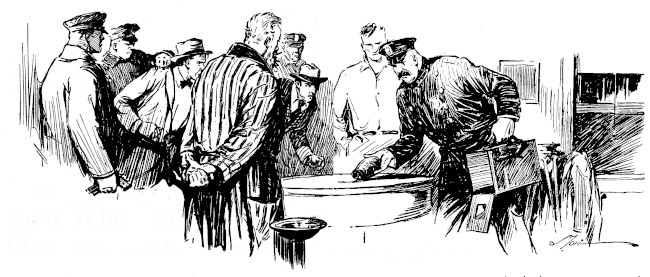
With infinite care he removed the pear-shaped bomb.
The sergeant lifted the camera, turned it this way and that, and began
to use a penknife. He handled the thing gingerly after the first two or
three incisions. Minutes later, with a grunt of satisfaction, he laid
down a pear-shaped bomb upon the table. Dangling from it there was the
exposure device, which here evidently functioned as a means of setting
it off.
The two men in civilian clothes regarded the thing in gray-faced
stupefaction. Hines looked at them. One of them tried to speak, and
could not.
"You see," said Hines shortly, "it's a bomb. If you'd pulled the
trigger, it would have blown us all to bits. But especially you. If I
know Preston, he told you it was some kind of gun. Eh?"
The photographer croaked, abandoning all pose of innocence: "He tol' us
it was a trick machine gun, an' if we sprayed y' wit' it—"
"At a guess," said Hines dryly, "it's combined high explosive and
poison gas. That would seem logical. If I wasn't killed by the
explosion, the gas would get me. You two men would be finished either
way. A much better bet than a machine gun.... How much were you to get
for standing behind this thing and setting it off?"
The pseudo-reporter cursed horribly.
"Ten grand, damn his soul!" he raged. "And him sending us to bump
ourselves off—"'
"I'll give you ten grand," said Hines evenly, "for the dope on where to
find him. Ten grand, and immunity."
"All I know," said the photographer hoarsely, "is he give us five grand
ahead o' time an' said we'd get the rest if we croaked yuh. We don't
know where he's at. We seen him yesterday in Brooklyn."
"Right," said Hines. "Tell me where and when you saw him, and you go
clear."
The two men gave an address, and, to a second question, the time of
their talk. Hines went to the telephone and asked for a number.
"All right, sergeant," he said impatiently, while he waited. "Turn 'em
loose. And you two men remember there's ten grand in it for you if you
get him. There's that much for anybody that gets him. And you'll get
well taken care of if you tip off the man who gets him. Clear out!"
The two men stumbled to the door, too much shaken by the knowledge that
they had been intended to blow themselves to bits, to be incredulous
about their release.
Hines got his connection, in Brooklyn. He ordered a raid at once, with
a succinct statement that Preston—who was sufficiently well known by
name to the police and the nation at large—had been there the day
before. He stood up.
"Why did you turn them loose?" demanded Schaaf irritably.
The doorbell rang. Hires nodded to a policeman to open it, and said
dryly:
"Those two men spreading that offer and news of Preston's double
crossing are a lot more useful out of jail than in.... What 've we got
here?"
Three messenger boys had arrived simultaneously with sheafs of
telegrams, radios, and cables. The extraordinary nightfall had been
reasoned out in six nations as possibly an extension of certain
previous events in the United States. The cables were mostly addressed
to Schaaf, and were from every variety of scientific body and
government authority, reporting the sudden falling of darkness and
asking if he could explain its cause or possible duration.
Schaaf opened the first of them and swore. He opened more, and
swore more luridly. He was sputtering German profanity in a steady
stream before he reached the end of them. He looked up, still in his
dressing-gown and slippers, and with his blond beard bristling in every
direction, to find the room empty of police and Hines hunched over the
telephone, talking quietly.
"Better get some clothes on, Schaaf," said Hines. "Kathryn's coming
over here. We're going down to my office."
Schaaf scowled at him.
"Hines," he said hopelessly, "der verdammt scoundrel has cofered
der whole world with darkness! I know what it is, of course. Fife to
fifteen miles up in der air, all ofer der earth, there is a layer of
ionization. It is der Heaviside Layer, which raises der deffil with
wireless telegraphy. Breston has somehow managed to penetrate it, and
he has filled it with an electric field which makes der air no longer
transparent. Der whole world is in darkness, and there is no way
in which we can possibly locate der sending-station. Because he has
practically charged der entire roof of der world with darkness. What
are we going to do?"
Hines grinned.
"I've already got him located within a couple of hundred miles," he
said dryly. "Get busy finding out what he's got, and I'll find where he
is, and together we'll settle him."