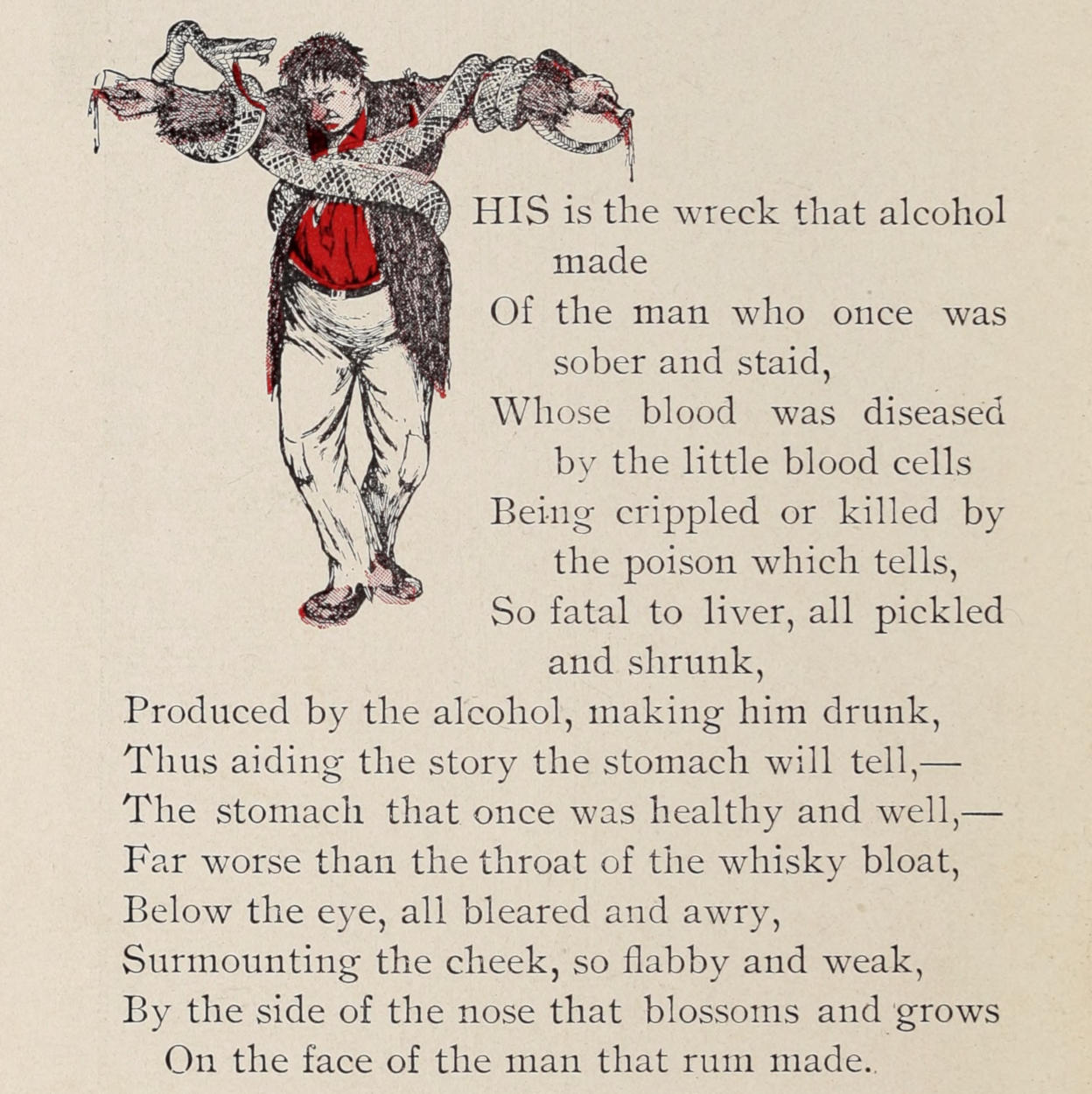
OLD JOE, THE DRUNKARD By Mrs. L. D. Avery-Stuttle
Grandma Duncan lived with her
three grandchildren in a
pleasant village nestled
among the green hills of
New Hampshire. Grandmother
had a habit of taking
the children, Bertha,
Max, and Henri, out for a
walk over the hills, on pleasant
days, and much the children
enjoyed these rambles.
“There is nothing,” grandmother used to say,
“that I so desire as to see the children of my dear
daughter (who left them to my care,) grow up to
be good and virtuous.”
Grandmother’s hair was white as snow, but her
eyes were as bright and blue as the skies, her voice
was soft and tender, and the children of the whole
neighborhood loved to listen to her quaint stories
of the time when she was a child; while to Bertha,
Max, and Henri, grandmother was very dear.
One afternoon, when the May flowers were showing
their pretty, fresh faces on the hills and
meadows, and the sun was shining brightly, they
all went for their accustomed walk. The children
soon filled their baskets with trailing arbutus, jonquils,
and soft mosses, and just as the sun was setting,
grandma and little Bertha strolled leisurely
homeward, while Max and Henri hurried on before.
“You shall be Queen of the May, grandma,
dear,” laughed Bertha.
“See, I shall crown you
with these pretty jonquils
as soon as we are home.”
Just then Max and
Henri came running back
panting and quite out of
breath, both eager to tell
what they had just seen
over the hill.
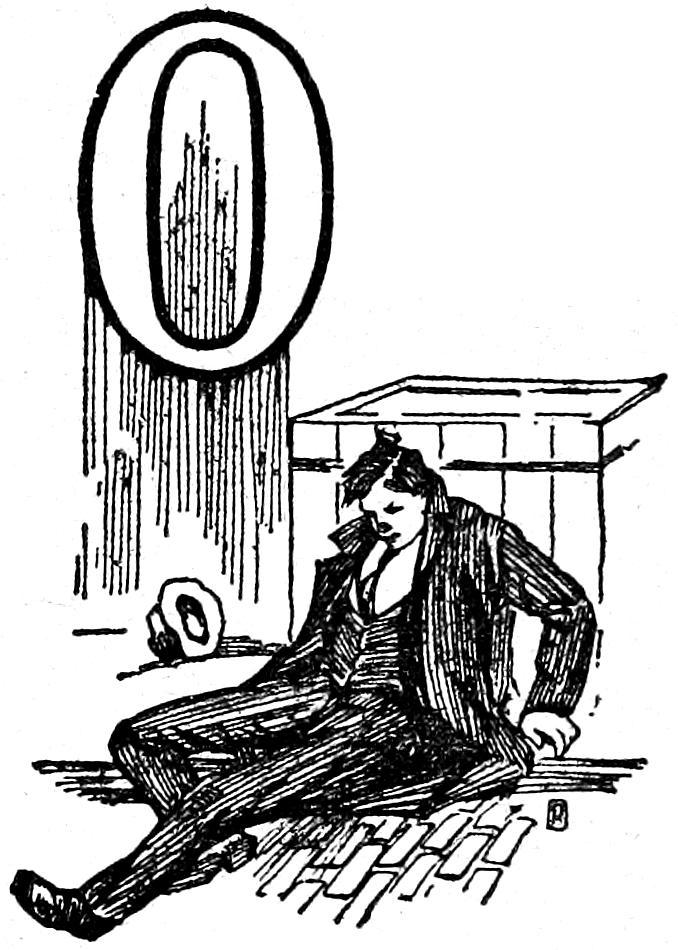
“O grandma!” began Henri,
“there is a poor man lying asleep by the
bridge, all covered with mud—”
“Yes,” added Max, “yes, and his face is
red and specked, and—O Henri,
did you notice that his old battered
hat was floating
around in that pool of muddy water by his side?”
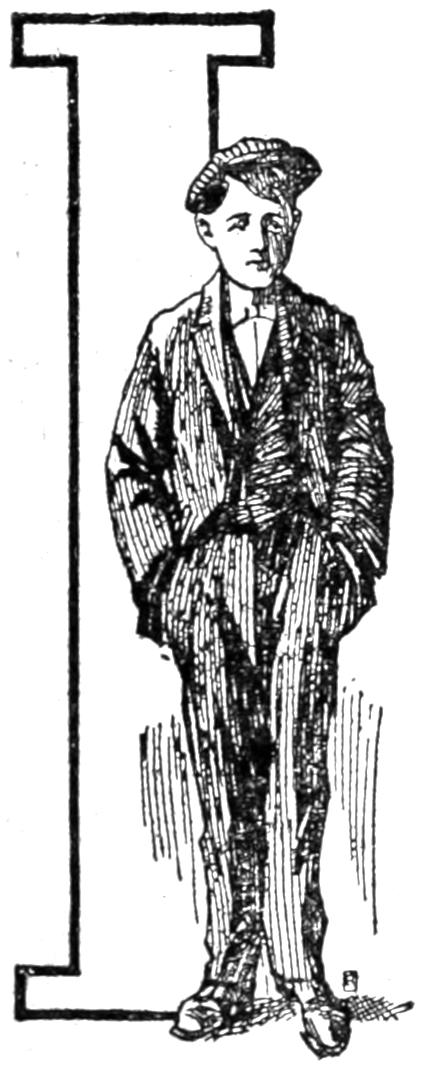
“I’m afraid it is poor Joe Brandon,” sighed
grandma. “Let us hasten; perhaps we may be able
to help him. He may be really ill,—though much
I fear he has stayed too long at the Red Lion,” as
the one saloon in the village was named.
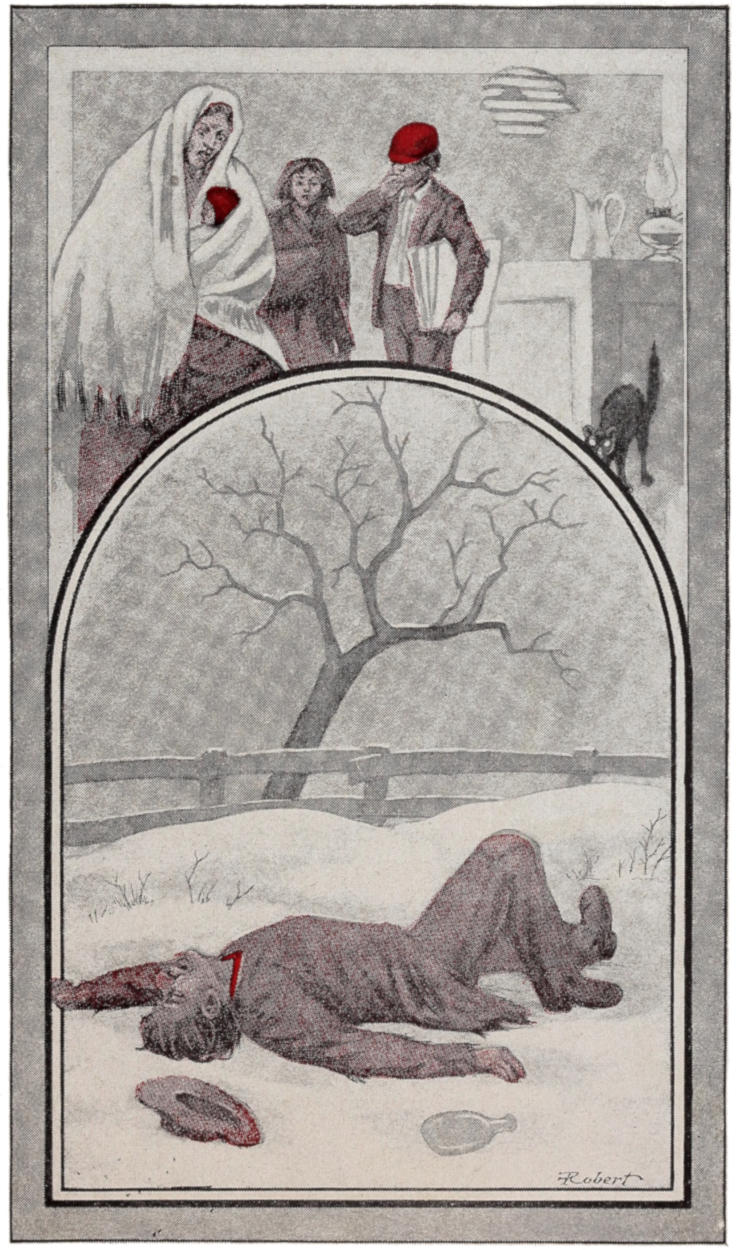
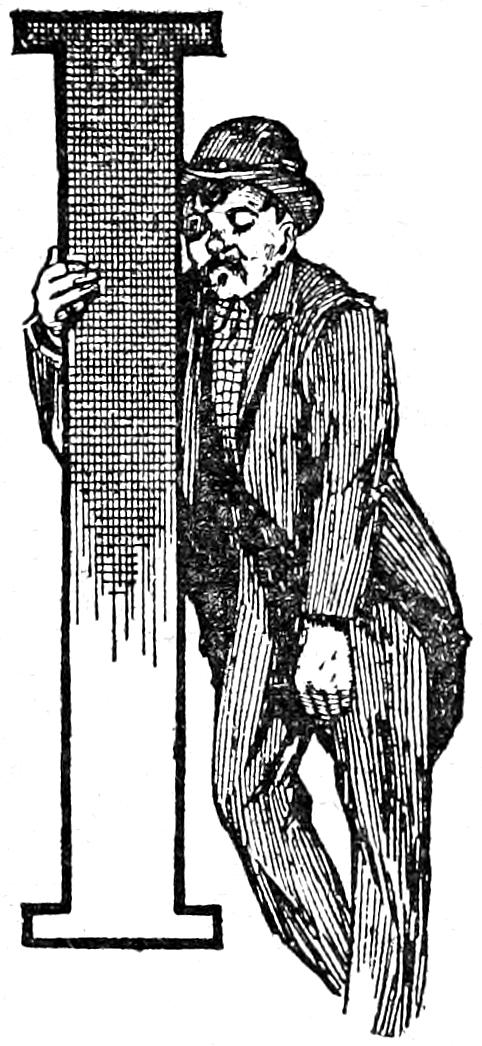
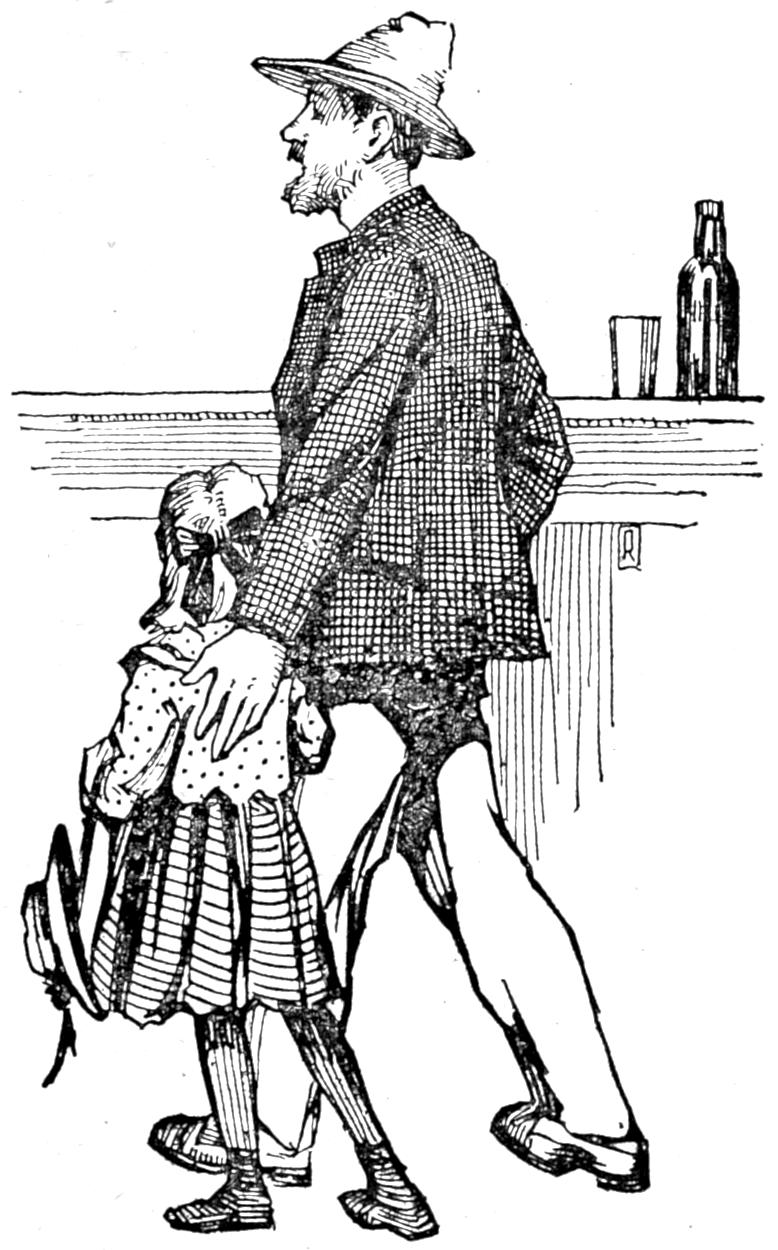
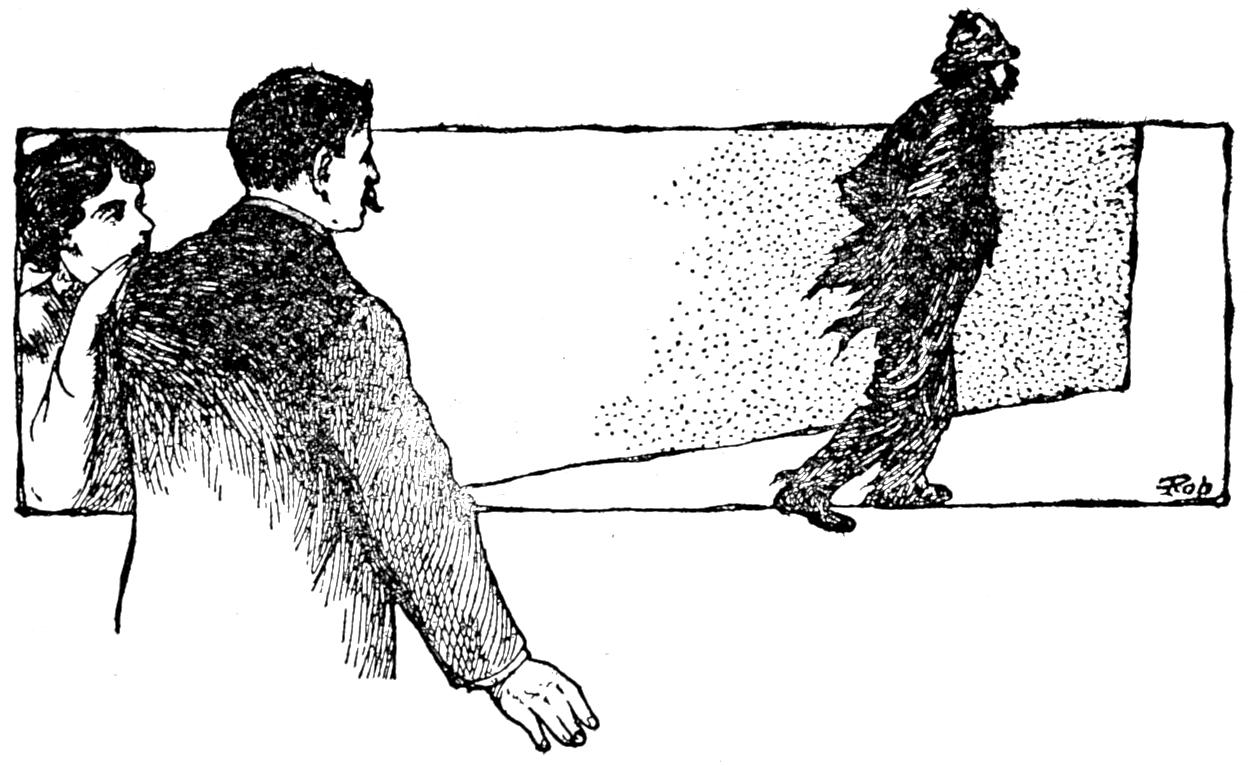
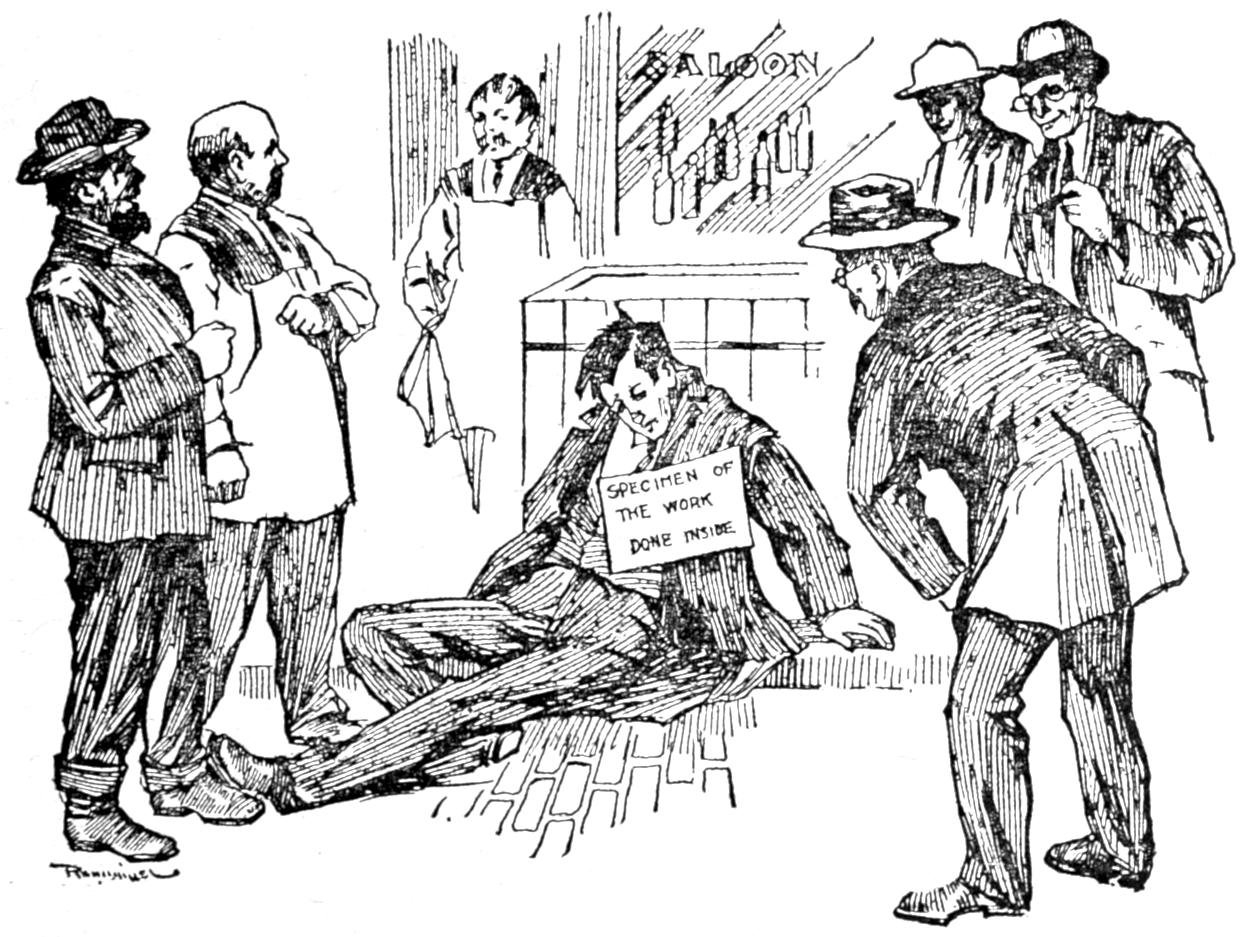
By this time poor Joe had awakened from his
drunken stupor, and was staggering on toward his
wretched home as fast as his unsteady legs would
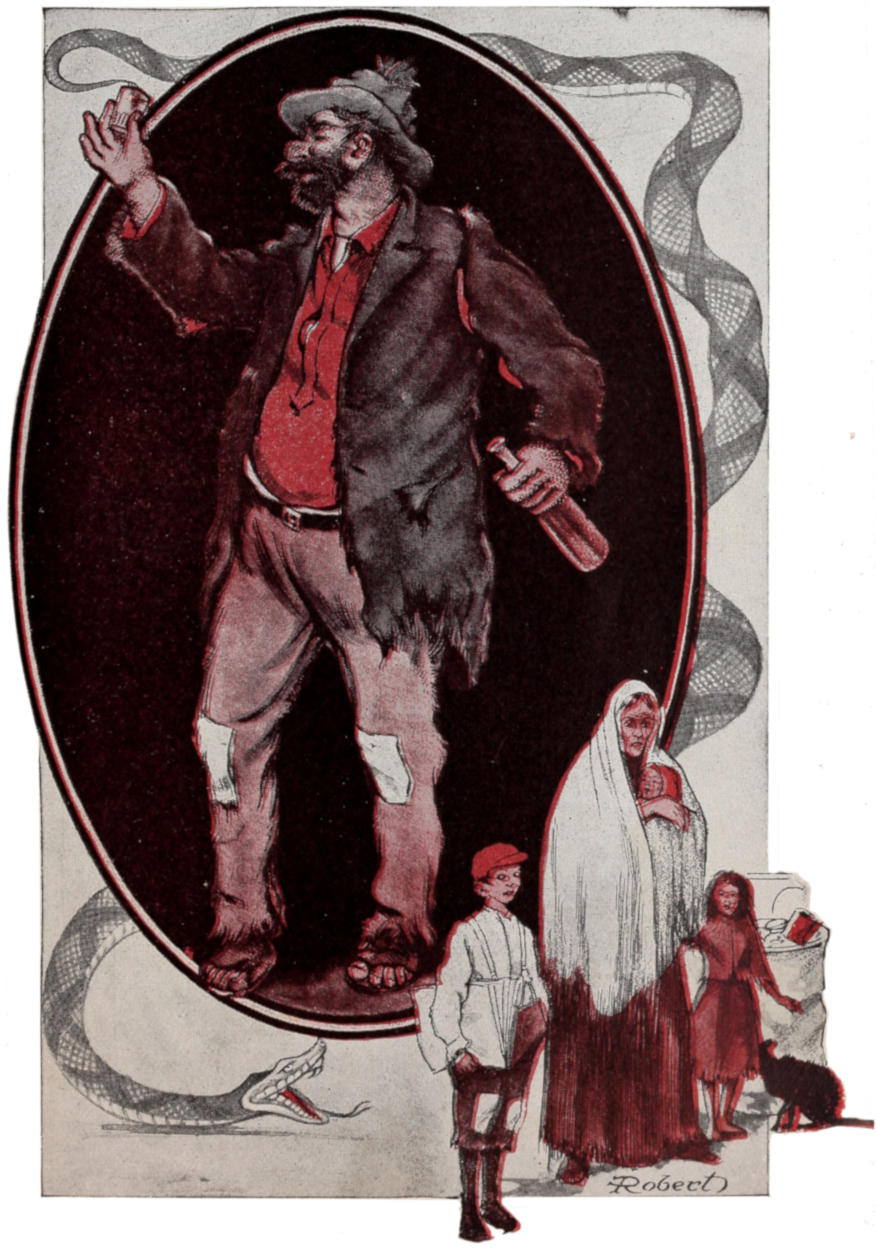
carry him. His filth-covered coat was reeking with
slime and mud, which constantly dripped over his
ragged trousers, while his wet and battered hat,
which the poor fellow had contrived to rescue from
the pool, was slouched far over his face. His gray
hair and beard were long and matted, and his eyes
were bleared and bloodshot.
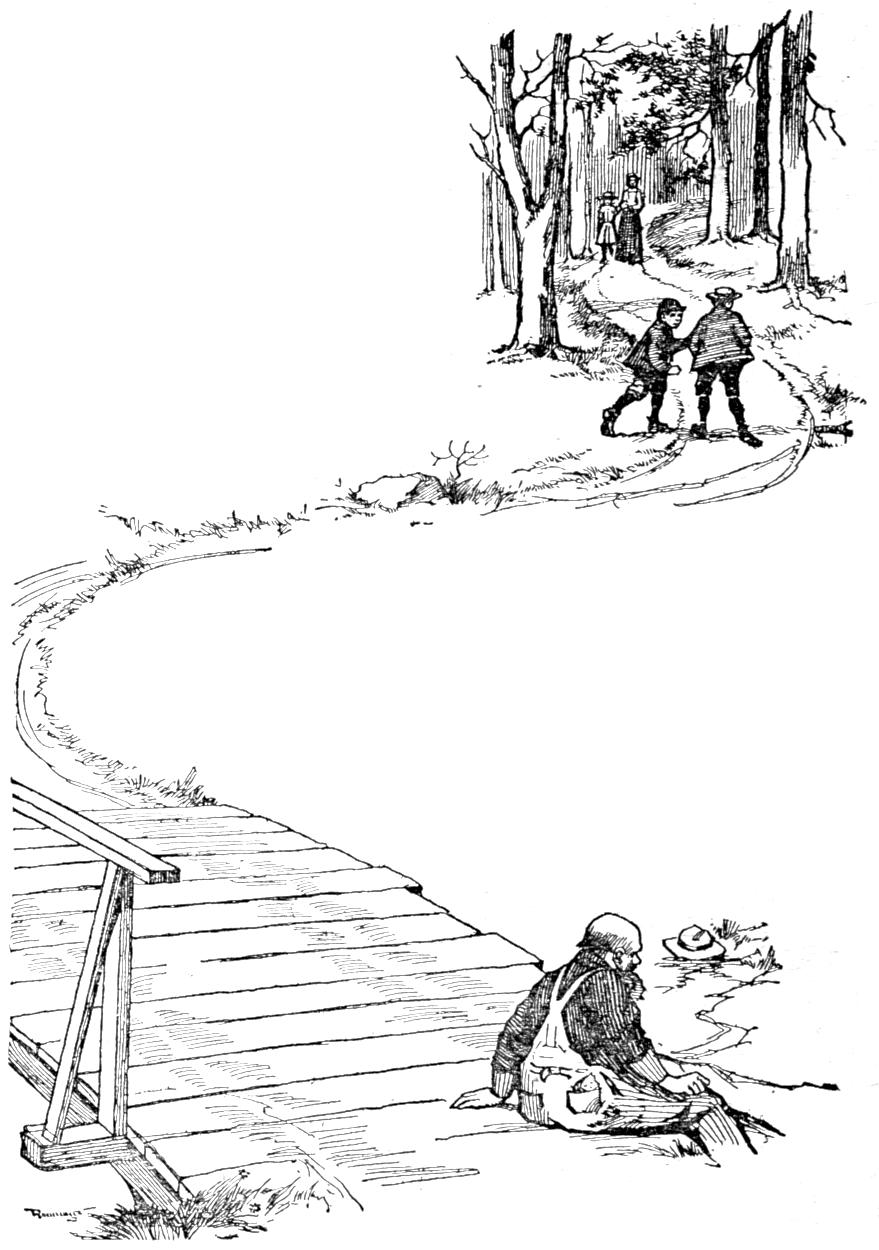
POOR OLD JOE
The children shrank as far away from him as
possible, as he reeled past them, and all the
laughter and pleasant mirth had gone out of their
voices, while little Bertha’s face had grown quite
white.
“I cannot blame you, my dears, for shunning the
wretched man, and yet he was not always so,”
sighed grandma.
“Why grandma,” protested Henri, who thought
himself quite a man, “he has been a poor drunkard
ever since I can remember,—and that is ever and
ever so many years,—why just think; I am almost
twelve years old.”
“Yes, but you know, my dear, I can remember
very many more years than that,—and I knew
poor old Joe when he was no more than five years
old. And a sweet, charming child he used to be.”
“O grandma! please tell us about it,” cried the
children excitedly, “please do!”
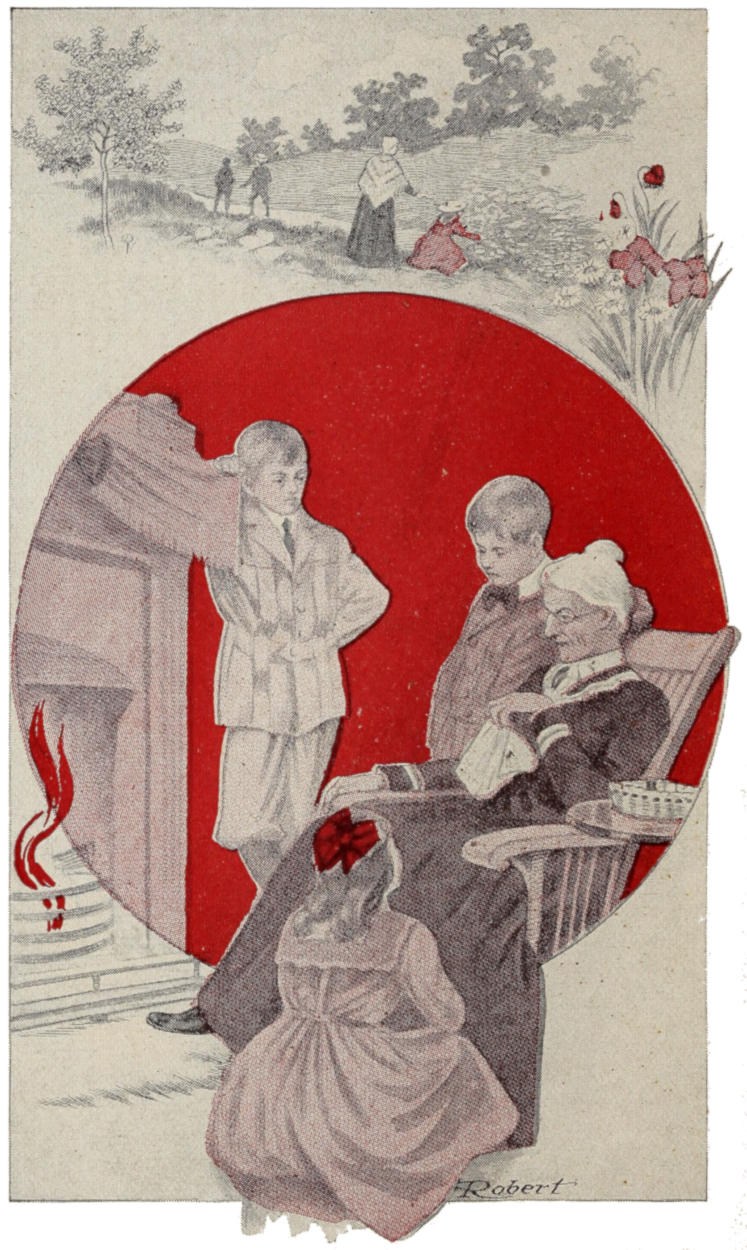
So as soon as they were home and well rested,
they gathered around grandma’s great rocking
chair. Henri had kindled a fire in the grate, for it
was rather cool, and now they waited to hear the
story she had promised to tell them.
“Well, my children,” she began, “it is quite true
that I knew poor old Joe when he was a sweet,
innocent child,—I was a child myself, then,”—and
grandmother gazed dreamily
at the red flames as they chased
each other up the chimney.
“Yes, he was a sweet, innocent
child,” she repeated;
“Nobody called him ‘Old Joe,’
then. He was the only son of
my father’s dear friend, and I
was his playmate while we
were children.”
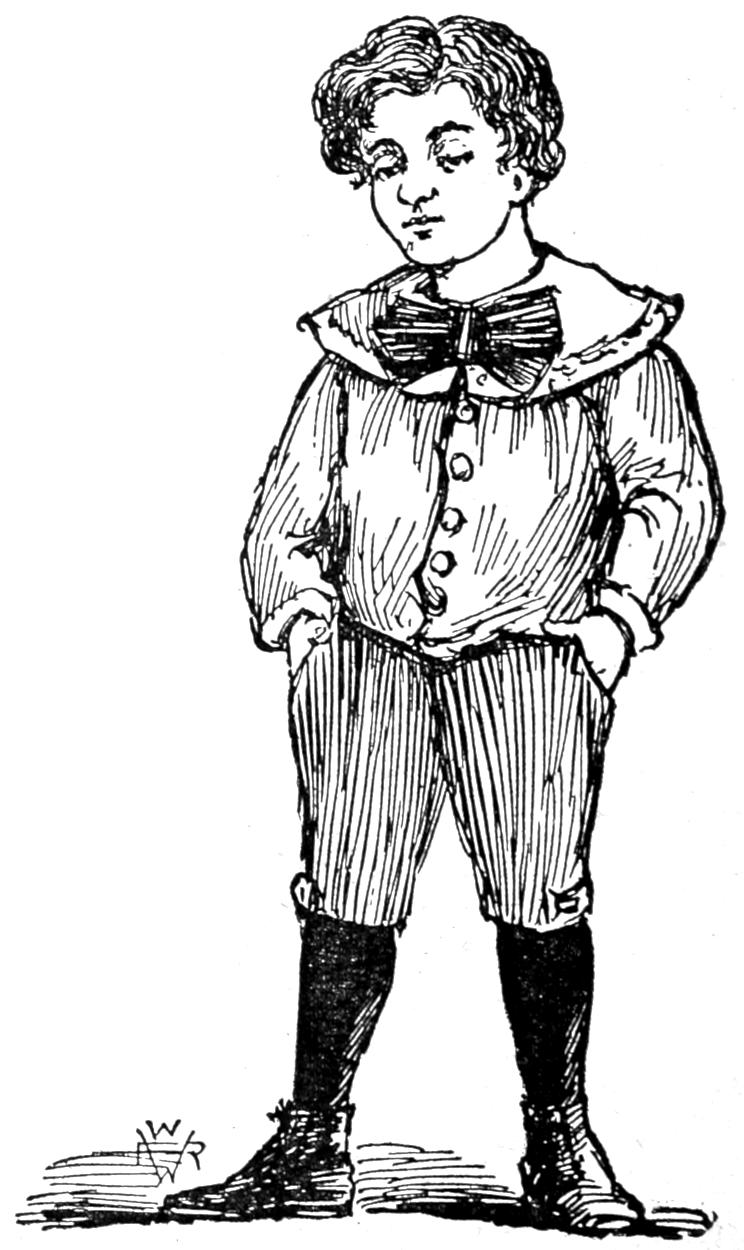
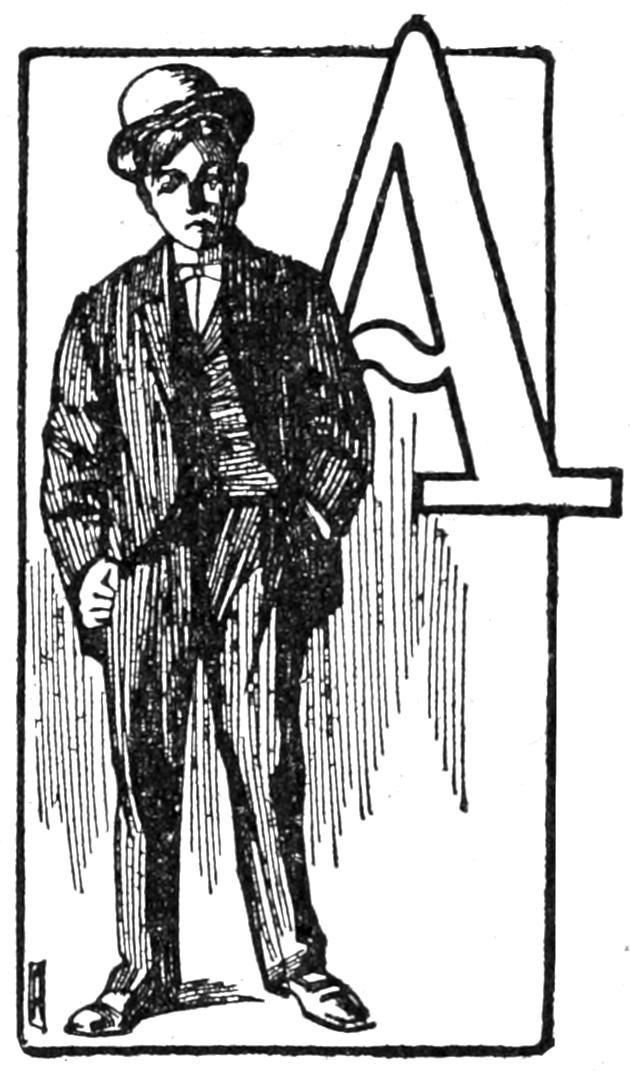
LITTLE JOE
“O grandmother!” said little
Bertha. “How could he
ever grow to be such a bad
man?”
“It was not all at once, my
child, but little by little.
You remember the
tiny seed you planted in
the pot last year and how we watched it day by day
as it grew slowly. Don’t you remember how it
put out first one little green leaf after another until
it became a tall, strong plant?”
“Yes, grandma, it was so small I thought it
would not grow at first, but I watered it and kept
it in the sunny window, and now it’s quite a big
tree.”
“Well, my child, it is just so with bad habits.
They grow just as fast as weeds.
“I will try to tell you all about it, my children,
though it is a long story. I hope you will listen
thoughtfully, for poor old Joe’s life story is almost
the same as that of many thousands of poor drunkards
in this rum-cursed land.”
“O grandma! are there thousands of people as
miserable and wretched as this poor man?” questioned
Henri, opening his brown eyes wide; “it
doesn’t seem at all possible. I’m so sorry for
them,” he continued, for Henri had a very tender
heart and was full of sympathy for every one in
trouble.
“I hope you will be sorry for them,” replied
grandma, “so sorry that you will do all in your
power, as long as you live, to help them to lead
better lives and to shun the very first step toward a
life of intemperance and shame; for you must not
forget, my boy, that no man becomes a worthless
sot in a day or a month or even a year. In this, as
in everything else, the little things are those which
count. Indeed, life is made up of little things,—little
duties neglected, little deeds undone, little
burdens unborne,—these all help to make a careless,
selfish, unlovely character.
“I remember that poor Joe was very selfish as a
lad, and this most undesirable trait grew upon him
as the years went by, until finally he would not
scruple to do anything mean, or rude, or anything
dishonest, if thereby he might gratify his appetite.”
“What do you think the poor old man would
have said,” questioned Max, “when he was a young
boy, to have seen a picture of himself as he looked
to-day, wallowing in the mud, just like the big pig
in Mr. Brown’s meadow!” and Max shuddered.
“He would have been greatly shocked, I dare
say, but I almost question whether, then, he would
have been willing to quit his selfish and gluttonous
habits; for poor Joe was a great glutton, even when
a small boy,” explained grandma, “though, as I
have said, he was a bright and lovable little fellow.”
“A great glutton!” repeated Max wonderingly.
“I supposed a glutton was a person who ate too
much food. I didn’t think that the kind or amount
of food a person ate had anything to do with his
becoming a drunkard. Does it grandma?” And
Max awaited the reply of his grandma with some
anxiety, for he was very fond of sweets and rich
pastry.
“Yes, yes, my child; the kind and quantity of
food we eat has very much to do with the making
or spoiling of our lives.”
“Joe’s father and mother were good people, who
tried to bring their little boy up to control his
appetite; for they were wise and prudent, and well
knew the evil effects of gluttony upon both body
and soul. But they died when Joe was very young,
and left him to the care of his aunt.
“Aunt Maggie was a good woman, but she made
a great mistake in allowing Joe to eat anything and
everything he wanted, and at any time he pleased.
She seemed to forget that the stomach needs rest
as well as the other parts of the body, when we
are tired.”
“Isn’t that queer?” laughed Bertha. “I never
thought of it in that way before.”
“Many people either forget or do not know that
this is true,” continued grandma, “and overload
their poor, tired stomachs, and force them to work
when they are weary and need rest, until they
become weak and wretched and full of disease.
“Joe was very fond of sweetmeats,” continued
grandma, looking hard at Max, “but at first, he
contented himself with coaxing his aunt for them.
But when he grew larger, he did not always wait
to ask for candies and preserves and rich cake.
Aunt Maggie, as we called her, kept a large supply
of rich and highly seasoned food constantly on
hand, and when Joe was ashamed to ask for any
more, he would manage to steal as much as he
wanted from the cupboard. This he did quite
often, and it troubled me not a little,” and grandma
sighed.
“Why didn’t you tell your mother or Aunt
Maggie of the young rascal?” interrupted Henri,
who scorned anything like falsehood or theft.
“I feared that he would not play with me if I
did; but I have regretted my childish thoughtlessness
many times; for perhaps if I had been more
faithful in doing what I could for him, poor Joe
might not now be the miserable wreck he is.”
“Just think of our grandmother ever wanting to
play with that horrible old creature!” exclaimed
Bertha, “though of course he was not always so;
but I can’t see, yet, grandma, what all this has to
do with making poor Joe a drunkard. Will you
tell us?”
“If you will be patient, my child. It is quite a
long story, and I want you to be fully impressed
with its truthfulness, and to understand me.
“One day I went over to play with Joey, as we
children used to call him. I was only about five
years old, and Joey was six. My parents thought
him a good child, and since he was the son of my
father’s best-loved friend, they allowed me to play
with him very often.
“Aunt Maggie had a jar of choice preserves, and
another jar of highly seasoned and spiced pickles.
These she kept in the cupboard on a high shelf,
out of reach of naughty, mischievous fingers. That
day after we had become tired of our blocks and
marbles, Joey asked Aunt Maggie for a dish of preserves.
She very kindly gave us each a dish, with
some bread and butter, and shortly afterward, put
on her bonnet to go down the street. She did not
forget to caution us not to get into any mischief.
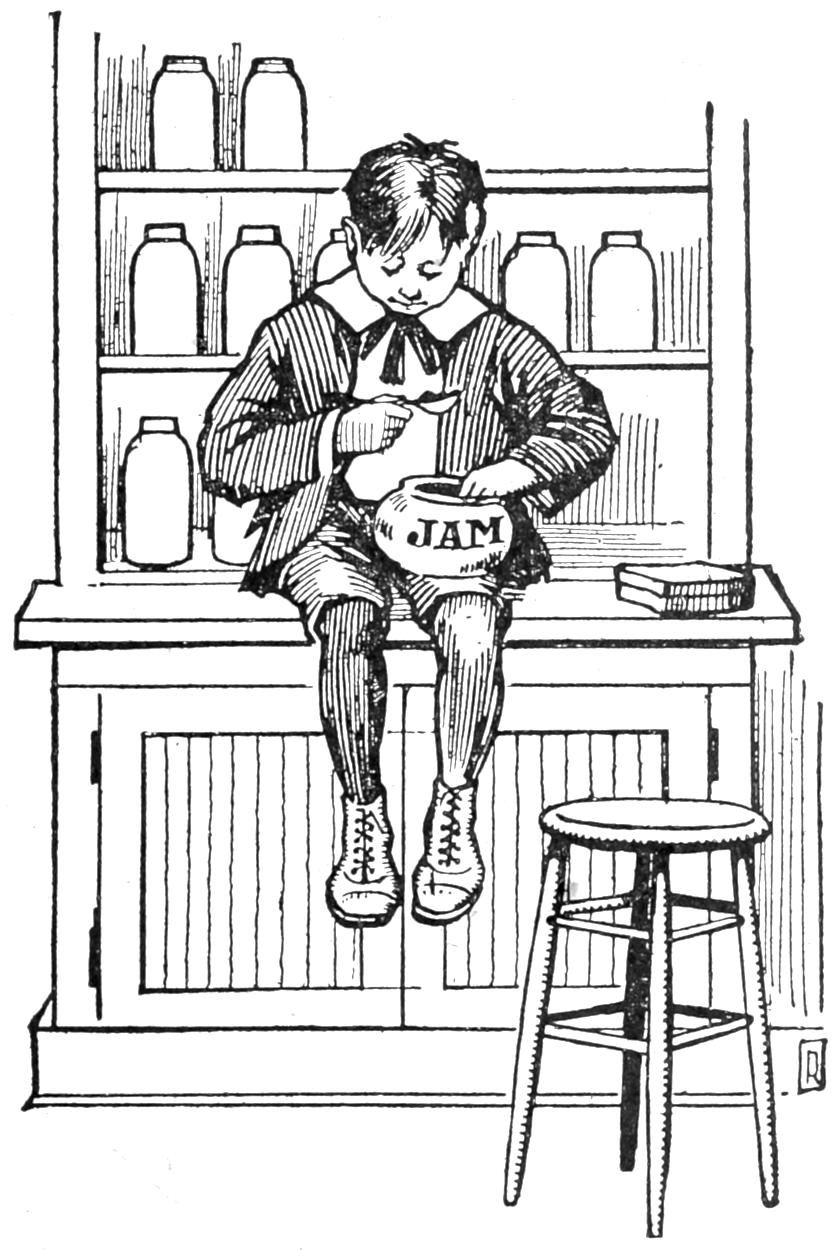
“But as soon as she was out of sight, Master
Joey decided to have as many cookies and plates
of preserves as he
wanted. At once
he climbed into a
high chair and
helped himself. I
was never allowed
such freedom as
this at home, and
in my childish
way, tried to explain
to my playfellow
that it was
wrong. But he
paid small heed to
my words and ate
until he became
quite sick.
“By this time Aunt Maggie had returned, and
though poor Joey tried hard to deceive her as to the
cause of his illness, the greedy boy had quite forgotten
to wash his face, which, in his haste, had
become smeared with preserves.
“Aunt Maggie made him drink a cupful of bitter
herbs, and I ran home to my mother.”
OLD JOE, THE DRUNKARD PART TWO
The next day I went to see poor
Joe, but he was too sick to
play with me.”
“I think he must have
learned a lesson by this time,”
ventured Bertha.
“O no, my child, you see
he has not even yet learned
to control his appetite, and
it has nearly proved his
ruin, and surely must unless
he repents very soon, and
turns from his evil ways. Instead of learning a
useful lesson from that day’s folly, his craving for
sweets and rich foods seemed to grow stronger from
that time. He always called for the most highly
seasoned food whenever he would come to spend
the day with me,—the greasiest meat, the strongest
pickles, the richest puddings.
“One day at our table my mother helped him to
some food. At once Joey called for the pepper.
‘It is not good for you, child,’ said my mother,
mildly. But Joey insisted until she allowed him to
cover his food with pepper till it was quite black.
He was very indignant indeed when mother told
him that she never allowed me such highly seasoned
food, and the young gentleman declared at
once that if he could not have what he wanted to
eat, he would go home where he could get as much
as he pleased, and that he would
never come to play with me again.
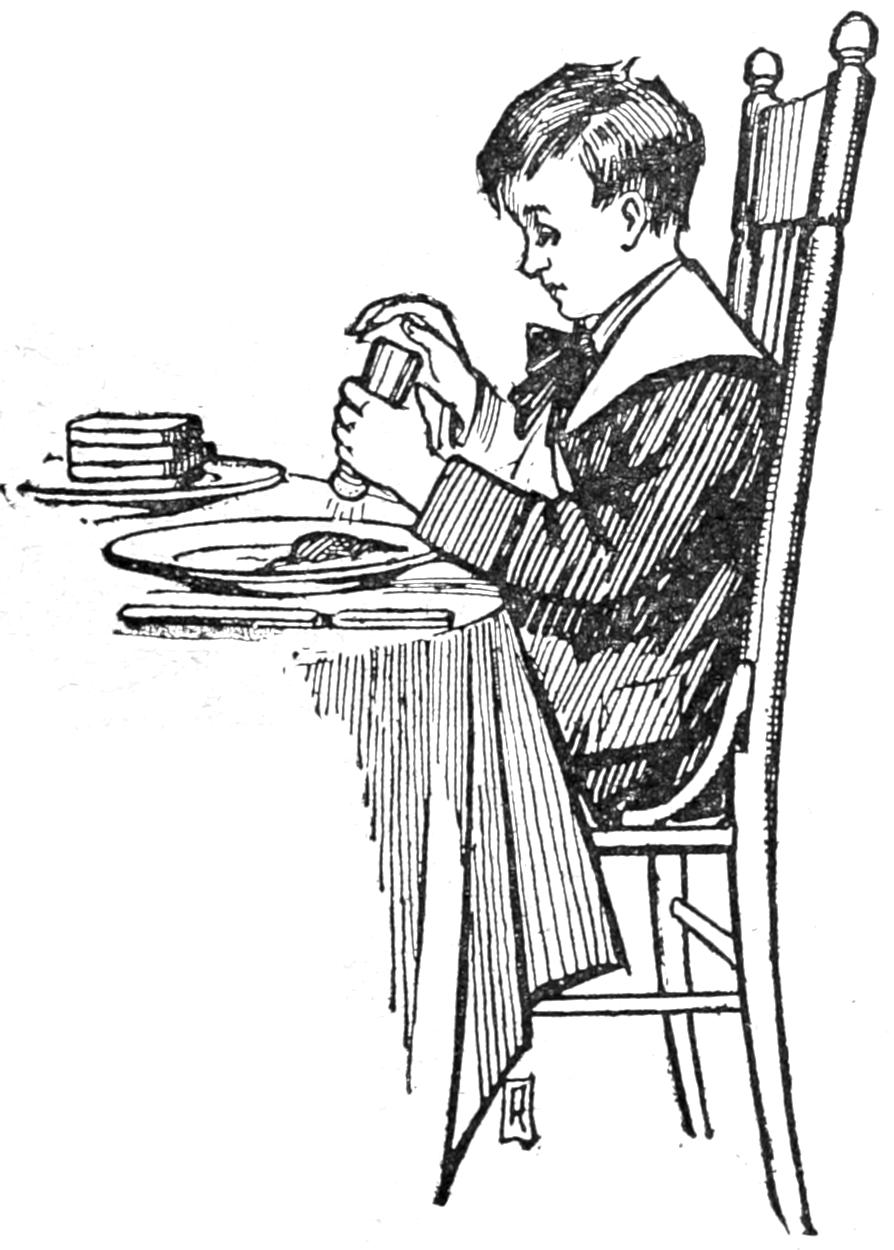
“PEPPER”
“O my children! I hope you
will never forget that appetite
is like fire;” and
grandma sighed;
“it is a good servant,
but a bad
master. You see that
in poor Joe’s case it has proved
to be a strong giant, from whose
dreadful chains he has no power
to release himself.”
“I suppose,” ventured Bertha,
“that he began drinking rum
when he was just a little boy.”
“O no; the taste for liquor is not formed in a
moment. All this time he was an intelligent,
bright, and active lad, and I liked to play with him
very much. Until he was about eight years old,
he drank nothing but water or milk. But by this
time, the rich foods and spices, the pepper and the
strong, fiery pickles, with which he had so often
filled his stomach, created a longing for something
stronger than milk and water to drink.
“‘Come, Aunt Maggie,’ he pleaded, one day,
‘come; please let me have a little taste of your
tea—just a little.’”
“Of course, he got it,” said Bertha.
“O yes, and before long, he ran slily into the
pantry, and drank still another large cup. When I
threatened to tell Aunt Maggie, he only smiled and
replied: ‘I love it, I tell you; it’s good! if it doesn’t
hurt Aunt Maggie, it won’t hurt me. If it’s good
for women, it’s good for boys, and I shall have
what I like—there now!’
“I was a timid little girl,” continued grandma,
smiling gravely, “and Joe’s logic as well as his
bravado rather appealed to me, and so I said
nothing. When it came time for me to go home
that day, he went a little piece with me, as was his
custom:—
“‘I wonder if Aunt Maggie thinks that was my
first cup of tea,’ reflected Joe, turning confidentially
to me, ‘’cause if she does, she’s mistaken, that’s all;
and what’s more, I’ve got so I just hanker after
it—and good, strong coffee, too. Aunt Maggie
thinks it’s expensive, I guess; but I don’t believe
she thinks it hurts anybody, or she would not drink
it herself. I tell you, Jennie Brown’—Joey used
to call me by my full name whenever he was
excited,—‘when I get to be a man,—a big man,—I’ll
have what I want to eat,—I tell you,—and—and—what
I want to drink, too, or I’ll know
the reason why!’ he added, pompously bringing
one little fist down into the palm of the other hand.
“‘O Joey, Joey!’ I cried; ‘you don’t mean to be
a horrid old drunkard!’ Joe flashed a look of defiance
back at me:—
“‘Don’t you suppose, Jennie Brown, that I mean
to be a gentleman—a gentleman, like my father
used to be?—Well, I do, but I guess a little tea and
coffee’ll not hurt me any,—and look here, sissy,
I’ll tell you something if you’ll never tell,’ he continued,
putting his small fingers across my lips;
‘look here; I’ve noticed that a great many gentlemen
smoke and chew tobacco, and just as soon as
I get a little bigger,—you just wait!’ and Joey
assumed a swaggering gait, and puckering his red
lips, puffed a cloud of imaginary smoke from an
imaginary pipe. Then he turned on his heel, and
called a cheery good-by to me.
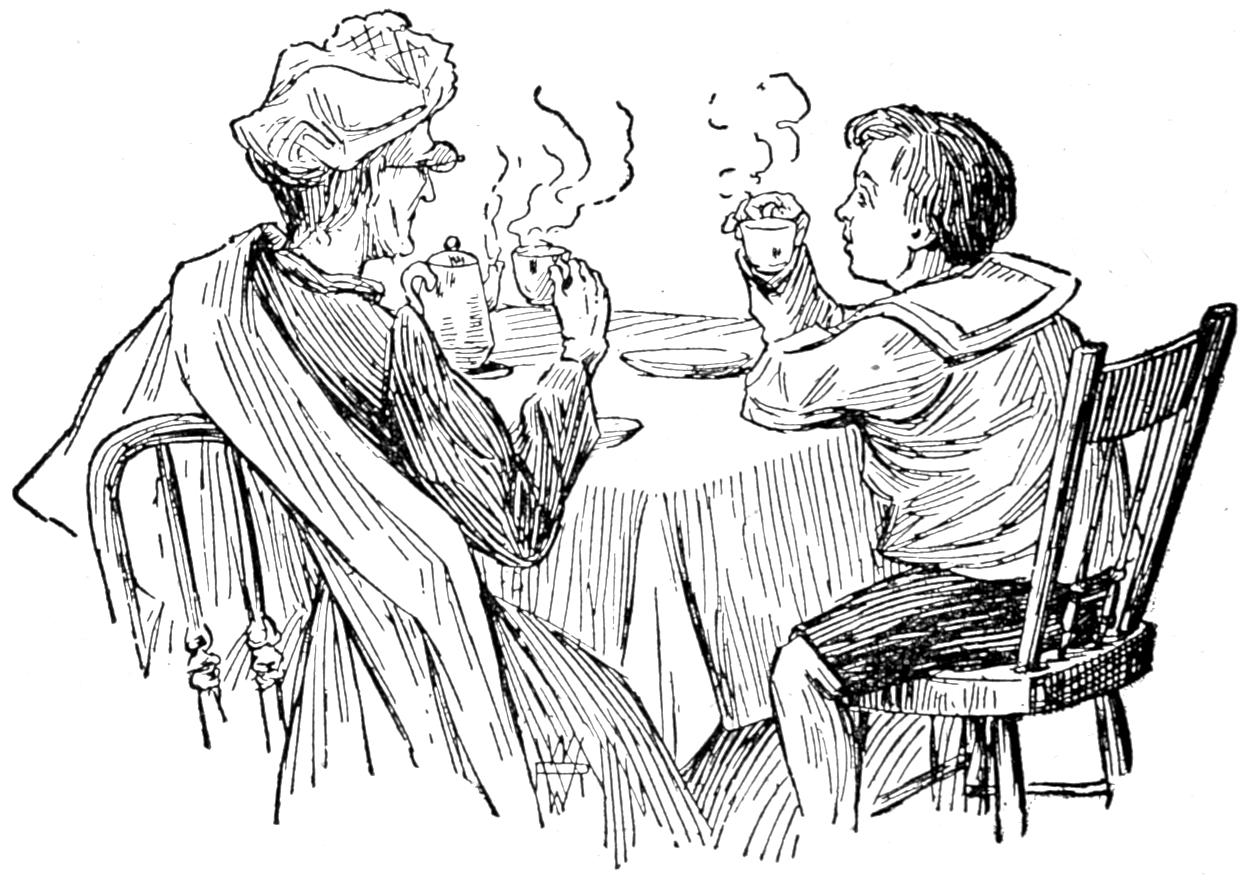
“I love it, I tell you; it’s good!”
“But into my young heart had crept a vague fear
that between my little playmate and myself there
would be, some day, ‘a great gulf fixed!’”
OLD JOE, THE DRUNKARD PART THREE
I t doesn’t seem a bit possible!” exclaimed
Bertha, “that this awful looking old
man could have been a nice little
boy,—nice enough to ever have been
my grandma’s playmate!”
“No,” reflected Max, “I didn’t
dream that just tea and coffee ever
helped to make drunkards,—very
many people surely use them both,—nice
people, too, grandma.”
“But it does not always have
this effect, my dear, and we may
be thankful, but it is certainly one of the stepping
stones to intemperance.”
“But I don’t understand why,” said Max, who
always wanted to know the reason for everything.
“Can’t you tell us, grandma, why tea and coffee
are so bad? ’Cause if they are, I’ll never drink
another cup of either again, as long as I live,—for
I don’t want to run any risk at all of being a
drunkard,—isn’t that what you say, too, Henri?”
“Indeed, it is,—no drunkard for me, I tell you!
but may be grandma will tell us a little more about
it,” and Henri put his boyish cheek close to grandma’s
and gave her two or three hearty kisses.
“Please tell us, grandma.”
“Well, my children, both tea and coffee contain
a very deadly poison, but in so small a quantity
that we do not at once feel the evil effects.”
“No, grandma; I have often heard Mrs. Wilson,
the grocer’s wife, say that she could not work until
she had had her cup of tea.”
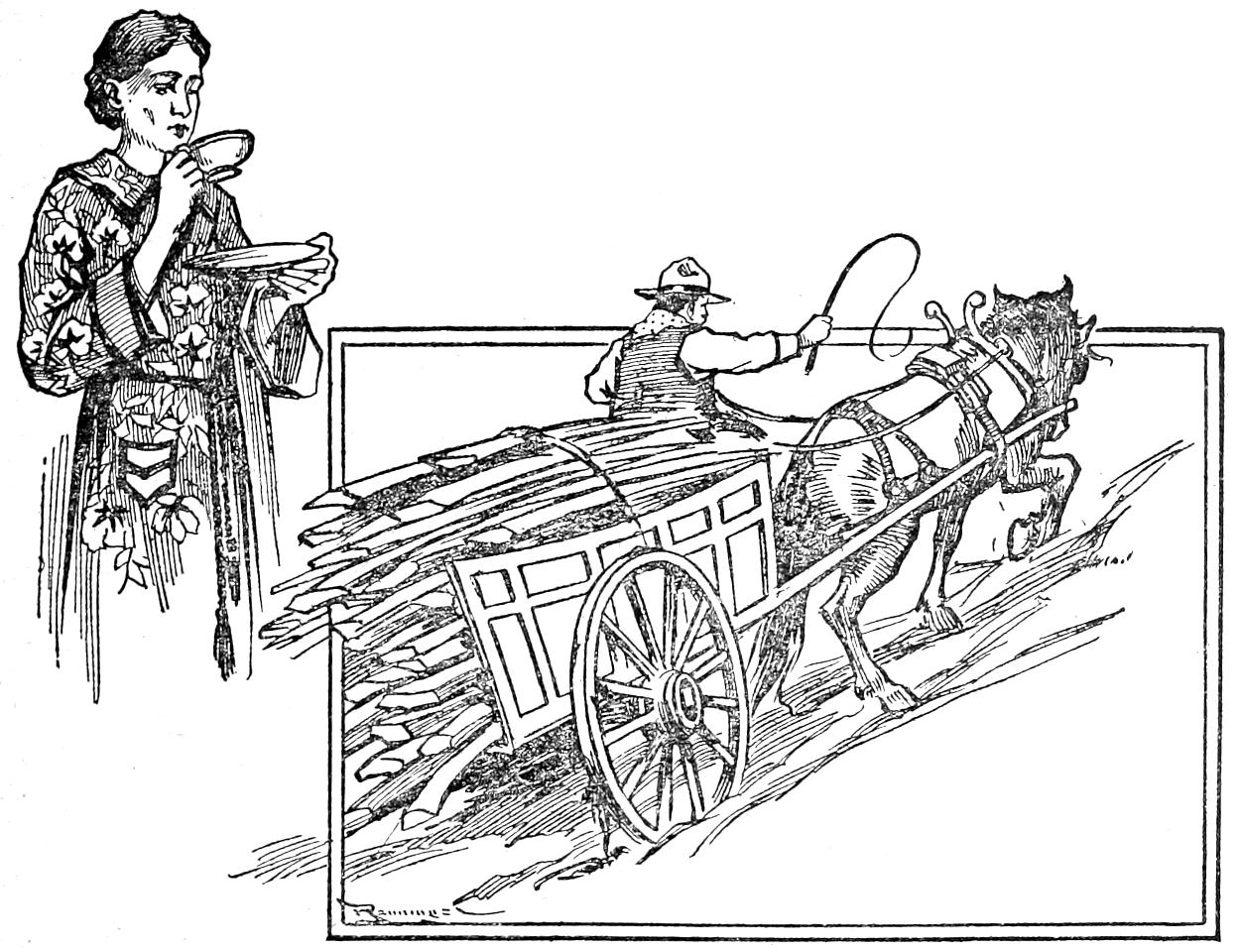
“That is because it stimulates the
system,” said grandma. “I will make
it plain to you. Do you remember in our walk
this afternoon, we saw a cruel driver whipping his
poor horse to make him pull his heavy load up the
hill?”
“Yes, yes; and I felt like snatching the whip
away from the wicked man,” said Henri.
“It would have been wiser and better for him to
take off a part of the load instead of whipping
his poor, patient horse. Still, you remember how
much quicker the poor beast drew his burden to
the top.
“Now, my children, tea and coffee act on the
body just as the driver’s whip did upon the horse.
Perhaps we can do more work at the time by
drinking it, but, like the horse, when we have done
the work, we are completely exhausted, and feel the
need of more and more of the poison.”
“I just knew grandma could make it plain to you
boys,” smiled Bertha,—“but I believe I understood
it quite well all the time. But please go on with
the story about Joe, grandma, I want to see how it
all comes out.”
“Why, my child, you saw how it came out,—saw
it all too plainly, this afternoon, when you saw poor
old Joe as he reeled by us,” and grandma sighed,
while a tear stole down her cheeks. “Yes, you saw
how my story must end; but I will tell you the
steps which poor Joe next took:—
“When he was about ten years old, I went over
again one day to play with him. As I have said,
he was a pleasant and lively playfellow, generally
good natured, and always ready to build me playhouses
and never laughed at my dolls.
“After we had played for some time, Joey began
to act uneasy. ‘What’s the matter, Joey?’ I asked.
‘See, you are spoiling my playhouse, and it just
suited me. You act as if you didn’t want to play
at all; I’ll go right home unless,—”
“‘O, don’t be a silly sissy!’ exclaimed Joey, ‘I
didn’t mean to spoil your playhouse,—but, look
here, Jennie Brown, I’m getting dreadful thirsty!’
“‘Well, then, go and get a drink of water. See,
Aunt Maggie has just pumped a nice fresh pail.’
“‘See here’ said Joey, ‘you needn’t think I’m
such a sissy and ninny as to drink water when I
can get something else that’s a whole lot better!’
“He winked at me very
slily, and turning on his
heel, he beckoned me
to follow. I was so
curious to know what
he was going to do,
that I dropped my
dolls and scampered after him. As
we passed the kitchen window, he
peeped in cautiously, to assure himself
that Aunt Maggie was so busy that she would
not be apt to see him, and then he again beckoned
me to follow him down the back cellar stairs:—
“‘What are you going to do, Joey?’ I whispered,
almost frightened at his strange actions.
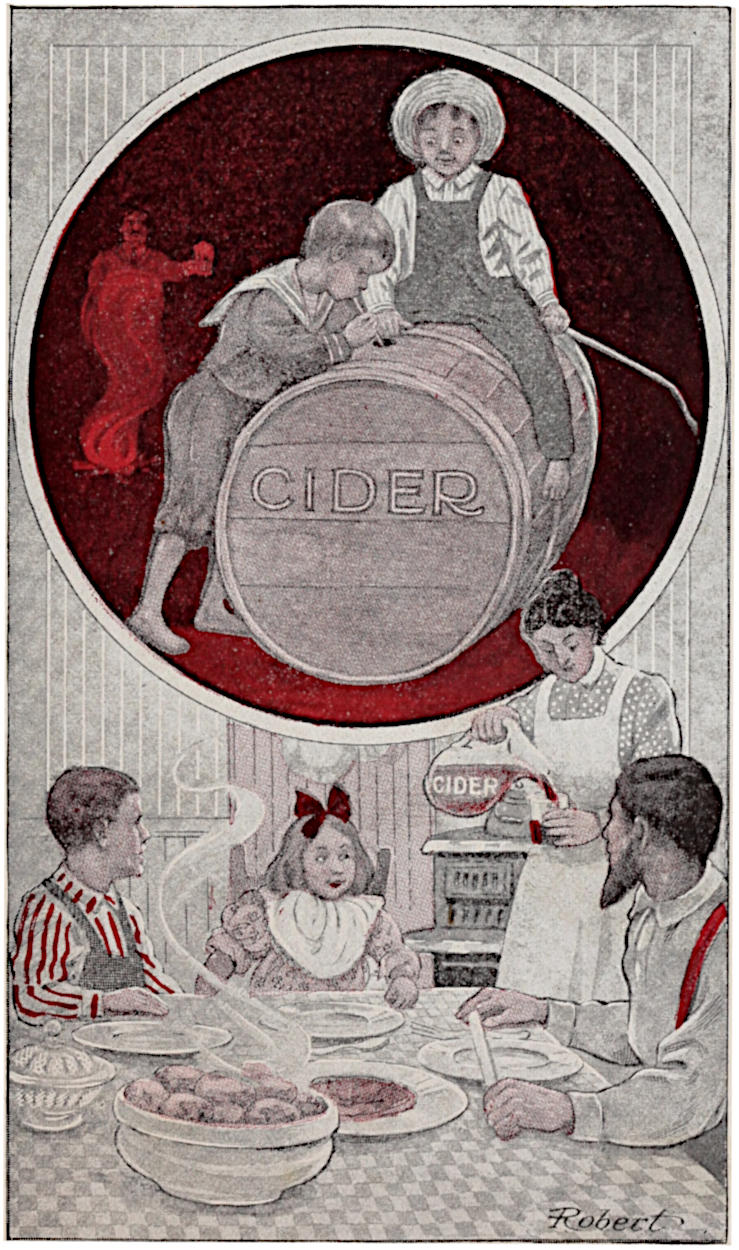
“‘Sh—sh—! speak lower. See! I’m going to
have a good drink of Aunt Maggie’s cider. She’s
been saving it for weeks and weeks to make vinegar
of,—but it’s good enough to suit me, now,’ he
chuckled, as he produced a long straw, and, inserting
it in the hole of the barrel, took a long, deep
draft, and offered the straw to me:—
“‘I tell you, it’s good. Come, help yourself. It
makes a fellow feel nice all over. When I take a
little bit too much, it gives me a headache, and
Aunt Maggie makes me a good, strong cup of tea,’
he chuckled, ‘so I don’t care very much after all.’”
“But did you drink, grandma?” gasped Bertha.
“I tasted it, but it was so bitter I couldn’t drink
it, nor did I want to do so. Then we tip-toed back
into the kitchen. Aunt Maggie gave Joe a keen
glance, but she said nothing, and we hurried out
again to our play.
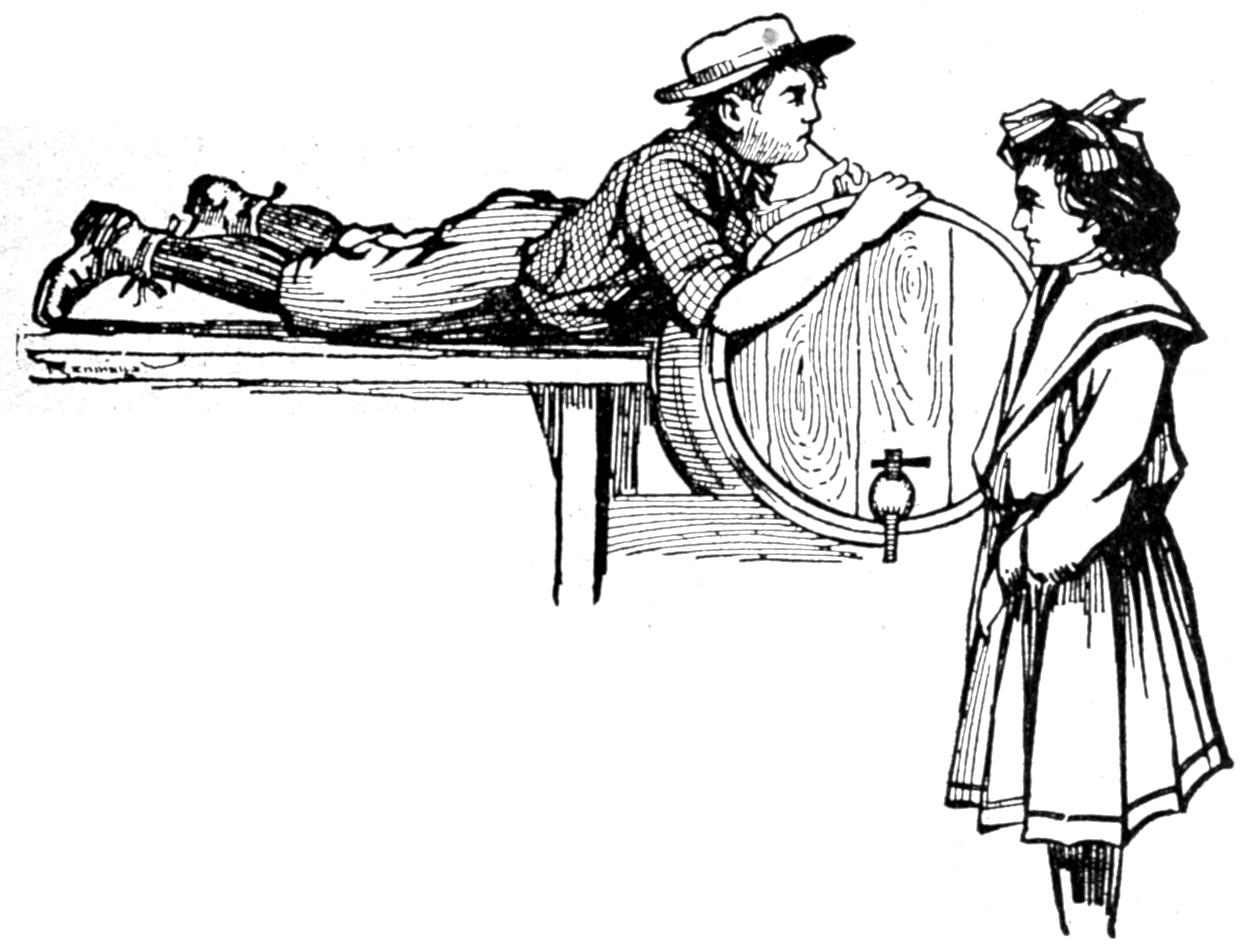
“You oughtn’t to
do that, Joey.”
“‘You oughtn’t to do that, Joey,’ I said, looking
fearlessly into his bright brown eyes, ‘I just know
you ought not; what would Aunt Maggie say?’
“‘It doesn’t harm her any,’ he returned; ‘the old
lady will have a little less vinegar, that’s all,—I
prefer my vinegar this way. I’ve had all I’ve
wanted to drink for a month, and it gets better and
better,—and, besides, I can drink a whole lot more
than I could at first, and it’s lots stronger, too.
After a little I guess I can drink as much as a big
man and never feel it!’ and poor Joey stretched
himself to his greatest height, and strutted about
the playhouse in an exceedingly silly manner.”
“Why didn’t you tell Aunt Maggie?” asked
Bertha. “I would have told my mother, at least.”
“Perhaps you would, but I was a thoughtless
child, and Joey was almost the only playmate I
had, and as I was very fond of play, I suppose I
kept quiet from a selfish fear that I might be forbidden
his company entirely.”
OLD JOE, THE DRUNKARD PART FOUR
I t doesn’t seem possible,—I declare it
doesn’t!” exclaimed Henri, “that
anybody could ever have cared to be
near that horrid old man,—least of
all, our nice, sweet grandma.”
“But you must not forget that he
was not always horrid. He was as
fair and bright then, as you are, Max.
And I tell you, my children, if you
are ever led to follow in his steps,
and form the appetite for strong drink
which he did, you would not be one
whit better in appearance or condition in a few
years than old Joe is to-day. It may well make you
shudder, my boy, but I tell you the truth, and I
only hope you will keep the object lesson which
you have learned to-day always before you.
“I did not dream, at this time, any more than
poor Joe, what this would lead to.
“A few days after this,” continued grandma, “his
aunt sent him to our house to do an errand for her,
and told him he might stay half an hour. After a
little, while we were quietly playing, I noticed that
Joey began acting strangely. When he tried to
talk, his tongue seemed thick, and his eyes were
red and dull.
“‘What’s the matter, Joey?’ I asked, in real
alarm, for I had never seen any one act so before.
“‘Nothin’ smatter. Little too much Aunt Magsh
shider. Bezzer go home now,’ and poor Joe walked
unsteadily down the lane to the road. But even
then it did not occur to me
that my little playmate was
actually a trifle drunk. I
only thought he was trying
to plague me, or was possibly
a little sick, so I didn’t
mention it. But the very
next week I was sent to
Aunt Maggie’s to borrow a
pattern. When I asked for
Joey, she said she guessed
he was around somewhere,
she didn’t know where, she
hadn’t seen him all the
morning.
“Of course, I scampered
off to find him, for I wanted
to spend the precious hour
that mother had allotted me in which to play with
Joey, in repairing our latest playhouse.
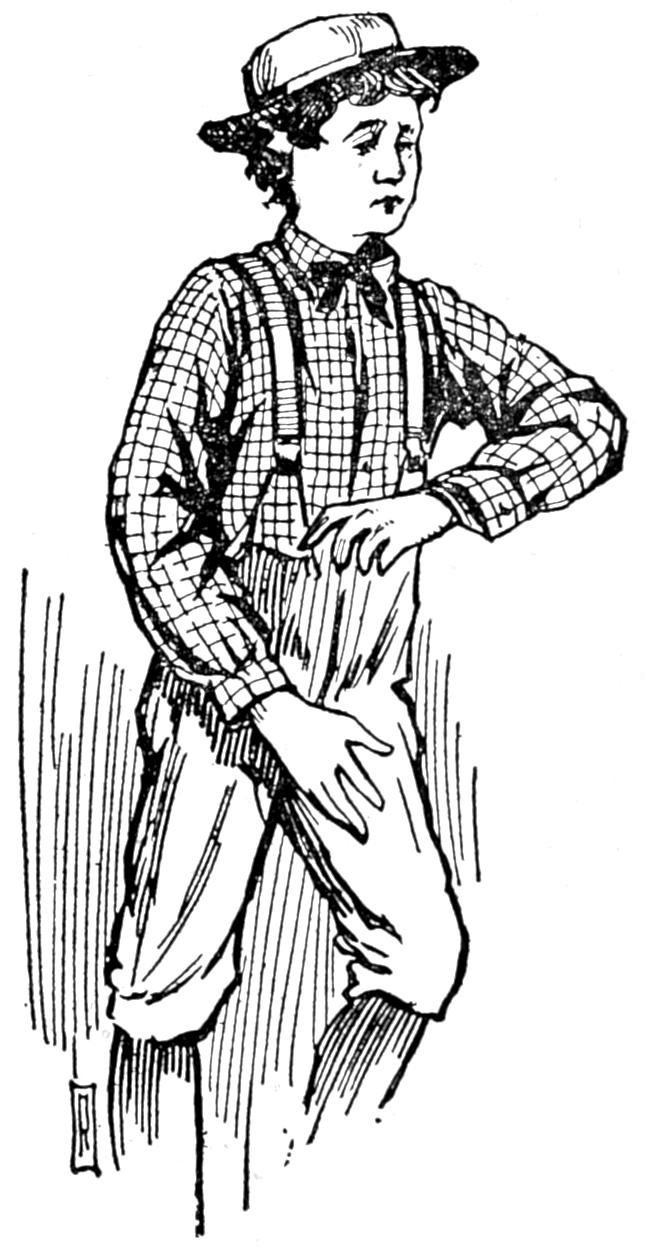
“Bezzer go home now”
“‘Joey! Joey!’ I called. ‘Come quick! For I
can’t stay very long. Come and let’s mend the
playhouse!’
“But there was no answer. I called again and
again. It took me a long time to find him, but at
last, just as I was getting a little frightened, I
turned around a corner of the old barn, and there,
leaning against the corncrib, with his round face
quite white, was Master Joey, sucking away bravely
on an old clay pipe which we had often used to
blow soap bubbles with.
“The smell of the tobacco smoke was quite
strong, so I knew at once what my poor young
friend was attempting to do. I had heard my
father say that smoking was a very bad habit, and
the smell of the nasty stuff made
me feel sick, myself, for I was
not accustomed to it.
“When Joe saw that he was
fairly caught, he tried to put on
an air of great importance, and began stuffing
more of the vile tobacco into his pipe; but I could
see that his hand trembled so that he could hardly
hold the pipe.
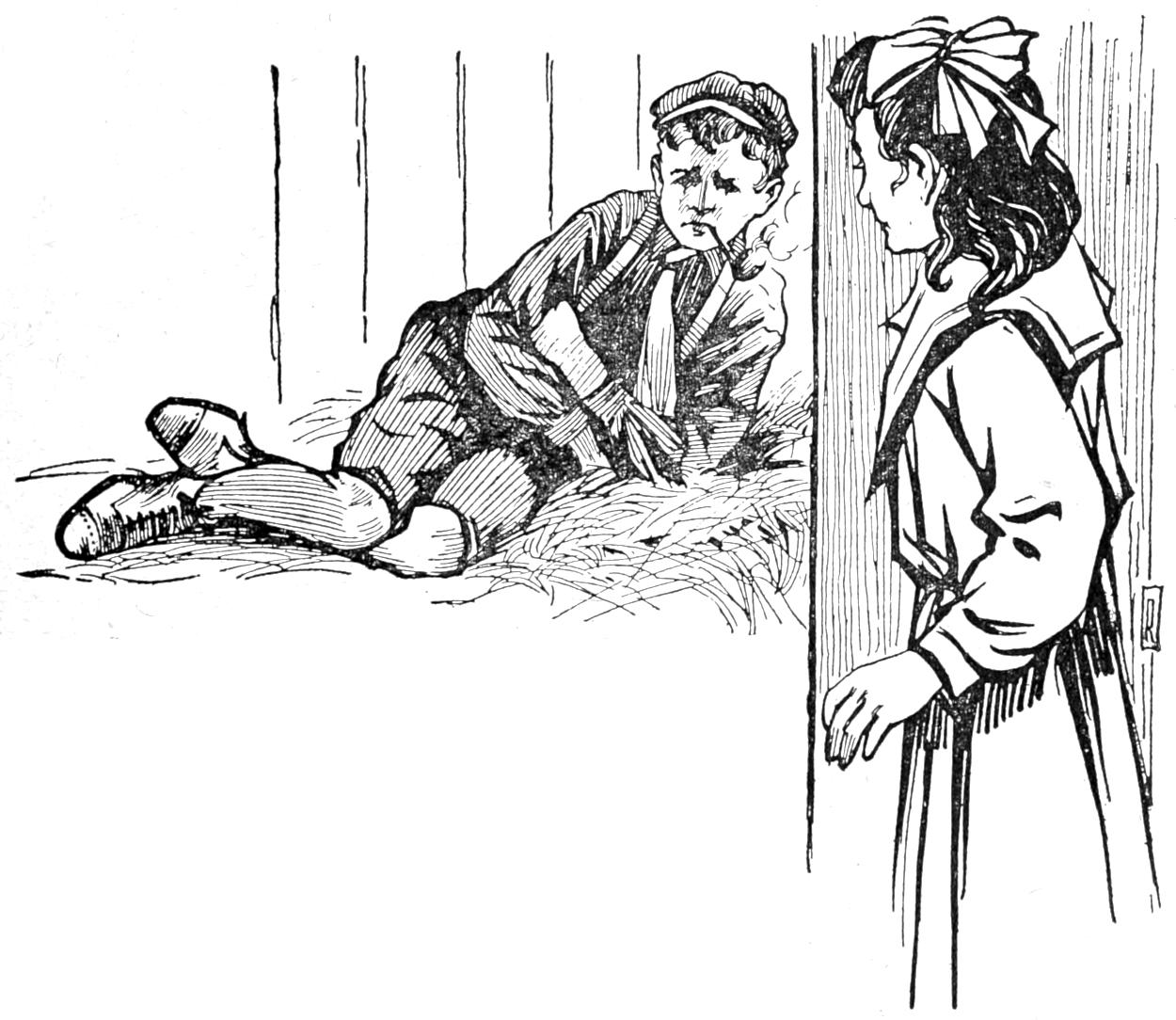
“His round face quite white”
“‘Why, Joe Brandon!’ I exclaimed, now fairly
aroused. ‘I’ll tell Aunt Maggie, there now,—I
declare, I will!’ and I started toward the house.
“‘Come back, I tell you! I wouldn’t be a little
telltale!’ shouted Joey, though his voice sounded
weak and strange. ‘You just march back here,
Miss Tattler, or I’ll never build you another playhouse
as long as I live, or play with you another
minute. Every single time a fellow wants to have
a little fun, then you begin to threaten to tell Aunt
Maggie! As much as I’ve done for you,—and as
many playhouses as I’ve made for you! Never
you mind, Miss Tattler, it’s the last—the very
last!’
“My children, I am ashamed to say I hung my
head and slowly sauntered back; but I felt guilty.
“Joe tried to laugh boisterously, as he saw me
coming back, and though he was really a kind-hearted
boy, he began to mock me, and threatened
to tell my mother that I had stolen the tobacco
from the grocery for him.
“‘But you know that isn’t true, Joe Brandon!’ I
protested with trembling voice, for it was the first
quarrel we had ever had.
“‘I’m no sissy boy, I’ll have you understand,
Miss Jennie Brown! Lots of the best and richest
men in town smoke. Even the new minister
smokes cigars, for I saw him, and I’m going to
smoke, too. It’s no worse for me than it is for
them. So there! I guess you’ll hold your tongue
now, Miss Jennie Brown!’”
“Why, grandma!” exclaimed Henri; “he was
surely very impolite, for a boy who was trying so
hard to be a man. He deserved a good flogging;
if I’d been there, I never would have allowed him
to speak like that to my grandma.”
“Surely Joe must have been a bad boy. Did he
ever talk to you like that before?” asked Bertha,
whose face had grown very red.
“O no, Bertha; but you see one cannot expect
much from a glutton or an intemperate person.
And poor Joe had been a glutton so long and had
taxed his weak stomach so many years with rich
food, and stimulating tea and coffee, pepper and
spices, that all this began to be felt in his nervous
system, and led to all sorts of evil; until, when
he was only ten years old, he had such a craving
for something strong and exciting that he began
learning the tobacco habit. The Bible says truly
that none can bring a clean thing out of an unclean.
So, how could sweet and gentle words come from
lips through which passed so much calculated to
destroy and break down the body and ruin the
nervous system?”
“Did Aunt Maggie find it out at last?” questioned
Max.
“O yes; I will tell you about it; finally after Joe
had smoked his pipe out, I said to him, ‘come, now;
my hour is almost up, and I’ve been waiting for
you all this time. I hope you are ready to come
with me now and fix our new playhouse.’ Then I
turned to look at Joe. I tell you, children, I was
frightened this time and no mistake. The poor
lad’s eyes were turned up and rolling wildly in their
sockets. His cheeks were as white as marble and
his lips were purple and drawn; his hands were
clenched, and he rolled down like a log by the side
of the straw stack. Still he
groaned, ‘don’t you tell
Aunt Maggie—no, no!’
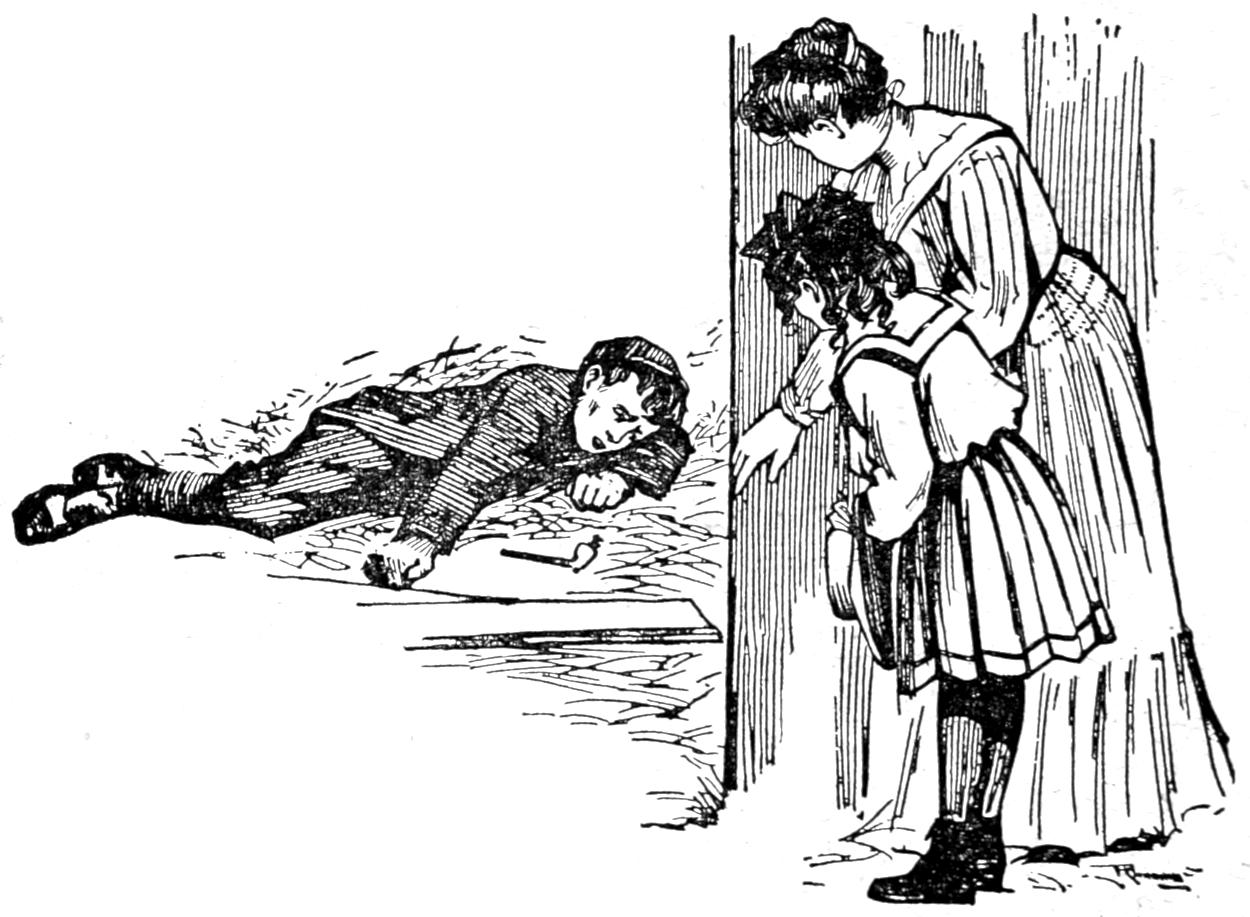
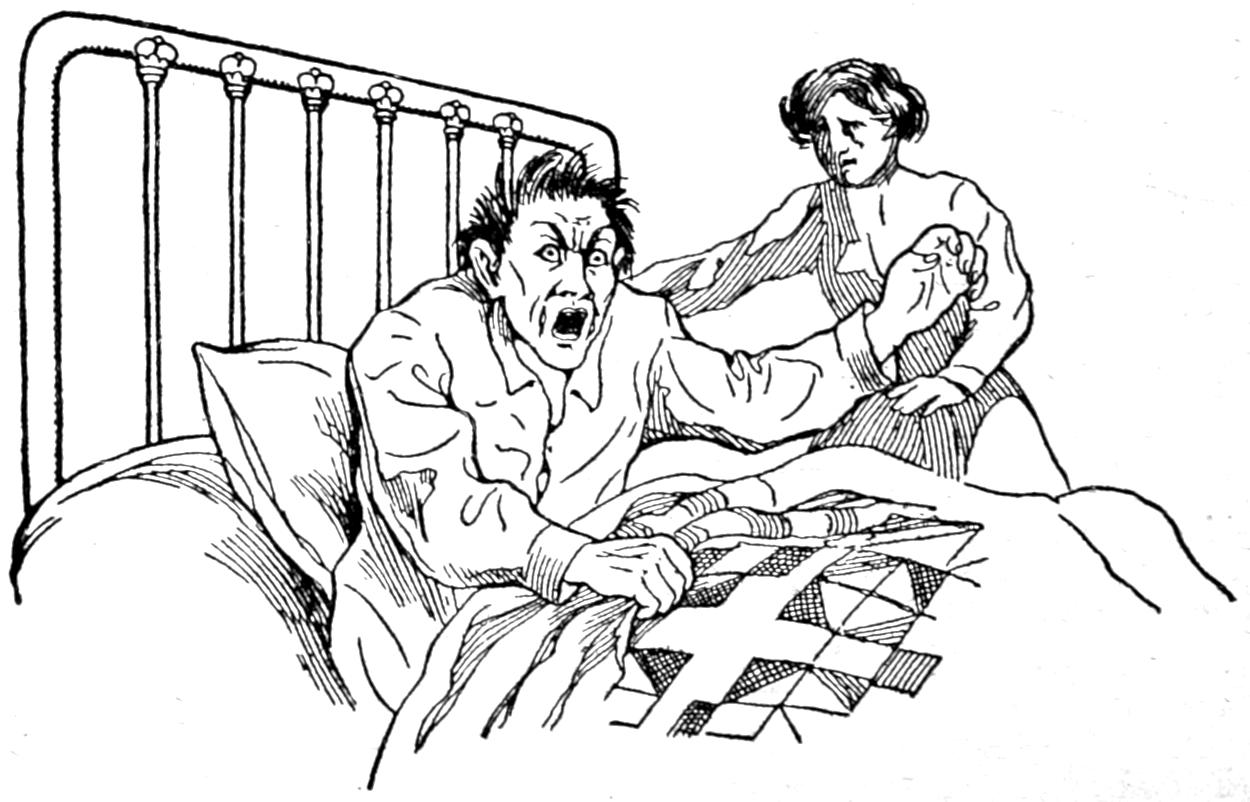
“He’ll die, won’t he?”
“‘I must! I must! I guess
you are going to die, Joey,
I must call her! I can’t let
you die here, all alone!’
But all poor Joe could do was just to curl up in
a heap, and snarl, ‘Tattle, tattle!’ between groans.
“I was just deciding to run home and leave him
to his fate, for surely I thought him dying, when I
looked up, and there stood Aunt Maggie. She took
in the situation at a glance. She had begun to
worry about Joe’s being gone so long, and had
started out to find us.
“There, by the side of the sick and spueing lad,
lay the old pipe, the cause of all the mischief. The
good lady was terribly disgusted, besides being
considerably frightened. For a moment she did
not speak, though her lips trembled; I was the first
to scream:—
“‘O Aunt Maggie! he’ll die, won’t he?’
“‘Die?—No; but may be it would be better in
the end if he should, before he breaks all our hearts.’
“Aunt Maggie was large and strong, and I had
always thought her too stouthearted to cry, but
something very much like a sob broke from her
trembling lips, as she said, not unkindly, kneeling
by the side of the sick boy, and putting his damp
head in her motherly arms:—
“‘Joe, lad, I’ve been thinking all wasn’t right
with you of late. I’ve been missing the hard cider
in the cellar, and I’ve thought you acted strange.
No wonder. Now, Joe, if this doesn’t kill you,
you must stop it at once. Where did you get the
stuff?’
“‘I’ll not tell you! I’ll die first!’ groaned Joe.
“That’s all I heard,” continued grandma, “for I
turned on my heel, and ran just as fast as my little
feet could fly, nor stopped until I reached home, a
very frightened and a very breathless little girl.”
OLD JOE, THE DRUNKARD PART FIVE
But Aunt Maggie
insisted
upon knowing
where Joe got
the tobacco,”
said grandma,
“and how he
obtained
the money for
buying it; for she found some
of the nasty stuff hidden away
in his room that same day.
So, at supper, she again asked
him to tell her the truth, and
begged him to hide nothing
from her. Aunt Maggie told my mother all about
it afterward. She said that Joey had been doing
errands for the grocer, Mr. Green, for some time,
and that he had never brought home any money,
and that now Joey declared that he had taken his
pay in tobacco, because Mr. Green refused to pay
him in any other way.”
“That wasn’t true, I dare say,” reflected Max.
“Was it, grandmother?”
“No, indeed. When Mr. Green found out about
it, he said that he had paid the boy the money for
all that he had done, and that he had not only not
given him any tobacco, but that he did not keep it
for sale at all in his shop. He said that as he knew
it to be harmful, he had decided not to sell the
stuff. So poor Aunt Maggie saw at once that Joey
had added to his other sins, those of falsehood and
deceit.”
“Why, grandma,” ventured Bertha, “I should
think you would not have wanted to play with him
any more, when you saw what a bad, deceitful boy
he was.”
“No, I did not play with him any more. My
father at once forbade that, and in a few weeks
Aunt Maggie moved away. Of course, I missed
my old playfellow, but I did not see him again in a
long time,” continued grandma. “My mother saw
Aunt Maggie after they had been gone about a
year, and mother said that she never saw such a sad
change in any one before. The poor old lady’s hair
had grown quite white, and her face was pale and
careworn.”
“I dare say that bad, ungrateful boy vexed her
so that she had no peace,” continued Bertha.
“Yes, yes,” sighed grandma, “my mother said
there were tears in Aunt Maggie’s eyes as she told
her that poor Joe was going to ruin as fast as he
could, and that already she found it quite impossible
to control him.
“Finally, one day about three or four years after
this, my father had occasion to pass through the
town where Joey lived, and I went with him. I
rather hoped we would not see Joe, for I knew that
the meeting would be only painful; for you will
remember that by this time I had grown to be a large
girl,—quite a young lady, in fact, and Joe was a
year older.”
“Did Joe know you were coming?” asked Henri.
“O, no, or surely I do not think I should have
found him in the place where he was.”
“Maybe he wouldn’t have cared after all,” ventured
Max.
“O, yes, he would, I am sure; for he was naturally
a very proud lad, fond of show, and always anxious
to make a good impression upon his friends. But
you see, he didn’t know we were coming, and so as
father and I were passing the door of one of the
many saloons which cursed the little town, there
stood my old playfellow, among a crowd of young
toughs, just in the act of lighting his pipe, and taking
dreadful lessons in beer drinking and profanity.
O you can’t think how badly I felt.”
“What did he say then, grandma? Wasn’t he
very much ashamed?” asked Bertha.
“Perhaps so. He stood close outside, by the door,
and I called to him just as he was stepping inside.
At first he pretended not to hear me, but it seemed
to me that I could not let him enter that awful
place; and so I ventured to call his name once
more, louder than before. He could hardly refuse,
then, to come back and speak to me. Just as he
did so, an old man came out, staggering and spueing
as he came. The man was quite well dressed,
for this was one of the better saloons; but the poor
man’s face was red and bloated and looked much
like old Joe’s to-day.
“I could see that my young friend was considerably
ashamed, but he tried by falsehood and deceit,
and by putting on a bold front, to excuse the fact
of his being in such a place.
“‘Fact is, Mr. Brown,’ he said, addressing my
father, ‘I was in there just doing an errand for
Aunt Maggie. She wanted some alcohol for her
camphor, and of course, she wouldn’t go, so she
coaxed me. I don’t like these rough fellows,
myself, Jennie,’ he continued blandly. ‘You know I
never did. Didn’t we have some jolly times in the
old days though?’ and I fancied,” continued grandma,
“that I could see a shade of real regret in his
expressive brown eyes. O I felt so sorry for him!
“‘Poor Joe!’ I said, ‘Aunt Maggie might a great
deal better have gone without her camphor, than
to send you into a saloon among those awful spueing
men. Really, Joey,’ I questioned in an undertone,
‘did Aunt Maggie actually and truly send
you?’
“‘O you’re just like you used to be, Jennie,’ said
he, laughing lightly, but I could see that my question
made him wince. ‘Of course she sent me, I
have to mind Aunt Maggie, don’t you see?’
“Finally, before I left him, I had made him
promise solemnly that he would keep away from
the saloons and never touch another glass of beer
as long as he lived.”
“Then he owned up, did he?” questioned Max.
“Yes, for he must have known on second
thought, that his wretched falsehood about Aunt
Maggie’s sending him into a saloon was too foolish
to be believed.”
“Well, anyway,” sighed Bertha, “the poor boy
didn’t keep his promise to you, grandma, or we
would not have seen him in the gutter to-day.”
“O no, my dear; but it was all I could do, and
perhaps it did affect him for good for a little while;
for though he was weak and foolish and had, by
this time, acquired
a great love for the
fatal cup, yet he
had great respect
for my father, and
also entertained a
strong feeling of
friendship for me.
Still, it took me
some time to get
him to make the
promise.
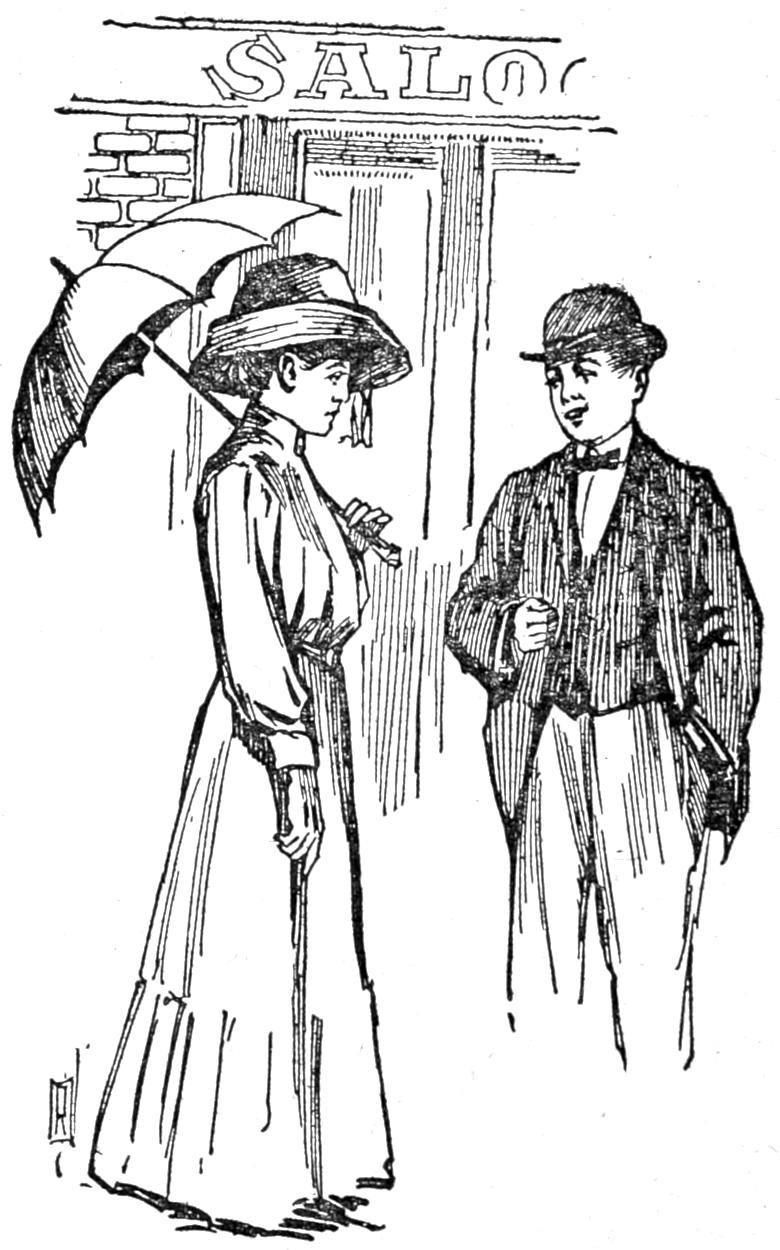
“I’ll promise, of course.”
“‘You’re asking
a great deal of me,
Jennie,’ he said,
‘seems to me you’re
pretty hard on a
fellow, but I’ll
promise, of course.
Though you ought
to know me well enough to be perfectly assured that
I would have too much sense to drink enough to do
me any harm. Just a social glass now and again,—that’s
all,—couldn’t possibly do me a bit of harm.
I flatter myself I’m too much of a gentleman not to
know enough to quit when I’ve had plenty. Of
course some people can’t do it, but I am my father’s
son, Miss Jennie, and they say that he was a gentleman!’
and the poor, misguided lad straightened
himself very proudly and glanced at my father as
though hoping he would approve his logic.”
“What did your father say, grandma,” queried
Henri.
“He only smiled sadly at the self-conceited young
lad and said:—
“‘I used to know and love your father, Joe, he
was a true gentleman, and one of my dearest
friends,—indeed, he was too much of a gentleman
to allow anything that could intoxicate to pass his
lips. I only wish you would follow in his steps.’
“This sort of thing was not to Joe’s liking one
bit,” continued grandma, “and he soon made an
excuse to part company from us. He turned down
another street, and it was nearly five years before I
saw him again. Meanwhile, his heartbroken aunt,
who had been to him both father and mother, was
doing all in her power to save him.
“‘I can’t imagine whom the boy takes after,’ she
often said to my mother. ‘None of his people ever
drank, and his father was a gentleman.’” But the
poor woman did not realize that he had formed the
love for strong drink right at home in her own
pantry and cellar.
OLD JOE, THE DRUNKARD PART SIX
As I said, it was almost five years
before I saw Joe Brandon again.
He was then a young man of
very fascinating manners, handsome,
and attractive. But he
was already becoming so idle
and vicious that no one dared
trust him, and although his face
was handsome, his follies and
intemperate habits had stamped
themselves upon it, until they
had given him a certain reckless
air that was far from agreeable,—still—”
“O grandma!” interrupted Bertha, with an expression
of incredulity, “it can’t be possible that
old Joe ever had a grain of good looks. Why! his
face is actually hideous and disgusting, and so
bloated that I could scarcely see his eyes; and,
grandma, it was horrible, horrible! his long, yellow
beard was covered with vomit, and—O grandma!
how could he ever have been attractive?” and
Bertha shuddered.
“I tell you, my dear,” explained grandma, “there
is nothing on earth that is so brutalizing and
degrading in its effect upon the human system as
strong drink. It is the devil’s own weapon, and
with it, he succeeds too often in bringing his poor,
duped victims far below the level of the brutes.
“About this time Joe became acquainted with a
beautiful young girl, the daughter of a merchant
who lived in the city, where Joe now had his home.
“Meanwhile, good Aunt Maggie had died, leaving
Joe the little remnant of property which she
had. This was soon spent, of course, in folly and
dissipation by the poor prodigal.”
“But tell me about the pretty young girl,” persuaded
Bertha.
“Her name was Martha Grey,” replied grandma,
“and all too soon the reckless and dissipated young
man succeeded in winning her heart, for, as I told
you, he was handsome and kind-hearted; although
he possessed a high opinion of his own good looks
and capabilities.
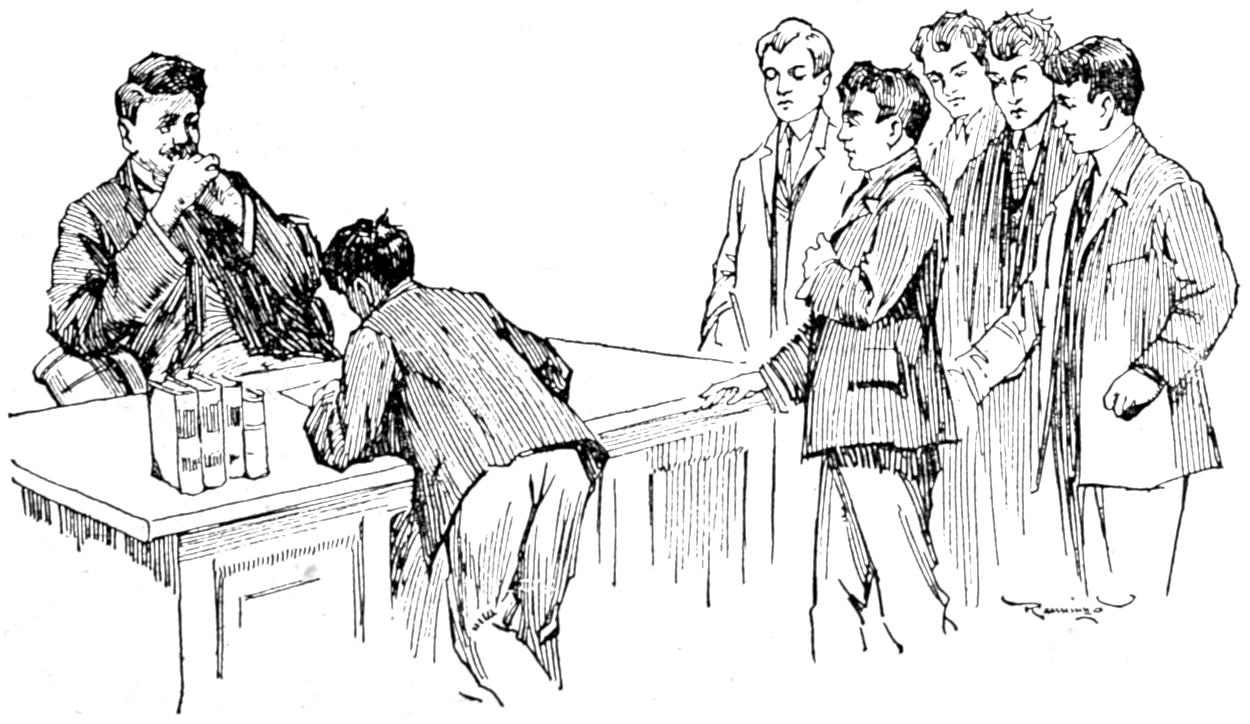
“He had attended school a good deal, and was no
mean student, and after a time he began the study
of law. He might have succeeded well in this, his
chosen profession, had he been diligent and persevering;
but his old enemy, appetite, was constantly
upon his track, and it was not long before
he lost his practice, because nobody wanted to
employ a drunken lawyer. After he had been seen
reeling down the street a few times, he soon found
himself without clients.”
“But, grandma,” protested Bertha, “I don’t see
how he could have kept all this hidden from poor
Martha Grey.”
“Ah, he could not,—though he tried hard enough
to do so, for Mr. Grey, Martha’s father, was very
much opposed to strong drink. But one day Joe so
far forgot himself as to enter Mr. Grey’s store quite
intoxicated. Of course, the merchant was very
much displeased and disgusted, and forbade the
young man ever to visit his daughter again. Still,
I am sorry to say, Martha insisted upon meeting Joe,
and still accepted his company.”
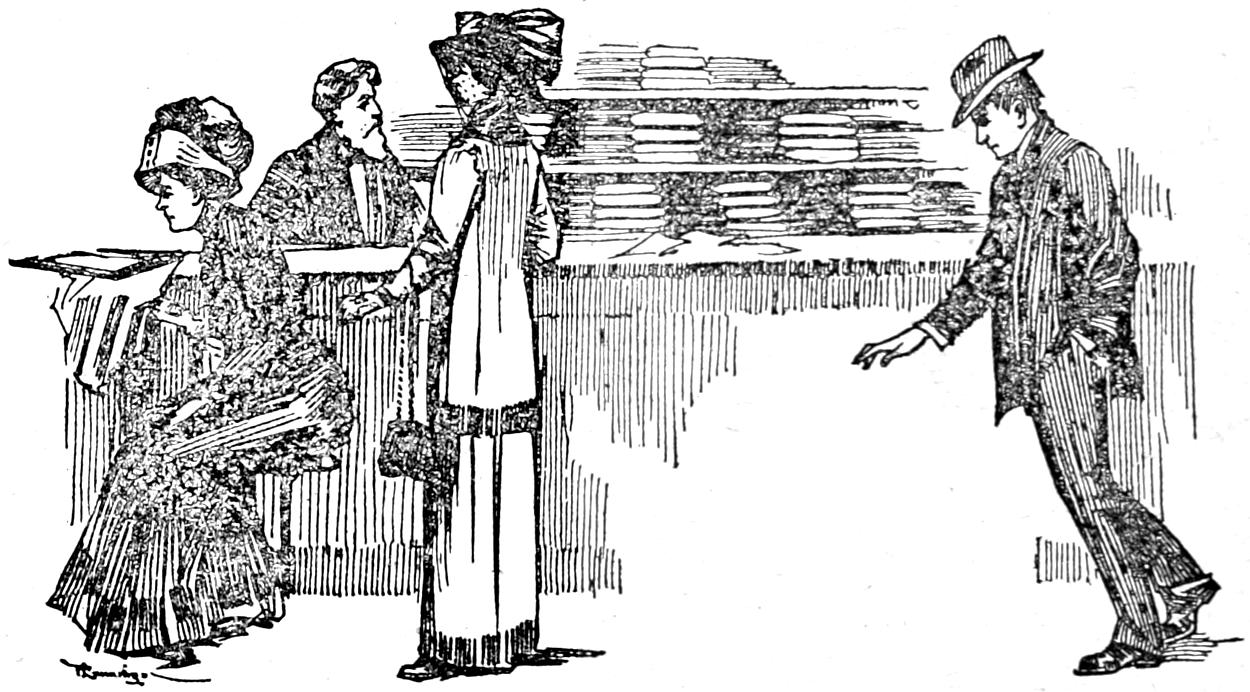
“He entered Mr. Grey’s store quite intoxicated.”
“Why didn’t you go and talk with her,
grandma?” suggested Henri, “maybe you could
have persuaded her, even if her father could not;
she must have been a silly young lady, I’m sure.”
“O my dear boy!” exclaimed grandma. “If you
had known Martha Grey, you could not have said
that. No; she was a beautiful girl, but a most
mistaken one,” and grandma sighed. “I went to
visit her, myself, many times, and most earnestly
did I try to persuade her to quit the company of
this reckless and dissipated young man. Poor Martha’s
face would turn very pale as I talked with her,
but her voice was low and decided as she replied:—
“‘I know you think him very bad, dear friend,
but poor Joseph is not altogether so, and he has
promised me to quit his cups entirely, and I am
sure he will. I think it is my mission to make a
good man of Joe,—to reform him, in fact, and I
believe I can do it, at least, I mean to try.’ So in
spite of all that I could do, and in spite of the
efforts of her father, and many interested friends,
she ran away from home and married the poor
drunkard.”
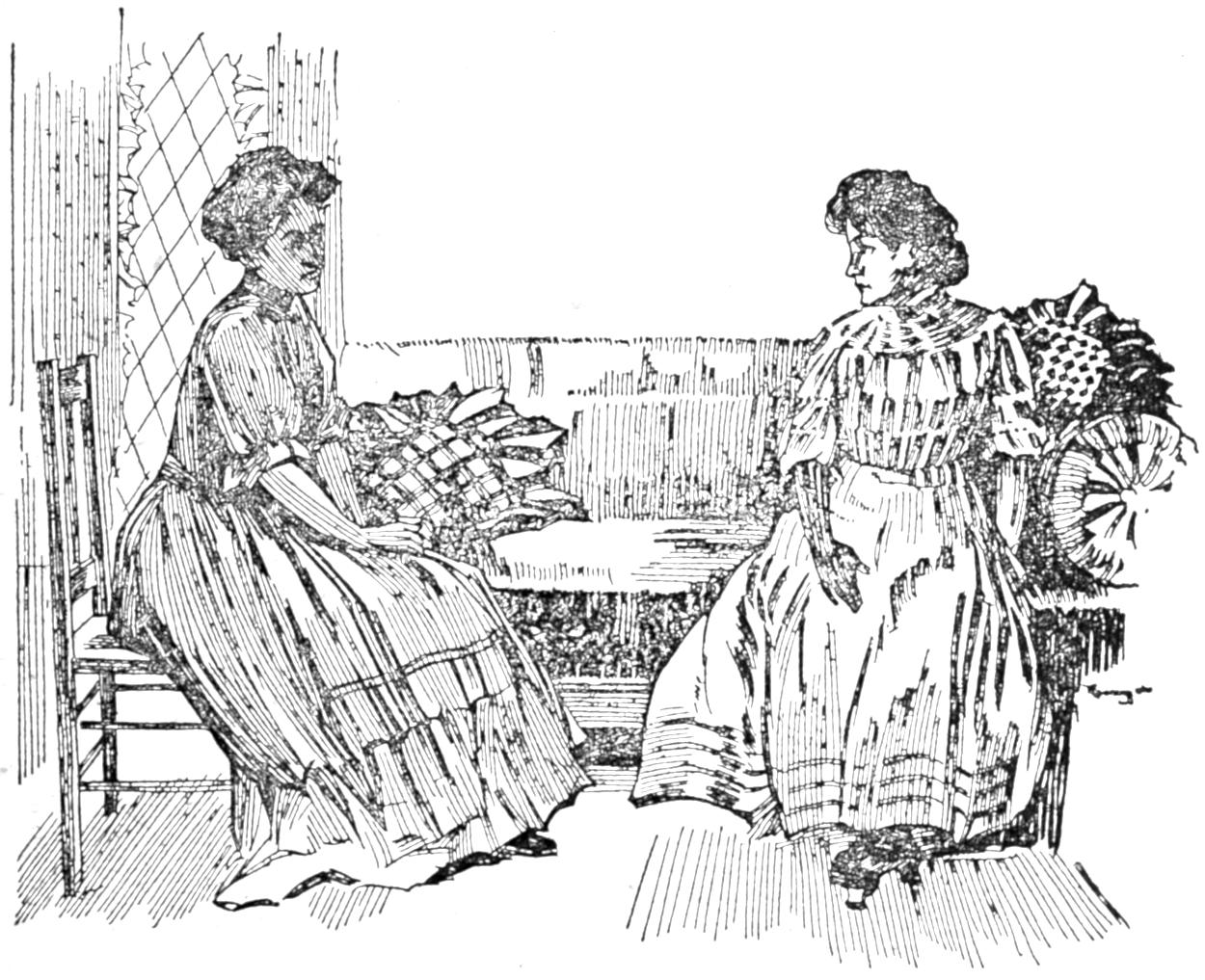
“I think it is my mission to make a good man of Joe.”
“Didn’t Joe behave himself any better then?”
asked Henri.
“Better?—no, no; and from that moment, the
fate of the poor, mistaken girl was sealed. To be
sure, her wretched husband would have periods of
repenting, and spend days and nights of misery and
remorse, but the demon which he had entertained
and fed so many long years was not to be easily
banished.”
“Did Mr. Grey ever forgive his daughter and take
her home again?” queried Bertha, her blue eyes
full of tears, “O, I hope so, grandma.”
“Mr. Grey was a kind father, and he loved his
daughter very tenderly. So, after a while he went
to see Joe, and invited him to take a position as
clerk in his store. The poor fellow was only too
glad to accept the kind offer, and promised most
faithfully to reform. Of course, his devoted wife
was much encouraged, and for a time all went well.
“But, my children,” continued grandma, “there
is nothing but the power of Christ, which can lay
hold of the victim of rum, and stand him upon his
feet and keep him from falling. But for this wonderful
power, poor Joe had never asked.
“Still he struggled in his own strength,—struggled
most pitifully, to break the strong bands
which bound him,—struggled vainly as poor Samson
did when he was shorn of his strength. But it was
only a few weeks before poor Joe had fallen again.
Some of his old companions, jealous of his success
and altered circumstances, determined to compass
his ruin.
“‘Come in, Joe, man, come in and take a glass
with your old friends,’ they called one day as he
was passing a saloon where he had so lately been a
drunken idler. Joe had not the courage to refuse,
for there was nothing so dreaded by him as to have
it said that he was tied to a woman’s apron string.”
“O, I’m so sorry!” exclaimed Bertha, for she
was a very sympathetic little girl. “Of course, the
foolish man went into the saloon.”
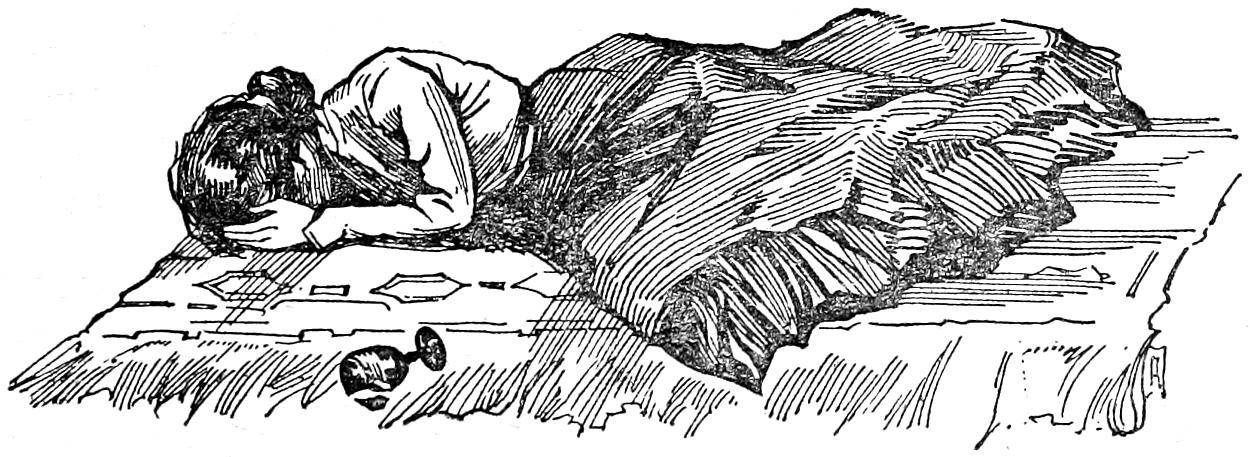
“Indeed, he did, and when he came out again, his
drunken legs would scarcely carry him home.”
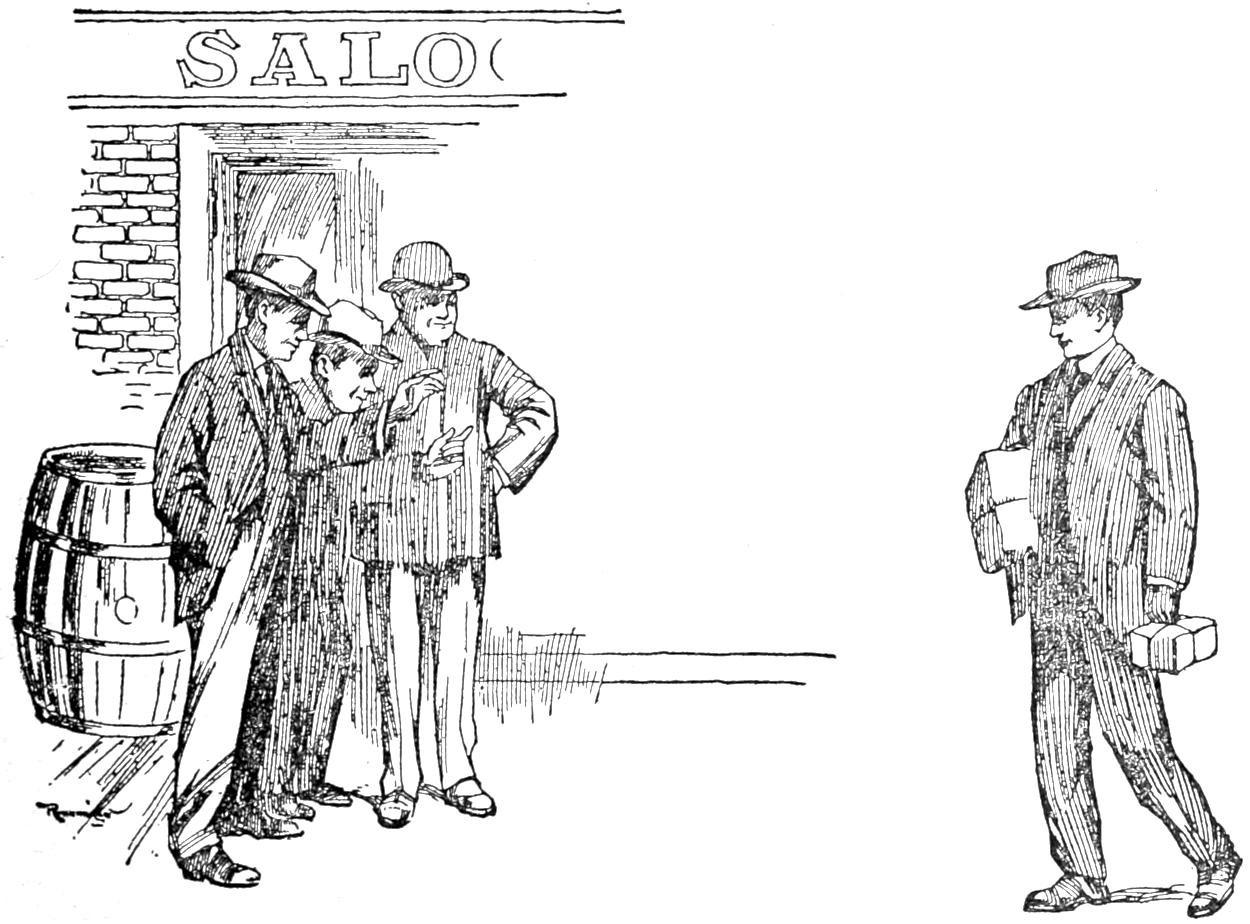
“Of course, the foolish man went into the saloon.”
“Did his father-in-law send him away now? I’m
very sure I should,” reflected Max stoutly. “I
would not have a drunken man about.”
“I am glad to know that you hate strong drink,
my lad,” replied grandma, placing her hand kindly
upon his head, “but we must none of us forget that
Christ died for all, even the poor drunkard, and we
should pity, and do all we can for him. Yes, Mr.
Grey forgave him and took him back, not only this
time, but many times afterward, until finally after
a few years, his poor wife, beautiful Martha Grey,
died heartbroken and wretched.
“Then Joe went away, and after a time he went
to sea. Finally, after many years, he became the
wretched, drunken outcast whom you saw to-day.
“Now children, I have told you the story of poor
old Joe, and I want you to learn this verse, which
is one of the proverbs of Solomon, the wise man:—
“‘For the drunkard and the glutton shall come
to poverty; and drowsiness shall clothe a man
with rags.’”
THE BEGINNING AND THE ENDING
EFFECTS OF STIMULANTS BY MRS. E. G. WHITE
Know you not that they which
run a race run all, but one receiveth
the prize? So run, that you
may obtain. And every man that
striveth for the mastery is temperate
in all things. Now they
do it to obtain a corruptible
crown; but we an incorruptible.”
Here the good results of self
control and temperate habits are set forth. The
various games instituted among the ancient Greeks
in honor of their gods, are presented before us by
the apostle Paul to illustrate the spiritual warfare
and its reward. Those who were to participate in
these games were trained by the most severe discipline.
Every indulgence that would tend to weaken
the physical powers was forbidden. Luxurious
food and wine were prohibited, in order to promote
physical vigor, fortitude, and firmness.
To win the prize for which they strove,—a chaplet
of perishable flowers, bestowed amid the applause
of the multitude,—was considered the highest
honor. If so much could be endured, so much self-denial
practised, in the hope of gaining so worthless
a prize, which only one at best could obtain,
how much greater should be the sacrifice, how much
greater should be the sacrifice, how much more
willing the self-denial, for an incorruptible crown,
and for everlasting life!
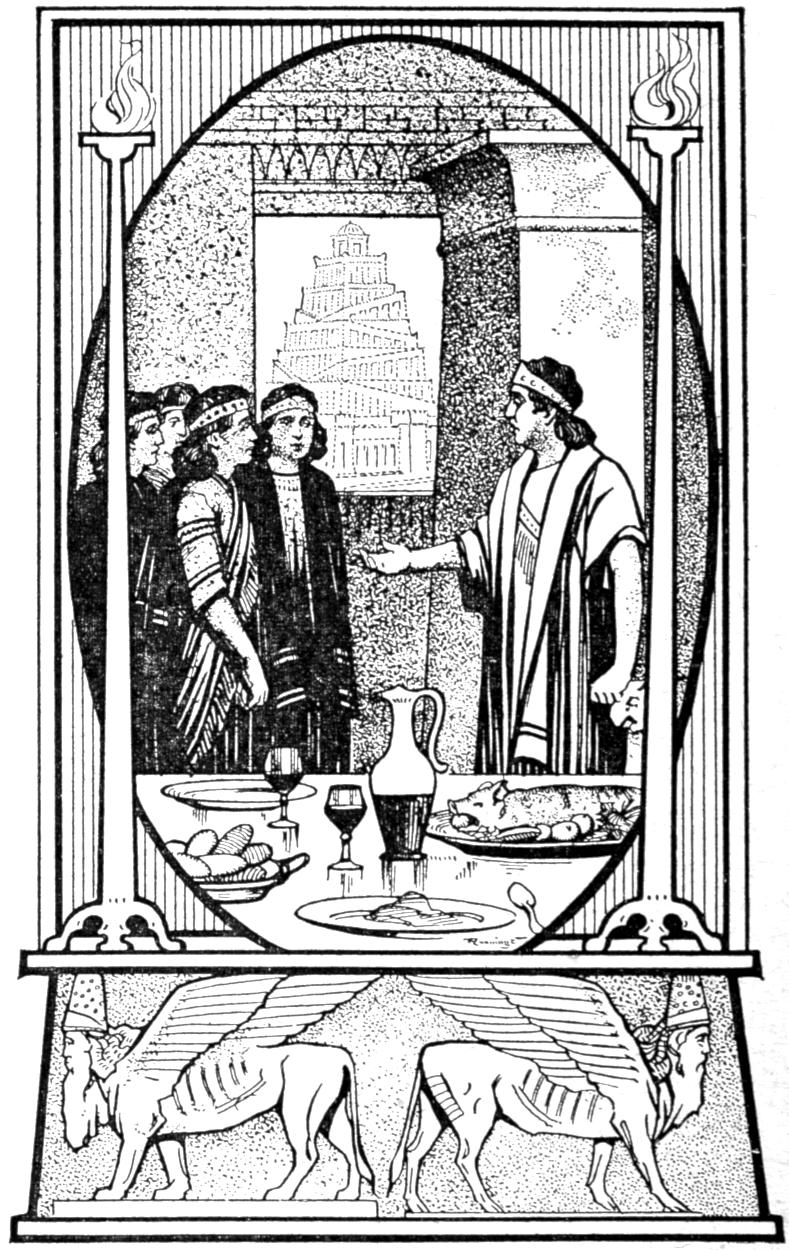
Daniel and His Fellows Refusing the King’s Meat
There is work for us to do—stern, earnest work.
All our habits, tastes, and inclinations must be
educated in harmony with the laws of life and
health. By this means we may secure the very best
physical conditions, and have mental clearness to
discern between the evil and the good.
In order rightly to understand the subject of temperance,
we must consider it from a Bible standpoint;
and nowhere can we find a more comprehensive
and forcible illustration of true temperance
and its attendant blessings, than is afforded by the
history of the prophet Daniel and his Hebrew associates
in the court of Babylon.
When these youth were selected to be educated
in the “learning and the tongue of the Chaldeans,”
that they might “stand in the king’s palace,” there
was appointed them a daily allowance from the
king’s table, both of food and wine. “But Daniel
purposed in his heart that he would not defile himself
with the portion of the king’s meat, nor with the
wine which he drank.”
The food appointed them would include meats
pronounced unclean by the law of Moses. They requested
the officer who had them in charge to give
them a more simple fare; but he hesitated, fearing
that such rigid abstinence as they proposed would
affect their personal appearance unfavorably, and
bring himself into disfavor with the king. Daniel
pleaded for a ten days’ trial. This was granted,
and at the expiration of that time these youth were
found to be far more healthy in appearance than
those who had partaken of the king’s dainties.
Hence the simple pulse and water which they at
first requested, was thereafter the food of Daniel and
his companions.
It was not their own pride or ambition that
brought these young men into the king’s court,—into
the companionship of those who neither knew
nor feared the true God. They were captives in a
strange land, and Infinite Wisdom had placed them
there. At this trial of their loyalty, they considered
their position, with its dangers and difficulties,
and then in the fear of God made their decision.
Even at the risk of the king’s displeasure, they
would be true to the religion of their fathers.
They obeyed the divine law, both physical and
moral, and the blessing of God gave them strength
and comeliness and intellectual power.
These youth had received a right education in
early life, and now, when separated from home
influences and sacred associations, they honored the
instructors of their childhood. With their habits
of self-denial were coupled earnestness of purpose,
diligence, and steadfastness. They were not actuated
by pride or unworthy ambition; but sought to
acquit themselves creditably, for the honor of their
down-trodden people, and for His glory whose servants
they were.
When the ability and acquirements of these youth
were tested by the king at the end of the three years
of training, none were found like unto Daniel,
Hananiah, Mishael, and Azariah. Their keen apprehension,
their choice and exact language, their
extensive and varied knowledge, testified to the
unimpaired strength and vigor of their mental
powers. Therefore they stood before the king.
“And in all matters of wisdom and understanding,
that the king enquired of them, he found them ten
times better than all the magicians and astrologers
that were in all his realm.”
God always honors the right. The most promising
youth from all the lands subdued by the great
conqueror had been gathered at Babylon, yet amid
them all, the Hebrew captives were without a rival.
The erect form, the firm, elastic step, the fair countenance,
the undimmed senses, the untainted breath,—all
were so many certificates of good habits,—insignia
of the nobility with which nature honors
those who are obedient to her laws.
The history of Daniel and his companions has
been recorded on the pages of the inspired word,
for the benefit of the youth of all succeeding ages.
What men have done, men may do. Did those
youthful Hebrews stand firm amid great temptations,
and bear a noble testimony in favor of true
temperance?—the youth of to-day may bear a similar
testimony.
The lesson here presented is one which we would
do well to ponder. Our danger is not from scarcity,
but from abundance. We are constantly tempted
to excess. Those who would preserve their powers
unimpaired for the service of God, must observe
strict temperance in the use of His bounties, as
well as total abstinence from every injurious or
debasing indulgence.
The rising generation are surrounded by allurements
calculated to tempt the appetite. Especially
in our large cities, every form of indulgence is made
easy and inviting. Those who, like Daniel, refuse
to defile themselves, will reap the reward of their
temperate habits. With their greater physical stamina
and increased power of endurance, they have a
bank of deposit on which to draw in case of
emergency.
Right physical habits promote mental superiority.
Intellectual power, physical strength, and longevity
depend upon immutable laws. There is no happen-so,
no chance, about this matter. Nature’s
God will not interfere to preserve men from the
consequences of violating nature’s laws. There is
much sterling truth in the adage, “Every man is
the architect of his own fortune.” While parents
are responsible for the stamp of character, as well as
for the education and training, of their sons and
daughters, it is still true that our position and usefulness
in the world depend, to a great degree, upon
our own course of action. Daniel and his companions
enjoyed the benefits of correct training and
education in early life, but these advantages alone
would not have made them what they were. The
time came when they must act for themselves,—when
their future depended upon their own course.
Then they decided to be true to the lessons given
them in childhood. The fear of God, which is the
beginning of wisdom, was the foundation of their
greatness. His Spirit strengthened every true purpose,
every noble resolution.
Intemperance has cursed the world almost from its
infancy. Noah’s son was so debased by the excessive
use of wine, that he lost all sense of propriety,
and the curse which followed his sin has never been
lifted from his descendants.
Nadab and Abihu were men in holy office; but
by the use of wine, their minds became so clouded
that they could not distinguish between sacred and
common things. By the offering of “strange fire”
they disregarded God’s command, and were slain by
His judgments.
Alexander found it much easier to subdue kingdoms
than to rule his own spirit. After conquering
nations, this so-called great man fell, through
the indulgence of appetite—a victim of intemperance.
Notwithstanding thousands of years of experience
and progress, the same dark blot which stained the
pages of history, remains to disfigure our modern
civilization. Drunkenness, with all its woes, is
found everywhere we go. In spite of the noble efforts
of temperance workers, the evil has gained ground.
License laws have been enacted, but legal regulation
has not stayed its progress, except in comparatively
limited territory. Efforts have been made to
establish institutions where the victims of intemperance
might receive help to overcome their terrible
appetite. This is a noble work, but how much
wiser, how much more effective, would have been
the removal of the cause of all this woe! Considering
only the financial aspect of this question,
what folly it is to tolerate a business that is making
paupers by the thousand! The laws of the
land legalize the trade of making drunkards, and
then at great expense, provide institutions for
converting them again into sober men! Can our
legislators furnish no better solution of the liquor
question?
So long as the sale of liquor is sanctioned by
law, the victims of appetite can receive but little
benefit through inebriate asylums. They cannot
remain there always; they must again take their
place in society. The appetite for intoxicating
drinks, though it may be subdued, is not wholly
destroyed, and when temptation assails them, as it
must on every hand, they too often fall an easy prey.
What can be done to press back this inflowing
tide of evil? Let laws be enacted and rigidly
enforced prohibiting the sale and use of ardent
spirits. Let every effort be made to encourage the
inebriate’s return to temperance and virtue. But
even more than this is needed to banish the curse
of inebriety from our land. Let the appetite for
intoxicating liquors be removed, and the demand
for them is at an end.
Only men of strict temperance and integrity
should be admitted to our legislative halls, or
chosen to preside in our courts of justice. Property,
reputation, and even life itself, are insecure
when left to the judgment of men who are intemperate
and immoral. How many innocent persons
have been condemned to death, how many more
have been robbed of all their earthly possessions,
by the injustice of drinking jurors, lawyers, witnesses,
and even judges!
There is need now of men like Daniel, to do and
dare. A pure heart and a strong, fearless hand are
wanted in the world to-day. God designed that
man should be constantly improving,—daily reaching
a higher point in the scale of excellence. He
will help us, if we help ourselves. It is the duty
of every Christian to see that his example and
influence are on the side of reform. Let ministers
of the gospel lift up their voices like a trumpet, and
show the people their transgression, and the house of
Israel their sins. The youth need to be instructed.
Our hope of happiness in two worlds depends upon
our improvement of one. We should be guarded
at every point against the first approach to intemperance.
If we would preserve our children from
evil, we must give them a right example, and then
teach them to make God their fear, their wisdom,
and their strength.
The use of intoxicating liquor dethrones reason,
and hardens the heart against every pure and holy
influence. The inanimate rocks will sooner listen
to the appeals of truth and justice, than will that
man whose sensibilities are paralyzed by intemperance.
Those who venture to enter the forbidden
path are gradually and unconsciously led on, until
they become demoralized, corrupted, and maddened.
And while Christians are asleep, this evil is gaining
more strength and making fresh victims. If the
moral sensibilities of Christians were aroused upon
the subject of temperance in all things, and they
realized that the final destiny of every one depends
upon the habits he forms, they could by their
example, help those who are weak in self-control
to resist the cravings of appetite.
We witness great struggles in our country to put
down intemperance; but it is a hard matter to overcome
and chain a full-grown lion. If half the efforts
that have been put forth to stay this giant evil, had
been directed toward enlightening parents in regard
to their responsibility in forming the habits and
character of their children, a thousand-fold more
good might have resulted. The unnatural appetite
for spirituous liquors is often created at home, in
many cases at the tables of the very ones who are
most zealous to lead out in the temperance work.
We bid all workers Godspeed; but we invite them
to look more deeply into the cause of the evil they
war against, and to be more thorough and consistent
in reform.
Through the intemperance begun at home, the
digestive organs first become weakened, and soon
ordinary food does not satisfy the appetite. Unhealthful
conditions are established, and there is a
craving for more stimulating food. Tea and coffee
produce an immediate effect. Under the influence
of these poisons the nervous system is excited, and
in some cases, for the time being, the intellect seems
to be invigorated, the imagination more vivid.
Because these stimulants produce such agreeable
results, many conclude that they really need them;
but there is always a reaction. The nervous system
has borrowed power from its future resources, for
present use, and all this temporary invigoration is
followed by corresponding depression. The suddenness
of the relief obtained from tea and coffee, is
an evidence that what seems to be strength is only
nervous excitement, and consequently must be an
injury to the system.
The appetite thus educated continually to crave
something stronger, demands an increase of the
agreeable excitement. Its demands become more
frequent, and more difficult to control. The more
debilitated the system and the less able to do without
unnatural stimulus, the more the desire for these
things increases, until the will is overborne, and
there seems to be no power to deny the unnatural
craving.
When there has been a departure from the right
path, it is difficult to return. Barriers have been
broken down, safeguards removed. One step in the
wrong direction prepares the way for another. The
least deviation from right principles will lead to
separation from God, and may end in destruction.
What we do once, we more readily do again; and
to go forward in a certain path, be it right or
wrong, is more easy than to start. To corrupt our
ways before God requires no effort; but to ingraft
habits of righteousness and truth upon the character
takes time and patient endeavor.
Many who would hesitate to place liquor to a
neighbor’s lips, will engage in the raising of hops,
and thus lend their influence against the temperance
cause. I cannot see how, in the light of the
law of God, Christians can conscientiously engage
in the raising of hops or the manufacture of wine
and cider for the market.
I have often heard people say, “Oh! this is only
sweet cider. It is perfectly harmless, and even
healthful.” Several quarts, perhaps gallons, are
carried home. For a short time it is sweet; then
fermentation begins. The sharp taste makes it all
the more acceptable to many palates, and the lover
of sweet wine and cider is loath to admit that his
favorite beverage ever becomes hard and sour.
Intoxication is just as really produced by wine
and cider as by stronger drinks, and it is the worst
kind of inebriation. The passions are more perverse;
the transformation of character is greater,
more determined, and obstinate. A few quarts of
cider or wine may awaken a taste for stronger
drinks, and in many cases those who have become
confirmed drunkards have thus laid the foundation
of the drinking habit.
For persons who have inherited an appetite for
stimulants, it is by no means safe to have wine or
cider in the house; for Satan is continually soliciting
them to indulge. If they yield to his temptations,
they do not know where to stop; appetite
clamors for indulgence, and is gratified to their ruin.
The brain is clouded; reason no longer holds the
reins, but lays them on the neck of lust. Licentiousness
abounds, and vices of almost every type are
practiced as the result of indulging the appetite for
wine and cider. It is impossible for one who loves
these stimulants, and accustoms himself to their
use, to grow in grace. He becomes gross and sensual;
the animal passions control the higher powers
of the mind, and virtue is not cherished.
Moderate drinking is the school in which men
are receiving an education for the drunkard’s career.
So gradually does Satan lead away from the strongholds
of temperance, so insidiously do wine and
cider exert their influence upon the taste, that the
highway to drunkenness is entered upon all unsuspectingly.
The taste for stimulants is cultivated;
the nervous system is disordered; Satan keeps the
mind in a fever of unrest, and the poor victim,
imagining himself perfectly secure, goes on and on,
until every barrier is broken down, every principle
sacrificed. The strongest resolutions are undermined,
and eternal interests are too weak to keep
the debased appetite under the control of reason.
Some are never really drunk, but are always under
the influence of mild intoxicants. They are feverish,
unstable in mind, not really delirious, but as
truly unbalanced; for the nobler powers of the mind
are perverted.
Wherever we go, we encounter the tobacco devotee,
enfeebling both mind and body by his darling
indulgence. Have men a right to deprive their
Maker and the world of the service which is their
due? Tobacco is a slow; insidious poison. Its
effects are more difficult to erase from the system
than are those of liquor. It binds the victim in
even stronger bands of slavery than does the intoxicating
cup. It is a disgusting habit, defiling to
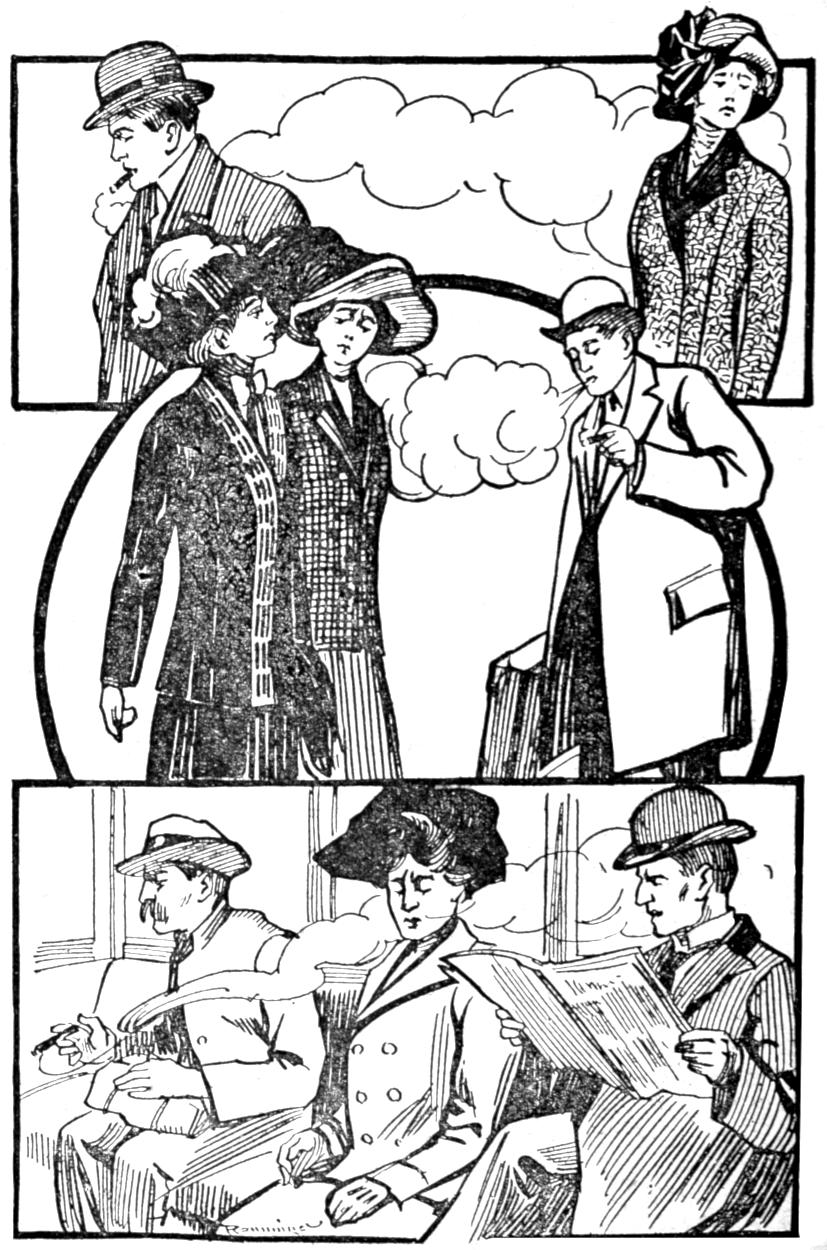
the user, and very annoying to others. We rarely
pass through a crowd, but men will puff their poisoned
breath in our faces. It is unpleasant, if not
dangerous, to remain in a railway car or in a room
where the atmosphere is impregnated with the fumes
of liquor and tobacco. Is it honorable thus to contaminate
the air which others must breath?
What power can the tobacco devotee have to stay
the progress of intemperance? There must be a
revolution upon the subject of tobacco before the
ax will be laid at the root of the tree. Tea, coffee,
and tobacco, as well as alcoholic drinks, are different
degrees in the scale of artificial stimulants.
The effect of tea and coffee, as heretofore shown,
tends in the same direction as that of wine and
cider, liquor and tobacco.
Tea is a stimulant, and to a certain extent produces
intoxication. It gradually impairs the energy
of body and mind. Its first effect is exhilarating,
because it quickens the motions of the living
machinery; and the tea drinker thinks that it is
doing him great service. But this is a mistake.
When its influence is gone, the unnatural force
abates, and the result is languor and debility corresponding
to the artificial vivacity imparted. The
second effect of tea drinking is headache, wakefulness,
palpitation of the heart, indigestion, trembling,
and many other evils.
Coffee is a hurtful indulgence. It temporarily
excites the mind to unwonted action, but the after-effect
is exhaustion, prostration, paralysis of the
mental, moral, and physical powers. The mind
becomes enervated, and unless through determined
effort the habit is overcome, the activity of the brain
is permanently lessened.
All these nerve irritants are wearing away the
life forces, and the restlessness caused by shattered
nerves, the impatience, the mental feebleness, become
warring elements, antagonizing to spiritual
progress. Then should not those who advocate
temperance and reform be awake to counteract the
evils of these injurious drinks? In some cases it is
as difficult to break up the tea-and-coffee habit as it
is for the inebriate to discontinue the use of liquor.
The money expended for tea and coffee is worse
than wasted. They do the user only harm, and
that continually. Those who use tea, coffee, opium,
and alcohol, may sometimes live to old age, but this
fact is no argument in favor of the use of these
stimulants. What these persons might have accomplished,
but failed to, because of their intemperate
habits, the great day of God alone will reveal.
Those who resort to tea and coffee for stimulation
to labor, will feel the evil effects of this course
in trembling nerves and lack of self-control. Tired
nerves need rest and quiet. Nature needs time to
recuperate her exhausted energies. But if her forces
are goaded on by the use of stimulants, there is,
whenever this process is repeated, a lessening of
real force. For a time, more may be accomplished
under the unnatural stimulus, but gradually it
becomes more difficult to rouse the energies to the
desired point, and at last exhausted nature can no
longer respond.
The habit of drinking coffee and tea is a greater
evil than is often suspected. Many who have accustomed
themselves to the use of stimulating drinks,
suffer from headache and nervous prostration, and
lose much time on account of sickness. They imagine
they cannot live without the stimulus, and are
ignorant of its effect upon the health. What makes
it more dangerous is, that its evil effects are so often
attributed to other causes.
Through the use of stimulants, the whole system
suffers. The nerves are unbalanced, the liver is
morbid in its action, the quality and circulation of
the blood are affected, and the skin becomes inactive
and sallow. The mind, too, is injured. The immediate
influence of these stimulants is to excite the
brain to undue activity, only to leave it weaker and
less capable of exertion. The after-effect is prostration,
not only mental and physical, but moral.
As a result we see nervous men and women, of
unsound judgment and unbalanced mind. They
often manifest a hasty, impatient, accusing spirit,
viewing the faults of others as through a magnifying
glass, and utterly unable to discern their own
defects.
When these tea and coffee users meet together for
social entertainment, the effects of their pernicious
habit are manifest. All partake freely of the favorite
beverages, and as the stimulating influence is
felt, their tongues are loosened, and they begin
the wicked work of talking against others. Their
words are not few or well chosen. The tidbits of
gossip are passed around, too often the poison of
scandal as well. These thoughtless gossipers forget
that they have a witness. An unseen Watcher
is writing their words in the books of heaven. All
these unkind criticisms, these exaggerated reports,
these envious feelings, expressed under the excitement
of the cup of tea, Jesus registers as against
Himself. “Inasmuch as ye have done it unto one
of the least of these my brethren, ye have done it
unto Me.”
We are already suffering because of the wrong
habits of our fathers, and yet how many take a
course in every way worse than theirs! Opium,
tea, coffee, tobacco, and liquor are rapidly extinguishing
the spark of vitality still left in the race.
Every year millions of gallons of intoxicating liquors
are drank, and millions of dollars are spent for
tobacco. And the slaves of appetite, while constantly
spending their earnings in sensual indulgence,
rob their children of food and clothing and
the advantages of education. There can never be
a right state of society while these evils exist.
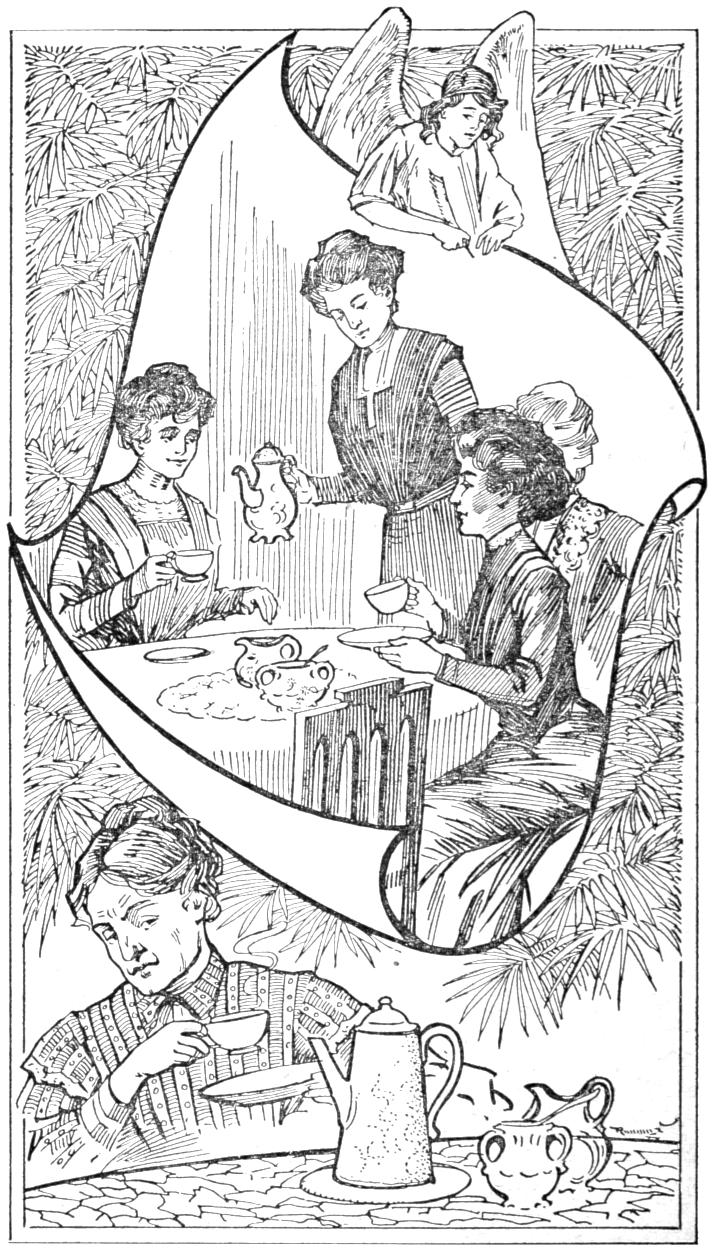
Tea Table Gossips
When the appetite for spirituous liquor is indulged,
the man voluntarily places to his lips the
draught which debases below the level of the brute,
him who was made in the image of God. Reason
is paralyzed, the intellect is benumbed, the animal
passion is excited, and then follow crimes of the
most debasing character. How can the user of rum
and tobacco give to God an undivided heart?—It is
impossible. Neither can he love his neighbor as
himself. The darling indulgence engrosses all his
affections. To gratify his craving for strong drink,
he sells reason and self-control. He places to his
lips that which stupefies the brain, paralyzes the
intellect, and makes him a shame and a curse to his
family, and a terror to all around him. If men
would become temperate in all things, if they would
touch not, taste not, handle not, tea, coffee, tobacco,
wines, opium, and alcoholic drinks, reason would
take the reins of government in her own hands, and
hold the appetite and passions under control.
Through appetite, Satan controls the mind and
the whole being. Thousands who might have lived
have passed to the grave, physical, mental, and
moral wrecks, because they sacrificed all their powers
to the indulgence of appetite. The necessity
for the men of this generation to call to their aid
the power of the will, strengthened by the grace
of God, in order to withstand the temptations of
Satan, and resist the least indulgence of perverted
appetite, is far greater than it was several generations
ago. But the present generation have less
power of self-control than had those who lived then.
Those who indulged in these stimulants transmitted
their depraved appetites and passions to their children,
and greater moral power is now required to
resist intemperance in all its forms. The only perfectly
safe course is to stand firm, observing strict
temperance in all things, and never venturing into
the path of danger.
I feel an intense interest that fathers and mothers
should realize the solemn obligations that are resting
upon them at this time. We are bringing up
children who will be controlled by the power of
Satan or by that of Christ. The only way in which
any can be secure against the power of intemperance,
is to abstain wholly from wine, beer, and
strong drinks. We must teach our children that in
order to be manly, they must let these things alone.
God has shown us what constitutes true manliness.
It is he that overcometh who will be honored, and
whose name will not be blotted out of the book of life.
When the Lord would raise up Samson as a deliverer
of His people, He enjoined upon the mother
correct habits of life before the birth of her child.
And the same prohibition was to be imposed, from
the first, upon the child; for he was to be consecrated
to God as a Nazarite from his birth.
The angel of God appeared to the wife of Manoah,
and informed her that she should have a son; and
in view of this, he gave her the important directions:
“Now therefore beware, I pray thee, and drink not
wine nor strong drink, and eat not any unclean
thing.”
God had important work for the promised child
of Manoah to do, and it was to secure for him the
qualifications necessary for this work, that the
habits of both the mother and the child were to
be so carefully regulated. “Neither let her drink
wine nor strong drink,” was the angel’s instruction
for the wife of Manoah, “nor eat any unclean thing:
all that I commanded her let her observe.” The
child will be affected for good or evil by the habits
of the mother. She must herself be controlled by
principle, and must practice temperance and self-denial,
if she would seek the welfare of her child.
In the New Testament we find a no less impressive
example of the importance of temperate habits.
John the Baptist was a reformer. To him was
committed a great work for the people of his time.
And in preparation for that work, all his habits
were carefully regulated, even from his birth. The
angel Gabriel was sent from heaven to instruct the
parents of John in the principles of health reform.
He “shall drink neither wine nor strong drink,”
said the heavenly messenger; “and he shall be
filled with the Holy Ghost.”
John separated himself from his friends, and from
the luxuries of life, dwelling alone in the wilderness,
and subsisting on a purely vegetable diet.
The simplicity of his dress—a garment woven of
camel’s hair—was a rebuke to the extravagance
and display of the people of his generation, especially
of the Jewish priests. His diet also, of locusts
and wild honey, was a rebuke to the gluttony that
everywhere prevailed.
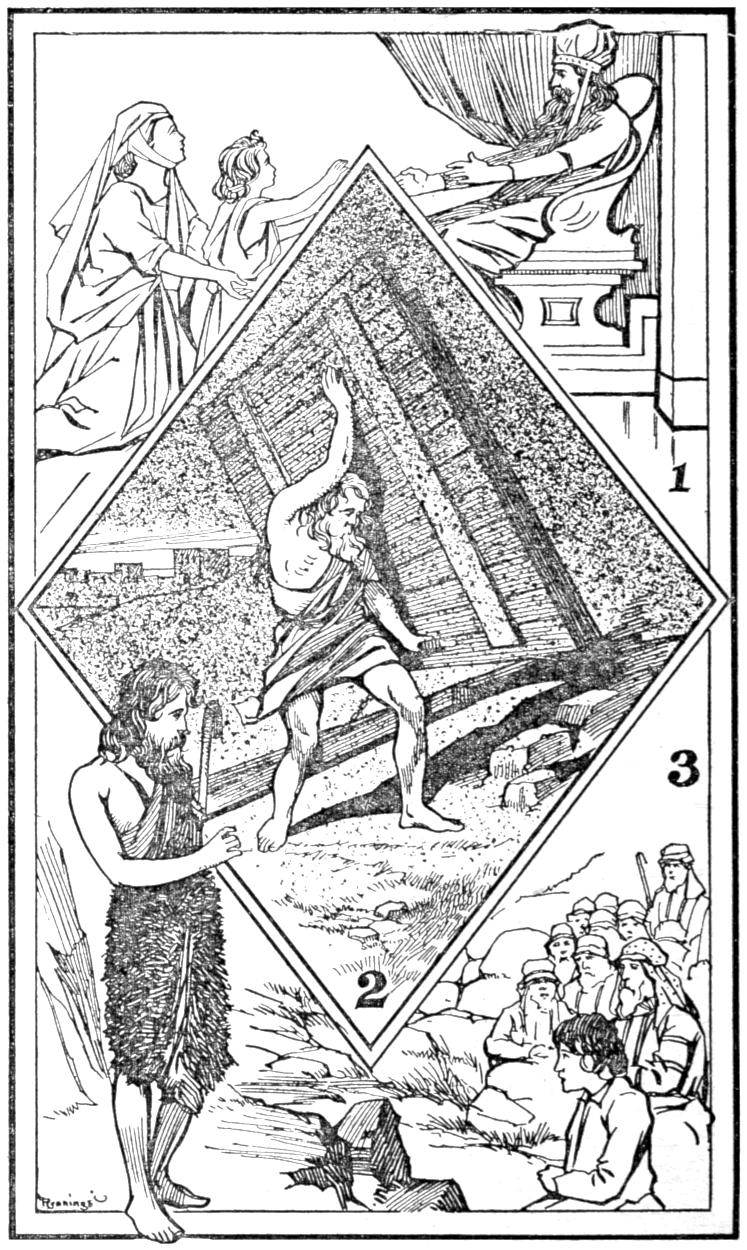
1 Samuel Presented to Eli
2 Samson and the Gate of Gaza
3 John the Baptist in the Wilderness
The work of John was foretold by the prophet
Malachi: “Behold, I will send you Elijah the
prophet before the coming of the great and dreadful
day of the Lord; and he shall turn the heart of
the fathers to the children, and the heart of the children
to their fathers.” John the Baptist went forth
in the spirit and power of Elijah, to prepare the way
of the Lord, and to turn the people to the wisdom
of the just. He was a representative of those living
in the last days, to whom God has entrusted
sacred truths to present before the people, to prepare
the way for the second coming of Christ. And
the same principles of temperance which John practiced
should be observed by those who in our day
are to warn the world of the coming of the Son of
man.
God has made man in His own image, and He
expects man to preserve unimpaired the powers that
have been imparted to him for the Creator’s service.
Then should we not heed His admonitions, and
seek to preserve every power in the best condition
to serve him? The very best we can give to God
is feeble enough.
Why is there so much misery in the world to-day?
Is it because God loves to see His creatures suffer?—O
no! it is because men become weakened by immoral
practices. We mourn over Adam’s transgression,
and seem to think that our first parents showed
great weakness in yielding to temptation; but if
Adam’s transgression were the only evil we had to
meet, the condition of the world would be much
better than it is. There has been a succession of
falls since Adam’s day.
Indulgence in spirituous liquors is causing great
wretchedness in the world. Though liquor drinkers
are told again and again that they are shortening
their life, they still go on in transgression. Why
not cease to break the laws of God? Why not seek to
preserve themselves in a condition of health? This
is what God requires of them. If Christians would
bring all their appetites and passions under the control
of enlightened conscience, feeling it a duty they
owe to God and to their neighbor to obey the laws
which govern life and health, they would have the
blessing of physical and mental vigor; they would
have moral power to engage in the warfare against
Satan; and in the name of Him who conquered in
their behalf, they might be more than conquerors
on their own account.
All around us are the victims of depraved appetite,
and what are you going to do for them? Can
you not, by your example, help them to place their
feet in the path of temperance? Can you have a
sense of the temptations that are coming upon the
youth who are growing up around us, and not seek
to warn and save them? Who will stand on the
Lord’s side? Who will help to press back this tide
of immorality, of woe, and wretchedness, that is filling
the world? We entreat of you to turn your
attention to the work of overcoming. Those who
shall at last have a right to the tree of life, will be
those who have kept God’s commandments.
It is not an easy matter to overcome the appetite
for narcotics and stimulants. But in the name of
Christ this great victory can be gained. His love
for the fallen race was so great that He made an
infinite sacrifice to reach them in their degradation
and through His divine power finally elevate them
to His throne. But it rests with man whether
Christ shall accomplish for him that which He is
fully able to do. God cannot work against man’s
will to save him from Satan’s artifices. Man must
put forth his human power to resist and conquer
at any cost; he must be a co-worker with Christ.
Then, through the victory that it is his privilege to
gain by the all-powerful name of Jesus, he may become
an heir of God, and a partaker with Christ of
His glory. No drunkard can inherit the kingdom
of God; but “to him that overcometh will I grant
to sit with Me in My throne, even as I also overcame,
and am set down with My Father in His
throne.”
UNCLE BEN’S STORY
I have a good mind to tell you
a story,” said Uncle Ben, drawing
his chair a little nearer the
smiling group of young people
which surrounded the table in
the sitting room.
“Do, Uncle Ben,” they replied.
As Uncle Ben announced his intention of telling
a story, all eyes were turned upon him. Mother
laid aside her book and spectacles, and father leaned
back in his easy chair to listen, for Uncle Ben’s
stories were always worth hearing.
As uncle spoke, we wondered that he looked so
sad. Placing his feet upon a footstool, he began:—
“Many years ago, after I had graduated at college,
I had a strong desire for a situation on one of
the railways that was then being built through the
United States. Through the influence of my
friends, I received a position as fireman on one of
the leading roads.
“I soon won the esteem and good will of all of
the officers and employees on the road. As time
passed, the superintendent and I became deeply
attached to each other. We were about the same
age. There is nothing I would not do for Frank
Benway. I realized the duties of my position and
determined to discharge them honorably.
“But I was led away,—led down, down, where
so many have gone before and since. I was induced
by thoughtless associates to drink. One
evening I had drunk more than usual, when Frank
Benway came in. I did not see him until he
touched me on the arm.
“‘Ben,’ said he, ‘come away! for my sake, come
away.’
“Just one more drink”
“He took my arm and led me out into the cool,
night air. When he spoke again, it was in a pleading,
sorrowful tone.
“‘Ben, for the sake of your mother, for the sake
of the friendship between us, never drink again.
Good night, my dear friend.’
“I went to my lodgings with a dizzy head and
a heavy heart. I knew that my friend ought to
turn me away from my situation, but he was too
kindhearted, and had too much confidence in me,
even yet, to do that. (I knew
that he fully expected that I
would heed his earnest entreaty.)
“But when I awoke the
next morning, I again felt
the strong thirst for liquor.
In one of my pockets I found
a flask, filled with brandy
which I had procured the
night before. I had started
down the hill, and thought I
could not resist the temptation
to take just one more drink,—just
one more.
“The Superintendent had
gone down the road on an express train, early that
morning, as there were some repairs to be made part
way down the line, which he wished to superintend
personally.
“Our train started in about an hour after the
express. The engineer of the train had been detained
at the other end of the road on account of
sickness. I was alone on the engine, but the conductor
had perfect confidence in my ability.
“I had never drunk enough to become intoxicated
before, and no one on the train suspected that
I had formed the fatal habit. I still continued to
drink until I became so helpless I could not stand,
and this was after I had taken my place in the cab
of the engine.
“I fell against the tender soon after we got under
way, and cut a severe gash in my forehead. I
attempted to rise, but could not. My senses were
clear, however, and I knew all that was passing
with horrible reality.
“I had fallen in such a position that I could see
out at one side between the tender and the engine.
On, on we swept at lightning speed, with no hand
to guide the train or to regulate its speed.
“We had just passed the point where they were
making the repairs I spoke of, when, as we swept
around a little bend in the road, I saw Frank Benway,
a few rods ahead of us, walking swiftly up
the track. Suddenly I saw him step upon a bit of
stone which lay there, and, slipping, his foot was
caught between the ground and the rail.
“O how he struggled to rise, but could not! On
we rushed. My poor friend’s pitiful efforts to rise
were in vain. And it is still the bitterest moment
of my life that at that moment I was too intoxicated
to reverse the engine, which I might have
done, probably in time to have saved his life!
“There I lay, bound by the horrible chains which
I had forged for myself. I could not move! Frank
saw me, for he had fallen across the track on the
side where I lay on the cab floor. He held out both
hands to me, as if to say: ‘Help me, Ben, help me’!
“In another moment I was so near that I could
look into his eyes, and the next, they were closed
forever. A brakeman who saw Frank when we
passed over him, now rushed to the engine, and
finding me lying disgracefully stupid, I suppose
divined it all. He stopped the train.
“Frank’s remains were gathered up, and I was
taken to my home, a raving maniac. None on
the train save this brakeman suspected I had
been drunk. He kept my secret—why I never
knew. Perhaps he thought I was punished enough.
I was ill with brain fever for a long time.
“After I recovered, I never tasted another drop
of liquor. It seemed as if I was more than a murderer.
Afterward, when I went on the road again, I
was a changed man. I gradually worked myself up
until I became president of that road.
“Young friends, when you pass out from your
parents’ care, there will be many temptations to
allure you. Then, I trust, you will bear in mind
the evening when you heard Uncle Ben’s sad story,
told in the twilight of his life.”
JACOB BELL’S VOW
Good-by, Jim Brown, you have
got the last cent of my money
that you will ever get,” said a
poor, miserable looking wretch,
as he turned to leave the bar-room
of a hotel, where a large
company of men sat drinking
and carousing.
“I guess when you find a few cents, I shall get
them, Jake,” answered the besotted landlord with a
sneer, “but I tell you again that you will get no
more drinks of me until you pay off the old debt.”
“Good-by, Jim Brown,” said old Jake again,
“you will never get one cent of it, nor will you
ever sell me another glass of strong drink.”
“Goin’ to sign the pledge, Jake?” queried another
voice, “guess ’twill not do you much good if
you do, for you like rum too well to keep it long.”
“Maybe I shall sign the pledge,” was the reply,
“but I consider my word here, just as sacred and
binding as a written pledge, and so I solemnly swear
before God and man never to touch another drop
of the accursed poison so long as I live,” and Jake
retreated toward the door as he said it.
“Hold on, Jake, don’t go yet,” called out another
voice, “come back and I will treat you. Here,
landlord, give him a good glass of whiskey to make
him better natured.” But Jake never looked toward
the speaker, and still kept moving slowly toward
the door.
“You will try in vain, I guess,” he slowly said,
“for I have drunk my last glass of liquor, God
helping me,”
and old Jake
Bell walked
away.
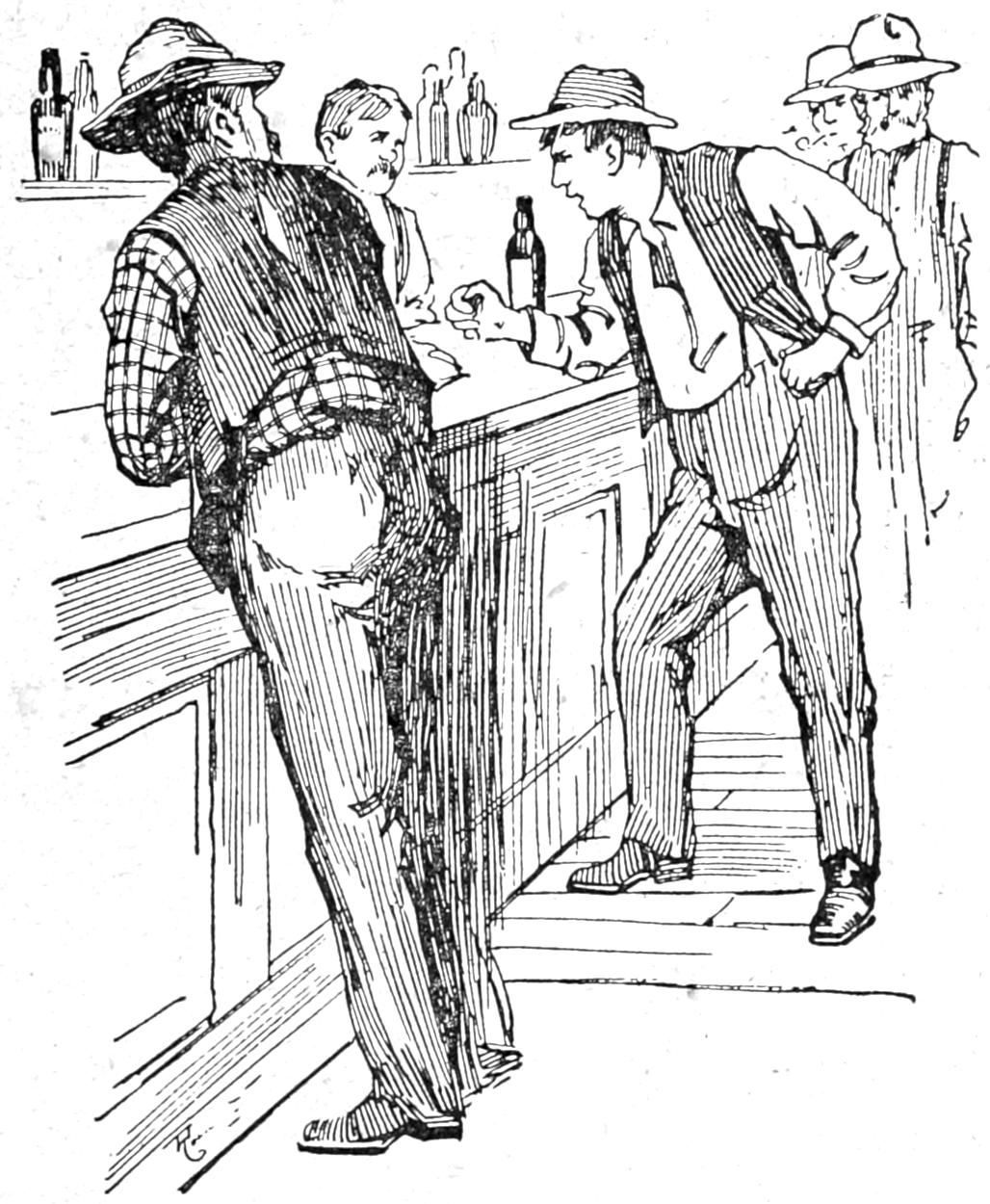
“I have drunk my last glass of liquor”
“Wonder
what has got
into the old
fool,” said one
of the bar-room
loungers, “for I
never knew him
to refuse a glass
of whiskey before.”
“Guess he’ll
come back before
many days
go by,” was heard from another part of the room.
“Suppose that old Jake should reform,” said one
who had not spoken before, “I never saw him with
such a fit on, and if he should stick to what he
said, Landlord Brown has lost one of his best customers.”
“And a few shillings besides,” chimed in another
voice.
“Guess he has not lost much by old Jake Bell,
for if I’m not mistaken, his money has been quite
an advantage to Jim Brown for a number of years,”
was the reply.
“Stop your noise, will you?” said the landlord,
with a scowl on his face, “I’ll take care of old
Jake.”
“Perhaps he’ll take care of himself,” was his
reply, “and I think he would do quite as well, and
his wife and children would be the gainers.”
“Stop your infernal noise, Bill Gray, or leave the
room,” yelled the landlord, growing black with
passion.
“If I do go,” said Bill quietly, “I shall go as old
Jake did, never to come back again. You know
that what Bill Gray says, he means.”
Susan Bell sat by the low window of her house,
looking out upon the beautiful landscape, bathed
with the golden rays of the setting sun. There
was an expression of pain and sadness upon her
face, and occasionally a tear gleamed in her faded
eyes.
We doubt if the glory of the fields and the sky had
awakened one cheerful thought in her heart, and
if it did, the dark clouds of misery soon turned the
ray of sunlight to gloom again. Ah! the bright
hopes of other days had long ago died out from the
heart of Susan Bell, and the gray shadows of wretchedness
had long thronged her pathway.
But the time had been when this wretched
woman had seen bright days of happiness, though
they appeared now like some fairy dream, which
cast its mocking glory upon the barren wastes of
life.
Strong drink had destroyed the hopes of poor
Susan Bell, and driven peace and plenty away from
the once cheerful fireside. It had ruined the prospects
of Jacob Bell, and made him a miserable, besotted
wretch. In other days he had been loved
and respected, for he possessed many noble, generous
qualities, and he seemed likely to become a
man of more than ordinary usefulness in the world.
But he became possessed with a thirst for strong
drink, and so started upon the fearful road of sin
and ruin. His children once made music in their
home, but after he began his career of sin and
shame, disease laid its hand upon two of them, and
they died.
Mrs. Bell did not murmur as the death angel
claimed them, for she saw the storm that was gathering.
It came all too soon, and then she thanked
God that there were only two children left to suffer
the abuse of a drunken father and to bear the heavy
load of want and poverty. Jim Brown had taken
the earnings of the husband and father for many
years, and in return, gave him the deadly poison
that made him a brute and deadened every impulse
of nobleness.
“He has gone to Brown’s, as usual,” said Susan
Bell to herself. “Oh, how I wish that he would
not go there so often! He will never even try to
reform as long as he goes there to spend his leisure
hours.”
A tear dropped from her eyes as she looked in
the direction of the village tavern. “It will do no
good to hope any longer, for he will never do any
better,” she said half aloud.
The sun went down behind the western mountain
and twilight began to gather over the earth. Still
Susan Bell sat by the low window,
looking toward the now
lighted bar-room. “Why! he
is coming!” she exclaimed, as
she saw the well known form
of her husband, coming
down the street,
in the twilight.
“How strange
that Jacob should
come home so
early; I wonder
what it means.”
“Susan Bell sat by the low window”
Jacob walked
steadily into the
house, and in a
pleasant voice asked: “Susan, will you get some
supper? I am very hungry.”
“We have but little to eat, Jacob,” was the reply,
“but I will get you what we have.”
“Have we any coffee?”
“No, but perhaps I can borrow a little of Mrs.
Blake.”
“Have we any flour or sugar, Susan,” was the
next inquiry.
“None,” was the reply.
“Then I will go and buy some,” said Jacob.
“Mr. Grant is owing me for a half day’s work, and
I guess he can pay me.”
Susan Bell’s heart beat very fast as her husband
started out again. “Oh, if he does not stop at
Brown’s!” she exclaimed to herself.
He did not stop at Brown’s, although a dozen
voices called to him as he was passing by. “I
think you will not succeed,” he said quietly, as he
walked toward home.
“Now, make me a cup of coffee, Susan,” he said,
as he placed several small packages upon the table.
His wife quickly obeyed, and in a short time
Jacob sat down to a better supper than he had had
for many a day.
“I am very tired to-night,” he said, as he finished
the meal, “but please call me early in the morning,
Susan, for I am going to work for Mr. Grant. I
have taken the job of building his barn, and want
to get it well started this week.”
Mrs. Bell could scarcely sleep that night; there
was a strange, deep joy in her heart, that she had
not known for years. And yet, she hardly dared
to hope. She really could not account for the
strange conduct of her husband.
The day came with its beautiful splendor, and
just as the morning sun began to bathe the far
away mountains with light, Jacob Bell sat down to
his morning meal.
After breakfast, he asked: “Have you enough
flour to last to-day?”
“We have a little,” was the reply.
The day passed away at last, and just as the sun
was setting, Jacob Bell entered the door of his
home.
“Here are three dollars, Susan,” he said. “Take
the money and use it as you think best. Herbert
can bring home whatever you like, for he will not
work any longer for Mr. Hill. He is not strong
enough to do such work as he has been in the
habit of doing
there. He will
go to school the
remainder of the
summer.”
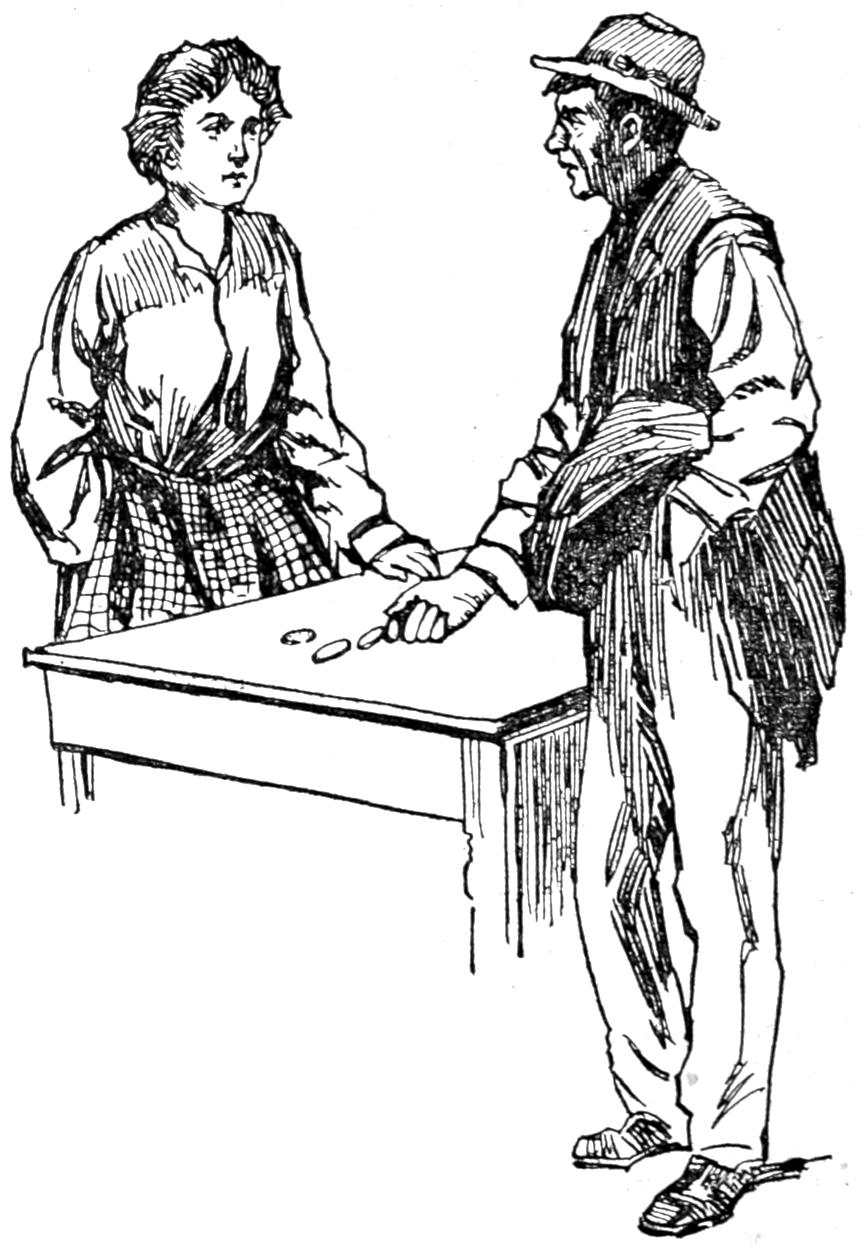
“Here are three
dollars”
Mrs. Bell said
not a word. She
only hoped and
prayed.
Another day
passed away and
three dollars more
were placed in
her hands. A
whole week went
by, and her husband had worked
every day, and had not once visited
Jim Brown’s saloon.
Then he came home one night with a new suit
of clothes.
“These were a present to me,” he said simply, in
reply to Susan’s inquiry. “Mr. Grant gave them
to me.”
“And why did he do it, Jacob?” asked Susan in
a trembling voice.
“If I tell you, then you will know my secret.
But I think I will. It was because I signed the
pledge.”
“Have you signed the pledge, Jacob?” asked
the wife in a voice choked with emotion.
“Yes,” he quietly answered, “and with God’s
help, I will keep it. Jim Brown has got the last
cent of my money that he will ever get.”
“Why did you take this step?” Susan asked,
trying very hard to keep her voice from trembling.
“I can’t really tell you, Susan, but Mr. Grant, I
think, was the true cause of it. He has talked so
earnestly and kindly to me of late, that I saw myself
as I never did before.
“And then about a week ago, I went to Jim
Brown’s bar-room and asked him to trust me for a
drink. I was owing him a few shillings, and as he
was nearly drunk himself, he refused to trust me.
I was very angry; and then I made a vow before
all present never to drink another drop of liquor,
and as I have said before, God helping me, I will
never taste that accursed poison again.”
Susan Bell silently thanked God, and earnestly
prayed that he would help her husband to keep his
vow sacredly.
Five years have passed away with their sunshine
and shadow, and still Jacob Bell keeps his vow.
The old brown house has been transformed by his
skillful hand, and it is the prettiest cottage in the
village. Everything about the place betokens thrift
and plenty.
Jacob Bell looks much younger than he did five
years ago, and for some reason, people do not call
him “Old Jake.” The village tavern still stands,
but old Jim Brown died long ago with delirium
tremens. Another rum seller fills his place, but
Jacob Bell has never spoken to him.
Thus did the drunkard keep his vow.
“Who hath woe? who hath sorrow? who hath
contentions? who hath babbling? who hath wounds
without cause? who hath redness of eyes?—They
that tarry long at the wine; they that go to seek
mixed wine.
“Look not thou upon the wine when it is red,
when it giveth his color in the cup, when it moveth
itself aright. At the last it biteth like a serpent,
and stingeth like an adder.”—Solomon.
“Every man that striveth for the mastery is
temperate in all things.”—Paul.
TESTIMONY OF RELIGIOUS BODIES
“We hold that the proper attitude of Christians
toward this [liquor] traffic, is one of uncompromising
opposition.”—General Conference of the
Methodist Episcopal Church at Philadelphia, Pa.,
1884.
“That curse of our race—alcohol ... the
enemy alike of God and man.”—Methodist Episcopal
Church, South, General Conference, 1883.
“The giant evil of the age—the curse of curses.”—Cumberland
Presbyterian Church, General Assembly
at Lebanon, Tenn., May, 1878.
“There can be no compromise with this evil
[liquor traffic].”—United Presbyterian Church Assembly,
1885.
“Nearly allied to theft and robbery, and in its
consequences far exceeds them in enormity.”—Free
Baptist Church, General Conference, Fairport,
N. Y., 1853.
“Opposed to all traffic in intoxicating drinks.”—Moravian
Church, Synod of 1873.
“Utterly inconsistent with the character and
profession of members of the church of Christ to
encourage in any way the traffic in intoxicating
liquors.”—Reformed Dutch Church, General Synod,
at Syracuse, N. Y., June, 1885.
“The enemy of religion, of good morals, and
of the best interests of our race.”—Lutheran Church,
General Synod, 1879.
ONLY A GLASS OF BEER
Boys, did you ever stop to
think that it is always the
first wrong step that leads to
misery and disgrace? The
first petty theft leads to the
penitentiary, and the first glass
to the gutter, and finally to
the drunkard’s grave.
None who had ever known
Robert Morris in his brilliant
young manhood, could have
dreamed of the awful fate which would finally be
his. Robert was uncommonly apt in his studies,
kind and courteous in his manners, and gentlemanly
in appearance. He had the advantage of
having been raised in a home of refinement and
temperance.
But in an evil hour, he formed the acquaintance
of a young man of bad principles and reckless life.
For some time Robert’s high sense of honor
triumphed. But he could not endure the ridicule
of his friend:—
“What a fool you are, Rob, old boy; come, sir,
I didn’t think you were such a coward! ha! ha!
afraid of a glass of beer!”
“I’m not afraid, Jack Horton, and I’m no coward.”
The next moment, and for the first time in
his life, a glass of beer was pressed to his lips.
But it was by no means the last. Little by little
a craving was developed for the poison—a burning
thirst. His loving friends did everything in their
power to rescue him. But his eyes became bloodshot,
his hair unkempt, his body bloated, and his
once fine intellect, like his body, defaced and ruined.
Finally, after a short career of vice and folly, we
followed him to an unhonored grave. His aged
father groaned in agony; while the fainting form
of his gray-haired mother was borne by kind hands
away from the last resting place of her son.
My boy, remember that if you do not allow the
first glass of liquor to pass your lips, you will never
become that horrible thing—that blot on the fair
creation of God—a drunkard. Do not forget that
at last “it biteth like a serpent,” and that “no
drunkard shall inherit the kingdom of God.”
ALCOHOL A CAUSE OF DISEASE
“A foe more dreadful or deadly than the Russian
or the plague.”—Florence Nightingale, from the
“Crimea.”
“Most diseases have their rise in intemperance.”—Lord
Bacon.
“An active and powerful cause of disease.”—Prof.
Youmans.
“The evils of alcohol are wide-spread and countless.”—C.
R. Agnew, M. D.
“Sooner or later proves injurious to the human
constitution without any exception.”—Sir B.
Brodie, Sir James Clark, Sir J. Eyre, Dr. Marshall
Hall, Dr. A. T. Thompson, Dr. A. Ure, the
Queen’s Physicians, and seventy-eight leaders in
Medicine and Surgery, of England, 1839.
“Alcohol is neither a food nor a drink suitable
for his [man’s] natural demands.”—B. W. Richardson,
M. A., M. D., F. R. S.
“If alcohol were unknown, half the sin and a
large part of the poverty and unhappiness would
disappear from the world.”—Edmond W. Parkes,
M. D., F. R. S.
“The curse of an army is intoxicating liquors.”—Parkes.
“Injurious to health, destructive to life.”—Kant.
“Has inflicted greater calamities than war, pestilence,
and famine.”—Gladstone.
TURNING OVER A NEW LEAF
Tis a shame!” said Mrs. Fogg, as she
hurried away after the funeral of Mrs.
Grant, escaping from the
poor, desolate room, where
two children, hardly more
than babes, were sleeping,
unconscious that they were
motherless. “’Tis a shame
that nobody’ll take them.”
“Yes—a bitter shame!”
replied a neighbor, who was
also getting off as fast as she
could, so as to shift the responsibility onto some
other shoulders.
“There’s Mrs. Grove. She might take them as
well as not. But they’ll go to the poorhouse, for
all she cares.”
“Well, somebody’ll have to answer for it,” said
Mrs. Fogg. “As for me, I’ve got young ones
enough of my own.”
“We left Mrs. Cole in the room. She has only
one child, and her husband is well to do. I can’t
believe she’ll have the heart to turn away from
them.”
“She’s got the heart for anything. But we’ll
see.”
Mrs. Cole did turn away from the sleeping
babes, sighing very loud, that others might hear
and give her credit for a sympathy and concern
she did not feel.
At last all were gone—all but a man named
John Wheaton, and a poor woman, not able to
take care of herself.
“What’s to become of these children?” questioned
Mr. Wheaton.
“Don’t know. Poorhouse, I s’pose,” answered
the woman.
“Poorhouse?”
“Yes, nobody wants them, and there’s no other
place for them.”
“Mamma! mamma!” cried a plaintive voice, and
a flaxen-haired child, not more than two year old,
rose up in the bed and looked piteously about the
room. “I want my mamma!”
A great, choking sob came into the man’s
throat. Then the other child awoke:—
“Don’t cry, sissy—mamma’s gone away.” At
this, the little one began crying bitterly.
“I can’t stand this nohow!” exclaimed the man;
and going to the bed, he gathered the two children
into his arms, hushing and comforting them with
soothing words....
“What on earth have you got there?” exclaimed
Mrs. Wheaton as her husband came striding into
the room where she sat mending one of his well-worn
garments.
“Two babies!” he answered, in a voice so
unusual that Mrs. Wheaton dropped her work on
the floor and rose up in amazement.
“What?”
“Mrs. Grant’s two babies. I’ve been over to the
funeral, and I tell you, Jane, it wasn’t in me to see
those two little things carted off to the almshouse.
There wasn’t a
woman to look
after them, no,
not one. Every
soul sneaked off
but Polly Jones,
and she’s of no account
you know.
Just look at their
dear little faces!”
And John Wheaton
held them up in his
arms, and let their
tender, tearful, half-frightened,
half-wondering
eyes
plead their own cause with his wife, and they did
not plead in vain.
Surprised as she was, and with an instant’s protest
in her heart, Mrs. Wheaton could not, in the
presence of these motherless little ones, utter a
word of remonstrance.
She took the youngest one from the arms of her
husband and spoke to it tenderly. The child
sobbed two or three times, and then laid its head
against her bosom.
There was an ocean of mother-love in the heart
of this woman, who had never been a mother, the
instant her breast felt the pressure of the baby’s
head, and the arm that drew it closer with an involuntary
impulse, was moved by this new love.
Not many words passed between the husband
and wife—at least, not then—though thought was
very busy with both of them.
Mrs. Wheaton’s manner toward the children was
kind even to tenderness; and this manner won their
confidence and drew from them such little expressions
of satisfaction as touched her heart and filled
it with loving interest.
After nightfall when supper was over and the
children asleep, Mr. and Mrs. Wheaton sat down
together, each showing a little reserve and embarrassment.
Mrs. Wheaton was the first to speak.
“What were you thinking about, John?” she
said, almost sharply. “I can’t have these children.”
John Wheaton did not lift his eyes or reply, but
there was a certain dogged and resolute air about
him that his wife noticed as unusual.
“Somebody else must take them,” she continued.
“The county?” replied her husband, testily.
“Yes. There’s room for them at the almshouse,
and no where else that I know of, unless they stay
here.
“Unless they stay here,” she repeated. Mrs.
Wheaton’s voice rose a little. “It’s easy enough
to say that, but who is to care for them?”
“It’s a great undertaking, I know,” answered
the husband, meekly, yet with a new quality in his
voice that did not escape the quick ear of his wife,
“and the burden must fall on you.”
“I wouldn’t mind that so much, but—”
She kept back the sentence that was on her
tongue.
“But what?” asked her husband.
“John,” said Mrs. Wheaton, drawing herself up
in a resolute manner, and looking steadily in her
husband’s face, “as things are going on—”
“Things shall go on differently,” interrupted
Wheaton. “I’ve thought it all over.”
“How differently, John?”
“Oh! in every way I’ll turn over a new leaf.”
John Wheaton saw a light flash into his wife’s
face.
“First and foremost, I’m not going to lose any
more days. Last month I had six days docked
from my wages.”
“Why, John!”
“It’s true—more’s the shame for me. That was
eighteen dollars, you see, not counting the money
I fooled away with idle company—enough to pay
for all these babies would eat and wear, twice
over.”
“Oh, John!” There was something eager and
hopeful in his wife’s face as she leaned toward him.
“I’m in downright earnest, Jane,” he answered.
“If you’ll take the babies, I’ll do my part. I’ll
turn over a new leaf. There shall be no more lost
days; no more foolish wasting of money; no more
spending of evenings at McBride’s.”
“Oh, John!” In her surprise and delight she
could only repeat the exclamation.
As she did so, she rose, and putting
her hands on his shoulders, bend
and kissed him
on the forehead.
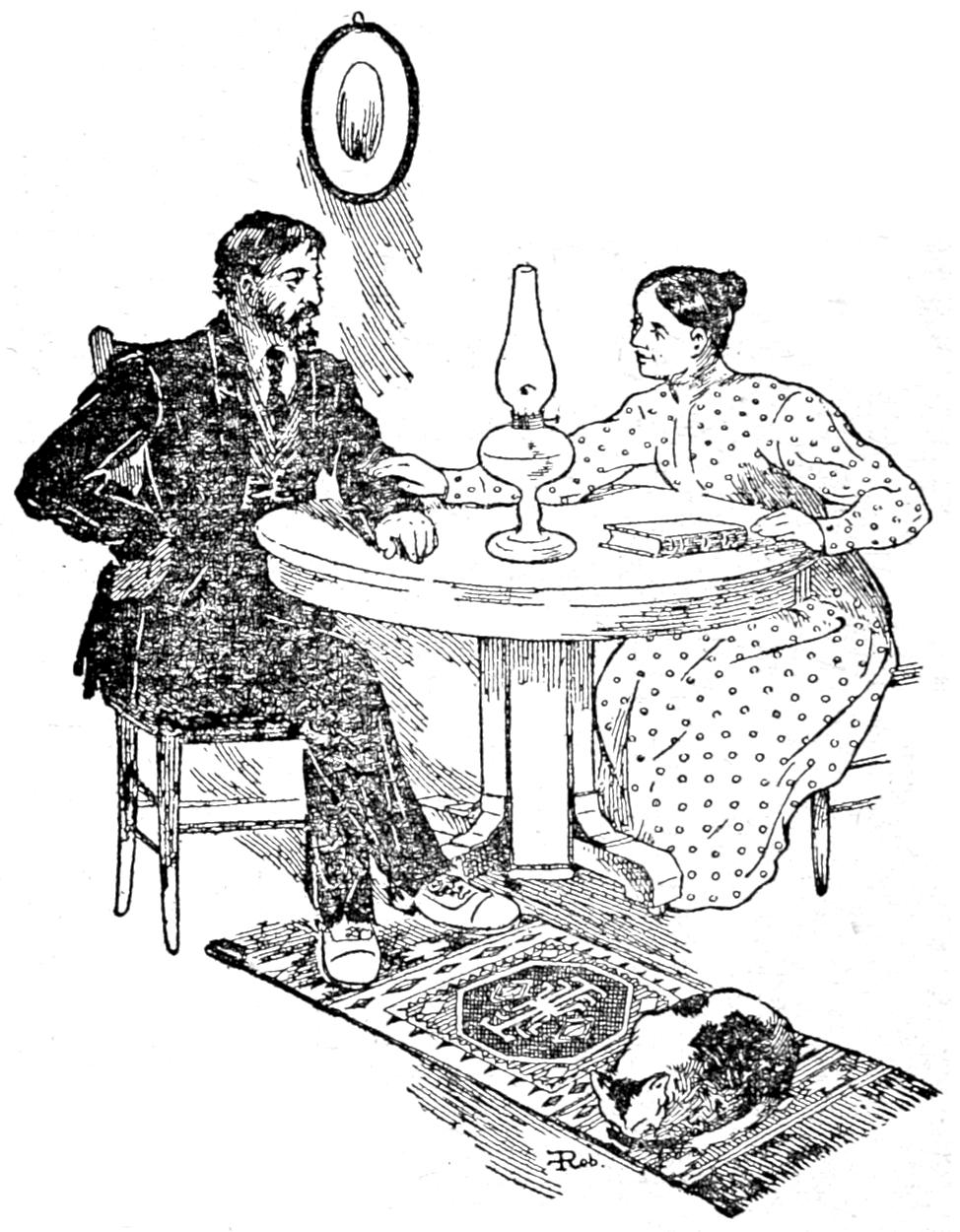
“OH, JOHN”
“You’ll take
the babies?”
said he.
“Yes, and
twenty more, if
you keep to
this, and stay
so,” answered
Jane, laughing
through her
tears.
“All right,
then, it’s a bargain,” and John Wheaton caught
his wife’s hand and shook it by way of confirmation.
From that time Mr. Wheaton turned over a new
leaf. Neighbors expressed surprise when it was
known that John and Jane Wheaton had adopted
the two orphan children. Fellow workmen taunted
John, calling him a soft-hearted fool, for “taking
other men’s brats.”
One said to him, “Are four mouths easier to fill
than two?” Another, “You’ll be sick of this
before the year’s out.” Another, “I’ll see you sold
out by the constable in less than six months.”
But John had little to say in reply, only maintaining
an air of quiet good humor and showing
more interest in his work.
For three weeks John Wheaton had not lost a
day—something very unusual; and not one evening
during that time had he spent at McBride’s saloon.
His poor little house, which had come to have a
neglected look, was putting on a new appearance.
The gate that for months had hobbled on one
hinge, now swung smoothly, and the mended latch
held it shut. Rank weeds no longer filled the
dooryard. The broken steps were mended, and
clean panes of glass filled many places in the sash
where had been unsightly rags and sheets of paper.
Within, pleasant changes were also apparent.
Various new but inexpensive pieces of furniture
were to be found. Old things were mended,
polished up, and wonderfully improved. With all
of this, marvellous to relate, Wheaton’s earnings
had not only been equal to the increased expenditures,
but there was an actual surplus of ten dollars
in hand.
“I never would have believed it,” said John, as
he and his wife sat one evening talking over their
improved condition, after the babies—loved now
almost as if their own—were asleep.
“It’s just as old Brown used to say, ‘Waste takes
more than want.’ I declare I’ve got heart in me
again. I thought we should have to let the place
go; that I’d never be able to pay off the mortgage.
But here we are, ten dollars ahead in less than a
month; and going on at this rate, we’ll have the
home clear in about eighteen months.
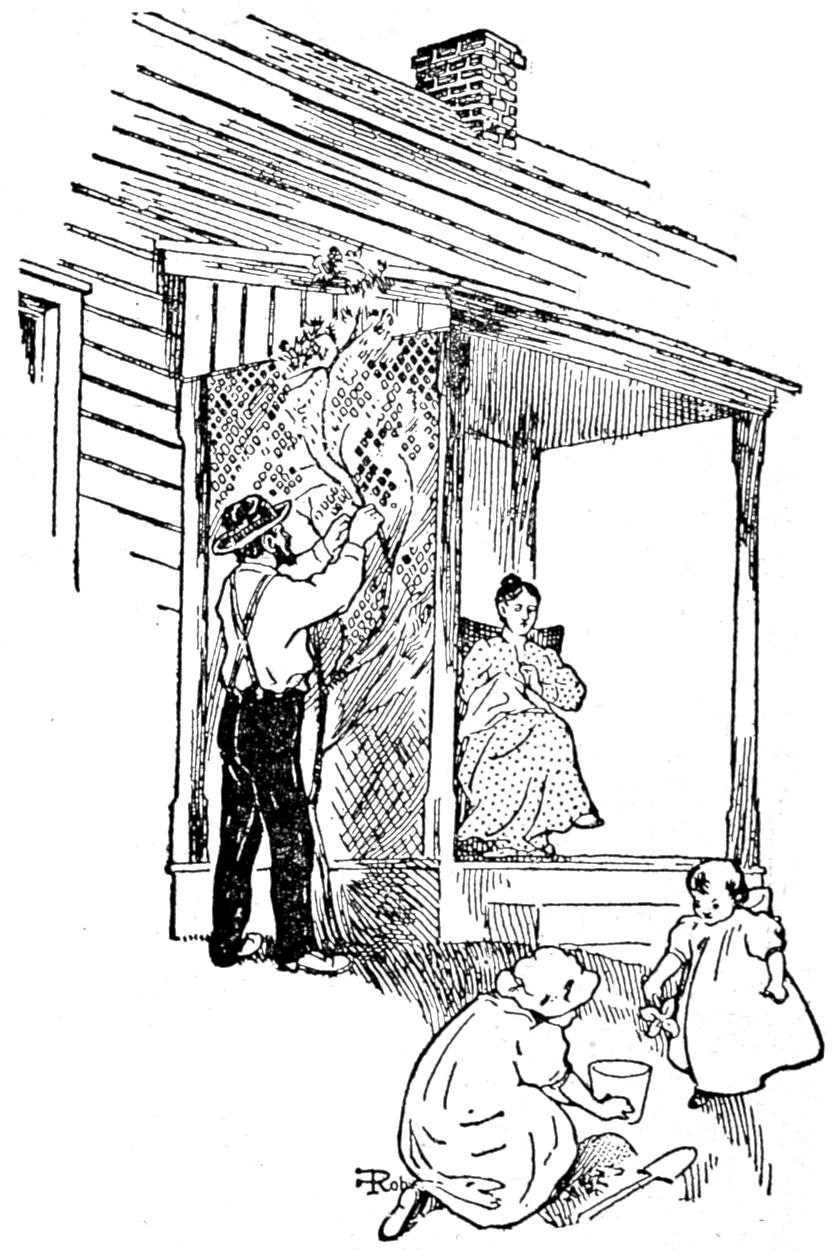
Beautifying the
Home
“By the way, Jane,
have you noticed how
that pretty running
rose, that we
have trained over
the doorway,—the
one that
used to look so
forlorn and
neglected,—is
already beginning
to
push out its
young leaves
and buds?
It’s beautiful,
isn’t it? Oh,
I’m so glad
we shall be
able to keep
the old home!”
Next day a fellow workman said to John
Wheaton, half in banter, “Didn’t I see the constable
down your way yesterday?”
“I shouldn’t wonder,” replied Wheaton, with
more gravity of manner than his questioner had
expected.
“I thought I saw him looking around after
things, and counting his fees on his fingers.”
“Likely as not,” replied Mr. Wheaton. “I know
of a good many rents not paid up last quarter.
Money gone to McBride’s instead of the landlord—eh?”
The man winced a little.
“How are the babies?” he asked.
“First rate,” Mr. Wheaton answered, with a
smile so real that his fellow workman could not
continue his banter.
Time went on, and to the surprise of all,
John Wheaton’s circumstances kept improving.
The babies had brought a blessing to his home.
In less than eighteen months, he had paid off the
mortgage that for years had rested on his little
home; and not only this, he had improved it in
various ways, even to putting up a small addition,
so as to give them a neat breakfast room.
The children grew finely,—there were three of
them now,—for their hearts and home had opened
to another orphan baby. The three little ones
were carefully trained by Mrs. Wheaton, and had
become the light and joy of the household.
Five years have passed away. John Wheaton is
a master workman and employs ten men. He has
enlarged his house, and made it one of the neatest
in the village.
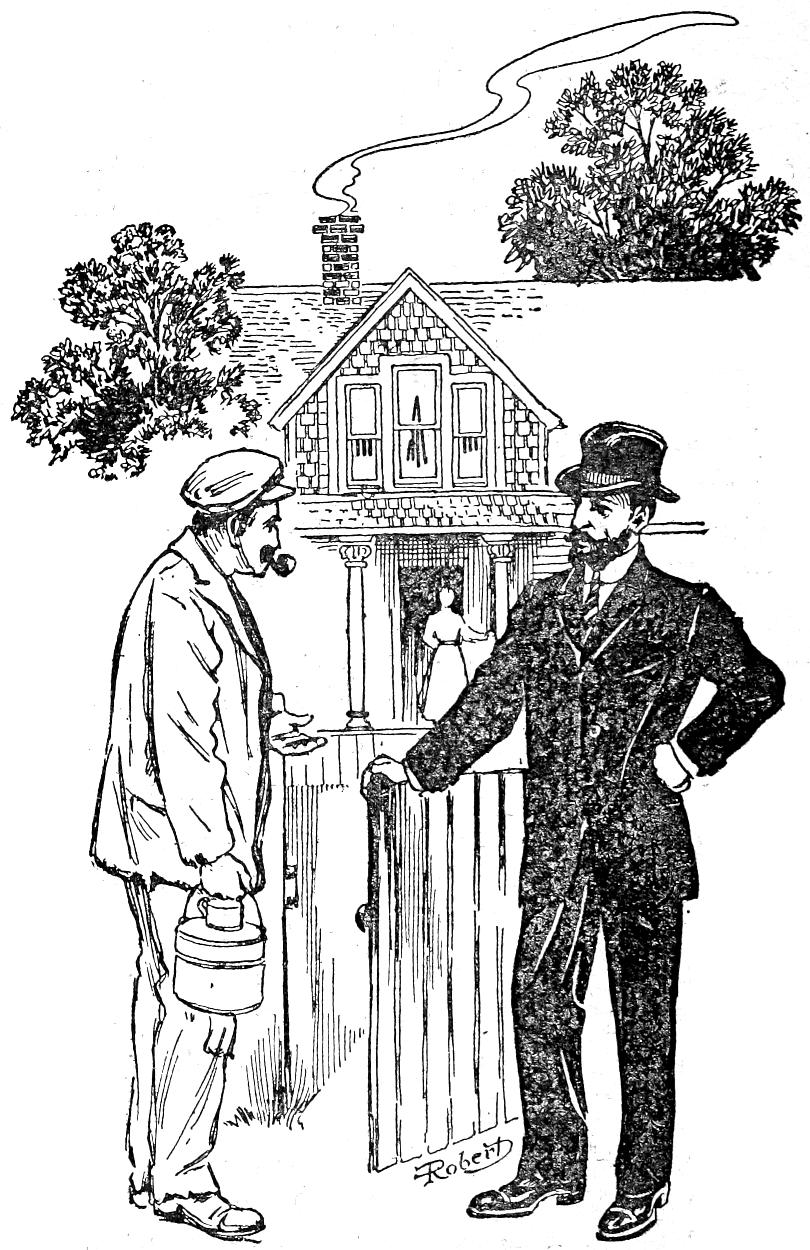
“I guess we’ll have to take a baby or two.”
Among his men is the very one who bantered
him the most about the children and prophesied
that he would soon be sold out by the constable.
Poor man! it was not long before the constable had
him in charge. He had wasted his money at
McBride’s, instead of paying it to the landlord.
Walking home one evening after his work was
done, John Wheaton and his journeyman took the
same way. They were silent until they came near
the former’s pretty dwelling, when the journeyman
said, half in jest, yet with undisguised bitterness,
“I guess we’ll have to take a baby or two.”
“Why?”
“For good luck,” the other one replied.
“Oh!”
“You’ve had nothing but good luck ever since
you took Mrs. Grant’s orphan children.”
“Only such good luck as any one may have, if he
will,” answered Wheaton.
“I can’t see it,” returned the other somewhat
bitterly. “Your wages were no better than mine.
I had one child, and you saddled yourself with two,
and not long afterward added a third. And how is
it to-day? You have a nice house, and your wife
and children are well dressed, while I have never
been able to make ends meet, and my boy looks
like a ragamuffin half the time.”
“Do you see that house over there—the largest
and handsomest in the place?” asked Wheaton.
“Yes.”
“Who owns it?”
“Jimmy McBride.”
“How much did you pay toward the building of
it?”
“Me?” in surprise.
“Yes, you. How much did you pay toward the
building of it?”
“Why, nothing. Why should I help pay for his
house?”
“Sure enough! Why should your hard earnings
go to build and furnish an elegant house for a man
who would rather sell liquor, and so ruin his neighbors,
body and soul, than support himself in a useful
calling, as you and I are trying to do?”
“I can’t see what you’re driving at,” replied his
companion.
“How much do you spend at McBride’s saloon
every week?”
The man stood still with a blank look on his
face.
“A dollar a week?” asked Mr. Wheaton.
“Yes.”
“Say a dollar and a half?”
“Well, say as much.”
“Do you know what that amounts to in a year?”
“Never counted it up.”
“Seventy-eight dollars.”
“No!”
“Yes, to a dollar. So, in five years, at this rate,
you have contributed nearly four hundred dollars
toward McBride’s handsome house, without getting
anything but harm in return, and haven’t a shingle
over your head that you can call your own.
“Now it’s my advice, in a friendly way, that you
stop helping McBride and begin to help yourself.
He’s comfortable enough, and can do without your
dollar and a half a week. Take a baby, for good
luck, as you call it, if you will. You’ll find one
over at the poorhouse; it won’t cost you half as
much as helping McBride, and I don’t think he
needs your aid any longer.
But here we are at home,
and I see my wife and children
waiting for me. Come
in, won’t you?”
“No, thank you. I’ll
go home and talk to
Ellen about taking a
baby for good luck.”
And he tried
to smile, as he
called back, after
a few steps:—
“If you see
anything of my
Jack about your
place, just send
him home, won’t you?”
Jack was there, dirty, and
meanly dressed, and in striking
contrast with John Wheaton’s three
adopted children, who, with the only
mother they knew, gave the happy man a joyful
welcome.
“I have turned over a new leaf,” said the journeyman
when he came to work the next morning.
“Indeed! I am glad to hear it,” returned
Mr. Wheaton.
“Ellen and I talked it over last night. I am
done helping saloon keepers build handsome houses.
I’m glad you put it to me in that way. I never
looked at it so before. But it’s just the hard truth.
What fools we are!”
“Going to take a baby?” questioned Mr. Wheaton,
smiling.
“Well, we haven’t just settled that; but Ellen
heard yesterday of a poor little thing that would
have to go to the county house unless some one
agrees to take it, and I shouldn’t wonder now if she
opened her heart,—for she’s a motherly body.”
“Where is it?” asked Mr. Wheaton.
“Down at the Woodbury mills.”
“Look here, Frank. Take my advice, and put
this baby between you and McBride’s saloon.”
Only a little while did the man hesitate. Then
he exclaimed:—
“I’ll do it!”
“Do it at once, then,” said Mr. Wheaton. “Put
on your coat and go over to the mills and get the
baby. It will be an angel in your house, that will
help and bless you in every hour of temptation.
Go at once. God has opened for you this way of
safety, and if you walk therein, all will be well.”
He did walk therein, and all was well. Mr.
Wheaton’s prophesy was fulfilled. In less than
two years, the journeyman had his own roof over
his head, and it covered a happy home.
IN THE HOUSE OF HIS FRIENDS BY MRS. L. D. AVERY-STUTTLE
Yea, mine own familiar friend,
in whom I trusted, ... hath
lifted up his heel against me.”
The largest church in
Jonesville was well filled that
Sabbath, for it was communion
day, and the eloquent Mr.
Barnes was to fill the pulpit,
and officiate with the pastor
at the Lord’s table.
The congregation was very
select,—in fact, it was mostly composed of the
well-to-do residents of the town; and the Master’s
words, “The poor ye have always with you,” would
hardly have seemed an appropriate text—especially
on this particular morning.
But there was one gentle little woman, with a
child in her arms and a little girl by her side, who
sat in a pew far up in front, toward the right of the
altar, in whose dark eyes there lurked a shadow,
and in whose heart had entered a terrible fear.
The man who sat beside her was a noble looking
fellow, broad of shoulder, strong of limb, stalwart
of frame. But to a close observer there still
appeared marks of past dissipation and reckless
intemperance, which had left there unmistakable
tokens on cheek and brow,—tokens which even the
charitable hand of time must be many years in
effacing altogether.
And it had been only one little year since Burton
Holbrook had been plucked even as a brand
from the burning; but in all the year, not once had
the accursed cup touched his lips.
Burton Holbrook could not remember when he
had first learned to love the cup; the terrible heritage
had been his from birth,—a heritage bequeathed
him by his poor father, whose drunken
carousals had made his childhood miserable.
And so the heritage of thirst had been his; and
he had fought it manfully, bravely all the years.
But the record of the years had been filled with
shameful defeat so often that the little woman by
his side had been well nigh discouraged many times.
But in the past few months a new hope had been
born,—a hope bright with anticipation and big
with promise.
For Burton Holbrook had been converted and
joined the church.
“You can never conquer in your own strength,”
she had said; and her prayers had ascended day
and night unceasingly. And one glad day he had
come to her, with a new light in his eyes and
a new song upon his lips.
Then, almost as if by magic, prosperity seemed
to come to them by leaps and bounds; friends multiplied;
a position was offered him, lucrative beyond
his wildest dreams. Within the year, the humble
home had been exchanged for a pleasant cottage on
one of the better streets, and from this cottage
ascended night and morning, songs and prayers of
thanksgiving and praise.
And this Sabbath he was attending communion
service for the first time.
Strange that sad thoughts should intrude,—that
unwelcome fears,
and dim, shadowy
forebodings
should come
trooping into the
heart of the little
woman by his
side,—to-day of
all days,—to-day,
when her cup of
joy was full to the
brim!
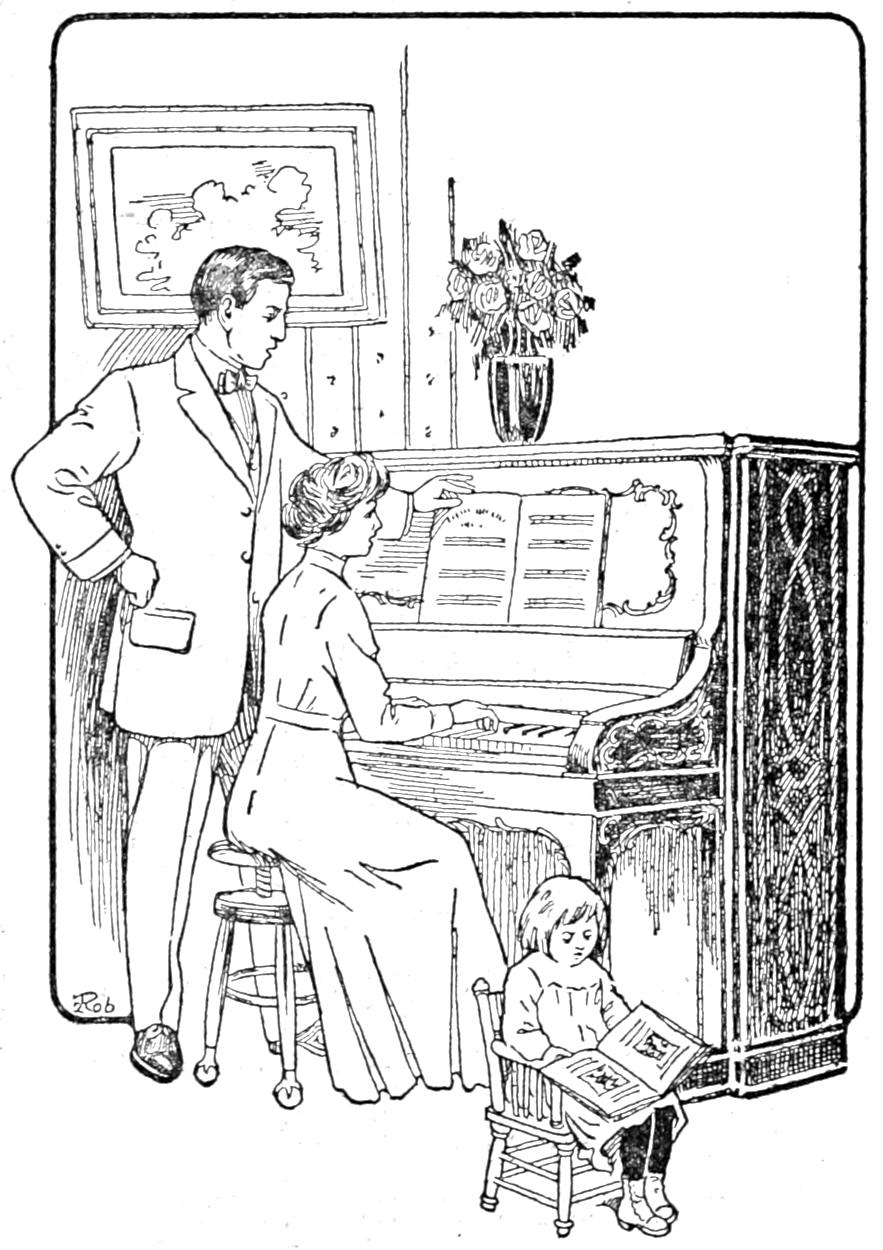
“Songs of thanksgiving and praise”
In the very beginning
of the
services, she had
suddenly remembered
that it was
communion day,—yes,
yes, she had known that, all the time. But
now she realized with a dull pain at her heart, that
there would be wine. There must be; and it would
be the wine that intoxicates!
Ah! too well she knew the demons that forever
dogged her husband’s footsteps! Given the slightest
opportunity, and they were about him in troops.
Was there, then, no spot too sacred for them to
invade? Was there to be no safety, even within the
sacred courts of the house of the Lord?
In her perfect happiness, she had not given it a
thought; but now, she wondered vaguely why she
had not remembered. Ah, once before, in those
awful days that seemed so long, long ago,—once
before, a single taste of red wine had been his
undoing!
How helpless she felt, as she sat by his side and
glanced timidly up into his handsome face—her
noble husband! And she reflected that she had
urged him to unite with the church long before he
had thought of offering himself. She had told him
that this would be such a source of strength to him!
And now she shuddered.
Why had no one cared for his soul? Why had
no voice been raised in protest? And then she
remembered hearing Mrs. Jones, the deaconess, once
say that she had protested against this thing; but
the pastor had only smiled and treated the matter
lightly,—in fact he had gone so far as to insinuate
that “it would be casting a reflection upon the
respectability” of his eminently respectable congregation,
to offer them new wine at communion,
when they had always been accustomed to the old!
So it would have been of no use for her to
protest. The pastor would have scorned her husband
as a weakling—her strong, noble husband.
But see, the red wine has already been uncovered;
the blessing has been pronounced,—ah, surely
it is only the emblem of the spilled blood of the
Man of Sorrows!
Burton Holbrook starts. His face is white as
chiseled marble. His breath comes in quick, hard
gasps. Already the subtle scent of the red wine is
in his nostrils.
The little woman marks with strange distinctness,
the white, delicate fingers of the pastor, as he
offers the glass to her husband,—for they are in
the pew near the altar. The words which the
minister had read that morning, ring in her ears:
“Yea, mine own familiar friend, in whom I trusted,
... hath lifted up his heel against me.”
She turns her eyes in sickening fear upon the
man. His face is gray and drawn, the muscles of
his neck are working, and the blue veins are standing
out upon his forehead. He turns his eyes in
piteous appeal toward his wife, then toward the
pastor. Then over his haggard face there flits an
expression of mad desire. The fiends of darkness
are tapping upon his forehead and beckoning to
him insistently.
Even the pastor starts with alarm as Burton Holbrook
reaches his trembling fingers toward the
glass. A fire like the smouldering fires of the pit
leaps into his dark eyes,—and the glass is drained.
There was an uneasy, expectant rustle in the
congregation. The minister turned his eyes for a
moment. It was enough. Burton Holbrook sprang
like a famished tiger and snatched at the pitcher.
In a moment more, it was empty.
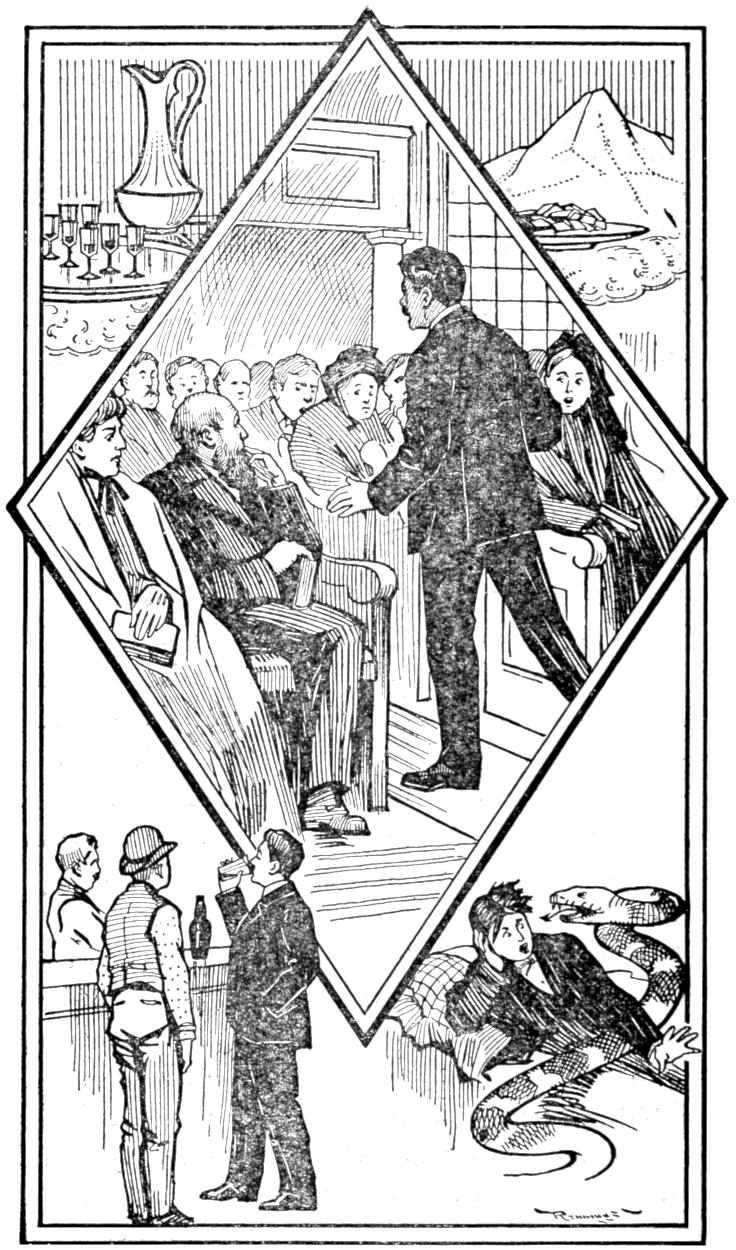
“Down the long aisle rushed a frenzied, hatless man”
Then, down the long aisle of horrified, frightened
faces, and out into the quiet streets, rushed a
frenzied, hatless man.
Over at the saloon on the nearest corner, lingered
a few of the former companions of Burton Holbrook,
discussing their old comrade, over their cups:—
“Been almost a year, I think, hasn’t it, since
Holbrook last favored us with his company?” questioned
the bartender sneeringly, as he handed a
foaming glass to a young man whose trembling
hand and thick speech told a pitiful story of disease
and dissipation.
“Considers himself mighty good, I reckon,” was
the reply.
“I’ve done everything I could to get him to give
up those high and lofty notions of his,” shamelessly
admitted another.
“I’m right glad I don’t have to sell my liberty,”
blustered Jack Hartwell, “and I told him so the
other day; but he had an answer ready, of course.
Real, reg’lar parson, Burt’s got to be, since he’s
quit us.”
“That makes me think,” stammered an old man
from across the room, “Holbrook’s gone and joined
the church, so they say,—got clear off the devil’s
ground, I s’pose he thinks, now,—but,—” and the
old man lowered his voice, while a hateful grin distorted
his bloated face, “but we’ll see—we’ll see.
He’s no whit better than the rest of us, that he
should,—”
“No,” interrupted the bartender, with an oath,
“somebody’s likely been preachin’ to him. But if
he thinks he’s safe, just because—”
But the bartender never finished his speech. Into
the midst of them rushed a man, breathless and
hatless, with haggard face and wild, hollow eyes.
“Let me drink, man! let me drink! I’ve sold
my soul for it. The demons of hell have got me
this time! I have held my own against them for
a year,—but they caught me,—caught me in the
church,—and—and I will die, but I must have my
drink!”
Within another month, delirium tremens, with
its unspeakable horrors, had claimed its victim.
But I am glad to say that now there is one church
in Jonesville, which offers nothing but pure, sweet,
new wine at communion.
But still a poor, heartbroken little woman murmurs
over and over again, “‘Woe unto him that
giveth his neighbor drink!’”
THE SIGN BOARD
Everybody liked Tom Hall,
and everybody was sorry for
him. It was sad to see such a
fine young man a victim of
drunkenness, and Tom had
fallen into the mocker’s power
unwittingly, it seems. A new
saloon had been opened close
to the foundry at which he
worked, and he, along with others, was in the habit
of going in for a glass of beer.
When the cold weather set in, he took something
stronger, until he began to imagine that spirits agreed
with him. Tom went on, and the liking for strong
drink increased, until at all hours he might be seen
staggering out of the “Rainbow,” dizzy and stupefied
with the intoxicating cup.
Tom’s was a very sad case. He belonged to a
respectable family, and he had been religiously
trained, and until he was drawn into the snare, he
was an affectionate son and brother. Friends
counseled, and ministers preached, and every
means was tried to reclaim him, but all effort
seemed lost,—Tom was bound hard and fast with
the invisible chains of the “mocker.” His family
mourned him as lost, and many a silent tear his
sister dropped on his tattered garments as she
sat darning and patching them.
“Ah, these rents will not darn again,” said
Jennie, as she turned over Tom’s ragged raiment.
In Tom’s better days, he had pride, and it was a
sad change when he didn’t care who saw him “out
at the elbows.”
But somehow Jennie could not find it in her
heart to abandon the brother she still loved, and so
Tom’s tattered garments were
taken up again, and made the
most of.
“Kindness may win him back,”
said Jennie, and when he came
home at the
worst, he was
met in peace,—if
in sorrow.
Just when
the trees were
beginning to
bud with the
promise of
spring, Tom
came home
looking quite
thoughtful. He
was sober after
a long run.
In the last rays of the setting sun, his sister was
trying to cover some old darns.
Tom stood beside her, and silently watched the
patient fingers for some time.
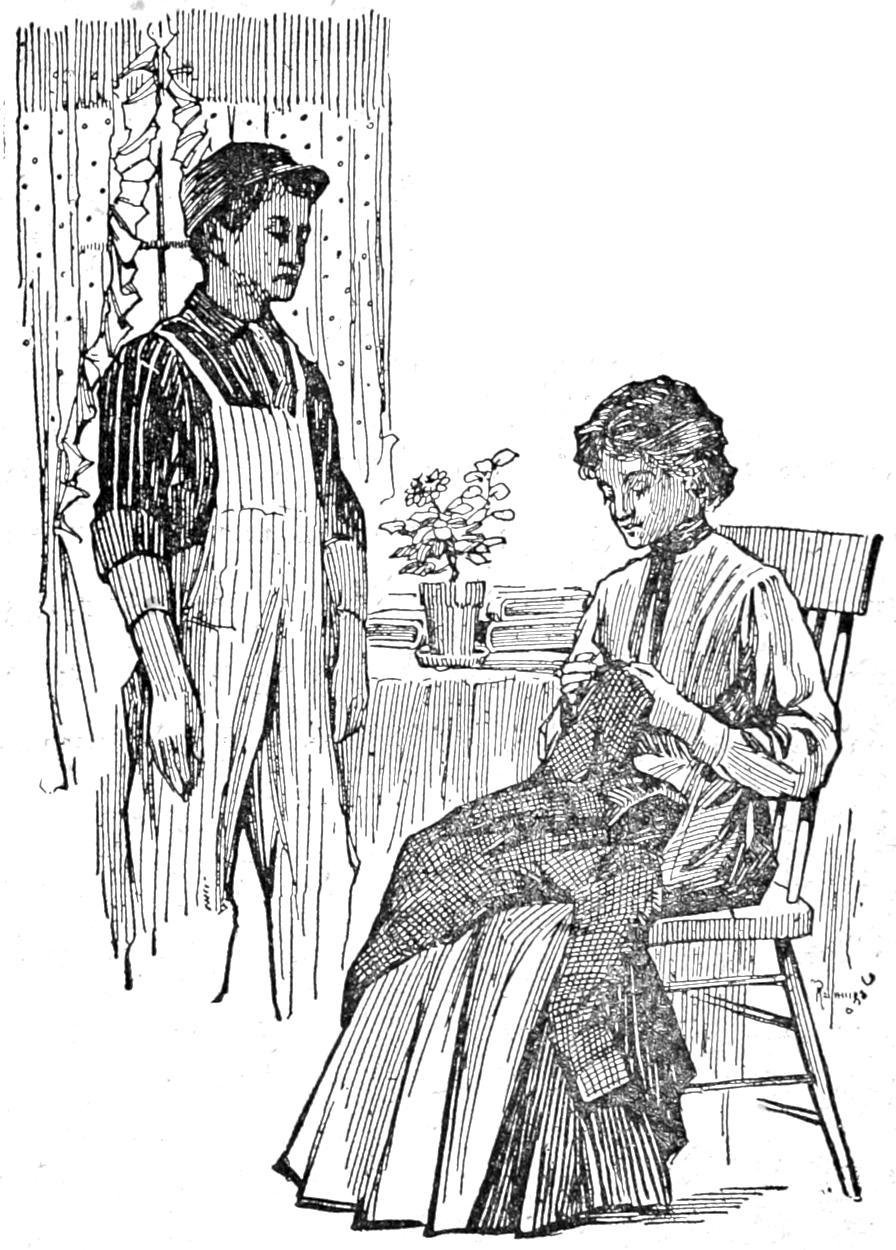
“That’s tiresome work, Jennie.”
“That’s tiresome work, Jennie,” he said. His
sister held up her seam before him.
“Why, that is a bunch of rags,” said Tom.
“Yes, Tom; and a bunch of rags would be the
best sign board that a saloon keeper could hang over
his door,” said Jennie, sadly.
Tom made no reply. He looked at the rags in
silence.
Next morning Tom went back to his work and
continued steady for two or three weeks.
He looked toward the “Rainbow,” but didn’t
go in.
“Hello! what’s up with Tom Hall?” wondered
Sinclair, as he filled up a glass of Tom’s favorite
whisky for another customer at the counter.
Sinclair was not the only one who was astonished
at the change.
Every day Tom went to his work; every night
he came home sober, and after a time he appeared
at church on the Sabbath. Then people began to
believe that Tom was in earnest, and really meant
to reform.
“Has Tom Hall really become a teetotaler?”
queried Sinclair, when a whole month had passed
without a visit to the “Rainbow.”
Well, it seemed so, for nothing stronger than
water had passed his lips since that night on which
his sister had shown him the bunch of rags. “I’ll
have a talk with Tom and learn how he got off the
scent, though,” Sinclair resolved.
An opportunity came sooner than he expected.
In the beginning of summer a terrific thunderstorm
passed over Airlie, and among the general devastation,
Sinclair’s sign board was shivered to atoms.
Tom happened to be passing the “Rainbow”
next morning, and stopped to glance up at the old
mark.
“Fine work here, the storm’s done for us,”
remarked Mr. Sinclair, who was standing in his
door, “and I’ll have to get a new sign board.”
“Is it so bad as that?” asked Tom.
“Yes, the ‘Rainbow’ is in shivers.”
“Then you’ll want a new sign board,” suggested
Tom.
“Of course; isn’t that what I’m telling you?”
“Is it to be the ‘Rainbow’ again?” asked Tom.
“I suppose so,” answered Mr. Sinclair, “unless
you can give a new idea, Tom.”
“I think I can,” returned Tom; “but I must go
home first.”
“Don’t forget, though,” said Mr. Sinclair.
“But you’re a stranger now-a-days, by the by,
Tom.”
“I won’t be long,” answered Tom, as he hurried
toward home.
A better sign board than “The Rainbow” Mr.
Sinclair did not expect to get; he was only joking
with Tom Hall, and he raised his eyebrows when
Tom made his appearance, with a bundle under
his arm, and requested him to look at the new
sign board.
“I didn’t think you would catch me up; but
step in, Tom, and let me see your idea.”
Tom gravely undid his bundle, and held up a
bunch of rags
before the saloon
keeper’s
astonished eyes.
“What do
you mean,
Tom?” asked
Mr. Sinclair,
feeling confident
that Tom
had lost his
senses.
“You want a
new sign board, don’t you?”
asked Tom.
“Well, what has a bunch of
rags got to do with that?” said
Mr. Sinclair.
“Ask yourself, sir, if a bunch
of rags is not the best sign board
that can hang across your door,” said Tom, and
his lips quivered.
“Was it that bunch of rags that made you a
teetotaler, Tom?” said Mr. Sinclair, more confused
than he liked to confess.
“It was one of the means, sir,” answered Tom,
“and, perhaps some poor wretch, seeing in this
bunch of rags the future outcome of drink, will bless
you for the sign board.”
Tom walked away to his work, and Mr. Sinclair
went back to his counter, but all day the bunch of
rags troubled him.
It was a busy day, but every new comer seemed
more deplorably wretched and worse off than the
last served. He was thankful when night came.
The last customer was a woman literally covered
with rags. A little infant sat on her arm. It was
crying with cold and hunger.
“Go home and put clothes on your child,” said
Mr. Sinclair, flinging back the money the woman
had laid down.
“I have nothing but rags,” said the woman.
“Tom is right,” said Mr. Sinclair; “the end of
drink is misery and rags, and the man who has a
taste for that sort of thing may put his name on
the new sign board.”
DAN NAYLOR’S LEGACY
When Enoch Wilton died, people
said that Daniel Naylor was sure
to come into possession of a
handsome property, since his
Uncle Enoch was known to be a
man of some means, and Daniel
was his favorite nephew.
But when the will was read,
they changed their minds, for the only clause it
contained which referred to Daniel read as follows:—
“And to Daniel Naylor, my beloved nephew, I
give and bequeath the framed copy of the temperance
pledge to which, under Divine Providence, I owe
salvation from a drunkard’s grave; also to this I
owe all the material prosperity which has gladdened
my latter years. And I recommend that he remove
it from its frame, and affix his signature beneath
mine; satisfied that he will find the pledge an unfailing
source of wealth to him, as it has been to me.”
Daniel Naylor resented this, as he was a drinking
man, and he indignantly stowed away his uncle’s
bequest, among the rubbish in the attic, assuring
his wife that, as his uncle had treated him so
shabbily, he should not trouble himself further
about it; and there, for years, it slumbered, utterly
forgotten.
Meanwhile, Daniel Naylor’s affairs went from
bad to worse, for his drinking habits had strengthened
their hold upon him.
One day, about five years after his uncle’s death,
he returned to his now squalid home, to tell his
wife that the last cent had gone, and that “Squire
Grip,” the village lawyer, would, the next day, foreclose
the mortgage on their little place, leaving
them homeless.
“Oh Daniel!” exclaimed the poor woman in a
tone of despair, “What shall we do? Where can
we go?”
“I do not know,” he responded moodily,—“to
the poorhouse, perhaps.”
“Don’t say that, Daniel!” pleaded the wife, “you
still have two hands left, and if—”
“I cannot get employment,” he interrupted. “I
have been to all my employers and to all my friends;
I can assure you that I have made every effort possible.
But somehow, they don’t act toward me as
they used to, in the old days when I was more prosperous.
I don’t know what’s the matter, I’m sure.
They only shake their heads and say they are
sorry, but the times are so hard they cannot give
me work. I shall have to give it up.”
“But you must not give it up, there must be
employment somewhere.”
“But I tell you, I am unable to find it. I have
tried everywhere; there is nothing for me to do.”
“Look here, Daniel, if you will promise me just
one thing, I’ll tell you how you can find work,—Oh,
if you would only promise, Daniel!” and Mrs.
Naylor glanced appealingly at her husband.
Daniel Naylor felt a trifle uncomfortable, for he
saw traces of tears in his wife’s eyes, and she had
rarely spoken to him so earnestly. But he only
stammered brokenly:—
“What are the conditions?”
“Will you promise?”
“I would rather know the conditions first.”
“The conditions are that you quit your drinking
habits and sign the temperance pledge.”
Daniel Naylor started.
“What!” he cried, in astonishment. “Do you
intend to say that my drinking a little, now and
then, interferes with my getting work to do?”
“It certainly does, Daniel,” was the sorrowful
reply, “for I have heard at least one of your old
employers say as much.”
“Who was it?”
“Mr. Field.”
“What did he say?”
“You recollect the time, about three weeks ago,
when you were—were—”
“Drunk.”
“Yes, when you were drunk. You were at work
for him then, and when he came after you, and I told
him you could not come, he guessed the truth, and
I heard him say to his clerk, who was with him, as
he drove off:—
“‘Well, this is the second time Dan Naylor has
failed me when I needed him most, but I shall be
sure he does not do it again.’
“And that, my husband, is the source of almost
all our trouble, as I believe you, yourself, will admit
when you think the matter over; you can’t imagine
how it makes me feel.” And Mrs. Naylor put
her apron to her eyes and sobbed hysterically.
It was Daniel Naylor’s turn to reflect now,—and
it was not the first time, by any means. This subject
had long
been troubling
him. But it
was very hard
for him to acknowledge
or to
realize that his
deep poverty
and misery had
been brought
about by his
own conduct.
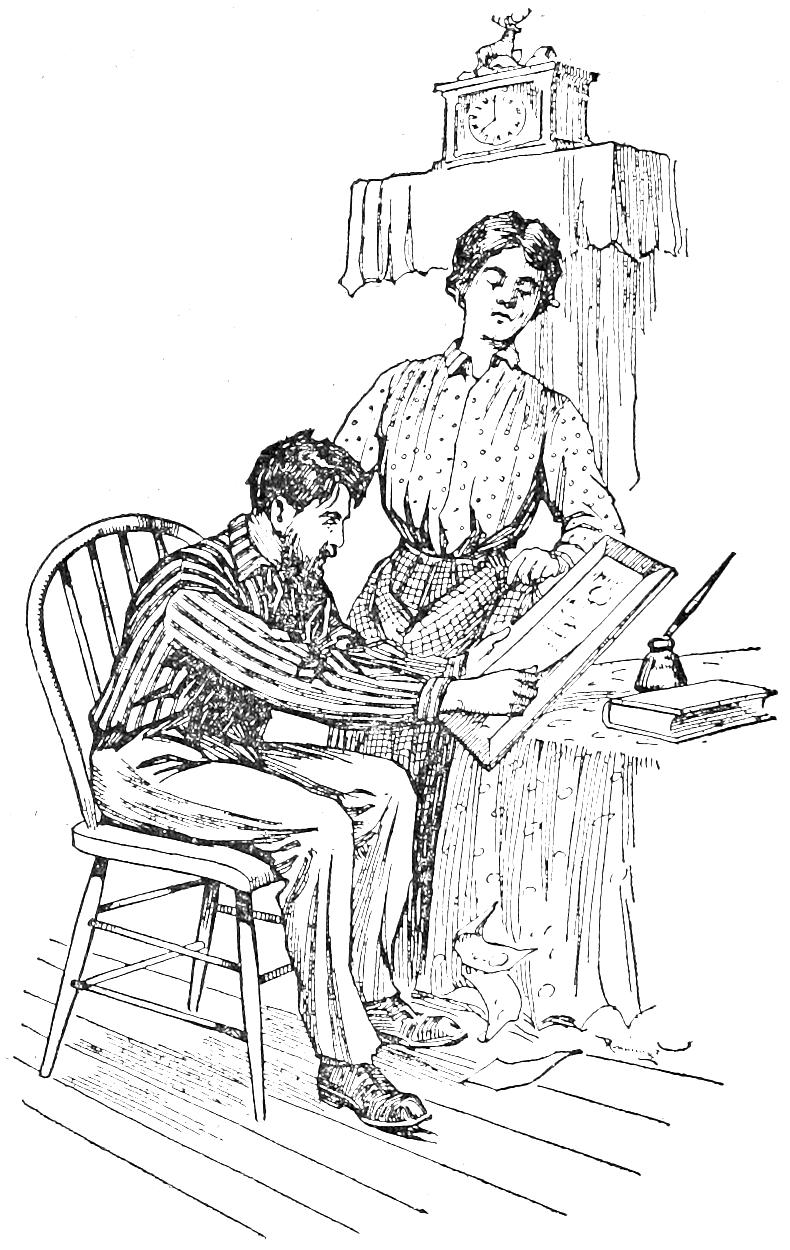
“Seven one thousand dollar notes fell out.”
“Well, I believe
you are
right,” he said,
at last. “But
what can I do?
Our home is
gone, and I
have lost the
confidence of
my employers,—so
signing the pledge cannot amount to much.”
“Yes, it would amount to a great deal. It would
restore your self-respect, and in a great measure
you would be able to regain their confidence.”
Then came another period of silence. At last a
great purpose entered his heart, and the light of a
firm resolve shone in his eyes.
“Bring me a paper, and I will sign it, and may
God give me strength to keep it!”
“Why not sign Uncle Enoch’s pledge?” his wife
inquired. “I saw it lying up in the attic the other
day, and if you wish, I will bring it.”
“Certainly; that will save writing another.”
The pledge was soon brought, and Daniel Naylor
removed it from the frame and placed it on the
table. As he did so, a roll of brown paper fell out
of its back and dropped unnoticed at his feet.
After he had signed his name under that of his
uncle, he turned to replace the pledge in its frame.
In doing this, his eyes fell upon the small roll of
brown paper lying on the floor.
Stooping to pick it up, he uttered a sudden cry of
astonishment, as he saw the corner of a bank note
protruding; with trembling fingers, he undid the
package, to find seven one thousand dollar notes,
and a scrap of paper on which was written:—
“Is not the pledge a sure road to wealth?”
“God bless good Uncle Enoch!” he exclaimed
fervently. “I can now take up the mortgage, and as
for the pledge, I will keep that sacred as long as I
live.”
And his wife responded with a fervent—
“Amen.”
“DON’T LET HIM HAVE IT”
If they wouldn’t let him
have it!” exclaimed Mrs.
Leslie, weeping; “Oh! if
they wouldn’t sell him the
liquor, there’d not be any
trouble. He’s one of the
best of men when he does
not drink. He does not
bring liquor into the house;
and he tries very hard, I
know, to keep sober, but he
cannot pass Jenk’s tavern.”
Mrs. Leslie was talking with a sympathizing
neighbor, who responded by saying, “It’s a downright
shame!”
While this conversation was going on, a little
girl, of about six years, sat listening attentively.
After a little while she went quietly from the room,
and took her way down the road unobserved by the
mother.
There was a purpose, great and noble, in her
mind; she had started on a mission. “Oh, if they
wouldn’t sell him liquor!” Those earnest words
of her mother filled her thoughts. If Mr. Jenks
wouldn’t sell her father drink, there would be no
more trouble. How simple the remedy!
She would go to Mr. Jenks and ask him not to
let her father have any more liquor, and all would
be well again. Artless, innocent child!
The tavern kept by Jenks—the laziest man in
Milanville, stood nearly a quarter of a mile from the
tenement occupied by the Leslies. Toward this
place, under a hot sun, Lizzie made her way, her
mind so filled with its purpose, that she was unconscious
of heat or fatigue.
Not long before, a traveler had alighted at the
tavern door. After giving directions to have his
horse fed, he entered the barroom, where Jenks stood
behind the counter.
“Have something to drink?” inquired the landlord.
“I’ll take a glass of water, if you please.”
Jenks could not hide the indifference at once felt
toward the stranger. Very deliberately he set a
pitcher and glass upon the counter, and then turned
partly away. The stranger poured out a full tumbler
of water, and drank it with an air of satisfaction.
“Good water, that of yours, landlord,” said he.
“Is it?” was returned somewhat uncourteously.
“I call it good water, don’t you?”
“Never drink water by itself.” As Jenks said
this, he winked to one of his customers, who was
lounging on the bar. “In fact, it’s so long since I
drank any water that I forget how it tastes. Don’t
you, Leslie?”
The man to whom this was addressed was not so
far lost to shame as Jenks. He blushed and looked
confused as he replied:—
“It might be better for some of us if we had not
lost our relish for water.”
“A true word spoken, my friend!” said the stranger,
turning to the man, whose swollen visage, and
patched, threadbare garments, too plainly told the
story of his life.
“Water, pure water, bright water! is my motto.
Its attendants are health, thrift, and happiness. It
takes not away the child’s bread, nor the toiling
wife’s garments.”
There were two or three customers at the bar besides
Leslie, to whom this was addressed; and all
of them, in spite of the landlord’s angry and sneering
countenance, treated the stranger with attention
and respect. Seeing this, Jenks could not restrain
himself; so, advancing to the gentleman’s side, and
laying his hand rudely on his shoulder, he said in a
peremptory manner:—
“See here, my friend, if you are about to deliver
a temperance lecture, you can adjourn to the town
hall or the Methodist chapel.”
The stranger moved aside a pace or two, and then
said, mildly, “there must be something wrong here,
if a man may not speak in praise of water without
giving offense.”
“I said you could adjourn your lecture.” The
landlord’s face was now a fiery red, and he spoke
with insolence and passion.
“Oh, well, as you are president of the meeting,
I suppose we must let you exercise an arbitrary
power of judgment,” said the stranger; “I didn’t
think any one had so strong a dislike of water as to
consider its praise an insult.”
At this moment a child stepped into the barroom.
She glanced neither to the right nor the left, but
walked up to the landlord, lifted her sweet young
face, and said in tones that thrilled every heart but
his, “Please, Mr. Jenks, don’t sell papa any more
liquor!”
“Off home with you, this instant!” exclaimed
Jenks. As he spoke, he advanced toward the child
with his uplifted hand in a threatening attitude.
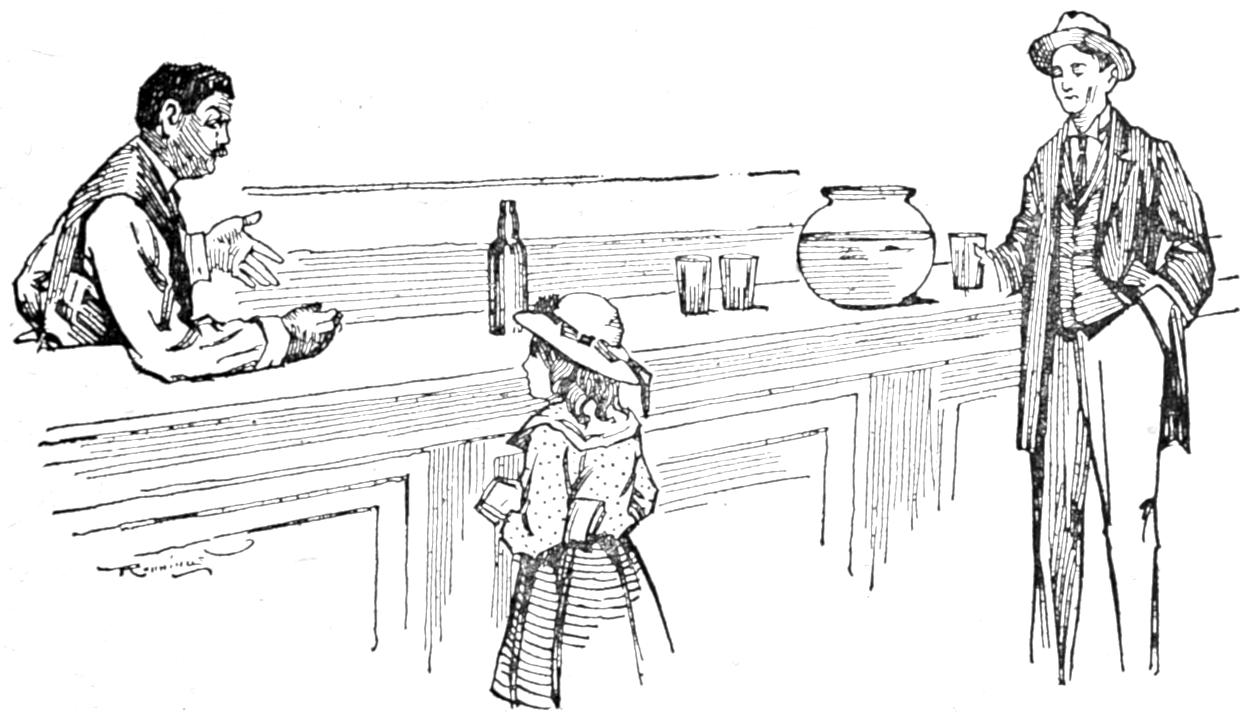
“Please, Mr. Jenks, don’t sell papa any more liquor.”
“Please don’t, Mr. Jenks,” persisted the child,
not moving or taking her eyes from the landlord’s
countenance. “Mother says if you would not sell
him liquor, there’d be no trouble. He’s kind and
good to us all when he does not drink.”
“Off, I say!” shouted Jenks, now maddened beyond
self-control, and his hand was about to descend
upon the little one, when the stranger caught her
in his arms, exclaiming as he did so, with deep
emotion:—
“God bless the child! No! no, precious one,”
he added, “Don’t fear him. Plead for your father.
Plead for your home. Your petition must prevail.
The merciful Lord cannot say nay to the little ones,
whose angels do always behold the face of their
Father in Heaven. God bless the child!” added the
stranger, in a choking voice. “Oh, that the father,
for whom she has come on this touching errand,
were present now! If there was anything of manhood
yet left in him, this would awaken it from its
palsied sleep.”
“Papa! O papa!” the child exclaimed, stretching
forth her hand. In the next moment she was clinging
to the breast of her father, who, with his arms
clasped tightly around her, stood weeping and mingling
his tears with those of his child.
An oppressive stillness reigned in the room!
Jenks stood subdued and bewildered, his state of
mental confusion scarcely enabling him to comprehend
the full import of the scene, and the stranger
looked on wonderingly, yet deeply affected.
Quietly, and with moist eyes, the two or three
customers, who had been lounging at the bar, went
stealthily out; and the landlord, the stranger, and
the father and the child, were left the only inmates
of the room.
“Come, Lizzie, dear! this is no place for us,”
said Leslie, breaking the dead silence. “We’ll go
home.” And the unhappy father took his child by
the hand, and led her toward the door.
But the little one held back. “Wait, papa,
wait,” she said: “he hasn’t promised, yet. Oh, I
wish he would promise!”
“Promise her, in heaven’s name!” exclaimed the
stranger.
“If I do promise,
I keep it!” returned
the landlord, in a
threatening tone.
“Then, in the
name of mercy, do
promise,” begged Leslie,
in a despairing
voice; “promise, and
I’m safe!”
“Be it so! May I
be cursed, if ever I
sell you a drop of
drink at this bar,
while I am landlord!”
Jenks spoke
with an angry emphasis.
“God be thanked!” murmured the poor drunkard,
as he led his child away. “God be thanked!
There is hope for me yet.”
Hardly had Mrs. Leslie missed her child ere she
entered, leading her father by the hand. “O mother!”
she exclaimed, with a joy-lit countenance and
a voice of exultation, “Mr. Jenks has promised!”
“Promised what?” Hope sprang up in the
mother’s heart; her face flushed, then grew pale.
“That he would never sell me another glass of
liquor,” replied the husband.
A pair of thin, white hands were clasped together;
an ashen face was turned upward; tearful eyes
looked their thankfulness in Heaven.
“There is hope yet,” said Leslie.
“Hope, hope! And, O Edward, you have said
the word. I know you will be a man once more
now! Surely, God sent our child on that errand of
love! Innocence has triumphed over vice and
cruelty. Our child came to the strong, evil, passionate
man, and in her weakness and innocence, prevailed
over him. God made her fearless and eloquent.”
A year afterward, a stranger came that way, and
stopped at the same old tavern. As before, Jenks
was behind his well-filled bar, and drinking customers
came and went in numbers.
Jenks did not recognize the stranger until he
called for water, and drank a full tumbler of the
pure liquid with a hearty zest. Then he knew
him, but feigned to be ignorant of his identity.
The stranger made no reference to the scene he
had witnessed twelve months before, but lingered in
the barroom most of the day, closely observing
every one who came there to drink. Leslie was not
among the number.
“What has become of the man and the little girl
that I saw here at my last visit to Milanville?” the
stranger questioned.
“Gone to the devil, for all I care,” was the landlord’s
rude answer as he hastily left the barroom.
“Do you see that little white cottage away off
there, just at the edge of the wood?” replied one of
the customers. “A row of tall poplars stand in
front. The young man you ask for lives there.
And what is more, if he keeps on the way he has
begun, the cottage will be his own in another year.”
“Ah! I see; well, did the young man Leslie ever
again try to get a drink here, since the landlord
promised never to let him have another?”
“Twice to my knowledge.”
“And he refused him?”
“Yes; if you remember, Jenks said, in his anger,
‘May I be cursed if I sell him another drop.’ That
saved Leslie. Jenks is superstitious in some things.
Once he drove Leslie from the barroom, threatening,
at the same time, to horsewhip him if he ever
set foot inside his house again.”
“Ah! sometimes God makes even the wrath of
man to praise Him,” replied the stranger reverently.
ONLY THE HUSK
“I will have the kernel, his
wife may have the husk.”
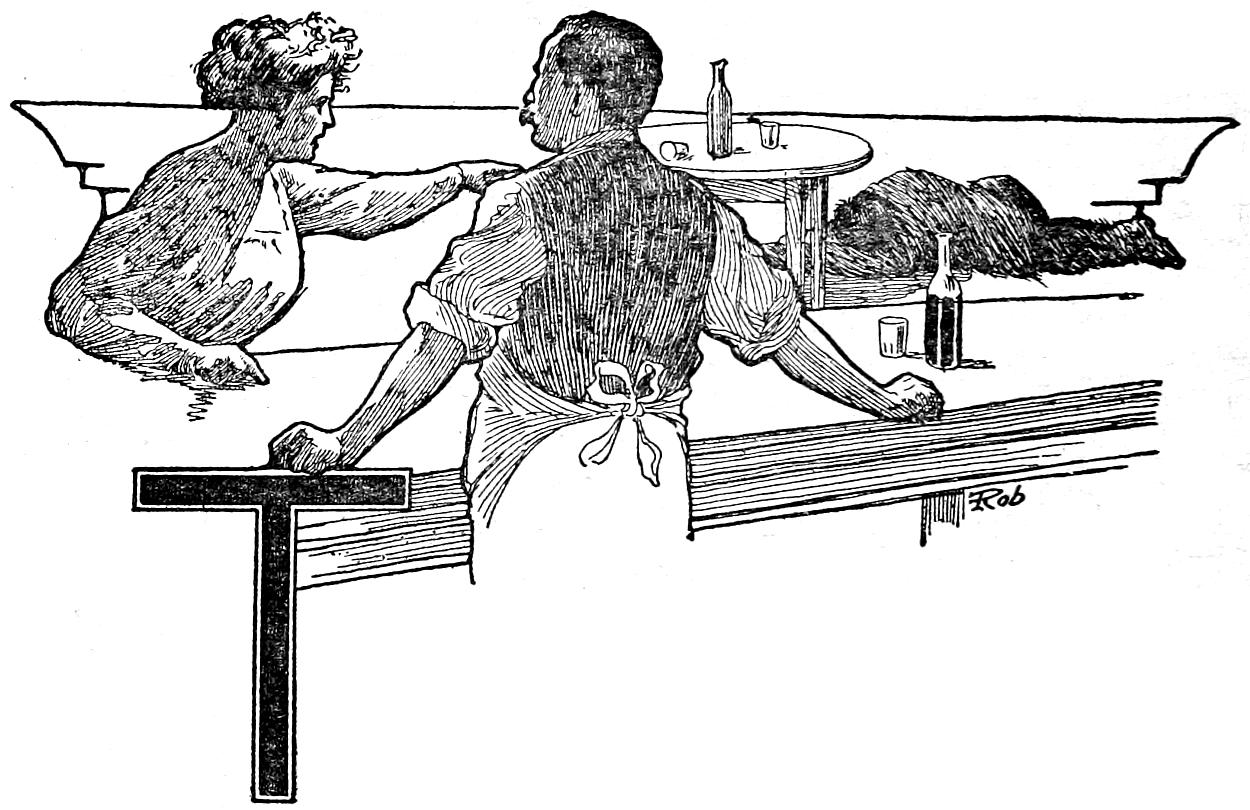
Tom Darcy, yet a young man, had
grown to be a very hard one. Although
naturally kind-hearted, active,
and intelligent, he lacked strength of will to resist
temptation and had therefore fallen a victim to intemperance.
He had lost his position as foreman of a great
machine shop, and what money he now earned
came from odd jobs of tinkering which he was able
to do at private houses here and there; for Tom
was a genius as well as a mechanic, and when his
head was steady enough, he could mend a clock or
clean a watch, as well as he could set up and regulate
a steam engine, and this latter he could do
better than any man ever employed by the Scott
Falls Manufacturing Company.
One day Tom was engaged to mend a broken
mowing machine and reaper, for which he received
five dollars; and, on the following morning, he
started for his old haunt, the village tavern. He
knew that his wife sadly needed the money, and
that his two little children were absolutely suffering
for want of clothing; so that morning he held
a debate with his better nature, but his better nature
had become weak, and the demon of appetite carried
the day.
So, away to the tavern Tom went, where, for two
or three hours he felt the exhilarating effect of the
strong drink and fancied himself happy because he
could laugh and sing. He drank while he could
stand, then lay down in a corner where his companions
left him.
It was almost midnight, when the landlord’s wife
came to the barroom to see what kept her husband
up, and she quickly saw Tom.
“Peter,” said she, “why don’t you send that
miserable Tom Darcy home? He’s been hanging
around here long enough.”
Tom’s stupefaction was not sound sleep. The
dead coma had left his brain, and the calling of his
name stung his senses to keen attention. He had
an insane love for rum, but he did not love the
landlord.
Long years ago, Peter Tinder and Tom Darcy
had wooed the same maiden,—Ellen Goss,—and
Tom had won her, leaving Peter to take up with
the sharp-tempered damsel who had brought him
the tavern. Tom knew well enough that even
lately Peter Tinder had gloated over the misery of
the woman who had once discarded him.
“Why don’t you send him home?” demanded
Mrs. Tinder, with an impatient stamp of her foot.
“Hush, Betsey, he’s got money. Let him be,
and he’ll be sure to spend it before he goes home.
I’ll have the kernel of that nut and his wife may
have the husk.”
Betsey turned away, and shortly afterward Tom
Darcy lifted himself upon his elbow.
“Ah, Tom, are you awake?”
“Yes.”
“Then rouse up and have a warm glass.”
Tom got upon his feet and steadied himself.
“No, I won’t drink any more to-night.”
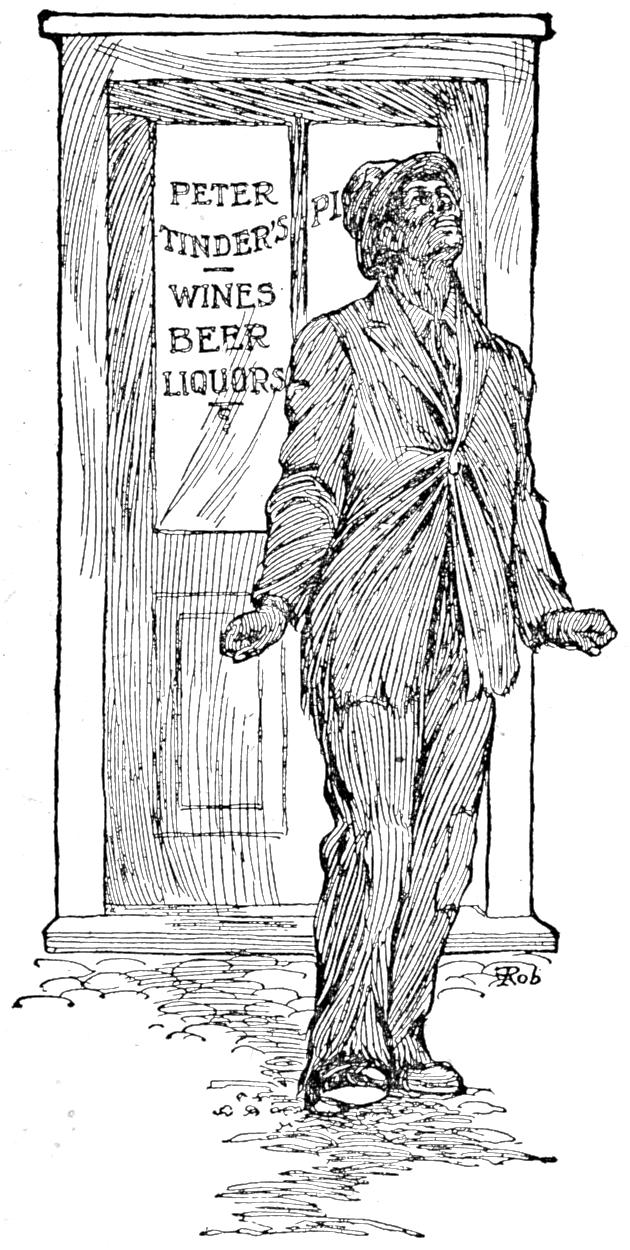
“We’ll see!”
“It won’t hurt you, Tom,—just one glass.”
“I know it won’t!” said Tom, buttoning up his
coat by the solitary button left. “I know it won’t.”
The air was damp and cold, but Tom Darcy
didn’t mind it. The fact was, he was waking up
at last. The words of Peter Tinder were sounding
in his ears. He would go home at once. Why
had he not gone before? he wondered, as he stepped
out into the dimly lighted street.
Tom stopped a moment and looked up at the
stars and then looked down upon the earth.
“Ay,” he muttered, grinding his heel into the
gravel, “Peter Tinder is taking the kernel, and
leaving poor Ellen the worthless husk,—a husk
more than worthless. I am robbing my wife of
joy; robbing my poor children of honor and comfort,
and robbing myself of love and life, so that
Peter Tinder may have the kernel and Ellen the
husk. We’ll see!”
It was a revelation to the man. The saloon-keeper’s
speech, meant not for his ears, had fallen
upon his senses as fell
the voice of the Risen
One upon the ears of
Saul of Tarsus.
“We’ll see!” he repeated,
setting his
foot firmly upon the
ground; and then he
wended his way
homeward.
On the following
morning he said to
his wife, “Ellen,
have you any coffee
in the house?”
“Yes, Tom.” She
did not tell him that
her sister had given it
to her. She was glad
to hear him ask for
coffee, instead of the
old, old cider.
“I wish you would
make me a cup, good
and strong.”
There was really music in Tom’s voice, and his
wife set about her work with a strange flutter at her
heart.
Tom ate a light breakfast,—there was not much
left to eat in the house,—and then went out, with
a resolute step, and walked straight to the great
manufactory, where he found Mr. Scott in his office.
“Mr. Scott, I want to learn my trade over again.”
“Eh, Tom, what do you mean?”
“I mean that it’s Tom Darcy come back to the
old place, asking forgiveness for the past, and hoping
to do better in the future.”
“Tom,” cried the manufacturer, starting forward
and grasping his hand, “are you in earnest? Is it
really the old Tom?”
“It’s what’s left of him, sir, and we’ll have him
whole and strong very soon, if you’ll only set him
to work.”
“Work! Ay, Tom, and bless you, too. There
is an engine to be set up and tested to-day. Come
with me.”
Tom’s hands were weak and unsteady, but his
brain was clear, and under his skillful supervision
the engine was set up and tested; but it was not
perfect. There were mistakes which he had to
correct, and it was late in the evening when the
work was complete.
“How is it now, Tom?” asked Mr. Scott, as he
came into the testing house and found the workmen
ready to go home.
“She’s all right now, sir. You may give your
warrant without fear.”
“God bless you, Tom! You don’t know how
like music the old voice sounds. Will you take
your old place again?”
“Wait till Monday morning, sir. If you will
offer it to me then, I will take it.”
At the little cottage, Ellen Darcy’s fluttering
heart was sinking. That morning, after Tom had
gone, she had found a dollar bill in the coffee cup.
She knew that
he had left it
for her. She
had been out
and bought potatoes
and sugar
and flour and
butter and a little
basket of
strawberries.
All day long a
ray of light had
been dancing
and glimmering
before her,—a
ray from
the blessed
light of other
days. With
prayer and hope she had set the tea-table and
waited; but the sun went down and no Tom came.
Eight o’clock, and almost nine.
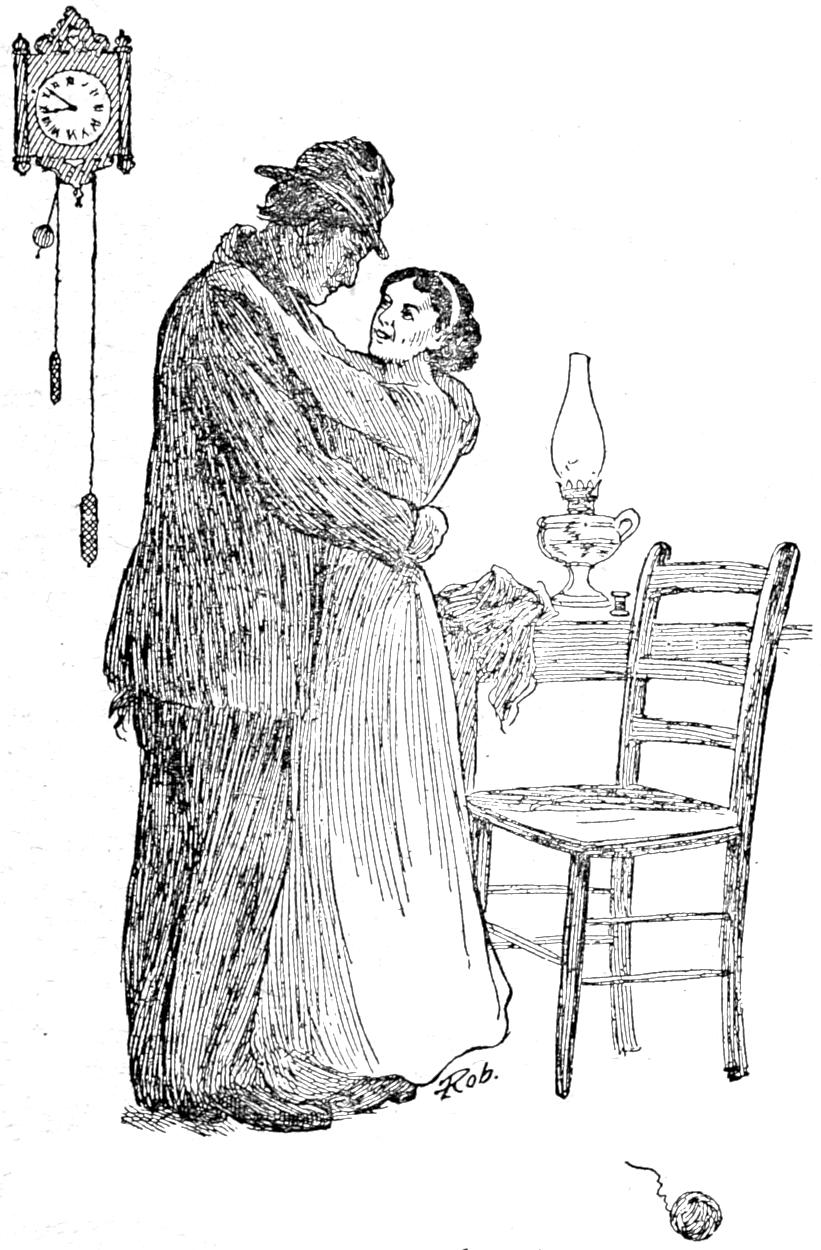
“I kept you waiting, Nellie”
Hark? The old step! quick, strong, eager, yes,
it was Tom, with the old grime upon his hands and
the odor of oil upon his clothing.
“I have kept you waiting, Nellie.”
“Tom!”
“I did not mean to, but the work hung on.”
“Tom! Tom! You have been to the old shop!”
“Yes, and I’m promised the old place, and—”
“Oh, Tom!”
And she threw her arms around his neck and
pressed a kiss upon his lips.
“Nellie, darling, wait a little, and you shall have
the old Tom back again!”
“Oh, I have him now! God bless you, my husband!”
It was a banquet—that supper—with the bright
angels of peace and love and joy spreading their
wings over the board.
On the following Monday morning, Tom Darcy
resumed his place at the head of the great machine
shop, and those who thoroughly knew him had no
fear of his going back into the slough of dissipation.
A few days later, Tom met Peter Tinder on the
street.
“Eh, Tom, old boy, what’s up?”
“I’m up,—right side up!”
“Yes, I see; but I hope you haven’t forsaken us,
Tom!”
“I have forsaken only the evil, Peter. The fact
is, I concluded that my wife and little ones had
fed on ‘husks’ long enough, and if there was
any goodness left in my heart or in my manhood,
it was high time they had the benefit.”
“Ah! you heard what I said to my wife that
night.”
“Yes, Peter, and I shall be grateful to you as
long as I live. My remembrance of you will always
be relieved by that tinge of brightness.”
Ten years passed away. Peter Tinder had removed
to a distant state. Long ago people had
ceased declaring that Tom Darcy “would be as
drunk as a fiddler before long.”
The little cottage had been exchanged for a
larger and more commodious home on one of the
pleasantest streets. The two children, Paul and
Emily, were growing to be a great help and comfort
to their parents.
But you will want to know what became of Peter
Tinder, the saloon keeper, into whose tills a large
share of Tom Darcy’s hard-earned money had found
its way in the old days.
One bitter cold evening in mid-winter, the Darcy
family sat around their cozy fireside. Suddenly
the door bell rang. Gentle Mrs. Darcy, grown
more sympathetic and charitable with the passing
of the years, hurried to open the door. But she
stepped back with a look of mingled pity and
terror in her eyes.
There stood the most wretched creature she had
ever seen. Trembling with the cold and covered
with rags, he undertook to make known his
errand:—
“Is this the home of Tom Darcy?”
By this time Tom was on his feet. “Come in,
come in, man, don’t stand out there, when there’s
warmth inside; come right in, my poor fellow.”
“I don’t suppose you know me, Tom Darcy, or
perhaps you wouldn’t be so cordial,” shivered the
stranger, turning his bleared eyes toward his host.
There was something in the voice, which made
Tom Darcy start:—
“Why, Ellen, wife, it’s Pete,—Mr. Tinder! Why,
man, where did you come from? What has happened?”
“Ah, it’s many a year since anyone has called
me Mr. Tinder—‘Old Pete’—that’s the name I
answer to now-a-days. I don’t live anywhere,—I
just wander till I find someone that’ll take me in
for the night.”
While Ellen Darcy prepared a cup of hot milk
and a large sandwich, “Old Pete” continued:—
“I heard you lived here, and that you were a
Christian, Tom, and I reckoned you’d not turn me
out to-night, though I never did you anything but
evil,—I took the ‘kernel’ and you kept the ‘husk’
a long time, but things have turned about now.
My wife died directly after we had left the old
place, and then people began to say that “Old Pete”
was his own best customer.
“I drank and drank until everything was gone.
I often thought about the ‘husk’ and the ‘kernel,’
but I must have the drink, Tom, as long as I live,
and that won’t be long, please God.”
Tom Darcy and his good wife made the poor
wretch as comfortable as possible for the night, and
entreated him to reform. But it was too late.
“Old Pete” had fed upon “husks” too long. Like
the prisoner of Chillon he had learned to love the
very chains which bound him.
As the wretched man started off toward the nearest
saloon in the village, Tom Darcy watched him
with a strange fascination until the fluttering rags
had passed around the corner.
“But for the grace of God, Ellen,” he said,
humbly, “I would be in his condition to-day, while
you and the children—”
Tom shuddered, while Ellen quoted tearfully:—
“‘No drunkard shall inherit the kingdom of
God.’”
THE SERPENT IN THE HOME
In all the town there was no
brighter or more attractive girl
than Miss Martin. Her elder sister
had married one of the doctors
of the place, and she came on a
visit to her, and as was right and
fitting, they enjoyed themselves
by visiting places of interest together.
One day, while visiting a neighboring city, they
stepped into a fashionable restaurant to rest and
take refreshments. As it was a hot day, the sandwich
was followed, at Dr. Black’s suggestion, by a
glass of wine.
Chemists tell us of the affinity of certain substances.
Dr. and Mrs. Black drank their glass of wine
without any apparent effect. But it was different
with Miss Martin. She had never drunk a whole
glass of wine in all her life, and something in her
system, I know not what or how, answered to its
subtle qualities, and she felt its exhilarating effect.
A pleasing, indescribable sensation came over her.
Before, she was worn out and exhausted; now she
felt light, vigorous, and happy. It is to constitutions
of this kind, that stimulants are an unspeakable
temptation.
Favoring circumstances, I grieve to say, were not
wanting. Mrs. Black’s callers were numerous, and
wine and cake were regularly presented. They
were asked to dinner and supper parties to get
acquainted in the neighborhood, and at most of
these parties wine was served, and just because
other people took it, Miss Martin did so too.
She thought the place delightful and the people
exceedingly pleasant; and if, in a forenoon, she
felt exhausted and nervous after an evening’s party,
a glass of wine put her all right.
No wonder that, when she returned to her home,
life seemed dull, flat, and heavy. She used to
awake in the morning with a bright, cheery feeling,
and begin to lay out her plan of work for the
day. But things of an ordinary kind had no interest
for her now. She became restless, her appetite
failed, and she grew pale and thin.
Her mother, anxious and alarmed, called in the
doctor, whose verdict was, “A little out of sorts—trying
season of the year—liver dull—a little stimulant
will set all to rights.” Her father, good, confiding
man, at once ordered in a dozen bottles of
port wine, which was to be administered to the patient
twice a day.
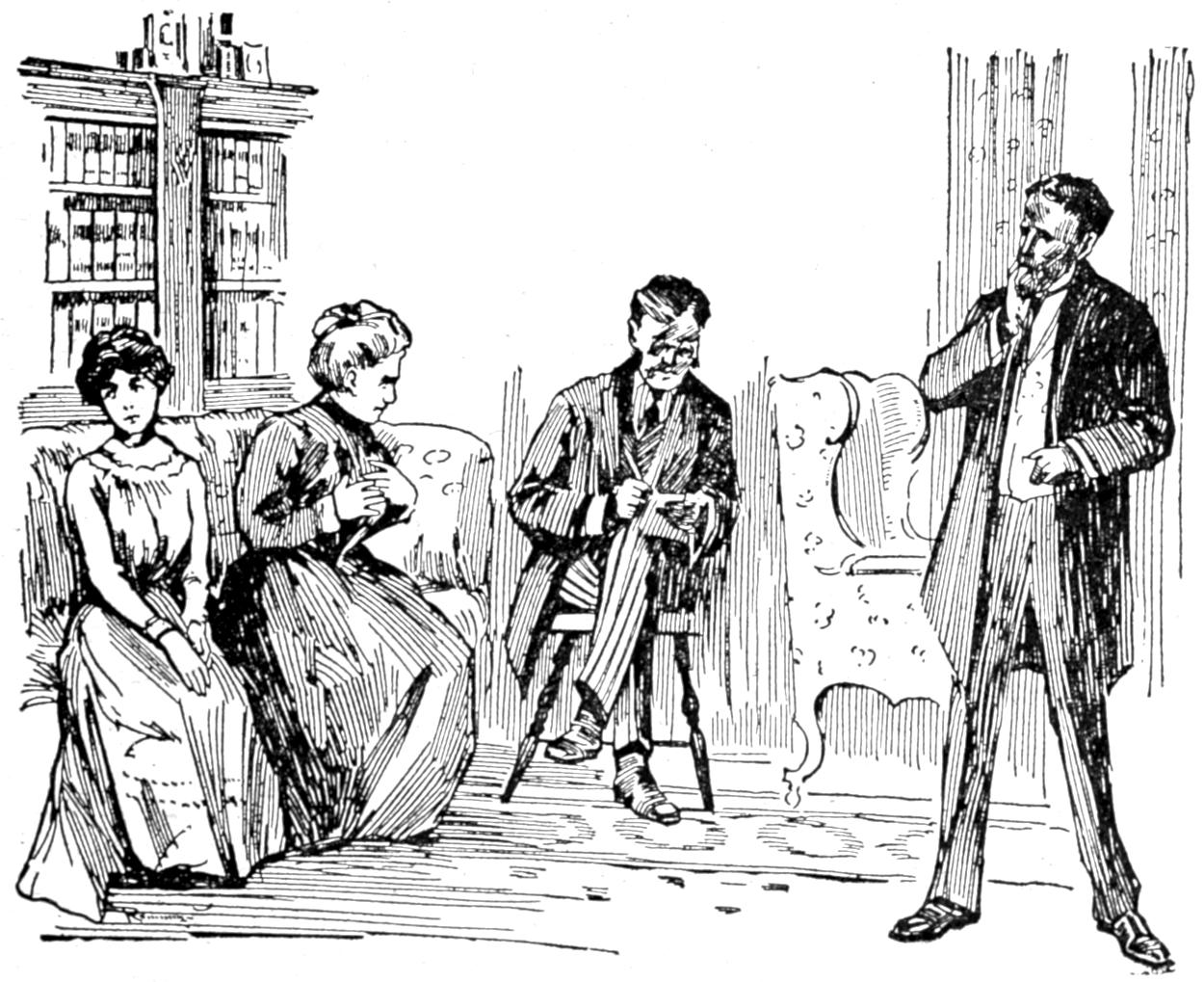
The Doctor’s Prescription
And so the flame was fanned and cherished,
which in due time,—but I must not anticipate.
As I have said, Miss Martin was a very prepossessing
girl, admired by many; so in a little while,
when on a second visit to her sister, no one was
surprised when it was announced that she was to be
married to one who stood high in the opinion of all,
and who was, indeed, a young man of great worth
and excellence.
It happened that winter that a Young Men’s
Mutual Improvement Society, a Scientific Association,
and a Total Abstinence Society were organized
in the town.
Now, into the first two of these, Dr. Black and
Mr. Bennet, his intended brother-in-law, entered
readily, and were quite willing to attend meetings,
give readings, and deliver lectures; but as for a
temperance society,—really, they saw no need.
“It seems almost an insult to introduce such a
society among respectable people. No doubt there
are many who should not drink because they cannot
stop in time, and in such cases drink is a great
curse; but with us, it is different.” And when
Mr. Bennet saw Miss Martin sipping her glass of
wine, he thought as of everything else about her,
how graceful it seemed, and how well the action
became her. It was but a few months after their
marriage that the poor illusion was dispelled.
One day some friends of Mr. Bennet’s had come
to make them a visit, and a few neighbors had been
asked to meet them at dinner.
The little entertainment was a great success.
Finally Mrs. Bennet left her guests in the dining
room, over their wine; she had intended to be gone
but a moment; but when seated by herself, with
the excitement over, a feeling of excessive fatigue
and languor came upon her. As on other occasions,
she at once thought of a glass of wine. This
was just the very time it was needed! So without
further consideration, she drank one glass after
another, till before she knew it, she was sleeping
the sleep of a drunkard in her own elegant drawing
room.
By-and-by the door was thrown open, and Mr.
Bennet, in his usual cheery voice, said, “Here we
are, Mary, all ready for your nice cup of coffee.”
But, alas! there was no answering greeting,
nothing but an inarticulate sound from the prostrate
form on the rug. The company took in the
situation but too well, and all retired as gracefully
as possible, “sorry to see Mrs. Bennet so poorly,”
etc.
Mr. Bennet was bewildered. Of all the possibilities
in life, this was the last that could have
occurred to him; and there he sat, with that terrible,
mysterious smile upon his face, which you may
have seen on the face of a strong man when shame
and agony were gnawing at his heart.
It would be tedious to record Mrs. Bennet’s resolutions
of amendment made and broken, to be again
renewed with the same result. Her husband’s patience
was often abused, but still he was always so
ready to forgive.
But the most long-suffering patience may be
worn out at last, and it seemed to Mr. Bennet that
the only chance was to send his wife—once his
pride, as well as his joy—to one of those asylums
for the drunkard, called “refuges.” The arrangements
were made, and the day on which she was to
go appointed.
I shall never forget that afternoon. The poor
husband was utterly prostrated by grief and shame
by an outbreak of his wife the day before, and, as
an old friend, he requested me to accompany her,
for he could not trust himself, and feared his resolution
would give way at the parting scene.
She, poor creature, not only acquiesced in the
plan, but earnestly besought her husband on her
knees to help her to get free from the wretched
slavery in which she lived. It is easy for people
outside to speak, but I do think that the wretched
slave to strong drink is to be pitied.
Poor Mrs. Bennet had been for some months
in this establishment, when
her husband, hoping against
hope, removed to the city of
which I have spoken, with a
view of giving her new scenes
and new surroundings in her
future life, and brought her
home. How he congratulated
himself; how his love and
long-slumbering reverence revived,
as week after week
passed, and still she stood
the trial!
Some time after this I was invited to the marriage
of their only daughter. She was one of whom
any mother might have been proud, and on whom
her father doted.
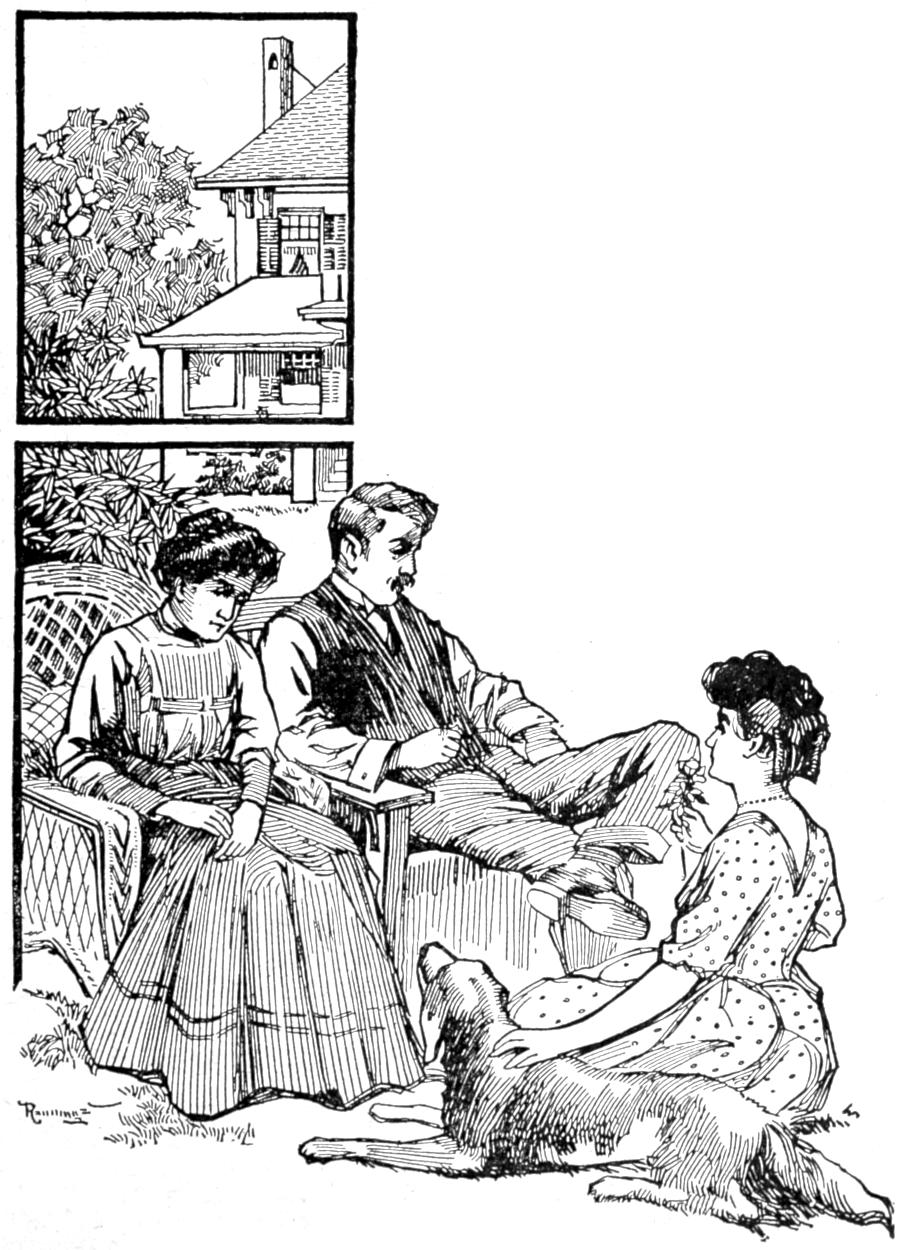
“At evening time it shall be light.”
I had been greatly gratified at hearing of my
friend’s continued reformation. When I arrived
that summer evening, I found the three sitting together
on the lawn under a spreading tree, enjoying
the sweetest hour of all the day. The outward
scene seemed a fitting symbol of the inward peace,
and I caught myself whispering, “At evening time
it shall be light.”
Looking back on the past, it seemed as if we had
awakened from a fearful nightmare, and were being
reassured by the calm and peace of returning
morning.
Next day, as the wedding guests were strolling
through the grounds after the marriage, till lunch
was announced, and everything seemed the embodiment
of calmness and comfort, he would have
been thought a hard-hearted prophet of evil who
would have predicted the events of the following
hours.
I stepped aside and went into the house to see if
I could be of any assistance in the finishing of the
arrangements. On looking into the dining room,
what was my amazement to find the table furnished
with a profusion of wines and brandies!
Thinking there must have been some strange
mistake, I hurried out and sought Mr. Bennet, to
whom I told what I had seen, suggesting that his
orders must surely have been misunderstood.
For a moment, a look of surprise came into his
face. “Not at all,” said he; “you do not suppose
I could let such an occasion as this pass without
giving it all the honors?”
“Honors!”
I thought some people had strange ideas about
honors. I implored him to alter his arrangements
even yet. “Thanks,” said he, “for your kind interest;
but pray don’t trouble yourself, you will see
that all will go off well.” And then, in a lower
tone, “Mary has promised me.”
With a sorrowful heart, I turned away. The
party had not been long in the dining room, when I
saw Mrs. Bennet, who had hitherto been acting the
part of hostess with all the ease and grace, which
in her early days had charmed so many, become
suddenly pale, and seemed to be putting a strong
restraint upon herself. I felt deeply grieved when
I saw those around her carelessly sipping their wine,
ignorant of the fierce war they were kindling within
her.
At last she could restrain herself no longer; it
seemed as if a thunderbolt had fallen among us,
when suddenly she rose, and seizing a bottle, darted
to the door.
Mr. Bennet’s face turned ashy pale, and when he
attempted to rise, his knees smote against each
other, like the monarch of old when the handwriting
on the wall announced his doom. When I got
outside the door, the poor woman looked round on
me with a half-triumphant, half-scared expression,
and the brandy bottle was lying empty beside her.
I helped her to the bed, and the doctor was sent
for; but no human power could save her. As we
watched her tossing to and fro, wildly appealing
for protection from the fiery serpents which she
averred were swarming around her, I wondered if
her husband did not ask himself if he had fulfilled
that vow made long ago, of loving, cherishing, and
protecting her, when he exposed her to that which
was indeed the supremest danger possible,—the
very smell of what, to her, was deadly poison.
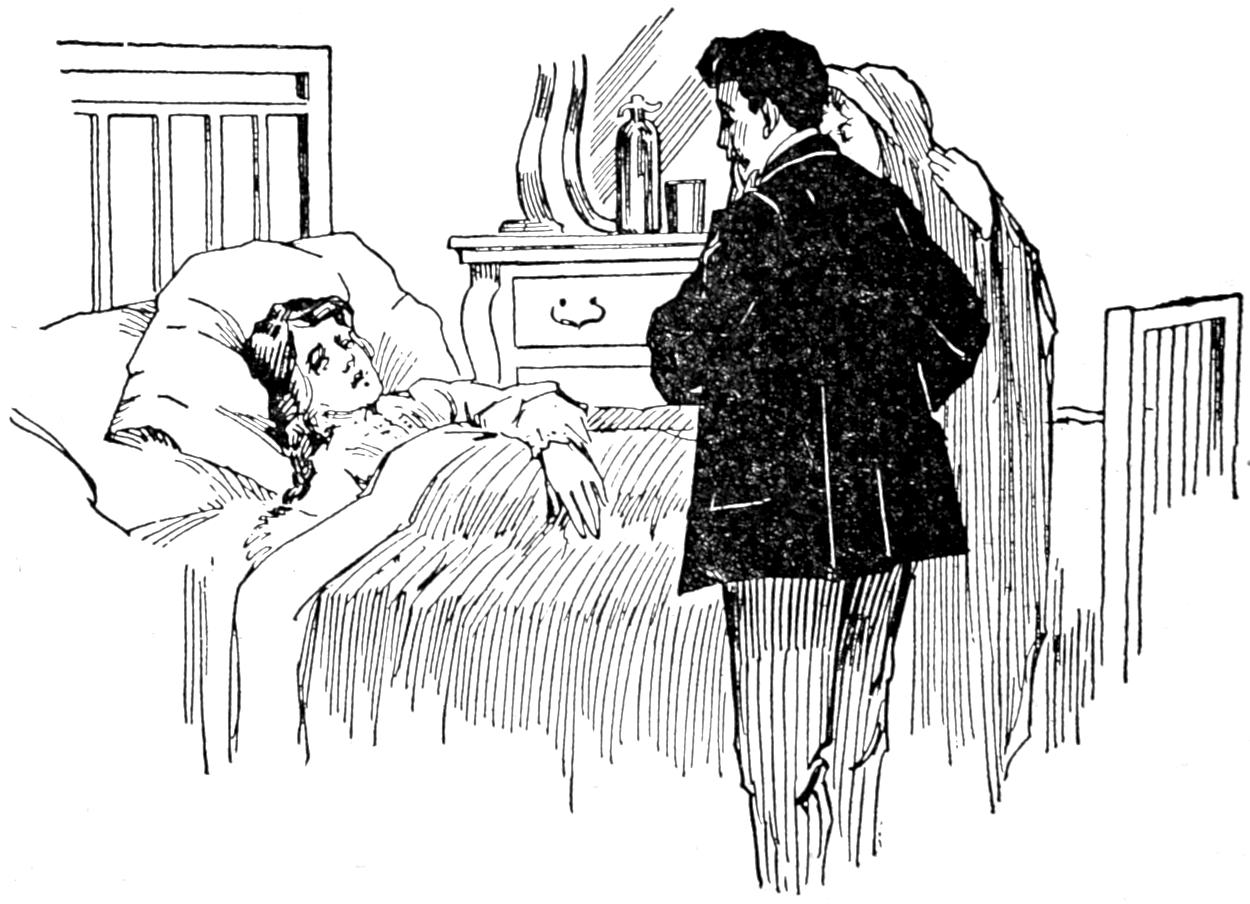
“They shall thirst no more”
At length the storm subsided; she lay wan and
worn on her pillow. Leaning over her, I heard in
a low whisper the words, “they shall thirst no
more.” The pathos was inexpressible. These were
her last words. No doubt there is pardon for the
penitent drunkard as well as for the penitent thief,
even at the eleventh hour; but turning away from
that deathbed, I could but say, “Let me die the
death of the righteous, and let my last end be like
his.”
I have spoken of some of the outward incidents
of Mrs. Bennet’s history, but who shall imagine
her inner life? I am sure that the most exquisite
tortures ever invented, fell very far short of those
endured by this poor woman.
When bidding good-by to the silent and mournful
mansion, where all had but the other day seemed
so bright and happy, I felt with new emphasis the
force of the wise man’s words, “Look not thou upon
the wine when it is red, when it giveth his color in
the cup, when it moveth itself aright. At last it
biteth like a serpent, and stingeth like an adder.”
Let us turn to the stern lesson woven all through
the warp and woof of the foregoing story,—of a
young life ruined and a home broken up as the
result of the social wineglass. Social custom and
“treating” are responsible for more drunkards’
graves than many are willing to acknowledge.
But who will speak for the brewer and distiller
who institute open “missionary” campaigns to
teach the children to drink that they may fill the
breaks in the ranks caused by the passing of the
old inebriates? God says to such:—
“Woe unto him that giveth his neighbor drink,
that putteth the bottle to him, and maketh him
drunken also.”
WORK DONE INSIDE
One of my friends is a very earnest, shrewd
man, who seems to know how to do the
best thing at the right time. One day
he was passing a gin shop in
Manchester, England, when
he saw a drunken man lying
on the ground. The poor fellow
had evidently been turned
out of doors when all his money
was gone. In a moment my
friend hastened across the street, and entering a
grocer’s shop, asked the clerk:—
“Will you oblige me with the largest sheet of
paper you have?”
“What for, my friend? What’s the matter?”
“Oh! you shall see in a moment or two. Please
get me the largest sheet you have.”
The sheet of paper was soon brought.
“Now, will you lend me a piece of chalk?”
My friend then quickly printed, in large letters,
these words:—“SPECIMEN OF THE WORK
DONE INSIDE.”
He then fastened the paper onto the drunken
man, and retired a short distance. In a few moments
several passers-by stopped to read the notice,
and in a short time a crowd assembled; then the
saloon keeper, hearing the noise and laughter outside,
came out to see what it was about. He eagerly
bent down and read the inscription on the paper,
and then demanded in an angry voice:—
“Who did that?”
“Which?” asked my friend, who now joined the
crowd. “If you mean what is written on the paper,
I DID THAT; but if you mean the man, YOU
DID THAT! This morning when he arose, he
was sober; when he walked down the street, on
his way to work, he was sober; when he went into
your shop, he was sober; and now he is what you
made him. Is he not a true specimen of the work
done inside?”
NAT RAYMOND’S VICTORY AND WHAT CAME OF IT
Oh, but I’ll have the jolliest time,
though! I’m going out to Uncle
Nathan’s, Christmas!” and Nat
Raymond threw his cap high in
the air. “Uncle Nathan’s just
splendid; I was named after him,
wasn’t I mother?”
Nat was too excited and delighted
to wait for his mother to
reply, and he continued:—
“I’m going to be a sailor, too,
some day, mother, just like Uncle
Nathan. I shall ask him to tell
me all about the time when his
ship got frozen in, up among
the funny Esquimaux. And besides,
I want him to tell me about
those great big, furry dogs that
used to draw him over the snow.
“Uncle Nathan’s a great man,—don’t
you think so, mother? and
of course he’s just the best man!”
Nat paused at last, not so much
because he really cared for his mother to answer
him, but the fact was, he was quite out of breath.
“Yes, dear, your uncle is a kind-hearted man,
but I am so sorry to say, he has one bad habit.
I’ve tried to reason with him again and again, but
he seems to think he has the best of the argument.
No, Nat, I shall not tell you what the habit is,—you
will find out soon enough after you get there,
I’m afraid. But I’m going to trust my boy to the
promptings of his own conscience; for I am sure
he will be brave enough to do what he knows to be
right. Only, Nat, my boy, whenever you are tempted
to do wrong, never forget to lift up your heart to
God for help and for courage to do the right. And
don’t forget that even a boy may sometimes be able
to do great good by his example.”
Nat was somewhat mystified, but soon forgot all
about his mother’s conversation, in the excitement
of preparing for the journey.
At last Christmas came; and Nat found himself
aboard the flying train. His uncle was at the train
to meet him, and what a welcome he received!
Everyone seemed glad to see him, and to be anxious
to give him a pleasant visit. Uncle Nathan lived
near the sea, and oh, how Nat loved the sea! It
seemed that he would never tire watching the
great white-caps toss and foam and chase each other
to the pebbly beach.
When supper was ready, Nat’s place was beside
his uncle. Now Nat was a strict temperance boy;
he wore the blue-ribbon badge very proudly, for he
had signed the pledge. So when several bottles of
wine were brought in and placed on the table, he
looked inquiringly into his uncle’s face.
“Oh, it’s all right, my lad; it can’t hurt you a
bit. You see, you need it, after the long, cold ride,
to warm you up!”
“But don’t you see my blue ribbon, Uncle
Nathan? I’ve signed the pledge, and I can’t
drink wine.”
“Oh! but I think it’s quite ridiculous for a little
shaver like you to sign the pledge, like some old
toper!” and Uncle Nathan leaned back in his chair
and laughed.
Poor Nat’s face grew very red. He did not like
to be called a “little shaver”—because he was
twelve years old. And besides he did hate to have
Uncle Nathan laugh at him. He wondered if it
would do any harm just once to taste of a small
glass of wine with his uncle.
Then quick as a flash he remembered his mother’s
words. Ah, so this must be the bad habit to which
she had referred.
“Come,” insisted Uncle Nathan, moving the
sparkling liquid a little nearer his plate. “Come,
Nat, be a man! you ought to be able to drink a
little wine without getting drunk!”
Now Nat’s one ambition was to be a man. Maybe
Uncle Nathan was right after all.
“Even a boy may sometimes do great good by
his example;” these were his mother’s words. How
plainly he remembered them! Nat’s resolution
was quickly formed. He wavered no longer.
“I’ve signed the pledge, Uncle Nathan, and if I
can’t be a man without breaking my word, why, I
suppose I’ll have to be a boy, then, as long as I
live!”
Nat had a pretty hard fight before he could bring
himself to oppose Uncle Nathan in this manner,
but the voice of conscience was growing louder
every moment, and with a silent prayer to Heaven
for help to do right, Nat continued:—
“I tell you this, Uncle Nathan, if everybody
would sign the pledge and keep it, there would be
no drunkards any more, and there would be fewer
prisons and poor-houses, and ever so much less
misery in the world; that’s what my father says.”
The longer Nat thought about it, and the more
he said, the stronger grew his conviction that he
was doing right.
Uncle Nathan only smiled and gently patted
Nat’s shoulders. “Good boy; good boy,” he smiled,
“but we will see how you hold out.”
One evening they were all going on a sleigh ride
to the country to listen to a speech from a very noted
gentleman. The evening was a bitter cold one, and
the crisp snow sparkled like diamonds as the bright
moonlight fell upon it.
Sleigh Ride to the Temperance Lecture
“Come, my lad,” said Uncle Nathan, just as they
were ready to start, “it’s a stinging evening. Here’s
a little glass of sweetened toddy for you, just to
keep you warm. I’ve had a nice glass, and I feel
better and warmer already.”
“I’m good and warm now, Uncle Nathan, and I
don’t need it. Besides, that stuff doesn’t keep people
warm,—it makes them cold. My father says
he saw a man who froze to death just because he’d
taken too much of that kind of stuff. When I have
to die, Uncle Nathan, I don’t mean to die that way.”
Uncle Nathan smiled a little, called Nat a stubborn
lad, and they all drove away.
Oh! how Nat did hope that the great gentleman
whom they were going to hear, would say a few
words—just a few at least—in favor of temperance;
for Nat felt as if he needed a little help. He
was tired of standing alone, as he thought. But if
we are doing right, we are never alone. God is on
our side, and His holy angels are with us.
Much to Nat’s delight, the speaker gave most of
the evening to explaining the evils of intemperance.
He told of the misery and wretchedness caused by
the liquor traffic. He spoke of the bright, promising
young men of the nation, who were being led
away from purity and right, and held in the hateful
bondage of the cup. He spoke feelingly of the
thousands of widows and tens of thousands of poor
orphans all over our fair land, whose husbands and
fathers had been murdered by the demon—drink.
At the close of his lecture, the speaker presented
the Pledge. And what was Nat’s delight, when he
saw his Uncle Nathan walk to the desk and sign
his name,—and hark! Nat could hardly believe
his ears! What was Uncle Nathan saying? What
did he mean? Was it actually true?
“I have been much interested in the lecture this
evening,” began Uncle Nathan, “and am glad to
place my name on the Pledge. I only wish it had
been there long ago. As I have said, the lecture
of the evening has been good; but friends, the
greatest temperance lecture I ever listened to, has
been given to me and acted out every day for the
past week, by my young nephew, Nat Raymond.
He is here to-night, and I wish to tell him that his
influence, more than anything else in the world,
has led me to take this stand.”
Uncle Nathan Signs the Pledge
“Hurrah for Nat Raymond!” broke out a dozen
sturdy voices. And before he fairly understood
what was going on, Nat found himself quite a hero.
At last, when his visit at Uncle Nathan’s was
over, and Nat was again at home, he told the story
over and over to his happy parents.
“I never would have had the courage to refuse
to take the wine with Uncle Nathan, mother,”
he declared, “if I had not remembered what you
whispered in my ear the last thing before I left
you: ‘Don’t forget, my son, that even a boy may
be able to do great good by his example.’”
“We can trace four-fifths of the crimes committed
to the influence of rum.”—Judge Allison.
“No business more thoroughly demoralizing,
more destructive of public morals, public order,
and public decency.”—Judge John Martin.
“Seventy-five percent of the crimes of New
York City are due directly or indirectly to strong
drink.”—I. Kenny Ford, New York Police Court.
“Seventy-five percent of accidents to life and
limb due directly to drink.”—Dr. Cyrus Edson.
“The undoubted cause of four-fifths of all the
crime, pauperism, and domestic misery of the
State.”—Governor Dix, of New York.
“The chief source and immediate cause of more
hurt to society and to individuals than any other
agency.”—Hon. H. W. Blair.
“The original cause of most of the enormities
committed by criminals.”—Sir Matthew Hale.
TOM’S TEMPERANCE LECTURE
Twas a bright autumn
morning. The fall term
of St. Rudolph’s school
had begun on Wednesday.
Out on the playground,
Tom Hadden,—a boy who
had arrived only the night
before,—was standing by
himself, and looking about
with the curious but sober
eyes of a boy who felt as
if he were in a new world,
and who was as yet extremely
doubtful as to his
chances for happiness in that world.
“Hello, Tom Hadden; is that you?” some one
called suddenly.
Tom’s gloomy face brightened, and he turned
eagerly toward a group of boys near him, who were
talking and laughing in the manner so expressive
at once of good comradeship and much self-importance,—a
common characteristic of the older students
at the beginning of a new school year.
Tom knew several of those boys; he had met
them during the summer vacations, and their greetings
now were so hearty that in a few minutes he
forgot that he was that forlorn creature, a strange
boy in a large school; and he gladly accepted an
invitation to join his new friends after school hours,
in a tramp over the hills to a village a short distance
from St. Rudolph’s.
In high spirits they set out; the hills were crossed,
and they soon reached the village.
“Now for Cruger’s,” shouted several of the boys
as they led the way to a saloon and boisterously
pushed open the door.
Tom held back. He did not like the appearance
of the place.
“What are we going in here for?” he asked.
“For a spread, of course,” one of the boys explained.
“They cook great dinners here; come on.”
Tom was quite ready for a “spread,” and willingly
followed the boys into a little back room where
the saloon proprietor assured them they would be
undisturbed. Their dinner was soon served, and
thoroughly enjoyed by the hungry boys; then a
dessert of fruit, cake, and pie was ordered, and when
the last crumb of the last cake had disappeared,
and the waiter had removed the dishes from the
table, Frank Jones, their acknowledged leader,
said gayly:—
“Now, fellows, before we go, we’ll have a loving
cup.”
“A loving cup? what’s that?” Tom asked of the
boy nearest him.
“You needn’t be afraid of it, it won’t hurt you;
it’s only beer,” the boy answered.
“Beer? I don’t want any,” and Tom pushed back
his chair.
“Sit still; you can’t go yet,” said Frank Jones,
and at that moment the waiter returned with the
black bottles of beer.
Amid shouts of laughter the corks were drawn,
and then one of the boys started the song:—
“And here’s a hand, my trusty friend,
A gie’s a hand o’ thine,
And we’ll take a right guid willie-wought,—”
“No, no,” protested Tom Hadden earnestly,
“this is wrong. I will not drink. Let me go.”
The boys stopped singing. “So you are a kill-sport,
are you?” one of them said scornfully.
“No, no,” Tom cried, “but I can’t drink. Let
me go.”
The beer was foaming in their glasses, but the
boys left it untouched, while they stared at Tom.
“You are a fool, Tom,” one of them said. “What
harm can a glass of beer do you?”
“Come, Tom,” coaxed another, “don’t make a
row about nothing; be a man and drink your beer.”
“I won’t,” Tom said sharply. “Let me go.”
“We aren’t quite ready to let you go yet,” Frank
Jones said angrily. “You are a pretty fellow to kill
sport in this way; and now if you won’t drink, you
shall give us a temperance lecture. If it is wrong
to drink beer, you shall tell us why. Come, boys,
pay attention. You will now listen to an address
on temperance from the eloquent orator, Thomas
Hadden.”
“Hear! Hear!” shouted the boys derisively, and
one of them called: “Stand him up on the table.”
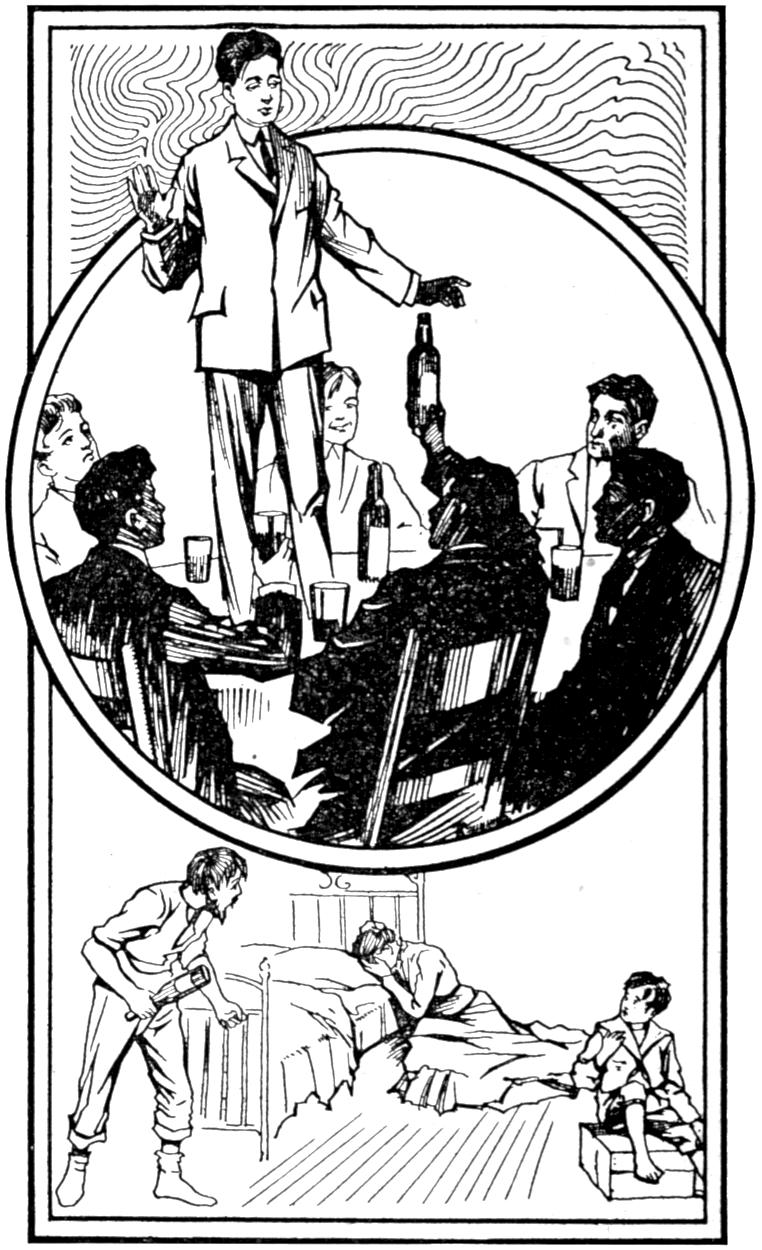
“I will tell you a story that belongs to my own life”
“Up with you,” cried two of the strongest boys,
as they seized Tom, and, unable to resist, he was
forced to mount the table. With crimson face
and something suspiciously like tears in his eyes,
he faced his tormentors.
“I can’t, boys,” he faltered. “I can’t talk to you.”
“More shame to you, then, for spoiling our fun,”
growled one of the boys. “Come, you needn’t
think we’ll let you off. If you won’t drink beer,
you shall give us some good reason for not drinking
it. That’s only fair. Come, be quick about it.”
Tom Hadden waited a moment. Once or twice
he swallowed hard, and his breath came in quick
gasps. Suddenly he threw back his head and
straightened himself.
“Boys,” he said, in a clear voice, “I will tell you
a story—a story that belongs to my own life.”
“All right,” said Frank Jones recklessly, but
something in Tom’s face made the other boys
watch him in silence.
“Boys,” Tom went on, in a tender, pathetic
voice, “I knew a little boy once who had a beautiful
home. He had a kind father and mother, and
he loved them both so much that he could never
tell which he loved the best.
“That little boy’s father had always been a good
man; but once, when he wasn’t well, the doctor
ordered him to drink beer, and he began to drink it,
and—” Tom’s voice was thrilling in its emphasis
now—“he soon began to drink stronger things;
and there came a time when that little boy’s home
was so changed from the lovely place it once was,
that it seemed as if a fiend must live there.
“That little boy heard his father rave and curse
like a madman,—and he was mad, for drink had
made him so. That boy saw his mother struck
down by his drunken father’s hand.”
There was a dead silence in that little room. The
beer had ceased to foam, but not a boy had tasted
it or noticed it.
“Boys,” Tom’s
thrilling voice
went on, “that
little boy is a large
boy now, and he is
almost alone in
the world, for his
father and mother
are both dead, and
now he has no
home.”
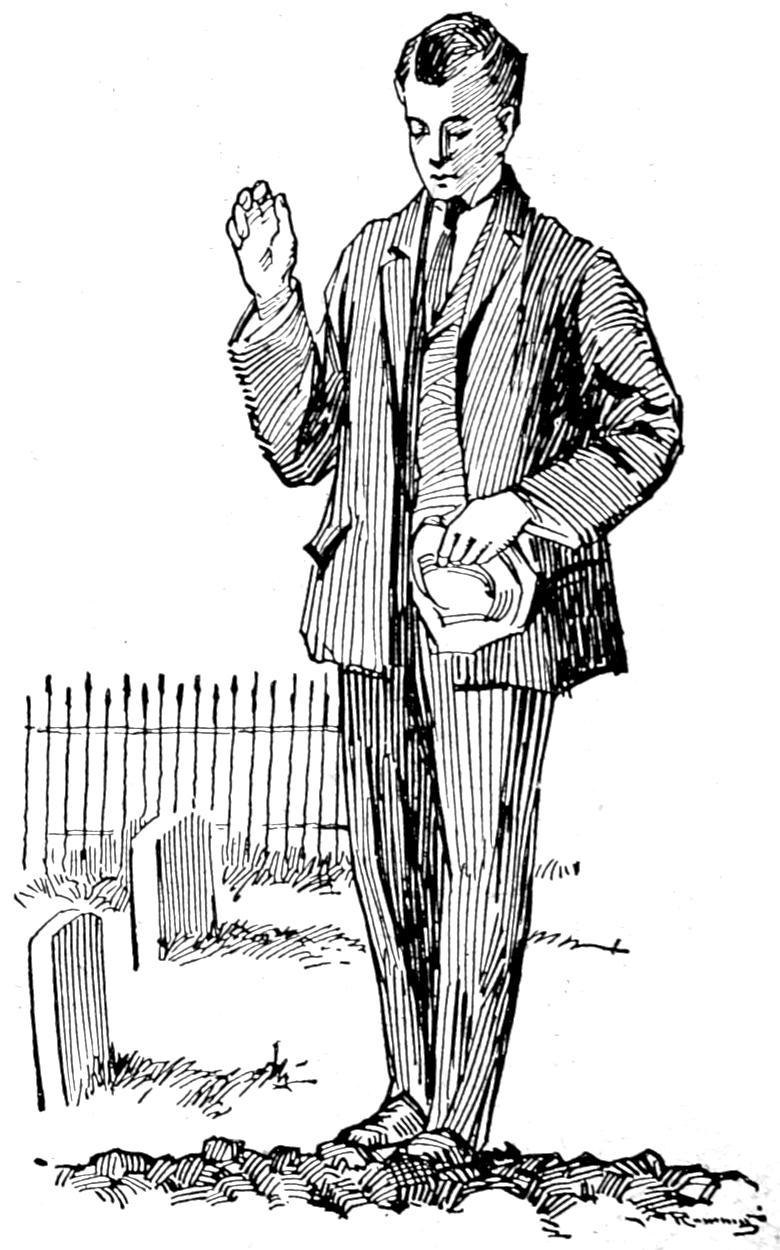
Tom Hadden’s Vow
No boy who
heard it ever forgot
the pathos of
Tom’s tone as he
continued:—
“Do you wonder,
boys, that
standing by his
mother’s grave, that boy looked up to heaven, and
solemnly vowed never while he lived, to touch or
taste the drink that made a madman of his father,
ruined his home, and broke his mother’s heart?”
“You will let me go now,” he said, as he jumped
down from his high place, and started for the door.
With a rush, the boys gathered around him.
“Tom,” said Frank Jones, “you are a hero.
Why, I think you are braver than a soldier. I am
proud of you, and I would do just like you if I
were in your place.” The boy stopped; a new
thought had come to him. He looked around on
his companions.
“Boys,” he said earnestly, “It seems to me that
what I would do if I were in Tom’s place, I would
better do now in my own place.”
Perhaps the head master of St. Rudolph’s was
never in his long life more happily surprised than
he was that evening, when six of his oldest and
most influential boys called on him and asked to
sign the temperance pledge.
Years have passed since that evening, and those
boys have kept their pledge.
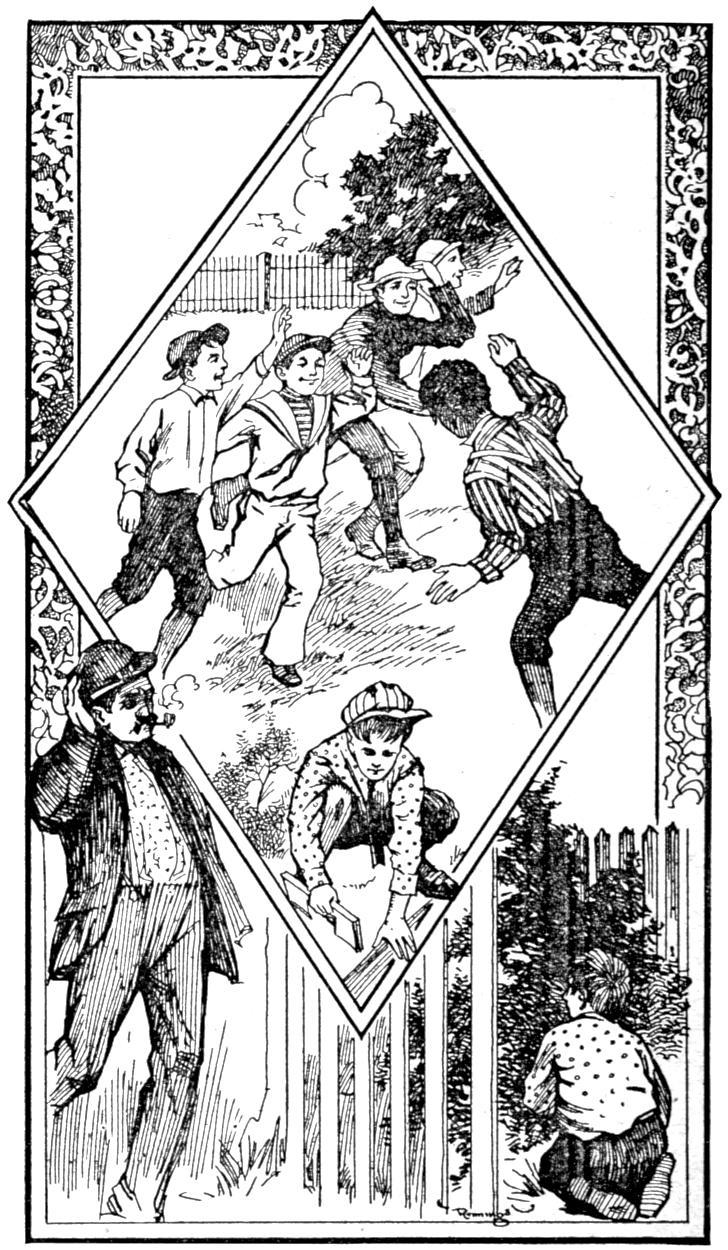
“He played in a quiet and subdued manner as if afraid”
A LITTLE CHILD SHALL LEAD THEM
Two children were playing on a
lawn in front of a pleasant cottage.
Roses and honeysuckles climbed
up the windows, smooth walks,
bordered with flowers, ran through
the lawn; and everything about
the cottage and the grounds had
an air of taste and comfort.
A little way off, and very different
in appearance, stood another
cottage; the lawn in front was
overgrown with weeds, and the
walks with coarse grass. The fence that enclosed
the lawn was broken in many places, and the gate,
held only by the lower hinge, stood half open and
awry. No roses or vines hung their green and
crimson curtains about the windows, or clambered
up the porch. This cottage had once been white
also, white as that before which the children were
playing; but it was now dirty and soiled and looked
forlorn and comfortless.
There was as much difference in the appearance
of the children as in the two cottages. One was
neatly and cleanly dressed, and had a happy face.
The clothes of the other were poor and soiled, and
his face pale and sad. One played with hearty enjoyment,
laughing and shouting; the other in a
quiet and subdued manner, as if afraid to raise his
voice, in the happy sports of childhood.
“Jim, isn’t that your father?” asked the well-dressed
boy, as a man appeared coming down the
road a little way off.
Jim started in a half-scared manner, and turned
toward the road. He stood very still for a moment
or two, looking at the man, and then, with a face
now red, and now very pale, hurried away and laid
himself close down upon the grass under some
currant bushes, whispering as he did so, in a
choking voice:—
“Don’t, Freddy, please don’t tell him I’m here.”
Light and joy went out of Freddy’s face also.
He understood too well what all this meant.
Staggering down the road came Mr. Harwood,
Jim’s father.
What a sight it was! As he drew nearer, Freddy
Wilson saw his red and swollen face, and heard
him muttering and cursing to himself, and he
shuddered with horror.
As Mr. Harwood passed the gate, he saw Freddy,
and stopped. Freddy began to tremble. His first
thought was to run back to the house; but he was
a brave little boy, and it went against his feelings
to run away from anything. So he did not move.
“Is my boy, Jim, here?” asked Mr. Harwood, in
an angry voice. Some men, when drunk, are always
ill-natured and cruel, and Jim’s father was
one of these. Seeing Freddy, and knowing that
the two boys played much together, he naturally
thought of his son.
Freddie did not answer. He could not tell a lie,
and so he said nothing.
“Did you hear me?” growled Mr. Harwood.
Still Freddy looked at him and said nothing.
He knew that if Jim’s father found him there, he
would kick and beat him all the way home. Not
because the child had disobeyed his father, or was
in any mischief, but Mr. Harwood, as I have said,
was full of anger and cruelty when drunk, and took
a savage pleasure in abusing his little boy.
Freddy began to be brave now, because he wished
to save his little playmate from harm.
There was a bolt on the inside of the gate near
which the child was standing. With a stealthy
motion, he slipped this bolt and fastened the gate.
It was not done an instant too soon, for Mr. Harwood,
growing furious, made a dash toward the
boy, and tried to get at him through the gate.
“You young dog!” he growled, “I’ll teach you
manners! Why don’t you answer me? Where’s
Jim?”
The drunken man shook the gate violently, and
tried, with his unsteady hands, to find the bolt on
the inside. But his efforts were in vain. He
could not reach the little fellow, who stood up
close to him, with a brave but sorrowful face.
“You’d better go home, sir; I’ll tell my father of
this.”
There was a manly firmness in the manner of
the child, as well as in his words, that had their
effect upon the drunken man.
“Who cares for your father? I don’t!” he replied,
moving back a step or two from the gate, muttering
and cursing.
“But I say, youngster!” and he staggered a little
nearer, with a scowl on his disfigured face, “just
answer me one thing. Say yes or no. Is that
young scamp of mine here?”
“I don’t know any young scamp of yours, Mr.
Harwood.”
“You don’t, eh! Now that’s cool for a model
young gentleman, like Master Wilson. Don’t you
know my Jim?”
“I know your Jim very well,” said Freddie. “But
he’s a good little boy, and not a young scamp; and
I don’t think you’re a kind father to call him such
an ugly name.”
This rebuke was felt by Mr. Harwood, drunk as
he was. He could not endure the steady, fearless
glance of Freddy’s blue eyes. Then, away down
in his heart, almost covered up and lost, was an old
feeling of fatherly pride, and this was stirred at the
praise spoken about Jim,—“a good little boy.”
The anger went out of Mr. Harwood’s face.
“He was a good little boy once,” said he, with
something so like tenderness in his voice, that Jim,
who was lying close by, hidden under the currant
bushes, sobbed aloud.
“What’s that?” asked Mr. Harwood, leaning
forward and looking toward the currant bushes.
But the sound was hushed in a moment.
“He’s a good little boy now,” said Freddy,
speaking in a very firm voice and not seeming to
hear the sob. “A good little boy,” he repeated;
and added, to make his assertion stronger, “there
isn’t a better one anywhere about here, and you
let him go ragged, when he ought to have good
clothes like the rest of us.”
Mr. Harwood didn’t stop to hear anything further,
but turned from the gate and hurried toward
the poor cottage across the road, walking more
steadily than he had done a few minutes before.
Then Freddy went behind the currant bushes where
Jim still lay on the ground.
“He’s gone,” said Freddy.
The pent up grief in Jim’s sad heart could be restrained
no longer. He burst into a wild fit of
crying that continued for several minutes. Freddy
said all that he could to comfort his little friend;
and when he had grown calm, asked with all the
earnestness of a grown-up man:—
“Can’t something be done, Jim?”
Jim shook his head in a hopeless way.
“Something ought to be done, and I am sure
something could be done, if we only knew what it
was. Oh! isn’t drinking an awful thing!”
“It’s the worst thing in the world,” sobbed Jim.
“When father is sober,” he went on, “he’s just as
kind as he can be; but when he’s drunk—O dear!
it’s dreadful to think of.”
“Does he get drunk often?” asked Freddy.
“Now he does. He’s drunk ’most all the time.
But it wasn’t so always. O dear! He used to be
so good to us,” he sobbed, “and take us out with
him sometimes, and buy us nice things. He never
does now. Most all of the money he gets, he spends
at the tavern. But I must run home. Mother is
almost sick, and father is so cross when he’s been
drinking; and she’s weak and can’t bear it,” and
Jim’s tears ran over his cheeks again.
“Aren’t you afraid he’ll beat you?” asked Freddy.
“May be he will, and may be he won’t,” answered
Jim. “But I must not stop to think of
that. Mother is sick and weak, and father will be
cross to her,” and Jim hurried away.
All at once Freddy remembered how his defense
and praise of Jim had cooled Mr. Harwood’s anger,
and he said to himself: “May be I can do some
good,—and keep Mr. Harwood from beating poor
Jim, or—”
But Freddy didn’t stop to reason the case any
longer, but hurried after his young friend, resolved
to face the drunken man again in the hope of turning
away his wrath.
The two lads entered Jim’s poor home together,
and stood face to face with Mr. Harwood.
“O father!” exclaimed Jim, as he saw, with glad
surprise, a look of almost tender pity on his father’s
face; and as the child spoke, he sprang forward and
caught his father’s hand, clinging to it tightly.
This was too much for Mr. Harwood, who was
not yet sober enough to control his feelings, and
he turned away with a choking sob, trying to draw
his hand out of Jim’s; but the boy would not let
go his hold. And now Freddy spoke out in behalf
of his little friend.
“Jim’s a good boy, Mr. Harwood. I know all
the boys around here, and there isn’t one of them
better than Jim. Father says so too; and lets me
have him over at our house whenever I please.”
“Who said he wasn’t a good boy,” answered Mr.
Harwood, turning around upon Freddy with a half
angry manner. “I’d just like to hear anybody speak
against him, I would.”
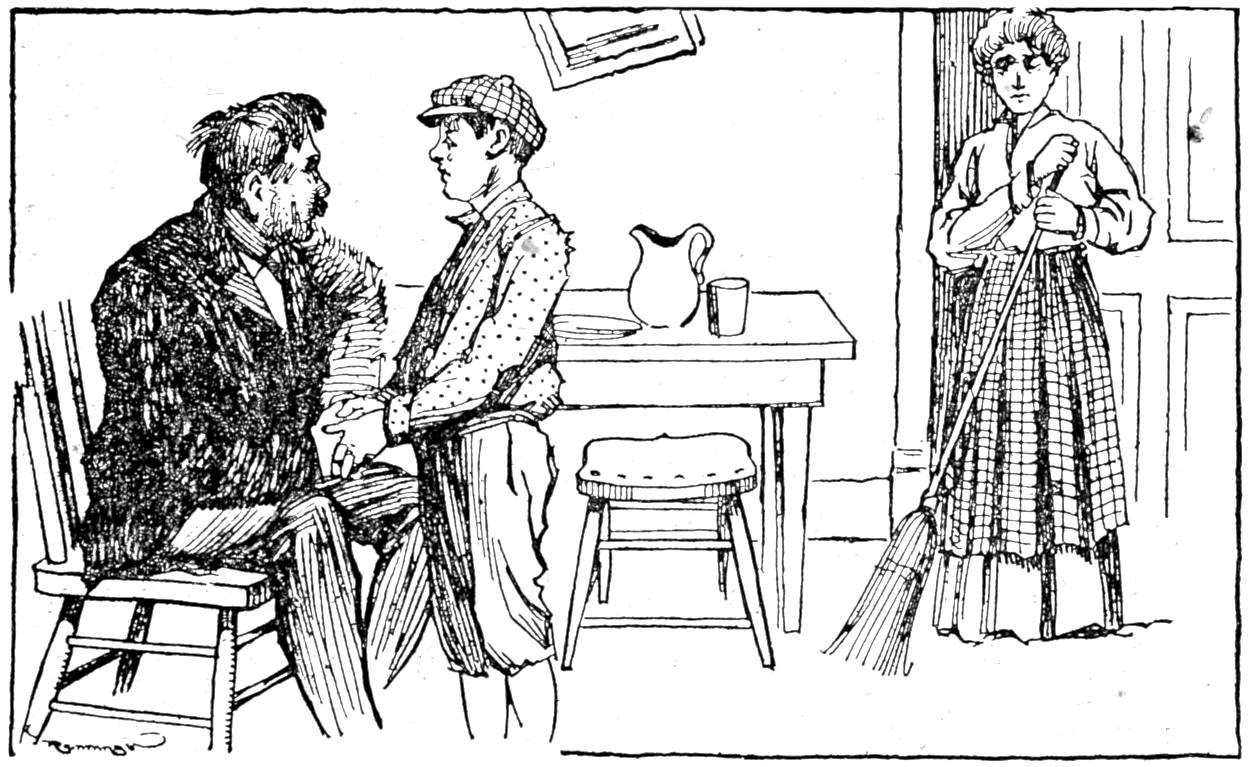
“He sprang forward and caught his father’s hand”
And he sat down, drawing Jim between his knees
as he spoke.
A pale, thin, half-frightened woman, Jim’s
mother, wondering what all this could mean, came
into the room. Her eager eyes ran hurriedly from
face to face.
“Don’t be scared, Ellen,” said Mr. Harwood,
“There isn’t anything wrong. I’m only having a
talk with these boys.”
He was almost sober now. Excitement had
cleared his stupid brain. Looking from one to the
other of the lads, he could not help noticing the
painful contrast; one so clean and well dressed, the
other soiled and ragged.
He knit his brows closely, and sat very still, like
one arguing for himself.
“I’ll tell you what it is, mother,” said he, turning
his eyes toward Mrs. Harwood, “I’m not going to
have our Jim running about, looking like a beggar’s
child. He’s just as good as any of the boys around
here, and I’ll not have him ashamed to be seen
with the best of them. I will drink nothing stronger
than coffee, while I live, God being my helper!”
“Oh, thank God!” exclaimed the poor woman,
dropping upon her knees and clasping her husband’s
neck. “Oh, thanks be to God!” she repeated. “He
will be your helper. In Him is all compassion and
all strength; but without Him our poor resolves
are as nothing.”
Freddy stood looking on for a little while, greatly
moved by what was passing, then he walked quietly
to the door and was going out, when Mr. Harwood
called to him:—
“Just one word before you go. I’m sorry to say
it; but it’s in my thought now, and I feel that it
would better come out. May be I wouldn’t say it
another time.”
Freddy stopped and turned toward Mr. Harwood.
“I’m sorry to say it, Freddy, I am, for you are a
nice boy, and have always been good to Jim. But
you’ll thank me for it, may be, some of these days.”
There was something in Mr. Harwood’s manner
that sent a feeling of alarm to Freddy’s heart. He
stood still, waiting, every pulse-beat sounding in
his ears.
“May be your father’s head is stronger than mine
was five years ago,” said Mr. Harwood, “but I’ve
seen him at the “Black Horse” too often of late,
going on just as I began. It isn’t safe, Freddy! It
isn’t safe, and I don’t like to see him there. Look
what I have come to! But there was a time when
I could hold my head as high as Mr. Wilson or
anybody else in the neighborhood.”
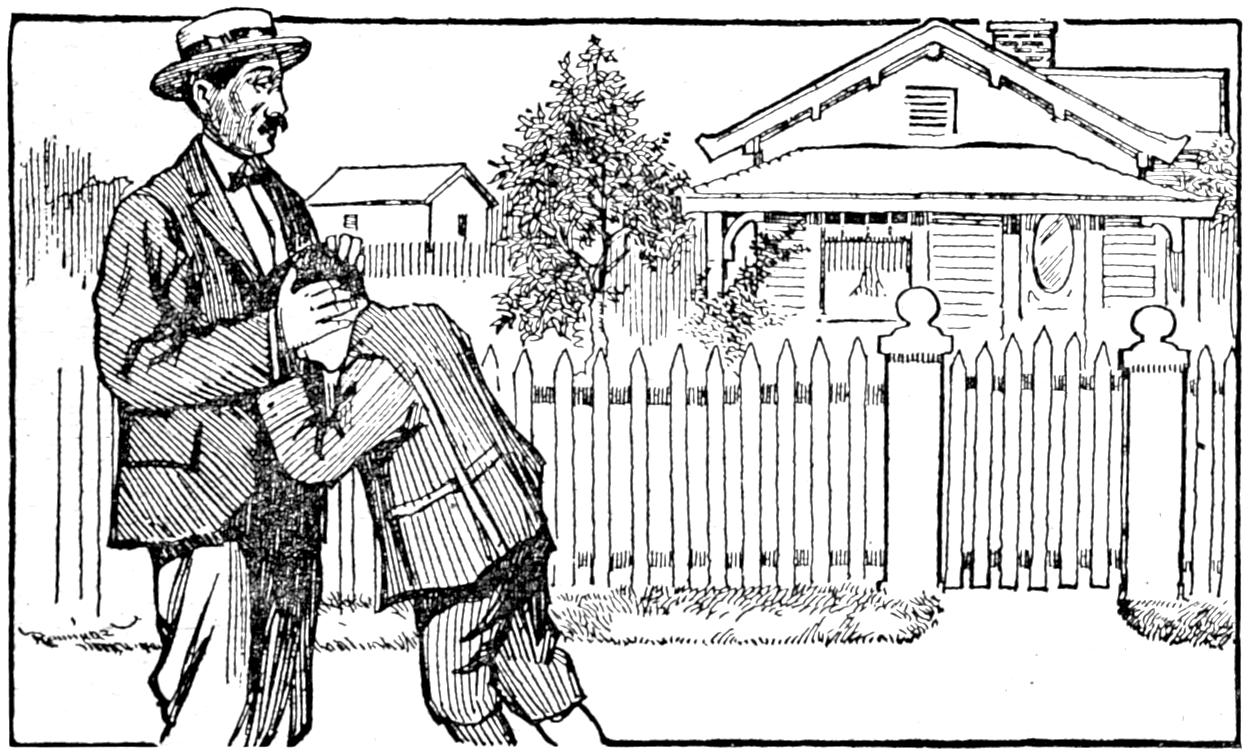
“I will not believe it”
Freddy waited to hear no more. It seemed as if
night had fallen suddenly on his young spirit, and
as if the air would suffocate him. He turned and
ran wildly away, such a weight and pain in his
heart, that it seemed as if he would die. Mr. Wilson
was coming along the road, and was near his own
gate, when he saw Freddy hurrying across from
Mr. Harwood’s cottage, his face white as a sheet
and strongly agitated.
“My son! what ails you?” he cried in alarm.
“O father!” was all that Freddy could say, as
he stopped before him, and looked up with a
strange, frightened face.
“I will not believe it,” he sobbed, bursting into
tears and hiding his face in his father’s hands.
“It’s all a lie of Mr. Harwood’s!”
“Won’t believe what? my boy,—what has
happened to grieve you so? A lie of Mr. Harwood’s?
What has that drunken wretch dared to
say?” His voice changed to an angry tone.
“I can’t tell you, father. It would choke me,
but it’s all a lie. Oh, I wish I hadn’t said anything
about it! But I felt so miserable, and you
came right on me.”
Mr. Wilson led Freddy within the gate to a seat
under one of the trees.
“Now, my son,” he said in a kind, firm voice,
“tell me just what Mr. Harwood said.”
Freddy then related all about the drunken man
coming to the gate, and what had occurred there,
and all that he saw and heard when he went home
with Jim, and at last he sobbed out the awful,
warning words of Mr. Harwood.
As Freddy came to this last part, Mr. Wilson
turned his face so far away that his son could not
see it; but he felt his father’s arm that was around
him clasp him more tightly. Then Mr. Wilson
placed his lips fondly and with a long pressure, on
Freddy’s forehead.
“I will talk with Mr. Harwood about this,” he
said in subdued tones, as they rose and went toward
the house.
Mr. Wilson went to see Mr. Harwood that very
day. Their interview was affecting to both, and
good for both. The warning words had not come
a moment too soon, and Mr. Wilson felt this so
deeply that he could not be angry with his poor
friend.
No one ever saw either of them at the “Black
Horse” after that, nor did they ever again permit
the cup of confusion to come near their lips.
PROHIBITION — Does Prohibition Prohibit? — Some Results of Prohibition
There is a cause for the moral paralysis upon
society. Our laws sustain an evil which is sapping
their very foundations. Many deplore the wrongs
which they know exist, but consider themselves
free from all responsibility in the matter. This
can not be. Every individual exerts an influence
in society. In our favored land, every voter has
some voice in determining what laws shall control
the nation. Should not that influence and vote be
on the side of temperance and virtue? The advocates
of temperance fail to do their whole duty
unless they exert their influence, by precept and
example, by voice and pen and vote, in behalf of
prohibition and total abstinence. We need not expect
that God will work a miracle to bring about
this reform, and thus remove the necessity for our
exertion. We ourselves must grapple this giant foe,
our motto, “No compromise,” and no cessation of our
efforts till victory is gained.—Mrs. E. G. White.
“‘Prohibition doesn’t prohibit!’ That phrase
has been worn threadbare by friends of the liquor
traffic. They claim that as much liquor is sold in
‘dry’ districts as in ‘wet.’ Yet they do not look
with indifference upon the strides made by prohibition;
they are working as if the very life of
their business depended upon the defeat of the temperance
forces. And it probably does; for every
distillery, brewery, and saloon must have a license
before its doors can swing open for business. In
France the liquor dealers found it most profitable
to have no prohibition law; for when the government
granted liberty to the liquor trade, the consumption
of alcohol increased nearly one hundred
percent.”—Temperance Torchlights.
“I consider the prohibition law in Kansas as
worth more to the railroad men than any other one
thing.”—Superintendent of Santa Fe Railroad.
“The five ‘wettest’ counties of West Virginia
have four hundred fifteen convicts; the other fifty
counties have four hundred thirteen. One-eleventh
of the counties furnish one-half of the convicts.”—Statistics
of 1909.
“There is more hypocritical, illegal selling in
license States than in Maine; for every joint or
blind tiger under prohibition in Maine, there are
sixteen blind tigers in licensed New York, plus
twenty-seven thousand State licensed saloons.”—Mrs.
Lillian M. N. Stevens.
“Atlanta, at the end of 1908, showed 3,903 fewer
arrests for drunkenness, and 8,102 fewer arrests for
disorderly conduct—200 fewer juvenile arrests.”—Mrs.
Mary Harris Armor.
“One-third of our counties are without prisoners
in their jails or paupers in their almshouses; one-half
of our counties sent no convicts to our prisons
this year, and one-half of our prison inmates never
lived in Kansas long enough to acquire a residence
here. Churches and schools flourish, the spiritual
outlook is hopeful, and the saloon is practically
banished.”—Governor Hoch, of Kansas, in his
Thanksgiving Message.
Atlanta, Georgia.—“For the first time in its
fifteen years of existence, every cell at the police jail
yesterday afternoon was empty. Not a prisoner
was incarcerated, and the turnkeys and matrons
were having a very dull afternoon. The police attribute
this remarkable condition to the prohibition
law which went into effect the first day of the
year.”—Washington Times, Jan. 25, 1908.
“Without one dollar of revenue from the saloon,
Maine has a larger percentage of the total population
in the public schools than any other of the
New England States, or New York, with its twenty
million dollars of revenue from the saloon. It has
more teachers employed in proportion to the school
population than any other State.
“It is stated by Lady Henry Somerset that in one
district in Liverpool, England, in which there is no
saloon, there is but one pauper to every one thousand
inhabitants. In another district, in which there are
two hundred saloons, there is one pauper to every
twenty-eight inhabitants.
“Abyssinia has prohibition, and the penalty for
taking liquors into that country is death. In the
capital of the country only two murders have been
committed in the last forty years. Smoking is
also prohibited.”—Temperance Torchlights.
CIGARETTE POISON
“You smoke thirty cigarettes a day?”
“Yes, on the average.”
“Are they to blame for your run-down condition?”
“Not in the least. I blame my hard work.”
The physician then took a leech out of a glass jar.
“Let me show you something,” he said. “Bare
your arm.”
The cigarette fiend bared his pale arm, and the
other laid the lean, black leech upon it. The leech
fell to work busily, its body began to swell. Then,
all of a sudden, a kind of shudder convulsed it, and
it fell to the floor dead.
“That is what your blood did to that leech,”
said the physician.
“I guess it wasn’t a healthy leech, any way.”
“Wasn’t healthy, eh? Well, we’ll try again.”
And the physician clapped two leeches on the
young man’s thin arm.
“If they both die,” said the patient, “I’ll swear
off—or at least, I’ll cut down to ten a day.”
Even as he spoke, the smaller leech shriveled
and dropped on his knee, dead, and a moment later
the larger one fell besides it.
“This is ghastly,” said the young man; “I’m
worse than the pestilence to these leeches.”
“It is the empyreumatic oil in your blood,” said
the medical man. “All cigarette fiends have it.”
“Doc,” said the young man, regarding the three
dead leeches thoughtfully, “I half believe you’re
right.”—Evanston (Illinois) Index.
MADE A DRUNKARD BY HIS CIGAR
I knew a young clergyman
whose oratory obtained
for him the admiration
of many influential persons,
among whom was a
gentleman of fortune, who
courted his company and
taught him to smoke.
The young minister was
warned of his danger, but
could not be persuaded to
renounce that which he
considered a harmless indulgence.
He insisted
that his cigar soothed his
mind and composed his
feelings. A friend, in reply, told him that the
mind never needs composing when in health; and
the feelings never need artificial soothing only
when improperly irritated; and added, “Beware
how you indulge in a bad habit.”
Impatient under the rebuke, the clergyman replied:
“I smoke but seldom, and could almost do
without it.”
‘Seldom’ and ‘almost’ are two fatally ominous
words. ‘Seldom’ will become ‘regular,’ and
‘almost’ be converted into ‘always.’ And as smoking
and drinking are companions, let me beseech
you, said his friend, “not to make them yours.
Ministers should be a fence around the pit of perdition.
“Some inexperienced youth may see you smoke,
and, imitating your example, become a confirmed
smoker, and sooner or later a confirmed drunkard.
The line of demarkation being once effaced, he
may soon be lost in the vortex of sin.”
Little did this young preacher suppose this to be
a prophetic picture of his own mournful case. But
he continued the habit, and, little by little, his
splendid talents became dim, and his hearers forsook
him. His wealthy host, who first taught him
to smoke, witnessed his growing desire for stimulants,
and with a look more expressive than words,
declared that “in spite of praying and preaching,
professors of religion like the good things of this
life, as well as others; and that, after all, saints and
sinners are pretty much alike.”
The days of this eloquent young clergyman were
ended in ignominy; and a life which promised to
be happy and illustrious, was early brought to a
miserable close. His intemperate habits, it was
supposed, killed his young wife, and made a beggar
of his child. He died in a madhouse, blaspheming
the very Saviour whom he had once preached.
Avoid smoking. “It is the devil’s leading string,
beginning with a hair and ending with a cable.”
DAVID PAULSON, M. D.
President Anti-Cigarette League of America
SLAUGHTER OF THE INNOCENTS BY DAVID PAULSON, M. D. — The Cigarette Fiend is an Object of Pity — Destroys on the Installment Plan — A Simple but Sure Cure — The Real Truth about Tobacco
In the Bellevue Hospital Medical College,
when I was a student, I performed
an experiment that vividly impressed
upon my mind the naked fact that nicotin
is a deadly poison. A large,
healthy cat had become such a
nuisance that it was decided to
kill it. This I proceeded to do
by the following method: I
soaked enough tobacco in water
to make an ordinary cigarette.
Then I injected under the cat’s
skin a hypodermic syringe full
of this tobacco juice. In a few
moments the cat began to quiver,
then to tremble more violently, then it had
cramps, and in less than twenty minutes it died
in violent convulsions.
I take no pride in relating this experiment, for I
know a shorter as well as a more merciful method
of ending a cat’s life.
But what interests me now is the truth that
thousands of young men and boys are waking up
to the fact that tobacco in any form, and cigarettes
in particular, are unmitigated evils. And
that for their own sakes, they cannot afford to introduce
into their bodies that which only makes
them weak, sickly, and useless.
I will tell you, briefly, how the burden of this
terrible curse was rolled upon my heart. God used
a never-to-be-forgotten incident to burn into my soul
the tremendous importance of this cigarette evil.
One day, an old lady, with a faded red shawl
thrown over her stooping shoulders, came into my
office, and asked if I could see her boy. Two strong
men then brought before me a poor boy of seventeen
years, wild-eyed and insane. The mother
asked if he could be cured.
After investigating the case, I was compelled to
tell her that the outlook was hopeless, and that she
might just as well send him to the lunatic asylum.
She broke down and sobbed as though her heart
would break. I asked her what had brought this
terrible condition upon her son, and she said:—
“Oh, it was cigarettes. He began to smoke more
and more, until he used fifty a day, and then his
mind gave way.”
That day I became thoroughly enlisted in the
anti-cigarette war. O that our souls might become
saturated with the importance of fighting this
awful evil! Cigarettes are making our boys weak
and puny and unmanly. They are sapping the
strength from their muscles, and making them unable
to win their way in the world.
I care not how intelligent or brainy a boy may
naturally be, a short period of cigarette smoking
will tell on him. He may not notice this himself,
at once, but others will. And I wish the young
men and boys to remember that if there is work to
be done in the world which requires much effort,
either of brain or muscle, the cigarette smoker is
not chosen for the job. Why?—Because when the
time comes to use the brain or the muscles for some
supreme effort, the poor, poison-soaked muscles fail
to respond, and the benumbed brain cannot do its
best work. I think if the boys only understood
that cigarettes and tobacco were ruining them physically
and mentally, and preparing them for certain
defeat in life, they would shun both as they would
the plague.
When I talk on the cigarette evil in the Chicago
public schools, I ask how many of the children
know of some poor crippled boy whose leg was cut
off by a street-car accident. Such a boy, if he has
brains and character, may yet fill a position of trust
and usefulness in the world, but the boy who begins
to smoke cigarettes early enough, can never be of
any use in this world, and unless he repents, there
will be no place for him in the next. To try to
put knowledge into his brain, is as hopeless a task
as to try to fill a basket with water.
The cigarette-smoking boy is looked upon by
other people as an object of pity. There is nothing
truly brave or heroic about him. There may
have been naturally, but nature has been doped and
stupefied and abused, until there is nothing left in
the poor lad that is manly at all. If he wants to
be a great hunter or a fine marksman or sharpshooter,
he must either give
up this ambition, or
else let the cigarette
alone forever. If he
would like to be a famous
doctor or a skillful
surgeon, he must
not ruin his nerves, or
he cannot trust himself
to hold a surgeon’s
knife. No one would
be willing to risk his
life in such hands.
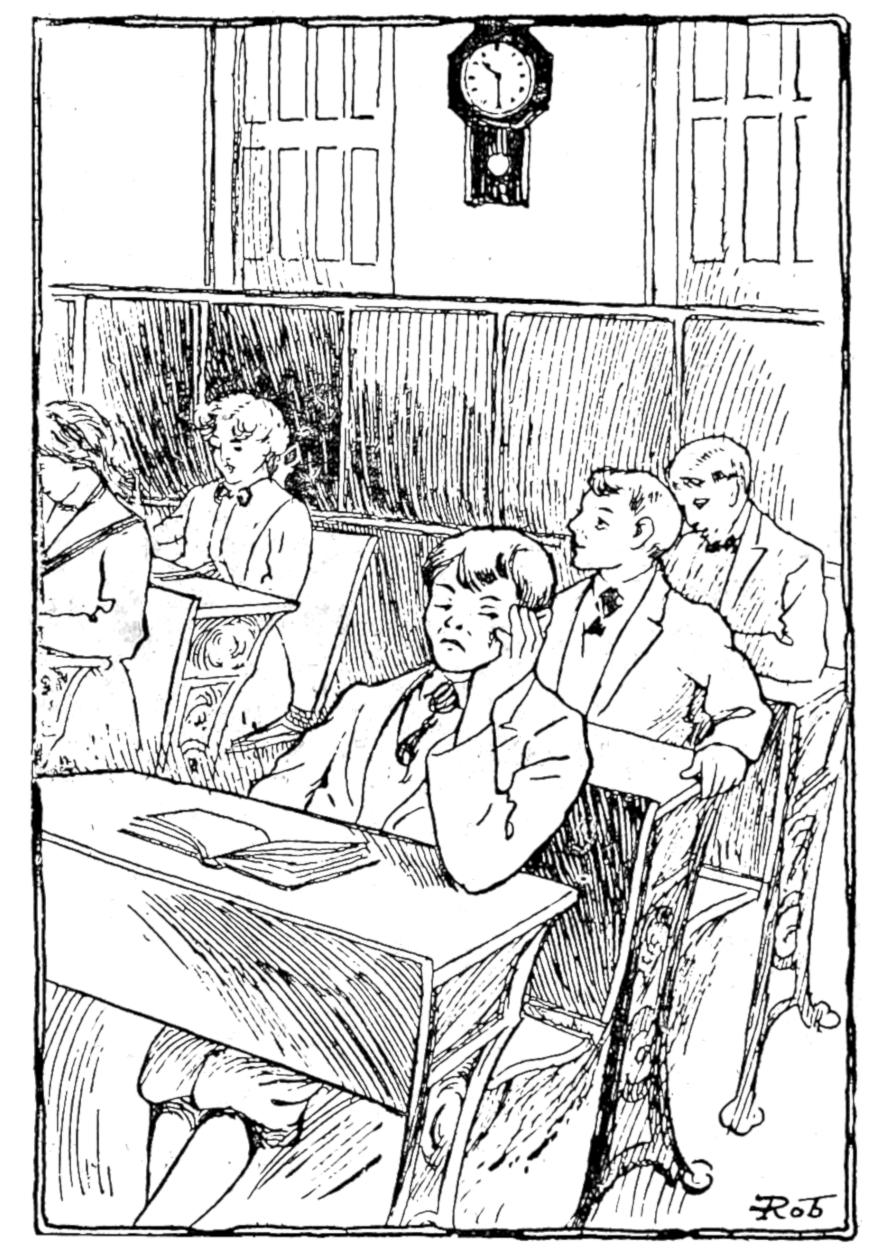
Listless Cigarette Smoker
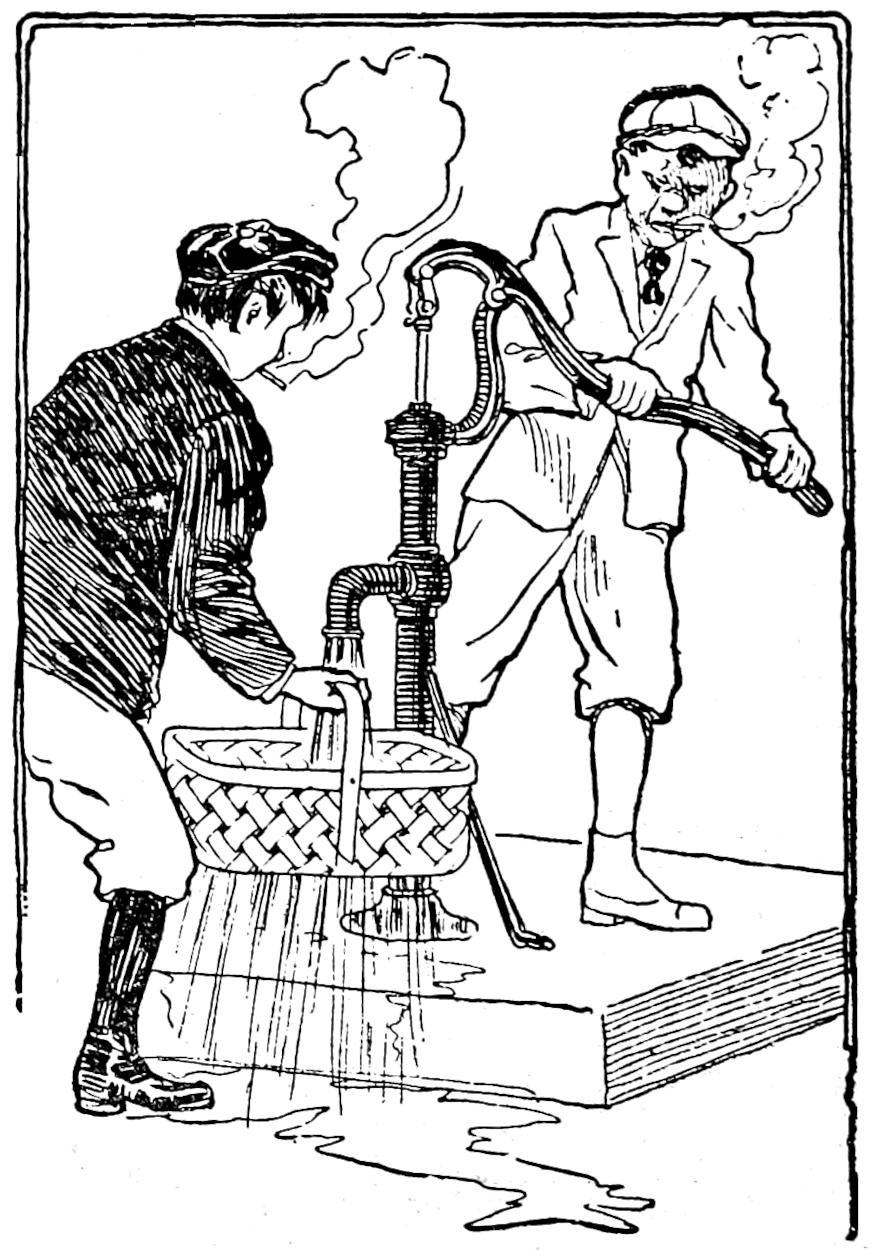
Pumping Water into Basket
Hang a half dozen
brick around a boy’s
neck, and ask him to
swim a race with
you. Would that be
fair? But the cigarette
habit pulls one
under in life’s struggle,
just the same.
What would the
boys think if they
saw a lad vigorously
rubbing sand into his eyes? They would think
him crazy. Is it any more foolish to rub sand into
the eyes than it is to rub poison into the brain?
Suppose I should hand a boy my watch, and
presently he begins to pour tar into its works.
Would you think he had much sense?
O it is cruel and unmanly to ruin and clog up
and destroy these wonderful bodies of ours. What
an astonishing piece of machinery the brain is!
Almost everything depends upon having the head
clear,—the reasoning powers sharp and acute. But
the deadly cigarette destroys the keen sensibility
of the nerve and brain cells, and renders the victim
unable to think clearly or logically.
Men who train great wrestlers and athletes to
perform almost unbelievable feats of physical endurance,
know better than to allow them to poison and
paralyze these muscles of iron. Who ever heard of
an athlete smoking half a dozen cigarettes just before
starting in to win his medal as champion?
“The cigarette kills the boy in the
same way.”
Who has not watched the old family cat and noticed
how she kills a
mouse,—a little at
a time,—crushing
her teeth into the
poor thing’s body,
then letting it limp
away a short distance,
then springing
upon it and
crushing it some
more. Now the cigarette kills the boy in just the
same way, or, in other words, on the installment
plan.
Any experienced physician can pick out a cigarette
slave almost as far as he can see him; for no
one can smoke cigarettes a very long time, before
he begins to have the devil’s trade-mark stamped
upon him.
We must never forget that we only pass over this
road once,—we have but one life here to live;
and when we reach the end of the journey, if the
Master cannot say to us, “Well done,” our life has
been a hopeless failure.
But suppose you have in mind some poor fellow
who has become enslaved by the unmanly habit.
Of course you pity him in his helpless bondage.
Well, you may assure him that he may be saved by
living exclusively on a fruit diet for several days,
eating all he wishes of it three or four times a day,
drinking plenty of water, and availing himself of a
sweat bath or two if convenient. I know from experience
that God is on the side of the fellow who
is trying to do right,—that he may look to Him
for special help. Then the poor cigarette slave will
be astonished to see that it is possible to slip out
from under the yoke of habit.
Now in conclusion I want to say a few words to
grown people who use tobacco. I have seen a
father teach his boy to pray, to ride a bicycle, and
to spell; but I never yet have seen a sensible,
respectable man teach his boy to smoke. This is
the best argument I know against tobacco using.
If a man really believed tobacco was good for him,
he would want his wife, or his sister, or his mother,
and his child to share with him in this blessing.
Tobacco does give a certain amount of unearned
felicity, just as alcohol or morphin does; but it
charges a terrific toll in the way of high blood pressure,
injury to the nervous system and the digestive
organs, and more or less impairment of the whole
man. Every man who is a tobacco user sacrifices
some of the best that is in him, spiritually, mentally,
and physically. The intolerable craving for
the after-dinner cigarette is often produced by the
juicy beefsteak, highly spiced food, or tea and coffee,
that compose the meal. Hence, he who would
be delivered from the tobacco habit, should religiously
avoid such articles of food as create a demand
and an unnatural craving for tobacco.
But some will ask, “is it worse for a child to
smoke a cigarette than it is for a man to smoke a
cigar?”—Yes, for three reasons:—
First, a man may safely tolerate a quarter of a
grain of morphin, while we dare not give a child
more than a sixteenth part of a grain. A young
person’s nervous system is peculiarly susceptible to
the influence of such narcotic drugs as nicotin and
morphin, and hence an introduction to either of
them early in life, spells almost certain disaster,
mental or nervous, later in life.
Second, the loosely packed cigarette does not
permit the nicotin to condense to the same extent
as when it is drawn through pipe or cigar; hence
the smoker gets the full benefit (?) of this virulent
poison.
Third, the oxidation of the cigarette paper produces
deadly poison which is only second in its
effects to that of nicotin itself.
Well, then, to sum up: Is it any wonder that so
many thousands of our brightest, smartest, keenest
young men and boys are signing the Cigarette
Pledge? They are keen enough to see that cigarettes
and tobacco used in any form, mean weak
brains, flabby muscles, diseased heart, and a useless
and unhappy life.
THE MAJOR’S CIGAR
After a separation of many
years, I met my old friend,
Major ——, at a railway
station. If he had not
spoken first, I should not
have recognized my
Virginia comrade of ’64.
It was not merely the disguise
of a silken hat and
a shaven cheek, but,—as
I told him after we had
chatted awhile about each
other’s ups and downs
since the war,—I was
sure this was the first
time I had ever seen him away from the table,
without a cigar in his mouth.
“Haven’t smoked for five years,” was his reply.
“I’m down on tobacco as thoroughly as you ever
were.”
“Good. Tell me about it.”
We locked arms, and walked leisurely up and
down the platform. Dropping the dialogue, this
was, in substance, his story:—
“It wasn’t a sudden conversion. I never was
quite so easy in my mind over it as I pretended to
be. I intended to taper off when I got home from
the army. And I did,—smoked less in three weeks
than I used to in one.
“But one summer I went off on some business
for our company, which kept me up in the mountains,
among the charcoal burners, three days
longer than I expected. I got out of cigars, and
couldn’t obtain any at any price.
“In forty-eight hours I was more uncomfortable
and unstrung than I had ever been in my life. I
actually borrowed an old Irishman’s filthy clay
pipe, and tried to smoke it. I thought of that miserable
summer we spent, crawling about the trenches
in Virginia, and, I am ashamed to confess that I
wished I was there again, with a cigar in my
mouth.
“Then, I began to realize what a shameful bondage
I was in to a mere self-indulgence. I, a man
who secretly prided himself on his self-control,
nerve, manliness,—who never flinched at hard fare
or rough weather,—a downright slave to a bad
habit; unnerved and actually unfit for business for
lack of a cigar. It made me angry at myself; I despised
myself for my weakness.
“Going into the matter a little further, I found
that the money I had spent for cigars in a dozen
years would have paid for my house and furnished
it. I had smoked away more money than I had
laid out for our library, our periodicals, and our intellectual
culture generally. Cigars had cost me
nearly twice as much as I had given to church
work, missions, and charity.
“My conscience rose up at the record. I knew I
could not plead any equivalent for the outlay; it
had not fed me; it had not strengthened me; it
had simply drugged me. Every cigar had made
the next cigar a little more necessary to my comfort.
To use the mildest word, it had been a useless
expenditure.
“My detention in the mountains was calculated
to open my eyes to my domestic short-comings, and
I saw, as I never saw before, how selfishly unsocial
tobacco had made me at home. I smoked before I
was married, and
my wife never
entered any protest
against my
cigars afterward.
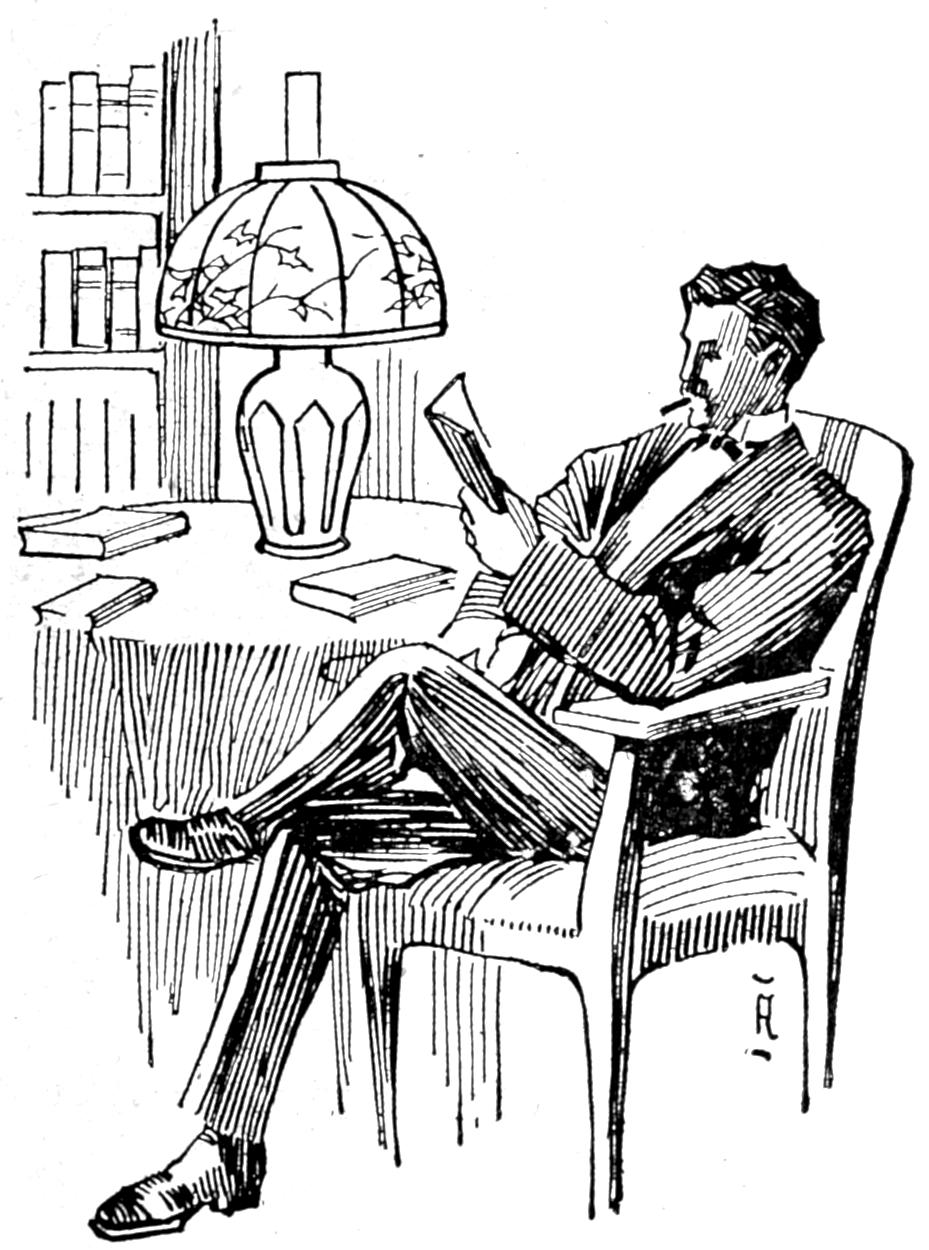
An Unsocial Habit
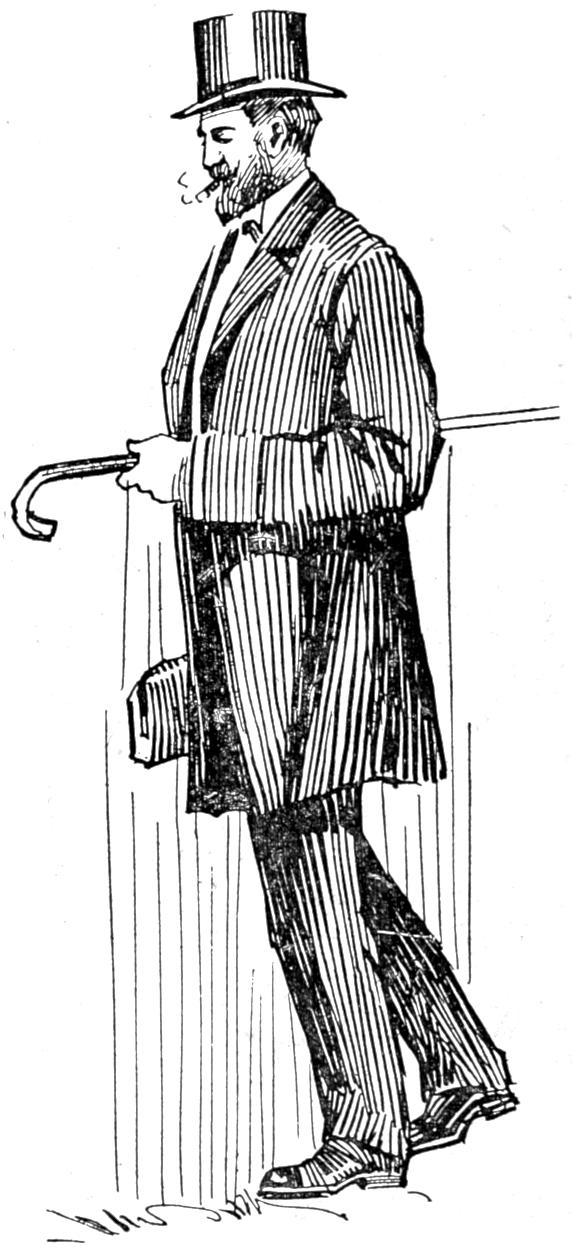
The Smoking Doctor
“But our first
baby was a nervous
child, and
the doctor told
me it would not do
for it to breathe
tobacco smoke.
So I got into the
way of shutting
myself up in the
library of evenings,
and, after
meals, to enjoy my cigars. As I look at it now,
nothing is more absurd than to call smoking a
social habit. It’s a poor pretense of sociability,
where a man is simply intent on his own enjoyment.
My wife owns now that my tobacco-tainted
breath and tobacco-saturated clothing were always
more or less a trial to her.
“The satisfaction it has given me to be rid of a
tobacco atmosphere, and the thought of my contemptibly
selfish indifference to her comfort all those
years, have humbled me, I tell you. And I wouldn’t
exchange my own daily
satisfaction now-a-days
in being a cleaner man—inside
and outside,—for
the delight that anybody
gets out of his
cigars.
“I didn’t need to go
outside of my own door
to find reasons enough
for giving up the habit;
but I think I found still
stronger ones, after all,
when I went away from
home.
“The more I thought
about the harm tobacco
does in the community
at large, the more sure
I felt that it was time
for me to stop giving
it the moral support of
my example. I know
I smoked too much, and that my nervous system is
still the worse for it; and I think the people who
are likely to be hurt the most by it, are just the
ones who are most likely to smoke excessively.
“And then, I’ve noticed that the doctors who
stand up for tobacco are always men who use it,
and are liable to the suspicion of straining a point
in justification of their own self-indulgence.
“On one point, though, I believe the authorities
agree. No one denies that it is a damaging indulgence
for boys. It means a good deal when smoking
is forbidden to the pupils in the polytechnic
schools of Paris, and the military schools of Germany,
purely on hygienic grounds. The governments
of these smoking nations are not likely to be
notional in that matter.
“But the use of tobacco by our American boys
and men is excessive and alarming. We ought to
save our rising generation for better work than they
can do if tobacco saps the strength of their growing
years, and makes the descent easier, as it no doubt
often does, to worse vices. I don’t know how to
forgive myself for the example I set before my
Sabbath-school class of bright boys, year after year,
by my smoking habits.
“It isn’t in the family, either, that the selfishness
of the habit is most apparent. I don’t believe,
other things being equal, that there is any other
class of men who show such a disregard in public
for other people’s comfort as tobacco users do. A
man would be considered a rowdy or a boor who
would willingly spatter mud on the clothing of a
lady as she passed him on the sidewalk. But a
lady to whom tobacco fumes are more offensive than
mud, can hardly walk the streets in these days, but
that men who call themselves gentlemen,—and
who are gentlemen in most other respects,—blow
their cigar smoke into her face at almost every step.
“Smokers drive other men out of the gentlemen’s
cabins on the ferryboats, and from the gentlemen’s
waiting rooms in railroad stations, monopolizing
these rooms as coolly as if they, only, had any
rights in them.
“I can’t explain such things except on the
theory that tobacco beclouds the moral sense, and
makes men especially selfish.”
The Major’s train came in just then, and as he
took my hand to say “Good-by,” the smoking car
of the waiting train drew his parting shot.
“See there! did you ever reflect how the tobacco
habit levies its taxes on everybody? The railway
company furnishes an extra car for the smokers,
which, in the nature of the case, must be paid for
by an extra charge on the tickets of all the passengers.
What a stir it would raise if the legislature
should attempt to furnish luxuries to any special
class at public cost in this way!
“How we’d vote them down! I vote against
this thing by throwing away my cigar.”
WHY HE DIDN’T SMOKE
Johnnie Lord, the son of Mr.
Jeremy Lord, aged fourteen, was
spending the afternoon with one
of his young friends, and his stay
was prolonged into the evening,
during which some gentlemen—friends
of the family—dropped in.
The boys withdrew into the recess
of the bay-window, while the
men chatted sociably together.
The two boys kept their ears
open, as boys will, and, taking
their cue from the sentiments expressed by their
elders, endorsed one or the other, as they happened
to agree with them.
“Gentlemen, will you smoke?” asked Mr. Benedict,
the host. A simultaneous, “thank you,”
went around, and a smile of satisfaction lighted
every face but one. He was not gloomy or a drawback
on the others, but his smile was not one of
assent. A box of costly and fragrant (?) cigars was
soon forthcoming.
“Fine cigar,” said one, as he held it to his nose before
lighting it. “What, Linton, you don’t smoke?”
“I’m happy to say I do not,” was the firm rejoinder.
“Well, now, you look like a smoking man, jolly,
care free, and all that. I’m quite surprised,” said
another.
“We are hardly doing right to smoke in the
parlor, are we?” asked a red-faced man, puffing
away heartily. “I yield that much to my wife’s dislike
of the weed. She makes a great ado about the
curtains, you know.”
“For my part, that’s a matter I don’t trouble
myself about,” said the host, broadly. “There’s
no room in this house too good for me and my
friends to smoke in. My wife has always understood
that, and she yields, of course.”
“But you don’t know how it chokes her,” said
young Hal Benedict. “Yes, indeed, it gets all
through the house, you know, and she almost
always goes into Aunt Nellie’s, when there are two
or three smoking. There she goes, now,” he added,
as the front door shut.
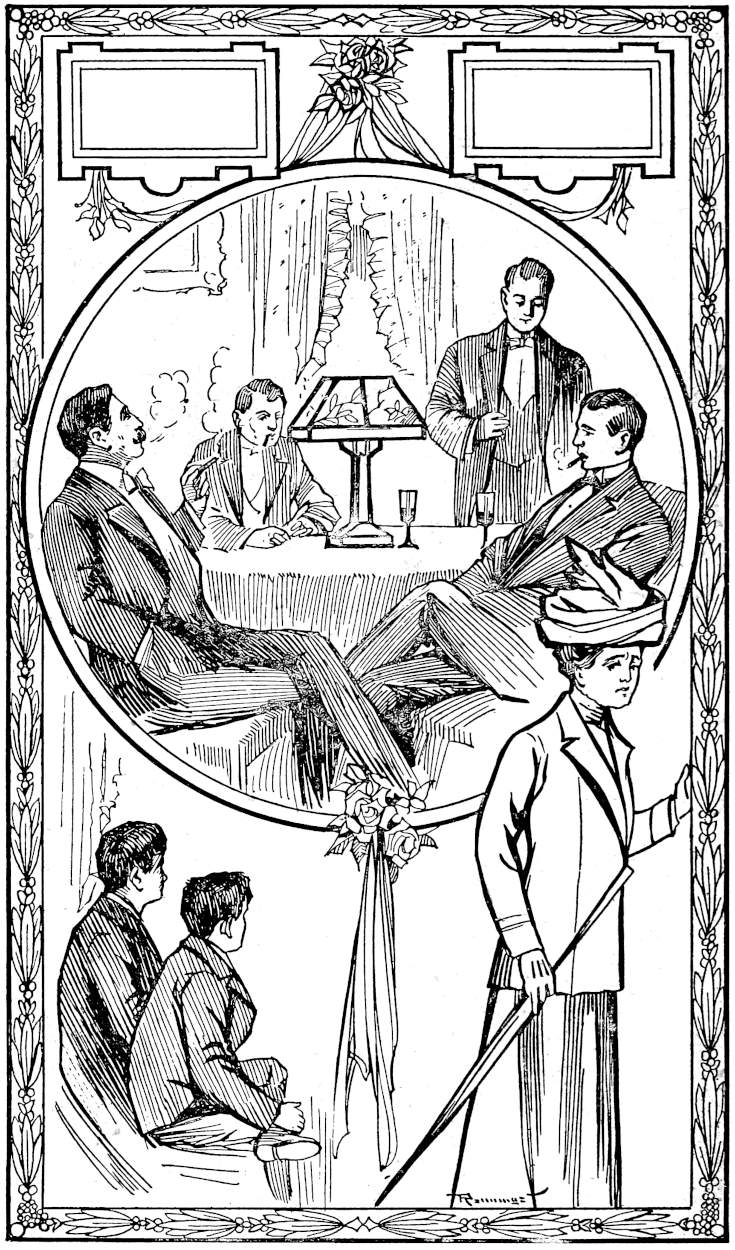
“It’s driving her out of her house”
“Why, it’s absolutely driving her out of her
house, isn’t it?” whispered Johnnie Lord, from
his nook. “Too bad!”
“Why don’t you smoke, Linton?” queried one of
the party. “’Fraid of it? Given it up lately? Of
course it doesn’t agree with some constitutions.”
“Well, if you want to know why I don’t smoke,
friend Jay,” was the answer, “I will tell you; I
respect my wife too much.”
“Why, you don’t mean—” stammered his questioner.
“I mean simply what I said. When I was married,
I had the habit of smoking cigars. But I saw
that the smoke annoyed her, though she behaved
with the utmost good taste and forbearance. Seeing
this, I cut down my cigars so as to smoke only
when going to and returning from business.
“But even then, I considered what my presence
must be to a delicate, sensitive woman, with my
breath and clothes saturated with the odor, and I
began to be disgusted with myself, so that I finally
dropped the habit, and I can’t say I’m sorry.”
“I shouldn’t be, I know,” said another, admiringly.
“I’m candid enough to own it, and I think
your wife ought to be very much obliged to you.”
“On the contrary, it is I who ought to be obliged
to my wife,” said Mr. Linton, while the host smoked
on in silence, very red in the face, and evidently
wincing under the reproof that was not meant.
“I say, Linton is a perfect gentleman,” whispered
young Benedict.
“He’s splendid,” supplemented Johnnie Lord,
who was thinking his own thoughts; but the smoke
was really getting too much for him, and presently
he took his leave.
The next day Johnnie Lord was thoughtful; so
quiet, indeed, that everybody noticed it. In the
evening, when his father lighted his pipe, with its
strong tobacco, Johnnie seemed to be on thorns.
“I can’t think that you don’t respect mother,”
he blurted out, and then his face grew scarlet.
“What do you mean?” asked his father in a
severe voice. “I say, what do you mean, sir?”
“Because mother hates the smoke so; because it
gets into the curtains and carpet—and—and—because
I heard Mr. Linton say last night, that he
did not smoke because he respected his wife too
much.”
“Pshaw! Your mother doesn’t mind my smoking—do
you mother?” he asked, jocularly, as his
wife entered the room.
“Well—I—I used to, rather more than I do now.
One can get accustomed to anything, I suppose,
so I go on the principle that what can’t be cured
must be endured.”
“Nonsense! you know I could stop to-morrow if
I wanted to,” he laughed.
“But you won’t want to,” she said, softly.
Now I don’t know whether Johnnie’s father gave
up the weed. Most likely not; but if you want to
see what really came of it, I will give you a peep
at the following paper, written some years ago, and
which happens to be in my possession.
“I John Lord, of sound mind, do make, this
first day of January, the following resolutions,
which I pray God I may keep:—
“FIRST: I will not get married until I
own a house.
“SECOND: I will never swear, because
it is silly, as well as wicked.
“THIRD: I will never smoke, and so
make myself disagreeable to everybody who
comes near me, and I will always keep these
words as my motto after I am married:—
“‘I don’t smoke because I respect my wife.’
Mr. Linton said that, and I will never forget it.”
And Johnnie kept his word like a hero.
EXPERIENCES OF JOHN B. GOUGH
When in Worcester, England,
twenty-six years ago, I was the
guest of a gentleman, a member
of Parliament, who resided just
opposite the city, on the bank of
the river,—a delightful place.
I was at that time a smoker,
and although I had never
smoked in a gentleman’s
house without an invitation,
I deemed it necessary to have my smoke after
dinner, if I could get it without annoying others.
So, after dinner, I strolled down to the riverside,
out of sight of the house, took out my cigars and
matches and proceeded to light a cigar. The wind
blew out the match. Another was tried, and
another. I took off my hat to shield it from the
wind. It was of no avail. I got some brimstone
down my throat, or something as bad; but the
cigar would not ignite.
Then I kneeled down close to the rock by the
path, at the side of the river, and with my hat off,
endeavored to secure the object. Now, I never go
on my knees but I am reminded of prayer, and the
thought came:—
“If anyone should see me, he would probably
think that some man had sought that retired spot
for devotion, and that he was saying his prayers;
and what am I doing?—I am sucking away at a
cigar, hoping to obtain fire enough from the match
to get a smoke. What would the audience say,
who heard me last night, if they should see me?”
The inconsistency of my practise with my profession
struck me so forcibly that I said, “I’ll have
no more of it.”
I rose from my knees, took the cigars and the
matches from my pockets, and threw them into the
river, and I never touched a cigar to smoke for
eighteen years.
The reformed drunkard, John B. Gough, who became
the great evangelist of temperance, kept his
freedom from drink at the cost of occasional terrible
torture. To its awful intensity, an old friend, with
whom he made his home whenever he visited
Chicago, bears witness. The story contains not
only a vivid warning against drink, but a hopeful
illustration of the victories that, with God’s help,
may be won.
“One day I found Mrs. Gough sitting by the
window, holding her newspaper upside down. Mr.
Gough was lying on the lounge on the other side
of the room, with his face to the wall.
“‘What is the matter?’ I asked in alarm.
“‘What makes you think anything is the matter?’
Mrs. Gough asked.
“With a gesture, I indicated the newspaper.
“‘Oh, there is matter!’ she cried. ‘Go to John!’
“I sat down by him, and began to talk to him in
a low voice, while I smoothed his hair, as he loved
to have me do because it soothed him. I reminded
him of the good he was doing, of the thousands he
had redeemed from drink, and of the families that
he had made happy.
“All at once he turned over and looked at me.
I hardly knew him! His eyes were sunken, his
skin was ghastly gray. Then he said with the
deep voice that so thrilled his audiences:—
“‘Do you believe I love that woman over there
by the window?’
“‘I have never doubted it,’ I replied.
“‘Do you believe I love you?’ he asked.
“‘It is one of the chief joys of my life to know
that you do,’ I said, with a lump in my throat.
“‘Then if you want to know how I feel,’ he
cried, ‘It is this way: as if I’d be willing to see
you both in hell, if it would only be right for me to
take just one drink!’
“To such an extremity as this can the morbid
craving for drink reduce even a good man. The
temptation came upon him now and then with
awful force. It was heart-breaking to see him. At
such times he never dared to be left alone. Once
when he was thus attacked by temptation at a
hotel away from his friends, he locked the door of
his room and threw the key out over the transom.
“‘Once the devil gets a clutch on you, he never
lets go,’ he said. ‘God save our young people from
thinking that the habit is only a little thing!’”
TALMAGE ON TOBACCO
At a Friday evening lecture in New
York City, Dr. Talmage spoke on
the evil habit of tobacco using, as
follows:—
“There are a multitude of
young men smoking themselves
to death. Nervous, cadaverous,
narrow-chested, and fidgety,
they are preparing for early departure,
or a half-and-half existence
that will be of little satisfaction
to themselves, or of
little use to others. Quit it, my young brother.
Before you get through this life, you will want stout
nerves and a broad chest and a brain unclouded
with tobacco smoke.
“To get rid of the habit will require a struggle,
as I know by bitter experience. Cigars and midnight
study nearly put an end to my existence at
twenty-five years of age. I got so I could do no
kind of study without a cigar in my mouth—as
complete a slave as some of you are.
“At one time I was about to change pastorates
from one city to another, when a wholesale cigar
dealer offered as an inducement to my going to
Philadelphia, that he would give me all my cigars,
free of charge, all the rest of my life. He was a
splendid man, and I knew he would keep his
promise.
“Then I reasoned thus: If now, when my salary
is small, and cigars are high, I smoke up to my full
endurance, what would become of my health if I
got all of my cigars for nothing? Well, I have never
touched the infernal weed since. From that time
I was revolutionized in health and mind,—emancipated
by the grace of God.
“I implore young men to strike out for the liberation
of their entire nature from all kinds of evil
habits. Even on our railroads they have introduced
a pig-pen on wheels,—the smoking-car—and
it is being made easier and easier all of the time to
sacrifice physical strength and health.
“All those who break down their health through
indulgence, and go into the grave sooner than they
would otherwise have done, are suicides, and the
day of judgment will so reveal it.”
A prominent church man once said: “I used to
use tobacco. When I gave it up I had a hard time
for ten weeks. I was unable to sleep at night, would
walk the floor, but God gave me the victory.”
Dr. Cole, a prominent Methodist physician, said:
“I used to use the weed, but I reached the time
when I wanted to lead a better spiritual life, and I
felt that tobacco stood between my Maker and my
soul.”
TOBACCO AND THE CIGARETTE PART ONE—WHAT IS TOBACCO?
“Tobacco is the worst curse of modern civilization.”—John Ruskin.
While the pages of this book are devoted largely to the drink
evil, we must not forget the monster evil of Tobacco, nor of the
small, innocent appearing Cigarette. For although small
singly, in the aggregate it is appalling. From year to year the
consumption of Cigarettes has so rapidly increased, that in 1911
there were 11,250,000,000 consumed in the United States alone.
Of the track of ruin left by this “little monster,” the following
pages will testify.
So close a second does the evils of Tobacco run to that of
drink, that it is claimed by many that Tobacco is a greater
curse than Rum. But one fact is sure: Tobacco in all its
forms, more than all other influences, creates a thirst for alcoholic
drinks, and is the greatest friend of the saloon.
The data from which this department has been compiled,
was supplied by a lecturer on the Cigarette evil of more than
four years’ experience. His facilities for obtaining accurate information,
and important statements from reliable sources, have
been unsurpassed.
We commend the facts presented in this department to the
careful consideration of every one into whose hands this book
may fall.
What is Tobacco? It is a poison so deadly that it cannot be
brought under the Pure Food and Drug Act. It is not rated as
a drug, but as a poison too dangerous to use in ordinary medical
practice. It can be brought under the Drug Act only by special
action of Congress. Please note what medical men say of it:—
“Tobacco is the most subtle poison known to the chemist, except
the deadly prussic acid.”—M. Orfila, President of the Medical
Academy, Paris.
“It is believed by all judicious practitioners too dangerous to be
employed as a medicine. The benefits as a remedy do not counter-balance
the risk of using it. Yet so insidious are its effects that few
have regarded it as swelling the bills of mortality. It is, nevertheless,
true that multitudes are carried to the grave every year by tobacco
alone.”—Dr. Grimshaw.
“Surgeons have sometimes resorted to a weak infusion of tobacco
injected into the bowels in cases in which it was necessary to induce
immediate prostration of energy, as in cases of strangulated
hernia and in bad dislocations of the joints; but even in these cases,
the risk is so great that no prudent surgeon will use it except as a
last resort.”—Dr. Harris.
“The profession have no idea of the ignorance of the public regarding
the nature of tobacco. Even intelligent, well-educated men
stare in astonishment when you tell them it is one of the most powerful
poisons. Now is this right? Has the medical profession done its
duty? Ought we not as a body to have told the public that of all
our poisons, it is the most insidious, uncertain, and, in full doses, the
most deadly?”—Dr. Solly, Insurance Medical Examiner.
“One-fourth of a drop of nicotin will kill a frog in ten seconds;
one-sixth of a drop will kill a cat in fourteen seconds.”
“The poison is slow; but in the second and third decade its virus
becomes manifest. The words of the wise man, “Because sentence
against an evil work is not executed speedily, therefore the heart of the
sons of men is fully set in them to do evil,” is strikingly applicable
to those who indulge in this pernicious habit. There have died in
New York, within a few years, three excellent clergymen, all of whom
might now have been alive, had they not used tobacco. The duty
of abstaining from the slow killing of one’s self by this poison is as
clear as the duty of not cutting one’s throat.”—Dr. Willard Parker.
“Tobacco is not an innocent substance. It contains nicotin, an alkaloid
which is a poison, destroying life very quickly, even when taken
in small doses. It acts as speedily as hydrocyanic [prussic] acid.
Thirty grains of tobacco, or one or two drops of nicotin, would most
likely be a fatal dose. Death by tobacco may occur in less than half
an hour; by the alkaloid [nicotin] in a few minutes.”—Norman
Kerr, M. D.
“So very dangerous and potent are its narcotic properties, that tobacco
is only seldom used for any purpose in medicine; and when
it is resorted to, the greatest caution is necessary.”—Dr. Elisha
Harris.
“The profession have no idea of the ignorance of the
public regarding the nature of Tobacco. Even intelligent,
well-educated men stare in astonishment when you tell
them it is one of the most powerful poisons. Now is this
right? Has the medical profession done its duty? Ought
we not as a body to have told the public that of all our
poisons, it is the most insidious, uncertain, and, in full
doses, the most deadly?”—Dr. Solly, Insurance Medical
Examiner.
TOBACCO AND THE CIGARETTE PART FIVE—SPIRITUAL EFFECTS — A Clean Ministry — How the Deacon Took the Tobacco Cure — An Appeal to Christians.
“I beseech you therefore, brethren, by the mercies of
God, that ye present your bodies a living sacrifice, holy,
acceptable unto God, which is your reasonable service.”
“If any man defile the temple of God, him shall God
destroy; for the temple of God is holy, which temple ye
are.”—Paul.
Yet professed Christians, and even ministers of the gospel,
will saturate themselves with the filthy weed tobacco in some of
its forms, filling their blood with the nicotin poison until a leech
placed upon the arm will fall dead inside of sixty seconds.
No one can so debase and deaden his physical system without
impairing his mental powers. When the mental powers are thus
degraded, and the faculties so impaired, just to that extent is the
power to give God “reasonable service” destroyed.
Of course it is to professed Christian tobacco users that this
chapter is presented. And to them we will say that their evil
example is the argument behind which boy and men tobacco
users hide, and by which they defend their use of the weed.
Tens of thousands of boys are going to ruin physically, mentally,
and morally because of the evil example of professed
Christians, prominent educators, and physicians.
“Be ye clean that bear the vessels of the Lord.”—Isaiah.
A prominent church man once related the following experience:—
“I used to use tobacco. When I gave it up I had a hard time for
ten weeks. I was unable to sleep at night, would walk the floor, but
God gave me victory.”
Josiah Strong, in his “Challenge for the Churches”
(page 267), does some interesting figuring. He says:—
“There are 20,000,000 Protestant church members in the United
States. About one-third of them are males. Assuming that only
one-half of the male membership are smokers (and we are afraid it
is a very generous supposition), there are 3,333,000 in that class.
On the supposition that each smoke only three five-cent cigars a day,
they together spend $500,000 daily for tobacco.”
An evangelist conducting a revival service in Marietta, Ohio,
relates the following incident:—
One of the deacons of the church, a very earnest man,
was addicted to the use of tobacco. He was teacher of a
large class of young ladies, and was very anxious that they
should all be brought to Christ before the meeting closed.
At the beginning of the series of services he brought me
a list of the unconverted ones, and requested that I should
pray and work for their conversion. We had a short talk
concerning his class, and he seemed worried about his influence
with them. As the week wore on and none of them
were converted, he became more and more uneasy.
On Sunday morning he came to me with tears in his
eyes and said he was going to make a confession to the
class. I asked him what it was, and he replied: “I have
been a slave to tobacco. I can not stand before these
girls and plead with them to accept Christ with the taste of
that vile stuff in my mouth. I promised God I would stop
it last night. This morning when the appetite for it came
on, the devil told me I couldn’t. I am going to tell the
girls about it this morning and ask them to pray for me.”
When the Sunday-school hour was about half over I
looked into his class room. All the heads were bowed in
prayer, and most of the girls had their handkerchiefs to
their faces, and were crying. As I closed the door softly
I heard one of them praying, “Dear Jesus, cure our
teacher.”
You wouldn’t have known that class of girls when they
came out of the class room that day. Their indifference
seemed to be all gone. The deacon followed them into the
auditorium, and there he met his partner in the grocery store.
“John,” he said, his face all aglow, “I’ve taken the tobacco
cure.”
“What is it?” asked his partner.
“I won’t tell you now, John; but if it cures me will you
take it too?”
“Sure,” replied the partner.
“Shake hands on it,” said the deacon.
They clasped hands, and in a few weeks afterward the
deacon kept him to his word.
The deacon’s tobacco cure was the inspiration of the
meeting. Inside of three weeks every girl in that class
had accepted Christ, and they didn’t stop at that, either.
Many others were brought to Christ through their efforts.
And so the deacon’s tobacco cure became “the cure
of souls.”—Stephen J. Corey, in the Christian Endeavor
World.
But what can be done to teach children and youth the
evils of a practice of which parents, teachers, and ministers
set them the example? Little boys hardly emerged
from babyhood may be seen smoking their Cigarettes.
If one speaks to them about it they say, “My father uses
tobacco.” They point to the minister or the Sunday-school
superintendent, and say, “Such a man smokes; what harm
for me to do as he does?” Many workers in the temperance
cause use tobacco. What power can such persons have to
stay the progress of intemperance?
I appeal to those who profess to believe and obey the
Word of God: Can you as a Christian indulge in a habit
that is paralyzing your intellect, and robbing you of power
rightly to estimate eternal realities? Can you consent daily
to rob God of service which is his due, and to rob your
fellow men, both of service you might render, and of the
power of example?
Have you considered your responsibilities as God’s stewards
for the means in your hands? How much of the
Lord’s money do you spend for tobacco? Reckon up
what you have thus spent during your lifetime. How does
the amount consumed by this defiling lust compare with what
you have given for the relief of the poor and the spread of
the gospel?
No human being needs tobacco, but multitudes are
perishing for want of the means that by its use is worse
than wasted.—Ministry of Healing.
TOBACCO AND THE CIGARETTE PART SIX—THE CIGARETTE — Women and Baby Smokers — A World Wide Evil — Effects Upon School Boys — Bad Example of Educators and School Men — Boy Criminals and the Cigarette — Heart Tracings — Danger to Growing Boys — Business Men and the Cigarette — Cigarettes and Tuberculosis — Leads to Drinking and Opium — Cigars and Fires — Dangers of Inhaling — A Sure Cure
The question is often asked, “Why is the Cigarette doing
more harm than the other forms of Tobacco?” We answer:—
First, because the user of the Cigarette is more apt
to inhale than the user of pipe or cigars.
“When tobacco smoke is inhaled [breathed into the lungs],
the nicotin enters the cerebral circulation directly and benumbs
the brain. It enters the larynx and bronchial tubes,
coating their membrane with carbon and acting as an irritant.”
Second, because the combination of the tobacco and the
paper in the Cigarette form several poisons that are injurious.
They are:—
Prussic Acid: the most deadly poison known.
Acrolein: rated in any standard book of chemistry as second
only to prussic acid in its deadly effect. In Webster’s International
Dictionary, 1901, it is defined as “A limpid, colorless,
highly volatile liquid. Its vapors are intensely irritating.”
Pyridine: “It is the nucleus of a large number of organic
substances, among which several alkaloids, as nicotin, ...
may be mentioned.”
Carbonic Oxide or Monoxide gas: “Carbonic oxide (chem.):
a colorless gas. C. O. of slight odor, called more correctly
Carbon Monoxide. It is the product of the incomplete combustion
of carbon.... It is fatal to animal life.”
Besides these poisons, nicotin is always present in tobacco in
any form,—giving a total of five poisons in the Cigarette.
Third, Ignorance of the effects of Cigarettes on the human
being. The Cigarette being so small, and the white
paper so clean in appearance, thousands of innocent people
are entrapped and ruined physically, mentally, and morally,
by those “Little White Devils.” It has been estimated that
from one thousand two hundred to one thousand five hundred
boys begin smoking every day.
In 1909, I was invited to speak at a woman’s missionary
meeting, at Washington, D. C. At the close of the meeting
an elderly lady asked for literature giving statements
as to the effect of Cigarettes. She said she had a married
daughter that was smoking Cigarettes, and teaching
her little three-year-old boy to smoke!
I knew a woman who began smoking Cigarettes. I
was shocked when I heard that she had placed a Cigarette
in the mouth of her sweet little four-year-old girl. I tell
you that made me mad! I said then that I would do all I
could to knock out Cigarettes. A young married lady told
me that her husband was a “Cigarette fiend.” He was
dopy most of the time. When not under the influence of
Cigarettes, he was restless, nervous, irritable, and unkind.
Life to her became a burden.
“A Cigarette dealer in Philadelphia states that he sells
one hundred fifty thousand Cigarettes a month to women
who come in carriages, and send footmen to buy.”
Dr. Clinton says that “a good deal has been said about
the evils of Cigarette smoking; but not one half the truth has
ever been told.”
Not only in America, but in every land, in every clime,
is the effect of the Cigarette seen. In China, where such
a successful crusade against opium was made, the tobacco
people from our own civilized America went with an unlimited
amount of advertising matter, and sample packages
of Cigarettes, which were scattered broadcast, and now the
Cigarette habit threatens to be a greater curse than opium
was!
A physician’s statement:—
“Cigarette smoking first blunts the whole moral nature. It has an
appalling effect upon the physical system as well. It first stimulates,
then stupefies the nerves. It sends boys into consumption. It gives
them enlargement of the heart and it sends them to the insane asylum!
“I am often called in to prescribe for boys for palpitation of the
heart. In nine cases out of ten this is caused by the Cigarette habit.
I have seen bright boys turned into dunces, and straightforward,
honest boys made miserable cowards by Cigarette smoking. I am
speaking the truth,—nearly every physician and every teacher knows.”—Dr.
A. Clinton.
In a school of 500 pupils, a careful investigation extending
over several months was made, and briefly summed
up, shows the following:—
“The average efficiency of the non-smokers in that school was
ninety-five per cent, in other words, ninety-five out of every one
hundred were reasonably sure of getting at least a good common
school education, while of the Cigarette fiends, only five to ten per
cent stand any show in school, and they are two and one-fifth years
behind in their own grade, and more than three years behind the girls
they started with in the first grade.
“The teachers who made this investigation expressed themselves to
the parents of the boys as follows:—
“We desire to call attention to the fact that a large majority of the
boys of this city are smoking Cigarettes; that the boys who are smoking
are, on an average, years behind the boys who do not smoke; and still
farther behind the girls in the same grades; that the mental, moral, and
physical condition of many of these boys is extremely deplorable, and
will certainly continue to grow worse unless the habit is stopped; that
while the schools are insisting that this and other unclean and undesirable
habits shall not be practiced in or about the school house or
grounds; still, crowds of our boys are daily seen around the saloons
and loafing places of our streets, smoking, loafing, swearing, and
cultivating other undesirable habits.
“This was plain talk, and it had immediate effect. It is estimated
that seventy-five per cent of the Cigarette smoking by boys was
stopped. What was called the worst school in the country, is now
spoken of as doing good work. The school board raised the salary of
the teachers and principal twenty-five per cent. The people are pleased.
The improved condition of the boys is noticeable in their language,
dress, manners, efficiency, and especially in their moral tone.
“The former principal and superintendent smoked.”
But think! that is but one school among thousands in
America that is wasting money in trying to educate numbskulls!
Bob Burdette, in his comical way, says:—
“My son, as long as thou hast in thy skull the sense of a jay bird,
break away from the Cigarette, for lo, it causeth thy breath to stink
like a glue factory; it rendereth thy mind less intelligent than that of
a cigar store dummy, yea, thou art a cipher with the rim knocked off.”
When you rub the rim off a cipher you have less than nothing.
Theodore Roosevelt expresses himself as follows:—
“If you are going to do anything permanent for the average man,
you have got to begin before he is a man. The chance of success
lies in working with the boy, and not with the man.”—Theodore
Roosevelt.
Superintendent J. K. McBroom, in an address to educators,
said in part:—
“What will we do with a superintendent who uses tobacco? Send
him to the legislature? Legislative atmosphere seems to be mostly tobacco
smoke anyway. Send him to the reform school, I was going
to say; then I remembered that wouldn’t do, for that of course is
only for youthful offenders for whom there yet lingers hope of reformation.”
Speaking of boys, Mr. McBroom says:—
“Now is the time of most urgent need that every safeguard and every
vigilant precaution be thrown around them to save them from the vile
habits and tendencies which they are exposed on every hand, and which
if allowed to get their grip now, will handicap the boys all their lives,
and in many cases ruin them for any further effective or ambitious
effort.
“Chief among these vices, because usually the first to gain a foothold,
is the use of tobacco; and that seems to be the father of all the
rest. It breeds deception at the very start, in every single case, I
believe; bad company, and even worse meeting places; dwarfed ambition,
sluggish intellect.
“Now if the young man has any capacity or inclination in the line
of school work, we have the strongest possible appeal to his pride and
his ambition in telling him that the use of tobacco is absolutely ruinous
to good scholarship. But the pupil will find a fatal flaw in the
logic if the superintendent himself uses tobacco; for almost inevitably
in the mind of the pupil, the superintendent is a notable example of high
scholarship. The best teaching, except for some rudiments and
routine of instruction is mostly a matter of intangible atmosphere;
the right kind of influence, contact and association of the pupil with a
strong, clean, wholesome personality in the teacher. Now if superintendent
or college professor or any other schoolman, has one conspicuous
weakness; one habit that is universally considered a bad
habit, he fails in exactly the most important point; and though he may
be strong as an instructor, disciplinarian, administrator, yet he will be
weak as an educator, as a maker of character.
“He may surround himself with a corps of strong, loyal young
men and women, who will attend to the education of the pupils, while
he attends to the administration of the system; but even then, his own
influence in the development of character in the pupils will be zero or a
negative quantity. Now that kind of influence might answer in the
management of a railroad or a packing house, but in the administration
of a school it is not good enough.”
What can we say to the boys when they quote the example of
physicians, college professors, school superintendents, ministers
of the gospel, churchmen, and even their own fathers?
Such men should read the following statement with care:—
“There is something about this Cigarette habit that weakens and unnerves
the boy. It destroys his memory, impairs his other cognitive
faculties, robs him of his power of attention, saps his will-power, and
deprives him of his initiative; he becomes tremulous and timid, and
fears to do the things he would.
“Often this filthy and disgusting habit has so fastened itself upon
the impressionable boy nature, that it can not be shaken off. What
base slavery! What bonds of vice that eat like canker into the
physical being of its victim!
“Many physicians with whom I consulted in the matter have assured
me of the effect of tobacco upon the growing boy, and all have
regarded the Cigarettes as the most pernicious form of tobacco using.
Do college professors, and college men, and other users of
Cigarettes who are in a position to influence boys, ever think of their
responsibility for the bad example they give? How can advice to
refrain from the Cigarette be heeded when it comes from one who
is himself a user of the Cigarette?”—Wm. H. DeLacy, Judge of the
Juvenile Court, Washington, D. C.
Judge Ben. B. Lindsey, of Denver, known as “The
Boys’ Judge,” says:—
“The Cigarette not only has a grip upon boyhood, but it invites all
other demons of habit to come and add to the degradation.”
Another writer says:—
“There is no surer way for the young boy to procure as associates
the criminal and immoral, than for him to begin the smoking of Cigarettes;
the use of the Cigarette draws to him the older and more
vicious who are ready to initiate him into that kind of life which paves
his way to destruction.”
In testimony of the grip which the Cigarette habit obtains upon
boys, and its tendency to crime, read carefully the following
statement from Abraham Bowers, Immigration Secretary of the
Y. M. C. A. of Chicago:—
“It gives me pleasure to endorse the work of the Anti-Cigarette
League. While I was teacher of the boys in the Cook County jail,
I found that almost every one of them could attribute his downfall
partly to the use of Cigarettes. They were the most seriously afflicted
with the habit of any class of boys I have ever known. They desired
to have a recess every forty-five minutes to go outside the room to
smoke a Cigarette. At night frequently about two or three o’clock
in the morning, some of them would be aroused from their sleep for
the want of a Cigarette, and not having it they would pound the cells,
and wake all the other boys and men in the jail, if necessary to get
the Cigarettes. Many of them admitted that they had been led to
steal originally to get money with which to buy Cigarettes.”
The following statement is from the pen of Judge Leroy B.
Crane, of New York:—
“Cigarettes are ruining our children, endangering their lives, dwarfing
their intellects, and making them criminals fast. The boys who
use them seem to lose all sense of right, decency, and righteousness.
To have great men requires the most forceful means to check this
pernicious and death-dealing habit. Ask the mothers of the land to
help you and they will respond.
“In my court ninety-five per cent of the boys brought before me
charged with offenses from shooting crap to burglary are Cigarette
smokers, while those who do not smoke them seldom appear before
me.
“This morning three boys were brought before me for petty larceny,
the oldest eighteen, the youngest sixteen,—the stain of Cigarettes on
their fingers, and the mothers there to accompany their boys. I was
compelled to send one to the reform school at the mother’s request;
the other two were placed on probation to give them another start.
“I call Cigarettes Little White Devils. The U. S. government
should pass laws preventing their sale and manufacture within its
borders.”
Of the tendency of the Cigarette to promote crime and insanity,
the following experience will testify:—
“Of all the juvenile criminals tried in my court, not one for years
has been found free from the stain of Cigarettes on his thumb and
first two fingers. Of all the lunatics tried in my court, an attempt is
made to learn the cause of lunacy, and in more than half Cigarette
smoking is assigned as the cause.”—Judge Balder, Louisville, Ky.
“It does seem, as one stated, ‘that either the smoking of Cigarettes
causes insanity, or that it is the insane who smoke.’”
Says Thomas A. Edison:—
“Acrolein is one of the most terrible drugs in its effect on the
human body. The burning of ordinary cigarette paper always produces
acrolein. That is what makes the smoke so irritating. I
really believe that it often makes boys insane. We sometimes develop
acrolein in this laboratory in our experiments with glycerine.
One whiff of it from the oven drove one of my assistants out of the
building the other day. I can hardly exaggerate the dangerous nature
of acrolein, and yet that is what a man or a boy is dealing with
every time he smokes an ordinary Cigarette.”
“The blood of persons poisoned by the inhalation of illuminating
gas, rich in carbonic oxide, is found to be coagulated and indurated,
and may be pulled in strings from the veins and arteries.
“Owing to the loose structure of the Cigarette, its combustion is
modified and destructive distillation proceeds with combustion, and
owing to the incompleteness of oxidation, carbonic oxide is largely produced
instead of carbonic acid. This carbonic oxide inhaled into the
lungs enters the blood unresisted, and the damage it does is in direct
proportion to the quantities inhaled. Carbonic oxide when inhaled in
small quantities produces faintness, dizziness, palpitation of the heart,
and a feeling of great heaviness in the feet and legs. These are exactly
the effects of the Cigarette and the depression and nervousness
which follow as a reaction make the victim crave some balm or tonic
for his malaise. He is then led to consume the drug in ever increasing
quantities.”
Notice the following prison record:—
“On the first day of this month we had 278 boys between the ages
of ten and fifteen. Ninety-two per cent of the whole number were
in the habit of smoking Cigarettes at the time they committed the
crimes for which they were sent to the reformatory. Eighty-five per
cent had become so addicted to their use as to be classed at the time
as ‘Cigarette fiends.’ Of 4,117 boys received into the reformatory
since its organization on June 8, 1893, ninety-five per cent were in the
habit of using tobacco, and nearly all were Cigarette smokers. Consequently
we see that the Cigarette is a great factor in developing
criminals.”—Hon. Geo. Torrence, formerly Superintendent of Illinois
State Reformatory.
Reliable testimony:—
“I regard the Cigarette as a fuse of infernal fire, tending to explode
the worst passions of the body! In dealing with more than
sixteen thousand delinquent children during the last eight years, I find
as a rule the user of Cigarettes is a stunt, a weakling in body, mind,
and morals.”—Zed H. Copp, Chief Probation Officer, Juvenile
Court, Washington, D. C.
We invite your attention to the work of the delicate little instrument,
called the sphygmograph, which records the strength
and regularity of the heart beat. Notice the following
tracings:—
No. 1 shows a healthy heart beat. No. 2, the heart beat of a
young man while smoking. Where the mark ^ is, you will
notice that the heart skipped a full beat. No. 3, after smoking,
with a partial skip in the heart beat, even while under the stimulus
of tobacco. No. 4, the heart beat of a tobacco user.
The tobacco heart has become a prominent feature in the
medical diagnosis of the day.
This progressive use of the Cigarette is especially true with boys
in the period of rapid growth. The wreath of Cigarette smoke which
curls about the head of the growing lad holds his brain in an iron
grip which prevents it from growing and his mind from developing
just as surely as the iron shoe does the foot of the Chinese girl.
In the terrible struggle for survival against the deadly Cigarette
smoke, development and growth are sacrificed by nature, which in
the fight for very life itself, must yield up every vital luxury such as
healthy body growth and growth of brain and mind.
If all boys could be made to know that with every breath of
Cigarette smoke they inhale imbecility and exhale manhood; that they
are tapping their arteries as surely and letting their life blood out
as truly as though their veins and arteries were severed, and that the
Cigarette is a maker of invalids, criminals, and fools—not men—it
ought to deter them some. The yellow finger stains is an emblem
of deeper degradation and enslavement than the ball and chain.
Hudson Maxim.
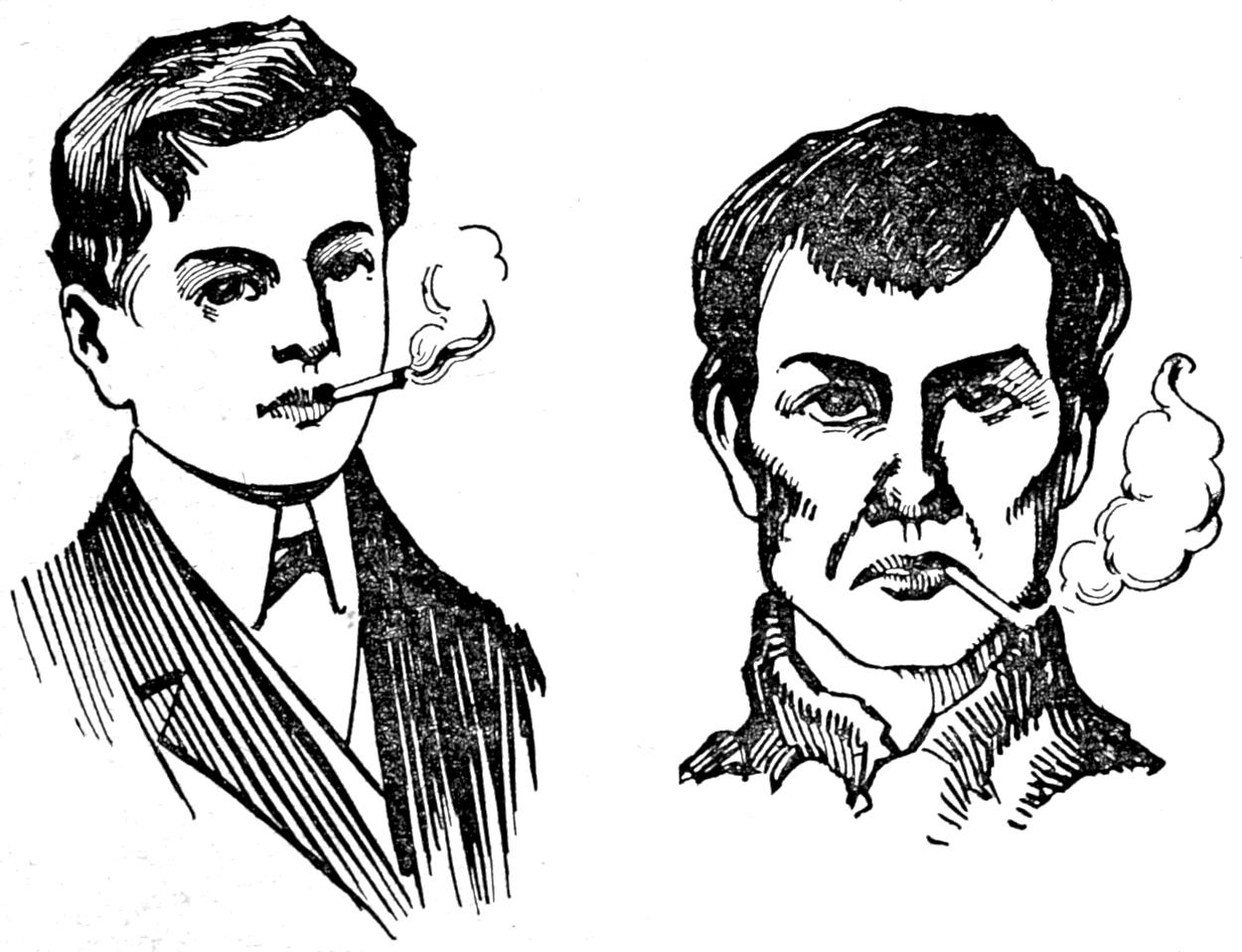
How do employers of men and boys rate the Cigarette
smoker? Read the following terse statements:—
“We might as well go to the insane asylum for our men as to
employ Cigarette smokers.”—The late E. H. Harriman, Railroad
King.
“Never advance the pay of a Cigarette smoker; never promote
him; never trust him.”—Elbert Hubbard.
“More and more young men are hoisting the sign, ‘I am a fool,’
by appearing in public with a Cigarette.”—P. M. Sharpless, Cream
Separator Manufacturer.
“The use of intoxicating liquor by men, and the use of Cigarettes
by boys, is creating a race of feeble-minded, unhealthy, and valueless
citizens.”—John Wanamaker.
“We do not employ boys in the Larkin office, who smoke Cigarettes.
An applicant addicted to the use of Cigarettes would hardly
interest us; but if he seemed to possess qualifications that made him
desirable, he would have to decide between Cigarettes and the job.”—Wm.
R. Heath, Vice-President Larkin Company, Buffalo.
The notice which follows was posted throughout the
factory of the Cadillac Motor Company, Nov. 28, 1911:
“Cigarette smoking is acquiring a hold on a great many boys in our
community; the habit has grown to an abnormal extent among boys
and men in the last year or two. Since it is such a bad practice,
and is taking such a hold upon so many people, we think it a disgrace
for a grown man to smoke a Cigarette, because it is not only injurious
to his health, but is such a bad example to the boys.
“Boys who smoke Cigarettes, we do not care to employ or to keep
in our employ. In the future we will not hire any one whom we know
to be addicted to this habit. It is our desire to weed it entirely out of
our factory just as soon as practicable. We will ask every one in
our factory who sees the seriousness of this habit to use his influence
in having it stamped out. We have two objects in interesting ourselves
in this matter. First, to help men and boys; second, We believe
that men who do not smoke Cigarettes or frequent saloons, can
make better automobiles than those who do.”
The following is an extract from the Fidelity, one of
the oldest insurance companies in America:—
“After a careful investigation we have decided that we will not
bond a man who uses Cigarettes, for such men are not safe, physically
or morally.”
“I verily believe that the mental force, power of labor, and endurance
of our profession is decreased at least twenty-five per cent by
the use of tobacco.”—Ex-Senator Doolittle, in an address delivered to
the graduating law class of Wisconsin University.
The claim made by Surgeon General Rixey of the United States
navy that the smoking of Cigarettes is responsible for many of the
cases of pulmonary tuberculosis that occur among the men of that
body is an interesting one. The Cigarette has long been considered a
dangerous luxury, and taking into consideration the opinion of
Dr. Rixey, the statement that during the past three months the crew
of the ship Missouri—700 men—used one thousand five hundred
books of Cigarette papers, one thousand two hundred pounds of tobacco
and thirty-seven thousand Cigarettes, the fact that the ratio of
men suffering from pulmonary troubles in our navy is larger than in
the navies of either Germany or England, is not surprising. As a
matter of precaution and common sense, this devotion to the Cigarette
should at least be curbed to a very great extent.—Washington Post.
“It has been brought to the attention of the bureau from many
sources,” says the surgeon general, “that Cigarette smoking is becoming
a serious impediment to robust health in the navy. This habit
seems to have taken a decided impetus in the service since the
Spanish war and has spread to incredible proportions.”—The Deadly
Cigarette, Lucy Page Gaston.
Dr. Chas. L. Hamilton, of the Keeley Institute, says: “The continual
dryness of the mucous membranes of the mouth and pharynx,
due to the paralyzing influence of the Cigarette on the nerve terminals
and which the drinking of water will not relieve, is readily quenched
by alcoholic drinks, and this discovery, once made by the Cigarette
habitue, leads to frequent indulgence in liquor, and aided by the effort to
combat malnutrition and its attendant weaknesses, almost invariably
causes him to become an alcoholic inebriate.”
Also a quotation from Dr. B. Broughton, in charge of the opium
department of the Keeley institute, Dwight, Ill.: “More young men are
led into the opium habit by Cigarette smoking than by patent and
proprietary medicines. Sixty per cent of all males under forty years
of age, treated at Dwight for morphin, opium, or cocaine using in
1896 had been smokers of Cigarettes, and sixty per cent of these
had no other excuse than that they needed some stimulant more than
the Cigarette furnished them.”
“Our experience here at Dwight, where many hundreds of Cigarette
cases have been treated, is that persons applying for treatment
for both liquor and cigarettes dread giving up their Cigarette more
than they do the liquor. Moreover, those who return to the use of
Cigarettes in after-life, are almost certain to resume the use of liquor
to allay the irritability of the nervous system produced by tobacco
smoke inhalation.”—Some Effects of Tobacco Using.
“Cigarettes for boys spell tragedy everywhere! The fire at Bangor
last Sunday began with a careless smoker. The Baltimore fire, the
Chelsea-Boston fire, the fire of the Windsor Hotel, New York, the
Albany Statehouse fire, and the Horrible Triangle Waist Company
holocaust, all of these, with charred human bodies, and wrecked
homes and lives, are traced to the carelessness and brutal disregard
accompanying the Cigarette habit.
“Fire Commissioner Waldo attributes 700 fires per year in New
York to this cause. The tobacco companies deny the evil of their
product, and invite inspection of their premises and processes. But
a mere inspection of the Cigarette boys, in the public schools and
factories ought to be enough!”—Editorial in Religious Weekly.
The following paragraphs are selected from “Confessions of
a Cigarette Smoker in England.”
“Inhaling consists simply in drawing a volume of smoke from the
Cigarette into the mouth, and then taking a deep breath, in the act of
which the smoke is carried from the mouth down into the lungs....
“Let the nicotin fumes go where they may, in their passage they
come into contact with the nervous system, and the result is an instantaneous
communication to the brain, which takes the form of a
momentary semi-paralysis—that is, when a man is new at the habit.
“I remember very well the experience of a youngster of eighteen
on his being taught to inhale the smoke of a Cigarette for the
first time. One afternoon some friends persuaded him to make the
attempt, and he did so. Almost upon the instant he fell full length
upon the floor in a dead faint; and his features became pallid, his
pulse faint and irregular; and those about him were for a time in
a great fright. A day or two later he tried to inhale again, with a
result not quite so bad; and he went on trying till now he is a veritable
slave to the habit.
“A leading tobacconist in the city of London told me that in the
space of five years he had seen regular frequenters of his shop completely
broken down in mind and body through having contracted the
inhaling habit; moreover, that some of them were in the cemetery
who, he was convinced, need not have been there. Of course, the medical
certificate did not give inhaling tobacco smoke as the cause. Very
likely it said consumption. But I can quite believe, and so can any
confirmed inhaler, that it was the Cigarette that was the cause of
it all.
“The moral of all this is a simple one. Never upon any consideration
be tempted to inhale for the first time. Probably this initial
attempt would lead to the establishment of the habit, with all the sad
consequences I have enumerated. And, as I indicated at the outset,
breaking away from it is such a difficult matter that not one person in a
thousand ever succeeds in the attempt. Inhaling is one of those habits
which can not be broken off by degrees. The division must be drawn
sharp and clean, and there must be no smoking of any sort. To the
confirmed inhaler this system of cure is a painful one; but it is the
only one I have known to succeed.”
“I have found a way to cure Jimmy of smoking Cigarettes,” said
Mrs. Maloney over the back fence to Mrs. O’Brien.
“And what is that?”
“By the laying on of hands. It is a great remedy and a sure cure.”
A Campaign for Better Books for the Young — “ Tiger and Tom, and Other Stories for Boys. ” — “ The King’s Daughter, and Other Stories for Girls. ” — “ Gospel Primer No. 2. ” — “ Spring Blossoms. ” — Transcriber’s Notes
The world is flooded with the cheapest and most pernicious
literature for children and youth. Go with me to the book
store and see if we can find a sensible, illustrated book for the
children. Notice the rotten paper used, and the quality of the
work in both printing and binding. Who would think of buying
such stuff for grown people?
But worse than all the rest is the nature of the literature
contained in many of these books. It is as unreal and meretricious
as the material is of poor quality and the workmanship bad.
And right at the time of life when character is forming for time
and eternity, the brains of these little people are filled with
fairy stories, and grotesque pictures of nondescript animals, and
the impossible doings of impossible people.
The effect on the impressible, unformed minds of the young
is to create unreal sentiments and a feverish imagination. Look
at the eagerness with which the little hands grasp the atrocious
colored illustrations of the Sunday newspaper.
People say the children must be amused. In this we agree,
but claim that it is not necessary to descend to this demoralizing
stuff to interest them. We claim that the things that are
true, the things that are uplifting, the things that will lay the
foundation for a useful education and training for life, can be
made just as interesting for these little men and women as is
the stuff usually imposed upon them.
We must remember that the bad literature for the children is
training their impressible minds in wrong directions, and developing
a dwarfed character. No true education can be built
upon such a foundation. It must all be eradicated, and the evil
effects overcome before there is any hope for a proper, useful
education. It will take years to do this; it may never be accomplished.
Many will carry through life and to the grave the
taint of these early lessons.
The Nashville Book Company was organized for the express
purpose of providing for the children and youth a clean, uplifting,
educating, yet intensely interesting literature. That
our efforts have been successful is attested by the eagerness
with which the books are read and re-read by the little men and
women, and the influence for good the lesson stories are having
upon their lives, as attested by parents into whose homes these
books have found their way. The books now ready are:—
Suitable for boys from eight to twenty years of age, and for
grown-ups as well. Contains 224 pages, printed from new
plates on good, heavy paper, with more than one hundred illustrations,
engraved expressly for this book, many of which are
full page, all printed in colors. Prices and Bindings:—
Vellum de Luxe Cloth, marbled edges,
50 cts
Paper Cover, in three colors,
25 cts
“Companion to Tiger and Tom.”
Same styles and prices
Ninety-six pages of short, attractive Bible stories. Each page
a chapter. The chapters connect in forming a continued chain
of historical stories. For children from six to fifteen. Printed
on heavy paper, handsomely illustrated by over 100 engravings,
printed in colors, in the following styles of binding:—
Red Vellum de Luxe Cloth, red edges, embossed in three
colors,
50 cts
Board sides, cloth back, cover printed in three colors,
25 cts
For children from four to ten. Contains Bible stories, interesting
stories from every-day life, puzzles, and drawing
lessons. Printed from large type, handsomely illustrated in
colors. Sixty-four pages, each double the size of “Tiger and
Tom.” Bound in heavy board sides, cloth back, cover beautifully
printed in four colors,
30 cts
The best selling line in America.
General and Local Agents wanted. Liberal discounts. Write
for circulars and terms.
Address, Nashville Book Company, Marshall, Michigan.
Inconsistencies and errors in the source document have been retained, except as mentioned below. Where the source document uses
illustrated capitals at the start of chapters, opening quote marks and other punctuation may be missing; these have not been added.
Depending on the hard- and software used to read this e-book and on their settings, not all elements may display as intended.
Changes made:
Some obvious minor typographical and punctuation errors have been corrected silently.
Text in a dashed box has been transcribed from the accompanying illustration.
Page 42: closing quote marks moved from ...learned a lesson by this time, ventured Bertha.” to
...learned a lesson by this time,” ventured Bertha.
Page 49: Closing quote mark inserted after ...pumped a nice fresh pail.
Page 63: closing quote mark inserted before But the poor woman did not realize....
Page 65: closing quote mark inserted after ...folly and dissipation by the poor prodigal.
Page 71: ...a chap let of perishable flowers... changed to ...a chaplet of perishable flowers....
Page 76: ...they have a bank of desposit... changed to ...they have a bank of deposit....
Page 105: opening quote marks deleted from before Susan Bell’s heart beat very fast....
Page 135: ...and minister’s preached... changed to ...and ministers preached....
Page 138: closing quote mark inserted after ...the storm’s done for us,
Page 142: Look here, Dainel, if you will promise me... changed to Look here, Daniel, if you will promise me....
Page 145: opening quote mark inserted before I can now take up the mortgage,....
Page 151: closing quote mark inserted after ...in the name of mercy, do promise,....
Page 169: ...on her kness to help her... changed to ...on her knees to help her....
Page 197: Quote marks inserted around I’d just like to hear anybody speak against him, I would; Her eager eyes ran hurridly... changed
to Her eager eyes ran hurriedly....
Page 198: ...God being by helper! changed to ...God being my helper!
Page 225: opening quote marks inserted before I yield that much to my wife’s dislike... and before But you don’t know how it chokes her,....
Page 247: closing quote mark added after ...in the administration of a school it is not good enough.
Page 248: closing quote mark inserted after ...known as “The Boys’ Judge,
Page 250: Superintendent of Illinois Stale Reformatory changed to Superintendent of Illinois
State Reformatory.