Periodicals published in lunatic
asylums—Synthesis—Passion—Atavism—Conclusion.
The connection which, as we have seen, exists between genius and
insanity is confirmed by the over-excitement of the intelligence, and
the temporary appearance of real genius frequently observed among the
insane.
“It seems,” writes Charles Nodier, “as if the divergent and scattered
rays of the diseased intellect were suddenly concentrated, like those of
the sun in a lens, and then lent to the speech of the poor madman so
much brilliancy that one may be permitted to doubt whether he had ever
been more learned, clear, or persuasive while in full possession of his
reason.”[282]
“Madness,” writes Théophile Gautier,[283] “which creates such enormous
gaps, does not always suspend all the faculties. Poems written during
complete dementia often observe the rules of quantity extremely well.
Domenico Theotocopuli, the Greek painter, whose master-pieces are
admired in the Spanish churches, was insane. We have seen in England,
scenes of lions and stallions fighting, the work of an insane patient,
done on a board with a red-hot iron, which looked like some of
Géricault’s sketches rubbed in with bitumen.”
Under the influence of insanity, “an ignorant peasant will make Latin
verses; another will suddenly speak in an idiom which he has never
learnt, and of which he will not know a word after his recovery. A woman
will sing Latin hymns and poems entirely unknown to her; a child,
wounded in the head, constructs syllogisms in German, and is unable,
when no longer ill, to utter a single expression in that language.”[284]
Winslow knew a gentleman, incapable in his normal condition of doing a
simple addition sum, who became an excellent mathematician during his
attacks of mania. In the same way, a woman who wrote poetry while in the
asylum, after her cure became once more a peaceable and prosaic
housekeeper.
A monomaniac at the Bicêtre lamented his detention in the following
striking verse:—
“Ah! le poète de Florence
N’avait pas, dans son chant sacré
Rêvé l’abîme de souffrance
De tes murs, Bicêtre exécré.”[285]
Esquirol gives an account of a maniac who invented, during the acute
period of his malady, a new kind of cannon which was afterwards adopted.
Morel had under his care a madman, subject to intermittent states in
which all his faculties were more or less blunted, if not actually lost,
who, during his lucid intervals, composed fine comedies.
John Clare, who wrote nonsense as soon as he began to express himself in
prose, in some of his tender and melancholy elegies rose to a rare
perfection of style and the choicest ideas.[286]
Leuret says, in speaking of mania, “It has happened to me more than once
to form too favourable an idea of the intellectual capacity of some
persons, when I could only judge of it by what they said or did during
an attack of mania. A patient whose conversation and flashes of wit had
struck me, sometimes turned out, after his recovery, to be a very
ordinary man, far inferior to the opinion I had conceived of him.”[287]
Marcé has recorded the case of a young married woman of cultivated mind,
but merely ordinary intelligence, who, during the course of an attack of
mania, in which ideas of jealousy predominated, “wrote to her husband
letters which, for their eloquence and the passionate energy of their
style, might easily be placed beside the most fervent passages of the
Nouvelle Héloise. When the attack was over her letters became simple
and modest, and no one, on comparing them with the others, would have
believed that the two sets came from the same pen.”[288]
Excessive activity of the intellect, writes Dagonet, is also sometimes
observed in the depressive forms of mental aberration, but much less
frequently than in the expansive forms. As a proof of this, it is
sufficient to cite the following letter, written by a patient affected
with melancholic delusion, to her husband, a country schoolmaster. The
letter was full of mistakes in spelling; the woman who wrote it had no
education, and in her normal condition, no eloquence; but disease had
transformed her by developing her intellectual faculties:—
“Why did not the Master of the universe open the tomb to me in my
brilliant youth? Why, at the same time, did He not remove me from you,
since you do not love me, and I am making you unhappy?
“Why did I become a mother? To be unhappy—more than unhappy—to leave
the children who are so dear to me.... Why do you hate me? Though I
stood with my feet in boiling oil, I should still say, I love you!...
“Why did you not let me die? You would be happy,—and I—my troubles
would be over.... My dear children would come and play by my grave. I
should still be near them—I should still, in the darkness of the grave,
hear them say, ‘There is our mother!’ ”[289]
If this woman had fed her mind on the works of Chateaubriand she could
not have expressed herself with more poetry or imagination.
“It has been known,” says Tissot, “that a young man, whose tutor had
never been able to teach him anything, and who, as the saying is, could
not put a noun and an adjective together, spoke Latin fluently, after
some days of malignant fever, and developed ideas which till then had
not struck him.”[290]
Among other examples of what Lecamus calls learned frenzies, he cites
Mademoiselle Antheman who, during her delirium, was of “smiling
countenance and agreeable humour. Having lost the use of her right hand
through paralysis, she painted and embroidered with her left, with
incredible dexterity; and the productions of her mind were no less
surprising than those of her hands. She recited verses which showed the
greatest possible vivacity and delicacy, though they were the first she
had ever composed.”[291]
“I am going to try,” says Gérard de Nerval, in his book entitled Le
Rêve et la Vie, “to transcribe the impressions of a long illness which
ran its course entirely in the mysteries of my mind. I do not know why I
make use of the term illness, for never—as far as I am concerned—did I
feel better. Sometimes I thought my strength and activity were doubled;
it seemed that I knew and understood everything, imagination gave me
infinite delight. In recovering what men called reason, shall I have to
regret the loss of this?”
What mental practitioner has not heard similar words over and over again
from the mouth of unhappy patients who, after recovering their reason,
regretted their past state, that new life, that vita nuova, which
Gérard defines as “L’épanchement du songe dans la vie réelle!”
Increase of intellectual activity, says Dr. Parchappe, is frequently met
with in insanity; it is even one of the most salient characteristics of
this disease in its acute period. The annals of science—adds the same
author—contain a certain number of well-authenticated facts, which have
contributed to confirm the superstition of a supernatural heightening
of the intellectual faculties, and which explain, up to a certain point,
how the love of the marvellous, in credulous observers, by exaggerating
and distorting analogous facts, has been able to gain credit for the
wonderful tales which abound in the history of religious sects at all
epochs, and more especially in the history of diabolical possessions in
the Middle Ages.[292]
Van Swieten (Comment., 1121) relates that he had seen a woman who,
during her attacks of mania, only spoke in verse, which she composed
with admirable facility, although in health she had never shown the
least poetic talent.
Lorry cites the case of a lady of rank, of very ordinary intellect, who
was subject to attacks of melancholy, during which her intelligence was
so far developed as to enable her to discuss the most difficult
questions with eloquence.
A young girl of the people, aged fourteen, attacked with insanity in
consequence of a religious revival, talked on theological subjects as if
she had devoted herself to this study; she spoke like a preacher, of God
and of Christian duties, and gave sagacious answers to the objections
which were made.[293]
“I have had occasion,” writes Morel,[294] “to remark, in some
hypochondriac, hysteric, and epileptic patients, an extraordinary
intellectual activity at the critical periods of the disease. It is not
rarely observed that the attacks of exacerbation to which they are
subject are preceded by an abnormal manifestation of the intellectual
forces. A young hypochondriacal patient, confided to my care, often
astonished those who saw him by the facility of his elocution, and the
brilliancy with which he expressed his ideas. At certain times he would
compose, in the course of a single night, a piece of music or a play
which possessed remarkable traits, and some beauties of the first order.
But, knowing the patient, I was never mistaken in my prognostications
from this state of things. I knew that, after three or four days of
excitement, this young man would fall into a dull stupor and become a
prey to a torpid apathy which prevented him from feeling the instinct
of his greatest natural necessities. The case ended in complete
dementia.”
“In the case of a hysterical patient, with a predominance of exalted
religious ideas, I have also observed remarkable phenomena of
intellectual reminiscence. She had heard a great number of sermons, and
read still more. I have heard her repeat word for word what she had read
or what had been delivered in her presence. We were able to follow her,
book in hand, when, under the influence of a nervous excitement which
quickened her memory, she recited sermons by well-known Christian
orators. She was quite unable to repeat this phenomenon in her ordinary
condition; but, as in the preceding case, we knew what view to take of a
fact of this nature—not to mention that it resembled a large number of
other cases, by means of which, at different times, the public credulity
has been exploited. In this woman the phenomenon always preceded a
crisis of exacerbation followed by stupor.
“Let us now pass to the extreme concentration of the attention in a
hypochondriacal patient relating her own sensations. The following
extracts are from a diary left to me by the patient in question. It
summarizes all that is experienced by this class of patients.
“September 6, 1852, 9 p.m. This evening, on going to bed, sharp pain
in the sacral regions and in the thighs. Tearing pains in the left ear
and eye while falling asleep. I was overpowered by the feeling of fear.
I seemed to be rolling into bottomless abysses, and to have, as it were,
an iron hook fixed in my skull and heart, and dragging them out.
“September 7, 1852, 7 a.m. Lancinating pain in the eyes, acute
suffering in the eyelids. Pressure on the temples, principally on the
left, eyes constantly watering, larynx contracted; a horrible,
never-ceasing devouring hunger, which seems to make me start. I am
seized by an anger which makes me seem mad in the eyes of others. If I
could still cry out, that would relieve me; I am boiling over with
anger, and I look wild. It is as though I had a little saw inside my
head. Always this motion of sawing—of a wheel which keeps turning and
carries me with it. My bones feel to me like dead wood which burns like
logwood.
“September 8, 1852. The whole day without having been able to do
anything. My forehead seemed encircled with a tight iron band. I went to
bed with a feeling of deep depression. Fear overpowers me—sometimes a
feeling of hatred—a very little excusable jealousy of those who can act
freely and work. I have in my back something like little strings pulling
in all directions, making music like an accordion. It is torturing. The
strongest man would fall dead with terror, if he could see the reality
of a person in my state of health.... And they laugh at me.... The
doctors refuse to believe in my sufferings. There are moments when all
that I have ever seen in my life is before my eyes at once. I feel
myself lifted into the air or up to the roofs; I feel a horror of
myself. It is like an old painting by Rembrandt etched in aqua fortis.
“Dreams.—Dead horses, headless, dismembered—horrors of all kinds....
Then there are members of my family who appear to me; but everything I
see is distorted and reduced in size; there is, as it were, a camera
obscura in me, and the reflector shows me everything in miniature. I
admit that I may be insane—but you, too, must admit at least that I am
very ill,” &c.
It is known, says Paulhan,[295] that with some dementia patients,
certain faculties remain intact; they can, for instance, play at cards
or draughts, though their mind in general may be quite disorganized. The
same is found to be the case with idiots. Griesinger saw, in the
Earlswood Asylum, a young man who had made, all by himself, a remarkable
model of a man-of-war. This individual’s intelligence was very limited;
he had no idea whatever of numbers. “It more frequently happens,” adds
the author, “that complete idiots execute fairly good work in drawing or
painting. In such cases, it is, of course, only a mechanical talent.”
Esquirol reports the case of a general suffering from mania, whose
“delusions persist throughout the summer, with some lucid intervals,
during which the patient writes comedies and vaudevilles which betray
the incoherence of his ideas.... In spite of the confusion of his mind,
the general conceives an idea for the perfecting of a certain weapon,
draws designs, and manifests the desire of getting a model constructed.”
One day, he went to the foundry, and, on his return, was seized with
agitation and delirium. A while later, he paid a second visit to the
foundry, and “the model having been executed, gave an order for fifty
thousand. This order was the only act which gave the founder reason to
suspect the general’s malady. His invention was afterwards officially
adopted.” Thus, in the midst of general incoherence, an important series
of ideas was maintained and carried out to the end.
A writer not practised in mental disease, Esquiros whom we have already
had occasion to quote, mentions the following facts, which are very
significant:—
“Dr. Leuret,” he says, “related to us the history of a patient in the
Bicêtre who, during his malady, had shown a remarkable talent for
writing, though when in good health he would have been quite incapable
of doing as much. ‘I am not quite cured,’ he said to the physician, who
thought him convalescent. ‘I am still too clever for that. When I am
well, I take a week to write a letter. In my natural condition I am
stupid; wait till I become so again.’ The same observer also cites the
case of a merchant whose affairs were in danger. During his illness,
this man found means to re-establish them; the result of each of his
attacks was the perfecting of some mechanism, or the invention of some
means for facilitating his industry; and at the end of this invaluable
insanity, he was found to have recovered both his reason and his
fortune.
“We have been shown at Montmartre, in Dr. Blanche’s establishment,
traces of charcoal-drawings on a wall. These half-effaced figures, one
of which represented the Queen of Sheba, and the other some king, were
the work of a distinguished young author, who has since recovered his
reason. This illness had developed a new talent, which was non-existent,
or at least played a most insignificant part, while he was in health.
“It is said that Marion Delorme met, in a madhouse, with the first man
who conceived the idea of applying the forces of steam to the needs of
industry, Salomon de Caus. Talents created by disease forsake the
individual, for the most part, at the same time as the disease
itself.”[296]
I had under treatment at Pavia, a peasant lad, aged twelve, who composed
extremely original musical melodies, and bestowed on his companions in
misfortune nicknames which fitted so well that they always kept them.
With him was a little old man afflicted with rickets and pellagra who,
when asked whether he was happy, replied, like a philosopher of ancient
Greece, “All men are happy, even the rich, if they are only willing.”
Many of my pupils still remember B——, by turns musician, servant,
porter, keeper of a cookshop, tinman, soldier, public letter-writer, but
always unfortunate. He left us an autobiography, which, apart from a few
orthographical mistakes in spelling, would be quite worth printing; and
he asked me for his discharge in terms which, for an uneducated working
man, were wanting neither in beauty nor in originality.
Not long ago I heard a poor hawker of sponges, when insane, thus
conjecture and sum up the cardinal idea of the circulation of life: “We
do not die. When the soul is worn out it melts, and is turned into
another shape. In fact, when my father had buried a dead mule, we
afterwards saw mushrooms growing in great numbers on the same spot, and
the potatoes in the same place, which were formerly very small, grew to
twice their usual size.”
Thus a vulgar mind, enlightened by the energy of mania, stumbles on
theories which the greatest thinkers arrive at with difficulty.
G. B., a maniac, nephew of a celebrated author, said to me one day, when
I hesitated before permitting him to ride a somewhat skittish horse, “No
fear, doctor—similia similibus.”
M. G., a merchant, suffering from melancholia, said to some one who had
called him “Count” by mistake, “What count? I have kept plenty of
accounts—I know no others!”
“Why will you not shake hands with me?” I asked Madame M——, a sufferer
from moral insanity, one morning, “Are you angry with me?” “Pallida
virgo cupit, rubicunda recusat,” she replied. Another time I asked her,
“Do you hope to leave this establishment soon?” She answered, “I shall
leave it when those outside have recovered their reason.”
V——, a thief, and insane, made his escape during a walk which had been
permitted him. When overtaken and reproached with having betrayed the
confidence reposed in him, he replied, “I only wanted to try whether my
knees were stiff or not.”
B. B., a maniac woman, over seventy years of age, who had lost all her
teeth, made obscene remarks. When remonstrated with for using
expressions so unbecoming to her age, she said, “Old! old! Why, do you
not see that I have not yet cut my teeth?”
N. B., who became a poet through insanity, writes with much subtlety,
but his verses do not scan. His companion, G. R., once told us that he
lengthened the feet on purpose, so that, being well planted, they
should not be able to escape his memory.[297]
Synthesis.—The most original and general characteristic of the poets
who are the product of insanity is precisely the forcing of the mind to
a state so at variance with previous conditions of life and culture. In
many, it is true, the only result of this effect is a continuous flow of
epigrams, plays upon words, and assonances—puns, in short, such as are
praised in society as evidences of wit; though it is no wonder that they
should abound in lunatic asylums, being, as they are, the very negative
of truth and logic. This tendency, or, at least, the tendency to
alliteration and rhyme, is evident in all their works, even those
written in prose. Yet, on the other hand, we not rarely meet with
improvised philosophers, who in their utterances reproduce parts of the
systems of the Positivists, of Epicurus and Comte; the brain, quickened
by insanity, being able to seize upon those salient points of truth from
which the systems named took their rise, and that because these men have
less hatred of novelty, and more originality, than normal people.
Their most salient characteristic—originality heightened to the point
of absurdity—is due to the overflowing of the imagination which can no
longer be restrained within the bounds of logic and common sense. It is
natural that the mind which has been most injured, or is by nature the
most deficient, should exceed most in this respect. We need only refer
now to the pretended metamorphosis and journeyings of the soul of P——
of Siena, and the writings of M—— of Pesaro, who had carried his
passion for the Greek language so far as to invent a new idiom, in which
gravel was called lithiasis, the sea, equor, convictions, agonies,
the world, a vase.[298]
Their more rapid association of ideas, and livelier imagination, often
enable them to solve problems which more cultivated, but normal,
intellects can scarcely attack with success.
Another peculiarity characteristic of them, but which, be it noted, is
often found also in the writings of criminals, is the tendency to speak
of themselves or their companions, and to write autobiographies,
abandoning themselves without restraint to the torrent of ambition or
love. But with insane persons the form of expression is much less
artificial than that used by criminals, in whose writings one finds more
coherence but less creative power and originality.
The use of assonances in place of reasoning is entirely peculiar to the
insane, as also the use of special words, or words used in a peculiar
sense, and the exaggerated importance attributed to the most trifling
things.
“C’est le travail des fous d’épuiser leurs cervelles
Sur des riens fatigants, sur quelques bagatelles,”
said Hécart in his Gualana, which, by the way, is only the work of a
mattoid.
Many of them, though fewer than among the mattoids, mingle drawing with
poetry, as though neither art by itself were sufficient for the impetus
of their ideas. Their style lacks the polish which comes of much
elaboration, but abounds in incisive and vigorous sentences, so that it
often equals, and even surpasses, the productions of calmer and more
refined art.
Passion.—This should not cause surprise any more than the tendency to
versification in individuals who, before losing their reason, were
ignorant of prosody, when it is remembered that poetry—as Byron well
said and demonstrated in his own person—is the expression of passion
under excitement, and grows in vigour and effectiveness as the
excitement increases.
That rhythm can relieve and express abnormal psychic excitement much
better than prose can be deduced from the poetic inspirations of
drunkards, as well as from the spontaneous affirmations of insane poets.
“Je vous-écris en vers, n’en soyez point choqué,
En prose je ne sais exprimer ma pensée,”
an insane criminal wrote to Arboux, clearly explaining this
tendency.[299]
A lunatic at Pesaro gave this reason for some of his verses: “Poetry is
a spontaneous emanation from the mind—poetry is the cry of the soul
pierced by a thousand griefs.”[300]
Atavism.—Vico had already guessed, and Buckle, at a later date, has
admirably explained that, among primitive peoples, all thinkers and
sages were poets. In fact, the earliest histories were put into a fixed
form and handed down by the bards of Gaul, or by the Toolkolos of Tibet;
likewise in America,[301] the Deccan,[302] Africa,[303] and
Oceania.[304] Ellis writes that the Polynesians have recourse to their
ballads as to historical documents when any question arises regarding
the deeds of their ancestors. And as in ancient India, so also in
mediæval Europe, the sciences were explained in verse. Montucla speaks
of a mathematical treatise of the thirteenth century written in verse;
an Englishman versified the Institutes of Justinian, and a Pole wrote a
rhyming work on heraldry.
History, properly so called, though written in prose was in the Middle
Ages no less fabulous and full of fantastic absurdities and puns than
poetry. Troyes was derived from Troy, Nuremberg from Nero, the Saracens
from Sara; Mahomet was a cardinal; Naples was built on a foundation of
eggs; after certain victories of the Turks there were children born with
22 or 23 instead of 32 teeth. Turpin, the Macaulay of those times,
relates in his chronicle that the walls of Pampeluna fell as soon as the
followers of Charlemagne had begun to pray. Ferrante was 20 cubits in
height, and had a face a cubit in length. In short, the history of those
days was the same as the fairy tales still told at rustic firesides,
from which we can gather nothing but the uniform quality of human
imbecility which becomes more fantastic the more ignorant it is.
A tendency to revert to ancestral conditions appears even in the prose
of the mattoid or insane. Thus Tanzi and Riva,[305] speaking of some
works by monomaniacs write as follows:—
“For the demonomaniacs of a hundred years ago—belated representatives
of mediæval mysticism, who typify the ancient form of paranoia—are
now substituted the modern paranoiacs; new alchemists who, with their
pseudo-scientific delusions, and their vainglorious phrases, revive in
our day the style and thoughts of Trithemius, Agrippa, Paracelsus, and
other men of the sixteenth century who were strange, but learned and
venerated students of occult science and magic. Paranoia follows the
path of humanity through the centuries, undergoing, with a certain
delay, all its changes, though often separated from it only by a slight
interval. As an example of this latter kind we may take the following
passage from an extremely long autobiography, written by a paranoiac, in
which the acute and accurate account of his own adventures is found in
company with insane statements like the following:—
“ ‘It ought to be known that the aristocracy, or persons descended from
them, secrete a certain, as yet undefined, substance which produces
electricity. In this way it is easy to understand how there can be
communication between one nobly-born person and another—if one thinks
for a moment of the telegraph and its electric batteries. In this manner
two nobles, being placed in communication, act upon each other as
electric batteries, transmitting every movement and thought by means of
a thread, as if the idea and way of thinking were so many strokes on the
part of the manipulator of the telegraphic instrument. The system, as
may be understood, is infinitesimal, for thought, transmitted from one
side, forms on the other as many infinitesimal points as there are atoms
forming the idea.’ ”
MM. Riva and Tanzi observe that many of the ancient alchemists expressed
themselves in precisely the same way.
“So,” they continue, “nothing could be easier than to recognize a born
paranoiac in the King of Bavaria,[306] misanthropic, vain, ambitious,
mystical, romantic, voluble, subject to hallucinations, eccentric in his
acts, his habits, his judgment and his conduct, perverted in his
æsthetic tastes, in love, in the ethical sentiments, exaggerated and
unbalanced in everything. He was so profoundly impressed with the stamp
of mediæval atavism that political journalism—hitting the mark with
unconsciously scientific correctness—designated him as a Sir Percival
come to life again.”
The pathologic and atavistic origin of many of the literary productions
of the insane explains the frequent inequalities of the style, which is
as feeble and slovenly when the excitement ceases, as it was at first
splendid and vigorous, and the abrupt transition from stanzas worthy of
a classic author to the scribbling of an idiot. This origin also
accounts for the extreme contradictions to be found in the writings of
one and the same author—as is seen in Farina and Lazzaretti—their
fondness for aphorisms and detached periods, the abrupt and disconnected
character of their style—which is both primitive and childish—and the
monotonous repetition of certain words or phrases, recalling the verses
of the Bible or the suras of the Koran. It also explains their
propensity for continually dwelling on the same subject, nearly always
connected with matters out of the line of their own studies, and (what
is more important) of no advantage to themselves or others. Their works
are nearly always autobiographical.
Conclusion.—Summing up what has been said, there is a special
organization in all the writings of madmen, even the absurdest—a true
finality, as Paulhan calls it.
“I understand by this,” he says, “that, as soon as one psychic element
exists, it tends to call forth others. It is not the totality of the
mind—if it is not itself co-ordinated—which determines the appearance
of phenomena, but the elements. That is to say, what is already
systematized in the mind tends to acquire a more complete
systematization. If it is a sensation, it will tend to awaken
particular, precise, and appropriate ideas or acts; if it is a general
tendency—a pre-established mental organization—it will tend to make
the mind interpret in such or such a manner the sensations which reach
it.
“As every psychic element is systematic, and as, when finality is not to
be found in the totality of a psychic organism, or of a series of
actions, or a theory, or an argument, or a passion (and in this case all
these facts are not really psychic elements), it exists in the elements.
This tendency on the part of the elements to systematic association,
exercising itself without higher control, without general direction,
ends in producing numerous discords in the totality of psychic
operations. The result is somewhat as though all the musicians in an
orchestra were to play different tunes in as many different keys.
“When, in the constitution of society, an association is dissolved, a
law of finality is broken and the elements (the human beings who formed
the association) are restored to individual life. They then enter upon
new forms of social activity. If, for example, a factory is closed, the
men and women who worked there and were united by a systematic
association, go to work again, each on his or her own account, either
separately, or in new associations, in which some of them may chance to
meet again. The same thing takes place with the psychic elements,
wherever, from one cause or another, the bond which united them is
broken; they enter into new associations where they work, each on its
own account, at the risk of producing nothing but incoherence. This
isolated activity of the elements is met with in a striking manner in
mental disease.
“The pun is a form of this disorder. On analyzing it, we find that it
consists essentially in this: A sound employed in a particular complexus
(consisting of the sound, the ideas, and the systematized images
constituting the signification of the sound), itself forming part of a
more complex system, separates itself at least partially from these two
systems, and becomes associated with other systems of ideas and images.
The association through a resemblance between certain parts of the
words—for example, by means of rhyme—is an essentially analogous fact.
Here it is a sound which, systematically associated with other sounds,
allies itself at the same time with different sounds, in order to form
simultaneously, or at short intervals, systems which do not harmonise
together. Among the latter class may be reckoned the greater number of
lapsus linguæ and lapsus calami.
“Examples of this abound. M. Regnard has cited several pieces of verse
written by madmen, which show in a high degree the mode of elementary
systematic association. Sometimes one observes a remnant of intellectual
co-ordination, as in the following lines, in which, however, incoherence
is also abundantly manifested:—
“ ‘J’aime le feu de la fougère
Ne durant pas, mais pétillant;
La fumée est âcre de goût.
Mais des cendres de: là Fou j’erre
On peut tirer en s’amusant
Deux sous d’un sel qui lave tout,
De soude, un sel qui lave tout.’[307]
At other times sense disappears altogether, as in these lines, also
quoted by M. Regnard, and composed by a patient whose mania was that of
self-conceit, and who had been insane for twenty-five years:—
“ ‘Magnan! à mon souhait, médecin Magnan ime,
Adore de mon sort la force qui ... t’anime.
. . . . . . . . . .
Admirant son beau crâne ... autre remord de Phèdre,
Nargue Legrand du Saulle et sois un Grand du Cèdre.’[308]
A good example of this phenomenon is afforded by the patient, observed
by Trousseau, who wrote down more than five hundred pages of words
connected with one another by assonance or sense: Chat, chapeau,
peau, manchon, main, manches, robe, rose, jupon, pompon,
bouquet, bouquetière, cimetière, bière, &c.[309]
“One need not be either insane or imbecile to make puns and associate
words together on account of superficial resemblances. In this case,
instead of being a permanent dissociation of the more complex systems,
it is a momentary dissociation which gives rise to the phenomenon.
Nothing is more natural—when one feels the need of unbending one’s
mind—than to restore to themselves the psychic elements retained in
complex systems not necessary to life, and to allow them a liberty which
they sometimes abuse. To continue the above comparison—which may be
carried a long way—the workmen in the factory are not always at work;
they have their moments of rest and recreation, and then usually occupy
themselves with less complex systems.”[310]
Those most prone to these rhythmic manifestations are, in my opinion
(which is borne out by Adriani and Toselli), chronic maniacs, alcoholic
maniacs, and paralytics in the early stage—in whom, however, there is
apt to be more rhyme than verse, and more verse than sense. Melancholy
patients would take the next place, owing to the small number of these
found in asylums; they seem to find in versification a relief from their
habitual silence, or a defence against imaginary persecutions. This is
a much more important fact than would appear at first sight, when
connected with another, already well known, viz., that all great
thinkers and poets are constitutionally inclined to melancholy.
Geographical distribution—Profession—Influence of the special
form of
alienation—Originality—Eccentricity—Symbolism—Obscenity—Criminality
and moral insanity—Uselessness—Insanity as a
subject—Absurdity—Uniformity—Summary—Music among the insane.
THOUGH the artistic tendency is very pronounced, and might almost be
called a general characteristic, in some varieties of insanity, few
authors have paid sufficient attention to it.
The only exceptions are Tardieu, who, in his Études Médico-Légales sur
la folie, remarks that the drawings of the insane are of great
importance from the point of view of forensic medicine; Simon,[311] who,
in speaking of drawing among megalomaniacs, observes that the
imagination appears in them in inverse proportion to the intellect; and
Frigerio, who some time later gave a survey of the subject in an
excellent essay, published in the Diario del Manicomio di Pesaro.[312]
Since then I have been able to make a completer examination of this
subject, thanks to the curious documents supplied to me by MM. Riva,
Toselli, Lolli, Frigerio, Tamburini, Maragliano, and Maxime du Camp.
By comparing their observations with my own, I find a total of 108
mental patients with artistic tendencies, of which:—46 were towards
painting, 10 sculpture, 11 engraving, 8 music, 5 architecture, 28
poetry.
The prevailing psychopathic forms in these 108 cases were:—In 25,
sensorial monomania and that of persecution; 21 dementia, 16
megalomania, 14 acute or intermittent mania, 8 melancholia, 8 general
paralysis, 5 moral insanity, 2 epilepsy.
It is evident that those which predominate are the congenital and least
readily curable forms (monomania and moral insanity), together with
dementia, and those forms which it accompanies, or in which it is latent
(megalomania and paralysis).
Let us now consider the special characteristics of these insane artists.
Geographical distribution.—In the districts where the artistic
tendency is more marked among the sane, the number of insane artists is
also higher. In fact, I have found very few of the latter at Turin,
Pavia, or Reggio, while at Perugia, Lucca, and Siena they abound.
Profession.—Only in a few cases could the tendency be explained by
profession or habits acquired before the appearance of the disease. We
find among the insane artists mentioned above—8 ex-painters or
sculptors, 10 ex-architects, carpenters, or cabinet makers; 10 former
schoolmasters or priests, 1 telegraphist, 2 students, 6 sailors,
soldiers, or officers of engineers.
Among modern painters affected with insanity, we may note Gill, Cham,
Chirico, Mancini, and others.
In some cases, former tendencies were accentuated by insanity. Thus, a
mechanician made drawings of machines, two sailors constructed models of
ships, a major-domo traced, on the floor, pictures of tables prepared
for a banquet, with pyramids of fruit. At Reggio, a cabinet-maker carved
some very fine foliage and ornaments; a naval officer at Genoa at first
carved models of ships, and afterwards was continually occupied in
depicting—though he had never learnt to paint—scenes at sea which, he
said, consoled him for being debarred from his favourite element.
Sometimes these men were inspired by insanity with a strange energy in
their work, “just as if,” as MM. de Paoli and Adriani wrote to me, “they
had been paid for it. They cover the walls, the tables, and even the
floor, with painting.” One of them, a painter, who had formerly only
reached mediocrity, attained such perfection through his malady, that a
copy of one of Raphael’s Madonnas, executed by him during one of his
attacks, gained a prize medal at the Exhibition.
Mignoni, the celebrated painter of Reggio, who became an inmate of the
asylum at that town on account of dementia and megalomania, remained
idle there for fourteen years. At last, at the suggestion of Dr. Zani,
he resumed his brush, and covered the walls of the asylum with excellent
frescoes. One of them represented the story of Count Ugolino so vividly,
that one of the patients began to throw meat at it, so that the father
and children might not die of hunger, and the grease spots are still to
be seen.[313]
Of eight painters, whose history Adriani has related to me, four kept
their former skill while under the influence of acute or intermittent
mania; in two others, it was so far weakened that one of them, after his
recovery, sincerely deplored the work done during his illness.
Influence of the special form of Insanity.—In many cases, the choice
of subject is inspired by the malady. A melancholiac was continually
carving a figure of a man with a skull in his hand. A woman affected
with megalomania was always working the word DIO (God) into her
embroidery. Most monomaniacs habitually allude to their imaginary
misfortunes by means of special emblems.
A monomaniac, who laboured under the delusion that he was being
persecuted, drew his enemies pursuing him on one side of the picture and
Justice defending him on the other.
Alcoholic maniacs often make an excessive use of yellow in their
pictures. One painter, in whom alcohol had completely destroyed the
sense of colour, became very skilful in the rendering of white, and,
between his drunken fits, became the best painter of snow-scenes in
France.
An artist of note, C——, when affected with general paralysis, lost his
sense of proportion, e.g., he began to sketch a tree which, if drawn
in its entirety, would have reached beyond the frame of the picture. He
collected the poorest oleographs and admired them, and coloured
everything green.
It is more usual, however, for insanity to transform into painters
persons who have never been accustomed to handle a brush, than for it to
improve skilled artists. Sometimes the disease, while suppressing some
qualities of value to art, causes the appearance of others which did not
previously exist, and gives to all a peculiar character.
Insanity changed Luke Clennell from a painter to a poet,[314] while
Melmour, a physician who fell into a state of dementia after the loss of
his wife, who died on their wedding-day, took to literature and lost his
previous aptitudes.
“Exaggeration pushed to its extreme—to the improbable, or even the
impossible,” says Regnard, “is one characteristic of paralytics. One of
these madmen painted a man touching the stars with his head and the
earth with his feet.”[315]
Daudet, in Jack, speaks of insane artists whose pictures seemed to
represent earthquakes or the inside of a ship during a storm.
Individuals, who previously had not the remotest idea of art, are
impelled by disease to paint, especially at the periods of strongest
excitement. B——, a mason, became a painter while in the Pesaro asylum.
His attacks of mania were always announced by an outbreak of his
tendency to draw caricatures of the hospital staff, whom he condemned,
in effigy, to the strangest punishments. For instance, he painted the
cook, a stout and ruddy man, in the attitude of an Ecce Homo, behind a
grating which prevented him from touching the most appetising viands.
This was the penalty for having refused B—— one of his favourite
dishes.
The grotesque apotheosis of himself, painted by the pederast and
megalomaniac, R——, in which he excretes and fecundates eggs which
symbolise worlds, is characteristic of the boundless vanity and
unbridled imagination of megalomaniacs and paralytics.
Among the pictures executed by the patients at San Servolo, the most
curious is one by a lunatic who, in his lucid intervals, paints fairly
well, though with excessive minuteness of detail; but during his attacks
this minuteness is so far exaggerated as to become grotesque.
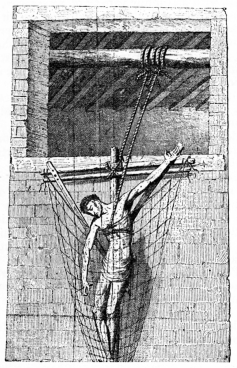
Nothing but an intense religious monomania could have inspired the
singular self-crucifixion of the Venetian shoemaker, Matteo Lovat. I
have been able to procure an authentic picture of this strange
performance which is reproduced below. Shortly afterwards Lovat died in
an asylum.[316]

One patient, G——, was a poor peasant woman, utterly uneducated, in
whose family pellagra and insanity were both hereditary. In the long
isolation required by her state, she developed great skill (quite
unknown before her illness) in embroidering on linen, with coloured
threads pulled from her clothing, an extraordinary number of figures,
which were faithful representations of her delusions. Her autobiography
is, so to speak, traced in this embroidery; in every piece of work she
has represented herself, sometimes struggling with the nurses or the
nuns, sometimes herding cows, or occupied with other rustic work.
Elsewhere she would depict tables spread for meals, with an infinite
variety of accessories. But the most singular thing is that the outlines
are drawn with a clearness which would be the envy of a professional
caricaturist; no shading whatever, four stitches, representing nose,
eyes, and mouth, were arranged with so much artistic judgment as to show
clearly the individual expression of each face.
Another artist in the same line, though of less striking gifts, is a
certain I——, suffering from moral insanity, who shows numerous
degenerative symptoms. She, too, embroiders figures of men and women
with considerable skill, but always in harmony with her perverted sexual
tendencies.[317]
Originality.—Disease often develops (as we have already seen in the
case of insane authors) an originality of invention which may also be
observed in mattoids, because their imagination, freed from all
restraint, allows of creations from which a more calculating mind would
shrink, for fear of absurdity, and because intensity of conviction
supports and perfects the work.
At Pesaro there was a woman who drew, or embroidered, by a method
peculiar to herself, unravelling cloth, and fastening the threads on
paper by means of saliva.
Another embroideress, formerly given to drink, executed butterflies
which seemed to be alive. She had applied to white embroidery the
methods of coloured work, and was able to produce marvellous effects of
light and shade.
At Macerata a patient, with a number of pipe-stems, constructed a model
of the front of the asylum; another had the idea of representing a song
in sculpture. At Genoa, a dementia patient carved pipes out of coal.
One Zanini, at Reggio, constructed a boot which was unique of its kind,
so that, as he said, no one else should be able to put it on. This
exceptional foot-gear was open on one side, and tied up with string, its
edges were ornamental, and worked with hieroglyphics.
M. L—— of Pesaro was constantly making requests to leave the asylum.
When told that there was no means of transporting him to his home, he
set about constructing one for himself. This was a four-wheeled cart,
with an upright pole, at the top of which was a pulley with a rope
running through it. One end of the rope was fastened to the axle of the
fore-wheels, the other to that of the hind-wheels. An elastic cord was
attached to the rope for a distance of four or five centimetres, and by
pulling this, first at one end and then at the other, a person standing
on the cart was able to make the wheels go round.[318]
In many arabesques drawn by a megalomaniac, one can trace, carefully
hidden among the curves, sometimes a ship, sometimes an animal, a human
head, or a railway train, or even landscapes and towns; though the
essential character of arabesques is the absence of the human figure.
The best asylums of Italy have sent to the exhibitions of Siena and
Voghera, models in relief of their respective buildings, admirably
executed by some of the patients. That of the asylum at Reggio could be
taken to pieces, and showed the inside arrangements, staircases, rooms,
with their furniture, &c., all carefully finished. Even the trees, I am
told, were copied accurately from nature.
A canon, who had no technical knowledge of architecture, began, after an
attack of melancholia, to construct with cardboard and papier-mâché,
models of temples and amphitheatres, which excited great admiration.
Dr. Virgilio has made me a present of some portraits of Italian
specialists, nearly all of them exceedingly lifelike, the work of a
melancholia patient. The note of originality only comes out in some
accessory introduced into each picture, such as a fly, or a butterfly,
repeated persistently in every copy, or in the way in which the artist’s
name is worked into the painting, in vertical lines so as to form some
sort of decorative ornament.
A work of extreme though useless skill and originality is the
self-crucifixion of Lovat, already mentioned.
“The monomaniac, King Louis of Bavaria, was the first who entirely
understood Wagner. His prodigality in spending money, and the creation
of the theatre at Bayreuth—one of his most original conceptions—have
been known for years, but the greatest manifestation of his genius is
known only to a few. Three castles, three palaces of splendid and
indescribable beauty, rose from the earth, as if by enchantment. He
superintended even the minutest details himself. King Louis’s madness
was a dream with his eyes open. By himself, in the space of ten years,
he accomplished more than any twenty sovereigns, aided by the artistic
genius of the best ages. Certainly no one, at the present day, could
produce another such hall, 75 mètres in length (without counting the two
rooms at either end, which would bring the length up to 100 mètres), a
gallery illuminated by 17 great windows, 33 rock-crystal chandeliers, 44
candelabra, and who knows what else!”[319]
Eccentricity.—But even originality ends by degenerating, in all, or
nearly all, into mere eccentricity, which only seems logical when one
enters into the idea of the delusion.
Simon remarks that, in manias of persecution, and in paralytic
megalomania, the greater the mental disturbance the livelier the
imagination, and the more grotesque the fancies engendered by it. He
mentions the case of a painter, who declared that he could see the
interior of the earth, filled with houses of crystal, illuminated by
electric light, and pervaded by sweet odours. He described the city of
Emma, whose inhabitants have two noses and two mouths—one for ordinary
food, the other for sweet things—a silver chin, golden hair, three or
four arms, and only one leg resting on a little wheel.[320]
These bizarre creations arise in great part from the strange
hallucinations to which the patients are subject. We may see an example
of this in the four-legged and seven-headed beasts painted by Lazzaretti
on his banners. A melancholiac made himself a cuirass of stones, to
defend himself against his enemies. Another would continue all day
drawing the map of the stains left by damp on the walls of his room.
Later on it was discovered that he believed those lines to represent the
topography of the regions which God had given him to rule over on earth.
This is one of the reasons why, sometimes, greater excellence in art is
found in cases of dementia, than in those of mania or melancholia.
Symbolism.—Another characteristic trait of art in the insane is the
mingling of inscriptions and drawings, and, in the latter, the abundance
of symbols and hieroglyphics. All this closely recalls Japanese and
Indian pictures, and the ancient wall-paintings of Egypt, and is due in
part to the same cause at work in these—the need of helping out speech
or picture, each powerless by itself to express a given idea with the
requisite energy.
This cause is very evident in a case communicated to me by Dr. Monti, in
which an architectural design, though well and accurately drawn, was
rendered incomprehensible by the numerous inscriptions, often in rhyme,
which had been crowded into it by its author, an aphasiac, who had
suffered from dementia for fifteen years.
In some megalomaniacs this happens through the fancy they have for
expressing their ideas in a language different from that of ordinary
human beings. Such was the case of the master of the world, fully
treated of elsewhere, by M. Toselli and myself.[321]
The patient in question was a peasant named G—— L——, 63 years of age,
with an easy and confident bearing, prominent cheek-bones, spacious
forehead, and expressive and penetrating look. Cranial capacity 1544,
index 82, temperature, 37° 6´.
In the autumn of 1871 he became noted for vagrancy and excessive
loquacity; he stopped the most notable persons of the village in public
places, complaining of injustice which he alleged himself to have
suffered; he destroyed the vines, devastated the fields, and rushed
about the streets, threatening terrible vengeance.
Gradually he began to identify himself with the Deity, and believe
himself ruler of the universe, and preached in the Cathedral of Alba on
his lofty destiny. In the asylum he remained calm as long as he was able
to believe that his power was recognized by every one, but at the first
show of opposition he threatened—in the character of ruler and
personification of the elements, calling himself sometimes the son,
sometimes the brother, or at others the father of the sun—to convulse
the world with earthquakes, overthrow kingdoms and empires, and erect
his throne on the ruins. He was tired, he said, of keeping up so many
armies, and providing for so many idle persons; it would be but just if
the authorities and the rich were at least to send him a large sum of
money, to redeem themselves from what he called “the debts of death.” In
return for this payment he would allow them to live for ever. The poor
ought all to die, as useless persons, and it was preposterous that he
had to support so many madmen in his own palace. He therefore suggested
to the doctor that it would be well to cut their heads off; yet he
waited on them with the greatest unselfishness when they were ill, an
inconsistency which is among the characteristics of paranoia.
He usually bestowed his scanty earnings on some rogue whom he entrusted
with letters and commissions for the other world, addressed to the sun,
the stars, the weather, Death, the lightning, and other powers, whose
help he was in the habit of invoking, and with whom he held confidential
conversations at night. He was quite pleased when some calamity had
desolated the country, this being the beginning of the judgments
threatened by him, and a sign that the weather, the sun, or the
lightning, had obeyed him.
He kept in a trunk some roughly-fashioned crowns which, he said, were
the true royal and imperial crowns of Italy, France, and other states.
Those worn by the actual sovereigns of these states were no longer of
any value, having been usurped by wretched men, doomed to speedy
destruction, unless they paid him their debts of death, in letters of
exchange to the amount of several hundred millions.
But his most characteristic eccentricities were the writings in which
his delusion was manifested. Although able to read and write, he scorned
the use of the ordinary kind of writing, and, in a character of his own,
scrawled letters, orders, and cheques, to the Sun, to Death, or to the
civil and military authorities. He always had his pockets full of these
documents. His writing consisted mainly of large capital letters, mixed,
at intervals, with signs and figures indicating objects or persons. The
words are usually separated by one or two large dots, and he only wrote
some of the letters of each word (nearly always the consonants) without
any respect for the laws of syllabation. In some of his writings, the
alphabet almost entirely disappears.
For instance, in order to demonstrate his effective power, he sketched a
series of rough figures representing the elements and powers which were
his familiar spirits,—the army ready, at a sign from him, to make war
on all terrestrial powers contending with him for the dominion of the
world. These are—1. The Eternal Father. 2. The Holy Spirit. 3. St.
Martin. 4. Death. 5. Time. 6. Thunder. 7. Lightning. 8. Earthquake. 9.
The Sun. 10. The Moon. 11. Fire (his minister of war). 12. A very
powerful man who has lived ever since the beginning of the world, and is
G. L.’s brother. 13. The Lion of Hell. 14. Bread. 15. Wine. The whole is
followed of his usual signature—a two-headed eagle. Each of these
powers is also indicated by letters placed beneath the figures, thus,
the 1st=P. D. E.; the 2nd=L. S. P. S., &c.
This mixture of letters, hieroglyphics, and figurative signs,
constitutes a kind of writing recalling the phonetico-ideographic stage
through which primitive peoples (the Mexicans and Chinese certainly)
passed, before the discovery of alphabetic writing.
Among the savages of America and Australia, writing consists in a more
or less rough kind of painting; e.g., to indicate, “would that I had
the swiftness of a bird,” they depict a man with wings instead of
arms.[322] These characters are not so much writing as aids to memory
still further connected together and vivified by traditional songs or
stories.
Some tribes, however, have attained to a somewhat less imperfect mode,
which resembles our rebus; for instance, the Maya of America, to
signify a physician, painted a man with a herb in his hand and wings to
his feet; an evident allusion to the rapidity with which he is obliged
to hasten to those who require him. Rain is represented by a
bucket.[323]
The ancient Chinese represented malice by means of three women,
light by the sun and moon, and the verb to listen by an ear between
two doors.
This primitive writing shows us that the rhetorical tropes and figures
of which our pedants are so proud, are expressions of poverty rather
than wealth on the part of the intellect. In fact, they are frequently
found in the speech of idiots and of educated deaf-mutes.
After having used this system for a considerable time, some more
civilised races, such as the Chinese and Mexicans, took another step
forward. They classified the more or less picturesque figures referred
to above, and succeeded in forming ingenious combinations which, without
directly representing the idea, indirectly suggested a reminiscence of
it, as in our charades. Besides this, to prevent any uncertainty on the
reader’s part, they placed either before or after these signs a sketch
of the object to be expressed—a scanty remnant of the actual
picture-writing of a previous age. This certainly took place at a time
when—the language once being fixed—it was observed how some people, in
writing down a given sign, recalled the sound of the words which it
suggested. Thus Itzicoatl, the name of a Mexican king, was written by
drawing a serpent (Coatl, in Mexican) and a lance (Itzli); thus, too, in
Chinese, the character tschen represents boat, lance, and
table.[324]
Our megalomaniac, by reviving this custom, affords one more proof that,
in the visible manifestation of their thoughts, the insane frequently
revert (as also do criminals) to the prehistoric stage of civilization.
In the present case, it is quite easy to understand by what mental
process G—— came to use this mode of writing. Under the megalomaniac
delusion, believing himself lord of the elements, superior to all known
or imaginable forces, he could not make himself properly understood with
the common words of ignorant and incredulous men; neither could ordinary
writing suffice to express ideas so new and marvellous. The lion’s
claws, the eagle’s beak, the serpent’s tongue, the lightning-flash, the
sun’s rays, the arms of the savage, were much worthier of him, and more
calculated to inspire men with fear and respect for his person.
Nor is this an isolated case. One quite analogous to it is described by
Raggi in his excellent study of the writings of the insane. Prof.
Morselli has furnished me with another and still more interesting
instance.
“The patient A. T——” he writes, “was a joiner and cabinet-maker; he
had a certain skill in wood-carving, and his furniture was much sought
after.[325] About seven years ago he was attacked with mental disease,
apparently melancholia, and tried to commit suicide by throwing himself
from the roof of the town hall. He is now subject to attacks of
excitement with systematized delusions. His predominant ideas are
political—republican and anarchist—on a certain groundwork of
ambition. He fancies himself changed into some great criminal; sometimes
he is Gasperone, sometimes Il Passatore, at others Passanante. He is
always drawing or carving, and his work generally takes the form of
trophies or allegorical figures.
“The most curious of all these is a piece of carving which represents a
man dressed as a soldier, provided with wings, and standing on an
inlaid pedestal covered with allegorical inscriptions. This figure has a
trophy on its head, and other objects are carved on or around it, each
of which expresses emblematically some one of T——’s delusions. For
instance, the wings recall the fact that, when his first attack came on,
he was in the square at Porto Recanati, selling his carvings, among
which were several figures of angels, at a soldo a-piece. The ‘Medal of
the order of the Pig’ is a token of contempt, wherewith he would like to
decorate all the rich and powerful of the earth. The helmet, with a
lantern hanging to the vizor (a reminiscence of Offenbach’s Brigands),
symbolises the gendarmes who escorted him to the asylum. The cigar
placed crosswise (note the position) represents his disdain for kings
and tyrants; and the position of the leg recalls a fracture of that limb
sustained by him in his attempt at suicide.
“The inscriptions on the pedestal are scraps of verse or extracts from
newspapers which T—— is always quoting, and to which he attaches some
mysterious significance. They always, however, refer to the state of
slavery to which he is reduced (i.e., his detention in the asylum),
and the vengeance he will one day wreak on his captors.
“The most remarkable thing, however, is the trophy resting on the head
of the figure, which is the graphic expression, so to speak, of a
song[326] either written by him or adapted from other popular poetry.
Each phrase of the song has its symbol in the trophy. Thus the word
poison in the first verse is represented by the cup; the two daggers
are likewise present; the end of life and the tomb are figured by a
kind of sarcophagus or closed chest; love by two sprays of flowers.
The bell of the second stanza is easily recognisable; the funereal
music are the two trumpets crossed, lower down. The cross of the
third stanza, and the priest (represented by a clerical hat) are not
forgotten. It is curious that the gallows should be wanting to
complete this trophy. The spoon and fork, by the by, are T——’s
favourite implements. They denote that he eats and drinks in slavery,
or, as he says, in a convict-prison; and for this reason, he always
wears a set, carved in wood by himself, in the button-hole of his coat,
or in his cap.”
We may once more remind the reader that savages hand down their history
by associating picture-signs with poetry.
A most interesting example of elaborate symbolic faculty in a
monomaniac, combined with higher artistic power than is usually found
among the insane, has been recorded with very full illustrations by Dr.
William Noyes.[327] This patient studied art at Paris under Gérome and
returned to America to become an illustrator of books and magazines. He
developed systematic religious delusions, and frequently worked them out
in very beautiful and artistic shapes, nine of which, all executed in
the asylum at which he was confined, are here reproduced. The circular
design is one of a series of twelve charts (one for each of the tribes
of Israel) illustrating the progress of the Holy Spirit. They were all
delicately coloured in water colours, the fine shading making it very
difficult to give in black and white an adequate idea of the beauty of
the original.
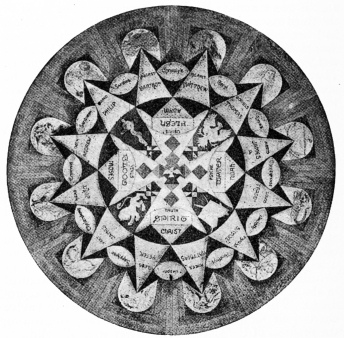
“In the centre is the dove representing the Holy Spirit, and surrounding
it are seven different crosses [St. Andrew, St. Colomba, St. George, St.
Michael, The Prophet, St. Evangeli, Royal Priesthood], and a close study
will show the seven crosses, most ingeniously worked together. It is
probable that in looking at the design closely for the first time one
will suddenly see a new cross take shape before his eyes, and this
indeed is what the patient says occurs with him. In describing the
crosses he will say, for example, that in drawing the cross of St.
Andrew the lines suddenly took a new shape and he found he had also
made a cross of St. Michael. This to him is a matter of deep
significance, and he feels that, his work is directly controlled by a
higher power, and that the work of his fancy is really inspired.
“Outside these central crosses are the names of three ancient deities
who were each characterized by some special attribute, and under these
the parts of the body that the artist conceives these deities especially
to have represented, and then comes the name of the Biblical personage
in whom these elements were finally exemplified and embodied. To the
left of the dove is Venus, representing Blood, exemplified in Moses;
above is Osiris, representing Flesh, embodied in Adam; and to the right
Psyche, representing Water, typified in Noah. These three are but the
gross and material parts of Man, representing indeed necessary steps in
his progress through life, but secondary and subordinate to the higher
part of his nature represented by Truth and the Spirit—which receive
their ultimate embodiment in Christ.
“The Lion denotes Might, and the Eagle signifies Emulation; but it is
uncertain just what symbolism is connected with the serpent twining
round the cross, and the open book crossed by a sword and pen, unless
indeed this last may mean the Bible with the emblems of peace and war
lying quietly within it, and it seems not unlikely that the serpent is
emblematic of the Betrayal. For the rest of the design, however, we need
make no inferences, as it corresponds closely with his description.
“Outside of the circle enclosing the crosses are the seals, sealing the
Holy Spirit. In the large light triangles, or rather rays of the sun,
are given the names of the twelve apostles, forming the Seal of the
Prophet. Above these, in the same space, are the signs of the zodiac in
the extreme points of the triangle, with the names of the parts of the
body underneath, that these signs correspond to in the ancient
mythology; this forms the Seal of the Zodiac. Between these large light
coloured triangles are the twelve holy stones, represented as ovals, and
with their names plainly distinguished in the cut, making the Seal of
the Holy Stones. In the small triangles directly above the Holy Stones
are given the names of the twelve tribes of Israel, but the colour of
these in the chart (vermilion) is such that the lettering does not come
out in the photographic negative. This gives the Seal of the Twelve
Tribes. Directly beneath the Holy Stones, filling in the space between
the bottom of each large triangle, is the Seal of the Germ, coloured
dark green, and running down on each side of the top of these large
triangles are small triangles, coloured dark red and forming the Seal of
the Aceldama or Bloody Seal. On the circumference are the names of the
constellations of the zodiac, and directly under these the names of the
corresponding months of the year, and under these again are the
mythological representations of the constellations, Leo (July) being at
the top, and then in order to the right come Virgo (August), Libra
(September), Scorpio (October), Sagittarius (November), Capricornus
(December), Aquarius (January), Pisces (February), Aries (March), Taurus
(April), Gemini (May), Cancer (June). This gives the last sealing of the
Seed, the Seal of the Sun.
“It will be seen that beginning at the circumference at any point and
going toward the centre there is a complete astronomical representation
of the season of the year, first the name of the constellation, then in
succession the month, the constellation depicted pictorially, the sign
of the zodiac and the part of the human body corresponding in the old
astronomy to this sign of the zodiac.”
Of the four designs reproduced together, the first, the Shechinah, or
Light of Love, represents that miraculous light or visible glory which
was to the Jews a symbol of the Divine presence; the second represents
the angel Sandalphon with the Holy Grail at the side and the letters
Alpha and Omega at top (the design must be inverted to make out the
Omega); the third, Sub Rosa, and the fourth, Imp and Frogs, are graceful
fancies which sufficiently explain themselves, as does the Witch.
While working on these sketches, he made at the same time the design for
a book-plate, representing Cupid learning the alphabet, and the entire
design, he says, is full of symbolism—a favourite word with him. Cupid
has his finger on Alpha, signifying the beginning of his education;
above the book is Cupid’s target, with a heart for
the centre, that he has pierced with an arrow, while the full quiver
stands to the right. The curious fish under the Veritas represents the
ΙΧΘΥΣ of the early Christians, while three crosses, symbolic
of the Christian religion, are in the upper left-hand corner, brought
out by heavy shading of the cross lines. On the book of knowledge is
perched the dove, emblematic of purity, while the olive branch at the
left of the book and the palm under the Fool’s Bauble give still other
religious symbols. The lamp of knowledge is burning brightly in front of
Cupid, while at his feet are the square, compass, triangle, and pencils,
symbolizing the designer’s profession.
Minuteness of Detail.—In some insane artists, especially monomaniacs,
we find an opposite characteristic—the exaggeration of particular
details—the general effect being lost in obscurity through their
excessive efforts after verisimilitude. Thus, in a landscape exhibited
among those rejected from the Turin salon, not only was a general view
of the country given, but every separate blade of grass could be
distinguished. In another picture, intended to be very imposing, the
strokes of the brush produced the effect of pencil shading.
Atavism.—Both minuteness and symbolism are themselves atavistic
phenomena; but, in addition to them, there may be noted (in a large
number of cases) a
ARABESQUES BY PARANOIAC ARTIST.
total absence of perspective, while the rest of the execution shows
clearly enough that the author is not wanting in artistic sense. One
would take him to be a true artist, but one brought up in China or
ancient Egypt. Here we have evidently a kind of atavism explicable by
arrested development of some one organ, and a corresponding backwardness
in the products of that organ. A French captain, suffering from
paralysis, drew figures stiff as Egyptian profiles. A megalomaniac of
Reggio executed a coloured bas-relief, in which the disproportionate
size of the feet and hands, the extreme smallness of the faces, and the
stiffness of the limbs, completely recall the work of the thirteenth
century. Another patient, at Genoa, carved bas-reliefs on pipes and on
vases, exactly similar to those of the Neolithic Age.
Raggi has sent me some flints carved by a monomaniac entirely ignorant
of archæology, which, in the choice of figures and emblems, recall the
style of Egyptian and Phœnician amulets. In these instances we see the
influence of similar psychical conditions at work.
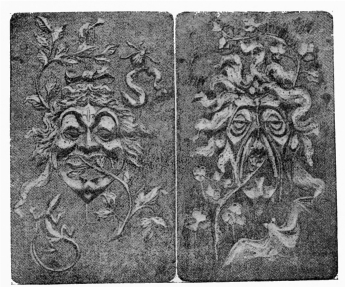
Arabesques.—In some few patients, M. Toselli has called my attention
to a singular predilection for arabesques and ornaments which tend to
assume a purely geometric form, without loss of elegance. This is the
case with monomaniacs; in cases of dementia and acute mania there
prevails a chaotic confusion, which, however, does not always imply
absence of taste. I have seen an instance of this in a kind of ship, the
work of a dementia patient, composed of an enormous number of little
slips of wood, brilliantly coloured, very thin, and intertwined in an
infinite variety of ways, the general effect being very graceful.
Obscenity.—In some work done by erotomaniacs, paralytics, and
demented patients, the salient characteristic, both of the drawings and
of the verses, is the most shameless indecency. Thus a cabinet-maker
would carve virile members at every corner of a piece of furniture, or
at the summits of trees. This, too, recalls many works of savages and of
ancient races, in which the organs of sex are everywhere prominent. A
captain at Genoa was fond of drawing scenes in a brothel. In many the
obscene character is marked by the most singular pretexts, as though it
were demanded by artistic requirements. A monomaniac priest used to
sketch his figures nude, and then artfully drape them by means of lines
which revealed the generative organs. He defended himself against
criticism by saying that his figures could only appear indecent to those
who were in search of evil.
M—— illustrated his strange and often beautiful verses with
innumerable daubs, representing animals of monstrous forms struggling
with men and women, or monks and nuns, naked, in the most shameless
attitudes.
In others the indecency is, if possible, still more evident, especially
in cases of paralytic dementia. I remember an old man who used to draw a
vulva on the address of his letters to his wife, surrounding it with
obscene couplets in dialect.
It is a curious coincidence that two artists—one at Turin and the other
at Reggio—who were both megalomaniacs, should both have had sodomitic
instincts, which they combined with the delusion of being deities, and
lords of the world, which they had created and emitted from their
bodies. One of them (who, nevertheless, had a real artistic sense)
painted a full-length picture of himself, naked, among women, ejecting
worlds, and surrounded by all the symbols of power. This repeats, and at
the same time explains, the Ithyphallic divinity of the Egyptians.
Criminality and Moral Insanity.—In this connection it is important to
notice that the greater number of these artists show, in addition to
their other forms of mania, a marked tendency to moral insanity,
especially in the form of unnatural vice. The painter who produced the
picture of “Delirium” was a pederast. The man who constructed the
marvellous model of the Reggio Asylum, already alluded to, was neither
draughtsman, sculptor, nor engineer. He was a madman, and, in addition,
a thief, with unnatural tendencies. This man, whenever the fancy took
him, escaped from the asylum, wandered about for some days, began to
steal when he had exhausted the small amount of money he had about him,
and when imprisoned declared himself a lunatic, and so got acquitted
and sent back to Reggio, when, after a short interval, he would repeat
the same line of conduct.
Dr. Tamburini told me that he, too, had been struck by the co-existence
of artistic faculty and moral insanity in these patients.
Uselessness.—A characteristic common to many is the complete
uselessness of the work to which they devote themselves; and here I
recall once more Hécart’s dictum:—
“C’est le travail des fous d’épuiser leurs cervelles
Sur des riens fatigants, sur quelques bagatelles.”[328]
A Genevan, affected by persecutory monomania, spent years in
embroidering on egg-shells and lemons. Though her work was most
beautiful, it could be of no advantage to her, for she kept it jealously
concealed; and I myself, though she was very fond of me, never saw any
of it till after her death.
Here we have, as in the case of artists of genius, the love of truth and
beauty for their own sake alone, only that the aim is reversed.
Sometimes the work done, though very useful in itself, is of no
advantage to the artist, and has no connection with his profession. Thus
a captain, who had become insane, presented me with the model of a bed
for violent patients, which, I believe, would be extremely useful in
practice. Two other patients, together, made, out of a piece of
beef-bone, some very neat match-boxes, ornamented with carvings in
relief, which could be of no profit to themselves, since they refused to
part with them for money.
There are, however, some exceptions. A melancholiac patient, with
homicidal and suicidal tendencies, manufactured himself a very
serviceable knife, fork, and spoon—metal ones not being allowed
him—out of the bones which remained over from his dinner. A café-keeper
at Colligno, a megalomaniac, compounded excellent liqueurs out of the
scraps left over from meals, though of the most different kinds of food.
A criminal lunatic constructed himself a key out of a number of small
pieces of wood joined together. I do not count among these examples
those who have prepared themselves real cuirasses of iron and stone—a
piece of work in relation to the special delusion of persecutions, and
implying an amount of labour out of proportion to the advantage
obtained.
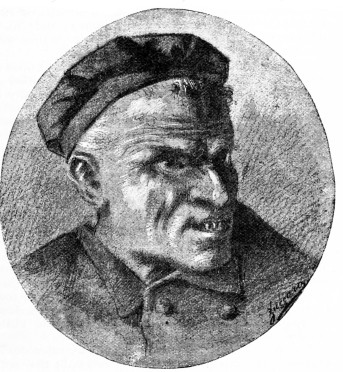
Insanity as a subject.—Many choose insanity as the subject of their
paintings. Professor Virgilio has furnished me with a very curious
portrait of an insane patient at the moment of attack—the eyes rolling,
the hair on end, the arms extended. Under his feet is the epigraph:
“Delira” (“He is raving”). This is the work of an alcoholic pederast.
I think that a sane artist would have some difficulty in painting a
closer likeness of delirium. This reminds me how frequently I have
found, among the poets of asylums, the tendency to describe insanity;
and it has been a favourite theme with great poets who have suffered
from ill-health—Tasso, Lenau, Barbara, Musset. Mancini, immediately
after his recovery, painted a woman offering for sale the picture
executed by a madman; and Gill, in the hospital of Sainte-Anne, painted
a raving maniac with terrible truth to nature.[329]
Absurdity.—One of the most salient characteristics of insane art is,
as might be expected, absurdity, either in drawing or colouring. This is
especially noteworthy in some maniacs, owing to the exaggerated
association of ideas, through which the connecting links (which would
serve to explain the author’s conception) are totally lost. Thus, an
artist painted a “Marriage at Cana,” with all the figures of the
apostles exceedingly well drawn; but in place of the figure of Christ
was a large bunch of flowers.
Paralytic patients draw objects without any sense of proportion; their
hens are the size of horses, and their cherries of melons; or, while
striving after perfection in the design, the execution is merely
childish. One, who believed himself a second Horace Vernet, drew horses
by means of four straight strokes and a tail.[330] Another drew all his
figures upside down. Other dementia patients, owing to the same amnesia
which is apparent in their speech, leave out the most essential points
of their conception, like M—— at Pesaro, who made an excellent drawing
of a general, seated, but forgot the chair. (Frigerio.)
Imitation.—There are some who are very successful in imitation, but
can produce nothing original; they will, for instance, copy the façade
of the asylum, or heads of animals, with the minute accuracy of detail
which characterizes primitive art. In this branch I have seen successful
work done by cretins and idiots, the latter drawing in exactly the same
manner as primitive man.
Uniformity.—Many continually repeat the same idea; thus one,
mentioned by Frigerio, filled sheets of paper with a bee gnawing the
head of an ant; another, who believed that he had been shot, would paint
nothing but fire-arms; a third confined himself to arabesques.
Summary.—These traits explain the instances of partial perfection to
be found in dementia patients; for a repetition of the same movement
tends to bring it nearer and nearer to perfection. At other times, as we
have seen in the extempore poets and authors of the asylum, it is the
tenacity and energy of the hallucinations which makes a painter of a man
who was never one before. Blake was able to picture to himself, as
living and present, persons already dead, angels, &c. This was the case,
also, with the strange insane poet, John Clare, who believed himself a
spectator of the Battle of the Nile, and the death of Nelson; and was
firmly convinced that he had been present at the death of Charles I. In
fact, he described these events with such remarkable fidelity and
accuracy, that it is scarcely probable he could have done it so well had
he been in full possession of his reason—the more so, as he was
entirely without culture.[331] This explains why insane painters and
poets are so numerous. It is easy to reproduce clearly what one sees
clearly. Moreover, the imagination is most unrestrained when reason is
least dominant; for the latter, by repressing hallucinations and
illusions, deprives the average man of a true source of artistic and
literary inspiration.
For the same reason, too, art itself, may, in its turn, encourage the
development of mental disease. Vasari relates that one Spinelli, a
painter of Arezzo, having attempted to paint the deformity of Lucifer,
the latter appeared to him in a dream and reproached him with having
made him so ugly. The painter was so affected by this apparition as to
fall seriously ill; and it continued to haunt him for years.[332]
Music in the Insane.—Musical ability is often diminished in those
who, previous to their illness, cultivated this art with passion. Dr.
Adriani observed that musicians, under his care for insanity, almost
entirely lost their powers. They could still play any piece, but it was
done quite mechanically and without expression. Other dementia patients
would play the same piece, sometimes even a few phrases, over and over
again.
Donizetti, in the last stage of dementia, no longer recognized his
favourite melodies. His last works show traces of that fatal influence
which critics have also observed in Schumann’s symphony of the “Bride of
Messina,” composed during his attacks of insanity.[333]
These facts, however, do not contradict our assertion that insanity
awakens new artistic qualities in persons not previously gifted in that
way; they only show that (as we have seen in the case of professional
painters) it can give no additional power or skill to those who already
possessed them when attacked by disease.
A megalomaniac—formerly a syphilitic patient—under the care of Dr.
Tamburini, sang beautiful airs when under excitement, at the same time,
instead of playing an accompaniment, she improvised, on the pianoforte,
two distinct motives which had no connection with each other or the air
she was singing. This fact confirms the observations of Luys as to the
independent action of the cerebral hemispheres.
A young man attacked by pellagra, who recovered in my hospital,
composed expressive and original melodies.
M. Raggi told me that he had had under his care a melancholic patient
who, during her attacks, played without enthusiasm, and even with
repugnance, but, when the fit passed off, would spend whole days at the
piano, and execute the most difficult partitions with a truly artistic
enthusiasm. In the same way, a paralytic showed, through the whole
course of his illness, a genuine musical mania, during which he imitated
all instruments, and agitated himself, in frantic enthusiasm, at the
piano passages.
Raggi also observed a paralytic dementia patient who, after breaking his
thigh-bone by a leap from a window, rendered every bandage which could
be devised useless by singing, for days together, motives from Il
Trovatore at the top of his voice, and accompanying his singing with
abrupt rhythmical movements of the pelvis. A fancy for monotonous
chanting also showed itself in another paralytic, who believed himself
to be a great admiral.
In maniacs, acute and joyous notes predominate, and, still more, the
repetition of the rhythm.
Every one who has paid even a short visit to an asylum has noticed the
frequency of singing and shouting and “high and thin voices, and with
them a sound of hands.”[334] Nor is it hard to understand this, if we
remember how Spencer and Ardigò have shown that the law of rhythm is the
most general form under which, in the whole of nature, energy is
manifested, from the crystal to the star, or to the animal organism.
Man, therefore, only follows a general organic law in giving way to this
impulse, which he does the more readily the less he is controlled by
reason. This explains the number of poets of the new school who are
found in asylums. This is the reason why savage nations have a natural
inclination for music; and a missionary told Spencer that many to whom
he taught the Psalms, with music, in the evening, could repeat them by
heart on the following day.
Savages, in speaking, make use of a sort of monotonous chant analogous
to our recitative. Primitive poetry was always sung, whence all the
different words connected with singing applied to poetry and poets. The
mysterious magic formulas and recipes of the ancients[335] were also
sung, or chanted, whence the word “enchantment.” Even at the present
day, in the neighbourhood of Novi and Oulx, I have heard peasant-women,
in making inquiries of one another, modulate their voices in true
musical rhythm. Modern Improvvisatori do not seem able to produce
their verses except when singing, and agitating all their muscles.
It must be remembered that, according to the observations of Herbert
Spencer,[336] “the act of singing employs and exaggerates the signs of
the natural language of passion. Mental excitement is transformed into
muscular energy. An infant will laugh and bound in its nurse’s arms at
the sight of a brilliant colour, or the hearing of a new sound.” Strong
sensations or painful emotions cause us to gesticulate; in short, they
excite the muscular system, which is acted upon in proportion to the
intensity of the sensations. Slight pain calls forth a groan, greater
pain a cry: the pitch of the voice varies with the force of the emotion,
so that, in the strongest emotions, it rises to the octave, or higher;
and singing is always involuntarily accompanied by tremors and
agitations of the muscles.
What could be more natural than that, in the conditions in which the
emotions are most energetic, and so frequently atavistic, as is the case
in insanity, these tendencies should be reproduced on a larger scale?
This, too, explains why so many morbid men of genius should be
musicians: Mozart, Schumann, Beethoven, Donizetti, Pergolese, Fenicia,
Ricci, Rocchi, Rousseau, Handel, Dussek, Hoffmann, Glück, Petrella.[337]
Musical creation is the most subjective manifestation of thought, the
one most intimately connected with the affective emotions, and having
less relation to the external world than any other, which causes it to
stand more in need of the fervent but exhausting emotions of
inspiration.
Perhaps the study of these peculiarities of art in the insane, besides
showing us a new phase in this mysterious disease, might be useful in
æsthetics, or at any rate in art-criticism, by showing that an
exaggerated predilection for symbols, and for minuteness of detail
(however accurate), the complication of inscriptions, the excessive
prominence given to any one colour (it is well known that some of our
foremost painters are great sinners in this respect), the choice of
licentious subjects, and even an exaggerated degree of originality, are
points which belong to the pathology of art.
Definition—Physical and psychical characteristics—Their literary
activity—Examples—Lawsuit mania—Mattoids of genius—Bosisio—The
décadent poets—Verlaine—Mattoids in art.
WE have just been considering, in madmen, the substantial character of
genius under the appearance of insanity. There is, however, a variety of
these, which permits the appearance of genius and the substantial
character of the average man; and this variety forms the link between
madmen of genius, the sane, and the insane properly so called. These are
what I call semi-insane persons or mattoids.
This variety constitutes, in the world of mental pathology, a particular
species of a genus distinguished by Maudsley as “odd, queer, strange”
persons of insane temperament, and previously by Morel. Legrand du
Saulle, and Schüle (Geisteskrankheit, ii., 1880) regard them as
hereditary neurotics, Raggi as neuropathics, and now many as
paranoiacs—a terminology which produces a hopeless confusion.
The graphomaniac, representing the commonest variety, has true negative
characteristics—that is to say, the features and cranial form are
nearly always normal (Bosisio, Cianchettini, F——, P——, &c.). His
characteristics are not the result of heredity; at most, he is the son
of a man of genius (Flourens, Broussais, Spandri, Knester, &c.). This
form of aberration is most frequently found in men; I only know of one
exception in Europe—Louise Michel—and it appears more especially in
great cities, worn out with civilization. The mattoid shows far fewer
signs of degeneracy than the insane properly so called:—Of 33 mattoids
only 21 showed degenerative characters, and of these last 12 had 2, 2
were found to have 3, there were 2 with 4, and only 1 with 6.
Another negative characteristic is the survival of family affection, and
even of that for the human race in general, sometimes reaching such a
point as to become exaggerated altruism; though, in many cases, vanity
enters largely into the composition of this virtue. Thus Bosisio thinks
of and provides for the well-being of posterity, and even of the dead.
Thus D—— loves his wife and grandchildren, and constantly works for
his family; Cianchettini supported a deaf and dumb sister; Sbarbaro,
Lazzaretti, Coccapieller, adored their wives.
In prison, a few days ago, I had occasion to perform the operation of
blood-transfusion, and wasted much time in trying to find a healthy
individual from whom to take the blood. All refused; but a consumptive
mattoid, as soon as he heard of the matter, volunteered for the
operation, and was overwhelmed with shame when I would not make use of
him.
They have an exaggerated conviction of their own personal merit and
importance, with the peculiar characteristic that this opinion shows
itself rather in writing than in words or actions, so that they do not
show irritation at the contradictions and evils of practical life.
Cianchettini compares himself to Galileo and to Jesus Christ; but sweeps
the barrack-stairs. Passanante proclaims himself President of the
Political Society while working as a cook. Mangione classified himself
as a martyr to Italy and to his own genius; yet he condescended to act
as a broker. Caissant claimed to be a cardinal, but, in the meantime, he
was a clever parasite, and made large profits through his very insanity.
The shepherd Bluet believed himself to be an apostle and count of
Permission, and, like the author of Scottatinge, deigned to address
himself to none but royal personages. Yet he did not refuse to carry on
the trade of a horse-breaker.
Stewart, the eccentric author of the New System of Physical
Philosophy, who travelled all over the world to discover the polarity
of truth, asserted that all the kings of the earth had entered into an
alliance to destroy his works. He therefore gave the latter to his
friends, with the request to wrap them up well, and bury them in remote
localities,—never revealing the latter, except on their death-beds.
Martin Williams—brother of that Jonathan Williams, who, in an attack of
insanity, set fire to York Minster, and of John Williams who struck out
a new line in painting—published many works to prove the theory of
perpetual motion. After having convinced himself by means of thirty-six
experiments of the impossibility of demonstrating it scientifically, it
was revealed to him in a dream that God had chosen him to discover the
great cause of all things, and perpetual motion; and this he made the
subject of many works.[338]
These persons would not come under the heading of mattoids, if, in their
writings, the earnestness and persistence in one idea which make them
resemble the monomaniac and the man of genius, were not often associated
with the pursuit of absurdity, continual contradictions, and the
prolixity and utility of insanity. One tendency overpowers all
others—one which we find predominant in insane genius: viz., personal
vanity. Thus, out of 215 mattoids, we find forty-four prophets.
Filopanti, in the Dio Liberale, places his father Berillo, a
carpenter, and his mother Berilla among the demigods. He discovered
three Adams, and gives a minute narrative, year by year, of the actions
of each. Cordigliani prepared to insult the Chamber of Deputies in order
to obtain an annuity from the Government, and thought this action much
to his own credit. Guiteau thought he was saving the Republic by the
murder of the President, and had himself called a great lawyer and
philosopher. In the same way Passanante, after having preached the
abolition of capital punishment, condemns the guilty members of the
Assembly to death; and, after having given orders to “respect the forms
of government,” insults the monarchy, makes an attempt at regicide, and
proposes to “abolish all misers and hypocrites.”
A physician, S——, prints a statement that blood-letting exposes to an
excess of light, another announces in two thick volumes, that diseases
are elliptical.
Critics have said, referring to the works of Démons, that his Dialectic
Quintessence and sextessence are a true quintessence of absurdity.[339]
Gleizes affirms that flesh is atheistical. Fuzi (a theologian) asserts
that the menstrual blood has the property of quenching conflagrations.
Hannequin, who used to write in the air with his fingers, and had an
aromal trumpet, by means of which he communicated with the spirits
dispersed through the air, declares that in the future age many men
shall become women and demigods.
Henrion, at the Académie des Inscriptions, advanced the theory that Adam
was forty feet in height, Noah twenty-nine, Moses twenty-five, &c.
Leroux, the celebrated Paris Deputy, who believed in metempsychosis and
the cabbala, defined love as “the ideality of the reality of a part of
the totality of the Infinite Being,” &c., and wished to insert the
principle of the triad in the preamble of his Constitution.
Asgill maintained that men might live for ever, if only they had faith.
It is true that, here and there, some new and vigorous notion emerges
from the chaos of such minds, because the only symptom of genius
developed in them by psychosis is a less degree of aversion to novelty,
or, to employ my own terminology, of misoneism.[340] Thus, for example,
amid the most absurd opinions, Cianchettini has some very fine passages:
“All animals have the instinct of self-preservation, with the minimum of
fatigue, of escaping from troublesome thoughts, and of enjoying the
delights of life; and to obtain these things, liberty is indispensable
to them.
“All animals, except man, gratify and always have gratified these
instincts, and perhaps will always continue to do so. Mankind alone,
constituted as a society, find themselves fettered, and in such a Way
that no one has ever succeeded, not merely in bringing them into a state
of peace and liberty, but even in showing how they may attain this end.
“Well—I propose to demonstrate this proposition. And, as a locked door
cannot be opened without breaking it, save by means of a key or a
pick-lock; so, as man has lost his liberty by means of the tongue,
nothing but the tongue, or its equivalents, can set him free without
injury to his nature.”
Amid the doggerel jargon of the Scottatinge, I find this beautiful
line on Italy—
“Padrona e schiava sempre, ai figli tuoi nemica.”[341]
We shall see, in Passanante’s biography, that sometimes, in his writings
and still more in his speeches, he struck out vigorous and original
ideas which, in fact, led many persons into error as to the nature and
reality of his disease. I may mention the sentence, “Where the learned
lose themselves, the ignorant man may triumph,”—and another, “History
learnt from the people is more instructive than that which is studied in
books.” Bluet distinguishes “the maid from the virgin, in that the first
has the will for evil without the power, and the second has neither the
power nor the will.”
It is natural that mattoids should repeat in their conceptions the ideas
of stronger politicians and thinkers, but always in their own way, and
always exaggerated. Thus Bosisio exaggerates the delicate consideration
of our lovers of animals, and anticipates the ideas of Mlle. Clémence
Royer and Comte on the necessity for the application of the Malthusian
theory. In the same way, Detomasi, a dishonest broker, discovered a
practical application (except for the morbid eroticism which he added to
it) of the Darwinian system of natural selection. Cianchettini wishes to
put Socialism into practice.
But the stamp of insanity is evident, not so much in the exaggeration of
their ideas, as in the disproportion of the latter among themselves; so
that, from some well-expressed and even sublime conception, we pass
suddenly to one which is more than mediocre and paradoxical, nearly
always opposed to the received ideas of the majority, and at variance
with the position and education of the author. In short, we have that by
means of which Don Quixote, instead of extorting our admiration, makes
us smile. Yet his actions, in another age, and even in a different man,
would have been admirable and heroic. In any case, among mattoids,
traits of genius are rather the exception than the rule.[342]
Most of them show a deficiency rather than an exuberance of inspiration;
they fill entire volumes, without sense or savour; they eke out the
commonplaceness of their ideas and the poverty of their style with a
multitude of points of interrogation and exclamation, with repeated
signatures, with special words coined by themselves, as is the habit of
monomaniacs; thus Menke already observed that some mattoids contemporary
with himself had invented the words derapti felisan. Berbiguier
created the word farfiderism. A monomaniac, Le Bardier, wrote a work
entitled Dominatmosfheri intended to show farmers how to obtain double
harvests, and sailors to avoid storms. He entitled himself
Dominatmosfherifateur.[343] Cianchettini invented the travaso of the
idea; Pari invented cafungaia, and morbozoo, and we owe to Wahltuch,
alitrologia and anthropomognotologia, and to G—— lepidermocrinia
and glossostomopatica.
We often find an eccentric handwriting, with vertical lines cut by
horizontal ones and transverse furrows, even with unusually-formed
letters, as in Cianchettini.
They frequently introduce drawings into their sentences, as if to
heighten their force, thus returning (as we have already seen to be the
case with megalomaniacs) to the ideographic writing of the ancients, in
which the figure served as a determining symbol.
Wahltuch published two books on Psychography, a new kind of philosophic
system which, however, has found a serious commentator in a sane
philosopher—which speaks volumes for the seriousness of some
philosophers. According to this system, ideas are represented by so many
images impressed on each of the cerebral convolutions. Thus the symbol
of Physics is a lighted candle; that of alitrology, or the faculty of
judgment, is the nose (or the sense of smell); of ethics, a ring; and of
motion, a fishing-hook. The author, despairing (and with good reason) of
making himself understood in words, philosophises with his pencil, and
has crammed his book with diagrams of brains covered with such
figurative signs.
In order to prove the applicability of these principles to literature,
he has presented us with a tragedy—Job—in which the characters have
their heads covered with similar signs, and chant verses worthy of the
system, e.g., “O that I could separate the two united conceptions of
myself and impiety. I am just. Satan is impious.”[344]
The Jesuit missionary, Paoletti, wrote a book against St. Thomas, and
illustrated it with a drawing of the vessels used in the Tabernacle, so
as to determine the future condition of the sons of Adam with regard to
predestination. The Divine and human wills are figured as two balls
revolving in opposite directions, and finally meeting at a common
centre.
The titles of all their works show an exuberance which is really
singular. I possess one of eighteen lines, not counting a note included
in the title-page itself, and intended to explain it. A socialistic work
published in Australia, by an Italian, and in pure Italian, has a title
arranged in the shape of a triumphal arch.
It is precisely in the title-page that nearly all of them at once betray
the taint of madness. This example—from the work of the mattoid
Démons—will suffice: “The demonstration of the fourth part of nothing
is something; everything is the quintessence extracted from the quarter
of nothing and that which depends on it, containing the precepts of the
holy, magic, and devout invocations of Démons, to discover the origin of
the evils which afflict France.”
Many have the crotchet of mixing up with their sentences accumulated
series of numbers, which is also sometimes done by paralytics. In a mad
production of Sovbira’s, entitled “666,” all the verses are accompanied
by the number 666. The strange thing is that, at the same time, a
certain Porter, in England, had published a work on the number 666,
declaring it the most exquisite and perfect of numbers.[345] Lazzaretti,
too, had a singular partiality for this number. Spandri, Levron, and
C—— have a similar preference for the number 3. A special
characteristic found in mattoids, and also, as we have already seen, in
the insane, is that of repeating some words or phrases hundreds of times
in the same page. Thus, in one of Passanante’s chapters, the word
riprovate occurs about 143 times.
Some have had special paper manufactured for their works, like Wirgman,
who had it made with different colours on the same sheet, at an enormous
increase of expense, so that a volume of four hundred pages cost him
over £2,200 sterling. Filon had every page of his book of a different
colour.
Another characteristic is that of employing an orthography and
caligraphy peculiar to themselves, with words in large type or
underlined. They will sometimes write even private letters in double
column, or with vertical lines traversed by horizontal and sometimes by
diagonal ones. They sometimes underline one letter in preference to
others in the same word (Passanante), or they write in detached verses
like those of the Bible, or introduce points after every two or three
words, as in the MS. (in my possession) of a certain Bellone, or
parentheses, even one within the other, as Madrolle used to do, or notes
upon notes, even in the title-page, as in the case of Cas—— and of
La——. The latter (a University professor) in a work of twelve pages
has nine consisting of notes alone.
Hepain invented a physiological language, which consists in the main
of our own letters reversed, and of numbers used in their places.
Many have a caligraphy quite peculiar to themselves, close, continuous,
with lengthened letters, and always extremely legible.
Many (like some of the insane, whom they surpass in this point)
continually intersperse their conversation with puns and plays on words.
A certain Jassio wished to prove the analogy of the hand and the
week in which God created the world, by means of a pun on the words
main and semaine. Hécart, who had himself said that it is the
peculiarity of the insane to occupy themselves with useless trifles,
wrote the biography of the madmen of Valenciennes, and the strange book
entitled Anagrammata, poëme en VII. chants, XCVe édition (as a
matter of fact, it was the first), rev. corr. et augmentée; à
Anagrammatopolis, l’an XIV. de l’ère anagrammatique (Valenciennes,
1821, 16º). The book is almost entirely composed of inversions of words.
The following is an example:
“Lecteur; il sied que je vous dise
Que le sbire fera la brise;
Que le dupeur est sans pudeur,
Qu’on peut maculer sans clameur....
La nomade a mis la madonne
A la paterne de Pétronne
Quand le grand Dacier était diacre
Le caffier cultivé du fiacre.”
And so on for twelve thousand lines, concluding with this:
“Moi je vais poser mon repos.”
Here it is as well to note that, on the margin of a copy of the
Anagrammata belonging to the Bibliothèque Nationale of Paris is the
following confession, in the author’s handwriting, “Anagrams are one of
the greatest inanities of which the human mind is capable; one must be a
fool to amuse one’s self with them, and worse than a fool to make them.”
This is a correct diagnosis of his case.
Filopanti, in the Dio Liberale, explains Luther’s propaganda by a
caprice on the part of the Deity, who caused Mars to become a monk. The
latter thus became Martin, and then Martin Luther.
The origin of Gleizes’ vegetarian mania was a dream, in which he heard a
voice crying in his ears, “Gleizes means église.” He thus thought
himself suddenly appointed by God to preach his doctrine to mankind. Du
Monin has the plague decapitated, “Take away this head from hence; I
fear that this head will deprive my people of their heads by a new
mischief.”[346]
But a still more prevalent characteristic is the singular copiousness of
their writings. Bluet left behind no less than 180 books, each more
foolish than the other. We shall see how Mangione, who, in addition, was
crippled in one hand and could not write, deprived himself of food to
defray the cost of printing, and sometimes spent more than one hundred
scudi per month to enable him to gratify his taste for authorship. We
know how many reams of paper Passanante covered, and how he attached
more importance to the publication of a foolish letter of his than to
his own life. Guiteau used so much paper as to incur a considerable debt
which he was unable to pay. The list of George Fox’s works is so long
that the bibliographer Lowndes does not venture to give it. Howerlandt’s
Essay on Tournay consists of 117 volumes.
Sometimes they content themselves with writing and printing their
vagaries, and make no attempt to diffuse them among the public, though
they assume that the latter must be acquainted with them.
In these writings, apart from their morbid prolixity, let it be noted
that the aim is either futile, or absurd, or in complete contradiction
with their social position and previous culture. Thus two physicians
write on hypothetic geometry and astrology; a surgeon, a veterinary
surgeon and an obstetric practitioner, on aerial navigation; a captain
on rural economy; a sergeant on therapeutics; and a cook on high
political questions. A theologian writes a treatise on menstrua, a
carter on theology. Two porters are the authors of tragedies, and a
custom-house officer of a work on sociology.
As to the subjects chosen, an examination of 186 insane books in my
collection gives the following result:
| 51 | deal with Personal Topics |
| 36 | are works on Medicine |
| 27 | ““ Philosophy |
| 25 | contain Lamentations |
| 7 | are Dramatic |
| 7 | “Religious |
| 6 | “Poetry |
| 4 | are on Astronomy |
| 4 | ““Physics |
| 4 | ““Politics |
| 4 | ““Political Economy |
| 3 | ““Rural | “ |
| 2 | ““Veterinary Medicine |
| 2 | ““Literature |
| 2 | ““Mathematics |
| 1 | is on Grammar |
| 1 | “a Dictionary |
| 186 | |
I do not count miscellaneous works, such as controversial treatises,
essays on mechanics, studies in magnetism, funeral orations, eccentric
theological works, researches in literary history, proclamations,
matrimonial advertisements, &c.
Some statistics compiled by Philomneste give a list of such books known
in Europe, which are thus classified:
| Theology | 82 |
| Prophecy (esoteric mysticism) | 44 |
| Philosophy | 36 |
| Politics | 28 |
| Poetry and Drama | 9 |
| Languages and Grammar | 8 |
| Erotic Literature | 5 |
| Hieroglyphics | 3 |
| Astronomy | 2 |
| Aeronautics | 2 |
| Chemistry | 1 |
| Physics | 1 |
| Zoology | 1 |
| Strategy | 1 |
| Chronology | 1 |
| Hygiene | 1 |
| Pedagogy | 1 |
| Archæology | 1 |
While poetry prevails among the insane, theology and prophecy
predominate in the mattoids, and so on in diminishing proportions for
the more abstract, uncertain and incomplete sciences, as we see by the
scarcity of the naturalists and mathematicians. It is well to note the
small number of atheists—three only, amid such a swarm of theologians
and philosophers (162). Spiritualism, on the other hand, is so much in
favour, that Philomneste gave up the task of cataloguing the works which
treated of it.
All topics are welcome to mattoids, even those most foreign to their
profession or occupation; but they are found to choose by preference the
most grotesque and uncertain subjects, or questions which it is
impossible to solve. Such are the quadrature of the circle,
hieroglyphics, exposition of the Apocalypse, air-balloons, and
spiritualism. They are also fond of treating the subjects most talked
of—what one might call the questions of the day. Speaking of Démons,
who has already been mentioned, Nodier said, “He was not a
monomaniac—very much the contrary; he was a many-sided madman, always
ready to repeat any strange thing that came to his ears, a
chameleon-like dreamer, who insanely reflected the colours of the
moment.”[347] Thus, at the time of our great national deficits,
projectors appeared by the dozen, with proposals to restore the Italian
finances, either by means of assignats, or by the spoliation of the Jews
or the clergy, by forced loans, &c. Later on, came the social and
religious problem (Passanante, Lazzaretti, Bosisio, Cianchettini); at
the present moment the question most under discussion is that of the
pellagra.
Thus we have, among others, Pari, who has discovered the cause of the
disease in certain fungi, which fall from the roofs of dirty huts into
the peasants’ food, and make them ill. The proof is evident: photograph
the section of a hut, and place it under the microscope, and you will
find, on comparison, that fungi are more numerous than in town houses
where pellagra is unknown.
But why do these fungi produce the pellagra? The reason is very
simple. These fungi contain the substance fungina, which burns at 47°
(sic). Now, when the outside temperature is at 13° and the body at 32°
(sic) the two quantities of caloric are added together, and we burn!
This is why sufferers from the pellagra appear scorched by the sun!
It is noteworthy that in nearly all—Bosisio, Cianchettini, Passanante,
Mangione, De Tommasi, B——,—the convictions set forth in their written
works are exceedingly deep and firmly fixed. They show as much absurdity
and prolixity in their writings as they do common sense and prudence in
their verbal answers—even rebutting objections with a single
monosyllable, and explaining their own eccentricities with so much good
sense and sometimes acuteness that the unlearned may well take their
fancies for wisdom; while, later on, they relieve their insane impulses
by covering reams of paper.
“The guardian is the true sentinel of the people and government,
liberty, the circulation of the press”—was a sentence of Passanante’s,
which at first seems a mere play on words, but he explained it to
experts in these terms: “The liberty of the press, the free circulation
of journals constitute a surveillance over the rights of the people.”
When I asked Bosisio why he was so eccentric as to wear sandals and walk
about bare-headed and half-naked in the heat of July, he replied, “To
imitate the Romans, and to keep the head healthy, and, lastly, to call
public attention to my theories by some visible sign. Would you have
stopped to speak to me if I had not been dressed like this?”
Moreover, mattoids—the reverse being the case both with genius and with
insanity—are united by common interest and sympathy, and, above all, by
hatred to the common enemy, the man of genius. They form a kind of
free-masonry,—all the more powerful that it is irregular—founded on
the common need of resisting the ridicule which inexorably attacks them
on every side, on the need of extirpating, or at least opposing, their
natural antithesis, genius. Though hating one another, they are firmly
united; and though they do not enjoy one another’s triumphs, they
rejoice in common over the victims who never fail to fall to the lot of
one or the other. For, as we have seen, the vulgar, called upon to
choose between the mattoid and the man of genius, never hesitate to
sacrifice the latter. Even at the present day, many practitioners who
take the dosimetricians seriously, laugh at homœopathy; and the academic
multitudes who laugh at Schliemann and Ardigò never treated the
archæological discoveries of Father Secchi in the same way. This is also
shown by the emphatic and senseless addresses presented to Coccapieller
and Sbarbaro by many individuals who were still more insane than their
idols.[348]
This explains why, in spite of the fact that universal suffrage was
introduced under the Roman Republic of 1849, the populace never thought
of electing Ciceruacchio to the parliament. Ciceruacchio was a rough
workingman, but he was sane.
One characteristic which further distinguishes mattoids from criminals
and from many of the actually insane is an extreme abstemiousness, which
sometimes equals the excesses of the early Cenobites. Bosisio lived on
polenta without salt; Passanante on bread only; Lazzaretti often on
nothing but a few potatoes; Mangione on peas, beans, rice, &c., at
thirteen sous a day. This may be explained by their finding sufficient
support and comfort in their own grotesque lucubrations,[349] as is the
case with ascetics and great thinkers; and besides, being usually poor,
they prefer to spend their small means in securing the triumph of their
ideas rather than in satisfying their stomachs; all the more so, as
nearly all of them (Cianchettini, Bosisio, F——, for instance) were
scrupulously honest, and almost excessively methodical, keeping account
even of scraps of waste-paper, which they catalogued with singular
order.
In short, such men, certainly insane in their writings, and sometimes as
much so as any patient in an asylum, are scarcely so in the ordinary
acts of life, in which they show themselves full of good sense,
shrewdness, and even of a sense of order; so that they are quite the
reverse of men of real genius—especially those inspired by madness,
whose ability in literature is nearly always in inverse proportion to
their aptitude for practical life. This is how it happens that many
authors of medical eccentricities are practitioners of great repute.
Three such are directors of hospitals. The author of the Scottatinge
is a captain and commissariat officer. Another, the inventor of almost
prehistoric machines, and author of works which are more than humorous,
fills an office which exposes him to continual contact with cultivated
men who have never suspected him of madness. Five are professors, two of
whom are attached to a university; three are deputies, two senators, one
is a counsellor of state, one counsellor of prefecture, and another
counsellor of the Court of Cassation. Three are provincial counsellors,
and five, priests; and nearly all of them are of advanced age and
respected in their vocations. Frecot was mayor of Hesloup, Leroux and
Asgill were members of parliament. Mattoid theologians—Simon Morin,
Lebreton, Geoffroi Vallee, Vanini—have unfortunately been taken so
seriously as to be burned alive or hanged. Joris’s bones were burned
with his writings under the gallows at Bâle. Kehler was beheaded for the
sole offence of having corrected Joris’s proofs. We shall see, in the
following chapter, how many others—Smith, Fourier, Kleinov, Fox—found
fanatical followers.
That calmness, in spite of obstinate persistence in a delusion, which
distinguishes them from more ordinary insane patients, may also be
observed in monomaniacs—in even their most prominent
characteristic—and is not rarely found in some of the stages of
inebriety.
But, precisely as in the ordinary insane, so also in mattoids, the calm
sometimes suddenly ceases, and gives place to impulsive forms of mania
and delusion, especially under the stimulus of hunger or irritated
passion, or during the return of the various neuroses which accompany
and often generate the disease, as in the cases of Cordigliani and
Mangione.
This is why it is important to note that many are subject to symptoms
which indicate the pre-existence of disturbance at the nervous centres.
Giraud and Spandri have convulsive movements of the face, lowering of
the right eyebrow, and ptosis on the right side. Anæsthesia was found in
Lazzaretti, Mangione, and De Tommasi; delusions of short duration in
Cordigliani. P——, a young man of distinguished abilities, became
mattoid only after an attack of typhus fever. Kulmann became a prophet
at eighteen, after suffering from disease of the brain. These impulsive
outbursts make such cases extremely important to alienist
physicians—who, finding no similar cases in any of the better-known
forms of mental disease, often erroneously infer imposture, or soundness
of mind—and still more to politicians who, by not at once placing such
men (at first, it is true, far more ridiculous than dangerous) in
asylums, expose themselves to perils perhaps greater than those
threatened by actual madmen, who betray themselves at once, thus making
it possible to take measures for rendering them harmless.
There is a much more dangerous variety of these graphomaniacs—those
whose disease was formerly known as “lawsuit mania.” These individuals
feel a continual craving to go to law against others, while considering
themselves the injured party. They display an extraordinary activity,
and a minute knowledge of the law, which they always try to interpret to
their own advantage, heaping up petition on petition, memorial on
memorial, in such quantities as is difficult to imagine. Many attach
themselves to some person, to obtain whose influence they are
continually scheming; then they apply to the King or the Parliament.
They are apt to succeed at first, especially with members of Parliament,
or at least to be considered merely as over-zealous suitors. At last,
however, when their persistence has wearied every one out, they convert
their forensic and literary violence into deeds, certain that everything
will be pardoned them in consideration of the justice of their
cause—nay, that their action will have the effect of deciding the suit
in their favour. This result, to tell the truth, sometimes ensues,
thanks to the institution of the jury. Thus G——, having lost his
cause, shot at and wounded Count Colli, but was acquitted through the
singular eloquence he displayed before the jury. Ten years later, he
forced his way, armed, into an apartment which he had already sold, and
which, nevertheless, he insisted on having back.
As the erotomaniac falls in love with an ideal person, and imagines
himself loved by one who has never even seen him, so they can see no
aspect of the case but their own; and the lawyers and judges who do not
support them become enemies on whom they concentrate the fiercest
hatred, and whom they look on as the cause of every misfortune that may
befall them. It is not rare to find them constituting themselves judges
in their own cause, pronouncing sentence, on their own responsibility,
on their adversaries, and sometimes going the length of executing the
same. A certain B——, from whom the parish priest had taken a field by
a perfectly legal and regular contract, took it into his head that he
had the right to assault all the priests of his village, “because,” he
said, “Catholicism is in opposition to the Government.” For the same
reason he tried to burn down the church; and all this, after a series of
lawsuits and proclamations, very just, it may be conceded, in principle,
but certainly not in application.
These persons have, too, a similar kind of handwriting, with very much
lengthened letters; and they likewise abuse the alphabet. Their theme,
however, is confined to their immediate circle, and they show more
violence in dealing with it; they only touch by rebound, as it were, on
social and religious questions.
Yet the personal litigations of many of these suitors are mixed up with
political differences; and this is the kind from which most danger is to
be expected in our day. These are usually individuals whose scant
education and extreme poverty do not allow them to air their ideas in
print, so that they have to relieve their feelings by deeds of violence.
Such was Sandon, who caused such annoyance to Napoleon and to Billault,
and was a genuine political mattoid; such, too, were Cordigliani,
Passanante, Mangione, and Guiteau. Krafft-Ebing speaks of a man who had
founded a Club of the Oppressed, for the assistance of those who could
get no justice from the Courts, and forwarded its rules to the king.
Mattoids of Genius.—Not only is there an imperceptible gradation
between sane and insane, between madmen and mattoids, but also between
these last (who are the very negation of genius) and men of real genius.
So much so, that among my collection there are certain individuals I
find a difficulty in classifying. Such, for instance, is Bosisio, of
Lodi.
L. Bosisio, of Lodi, fifty-three years of age, has one cousin, a
crétin. His mother is sane and intelligent; his father intelligent,
but given to drink. He had two brothers who died of meningitis. As a
young man he became a revenue officer; left his native town in 1848, and
when nearly dying of hunger at Turin, threw himself from a balcony and
broke his legs. Having obtained promotion in 1859, he fulfilled his
duties in a satisfactory manner up to the year 1866, when—though still
showing intelligence and accuracy in the duties of his office—he began
to perform eccentric actions, especially inexplicable in a member of the
bureaucracy. Thus, one day, he bought all the birds for sale in the
village of Bussolengo, and then opened their cages and set them at
liberty. He took to reading newspapers all day long, and began to send
energetic protests to the Government, petitioning them to put a stop to
the disforesting of the country, the massacre of birds, &c. Being
dismissed from his post, with a meagre pension, he suddenly gave up all
the luxuries of life, and took no food but polenta without salt. He left
off, one at a time, all his clothes except shirt and drawers, and spent
all his scanty means in the purchase of books and papers, and in
publishing works on the regeneration of posterity, which he distributed
gratuitously—Criticism on My Times, The Cry of Nature, “§ 113 of
the Cry of Nature.”
To any one who studies these books, and, still more, to one who hears
him talk, it is evident that he has worked out in his own head a system
not entirely illogical. We suffer loss, he says, through the grape
disease, through the diseases among the silkworms and crabs, through
floods. All these things are caused by injury done to the globe through
the destruction of forests and the extermination of birds, and (this is
where we first perceive his madness) the torture inflicted on it by the
railways which pass over its surface. In economical matters, we are
doing equally ill; by raising ruinous loans we are compromising the
future of that posterity whose champion he has appointed himself.
“Add to this,” he continues, “that the ancient Romans took much
exercise, had not the luxury that we have, and did not take coffee. All
these things compromise posterity, because they ruin the germs of
humanity. And what ruins them far more is the ill-treatment of women,
marriages for the sake of money, and certain forms of ill-judged
charity. Unhappy children, crippled or consumptive, are kept alive, who,
if killed in time, would not reproduce themselves; and, in the same way,
if, instead of keeping sickly individuals alive in hospitals, at great
trouble and expense, people were to help the strong and healthy when
they fall ill, the race would be improved. And thieves and
murderers—are they, too, not sick men who ought to be exterminated, if
the race is not to be ruined? How deadly and bestial is human greed!
Everything is neglected for the sake of satisfying the appetites,
without a thought for the fate of the generations who are to succeed
us.... The ill-omened mania for procreation, which is inexorably
precipitating all nations into an abyss whence one can see no outlet,
and which arrested the attention of Malthus, reminds me of the story of
Midas, who asked of a god that everything which he touched might turn to
gold. The divinity consented; but his first transports of joy were
followed by grief and despair, and his very food being changed into
gold, he saw himself condemned by himself to die of hunger.”
I think there could be no better example than this to prove the
existence of an active and powerful mind, unsound on a single given
point. Any one who knows the writings of Clémence Royer and Comte will,
in fact, find nothing insane in these ideas of Bosisio’s, except his
refusal to eat salt (which he scarcely justifies by adducing the example
of savages who are strong and healthy without it), his notion of
railways ruining the globe, and his very airy fashion of dress. For this
last whim, however, he gives a tolerably good reason, by alleging the
example of Roman simplicity, and by the assertion (not altogether
without foundation) that the wearing of a hat tends to promote baldness.
Moreover, he observed, very justly, that without those eccentric habits
he would be unable to gain a hearing and promulgate his ideas.
A truly morbid symptom, however, is to be found in the fact that he
based all his conclusions on the information gained from political
journals—poor material, indeed, for study. However, he justified
himself thus: “What can I do? They are modern studies, and I cannot do
without them, much as I dislike them, as I have no other means of
gaining information about mankind.” But the point where his insanity
comes out most clearly is in the importance attached by him to the
slightest fact gathered up in these sweepings of the political world. If
a child falls into the water at Lisbon, or a lady sets her skirts on
fire, he immediately infers from these facts the degeneracy of the race.
The student of hygiene must be astonished at seeing a man retain robust
health (and Bosisio walks his twenty miles a day) on unsalted polenta.
The psychologist cannot refuse to recognize in this case that madness
acts like leaven on the intellectual powers, and excites the psychic
functions so as almost to reach the level of genius, though not without
traces of disease. It is certain that if Bosisio had been a student of
law or medicine, instead of a poor exciseman, and had been grounded in
the culture which he only gained at haphazard, and under the influence
of mental disease, he might have become a Clémence Royer or a Comte, or
at least another Fourier; for his philosophic system is, in the main,
similar to that of the latter, except for the peculiarities engrafted on
it by mental aberration.
But, when we think of the integrity of his life, the method and order to
be perceived in all his affairs, can we dismiss him merely as a man of
unsound mind? And, when we remember the relative novelty of his ideas,
can we confuse him with the many absurd mattoids already described?
Certainly not.
Let us suppose that Giuseppe Ferrari, instead of a superior culture, had
only received Bosisio’s education; we should certainly have had, in
place of a savant justly admired by the world, something similar to
Bosisio. Certainly, indeed, those systems of historical arithmetic, with
kings and republics dying on a fixed day, at the will of the author, can
only belong to the world of mental alienation.
The same thing might be said of Michelet, if one thinks of his fancy
natural history, his academic obscenities, his incredible vanity,[350]
and the later volumes of his History of France which are nothing but a
tangled thicket of scandalous anecdotes and grotesque paradoxes.[351]
So, too, of Fourier and his disciples, who predict with mathematical
exactness that, 80,000 years hence, man will attain to the age of 144;
that in those days we shall have 37 millions of poets (unhappy world!);
likewise 37 millions of mathematicians equal to Newton; of Lemercier,
who, along with some very fine dramas, wrote some in which speeches are
assigned to ants, seals, and the Mediterranean; and of Burchiello, who
asks painters to depict for him an earthquake in the air, and describes
a mountain giving a pair of spectacles to a bell-tower! The same is true
of the heir of Confucius, the astronomer who created the Dio
Liberale; of the pseudo-geologist who has discovered a secret of
embalming bodies which might be known to any assistant demonstrator of
anatomy, and who believes that the world can be purified by cremation.
In Italy, a man has for many years been a professor in one of the great
universities who, in his treatises, created the nation of the cagots,
and suggested a certain instrument for resuscitating the apparently
drowned, which would have been enough to suffocate a healthy person.
Another talked of baths at a temperature of—20°, and the advantages of
sea-water owing to the exhalations of the fish! Yet his volumes contain
some very fine things, and have reached a second edition, and none of
his colleagues ever suspected that his mind was not perfectly sound. How
is he to be classified? He occupies a middle place between the madman,
the man of genius, and the graphomaniac, with which last he has in
common the sterility of his aims, and his calm and persistent search
after paradoxes.
Italy, for the rest, as I have shown in Tre Tribuni,[352] has had, and
idolized, for a brief quarter of an hour, two mattoids of considerable
gifts, Coccapieller and Sbarbaro, who, in the midst of immoralities,
trivialities, contradictions, and paradoxes, had a few traits of
genius,[353] explicable by a less degree of misoneism, and a greater
facility in adopting new ideas.
Décadent Poets.—Some acquaintance with this new variety of literary
madmen will explain to us the existence, in the seventeenth century, of
the French précieux, and, at the present day, that of the
Parnassiens, Symbolistes, and Décadents.
“I have read their verses,” says Lemaître,[354] “and not even seen as
much as the turkey in the fable, who, if he did not distinguish very
well, at least saw something. I have been able to make nothing of these
series of words, which—being connected together according to the laws
of syntax—might be supposed to have some sense, and have none, and
which spitefully keep your mind on the stretch in a vacuum, like a
conundrum without an answer....
“ ‘En ta dentelle où n’est notoire
Mon doux évanouissement,
Taisons pour l’âtre sans histoire
Tel vœu de lèvres résumant.
Toute ombre hors d’un territoire
Se teinte itérativement
A la lueur exhalatoire
Des pétales de remuement.’....
“One of them, however, has explained to us what they intended doing, in
a pamphlet modestly entitled, Traité du Verbe, by Stéphane Mallarmé.
By this it appears that they have invented two things—the symbol, and
‘poetic instrumentation.’
“The invention of the symbolists seems to consist in not saying what
feelings, thoughts, or states of mind they express by images. But even
this is not new. A SYMBOL is, in short, an enlarged comparison of which
only the second term is given—a connected series of metaphors. Briefly,
the symbol is the old ‘allegory’ of our fathers.[355]
“Now, here is the second discovery made by our wild-eyed symbolists. Men
have suspected, ever since Homer’s time, that there are relations,
correspondences, affinities, between certain sounds, forms, and colours,
and certain states of mind. For instance, it was felt that the repeated
sound of a had something to do with the impression of freshness and
peace produced by this line of Virgil—
“ ‘Pascitur in silva magna formosa juvenca.’
It was known that sounds may, like colours, be striking or subdued;
like feelings, sad or joyful. But it was thought that these resemblances
and relations are somewhat fugitive, having nothing constant or
sharply-defined, and that they are, at least, hinted at by the sense of
the words which compose the musical phrase.
“Now, attend to this! For these gentlemen, a = black, e = white, i
= blue, o = red, u = yellow.
“Again, black = the organ, white = the harp, blue = the violin, red =
the trumpet, yellow = the flute.
“Again, the organ expresses monotony, doubt, and simplicity; the harp,
serenity; the violin, passion and prayer; the trumpet, glory and
ovation; the flute, smiles and ingenuousness.
“It is difficult to make out to what degree the young symbolards still
take account of the sense of words. That degree, however, is, in any
case, very slight, and, for my part, I cannot well distinguish the
passages where they are obscure from those where they are only
unintelligible.
“In short, a poetry without thoughts, at once primitive and subtle,
which does not (like classic poetry) express a connected series of
ideas, nor (like the poetry of the Parnassiens) the physical world in
its exact outlines, but states of mind in which we can scarcely
distinguish ourselves from surrounding objects, where sensation is so
closely united to sentiment; where the latter grows so rapidly and
naturally out of the former, that it is quite sufficient for us to note
down our sensations at random just as they present themselves, to
express ipso facto the emotions which they successively give rise to
in the mind.
“Do you understand?... Neither do I. One would have to be drunk in order
to understand this.”
I can only conceive that the poetry, an attempt to define which has here
been made, could be that of a solitary, a nerve-sufferer, and almost a
madman. This poetry thus flourishes on the borderland between reason and
madness.
Yet these mattoids have their man of genius—Verlaine. Let us hear
Lemaître on this subject:—
“I imagine he must be almost illiterate. He has a strange head—the
profile of Socrates, an enormous forehead, a skull knobbed like a
battered basin of thin copper. He is not civilized, he ignores all
received codes of morality.
“One day he disappears. What has become of him? It would be in character
for him to have been publicly cast out from regular society. I see him
behind the grate of a prison, like François Villon—not for having, like
him, become an accomplice of thieves and rogues, for the love of a free
life, but rather for an error of over-sensitiveness—for having avenged
(by an involuntary stab, given, as it were, in a dream) a love
reprobated by the laws and customs of the modern and Western world. But,
though socially degraded, he remains innocent. He repents as simply as
he sinned—with a Catholic repentance, all terror and tenderness,
without reasoning, without pride of intellect. In his conversion, as in
his sin, he remains a purely emotional being....
“Then, it may be, a woman took pity on him, and he let himself be led
like a little child. He reappears, but continues to live apart. No one
has ever seen him on the Boulevards, or in a theatre, or at the Salon.
He is somewhere at the other end of Paris, in the back-room of a
wine-merchant’s shop, drinking blue wine. He is as far from us as if he
were an innocent satyr in the great forests. When he is ill, or at the
end of his resources, some doctor, whom he knew formerly, when in jail,
gets him into the hospital; he stays there as long as he can and writes
verses; he hears queer, sad songs whispered to him out of the folds of
the cold white calico curtains. He is not a déclassé, for he never had
a class. His case is rare and peculiar. He finds means to live, in a
civilized society, as he could live in a state of the freest nature.
“It may be that he has sometimes felt for an instant the influence of
some contemporary poets, but these have done nothing for him, save to
awaken and reveal to him the extreme and painful sensibility which is
his whole being. In the main, he is without a master. He moulds language
at his will, not, like a great writer because he knows it, but, like a
child, because he is ignorant of it. He gives wrong senses to words in
his simplicity. Little as we might expect it, this poet, whom his
disciples regard as such a consummate artist, writes on occasion (if we
may dare to speak out), like a pupil of the technical schools, or a
second-rate chemist subject to lyric outbursts. After this, it is
amusing to see him while posing as the impeccable artist, the sculptor
of strophes, the gentleman who distrusts imagination, write, with the
keenest sense of enjoyment:—
“ ‘A nous qui ciselons les mots comme des coupes
Et qui faisons des vers émus très froidement....
Ce qu’il nous faut, à nous, c’est, aux lueurs des lampes,
La science conquise et le sommeil dompté.’
Yet this writer, so wanting in ordinary technical skill, has yet
written—I cannot tell how—verses of a penetrating sweetness, a languid
charm which is peculiarly his own, and which perhaps arises from a union
of these things—charm of sound, clearness of feeling, and partial
obscurity in the words. Thus, when he tells us that he is dreaming of an
unknown woman, who loves him, who understands him, and weeps with him,
he adds:—
“ ‘Son nom? Je me souviens qu’il est doux et sonore,
Comme ceux des aimés que la vie exila.
Son regard est pareil au regard des statues,
Et pour sa voix lointaine, et calme, et grave, elle a
L’inflexion des voix chères qui se sont tues.’
“I am also very fond of the Chanson d’Automne, though certain words
(blême and suffocant) are not perhaps used with entire accuracy, and
scarcely correspond with the “languor” described just before.
“Les sanglots longs
Des violons
De l’automne
Blessent mon cœur
D’une langueur
Monotone.
Tout suffocant
Et blême, quand
Sonne l’heure,
Je me souviens
Des jours anciens,
Et je pleure.
Et je m’en vais
Au voit mauvais
Qui m’emporte
De ça, de là,
Pareil à la
Feuille morte.’
“He celebrates the Virgin in an exceedingly fine hymn:—
“ ‘Je ne veux plus aimer que ma mère Marie.
. . . . . . . . . .
Et, comme j’étais faible et bien méchant encore,
Aux mains lâches, les yeux éblouis des chemins,
Elle baissa mes yeux, et me joignit les mains
Et m’enseigna les mots par lesquels on adore.
. . . . . . . . . .
Et tous ces bons efforts vers les croix et les claies,
Comme je l’invoquais, Elle en ceignit mes reins.’
“His piety inspires him with some very sweet lines:—
“ ‘Écoutez la chanson bien douce
Qui ne pleure que pour vous plaire.
Elle est discrète, elle est légère:
Un frisson d’eau sur de la mousse!...
Elle dit, la voix reconnue,
Que la bonté c’est notre vie,
Que de la haine et de l’envie
Rien ne reste, la mort venue....
Accueillez la voix qui persiste
Dans son naïf épithalame.
Allez, rien n’est meilleur à l’âme
Que de faire une âme moins triste!...
Je ne me souviens plus que du mal que j’ai fait.
Dans tous les mouvements bizarres de ma vie,
De mes “malheurs,” selon le moment et le lieu,
Des autres et de moi, de la route suivie,
Je n’ai rien retenu que la grâce de Dieu.’
“But, even in the Poëmes Saturniens, we already meet with pieces of an
oddity difficult to define—pieces which seem to belong to a poet who is
slightly mad, or perhaps to one who is only half awake, and whose brain
is darkened by the fumes of his dreams, or of drink; so that external
objects only appear to him through a mist, and the indolence of his
memory prevents him from getting hold of the right words. Take this for
an example:—
“ ‘La lune plaquait ses teintes de zinc
Par angles obtus;
Des bouts de fumée en forme de cinq
Sortaient drus et noirs des hauts toits pointus.
Le ciel était gris. La bise pleurait
Ainsi qu’un basson.
Au loin un matou frileux et discret
Miaulait d’étrange et grêle façon.
Moi, j’allais rêvant du divin Platon
Et de Phidias,
Et de Salamine et de Marathon,
Sous l’œil clignotant des bleus becs de gaz.’
“That is all. What is it? It is an impression—the impression of a
gentleman who walks about the streets of Paris at night, and thinks
about Plato and Salamis, and thinks it funny to think of Plato and
Salamis ‘sous l’œil des becs de gaz.’ Why should it be funny? I cannot
tell.
“ ‘Aimez donc la raison: que toujours vos écrits
Empruntent d’elle seule et leur lustre et leur prix.’
“One might almost say that Paul Verlaine is the only poet who has never
expressed anything but sentiment and sensation, and has expressed them
for himself, and for no one else,[356] which dispenses him from the
obligation of showing the connection between his ideas, since he knows
it. This poet has never asked himself whether he should be understood,
and he has never wished to prove anything. This is why (Sagesse
excepted) it is almost impossible to give a résumé of his collections,
or to state their main idea in a succinct form. One can only
characterise them by means of the state of mind of which they are most
frequently the rendering—semi-intoxication, hallucination which
distorts objects, and makes them resemble an incoherent dream;
uneasiness of the soul which, in the terror of this mystery, complains
like a child; then languor, mystic sweetness, and a lulling of the mind
to rest, in the Catholic conception of the universe accepted in all
simplicity.
“There is something profoundly involuntary and illogical in the poetry
of M. Paul Verlaine. He scarcely ever expresses movements of full
consciousness or entire sanity. It is on this account, very often, that
the meaning of his song is clear—if it is so at all—to himself alone.
In the same way, his rhythms, are sometimes perceptible by no one but
himself. I do not refer here to the interlaced feminine rhymes,
alliterations, assonances within the line itself, of which none has made
use more frequently or more successfully than he.
“But there are two sides to him. On one, he looks very artificial. He
has an Ars Poetica of his own, which is entirely subtle and
mysterious, and which, I think, he was very late in discovering:—
“ ‘De la musique avant toute chose,
Et pour cela préfère l’impair
Plus vague et plus soluble dans l’air,
Sans rien en lui qui pèse ou qui pose.
Il faut aussi que tu n’ailles point
Choisir tes mots sans quelque méprise:
Rien de plus cher que la chanson grise
Où l’indécis au précis se joint....
Car nous voulons la nuance encor,
Pas la couleur, rien que la nuance!
Oh! la nuance seule fiance
Le rêve au rêve, et la flute au cor....’
“On the other side, he is quite simple:—
“ ‘Je suis venu, calme orphelin,
Riche de mes seuls yeux tranquilles,
Vers les hommes des grandes villes:
Ils ne m’ont pas trouvé malin.’
“Or, elsewhere:—
“ ‘J’ai peur d’un baiser
Connue d’une abeille.
Je souffre et je veille
Sans me reposer,
J’ai peur d’un baiser.’ ”
Thus far Lemaître.
It will be seen that the décadents correspond exactly to the diagnosis
of literary mattoids, in all their old vacuity, but with the appearance
of novelty. At the same time, there are among them, real men of genius
who—amid the (frequently atavistic) oddities of mattoidism—have struck
an original note.
All these cases show us that the gradations and transitions between
sanity and insanity are far from being as hypothetical as Livi asserts
them to be. Moreover, all this is in perfect harmony with the eternal
evolution which we see going on in the ample realm of nature, which, as
has been well said, never proceeds by leaps, but by successive and
gradual transformations.
Now, it is natural that, as these gradations exist in this very strange
form of literary insanity, they should also be found in the forms of
criminal insanity, and that, in consequence, many of those asserted to
be guilty or mad, are only half responsible, although no human thought
can trace the limits with entire certainty.
It is well to observe here, what a different appearance madness assumes,
according to the age in which it occurs. Had Bosisio lived in the Middle
Ages, or in Spain or Mexico at a later period, the kind-hearted
liberator of birds, the martyr for posterity, would have become a St.
Ignatius or a Torquemada—the Positivist atheist an ultra-Catholic,
commanded by a cruel Deity to immolate human victims; but Bosisio was an
Italian, living in 1870.
This case affords an excellent explanation of the occurrence, in remote
times, and among savage or slightly civilized nations, of numerous
outbreaks of epidemic insanity; and shows that many historical events
may have been the result of mania on the part of one or more persons.
Cases in point are those of the Anabaptists, the Flagellants, the
witch-mania, the Taeping revolution.
Mental aberration gives rise in some men to ideas which, though bizarre,
are sometimes gigantic and rendered more efficacious by a singular force
of conviction, so as to sweep along the feeble-minded multitude, who are
all the more attracted by any singularity in dress, attitudes or
abstinence (which such disease alone can suggest and render possible),
that these phenomena are made inexplicable to them (and therefore worthy
of veneration) by their ignorance and barbarism. The ignorant man always
adores what he cannot understand.
Our poor sufferer from hallucinations wanted nothing but a favourable
epoch to impress his ideas on the multitude—neither muscular strength,
nor a certain vigour of thought, nor extraordinary endurance under
privations, nor disinterestedness, nor conviction. At another epoch,
Italy would have found her Mahomet in Bosisio.
Mattoids in Art.—At the competition opened at Rome for designs for a
proposed monument to Victor Emmanuel—the subject being an international
one—mattoids came forward in crowds. In fact, we find, in Dossi’s
curious book, not less than 39 out of 296 (13 per cent.), a number which
would be raised to 25 per cent. if we add 38 more, who, in addition to
their eccentricity, gave tokens of being imbecile.
The most general characteristic of these productions is their stupidity.
One of them proposes a square stone box without a roof (similar to the
“magnaneries” or roofless stone buildings used in the South of France
for silkworms), which he calls a “Right Quadrangular Tower”—destined to
receive the late king’s remains, and protect them against the
inundations of the Tiber. Tr——’s monument—“destined to live for
centuries”—consists of a column surrounded by obelisks, by four flights
of steps, and four triangles, each surrounded by twelve small spires.
Each of the latter is to support a bust, each of the columns a statue of
some great Italian; with regard to six statues, the artist reserves the
right of changing them at the death of our illustrious men—Sella,
Mamiani, &c. This is a case for saying, “Perish the astrologer!” Another
competitor—two, in fact—have projected rooms to serve as public
lavatories at the base of their columns. There is a curious coincidence
and emulation of hatred in nearly all; most of them make use of
celebrated monuments, whose destruction is, of course, a sine quâ non
to the erection of theirs.
But, if wanting in every sign of genius, these designs are not
deficient in allegorical symbols of the most grotesque type, or in
inscriptions. Some of them, indeed, are nothing but a mass of irrelevant
inscriptions, relating to everything in the world, except the poor Re
Galantuomo himself—but more particularly to the supposed genius of the
artist.
Here we find that the main characteristic of such minds—vanity,
heightened to the point of disease—makes each of them think his own
production a masterpiece. Canfora declares that he is “neither engineer
nor architect, but inspired by God alone.” A. B. does not send in his
design to the Committee, because it is too grand; and another ends by
saying, “How mighty is the thought of the artist!”
Nearly all are absolutely ignorant of the art in which they claim to
excel. Thus Dossi found among the projectors, teachers of mathematics
and of grammar, doctors in medicine and in law, military men,
accountants, and others who themselves asserted that they had never
before handled pencil or compasses. At the same time, their far from
humble social position bears out what I consider to be one of the
principal points: viz., that we have before us (as might be suspected)
idiots, or persons actually insane, but men quite respectable outside
their special artistic mania. Such should be M——, a member of the
Russian Archæological Society, of the Hellenic Syllage,
Architect-in-chief of Roumelia and the palaces of the Sultan, Knight and
Commander of various Orders, &c., &c.
When we compare these stupid abortions with the pictures inspired by
insanity (I am not now speaking of those painters who, like various
poets and musicians, in losing their reason, lost artistically more than
they gained—especially in right proportion and the harmony of colour),
we shall often find the absurd and disproportionate; but also, at the
same time, a true, even excessive originality, mingled with a savage
beauty sui generis, which, up to a certain point, recalls the
masterpieces of mediæval, and, still more, of Chinese and Japanese, art,
so extraordinarily rich in symbols. We shall see, in short, that art
suffers here, not from a defect, but from an excess of genius, which
ends by crushing itself.
In conclusion, it is very evident that the insane artist is as superior
to the mattoid in the practice of his art, as he is inferior to him in
practical life; that, in short, in the region of art, the mattoid
approaches nearest to the imbecile, and the lunatic to the man of
genius.
Part played by the insane in the progressive movements of
humanity—Examples—Probable causes—Religious epidemics of the
Middle Ages—Francis of Assisi—Luther—Savonarola—Cola da
Rienzi—San Juan de Dios—Campanella—Prosper
Enfantin—Lazzaretti—Passanante—Guiteau—South Americans.
ALL this helps us to understand why the great progressive movements of
nations, in politics and religion, have so often been brought about, or
at least determined, by insane or half-insane persons. The reason is
that in these alone is to be found, coupled with originality (which is
the special characteristic of the genius and the lunatic, and still more
of those who partake of the character of both), the exaltation capable
of generating a sufficient amount of altruism to sacrifice their own
interests, and their lives, for the sake of making known the new truths,
and, often, of getting them accepted by a public to which innovations
are always unwelcome, and which frequently takes a bloody revenge on the
innovator.
“Such persons,” says Maudsley, “are apt to seize on and pursue the
bypaths of thought, which have been overlooked by more stable
intellects, and so, by throwing a side-light on things, to discover
unthought-of relations. One observes this tendency of mind even in those
of them who have no particular genius or talent; for they have a novel
way of looking at things, do not run in the common groove of action, or
follow the ordinary routine of thought and feeling, but discover in
their remarks a certain originality and perhaps singularity, sometimes
at a very early period of life.
“Notable, again, is the emancipated way in which some of them discuss,
as if they were problems of mechanics, objects or events round which
the associations of ideas and feelings have thrown a glamour of
conventional sentiment. In regard to most beliefs, they are usually more
or less heterodox or heretical, though not often constant, being apt to
swing round suddenly from one point to a quite opposite point of the
compass of belief.... Inspired with strong faith in the opinions which
they adopt, they exhibit much zeal and energy in the propagation of
them.”[357] They are careless of every obstacle, and untroubled by the
doubts which arise in the minds of calm and sceptical thinkers. Thus
they are frequently social or religious reformers.
It should be understood that they do not create anything, but only
give a direction to the latest movements prepared by time and
circumstances, as also—thanks to their passion for novelty and
originality—they are nearly always inspired by the latest discoveries
or innovations, and use these as their starting-point in guessing at the
future.
Thus Schopenhauer wrote at an epoch in which pessimism was beginning to
be fashionable, together with mysticism, and only fused the whole into
one philosophic system. Cæsar found the ground prepared for him by the
Tribunes.
When, says Taine, a new civilization produces a new art, there are ten
men of talent who express the idea of the public and group themselves
round one man of genius who gives it actuality; thus De Castro, Moreto,
Lopez de la Vega, round Calderon; Van Dyck, Jordaens, De Vos, and
Snyders round Rubens.
Luther summed up in himself the ideas of many of his contemporaries and
predecessors; it is sufficient to mention Savonarola.
The spherical shape of the earth had already been maintained by St.
Thomas Aquinas, and by Dante, before the discoveries of Columbus, which
are also antedated by those of the Canary Islands, Iceland, and Cape
Verde.
If the new ideas are too divergent from prevalent popular opinion, or
too self-evidently absurd, they die out with their author, if, indeed,
they do not involve him in their fall.
Arnold of Brescia, Knutzen,[358] Campanella, tried to shake off the
dominion of the clergy, and take away the temporal power of the Pope;
they were persecuted and crushed.
“The insane person,” says Maudsley, “is in a minority of one in his
opinion, and so, at first, is the reformer, the difference being that
the reformer’s belief is an advance on the received system of thought,
and so, in time, gets acceptance, while the belief of the former, being
opposed to the common sense of mankind, gains no acceptance, but dies
out with its possessor, or with the few foolish persons whom it has
infected.”[359]
Of late years there has arisen in India, owing to the efforts of Keshub
Chunder Sen, a new religion which deifies modern rationalism and
scepticism; but here, also, the madness of Keshub evidently outran the
march of the times; for the triumph of a similar religion is not
probable, even among us, with our much greater progress in knowledge.
Thus, too, Buddhism, finding the ground contested by the caste system in
India, took no firm hold there, while it extended itself in China and
Tibet. Keshub was induced to take up this line of action by a form of
madness analogous to that which we shall also see in B—— of Modena. In
fact, this strange rationalist believes in revelation, and in 1879 he
declaimed, “I am the inspired prophet,” &c.[360]
The same thing may be said of politics. Historical revolutions are never
lasting, unless the way has been prepared for them by a long series of
events. But the crisis is often precipitated—sometimes many years
before its time—by the unbalanced geniuses who outrun the course of
events, foresee the development of intermediate facts which escape the
common eye, and rush, without a thought of themselves, on the opposition
of their contemporaries, acting like those insects which, in flying from
one flower to another, transport the pollen which would otherwise have
required violent winds, or a long space of time to render it available
for fertilization.
Now, if we add the immovable, fanatical conviction of the madman to the
calculating sagacity of genius, we shall have a force capable, in any
age, of acting as a lever on the torpid masses, struck dumb before this
phenomenon, which appears strange and rare even to calm thinkers and
spectators at a distance. Add further, the influence which madness, in
itself, already has over barbarous peoples at early periods, and we may
well call the force an irresistible one.
The importance of the madman among savages, and the semi-barbarous
peoples of ancient times, is rather historical than pathological. He is
feared and adored by the masses, and often rules them. In India, some
madmen are held in high esteem, and consulted by the Brahmins—a custom
of which many sects bear traces. In ancient India the eight kinds of
demonomania bore the names of the eight principal Indian divinities;
the Yakshia-graha have deep intelligence; the Deva-graha are strong,
intelligent, and esteemed and consulted by the Brahmins; the
Gandharva-graha serve as choristers to the gods. But, in order to know
what a point the veneration of the insane may reach, and how little
modern India has changed in this respect, it is quite sufficient to
observe that there exist at present in that country 43 sects which show
particular zeal towards their divinity, sometimes by drinking urine,
sometimes by walking on the points of sharp stones, sometimes by
remaining motionless for years exposed to the rays of the sun, or by
representing to their own imagination the corporeal image of the god,
and offering up to him, also in imagination, prayers, flowers, or
food.[361]
The existence of endemic insanity among the ancient Hebrews (and, by
parity of reasoning, among their congeners, the Phœnicians,
Carthaginians, &c.—the same words being used for prophet, madman,
and wicked man) is proved by history and language. The Bible relates
that David, fearing that he would be killed, feigned madness,[362] and
that Achish said, “Have I need of madmen that ye have brought this
fellow to play the madman in my presence?” This passage is evidence of
their abundance, and also of their inviolability, which was certainly
owing to the belief, still common among the Arabs, which causes the word
nabi (prophet) to be constantly used in the Bible in the sense of
madman, and vice versa. Saul, even before his coronation, was
suddenly seized with the prophetic spirit, so much to the surprise of
the bystanders that the event was made the occasion of a proverb—“Is
Saul also among the prophets?” One day, after he had become king, the
spirit of an evil deity weighed upon him, and he prophesied (here
raged) in the house, and attempted to transfix David with a
lance.[363] In Jeremiah xxix. 26, we read “The Lord hath made thee
priest, ... for every man that is mad and maketh himself a prophet, that
thou shouldst put him in prison and in the stocks.” In 1 Kings xviii. we
see the prophets of the groves, and of Baal crying out like madmen, and
cutting their flesh. In the First Book of Samuel we find Saul as a
prophet rushing naked through the fields.[364] Elsewhere we see prophets
publicly approaching places of ill-fame, cutting their hands, eating
filth, &c. The Medjdub of the Arab, and the Persian Davana are the
modern analogues.[365]
“Medjdubim,” says Berbrugger, “is the name given to these individuals
who, under the influence of special circumstances fall into a state
which exactly recalls that of the Convulsionnaires of St. Medard. They
are numerous in Algeria, where they are better known under the names of
Aïssawah or Ammarim.” Mula Ahmed, in the narrative of his journey
(translated by Berbrugger) speaks of “Sidi Abdullah, the Medjdub, who
brought the best influence to bear on the Hammis, his thievish and
vicious fellow-citizens. He would remain for three or five days like a
log, without eating, drinking, or praying. He could do without sleep for
forty days at the end of which, he was seized with violent convulsions”
(p. 278). Further on, he speaks of one Sidi Abd-el-Kadr, who wandered
from place to place, forgetful of himself and his family—an
indifference probably due to his sainthood. Drummond Hay shows us how
far respect for the insane is carried in Morocco, and among the
neighbouring nomadic tribes: “The Moor tells us that God has retained
their reason in heaven, whilst their body is upon earth; and that when
madmen or idiots speak, their reason is, for the time, permitted to
return to them, and that their words should be treasured up as those of
inspired persons.”[366]
The author himself and an English consul were in danger of being killed
by one of these novel saints, who, naked, and often armed, insist on
acting out the strangest caprices which enter their heads; and those who
oppose them do so at their peril.
In Barbary, says Pananti,[367] the caravans are in the habit of
consulting the mad santons (Vasli), to whom nothing is forbidden. One of
them strangled every person who came to the mosque; another at the
public baths violated a newly married bride, and her companions
congratulated the fortunate husband on the occurrence.
The Ottomans[368] extend to the insane the veneration which they have
for dervishes, and believe that they stand in a special relation to the
Deity. Even the ministers of religion receive them into their own houses
with great respect. They are called Eulya, Ullah Deli—“divine
ones,” “sons of God”—or, more accurately, “madmen of God.” And the
various sects of Dervishes present phenomena analogous to those of
madness. Every monastery[369] has its own species of prayer or dance—or
rather its own peculiar kind of convulsion. Some move their bodies from
side to side, others backwards and forwards, and gradually quicken the
motion as they go on with their prayer. These movements are called
Mukabdi (heightening of the divine glory), or Ovres Tewhid (praise
of the unity of God). The Kufais are distinguished above all other
orders by exaggerated sanctity. They sleep little, lying, when they do,
with their feet in water, and fast for weeks together. They begin the
chant of Allah, advancing the left foot and executing a rotatory
movement with the right, while holding each other by the forearm. Then
they march forward, raising their voices more and more, quickening the
motion of the dance, and throwing their arms over each other’s
shoulders, till, worn out and perspiring, with glazing eyes and pale
faces, they fall into the sacred convulsion (haluk). In this state of
religious mania (says our author) they submit to the ordeal of hot iron,
and, when the fire has burnt out, cut their flesh with swords and
knives.
In Batacki, when a man is possessed by an evil spirit, he is greatly
respected; what he says is looked on as the utterance of an oracle, and
immediately obeyed.[370]
In Madagascar, the insane are objects of veneration. In 1863 many people
were seized with tremors, and impelled to strike those who came near
them. They were also subject to hallucinations and saw the dead queen
coming out of her grave. The king ordered these persons to be respected,
and for a space of at least two months, soldiers were seen beating their
officers, and officials their superiors.
In China the only well-defined traits of insanity are to be found in the
only Chinese sect which was ever conspicuous, in that sceptical nation,
for religious fanaticism. The followers of Tao[371] believe in
demoniacal possession, and endeavour to gather the future from the
utterances of madmen, thinking that the possessed person declares in
words the thought of the spirit.
In Oceania, at Tahiti, a species of prophet was called Eu-toa—i.e.,
possessed of the divine spirit. The chief of the island said that he was
a bad man (toato-eno). Omai, the interpreter, said that these prophets
were a kind of madmen, some of whom, in their attacks, were not
conscious of what they were doing, nor could they afterwards remember
what they had done.[372]
With regard to America, Schoolcraft, in that enormous medley entitled
Historical and Statistical Information of the Indian Tribes[373]
(1854), says that the regard for madmen is a characteristic trait of the
Indian tribes of the north, and especially of Oregon, who are considered
the most savage. Among these latter, he mentions a woman who showed
every symptom of insanity—sang in a grotesque manner, gave away to
others all the trifles she possessed, and cut her flesh when they
refused to accept them. The Indians treated her with great respect.
The Patagonians[374] have women-doctors and magicians who prophesy amid
convulsive attacks. Men may also be elected to the priesthood, but they
must then dress as women, and cannot be admitted unless they have, from
their childhood, shown special qualifications. What these are is shown
by the fact that epileptics are appointed as a matter of course, as
possessing the divine spirit.
In Peru, besides the priests, there were prophets who uttered their
improvisations amid terrible contortions and convulsions. They were
venerated by the people, but despised by the higher classes.[375]
All revolutions in Algeria and in the Soudan[376] are due to lunatics or
neurotics who make, of their own neurosis and the religious societies to
which they attach themselves, instruments for invigorating religious
fanaticism and getting themselves accepted as inspired messengers of
God. Such were the Mahdi, Omar, and a madman who headed the great revolt
of the Taepings in China.[377]
Phenomena which present such complete uniformity must arise from like
causes. These seem to me to be reducible to the following:
1. The mass of the people, accustomed to the few sensations habitual to
them, cannot experience new ones without wonder, or strange ones without
adoration. Adoration is, I should say, the necessary effect of the
reflex movement produced in them by the overwhelming shock of the new
impression. The Peruvians applied the word Huacha (divine) to the
sacred victim, the temple, a high tower, a great mountain, a ferocious
animal, a man with seven fingers, a shining stone, &c. In the same way
the Semitic El (divine) is synonymous with great, light, new,
and is applied to a strong man, as well as to a tree, a mountain, or an
animal. After all, it is quite natural that men should be struck by the
phenomenon of one of their fellow-creatures completely changing his
voice and gestures, and associating together the strangest ideas—when
we ourselves, with all the advantages of science, are often puzzled to
understand the reasons for his actions.
2. Some of these madmen possess (as we have seen, and shall see again,
in the Middle Ages and among the Indians) extraordinary muscular
strength. The people venerate strength.
3. They often show an extraordinary insensibility to cold, to fire, to
wounds (as among the Arab Santons, and among our own lunatics), and to
hunger.
4. Some, affected either by theomania or ambitious mania, having first
declared themselves inspired by the gods, or chiefs and leaders of the
nation, &c., drew after them the current of popular opinion, already
disposed in their favour.
5. The following is the principal reason. Many of these madmen must have
shown a force of intellect, or at any rate of will, very much superior
to those of the masses whom they swayed by their extravagances. If the
passions redouble the force of the intellect, certain forms of madness
(which are nothing but a morbid exaltation of the passions) may be said
to increase it a hundred-fold. Their conviction of the truth of their
own hallucinations, the fluent and vigorous eloquence with which they
give utterance to them—and which is precisely the effect of their real
conviction—and the contrast between their obscure or ignoble past, and
their present position of power or splendour, give to this form of
insanity, in the mind of the people, a natural preponderance over sane
but quiet habits of mind. Lazzaretti, Briand, Loyola, Molinos, Joan of
Arc, the Anabaptists, &c., are proofs of this assertion. And it is a
fact that, in epidemics of prophecy—such as those which prevailed in
the Cevennes, and, recently, at Stockholm—ignorant persons,
servant-maids, and even children, excited by enthusiasm, are fired to
deliver discourses which are often full of spirit and eloquence.
A maid-servant said, “Can you put a piece of wood in the fire without
thinking of hell?—the more wood, the greater the flames.” Another
prophetess, a cook, cried out, “God pronounces curses on this wine of
wrath (i.e., brandy), and the sinners who drink of it shall be
punished according to their sin, and torrents of this wine of wrath
shall flow in hell to burn them.” A child of four said, “May God in
heaven call sinners to repentance! Go to Golgotha—there are the festal
robes!”[378]
6. Mania, among barbarous people, often takes the epidemic form, as
among the savage negroes of Juidah, among the Abipones and among the
Abyssinians in those affections analogous to the tarantula which are
called tigretier. Thus, in Greece, an instance is recorded of an
epidemic madness among the people of Abdera, who had been deeply moved
by the recital of a tragedy; and those Thyades who appeared at Athens
and Rome—worshippers of Bacchus, thirsting for luxury and blood, and
seized with sacred fury—were affected by erotico-religious insanity.
But this is more especially seen in the Middle Ages, when mental
epidemics were continually succeeding one another.
The strangest forms of madness were thus communicated, like a true
contagion, from whole villages to whole nations, from children to old
men, from the credulous to the most resolute sceptics. Demonomania, more
or less associated with nymphomania and convulsions, &c., produced
sometimes witches, sometimes persons possessed with devils, according as
it was boasted of and displayed, or suffered with horror, by its
victims. It showed itself in the most obscene hallucinations (especially
of commerce with evil spirits, or the animals which represented them),
in an antipathy to sacred things, or those believed to be such (e.g.,
the bones said to be relics), or in an extraordinary development,
sometimes of muscular, sometimes of intellectual, power, so that they
spoke languages of which they had previously only the slightest
knowledge, or recalled and connected the most remote and complicated
reminiscences. This form of insanity was sometimes associated with
erotic ecstasies, or partial anæsthesia, and often with a tendency to
biting, to murder, or to suicide. Sometimes there was a shuddering
horror, oftener gloomy hallucinations; but always a profound conviction
of their truth.
When the prophetic enthusiasm became epidemic in the Cevennes, women,
and even children, were reached by this contagion, and saw Divine
commands in the sun and in the clouds. Thousands of women persisted in
singing psalms and prophesying, though they were hanged wholesale. Whole
cities, says Villani, seemed to be possessed of the devil.
At Aix-la-Chapelle, in 1374, there spread, from epileptics and choreics
to the people in general—affecting even decrepit old men and pregnant
women—a mania for dancing in the public squares, crying, “Here Sant
Johan, so so, vrisch und vro!” This was accompanied by religious
hallucinations, in which they saw heaven opened, and within it, the
assembly of the blessed. The subjects also had an antipathy to anything
red, unlike tarantula subjects who are madly attracted to red. The mania
extended to Cologne, where 500 persons were seized with it; thence to
Metz, where there were 1,100 dancers, Strasburg, and other places. Nor
did it cease speedily, for it recurred periodically in subsequent years;
and on the day of St. Vitus (probably chosen as a patron on account of
the Celtic etymology of his name) thousands of dances took places near
his relics. In 1623 these pilgrimages still continued.[379]
Most curious is that epidemic mania for pilgrimages, developed among
children in the Middle Ages. When men’s minds were cast down with grief
for the loss of the Holy Land, in 1212, a shepherd-boy of Cloes, in
Vendôme, thought himself sent by God, who had appeared to him in the
shape of an unknown man, accepted bread from him, and entrusted him with
a letter for the king. All the sons of the neighbouring shepherds
flocked to him; 30,000 men became his followers. Soon there arose other
prophets of eight years old, who preached, worked miracles, and led
hosts of delirious children to the new saint at Cloes. They made their
way to Marseilles, where the sea was to withdraw its waves in order to
let them pass over dry-shod to Jerusalem. In spite of the opposition of
the king and their parents, and the hardships of the journey, they
reached the sea, were put on board ship by two unscrupulous merchants,
and sold as slaves in the East.
The first impulse towards the epidemic form caused by mania was the
veneration for individuals affected by it, which rendered them liable to
be taken as models; but the principal cause is just that isolation, that
ignorance, which is the accompaniment of barbarism. It is, above all,
the advance of civilization, the greater contact of a greater number of
persons, which gives definite form to the sense of individuality,
sharpening it by means of interest, diffidence, ambition, emulation,
ridicule; but, above all, by the continual variety of sensations and
consequent variety of ideas. Thus it seldom happens that great masses of
people are equally predisposed towards, and impressed by, the same
movement. In fact, though epidemics of mental alienation have shown
themselves, even in the most recent times, it has always been among the
most ignorant classes of the population, and in districts remote from
the great centres of communication; always, moreover, in mountainous
countries (certainly through atmospheric influences, as well as on
account of greater isolation)[380]—as in Cornwall, Wales, Norway,
Brittany (the barking women of Josselin), in the remotest colonies of
America, in the distant valley of Morzines in France, and the Alpine
gorge of Verzegnis in Italy, where Franzolini has so well described it.
Thus, at Monte Amiata (where, later on, we shall find Lazzaretti), the
chroniclers record that one Audiberti lived in an extraordinary state
of filth, and was for this reason venerated as a saint. Not far from
this place, Bartolomeo Brandano, a tenant of the Olivetan monks, who
lived towards the end of the sixteenth century—perhaps overcome by the
sufferings of his country during the occupation by the Spanish army—was
seized by religious monomania, and believed himself to be John the
Baptist. He assumed the dress of the saint, and, covered with a
hair-shirt reaching to his knees, with bare feet, a crucifix in his
hand, and a skull under his arm, he travelled through the district of
Siena, preaching, prophesying, working miracles, and finding proselytes.
He then went to Rome, and, on the square of St. Peter’s, preached
against the Pope and the Cardinals. But Clement VII., instead of having
him hanged, sent him to the Tordinona prison, where it was usual at that
time to seclude the insane, when they were not burnt at the stake as
being possessed of demons. When he came out of prison he returned to
Siena, and several times insulted Don Diego Mendoza, commander of the
Spanish army; but Don Diego, unable to tell whether he were a saint, a
prophet, or a madman, had him seized and taken to the prison of
Talamone, so that the governor might decide the question. The Siennese
governor would have nothing to do with him, and said, “If he is a saint,
saints are not sent to the galleys; if he is a prophet, prophets are not
punished; and if he is mad, madmen are exempt from the laws.” Brandano
was thus liberated in a short time, and, after having preached a sermon
to the prisoners, he went away, and returned to his prophecies and his
exorcisms.
Even recently, in the remote village of Busca, in Piedmont, two saints
have arisen, one of whom had been a convict for twenty years,[381] and
the other already had a congregation of over 300 members. Not far from
there, in the Alpine village of Montenero, there appeared, in 1887, the
epidemic delirium of the second coming of Christ, in expectation of
which event more than 3,000 inhabitants assembled, in spite of the snow.
About the same time a vagabond Messiah was arrested at Vezzola, in the
Abruzzi.
The retrograde metamorphosis of the intellectual faculties passes
through slighter gradations in the barbarian than in the civilized man.
The former is much less able to distinguish illusions from realities,
hallucinations from desires, and the possible from the supernatural, and
also to keep his imagination in check.
The Norwegian preaching epidemic of 1842 was termed Magdkrankheit—the
maid-servants’ disease—because it attacked servants, hysterical women
in general, and children of the lower classes. The Redruth epidemic was
diffused entirely among persons “whose intellect is of the very lowest
class”;[382] whereas when, in recent years, the craze of magnetism, and
the still more foolish one of table-rapping, appeared, they never
presented any other characteristic than that of widely diffused errors,
and mental alienation in this direction could only boast of isolated
victims.
It is not long since the Haytian negroes looked on certain trees which
had been hung with cloths as images of saints; and the Nubians see their
gods in the grotesque forms of splintered rocks. The slightest cause
predisposes the barbarian to terror; and from terror to superstition is
but a short step. This last, which disappears before the logic and the
sarcasm of civilized people, is the most important factor in the
development of insanity. Ideler,[383] speaking of the Stockholm epidemic
of 1842, mentions it as a historical fact that, in the places where the
disease first appeared, people’s minds had for a long time past been
disturbed and excited by sermons and devotional exercises; and that, in
these places, the number of those affected had perceptibly increased.
This is the explanation of ancient and modern prophets, and their sudden
power which has left traces on the history of nations.
Many unhappy persons affected by ambitious mania, or theomania, are
looked upon as prophets, and their delusions taken for revelations; and
this is the origin of a number of sects which have intensified the
struggle between religion and liberty both in the Middle Ages and in
modern times.
Picard, for example, imagined himself to be a son of God, sent on earth
as a new Adam, to re-establish the natural laws, which consisted,
according to him, in going naked, and in the community of women. He met
with believers and imitators, and founded the sect of the Adamites, who
were exterminated by the Hussites in 1347, but were afterwards revived
under the name of Turlupins.
In the same way, the Anabaptists, at Münster, at Appenzell, and in
Poland, believed that they saw luminous forms of angels and dragons
fighting in the sky, that they received orders to kill their brothers or
their best-beloved children (homicidal mania), or to abstain from food
for months together, and that they could paralyze whole armies by their
breath or by a look. Later on, those sects of Calvinists and Jansenists
which caused the shedding of so much blood, had—as Calmeil has
demonstrated—an analogous origin. This is also the origin of the belief
in wizards and demoniacs.
If we glance over the lists of literary madmen and illuminati given by
Delepierre, Philomneste, and Adelung, the number of followers found by
many of them makes us laugh and sigh in the same breath at the extent of
human folly. Let us mention, for example, Kleinov, who, in the middle of
the eighteenth century, claimed to represent the King of Zion, whose
sons his followers asserted themselves to be; and Joachim of Calabria,
who declared that the Christian era was to end in 1200, when a new
Messiah was to appear with a new gospel. Swedenborg, who believed that
he had spoken with the spirits of the various planets for whole days,
and even for months together, who had seen the inhabitants of Jupiter
walking partly on their hands and partly on their feet, those of Mars
speaking with their eyes, and those of the Moon with their stomachs,
incredible as it may seem, has believers and followers even up to the
present time.[384]
Irving, in 1830, asserted that he had received, by divine inspiration,
the gift of unknown tongues, and founded the sect of the Irvingites.
John Humphrey Noyes, of the United States, believed himself to have the
gift of prophecy, and founded the sect of “Perfectionists” established
at Oneida, who considered marriage and property as theft, did not
recognize human laws, and believed every action, even the commonest, to
be inspired by God.
At the beginning of the century that prophetess of monarchy, Julie de
Krüdener, possessed great influence. She was hysterical, and so far
erotic as to throw herself on her knees in public before a tenor;
afterwards, impelled by disappointment in love towards the ancient
faith, she believed herself chosen to redeem humanity, and found in this
belief the vigour of a burning eloquence. She went to Bâle and turned
the city upside down by preaching the speedy coming of the Messiah.
Twenty thousand pilgrims responded to her call; the Senate became
alarmed and banished her. She hastened to Baden, where four thousand
people were waiting on the square to kiss her hands and her dress. A
woman offered her ten thousand florins to build a new church; she
distributed them to the poor “whose reign was at hand.” She was exiled
from Baden, and returned to Switzerland, followed by crowds. Though
persecuted by the police, she passed from town to town, followed by
acclamations and blessings. She said that her works were dictated to her
by angels. Napoleon, who had treated her with contempt, became, for her,
the “dark angel,” Alexander of Russia, the angel of light. Her influence
became the inspiration of the latter; so much so, that the idea of the
Holy Alliance seems to be due to her alone.[385]
Loyola, when wounded, turned his thoughts to religious subjects, and,
terrified by the Lutheran revolt, planned and founded the great Company.
He believed that he received the personal assistance of the Virgin Mary
in his projects, and heard heavenly voices encouraging him to persevere
in them.
Analogous phenomena may be observed in the lives of George Fox and the
early Quakers.[386]
Francis of Assisi.[387]—The son of a religious woman, Francis of
Assisi was forced to devote himself to business after receiving only the
elements of education from the priests of S. Giorgio. Being rich, and
able to spend money as he pleased, he became the life and soul of the
joyous companies of young men, whose custom it was to go about the city
by day and night, singing and diverting themselves. He seemed to be the
son of a great prince rather than of a merchant. The citizens of Assisi
called him “the flower of youths,” and his companions deferred to him as
to their leader. He excelled in singing, his biographers praise his
sweet and powerful voice; and he was also dexterous in feats of arms.
When taken prisoner, in a skirmish between the burghers of Perugia and
those of Assisi, he encouraged his companions in prison, and exhorted
them to cheerfulness both by word and example. His naturally refined and
noble disposition was shown both in his person and manners, and in a
liberality which delighted in giving to the poor.
It is said that, in his twenty-fourth year, a severe illness confined
him for a long time to his bed. At the beginning of his convalescence,
he left the house, leaning on a stick, and stood still to gaze at the
beautiful country which surrounds Assisi, but could find no pleasure in
it, as he had once done. From that day forward, he was sad and
thoughtful. He often left his companions, and retired to a cave, where
he spent hours in meditation.
In order to relieve his sufferings, he had recourse to prayer, and
prayed so fervently that one day he thought he saw before him Christ
nailed to the cross, and felt “the passion of Christ impressed even upon
his bowels, upon the very marrow of his bones, so that he could not keep
his thoughts fixed upon it without being overflowed with grief.” He was
then seen wandering about the fields with his face bathed in tears; and
when asked whether he felt ill, he replied, “I am weeping for the
passion of my Lord Jesus.” His friends said to him, “Think of choosing
a wife,” and he replied, “Yes, I am thinking of a lady—of the noblest,
the richest, the most beautiful, that was ever seen!” Who was the lady
of his thoughts, he revealed on the day when, laying aside the dress of
his rank, he threw a beggar’s mantle over his shoulders, to the
unbounded anger of his father, who in vain tried to imprison him, and to
the great scandal of every one. By many, we read in the Fioretti, he
was thought a fool; and as a madman he was mocked and driven away with
stones, by his relations and by strangers; and he suffered patiently all
mockery and harsh treatment, as though he had been deaf and dumb.
Francis of Assisi, however, was original and great, not through those
qualities which he had in common with the vulgar herd of
ascetics—abstinences, mortifications, prayers, ecstasies, visions—but
on account of something which was, without his knowing it, the very
negation of asceticism—the affirmation and the triumph of the gentlest
and sweetest feelings of humanity. The ascetic abhorred, condemned, and
fled from nature, life, all human affections, in order to steep himself
in solitary contemplation: Francis, by example and precept, preached the
love of nature, concord, mutual affection between human beings, and
work. The ascetic called everything beautiful in the world the work of
Satan: Francis brought about a true revolution by calling it the work of
God, praising and thanking God for it. It was a new kind of loving and
passionate Pantheism which inspired him with the Song of the Sun, in
which all creatures, animate and inanimate, are joined in fraternal
embrace, in which the beautiful and radiant sun, the bright and precious
moon and stars, the wind, the clouds, the clear sky—water, “useful,
humble, precious, and chaste,”—fire, shining, joyous, “hardy and
strong,” Mother Earth, who sustains and feeds us, together with man, who
up to that time had been taught to despise everything that might
distract him from the selfish thought of his fate in the next world—all
these are called upon to sing the glory of the Lord who is good, to
bless Him for having made the universe so rich, varied, and beautiful,
so worthy to be loved.[388]
If we think of this bold and far-reaching change, we shall no longer
smile in reading the Song; remembering, too, that it was the first
attempt made by the Italian people to express their religious feelings
in the vulgar tongue.
For such a song to burst from the impassioned heart of Francis, the
germs of universal love which he cherished there must already have come
to perfect growth. He must have freed himself entirely from the ancient
terror, which, in the common superstitious belief, peopled woods,
mountains, air and water, with hidden enemies. As also, in order to
bring men back to mutual love, in an age when “those whom one wall and
one ditch confined, gnawed one another,” he had, through the natural
tendency to extremes, to include, not only Brother Sun and Sister Moon,
but even Brother Wolf.
Having composed the Song, Francis was so well pleased with it that he
adapted to it a musical melody, taught it to his disciples, and thought
of choosing among his followers some who should go about the world
singing the praises of God, and “asking, as their only recompense that
their listeners should repent, should call themselves just ‘God’s
jesters’—Joculatores Domini.” Thus he gave the first and most
vigorous impulse to religious poetry in the vulgar tongue.
Luther.—Luther[389] attributed his physical pains and his dreams to
the arts of the devil, though all those of which he has left us a
description are clearly due to nervous phenomena. He often suffered,
e.g., from an anguish which nothing could lighten, caused, according
to him, by the anger of an offended God. At 27, he began to be seized
with attacks of giddiness, accompanied by headaches and noises in the
ears, which returned at the ages of 32, 38, 40, and 52, especially when
he was on a journey. At thirty-eight, moreover, he had a real
hallucination, perhaps favoured by excessive solitude. “When, in 1521,”
he writes, “I was in my Patmos, in a room which was entered by no one
except two pages who brought me my food, I heard, one evening, after I
was in bed, nuts moving inside a sack, and flying of themselves against
the ceiling and all round my bed. Scarcely had I gone to sleep, when I
heard a tremendous noise, as if many berries were being thrown over; I
rose, and cried, ‘Who art thou?’ commended myself to Christ,” &c.
In the church at Wittenberg, he had just begun explaining the Epistle to
the Romans, and had reached the words, “The just shall live by faith,”
when he felt these ideas penetrate his mind, and heard that sentence
repeated aloud several times in his ear. In 1507, he heard the same
words when on his journey to Rome, and again in a voice of thunder, as
he was dragging himself up the steps of the Scala Santa. “Not seldom,”
he confesses, “has it happened to me to awake about midnight, and
dispute with Satan concerning the Mass,” and he details the many
arguments adduced by the Devil.
Savonarola.—But the illustration in every respect most apposite (if
it did not seem almost a national blasphemy to say so) is that offered
us by Savonarola. Under the influence of a vision, he believed himself,
even from his youth, sent by Christ to redeem the country from its
corruption. One day, while speaking to a nun, it seemed to him that
heaven suddenly opened; and he saw in a vision the calamities of the
Church, and heard a voice commanding him to announce them to the people.
The visions of the Apocalypse and of the Old Testament prophets passed
in review before him. In 1491 he wished to leave off treating of
politics in his sermons. “I watched all Saturday, and the whole night,
but at daybreak, while I was praying, I heard a voice say, ‘Fool, dost
thou not see that God will have thee go on in the same way?’ ”
In 1492, while preaching during Advent, he had a vision of a sword, on
which was written, “Gladius Domini super terram.” Suddenly, the sword
turned towards the earth, the air was darkened, there was a rain of
swords, arrows, and fire, and the earth became a prey to famine and
pestilence. From this moment, he began to predict the pestilence which,
in fact, afterwards came to pass.
In another vision, becoming ambassador to Christ, he makes a long
journey to Paradise, and there holds discourse with many saints and with
the Virgin, whose throne he describes, not forgetting the number of the
precious stones with which it is adorned.[390]
We shall see how a similar scene was described by Lazzaretti. Savonarola
was continually meditating on his dreams; and he tried to distinguish
which among his visions were produced by angels, and which were the work
of demons. Scarcely ever is he touched by a misgiving that he may
possibly be in error. In one of his dialogues he declares that “to feign
one’s self a prophet in order to persuade others, would be like making
God Himself an impostor. Might it not be,” continues the objector, “that
you were deceiving yourself? No,” is the reply, “I worship God—I seek
to follow in His footsteps; it cannot be that God should deceive
me.”[391]
Yet, with the contradiction peculiar to unhinged minds, he had written a
short time before, “I am not a prophet, neither the son of a prophet; it
is your sins that make me a prophet perforce.” Moreover, in one page he
says that his prophetic illumination is independent of grace, whereas, a
few pages back, he had declared that the two were one and the same
thing.
Villari justly remarks that “this is the singularity of his character,
that a man who had given to Florence the best form of republic, who
dominated an entire people, who filled the world with his eloquence and
had been the greatest of philosophers—should make it his boast that he
heard voices in the air, and saw the sword of the Lord!”
“But,” as the same author well concludes, “the very puerility of his
visions proves that he was the victim of hallucinations; and a still
stronger proof is their uselessness, even hurtfulness, as far as he
himself was concerned.
“What need was there, if he wished to cheat the masses, to write
treatises on his visions, to speak of them to his mother, to write
reflections on them on the margins of his Bible? Those things which his
admirers would have been most eager to hide, those which the simplest
intelligence would never have allowed to get into print, these very
productions he continued to publish and republish. The truth is that,
as he often confessed, he felt an inward fire burning in his bones, and
forcing him to speak; and as he was himself swept away by the force of
that ecstatic delirium, so he succeeded in carrying with him his
audience, who were moved by his words in a way we find it hard to
understand when we compare the impression produced with the text of the
sermons themselves.”
This helps us to understand how—exactly in the same manner as
Lazzaretti—he propagated his divine madness among the people, not only
epidemically, by the contagion of ideas, but producing actual insanity
in persons, who, being nearly or quite without education, preached and
wrote extempore in consequence of their madness. Thus Domenico
Cecchi[392] was the author of a work entitled Sacred Reform, which
contains the very just suggestions of relieving the Great Council from
minor business, taxing church property, imposing a single tax, and
creating a militia, also that of fixing the amount of girls’ dowries. In
his preface, he writes: “I set myself with my fancy to make such a work,
and I can make no other, and by day and night methinks I have made such
efforts that I might call them miraculous; but it has come to pass that
I myself stand amazed thereat.”
A certain Giovanni, a Florentine tailor, seized with morbid enthusiasm,
wrote terzine in which he extolled the future glories of Florence, and
produced verses worthy of Lazzaretti,[393] and prophecies like the
following, “Yet it must needs be that the Pisan shall descend, with
irons on his feet, into the sewer, since he has been the cause of so
much woe.”
If I were asked whether, in our asylums, we often meet with types
analogous to these, I should reply that there is, perhaps, not an asylum
in Italy which has not received one of these strange lunatics.
Cola da Rienzi.—In 1330, Rome was sinking into chaos. Historians have
left us an appalling picture of the disorders of the time, the absence
of any regular government, and the lawless tyranny of the robber
barons.
The general conditions of the age were favourable to popular movements.
King Robert, the protector of the barons was dead; and Todi (1337),
Genoa (under Adorno, in 1367), and Florence (1363), had initiated a
democratic régime, which ushered in the terrible Ciompi revolution
of 1378. A premature thrill of revolt ran through Europe, and was felt
even in feudal and monarchical France, where the movement was organized,
for a short time, at Paris, under Marcel.[394]
Under these circumstances, Cola—a young man, born in the Tiber
district, in 1313, the son of an innkeeper and a washerwoman, or
water-seller, who though at first little better than a field-labourer,
had studied as a notary, and acquired a considerable knowledge of the
history and antiquities of his country—saw his brother murdered by the
wretches who formed the government, or rather the misgovernment of Rome.
Then he—who, as the anonymous historian tells us, always had “a
fantastic smile” on his lips, and already, when meditating on ancient
books and the ruins of Rome, had often wept, exclaiming, “Where are the
good Romans of the old time? Where is their justice?”—was seized, as he
afterwards acknowledged,[395] by an irresistible impulse to put into
action the ideas which he had acquired from books.
In his capacity of notary, he devoted himself to the protection of
minors and widows, and assumed the curious title of their Consul, just
as there were, in his time, consuls of the carpenters, cloth-workers,
and other guilds.
In 1343, in one of the numerous small revolutions of the period, the
people had attempted to overthrow the Senate, creating the government of
the Thirteen, under the papal authority. On that occasion, Cola was sent
as spokesman of the people, to Avignon, where he vividly depicted the
evils prevalent in Rome, and, by his bold and powerful eloquence, amazed
and won over the cool-headed prelates, from whom he attained the
appointment of notary to the Urban Chamber, in 1344.
On his return to Rome, he continued to exercise this office with
exaggerated zeal, and got himself called Consul no longer of the
widows, but of Rome. He excelled others in courtesy, was also
inflexible in the administration of justice, and never failed to involve
himself in long harangues against those whom he called the dogs of the
Capitol.
One day, in a moment of exaggerated fanaticism, he cried to the barons,
in full assembly, “Ye are evil citizens—ye who suck the blood of the
people.” And, turning to the officials and governors, he warned them
that it was their place to provide for the good of the State. The result
of this was a tremendous buffet dealt him by a chamberlain of the House
of Colonna. He then took matters more calmly, and began to depict the
former glories and present miseries of Rome, by means of paintings, in
which the homicides, adulterers, and other criminals were represented by
apes and cats, the corrupt judges and notaries by foxes, and the
senators and nobles by wolves and bears.
On another day, he exhibited the famous table of Vespasian, and invited
the public, including the nobles, to a dramatic explanation of it. He
appeared, arrayed in a German cloak with a white hood, and a hat also
white and surrounded by many crowns, one of which was divided in the
midst by a small silver sword. The interpretation of these grotesque
symbols, which already indicate his madness (the continual use of such
being, as already stated, characteristic of monomaniacs, till they end
by sacrificing to their passion for symbols the very evidence of the
things which they wish to represent), is unknown. Thus,
applying—somewhat after his own fashion—the decree of the Senate which
granted to Vespasian the right of making laws at his pleasure, of
increasing or diminishing the gardens of Rome and of Italy (if he had
been a scholar, he would have said the area of the Roman district), and
of making and unmaking kings, he called on them to consider into what a
state they had fallen. “Remember that the jubilee is approaching, and
that you have made no provision of food or other necessaries. Put an end
to your quarrels,” &c.
But along with these, he delivered other discourses which were, to say
the least, eccentric; e.g., “I know that men wish to find a crime in
my speeches, and that out of envy; but, thanks to heaven, three things
consume my enemies—luxury, envy, and fire.”[396] These two last words
were greatly applauded; I do not understand them, however, especially
the last. I believe that they were applauded, precisely because the
audience did not understand them, as happens to many street orators,
with whom resonant and meaningless words supply the place of ideas, and
are even greeted with greater enthusiasm.
The fact is, that, among the upper classes, he passed for one of those
persons of unsound mind who were then in great request for the amusement
of society.[397] The nobles, especially the Colonna, disputed the
pleasure of his company with each other, and he would tell them of the
glories of his future government. “And when I am king or emperor, I will
make war on all of you. I will have such an one hanged, and such another
beheaded.” He spared none of them, and mentioned them by name, one by
one, to their faces; and, all the time, both to nobles and commons, he
continued to speak of the good state, and of how he was going to restore
it.
Here I insert a parenthesis. It has been said (by Petrarch in
particular) that he feigned madness, and was a second Brutus; but when
we see his love for pomp, luxury, strange symbols, and garments,
gradually increasing as he advanced in his political career, and after
his rise to power, we no longer have any doubt as to the reality of his
madness.
He continued to put forth new symbolical pictures, among others one with
this inscription: “The day of justice is coming—Await this moment.”
Be it noted that this picture represented a dove bringing a crown of
myrtle to a little bird. The dove stood for the Holy Spirit (as we shall
see, one of the favourite objects of his delirium) and the bird was
himself, who was to crown Rome with glory. At last, on the first day of
Lent, 1347, he affixed to the door of San Giorgio another placard:
“Before long, the good State of Rome shall be restored.”
Not being feared by the nobles, who thought him mad, he was able to
conspire secretly, or rather to keep up the ferment of public opinion,
by taking apart, gradually, one by one, the men who seemed to him best
adapted for the purpose, and assigning them their posts on Mount
Aventine, towards the end of April, on a day when the governor was to be
absent.
In this assembly, the only one which, up to that time, had been held in
secret, the mode of bringing about the Good State was deliberated on.
Here he showed the eloquence of a man who speaks from conviction, and of
things which are too true not to produce a deep impression. He described
the discord of the great, the debasement of the poor, the armed men
roaming about in quest of plunder, wives dragged from their
marriage-beds, pilgrims murdered at the gates, priests drowned in
sensual orgies, no strength or wisdom among those who held the reigns of
power. From the nobles there was everything to fear and nothing to hope.
Where were they, in the midst of all these disorders? They were leaving
Rome, to enjoy a holiday on their estates, while everything was going to
wreck and ruin in the city.
As the members of the popular party were hesitating for want of funds,
he gave them a hint that these might be obtained from the revenues of
the Apostolic Chamber, reckoning 10,000 florins for the tax on salt
alone, 100,000 for the hearth-tax, figures which Sismondi (chapter
xxxviii.) declares to be absolutely erroneous. He also gave them to
understand that he was acting in accordance with the wishes of the Pope
(which was false), and that he was able with the consent of the
latter, to seize upon the revenues of the Holy See.
On May 18, 1347, in Colonna’s absence, he had proclamation made through
the streets, by sound of trumpet, that all citizens were to assemble in
the night of the day following, in the church of Sant’ Angelo, to take
measures for the establishment of the Good State. On the 19th, Rienzi
was present at the meeting, in armour, guarded by a hundred armed men,
and accompanied by the Papal Vicar, and by three standards covered with
the most extraordinary symbols—one of them representing Liberty, one
Justice, and one Peace.
Among the measures which he caused to be adopted by this improvised
assembly were some which would be well suited to our own times; the
following, for instance:—
All lawsuits were to be terminated within fifteen days.
The Apostolic Chamber was to provide for the support of widows and
orphans.
Every district of Rome was to have a public granary.
If a Roman were killed in the service of his country, his heirs to
receive a hundred lire if he were a foot soldier, and a hundred
florins if a horseman.
The garrisons of cities and fortresses to be formed of men chosen from
among the Roman people.
Every accuser who could not make good his accusation, to be subject to
the penalty which his victim would have incurred.
The houses of the condemned not to be destroyed (as was then the case in
all communities), but to become the property of the municipality.
Cola received from this popular assembly entire lordship over the city;
he associated the Papal Vicar with himself as a harmless assistant,
entitled himself Tribune, and performed an actual miracle in restoring
peace where there had been chaos. He saw the proud barons—even the
rebellious and powerful prefect of Vico—prostrate at his feet. He
executed severe justice upon the most powerful nobles as well as the
populace. Members of the Orsini, Savelli, and Gaetani families were
hanged by him, for violation of the laws; and, what is more, even
priests, such as the monk of St. Anastasius who was accused of several
murders.
By means of the so-called Tribunal of Peace, he reconciled with each
other 1800 citizens, who had previously been mortal enemies. He
abolished, or, more accurately speaking, tried to abolish, the servile
use of the title Don, which is still rampant among us in the south; he
prohibited dicing, concubinage, and fraud in the sale of
provisions—which last was the measure which conduced most to his
popularity. Finally, he created a true citizen militia, a real national
guard.
He caused the escutcheons of the nobles to be erased from all palaces,
equipages, and banners, saying that there was to be in Rome no other
lordship than the Pope’s and his own.
He re-established a tax on every hearth, in all the towns and villages
of the Roman district, and was obeyed even by the Tuscan communities,
who might have claimed exemption. The collectors were not sufficient for
the work. All the governors, except two, submitted; and he finally
appointed a kind of justice of the peace, to decide even criminal cases.
He did even more. He was the first to conceive, what even Dante had not
thought of, an Italy neither Guelf nor Ghibelline, under the headship of
the Roman municipality, in which like Marcel of Paris, he attempted to
assemble a true national Parliament.[398] He was the first man in Italy
to think of this, and was only understood by thirty-five communes.
At Avignon, finally, he was able to achieve what I consider his greatest
enterprise: to get himself pardoned, after a course of speech and action
so hostile to the Papal Court, by those who never pardon—the clergy of
that ferocious and implacable age; and not only pardoned, but sent back,
though for a short period and in an inferior capacity, to a position
fraught with the greatest dangers to that order.
But all these miracles, alas! lasted for a few days only. The man who in
his political ideas surpassed not only his contemporaries, but many
modern thinkers, and preceded Mazzini and Cavour in the idea of unity,
was in fact a monomaniac, as is recorded by the historians, Re and
Papencordt; if he was great in conception, he was uncertain and
incapable in practical matters. This was fully shown, e.g., when,
though he had his greatest enemy, the prefect of Vico, in his hands, he
let him go, keeping his son as a hostage; and when he failed to profit
by his unexpected victory over the barons.
Always incapable of taking any resolution which was not merely
theoretical, he believed that everything he did was done by the grace of
the Holy Spirit,[399] under whose auspices we have seen that he began
his enterprize.
He was still further confirmed in his delusion by a heresy which had
then recently sprung up, according to which the Holy Spirit was to
regenerate the world, and especially by the fact, very insignificant in
itself, that a dove alighted near him while he was showing the people
one of his allegorical pictures. To this dove he attributed his
successful beginning, as he ascribed to his prophetic inspiration the
victory over the Colonna[400] and that over the Prefect.[401]
In the most important affairs, he believed that he heard in himself,
through the medium of a dream or other sign, the voice of God, with whom
he took counsel, and to whom he referred everything.
Sustained by the prestige of this inspiration, he furthermore enacted
religious laws, e.g., one compelling confession once a year, under
pain of confiscation to the extent of one-third of a man’s property.
He did not fail to exhibit the usual contradictions peculiar to the
insane. Very religious himself, he had no hesitation in comparing
himself to Christ, only on account of the coincidence implied in his
having gained a victory at the age of thirty-three. After his defeat, he
again compared himself to him, in a play upon numbers such as is common
among the insane, because he was for thirty-three months an exile in the
Majella, in a wild and lonely hermitage, surrounded by several persons
subject to hallucinations, followers of the Holy Spirit, who prophesied
that he would once more be victorious, and even rule over the whole
world. The megalomaniac delirium which usually prevailed in his case,
explains the greater part of these contradictions. He believed that in
his own person were centred all the hopes of a Messiah of Italy, who was
to restore the Roman Empire, nay, even redeem the world.[402]
At a moment when he must have thought himself near death, in the prison
at Prague,[403] he thought himself the victim of diabolical
imaginations, or believed that he was obeying the will of heaven. Thus
he wrote, “I kiss the key of the prison, as it were the gift of God.”
One day he arose from the throne and, advancing towards his faithful
followers, said in a loud voice, “We command Pope Clement to present
himself before our tribunal, and to live at Rome; and we give the same
command to the College of Cardinals. We cite to appear before us the two
claimants, Charles of Bohemia and Ludwig of Bavaria, who take upon
themselves the title of Emperors. We command all the electors of Germany
to inform us on what pretext they have usurped the inalienable right of
the Roman people—the ancient and legitimate sovereign of the empire.”
Then he drew his sword, waved it three times towards the three divisions
of the known world, and said, three times, in a transport of ecstasy,
“This, too, belongs to me!”
All this because he had bathed in the porphyry basin of Constantine—to
the great scandal of his followers—and believed that he had thus
succeeded to the power of that emperor.
While he was going on this course the Papal Legate, by whose concurrence
alone all these eccentricities could, up to a certain point, be
justified, protested with all the force his slight degree of energy
would allow. It would be pretty much as if the Consul of San Marino were
to take it into his head, on the strength of a majority of votes, or
because he had worn a hat belonging to Napoleon I., that he could summon
before his tribunal the emperors of Austria, Germany, and Russia, with a
few dukes into the bargain. And if this would appear ridiculous in our
own times, when, in theory at least, right is esteemed above might, what
must it have seemed in that age?
Nor was this a mere momentary aberration. We still possess the
diplomatic communication (dated Aug. 12th), destined for the emperors,
after that mad theatrical ceremony. I extract some passages:[404]
“In virtue of the same authority, and of the favour of God, the Holy
Spirit, and the Roman people, we say, protest, and declare that the
Roman Empire, the election, jurisdiction, and monarchy of the Sacred
Empire belong, by full right, to the city of Rome, and to all Italy, for
many good reasons which we shall mention at the proper place and time,
and after having summoned the dukes, kings, &c., to appear between this
day and that of Pentecost next following, before us in St. John Lateran,
with their titles and claims; failing which, on the expiry of the term,
they will be proceeded against according to the forms of law, and the
inspiration of the Holy Spirit.”
Moreover, he adds, as though he had not yet expressed himself clearly
enough, “Besides what has been heretofore said, in general and in
particular, we cite in person the illustrious princes, Louis, Duke of
Bavaria, and Charles, Duke of Bohemia, calling themselves emperors, or
elected to the empire; and, besides these, the Duke of Saxony, the
Marquis of Brandenburg, &c., that they may appear in the said place
before us in person, and before other magistrates, failing which we
shall proceed against them, as contumacious,” &c.
This was too much. The mutual animosity of the Colonna and the Orsini
was momentarily suspended. They united their forces to combat him openly
and conspire against him in secret.
An assassin, sent by them to attempt the tribune’s life, was arrested,
and, when put to the torture, accused the nobles. From that instant
Rienzi incurred the fate of a tyrant, and adopted a tyrant’s suspicions
and rules of conduct. Shortly afterwards, under various pretexts, he
invited to the capital his principal enemies, among whom were many of
the Orsini and three of the Colonna. They arrived, believing themselves
called to a council or banquet; and Rienzi, after inviting them to take
their places at table, had them arrested; innocent and guilty had to
undergo this terror alike. After the people had been summoned to the
spot, by the sound of the great bell, they were accused of a conspiracy
to assassinate Rienzi, and not a single voice or hand was raised to
defend the heads of the nobility.
They passed the night in separate rooms; and Stefano Colonna, battering
at his prison door, several times entreated that he might be freed by a
swift death from so humiliating a position. The arrival of a confessor,
and the sound of the funeral bell, showed them what was awaiting them.
The great hall of the Capitol, where the trial was to take place, was
hung with white and red, as was usual when a death-sentence was about to
be pronounced. All seemed ready for their condemnation, when the
tribune, touched by fear or pity, after a long speech to the people, in
their defence, caused them to be acquitted, and even granted them some
offices (such as the Prefecture of arms), which could not fail to be
formidable weapons against him. It was not the sort of thing which was
done in those days; and even Petrarch thought he had been too lenient,
while the lower classes expressed their sense of his folly in a coarser
and more energetic fashion.
Such was his madness, says the anonymous historian, that he allowed his
enemies to entrench themselves afresh, and then sent a messenger to
summon them to his presence. The messenger was wounded, whereupon he
summoned them a second time, and then had two of them painted, hanging
head downward. They, in their turn, took the town of Nepi from him, for
which he could devise no other retribution than the drowning of two
dogs, supposed to represent them. After some bloodless and useless
marches, he returned to Rome, and, having put on the dalmatica(!) of
the emperors, had himself crowned for the third time. Worse still, he at
the same time expelled the Papal legate, Bertrando,[405] thus throwing
away his last anchor of safety at the moment when he needed it most.
Besides the eccentricity of his consecration as Knight of the Holy
Spirit, preceded by the bath in the vase of Constantine (which, though
it can readily be explained by the ideas of the period, did him serious
injury in the estimation of the majority, and especially the religious,
as being an act of profanation), he was guilty of the egregious
political folly of declaring that, after that ceremony, the Roman people
had returned to the full possession of their jurisdiction over the
world; that Rome was the head of the world, that the monarchy of the
empire and the election of the emperor were privileges of the city, of
the Roman people, and of Italy. This was clearly a declaration of war
against both pope and emperor. Later on, on August 15th, with his usual
monomaniac tendency to symbolism, he crowned himself with six wreaths of
different plants—ivy, because he loved religion; myrtle, because he
honoured learning; parsley, because of its resistance to poison (as the
emperor was supposed to resist the malevolence of his enemies). To these
he added, for no discoverable reason, the mitre of the Trojan king, and
a silver crown!
All this proves, says Gregorovius, that it was his intention to get
himself crowned emperor.
And, as it was the custom of the Roman emperors to promulgate edicts
after their coronation, so he, immediately after this ceremony, by
political decrees confirmed to the whole of Italy the right of Roman
citizenship. Alberto Argentaro[406] adds that he threatened Pope Clement
with deposition, if he did not return to Rome within the year, and that
he would have elected another pope. Villani says,[407] that he wished to
reform the whole of Italy in the ancient manner, and subject it to the
dominion of Rome. To understand how truly insane was this project, it
must be remembered that his sacred militia—that which he believed most
faithful—numbered no more than 1600 men, and that the whole army,
counting both horse and foot, did not, on an outside calculation, exceed
2000.
After defeating the nobles, without any merit on his part, he, who had
formerly been so generous, forbade the widows to weep for the dead; and
was guilty of words and actions which, even in that ferocious age,
struck his Sacred Knights (as he called them) as so barbarous and
foolish, that they refused to bear arms for him any longer. From this
moment date, on the one hand, his undoubted insanity, on the other, the
contempt of all honourable men, vigorously expressed by Petrarch himself
in a well-known letter.
It can now be understood why he was, even from the time of his first
exploits, so fond of pompous titles. After calling himself “Consul of
the Widows,” and “Consul of Rome,” he adopted the title of Tribune,
which afterwards became “Clement and Severe Tribune,” the contradiction
being nothing to him, so long as he could suggest the name of Severinus
Boethius, whose arms he had also adopted; and, not long after this
(referring, with that kind of play upon words so dear to the insane and
to idiots, to his nomination in August), “August Tribune.”[408] We can
also comprehend that, stripped of all his power, an exile and a
prisoner, he should have turned to the prosaic Emperor Charles IV.,
telling him his dreams, as we shall see, with complete confidence in
their reality.
At Rome, after his first fall (which was, perhaps, one cause of the
indulgence with which he was treated by the pope), there had been a new
outburst of disorder, which a tribune who has remained almost
unknown—one Baroncelli—in vain endeavoured to stem. Nor did Rienzi
himself meet with any better success on his return, shorn of his ancient
prestige, and without that youthful audacity which, united to a
maniacal erethism, had increased the strength of the poor scholar a
hundredfold; and he was overthrown by the populace themselves. For men,
whether madmen of genius or complete geniuses, have no power against the
natural force of things. Marcel had no success at Paris, though he had
far greater forces at his disposal, and was allied with the Jacquerie of
the country districts.
But Rienzi could not even succeed in realizing the prodigies of insane
genius, since he had by this time fallen into true dementia.
It appears that in the early stages of his government he was a sober and
temperate man, so much so that he had to make an effort to find time to
eat. From this he passed to the opposite extreme of continued orgies and
actual dipsomania, which he excused by alleging the effects of a poison
which he believed to have been administered to him in prison.[409] I
believe, on the contrary, that this phenomenon was occasioned by the
progress of his malady, since we see that it began in the early months
of his first tribunate,[410] and since slow poisons produce emaciation,
not obesity, in their victims.
“At every hour he was eating dainties and drinking; he observed neither
time nor order; he mixed Greek with Flavian wine; he drank new wine at
any hour. He used to drink too much.”
“Moreover he had now become enormously stout, he had a face like a
friar, round and jovial as that of a bonze, a ruddy complexion, and a
long beard. His eyes were white, and suddenly he would turn red as
blood, and his eyes would become inflamed.”
In short, as is usually the case with persons inclining to dementia, his
body became enormous, and his eyes were often bloodshot, while his face
acquired an entirely brutal cast of expression. His mind was much less
active, and his temper fundamentally changed, while the fickleness,
restlessness, and oddity, which had served to excite great admiration
for him in the mind of the populace, now had so degenerated as to
redound to his injury. Those who saw most of him said that he changed
his mind, as well as his expression of face, from one minute to the
next, and was never constant to the same thought for a quarter of an
hour together. Thus he began the siege of Palestrina, and then abandoned
it; he would appoint a skilful commander, and then cashier him.
In later times, when he was forced to impose taxes on wine and salt,
even for the poor, he restrained his luxurious tendencies, and became
apparently temperate; but his other evil propensities did not change. To
the intermittent generosity of which he had given proofs in his early
period succeeded a cold selfishness, which excited horror even in that
cruel age—when, for instance, he had Fra Monreale beheaded, for not
repaying a sum of money which Rienzi had lent him. His friend Pandolfo
Pandolfini, respected by all Rome as the model of an honourable man, was
beheaded by him, without the shadow of a reason, merely from envy of his
reputation. Thus he sacrificed, or despoiled of their property, the best
men in the country, and passed from the extreme of timidity to that of
ferocity.
He was seen to laugh and weep almost at the same time, and in both cases
without sufficient cause; his paroxysms of joy were followed by sighs
and tears.
But it is chiefly in his letters that the whole of his genius and of his
madness is revealed.
The letters of Cola da Rienzi were sought for and collected with
singular curiosity, as though (Petrarch several times writes to him)
“they had fallen from the Antipodes, or the sphere of the moon.” Four
collections of his letters are extant—at Mantua, at Turin (twenty-two
closely written pages), at Paris, and at Florence (the last-named being
autographs). They have been published and republished by Gaye, De Sade,
Hobhouse, Hoxemio, Pelzel, and Papencordt,[411] and would by themselves
be sufficient material on which to base a diagnosis.
In fact, there is not one of them which does not bear the impress,
either of a morbid vanity, or of those trivial repetitions and plays
upon words especially characteristic of the insane.
The first point to note is their great abundance, in an age when very
little was written.
When his residence in the Capitol was sacked, after his first flight,
what most surprised those who entered his private office was the mass of
letters which had been drafted and never sent. It was well known that
the numerous staff of clerks employed by him could not keep pace with
the amount of matter he dictated, and that he was continually sending
couriers not only to friendly republics, but to indifferent or hostile
potentates, like the King of France, who sent a jesting reply by an
archer—a functionary somewhat analogous to a modern policeman. Thus,
too, the lords of Ferrara, Mantua, and Padua returned him his letters.
Add to this their style, their exaggerated length, the addition of
postscripts longer than the letter itself, and the singular signature,
richer in laudatory titles than was ever used except by Oriental
princes.
These letters have, indeed, a flavour of their own, a vivacity breaking
loose from the restraints of the classical writers who served as his
models, an exuberant self-confidence which, at first sight, obliged the
reader to put faith in the falsehoods with which they swarmed. Nay, it
seems that—as happens with some lunatics, and some incorrigible
liars—he ended by himself believing in his own fictions.
Leaving aside many strange blunders, surprising in a Latin scholar,[412]
and the prolixity already mentioned, without dwelling on the very
undiplomatic want of delicacy, present to a morbid extent, and all the
more surprising in a statesman of that age, when reserve was more
general than at present, one fact particularly strikes me—an inveterate
habit of punning, a symptom of extreme frivolity, which was certainly
not a characteristic of mediæval diplomacy.
What man in his senses would, even in the depths of the Dark Ages, have
written as he did to Pope Clement, in the letter dated August 5, 1347?—
“The grace of the Holy Spirit having freed the Republic under my
rule, and my humble person having been, at the beginning of
August, promoted to the militia, there is attributed to me, as in
the signature, the name and title of August.
“Given as above on the 5th of August,
“Humble Creature,
“Candidate of the Holy Spirit, Nicolò the Severe and Clement,
Liberator of the City, Zealous for Italy, Lover of the World, who
kisses the feet of the blessed.”
Note that, after all this signature, the letter goes on for three pages
more, on much more serious topics, which he had postponed to the pun on
“August.”
In this respect, a clear proof of his insanity is to be found in the
letter which he wrote in the elation of his victory over the barons. Not
to dwell on the strange familiarity with the Deity which he shows, when
he writes “that God formed to war those fingers which had been trained
to the use of the pen” (whereas, as a matter of fact, he had no
knowledge whatever of the art of war), it is well to note that, among
his gravest charges against the Colonna was that of their having sacked
a church where he had deposited his golden crown. Still more strange
is the following claim to prophecy, addressed to the clergy—who, as
dealing in such matters, are likely to be most sceptical concerning
them:
“We should not forget to tell you that, two days before these
occurrences, we had a vision of Pope Boniface, who foretold our triumph
over those tyrants. We made a report thereof in full season, and in the
presence of the assembled Romans, and going into St. Peter’s, to the
altar of St. Boniface, we presented to him a chalice and a veil.
“The vision, at last, thanks to Heaven, was fulfilled, thanks to the
help of the Blessed Martin, His tribune.” (Here he forgets that, two
pages previously, in the same letter, he had attributed his victories to
St. Laurence and St. Stephen.) “As those traitors,” he continues, “had
plundered the pilgrims on the day of his festival, that Saint took
vengeance on them, by the hand of a tribune, three days afterwards,
that is to say, on the day of St. Columba, who glorified the dove
(colomba) of our flag.” Note the puns in the above.
He concludes with some of those postscripts which are so frequent in the
letters of monomaniacs, and are found in nearly all of his:
“Given at the Capitol, on the very day of the victory—the 3rd of
November, on which day there perished six tyrants of the house of
Colonna, and none remained but the unhappy old man Stefano Colonna, who
is half dead. He is the seventh, and this is how Heaven was willing to
make the number of the slain Colonna equal the crowns (sic) of our
coronation,[413] and to the branches of the fruit-bearing tree which
recall the seven gifts of the Holy Spirit.”
Absolute insanity is here shown, both in the idea and the word, in which
he makes the Deity intervene to extinguish a family of heroes for the
sake of a sinister freak of language, in honour of the man who, a few
pages previously—with a hypocrisy soon belied by facts—had written,
“Consistently with our character, we were not willing to employ the
severity of the sword—however just—against those whom we might bring
back to grace without injury to freedom, justice, and peace.”
Both comic and insane is the way in which, in another letter to Rinaldo
Orsini (Sept. 22, 1347), he tries to disguise, by a number of useless
fictions, the enormous error of which he had been guilty in setting at
liberty the nobles arrested shortly before. “We wish that Your Paternity
should know how, having judged certain nobles, lawfully suspected by the
people and by us, it pleased God that they should fall into our hands”
(We see, on the contrary, that he had expressly invited them). “We
caused them to be shut up in the dungeons of the Capitol; but, finally
(our scruples and suspicions having been removed), we made use of an
innocent artifice (sic) to reconcile them not only with ourselves, but
with God, wherefore we procured them the happy opportunity of making a
devout confession. It was on the 15th of September that we sent
confessors to each one of them, in prison, and as the latter were
ignorant of our good intentions, and believed that we were going to be
severe, they said to the nobles, ‘The Lord Tribune will condemn you to
death.’ Meanwhile the great bell of the Capitol tolled without ceasing
for the assembly, and thus the terrified nobles gave themselves up for
lost; and, in the expectation of death, confessed devoutly and with
tears.... I then made a speech in praise of them,” &c.
Let the reader judge of the condition of the moral sense in a man who
could write thus. It should be noted, besides, that, diplomatically, an
excuse of this sort (especially in dealing with priests, who, being in
the trade, so to speak, would know its exact value), would not only be
useless, but even constitute a serious accusation. Nor is his conclusion
less strange, “Withal their hearts are so united to ours and to those of
the people, that this union must last for the good of our country;
because thus they see that we are impartial, and do not wish to be as
severe as we might be.”
But his useless hypocrisies did not end there; the confusion of the
patricians probably suggested the order, already mentioned, that all
citizens were to confess and receive the communion at least once a year,
under pain of losing a third of their goods—half the forfeited property
to go to the parish church of the defendant, the other to the city. And
the notaries were obliged to act as spies for every testator. Now,
Rienzi, in a postscript to the above letter (and I repeat that I have
frequently observed in monomaniacs this fad of postscripts occurring at
the end of letters), gives notice of his new edict, adding, “It seemed
to us fitting that, as a second Augustus provides for the temporal
profit of the Republic, he should also seek to favour and promote its
spiritual welfare.” This, if one thinks about it, was a usurpation of
the special rights and duties of the pontiff, even according to the most
modern view of them, as also when he prescribed to the clergy special
ceremonies and ecclesiastical processions of his own invention, and
enacted decrees against the members of religious orders who should fail
to return to Rome. This, in fact, was one of the principal
accusations—and a just one—levelled against him at Prague and at
Avignon, and one which he only rebutted by false statements.
Elsewhere he speaks of being inspired by the Holy Spirit, with a
confidence which would be altogether unintelligible except in a man who
was perfectly sincere, and therefore under the influence of
hallucination.
A glance at other letters explains at once that the bath in the vase of
Constantine was for him what the tattooed marks on his forehead were to
Lazzaretti—one of those symbolic freaks to which the insane attach a
peculiar significance; in fact, a kind of imperial investiture.
A long letter to Charles IV., written from prison in July, 1350,
dwelling on a supposed intrigue of his mother with the Emperor Henry
VII., bears, in subject-matter and style, the unmistakable impress of
insanity.[414]
A little later (Aug. 15, 1350), we find him writing to the emperor
another letter full of senseless puns, in which he tells him, with
doubly absurd freaks of thought and language, how, in the idea that the
mother of Severinus Boethius was descended from the kings of Bohemia (!)
he had called Boethius the younger and himself, the Severe; and how he
had adopted from them the device of the seven stars—matters which could
neither interest the emperor nor be of advantage to himself, but have
all the characteristics of insanity.
So also, when he wrote that he was persuaded by the prophecies of the
Majella hermits already mentioned, that his second exaltation should be
much more glorious than the first, as the sun long hidden by the clouds
appears more beautiful to the eye of the beholder: Perhaps the Lord,
justly indignant at the wicked and unheard-of murder of Rienzi’s
illustrious grandfather, Henry VII., and the losses in souls and bodies
suffered by the world during the Interregnum, had raised up Cola for the
advantage of Charles, chosen him to re-establish the empire, and
ordained that he should be baptized in the Lateran, in the Church of
the Baptist, and in the bath of Constantine, that he might be the
forerunner of the emperor, as John the Baptist was of Christ. Charles,
it is true, had said that the empire could only be restored by a
miracle; but was not this a miracle, that one poor man should be able to
succour the falling empire, as St. Francis had succoured the Church? Let
him awake, and gird on his sword—let him not count for anything the
revelation of the friars, since the whole Old and New Testaments were
full of revelations: he alone could become master of Rome. If he did not
do so at once, Charles would lose at least one hundred thousand gold
florins from the tax on salt and the other revenues of the city which
had been increased by the approach of the Jubilee.... Within a year and
a half, the pope should die, and many cardinals be slain.... In fifteen
years there should be but one shepherd and one faith, and the new pope,
the Emperor Charles, and Cola should be, as it were, a symbol of the
Trinity on earth. Charles should reign in the west, the Tribune in the
east. For the present, he was content with supporting the emperor in his
journey to Rome—he was willing to open the way for him with the Romans
and the other peoples of Italy, who would otherwise be averse to the
empire; so that Charles might come among them peaceably and without
bloodshed, and his arrival should not be the signal for mourning to the
city and the whole nation, as had that of former emperors.
So far did he go, that the Archbishop of Prague wrote to him, “that he
wondered how the Tribune, who had done things which at first appeared to
come from God, could be so far from exercising the virtue of humility as
to consider his own elevation the work of the Holy Spirit, and to call
himself the candidate of the latter”—words which may well be noted by
those who see in his madness only the effect of the superstitions of the
period.
The emperor replied, with much common sense, advising him to “cease from
ignorant hermits, who think themselves to be walking in the spirit of
humility, without being able even to resist their sins and save their
own souls, and who speak fantastically of knowing hidden things and
governing in the spirit all that is under heaven ...” and telling him
that, out of love to God and his neighbours, he has “caused thee to be
imprisoned as a sower of tares, and, withal, out of love for thine own
soul, to cure it.”
Later on, he counsels him to “lay aside all these vagaries, and,
whatever his origin may have been, to remember that we are all God’s
creatures, sons of Adam, made out of the earth,” &c. A curious lesson in
democracy, given by a king of Bohemia to the ex-tribune of an Italian
republic!
But all was useless, and when, after many vicissitudes, he once more
acquired a shadow of his former power—by the aid of money obtained by
sheer trickery—he announced the fact at Florence, in a pompous
proclamation, adding that “women, men, boys, priests, and lay-folk had
gone to meet him with palms and olive-branches, and trumpets, and cries
of welcome.”
These speeches seemed so very extravagant that their genuineness has
been doubted by Zeffirino Re, on the ground of the extreme improbability
of Petrarch’s having defended him, or the emperor regarded him with
favour for a single moment, had he really entertained ideas so eccentric
and heretical.
But that, however improbable, such is the fact is already evident à
priori to any one who—even without examining these strange letters and
still stranger circulars—has observed the progressive development of
insanity in Cola’s career, and knows that it was just through his
unheard-of audacity that he triumphed, and that the Bohemians were not
so much scandalized as struck dumb by his eloquence,[415] and afterwards
astonished and deeply moved by his recantations.
Moreover, these writings were refuted by the Bohemian bishops, in a
document which is still extant, and afterwards retracted by himself.
With a delicacy of which historians have not taken sufficient account,
they were not consigned in their entirety to the Papal Court along with
the person of the Tribune, whose condemnation, indeed, could bring
neither pleasure nor profit to the host who had been already forced by
political considerations to betray the confidence reposed in him.
He remained, meanwhile, an isolated phenomenon, an enigma to historians,
since it was not so much history as the science of mental pathology
which could succeed in completely explaining him. That science has
pointed out to us in Rienzi all the characteristics of the monomaniac:
regular features and handwriting, exaggerated tendency to symbolism and
plays upon words—an activity disproportioned to his social position,
and original even to absurdity, which entirely exhausted itself in
writing—an exaggerated consciousness of his own personality, which at
first aided him with the populace, and supplied the want of tact and
practical ability, but afterwards led him into absurdities—a defective
moral sense—a calm marking the approach of dementia, which was only
disturbed by the abuse of alcohol, or by a spirited opposition.[416]
Campanella.—If Cola da Rienzi was a strange problem for historians
until resolved by the modern psychiatric studies on monomania, not less
strange has been the problem presented by Campanella, who, from being a
humble and disdained monk in a forgotten district of Calabria, claimed
to be a monarch and, as it were, a demi-god against the power of Spain
and of the Pope, and then suddenly became and died a zealot for both,
contradicting himself, even against his own advantage, certainly against
that of his fame.
At last, it seems to me, the problem is approaching solution, after the
classical works of Baldacchino, of Spaventa, of Fiorentino, but, above
all, of Amabile, especially since Carlo Falletti[417] has passed those
powerful works through the alembic of his synthetic criticism and
removed from this strange medal the stains deposited by legends and
historical prejudices.
“Campanella,” remarks Falletti, “with his badly formed skull, surmounted
by seven inequalities—hills, as he himself called them—possessed most
sensitive nerves, an acute intellect, and easily exalted emotions.” The
mystical education of the order to which he belonged completed the work
of nature; having entered a Dominican monastery at the age of fourteen,
he always lived outside the real world. He spent eight years in the
schools of Calabria amid disputes with his masters and fellow-pupils,
and then departed, almost fled, from Cosenza and went to Naples. But no
good fortune met him there. Soon after his arrival he chanced to speak
slightingly of excommunication. He was at once denounced, imprisoned,
taken to Rome, tried, and condemned. On leaving prison he decided to go
to Padua; on the way he was robbed of his manuscripts; three days after
reaching Padua he was accused of using violence against the General of
the Dominicans; hence a fresh imprisonment and fresh trial. Discharged
and set at liberty, he took part in public discussions, but the
doctrines he openly professed led to another trial and imprisonment. He
was only twenty-six, and had already spent three years in prison.
At the age of twenty, in the monastery at Cosenza, Campanella had
associated with a certain Abramo, from whom he received lessons in
necromancy, and who predicted that he would one day be a king. This was
the starting-point of his wild and ambitious imaginations. It should be
added that when studying astrology, especially in 1597, he talked with
many astrologers, mathematicians, and prelates who all held that the end
of the world was approaching. Excited by their arguments, he gave
himself to the study of prophecy, seeking it in the Bible, the Fathers,
and the poets of antiquity; and in the symbol of the white horses and
the white-robed elders of the New Zion he saw the brothers of Saint
Dominic. Convinced that the prediction of the Holy Republic referred to
the Dominicans, he retired to Stilo. All the political and social
disorders of his time were for Campanella manifest signs; and to these
were added earthquakes, famines, floods, and comets. Evidently the
prophecies were being fulfilled. No doubt 1600 was the fatal year which
would indicate the beginning of great changes and revolutions.
Campanella spread the prophecies, and prepared the ground for the Holy
Republic. There can be no question that these predictions and
preparations led to a real rebellion, because they fitted in with the
miserable condition of Calabria. Such prophecies pleased many who
cherished desires of revenge. In the ears of these exasperated people
Campanella’s words sounded like a call to rebellion. Maurizio di
Rinaldi, the leader of a band, so understood it, as did other bandits.
Rinaldi cared little for religious reforms, and knew nothing of what the
seven seals of the Apocalypse signified. He understood, however, that
his arm was needed, and persuaded that it was not possible to fight
against Spain with writings and words and the weapons of brigands, he
sought the aid of the Turks. He was the real rebel, the real martyr in
the liberation of Calabria from subjection to Spain. Of all the chief
persons concerned in this disturbance he alone confessed himself a
rebel; the others either denied the existence of a rebellion or
professed their innocence. Seeing the old world doubled by the discovery
of new lands, and Europe turned upside down by wars, Campanella thought
of a universal monarchy with the Pope and himself for king and pastor.
Turn to his Utopia of the City of the Sun, in which all are educated in
common. All the Solarians call each other brother; they are all sons of
the great Father adored on the summit of the mountain on which the city
is built. There is not, and cannot be, among them any selfishness. All
consider the common good, and, under the guidance of the priest and
head, live happily together; since all are instructed, and knowledge is
the foundation of every honour, there is a noble strife of
intelligence. The Solarian citizens have made wonderful progress in the
arts and sciences. They have ships that plough the seas without sails
and without oars; and cars that are propelled by the force of the wind;
they have discovered how to fly, and they are inventing instruments
which will reveal new stars. They know that the world is a great animal
in whose body we live, that the sea is produced by the sweat of the
earth, and that all the stars move. They practise perpetual adoration,
offer up bloodless sacrifices, and reverence, but do not worship, the
sun and the stars.
All this simplicity, happiness, and prosperity are due in the first
place to education and to communism, and in the second place to the
magistrates who are all priests. The spiritual and temporal head is
Hoch, who is assisted by Pom, Sim, and Mor. Pom has charge of all that
refers to war; Sim presides over the arts, industries, and instruction;
Mor directs human generation and the education of children; he regulates
the sexual relationships in order to produce healthy and robust
offspring, only permitting the strong to procreate; the rest are allowed
to sacrifice to the terrestrial Venus after fecundation has been
ascertained.
The City of the Sun is not in favour of war, but does not refuse to
fight; in battle her citizens are invincible, because they fight in
defence of their country, natural law, justice, and religion.
The felicity of the City of the Sun rested, therefore, on a community of
goods, of women, of pleasures, and of knowledge; on wholesome
generation, on sacerdotal government, and on simplicity in religion.
Campanella aimed at founding in Calabria a fac-simile of the City of
the Sun. The whole of his trial for heresy showed that he wished to
reform religion and to render it more in harmony with human nature; by
his own confession it is proved that he wished to establish a sacerdotal
government. Nauder affirms, in fact, that he aimed at becoming King of
Calabria in order to extend his authority thence over the whole world.
Campanella’s mind was in such a condition that it may be held, with
Amabile, that he saw the possibility of founding a republic similar to
that described in the City of the Sun. Naturally the head of this
little Holy Republic, the Hoch of the City of the Sun, would be a
philosopher, and, therefore, himself. All nations, observing the
felicity enjoyed by the citizens of the New Sion, would accept the new
law, and thus Campanella would become the monarch and guide of the
world.
Only a lunatic would consider it possible to undertake the
reorganization of society at a stroke, ab imis fundamentis, changing
the form of government, and overturning the most ancient customs,
institutions, laws, and traditions. But the madness diminishes if this
reorganization is the consequence of a profound and general upheaval,
like that proclaimed by the prophets for the end of the world. In his
writings, certainly, we find puerilities which go to prove his insanity;
if he had been an ordinary man they would not be remarkable; they would
harmonize with the common prejudices of the day; but he had broken with
theology, and had undertaken to examine its ratio; he had caught a
glimpse of the modern state, and he proposed reforms which for his time
were most liberal and remarkable. Thus he writes: “Law is the consent of
all, written and promulgated for the common good” (A. pol., 32). “The
laws should establish equality” (Ibid. 40). “The laws should be such
that the people can obey them with love and fear” (Mon. di Spagna, c.
xi.). “Heavy taxes should be levied on articles that are not necessary
and are of luxury, and light ones on necessaries” (B. ii. doc. 197, p.
91). “There should be unity of government” (Mon. di Spagna, c. xii.).
“The barons should be deprived of the jus carcerandi” (Ibid. c.
xiv.). “They should be deprived of fortresses” (Ibid.); a national
army should be established; education should be free (Ibid.); medical
aid should be gratuitous (B. ii. doc. 97, p. 82). In fact, Campanella
proposed what Sully, Richelieu, Colbert, and Louis XIV. did for the
French nation.
Now when a man who reasons so profoundly fails to see the absurdity and
impossibility of becoming, with a few followers in a remote
country-side, the monarch and reformer of the whole world, he can only
be insane. And so he was judged by the more sagacious among his
contemporaries. Thus Father Giacinto, the confidant of Richelieu, wrote:
“No one believes so easily any story that is told him, and examines
things that he believes to be de facto with less judgment.” And again:
“I shall always hold him for a man wilder than a fly, and less sensible
in worldly affairs than a child.” Peirescio called him “bon homme.”
Following human intellect, Campanella reached Pantheism, the soul of
things, the transformation of animate and inanimate beings, veneration
of the sun, that “beneficent star, living temple, statue and venerable
face of the true God.” Stricken by adversity, not assisted by his god,
he returned to Catholicism, to the angels and miracles, to the future
life which promises enjoyments which cannot be had on earth, and the
restoration of the beloved lost.
Like all madmen, incapable of moderation he became furiously intolerant;
hence his ferocious suggestions for oppressing the Protestants, and the
title which he took of emissary of Christ or of the Most High. He
imagined that his works would serve to confute the Protestants, wrote
and disputed against Lutherans and Calvinists, wished to found colleges
of priests for the diffusion of Catholicism, gave advice to those who
would none of it for overthrowing heresy and propagating the true faith.
In short, he ended as he had begun, in a delirious dream of religious
ambition, which only varied in subject, going from one pole to the
opposite.
But, I repeat, this phenomenon of contradiction, and of the passage from
opposite excesses of feeling, is one of the most marked characters of
monomania, and especially of religious monomania. I remember nuns of
whom I had charge at the asylum at Pesaro, who on first becoming insane
were violent and blasphemous, and later on in the course of their
madness, apostles of Christianity; and thus it is easy to see that the
miserly may, under the influence of insanity, develop extraordinary
prodigality. We have seen Lazzaretti, a drunkard and a blasphemer,
become austere and pious under the influence of insanity; and then from
being a fanatical Papist becoming and dying an Anti-Papist, when he
found himself repulsed by the Vatican. Recently De Nino, in his book
Il Messia degli Abruzzi, has described a certain priest, become a
Messiah, who, while insane, attempted reforms, at all events in rites,
and who, during the last months of his life, like Campanella, starved
himself in penitence for his revolutionary sins, and in spite of fasts
and penances believed that he was damned.
San Juan de Dios.—Juan Ciudad was born on March 8, 1495, in the town
of Montemor-o-Novo, in Portugal.[418] He seems to have been tormented by
the spirit of adventure from his childhood, as he left his father’s
house at the age of eight. A priest took him as far as Oropesa, where he
entered the service of a Frenchman in the capacity of shepherd. After
some years he became tired of this work, and, being tall and strong,
enlisted as a soldier.
The life he led in the army cannot be described; the officers set the
example, and plundered as greedily as the privates. One of the former
entrusted his share of the booty to Juan, who either lost or stole it.
He was condemned to death, and was just going to be hanged, when a
superior officer, passing by, granted him his life, but dismissed him
from the army. He then returned to Oropesa, and resumed his former
position. Towards 1528, he enlisted a second time, and marched under the
orders of the Count of Oropesa. When the war was over, he returned to
Montemor-o-Novo, to see his parents; but he lost his memory, and forgot
his father’s name. He then left the place, and went to Ayamonte in
Andalusia, where he became a shepherd. It was there that he believed
himself to have been called, and, later on, to have had a dream in which
he dedicated himself to God and to the poor.
Those were the days when the Barbary pirates flourished, making descents
on ill-defended countries, and kidnapping their inhabitants, whom they
sold at Fez, Algiers, and Tunis. Two religious orders had made it their
special task to collect alms for the ransom of the Catholics who were
being sold in the slave-market.
It seems that Juan Ciudad had the intention of consecrating himself to
this sacred duty. He embarked for Ceuta, where he entered the service of
an exiled and ruined Portuguese family, whom, it is said, he supported
by his labour as an artizan. After a time, he grew weary of this life;
he left his master and sailed for Gibraltar, where he established a
small trade in relics and other sacred objects.
The sale of these having brought him some money, he left Gibraltar and
settled at Granada, where he opened a shop. He was then aged 43, and was
just about to undergo that mental convulsion which determined his
vocation.
On the 20th of January, 1539, after hearing a sermon by Juan d’Avila, he
was seized with a fit of frantic devotion. He confessed his sins in a
loud voice, rolled in the dust, pulled out the hair of his head, tore
his clothes, and rushed through the streets of Granada, imploring the
mercy of God, and followed by boys shouting after him as a madman. He
entered his library, destroyed all the secular books in his possession,
gave away the sacred ones, distributed his furniture and clothes to any
one who was willing to have them, and remained in his shirt, beating his
breast and calling on every one to pray for him. The crowd followed him
noisily as far as the cathedral, where, half-naked, he again began his
vociferations and bursts of despair. The preacher, Juan d’Avila, having
been informed of the conversion occasioned by his words, listened to the
poor man’s confession, consoled him, and gave him advice, which does not
appear to have had much effect, since, on leaving him, Ciudad rolled
himself on a dung-heap, proclaiming his sins in a loud voice. The crowd
amused themselves by hissing him, throwing stones and mud, and otherwise
maltreating him. Some, however, took pity on him, and conducted him to
the place set apart for the insane in the Royal Hospital. He was
subjected to the treatment then in vogue, that is, he was bound and
scourged, in order to deliver him from the evil spirit supposed to
possess him.
This attack of mania appears to have been one of great violence. In
general, with regard to mental maladies, the more excessive the
alienation, the more easily it ceases. It is said that, in the midst of
the blows inflicted on him, he took avow “to receive poor madmen, and
treat them as is fitting.”
When the nervous exacerbation was calmed, he employed himself in
attending on the sick, and, later on, obtained his liberty, and a
certificate attesting his sanity. Having made a vow to go on pilgrimage
to the shrine of the Virgin of Guadalupe, he started barefoot, without a
farthing, in the middle of winter. On his way through the forests and
across the moors, he picked up dry sticks and made them into a faggot,
which, when he reached an inhabited place, he gave in exchange for a
little food and a night’s lodging.
It is said that, when he reached Guadalupe, he had a vision which
exercised a decisive influence on him. The Virgin appeared to him, and
gave him the Child Jesus, naked, with clothes to cover him. This was to
show him that he ought to have pity on the weak, shelter the destitute,
and clothe the poor—at least such was his interpretation. His mission
dates from that day, and he executed it with so much the more zeal, as
he believed it to have been laid upon him by the Virgin whom he adored.
Dressed in a white garment, which an Hieronymite monk had given him,
with a wallet on his back, and a pilgrim’s staff in his hand, he
returned to Oropesa, and went to lodge in the poor-house.
The misery of the inmates so touched him, that he went outside the city,
begged alms for them, and gave them all that he received. Later on, he
took to selling faggots in the public square, gave to the poor and sick
all that he gained, and slept in stables, through the charity of their
owners.
One day, having seen a notice posted up in the square, “House to let for
the poor,” he conceived the idea of making it into an asylum. Having
begged money from the rich, with which he bought mats, blankets, and
utensils, he received and sheltered forty-six sick and crippled paupers.
In order to maintain them, he went about the streets at the dinner hour,
to collect from the rich the remnants of their meals, crying, “Do good,
my brethren; it will return in blessing to yourselves.”
Juan de Dios’ example provoked emulation; several men offered themselves
to help him. He instructed them in their new duties, and thus became the
head of a group, which, by multiplying, has become the great
congregation now in existence.
The resources now put at his disposal permitted him to treat the sick,
“as is fitting.”
It is worthy of attention that Juan de Dios was a reformer in the manner
of treating the sick, only placing one patient in each bed. He was the
first to divide the sick into classes—he was, in short, the creator of
the modern hospital, and the founder of casual wards; for he opened, in
connection with his hospital, a house where the homeless poor and
travellers without money could sleep.
It was at this period that he took the name of Juan de Dios. The good
done by him did not remain unknown, and the name of Juan de Dios, father
of the poor, was spread abroad through Spain. Profiting by this, he made
a journey as far as Granada, and returned with abundant contributions.
He was exhausted by hard work and exposure rather than by years. He
treated himself with exaggerated austerity—always travelling on foot
without shoes, hat, or linen—only covered with a single grey garment;
he fasted with extreme frequency, and imposed on himself the most trying
exertions. He would rush through a burning house to save the sick, he
often threw himself into the water to save children; he may be said to
have died of the hardships he endured.
During his last days, he sent for Antonio Martin, his earliest disciple,
and recommended the work to his care. Feeling the approach of death, he
left his bed to pray, and died on his knees.
He was born on March 8, 1495, and died on Saturday, March 8, 1550.
He had a splendid funeral; sick men touched the bier in the hope of
being healed; the sheet which covered the corpse was torn to pieces, and
each rag became a relic. He was canonised on September 21, 1630, by
Urban VIII., and is now known as San Juan de Dios.[419]
Prosper Enfantin.—Prosper Enfantin, though an engineer, a railway
director, and otherwise connected with such rational and prosaic
subjects as mathematics, nevertheless, in 1850, believed himself to be,
and in fact was, the head of a new religion, a variation of that of
Saint Simon. He had a handsome face and large forehead of an Olympian
cast; he was very kind-hearted, but profoundly convinced of his own
infallibility on all subjects—on industrial and philosophical
questions—on painting as well as on cooking. He had what, in the
peculiar language of monomaniacs, he called circumferential ideas, in
which every new fact found, in its pre-established place, the proper
solution. The new religion was to equalize men and women, and to make
the language of finance and industry poetical. He himself represented
the Father, and was always hoping to find the Mother, the free woman,
the Eve,—a woman, reasoning like man, who, knowing the needs and
capabilities of women, would make the confession of her sex without
restriction, so as to furnish the elements for a declaration of the
rights and duties of women. But the right woman was never found, for
Madame de Staël and George Sand, to whom he and his friends first
turned, laughed at them; they sought her in the East, at Constantinople,
and found, instead, a prison! But for all that, he never lost his
illusion. He used to say that only great men could found a new religion.
His goodness was exquisite; he constantly sacrificed himself for his
followers—his sons, as he called them. These wore at one time, like
certain monomaniacs, a symbolical uniform—white trousers to represent
love, red waist-coat for work, and blue coat for faith. This
signified that his religion was founded on love, strengthened the heart
with work, and was wholly encompassed by faith. Every one was to have
his name written on his shirt-front, and to wear, in addition, a collar
adorned with triangles, and a semi-circle which was to become a circle
as soon as the Mother, the Eve aforesaid, had been found.
These are the symbols usual with the monomaniac and the mattoid.
This is seen in their programmes, in which they announced—in type of
various sizes—that: “Man recalls the Past, Woman represents the
Future,—the two united see the present.” Yet, in spite of all this, he
foresaw—and even tried to undertake—the Suez Canal, and counted among
his followers such men as Chevalier, Lambert, and Jourdan.[420]
Lazzaretti.—An example the more curious as well as authentic, as it
has manifested itself in recent years, under the eyes of all, and has
arrived at the dignity of an historic event, is the case of David
Lazzaretti.[421]
This man was born at Arcidosso, in 1834. His father, a carter, appears
to have been given to drink, but was of great strength. He had some
relatives who were suicidal, and others insane; one, in particular, died
a religious maniac, and believed himself to be the Eternal Father.
Lazzaretti’s six brothers were all strong men, of gigantic stature,
ranging from 1·90 to 1·95 m. in height (which, however, is not uncommon
in that part of the country), of quick wits and tenacious memory.
David was distinguished from the rest by his superior stature, by the
distinction and regularity of his features, by greater intelligence, by
the large size of his head, which was dolichocephalic in form, and by
his eyes, which some found fascinating, though to many (says the
advocate Pugno) they seemed to have the character of possession and of
insanity. It is asserted that he was hypospadic and perhaps impotent in
his youth—anomalies of no slight importance, if we remember that Morel
and, especially, Legrand du Saulle[422] have often discovered them in
hereditary madmen.
Even from his childhood, he showed those contradictions, those
tendencies to extremes in character, which are frequent precursors of
insanity. Thus, when a boy he wished to become a monk; later on, after
he had taken to his father’s trade, he began to lead an irregular life,
and gave himself up to alcoholic intemperance. In the meantime, however,
he cultivated his mind by a course of reading which was singular for a
man in his position, including Dante and Tasso; and at fifteen he was
called “Thousand Ideas” from the strange songs he invented,[423] though
he could never succeed in learning the rules of grammar. He was
quarrelsome, used the foulest language, and was dreaded by all, so much
so that, one day, on the occasion of a festival, unarmed and followed
only by his brothers, he put to flight the entire population of Castel
del Piano. Yet he was easily excited by a speech, a poem, a sermon, a
play—anything that appeared noble and great. He had an extreme
veneration for Christ and Mahomet, whom he used to call the two greatest
men that had ever appeared in the world.
According to his own confessions, he had, at the age of fourteen,
various hallucinations of the same kind as those which proved so fatal
to him in 1878. It is certain, besides, that, at one time in his youth,
he had a strong sympathy for a Jewess of Pittigliano, awakened by the
eloquence with which she defended her religion. Yet at that time he was
accustomed to say that there were three things he abhorred—women,
churches, and dancing.
In 1859, at twenty-five, he enlisted as a volunteer in the cavalry; and
in 1860, he took part in Cialdini’s campaign, but rather as an officer’s
servant than as a soldier. Before starting, he wrote a patriotic hymn,
which was sent to Brofferio, and surprised him by the novelty of its
thoughts and the beauty of some of the verses, contrasting strangely
with the roughness of the phraseology, and the numerous grammatical
errors.
After this, he again returned to his trade as a carter, and at the same
time to his habits of debauchery and foul language. He also rejoined his
wife, whom he had married three years previously, and for whom he felt a
poetic affection which he carried so far as to write love-songs to her.
Here, again, his ambitious ideas reappeared, and induced him anew,
though so uncultivated, to seek fame through his verses and tragedies,
which read like burlesques.
Gradually, his fantastic delusions took another direction. In 1867, at
thirty-three, he had—whether as an effect of drink, or of political
excitement—a return of the religious hallucinations of 1848, in a more
marked form than previously. One day he disappeared, in consequence of a
vision of the Madonna, who had commanded him to go to Rome, and remind
the Pope (who at first refused to receive him, but afterwards treated
him with courtesy, though, it is said, not without advising him to try
the remedy of a good shower-bath) of his divine mission. He then went to
the hermitage of Montorio Romano, in the Sabine mountains, inhabited by
a Prussian monk named Ignazio Micus. The latter kept him with him for
three months in the “Grotto of the Blessed Amadeus,” directing him in
his theological studies.
It is very probable—though on this point we can only conjecture, as all
direct evidence is wanting—that this monk assisted him to make the
tattoo-marks on his forehead, which he claimed to have received from the
hand of St. Peter, and which he hid under a lock of hair from the gaze
of the profane, showing them only to true believers.
This tattooing, according to the testimony of medical men, consists of
an irregular parallelogram, on the upper side of which are thirteen
dots, disposed in the form of a cross. To this mark, and to two others
which he afterwards produced on himself, on the deltoid muscle and the
inside of the leg, he attributed—through a tendency common among the
insane—a strange and mysterious significance, as seals of a special
covenant with God.
       .
       .
|      .       |
|. . . . . . . |
|      .       |
|      .       |
|      .       |
|______________|
|
From that moment a complete change took place in him, such as is often
observed in the insane.[424] From being quarrelsome, blasphemous, and
intemperate, he became tractable, gentle, and abstemious to the point of
living on bread and water in Sabina, and, in the tempora on the
mountains, on herbs with salt and vinegar. At other times he had no
other food but polenta, or soupe-maigre, or bread with onions or
garlic. On the island of Monte Cristo, in 1870, he lived for over a
month on six loaves, garnished with a few herbs;[425] and in the French
monastery, he got through several days on two potatoes a day. What must
have appeared still more strange, and surprised even cultured minds, was
the fact that the chaotic and burlesque writer became sometimes elegant,
always effective—full of vigorous images supplied by a piety comparable
alone to that of the early Christians.
This, in fact, struck the clergy of the district, who, rightly seeing
in him a repetition of the ancient prophets, took him seriously, all the
more that, according to their usual custom, they perceived the means of
making a profit out of him and getting a church rebuilt.
The people, already justly astonished at his changed ways of life, no
less than by his tattooings, his inspired speech, his long neglected
beard and grave bearing, rushed in masses to hear him, encouraged by the
priests.
A procession was then organized, in which Lazzaretti, accompanied by
priests and by some of the most influential among the laity, marched to
Arcidosso, Roccalbegna, Castel del Piano, Pian Castagnaio, Cinigiano,
and Santafiora. In all these places he was received with rejoicings by
the people on their knees; and the parish priests kissed his face and
his hands and even his feet. The construction of the church was begun,
and contributions to the building fund flowed in abundantly. But though
numerous, the amounts were small, the mountaineers being unable to give
much. The notion was then suggested of employing the labour of their
arms.
The site of the church had been selected not far from Arcidosso—about a
hundred paces from the village, at the spot called La Croce dei
Canzacchi, where, by a strange fatality, he was to receive his
death-shot.
The faithful assembled by thousands to begin the building. Men, women
and children were employed in carrying fascines, beams of wood, and
stones. But, unfortunately, architecture, like grammar, has rules; and
in carrying them out prophetic inspiration is of little use without
training. Thus, as Lazzaretti’s verses remained lame, so the materials
collected with so much labour remained a useless heap, like the tower
which was to reach to heaven, and never became more than a pile of
stones.
In January, 1870, he founded the “Society of the Holy League,” a mutual
assistance society which he called the symbol of charity. In March of
the same year, after having assembled his followers at a Last Supper, he
set out, accompanied by Raffaello and Giuseppe Vichi, for the island of
Monte Cristo, where he remained for some months, writing epistles,
prophecies, and sermons. He then returned to Montelabro, where he wrote
down the visions or prophetic inspirations which he had, and where he
was arrested for sedition (April 27th). After his liberation,[426] he
founded a society to which he gave the name of “Christian Families.”
This was considered, very erroneously, as a proof of continued fraud;
and he was arrested, but discharged, through the efforts of the advocate
Salvi, after seven months’ imprisonment.
In 1873, Lazzaretti, in obedience to other divine commands, started on a
journey, passing through Rome, Naples, and Turin, whence he proceeded to
the Chartreuse at Grenoble. Here he wrote the Rules and Discipline of
the Order of Penitent Hermits, invented a system of cipher, with a
numerical alphabet, and dictated the “Book of the Heavenly Flowers,” in
which it is written that “The great man shall descend from the
mountains, followed by a little band of mountain burghers.” To which are
added the visions, dreams, and divine commands which he believed himself
to have received in that place.
On his return to Montelabro he found an immense crowd, attracted both by
devotion and curiosity, encamped on the summit of the mountain, to whom
he addressed a sermon on the text, “God sees us, judges us, condemns
us.” For this he was denounced to the authorities as tending to
overthrow the government and promote civil war.
In the night of Nov. 19, 1874, he was arrested a second time, and
brought before the court at Rieti. This time the authorities were
desirous of obtaining the opinion of non-specialist experts, who, with
inexplicable want of perception, pronounced him to be of sound mind and
a cunning knave.[427] Thus, in spite of his strange publications and his
tattoo marks, he was condemned to fifteen months’ imprisonment, and one
year of police supervision, for fraud and vagabondage.
The sentence, however, was referred to the Court of Appeal at Perugia;
and on the 2nd of August, 1875, he was allowed to return to Montelabro,
where he reconstituted his society, and placed the priest Imperiuzzi at
the head of it. His health had suffered in prison, and for this
reason—perhaps, also, to avoid new arrests, and to enjoy the glory of
easy martyrdom among the Legitimist fanatics—he went to France in
October. Being mysteriously carried, as he expresses it, by the Divine
power, into the environs of a town in Burgundy, he produced a book,
which with good reason he calls “mysterious,” entitled “My Wrestling
with God,” or “The Book of the Seven Seals, with the description and
nature of the Seven Eternal Cities”—a mixture of Genesis and
Revelation, with sentences and rhapsodies entirely of an insane
character. He also wrote a manifesto addressed to all the princes of
Christendom, in which he calls himself the great Monarch, and invites
them to make alliance with him, for, “at an unexpected time the end of
the world shall be manifested to the Latin nation in a way quite opposed
to human pride.” In the same document he declares himself Leader,
Master, Judge, and Prince over all the potentates of earth. These
writings were copied for him by the priest Imperiuzzi, who corrected the
most conspicuous mistakes; and many of them attained not only the
undeserved honour of appearing in print, but also that of being
translated into French, by the aid of M. Léon du Vachat, and various
Italian and foreign reactionaries, who had taken Lazzaretti seriously.
However, a short time after, he was so far carried away by delirium as
to begin inveighing against the corruptions of the priesthood and the
practice of auricular confession, for which he wished to substitute a
public one. Thereupon the Holy See declared his doctrines false and his
writings subversive, and the same man who had formerly written a
work[428] in favour of the Pope, now wrote, and despatched on May 14,
1878, an exhortation addressed to his brethren of the Order of Hermits,
against Papal idolatry, and the beast of the seven heads. After all
this, with the usual contradictoriness of the insane, he went to Rome
to lay aside his symbolic seal and his rod, and retracted before the
Holy Office; yet, afterwards, returning to Montelabro, he continued to
deliver addresses against the Catholic Church, which, he said, had
become a shopkeeping church, and against the priests, true atheists in
practice, who, not believing themselves, profit by the belief of
others. Preaching the Holy Reformation, and declaring himself the Man
of Mystery, the New Christ, Leader and Avenger, he exhorted believers to
separate themselves from the world, and prove their separation by
abstaining from food and from sexual intercourse, even in the case of
married persons, who, however, if they indulged, were required to pray
for at least two hours, naked, outside their bed, before the act. He
issued paper money for considerable sums, in proportion to the means at
the disposal of the community, i.e., up to 104,000 francs; but it
should be noted that this was absolutely useless, being kept shut up in
a closed vase. This idea savours unmistakably of insanity.
After announcing a great miracle, he caused to be prepared, with a part
of the money collected, banners and garments for the members,
embroidered with the animals which had appeared to him in his
hallucinations—all of strange and grotesque shapes. He had a richer one
made for himself, and, for the rank and file, a square piece of stuff to
wear on the breast, which showed a cross, with two C’s reversed, ↄ † C,
the usual emblem of the association.
In August, 1878, he assembled a larger number than ever, and, having
prescribed prayers and fasts for three days and three nights, delivered
addresses, some of which were public, others private and reserved for
believers (who were divided into the various classes of Priest-Hermits,
Penitentiary Hermits, Penitent Hermits, and simple associations of the
Holy League and Christian Brotherhood) and caused the so-called
Confession of Amendment to be made on the 14th, 15th, and 16th August.
On the 17th, the great banner with the inscription, “The Republic is the
Kingdom of God,” was raised on the tower. Then, having assembled all the
members at the foot of a cross, erected for the purpose, the Prophet
administered the solemn oath of fidelity and obedience. At this point,
one of David’s brothers tried to persuade him to renounce his perilous
enterprise, but in vain; for, on the contrary, he replied to those who
pointed out the possibility of a conflict, “He would, on the following
day, show them a miracle to prove that he was sent from God in the form
of Christ, a judge and leader, and therefore invulnerable, and that
every power on earth must yield to his will; a sign from his rod of
command was enough to annihilate all the forces of those who dared
oppose him.” A member having remarked on the opposition of the
government, he added that “he would ward off the balls with his hands,
and render harmless the weapons directed against himself and his
faithful followers; and the Government Carbineers themselves would act
as a guard of honour to them.” More and more intoxicated with his
delirium, he wrote in all seriousness to the Delegate of Public
Safety—to whom he had already shown the preparations, and, later on,
given a half-promise to countermand the procession—“That he was no
longer able to do so, having received superior orders to the contrary
from God Himself.” He threatened unbelievers with the Divine wrath, if,
through want of faith, they rebelled against his will.
With such intentions, on the morning of August 18th, he set out from
Montelabro at the head of an immense crowd, going down towards
Arcidosso. He was dressed in a royal cloak of purple embroidered with
gold ornaments, and crowned with a kind of tiara surmounted by a crest
adorned with plumes; and he held in his hand the staff which he called
his rod of command. His principal associates were dressed, less richly
than himself, in strangely-fashioned robes of various colours, according
to their position in the hierarchy of the Holy League. The ordinary
members were dressed in their every-day clothes, without other mark of
distinction than the emblematic breastplate previously described. Seven
of the graduates of the Brotherhood carried as many banners with the
motto, “The Republic is the Kingdom of God.” They sang the Davidian
hymn, each stanza of which ended with the refrain, “Eternal is the
Republic,” &c. It is needless to relate what took place in those last
hours. The man who had shortly before called himself the King of kings,
and believed himself invulnerable, fell, struck by a shot fired by the
orders, perhaps by the hand, of a delegate who had many a time been his
guest. It appears that he exclaimed as he fell, under the influence of a
last delusion, “The victory is ours!”
It is certain that the procession he had arranged was not only unarmed,
but appeared to be in every way calculated to turn out perfectly
harmless. Nocito has well remarked that an examination of the strange
emblematic properties of the League proved beyond all doubt that the
Government had mistaken a monomaniac for a rebel.
He took his stand on that passage of the Nicene Creed, which states that
Christ rose from the dead, and ascended to the right hand of the Father,
“Whence He shall come to judge the quick and the dead.” Having waited in
vain for the appearance of Christ, he came to believe that this part
must be reserved for him. Christ had twelve apostles, therefore he
wished to have twelve. Christ had included St. Peter among the number,
and Lazzaretti also determined to have a St. Peter, who was
distinguished by the badge of a pair of crossed keys on his breast. In
imitation of the forty days’ fast, Lazzaretti fasted in mid-winter, in
the island of Monte Cristo, and there received communications from God
amid the noise of the tempest, the crash of thunders, and the shaking of
the whole island. There, too, he held a sort of Last Supper with his
disciples, on January 15, 1870, in the course of which he said, “Thus it
has pleased Him who directs me in all my works. Know that this supper
carries with it the greatest of mysteries; think that you are in a place
which God has chosen for His dwelling—or, to speak more correctly, for
His adoration. Here, here, not far from us, on this soil, shall be
raised marvellous pyramids in honour of His most Holy Name, and the said
pyramids shall be an oracle of the Divine Majesty.”
To say the truth, he did not, at this supper, institute any sacrament.
But that nothing might be wanting in his mad idea of imitating Jesus
Christ, he evolved a sacrament of his own—that of the Confession of
Amendment—at bottom a slight variation of auricular confession.
All this, however, was not sufficient. David Lazzaretti was determined
to have his transfiguration and his earthquake, and promised them
for August 18, 1878.
When the surgeon was hesitating to operate on one of his sons for
calculus, he took the knife out of his hand, and performed the
operation. The boy died under it, but Lazzaretti, quite undisturbed,
kept on repeating, “The son of David cannot die.”
At the post-mortem examination, a second tattoo mark was discovered on
his body. This was the usual cross, placed inside a reversed tiara. His
brothers, questioned on the subject, replied that he had had a golden
seal made in France, which he called the imperial seal, and that after
immersing it in boiling oil, he had branded, first his own flesh, and
then that of his sons and his wife. With this impression (which is, in
fact, a convincing proof of the insensibility to pain peculiar to the
insane, and of their tendency to express their eccentric ideas by means
of figures and symbols) he claimed to leave a visible sign of the
descent which, in common with all his family, he boasted from the
Emperor Constantine.
However, not satisfied with descent from a royal race, he also wanted to
rule the world in his own person, though afterwards he was willing to
content himself with the creation of a prince whom he would invest with
it. In a manifesto addressed “to all Christian princes,” he makes the
following proclamation:—
“I address myself to all the princes of Christendom—Catholics,
schismatics, or heretics—provided only they have been baptized. It
matters little whether or not they have been invested with power or the
government of nations, so long as they are sprung from royal blood. I
call them all, and the first one who shall present himself to me, who is
not under twenty years of age, or over fifty, and has no bodily
imperfection, I constitute him king in my stead.”
The strange thing is, that he was taken at his word by the Comte de
Chambord, who sent an embassy to him.
“I have need,” he continued, “of a Christian alliance. I am decided,
to-day, to hasten this great enterprise; and if they (the Christian
princes) do not come to me within the fixed time of three years, from
the date of publication of this programme, I will leave Europe and go to
the unbelieving nations to do with them what I have not been able to do
with Christians.
“But in that case, woe to all of you, princes of Christendom. Ye shall
be punished by the seven heads of the great Antichrist, which shall
arise in the midst of Europe, and, above all, by a youth, who, after my
departure, shall advance from the regions of the north towards Central
France, and shall pretend to be that which I myself am.”
From henceforward, there appears in David Lazzaretti, the fixed idea of
being the King of kings and Prince of all princes. To the head of the
municipal body of Arcidosso, who would not obey him, he said, “I am the
King of kings, the Monarch of all monarchs, I bear on my shoulders all
the princes of the world. All the carbineers and soldiers there are, are
mine, and dependent on me, and there are no ropes that can bind me.” To
Minucci, who was trying to escape unnoticed, he said, “You do not know
that I am the Prince of princes, the King of all the earth, and if you
try to run away, I will have you stoned alive.”
The witness G. B. Rossi was present at the sermon on the 17th, and heard
David say that he was the King of kings, Christ the Judge; that the Pope
was no longer to reside at Rome, but that he (Lazzaretti), on certain
conditions, would provide him with another residence, and that the king
of Italy, too, would be his subject.
The witness Mariotti also deposed that he had heard David say in his
sermon, “that he had no fear of force, and that, even with a million of
soldiers, it was impossible for a subject to arrest his monarch.”
Lastly—not to lengthen the series of proofs—the witness Giuseppe
Tonini heard him assert, in the sermon, that he was “the King of kings,
and commanded the whole world;” while the witness Valentino Mazzetti
says that Lazzaretti was determined to hold the procession of Aug. 18th
at any cost, and said, “Do you think they are going to arrest us? No,
no, it is not possible for subjects to arrest their monarch.”
The emblematic device he adopted is worth noting: the double C, to which
he attached so much importance, representing the first and second
Christ, i.e., Christ, the son of St. Joseph of Nazareth, and Christ,
the son of the late Joseph Lazzaretti of Arcidosso. In truth, it is not
in any way comprehensible what relation Christ could hold to
Constantine, the latter to David, and all these to Lazzaretti. But the
relation exists precisely in those strange contradictions and
absurdities, which—amid the persistence of the Prince
idea—constantly come to the surface in monomaniacs, so that some have
wished to class their disease as dementia. In fact, although they keep
up the character, so to speak, far better than general paralytics, and
try to give a plausible appearance to their delirium, yet, oftentimes,
when overpowered with the necessity of finding a vent for their
persistent ambitious idea, they pay no attention to the contradictions
they fall into. A Pavia embroideress, believing herself a descendant of
the Bonaparte family, modelled her dress, language, and aspect with
great success on those of the members of the reigning families. Yet,
while she asserted herself to be the daughter of Marie Louise, she at
the same time claimed Victor Emmanuel as her father; as, on other
occasions, she tried to persuade us that she had found the poison of
vipers in the eggs she was eating.
Thus, though at first calling on the Pope to liberate Italy, Lazzaretti,
when excommunicated, or merely treated with contempt by the Pope, wrote
against Papal idolatry. Though he wished to die a member of the Catholic
Apostolic Church, he inveighed against auricular confession, which is
the very pivot of Catholicism; and, while he called himself the son of
David, he also wished to be thought the son of Constantine.
Passanante.—Passanante, the would-be regicide of Naples, has no
morbid hereditary antecedents.[429] At the age of 29, his height was
1·63 m., and his weight 51½ kilogrammes, i.e., 14 kilogrammes less
than the Neapolitan average. His head may be described as almost
sub-microcephalic—cephalic index 82, probable capacity 1513. His
features show the characteristics of the Mongol and the cretin—small
and deeply-set eyes abnormally far apart, zygomatic bones highly
developed, beard scanty. The pupils show a low degree of mobility; and
the genitals are atrophied—a fact connected with that of almost
complete anaphrodisia. On the other hand, the liver and spleen are
hypertrophied, which partly explains the increase of the temperature
(varying from 38° to 37·8° at the arm-pits) the weakness of the pulse
(88), and the very slight degree of strength, which, moreover, is less
on the right side (60 kil.) than on the left (78 kil.). This last
fact—which perhaps arises from an old burn on the hand—is most
important, because rendering the complete carrying out of the crime
improbable, especially taking into account the clumsy weapon with which
he was armed, and the unfavourable position which was the only one he
could take. The sensibility was perverted—the tactile presenting 5 mm.
on the back of the hand (where the normal sensitiveness is from 16 to
20), and 7 on the forehead, where it is usually from 20 to 22 (that on
the palm of the hand was not registered). On the contrary, the
sensitiveness of the skin to puncture was much weakened. In prison he
had attacks of delirium accompanied by hallucinations.
All these characteristics are clear indications of disease, both in the
abdominal viscera, and in the nervous centres. This result is even more
evident from the psychological study of the case. A merely superficial
examination might have induced the belief that his affections and moral
sentiments were normal. He showed, indeed, a horror of crime, lived a
most frugal and abstemious life; and, while sometimes over-religious,
sometimes exaggeratedly patriotic, always appeared to prefer the
advantage of others to his own. He thus presented to those unversed in
the study of mental pathology, the appearance, as it were, of a martyr
to an idea which had been maturing for years, the mouthpiece and tool of
a powerful sect, who might call for execration politically, but as an
individual commanded respect.
This view, however, is at once seen to be fallacious, (even leaving
aside the delirium, which might have been the effect of imprisonment),
if we remember that, as has already been said, frugality and
unselfishness are special characteristics of the mattoid, and, not
seldom, also of the insane, some of whom seem to have more affection for
their country, and for humanity in general, than for their families and
themselves, and if we notice the indifference or even pleasure with
which, in his writings, he refers to the murders committed by his
countrymen, when, “to the sound of axes, they make foreigners give them
money,” above all, the enjoyment with which he records the cruel
practical joke played on a poor man who was very fond of his cherry
tree, by digging up the latter, bringing it back stripped of its fruit,
and leaving it at his front door. This morbid apathy is especially
revealed in the want of emotion shown after the crime, in the face of
the anger of the populace which was let loose against him. Yet even the
greatest fanatics among political assassins, such as Orsini, Sand, and
Nobiling, have been overwhelmed by emotion after the deed, and have
often attempted suicide.
The true motive of the act is quite sufficient to prove this: being
dismissed from his situation on account of his political vagaries,
arrested as a vagabond, and, in addition, ill-used by the police, he
thought—with a vanity as boundless as his impotence to gratify it, or
even to live—of imitating the heroes he had heard talked of in the
clubs (and against whom he had himself declaimed), so as to find a way
of ending his life by the hand of another.
“As I found myself ill-used by my employers, and felt a horror of life,
I formed the design of assassinating the king, so as not to have to kill
myself,” he said to the magistrate, immediately after his arrest. To the
judge Azzaritti, “I attempted the king’s life in the certainty that I
should be killed.” In fact, two days previously, he had been much more
occupied with his dismissal from his place than with projects of
regicide; and at his arrest he did all he could to make his situation
more serious, reminding the delegate that he had forgotten his
revolutionary card on which was written, “Death to the King! long live
the Republic!” It was a case of indirect suicide, such as Maudsley,
Crichton, Esquirol,[430] and Krafft-Ebing have recorded in great
numbers. These, however, are only committed by the insane, or by
cowardly and immoral men; and I insist upon this motive all the more
that he formed at the same time the means of satisfying that incoherent
vanity which in him predominated over the love of life. It is well known
that many vain suicidal maniacs enjoy the sight of their own death
surrounded by pomp, like the Englishman who had a mass composed and
executed in public, and shot himself while the Requiescat was being
chanted.
If, therefore, we find in him any fanaticism, it is not for politics,
but for his own ridiculous and ungrammatical effusions. When he lost his
temper and shed tears at the trial, the outburst was not provoked by any
insult to his party, but by a refusal to permit the reading of one of
his letters, and when his reputation as a scullion was attacked by the
assertion that he was continually reading instead of washing up the
dishes, which he flatly denied, though the implied proof of unsoundness
of mind would have been entirely in his favour.
His intelligence might be called unusual and original rather than
superior to the average; and appeared much more brilliant in his
conversation than in his writings—in which it is difficult to find a
vigorous expression, such as we so frequently meet with in the works of
the insane, as distinguished from mattoids.
However, searching here and there amid the enormous mass of his
writings, and piecing out their gaps, we meet with some few fragments
which are both original and curious. For example, though grotesque
enough, his idea of having deputies and officials chosen by lot, like
soldiers for the conscription, “that they may not be so proud,” is not
without originality. Equally striking is the idea of forcing the
convicts, who pass their time in enforced idleness, to cultivate waste
lands, of calling out the young men for conscription before they have
chosen a trade, and of crying after the Emperor William who “wants five
milliards from France”: “He who sows thorns should be made to walk
barefoot.” Good, too, in its way, though somewhat Turkish, is that of
establishing a free inn for travellers in every village.
Still more remarkable is this, which, if it had not been written some
time previously, might be taken as referring to his own case: “It is
blamable that the authorities should exercise severity of punishment
towards a man whose only idea is to change the form of government and
attack the head of the State. The country is the mother of all without
distinction; to all, without distinction, the law should be sister of
death, which has no respect for any, but cuts them down when their time
has come.”
His contrast between man isolated and man in association with his
fellows is worthy of Giusti. “When you see him alone he is weak as a
glass tumbler—if you see a glass, think of the strength of man, there
is no great difference; but, united, men become hard and have the
strength of a thousand Samsons.”
Where he really appeared superior to the average was in his viva-voce
answers. Thus: “History studied practically among the people is more
instructive than the history studied in books. The people is the best
teacher of history,” &c. To justify the literary pretensions which
seemed so inconsistent with his position as a poor cook, he replied,
“Where the learned man goes astray, the ignorant often triumphs.”
When asked what takes place in the conscience when one is about to
commit a bad action, he replied, “In us there are, as it were, two
wills—one pushing us on, the other holding us back,—and the one that
proves strongest determines the action.”
But it is precisely in his intermittent flashes of political insight, so
strange in his position, that a morbid abnormality becomes evident. For
it must be remarked that they constitute rather the exception than the
rule. What we find, as a rule, is the commonplace and the absurd. In the
same code he proposes to hang coiners and burn thieves, and abolish the
death penalty! He wishes to kill the king, yet in another article he
demands for him a pension of two-and-a-half millions![431]
Guiteau.—The same thing may be said of Guiteau, who presented an
enormous number of degenerative characteristics. His handwriting is
quite that of the mattoid; and he was descended from a family which
counted among its members many lunatics and fanatics. Advocate,
theologian, politician, and swindler, he had tried all trades, and
claimed to have made a great discovery about the birth of Christ. The
fact is that he had spoilt a great deal of paper, and issued one or two
journals and ridiculous works on The Existence of Hell and on Truth
which he believed to be written under Divine dictation. He thought that
God would pay his debts as a reward for his eccentric preachings; it was
in obedience to a Divine command that he killed Garfield—yet it was
only done in revenge for his failure to appoint him U.S. consul at
Liverpool, ambassador to Austria, &c.—which showed great ingratitude on
Garfield’s part, considering the trouble Guiteau had taken, in his own
belief, to secure his election as President.[432]
South Americans.—The number of great men in the Argentine Republic
suffering from cerebral affections is so considerable that it has
enabled Mejia to compose on this subject a work which is among the most
curious and valuable produced in the New World.[433]
Thus, according to Mejia, Rivadura was a hypochondriac, and died of
softening of the brain. Manuel Garcia also suffered from hypochondria,
and finally succumbed to a brain affection. Admiral Brown was subject to
the delusion that he was persecuted. Varela was epileptic, Francia was a
melancholiac, Rosas was morally insane, and Monteagudo was hysterical.