The cover for this e-Book was created by the Transcriber and is placed in the Public Domain.
BY
NATALIE SUMNER LINCOLN
AUTHOR OF “THE TREVOR CASE” AND
“THE LOST DESPATCH.”
ILLUSTRATED
D. APPLETON AND COMPANY
NEW YORK AND LONDON
1914
Copyright, 1914, by
D. APPLETON AND COMPANY
Copyright, 1914, by Smith Publishing House
Printed in the United States of America
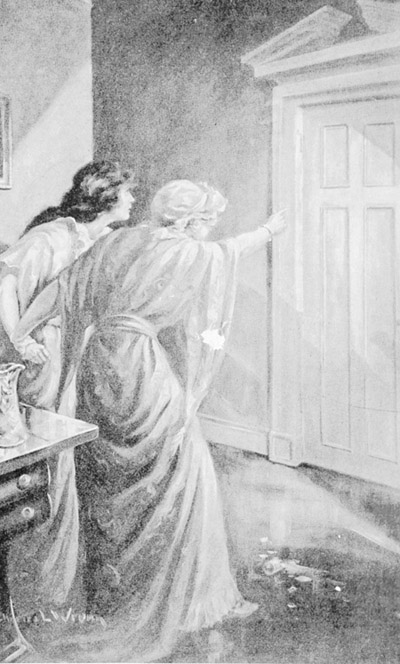
“‘My dream! See, the panels are in the shape of a cross!’” [Page 198]
TO THE LATE
MAJOR-GENERAL GEORGE LEWIS GILLESPIE U. S. ARMY
WHOSE KINDLY FRIENDSHIP, GENEROUS
ENCOURAGEMENT AND DISCRIMINATING CRITICISM
MADE THIS BOOK POSSIBLE
IT IS MOST AFFECTIONATELY DEDICATED
THE long hot tropic day was drawing to its
close. The shadows were gradually rising
and filling the narrow street, and every
now and then from the side of the open drain which
ran through the middle of the street a large black
carrion bird flew up. There was no sidewalk, the
cobblestones running right up to the low white house
walls. The windows which opened on the street
were for the most part few in number, small and
heavily barred. It was not by any means the best
quarter in Colon. One building, more pretentious
than the rest, was distinguished from its neighbors
by large French windows, also protected by the iron
screen or reja.
It was impossible to tell the nationality of the one
man lounging along the street. He seemed profoundly
buried in his own thoughts. Dark as his
skin was, and black as was his beard, there was
something about him which negatived the idea that
he was a Spaniard. His rolling walk suggested the
sailor’s life.
As he passed the building with the long French
windows, the tinkle of a guitar roused his attention,
and he stepped inside the front door and glanced
furtively at the few men who lounged about the
tables which dotted the long room. Passing by several
empty tables and chairs, the stranger seated
himself in the corner of the room on the side further
from the street, near a window which opened
on a neglected garden. A tropical vine thrust its
branches against what had once been a wood and
glass partition which formed the end of the room,
the branches and leaves twining in and out among
the broken panes of the window.
Some of the occupants of the room had glanced
indifferently at the stranger on his entrance, but his
haggard, unshaven face and worn clothing did not
arouse their curiosity, and they again turned their
attention to their wine.
The stranger, after contemplating the view from
the window for some moments, leaned back in his
chair, thrust his hands in his pockets, and stretched
his long legs under the table; then indolently studied
his surroundings. The room reeked with tobacco
smoke and the odor of spirits. The scene reminded
him of Port Said. Not quite as many nationalities
were represented in Colon as haunt the entrance to
the Suez Canal, but the low chatter of tongues
which greeted his ears was polyglot. The men in
the room were types of the born ne’er-do-well. Lazy,
shiftless, they had drifted to Colon, thinking to pick
up whatever spoils came their way during the construction
of the Panama Canal. Drinking and gambling,
gambling and drinking—the sum total of their
lives. The stranger’s lips curved in a sardonic smile,
and he crooned softly:
Ship me somewheres east of Suez, where the best is like the worst, Where there aren’t no Ten Commandments an’ a man can raise a thirst.
His smile deepened as he caught the scowl of a
Spaniard sitting near him. His glance traveled on,
and, as he studied the flushed, sodden faces, a sudden
horror of himself and his surroundings shook
him. He passed a nervous hand over his damp
forehead. Why had his memory played him so
scurvy a trick? The past few years were not pleasant
to contemplate, and the future even less so. He
half started from his chair, then sank back and summoned
the mozo. Quickly he gave his order in
fluent Spanish, and waited impatiently for the man’s
return. He had been fortunate at the gaming table
the night before, and could purchase a moment’s
respite from the torments of an elusive memory.
Memory, in whose wondrous train follow the joys
of childhood, parents and home! The stranger’s
strong hand trembled as he stroked his beard. Why
was he an outcast? For him alone there were
no childhood and no home; his thinking life began
as a full-grown man. Was there to be no
awakening?
In a few moments the mozo returned, and placed
a glass and bottle of liquor before him. The
stranger hastily filled and drank. As the stimulant
crept through his veins, a feeling of physical contentment
replaced all other sensations, and, lighting
a cigar, he was slowly sinking once more into reverie
when from behind the partition he heard a voice:
“No names, please.”
The words, spoken clearly in English, startled him
from his abstraction, and he glanced through the
vine and, himself unseen, saw two men sitting at a
table. They had apparently entered the patio from
another part of the house.
“Quite right, I approve your caution.” The
words were also in English, but with a strong foreign
accent, and the speaker, a man of middle age
and fine physique, laid some papers on the table before
them. “Where is the Senator this evening?”
“He accompanied several members of the Congressional
party to inspect the plant of the Quartermaster
and Subsistence Departments, and on his return
will dine with Major Reynolds and several
other officers at the hotel.”
“I see.” The foreigner drummed impatiently on
the table. “You were late in keeping your appointment.”
“I had the devil’s own time in finding this dive,”
returned the younger man, and, as he moved his
chair half around, the inquisitive stranger, peeping
through the leaves of the vine, obtained a view of
the speaker’s boyish face. The weak mouth was
partly hidden by a short black mustache; the
features were well cut, and by some would have
been called handsome.
The older man gave vent to a half-smothered
chuckle. “Goethals and Gorgas have reformed the
Canal Zone, and the local government is trying to
do the same with Panama, but, por Dios, drinking
and gambling continue unnoticed in Colon,” he said,
dryly. “I find a room in this house most convenient
during my short visits here. No ‘gringo’,”
he sneered, “dare show his face in this room.”
The stranger settled down in his chair, which was
wedged into the corner formed by the wall of the
room and the wood and glass partition, until his
head was screened from the two speakers by the
thick foliage of the vine. The Spaniard and the
Jamaican, who had occupied the table nearest him,
had gone, and the few men who still lingered over
their wine at the farther end of the room paid no
attention to him. He could listen without being observed.
“So you believe the people of Panama are already
dissatisfied with their president?” inquired the
younger man, whom the listener judged to be an
American.
“I do,” came the firm reply. “And but for the
presence of los tiranos del norte here there would
have been already a pronunciamiento.”
“Then you think the time is ripe for carrying out
your scheme?”
His companion nodded without speaking, and
tugged at his gray imperial. “If it is done at all it
must be soon,” he said, finally. “American rule is
not too popular here, and now is the time to act.
And I pray God I shall be spared to see the fruits
of the labor de los cochinos sucios reaped by another
nation,” he spoke with intense bitterness.
“And that nation?” questioned the other.
“Is better left unmentioned.”
“You do not love my countrymen,” exclaimed the
American, as he drew out his cigarette case and
passed it to his companion, who waved it away impatiently.
“Say rather—hate,” was the terse reply. “But I
do not look on you as one of that nationality. Your
mother was my dearly loved cousin, and Colombia
boasts no prouder name than the one she bore before
she married your father. By the love you bear her
memory I entreat you to assist me in this undertaking.”
“I have promised,” said the American gruffly. “I
hear that Colombia intends accepting the ten million
dollars offered by the United States for certain
islands near Panama.”
“Never!” The Colombian spoke with emphasis.
“Our hatred lies too deep for that; it cannot be
placated by an offer of ‘conscience money,’ no matter
how great the sum.”
“The more fools you,” muttered the American,
sotto voce.
“The revolt of Panama was followed by an insurrection
in Colombia,” continued the other, “and
the Government was overthrown. The American
newspapers gave us a few paragraphs at the time—they
did not mention that nearly one hundred thousand
people were killed; that the horrors of civil
war were augmented by pillage and murder. I was
at the front with the troops, and, in my absence from
home, my wife and child were murdered by some
insurrectos. I tell you,” he struck the table a resounding
blow with his clenched fist, “there is no
Colombian living who would not gladly see the
United States humiliated.”
“It is easy to see that the people in Panama are
jealous of the success of the Americans,” commented
the young man.
“Naturally; the United States has always advanced
at the price of Latin-America.”
“How so?”
“Study your history. When the Thirteen Original
States branched out, first came the ‘Louisiana Purchase,’
land originally settled by the French; then
Florida, first settled by the Spanish, was bought by
the United States. Later still, Texas seceded from
Mexico, settled also by the Spanish; then came the
Mexican War, and Latin-America lost the territory
now known as New Mexico, Arizona, and California.”
“Seems to me it would have been better if Colombia
had accepted the original offer of the United
States for the Panama Canal Zone.”
“Why so? The United States only offered a beggarly
ten million. By waiting a year the French concession
would have expired, and the Colombian
Government would have received the sixty million
which the United States eventually paid the French
Company.”
“Instead of which you got nothing,” remarked the
American dryly, “and lost Panama into the bargain.”
“Through underhand methods,” began the other
hotly, then checked himself. “Enough of the past.
Have you a message for me?”
For reply the young man drew out an envelope
from an inside pocket and handed it to his companion,
who opened it and read the communication
in silence.
“Good,” he said finally, tearing the note into infinitesimal
pieces and carefully putting them in his
leather wallet, from which he first took several letters.
“Give this to the Ambassador immediately on
your return, and this—” he hesitated for a second—“give
at once to our mutual friend.”
The American took the papers and placed them
securely in an inside pocket. “Is that all?” he inquired.
“No.” The Colombian drew out a small chamois
bag whose contents emitted a slight jingling noise
as he handed it to his companion. “You may find
this useful. No thanks are necessary, dear boy,”
laying his hand on the American’s shoulder as the
latter commenced speaking. “The death of my wife
and child has deprived me of near relatives except
you, and I propose to make you my heir.” Then, to
change the subject, he added quickly, “Is there no
way to induce the Senator to use his influence
with Congress and the Administration for disarmament,
and the curtailing of building more battleships?”
The American laughed disagreeably. “I think it
may be done—in time.”
The Colombian’s face brightened. “Splendid!
If we can stop his fervid speeches in behalf of a
larger standing army and navy, we will have accomplished
much. But how do you expect to alter his
attitude?”
“Through a woman,” the American’s lips parted
in an amused smile. “There’s no fool like an
old fool, and the Senator is no exception to the
rule.”
“Indeed?” The Colombian raised his eyebrows.
“And what has the woman to say in the matter?”
“Nothing. She emulates a clam.”
The eavesdropper on the other side of the partition,
who had caught most of the conversation,
moved ever so slightly to stretch his cramped limbs,
and then pulled out his handkerchief and mopped
his heated face. As he did so a small slip of paper
dropped, unseen by him, from his pocket to the floor.
A large black cat came softly over to him and he
lifted the animal up and placed her on the table before
him. He stroked the purring feline and
listened intently to catch the conversation which
drifted to him through the vine-covered broken window
panes. Apparently the two men were preparing
to leave.
“Does the Senator really think to marry?” asked
the Colombian, as he picked up his hat.
“I judge so. He is obviously very much infatuated
with the girl’s unusual type of beauty. And,
believe me, she thoroughly understands the art of
managing men.”
“Indeed? Who is the girl?”
“The young daughter of the famous Irish actress,
Nora Fitzgerald. Senator Carew....”
Crash—the bottle and glass smashed in pieces.
The eavesdropper never stopped to see the damage
he had done, but with incredible swiftness and
stealth was out of the room and down the street
before the irate proprietor had reached the deserted
table.
“Que hay?” inquired the Colombian of the proprietor.
He and the American had rushed into the
room and over to the window by which the eavesdropper
had been sitting.
“A drunken Spaniard knocked the bottle and
glass from the table, and cleared out without paying
the damage,” explained the proprietor in Spanish,
as he signed to the mozo to sweep up the
mess.
“What’s that in your hand?”
“A card, Señor, which I have just picked up from the floor.”
“Let me have it.”
“Si, Señor, con mucho gusto.” He quickly handed
the paper to the Colombian.
The American looked over his companion’s shoulder
as the latter adjusted his eyeglasses and held up
the visiting card so that both could see its contents.
With staring eyes and faces gone white they read
the engraved inscription:
MR. JAMES CAREW
MARYLAND.
CHAPTER II AFTER THE BALL — CHAPTER III A MYSTERIOUS TRAGEDY
“Fifty-four!” bellowed the footman through
his megaphone for the sixth time, and he
slanted his umbrella to protect his face from
the driving rain which half-blinded him. A waiting
automobile, whose chauffeur had mistaken the number
called, moved slowly off and gave place to a carriage
and pair.
“Fifty-four,” mumbled the coachman, checking his
restive horses with difficulty.
The footman turned, touched his hat, and beckoned
to Cynthia Carew, who stood waiting in the
vestibule. With a rueful glance at the wet sidewalk,
she gathered her skirts up above her ankles and,
propelled by the sturdy arm of her escort, Captain
Lane, was landed breathless at the carriage door.
“In with you,” laughed Lane, as his umbrella was
almost dragged from his hand by the high wind.
“Your wrap is too pretty to be ruined....” Cynthia
was half lifted, half pushed inside the landau....
“Good night, my dearest.”
The door slammed shut; the horses, weary of long
standing, started forward at the sound and raced
around the corner into Massachusetts Avenue before
the sleepy coachman could collect his wits.
Cynthia, on the point of seating herself, was flung
toward the farther corner of the carriage by the
sudden jerk. Instinctively she threw out her hand to
steady herself, and her open palm encountered what
was unmistakably a broad shoulder.
“Good gracious!” recoiling and collapsing sideways
on the seat. “Philip! How you frightened
me.”
Then she settled herself more comfortably and,
with an effort, chatted on.
“The dance really was great fun, just our set you
know, some of the Diplomatic Corps, and a number
of the officers from the Barracks. I hated to leave
so early,” regretfully, “but I promised Uncle James.
Mrs. Owen asked particularly for you, and was
greatly put out because you did not appear. Honestly,
Philip, I am very tired of trying to explain
your sudden aversion to society. Why do you shun
your friends?”
Not getting an immediate answer she repeated
her question more emphatically. Still no reply. The
silence caught her attention. Turning her head she
scanned the quiet figure by her side.
The pelting rain, which beat drearily upon the
carriage roof and windows, almost drowned the
sound of rapid hoof-beats. The high wind had apparently
extinguished the carriage lamps and the
dim street lights failed to illuminate the interior of
the rapidly moving carriage. In the semi-darkness
Cynthia could not distinguish her companion’s face.
“It is you, Philip?” she questioned sharply, and
waited an appreciable moment; then a thought occurred
to her. “Uncle James, are you trying to
play a practical joke?” Her voice rose to a higher
key.
Her question was ignored.
Cynthia caught her breath sharply. Suppose the
man was a stranger? She shrank farther back into
her corner. If so, how came he there? Intently
she studied the vague outlines of his figure.
The landau was an old-fashioned vehicle built
after a commodious pattern by a past generation,
and frequently used by Senator Carew on stormy
nights, as the two broad seats would accommodate
five or six persons by tight squeezing.
Cynthia clutched her wrap with nervous fingers.
If the man had inadvertently entered the wrong carriage,
the least he could do was to explain the situation
and apologize. But suppose he was drunk?
The thought was not reassuring.
“Tell me at once who you are,” she demanded
imperiously, “or I will stop the carriage.”
At that instant the driver swung his horses
abruptly to the left to avoid an excavation in the
street made by the sewer department, and, as the
wheels skidded on the slippery asphalt, the man
swayed sideways, and fell upon Cynthia. A slight
scream escaped her, and she pushed him away,
only to have the limp figure again slide back upon
her.
He was undoubtedly drunk! Thoroughly alarmed
she pushed him upright, and struggled vainly to
open the carriage door with her disengaged hand.
With a tremendous jolt, which again deposited
the helpless figure on her shoulder, the carriage
wheels struck the curb as the horses turned into the
driveway leading to the porte-cochère of the Carew
residence. As the horses came to a standstill the
front door was thrown open, and the negro butler
hastened down the short flight of steps.
Cynthia, with one desperate effort, flung the man
back into his corner and, as the butler turned the
stiff handle and opened the door, half jumped, half
fell out of the landau.
“A man’s in the carriage, Joshua,” she cried.
“See who it is.”
The servant looked at her in surprise, then obediently
poked his head inside the open door. Unable
to see clearly he drew back and fumbled in his pocket
for a matchbox.
“Keep dem hosses still, Hamilton,” he directed,
as the coachman leaned down from his seat, and
then he pulled out a match. “Miss Cynthia, yo’
bettah go inter der house,” glancing at the young
girl’s pale countenance, “I’ll ’ten to dis hyar pusson.”
But Cynthia remained where she was and peeped
over the butler’s shoulder. He struck a match and
held it in the hollow of his hand until the tiny flame
grew brighter, then leaned forward and gazed into
the carriage.
The intruder was huddled in the corner, his head
thrown back, and the light fell on a livid face and
was reflected back from glazing eyes. Cynthia’s
knees gave way, and she sank speechless to the
ground.
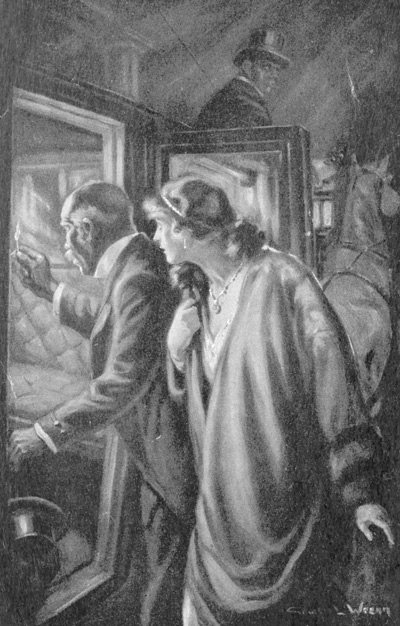
“But Cynthia remained where she was and peeped over
the butler’s shoulder”
THE portières were pulled aside.
“Excellency, breakfast is served,” and
the servant bowed deferentially toward a
figure standing in the bow window. As the announcement
reached his ears in the musical language
of his native tongue, the Japanese Ambassador
turned from the window and hastened into the dining room.
A small pile of letters lay beside his plate, and
he opened and read them as he leisurely ate his
breakfast. Tossing aside the last note, he picked up
the morning Herald, and his eyes glanced casually
over the page then stopped, arrested by a three-column
heading:
SENATOR CAREW DEAD A Mysterious Tragedy
Murder or Suicide?
The Ambassador pushed aside his plate and read
the smaller type with growing interest.
“During the cloudburst of last night, when the
heavens themselves seemed to threaten Washington,
a most mysterious crime was committed in the fashionable
Northwest. United States Senator James
Carew, of Maryland, one of the most distinguished
and influential men in political and official circles,
was found dead in his carriage early this morning.
“Much mystery surrounds the case. The tragedy
was not discovered until the arrival of the carriage
at the Carew residence. Miss Carew, whom her
uncle was escorting home from a dance, was completely
prostrated from shock, and had to be carried
to her room.
“Owing to the lateness of the hour, with the paper
already in press, only a few meager details could be
learned by the special representative of the Herald.
“Senator Carew was found by his butler, Joshua
Daingerfield, huddled in a corner of the back seat
of the carriage. Dr. Penfield, the coroner, was
hastily summoned, as well as detectives from headquarters.
While awaiting their arrival, the policeman
on the beat had the horses unharnessed and
taken to the stable, and left the carriage under the
porte-cochère.
“On the arrival of the coroner and the detectives
the body was removed from the carriage to the Senator’s
room in the Carew mansion. Dr. Penfield
discovered that death was apparently due to a stab
from a small, upright, desk bill file which had been
thrust into the body with such force that the heavy,
leaded round base was pressed tightly against the
clothes. The sharp point had penetrated to the
heart, and death must have been instantaneous. The
weapon in the wound prevented any outward hemorrhage,
and Senator Carew bled internally.
“These startling details but add interest to what
promises to prove a mystery unique in the annals of
crime.
“Senator Carew and his family have resided here
for many years, and have been prominently identified
with official and residential society. The old
Carew mansion on Massachusetts Avenue east of
Fourteenth Street has been noted for its lavish hospitality.
It was erected by Senator Carew’s father,
General Van Ness Carew, shortly before the commencement
of the Civil War, and the foundations
and walls were of such unwonted thickness that General
Carew was pestered with inquiries as to whether
he was not building a fortress!
“The inmates of the Senator’s household are his
widowed sister, Mrs. George Winthrop, her stepson,
Philip Winthrop; and her niece, Miss Cynthia
Carew, daughter of the late Philip Carew, a younger
brother of Senator Carew.
“Mrs. Winthrop is well-known in Washington,
having kept house for her brother since the death
of his wife in 1881. Miss Cynthia Carew made her
début last December at a memorable ball which her
aunt and uncle gave for her. Since then Miss Carew
has received much attention, and is regarded as one
of the most popular of the winter’s débutantes.
“Philip Winthrop has spent most of his life in
Washington, and, since his graduation from Princeton,
has been acting as private secretary for Senator
Carew. He is a member of the Alibi, the Chevy
Chase, and the Riding and Hunt Clubs, and is popular
with his associates.
“A fearless leader, an upright American, Senator
Carew has served his country well, first as representative,
then as senator. Possessing the confidence
and friendship of the President as he did, it was
frequently prophesied that he would be the power
behind the throne in deciding many of the important
issues now confronting the country. His inexplicable
death is therefore a severe blow to many
besides his immediate family.
“The known facts at present point to murder or
suicide. The negro driver, Sam Hamilton, has been
arrested pending a closer examination.”
The Ambassador regarded the printed lines long
and thoughtfully. Then his foot pressed the electric
button concealed in the carpet under the table. The
bell had hardly ceased to buzz before the well-trained
servant was by his side.
“Send for my motor,” came the brief order.
“It is already at the door, Excellency.”
The Ambassador tossed his napkin on the table,
pushed back his chair, and rose. “My hat and
coat,” he directed, walking into the hall.
In a few minutes he stepped out into the vestibule
and filled his lungs with the delicious breeze that
fanned his cheeks. No trace of the heavy storm of
the night before was in the air. The sky was blue,
and the May sunshine lit up the budding trees and
shrubs. The touch of spring and new-born life was
everywhere. The Ambassador snapped off a spray
of honeysuckle which grew along the fence protecting
his parking from his neighbor’s, and tucked the
spray in his buttonhole as he entered the waiting
motor. “Drive to the club,” he directed briefly, as
the car moved off.
CHAPTER IV THE BROKEN APPOINTMENT
ELEANOR THORNTON turned in bed and
stretched herself luxuriously. It was good
to be young and to be sleepy. For a few
seconds she dozed off again; then gradually awoke,
and, too comfortable to move, let her thoughts wander
where they would. In her mind’s eye she reviewed
the events of the past months, and, despite
herself, her lips parted in a happy smile. She had
come to Washington in November to visit her friend,
Cynthia Carew, and, delighted with the reception
accorded her, had invited her cousin, Mrs. Gilbert
Truxton, to chaperon her, and, on her acceptance,
had rented a small furnished residence near Dupont
Circle for the winter.
Mrs. Winthrop and Cynthia Carew, whom she
had known at boarding school, took her everywhere
with them, and her cousin, Mrs. Truxton, belonging
as she did to an old aristocratic family of the District,
procured her entrée to the exclusive homes of
the “cave-dwellers,” as the residential circle was
sometimes called.
Born also with the gifts of charm and tact,
Eleanor’s wild rose beauty had made an instant impression,
and she was invited everywhere. The butler’s
tray was filled with visiting cards, which many
newcomers, anxious for social honors, longed to
have left at their doors.
Eleanor was one of the older girls at Dobbs
Ferry during Cynthia’s first year at that boarding
school. They had taken an immense liking to each
other, which later blossomed into an intimate friendship.
After her graduation she and Cynthia had
kept up their correspondence without a break, and,
true to her promise, given years before, she had left
Berlin and journeyed to Washington to be present
at Cynthia’s début.
After the death of her mother, Eleanor had been
adopted by an indulgent uncle, Mr. William Fitzgerald,
of New York, and on his death had inherited
a comfortable fortune.
In many ways the winter had brought numerous
triumphs in its train, enough to spoil most natures.
But Eleanor was too well poised to lose her head
over adulation. She had sounded the depths of
social pleasantries, and found them shallow. In
every country she had visited all men had been only
too ready to be at her beck and call—except one.
The dreamy eyes hardened at the thought, and the
soft lips closed firmly. She had made the advances,
and he had not responded. A situation so unique in
her experience had made an indelible impression.
Angry with herself for even recalling so unpleasant
an episode, she touched the bell beside the bed; then,
placing her pillow in a more comfortable position,
she leaned back and contemplated her surroundings
with speculative eyes.
Her individuality had stamped itself upon the
whole room. A picture or two, far above the average,
a few choice books, whose dainty binding indicated
a taste and refinement quite unusual; one or
two Chinese vases, old when the Revolutionary War
began; an ivory carving of the Renaissance; a mirror
in whose lustrous depths Venetian beauties had
seen their own reflections hundreds of years ago.
All these things gave sure indication of study and
travel, and a maturity of thought and taste which,
oddly enough, seemed rather to enhance Eleanor’s
natural charm.
A discreet knock sounded on her door. “Bon
jour, Mademoiselle,” exclaimed the maid, entering
with the breakfast tray.
“Bon jour, Annette,” responded Eleanor, rousing
herself, then lapsing into English, which her maid
spoke with but a slight accent. “Put the tray here
beside me. Must I eat that egg?” she made a slight
grimace.
“But yes, Mademoiselle.” The Frenchwoman
stepped to the window and raised the shade. “Madame
Truxton gave orders to Fugi to tell the cook
that he must send you a more substantial breakfast.
She does not approve of rolls and coffee. I think
she wishes you to eat as she does.”
Eleanor shuddered slightly. “Did—did she have
beefsteak and fried onions this morning?” she inquired.
“But yes, Mademoiselle,” Annette’s pretty features
dimpled into a smile, “and she ate most heartily.”
“Not another word, Annette, you take away my
appetite. Is Mrs. Truxton waiting to see me?”
“No, Mademoiselle; she was up at six o’clock
and had her breakfast at half-past seven.” Annette
paused in the act of laying out a supply of fresh
lingerie. “What have the Americans on their
conscience that they cannot sleep in the morning?”
“You cannot complain of my early rising,”
laughed Eleanor, glancing at the clock, whose hands
pointed to a quarter to twelve.
“Ah, Mademoiselle, you have lived so long
away from America that you have acquired our
habits.”
“You may take the tray, Annette; I have even
less appetite than usual to-day.” Eleanor waited
until it had been removed, then sprang out of bed.
“Come back in fifteen minutes,” she called.
It did not take her long to complete her toilette,
and when the maid returned she was seated before
her dressing table.
“What news to-day, Annette?” she asked, as the
Frenchwoman, with skilful fingers, arranged her
wavy hair, which fell far below her waist.
“Madame and Fugi——” began the maid.
“I don’t want household details,” broke in
Eleanor impatiently. “Tell me of some outside
news, if there is any.”
“Oh, indeed, yes; news the most startling. Senator
Carew——” she paused to contemplate her
handiwork.
“Well, what about him?” inquired Eleanor listlessly.
“He is dead.”
“Dead!” The handglass slipped from Eleanor’s
grasp and fell crashing to the hearth. Annette
pounced upon it.
“Oh, Mademoiselle, the glass is broken. Quelle
horreur!”
“Bother the glass.” Eleanor’s foot came down
with an unmistakable stamp. “Tell me at once of
Senator Carew’s death. I cannot believe it!”
“It is only too true,” Annette was a privileged
character and deeply resented being hurried, also
her volatile French nature enjoyed creating a sensation.
She had eagerly read the morning paper, and
had refrained from telling Eleanor the news until
she could get her undivided attention. “Senator
Carew was found dead in his carriage early this
morning on his return from the dance at Mrs.
Owen’s”—Annette had no reason to complain,
Eleanor was giving her full attention to the story—“he
had been stabbed.”
The maid’s hand accidentally touched Eleanor’s
bare neck, and she felt the taut muscles quiver.
Covertly she glanced into the mirror and studied
the lovely face. But Eleanor’s expression told her
nothing. Her cheeks were colorless and her eyes
downcast.
After a barely perceptible pause Annette continued
her story. “The coachman has been arrested——”
a knock interrupted her and she hastened
to open the door, returning in an instant with
a note.
“Fugi says the messenger boy is waiting for an
answer, Mademoiselle.”
Eleanor tore it open and read the hastily scrawled
lines.
Dear Eleanor:
I suppose you have been told of last night’s terrible
tragedy. Cynthia is prostrated. She begs pitifully
to see you. Can you come to us for a few
days? Your presence will help us both.
Affectionately,
Charlotte Winthrop.
Eleanor read the note several times, then walked
thoughtfully over to her desk.
Dearest Mrs. Winthrop: [she wrote] It is
awful. I will come as soon as possible.
Devotedly,
Eleanor.
“Give this to Fugi, Annette, then come back and
pack my small steamer trunk,” as the maid hastened
out of the room; she picked up a silk waist preparatory
to putting it on, but her toilette was
doomed to another interruption.
“Well, my dear, may I come in?” asked a pleasant
voice from the doorway.
“Indeed you may, Cousin Kate,” Eleanor stepped
across the room and kissed the older woman affectionately.
Mrs. Truxton’s ruddy face lighted with
an affectionate smile as she returned her greeting.
She did not altogether approve of her young cousin,
many of her “foreign ways” as she termed it, offended
her, but Eleanor’s lovable disposition had
won a warm place in her regard.
Mrs. Truxton seated herself in one of the comfortable
lounging chairs and contemplated the disheveled
room and Eleanor’s oriental silk dressing
gown with disapproval.
“Do you know the time?” she inquired pointedly.
“Nearly one,” answered Eleanor, as she discarded
her dressing gown for a silk waist. “Lunch
will soon be ready. I hope you have a good appetite.”
“Yes, thank you; I’ve been out all the morning,”
reproachfully. “Mrs. Douglas has asked me to
dine with her this evening, and, I think, Eleanor, if
it will not interfere with your arrangements, that I
will accept the invitation.”
“Do so by all means,” exclaimed Eleanor heartily.
“I hope she won’t talk you deaf, dumb, and blind.”
“She is rather long-winded,” admitted Mrs. Truxton,
tranquilly. “On the telephone this morning she
took up twenty minutes telling me of the arrival
here of her nephew, Douglas Hunter—good gracious,
child——” as Eleanor’s silver powder box
rolled on the floor with a loud bang—“how you
startle one.”
“I beg your pardon,” Eleanor was some seconds
picking it up, for her fingers fumbled clumsily.
“What were you saying, Cousin Kate?” replacing
the silver on the dressing table.
“Mercy, child, how inattentive you are! I was
only remarking that Douglas Hunter is no stranger
to Washington. He was raised here, as he belongs
to one of the first families of Georgetown.”
“I never heard of a ‘second’ family in Georgetown,”
smiled Eleanor; then, seeing her cousin’s
offended expression, she hastily changed the subject.
“Have you heard the shocking news of Senator
Carew’s—” she hesitated for a moment—“tragic
death?”
“Indeed I have. Washington is talking of nothing
else. Why are you packing, Annette?” as the
servant entered.
“Mrs. Winthrop has just written and asked me
to spend a few days with them,” explained Eleanor
hurriedly, “so suppose you invite Miss Crane to
stay with you in my absence.”
“Of course you cannot very well decline to go,”
said Mrs. Truxton thoughtfully. “Still, I hate to
have you mixed up in such an affair, Eleanor.”
“Nonsense, Cousin Kate, you must not look at it
in that light,” Eleanor patted the fat shoulder nearest
her affectionately. “Cynthia told me yesterday
that Senator Carew had said he was going to discharge
the coachman, Hamilton (a surly brute, I
always thought him), for drunkenness. I have no
doubt he committed the murder from revenge, and
while under the influence of liquor.”
“I sincerely trust that is the correct solution of the
mystery,” Mrs. Truxton looked dubious, “but there
has been one fearful scandal in that family already,
Eleanor, and I very much doubt if Senator Carew
was killed by a servant.”
“Why, what do you mean?” Eleanor wheeled
around in her chair and faced her abruptly.
“Time will show.” Mrs. Truxton shook her head
mysteriously.
“Oh, nonsense!” exclaimed Eleanor impatiently.
As Mrs. Truxton opened her lips to reply, Annette
reëntered the room.
“Pardon, madame, you are wanted at the telephone,”
and as Mrs. Truxton lifted herself carefully
out of her chair and walked out of the room, she
handed a package to Eleanor. “This has just come
for you, Mademoiselle; the boy who left it said
there was no answer.”
“Annette! Annette!” came Mrs. Truxton’s shrill
voice from the lower hall.
“Coming, Madame, coming,” and the maid hastened
out of the room shutting the door behind her.
Left alone, Eleanor turned the sealed package
over curiously. The address was written in an unknown
hand. Quickly breaking the red sealing wax
and tearing off the paper, she removed the pasteboard
cover and a layer of cotton. A startled exclamation
escaped her as she drew out the contents
of the box—a necklace of large rubies and smaller
diamonds in an antique setting.
Eleanor, who knew the value of jewels, realized
from their color and size that the rubies were almost
priceless, and in the pure joy of beholding their
beauty laid the necklace in the palm of her left hand
and along her bare arm. After contemplating the
effect for a moment, a thought occurred to her, and
she pulled out the remaining cotton in the box and
found at the bottom a small card. She picked it
out and read the message written on the card.
“The appointment was not kept. Well done.”
The card fluttered to the floor unheeded. The
pigeon blood rubies made a crimson stain on
Eleanor’s white arm, strong wrist, and supple fingers.
CHAPTER V MUTE TESTIMONY
DOUGLAS HUNTER sighed involuntarily
as he left busy Fourteenth Street, and
walked down Massachusetts Avenue.
Twelve years’ absence makes a great difference in
the ever-shifting population of Washington. He
felt like another Rip Van Winkle as he gazed at
each passer-by in his search for a familiar face.
Even the streets had changed, and he was almost
appalled by the grandeur of some of the huge white
palaces erected by multimillionaires on Massachusetts
and New Hampshire Avenues, and the Avenue
of the Presidents. He had spent part of the morning
motoring about the city with one of his cousins,
and the outward and visible signs of wealth had
staggered him. What had become of the unpretentious,
generous-hearted hospitality, and the old
world manners and courtly greeting of the former
host and hostess who had ruled so long at the National
Capital? Had Mammon spoiled the old simplicity,
and had Washington become but a suburb
of New York and Chicago? It truly seemed as if
plutocracy had displaced aristocracy.
As Douglas approached the Carew residence he
glanced keenly at the handsome old mansion and at
the numerous idlers loafing in the vicinity drawn
there by idle curiosity. A policeman stood on guard
in the driveway, and a number of photographers
loitered near by, cameras in hand, waiting patiently
to snapshot any member of the Carew family who
might incautiously venture out of doors.
The house itself, a handsome square red brick
and stone trimmed four-storied building, stood some
distance back from the sidewalk with beautifully
kept lawns divided by the carriage drive. The
blinds were drawn and the ominous black streamer
over the bell presented a mournful spectacle. It was
the finest residence in that once fashionable locality,
and Douglas decided that he preferred its solid,
home-like architecture to the more ornate and pretentious
dwellings in other parts of the city. As
the years went by Senator Carew had added improvements
until the residence was one of the most
delightful in Washington.
As Douglas turned into the walk, a large touring
car wheeled into the driveway, and as it purred
softly by him, he stepped back respectfully and
raised his hat to the tired-faced man sitting alone in
the tonneau. He did not need to glance at the small
coat-of-arms of the United States emblazoned on
the polished door, or at the two Secret Service men
following on their motor cycles, to recognize the distinguished
occupant of the car.
As the motor stopped under the porte-cochère, the
colored butler ran down the steps, and the President
leaned forward and placed a note in the bowing and
scraping negro’s hand; then the big car continued
on down the driveway and out into the street.
Douglas waited where he was for a few minutes
before mounting the short flight of steps. The hall
door was opened several inches on his approach,
and Joshua solemnly extended his card tray, which
Douglas waved aside.
“I called to see Mr. Brett; is he here?” he asked.
“Yessir,” Joshua opened the door still further,
and inspected him carefully.
“Take my card to him and ask if he can spare me
a few minutes,” and he dropped his visiting card on
the tray.
“Walk in, suh,” exclaimed Joshua, impressed by
Douglas’ well-groomed appearance; then he hesitated,
embarrassed by a sudden idea.
“I’ll wait here,” volunteered Douglas, stepping
inside the square hall.
“All right, suh,” Joshua closed the front door,
“just a moment, suh,” and he stepped softly across
the hall and into a room. Douglas glanced about
him curiously and caught a glimpse of spacious
rooms and lofty ceilings. It was a double house,
and to the right of the entrance was the drawing-room,
and back of that another large room, which
Douglas took to be the dining room, judging from
the glittering silver pieces on a high sideboard of
which he had a glimpse through the door leading
into the square hall. Across from the drawing-room
was the room into which Joshua had disappeared,
and back of that a broad circular staircase which
ran up to the top floor.
Douglas was idly gazing out of the glass panel of
the front door when Joshua returned, followed by
a middle-aged man with a keen, clever face.
“Is it really you, Mr. Hunter?” he asked, as
they shook hands warmly. “I could hardly believe
my eyes when I saw your card. Come this
way,” and he conducted Douglas into the room he
had just left, and closed the door softly behind
them.
“When did you arrive in Washington?” he inquired,
motioning Douglas to take a chair near the
window and dropping into one opposite him.
“Yesterday.” Douglas leaned back and studied
his surroundings. His eyes traveled over the handsome
carved rosewood bookcases which lined the
walls, at the large desk table, and the comfortable
leather-covered revolving desk chair. The desk
silver, drop lights, and large upholstered davenport
pushed invitingly before the huge fireplace with its
shining brass fire-dogs and fender, each told a tale
of wealth and artistic taste—two assets not often
found together. His eyes returned to Brett, and he
smiled involuntarily as he caught the other intently
regarding him.
Brett smiled in return. “I was wondering why
you looked me up so soon,” he admitted candidly.
“Don’t think I’m not glad to see you”—hastily—“but
I remember of old that you seldom do things
without a motive.”
“On the contrary, I am here this afternoon to
find a motive—for Senator Carew’s tragic death.”
The smile vanished from Douglas’ clear-cut features.
“One moment,” as Brett opened his mouth to speak.
“After reading the account of the Senator’s death
in the morning papers, I went down to headquarters
to get what additional facts I could, and they told
me that you had been put on the case. So I decided
to look you up in person, and here I am.”
“May I ask why you take such an interest in this
case?”
“Certainly, Brett; I was coming to that. Senator
Carew used his influence to get me in the Diplomatic
Service, and during the past twelve years he
has shown me many kindnesses, such as seeing that
I was detailed to desirable posts, and helped me to
secure promotion.”
“He wouldn’t have done that, Mr. Hunter, if you
hadn’t made good,” broke in Brett quickly.
“I saw him last at Delmonico’s in New York on
my way to Japan a little over a year ago,” continued
Douglas. “He asked me to lunch with him, and
evinced great interest in the mystery of the Jewel
Custom Fraud which he, in some way, knew I had
had a hand in exposing.”
“Sure he did. I told the department about your
assistance when I was in Paris. If it hadn’t been for
you, I’d never have landed those swindlers. They
led me a pretty dance over the Atlantic.”
“We worked together then,” said Douglas
thoughtfully, “and, on the strength of our past success,
I’m going to ask you to take me on as a sort
of advisory partner in this Carew case.”
“Suppose you first tell me the reason for making
such a request.”
“In the first place I owe a debt of gratitude to
Senator Carew. For the sake of his friendship with
my father years ago, he has taken a great interest
in me. Secondly, I am in Washington at his request.”
Brett looked his interest, and Douglas went on
rapidly: “Some time ago I received a note from him
asking me to apply for leave of absence from Tokio
and to come direct to Washington, saying that he
wished to see me on important business.”
“Did he state the nature of that business?” inquired
Brett eagerly.
“No. I at once followed his suggestion and applied
to the State Department for leave. It was
granted, and I hastened home as fast as steamer
and train could bring me.”
“Did you see Senator Carew?”
“Unfortunately, no. I only reached Washington
late last night. I expected to see the Senator this
morning, instead of which I read of his mysterious
death in the morning papers.”
Brett mused for a few minutes, then roused himself.
“I am only too glad to have your assistance,
Mr. Hunter.”
“Good!” ejaculated Douglas, well pleased. “Suppose
you tell me all the facts in the case so far
discovered.”
Brett leaned back in his chair and crossed his
legs. “On the face of things it looks as if the negro
driver, Hamilton, was guilty.”
“Tell me what leads you to think that?” inquired
Douglas quickly.
“He is the worst type of negro, a vicious brute
with a taste for liquor. I have inquired about him
and examined him thoroughly and am really puzzled,
Hunter, to find out why Senator Carew ever
employed him.”
“Is he an old family servant?”
“No. He has only been in Carew’s employ about
a year I am told. He knows how to handle horses,
and took excellent care of the Senator’s valuable
stable.”
“That probably explains why he was kept on,”
said Douglas. “I’ve been told that Carew was
hipped about his horses.”
“Yes. I gathered from Mrs. Winthrop that
Hamilton has been drinking steadily, and his conduct
to the other servants grew intolerable. Senator
Carew had to discharge him.”
“When did that happen?”
“Yesterday afternoon.”
“Then, how was it that he was driving the carriage
last night?”
“Oh, Carew gave him a week’s notice, said he
couldn’t fill his place at once, and told him to stay
on. Joshua tells me that Hamilton uttered some
ugly threats in the kitchen that evening, but that the
servants paid no attention to his black humor, as they
saw he had been drinking.”
“I see in the papers that Hamilton vehemently
declares his innocence.”
“He does,” agreed Brett, checking his remarks
off on his fingers; “he declares he did not see Senator
Carew after being discharged by him; that no
one was in the carriage when he drove away from
the stable at midnight; that he went directly to Mrs.
Owen’s residence; and that he does not know when
or how Senator Carew’s body was secreted in the
carriage.”
“The plot thickens,” muttered Douglas. “Do
you believe his statements?”
“I do, and I don’t. The servants all declare that
he was half drunk; therefore, I doubt if he was in
a condition to pay much attention to anything, or
that his statements can be relied on. He was
sobered by the shock of finding Carew’s body in his
carriage, and, when I arrested him, collapsed from
fright.”
“Well, judging from the facts you have just told
me, I don’t much believe he killed Carew.”
“Why not?” argued Brett. “Hamilton was apparently
half out of his mind from rage and drink,
and his brute nature made him seek revenge. It’s
quite possible Carew entered the carriage thinking
it would not be safe for his niece to drive home
alone from the dance, and Hamilton took that opportunity
to kill him.”
“I read in the evening paper that Hamilton was
told to stop at the house for one of the maids, but,
instead, drove directly from the stable to the dance,”
said Douglas. “Therefore Carew did not enter the
carriage at this door.”
“Hamilton may have been too befogged with
drink to have remembered the order,” suggested the
detective.
“I grant you, Brett,” said Douglas thoughtfully,
“that the negro may have the nature, the desire,
and the opportunity to commit murder—but why
select such a weapon?”
“Probably picked up the first thing at hand,”
grunted Brett.
“But a desk file is not the ‘first thing at hand’ in
a stable,” remarked Douglas calmly. “In fact, it’s
the last thing you would expect to find there.”
“I don’t know about that; perhaps it was thrown
away in a wastepaper basket, and Hamilton may
have picked it out of the ash pile,” suggested Brett.
“What did the file look like?”
“It is of medium size, the slender steel being very
sharp, the round solid base being silver. I’ve shown
it to several jewelers, and they all say it’s like hundreds
of others, rather expensive, but popular with
their well-to-do customers, and that they have no
means of tracing it back to any particular owner.
It was something like that one,” pointing to an upright
file on Senator Carew’s desk.
Douglas leaned over and took it up. “An ideal
weapon,” he said softly, balancing it in his hand as
his fingers closed over the round heavy base. He
removed the cork which was used to guard the sharp
point and felt it with his thumb. “It must have
taken a shrewd blow to drive the file through overcoat
and clothing so that it would cause instant
death.”
“The Senator wore no overcoat.” Douglas looked
his surprise. After a moment’s silence Brett edged
his chair closer to his companion and lowered his
voice. “You recollect how it rained last night?”
“In torrents. I have seldom seen such a cloudburst,”
admitted Douglas.
“It commenced to rain about ten-thirty,” continued
Brett, “and it did not stop until after three
o’clock. Hamilton drove twice in that drenching
rain to Mrs. Owen’s and back again, first taking
Miss Carew to the dance and returning with her.
Senator Carew’s body was discovered on the last
trip home. Miss Carew told her aunt that no one
was in the carriage with her when she made the first
trip to the dance. Senator Carew’s body was not
removed until after my arrival here this morning,
and I then made a thorough examination of the carriage
and, with the coroner’s assistance, of the body
as well”—he paused and cleared his throat—“I
found Senator Carew’s clothes were absolutely dry—as
I said before, he wore no overcoat—now, how
did Carew get into that carriage in that soaking
downpour without getting wet?” asked Brett, settling
back in his chair.
“Perhaps he was first murdered and then carried
out and put into the carriage.”
“Perhaps so, but I doubt it.”
“He may have entered the carriage at the stable
when Hamilton was not around.”
“I thought of that,” returned Brett, “and as soon
as it was daylight examined the yard and the alley.
The concrete walk from the house to the stable is
being laid now and cannot be used, so that one has
to tread on the ground, which is extremely soft and
muddy. The alley is a long one, and Carew’s stable
is about in the center of it, and the rain, settling in
the holes of the uneven cobbles, made walking very
unpleasant. I am telling you all these details because
of another discovery I made,” went on Brett
slowly; “the Senator’s shoes had been recently polished
and the blacking was not even stained.”
Douglas leaned back and bit his thumb nail, a
childish habit of which he had never been able to
break himself.
“Where did Carew spend the evening?” he asked
finally.
“That is what I have not been able to find out,”
growled Brett. “Mrs. Winthrop told me she had
not seen her brother since breakfast. That he went
to the Capitol as usual in the morning. She was told
on entering the house just before dinner that he
would not return for that meal, but they did not
state where he was going.”
“Upon my word it’s a very pretty problem,” commented
Douglas softly.
“It is,” agreed Brett, rising and slowly pacing the
room. He glanced piercingly at Douglas, who was
thoughtfully contemplating a life-size portrait of
one of Carew’s ancestors which hung above the
mantel over the fireplace. Douglas Hunter’s clear-cut
features, broad forehead, and square jaw indicated
cleverness and determination. When Douglas
smiled the severe lines relaxed and his smooth-shaven
face was almost boyish. He had a keen
sense of the ridiculous, which prevented him from
taking himself too seriously. In the past Brett had
conceived a high regard for the other’s quick wit
and indomitable courage.
“This is Senator Carew’s study or library,”
he said, stopping before the desk, “and I was
giving the room my special attention when you
came in.”
“Have you met with any success?” inquired
Douglas quickly.
“So far only one thing—it may be a clew or it
may not; under this writing pad I found this blotter,”
holding up a square white sheet; “it has been
used only once, first on one side then on the other,
so that by holding it in front of this mirror you can
read quite clearly, see——”
Douglas rose, stepped behind Brett, and peeped
over his shoulder into the silver-mounted mirror,
which the latter had removed from its place on the
mantel.
The large, bold writing was fairly legible. “What
do you make out of it?” asked Brett impatiently.
Obediently Douglas read the words aloud:
“‘Am writing in case I don’t see you before
you’—” the writing ceased.
“He must have been interrupted,” explained
Brett, “and clapped down the blotter on top of the
sheet so that whoever entered couldn’t see the written
words. Now look at the other side,” and he
turned over the blotter on which were traced only a
few words:
“‘I have discovered——’” read Douglas.
“What do you think of it?” asked Brett, putting
the blotter in an inner pocket of his coat.
“It depends on when it was written”—Douglas’
eyes strayed to the door. Surely Brett had closed it
when they entered, now it stood partly open into the
hall. He pointed silently to it, and by common impulse
both men stepped out into the hall.
Listening intently they heard a faint rap on one
of the doors in the upper hall; then a high-pitched,
quivering voice reached them:
“Eleanor, Eleanor, I’m so glad you’ve come. I’m
nearly sick with misery. They quarreled, Eleanor,
they quarreled——” her voice caught in a sob—the
door slammed shut.
The two men glanced at each other, their eyes
asked the same question. Who quarreled?
CHAPTER VI CIRCUMSTANTIAL EVIDENCE
A SLIGHT sound behind him caused Douglas
to wheel swiftly around. A pretty woman,
with astonishment written largely in her
round eyes, stood regarding the two men. She was
carrying a handbag.
“Whom do you wish to see?” asked Brett
sharply.
“No one, Monsieur,” replied Annette, her accent
denoting her nationality. “I am Miss Thornton’s
maid.”
Douglas started. “Eleanor—Miss Thornton!”
Was it possible that she could mean the Eleanor
Thornton he used to know?
“I am taking her bag to her room as she is spending
the night here,” added the servant.
“Indeed.” Brett inspected her keenly. “When
did Miss Thornton enter the house?”
“A few minutes ago, Monsieur,” vaguely.
“Joshua showed Mademoiselle in while I stopped a
moment to speak with the chauffeur, and he left the
front door open so that I could enter.”
At that moment the butler appeared from the
dining room carrying a tray on which were glasses
and a pitcher of ice water.
“Joshua, is this Miss Thornton’s maid?” asked
Brett.
“Yessir,” Joshua ducked his head respectfully as
he answered the detective. “Annette, Miss Eleanor
done hab her same room next do’ ter Miss Cynthia’s.
Yo’ kin take her things right upstairs, and
tell Miss Eleanor I done got der ice water fo’ her.”
With a half curtsey Annette stepped past the two
men, and ran quickly up the staircase.
“Stop a moment, Joshua,” ordered Brett, as the
butler started to follow the maid. “Who opened
the door into the library a few moments ago?”
“’Deed I dunno, suh; I been so busy takin’ in
cyards I ain’t noticed particular.”
“Who has been in the hall besides yourself?” persisted
Brett.
“Ain’t no one,” began Joshua, then paused.
“Now I do recollect dat Marse Philip cum in right
smart time ergo, suh. He axed fo’ yo’, and I tole
him yo’ was in de lib’ary. I ’specks he mighter been
alookin’ fo’ yo’.”
“Ah, indeed; where is Mr. Winthrop now?”
“Ah dunno, suh.”
“Well, find him, Joshua, and tell him I wish to
see him—at once.” Brett’s pleasant voice had
deepened, and Joshua blinked nervously.
“Yessir, I’ll tell him, suh, ’deed ah will,” he mumbled,
as he started upstairs.
As Douglas and Brett walked across the hall to
enter the library a man stepped out of the drawing-room.
“Are you looking for me, Mr. Brett?”
The question was asked courteously enough, and
Douglas was the more astonished to encounter
a hostile stare as the newcomer glanced at
him.
“I hope you can give me a few minutes of your
time,” said Brett; “will you be so good as to step
into the library?” and he stood aside to allow Philip
Winthrop to enter first. Douglas followed them
into the room and locked the door. As the key
clicked slightly Winthrop frowned, and his pale face
flushed.
“That is only a precaution against eavesdroppers,”
explained Douglas quickly.
“Mr. Winthrop, this is Mr. Douglas Hunter,
who is assisting me in my efforts to unravel the mystery
surrounding Senator Carew’s death, and with
your permission will be present at this interview.“
“Why, certainly,” exclaimed Winthrop, with well
simulated heartiness; “won’t you both sit down?”
and he dropped into the revolving desk chair.
Douglas picked out his old seat in the window and
turned his back to the light the better to face
Winthrop and Brett, who also sat near the desk.
“When will they hold the inquest, Mr. Brett?”
questioned Winthrop.
“The coroner, Dr. Penfield, told me to-morrow.”
“Has Hamilton a lawyer to look out for his interests?”
“That’s not absolutely necessary at the inquest,
Mr. Winthrop. At present the negro is simply held
on suspicion. If the inquest so decides, he will be
charged with the murder and held for the grand
jury.”
Douglas had been busy scanning Winthrop’s face
intently. He noted the heavy lines in the handsome
face, and the unnatural brilliancy of his eyes. It
was apparent to both men, by Winthrop’s thick
speech and unsteady hands, which kept fingering the
desk ornaments nervously, that he had been drinking
heavily.
“Where did you last see Senator Carew?”
“In this room yesterday afternoon.”
“Did you see him alone, or were others present?”
“He was alone.”
“Did he show you a letter which he was then
writing?” inquired Douglas at a venture, and was
startled at the effect of his question on Winthrop.
The latter whitened perceptibly, and pulled his
short black mustache to hide his twitching lips.
“I know nothing about any letter,” he stammered.
Brett did not press the point, but asked instead:
“Where did you spend last night?”
“I dined here with my mother and cousin.”
“And afterwards?” put in Douglas.
“I went to the Alibi Club soon after dinner.”
“How late did you stay there?”
“Most of the night,” was the evasive reply.
“Please mention the exact hour you left the club,”
persisted Brett.
“I really cannot recollect the exact time; I did
not reach this house until after two this morning.
We had a pretty gay time at the club, and I was
in no condition to remember the hour,” and he
smiled deprecatingly.
Again Brett did not press the question. He
turned over the pages of his small memorandum
book in which he had been making entries.
“Have you any idea where Senator Carew dined
and spent the evening?”
“No,” came the emphatic answer. “He asked me
to tell my mother not to expect him at dinner, that
was all.”
“Ah, indeed. Have you any idea when the Senator
left the house?”
“No, I left him here, and went up to my room,
where I stayed until dinner was announced.”
“Where is your room?”
“Third floor, back.”
“Who has rooms on the next floor?”
“Senator Carew’s bedroom, bath, and sitting-room
are over this part of the house; Miss Cynthia
Carew occupies the suite of rooms across the hall
from his rooms. My mother and I have the third
floor to ourselves.” Winthrop plucked nervously at
the desk pad. “Talking is dry work; won’t you and
Mr. Hunter join me, I’ll ring for Joshua.”
“One moment,” Brett’s tone was peremptory and,
with an unmistakable scowl, Winthrop sank down
in his chair and leaned heavily on the desk. “What
members of the family were in the house yesterday
afternoon?”
Winthrop thought for a moment before replying.
“No one but my uncle and myself,” he said reluctantly.
“My mother and Miss Carew went out
early to some bridge party, and did not return until
just before dinner.”
“I see.” Brett leaned back in his chair and contemplated
Winthrop thoughtfully.
“Mr. Winthrop,” asked Douglas, breaking the
short silence, “were you and your uncle always on
good terms?”
“Why, yes.” Winthrop’s twitching fingers closed
unconsciously on the slender desk file, and as he
spoke his shifting eyes dropped from Douglas’ clear
gaze, and fell on the sharp steel desk ornament in
his hand. With a convulsive shudder he dropped
it and sprang to his feet. “What’s all this questioning
about?” he demanded loudly. “I’ve had
enough of this, you——” his hands clinched, and
the blood flamed his pale face, a gurgle choked his
utterance, and before Brett could reach him he fell
prone across the desk.
CHAPTER VII A PIECE OF ORIENTAL SILK
“I’M glad you could come back, Mr. Hunter,”
said Brett, as Joshua opened the library
door of the Carew residence and admitted
Douglas. “Can you stay here all night?”
“If necessary,” replied Douglas, glancing at him
in surprise.
“I think it would be best. Mrs. Winthrop is completely
unstrung; her niece, Miss Carew, prostrated
from shock, and Mr. Philip Winthrop in bed with a
bad attack of delirium tremens. In such a household
your presence to-night might be invaluable if
anything else were to happen—not that I am anticipating
any further trouble or tragedies.”
“Very well, I will stay,” agreed Douglas.
“’Deed I’se mighty glad ter hyar dat,” volunteered
Joshua, who hovered just inside the door on
the pretext of arranging some furniture. “But I
dunno whar I’ll put yo’, suh. Miss Eleanor, she’s
in de gues’ chambah, an’ Annette’s in de room back
ob her’s, and de nusses fo’ Marse Philip has der
spar rooms in der third flo’.”
“Never mind, Joshua, I can camp out in this
room. That sofa looks very comfortable,” and
Douglas pointed to the large upholstered davenport
which faced the empty fireplace.
“Just a moment, Joshua,” exclaimed Brett, as the
old butler moved toward the door. “Did you see
Senator Carew leave the house yesterday afternoon?”
“No, suh.”
“Did he take luncheon here?”
“No, suh; he cum in ’bout three o’clock; leastways
dat was when he rung fo’ me, an’ I reckon
he’d only jes’ arrived, ’cause he had his hat an’ coat
on his arm.”
“What did he want with you?”
“He axed me why Hamilton hadn’t called fo’ him
at de Capitol as ordered, an’ when I tole him dat
Hamilton was a-sittin’ in de stable doin’ nuffin, he
said I was ter go right out an’ send him to de library—which
I done.”
“Did you see Senator Carew after that?”
“Yessir. After ’bout fifteen minutes Hamilton
cum out lookin’ mighty black an’ mutterin’ under his
breff. Den Marse James rung fo’ me ag’in, an’
sent me to tell Marse Philip dat he wanted ter see
him to onst.”
“Was there anything unusual in Senator Carew’s
manner?” inquired Douglas, who had been listening
attentively to the old darky’s statements.
“He seemed considerable put out, dat was all,”
responded Joshua, after due reflection.
“Was Senator Carew irritable and quick-tempered?”
“Mostly he was real easy-going, but sometimes
he had flare-ups, an’ den it was bes’ ter keep outer
his way.”
“Did you find Mr. Winthrop?”
“Yessir. I gib him de message, an’ he went right
down to de lib’ary.”
“Do you know how long Senator Carew and
young Winthrop remained in this room?”
“No, suh. I went ter de fron’ doo’, an’ while in
de hall I heard a regular ruction goin’ on inside dis
room.”
“Could you hear what was said?” demanded
Brett eagerly.
Joshua shook his head. “I couldn’t make out a
word, but Marse James’ voice was powerful riz an’
Marse Philip’s, too.”
“Was that the first time that Senator Carew and
Mr. Winthrop have quarreled?”
“Deys had words now and den,” muttered Joshua,
evasively.
“About what?” broke in Douglas, sharply.
“Oh, nuffin in particular. Marse James uster get
mad with Marse Philip ’cause he wore so lazy, an’
den he’s been adrinkin’ right smart, which Marse
James didn’t like nuther.”
“Is Mr. Winthrop a heavy drinker?”
“No, suh, but he’s been adrinkin’ pretty steady
fo’ de pas’ three months.”
“Have you any idea, Joshua, what caused the
quarrel yesterday afternoon?”
“Well, it mighter started over Hamilton. Marse
Philip persuaded Marse James to keep him las’ fall
when he was ’bout to discharge him fo’ bein’ impertinent.”
“Did Senator Carew give you a letter to mail
yesterday afternoon, or a note to deliver for him?”
inquired Douglas thoughtfully.
“No, suh, he did not,” Joshua declared with firmness.
“How long have you been with Senator Carew,
Joshua?”
“Most thirty years, suh. I worked fust fo’ his
father, der ole Gineral. Ef yo’ doan want me fo’
nuffin’ mo’, gen’man, I reckon I’ll go an’ close up de
house fo’ de night.”
“All right, Joshua,” and the butler beat a hasty
retreat.
Douglas took out his cigarette case and handed it
to Brett. “Formed any new theory?” he asked,
striking a match and applying it to the cigarette between
his lips.
Brett did not answer at once. “The inquest will
make Winthrop and Joshua talk. I am convinced
neither of them has told all he knows of this affair,”
he said finally.
Douglas nodded in agreement. “But the inquest
will have to be postponed now. Winthrop is in no
shape to appear before it.”
“And Miss Carew, who is an equally important
witness, is still confined to her bed,” volunteered
Brett. “Miss Thornton tells me that she cries whenever
the subject of the murder is mentioned, and that
she is completely unstrung by the tragedy.”
“By the way, who is this Miss Thornton?” asked
Douglas. “And what does she look like?”
“She is a cousin of Mrs. Truxton, of Georgetown”—Douglas
whistled in surprise; Brett glanced
at him sharply, then continued: “I am told she is
Miss Carew’s most intimate friend, although about
five years older. Miss Thornton must be about
twenty-three. She is tall and dark, and has the most
magnificent blue eyes I have ever seen in a woman’s
head.”
Douglas drew in his breath sharply. “It must be
the same girl whom I knew in Paris, but I had no
idea then that she was related to old family friends
of mine in Georgetown.” He changed the conversation
abruptly. “Come, Brett, what theory
have you formed?” he asked again with more
emphasis.
“I think both Winthrop and Hamilton have a
guilty knowledge of Senator Carew’s death, but how
deeply Winthrop is implicated we have yet to learn.”
“But the motive?” argued Douglas. “It is highly
improbable that Winthrop killed the Senator because
he discharged a worthless servant.”
“If we could find that letter which I am convinced
the Senator was writing when Winthrop entered
the room yesterday afternoon, we would know
the motive fast enough,” retorted Brett.
“Have you searched Carew’s belongings?”
“Yes, all of them, and all the furniture in his
bedroom, sitting-room, and bath, as well as the
rooms on this floor; but I couldn’t find a trace of
it. I have also thoroughly searched his office at the
Capitol.”
“Did you think to examine the landau? The Senator
might possibly have tucked it under the carriage
seat.”
“I thought of that, and examined the interior of
the carriage, but there is no possible place where a
letter could be concealed. The carriage has recently
been reupholstered in leather and there’s no crack
or tear where an envelope could slip through.”
“Have you inquired at the different messenger
services in town?”
“Yes, but there is no record at any of their offices
that Senator Carew sent for a messenger to deliver
a note yesterday afternoon or night. I also sent
word to the post-office officials asking to have an
outlook kept, and a search made for a letter franked
by Senator Carew and postmarked yesterday.”
“It’s exceedingly doubtful if you get any results
from that quarter, when you don’t know when or
where such a letter was posted or to what city it
was addressed.”
“The frank may help,” Brett glanced at the
clock. “Eleven-thirty—I must be going.” He rose.
“Did you meet with any success, Mr. Hunter, in the
inquiries you said you would make this afternoon?”
“In a way, yes. Winthrop was at the Alibi Club,
taking supper with Captain Stanton. But Julian
Wallace, who was one of the party, told me that
Winthrop left the club about twelve-thirty.”
Brett whistled. “And he did not reach this house
until three hours later! I am afraid friend Winthrop
will have much to explain when he recovers
his senses.”
“Hold on; the Carew carriage returned here a
few minutes before one o’clock—when the Senator
was found dead inside it. That only left Winthrop
less than half an hour to get from the club to Mrs.
Owen’s residence, a considerable distance, and commit
the murder.”
“It’s not impossible for a man in a motor,” declared
Brett sharply.
“I thought Senator Carew only kept horses,” exclaimed
Douglas.
“And so he did, but Winthrop owns an Oldsmobile
roadster. I was here at the house when he
arrived this morning. The machine has a cover and
wind-shield, so he was fairly well protected from the
rain. As I said before, Winthrop will have much
to explain. I hope you will have an undisturbed
night, Mr. Hunter; I told Joshua and the nurses
to call you if anything is needed.”
“Don’t worry about me,” laughed Douglas, as
the two men stepped into the hall. “I’ve camped
out in much worse places than this room.”
“Well, good night. I’ll be here the first thing in
the morning,” and Brett pulled open the door and
ran down the steps.
As Douglas replaced the night latch on the front
door, Joshua joined him.
“I brunged yo’ dis ’comfort’,” raising a soft eiderdown
quilt, which he carried tucked on his left arm.
“I thought yo’ might like it over yo’ on der sofa.”
“Thanks very much,” exclaimed Douglas, taking
it from him.
Joshua followed him to the library door. “I ain’t
goin’ ter bed,” he explained. “I couldn’t sleep no-how,”
the soft, drawling voice held a touch of
pathos, “Marse James was mighty kind ter me—and
thirty years is a mighty long time ter be ’sociated in
de fam’bly. So I jes’ reckon I’ll sit on der window-seat
in der hall. Ef yo’ want anythin’ jest let me
know, Marse Hunter.”
“All right, Joshua. I’ll leave this door open, so
you can call me if I am needed. Good night.”
Douglas placed the door ajar, and walked over
to the well-filled bookcases, and, after some deliberation,
selected a book and sat down in the revolving
chair. The book held his attention and he
read on and on. He finished the last chapter and
tossed the volume on the table, then glanced at the
clock, the dial of which registered two-thirty. The
upholstered davenport, which stood with its back
resting against the length of the desk table, looked
inviting, and Douglas rose, extinguished the light,
and walked over and lay down.
After placing several sofa cushions under his
head he pulled the eiderdown quilt over him, as he
felt chilly. The added warmth and the softness of
the couch were most grateful to his tired body. He
was drowsily conscious of the clock striking; then
his last thought was of Eleanor Thornton—beautiful
Eleanor Thornton—strange that they should
meet again; why, he had actually run away from her
in Paris—a few minutes more and he was sound
asleep.
“He made out a shadowy form just ahead of him and
darted forward”
Some time later Douglas opened his sleepy eyes,
then closed them again drowsily. The room was
in total darkness. As he lay listening to the tick-tock
of the clock he became conscious that he was
not alone in the room. Instantly he was wide
awake. He pulled out his matchbox, only to find it
empty. As he lay a moment debating what he
should do, a soft, small hand was laid on his forehead.
He felt the sudden shock which his presence
gave the intruder, for the fingers tightened convulsively
on his forehead, then were hastily removed.
He threw out his hands to catch the intruder, but
they closed on empty space.
Swiftly and noiselessly Douglas rose to his feet
and stepped softly around the end of the davenport,
hands outstretched, groping for what he could not
see. Suddenly, his eyes grown accustomed to the
darkness, he made out a shadowy form just ahead
of him and darted forward. His foot caught in the
long wire of the desk telephone and, dragging the
instrument clattering with him, he fell forward,
striking his face and forehead against the edge of
the open door.
“Fo’ de lub ob Hebben!” gasped Joshua, awakened
out of a sound sleep, and scared almost out
of his wits. “Marse Hunter! Marse Hunter!
Whar yo’ at?”
“Here,” answered Douglas. “Turn on the hall
light; then come to me.”
Obediently Joshua groped his way to the button
and switched on the light, after which he hastened
into the library and did the same there. Douglas,
who sat on the floor nursing a bleeding nose, blinked
as the strong light met his dazed eyes.
“Did you see anyone leave this room, Joshua?”
he demanded.
“No, suh.” The butler’s eyes were rolling about
to an alarming extent, showing the whites against
his black face, which had grown gray with fright.
“’Twarn’t no one ter see—it must ter been a harnt.”
“Nonsense,” exclaimed Douglas heatedly. The
telephone bell was keeping up a dull clicking as the
sleepy central tried to find out what was wanted, and
he leaned over and replaced the receiver on the hook
as he picked up the instrument. “No ghost put out
your hall light, and no ghost wears clothes. I
caught the intruder’s gown, and if it hadn’t ripped
away I’d have caught her.” As he spoke he opened
his right hand and disclosed a torn piece of oriental
silk.
CHAPTER VIII KISMET
“GOOD morning, Uncle Dana.”
The tall, distinguished looking,
gray-haired man standing in front of
the mantel wheeled around with a visible start of
surprise.
“Good Lord! Eleanor, I didn’t hear you enter
the room. How silently you move, dear.”
Eleanor’s pretty mouth dimpled into a smile as
she kissed her uncle warmly. “I’ll send you an ear-trumpet,”
she declared, saucily. “Come and sit by
me on this sofa. Did you get my note this morning?”
“How like a woman!” He dropped down on the
comfortable rosewood sofa with a sigh of content.
“Of course I received it—why otherwise should I
be here?”
“Then you will take the case?” she asked eagerly.
“I am not a criminal lawyer.”
Eleanor’s face fell. “Oh, don’t refuse,” she
begged earnestly. “Dear Mrs. Winthrop needs
some one to watch her interests, and if, later on,
occasion requires a criminal lawyer, which pray
Heaven may not be, you can then engage one for
her. She was so relieved when I suggested sending
for you.”
“In what way does Mrs. Winthrop need my services?”
“Why, to take charge of everything”—vaguely.
“A man in authority is required here at once.”
“Where is Philip?”
“Philip!” Eleanor’s tone spoke her contempt.
“He is sick in bed—a trained nurse in attendance”—then
added quickly, answering her uncle’s unspoken
question—“too much dissipation has again
caused his downfall.”
“Um! I don’t envy Mrs. Winthrop her precious
stepson.” Colonel Thornton’s pleasant face hardened,
and Eleanor, seeing her advantage, pressed
the point.
“Mrs. Winthrop is almost overwhelmed with
anxiety and sorrow, which she has practically to
face alone. Do, Uncle Dana, if it is possible, take
some of this dreadful responsibility off her shoulders.”
“I will do what I can,” announced the Colonel,
after a moment’s deliberation.
Eleanor clapped her hands. “Dear Uncle Dana!
I knew you would, when you thought it over. Just
a moment—I’ll send word to Mrs. Winthrop that
you are here; she wants to see you.”
Joshua was in the hall, and to him Eleanor confided
her message for Mrs. Winthrop, then returned
to the drawing-room and seated herself on the sofa
by her uncle.
“Did you ever know anyone in Georgetown
named Douglas Hunter?” she inquired.
“Douglas Hunter—Douglas—why, surely, he
must be the young son of John Hunter who used to
be a neighbor of mine in Georgetown. Cousin Kate
Truxton can tell you all about the Hunters. She was
an intimate friend of John’s wife. The Hunters
belong to the F. F. V.’s. Why do you ask about
Douglas?”
“Joshua told me that he spent last night here, and
that he is taking a deep interest in the mystery surrounding
Senator Carew’s tragic death.”
“You must be mistaken,” exclaimed Thornton,
glancing at her in surprise. “To the best of my
recollection Douglas Hunter entered the consular
service very soon after he left college; then Carew
evinced an interest in his career and had him transferred
into the Diplomatic Service. He’s not a detective,
child.”
“Well, he’s acting as if he were one—prying
around”—Eleanor checked her hasty speech and
rose as the portières parted, and Mrs. Winthrop
advanced into the room. She was a well-known figure
in Washington society. Although small of stature,
her erect carriage and graceful movements
made her seem taller than she really was. She was
said to have the longest calling list in Washington,
and, although an aristocrat to her fingertips, she had
friends and acquaintances in every walk in life, for
she possessed the true spirit of democracy which
springs from a kind heart and does not ape humility.
She had been of inestimable assistance to her
brother, Senator Carew, during his political career.
As Colonel Thornton bowed low over her small,
blue-veined hand, he noticed the heavy lines and
dark shadows which fatigue and sorrow had traced
under her eyes, and his hand closed over hers in
silent sympathy.
“It is good of you to come, Colonel,” she began,
seating herself in a large armchair next the sofa,
“and still kinder to offer to advise me, I feel
stunned”—she put her hand to her head with a gesture
pathetic in its helplessness, and her sad eyes
filled with unbidden tears. Eleanor put out her
hand, and it was instantly clasped by the older
woman. “Forgive me, Colonel.” She blinked the
tears away, and by a visible effort regained her lost
composure. “My brother was very dear to me,
and——”
“I know no man who had more friends,” replied
Thornton gravely, as she paused and bit her trembling
lips.
“Exactly, therefore his violent death seems monstrous!”
declared Mrs. Winthrop. “Who would
commit such a deed? My brother’s greatest fault
was his kind heart—he accomplished so much good
unobtrusively. Now, Colonel, the first thing I wish
to consult you about is offering a reward for the
discovery of his murderer. Can you arrange it for
me?”
“Certainly. I think it a wise suggestion. How
much shall it be?” Thornton drew out his notebook.
“Five thousand dollars;” then, noting Thornton’s
expression, asked: “You think it too much?”
“It would perhaps be better to commence with a
smaller sum—say one thousand dollars—then you
can increase it, if that amount brings no results.”
“That is a capital plan. Well, James, what is
it?” to the footman who had entered a second before
and approached her chair.
“Mr. Brett wants to know, ma’am, if you will see
him an’ Mister Hunter fo’ a few minutes. They
want to ax yo’ a few questions.”
Mrs. Winthrop glanced interrogatively at Thornton.
“What shall I do?”
“Perhaps it would be just as well to see them,”
he replied.
“Very well. James, show the gentlemen in here,”
and, as the servant hastened out of the room, she
turned to her two guests. “You must be present at
this interview, and I depend on you, Colonel Thornton,
to check any undue inquisitiveness on the part
of the detective.”
“I will, madam,” and Thornton’s grim tone conveyed
more than the mere words. He ranked as one
of the leaders of the District bar, and few opposing
lawyers dared take liberties with him when trying a
case.
Eleanor made a motion to rise, but Mrs. Winthrop
checked her with a low-toned “Wait, dear,”
as Brett, followed by Douglas Hunter, strode into
the room.
Mrs. Winthrop acknowledged Brett’s bow with a
courteous inclination of her head, but, as he murmured
Douglas’ name in introducing him, she rose
and shook hands with him.
“I have frequently heard my brother speak of
you, Mr. Hunter,” she said, “and have regretted
not meeting you before,” and, as Douglas voiced his
thanks, she added, “Eleanor, Mr. Hunter”—and
Douglas gazed deep into the beautiful eyes which
had haunted his memory since their last meeting in
Paris. For one second his glance held hers, while
a soft blush mantled her cheeks; then Colonel
Thornton stepped forward briskly and extended his
hand.
“No need of an introduction here, Douglas,” he
said heartily. “I should have known you anywhere
from your likeness to your father, though I haven’t
seen you since you wore knickerbockers.”
“I haven’t forgotten ‘Thornton’s Nest,’ nor you
either, Colonel,” exclaimed Douglas, clasping his
hand warmly. “I about lived on your grounds before
I went to boarding school.”
“Pray be seated, gentlemen,” and, in obedience to
Mrs. Winthrop’s gesture, Douglas pulled up a chair
near hers, while Brett and Colonel Thornton did
likewise. “Now, Mr. Brett, what do you wish to
ask me?”
“Have you any idea where Senator Carew dined
the night of his death?”
“Not the slightest,” was the positive reply.
“Was it your brother’s custom not to inform you
where he was dining?” asked Brett.
“Stop a moment,” Thornton held up a protesting
hand. “Mrs. Winthrop, you cannot be compelled
to answer questions put to you by Mr. Brett; he has
no legal right to examine you now.”
“I am quite aware of that, Colonel Thornton,”
put in Brett composedly; “I am asking these questions
that I may gain a little more light on this mystery.
I only saw Mrs. Winthrop for a short time
yesterday, and, while I do not wish to intrude, I feel
that I can accomplish better results by a longer talk.
This tragedy must be investigated thoroughly.”
“Very true; but you forget, Mr. Brett, that the
inquest is the proper place for bringing out testimony.
Mrs. Winthrop will have to appear before
it, and, until that is held, she must not be pestered
with questions or harrowed by intrusions.”
“I am willing to answer all questions within
reason,” said Mrs. Winthrop, before the detective
could reply. “If you mean, Mr. Brett, that Senator
Carew was secretive about his movements, you are
mistaken. On the contrary, he was most open and
above board in his dealings with me. Occasionally,
when hurried, he did not tell me his plans for the
day, but, as a general thing, I knew all his social
engagements.”
“Ah, his social engagements,” echoed Brett,
“how about his official engagements, Mrs. Winthrop?”
“With those I had nothing to do. I never meddled
in my brother’s political or official career; that
was out of my province,” was the calm reply.
“Then you think it likely that he dined with some
of his official colleagues?”
“I am unable to express an opinion on the subject.”
“You had better ask his private secretary what
engagements he made for Monday, and with whom
he was last seen,” broke in Thornton.
“Mr. Philip Winthrop is in no condition to answer
questions now. He will be examined before the
coroner’s inquest when able to leave his room.”
“Then I do not see the object of this interview,”
objected Thornton. “Young Mr. Winthrop is better
able to tell you of Senator Carew’s movements
that day than Mrs. Winthrop.”
“I cannot wait so long.” Brett shook his head
decidedly. “What clews there are will grow cold,
and I cannot afford to risk that. I am deeply interested
in clearing up this terrible affair.”
“And do you think I am less so?” demanded Mrs.
Winthrop indignantly. “On the contrary, Mr.
Brett, I will move Heaven and earth to find the perpetrator
of that dastardly deed. I have just told
Colonel Thornton that I will offer a reward of one
thousand dollars for information leading to the
criminal’s arrest.”
“Ah, then you do not think the negro coachman,
Hamilton, guilty?” put in Brett quickly.
“I have not said so,” but Mrs. Winthrop looked
disconcerted for a second, then regained her usual
serenity. “My idea in offering the reward was to
assist your investigation, and Colonel Thornton
agreed with me that it was an excellent plan.”
“Mrs. Winthrop,” the detective spoke with
greater distinctness, “was Senator Carew on good
terms with all the members of his family?”
“He was, sir, with members of this household.”
Mrs. Winthrop hesitated briefly, then continued, “I
think that I had better tell you that, since his return
from Panama a short time ago, my brother received
a number of threatening letters.”
“Indeed,” Brett’s tone betrayed his satisfaction.
“Can I see the letters?”
“Unfortunately my brother destroyed the one he
showed me.”
“What was its contents?” inquired Brett.
“To the best of my recollection the message,
which was written in an obviously disguised writing,
read somewhat like this:
“‘Your movements are watched. If you act, you
die’.”
“Did you see the envelope?” asked Brett, as he
jotted down the words in his memorandum book.
“No. At the time my brother showed it to me
he told me that he had received several others; that
he had no idea to what they referred; and that he
never paid attention to anonymous communications.”
“I see.” Brett thoughtfully replaced his notebook
in his pocket. “Can I talk to your niece, Miss Cynthia
Carew?”
Mrs. Winthrop shook her head. “She is still too
prostrated to be interviewed.”
“Poor little soul! It was a ghastly experience for
her,” ejaculated Colonel Thornton.
“It was indeed,” agreed Mrs. Winthrop. “She
was devoted to her uncle, and he to her. Consequently
the shock has driven her half out of her
mind.”
“Miss Thornton—” Brett turned and faced
Eleanor—“do you know to whom Miss Carew referred
when she exclaimed on greeting you yesterday
afternoon: ‘They quarreled, Eleanor, they quarreled!’”
Mrs. Winthrop caught her breath sharply.
“Why, her words referred to Hamilton, the coachman,”
replied Eleanor quietly, and her eyes did not
waver before Brett’s stern glance.
The detective broke the short silence which followed.
“I won’t detain you longer, Mrs. Winthrop.
I am exceedingly obliged to you for the information
you have furnished. Mr. Hunter, are you coming
down town?”
Douglas nodded an affirmative as he rose. Mrs.
Winthrop and Colonel Thornton detained Brett
with a question as he was leaving the room. Douglas
seized his opportunity, and crossed over to
Eleanor’s side.
“How have you been since I saw you last, Miss
Thornton?” he inquired.
“Very well, thanks. And you?”—Eleanor inspected
him with good-natured raillery: “You look—as
serious as ever.”
Douglas reddened. “It has been my lot in life
to have to take things seriously. I’m not such a
Puritan as you evidently think me.”
“Come and see me, and perhaps on better acquaintance”—she
paused.
“What?”
“You will improve.” Her charming, roguish
smile robbed the words of their sting.
“You think then that I am an acquired taste?”
“I have not seen enough of you to know.”
“When may I call on you?”
She parried the question with another.
“Why did you leave Paris without saying good-bye
to me?”
The simple question sobered Douglas. It brought
back an unpleasant recollection best forgotten.
Eleanor’s bewitching personality had always exerted
an extraordinary influence over him. He found
himself watching her every movement, instinct with
grace, and eagerly waiting to catch her smile. In
Paris he had often cursed himself for a fool, even
when attending a reception just to catch a glimpse of
her. She was a born coquette, and could no more
help enjoying an innocent flirtation than a kitten
could help frolicking. It was her intense femininity
which had first attracted him. Frightened at the
influence she unconsciously exerted over him, he had
deliberately avoided her—and Fate had thrown
them together again. It was Kismet! Therefore,
why not enjoy the goods the gods provided and be
thankful?
“‘Time and tide wait for no man,’” he quoted.
“I had to catch a steamer at a moment’s notice,
hence the ‘P. P. C.’ card. Please show your forgiveness,
and let me call.”
“And if I don’t?”
“Why, I’ll come anyway.”
Eleanor’s eyes twinkled. “Bravo. I like the
spirit of young Lochinvar.”
“He came out of the West, whereas I come out
of the East.”
“Oh, well, extremes meet.”
“Then don’t be surprised if I carry you off.” The
words were spoken in jest, but the look in Douglas’
eyes caused Eleanor to blush hotly.
“Marse Brett am awaitin’ fo’ yo’, suh,” said
Joshua from the doorway, breaking in on the tête-à-tête.
“Oh,—ah,—yes.” Douglas was suddenly conscious
of the absence of the others. “Miss Thornton,
I had no idea I was detaining you. Please say
good-by to Mrs. Winthrop and your uncle. I
never realized in Paris that you belonged to the
Thorntons in Georgetown.”
“You never took the trouble to make inquiries
about me?” She surprised a look in Douglas’ face—why
did he appear as if caught? The expression
was fleeting, but Eleanor’s eyes hardened. “Good-bye,”
she turned abruptly away, without seeing his
half-extended hand.
Douglas looked anything but pleasant when he
joined Brett, who stood waiting for him in the vestibule.
They strolled down Massachusetts Avenue
for over a block in absolute silence.
Brett was the first to speak. “When you were
eating breakfast I saw Annette, Miss Thornton’s
French maid, and questioned her in regard to the
dressing gowns worn by the Carew household.”
“What luck did you meet with?” inquired Douglas,
rousing from a deep study.
“She says Mrs. Winthrop, Miss Carew, and Miss
Thornton all wear dressing gowns made of oriental
silk.”
“Upon my word!” ejaculated Douglas, much
astonished. “Still, they can’t be the same pattern.”
“It won’t be so easy to identify your midnight
caller by means of that silk,” taking out the slip
which Douglas had torn from the dressing gown the
night before. “Annette says the gowns were given
to Mrs. Winthrop and Miss Carew by Miss Thornton,
who purchased them, with hers, at a Japanese
store in H Street. The French girl isn’t above accepting
a bribe, so when I suggested her showing me
the gowns, she got them and brought them into the
library, while Mrs. Winthrop and Miss Thornton
were breakfasting in Miss Carew’s boudoir.”
“Did you see all three of them?”
“Yes, and they are as alike as two peas in a pod.
And, Mr. Hunter,” his voice deepened impressively,
“I examined them with the greatest care, and not
one kimono was torn—nor had any one of them
ever been mended.”
CHAPTER IX AT THE STATE DEPARTMENT
“THIS gentleman has called to see you,
sir,” and the messenger handed a visiting
card to the Secretary of State, who
laid his pen down on his desk and carefully inspected
the card.
“Show Mr. Hunter in,” he directed, then looked
across at his stenographer. “You need not wait,
Jones.”
As the stenographer gathered up his papers and
hastened out of the room, Douglas was ushered in,
and after a few words of greeting the Secretary
motioned him to take the large leather chair placed
beside his desk.
“I was sorry not to find you when I called yesterday,
Mr. Secretary,” began Douglas.
“I was detained in the West and did not get here
until this morning. What do you wish to see me
about, Mr. Hunter?”
“First, to thank you for granting me a leave of
absence.”
“That is all right. Senator Carew came here and
asked as a particular favor to him that you be allowed
to return to Washington. By the way, his
death was terrible, terrible. His loss will be felt by
the whole country.”
“It will, indeed,” agreed Douglas.
“Did you see Senator Carew before his death?”
“No, Mr. Secretary; I only reached Washington
on Monday, the night of his murder.”
“It seems an outrage in these days of our boasted
civilization that a man of such brilliant attainments,
a man whose life is of benefit to his country, should
be killed wantonly by a worthless, drunken negro,”
exclaimed the Secretary, with much feeling.
“You believe, then, that Senator Carew was murdered
by his servant?”
“I gathered that impression from the newspapers,
and they all insist that the negro is guilty. Do you
think otherwise?”
“I do.”
“And your reasons?”
“The use of the letter file, an extraordinary
weapon for a negro coachman to use.”
“Is that your only reason for believing the negro
innocent?" The Secretary’s piercing eyes studied
Douglas’ face intently.
“No, sir.”
“Is there anything which strikes you as being of
vital importance in the case which has not yet been
brought out?”
“Senator Carew was chairman of the Foreign
Relations Committee.”
The Secretary stared at Douglas for a full minute
without speaking.
“I don’t quite catch your meaning, Mr. Hunter,”
he said finally.
“Let me explain, Mr. Secretary,” began Douglas
earnestly. “Some time ago I received a letter from
Senator Carew suggesting that I apply for leave of
absence.”
“Why?” snapped out the Secretary.
“He did not specify directly,” returned Douglas
calmly; “he said he wished to consult me about my
future. One moment”—as the Secretary opened
his lips to speak. “At the end of the letter the Senator
added that he hoped I was making the most
of my opportunities; that it was only the part of
wisdom to inform myself of all that was going on
in Japan, and that he expected that I would be able
to give him some interesting data about the ‘Yankees
of the East,’ as he had always been curious as
regards their customs, past history, and future
plans.”
The Secretary settled back in his chair and fumbled
with his watch chain. He was the first to break
the silence. “Did you follow Senator Carew’s advice?”
“I did, sir.”
“With what results?”
“Among other things I discovered that there was
an unusual activity commencing in the shipyards;
army maneuvers were being conducted unostentatiously,
and finally, the day I sailed, I heard a report
that three transports were being fitted out at Wakayama,
a closed port, and were to sail shortly under
sealed orders.”
“Excellent! Have you any idea of the transports’
destination?”
“No, sir.”
“Why did you not send me this information before?”
the Secretary spoke with unwonted sternness.
“I did cable a cipher despatch to Senator Carew.
I thought you had requested him to get certain information,
and did not care to have it sent through
the Department directly.”
“The Senator did not take me into his confidence
in the matter,” declared the Secretary, studying his
companion’s face intently.
“That’s very strange,” muttered Douglas. “Very
strange. Detective Brett, who is investigating the
Carew case, declares, from writing found on a blotter,
that the Senator wrote a letter to some unknown
person. On one side of the blotter were clearly
traced the words: ‘Am writing in case I don’t see
you before ...’—and on the other: ‘I have discovered....’
Brett thinks Senator Carew was interrupted
on two occasions while writing the letter,
and laid the blotter on the fresh ink to prevent the
person who entered from seeing what he had written.”
The Secretary followed Douglas’ story with the
greatest attention. “A likely hypothesis,” he acknowledged,
slowly settling back in his revolving
chair, for he had been leaning forward on his desk
the better to catch every word spoken by Douglas
in his quiet monotone. “To whom do you think that
letter was written?”
“To you, undoubtedly, Mr. Secretary. Possibly
my information may have given him the clew he
needed to verify certain suspicions. You were in
the West, he wanted to get the news to you without
further delay, and the only thing he could do was to
write or wire.”
“Or telephone,” supplemented the Secretary;
then, as Douglas’ face brightened, he added, “Unfortunately
for your theory Senator Carew did none
of those things.”
“You mean——?”
“That I have never received a letter, a telegram,
or a telephone from him while I was away,” announced
the Secretary solemnly.
“He may still have written a message and have
been killed before he could get it off to you.”
“Has such a letter been found by Brett?”
“No, sir; nor any trace of it. So far, he has
been unable to find out whether such a letter was
seen or posted by any member of the Senator’s
household. All he has to go on is the blotter.”
“Why did you not go at once to see Senator
Carew when you arrived in Washington?”
“Because my cousin, Captain Taylor, who met me
at the Union Station, gave me a note from Senator
Carew asking me to call on him at nine o’clock
Tuesday morning at his residence.”
“How did the Senator know where a note would
reach you?”
“He enclosed it in a note to my cousin asking him
to see that it was delivered to me at once on my
arrival.”
“Has it occurred to you that Senator Carew’s
missing letter, which Brett is so anxious to find, may
have been addressed to you?”
“I never thought of that!” exclaimed Douglas, “I
was so thoroughly convinced that he had tried to
communicate with you.”
“I would inquire about your mail if I were you,
Mr. Hunter.”
“I will do so at once,” Douglas half rose.
“No, no, sit down.” The Secretary waited until
Douglas had resumed his seat. “Where are you
stopping?”
“At the Albany.”
“You have brought me very serious news, Mr.
Hunter. So serious that I must insist on some verification
of your statements about Japan before you
leave me.”
Douglas took from a cleverly concealed pocket in
the lining of his coat a number of sheets of rice
paper and handed them to the Secretary, who studied
the closely written papers long and intently. Suddenly
he pulled open a desk drawer and took out his
strong box.
“I will keep these papers, Mr. Hunter, for future
reference,” he announced, unlocking the box and
placing the rice papers in it. Then, with equal care,
he replaced the box in the drawer, which he locked
securely. “We must go slowly in this matter. A
slip on our part, and two great nations may become
involved in a needless and bloody war.”
“I realize the gravity of the situation, Mr. Secretary,
and have come to you for advice in the matter.”
“Good. I depend on you not to mention our conversation
to anyone, nor do I think it wise to acquaint
Brett at this time with your suspicions in regard
to the motive for Senator Carew’s murder.
With all good intentions Brett might blunder and
cause international complications.”
Douglas stroked his clean-shaven chin reflectively
for a moment. “Don’t you think, Mr. Secretary,
that there is danger of being too secretive, and
that the guilty party may slip through our
fingers?”
“It is a risk which we will have to take. Frankly,
I think you and Brett are equal to the situation.”
The Secretary glanced at his watch. “Have you
any engagement just now, Mr. Hunter?”
“No, sir. My time is at your disposal.”
The Secretary reached up and touched the electric
buzzer hanging above his desk, and in a few seconds
his stenographer appeared from another room.
“Jones, call up Secretary Wyndham and ask if
he can see me,” and, as the clerk disappeared to
execute his order, he turned back to Douglas.
“There are certain charts of the Pacific which I wish
you to see; they have been made recently. Well,
Jones?” as the clerk reëntered his office.
“Secretary Wyndham is expecting you, sir.”
“Thanks. Now, Mr. Hunter, get your hat, and
we will go to the Navy Department.”
CHAPTER X THE THEFT
THE Secretary of State and Douglas hastened
through the wide corridors of the immense
State, War, and Navy Building. As they
passed an elevator shaft in the navy wing, Douglas
caught a fleeting glimpse of Eleanor Thornton in
one of the lifts as it shot downward toward the
ground floor. On their arrival they were ushered
at once into Secretary Wyndham’s private office.
“Glad to see you,” exclaimed Wyndham, “your
call is most opportune”—he stopped on seeing
Douglas standing behind the Secretary of State, and
his eyebrows went up questioningly.
“This is Mr. Douglas Hunter, attaché of the
American Embassy at Tokio, Wyndham,” explained
the Secretary of State.
“How are you, sir.” The Secretary of the Navy
shook hands brusquely. “Will you both be seated?”
“I brought Mr. Hunter with me that he might
tell you of certain information which he gathered
in Japan about some prospective movements of their
navy.” He glanced significantly at Douglas, who
nodded understandingly, and without more words
gave a clear, concise statement of naval affairs in
Japan, omitting all mention of other matters.
Secretary Wyndham listened to his remarks with
the closest attention. When he ceased speaking
Wyndham sprang from his chair and, walking over
to the adjoining room, spoke to his confidential
clerk, then closed the door and returned.
“I have told him to admit no one,” he explained
briefly, as he seated himself in his swivel chair.
“May we see the new charts of the Pacific?” inquired
the Secretary of State, moving his chair closer
to the other’s desk.
“Certainly; but first I must tell you of a remarkable
occurrence which took place here earlier this
morning.” A violent fit of coughing interrupted
Wyndham, and it was some minutes before he could
speak clearly. “Ah!” he gasped, tilting back in his
chair and mopping his flushed face, “a spring cold
is almost impossible to cure.”
“I don’t think yours will be improved if you continue
to sit in a direct draft,” remonstrated the
Secretary of State, pointing to the open windows.
“I had to have air. By George! man, if you had
been through what I have this morning—” he did
not complete his sentence.
“What happened?” asked the Secretary of State,
with growing interest.
“The plans of the two new dreadnaughts have
been stolen.”
“Impossible!” The Secretary of State half
started from his chair.
“Impossible? Well, I’d have said the same five
hours ago,” dryly.
“Were they stolen from this office?” asked
Douglas.
“Yes, and not only from this office, but under my
very eyes.”
“How?”
“To give you both a clear idea I must go into
details,” Wyndham drew his chair up closer and
lowered his voice. “About twelve o’clock my private
secretary brought me word that a man wished
to see me personally. Of course, I have daily callers
who all wish to see me personally, and usually my
secretary takes care of them. This particular caller
refused to give his name and said he would explain
his business to me alone. I thought he was simply
a harmless crank, and told my secretary to get rid
of him as soon as possible.” Wyndham sighed. “In
a few minutes my secretary was back in the office,
saying that the stranger had a message for me from
Senator Carew.”
“A written message?” asked the Secretary of
State.
“No, a verbal one. With everyone else in Washington,
I have taken great interest in the terrible
murder of my old friend. The man’s statement
aroused my interest, and, having a few minutes of
leisure, I told my secretary to show him in.”
“What did he look like?” inquired the Secretary
of State, deeply interested.
“A tall, dark chap; his hair and beard were
black, and he had the bluest eyes I’ve ever seen in
human head.”
“Was he well dressed?”
“No, his clothes were shabby but fairly neat. He
looked as if he had spruced up for the occasion. I
can’t say I was prepossessed in his favor by his appearance.”
“Did he give you his name?”
“No.”
“Do you think he was an American?” put in
Douglas.
“It’s hard to say. At first I sized him up as being
a Spaniard.”
“Didn’t you ask his name?” again inquired the
Secretary of State impatiently.
“I did, and his errand. He ignored my first question,
and in answer to the second said that he had
come to examine some records. I informed him that
he had come to the wrong office, and that my clerk
would direct him to the proper room. He then
made the astounding statement that he had an appointment
to meet Senator Carew here in this office
at twelve o’clock. I was taken completely by surprise
by the man’s statement and asked: ‘What
day did you expect to meet Senator Carew here?’
“‘This morning, at twelve o’clock,’ he answered,
and then added, ‘He is late.’
“Thinking the man a little daft or drunk, though
I could detect no sign of liquor, I said abruptly, ‘A
likely tale; Senator Carew is dead.’
“‘Dead!’ he shouted, springing out of his chair.
“‘Yes, dead—murdered last Monday night.’ I
hadn’t anticipated giving him such a shock, or I
would have broken the news more gently. The
effect on my visitor was appalling. He collapsed on
the floor in a fit. The electric bells in this office are
out of order, and, although I shouted for help, no
one heard me. I sprang out of my chair, undid the
man’s necktie and collar, threw the contents of my
ice pitcher in his face, and then bolted into the other
room to get assistance. Most of the clerks had
gone out to their lunch. I called two men who happened
to be eating their lunch in an adjoining room,
and we hastened back here only to find my strange
visitor gone!”
“Gone!” ejaculated the Secretary of State.
“Vanished. The only sign of his presence was
the spilled ice water on the floor, and that chair
overturned,” pointing to the one Douglas was occupying.
“Did no one see him slip out of the door into the
hall?” asked Douglas.
“No. Unfortunately the messenger, who sits
near my door, had gone into the room across the
corridor. The man made a quick getaway, and
luck broke with him, for no one noticed him leaving
the building.”
“How do you know he isn’t hiding somewhere?”
inquired Douglas.
“If he is, he will be captured, for Chief Connor
and a number of Secret Service men are searching
the building.”
“When did you discover the plans of the battleships
were missing?”
Wyndham swore softly. “That’s the devilish
part of it,” he said bitterly. “As soon as I realized
the man had really run away I glanced over my
papers. Everything seemed to be all right. I pulled
open this drawer,” opening it as he spoke, “and saw
these blue prints lying exactly as I had placed them
under this folded newspaper. I slammed the drawer
shut, thinking my strange visitor was simply a harmless
lunatic, who had probably read about Carew’s
death until he became obsessed with the subject, and
dismissed the matter from my mind.”
“Was this drawer locked when your strange visitor
was admitted?”
“No.”
“Then anyone might have stolen the papers,” exclaimed
the Secretary of State in surprise.
Wyndham reddened. “No, they could not. The
only time I’ve been out of this room was when I ran
out looking for aid for that miserable scoundrel.
That is the only chance there has been to steal the
papers.”
“You think, then,” began Douglas, checking his
remarks off on his fingers, “first, that the whole
thing was a plot; that the man used Senator Carew’s
name to arouse your interest or curiosity; that he
faked a fit, and in your absence removed the plans
and substituted false blueprints, taking a chance that
you would simply look to see that everything was
safe in your drawer and not examine further, and
then made his escape.”
“You’ve hit it exactly,” acknowledged Wyndham.
“Those were the conclusions reached by Chief Connor
also.”
“It was no irresponsible person who committed
that theft,” declared the Secretary of State thoughtfully.
“It was a well-laid plot, neatly carried out.
How long have the papers been in your possession,
Wyndham?”
“They were sent here yesterday for my inspection.
There has been a leak here somewhere, damn
it!” Wyndham set his bulldog jaw. “I’ll trace it
to the bottom, and when I find out——” he clenched
his fists menacingly.
“What callers did you see besides the Spaniard?”
asked Douglas.
“Let me see—the usual run, several office seekers,
a number of naval officers—oh, yes, my wife came
in with Colonel Thornton and his niece, Miss
Eleanor Thornton.”
“Before or after the Spaniard had been here?”
questioned Douglas swiftly.
“Shortly afterward. They came in about a quarter
of one and did not stay long.”
“After you had discovered the loss of the
plans?”
“No, before. I only discovered their loss three-quarters
of an hour ago.”
“How long were your wife and her friends in this
office?” inquired Douglas persistently.
“About fifteen minutes.”
“Then how does it happen that I saw Miss
Eleanor Thornton descending in one of the elevators
when the Secretary and I were on our way to this
office to see you?”
“Oh, Miss Eleanor told me that she was going to
the library to look up the records of some of her
ancestors, as she wishes to join the Colonial Dames.
I think she has been up there ever since. My wife
and Colonel Thornton left together without waiting
for her.”
“You are absolutely certain, Wyndham, that you
haven’t been out of this office except on that one
occasion?” asked the Secretary of State for the second
time.
“I will take my Bible oath on it,” exclaimed
Wyndham solemnly.
The three men gazed at each other in silence, each
busy with his own thoughts. The Secretary of State
was the first to recover himself.
“Have you had your lunch, Wyndham?” he inquired.
The latter shook his head. “I’ve lost my appetite,”
he growled.
The Secretary of State rose and placed his hand
on the broad shoulder of the younger man. “Don’t
take it so much to heart, Wyndham,” he said kindly.
“We’ll get at the bottom of this tangle before long.
We’ll all stand by and help you, and, remember,
Chief Connor is a host in himself.”
“Thanks,” Wyndham straightened his bent shoulders;
his face was set and his eyes snapped as the
spirit of the born fighter returned. “I’ll move
Heaven and earth until I catch that Spaniard. Must
you both be going?”
“Yes.” The Secretary of State answered for
Douglas as well as for himself. “We have detained
you quite long enough. Let me know immediately
of any new developments.”
“I will. Mr. Hunter, it’s been a pleasure to meet
you, although I am afraid the information you have
given me, considered with the loss of the plans of
the new battleships, complicates the situation.
Good-bye, come and see me again,” and the big door
swung shut.
Halfway down the corridor the Secretary of State
paused and regarded Douglas seriously. “Talk of
complicated situations——” he passed his hand
wearily over his forehead, then started with sudden
resolution. “Come on, Hunter, I’m going over to
the White House; a talk with the President may
clear my brain. Wyndham may have lost his appetite,
but he’s given us food for thought.”
CHAPTER XI OVER THE TEA CUPS
CYNTHIA turned a flushed and tear-stained
face toward Eleanor, as the latter entered
the boudoir and approached her couch.
“Is it all over?” she asked, choking back a sob.
“Yes.” Eleanor lifted her black crêpe veil, and,
pulling out the hatpins, removed her hat and handed
it to Annette, who had followed her into the room.
“Take my coat, too, Annette,” she directed, “then
you need not wait.” As the servant left the room
she pulled a low rocking-chair up to the couch on
which Cynthia was lying, and placed her hand gently
on the weeping girl’s shoulder. “Are you feeling
better, dear?”
“A little better.” Cynthia wiped her eyes with
a dry handkerchief which Annette had placed on
her couch some moments before. “Oh, Eleanor, I
am so bitterly ashamed of the scene I made downstairs.”
“You need not be.” Eleanor stroked the curly,
fair hair back from Cynthia’s hot forehead with
loving fingers. “It was a very painful scene, and
Dr. Wallace’s tribute to Senator Carew, while beautiful,
was harrowing. I am not surprised you
fainted, dear.”
“Aunt Charlotte didn’t, and she was so devoted
to Uncle James.”
“Mrs. Winthrop had not been through your terrible
experiences of Monday night. Consequently,
she had the strength to bear to-day’s ordeal with
outward composure.”
“Was it very dreadful at the cemetery?”
“No, dear. The services at the grave were very
simple, and, as the funeral was private, it attracted
no morbid spectators.”
“Did anyone accompany you?”
“Just the handful of people who were here for
the house services.”
“Where is Aunt Charlotte?”
“She went to her room to lie down.”
Cynthia raised herself on her elbow and glanced
searchingly about the pretty sitting-room filled with
its bird’s-eye maple furniture. The yellow wallpaper,
with its wide border of pink roses, chintz curtains
and hangings, cast a soft yellow glow, which
was exceedingly becoming, as well as restful to the
eye. The afternoon sunshine came through the long
French windows which overlooked a broad alley.
“Eleanor, would you mind closing the door of my
bedroom,” she asked, “and please first see that—that
Blanche isn’t sitting there sewing.”
Eleanor glanced curiously at Cynthia as she rose,
crossed to the adjoining bedroom, and softly closed
the door. “There is no one in your room,” she reported,
on her return to her rocking-chair.
Cynthia settled back among her pillows with an
air of satisfaction. “At last I have you to myself.
First the trained nurse, whom I didn’t need, and then
Aunt Charlotte, have always been hanging around,
and I haven’t had a chance to ask you any questions.”
“What is it you wish to know?”
“Was there—was there—an autopsy?” Noting
Eleanor’s expression, she exclaimed hastily: “Now,
Eleanor dear, don’t say I must not talk of Uncle
James’ death. The nurse wouldn’t answer me when
I spoke on the subject; said I must not think of the
tragedy, that it was bad for me. Such nonsense! I
would have asked Aunt Charlotte, but she’s been
so queer lately, not in the least like her own dear
self.”
“Mrs. Winthrop is living under such great strain
these days, Cynthia, it’s not surprising. Her
brother dead—Philip very ill——”
“They told me he was better,” hastily jerked out
Cynthia, with a startled look in her big, brown eyes.
“He is, now,” Eleanor hesitated. “The doctor
at first thought he might develop brain fever, but I
am told all danger of that is past.”
“What is the matter with him?” persisted Cynthia.
“I asked the nurse what the trouble was, but
she never told me. Was his attack also caused by
the shock of Uncle James’ death?”
“Yes, from shock,” answered Eleanor, mechanically.
“You must not blame your aunt if her manner
is distrait; she is a very reserved woman and
dreads, above all things, letting herself go and
breaking down.”
“Oh, I hope she will keep well, she has been so
unhappy. I can’t bear to think of her suffering
more, but,” she laid her hand pleadingly on
Eleanor’s arm, “you haven’t answered my question
about the autopsy.”
“Yes, they held one.”
“And what was discovered?” eagerly.
“That Senator Carew was perfectly well physically,
and that his death was caused by a stab from
the sharp-pointed letter file.”
Cynthia suddenly covered her eyes with her hand,
and lay for some minutes without speaking. “Is
Hamilton still in jail?” she questioned finally.
“Yes, he is being held for the inquest.”
“Inquest?” Cynthia glanced up, startled. “I
thought the inquest was over.”
“No, it hasn’t been held yet.”
“But Uncle James was buried to-day.”
“The funeral could not be postponed, Cynthia.
The doctors who performed the autopsy will testify
at the inquest.”
“But I thought it was always necessary to hold
the inquest after a violent death.”
“It is usually, but in this case the inquest was
postponed because you and Philip, two of the most
important witnesses, were too ill to attend it.”
Cynthia closed and unclosed her tapering fingers
over her handkerchief spasmodically. “Are the detectives
still hanging around the house?” she inquired.
“Yes.”
“It’s shameful!” announced Cynthia, sitting upright,
“to allow those men to intrude on our grief
and privacy. They have arrested Hamilton for the
crime, and should leave us alone.”
“They do not think Hamilton guilty.”
“Whom—whom—do they suspect?” The question
seemed forced from her.
“Mr. Brett hasn’t confided in me.”
“Mr. Brett?”
“He’s the detective in charge of the case.”
“Oh, is he the tall, fine-looking man I saw talking
to Joshua in the hall yesterday morning?”
“No, that was probably Douglas Hunter.”
“Douglas Hunter? Not the Douglas Hunter of
the Diplomatic Corps, whom Uncle James was forever
talking about?”
“The same. Do you know him?”
“No, he has always been absent from Washington
when I’ve been in the city. What is he doing here
now?”
“Trying to help Mr. Brett solve the mystery of
Senator Carew’s death.”
“Good Heavens! What earthly business is it of
his?”
“Don’t ask me,” Eleanor’s usually tranquil voice
was a trifle sharp. “I suppose he is hoping to win
the reward offered by Mrs. Winthrop.”
“Reward?” Cynthia’s voice rose, and drowned the
sound of a faint knock at the hall door.
“Yes. Your aunt announced that she would give
five thousand dollars to anyone who could solve the
mystery.” Cynthia was listening with absorbed attention
to Eleanor, and neither noticed that the hall
door was pushed open a few inches, then softly
closed. “Uncle Dana told her that was too much to
offer, and she reduced the sum to one thousand dollars,
with the proviso that it should be increased if
the first offer brought no result.”
Cynthia sighed deeply. “Why, why did she do
it?” she cried passionately. “She must be mad!”
Eleanor glanced at her companion in astonishment.
“Cynthia, you must not excite yourself,” she
remonstrated firmly. “Otherwise, I shall leave
you.”
Cynthia reached out and clutched her arm.
“Don’t go,” she entreated. “I must——” her words
were interrupted by a sharp rap on the hall door.
“Come in.”
In response Annette opened the door. “Pardon,
Mademoiselle, but it is five o’clock, and I thought
you might like your tea up here instead of downstairs.”
“Capital, Annette,” exclaimed Eleanor, as the
maid entered carrying a tray. “Wait a moment,
and I will get that small table.” Deftly she removed
the books and magazines, and then carried
the table over to the couch. Annette put a tray
laden with tempting sandwiches, small cakes, the
teapot and its accessories, on the table, then bent
over and arranged Cynthia’s pillows at her back
with practiced hand.
“Mademoiselle is more comfortable, n’est-ce
pas?” she asked briskly.
“Yes, indeed, Annette,” Cynthia nodded gratefully
at the Frenchwoman.
“Have you everything you wish, Mademoiselle
Eleanor?”
“Yes, Annette, thank you. If I want anything
more I will ring.”
“Be sure and close the door, Annette,” directed
Cynthia, “I am afraid of a draft”; and she looked
around until she saw her order obeyed.
“Have a sandwich?” asked Eleanor, handing the
dish and a plate to Cynthia.
“I’d rather eat good sandwiches than solid food,”
announced Cynthia, after a pause, helping herself
to another portion.
“Solid?” echoed Eleanor. “I call pâté de foie
gras and deviled ham pretty solid eating, Cynthia;
especially when taken in bulk,” glancing quizzically
at the rapidly diminishing pile.
“Don’t begrudge me these crumbs.” Cynthia’s
smile was followed by a sigh. “I’ve lived on slops
for three days. Why are you giving me such weak
tea, Eleanor? I loathe it made that way.”
“I am afraid to make it stronger, Cynthia, it will
keep you awake.”
“I don’t want to sleep; I’d give anything not to
sleep!”
“Why, Cynthia!”
“If I could really sleep—drop into oblivion—I
would like it, but instead I dream, and, oh, God!
I fear my dream.”
Eleanor laid a restraining hand on her shoulder.
“Lie down,” she commanded, “and compose yourself.”
Cynthia lay back on her pillows, panting a little
from her exertion, the color coming and going in
her winsome face.
“I would give anything, Eleanor, if I had your
tranquil disposition,” she said, more quietly. “I
cannot help my temperament. My mother was
Scotch to the fingertips, and, I have been told, had
the gift of second-sight—although I sometimes
doubt if such a thing is a gift.”
“Perhaps I can understand better than you think,”
said Eleanor gently. “My mother was Irish, and
the Irish, you know, are just as great believers in
the supernatural as the Scotch.”
“You always understand,” Cynthia bent forward
and kissed her friend warmly. “That’s why you are
such a comfort. Let me tell you why I am so nervous
and unstrung. Since a little child I have been
obsessed by one dream, it is always the same, and
always precedes disaster.” She sighed, drearily. “I
had it just before my grandmother’s death; then before
my uncle, Mr. Winthrop, killed himself; and
on Sunday night I had it again.” She shuddered as
she spoke.
“What is your dream?”
“It is this way: I may be sleeping soundly, when
suddenly I see a door—a door which stands out
vividly in a shadowy space, which might be a room,
or hallway—the door is white and the panels are in
the shape of a cross, so”—illustrating her meaning
with her arms—“I hear a cry—the cry of a soul in
torment—I rush to the rescue, always to find the
door locked, and wake myself beating on the empty
air”—she shuddered as she spoke, and drew her
kimono closer about her. “I awake cold and trembling
from head to foot.”
“You poor darling,” Eleanor took the limp form
in her arms with a gesture of infinite understanding
and compassion.
“I had the dream Sunday night,” sobbed Cynthia,
“then Monday, when I thought we could announce
our engagement——”
“Whose engagement?” asked a quiet voice behind
the pair. Startled, Eleanor wheeled around to find
Mrs. Winthrop standing behind her, as Cynthia
slipped from her arms and buried her head in the
friendly cushions, her slender form shaking with
convulsive sobs.
CHAPTER XII A COUNCIL OF WAR
PHILIP WINTHROP moved restlessly in
bed, then lay still, for a feeling of deadly
nausea almost overcame him. Half an hour
passed, and, feeling better, he raised his hand and
felt his throbbing temples. Wearily he tried to collect
his ideas, but all appeared confused.
What was it that he had promised? Slowly his
torpid conscience awoke. “For value received”—the
phrase held a double meaning which penetrated
even his dulled senses. He could not afford to lie
there like a bump on a log any longer. He opened
his eyes; apparently it was late, for the room was in
total darkness, save for a streak of light which
came from the half-open hall door.
With an effort Philip raised himself on his elbow
and glanced about him, but even that slight exertion
was too much in his weakened state, and, with a
groan, he slid back on the pillows. For some seconds
he lay without moving, but the yellow patch of
light troubled him, and he rolled over on his side
facing the wall. He struggled apathetically to piece
together the occurrences of the past few days. Suddenly
he caught the sound of a light step and the
swish of skirts approaching his bed.
The next instant a glass was thrust under his
nose and placed gently against his mouth. He
raised his hand and pushed the glass away from
him. “G’way,” he stammered faintly; “leave me
’lone.”
Apparently no attention was paid to his request,
for the glass was again placed at his lips. Again
he tried to thrust it from him, but his feeble efforts
made no impression against the strong wrist. His
resistance only lasted a few minutes, then his weaker
will surrendered to the stronger, and he sipped the
medicine obediently, after which the glass was withdrawn.
Downstairs in the library three men sat smoking
around the large desk table.
“I am glad you could join us to-night, Colonel
Thornton,” said Brett, as he placed one of the ashtrays
conveniently near the lawyer. “Three heads
are better than one, and it is time we got together
and discussed certain features of this case.”
“Quite right, it will help us to a clearer understanding,”
agreed the Colonel.
“Then suppose, Mr. Hunter, that you first tell
us any theories which you may have formed.”
Douglas dropped the paper-cutter he was balancing
in his hand, and, leaning on the table, looked
seriously at his companions. “I think,” he said deliberately,
“that Philip Winthrop has a guilty knowledge
of Senator Carew’s death, if he is not the actual
murderer.”
“Your reasons,” demanded Colonel Thornton.
“There was bad blood between them, that has
been proved,” Douglas picked his words with care.
“Possibly the quarrel was brought about because
Senator Carew had found out something discreditable
in Philip Winthrop’s past. He had a responsible
position as the Senator’s private secretary, and
there is a chance he betrayed his trust.”
“In what way?” asked Brett eagerly.
“It may be that he is in the pay of some lobby
anxious to influence important legislation.” Douglas,
mindful of the Secretary of State’s caution, was
feeling his way with care.
“Senator Carew was the last man to be influenced
by such a character as Philip Winthrop,” said
Thornton contemptuously.
“He may not have tried to do so, but simply
have betrayed valuable information of committee
plans and caucus.”
“That may be,” acknowledged Thornton, “particularly
as I am told that Philip has been spending
a great deal of money lately; far more than his
salary would warrant.”
“‘Value received.’” Douglas shrugged his shoulders
expressively. “I have also found out that
Hamilton, the coachman, is a Jamaican negro, his
real name being Samuel Hamilton Quesada, and
that he was brought here nearly two years ago by
young Winthrop when he returned from a visit to
Jamaica. The Senator took him into his employ at
the former’s request and recommendation.”
“And your theory is?” questioned Brett sharply,
laying down his cigar.
“That Winthrop either bribed Hamilton to kill
Senator Carew, or to help him after he, Winthrop,
had committed the murder. You must remember,”
he added hastily, as Brett started to speak, “the
Jamaican negro has a revengeful disposition when
roused, and I have no doubt Senator Carew gave
him merry hell when he discharged him Monday
afternoon, and Hamilton was ready to risk everything
to get even.”
Brett shook his head. “How did Senator Carew
get into that carriage?” he asked doubtfully.
“Hamilton probably lied when he said he did not
first stop at this house on his way to the ball to
bring Miss Carew home. Or perhaps Winthrop
came into this room, found Senator Carew busy
writing, stole up behind him, seized the letter file
and stabbed him with it.”
Again Brett shook his head. “If that had been
the case, the Senator would have been stabbed in
the back; whereas he was stabbed directly over the
heart, and whoever committed the crime was facing
him.”
“Well, that is not impossible,” argued Douglas.
“Winthrop may have stood near the Senator’s chair
and talked to him for a few minutes without the
latter suspecting danger, may have even picked up
the letter file, a harmless thing to do under ordinary
circumstances, and, without warning, thrust it into
the Senator’s chest.”
“And afterward?” questioned Brett.
“Afterward—Winthrop may have stepped into
the hall, found no one there, tiptoed into the room
again, telephoned”—pointing to the desk instrument—“out
to the stable and told Hamilton to drive at
once to the front door. The sound of the horses’
hoofs was probably drowned by the heavy rain,
so no one in the house would have heard the carriage
enter the porte-cochère, but”—impressively—“Winthrop,
from this window, could see its arrival.
He probably stepped into the hall again, found the
coast clear, opened the front door, dashed back,
picked up Senator Carew, who was much smaller
than he, carried him out and placed him inside the
carriage. Hamilton had been drinking, and was
perhaps too befogged to notice anything unusual,
and, when Winthrop slammed the carriage door, he
probably drove off none the wiser.”
“As much as I dislike Philip Winthrop I do not
think him capable of committing murder,” said
Colonel Thornton, slowly. “Secondly, I believe, no
matter how secretly you think the murder was
planned, that, if Philip were guilty, Mrs. Winthrop
would have some inkling of it, and if their quarrel
was so serious she would have known it, and would
naturally try to hush matters up. Instead of which,
she is the first to offer a reward, a large reward,
mind you. It is not within reason that she would
have done such a thing had she the faintest idea that
Philip was the murderer.”
“I beg your pardon, Philip is not her son. There
may be no love lost between them.”
“Good God! what a suggestion. You don’t mean
to insinuate that she offered that reward knowing
her stepson might be guilty.” Thornton looked at
Douglas with sudden horror.
For reply Douglas nodded quietly.
“No, no, Douglas, you are shinning up the wrong
tree. I have known Mrs. Winthrop for over fifteen
years; she wouldn’t injure a fly, let alone try to trap
one whom she loves as her own flesh and blood.
She was devoted to her husband, and for his sake
legally adopted Philip and brought him up as her
own son; in fact, she was entirely too indulgent and
generous, which has proved his downfall. He hates
work like a nigger.”
“Mr. Hunter has drawn a strong case against
Philip Winthrop, except for one serious flaw,” broke
in Brett, who had been a silent listener to their argument.
“And that is that Philip Winthrop was at
the Alibi Club on Monday evening. A number of
reputable men are willing to swear to that. It is
certain that he could not have been in two places at
once. Secondly, Mrs. Winthrop swears that her
brother spent Monday evening away from this
house.” Brett leaned forward and spoke impressively,
“Senator Carew was killed by another hand
than Philip Winthrop’s.”
“By whose hand?” asked Thornton and Douglas
simultaneously.
“Captain Frederick Lane.”
“Fred Lane, of the Engineer Corps?” ejaculated
Thornton, much astonished, while Douglas looked
as blank as he felt.
“Yes, sir.”
“Bah! you’re mad.”
“Just a moment,” Brett held up a protesting hand.
“Don’t condemn my theory unheard. I seemed up
against a blank wall in this house, so to-day I started
an investigation at the other end; that is, at the
residence of Mr. and Mrs. James Owen, where Miss
Cynthia Carew attended a dance on Monday night.”
“Go on,” urged Douglas, as Brett stopped and
glanced behind him to see that the hall door was
closed.
“I called on Mrs. Owen. She was not inclined to
be communicative, but her daughter, Miss Alice
Owen, who came in during our interview, let the cat
out of the bag, and Mrs. Owen had to tell then
what she knew, which was this: that Captain Lane
and Miss Carew were engaged——” a muttered
word escaped Colonel Thornton, and Brett turned
to him instantly, “I beg pardon, did you speak?”
“No,” growled the Colonel.
“Apparently they had planned to announce the
engagement at the dance,” resumed Brett. “Anyway,
Miss Owen, who already knew of it, was told
by Miss Carew that her uncle, the Senator, refused
to give his consent, and had threatened to turn her
out of doors if she did not instantly break the engagement.”
“Poor Cynthia, poor little girl,” murmured
Thornton, “I am very fond of her, and her father
was my most intimate friend. It was beastly of
Carew to issue such an ultimatum. She is entirely
dependent upon him.”
“So Miss Owen thought. Miss Carew confided
her troubles to her on her arrival. Miss Owen said
that while they were sitting in the library Captain
Lane came in looking very dejected, and she immediately
got up to leave the lovers together. Before
leaving the room, however, she overheard Lane tell
Miss Carew that he had just seen her uncle, hoping
to persuade him to reconsider his refusal, but that he
flatly refused to do so in the most insulting terms.”
“Upon my word, for a mild-tempered man, Carew
managed to have plenty of quarrels on his hands on
Monday,” exclaimed Thornton.
“And the last one undoubtedly brought about his
death”; Brett spoke so positively that Douglas
hitched his chair nearer in his excitement. “After I
had finished my interview with Mrs. Owen I asked
permission to question her servants. The footman
told me that Miss Carew left the dance earlier than
the other guests, and that she had to wait a long
time for her carriage. He said he called her carriage
check number repeatedly, and with no result.
That Captain Lane, becoming impatient, put on his
overcoat and hat and walked down the street searching
for Miss Carew’s carriage.”
“And you think?” broke in Douglas.
“That Captain Lane not only found the carriage
but the Senator sitting in it, and seized the opportunity
to punish him for his deviltry to the girl he
loved.”
A long pause followed as Colonel Thornton and
Douglas sat thinking over Brett’s startling news.
“Where did he get the weapon?” inquired Douglas
finally.
“Out of Mrs. Owen’s library, of course. He may
have picked it up in a fit of absent-mindedness and
carried it with him.”
“Did the footman or butler notice anything in his
hand when he left the house?” questioned Thornton.
“I asked them, and they declared that he carried
an umbrella in his left hand, and that they had not
noticed whether he was holding anything in his right
hand or not. The footman declared that it was
raining so hard that it was impossible to see anything
clearly. They both said Captain Lane was
some fifteen minutes returning to the house.”
“Did he find the carriage?”
“He told the footman that he hadn’t, and ordered
him to keep calling the number, which he did, and
soon after the carriage drove up.”
“Of all the cold-blooded propositions!” ejaculated
Douglas. “Do you honestly mean that you think
Lane deliberately put the girl he loved into the carriage
to sit beside the man he had just murdered?”
“I do,” firmly, “and I stake my reputation as a
detective that Captain Lane is guilty. You were
with me, Mr. Hunter, when I overheard Miss
Carew exclaim, as Miss Thornton entered her bedroom
on Tuesday—‘They quarreled, Eleanor, they
quarreled.’”
“She may not have been alluding to Captain
Lane,” declared Douglas stoutly; “she may have
referred to Philip Winthrop. He also quarreled
with Senator Carew.”
“Philip is very much in love with Cynthia and
wishes to marry her,” volunteered Thornton quietly.
“Is that why Senator Carew objected to her engagement
to Captain Lane?” asked Brett. “Did he
wish her to marry Philip Winthrop?”
“I never heard that he did”; Thornton paused
and reflected a moment. “I might as well tell you,
for you will probably hear it from some one else
eventually, that there has been a feud of long standing
between the Lanes and Carews.”
Douglas whistled. “A Montague and Capulet
affair?” he inquired.
“Exactly. Carew and old Governor Lane were
political rivals. Lord! how they hated each other!
They almost tore Maryland asunder when running
for the governorship, which Lane won by a few
votes. Carew charged fraud, which, however, was
never proved. They cherished their animosity to
the day of Governor Lane’s death, and I can imagine
it was a terrible shock to Carew to find that his
dearly loved niece wanted to marry the Governor’s
son.”
“What sort of a fellow is Lane?” asked Douglas.
“A fine specimen of the American gentleman,”
exclaimed Thornton enthusiastically, “a soldier,
every inch of him, brave to a fault; he has twice
been mentioned in orders for gallant conduct—just
the sort of a fellow a romantic young girl like Cynthia
would fall head over heels in love with.”
“In naming his virtues you have overlooked his
greatest fault,” said Brett calmly. “He has a
fiendish temper, and, when provoked, falls into the
most insane rages, so his brother officers tell me.”
“You are making out a black case against him,”
agreed Douglas, “but there is one point you seem
to have overlooked, and that is, did the letter file
used to kill Senator Carew belong to Mrs. Owen?”
“That is the one flaw in my case,” acknowledged
Brett regretfully. “She declines to answer the
question.”
CHAPTER XIII AT THE WHITE HOUSE
“THERE’S a note done cum fo’ yo’, suh,”
announced the elevator boy lounging
in the doorway of the Albany as
Douglas stepped inside the entrance of the apartment
hotel. “I’ll get it,” and visions of a tip caused
the mulatto to hasten his leisurely footsteps to the
small office to the left of the entrance. In a few
seconds he was back at the elevator shaft, where
Douglas stood waiting, and handed him a square
envelope stamped with the words “State Department”
in the left-hand corner. “Wanter go to yer
room, suh,” slipping the expected coin in his trousers’
pocket.
“Yes.” The door slammed shut, and the elevator
shot upward. “Anyone been to see me or telephoned,
Jonas?”
“No, suh.” The mulatto brought the cage to a
standstill at the third floor, and Douglas stepped out
and hastened to his tiny apartment. Throwing his
hat and cane on the bed, he drew a chair to the open
window, having first made sure, with a caution
which had grown upon him, that the hall door was
securely locked, and that the chambermaid was not
loitering in the vicinity. As he opened the note an
enclosure fell into his lap, and, without looking at
it, he perused the few written lines. It was from
the Secretary of State.
Dear Mr. Hunter: [he read] So far, no further
developments. When people are at play they
are usually “off guard.” I enclose an invitation to
the garden party at the White House this afternoon,
for which I asked. The Diplomatic Corps will attend
in a body. I hope to see you there.
Very truly yours——
Douglas picked up the enclosed envelope with the
words “The White House” stamped in small gold
letters in the upper left-hand corner, and pulled out
the engraved card. The gold eagle crest at the top
of the invitation was almost stared out of countenance,
so long and so steadily did he regard it, as
he slowly weighed in his mind the events of the past
three days.
If the desk file used to kill the Senator did belong
to Mrs. Owen, then Brett had woven strong circumstantial
evidence around Captain Lane. Was it possible
that the young officer, incensed at Senator
Carew’s threat to turn his niece, Cynthia, out of
doors, and goaded past endurance by a possible
tongue lashing at their last interview, had seized the
opportunity offered by chance and killed Carew, an
hereditary enemy? From time immemorial family
feuds had, alas, often led to murder.
If so, what, then, became of his own theory of
an international intrigue? Were Senator Carew’s
interest in things Japanese, his desire to see Douglas,
the information gleaned by the latter in Japan,
the untimely death of the Senator, and last—the
theft of the plans of the new battleships—were
these simply coincidences?
Douglas roused himself and glanced at the hour
mentioned in the invitation—five o’clock. Jerking
out his watch he found he had but half an hour in
which to change his clothes before he was due at the
White House.
Shortly afterward Douglas walked through
Lafayette Square on his way to the eastern entrance
of the White House. A long queue of smart turnouts
and motors stretched along Pennsylvania
Avenue from Seventeenth Street to Executive
Avenue, as the short street between the Treasury
Department and the White House is called.
The policeman on special duty scrutinized his
card of admission carefully before allowing him to
pass down the corridor and out into the garden.
The President and his wife were receiving on the
lawn under a huge blossoming chestnut tree near
the south portico. As Douglas waited in line to
approach the President, he glanced about him with
great interest. He had been to many brilliant functions
in other countries, but he decided in his own
mind that he had seldom seen a more beautiful setting
for an entertainment than that afforded by the
stately mansion and its surrounding gardens. The
lovely rolling grounds, with their natural beauty,
and the towering white shaft of the Washington
Monument in the background, made a picture not
easily forgotten.
The full dress uniforms of the military and naval
aides on duty added to the brilliancy of the scene.
The Marine Band, their scarlet coats making a vivid
touch of color against the huge fountain with its
myriad sprays of water, were stationed on a raised
platform far down the lawn. The southern breeze
carried the stirring airs they were playing to Douglas’
ears and sent the hot blood dancing in his veins.
Or was it the sight of Eleanor Thornton, looking
radiantly beautiful, which set his heart throbbing in
a most unusual manner? Some telepathy seemed to
tell her of his presence, for she looked around,
caught his eye, and bowed.
He had kept moving as the guests ahead of him
advanced, and the next moment he was being presented
to the President by the military aide stationed
in attendance at the latter’s elbow. He had but
time to receive a hearty handshake and a cordial
word of welcome from the President and the “first
lady of the land,” for the other guests were waiting
impatiently to greet them, and he could not loiter.
“Douglas Hunter! as I’m a sinner!” A hearty slap
on the shoulder emphasized the words, and Douglas
wheeled around and found Captain Chisholm, of the
British Royal Artillery, addressing him. “The idea
of your being here and not letting me know, old
chap,” he added reproachfully, as they shook hands.
“I didn’t know you were in town,” declared
Douglas. “Thought you were still in Paris.”
“I was transferred to the embassy in Washington
three months ago. Upon my word, Douglas, I took
you for a ghost when I first saw you. I was under
the impression that you were stationed at Tokio.”
“So I am; I am only here on leave of absence.”
The Englishman’s eyebrows went up. “I had to attend
to some Washington property, which has been
recently left me. This is my native heath, you
know.”
“I wasn’t aware of it,” dryly; “but then, Douglas,
you are perpetually springing surprises, like your
nation, on us benighted foreigners.”
“Anything to drink around here?” inquired Douglas.
“I am as thirsty as a herring.”
“There is some excellent champagne punch, come
along,” and the tall Englishman led the way to a
long table placed under the trees near the tennis
courts, where refreshments were being served.
They corraled a colored waiter, and soon were sipping
iced punch as they stood at some distance from
the crowd about the table and watched the animated
scene.
“I didn’t want to come to Washington,” acknowledged
Chisholm, after a moment’s silence, “but
now, I’d hate to leave it. The people are delightful,
and I have never met with such genuine hospitality.”
“You are right; Washington people never forget
you. Go away for ten years, and on your return
you will be greeted just as warmly as to-day.”
“Don’t talk of going away, I’ve only just come,”
laughed Chisholm. “’Pon my word, Douglas, this
seems like old times. I can almost imagine myself
back in Paris, the chestnut trees in blossom, which
remind me of the Parc Monceau, help the illusion.
And there’s another illusion”—nodding his head
toward Eleanor Thornton, who stood at some distance
talking to two staff officers—“or, I should say,
a delusion.” He smiled gayly, but there was no answering
smile on Douglas’ face. Not noticing his
companion’s silence, the Englishman added, “Is she
still hunting around looking up old files and
records?”
Douglas started as if stung. “I don’t know,”
shortly.
“A dangerous habit,” commented Chisholm
calmly. “If Miss Thornton had not left Paris and
gone to Berlin when she did, her interest in government
affairs might have led to serious trouble—for
her.”
“Now, what the devil do you mean?” demanded
Douglas hotly.
Chisholm turned and regarded him steadily for
a second, then his monocle slipped down and dangled
from its silken cord. “There, there,” he exclaimed
soothingly. “Don’t get your rag up, I was
only spoofing.”
“You have very rudimentary ideas of humor,”
growled Douglas, still incensed. In his heart he
knew the Englishman was right; Eleanor Thornton
was an enigma. Dare he penetrate the mystery, or
was he afraid to face the issue?
Chisholm laughed good-naturedly. “Miss Thornton
is looking at you, Douglas; don’t let me detain
you. I’ll see you again before I leave here.”
Douglas hesitated. “I’ll be back soon, Chisholm,”
he said and walked across the lawn to join
Eleanor.
The Englishman looked after him with speculative
eyes. “Still touched in that quarter,” he muttered,
twirling his blond mustache in his fingers.
“Too bad, Douglas is such a bully good chap, and
she——” he was not allowed to indulge in more
reflections, as he was seized upon by a bevy of pretty
girls and forced to dance attendance upon them for
the remainder of the afternoon.
Recollections of his last interview with Eleanor
troubled Douglas. How would she greet him? His
doubts were soon put at rest, for at his approach
Eleanor put out her hand and greeted him warmly.
The two staff officers, who were introduced to Douglas,
saw they were de trop, and, after a few minutes,
made their excuses and departed.
“Will you have an ice or sandwich?” inquired
Douglas.
“Neither, thanks; I have already been helped.”
“Then suppose we stroll down to the fountain.
We can’t hear the Marine Band with all this chatter,”
and he glanced disgustedly at the joyous crowd
about them.
Eleanor laughed. “Don’t be hard on your fellow
creatures, if you are out of sorts.”
“What makes you think that?”
“You looked so cross when talking to Captain
Chisholm. I am sorry you found your topic of conversation
so boring.”
“What do you mean?”
“You both glanced so frequently at me that I naturally
concluded I was under discussion.”
“On the contrary, we were discussing—masked
batteries.” She scanned him covertly, but could get
no inkling of his thoughts from his blank expression.
“Captain Chisholm has a fatal habit of talking shop
whenever he gets a chance. Isn’t that Colonel
Thornton beckoning to us over there?”
“Why, so it is. Shall we walk over and join
him?” She paused to exchange a few words of greeting
with several friends, then turned back to Douglas
smilingly: “Come,” and he suited his steps to
hers as they started across the lawn. “How long
will you remain in Washington, Mr. Hunter?”
“Until the sale of some property of mine is completed,”
briefly. “I asked for you this morning,
Miss Thornton, thinking you might care to go for a
motor ride, but they told me that you were lying
down and could not be disturbed.”
“They? Who?” swiftly. “This is the first I have
heard of your call.”
“Indeed? Why, I spoke to Annette when I
reached the Carew residence this morning.”
“Annette!” in growing astonishment, “Annette
told you I was indisposed and could not be disturbed?”
“Yes. My cousin had loaned me his car for the
morning, and I thought it just possible that a run
in the fresh air might set you up after the funeral
yesterday.”
“It was good of you to think of me, Mr. Hunter.”
She raised her eyes in time to see the Secretary of
State regarding her intently as they strolled past
him. He lifted his hat courteously and returned
their words of greeting, but his face was grave as he
paused and watched them moving through the
throng. “I am sorry about this morning,” continued
Eleanor, “Annette and I will have a reckoning when
we reach home.”
“Would you have gone with me?” eagerly.
“Yes.” Douglas bent to catch the monosyllable.
Her foot turned on the uneven ground and he put
his hand on her arm to steady her. As his fingers
closed over her soft, rounded arm, he instinctively
drew her closer. The warmth of her skin through
her glove thrilled him.
“I hope you will ask me again,” she said.
“To-morrow—will you go with me to-morrow?”
insistently.
“Yes.” She met his eyes for a second, then
glanced away, while a hot blush mantled her cheeks.
“Provided, of course, that Cynthia Carew does not
need me.” Then in a louder tone, “Well, Uncle
Dana, how are you?”
“Feeling splendidly. No need to ask about you
and Douglas”—he smiled quizzically. “I am glad
that you could come here to-day, Eleanor.”
“I did not wish to, but Cousin Kate Truxton insisted
that I had to bring her here. She declared
that she would not come otherwise, and made such a
point of it that I could not refuse, particularly as
Mrs. Winthrop and Cynthia would not hear of my
remaining with them.”
“I have just come from there,” responded
Colonel Thornton; “Cynthia came into the library
while I was talking to Mrs. Winthrop, and I was
shocked by her appearance. The child has wasted
away.”
“Is it not pitiful?” exclaimed Eleanor. “It nearly
breaks my heart to see her suffering. She neither
eats nor sleeps.”
“Can’t you give her an opiate?” asked Douglas.
“She declines to take one.”
“Can’t you administer it surreptitiously?”
“I have a better plan than that,” broke in Colonel
Thornton. “The child needs a change of ideas.
The atmosphere of the house is enough to get on
anyone’s nerves, particularly with that dipsomaniac,
Philip, raising Cain at unexpected moments.”
“What’s your plan, Uncle Dana?”
“That you bring Cynthia over to my house to-morrow
to spend Sunday. You come, too, Douglas.
Cynthia hasn’t met you, and she won’t connect you
with any of the tragic occurrences of the past week.”
Then, as he saw the look of doubt on Eleanor’s face,
he added, “Human nature can stand just so much of
nervous strain and no more. Cynthia must have relaxation
and diversion.”
“But I don’t think Mrs. Winthrop will approve
of her going out so soon after the funeral,” objected
Eleanor doubtfully.
“Bah! That nonsense belongs to the dark ages.
What good will Cynthia’s staying in that gloomy
house do poor Carew? I’ll drop in to-morrow
morning and see Mrs. Winthrop; leave the matter
to me, Eleanor. There is no earthly reason why
she should object. I’ll ask Cousin Kate Truxton
also.”
“Cousin Kate!” echoed Eleanor, her conscience
smiting her. “Where has she gone?”
“I left her talking with Senator Jenkins some
time ago.” The Colonel glanced behind him.
“Speaking of angels, here she comes now.”
Mrs. Truxton was walking leisurely in their direction.
Seeing that they had observed her, she
waved her parasol and hastened her footsteps.
“Cousin Kate, I think you already know Mr.
Hunter,” said Eleanor, as the older woman reached
her side.
“Indeed I do,” Mrs. Truxton extended both her
hands, her face beaming with smiles. “Why haven’t
you been to see me, Douglas?” she added reproachfully.
“I have been extremely busy since my arrival,
Mrs. Truxton,” apologized Douglas. “I was looking
forward to calling upon you this Sunday.”
“Have you had a pleasant time this afternoon,
Kate?” asked Thornton.
“Yes. It has been a delightful entertainment,
just the right people and the right number.”
“It would be pretty hard to crowd these grounds,”
laughed Eleanor.
“There isn’t any elbow room about the refreshment
table,” put in Thornton; “I almost had to
fight to get a plate of ice cream a few minutes ago.”
“A much needed improvement would be small
chairs scattered about the lawn,” grumbled Mrs.
Truxton, leaning heavily on her parasol. “It is
exceedingly tiresome having to stand so long.”
“It would be prettier, too, and less formal,”
agreed Eleanor. “The guests would then saunter
over the lawns and not stand crowded together near
the President.”
“It would also be much more brilliant if the members
of the Diplomatic Corps wore their Court
dress,” announced Mrs. Truxton with decision, “instead
of those hideous frock coats and gray
trousers.”
“What, in this weather, Kate?” exclaimed the
astonished Colonel. “Do you wish to kill off the
Corps bodily? They wear their Court dress only at
the state receptions and the diplomatic dinners held
at the White House every winter, or when Royalty
is present.”
“I know that,” pettishly. “But it would improve
the brilliancy of this affair.”
“Even with the objectionable frock coat,” laughed
the Colonel, “this is a scene characteristic of the
national capital alone. Nowhere else in this country
can such a gathering of distinguished men and
women be brought together.”
“You are quite right in that,” acknowledged Mrs.
Truxton. “I’ve seen ten presidents come and go,
and I have lived to see Washington develop in a
way which would have surprised the founders.
Mercy on us, look at ‘Fuss and Feathers.’” She
nodded toward an overdressed, pretty little woman
who was advancing in their direction.
“Mrs. Blake has certainly outdone herself,”
agreed Colonel Thornton, as he and Douglas raised
their hats in greeting to the pretty woman who
strolled past them. “I wonder she doesn’t make
you wish to break the eighth commandment,
Eleanor.”
“Why?” exclaimed his niece.
“On account of her collection of magnificent
rubies”—Eleanor changed color—“I thought that
stone was one of your ‘fads.’”
“I like all jewelry.” The slight emphasis was lost
on her companions. Eleanor fingered her parasol
nervously and glanced uneasily over her shoulder to
where Douglas stood beyond earshot, talking to an
old friend. “But I shall spend my time in wishing—I
can never hope to rival Mrs. Blake’s collection.”
“Marry a rich man and persuade him to give you
rings and necklaces,” advised Thornton. Eleanor
moved restlessly.
“Mrs. Blake looks like a jeweler’s window,”
broke in Mrs. Truxton, in her uncompromising bass.
“Such a display at a garden party is unpardonable.
It is extremely bad taste for any woman to wear to
the White House more jewelry than adorns the
President’s wife.”
Thornton laughed outright. “Few women will
agree with you, Kate. By the way, why didn’t you
come to the telephone last night? I wanted to speak
to you particularly. It wasn’t late when I called.”
“I gave Soto, Eleanor’s cook, his English lesson
last night, and when we got to a present participle
used in a future sense to indicate a present intention
of a future action I was so tired I had to go to
bed,” explained Mrs. Truxton, as Douglas rejoined
them.
“After that I am only surprised that you ever got
up again,” ejaculated the Colonel.
“Cousin Kate nearly worries herself sick teaching
Soto,” laughed Eleanor. “I only wish you had
heard her describing the Kingdom of Heaven to
him. She introduced some new features into that
Kingdom which would probably surprise the Presbyterian
synod. I suppose she didn’t want to disappoint
his great expectations.”
“Is Soto a Jap?” asked Douglas, curiously.
“Yes. I prefer Japanese servants, and both Soto
and Fugi have been with me for some time,” said
Eleanor. “Do you know, Uncle Dana, I have just
discovered that Fugi has studied five years at the
American school in Japan, two years at the Spencerian
Business College, and is a graduate of Columbia
University.”
“Bless my soul!” exclaimed Mrs. Truxton.
“After this I shan’t dare to ask him to pass me the
bread. What did you want to say to me on the
telephone, Dana?”
“I wanted some facts about the late Governor
Lane of Maryland, and, knowing you were a walking
encyclopedia, I thought you might help me out.”
“Of course I can. Do you——”
“Hush!” exclaimed Eleanor anxiously. “Here
comes Captain Lane.”
Douglas scanned the tall young officer approaching
them with keen interest. His uniform set off his
fine figure to advantage, and his face was one to
inspire confidence.
“How are you, Mrs. Truxton,” he said. “Miss
Eleanor, I’ve been searching the place for you.
Won’t you come and see the rose garden with
me? Oh, I beg pardon, Colonel, I didn’t see you at
first.”
“That’s all right, Lane. Have you met Mr.
Hunter?”
“No. How do you do, sir.” Lane wrung Douglas’
hand. “Glad to know you.”
“It is time for us all to go,” declared Mrs. Truxton.
“We must say good-bye. Come with me,
Douglas, I want to ask you some questions about
your family.”
As the small group strolled toward the White
House, Colonel Thornton was buttonholed by an
old friend. Mrs. Truxton, with Douglas in tow,
crossed the ground to where the President was
standing talking to several late arrivals.
“Now’s our time,” whispered Lane in Eleanor’s
ear. “The rose garden is to our right.” He said
no more until they had passed the south portico and
walked down the path leading to the wonderful box
hedges which surround the rose garden. They had
the place to themselves, and Eleanor exclaimed with
pleasure at the beautiful flowers which were blossoming
in profusion.
“How is Cynthia?” demanded Lane, stopping in
the middle of the garden path and regarding his
companion intently.
“Almost a nervous wreck.”
“My poor darling!” The soldier’s strong face
betrayed deep feeling. “I wish I could comfort
her.” His voice changed. “Miss Eleanor, why
does she refuse to see me?” Eleanor hesitated perceptibly.
“Wait, let me finish. I have called repeatedly
at the Carews’, only to be told that Cynthia
is confined to her room; I have written notes which
I have given personally to Joshua to deliver, and
have never received an answer to one of them.
“I love Cynthia with all my heart and soul,”
Lane’s voice shook with feeling, “and I would have
sworn, before her uncle’s death, that my affection
was returned. I cannot understand her avoidance
of me, and her silence cuts deep”—Lane stopped a
moment and cleared his throat—“Miss Eleanor,
you are Cynthia’s most intimate friend, and you are
with her constantly. You must have heard of some
reason for her treatment of me.”
Eleanor nodded without speaking. She heartily
wished the interview was over.
“Then I implore you to tell me the reason of
Cynthia’s silence.”
“Cannot you imagine that for yourself?” began
Eleanor; then, as Lane shook his head, she added:
“Cynthia is overwrought, every action on Monday
night seems distorted——” She again hesitated and
bit her lip—“You went to look for her carriage;
you were gone a long time, and when she entered
the carriage her uncle was sitting there—dead.”
Slowly her meaning dawned on Lane. “Good
God! You don’t mean——?” he staggered back,
his face gone white.
“Yes.”
“And she thinks that! Cynthia, Cynthia, had you
so little faith?” Lane’s agony was pitiful.
“You must not be unjust to her,” cried Eleanor,
her loyalty up in arms. “Remember, you had just
told her of your fearful quarrel with her uncle; she
had also seen you playing with a letter file when you
were with her in the library——”
“But, great Heavens! I didn’t take that out in
the street with me,” exclaimed Lane passionately.
“I tell you what it is, Miss Eleanor, I must see
Cynthia and explain this terrible tangle. Can you
help me meet her?”
Eleanor considered for a moment. “I have already
urged Cynthia to see you, but she has been so
unnerved, so unstrung, that I could not make her see
matters in a reasonable light. I think the best thing
for you to do is to meet her when she least expects
it.”
“Capital! Can you arrange such a meeting?”
“My uncle, Colonel Thornton, has asked Cynthia
and me to go to his house in Georgetown to-morrow
and spend Sunday. I think Mrs. Winthrop will permit
Cynthia to go, and, if that is the case, you can
call there to-morrow night.”
“Good.” Lane paced the walk restlessly for a
minute, then returned to Eleanor’s side. “It’s pretty
hard to wait so long before seeing her,” he said,
wistfully.
Eleanor held out her hand. “Don’t be discouraged;
Cynthia loves you devotedly.”
“God bless you for those words!” Lane caught
her hand and raised her slender fingers to his lips.
“Miss Thornton,” said a cold voice back of them,
“Mrs. Truxton is waiting for you,” and Eleanor
flushed scarlet as she met Douglas’ eyes.
CHAPTER XIV THE MOTH AND THE FLAME
DOUGLAS brought the powerful roadster to
a standstill under the porte-cochère of the
Carew mansion, and disentangling himself
from among the levers and wheel, ran up the few
steps. Before he could ring the bell the door was
opened by Colonel Thornton.
“Come in,” he exclaimed heartily. “I saw you
from the drawing-room window, and, as Joshua has
gone to ask Mrs. Winthrop if she can see me, I
thought I would let you in and not keep you standing
outside.”
“Thanks, Colonel.” Douglas followed the older
man into the drawing-room. “Have you seen Miss
Eleanor?”
“No. Here, don’t sit on that gilt-edged insecurity,”
as Douglas pulled forward a parlor chair.
“This sofa is big enough to hold us both. Tell me,
are there any new developments in the Carew case?”
“Only that Brett is convinced Captain Lane is
guilty, and, from what he said this morning, I should
not be at all surprised to hear of the latter’s arrest.”
“Good Lord! you don’t say so. Poor, poor Cynthia.
I greatly fear another shock will prove most
dangerous in her present nervous condition.”
“Has Mrs. Winthrop consented to Miss Carew’s
spending to-morrow at your house?”
“I don’t know yet——” Colonel Thornton
stopped abruptly as the portières parted and a
woman stepped into the room. Thinking it was
Mrs. Winthrop, he started to rise, but it proved to
be Annette, and he sank back in his seat.
“Bon jour, Messieurs,” Annette readjusted the
portières with care, then walked with catlike quickness
over to where the men were sitting. “Mistaire
Hunter, you are investigating ze death of Senator
Carew, n’est-ce pas, and you, Monsieur,” turning to
Colonel Thornton, “are Madame Winthrop’s man
of affairs?”
“Well, what then?” asked Douglas quickly.
“Only that I may be of help.”
“Indeed?”
“Oui, Messieurs,” calmly. “I know—much.”
“Good,” Thornton’s tone betrayed his satisfaction.
“Go ahead and tell us.”
“Ah, non, non, Monsieur,” Annette shook her
head violently. “First, I must have some monie.”
“What, a bribe?” Douglas spoke with rising indignation.
“Non, Monsieur; a reward.”
“You must first tell us what you know,” explained
Thornton patiently. “Then, if your information
leads to the arrest and conviction of the murderer,
you will be paid the one thousand dollars offered by
Mrs. Winthrop.”
“One thousand dollars, did you say, Monsieur?
Non, I will not sell my news for that.”
“It is the amount offered by Mrs. Winthrop.”
“But Madame Winthrop is willing to give five
thousand.” Annette glanced eagerly at the two men.
“My news is worth that.”
Thornton shook his head. “Mrs. Winthrop has
reconsidered, and will not give more than one thousand,”
he declared with finality.
An obstinate frown marred Annette’s pretty face.
“I will not take less than five thousand,” she announced
with emphasis.
“You go too fast,” broke in Douglas quietly.
“First, the reward will not be paid until after the
murderer is convicted; secondly, your information
may be of no value whatever.”
“Zo?” Annette’s smile was not pleasant. “Zen I
keep my news to myself,” and she started for the
door.
“Wait,” commanded Thornton. “Come back
here.” Then, as she obeyed, he added in a more
kindly tone: “If your information is really valuable,
Annette, I am willing to advance you some money.
But first you must tell us what you know and suspect.”
“How much?”
“Say fifty dollars,” drawing out his leather wallet
and extracting several yellow backs which he held
temptingly in his hand.
“Not enough, Monsieur.”
Thornton lost all patience. “I shan’t offer you
another damn cent,” and he thrust the money back
into the wallet.
Annette’s eyes flashed. “Very well, Monsieur le
Colonel; I go. But when I come back you will
have to pay me more—but yes—more than that beggarly
five thousand!” and with a stamp of her foot,
she turned and hastened out of the room.
“A nice she-devil!” remarked Thornton, gazing
blankly at Douglas.
“I think——” Douglas stopped speaking as the
portières were again thrust aside and Eleanor
walked in.
“Uncle Dana, Mrs. Winthrop is waiting to see
you in the library. Oh, Mr. Hunter, good morning”—her
slender hand was almost lost in his firm
clasp—“I did not know you were here.”
“I called hoping that you might care to take a
motor ride,” said Douglas quickly.
“Why, yes, with pleasure.” She sank down on
the sofa and motioned Douglas to draw up a chair.
“Eleanor,” broke in Thornton, returning from
the hall door, “did you tell that precious maid of
yours that Mrs. Winthrop would give five thousand
dollars reward for information leading to the conviction
of the murderer of Senator Carew?”
“Annette!” in profound astonishment. “No, certainly
not; I’ve never spoken to her on the subject.
Where did you get such an idea?” Her voice rose
to a higher key.
“She has just been here and insists that we pay
her five thousand for some information which she
declares will solve the puzzle of poor Carew’s
death.”
Eleanor smiled incredulously. “Nonsense, I don’t
believe she knows a thing about it.” Her bright
color had faded and she gazed anywhere but at the
two men.
“It may be,” suggested Douglas thoughtfully,
“that while in this house she has found a certain
paper for which Brett is searching.”
“That’s possible,” agreed Thornton. “It was announced
in yesterday’s papers that a reward of one
thousand dollars had been offered. But what gets
me is how Annette knew Mrs. Winthrop might raise
the amount to five thousand—the very sum, in fact,
which she first thought of offering.”
“I’m sure I don’t know.” Eleanor frowned in
perplexity.
“Is she a good servant?” inquired Douglas.
“I have always found her honest and reliable.
She brought me excellent recommendations when she
came to me in Paris, where I engaged her,” replied
Eleanor.
“It may be that the mystery has gone to her
head,” suggested Thornton, “and she is inspired to
play detective.”
“Personally, I think she is taking advantage of
the present situation to extort money,” objected
Douglas.
“I believe you’ve hit it,” exclaimed the older man.
“Tell Brett, Douglas, he may be able to induce Annette
to tell what she knows. I must go now and
see Mrs. Winthrop.”
“Let me know what she decides about Sunday,”
called Eleanor, as Thornton, for the second time,
hurried out of the room.
“You are looking tired, Miss Thornton,” said
Douglas, glancing at her attentively.
“I didn’t get much sleep last night. Cynthia was
miserable, and I sat up with her until five o’clock
this morning.”
“No wonder you are worn out.” Douglas looked
his concern. “I really think a motor ride would do
you lots of good. Do keep your promise and come
for a spin.”
Eleanor glanced doubtfully down at her pretty
house gown. “If you don’t mind waiting while I
change——”
“Why, certainly.”
“I won’t be long”—and Eleanor disappeared.
Douglas did not resume his seat; but instead
paced the room with long, nervous strides. Eleanor
was not the only one who had passed a sleepless
night. He had sat up and wracked his brain trying
to find the key to the solution of the mystery surrounding
the Senator’s death. Annette must be
made to tell what she knew. Perhaps Brett’s authority
as an officer of the law might intimidate her.
It was worth trying. Walking down to the folding
doors, which led from the drawing-room to the dining
room, he opened them and found Joshua busy
polishing the mahogany table.
“Is there a branch telephone in the house?” he
asked, “besides the one in the library? Mrs. Winthrop
is in there and I don’t want to disturb her.”
“Suttenly, suh; dar’s one right in de pantry, suh,”
and Joshua, dropping his work, piloted him to the
instrument.
It took him but a few minutes to get police headquarters
on the wire, only to find that Brett was out.
Whistling softly, he hung up the receiver and went
back into the drawing-room. Eleanor had not appeared,
and he sat down at the inlaid desk, which
was supplied with pen, ink, and paper, and wrote a
short note while he waited for her return.
“Where’s Eleanor?” asked Thornton, coming into
the room and picking up his hat, which he had left
on one of the chairs.
“Here,” and his niece, who had entered just behind
him, joined them. “I am sorry to have kept
you so long, Mr. Hunter, but I found Annette had
gone out on an errand for Cynthia, and I had to do
without her assistance.”
“You were very successful.” Thornton made her
a courtly bow, as he gazed at his beautiful niece.
Her fashionable light-gray suit and smart hat were
extremely becoming. Eleanor colored faintly as she
read the admiration in Douglas’ eyes.
“What luck did you have with Mrs. Winthrop,
Uncle Dana?” she asked.
“The best. She said she thought it an excellent
plan. So I shall expect you both this afternoon,
Eleanor, and you had better stop and pick up your
Cousin Kate Truxton on your way out.”
“Very well, I will; but, Uncle Dana, we won’t
get over to you until just before dinner.”
“That will do.” The two men followed Eleanor
out into the square hall. “Don’t forget, Douglas,
that I expect you, too.”
“That’s very good of you, sir,” Douglas hesitated,
“but don’t you think I might be in the way in
a family party?”
“A family party is exactly what I wish to avoid,”
exclaimed Thornton. “Cynthia needs to be taken
out of herself. And, therefore, I want you to spend
Sunday with us, as if it were a regular house party.”
“Then I’ll come with pleasure.” Douglas helped
Eleanor into the low seat of the motor, and clambered
in behind the wheel. “I’m awfully sorry there
isn’t a third seat, Colonel, and that I can’t take you
where you wish to go.”
“I left my car down by the curb; thanks all the
same, Douglas,” and Thornton waved a friendly
good-bye to Eleanor as the motor started slowly
down the driveway.
“If you have no objection, I will stop at the
Municipal Building for a moment, Miss Thornton,”
said Douglas, turning the car into Thirteenth Street.
“I don’t mind in the least. What a magnificent
motor!”
“Isn’t it?” with enthusiasm, as he steered safely
between another machine and a delivery wagon.
“My chief in Tokio has one just like this, and I
learned to run his car.”
As they crossed K Street he put on the emergency
brakes hard and the motor stopped just in time, as a
touring car shot in front of them and disappeared
down the street. When the car was again under
way, Douglas turned to the silent girl by his side.
“That was the Japanese Ambassador, was it
not?”
“Yes.”
“He seemed to be in the devil of a hurry; it was
a near smash.”
“A little too near for comfort.” Eleanor drew a
long breath. “I noticed some luggage in his car—oh,
take care!” as the motor skidded toward the
gutter.
“I beg your pardon, I didn’t mean to frighten
you,” said Douglas, as he applied the brake going
down Thirteenth Street hill to Pennsylvania Avenue.
“That chap got on my nerves; I don’t care if he is
an ambassador, and exempt from arrest, he has no
business to be breaking our rules and regulations.”
“Come, now, didn’t you break some rules when in
Japan?” asked Eleanor, her lovely face dimpling
into a smile. Douglas started slightly, but she apparently
did not notice his discomfiture. “Judging
from the luggage in the car, and the rate at which
they were going, I imagine the Ambassador was
trying to catch a train.”
“It does look that way.” Douglas brought the
car to a standstill before one of the entrances to the
Municipal Building. “I won’t be a minute, Miss
Thornton.”
“Don’t hurry on my account,” called Eleanor
after him.
Brett was still out, so Douglas gave the note he
had written when waiting for Eleanor at the
Carews’ to the attendant, first adding a postscript
and enclosing it in a large envelope, with instructions
that it was to be delivered to the detective immediately
on his return. Then, with a lighter heart, he
hastened out of the building and rejoined Eleanor.
“Where do you wish to go, Miss Thornton?” he
asked, as they started slowly up Pennsylvania
Avenue.
Eleanor considered a moment before answering.
“Suppose we go out the Conduit Road,” she said
finally.
Douglas swung the machine across the broad
avenue and through the short street behind the
Treasury Department into the drive which circles
around the White House grounds. “It’s some years
since I’ve been out in this direction, Miss Thornton,
so, if I go astray, please put me back on the straight
and narrow path.”
“Straight out Pennsylvania Avenue and through
Georgetown,” directed Eleanor, as the big car swung
back again into that avenue. “The narrow path
only comes after you reach the Conduit.”
“Then it should be spelled ‘Conduct.’ You have
been going out a great deal this winter, have you
not?”
“Yes; Washington has been extremely gay, and
I have enjoyed it so much.”
Douglas smiled down at her. “And I bet a thousand
to one that Washington enjoyed you. I asked
about your going out, because I am wondering if,
among all the men you’ve met this winter, you have
come across a middle-aged man with black hair and
beard and very blue eyes?”
Not receiving a reply, Douglas turned and
scanned his companion. She sat silent, gazing
straight before her. The car sped on for several
squares before she roused herself.
“That is a very vague description, Mr. Hunter.
Do you remember the man’s name?”
Douglas shook his head. “I have never heard it.
I only asked because I was under the impression that
I saw him with you at the Navy Department on
Thursday morning.”
“With me—at the Navy Department,” gasped
Eleanor, sitting bolt upright. She was white to the
lips.
“Yes, I thought I saw him talking to you in an
elevator. I just caught a glimpse of you as the cage
descended past the floor on which I was.”
“You are entirely mistaken, Mr. Hunter.”
Eleanor’s eyes did not waver before his questioning
look. “I was alone, though I do recollect there was
another passenger in the elevator who got out on
the first floor, while I continued on down to the
basement.”
“Then I was mistaken.” Douglas slowed the car
down to the limit prescribed by law as he crossed
the M Street bridge over Rock Creek, then increased
the speed as they progressed through Georgetown.
“You have aroused my curiosity.” Eleanor settled
herself more comfortably in the low seat.
“Why do you take an interest in a man with blue
eyes and black hair?”
“Because I thought he was with you.”
“Upon my word!” Eleanor’s laugh held a shade
of annoyance. “That’s a very silly reason.”
“I don’t think it is,” replied Douglas, steadily.
“I am interested in everything that concerns you.”
Eleanor surveyed him keenly. She studied the
fine profile, the broad shoulders, and the powerful
hands holding the steering wheel. The quiet figure
seemed instinct with the vital personality of the man,
a living part of the pulsing machine which he was
guiding through the narrow, congested street with
such skill. They crossed Thirty-seventh Street, and
in a few minutes the car leaped ahead up the hill
leading to the Conduit.
Eleanor said nothing, and Douglas was equally
silent. They had the narrow road to themselves,
and he increased the speed. The wheels raced like
velvet on the finished macadam. On they sped.
Soon Eleanor caught a glimpse of the Potomac below
them, and the bright sunlight sparkled on the
water and on the green foliage of the wooded banks
of the Maryland and Virginia shores. They passed
the Three Sisters, then the reservoirs, and Douglas
saw a straight stretch of road ahead and no vehicle
in sight. The next moment the powerful machine,
gathering speed, shot down the road, which seemed
a narrowing white strip as the revolving wheels devoured
the distance.
Douglas turned his eyes a moment from the flying
landscape to Eleanor, who sat, tense, fearless, her
pulses leaping as the rushing wind stung her cheeks.
She caught his look. “Faster, faster,” she called.
And obediently Douglas threw wide open the throttle.
On, on they flew. A wild exhilaration engulfed
Eleanor; her spirit seemed to soar, detached
from things earthly. She cast a glance of
resentment at Douglas who, seeing the road curved
in the distance, slackened speed. By the time the
big car reached the turning, he had brought it to a
standstill near the side of the road.
Eleanor drew a long breath. “Oh, why did
you stop?” Her eyes shone like stars. “It was
glorious.”
“I stopped”—Douglas turned squarely in his
seat, and faced Eleanor—“because I want to ask
you to confide in me.”
“To do what?” Eleanor’s deep blue eyes opened
to their widest extent.
“To tell me”—Douglas hesitated over his choice
of words—“your mission in life.”
Eye to eye they gazed at each other. Eleanor
was the first to speak.
“I am at a loss to understand your singular request,”
she said, freezingly.
“Miss Thornton, do me the justice to think that I
am not asking from idle curiosity—it is because I
have your welfare so deeply at heart.”
“If I did not know you to be a sane person, I
would think you had suddenly lost your mind. As
you take the matter so seriously, I must repeat that
I am concerned in nothing.”
Douglas held her gaze, as if in the limpid depths
of her blue eyes he would fathom the secret of her
soul. Eleanor’s breath came and went, she colored
painfully, but her eyes never dropped before his.
Nearer he bent and nearer. The virile strength of
the man drew her, and his arms closed about her
slender waist.
“Eleanor, I love you.” The very repression of
his tone added to its intensity.
Fearlessly she raised her lips to his—in
surrender.
Some time later Douglas backed the car a yard
or two, then turned it toward Washington, but their
return trip was made with due attention to the speed
law.
“Will you please tell me—Douglas”—she hesitated
adorably over his name—“Indeed, you must
not kiss me again”—drawing back as far as the seat
would permit. “Why did you avoid me in Paris?”
A shadow passed over Douglas’ radiant face, and
was gone before Eleanor observed it.
“I suppose you would call it false pride,” he said.
“I had no money—you had much—and so I worshiped
from a distance. Now that my inheritance
has made me well-to-do, I felt that I had a right to
ask you to marry me. In Paris I thought you would
take me for a fortune hunter.”
“Which only goes to show what fools men are,”
exclaimed Eleanor roguishly. “Bend down nearer
me”—she placed her mouth close to his ear. “You
could have had me for the asking then, dear heart”—his
left arm stole about her—“for I know a man
when I see one.”
“Not a word, remember.”
“Madame has my promise.” Annette tucked the
small roll of bills inside the bosom of her gown, as
Mrs. Winthrop replaced her pocketbook in her
leather handbag.
“Where is Miss Eleanor?”
“Joshua tells me that in my absence Mademoiselle
left ze house to motor wiz Monsieur Hunter.”
“If she asks for me on her return tell her that I
will be back in time to lunch with her and Miss
Cynthia.”
“Oui, madame.” Annette assisted Mrs. Winthrop
into her coat, then left the bedroom. From a
safe distance down the hall she watched Mrs. Winthrop
descend the staircase, and waited until she
heard Joshua close the front door after her and
retreat into his own domain. She then slipped noiselessly
down the hall and into Mrs. Winthrop’s bedroom.
Half an hour passed before she again appeared,
wearing a satisfied smile. The hall was
empty. “I have seen what I have seen,” she muttered
under her breath exultingly, as she proceeded
downstairs. “And I think I will haf more monie by
to-morrow. Mon Dieu!”
The peal of the front bell had startled her from
her reverie. As Joshua did not appear to answer it,
she crossed the square hall and opened the door. A
tall man, wearing nondescript clothes, confronted
her in the vestibule.
“Miss Thornton, is she in?” he questioned. The
contrast of his deep blue eyes against his tanned
skin and black beard held her attention. Receiving
no reply, he repeated his question with emphasis.
“Non, Mademoiselle is out in ze motor,” she
answered, none too civilly.
Without a word he turned on his heel and
hastened down the steps. Annette stared up the
street after him; then closed the door softly, her
pretty forehead puckered in a frown. Where had
she seen those eyes before?
CHAPTER XV “THORNTON’S NEST”
DOUGLAS, suitcase in hand, ran across
Seventeenth Street in time to catch a
Georgetown car. As he paid the conductor
he heard his name called and, glancing down
the half empty car, saw Captain Chisholm seated at
the farther end and beckoning to him. He made
his way down the center aisle and joined the Englishman.
“Can you dine with me, Douglas?” asked Chisholm,
making room for him on the narrow seat.
“Ask me some other time, old man, I am dining
with Colonel Thornton to-night.”
“Then suppose we make it Monday night at the
Metropolitan Club?”
“Thanks, I will. At what hour?”
“Eight o’clock. I was sorry to miss you when
you called this afternoon, Douglas.”
“How did you know I had been to see you, Chisholm?”
in surprise. “The telephone girl told me
you were out.”
“I stopped for a moment at the Rochambeau and
found your card in my letter box. I am on my way
to the embassy now. Washington seems to agree
with you, Douglas,” eying his companion with interest.
“I never saw you looking better.”
“Happiness is a great health restorer,” laughed
Douglas.
“Happiness?” Chisholm tugged at his fair mustache.
“Hum!” he looked carefully around. They
had that end of the car to themselves. “Heard the
news?”
“What news?”
“About the Japanese Ambassador?”
“No.”
“He has been recalled.”
“For what reason?”
“Not given out,” shortly. “He called at the
White House and State Department, presented his
papers and left this morning.” Chisholm looked
Douglas squarely in the face. “Can’t give a poor
blasted Englishman a point on the situation, I suppose?”
Douglas smiled with his lips, but his eyes were
grave. “I would if I could—but I can’t. The Ambassador’s
sudden departure is as great a surprise
to me as to you.”
Chisholm leaned forward and touched the electric
button as the car approached N Street. “I’ll
look you up to-morrow, Douglas. Ta-ta, old chap,”
and he hurried out of the car.
Douglas settled back on his seat and pondered
over the information Chisholm had given him.
What did the Ambassador’s abrupt departure portend?
Was it but another of those puzzling coincidences
which seemed to follow in the wake of
Senator Carew’s murder, or was it the culmination
of an intrigue which would end in war?
The spring day was drawing to a close as Douglas
left the car in Georgetown and walked toward
“Thornton’s Nest.” The old place had not altered
since he had seen it last, twelve years before, even
the beautiful old garden appeared as usual, the same
box hedge, the envy of the neighboring landowners,
separated the sidewalk from the well-kept private
grounds. The large, old-fashioned mansion stood
back some distance in its own grounds. The bricks
had been brought from Philadelphia by sloop, and
the fanlight over the front door had been imported
from England in the days prior to the Revolutionary
War. The huge columns supporting the arched
roof shone white in the gathering darkness. Douglas
turned in at the gate and ran lightly up the few
stone steps leading to the portico and rang the bell.
He had hardly removed his hand from the button
when the hall door was opened and an old darky
confronted him on the threshold.
“Cum right in, Marse Douglas, I’se mighty glad
ter see yo’ ag’in, suh.”
“Nicodemus, is that you?” shaking the old man’s
hand. “I haven’t seen you since you chased me off
the grounds for stealing apples. How’s Sophy?”
“Only tol’able, thank ye, suh; she’s got a misery
in her back. Want ter go to yo’ room, suh?”
“No; I’ll just leave my hat and overcoat here.”
“Yessir; let me take yo’ bag, suh; I’ll tote it
upstairs. My!” as Douglas stepped forward so that
the hall light fell full on him, “how yo’ do favor
yo’ pa, the ole Cunnel.”
Douglas laughed. “Thanks. Have the ladies
come yet?”
“Yessir. Dey’s upstairs makin’ demselves comfo’able.
Cunnel Thornton will be down direckly.
Yo’ jes’ walk inter de pawlar.”
Douglas strolled over to the large hall mirror and
inspected his tie with care; he had been in a hurry
when getting into his evening clothes at the Albany,
and the tie had proved troublesome. He readjusted
it with care, felt in his vest pocket for a small box,
then turned and surveyed his surroundings. A coach
and four might have driven through the broad hall
which ran the length of the house. At the end of
the hall two broad circular staircases led to a wide
landing, from which branched the two flights of
steps leading to the first bedroom floor. Doors
leading to the drawing-room, library, billiard, and
dining rooms opened on the right and left of the
hall.
Remembering that the drawing-room was to the
left of the entrance, Douglas entered the open hall
door and walked over to the mantelpiece to see the
time by the tall marble clock.
“Aren’t you going to speak to me?” asked a voice
behind him, and Douglas sprang around with an exclamation
of delight. Eleanor was seated on a chair
by one of the windows, and its high back, which
was partly turned to the hall door, had concealed
her from view.
“My darling!” Douglas kissed the winsome face
rapturously. “Nicodemus told me you had arrived,
but that you were upstairs, otherwise I should have
come in at once; I begrudge the time I wasted in
the hall.”
“I hurried and came down ahead of the others,
hoping that you would get here early; I particularly
wanted to see you, Douglas.”
“Did you?” in mock surprise. “I’ve been wanting
to see you ever since I left you this morning.
The time has dragged since then.”
She slipped her hand in his. “It’s just this,
Douglas,” her softly modulated voice had a trace of
nervousness: “I want to ask you to keep our engagement
a secret”—his face fell—“just a few
days,” hastily. “I want to get accustomed to it
before telling the family”—she blushed divinely.
“It’s such a precious secret.”
Douglas took her face between his hands and
pressed a passionate kiss on her lips. “Your wish is
my law,” he said gravely. “I was disappointed for
the moment, because I am anxious to have the whole
world know my happiness. I brought you this”—pulling
a small square box from his vest pocket and
laying it in her outstretched hand.
With a low cry of pleasure she pulled off the
wrapping paper and opened the box. The light
from the lamp on the table near her chair was reflected
back from a superb ruby in a diamond setting.
The box slipped from her nervous fingers and
rolled on the floor.
“Oh, get it quick, Douglas, I didn’t mean to be so
clumsy.”
Douglas reached under the table, where the box
had rolled, and picked it up. “It’s all right, my
dearest; don’t look so worried; the ring isn’t injured,
for it is still in the box, see——” he held it
before her eyes. “Give me your left hand, dear;”
Eleanor shrank slightly away from him, but Douglas
was intent in removing the ring from the box and
did not notice her agitation. “It is very becoming
to your hand,” slipping it on the third finger, “the
deep crimson shows off the whiteness of your
skin.”
“It’s just lovely.” Eleanor drew a long breath,
then raised her head and kissed him tenderly.
“Thanks, dear heart, for so beautiful a present.
But I am afraid if I wear it to-night our engagement
will be a secret no longer.”
“That’s true!” exclaimed Douglas, his voice betraying
his disappointment. “Put it back in the box”—holding
it out to her.
“I’ll do no such thing”—indignantly. “Take it
off, Douglas, and give it to me”; he did so, and she
slipped the ring inside the bodice of her low-cut evening
gown. “Tell me, dearest, how did you happen
to select a ruby?”
"It’s my birthstone”—Douglas colored—“I hope
you won’t think me horribly sentimental.”
“I shall not tell you what I think—it might turn
your head. Hush! here comes Uncle Dana.”
Thornton strode into the room with outstretched
hand. “Welcome to ‘The Nest,’ Douglas; I am
sorry I wasn’t downstairs when you came. I hope
Eleanor has been doing the honors acceptably.”
“She has, indeed, and proved a host in herself,”
laughed Douglas.
“Good; though it’s a mystery how she got down
ahead of the others.”
“I was selfish enough to keep Annette to myself
until I was fully dressed,” said Eleanor, “then I sent
her to Cousin Kate.”
“So you brought Annette with you?” asked
Thornton.
“Yes, indeed. I had no intention of inflicting
your bachelor household with three women and no
handmaiden. I knew Sophy would have her hands
full cooking dinner, therefore I brought Annette
along.” Her restless eyes detected a figure hovering
just outside the hall door. “Come in, Cynthia,”
and she went forward to meet her friend.
The two beautiful girls made a picture good to
look upon as they stood together. Cynthia wore a
simple frock, which matched her cheeks in whiteness;
while the pathetic droop of her mouth and
the dark shadows under her eyes did not detract
from her charm, she looked wretchedly ill. She
shook hands with Douglas, when he was presented
to her, with polite indifference, then seated herself
in a chair and leaned back wearily. Douglas and
Thornton exchanged glances, and the latter shook
his head sadly. He was about to speak when Mrs.
Truxton bustled into the room.
“I am sorry to keep everybody waiting,” she exclaimed,
as Douglas pulled forward a chair for her.
“But, if you will have dinner at such a ridiculously
early hour, Dana, you must expect your guests to be
late.”
“You are not late, Kate, for dinner has not yet
been announced. I had it earlier than usual as I
thought we would retire soon afterwards and get a
good night’s rest.”
Cynthia shuddered involuntarily, and Eleanor,
whose hand rested on her shoulder, patted it affectionately.
“It’s all very well for you older people
to keep early hours, Uncle Dana, but Cynthia and I
are going to do just as we please. Personally, I
expect to stay up until the wee sma’ hours.”
“Dinner am served,” announced Nicodemus,
opening the folding doors leading to the dining room,
and, with an old-fashioned courtly bow,
Colonel Thornton offered his arm to Mrs. Truxton
and escorted her to the table, the two girls and
Douglas following in their wake.
The dinner passed quickly. Thornton was an
agreeable talker, and Douglas, who had traveled in
many lands, seconded his efforts by recounting many
amusing experiences which had befallen him. Cynthia’s
pale cheeks assumed a more natural hue as
the two skilful talkers drew her out of herself, and
Thornton sat back, well pleased, when he finally
succeeded in making her laugh.
“Washington isn’t what it used to be,” he declared.
“As trite a statement as it is true. Its very
bigness has spoiled it socially. There are cliques
within cliques, and too many foreign elements dominate
it nowadays.”
“Do you refer to the Diplomatic Corps?” asked
Douglas, breaking off a low-toned conversation with
Eleanor.
“Not entirely. When I speak of the ‘foreign
element,’ I also mean the ‘climbers.’”
“We Georgetown people call them the ‘pushers,’”
announced Mrs. Truxton, helping herself to the
ice cream which Nicodemus was passing.
“And yet,” continued Thornton, “I dare say there
were just as amusing characters in Washington
fifty years ago as now.”
“How about the woman of whom I have heard,”
asked Eleanor, “who carried off the silver meat
skewer at the French Legation, as it was then, as a
souvenir, and afterwards proudly used it as a hatpin?”
“Human nature is very much the same from one
generation to another,” acknowledged Mrs. Truxton.
“But the types are different. I recollect my
grandmother’s telling me that she attended services
one Sunday at St. John’s Episcopal Church on Lafayette
Square when the rector preached a fiery
sermon against the sin of dueling. Mrs. Alexander
Hamilton and her daughter sat in the pew just in
front of my grandmother, and she said Miss Hamilton
bore the tirade for some minutes, then rose,
turned to her mother, and remarked in an audible
tone: ‘Come, Ma; we’ll go. This is no place for
us.’”
“Come, you needn’t put it all on Washington,”
exclaimed Douglas. “Georgetown has famous blunderers
and eccentric characters as well.”
“And ghosts,” added Mrs. Truxton. “Do not
deprive Georgetown of its chief attraction. Ghosts
and Past Glory walk hand and hand through these
old streets.”
“Ghosts,” echoed Douglas, turning to his host.
“Unless my memory is playing me false, this house
used to be thought haunted. It seems to me I’ve
heard tales of secret passages and mysterious
noises.”
Thornton laughed outright. “That old legend
was caused by flying squirrels getting in the wall
through cracks in the eaves and chimneys. Sometimes
on still nights I can hear them dropping nuts,
which make a great noise as they fall from floor to
floor. It’s enough to scare a nervous person into
fits.”
“You are very disappointing, Uncle Dana,” objected
Eleanor. “When Douglas—Mr. Hunter,”—catching
herself up, but no one apparently noticed
the slip, and she went on hurriedly—“spoke
of spooks I had hopes of an ancestral ghost.”
“I always understood that this house was haunted,
Dana,” put in Mrs. Truxton.
“Well, I believe we are supposed to possess a
ghost—a very respectable, retiring one,” added
Thornton, as Cynthia’s eyes, which were fixed upon
him, grew to twice their usual size. “My great-aunt,
Sophronia Thornton, was a maiden lady, a
good deal of a Tartar, I imagine, from the dance
she led my Great-grandfather Thornton, who was
an easy-going, peaceable man. She ran the house
for him until his marriage, and then ran his wife,
and, according to tradition, she has run her descendants
out of her room ever since.”
“Good gracious!” ejaculated Cynthia. “Do tell
us all about her.”
“There is not so very much to recount.” Thornton
smiled at her eagerness. “The story goes, as I
heard it first from my grandfather, that when he
attempted to occupy her room, the southwest chamber,
he was driven out.”
“How?”
“He was very fond of reading in bed. As I said
before, my great-aunt was very rigid and did not
approve of late hours, which was one rock she and
her brother split on. My grandfather, not having
the lighting facilities of the present day, used to
read in bed by placing a lighted candlestick on his
chest, holding his book behind the candle so that
its light fell full on the printed page. At eleven
o’clock every night he would feel a slight puff of air
and the candle would go out. He tried everything
to stop it. He stuffed every crack and cranny
through which a draft might be supposed to come,
but it was of no use; his light was always extinguished
at eleven o’clock.”
“Do you believe it?” asked Cynthia.
Thornton shrugged his shoulders. “I can only
give you my own experience. I occupied the room
once, when home on a college vacation. The house
was filled with visitors, and I was put in the southwest
chamber. Everything went on very smoothly
until one night I decided to cram for an examination,
and took my books to my room. I had an
ordinary oil lamp on the table by my bed, and so
commenced reading. After I had been reading
about an hour the lamp went out suddenly. I
struck a match and relit it; again it was extinguished.
We kept that up most of the night; then I gathered
my belongings and spent the rest of the time before
breakfast on the sofa in the library, where I was
not disturbed by the whims of the ghost of my
spinster great-aunt.”
“‘There are more things in Heaven and earth,’”
quoted Eleanor, as she rose in obedience to a signal
from Mrs. Truxton. “Where shall we go, Uncle
Dana?” as they strolled out into the hall.
“Into the library. Nicodemus will serve coffee
there, and, if you ladies have no objection, Douglas
and I will smoke there also.”
“Why, certainly,” exclaimed Mrs. Truxton, picking
out a comfortable chair and signaling Douglas
to take the one next hers, and without more ado she
plunged into questions relating to his family history.
He cast longing glances at Eleanor, but she refused
to take the hint conveyed, and, to his secret annoyance,
walked out of the room shortly after.
Cynthia was having an animated conversation
with Colonel Thornton and sipping her coffee when,
happening to look in the direction of the hall door,
she saw Eleanor standing there, beckoning to her.
Making a hurried excuse to the Colonel, she joined
Eleanor in the hall, who, without a word, slipped
her arm about her waist and led her into the drawing-room.
“What is——?” The words died in her throat
as she caught sight of a tall, soldierly figure standing
under the chandelier. Eleanor discreetly vanished,
closing the hall door softly behind her as
she went.
“You!” Cynthia shrank back against the wall as
Lane stepped forward.
“Cynthia, darling!” He held out his arms
pleadingly, but with a moan she turned her face
from him. His eyes flashed with indignation.
“Cynthia, you have no right to condemn me unheard.
I am innocent.” He approached her and
gently took her hand in his.
Her eyes were closed, and a few tears forced
themselves under the lids, the scalding teardrops
that come when the fountain is dry and only bitter
grief forces such expression of sorrow.
“Dear one, look at me. I am not guilty. I have
forced myself upon you because I want you to understand”—he
spoke slowly, as if reasoning with a
child—“that I am absolutely innocent....”
“Not in thought!” burst in Cynthia.
“Perhaps not,”—steadily,—“but in deed. I spoke
in anger. Your uncle had insulted me grossly when
I met him just before going to Mrs. Owen’s dance,
and in my indignation I uttered a wish which would
have been better left unsaid. But listen to reason,
dear; to think evil is not a crime.”
Cynthia threw back her head and gazed at him
wildly. “Oh, I would so gladly, gladly believe you
innocent!” She placed her small, trembling hands
on his breast. “It hurts horribly—because I love
you so.”
Lane caught her in a close embrace. “My darling—my
dear, dear one——” His voice choked.
Cynthia lay passive in his arms. Suddenly she
raised her white face and kissed him passionately,
then thrust him from her. “Oh, God! why did
you take that sharp letter file with you?”
“I didn’t!” The words were positive, but his
looks belied them.
“She says you did—she declares that when she
met you looking for the carriage you held it in your
hand——” The words seemed forced from Cynthia.
She placed a hand on the chair nearest her
as she swayed slightly.
“She! Who?” The question was almost a roar.
“Annette.”
CHAPTER XVI A CRY IN THE NIGHT
ELEANOR tiptoed over to the bed. At last
Cynthia had dropped asleep. It seemed
hours since Lane’s call for help had taken
her into the drawing-room, where she found Cynthia
stretched upon the floor and the young officer
bending frantically over her. Dr. Marsh, who
fortunately resided next door but one, had been
sent for, and, on his arrival in hot haste, Cynthia
had been revived and carried to her room. Cynthia
had shown a sudden aversion to having Annette
about, so Eleanor had sent the maid to bed,
and since ten o’clock had been sitting with Cynthia,
trying to quiet her.
Eleanor glanced about the room. There was
nothing more she could do, and, stretching herself
wearily, she arranged the night light so that it would
not shine in Cynthia’s eyes, and placed an old-fashioned
brass bell on the small table by the bed,
so that if Cynthia needed assistance she could ring
for aid. Then, moving softly for fear of waking
the sleeper, she stole across the room, turned out the
gas, and, stepping into the hall, closed the door
gently after her.
Some time later she was busy undressing in her
own room when a faint knock disturbed her. On
opening the door she found Mrs. Truxton standing
in the hall with a quilted wrapper drawn tight
around her portly figure.
“I thought you hadn’t gone to bed,” she remarked
in a sibilant whisper which was more penetrating
than an ordinary low-pitched voice. “I just could
not go to bed”—selecting a large oak rocker—“until
I had some explanation of this extraordinary affair.
Will you please inform me what made that
poor girl faint in the drawing-room?”
“She is in a very nervous, excitable condition,
Cousin Kate, which reacts on her heart action.”
Eleanor glanced despairingly at Mrs. Truxton. She
knew the latter was an inveterate, though kindly,
gossip. Apparently she had come to stay for some
time, as she sat rocking gently to and fro, her curl
papers making a formidable halo around her soft
gray hair.
“Heart action?” echoed Mrs. Truxton. “That’s
as it may be. What was Captain Lane doing
here?”
Eleanor started violently. She particularly wanted
to keep the fact that Cynthia and Lane had been
together a secret. She had watched for his arrival,
and had let him in before he had an opportunity
to ring the front door bell, and had shown him at
once into the deserted drawing-room. During their
interview she had mounted guard in the hall. Hearing
Lane’s call for assistance, she had opened the
drawing-room door, and, before summoning her
uncle and the servants, had advised Lane to leave
the house. She supposed he had followed her advice.
“Where in the world did you see him?” she
asked.
“So he was here!” Mrs. Truxton smiled delightedly,
while Eleanor flushed with vexation as
she realized she had given herself away unnecessarily.
“Your uncle and Douglas were discussing
politics, and I slipped away to remind Nicodemus
to put some sandwiches in my room, as I always
want a late supper, particularly after so early a
dinner. When I walked through the billiard room
on my way to the library I happened to glance
through the door leading into the hall, and was
surprised to see a man standing by the hatrack. As
he raised his head I thought I recognized Fred Lane—I
wasn’t quite sure, though, but before I could
call his name he had vanished.”
“I see.” Eleanor came to a quick resolution.
“You have probably heard, Cousin Kate,” sitting
down on the edge of her bed nearest the older
woman, “that Fred Lane is very much in love with
Cynthia.” Mrs. Truxton nodded her head vigorously.
“Eventually, after he had paid her a great
deal of attention, they became engaged. Unfortunately”—Eleanor
was feeling her way with care—“unfortunately
they had a lover’s quarrel. Cynthia
refused to see Fred, and he finally came to me
and asked me to arrange an interview, saying that
he felt convinced, if given the opportunity, he could
straighten out their misunderstanding.”
Mrs. Truxton pondered some moments in silence.
“Did this lover’s quarrel take place before Senator
Carew’s death?” she asked.
“Yes.” Eleanor’s blue eyes did not waver before
Mrs. Truxton’s piercing look. “Why?”
“I was just thinking that, if Senator Carew had
known of an engagement between a member of his
family and a Lane, he’d have died of apoplexy—instead
of having to be stabbed to death.”
“What was the exact trouble between Senator
Carew and Governor Lane, Cousin Kate?” asked
Eleanor. “I never have heard.”
“It began years ago.” Mrs. Truxton hitched her
chair close to the bed. “Governor Lane was an
intimate friend of Philip Winthrop, Sr., and, after
the latter’s marriage to Charlotte Carew, came frequently
to Washington to visit them. To my thinking,
Philip Winthrop was a bad egg, specious and
handsome; and he took in the Carews completely,
as well as Governor Lane. He was a stock broker
in Wall Street, and during a panic was ruined financially.
He promptly committed suicide.”
“Oh, poor Mrs. Winthrop!” exclaimed Eleanor
warmly. “What hasn’t she been through!”
“Well, losing her rascal of a husband was the
least one of her troubles,” said Mrs. Truxton dryly.
“Philip Winthrop’s failure was not an honorable
one; there was talk of criminal proceedings, but
all that was put a stop to by Senator Carew stepping
forward and paying his creditors.” She paused
for breath.
“I don’t see what Governor Lane has to do with
it,” objected Eleanor, glancing meaningly at the
clock, which was just striking one o’clock. She
stifled a yawn.
“I am coming to that,” explained Mrs. Truxton.
“Philip Winthrop appealed to Governor Lane,
among other of his old friends, to loan him money
to tide over the financial crisis, and the Governor
trusted him to the extent of ten thousand
dollars.”
“That was exceedingly generous of him.”
“Yes, and I reckon he repented of his generosity
many times.” Mrs. Truxton spoke with emphasis.
“He loaned it to Winthrop without taking security
and without knowing that the latter was on the point
of absolute failure. And this is where the row
comes in. Lane went to Carew and told him of
the transaction, showed him the canceled check,
and the latter, on finding that Lane had no promissory
note or other security, declined to pay off the
indebtedness.”
“I see.” Eleanor was paying full attention to
the older woman.
“Lane was naturally incensed, for Carew had
assumed all the other obligations, and he felt that
his was a prior claim, being a debt of honor between
friends. Carew didn’t see it that way, and it
led to a bitter quarrel. The ill feeling between the
two men was intensified on Governor Lane’s part
because he met with financial reverses later, and the
old Maryland homestead, which might have been
saved by the return of the ten thousand dollars, was
sold under the hammer.”
“This is all news to me. I was only told they
were political enemies.”
“They were. Lane vowed to get even in every
way in his power, and so entered politics. He was
a man of great force of character and intellectual
ability—although lacking in business sense,” she
interpolated, “and a born orator. And when he
found, after holding several important state positions,
that Senator Carew was going to run for
governor of Maryland, he entered the field
against him, and Carew was beaten by a few votes
only.”
“When did this happen?”
“Oh, back in the early nineties. The quarrel was
most acrimonious, particularly on Carew’s side. He
must have realized that he had not acted fairly to
his old friend. As long as he had assumed Winthrop’s
debts it seemed only right that he should
return the money owing to Lane. Public opinion
was with the latter.”
“Perhaps at that time he may not have had the
ten thousand,” suggested Eleanor. “I have always
heard and believed the Senator an honorable man;
and certainly it was good of him to shoulder any
of his brother-in-law’s debts.”
“He only did it to protect his sister, who was
left penniless, and quiet scandal.”
“Mrs. Winthrop penniless! Why, how comes it,
Cousin Kate, that she lives as she does.”
“Senator Carew gave her a large allowance. He
always said that Cynthia should inherit his fortune.”
“I never knew until the other day that Philip
Winthrop was not Mrs. Winthrop’s son.”
“She adopted him legally, I believe, at the time
of her husband’s death, and persuaded her brother,
the Senator, to have him brought up as one of the
family. Philip Winthrop’s first wife was a South
American, I am told. I never saw her, as she died
before he came to Washington. Mercy on us!”
glancing at the clock, “I had no idea it was so late.”
She rose and started for the door. “How did you
leave Cynthia?”
“Sound asleep, thank Heaven!”
“Did she and Fred Lane patch up their quarrel?”
“I am afraid not.” Eleanor kissed her cousin
a warm good night, and watched her cross the wide
hall to her bedroom, then closed and locked her
own door and hastened to complete her undressing.
About three in the morning Cynthia awoke and
lay for a few minutes, bewildered by her surroundings.
Then recollection returned to her with a rush,
and she sank back among her pillows with a half-strangled
sob. Slowly she reviewed her interview
with Fred, trying to find some solace; but she could
discover none, and with a moan turned on her side
and buried her face in the pillow. Their romance
had promised so much, but, instead, her happiness
had been nipped in the bud.
She raised her hot face and glanced about, looking
for a glass of water, for she was parched with
thirst. Eleanor had forgotten, apparently, to place
any drinking water in the room. Cynthia sat up
and gazed eagerly around by the aid of the night
light, but she could discover no glass on either the
chiffonier or bureau. She was on the point of
lying down again when she remembered having
seen a pitcher of ice water on a table near the head
of the stairs. She started to ring the brass bell,
but decided it would be cruel to call Eleanor, who
had been up with her most of the night.
She pondered a moment, but she was growing
more thirsty, and, after a few minutes of indecision,
she climbed out of the huge four-poster and, slipping
on a wrapper and bedroom slippers, stole out
of her room and down the hall in the direction of
the stairs.
So intent was Cynthia in reaching her goal that
she never noticed a figure crouching on the landing
of the stairs, who drew back fearfully into the
shadows at her approach. She found the ice pitcher
on the table with several glasses. Filling one of
them, she took a long drink of the ice-cold water,
then, feeling much refreshed, she refilled the glass,
intending to take it with her to her room. She
paused again and looked about her with interest,
for the hall was illuminated by the moonlight which
streamed through the diamond-shaped panes of a
window at one end of a wing of the house. The
figure below her on the stair landing peered at her
intently, poised for instant flight to the darker regions
below in case she started to descend the stairs.
Cynthia was about to return to her room when
her roving eyes fell on a closed door leading to a
room in the wing. The moonlight was beating upon
it. For one long second Cynthia stood transfixed;
then she uttered a cry which roused the sleeping
household—a cry of such terror that it froze the
blood in the listeners’ veins.
The figure on the landing stood glued to the spot
until recalled to action by the hurried opening of
doors; then, with incredible swiftness, it vanished,
as Eleanor, her hastily donned wrapper streaming
in the wind, rushed to Cynthia’s side.
“Good God! Cynthia! What is it?” she gasped,
throwing her arms about her friend.
Cynthia caught her wrist in a grip which made
her wince. “Look!” she cried. “Look!” pointing
toward the door at the end of the wing.
“My dream! See, the panels are in the shape of a
cross!”
Eleanor cast a startled glance in the direction indicated.
It was true. The panels stood out in bold
relief in the brilliant moonlight, and they formed an
unmistakable cross.
“Yes, yes, dear,” she said soothingly. “It simply
shows that your dream was founded on fact. Come
to bed.”
“No, no!” Cynthia was trembling violently, but
she refused to leave the spot. “You forget that in
my dream the door is always locked.”
“In this case it is not,” exclaimed Colonel Thornton,
who, with Douglas, had rushed into the hall as
soon as they had struggled into some clothes. Mrs.
Truxton brought up the rear, her curl papers standing
upright and her eyes almost popping from her
head. “It’s simply used as a storeroom,” he added.
“Don’t be so worried, Cynthia,” catching sight of
her agonized face.
“I tell you it is not!” She stamped her foot in
her excitement.
For answer Thornton stepped down the short
hallway and turned the knob. To his intense surprise
the door did not open.
“Ah!” Her cry was half in triumph, half in
agony. “I told you it was locked. It must be
opened—I shall go mad if it is not,” and her looks
did not belie her statement.
Douglas joined Thornton as he stood hesitating.
“I think it would be best to humor her,” he said in
an undertone.
Thornton nodded in agreement. “I can’t understand
how it got locked,” he muttered. “How the
devil can I get it open? It is English quartered
oak.”
“Is there any way of entering the room by a window?”
asked Douglas.
“No, it’s too high from the ground, and there’s
nothing but the bare brick wall to climb up; no tree
grows near it,” said Thornton thoughtfully. “And
unfortunately I have no ladder long enough to reach
the window.”
“Then there’s nothing left but to try and force
the door.” Douglas braced his powerful shoulders
against the panels until his muscles almost cracked
under the strain. “Run against it,” he gasped, perspiration
trickling down his face; and Colonel
Thornton obediently threw himself forward as the
door gave slightly. “Again!” cried Douglas, and
he threw his own weight on the panel, which yielded
a little. “Once more,” and with a rending crash
the upper and weaker panel splintered sufficiently
to allow Douglas to slip his hand inside and turn
the key which was in the lock. He also shot back
the rusty bolt with difficulty, and withdrew his
hand.
“Get the women back into their rooms,” he
whispered, his face showing white in the moonlight.
“The room is full of escaping gas.”
Thornton gazed blankly at him for a second,
then turned to Mrs. Truxton. “Kate, I insist upon
your taking these girls to your room.” She nodded
understandingly, and he turned to Cynthia with an
air of command. “Go with Mrs. Truxton, Cynthia.
I promise to come instantly and tell you what
we discover in this room.”
She nodded dumbly, past speech. The reaction
had come, and Mrs. Truxton and Eleanor led her,
unresisting, back to her room and helped her to bed,
where she lay, her eyes pleading to be relieved from
her mental anguish.
Colonel Thornton and Douglas watched them
until they disappeared inside the bedroom, then the
latter opened the broken door of the locked room.
An overpowering smell of illuminating gas choked
them, and they drew back, gasping. Douglas
stepped over to the hall window and threw up the
sash, letting in the cool air. Then, holding his
breath, he rushed inside the room and, locating the
escaping gas jet by the overpowering odor, he
reached up and turned off the cock of the wall
bracket.
“It’s no use; we’ll have to wait and give the gas
a chance to evaporate,” he said, returning to the
Colonel’s side. “Are you sure the room is unoccupied?”
Thornton’s eyes were half starting from his head.
“Unoccupied?” he stammered. “It’s been unoccupied
for half a century. This is the southwest
chamber, which is supposed to be haunted by my
great-aunt. A dog won’t sleep there.”
Douglas stared at his companion in amazement
for some seconds, then, holding his breath, again
bolted into the room. The remaining gas almost
overcame him, but fortunately, catching sight of the
outlines of the windows, he opened first one and
then the other, and rejoined the Colonel, who was
hovering in the doorway, as quickly as possible.
Without speaking they waited until the pure night
air had swept away the poisonous gas; then Douglas
stepped inside the room, struck a match and
applied it to the chandelier. As the light flared up
a horrified exclamation escaped Thornton.
“Good God! Look!”
Douglas’ eyes followed his outstretched arm.
Stretched on the high four-posted bedstead was the
body of a woman, lying on her side, her face concealed
by the masses of dark hair which fell over it.
A book lay by her side, one finger of her left hand
caught between the pages. A drop light, minus
shade and chimney, stood on a low table beside the
bed.
Reverently the two men tiptoed to the bedside.
Thornton laid a shaking hand on the drop light.
“She must have been reading and fallen asleep,” he
muttered between twitching lips. “She didn’t know
that the light is always blown out after eleven
o’clock in this room.”
Awestruck, Douglas gazed down at the silent
figure. No need to feel pulse or heart; to the most
casual observer the woman was dead.
“Who—who—is it?” demanded a quivering voice
behind them. Both men wheeled about to find
Eleanor, white-lipped and trembling, standing there.
She had stolen into the room without attracting their
attention.
Douglas leaned forward and raised the strands
of hair gently from the cold face.
“Annette!” Eleanor’s trembling lips could hardly
form the whisper; she swayed backward, and Douglas
caught her as she fell.
CHAPTER XVII THE MYSTERY DEEPENS
“WHERE’S Brett?” asked Thornton, coming
hurriedly into the library, where Douglas
was seated at the telephone. The
latter hung up the receiver before answering.
“He will be here directly, Colonel; at present he
is with the doctor and coroner in the southwest
chamber. You had better sit down, sir,” glancing
with commiseration at Thornton’s haggard face;
but the Colonel continued his nervous pacing to and
fro.
“Jove!” he muttered. “This affair has given me
a devilish shock.” He paused before a small wall
cabinet, and, selecting a key on his ring bunch, he
opened the door and took out a decanter.
“Will you join me?” he asked, placing it on the
table with several tumblers.
“No, thanks, Colonel.” Douglas heard the glass
click faintly against the mouth of the decanter as
the Colonel poured out a liberal portion, which he
drank neat. He was just replacing the decanter
in the wall cabinet when Brett, followed by the
coroner, walked into the room.
“If you have no objection, Colonel Thornton, we
will hold an informal investigation here,” said Dr.
Penfield, courteously.
“Not at all, sir, not at all,” exclaimed Thornton
heartily. “I am most anxious to have this terrible
affair cleared up as soon as possible. Simply state
your wishes and they will be carried out to the best
of my ability.”
“Thanks.” The coroner seated himself at the
mahogany table standing in the center of the room
and drew out his notebook and fountain pen, while
Brett established himself on the opposite side.
“Shall I retire?” inquired the Colonel.
“I think it would be best,” replied Dr. Penfield
gravely. “I prefer to examine the members of
the household separately. No offense is intended.”
“And none is taken.” Thornton smiled wearily.
“You forget I’m a lawyer, Doctor, and understand
your position. If you wish to see me I will be in
my room.”
“All right, Colonel.” The coroner consulted his
notebook as Thornton left them, then turned to
Douglas. “You were the first to enter the southwest
chamber, were you not?”
“Yes, I broke in a panel of the door with Colonel
Thornton’s assistance, and——”
“One moment.” Penfield held up his hand. “Was
the door locked on the inside?”
“Yes, by an old-fashioned bolt, as well as by lock
and key.”
“Did the bolt and lock work stiffly?”
“They did.”
“In your opinion would a person locking the
door and shooting the bolt into place make enough
noise to awaken the sleeper?”
“I think so, yes.”
“Did you find the windows of the room also
bolted when you entered?”
“No, they were closed, but the bolts, similar to the
one on the door, only smaller, were not fastened.”
“I see.” Penfield drummed on the table for a
moment with his left hand. “Could anyone have
slipped past you and Colonel Thornton when you
stood waiting in the hallway for the gas to evaporate?”
“No, we would have been sure to see them, and,
besides, no one could have remained in that room
alive, the escaping gas was overpowering.”
“Did the room have no other exit except the one
door leading to the hall?”
“That is all I could discover. I searched the
room thoroughly with Brett.” The detective nodded
affirmatively. “We could find no trace of any other
entrance or exit.”
“Strange!” exclaimed Penfield. “The windows
are too great a height from the ground, and can
only be reached by a scaling ladder.”
“And beside that,” put in Brett, “I’ve examined
the ground under and near the two windows of that
room, and there isn’t a trace of a footstep or ladder
anywhere around.”
The coroner laid down his pen. “I think that
is all just now, Mr. Hunter. Brett, will you ask Dr.
Marsh to step here.”
The two men left the room. “I’ll wait in the
drawing-room, Brett,” called Douglas, as the detective
started upstairs to find the doctor. In a
few minutes Brett reappeared in the library with
Dr. Marsh.
“I won’t detain you long, doctor,” began Penfield.
“Be seated. You were the first to examine
the dead woman upstairs; what do you think caused
her death?”
“She was asphyxiated by illuminating gas. Every
symptom points to that. Of course,” added the
doctor cautiously, “this cannot be proved absolutely
until the autopsy is held.”
“I think you are right; my diagnosis coincides
with yours,” said the coroner. “Did you discover
any evidence of a struggle or marks of violence
about the woman’s person?”
“No. Judging from what I found, and I believe
nothing had been disturbed by either Colonel Thornton
or Mr. Hunter, I think that the Frenchwoman
was reading in bed, fell asleep, and was overcome
by the gas.”
“How long do you think she had been dead before
you reached her?”
“Several hours, judging from the condition of
the body. She was lying in such a position that
she got the full force of the gas directly in her
face; the room did not have to become filled
with the deadly fumes before she was affected by
them.”
“I noticed that,” exclaimed the coroner, “the
drop light stood on a low stand, so that the gas
fixture was on a level with the woman’s head, as the
four-poster bed was an unusually high one. I have
no further questions to ask just now, Doctor; an
autopsy will be held this afternoon at the city
morgue, where the body will be taken shortly.
Brett, ask Miss Cynthia Carew to come here.”
Doctor Marsh stopped on his way to the door.
“I have just given Miss Carew an opiate,” he said
quickly; “she must not be disturbed at present.”
The coroner’s face fell. “That’s too bad,” he
grumbled. “I particularly wanted to ask what she
was doing in the hall at that hour, and what drew
her attention to the closed door.”
“As it happens, I can answer those two questions.”
Marsh returned to the table. “Before I
could quiet Miss Carew she repeated her experiences
a dozen times. It seems that she was thirsty
and went into the hall to get a glass of water, as
she recollected seeing an ice pitcher and tumblers
on the hall table near the stairs. She drank some
water, and was returning when she noticed the door
in the moonlight, dropped the glass she was carrying,
and screamed.”
“I found a broken glass lying in the hall,” supplemented
Brett.
“What was it about the door that caused her to
scream?” asked the coroner.
“The panels, which are made in the shape of a
cross,” explained Doctor Marsh. “It seems that
Miss Carew apparently suffers from nightmare
which takes the form of a door with panels of that
shape. She declares it always foretells disaster.
When she found such a door confronting her in the
ghostly moonlight it was too much for her nerves
and she screamed.”
“What is all this I am told about the southwest
chamber being haunted?”
Marsh shrugged his shoulders. “I have resided
all my life in Georgetown and have always heard
that a room in this house was supposed to be
haunted. That particular kind of door with the
panels forming a cross is called the ‘witches’ door,’
and was put there in the days just after the Revolution.
It is to ward off evil, so the legend goes.”
“Well, it doesn’t seem to have fulfilled its mission.”
The coroner carefully turned a page in his
notebook and made an entry. “I am very much
obliged to you, Doctor,” as Marsh prepared to depart.
“I wish you would let me know when Miss
Carew is in fit condition to see me.”
“I will; good-bye,” and the busy physician beat a
hasty retreat.
“Suppose you get the butler, Brett,” said the coroner
when the two men were alone.
“May I suggest, Dr. Penfield, that you allow Mr.
Hunter to be present when the servants are examined,”
began Brett. “He is deeply interested in
the murder of Senator Carew, and is assisting me in
trying to unravel that mystery, and I think”—deliberately—“this
French maid’s singular death has
something to do with the other tragedy.”
“Indeed!” The coroner’s eyes kindled with
fresh interest. “Certainly, Brett, if you think Mr.
Hunter should be present, call him in. I will be glad
of his assistance.”
The detective hastened out of the room, to return
within a few minutes with Douglas and Nicodemus.
The old darky was gray with fright, and his eyes
had not regained their natural size since being awakened
by the commotion attending the breaking in of
the door. He had lain in his bed, too frightened
to get up, until Douglas entered his room and
hauled him out from under the bedclothes and made
him go downstairs and build the fire for the cook,
Sophy, who was more composed than her brother,
and busied herself in preparing coffee and an early
breakfast for those who desired it.
“Is there such a thing as a long scaling ladder
on the premises?” inquired the coroner, after he
had asked Nicodemus’ full name and length of service.
“No, suh; dey isn’t, only a pa’r ob steps so high”—demonstrating
with his hand. “Dat’s der onliest
one on de place.”
“Is any house being built in this neighborhood?”
“No, suh, dar isn’t.”
“How did you come to put the maid in that
room?”
“I didn’t put her dar,” in quick defence; “she went
dar ob her own accord; ’deed dat’s so, Marse Douglas,”
appealing to him directly. “De Cunnel, he
done tole Sophy an’ me ter fix three rooms fo’ de
ladies, an’ a room fo’ yo’, suh; he done say nuffin’
about de maid, Annette.”
“Then you were not expecting her?”
“No, suh. I was ’sprised when Miss Eleanor
brunged her. After I haid shown de ladies ter dey
rooms I took Annette up ter de third flo’, an’ tole
her she could take de front room dar.”
“Then how did she come to be occupying the
other room?” asked the coroner quickly.
“It were dis-away, suh; jes’ befo’ dinnah she cum
ter me an’ Sophy an’ say she doan like de room in
de third flo’——”
“Why not?” broke in Penfield.
“She said it were too far off from her folks, dat
she had to be down whar she could hear dem. I
tole her dat de warn’t no room down on de second
flo’, dat dey was all occupied, an’ she says, quick-like,
dat she had jes’ been in de room in de wing,
an’ dat she’d sleep dar.”
“Ah, then it was her own suggestion that she
should occupy the room,” exclaimed Brett quickly.
“Yessir. She dun say dat de bed looked comfo’able,
an’ dat she’d jes’ take de bedclothes offer de
bed in de room on de third flo’, an’ move her things
down inter de odder room. Sophy tole her dat de
place were mighty dusty, ’cause it’s been used as a
storeroom, but Annette said she’d ’tend ter dat.”
“Did she speak to Colonel Thornton or to Miss
Eleanor before moving into the room?” asked
Douglas, thoughtfully.
“No, suh, I don’t think she did. I axed her ef
she had, an’ she said dat dey was all in de drawin’-room,
waitin’ fer dinnah, an’ dat she didn’t want
ter ’sturb ’em, an’ dat dey wouldn’t care whar she
slep’.”
“Then no one knew she was occupying that
room except you and Sophy?” asked the puzzled
coroner.
“No, suh; ’less she tole dem later. I done
warned her dat dat room were unlucky,”—Nicodemus’
eyes rolled in his head,—“an’ dat no good
would cum ob her sleepin’ dar, an’ she jes’ larf and
larf. An’ now she’s daid,”—he shook his woolly
head solemnly; “it doan do ter trifle wid
ghosts.”
“I won’t keep you any longer,” said the coroner,
after a long pause. “Send Sophy up here, Nicodemus.
By the way, is she any relation of yours?”
“Yessir, she’s ma sister, an’ we’ve bof worked
hyar since befo de wah. I’ll send her right up,
suh,” and he disappeared.
Sophy was not long in coming, and she confirmed
all that Nicodemus had said. She added that the
southwest chamber had not been occupied as a bedchamber
for years, although the four-poster was
left standing with its mattresses and pillows in place,
after which she was excused. Colonel Thornton
was then sent for by the coroner.
“Your servants say, Colonel, that you did not
expect your niece to bring her French maid, Annette,
with her last night,” began Penfield. “Is
that so?”
“My niece is at liberty to bring anyone,” with
emphasis, “to this house,” said Colonel Thornton.
“But I must admit that I did not know until just
as dinner was announced that the maid had accompanied
her.”
“Did you not see them arrive?” asked Brett.
“No, they came earlier than I anticipated, and I
was not in the house when they reached here.”
“Did Nicodemus inform you that the maid was
here?”
“No; why should he? He knows that this is
my niece’s second home, and that she is virtually
mistress of the house.”
“Then your niece is thoroughly acquainted with
this building?” put in Brett.
“Haven’t I just said so,”—impatiently. “Miss
Thornton brought her maid with her because she
knows I have but two old servants, enough for my
bachelor needs, but she very naturally considered
that my other guests, Mrs. Truxton and Miss
Carew, might desire a maid’s services.”
“I understand. Were you aware that Annette
intended to sleep in the southwest chamber?” continued
Brett.
“I was not. If I had known it I would not have
permitted her to occupy the room.”
“Please tell me the exact superstition which
hangs about that room,” said the coroner, after a
brief pause.
“It is believed that no light can be burned in that
room after eleven o’clock; after that time it is always
extinguished by some mysterious agency.”
“How comes it, then, that you allowed gas pipes
to be placed in the room?”
“I gave the contract to have gas put in the house
years ago, at the same time that I had running
water and plumbing installed. The gas contractor
naturally fitted each room with modern appliances.
As the room is never used after dark, I never gave
the matter another thought.”
“Then why was a drop light fastened to the wall
bracket by the side of the bed?”
“I’ve been puzzling over that fact myself,”—the
Colonel tipped his chair back on two legs,—“that
drop light is one I used to have in my bedroom. It
didn’t give very satisfactory light to read by, so
several months ago I purchased another, transferred
the chimney and shade to the new lamp, and sent the
other one into the storeroom.”
“Then it is highly probable that Annette found
it there, and, wishing to read in bed, attached it to
the bracket herself.”
“And thereby sealed her own fate,” added the
Colonel solemnly.
“Do you really think that supernatural means
caused her death?” asked the coroner incredulously.
“It seems to be either that or suicide.”
“From what I hear I incline to the latter
theory,” acknowledged Dr. Penfield. “I don’t take
much stock in ghosts or other hallucinations, Colonel,
with all due respect to you, sir. Will you be so
kind as to ask your cousin, Mrs. Truxton, to step
here for a few minutes?”
On being summoned by Colonel Thornton, Mrs.
Truxton hastened into the library. Her statements
added nothing to what the coroner already knew,
and she was quickly excused and Eleanor Thornton
sent for.
Douglas had not seen her since carrying her to
her room some hours before, and he was shocked
by her appearance. “My precious darling!” he
murmured in a tone which reached her ear alone as
he opened the library door to admit her. “Is there
anything I can do for you?”
She shook her head and smiled at him, a smile
which hurt him woefully, for it showed the effort it
cost her. Dr. Penfield, struck by her beauty, which
was enhanced by her unnaturally flushed cheeks and
the dark shadows under her large eyes, rose and
pulled forward a chair for her use.
“I won’t detain you long, Miss Thornton,” he
commenced, reseating himself. “Did you know your
maid was sleeping in the southwest chamber?”
“No, I did not. On the contrary, she told me,
when helping me change my dress for dinner, that
she had been put in the room over mine.”
“When did you last see your maid?”
“She came to my assistance when Miss Carew
fainted, shortly after dinner. After I had seen
Miss Carew revived and put in bed I had Annette
help me out of my evening dress, and then told her
to go to bed, as I would not require her services
any longer.”
“At what hour was that?”
“Shortly before ten o’clock. I do not recollect
the exact time.”
“Did she say nothing to you then about having
moved down on your floor?”
“Not a word.”
“Has your maid had an unfortunate love affair?”
inquired the coroner.
“Not to my knowledge.”
“Has she been despondent of late?”
“No; she seemed in her usual good spirits.”
“Do you know if she had lost money?”
“I never heard her mention such a thing.”
“Has she been with you long?”
“About two years.”
“And you found her——?”
“Excellent in every way; honest, reliable, and
capable.”
“Miss Thornton,” facing her directly, “have you
formed any theory as to how your maid came to be
asphyxiated?”
“I think it was due to an accident. She probably
fell asleep, leaving the gas burning.”
“But Mr. Hunter found the two windows closed,
no possible draft could get into the room to blow
out the light—nor could any person have blown it
out, for the door, the only way of entrance, was
locked on the inside. How was it possible to have
an accident under those circumstances?”
“Possibly it was suicide, though I cannot bear to
think so,” Eleanor spoke with much feeling.
“Miss Thornton,”—Brett rose, walked over to
the table, and stood looking directly down into the
lovely face raised so confidingly to his—“did your
maid ever utter any threats against Captain Frederick
Lane in your presence?”
“Never!” Eleanor’s eyes opened in surprise.
“Did she ever insinuate that he had something
to do with the murder of Senator Carew?”
“No, never!” But Eleanor’s firm voice quivered
as she uttered the denial, and Brett detected it. His
eyes lighted with excitement.
“What was Captain Lane doing here last night?”
The question was unexpected, and Eleanor started
perceptibly.
“He came to see Miss Carew,” she admitted,
faintly.
“Did he see your maid?”
“Not to my knowledge.”
“Did Captain Lane spend the evening with you
and Colonel Thornton?”
“Oh, no, he only saw Miss Carew.”
“How long was he with Miss Carew?”
“About ten minutes.”
“Indeed!” Brett paused and spoke with greater
deliberation. “Captain Lane, who is being shadowed
by several of my men, was seen to enter this
house last night between nine and half-past—and,
though my men waited all night, he was never seen
to leave it.”
CHAPTER XVIII IN THE NAME OF THE LAW
“WELL, and what then?” demanded a curt
voice behind the group. The three men
and Eleanor wheeled around and gazed
at the young officer in surprise too deep for words.
“Well, what then?” demanded Captain Lane for the
second time.
“How did you get here?” asked Brett, recovering
from his surprise.
“Through the door. How did you suppose?”
with a flicker of amusement in his handsome eyes.
“The butler told me I would find you here when he
admitted me a few seconds ago.” Then his face
grew stern. “I entered in time to overhear your
remark,”—turning directly to Brett. “Because your
men did not see me leave the house it doesn’t follow
that I spent the night here.”
“Then where did you spend it?” asked Brett
swiftly.
“With my cousin, General Phillips, at his apartment
at the Dupont,” calmly.
“At what hour did you reach his apartment?”
“About twelve o’clock.”
“And where were you between the hours of nine-thirty
and twelve?”
“Most of the time walking the streets.”
“Alone?”
“Alone.” Lane faced them all, head up and
shoulders back, and gave no sign that he was aware
of the antagonism which he felt in the tense atmosphere.
The coroner was the next to speak.
“Suppose you take a chair, Captain Lane, and
give us a more detailed account of your actions last
night,” he suggested, and Lane dragged forward a
chair and seated himself. “When did you leave
this house?”
“About half-past ten o’clock.” He caught Eleanor’s
start of surprise, and added hastily, “I am, as
perhaps you already know, engaged to Miss Carew.
During our interview last night she fainted, and I
summoned Miss Thornton, who urged me to go, but
I felt that I could not leave the house until I knew
that Miss Carew was better. So, instead of going
out of the front door, I picked up my coat and hat
and slipped into the dining room, which was empty.”
“What was your object in going there?”
“I hoped that Miss Thornton would come downstairs
again, and I could then get an opportunity to
speak to her.”
“Would it not have been better and more straight-forward
to have stepped into the library and informed
Colonel Thornton of your presence in his
house?” asked the coroner, dryly.
Lane flushed at his tone. “Possibly it would,”—haughtily,—“but
I was acting on impulse; I was
extremely alarmed by Miss Carew’s condition and
could think of nothing else.”
“What caused Miss Carew’s indisposition?” inquired
the coroner.
“She is not strong, and overtaxed her strength
yesterday.”
The coroner did not press the point, to Lane’s
relief. “Did anyone see you in the dining room last
night?”
“I think not; the room was not lighted, and the
table had been already cleared, so no servant entered
the room.”
“Did you see Miss Thornton again?”
“No. I had not been waiting long before I saw
Colonel Thornton come down the stairs with a man
whom I judged to be a physician. As they passed
the dining room door I heard the doctor tell Colonel
Thornton that Miss Carew had regained consciousness,
and would be all right after a night’s
rest. A few minutes after that I left the house.”
“How?”
“I have dined frequently with Colonel Thornton
and know the house fairly well; so, as I had promised
to keep my visit to Miss Carew a secret, I
opened the long French window which gives on the
south veranda, ran down the steps, and walked down
the garden path, jumped the fence between this
property and the next, and walked out of their gate
into the street.”
Brett said something under his breath that was
not complimentary to his detective force. “May I
ask you why you thought such precautions necessary?”
he inquired.
“Because I was perfectly aware that I had been
followed over here,” retorted Lane calmly. “And,
as I considered it nobody’s business but my own if
I chose to call on Miss Carew, I decided to avoid
them.”
“And what did you and Annette, Miss Thornton’s
French maid, discuss before you left here?” Brett
rose to his feet and confronted Lane squarely as
he put the question.
“I did not speak to anyone except Miss Carew
and Miss Thornton while in this house,”—steadily.
“No? Then perhaps you only saw the maid,
Annette, when she was asleep?”—with emphasis.
“I don’t catch your meaning?” Lane tapped his
foot nervously with his swagger stick.
“Listen to me, Captain Lane,”—Brett dropped
back in his chair and emphasized his remarks by
frequent taps on the table with his left hand. “You
can’t dodge the issue with fake testimony.”
“I am dodging nothing!” Lane’s eyes flashed
ominously and his voice deepened, the voice of a
born fighter, accustomed to command. “I have no
testimony to fake.”
“I suppose you will say next,”—sarcastically,—“that
you don’t know the maid, Annette, is dead.”
“Dead?” echoed Lane, bounding from his chair.
“Dead—murdered last night.”
“Good God!” There was no mistaking Lane’s
agitation and surprise. Brett watched him closely;
if he was acting, it was a perfect performance.
“How—what killed her?”
“Asphyxiated by illuminating gas,”—briefly,—“when
asleep last night.”
“This is horrible!” Lane paced the floor in uncontrollable
excitement. “But what,” pulling himself
up, “what has that unfortunate girl’s death to
do with me?”
“What had you to do with the unfortunate girl’s
death is more to the point,” retorted Brett meaningly,
and Lane recoiled.
“By God; I’ll not stand such an insinuation!”
He made a threatening step toward Brett, who did
not move. “Are you such a fool as to imagine because
I was in this house for a short time last night
that I killed a servant whom I had seen occasionally
when she opened the door for me on my calling at
Miss Thornton’s residence?”
“I am not a fool, nor am I a believer in miracles.”
Brett grew cool as Lane’s excitement rose. “I was
to have seen Annette this morning to get sworn
testimony which she said would implicate you in
Senator Carew’s murder.” Lane staggered back,
appalled. “Instead, I find her dead, under mysterious
circumstances; you are the only person
whom her death benefits. And you were in this
house, unknown to the inmates, and, by your own
admission, no one saw you leave it. It is stretching
the probabilities to suppose her death was a coincidence.
You, and you alone,”—his voice rang out
clearly,—“had the motive and the opportunity to
bring about her death.”
“I deny it—deny it absolutely!” thundered Lane,
his knuckles showing white, so tightly were his
fingers clenched over his swagger stick, which he
raised threateningly.
“Stop, Mr. Brett!” exclaimed Eleanor, who, with
Douglas and the coroner, had sat too astounded
to speak during the rapid colloquy between the two
men. “You forget that the door to the southwest
chamber occupied by Annette was locked on the
inside, and that door was the only means of entering
the room. It is only fair to you, Captain Lane,”—turning
courteously to the young officer,—“to remind
Mr. Brett of the very obvious fact that no one
could have entered the sleeping woman’s room,
blown out the light, and, on leaving the room,
locked and bolted the door on the inside, leaving
the key in the lock.”
“Thanks,” exclaimed Lane gratefully, as he sat
down and wiped the perspiration from his white
face.
Brett scowled. He had hoped that his summing
up of damaging facts and sudden accusation might
wring a confession from Lane, or, if not that, some
slip of the tongue which the other might make in
his agitation might give him a clew as to how the
murder was committed. He was convinced of Lane’s
guilt. He glanced angrily at Eleanor. Why had
she intervened? Long and silently he gazed at the
beautiful face. The broad forehead, delicately
arched eyebrows, and the large wistful eyes, shaded
by long curling eyelashes, and finely chiseled features
were well worth looking at; but Brett did not see
them—a new problem was puzzling his active
brain.
“I understood you to say, Captain Lane, that
you had promised to keep your visit here a secret,”
he said, breaking into the conversation of the others.
“To whom did you make such a promise?”
“To Miss Thornton.” The question was unexpected,
and the answer slipped out thoughtlessly;
then Lane bit his lip as he caught Eleanor’s warning
glance too late.
Brett turned swiftly on Eleanor. “Why did you
wish him to keep his visit here a secret, Miss Thornton?”
“Because I was afraid Mrs. Winthrop would hear
that Captain Lane and her niece had met here;
my uncle might inadvertently mention it to her.
Mrs. Winthrop does not approve of Captain Lane’s
attentions to Miss Carew,” explained Eleanor
quietly.
“On what grounds?”—quickly.
“Ask Mrs. Winthrop; she can tell you better
than I.”
“I will,” grimly. “Captain Lane,” wheeling
around, “why have you returned to this house at so
early an hour in the morning?”
“I came to inquire for Miss Carew. I asked to
see Miss Thornton, and the butler showed me into
this room. And this is the first opportunity I have
had, Miss Eleanor, to ask you how Cynthia is this
morning.” His face betrayed his anxiety.
“She is asleep just now,” answered Eleanor, “but
I hope she will be much better when she wakes up.
I will tell her that you have called.”
“Thanks.” Lane rose. He felt that he was dismissed.
“Has Cynthia been told of Annette’s
death?”
“Not yet. We explained the breaking in of the
door of the southwest chamber by saying that Nicodemus
had locked it and neglected to tell Colonel
Thornton, who had it forced open.”
“I understand.” Lane shook hands with her
warmly. “Will you please telephone me how Cynthia
is. I’ll be at the Army and Navy Club all day.
Good morning.” He bowed formally to the coroner
and Douglas, then turned to leave the room, only
to find his exit barred by Brett.
“It is my duty to inform you, Captain Lane, that
a warrant has been sworn out for your arrest,” he
announced, taking a paper from his pocket.
Lane stepped back involuntarily. “What do you
mean?” he stammered.
“In the name of the law I arrest you for the
murder of Senator Carew.” Brett ceased speaking
and signaled to several men who were sitting in the
hall to enter the room.
It was some seconds before Lane broke the
strained silence.
“Stand back!” he growled between clenched teeth,
as the two detectives approached him. “I’ll go
with you peaceably. Let me tell you, Brett,” glaring
defiantly at him, “you’ll live to regret this day’s
work! Who swore out that warrant?”
“Mrs. Winthrop.”
Lane gazed at him in dazed surprise. “Mrs.
Winthrop!” he mumbled. “Mrs. Winthrop!”
CHAPTER XIX THE ACCUSATION
ELEANOR dropped her embroidery and
gazed out into the garden, with its flower-beds
lit by the fading rays of the Western
sun and the soft wind from the open window
fanned her cheeks. An involuntary sigh escaped
her.
“A penny for your thoughts,” and Douglas, who
had approached unnoticed, stepped up to the raised
window-seat. A loving smile curved Eleanor’s
pretty mouth as she made room for him beside her
and slipped her hand confidingly in his.
“Do you think a penny would bring me any comfort?”
she asked.
“Take me for a penny, and I will do my utmost
to comfort you.” Douglas kissed her gently as she
leaned her head against his broad shoulder.
“Take you—gladly!” She raised her hand and
pressed it against his cheek. “And I am richer in
happiness than I ever was before.”
“My darling!” Douglas checked his impetuosity;
the dark circles under Eleanor’s eyes had deepened
and her extreme nervousness was betrayed by
her restless glances about the room and the incessant
movement of her fingers. “Now for your thoughts.”
“My thoughts? They are all with Cynthia. Oh,
Douglas!”—straightening up,—“I can’t tell her of
Fred Lane’s arrest; on top of all she has borne it
would be cruel, cruel!”
“Is she better?”
“She is at last sleeping naturally. When she
awoke from the opiate, some hours ago, she evinced
no interest, and so I was able to avoid the questions
which I feared she would ask me.”
“She was probably still under the effects of the
opiate and too drowsy to recall the events of last
night.”
“I dread her awakening.”
“You will have to put off telling her of Lane’s
arrest and Annette’s death until she is strong enough
physically to bear the shock.”
“Do you think him guilty?” The question seemed
wrung from her.
“Of which crime?”
“Of both.”
“I don’t see how it is possible for him to have
had anything to do with Annette’s death,“ replied
Douglas thoughtfully, ”for the very reason you
pointed out when Brett was accusing him this morning.
It would be physically impossible for him to
have left the room and locked and bolted the door
on the inside.“
“What do you think caused her death?”
“I think it highly probable that she committed
suicide.”
“You don’t think the draft blew out the gas?”
“A draft? Where on earth could it come
from? Both windows were tightly closed, and the
door also. Upon my word,” turning to look at
her, “you don’t place any faith in that old legend
about the ghost—of your great-great-aunt’s habit of
extinguishing all lights in her room after eleven
o’clock at night?”
“Yes, I do,” reluctantly.
“Oh, come now,” a chuckle escaped Douglas, but
it died out suddenly. He had remarkably keen eyesight,
and as he raised his head he encountered a
steady stare from an oil portrait hanging on the
wall opposite him. It was not the stare that attracted
his attention, but the remarkable whiteness
of the eyeballs in the painted face on which the
light from the window was reflected. As he looked
the eyes seemed to blink, then were gone. With an
exclamation he rose, startling Eleanor by his sudden movement,
and walked across the room until
he stood directly in front of the painting, which was
life-size and represented a handsome man in a navy
uniform of the War of 1812. On closer inspection,
the eyes appeared not to be painted in at all, and
were represented by shadows. As he retreated
from the portrait, however, the shadows took form
and he distinctly saw the long lashes and eyeballs.
It was an optical illusion, cleverly conceived by the
artist, and, satisfied on that point, he returned to
Eleanor, who had watched his movements with
growing curiosity.
“Why this sudden interest in my great-great-grandfather?”
she asked.
“It’s a fine portrait.” He reseated himself by
her side. “I didn’t notice it last night. What is
the old gentleman’s name?”
“Commodore Barry Thornton; my father was
named for him. He inherited the same black hair,
blue eyes, and tastes of that old sea-fighter,” nodding
toward the portrait. “Do you know on what
grounds they arrested Fred Lane for the murder of
Senator Carew?”
“With an exclamation he rose, and walked across the room”
“Only in a general way. It is known that the
Senator opposed his engagement to Cynthia, that
they had a bitter quarrel that night, and that Lane
left the ball to look for Cynthia’s carriage. He was
gone some time, and, when the carriage did turn
up, Senator Carew was seated in it—dead.”
“Is that enough to convict?”
“It’s purely circumstantial evidence,”—evasively,—“I
don’t know yet what new testimony Mrs. Winthrop
may have contributed to cause his arrest.”
“Mrs. Winthrop’s attitude is incomprehensible to
me,” burst out Eleanor. “Fred’s father, Governor
Lane, was her husband’s best friend, and Mr. Winthrop
was under great financial obligations to him
when he died. And now look at the way Mrs. Winthrop
is treating that friend’s son—hounding him to
the gallows. Is that gratitude?” with biting scorn.
“Some natures don’t wear well under an obligation,
and the cloven hoof crops out.” Douglas
pushed the window farther open. “Ingratitude is
an abominable sin, and the one most frequently committed.”
A faint knock on the hall door interrupted
him. “Come in,” he called, and Brett
opened the door. He drew back when he saw Douglas
was not alone.
“Don’t go,” said Eleanor, gathering up her embroidery
and workbag, “I must run upstairs and ask
the nurse how Miss Carew is.” She hastened
toward the door, which Brett still held open, but he
stopped her on the threshold.
“I will be greatly obliged if you will spare me
half an hour, Miss Thornton; when you come downstairs
again will be time enough,” he added, as
Eleanor stepped back into the library.
Eleanor studied his impassive face intently for
a second before answering, then: “I’ll be down
again shortly,” and she disappeared up the hall.
Brett closed the door carefully and selected a
chair near Douglas, and sat down heavily. Douglas
pulled out his cigarette case and handed it to the
detective, who picked out a cigarette and, striking a
match, settled back in his chair contentedly as he
watched the rings of smoke curling upward.
“I am glad of an opportunity to have a quiet
word with you, Mr. Hunter,” he began. “Things
have been moving pretty swiftly to-day, and I’m
free to confess that the death of Annette has stumped
me. Was it murder or suicide?”
“Everything points to suicide.”
“I’m not so sure of that,” drawing his chair
nearer and lowering his voice. “I’ve been searching
Annette’s belongings and have found several things
which puzzle me completely.”
“What were they?”
“Well, for one thing, the torn kimono.”
“What—you don’t mean——?”
“Exactly. Annette apparently owned a wrapper
precisely like Miss Thornton’s, and it was she who
paid you that midnight visit when you spent the
night in the library on Tuesday evening at the
Carew residence. I found the wrapper upstairs
among her effects. She had mended the tear very
neatly, but the slip which you tore out of it that
night exactly fitted the darn. I had the slip with
me in my pocket and fitted the two together.”
“Great Scott! what on earth was she doing in
the library at that hour?”
“Aye, what?” significantly. “You recollect that
Nicodemus testified that Annette did not want to
sleep on the third floor because—’it wor too far off
from her folks, an’ she had to be down whar she
could hear dem.’ It looks as if Annette were in
the habit of taking an unusual interest in her mistress’
affairs.”
“It does indeed,” agreed Douglas, knocking the
ashes from his cigarette on the window ledge. “Did
you get any information from Annette yesterday?”
“Very little. I saw her soon after I found your
note telling me of her interview with Colonel
Thornton. She admitted that she had information
which she was willing to sell, and finally made an
appointment to see me early this morning. Thanks
to circumstances—call it murder or suicide—I am
no wiser than I was twenty-four hours ago.”
“Do you still cling to the theory that she met
her death because some one was afraid of what
she would tell you to-day?”
“Yes; it looks that way to me. And yet I can’t
for the life of me discover how anyone could have
committed a murder in that locked room.”
“In searching the room did you discover any
secret passages leading to it?” exclaimed Douglas.
“I did not. I thought I might find one, so I
tapped that entire wall, but could not find a trace
of any concealed door. I tell you, Mr. Hunter,
Annette did not commit suicide,” Brett spoke earnestly.
“She expected to receive a large sum of
money within a few days; I virtually pledged the
amount to her. There was no object in her taking
her own life.”
“Why don’t you investigate her past, Brett? That
might give you a clew.”
“I have already cabled her description to the
Paris police, asking for any information about her
which they may have. I expect an answer shortly.”
“Good. Tell me, what information did Mrs.
Winthrop supply which induced you to arrest Captain
Lane?”
“She told me that he had been seen on the street
Monday night, when looking for Miss Carew’s carriage,
and that he was carrying a sharp letter file.”
“Who gave her that information?”
“She didn’t state, but I have an idea that it was
Annette; probably the girl wanted money and went
to her direct, she was none too scrupulous, apparently.”
“I believe you are right,” exclaimed Douglas.
“Mrs. Winthrop also told me that she found,
tucked away among her brother’s papers, yesterday
an envelope containing a threatening letter. The
contents were written in a disguised hand, but the
postmark on the envelope read, ‘Lanesville, Maryland.’
She is firmly convinced that, if young Lane
didn’t write those letters himself, he instigated
them.”
“Oh, nonsense! He isn’t such a fool,” roughly.
“I believe he is innocent.”
At that moment the door opened and Colonel
Thornton walked in. He flung his hat on the table.
“I am glad to find you both here,” he said. “Don’t
get up,” as Douglas rose, “I’ll take this chair. I
called you up at headquarters, Brett, but they told
me you had just come here, so I hurried over from
Mrs. Winthrop’s to catch you.”
“Does she want me for anything in particular?”
asked Brett.
“She simply wanted to ask a few more details in
regard to the coroner’s inquest. She is very much
upset over Annette’s extraordinary death. It seems
that the girl made some statement to her, and Mrs.
Winthrop depended on her testimony to prove Lane
killed Senator Carew.”
“What did I tell you?” Brett glanced triumphantly
at Douglas. “I’m afraid, though I’m
morally certain of Captain Lane’s guilt, that
we will have some difficulty in establishing the
fact.”
“You will,” agreed Colonel Thornton. “So far
you have only proved, first, that there was enmity
between the two men; second, that Lane had the
opportunity; third, that Annette saw him with the
letter file, the weapon used to kill Carew, in his
hand.”
“The last has not been sworn to,” objected Douglas,
“and Annette is dead, so that statement, the
most important of all, cannot be accepted as testimony.”
“Unless some one else saw Lane in the street at
the time Annette did,” burst in Brett swiftly, resuming
his seat.
“If they had they would have come forward before
this,” reasoned Douglas. “I consider it extremely
probable that Annette was lying when she
said she saw a letter file in Lane’s hand. Remember
the drenching rain; walking in what proved almost
a cloudburst would make most people blind to so
small a thing as a letter file carried in a man’s closed
fist.”
“What on earth was her object in making such
a statement?” asked Colonel Thornton.
“That is what we have yet to find out,” answered
Douglas. “And there’s another point, Brett, which
you have overlooked.”
“What’s that?”
“You recollect that you told me Senator Carew’s
clothes were absolutely dry when his dead body
was found in the carriage. Considering the downpour
of rain that night, it seems incredible that he
should not have got wet.”
“I have come to the conclusion that the coachman,
Hamilton, lied when he said he had not stopped at
the house for Senator Carew on Monday night,”
replied Brett. “Having lied in the beginning, he is
now afraid to admit the truth for fear that he may
be convicted of killing the Senator.”
“I don’t believe it.” Douglas shook his head
obstinately. “It has been proved already that the
Senator did not spend Monday evening at home. I
tell you the key to this mystery is how Senator
Carew got into that carriage on such a stormy night
without getting his clothes wet. When you have
solved that problem you will know who committed
the murder.”
Thornton was about to reply when the hall door
was thrown open, and Eleanor, her lovely eyes
opened to their widest, exclaimed:
“Uncle Dana, the Secretary of State wishes to see
you!”
“God bless me!” Colonel Thornton sprang out
of his chair as the distinguished statesman followed
Eleanor into the room.
“Please don’t let me disturb you,” exclaimed the
Secretary, as Douglas stepped forward, and Brett
edged toward the door. “I only dropped in for a
second to pick up Mr. Hunter,” laying a hand on
Douglas’ arm. “They told me at the Albany that
you were stopping here for a few days, so I came
over in my motor to ask you to drive back to my
office with me, although it is Sunday.”
“Won’t you be seated, Mr. Secretary?” asked
Colonel Thornton, as Douglas hastily gathered up
some papers which he had left on the center table,
and started for the door.
“Thanks, no; it is imperative that I get to my
office——” The Secretary stopped speaking as a
man darted inside the door and slammed it shut.
In his haste the newcomer collided with Douglas
and then collapsed into the nearest chair.
“Philip Winthrop!” gasped Eleanor, while the
others gazed at the exhausted figure in amazement.
“Have you any brandy?” exclaimed the Secretary,
noticing the ghastly color of Winthrop’s face.
Thornton hastily produced a decanter and gave the
half-fainting man a stiff drink, which in a few minutes
had the desired effect of bringing him round.
“Thanks,” he murmured faintly.
“What does the doctor mean by letting you come
out?” asked Thornton. “You are in no condition
to leave your room.”
“I’ll be better in a minute; give me some more,”
Winthrop motioned toward the decanter. Colonel
Thornton glanced questioningly at the Secretary,
who nodded assent, so he gave Winthrop a milder
dose, which restored him somewhat, and his voice
was stronger when he resumed speech. “The doctor
doesn’t know I’m here. I slipped out while
Mother was lying down, caught a cab at the corner,
and drove over here. I want to see the detective,
Brett.”
“Here I am, sir.” Brett stepped forward into
the circle about Winthrop.
“Good!” Winthrop raised himself just in time
to see Eleanor open the hall door softly. “Come
back!” he shouted; then, as she paid no attention
to him, cried, “Stop her! stop her; don’t let her
slip away!”
“What is the meaning of this?” demanded Colonel
Thornton, as he stepped forward and pulled
Eleanor back into the room and shut the door.
“You drunken loafer! stop bellowing at my niece.”
“I won’t, I won’t!” Winthrop had worked himself
into a frenzy. “She can’t drug me here, fortunately—I
won’t be silent—she is an international
spy, and she murdered Senator Carew!”
CHAPTER XX WEAVING THE WEB
SLOWLY the meaning of Winthrop’s words
dawned on the four men.
“It’s false! false as hell!” thundered
Douglas. He stepped forward and seized Winthrop
in a grip of iron and shook him as a dog
would shake a rat; then, before the others could
intervene, threw the struggling man on the floor.
“Bah! you’re not worth killing.”
Whimpering with rage and weakness, Winthrop
caught hold of the table and dragged himself upright,
and stood swaying on his feet.
“It’s true, it’s true!” he reiterated. “Look at
her,”—pointing a shaking finger to where Eleanor
stood aghast, watching the scene. Her hand was
on the doorknob and she seemed poised for instant
flight. A curious smile twisted her pale lips as the
men turned and faced her.
“He doesn’t seem to have recovered from
delirium tremens,” she remarked slowly.
“It may be, Miss Thornton,”—the Secretary of
State spoke with grave deliberation,—“but it is a
serious charge which he is making, and I think it
had better be investigated now.” Eleanor winced
visibly, then, controlling herself, advanced further
into the room.
“I am at your service,” she said with sudden
hauteur, “but as I have an important engagement
later I trust you will be brief.”
“Sit by me here, Eleanor.” Colonel Thornton,
who had listened to Winthrop’s charges in stupefied
silence, pulled forward an armchair. “Mr. Secretary,
will you occupy the desk chair, and you,” turning
to Winthrop, who cowered back as he caught
the smoldering wrath in the older man’s eyes, “sit
over there,” pointing to a chair some distance away.
Brett, seeing that Winthrop was too exhausted
to move without assistance, piloted him to the chair
indicated by Thornton, and, getting another chair,
placed himself by Winthrop’s side. Douglas, at a
sign from the Secretary, sat down at the further
end of the table and handed the statesman some
paper and ink.
“Now, Mr. Winthrop,” began the Secretary, “if
you are more composed, kindly answer my questions.
Why have you waited all this time before
mentioning that you think Miss Thornton guilty of
Senator Carew’s murder?”
“Because I’ve been drugged, so that I couldn’t
give evidence. I tried twice to get a message to
Brett, but Annette said she couldn’t reach him.”
Winthrop spoke with labored effort.
“Annette!” chorused Colonel Thornton, Brett,
and Douglas, while the Secretary and Eleanor
looked their surprise.
“Yes, Annette,” peevishly, “she used to come in
occasionally to give me water when those devilish
nurses were neglecting me. She told me that Brett
was seldom at the house, and that she never had an
opportunity to speak to him alone.”
“The monumental liar——” Brett checked himself.
“Never mind that now, Mr. Winthrop, go
on with your story.”
“She told me how Miss Thornton used to steal
in and drug me, and asked me why she did it.”
“Great Heavens!” Eleanor’s exclamation was
followed by a half-strangled laugh which ended in
a sob. “What a viper!”
“You were not there last night,” sputtered Winthrop
vindictively, “and therefore I didn’t get my
usual dose, so I can tell what I know to-day.” A
triumphant leer distorted his features.
“Suppose you continue your story without making
comments,” directed the Secretary sternly.
Winthrop nodded sullenly, then began: “You
recollect that I spent Monday night at the Alibi
Club, Brett?”
“Yes.”
“Well, when I left there I motored up Nineteenth
Street, instead of taking the more direct way
home. I thought I would turn into Massachusetts
Avenue at Dupont circle, where there was less danger
of running into electric cars, for the rain was
falling in such torrents that I could hardly see
through my wind-shield.
“When opposite the Owen residence I ran into a
lot of waiting carriages and motors, and had to
slow down. In fact, I went so slowly that by the
time I was nearly opposite Miss Thornton’s residence
I stalled my engine and had to get out in all
the wet and crank up,” he paused dramatically.
“You can imagine my surprise when I saw Miss
Thornton come down under the awning which led
to her front door and stand at the curb, looking up
and down the street.”
“How do you know it was Miss Thornton?”
broke in Douglas harshly.
“There was a street lamp by the side of the
awning and the light fell full on her; besides, I
recognized the scarlet cloak she was wearing. I
have seen it many times.”
“What did my niece do, besides standing still
and looking up and down the street?” demanded
Colonel Thornton scornfully.
“She ran out into the middle of the street and
down where a carriage was drawn up at the curb,
opened the door, stood there talking, apparently,
for a few minutes, then shut the door and bolted
back to the awning, and I presume entered her
house, as I saw no more of her.”
“What did you do next?” inquired Douglas, with
peculiar emphasis.
Winthrop flushed at his tone. “I had curiosity
enough to step back and see that it was Senator
Carew’s landau, the last of a long queue of vehicles,
at which she had stopped; then I went on about my
business.”
“Do you mean to say that you did not investigate
further?” asked the Secretary, leaning forward the
better to scan Winthrop’s face.
“No. I knew enough never to interfere with
Senator Carew’s love affairs!” His sneer was intolerable.
“By God!” Colonel Thornton sprang to his feet
and advanced on Winthrop, but Brett stepped between
the two men.
“Have a little patience, Colonel,” he said, pushing
the irate man toward his seat; “then you can
settle with Mr. Winthrop.”
“Do you think I’m going to sit here and listen
to aspersions on my niece’s character?” he shouted.
“Let me get my hands on that scoundrel!”
“Wait, Uncle Dana,”—Eleanor leaned forward
and placed her hand on his arm,—“let him finish;
then I will speak,” and her lips closed ominously.
“That is excellent advice,” agreed the Secretary;
“resume your seat, Colonel Thornton.” His tone
of command was not to be denied, and Thornton
dropped back in his chair. “Now, Mr. Winthrop,
explain your last remark.”
“Senator Carew told me on Monday afternoon
that he expected to marry Miss Thornton, and that
he intended to spend the evening with her.”
Douglas leaned forward and gazed earnestly at
Eleanor, but she refused to meet his look, and with
a troubled expression he turned his attention to Winthrop,
who was again speaking.
“I told Senator Carew that I had heard a member
of one of the embassies here declare that Miss
Thornton was an international spy.”
“And what did he say to that statement?”
“He said that he would look into the matter.”
“When did this conversation take place?”
“On Monday afternoon.”
“And is that all you have to go upon for such an
accusation?” inquired Brett scornfully.
Douglas was gazing moodily ahead of him. A
memory of Paris, of Eleanor’s extraordinary
behavior there, of the whispers which followed her
about, harassed him. Had his faith been misplaced?
No, a thousand times no. He would pin all hope
of future happiness on her innocence and purity of
soul. He rose suddenly and stepped behind her
chair, and laid his hand encouragingly on her shoulder.
She looked up, startled, then, seeing him, her
lips parted in a smile, and her hand stole up to
meet his. His firm clasp gave her courage to face
the situation, for it told her of his unshaken
confidence and love.
Winthrop glowered at them when he saw the
tableau, and his eyes gleamed wickedly. “It is very
obvious,” he said, “that Senator Carew found my
statement was true, and charged her with being a
spy; then left her house. Exposure meant Miss
Thornton’s ruin; even her influential relatives,”—he
glanced meaningly at Thornton,—“could not intervene
to save her, so she took the law into her
own hands, picked up the letter file, stole out of the
house, opened the carriage door, engaged the Senator
in conversation—and stabbed him.”
A strained silence followed, which the Secretary
was the first to break. He turned directly to
Eleanor.
“You called to see Secretary Wyndham at the
Navy Department on Wednesday morning, did you
not, Miss Thornton?”
Douglas’ hand tightened involuntarily, but Eleanor
showed no sign of agitation as she answered,
“Yes, Mr. Secretary, I did.”
“Have you anything further to say, Mr. Winthrop?”
“Not now, Mr. Secretary.”
“Then let me suggest,” exclaimed Thornton,
“that Mr. Winthrop, in trying to implicate my
niece in a dastardly crime, has but established his
own guilt.”
“How so?” The question shot from Winthrop’s
clenched teeth.
“We all know from the testimony of reputable
servants that Senator Carew and you had quarreled,”
continued Thornton. “We know your
habits are none of the best; we know that you have
suddenly become possessed of large sums of
money——”
Winthrop moistened his dry lips. “I deny it,”
he exclaimed.
Thornton paid no attention to the interruption.
“You alone knew where Senator Carew was spending
the evening, and you went there and laid in wait
for him, and now, you despicable cur, you are trying
to lay the blame on an innocent girl.”
Winthrop rose, goaded by the scornful looks of
the others. “I may have had the motive and the
opportunity to kill Senator Carew,” he admitted
sullenly, “but I did not have—the weapon. The
criminal sits there,”—he pointed at Eleanor;—“I
am absolutely positive of her guilt, for the letter
file used to kill the Senator belonged to a silver
desk set given her by Miss Cynthia Carew.”
Thornton frowned and turned a troubled countenance
toward Eleanor, who nodded reassuringly
as she rose to her feet, stepped back to Douglas’
side, and, leaning on the back of the chair she had
just vacated, addressed the Secretary.
“I am a young girl, Mr. Secretary,” she began,
“and, living alone as I do, I have been forced on
numerous occasions to use my own judgment. It
would have been better, perhaps, had I spoken of
certain events before this, but I was so alarmed by
the position in which I found myself placed that I
foolishly held my tongue. I had hoped that certain
facts would not become public. Those facts Mr.
Winthrop has maliciously distorted. I have been
guilty of a blunder, not a crime.”
“I would be most happy to believe you, Miss
Thornton,” said the Secretary gravely; “but to
probe this matter to the bottom I must ask certain
questions.”
“Which I will gladly answer.”
“Did Senator Carew call on you on Monday
night?”
“He did, reaching my house about nine-thirty,
just before the rain commenced.”
“Did anyone else know that he was there?”
“Only my Japanese butler, Fugi, who admitted
him. My cousin, Mrs. Truxton, who is spending
the winter with me, had gone to bed immediately
after dinner.”
“Was Annette in the house?” asked Brett
quickly.
“No, it was her evening out. She returned
shortly after the Senator left.”
“At what hour did he go?” questioned the Secretary.
“About half-past twelve o’clock.”
“Wasn’t that rather an unusual hour for him to
stay?”
Eleanor colored warmly. “It was most unusual,”
she admitted. “But the pouring rain was responsible
for that. He telephoned for a herdic cab or
a taxi, but they were all engaged, and he waited,
hoping that one would eventually be sent to my
house.”
“Mr. Winthrop spoke of an awning at your door,
Miss Thornton,” again broke in Brett. “I have
passed your house a number of times and have never
seen one.”
“I had a large tea on Monday afternoon, and
had the awning put up for that occasion, as the
weather was threatening and my house stands some
distance from the curb. The awning was removed
early the next morning.”
“It is not so very far from your house to the
Senator’s residence,” mused the Secretary. “I
should have thought, considering the lateness of the
hour, that he would have walked home.”
“But he was not going home, Mr. Secretary. He
told me that he was going to drive to your house,
as he had to see you immediately on your return
that night.”
“Indeed!” The Secretary was bending forward
in his eagerness. “Did the Senator state what he
wished to see me about?”
“Only in a general way. He said that he had
that afternoon discovered proof of a gigantic plot
against the United States; that the secrets of the
Government were being betrayed; and that he must
give you the names of the arch traitor and his confederate.
He called up your house by telephone
earlier in the afternoon, and found that you were
expected home on the eleven o’clock train.”
“I had intended to take it, but was detained at
the last moment by pressing business and did not
reach Washington until the following night,” explained
the Secretary. “If he couldn’t get a cab,
why did he not call up his own house and send for
his carriage earlier in the evening?”
“He tried to, Mr. Secretary, but his telephone
was out of order, and no one answered the stable
call.”
“How, then, did he get his own carriage?”
“My drawing-room windows look out on Nineteenth
Street, and the Senator, in one of his numerous
trips to discover if the rain was letting up, saw
his carriage standing in front of my door. He
recognized the horses and Hamilton by the light
from the lamp-post under which they stood, waiting
for the long queue of carriages ahead to move up
the street. The Senator instantly decided to enter
his carriage, wait for Cynthia, and then drive to
your house, Mr. Secretary.”
“So that’s how he got into the carriage without
getting wet,” cried Brett; “the awning protected
him. I suppose he just popped into his carriage
and said nothing to Hamilton, as he intended to wait
for his niece, and Hamilton was too befuddled with
drink and the storm to notice the opening and
closing of the door. Did you watch the Senator leave
the house?”
Eleanor shook her head. “No,” she said.
“Miss Thornton,”—the Secretary bent forward
impressively,—“were you engaged to Senator
Carew?”
Eleanor’s color rose, but she faced the keen eyes
watching her unflinchingly. “No, Mr. Secretary;
the Senator did me the honor to ask me to marry
him on Monday night, but I refused.”
“Then you deny running out after his carriage,
which Mr. Winthrop declares you did?”
“No, sir, I do not deny it. Mr. Winthrop is
quite right.” She paused, and the men looked at
her expectantly. “I have a quest in life—not the
one attributed to me by this gentleman,”—waving
her hand scornfully toward Winthrop, who was listening
to her statement with an incredulous smile
distorting his features,—“but an honorable legacy
which my dear mother left me to execute.
“On bidding me a hasty good night, Senator
Carew, whether in jest or earnest, told me that, if
I would marry him, he would assist me to bring
my mission to a successful conclusion.”
“Would you mind stating what this quest is?”
asked the Secretary.
Eleanor hesitated. “It is a family matter, and
I would rather not go into it just now. But—if
necessary—I promise to explain later.”
The Secretary did not press the point. “Continue
your story, Miss Thornton.”
“About five minutes or more after the Senator
left I came to the conclusion that my duty”—she
glanced appealingly at Douglas—“compelled me to
marry him. On an impulse, I picked up my cloak,
which was hanging on the hall rack, opened the
front door, and ran down to the curb.
“The Carew landau is easily recognized, and after
peering up and down the street I saw that it had
moved up several doors. Without stopping to
think or consider the consequences, I ran down the
street to the carriage and opened the door——”
She stopped, breathless.
“Go on, go on,” urged Douglas.
“I opened the door,” she repeated, “and, as God
is my witness, I found Senator Carew sitting there—dead.”
CHAPTER XXI AN INTERNATIONAL INTRIGUE
AS her voice ceased on the last solemn word
Eleanor read astonishment and incredulity
written on her listeners’ faces, and her
heart sank. She bit her lips to hide their trembling.
“How did you discover Senator Carew was dead,
Miss Thornton?” asked the Secretary harshly. “It
has been testified that the interior of the landau
was dark and that the carriage lamps had been extinguished.”
“I did not see he was dead,”—Eleanor hesitated.
“After opening the carriage door I spoke to him
several times. On getting no reply, I put out my
hand and accidentally touched his chest, and my
fingers encountered the round base of the letter file.”
Her large eyes filled with horror at the recollection.
“I did not, of course, know what it was then, but I
realized that something was dreadfully wrong. The
Senator’s silence, the touch of that cold metal in
such a place terrified me. I drew back, instinctively
closed the carriage door, and fled to my house.
The next morning I heard of the murder from Annette.”
“Why did you not come forward with this information
then?” asked Brett sternly.
“Because I was afraid.” Eleanor threw out her
hands appealingly. “I had no one to verify my
statements, and I feared I would be charged with
the crime. Confident of my own innocence, I did
not think any information I might furnish would
assist the arrest of the guilty person.”
“You should have spoken sooner,” said Colonel
Thornton sharply. He tempered his rebuke by rising
and leading Eleanor to his own comfortable
chair, into which she sank wearily. “But the harm
your silence has done can fortunately be remedied.
Philip Winthrop,”—swinging around on the young
man,—“your plea that you lacked the weapon used
is puerile; you could easily have picked one up at
the club; letter files are kept on most desks. Knowing
where Senator Carew was to be on Monday
night, you laid your plans carefully beforehand,
and with devilish ingenuity picked out an unusual
weapon, so that it would be harder to trace the
murder to you.”
“You lie!” growled Winthrop fiercely; then,
addressing them all, “I had nothing whatever to do
with the Senator’s death. She did it, though your
misplaced sympathy blinds you to the truth.”
“Miss Thornton’s sex will not shield her,” declared
the Secretary firmly, “if she be guilty—but,
Mr. Winthrop, your story will also be investigated
to the minutest detail. Until your innocence is
proved without a shadow of a doubt you will consider
yourself under arrest. Brett will see that the
proper papers are made out.”
Winthrop blanched. “I’m—I’m—in no condition
to go to jail,” he stammered. “It is monstrous!”
“Just a moment,” broke in Douglas. He had
been deep in thought, and had paid but little attention
to their conversation. “You say, Winthrop,
that the letter file used to slay Senator Carew belonged
to a desk set given to Miss Thornton by
Miss Cynthia Carew.”
“I do,” exclaimed Winthrop positively.
Eleanor’s surprise was reflected in her uncle’s
face. Was Douglas taking sides against her? Her
eyes filled with tears, which she winked hastily
away.
“Have you such a desk set, Eleanor?” demanded
Douglas.
“Yes, Cynthia gave it to me last Christmas.”
“Is the letter file missing?”
The answer was slow in coming. “Yes,” she
breathed faintly.
“Ah! What did I tell you?” cried Winthrop
triumphantly.
Douglas paid no attention to him, but continued
to address Eleanor. “Where do you keep this desk
set?”
“In the writing room across the hall from my
drawing-room.”
“Describe your first floor, please, Eleanor.”
“The drawing-room is to the left of the front
door; to the right is the small writing room, back
of that the staircase, and back of the drawing-room
is the dining room. The house is what is called
three-quarters.”
“I see. Does the dining room communicate with
the drawing-room?”
“Yes; there are old-fashioned sliding doors between
the two rooms.”
“Do you use portières?”
“Yes, on all the doors.”
Douglas smiled at her encouragingly, then he
turned to the four men. “Miss Thornton has testified
that no one of her household knew that Senator
Carew was with her Monday night. She is
mistaken. There was one other person who knew
that fact; who had ample opportunity to overhear
her conversation with the Senator; to take the letter
file from the desk in the writing room, and steal
after him when he left, open the carriage door, and
stab him.”
“Who was it?” questioned Eleanor breathlessly,
while the others hung on his words.
“The servant who admitted him.”
“Fugi!” gasped Thornton. “My God! I believe
you’re right. But the motive, man?”
“An international intrigue.” Douglas caught the
Secretary’s eye, who nodded appreciatively. “Miss
Thornton has already stated that Senator Carew
told her that he had discovered proof of a plot
against this country, that the secrets of this government
were being betrayed, that he knew the names
of the spy or spies, and that he was on the way to
inform the Secretary of State. Concealed in one
of the portières, Fugi overheard all this, and, to
save his own life, killed Senator Carew.”
“You’ve solved it,” declared Brett, rising. “I’ll
run over to your house now, Miss Thornton, and
catch Fugi before he can get away.”
“I don’t think you’ll find him there,” interposed
Eleanor. “Mrs. Truxton went out in my motor for
a drive this afternoon, and Fugi, who acts as chauffeur
as well as butler, is driving the car. I expect
them here at any moment.”
“So much the better.”
“There is a car drawn up alongside of mine
now,” exclaimed the Secretary, who had gone over
to the window overlooking the street.
Brett started for the door, but, before he reached
it, it was flung open and Mrs. Truxton precipitated
herself into the room. Her hat was cocked on one
side in the most rakish manner and her flushed face
testified to her perturbed state of mind.
“I’ve found you, Mr. Secretary!” she exclaimed,
slamming the door shut. “Don’t go,” as Brett
moved past her. “I went to your house, then to
the State Department——” She stopped, breathless.
“Sit down,” said the Secretary soothingly, “and
tell me why you wished to see me so urgently.”
“Oh, dear, I’m so confused!” Mrs. Truxton
drew a long breath, then plunged into her story.
“I stopped at our house, Eleanor, as I had forgotten
to bring my writing materials here. I found
my letter book in my room where I had left it, and,
on opening it, discovered this letter addressed to
you, Mr. Secretary”—drawing out an envelope from
her handbag. “I can’t conceive where it came
from,” added the poor woman, “except that I left
my letter book in Eleanor’s drawing-room on Monday
night on my way to bed. I was up early Tuesday
morning before any of the servants were down,
and, on entering the drawing-room, found my letter
book still lying on the table, with several of its
leaves turned over. I gathered up all the papers
without looking at them carefully, and took them
up to my desk and laid them away in a drawer.
This is the first time I have opened the letter book,
for in your absence, Eleanor, I have used your writing
room.” Mrs. Truxton paused to take breath.
“It’s marked ‘important,’ and that’s why I hurried
after you; besides, handwriting is like a photograph
to me, and I never forget one I have seen—that
letter is from Senator Carew.”
“Good God! the missing letter!” shouted Brett.
The Secretary took the letter from Mrs. Truxton
and tore it open, and, in a voice of suppressed excitement,
read its contents aloud.
“My Dear Mr. Secretary:
“I am writing to you in case I do not see you
before you attend the Cabinet meeting to-morrow
morning. Your servant tells me that you are expected
home on a late train to-night, but I may be
detained in reaching your house, or the train may be
later than scheduled, and therefore I might miss
you. The President will reach Washington to-morrow
on the Mayflower from his trip down the
Chesapeake, and it is impossible for me to reach
him to-night.
“I have discovered that Colombia is inciting Panama
to revolt. We are not too well liked down
there as it is. I have also discovered that Japan
will take a hand in the game. The Island of Gorgona,
in the Pacific, which belongs to a wealthy
Colombian, has a magnificent harbor—the Harbor
of Trinidad—and it has been offered to the latter
nation as a coaling station. Japan does not have to
appeal to European nations to finance a war; the
South Americans will provide funds. They are
jealous of our growing prestige, our increasing commerce,
and fear our colonization. We reached out
and grasped Panama, and they think we are casting
covetous glances at Mexico and other countries to
the South. Japan has also been guaranteed the
Philippines.
“I induced Douglas Hunter, attaché of the American
Embassy at Tokio, to make certain investigations.
I expect to see him to-morrow, and, if he
has discovered anything of material value, I will
bring him with me to the State Department at once.
“In making these researches I find perfidy and
dishonor exists in an astounding quarter. Government
secrets are being betrayed by a paid spy and
traitor—Dana Thornton——”
A chair was dashed aside, and, before anyone
could move, Colonel Thornton had thrown open
the hall door and disappeared. So totally unexpected
was the dénouement that the others sat too
stunned to move, and that moment’s respite gave
Thornton his chance. The roar of a motor broke
the spell, and the men, galvanized into sudden
action, raced to the front door, only in time to see
Eleanor’s powerful car, far down the street, with
Colonel Thornton at the wheel. He turned the
machine into Wisconsin Avenue and disappeared.
CHAPTER XXII THE PURSUIT
“TAKE my car!” called the Secretary of State,
as Brett and Douglas started up the street
on a run. They turned and rejoined the
Secretary as the latter’s chauffeur, attracted by the
disturbance, hastened out of the garden, where he
had gone to get a glass of water.
The three men sprang into the machine, and in a
few seconds were off. They swung into Wisconsin
Avenue and sped on up that thoroughfare. The
avenue was almost deserted at that hour, and the
Sunday quiet was only broken by the whirr of their
car as it gained headway. Far in the distance they
could descry Thornton’s motor, and, in obedience
to Brett’s order, the chauffeur increased his speed.
On and on they went. A bicycle policeman
shouted at them as they whizzed by and, clambering
on his machine, started in pursuit. They passed
a crowded trolley car, and the passengers stared at
their mad speed. They reached the outskirts of
Georgetown and the more open country beyond.
They gained on the car ahead of them, and Brett
shouted aloud with the joy of the chase as they
drew nearer. They passed the Naval Observatory,
cut across Massachusetts Avenue extended, just
shaving several other automobiles, the startled
drivers thereof wasting their breath in sending endless
curses after them. They swept past the Cathedral
Close and continued their race along the
Rockville pike.
As they approached the River Road they saw
Thornton turn his car, scarcely reducing his speed,
and cut across the road. It was a dangerous corner
at any time, and as the front wheels made the turn
the body of the car slued around. There was a
grinding, splintering crash as the car struck one
of the tall poles supporting the overhead trolley
wires, and the big machine turned turtle.
Brett’s chauffeur put on a final burst of speed,
and the limousine leaped madly down the road. A
cry of horror broke from the three men as a tongue
of flame shot up from the overturned car ahead of
them.
“By Heavens! the gasolene has ignited!” gasped
Douglas. He was on the running board when the
car slowed down near Thornton’s motor. The latter
was a mass of flames. Douglas sprang to the
ground, and the others followed him. “Get some
fence rails,” he directed. “We must try and lift
the car so that Thornton can crawl out.”
In a few minutes the men were back with boards
torn from a nearby fence, but in that short time the
flames had gained headway, and they were driven
back by the intense heat. Unfortunately there was
no loose sand at hand. An outgoing trolley car
stopped, and several passengers ran to Douglas’
aid. The fence boards caught fire and had to be
put out, but finally the car was raised a slight distance
from the ground, and a cry of exultation
broke from the toiling men, only to die into a groan
as a sharp explosion, followed by a heavier detonation,
rang out. Dropping their hold on the
boards, the men bolted to a safe distance down the
road.
“It’s hopeless!” gasped Brett. “No man can live
in that fiery furnace.”
Douglas groaned aloud. He had been shocked beyond
measure by the discovery of Thornton’s guilt
and treachery, for he had liked him, and had accepted
his hospitality. It was horrible to see him
meet such a fate. Better the electric chair than
being roasted alive.
“Perhaps he jumped from the car before it turned
turtle,” he suggested.
“It’s hardly likely,” exclaimed Brett dubiously.
“Still, we might look along the road. We can do
no good over there.” He shuddered slightly as he
turned to look at the still burning car. The steel
and metal work had been twisted into grotesque
shapes by the great heat, which added to the ghastly
picture.
Their search along the roadside was fruitless, and
Douglas and Brett returned to the Secretary of
State’s limousine. They had to wait some time before
the flames about the remains of Thornton’s
car died down into a smoldering mass. After the
fire had burned itself out, Brett, with the assistance
of horror-stricken spectators among the crowd that
had collected with the Aladdin-like magic which
characterizes street gatherings, examined the ground
with minute care. Suddenly he moved over to where
Douglas was standing, keeping back the curious
crowd, and beckoned him to one side.
“Colonel Thornton did not jump from the car,
Mr. Hunter,” he said gravely. “We’ve just found
all that’s left of him—his ashes.”
CHAPTER XXIII THE END OF THE QUEST
“AND so that was his end!” Eleanor drew a
long, shuddering breath. “Poor Uncle
Dana! Douglas, do you really think he
was guilty?”
“I’m afraid so,” sorrowfully. “The very fact
that he was trying to escape proves it; otherwise he
would have stayed here and faced an investigation.”
“It’s dreadful, dreadful!” moaned Eleanor. “And
almost unbelievable. A traitor! A murderer!
But”—checking herself—“that last hasn’t been
proved.”
“That’s Brett’s voice,” exclaimed Douglas, springing
from his chair and crossing to the hall door.
“Come in, Brett; Miss Thornton and I are sitting
in the library.”
The detective gave his hat and light overcoat to
Nicodemus and followed Douglas back into the
room, first closing the door carefully behind him.
“Has Captain Lane been here yet?” he inquired.
“Yes, he came over at once on being released.
Mrs. Truxton took him upstairs to see Cynthia, who
is rapidly improving, now that the mystery of Senator
Carew’s death is solved and Fred cleared of
any complicity in it,” explained Eleanor.
“Then would you mind asking Captain Lane to
come down, Miss Thornton? I have several pieces
of news which I must tell you, and I think his presence
is necessary.” Eleanor looked at him questioningly,
and he added hastily, “He won’t be involved
in any further trouble.”
“What tragedies have happened since I reached
this house twenty-four hours ago,” exclaimed Douglas,
pacing the room restlessly. “Annette’s death
last night, and now the Colonel——” He did not
finish his sentence, but instead stopped before the
full-length portrait of a dead and gone Thornton,
and gazed moodily at the painted face. From that
gallant naval hero to Dana Thornton, traitor, was
indeed a great descent. “A good man gone wrong,”
he commented, finally.
“An accomplished scoundrel,” growled Brett.
He stopped speaking as Eleanor reëntered the room,
followed by Fred Lane. The young officer showed
the ordeal he had gone through that morning and
afternoon by the deep lines under his eyes and
around his mouth. He bowed curtly to Douglas and
Brett.
“You wish to see me?” he asked.
“Sit down, please.” Brett pushed forward a
chair for Eleanor, and the others grouped themselves
about the center table. By common consent
they all avoided Colonel Thornton’s favorite armchair.
“I am anxious to have a talk with you because
there are several loose threads to this mystery
which must be straightened out.”
“What are they?” questioned Lane impatiently;
he longed to be back with Cynthia.
“On my return from the River Road to headquarters
I found an answer from the Paris police
to my cable. They tell me, Miss Thornton, that
your maid, Annette, was an international spy.”
“Great heavens!” ejaculated Eleanor, in round-eyed
astonishment.
“She was also in the habit of impersonating you.”
Eleanor’s face was a study. “She had clothes made
exactly like yours, even her kimono was a duplicate.
From what I hear, Mr. Hunter, I judge Annette,
who you recollect was in the hall when we were discussing
the mysterious letter written by Senator
Carew, decided to try and find it, and that’s why
she paid you a visit in the library last Tuesday night.
She did not know that I had asked you to sleep
there.”
“I was grossly deceived in her,” declared Eleanor
bitterly. “I presume her splendid recommendations
were all——”
“Forgeries,” supplemented Brett. “Quite right,
they must have been. I have just talked with one
of the nurses from Providence Hospital who attended
Philip Winthrop, and he declares that he
caught Annette trying to give Philip a sleeping
powder. Probably she wished to reap all the reward
that she could, through blackmail and otherwise,
and was afraid if Philip saw me that he would
spoil her ‘scoop.’ With her usual habit of involving
you, Miss Thornton, she made that crazy fool
believe you were drugging him.”
“Will you please explain to me,” broke in Fred
Lane, “why Mrs. Winthrop swore out a warrant
for my arrest? What led her to believe me guilty?”
“Mrs. Winthrop wished me to tell you, Captain
Lane, that she bitterly regrets her hasty action. I
never saw anyone so completely broken up. It
seems she wanted that graceless stepson of hers to
marry her niece, Miss Carew, so that he would
eventually inherit the Carew fortune. Then she
has a natural antipathy for you because you are
your father’s son, and she was, unfortunately, only
too ready to believe you guilty. Annette told her
a number of lies,”—Brett shrugged his shoulders
expressively,—“and there you have it—along with
other circumstantial evidence, which would have
pretty nearly convicted you.”
Lane flushed angrily. “So Mrs. Winthrop took
the word of a worthless servant, the better to
humiliate me....”
“Had Annette any grounds for her accusation?”
questioned Brett swiftly. “Mrs. Owen said her
library desk file mysteriously disappeared the night
of her dance.”
“A coincidence which I cannot account for,” declared
Lane, looking the detective squarely in the
eye. “It may be that Annette saw the end of my
silver handled umbrella which I was carrying, and
in the uncertain light mistook it for a weapon of
some sort.”
“Considering Annette’s natural disposition to lie,”
broke in Douglas, “I think it highly probable that
she made up the story, and told it to Miss Carew.”
“And probably promised to keep silent if Miss
Carew paid her,” suggested Brett scornfully. “It’s
too bad Miss Carew permitted the maid to blackmail
her.”
“What about the threatening letters to Senator
Carew which Mrs. Winthrop thought I sent?” inquired
Lane.
“Philip Winthrop wrote them.”
“The miserable scoundrel!” ejaculated Lane.
“He was that and more—the Secretary of State
and I took him back home in the former’s motor,
and when we had done grilling him we had cleared
up many details in regard to this international intrigue.
Through Senator Carew’s letter and Winthrop’s
disclosures the intrigue has been nipped in
the bud before more serious results can happen.”
“Thank God for that!” exclaimed Douglas devoutly.
“It seems that Philip Winthrop has been a go-between
for a wealthy Colombian, whose name he
obstinately withholds, and some person whom the
conspirators called ‘our mutual friend.’ Strange to
say, Philip declares he never knew until Carew’s
letter was read that the mysterious individual was
Colonel Dana Thornton. He says he gave all communications
for the ‘mutual friend’ to Annette, and
Annette, if you please, made him believe that the
spy was—Miss Thornton.”
“Well, upon my word!” cried Eleanor, her eyes
blazing with indignation. “I was a nice cat’s-paw
for her. Do you know, I believe she, and not my
uncle, killed Senator Carew.”
“I’m sorry,”—Brett hesitated, then went slowly
on. “I’m sorry to say there’s no doubt but that
Colonel Thornton did murder the Senator. I don’t
want to inflict any more pain than necessary, Miss
Thornton, but you will hear the details from others
if not from me. I have seen Soto, your Japanese
cook, and he swore that Colonel Thornton called at
your house on Monday night, just after the Senator’s
arrival, and Fugi admitted him. On being
informed that Senator Carew was with you, your
uncle told the butler not to announce him, but that
he would wait in the writing room until the Senator
left. Soto showed me an umbrella which Fugi had
carried to the kitchen to dry for the Colonel. It
has your uncle’s initials engraved on the handle, and
Nicodemus positively identified it as belonging to
the Colonel when I showed it to him on my arrival
here just now.
“On being pressed, Soto also admitted that late
Monday night he left your house to post a letter.
As he came up the area steps to the terraced walk,
which was covered by the awning, leading from the
house to the sidewalk, he almost collided with Senator
Carew, who seemed buried in thought and did
not notice his approach. Soto drew back respectfully
toward the area steps to let him pass. As the
Senator entered his carriage another man sped down
your high front steps, and, on reaching the carriage,
pulled open the door and entered the vehicle,
which then moved on. Soto swears solemnly that
this last man was Colonel Thornton.”
Eleanor drew a long, sobbing breath, and glanced
helplessly at the others. Her uncle was not only
a traitor but a murderer. Her worst fears were
realized. None cared to break the pause, and,
after waiting a moment, Brett took up his narrative
where he had left off.
“It must be, Miss Thornton, that your uncle
overheard all or part of your conversation with the
Senator. He probably waited in the writing room
until the Senator left the house, picked up the letter
file, as he had no other weapon handy, and stole
after him. Hamilton was too drunk to notice anything.
The horses probably moved up the street of
their own accord when the preceding carriages made
room for them to advance. It was unpremeditated
murder, and yet chance concealed Colonel Thornton’s
tracks most successfully.”
“You are right,” agreed Douglas. “If Annette
had found Carew’s letter to the Secretary of State
instead of Mrs. Truxton, Thornton would have escaped
detection.”
“Annette was always complaining of Mrs. Truxton’s
early rising,” Eleanor laughed hysterically,
then cried a little.
“My darling, let me get you some wine!” exclaimed
Douglas in distress.
“No, no, sit down!” Eleanor clutched his coat.
“Don’t pay any attention to me; I’ll be all right in
a minute.”
“Fugi has disappeared,” went on Brett, after a
brief silence. “I think he overheard our conversation
here this afternoon, for Nicodemus says he was
loitering in the hall. On searching his room at
your house, Miss Thornton, I found evidence,
through certain papers, that he had been in your
uncle’s pay.”
“He thought it wiser to bolt,” commented Fred
Lane. “I have no doubt he knew more of affairs
than we are giving him credit for.”
“It’s a great pity, Miss Thornton, that you kept
silent so long,” said Brett. “If I had known that
Senator Carew spent the evening with you, and also
about the awning, I would have cleared up this mystery
sooner.”
“I should have spoken.” Eleanor looked so
troubled that Douglas sat down on the arm of her
chair and took her hand gently in his. As his
strong grasp tightened she formed a sudden resolution.
“There is another reason for my silence
which I have not told you; wait a moment,” and
she rose and hurriedly left the room.
The men smoked in silence until her return. “The
room is very dark, won’t you light another burner,
Douglas?” she asked, on her return. She waited
until her wish had been complied with, then, as the
men seated themselves near her, she began her story.
“On Tuesday morning, just after I had heard of
Senator Carew’s death, I received a cardboard box
containing jewels. That in itself bewildered me,
but I was astounded by the message written in an
unknown hand which I found on a card inside the
box.” As she spoke she opened the small box which
she had just brought into the room with her. “Here
is the card; read the message aloud, Douglas.”
“‘The appointment was not kept. Well done.’”
Douglas laid the card on the desk and the three
men looked at each other in amazement.
“The message frightened me horribly,” continued
Eleanor. “I realized that some one must
have thought me guilty of the Senator’s death—and
approved of it. The mystery of it appalled me.
I did not know whom to take into my confidence; so
I put the jewels into my strong box and said nothing,
hoping that I would be able to ferret out the
mystery by myself.”
“Let us see the jewels,” suggested Douglas.
Eleanor opened the box and pulled off the top
layer of cotton, then rolled the necklace of rubies
on the table, where the stones lay glittering under
the strong light.
“They are superb!” exclaimed Douglas, while a
low murmur of admiration broke from Lane.
“Their almost priceless value frightened me more
than anything else,” explained Eleanor. “I could
not imagine who had sent them to me——”
“That’s easily answered.” Brett picked up the
necklace and examined it minutely. “This necklace
was sent you by the man who stole it.”
“What?” ejaculated the two men, while Eleanor
collapsed limply in her chair.
“These are the Hemmingway rubies,” went on
Brett. “They were stolen about a month ago in
New York, and the police of this country and
Europe were notified of their loss. I have here,”
drawing out a leather wallet and extracting a thin,
typewritten sheet, “one of the notices sent to headquarters.
Let me refresh my memory.” He
skimmed over the lines, then a shout of exultation
escaped him. “Listen: ‘Mrs. Hemmingway was
entertaining a house party at the time of the theft.
Among her guests were Mr. and Mrs. Henry St.
John, of Philadelphia; Miss Snyder, of Chicago;
Colonel Dana Thornton, of Washington——’”
“Oh, no, no!” Eleanor cried, throwing out her
arms as if to thrust the idea from her, then dropped
forward and buried her head on her arms on the
table.
Douglas started to move over to her side, but
Brett checked him. “Let her alone,” he advised in
an undertone; “it’s a shock, but she will recover.”
Then, in a louder tone: “By Heavens! that man was
a positive genius!” in reluctant admiration. “He
probably heard that the case had been turned over
to the police, although the Hemmingways had asked
to have the search conducted quietly, and therefore
it did not reach the papers. Fearing to keep
the necklace in his possession, he sent it to his niece
with a cryptic message which he knew she would
not, under the circumstances, dare show to others,
and also reasoned that she would keep the necklace
concealed for the same cause. I don’t doubt he
expected her eventually to ask his advice about the
jewels and then he would get them back again, as
soon as all danger of detection was over, on the
plea that he would have them returned to the
rightful owner, or some such plausible excuse.”
“Upon my word, such villany exceeds belief.”
Lane gazed incredulously at the detective. “And
yet I don’t doubt you have guessed the right solution
of the problem.”
“Eleanor, dear,”—Douglas turned to the weeping
girl. “If you feel strong enough I wish you
would tell us about your quest to which you alluded
this afternoon.” Eleanor raised her head and
looked reproachfully at him. “I realize the subject
may prove painful to you at this time, but, Annette
having implicated you in her transactions, I
think it is best for you to clear up any seeming
mysteries.”
“Perhaps you are right.” Eleanor sighed as she
wiped away her tears. “I must first tell you that
my mother was Nora Fitzgerald——”
“The famous actress?” broke in Brett.
“The same. She gave up the stage when she
married my father, Barry Thornton, then a lieutenant
in the United States Navy. Their married
life was unusually happy; therefore it was all the
more incredible and tragic when one day he disappeared——”
“Disappeared?” echoed Douglas blankly.
“Disappeared utterly. His ship was at Hampton
Roads and he was given shore leave one day. At
the wharf he told the coxswain to come back for
him at ten o’clock that evening, and he walked on
up to the hotel. From that hour to this he has
never been seen or heard from.” Eleanor paused
and pushed her hair off her forehead, then continued:
“A short time before his mysterious disappearance
my father fell from the rigging of the
ship to the deck with such force that he was picked
up unconscious. It is supposed that the fall may
have affected his brain, and so accounted for his subsequent
disappearance.”
“That is very likely,” commented Lane. “I saw
a similar case in the Philippines, but pardon me,
Miss Eleanor, I did not mean to interrupt.”
“Several days after my father’s disappearance a
nude body was washed ashore miles below Norfolk.
The condition of the body prevented positive
identification, but many persons, among them Uncle
Dana, believed it to be my father. My mother,
however, refused to accept that theory. She was
convinced that he was still alive and suffering from
mental aberration. She returned to the stage, first
placing me with my uncle, John Fitzgerald, who
brought me up. She visited many cities and many
countries, but could find no trace of my father.
Shortly before her death she sent for me and
charged me solemnly to continue her search, which
I have done to the best of my ability.”
“My poor girl,” said Douglas softly.
“My idea has been that if my father was still
alive he would pursue his profession, so I searched
the records of other navies, thinking that perhaps
he might be serving under another flag. The day
that you saw me at the Navy Department, Douglas,
I had been going over old records, hoping to find
some clew to his present whereabouts.”
Douglas colored hotly as he remembered the construction
which he had put on her presence in the
department. “What did you mean,” he asked, “by
saying this afternoon that Senator Carew told you
he could help you to bring your quest to a successful
conclusion?”
“Senator Carew said that while in Panama he had
seen a man who closely resembled my father. The
stranger apparently did not recognize him, but so
certain was Senator Carew of his identity that he
gave him his visiting card, and insisted that he
should call at the Navy Department in Washington.
Douglas, do you recollect asking me about a man
who you thought you saw with me in the elevator
at the Navy Department on Wednesday?”
“I do.”
“I was terribly excited by your apparently simple
question, for in stating that the man had black
hair and blue eyes you exactly described my father.”
“Great heavens!” Douglas sprang to his feet.
“It is most astounding, but such a man as you describe
really did call at the Department that morning
and insisted on seeing the Secretary, saying that
he had an appointment to meet Senator Carew.”
“What became of him?” Eleanor’s lovely eyes
were aglow with excitement.
“I don’t know. The Secretary and I both thought
he had stolen the plans of the battleships.” Eleanor’s
shocked expression stopped him. “Of course,
now we know it was Colonel Thornton who called
there later with you and Mrs. Wyndham, although
how on earth he managed to steal the plans under
the very nose of the Secretary is beyond me.”
“Let me think.” Eleanor pressed her hands to
her throbbing temples. “I remember now; it must
have been when Uncle Dana was using the desk
telephone. He was leaning forward across the desk,
and I recall that I noticed he had his right hand in
a drawer; I couldn’t see very distinctly, as his body
was between us and the drawer and his overcoat
was also thrown on the desk. Mrs. Wyndham was
looking at a book, and the Secretary was coughing
his head off by the further window, with his back
toward us.”
Brett struck the table a resounding blow with his
clenched fist.
“By George, but he was slick! The smartest
criminal I’ve run across in years.”
A discreet tap sounded on the library door, and
a muffled voice asked: “’Scuse me, but am Miss
Eleanor in dar?”
“Come in, Nicodemus,” called Eleanor. The old
darky entered and, circling the table, handed her a
note on the silver salver. She hastily tore it open
and read its contents. “I must consult Cousin
Kate,” she announced, rising hastily, “before I can
answer this.”
“We must all be going,” said Brett, following her
into the hall, while Nicodemus paused to put out
the lights. “One moment, Miss Thornton, will you
please give me the ruby necklace.”
“Why, I handed it to you,” ejaculated Eleanor,
in surprise, turning back from the staircase.
“I beg your pardon,” said Brett, with positiveness.
“I saw Mr. Hunter drop it on the table in
front of you.” Douglas and the young officer
joined them.
“So he did,” declared Lane, and with the others
followed Eleanor as she hastily reëntered the library.
“Why, it’s not anywhere on the table.” Eleanor
felt among the table ornaments. “Douglas, do light
the gas,” in growing alarm.
“Where in thunder are the matches?” growled
Douglas, overturning a vase on the secretary in
his endeavors to find a matchbox. “Got any, Nicodemus?”
as a figure brushed by him in the darkness
and approached the chimney. The other men were
busy searching vainly in their pockets for a match.
“Good for you, Nicodemus,” called Douglas, as
a tiny flame appeared in the direction of the chimney.
“Bring it over here and light this chandelier.”
His order was not obeyed.
The flickering light grew stronger, and then
Douglas realized that it was burning some distance
from the servant. The flame became stronger, and
by its rays a face grew out of the surrounding darkness.
A strong, handsome face, whose pallor was
enhanced by the heavy black beard and dark shaggy
eyebrows. The eyes were fixed on Nicodemus, who
stood in the shadow with his back to the rest, and
the two stared unblinkingly at each other. The
silence was intolerable. Eleanor and the three men
stood transfixed, too astounded to move. Suddenly
a choking sob burst from Nicodemus. He threw out
his arms as if to ward off some overmastering horror,
swayed forward, and fell heavily to the floor.
The candle flickered suddenly as it was raised and
applied to a wall gas jet. The sudden light caused
the spellbound spectators of the scene to blink violently;
then, as their eyes grew accustomed to the
illumination, they made out the figure of a tall man
in nondescript clothes standing near the chimney.
“Who—who are you, and where in hell did you
come from?” gasped Brett.
“I am Barry Thornton, formerly of the United
States Navy.” The newcomer caught sight of
Eleanor, and stretched out his arms pleadingly.
“My dear, dear daughter.”
Eleanor, grown deadly white, clutched the table
for support. “I don’t understand,” she stammered.
“I forgot.” The newcomer’s arms dropped to his
side. “You were too young to remember me when
I last saw you. Fortunately,” meeting Brett’s incredulous
stare, “Nicodemus knows me.”
“Your spectacular appearance seems to have
knocked him silly,” exclaimed Captain Lane, regaining
his voice. “I reckon we’ll have to bring him
around before he can identify you properly.”
“Nicodemus, tell these gentlemen who I am,”
commanded the newcomer.
“Yo’ is my marse, Cap’n Barry Thornton, suh.”
The voice came from behind Douglas, and all in the
room wheeled in that direction. There stood Nicodemus,
his eyes starting from his head, his face
gray with fright. He had entered unnoticed a second
before.
Eleanor’s senses were reeling. With desperate
effort she controlled herself. “Then who is that?”
she cried, frantically, pointing to the motionless figure
which was partly hidden from their view by
the divan.
For answer the newcomer stepped forward and
thrust the sofa to one side, then stooped and rolled
the figure over, disclosing the white hair and well-known
features of Colonel Dana Thornton.
CHAPTER XXIV THE FINAL EXPLANATION
DOUGLAS caught Eleanor as she fell and
carried her to the lounge.
“Get some water and wine, Lane,” he
directed, and the young officer sped out of the room,
to return quickly with Nicodemus bearing the necessary
articles. Douglas forced some of the stimulant
between Eleanor’s clenched teeth, and bathed
her temples and hands with the iced water, and, to
his infinite relief, he had the satisfaction of seeing
her open her eyes.
“Father,” she murmured, “Father!”
“I am here.” The tall, sad-faced man stooped
over her, and she placed her trembling hand against
his cheek. “Don’t look so wild, my darling,”—as
recollection returned fully to her. “Think no more
of it,” and he laid his hand softly over her eyes.
She smiled like a tired child, and, reaching over, laid
her hand in Douglas’, then, reassured, lay still.
Seen together, the likeness between father and
daughter was obvious. Eleanor had inherited his
handsome deep blue eyes, long eyelashes, and brilliant
coloring.
Brett rose from beside the still figure. “He’s
dead—this time,” he said tersely. “Apoplexy. It
beats me how he got out of that burning automobile.”
“He wasn’t in it,” said Barry Thornton calmly.
“He wasn’t?” Brett’s excitement overcame him.
“Why, I saw him with my own eyes.”
“You saw him leave here, yes; but you probably
did not notice that the Japanese chauffeur was
crouching at his feet in the car. When the machine
turned into Wisconsin Avenue, out of your sight,
my brother slowed down and sprang out, giving his
hat to the Japanese, who took his place at the wheel
and raced the machine up Wisconsin Avenue.”
“Well, I’ll be damned!” ejaculated Brett. “So
it was poor Fugi who was burned up. But, good
Lord! when Colonel Thornton had made so successful
a getaway what induced him to put his head
in the lion’s mouth by returning here, and what was
he doing in this room?”
“If you search his pockets you may find out,”
was the cryptic reply as Barry Thornton drew up a
chair by Eleanor’s couch and seated himself.
Brett thrust his hand first in one pocket of the
dead man’s clothing and then in another. In the
last one he jerked it out again as if his fingers had
been bitten. In his hand dangled the priceless ruby
necklace and a wallet filled with bank notes! Brett
sat down on the floor, for once speechless.
“How did you know it?” he asked finally.
Barry Thornton raised his disengaged hand and
pointed to the portrait of his ancestor and namesake.
“I was watching this scene through those
peepholes,”—an exclamation escaped Douglas,—“you
almost caught me this morning, Mr. Hunter.
This old house is honeycombed with secret passages.
My brother kept a large sum of money in
a secret drawer in that desk. He probably needed
funds to assist him in escaping from this country,
so came back here and entered the house by means
of one of the secret passages. He has been concealed
behind that sliding panel,”—pointing to an
aperture in the wall near the chimney,—“waiting to
slip into this room. He seized the opportunity
when Nicodemus put out the lights, and left by the
billiard room door, to steal the necklace as well as
get his money. Your reëntering the room flustered
him, and he was making in haste for the secret
passage when I stepped out of it and faced him.
Thinking me dead years ago—his escape barred—the
shock proved too much....” Thornton did
not complete his sentence. There was a moment’s
silence.
“I think it would be as well, Mr. Thornton, that
we remove your brother’s body to his room,” suggested
Douglas, recovering somewhat from his astonishment.
“Well, I don’t know about that; the coroner——”
objected Brett dubiously.
“We can all testify to the details of Colonel
Thornton’s death,” put in Lane. “But we cannot
leave him lying here on his own floor. His death
was natural, brought on by shock.”
“Very well, sir.” Brett rose and walked to the
door. He returned in a moment with a plain-clothes
policeman, and, with the assistance of Douglas and
Lane, all that was mortal of Dana Thornton was
carried to his room. Barry Thornton had requested
them to return, and Douglas, Lane, and
Brett trooped back to the library.
“Eleanor has told me of her long search,” began
Thornton. “My disappearance came from lapse of
memory, and the latter was brought on by a fall on
shipboard. That fall,”—deliberately,—“was caused
by my brother, Dana.”
“Oh, Father!” Eleanor sat bolt upright.
“Yes, I had found out some of his deviltries and
taxed him with them. I told him I would expose
him if he did not mend his ways, and he promised
to do so. He visited me on board ship, and while
he was there I had occasion to mount the rigging.
He followed me up, and managed to push me as I
was swinging from one of the ropes. I lost my balance
and fell, with what result you already know.”
“The fiend!” cried Eleanor, bitterly. “And I
trusted him so.”
“His ability to inspire confidence has been his
greatest asset,” said her father dryly. “After leaving
the gig that day at Old Point Comfort, everything
is a blank to me.”
“What brought back your memory?” asked
Douglas.
“A chance remark overheard in a drinking hell of
Colon, Panama. Two days before that a man whose
face was dimly familiar met me in the streets of
Cristobal and gave me his card, telling me I must
ask for him at the Navy Department at Washington,
and that the Secretary was keeping a place
open for me. At the time, while his words impressed
me deeply, they conveyed no very clear idea,
nor did Senator Carew’s name enlighten me; but
they caused me to renew my efforts to remember the
past, which I felt convinced was very different from
my surroundings then.
“As I have said, two days after I overheard two
men plotting against the United States. Toward
the end of their conversation the younger man,
whom I took to be an American, mentioned the name
which woke the sleeping chords of memory—the
name of my dearly loved wife, Nora Fitzgerald,”—his
voice broke with a sob. Eleanor raised his hand
to her lips and kissed it tenderly. Her father’s grasp
tightened involuntarily and he continued:
“I hastened back to Washington as soon as I
could get here, working my passage, and on my arrival
went to see Secretary Wyndham. The news
of Senator Carew’s death was a great shock, for I
had depended on him to assist me to find my wife
and child. I believe I had some sort of attack at
the Department, but all I recollect is finding myself
again in the street.”
“What did you do then?” questioned Douglas, as
the older man paused.
“I came on here, thinking I might find Dana.
He was out, but old Nicodemus opened the door
for me. He recognized me almost instantly; hurried
me out into the kitchen, and there poured out
such an extraordinary tale of Dana’s behavior that
I sat dumfounded.”
“Do tell us what he said,” urged Brett, hitching
his chair forward.
“In justice to myself I must,” was the grave reply.
“Dana was a moral degenerate; brave to a
fault, and very clever, he did not know the difference
between right and wrong. If he had been content
to keep straight he might have risen to high
places; instead he practiced deceit and dishonor.”
Thornton’s sad face hardened. “He was always a
first class actor, and that talent helped him in the
double life he was leading. Nicodemus told me
that he was in the habit of disguising himself whenever
he was up to deviltry.”
“Ah, that explains why Annette did not know
that Dana Thornton was ‘the mutual friend’ to
whom she delivered and from whom she received
secret despatches,” put in Brett, who had followed
Captain Thornton’s words with breathless
interest.
“After what Nicodemus told me I decided not
to let my brother know of my presence here,” continued
Captain Thornton, “and so occupied an unused
room in the garret, where Nicodemus took
care of me.”
“Oh, why didn’t you come to me?” asked Eleanor
passionately.
“I did, dear; yesterday morning, but you were
out.” An exclamation broke from Eleanor. “I did
not leave any message or name, so you were not
told of my visit. Nicodemus told me of my wife’s
death, and of your presence in Washington, Eleanor.
“How I kept my hands off Dana I don’t know!”
Thornton’s eyes blazed with righteous indignation.
“He was the cause of all my misfortunes. When
possible I spied upon him; not an honorable occupation,
but I felt I must fight the devil with fire.
When I entered this room just now I intended to
slay him, but Providence intervened and gave him a
more merciful death than I would have meted out
to him.”
“I don’t know about that,” said Brett; “in the
hour of his triumph you snatched his victory from
him. God only knows what thoughts were concentrated
in his active brain when physical endurance
succumbed to the shock of seeing you.”
“Perhaps you are right,” agreed Thornton wearily.
“I think that is all I have to tell you, gentlemen.”
“There is one question I feel I must ask,” Brett
rose to his feet as he spoke. “Did Annette commit
suicide, or was she killed by human or supernatural
agency?”
“I think my brother planned her murder; one
crime more or less did not trouble his elastic conscience.”
“By Heaven! she brought it on herself by offering
to confess to Colonel Thornton what she knew
of Senator Carew’s murder. But how the devil did
he accomplish it?” questioned Brett. “The only
door was locked on the inside, and no one could
have entered by the windows. I examined all the
wall space, thinking there might be a concealed entrance,
but couldn’t find a sign of one.”
“But you did not examine the floor of the closet,”
replied Thornton. “It has a trapdoor cleverly concealed.
The passage leads to a secret door which
opens on the landing of the circular staircase leading
from this floor to the next. My idea is that
Dana stole into the room, found the maid asleep,
and blew out the gas, leaving her to be asphyxiated,
and then returned to his room.”
“Did you see him do this?”—sternly.
“Most certainly not. If I had had the faintest
idea that he intended to murder the maid, I would
have prevented the crime. I stayed downstairs last
night, going over some papers in Dana’s desk until
nearly three this morning. I was stealing up to my
room when I saw Miss Carew coming down the
hall, and, when she screamed and roused the household,
I bolted into the secret passage opening from
the stair landing.”
“I am exceedingly obliged to you, sir, for straightening
out these mysteries,” said Brett, stepping to
the door. “How much do you wish made public?”
“Only that which is absolutely necessary to clear
the innocent from suspicion,” returned Thornton
gravely. “I leave the matter to your judgment.”
“Very good, sir; I’ll hush it up as much as possible.
Good evening,”—and Brett departed.
Eleanor slipped from the lounge where she had
been lying. “Wait for me here, Father,” she requested,
as she left the room.
“Will you excuse me, Mr. Thornton,” said Fred
Lane, rising. “I would like to join Mrs. Truxton
and Cynthia for half an hour.”
“Certainly, Captain, and I will be exceedingly
grateful if you will explain to Mrs. Truxton what
has taken place here to-night. Tell her as much or
as little as you think necessary.”
“I will indeed, sir; good night,” and Lane, his
step elastic as he thought of joining Cynthia, hastened
to Mrs. Truxton’s room.
Eleanor was not long absent. Walking over to
the lounge, she laid a number of leather-bound journals
on her father’s knee.
“Mother kept a diary for you, Father; she
charged me never to part with it until we should
meet, when I was to give it to you.”
Thornton kissed her in silence. As Eleanor stood
hesitating, Douglas’ arm stole round her waist.
“Come with me, dear heart,” he murmured. The
lovelight transfigured his strong face and was reflected
in her beautiful eyes. Together they strolled
to the door, but before passing out of the room
Eleanor paused and glanced back at her father.
Thornton’s iron composure had given way, and
his head was bowed over the familiar handwriting
as he read through tear-dimmed eyes the messages
of love and faith penned by his girl wife in the years
that were no more.
THE END
Transcriber’s Notes:
A change to the List of Illustrations has been made to correct the typesetters’ error for the placement of the illustration
facing page 18.
Minor changes have been made to correct obvious typesetters’ errors and regularize hyphenation. Variant spellings have been
retained.