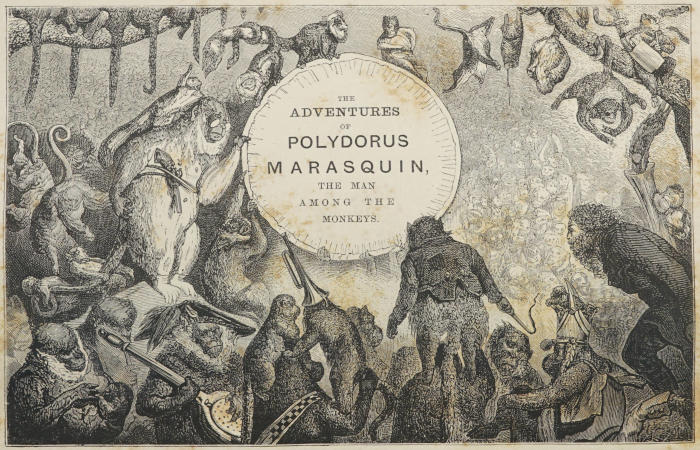
THE MAN AMONG THE MONKEYS. — CHAPTER I.
Origin of my family name of Marasquin.—Mistake in this respect on the part
of my ambitious Grandfather.—My Ancestors’ profession honourable, but
dangerous.—Mine the same.—A Tiger deprives me of my Father, whose
Business I carry on.—My Fondness for Animals, and my skill in stuffing
them.—The terrible Tricks which they play me.—The Malay Pirates more
untamable than my Animals.—The English Stations founded to destroy
them are devastated by Yellow Fever and something else.—Vice-Admiral
Campbell visits my Menagerie.—The rare and curious Animals it contained.—Baboons
and Chimpanzees.—Passions and rivalries.—An Ape as
wicked as a Human Being.—My Mother perishes in the Flames.—I determine
on a voyage to Oceania.—I charter a Chinese Junk, and find it
manned by Pirates.—We encounter a fearful Tempest.
I was born at Macao, in China, and am descended
from one of those brave adventurers who, under
the leadership of the celebrated Vasco de Gama,
boldly left Lisbon, towards the end of the
fifteenth century, to conquer the Indies.
If I have good reason to congratulate myself on the
accuracy of my pedigree, I have, nevertheless, no plausible
grounds for believing that I am descended from one of those
sons of noble families who were attached by the sole tie of
glory to their illustrious chief. My grandfather, it is true,
used sometimes to say that our name of Marasquin was a
corruption of Marascarenhas, one of the greatest of names
among those adventurous Portuguese who followed Vasco de
Gama from the banks of the Tagus to the end of Asia; but
I have always had serious doubts upon this score.
Moreover, my worthy grandfather himself, Nicholas
Marasquin, was to my knowledge never anything more than
an industrious trader, established at Macao. My father,
Juan Perez Marasquin, was pretty much the same. To him
I owe this testimony—that the extent of his ambition, during
a lifetime, too short, alas! to my great regret, was simply to
pass for an honest man, a good Christian, and a loyal bird-fancier.
This, then, was his profession; I do not blush for it,
although certain persons, through ignorance, or actuated by
jealousy, have sought to reduce it to the level of a licensed
dealer in game and poultry.
Even without descending so low as this, it would still be
very unfair to regard the bird-fancier’s profession—which,
by the way, became in later years my own—as restricted to
the mere sale of birds, such as we know it ordinarily to be
followed in Europe. My father possessed in his vast menagerie
one of the finest collections of which the Portuguese
Indies could boast, for it comprised not merely birds, but all
kinds of rare and curious animals. Sumatra, Java, Borneo,
New Guinea, were all represented there by specimens of some
of the strangest and most exquisitely formed creatures which
inhabit in their native state the almost impenetrable forests of
the eastern hemisphere. The profession of naturalist, when
exercised on this scale, is really a very lucrative one, for the
taste of the European colonists, and the almost insane passion
of the Chinese, for these interesting products of nature, are
matters of notoriety.
To his trade in living animals my father added the art and
mystery of stuffing them when dead, which was not the least
lucrative profession of the two. He had given me lessons in
this learned and delicate art of restoring to defunct birds and
quadrupeds not alone the precise forms but the very attitudes
which they affected during lifetime. Thanks to the counsels
of so excellent a demonstrator, I acquired a remarkable skill
in taxidermy; and you will find further on, if you read
through this account of my adventures, that I was indebted
to this useful and beautiful science for my escape from the
tragical end which at one period menaced me.
Our house had prospered for more than a century at
Macao. My father, on succeeding to the collection, added
considerably to it, and thanks to the intelligent care of the
good, economical, and devoted woman he espoused, he managed
to raise his establishment to the very highest position in
that particular branch of industry in which he was engaged.
But if this business yields, as I have already said, such
rich rewards, on the other hand it is attended not only with
difficulties, but with perils as well, as I have had only too
many opportunities of proving. It is carried on under conditions
of which most people are ignorant. It is not sufficient
for a dealer in animals to purchase a bargain, and then to sell
it again at a profit. It is requisite that he should go the
length of procuring in a wild state those rarer kinds of
animals which, when obtained, are certain to realise a good
price. Hence the indispensable necessity of being at once
both merchant and hunter, or rather of being first of all
hunter before becoming merchant.
My father used to go himself to hunt most of the animals
in which he dealt—a laborious kind of occupation, which I,
in my turn, learnt to follow, whilst accompanying him on his
expeditions—sometimes to the coast of China—sometimes to
the jungles of the Isle of Hainan, so prolific in wild animals—sometimes
as far as Japan, in spite of the obstacles and
perils of a navigation bravely undertaken in barques of slender
construction, spite of the Malay pirates—those veritable
sharks, who swallow everything that crosses their path; and
spite of the cruel punishments which used formerly to await
those whom the Chinese and Japanese chanced to find trespassing
on their sacred territories.
My father was in the habit of bringing back from those
distant expeditions—and later I had the satisfaction of bringing
back with him—panthers, tigers, boas, leopards, and,
above all, innumerable varieties of apes. It was during one
of our last hunting expeditions in the Island of Formosa that
my father, assailed by a young tiger, which he was on the
point of enveloping in a net so as to capture it alive, had half
a shoulder and a portion of a thigh carried off by a blow of
the brute’s paw. I had the gratification of defending him
and protecting him from the further rage of the furious creature;
and had, moreover, the satisfaction of carrying him
back with me to Macao, though I had not the happiness of
seeing him live. Badly tended by the doctors of the country,
he languished for a couple of years with wounds which they
did not know how to cicatrise, and died at length after undergoing
the most frightful sufferings. Just before he drew his
last breath in my arms, he begged of me not to continue in
his profession. I promised him I would not; but as he had
left me nothing else to live upon and to support my poor
mother, and as, to speak frankly, I had no taste for any other
kind of pursuit, I was compelled to break my promise. You
will see from the tale which you are about to peruse the
fearful punishment I brought upon myself by so doing.
I stuck, then, to my father’s business, and, in order to
prove to the valuable connection acquired by long years of
good and loyal management how anxious I was to carry it on
with energy, I increased the number of my examples of
rare animals, and sent afar experienced hunters charged to
bring back with them, to the latitudes of the Indies, specimens
hitherto unknown. Being satisfied by long experience
that luxury dazzled the eye, and consequently attracted the
attention of buyers, I set to work to renovate the interior of
my bazaar. Bronze and gilding were had recourse to, to
relieve the too apparent simplicity of my cages. An English
cleanliness reigned throughout all parts of the establishment,
which, in the evening, I lighted up with gas, a dazzling novelty
in those days for Macao.
Here I ought to mention a singular trait in my character.
I was remarkably fond of animals at first, by reason of my
benevolent organisation; afterwards, as a natural result of the
unremitting study which I had been obliged to make of their
forms, features, movements, customs, manners, instincts, passions,
and intelligence; their sympathies and antipathies; their
caprices, maladies, and affinity, more or less expressed with
man, with a thousand other attributes essentially belonging to
their nature, which is perhaps still more obscure and mysterious
than our own.
I had pushed my observations so far on those particular
beings with whom it is now-a-days maintained we have a certain
affinity, that I could easily recognise among them those
whose instinctive dispositions corresponded in a measure with
our own, and who would have become, for example, barristers,
if any such profession as that of the Bar existed amongst
apes, for they were always gesticulating, haranguing, and
arguing. I recognised again such as would have been doctors,
among those who were continually occupying themselves with
the physical condition of their fellows, examining their tongues,
their throats, and the inside of their eyes; others who would
certainly have become comedians, for they were perpetually
making grimaces, and playing and dancing from morning to
night; others again who would have made first-rate astronomers,
for they invariably arranged themselves so as to have
the sun always shining on the tips of their noses. I recognised,
moreover, with a similar infallibility, those who possessed
a taste for commerce, apes who made a point of collecting
together all the fruit and corn which fell from the
negligent hands of their fellows, and of piling it up in a
corner. In like manner I distinguished the misers, the spendthrifts,
the madcaps, the bullies, the good fathers and mothers,
the mothers given to flirting, and the incorrigibly bad sons;
and particularly thieves of every shade, from the sharper
moving in good society, who cheats at the card-table, to the
more daring robber who takes to the highway. I should have
said of the one, “Here is an ape who would loll in his carriage
if he had only a white cravat;” of the other, that “he
would be safe to be hung if he only happened to wear a
coat.”
As apes are far more saleable animals when their natural
talent for imitation is developed by the aid of education, I
made a point of putting most of those in my collection through
a course of instruction, the object of which was to render
them more attractive and engaging in the eyes of intending
purchasers. I taught them, for instance, to throw somersaults,
to jump through hoops, to dance, to play the tambourine,
to march, to fence, and to salute in approved military
style. Many among them, I admit, were unwilling scholars,
and chafed and fretted under the tuition they received; some
so much so, indeed, that, as is commonly the case with members
of the human family, they could only be persuaded to
prosecute their studies by the lively fear of a little wholesome
correction. All this, however, arose simply from their not
knowing so well as I did what was really for their own
advantage.
Spite of the many little tiffs which arose between us in our
several capacities of master and scholars, I conceived, in my
character of naturalist, painter, doctor, philosopher, and
instructor, far more than in my character of merchant, a
strong liking for my boarders. I succeeded, by my powers of
penetration, in reading in their eyes their desires, wants, and
thoughts, and almost ended by conversing with them. In
this psychological study I should, without doubt, have attained
a height unknown to the most skilful naturalists of our grand
European museums, if the fatal accident through which my
poor father lost his life had not all at once put an end to my
passion for animals. After this unfortunate calamity it was
impossible for me not to see in each animal of my collection
an accomplice of the tiger which had deprived my parent of
existence. This antipathy, day by day growing stronger,
caused me at first to neglect the brutes, and afterwards to
punish them with far more severity than I had hitherto been
accustomed to exhibit towards them. They soon perceived
this, since animals have stronger instincts perhaps than men,
and thereupon they repaid me with hatred and spite for the
rigour with which I ordinarily treated them. They became
wicked and vindictive; and I, on my part, became only the
more inflexible. A struggle commenced between us, which
was carried to a point when I was no longer able to rule them
except by threats and red-hot bars of iron.
This was the result; if, in order to punish and to tame
them, I no longer allowed any one among them to leave his
cage, I was obliged from motives of prudence to refrain from
entering any of their dens. On both sides there was a permanent
state of anger and hostility, and I must say there was
no end to the wicked tricks they played me. The last one
they were guilty of was of so cruel, and indeed terrible a
character, that if I were to pass it over in silence, the origin
of my prodigious troubles would be rendered in a great measure
unintelligible. One alone was guilty of this deed, though
all were in a degree parties to it by reason of their undisguised
animosity towards me.
Vice-Admiral Campbell, who at that time was commander
of the English naval station in Oceania, was in the habit,
every time he touched at Macao, of visiting my bazaar, and
of making purchases for his aviaries and ship menageries of
such things as parroquets, birds from the Island of Lugon, or
tame tigers, which served to amuse him during his passage
from one island to another, and throughout the long anchorages
he was occasionally compelled to make up some wearisome and
disagreeable inlet.
I may here say a few words on the importance of the
English stations in the Chinese and Australian seas. The
object of these—which, by the way, is not always attained—is
to protect the lives and properties of Europeans from the
descents of Chinese and Malay pirates, a numerous and terrible
race. These formidable sea-serpents, who are to Oceania
what the Algerians were in former times to the Mediterranean,
recognise no authority under heaven—neither that of the
Emperor of China, backed by his mandarins; nor that of the
sultans who reign over some few large islands, like Borneo
and Mindanao; nor even that of the English and Dutch
viceroys, representatives of powerful nations, it is true, but
who find considerable difficulty in making their flags respected
in these distant seas.
The Malay pirates may be said to brave everything, and
to be everywhere. The archipelago of Sooloo, which contains
no less than 160 islands, is entirely peopled by them. At an
appointed time they will sail forth over the waters with a fleet
of, perhaps, 500 junks, manned by 5,000 sailors, and lie in
ambuscade for unsuspecting merchantmen. The booty which
they secure they divide among themselves; and the prisoners
whom they take are only set at liberty on the receipt of a
considerable ransom: too frequently they are killed. These
water-rats have sometimes pushed their audacity so far as to
make descents in the very midst of such great centres of
commerce as the islands of Sumatra and Java; and on one
occasion they even dared to come and buy powder and ball at
Macao. What is quite as remarkable, too, the merchants of
this place did not hesitate a moment to sell them all the
ammunition they required: in this respect reminding one of
those mercenary Dutchmen who, when besieged by the Spaniards,
made a practice each evening of selling to their adversaries—no
doubt at remunerative prices—the cannon-balls
which they had fired against their town during the day.
These pirates are apparently indestructible; they have lasted
for centuries as it is, and they bid fair to last for centuries more.
It is to protect its subjects against the poisoned daggers of
these swarming bandits that England, as I have mentioned
above, is constantly sending forth ships to innumerable points
on the sea-coast of China, and to the interminable shores
scattered round about.
These vessels often remain for entire years in localities
which are believed to be menaced with a visit from these formidable
corsairs. It is then that the officers take up their
quarters on shore, that tents are pitched, and houses even are
constructed, where naval men can manage to lodge in something
like comfort.
This particular kind of naval campaign is much dreaded
by the English sailors, obliged to contend at the same time
against tempests, pirates, and fevers of every kind and colour;
and, above all, with the wearisomeness arising from the monotonous
kind of life they are here forced to lead, and which
may be described as the yellow fever of the mind.
Vice-Admiral Campbell, who commanded, as I have
already said, at one of these stations, had hoisted his pennant
on board Her Majesty’s steam frigate Halcyon.
The admiral was preparing to leave the roads of Macao
on the very day that he came with all his staff—captains,
lieutenants, commanders, and officers of every grade—to view
my menagerie. Some of these gentlemen had brought their
wives with them, whence I concluded that their stay at the
station to which they were about to proceed would be an
unusually long one.
Fortunately, I had received a short time previously some
considerable additions to my stock of animals; and I can
truly say that my establishment at this time was alike worthy
of the attention of men of science and of amateurs. Besides
birds from every clime, which enriched my aviaries, I possessed
gazelles from Egypt, bisons from Missouri, goats from Cashmere,
ant-eaters, jaguars, leopards from Senegambia, otters,
polar bears, black panthers, lynxes, moose-deer from Canada,
rhinoceroses with one horn, llamas from Brazil, lions from
Bengal, and a magnificent selection of tigers. But the cream
of my collection was its endless variety of apes: waggish,
wicked, shy, wild, grave, pensive, sinister, intellectual, stupid,
melancholy, and grotesque. I had ourang-outangs, gibbons,
baboons, papios, mandrills, wanderoos, monkeys, macaques,
patas monkeys, malbroncks, mangabeys, lemurs, talapoins,
cluks, and magots. Of all these apes, there were four that
seemed to divide among themselves the curiosity of the large
party at that moment assembled in my museum.
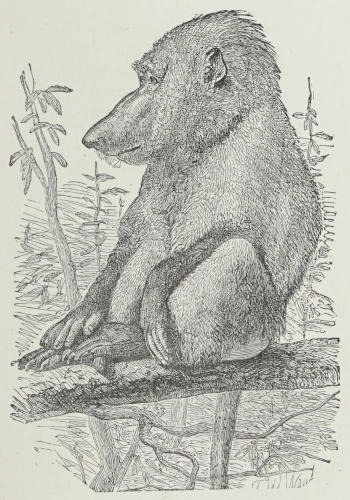
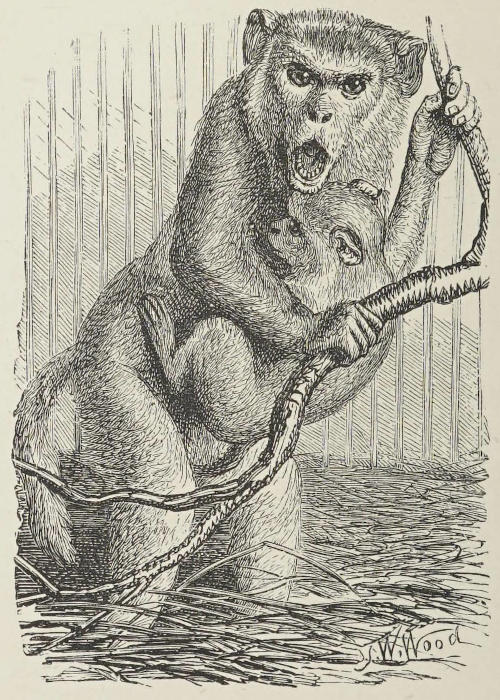
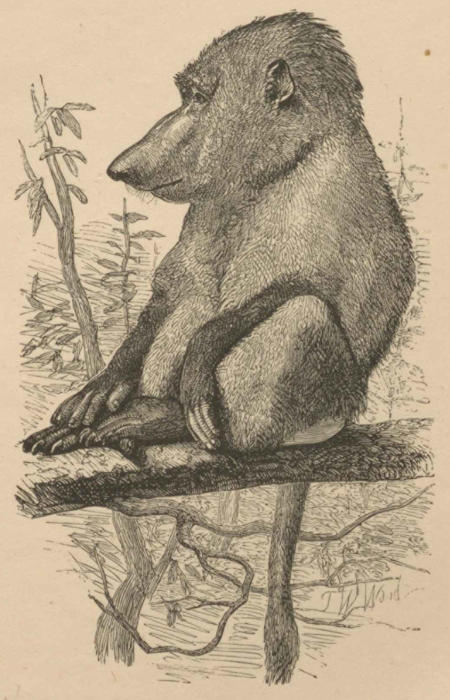
Firstly, there were two baboons of unequalled strength
and ferocity—as large as men, as intelligent as men, and, I
was about to add, as wicked as men. They made their cage
shake again with their violent movements, they often turned
it over even; and, in an excess of anger, would twist the iron
bars through which they made a point of insulting every one
that stopped to gaze at them, as though these stout metal rods
were so many sticks of pliant wax. How was it that visitors
generally were so pleased with them? Could it have been
because they were so supremely wicked? I am half afraid
that this was the reason.
The two other apes who divided the sympathies of the
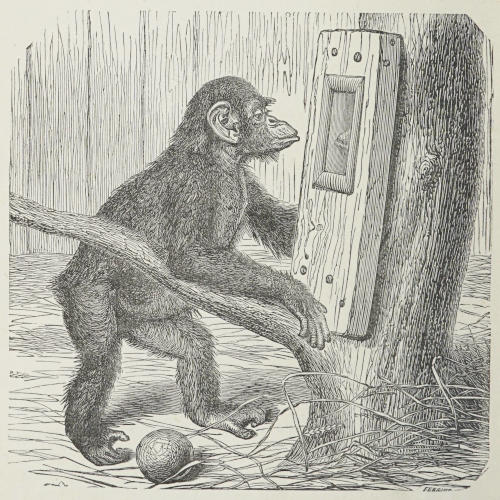
visitors with the big baboons were a male and female chimpanzee,
both possessing youth, and, I may add, even grace.
The male chimpanzee was gentle as a young girl, delicate,
sensible, understanding everything, approaching as near the
limits of intelligence as is permitted to a being deprived of
the Divine light of reason. He was fond of children, played
with them, and appeared to have a taste for music, since he
invariably left off eating whenever he heard the sounds of an
instrument.
With me he filled the office of a footman. At dinner he
held the plates, and handed round the wine; he even ate at
table when I invited him. The trifling marks of attention
which I occasionally paid him made the other apes jealous,
almost to frenzy.
With regard to his companion, who was likewise a young
chimpanzee, she differed from most female apes, who are fond
of ribbons, lace, and embroidered handkerchiefs, and appeared
perfectly contented with her own natural grace and prettiness.
She was never so happy as when some one gave her a
beautiful flower, which she would either place behind her ear,
or else regard with looks of melancholy for entire hours.
I had named my two baboons, the one Karabouffi the
First, the other Karabouffi the Second; and I had given to
the male chimpanzee the name of Mococo, and to the female
that of Saïmira.
Mococo loved Saïmira very much; and it is quite certain
that Saïmira on her part loved Mococo in return.
Karabouffi the First had also a hidden and terrible love
for Saïmira. Nothing could exceed the black jealousy of this
ferocious baboon. Whenever the two young chimpanzees,
who enjoyed the liberty of perambulating the galleries of the
museum, passed in front of his cage, his terrible claws became
rigid as iron hooks, his eyes flashed forth angry and vindictive
glances, as he curled up his blue lips, and gnashed his teeth.
On these occasions terror reigned throughout the menagerie,
and even the lions and tigers seemed lost in reflection.
There was not a single one of these animals that did not
at times recall to me, point by point, the characters, desires,
and passions of men. I became convinced with Buffon, who
has written so many admirable pages on natural history, that
if, instead of beating and ill-treating them and making them
constantly suffer, we were only to study them, and take a real
and active interest in such an occupation, we should penetrate
an immense and unexplored world of ideas and sensations,
where as yet we can be hardly said to have placed our
feet.
Vice-Admiral Campbell was so delighted with the grimaces,
the tricks, the eccentricities, and I must also add the ferocity,
of my boarders, that he immediately purchased an ape and a
monkey. Whereupon every officer, out of deference to his
superior, selected in like manner an ape and a monkey.
I confess I could not bring myself to part with Mococo
and Saïmira, for it was necessary to sell both or to keep both;
but Vice-Admiral Campbell’s lady wished so much to possess
them, that I had no alternative except to resign them to her.
I knew, moreover, that she would take as much care of them
as I myself had been in the habit of; nevertheless, I asked
her to promise me never to leave them in the power of their
prime persecutor, Karabouffi the First. She gave me her
word, and I abandoned my two young chimpanzees with confidence
to her keeping. The poor things appeared even more
afflicted than myself at our separation, for they embraced me
like two children, and moistened my hands with their tears.
Overcome by these marks of affection, I was on the point of
taking them back again; but I recollected that I was a trader,
and that a trader must sell the wares in which he deals: interest
therefore had its way.
As all the gentlemen belonging to the station bought, as
I think I have already said, my animals in pairs, it happened
that, owing to my having an odd ape, one of the two baboons,
Karabouffi the Second, was left on my hands. For want of a
female to pair with him, he was condemned to remain in the
menagerie, a circumstance which irritated him to that degree
as to cause him to utter shrieks of rage on seeing his companions
about to be taken away while he alone was to be left
behind.
His companions in their turn, pitying the lot of their
unfortunate comrade who remained a captive behind the iron
bars, uttered the most plaintive cries, and sought to prevent
themselves from being conveyed on board the vessels which
were to carry them to the distant station. It became necessary,
therefore, to have recourse to the whip.
As may be supposed, all Macao was in commotion at the
event. However, the law was strong, and the whole of the
apes were eventually embarked.
It would be impossible to give an idea, either by the aid
of language or of painting, of the dark and revengeful looks
which the solitary baboon directed towards me when I re-entered
the menagerie after his companions’ departure.
I question whether the most irritated and malignant of
men, burning with feelings of suppressed hatred, ever condensed
such unmistakable threats of vengeance into his eyes
as I could read in those of the infuriated baboon. I saw
there a positive hankering after blood, and that blood, moreover,
my own.
Nearly a year had elapsed since this extensive sale of apes,
on which I had, as the reader may suppose, realised enormous
profits, when one night I woke up suffocated by a dense smoke
which seemed to rise from the crevices in the floor of my
room. This flooring, which was composed of very thin boards,
extended above the menagerie. I found myself positively
choking, and rose from my bed with infinite difficulty, and
directed my steps towards the window, which I immediately
flung open. Indeed, I opened every window and door so as
not to perish of suffocation. But directly the air had penetrated
into the apartment, it was no longer smoke that I had
to contend with, but fire, which, running along the cracks of
the floor, enveloped ere long the whole house in a blaze.
My first thought was to save my poor mother, but I was,
alas! too late. The back part of the house, where her room
was situated, was the first to be filled with smoke, and my
poor mother must have been suffocated before she could call
out for assistance. For myself, I was dragged from the room
where I wished to die. My neighbours saved me, carried me
into the street, and placed me on a stone bench, from whence
I saw my entire establishment consumed before my eyes.
Through the broken door, through the open entrance of the
bazaar, I was a witness of a spectacle which I shall never
forget.
In the midst of the devouring flames, which were roasting
my finest birds, and in which my superb tigers were writhing
with fearful cries, nobody meanwhile daring to approach near
enough to attempt to rescue them, the baboon, a lighted brand
in each hand, danced, chuckled, grinned, and frisked about
with a hideous kind of joy. His attitude, his impudent looks,
indeed everything about his frightful expression, sufficiently
proved him to be the author of the conflagration—he who, in
the course of a long-meditated night of vengeance, had
managed to procure some matches with which he had seen
the keeper of an evening light up the bazaar; he who, breaking
his chains and the bars of his cage, had first turned on
the gas, and after allowing it to escape had then set light to
it. Such was the supreme vengeance of this terrible baboon,
Karabouffi the Second.
One of my neighbours shot him as he was dancing in the
midst of the flames. But I was not the less ruined; I had
not the less lost my excellent mother.
Under the weight of so many afflictions, and so much
misery, I resolved to change my profession; remembering
rather late my poor father’s admonition. For more than two
years I traded in ivory, feathers, and furs; but not being
versed in this kind of traffic, I made only moderate profits,
and entertained no hope whatever of realising any very great
ones in future. Moreover, this mode of life, less active than
what I had been accustomed to, did not please me; my former
pursuit was continually recalled to my mind by the enticing
nature of my studies in natural history. I regretted it even
for the dangers with which it was beset, and of which I have
already spoken. At last, after a good deal of hesitation, I
determined to follow it again. I was still young; several
thousand piastres were lying to my credit with M. Silvao,
banker at Goa. I had the means of re-establishing my
business; but it was necessary for me to undertake two or
three journeys to the islands of Oceania, and join the great
hunters of wild beasts and birds of prey, with whom I counted
upon scouring the woods and swamps. It was a hardy and
adventurous course to follow; still there was no other way of
re-stocking my establishment at Macao. I hesitated for a
time, I admit; but after awhile I took leave of my few relations
and my numerous friends, and made the final preparations
for my voyage. I ought not to omit to say that I had
chartered a Chinese junk on my own account, and that I had
it at my service for an entire year. My first destination was
Australia, that immense island, as large as a continent, where
I was certain, according to the accounts of travellers, to find
some of the most varied and least known animals of creation.
I set sail on the 3rd of July, 1850, in the junk which I
had chartered, and which did not make up for its great weight
by any unusual strength. It was an old tub of a thing, none
the better for its numerous voyages to Corea and Japan.
Formerly it had been able to resist bad weather, but, for all
that, it could only boast at the present time of somewhat
shaky ribs and planks, scarcely to be relied on in rough
weather, for anything that Master Ming-Ming, its very indulgent
captain, might say.
My first point of debarkation being New Holland or
Australia, we steered direct south on quitting Macao.
For eight days we were favoured by a wind which carried
us straight in this direction. So we soon found ourselves in
the midst of the archipelago of the Philippines, spite of the
want of agreement prevailing among the crew, which was
composed of eight Chinese, eight Malays, and eight Portuguese,
three nations holding each other in the greatest possible
aversion, detesting one another as much as the Genoese formerly
detested the Corsicans, and the Corsicans the Genoese,
and settling all disputes by the arbitration of the knife.
While passing the Island of Mindanao, and at the moment
of entering the Sea of Celebes, we sprung a leak, and
as if to make up for the fine weather we had already enjoyed,
the sky became overcast, and squalls began to blow from
every point of the compass.
Throughout ten entire days we endeavoured to pass the
Straits of Mindanao. The wind and currents, however, always
drove us towards the west, and the greater the efforts which
we made to resist this deviation from our course the more the
leak in the junk increased.
To aggravate our position in the midst of a sea of itself
sufficiently dangerous, the crew refused to work at pumping
out the water which was gaining on us every hour. Chinese,
Malays, and Portuguese alike refused to perform this task as
being too laborious for them; laborious it may have been,
but on it, nevertheless, the safety of all depended.
Captain Ming-Ming, I could only too plainly see, had no
power whatever over his incongruous crew; I even suspected
him of having formerly exercised the profession of pirate in
company with the eight Malays, who placed him on a footing
of such perfect equality as unmistakably indicated the bonds
of an old and equivocal fraternity, and deprived him of any
kind of authority over them. The discovery was not very
assuring for me, who knew so well, as I have already explained,
the utterly savage character of these untamable brigands.
This revelation, I confess, startled me; I nevertheless dissembled
my fears, but took the precaution of loading a couple of
pistols, and placing one in each of my two side pockets.
The crew would not work at the pumps, and the water
was continually rising in the hold. Not by any means such
good sailors as the Chinese and Malays, the Portuguese portion
of the crew became alarmed at the fate which evidently
threatened us, and proposed to make for some port. This the
Malays and Chinese opposed, and their will carried the question,
which only helped to confirm me in my suspicions of
their former character, as they evidently did not wish to show
themselves in any port which boasted of a regular police.
Moreover, what port should we make for? In the first
place, where were we? Were we above or below the Equator?
Were we sailing along the Strait of the Moluccas or
of Macassar?
Master Ming-Ming, more learned in the art of smoking
opium than in that of navigating a vessel, was not the man
to have informed us. The sky was black, the wind blew our
great bamboo sails into shreds, and the waves seemed as
though they would engulf us.
When it was no longer possible to overcome the danger
which had now become most imminent, this confused medley
crew began one and all to change their minds. The instinct
of preservation awoke within them when it was too late.
They attempted to clear the water out of the junk; but the
pumps would no longer act. Fear then took possession of
these bandits, every one of whom, Malays, Portuguese, and
Chinese, greedily sought land on the horizon, although the
chance was that they would be hung as pirates as soon as
they set foot on shore. During this anxious time I could do
nothing beyond looking to the preservation from sea water of
my good arms, my nets, and the various traps with which
I had left Macao, in the hope of replenishing my menagerie.
Alas! what was the use of all these precautions?
Was I destined to escape myself from my present critical
position?
On the twenty-eighth day of our voyage, there was no
other course left us but to abandon ourselves to the discretion
of the tempest. Master Ming-Ming therefore left the junk
to itself. I don’t think, although I have seen many hurricanes
on the coasts of Japan, whilst sailing with my father,
that the winds and waves were ever so frightfully disturbed
as they were on this occasion. The old junk bounded on the
crest of the sea like an elastic ball on the ground.
After three days passed between life and death, we perceived
a point black as ink, standing out from the lurid sky
on the horizon. The Malays, whose eyes have an infallible
power of penetration, affirmed that it was land. We sped
along with all the violence of a hurricane. The night having
almost immediately supervened, we had not time to calculate
if, when the light of day re-appeared, we should have reached
or passed this wished-for land. And what a night it was for
us, with neither sails, nor masts, nor rudder, with the wind
blowing great guns, and the junk seeming as though it were
splitting in pieces on every side!
CHAPTER II.
We are Shipwrecked.—I alone escape.—I find myself on an unknown island.—A
strange form appears to me and vanishes.—A deluge of Apes.—I am
cudgelled with a rattan cane.—Am saved at length by my cravat.—I am
parched with thirst.—I discover water.—Four thousand of us drink in
company.—Ingenious way of procuring fruit from the top of a tall tree.—Two
valets-de-chambre, such as are seldom seen in Europe.—I miraculously
escape their care.
At last the day broke, and we saw land only a
quarter of a mile distant. But this quarter of
a mile was only a chain of shoals white with foam
from the sea incessantly breaking over them. It
was inevitable that ere many minutes elapsed
poor crazy junk would break itself as the sea was doing on
the rocks, covered with foam and bearded with patches of
slimy sea-weed, which lay direct in our course. We had no
time to reflect on the fate which awaited us. Two sudden
and frightful concussions, two blows of the heel, to use sailor’s
language, shattered the ribs of the poor junk, whose poop at
the same time was carried away by a terrible sea, and with it
five of the crew. We scarcely heard the cries which they
uttered as they disappeared in the watery abyss.
The other sailors at once sought to possess themselves of
the only boat we had, in order, if possible, to reach the land.
They had, however, no sooner commenced lowering it than a
frightful struggle arose as to who should occupy it. It would
scarcely have held more than half-a-dozen persons, and there
were fifteen desperate men eager to fill it. Knives were
drawn. A cutting of throats commenced; but the theatre of
the struggle was about to disappear beneath the feet of conquerors
and conquered alike.
Having kept clear of this desperate struggle for the possession
of the boat, I caught sight at this moment of danger
of one of those buoys fastened by a rope to the cable of the
anchor, and which serves to mark the exact point where the
anchor has been let go. I at once pull out my knife and cut
the rope at a certain distance from the cable, and then seizing
the buoy in both my arms, threw myself with it into the
midst of the hissing waves. Engulfed an instant beneath the
surge, on rising again to the surface, I turn my head to see
what has become of my companions. They and the last
remains of the junk have disappeared!
For three hours I fought with death. What agony I
suffered! Every time I endeavoured to hook myself on as it
were to the branches of coral which projected above the
waves, I was driven back by the surf: and my gory hands
let go of their painful support. My strength failed me; I
had scarcely sufficient left to seize the rope attached to the
buoy. I had lost all energy, and almost the desire for
existence, when a last wave enveloped me, and carried me
with my buoy to the bottom of the sea. I felt myself getting
weaker and weaker, then I became cold, and recollect nothing
more.
When I re-opened my eyes I found myself lying extended
on a shore covered with sea-weed and marine plants. I fancied
too that trees were not far distant. My astonishment was
that of a person waking from a trance—I hadn’t strength
enough to rise. The storm no longer raged. The sun, which
appeared to my still weak sight to have attained a certain
height in the heavens, spread a general glow around, and the
sand grew warm beneath my touch. By degrees the sensation
of life returned to me. I sought for myself, I asked
myself if it were really I, and whereabouts I was; I saw for
certainty that there were trees—in fact a forest at some little
distance off. My lethargy passed away like a fleeting cloud,
and I endeavoured to rise and walk a few steps; but my legs
bent under me. Nevertheless I held myself upright. The
sun, which had risen still higher in the heavens, now shone
down almost perpendicularly on the ground. The heat
diffused throughout the air was so intense that I fell faint
and exhausted at the foot of a palm-tree whose cool and refreshing
shade served to revive me.
Gradually my eyes grew heavy, and I fell fast asleep. I
do not know how long I remained plunged in this second and
more refreshing lethargy; but when I awoke, I judged by
the position of the sun that it was afternoon. From the
degree of comfort which I felt, I concluded that I must have
slept altogether something like eight hours. I can, however,
say nothing positive on this score, my watch having stopped
from the various shocks my whole body had received since the
preceding evening.
In order to dissipate the heaviness which held possession
of my senses after this prolonged sleep, I rose and took a few
rapid steps straight before me. I had scarcely proceeded
twenty yards in a direction immediately opposite to the sea,
when I caught sight of something like a human form at the
end of a long avenue of trees. Naturally enough, my first
impression was that this must be some inhabitant of the
island on which I had been cast by my unlucky shipwreck. I
was already rejoicing at the discovery, though, I must confess,
not without a certain amount of inquietude as to the possible
nature of the companion whom fortune had sent me. I
walked straight in the direction in which I had first seen
him; but, to my intense surprise, after the lapse of five or
six minutes, I failed in encountering him, or even in discovering
what had become of him. Had my eyes deceived me?
Had the numerous mirages of the sun assisted to produce
some kind of hallucination? I knew not how to explain the
affair, which left upon me a certain disagreeable impression.
Nevertheless I continued to walk on.
I had proceeded no very great distance, when all at once
another view opened to my sight; and, to my intense satisfaction,
I again saw the figure which I had observed a few
minutes previously. Ah! how truly happy I felt at this
second discovery! I could manage to distinguish him far
more clearly than I had done before, although the distance
between us was very much greater. I watched him with the
utmost attention, and was surprised to find how excessively
quick and lively all his movements were. He was continually
disappearing and appearing again, passing as quick as lightning
from one point to another. After a time I felt convinced
that he had seen me, and that he was afraid. I thereupon
advanced towards him with increased boldness, and had
just arrived at the spot where I had last seen him, when
something—indefinable at the first glance, a kind of hairy
and sinewy form, uttering noisy, guttural, and savage cries,
which were taken up and repeated by the many echoes around—suddenly
descended from the top of a tree, almost at my
very feet. It was an ape. With one bound he mounted the
tree again, then sprang down, and ended by placing himself
immediately in my path, as though to prevent me from
proceeding.
This pretension on his part was not at all to my mind; I
therefore broke off the first branch of a tree which I could
manage to reach with my hand—it was, I believe, a small
stick of cane—and threatened the animal with it. My action
evidently displeased him. At a second cry, which he uttered
as a call, judge of my consternation to see rushing from the
four points of the compass, through the openings in the forest,
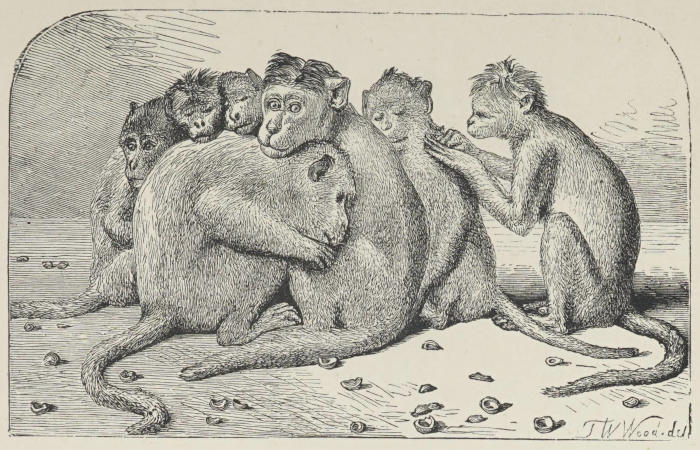
clouds upon clouds of apes, of all forms, colours, and sizes,
who in an instant, clambering up the trees, rolling themselves
among the branches like squirrels, or taking possession of the
ground about me, proceeded to regard me with quick and
menacing glances, and to overwhelm me with hissing cries,
and gnashings of the teeth, so fierce, so noisy, so positively
deafening, that I became quite dizzy and bewildered. I was
compelled to clap my hands over my ears, so as not to lose all
sense of consciousness in the midst of this infernal commotion.
Nothing like it, I believe, had ever been heard before in the
forests of Oceania.
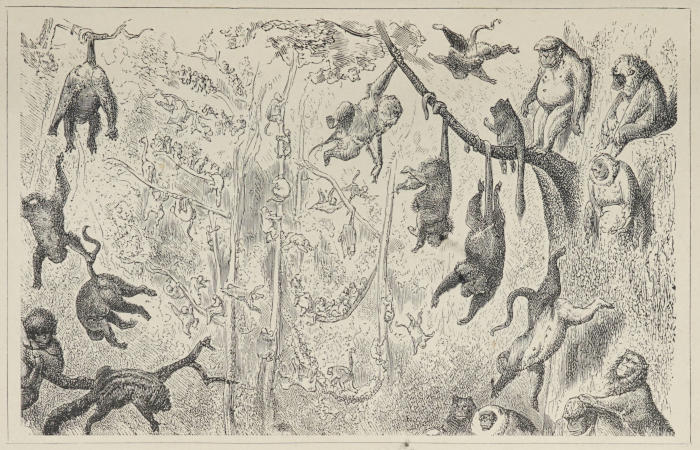
Clouds upon clouds of apes, of all forms, colours, and
sizes, clambering up the trees, rolling themselves among the branches
like squirrels, or taking possession of the ground about
me.—Page 30.
My Macao experience with regard to apes was not lost
upon me at this supreme moment. In spite of my trouble,
and of the danger with which I was menaced, I managed to
recognise, without difficulty, the different kinds of apes in
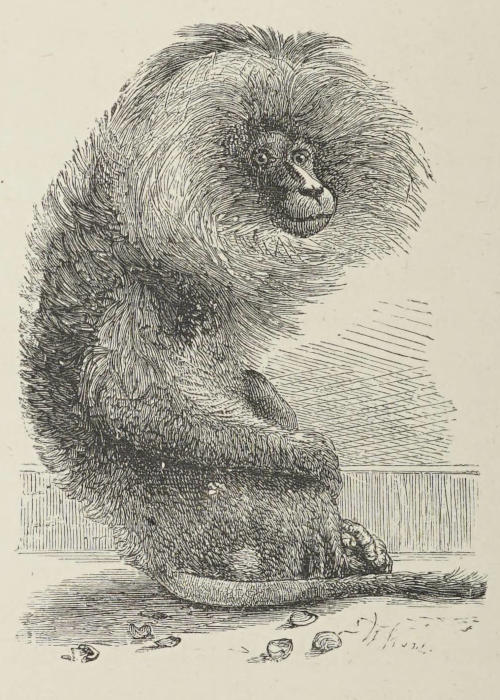
which I had formerly dealt. I noticed the duks, with their
long tails, smooth faces, black feet, and red ears; the wanderoos,
such troublesome fellows that they are obliged to be
kept in iron cages; lowandos, with hairless flesh-coloured
faces, and all the rest of their bodies as black as their noses,
possessing long claws, and having on their heads large wigs of
grisly, bushy, compact hair. I saw monkeys with purple
faces, and with violet hands, trailing behind them tails terminating
in white tufts of hair; capuchins, covered with a
flowing down of a yellowish black tint, which serves them for
a kind of hood; monas, with white bellies and wide open eyes
surrounded with circles, black as their feet, hands, and wrists;
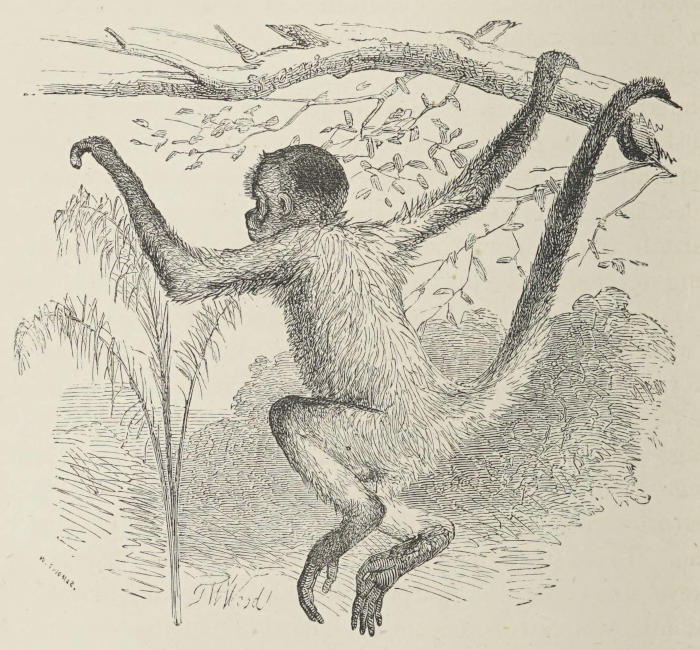
then coaïtas, or spider monkeys, with tails that they can turn
to much the same purposes as the elephant does his proboscis;
then black-crested simpias; then ourang-outangs; then hundreds
of mangabeys, monkeys with long tails, and known as
apes of Madagascar. I recognised them by their naked eyelids,
their striking whiteness, their long grey muzzles, and
their eyebrows of coarse and bushy hair. In the same way
I recognised the gloomy macaques, the turbulent pinches, the
malbroncks, and the pig-tailed macaques, which gambolled,
frolicked, danced, kicked, stamped, capered, and wheeled
about on every side. Hundreds and hundreds more pressed
forward to catch sight of me, but they were too far off for me
to distinguish them, as I had done those of whom I have just
spoken.
Knowing by experience the thoroughly wicked nature of
these animals when congregated together, I resolved to beat a
retreat. I was, however, too late. On all sides of me were
closely-packed ranks of apes, some of whom seemed possessed
of such strength, that any attempt at flight would have been
a grave imprudence on my part. I remained, therefore, perfectly
still, but not without some little anxiety. Suddenly,
all these apes which encircled me round about, commenced to
sway to and fro, making at the same time the most hostile
demonstrations, although I no longer held in my hand the
unlucky cane branch, the original cause of their furious
irritation. That I might bear with patience this opposition,
which I was most anxious not to increase (thinking that if I
were permitted to proceed towards the interior of the island,
some inhabitant, friend or enemy, civilised or savage, might
rescue me from these insulting occupants of the woods), I
amused myself by recalling to mind the wearisomeness of the
dull tints which overpower the traveller on his arrival in the
first commercial, and the most densely-populated city in the
world, that “province covered with houses” called London,
the thousand custom-house officers—honourable persons
enough, whom I should be very sorry to compare with apes,
though they are also at times equally tyrannical—that one
meets with on landing. I turned from one reminiscence of
the kind to another, until I found myself recalling how on a
particular day, on my arrival at Calcutta, the officers at the
custom-house pierced with their iron gauge-rod a packet of
twenty Cashmere shawls, which were completely spoiled; but
on which, nevertheless, I was required to pay duty.
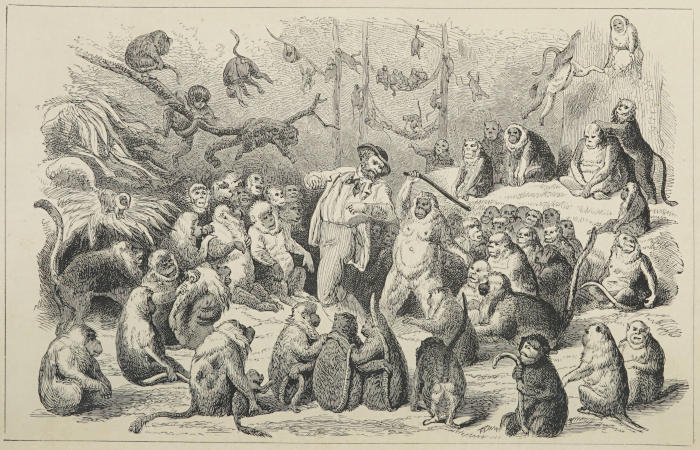
Quick as lightning, he seized the branch of cane which
I had thrown on the ground, and before I had time to place myself in a
posture of defence, showered blow after blow on my arms and
legs.—Page 33.
After a time, finding the heat, striking on the open spot
where I was standing, somewhat oppressive, I endeavoured,
while the disposition of my guards seemed a trifle more to my
advantage, to take a few steps in advance. I was, in fact,
frightfully hungry, and my lips were parched with thirst.
No sooner, however, had I prepared to change my position
than all these groups of importunate apes, gathering more
closely around me, recommenced their cries and their menaces.
They did more, they formed a square; and when they had
taken up this strategical position, of which I occupied the
centre, one of them, leaving the ranks, advanced towards me.
Quick as lightning he seized the branch of cane which I had
thrown on the ground; and, before I had time to place myself
in a posture of defence, showered blow after blow on my
arms and legs, my feet and hands, my face and head, and on
my back and sides. These blows followed one another in
such rapid succession that, not being able to run away, I commenced
bounding about, jumping as though there were
blazing coals beneath my feet.
I candidly confess that I suffered quite as much shame as
pain. A vile ape was belabouring me, an abominable brute
was taking upon himself to administer correction to me in
broad daylight! Other miserable apes, witnesses of my moral
degradation, were making grimaces and grinning at me, and
showing their enjoyment by capering about. It was whilst I
thus performed a part in a comedy before their eyes, and they
furnished me an occasion of observing them more closely, that
I was seized with a singular idea; but the trouble I was in
prevented me from following it up. Ah! my position was
indeed a painful one, to be thrashed by an ape before an
assembly of apes! It is only animals who can introduce such
a degree of refinement into cruelty. I know very well that
at London, which has the reputation of being an extremely
civilised city, people are ready to crush one another to death,
when a criminal is hanged before the door of Newgate; and
that in Paris, people pay equally dear for places to see a man
executed; that it is the same at Brussels, Vienna, and Berlin—nevertheless,
spite of the attractions which an execution
offers, we neither hang nor decapitate apes; and the right
which these animals arrogated to themselves of cudgelling
me, appeared to me to be founded neither in reason nor in
justice. For the moment they were of course the stronger,
and it was necessary that I should give in to them; and I did
give in. But it was melancholy to feel that there appeared to
be no end to this punishment; my tormentor never once
relaxed his exertions, to take even a moment’s rest; but
continued laying on his blows, as though he would never
tire.
Certainly, with one of the two pistols which I had about
me, and which I had been prudent enough not to part with,
I could easily have shot the impudent beast through the head;
but I remembered too well the accident which happened to a
certain president of the French East India Company, to
attempt any such thing. One day, when the celebrated
French traveller Tavernier accompanied the president on
an excursion through some great forest on the banks of the
Ganges, the latter, being astounded at the immense number
of apes which he saw, and which suddenly surrounded him
just as they had surrounded me, stopped his carriage, and
desired Tavernier to knock two or three of them over. The
servants, knowing very well the vindictive dispositions of
these animals, begged of the president not to meddle with
them. He, however, insisted, and Tavernier fired, and killed
a female with her young. At that very instant the other
apes threw themselves, with cries of rage and despair, on the
president’s carriage. They knocked over the coachman, the
footmen, and the horses, and would have strangled his lordship—torn
him to pieces, indeed—if the windows of the
carriage had not been promptly closed, and the members of
his suite had not engaged in a regular fight with their assailants,
from whom they only escaped with an infinite deal of
trouble.
The remembrance of the danger which menaced them
restrained me from discharging my weapon at the horrible
animal, who still continued his blows, spite of my ill-concealed
rage, and the efforts which I made to protect myself, Alas!
I could do nothing. I was thrashed by him till the blood
flowed from me and saturated my garments. I should have
assuredly sunk under the constant succession of blows meted
out to me, since the cunning and wickedness of these animals
went so far as to induce them to volunteer to relieve my tormentor,
when he at length felt fatigued with his exertions; yes,
I should certainly have fallen a victim to their brutality, but
for an idea, a really admirable idea, which occurred to me; but
which, unfortunately, like all excellent ideas, came very late.
The increased pain which I endured evidently freshened up
my memory; and, all of a sudden, it struck me that I had
heard of travellers, who found themselves in the same predicament
as myself, escaping by means of a ruse, which ruse
I resolved for my part at once to employ. I therefore proceeded
to untie my cravat (a superb cravat, bought in Bengal
the preceding year), and, unfolding it, threw it among the
crowd of apes, who no sooner caught sight of my bright red
neckerchief than they rushed forward in a body to seize it,
with loud chatterings, and other signs of curiosity and delight.
My tormentor followed the example of his fellows; and,
whilst they disputed among themselves the possession of the
spoil which I had resigned to them, I ran off, with all possible
speed, towards the interior of the island, where I reckoned on
meeting with some of the inhabitants, and certainly on procuring
a little water, to quench my intolerable thirst. After
a breathless run of five or six hundred yards I looked
back, and had the satisfaction of finding that none of the
apes were following me. For an entire hour I continued to
run in this manner over a tract of soft sand, through groups
of trees entwined together, and forming bright masses of
foliage of various colours, and which by-and-by bowed down
to the earth, indicating a hollow where I might possibly find
water. I was thoroughly fatigued, I was in a burning
heat. Was I about to discover the water I so ardently longed
for?
On rounding a hill covered with a whitish green moss, I
was suddenly struck by the sight of a lake upwards of a mile
in length, bordered by tall trees, ranged in a series of terraces,
as though they had been planted thus by a professor of landscape
gardening. A slight descent, along the same soft silvery
turf which I had just now passed over, conducted me to the
brink of a clear, sparkling sheet of water. I knelt down to
drink, and, placing my parched lips in it, my ecstasy was so
complete that I prolonged it for nearly a quarter of an hour,
partaking at intervals of draught after draught of the reviving
delicacy.
My enjoyment was like a dream, it was so concentrated
and so tranquil. But the cry which escaped me on raising
my head, was not altogether one of gratitude towards Heaven,
to whom I owed the delicious joy of having been enabled
thus to refresh myself. Intense surprise had something
to do with my exclamation.
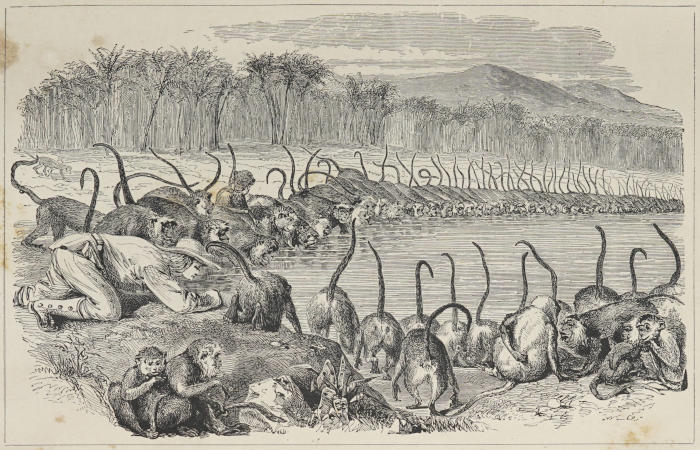
The banks of the lake were covered along their entire
length by those very apes who had so pitilessly tormented, jeered at, and
beaten me.—Page 36.
The banks of the lake were covered along their entire
extent by those very apes who had so pitilessly tormented,
jeered at, and beaten me. They had all been kneeling just
as I had knelt, had all risen at the same time as I had done,
and there they were with their muzzles dripping with water.
When I thought I had lost them, they had no doubt followed
me in silence through the wood, by the aërial route of the tall
branching trees, and on seeing me kneel down to drink had
imitated all my actions. Although my limbs ached with
fatigue, and I was sore from head to foot from the innumerable
blows which I had received, and although I began to
experience serious inquietude, on finding myself, since my
shipwreck, in the midst of this constantly increasing crowd of
apes, I could not restrain a burst of laughter on seeing with
what burlesque fidelity they reproduced my most trifling gestures,
my most accidental attitudes, and even my involuntary
movements. A new stupefaction took possession of me at
finding my burst of laughter immediately echoed by thousands
of similar cachinnations. Unable to control myself, I laugh
my loudest, they, in their turn, laugh louder still. This
comedy threatened never to come to an end. Terrified at the
unaccustomed noise, the birds, hidden in their nests of moss,
dispersed among the ferns, swarming through the network of
creepers, or asleep under the leaves, the great, the small, the
invisible birds—birds whose names are known only to the
Creator, and of whose fantastic shapes and plumage the most
comprehensive human language could scarcely give an idea—birds
clad in brocade, like the ancient doges; others with triple
embroidered collars, like the princesses of the middle ages;
others, the plumage of whose tails flashed forth as many rays
as the sun himself, rose, flapped their wings, and took to
flight, streaking the sky in frightened curves at the universal
thunder of laughter which rent the air. The apes themselves,
accustomed as they were to similar commotions on the part of
the feathered tribe, were, nevertheless, astonished at the
strangeness and novelty of the sight. They stood up on their
hind legs in order to enjoy it the more thoroughly. It was
then that I remarked something which had before escaped my
notice: many of my hairy persecutors wore a kind of narrow
red collar, the meaning of which I could not at first possibly
understand. A brief reflection, however, made everything
clear to me. Each of these red collars was a fragment of the
cravat which I had resigned to my tormentors, and which,
true to their imitative instincts, they had tied under their
chins; I never saw anything more comical than this piece of
finery with which several of the apes were strangling themselves,
in tying it so tightly that it could not come undone, or
be stolen from them by their jealous comrades. These apes
in their scarlet cravats presented a spectacle which, under
circumstances more propitious to one’s personal security than
those in which I at present found myself, I should no doubt
have enjoyed immensely.
I had managed to quench my thirst, but my hunger had
not been appeased. Far from it in fact, since the satisfaction
accorded to the one sense only rendered the other more imperious.
My hunger had increased considerably during the last
quarter of an hour, for I had noticed on the trees, by the
brink of the lake, certain fruits of a bright golden colour,
fruits delicious to behold, and no doubt more delicious still to
the taste, but situated so high, that never man, even though
he were a sailor of Java, could hope to reach and gather them.
The trees were from 180 to 200 feet high, with no other
branches shooting out from their tall stems except those which
clustered together at the summit, with perfectly smooth barks,
and offering not the slightest point of support for either hand
or foot for three-fourths of their entire height. My eyes
coveted this fruit, my stomach yearned for it; but how was I
to obtain possession of it? After all manner of sterile calculations
as to how this was to be accomplished, I decided to
throw, with my utmost strength, a few sharp flints into one
of the trees, in the hope of detaching some of the fruit from
its stalk and bringing it to the ground. I knew that I was
sufficiently adroit to hit the fruit at which I aimed, but for
all that it did not break off as I anticipated. The flint, after
striking it, bounded from branch to branch with a loud noise—the
slightest thing, it must be remembered, produces a loud
noise in these solitary isles, the silence of which has not yet
been broken by the restless activity of man—encountering in
its fall quantities of large leaves lightly joined to the branches
of the tree by their juicy stalks. The apes, who had been
intently watching all my movements, scarcely awaited the
descent of the first stone, before they collected together all
the flints they could, and flung them one after another at the
topmast branches of the trees. The noise thus made sounded
for all the world like the crackling of hail and grapeshot.
Delighted with their occupation, they formed as it were a
chain, and passed the stones rapidly from hand to hand, so
that those who preferred to throw might not be kept waiting.
One hears of entire fields of maize being consumed in a few
hours by voracious locusts coming from Lybia; here, in a few
minutes, fruit, leaves, and branches were detached from the
group of trees into the midst of which my flint had taken its
useless flight. The banks of the lake were covered with them
to such a degree, that I had only to stretch out my hand to
grasp any quantity of the fruit which I was dying as it were
to taste. The very instant that the apes, to whom I was
indebted for this abundant harvest, saw me carry one of these
fruits to my mouth, they imitated my example all along the
line. A thousand arms were carried to a thousand mouths.
The manœuvre was executed as though in obedience to a military
command, and with all the precision of Prussian discipline.
I raised my elbow—the elbows of the apes were
simultaneously raised. I spat out a pip—the air was riddled
with pips. The echoes of the lake repeated naught but the
ludicrous snapping and clattering of jaws. In a few moments
its surface was half hidden by masses of rind stripped
from the fruits which I and the apes had devoured with burlesque
unanimity.
Although I was now completely at the mercy of chance,
and destined perhaps to escape one danger only to fall into
another still greater, I nevertheless desired to free myself from
the odious restraint in which I was held by this accursed
assemblage. It was not without fear, moreover, that I saw
the day draw in and the night approach. I had no desire to
find myself, during the hours of darkness, beset by this legion
of demons, whose capricious surprises are not restrained within
the same limits which bound the human imagination. I had
every hope that the next day might bring me in contact with
some of the native population, since the island was evidently
not a desert. If I could only penetrate some distance inland,
I should no doubt come across human habitations; but,
meanwhile, it was necessary to pass through this dreaded
night. In my feverish anxiety, increased by the intimate
knowledge which I possessed of the cruel ways of these detestable
animals, the idea occurred to me that, since they were so
obstinately bent on exactly copying all my movements, the
best thing to be done was for me to pretend to go to sleep.
If I were clever enough to get them off to sleep by the mere
force of imitation, I might so far profit by their lethargy as
to escape from their surveillance and penetrate to the interior
of the island. I was ignorant, it is true, of its extent and
shape; but in a whole night’s journey I could certainly make
sufficient way to put ten or twelve leagues between them and
me. The idea appeared a good one, and I immediately proceeded
to put it into execution.
I commenced by collecting several armsful of dry leaves,
which I made a point of putting down with all the noise possible,
so as to provoke the imitative attention of my guards.
And, precisely as I thought, the entire troop immediately
rushed forward, and with the most comical precipitation, proceeded
to collect armsful of dry leaves, and spread them, as
they had seen me do, like straw upon the ground. Delighted
with this commencement, I afterwards heaped up a certain
quantity of leaves at the foot of a tree where I had chosen a
spot for my couch; they immediately did the same. Preparations
for slumber being completed on both sides, I extended
myself leisurely on my bed. This time my imitators did not
move, which was of course a bad sign. There was evidently
an unpleasant hitch in the development of the plan by means
of which I had hoped that my tormentors would fall into my
trap. With their feet buried in the leaves, with outstretched
necks and muzzles turned towards me, and with eyes fixed
steadily upon me, they followed eagerly the slightest movements
of my body, but not one of them laid down as I had
done. I began to think that they distrusted me; nevertheless,
I pursued my project so as to know for certain what I
had to expect. I therefore stretched out my arms as a man
does who is about to fall asleep; I gaped once or twice as wide
as I possibly could, and at length closed my eyes. Of these
three movements, they imitated only one; they gaped enough
to dislocate their jaws, but that was all.
I had taken particular care to keep my eyelids lowered,
whereas they kept their eyes completely open. I had even
carried the pretence of sleep so far as to snore; nothing, however,
came of it. Not a single ape, big or little, yellow, black,
brown, or grey, fell into the snare.
At length something like a truce was arranged between us.
It was at this moment that the idea, which had occurred to
me during the thrashing which I had received, came into my
mind again. I fancied I could distinguish among this crowd
of apes, so attentive in watching my slightest movements,
certain faces which were not entirely unknown to me. The
first time this strange idea occurred to me I passed it by as
the offspring of a troubled brain, but now I felt impressed by
its reality.
For a quarter of an hour, and such quarters of hours are
centuries, I acted this farce of sleep, and to my disgust discovered
that I did not succeed in making a single dupe. All
at once, when my eyes were scarcely half open, I perceived
two of the biggest apes of the troop coming towards me.
They did not approach me walking on all fours along the
sand, but after the fashion in which they invariably move
about in the wandering and vagabondising kind of life they
lead in the woods, that is, by swinging from tree to tree, from
branch to branch, and scarcely making more noise than a
bird. Having arrived above my head, and God knows if I
had them a single instant out of my sight, they slipped down
without the slightest noise to the ground, and immediately
moved with the same silent precautions, one to my right hand
and the other to my left.
Having taken up their positions they remained perfectly
immovable for several minutes.
I had to do with two hideous ourang-outangs whose prodigious
strength and agility were shown by their short and
compact bodies and sinewy limbs. I judged, from these
characteristic signs, that they were capable of easily overcoming
ten unarmed men. After having carefully observed
me, in fact studied me, and one may say, surveyed me all over
with a gravity at once droll and magisterial, as though to
assure themselves that I was really asleep, one of the two
ourang-outangs placed himself at my feet.
The ourang-outang on my right now commenced smelling
me under the nose after the fashion in which deer sniff each
other, then he examined my hair most attentively, evidently
with intentions which my English habits of cleanliness rendered
altogether unnecessary. The other ourang-outang
having first of all pulled off my shoes, next amused himself
with the ingeniousness of a child who wishes at any cost to
discover how it is that his spring doll raises and lowers its
arms, by bending my toes backwards and forwards, appearing
perfectly astonished and somewhat indignant, that a man was
as well formed as an ape. These two terrible valets-de-chambre
bent upon bestowing their attentions on my person
caused me the most frightful distress; for the ourang-outang
at my feet, induced, no doubt, by his success with my shoes
and stockings, next essayed to pull off my trousers. I would
willingly have let him done so, but the ourang-outang at my
head opposed him with all his strength, evidently desiring to
relieve me of these garments in his own way; a way, I may
observe, in which it is perfectly impossible for trousers to be
removed. There were first of all some sinister tuggings, then
the strife gradually became sullen and obstinate; and at last
it was something terrible. I was conscious of this from the
successive giving way of buttons, and from the stretching and
cracking of the garments under the efforts of these two formidable
antagonists, whose field of battle would, in a few
moments, most likely be my own body; which would become
a prey to their remorseless instinct of destruction, and be
torn to pieces by their long, sharp fangs and harpy-like
claws.
My death seemed inevitable—I resolved to defend my life
to the utmost of my power, and with this view gently slipped
my hands into my pockets and drew forth my two pistols
without arousing the slightest suspicion. As matters were
progressing very fast, I forthwith pointed one of them towards
the ourang-outang at my feet, and the other towards
his companion at my head, hoping that if I were forced to
fire I might succeed in killing both my persecutors, whose
deaths would, as a matter of course, be immediately followed
by my own. The fate which would await me after this
double murder was certainly not doubtful. The two or three
hundred apes who were present as spectators of this sight
would certainly tear me into more pieces than they had torn
my cravat. The fatal moment seems to be approaching! My
nether garments give way—I place a finger on each trigger.
When all at once a shriek is heard, such a shriek as only a
locomotive with its breath of fire can send forth from its iron-bound
breast; and which was prolonged from echo to echo
like claps of thunder rolling down a valley.
CHAPTER III.
I am attacked with delirium.—I set out on a journey of discovery in the dead
of night.—I encounter a boa, and a bat with gigantic wings.—I reach the
sea shore.—Simplicity of the oyster; acuteness of the Ape.—I hoist a signal,
and then fall asleep from sheer exhaustion.
I open my eyes and perceive this crowd of
apes all flying off, in the same direction, with
the rapidity of a cannon-ball. Thousands upon
thousands of tails streak the horizon. These at
length disappear, and fainter and fainter grows
that chattering noise with which they have sought to excite
one another to triple their speed, till at last it sounds merely
like a tingling in the ear when one is troubled with a rush of
blood to the head. The air is pure, the earth has already
recovered its serenity, as after the disappearance of some
fetid mist; I spring to my feet, I breathe freely, I feel as
though I were born again! But whence came this marvellous
shriek? and what strange creature had given utterance
to it? Was it a leopard wounded to death? Was it
merely some amorous tiger? Was it a human being? No,
it could not have been. And how came it, too, to be so
generally comprehended? How was I to discover this? Of
whom could I inquire? Silence and solitude had in the
twinkling of an eye taken the place of the frightful tumult
and the savage and grotesque scenes of a few moments before,
but did this shriek signal the fall of the curtain, or merely
the conclusion of an act of the drama? Was it, in plain
words, an end or only a momentary suspension—this spontaneous
dispersion of all the monsters, who had left me as it
were by a miracle? Night was approaching; in fact, it had
already set in. What was I to do? What was to become of
me in the midst of this scattered colony, among unknown
hordes which my imagination pictured as only the more
frightful, the longer they delayed to show themselves!
I might remain very well where I was till the next day,
but had I not reason to fear the return of my enemies, who
would reappear more determined than ever to torment me
with their inexhaustible tricks, and more particularly so now
that they knew how much my superior they were both in
boldness and strength? On the other hand, where could I
go without encountering the risk of being devoured by the
thousands of wild animals which doubtless lay crouching,
swollen with rage, within the shadow of these almost impenetrable
jungles?
The waverings of my mind brought on a burning fever,
which caused my brain to throb, like the booming of a large
bell, or the roaring of the billows breaking upon a rocky
shore, and made me fancy at times that I could hear sounds
similar to those which come from great centres of population;
such, indeed, as I had heard in the neighbourhood of Goa and
Macao. Shipwrecked people, it is well known, have these
singular hallucinations. They are like clocks which have
been set wrong, and keep on going—the hands traversing the
dial, but no longer marking the correct time—and which
strike at hazard.
During the continuance of this delirium, a bright red
streak all at once tinted the horizon, dividing it like a cut
made with a knife in the rind of a pomegranate. Suddenly this
crimson line appeared to be swollen at a particular point,
and a globe of fire rose majestically in the sky. It was the
moon, which was nearly at the full. I believed that it was
rising for me alone, so much calm did it seem to bring me,
while enveloping me with its beautiful light. I took
courage. My blood flowed more tranquilly through my veins.
I reasoned on my situation with sequence and lucidity, and
proved to myself that there was no serious reason for my remaining
any longer in the place where I then was. My resolution
was soon taken, and I proceeded to arm myself with
the stoutest bamboo I could find on the border of the lake, to
serve me for a defensive weapon in case of necessity. I then
set about to determine whether this vast sheet of limpid water,
which was spread before me, had, as was probably the case,
some outlet through which it emptied itself into the sea. To
be enlightened on this geographical problem was of the utmost
importance to me.
Large sheets of water, although there are notable exceptions
in Oceania, generally fall into the sea; if the lake
therefore, on the banks of which I then was, had an important
outlet, I was certain, by following the course of it
step by step, to arrive at the sea. And as it is rarely the
case that there are not certain spots on the banks of these
streams where the native population, guided by the instinct
of want, have raised their huts, I was equally certain to meet
with these villages on my way. To discover this outlet I
determined, if necessary, to make the circuit of the lake without
deviating at all in my course, spite of the jungles which
threatened to prevent me. After walking for about an hour
a confused noise suddenly brought me to a standstill. I
listened, then hastened in the direction whence the sound
proceeded, and found it gradually growing more and more
distinct, until at length I recognised the murmur of a considerable
cascade. What I was in search of was evidently
here. The waters of the lake fell into a second and lower
basin which, growing narrower a little further on, became the
stream on which I had counted. I followed the course of this
natural canal, but not without encountering strange difficulties
by the way. It was not an easy thing, as one may well believe, to
continue walking for any length of time along a bank composed
of spongy vegetable remains, on which it was altogether
impossible to place one’s feet without sinking up to the knees,
and which was at times entirely hidden by a layer of fibrous
shoots, creepers, bamboos, and mimosas interwoven and crossed
one over another with so much tenacity that they formed a
kind of archway, beneath which I was forced to pass by,
crawling along on my hands and knees. It was in one of
these dark tunnels, while placing my hands on the ground so
as to draw myself along, that I seized hold of something
round and slippery and cold as ice, whilst, at the same
moment, a wing struck me in the face, producing a double
sensation of horror. The cold, round, slippery thing was a
serpent; the blow on my face was caused by a hideous bat
with slimy wings three or four feet in breadth. I still
shudder when I think of this frightful meeting.
For several hours I advanced thus towards an unknown
goal, feeling more and more persuaded, as I proceeded, that
the portion of the island already traversed by me, under the
perilous conditions which I have just endeavoured to relate,
was not inhabited, unless, indeed, it happened to contain other
lakes and water-courses, a probability which was extremely
doubtful, considering the small extent of the islands composing
the group, in the centre of which I had been shipwrecked.
I concluded, therefore, that no inhabitant of the
island was likely to be met with at any considerable distance
from this stream, along which, so far as I had traced its
course, there were no signs of human habitations to be seen.
I concluded, moreover, from a parity of reasoning, that the
island did not contain many wild beasts, since, as is well known
from the testimony of travellers and naturalists, they frequent
by preference the muddy banks of rivers, where they are
certain to find, during the heat of the day, coolness, shade,
and, above all, numerous prey for which they lie in wait, and,
during the night, almost inaccessible retreats to which they
can retire.
When I perceived above me the open sky, and some
leagues of clear ground, both to my right hand and my left,
the day was beginning to break. The violent exertion I had
undergone, joined to the sudden freshness of the air, and the
lightness of my yesterday’s repast, since fruit, however good
and luscious it may be, is scarcely sufficiently satisfying to
stomachs accustomed to the endless variety of food—the
result of a high state of civilisation—had made me as ravenous
as a tiger. I have never regretted so much as I then did,
that Providence had not reserved to us, for seasons of difficulty,
the means of living on grass and plants like animals of
the herbivorous species, or endowed us like others with the
faculty of seizing our prey. In the primitive ages of the
world we were endowed perhaps with a less exclusive organisation;
but, however this may have been, I was dying
with hunger in the midst of a paradise of plants, ferns, and
roots, which a horse or an ox would have considered the
rarest of delicacies. Whilst I was absorbed in these reflections,
it was gradually becoming lighter; objects began
to stand out from the background of delicate violet, tinted
with yellow, which is the forerunner of dawn in Oceania
and southern China. A cool wind swept across the earth,
the sharpness and tempering quality of which convinced me
that it had already passed over the sea, which I would have
wagered my existence was not far distant. Other signs confirmed
me in my belief; the trees were neither so thick
together nor so large; the heath, which was more stunted in
its growth, was gradually becoming more scanty. When the
sun showed itself above the horizon, I had only to exclaim,
“There is the sea!” and I very soon did so.
The sea was scarcely two hundred yards from me when I
first caught sight of its tiny waves—the same waves that were
yesterday so furious—whitening a complete bend of the shore.
Supposing some degree of regularity in the form of the island,
this bend would give it, according to my calculations, a circumference
of thirty leagues. Moreover, admitting, what I
was satisfied of from observation, that the journey I had made
during the night was half the diameter of the entire island,
that is, five leagues, which is the average size of the islands of
this group. After having assured myself that the one half of
the island was uninhabited along the banks of the stream
which I had already traversed, I still entertained a hope that
I might meet with a village on the sea-shore the inhabitants
of which might possibly be fishermen, a common enough profession
among the Malays; or they might perhaps do a little
trade by means of barter, which is a much less common profession;
or they might be pirates, a profession which is usually
joined to all others in these savage regions.
I commenced my excursion along the sea-shore, in spite of
the fatigue which I was suffering. I knew that I had no
time to lose, since, if the sun once rose in the heavens, its
intense heat would render all bodily exertion impossible in
this torrid zone, for at least ten hours to come.
If for the first three miles I discovered no more traces of
the island being inhabited than I had met with during the
previous evening, I could scarcely doubt that my good friends
the apes often visited this locality. I recognised them by
these signs. Thousands of oysters were spread upon the
beach; and at least two layers of these oysters had been
opened—not naturally, but with the aid of a little stone
placed between the two shells. Who had done this? Why,
my apes, of course. It is well known that oysters are a precious
luxury to the entire monkey tribe, who are obliged to
be very cunning in procuring themselves this treat, which is
not without its attendant dangers. How do you suppose they
manage this? Why, by throwing a stone between the two
shells, at the precise moment that the oyster chances to gape;
in this manner they are sure of their prey, without having to
make an exhibition of themselves with their hands or their
muzzles caught in the powerful grip of the oyster, who has
the preservative faculty of closing his shell directly he is
seized hold of.
As oysters furnish a far more substantial dish than any
quantity of tropical fruit, and as my plundering and wasteful
apes had opened more of these delicacies than they had consumed,
I commenced my repast with a joyful heart. These
bivalves were hardly equal to real Whitstable natives, or even
to the oysters of Ostend; nevertheless, five or six dozen were
rapidly devoured. A tankard of bitter ale would have been
an acceptable accompaniment; but as this was not to be had,
I was forced to content myself with bumpers of pure water,
quaffed from the palm of my hand. My appetite was no
sooner appeased than, contrary to what is usual under similar
circumstances, my troubles of mind returned. Was I, I
again asked myself, about to be brought face to face with the
inhabitants of this island, either at the curve of some bay, or
behind some projecting mass of rock? Filled with this hope—or
rather, with this fear—I recommenced my explorations.
But, after having ascended many creeks, many little gulfs, on
the banks of which the banyans displayed their rich green
foliage, I not only met with not a single inhabitant, neither
black, brown, yellow, nor copper-coloured—but, during the
long journey which I had performed, from five o’clock in the
morning until noon, at which hour the burning heat poured
down by the sun on my poor head forced me to halt, I had
seen neither junk, nor canoe, nor any kind of implement, no
fragments of articles in common use among beings of the
slightest intelligence; in a word, no single trace of man.
As it was impossible to remain for any length of time, at
this hour of the day, on this exposed coast, burnt up, as I was,
by the sun, I deemed it prudent to proceed a short distance
inland. On leaving the shore, I gathered, some hundred
yards off, a stick of bamboo, the straightest and tallest I could
find; and, after having stripped it of its leaves, I fastened to
the end of it one of the two white handkerchiefs which I had
about me at the moment of abandoning the junk, and planted
it firmly in the sand. If some vessel should perceive this
signal—of which there was, I feared, but little chance, the
island being surrounded on all sides by reefs—it would be
advised of the presence of an unfortunate castaway, and
would, perhaps, make an effort to take him off.
The rude blows of the day before, the extraordinary
fatigues of the night, the mental troubles of all kinds which
I had undergone during the past three days, rendered that
sleep which I hastened to enjoy under the tamarind trees that
grew between the sea and the more wooded part of the island,
most welcome to me. My eyes closed with an unspeakable
pleasure. My drowsiness resembled the calm of an aërial
voyage. The sea-breeze passed in long gusts through my
hair, after having swept over my body, and refreshed and
revivified all my limbs. The mixture of the strong vegetable
odours by which I was surrounded with the salt air of the sea,
charged, as it was, with all the mysterious exhalations of the
Indian Ocean, formed a perfume, at once so agreeable and so
intoxicating, that I was conscious of its influence even in my
sleep.
I must have slept for a long time, since the sun, which
was at his zenith when I laid down, was precisely at the same
point of the heavens when I awoke, so that I had slept for
four-and-twenty hours. My awakening will never be effaced
from my remembrance as long as I live, owing to a circumstance
which I recollect with sorrow and regret, and with
some degree of remorse.
CHAPTER IV.
I have a very agitated dream.—During my waking moments I unconsciously
commit a murder.—At night time I encounter a strange apparition in the
middle of the forest.—A great light illumines the air.—I advance towards
it, buoyed up with hope.—It suddenly disappears.—The dawn discloses to
me a most singular sight.—I witness the proceedings of a court-martial the
members composing which have each four hands.—Disgraceful corruption
of justice.—Ridiculous parody on the manners and institutions of the
human race.
I had a dream during my sleep. In this dream
I found myself in the midst of those same
horrid apes from whom I had so miraculously
escaped the day before. I was still in their
power! Nothing seemed changed, neither the
scene nor the actors. The lake lay spread before me; the
trees rose up and waved upon its banks; the leaves and fruit,
which had been broken off by the stones, covered the ground.
My two redoubtable ourang-outangs had not left me; one was
still at my feet, the other at my head. They continued those
persecutions of which my unfortunate garments were the
theatre. After having torn them in pieces through tugging
at them and attempting to pull them off the wrong way, they
had uncovered my breast; and, after a minute examination of
my skin, directed their attention to my ribs, which they evidently
wished to force apart so as to see what they inclosed.
With the view of solving this problem each of them possessed
himself of a large stone, and made preparations to break me
open, a proceeding to which they usually have recourse when
they desire to devour the inside of a tortoise or cocoa-nut.
Two large stones were already suspended over my breast;
self-preservation before everything, thought I, and fired at one
of the two ourang-outangs and killed him; I am about to fire
at the other, when the noise of the first shot woke me up.
On awakening, I find myself in a perfect rage, almost mad
with anger, and with a pistol grasped in my hand. A group
of apes are by my side; I point my pistol, touch the trigger,
one of them is hit, and falls. May the Almighty, in His
goodness, ever preserve me and mine from another night like
this! The poor ape, who was no terrible ourang-outang like
that of my dream, but a peaceful vervet, dragged himself
bleeding to my feet. He was mortally wounded a little below
the heart. Not wishing to prolong his sufferings, I seized
him by the tail, and, swinging him round like a stone in a sling,
dashed his head against a tree. The unfortunate vervet was
still alive. With what a touching glance he appealed to me
as he licked my hands, as though begging me not to put him
to death, and prayed to me with low, plaintive cries which I
can still hear! In order to put him the quicker out of his
misery, I ran with him to the beach and plunged him into the
sea till he was suffocated. During this time, which appeared
to me as long as if I were undergoing the same tortures myself,
his poor little eyes continued to follow mine; his dying
looks were at once a reproach and a prayer. Were I to live
a hundred years, this picture, in which suffering had elevated
the instinct of the brute to the level of the cruel intelligence
of man, would never be effaced from my memory. And these
lines, which I have written with an aching heart, are some
kind of punishment for my needless crime, for this poor ape
had done no harm whatever to me.
Later I remembered what Buffon says of the vervet,
“that it is one of the most lively and amusing of apes; is
scarcely as large as a cat; and has a brown body, with flesh-coloured
face and ears. The vervets are fantastic in their
tastes and affections, appearing to have a strong inclination
for some persons and a great aversion to others.”
I was far more distressed at my cruel action, although I
hardly need have been, since I had killed the vervet while I
was still stupefied by sleep and under the influence of a dream.
When I returned to the place whence I had fired the pistol,
I was grieved to discover that the shot which had killed one
vervet had, unfortunately, wounded another of the group into
the midst of which I had so recklessly fired. All the other
apes belonging to the same species had assembled round their
wounded companion, and were placing their fingers in his
wound, as though they wished to probe it. While some kept it
open, others brought leaves which they chewed and gently
placed in the wound itself. This last act upset all my preconceived
ideas with regard to the intelligence of these
animals, so badly treated, by some naturalists, who have confounded
inferior kinds with species like those of the vervets,
that almost approach our own, falling into the same error as
that ignorant observer who placed in the same rank, under
the pretext that they were both men, the cretin of the Alps
and the admirably-organised inhabitant of Italy or Greece.
Since this example of apes rendering one another mutual help
in time of danger, and nursing one another with the aid of
special remedies known only to themselves, has frequently
come before my eyes, I have not hesitated to relate one
instance of which I was an eye-witness, in the hope of making
the reader share the surprise and interest which it awakened
in me.
My poor apes at length retired, carrying with them their
wounded companion, and leaving me one sorrow more to
add to those which already oppressed me. I spent a miserable
day, haunted by remorse for my crime. I could not
banish from my mind the piteous expression of these poor
animals, and the mingled look of goodness, gentleness, suffering,
and resignation imprinted in their features, so utterly
distinct from those of other apes, from whom they appeared
completely separated, not by the mere effect of chance, or
by the boundary which the difference of genius had raised
between them.
When night came on I had already left the actors and
the theatre of these events far behind me. About midnight,
on hearing, in a wood of mimosas, and seemingly quite close
to me, an indefinable rustling, such as the dry husks of the
bread-tree produce when driven about by the wind, I remembered
all at once that I had forgotten to reload my pistols.
Before proceeding another step I charged them with ball,
and advanced cautiously towards the spot whence the noise
appeared to proceed. I approached slowly on tiptoe, holding
my breath, and with my heart beating violently, as I gently
pushed aside the thorny branches of the mimosas, and raised
them again with the same prudent caution. I stretched
forth my neck, and by the light of the moon, which shone
as brightly as on the preceding evening, I perceived a
skeleton suspended from the branch of a tree—a skeleton,
too, of huge size: its bones, which were white as ivory, stood
out from the dark green leaves with a power of relief which
added considerably to the terror of its aspect. As I watched
it swinging to and fro in the wind, the sensation which I
experienced was by no means an agreeable one, and a
nervous shudder passed through my limbs. Eventually I
reasoned with myself, and decided not to draw too sinister a
conclusion from a circumstance which perhaps, after all, did
not partake of that degree of atrocity that my imagination
had hastily pictured.
I now walked boldly up to the skeleton, and sought to
catch hold of its foot, but the foot proved to be a hand.
The skeleton was evidently that of an ape—an ape, too, of
the largest kind; in other words, a gigantic mandrill. Yes,
a mandrill—that enemy of the baboon with whom it shares
the empire of ferocity and terror. I considered, from the
size of the skeleton, that the ape to which it belonged must
have surpassed, in size and strength, all known examples of
this formidable species. But how came he to be suspended
here, I asked myself? And why was it that his skin had
been entirely removed? Not the least fragment of it was
to be seen at the foot of the tree. Had he been flayed after
being hung, and had his death then been stamped with all
the forms of a degrading punishment?
As my reflections, under the shadow of this improvised
gibbet, failed to produce any kind of solution of the above
enigma, I hastened to leave the spot, pondering over in my
mind as to the proportion of apes and men occupying this
spot of earth in the midst of the sea. One will easily comprehend
that my mind was constantly indulging in speculations—first
of all as to the probability of the island being
inhabited, and then as to the particular kind of people who
dwelt therein.
Whilst I was asking myself these questions for the
thousandth time, as I walked straight on without knowing
whither I was going, it seemed to me that the light of the
moon underwent, for some minutes, a notable diminution.
What, thought I, could possibly be the cause of this? I
raised my head. The moon’s disk was really clouded by a
reddish mist, slightly tinted with grey. This mist was
evidently not a cloud. Moreover, in so pure an atmosphere,
a cloud, the sign of wind and tempest, would have passed
over much higher in the sky. At one time it seemed so low
that it occurred to me it was some exhalation from the
lake, a vapour produced by the vast collections of vegetable
remains accumulated on its margin. To put an end to my
doubts on this score, I climbed up a tree, and there I discovered—victory
and release from my enforced captivity—that
it was the smoke from a fire burning in the interior of
the island. A fire! The island was undoubtedly inhabited,
then—inhabited, too, by human beings, since man alone can
procure himself fire, man alone knows how to use it, and
man alone has need of it. I was then among beings of my
own kind. I was saved—or perhaps lost! Nevertheless it
was a fact that I was among members of the human family.
Acting on this conviction, I thought it only prudent to slip
a second bullet into each of my pistols.
Collecting together all my scattered faculties, I imposed
upon them the task of guiding me in the direction in which
I supposed this fire to be, and the object of which was now a
source of some anxiety to me. Did it indicate one of those
extraordinary conflagrations, in producing which the savages
of Oceania have frequently no other motive beyond destroying,
in a few hours, vast tracts of forests, that they may gratify
themselves with a most sublime sight? Did it betray the
presence of a band of pirates, arrived perhaps in the island
during this very evening, and sharing their booty by the light
of some immense fire which they had kindled in accordance
with their prevailing habits of destruction? Did it indicate
the chief settlement of the native population, who, during the
hours of universal silence, were giving themselves up to certain
wild rejoicings, or were engaged in consummating some
nocturnal sacrifice under the mysterious light of the moon?
The hope that I was at length about to find myself among
members of the human family was dimmed by the reflection
that these men would certainly not be finished models of civilisation,
for I was not ignorant of the fact that many islands
of Oceania have been, since the creation of the world, and are
likely to continue for a long time to come, nothing more than
nests of cannibals. Cannibals, however, do not always eat
people any more than serpents always sting them, so there
was, at any rate, one chance in my favour out of something
like a score of chances against me. Moreover, hope does not
reason for itself like fear is apt to do.
Without stopping to admire the magnificence of the night,
magnificent even to me, accustomed as I was to the incomparable
nights of the southern hemisphere; without lending an
ear to the different harmonies composed of notes of a character
utterly unknown to me, since it must not be forgotten
that every island of Oceania is a world apart, a complete
universe in itself, often having its flowers, its plants, its birds,
its reptiles, and its human occupants, different from the men,
reptiles, birds, plants, and flowers of the island adjoining;
without pausing to examine anything, no matter however
strange or ravishing, I continued to advance in a straight
line towards that part of the island where I thought the fire
which I had seen from afar must be burning.
At the end of three long hours I discovered it was by no
means so easy to arrive at this earnestly desired goal as I had
pictured it. The surface of the island being more or less
undulating, whenever I descended into a hollow, or had to
cross some ravine which intercepted my path, I immediately
lost sight of the radiant glow which served as a beacon. On
several occasions I had to climb to the top of a tall tree before
I could make certain that I was pursuing the right direction.
Unfortunately the fire was not always maintained at the same
degree of intensity, and there was one critical moment when,
after climbing to the topmost branches of the tallest tree I
could find, I could distinguish nothing but the merest spark.
My most ardent prayers were that it might not become totally
extinguished before the break of day, but my supplications
were of no avail. The fire flickered for a moment or two, and
then went out. I could now only guide myself by certain
signs; I was already in the midst of a sea of creepers, with
which the ground was carpeted, and I had to pass through
fibres of bamboo more or less impenetrable for a depth of at least
forty feet, and then, what long circuits I should have to take!
A discovery which I made at this moment went far to
counterbalance the discouragement I had just experienced on
finding the light which I had pursued with so much tenacity
extinguished. This discovery affected me considerably.
Soon after quitting the marshy plain of bamboos, from
which I only emerged after leaving some portions of my dress
and skin as traces of my path, I found myself once more on
solid ground. While passing between the numerous shrubs
which covered it, and gave it the appearance of a vast natural
orchard, I came across some tempting-looking fruit. By
chance, I tasted it, and discovered from its flavour that it was
evidently the produce of a regular system of culture. There
was none of that primitive harshness which all fruits as a
general rule possess till man has improved their flavour. This
discovery was a further convincing proof to me that the
island was inhabited. It reassured me and encouraged me in
my hopes, since it was not only certain that the island was
inhabited, but that it was inhabited by men skilled in
agricultural pursuits, and consequently occupying no mean
place in the scale of civilisation.
At length the dawn appeared; the sky was scarcely
lighted up by the first rays of the rising sun ere the uproar
which I had heard during the three preceding days again
rent the air. These frightful noises, indistinct at first, afterwards
comprised all the various gradations that belong to the
voices of wild animals, from the hypocritical and nervous
mewing of the tiger and the guttural howling of the hyena
to the most piercing shrieks and the shrillest whistlings. I
started with affright at the explosion of these horrible sounds,
which seemed to spring from the depths of a vast glade, which
all at once opened out before me. It was like a battery, suddenly
unmasked, discharging all its guns at once. Without
knowing what it was that I sought to avoid, I darted on one
side and hid myself behind the trunk of a tree, bowed down
to the ground and covered with a thick mantle of moss and
leaves.
The day, which in these inflammable zones does not steal
on by degrees, but bursts forth all at once into noon, filled the
glade with its dazzling light; and through the numerous
openings in the trees I beheld a sight which would seem to
the reader altogether improbable, did I not propose, further on,
to bring forward the testimony of one of the most celebrated
German naturalists in support of my statement.
In a vast arena, a group of individuals, clad in red coats
and with cocked hats—surmounted by plumes of feathers,
such as English officers wear—on their heads, were seated
on some rising ground, evidently in grave deliberation, as
though holding a kind of court-martial. In the midst of
this conclave I caught sight of a commanding-looking figure,
also clothed in scarlet, whose head and face were almost hidden
beneath the ample shade of a gigantic cocked hat.
The reader is certainly about to share my surprise. These
individuals were apes. Yes, apes. Again, and always, apes.
But why were they dressed out in garments in which one is
unaccustomed to see them in their natural state? Where had
they procured these martial-looking coats and these formidable
cocked hats? These were riddles impossible to solve;
it must be left to the course of events to bring about an explanation.
The apes composing this group were siamangs, a redoubtable
species, who are, as Buffon says, among the largest of
quadrumanous animals, approaching the baboon in size.
These siamangs were presided over by the big ape who
wore the admiral’s hat. And he was a baboon. One could
not be mistaken on this point, and I above all, for was not
Karabouffi the Second—Karabouffi the incendiary—a baboon?
How came it that at this moment I seemed to see in the
person of the president of the court-martial the very image
of this treacherous monster?
“The ourang-outang,” says Buffon in his admirable work,
“the ape who most resembles man, is the most intelligent, the
gravest, and most docile of all apes. The magot, which, with
its muzzle and dog-like fangs, diverges from the human form
and approaches that of animals, is rough, disobedient, and
slovenly; while baboons, which only resemble man by their
hands, and have tails, sharp claws, and large nostrils, have the
air of ferocious beasts, and what is more, do not belie their
looks.”
Around this hideous tribunal, and ranged in triple and
quadruple circles, I noticed a crowd of apes of different
kinds, but all of the very worst species, and all, moreover,
clad, if one can call it clad, or adorned, if one can call it
adorned, with some portion of the costume of an English
officer, either of the army or navy. One had, for instance, a
hat splendidly got up, with a most superb plume of feathers,
but he had no red coat to set it off with; another had a red
coat, but no trousers; a third, on the contrary, had white
trousers, but neither red coat nor belt; a fourth had a belt
and nothing else; a fifth was distinguished only by a pair of
white gloves, in which he placed sometimes his hands, and
sometimes his feet, or rather what represent feet in an ape;
a sixth had passed his arms through the sleeves of a midshipman’s
blue jacket, but with so little good luck, that the garment
was hind-part before; another wore an enormous gorget,
which made him carry his head in the air like a tambour
major; whilst his neighbour, more favoured by fortune, or
perhaps holding a higher rank, for I was of course ignorant
of the precise significance of the various military trappings
worn by these creatures with a gravity which at that moment
astonished me a hundred times more than the ordinary extravagances
of their fellows; whilst his neighbour, as I was
saying, wore golden epaulettes on a cavalry colonel’s coat.
And this costume would not have become him so very badly,
had it not been much too large for him, and capable, indeed,
of containing at least half-a-dozen colonels of his particular
bulk. A sort of finish was given to his uniform by a pair of
white gloves and a military sash with silk and gold fringe.
If no one of these apes displayed on his own person a complete
example of military costume, many at least among them
exhibited special portions of it, and I should state that all
were armed with a large sabre or a sword.
I should certainly fall far short of the truth if I attempted
to describe my impressions at the sight of this insulting burlesque
of one of the most honourable of professions—at the
sight of these masquerade officers, every one of whom trailed
after him a tail which looked all the more ludicrous, peeping
out as it did from under his long coat—at the sight of those
generals who amused themselves with minute investigations
of the heads of their colleagues, not, however, for phrenological
purposes, whilst their colleagues considerately rendered
them the same service.
At this moment a frightful guttural cry burst forth from
the breast of the big baboon who occupied the president’s
place, and all those incongruities on which I had been speculating
were in an instant forgotten. There was silence for
some minutes, and I endeavoured to profit by it by putting
my ideas—fearfully strained by all that I had seen—a little
in order. But the effort was a useless one. I asked myself
to no purpose for an explanation of the strange society assembled
before me; I knew well enough that I was not dreaming,
like I was the day before, when I fancied myself about to be
assassinated by the two ourang-outangs.
It was not the order which I found reigning among these
numerous apes assembled, as I fancied them to be, in court-martial,
that caused me the most astonishment, since I remembered
what that illustrious naturalist, Marcgrave, says—it was
the sight of these hats on their brainless heads, these coats on
their ridiculous backs, that awakened in me the greatest surprise;
for how was it possible to account for the noble military
uniform being prostituted to such base uses as these?
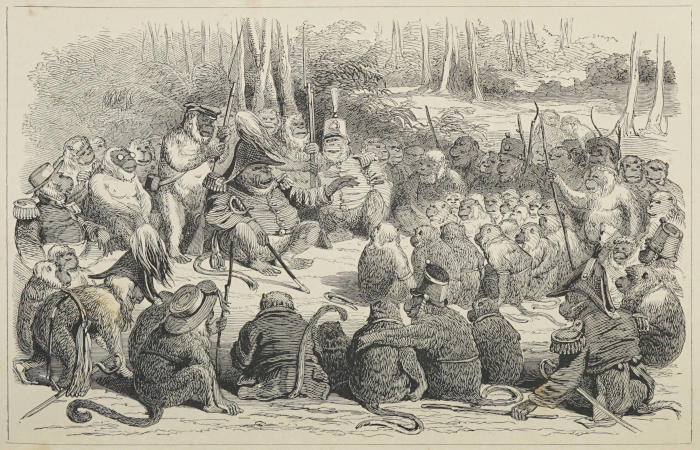
While he was speaking, these unfortunate wretches trembled
all over, from head to foot.—Page 63.
“Every day,” observes Marcgrave in his natural history,
“morning and evening, the siamangs assemble in the
woods. One among them takes up his position on some
rising ground, and makes a sign to the others to seat themselves
around him. When he sees that they are all properly
placed, he commences speaking so loud and fast that at a
distance a person would imagine they were all crying out
together. Yet only one among them is speaking; the others
preserve the most perfect silence. When the speaker has
finished, he makes a sign with his hand for the others to
reply to him, whereupon, at the same instant, they all commence
shouting out together, creating, as may be supposed,
the most perfect din until, by another sign with his hand,
the ape who opened the discussion commands them to silence.
In a moment they obey him, and are silent as death. The
first one then resumes his speech, and it is only after having
listened to him most attentively to the end of his oration that
they take steps to break up the assembly.”
The president of the conclave, the big baboon, decked
out in the admiral’s or general’s hat, by a single movement
of his hand, ordered the advance of twenty apes, who, I
observed, were securely bound with ropes made of some
fibrous bark. When they were ranged before him like so
many criminals, he addressed them in a succession of cries
similar to those which I had just heard, but modulated in
some degree, as though intended to give expression to
certain positive ideas. While he was speaking, these unfortunate
wretches trembled all over, from head to foot, and
no sooner had he concluded, than, apparently driven to desperation,
they endeavoured to escape. Vain attempt!
Other apes, armed with knotty bamboos, which they did
not hesitate to use, guarded every outlet.
I was not long in discovering that these apes, on whom
the assembly were evidently sitting in judgment, belonged
to the same species as my unfortunate victim of the previous
day. They were vervets, and were distinguished from their
judges by their more delicately-shaped limbs, their more
intelligent-looking heads, and, above all, by a certain air of
goodness and amiability, which was no doubt a crime in the
eyes of those by whom they had just been condemned.
And what frightful-looking fellows were their judges,
who formed what may be styled the supreme court of the
big baboon! How they sought to read beforehand in their
master’s eyes the opinion which they would be permitted to
hold! Although some among them were already bald, and
others displayed the white hair of old age, that natural sign
of prudence and badge of respect, they did not the less rival
their fellows in obsequiousness towards their master. If he
chanced to utter a cry, they were the apes that, in the fullness
of their sympathy, cried the loudest. If he scratched
his thigh, in a moment of deep thought, they hastened to
almost flay their legs by tearing at them with their claws.
Touched with so many marks of abject humility, the
august baboon would every now and then take from one of
the side pouches of his mouth a mass of masticated nuts or
fruit, and throw it into the faces of those servile officials
who surrounded him, and who, regarding the act as a mark of
gracious condescension on his part, received it with the most
lively contortions of pleasure.
Some old ourang-outangs, who had formerly lived with
the incriminated vervets, being, I am convinced, on the point
of pronouncing a decision in the prisoners’ favour, what do
you think the big baboon did, as soon as he perceived the
first indication of this misplaced pity of theirs? He rolled
his vulture-like eyes under his puckered eyelids, and showed
his horrible gums behind a smile formed by two wrinkled
lips, and in an instant the misplaced clemency of the old
ourang-outangs utterly vanished.
The baboon now threw his staff of justice into the middle
of the arena. This it seems was intended as a signal, for
immediately afterwards the apes, to whom were delegated
the functions of carrying out the sentences pronounced by
the supreme court, commenced showering down blows with
sticks of bamboo on the poor condemned prisoners, whom
they thrashed with an unheard-of severity, driving them
clean out of the inclosure and chasing them at last into the
very depths of the forest.
This savage act of justice appeared to me as though it
were chiefly intended to increase the authority which the big
baboon evidently exercised over the apish community, since
no sooner was the sitting concluded than the siamangs,
magots, and talapoins rushed forward to congratulate him,
to stroke and lick him, to jump upon his back and salute him
with respect, mingled with fear.
CHAPTER V.
The court-martial breaks up.—I secretly follow the members of it.—I distinguish
some houses between the trees, and believe myself to be at last among
my fellow-men.—My hopes are crushed by discovering the devastated condition
of the settlement.—I meet with Saïmira and Mococo, the latter in
captivity.—I recognise in the president of the court-martial one of my two
baboons of Macao.—This discovery troubles me, the more so when I find
that Karabouffi’s power is supreme.—Foreseeing the peril I should be in if
recognised by him, I hide myself in a grotto.—I am visited by Saïmira.—Weariness
becomes at length more intolerable than danger.—The light
already seen reappears.—I leave my retreat in search of it.
When the big baboon was thoroughly tired of
these attentions he waved his hand by way of
signal for his followers to desist, then rose
majestically, and, accompanied by his entire
suite, proceeded to take his departure.
I could not refrain from following the party, although by
so doing I felt that I exposed myself to a certain danger. I
advanced, however, cautiously, step by step, and from tree to
tree, halting when necessary, so that I might not be discovered.
This gave me time to examine the spot where
justice had just been meted out, and I was surprised to perceive
at no great distance from it, through a wide opening
between the trees, a nest of little painted houses, constructed
in the Indian style, and such as I had frequently seen in Java,
Borneo, and generally in all the more civilised parts of
Oceania. Houses! I was then about to find myself, not
among a people more or less anthropophagical, but among a
people far advanced in civilisation; without doubt some
European colony, and what is more, an English one, since the
coats worn by that legion of apes were of English cut, colour,
and nationality. I now walked with restored confidence
behind my apes, clad in their blue and red toggery. Now
and for henceforth I need have no more fear of them. I felt
almost inclined to twitch their garments and seize hold of their
despised tails by way of amusement.
After this discovery I fully expected to see ere long this
troop of apes re-enter their cages under the guiding influence
of their master’s whip. With this view I hid myself lower
down the road in a sort of thicket. “From my hiding-place,”
I said to myself, “I shall be able to see this diabolical procession
defile before me with the big baboon at the head of it.”
After a time they pass by, and what do I see? Whom do you
think I recognise under the hat adorned with such a splendid
plume of feathers and in the red coat, the brilliancy of which
almost scorched my eyes? Why, my terrible baboon of
Macao; he whom I had so many times thrashed, whom I had
sold a year previously to Vice-Admiral Campbell the day
before his departure—in one word, Karabouffi! Karabouffi
the First! Could it be possible? In this case the admiral
must have disembarked his men on this island. Were he and
his crew still here? A new surprise put an end to my speculations.
I find myself at this moment gently touched on the
arm, and on turning round see beside me a well-remembered
figure, who is tenderly regarding me. That look, which
seemed to spring from the depth of a human soul, came from
the eyes of Saïmira, my charming chimpanzee, who endeavoured
anew to make me comprehend that I was to follow her
by again pulling me by the arm, accompanying this movement
with a significant gesture. Finding that I still resisted she
uttered several low groans, and commenced licking my hands.
She had, one might say, spoken first, and begged afterwards.
I no longer doubted that I was running some great danger
from which she wished to save me. I therefore decided to
follow her, and no sooner did she perceive my intention
than her joy was intense. As we walked side by side
through the bushes she looked at me, and lowered her head.
I divined her meaning, and inclined mine. It was evidently
dangerous for me to be seen. After a quarter of an hour of
this silent marching through the tall brushwood we arrived at
a spot which I fancied to be in the rear of the houses seen by
me from afar, and the sight of which had inspired me with
such joy and confidence. Saïmira stood still. What could
be her object? It was to show me on her left a row of
cages, of which all, except one, were open and empty.
Saïmira went up to the closed cage, and then returned, and
drew me towards it. I looked through the bars, and there
saw my old friend Mococo, the chimpanzee, whom I had sold
with Saïmira on the day of my great sale to Vice-Admiral
Campbell.
My first act was to open the door of the cage that I might
behold my old favourite free. No sooner is he free than poor
Mococo hesitated whether to go to Saïmira or to me, whom he
at once recognised. His affections are divided. At last he
runs up to me, and rests his head for several seconds upon my
neck just like a little child. After having passed his hands
gently over my face, and rubbed his muzzle against my cheeks,
he threw himself on the ground, and laid his trembling paw
on Saïmira’s neck, whilst Saïmira, in her turn, placed her
hand on him. The most affectionate confidences were then
exchanged between these two creatures, who had evidently
suffered much from their hard separation, since one was free
and the other a captive.
This affecting scene lasted for well-nigh a quarter of an
hour, when all at once Saïmira raised her ear with anxiety,
and drew it back ruffled with fright. With a rapid movement
she thrust Mococo back into his cage again, and giving
me a glance, which I was at no loss to comprehend, since I
had known for a long time how to interpret the signs of these
animals, and by which I understood her to implore me to draw
the bolt quickly on the poor prisoner. I of course did so. She
had evidently heard a noise. I listened and heard it also, and
recognised in it the hoarse grunting of Karabouffi.
Saïmira’s terror, which was evidently inspired by the too
close proximity of the big baboon, convinced me that it was
he who held Mococo captive. I also suspected from this circumstance
that Karabouffi was at once the conqueror and
ruler of the island on which it had been my misfortune to be
cast. What part then did my own species play in relation to
this mysterious society, in which, day by day, I found myself
more and more entangled?
Poor Saïmira was, of course, incapable of enlightening me.
All that her affection for me suggested was to draw me away,
so that I might avoid encountering Karabouffi the First.
When, therefore, she led the way I followed her again.
The road which she took was directly opposite to that by
which one might have reasonably expected the baboon would
come.
We doubled one corner of the row of houses whilst he
turned the other on his way to pay a visit to the cage of his
rival—now his prisoner. The day began to grow dim. We
walked without being observed past the front of the houses
which I had believed to be those of the English station, and
which looked so pleasant when seen at a distance. A nearer
view, however, brought to light a scene of desolation that
promised a new surprise to me. In the first place, the windows
were all broken, and the frames demolished, and, more
or less, wrenched away from their hinges.
Hanging out, at the end of long sticks and a crowd of
flag-staffs, from the broken windows of the first story, was a
most miscellaneous collection of articles—torn uniforms,
leathern stocks, cravats, boots, belts, odd pairs of shoes, hats
with their tops torn out, empty bottles, trousers, towels, rags
of all colours, any number of shirts, and even a few flags.
In Heaven’s name, I mentally exclaimed, who has committed
these acts of incredible folly? Who has produced
this utter devastation, the like of which is only to be met
with after the sacking of a town, or a raid on the part of a
horde of savages?
It is not possible, thought I, that the apes—though the
effects of their claws and their perversity were visible everywhere—could
have made themselves masters, either by surprise
or force, of a garrison composed of brave sailors and
excellent officers; that they could have massacred every living
man among them, and have then installed themselves in their
dwellings and appropriated all their uniforms, furniture, and
flags.
Saïmira’s pressing solicitations to me to proceed prevented
me from continuing my reflections, and ere many minutes had
elapsed she and I had disappeared in the dense shade of a
neighbouring wood, where we walked for more than three
hours under the dark leaves of the banyans.
It was only after having seen me take refuge in a natural
grotto formed of rocks clothed with thick moss and those
thousand vegetable productions which cover the ground of
Australia, that Saïmira decided to leave me. But before she
departed, she gave me a look full of fear and compassion, an
eloquent farewell, which I interpreted into an express recommendation
to me not to leave my retreat.
Why did I not follow this advice? Simply because, after
eight days’ seclusion in the grotto, I grew tired of it, and not
even Saïmira’s attentive care, although she came to see me
every day, could reconcile me to it. I shall never forget the
efforts she made to raise her intelligence in some degree to the
level of my own. She would caress me, would now and then
sleep with her two little arms twined round my neck, or while
I was asleep myself, would go and gather from the topmost
branches of the trees fruit which she would place at the
entrance to my retreat.
It was not alone weariness which decided me to leave my
place of concealment, where I lived without doubt in security;
my dignity as a man also urged me to this course. I was
ashamed to be held, as it were, in check by certain inferior
creatures, authority over whom nature has delegated to our
race. Moreover, to pass my life in this grotto seemed an
intolerable idea. I thought to myself that I must leave it
some day or other, and that I might just as well leave it at
once; and this is how it was I left.
I had been accustomed to roam some distance from my
cave after nightfall, both for exercise and to seek for wood-pigeons’
eggs, which I cooked in a hole dug in the sand, at
the bottom of which I was accustomed to make up a fire.
The matches which, being a smoker, I had about me when
I was shipwrecked, enabled me to kindle a fire whenever I
required one. Thanks to the leaden box which contained
these matches, the sea water had not injured them in the
slightest degree, whilst my tobacco, on the contrary, had suffered
much.
On the last evening of my stay in the forest, while standing
at the entrance of my grotto, I perceived, some distance
off, a fire like that which I had seen the day following my
shipwreck. Who is it, I asked myself, that lights up these
great fires? It cannot be the work of apes, it must be done
by men, and yet I dared no longer believe in their existence
on this enigmatical island, since on this point I had been so
often deceived. I directed my steps in a straight line towards
the fire, which I imagined to be situated somewhere between
my grotto and the sacked houses of the English station. In
less than an hour-and-a-half’s walking, I found myself getting
nearer and nearer to it, and when I was only some hundred
paces off from it the ground, till then level, rose in a steep
incline. The soil crumbled and rattled under my feet, and I
concluded that I had reached the side of a volcano, and that
I was walking over the old lava. This, however, did not
astonish me, for I knew well enough that in nearly all the
islands of Oceania there are volcanoes, either extinct or in a
state of eruption. But how was it that I had observed these
flames only on two occasions? How was it that they had
disappeared to burst forth again after an interval of eight
days? This was not in accordance with the usual course of
these physical convulsions.
In a few minutes all my uncertainties ceased.
CHAPTER VI.
Finding a volcano.—New peril to which I am exposed.—The merchant is recognised
by his old merchandise.—Three guttural cries.—The living garland.—It
swings to and fro, and then performs a furious rotatory movement over
the crater of a blazing volcano.—My thoughts at this moment.—I am flung
to the ground, and swoon away.—On recovering, I am ushered into the
presence of Karabouffi the First, whom I find transformed into a bird.—Monkey
scribes and living telegraphic communication.
At the summit of the cone which I had just
reached a most extraordinary spectacle awaited
me. Myriads of apes, silent and immovable
until they perceived me, hovered round the
crest of the crater of a little volcano, which had
evidently not been in a state of eruption for a considerable
period.
The flames which it belched forth were, I found, the
result of a formidable combustion fed by troops of these
creatures, who were busily engaged in throwing into this
yawning gulf branches after branches of maple-trees, shrubs
torn up by the roots, and heaps of long dry leaves, which they
passed from one to the other with incredible rapidity, just as
sailors when loading a ship pass from hand to hand the
multitude of packages which have to be transferred from
the quay to the hold. The fuel, consisting of branches, roots,
bark, and leaves, which they were flinging into the opening of
the craters came, as I discovered, from a distance. The destruction
of trees, and the passage from hand to hand of
boughs and bark stripped from them, went on without ceasing.
The inexhaustible fire, like the indefatigable arms in motion,
never once appeared to slacken. It was almost enough to
turn one’s brain to observe the flames lightening up from
below thousands of shining eyes, twinkling like electric sparks;
to see the agitated beards, the perspiring bodies, the shrivelled
countenances, and the twisted legs; to see the hairy arms
extend themselves, receive their burthen, and cast it into the
crater; and to see, moreover, arranged in an immense circle
around these panting workmen, thousands upon thousands of
spectators, grave and serious-looking as dervishes adoring fire.
But whom could these horrible apes have seen practise
this organised work of destruction, that, following the example
set them, they should now continue it as though without
the power to desist, like machines which know not how
to stop after they have once been set in motion? Chance
enlightened me on this point some time afterwards.[1]
I have said that all these apes were silent as the grave
until they caught sight of me. No sooner, however, did they
perceive me than this silence was broken. Callot’s necromantic
pencil, or rather his diabolical graver, which gave to
us “The Temptation of St. Anthony,” is necessary to depict
what happened to me at this ineffaceable moment of my
existence.
At first a noise, so much like that of a hurricane that it
caused me to throw myself flat on the ground, succeeded to
the death-like silence with which these creatures were regarding
the sight of the blazing volcano before they were disturbed
by my presence.
They were welcoming me.
Their eternal enemy, man, was in their midst.
And a man, too, who had sold apes!
A man who had even sold several of those present when
at Macao.
A man who had forced them to beat tambourines and
leap through hoops.
A man who had sometimes flogged them to make them
dance with a rose behind the ear, a shepherd’s hat on the
head, and a crook in the hand.
A man who had also cruelly deprived them of food and
drink, because they would not put on scarlet breeches and
ruffles, and bow and scrape in the ancient French fashion.
What ought I not to expect?
Karabouffi the First, seated on the block of lava, was
presiding over this gathering—as for the matter of that, he
presided over everything in this island, which had become
subjected, I know not how, to his sovereignty. His ministers,
as we have already seen, were only his servants and
executioners.
I had been, as I have already said, recognised.
After this bewildering noise of which I have just spoken
all my old captives of Macao rushed upon me; their companions
hastened to follow their example. I felt that I was
about to be torn into as many pieces as my unfortunate
cravat.
It was at this moment that I caught sight of the word
Halcyon, the name of Vice-Admiral Campbell’s frigate, on
the buttons of the coats worn by the leaders of this odious
troop. The reader may judge of my astonishment at this
discovery. Where was I? In the name of goodness, what
had happened?
This I should probably never have known but for the cry
uttered by Karabouffi at the very moment that I was disappearing
under a mountain of baboons, apes, mandrills, magots,
and ourang-outangs.
The thousand and one instantly let go their hold.
Karabouffi evidently had other intentions respecting me.
He uttered three distinct guttural cries, which were
listened to with marked attention.
The order had gone forth, it was now about to be
executed, and this is the way in which his behest was accomplished:—
On a signal from Karabouffi, these drolls of creation
joined themselves together like bundles of snakes, and tying
themselves to one another by their tails rapidly formed two
chains. One of these living chains entwined itself round my
neck, the other twisted itself about my legs, and I found myself,
without being able to offer the least resistance, the connecting
link, as it were, of these two chains, which soon formed
only one, a kind of garland of apes, animated and convulsive.
As soon as this operation was completed, the end of the chain
which represented what one may style the head threw itself
with the swiftness of an arrow to the other side of the crater;
the end representing the tail did not move from where it was,
and a giddy swinging movement at once commenced. Picture
to yourself if you can my sad and ridiculous situation,
swinging from right to left and from left to right over a fire
a hundred feet broad, all smoking and blazing beneath me.
Each succeeding oscillation became quicker and quicker,
owing, I presume, to the increasing recklessness of my tormentors,
until I was swung from curve to curve, sixty feet on
one side and sixty feet on the other; then—but how is it
possible for me in the state of mind in which I then was to
have calculated this frightful rate of progression? Twenty
thousand spectators, or rather twenty thousand grimaces,
twenty thousand contortions, fifty ranks deep, surrounded the
opening of the crater, above which I was floating, looking
like a forest of skins dotted with black and yellow muzzles,
and bristling with teeth which gnashed and chattered without
ceasing; and from one extremity to the other gigantic magots,
quadrumanous constables armed with sticks, moved about to
keep order during the entertainment—and what an entertainment,
too, for even an ape to derive gratification from! At one
moment I believed myself thrown into the clouds, at the next
I felt the heat of the fire scorching my back. I say nothing
of the pain which I suffered from being wrapped about and
bound by those nervous cords which cut into my very skin.
And, worse than all, I was not even at the end of my
punishment.
The formidable swinging movement increased, the garland
of apes, of which I formed part, soon overleaped its most
elevated point of ascension, and then it was no longer a
simple alternating movement, more or less perilous, that I had
to undergo, but a rotatory motion, first rapid, then furious,
and at last terrible. I had been, as it were, the balance of a
pendulum; I was now a cart-wheel, the sails of a windmill,
the stone in a sling; and I turned, and turned, and turned
till I became first white, then red, then purple, then violet,
and at last blue, and had quite lost my senses. I cried out;
my cries of suffering, of despair, and fear were lost amidst
the squealing huzzas and furious shriekings of these myriads
of evil beings. When they had shaken and whirled me about
to their hearts’ content, they brought their atrocious farce to
a termination in the following manner:—Giving me a final
and more furious shaking than any I had before experienced—ah!
it makes my blood run cold to think of it—to the
extreme curve of the chain, which, when it had attained the
highest degree of gyratory violence, they all at once snapped
asunder, breaking it at the centre, where I was fixed. The
consequence was that I was flying like a ball across the crater,
high above the enthusiastic spectators—above everything, in
fact, to a distance of one or two hundred yards. Heaven only
knows how I escaped being smashed to pieces on falling!
Doubtless there were still further torments in store for me.
What were your thoughts, perhaps my readers will ask,
while you were thus travelling through space in a manner so
contrary to the usual habits of our kind? Why, I thought
how very cruel we are when, to amuse ourselves, we send up
cats or dogs in the car of a small balloon, and how very blamable
I had been myself in one day attaching a poor kitten, who
afterwards died from fright, to the tail of a large kite, for the
purpose of amusing the idlers of Macao. I had been in my
turn attached to the tail of a kite. What right had I to
complain?
On coming to myself—and I am entirely ignorant how
long the swoon which followed my horrible fall lasted—I perceived
two mandrills of the most savage kind on guard, sword
in hand, near me, imitating, so far as parody imitates truth,
the gait and stiffness of English soldiers. Through want of
experience, instead of confining themselves to placing a gaiter
on each leg, every one of the mandrills had in addition placed
a gaiter on each arm. I attributed this grotesque addition to
simple ignorance, since there could be no such grade among
apes as clothing colonels, ready at all times to decree any
absurd addition to the soldier’s uniform, provided they could
share the profit derived from it with the contractors. Slight
as had been my opportunities of observing this automatic
society, I nevertheless endeavoured to account to myself in a
vague sort of way how it was that it came to offer a copy,
fantastic and distorted though it might be, of the life of
civilised man. Those uniform-buttons, already recognised by
me in my hour of torture, furnished me with a clue. Unquestionably
these half-intelligent animals and the men whose
garments they were dragging about had lived together. My
inference seemed so far undeniable. I had, however, still to
discover how it was that the one had managed to obtain possession
of the property of the other; but this was a question
by no means easy to resolve all at once, particularly in the
uncomfortable position in which I was placed. Just let the
reader try to reflect when his head, the seat of reflection, is in
perpetual fear of being broken by a blow from a bludgeon.
The two sentinels with the four gaiters, seeing me open
my eyes, signalled to me to follow them. I mustered up all
my strength and obeyed.
They conducted me in the direction of the devastated
buildings which had excited my surprise some eight or ten
days previously, when I was under the protection of the interesting
Saïmira.
What had become of Saïmira?
What had become of Mococo?
What was about to become of me?
My two guardians introduced me, with some sharp blows
dealt out to me with the flat side of their sabres, into one of
the houses, the exterior of which was more pretentious in
appearance than any of the others, and which I supposed, on
this account, to have been the head-quarters of the station—the
residence, in fact, of Vice-Admiral Campbell. The interior
of the admiral’s house scarcely differed, so far as the desolate
condition to which it was reduced was concerned, from
the others. A kind of order, however, reigned in the midst
of this lamentable chaos. For instance, the pictures, after
having been removed from their hooks, had been placed back
again, but upside down. I acknowledge that, so far as many
of the pictures were concerned, this was a matter of no moment
whatever, while for others it was a positive advantage.
I should not be surprised if people generally became of my
opinion after trying the effect of this reversing process on
certain modern pictures in their collections.
Karabouffi the First, warned of my arrival by the chattering
of my custodians, rushed up to me. The sight of the
hated baboon made me feel timid, more timid, indeed, than
usual, and what added in some degree to my fear was seeing
him covered from head to foot with feathers. The sight of
this ape, transformed as it were, to all appearances, into a
bird, naturally enough filled me at first with great surprise.
But having examined him more attentively, I perceived that
the thousands of feathers under which his hairy skin seemed
to have disappeared were writing-quills, which he stuck under
his arms, upon his ears, in his mouth, and even up his nose,
as well as fastened all over his wrinkled skin. In moving
towards me some of the feathers fell out, and I noticed that
most of them had been made into pens. The two ourang-outangs
who accompanied him, and who appeared to be his
prime ministers, were covered, like their master, from head to
foot with feathers.
Karabouffi preceded me into the principal room, which it
seems he had left in order to receive me; and there I saw
a hundred sapajous in a state of intense nervous excitement,
and apparently very busy, sprawling over desks, dipping their
pens and very often their hands into inkstands without
number, and scribbling upon sheets of paper laid before them—imitating,
in fact, the copying-clerks in the public offices
at Macao. They worked as if by steam; the pens scratched
incessantly, and sheets after sheets of paper flew about in all
directions.
When one of these sheets of paper was sufficiently
scratched and scrawled over it was passed to some more
venerable sapajou, who signed it, and in his turn passed it on
to some sapajou still more grave-looking, who again signed
the paper and fixed his seal to it. Being afterwards handed
to one of the crowd of sapajous who waited outside, the paper
was transmitted without loss of time from sapajou to sapajou
placed at certain distances, precisely as I had seen them
when they were occupied in throwing wood into the furnace,
into which I had had a narrow escape of being thrown myself.
After a lapse of something like ten minutes, the paper
which had traversed the island by means of this telegraphic
system of communication came into Karabouffi’s hands, who,
after having applied it to the purposes of a pocket-handkerchief,
handed it over to an old mangabey, whom he had
invested with the dignity of Keeper of the Court Records.
It was very evident to me that these savage creatures,
after the departure, flight, or perhaps extermination of the
English colony, had taken possession of all the official paper
and pens which they could find, and of the vice-admiral’s
seal; and that, in servile imitation of what they had so frequently
witnessed, they were despatching at random orders
from all sides, thereby, without intending it, offering a witty
comment on the ordinary practice of European bureaucracy,
that pest of civilisation which devours time, money, and men,
and invariably terminates by a paper with which, were we
accustomed to paper pocket-handkerchiefs like the Japanese,
the last receiver of it might just as well wipe his nose for any
better use he could put it to.
Karabouffi, in the most imperious way, threw in my face
several quires of paper and several parcels of quills. The
expressive look which he afterwards gave me implied, as I
imagined, that I was to occupy myself without uttering a
word with these packets of pens and quires of paper, precisely
like his other clerks, who were working away at such a
desperate rate before my eyes.
During three times twenty-four hours I was not permitted
either to leave my place or to let my pen rest. I was compelled
under pain of all that is terrible to blacken ream after
ream of paper, and when the virgin whiteness of these sheets
had entirely disappeared under the clouds of ink with which
I overlaid them, one of the strange scribes at my elbow took
the papers from me and gave them, as I have already described,
to a corps of apes, charged with the duty of conveying them
round the island. For seventy-two hours I did not get even
a wink of sleep, since my enemies, endowed for the most part
with the faculty of seeing in the dark, whenever I was about
to succumb to slumber, cruelly pinched my arms, pulled my
hair, kicked me in the back, or scratched my face with their
sharp claws, so as to keep me wide awake. What horrible
torture!
Oh, how sincerely at this moment did I pity those numbers
of young men condemned by the misfortune of their birth or
the stupidity of their relations to spend their lives in doing
nothing but ply their pens from morning to evening within
the four walls of some dreary office!
CHAPTER VII.
Bell-ringing by the monkeys.—Disorder in Monkey Villas.—Hungry, I discover
stores.—His Majesty in a jar of quinces.—Scrambling for nuts.—Monkeys
tipsy.—Fear of their intoxicated revels.—Night falls as I am in the midst
of a terrible uproar.—I discover candles and lucifer matches.—The monkeys
find them also.—Candle-dance by the apes.
The fourth day of this singular penitential ordeal
I was startled at hearing a bell ring, and immediately
fancied myself saved, for I could attribute
only to one of my own species the faculty
of employing this method of signalling. Flinging
down my pen I abandoned my cruel labour, and ran at
the top of my speed towards the place whence I supposed the
sound proceeded. I decided to die rather than remain any
longer in the place where I had been kept by constraint and
blows for three days and nights. My guards did not dare to
hold me back. I arrived without halting at the foot of the
post above which the bell was hung, when my disappointment
was complete at finding that it was not a man but an ape who
was pulling the rope.
The post of the bell was fixed at the corner of a large
courtyard, the four sides of which were composed of ranges
of elegant apartments. This courtyard received both air and
light through an immense awning of rose-coloured cloth, filled
out by the wind, and enjoyed a perpetual freshness arising
from a natural basin of water which was situated in the very
centre of the square. Luxuriant turf, with beds of shrubs
and flowers, formed a border to this refreshing pool. Tied
together in bouquets by a kind of weed, a tropical hair-like
plant, bamboos grew with their delicate trunks and glossy
foliage to a height of sixty feet. In India this cool part of
a house, where one really manages to breathe, is called the
verandah. Did India take the idea of verandahs from the
Moors, or did the Moors borrow verandahs from the Hindoos
to introduce them into Spain and Portugal? I cannot say.
All I know is that the inhabitants dine in these places during
the heat of the day, walk in them of an evening, and often
make them their sleeping apartment for the night. Divans
from Cabul, carpets from Bagdad, mats from Ceylon,
and Manilla hammocks are the ordinary furniture of these
verandahs.
Karabouffi, who had taken possession without ceremony of
the finest house of all, had the wit to choose the verandah for
himself and court to reside in. Profiting by the long tables
laid out for the officers of the station, he and his suite occasionally
took their meals there, though to be sure without ever
thinking of changing the tablecloth.
On entering this verandah I found myself in the midst of
the most distressing disorder that one can possibly imagine.
There were plates scattered about in all directions, silver
dishes lying here and there, broken china, smashed decanters,
forks stuck by the prongs into the table, bottles lying on their
sides, and glasses piled up one within the other.
The bell which I had heard was to announce dinner.
Karabouffi strutted into the room and took a place in the
very middle of the table, between a soup-plate and cruet-stand;
his favourites seated themselves around—some on the
table, others underneath.
I acknowledge that, owing to the hunger which I endured,
I felt indisposed to criticise the behaviour of the guests and
the postures in which they placed themselves too closely.
Besides, I could not but remember that among the nations of
the world the etiquette of the dinner-table has not yet been
reduced to anything like a system of uniformity. For instance,
the English commonly dine without napkins; the
French invariably with; the Chinese eat with little ivory
sticks; Orientals with their hands instead of forks; the
Thibetans eat standing up; the Romans ate reclining; the
American Indians eat with fish-bones shaped like needles.
Why, then, should I find fault with these creatures, who
simply ate as instinct taught them?
Only it was necessary to have something to eat. The
vegetables which my table companions eagerly devoured, and
which they occasionally sought to thrust into my mouth, were
neither palatable nor satisfying. I was suffering the most
cruel hunger. Whilst casting my sad and haggard eyes
round the verandah, almost every window of which indicated
a distinct room, and thinking of the many capital repasts
which the English officers had here partaken of, an inscription
over a window a little way off met my sight. It consisted
of these words, in black letters on a white ground:—“Kitchens
of the officers of the staff.” I rushed in the direction
far quicker than I had done to the sound of the bell.
Kitchens! a plurality of kitchens! There were of course
several kitchens, then! It is needless to say that I was
followed in my impetuous rush by Karabouffi’s staff, who
were at this moment a curious rather than a hostile crowd.
This general curiosity was in fact my great protection against
the habitual perversity of my quadrumanous tyrants.
In my impetuosity I penetrated into a large and handsome
apartment of the verandah, evidently the reception-room,
and which had been by no means so badly treated as other
parts of the building. The arm-chairs appeared to be only
half stripped of their coverings; the chandelier and ormolu
brackets of several branches still decorated the ceiling and
walls. Various articles of furniture, the use of which the
ravagers had no doubt been unable to divine, were left
intact. These were a piano, an accordion, and a guitar.
I judged from these various signs that the recollection of
the beatings which they must have frequently received at
the hands of the cooks, their natural enemies, whom they
are always robbing, had induced the apes to keep clear of the
kitchens.
From the reception-room I passed into the dining-hall,
situated at the back of the verandah, and from the dining-hall
into the kitchen. Alas! weeks, months, perhaps, had
elapsed since the English settlers had disappeared, and I
ought not to have expected to have seen haunches of venison,
turkeys, pheasants, and hares roasting on the spit. The
kitchen fire was extinguished, and all was cold and desolate.
My apes had evidently passed through here. But, apes as
they were, and will always be, they had not found out
how to open the cupboards. The claws of the depredators
had left their traces behind them, written in long furrows
across the doors—that was all. I opened one cupboard
after another. Providence had evidently guided me, for I
found them filled with cases of pâté-de-foie gras, and all
kinds of preserved meats, poultry, fish, and vegetables,
with boxes of sardines and pots of jams, and jars of fruits
and sweetmeats. Guess if I didn’t seize with avidity on
these treasures.
Prudence suggested to me not to be ungrateful. I therefore
offered a colossal jar of preserved quinces to his Majesty
King Karabouffi, who forthwith thrust his head into it right
up to the shoulders; but his subjects, envious and jealous at
this proceeding, immediately commenced to draw him out by
the legs and tail. Karabouffi, however, held tight, and he
and the jar resisted their efforts with success. Nevertheless,
I am quite of the opinion that a prudent sovereign ought not
to indulge too freely in sweetmeats in the presence of his
subjects. The strife continued; the jar at length began
to give way. A revolution was inevitably about to spring
from this trivial, this insignificant incident.
Now, for my part, I considered that a revolution at
this particular moment would in all probability not turn out
to my advantage. One Karabouffi dead, twenty other Karabouffis
would spring up to succeed him. This was easily to
be perceived, and what was equally certain was that the last
Karabouffi would be sure to be worse than his predecessors;
so for the purpose of preventing such a catastrophe, this is
what I did: I emptied a bag of nuts on the ground. Suddenly
courtiers and subjects, leaving their lord and master to
partake of the preserved quinces to his heart’s content, rushed
after the nuts, for which they scrambled like a parcel of schoolboys.
It is not a bad plan—indeed, it is rather a method of
sound policy—to throw from time to time a few handfuls of
nuts among people who are quarrelling.
In presence of the nuts the general discontent vanished.
I profited by this circumstance to taste a few of those
delicious preserves which had fallen into my hands. I was
obliged while eating them to hold the cupboard door only
partially open, for fear that the spies by whom I was surrounded
should desire to share these dainties with me. Had
I given them the chance, they would have whipped everything
off in the twinkling of an eye. But I was only taking half
measures of protection, as I am now about to show. After
having eaten my fill, I took a bottle of wine from a hamper,
broke the neck off it, and commenced to drink. I drank with
satisfaction, with pleasure—indeed, I may say with ecstasy.
But in my ecstasy I forgot myself, and left the cupboard door
wide open. Whilst I was counting the stars, after the manner
of Sancho Panza, my companions insinuated themselves into
the cupboard, fell on to the hampers of wine, seized the
bottles as they had seen me do: the reader can divine the
rest.
Once intoxicated, they called one another names in ape’s
language, which was enough to make any one tremble; they
sent plates flying at one another’s heads, and somehow or
other never missed their aim; they struck one another on
the back with the empty bottles until they shivered them
into fragments. “Ah,” said I to myself, “Nature has done
well to indicate to man the constant moderation which he
ought to bring, and which he really does bring, to the gratification
of his desires. As a matter of course he never falls
into those scandalous excesses in which I saw these miserable
imitations of our species so readily indulge.”
I felt proud at this new proof of our superiority over the
monkey tribe.
It has been said, I know, that men have occasionally
forgotten themselves at dessert, and behaved with less politeness
than they ordinarily do. People will cite, for instance,
the cases of Alexander, who killed Clytus after a drinking
bout; and of Charles XII., who boxed his mother’s ears on
leaving table; and of King Christian of Denmark. But
see how rare the examples are! One is obliged to search
history to its lowest depths for them. I am aware it has been
pretended that our most painful diseases result from the too
great fondness which we are said to have for the pleasures of
the table, and from our partiality for alcoholic drinks. This
proves, however, absolutely nothing, for these are at best but
mere suppositions. Tell me, if you please, where I shall look
for a counterpart of the frightful reality I have just described,
and which I saw passing before my eyes.
I might have hit upon even still more flattering comparisons
for my own species, but night was coming on, and
I watched it approach with an inexpressible fear; for I
had no longer the resource of hiding myself in the woods
and escaping my enemies. They were all present, they were
all more or less intoxicated, and I was hemmed in by them
on all sides.
It may be supposed that my position was anything but an
agreeable one in the midst of this maddened pandemonium,
giving itself up in the darkness of the night to the most
frightful eccentricities. As this darkness increased so did
my fear. Every means of flight were cut off from me. I
expected to be strangled, choked, or torn in pieces on the
spot. Not a single avenue of escape was open to me—no,
not one!
In the excess of my alarm the idea suddenly occurred to
me of hiding myself away in one of the cupboards, and by
this means escaping the fate which threatened me. It was
while seeking to put in execution this impossible project,
considering the narrow space into which I should have been
obliged to squeeze myself, that I displaced the lid of a chest,
and found my hand in contact with some solid substance. I
pass my hand carefully over it, I examine it so far as a
doubtful light permits me, when judge of my delight at
discovering that it was a packet of wax candles. The chest
was evidently filled with them. I immediately drew my box
of lucifers from my pocket and lighted one. Delivered from
the horror of darkness in the unhappy condition in which I
was, I trembled all over with emotion. What a delicious
surprise! What joy! Unfortunately I did not remark, when
closing the cupboard that my spies might not play me the same
trick as they had done with the wine, that I had locked one
of them in. He uttered a cry of alarm, on hearing which I
instantly opened the door, or it might have turned out badly
for me. All was over. My captive, once free, placed himself
in the opening of the door so that I could not shut it
without crushing him. The others, profiting by this accident,
immediately made a rush for the cupboard, and pillaged the
chest in the twinkling of an eye. Behold them all lighting
their candles at mine and waving them over their heads,
dancing about with delight at the continued repetition of
these fantastic flames, with which their little Satanic eyes
were at once dazzled and fascinated. Alas! I only fell from
one state of fright into another. Now I stood a chance of
being burnt like a faggot, for they carried their lighted tapers
so recklessly that they had already commenced to singe the
skins of each other. A happy inspiration, drawn from the
new danger which I had myself called down, at this moment
took possession of me.
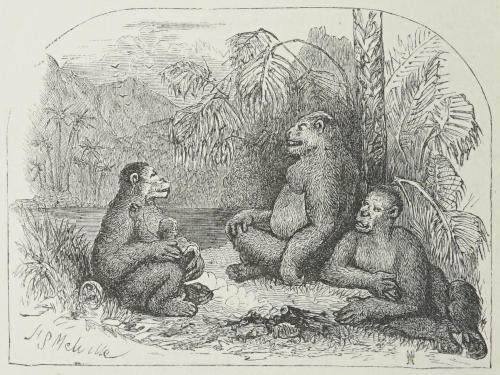
CHAPTER VIII.
An energetic pianiste.—Vigorous dancers.—A bevy of quadrumanous beauties.—The
parasol polka.—Amatory tomfooleries.—I am compelled to take
part in a new musical air.—Am commanded to climb up a tall pole.—Am
forced to jump through hoops, throw somersaults, and cut capers.—Am
indebted to Saïmira for a respite.
I traversed the dining-hall, passed into the
reception-room, where I placed one of my
candles on a window-seat; I then lighted a
second, which I fixed elsewhere. Having observed
me do this—what, indeed, did they not
observe?—they hastened to place their candles wherever they
could discover a support for them. I congratulated myself
on my success; the candles had ceased to play any further
an incendiary part in the apish orgie. No sooner, however,
had they done this than they appeared to recall to mind that
they had seen the room lighted up in this fashion before—doubtlessly
on some occasion when the vice-admiral gave a
soirée or a ball. They exchanged glances with each other,
and in the twinkling of an eye climbed up on one another’s
backs and placed the candles in the chandeliers and in the
ormolu brackets fixed against the walls.
If I had required any further proof that my apes must
have seen both balls and evening parties given in this room,
it was supplied me when one of them, happier in his efforts of
memory than the rest of his companions, sprang on to the
keys of the piano, and struck them with his fore hands. He
had evidently seen a piano played. Judging from the enthusiastic
contortions of his hearers that his performance was
appreciated, he commenced to strike the keys with his hind
hands, when, finding himself applauded still more by his
auditory, he proceeded to beat the keys not only with his
four brawny hands, but with his elbows and his knees, his
hairy head, his bearded back, and ended at last by sitting
down upon the instrument, and, rising and falling with an
adagio movement, produced the final notes of his fantasia
after the style of a celebrated German instrumentalist whom
this ape must have seen perform on some occasion or other;
for this extravagant action was far too original to have been
evolved from the brain of an ape. This music, although a
little mad, was, as they say, very lively; so much so, indeed,
that when the performer resumed, coaïtas, mangabeys, ourang-outangs,
talapoins, capuchins, green monkeys, douroucoulis,
magots, tee-tees, pig-tailed macaques, siamangs, propitheces,
baboons, vervets, sapajous, marmosets, mandrills, and alouattes
commenced to dance with ardour—indeed, one may say
frenzy—to the sound of this piano. It was not a noble sight,
certainly; but pardon me the comparison, I fancied I saw in
these apes, dressed up in their long swallow-tailed coats and
with their bushy beards, a striking resemblance to some of
our European fops.
Decidedly it was a ball—a ball given by apes, a ball such
as, there was now no longer any doubt, they themselves had
often seen given by the admiral of the station to his officers
and their wives.
Karabouffi, I know not why, had deserted the ball-room.
As yet, however, the dancers did not appear to have felt this
august absence over-much. Ah, how the creatures waltzed
and polked! It was a perfect tempest—a whirlwind, in fact.
I was nearly knocked to pieces by them. In the midst of my
surprise I discovered something new which explained to me
Karabouffi’s absence.
The fête had scarcely lasted an hour, when, to my intense
surprise, I witnessed the arrival of fluttering groups of young
and lively guenons, attended by cavaliers in straw-coloured
gloves, who were all attired in superb robes of silk and muslin,
and draped in magnificent shawls from Lahore—displaying,
in short, the most charming details of toilet that one can
well imagine. This ball was not to be without ladies any
more than spring was to be without its flowers. But let us
ponder a little over these beauties and their costumes. The
subject is always an interesting one. Without doubt some
of them had red noses and white chins; others, too, were
what is styled scraggy about the neck and shoulders, of
which they made a greater display than was necessary by
wearing extremely low dresses, while all of them shocked you
with their hairy and bony arms. But has the reader never
observed at balls in Europe, delicate and select as they may
be, red noses and white chins, angular shoulders and flat
breasts, and bony and even hairy arms?
At the point at which I have arrived in the recital of my
troubles, there is no need, I suppose, for me to explain how
the lively and foolish guenons had managed to procure their
headdresses, gloves, shoes, shawls, and robes. Every one can
guess that they had much the same title to them as their
husbands and lovers had to the officers’ coats and straw-coloured
gloves—in other words, they had stolen them from
the wives and daughters of the English officers.
Let me now continue my description of the ball, and
yield my meed of praise to an innovation worthy of introduction
on the other side of the equator, and of being
naturalised in Europe, either at Vienna, Madrid, London, or
Paris. Many of these charming monkeys danced with pink,
green, orange, or blue parasols, which they held open over
the heads of their partners with a certain coquetry of
attitude and movement that was perfectly irresistible. I
shall never forget the parasol polka, which I still think
worthy of European adoption. My only fear is that on its
subsequent introduction to New York, where, as we all know,
every fashion is pushed to excess, they would go from parasols
to umbrellas, which would not look anything like so graceful.
It was in the midst of this brilliant crowd that I suddenly
caught sight of Karabouffi the First offering his arm to Saïmira—to
the beautiful and interesting Saïmira—who was
trembling all over with fear at being thus made an exhibition
of in public. I pitied the poor chimpanzee, who had evidently
been torn apart from the loving Mococo by the detestable
Karabouffi. Karabouffi regarded her as his own. But
Saïmira was not one of those miserable creatures who, in
order to wear a few pearls on their foreheads and a piece of
velvet over their shoulders, sell their youth and beauty, their
lips and heart, when they have already given their heart to
another. And I could see that although she was present in
all her youth and charms, her thoughts were wandering
around the iron cage, the prison bars of the unfortunate
Mococo.
Among these swarms of she-monkeys I recognised several
who had formerly belonged to my menagerie at Macao. I
recollected having taught them to march like grenadiers, to
shake hands vigorously with me, to wear petticoats, so ample
and round that one was often tempted to take them by the
head and shake them like bells, for they looked so much like
them; to smoke cigarettes both of a morning and evening,
the smoke of which they would emit through their noses as
the Spanish smugglers are in the habit of doing; and to wear
little pork-pie hats stuck on the top of their heads. I had
also taught them to dance, throwing their bodies forward and
from side to side, to salute with rude familiarity, to use a fan
artfully, and to represent among themselves scenes from pantomimes.
I had hardly done wrong in making them so different
from others of their species, since in comparison with these they
were true actresses. When monkeys of this class are young,
they generally have no talent; when they come to possess
talent, they no longer have any beauty. Thus those whom I
recognised at this soirée were for the most part old and broken
down; some were even toothless; still this did not prevent
their being a thousand times more sought after, a thousand
times more flattered, than their youthful companions, and this
by the most handsome and seductive cavaliers. There was
no kind of respectful attention, delicate officiousness, or
demonstrative weakness which they did not exhibit towards
them. One unfastened his gold chain and put it over the
wrinkled neck of one of these parchment-looking ladies;
another threw his whole soul into the look which he darted at
the desolate breast of one of his companions. What a pity!
This elegant sapajou, young, agreeable, and well made, who
even passed for the son of Karabouffi’s prime minister, was
dying with love, the idiot! at the feet—at the big feet, too—of
an insignificant-looking monkey with a pug nose, and as
yellow and shrivelled as any Egyptian mummy. All this
was absurd enough, still no one will pretend to say that the
same kind of ridiculous fooleries are not constantly indulged
in by people moving in the most refined society. I cannot,
therefore, venture in this particular respect to exalt my own
species high above these poor apes, deprived, as we know
them to be, of the light of reason. As it is quite certain
that they will never read these lines, I do not hesitate to give,
in passing, this little lesson in modesty to readers of my own
species, to the end that our pride should not accustom us
always to consider ourselves superior in every respect to the
rest of Nature’s creatures.
If the reader is astonished at the repose which I was permitted
to enjoy after the perilous adventures through which
I had passed, he would utterly misunderstand one peculiar
characteristic of this fantastic race into whose power my ill-luck
had thrown me. It has the faculty of remembering or
forgetting things with the swiftness of electricity. I have
been too often witness of this strange reaction. At the very
moment that one of these animals rushes forward to attack
you, he will frequently stop short to scratch his ear or to walk
with stealthy feet behind an ant or a fly. At other times,
when you believe him to be intently watching the movements
of a fly, he will throw himself roughly upon you, and tear
your face. Such is the ape.
This period of calm, at which I confess I was myself
astonished, was broken in the following manner:—I have said
that there was a guitar and an accordion in the room where
these animals were dancing. At a sign from Karabouffi
they invited me to take part in a trio which was thus organised:—A
guenon seated herself at the piano, a sapajou took
possession of the accordion, and I was offered the guitar. As
I hesitated to acknowledge this complaisance on their part in
a becoming manner—pride we all know is incorrigible—I
received on the top of my head such a brutal blow with the
back of the instrument disdainfully refused by me, that for
the moment I believed myself killed, and for three days afterwards
I was tormented with an insupportable singing in the
ears. Of course I required no further pressing. I knew
immediately how to play the guitar, and proceeded to take
part in the trio; and what a trio it was! Nevertheless, on
listening attentively, one discovered—at a great depth, it is
true—the elements of primitive music among these creatures
of Oceania. If I had had sufficient self-possession to take
down that air, it would have figured by this time at the
concerts of the Conservatoire de Paris and of the London
Philharmonic Society, as a specimen of lyrical and religious
sentiment amongst a savage race at the moment they see the
Father of Nature, the sun, begin to rise.
The reader will perceive from this incident how very
necessary it was for me to be quite certain of the precise
dispositions of these furious fools, bent upon maltreating me;
who pursued their persecutions in a spirit of diabolical calculation,
and were bent upon imposing on me the humiliating
obligation of doing as a man all that I had formerly made
them do as apes. I had made them play the violin in public
when they were with me: they compelled me to strum the
guitar now that I was their prisoner. I had forced them to
dance on the tight-rope, and to climb to the top of a pole:
they brought a pole, and commanded me in the most
imperious way, by signs which I could not fail to understand,
to commence ascending it.
A cold sweat ran down my forehead, although the ball-room
was frightfully hot, at the bare idea of the brutish part
I was condemned to perform—to amuse apes—I, one of the
first citizens of Macao, the descendant of an honourable
Portuguese family, and who had been baptised in the church
of St. Philip the Elder! The pole was placed in the centre
of the apartment, and to sustain it in a perpendicular position
thirty quadrumana of three different heights arranged themselves
in a very ingenious manner, which I am about to
explain.
The smallest, after all having seated themselves on the
ground, held the pole, fixed upright in their midst; those of
intermediate height grasped the pole with their hands a few
inches above, keeping their feet firmly planted on the ground
about a yard off; the tallest, and these were ourang-outangs
and mandrills, threw their gigantic arms above the arms of
the others, and their legs, which were to serve as props,
beyond the legs of the lower ranks. It was, in fact, a kind
of wheel, formed of sinewy legs and shoulders pressed one
against another, and arms of steel, of which the axis was the
pole, rising up before me, uncommonly like a gibbet.
A glance which Karabouffi directed towards me enjoined
me a second time to climb this pole. As I was balancing
myself and preparing to swing over this living pedestal, in
order to grasp it firmly within my arms, a mangabey, a giant
nearly seven feet high, stiffened his long tail, and by way of
incentive struck me with it two smart blows, one on the back
and the other on the legs. These had the desired effect, for,
bursting with rage, I bounded forward and commenced
climbing.
What shall I say with regard to my performance? In
spite of my utmost efforts I could not raise myself even half-way
up the pole. Unaccustomed as I might have been to
this kind of exercise, I must nevertheless confess that I failed
most disgracefully. I tugged, I slipped, I tried anew, I
slipped again; fresh efforts only caused a still further descent,
and, what took the heart quite out of me, I was all the while
subjected to undisguised expressions of disapprobation on the
part of the audience. They murmured here, they grunted
there, they were hissing everywhere. What a revenge these
wretches took! It was quite true that I had thrashed them
when they climbed awkwardly at Macao, and that I used to
laugh at them after having beaten them; still, after all, I was a
man possessed of the double light of reason and faith, whilst
they were unintelligent beings. But did this give me the
right of coercing, insulting, and thrashing them whenever I
felt so disposed? My efforts to climb the pole had resulted
in certain bruises to my frame, and in tearing my trousers
and coat-sleeves—already sufficiently tried in the various
turns of fortune they had undergone—almost to tatters.
How could I manage to renew them in the destitute condition
in which I was? For this moment, however, my
skin demanded more of my solicitude than my clothes did,
and, in truth, I only turned my attention to these when
the incident of my climbing efforts was pretty nigh forgotten.
I never arrived at the upper half of the pole. Probably
I should still be occupied with my hopeless task but for a
lucky accident which put an end to my ridiculous punishment.
Too weak apparently to support the weight of my
body at the point to which I had managed to drag myself
after unheard-of efforts, the confounded pole snapped asunder
and I fell into the arena, bruised with my fall and crushed by
the mockeries with which I was overwhelmed. Here I lay
stunned, motionless, and degraded, in the midst of an unpitying
and jeering crowd.
When I recovered myself, had it not been for the encouraging
look which Saïmira—who I could see was occupied
with the project of rescuing me from my present frightful
position—I should have been tempted to have blown out my
brains with my pistols and so made an end of it. But Saïmira
was the cause of my resisting the temptation.
Ere, however, she found the means of saving me, I was
called upon to perform a new interlude at this brilliant
soirée.
I was aroused from the reverie into which I had fallen by
a blow like that which had compelled me, in spite of myself,
to make an attempt to climb the pole. Only the stiff and
sinewy tail of the mandrill struck me this time somewhat more
tenderly. He only wished to arouse me, I fancy. On looking
up I saw before me one of my new masters—I had now become
their creature as completely as they had formerly been
creatures of mine—comically scratching his thigh, describing
in the air joyous capers, thrusting out his tongue at me
in a mocking way, whirling about on his head with his legs
spread out like a fork—going through, in fact, a thousand
grimaces and contortions such as I had taught my apes to
practise at Macao. After some minutes of this performance,
which appeared to be rather for my benefit than for that of
the other spectators, he suddenly stopped, looked at me with
signs of impatience, and waited. But what could he possibly
expect from me? A second blow from that vital cord which
formed the termination of the mandrill’s back warned me
that what was expected from me was nothing less than a
public exhibition of my tumbling accomplishments similar to
those which he had deigned to display before me. What
proved to me that I was not mistaken in my idea was, that
having attempted at all hazards a timid somersault, the mandrill’s
tail rose and fell without striking me. I had, then, perfectly
comprehended him, and all that now remained for me
to do was to perform before the company: I had merely to
copy the grimaces and contortions which I had just witnessed,
that was all. Alas! what misery the vanquished are called
upon to endure! Could human degradation sink below
this? To be obliged to imitate an ape! The colour
rose to my face. I commenced my performance; but who
can tell what I endured? Every time that my manly dignity
checked me in the midst of a somersault, at that very same
instant the sinewy tail of the mandrill caught me a blow in
the face. Courage, Polydorus! courage! Indeed I had
need of all I possessed. I jumped through hoops, danced the
Pyrrhic dance, and imitated the movements of a dancing
bear; saluted the gentlemen, and blew kisses to the ladies;
finally, I went round, hat in hand, and asked, according to
custom, some money from the company.
I was almost dead from fatigue and moral prostration
when an uproar louder than any I had previously heard burst
forth in the saloon. In a minute the apartment was half
emptied: the apes that remained watching me soon followed
the example of their fellows. What could possibly have
happened? Karabouffi, whom I recognised in the obscurity
of the verandah courtyard, appeared to be at the head of
this great movement.
It was to the excellent Saïmira that I owed this diversion,
and to whom I was, moreover, indebted to my not dying of
suffering and shame during that terrible night.
This is how she managed to deliver me from my tormentors.
By an affected coquetry she aroused Karabouffi’s
jealousy so thoroughly, that, exasperated and furious, he
dragged her from the saloon, when, as a matter of course, he
was accompanied in his exit by his entire court.
In a word, I was left alone.
This unhoped-for respite inspired me with a project which
I proceeded to put in execution with the promptitude of
despair.
CHAPTER IX.
I barricade myself in.—I am besieged.—The verandah becomes a fort.—What
I discover at the end of a forgotten room.—Lord Campbell’s journal.—What
this journal says.—The Malay pirates and the Sultan of Sooloo.—Three
hundred junks.—A formidable hunt.—Death of a mysterious and
colossal mandrill.—Explanation of the white skeleton.—Torture of a man
compelled to drink nothing but excellent old wine.—A poignard stuck in
the sand.—The last fête at the station.—How it terminates.—End of an
unfinished journal.
I have already remarked that the destruction,
which was in other respects general, had not
extended to the range of apartments which
opened to the cool air of the verandah, and the
vast kitchens where I had discovered such a
large stock of provisions. As soon as I found myself alone I
hastened to shut the three doors of the arcades of the reception-room,
and I moreover barricaded them securely. This
was a good thing done. In less than ten minutes after the
miraculous departure of these cruel wretches I was securely
fortified against all their attacks. Firearms, and perhaps
cannon even, were necessary to dislodge me. And I had
plenty of provisions!
I passed the rest of the night as tranquilly as I was
accustomed to do in my house at Macao—so tranquilly, in
fact, that I believe I must have slept several days.
At the end of this indeterminable time, during which I
was absorbed, as it were, by a sleep of lead, my first thought
on awaking in a calmer frame of mind than I had known for
some time past was to make myself perfectly conversant with
my situation. I had no difficulty in coming to the conclusion
that so long as I was destined to remain on this island I
should be exposed to a perpetual vengeance worse than death
at the hands of my tormentors. At present I believed myself
to be perfectly secure, but if I dared to venture forth I should,
of course, become the object of renewed attacks.
Occupied with these thoughts, I proceeded to examine
the retreat in which I had intrenched myself, to see whether
I had left any point of attack accessible to my crafty foes.
First of all I assured myself that the three doors of the saloon
and the door of the kitchen would resist their united malice.
They were of heart of oak and teak, the hardest of all woods;
and the locks, admirable examples of English manufacture,
added much to the security of my defence. The lower
portion of the fortress might, therefore, be considered impregnable.
But these doors once closed, light penetrated to the
ground-floor only by a little Moorish bell-tower belonging to
the upper story. It was necessary, therefore, for me, as I
dared not open the doors, to pass my days in the second story;
at night I could descend, if I pleased, to the lower rooms.
Not having the slightest idea of the arrangement of this
upper story, I proceeded there at once; a spiral staircase, constructed
in the thickness of the wall, led to it. Once arrived
there, I could see that the apartments composing it had been
kept in remarkable order by the former occupiers. One was
unquestionably Vice-Admiral Campbell’s study. The walls
were hidden behind a row of boxes which assuredly contained
papers of great importance. I thought as much simply
because I had no knowledge whatever of the matter.
Before proceeding any farther in my researches I approached
the windows of the bell-tower, which were filled with
transparent horn from China, through which one can see
without being seen. I at once directed my eyes to the courtyard
of the verandah. The reader will understand this was
overlooked by the Moorish belfry, from which I moreover had
a view of the woods and garden plots outside the courtyard.
But what did I see on glancing around? Why, my indefatigable
enemies all posted on guard from one point to another,
on all the heights, on the branches of the trees, on every
knoll of ground, watching to see whether I would venture to
leave my retreat, or even if I would show myself at some
opening where, on signalling me, they could commence their
attack in a regular manner.
All were armed with bamboos and sticks of an enormous
size. It was a silent siege of an enemy, invisible behind his
lines of defence. To climb up to that story, the loftiness of
which defied their malice, was to them a real impossibility,
and it was none the less an impossibility for them to burst
open the barricaded doors, which were placed between their
rage and me.
Thus reassured on all sides, I proceeded to resume my
investigations of the Vice-Admiral Campbell’s apartments.
I was delighted to find in the remotest room—that in
which I commenced my inspection—a small collection of
books on travels, consisting of the most esteemed works on
Japan, Tartary, China, New Guinea, New South Wales,
and the islands of Oceania, from Marco Polo to Dumont
d’Urville. Most of these useful works had the admiral’s
crest and initials on the corner. I felt certain that they had
been removed from the library of the frigate Halcyon, and
had evidently been placed temporarily in this room that the
officers might have recourse to them during their sojourn on
land. It is scarcely possible to imagine what an inestimable
treasure these books were to me. I was seized with a most
impatient desire to consult these works. Perhaps by reading
them and consulting the valuable maps which they contained
I might learn on what island I had been thrown by my shipwreck.
I had already placed my hand on the travels of the
celebrated Spanish navigator who gave his glorious name to
the group of islands called Mindanao, which are mostly
peopled by Malay pirates, even to the present day, when my
attention was diverted by a volume lying on the study table.
I opened it and found it was a manuscript. A sense of
discretion warned me to close it, but having read in large
letters on the first page, “Personal and private journal of
Vice-Admiral Campbell, commanding the English forces in
Oceania,” I opened it anew with an irresistible curiosity,
and I may add with a very good reason, since I foresaw all
the information I was going to derive from it.
“Having left Macao towards the end of the month of
July, 1849,” observed the admiral in the opening lines of
his journal, “I established my station during the following
six months—that is to say, till the month of January, 1850—at
times among the Luzon islands and at others among the
group of Philippines, taking care, however, not to neglect
some precautionary visits to the archipelago of Sooloo, that
seemingly imperishable nest of pirates.
“The purely nautical events which have taken place
during these six months of my cruise among the different
islets having been noted day by day and nearly hour by hour
in the ship’s log-book, I propose to insert in this private
journal a few notes which it is my intention to transmit to
the Admiralty on the first opportunity that offers.
“The notes to which I refer are as follows,” was the next
line in the journal which I had under my eyes.
My attention increased—I continued to read without
missing a single letter.
“It is demonstrated to me as clear as a geometrical
theorem that at this moment the naval forces of England,
Holland, and Spain assembled in Oceania are insufficient,
each for a different reason, to resist the ever-increasing
audacity of the pirates spread over the seas of this part of
the world.
“The Spanish forces are a derision, and they would really
be exterminated in a few months by the pirates but for the
assistance which they never cease to ask from those of
England.
“The naval forces of Holland, which are in truth much
more considerable, scarcely ever leave the shores of Sumatra,
Java, and some points of Borneo, under the pretext, plausible
enough but not on that account the less selfish, that their
duty above all things is to watch the safety of their own
colonies.
“There remain our English naval forces.
“As we also are under the necessity of displaying great
vigilance with respect to our own colonies, and as we have,
moreover, as I have already mentioned, to render constant
assistance to the secondary maritime powers, such as Holland,
Spain, and Portugal, it becomes more and more evident that
we contend but indifferently at present against the depredations,
pillagings, and descents, incendiary fires and barbarous
murders, of which the incorrigible Malay pirates are constantly
guilty.
“On the other hand, the power of these unconquerable
corsairs increasing from year to year, their flotillas have
become fleets; their barques, prahs, and junks are now
almost frigates; their sailors have never ceased to be the
most energetic on the face of the earth.
“In view of this state of things I conceive it is of the
utmost importance that the number of our war-vessels in
these unceasingly-threatened seas should be largely increased,
or we shall very shortly be placed in a position of serious peril.
“It is my duty to warn the Admiralty of all these things,
which concern in the highest degree the security of the
various fine colonies which England possesses in Australia
and Oceania in general.
“Whilst awaiting the reinforcements which the Admiralty
will, without doubt, consider it necessary to send me, I have
thought the best course for me to follow was to establish
myself in the very centre of the Malayan piracy, in order to
watch its progress and to study its resources, that I may be
enabled to annihilate it by some sure blow when I should
have at my command the means of action, which are at
present wanting.
“I have chosen for my post of observation an island
situated among the hundred and fifty or two hundred isles of
which the well-known archipelago of Sooloo is composed.”
Sooloo! Surprise and fright made me stop. Sooloo, the
nest of sea-sharks, birds of prey hovering unceasingly over
the vessels of all nations! I was on an island of the archipelago
of Sooloo!
It took me nearly a quarter of an hour to recover from
the agitation into which this discovery had thrown me.
And it was under the influence of the henceforth unconquerable
idea that I was living in the very midst of this
nest of savage bandits that I recommenced the reading of
the journal.
“Having referred above,” continued Vice-Admiral Campbell,
“to my log-book for the purely nautical circumstances
of the first six months of my cruise, I intend to confine
myself to such incidents as may arise from the present time
up to the day of my leaving this island, where I have now
been nearly a fortnight. It is now the 15th of January, 1850.
“After having brought the Halcyon to an anchorage, so
well sheltered by the woody shores of the island that it is
impossible to perceive the frigate a hundred fathoms from
the beach, and having given it in charge to a sufficient
number of sailors commanded by one of my best officers, I
landed on the island with the larger portion of the crew and
immediately took possession of it.
“This island is called by the small number of aborigines
that I found upon it Kouparou, which signifies in the Malay
tongue the island of sleeping fire or of the dead volcano.
“These aborigines are Tagals, the most ancient inhabitants
of Malaya, but they have been driven from every
part by the Malays. They are a mild race, devoted to
Europeans, and possessing some of the instincts of our
advanced civilisation.
“By means of these Tagals, who have the same customs
as the Malays, although they do not like one another in the
least, and whom I think of sending as spies into all the
islands of the archipelago of Sooloo, I should become acquainted
with all that was being done and meditated in these
arsenals of piracy.
“From six months of such study on the spot more would
be learnt than could possibly be acquired during any number
of years engaged in sailing in and out the islands of the
archipelago.
“I gave orders to have all the portable houses which I
had had constructed at Calcutta unshipped and placed in
position.
“Ten or fifteen days were occupied in this work, at the
expiration of which time we installed ourselves in the houses,
which for all the world resembled a village of Sumatra.
“The aborigines seemed very pleased at our arrival, and
I have considered the moment a favourable one for the
execution of my project. I therefore chose from the Tagals
those on whom I thought I could most rely, and sent them in
their fishing-boats to the neighbouring isles, in order that on
their return they might furnish me with conscientious reports
concerning the prospects and projects of piracy.
“This expedition, which required twenty days’ preparation,
set sail on the 21st of February. The aborigines whom I
have retained are indispensable for the cultivation of the
island. From them we look to learn all about its topography
and natural resources.
“The soil of Kouparou is evidently very fertile; flowers
and fruit are seen in abundance, and the covers positively
swarm with game! Save for the apes, with which the
island swarms, Kouparou would be a garden in the midst
of the ocean. But those apes utterly destroy the charm of
the spot. They increase, too, like flies.”
“Hallo!” I exclaimed to myself, “why the vice-admiral has
also been in contact with these terrible animals. But how
did this happen? If he has been assailed, beaten, and almost
murdered like I have been, what, in goodness’ name, did he
do?” But let us continue.
“My Tagals returned after a month’s absence, and the
information which they brought back with them concerning
the contemplated proceedings of the pirates was of the highest
importance, and likely to be of very great service to me. All
their reports, without exception, announce that a vast expedition
of Malay pirates is preparing in the isle of Brassilan, the
capital of the archipelago of Sooloo, and where the Sultan of
Sooloo himself resided.
“The pirates proposed to leave this port, and the ports of
Besvan, Taouitaoui, and Palawan, with a fleet of at least three
hundred junks, to cross the straits of Mindanao and Celebes,
in order to seize all the English, Dutch, Spanish, or Portuguese
merchant ships proceeding to China during the year.
The time of their departure is kept so secret that none of my
faithful Tagals have been able to discover it for me. But
from the knowledge which I possess of the particular winds
which are required to allow of their leaving the archipelago of
Sooloo to proceed in the course they have planned to the sea-coast
of Asia, I think that my pirates will not set sail until
the end of June—that is to say, in three months from the
present time. At this period the Halcyon will leave her hidden
anchorage, and joining with the other vessels on the station,
will proceed in search of the pirate fleet which if we are
fortunate enough to encounter we will lose no time in
measuring our strength with these myriads of bold and unscrupulous
robbers. The struggle will be a warm one; but
I am aware that I can only count on my own forces. At the
period to which I refer the reinforcements which I have asked
from England will, in all probability, not have arrived. In
this case we must try alone! God, I know, will be with us,
and we shall do very well with His aid.
“In the meanwhile my Tagals are about to return to
Sooloo, Besvan, and the other points of rendezvous, so as to
keep me well informed with reference to the forthcoming
great event.
“But here we are installed in Kouparou. My officers
and their families are enjoying the best of health in the
wooden houses surrounded with palm-trees. My verandah
would compare for elegance with those of Madras and Cananor.
“We want for nothing, and our amusements are numerous.
The weather is delicious; I have never seen a finer
April, even in Australia.
“I am about to set out on a swan-hunt; but I am very
much afraid of only bringing back apes instead of swans, as
I did on the last occasion. They are everywhere! They are
so numerous, in fact, that I am almost certain in firing off a
gun at hazard, above my head, to bring down an ape.
“I have never seen them so savage before; those which I
brought with me from Macao are perfectly civilised beings
compared with the apes which we encounter here.”
“Worthy admiral!” I exclaimed, “he remembers the purchases
which he made of me at Macao. What a remembrance!
Macao! Macao! Shall I ever see you again?”
Let us continue his interesting journal.
“I have returned from the chase, bringing back with me
my baboon Karabouffi. Wishing to amuse this big stupid
ape, who is dying of ennui, although he has numbers of his
compatriots around him, I let him accompany me on my expedition.
A foolish melancholy seems to have taken possession
of him, because the beautiful chimpanzee Saïmira, who
is passionately attached to her lover Mococo, refuses to receive
his attentions.”
“Alas!” said I to myself—“alas! if the vice-admiral could
only see Mococo now!”
“I may here note,” continues Admiral Campbell, “that
there occurred during this chase an extraordinary incident
which is deserving of a place in my journal.
“In the midst of a large wood of pandanus and mimosas,
into which I had wandered with Karabouffi, I suddenly saw
advancing towards me, stick in hand, which he carried like a
sceptre, a gigantic mandrill, black as a Kaffir, and followed
by a troop of apes, among which were numerous vervets, who
seemed to form a kind of court for him, they were so respectful
in their bearing towards him.
“Karabouffi, generally so proud and fearless, trembled
with terror on beholding this gigantic mandrill. He had recognised
in him a master, and consequently an enemy. He positively
shuddered, then he came close up to me, as if to solicit
my protection, all the time, however, showing in his eyes,
which were lit up with rage, the pleasure he would feel in
tearing him to pieces. As I was on the point of taking
aim at the colossal mandrill he rushed upon Karabouffi,
and the struggle which raged between the two animals
was certainly a superb one. It was evident from the
courage and ferocity which they both exhibited that they
were the representatives of two profoundly antipathetic
races. Karabouffi was visibly getting the worst of the
encounter, for the mandrill was strong enough to tackle three
baboons such as he. So at the risk of being slaughtered if
I missed my mark, I profited by the moment when the mandrill
retired a few paces to take a spring, and sent a bullet
through his head. He fell, uttering the most frightful groans,
which had in them something of a man’s plaintive cry. Karabouffi
was triumphant. I believed that he would have strangled
me in his excess of joy. As to the apes that accompanied the
black mandrill, they immediately dispersed, which would not
have been the case had they been of a more powerful species.
I should assuredly have had to defend myself against their
vindictive attacks, but the greater part of them were vervets,
the most gentle and inoffensive of the quadrumanous family.
Nevertheless, at the moment of their flight, they cast at
Karabouffi looks which made him quiver. It would have
been hard times for him if he had fallen under their claws. I
shall have this monster mandrill skinned, and shall dry his skin
and bones in the sun, and offer them to the British Museum.”
“Ah!” said I to myself, “this is the explanation of the skeleton
which I found hanging to a tree during the first days of
my sojourn in this island. It must have been that of the
mandrill killed by Admiral Campbell.” My only regret—and
it may well be believed this was sincere—was that he had not
killed Karabouffi number one in preference to the mandrill.
“From what I have heard of the habits of these particular
animals, coupled with my own observations of them,” continued
the admiral in his journal, “I am of the opinion that
the mandrill killed by me exercised authority over this island
before the Tagals, who do not seem to have occupied it long,
arrived here.
“On my return from this expedition, in accordance with
my usual habit, I placed my gun in the armoury.”
His gun in the armoury! I rose precipitately from my seat
on seeing this, and ran and opened several cupboards. At
last I hit upon the right one, which I found contained not
only some fine fowling-pieces, but also a large quantity of
powder, and bullets of all sizes. Let my persecutors come
now! I am ready for them; I have something to receive
them with, thought I. In my transport I rushed to the
window, so as to defy them face to face. They were still in
the same places and in the same attitudes of hostility. Only
they were far more numerous.
I did not proceed any further with the reading of the
journal that day. I had ample materials for reflection;
moreover, I still felt fatigued with the exertions of the preceding
evening. After having promised myself to resume
my perusal of the journal the first thing the next day, I
resolved to go and have my dinner.
My second repast off the preserved meats of the station
was one of the best I have ever partaken of. While choosing
the things most agreeable to my taste, I had ample opportunity
of noting the extent and variety of my stores, and saw
that I had plenty to depend on whatever time I might be
forced to live in the state of imprisonment in which circumstances
had placed me. Hampers upon hampers of wine
offered me a choice of the best vintages of Spain, Portugal,
and the south of France. Vice-Admiral Campbell was evidently
a connoisseur in wine. Perhaps the wines which he
was in the habit of drinking were somewhat too alcoholic; still
the English, as we all know, are fond of strong wines. I
tasted several bottles, too many bottles in fact, since finding
my throat parched by the fiery heat of these generous wines,
I longed for a draught of water, but could discover none.
They would surely have sunk a well, thought I, in the large
apartment of which I have already spoken, for the admiral’s
use; but I was mistaken—the admiral does not seem to have
cared for so insipid a beverage.
I had no alternative, therefore, but to continue to drink,
during my dinner, a fluid which was somewhat too heating.
My sleep, although my tongue was rather dry, was sound and
refreshing. No saddening dream disturbed my rest, and at
some early hour in the morning, precisely as I had arranged
in the projects of the preceding day, I found myself awake.
I immediately mounted the narrow staircase leading to the
admiral’s study. The staircase, I ought to have mentioned,
was hidden in the wall, and so well hidden, indeed, that it was
solely owing to this the barbarous devastators of the other
houses of the station had not pillaged and ransacked this
room.
Before sitting down to continue my perusal of the journal
I betook myself to the bell-tower to see what was going on
around the place. The examination was anything but a very
reassuring one. Various changes had taken place, and these
were among them. Every member of the besieging force had,
in addition to his stick, a little heap of stones beside him,
which he had piled up with as much care as is bestowed on
the cannon-balls in our arsenals. What did they intend to do
with these missiles? Stones are very rare things in an island
where sand abounds. It is, indeed, a positive event to meet
with a stone, except on the sea-shore, or on the banks of some
lake, such as had furnished me with a handful when I was
endeavouring to knock down some fruit. Time would, no
doubt, teach me how my enemies proposed to apply these new
engines of war; at present the affair was an enigma—an
enigma, moreover, of bad augury.
At length I seated myself, and opening Admiral Campbell’s journal,
read the following:—
“My Tagals departed anew ten days ago; I have desired
them to endeavour to ascertain more exactly than they have
yet been able to do the precise date of the departure of the
Malay fleet for the north of Asia, and to discover, so far as
they can, the part which the Sultan of Sooloo, himself our
doubtful ally, takes in this expedition—whether he encourages
it, tolerates it, or is not powerful enough to prevent it.
“While awaiting the return of my Tagals, I occupied
myself with studying the geology of Kouparou. The island
is evidently of recent formation. The extinct volcano is still
working at a moderate depth, since streams of water of a high
degree of temperature are constantly upheaving the bed of
lava which surrounds its base.
“If I succeed in prevailing on the Admiralty to make a
permanent station of Kouparou I shall ask, before all things,
that the island may be purged of the intolerable herd of apes,
with which it is now infested, by a regular hunt of several
months’ duration; in the same way as our ancestors formerly
got rid of wolves in England.”
“What an admirable project!” I exclaimed, “and if Admiral
Campbell had only had time to put it into execution, I should
not be where I am.”
“Here we are at the end of May,” pursued the journal,
several dates of which I pass over as of no importance to my
story; “nearly two months have elapsed since the second departure
of my devoted Tagals, and I have had no news from
them. They do not like, I suppose, to return to Kouparou
without bringing with them certain information of the time
fixed for the departure of the pirate fleet.
“I can only ascribe to a more than ordinarily lively imagination,”
observed the vice-admiral, further on, “the remark
made this morning by Mr. Dawson, my secretary, to the effect
that he thought he saw last night some scattered fires burning
on the sea-shore, such as are generally kindled by the fishermen
and pirates of these coasts. After all, although Kouparou
is very difficult to approach, and of course still more
difficult to effect a landing upon, in the midst of the reefs which
form a belt round it to a distance of eight leagues, it is not
by any means impossible that fishermen, castaways, or even
pirates, may have lighted some fires such as Mr. Dawson believed
he saw. Should they have done so, they will most
likely depart on the morrow, believing the island to be uninhabited,
like the greater number of those which form the vast
archipelago of Sooloo. All I have to say is, ‘Joy go with them.’
“To-day, Mr. Dawson, after having gone over to that
part of the beach where he thought he saw the smoke ascending
last evening, has been to tell me that he must have been
deceived. He saw no footprints in the sand, nor any remains
of burnt wood anywhere near the shore. He admits it must
have been an illusion on his part; I felt sure of it.
“To-morrow, the first of June, I have arranged to give a
grand fête here, in my cool verandah, to the officers of the
Halcyon and their families. It will be an agreeable relief to
the monotonous sort of lives we have been leading during the
past two months.
“I have this moment had brought to me a long poignard,
found by one of our sailors, plunged in the sand on the shore
opposite that which Mr. Dawson examined this morning.
What can it possibly portend?
“A saw-poignard, and with teeth of the Malay form; in
other words, a crees, since this is the name which the brigands
of Oceania give to this murderous and nearly always
poisonous weapon. Dawson, who is as superstitious as an
Irishman can be, indulged in a variety of comments. The
sailor who found the crees could give us no additional information
respecting it.”
“Yes”—I asked in my turn of the journal which I had
beneath my questioning gaze—“yes, what did this poignard
portend? Whence did it come? Why had it been stuck by
its point in the sand?”
Admiral Campbell did not say another word respecting it,
but passed from it to his fête, which was evidently the thing
uppermost in his mind at this moment.
“As the weather is magnificently fine,” he went on to say,
“I have arranged for us to dine in the verandah court, and
we shall in this case remain at table till the time arrives for
opening the ball; we shall then proceed to the great gallery,
where dancing will commence. I certainly owe to my brave
officers and their families such amusements as I am able to
furnish them with, to repay them for the fatigues and annoyances
they have experienced during the six months which
have elapsed since we left Macao, although latterly our discomforts
have certainly been fewer than usual. I trust that
everything will go off satisfactorily, and that these gentlemen
and their excellent helpmates will have cause to thank me to-morrow
for the agreeable entertainment I have provided for
them.
“But for the inquietude, becoming every day more serious,
which the prolonged absence of my good Tagals causes me, I
should be perfectly happy in this altogether unknown and
nearly desert island. Can some misfortune have overtaken
them? What if these Malays have suspected the motive of
their visit? But no; my faithful envoys, a little slow, as all
primitive people are, will arrive to-morrow, perhaps this
evening.”
The page containing the foregoing was complete. I
eagerly turned over a new leaf to commence the following
one, but there was not another line to be seen, not a trace of
writing on the page. The admiral’s journal, which I hoped
would extend to another fifty pages at least, suddenly ended
there. Eh! not a word respecting the fête! Not a word
more on the poignard stuck by its point in the sand! Not a
word about the return of the Tagals! Good Heaven, what
sudden misfortune could have crushed the pen and the noble
hand which held it? But what about the Malay pirates and
their fleet? And what about the Halcyon? Nothing! absolutely
nothing! A sinister blank followed the last line penned
by the worthy vice-admiral. What had happened to the
colony of Kouparou, and to the admiral himself, since this
last entry in his journal? There was no one to answer me.
When there was not silence there was desolation, houses partially
destroyed, and their contents turned topsy-turvy;
savage and vindictive animals wearing, as though with the
raillery of a low vengeance, the habiliments of the gallant
officers of a noble vessel belonging to the most powerful nation
in the world.
CHAPTER X.
A hundred bottles of champagne not worth a glass of water.—My clothes
leave me.—I commence the combat.—Great fight of a man against an
island full of apes.—The verandah about to fall.—It does not last any
longer.—A skin saves me.
For the remainder of the day my haggard eyes,
reflecting my troubled mind, hovered over the
last lines of this journal, which I pictured to myself
as terminating in a description of a fête and
a general massacre. But who could have committed
this massacre? Hardly the Malays, for they stay to
plunder, and there had evidently been no pillage of the station.
The only other supposition which flashed across my mind
seemed a great deal too absurd to be seriously entertained—no,
I could not believe that a conspiracy of apes, although my
life depended upon them at the present moment, could have
been guilty of so atrocious a crime.
Night came, and it was positively hideous to me with
nightmares, hallucinations, and sudden shocks of alarm, which
awoke me out of my sleep. By daylight, when I became a little
less agitated, I said to myself that if all the people belonging
to the station had been assassinated in some mysterious way, I
should at least have come across their remains, since, according
to my calculations, it was now July, and the journal
finished in June, so that a month had elapsed since this
outrage was committed.
This very reasonable idea having entered my head, I considered
over the facts mentioned in Lord Campbell’s journal,
and arrived step by step at the following conclusions:—
The Tagal spies must have let their secret escape or
allowed it to be guessed on the occasion of their first voyage
to Sooloo.
The Malay pirates, finding their plans discovered, would
not allow the Tagals to return to Kouparou after their second
voyage. They would have flayed Admiral Campbell’s unfortunate
spies alive, or would perhaps have eaten them, since
the Malays are somewhat inclined to cannibalism.
After having eaten the Tagals, the Malays, whose vengeance
never halts by the way, would have made a first descent by
night on the island of Kouparou, which would explain the
distant fires seen by Mr. Dawson, Lord Campbell’s secretary.
The poignard stuck in the sand was the symbolical menace
addressed by the pirates to the sailors of the station, advising
them, by this figurative but most expressive warning, that they
would return and either poignard them or make themselves
masters of them in some way or other.
They had actually returned, and the moment of their
descent must have been at the time the fête given to the
officers of the Halcyon by Vice-Admiral Campbell was taking
place.
The pirates had, in all probability, succeeded in capturing
all the officers and sailors whom they found on the island
itself; they would next have attacked the Halcyon, when
resistance would have been for the most part impossible, as
nearly all the crew would have been on shore. They would
then have taken the ship with all their prisoners to Sooloo, or
to some other port of the archipelago known by this name.
The descent, the surprise, and the carrying of the prisoners
off had occurred in the midst of the banquet which was to
have preceded the ball, and from this in all probability arose
the disorder and confusion remarked by me in the courtyard
of the verandah on the day I first entered it.
The pirates and their prisoners departed, the apes, those
millions of apes, of whom Admiral Campbell complained so
bitterly in his journal, would have taken possession of the
officers’ apartments, and profiting by the spoils left so unaccountably
by the pirates, would have proceeded to dress
themselves in the uniforms which the unfortunate officers
and sailors of the Halcyon had not time or opportunity to take
with them.
Lastly, not allowing the logical thread which I held as it
were between my fingers to break for a single instant, I proceeded
from all these incontestable inferences to this certain
conclusion—namely, that in the island of Kouparou apes of a
certain superior species had formerly possessed the sovereignty;
that these apes had been dispossessed by the Tagals; that the
Tagals had been sent to the right about by the English; that
the English had been expelled by the Malay pirates; that the
Malay pirates in their turn had just been dispossessed of it, if
not by force, at least in fact, by the apes, to whom had returned
again the sovereign authority over the island of
Kouparou—a lot, indeed, which has befallen most of the
islands of Oceania, many of which still attest by their ruins
that they were formerly inhabited by people intelligent enough
to cover these islands with handsome buildings, and who had
afterwards to make room for a population of apes. Frightful
revolution!
Plunged in the most gloomy reflections, after having thus
pictured to myself the misfortunes which had happened to
the English station of Kouparou, I quitted Admiral Campbell’s
study, and descended to the lower apartments, resolved
henceforth not to think seriously of a deliverance which I now
felt to be impossible. “I shall live on in this tomb,” said I to
myself, “so long as it pleases God to preserve me.” To dream
of leaving it was now one of those extravagant hopes which only
spring from madness—watched, guarded, surrounded, menaced
as I was by gaolers a thousand times more crafty and cruel
than the Malay pirates. I re-examined all the doors; I
barricaded them more efficiently, and decided not to behold
the light of day any more, since I could no longer enjoy it
without looking upon that sinister and menacing cordon of
besiegers; I lighted some candles, and installed myself in
these lower apartments as though it were for eternity.
After having examined my provisions, I believed in the
possibility of spending at least three years in this vault without
dying of hunger and thirst. But at the end of fifteen days
of this existence, insipid and monotonous as sleep, I found
myself exposed to an intolerable suffering produced by the
exceptional kind of life which I was leading. But before I
say anything further about this unforeseen calamity, I have to
speak of another misery by which I was beset. My poor
clothes, which had been in rags for a long time past through
their owner’s tribulations, had one fine day the coolness to
leave me entirely. As I had neither needle nor thread to
draw the rags together again, I was obliged to resign myself
to going about perfectly naked.
The inconvenience was great, for we had just entered on
the season when the nights were damp and frequently as cold
as they are in Europe, and I had nothing whatever to cover me.
The apes had taken possession of every scrap of clothing and
every vestige of drapery. Joined to the scantiness of my Adamite
costume, this change in the temperature affected my health.
I had excessive pains in the joints, accompanied by a low
fever which would not leave me. The graver inconvenience
of which I have to speak is this. I have already said that
water was not abundant in the offices of the verandah. In
the first few days the deprivation of this natural necessary
affected me but little. I drank the different wines contained
in the cases and hampers. These wines, as I have already
mentioned, were very powerful, and the necessity of quenching
one’s thirst exclusively with these ardent liquids without the
moderating admixture of water parched up my throat to that
extent that I was always thirsty, and the more I drank the
more thirsty I became. How could I appease this thirst?
Ah! with how much delight I would have given a hundred
bottles of champagne for a single glass of water! For an
entire fortnight I endured this suffering, which became every
hour more poignant; the crisis, however, was approaching;
my tongue was as dry as a piece of leather, my eyes were
swollen and bloodshot, my hands were burning with fever,
my brain throbbed against my skull.
In my lucid moments I demonstrated to myself how very
false our tastes are in our artificial life of civilisation. People
in a certain position would never condescend to drink water,
despised water, and yet partaking continuously for a fortnight
of the best wines and rarest liquors had almost made me mad.
Since this painful passage of my existence I have always had
a religious respect for rivers, and I admire the Hindoos, who
rightly regard the Ganges, my beautiful Indian river, as sacred.
With my blood heated by fever, and driven to extremities
by suffering, I darted one day up the staircase which led to
Admiral Campbell’s study, opened the cupboard containing
the arms, and loaded the thirty fowling-pieces which I found
there; I then carried them with the packets of ammunition
to the bell-tower, where I proceeded to break two panes of
glass in the turret, so as to make loopholes of them. This
done, and vowing the death of my adversaries or else my own,
I place myself in a position to open fire against those who
prevent my obtaining water from the lake, the beautiful blue
of which I could perceive in the distance.
But what an unexpected spectacle met my sight through
the loopholes of my tower, which would become a redoubt in
a few seconds’ time! I had left two or three thousand apes
on the watch on the day when I descended from it, with the
intention of never again re-ascending. To-day they are increased
to twenty thousand at the very least! But who could
pretend to count them? As well try to count the insects
swarming in the ocean of space on a summer’s evening under
the line! A month ago the apes had gathered near them
only some insignificant heaps of stones; now these heaps have
increased to that enormous extent that they are perfect hills
of projectiles, placed, too, so close to one another that they
have raised, as it were, the field of battle and the camp of the
besiegers to the highest point of the verandah. The bell-tower,
which formerly overlooked everything, is now itself
overlooked. Instead of being elevated above all around, it is
depressed.
But no matter! I determine to open fire; and I do so,
letting fly right into the midst of this mass of living creatures.
I had loaded each gun with six small bullets, so that at the
first fire I knock over an ourang-outang, a mandrill, and a
baboon; what besides I know not. It was necessary that I
should kill, and I do kill. I seize with a like frenzy another
gun, and fire with the same result; I make gaps in their line
twenty-four feet in extent. But at the moment when, drunk
with my heroic slaughter, I am about to fire my third gun, a
dense shower of stones descends on the front, sides, and indeed
every part of the verandah. What a frightful row! The
noise of this shower of stones mixed with handfuls of sand,
and accompanied as it was by sneering grunts from foul
mouths overflowing with abuse, is not possible to be rendered
in words. To convey any idea of them it would be necessary
to have the instruments themselves, to have rough steel files
grating harshly against angles of granite. Amidst this
horrible din the report of my guns even can be no longer
heard. All that I am certain of, all that I can distinguish
clearly, is that I keep on killing; I kill by twenties, by hundreds,
in fact; but these twenties, these hundreds who utter
their death-shriek and fall over, are immediately replaced.
The moment at last arrives when I am obliged to pause to
reload my arms. But my adversaries do not pause! They
simply redouble their fire. It is then I perceive that the
great art of war is not a whit less familiar to animals than
to men. Both alike have recourse to the most subtle ruses.
For instance, at the very moment when I was about to give
way, Karabouffi, till then hidden behind some trees, made his
appearance, to give, as it were, a new inspiration to his troops.
The great Condé used to rush forward and throw his marshal’s
baton within Senef’s lines. Karabouffi, like the great French
general, threw his baton of defiance through the air.
It caused my overthrow. The baboon’s stick was so well
aimed that it entered like an arrow through the turret of the
bell-tower, struck me, and sent me rolling to the bottom. My
rage was unbounded.
Although somewhat dizzy from my fall, I nevertheless
remounted as quickly as I had descended. But from this
moment such a fearful storm of projectiles rained on the
turret that it soon became unroofed. The four sides seemed
as though they were about to fall. It was time vigorously to
retake the offensive, and I do so. I recommence firing,
although my face was lacerated, several of my teeth broken,
my fingers literally flayed, and my breast bleeding. The
reader has not forgotten that I was naked. Twenty times
before night, which never before seemed to me so slow in
coming, I reloaded my thirty guns. What desperate work!
The greater part of them, however, were beginning to be no
longer of any use, for they required cleaning; three had
burst in my hands. Fortunately, night at length came and
threw its mantle over this scene of carnage, without parallel,
I believe, in the world’s history. Animals, although they are
said to be more wicked than men, do not fight at night.
They ceased their fire and I ceased mine. Victory was for
the time undecided.
To tell the truth, however, it was they who had already
gained it, since an enemy who can reinforce himself without
ceasing, were he twenty times, were he indeed a hundred
times, less clever and brave than his adversary, must triumph
in the end. Victory, then, is only number.
I descended into my vault more ill than ever. Excitement
had joined itself to fever, and fever to despair. A
cold shivering took possession of me, my teeth chattered.
The air was far more chilly than it had been during the
preceding nights. I felt that I should perish with the cold,
unless I had the marvellous good luck to find some covering
to throw over me. While I was feeling in one of Lord
Campbell’s boxes for some ammunition for the next day, I
placed my hand on the thick fur of a skin, soft as silk.
Delighted at the discovery, I examined it all over, and while
considering its prodigious size was struck with the idea that
this fine fur must be the skin of the gigantic mandrill killed
by Admiral Campbell, that same mandrill whose skeleton,
hanging to a mimosa, had struck me with surprise and fear
in the dim glimmering moonlight.
I wrapped myself up in this superb black fur, which was as
warm as that of a bear. I did better: I placed my legs in
those of the animal, my arms in his arms, or rather I applied
those parts of the skin to my own arms and legs. Then I
fastened the whole with the aid of a piece of string, so that
I should not lose any portion of the warmth through any openings.
Lastly, being able to have a cap of the same fur which
had furnished me with coat and trousers, I applied the skin of
the mandrill’s head to my own. When all was arranged I
looked at myself in a glass—I drew back in amazement.
With my brown skin, thin cheeks, and open mouth,
which allowed my teeth to be seen, my prominent cheek-bones,
long dishevelled hair falling over my shoulders, and
two months’ beard matted together with my hair, with my
eyes rendered restless and melancholy by the fever which
was pressing upon me, I took myself for the mandrill whose
black dress suit I was wearing. It is not possible to imagine
a more striking resemblance. I was troubled at it, troubled
to such a degree that I commenced to jump and gambol over
the chairs and tables to assure myself by these acts of
stupidity that I was still possessed of my manly dignity.
Alas! must I confess it? If I had not entirely lost it, it was
seriously compromised, for in this skin I found myself to be
endowed with an elasticity and flexibility altogether alarming.
The day had scarcely broke when it became necessary for
me to remount to the clock-tower, and to do it very quickly.
This time it was not I who opened fire, but my adversaries.
I had set them the example the day before, and they followed
it to-day. This commencement of hostilities turned out badly
for me—in fact, very badly. At the end of five minutes the
wall fronting the verandah, weak as all walls of this construction
usually are, gave way and fell under the shock of
stones. The bell-tower, which was partly sustained by this
principal wall, trembled at its base. I was lost—my last
moments were approaching; I was separated from them only
by a few seconds. Everything was crumbling around me.
There remained to me the choice of being crushed under the
remains of the verandah or of precipitating myself into the
midst of this crowd of savage and exasperated beings, maddened
with the thoughts of vengeance, intoxicated with the
idea of a victory which they knew very well could not escape
them. I decided to die like a man. I seized hold of a Malay
poignard with one hand and a revolver in the other, and
leaped into the centre of the arena.
I fell to the ground, when, just as I believed myself about
to disappear beneath a perfect network of claws, a wide space
was cleared before me. The entire army of apes drew back with
respect, with terror, with cast-down looks and stricken spirits.
I was thunderstruck. But let us pursue the story of this
sudden change of fortune, which we may almost regard in the
light of a resurrection.
CHAPTER XI.
Whence this enchanted skin comes.—I owe to it my life and the crown.—In
what manner I govern.—I learn the fate of the English station.
Crawling on their bellies after the manner of
serpents, these new reptiles came towards me.
Karabouffi crawled at their head. Overwhelmed
by fear, his enormous head had disappeared
between his shoulders; his quickened breath
swept over the ground; his body, far more considerable in its
natural state than that of a tall man, was now nothing but a
flattened and trembling trunk pressed against the earth.
When he had reached my feet he licked them for more than
a quarter of an hour; and this act of abasement over, he
moved a little on one side to make room for others, who in
their turn licked my feet as he had done. Not one of them
was bold enough to render a similar act of homage to my
hands. These abject proceedings of theirs confounded me
with astonishment.
But what did it all mean? For surely this singular
homage of which I had been the object must be open to some
kind of explanation.
The explanation was this: that with my mandrill’s skin,
my mandrill’s head, my mandrill’s breast, my mandrill’s hands
and legs, I was taken—now you will guess it all—for the
gigantic mandrill whom Vice-Admiral Campbell had suspected
to be, and not, as we see, without reason, an old sovereign of
Kouparou. Yes, I was taken for that same great mandrill
who would have disembowelled Karabouffi had not Admiral
Campbell knocked the monster over with a ball from his
fowling-piece.
This fanatic veneration of theirs, instead of diminishing,
only increased. It became a universal sentiment. An Indian
god is not more adored by his superstitious worshippers than I
was by these grovelling apes. I might have walked, stamping
on this living carpet, without even a skin daring to move.
I was, then, saved? Without doubt; but I was also
become an ape. More than that! I was unquestionably
recognised as king by all the apes of Kouparou. And how
had all this been brought about? Why, in precisely the same
way that other sovereigns had raised themselves to power—by
firing a few guns, by losing my head, and by disguising
myself in the garments of an illustrious predecessor.
Since it was so, and since it was necessary either to
“perish or reign,” as they say, I believe, in tragedies, and in
actual life as well, I resigned myself to reign, although my
people appeared very ugly-looking in my eyes. But I had no
choice.
This resolution being taken, I generously extended my
paw to my predecessor Karabouffi, whom I raised by this
dignified movement, easily comprehended, to the high rank of
prime minister.
This first act of authority exercised by me prodigiously
astonished all around; but I perceived that on the whole it
gave great satisfaction. My good sense, then, had not deceived
me. I had always said to myself, and that long before
a nation of apes had placed the sceptre in my hands,
that it was bad policy on the part of a minister to torment,
abase, and punish those whom he was called upon to aid in
governing, since if he should act thus, if he should listen
to the inspirations of hate, or to counsels bewildered by fear,
he is certain to create for himself secret and implacable
enemies, critics ever ready to condemn all his actions, who are
so much the more to be feared since they foment discontent
among the people, who, while regretting the loss of that
liberty which they no longer possess, will indulge in the hope
that one day it may again be theirs.
And how very difficult, if not impossible, is rendered the
return to power of those who have been overthrown if they
are only left where they have fallen! An open tolerance
which will only lower them still more is preferable to raising
them up by a marked display of aversion, or by a colouring
of persecution, no matter how faint.
I exercised, then, no severity against Karabouffi, who, it
must be remembered, had had the generosity, when I was entirely
in his power, not to flay me alive from head to foot.
Nevertheless, whatever forbearance I may have been disposed
to exercise towards Karabouffi, I could not avoid the
performance of one act which I knew would be very mortifying
to his self-love and passions. But by the side of that
prudence which I had just shown it was necessary that I
should show a like degree of energy and equity. Moreover, in
what I proposed doing I was only about to extend the principle
in accordance with which I had spared Karabouffi himself.
All the vervets, all the old followers of the mandrill whose
place I occupied, were brought from exile and disgrace. Some
old ourang-outangs, some baboons of the late reign, some old
Dianas, wearing cocked hats crowned with big plumes stolen
from Vice-Admiral Campbell’s station, murmured behind
their beards. But I took no notice of their suppressed disgust.
I knew the step that I was taking was a politic one, for
it conciliated the others. One is always strong when one is
in the right. The consequence was that the grand dignitaries
of all kinds, those who held the rank of judges, generals, and
grand officers of the palace, smiled at the proposition, and
welcomed the outlaws with open arms. Vervets and baboons
embraced one another weeping. Was the reconciliation
sincere? It is very doubtful. Those who have an interest
in keeping parties divided say that it is perilous to society to
bring them together; but to continue my story—for these
reflections are out of place.
The most cruel trial to which I was obliged to expose my
predecessor, in spite of my well-known character for humanity,
was this. Followed by all my subjects and the members of
my court, and having my prime minister Karabouffi on my
right hand, I directed my steps towards the prison of the unfortunate
Mococo. The cortège was a most imposing one.
We arrived at length in front of the horrible iron cage, on the
floor of which lay the poor captive pining away through grief
and love. The faithful Saïmira, who was at this moment
consoling him through the bars, started back at the appearance
of this crowd. She believed that we had come to seek her
lover to drag him to the scaffold. How was I to undeceive
her without betraying myself?
The event soon reassured her. After setting Mococo free,
I placed his trembling hand in that of the gentle Saïmira, and
made the two lovers understand, by keeping them for some
minutes locked as it were in this soft pressure, that I united
them in the face of this huge assembly, which had no doubt
often seen among themselves infinitely worse assorted unions.
At the sight of this happiness, which I had been the means
of procuring for my two poor chimpanzees, Karabouffi rent
the air with a cry of despair and rage. I pitied his position,
and to spare him the slow agony of witnessing day by day the
love which existed between this happy couple, I sent the two
chimpanzees away for a time. They went under my protection
to spend their honeymoon in an isolated spot which I
had selected for them in a corner of the island, a charming
retreat surrounded by clear and limpid waters, by pink and
yellow convolvuli, and mysterious flowers which, opening
only during the night, would not yield their perfume to the
sun. The lady-monkeys, I am happy to say, appeared highly
satisfied with my conduct.
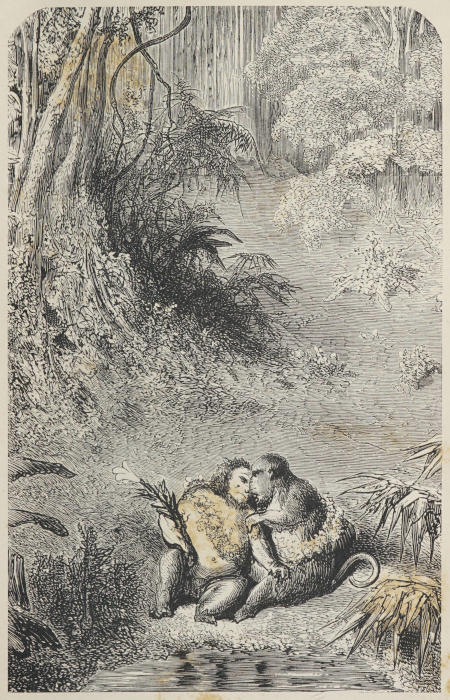
They went to spend their honeymoon in an isolated spot
which I had selected for them.—Page 130.
This commencement of a reign in appearance so easy did
not leave me altogether without inquietude, although I hasten
to declare after experience that nothing is more easy than to
govern, and to govern well. When I was a bird-fancier at
Macao, I have often found it more difficult to sell a parrot
than it proved to become master of the wills of one hundred
thousand subjects of by no means pliable natures who had
fallen to my care.
But I must here mention the grave inquietude which
troubled me in the early days of my reign. How could I feel
perfectly tranquil so long as the mandrill’s skeleton remained
suspended to the tree in the mimosa forest? The first one
among my new subjects who might perceive it would not fail
to divulge the fact to the others; and then what would
become of me? How could I be at the same time both living
and dead—hung and yet reigning? It would be indeed
vexatious for a sovereign to have his own skeleton brought
against him as a witness.
It was necessary, then, at all risks to put an end to this
embarrassment. The simplest way, the reader will think,
would be to get rid of this confounded skeleton; the simplest
way—yes, but not for me, since I was constantly surrounded
by thousands of courtiers. Notwithstanding this, during one
of those stormy nights which are rarely known in other
countries of the world—one of those nights, in fact, of brimstone
and electricity which make tigers and elephants fall
asleep on their knees, the air is so heavy to their eyes and
brains—I sallied forth. My body-guards, chamberlains, and
valets-de-chambre slept too soundly to have been aroused even
by the trumpet of the last judgment. The wind drove the
clouds so rapidly through the sky, that the moon appeared to
leave its orbit and fall with all its weight to the horizon, to
remount as rapidly to the zenith. Trees a hundred and forty
feet high were snapped like reeds, and after having been
blown down, and then into the air again, twirled round me
like whirlwinds of straw; a single dry leaf—it is true some
are half a yard long—catching me a blow would have cut me
in two with the cleanness of a razor. I saw this hurricane
mow down portions of the forests in the space of three minutes,
and clear the ground bare to the solid rock. One would not
understand how it was that I was not carried away like an
atom, if one were ignorant of the fact that these hurricanes
proceed by currents, which vary but little in extent. There
are bands—kinds of lines almost as regular as if drawn to
scale. Well, two paces from the tempest one can see it pass
without being touched by it in the slightest degree. Such
was the night chosen by me for my expedition.
No one saw me leave the verandah. I stole away in the
shade, and, hidden by the contortions of the tempest, gained
the wood of mimosas where I knew that my skeleton was
hanging up. I say my skeleton, since henceforth I considered
myself in all respects as neither more nor less than the mandrill
discovered by Admiral Campbell. In due course I
arrived at the tree, suspended to which were my poor bones
rattling in the wind, when, after having dug a trench seven
feet long, I interred myself with all possible precautions. I
covered myself over at first with vegetable earth, then with
sand, then with turf, and lastly with a layer of dry leaves.
At this strange and solemn moment I believed myself a far
more extraordinary personage than the Emperor Charles V.
He only assisted at his own funeral procession at the Convent
of Saint-Just, whereas I, Polydorus Marasquin, performed
my own obsequies, and was my own undertaker, gravedigger,
and mourner. Surely it will not be disputed that I was the
first example of a sovereign or even of a man who had buried
himself with his own hands.
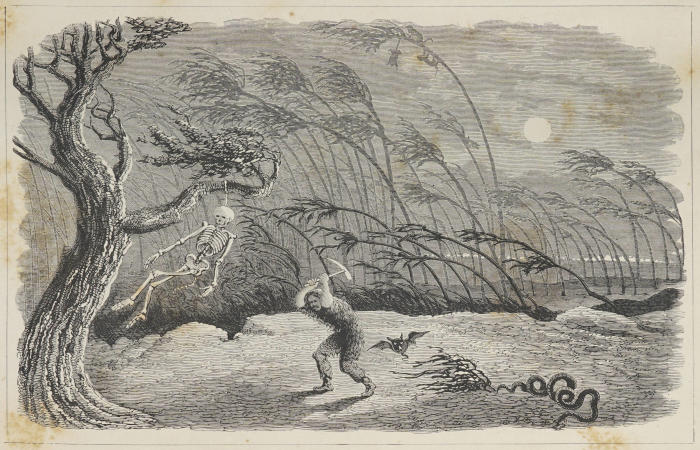
After having dug a trench seven feet long, I interred
myself with all possible precautions.—Page 132.
So soon as I was fairly under the turf I turned my
thoughts to the future, and occupied myself with studying
how to reign well. Subjects generally render this task easy
enough to their rulers. They are determined at every hazard
to believe the successor infinitely superior in all things to his
predecessor. Let him do what he may, he is always more
intelligent, energetic, and generous. This is the first stage of
forced popularity. Even Nero, Louis XI. of France, and
George IV. of England, have not escaped it. The second
stage of popularity often to a new sovereign is for him to be
always doing exactly the reverse of his predecessor. If the
latter was fond of talking, then it should be your aim to be
silent; if he was silent, you should be fond of talking; if he
always went out on foot, you should never go out except on horseback;
if he went out on horseback, you should only go out on
foot; if he was proud, you should be familiar; if he was familiar,
you should be proud; if he was peaceful, you should be warlike;
if he was warlike, you should be peaceful; if he loved the arts,
you should despise them; if he despised them, you ought to
pretend to love them; if he adored his children, you should
remain a bachelor; if he practised celibacy, you ought in this
case to marry; if he scattered gold about, your plan would be
to be saving; if he was miserly, then you should scatter your
gold with an open hand. I have said sufficient for the reader
to perceive the value of my theory. Let us pass now, so far
as the matter concerns me, to the application of it.
It will be readily understood that not having really to
govern men, but creatures vastly inferior to them, who bore,
however, at the same time, a grim resemblance to mankind in
general, I did not have occasion to apply my theory in all its
rigour. I simply set myself to work to see how I could twist
it so as to turn to my own purposes minds which were alike inconsistent,
frivolous, and, as we all know, imitative to a degree.
My predecessor, Karabouffi, had urged on his subjects,
now my subjects, to destroy my comfortable verandah. I
could not imagine anything more agreeable to them than to
decree its immediate reconstruction. I therefore took some
of the stones detached by the force of their projectiles, and
in their presence placed them one upon another in the symmetrical
order which they had occupied before their overthrow.
Immediately, as if by a fairy’s command, the stones
were placed in a most workmanlike manner. I filled up the
interstices with plaster which I had mixed with water to serve
as a kind of mortar; at the same moment all my subjects,
seized with a rage for building, pounded plaster, broke up
freestone, carried water, mixed, stirred, and made me mortar
sufficient to rebuild the Tower of Babel. They presented a
curious sight, whitened all over as they were with plaster,
even to their moustaches, elbows, and knees.
Karabouffi, on seeing the part which I took with his old
subjects, looked as if he were thinking how easy it would
have been for him to have followed the same course, and to
have arrived at the same end. He was right, no doubt, but
he had not done so.
However, warned as he now was by experience, should he
ever regain his sceptre, all he would then have to do to render
himself popular would be to demolish my work.
The verandah raised from its ruins, I traced through the
neighbouring woods four splendid roads, several leagues in
length, all radiating from a given point, and all leading to the
sea. These magnificent openings were completed in a few
days, and by the same simple means as those I had had recourse
to when engaged in the reconstruction of my palace.
I commenced by felling three trees to the right and three
trees to the left of the four lines representing the four routes
to be opened in the thicknesses of the forest. Immediately
hands and hatchets were hard at work felling trees. It was
like a renewal of the hurricane with which I was assailed on
the night of my funeral. My object in opening these four
roads was to catch sight from as far off as possible of any
vessel that might touch at the island, and be the means of
setting me free.
The reader will easily understand that when once I had
secured for myself something like liberty in my movements, I
did not rest without searching for any vestiges which might
be scattered about the island, and which might give a clue to
the fatal lot which had, in all probability, befallen the brave
sailors of the naval station. My investigations were attended
with the following result:—While examining the land-locked
bay which Admiral Campbell’s journal indicated as the
anchorage of the Halcyon, I was struck by a circumstance
which clearly proved that this fine frigate had not left the bay
in accordance with the ordinary rules of navigation. Had
she done so she would have raised her anchor and the buoys
which marked the spot where they had been dropped. Instead
of this the buoys were in their places, and I had only
to slip my hand under one of them to assure myself that the
anchors had never been weighed. In their thievish haste the
pirates had cut the cables above the buoys, and had thus set
the frigate free in order to carry her off, Heaven only knows
where.
I was, then, irrevocably condemned to endure my present
lot; my original deductions had proved to be correct. The
entire naval station had become the prey of the Malay scum
of the archipelago of Sooloo.
While speaking of the expedition undertaken by me to the
Halcyon’s anchorage, I ought not to omit mentioning that I
was accompanied on this occasion by the various dignitaries
of my household. Their zeal carried them so far as to induce
them to throw themselves into the water with me when
I swam to the place where the buoys were floating, through
want of a boat or canoe to take me there. The reader will
see that if the affection of my subjects for my royal person
was all that could be desired, my marine was nevertheless in
a very inefficient state.
I returned to my dominions, after this short absence, amid
the acclamations of my subjects, who evidently grew more
and more fond of me. I must mention here that the one
thing which made me more popular than ever among them,
and which marvellously proved the efficacy of my governmental
theory, was being in respect of the matter of dress
the exact opposite of my predecessor, who was accustomed,
even up to the moment of his unmerited fall, to dress himself
out in a most ridiculous style, whereas I went totally naked.
One can scarcely believe how much this contrast helped to
keep me in favour. “What simplicity!” murmured they;
“how natural and charming! He shows his bare back as we
do, and is just as ugly as we are.”
This proves that it is not necessary always to wear a
theatrical-shaped hat in order to be regarded as a great king.
I am, however, bound to acknowledge that this habit of
reigning quite naked was productive to me of more bitter
distress than it is possible to imagine; it made me, moreover,
incur the most serious dangers, considering the exceptional
position in which I was placed. When I think of the matter
a cold shiver runs through me, my hair stands on end, my
heart fails me, and I feel as though I am on the point of
fainting.
CHAPTER XII.
Royal happiness troubled by a rent.—I am more and more adored by my
subjects.—A cloud in the sky.—Sinister preoccupation.—My kingdom for a
pair of trousers!—Supreme joy of being an animal.—My happiness again
troubled.—A fatal tear.
One day, on the occasion of a grand military
review, when I was cutting solemn capers before
my subjects by way of saluting them, the mandrill’s
skin, in which, as a matter of course, I
was always clad, unfortunately cracked!—it
cracked, too, as a matter of course, at the part where it fitted
me tightest, and where it was certainly a little worn—in other
words, at the part on which the mandrill during his lifetime
had been accustomed to seat himself. An unusual chill
followed this deplorable rent. It was like the mask falling off
in the middle of the ball. I felt that I was lost—that the
man was recognised beneath the skin of the ape, and that my
reign, my greatness, and my life were at an end.
Alas! I had not foreseen how short a time even the most
illustrious skins last! What imprudence! or rather what a
misfortune! Had my subjects already perceived my accident,
and what did they think of it if they had perceived it? It
was a most grave situation. I no longer dared to make a
single military movement during the continuance of the
review, which appeared, indeed, endless to me, I was suffering
so much from anxiety and fear. No one can imagine the
ruses to which I was compelled to have recourse so as to pass
in front of the ranks, and at the same time conceal from my
troops the misfortune which had befallen me, and the discovery
of which would have been the signal for my death. I
hid my disaster as well as I could, I dodged about in a nervous
way, and finally I gained the verandah, where I arrived more
dead than alive.
I passed a most horrible night; I passed it in endeavoring,
by all manner of ingenious contrivances, to repair the
rent in my skin. Oh! how I applied myself to my task! but
I was consoled by the reflection that it was for my reign that
I was labouring. I succeeded in repairing the damage in a
fashion which, to the eye of a casual observer, would have
looked all that could be desired, but I saw perfectly well that
the reparation would not hold out long against the strain
which would necessarily be upon it whenever I had occasion
either to walk or sit down. It was certain that I could not
always remain standing during the entire length of my reign.
Human misery mounts in some degree to the summit of the
highest of human dignities. Fancy a government, a state, a
reign having to depend upon the strength of the stitches in
a cracked pair of breeches.
At length the night ended, and at daybreak my subjects,
who had believed me indisposed during the review of the previous
day, pressed under the balcony to have news of my
health. Their anxiety was such that it was absolutely necessary
for me to show myself. I accordingly appeared in the
balcony, when, oh horror! I was obliged to go through salute
after salute with the risk of dislocating my limbs, and the
more dangerous risk of disarranging my nether clothing in
order to prove to them the greatness of my affection, somersault
after somersault that I might ravish them with admiration.
I was, moreover, obliged, in response to the enthusiasm
of my subjects, to descend into their midst, by means of a
rope slung for this purpose between the balcony and the ground.
With what prudence I performed this descent, a prudence
which will appear the reverse of royal to very many people!
How I guarded against the least tension of the muscles!
How I waited till I was nearly to the ground before I darted
among my people!
Everything passed off very well, thank Heaven! although
certain over-zealous sapajous from time to time poked forth
their heads and pointed muzzles as though to assure themselves
that they must have seen but indifferently the evening
before. This was indeed a perilous inspection.
At length escaping the caresses of my subjects, I thanked
Heaven for the success of my reparation, but I was not the
less convinced that my reign depended upon this skin of
mine; that the duration of the one depended upon that of the
other; and that this skin, a symbol of my destiny, would
grow thinner every day, and become, sooner or later, my
ruin.
The wisdom of ages has proclaimed that “There is no
perfect happiness in this world.” I could have been as happy
as a man has the right to be in a position so strange as mine
if it had not been that this skin was constantly threatening to
give way. In all other respects, tranquil in my undisputed
sovereignty, I felt almost the joy of a released captive in my
close association with Nature in her most primitive form—an
association for which mankind are designed, and for which,
when sated with an artificial state of existence, they are always
longing in order that they may grow young again.
Civilised life, of whose doubtful advantages we boast
with more pride than reflection, is, in my opinion, not an advance,
but a deviation. That pure and lusty air which I was
breathing, becoming absorbed into my entire system, gave me
other tastes. My desires grew purer. That beautiful fruit and
limpid water became sufficient for my appetite when I found
myself freed from the excitement and irritation which is frequently
the result of immoderate exercise.
By degrees I felt a kind of horror at the notion of feeding
oneself on the flesh of animals. It is to civilisation alone, I
said, that we owe those abominable appetites which require
the flesh of animals to satisfy them. When the cannibal eats
his enemy it is more from vengeance than mere gluttony,
whereas the reason we do not eat one another arises, not from
any particular respect for our kind, but rather from an unmistakable
distaste for human flesh, and, above all, from a fear,
into which we are reciprocally forced, that if we ate our kind,
our kind would, in all probability, retaliate by eating us.
The savage, therefore, is simply a stupid to eat his enemy.
This very mandrill’s skin, of which, for the first few days,
I was thoroughly ashamed, eventually appeared to me a
thousand times preferable to those odious shells of cloth,
those coats of mail, which do not allow us the free use of our
limbs, adopted and rejected in turn by the idiotcy of fashion.
Under this soft and elastic skin, supple, thin, and warm, all at
the same time, it was as pleasant as it was easy to bend the
body—to swing from bough to bough, to drop down on to the
turf, and bound up again; to run, to glide through the
bushes, climb up the bamboos, leave the land and plunge into
the water, quit the water to climb up a rock, and seat oneself
on its summit.
Unfortunately, however, I was not permitted to go
through these movements with perfect freedom of mind.
The reader knows well enough what was the obstacle that
prevented me. One day this obstacle, through some terrible
accident, assumed proportions so large that the world contained
neither needles nor tailors capable of effecting a
restoration.
This is how the accident in question happened:—
I was accustomed, the reader should know, to sleep in my
mandrill’s skin, for to have thrown it off, even during the
hours of sleep, would have been extremely imprudent. Well,
one night I had an extraordinary dream; in this dream,
inspired by an instinct of ambition, for which I can in no
wise account, I caused myself to be crowned King of Kouparou
by the Archbishop of Goa. I to have had myself
crowned! What an aberration of mind! I, above all, who
reigned only in virtue of a deceit, only because creatures of
weak intellect believed that they saw in me an old King of
Kouparou, whereas it was merely his skin which they recognized,
and which I had made use of. Mind, it was only a
dream up to this point—but I will finish the narration.
Surrounded by his clergy, in their most magnificent vestments
and resplendent with diamonds, Monseigneur de Goa,
after performing all the ceremonies used at the coronations of
kings, took a crown of gold and emeralds in his hand, and
walked solemnly towards me to place it on my head. This
was the moment of the catastrophe. As the archbishop, who
stood on the haut pas, was raised above me, I was obliged, in
order to receive the crown which he offered me, to stretch
out my arms, in order to assist him in placing the crown on
my head. Well, in leaning towards the archbishop I fancy
I must have stretched the mandrill’s skin a trifle too much.
There was a sudden rending, and this time the fatal slit
extended right down from the neck to the very end of the
back. The noise caused by this accident was so loud that it
awoke me.
And what an awakening! That compactly-fitting garment
was now nothing but a floating paletôt, open behind
instead of before. I rose up alarmed, dismayed, and
desperate. I wished to doubt my senses, but my misfortune
was, alas! only too real, and what an irreparable misfortune
it was, since instruments and means which were not at my
disposal were necessary to reunite the shreds of my royal
purple. My reign was at an end, and what was more, my
life would soon follow the example of my reign, and all in
consequence of this hateful rent. So certain did I feel of
the fate which awaited me that I barricaded myself that very
instant, and set to work to fortify my position behind the
verandah walls just as I had done when I was once before
obliged to transform this pretty dwelling of Admiral Campbell’s
into a fortress.
The next day when my subjects did not see me come
forth they assembled in large numbers under my windows,
and I had to undergo the sorrow of witnessing their truly
touching solicitude without daring to show myself so as to
reassure them. The following day they again assembled in
great numbers; the third day the entire population of the
island thronged around the verandah.
Then the affection of my devoted subjects, which up to
this point had been manifested by silent expressions of their
grief, broke forth in noisy whines, deafening bursts of sympathy,
and groans that were meant to be expressive of
tenderness. My ears were afflicted even more than my
heart. My subjects wished for me, called me, demanded me
at any price.
At this moment I saw distinctly enough how animals the
most deficient in moral courage are not ashamed of the feelings
of gratitude which they owed their sovereign. They do
not, like beings of a higher order of intelligence, forget in a
single day the benefits which he has been the means of
showering down upon them, the equal justice which he has
dispensed to them, the order and happiness with which he
has surrounded them at the expense of his own ease and
pleasure, in order to throw themselves at the feet of a new
master whose wisdom and virtue have not yet been tried—cowardly
slaves of novelty, ready and willing to treat the
august chief of their community like children treat their
playthings, who always think the last the prettiest, and that
the preceding one deserves only to be broken violently against
the wall.
Truth wills that I should add that this love of my subjects
took a somewhat strange turn after five days of patient waiting
without result. Intending to come to me, as I would not
come to them, they commenced a new siege of the verandah
and with the same weapons of attack—namely, sticks and
stones—arms which had formerly proved so successful in their
hands. And this time, actuated as they were by a noble
sentiment, they showed themselves incomparably more
obstinate in their determination to overthrow the walls
behind which I sought to escape their too demonstrative
affection.
How was I to remain insensible to these marks of interest?
I do not deny that I should have been better pleased to have
seen this intense interest show itself under less redoubtable
forms. Still, I should have considered it a crime to have
repulsed them this time with guns and muskets. I offered,
therefore, no resistance. On the contrary, I wept with joy
and pride when I heard the walls, roofs, windows, balconies,
doors, and framework of the verandah crackling under the
weight of the enormous stones which they kept throwing
against them. I confess that I was moved by this devotion
of theirs, the end of which was infallibly my death, since
what a discovery awaited them in a very few minutes! They
counted on finding themselves in the presence of a mandrill
behind the walls which they had well-nigh overthrown, and
instead of this they would place their hands on a light-haired
man, although a Portuguese, identical in every respect, more’s
the pity, with all that is well-formed and most agreeable in
man.
CHAPTER XIII.
Deliverance.—I see my native land again.—O Macao!—My immortality.
I had only to sustain this siege, instigated, I
was well aware, by the purest devotion, for a
very few minutes longer, to ensure being
murdered without the shadow of a doubt;
everything was being destroyed and was falling
around me, when all at once three cannon-shots sounded
in the distance. Did I hear aright? I listen. Three
fresh reports follow those which have already aroused my
attention.
Thank God, I am not the only one who hears them.
The besiegers below have also caught the sound.
In a moment the entire island is all attention.
The boom of the cannon is heard for the third time: there
are three more reports.
I start to my feet. It must be a vessel, then! a vessel which
is arriving at the island! a vessel which is about to disembark
someone! A vessel! a vessel! Hurrah!
The reports continue to resound.
The besiegers, confounded and uneasy at the noise of these
detonations, repeated several times over by the echoes of the
island, brought their operations to a decided standstill.
With stones in their hands, with their muzzles turned in
the direction of the wind, with outstretched necks, hair
standing on end, and ears pricked up, they sought to explain
to themselves what I should have liked exceedingly to have
been able to have explained myself.
What had happened? Had this vessel come to deliver me?
Still all those reports could not be for me alone? Ah, no.
Was it some ship in danger signalling for assistance? Or
rather, was it the Malay pirates about to make another descent
on the island? But what could they come to steal here?
They had already taken everything. Was it a battle between
them and some European ship of war?
Ah! my anxieties were infinite.
Half-an-hour after the first of these reports I heard drums,
brass instruments, and martial music. It was a disembarkation!
a conquest! the tune seemed to tell of victory.
My loving and hostile subjects appeared to me more and
more astounded. With many this astonishment took the
nature of fear, and some were already seeking with furtive
glances favourable openings for an immediate flight.
With these combined noises of cannons and wind instruments
shouts of enthusiasm and words of command speedily
became mixed. The troops were evidently advancing; were
they coming in this direction? Surely they were, since
before long I saw glittering in the air, at the end of one of
those fine avenues which I had had opened by my subjects,
muskets, bayonets, golden sword-hilts, and brilliant uniforms.
These uniforms, which stood out in strong relief from the
blue distance, were evidently those of the English army
and navy.
The reader may imagine that my sight and mind alike
dwelt on the least movements of that mass of men who
advanced with such rapidity and precision towards the spot
whence my eyes were devouring them.
At a whistle, which came, I do not doubt, from the
metallic lungs of Karabouffi, my prime minister, and I believe
in some degree my successor in his own mind, ever since I
had disregarded the love of my people, all the apes, the
strong, the cunning, the bold, the slow, the quick, the subtle,
the obstinate, completely disappeared; they vanished like air
through the openings: not a single one remained!
The vast space in front of the verandah was empty in the
twinkling of an eye.
An instant after the troops occupied this space left so
rapidly free by the apes.
A superior officer placed himself in the centre of the little
army, which was formed in a circle of considerable size.
What a joyous and inexpressible surprise for me! In this
officer I recognised the brave Vice-Admiral Campbell himself.
I uttered a cry, but it was too far off to be heard.
Admiral Campbell made a sign that he was about to speak;
the men were all attention, and he said:—
“Officers and men,—You all know by what a miserable
snare we were carried off from this island some five months
since.
“You all know of the chastisement which our brave
countrymen belonging to the squadron which arrived so
opportunely in the Indian seas some six months sooner than
it was expected have inflicted on the Sultan of Sooloo. His
capital has been burnt; the Halcyon has been retaken from
the Malay pirates who had treacherously carried her off; one
hundred and fifty of these scoundrels have suffered the
punishment reserved for pirates, and have been hung to the
yard-arms of their junks and praus. Indemnities have been
paid to the families of the brave sailors who have perished
through this outrage committed in utter defiance of the law
of nations.
“A further act of reparation was due to us. To-day,
officers and men, with your assistance, I retake possession of
this island, in the name of Her Most Gracious Majesty!”
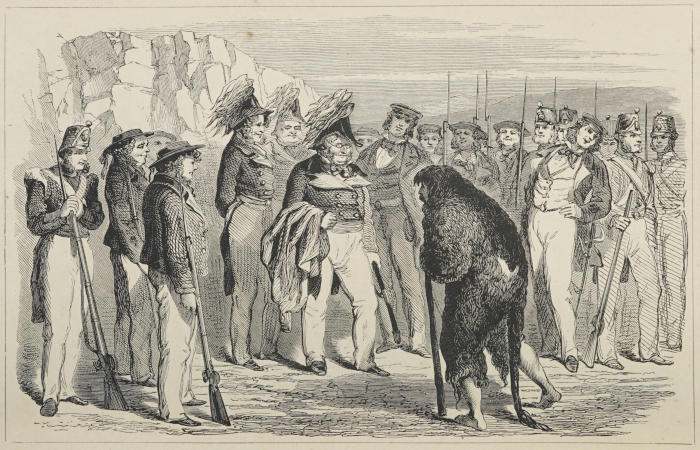
Covered with my tattered and well-worn skin, but still
holding sufficiently together for me to be taken for a
mandrill.—Page 147.
Loud cheers here interrupted the vice-admiral, who, after
a brief pause, concluded with these words:—
“I plant here the noble flag of England, which I now
call upon you to salute with military honours.”
A number of simultaneous discharges responded to the
vice-admiral’s appeal, and the British flag unfurled itself in
all its majesty in the courtyard of the verandah.
The ceremony of retaking possession was about coming
to a close.
It was at this moment that I left the ruins of the verandah,
covered with my tattered and well-worn skin, but still
holding sufficiently together for me to be taken for a mandrill
by all the English present.
They were all struck with astonishment on seeing an ape
of the largest kind thrust himself into the midst of their
solemn meeting. Their surprise turned into laughter, which
all the detachment joined in, when they heard me speak
English to the vice-admiral. A speechifying mandrill! well,
what next? thought they.
“Who are you?” inquired the admiral, thoroughly embarrassed
by the nature of the being—half man, half ape—which
addressed him.
“A Christian,” I answered, “who has lived three months
among the apes.”
“Are you an ape, then?”
“No, my lord. This skin is not mine.”
“We are perfectly convinced of that—perfectly sure of
that,” exclaimed a young Irish lieutenant who was standing
behind me, loud enough for me to hear.
“But how comes it that you are wearing it? How the deuce,
too, have you got here—you, whom, if I am not mistaken, I
left bird-fancier at Macao, since I think I recognise you?”
“My lord, it is a very long story, so long that I should
not dare to relate it to you if it were not intimately connected
with your own.”
“With mine!”
“Yes, my lord, with yours.”
They looked at me, and then burst out in another fit of
laughter.
“I shall take the liberty of relating it to you, my lord,
when I am in a more fit state of mind and body. I shall
only say one word to your lordship so as to warn you that my
story is worthy of attention.”
“What is the word?”
“My lord, I am the last king of this island.”
This answer was not calculated to check the jeering
laughter of my hearers, who were for the most part very
young, and consequently very little disposed to make allowances.
Besides, I must admit that this half-naked king who
stood before them clad in an ape’s tattered skin fully justified
the reception accorded to my royal words.
Admiral Campbell asked me laughingly if I had any objection,
as I was king, to his taking possession of the island of
Kouparou.
I besought him not to laugh at an unhappy man who had
lost everything he possessed by his shipwreck.
The admiral, shaking my hand, then said, “Mr. Marasquin,
you will have lost nothing; England, I promise you,
will indemnify you.”
England has amply fulfilled the promises of the noble
sailor who, a few days after his return to the island of Kouparou,
deigned to listen to the recital of troubles I had undergone
in the midst of this community of apes. He took such
a lively interest in all my vicissitudes that he made me promise
to publish them in the unpretentious form in which I
produce them to-day; and I publish them, you may believe
me, less from an author’s pride than as an example and an
encouragement to those unfortunate beings who might be
tempted to give way to discouragement and despair if they
should chance to suffer shipwreck as I did, and be cast like I
was, on an island peopled by apes. Besides, I look only for
honour and profit from my proper profession.
Thanks to the kindness of Admiral Campbell, who advanced
me several sums of money, and the sympathy of his
officers, who became better customers of mine than ever, I
occupy an excellent position at Macao, where I carry on my
business of dealer in wild and tame animals.
As a sort of crown to the many kindnesses which Admiral
Campbell had already shown me, he ordered that one of the
numerous isles of the Sooloo Archipelago should be called on
the last geographical charts of that part of India Polydorus
Marasquin Island.
To-day I am alike prosperous, happy, and respected. I
may add, also, that I have three children and a wife who
loves me.
Well, would it be believed? I sometimes surprise myself
murmuring between my lips, “Ah! the old times when I was
an ape!”
HERR VON SCHLIEFFEN AND HIS MONKEYS.
I have never elsewhere seen oaks thrust forth
their gnarled branches so proudly and vigorously
in the air, nor slender shining beech-trees form
such majestic arcades overhead, as those in the
little wood belonging to the Schlieffen estate of
Windhausen, about three miles to the east of Cassel. One is
struck with astonishment and admiration on beholding these
gigantic works of fertile Nature, with their sturdy trunks,
often twenty or thirty feet in girth, and their magnificent
foliage, beneath the shade of which the pathway winds
through ferns and flowers, among cool grottoes, arbours,
hermitages, and monuments of various kinds.
In the midst of this little wood, and on the bank of a tiny
lake, stands a moderate-sized mansion, which has been
deserted since the death of him who erected it, and the front
of which faces the rising sun. Behind are the farm buildings,
hemmed in on all sides by luxuriant foliage. So secluded is
the spot that a traveller might pass almost close to the
mansion without seeing it, while from afar the red-tile roofs
are visible only from the high ground.
There lived here not more than thirty or forty years ago,
in philosophical repose and contemplation, Lieutenant-General
Martin Ernst von Schlieffen, formerly Hessian Minister of
State, an honourable old gentleman, and a valiant German
soldier, with correct ideas of honour and right; one of the
pupils of the Seven Years’ War, a lover of art and science,
himself blessed with a lively fancy, and, in addition, a philosopher
and somewhat of a character. He was born in
Pomerania in the year 1732. It was his lot to receive a defective
education, and, when scarcely more than a mere boy,
the rank of ensign in a Prussian regiment. A lingering
illness, which prostrated him at the expiration of two or three
years, caused the King probably to doubt the youth’s further
fitness for service, and, instead of the extension of leave
demanded, to send him his dismissal. On recovering his
health the youth remained for some time without any occupation,
till the outbreak of the Seven Years’ War encouraged
him to offer his services once more to Frederick II. But the
King would not have him, so he went, with recommendations
from Prince Henry of Prussia and of Duke Ferdinand of
Brunswick in his pocket, to Cassel, where the Landgrave made
him a lieutenant in the Hessian contingent in the pay of
England. In this position he so distinguished himself, first
under the Duke of Cumberland, and then under the latter’s
successor, Duke Ferdinand of Brunswick, that, within five
years, he worked his way up to a colonelcy, and was summoned
to Cassel as Adjutant-General and Chamberlain by the
Landgrave. Court life, however, detained him captive for
only a short time, and he returned to the victorious standard
of his celebrated general, who met with so deplorable a death
at Jena. Herr von Schlieffen had attracted the attention of
his hereditary King, and Frederick the Great now made an
attempt to gain once more to his service the man whom, but
a few years previously, he had so ungraciously rebuffed. But
the Landgrave created him a general, and Herr von Schlieffen
continued in his service. By the advice of the Prince he
refused, also, a tempting offer from the Emperor of Russia,
and, in consideration of his so doing, the Landgrave settled
upon him a life annuity of one thousand thalers. While
Fortune thus lavished her gifts upon him, he devoted himself
zealously to study, in order to make up for his neglected
education. He learned Greek and Latin, of which he
acquired such a knowledge as to be capable of reading the old
classic authors in their original language. He accompanied
the Landgrave on his travels to Paris and Berlin. He then
proceeded, on business of his own, to Warsaw, and, on his
return to Cassel, entered the ministry. He subsequently
obtained the post of ambassador in London, where friends and
former brothers-in-arms essentially advanced his efforts for
the benefit of his sovereign. At length—for what is more
fickle than the favour of the great—he incurred the displeasure
of the Landgrave, and obeyed a summons to Prussia
as general and governor of the fortress of Wesel. A year
later, when the Belgian provinces had torn themselves from
Austria, and created themselves into an independent State, a
message was despatched from the deputies assembled in
Brussels to Herr von Schlieffen, inviting him to assume the
Stadtholdship. Consideration for Prussia, at that very time
engaged in negotiations for a reconciliation with Austria,
made him determine to refuse this honour. Hereupon the
King, no longer Frederick II., sent for him to Berlin, and
offered him the portfolio of Foreign Affairs. But Herr von
Schlieffen found the Court in so unfavourable a situation, the
influence of England so predominant, and Austria attached in
so loose and ambiguous a manner to Prussia, that he refused to
enter the ministry. Though he was greatly esteemed by the
King, he was, after a short time, induced to send back his
general’s staff to his majesty. The fact is that, when Austria
and Prussia agreed to take up arms against the revolutionary
party in France, Herr von Schlieffen endeavoured to convince
the King of the danger and foolishness of such intervention.
But his honest efforts were in vain; the campaign against the
Republic was resolved on, and Herr von Schlieffen, who
should have been one of the first to march out, was left behind.
He pressed the King either to alter this arrangement or allow
him to retire, because he saw in it an insulting slight. As
neither the one course nor the other was taken he resigned his
posts, and retired to his estates. The King, however, remained
well disposed towards him, and, some years subsequently, Herr
von Schlieffen, in order to refute calumnies and envious Court
tittle-tattle, felt himself called on once more to place himself
at the King’s disposal; as, however, it was not yet decided
whether or no Prussia would take part in the projected campaign
of 1794, the King, in a gracious letter of thanks,
declined his offer. Out of a feeling of patriotism, he had
not accepted an invitation he received in the year 1792 to
join the French army as a general. At a subsequent period,
when Napoleon’s star was in the ascendant, and the relations
between France and Germany were becoming more threatening,
Frederick William sought, it is true, to obtain once again
the services of the holiday-keeping hero, but the latter, assigning
his age as an excuse, repressed his desire of reappearing as
an actor upon the stage of glory and of honour. Who knows
how matters would have ended at Jena had all the other old
generals of the Prussian army then followed his example?
His career had brought him into contact with many
princes and great men, whose favour and friendship accompanied
him into his seclusion. In addition to the estate of
Windhausen, he possessed a larger one, Schlieffenberg, in
Mecklenburg, but he preferred residing in Hesse, under the
standard of which country he had served with honour for
thirty-two years. Thenceforth, a robust, vigorous, and cheerful
old man, he lived in the lonely forest-residence he had
built, devoting himself to his studies, his friends, and his recollections.
When, after the Treaty of Tilsit, a decree of Napoleon, in
1807, created the Kingdom of Westphalia, the young King
Jérôme Bonaparte offered the veteran, then seventy-five years
old, a position equal to that he formerly held. But the splendour
of the new Court did not tempt him, and he preferred continuing
his anchorite’s life, to which he had become attached,
in Windhausen. He could not, however, as a landed proprietor
and former member of the Hessian Chambers, avoid obeying
the command for him to take his place in the Westphalian
Diet, summoned for occasional gay ceremonials and displays
of magnificence, of little importance to the State and yielding
no remuneration to its members. He was obliged,
also, now and then to attend the Court. But he refused to
appear in any other costume than his uniform as a Prussian
general, and Jérôme, suppressing his dissatisfaction, allowed
him to do so. After the return of the Elector, in the year
1813, Herr von Schlieffen speedily perceived that he was in
great disgrace with that prince. Some one had secretly told
the latter that, in the action with the Czarmitschen Cossacks,
Schlieffen had assisted the usurper. In vain did the grey-haired
general exert himself to confound this calumny. The
Elector believed it, but perhaps only for the purpose of
having an excuse for another act of injustice of which he
was guilty. He ordered that the life annuity of one thousand
thalers, granted to Schlieffen by the Landgrave Frederick,
and expressly confirmed by the Elector himself on his accession
to the throne, should no longer be paid. Moreover,
Schlieffen was no more invited to Court.
Though the events of the last few years had greatly
diminished his income, he would have got over the loss of
the thousand thalers a year as easily as he consoled himself
for that of Court favour. But the reckless injustice he perceived
in such conduct grieved him profoundly and embittered
the remainder of his days. He died, unmarried, at the age
of ninety two, on the 15th September, 1825, and was
buried in a small mausoleum which he had built long
previously in the forest at Windhausen. The inscriptions,
also, are from his pen. On a tablet of red sandstone let
into the side looking towards the east are the following
lines:—
The Sepulchre
Of the first Schlieffen,
Possessor of yonder secluded Pile,
In whose calm retreat, and in the woods surrounding it with shade,
From the irksome Life of the Court, and the Troubles of the Warrior in time
of Peace,
Escaping as frequently as possible,
He found, favoured by Fate,
And guided perhaps by his opinions,
More sweet than bitter Hours,
Thankful for the former, resigned to the latter,
Tranquil as to the Future.
On the stone over the coffin in the interior of the mausoleum
is the Schlieffen coat of arms and the annexed inscription:—
Martin Ernst
von Schlieffen,
formerly Lieutenant-General and Minister of State
of the Landgrave of Hesse,
afterwards Royal Prussian Lieutenant-General
and Governor of the Fortress
of Wesel,
Knight of the Prussian Orders of the Black and Red Eagle,
And of the Hessian Orders of the Golden Lion,
And of Merit.
Born the 30th October, 1732,
At Sudenzig, near Gallnow,
in Pomerania. Died the 15th Septb., 1825,
at Windhausen.
This life of retirement at Windhausen was passed by the
“refugee from the world,” as he was fond of calling himself,
in giving a park-like character to, and ornamenting with
various buildings, the two estates purchased with the money
he had himself earned. This afforded him frequent opportunities
of being in the open air and indulging in exercises
conducive to health. Once or twice a week he rode, followed
by two servants, to Cassel, where he possessed in the Königsplatz,
or King’s Square, a house which he had built in the
days of his grandeur. The rest of his time was devoted to
his friends, with whom he maintained a correspondence; to
his monkeys, whom he spoiled by petting; to his classics,
which he was never tired of reading; and to his Memoirs,
which he continued from year to year.
The Memoirs, intended only for his relations, were published
in the year 1840, at Berlin, under the title, Some
Occurrences and Experiences in the Life of Martin Ernst
von Schlieffen. They contain very interesting information
relating to the history of his own times, especially on account
of the great number of letters printed in them. They commence
with a genealogy of the Von Schlieffen family. With
pedantic anxiety the author has avoided all foreign words. It
was, in fact, a strange hobby of the “historian of his Sept,”
as he also sometimes designated himself, never to employ a
word borrowed from another language, though he usually
spoke French, and took a pleasure in arranging Latin and
Greek proverbs and inscriptions for votive tablets, which he
had hung up at his favourite spots at Windhausen and
Schlieffenberg. In his old friend, Johannes von Müller,
whom, as Ministerial Secretary of the young Kingdom of
Westphalia, Fate brought back to Cassel in the year 1807, he
found nothing to blame except that, in his immortal books,
Müller would not entirely discard the horrible foreign words.
But the comic part of the business was that in the invention
of German words, which Herr von Schlieffen employed in
lieu of foreign ones generally in use, he was decidedly unfortunate,
and to understand the words invented by him we
must first have a key. This was something, however, which
he felt himself, for, as a rule, he added the foreign word in a
parenthesis. In addition to this he was noted for certain
turns or rather contortions of expression which considerable
increased the difficulty experienced by the uninitiated in
understanding his book, the value of which was, however, not
nullified by these eccentricities. But there was another
caprice of the old gentleman, which annoyed, troubled, and
plagued in the highest degree the inmates of Windhausen—that
is to say, the entire establishment, from the bailiff and
gamekeepers down to the dairymaid. This was his affection
for his monkeys.
There was a large troop of these tailless, long-armed,
brown foreigners at Windhausen, and “the general who has
sought refuge from the woods” had placed his whole estate
unconditionally at their disposal. They ran about as they
chose, and contracted marriages among themselves, so that the
oldest speedily beheld, despite the unusual climate, a hopeful
circle of healthy sons, daughters, and grandchildren assembled
around them. This circumstance was, however, observed by
all the human population of the estate, except the General,
with dissatisfaction and uneasiness, for scarcely a day passed
that one person or another had not reason to complain of the
monkeys. They were regarded as a public curse, and it
needed all the intensity of the affection, gratitude, and attachment
felt towards the old gentleman, for people not to weary
of looking with indulgence on this fancy of his. The ill-behaved
Africans did nothing but mischief. They soiled the
rooms, smashed plates and dishes, ruined the gardens, waged
war, frequently to their own great disadvantage, with the beehives,
and plucked the fruit from the trees, merely to throw it
away as soon as they had tasted it, or fling it at the heads of
those persons who might be passing by. No one who had to
traverse the small wood ever escaped unmolested; the monkeys
would hang on to the clothes of one person, or frighten another
by suddenly dashing across his path. All this the worthy
General considered exceedingly funny. Distinguished above
all their companions, however, for slyness and a love for playing
wild pranks, were two large monkeys, Tommy and Troll.
One day a countryman came to Windhausen for the purpose
of paying the interest of a loan which the General had
advanced him. The bailiff asked him to be seated, and,
having had some breakfast brought in for him, left the room
for a short time, as he had just been called away to look at
some sick beast. The countryman, meanwhile, counted his
money and drank a glass of the brandy of the country without
the slightest misgiving, when all of a sudden the door
was opened gently, and in walked Tommy. For some time
he remained close to the door, staring the unknown visitor in
the face. He then walked round the table at which the
countryman was seated, and finished by placing himself
exactly in front of him, grinning and showing his teeth, with
his left elbow leaning on the table and his right one stuck in
his side. The countryman was struck dumb, and felt his hair
stand on end with affright. There he sat, as though the terrible
head of Medusa had thrown its spell over him. His face,
which had become the colour of lead from superstitious fear,
appeared to amuse the brute not a little. At length Tommy
had looked at the countryman long enough; his sharp glance
fell upon the bright thalers on the table, and he was just
stretching out his hand to appropriate some, when something
he considered still more desirable—namely, the butter-dish—caught
his eye. He took it, sans façon, off the table, and,
seating himself on a cask near the stove, devoured the lump
of butter, smacking his lips the while. He then put back the
empty dish. The return of the bailiff at last rescued the
countryman from the state of fright in which he was.
“Hulloa, my boy!” said the bailiff, laughing, and casting
a glance at the empty dish, “you seem to have liked the butter
at any rate!”
“He did it, Mr. Bailiff!” groaned the countryman, nodding
his head timidly at Tommy, as though he feared being
at least eaten up by the monkey in consequence of this
denunciation.
“What! has the fat blackguard dared to do such a
thing?” exclaimed the bailiff very angrily, and at the same
time springing towards the window, in the embrasure of
which was a riding-whip, “Wait a moment, I’ll pay you
out!”
But Tommy, who saw the storm approaching, was in such
a hurry to escape from it, that at the door he nearly knocked
over his comrade Troll, who was coming in quite innocently.
As the two monkeys were very like each other, and the bailiff
had not, in his anger, remarked the lucky escape of the malefactor,
he seized hold of old Troll by the throat, and believing
he had caught the one who had stolen the butter, gave him
an awful thrashing. During this time Tommy stood in the
courtyard, wiping his greasy mouth, and scratching himself,
with a puzzled air, behind his ear, looking up as he did so at
the bailiff’s window, through which the howling of his innocent
and unjustly-castigated brother found its way to him.
On another occasion the monkeys managed to steal a roll
of ducats out of their too indulgent master’s desk, which had
been left open. They climbed up with their spoil to the roof.
Breaking the seal, they took out a couple of coins, which were
inspected on both sides with indescribable curiosity by each
monkey in succession. One of the coins accidentally fell
out of the hand of the monkey who was holding it, and,
rolling over the roof, tumbled, with a sharp ringing sound,
into the tin gutter, and thence into the pipe by which the
rain-water was conveyed down the house. This kind of music
caused the monkeys such delight that they despatched all the
remaining coins after the first one. While doing so they
hung close together on the pipe, and, with open ears, listened
to the sound of the descending ducats.
But a trick played by Troll might have been attended
with more disastrous consequences. The bailiff’s wife had
left an infant, almost three years old, lying in the cradle while
she was busy in the kitchen. Troll crept upstairs, and,
opening the door of the room in which the cradle stood,
obtained possession of the infant. He then ran off quickly
with it. Some maid-servants in the yard noticed him, but,
instead of enticing him to them, frightened him away by the
fearful screams they uttered. At the end of the yard was a
new building of wood, finished in the frame, up to the roof,
and to this building Troll hurried off. Pressing the child
closely to his breast with one arm, and swinging himself
from beam to beam with the other, he clambered over the
rafters of the roof, and took his seat on the very ridge. The
screams were really heartrending, and enough to deafen any
one, when the unhappy mother came rushing out. Wringing
her hands in despair, she kept exclaiming—“Help! help!
save my poor child!” All the inmates of the place came
running to the spot, but the men were, unfortunately, busy
at work in the fields or in the wood, and represented only by
the General’s French cook, Mons. Lebrun, whose reputation
for courage and determination was not exactly the best.
Troll, however, had selected him to become the hero of the
day. Dressed in his neat white costume, with apron and cap,
he sprang into the middle of the crowd of wailing women,
and cried out in a voice that would have become a general in
the din of battle—“Now you shall all be quite still, you
unreasonable womans. You make wild se monkey. I vill
obtain tout seul votre enfant!” With these words he stretched
out his arms, and drove back all the women into the passage
of the gamekeeper’s house, the door of which was open. The
mother was the only one he could not force from the spot, so
he assigned her a place whence, without being in the way,
she might witness his campaign, having first promised him,
by the value she set upon her infant’s life, to remain quiet.
Meanwhile, unconcerned by what was going on below, the
monkey was seated upon the ridge of the roof, with his back
leaning against the fir-tree, which, according to the old
custom, the carpenters had set up there the day previously on
the completion of their labours. At one instant he pressed
the child with ecstasy to his breast; at the next he rocked it
on his lap. At length he began untying and unrolling the
long strip of flannel in which the child was enveloped. The
child, in happy ignorance of its danger, was perfectly still.
Directly he had pacified and sent away the women, the cook
began clambering up the ladder, and when he had reached
the end of that, climbing from one beam to another, up to
the rafters of the roof. Troll ignored him altogether, though
Mons. Lebrun coaxingly held out some preserves, for the
purpose of prevailing on him to come down. In order to
properly appreciate the boldness of the undertaking, the reader
must bear in mind that Mons. Lebrun had long ceased to be
a youth, that he was very poorly, and not a practised climber.
At last, in order to get quite near the monkey, he was obliged
to pursue his perilous course over the fragile laths. Now for
the first time did Troll appear to take any notice of him. He
half rose, cast an angry look at him, and, quickly grasping
the child, together with the roll of flannel, now nearly half
undone, prepared to depart. “Ah, Monsieur Troll,” said the
courageous cook coaxingly, “vhy you not come down to your
dîner? Take un peu de biscuit! Monsieur Troll is a vary
good boy! Permeet that I see your poupée, Monsieur Troll.
Geeve me your poupée, and I shall geeve you dis confiture!”
The above and similar persuasive arguments did the worthy
man employ to prevail on the monkey to give up the infant.
But Troll remained immovable. The cook threw him a
piece of biscuit. Troll did not even stretch out his hand
after it. At length Mons. Lebrun approached so near, that
the women below uttered a half-suppressed shriek. He was
now deterred from seizing the monkey by the throat only
by the thought that if he did so the monkey would instantly
let the child fall. He had, therefore, recourse once again to
the sweetmeats, and held out a candied fig.
Fearful, probably, that it would take the same road as the
biscuit, which he had allowed to fall, Troll made a snatch at
it, intending to swallow it at once. The cook felt an immense
weight removed from his breast, for he knew that the monkey
could not resist these sweets if he once tasted them. Troll
actually now moved a lath’s distance nearer; the cook retired
two laths’ distance, and held out a second fig. In this manner
did the monkey follow, lath by lath, and beam by beam, still
holding the child closely, and immediately drawing back if
the cook made a movement to stretch out his hand towards it.
At last he stood once more upon the solid ground. “Move
not from your place, madame,” he cried to the mother.
“Move not from your place!” Still walking backwards, he
enticed Troll over the yard into his room. After bolting the
door, he threw some sweetmeats into a white cotton nightcap,
which he offered the monkey. To draw the dainties out of
the long cap it was necessary for Troll to employ two hands.
Without taking long to consider, he gently and carefully laid
down the child that had begun crying and kicking as hard as
it could. At the same moment the cook clutched him
vigorously by the nape of the neck and flung him so
violently into a dark room, that he was greatly astonished to
see the prisoner come out again alone, when the General himself
released him in the evening. An instant afterwards,
delighted at the success of his stratagem, the cook placed the
child in the arms of the weeping mother, and from that day
forward no one ever again dared to cast a doubt on the
courage and determination of Monsieur Lebrun.
But it was not always that the acts of the troublesome
guests ended so well, and the old gentleman, for whose sake
people winked at a good deal, because he was kind, benevolent,
and charitable towards everybody, was often exposed by his
favourites to vexation. On some occasions they engaged in
sanguinary strife with children and harmless pedestrians. He
paid liberally doctors’ bills and smart-money, when these were
not rejected; but he did not conceal from himself the fact
that, if such cases were often repeated, the authorities would
take up the matter, and compel him either to send the
monkeys away or have them shut up. But he never raised
his stick against them; if they ever did anything more
extravagant than usual he read them a lesson, and was
always of opinion that they understood this better than a
beating. It is very certain, too, that they assumed a bearing
and appearance as though crushed by remorse. They might,
it is true, have pleaded as an excuse for many of their malicious
tricks that they were always on the defensive, for, with
the exception of their master, every one in the place was
their sworn foe. They were beaten, inundated with cold and
hot water, plagued and baited in every possible manner by
everybody who could do so unobserved. Unfortunately, the
want of speech prevented them from formulating their complaints.
Under these circumstances, all the affection and
attachment of which their apish souls were capable they
concentrated on their master, with whom they always found
protection and indulgence. They accompanied him to the
borders of the wood when he rode off, as was his custom, to
Cassel; while, in the evening, they looked out impatiently
from the tops of the trees for him, and were perfectly mad
with delight as soon as they perceived him, with his two tall
servants, riding through the corn-fields.
This state of things lasted for several years, and the
monkeys excited the attention of all the country round.
Great and small made pilgrimages to Windhausen for the
purpose of seeing these strangers, thus transported fifty or
sixty degrees of latitude from their tropical home, till, one
fine morning, the whole thing was quite unexpectedly brought
to a terrible termination.
A young peasant girl was attacked by one of the strongest
monkeys as she was proceeding through the forest. Half
dead with fear and loathing, she screamed for help, but some
time elapsed before the people ran up from the farmyard.
They found the girl lying on the ground, and engaged in a
desperate struggle with the animal, who had now become
perfectly wild. Her long hair was dishevelled and partially
torn from her head, while her face, neck, and hands were
entirely covered with blood. The monkey was in a state of
uncontrollable fury, such as he had never been seen in before.
The head ploughman, who courageously sprang forward and
seized him by the hair on the top of his head, was, in a few
minutes, so bitten and scratched, that he could no longer see
or hear. The noise attracted the other monkeys, who were
scattered about the forest, as well as all the persons belonging
to the farm, and who hastened up, armed with cudgels and
flails. Among the first to reach the girl was the gamekeeper.
He no sooner perceived the magnitude of the danger than he
hurried back to procure his double-barrelled gun. The
courageous ploughman was still exposed to the furious attacks
of the monkey, when a well-directed bullet, whizzing close
past his ear, crushed the animal’s head. Now, however, followed
a most strange and unexpected scene. Scarcely was the
shot fired, and the bleeding body of their companion stretched
writhing on the ground, when all the monkeys, as if at a
concerted signal, rushed with a wild howl upon the persons
present. A fearful conflict ensued, but, through all the
tumult, the bailiff’s voice was distinctly heard, crying, “Kill
all the devils! I will take the responsibility on myself, at the
risk of losing my place!” It was an obstinate struggle; not
a single combatant, man or monkey, made the slightest
attempt to withdraw from the scene of action. It seemed as
though long-cherished hate had suddenly burst forth on both
sides, to end in mutual destruction. But it was not long
before the matter was decided. Before the expiration of a
quarter of an hour, five monkeys lay dead upon the ground,
with their skulls shattered by bullets or blows from cudgels;
about as many were running round on the down-trodden
grass, with their backs flayed or their limbs broken. The
rest were tied up and bound to trees. The lives of these last
had been provisionally spared only in compliance with the
earnest and warning persuasion of the gamekeeper. The
victors, also, were in an evil plight. The bailiff had lost the
upper part of his left ear. One of the farm-servants was
stretched on the ground by a blow intended for a monkey.
He recovered, it is true, but remained, all his life, hard of
hearing. Nearly all, except the gamekeeper, had bleeding
faces and hands, and their clothes torn to rags. The girl was
carried in a swoon to the house, and given into the custody
of the women. There was still a troublesome piece of work
left to be executed—namely, to place in safe keeping the
surviving monkeys, rendered more spiteful and malicious than
ever by their defeat. But this also was done. The dead,
the wounded, and the living were flung together in one barn,
and the door closed upon them.
An hour later the inmates of Windhausen assembled
before the gamekeeper’s lodge to consult as to how the “confounded
business” might be communicated in the gentlest
form to the General. The latter had set off, on horseback, an
hour or two previously for Cassel, without any presentiment
of the fate awaiting his favourites on that day. Although
every person assured everybody else, for the purpose of mutual
encouragement, that, under the circumstances, they could not
have acted differently to what they had, yet everybody in that
small assembly felt as though there was a hundredweight
upon his breast. It was at length resolved that the gamekeeper,
a faithful old servant, should undertake the unthankful
task of going to meet their master, and preparing him for
what had happened. With a view to this a man was stationed
as an outpost to bring information immediately the General
was perceived approaching. It was somewhere about five
o’clock in the afternoon when the old soldier, with his stereotyped
attendants, the two lanky servants, came in sight. As
usual when he returned from Cassel, he had his pockets full
of sweetmeats for his monkeys. But what strangely oppressive
feeling overpowered him more and more as he neared the
wood? What, was not a single one of his merry brown
rascals to be seen upon the branches? Why did the spare
form of the old gamekeeper, with his earth-coloured face and
hang-dog look, stand there, as though rooted to the spot, like
some warning notice? He felt compelled to ease his mind by
speaking.
“Good evening, my old friend!” he cried to the gamekeeper.
“Thank your honour, your excellency——”
“My house is not burnt down, is it?”
“Oh, your excellency, you will pardon me——”
The strange and scared formality of the old man did not
tend to put the General at his ease. Still forcing himself to
be jocular, he said—
“I hope your old dame has not run off with any one?”
The gamekeeper wished himself a thousand miles away.
Once more he attempted to draw the well-conned speech from
out of his confused memory, but stuck fast at—
“May it please your honour——”
“Well!” exclaimed the General, impatiently, “what, in
the name of fortune, has occurred? The house not burnt
down, your wife not run away from you, and yet you are
making a face as if you were going to be hanged! What
other evil can possibly cross the path of two old fellows
like us?”
“A great misfortune has happened, excellency!”
“Oh, that’s it. Then you would do well to tell it me
without more ado.”
“The monkeys, your honour——”
“The monkeys,” repeated the General, as though electrified;
“what is the matter with the monkeys?”
“Oh, your excellency, some of them have gone mad, and
have terribly ill-treated some of us; some have been killed,
and the others made prisoners at the risk of our lives!”
The words “Gracious Heaven!” escaped like a groan from
the breast of the grey-haired soldier. He sank together
as if one of the bonds which bound him to life was snapped
in twain. The fearful news had come upon him as the lightning
strikes the oak, and one of his tall servants hurried up
to hold him in his saddle.
“Gracious Heaven!” he repeated, and a long pause ensued.
“They must all be shot,” continued the gamekeeper
pitilessly, “or else there will be murder.”
“Gracious Heaven! Gracious Heaven!”
“I am the only person who has come off with a whole
skin,” pursued the gamekeeper, after a second and longer
pause. “The bailiff has one of his ears bitten off; Wagner’s
daughter, from Oberkaufunger, is at death’s door, and the
head ploughman no longer looks like a human being.”
“Gracious Heaven!” ejaculated the General, and again
the words were succeeded by a long pause.
Two or three times the General rode a few paces into the
wood, but as often turned back, quite undecided what to do.
At length he plucked up courage, rode up to the gamekeeper,
down whose cheeks the hot tears were rolling, and, seizing
his arm, said in a low, tremulous voice—
“Shoot them all, old friend—shoot them all. That is the
best course. But, mind, take good aim, and let me have half-an-hour
to get away. Shoot them all, but not sooner!”
With these words he turned his horse, and trotted off in
the direction of Cassel, while the two lanky servants followed
in angry mood.
After the gamekeeper had stood a good five minutes as if
rooted to the spot, shaking his head as he looked after his
master, he dashed the butt-end of his gun insolently on the
ground, and said, half aloud—
“May I be cursed if I would not give one of my hands to
be able to run after him, and say it was none of it true!”
“Why, mate,” exclaimed the bailiff, who had been a secret
witness from behind the next bush of the whole scene, “what
a strange fellow you are! It must have ended so sooner or
later. At present the blow has fallen; the sorrow will pass
away, and we have got rid of the confounded beasts. Think
of all the annoyances which we, our wives, and our children
have had to bear on their account.”
“He looked so happy as he came riding along.”
“Come, come,” observed the other pressingly, “let us
go and see what the wounded are doing.”
So saying he left the spot, dragging with him the gamekeeper,
now grown so tender-hearted.
It was not till late in the evening that the General
returned to Windhausen. For three days he was visible to
no one. On the fourth day he rode over, as was his wont, to
Cassel, and, going to a sculptor’s, ordered for his favourites a
funeral monument, according to the design he had himself
made, and with the inscription he had himself drawn up.
When completed the monument was erected over the common
grave of all the monkeys, on that bank of the quiet lake
which was opposite the mansion, and where there is a magnificent
south-western prospect. It consists of a smooth, broken
column, from seven to eight feet in height, placed upon a
square pedestal, two feet in height. The inscription on the
column is as follows:—
In this Place
There returned to the great mass of the primitive matters constituting
Human Beings, Representatives
Of a Race of Africans, long naturalised in these Meads,
After many Births.
Not Slavery,
The Lot of their Fellow-Countrymen, the Blacks,
But perfect Freedom,
Was theirs, and the Result:
Love for their Benefactor,
Who unfortunately at last,
In consequence of their being attacked by a fit of fury
As all were fighting for one,
Was compelled to sacrifice
His own pleasures to the general good.
It was decreed that Death
Should strike Sires and Sons, Grandfathers and Grandchildren,
Mothers and Babes.
Men did not quite consider them
As belonging to the Species of their fellow-men.
Them had Prometheus
Favoured with two extra hands; us with greater linguistic capabilities.
In Cunning, in the mixture of Goodness and malicious Tricks,
And in forbidden Amusements
They appeared to be a Generation of Human Beings in the Skin of Monkeys.
And
The Power, which is so striking, of Instinct
Should counsel the ten-fingered Observer
Indulgence towards his Fellows.
The “recluse escaped from the world” did not long survive
his monkeys. He had entailed all his estates, and, in
default of nearer heirs, settled them upon a collateral branch
of his family, for which, previous to his death, he succeeded
in obtaining the title of Count. None of his heirs, however,
occupied his residence at Windhausen, and it has remained
deserted and shut up. Park, forest, and promenades have
been suffered to run wild, and the shady seats, with their
magnificent views, extending through long arched avenues of
green beech-trees, have been partially covered with the grass
and weeds that have overgrown them. But the quiet lake
with the Monkeys’ monument, the gigantic trees, the grottoes
and hermitages, the viaduct and the simple Mausoleum, overshadowed
by oaks, all still exist, and are gradually becoming
developed in the light mist which legends and traditions
spread around the memorials of bygone times.
THE PROFESSOR AND THE CROCODILE. A CHAPTER FROM AN UNPUBLISHED NATURAL (AND SUPERNATURAL) HISTORY.
Our title resembles that of a fable, but the story
we are about to relate bears internal evidence
of its truth.
The town of Weisstadt, in Germany, is full
of philosophers, mathematicians, and savants of
all kinds. On entering the place, the traveller is at once
struck by the physiognomies of the inhabitants: all the
faces are more or less like geometrical figures.
Herr Dummkopf, one of the innumerable professors who
adorn Weisstadt, was rich though learned; nevertheless,
something was wanting to complete his happiness. Every
morning when he rose he addressed to himself the following
remark:—“Why did the traveller Bruce never discover the
peninsula of Meroë, which Herodotus saw as plainly as he
saw the moon?” This thought at last absorbed him so completely,
that he could not refrain from packing up his shirt
and starting at once for Egypt. He passed through France,
crossed the Mediterranean without observing anything, so
thoroughly occupied was he with the non-discovery of the
supposed peninsula. After remaining a few hours at Cairo,
he pursued his journey to the ruins of Carnac. He bestowed
a careless glance on the Colossus of Memnon, the crypts of
Osimandias, the obelisks of Luxor, and all the wonders of
Egyptian Thebes; and as he continued to ascend the Nile, he
saw Latopolis, Elethyd, Apollinopolis, and Syene. The ruins
of these ancient towns were not honoured by a single mark of
admiration: it was humiliating for the Egypt of Sesostris!
One day the sun was so hot at noon—a very natural thing
in the torrid zone—that the learned Dummkopf allowed himself
to be seduced by the cool aspect of the Nile, and determined
to make an era in his scientific life by taking a bath in
the sacred stream.
He looked around him. The desert was indeed worthy of
its name. There was not even a statue of Isis, of Ibis, of
Anubis, or of Serapis to be seen. The Nile flowed on in
religious silence, and Dummkopf, reassured by the solitude
which reigned around, hastened to take off his boots and
clothes, and after arranging them carefully on the bank,
plunged into the eternal river.
Dummkopf was grateful to Mother Nature for having
placed a cool refreshing stream by the side of a burning desert.
As a boy he had been in the habit of swimming in the Rhine of
his fatherland, and now remembering the accomplishments of
his youth, he struck out, turned over, floated on his back,
dived, paddled like a dog, plunged like a porpoise, and again
thanked Mother Nature for having, in her bountiful wisdom,
placed a cool refreshing stream by the side of a burning desert.
He was continuing to disport himself like a freshwater Triton
when suddenly, close to him, and in the middle of the Nile,
he saw a huge green snout, adorned with lion’s teeth, and
lighted up with a pair of blood-red eyes.
Dummkopf instantly remembered that the Nile was fertile
in crocodiles, and began to chide his memory for not having
thought of that fact before.
In the meanwhile the monster was bearing down on the
imprudent bather, who, though thin, by reason of excessive
study, was at the same time a very acceptable meal for a
hungry crocodile.
For it was indeed a crocodile, and of the finest kind; a
colossal and amphibious lizard, more ferocious than the tiger
of Bengal or the lion of the Atlas.
Dummkopf made straight for a little island—the terror of
navigators and the salvation of swimmers. He had almost
reached his place of refuge—with the crocodile so close on
his heels that he could feel its warm breath on the soles of his
feet—when he remembered that the monster was amphibious.
Another man would have been paralysed by this reflection.
Not so Dummkopf. He looked before him, and seeing a
friendly palm-tree within reach—it was the solitary ornament
of the little islet—he ran to it, took a spring, and climbed up
its branches with the agility of a squirrel.
Having perched himself in safety near the summit, the
learned Professor looked down upon the Nile. The crocodile
was issuing slowly from the water, shaking, as he did so, his
coat of glittering scale-armour He then walked along the
sand like a fish that had suddenly become a quadruped, and
gradually approached the foot of the palm-tree.
Dummkopf ransacked his memory for all he had ever read
about crocodiles, with the view of ascertaining whether Pliny
or any other natural historian of celebrity had ever stated
that they were able to climb up palm-trees.
It appeared to him that both Pliny and Saavers had testified
to the climbing capabilities of the crocodile.
“Oh, Philosophy!” he mentally exclaimed, “grant that my
brethren, who make mistakes in every page, may also have
erred on this point.”
Suddenly he remembered with a shudder that he himself
had written an article in the Weisstadt Review in which he
maintained that crocodiles were in the habit of climbing up
trees like cats. He wished now that he had thrown the article
into the fire; but it was too late. All Weisstadt had read it.
It had even been translated into Arabian, and no author had
yet contradicted it, although it had penetrated to Crocodilopolis
itself.
The amphibious monster approached the palm-tree, looked
up, and evinced the most lively joy at discovering Dummkopf
among the branches. It walked round and round, looked up
again, and then, recognising the impossibility of taking the
stronghold by assault, sat down, as if determined to reduce it
by blockade.
Here we must render homage to true science. Dummkopf,
in spite of the preoccupation of the moment, was filled
with regret when he found that, contrary to what he had
stated in the Weisstadt Review, crocodiles did not climb
trees. He saw that he had committed a gross error in Natural
History, but he at the same time made up his mind never to
correct it, if, by a miracle, he escaped from his present perilous
position. He made the statement with a full conviction of its
truth, and it added one more fact to Natural History. Crocodiles
climbed up palm-trees. It was impossible to deny it
now, even after sitting on a palm-tree up which a crocodile
had been unable to climb. The conclusions of science must
not rashly be interfered with.
In the meanwhile, the crocodile lay stretched out at the
foot of the palm-tree, in calm anticipation of Dummkopf’s
inevitable descent. From time to time the animal testified,
by the wagging of its tail, to the pleasure it experienced in
looking forward to that incident.
The naturalist, to do him justice, did not lose the opportunity
of studying the habits and manners of the Egyptian
crocodile, but having reviewed the animal in a scientific
spirit, he again trembled for his life, for it was now evident
that the blockade was to be kept up in earnest.
Hours of suspense and of imprisonment consist of 240
minutes each, but they come to an end at last. Time sometimes
goes on crutches, but it proceeds nevertheless. The
sun went down as on the previous evening, and after a very
short period of dusk the last rays of departing daylight
exhibited the crocodile lying at the foot of the palm-tree,
placid and horizontal.
The Professor now searched in the storehouse of his
memory for some instance of a man who had passed the night
on the top of a palm-tree. After going through the whole of
ancient and modern history, he commenced the department of
travels, and suddenly bethought him of Robinson Crusoe,
which, though not usually accepted as a book of travels, is far
more truthful than the great majority of works of that class.
Now, Robinson Crusoe passed the first night after his shipwreck
in a tree, and this tree was in all probability a palm-tree.
“Why, then,” said Herr Dummkopf, “should I not do
the same?”
And still fortifying himself with the example of Robinson
Crusoe, the Professor drew some of the smaller branches
around him, and composed himself to sleep.
But the night was long, and Dummkopf slept but little.
He dreamed that he was at Weisstadt, delivering a lecture
which proved that the crocodile was a fabulous animal like
the Sphinx, when suddenly a shower of crocodile’s tears fell
on his face. He awoke with a start, and was very near falling
down on to the tail of his besieger.
The crocodile was now, in all probability, fast asleep, and
Dummkopf resolved to play him a trick. “If,” said the
Professor, “I could slip down the tree, and swim across the
Nile without its hearing me, it would be nicely caught when
it awoke in the morning and found me gone.” But having
reflected that he might be caught himself, he abandoned this
desperate project, and merely resolved not to go to sleep again
that night.
When day broke the Professor saw that the crocodile had
not been idle during the night. Instead of sleeping he had
been fishing on the banks of the Nile, and the bones with
which the ground was strewed showed that he had not fished
in vain. The monster had now had his first course, and he
looked upwards towards his intended victim as if to say that
he was quite ready for the second.
The Professor had certainly a terrible future before him.
The contest between the besieger and the besieged was by no
means equal, for the former could find as much food as he
required in the waters of the adjacent Nile, while the latter
saw no prospect of obtaining the slightest nourishment, and
would in all probability either die from starvation or fall
fainting into the jaws of his voracious assailant.
In the meanwhile Dummkopf’s stomach, a machine which
in some respects is quite independent of the brain, began to
murmur loudly, for it had been deprived of two meals—the
supper of the previous evening and the morning’s breakfast.
Among a great many other things of which the learned
Professor was ignorant, he did not know that palm-trees produced
dates, a rich pulpy fruit on which the Arabs have contrived
to live very well since the time of Adam, the first
colonist of Arabia. However, a short time after sunrise a ray
chanced to fall upon a large bunch of these valuable articles
of food, which the Professor at once recognised from having
seen them in the grocers’ shops of his fatherland. In Germany
he had been in the habit of breakfasting on beef and sausages,
supported by several slices of bread, and washed down by
several glasses of wine. But in the desert he was obliged to
content himself with whatever manna he could get, and to be
thankful, moreover, that Providence had sent him any. He
ate dates by the handful, and felt much strengthened by his
repast.
After breakfast a strange and superstitious idea occurred
to the Professor. He had read somewhere that crocodiles
were the natural avengers of all the insults offered to Egypt
by barbarian travellers. It appeared to him that there was
some sense in this, for if crocodiles didn’t serve to avenge
something or other he was convinced they could serve no
purpose at all. Then he reflected that he had passed without
notice the statue of Memnon, the colossal tenor who had
just commenced his morning cavatina under the influence of
the sun’s rays. The divine Osimandias and the Pharaohs, as
represented by the sublime pyramids, had been treated with
similar disrespect; and the Professor now repented his irreverence,
and vowed to kiss the big toe of Memnon, the
tallest tenor in the world, if he only escaped his present
danger.
After this vow the illustrious Dummkopf became more
tranquil. He looked down at the crocodile, but the vow had
produced no effect upon him. He did not even seem to have
heard it. There he was still, watching patiently for his
prey.
Dummkopf was now dying for a mouthful of cold water.
Dates possess the property of producing thirst. Hence they
are very desirable at dessert if the host wishes his guests to
pass the bottle freely, but not otherwise. For a professor at
the top of a palm-tree from which he is unable to descend,
they form the most unsuitable food that can be conceived;
but Herr Dummkopf had no choice—he had either to eat dates
or to die of inanition. He was like Tantalus: the river was
flowing at his feet, and he was unable to get a drop of water
wherewith to moisten his parched lips. He again compared
his position with that of Robinson Crusoe, and found that all
the advantage was on the side of the latter. It was true
Robinson Crusoe passed a night on a tree, but he came down
the next morning, killed parrots, made them into fricasseed fowl,
drank rum and water, walked about with an umbrella over his
head, met no crocodiles, and found a man Friday. “Happy
Robinson Crusoe!” exclaimed Dummkopf; “and yet he complained.
I should like to know what he’d have done in my
place, on the top of a palm-tree.”
Suddenly the sky became overcast, and the Professor was
filled with a joyful anticipation of rain. He had already
joined his hands so as to form as large a receptacle as possible
for the drops, and was promising himself a regular aquatic
orgie, when all at once he remembered that in Egypt it never
rains.
The crocodile seemed to understand the sufferings of the
Weisstadt Tantalus. He walked to the edge of the river and
swallowed several quarts of water, at the same time casting
ironical glances at the unfortunate Professor. The pleasantry
of masters is always intolerable. Dummkopf was disgusted
and enraged; but this only increased his thirst.
He cast his eyes along the Nile, in hopes of discovering
some providential sail. But then he remembered that in that
part of the river, above the rapids, there was scarcely a chance
of meeting with a boat of any kind. A death-like solitude
reigned around, and nothing was to be seen but dark ruins,
among which an occasional ibis, motionless, like a mark of
admiration, was perched.
Again the Professor turned his thoughts towards Robinson
Crusoe. “Certainly,” he said to himself, “if Crusoe had been
in my position, at the top of a palm-tree, he would somehow
or other have found means to obtain a drop of water. Come
now, how would he have done it?”
Dummkopf’s mouth was on fire, and there was the great
Nile rolling calmly and majestically before him.
At last Necessity, who is known to be the mother of Invention,
brought her ingenious child to his aid.
The Professor clapped his hands. He had discovered an
hydraulic process which would enable him to appease his
thirst. How little is required to give joy to poor humankind!
Here is a man on a palm-tree—a dying man who
cannot escape from the jaws of a crocodile—and because he
has discovered a very equivocal means of obtaining a few
drops of brackish water with which to moisten his parched
lips, he is convulsed with delight.
Dummkopf was proud of competing with Defoe’s hero,
and set to work without delay. He began by breaking off
from his palm-tree several long branches, which he spliced
together by means of fibres. He then waited until the
crocodile entered the water for a few minutes—by way of
keeping up its character as an amphibious animal—and extended
his apparatus towards the river. The leaves at the
extremity of the machine imbibed a considerable quantity of
water, and the Professor, drawing back his improvised pump,
refreshed his calcined lips by means of the saturated foliage.
He repeated the experiment several times, and, in fact, gave
himself up to all the excesses of intemperance. This was an
ingenious device, for which Tantalus would have given his
eyes!
But, above all, Dummkopf was amused at the notion of
mystifying his crocodile, who, as for that, richly deserved it.
Having no longer any anxiety as to the means of satisfying
the two chief wants of existence—hunger and thirst—the
Professor now began to think how he should manage for
his clothes. His aboriginal costume was admirably suited to
a tropical climate during the day, but remembering that
during the night he had felt rather chilly, he resolved to make
himself without delay a garment of green leaves. Besides,
how was he to appear before the public without clothes, if by
chance a boat should present itself?
Dummkopf accordingly gathered in his aërial alcove a
certain quantity of the largest leaves he could find, and crossing
his legs like a tailor, proceeded to make them into a vegetable
paletôt, which could not be said to belong to the latest
fashion, but which, on the other hand, had a primitive cut
about it that was highly picturesque. Two leaves sufficed for
the nightcap, which, original or not as its appearance may
have been, at all events looked much better than the hats
we wear in open day.
Here was Dummkopf now lodged, fed, and clothed at the
expense of Nature. Happiness is altogether relative; and,
for a time, Dummkopf was happy indeed. He was proud of
his inventions, and from the height of his palm-tree looked
down upon Robinson Crusoe with contempt.
As he was reflecting calmly on his happiness he saw the
monster, no longer horizontal, at the foot of the tree. He
was making one last endeavour to take it by storm, but failing
in the attempt had forthwith recourse to sapping and mining.
He went to work with the air of a crocodile who had made
up his mind, and who had said to himself, “There must be an
end to this.”
Dummkopf shuddered as he heard the teeth of the
monster grinding against the bark of the tree.
But the molars and incisors of the crocodile are so arranged
that they can do no serious harm to the palm-tree; they can
tear the bark off, but cannot pierce or crush the trunk.
Dummkopf, however, was ignorant of this fact, and expected
every minute that his asylum would fall to the ground, and
leave him a prey to the horrid monster into whose scaly body
he would enter as into a tomb of shell, but without the
smallest epitaph to inform the world of the numerous virtues
he possessed.
The crocodile next attacked the tree with his tail as with
a battering-ram. How the Professor quivered when the tree
shook! And the worst of it was, that, independently of the
most terrible result that could possibly take place, there was
the certainty that the Professor would lose a large portion if
not the whole of his provisions, unless the monster desisted
from his sanguinary assault; for with each blow from the
crocodile’s tail down came a bunch of dates, and when, as
often happened, the fruit fell on the animal’s back, his fury
redoubled.
At last Dummkopf could stand it no longer. Convinced
that life was not worth defending at such a cost, he resolved
to throw himself from the top of the palm-tree in order to find
repose in death. Full of this desperate idea he stood up, put
aside the branches which might have kept him back at the
edge of the precipice, and thrusting one foot resolutely forward
kept the other firmly in its place. An honourable
thought checked him on the very brink of the abyss. Dummkopf
had no family, no wife, no children, no nephews; it was
his duty then to remain in the world as the sole representative
of the Dummkopfs. Man is ingenious, even in the midst of
his despair. If he has a wife and children, he wants to live
for their sake; if he is alone in the world, he will live for his
own benefit.
Dummkopf was very grateful to himself after coming to
this heroic resolution. He even called himself a coward for
having entertained for an instant the idea of offering himself
up as a sacrifice to the voracity of an amphibious monster.
As he was now determined not to die if he could by any
means avoid it, the Professor began to consider whether it
would be possible to enjoy, at the top of his palm-tree, that
sort of happiness which a civilised man has a right to expect.
The crocodile had expended all his force in vain. It was
evident that the palm-tree was an impregnable fortress as far
as his attacks were concerned. The climate was superb. At
the foot of the house—that is to say, of the palm-tree—ran a
magnificent river. Thanks to the hydraulic apparatus there
could never be any want of water; and as for food, there
were dates in abundance. The crocodile instead of being
terrible was now only amusing, and as it was clearly proved that
the palm-tree could suffer no injury from the monster’s
wrath, the Professor, in his lively moments, sometimes went
so far as to pelt him with date-stones.
Every morning when the sun rose, Dummkopf bent his
ear towards the desert and listened to the cavatina of Memnon,
the colossal tenor. Then after breakfast, if he was pleased
with the crocodile, he threw him down a few rotten dates, and
was amused to see how voraciously the monster devoured
them. Between breakfast and dinner he read in the library
of his memory, and studied the mysterious monuments by
which he was surrounded. When a profound thought
occurred to him, he took a stylus, formed out of a twig, and
jotted it down on a leaf which served as papyrus. Then he
read it over several times, and put it away in a place of safety.
There were no neighbours to watch his conduct, no
journals to criticise his thoughts, no tax-gatherers to trouble
him about overdue rates. He was as free as the air, and only
wondered why the misanthropes of society did not imitate
Simon Stylites or himself, and retire for the rest of their lives
to the top of some column or palm-tree.
We must now leave our anchorite in his palm-tree, and
proceed to the opposite bank of the Nile, where Herr von
Thorigkeit, the celebrated botanist of Berlin, was engaged in
a hopeless search after yellow lotuses. Herodotus, it is true,
saw yellow lotuses, but then Herodotus possessed the
peculiarity of seeing things that did not exist. At all events,
since his time the yellow lotus has not been met with, and for
that reason conscientious botanists are perpetually looking
for it.
Herr von Thorigkeit, then, was searching for the yellow
lotus, and he was accompanied by two Arabs armed with
carbines.
There are some things, ordinary enough in themselves,
which have an overpowering effect on the imagination when
they are seen in the desert. What, for instance, would be
the feelings of a traveller who should discover in the midst
of the Sahara a neat little house with the words—“Reading
room, admission one penny,” over the entrance? Von
Thorigkeit was behaving naturally enough when he uttered a
cry of dismay which resounded along the left bank of the Nile.
He had seen two boots, one proud and erect, the other bent
down as if with fatigue. Dummkopf’s clothes had disappeared,
carried away by the stream, or perhaps swallowed
by some omnivorous crocodile, but there were the boots
standing on a ledge of rock.
The legitimate dismay of the botanist will now be understood.
He had seen two boots on the left bank of the Nile:
one proud and erect, the other bent down as if with fatigue.
The faithful Arabs, who had never seen a pair of boots in
their lives, became terrified with the terror of the botanist,
and bravely fired at the wellingtons, which fell riddled with
balls.
From the top of his palm-tree the Professor heard the
report, and at first felt inclined to curse the troublesome individual
who had come to disturb him in his solitude and meditation.
But human weakness at last gained the day, and he
resolved to make signals of distress to the three men whom he
now perceived on the left bank of the Nile.
He broke off a long branch from the palm-tree, stripped
it of its leaves everywhere but at the end, where he left a
large tuft, and waved it vigorously above his head with one
hand, while with the other he threw into the Nile a quantity
of dates, the only projectiles at his command.
The botanist, who was surrounded by that silence which
is known to aëronauts alone, turned round at the sound of the
dates falling into the water, and this time experienced a surprise
which was greater even than the former one. The
apparition of the boots was forgotten: he saw a palm-tree
with a lofty crest, which waved to and fro in the midst of a
perfectly calm atmosphere! After the first shock, this discovery
caused him infinite delight, and he would have given
all the yellow lotuses in the world for this phenomenon of a
palm-tree.
Von Thorigkeit opened his note-book and wrote in it the
following lines: “In Upper Egypt there exists a kind of
palm-tree, which possesses the peculiarities of the aloe; with
this difference, however, that the stem of the aloe attains an
elevation of twenty feet above the level of the soil, and remains
motionless, while the palm-tree of Upper Egypt agitates the
top of its stem vertically and with a movement of prodigious
regularity. We have named this tree the Von Thorigkeit
palm.”
Having written this, the botanist made a sketch of the
palm-tree and showed it to the two Arabs, having no other
public to exhibit it to. The children of the desert, with their
lynx-like eyes, had just discovered a human form beneath the
thick foliage of the island palm-tree, and they resorted to the
most energetic gestures in order to make the botanist see it
too. But Von Thorigkeit could think of nothing but the
grandeur of his discovery and the beauty of his drawing. He
paid no attention to the gestures of the Arabs, and thought
only of the sensation that would be produced in the learned
world by the Von Thorigkeit palm.
The two Arabs persisted in their pantomime, which said
as plainly as possible: “Look there on that little island;
there is a human being there up in the palm-tree; he
is in danger; he is making signals, and we must go to his
aid at once.”
Von Thorigkeit pulled out a pocket telescope, shrugging
his shoulders at the same time with the air of a man who
makes a concession merely from politeness, and looked carelessly
towards the Von Thorigkeit palm-tree. He had now
his third surprise within the hour—the last completely absorbing
the two others. He had seen distinctly a human face,
and even a German face, surrounded by leaves; and a human
hand shaking a naked branch with a tuft of foliage at the end.
He replaced his telescope in his pocket with regret, read his
article again, cast another glance at his drawing, and after
reflecting, like Brutus, whether he should destroy his two
children or let them live, decided at length upon the latter
course. “Well, so much the worse,” he said to himself:
“what is written is written, and I shall not cut out a single
word. Besides, as the aloe exists the Von Thorigkeit palm-tree
might have existed, if Nature had only seen its utility;
I see its utility, and I shall let it remain.”
This resolution having been taken, the three men held a
council. The first thing to do was to find a boat, which, after
two hours’ walking, they met with. It was a fishing
vessel, and the botanist had only to hold out a piece of gold
and to point to the river in order to make the fisherman
understand what was required of him. He then pointed
down the stream, and said, in a haughty voice, as if the fisherman
was likely to understand him—
“The island of the Von Thorigkeit palm-tree!”
The pantomimic direction would have sufficed.
They descended the Nile. The island of the Von Thorigkeit
palm-tree was soon visible; and, as they approached it,
the Arabs, with their lynx-like eyes, manifested some uneasiness,
and exchanged signs of intelligence. After a quarter of
an hour’s rowing, doubt was no longer possible. They had
really seen an enormous crocodile keeping watch beneath the
palm-tree.
They imparted their discovery to the botanist, who now
received his fourth surprise in the course of the day, and
trembled with cold in a temperature of 100 degrees Fahrenheit.
However, for the honour of his fatherland, the learned
German endeavoured to conceal his alarm, which, it must be
admitted, was natural enough on the part of a botanist, who
was accustomed only to hunt for flowers, and who had nothing
whatever to say to the amphibious monsters of the Nile.
The Arabs were talking quietly among themselves, like
men accustomed to hunt crocodiles. They put fresh caps on
the nipples of their guns, stood up firmly in the fore part of
the boat, and told the fisherman to be careful with his oars.
The crocodile saw the boat approaching, but did not know
whether it brought prey or peril to his shore. In the meanwhile
he made ready either for defence or flight, according
to the number and importance of the invaders. He lay
stretched out at the edge of the river, as motionless as a crocodile
in a museum; but he kept his mouth wide open, ready
to swallow the first enemy who landed.
The two Arabs, who were thoroughly acquainted with the
habits and manners of the animal, took aim, uttered a
syllable at the same moment, and their two shots sounded as
one. The bullets entered, at the only vulnerable spot, the
open mouth, and went through the whole length of the crocodile’s
body.
The monster shook his head with contortions so comic,
that they called forth shouts of laughter from the first floor
of the palm-tree. Then, casting forth a torrent of blood
upon the sand, he closed his tearful eyes and moved no more.
Dummkopf arranged his vegetable costume the best way
he could, looked for his gloves merely through habit, and not
finding them, came down as he was. The Arabs, like all
their race, were grave men, but their seriousness disappeared
in the wildest laughter when they saw Dummkopf’s costume.
The botanist himself, now reassured by the death of the
crocodile, could scarcely restrain his hilarity; but he bit his
lips, and after shaking hands with his fellow-countryman,
begged him to communicate his adventures. Dummkopf
commenced by requesting his learned friend to check the
unbecoming mirth of the Arabs, who were threatened with
the vengeance of the Prussian consul in case they did not
instantly desist.
Then Von Thorigkeit in the most generous manner offered
Dummkopf his paletôt, which Dummkopf naturally accepted,
retiring for some minutes behind the palm-tree in order to
change his clothes, as he expressed it, though he might have
said to dress himself.
Having taken a solemn farewell of his palm-tree, Dummkopf
got into the boat, taking with him the crocodile and the
coat of leaves as reminiscences of his adventures, and also as
corroborative proofs. These precious relics were destined for
the “Neue Museum” at Berlin, and Herr von Thorigkeit,
who was attached to the Berlin University, hastened to thank
Herr Dummkopf in the name of the Prussian capital.
Dummkopf was equally courteous to the worthy botanist.
He thanked him in the name of science for his discovery of
the Von Thorigkeit palm-tree, which added another member
to the already numerous family of palms. He even promised
to write a notice in the Weisstadt Review, to prove that the
palm-tree just discovered through the indefatigable zeal of
Von Thorigkeit belonged to the same species as the aloe of
Ceylon.
At the nearest village a complete Arab costume was procured
for Dummkopf, who, with the honesty which always
distinguishes true science, restored the paletôt to Von Thorigkeit.
The two friends returned to Germany together, and soon
afterwards an article signed Dummkopf appeared in the
Weisstadt Review, in which full justice was done to the
labours of the intrepid botanist and traveller, Von Thorigkeit,
who had discovered the Von Thorigkeit palm-tree at the risk
of his life, and not until he had killed two black reptiles of
the cobra capella species. The article was illustrated with a
wood-cut, which represented the new tree agitating its tuft in
the air.
Von Thorigkeit also did his duty, for as soon as he reached
Berlin he made known to the world that Herr Dummkopf,
who had ventured above the third cataract, had rectified the
errors of all the previous maps, and that in the course of
his expedition he had killed two crocodiles by means of
electricity.
Those who have meditated on the nature of man will not
be astonished to hear the end of this true story. Dummkopf
is at present the proprietor of the Weisstadt Review. He is
a lecturer in the Weisstadt University, and in addition to all
this, he has a wife and six children. Well, in spite of the
Review, in spite of the lectureship, in spite even of his wife
and six children, Dummkopf, at certain moments, regrets the
peaceful life he led in his aërial apartment at the top of the
palm-tree.
Such is man! a being full of contradictions!
TREE LIFE IN GENERAL, AND MONKEYS IN PARTICULAR.
The world has scarcely seen a worthier traveller or better
naturalist than Charles Waterton. In an eminent degree he
possessed the qualities essential to the study of the animal
world. A good eye, a sympathy with moving nature, untiring
patience, and a contempt for the comfortable and luxurious
things of the earth—endued with these qualities, he had the
necessary parts of a man who was sure to observe and note
the admirable works of the Creator. His “Wanderings” in
North and South America contain original descriptions of the
objects to be seen in that magnificent continent, which have
never been surpassed for their clearness and distinctness. In
this volume we shall only refer to a few of his notes, which
have more particular reference to those animals whose lives,
like the monkeys, are spent more or less in the branches or
under the leaves of the sheltering trees, the monarchs of the
stupendous forests. Of Guiana he writes that four-footed
animals are scarce there, considering how very thinly the
forests are inhabited by man. The leopard, who is very much
in the trees, and is called there a tiger, is found, and so are
tiger-cats, fiercest and cruellest of all the feline race. The
red monkey, erroneously called the baboon, is heard there
oftener than he is seen; while the common brown monkey,
the bisa, and sacawinki rove from tree to tree and amuse the
stranger as he journeys. In the trees, too, you will see the
polecat, the opossum, and now and then you will find a porcupine
on a branch above your head. To some readers the
famous story of the Coon may not be known, so we will tell
it. An American colonel had become very famous for his
skill in shooting the opossum, and it was said that the knowledge
of his prowess had extended even to the animals he shot
so well. It is very difficult for a novice to shoot opossum,
because they lie upon the branch so closely to it, that it is
with great difficulty an unpractised observer can see the
animal. Nevertheless, the marksman became so known to the
coons, as opossum are vulgarly called, that they gave themselves
up as lost directly they espied him on their trail. “Is
that you, colonel?” “Yes,” would reply the great shot.
“Then I’ll come down,” rejoined the coon, who thought it
more prudent to be taken captive and have a chance hereafter
of escape, than to be shot there and then to death by the
unerring tube of the colonel’s rifle.
Now listen to Mr. Waterton, as he describes that extraordinary
animal, the sloth:—
“This, too, is the native country of the sloth. His looks,
his gestures, and his cries, all conspire to entreat you to take
pity on him. These are the only weapons of defence which
nature hath given him. While other animals assemble in
herds, or in pairs range through these boundless wilds, the
sloth is solitary, and almost stationary; he cannot escape from
you. It is said, his piteous moans make the tiger relent, and
turn out of the way. Do not, then, level your gun at him, or
pierce him with a poisoned arrow; he has never hurt one
living creature. A few leaves, and those of the commonest
and coarsest kind, are all he asks for his support. On comparing
him with other animals, you would say that you
could perceive deficiency, deformity, and superabundance in
his composition. He has no cutting teeth, and, though four
stomachs, he still wants the long intestines of ruminating
animals. He has only one inferior aperture, as in birds. He
has no soles to his feet, nor has he the power of moving his
toes separately. His hair is flat, and puts you in mind of
grass withered by the wintry blast. His legs are too short;
they appear deformed by the manner in which they are joined
to the body; and when he is on the ground, they seem as if
only calculated to be used in climbing trees. He has forty-six
ribs, while the elephant has only forty; and his claws are
disproportionately long. Were you to mark down, upon a
graduated scale, the different claims to superiority amongst
the four-footed animals, this poor ill-formed creature’s claim
would be last upon the lowest degree. His native haunts
have hitherto been little known, and probably little looked
into. Those who have written on this singular animal have
remarked that he is in a perpetual state of pain, that he is
proverbially slow in his movements, that he is a prisoner in
space, and that as soon as he has consumed all the leaves of
the tree upon which he had mounted, he rolls himself up in
the form of a ball, and then falls to the ground. This is not
the case.
“If the naturalists who have written the history of the
sloth had gone into the wilds, in order to examine his haunts
and economy, they would not have drawn the foregoing conclusions;
they would have learned, that though all other
quadrupeds may be described while resting on the ground, the
sloth is an exception to this rule, and that his history must be
written while he is in the tree.
“This singular animal is destined by nature to be produced,
to live, and to die in the trees; and to do justice to him,
naturalists must examine him in this his upper element. He
is a scarce and solitary animal, and being good food, he is
never allowed to escape. He inhabits remote and gloomy
forests, where snakes take up their abode, and where cruelly-stinging
ants and scorpions, and swamps, and innumerable
thorny shrubs and bushes, obstruct the steps of civilised man.
Were you to draw your own conclusions from the descriptions
which have been given of the sloth, you would probably
suspect that no naturalist has actually gone into the wilds
with the fixed determination to find him out and examine his
haunts, and see whether nature has committed any blunder
in the formation of this extraordinary creature, which appears
to us so forlorn and miserable, so ill put together, and so
totally unfit to enjoy the blessings which have been so bountifully
given to the rest of animated nature; for, as it has
formerly been remarked, he has no soles to his feet, and he is
evidently ill at ease when he tries to move on the ground, and
it is then that he looks up in your face with a countenance
that says, ‘Have pity on me, for I am in pain and sorrow.’
“It mostly happens that Indians and negroes are the people
who catch the sloth, and bring it to the white man: hence it
may be conjectured that the erroneous accounts we have
hitherto had of the sloth have not been penned down with
the slightest intention to mislead the reader, or give him an
exaggerated history, but that these errors have naturally
arisen by examining the sloth in those places where nature
never intended that he should be exhibited.
“However, we are now in his own domain. Man but little
frequents these thick and noble forests, which extend far and
wide on every side of us. This, then, is the proper place to
go in quest of the sloth. We will first take a near view of
him. By obtaining a knowledge of his anatomy, we shall be
enabled to account for his movements hereafter, when we see
him in his proper haunts. His fore-legs, or, more correctly
speaking, his arms, are apparently much too long, while his
hind-legs are very short, and look as if they could be bent
almost to the shape of a corkscrew. Both the fore and hind-legs,
by their form, and by the manner in which they are
joined to the body, are quite incapacitated from acting in a
perpendicular direction, or in supporting it on the earth as
the bodies of other quadrupeds are supported, by their legs.
Hence, when you place him on the floor, his belly touches the
ground. Now, granted that he supported himself on his legs
like other animals, nevertheless he would be in pain, for he
has no soles to his feet, and his claws are very sharp and long,
and curved; so that, were his body supported by his feet, it
would be by their extremities, just as your body would be,
were you to throw yourself on all fours, and try to support it
on the ends of your toes and fingers—a trying position.
Were the floor of glass, or of a polished surface, the sloth
would actually be quite stationary; but as the ground is
generally rough, with little protuberances upon it, such as
stones, or roots of grass, &c., this just suits the sloth, and he
moves his fore-legs in all directions, in order to find something
to lay hold of; and when he has succeeded he pulls himself
forward, and is thus enabled to travel onwards, but at the
same time in so tardy and awkward a manner as to acquire
him the name of sloth.
“Indeed, his looks and his gestures evidently betray his
uncomfortable situation; and as a sigh every now and then
escapes him, we may be entitled to conclude that he is actually
in pain.
“Some years ago I kept a sloth in my room for several
months. I often took him out of the house and placed him
upon the ground, in order to have an opportunity of observing
his motions. If the ground were rough, he would pull himself
forwards, by means of his fore-legs, at a pretty good
pace; and he invariably immediately shaped his course to the
nearest tree; but if I put him on a smooth and well-trodden
part of the road, he appeared to be in trouble and distress.
His favourite abode was the back of a chair; and after
getting all his legs in a line upon the topmost part of it, he
would hang there for hours together, and often, with a low
and inward cry, would seem to invite me to take notice of
him.
“The sloth, in its wild state, spends its whole life in trees,
and never leaves them but through force, or by accident.
An all-ruling Providence has ordered man to tread on the
surface of the earth, the eagle to soar in the expanse of the
skies, and the monkey and squirrel to inhabit the trees: still
these may change their relative situations without feeling
much inconvenience; but the sloth is doomed to spend his
whole life in the trees; and what is more extraordinary, not
upon the branches, like the squirrel and the monkey, but
under them. He moves suspended from the branch, he rests
suspended from it, and he sleeps suspended from it. To
enable him to do this, he must have a very different formation
from that of any other known quadruped.
“Hence his seemingly bungled conformation is at once accounted
for; and in lieu of the sloth leading a painful life,
and entailing a melancholy and miserable existence on its progeny,
it is but fair to surmise that it just enjoys life as much
as any other animal, and that its extraordinary formation and
singular habits are but further proofs to engage us to admire
the wonderful works of Omnipotence.
“It must be observed that the sloth does not hang head
downwards like the vampire. When asleep he supports himself
from a branch parallel to the earth. He first seizes
the branch with one arm, and then with the other; and after
that, brings up both his legs, one by one, to the same branch,
so that all four are in a line: he seems perfectly at rest in
this position. Now, had he a tail, he would be at a loss to
know what to do with it in this position: were he to draw it
up within his legs, it would interfere with them; and were
he to let it hang down, it would become the sport of the
winds. Thus his deficiency of tail is a benefit to him; it is
merely an apology for a tail, scarcely exceeding an inch and
a half in length.
“I observed, when he was climbing, that he never used his
arms both together, but first one and then the other, and so
on alternately. There is a singularity in his hair, different
from that of all other animals, and, I believe, hitherto unnoticed
by naturalists; his hair is thick and coarse at the extremity,
and gradually tapers to the root, where it becomes
fine as a spider’s web. His fur has so much the hue of the
moss which grows on the branches of the trees, that it is very
difficult to make him out when he is at rest.
“The male of the three-toed sloth has a longitudinal bar of
very fine black hair on his back, rather lower than the
shoulder-blades; on each side of this black bar there is a
space of yellow hair, equally fine; it has the appearance of
being pressed into the body, and looks exactly as if it had
been singed. If we examine the anatomy of his fore-legs, we
shall immediately perceive, by their firm and muscular texture,
how very capable they are of supporting the pendent
weight of his body, both in climbing and at rest; and, instead
of pronouncing them a bungled composition, as a celebrated
naturalist has done, we shall consider them as remarkably
well calculated to perform their extraordinary functions.
“As the sloth is an inhabitant of forests within the tropics,
where the trees touch each other in the greatest profusion,
there seems to be no reason why he should confine himself to
one tree alone for food, and entirely strip it of its leaves.
During the many years I have ranged the forests, I have
never seen a tree in such a state of nudity; indeed, I would
hazard a conjecture, that, by the time the animal had finished
the last of the old leaves, there would be a new crop on the
part of the tree he had stripped first, ready for him to begin
again, so quick is the process of vegetation in these countries.
“There is a saying amongst the Indians, that when the
wind blows the sloth begins to travel. In calm weather he
remains tranquil, probably not liking to cling to the brittle
extremity of the branches, lest they should break with him in
passing from one tree to another; but, as soon as the wind
rises, the branches of the neighbouring trees become interwoven,
and then the sloth seizes hold of them, and pursues
his journey in safety. There is seldom an entire day of calm
in these forests. The trade-wind generally sets in about ten
o’clock in the morning, and thus the sloth may set off after
breakfast, and get a considerable way before dinner. He
travels at a good round pace; and were you to see him pass
from tree to tree, as I have done, you would never think of
calling him a sloth.
“Thus it would appear that the different histories we have
of this quadruped are erroneous on two accounts: first, that
the writers of them, deterred by difficulties and local annoyances,
have not paid sufficient attention to him in his native
haunts; and secondly, they have described him in a situation
in which he was never intended by nature to cut a figure—I
mean on the ground. The sloth is as much at a loss to proceed
on his journey upon a smooth and level floor as a man
would be who had to walk a mile in stilts upon a line of
feather beds.
“One day, as we were crossing the Essequibo, I saw a large
two-toed sloth on the ground upon the bank; how he had
got there nobody could tell: the Indian said he had never
surprised a sloth in such a situation before: he would hardly
have come there to drink, for both above and below the place
the branches of the trees touched the water, and afforded him
an easy and safe access to it. Be this as it may, though the
trees were not above twenty yards from him, he could not
make his way through the sand time enough to escape before
we landed. As soon as we got up to him he threw himself
upon his back, and defended himself in gallant style with his
fore-legs. “Come, poor fellow,” said I to him, “if thou
hast got into a hobble to-day, thou shalt not suffer for it: I’ll
take no advantage of thee in misfortune; the forest is large
enough both for thee and me to rove in: go thy ways up
above, and enjoy thyself in these endless wilds: it is more
than probable thou wilt never have another interview
with man. So fare thee well.” On saying this, I took a
long stick which was lying there, held it for him to hook on,
and then conveyed him to a high and stately mora. He
ascended with wonderful rapidity, and in about a minute
he was almost at the top of the tree. He now went off in a
side direction, and caught hold of a branch of a neighbouring
tree; he then proceeded towards the heart of the forest. I
stood looking on, lost in amazement at his singular mode of
progress. I followed him with my eye till the intervening
branches closed in betwixt us: and then I lost sight for ever
of the two-toed sloth. I was going to add, that I never saw
a sloth take to his heels in such earnest; but the expression
will not do, for the sloth has no heels.
“That which naturalists have advanced of his being so
tenacious of life is perfectly true. I saw the heart of one
beat for half an hour after it was taken out of the body.
The wourali poison seems to be the only thing that will kill it
quickly. On reference to a former part of these Wanderings,
it will be seen that a poisoned arrow killed the sloth in about
ten minutes.
“So much for this harmless, unoffending animal. He
holds a conspicuous place in the catalogue of the animals of
the New World. Though naturalists have made no mention
of what follows, still it is not less true on that account. The
sloth is the only quadruped known which spends its whole life
from the branch of a tree, suspended by his feet. I have
paid uncommon attention to him in his native haunts. The
monkey and squirrel will seize a branch with their fore-feet,
and pull themselves up, and rest or run upon it; but the
sloth, after seizing it, still remains suspended, and suspended
moves along under the branch, till he can lay hold of another.
Whenever I have seen him in his native woods, whether at
rest, or asleep, or on his travels, I have always observed that
he was suspended from the branch of a tree. When his form
and anatomy are attentively considered, it will appear evident
that the sloth cannot be at ease in any situation where his
body is higher or above his feet.”
Another tree-inhabitant is that curious, almost fabulous,
creature, the vampire. Mr. Waterton says of them—“At
the close of day, the vampires leave the hollow trees, whither
they had fled at the morning’s dawn, and scour along the
river’s banks in quest of prey. On waking from sleep, the
astonished traveller finds his hammock all stained with blood.
It is the vampire that hath sucked him. Not man alone, but
every unprotected animal, is exposed to his depredations; and
so gently does this nocturnal surgeon draw the blood, that,
instead of being roused, the patient is lulled into a still profounder
sleep. There are two species of vampire in Demerara,
and both suck living animals: one is rather larger than the
common bat; the other measures about two feet from wing
to wing extended. As there was a free entrance and exit to
the vampire, in the loft near the Essequibo where I slept, I
had many a fine opportunity of paying attention to this
winged lancer. He does not always live on blood. When
the moon shone bright, and the fruit of the banana-tree was
ripe, I could see him approach and eat it. He would also
bring into the loft, from the forest, a green round fruit,
something like the wild guava, and about the size of a nutmeg.
There was something also, in the blossom of the sawarri nut-tree,
which was grateful to him; for on coming up Waratilla
creek, in a moonlight night, I saw several vampires fluttering
round the top of the sawarri-tree, and every now and then
the blossoms, which they had broken off, fell into the water.
They certainly did not drop off naturally, for on examining
several of them, they appeared quite fresh and blooming. So
I concluded the vampires pulled them from the tree, either to
get at the incipient fruit, or to catch the insects which often
take up their abode in flowers.
“The vampire, in general, measures about twenty-six
inches from wing to wing extended, though I once killed one
which measured thirty-two inches. He frequents old abandoned
houses and hollow trees; and sometimes a cluster of
them may be seen in the forest hanging head downwards from
the branch of a tree.
“Goldsmith seems to have been aware that the vampire
hangs in clusters; for in the Deserted Village, speaking of
America, he says—
“‘And matted woods, where birds forget to sing,
But silent bats in drowsy clusters cling.’
“The vampire has a curious membrane, which rises from
the nose, and gives it a very singular appearance. It has
been remarked before, that there are two species of vampire
in Guiana, a larger and a smaller. The larger sucks men and
other animals; the smaller seems to confine himself chiefly to
birds. I learnt from a gentleman, high up in the river
Demerara, that he was completely unsuccessful with his fowls,
on account of the small vampire. He showed me some that
had been sucked the night before, and they were scarcely able
to walk.
“Some years ago I went to the river Paumaron with a
Scotch gentleman, by name Tarbet. We hung our hammocks
in the thatched loft of a planter’s house. Next morning I
heard this gentleman muttering in his hammock, and now and
then letting fall an imprecation or two, just about the time he
ought to have been saying his morning prayers. ‘What is
the matter, sir?’ said I, softly; ‘is anything amiss?’ ‘What’s
the matter!’ answered he, surlily; ‘why, the vampires have
been sucking me to death.’ As soon as there was light enough,
I went to his hammock, and saw it much stained with blood.
‘There,’ said he, thrusting his foot out of the hammock, ‘see
how these infernal imps have been drawing my life’s blood.’
On examining his foot, I found the vampire had tapped his
great toe: there was a wound somewhat less than that made
by a leech; the blood was still oozing from it; I conjectured
he might have lost from ten to twelve ounces of blood. Whilst
examining it, I think I put him into a worse humour by
remarking that a European surgeon would not have been so
generous as to have blooded him without making a charge.
He looked up in my face, but did not say a word; I saw he
was of opinion that I had better have spared this piece of ill-timed
levity.
“I had often wished to have been once sucked by the
vampire, in order that I might have it in my power to say it
had really happened to me. There can be no pain in the
operation, for the patient is always asleep when the vampire is
sucking him; and as for the loss of a few ounces of blood,
that would be a trifle in the long run. Many a night have I
slept with my foot out of the hammock to tempt this winged
surgeon, expecting that he would be there; but it was all in
vain; the vampire never sucked me, and I could never account
for his not doing so, for we were inhabitants of the same loft
for months together.”
The naturalist’s description of the river Demerara is a
beautiful piece of writing:—
“He whose eye can distinguish the various beauties of
uncultivated nature, and whose ear is not shut to the wild
sounds in the woods, will be delighted in passing the river
Demerara. Every now and then the maam or tinamou sends
forth one long and plaintive whistle from the depth of the
forest, and then stops; whilst the yelping of the toucan, and
the shrill voice of the bird called pi-pi-yo, are heard during
the interval. The campanero never fails to attract the attention
of the passenger: at a distance of nearly three miles you
may hear this snow-white bird tolling every four or five minutes
like the distant convent-bell. From six to nine in the morning,
the forests resound with the mingled cries and strains of the
feathered race; after this they gradually die away. From
eleven to three all nature is hushed as in a midnight silence,
and scarce a note is heard, saving that of the campanero and
the pi-pi-yo; it is then that, oppressed by the solar heat, the
birds retire to the thickest shade, and wait for the refreshing
cool of evening.
“At sundown the vampires, bats, and goat-suckers dart
from their lonely retreat, and skim along the trees on the
river’s bank. The different kinds of frogs almost stun the
ear with their hoarse and hollow-sounding croaking, while
the owls and goat-suckers lament and mourn all night long.
“About two hours before daybreak you will hear the red
monkey moaning as though in deep distress; the houtou, a
solitary bird, and only found in the thickest recesses of the
forest, distinctly articulates “houtou, houtou,” in a low and
plaintive tone, an hour before sunrise; the maam whistles
about the same hour; the hannaquoi, pataca, and maroudi
announce his near approach to the eastern horizon, and the
parrots and the parroquets confirm his arrival there.
“The crickets chirp from sunset to sunrise, and often
during the day when the weather is cloudy. The beterouge is
extremely numerous in these extensive wilds, and not only
man, but beasts and birds, are tormented by it. Mosquitoes
are very rare after you pass the third island in the Demerara,
and sand-flies but seldom appear.
“Courteous reader, here thou hast the outlines of an
amazing landscape given thee; thou wilt see that the principal
parts of it are but faintly traced, some of them scarcely
visible at all, and that the shades are wholly wanting. If thy
soul partakes of the ardent flame which the persevering
Mungo Park’s did, these outlines will be enough for thee:
they will give thee some idea of what a noble country this is;
and if thou hast but courage to set about giving the world a
finished picture of it, neither materials to work on, nor colours
to paint it in its true shades, will be wanting to thee. It may
appear a difficult task at a distance; but look close at it, and
it is nothing at all; provided thou hast but a quiet mind,
little more is necessary, and the genius which presides over
these wilds will kindly help thee through the rest. She will
allow thee to slay the fawn and cut down the mountain-cabbage
for thy support, and to select from every part of her
domain whatever may be necessary for the work thou art
about; but having killed a pair of doves in order to enable
thee to give mankind a true and proper description of them,
thou must not destroy a third through wantonness, or to show
what a good marksman thou art: that would only blot the
picture thou art finishing, not colour it.
“Though retired from the haunts of men, and even without
a friend with thee, thou would not find it solitary. The
crowing of the hannaquoi will sound in thine ears like the
daybreak town-clock; and the wren and thrush will join thee
in thy matin hymn to thy Creator, to thank Him for thy
night’s rest.
“At noon the Genius will lead thee to the troely, one leaf
of which will defend thee from both sun and rain. And if, in
the cool of the evening, thou hast been tempted to stray too
far from thy place of abode, and art deprived of light to write
down the information thou hast collected, the fire-fly, which
thou wilt see in almost every bush around thee, will be thy
candle. Hold it over thy pocket-book, in any position which
thou knowest will not hurt it, and it will afford thee ample
light. And when thou hast done with it, put it kindly back
again on the next branch to thee. It will want no other
reward for its services.
“When in thy hammock, should the thought of thy little
crosses and disappointments, in thy ups and downs through
life, break in upon thee, and throw thee into a pensive mood,
the owl will bear thee company. She will tell thee that hard
has been her fate too; and at intervals, ‘Whip-poor-Will,’ and
‘Willy come go,’ will take up the tale of sorrow. Ovid has
told thee how the owl once boasted the human form, and lost
it for a very small offence; and were the poet alive now, he
would inform thee that ‘Whip-poor-Will’ and ‘Willy come
go’ are the shades of those poor African and Indian slaves
who died worn out and broken-hearted. They wail and cry
‘Whip-poor-Will,’ ‘Willy come go,’ all night long; and
often, when the moon shines, you see them sitting on the
green turf, near the houses of those whose ancestors tore
them from the bosom of their helpless families, which all probably
perished through grief and want, after their support
was gone.”
The Essequibo charmed Waterton. “Here the finest
green-heart grows, and wallaba, purple-heart, siloabali,
sawari, buletre, tauronira, and mora, are met with in vast
abundance, far and near, towering up in majestic grandeur,
straight as pillars, sixty or seventy feet high, without a knot
or branch.
“Traveller, forget for a little while the idea thou hast of
wandering further on, and stop and look at this grand picture
of vegetable nature; it is a reflection of the crowd thou hast
lately been in, and though a silent monitor, it is not a less
eloquent one on that account. See that noble purple-heart
before thee! Nature has been kind to it. Not a hole, not
the least oozing from its trunk, to show that its best days are
passed. Vigorous in youthful blooming beauty, it stands, the
ornament of these sequestered wilds, and tacitly rebukes those
base ones of thine own species who have been hardy enough
to deny the existence of Him who ordered it to flourish here.
“Behold that one next to it! Hark! how the hammerings
of the red-headed woodpecker resound through its
distempered boughs! See what a quantity of holes he has
made in it, and how its bark is stained with the drops which
trickle down from them! The lightning, too, has blasted one
side of it. Nature looks pale and wan in its leaves, and her
resources are nearly dried up in its extremities: its sap is
tainted; a mortal sickness, slow as a consumption, and as
sure in its consequences, has long since entered its frame,
vitiating and destroying the wholesome juices there.
“Step a few paces aside, and cast thine eye on that remnant
of a mora behind it. Best part of its branches, once so
high and ornamental, now lie on the ground in sad confusion,
one upon the other, all shattered and fungus-grown, and a
prey to millions of insects, which are busily employed in
destroying them. One branch of it still looks healthy! Will
it recover? No, it cannot: Nature has already run her
course, and that healthy-looking branch is only as a fallacious
good symptom in him who is just about to die of a mortification,
when he feels no more pain and fancies his distemper
has left him; it is as the momentary gleam of a wintry sun’s
ray close to the western horizon. See! while we are speaking
a gust of wind has brought the tree to the ground, and made
room for its successor.
“Come further on, and examine that apparently luxuriant
tauronira on thy right hand. It boasts a verdure not its own;
they are false ornaments it wears; the bush-rope and bird-vines
have clothed it from the root to its topmost branch.
The succession of fruit which it hath borne, like good cheer
in the houses of the great, has invited the birds to resort to it,
and they have disseminated beautiful, though destructive,
plants on its branches, which like the distempers vice brings
into the human frame, rob it of all its health and vigour;
they have shortened its days, and probably in another year
they will finally kill it, long before nature intended that it
should die.
“Ere thou leavest this interesting scene look on the ground
around thee, and see what everything here below must come
to.
“Behold that newly-fallen wallaba! The whirlwind has
uprooted it in its prime, and it has brought down to the
ground a dozen small ones in its fall. Its bark has already
begun to drop off! And that heart of mora close by it is fast
yielding, in spite of its firm, tough texture.
“The tree which thou passedst but a little ago, and which
perhaps has laid over yonder brook for years, can now hardly
support itself, and in a few months more it will have fallen
into the water.
“Put thy foot on that large trunk thou seest to the left.
It seems entire amid the surrounding fragments. Mere outward
appearance, delusive phantom of what it once was!
Tread on it, and, like the fuss-ball, it will break into dust.
“Sad and silent mementoes to the giddy traveller as he
wanders on! Prostrate remnants of vegetable nature, how
incontestably ye prove what we must all at last come to, and
how plain your mouldering ruins show that the firmest texture
avails us nought when Heaven wills that we should cease
to be!—
“‘The cloud-capt towers, the gorgeous palaces,
The solemn temples, the great globe itself,
Yea, all which it inhabit, shall dissolve,
And, like the baseless fabric of a vision,
Leave not a wreck behind.’
“Cast thine eye around thee, and see the thousands of
nature’s productions. Take a view of them from the opening
seed on the surface, sending a downward shoot, to the loftiest
and the largest trees, rising up and blooming in wild luxuriance;
some side by side, others separate; some curved and
knotty, others straight as lances; all, in beautiful gradation,
fulfilling the mandates they had received from Heaven, and,
though condemned to die, still never failing to keep up their
species till time shall be no more.”
Waterton, in his usual clear manner, goes to the root of
the matter in his account of the celebrated wourali poison.
“Though the wourali poison is used by all the South American
savages betwixt the Amazons and the Oroonoque, still the
Macoushi tribe makes it stronger than any of the rest. The
Indians in the vicinity of the Rio Negro are aware of this, and
come to the Macoushi country to purchase it.
“Much has been said concerning this fatal and extraordinary
poison. Some have affirmed that its effects are almost
instantaneous, provided the minutest particle of it mixes with
the blood; and others again have maintained that it is not
strong enough to kill an animal of the size and strength of a
man. The first have erred by lending a too willing ear to
the marvellous, and believing assertions without sufficient
proof. The following short story points out the necessity of
a cautious examination:—
“One day, on asking an Indian if he thought the poison
would kill a man, he replied, that they always go to battle
with it; that he was standing by when an Indian was shot
with a poisoned arrow, and that he expired almost immediately.
Not wishing to dispute this apparently satisfactory
information, the subject was dropped. However, about an
hour after, having purposely asked him in what part of the
body the said Indian was wounded, he answered without
hesitation, that the arrow entered betwixt his shoulders, and
passed quite through his heart. Was it the weapon, or the
strength of the poison, that brought an immediate dissolution
in this case? Of course the weapon.
“The second have been misled by disappointment, caused
by neglect in keeping the poisoned arrows, or by not knowing
how to use them, or by trying inferior poison. If the arrows
are not kept dry, the poison loses its strength, and in wet or
damp weather it turns mouldy, and becomes quite soft. In
shooting an arrow in this state, upon examining the place
where it has entered, it will be observed that, though the
arrow has penetrated deep into the flesh, still by far the
greatest part of the poison has shrunk back, and thus, instead
of entering with the arrow, it has remained collected at the
mouth of the wound. In this case the arrow might as well
have not been poisoned. Probably it was to this that a
gentleman, some time ago, owed his disappointment, when he
tried the poison on a horse in the town of Stabroek, the
capital of Demerara; the horse never betrayed the least
symptom of being affected by it.
“Wishful to obtain the best information concerning this
poison, and as repeated inquiries, in lieu of dissipating the surrounding
shade, did but tend more and more to darken the
little light that existed; I determined to penetrate into the
country where the poisonous ingredients grow, where this
pernicious composition is prepared, and where it is constantly
used. Success attended the adventure; and the information
acquired made amends for one hundred and twenty days
passed in the solitudes of Guiana, and afforded a balm to
the wounds and bruises which every traveller must expect
to receive who wanders through a thorny and obstructed
path.
“Thou must not, courteous reader, expect a dissertation
on the manner in which the wourali poison operates on the
system; a treatise has been already written on the subject,
and, after all, there is probably still reason to doubt. It is
supposed to affect the nervous system, and thus destroy the
vital functions; it is also said to be perfectly harmless, provided
it does not touch the blood. However, this is certain,
when a sufficient quantity of it enters the blood, death is the
inevitable consequence; but there is no alteration in the
colour of the blood, and both the blood and flesh may be eaten
with safety.
“All that thou wilt find here is a concise, unadorned
account of the wourali poison. It may be of service to thee
some time or other, shouldst thou ever travel through the
wilds where it is used. Neither attribute to cruelty, nor to a
want of feeling for the sufferings of the inferior animals, the
ensuing experiments. The larger animals were destroyed in
order to have proof positive of the strength of a poison which
hath hitherto been doubted; and the smaller ones were
killed with the hope of substantiating that which has commonly
been supposed to be an antidote.
“It makes a pitying heart ache to see a poor creature in
distress and pain; and too often has the compassionate traveller
occasion to heave a sigh as he journeys on. However,
here, though the kind-hearted will be sorry to read of an
unoffending animal doomed to death, in order to satisfy a
doubt, still it will be a relief to know that the victim was not
tortured. The wourali poison destroys life’s action so gently,
that the victim appears to be in no pain whatever; and probably,
were the truth known, it feels none, saving the momentary
smart at the time the arrow enters.
“A day or two before the Macoushi Indian prepares his
poison, he goes into the forest, in quest of the ingredients. A
vine grows in these wilds, which is called wourali. It is from
this that the poison takes its name, and it is the principal
ingredient. When he has procured enough of this, he digs
up a root of a very bitter taste, ties them together, and then
looks about for two kinds of bulbous plants, which contain a
green and glutinous juice. He fills a little quake, which he
carries on his back, with the stalks of these; and lastly,
ranges up and down till he finds two species of ants. One of
them is very large and black, and so venomous, that its sting
produces a fever; it is most commonly to be met with on the
ground. The other is a little red ant, which stings like a
nettle, and generally has its nest under the leaf of a shrub.
After obtaining these, he has no more need to range the
forest.
“A quantity of the strongest Indian pepper is used; but
this he has already planted round his hut. The pounded
fangs of the Labarri snake, and those of the Counacouchi,
are likewise added. These he commonly has in store; for
when he kills a snake, he generally extracts the fangs, and
keeps them by him.
“Having thus found the necessary ingredients, he scrapes
the wourali vine and bitter root into thin shavings, and puts
them into a kind of colander made of leaves: this he holds
over an earthen pot, and pours water on the shavings: the
liquor which comes through has the appearance of coffee.
When a sufficient quantity has been procured, the shavings
are thrown aside. He then bruises the bulbous stalks, and
squeezes a proportionate quantity of their juice through his
hands into the pot. Lastly, the snake’s fangs, ants, and
pepper are bruised, and thrown into it. It is then placed on
a slow fire, and as it boils, more of the juice of the wourali is
added, according as it may be found necessary, and the scum
is taken off with a leaf; it remains on the fire till reduced to
a thick syrup of a deep brown colour. As soon as it has
arrived at this state a few arrows are poisoned with it, to try
its strength. If it answer the expectations, it is poured out
into a calabash, or little pot of Indian manufacture, which is
carefully covered with a couple of leaves, and over them a
piece of deer’s skin, tied round with a cord. They keep it in
the most dry part of the hut; and from time to time suspend
it over the fire, to counteract the effects of dampness.
“The act of preparing this poison is not considered as a
common one: the savage may shape his bow, fasten the barb
on the point of his arrow, and make his other implements of
destruction, either lying in his hammock, or in the midst of
his family; but, if he has to prepare the wourali poison, many
precautions are supposed to be necessary.
“The women and young girls are not allowed to be
present, lest the Yabahou, or evil spirit, should do them harm.
The shed under which it has been boiled is pronounced polluted,
and abandoned ever after. He who makes the poison
must eat nothing that morning, and must continue fasting as
long as the operation lasts. The pot in which it is boiled
must be a new one, and must never have held anything
before, otherwise the poison would be deficient in strength:
add to this, that the operator must take particular care not to
expose himself to the vapour which arises from it while on the
fire.
“Though this and other precautions are taken, such as
frequent washing the face and hands, still the Indians think
that it affects the health; and the operator either is, or, what
is more probable, supposes himself to be, sick for some days
after.
“Thus it appears that the making the wourali poison is
considered as a gloomy and mysterious operation; and it would
seem that they imagine it affects others as well as him who
boils it; for an Indian agreed one evening to make some for
me, but the next morning he declined having anything to do
with it, alleging that his wife was with child!
“Here it might be asked, are all the ingredients just
mentioned necessary, in order to produce the wourali poison?
Though our opinions and conjectures may militate against the
absolute necessity of some of them, still it would be hardly fair
to pronounce them added by the hand of superstition, till
proof positive can be obtained.
“We might argue on the subject, and by bringing forward
instances of Indian superstition, draw our conclusion by
inference, and still remain in doubt on this head. You know
superstition to be the offspring of ignorance, and of course
that it takes up its abode amongst the rudest tribes of uncivilised
men. It even too often resides with man in his more
enlightened state.
“The Augustan age furnishes numerous examples. A
bone snatched from the jaws of a fasting bitch, and a feather
from the wing of a night owl—‘ossa ab ore rapta jejunæ canis,
plumamque nocturnæ strigis’—were necessary for Canidia’s
incantations. And in after times Parson Evans, the Welshman,
was treated most ungenteelly by an enraged spirit,
solely because he had forgotten a fumigation in his witch-work.
“If, then, enlightened man lets his better sense give way,
and believes, or allows himself to be persuaded, that certain
substances and actions, in reality of no avail, possess a virtue
which renders them useful in producing the wished-for effect,
may not the wild, untaught, unenlightened savage of Guiana
add an ingredient which, on account of the harm it does him,
he fancies may be useful to the perfection of his poison,
though, in fact, it be of no use at all? If a bone snatched from
the jaws of a fasting bitch be thought necessary in incantation;
or if witchcraft have recourse to the raiment of the owl,
because it resorts to the tombs and mausoleums of the dead,
and wails and hovers about at the time that the rest of
animated nature sleeps; certainly the savage may imagine
that the ants, whose sting causes a fever, and the teeth of the
Labarri and Counacouchi snakes, which convey death in a
very short space of time, are essentially necessary in the
composition of his poison; and being once impressed with this
idea, he will add them every time he makes the poison, and
transmit the absolute use of them to his posterity. The
question to be answered seems not to be if it is natural for
the Indians to mix these ingredients, but if they are essential
to make the poison.
“So much for the preparing of this vegetable essence;
terrible importer of death, into whatever animal it enters.
Let us now see how it is used; let us examine the weapons
which bear it to its destination, and take a view of the poor
victim, from the time he receives his wound till death comes
to his relief.
“When a native of Macoushia goes in quest of feathered
game or other birds, he seldom carries his bow and arrows. It
is the blow-pipe he then uses. This extraordinary tube of death
is, perhaps, one of the greatest natural curiosities of Guiana. It
is not found in the country of the Macoushi. Those Indians
tell you that it grows to the south-west of them, in the wilds
which extend betwixt them and the Rio Negro. The reed
must grow to an amazing length, as the part the Indians use
is from ten to eleven feet long, and no tapering can be perceived
in it, one end being as thick as the other. It is of a
bright yellow colour, perfectly smooth both inside and out.
It grows hollow; nor is there the least appearance of a knot
or joint throughout the whole extent. The natives call it
ourah. This, of itself, is too slender to answer the end of a
blow-pipe; but there is a species of palma, larger and stronger,
and common in Guiana, and this the Indians make use of as a
case, in which they put the ourah. It is brown, susceptible
of a fine polish, and appears as if it had joints five or six
inches from each other. It is called samourah, and the pulp
inside is easily extracted by steeping it for a few days in water.
“Thus the ourah and samourah, one within the other,
form the blow-pipe of Guiana. The end which is applied to
the mouth is tied round with a small silk-grass cord, to prevent
its splitting; and the other end, which is apt to strike
against the ground, is secured by the seed of the acuero fruit,
cut horizontally through the middle, with a hole made in the
end, through which is put the extremity of the blow-pipe. It is
fastened on with string on the outside, and the inside is filled
up with wild bees’-wax.
“The arrow is from nine to ten inches long. It is made
out of the leaf of a species of palm-tree, called Coucourite,
hard and brittle, and pointed as sharp as a needle. About
an inch of the pointed end is poisoned. The other end is
burnt to make it still harder, and wild cotton is put round it
for about an inch and a half. It requires considerable practice
to put on this cotton well. It must just be large enough to
fit the hollow of the tube, and taper off to nothing downwards.
They tie it on with a thread of the silk-grass, to prevent its
slipping off the arrow.
“The Indians have shown ingenuity in making a quiver
to hold the arrows. It will contain from five to six hundred.
It is generally from twelve to fourteen inches long, and in
shape resembles a dice-box used at backgammon. The inside
is prettily done in basket work, with wood not unlike bamboo,
and the outside has a coat of wax. The cover is all of one
piece, formed out of the skin of the tapir. Round the centre
there is fastened a loop, large enough to admit the arm and
shoulder, from which it hangs when used. To the rim is tied
a little bunch of silk-grass, and half of the jaw-bone of the fish
called pirai, with which the Indian scrapes the point of his arrow.
“Before he puts the arrows into the quiver, he links them
together by two strings of cotton, one string at each end, and
then folds them round a stick, which is nearly the length of
the quiver. The end of the stick, which is uppermost, is
guarded by two little pieces of wood crosswise, with a hoop
round their extremities, which appears something like a wheel;
and this saves the hand from being wounded when the quiver
is reversed, in order to let the bunch of arrows drop out.
“There is also attached to the quiver a little kind of
basket, to hold the wild cotton which is put on the blunt end
of the arrow. With a quiver of poisoned arrows slung over
his shoulder, and with his blow-pipe in his hand, in the same
position as a soldier carries his musket, see the Macoushi
Indian advancing towards the forest in quest of powises,
maroudis, waracabas, and other feathered game.
“These generally sit high up in the tall and tufted trees,
but still are not out of the Indian’s reach; for his blow-pipe,
at its greatest elevation, will send an arrow three hundred
feet. Silent as midnight he steals under them, and so
cautiously does he tread the ground that the fallen leaves
rustle not beneath his feet. His ears are open to the least
sound, while his eye, keen as that of the lynx, is employed in
finding out the game in the thickest shade. Often he imitates
their cry, and decoys them from tree to tree, till they are
within range of his tube. Then taking a poisoned arrow from
his quiver, he puts it in the blow-pipe, and collects his breath
for the fatal puff.
“About two feet from the end through which he blows,
there are fastened two teeth of the acouri, and these serve
him for a sight. Silent and swift the arrow flies, and seldom
fails to pierce the object at which it is sent. Sometimes the
wounded bird remains in the same tree where it was shot, and
in three minutes falls down at the Indian’s feet. Should he
take wing, his flight is of short duration, and the Indian,
following the direction he has gone, is sure to find him dead.
“It is natural to imagine that, when a slight wound only
is inflicted, the game will make its escape. Far otherwise;
the wourali poison almost instantaneously mixes with blood
or water, so that if you wet your finger, and dash it along the
poisoned arrow in the quickest manner possible, you are sure
to carry off some of the poison. Though three minutes
generally elapse before the convulsions come on in the wounded
bird, still a stupor evidently takes place sooner, and this stupor
manifests itself by an apparent unwillingness in the bird to
move. This was very visible in a dying fowl.
“Having procured a healthy full-grown one, a short piece
of a poisoned blow-pipe arrow was broken off and run up into
its thigh, as near as possible betwixt the skin and the flesh, in
order that it might not be incommoded by the wound. For
the first minute it walked about, but walked very slowly, and
did not appear the least agitated. During the second minute it
stood still, and began to peck the ground; and ere half another
elapsed, it frequently opened and shut its mouth. The tail
had now dropped, and the wings almost touched the ground.
By the termination of the third minute it had sat down,
scarce able to support its head, which nodded, and then recovered
itself, and then nodded again, lower and lower every time,
like that of a weary traveller slumbering in an erect position;
the eyes alternately open and shut. The fourth minute brought
on convulsions, and life and the fifth terminated together.
“The flesh of the game is not in the least injured by
poison, nor does it appear to corrupt sooner than that killed
by the gun or knife. The body of this fowl was kept for
sixteen hours, in a climate damp and rainy, and within seven
degrees of the equator; at the end of which time it had
contracted no bad smell whatever, and there were no symptoms
of putrefaction, saving that, just round the wound, the flesh
appeared somewhat discoloured.
“The Indian, on his return home, carefully suspends his
blow-pipe from the top of his spiral roof; seldom placing it in
an oblique position, lest it should receive a cast.
“Here let the blow-pipe remain suspended, while you take
a view of the arms which are made to slay the larger beasts
of the forest.
“When the Indian intends to chase the peccari, or surprise
the deer, or rouse the tapir from his marshy retreat, he carries
his bow and arrows, which are very different from the weapons
already described.
“The bow is generally from six to seven feet long, and
strung with a cord spun out of the silk-grass. The forests
of Guiana furnish many species of hard wood, tough and
elastic, out of which beautiful and excellent bows are
formed.
“The arrows are from four to five feet in length, made of a
yellow reed without a knot or joint. It is found in great
plenty up and down throughout Guiana. A piece of hard
wood, about nine inches long, is inserted into the end of the
reed, and fastened with cotton well waxed. A square hole,
an inch deep, is then made in the end of this piece of hard
wood, done tight round with cotton to keep it from splitting.
Into this square hole is fitted a spike of Coucourite wood,
poisoned, and which may be kept there or taken out at
pleasure. A joint of bamboo, about as thick as your finger,
is fitted on over the poisoned spike, to prevent accidents and
defend it from the rain, and is taken off when the arrow is
about to be used. Lastly, two feathers are fastened on the
other end of the reed, to steady it in its flight.
“Besides his bow and arrows, the Indian carries a little
box, made of bamboo, which holds a dozen or fifteen poisoned
spikes, six inches long. They are poisoned in the following
manner:—A small piece of wood is dipped in the poison,
and with this they give the spike a first coat. It is then exposed
to the sun or fire. After it is dry, it receives another
coat, and is then dried again; after this a third coat, and
sometimes a fourth.
“They take great care to put the poison on thicker at the
middle than at the sides, by which means the spike retains
the shape of a two-edged sword. It is rather a tedious
operation to make one of these arrows complete; and as the
Indian is not famed for industry, except when pressed by
hunger, he has hit upon a plan of preserving his arrows
which deserves notice.
“About a quarter of an inch above the part where the
Coucourite spike is fixed into the square hole, he cuts it half
through; and thus, when it has entered the animal, the
weight of the arrow causes it to break off there, by which
means the arrow falls to the ground uninjured; so that,
should this be the only arrow he happens to have with him,
and should another shot immediately occur, he has only to
take another poisoned spike out of his little bamboo box, fit
it on his arrow, and send it to its destination.
“Thus armed with deadly poison, and hungry as the hyæna,
he ranges through the forest in quest of the wild beasts’
track. No hound can act a surer part. Without clothes to
fetter him, or shoes to bind his feet, he observes the footsteps
of the game, where a European eye could not discern the
smallest vestige. He pursues it through all its turns and
windings with astonishing perseverance, and success generally
crowns his efforts. The animal, after receiving the poisoned
arrow, seldom retreats two hundred paces before it drops.
“In passing overland from the Essequibo to the Demerara,
we fell in with a herd of wild hogs. Though encumbered
with baggage, and fatigued with a hard day’s walk, an Indian
got his bow ready, and let fly a poisoned arrow at one of them.
It entered the cheek-bone, and broke off. The wild hog was
found quite dead about one hundred and seventy paces from
the place where he had been shot. He afforded us an excellent
and wholesome supper.
“Thus the savage of Guiana, independent of the common
weapons of destruction, has it in his power to prepare a poison,
by which he can generally ensure to himself a supply of
animal food; and the food so destroyed imbibes no deleterious
qualities. Nature has been bountiful to him. She has not
only ordered poisonous herbs and roots to grow in the
unbounded forests through which he strays, but has also
furnished an excellent reed for his arrows, and another, still
more singular, for his blow-pipe; and planted trees of an
amazing hard, tough, and elastic texture, out of which he
forms his bows. And in order that nothing might be
wanting she has superadded a tree which yields him a
fine wax, and disseminated up and down a plant not
unlike that of the pine-apple, which affords him capital
bow-strings.
“Having now followed the Indian in the chase and
described the poison, let us take a nearer view of its action,
and observe a large animal expiring under the weight of its
baneful virulence.
“Many have doubted the strength of the wourali poison.
Should they ever by chance read what follows, probably their
doubts on that score will be settled for ever.
“In the former experiment on the hog some faint resistance
on the part of nature was observed, as if existence
struggled for superiority; but in the following instance of the
sloth, life sank in death without the least apparent contention,
without a cry, without a struggle, and without a groan. This
was an Ai, or three-toed sloth. It was in the possession of a
gentleman who was collecting curiosities. He wished to have
it killed, in order to preserve the skin, and the wourali poison
was resorted to as the easiest death.
“Of all animals, not even the toad and tortoise excepted,
this poor ill-formed creature is the most tenacious of life. It
exists long after it has received wounds which would have
destroyed any other animal; and it may be said, on seeing a
mortally wounded sloth, that life disputes with death every
inch of flesh in its body.
“The Ai was wounded in the leg, and put down on the
floor, about two feet from the table; it contrived to reach the
leg of the table, and fastened itself on it, as if wishful to
ascend. But this was its last advancing step: life was ebbing
fast, though imperceptibly; nor could this singular production
of nature, which has been formed of a texture to resist death
in a thousand shapes, make any stand against the wourali
poison.
“First one fore-leg let go its hold, and dropped down
motionless by its side; the other gradually did the same. The
fore-legs having now lost strength, the sloth slowly doubled
its body and placed its head betwixt its hind legs, which still
adhered to the table; but when the poison had affected
these also it sank to the ground, but sank so gently, that you
could not distinguish the movement from an ordinary motion;
and had you been ignorant that it was wounded with a
poisoned arrow, you would never have suspected that it was
dying. Its mouth was shut, nor had any froth or saliva
collected there.
“There was no subsultus tendinum, or any visible alteration
in its breathing. During the tenth minute from the time
it was wounded it stirred, and that was all; and the minute
after life’s last spark went out. From the time the poison
began to operate, you would have conjectured that sleep was
overpowering it, and you would have exclaimed, ‘Pressitque
jacentem, dulcis et alta quies, placidæque simillima morti.’
“There are now two positive proofs of the effect of this
fatal poison—viz., the death of the hog, and that of the sloth.
But still these animals were nothing remarkable for size; and
the strength of the poison in large animals might yet be
doubted, were it not for what follows.
“A large well-fed ox, from nine hundred to a thousand
pounds’ weight, was tied to a stake by a rope sufficiently long
to allow him to move to and fro. Having no large Coucourite
spikes at hand, it was judged necessary, on account of his
superior size, to put three wild-hog arrows into him. One
was sent into each thigh just above the hock, in order to avoid
wounding a vital part, and the third was shot transversely
into the extremity of the nostril.
“The poison seemed to take effect in four minutes. Conscious
as though he would fall, the ox set himself firmly on
his legs, and remained quite still in the same place, till about
the fourteenth minute, when he smelled the ground, and
appeared as if inclined to walk. He advanced a pace or two,
staggered, and fell, and remained extended on his side, with
his head on the ground. His eye, a few minutes ago so bright
and lively, now became fixed and dim; and though you put
your hand close to it, as if to give him a blow there, he never
closed his eyelid.
“His legs were convulsed, and his head from time to
time started involuntarily; but he never showed the least
desire to raise it from the ground; he breathed hard, and
emitted foam from his mouth. The startings, or subsultus
tendinum, now became gradually weaker and weaker; his
hinder parts were fixed in death; and in a minute or two
more his head and fore-legs ceased to stir.
“Nothing now remained to show that life was still within
him, except that his heart faintly beat and fluttered at intervals.
In five-and-twenty minutes from the time of his
being wounded, he was quite dead. His flesh was very sweet
and savoury at dinner.
“On taking a retrospective view of the two different kinds
of poisoned arrows, and the animals destroyed by them, it
would appear that the quantity of poison must be proportioned
to the animal; and thus those probably labour under
an error who imagine that the smallest particle of it introduced
into the blood has almost instantaneous effects.
“Make an estimate of the difference in size betwixt the
fowl and the ox, and then weigh a sufficient quantity of
poison for a blow-pipe arrow, with which the fowl was killed,
and weigh also enough poison for three wild-hog arrows,
which destroyed the ox, and it will appear that the fowl
received much more poison in proportion than the ox. Hence
the cause why the fowl died in five minutes, and the ox in
five-and-twenty.
“Indeed, were it the case that the smallest particle of it
introduced into the blood has almost instantaneous effects,
the Indian would not find it necessary to make the large
arrow; that of the blow-pipe is much easier made, and requires
less poison.
“And now for the antidotes, or rather the supposed
antidotes. The Indians tell you that if the wounded animal
be held for a considerable time up to the mouth in water, the
poison will not prove fatal; also that the juice of the sugar-cane,
poured down the throat, will counteract the effects of
it. These antidotes were fairly tried upon full-grown healthy
fowls, but they all died, as though no steps had been taken to
preserve their lives. Rum was recommended, and given to
another, but with as little success.
“It is supposed by some that wind introduced into the
lungs by means of a small pair of bellows would revive the
poisoned patient, provided the operation be continued for a
sufficient length of time. It may be so: but this is a difficult
and a tedious mode of cure, and he who is wounded in the
forest, far away from his friends, or in the hut of the savages,
stands but a poor chance of being saved by it.
“Had the Indians a sure antidote, it is likely they would
carry it about with them, or resort to it immediately after
being wounded, if at hand; and their confidence in its efficacy
would greatly diminish the horror they betray when you point
a poisoned arrow at them.
“One day while we were eating a red monkey, erroneously
called a baboon, in Demerara, an Arowack Indian
told an affecting story of what happened to a comrade of his.
He was present at his death. As it did not interest this
Indian in any point to tell a falsehood, it is very probable
that his account was a true one. If so, it appears that there
is no certain antidote, or, at least, an antidote that could be
resorted to in a case of urgent need; for the Indian gave up
all thoughts of life as soon as he was wounded.
“The Arowack Indian said it was but four years ago that
he and his companion were ranging in the forest in quest of
game. His companion took a poisoned arrow, and sent it at
a red monkey in a tree above him. It was nearly a perpendicular
shot. The arrow missed the monkey, and, in the
descent, struck him in the arm, a little above the elbow. He
was convinced it was all over with him. ‘I shall never,’ said
he to his companion, in a faltering voice, and looking at his
bow as he said it, ‘I shall never,’ said he, ‘bend this bow
again.’ And having said that, he took off his little bamboo
poison box, which hung across his shoulder, and putting it
together with his bow and arrows on the ground, he laid himself
down close by them, bid his companions farewell, and
never spoke more.
“He who is unfortunate enough to be wounded by a
poisoned arrow from Macoushia had better not depend upon
the common antidotes for a cure. Many who have been in
Guiana will recommend immediate immersion in water, or to
take the juice of the sugar-cane, or to fill the mouth full of
salt; and they recommend these antidotes because they have
got them from the Indians. But were you to ask them if
they ever saw these antidotes used with success, it is ten to
one their answer would be in the negative.
“Wherefore let him reject these antidotes as unprofitable,
and of no avail. He has got an active and a deadly foe within
him, which, like Shakspeare’s fell Sergeant Death, is strict in
his arrest, and will allow him but little time—very—very little
time. In a few minutes he will be numbered with the dead.
Life ought, if possible, to be preserved, be the expense ever
so great. Should the part affected admit of it, let a ligature
be tied tight round the wound, and have immediate recourse
to the knife:—
“‘Continuo, culpam ferro compesce priusquam,
Dira per infaustum serpant contagia corpus.’
“Several experiments were subsequently made with the
wourali poison. In London an ass was inoculated with it,
and died in twelve minutes. The poison was inserted into the
leg of another, round which a bandage had been previously
tied a little above the place where the wourali was introduced.
He walked about as usual, and ate his food as though all
were right. After an hour had elapsed the bandage was
untied, and ten minutes after death overtook him.
“A she-ass received the wourali poison in the shoulder,
and died apparently in ten minutes. An incision was then
made in its windpipe, and through it the lungs were regularly
inflated for two hours with a pair of bellows. Suspended
animation returned. The ass held up her head, and looked
around; but the inflating being discontinued, she sank once
more in apparent death. The artificial breathing was immediately
recommenced, and continued without intermission for
two hours more. This saved the ass from final dissolution: she
rose up and walked about; she seemed neither in agitation
nor in pain. The wound through which the poison entered was
healed without difficulty. Her constitution, however, was so
severely affected, that it was long a doubt if ever she would
be well again. She looked lean and sickly for above a year,
but began to mend the spring after; and by Midsummer
became fat and frisky.
“The kind-hearted reader will rejoice on learning that
Earl Percy, pitying her misfortunes, sent her down from
London to Walton Hall, near Wakefield. There she went
by the name of Wouralia. Wouralia was sheltered from the
wintry storm; and when summer came she fed in the finest
pasture. No burden was placed upon her, and she ended her
days in peace.
“Poor Wouralia breathed her last on the 15th of February,
1839, having survived the operation nearly five-and-twenty
years.”
Of a certainty, the woodpecker is closely associated with
tree-life; no animal or bird so much so. Waterton tells you
that “you would not be long in the forests of Demerara without
noticing the woodpeckers. You meet them feeding at all
hours of the day. Well may they do so. Were they to follow
the example of most of the other birds, and only feed in the
morning and evening, they would be often on short allowance,
for they sometimes have to labour three or four hours at the
tree before they get to their food. The sound which the
largest kind makes in hammering against the bark of the
tree is so loud, that you would never suppose it to proceed
from the efforts of a bird. You would take it to be the
woodman, with his axe, trying by a sturdy blow, often
repeated, whether the tree were sound or not. There are
fourteen species here; the largest the size of a magpie, the
smallest no bigger than a wren. They are all beautiful; and
the greater part of them have their heads ornamented with a
fine crest, movable at pleasure.
“It is said that if you once give a dog a bad name, whether
innocent or guilty, he never loses it. It sticks close to him
wherever he goes. He has many a kick and many a blow to
bear on account of it; and there is nobody to stand up for
him. The woodpecker is little better off. The proprietors
of woods, in Europe, have long accused him of injuring their
timber by boring holes in it, and letting in the water, which
soon rots it. The colonists in America have the same complaint
against him. Had he the power of speech, which
Ovid’s birds possessed in days of yore, he could soon make a
defence. ‘Mighty lord of the woods,’ he would say to man,
‘why do you wrongfully accuse me? why do you hunt me
up and down to death for an imaginary offence? I have
never spoiled a leaf of your property, much less your wood.
Your merciless shot strikes me at the very time I am doing
you a service. But your short-sightedness will not let you
see it, or your pride is above examining closely the actions of
so insignificant a little bird as I am. If there be that spark of
feeling in your breast which they say man possesses, or ought
to possess, above all other animals, do a poor injured creature
a little kindness, and watch me in your woods only for a day.
I never wound your healthy trees. I should perish for want
in the attempt. The sound bark would easily resist the force
of my bill; and were I even to pierce through it, there would
be nothing inside that I could fancy, or my stomach digest.
I often visit them, it is true, but a knock or two convinces
me that I must go elsewhere for support; and were you to
listen attentively to the sound which my bill causes, you would
know whether I am upon a healthy or an unhealthy tree.
Wood and bark are not my food. I live entirely upon the
insects which have already formed a lodgment in the distempered
tree. When the sound informs me that my prey is
there, I labour for hours together till I get at it; and by
consuming it, for my own support, I prevent its further
depredations in that part. Thus I discover for you your
hidden and unsuspected foe, which has been devouring your
wood in such secrecy that you had not the least suspicion it was
there. The hole which I make in order to get at the pernicious
vermin will be seen by you as you pass under the tree. I
leave it as a signal to tell you that your tree has already stood
too long. It is past its prime. Millions of insects, engendered
by disease, are preying upon its vitals. Ere long it will fall
a log in useless ruins. Warned by this loss, cut down the
rest in time, and spare, O spare, the unoffending woodpecker.’”
With what evident love of his own work in life does
Waterton call the manhood of England to the glorious sport
of travel! Wisely he declares that “the youth who incautiously
reels into the lobby of Drury Lane, after leaving the table
sacred to the god of wine, is exposed to more certain ruin,
sickness, and decay, than he who wanders a whole year in the
wilds of Demerara. But this will never be believed; because
the disasters arising from dissipation are so common and
frequent in civilised life, that man becomes quite habituated
to them; and sees daily victims sink into the tomb long
before their time, without ever once taking alarm at the
causes which precipitated them headlong into it.
“But the dangers which a traveller exposes himself to
in foreign parts are novel, out-of-the-way things to a man at
home. The remotest apprehension of meeting a tremendous
tiger, of being carried off by a flying dragon, or having his
bones picked by a famished cannibal—oh, that makes him
shudder! It sounds in his ears like the bursting of a bombshell.
Thank Heaven, he is safe by his own fireside!
“Prudence and resolution ought to be the traveller’s constant
companions. The first will cause him to avoid a number
of snares which he will find in the path as he journeys on;
and the second will always lend a hand to assist him if he has
unavoidably got entangled in them. The little distinctions
which have been shown him at his own home ought to be
forgotten when he travels over the world at large; for
strangers know nothing of his former merits, and it is necessary
that they should witness them before they pay him the
tribute which he was wont to receive within his own doors.
Thus, to be kind and affable to those we meet, to mix in their
amusements, to pay a compliment or two to their manners
and customs, to respect their elders, to give a little to their
distressed and needy, and to feel, as it were, at home amongst
them, is the sure way to enable you to pass merrily on, and
to find other comforts as sweet and palatable as those which
you were accustomed to partake of amongst your friends and
acquaintance in your native land. We will now ascend in
fancy on Icarian wing, and take a view of Guiana in general.
See an immense plain! betwixt two of the largest rivers in
the world, level as a bowling-green, save at Cayenne, and
covered with trees along the coast quite to the Atlantic wave,
except where the plantations make a little vacancy amongst
the foliage.
“Though nearly in the centre of the torrid zone, the sun’s
rays are not so intolerable as might be imagined, on account
of the perpetual verdure and refreshing north-east breeze.
See what numbers of broad and rapid rivers intersect it in
their journey to the ocean, and that not a stone or a pebble is
to be found on their banks, or in any part of the country, till
your eye catches the hills in the interior. How beautiful and
magnificent are the lakes in the heart of the forests, and how
charming the forests themselves, for miles after miles on each
side of the rivers! How extensive appear the savannas or
natural meadows, teeming with innumerable herds of cattle
where the Portuguese and Spaniards are settled, but desert as
Saara where the English and Dutch claim dominion! How
gradually the face of the country rises! See the sand-hills
all clothed in wood first emerging from the level, then hills a
little higher, rugged with bold and craggy rocks, peeping out
from amongst the most luxuriant timber. Then come plains,
and dells, and far-extending valleys, arrayed in richest foliage;
and beyond them, mountains piled on mountains, some bearing
prodigious forests, others of bleak and barren aspect. Thus
your eye wanders on, over scenes of varied loveliness and
grandeur, till it rests on the stupendous pinnacles of the long-continued
Cordilleras de los Andes, which rise in towering
majesty, and command all America.
“How fertile must the lowlands be, from the accumulation
of fallen leaves and trees for centuries! How propitious
the swamps and slimy beds of the rivers, heated by a downward
sun, to the amazing growth of alligators, serpents, and
innumerable insects! How inviting the forests to the feathered
tribes, where you see buds, blossoms, green and ripe fruit,
full-grown and fading leaves, all on the same tree! How
secure the wild beasts may rove in endless mazes! Perhaps
those mountains, too, which appear so bleak and naked, as if
quite neglected, are, like Potosi, full of precious metals.”
Sagely and befitting an instructor, he gives excellent advice
upon many points, very necessary to be known of those who
are engaged in seeing the face of the earth. “I would here,
gentle reader, wish to draw thy attention, for a few minutes,
to physic, raiment, and diet. Shouldst thou ever wander
through these remote and dreary wilds, forget not to carry
with thee bark, laudanum, calomel, and jalap, and the lancet.
There are no druggist shops here, nor sons of Galen to apply
to in time of need. I never go encumbered with many
clothes. A thin flannel waistcoat under a check shirt, a pair
of trousers, and a hat, were all my wardrobe; shoes and
stockings I seldom had on. In dry weather they would have
irritated the feet, and retarded me in the chase of wild beasts;
and in the rainy season they would have kept me in a perpetual
state of damp and moisture. I eat moderately, and never
drink wine, spirits, or fermented liquors in any climate. This
abstemiousness has ever proved a faithful friend; it carried
me triumphant through the epidemia at Malaga, where death
made such havoc about the beginning of the present century;
and it has since befriended me in many a fit of sickness,
brought on by exposure to the noon-day sun, to the dews of
night, to the pelting shower, and unwholesome food.
“Perhaps it will be as well, here, to mention a fever which
came on, and the treatment of it; it may possibly be of use to
thee, shouldst thou turn wanderer in the tropics: a word or
two also of a wound I got in the forest, and then we will say
no more of the little accidents which sometimes occur, and
attend solely to natural history. We shall have an opportunity
of seeing the wild animals in their native haunts, undisturbed
and unbroken in upon by men. We shall have
time and leisure to look more closely at them, and probably
rectify some errors which, for want of proper information, or
a near observance, have crept into their several histories.
“It was in the month of June, when the sun was within
a few days of Cancer, that I had a severe attack of fever.
There had been a deluge of rain, accompanied with tremendous
thunder and lightning, and very little sun. Nothing
could exceed the dampness of the atmosphere. For two or
three days I had been in a kind of twilight state of health,
neither ill nor what you may call well; I yawned and felt
weary without exercise, and my sleep was merely slumber.
This was the time to have taken medicine; but I neglected to
do so, though I had just been reading, ‘O navis referent in
mare te novi fluctus, O quid agis? fortiter occupa portum.’
I awoke at midnight; a cruel headache, thirst, and pain in
the small of the back, informed me what the case was. Had
Chiron himself been present, he could not have told me more
distinctly that I was going to have a tight brush of it, and
that I ought to meet it with becoming fortitude. I dozed,
and woke, and startled, and then dozed again, and suddenly
awoke, thinking I was falling down a precipice.
“The return of the bats to their diurnal retreat, which
was in the thatch above my hammock, informed me that the
sun was now fast approaching to the eastern horizon. I
arose, in languor and in pain, the pulse at one hundred and
twenty. I took ten grains of calomel and a scruple of jalap,
and drank during the day large draughts of tea, weak and
warm. The physic did its duty; but there was no remission
of fever or headache, though the pain of the back was less
acute. I was saved the trouble of keeping the room cool, as
the wind beat in at every quarter.
“At five in the evening the pulse had risen to one
hundred and thirty, and the headache almost insupportable,
especially on looking to the right or left. I now opened a
vein, and made a large orifice, to allow the blood to rush out
rapidly; I closed it after losing sixteen ounces. I then
steeped my feet in warm water, and got into the hammock.
After bleeding, the pulse fell to ninety, and the head was
much relieved; but during the night, which was very restless,
the pulse rose again to one hundred and twenty, and at times
the headache was distressing. I relieved the headache from
time to time, by applying cold water to the temples, and holding
a wet handkerchief there. The next morning the fever ran
very high, and I took five more grains of calomel and ten of
jalap, determined, whatever might be the case, this should be
the last dose of calomel. About two o’clock in the afternoon
the fever remitted, and a copious perspiration came on; there
was no more headache, nor thirst, nor pain in the back, and
the following night was comparatively a good one. The next
morning I swallowed a large dose of castor oil: it was
genuine, for Louisa Backer had made it from the seeds of
the trees which grew near the door. I was now entirely free
from all symptoms of fever, or apprehensions of a return; and
the morning after I began to take bark, and continued it for
a fortnight. This put all to rights.
“The story of the wound I got in the forest, and the
mode of cure, are very short. I had pursued a red-headed
woodpecker for above a mile in the forest, without being able
to get a shot at it. Thinking more of the woodpecker, as I
ran along, than of the way before me, I trod upon a little
hardwood stump, which was just about an inch or so above
the ground; it entered the hollow part of my foot, making a
deep and lacerated wound there. It had brought me to the
ground, and there I lay till a transitory fit of sickness went
off. I allowed it to bleed freely, and on reaching head-quarters
washed it well and probed it, to feel if any foreign
body was left within it. Being satisfied that there was none,
I brought the edges of the wound together, and then put a
piece of lint on it, and over that a very large poultice, which
was changed morning, noon, and night. Luckily, Backer had
a cow or two upon the hill; now, as heat and moisture are
the two principal virtues of a poultice, nothing could produce
those two qualities better than fresh cow-dung boiled: had
there been no cows there, I could have made it with boiled
grass and leaves. I now took entirely to the hammock,
placing the foot higher than the knee; this prevented it from
throbbing, and was, indeed, the only position in which I could
be at ease. When the inflammation was completely subdued
I applied a wet cloth to the wound, and every now and then
steeped the foot in cold water during the day, and at night
again applied a poultice. The wound was now healing fast,
and in three weeks from the time of the accident nothing but
a scar remained; so that I again sallied forth sound and
joyful, and said to myself—
“‘I, pedes quo te rapiunt et auræ
Dum favet sol, et locus, i secundo
Omine, et conto latebras, ut olim,
Rumpe ferarum.’
Now, this contus was a tough light pole, eight feet long, on
the end of which was fixed an old bayonet. I never went
into the canoe without it; it was of great use in starting the
beasts and snakes out of the hollow trees, and in case of need,
was an excellent defence.”
In some parts of the Guiana forests Mr. Waterton saw the
Vanilla growing luxuriantly. It creeps up the trees to the
height of thirty or forty feet. He found it difficult to get a
ripe pod, as the monkeys are very fond of it, and generally
take care to get them before the traveller could. The pod
hangs from the tree in the shape of a little scabbard. Vayna
is the Spanish for scabbard, and Vanilla for little scabbard.
Hence the name.
In his fourth journey to South America, he has something
more to say regarding the sloth, and it is worth listening
to:—“Here,” in Demerara, “I had a fine opportunity
once more of examining the three-toed sloth. He was in the
house with me for a day or two. Had I taken a description
of him as he lay sprawling on the floor, I should have misled
the world, and injured natural history. On the ground he
appeared really a bungled composition, and faulty at all points;
awkwardness and misery were depicted on his countenance;
and when I made him advance he sighed as though in pain.
Perhaps it was that by seeing him thus, out of his element
as it were, that the Count de Buffon, in his history of the
sloth, asks the question—‘Why should not some animals be
created for misery, since, in the human species, the greatest
number of individuals are devoted to pain from the moment
of their existence?’ Were the question put to me, I would
answer, I cannot conceive that any of them are created for
misery. That thousands live in misery there can be no doubt;
but then, misery has overtaken them in their path through
life, and wherever man has come up with them, I should
suppose they have seldom escaped from experiencing a certain
proportion of misery.
“After fully satisfying myself that it only leads the world
into error to describe the sloth while he is on the ground, or
in any place except in a tree, I carried the one I had in my
possession to his native haunts. As soon as he came in contact
with the branch of a tree, all went right with him. I
could see, as he climbed up into his own country, that
he was on the right road to happiness; and felt persuaded
more than ever that the world has hitherto erred in its conjectures
concerning the sloth, on account of naturalists not
having given a description of him when he was in the only
position in which he ought to have been described, namely,
clinging to the branch of a tree.”
The vampires also come in for further notice. He says
that “independent of the hollow trees, the vampires have
another hiding-place. They clear out the inside of the large
ants’ nests, and then take possession of the shell. I had gone
about half a day down the river, to a part of the forest where
the wallaba-trees were in great plenty. The seeds had
ripened, and I was in hopes to have got the large scarlet ara,
which feeds on them. But, unfortunately, the time had
passed away, and the seeds had fallen.
“While ranging here in the forest, we stopped under an
ants’ nest; and, by the dirt below, conjectured that it had
got new tenants. Thinking it no harm to dislodge them, ‘vi
et armis,’ an Indian boy ascended the tree; but, before he
reached the nest, out flew above a dozen vampires.
“I have formerly remarked that I wished to have it in
my power to say, that I had been sucked by the vampire. I
gave them many an opportunity, but they always fought shy;
and though they now sucked a young man of the Indian
breed very severely, as he was sleeping in his hammock in the
shed next to mine, they would have nothing to do with me.
His great toe seemed to have all the attractions. I examined
it minutely as he was bathing it in the river at daybreak. The
midnight surgeon had made a hole in it, almost of a triangular
shape, and the blood was then running from it apace. His
hammock was so defiled and stained with clotted blood, that
he was obliged to beg an old black woman to wash it. As
she was taking it down to the river side, she spread it out
before me, and shook her head. I remarked, that I supposed
her own toe was too old and tough to invite the vampire-doctor
to get his supper out of it; and she answered, with a
grin, that doctors generally preferred young people.
“Nobody has yet been able to inform me how it is that
the vampire manages to draw such a large quantity of blood,
generally from the toe; and the patient, all the time, remains
in a profound sleep. I have never heard of an instance of a
man waking under the operation. On the contrary, he
continues in a sound sleep, and at the time of rising, his eyes
first inform him that there has been a thirsty thief on his
toe.
“The teeth of the vampire are very sharp, and not unlike
those of a rat. If it be that he inflicts the wound with his
teeth (and he seems to have no other instruments), one would
suppose that the acuteness of the pain would cause the person
who is sucked to awake. We are in darkness in this matter;
and I know of no means by which one might be enabled to
throw light upon it. It is to be hoped that some future
wanderer through the wilds of Guiana will be more fortunate
than I have been, and catch this nocturnal depredator in
the fact. I have once before mentioned that I killed a
vampire which measured thirty-two inches from wing to
wing extended; but others, which I have since examined,
have generally been from twenty to twenty-six inches in
dimension.”
Mr. Waterton corrects a common mistake as to the statements
concerning the imitative actions of monkeys in casting
back at men fruit and sticks in return for being pelted with
stones. He believes that “travellers have erred in asserting
that the monkeys of South America throw sticks and fruit at
their pursuers. I have had fine opportunities of narrowly
watching the different species of monkeys which are found in
the wilds, betwixt the Amazons and the Oroonoque. I entirely
acquit them of acting on the offensive. When the
monkeys are in the high trees over your head, the dead
branches will now and then fall down upon you, having been
broken off as the monkeys pass along them; but they are
never hurled from their hands.
“Monkeys, commonly so called, both in the old and new
continent, may be classed into three grand divisions—namely,
the ape, which has no tail whatever; the baboon, which has
only a short tail; and the monkey, which has a long tail.
There are no apes and no baboons as yet discovered in the
New World. Its monkeys may be very well and very briefly
ranged under two heads—namely, those with hairy and bushy
tails, and those whose tails are bare of hair underneath, about
six inches from the extremity. Those with hairy and bushy
tails climb just like the squirrel, and make no use of the tail
to help them from branch to branch. Those which have the
tail bare underneath towards the end find it of infinite advantage
to them in their ascent and descent. They apply it to
the branch of the tree, as though it were a supple finger, and
frequently swing by it from the branch like the pendulum of
a clock. It answers all the purposes of a fifth hand to the
monkey, as naturalists have already observed.
“The large red monkey of Demerara is not a baboon,
though it goes by that name, having a long prensile tail.[2]
Nothing can sound more dreadful than its nocturnal howlings.
While lying in your hammock in these gloomy and immeasurable
wilds, you hear him howling at intervals, from eleven
o’clock at night till daybreak. You would suppose that half
the wild beasts of the forest were collecting for the work of
carnage. Now it is the tremendous roar of the jaguar, as he
springs on his prey; now it changes to his terrible and deep-toned
growlings, as he is pressed on all sides by superior force;
and now you hear his last dying moan, beneath a mortal
wound.
“Some naturalists have supposed that these awful sounds,
which you would fancy are those of enraged and dying wild
beasts, proceed from a number of the red monkeys howling in
concert. One of them alone is capable of producing all these
sounds; and the anatomist, on an inspection of the trachea,
will be fully satisfied that this is the case. When you look
at him, as he is sitting on the branch of a tree, you will see a
lump in his throat the size of a large hen’s egg. In dark and
cloudy weather, and just before a squall of rain, this monkey
will often howl in the daytime; and if you advance cautiously,
and get under the high and tufted tree where he is sitting,
you may have a capital opportunity of witnessing his wonderful
powers of producing these dreadful and discordant
sounds.
“His flesh is good food; but when skinned his appearance
is so like that of a young one of our own species, that a delicate
stomach might possibly revolt at the idea of putting a
knife and fork into it. However, I can affirm, from experience,
that after a long and dreary march through these
remote forests, the flesh of this monkey is not to be sneezed
at, when boiled in Cayenne pepper, or roasted on a stick over
a good fire. A young one tastes not unlike kid, and the old
ones have somewhat the flavour of he-goat.
“I mentioned, in a former adventure, that I had hit upon
an entirely new plan of making the skins of quadrupeds retain
their exact form and feature. Intense application to the
subject has, since that period, enabled me to shorten the
process, and hit the character of an animal to a very great
nicety, even to the preservation of the pouting lip, dimples,
warts, and wrinkles on the face. I got a fine specimen of the
howling monkey, and took some pains with it, in order to
show the immense difference that exists betwixt the features of
this monkey and those of man.
“I also procured an animal which has caused not a little
speculation and astonishment. In my opinion, his thick coat
of hair, and great length of tail, put his species out of all
question; but then, his face and head cause the inspector to
pause for a moment, before he ventures to pronounce his
opinion of the classification. He was a large animal, and as I
was pressed for daylight, and, moreover, felt no inclination to
have the whole weight of his body upon my back, I contented
myself with his head and shoulders, which I cut off, and have
brought them with me to Europe. I have since found that I
acted quite right in doing so, having had enough to answer
for. The head alone, without saying anything of his hands
and feet, and of his tail, which is an appendage, Lord Kames
asserts, belongs to us.
“The features of this animal are quite of the Grecian
cast; and he has a placidity of countenance which shows
that things went well with him when in life. Some gentlemen
of great skill and talent, on inspecting his head, were
convinced that the whole series of its features has been
changed. Others again have hesitated, and betrayed
doubts, not being able to make up their minds whether it be
possible that the brute features of the monkey can be changed
into the noble countenance of man.—‘Scinditur vulgus.’ One
might argue at considerable length on this novel subject, and
perhaps, after all, produce little more than prolix pedantry.
‘Vox et præterea nihil.’
“Indian-rubber belongs to the tree-world, and if ever there
should be a great demand for large supplies of gum-elastic,
commonly called Indian-rubber, it may be procured in abundance
far away in the wilds of Demerara and Essequibo.
“Some years ago, when I was in the Macoushi country,
there was a capital trick played upon me about Indian-rubber.
It is almost too good to be left out of these Wanderings, and
it shows that the wild and uneducated Indian is not without
abilities. Weary and sick, and feeble through loss of blood,
I arrived at some Indian huts, which were about two hours
distant from the place were the gum-elastic trees grew. After
a day and a night’s rest, I went to them, and with my own
hands made a fine ball of pure Indian-rubber; it hardened
immediately as it became exposed to the air, and its elasticity
was almost incredible.
“While procuring it, exposure to the rain, which fell in
torrents, brought on a return of inflammation in the stomach,
and I was obliged to have recourse again to the lancet, and
to use it with an unsparing hand. I wanted another ball, but
was not in a fit state the next morning to proceed to the trees.
A fine interesting young Indian, observing my eagerness to
have it, tendered his services, and asked two handfuls of fish-hooks
for his trouble.
“Off he went, and, to my great surprise, returned in a
very short time. Bearing in mind the trouble and time it
had cost me to make a ball, I could account for this Indian’s
expedition in no other way except that, being an inhabitant
of the forest, he knew how to go about his work in a much
shorter way than I did. His ball, to be sure, had very little
elasticity in it. I tried it repeatedly, but it never rebounded
a yard high. The young Indian watched me with great
gravity; and when I made him understand that I expected
the ball would dance better, he called another Indian, who
knew a little English, to assure me that I might be quite
easy on that score. The young rogue, in order to render me
a complete dupe, brought the new moon to his aid. He gave
me to understand that the ball was like the little moon, which
he pointed to, and by the time it grew big and old the ball
would bounce beautifully. This satisfied me, and I gave him
the fish-hooks, which he received without the least change of
countenance.
“I bounced the ball repeatedly for two months after, but
I found that it still remained in its infancy. At last I
suspected that the savage (to use a vulgar phrase) had come
Yorkshire over me, and so I determined to find out how he
had managed to take me in. I cut the ball in two, and then
saw what a taut trick he had played me. It seems he had
chewed some leaves into a lump, the size of a walnut, and
then dipped them into the liquid gum-elastic. It immediately
received a coat about as thick as a sixpence. He then rolled
some more leaves round it, and gave it another coat. He
seems to have continued this process till he had made the ball
considerably larger than the one I had procured; and, in
order to put his roguery out of all chance of detection, he
made the last and outer coat thicker than a dollar. This
Indian would, no doubt, have thriven well in some of our
great towns.”
THE MONKEY AMONGST MEN, OR THE HOUSE IN REGENT’S PARK. — OLD WORLD MONKEYS. — NEW WORLD MONKEYS. — MADAGASCAR MONKEYS. — ANOTHER ACCOUNT OF THE AYE AYE.
The Monkey House is always a favoured resort
with those who visit the Zoological Gardens,
and, in spite of its somewhat close atmosphere
and very disagreeable odour, one of the most
attractive spots in the institution. As the
number of species is very considerable, it will be impossible
to condense the needful information into the limits of a single
paper. I purpose, therefore, to separate the subject into two
divisions, namely, the Monkeys of the Old and New Worlds.
This is not merely an arbitrary classification to suit the
present purpose, but is founded upon important differences of
structure, which will be mentioned when we arrive at the
history of the New World Monkeys.
The young observer is probably aware that the apes,
monkeys, and baboons are distinguished from all other animals
by the structure of their limbs. They have no feet suited
for progression on a level surface, but are furnished with four
quasi-hands, enabling them to cling to the branches, among
which is their chief residence. In consequence of this
structure, they are totally unable to walk properly, or even to
stand upright, their knees being always bent, and their fore
hands ready to act as feet. Indeed, I have seen many a man
walk better on his hands than any monkey on its feet.
Many writers have laid much stress on the hand-like form
of the fore paws, and founded upon that structure a theory
that the Quadrumana bear some relation to mankind. The
opposable thumb is the chief characteristic upon which these
writers insist for the support of their theory. Now, if we
examine the fore and hind paws of any monkey, we shall find
that in the fore paws the thumb, although it can be opposed
to the fingers, is a very small and undeveloped member,
scarcely visible in some species, and entirely absent in others.
It is not used for the many delicate purposes to which the
human thumb is applied, nor does it aid in the grasp of the
branches. On the contrary, when the monkey seizes a branch,
the thumb lies by the side of the fingers, and is unemployed
until the animal is at rest.
Now look at the hind paws. It is true that the thumb is
very large and opposable, and that it can grasp very tightly;
but there its mission ends. It is essentially a grasping
member, like the foot of the parrot, or any other scansorial
bird, and is used for that purpose alone. It has not the
slightest claim to be elevated to the rank of a hand, and is,
in common with the fore paw, nothing more or less than an
arboreal foot.
Before leaving the subject, I must briefly mention that
the head is not set on the neck like that of man. The
hole through which the spinal cord passes into the brain is set
so far back upon the skull that the muzzle is thrown downwards;
and, like all other animals, the monkey is incapable
of assuming the erect aspect of man.
The great apes, such as the Orang-outan and the Chimpanzee,
have unfortunately died. We should also observe
that, as it is some years since the Rev. J. G. Wood wrote
these papers, the personnel of the cages will have changed.
We pass, therefore, onwards to that group of pretty, long-tailed
monkeys that are ranked under the genus Cercopithecus,
a name which I do not translate, because your Greek
Lexicons will explain its meaning. They are all natives of
Africa, and extremely plentiful in different parts of that vast
continent, so that they are frequently brought to England,
and may be seen in menageries, accompanying barrel-organs,
or even domesticated as pets in private houses.
Several species of one genus are often placed in the same
cage, so that, in order to distinguish them, it will be necessary
to examine their form and colour with care, and then
to compare the animal with the description.
Our first example is the Mona (Cercopithecus Mona), a
native of Western Africa. This monkey is brown, with
darkish limbs, and a dark band across the forehead, and there
is a light spot upon each side of the tail. At present here
is only one specimen of this monkey. It is a pretty little
creature—that is, if we can call any monkey pretty—and is
not more mischievous than the generality of these creatures,
while it is, perhaps, a little more endurable.
So much, however, depends upon the management of the
animal, that the conduct of any isolated individual forms no
guide to the character of the species. I have now before me
two printed accounts of the Mona, in one of which it is said
to be mischievous, malicious, passionate, and disobedient,
while in the other its character is stated to be mild, affectionate,
and docile. But these accounts are founded on the
conduct of living specimens, and the conclusion which I
deduce from them is, that the owner of the first-mentioned
animal was unsympathetic and hasty-tempered, while the
possessor of the second was fond of the little creature under
his care, and behaved kindly to it.
I do not particularly recommend a monkey as a pet,
because the animal requires great attention in this climate,
and, unless its habitation be kept most scrupulously clean, the
odour which it exhales is positively horrible. See, for example,
how beautifully clean are the cages in the Zoological Gardens,
and yet how very unpleasant is their odour. If, therefore,
a monkey should be presented to any reader of this book, I
strongly recommend him to transfer it to some public
institution.
Some lads, however, are monkey-mad, and would prefer
to keep the animal. If they should by any chance do so, let
them give the animal plenty of space wherein it may exercise
its active limbs, and, above all things, keep it in a warm room
during cold or wet weather. In this climate the monkeys
generally die from diseased lungs, and they must accordingly
be shielded from draughts and moisture.
For our next examples we must pass under the tunnel,
and visit the room in which those wonderful Spider Monkeys
are placed. In a moderately-sized cage are several specimens
of two closely-allied species, which may be easily distinguished
by attending to the descriptions.
The first of these creatures is the Moustache Monkey
(Cercopithecus Cephus). It is a very little and a very elegant
monkey, looking quite brilliant with its yellow tufts on the
side of its face, and its blue skin. In the same cage are some
specimens of the Red-eared Monkey (Cercopithecus erythrotis),
also with yellow tufts on the side of the face. They can,
however, be at once distinguished from the last-mentioned
species by the colour of the bare skin on the face, which is
pink instead of blue. The long tail, moreover, is of a bright
chestnut hue, darkening towards the tip. This species comes
from Fernando Po, a little island on the western coast of
Africa, in the Bight of Biafra, where the lover of animals
finds abundantly birds, beasts, and fishes. Both these little
creatures are meek, gentle, and somewhat timid. They do
not, however, seem to present any salient point worthy of
particular mention. One little fellow is very conspicuous
among its companions by the sable tintings of its fur, and its
white eyebrows. This is the Pluto Monkey (Cercopithecus
Pluto), so called because its dark and sombre hues are thought
to be emblematical of the gloomy King of Orcus.
Closely allied to these monkeys are the Mangabeys, several
specimens of which are in the Zoological Gardens. Two
species may be seen in the same cage in the Monkey House,
and very funny creatures they are.
Of these two animals, the Lunulated Monkey is, perhaps,
the greatest favourite with the public, not because it is more
engaging in its manners, but on account of its petulance and
the quaint manner in which it shows its displeasure.
It takes offence very readily, and, like certain irritable
human beings, always thinks that some one is ridiculing it,
and straightway flies into a passion. It dashes at its supposed
foe, squeaks with rage, grins furiously, showing all its teeth,
and agitates its eyebrows violently, producing a most absurd
effect, as the skin of that part of the face is nearly white, and
its alternate display and concealment never fail to raise much
merriment among the spectators. This, of course, only irritates
the monkey still further, and those who happen to be
standing in front of the cage will act wisely by holding themselves
well aloof, for the monkey darts its hand between the
bars with wonderful rapidity, and will tear a piece out of a
lady’s dress, or sadly injure a coat-skirt, before the keeper
can interfere.
Even when no one is attempting to irritate it, the creature
utters a few occasional growls, as if to give warning that it
does not mean to be offended without taking notice of the
insult. The colour of this monkey can be very well imitated
by diluted lampblack, and the creature can always be recognised
by the white eyelids. Both these monkeys come from
Western Africa.
Of the genus Macacus there are several examples. There
are no less than seven specimens of the Bonnet Macaque
(Macacus pileatus), a monkey that may be recognised by the
manner in which the hair of the head is parted in the middle,
after the fashion of the modern dandy. The general tint of
the fur is pale brown, but that of the head is black—a peculiarity
which has earned for the creature its popular name.
These monkeys are funny little fellows, with a peculiar wistful,
peering expression in their faces, which I do not remember to
have noticed in any other species. They are fond of gathering
together in the window, selecting the spot where the sunbeams
fall; and there they squat all in a group, so closely
pressed together that no separate bodies can be distinguished,
and they seem to be little more than a large bunch of fur,
from which a number of heads and tails protrude confusedly.
The Round-faced Macaque (Macacus cyclopis) deserves a
passing notice. It is a stout, sturdy little creature, with
rather short limbs in proportion to the size of its body, a bold,
pinky face, and fur of a sooty brown colour. Though strong
and muscular, and climbing with wonderful address, it is
hardly so active as the more slenderly-made monkeys; and
when it leaps from a small height to the ground it comes down
with a thump and a flounce, as if the limbs were not accustomed
to such exertion. It is a native of Formosa.
I regret to say that the Pig-tailed Macaques (Macacus
nemestrinus) are dead. They were, perhaps, the most amusing
denizens of the Monkey House, with unrivalled capabilities
of planning and executing mischief, and always having so
comical an air about them that even the sufferer from their
misdeeds could not be angry with them. I hope that new
specimens will arrive, when they may be recognised by the
peculiarity from which they derive their name, their slender,
short tails bearing a singular resemblance to the caudal extremities
of the porcine tribe.
There are two specimens of the Toque (Macacus radiatus),
odd little creatures, which look just as if they had been
crying. One looks as if it had been drinking as well, for its
face is quite red and flushed. They are not quite so strong-jawed
as some of the species, and, therefore, prefer buns
to nuts, the shells being often too hard for them. This
species is sometimes called the Zati, and sometimes is described
under the name of Capped Macaque. It is a native of India.
The common Macaque (Macacus cynomolgus) is also represented
by several specimens. The colour of its fur is greenish
brown above, and yellowish or whitish below. All the species
of this genus bear a great resemblance to each other, and the
young naturalist will find that the task of distinguishing them
is at the same time difficult and instructive.
The Rhesus is a lively and amusing animal. There are
no less than ten specimens of this monkey in the establishment,
one of which, a remarkably fine fellow, called Jumbo by the
keeper, is in the habit of displaying some very singular antics.
He climbs upon a strong bar that crosses his cage, and,
fixing his hands tightly, jumps up and down rapidly with his
hind paws, bringing them down on the bar with a mighty
thump, and shaking the whole place with the violence of his
exertions. The keepers have their pet names for all the conspicuous
monkeys. Jumbo is the largest of them, and next
in order come Jim and Nancy. Nancy is not permitted to
associate with the other monkeys, because she has a baby, and
her companions would assuredly tease and worry both the
mother and her child.
By special favour the reader may, perhaps, be permitted
to see this interesting pair of animals, and it is pretty to
watch the care which the parent takes of her offspring, and
the extreme jealousy with which she regards the least movement
of the spectator. She flies forward with grinning teeth
and flashing eyes, shakes the bars of her cage violently, and
chatters her wrathful defiance to the imagined enemy. The
little one is in its way quite as shy, and whenever it takes
alarm it leaps at its mother, clasps her round the neck and
waist with its hands and feet, and lies, not on her back, as
artists so frequently misrepresent, but under her belly, pressed
so tightly to her body and buried so deeply in her fur, that
at a little distance it cannot be distinguished. The rapidity
of the movement is really astonishing. There is a quick
spring, and in an instant the little creature is snugly settled
in its natural cradle.
The baby looks ten times as old as the mother. Its face
is puckered into a hundred wrinkles, and its skin hangs loose
and flabby on its cheeks.
While I was watching this interesting pair, both mother
and child became actuated by a common emotion. Their
eyes sparkled with excitement; they glared anxiously through
the bars of the cage, and they chattered with eager expectation.
The keeper had put his hand into the pocket where he
kept his apples, and the monkeys had seen the movement.
The desired fruit was cut and given to the expecting animals,
and then, I regret to say, the mother monkey displayed a
more unamiable character than I should have thought her
capable of possessing.
In spite of her evident fondness for her offspring, and
her jealousy of strangers, she behaved very selfishly, snatched
a piece of apple from her child and ate it herself, scolding it
the while for daring to eat anything which she wanted.
The child, however, was by no means disposed to acquiesce
in this appropriation, and when its mother came to take away
the next piece of apple that was given to it, the little creature
popped the morsel into its mouth. The piece of apple was,
however, so large, and the young monkey’s mouth so small,
that the greater portion projected from its jaws. The mother
made a sharp snatch at the projecting portion, but this time
the young one was too quick for her, and, striking the apple
smartly with the back of its hand, drove it fairly into its
mouth. I really thought that the little animal would be
choked, so greatly were its cheeks distended. But by some
ingenious process it contrived to nibble away the apple, and
seemed rather pleased than inconvenienced by the huge
morsel which it had forced into its mouth.
In another cage is a small specimen of the Wanderoo
(Silenus veter).
When adult and in good condition, this monkey is notable
for the enormous mane which falls over the head and shoulders,
and bears a remarkable resemblance to the full-dress
wig of a judge. In the young specimen this hairy mass is
but short and scanty, and it is not until the creature has
reached its full growth that the wig flows around its head in
such massy waves. The top of the head is black, but the
wig—if we may retain that term—takes a greyish and sometimes
a white hue along the sides, and gives a very venerable
aspect to the monkey.
The fur of the Wanderoo is very black, without any
gloss, and in allusion to this hue the Indians call it Neel-bhunder—i.e.,
Black monkey.
In a large cage at one end of the room sits in solitary
state a fine specimen of the Anubis Baboon (Cynocephalus
Anubis). In all the members of this genus the face is
lengthened into a decided snout, at the extremity of which
are placed the nostrils. This peculiarity gives a very morose
aspect to the animals, which is certainly not belied by their
tempers. All the Cynocephali are natives of Africa.
The fur of the male Anubis is very thick over the shoulders
and upper parts of the body, and has a greenish cast,
each hair being alternately black and yellow. The nose and
bare skin of the face are brown.
This specimen is rather tetchy in disposition; and as he is
an enormously powerful animal, the bars of his cage are defended
by strong wire network, so that he cannot pass his
hand between them. One day a gentleman who was visiting
the Monkey House chose to act contrary to regulations, and
poked his stick through the bars for the purpose of irritating
the baboon. The animal immediately seized it, and a pulling
match commenced in which the baboon was easily victorious,
dragging the gold-headed stick into his cage and keeping it.
In spite of all precautions, I regret to say that some of
the visitors behave very badly to the animals. On Mondays
especially, when the price of admission to the Gardens is only
sixpence, the monkeys are shamefully teased.
The Anubis is always in a constant state of irritation on
those days, and on one occasion had recourse to a rather
curious device. He took up a handful of straw and fixed it
on his perch close to the wires. This bunch of straw he
seemed to regard much as the combative Irishman regards
the coat-tail which he is trailing on the ground—resented
with his utmost fury every attempt to touch it.
I once put him in a terrible passion. He is very fond of
raw eggs, and the keeper produced a fine fresh one from his
pocket. The Anubis saw it at once, and descended from his
perch in anxious expectation. Wishing to see what the
animal would do, I took the egg from the keeper, put it under
my coat, and walked away. The baboon immediately flew
into a fury; his eyes shot forth angry fires, and he jerked
himself about in the oddest manner; he uttered guttural
grunts, and followed me about with his eyes as if he would
kill me.
I then returned the egg to the keeper, who opened the
door of the cage and flung the egg at the baboon. The
animal caught it with the dexterity of a juggler, and put it
into his mouth. He then held his nose in the air so as to
permit the egg to roll to the back of his jaws, and with the
under-teeth he broke the egg-shell, permitting its contents to
flow down his throat. After the lapse of a few minutes, he
just opened his mouth and protruded the fragments of the
egg-shell, each portion of which he licked with economical
care before he threw it on the floor of his cage.
On one occasion a gentleman, being anxious to discover
the number of eggs that the animal would take, purchased sixpennyworth
on his way to the Gardens. Eggs were then sold
fourteen for a shilling. When he arrived at the Monkey
House he produced the basket of eggs, and threw them to the
baboon in rapid succession. The animal caught them all, and
stowed away six in his cheeks, three on either side. There
was no space for the seventh, so he ate it at once, and finished
the others at his leisure. Once or twice a rotten egg has
intruded into his mouth, and on such occasions his wrath is
extreme.
This animal has a curious habit of sitting with his face to
the wall, and fixing all his four paws against it on a level
with his nose.
In the opposite cage are two specimens of a North African
species—namely, the Arabian Baboon, sometimes called the
Tartarin (Cynocephalus Hamadryas). This is a very handsome
species, with a mass of long grey hair falling from the
shoulders of the male, giving it a very poodle-like aspect,
especially when it is seated. It is much more quiet than the
Anubis, and is fond of assuming very remarkable attitudes,
too numerous and too varied to be described. In Mr. Waterton’s
museum at Walton Hall there is a splendid specimen of
this beast, prepared after the unique style of that eminent
naturalist, perfectly hollow, and without wires or any support
whatever. It is so lifelike, indeed, that it is not exhibited in
the museum. This animal was obtained from a large travelling
menagerie, where it had lived for some time under the
grandiloquent title of Lion-slayer, though neither it nor any
other baboon ever slew a lion in their lives.
There is a small specimen of the Chacma, or Pig-faced
Baboon (Cynocephalus porcarius). This species inhabits
Southern Africa, where it is very plentiful in certain spots.
If taken when young the Chacma is easily tamed, and
becomes a very amusing animal, retaining its good-humour in
spite of the teasing to which it is so often subjected. The
word Chacma is a corruption from the Hottentot name of the
animal, T’chakamma, the T’ representing one of those strange
clicking sounds peculiar to the South African languages, so
difficult of imitation, and so impossible of description.
In his native country the tame Chacma is often used for a
very important purpose—namely, the discovery of water. The
animal is purposely deprived of all liquid for a day or two,
and is then suffered to go in search of water, being led by a
long rope. The keen instinct of the poor thirsty animal is
sure to guide it towards the desired object, and if any water
be near the spot the baboon is a certain guide to the stream
or fountain.
Two other species of this genus are in the Monkey House,
but neither of them present any salient points of interest.
One is the Guinea Baboon (Cynocephalus papio), a very young
and small specimen, and the other is the Yellow Baboon
(Cynocephalus papioides). This little animal can at once be
recognised by the peculiarity from which it draws its name,
the fur being conspicuously yellow. It is rather a good-tempered
animal, and gives very little trouble to the keeper.
The wonderful Mandrill (Papio Mormon) is, I am sorry
to say, numbered among the dead, but it is probable that its
place may soon be filled by another specimen. It is, without
doubt, the most interesting among the monkeys of the Old
World, its ribbed cheeks being decorated with colours so brilliant
that they seem to have been laid on with a painter’s
brush dipped in the brightest tints which his palette could
furnish.
We now leave the true monkeys of the Old World, and
pass to those of the New. I say the true monkeys, because
we shall, in the course of the present paper, recur to a portion
of the Old World, as certain beings are found there which
undoubtedly belong to the quadrumanous order, but which
depart in many points from the characteristics of the true
monkeys.
The rulers of the Zoological Gardens have done rightly
in transferring the greater number of the New World monkeys
to a separate building. Their peculiar temperament requires
extended space, and their delicate lungs need a combination
of warmth and fresh air that cannot be obtained except in a
building devoted to the purpose.
Next to the Reptile House the visitor will see another
door, upon which is a placard calling attention to the Spider
Monkeys. Passing up a few stairs, we come to a room the
centre of which is occupied by a magnificent wire cage. In
this cage are placed four specimens of the Spider Monkey, a
few lemurs, and a single specimen of the Moustache Monkey,
a creature which has been described at page 250 of our
volume. This little animal has been transferred to the Spider
Monkeys’ cage for the purpose of enlivening the normal
inhabitants, who have a custom of squatting together on the
floor, winding their prehensile tails around the general
assemblage, and scolding every one who tries to disturb
them.
There are three specimens of the Black-faced Spider
Monkey (Ateles frontatus), and one of the Greyish Spider
Monkey (Ateles hybridus). The latter animal can be at once
recognised by the colour of its fur, which is of a very light
and nearly white grey, the hair being rather long and coarse.
The others are all known by their darker colour, a blackish
brown pervading their whole bodies, and their faces being
darker than the rest of their persons. One specimen of the
Black-faced Spider Monkey is in excellent health and spirits,
and seldom fails to afford its visitors the gratification of seeing
it go through its wonderful performances.
It has a regular series of feats, and goes through them as
systematically as if it were an acrobat performing before the
public. First it climbs up the wires until it has reached the
longitudinal rafter that runs along the top of the cage.
Along this rafter it springs, holding only by its hands, and
swings along, hand over hand, with a certainty and lightness
that are peculiarly beautiful.
Having arrived at the other end of the rafter it grasps a
rope, launches itself into mid-air, swings once or twice, and
then transfers itself to a second rope, by means of which it
swings diagonally across the cage, lands safely upon the wires,
and then goes to rejoin its companions.
When the four Spider Monkeys choose to gather themselves
together, scarcely any inducement can separate them.
By a very necessary rule, no one is allowed to feed the
creatures in this room, so that these monkeys cannot be
enticed away from their companionship, and the cage is so
large, that, even if ill-conditioned visitors were to attempt to
use violence, they could not succeed.
I hope that the young observer will lose no time in proceeding
to the Zoological Gardens and examining the peculiarities
of the Spider Monkeys, because all the quadrumana
are delicate beings at the best, and these South American
species are peculiarly affected by our climate.
The first point of importance in their structure is the long
prehensile tail, the tip of which is bare of fur and covered
with soft black skin, like that of the feet. It can grasp with
very great power, and the animal possesses the faculty of
directing it as accurately as an elephant directs its proboscis,
so that it is able to seize the branches of the tree, or to pick
up any object within reach. I was going to say that it can
grasp the branches of the tree in which it resides, but this
expression would have been wrong. Monkeys have no
residence; they are essentially nomad in their characters,
traversing continually the rocks or forests of the country
wherein they live, and neither needing nor possessing a fixed
residence. The chief use of a definite habitation is to furnish
a secure home for the young while they are helpless.
Thus, the rabbit retires to her burrow, the wolf or the
lioness to her den, and the squirrel to her cage. But the
young of the monkey are never helpless, like those of the
animals just mentioned; they cling to their mother’s body,
bury themselves in her fur, and find therein a warm and
living cradle. It is noteworthy, too, that the young monkey
suspends itself in such a manner that it offers no impediment
to its mother’s movements, nor does it interfere with her
equilibrium as she passes along the branches.
The next important point in these monkeys is the peculiar
formation of their limbs. All monkeys are agile, but these
creatures are especially made for locomotion among branches,
and in consequence they combine strength and lightness in a
very wonderful manner. Their heads are very small and
round, their bodies are slight and of trifling weight, while
their limbs are at once long, slender, and powerful.
The fore paws are small, and the observer must remark
that the thumb is almost entirely absent. A monkey does
not grasp with its fore paws, but merely hooks its fingers over
the branches, and so swings without wasting its strength.
The grasping power is chiefly evident in the hind paws, the
thumb of which is very large, and therefore possesses great
force. The inner surface of the hind paws is quite black,
soft, and silken to the touch, and little indicative of the
enormous grasping power which resides in them.
As instruments of terrestrial progression the limbs possess
but few capabilities. All monkeys have an awkward air
while on the ground; but these long-limbed creatures are
peculiarly ill fitted to a level surface. They can walk on
their hind feet, and often do so, but it is in a curious, waddling
sort of gait, with the arms extended as balancers, and
the long tail curved high over the head like the letter S.
They often proceed along the floor of their cage in a very
curious manner. Without changing their seated posture they
gather up their legs, place their hands on the floor, and swing
themselves along, using the arms as crutches. This movement
is exactly like the mode of progression which has been
related of the kangaroos in books of Natural History.
Awkward as this manœuvre may seem, it suits them well
enough, and they get along at a pace which really surprises
those who see it for the first time.
The nostrils are very wide apart, on account of a thick
cartilage which divides them, and the teeth present many remarkable
peculiarities, which need not be described except
in a purely scientific work.
“I have elsewhere written an account of a Black Spider
Monkey named Sally, who, like the monkey in the fable, had
seen the world, having traversed the greater part of the globe
by sea and by land. I afterwards made her acquaintance,
and was much pleased with her gentle manners.
“She was terribly impatient of cold, and, when allowed to
go near a fire, it was almost painful to see the eagerness with
which she drank in the heat. She would hold up her arm,
and expose her side to the fire until the hair began to shrivel
and scorch; she would then turn the other side, and repeat
the process. She would lie strangely curled up on the flat
plate of the kitchen fender, spin round and round, as if she
were a joint to be roasted, and would cry piteously when removed
from the pleasing warmth.
“She was fond of climbing to the shoulders of those
whom she liked, and used to do so in rather a curious manner,
not pulling herself up by grasping the clothes, as is the custom
with most monkeys, but by clasping the limbs round the
body. When she had reached the waist, she generally put
her hand into every pocket, in order to feel for apples or nuts,
and displayed little petulant signs of disapprobation when her
search was unsuccessful.
“I regret to say that poor gentle Sally is dead. She had
lived for years on board ship, alike unaffected by tropical suns
or Arctic snows, but the peculiar British climate did not suit
her constitution, and in a few months she succumbed to its
influence.
“The only signs of anger that I have known the Spider
Monkeys to manifest is a slight shooting out of the lips,
accompanied by a short, sharp, impatient sound, something
between a whistle and a squeak.”
In a smaller cage may be seen a beautiful specimen of the
Squirrel Monkey, sometimes called the Tee-Tee (Callithrix
sciureus).
Squirrel.
This pretty and elegant little creature is scarcely larger
than a rat, with an innocent, baby-like countenance, and
large, full, dark eyes. It may at once be recognised by the
pink face with a blackish spot on the nose, and the yellow
limbs, contrasting with the olive-coloured back. Its tail is
exceedingly long and particularly prehensile, though I have
not seen the creature suspend itself by that member, as is
the case with the Spider Monkeys.
In common with all its kin, it is a most gentle and delicate
little being—quite a lady’s pet—coming to the bars to be
caressed, and occasionally uttering the tiniest imaginable
squeaklet. It does not possess the selfish, grasping disposition
which generally characterises the monkey tribe. On one
occasion the keeper gave two slices of orange to itself and
the Douroucouli, which inhabits the same cage. Just as the
Douroucouli was about to take its piece of fruit, a sharp-eyed
and quick-limbed Moustache Monkey, that inhabited an
adjoining cage, leaped across the top of its house, dropped
along the wires, thrust its arm through the partition, and
seized the orange, darting away with its spoil to the farther
corner of its cage.
For a few moments I was amusing myself by laughing at
the impertinent thief as he sat grinning and chattering
defiance to the keeper, and when I turned to see how the
Douroucouli bore his loss, I found the Tee-Tee quietly sharing
his piece of orange with the bereaved animal. Both were
nibbling and sucking away with perfect amity, and they
resorted to the same social expedient when another slice of
the juicy fruit was put into the cage.
In the same cage with the Tee-Tee is the curious Feline
Douroucouli, or Vitoe (Nyctipithecus felinus), a pretty, though
sober-coloured, little animal, mostly active during the night,
but at times lively in the daytime.
The fur of this animal is thick, deep, and soft, though not
drooping. It has a round face, a short, stumpy nose, and
very large round eyes of a beautiful chestnut hue. The
general colour of the fur is greyish-brown; there is a dark
stripe over the top of the head, and just above each eye is a
patch of white. Its fingers are very long, and the tail is
large, full, and nearly black. This creature is found, as are
all the tribe, in the Brazils.
During the daytime it spends much of its time in its box,
which is long and narrow, with an aperture near each end,
and the creature seems to find some amusement in popping
into one round hole, traversing the box, and poking its head
out of the other. When a slice of orange was given to the
Douroucouli, it did not attempt to eat it for some time, but
only patted it, and then licked its fingers, thus giving time to
its neighbour, the Moustache Monkey, to rob it of the
dainty.
The last of the true New World Monkeys which can be
described in these pages will be found in the large Monkey
House near the refreshment-room. These are the Capucins,
(Cebus Apella), of which there are several specimens in the
cages. They are funny little animals, of a singularly sedate
and grave aspect.
Two of them, called “Jack” and “Charley,” are notable
for their nut-cracking powers. Their jaws are too feeble
to break the shell of a well-grown nut, and accordingly
they have learned to achieve that object in another manner.
Some time ago a very little monkey was placed in the cage
quite unable to crack nutshells, and the keeper, taking compassion
on his weakness, showed him how to break a nutshell
by means of a large pebble. The other monkeys learned the
art by watching their comrade, and it is very amusing to see
one of them take a nut, put it into his mouth, hunt under the
straw for the pebble, drop the nut on the floor, pick up the
stone in both hands, smash the shell with a single blow, and
pick up the fragments in haste, lest the others should avail
themselves of his ingenuity.
Jack is also very fond of eggs, breaking one end by knocking
it against the floor, and then, inserting his hand, pulling
out the semi-liquid contents and eating them. For the benefit
of those who read Gulliver’s Travels, I may mention that the
monkey might have found little favour at the court of H.M.
Golbasto Momarem Evlame Gurdilo Shefin Mully Ully Gue,
Emperor of Liliput, being an obstinate Big-endian, and never
breaking his eggs at the little end.
As to Charley, he developed tastes that to me were rather
unexpected. The keeper put his hand into his pocket, and,
drawing out a dead mouse, presented it to Charley, who
received it with eagerness sparkling in his eyes, and withdrew
to the side of the cage, where he was nearly surrounded by
his fellows, who sat around him in eager expectation, watching
every movement, like small boys when one of their comrades
has an apple.
His first operation was to put the head in his mouth, to
bite the skull asunder with a single effort, and eat the brains.
He then deliberated upon the mouse, pulled off a leg, and
laid it on the ground, whence it was instantly seized and
eaten by a companion. He seemed anxious to make the treat
last as long as possible, and after a lapse of half-an-hour he had
not quite finished the mouse. The keeper told me that he
preferred them just killed.
By some writers these monkeys are called Weepers. The
colour of the Capucin is rather variable: yellowish with an
olive cast on the back, and paler round the face.
In the wonderful island known by the name of Madagascar
are several members of the quadrumanous order, none of
which are very like monkeys, and one is so strange a being,
that, for many years, systematic zoologists did not know in
which order it ought to be placed. In the same room with
the Spider Monkeys is a cage in which are placed two very
fine specimens of the Ring-tailed Lemur, or Macauco (Lemur
catta). These handsome creatures are very tame and gentle,
and always grateful for a little attention.
They are very pretty creatures, with their long snouts, full
chestnut eyes, large, intelligent ears, and soft chinchilla-like
fur. Their general colour is soft and slightly mottled grey,
blackish upon the top of the head, taking a warmer tint upon
the back, and becoming pure white below. The tail is very
long and round, nearly white, and ringed regularly with black
throughout its length.
They are playful as kittens, and have great games in their
cage, knocking each other over, leaping about their house with
wonderful activity, and expressing amusement by jumping up
and down from all the four paws, just as a kitten does when
she is greatly excited. One of them will swing by its hind
paws from a branch, give its companion a pat on the side of
the head, drop to the floor, and scurry off in hot haste, with
its playfellow in full chase. Suddenly it pulls up and sits
on a branch, with its hind feet clasping the bough and its
tail swinging loosely below, and calmly contemplates the
prospect.
They took a great fancy to my pencil, and tried very hard
to obtain it, dropping suddenly along the wires, and making
a dash at the pencil when they thought that I was off my
guard. Owing to the slenderness of their limbs, they can
thrust their paws to a surprising distance through the bars.
They became greatly excited when I offered them some bread,
jumping about, and uttering curious little murmuring cries.
Each tried very hard to monopolise the dainty, but, when
they found out that each had its proper share, they grew contented
with their gift.
Their paws are quite as hand-like as those of the true
monkeys; and when the creature sits upright, feeding itself
with its fingers, and looking calmly in various directions, it
assumes a peculiarly wise and contemplative aspect. The fore
paws are quite soft and rounded at their tips, being finished
off with a round black pad, which projects from beyond the
little blunt nails, so that the Lemur is quite unable to scratch,
though it can snatch and clutch quickly, and pull with great
force.
I have much more to say about these beautiful animals,
but, as we shall require some space for the description of the
Aye Aye, I must pass to the remaining specimens of the
Lemur tribe.
In a smaller cage is a specimen of the White-fronted
Lemur (Lemur albifrons), a creature that at the time of my
visit had hardly made up its mind whether it would be
playful or vicious. After some little experience it found out
that I meant it no harm, and so took up the former line of
conduct.
By degrees it organised a kind of game, and would play
as long as I chose to humour it. The creature turned its
back to me, and pressed itself against the side of the cage. I
gave it a poke with my finger or pencil, and the Lemur gave
a kind of chatter, dashed to the top of the cage, laid the side
of its head upon the bars, opened its mouth, squeaked, and
then descended to resume its game. Like its ring-tailed
kinsfolk, it took a fancy to my pencil, and once or twice
nearly succeeded in pulling it out of my hand.
The general colour of this species is brown, with a warmer
tinge upon the sides, and round the face is a ruff of long, loose
white hair, that gives the creature an aspect not at all unlike
that of a pantaloon in a Christmas pantomime. I may mention
that by many zoologists the White-fronted Lemur is
thought to be only the female of the Black-fronted Lemur
(Lemur nigrifrons).
In a corresponding cage is a specimen of the White-whiskered
Lemur (Lemur leucomystax).
This animal has lived in the collection for nearly two years,
and is quite tame and gentle. It is rather larger than the
preceding species, and is a very pretty creature. The fur is
long, soft, and of a reddish-brown colour upon the body,
taking a black hue on the top of the head. Instead of the
ruff of white hair that surrounds the head of the preceding
species, there is a pointed tuft of white hair projecting from
each cheek, just like the whiskers of an old man.
It is fond of being caressed, and, when no one takes
notice, it attempts to call their attention by uttering a short
grunt, frequently repeated, and sometimes gives vent to its
impatience by a rather loud and deep barking sound. The
observer should be careful to examine the eyes of the Lemur,
their peculiar lustre having at times almost a startling effect,
their depths seeming to be lighted up with a silvery fire.
We now come to the last of the monkey tribe.
Just now the Zoological Society is rich in treasures, possessing
some of the rarest birds and quadrupeds at present
known to science. The hippopotamus, for example, though
not scarce in its own country, is so difficult a subject for
transmission, that we may congratulate ourselves on the two
magnificent specimens in the Gardens. The giraffe, too,
partakes of similar conditions, and is, therefore, most valuable.
But perhaps the two most remarkable creatures at present in
the Gardens are the apteryx, a bird which is undoubtedly on
the road to extinction, and is notable for laying an egg that
weighs one-fourth as much as the mother bird; and the Aye
Aye (Cheiromys Madagascariensis).
This wonderful animal derives its name from the exclamations
of surprise uttered by some natives of Madagascar when
the creature was first shown to them. It is eminently
nocturnal in its habits, and on account of its dark fur and
quiet movements is not likely to attract observation. It was
first discovered by Sonnerat, who kept a couple of specimens
for some time, feeding them upon boiled rice. They fed
themselves in a very curious manner, using the long slender
fingers of the fore paws for the purpose of conveying the food
to the mouth.
A single dead specimen was brought to France by the
discoverer, and the stuffed skin placed in the splendid museum
in Paris; and for many years this was the only specimen in
Europe. The accounts of the habits of the animal were
exceedingly meagre; nothing was known of its customs when
in a state of freedom, and the only trustworthy information
which could be obtained was that which described the colour
of the fur.
We hope now to gain more extended knowledge respecting
the Aye Aye.
On the 12th of August, 1862, a fine female Aye Aye
landed in England. She was in a delicate state of health,
for on the voyage she had produced a young one, which only
survived its birth for a short time. However, by means of
careful treatment she soon improved in health, and is now in
very fine condition.
By day she does not appear to the best advantage. She
hates daylight, and very much resents its unwelcome intrusion
upon her privacy, curling herself up in the darkest
corner of the cage, and shading her face with her magnificent
black tail. She is a stronger creature than might be supposed
from her dimensions, and displays much muscular
power in pushing her way into her house.
As she lies in repose the enormous bushy tail is curled
round and laid over the face, so that barely any outline is
perceptible. It is curious to see how, even in this condition,
the large ears are gently moved at every sound, and when the
creature is roused from her torpor the brilliancy with which
the eyes gleam from among the heavy fur of the tail is really
remarkable.
At night, however, the Aye Aye becomes a different
being. She moves about with ease and agility, making no
rapid or sudden rushes, but quietly walking about the cage,
being perfectly indifferent as to the position in which the body
may be. She can walk steadily upon the smooth floor, she
can walk upon the rough branches of the tree which is laid
across her cage, or she can walk along the roof of her house,
hanging suspended like the sloth. And she appears to be equally
at ease in either attitude, and walks with equal adroitness.
As to the food of the Aye Aye, it may safely be pronounced
to be of a mixed animal and vegetable character.
Until this specimen was brought to England, the Aye Aye
was thought to feed only on insects, the long third finger
being supposed to be used in taking them out of the recesses
of the rough bark. The specimen, however, which is at
present living in the Zoological Gardens totally rejects insects
of every kind, and feeds only on a mixture of honey, milk,
and the yolk of hard-boiled eggs, beaten up into the consistence
of thick cream.
The mode of feeding is very peculiar. Mr. Bartlett, who
has paid much attention to this zoological treasure, has published
in the Proceedings of the Zoological Society a very
interesting paper on the habits of the animal, and gives the
following description of its mode of feeding:—
“In feeding, the left hand only is used, although she has
the full use of her right one. The mode of taking her food
requires careful attention, in consequence of the very rapid
movement of the hand during the process. The fourth finger,
which is the longest and largest, is thrust forwards into the
food, the slender third finger is raised upwards and backwards
above the rest, while the first finger or thumb is lowered so
as to be seen below and behind the chin. In this position
the hand is drawn backwards and forwards rapidly, the inner
side of the fourth finger passing between the lips, the head of
the animal being held sideways, thus depositing the food in
the mouth at each movement; the tongue, jaws, and lips are
kept in full motion all the time. Sometimes the animal will
advance towards, and lap from, the dish like a cat; but this
is unusual.” The keeper tells me, however, that, though she
generally prefers the left paw for feeding herself, she frequently
employs the right hand for that purpose.
These observations are very valuable, and, when taken in
connection with certain habits of the animal, lead us to suppose
that in the wild state its mode of feeding is as unique as
its appearance.
The observer will see that the branches within its cage are
cut about as if they had been exposed to the fire of a rifle
company, the boughs being deeply wounded and grooved, with
splinters projecting in various directions. These wounds are
made by the teeth of the Aye Aye, which, though no larger
than a fine cat, possess strength of jaw and sharpness of tooth
sufficient to inflict such wounds. It has been suggested that
the creature partially feeds on the sap of certain trees, and
that by wounding their substance with its teeth it causes the
juices to flow, and then conveys them into its mouth by means
of the long fourth finger.
As Mr. Bartlett well observes, “I observe that our specimen
returns frequently to the same spot on the tree which
she had previously injured. I am also strengthened in my
opinion by noticing the little attention paid by the animal to
the food. It does not watch or look after it; for I have
on several occasions removed the vessel containing its food
during the time the animal was feeding, and the creature
continued to thrust its hand forward as before on the same
spot; though, after awhile, finding no more food, she discontinued,
and moved off in search for more elsewhere. This
apparently stupid act is so unlike the habits of an animal
intended to capture or feed on living creatures, that I am
inclined to believe that the Aye Aye feeds upon inanimate
substances. I have frequently seen it eat a portion of the
bark and wood, after taking a quantity of the fluid food.”
She also uses her slender fingers in cleaning her face and
ears, and in combing out the long hairs of her beautiful tail.
The animal nature of its food is proved by the observations
of the Hon. H. Sandwith, M.D., &c., who kept a fine
male Aye Aye for some time, and carefully watched its
habits.
Seeing that the animal was constantly using its powerful
teeth for the purpose of gnawing its way out of the cage,
Dr. Sandwith thought that he would put some branches in
the cage, so that it might eat them instead of gnawing the
woodwork of its habitation. After the sun had set, the Aye
Aye came from his darkened nest, and straightway proceeded
to examine the branches, which happened to have been bored
by a large grub.
Then was seen the use of the strange second finger, which
is not half as thick as any of the others, and, indeed, looks
more like a piece of bent wire than a jointed member. With
this finger the animal tapped rapidly on the bough, and then
listened, as if to judge by the sound whether the branch was
tenanted. Having satisfied himself on this point, and having
several times thrust his finger, probe fashion, into the holes,
he began to bite away the wood with great energy, and in a
few minutes succeeded in exposing a large grub, which was
picked out of its hole by the same useful finger, and so put
into the mouth.
The animal would also eat mangoes, dates, and similar
fruit, biting a hole in the rind, and scooping out the interior
with the ever-useful finger.
The visitor should, if possible, obtain a view of the teeth,
which are sufficiently powerful to bite through the hardest
woods, such as ebony or teak—woods which woefully try the
temper of our steel-made tools. In the front of the jaw
there are four incisor teeth, chisel-shaped, like those of the
rabbit and other rodents, but of enormous depth and thickness.
Like the rodent teeth, they are furnished with a pulpy substance
at their root, from which fresh tooth-substance is developed,
so as to supply new tooth from behind as fast as it is
worn away in front. They are arranged in a rather curious
fashion, so that, when seen directly in front, they look like
four rounded points converging towards each other, and really
give no conception of their formidable powers.
Between the incisor and the grinder teeth there is a large
gap, just as in the rodent tribes, and the skull is arched
exactly like that of a rat or rabbit, in order to afford room for
the large incisor teeth. There are no canine teeth, and
altogether the number of teeth is only eighteen. The muscles
which move the jaws are powerful in proportion to the work
which they have to perform, and, to a considerable extent,
cause the peculiar width of the head.
Those who are unable to see the animal itself will be able
to form a very correct idea from Mr. Wolfe’s admirable
drawing, which is hung by the cage. No previous figures gave
a true idea of the animal’s real shape, as they were necessarily
sketched from the stuffed specimen, and, of course, looked
shrivelled and death-like.
The Aye Aye is about the size of a large cat, and its face
is full, wide, and rather destitute of hair. The upper part of
the face is dull flesh-colour, which changes to pink upon the
muzzle. The general colour is dull black, the hair being very
long, rather scanty, and decidedly coarse. Upon the back
many of the hairs become quite white towards the extremities,
and have a very fine effect when contrasted with the sober
black of the general fur. The tail is deep black and large,
like that of a fox, but the hairs are arranged in a different
manner, as may be seen from the illustration. Whenever the
animal is angry, and spreads its tail, the hairs are seen to be
grey at the base, and black as they approach the tips.
The ears are very large, black, and nearly hairless, but
studded with little knobs; and the eyes are very large, very
full, and of a beautiful chestnut colour. The fingers are very
long and slender, and are held in a curious kind of clutching
attitude, as is shown in the illustration. When the face is
seen directly in front, two of the teeth gleam whitely between
the lips, and if the animal should chance to yawn their formidable
arrangement becomes visible, and it is easy to see how
deeply they can bite into the tree.
The keeper seems to be on very good terms with the
animal, which he calls “Jack” in bold defiance of her sex.
It is possible that we may obtain a male specimen of the
Aye Aye, and that they may breed in this country, as has
been the case with many rare animals, inhabitants of hotter
climes. There is, however, a considerable difficulty in obtaining
specimens, even when we know where to look for them;
for the Aye Aye can only be detected by the watchful eye of
the native, who has from his childhood been taught to reverence
the Aye Aye as something supernatural, and to fancy
that, if he should touch one of these animals, even by chance,
he will die within a year. There are but few natives who are
strong-minded enough to put themselves in such danger, and
even those who are daring enough to seize an Aye Aye require
to have their courage stimulated by a very large bribe—enough,
in fact, to maintain them through the entire year of
peril.
I have written at some length of this wonderful animal,
because it is the first living specimen which has ever touched
the European shores, and no one can say how long it will live.
There are, however, many curious and interesting details of
its structure which I cannot mention for lack of space. If
the reader should desire to make himself master of the
anatomy of the Aye Aye, he will find a vast fund of information
in Professor Owen’s monograph upon this creature.
“Aye Aye!” So exclaimed the natives of the east coast
of Madagascar, when first shown the little animal described
above. But the exclamation was not of affirmation, but
astonishment; for they had never seen it before, and indeed
there are reasons for thinking it is confined to the other side
of that great continental island, which is so little known, yet
in which Christianity has long numbered its devotees, its
martyrs, and its apostates.
“But,” says some reader, whose tastes lead him to politics,
poetry, or fiction, rather than to Nature, and whose acquaintance
with the latter is limited to the creatures which he may
eat or be eaten by—“even if I did care to know anything at
all about this little beast, with the head of a cat, the tail of a
squirrel, the hands of a miser, and the feet of a monkey, all
I have to do is to glance at my Beeton’s Dictionary, and find
in a nutshell all about the Aye Aye.”
But there is more to be said about the Aye Aye than can
be contained in a scientific dictionary, and as to Webster’s
Unabridged Dictionary, we pray our readers to listen for a
single moment to the following statement, which is made with
great regret, since we too once had equal faith in the magnificent
work above mentioned. The figure named Aye Aye,
upon page 99, would answer equally well for at least a dozen
other mammiferous vertebrates, and no one who has ever seen
a correct picture of the Aye Aye would recognise this as
meant for one; the description of its appearance and habits,
though equal in length to that of the elephant, is incorrect
in several important points, and neither the figure nor the
description affords any information respecting the real peculiarities
which distinguish the Aye Aye from all known
animals. It is true that similar defects exist in the account
given in Wood’s Illustrated Natural History of Mammalia;
and there is some excuse for this as in the dictionary, since
both were issued before the appearance of Professor Owen’s
splendid Monograph of the Aye Aye, in 1866; but neither
this nor any other excuse can be urged for the deficiencies
and misstatements of certain late text-books of zoology.
We trust this is sufficient reason for offering now some
further account of the Aye Aye.
One word as to the name. Its origin is as stated above,
and not from any sound made by the creature itself; for,
although one observer states that it sometimes utters a low
grunt, another, the Superintendent of the Zoological Gardens
in London, says he has never heard it make any sound whatever.
Now it could not be expected that scientific naturalists
would rest content with so brief a title as Aye Aye for so
wonderful an animal. It must have two names at the least—the
first to designate its genus, the second to signify the
species, just as we say sugar (genus), white or brown, &c.,
(species); so in 1790 the Aye Aye was called Sciurus
(squirrel) Madagascariensis (native of Madagascar). In 1800
it was rechristened as Lemur (ghost) psilodactylus (long-fingered).
But it is now generally known by the title
bestowed by Cuvier—Chiromys Madagascariensis—which
signifies “a rat-like animal with hands, and living in Madagascar.”
The scientific title of the Aye Aye, then, fully atones for
the brevity of its common name; and it must be further
remembered that the technical names of animals and plants
bear no definite relation to their own size or importance; for
example, the elephant is simply Elephas Indicus or Africanus,
according to the species, while the little changeable mole of
the Cape of Good Hope is called Chrysochloris holosericea,
and a microscopic rhizopod shell rejoices in the high-sounding
title of Quinquenoculina meridionalis. Even this, however,
would not be so bad if each species bore but a single name
instead of a dozen, as often happens, and if, on the other
hand, the same names were not sometimes by mistake applied
to totally distinct species. It has been well said that the zeal
of zoologists to give names to species and groups is the greatest
bane of Natural History, a constant hindrance to our own
progress, and a subject of well-deserved reproach from the
public; if we would all make it a rule not to publish the
name of a supposed new species for a year after its discovery,
and until a thorough search had been made for previous
records, our own glory might be less apparent, but we should
be more considerate of our fellows, and more surely, though
more slowly, advance the knowledge of natural objects.
The Aye Aye is about the size of a cat, but the head is
rather larger, the ears are wider and less pointed, the limbs
project more freely from the trunk, and the bushy tail forms
rather more than half the total length of three feet. This
tail, moreover, has a gentle downward curve, instead of an
upward tendency, as with the cat and the dog. The trunk
is clothed with a silky coat of short greyish hair; but the
colour is given by the longer hairs, which are dark brown or
nearly black, although along the spine some of them are
tipped with white.
So far the Aye Aye has presented nothing very wonderful;
but a glance at our illustration will detect its most
striking feature. The Aye Aye’s hand is unlike that of any
other known animal. Its medius or middle digit is about as
long as the annularis or ring finger, but only half as thick.
It is skinny and bony, as if stricken with palsy, and has been
aptly compared to a crooked nail. Its knuckle-joint is
projected beyond those of the other digits; its first phalanx
is longer than that of any excepting the annularis, and its
terminal phalanges very slender. But the tendon of the
medius is quite as large as those of the other digits; and we
are told that the tendons and muscles are so arranged that
great power may be exerted upon this one slender digit, for
a purpose we shall presently describe. The pollex, or thumb,
is the shortest and thickest of all—has one less phalanx, as is
usual among the mammalia, and is armed with a claw like the
others. The acute angle which it forms with the palm does
not indicate any great degree of opposability.
The hinder foot (pes) reminds us at once of that of a
monkey; for the primus, or great toe, stands out boldly from
the side of the foot, and is evidently opposed in grasping to
the other four dactyls, as is our thumb. It bears a small
nail, whereas the four smaller dactyls are armed with curved
and pointed claws. Both digits and dactyls, moreover, are
a little thickened at the tip, so as to form fleshy pads. That
of the primus is most apparent.
The Aye Aye has strange teeth, too; for some of them
suggest the squirrel, and others the monkey. In the first
place, it has only two front or incisor teeth, above and below,
and these are narrow, but deep, and bevelled off to a cutting
edge, like the incisor teeth of the beaver, the squirrel, the
rabbit, and other “rodentia” or gnawing animals, which have
a hard case of enamel upon the front surface, the rest of the
tooth being softer and more easily worn away by use. These
teeth are like chisels in this respect; but they have two very
decided advantages over the best steel instrument of human
contrivance. The first is, that their very use keeps them
sharp and in perfect order, since the edge of the lower tooth
strikes just behind the edge of the upper, and both are continually
worn away behind by the attrition of the hard wood
which they attack. The second peculiarity is, that this constant
loss of substance at the free end of the tooth is constantly
repaired by new growth at the opposite extremity. The
tooth grows during the life of the animal; and as the crown
is worn away, the addition of fresh material to the root pushes
the whole tooth slowly forward in its long socket, and it is
thus ever ready for use. These ever-growing teeth are
organic chisels which are for ever in use, yet never in need of
the grindstone—for ever wearing away, yet never worn out.
But while the scalpriform incisors so nearly resemble those
of the real rodent mammals, and while this resemblance is
further increased by the absence of any canine or eye-teeth,
and by the provision for a sliding forward and backward
movement of the lower jaw, yet the molar or grinding teeth
differ from those of the typical rodents; their crowns are
rounded and slightly tuberculous, like those of the pigs, the
monkeys, and man, and do not seem adapted to a strictly
vegetable diet; add to this the peculiar character of the ears,
which are large and naked, like the bat’s, and are inclined
forward as if for offensive purposes, rather than backward,
like the hare’s, in order to warn it of pursuit, and we must
evidently be cautious in drawing conclusions as to the manner
of life and the zoological affinities of this singular animal.
The limbs show that it climbs trees like a monkey, the eyes
that it is active at dusk like the owl and the cat, the teeth
that it gnaws wood like the squirrel, while the internal organs
of digestion would lead us to suppose that it feeds upon
insects; and the extraordinary middle digit is so utterly unlike
anything we have seen before, that conjecture as to its
purpose seems to be in vain.
Deferring a discussion as to the Aye Aye’s place in a
system of animals, and confining ourselves to what we have
learned of its structure, let us see how nearly correct the
reader has been in any surmises as to its mode of existence by
consulting the statements of those who have observed the Aye
Aye in life.
The first of these was the traveller Sonnerat, whose
Voyage aux Indes Orientales et à la Chine, depuis 1774
jusqu’en 1781, was published at Paris in 1782. He appears
to have been the first civilised discoverer of the Aye Aye, and
states, either from his own observation or from the reports of
the natives, that “it makes use of the long, slender and naked
middle digit to draw out of holes in trees the worms which
form its food.” Sonnerat had a male and a female Aye Aye
which lived for two months on board ship, being fed with
rice.
The next recorded observation upon the habits of the Aye
Aye was communicated to the French Academy of Sciences
in 1855, by M. Liénard, of the Mauritius. He states that
when a mango-fruit was offered, the Aye Aye first made a
hole in the rind with his strong front teeth, inserted therein
his slender middle digit, and then, lowering his mouth to the
hole, put into it the pulp which the finger had scooped out of
the fruit. A third observer, M. A. Vinson, states that in the
same year an Aye Aye drank café au lait or eau sucrée
by passing its long and slender digit from the vessel to its
mouth with incredible rapidity.
But in 1859 Dr. H. Sandwith, the Colonial Secretary
from England to the Mauritius, wrote to Professor Owen that
he had secured a fine, healthy adult male Aye Aye from
Madagascar, which, after having once escaped and been recaptured,
was put into spirit and sent to England. This
specimen formed the subject of a most complete and suggestive
work of the learned Professor. But a long communication
from Dr. Sandwith himself is printed in the Society’s
Proceedings for 1859, and some observations upon the habits
of a female Aye Aye which reached the Society’s collection
in August, 1862, are printed in the Society’s Proceedings for
that year, and in the Annals of Natural History, vol. xii.
From these various sources we learn the following as to the
Aye Aye’s mode of life:—
During the day the Aye Aye sleeps; it then lies upon one
side, with the body curved and nearly covered by the great
bushy tail. It is sensitive to cold, and sometimes covers itself
with a piece of flannel, even in warm weather.
At dusk it awakes and climbs about, securely grasping
the branches with its prehensile feet, and often hanging suspended
by them, and using its fingers as a comb for its long
tail. In this operation the middle digit is especially serviceable,
and it is also used in clearing dust from its face and
other parts, the other digits being then often partially closed.
It was found that the captive Aye Aye in the Zoological
Gardens used only the left hand in feeding from a dish,
although the right seemed equally at its command.
The fourth digit (annularis), which is the longest and
largest, is thrust forward into the food, the slender medius
raised upward and backward above the rest, while the pollex
is lowered so as to be seen below and behind the chin. In
this position (an almost impossible one, by the way, for men
or monkeys) the hand is drawn backward and forward
rapidly, the inner side of the finger passing between the lips,
the head of the animal being held sideways, thus depositing
the food in the mouth at each movement; the tongue, jaws,
and lips are kept in full motion all the time. Sometimes the
animal will lap from the dish like a cat, but this is unusual.
During all the hours in which the Superintendent of the
Gardens watched it, no sound was made, nor was there any
manifestation of anger or shyness.
This specimen seemed to care nothing for insects, but fed
freely upon a mixture of milk, honey, eggs, and such sweet
and glutinous things, and the observer concluded, therefore,
that its natural food is rather fruit than insects; but this only
indicated that the Aye Aye did not like British meal-worms,
grasshoppers, wasp-larvæ, and the like, and no more proved
that it was not insectivorous than a man’s refusal to eat
turnips would show that he cared nothing for potatoes. And
surely nothing can be more conclusive than the following
account which Dr. Sandwith gives of the proceedings of his
specimen:—
“I found he would eat bananas and dates; and he drank
by dipping a finger into the water and drawing it through his
mouth so rapidly that the water seemed to flow in a stream;
after a while he lapped like a cat, but the former was the
more usual method, and seemed to be his way of reaching
water in the clefts of the trees.
“I happened to put into his cage some thick sticks, which
were bored in all directions by a large and destructive grub
called the ‘Moutouk.’ Just at sunset the Aye Aye crept
from under his blanket, yawned, stretched, and betook himself
to his tree, where his movements are lively and graceful,
though by no means so quick as those of a squirrel. Presently
he came to one of the worm-eaten branches, which he
began to examine most attentively; and, bending forward his
ears and applying his nose close to the bark, he rapidly
tapped the surface with the curious middle digit, as a woodpecker
taps a tree, though with much less noise, from time to
time inserting the end of the slender finger into the wormholes,
as a surgeon would a probe. At length he came to a
part of the branch which evidently gave out an interesting
sound, for he began to tear it with his strong teeth; he
rapidly stripped off the bark, cut into the wood, and exposed
the nest of a grub, which he daintily picked out of its bed
with the slender, tapering finger, and conveyed to his
mouth.”
This medius, then, can be used in turn as a pleximeter, a
probe, and a scoop; and not the least remarkable circumstance
is the coincidence between the diameter of the hole
made in the wood by the incisor teeth and the width of this
digit; for although we cannot say that the size and power of
the head are such as to limit the width of the teeth, yet,
granting that their size is so limited, it is evident that none of
the ordinary digits would be of the least service as an instrument
of either discovery or extraction; and whatever view
we may adopt as to the means by which these structures were
produced, we must surely, with the great anatomist, recognise
not only “the direct adaptation of instruments to functions,
of feet to grasp, of teeth to erode, of a digit to feel and to
extract, but we discern a correlation of these several modifications
with each other, and with modifications of the nervous
system and sense-organs—of eyes to catch the least glimmer of
light, and of ears to detect the feeblest grating of sound—the
whole forming a compound mechanism to the perfect performance
of a particular kind of work.” The Aye Aye
obviously belongs to the branch of Vertebrates and the class
of Mammalia; but some zoologists have placed it with the
squirrels in the order Rodentia, and others with the Lemurs,
in the order Quadrumana or Cheiropoda; there is also a
certain superficial resemblance to a cat; but the real issue
has been between those who follow Buffon and Cuvier in
giving prominence to the ever-growing incisor teeth, which
agree with those of the rodents, and those who, like Schreber
and De Blainville, regard the limbs as of more importance,
and point out their resemblance to those of monkeys.
It is now generally conceded that Professor Owen’s researches
have decided the question in favour of the latter
view, for he shows that the only rodent features are the teeth,
and similar ever-growing incisors are found in at least one
other mammal, the marsupial wombat, which no one has
thought of calling a rodent: on the contrary, the hair, the
tail, the form of the head and body, the length of the intestines,
the heart and blood-vessels, the brain, and the limbs
tend to separate the Aye Aye from the rodents, and to join it
with the Cheiropoda; and although the extraordinary middle
digit has no fellow in the whole animal kingdom, yet this
modification of the terminal segment of a limb is another link
between the Aye Aye and that lowest family of the Cheiropoda,
the Lemuridæ, which, like it, are mostly natives of Madagascar,
and, besides being nocturnal in their habits, whence
the name Lemures (ghosts), are also distinguished from all
other mammals and from each other by peculiar, and, at present,
unaccountable modifications of the fingers and the toes.
In one species the forefinger is as if amputated; in another
a single toe bears a claw, while the others bear nails; and in
a third, two toes are thus provided with claws.
MONKEY LEGENDS AND ANECDOTES.
“A wilderness of Monkeys.”
The late Mr. Broderip, in his Zoological Recreations, tells
us that Mazurier, after a long and patient attendance upon
the monkeys domiciled in the Jardin du Roi, sewed up in
skins, and with a face painted and made up in a concatenation
accordingly, raised at last the benevolence of a tender-hearted
one to such a pitch, that it offered him a bit of the
apple it was eating, and drew from him that rapturous
exclamation, pregnant with the consciousness of his apparent
identity with the monkey-character—“Enfin! enfin, je suis
singe!”—(At length! at length, I have become a monkey.)
Poor Mazurier! when he died, Polichinelle was shipwrecked
indeed! We can see him now gaily advancing, as
if Prometheus had just touched the wood with his torch, in a
brilliant cocked hat of gilt and silvered pasteboard, with
rosettes to match, gallantly put on athwart ships; that very
pasteboard, so dear to recollection as having glittered before
our delighted eyes when old nurse unfolded the familiar little
books of lang-syne—books which in these philosophical days
are shorn of their beams; for Cock Robin, Little Red Riding
Hood, Jack and his Bean-stalk, The Children in the Wood,
The Seven Champions, Valentine and Orson, with the other
dearly-beloved legends of our childhood, when permitted to
enter the nursery, are more soberly clad: their splendid and
many-coloured attractive coats have almost entirely disappeared.
Mazurier was the personification of that invincible Prince
of Roués, Punch; but if the comic strength of this elastic,
this indian-rubber man lays in Polichinelle, it was in The
Ape of Brazil that his tragic power lay—and that power,
absurd as the expression may seem to those who never beheld
him, was great. There was but one blot in his inimitable
performance. It was perfect as a piece of acting; but, alas!
Mazurier had dressed the character without a tail. The
melodrama was admirably got up; but there, to the great
distress of zoologists, was the tailless quadrumane in the midst
of Brazilian scenery, where no traveller—and travellers are
proverbial for seeing strange things—has ever ventured to
say that he saw a monkey without that dignifying appendage.
How true is it that wisdom—such wisdom as it is—brings
sorrow; all the rest of the world were in ecstasies; the
zoologists shook their heads, and the scene ceased to affect
them.
Be it remembered henceforth by the getters-up of monkey
melodramas, that all the monkeys of the New World yet
discovered rejoice in tails; the anthropoid apes of the Old
World have none.
But tailed or tailless, this amusing order of mammiferous
animals has always been, and ever will be, regarded by the
million with feelings of mingled interest and disgust. Every
one is irresistibly attracted by the appearance and tricks of a
monkey—very few leave the scene without something like
mortified pride at the caricature held up to them. The zoologist
regards the family with an interest proportioned to their
approximation to man; but he knows that their apparent
similarity to the human form vanishes before anatomical
investigation; and that, although there may be some points
of resemblance, the distance between the two-handed and the
four-handed types, notwithstanding all the ingenious arguments
of those philosophers who support the theory of a
gradual development from a monad to a man, is great.
A modern zoologist has, not inaptly, applied the term
Cheiropeds or hand-footed animals to this group; and, indeed,
strictly speaking, they can hardly be called quadrumanous or
four-handed. Their extremities, admirably fitted for grasping
and climbing, as far as their arboreal habits require those
actions, fall short—how very far short!—of that wonderful
instrument which surrounds a being born one of the most
helpless of all creatures, with necessaries, comforts, and luxuries,
and enables him to embody his imaginings in works almost
divine. We look in vain among the most perfectly-formed
of the anthropoid apes for the well-developed opposable thumb
of the human hand—that great boon, the ready agent of
man’s will, by means of which he holds “dominion over the
fish of the sea, and over the fowls of the air, and over every
living thing that moveth upon the earth.”
The hands of the monkeys are at best but “half made up,”
and they are generally more or less well fashioned in proportion
to the greater or less prehensile development of the tail.
The habits of the race, as we have already hinted, are arboreal,
and their favourite haunts are the recesses of those tropical
forests where they can either sport in the sunbeams on the
topmost boughs, or shelter themselves from its scorching rays
under the impervious canopy of a luxuriant vegetation. When
their privacy is invaded by man, a restless and constantly
recurring curiosity seems to be their prevailing feeling at first,
and at last the intruders are frequently pelted with stones,
sticks, and fruits heavy and hard, more especially if they
make any demonstration of hostility.
Robert Lade thus speaks of their behaviour when he went
to hunt some of them near the Cape:—
“I can neither describe all the arts practised by these
animals, nor the nimbleness and impudence with which they
returned after being pursued by us. Sometimes they allowed
us to approach so near them, that I was almost certain of
seizing them; but when I made the attempt, they sprung, at
a single leap, ten paces from me, and mounted trees with
equal agility, from which they looked with great indifference,
and seemed to derive pleasure from our astonishment. Some
of them were so large, that if our interpreter had not assured
us that they were neither ferocious nor dangerous, our number
would not have appeared to be sufficient to protect us from
their attacks. As it would serve no purpose to kill them, we
did not use our guns” (we respect the good feeling of honest
Robert and his companions); “but the captain happened to
aim at a very large one which sat on the top of a tree, after
having fatigued us a long time in pursuing him. This kind
of menace, however, of which the animal perhaps recollected
his having sometimes seen the consequences, terrified him to
such a degree, that he fell down motionless at our feet, and
we had no difficulty in seizing him. But whenever he recovered
from his stupor it required all our dexterity and efforts
to keep him. We tied his paws together; but he bit so
furiously that we were under the necessity of covering his
head with our handkerchiefs.”
Indeed, those who have only seen these agile creatures
in menageries, or in a reclaimed state, can have no idea of
the wild activity of the tribe in their native woods. Swinging
and leaping from tree to tree, ever on the hunt for fruits
and birds’ nests—they are most unconscionable plunderers
of eggs—they lead a merry life, which is, however, often cut
short by those mighty snakes that frequently lie in ambush
near their careless, unsuspecting prey. These serpents are
the greatest enemies of the monkeys, with the exception of
the common persecutor—man. He, indeed, is sometimes
touched by compunctious visitings, when it is too late.
“Seeing me,” says a South American traveller, speaking
of a monkey, “nearly on the bank of the river in a canoe,
the creature made a halt from skipping after his companions,
and, being perched on a branch that hung over the water,
examined me with attention and the strongest marks of
curiosity, no doubt taking me for a giant of his own species,
while he chattered prodigiously, and kept dancing and shaking
the bough on which he rested with incredible strength and
agility. At this time I laid my piece to my shoulder, and
brought him down from the tree into the stream; but may I
never again be a witness to such a scene! The miserable
animal was not dead, but mortally wounded. I seized him
by the tail, and taking him in both my hands to end his torments,
swung him round and hit his head against the side of
the canoe; but the poor creature still continuing alive, and
looking at me in the most affecting manner that can be conceived,
I knew no other means of ending his murder than to
hold him under the water till he was drowned, while my
heart sickened on his account, for his dying little eyes still
continued to follow me with seeming reproach, till their light
gradually forsook them, and the wretched animal expired. I
felt so much on this occasion that I could neither taste of him
nor his companions when they were dressed, though I saw
that they afforded to some others a delicious repast.”
The repentant writer and his party were driven to the
commission of the act for want of fresh provisions; and
many of the family are considered most excellent eating—by
those who can get over the appearance of the animal and of
its bones when cooked. There are not many, however, who
can sit down to a dish of monkeys without feeling that it is
rather a cannibalish proceeding.
It will be obvious, when the leafy home of this restless race
is considered, that it is of the utmost consequence that the
infant monkey should be protected as much as possible from
a fall. Accordingly, the prevailing instinct of a young one
is, in sailor’s language, to hold on. It clings to its mother
with the greatest tenacity; and, to enable it to do this, considerable
strength is thrown into the extremities, the anterior
limbs especially.
Le Vaillant, in his introduction to his first voyage, gives
the following curious instance of the exhibition of this instinct
under extraordinary circumstances. When living in
Dutch Guiana, at Paramaribo, where he was born, and where
he had already, though very young, formed a collection of
insects, the future traveller and his party in one of their
excursions had killed a female monkey.
“As she carried on her back a young one, which had not
been wounded, we took them both along with us; and when
we returned to the plantation, my ape had not quitted the
shoulders of its mother. It clung so closely to them, that I
was obliged to have the assistance of a negro to disengage
them; but scarcely was it separated from her, when, like a
bird, it darted upon a wooden block that stood near, covered
with my father’s peruke, which it embraced with its four
paws, nor could it be compelled to quit its position. Deceived
by its instinct, it still imagined itself to be on the back of its
mother, and under her protection. As it seemed perfectly at
ease on the peruke, I resolved to suffer it to remain, and to
feed it there with goat’s milk. It continued in its error for
three weeks, but after that period, emancipating itself from
its own authority, it quitted the fostering peruke, and by its
amusing tricks became the friend and favourite of the whole
family.”
Though it is difficult to repress a smile at the idea of a
monkey clinging to a full-bottom on a wig-block and fancying
it its mamma, the story, as it begins mournfully with the
slaughter of the poor mother, ends tragically for her unhappy
offspring: it died a terrible death—the result, indeed, of its
own mischievous voracity, but in agonies frightful to
think of:—
“I had, however,” continues Le Vaillant, “without suspecting
it, introduced the wolf among my flocks. One morning,
on entering my chamber, the door of which I had been
so imprudent as to leave open, I beheld my unworthy pupil
making a hearty breakfast on my noble collection. In the
first transports of my passion I resolved to strangle it in my
arms; but rage and fury soon gave place to pity, when I perceived
that its voraciousness had exposed it to the most cruel
punishment. In eating the beetles it had swallowed some of
the pins on which they were fixed, and though it made a
thousand efforts to throw them up, all its exertions were in
vain. The torture which it suffered made me forget the
devastation it had occasioned; I thought only of affording it
relief; but neither my tears, nor all the art of my father’s
slaves, whom I called from all quarters with loud cries, were
able to preserve its life.”
To return to the instinct exemplified in the first part of
this melancholy tale: we remember to have seen a female
monkey and her young one in the cage of a menagerie—and
a small cage too. In this case the instinct—and it was
a good example of the wide difference between that quality
and reason—both on the part of the mother and her offspring,
was just as strong as it could have been in their native forests.
The young one clung as tightly, and the mother showed as
much anxiety lest it should be dashed to pieces by a fall
whilst she was sitting at the bottom of her cage, which rested
on the ground, as if she had been swinging with the breeze
upon the tree top.
The docility and apparent intelligence which are so
strongly marked in the Chimpanzee and Orang, and which
have given rise to such exaggerated ideas of their intellect,
have been always observed in youthful animals; while untamable
ferocity and brutality—in short, the very reverse of
the amiable and interesting qualities which have been so much
dwelt on—have been uniformly the concomitants of age.
The old anthropoid apes have “foreheads villanous low.”
Accordingly, though there may be exceptions to the general
rule—and that there are we shall show—the stories told of
our friends, whether by ancients or moderns, are hardly ever
in their favour. There may be a certain degree of cunning,
and even of accomplishment, in the monkey of whom the tale
is told; but, in nine cases out of ten, the laugh is either at his
expense, or he is only saved from ridicule by some horrible catastrophe.
From the earliest ages down to the time of that wan-chancy
creature Major Weir, Sir Robert Redgauntlet’s great
ill-favoured jackanape, the whole tribe have been regarded
as unlucky, meddling beings; the Major came to an untimely
end, as every one knows, and where he went, or, at least, was
expected, after the breath was out of his body, is pretty plain.
Either, like Ælian’s ape, the mimic, in its zeal for imitation,
makes the trifling mistake of plunging a child into boiling
water instead of cold, or it is taken by the hunter’s
stratagem of washing his face in its presence, and then
leaving, by way of a lotion for the poor animal that has been
watching his motions, some of the best bird-lime, with which
it belutes its eyes till they are sealed up; or a parcel of shell-snails
are placed round it, in the midst of which it sits like a
fool, not daring to stir for fear.
The same Ælian, indeed, and others, tell us of the ape
that was a most skilful charioteer; of the adroitness of
another in escaping from cats, when hunted by them on trees
in Egypt, by running to the extremity of a bough too slender
to bear the cats, and so, taking advantage of its bending,
reaching the ground in safety, leaving the cats plantés là,
clutching and clinging on as they best might to save themselves
from the shock of the recoil; of that renowned and
all-accomplished animal, to come to more modern times, the
Prægrandem simiam, which Paræus saw in ædibus Ducis Somei,
and which so excelled in many arts, that it was named Magister
Factotum, but not till after the poor beast’s hands had
been cut off to keep it out of mischief—to say nothing of
the celebrated coup, dear to diplomatists, of the cat’s paw.
Some of our readers, by the way, may not know that this
scene which Edwin Landseer has so admirably represented—painted,
we would have said, but painting it may not be called,
for the coals are live coals, and the yelling cat is held by the
imperturbable monkey to a fire that makes one hot to look at it—that
this event, so familiar to every schoolboy, is recorded
as having actually taken place in the hall of Pope Julius the
Second.
But what are these to the clouds of unfortunate adventurers?
An ape may generally be considered to be well off
if he only loses an eye, like the cheiroped king’s son in the
Arabian story, by magical fire.
It is but fair to add a legend evidently intended to convey
an impression of the sapience of our friends; not that we are
going to enter into the controversy as to whether the Prince
of Darkness chose the similitude of an ape as the most appropriate
for the temptation of our common mother Eve; we
leave that to the initiated: our tale is much more humble in
its pretensions.
In “A New History of Ethiopia, being a full and accurate
description of the kingdom of Abessinia, vulgarly, though
erroneously, called the Empire of Prester John, by the learned
Job Ludolphus, author of the Ethiopic Lexicon Made English
by I. P. Gent.” (folio, 1862), there is a grand engraving of
apes with this superscription:—
“1. Scrambling about the mountains.
“2. Removeing great huge stones to come at the wormes.
“3. Sitting upon ant-hills and devouring the little creatures.
“4. Throwing sand or dust in the eyes of wild beast that come to sett upon them.”
The whole being illustrative of the following edifying
piece of information:—
“Of apes there are infinite flocks up and down in the
mountains themselves, a thousand and more together: there
they leave no stone unturned. If they meet with one that
two or three cannot lift, they call for more, and all for the
sake of the wormes that lye under; a sort of dyet which they
relish exceedingly. They are very greedy after emmets. So
that having found an emmet-hill, they presently surround it,
and laying their fore-paws with the hollow downward upon
the ant-heap, as fast as the emmets creep into their trecherous
palmes they lick ’em off with great comfort to their stomachs:
and there they will lye till there is not an emmet left. They
are also pernicious to fruit and apples, and will destroy whole
fields and gardens, unless they be carefully looked after. For
they are very cunning, and will never venture in till the
return of their spies, which they send always before; who
giving information that all things are safe, in they rush with
their whole body, and make a quick dispatch. Therefore
they go very quiet and silent to their prey; and if their
young ones chance to make a noise they chastise them with
their fists, but if they find the coast clear, then every one hath
a different noise to express his joy. Nor could there be any
way to hinder them from further multiplying, but that they
fall sometimes into the ruder hands of the wild beasts, which
they have no way to avoid, but by a timely flight or creeping
into the clefts of the rocks. If they find no safety in flight,
they make a virtue of necessity, stand their ground, and filling
their paws full of dust or sand, fling it full in the eyes of
their assailant, and then to their heels again.”
Most learned and veracious Job!
A collection of stories, printed by John Rastell considerably
more than a century before the date of the work last
quoted, and not long ago discovered by the lamented Rev. I.
I. Conybeare, next attracts our notice. It is no other than
The Hundred Merry Tales, the opprobrium of Benedick, or as
it is imprinted “A. C. Mery Talys.” This curious and important
addition to the stock of Shaksperiana had, as it is stated
in the advertisement of the private reprint (Chiswick, 1815),
been converted into the pasteboard which formed the covers
of an old book. As far as the pleasantry is concerned generally,
we do not wonder at Benedick’s wincing under Beatrice’s
imputation that he got his wit out of it.
But though there is much matter of fact in the book,
there are also many queer tales, some of which have passed
for new—“Old Simon,” for instance. One of them, the forty
sixth tale, is instructive, inasmuch as it shows what Chief
Justices were in those days.
The story is headed “Of the Welcheman that delyuered
the letter to the ape.”
The first lines are wanting, but there is enough to make
it appear that a master sends his Welsh retainer with a letter
to the Chief Justice, in order to obtain favour for a criminal
who had been in the writer’s service, with directions to the
said Welshman to return with an answer. The tale then
proceeds thus:—
“This Welcheman came to the Chefe Justyce place, and
at the gate saw an ape syttynge there in a cote made for hym,
as they use to apparell apes for disporte. This Welcheman
dyd of his cappe and made curtsye to the ape, and sayd—‘My
mayster recommendeth him to my lorde youre father,
and sendeth him here a letter.’ This ape toke this letter and
opened it, and lokyd thereon, and after lokyd vpon the man,
makynge many mockes and moyes as the propertyes of apes
is to do. This Welcheman, because he understood him nat,
came agayne to his mayster accordynge to his commandes,
and told hym he delyuered the letter unto my lorde chefe
iustice sonne, who was at the gate in a furred cote. Anone
his moyster asked him what answere he broughte? The man
sayd he gaue him an answere, but it was other Frenche or
Laten, for he understode him nat. ‘But, syr,’ quod he,
‘ye need nat to fere, for I saw in his countenance so much
that I warrante you he wyll do your errande to my lorde his
father.’ This gentylman in truste thereof made not anye
further suite. For lacke whereof his seruant that had done
the felonye within a monthe after was rayned at the kynge’s
benche, and caste, and afterwarde hanged.”
And what does the reader think the moral is? Some
reflection, perhaps, upon the impunity of those attached to
the great, with a hint at God’s judgment against unjust
judges? No such thing:—“By this ye may see that every
wyse man ought to take hede that he sende nat a folyssche
seruante vpon a hasty message that is a matter of nede.”
Not a bad specimen of the morality of the good old times.
Those who would amuse themselves with more monkeyana
of ancient date, will find some choice passages in Erasmus,
Porta, and others; and may learn how a monkey may occasionally
supersede the use of a comb—what a horror monkeys
have of tortoises and snails—how violent is the antipathy
between the cock and the ape—and how both of these were
added to the serpent and introduced into the deadly sack
wherein the matricide was inclosed to suffer the frightful
punishment awarded to his unnatural act. But we beg to
offer the following trifle, showing how a monkey can behave
at a dinner-table:—
In a country town, no matter where, there lived the
worthiest and most philosophical of old bachelors, with a
warm heart and a sound head, from whose well-powdered
exterior dangled that most respectable ornament a queue.
Long did this august appendage, now no longer seen, linger
among the Benchers of the inns of court. Two worthies we
have yet in our eye—Ultimi Caudatorum! with what veneration
do we look up to ye! with what fear and trembling did
we regard the progress of the influenza!—the destroying
angel has passed by, and the tails still depend from your
“frosty pows,” blessings on ’em!
Pardon the digression; and return we to our bachelor,
who entertained a monkey of such good breeding and so much
discretion, that Jacko was permitted to make one at the
dinner-table, where he was seated in a high child’s chair next
to his master, and took off his glass of perry and water in the
same time and measure with his patron, and in as good a style
as Dominie Sampson himself could have performed the feat.
Now, his master’s housekeeper made the best preserved apricots
in the county, and when the said apricots were enshrined
in a tart, the golden fruit set off by the superincumbent
trellis, a more tempting piece of pâtisserie could hardly be
laid before man or monkey. One of these tarts enriched the
board at a small dinner-party, and was placed nearly opposite
to Jacko, who occupied his usual station. The host helped
one and another to some of this exquisite tart, but he forgot
poor Jacko, who had been devouring it with his eyes, and was
too well-bred to make any indecorous snatch at the attraction,
as most monkeys would have done. At last Jacko could
stand it no longer, so looking to the right and left, and finally
fixing his eyes on the guests opposite, he quietly lifted up his
hand behind his master’s back, and gave his tail such a tug
as made the powder fly, withdrew his hand in an instant, and
sat with a vacant expression of the greatest innocence. People
don’t like to have their tails pulled. His master gave him a
look, and Jacko gave him another, but even the eloquent
expression of Hogarth’s monkey on the offending bear’s back
fell short of it. It said as plainly as look could speak—“Don’t
be angry—don’t thrash me—they did not see it—I
beg your pardon, but I must have a bit of that apricot tart:”—he
was forgiven and helped.
Authors generally seem to think that the monkey race are
not capable of retaining lasting impressions; but their memory
is remarkably tenacious when striking events call it into
action.
One that in his zeal for imitation had swallowed the entire
contents of a pill-box—the cathartics, fortunately, were not
Morisonian—suffered so much, that ever afterwards the production
of such a box sent him to his hiding-place in a
twinkling.
Another that was permitted to run free had frequently
seen the men-servants in the great country kitchen, with its
huge fireplace, take down a powder-horn that stood on the
chimney-piece, and throw a few grains into the fire, to make
Jemima and the rest of the maids jump and scream, which
they always did on such occasions very prettily. Pug watched
his opportunity, and when all was still, and he had the kitchen
entirely to himself, he clambered up, got possession of the
well-filled powder-horn, perched himself very gingerly on one
of the horizontal wheels placed for the support of saucepans,
right over the waning ashes of an almost extinct wood-fire,
screwed off the top of the horn, and reversed it over the grate.
The explosion sent him half-way up the chimney. Before
he was blown up he was a smug, trim, well-conditioned
monkey as you would wish to see on a summer’s day: he
came down a carbonadoed nigger in miniature, in an avalanche
of burning soot. The à plomb with which he pitched upon
the hot ashes in the midst of the general flare-up aroused
him to a sense of his condition. He was missing for days.
Hunger at last drove him forth, and he sneaked into the
house close-singed, begrimed, and looking scared and devilish.
He recovered with care, but, like some other great personages,
he never got over his sudden elevation and fall, but became a
sadder if not a wiser monkey. If ever pug forgot himself
and was troublesome, you had only to take down a powder-horn
in his presence, and he was off to his hole like a shot,
screaming and clattering his jaws like a pair of castanets.
Le Vaillant, in his African travels, was accompanied by
an ape, which lived on very good terms with the cocks and
hens, showing, in defiance of the legend, no antipathy to the
former, and a strong penchant for the latter, for whose cacklings
he listened, and whose eggs he stole. But this and other
peccadillos were amply atoned for by the bonhommie and
other good qualities of Kees, for that was the name of the
traveller’s ape, which seems to have almost realised the virtues
of Philip Quarl’s monkey.
“An animal,” says Le Vaillant in his first voyage, just
after speaking of the benefits that he derived from his
gallant chanticleer, “that rendered me more essential services;
which, by its useful presence, suspended and even dissipated
certain bitter and disagreeable reflections that occurred to my
mind, which by its simple and striking instinct seemed to
anticipate my efforts, and which comforted me in my languor—was
an ape, of that kind so common at the Cape, under
the name of Bawians. As it was extremely familiar, and
attached itself to me in a particular manner, I made it my
taster. When we found any fruit or roots unknown to my
Hottentots, we never touched them until my dear Kees
had first tasted them: if it refused them we judged them
to be either disagreeable or dangerous, and threw them
away.
“An ape has one peculiarity which distinguishes it from
all other animals, and brings it very near to man. It has
received from nature an equal share of greediness and curiosity:
though destitute of appetite, it tastes without necessity
every kind of food that is offered to it; and always lays its
paw upon everything it finds within its reach.
“There was another quality in Kees which I valued still
more. He was my best guardian; and whether by night or
by day he instantly awoke on the least sign of danger. By
his cries, and other expressions of fear, we were always informed
of the approach of an enemy before my dogs could
discover it: they were so accustomed to his voice that they
slept in perfect security, and never went the rounds; on
which account I was extremely angry, fearing that I should
no longer find that indispensable assistance which I had a
right to expect, if any disorder or fatal accident should deprive
me of my faithful guardian. However, when he had once
given the alarm, they all stopped to watch the signal; and
on the least motion of his eyes, or shaking of his head, I have
seen them all rush forward, and scamper away in the quarter
to which they observed his looks directed.
“I often carried him along with me in my hunting excursions,
during which he would amuse himself in climbing up
trees, in order to search for gum, of which he was remarkably
fond. Sometimes he discovered honey in the crevices of
rocks, or in hollow trees; but when he found nothing, when
fatigue and exercise had whetted his appetite, and when he
began to be seriously oppressed by hunger, a scene took place
which to me appeared extremely comic. When he could not
find gum and honey he searched for roots, and ate them with
much relish; especially one of a particular species, which,
unfortunately for me, I found excellent and very refreshing,
and which I greatly wished to partake of. But Kees was
very cunning: when he found any of this root, if I was not
near him to claim my part, he made great haste to devour it,
having his eyes all the while directed towards me. By the
distance I had to go before I could approach him, be judged
of the time he had to eat it alone; and I, indeed, arrived too
late. Sometimes, however, when he was deceived in his calculation,
and when I came upon him sooner than he expected,
he instantly endeavoured to conceal the morsels from me;
but by means of a blow well applied I compelled him to
restore the theft; and in my turn becoming master of the
envied prey, he was obliged to receive laws from the stronger
party. Kees entertained no hatred or rancour; and I easily
made him comprehend how detestable that base selfishness
was of which he had set me an example.”
This is all very fine, but we confess that we think poor
Kees hardly used in this matter; nor are we aware of any
law, written or unwritten, human or Simian, by which the
conversion of the root, which he had sagaciously found, to his
own use could be made a theft, or by which the prize could
be ravished from him, except, indeed, by the “good old law”
that “sufficeth” people in such cases—
“the simple plan,
That they should take who have the power,
And they should keep who can.”
But to return to Le Vaillant’s entertaining narrative.
“To tear up these roots, Kees pursued a very ingenious
method, which afforded me much amusement. He laid hold
of the tuft of leaves with his teeth; and pressing his fore
paws firmly against the earth, and drawing his head backwards,
the root generally followed: when this method, which
required considerable force, did not succeed, he seized the tuft
as before, as close to the earth as he could; then throwing
his heels over his head, the root always yielded to the jerk
which he gave it. In our marches, when he found himself
tired, he got upon the back of one of my dogs, which had
the complaisance to carry him for whole hours together: one
only, which was larger and stronger than the rest, ought to
have served him for this purpose; but the cunning animal
well knew how to avoid this drudgery. The moment he
perceived Kees on his shoulders he remained motionless, and
suffered the caravan to pass on, without ever stirring from the
spot. The timorous Kees still persisted; but as soon as he
began to lose sight of us he was obliged to dismount, and
he and the dog ran with all their might to overtake us. For
fear of being surprised, the dog dexterously suffered him to
get before him, and watched him with great attention. In
short, he had acquired an ascendency over my whole pack,
for which he was perhaps indebted to the superiority of his
instinct; for among animals, as among men, address often gets
the better of strength. While at his meals Kees could not
endure guests; if any of the dogs approached too near to
him at that time, he gave them a hearty blow, which these
poltroons never returned, but scampered away as fast as they
could.
“It appeared to me extremely singular, and I could not
account for it, that, next to the serpent, the animal which he
most dreaded was one of his own species: whether it was
that he was sensible that his being tamed had deprived him of
great part of his faculties, and that fear had got possession of
his senses, or that he was jealous and dreaded a rivalry in my
friendship. It would have been very easy for me to catch
wild ones and tame them; but I never thought of it. I had
given Kees a place in my heart which no other after him
could occupy; and I sufficiently testified how far he might
depend on my constancy. Sometimes he heard others of the
same species making a noise in the mountains; and, notwithstanding
his terror, he thought proper, I know not for what
reason, to reply to them. When they heard his voice they
approached: but as soon as he perceived any of them he fled
with horrible cries; and, running between our legs, implored
the protection of everybody, while his limbs quivered through
fear. We found it no easy matter to calm him; but he
gradually resumed, after some time, his natural tranquillity.
He was very much addicted to thieving, a fault common to
almost all domestic animals; but in Kees it became a talent,
the ingenious efforts of which I admired. Notwithstanding
all the correction bestowed upon him by my people, who took
the matter seriously, he was never amended. He knew
perfectly well how to untie the ropes of a basket, to take
provisions from it, and, above all, milk, of which he was
remarkably fond: more than once he has made me go without
any. I often beat him pretty severely myself; but, when he
escaped from me, he did not appear at my tent till towards
night.”
“Milk in baskets!” why, truly, the term “basket” as
applied to a vessel for holding milk appears to require some
explanation; but it was really carried in baskets woven by the
Gonaquas, of reeds, so delicate and so close in texture that
they might be employed in carrying water or any liquid.
The abstraction of the milk, &c., we consider as a kind of set-off
against the appropriation of Kees’s favourite root by his
master.
The pertinacious way in which Kees bestrode Le Vaillant’s
dogs will recall to the remembrance of some a monkey
that was, and perhaps still is, riding about London, in hat and
feather, with garments to match, upon a great dog, with the
usual accompaniments of hand-organ and Pan’s pipe. Upon
these occasions the monkey evidently felt proud of his commanding
position; but ever and anon we have seen him suffer
from one of those sad reverses of fortune to which the greatest
amongst us are subject. In the midst of the performance,
while the organ and pipe are playing, and the monkey has it
all his own way, and, elevated with the grandeur that surrounds
him, is looking rather aristocratically at the admiring
crowd, some good-natured but unlucky boy throws the dog a
bit of cake, in his zeal to pick up which the latter lowers his
head and shoulders so suddenly as infallibly to pitch his rider
over his head. We have thought more than once that there
was a sly look about the dog as he regarded the unseated
monkey, utterly confounded by his downfall and the accompanying
shouts of laughter from the bystanders.
We have already stated that the South American monkeys
are all blessed with tails, but they are deprived of those brilliant
blue and red callosities which give so much splendour to the
integuments of many of the Old World family, and recall
sometimes a part of the costume of a certain unearthly pedestrian;
for his femoral habiliments
“were blue,
And there was a hole where the tail came through.”
Neither do they rejoice in cheek pouches: they are, consequently,
unable to keep anything in the corner of their jaws,
or to furnish forth any rebuke to the Rosencrantzes and
Guildensterns of the several courts in this best of all possible
worlds.
When Humboldt and Bonpland landed at Cumana they
saw the first troops of Araguatos, Mycetes Ursinus (it is nearly
three feet in length, without including the tail), as they
journeyed to the mountains of Cocallor and the celebrated
cavern of Guacharo. The forests that surrounded the convent
of Caripe, which is highly elevated, and where the
centigrade thermometer fell to 70° during the night, abounded
with them, and their mournful howling was heard, particularly
in open weather or before rain or storms, at the distance of
half a league. Upwards of forty of this gregarious species
were counted upon one tree on the banks of the Apure; and
Humboldt declares his conviction that, in a square league of
these wildernesses, more than two thousand may be found.
Melancholy is the expression of the creature’s eye, listless is
its gait, and dismal is its voice. The young ones never play
in captivity like the Sagoins; no, “The Araguato de los
Cumanenses,” as the worthy Lopez de Gomara voucheth,
“hath the face of a man, the beard of a goat, and a staid
behaviour,” such, in short, as may well beseem the possessor
of such a “powerful organ,” as the newspaper critics have it.
We will endeavour, with Humboldt’s assistance, to convey
to the reader some idea of the structure of this sonorous
instrument. That most observing traveller states that the
bony case of the os hyoïdes, or bone of the tongue, in the
Mona Colorado is, in size, equal to four cubic inches (water
measurement). The larynx, or windpipe, consisting of six
pouches, ten lines in length and from three to five in depth, is
slightly attached by muscular fibres. The pouches are like
those of the little whistling monkeys, squirrels, and some
birds. Above these pouches are two others, the lips or
borders of which are of a yellowish cast; these are the
pyramidal sacs which are formed by membranous partitions
and enter into the bony case. Into these sacs, which are
from three to four inches in length and terminate in a point,
the air is driven; the fifth pouch is in the aperture of the
arytenoïd cartilage, and is situated between the pyramidal sacs,
of the same form but shorter; and the sixth pouch is formed
by the bony drum itself: within this drum the voice acquires
the doleful tone above alluded to.
The Quata, or, as the French write the word, Coaita
(Ateles paniscus), is said to unite activity with intelligence,
gentleness, prudence, and penetration. To be sure the
Quatas will, when they meet with a learned traveller, or any
other strange animal, descend to the lower branches of their
trees, to examine the phenomenon, and, when they have satisfied
their curiosity, pelt the phenomenon aforesaid to get rid
of him or it; but that they be sensible and trustworthy is
proved by Acosta, who has immortalised the Quata belonging
to the Governor of Carthagena. This domestic was regularly
sent to the tavern for wine. They who sent him put an
empty pot into one hand, and the money into the other;
whereupon he went spidering along to the tavern, where they
could by no means get his money from him till they had filled
his pot with wine. As this Ganymede of the Governor came
back with his charge, certain idle children would occasionally
meet him in the street and cast stones at him; whereupon he
would set down his pot and cast stones at them, “till he had
assured his way, then would he return to carry home his pot.
And what is more, although he was a good bibber of wine,
yet would he never touch it till leave was given him.” We
are sorry to add that this amiable genus is considered very
good eating. Humboldt frequently saw the broiled limbs of
the Marimonda in the huts of the natives on the Orinoco;
and, at Emeralda, he found in an Indian hut a collation of
their roasted and dried bodies, prepared as the pièces de résistance
for a “harvest home.”
Of the Cebi, the Horned Sapajou (Cebus Albifrons), with
the hair of its forehead standing up so as to give the animal
the appearance of having a London waterman’s cap on, is
one of the largest, while the Ouavapavi des cataractes, which
is very mild and intelligent, is of small size. We remember
once to have heard of a sort of compact which was said to
have been entered into between a monkey and a pig, the
latter of which carried the monkey a certain number of times
round an orchard, in consideration of the monkey’s climbing
the apple-trees, and giving them a shake for the benefit of
the porker. Though not very old at the time, we gave the
narrator credit for being blessed with a very lively imagination,
albeit the story was told gravely and vouched as a fact.
But Humboldt actually saw, at Maypures, one of these
domesticated Ouavapavis obtaining his rides apparently
without any such understanding; for this clever monkey
used to bide his time, and every morning caught a luckless
pig, which he compelled to perform the part of his horse.
Seated on pigback did he majestically ride about, the whole
day, clinging to his bristly steed as firmly as ever the Old
Man of the Sea clung to Sinbad, not even giving poor piggy
a respite at meal times, but continually bestriding him all
the time he was feeding in the savanna that surrounded the
Indian huts. A missionary had another of these riders; but
the missionary’s monkey had laid the strong hand of possession
on a comfortable cat which had been brought up with
him, carried him well, and bore all his felestrian exploits with
patience and good-humour.
The tail, which has become less and less prehensile in the
genera last noticed, becomes in Callithrix no longer capable
of use as a support. The pretty playful little Siamiri, whose
length hardly exceeds ten inches exclusive of the tail, which
reaches thirteen or fourteen, winds that appendage like a boa
round its body and limbs, reminding the zoologist in some
degree of the mode in which the white-fronted Lemur disposes
of his; and we now begin to observe, moreover, traces
of insectivorous and carnivorous appetite. The Macavacahow,
at the sight of a bird, is roused at once from its apparent
apathy; darting on its victim like a cat, it secures the
prize, and swallows it in an instant, with all the actions that
mark the beast of prey.
In the Dourocouli, the Cara rayada of the missionaries,
we observe traces of the cat in appearance, voice, and
manners. This curious animal is nine inches in length; and
its tail, which is hairy, but not prehensile, is about fourteen;
the head is large and round; the muzzle short; the eyes very
large; but there is no apparent external ear. Three dark
stripes are drawn on the head, and come down in front, the
centre stripe on the forehead and the two lateral ones reaching
to the rounded corners of the eyebrows.
The animal is, during the day, “a huge sleeper,” whence
its name “Mono Dormillon.” Humboldt, notwithstanding
the warning of the natives, that the Dourocoulis will tear out
the eyes of slumbering men, kept one in his bedroom. It
slept regularly from nine in the morning till seven at night;
and sometimes it went to sleep at daybreak. It hated the
light, and, when disturbed, the lethargic animal could scarcely
raise its heavy white eyelids; and its large eyes, which, at
nightfall, were lighted up like those of an owl, were lustreless.
It must have been but a restless companion for the night:
then it was all exertion and activity, made wild noises, and
was constantly jumping up against the walls. It lived for
five months, but all attempts to tame it were fruitless.
The Dourocoulis are captured during the day by the
natives, when they are fast asleep in some hollow tree. The
male and female are often taken in the same hole, for they
live in pairs. In a state of nature they pursue small birds
and insects, not neglecting vegetables, almost every kind of
which they will eat. Humboldt’s specimen was very fond of
flies, which it caught dexterously, and would even sometimes
rouse itself for this chase on a gloomy day. Its night-cry
resembled that of the Jaguar, and it is thence called Titi-tigre.
The mewing notes which it occasionally sends forth remind
the hearer of a cat, and this resemblance is heightened when
the head of a Douroucouli in a state of irritation swells, and the
animal hisses or spits, throws itself into the position of a cat
when attacked by a dog, and strikes quick and cat-like with
its paw. Its voice is very powerful for its size. In the
Leoncito, whose body does not exceed seven or eight inches
in length, we have much of the appearance of a tiny lion.
But it is in the genus Pithecia that we have the nearest
approach to human likeness. There are some strong resemblances
in the Couxio; but, as Humboldt well observes, of all
the monkeys of America, the Capuchin of the Orinoco bears
the greatest similitude in its features to man. There are the
eyes with their mingled expression of melancholy and fierceness;
there is the long thick beard; and, as this last conceals
the chin, the facial angle appears much less than it really is.
Strong, active, fierce, the Capuchin is tamed with the greatest
difficulty, and, when angered, he raises himself on his hinder
extremities, grinds his teeth in his wrath, and leaps around
his antagonist with threatening gestures. If any malicious
person wishes to see this Homunculus in a most devouring
rage, let him wet the Capuchin’s beard, and he will find that
such an act is the unforgivable sin. There is one point,
indeed, wherein our monkey differs from civilised man—he
very seldom drinks; but, when he does, the similarity returns.
Unlike the other American monkeys, which bring their lips
to the liquid, the Capuchin lifts the water in the hollow of
his hand, inclines his head upon his shoulder, and, carrying
the draught to his mouth in the cup of Diogenes, drains it
with great deliberation. This appears to be his mode of
drinking in a state of nature; and Humboldt thinks that it is
adopted to prevent the wetting of the beard which renders
the animal furious, and which could not be avoided if the lips
were applied in the usual Simian mode. Our friend the
Capuchin is about two feet nine, bushy tail and all, of a
brownish red colour, the hair of the body being long, and that
on the forehead having a direction forwards. The beard,
which arises below the ears, is brown, inclining to black, and
covers the upper part of the breast. His large sunken eyes
are overarched with well-marked brows, and his nails are bent,
with the exception of those on his thumbs. He is not gregarious,
and is seldom found in company with his female.
We must not omit to notice another of these Pitheciæ with
black face and hands and a shorter tail, having a good deal of
the general aspect in miniature of one of those respectable,
ancient, withered negroes, who, after a long life of slavery,
find themselves, in their old age, transmuted, by legislative
magic, into apprentices. This species, which is termed the
Cacajao, is hardly more than a foot long. It is voracious,
weak, very lazy, mild, easily frightened, and lives in troops in
the forests.
In Callathrix and Aotes the carnivorous propensity and
character are, as we have seen, joined to the general habits of
the monkey; and we proceed to finish this imperfect sketch
of the American Simiadæ by calling the reader’s attention to
forms distinguished by a union of that character and propensity
with squirrel-like manners. Such are the genera Hapales
and Midas. To the latter belong the pretty diminutive Marikina
or Silky Monkey and the Leoncito before alluded to.
These, though their way of life is but little ascertained, are
supposed hardly ever to quit the trees.
Of the debonnaire Ouistiti or Sanglain much more is
known. This small, delicate creature, with its rich pale grey
coat, and pale greyish-white ear-tufts, like the ailes de pigeon
of the old beau of other days, feeds in its native woods not
only on fruits, roots, and seeds, but also indulges occasionally
in insects and little birds. In captivity the Sanglains are
great pets, and Edwards relates a curious instance of the
craving for something that possessed life breaking out in one
that was the favourite of a lady. Once, when he was let
loose, he snatched a gold fish from its “watery glass,” and
instantly killed and devoured it. The lady, upon this, made
him a present of some live eels, and, as the little fellow was
not more than eight inches long without his tail, these lively
gifts frightened him at first a good deal by twisting round his
neck when he seized them. His carnivorous nature, however,
prevailed, and, without a well-sanded hand, he soon mastered
and ate them.
The great French naturalist Cuvier had an opportunity of
observing their domestic arrangements in a conjugal state.
He had a pair who were blessed with three young ones; but
it seems to have been the Lady Sanglain’s first accouchement,
and she had no experienced female friend to direct her; so
after regarding her interesting progeny, she proceeded to bite
off the head of one of them; the other two, in the meantime,
took to the breast, and the moment the mother felt them she
was all affection. The papa was even more affectionate than
the mamma, and assiduously assisted in the nursery. The
favourite position of the young ones was upon the back or
bosom of the mother; and, when she was tired of nursing
she would come up to her mate with a shrill cry, which said
as plainly as cry could speak, “Here! do take the children.”
He, like a good-natured father, immediately stretched forth
his hands and placed his offspring upon his back or under his
body, where they held on while he carried them about, till
they became restless for want of that which he could not give
them; and then he handed them back to his partner, who,
after satisfying their hunger, again turned them over to their
papa.
London:
Printed by Jas. Wade, Tavistock-street, Covent-garden.
BOOKS FOR BOYS.
BEETON’S BOY’S OWN LIBRARY.
Coloured Plates and Illustrations, price 5s. cloth, or cloth gilt, gilt edges, 6s.
The best set of Volumes for Prizes, Rewards, or Gifts to English Lads.
They have all been prepared by Mr. Beeton with a view to their fitness in
manly tone and handsome appearance for presents for Youth, amongst whom
they enjoy an unrivalled degree of popularity, which never flags.
1. STORIES OF THE WARS. Tillotson. From the Rise
of the Dutch Republic to the Death of Oliver Cromwell.
2. A BOY’S ADVENTURES IN THE BARONS’ WARS;
or, HOW I WON MY SPURS. J. G. Edgar.
3. CRESSY AND POICTIERS. J. G. Edgar.
4. RUNNYMEDE AND LINCOLN FAIR. J. G. Edgar.
5. WILD SPORTS OF THE WORLD. J. Greenwood.
6. CURIOSITIES OF SAVAGE LIFE. By the Author of
“Wild Sports of the World.”
7. HUBERT ELLIS.
8. DON QUIXOTE. Cervantes. 300 Illustrations.
9. GULLIVER’S TRAVELS. Dean Swift.
10. ROBINSON CRUSOE. Daniel Defoe.
11. SILAS THE CONJURER.
12. SAVAGE HABITS AND CUSTOMS. By the Author of
“Wild Sports of the World.”
13. REUBEN DAVIDGER. J. Greenwood.
14. BRAVE BRITISH SOLDIERS AND THE VICTORIA
CROSS.
15. ZOOLOGICAL RECREATIONS. By W. J. Broderip,
F.R.S.
16. WILD ANIMALS IN FREEDOM AND CAPTIVITY.
17. THE MAN AMONG THE MONKEYS; or, NINETY
DAYS IN APELAND.
18. THE WORLD’S EXPLORERS. Including Livingstone’s
Discoveries and Stanley’s Search.
S. O. BEETON’S
ERCKMANN-CHATRIAN
LIBRARY.
Fancy wrapper, price 1s. each; cloth, gilt edges, 3s. 6d.; and cloth,
plain, 2s. 6d.
Either to the young who are learning history, to the old who desire to gain
lessons from experience, or to the more feminine minds who delight in stories
of entrancing interest, full of charming details of the purest love and
affection, and evidencing patriotic devotion only ending with life itself, to all
good hearts and refined intelligences, the exquisite Volumes of MM. Erckmann-Chatrian
appeal in tones of wholesome and invigorating effect.
1. MADAME THÉRÈSE.
2. THE CONSCRIPT.
3. THE GREAT INVASION; or, AFTER LEIPZIG.
4. THE BLOCKADE; or, THE SIEGE OF PHALSBOURG.
5. THE STORY of a PEASANT. (Part 1.)
6. THE STORY of a PEASANT. (Part 2.)
7. WATERLOO.
8. THE ILLUSTRIOUS DR. MATHEUS.
9. POPULAR TALES AND ROMANCES.
10. FRIEND FRITZ.
11. THE ALSACIAN SCHOOLMASTER.
12. THE POLISH JEW.
13. CLARIONET PLAYERS.
“It is needless to enlarge on the talent, the skill, the power, the simplicity,
and the genuine naturalness that distinguish the works of the authors....
Every one who has read the books—and he or she who has not are much to be
pitied—is familiar with these characteristics....”—Illustrated Times.
“The works of MM. Erckmann-Chatrian possess a wonderfully fascinating
interest.... They take us, heart and soul, into the midst of the French
people, and show us what they really are, and not what they are so often
falsely represented as being.”—Press.
“MM. Erckmann-Chatrian’s tales are known throughout the world as some
of the most fascinating narratives ever penned.”—Bookseller.
Price One Shilling Each.
S. O. BEETON’S
NATIONAL REFERENCE BOOKS
FOR THE PEOPLE OF GREAT BRITAIN AND IRELAND.
The Cheapest and Best Reference Books in the World.
In an age of great competition and little leisure, the value of Time is tolerably
well understood. Men wanting facts, like to get at them with as little
expenditure as possible of money or minutes. Beeton’s National Reference
Books have been conceived and carried out in the belief that a set of
cheap and handy volumes in Biography, Geography, History (Sacred and Profane),
Science, and Business, would be thoroughly welcome, because they would
quickly answer many a question. In every case the type will be found clear
and plain.
Each Volume complete in itself, and containing from 512 to 590 Columns.
Price 1s. in wrapper; cloth, 1s. 6d.; half bound, 2s.
Beeton’s British Gazetteer: A Topographical and Historical Guide to
the United Kingdom. Compiled from the Latest and Best Authorities.
It gives the most Recent Improvements in Cities and Towns; states all
the Railway Stations in the Three Kingdoms, the nearest Post Towns and
Money Order Offices.
Beeton’s British Biography: From the Earliest Times to the Accession
of George III.
Beeton’s Modern Men and Women: A British Biography from
the Accession of George III. to the Present Time.
Beeton’s Bible Dictionary. A Cyclopædia of the Geography,
Biography, Narratives, and Truths of Scripture.
Beeton’s Classical Dictionary. A Cyclopædia of Greek and Roman
Biography, Geography, Mythology, and Antiquities.
Beeton’s Medical Dictionary. A Safe Guide for every Family, defining
with perfect plainness the Symptoms and Treatment of all Ailments,
Illnesses, and Diseases. 592 columns.
Beeton’s Date Book. A British Chronology from the Earliest Records
to the Present Day.
Beeton’s Dictionary of Commerce. A Book of Reference, containing
an account of Natural Productions and Manufactures dealt
with in the Commercial World. Explanations of the principal terms
and modes of Transacting Business, at Home and Abroad.
Beeton’s Modern European Celebrities.
Beeton’s Ready Reckoner. A Business and Family Arithmetic. With
all kinds of New Tables, and a variety of carefully digested Information
never before collected. Cloth, 1s.
Beeton’s Guide Book to the Stock Exchange and Money
Market. With Hints to Investors and the Chances of Speculators.
Beeton’s Investing Money with Safety and Profit.
This cheap and useful series of Books are rapidly gaining great popularity.
The Gazetteer, Bible, Medical and Classical Dictionaries, are especially praised
and recommended by both the press and the public.
THE LILY SERIES.
Wrappers, 1s. each.; nicely bound for Presents, 1s. 6d. and 2s.
The design of this New Series is to include no books except such as are peculiarly
adapted by their high tone, pure taste, and thorough principle, to be read by those
persons, young and old, who look upon books as upon their friends—only worthy to be
received into the Family Circle for their good qualities and excellent characters. So
many volumes now issue from the press low in tone and lax in morality that it is especially
incumbent on all who would avoid the taint of such hurtful matter to select
carefully the books they would themselves read or introduce to their households. In
view of this design, no author whose name is not a guarantee of the real worth and
purity of his or her work, or whose book has not been subjected to a rigid examination,
will be admitted into “The Lily Series.”
1. A Summer in Leslie Goldthwaite’s Life. By the Author
of “Faith Gartney’s Girlhood,” “The Gayworthys,” &c.
2. The Gayworthys, a Story of Threads and Thrums.
By the Author of “Faith Gartney’s Girlhood.”
3. Faith Gartney’s Girlhood. By the Author of “The Gayworthys.”
4. The Gates Ajar; or, Our Loved Ones in Heaven. By
Elizabeth Stuart Phelps.
5. Little Women. By the Author of “Good Wives,” “Something
to Do,” &c.
6. Good Wives. By the Author of “Little Women,” &c.
7. Alone. By Marion Harland, Author of “The Hidden Path,” &c.
8. I’ve Been Thinking. By the Author of “Looking Round,” &c.
9. Ida May. By Mary Langdon.
10. The Lamplighter. By Miss Cumming.
11. Stepping Heavenward. By the Author of “Aunt Jane’s Hero.”
12. Gypsy Breynton. By the Author of “The Gates Ajar.”
13. Aunt Jane’s Hero. By the Author of “Stepping Heavenward.”
14. The Wide, Wide World. By Miss Wetherell.
15. Queechy. By the Author of “The Wide, Wide World.”
16. Looking Round. By the Author of “I’ve Been Thinking.”
17. Fabrics. A Story of To-Day.
18. Our Village: Tales. By Miss Mitford.
19. The Winter Fire. By Rose Porter.
20. The Flower of the Family. By the Author of “Stepping
Heavenward.”
21. Mercy Gliddon’s Work. By the Author of “The Gates Ajar.”
22. Patience Strong’s Outings. By the Author of “The Gayworthys,” &c.
23. Something to Do. By the Author of “Little Women,” &c.
24. Gertrude’s Trial; or, Light out of Darkness. By Mary
Jefferis.
25. The Hidden Path. By the Author of “Alone.”
26. Uncle Tom’s Cabin. By Mrs. Harriet Beecher Stowe.
27. Fireside and Camp Stories. By the Author of “Little
Women,” “Good Wives,” &c.
28. The Shady Side. By a Pastor’s Wife.
29. The Sunny Side; or, the Country Minister’s Life.
30. What Katy Did. By Susan Coolidge.
FOR OPINIONS OF THE PRESS SEE OPPOSITE PAGE.
THE LILY SERIES.
Wrapper, 1s.; Cloth, Plain Edges, 1s. 6d.; Gilt Edges, 2s.
The Christian World says:—“Messrs. Ward, Lock, and Tyler are doing
good service by supplying in their ‘Lily Series’ such first-class works of
fiction at so cheap a rate.”
“We cordially recommend the whole series.”—Christian Age.
“... There is a pure healthy tone pervading all the literature embraced
in this series. The stories can safely be entrusted to the youngest.”—Leeds
Mercury.
“... The merits of the other features of the series are too well known to
need any recommendation. We may only say that the issue is an extremely
cheap one, the volumes being charged at one shilling. The wrapper bears a
picturesque design, and the paper and print are faultless.”—Lloyd’s Weekly
Newspaper.
“... Among recent publications in a cheap form, these works may be
warmly welcomed....”—Lincoln Mercury.
“... The volumes are simply marvels of cheapness.”—Oxford University
Herald.
“... Great praise is due to the enterprising publishers for bringing out
so charming a series at so low a price.”—Staffordshire Sentinel.
“We welcome this cheap issue of popular tales with great satisfaction....
We trust the spirited publishers will be encouraged by the success of the early
issues to continue the series for many months to come.”—Northern Ensign.
“... We may confidently state in regard to this series, that apart from
the good taste displayed by the publishers in their selection of popular literature,
these volumes are got up in a superior and more expensive style than the
ordinary class of novels.”—Gateshead Observer.
“... The novels we have indicated are among the best and most
popular.”—The Welshman.
“This series, each volume of which is published at one shilling, is issued in
the most attractive form, is solidly bound and well printed, and will provide a
choice library for the youth of all who speak the English language.”—Lloyd’s
Weekly Newspaper.
“Messrs. Ward, Lock, and Tyler are to be congratulated on the successful
manner in which they are carrying out their design in the publication of the
‘Lily Series.’”—Oxford Times.
“... Great credit is due to Messrs. Ward and Co. for thus putting within
the reach of the humblest some of the best light literature of the age.”—Oxford
University Herald.
For List of Volumes in the “Lily Series” see opposite page.
New Books and New Editions
The Leading Lady’s Magazine.
BEETON’S
ENGLISHWOMAN’S DOMESTIC MAGAZINE.
Price ONE SHILLING, Monthly.
CONTAINING
A Coloured Fashion Plate. By
Jules David. Occasionally Two
Coloured Plates.
A Coloured Pattern for Berlin
or other Needlework.
The Englishwoman’s Conversazione.
A Pattern Sheet of Mantles,
Jackets, Robe Bodies, Skirts,
or other Article of Dress,
Fashionable and Useful.
Upwards of Fifty Designs in
Needlework, and Fashions in
Dress.
Tales, Articles, Essays, Letters
from Paris, &c., &c.
Subscription—Yearly, 14s.; Half-yearly, 7s.; Quarterly, 3s. 6d.
The Cheapest Lady’s Magazine.
Price SEVENPENCE, Monthly.
BEETON’S
YOUNG ENGLISHWOMAN:
An Illustrated Lady’s Magazine.
Containing, Monthly,
Tales of an Interesting Nature.
Poems and Songs.
Sketches and Articles.
Stories of Domestic Feeling.
Articles of Value.
Recipes in Cookery and Housekeeping.
Fashions Direct from Paris.
Needlework Patterns from Berlin,
Brussels, and Paris.
Full-sized Patterns of Fashionable
Dresses, Jackets, Mantles,
&c.
New Books, Pieces of Music, What
to Buy, and Where to Shop.
Our Drawing-Room, &c., &c.
Subscription—Yearly, 8s.; Half-yearly, 4s.; Quarterly, 2s.
New and Enlarged Edition, just ready, price 7s. 6d.,
BEETON’S BOOK OF NEEDLEWORK PATTERNS.
Consisting of Designs by English, German, and French Artists; engraved in
London, Berlin, Paris, and Brussels. Every stitch described and illustrated with
the utmost accuracy, and the quantity of material requisite for each pattern
stated. Elegantly bound in cloth, gilt edges, illuminated title and frontispiece.
Two Hundred and Seventeenth Thousand.
New Edition, post 8vo, half-bound, with entirely new coloured plates,
price 7s. 6d.; half-calf, 10s. 6d.,
MRS. BEETON’S BOOK OF
HOUSEHOLD MANAGEMENT.
Comprising every kind of Practical Information on Domestic Economy and
Modern Cookery, with numerous Woodcuts and Coloured Illustrations, showing
the Modern Mode of Serving Dishes.
Uniform with “Household Management,” half-bound, 7s. 6d.; half-calf, 10s. 6d.
BEETON’S BOOK OF HOME PETS. Showing how to Rear and Manage
in Sickness and in Health—Birds, Poultry, Pigeons, Rabbits, Guinea-Pigs,
Dogs, Cats, Squirrels, Tortoises, Fancy Mice, Bees, Silkworms, Ponies,
Donkeys, Goats, Inhabitants of the Aquarium, &c. &c. Illustrated by
upwards of 200 Engravings, and 11 beautifully Coloured Plates by Harrison
Weir and F. Keyl.
Just Ready, cloth gilt and gilt edges, price 5s.
HOUSEHOLD AMUSEMENTS AND ENJOYMENTS. Comprising
Acting-Charades, Burlesques, Conundrums, Enigmas, Rebuses, and a number
of New Puzzles in endless variety. With folding Coloured Frontispiece.
Uniform with “Beeton’s Book of Birds,” cloth elegant, gilt edges, price 3s. 6d.
BEETON’S BOOK OF POULTRY AND DOMESTIC ANIMALS.
Showing How to Rear and Manage in Sickness and in Health—Pigeons,
Poultry, Ducks, Turkeys, Geese, Rabbits, Dogs, Cats, Squirrels, Fancy Mice,
Tortoises, Bees, Silkworms, Ponies, Donkeys, Inhabitants of the Aquarium,
&c. &c.
⁂ This Volume contains upwards of One Hundred Engravings, and Five
Coloured Plates from Water-Colour Drawings by Harrison Weir.
BOOK OF BIRDS. Showing How to Rear and Manage in Sickness and in
Health. Cloth elegant, gilt edges, 3s. 6d. With Engravings and Coloured
Plates after Harrison Weir.
Just published, New and Revised Edition, crown 8vo, cloth, price 7s. 6d.
A MILLION OF FACTS of Correct Data and Elementary Information in the
Entire Circle of the Sciences, and on all Subjects of Speculation and Practice.
Much Enlarged, and Carefully Revised and Improved, and brought down to
the Present Year. A large amount of new matter added.
⁂ With an Elaborate Index to the Volume.
Just Published, price 7s. 6d., half-bound.
TREASURY OF NATURAL SCIENCE. From the German of Professor
Schoedler, with numerous additions by Henry Medlock, F.C.S Fourth
Edition, with Copious Index, and upwards of 500 Engravings.
One Thousand Illustrations, price, 10s. 6d., half-bound.
THE SELF-AID CYCLOPÆDIA FOR SELF-TAUGHT STUDENTS.
Comprising General Drawing; Architectural, Mechanical, and Engineering
Drawing; Ornamental Drawing and Design; Mechanics and Mechanism;
the Steam-Engine. By Robert Scott Burn, F.S.A.E., &c., Author of
“Lessons of My Farm,” &c. 690 pages, demy 8vo.
NEW AND HANDSOME JUVENILE BOOKS.
Just Ready.
Nursery Songs and Ballads. Uniform with “Harry’s Ladder.”
8 Coloured Cuts, and numerous Plain Illustrations. Cloth extra. 5s.
Nursery Tales and Stories. Uniform with “Songs for the Little
Ones.” 8 Coloured Cuts and numerous Plain Illustrations. Cloth
extra. 5s.
The Book of Brave Old Ballads. With 16 Coloured Illustrations.
Cloth gilt, extra. 5s.
The Child’s Popular Fairy Tales. 16 Coloured Illustrations.
Cloth gilt, extra. 6s.
Good Old Stories. 8 Coloured Illustrations. Cloth gilt, extra. 3s. 6d.
Harry’s Ladder to Learning. With 16 Coloured Plates. Cloth
gilt, extra. 5s.
Old Nursery Tales and Famous Histories. 8 Coloured
Illustrations. Cloth gilt, extra. 3s. 6d.
Songs for the Little Ones at Home. 16 Coloured Illustrations.
Cloth gilt, extra. 5s.
The Boy’s Handy Book of Natural History. With numerous
Illustrations by William Harvey and others, and 16 Coloured Illustrations.
Post 8vo, extra cloth, full gilt side, back, and edges. 5s.
The Boy’s Own Sea Stories: Being the Adventures of a Sailor
in the Navy, the Merchant Service, and on a Whaling Cruise. Narrated
by Himself. Thick post 8vo. Numerous Illustrations. Extra
cloth gilt, and gilt edges. 5s.
BEETON’S PRIZE LIBRARY,
FOR YOUNG GENTLEMEN, BIRTHDAY GIFTS, OR ANNIVERSARY
REWARDS.
THE ADMIRABLE PRESENTATION VOLUMES FOR BOYS.
Edited by S. O. BEETON.
1,104 pages 8vo, with Forty Page Engravings, printed on toned paper, and
upwards of One Hundred and Twenty Wood Engravings in the Text,
price 5s.; extra gilt and gilt edges, 6s.
1. Beeton’s Fact, Fiction, History, and Adventure.
2. Beeton’s Historical Romances, Daring Deeds, and
Animal Stories.
3. Beeton’s Brave Tales, Bold Ballads, and Travels by
Sea and Land.
4. Beeton’s Tales of Chivalry, School Stories, Mechanics
at Home, and Exploits of the Army and Navy. A Book for Boys.
5. Beeton’s Hero Soldiers, Sailors, and Travellers in
Kafirland, Gymnastics, Telegraphy, Fire-Arms, &c.
London: WARD, LOCK, & TYLER, Warwick House, Paternoster-row, E.C.