1. Arms of the infantry: the rifle; the machine-gun; the machine-gun
rifle; the bayonet; the grenade; the trench knife;
the automatic pistol.
2. Instruction of troops. Duties of officers. “Shock-troops.”
3. The infantry of a division: the front; dispositions taken;
storming troops; occupying troops; offensive or defensive
engagements; preparation of attacks; prolonged engagements;
posts of command; signalling; battalions and companies;
subaltern staffs.
4. A word about cavalry.
1. Arms of the infantry. This war has completely
transformed the armament and consequently
altered the fighting methods of the
infantry.
Rifle. In 1914 the French soldier was armed
with the rifle of the 1886 pattern, not remodelled;
i. e., a repeating gun with a hand-filled magazine.
It was an excellent weapon in use for a long time,
but too many of them had lost their accuracy
through wear. Since 1914 these rifles have been
replaced by others of the same model fitted with
loading clips.
Machine-guns. At the beginning, the number
of machine-guns was six per infantry regiment.
During a long time they were distributed at the
rate of two per battalion; then it was decided
to form them into a battery under the command
of the Colonel.
This limit of six machine-guns per regiment
placed France in a very great inferiority to the
Germans, who had reserves of machine-gun
companies in every division.
The first battles showed the important part
played by the machine-guns, and France prepared
to turn out quantities of them. For a long time,
however, she remained in a state of inferiority in
this respect, by reason of the advances in equipment
made by the Germans, and also because,
out of the three different models adopted and
constructed, two were not strong enough to stand
trench warfare. These models gave disappointing
results, but the evil has now been remedied.
Each machine-gun company is now provided
with sixteen guns—a number which, we believe,
has been adopted for the machine-gun company
in America. As France now possesses excellent
models, the United States troops, who already
before the war had good guns, will doubtless
receive an efficient equipment. In this war, it is
necessary that the component parts of a machine-gun
and its ammunition should be easy of transport.
Notwithstanding their reduced effectives, the
Germans are still able to increase the number of
their machine-guns, and they contemplate raising
their number from twenty-four to thirty-four per
company. In all likelihood the Allies will very
soon have to strengthen their own machine-gun
batteries. A battery can seldom fire all its guns
at the same time because they get too hot after
shooting about five hundred rounds, and because
they are likely, especially when operating over
muddy ground, to get jammed, and thus remain
out of service until the gunners can put them
in working order.
For these reasons the ante-bellum regulations
prescribed that machine-guns should work in
pairs, so that one would always be ready to take
up the fire, if the other should, for any reason, go
out of action.
This regulation is still adhered to, but only so
far as circumstances permit. In cases of emergency,
for instance, when an attack has to be
repulsed, the simultaneous use of all the guns
becomes necessary, especially against an enemy
who possesses a superior number of similar guns.
Each belligerent has captured many machine-guns
and much ammunition from the enemy.
Thus France has complete German batteries, and
Germany possesses both French and English
batteries.
The principal structural difference between
the German and French machine-guns consists
in the mechanism for cooling off the guns; the
Germans use for this purpose water circulation,
and the French air circulation.
To avoid serious burns resulting from contact
with the barrels of the guns, the gunners wear
gloves covered with very thick steel mail.
We have seen photographs of American machine-gun
batteries carried on motorcycles. The French
no longer make use of this method, and although
it may have proven excellent in Mexico, it is
entirely impracticable on the French Front.
The ground for a long distance behind the
lines of defence has been so torn up and rendered
impassable by prolonged bombardment that
motor vehicles cannot get through. Horse-drawn
vehicles can approach much nearer but at the
entrance of the communication trenches even
pack transport has to be abandoned, and from this
point (in default of such recent devices as narrow-gauge
hand-operated tracks, or pack-donkeys)
all war material has to go forward to the advance
lines on men’s backs. In case of an advance
beyond the front, difficulties would be doubled,
since the devastated ground behind the enemy’s
lines would have to be traversed.
Pack transport therefore is best suited for
machine-gun batteries and their supplies. Where
the number of horses or mules is insufficient,
light vehicles, each drawn by a single animal,
can be used; especially for the machine-gun sections
which are to occupy more or less permanent
positions.
In order to counterbalance her losses, Germany
has constantly increased the number of her
machine-guns, using them as a defensive weapon
to check the advance of the enemy, and to enable
herself to cling to her positions with a small number
of men.
Germany does not hesitate to sacrifice machine-guns
in order to gain time, and German machine-gunners
were often found in their shelters chained
to their guns, and so obliged to serve them until
killed or released by the enemy.
Machine-guns and grenades are certainly the
most powerful arms against assaulting waves.
Seldom will the reconnoitring airplanes detect
all the numerous machine-gun shelters. Some of
them always remain after a bombardment to show
activity at the time of the infantry attack.
The British have very efficiently used their
tanks for the destruction of these remaining
machine-gun posts. The French have commenced
to use them advantageously. The Americans,
entering the war after they have been
perfected, and profiting by their Allies’ experience,
will be able, on their arrival at the front, to use
well designed and constructed tanks in support
of their infantry. Tanks will become more and
more indispensable weapons, and their general
use will save the infantry heavy losses of life.
The Germans now have some.
Machine-gun Rifle. A new weapon was
added to the armament of the infantry in 1916.
It is the machine-gun rifle, which is not to be
confounded with the automatic rifle (repeating
rifle).
Much lighter than the machine-gun, carried
and served by one man only, it is easily moved
about, and, when well used, is a most dangerous
weapon.
To shoot, the man lies down (behind a shelter
if possible) and lifts the butt-end to his shoulder,
the fore-part of the gun resting on a very short fork.
Machine-gun rifles are used principally against
machine-guns.
There are several types of machine-gun rifles.
The best is without doubt that provided with a
plate, containing twenty-five cartridges, which
turns on a vertical axis back of the gun and fires
the twenty-five cartridges. Each shot causes the
plate to make 1/25 part of a revolution and drop a
new cartridge in the barrel. When the plate is
empty it is immediately removed and replaced by
another that has been previously loaded.
Experience shows that machine-gun rifles give
good results only when in the hands of cool and
clear-sighted men, well acquainted with their
manipulation, but that they are not as good
as the ordinary rifles in the hands of African
troops.
The Bayonet. All the infantry use the bayonet,
a weapon which has maintained its full importance
in the present war. French and Russian
soldiers handle the bayonet most dangerously.
The Germans are not so proficient in its use.
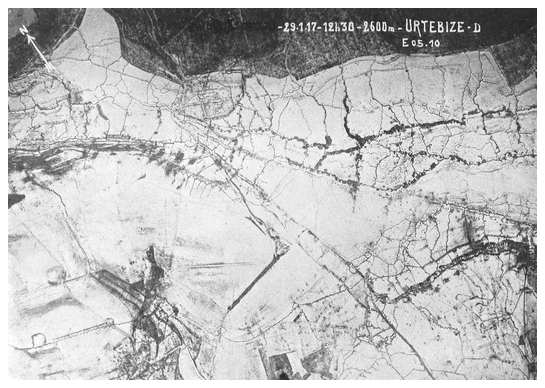
Urtebize
January 29, 1917—12.30 P.M.
The men must be given a very detailed and
thorough instruction in bayonet practice, but as
the American troops are in possession of a very
complete manual on this subject we will not dwell
upon it.
Grenades. A new weapon (or rather an old
one that has been revived) that plays a very important
part in the actions of the infantry is the
grenade. Many types exist but they can be
classified either as offensive or defensive grenades.
The former kind is not so destructive as the latter.
They are lighter, can be thrown to a greater distance,
and are used to prevent the enemy from
coming out of their dugouts and trenches when the
assailants reach them. The defensive grenades,
which are extremely destructive, are used against
attacking or counter-attacking troops. Some
are thrown by hand, others with the rifle. Well
trained soldiers can throw grenades as far as fifty
and fifty-five metres.
Rifle grenades are thrown by the propulsive
power of the ordinary cartridge. A special
contrivance at the muzzle of the gun cocks the
grenade, so to speak, as it is driven from the
barrel by the bullet, so that it will explode on
hitting the ground. It reaches farther than the
hand grenade.
Recently General Pershing rightly laid stress
on the necessity of perfecting the marksmanship
of the recruits. To this accomplishment and
skill in the use of the bayonet, which gives the
soldier self-reliance, suppleness, and agility (qualities
that the Germans do not easily acquire) ought
to be added a thorough training in the throwing
of grenades, a sport which promptly captivates
those who practise it. Excellent results are secured
by offering prizes for grenade practice, both for
distance and marksmanship. The French soldier
is contented with little, and the mere offer of a
few cigars or packages of cigarettes to the best
throwers has achieved wonderful performances in
this line.
We believe that the Germans have no reason
to congratulate themselves on having been the
first to reintroduce the use of grenades in warfare,
because it is a weapon requiring intelligence and
skill in its handling. Thrown by shrewd quick
Frenchmen, or by sportsmen like the British, it is
much more dangerous than in the hands of thick-headed,
passive German soldiers. We are sure
that the American troops will use the grenade
with the same skill as their Allies.
Trench Knives. The trench-fight is a fight to
a finish, and has necessitated the adoption of a
strong knife. In the hands of fierce resolute men
it is a terrible weapon, much resorted to in the
confined space of trenches, tunnels, and dugouts
where bayonets cannot be used. The African
troops are very fond of these knives, and as the
Germans are well aware of this fact, they never
surrender to African troops, and the fights between
these combatants always smack of savagery.
On account of their fear of knives and daggers
the Germans have pronounced their use inhuman,
and have shot many prisoners on whom daggers
were found. It is advisable, then, for troops
obliged to surrender (and the bravest troops may
have to do so) to throw their daggers away in
good time.
Automatic Pistols. Officers and non-commissioned
officers only have automatics, but we
would like to see them issued to the infantry,
as they are most useful in hand-to-hand fights.
The use of the various arms above named has
necessitated the division of the company into
grenadiers, machine-gunners, and light infantry.
The last-named fight especially with the ordinary
rifles, bayonets, and daggers.
When circumstances permit, it would be advisable
to teach all the men of a company the use of
all the arms, one after the other, so as to be able to
re-establish after and even during a battle the exact
proportion of specialists. There has been too
great a tendency to neglect rifle practice. Soldiers
ought to lose no occasion to perfect themselves
in the use of the rifle, which remains the principal
arm of the infantry. Its importance will be even
greater in open warfare.
2. Instruction. To be a good infantry soldier a
man ought to be very vigorous, sufficiently young,
not more than thirty-five, well fed and well trained.
The individual instruction should be as thorough
as possible, and perfected before the man is sent
to the front.
The theoretical instruction of troops must be
completed before they can be given the defence of
a sector, and it is only in the lines and in the face
of the enemy that they can acquire the practical
experience. The more thorough their knowledge
of theoretical details the sooner the company and
battalion will become good fighting units.
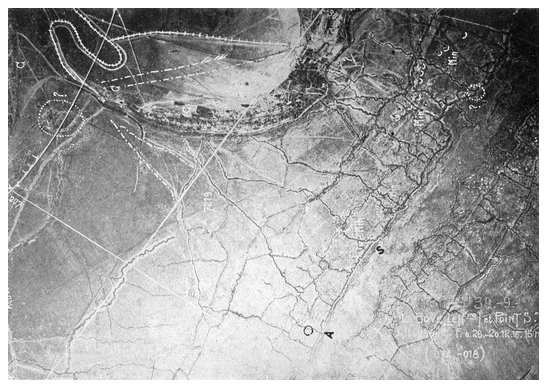
La Bovelle
December 20, 1916—3. P.M.
The spirit of initiative should be specially
encouraged in every soldier, as in the present war
every man has an individual part to play, according
to his duties, his rank, and his weapons. During
the actual fighting the soldier can rely but little
on the leadership of his superiors, who are merely
expected to set the example, and who are frequently
the first shot.
Duties of the Officers. Before ordering their
men to advance and while still in the trenches, the
officers, assisted by their non-commissioned officers,
should, whenever time and circumstances allow,
strive to explain fully to every man what are
the objectives to be attained and what means are
to be employed. No details should be neglected.
The Major’s duties will be to designate very
clearly the fronts assigned to each of his companies,
the objectives they are to reach, and the itineraries
they are to follow. An assault is usually made in
several waves, so the order of departure, the
distance to be maintained between the successive
waves, the place to station the reserves, and, if
need be, the instructions relative to the juncture
and reforming of the elements of the various
companies, form so many points that must be
settled beforehand in their minutest details.
The Major will have to decide beforehand how the
battalion as well as the several companies will
hold the objectives after capturing them, how they
will organize these objectives in the shortest time
possible, and how they will resist the counter-attacks.
The officers in command of battalions
and companies must not forget that, once the
action has commenced, and often even before it is
begun, all communications become difficult and
frequently impossible, and that consequently
all possible eventualities, within the orders received,
must have been thoroughly studied in
advance. So it is indispensable to give every
man minute instructions.
This extract from a letter found on a French
captain who was killed on the Meuse will give to
young and inexperienced officers a good idea of the
thoughts that must absorb the mind of an efficient
commander.
“I am alone,” he wrote, “in this underground
shelter, still permeated with the foul atmosphere
of the Germans, where the evidences of a disorderly
flight, biscuits, bloody rags, stained letters, a
biography of Hindenburg, etc., lie scattered in
every direction. I am alone after having relieved
the company that made the attack. I am alone
without counsel if I hesitate, without help if I
weaken, in this captured trench which is half
destroyed. My two hundred men are blindly
piling in, ignorant of their surroundings, of what to
do. The sight of them restores my waning energy.
I have to think for them, and put everything in
order before daybreak. I consult my watch: it is
midnight.”
Here is a Chief, a real leader! He goes out;
until dawn he inspects his sector, he sets his men
at work. To each he assigns a task; he stimulates
them, prevents them from falling asleep, and does
not spare himself. He can count on all his
subordinates to do their best, and at the break of
day, if the bombardment is resumed, if the counter-attack
is launched, the trench will be ready; the
losses will be lessened; resistance will have been
made possible. It is by such methods, by the
constant co-operation of the officer and his men,
that the army performs marvellous feats. It is
this constant co-operation, this comprehension of
duty by the humblest leader, that enabled us to
hold out at Verdun.
The most difficult missions should be entrusted
to those known to be the best qualified to fulfil
them.
Once the signal of attack is given, the officers
and non-commissioned officers will scarcely have
any other means of ensuring obedience to their
orders than by setting an example to their men.
We take this occasion to render a profound
homage to inferior ranking officers of the French
armies. They indeed are and shall remain the
heroes of this war. They have fallen on the field
of honour since August, 1914, not by thousands
but by tens of thousands. Never, under the most
critical circumstances, has their morale weakened
for a single moment. At all times, men equally
as brave as their predecessors have been found to
fill the places of those who had so heroically (I
was going to say so cheerfully) gone down to death.
By the sacrifice of their lives to their country, they
have not only set an example to the officers of their
Allies, but have also given the latter time to form
and train themselves, and I can truthfully say,
to equal them. The bravery displayed by the
infantry officers of the English, Italian, and
Russian armies is on a par with that of the French
officers, and within a short time, the American
officers, I am sure, will show themselves worthy
of the same verdict.
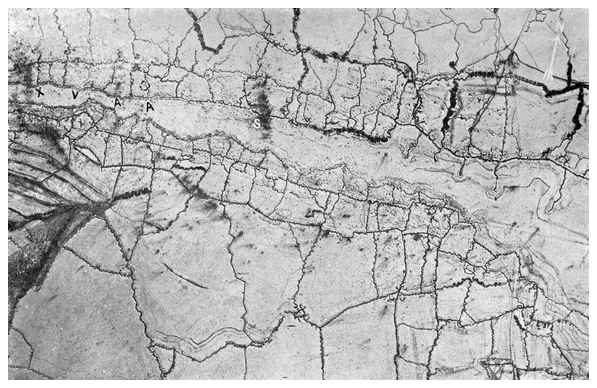
South of La Bovelle Farm
January 29, 1917—12.30 P.M.
Our officers have always and from the very
first day of the war invariably marched ahead of
their men, leading them straight to the enemy.
They have advanced through the most intense
curtain-fire; they have exposed themselves to the
fire of innumerable machine-guns; they have been
the targets of rifles and grenades. Thousands
have been killed; not one has hesitated, not one
has turned back. The Allied officers have exhibited
the same daring, the same bravery.
But what about the German officers? Is it
possible not to contrast their attitude with that
of our own? The German officers endeavour to
keep under shelter as long as possible their precious
persons, so greatly superior, in their own estimation,
to those of their men, and when they do
muster the courage to come out into the open,
they are content to follow behind their troops, with
revolvers in their hands to exact obedience.
We wish to reproduce here two or three citations
taken at random among a thousand similar ones
published in the Journal Officiel de la République
Française, the official organ of the French Government,
to give a vivid illustration of the way that
officers ought to understand their duties:
On September 1, 1914, Major Parisot de la
Boisse said to his chasseurs: “I give you my
word of honour, as long as one of us remains
alive, the enemy shall not pass.” In spite of
heavy losses, though nearly surrounded, he extricated
his troops and maintained the fight. The
Pass de Mandray he defended remains French!
Captain Robert Dubarle. “A living example of
impassibility under fire, contempt of danger,
energy, and initiative.”
Captain Mazarde—11th Chasseurs. “A splendid
officer already cited at the order of the Division,
of the Army Corps, and of the Army. From
June 29th to July 14, 1915, he exhibited the
bravery of a hero. While leading his Chasseurs
to the air of Sidi Brahim in an attack upon a wood,
he was stopped by wire entanglements at 50 metres
from its edge. He maintained the line of attack
for 36 hours, face to face with the enemy, repulsed
a counter-attack, and riddled the line of the
enemy with bullets and grenades. He withdrew
only when ordered to do so, taking all his wounded
and the bodies of the officers killed. He was shot,
and died from his wounds.”
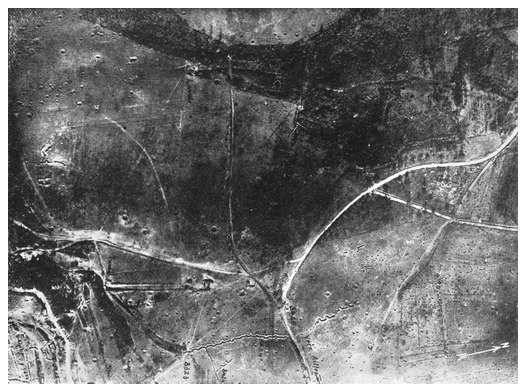
West of Ailles
April 24, 1917—10.00 A.M.
Captain Pierre Mercier—67th Battalion of
Chasseurs. “Entrusted with the mission of defending
the passage of a bridge, he maintained his
company under an intense fire. Outflanked on
both right and left, he did not hesitate to charge
an enemy very superior in numbers, and fell
mortally wounded, saying to his men, “We have
done our duty.”
Space does not allow us to give more numerous
citations, but we think that it would benefit the
American army to get the minutes of the war, to
select therefrom the most brilliant citations of the
French and English armies, to have them translated
and widely distributed among the American
troops. Nothing would be more instructive for
the officers, nothing could better rouse their fire,
nothing would inspire them with a greater desire
to emulate their comrades in the Allied armies.
The example of heroism is contagious for young
men.
Shock-troops (Stosstruppen). The continual
failure of the German attacks or counter-attacks
for more than a year led them to the
creation of what they call Stosstruppen. The new
recruits of the German army were lacking greatly
in quality—the German soldier at best is wanting
in initiative. The High Command therefore resorted
to a selection of the best elements to be
found in some of their divisions, with which to
form battalions or companies for assault.
The promise of receiving better and more
abundant food than that given to the other troops
(so important is the question of food to the German
soldier, who has been on somewhat short
rations since 1916) has been sufficient to bring
forward volunteers for these companies.
These special troops are exempted from work
in the trenches, and are brought up to the lines only
when needed. On such occasions they are scattered
all over the attacking front for the purpose
of encouraging by their example the elements which
are not so well organized.
The Germans, who, after the Russian revolution,
were enabled to withdraw the best elements from
their divisions on their Eastern Front, made, in
June and July, 1917, a frequent use of their
Stosstruppen in counter-attacks in Artois, and in
desperate and daily attacks on the Chemin des
Dames, but the result was far from expectation.
The Stosstruppen, obliged, like the ordinary
troops, to attack in too serried ranks, offer a
splendid target to artillery and machine-guns
and, nine times out of ten, their rush is stopped
before they can engage in a hand-to-hand fight.
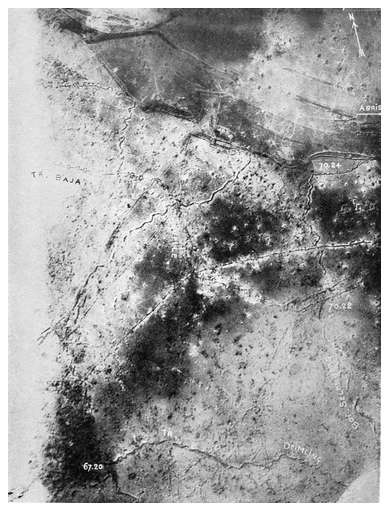
La Bovelle
May 5, 1917—10.30 A.M.
We wonder what the German divisions on the
Russian Front will be able to accomplish without
their best and strongest elements when the Russian
Army rallies and re-enters the war in earnest.
3. Mission and use of the infantry in a division.
We have stated that a division includes three or
four regiments. We will now dwell on the disposition
of a division comprising two brigades
of two regiments each. It seems certain that this
is the type that will be adopted by the American
Army, which possesses a sufficient number of men
for this normal constitution of a division.
Front of a division. The front of a division in
trench warfare is very variable in extent. The
occupation of strong intrenchments, enabling
the reserves to be sheltered from the enemy’s fire,
allows of the extension of the front, especially
if the army remains on the defensive.
As soon as a division takes the offensive, however,
its front is reduced to such proportions as
will permit of energetic effort. The front of a
division in the open field has been fixed at 1800
to 2000 metres. The operations in 1914 showed
that the fronts were always longer than this and
often twice as long and such will perhaps continue
to be the case in future if the war in the open
is resumed; but, so long as the war remains one
of intrenchments, it will be very dangerous not
to limit the fronts, especially at the time of an
offensive. This is an acknowledged truth, and
there is a growing tendency, especially in the
British Army, to shorten the front of attack of a
division.
Dispositions. The most logical mode of disposing
the troops in a division on the battlefield
will always consist in the junction of the
two brigades side by side, and, in the brigades,
the junction of the regiments side by side.
The division, the brigade, the regiment, and
even the battalion, have each to constitute reserves
either to ensure success or to guard against
possible failures in their offensive. In this warfare
of position, even more perhaps than in one of
movement, the necessity of always having troops
near at hand, ready to repel counter-attacks, is
imperative, owing to the fact that every repulse
is followed by the enemy’s occupation of a part of
the line of defence which would have to be retaken
later with great losses should the enemy be given
time to organize themselves therein.
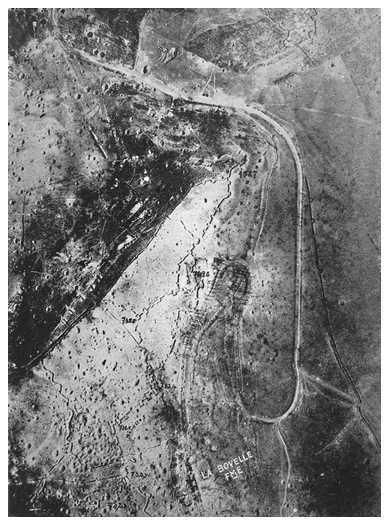
North of La Bovelle
April 24, 1917—10 A.M.
The disposition of the units in depth enables the
Command, when the lines are cleverly constructed
and their intercommunications well assured, to
keep only a few men in the severely bombarded
spots, and to shelter the largest part of the troops
where they cannot be injured.
The study of the last large operations, especially
on the British Front, shows that the experience
and training gained by the British troops in the
field, and the cohesion of their artillery and infantry,
have compelled the Germans to abandon
their method of distributing their forces in 1916
and to adopt a quite different system of fighting.
In the battle of the Ypres-Menin road the Germans
launched three divisions on a very narrow
front, with three battalions, one from each division,
on the first line.
Immediately behind each leading battalion a
second was placed to support it. The other two
battalions of each regiment of four battalion-formation,
and the third battalion of the three battalion-regiments,
were held in reserve in depth to try
and check the English advance and to execute
detailed counter-attacks.
Behind these divisions of attack, special troops,
carefully selected, composed a general reserve,
waiting in very solid shelters where they were
protected from heavy-artillery bombardment.
These reserves were used when the first line
divisions failed to check the enemy’s advance,
or when there was a chance of retaking lost ground
by violent counter-attacks.
The natural consequence of this new distribution
of the German troops is that to counteract it
successfully very narrow fronts have to be adopted.
Forces strong enough to repel the enemy, and
permit no time for the supporting battalions to
engage effectively, have to be placed on the first
line. The first lines are to be backed up by reserves
strong enough to oppose the enemy reserves without
any loss of time. A general reserve is to be
kept in readiness in sufficient force to hold the
conquered positions against all counter-attacks
which may be launched by the general reserves
of the Germans.
The last operations of October show that these
dispositions are now in force in all the armies.
Defensive. We have just explained the dispositions
the Germans had to adopt on the defensive,
and we think that all parties will perforce
be led to adopt a somewhat similar distribution.
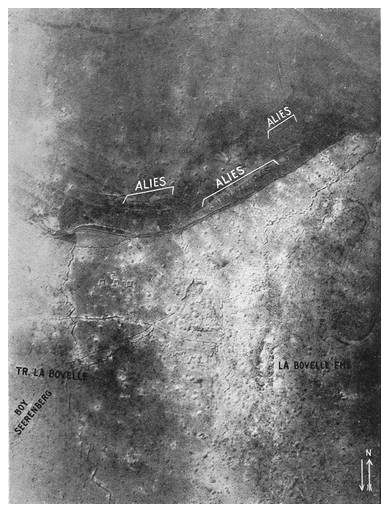
La Bovelle
May 5, 1917—10.30 A.M.
The power of resistance of the trench-lines of the
Allies being far inferior to that of the German
lines, the Allies must, to guard against the danger
of attack, take advantage of the superiority of
their artillery. They must dispose their forces in
depth, in such a way as to ensure the repulse of
the enemy by a succession of assaults that will
stagger him and prevent him from re-forming.
It is impossible to give hard and fast rules for
the distribution of forces between the different
lines of the divisions, regiments, battalions, and
companies. The distribution depends entirely
on the nature of the operations, and is left for
each unit to carry out in conformity with the
orders received. When sufficiently detailed instruction
has been given to a unit in the course of
its training, these distributions are an easy matter
to decide upon, provided the officers of all ranks
perform conscientiously the duties we have
indicated elsewhere.
Assaulting and Occupation Troops. Experience
has suggested to the Allies to divide
their fighting troops into army corps for assault
and army corps for occupation.
Once the objectives are attained and strongly
held, the assaulting troops are replaced by the
occupation troops that arrive fresh on the ground.
Their task, though one of defence, is often hard.
They have to remain a long time in the first
lines, exposed, by reason of the new German
methods, to frequent and severe bombardments,
and obliged to repel numerous counter-attacks.
The generals commanding-in-chief are the
exclusive judges of the part the different army
corps will have to play, but, in our opinion, there
is one principle which must never be ignored in
war. In the army, as well as in the battalion
and in the company, it is the duty of the Chief
to select for action, irrespective of any rotation
of service, that element of the troops under his
command which he deems the one most likely to
achieve the desired result.
What we have said concerning the use of the
artillery, the armament of the infantry, the distribution
of the infantry in the division and the
trenches of attack, will enable us to give an exact
idea of the physiognomy of an offensive action
and of its preparation.
Offensive Engagements. Their Preparation.
The preparation of attacks in a war of
position is a long one. On account of the work
it necessitates it is very difficult to conceal these
preparations on the front from the opposing
aviation, and also, alas! from the curiosity of the
rear.
An attack can be determined upon only by order
of the General-in-Chief, who decides where and
on what front it shall be made. He gives his
instructions to the General in command of an
army group, who, according to circumstances,
employs one or several of his armies for the
operation. Each General commanding an army
prepares an order of operation for each of his
army corps, and so on, until the precise instructions
reach the elements of the first line.
The preparation then commences. It consists
in establishing on the terrain under the protection
of the batteries:
1st. The new lines of the infantry, and, if
necessary, the communications between these
lines;
2d. The location of the artillery of all calibres;
3d. The organization of the posts of command;
4th. The bringing up of the munitions and
material of all kinds;
5th. The construction, at the rear of the front
of attack, of railroads and ordinary roads in
sufficient number, rather in excess of the estimated
needs than otherwise;
6th. The organization of the reserves of infantry.
7th. The preparation for the evacuation of
the wounded, and the installation of large field
hospitals, as close as possible to the lines;
8th. The organization of stations of evacuation;
9th. The organization of the parks;
10th. The organization of the centres of supply,
etc.
This enumeration, from which we have omitted
the aviation, by reason of its special installations
on appropriate grounds, gives a sufficient idea of
the labour required in preparing an offensive,
which takes generally several weeks to accomplish.
A few days before the attack, an effort is made
to secure the mastery of the air. Destruction
fire is then directed against the opposing trenches.
The comparison of the different photographic
plates handed daily to the General Staffs enables
the Command to watch the progress of the destruction
of the lines and positions of the enemy.
When the destruction is deemed thorough enough,
the order is given to attack, at given points, at a
given hour of a certain day. The last operation
of the artillery, called “the rolling surprise fire,”
consists in subjecting numerous portions of the
front to a series of terrific and rapid bombardments,
which leaves the enemy in doubt as to the
points against which the attacks of infantry are
to be launched. At the time appointed these
attacks commence. The field artillery covers its
infantry by barrages as intense as possible. The
first assaulting waves, followed by those of the
supporting troops, rush to the objectives selected,
drive off the enemy by all means at their disposal,
occupy and organize them. If necessary, the
reserves come in, either to help the assaulting
troops, or to repulse the counter-attacks of the
enemy, if any occur.
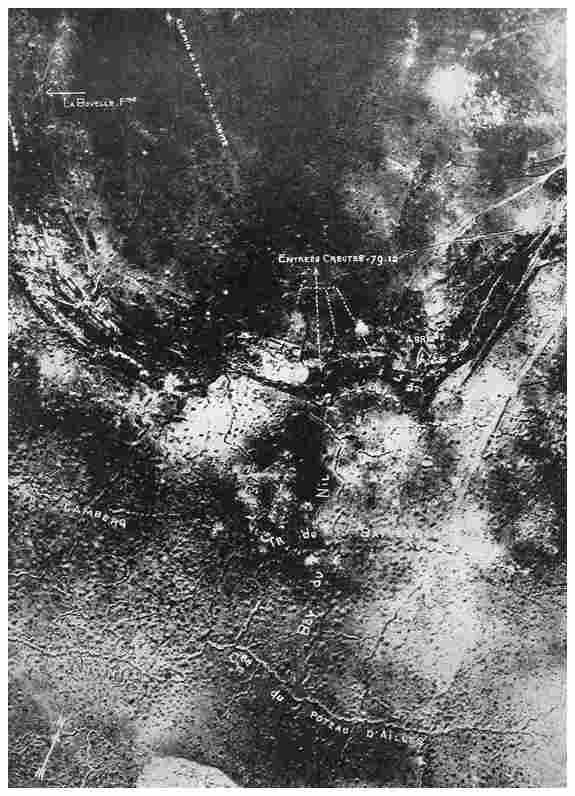
Trench “Battemburg”
May 4, 1917—Noon
It was decided some time ago that the troops
must not, yielding to their ardour, or the excitement
of a too easily acquired success, go beyond
the objectives that have been assigned to them.
A close examination of the defensive dispositions
of the Germans which we have described reveals
the wisdom of this precaution. It does not follow
that additional objectives cannot be taken on the
same day, but in this case the additional advance
will be made by a fresh attack and the effort will
be distributed accordingly.
Documents found on Germans in Champagne,
in August, furnish the following details of an
attack they had prepared north of the Souain Hill.
A similar attack had been rendered impossible
by the action of the French at Verdun, and by the
destruction of the gas reservoirs by the French
artillery.
Three fresh divisions and fifteen companies of
stosstruppen (shock-troops, or special troops of
assault) were to lead the attack with light machine-guns,
minenwerfer, signalmen, miners, sappers,
gasmen, grenadiers, stretcher-bearers, and artillery
patrols. Twelve “booty-squads” and twelve
“destruction-squads” each composed of an officer
and thirty-two men were to follow the stosstruppen.
Arrangements had been made with a view to
removing the captured guns.
They had prepared for a formidable discharge
of a new gas by a six-company regiment of
sappers.
The gas attack was to be launched for a quarter
of an hour. A very strong artillery preparation
was to follow, after which the stosstruppen were
to rush forward.
The aviation was to play an important rôle, and
the attack was to be made with the aid of all the
means of liaison known: dispatch-runners, telephonists,
optical signals, carrier-pigeons, luminous
rockets, and wireless telegraphy.
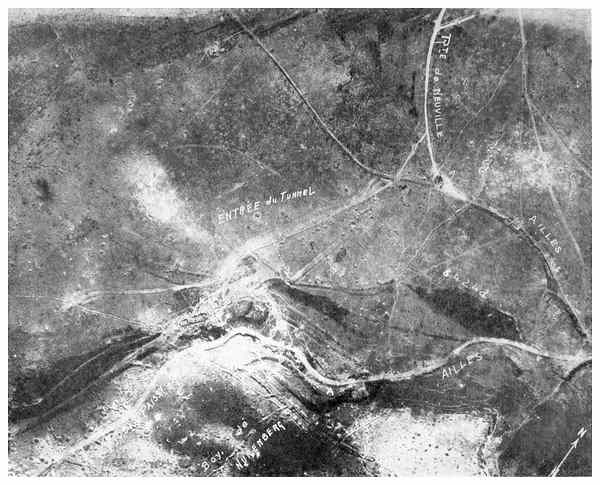
West of Ailles
May 4, 1917—Noon
Orders had been given to bring back as many
French gas-victims as possible, with a view to
studying the effects of the new product.
On the 20th of November, 1917, the third
English army, by a successful surprise attack,
penetrated into the German lines to a great depth
and on a large front.
This operation, prepared in the greatest secrecy,
was carried out without the usual assistance of the
artillery or barrages. The infantry attacked
under the protection of numerous tanks which
destroyed the wire entanglements and the most
important obstacles.
We do not think that this method will henceforth
become a rule.
Before launching this attack, the British Commander
must have been informed by his aviation,
or by some other means, that the German Front
was lacking in artillery and infantry and he must
very cleverly have taken advantage of this momentary
situation.
Must we conclude that the rules of preparation
of attack, as stated above, will not be applied
hereafter? It is very doubtful, in view of the
fact that the Germans have prepared in France
too many lines of defence, one behind the other.
This English victory, however, shows that the
High Command, whenever in possession of information
warranting the hope of success, will
have to combine regularly prepared attacks with
surprise attacks on points where the German
effectives happen to be reduced.
The success of this operation on the Cambrai
Front proves that, however strong a position
may be, however numerous its wire defences, it
will always be possible to take it when not protected
by a sufficient force of artillery and infantry.
Defensive Engagements. When the troops
have to withstand an attack on their lines, they
must bear in mind the very sound principle of war
that a passive resistance can only end in defeat.
On the first lines all the elements necessary for
as long a resistance as possible will have to be
accumulated. The infantry will then have occasion
to make a telling use of rifles, grenades, rifle
machine-guns, and machine-guns in as great a
number as possible. The supporting troops and
the reserves must be ready to counter-attack the
enemy without loss of time, and throw him out
of any trenches he may occupy temporarily. We
have often seen German attacks on advanced
trenches repulsed in the very moment of success
by a simple bayonet charge made by the troops
of the first lines. To the field artillery, however,
belongs the most important rôle in repulsing the
attacks of the enemy, and the “communiqués”
of all the Allies show that eight out of every
ten attacks are repulsed by barrage fire. When
the aviators can report in time exactly where the
enemy troops are being massed for attack, the
trench artillery can work great havoc in the ranks
of those usually compact formations.
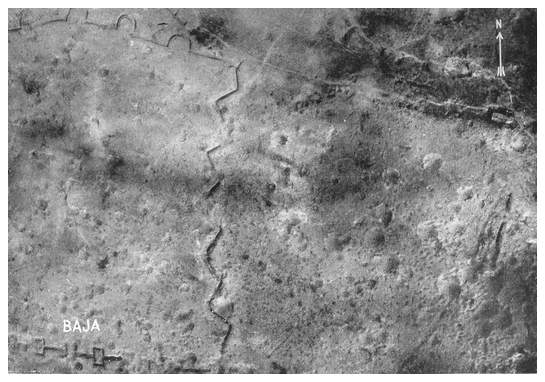
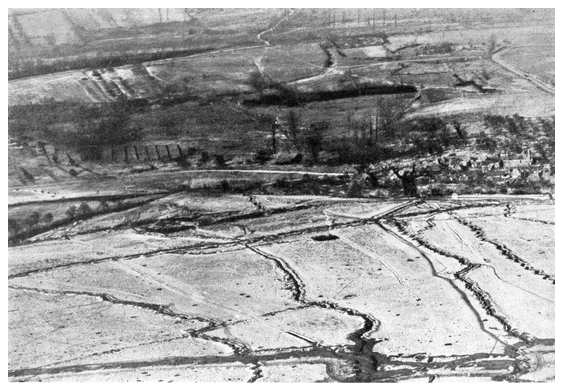
View taken about 10 A.M. during the attack of May 5, 1917
Prolonged Engagements. What we have
just said refers to attacks made from regularly
organized lines which have not been entirely
destroyed by shell-fire.
On a ground where fighting has been proceeding
continuously, the trenches are entirely destroyed,
and the men and machine-guns belonging to the
first-line troops remain with no other shelter than
shell-craters, which are, as far as possible, connected
together during the night by shallow
trenches, provided this work is not prevented
by continuous shell-fire. The communication
trenches with the rear do not exist any more;
and connections can only be maintained with the
utmost difficulty; by what means, we will later
explain.
In order to resume the attack under such conditions,
it will be necessary to choose the exact
moment when the enemy is supposed to be demoralized
by the artillery, and to rush the troops
forward. In nearly every case, the assistance of
fresh troops or of troops that have suffered little
will be needed.
These field operations are difficult and require
from both the chiefs and the soldiers a resolute
will to conquer, and a thorough knowledge of
war conditions.
During the last battles on the Somme, on the
Aisne, and at Verdun, advanced infantry fractions
had to hold out for several days in shell-craters,
not connected with one another, and often filled
with water. The heavy enemy shell-fire rendered
every move impossible and stopped the arrival of
all supplies. The adverse lines were often merged
into one another and from hole to hole grenade
fighting was kept up. It was nevertheless under
such trying conditions that our troops fought
inch by inch to defend the French lines at Verdun,
and their heroic resistance enabled the Command
to prepare new positions, to redistribute the troops
and to move them forward, after they had finally
thwarted the great German effort.
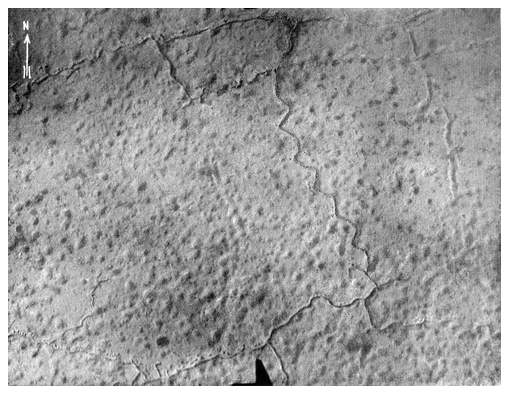
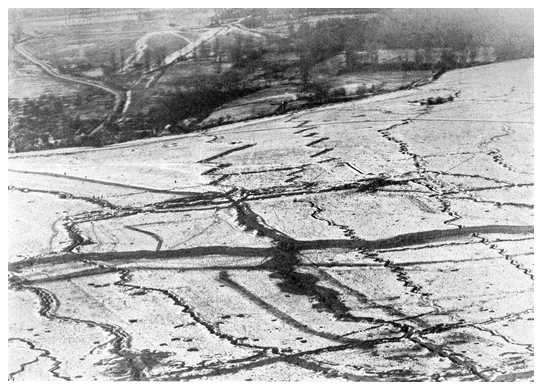
View taken about 10 A.M. during the attack of May 5, 1917
Posts of Command. In a division all the
commanders of units from the General of Division
to the Major direct the fight from quarters called
Command Posts. These quarters, rendered as
much as possible proof to field artillery fire, must
overlook the battlefield. They are fitted with all
the rapid means of communication, both telegraph
and telephone. The wires, although numerous
and deeply buried seldom resist the bombardment
until the time of attack. As a last resource
recourse is had to signals, optical devices, carrier-pigeons,
and messengers. Apparatus for ground-telegraphy,
which seems destined to come into
general use, has lately been employed, but we
have not seen it in operation.
As communications between the advanced lines
and the rear have become so very difficult during
the preparation bombardment and the barrages,
which are often uninterruptedly kept up for several
days, the western armies have again had recourse
to the carrier-pigeons, which are furnished in large
numbers by private societies, existing before the
war. Their co-operation is very useful and helps
to save many human lives. They are also sent
out by airplanes whenever the use of wireless
telegraphy is not deemed expedient. They render
great service in keeping the front in communication
with the rear, and are also of priceless value
for connecting the rear with the front.
Signalling. The difficulty of communication
between the rear and the front during the bombardments
will necessitate the increasing use of
infantry aircraft for the direction of operations.
The aircraft, connected by wireless with the various
divisional headquarters, are able to send information
and in turn, to receive and transmit
orders by signal to the troops on the front.
These aircraft will also maintain a connection
between the infantry and the field artillery, which
must be close and continuous if demoralizing
consequences, such as have only too frequently
occurred in all camps, are to be averted.
After the Anglo-German battles in Artois, the
German prisoners, respectively of the infantry
and the artillery, had to be separated, so great was
the feeling between them. The infantrymen
claimed they had not had sufficient protection, and
wanted to “take it out” of the gunners.
So as to avoid confusion during infantry attacks,
the guiding aircraft ordinarily send up but one sort
of rocket-signal, indicating to the artillery either
a lengthening or a shortening of the range by
one hundred metres.
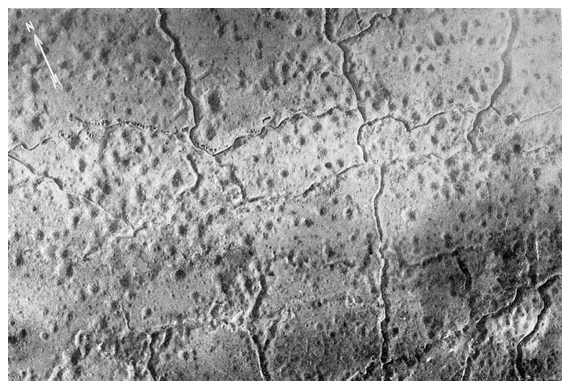
View taken about 10 A.M. during the attack of May 5, 1917
Battalions of Three Companies. At the
same time that the effectives of certain divisions
were reduced, the battalions were returned to a
three-company formation.
A company of infantry is in principle composed
of two hundred and fifty men, a quota which is
however purely theoretical, as this number becomes
rapidly reduced by various causes, such as illness,
loss in battle, etc.
Framework of the Army. The ranks of the
officers and non-commissioned officers of the French
Army have been renewed several times since the
beginning of the war. Many captains in 1917
were mere privates in 1914 and most of them are
very young. They are, generally, excellent
officers, and it is to be regretted that those who
have proved their worth are not even more rapidly
promoted.
The spirit of routine that prevails in an army
officered by soldiers of regular professional training
is often responsible for the promotion to high
command of men too old for the effective direction
of a long and exhausting war like the present one.
There is no reason to think that the American
people, any more than the British and the French,
will meet with serious difficulties in recruiting
and quickly training a strong staff of officers of all
ranks. They will also, like the Allies, find no
insuperable difficulties in filling the gaps which
the enemy’s fire will make among them.
4. A word about cavalry. If in this treatise
we have not devoted a chapter to the use of cavalry
it is because, since September, 1914, cavalry has
had but few opportunities to operate as such.
The cavalry has been generally used in the
present trench warfare in the same manner as
the infantry. It has been reduced in number;
that of the army corps has been suppressed, and
only two squadrons have been allotted to each
division.
Some regiments of cuirassiers have been dismounted,
for want of proper horses.
But we think that, notwithstanding the small
part the cavalry has taken in the war during the
last thirty months, its opportunity is bound to
come.
Some cavalry corps, comprising several divisions,
have been retained, and during the offensives
they are held in readiness to move to the
front in case the enemy lines should be broken.
Cavalry squadrons rendered good services to
the British and French during the pursuit in March,
1917.
The Germans will perhaps not always be able
to protect their retreats by the desert-like devastation
of thirty or forty kilometres of country.
Their weak point will be found some day or other,
and on that day the cavalry will resume its importance.
The difficulty in feeding and obtaining horses
seems to have compelled the Germans to reduce
their cavalry forces considerably.