Introduction — Amputations — Treatment of the Stump — How Soon After an Amputation — Material of Construction — Artificial Legs for Children — Weight of Artificial Limbs — Durability of Artificial Limbs — How to Proceed in Ordering a Leg — Making Artificial Legs from Measurements — Warranty — Prices — Remittances — Terms — Installment Payments — In Writing — Artificial Limbs for U. S. Pensioners
The making of a man is a process of time, of training
and of progress. The babe, indeed, may be
born perfect in physical proportions and in possession of
normal faculties; but no product of Nature may stand still.
Growth or decay is the lot of every one, and the man—the
full and perfect man—is the result of physical and
mental development.
There has never been a time when physical development
has received so much attention as at present, or
when its importance has been so greatly appreciated.
Physical culture and exercise in the open air have resulted
in making men and women stronger and healthier, and
consequently more graceful in carriage and figure and
better fitted to enjoy the pleasures and perform the duties
of life. The conviction is now general that to produce
the highest type of man the cultivation and development
of the physical structure should proceed with the cultivation
of the mind; but on the other hand, the wise do not
admit that the practice of devoting too much attention to
athletics should be encouraged, however prevalent this
practice may be said to be at many leading colleges. The
proper ratio should be observed.
It is not desirable, to be sure, that the race should
become one of ignorant giants, but nevertheless the
value of exercise and of physical work cannot be disputed.
The right to pursue this value should be shared by all
mankind. Fortunately it has been made possible now,
as it formerly was not, for those who have lost limbs
to indulge in rightful exercise and perform necessary
physical work notwithstanding their misfortunes. The
activities of life, with their resulting benefit, are no longer
denied them.
Surgery, the scientific making of mechanical devices
for the correction of deformities, and the manufacture of
artificial substitutes for lost limbs, have led in the advance
of methods intended to better the condition or ameliorate
the suffering of humanity.
Time was when the loss of a leg meant the stumping
through the balance of life on a crotched stick. There
was Peter Stuyvesant, for instance, whose portrait is shown
on the cover of this catalogue. He lost a leg in the wars
in the West Indies in 1640. Thereafter, during the
time he was the last Dutch Director General of New
Netherlands—from 1647 until his surrender to the
English in 1664—and to his death in New York in 1682
at the ripe old age of eighty, he pegged his way along.
He was a man well able to afford the best in life, but
nothing better than the ordinary peg leg was then obtainable,
and so for forty years or more Peter Stuyvesant suffered
the inconvenience due to the crude device.
Now, fortunately for the afflicted, better things are
possible. Science and art have combined so successfully
in the manufacture of our artificial limbs that not only is
the wearer free from discomfort but he is enabled to
continue his career of activity, and pursue, as may be
necessary, his labors for a livelihood. Besides, the perfection
of design and manufacture of these aids makes
their presence difficult of detection.
Not only is ordinary labor well performed, but many
remarkable feats are accomplished by wearers of limbs of
our manufacture. A few instances are cited below.
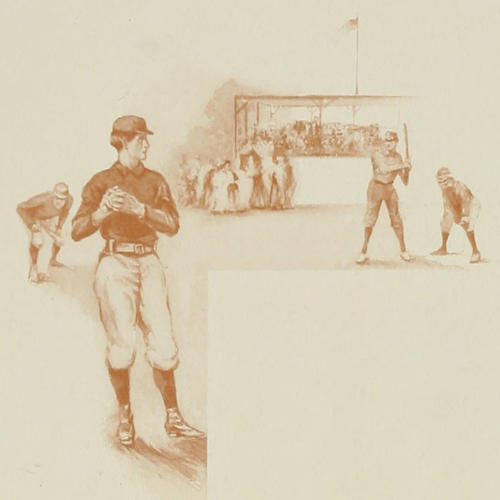
A noted pitcher of a baseball team and a remarkable
bicycle rider, although deprived in early life of both legs
by accident, is able to hold a position of prominence in
his profession.
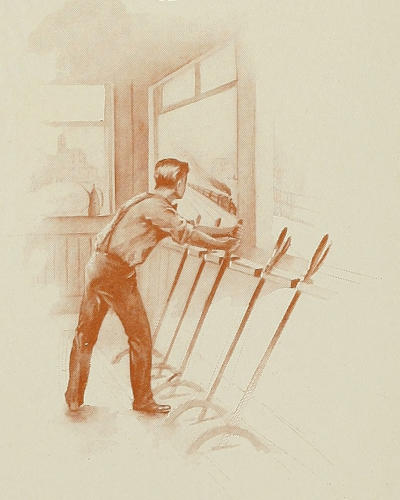
An operator constantly on his feet in a signal tower
suffers no inconvenience. After making five experiments
he has found finally that the artificial leg with which
we have equipped him is the most comfortable he has
ever worn.
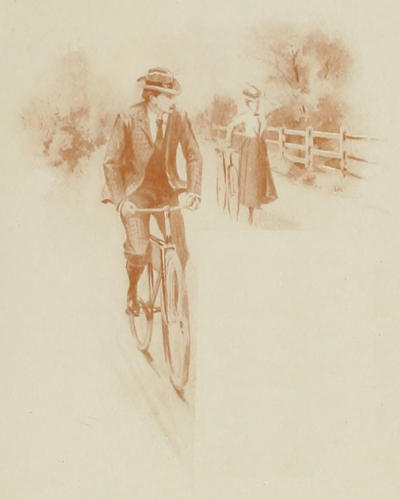
A crack bicycle rider, both of whose legs have been
amputated, one above the knee and one below, pronounces
our substitute faultless. He is able not only to
mount and dismount with ease but to perform all manner
of tricks and fancy riding, doing this as well as his competitors
blessed with sound, muscular, natural limbs.
Besides, he has a mile track record of 2.37.
Money will not buy happiness, but it will aid in its
attainment. Money will not compensate for the loss of a
limb, but it will buy a fair substitute if one knows where
to procure it.
One having a valuable and delicate watch needing
repairs would naturally be very cautious into whose hands
it was entrusted. In the event of sickness we are apt to
be very careful into whose care we place the patient.
Careful inquiry is made as to the reliability of the physician
and his experience, whether or not he has been successful,
if he understands his business and is honest in his
purpose; if his advice will be given in the best interests
of the patient, or whether his own profit is of first importance
to him.
It is entirely proper to ask similar questions in regard
to the makers of artificial limbs; but too often people are
careless in the matter, and place the case in the hands of
almost anybody in the business, without regard to responsibility
or reliability. Thus the remedy secured is often
worse than the disease. The strictest investigation should
be made. A competent maker should be selected. The
case being entrusted to him, the minor details should be
left to his judgment, with faith that his experience and
thorough understanding of his business will produce the
best result.
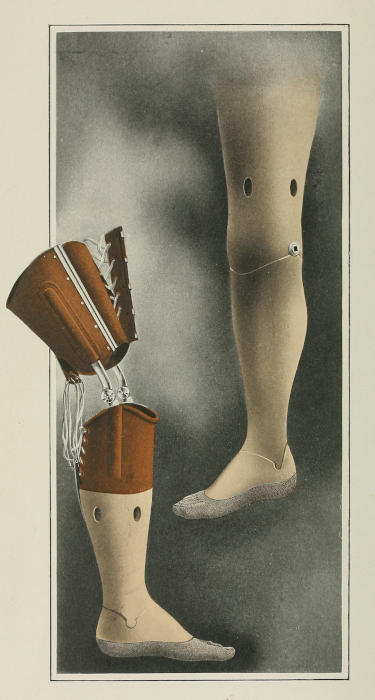
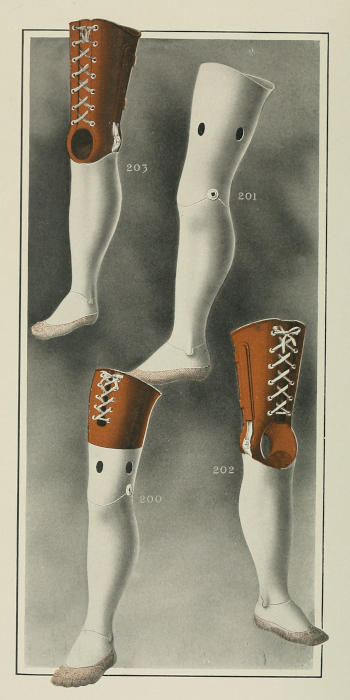
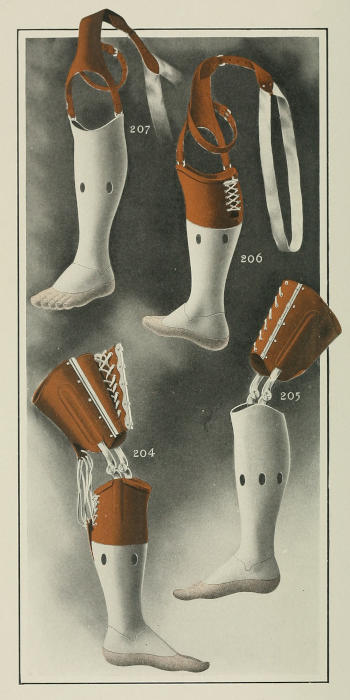
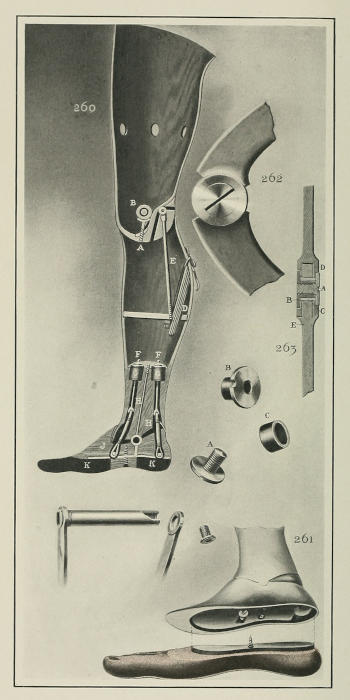
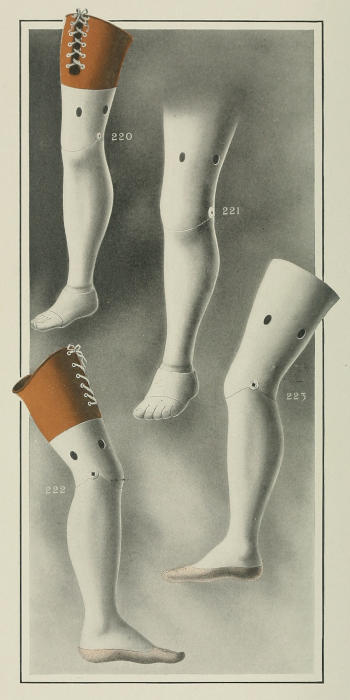
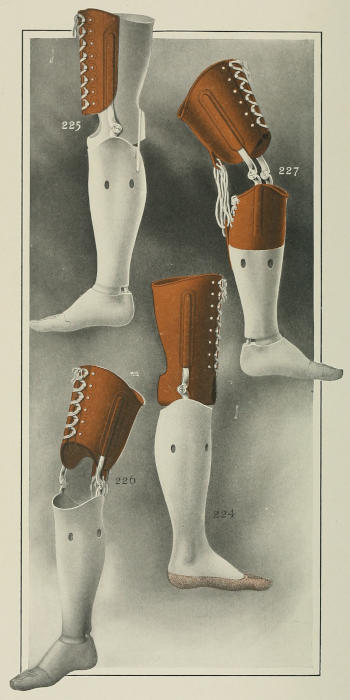
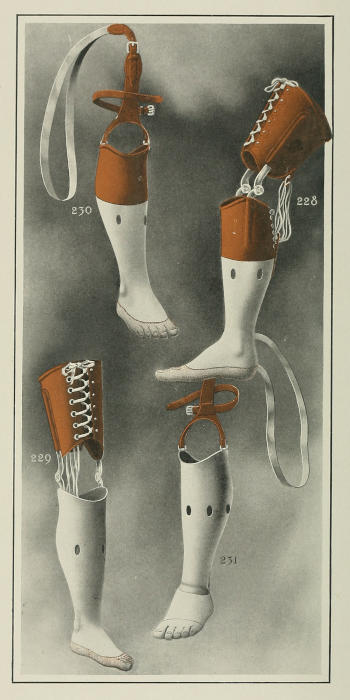
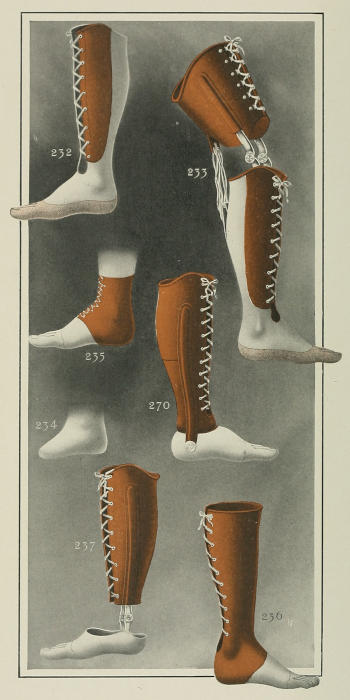
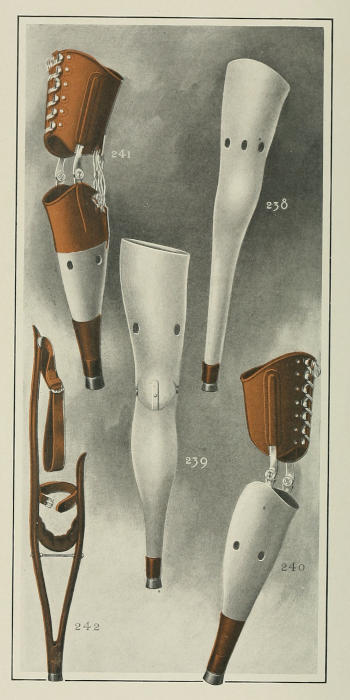
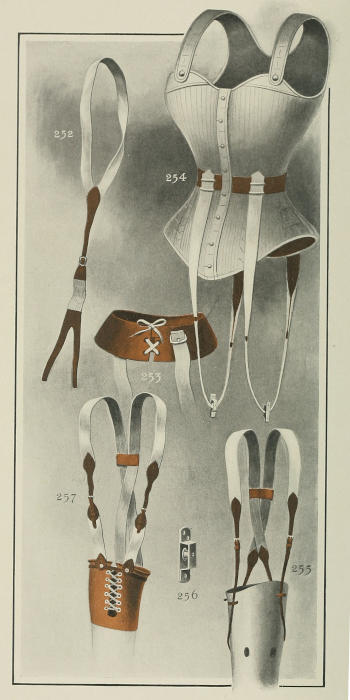
No single style of limb is suitable for all cases. Appropriate
and distinct construction is necessary, that the
limb shall meet the requirements of the person who is to
be compelled to wear it. Recognizing the truth of this,
we have been led to the study of the peculiarities and individual
needs of each case presented to us. Our limbs
are constructed with such a variety of joints and attachments
that each appliance may be accurately adapted to
any variation in the condition or occupation
of the patient. If any doubt
exists as to the result in any case, we
give ample opportunity for experiment
at our expense. It is for this reason that so many purchasers
have spoken in the highest terms of praise of our
efforts and the results.
We do not seek to discredit other manufacturers, but
simply, in full confidence, we state that we are the makers
of the best goods obtainable. In the pages following we
have endeavored to convey some idea of the ingenuity and
artistic skill which we bestow upon our work.
For over forty years—in fact, since 1856—we have
conducted our business in Rochester without interruption
and with increasing prosperity. Until 1876 the business
was conducted by Dr. Douglas Bly, who founded it.
Then for twenty years Mr. Fuller personally continued
the business, until in 1896 the present company was incorporated
under the laws of the State of New York with
a paid-up capital of $25,000. The patience and skill
exercised throughout these years have evolved the limb we
term “The Walk-Easy Leg,” and placed us at the head
of manufacturers of artificial limbs. Our efforts have been
always to improve and perfect—to excel at every point.
We are assured that these efforts have met with approval.
We enjoy the confidence of those who have found need of
our services. As a further evidence that we have successfully
sought to excel, it may be stated that during the past
twenty years, notwithstanding active competition, we have
supplied the United States Government with one-quarter
in number of all the limbs furnished to pensioners. We
also have supplied officially the States of Virginia, Georgia,
South Carolina and Louisiana. Furthermore, our work
has been placed in the first class by various scientific boards
convened for the purpose, and it has received the endorsement
of the world’s most famous surgeons.
Aside from the personal testimony of the multitudes
throughout the country who have availed themselves of
our experience and skill, and have offered to bear witness
to the good we have done them, we refer as to our
financial standing and reliability to Dun or Bradstreet
mercantile agencies, or to any bank or public man in
our city or vicinity.
Intending purchasers are invited to correspond with
us, that they may receive, if they are necessary or desirable,
fuller details than are covered in this work. We
are always glad to receive inquiries and offer suggestions
for the comfort of our customers.
GEORGE R. FULLER COMPANY,
Rochester, N. Y.
Patents have been granted us as follows:
| April 19, 1859 |
|
|
No. |
23,656 |
| April 30, 1859 |
|
|
No. |
25,238 |
| February 19, 1861 |
|
|
No. |
31,438 |
| July 20, 1862 |
|
|
No. |
38,549 |
| May 19, 1863 |
|
|
No. |
38,550 |
| July 28, 1857 |
|
Re-issued July 7, 1863 |
No. |
1,510 |
| May 17, 1859 |
} |
Re-issued July 12, 1864 |
No. |
1,724 |
| July 3, 1860 |
} |
| Dec. 23, 1862 |
} |
| October 11, 1864 |
|
|
No. |
44,638 |
| September 4, 1866 |
|
|
No. |
57,666 |
| March 9, 1869 |
|
|
No. |
87,624 |
| April 19, 1887 |
|
|
No. |
361,405 |
| October 4, 1887 |
|
|
No. |
370,774 |
It is probable that such a publication as this
will be read only by those who have lost limbs or
by their immediate friends. To advance an opinion
here as to the length of stump or the kind of
operation best adapted to the subsequent application
of an artificial limb would be of little benefit,
and might, indeed, suggest dissatisfaction to the
sufferer and cause injury to the operator. The
preservation of life is the object of amputations.
Surgeons generally appreciate the importance of
the operation and their own responsibility. They
undertake it with reluctance. Often during such
an operation exigencies arise or unforeseen conditions
so present themselves as to preclude any
observance of suggestions relating to the selection
of a point for amputation and preparation of the
stump for the exercise of the restorative art of
prosthesis. Then the surgeon has no choice if he
would save life. It is better not to criticise the
operation and malign the operator, but to believe
the best results possible under the circumstances
have been attained and be thankful that the outcome
is no worse.
In preparation for the application of an artificial
leg, and as soon as it is healed sufficiently to
permit it without pain or irritation, the stump
should be kept tightly bandaged from the end up
to the knee, if the amputation be below, or up to
the body if the amputation be above the knee.
The bandaging will diminish and solidify the
stump, leaving it in a much more desirable condition
for fitting and rendering the successful use
of a leg more a matter of certainty. If neglected,
the chances are that a soft, flabby stump will be
the result, which will rapidly reduce after the
patient begins the use of a leg, but a refitting or
an uncomfortable amount of filling up in the socket
to compensate for the shrinkage of the stump will
be necessary in order to walk with the least degree
of ease or satisfaction. The remaining joints, particularly
the knee joint, should be kept in motion
as much as can be conveniently, every day; this
will prevent their becoming anchylosed (stiff and
inflexible). Should this warning come too late,
and the joint is already anchylosed, it should be
gently and gradually exercised, and oily, relaxing
applications applied until straightened and flexible.
A free daily use of the cold water bath and brisk
rubbing will prove beneficial. An application of a
solution of tannin and alcohol will toughen the
skin, and in many cases it would be an excellent
thing to continue the use of this solution after an
artificial leg has been applied.
There is a diversity of opinion as to how
early a substitute may be applied. Many surgeons
strongly urge that an artificial leg cannot be safely
fitted for several months after cicatrization occurs,
while, on the other hand, some manufacturers of
artificial limbs claim that a leg can be satisfactorily
fitted just as soon as the stump has healed, no
matter if it be but five or six weeks after the
amputation.
Much, of course, depends upon the condition
of the patient, in circumstance and constitution.
It many times occurs that while the edges of the
flaps have united, and cicatrization appears, ossification
at the sawn end of the bones has not taken
place, consequently the necessary pressure and
tension on the surrounding integuments and other
adjacent parts in wearing a leg will unavoidably
cause inconvenience, irritation and pain. It is
therefore our opinion, based upon experience and
observation, that in
most cases an artificial
leg should not be
fitted within three
months after amputation, and that if the edges
of the wound have thoroughly united at the
end of that time it is unnecessary to wait longer,
except to harden and reduce the stump by
bandaging, if this has not previously been done.
There are many good reasons why a leg should
be applied as soon as practicable after this time
(provided that the stump has healed), the chief one
being that there is nothing that will discipline and
strengthen a stump and remaining joints as quickly
and as effectually as the use of a properly fitted
artificial leg.
The materials used in the construction of
artificial limbs are, principally, tough English willow,
leather, metal and rubber. The wood parts,
when worked to the desired shape, are covered
with parchment or rawhide and finished with a
flesh-tinted waterproof enamel.
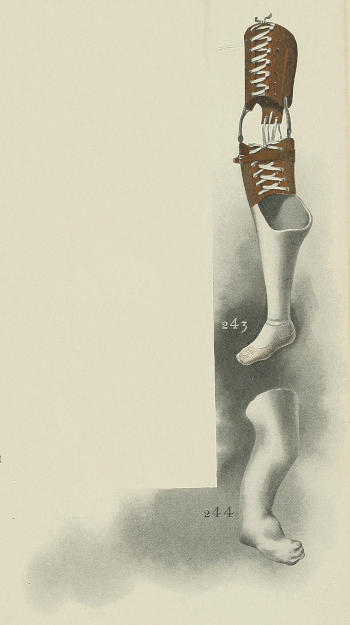
When children have been deprived, by accident
or disease, of one or both lower limbs, artificial
legs should be applied as soon as the condition of
the stump will safely permit. It is too generally
presumed that an outgrown limb is of no further
use, and that the purchase of an artificial leg before
full growth is assured means a foolish expenditure.
This is wrong, at least so far as our work is
concerned; there are artificial legs made that it
would be very expensive to lengthen or change, but
any leg that is made by us, or under our name or
supervision, we will agree to lengthen at any future
time, as necessity may arise, at a cost not to exceed
five dollars, and in many cases not to exceed three or
four dollars. When the amputation is above the
knee, it is often necessary that the leg be lengthened
both above and below the knee-joint. This involves
more labor and consequently greater expense, but
in no case will the charge exceed five dollars.
For a very young child we would make the
artificial foot one or two sizes larger than the
natural one; in a year or so the natural foot will
reach the size of the artificial, and some months,
perhaps years, will elapse before the natural foot
will be perceptibly larger than the artificial. This
method keeps the feet nearer the same size a longer
time than would be the case if the artificial foot were
made the same size as the natural foot in the first
place. When it is necessary to increase the size
of the foot it can be easily and inexpensively done.
When children are deprived of these useful
appendages, solely from fear or apprehension that
they may be outgrown, a lasting injustice is done
them. There is great danger of deformity and
disease from the prolonged use of crutches, particularly
at a tender and susceptible age; and the most
natural, easy, graceful walkers on artificial legs are
those who commence the use of them in youth; the
habit becomes thoroughly formed, and the continued
use of them from childhood develops and
strengthens the muscles and joints in a more
effectual manner than can be accomplished by any
other process or treatment.
It is not possible to reduce the weight of artificial
legs below a certain point without sacrificing
strength and good wearing qualities. The leg we
construct weighs from two to five and one-half
pounds, but in some special cases where extreme
strength is required this may be exceeded. Much
depends, however, upon the weight and occupation
of the wearer. Many legs of other makes which
weigh no more than ours require more of an effort
to carry and swing them, because the action of the
rubber spring in the back part of our leg assists
materially in carrying the leg forward while in the
act of walking, thus relieving the stump from the
effort that would otherwise be required to swing it.
We aim to have sufficient weight around the joints
to support them securely; at other points, where
strength is not required, they are left a mere shell.
The weight of an artificial arm is much less, varying
from one-half to one and one-half pounds.
The occupation of the wearer has much to do
with the durability of an artificial leg, but more
depends upon the care and attention it receives.
We know of limbs that have been in constant use
for eighteen or twenty years and are undoubtedly
good for several more years of good service, and
others, equally well made in every way, that because
of neglect and abuse have lasted only three
or four years. These are the extremes, however.
The average durability of an artificial leg we estimate
to be from seven to eight years. Artificial
arms not being subject to the strain and wear of a
leg will last much longer, the average time, we
should say, being double that of a leg. It should
be borne in mind, however, that they are but a
mechanical imitation of Nature and require attention
the same as any other piece of mechanism,
and that it pays to keep them at all times clean
and in good working order, and that the better the
care the better and more lasting will be the service.
Note.—While preparing this article Mr. John S. Havens, of
Plainwell, Michigan, called upon us wearing an artificial leg made at
this factory in the spring of 1864, and the leg is still in excellent
condition.
A very common error is prevalent in the minds
of many that artificial limbs are kept on hand in full
assortments and varieties, and that it is only necessary
for a person to call and purchase one and
wear it away, the same as you would a pair of boots
or shoes. Artificial legs are only made to order,
and it is preferable that the patient be present at the
factory for a day or two to have the leg fitted and
give it a thorough and satisfactory trial. Write to
us, stating full particulars of the case—when amputated,
whether below or above the knee, length
and condition of the stump, etc. Also state the
price you wish to pay for a leg, and whether or not
it will be practicable for you to come here and have
it fitted. If you can come here, name a day that
will be most convenient for you to do so, and we
will be ready for you. If possible, also specify time
of day and by which route you will arrive in
Rochester; if you are unable to determine in season
to advise us by mail, please do so by telegraph, and
we will have some one meet you at the station.
A shoe will be wanted here for the artificial foot.
Your presence will be required from one to two
days, depending upon the difficulty in fitting and
the number of orders we have on hand; during this
time you will have an opportunity of putting the
leg on, and giving it a thorough trial in the rough.
After you are satisfied with the test, you may return
home and the leg will be completed and forwarded
to you in about ten days, or, if you prefer to remain
and wear it home, it will be finished in about a week.
Excellent hotel accommodations can be obtained
for one dollar per day or five dollars per week.
For the benefit of persons who do not care to
incur the expense and inconvenience of a journey
to the factory, we have perfected a chart for
measurements, and directions for taking profiles,
plaster of paris moulds, etc., that overcome all the
difficulty and expense of a personal visit. To
make success doubly sure, when so desired we put
the leg up in the rough and forward it for trial;
this gives the same opportunity of trying it that
would be had here. The leg can then be returned to
us with directions as to any changes that may be
needed. To be sure, there is some expense for
transporting the leg, but it is small compared with
the cost of a journey here. A good share of our
orders are being filled in this manner, and with
unvarying success. Indeed, there need be no
fear or hesitancy in sending orders to us for
artificial legs to be made from measurements, as
we guarantee a fit. Should it prove otherwise,
we will make any required alterations without
charge.
The following is a copy of the warranty given
with each leg. The time of the warranty will
depend entirely upon the price paid. See prices
of the various styles.
Rochester, N.Y., ______ 19__.
In consideration of the sum of __ dollars,
received from ______ of ______ for an artificial leg, we
hereby warrant the same, as follows: In case any part
of said leg should, on account of poor material or bad
workmanship, break or give way within __ years from
the date hereof, we agree to repair the same without
charge, provided that, as soon as any defect is discovered,
the leg, or any part thereof that needs to be repaired or
replaced, be forwarded to us without delay, and at the
expense of the owner. It is not the intention of this
warranty to make good without charge the unavoidable
wear of the leg, or breakage caused by accident, neglect
or misuse.
Our prices are graded in such a manner as to
make it possible for any one to secure one of these
reliable limbs, and are governed entirely by the
quality of the work and the time for which the
limb is warranted, and bear an exact proportion to
the cost of production and the probable cost of
repairs during the term of the warranty. We have
plans, which we will be very glad to explain to any
who desire to know about them, whereby these
limbs may be obtained without the expenditure of
any money whatever. Simply the giving of a little
time and persistent work. Scores have earned
limbs in this way.
Should be made by express, post office or express
money order, registered letter, or New York
draft, whichever is most convenient for the sender.
It is our custom, as it is with all makers of
special appliances of this kind, to require in each
case a cash deposit as a guarantee of good faith.
When the purchaser is present at the factory for the
purpose of having a limb fitted, the limb may be
tried in the rough before making any payment;
if the fit and trial are satisfactory, one-half the
price will be required. When limbs are made
from measurements, without the presence of the
patient at the factory, one-half the price of the
limb ordered should accompany the order. In both
cases when the limb is finished it will be delivered
by express C.O.D. with the privilege
of examination and trial before making
the final payment.
A careful consideration of the
following facts should convince
any fair-minded person that this
plan is not only reasonable and
just but very necessary.
Each limb is made expressly to order for some
one individual, and the limb when completed is of
little or no value to any one except the person for
whom it is made. It requires some degree of
patience and perseverance to overcome the awkwardness
and possible disappointment associated
with the first trial of an artificial limb, and if there
be no obligation and no sacrifice on the part of the
would-be purchaser provided the limb is not accepted,
there is a possibility of its being declined,
and the maker, through no fault of his work,
becomes the loser. On the other hand, the
advance payment made on the limb insures
a very persistent effort on the part of the
purchaser to wear it, resulting in success and
satisfaction.
The purchaser may rest assured that the work
will not be slighted in any degree whatsoever, and
that it will be our duty and pleasure to make any
changes necessary to insure comfortable use of the
limb any time within a reasonable period after it
is finished.
We can consistently make a limb and accept
installment payments therefor only on the following
conditions: On payment of one-half the price of
the limb with the order, the balance may be paid
in amounts and at times—if within reason—to
suit the purchaser; say five dollars each month
until paid for, provided that these payments are
secured by notes made or endorsed by some reliable
business man, or other equally good security. We
are perfectly willing to give time for a part payment
as stated, but must insist that we be amply
secured against loss from any cause whatever, and
we cannot entertain any proposition wherein this
is not provided for.
Describe your case as clearly and briefly as
possible, stating whether amputation is above or
below the knee or elbow, when amputated, length
and condition of the stump, your age, weight and
occupation, whether you have ever worn an artificial
limb, if so, how long and what make or makes,
and be particular to write your name and address
plainly, giving the post office, county and state.
Any inquiries that are made on the subject of artificial
limbs will be promptly answered to the best
of our knowledge, and any information that we
can give will be cheerfully imparted.
Every officer or enlisted or hired man who
has lost a limb, or the use of a limb, in the military
or naval service of the United States, is entitled to
receive once every three years an artificial limb or
apparatus. Necessary transportation to the manufactory
and return, by the most usual and direct
route, will be furnished to those desiring it for the
purpose of having artificial limbs fitted, but will
not be furnished except for this purpose. Sleeping-car
accommodations will be given upon request.
In March, 1891, the law was amended so as
to allow an artificial limb every three years instead
of every five as before. The reduction in time
took effect in various ways but was to be counted
from March 1, 1891. The act operates in three
ways:
First. Those who were entitled on or after March
3, 1888, are entitled every three years from such last date.
Second. Those who were entitled between March 3,
1886, and March 3, 1888, were again entitled March 3,
1891, and every three years from that date.
Third. Those who were entitled before March 3,
1886, were again entitled five years from such date, and
again every three years.
On request of any soldier we will give him
the exact date on which he is entitled to an order
for a leg or for commutation.
Each officer and soldier has his choice either
to receive a limb or its equivalent in money. All
who want limbs will gain by taking one from the
Government, because the Government will give
transportation to and from the manufactory, the
cost of which in many cases is equal to the value
of the limb. Besides, the Government requires
each manufacturer to warrant his work and material
used. The soldier who draws his money and
buys a limb for himself loses all these advantages.
Many manufacturers of limbs will advise soldiers
to draw the money and then buy of them, so they
will not be obliged to warrant their limbs to the
Government, or give a bond for the same.
We furnish legs and arms for all kinds of
amputations, on Government orders. The necessary
blanks on which the applications should be
made for limbs and transportation will be furnished
to any soldier on application.