I started on my third excursion to the Maine woods
Monday, July 20, 1857, with one companion, arriving
at Bangor the next day at noon. We had hardly left the
steamer, when we passed Molly Molasses in the street.
As long as she lives, the Penobscots may be considered
extant as a tribe. The succeeding morning, a relative of
mine, who is well acquainted with the Penobscot Indians,
and who had been my companion in my two previous
excursions into the Maine woods, took me in his wagon
to Oldtown, to assist me in obtaining an Indian for this
expedition. We were ferried across to the Indian Island
in a batteau. The ferryman’s boy had got the key to it,
but the father, who was a blacksmith, after a little hesitation
cut the chain with a cold-chisel on the rock. He
told me that the Indians were nearly all gone to the seaboard
and to Massachusetts, partly on account of the
smallpox—of which they are very much afraid—having
broken out in Oldtown, and it was doubtful whether
we should find a suitable one at home. The old chief
Neptune, however, was there still. The first man we saw
on the island was an Indian named Joseph Polis, whom
my relative had known from a boy, and now addressed
familiarly as “Joe.” He was dressing a deer-skin in his
yard. The skin was spread over a slanting log, and he
was scraping it with a stick held by both hands. He was
stoutly built, perhaps a little above the middle height,
with a broad face, and, as others said, perfect Indian
features and complexion. His house was a two-story
white one, with blinds, the best-looking that I noticed
there, and as good as an average one on a New England
village street. It was surrounded by a garden and fruit-trees,
single cornstalks standing thinly amid the beans.
We asked him if he knew any good Indian who would
like to go into the woods with us, that is, to the Allegash
Lakes, by way of Moosehead, and return by the East
Branch of the Penobscot, or vary from this as we pleased.
To which he answered, out of that strange remoteness
in which the Indian ever dwells to the white man, “Me
like to go myself; me wants to get some moose;” and
kept on scraping the skin. His brother had been into the
woods with my relative only a year or two before, and
the Indian now inquired what the latter had done to
him, that he did not come back, for he had not seen nor
heard from him since.
At length we got round to the more interesting topic
again. The ferryman had told us that all the best
Indians were gone except Polis, who was one of the
aristocracy. He to be sure would be the best man we
could have, but if he went at all would want a great
price; so we did not expect to get him. Polis asked at
first two dollars a day, but agreed to go for a dollar and
a half, and fifty cents a week for his canoe. He would
come to Bangor with his canoe by the seven o’clock train
that evening,—we might depend on him. We thought
ourselves lucky to secure the services of this man, who
was known to be particularly steady and trustworthy.
I spent the afternoon with my companion, who had
remained in Bangor, in preparing for our expedition,
purchasing provisions, hard-bread, pork, coffee, sugar,
etc., and some india-rubber clothing.
We had at first thought of exploring the St. John from
its source to its mouth, or else to go up the Penobscot
by its East Branch to the lakes of the St. John, and
return by way of Chesuncook and Moosehead. We had
finally inclined to the last route, only reversing the order
of it, going by way of Moosehead, and returning by the
Penobscot, otherwise it would have been all the way upstream
and taken twice as long.
At evening the Indian arrived in the cars, and I led
the way while he followed me three quarters of a mile to
my friend’s house, with the canoe on his head. I did not
know the exact route myself, but steered by the lay of
the land, as I do in Boston, and I tried to enter into
conversation with him, but as he was puffing under the
weight of his canoe, not having the usual apparatus for
carrying it, but, above all, was an Indian, I might as
well have been thumping on the bottom of his birch the
while. In answer to the various observations which I
made by way of breaking the ice, he only grunted vaguely
from beneath his canoe once or twice, so that I knew he
was there.
Early the next morning (July 23) the stage called for
us, the Indian having breakfasted with us, and already
placed the baggage in the canoe to see how it would go.
My companion and I had each a large knapsack as full
as it would hold, and we had two large india-rubber
bags which held our provision and utensils. As for the
Indian, all the baggage he had, beside his axe and gun,
was a blanket, which he brought loose in his hand. However,
he had laid in a store of tobacco and a new pipe for
the excursion. The canoe was securely lashed diagonally
across the top of the stage, with bits of carpet tucked
under the edge to prevent its chafing. The very accommodating
driver appeared as much accustomed to carrying
canoes in this way as bandboxes.
At the Bangor House we took in four men bound on a
hunting excursion, one of the men going as cook. They
had a dog, a middling-sized brindled cur, which ran
by the side of the stage, his master showing his head
and whistling from time to time; but after we had gone
about three miles the dog was suddenly missing, and two
of the party went back for him, while the stage, which
was full of passengers, waited. I suggested that he had
taken the back track for the Bangor House. At length
one man came back, while the other kept on. This
whole party of hunters declared their intention to stop
till the dog was found; but the very obliging driver was
ready to wait a spell longer. He was evidently unwilling
to lose so many passengers, who would have taken a
private conveyance, or perhaps the other line of stages,
the next day. Such progress did we make, with a journey
of over sixty miles to be accomplished that day, and a
rain-storm just setting in. We discussed the subject of
dogs and their instincts till it was threadbare, while we
waited there, and the scenery of the suburbs of Bangor
is still distinctly impressed on my memory. After full
half an hour the man returned, leading the dog by a rope.
He had overtaken him just as he was entering the Bangor
House. He was then tied on the top of the stage, but
being wet and cold, several times in the course of the
journey he jumped off, and I saw him dangling by his
neck. This dog was depended on to stop bears with.
He had already stopped one somewhere in New Hampshire,
and I can testify that he stopped a stage in Maine.
This party of four probably paid nothing for the dog’s
ride, nor for his run, while our party of three paid two
dollars—and were charged four—for the light canoe
which lay still on the top.
It soon began to rain, and grew more and more
stormy as the day advanced. This was the third time
that I had passed over this route, and it rained steadily
each time all day. We accordingly saw but little of the
country. The stage was crowded all the way, and I
attended the more to my fellow-travelers. If you had
looked inside this coach you would have thought that
we were prepared to run the gauntlet of a band of robbers,
for there were four or five guns on the front seat,
the Indian’s included, and one or two on the back one,
each man holding his darling in his arms. One had a gun
which carried twelve to a pound. It appeared that this
party of hunters was going our way, but much farther,—down
the Allegash and St. John, and thence up some
other stream, and across to the Restigouche and the Bay
of Chaleur, to be gone six weeks. They had canoes, axes,
and supplies deposited some distance along the route.
They carried flour, and were to have new bread made
every day. Their leader was a handsome man about
thirty years old, of good height, but not apparently
robust, of gentlemanly address and faultless toilet; such
a one as you might expect to meet on Broadway. In fact,
in the popular sense of the word, he was the most “gentlemanly”
appearing man in the stage, or that we saw
on the road. He had a fair white complexion, as if he
had always lived in the shade, and an intellectual face,
and with his quiet manners might have passed for a
divinity student who had seen something of the world.
I was surprised to find, on talking with him in the
course of the day’s journey, that he was a hunter at all,—for
his gun was not much exposed,—and yet more
to find that he was probably the chief white hunter of
Maine, and was known all along the road. He had also
hunted in some of the States farther south and west. I
afterwards heard him spoken of as one who could endure
a great deal of exposure and fatigue without showing the
effect of it; and he could not only use guns, but make
them, being himself a gunsmith. In the spring, he had
saved a stage-driver and two passengers from drowning
in the backwater of the Piscataquis in Foxcroft on this
road, having swum ashore in the freezing water and
made a raft and got them off,—though the horses were
drowned,—at great risk to himself, while the only other
man who could swim withdrew to the nearest house to
prevent freezing. He could now ride over this road for
nothing. He knew our man, and remarked that we had
a good Indian there, a good hunter; adding that he was
said to be worth $6000. The Indian also knew him, and
said to me, “the great hunter.”
The former told me that he practiced a kind of still-hunting,
new or uncommon in those parts; that the
caribou, for instance, fed round and round the same
meadow, returning on the same path, and he lay in wait
for them.
The Indian sat on the front seat, saying nothing to
anybody, with a stolid expression of face, as if barely
awake to what was going on. Again I was struck by
the peculiar vagueness of his replies when addressed in
the stage, or at the taverns. He really never said anything
on such occasions. He was merely stirred up, like
a wild beast, and passively muttered some insignificant
response. His answer, in such cases, was never the consequence
of a positive mental energy, but vague as a
puff of smoke, suggesting no responsibility, and if you
considered it, you would find that you had got nothing
out of him. This was instead of the conventional palaver
and smartness of the white man, and equally profitable.
Most get no more than this out of the Indian, and pronounce
him stolid accordingly. I was surprised to see
what a foolish and impertinent style a Maine man, a
passenger, used in addressing him, as if he were a child,
which only made his eyes glisten a little. A tipsy Canadian
asked him at a tavern, in a drawling tone, if he
smoked, to which he answered with an indefinite “Yes.”
“Won’t you lend me your pipe a little while?” asked the
other. He replied, looking straight by the man’s head,
with a face singularly vacant to all neighboring interests,
“Me got no pipe;” yet I had seen him put a new one,
with a supply of tobacco, into his pocket that morning.
Our little canoe, so neat and strong, drew a favorable
criticism from all the wiseacres among the tavern
loungers along the road. By the roadside, close to the
wheels, I noticed a splendid great purple fringed orchis
with a spike as big as an epilobium, which I would fain
have stopped the stage to pluck, but as this had never
been known to stop a bear, like the cur on the stage, the
driver would probably have thought it a waste of time.
When we reached the lake, about half past eight in
the evening, it was still steadily raining, and harder than
before; and, in that fresh, cool atmosphere, the hylodes
were peeping and the toads ringing about the lake universally,
as in the spring with us. It was as if the season
had revolved backward two or three months, or I had
arrived at the abode of perpetual spring.
We had expected to go upon the lake at once, and,
after paddling up two or three miles, to camp on one of
its islands; but on account of the steady and increasing
rain, we decided to go to one of the taverns for the night,
though, for my own part, I should have preferred to
camp out.
About four o’clock the next morning (July 24), though
it was quite cloudy, accompanied by the landlord to the
water’s edge, in the twilight, we launched our canoe
from a rock on the Moosehead Lake. When I was there
four years before, we had a rather small canoe for three
persons, and I had thought that this time I would get a
larger one, but the present one was even smaller than
that. It was 18¼ feet long by 2 feet 6½ inches wide in the
middle, and one foot deep within, so I found by measurement,
and I judged that it would weigh not far from
eighty pounds. The Indian had recently made it himself,
and its smallness was partly compensated for by its
newness, as well as stanchness and solidity, it being
made of very thick bark and ribs. Our baggage weighed
about 166 pounds, so that the canoe carried about
600 pounds in all, or the weight of four men. The
principal part of the baggage was, as usual, placed in
the middle of the broadest part, while we stowed ourselves
in the chinks and crannies that were left before
and behind it, where there was no room to extend our
legs, the loose articles being tucked into the ends. The
canoe was thus as closely packed as a market-basket,
and might possibly have been upset without spilling any
of its contents. The Indian sat on a cross-bar in the
stern, but we flat on the bottom, with a splint or chip
behind our backs, to protect them from the cross-bar,
and one of us commonly paddled with the Indian. He
foresaw that we should not want a pole till we reached
the Umbazookskus River, it being either deadwater or
down-stream so far, and he was prepared to make a sail
of his blanket in the bows if the wind should be fair; but
we never used it.
It had rained more or less the four previous days, so
that we thought we might count on some fair weather.
The wind was at first southwesterly.
Paddling along the eastern side of the lake in the still
of the morning, we soon saw a few sheldrakes, which
the Indian called Shecorways, and some peetweets,
Naramekechus, on the rocky shore; we also saw and
heard loons, Medawisla, which he said was a sign of
wind. It was inspiriting to hear the regular dip of the
paddles, as if they were our fins or flippers, and to realize
that we were at length fairly embarked. We who had felt
strangely as stage-passengers and tavern-lodgers were
suddenly naturalized there and presented with the freedom
of the lakes and the woods. Having passed the
small rocky isles within two or three miles of the foot of
the lake, we had a short consultation respecting our
course, and inclined to the western shore for the sake of
its lee; for otherwise, if the wind should rise, it would be
impossible for us to reach Mount Kineo, which is about
midway up the lake on the east side, but at its narrowest
part, where probably we could recross if we took the
western side. The wind is the chief obstacle to crossing
the lakes, especially in so small a canoe. The Indian
remarked several times that he did not like to cross the
lakes “in littlum canoe,” but nevertheless, “just as we
say, it made no odds to him.” He sometimes took a
straight course up the middle of the lake between Sugar
and Deer islands, when there was no wind.
Measured on the map, Moosehead Lake is twelve
miles wide at the widest place, and thirty miles long in
a direct line, but longer as it lies. The captain of the
steamer called it thirty-eight miles as he steered. We
should probably go about forty. The Indian said that
it was called “Mspame, because large water.” Squaw
Mountain rose darkly on our left, near the outlet of
the Kennebec, and what the Indian called Spencer Bay
Mountain, on the east, and already we saw Mount
Kineo before us in the north.
Paddling near the shore, we frequently heard the pe-pe
of the olive-sided flycatcher, also the wood pewee, and
the kingfisher, thus early in the morning. The Indian
reminding us that he could not work without eating, we
stopped to breakfast on the main shore, southwest of
Deer Island, at a spot where the Mimulus ringens grew
abundantly. We took out our bags, and the Indian made
a fire under a very large bleached log, using white pine
bark from a stump, though he said that hemlock was
better, and kindling with canoe birch bark. Our table
was a large piece of freshly peeled birch bark, laid
wrong side up, and our breakfast consisted of hard-bread,
fried pork, and strong coffee, well sweetened, in
which we did not miss the milk.
While we were getting breakfast, a brood of twelve
black dippers, half grown, came paddling by within
three or four rods, not at all alarmed; and they loitered
about as long as we stayed, now huddled close
together, within a circle of eighteen inches in diameter,
now moving off in a long line, very cunningly. Yet they
bore a certain proportion to the great Moosehead Lake
on whose bosom they floated, and I felt as if they were
under its protection.
Looking northward from this place it appeared as if
we were entering a large bay, and we did not know
whether we should be obliged to diverge from our course
and keep outside a point which we saw, or should find
a passage between this and the mainland. I consulted
my map and used my glass, and the Indian did the
same, but we could not find our place exactly on the
map, nor could we detect any break in the shore. When
I asked the Indian the way, he answered, “I don’t
know,” which I thought remarkable, since he had said
that he was familiar with the lake; but it appeared that
he had never been up this side. It was misty dog-day
weather, and we had already penetrated a smaller bay
of the same kind, and knocked the bottom out of it,
though we had been obliged to pass over a small bar,
between an island and the shore, where there was but
just breadth and depth enough to float the canoe, and
the Indian had observed, “Very easy makum bridge
here,” but now it seemed that, if we held on, we should
be fairly embayed. Presently, however, though we had
not stirred, the mist lifted somewhat, and revealed a
break in the shore northward, showing that the point
was a portion of Deer Island, and that our course lay
westward of it. Where it had seemed a continuous shore
even through a glass, one portion was now seen by the
naked eye to be much more distant than the other which
overlapped it, merely by the greater thickness of the mist
which still rested on it, while the nearer or island portion
was comparatively bare and green. The line of separation
was very distinct, and the Indian immediately
remarked, “I guess you and I go there,—I guess
there’s room for my canoe there.” This was his common
expression instead of saying “we.” He never addressed
us by our names, though curious to know how they were
spelled and what they meant, while we called him Polis.
He had already guessed very accurately at our ages, and
said that he was forty-eight.
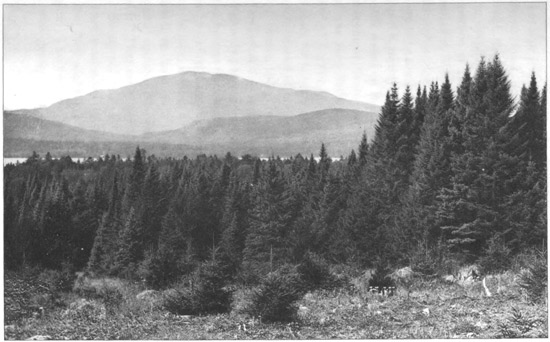
Squaw Mountain, Moosehead Lake
After breakfast I emptied the melted pork that was
left into the lake, making what sailors call a “slick,” and
watching to see how much it spread over and smoothed
the agitated surface. The Indian looked at it a moment
and said, “That make hard paddlum thro’; hold ’em
canoe. So say old times.”
We hastily reloaded, putting the dishes loose in the
bows, that they might be at hand when wanted, and set
out again. The western shore, near which we paddled
along, rose gently to a considerable height, and was
everywhere densely covered with the forest, in which was
a large proportion of hard wood to enliven and relieve the
fir and spruce.
The Indian said that the usnea lichen which we saw
hanging from the trees was called chorchorque. We
asked him the names of several small birds which we
heard this morning. The wood thrush, which was quite
common, and whose note he imitated, he said was called
Adelungquamooktum; but sometimes he could not tell
the name of some small bird which I heard and knew,
but he said, “I tell all the birds about here,—this country;
can’t tell littlum noise, but I see ’em, then I can tell.”
I observed that I should like to go to school to him to
learn his language, living on the Indian island the while;
could not that be done? “Oh, yer,” he replied, “good
many do so.” I asked how long he thought it would
take. He said one week. I told him that in this voyage
I would tell him all I knew, and he should tell me all he
knew, to which he readily agreed.
The birds sang quite as in our woods,—the red-eye,
redstart, veery, wood pewee, etc., but we saw no bluebirds
in all our journey, and several told me in Bangor
that they had not the bluebird there. Mount Kineo,
which was generally visible, though occasionally concealed
by islands or the mainland in front, had a level
bar of cloud concealing its summit, and all the mountain-tops
about the lake were cut off at the same height.
Ducks of various kinds—sheldrake, summer ducks,
etc.—were quite common, and ran over the water
before us as fast as a horse trots. Thus they were soon
out of sight.
The Indian asked the meaning of reality, as near as
I could make out the word, which he said one of us had
used; also of “interrent,” that is, intelligent. I observed
that he could rarely sound the letter r, but used l, as also
r for l sometimes; as load for road, pickelel for pickerel,
Soogle Island for Sugar Island, lock for rock, etc. Yet
he trilled the r pretty well after me.
He generally added the syllable um to his words when
he could,—as paddlum, etc. I have once heard a
Chippeway lecture, who made his audience laugh unintentionally
by putting m after the word too, which word
he brought in continually and unnecessarily, accenting
and prolonging this sound into m-ah sonorously, as if
it were necessary to bring in so much of his vernacular
as a relief to his organs, a compensation for twisting his
jaws about, and putting his tongue into every corner
of his mouth, as he complained that he was obliged to
do when he spoke English. There was so much of the
Indian accent resounding through his English, so much
of the “bow-arrow tang” as my neighbor calls it, and I
have no doubt that word seemed to him the best pronounced.
It was a wild and refreshing sound, like that
of the wind among the pines, or the booming of the surf
on the shore.
I asked him the meaning of the word Musketicook,
the Indian name of Concord River. He pronounced it
Muskéeticook, emphasizing the second syllable with a
peculiar guttural sound, and said that it meant “deadwater,”
which it is, and in this definition he agreed
exactly with the St. Francis Indian with whom I talked
in 1853.
On a point on the mainland some miles southwest of
Sand-bar Island, where we landed to stretch our legs
and look at the vegetation, going inland a few steps, I
discovered a fire still glowing beneath its ashes, where
somebody had breakfasted, and a bed of twigs prepared
for the following night. So I knew not only that they
had just left, but that they designed to return, and by the
breadth of the bed that there was more than one in
the party. You might have gone within six feet of these
signs without seeing them. There grew the beaked
hazel, the only hazel which I saw on this journey, the
diervilla, rue seven feet high, which was very abundant
on all the lake and river shores, and Cornus stolonifera,
or red osier, whose bark, the Indian said, was good
to smoke, and was called maquoxigill, “tobacco before
white people came to this country, Indian tobacco.”
The Indian was always very careful in approaching
the shore, lest he should injure his canoe on the rocks,
letting it swing round slowly sidewise, and was still more
particular that we should not step into it on shore, nor
till it floated free, and then should step gently lest we
should open its seams, or make a hole in the bottom.
He said that he would tell us when to jump.
Soon after leaving this point we passed the Kennebec,
or outlet of the lake, and heard the falls at the dam
there, for even Moosehead Lake is dammed. After
passing Deer Island, we saw the little steamer from
Greenville, far east in the middle of the lake, and she
appeared nearly stationary. Sometimes we could hardly
tell her from an island which had a few trees on it.
Here we were exposed to the wind from over the whole
breadth of the lake, and ran a little risk of being swamped.
While I had my eye fixed on the spot where a large fish
had leaped, we took in a gallon or two of water, which
filled my lap; but we soon reached the shore and took
the canoe over the bar, at Sand-bar Island, a few feet
wide only, and so saved a considerable distance. One
landed first at a more sheltered place, and walking round
caught the canoe by the prow, to prevent it being injured
against the shore.
Again we crossed a broad bay opposite the mouth
of Moose River, before reaching the narrow strait at
Mount Kineo, made what the voyageurs call a traverse,
and found the water quite rough. A very little wind on
these broad lakes raises a sea which will swamp a canoe.
Looking off from the shore, the surface may appear to be
very little agitated, almost smooth, a mile distant, or if
you see a few white crests they appear nearly level with
the rest of the lake; but when you get out so far, you
may find quite a sea running, and ere long, before you
think of it, a wave will gently creep up the side of the
canoe and fill your lap, like a monster deliberately
covering you with its slime before it swallows you, or it
will strike the canoe violently, and break into it. The
same thing may happen when the wind rises suddenly,
though it were perfectly calm and smooth there a few
minutes before; so that nothing can save you, unless
you can swim ashore, for it is impossible to get into a
canoe again when it is upset. Since you sit flat on the
bottom, though the danger should not be imminent, a
little water is a great inconvenience, not to mention the
wetting of your provisions. We rarely crossed even a
bay directly, from point to point, when there was wind,
but made a slight curve corresponding somewhat to the
shore, that we might the sooner reach it if the wind
increased.
When the wind is aft, and not too strong, the Indian
makes a spritsail of his blanket. He thus easily skims
over the whole length of this lake in a day.
The Indian paddled on one side, and one of us on the
other, to keep the canoe steady, and when he wanted to
change hands he would say, “T’ other side.” He asserted,
in answer to our questions, that he had never upset a
canoe himself, though he may have been upset by others.
Think of our little eggshell of a canoe tossing across
that great lake, a mere black speck to the eagle soaring
above it!
My companion trailed for trout as we paddled along,
but the Indian warning him that a big fish might upset
us, for there are some very large ones there, he agreed
to pass the line quickly to him in the stern if he had a
bite. Besides trout, I heard of cusk, whitefish, etc., as
found in this lake.
While we were crossing this bay, where Mount Kineo
rose dark before us, within two or three miles, the Indian
repeated the tradition respecting this mountain’s having
anciently been a cow moose,—how a mighty Indian
hunter, whose name I forget, succeeded in killing this
queen of the moose tribe with great difficulty, while her
calf was killed somewhere among the islands in Penobscot
Bay, and, to his eyes, this mountain had still the
form of the moose in a reclining posture, its precipitous
side presenting the outline of her head. He told this at
some length, though it did not amount to much, and
with apparent good faith, and asked us how we supposed
the hunter could have killed such a mighty moose
as that,—how we could do it. Whereupon a man-of-war
to fire broadsides into her was suggested, etc. An
Indian tells such a story as if he thought it deserved to
have a good deal said about it, only he has not got it to
say, and so he makes up for the deficiency by a drawling
tone, long-windedness, and a dumb wonder which he
hopes will be contagious.
We approached the land again through pretty rough
water, and then steered directly across the lake, at its
narrowest part, to the eastern side, and were soon
partly under the lee of the mountain, about a mile north
of the Kineo House, having paddled about twenty miles.
It was now about noon.
We designed to stop there that afternoon and night,
and spent half an hour looking along the shore northward
for a suitable place to camp. We took out all our
baggage at one place in vain, it being too rocky and
uneven, and while engaged in this search we made our
first acquaintance with the moose-fly. At length, half
a mile farther north, by going half a dozen rods into the
dense spruce and fir wood on the side of the mountain,
almost as dark as a cellar, we found a place sufficiently
clear and level to lie down on, after cutting away a few
bushes. We required a space only seven feet by six for
our bed, the fire being four or five feet in front, though it
made no odds how rough the hearth was; but it was not
always easy to find this in those woods. The Indian first
cleared a path to it from the shore with his axe, and we
then carried up all our baggage, pitched our tent, and
made our bed, in order to be ready for foul weather,
which then threatened us, and for the night. He gathered
a large armful of fir twigs, breaking them off, which
he said were the best for our bed, partly, I thought,
because they were the largest and could be most rapidly
collected. It had been raining more or less for four or
five days, and the wood was even damper than usual, but
he got dry bark for the fire from the under side of a dead
leaning hemlock, which, he said, he could always do.
This noon his mind was occupied with a law question,
and I referred him to my companion, who was a lawyer.
It appeared that he had been buying land lately (I think
it was a hundred acres), but there was probably an
incumbrance to it, somebody else claiming to have
bought some grass on it for this year. He wished to
know to whom the grass belonged, and was told that
if the other man could prove that he bought the grass
before he, Polis, bought the land, the former could take
it, whether the latter knew it or not. To which he only
answered, “Strange!” He went over this several times,
fairly sat down to it, with his back to a tree, as if he
meant to confine us to this topic henceforth; but as he
made no headway, only reached the jumping-off place
of his wonder at white men’s institutions after each
explanation, we let the subject die.
He said that he had fifty acres of grass, potatoes, etc.,
somewhere above Oldtown, besides some about his
house; that he hired a good deal of his work, hoeing,
etc., and preferred white men to Indians, because “they
keep steady, and know how.”
After dinner we returned southward along the shore,
in the canoe, on account of the difficulty of climbing
over the rocks and fallen trees, and began to ascend the
mountain along the edge of the precipice. But a smart
shower coming up just then, the Indian crept under his
canoe, while we, being protected by our rubber coats,
proceeded to botanize. So we sent him back to the camp
for shelter, agreeing that he should come there for us
with his canoe toward night. It had rained a little in the
forenoon, and we trusted that this would be the clearing-up
shower, which it proved; but our feet and legs
were thoroughly wet by the bushes. The clouds breaking
away a little, we had a glorious wild view, as we ascended,
of the broad lake with its fluctuating surface and numerous
forest-clad islands, extending beyond our sight both
north and south, and the boundless forest undulating
away from its shores on every side, as densely packed
as a rye-field, and enveloping nameless mountains in
succession; but above all, looking westward over a large
island, was visible a very distant part of the lake, though
we did not then suspect it to be Moosehead,—at first
a mere broken white line seen through the tops of the
island trees, like hay-caps, but spreading to a lake when
we got higher. Beyond this we saw what appears to be
called Bald Mountain on the map, some twenty-five
miles distant, near the sources of the Penobscot. It was
a perfect lake of the woods. But this was only a transient
gleam, for the rain was not quite over.
Looking southward, the heavens were completely
overcast, the mountains capped with clouds, and the
lake generally wore a dark and stormy appearance, but
from its surface just north of Sugar Island, six or eight
miles distant, there was reflected upward to us through
the misty air a bright blue tinge from the distant unseen
sky of another latitude beyond. They probably had a
clear sky then at Greenville, the south end of the lake.
Standing on a mountain in the midst of a lake, where
would you look for the first sign of approaching fair
weather? Not into the heavens, it seems, but into the
lake.
Again we mistook a little rocky islet seen through the
“drisk,” with some taller bare trunks or stumps on it,
for the steamer with its smoke-pipes, but as it had not
changed its position after half an hour, we were undeceived.
So much do the works of man resemble the
works of nature. A moose might mistake a steamer for
a floating isle, and not be scared till he heard its puffing
or its whistle.
If I wished to see a mountain or other scenery under
the most favorable auspices, I would go to it in foul
weather, so as to be there when it cleared up; we are
then in the most suitable mood, and nature is most fresh
and inspiring. There is no serenity so fair as that which
is just established in a tearful eye.
Jackson, in his Report on the Geology of Maine, in
1838, says of this mountain: “Hornstone, which will
answer for flints, occurs in various parts of the State,
where trap-rocks have acted upon silicious slate. The
largest mass of this stone known in the world is Mount
Kineo, upon Moosehead Lake, which appears to be
entirely composed of it, and rises seven hundred feet
above the lake level. This variety of hornstone I have
seen in every part of New England in the form of Indian
arrowheads, hatchets, chisels, etc., which were probably
obtained from this mountain by the aboriginal
inhabitants of the country.” I have myself found hundreds
of arrowheads made of the same material. It is
generally slate-colored, with white specks, becoming a
uniform white where exposed to the light and air, and
it breaks with a conchoidal fracture, producing a ragged
cutting edge. I noticed some conchoidal hollows more
than a foot in diameter. I picked up a small thin piece
which had so sharp an edge that I used it as a dull knife,
and to see what I could do, fairly cut off an aspen one
inch thick with it, by bending it and making many cuts;
though I cut my fingers badly with the back of it in the
meanwhile.
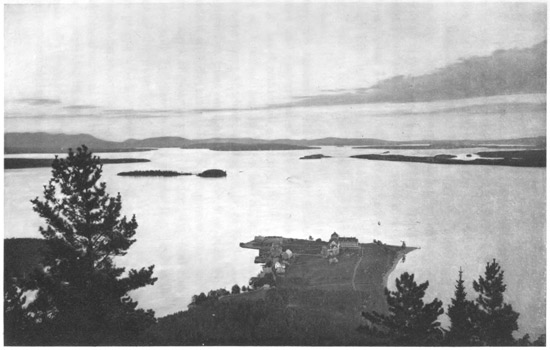
Moosehead Lake, from Mount Kineo
From the summit of the precipice which forms the
southern and eastern sides of this mountain peninsula,
and is its most remarkable feature, being described as
five or six hundred feet high, we looked, and probably
might have jumped, down to the water, or to the seemingly
dwarfish trees on the narrow neck of land which
connects it with the main. It is a dangerous place to try
the steadiness of your nerves. Hodge says that these
cliffs descend “perpendicularly ninety feet” below the
surface of the water.
The plants which chiefly attracted our attention on
this mountain were the mountain cinquefoil (Potentilla
tridentata), abundant and in bloom still at the very base,
by the waterside, though it is usually confined to the
summits of mountains in our latitude; very beautiful
harebells overhanging the precipice; bear-berry; the
Canada blueberry (Vaccinium Canadense), similar to
the V. Pennsylvanicum, our earliest one, but entire-leaved
and with a downy stem and leaf (I have not seen
it in Massachusetts); Diervilla trifida; Microstylis
ophioglossoides, an orchidaceous plant new to us; wild
holly (Nemopanthes Canadensis); the great round-leaved
orchis (Platanthera orbiculata), not long in bloom;
Spiranthes cernua, at the top; bunchberry, reddening
as we ascended, green at the base of the mountain, red
at the top; and the small fern Woodsia ilvensis, growing
in tufts, now in fruit. I have also received Liparis
liliifolia, or tway-blade, from this spot. Having explored
the wonders of the mountain, and the weather being
now entirely cleared up, we commenced the descent.
We met the Indian, puffing and panting, about one third
of the way up, but thinking that he must be near the top,
and saying that it took his breath away. I thought that
superstition had something to do with his fatigue. Perhaps
he believed that he was climbing over the back of a
tremendous moose. He said that he had never ascended
Kineo. On reaching the canoe we found that he had
caught a lake trout weighing about three pounds, at the
depth of twenty-five or thirty feet, while we were on the
mountain.
When we got to the camp, the canoe was taken out
and turned over, and a log laid across it to prevent its
being blown away. The Indian cut some large logs of
damp and rotten hard wood to smoulder and keep fire
through the night. The trout was fried for supper. Our
tent was of thin cotton cloth and quite small, forming
with the ground a triangular prism closed at the rear end,
six feet long, seven wide, and four high, so that we could
barely sit up in the middle. It required two forked
stakes, a smooth ridge-pole, and a dozen or more pins
to pitch it. It kept off dew and wind, and an ordinary
rain, and answered our purpose well enough. We
reclined within it till bedtime, each with his baggage at
his head, or else sat about the fire, having hung our wet
clothes on a pole before the fire for the night.
As we sat there, just before night, looking out through
the dusky wood, the Indian heard a noise which he said
was made by a snake. He imitated it at my request,
making a low whistling note,—pheet—pheet,—two
or three times repeated, somewhat like the peep of the
hylodes, but not so loud. In answer to my inquiries, he
said that he had never seen them while making it, but
going to the spot he finds the snake. This, he said on
another occasion, was a sign of rain. When I had
selected this place for our camp, he had remarked that
there were snakes there,—he saw them. “But they
won’t do any hurt,” I said. “Oh, no,” he answered,
“just as you say; it makes no difference to me.”
He lay on the right side of the tent, because, as he
said, he was partly deaf in one ear, and he wanted to lie
with his good ear up. As we lay there, he inquired if I
ever heard “Indian sing.” I replied that I had not
often, and asked him if he would not favor us with a
song. He readily assented, and, lying on his back, with
his blanket wrapped around him, he commenced a slow,
somewhat nasal, yet musical chant, in his own language,
which probably was taught his tribe long ago by the
Catholic missionaries. He translated it to us, sentence
by sentence, afterward, wishing to see if we could remember
it. It proved to be a very simple religious exercise
or hymn, the burden of which was, that there was only
one God who ruled all the world. This was hammered
(or sung) out very thin, so that some stanzas well-nigh
meant nothing at all, merely keeping up the idea. He
then said that he would sing us a Latin song; but we
did not detect any Latin, only one or two Greek words
in it,—the rest may have been Latin with the Indian
pronunciation.
His singing carried me back to the period of the discovery
of America, to San Salvador and the Incas, when
Europeans first encountered the simple faith of the
Indian. There was, indeed, a beautiful simplicity about
it; nothing of the dark and savage, only the mild and
infantile. The sentiments of humility and reverence
chiefly were expressed.
It was a dense and damp spruce and fir wood in
which we lay, and, except for our fire, perfectly dark;
and when I awoke in the night, I either heard an owl
from deeper in the forest behind us, or a loon from a
distance over the lake. Getting up some time after midnight
to collect the scattered brands together, while my
companions were sound asleep, I observed, partly in
the fire, which had ceased to blaze, a perfectly regular
elliptical ring of light, about five inches in its shortest
diameter, six or seven in its longer, and from one eighth
to one quarter of an inch wide. It was fully as bright as
the fire, but not reddish or scarlet, like a coal, but a
white and slumbering light, like the glow-worm’s. I
could tell it from the fire only by its whiteness. I saw at
once that it must be phosphorescent wood, which I had
so often heard of, but never chanced to see. Putting my
finger on it, with a little hesitation, I found that it was
a piece of dead moose-wood (Acer striatum) which the
Indian had cut off in a slanting direction the evening
before. Using my knife, I discovered that the light proceeded
from that portion of the sap-wood immediately
under the bark, and thus presented a regular ring at the
end, which, indeed, appeared raised above the level of
the wood, and when I pared off the bark and cut into the
sap, it was all aglow along the log. I was surprised to
find the wood quite hard and apparently sound, though
probably decay had commenced in the sap, and I cut
out some little triangular chips, and, placing them in the
hollow of my hand, carried them into the camp, waked
my companion, and showed them to him. They lit up
the inside of my hand, revealing the lines and wrinkles,
and appearing exactly like coals of fire raised to a white
heat, and I saw at once how, probably, the Indian jugglers
had imposed on their people and on travelers,
pretending to hold coals of fire in their mouths.
I also noticed that part of a decayed stump within
four or five feet of the fire, an inch wide and six inches
long, soft and shaking wood, shone with equal brightness.
I neglected to ascertain whether our fire had anything
to do with this, but the previous day’s rain and long-continued
wet weather undoubtedly had.
I was exceedingly interested by this phenomenon, and
already felt paid for my journey. It could hardly have
thrilled me more if it had taken the form of letters, or
of the human face. If I had met with this ring of light
while groping in this forest alone, away from any fire, I
should have been still more surprised. I little thought
that there was such a light shining in the darkness of
the wilderness for me.
The next day the Indian told me their name for this
light,—artoosoqu’—and on my inquiring concerning
the will-o’-the-wisp, and the like phenomena, he said
that his “folks” sometimes saw fires passing along at
various heights, even as high as the trees, and making
a noise. I was prepared after this to hear of the most
startling and unimagined phenomena, witnessed by
“his folks;” they are abroad at all hours and seasons
in scenes so unfrequented by white men. Nature must
have made a thousand revelations to them which are
still secrets to us.
I did not regret my not having seen this before, since
I now saw it under circumstances so favorable. I was
in just the frame of mind to see something wonderful,
and this was a phenomenon adequate to my circumstances
and expectation, and it put me on the alert to see
more like it. I exulted like “a pagan suckled in a creed”
that had never been worn at all, but was bran-new, and
adequate to the occasion. I let science slide, and rejoiced
in that light as if it had been a fellow creature. I saw
that it was excellent, and was very glad to know that it
was so cheap. A scientific explanation, as it is called,
would have been altogether out of place there. That is
for pale daylight. Science with its retorts would have
put me to sleep; it was the opportunity to be ignorant
that I improved. It suggested to me that there was
something to be seen if one had eyes. It made a believer
of me more than before. I believed that the woods were
not tenantless, but choke-full of honest spirits as good
as myself any day,—not an empty chamber, in which
chemistry was left to work alone, but an inhabited
house,—and for a few moments I enjoyed fellowship
with them. Your so-called wise man goes trying to persuade
himself that there is no entity there but himself
and his traps, but it is a great deal easier to believe the
truth. It suggested, too, that the same experience always
gives birth to the same sort of belief or religion. One revelation
has been made to the Indian, another to the white
man. I have much to learn of the Indian, nothing of the
missionary. I am not sure but all that would tempt me
to teach the Indian my religion would be his promise to
teach me his. Long enough I had heard of irrelevant
things; now at length I was glad to make acquaintance
with the light that dwells in rotten wood. Where is all
your knowledge gone to? It evaporates completely, for
it has no depth.
I kept those little chips and wet them again the next
night, but they emitted no light.
Saturday, July 25.
At breakfast this Saturday morning, the Indian,
evidently curious to know what would be expected of
him the next day, whether we should go along or not,
asked me how I spent the Sunday when at home. I told
him that I commonly sat in my chamber reading, etc.,
in the forenoon, and went to walk in the afternoon. At
which he shook his head and said, “Er, that is ver bad.”
“How do you spend it?” I asked. He said that he did
no work, that he went to church at Oldtown when he
was at home; in short, he did as he had been taught by
the whites. This led to a discussion in which I found myself
in the minority. He stated that he was a Protestant,
and asked me if I was. I did not at first know what to
say, but I thought that I could answer with truth that I
was.
When we were washing the dishes in the lake, many
fishes, apparently chivin, came close up to us to get the
particles of grease.
The weather seemed to be more settled this morning,
and we set out early in order to finish our voyage up
the lake before the wind arose. Soon after starting, the
Indian directed our attention to the Northeast Carry,
which we could plainly see, about thirteen miles distant
in that direction as measured on the map, though it is
called much farther. This carry is a rude wooden railroad,
running north and south about two miles, perfectly
straight, from the lake to the Penobscot, through
a low tract, with a clearing three or four rods wide;
but low as it is, it passes over the height of land there.
This opening appeared as a clear bright, or light, point
in the horizon, resting on the edge of the lake, whose
breadth a hair could have covered at a considerable
distance from the eye, and of no appreciable height. We
should not have suspected it to be visible if the Indian
had not drawn our attention to it. It was a remarkable
kind of light to steer for,—daylight seen through a
vista in the forest,—but visible as far as an ordinary
beacon at night.
We crossed a deep and wide bay which makes eastward
north of Kineo, leaving an island on our left, and
keeping up the eastern side of the lake. This way or that
led to some Tomhegan or Socatarian stream, up which
the Indian had hunted, and whither I longed to go. The
last name, however, had a bogus sound, too much like
sectarian for me, as if a missionary had tampered with it;
but I knew that the Indians were very liberal. I think I
should have inclined to the Tomhegan first.
We then crossed another broad bay, which, as we
could no longer observe the shore particularly, afforded
ample time for conversation. The Indian said that he
had got his money by hunting, mostly high up the West
Branch of the Penobscot, and toward the head of the
St. John; he had hunted there from a boy, and knew
all about that region. His game had been beaver, otter,
black cat (or fisher), sable, moose, etc. Loup-cervier (or
Canada lynx) were plenty yet in burnt grounds. For
food in the woods, he uses partridges, ducks, dried
moose-meat, hedgehog, etc. Loons, too, were good,
only “bile ’em good.” He told us at some length how
he had suffered from starvation when a mere lad, being
overtaken by winter when hunting with two grown
Indians in the northern part of Maine, and obliged to
leave their canoe on account of ice.
Pointing into the bay, he said that it was the way
to various lakes which he knew. Only solemn bear-haunted
mountains, with their great wooded slopes,
were visible; where, as man is not, we suppose some
other power to be. My imagination personified the
slopes themselves, as if by their very length they would
waylay you, and compel you to camp again on them
before night. Some invisible glutton would seem to drop
from the trees and gnaw at the heart of the solitary
hunter who threaded those woods; and yet I was
tempted to walk there. The Indian said that he had
been along there several times.
I asked him how he guided himself in the woods.
“Oh,” said he, “I can tell good many ways.” When I
pressed him further, he answered, “Sometimes I lookum
side-hill,” and he glanced toward a high hill or mountain
on the eastern shore, “great difference between
the north and south, see where the sun has shone most.
So trees,—the large limbs bend toward south. Sometimes
I lookum locks” (rocks). I asked what he saw
on the rocks, but he did not describe anything in particular,
answering vaguely, in a mysterious or drawling
tone, “Bare locks on lake shore,—great difference between
north, south, east, west, side,—can tell what the
sun has shone on.” “Suppose,” said I, “that I should
take you in a dark night, right up here into the middle
of the woods a hundred miles, set you down, and turn
you round quickly twenty times, could you steer straight
to Oldtown?” “Oh, yer,” said he, “have done pretty
much same thing. I will tell you. Some years ago I
met an old white hunter at Millinocket; very good
hunter. He said he could go anywhere in the woods. He
wanted to hunt with me that day, so we start. We chase
a moose all the forenoon, round and round, till middle
of afternoon, when we kill him. Then I said to him,
‘Now you go straight to camp. Don’t go round and
round where we’ve been, but go straight.’ He said, ‘I
can’t do that, I don’t know where I am.’ ‘Where you
think camp?’ I asked. He pointed so. Then I laugh
at him. I take the lead and go right off the other way,
cross our tracks many times, straight camp.” “How do
you do that?” asked I. “Oh, I can’t tell you,” he replied.
“Great difference between me and white man.”
It appeared as if the sources of information were so
various that he did not give a distinct, conscious attention
to any one, and so could not readily refer to any
when questioned about it, but he found his way very
much as an animal does. Perhaps what is commonly
called instinct in the animal, in this case is merely a
sharpened and educated sense. Often, when an Indian
says, “I don’t know,” in regard to the route he is to
take, he does not mean what a white man would by
those words, for his Indian instinct may tell him still as
much as the most confident white man knows. He does
not carry things in his head, nor remember the route
exactly, like a white man, but relies on himself at the
moment. Not having experienced the need of the other
sort of knowledge, all labeled and arranged, he has not
acquired it.
The white hunter with whom I talked in the stage
knew some of the resources of the Indian. He said that
he steered by the wind, or by the limbs of the hemlocks,
which were largest on the south side; also sometimes,
when he knew that there was a lake near, by firing his
gun and listening to hear the direction and distance of
the echo from over it.
The course we took over this lake, and others afterward,
was rarely direct, but a succession of curves from
point to point, digressing considerably into each of the
bays; and this was not merely on account of the wind,
for the Indian, looking toward the middle of the lake,
said it was hard to go there, easier to keep near the
shore, because he thus got over it by successive reaches
and saw by the shore how he got along.
The following will suffice for a common experience
in crossing lakes in a canoe. As the forenoon advanced,
the wind increased. The last bay which we crossed
before reaching the desolate pier at the Northeast Carry
was two or three miles over, and the wind was southwesterly.
After going a third of the way, the waves had
increased so as occasionally to wash into the canoe, and
we saw that it was worse and worse ahead. At first we
might have turned about, but were not willing to. It
would have been of no use to follow the course of the
shore, for not only the distance would have been much
greater, but the waves ran still higher there on account
of the greater sweep the wind had. At any rate it would
have been dangerous now to alter our course, because
the waves would have struck us at an advantage. It will
not do to meet them at right angles, for then they will
wash in both sides, but you must take them quartering.
So the Indian stood up in the canoe, and exerted all his
skill and strength for a mile or two, while I paddled
right along in order to give him more steerage-way. For
more than a mile he did not allow a single wave to strike
the canoe as it would, but turned it quickly from this
side to that, so that it would always be on or near the
crest of a wave when it broke, where all its force was
spent, and we merely settled down with it. At length I
jumped out on to the end of the pier, against which the
waves were dashing violently, in order to lighten the
canoe, and catch it at the landing, which was not much
sheltered; but just as I jumped we took in two or three
gallons of water. I remarked to the Indian, “You managed
that well,” to which he replied, “Ver few men do
that. Great many waves; when I look out for one,
another come quick.”
While the Indian went to get cedar bark, etc., to
carry his canoe with, we cooked the dinner on the shore,
at this end of the carry, in the midst of a sprinkling rain.
He prepared his canoe for carrying in this wise. He
took a cedar shingle or splint eighteen inches long and
four or five wide, rounded at one end, that the corners
might not be in the way, and tied it with cedar bark by
two holes made midway, near the edge on each side, to
the middle cross-bar of the canoe. When the canoe was
lifted upon his head bottom up, this shingle, with its
rounded end uppermost, distributed the weight over his
shoulders and head, while a band of cedar bark, tied to
the cross-bar on each side of the shingle, passed round
his breast, and another longer one, outside of the last,
round his forehead; also a hand on each side-rail served
to steer the canoe and keep it from rocking. He thus
carried it with his shoulders, head, breast, forehead, and
both hands, as if the upper part of his body were all one
hand to clasp and hold it. If you know of a better way,
I should like to hear of it. A cedar tree furnished all the
gear in this case, as it had the woodwork of the canoe.
One of the paddles rested on the cross-bars in the bows.
I took the canoe upon my head and found that I could
carry it with ease, though the straps were not fitted to
my shoulders; but I let him carry it, not caring to establish
a different precedent, though he said that if I would
carry the canoe, he would take all the rest of the baggage,
except my companion’s. This shingle remained
tied to the cross-bar throughout the voyage, was always
ready for the carries, and also served to protect the back
of one passenger.
We were obliged to go over this carry twice, our load
was so great. But the carries were an agreeable variety,
and we improved the opportunity to gather the rare
plants which we had seen, when we returned empty
handed.
We reached the Penobscot about four o’clock, and
found there some St. Francis Indians encamped on the
bank, in the same place where I camped with four
Indians four years before. They were making a canoe,
and, as then, drying moose-meat. The meat looked very
suitable to make a black broth at least. Our Indian said
it was not good. Their camp was covered with spruce
bark. They had got a young moose, taken in the river
a fortnight before, confined in a sort of cage of logs piled
up cob-fashion, seven or eight feet high. It was quite
tame, about four feet high, and covered with moose-flies.
There was a large quantity of cornel (C. stolonifera),
red maple, and also willow and aspen boughs,
stuck through between the logs on all sides, butt ends
out, and on their leaves it was browsing. It looked at
first as if it were in a bower rather than a pen.
Our Indian said that he used black spruce roots to sew
canoes with, obtaining it from high lands or mountains.
The St. Francis Indian thought that white spruce roots
might be best. But the former said, “No good, break,
can’t split ’em;” also that they were hard to get, deep
in ground, but the black were near the surface, on higher
land, as well as tougher. He said that the white spruce
was subekoondark, black, skusk. I told him I thought
that I could make a canoe, but he expressed great doubt
of it; at any rate, he thought that my work would not be
“neat” the first time. An Indian at Greenville had told
me that the winter bark, that is, bark taken off before
the sap flows in May, was harder and much better than
summer bark.
Having reloaded, we paddled down the Penobscot,
which, as the Indian remarked, and even I detected,
remembering how it looked before, was uncommonly
full. We soon after saw a splendid yellow lily (Lilium
Canadense) by the shore, which I plucked. It was six
feet high, and had twelve flowers, in two whorls, forming
a pyramid, such as I have seen in Concord. We afterward
saw many more thus tall along this stream, and
also still more numerous on the East Branch, and, on the
latter, one which I thought approached yet nearer to the
Lilium superbum. The Indian asked what we called it,
and said that the “loots” (roots) were good for soup,
that is, to cook with meat, to thicken it, taking the place
of flour. They get them in the fall. I dug some, and
found a mass of bulbs pretty deep in the earth, two
inches in diameter, looking, and even tasting, somewhat
like raw green corn on the ear.
When we had gone about three miles down the
Penobscot, we saw through the tree-tops a thunder-shower
coming up in the west, and we looked out a
camping-place in good season, about five o’clock, on the
west side, not far below the mouth of what Joe Aitteon,
in ’53, called Lobster Stream, coming from Lobster
Pond. Our present Indian, however, did not admit this
name, nor even that of Matahumkeag, which is on the
map, but called the lake Beskabekuk.
I will describe, once for all, the routine of camping at
this season. We generally told the Indian that we would
stop at the first suitable place, so that he might be on the
lookout for it. Having observed a clear, hard, and flat
beach to land on, free from mud, and from stones which
would injure the canoe, one would run up the bank to
see if there were open and level space enough for the
camp between the trees, or if it could be easily cleared,
preferring at the same time a cool place, on account of
insects. Sometimes we paddled a mile or more before
finding one to our minds, for where the shore was suitable,
the bank would often be too steep, or else too low
and grassy, and therefore mosquitoey. We then took
out the baggage and drew up the canoe, sometimes turning
it over on shore for safety. The Indian cut a path to
the spot we had selected, which was usually within two or
three rods of the water, and we carried up our baggage.
One, perhaps, takes canoe birch bark, always at hand,
and dead dry wood or bark, and kindles a fire five or six
feet in front of where we intend to lie. It matters not,
commonly, on which side this is, because there is little
or no wind in so dense a wood at that season; and then
he gets a kettle of water from the river, and takes out the
pork, bread, coffee, etc., from their several packages.
Another, meanwhile, having the axe, cuts down the
nearest dead rock maple or other dry hard wood, collecting
several large logs to last through the night, also a
green stake, with a notch or fork to it, which is slanted
over the fire, perhaps resting on a rock or forked stake,
to hang the kettle on, and two forked stakes and a pole
for the tent.
The third man pitches the tent, cuts a dozen or more
pins with his knife, usually of moose-wood, the common
underwood, to fasten it down with, and then collects an
armful or two of fir twigs,[8] arbor-vitæ, spruce, or hemlock,
whichever is at hand, and makes the bed, beginning
at either end, and laying the twigs wrong side up,
in regular rows, covering the stub ends of the last row;
first, however, filling the hollows, if there are any, with
coarser material. Wrangel says that his guides in Siberia
first strewed a quantity of dry brushwood on the ground,
and then cedar twigs on that.
Commonly, by the time the bed is made, or within
fifteen or twenty minutes, the water boils, the pork is
fried, and supper is ready. We eat this sitting on the
ground, or a stump, if there is any, around a large piece
of birch bark for a table, each holding a dipper in one
hand and a piece of ship-bread or fried pork in the other,
frequently making a pass with his hand, or thrusting his
head into the smoke, to avoid the mosquitoes.
Next, pipes are lit by those who smoke, and veils are
donned by those who have them, and we hastily examine
and dry our plants, anoint our faces and hands, and go
to bed—and—the mosquitoes.
Though you have nothing to do but see the country,
there’s rarely any time to spare, hardly enough to examine
a plant, before the night or drowsiness is upon you.
Such was the ordinary experience, but this evening
we had camped earlier on account of the rain, and had
more time.
We found that our camp to-night was on an old, and
now more than usually indistinct, supply road, running
along the river. What is called a road there shows no
ruts or trace of wheels, for they are not used; nor, indeed,
of runners, since they are used only in the winter
when the snow is several feet deep. It is only an indistinct
vista through the wood, which it takes an experienced
eye to detect.
We had no sooner pitched our tent than the thunder-shower
burst on us, and we hastily crept under it, drawing
our bags after us, curious to see how much of a shelter
our thin cotton roof was going to be in this excursion.
Though the violence of the rain forced a fine shower
through the cloth before it was fairly wetted and shrunk,
with which we were well bedewed, we managed to keep
pretty dry, only a box of matches having been left out
and spoiled, and before we were aware of it the shower
was over, and only the dripping trees imprisoned us.
Wishing to see what fishes there were in the river
there, we cast our lines over the wet bushes on the
shore, but they were repeatedly swept down the swift
stream in vain. So, leaving the Indian, we took the canoe
just before dark, and dropped down the river a few rods
to fish at the mouth of a sluggish brook on the opposite
side. We pushed up this a rod or two, where, perhaps,
only a canoe had been before. But though there were a
few small fishes, mostly chivin, there, we were soon
driven off by the mosquitoes. While there we heard the
Indian fire his gun twice in such rapid succession that
we thought it must be double-barreled, though we
observed afterward that it was single. His object was to
clean out and dry it after the rain, and he then loaded it
with ball, being now on ground where he expected to
meet with large game. This sudden, loud, crashing noise
in the still aisles of the forest, affected me like an insult to
nature, or ill manners at any rate, as if you were to fire
a gun in a hall or temple. It was not heard far, however,
except along the river, the sound being rapidly hushed
up or absorbed by the damp trees and mossy ground.
The Indian made a little smothered fire of damp
leaves close to the back of the camp, that the smoke
might drive through and keep out the mosquitoes; but
just before we fell asleep this suddenly blazed up, and
came near setting fire to the tent. We were considerably
molested by mosquitoes at this camp.
Sunday, July 26.
The note of the white-throated sparrow, a very inspiriting
but almost wiry sound, was the first heard in the
morning, and with this all the woods rang. This was the
prevailing bird in the northern part of Maine. The
forest generally was all alive with them at this season,
and they were proportionally numerous and musical
about Bangor. They evidently breed in that State.
Though commonly unseen, their simple ah, te-te-te,
te-te-te, te-te-te, so sharp and piercing, was as distinct to
the ear as the passage of a spark of fire shot into the
darkest of the forest would be to the eye. I thought that
they commonly uttered it as they flew. I hear this note
for a few days only in the spring, as they go through
Concord, and in the fall see them again going southward,
but then they are mute. We were commonly
aroused by their lively strain very early. What a glorious
time they must have in that wilderness, far from
mankind and election day!
I told the Indian that we would go to church to
Chesuncook this (Sunday) morning, some fifteen miles.
It was settled weather at last. A few swallows flitted
over the water, we heard Maryland yellow-throats along
the shore, the phebe notes of the chickadee, and, I
believe, redstarts, and moose-flies of large size pursued
us in midstream.
The Indian thought that we should lie by on Sunday.
Said he, “We come here lookum things, look all round;
but come Sunday, lock up all that, and then Monday
look again.” He spoke of an Indian of his acquaintance
who had been with some ministers to Ktaadn, and had
told him how they conducted. This he described in a
low and solemn voice. “They make a long prayer every
morning and night, and at every meal. Come Sunday,”
said he, “they stop ’em, no go at all that day,—keep
still,—preach all day,—first one, then another, just
like church. Oh, ver good men.” “One day,” said he,
“going along a river, they came to the body of a man in
the water, drowned good while, all ready fall to pieces.
They go right ashore,—stop there, go no farther that
day,—they have meeting there, preach and pray just
like Sunday. Then they get poles and lift up the body,
and they go back and carry the body with them. Oh,
they ver good men.”
I judged from this account that their every camp was
a camp-meeting, and they had mistaken their route,—they
should have gone to Eastham; that they wanted
an opportunity to preach somewhere more than to see
Ktaadn. I read of another similar party that seem to
have spent their time there singing the songs of Zion.
I was glad that I did not go to that mountain with such
slow coaches.
However, the Indian added, plying the paddle all the
while, that if we would go along, he must go with us, he
our man, and he suppose that if he no takum pay for
what he do Sunday, then ther’s no harm, but if he takum
pay, then wrong. I told him that he was stricter than
white men. Nevertheless, I noticed that he did not forget
to reckon in the Sundays at last.
He appeared to be a very religious man, and said his
prayers in a loud voice, in Indian, kneeling before the
camp, morning and evening,—sometimes scrambling
up again in haste when he had forgotten this, and saying
them with great rapidity. In the course of the day, he
remarked, not very originally, “Poor man rememberum
God more than rich.”
We soon passed the island where I had camped four
years before, and I recognized the very spot. The deadwater,
a mile or two below it, the Indian called Beskabekukskishtuk,
from the lake Beskabekuk, which empties
in above. This deadwater, he said, was “a great place
for moose always.” We saw the grass bent where a
moose came out the night before, and the Indian said
that he could smell one as far as he could see him;
but, he added, that if he should see five or six to-day
close by canoe, he no shoot ’em. Accordingly, as he was
the only one of the party who had a gun, or had come
a-hunting, the moose were safe.
Just below this, a cat owl flew heavily over the stream,
and he, asking if I knew what it was, imitated very well
the common hoo, hoo, hoo, hoorer, hoo, of our woods;
making a hard, guttural sound, “Ugh, ugh, ugh,—ugh,
ugh.” When we passed the Moose-horn, he said
that it had no name. What Joe Aitteon had called Ragmuff,
he called Paytaytequick, and said that it meant
Burnt Ground Stream. We stopped there, where I had
stopped before, and I bathed in this tributary. It was
shallow but cold, apparently too cold for the Indian, who
stood looking on. As we were pushing away again, a
white-headed eagle sailed over our heads. A reach some
miles above Pine Stream, where there were several
islands, the Indian said was Nonglangyis Deadwater.
Pine Stream he called Black River, and said that its
Indian name was Karsaootuk. He could go to Caribou
Lake that way.
We carried a part of the baggage about Pine Stream
Falls, while the Indian went down in the canoe. A
Bangor merchant had told us that two men in his employ
were drowned some time ago while passing these falls in
a batteau, and a third clung to a rock all night, and was
taken off in the morning. There were magnificent great
purple fringed orchises on this carry and the neighboring
shores. I measured the largest canoe birch which I saw
in this journey near the end of the carry. It was 14½
feet in circumference at two feet from the ground, but
at five feet divided into three parts. The canoe birches
thereabouts were commonly marked by conspicuous
dark spiral ridges, with a groove between, so that I
thought at first that they had been struck by lightning,
but, as the Indian said, it was evidently caused by the
grain of the tree. He cut a small, woody knob, as big as a
filbert, from the trunk of a fir, apparently an old balsam
vesicle filled with wood, which he said was good medicine.
After we had embarked and gone half a mile, my companion
remembered that he had left his knife, and we
paddled back to get it, against the strong and swift current.
This taught us the difference between going up and
down the stream, for while we were working our way
back a quarter of a mile, we should have gone down a
mile and a half at least. So we landed, and while he and
the Indian were gone back for it, I watched the motions
of the foam, a kind of white water-fowl near the shore,
forty or fifty rods below. It alternately appeared and
disappeared behind the rock, being carried round by an
eddy. Even this semblance of life was interesting on
that lonely river.
Immediately below these falls was the Chesuncook
Deadwater, caused by the flowing back of the lake. As
we paddled slowly over this, the Indian told us a story
of his hunting thereabouts, and something more interesting
about himself. It appeared that he had represented
his tribe at Augusta, and also once at Washington,
where he had met some Western chiefs. He had
been consulted at Augusta, and gave advice, which he
said was followed, respecting the eastern boundary of
Maine, as determined by highlands and streams, at the
time of the difficulties on that side. He was employed with
the surveyors on the line. Also he had called on Daniel
Webster in Boston, at the time of his Bunker Hill oration.
I was surprised to hear him say that he liked to go to
Boston, New York, Philadelphia, etc., etc.; that he
would like to live there. But then, as if relenting a little,
when he thought what a poor figure he would make
there, he added, “I suppose, I live in New York, I be
poorest hunter, I expect.” He understood very well both
his superiority and his inferiority to the whites. He criticised
the people of the United States as compared with
other nations, but the only distinct idea with which he
labored was, that they were “very strong,” but, like
some individuals, “too fast.” He must have the credit of
saying this just before the general breaking down of railroads
and banks. He had a great idea of education, and
would occasionally break out into such expressions as
this, “Kademy—a-cad-e-my—good thing—I suppose
they usum Fifth Reader there.... You been college?”
From this deadwater the outlines of the mountains
about Ktaadn were visible. The top of Ktaadn was concealed
by a cloud, but the Souneunk Mountains were
nearer, and quite visible. We steered across the northwest
end of the lake, from which we looked down south-southeast,
the whole length to Joe Merry Mountain,
seen over its extremity. It is an agreeable change to
cross a lake, after you have been shut up in the woods,
not only on account of the greater expanse of water, but
also of sky. It is one of the surprises which Nature has in
store for the traveler in the forest. To look down, in this
case, over eighteen miles of water, was liberating and
civilizing even. No doubt, the short distance to which
you can see in the woods, and the general twilight, would
at length react on the inhabitants, and make them salvages.
The lakes also reveal the mountains, and give
ample scope and range to our thought. The very gulls
which we saw sitting on the rocks, like white specks, or
circling about, reminded me of custom-house officers.
Already there were half a dozen log huts about this end
of the lake, though so far from a road. I perceive that in
these woods the earliest settlements are, for various
reasons, clustering about the lakes, but partly, I think,
for the sake of the neighborhood as the oldest clearings.
They are forest schools already established,—great
centres of light. Water is a pioneer which the settler
follows, taking advantage of its improvements.
Thus far only I had been before. About noon we
turned northward, up a broad kind of estuary, and at its
northeast corner found the Caucomgomoc River, and
after going about a mile from the lake, reached the
Umbazookskus, which comes in on the right at a point
where the former river, coming from the west, turns
short to the south. Our course was up the Umbazookskus,
but as the Indian knew of a good camping-place,
that is, a cool place where there were few mosquitoes
about half a mile farther up the Caucomgomoc, we went
thither. The latter river, judging from the map, is the
longer and principal stream, and, therefore, its name
must prevail below the junction. So quickly we changed
the civilizing sky of Chesuncook for the dark wood of
the Caucomgomoc. On reaching the Indian’s camping-ground,
on the south side, where the bank was about a
dozen feet high, I read on the trunk of a fir tree, blazed
by an axe, an inscription in charcoal which had been left
by him. It was surmounted by a drawing of a bear paddling
a canoe, which he said was the sign which had been
used by his family always. The drawing, though rude,
could not be mistaken for anything but a bear, and he
doubted my ability to copy it. The inscription ran thus,
verbatim et literatim. I interline the English of his Indian
as he gave it to me.
[The figure of a bear in a boat.]
July 26
1853
| niasoseb |
| We alone |
Joseph |
| Polis |
elioi |
| Polis |
start |
| sia |
olta |
| for |
Oldtown |
| onke |
ni |
| right |
away |
| quambi |
|
July 15
1855
niasoseb
He added now below:—
1857
July 26
Jo. Polis
This was one of his homes. I saw where he had sometimes
stretched his moose-hides on the opposite or
sunny north side of the river, where there was a narrow
meadow.
After we had selected a place for our camp, and kindled
our fire, almost exactly on the site of the Indian’s
last camp here, he, looking up, observed, “That tree
danger.” It was a dead part, more than a foot in diameter,
of a large canoe birch, which branched at the
ground. This branch, rising thirty feet or more, slanted
directly over the spot which we had chosen for our bed.
I told him to try it with his axe; but he could not shake
it perceptibly, and therefore seemed inclined to disregard
it, and my companion expressed his willingness to
run the risk. But it seemed to me that we should be
fools to lie under it, for though the lower part was firm,
the top, for aught we knew, might be just ready to fall,
and we should at any rate be very uneasy if the wind
arose in the night. It is a common accident for men
camping in the woods to be killed by a falling tree. So
the camp was moved to the other side of the fire.
It was, as usual, a damp and shaggy forest, that
Caucomgomoc one, and the most you knew about it
was, that on this side it stretched toward the settlements,
and on that to still more unfrequented regions.
You carried so much topography in your mind always,—and
sometimes it seemed to make a considerable
difference whether you sat or lay nearer the settlements,
or farther off, than your companions,—were the rear or
frontier man of the camp. But there is really the same
difference between our positions wherever we may be
camped, and some are nearer the frontiers on feather-beds
in the towns than others on fir twigs in the backwoods.
The Indian said that the Umbazookskus, being a
dead stream with broad meadows, was a good place for
moose, and he frequently came a-hunting here, being out
alone three weeks or more from Oldtown. He sometimes,
also, went a-hunting to the Seboois Lakes, taking
the stage, with his gun and ammunition, axe and blankets,
hard-bread and pork, perhaps for a hundred miles
of the way, and jumped off at the wildest place on the
road, where he was at once at home, and every rod was
a tavern-site for him. Then, after a short journey
through the woods, he would build a spruce-bark canoe
in one day, putting but few ribs into it, that it might be
light, and, after doing his hunting with it on the lakes,
would return with his furs the same way he had come.
Thus you have an Indian availing himself cunningly of
the advantages of civilization, without losing any of his
woodcraft, but proving himself the more successful
hunter for it.
This man was very clever and quick to learn anything
in his line. Our tent was of a kind new to him; but when
he had once seen it pitched, it was surprising how
quickly he would find and prepare the pole and forked
stakes to pitch it with, cutting and placing them right
the first time, though I am sure that the majority of
white men would have blundered several times.
This river came from Caucomgomoc Lake, about ten
miles farther up. Though it was sluggish here, there
were falls not far above us, and we saw the foam from
them go by from time to time. The Indian said that
Caucomgomoc meant Big-Gull Lake (i. e., herring gull,
I suppose), gomoc meaning lake. Hence this was Caucomgomoctook,
or the river from that lake. This was the
Penobscot Caucomgomoctook; there was another St.
John one not far north. He finds the eggs of this gull,
sometimes twenty together, as big as hen’s eggs, on rocky
ledges on the west side of Millinocket River, for instance,
and eats them.
Now I thought I would observe how he spent his
Sunday. While I and my companion were looking about
at the trees and river, he went to sleep. Indeed, he
improved every opportunity to get a nap, whatever the
day.
Rambling about the woods at this camp, I noticed
that they consisted chiefly of firs, black spruce, and
some white, red maple, canoe birch, and, along the river,
the hoary alder (Alnus incana). I name them in the order
of their abundance. The Viburnum nudum was a common
shrub, and of smaller plants, there were the dwarf
cornel, great round-leaved orchis, abundant and in
bloom (a greenish-white flower growing in little communities),
Uvularia grandiflora, whose stem tasted like
a cucumber, Pyrola secunda, apparently the commonest
pyrola in those woods, now out of bloom, Pyrola elliptica,
and Chiogenes hispidula. The Clintonia borealis,
with ripe berries, was very abundant, and perfectly at
home there. Its leaves, disposed commonly in triangles
about its stem, were just as handsomely formed and
green, and its berries as blue and glossy, as if it grew by
some botanist’s favorite path.
I could trace the outlines of large birches that had
fallen long ago, collapsed and rotted and turned to soil,
by faint yellowish-green lines of feather-like moss,
eighteen inches wide and twenty or thirty feet long,
crossed by other similar lines.
I heard a night-warbler, wood thrush, kingfisher,
tweezer-bird or parti-colored warbler, and a nighthawk.
I also heard and saw red squirrels, and heard a bullfrog.
The Indian said that he heard a snake.
Wild as it was, it was hard for me to get rid of the
associations of the settlements. Any steady and monotonous
sound, to which I did not distinctly attend, passed
for a sound of human industry. The waterfalls which I
heard were not without their dams and mills to my
imagination; and several times I found that I had been
regarding the steady rushing sound of the wind from
over the woods beyond the rivers as that of a train
of cars,—the cars at Quebec. Our minds anywhere,
when left to themselves, are always thus busily drawing
conclusions from false premises.
I asked the Indian to make us a sugar-bowl of birch
bark, which he did, using the great knife which dangled
in a sheath from his belt; but the bark broke at the
corners when he bent it up, and he said it was not good;
that there was a great difference in this respect between
the bark of one canoe birch and that of another, i. e.,
one cracked more easily than another. I used some thin
and delicate sheets of this bark which he split and cut,
in my flower-book; thinking it would be good to separate
the dried specimens from the green.
My companion, wishing to distinguish between the
black and white spruce, asked Polis to show him a twig
of the latter, which he did at once, together with the
black; indeed, he could distinguish them about as far
as he could see them; but as the two twigs appeared
very much alike, my companion asked the Indian to
point out the difference; whereupon the latter, taking
the twigs, instantly remarked, as he passed his hand over
them successively in a stroking manner, that the white
was rough (i. e., the needles stood up nearly perpendicular),
but the black smooth (i. e., as if bent or combed
down). This was an obvious difference, both to sight
and touch. However, if I remember rightly, this would
not serve to distinguish the white spruce from the light-colored
variety of the black.
I asked him to let me see him get some black spruce
root, and make some thread. Whereupon, without looking
up at the trees overhead, he began to grub in the
ground, instantly distinguishing the black spruce roots,
and cutting off a slender one, three or four feet long, and
as big as a pipe-stem, he split the end with his knife,
and, taking a half between the thumb and forefinger of
each hand, rapidly separated its whole length into two
equal semicylindrical halves; then giving me another
root, he said, “You try.” But in my hands it immediately
ran off one side, and I got only a very short piece.
In short, though it looked very easy, I found that there
was a great art in splitting these roots. The split is skillfully
humored by bending short with this hand or that,
and so kept in the middle. He then took off the bark
from each half, pressing a short piece of cedar bark
against the convex side with both hands, while he drew
the root upward with his teeth. An Indian’s teeth are
strong, and I noticed that he used his often where we
should have used a hand. They amounted to a third
hand. He thus obtained, in a moment, a very neat,
tough, and flexible string, which he could tie into a knot,
or make into a fish-line even. It is said that in Norway
and Sweden the roots of the Norway spruce (Abies
excelsa) are used in the same way for the same purpose.
He said that you would be obliged to give half a dollar
for spruce root enough for a canoe, thus prepared. He
had hired the sewing of his own canoe, though he made
all the rest. The root in his canoe was of a pale slate-color,
probably acquired by exposure to the weather,
or perhaps from being boiled in water first.
He had discovered the day before that his canoe
leaked a little, and said that it was owing to stepping
into it violently, which forced the water under the edge
of the horizontal seams on the side. I asked him where
he would get pitch to mend it with, for they commonly
use hard pitch, obtained of the whites at Oldtown. He
said that he could make something very similar, and
equally good, not of spruce gum, or the like, but of
material which we had with us; and he wished me to
guess what. But I could not, and he would not tell me,
though he showed me a ball of it when made, as big as a
pea, and like black pitch, saying, at last, that there were
some things which a man did not tell even his wife. It
may have been his own discovery. In Arnold’s expedition
the pioneers used for their canoe “the turpentine of
the pine, and the scrapings of the pork-bag.”
Being curious to see what kind of fishes there were
in this dark, deep, sluggish river, I cast in my line just
before night, and caught several small somewhat yellowish
sucker-like fishes, which the Indian at once rejected,
saying that they were michigan fish (i. e., soft and
stinking fish) and good for nothing. Also, he would not
touch a pout, which I caught, and said that neither
Indians nor whites thereabouts ever ate them, which I
thought was singular, since they are esteemed in Massachusetts,
and he had told me that he ate hedgehogs,
loons, etc. But he said that some small silvery fishes,
which I called white chivin, which were similar in size
and form to the first, were the best fish in the Penobscot
waters, and if I would toss them up the bank to him, he
would cook them for me. After cleaning them, not very
carefully, leaving the heads on, he laid them on the coals
and so broiled them.
Returning from a short walk, he brought a vine in his
hand, and asked me if I knew what it was, saying that
it made the best tea of anything in the woods. It was
the creeping snowberry (Chiogenes hispidula), which
was quite common there, its berries just grown. He
called it cowosnebagosar, which name implies that it
grows where old prostrate trunks have collapsed and
rotted. So we determined to have some tea made of this
to-night. It had a slight checkerberry flavor, and we
both agreed that it was really better than the black tea
which we had brought. We thought it quite a discovery,
and that it might well be dried, and sold in the shops. I,
for one, however, am not an old tea-drinker, and cannot
speak with authority to others. It would have been particularly
good to carry along for a cold drink during the
day, the water thereabouts being invariably warm. The
Indian said that they also used for tea a certain herb
which grew in low ground, which he did not find there,
and ledum, or Labrador tea, which I have since found
and tried in Concord; also hemlock leaves, the last
especially in the winter, when the other plants were
covered with snow; and various other things; but he
did not approve of arbor-vitæ, which I said I had drunk
in those woods. We could have had a new kind of tea
every night.
Just before night we saw a musquash (he did not say
muskrat), the only one we saw in this voyage, swimming
downward on the opposite side of the stream. The
Indian, wishing to get one to eat, hushed us, saying,
“Stop, me call ’em;” and, sitting flat on the bank, he
began to make a curious squeaking, wiry sound with his
lips, exerting himself considerably. I was greatly surprised,—thought
that I had at last got into the wilderness,
and that he was a wild man indeed, to be talking
to a musquash! I did not know which of the two was the
strangest to me. He seemed suddenly to have quite forsaken
humanity, and gone over to the musquash side.
The musquash, however, as near as I could see, did not
turn aside, though he may have hesitated a little, and the
Indian said that he saw our fire; but it was evident that
he was in the habit of calling the musquash to him, as he
said. An acquaintance of mine who was hunting moose
in those woods a month after this, tells me that his
Indian in this way repeatedly called the musquash
within reach of his paddle in the moonlight, and struck
at them.
The Indian said a particularly long prayer this Sunday
evening, as if to atone for working in the morning.
Monday, July 27.
Having rapidly loaded the canoe, which the Indian
always carefully attended to, that it might be well
trimmed, and each having taken a look, as usual, to
see that nothing was left, we set out again descending
the Caucomgomoc, and turning northeasterly up the
Umbazookskus. This name, the Indian said, meant
Much Meadow River. We found it a very meadowy
stream, and deadwater, and now very wide on account
of the rains, though, he said, it was sometimes quite narrow.
The space between the woods, chiefly bare meadow,
was from fifty to two hundred rods in breadth, and
is a rare place for moose. It reminded me of the Concord;
and what increased the resemblance was one old
musquash-house almost afloat.
In the water on the meadows grew sedges, wool-grass,
the common blue flag abundantly, its flower just showing
itself above the high water, as if it were a blue water-lily,
and higher in the meadows a great many clumps
of a peculiar narrow-leaved willow (Salix petiolaris),
which is common in our river meadows. It was the prevailing
one here, and the Indian said that the musquash
ate much of it; and here also grew the red osier (Cornus
stolonifera), its large fruit now whitish.
Though it was still early in the morning, we saw
nighthawks circling over the meadow, and as usual
heard the pepe (Muscicapa Cooperi), which is one of the
prevailing birds in these woods, and the robin.
It was unusual for the woods to be so distant from the
shore, and there was quite an echo from them, but when
I was shouting in order to awake it, the Indian reminded
me that I should scare the moose, which he was looking
out for, and which we all wanted to see. The word for
echo was Pockadunkquaywayle.
A broad belt of dead larch trees along the distant edge
of the meadow, against the forest on each side, increased
the usual wildness of the scenery. The Indian called
these juniper, and said that they had been killed by
the backwater caused by the dam at the outlet of Chesuncook
Lake, some twenty miles distant. I plucked
at the water’s edge the Asclepias incarnata, with quite
handsome flowers, a brighter red than our variety
(the pulchra). It was the only form of it which I saw
there.
Having paddled several miles up the Umbazookskus,
it suddenly contracted to a mere brook, narrow and
swift, the larches and other trees approaching the bank
and leaving no open meadow, and we landed to get a
black spruce pole for pushing against the stream. This
was the first occasion for one. The one selected was
quite slender, cut about ten feet long, merely whittled to
a point, and the bark shaved off. The stream, though
narrow and swift, was still deep, with a muddy bottom,
as I proved by diving to it. Beside the plants which I
have mentioned, I observed on the bank here the Salix
cordata and rostrata, Ranunculus recurvatus, and Rubus
triflorus with ripe fruit.
While we were thus employed, two Indians in a canoe
hove in sight round the bushes, coming down stream.
Our Indian knew one of them, an old man, and fell into
conversation with him in Indian. He belonged at the
foot of Moosehead. The other was of another tribe.
They were returning from hunting. I asked the younger
if they had seen any moose, to which he said no; but I,
seeing the moose-hides sticking out from a great bundle
made with their blankets in the middle of the canoe,
added, “Only their hides.” As he was a foreigner, he
may have wished to deceive me, for it is against the law
for white men and foreigners to kill moose in Maine
at this season. But perhaps he need not have been
alarmed, for the moose-wardens are not very particular.
I heard quite directly of one who being asked by
a white man going into the woods what he would say if
he killed a moose, answered, “If you bring me a quarter
of it, I guess you won’t be troubled.” His duty being,
as he said, only to prevent the “indiscriminate” slaughter
of them for their hides. I suppose that he would consider
it an indiscriminate slaughter when a quarter was
not reserved for himself. Such are the perquisites of
this office.
We continued along through the most extensive larch
wood which I had seen,—tall and slender trees with
fantastic branches. But though this was the prevailing
tree here, I do not remember that we saw any afterward.
You do not find straggling trees of this species here and
there throughout the wood, but rather a little forest
of them. The same is the case with the white and red
pines, and some other trees, greatly to the convenience
of the lumberer. They are of a social habit, growing
in “veins,” “clumps,” “groups,” or “communities,” as
the explorers call them, distinguishing them far away,
from the top of a hill or a tree, the white pines towering
above the surrounding forest, or else they form extensive
forests by themselves. I should have liked to come
across a large community of pines, which had never
been invaded by the lumbering army.
We saw some fresh moose-tracks along the shore, but
the Indian said that the moose were not driven out of
the woods by the flies, as usual at this season, on account
of the abundance of water everywhere. The stream was
only from one and one half to three rods wide, quite
winding, with occasional small islands, meadows, and
some very swift and shallow places. When we came to
an island, the Indian never hesitated which side to take,
as if the current told him which was the shortest and
deepest. It was lucky for us that the water was so high.
We had to walk but once on this stream, carrying a part
of the load, at a swift and shallow reach, while he got up
with the canoe, not being obliged to take out, though he
said it was very strong water. Once or twice we passed
the red wreck of a batteau which had been stove some
spring.
While making this portage I saw many splendid specimens
of the great purple fringed orchis, three feet high.
It is remarkable that such delicate flowers should here
adorn these wilderness paths.
Having resumed our seats in the canoe, I felt the
Indian wiping my back, which he had accidentally spat
upon. He said it was a sign that I was going to be
married.
The Umbazookskus River is called ten miles long.
Having poled up the narrowest part some three or four
miles, the next opening in the sky was over Umbazookskus
Lake, which we suddenly entered about eleven
o’clock in the forenoon. It stretches northwesterly four
or five miles, with what the Indian called the Caucomgomoc
Mountain seen far beyond it. It was an agreeable
change.
This lake was very shallow a long distance from the
shore, and I saw stone-heaps on the bottom, like those
in the Assabet at home. The canoe ran into one. The
Indian thought that they were made by an eel. Joe
Aitteon in 1853 thought that they were made by chub.
We crossed the southeast end of the lake to the carry
into Mud Pond.
Umbazookskus Lake is the head of the Penobscot in
this direction, and Mud Pond is the nearest head of the
Allegash, one of the chief sources of the St. John. Hodge,
who went through this way to the St. Lawrence in the
service of the State, calls the portage here a mile and
three quarters long, and states that Mud Pond has been
found to be fourteen feet higher than Umbazookskus
Lake. As the West Branch of the Penobscot at the
Moosehead carry is considered about twenty-five feet
lower than Moosehead Lake, it appears that the Penobscot
in the upper part of its course runs in a broad and
shallow valley, between the Kennebec and St. John, and
lower than either of them, though, judging from the
map, you might expect it to be the highest.
Mud Pond is about halfway from Umbazookskus to
Chamberlain Lake, into which it empties, and to which
we were bound. The Indian said that this was the wettest
carry in the State, and as the season was a very wet
one, we anticipated an unpleasant walk. As usual he
made one large bundle of the pork-keg, cooking-utensils,
and other loose traps, by tying them up in his blanket.
We should be obliged to go over the carry twice, and our
method was to carry one half part way, and then go back
for the rest.
Our path ran close by the door of a log hut in a clearing
at this end of the carry, which the Indian, who alone
entered it, found to be occupied by a Canadian and his
family, and that the man had been blind for a year. He
seemed peculiarly unfortunate to be taken blind there,
where there were so few eyes to see for him. He could
not even be led out of that country by a dog, but must
be taken down the rapids as passively as a barrel of
flour. This was the first house above Chesuncook, and
the last on the Penobscot waters, and was built here, no
doubt, because it was the route of the lumberers in the
winter and spring.
After a slight ascent from the lake through the
springy soil of the Canadian’s clearing, we entered on a
level and very wet and rocky path through the universal
dense evergreen forest, a loosely paved gutter merely,
where we went leaping from rock to rock and from side
to side, in the vain attempt to keep out of the water and
mud. We concluded that it was yet Penobscot water,
though there was no flow to it. It was on this carry that
the white hunter whom I met in the stage, as he told me,
had shot two bears a few months before. They stood
directly in the path, and did not turn out for him. They
might be excused for not turning out there, or only taking
the right as the law directs. He said that at this
season bears were found on the mountains and hillsides
in search of berries, and were apt to be saucy,—that
we might come across them up Trout Stream; and he
added, what I hardly credited, that many Indians slept
in their canoes, not daring to sleep on land, on account
of them.
Here commences what was called, twenty years ago,
the best timber land in the State. This very spot was
described as “covered with the greatest abundance of
pine,” but now this appeared to me, comparatively, an
uncommon tree there,—and yet you did not see where
any more could have stood, amid the dense growth of
cedar, fir, etc. It was then proposed to cut a canal from
lake to lake here, but the outlet was finally made farther
east, at Telos Lake, as we shall see.
The Indian with his canoe soon disappeared before
us; but ere long he came back and told us to take a path
which turned off westward, it being better walking, and,
at my suggestion, he agreed to leave a bough in the regular
carry at that place, that we might not pass it by mistake.
Thereafter, he said, we were to keep the main
path, and he added, “You see ’em my tracks.” But I
had not much faith that we could distinguish his tracks,
since others had passed over the carry within a few days.
We turned off at the right place, but were soon confused
by numerous logging-paths, coming into the one
we were on, by which lumberers had been to pick out
those pines which I have mentioned. However, we kept
what we considered the main path, though it was a winding
one, and in this, at long intervals, we distinguished a
faint trace of a footstep. This, though comparatively
unworn, was at first a better, or, at least, a drier road
than the regular carry which we had left. It led through
an arbor-vitæ wilderness of the grimmest character.
The great fallen and rotting trees had been cut through
and rolled aside, and their huge trunks abutted on the
path on each side, while others still lay across it two or
three feet high. It was impossible for us to discern the
Indian’s trail in the elastic moss, which, like a thick
carpet, covered every rock and fallen tree, as well as the
earth. Nevertheless, I did occasionally detect the track
of a man, and I gave myself some credit for it. I carried
my whole load at once, a heavy knapsack, and a large
india-rubber bag, containing our bread and a blanket,
swung on a paddle; in all, about sixty pounds; but my
companion preferred to make two journeys, by short
stages, while I waited for him. We could not be sure that
we were not depositing our loads each time farther off
from the true path.
As I sat waiting for my companion, he would seem to
be gone a long time, and I had ample opportunity to
make observations on the forest. I now first began to be
seriously molested by the black fly, a very small but
perfectly formed fly of that color, about one tenth of an
inch long, which I first felt, and then saw, in swarms
about me, as I sat by a wider and more than usually
doubtful fork in this dark forest path. The hunters tell
bloody stories about them,—how they settle in a ring
about your neck, before you know it, and are wiped off
in great numbers with your blood. But remembering
that I had a wash in my knapsack, prepared by a
thoughtful hand in Bangor, I made haste to apply it to
my face and hands, and was glad to find it effectual,
as long as it was fresh, or for twenty minutes, not only
against black flies, but all the insects that molested us.
They would not alight on the part thus defended. It was
composed of sweet oil and oil of turpentine, with a little
oil of spearmint, and camphor. However, I finally concluded
that the remedy was worse than the disease. It
was so disagreeable and inconvenient to have your face
and hands covered with such a mixture.
Three large slate-colored birds of the jay genus
(Garrulus Canadensis), the Canada jay, moose-bird,
meat-bird, or what not, came flitting silently and by
degrees toward me, and hopped down the limbs inquisitively
to within seven or eight feet. They were more
clumsy and not nearly so handsome as the bluejay.
Fish hawks, from the lake, uttered their sharp whistling
notes low over the top of the forest near me, as if they
were anxious about a nest there.
After I had sat there some time, I noticed at this fork
in the path a tree which had been blazed, and the letters
“Chamb. L.” written on it with red chalk. This I knew
to mean Chamberlain Lake. So I concluded that on the
whole we were on the right course, though as we had come
nearly two miles, and saw no signs of Mud Pond, I did
harbor the suspicion that we might be on a direct course
to Chamberlain Lake, leaving out Mud Pond. This I
found by my map would be about five miles northeasterly,
and I then took the bearing by my compass.
My companion having returned with his bag, and also
defended his face and hands with the insect-wash, we set
forward again. The walking rapidly grew worse, and the
path more indistinct, and at length, after passing through
a patch of Calla palustris, still abundantly in bloom,
we found ourselves in a more open and regular swamp,
made less passable than ordinary by the unusual wetness
of the season. We sank a foot deep in water and mud at
every step, and sometimes up to our knees, and the trail
was almost obliterated, being no more than that a musquash
leaves in similar places, when he parts the floating
sedge. In fact, it probably was a musquash trail in
some places. We concluded that if Mud Pond was as
muddy as the approach to it was wet, it certainly deserved
its name. It would have been amusing to behold
the dogged and deliberate pace at which we entered
that swamp, without interchanging a word, as if determined
to go through it, though it should come up to our
necks. Having penetrated a considerable distance into
this, and found a tussock on which we could deposit our
loads, though there was no place to sit, my companion
went back for the rest of his pack. I had thought to
observe on this carry when we crossed the dividing line
between the Penobscot and St. John, but as my feet had
hardly been out of water the whole distance, and it was
all level and stagnant, I began to despair of finding it.
I remembered hearing a good deal about the “highlands”
dividing the waters of the Penobscot from those
of the St. John, as well as the St. Lawrence, at the time
of the northeast boundary dispute, and I observed by
my map, that the line claimed by Great Britain as the
boundary prior to 1842 passed between Umbazookskus
Lake and Mud Pond, so that we had either crossed or
were then on it. These, then, according to her interpretation
of the treaty of ’83, were the “highlands which
divide those rivers that empty themselves into the
St. Lawrence from those which fall into the Atlantic
Ocean.” Truly an interesting spot to stand on,—if that
were it,—though you could not sit down there. I
thought that if the commissioners themselves, and the
King of Holland with them, had spent a few days here,
with their packs upon their backs, looking for that
“highland,” they would have had an interesting time,
and perhaps it would have modified their views of the
question somewhat. The King of Holland would have
been in his element. Such were my meditations while
my companion was gone back for his bag.
It was a cedar swamp, through which the peculiar
note of the white-throated sparrow rang loud and clear.
There grew the side-saddle flower, Labrador tea,
Kalmia glauca, and, what was new to me, the low birch
(Betula pumila), a little round-leafed shrub, two or three
feet high only. We thought to name this swamp after the
latter.
After a long while my companion came back, and the
Indian with him. We had taken the wrong road, and
the Indian had lost us. He had very wisely gone back
to the Canadian’s camp, and asked him which way we
had probably gone, since he could better understand the
ways of white men, and he told him correctly that we
had undoubtedly taken the supply road to Chamberlain
Lake (slender supplies they would get over such a road
at this season). The Indian was greatly surprised that
we should have taken what he called a “tow” (i. e., tote
or toting or supply) road, instead of a carry path,—that
we had not followed his tracks,—said it was “strange,”
and evidently thought little of our woodcraft.
Having held a consultation, and eaten a mouthful of
bread, we concluded that it would perhaps be nearer for
us two now to keep on to Chamberlain Lake, omitting
Mud Pond, than to go back and start anew for the last
place, though the Indian had never been through this
way, and knew nothing about it. In the meanwhile he
would go back and finish carrying over his canoe and
bundle to Mud Pond, cross that, and go down its outlet
and up Chamberlain Lake, and trust to meet us there
before night. It was now a little after noon. He supposed
that the water in which we stood had flowed back
from Mud Pond, which could not be far off eastward,
but was unapproachable through the dense cedar swamp.
Keeping on, we were ere long agreeably disappointed
by reaching firmer ground, and we crossed a ridge where
the path was more distinct, but there was never any outlook
over the forest. While descending the last, I saw
many specimens of the great round-leaved orchis, of
large size; one which I measured had leaves, as usual,
flat on the ground, nine and a half inches long, and nine
wide, and was two feet high. The dark, damp wilderness
is favorable to some of these orchidaceous plants, though
they are too delicate for cultivation. I also saw the
swamp gooseberry (Rides lacustre), with green fruit, and
in all the low ground, where it was not too wet, the Rubus
triflorus in fruit. At one place I heard a very clear and
piercing note from a small hawk, like a single note from
a white-throated sparrow, only very much louder, as he
dashed through the tree-tops over my head. I wondered
that he allowed himself to be disturbed by our presence,
since it seemed as if he could not easily find his nest
again himself in that wilderness. We also saw and heard
several times the red squirrel, and often, as before
observed, the bluish scales of the fir cones which it had
left on a rock or fallen tree. This, according to the
Indian, is the only squirrel found in those woods, except
a very few striped ones. It must have a solitary time in
that dark evergreen forest, where there is so little life,
seventy-five miles from a road as we had come. I wondered
how he could call any particular tree there his
home; and yet he would run up the stem of one out of
the myriads, as if it were an old road to him. How can a
hawk ever find him there? I fancied that he must be
glad to see us, though he did seem to chide us. One of
those sombre fir and spruce woods is not complete unless
you hear from out its cavernous mossy and twiggy
recesses his fine alarum,—his spruce voice, like the
working of the sap through some crack in a tree,—the
working of the spruce beer. Such an impertinent fellow
would occasionally try to alarm the wood about me.
“Oh,” said I, “I am well acquainted with your family,
I know your cousins in Concord very well. Guess the
mail’s irregular in these parts, and you’d like to hear
from ’em.” But my overtures were vain, for he would
withdraw by his aerial turnpikes into a more distant
cedar-top, and spring his rattle again.
We then entered another swamp, at a necessarily
slow pace, where the walking was worse than ever,
not only on account of the water, but the fallen timber,
which often obliterated the indistinct trail entirely. The
fallen trees were so numerous, that for long distances the
route was through a succession of small yards, where we
climbed over fences as high as our heads, down into
water often up to our knees, and then over another fence
into a second yard, and so on; and, going back for his
bag, my companion once lost his way and came back
without it. In many places the canoe would have run if
it had not been for the fallen timber. Again it would be
more open, but equally wet, too wet for trees to grow,
and no place to sit down. It was a mossy swamp, which
it required the long legs of a moose to traverse, and it is
very likely that we scared some of them in our transit,
though we saw none. It was ready to echo the growl of
a bear, the howl of a wolf, or the scream of a panther;
but when you get fairly into the middle of one of these
grim forests, you are surprised to find that the larger
inhabitants are not at home commonly, but have left
only a puny red squirrel to bark at you. Generally
speaking, a howling wilderness does not howl: it is the
imagination of the traveler that does the howling. I did,
however, see one dead porcupine; perhaps he had succumbed
to the difficulties of the way. These bristly fellows
are a very suitable small fruit of such unkempt
wildernesses.
Making a logging-road in the Maine woods is called
“swamping” it, and they who do the work are called
“swampers.” I now perceived the fitness of the term.
This was the most perfectly swamped of all the roads I
ever saw. Nature must have cooperated with art here.
However, I suppose they would tell you that this name
took its origin from the fact that the chief work of roadmakers
in those woods is to make the swamps passable.
We came to a stream where the bridge, which had been
made of logs tied together with cedar bark, had been
broken up, and we got over as we could. This probably
emptied into Mud Pond, and perhaps the Indian might
have come up it and taken us in there if he had known it.
Such as it was, this ruined bridge was the chief evidence
that we were on a path of any kind.
We then crossed another low rising ground, and I,
who wore shoes, had an opportunity to wring out my
stockings, but my companion, who used boots, had
found that this was not a safe experiment for him, for he
might not be able to get his wet boots on again. He went
over the whole ground, or water, three times, for which
reason our progress was very slow; beside that the
water softened our feet, and to some extent unfitted
them for walking. As I sat waiting for him, it would
naturally seem an unaccountable time that he was gone.
Therefore, as I could see through the woods that the sun
was getting low, and it was uncertain how far the lake
might be, even if we were on the right course, and in
what part of the world we should find ourselves at nightfall,
I proposed that I should push through with what
speed I could, leaving boughs to mark my path, and
find the lake and the Indian, if possible, before night,
and send the latter back to carry my companion’s bag.
Having gone about a mile, and got into low ground
again, I heard a noise like the note of an owl, which I
soon discovered to be made by the Indian, and, answering
him, we soon came together. He had reached the
lake, after crossing Mud Pond, and running some rapids
below it, and had come up about a mile and a half on
our path. If he had not come back to meet us, we probably
should not have found him that night, for the path
branched once or twice before reaching this particular
part of the lake. So he went back for my companion and
his bag, while I kept on. Having waded through another
stream, where the bridge of logs had been broken up and
half floated away,—and this was not altogether worse
than our ordinary walking, since it was less muddy,—we
continued on, through alternate mud and water, to
the shore of Apmoojenegamook Lake, which we reached
in season for a late supper, instead of dining there, as we
had expected, having gone without our dinner. It was at
least five miles by the way we had come, and as my companion
had gone over most of it three times, he had
walked full a dozen miles, bad as it was. In the winter,
when the water is frozen, and the snow is four feet deep,
it is no doubt a tolerable path to a footman. As it was, I
would not have missed that walk for a good deal. If you
want an exact recipe for making such a road, take one
part Mud Pond, and dilute it with equal parts of Umbazookskus
and Apmoojenegamook; then send a family
of musquash through to locate it, look after the grades
and culverts, and finish it to their minds, and let a hurricane
follow to do the fencing.
We had come out on a point extending into Apmoojenegamook,
or Chamberlain Lake, west of the outlet
of Mud Pond, where there was a broad, gravelly, and
rocky shore, encumbered with bleached logs and trees.
We were rejoiced to see such dry things in that part of the
world. But at first we did not attend to dryness so much
as to mud and wetness. We all three walked into the
lake up to our middle to wash our clothes.
This was another noble lake, called twelve miles long,
east and west; if you add Telos Lake, which, since the
dam was built, has been connected with it by dead
water, it will be twenty; and it is apparently from a
mile and a half to two miles wide. We were about midway
its length, on the south side. We could see the only
clearing in these parts, called the “Chamberlain Farm,”
with two or three log buildings close together, on the
opposite shore, some two and a half miles distant. The
smoke of our fire on the shore brought over two men in
a canoe from the farm, that being a common signal
agreed on when one wishes to cross. It took them about
half an hour to come over, and they had their labor
for their pains this time. Even the English name of the
lake had a wild, woodland sound, reminding me of
that Chamberlain who killed Paugus at Lovewell’s
fight.
After putting on such dry clothes as we had, and
hanging the others to dry on the pole which the Indian
arranged over the fire, we ate our supper, and lay down
on the pebbly shore with our feet to the fire, without
pitching our tent, making a thin bed of grass to cover
the stones.
Here first I was molested by the little midge called the
no-see-em (Simulium nocivum,—the latter word is not
the Latin for no-see-em), especially over the sand at the
water’s edge, for it is a kind of sand-fly. You would not
observe them but for their light-colored wings. They are
said to get under your clothes, and produce a feverish
heat, which I suppose was what I felt that night.
Our insect foes in this excursion, to sum them up,
were, first, mosquitoes, the chief ones, but only troublesome
at night, or when we sat still on shore by day;
second, black flies (Simulium molestum), which molested
us more or less on the carries by day, as I have
before described, and sometimes in narrower parts of
the stream. Harris mistakes when he says that they are
not seen after June. Third, moose-flies. The big ones,
Polis said, were called Bososquasis. It is a stout, brown
fly, much like a horse-fly, about eleven sixteenths of
an inch long, commonly rusty-colored beneath, with
unspotted wings. They can bite smartly, according to
Polis, but are easily avoided or killed. Fourth, the no-see-ems
above mentioned. Of all these, the mosquitoes
are the only ones that troubled me seriously; but, as I
was provided with a wash and a veil, they have not made
any deep impression.
The Indian would not use our wash to protect his face
and hands, for fear that it would hurt his skin, nor had
he any veil; he, therefore, suffered from insects now,
and throughout this journey, more than either of us. I
think that he suffered more than I did, when neither of
us was protected. He regularly tied up his face in his
handkerchief, and buried it in his blanket, and he now
finally lay down on the sand between us and the fire for
the sake of the smoke, which he tried to make enter his
blanket about his face, and for the same purpose he lit
his pipe and breathed the smoke into his blanket.
As we lay thus on the shore, with nothing between us
and the stars, I inquired what stars he was acquainted
with, or had names for. They were the Great Bear,
which he called by this name, the Seven Stars, which he
had no English name for, “the morning star,” and “the
north star.”
In the middle of the night, as indeed each time that
we lay on the shore of a lake, we heard the voice of the
loon, loud and distinct, from far over the lake. It is a
very wild sound, quite in keeping with the place and the
circumstances of the traveler, and very unlike the voice
of a bird. I could lie awake for hours listening to it, it is
so thrilling. When camping in such a wilderness as this,
you are prepared to hear sounds from some of its inhabitants
which will give voice to its wildness. Some idea of
bears, wolves, or panthers runs in your head naturally,
and when this note is first heard very far off at midnight,
as you lie with your ear to the ground,—the forest
being perfectly still about you, you take it for granted
that it is the voice of a wolf or some other wild beast,
for only the last part is heard when at a distance,—you
conclude that it is a pack of wolves, baying the moon, or,
perchance, cantering after a moose. Strange as it may
seem, the “mooing” of a cow on a mountain-side comes
nearest to my idea of the voice of a bear; and this bird’s
note resembled that. It was the unfailing and characteristic
sound of those lakes. We were not so lucky as to
hear wolves howl, though that is an occasional serenade.
Some friends of mine, who two years ago went up the
Caucomgomoc River, were serenaded by wolves while
moose-hunting by moonlight. It was a sudden burst, as
if a hundred demons had broke loose,—a startling
sound enough, which, if any, would make your hair
stand on end, and all was still again. It lasted but a
moment, and you’d have thought there were twenty of
them, when probably there were only two or three. They
heard it twice only, and they said that it gave expression
to the wilderness which it lacked before. I heard of some
men who, while skinning a moose lately in those woods,
were driven off from the carcass by a pack of wolves,
which ate it up.
This of the loon—I do not mean its laugh, but its
looning,—is a long-drawn call, as it were, sometimes
singularly human to my ear,—hoo-hoo-ooooo, like the
hallooing of a man on a very high key, having thrown
his voice into his head. I have heard a sound exactly
like it when breathing heavily through my own nostrils,
half awake at ten at night, suggesting my affinity to the
loon; as if its language were but a dialect of my own,
after all. Formerly, when lying awake at midnight in
those woods, I had listened to hear some words or syllables
of their language, but it chanced that I listened in
vain until I heard the cry of the loon. I have heard it
occasionally on the ponds of my native town, but there
its wildness is not enhanced by the surrounding scenery.
I was awakened at midnight by some heavy, low-flying
bird, probably a loon, flapping by close over my
head, along the shore. So, turning the other side of my
half-clad body to the fire, I sought slumber again.
Tuesday, July 28.
When we awoke, we found a heavy dew on our blankets.
I lay awake very early, and listened to the clear,
shrill ah, te te, te te, te of the white-throated sparrow,
repeated at short intervals, without the least variation,
for half an hour, as if it could not enough express its
happiness. Whether my companions heard it or not, I
know not, but it was a kind of matins to me, and the
event of that forenoon.
It was a pleasant sunrise, and we had a view of the
mountains in the southeast. Ktaadn appeared about
southeast by south. A double-topped mountain, about
southeast by east, and another portion of the same, east-southeast.
The last the Indian called Nerlumskeechticook,
and said that it was at the head of the East Branch,
and we should pass near it on our return that way.
We did some more washing in the lake this morning,
and with our clothes hung about on the dead trees and
rocks, the shore looked like washing-day at home. The
Indian, taking the hint, borrowed the soap, and, walking
into the lake, washed his only cotton shirt on his
person, then put on his pants and let it dry on him.
I observed that he wore a cotton shirt, originally
white, a greenish flannel one over it, but no waistcoat,
flannel drawers, and strong linen or duck pants, which
also had been white, blue woolen stockings, cowhide
boots, and a Kossuth hat. He carried no change of
clothing, but putting on a stout, thick jacket, which he
laid aside in the canoe, and seizing a full-sized axe, his
gun and ammunition, and a blanket, which would do for
a sail or knapsack, if wanted, and strapping on his belt,
which contained a large sheath-knife, he walked off at
once, ready to be gone all summer. This looked very
independent; a few simple and effective tools, and no
india-rubber clothing. He was always the first ready to
start in the morning, and if it had not held some of our
property, would not have been obliged to roll up his
blanket. Instead of carrying a large bundle of his own
extra clothing, etc., he brought back the greatcoats of
moose tied up in his blanket. I found that his outfit was
the result of a long experience, and in the main hardly
to be improved on, unless by washing and an extra shirt.
Wanting a button here, he walked off to a place where
some Indians had recently encamped, and searched for
one, but I believe in vain.
Having softened our stiffened boots and shoes with
the pork fat, the usual disposition of what was left at
breakfast, we crossed the lake early, steering in a diagonal
direction, northeasterly about four miles, to the outlet,
which was not to be discovered till we were close to
it. The Indian name, Apmoojenegamook, means lake
that is crossed, because the usual course lies across, and
not along it. This is the largest of the Allegash lakes,
and was the first St. John water that we floated on. It
is shaped in the main like Chesuncook. There are no
mountains or high hills very near it. At Bangor we had
been told of a township many miles farther northwest;
it was indicated to us as containing the highest land
thereabouts, where, by climbing a particular tree in the
forest, we could get a general idea of the country. I have
no doubt that the last was good advice, but we did not
go there. We did not intend to go far down the Allegash,
but merely to get a view of the great lakes which
are its source, and then return this way to the East
Branch of the Penobscot. The water now, by good
rights, flowed northward, if it could be said to flow at all.
After reaching the middle of the lake, we found the
waves as usual pretty high, and the Indian warned my
companion, who was nodding, that he must not allow
himself to fall asleep in the canoe lest he should upset us;
adding, that when Indians want to sleep in a canoe, they
lie down straight on the bottom. But in this crowded one
that was impossible. However, he said that he would
nudge him if he saw him nodding.
A belt of dead trees stood all around the lake, some
far out in the water, with others prostrate behind them,
and they made the shore, for the most part, almost inaccessible.
This is the effect of the dam at the outlet. Thus
the natural sandy or rocky shore, with its green fringe,
was concealed and destroyed. We coasted westward
along the north side, searching for the outlet, about one
quarter of a mile distant from this savage-looking shore,
on which the waves were breaking violently, knowing
that it might easily be concealed amid this rubbish, or by
the overlapping of the shore. It is remarkable how little
these important gates to a lake are blazoned. There is
no triumphal arch over the modest inlet or outlet, but at
some undistinguished point it trickles in or out through
the uninterrupted forest, almost as through a sponge.
We reached the outlet in about an hour, and carried
over the dam there, which is quite a solid structure, and
about one quarter of a mile farther there was a second
dam. The reader will perceive that the result of this
particular damming about Chamberlain Lake is, that
the head-waters of the St. John are made to flow by
Bangor. They have thus dammed all the larger lakes,
raising their broad surfaces many feet; Moosehead, for
instance, some forty miles long, with its steamer on it;
thus turning the forces of nature against herself, that
they might float their spoils out of the country. They
rapidly run out of these immense forests all the finer,
and more accessible pine timber, and then leave the
bears to watch the decaying dams, not clearing nor cultivating
the land, nor making roads, nor building
houses, but leaving it a wilderness as they found it. In
many parts, only these dams remain, like deserted
beaver-dams. Think how much land they have flowed,
without asking Nature’s leave! When the State wishes
to endow an academy or university, it grants it a tract
of forest land: one saw represents an academy; a gang,
a university.
The wilderness experiences a sudden rise of all her
streams and lakes. She feels ten thousand vermin gnawing
at the base of her noblest trees. Many combining
drag them off, jarring over the roots of the survivors,
and tumble them into the nearest stream, till, the fairest
having fallen, they scamper off to ransack some new
wilderness, and all is still again. It is as when a migrating
army of mice girdles a forest of pines. The chopper
fells trees from the same motive that the mouse gnaws
them,—to get his living. You tell me that he has a
more interesting family than the mouse. That is as it
happens. He speaks of a “berth” of timber, a good
place for him to get into, just as a worm might. When
the chopper would praise a pine, he will commonly tell
you that the one he cut was so big that a yoke of oxen
stood on its stump; as if that were what the pine had
grown for, to become the footstool of oxen. In my
mind’s eye, I can see these unwieldy tame deer, with a
yoke binding them together, and brazen-tipped horns
betraying their servitude, taking their stand on the
stump of each giant pine in succession throughout this
whole forest, and chewing their cud there, until it is
nothing but an ox-pasture, and run out at that. As if
it were good for the oxen, and some terebinthine or
other medicinal quality ascended into their nostrils. Or
is their elevated position intended merely as a symbol of
the fact that the pastoral comes next in order to the
sylvan or hunter life?
The character of the logger’s admiration is betrayed
by his very mode of expressing it. If he told all that was
in his mind, he would say, it was so big that I cut it down
and then a yoke of oxen could stand on its stump. He
admires the log, the carcass or corpse, more than the
tree. Why, my dear sir, the tree might have stood on its
own stump, and a great deal more comfortably and
firmly than a yoke of oxen can, if you had not cut it
down. What right have you to celebrate the virtues of
the man you murdered?
The Anglo-American can indeed cut down, and grub
up all this waving forest, and make a stump speech, and
vote for Buchanan on its ruins, but he cannot converse
with the spirit of the tree he fells, he cannot read the
poetry and mythology which retire as he advances. He
ignorantly erases mythological tablets in order to print
his handbills and town-meeting warrants on them.
Before he has learned his a b c in the beautiful but
mystic lore of the wilderness which Spenser and Dante
had just begun to read, he cuts it down, coins a pine-tree
shilling (as if to signify the pine’s value to him), puts
up a deestrict schoolhouse, and introduces Webster’s
spelling-book.
Below the last dam, the river being swift and shallow,
though broad enough, we two walked about half a mile
to lighten the canoe. I made it a rule to carry my knapsack
when I walked, and also to keep it tied to a crossbar
when in the canoe, that it might be found with the
canoe if we should upset.
I heard the dog-day locust here, and afterward on the
carries, a sound which I had associated only with more
open, if not settled countries. The area for locusts must
be small in the Maine woods.
We were now fairly on the Allegash River, which
name our Indian said meant hemlock bark. These
waters flow northward about one hundred miles, at first
very feebly, then southeasterly two hundred and fifty
more to the Bay of Fundy. After perhaps two miles of
river, we entered Heron Lake, called on the map Pongokwahem,
scaring up forty or fifty young shecorways, sheldrakes,
at the entrance, which ran over the water with
great rapidity, as usual in a long line.
This was the fourth great lake, lying northwest and
southeast, like Chesuncook and most of the long lakes
in that neighborhood, and, judging from the map, it is
about ten miles long. We had entered it on the southwest
side, and saw a dark mountain northeast over the
lake, not very far off nor high, which the Indian said was
called Peaked Mountain, and used by explorers to look
for timber from. There was also some other high land
more easterly. The shores were in the same ragged and
unsightly condition, encumbered with dead timber, both
fallen and standing, as in the last lake, owing to the dam
on the Allegash below. Some low points or islands were
almost drowned.
I saw something white a mile off on the water, which
turned out to be a great gull on a rock in the middle,
which the Indian would have been glad to kill and eat,
but it flew away long before we were near; and also a
flock of summer ducks that were about the rock with it.
I asking him about herons, since this was Heron Lake,
he said that he found the blue heron’s nests in the hardwood
trees. I thought that I saw a light-colored object
move along the opposite or northern shore, four or five
miles distant. He did not know what it could be, unless
it were a moose, though he had never seen a white one;
but he said that he could distinguish a moose “anywhere
on shore, clear across the lake.”
Rounding a point, we stood across a bay for a mile
and a half or two miles, toward a large island, three or
four miles down the lake. We met with ephemeræ (shadfly)
midway, about a mile from the shore, and they
evidently fly over the whole lake. On Moosehead I had
seen a large devil’s-needle half a mile from the shore,
coming from the middle of the lake, where it was three
or four miles wide at least. It had probably crossed. But
at last, of course, you come to lakes so large that an
insect cannot fly across them; and this, perhaps, will
serve to distinguish a large lake from a small one.
We landed on the southeast side of the island, which
was rather elevated and densely wooded, with a rocky
shore, in season for an early dinner. Somebody had
camped there not long before, and left the frame on
which they stretched a moose-hide, which our Indian
criticised severely, thinking it showed but little woodcraft.
Here were plenty of the shells of crayfish, or fresh-water
lobsters, which had been washed ashore, such as
have given a name to some ponds and streams. They
are commonly four or five inches long. The Indian proceeded
at once to cut a canoe birch, slanted it up against
another tree on the shore, tying it with a withe, and lay
down to sleep in its shade.
When we were on the Caucomgomoc, he recommended
to us a new way home, the very one which we
had first thought of, by the St. John. He even said that
it was easier, and would take but little more time than
the other, by the East Branch of the Penobscot, though
very much farther round; and taking the map, he
showed where we should be each night, for he was
familiar with the route. According to his calculation,
we should reach the French settlements the next night
after this, by keeping northward down the Allegash, and
when we got into the main St. John the banks would be
more or less settled all the way; as if that were a recommendation.
There would be but one or two falls, with
short carrying-places, and we should go down the stream
very fast, even a hundred miles a day, if the wind
allowed; and he indicated where we should carry over
into Eel River to save a bend below Woodstock in New
Brunswick, and so into the Schoodic Lake, and thence
to the Mattawamkeag. It would be about three hundred
and sixty miles to Bangor this way, though only about
one hundred and sixty by the other; but in the former
case we should explore the St. John from its source
through two thirds of its course, as well as the Schoodic
Lake and Mattawamkeag,—and we were again tempted
to go that way. I feared, however, that the banks of
the St. John were too much settled. When I asked
him which course would take us through the wildest
country, he said the route by the East Branch. Partly
from this consideration, as also from its shortness, we
resolved to adhere to the latter route, and perhaps ascend
Ktaadn on the way. We made this island the limit of
our excursion in this direction.
We had now seen the largest of the Allegash lakes.
The next dam “was about fifteen miles” farther north,
down the Allegash, and it was dead water so far. We
had been told in Bangor of a man who lived alone, a sort
of hermit, at that dam, to take care of it, who spent his
time tossing a bullet from one hand to the other, for
want of employment,—as if we might want to call on
him. This sort of tit-for-tat intercourse between his two
hands, bandying to and fro a leaden subject, seems to
have been his symbol for society.
This island, according to the map, was about a hundred
and ten miles in a straight line north-northwest
from Bangor, and about ninety-nine miles east-southeast
from Quebec. There was another island visible
toward the north end of the lake, with an elevated clearing
on it; but we learned afterward that it was not
inhabited, had only been used as a pasture for cattle
which summered in these woods, though our informant
said that there was a hut on the mainland near the outlet
of the lake. This unnaturally smooth-shaven, squarish
spot, in the midst of the otherwise uninterrupted forest,
only reminded us how uninhabited the country was.
You would sooner expect to meet with a bear than an ox
in such a clearing. At any rate, it must have been a surprise
to the bears when they came across it. Such, seen
far or near, you know at once to be man’s work, for
Nature never does it. In order to let in the light to the
earth as on a lake, he clears off the forest on the hillsides
and plains, and sprinkles fine grass seed, like an enchanter,
and so carpets the earth with a firm sward.
Polis had evidently more curiosity respecting the few
settlers in those woods than we. If nothing was said, he
took it for granted that we wanted to go straight to the
next log-hut. Having observed that we came by the log
huts at Chesuncook, and the blind Canadian’s at the
Mud Pond carry, without stopping to communicate
with the inhabitants, he took occasion now to suggest
that the usual way was, when you came near a house, to
go to it, and tell the inhabitants what you had seen or
heard, and then they tell you what they had seen; but
we laughed, and said that we had had enough of houses
for the present, and had come here partly to avoid them.
In the meanwhile, the wind, increasing, blew down
the Indian’s birch, and created such a sea that we found
ourselves prisoners on the island, the nearest shore,
which was the western, being perhaps a mile distant,
and we took the canoe out to prevent its drifting away.
We did not know but we should be compelled to spend
the rest of the day and the night there. At any rate, the
Indian went to sleep again in the shade of his birch, my
companion busied himself drying his plants, and I
rambled along the shore westward, which was quite
stony, and obstructed with fallen, bleached, or drifted
trees for four or five rods in width. I found growing on
this broad, rocky, and gravelly shore the Salix rostrata,
discolor, and lucida, Ranunculus recurvatus, Potentilla
Norvegica, Scutellaria lateriflora, Eupatorium purpureum,
Aster Tradescanti, Mentha Canadensis, Epilobium
angustifolium (abundant), Lycopus sinuatus, Solidago
lanceolata, Spiræa salicifolia, Antennaria margaraticea,
Prunella, Rumex Acetosella, raspberries, wool-grass,
Onoclea, etc. The nearest trees were Betula papyracea
and excelsa, and Populus tremuloides. I give these
names because it was my farthest northern point.
Our Indian said that he was a doctor, and could tell
me some medicinal use for every plant I could show
him. I immediately tried him. He said that the inner
bark of the aspen (Populus tremuloides) was good for
sore eyes; and so with various other plants, proving
himself as good as his word. According to his account,
he had acquired such knowledge in his youth from a
wise old Indian with whom he associated, and he
lamented that the present generation of Indians “had
lost a great deal.”
He said that the caribou was a “very great runner,”
that there was none about this lake now, though there
used to be many, and pointing to the belt of dead trees
caused by the dams, he added, “No likum stump,—when
he sees that he scared.”
Pointing southeasterly over the lake and distant
forest, he observed, “Me go Oldtown in three days.” I
asked how he would get over the swamps and fallen
trees. “Oh,” said he, “in winter all covered, go anywhere
on snowshoes, right across lakes.” When I asked
how he went, he said, “First I go Ktaadn, west side,
then I go Millinocket, then Pamadumcook, then Nicketow,
then Lincoln, then Oldtown,” or else he went a
shorter way by the Piscataquis. What a wilderness walk
for a man to take alone! None of your half-mile swamps,
none of your mile-wide woods merely, as on the skirts
of our towns, without hotels, only a dark mountain or a
lake for guide-board and station, over ground much of it
impassable in summer!
It reminded me of Prometheus Bound. Here was
traveling of the old heroic kind over the unaltered face
of nature. From the Allegash, or Hemlock River, and
Pongoquahem Lake, across great Apmoojenegamook,
and leaving the Nerlumskeechticook Mountain on his
left, he takes his way under the bear-haunted slopes of
Souneunk and Ktaadn Mountains to Pamadumcook,
and Millinocket’s inland seas (where often gulls’-eggs
may increase his store), and so on to the forks of the
Nicketow (niasoseb, “we alone Joseph,” seeing what our
folks see), ever pushing the boughs of the fir and spruce
aside, with his load of furs, contending day and night,
night and day, with the shaggy demon vegetation, traveling
through the mossy graveyard of trees. Or he could
go by “that rough tooth of the sea,” Kineo, great source
of arrows and of spears to the ancients, when weapons of
stone were used. Seeing and hearing moose, caribou,
bears, porcupines, lynxes, wolves, and panthers. Places
where he might live and die and never hear of the
United States, which make such a noise in the world,—never
hear of America, so called from the name of a
European gentleman.
There is a lumberer’s road called the Eagle Lake
road, from the Seboois to the east side of this lake. It
may seem strange that any road through such a wilderness
should be passable, even in winter, when the snow
is three or four feet deep, but at that season, wherever
lumbering operations are actively carried on, teams are
continually passing on the single track, and it becomes
as smooth almost as a railway. I am told that in the
Aroostook country the sleds are required by law to be
of one width (four feet), and sleighs must be altered to
fit the track, so that one runner may go in one rut and
the other follow the horse. Yet it is very bad turning out.
We had for some time seen a thunder-shower coming
up from the west over the woods of the island, and heard
the muttering of the thunder, though we were in doubt
whether it would reach us; but now the darkness rapidly
increasing, and a fresh breeze rustling the forest, we
hastily put up the plants which we had been drying, and
with one consent made a rush for the tent material and
set about pitching it. A place was selected and stakes
and pins cut in the shortest possible time, and we were
pinning it down lest it should be blown away, when the
storm suddenly burst over us.
As we lay huddled together under the tent, which
leaked considerably about the sides, with our baggage
at our feet, we listened to some of the grandest thunder
which I ever heard,—rapid peals, round and plump,
bang, bang, bang, in succession, like artillery from some
fortress in the sky; and the lightning was proportionally
brilliant. The Indian said, “It must be good powder.”
All for the benefit of the moose and us, echoing far over
the concealed lakes. I thought it must be a place which
the thunder loved, where the lightning practiced to keep
its hand in, and it would do no harm to shatter a few
pines. What had become of the ephemeræ and devil’s-needles
then? Were they prudent enough to seek harbor
before the storm? Perhaps their motions might guide
the voyageur.
Looking out I perceived that the violent shower
falling on the lake had almost instantaneously flattened
the waves,—the commander of that fortress had
smoothed it for us so,—and, it clearing off, we resolved
to start immediately, before the wind raised them again.
Going outside, I said that I saw clouds still in the
southwest, and heard thunder there. The Indian asked
if the thunder went “lound” (round), saying that if it did
we should have more rain. I thought that it did. We
embarked, nevertheless, and paddled rapidly back
toward the dams. The white-throated sparrows on the
shore were about, singing, Ah, te-e-e, te-e-e, te, or else
ah, te-e-e, te-e-e, te-e-e, te-e-e.
At the outlet of Chamberlain Lake we were overtaken
by another gusty rain-storm, which compelled us
to take shelter, the Indian under his canoe on the bank,
and we ran under the edge of the dam. However, we
were more scared than wet. From my covert I could see
the Indian peeping out from beneath his canoe to see
what had become of the rain. When we had taken our
respective places thus once or twice, the rain not coming
down in earnest, we commenced rambling about the
neighborhood, for the wind had by this time raised such
waves on the lake that we could not stir, and we feared
that we should be obliged to camp there. We got an
early supper on the dam and tried for fish there, while
waiting for the tumult to subside. The fishes were not
only few, but small and worthless, and the Indian
declared that there were no good fishes in the St. John’s
waters; that we must wait till we got to the Penobscot
waters.
At length, just before sunset, we set out again. It
was a wild evening when we coasted up the north side
of this Apmoojenegamook Lake. One thunder-storm
was just over, and the waves which it had raised still
running with violence, and another storm was now seen
coming up in the southwest, far over the lake; but it
might be worse in the morning, and we wished to get as
far as possible on our way up the lake while we might.
It blowed hard against the northern shore about an
eighth of a mile distant on our left, and there was just
as much sea as our shallow canoe would bear, without
our taking unusual care. That which we kept off, and
toward which the waves were driving, was as dreary and
harborless a shore as you can conceive. For half a dozen
rods in width it was a perfect maze of submerged trees,
all dead and bare and bleaching, some standing half
their original height, others prostrate, and criss-across,
above or beneath the surface, and mingled with them
were loose trees and limbs and stumps, beating about.
Imagine the wharves of the largest city in the world,
decayed, and the earth and planking washed away,
leaving the spiles standing in loose order, but often of
twice the ordinary height, and mingled with and beating
against them the wreck of ten thousand navies, all their
spars and timbers, while there rises from the water’s edge
the densest and grimmest wilderness, ready to supply
more material when the former fails, and you may get a
faint idea of that coast. We could not have landed if we
would, without the greatest danger of being swamped;
so blow as it might, we must depend on coasting by it.
It was twilight, too, and that stormy cloud was advancing
rapidly in our rear. It was a pleasant excitement,
yet we were glad to reach, at length, in the dusk, the
cleared shore of the Chamberlain Farm.
We landed on a low and thinly wooded point there,
and while my companions were pitching the tent, I ran
up to the house to get some sugar, our six pounds being
gone;—it was no wonder they were, for Polis had a
sweet tooth. He would first fill his dipper nearly a third
full of sugar, and then add the coffee to it. Here was a
clearing extending back from the lake to a hilltop, with
some dark-colored log buildings and a storehouse in it,
and half a dozen men standing in front of the principal
hut, greedy for news. Among them was the man who
tended the dam on the Allegash and tossed the bullet.
He having charge of the dams, and learning that we
were going to Webster Stream the next day, told me that
some of their men, who were haying at Telos Lake, had
shut the dam at the canal there in order to catch trout,
and if we wanted more water to take us through the
canal, we might raise the gate, for he would like to have
it raised. The Chamberlain Farm is no doubt a cheerful
opening in the woods, but such was the lateness of the
hour that it has left but a dusky impression on my mind.
As I have said, the influx of light merely is civilizing,
yet I fancied that they walked about on Sundays in their
clearing somewhat as in a prison-yard.
They were unwilling to spare more than four pounds
of brown sugar,—unlocking the storehouse to get it,—since
they only kept a little for such cases as this, and
they charged twenty cents a pound for it, which certainly
it was worth to get it up there.
When I returned to the shore it was quite dark, but
we had a rousing fire to warm and dry us by, and a snug
apartment behind it. The Indian went up to the house
to inquire after a brother who had been absent hunting
a year or two, and while another shower was beginning,
I groped about cutting spruce and arbor-vitæ twigs for a
bed. I preferred the arbor-vitæ on account of its fragrance,
and spread it particularly thick about the shoulders.
It is remarkable with what pure satisfaction the
traveler in these woods will reach his camping-ground
on the eve of a tempestuous night like this, as if he had
got to his inn, and, rolling himself in his blanket, stretch
himself on his six-feet-by-two bed of dripping fir twigs,
with a thin sheet of cotton for roof, snug as a meadow-mouse
in its nest. Invariably our best nights were those
when it rained, for then we were not troubled with
mosquitoes.
You soon come to disregard rain on such excursions,
at least in the summer, it is so easy to dry yourself, supposing
a dry change of clothing is not to be had. You
can much sooner dry you by such a fire as you can make
in the woods than in anybody’s kitchen, the fireplace is
so much larger, and wood so much more abundant. A
shed-shaped tent will catch and reflect the heat like a
Yankee baker, and you may be drying while you are
sleeping.
Some who have leaky roofs in the towns may have
been kept awake, but we were soon lulled asleep by a
steady, soaking rain, which lasted all night. To-night,
the rain not coming at once with violence, the twigs were
soon dried by the reflected heat.
Wednesday, July 29.
When we awoke it had done raining, though it was
still cloudy. The fire was put out, and the Indian’s
boots, which stood under the eaves of the tent, were half
full of water. He was much more improvident in such
respects than either of us, and he had to thank us for
keeping his powder dry. We decided to cross the lake
at once, before breakfast, or while we could; and before
starting I took the bearing of the shore which we wished
to strike, S. S. E. about three miles distant, lest a sudden
misty rain should conceal it when we were midway.
Though the bay in which we were was perfectly quiet
and smooth, we found the lake already wide awake outside,
but not dangerously or unpleasantly so; nevertheless,
when you get out on one of those lakes in a canoe
like this, you do not forget that you are completely at the
mercy of the wind, and a fickle power it is. The playful
waves may at any time become too rude for you in their
sport, and play right on over you. We saw a few shecorways
and a fish hawk thus early, and after much steady
paddling and dancing over the dark waves of Apmoojenegamook,
we found ourselves in the neighborhood of
the southern land, heard the waves breaking on it, and
turned our thoughts wholly to that side. After coasting
eastward along this shore a mile or two, we breakfasted
on a rocky point, the first convenient place that offered.
It was well enough that we crossed thus early, for the
waves now ran quite high, and we should have been
obliged to go round somewhat, but beyond this point we
had comparatively smooth water. You can commonly go
along one side or the other of a lake, when you cannot
cross it.
The Indian was looking at the hard-wood ridges from
time to time, and said that he would like to buy a few
hundred acres somewhere about this lake, asking our
advice. It was to buy as near the crossing-place as
possible.
My companion and I, having a minute’s discussion
on some point of ancient history, were amused by the
attitude which the Indian, who could not tell what we
were talking about, assumed. He constituted himself
umpire, and, judging by our air and gesture, he very
seriously remarked from time to time, “you beat,” or
“he beat.”
Leaving a spacious bay, a northeasterly prolongation
of Chamberlain Lake, on our left, we entered through a
short strait into a small lake a couple of miles over, called
on the map Telasinis, but the Indian had no distinct
name for it, and thence into Telos Lake, which he called
Paytaywecomgomoc, or Burnt-Ground Lake. This
curved round toward the northeast, and may have been
three or four miles long as we paddled. He had not been
here since 1825. He did not know what Telos meant;
thought it was not Indian. He used the word “spokelogan”
(for an inlet in the shore which led nowhere),
and when I asked its meaning said that there was “no
Indian in ’em.” There was a clearing, with a house and
barn, on the southwest shore, temporarily occupied by
some men who were getting the hay, as we had been
told; also a clearing for a pasture on a hill on the west
side of the lake.
We landed on a rocky point on the northeast side, to
look at some red pines (Pinus resinosa), the first we had
noticed, and get some cones, for our few which grow in
Concord do not bear any.
The outlet from the lake into the East Branch of the
Penobscot is an artificial one, and it was not very apparent
where it was exactly, but the lake ran curving far up
northeasterly into two narrow valleys or ravines, as if it
had for a long time been groping its way toward the
Penobscot waters, or remembered when it anciently
flowed there; by observing where the horizon was
lowest, and following the longest of these, we at length
reached the dam, having come about a dozen miles from
the last camp. Somebody had left a line set for trout,
and the jack knife with which the bait had been cut on
the dam beside it, an evidence that man was near, and
on a deserted log close by a loaf of bread baked in a
Yankee baker. These proved the property of a solitary
hunter, whom we soon met, and canoe and gun and
traps were not far off. He told us that it was twenty
miles farther on our route to the foot of Grand Lake,
where you could catch as many trout as you wanted, and
that the first house below the foot of the lake, on the
East Branch, was Hunt’s, about forty-five miles farther;
though there was one about a mile and a half up Trout
Stream, some fifteen miles ahead, but it was rather a
blind route to it. It turned out that, though the stream
was in our favor, we did not reach the next house till the
morning of the third day after this. The nearest permanently
inhabited house behind us was now a dozen miles
distant, so that the interval between the two nearest
houses on our route was about sixty miles.
This hunter, who was a quite small, sunburnt man,
having already carried his canoe over, and baked his
loaf, had nothing so interesting and pressing to do as to
observe our transit. He had been out a month or more
alone. How much more wild and adventurous his life
than that of the hunter in Concord woods, who gets
back to his house and the mill-dam every night! Yet
they in the towns who have wild oats to sow commonly
sow them on cultivated and comparatively exhausted
ground. And as for the rowdy world in the large cities,
so little enterprise has it that it never adventures in this
direction, but like vermin clubs together in alleys and
drinking-saloons, its highest accomplishment, perchance,
to run beside a fire-engine and throw brickbats.
But the former is comparatively an independent and
successful man, getting his living in a way that he likes,
without disturbing his human neighbors. How much
more respectable also is the life of the solitary pioneer or
settler in these, or any woods,—having real difficulties,
not of his own creation, drawing his subsistence directly
from nature,—than that of the helpless multitudes in
the towns who depend on gratifying the extremely artificial
wants of society and are thrown out of employment
by hard times!
Here for the first time we found the raspberries really
plenty,—that is, on passing the height of land between
the Allegash and the East Branch of the Penobscot; the
same was true of the blueberries.
Telos Lake, the head of the St. John on this side,
and Webster Pond, the head of the East Branch of the
Penobscot, are only about a mile apart, and they are
connected by a ravine, in which but little digging was
required to make the water of the former, which is the
highest, flow into the latter. This canal, which is something
less than a mile long and about four rods wide, was
made a few years before my first visit to Maine. Since
then the lumber of the upper Allegash and its lakes has
been run down the Penobscot, that is, up the Allegash,
which here consists principally of a chain of large and
stagnant lakes, whose thoroughfares, or river-links, have
been made nearly equally stagnant by damming, and
then down the Penobscot. The rush of the water has
produced such changes in the canal that it has now the
appearance of a very rapid mountain stream flowing
through a ravine, and you would not suspect that any
digging had been required to persuade the waters of the
St. John to flow into the Penobscot here. It was so
winding that one could see but little way down.
It is stated by Springer, in his “Forest Life,” that the
cause of this canal being dug was this: according to the
treaty of 1842 with Great Britain, it was agreed that all
the timber run down the St. John, which rises in Maine,
“when within the Province of New Brunswick ...
shall be dealt with as if it were the produce of the said
Province,” which was thought by our side to mean that
it should be free from taxation. Immediately, the Province,
wishing to get something out of the Yankees,
levied a duty on all the timber that passed down the
St. John; but to satisfy its own subjects “made a corresponding
discount on the stumpage charged those
hauling timber from the crown lands.” The result was
that the Yankees made the St. John run the other way,
or down the Penobscot, so that the Province lost both its
duty and its water, while the Yankees, being greatly
enriched, had reason to thank it for the suggestion.
It is wonderful how well watered this country is. As
you paddle across a lake, bays will be pointed out to you,
by following up which, and perhaps the tributary stream
which empties in, you may, after a short portage, or
possibly, at some seasons, none at all, get into another
river, which empties far away from the one you are on.
Generally, you may go in any direction in a canoe, by
making frequent but not very long portages. You are
only realizing once more what all nature distinctly
remembers here, for no doubt the waters flowed thus in
a former geological period, and, instead of being a lake
country, it was an archipelago. It seems as if the more
youthful and impressible streams can hardly resist the
numerous invitations and temptations to leave their
native beds and run down their neighbors’ channels.
Your carries are often over half-submerged ground, on
the dry channels of a former period. In carrying from
one river to another, I did not go over such high and
rocky ground as in going about the falls of the same
river. For in the former case I was once lost in a swamp,
as I have related, and, again, found an artificial canal
which appeared to be natural.
I remember once dreaming of pushing a canoe up the
rivers of Maine, and that, when I had got so high that
the channels were dry, I kept on through the ravines and
gorges, nearly as well as before, by pushing a little
harder, and now it seemed to me that my dream was
partially realized.
Wherever there is a channel for water, there is a road
for the canoe. The pilot of the steamer which ran from
Oldtown up the Penobscot in 1854 told me that she
drew only fourteen inches, and would run easily in two
feet of water, though they did not like to. It is said that
some Western steamers can run on a heavy dew, whence
we can imagine what a canoe may do. Montresor, who
was sent from Quebec by the English about 1760 to
explore the route to the Kennebec, over which Arnold
afterward passed, supplied the Penobscot near its source
with water by opening the beaver-dams, and he says,
“This is often done.” He afterward states that the
Governor of Canada had forbidden to molest the beaver
about the outlet of the Kennebec from Moosehead Lake,
on account of the service which their dams did by raising
the water for navigation.
This canal, so called, was a considerable and extremely
rapid and rocky river. The Indian decided that
there was water enough in it without raising the dam,
which would only make it more violent, and that he
would run down it alone, while we carried the greater
part of the baggage. Our provision being about half
consumed, there was the less left in the canoe. We had
thrown away the pork-keg, and wrapt its contents in
birch bark, which is the unequaled wrapping-paper of
the woods.
Following a moist trail through the forest, we reached
the head of Webster Pond about the same time with the
Indian, notwithstanding the velocity with which he
moved, our route being the most direct. The Indian
name of Webster Stream, of which this pond is the
source, is, according to him, Madunkchunk , i. e., Height
of Land, and of the pond, Madunkchunk-gamooc, or
Height of Land Pond. The latter was two or three miles
long. We passed near a pine on its shore which had been
splintered by lightning, perhaps the day before. This
was the first proper East Branch Penobscot water that
we came to.
At the outlet of Webster Lake was another dam, at
which we stopped and picked raspberries, while the
Indian went down the stream a half-mile through the
forest, to see what he had got to contend with. There
was a deserted log camp here, apparently used the previous
winter, with its “hovel” or barn for cattle. In the
hut was a large fir twig bed, raised two feet from the
floor, occupying a large part of the single apartment, a
long narrow table against the wall, with a stout log
bench before it, and above the table a small window, the
only one there was, which admitted a feeble light. It
was a simple and strong fort erected against the cold, and
suggested what valiant trencher work had been done
there. I discovered one or two curious wooden traps,
which had not been used for a long time, in the woods
near by. The principal part consisted of a long and
slender pole.
We got our dinner on the shore, on the upper side of
the dam. As we were sitting by our fire, concealed by the
earth bank of the dam, a long line of sheldrake, half-grown,
came waddling over it from the water below,
passing within about a rod of us, so that we could almost
have caught them in our hands. They were very abundant
on all the streams and lakes which we visited, and
every two or three hours they would rush away in a long
string over the water before us, twenty to fifty of them
at once, rarely ever flying, but running with great rapidity
up or down the stream, even in the midst of the most
violent rapids, and apparently as fast up as down, or else
crossing diagonally, the old, as it appeared, behind, and
driving them, and flying to the front from time to time,
as if to direct them. We also saw many small black dippers,
which behaved in a similar manner, and, once or
twice, a few black ducks.
An Indian at Oldtown had told us that we should be
obliged to carry ten miles between Telos Lake on the
St. John and Second Lake on the East Branch of the
Penobscot; but the lumberers whom we met assured us
that there would not be more than a mile of carry. It
turned out that the Indian, who had lately been over
this route, was nearest right, as far as we were concerned.
However, if one of us could have assisted the Indian in
managing the canoe in the rapids, we might have run the
greater part of the way; but as he was alone in the management
of the canoe in such places, we were obliged to
walk the greater part. I did not feel quite ready to try
such an experiment on Webster Stream, which has so
bad a reputation. According to my observation, a batteau,
properly manned, shoots rapids as a matter of
course, which a single Indian with a canoe carries round.
My companion and I carried a good part of the baggage
on our shoulders, while the Indian took that which
would be least injured by wet in the canoe. We did not
know when we should see him again, for he had not been
this way since the canal was cut, nor for more than
thirty years. He agreed to stop when he got to smooth
water, come up and find our path if he could, and halloo
for us, and after waiting a reasonable time go on and try
again,—and we were to look out in like manner for him.
He commenced by running through the sluiceway
and over the dam, as usual, standing up in his tossing
canoe, and was soon out of sight behind a point in a wild
gorge. This Webster Stream is well known to lumbermen
as a difficult one. It is exceedingly rapid and rocky,
and also shallow, and can hardly be considered navigable,
unless that may mean that what is launched in it
is sure to be carried swiftly down it, though it may be
dashed to pieces by the way. It is somewhat like navigating
a thunder-spout. With commonly an irresistible
force urging you on, you have got to choose your own
course each moment, between the rocks and shallows,
and to get into it, moving forward always with the
utmost possible moderation, and often holding on, if you
can, that you may inspect the rapids before you.
By the Indian’s direction we took an old path on the
south side, which appeared to keep down the stream,
though at a considerable distance from it, cutting off
bends, perhaps to Second Lake, having first taken the
course from the map with a compass, which was northeasterly,
for safety. It was a wild wood-path, with a few
tracks of oxen which had been driven over it, probably
to some old camp clearing, for pasturage, mingled with
the tracks of moose which had lately used it. We kept on
steadily for about an hour without putting down our
packs, occasionally winding around or climbing over a
fallen tree, for the most part far out of sight and hearing
of the river; till, after walking about three miles, we
were glad to find that the path came to the river again at
an old camp ground, where there was a small opening
in the forest, at which we paused. Swiftly as the shallow
and rocky river ran here, a continuous rapid with dancing
waves, I saw, as I sat on the shore, a long string of
sheldrakes, which something scared, run up the opposite
side of the stream by me, with the same ease that
they commonly did down it, just touching the surface
of the waves, and getting an impulse from them as they
flowed from under them; but they soon came back,
driven by the Indian, who had fallen a little behind us
on account of the windings. He shot round a point just
above, and came to land by us with considerable water
in his canoe. He had found it, as he said, “very strong
water,” and had been obliged to land once before to
empty out what he had taken in. He complained that it
strained him to paddle so hard in order to keep his canoe
straight in its course, having no one in the bows to aid
him, and, shallow as it was, said that it would be no joke
to upset there, for the force of the water was such that he
had as lief I would strike him over the head with a paddle
as have that water strike him. Seeing him come out
of that gap was as if you should pour water down an
inclined and zigzag trough, then drop a nutshell into it,
and, taking a short cut to the bottom, get there in time
to see it come out, notwithstanding the rush and tumult,
right side up, and only partly full of water.
After a moment’s breathing-space, while I held his
canoe, he was soon out of sight again around another
bend, and we, shouldering our packs, resumed our
course.
We did not at once fall into our path again, but made
our way with difficulty along the edge of the river, till at
length, striking inland through the forest, we recovered
it. Before going a mile we heard the Indian calling to us.
He had come up through the woods and along the path
to find us, having reached sufficiently smooth water to
warrant his taking us in. The shore was about one fourth
of a mile distant, through a dense, dark forest, and as he
led us back to it, winding rapidly about to the right
and left, I had the curiosity to look down carefully, and
found that he was following his steps backward. I could
only occasionally perceive his trail in the moss, and yet
he did not appear to look down nor hesitate an instant,
but led us out exactly to his canoe. This surprised me;
for without a compass, or the sight or noise of the river
to guide us, we could not have kept our course many
minutes, and could have retraced our steps but a short
distance, with a great deal of pains and very slowly,
using a laborious circumspection. But it was evident
that he could go back through the forest wherever he
had been during the day.
After this rough walking in the dark woods it was an
agreeable change to glide down the rapid river in the
canoe once more. This river, which was about the size
of our Assabet (in Concord), though still very swift, was
almost perfectly smooth here, and showed a very visible
declivity, a regularly inclined plane, for several miles,
like a mirror set a little aslant, on which we coasted
down. This very obvious regular descent, particularly
plain when I regarded the water-line against the shores,
made a singular impression on me, which the swiftness
of our motion probably enhanced, so that we seemed to
be gliding down a much steeper declivity than we were,
and that we could not save ourselves from rapids and
falls if we should suddenly come to them. My companion
did not perceive this slope, but I have a surveyor’s
eyes, and I satisfied myself that it was no ocular illusion.
You could tell at a glance on approaching such a river
which way the water flowed, though you might perceive
no motion. I observed the angle at which a level line
would strike the surface, and calculated the amount of
fall in a rod, which did not need to be remarkably great
to produce this effect.
It was very exhilarating, and the perfection of traveling,
quite unlike floating on our dead Concord River,
the coasting down this inclined mirror, which was now
and then gently winding, down a mountain, indeed,
between two evergreen forests, edged with lofty dead
white pines, sometimes slanted half-way over the stream,
and destined soon to bridge it. I saw some monsters
there, nearly destitute of branches, and scarcely diminishing
in diameter for eighty or ninety feet.
As we thus swept along, our Indian repeated in a
deliberate and drawling tone the words “Daniel Webster,
great lawyer,” apparently reminded of him by the
name of the stream, and he described his calling on him
once in Boston, at what he supposed was his boarding-house.
He had no business with him, but merely went
to pay his respects, as we should say. In answer to our
questions, he described his person well enough. It was
on the day after Webster delivered his Bunker Hill oration,
which I believe Polis heard. The first time he
called he waited till he was tired without seeing him, and
then went away. The next time, he saw him go by the
door of the room in which he was waiting several times,
in his shirt-sleeves, without noticing him. He thought
that if he had come to see Indians, they would not have
treated him so. At length, after very long delay, he came
in, walked toward him, and asked in a loud voice,
gruffly, “What do you want?” and he, thinking at first,
by the motion of his hand, that he was going to strike
him, said to himself, “You’d better take care; if you try
that I shall know what to do.” He did not like him, and
declared that all he said “was not worth talk about a
musquash.” We suggested that probably Mr. Webster
was very busy, and had a great many visitors just then.
Coming to falls and rapids, our easy progress was
suddenly terminated. The Indian went alongshore to
inspect the water, while we climbed over the rocks,
picking berries. The peculiar growth of blueberries on
the tops of large rocks here made the impression of high
land, and indeed this was the Height-of-Land Stream.
When the Indian came back, he remarked, “You got to
walk; ver strong water.” So, taking out his canoe, he
launched it again below the falls, and was soon out of
sight. At such times he would step into the canoe, take
up his paddle, and, with an air of mystery, start off,
looking far down-stream, and keeping his own counsel,
as if absorbing all the intelligence of forest and stream
into himself; but I sometimes detected a little fun in his
face, which could yield to my sympathetic smile, for he
was thoroughly good-humored. We meanwhile scrambled
along the shore with our packs, without any path.
This was the last of our boating for the day.
The prevailing rock here was a kind of slate, standing
on its edges, and my companion, who was recently from
California, thought it exactly like that in which the gold
is found, and said that if he had had a pan he would
have liked to wash a little of the sand here.
The Indian now got along much faster than we, and
waited for us from time to time. I found here the only
cool spring that I drank at anywhere on this excursion,
a little water filling a hollow in the sandy bank. It was a
quite memorable event, and due to the elevation of the
country, for wherever else we had been the water in the
rivers and the streams emptying in was dead and warm,
compared with that of a mountainous region. It was
very bad walking along the shore over fallen and drifted
trees and bushes, and rocks, from time to time swinging
ourselves round over the water, or else taking to a gravel
bar or going inland. At one place, the Indian being
ahead, I was obliged to take off all my clothes in order
to ford a small but deep stream emptying in, while my
companion, who was inland, found a rude bridge, high
up in the woods, and I saw no more of him for some
time. I saw there very fresh moose tracks, found a new
goldenrod to me (perhaps Solidago thyrsoidea), and I
passed one white pine log, which had lodged, in the
forest near the edge of the stream, which was quite five
feet in diameter at the butt. Probably its size detained it.
Shortly after this I overtook the Indian at the edge
of some burnt land, which extended three or four miles
at least, beginning about three miles above Second Lake,
which we were expecting to reach that night, and which
is about ten miles from Telos Lake. This burnt region
was still more rocky than before, but, though comparatively
open, we could not yet see the lake. Not having
seen my companion for some time, I climbed, with the
Indian, a singular high rock on the edge of the river,
forming a narrow ridge only a foot or two wide at top,
in order to look for him; and, after calling many times,
I at length heard him answer from a considerable distance
inland, he having taken a trail which led off from
the river, perhaps directly to the lake, and was now in
search of the river again. Seeing a much higher rock, of
the same character, about one third of a mile farther
east, or down-stream, I proceeded toward it, through the
burnt land, in order to look for the lake from its summit,
supposing that the Indian would keep down the stream
in his canoe, and hallooing all the while that my companion
might join me on the way. Before we came
together I noticed where a moose, which possibly I had
scared by my shouting, had apparently just run along a
large rotten trunk of a pine, which made a bridge, thirty
or forty feet long, over a hollow, as convenient for him
as for me. The tracks were as large as those of an ox,
but an ox could not have crossed there. This burnt land
was an exceedingly wild and desolate region. Judging
by the weeds and sprouts, it appeared to have been burnt
about two years before. It was covered with charred
trunks, either prostrate or standing, which crocked our
clothes and hands, and we could not easily have distinguished
a bear there by his color. Great shells of
trees, sometimes unburnt without, or burnt on one side
only, but black within, stood twenty or forty feet high.
The fire had run up inside, as in a chimney, leaving the
sap-wood. Sometimes we crossed a rocky ravine fifty
feet wide, on a fallen trunk; and there were great fields
of fire-weed (Epilobium angustifolium) on all sides, the
most extensive that I ever saw, which presented great
masses of pink. Intermixed with these were blueberry
and raspberry bushes.
Having crossed a second rocky ridge like the first,
when I was beginning to ascend the third, the Indian,
whom I had left on the shore some fifty rods behind,
beckoned to me to come to him, but I made sign that I
would first ascend the highest rock before me, whence I
expected to see the lake. My companion accompanied
me to the top. This was formed just like the others.
Being struck with the perfect parallelism of these singular
rock hills, however much one might be in advance of
another, I took out my compass and found that they lay
northwest and southeast, the rock being on its edge, and
sharp edges they were. This one, to speak from memory,
was perhaps a third of a mile in length, but quite narrow,
rising gradually from the northwest to the height of
about eighty feet, but steep on the southeast end. The
southwest side was as steep as an ordinary roof, or as we
could safely climb; the northeast was an abrupt precipice
from which you could jump clean to the bottom,
near which the river flowed; while the level top of the
ridge, on which you walked along, was only from one
to three or four feet in width. For a rude illustration,
take the half of a pear cut in two lengthwise, lay it on its
flat side, the stem to the northwest, and then halve it
vertically in the direction of its length, keeping the
southwest half. Such was the general form.
There was a remarkable series of these great rock-waves
revealed by the burning; breakers, as it were. No
wonder that the river that found its way through them
was rapid and obstructed by falls. No doubt the absence
of soil on these rocks, or its dryness where there
was any, caused this to be a very thorough burning.
We could see the lake over the woods, two or three miles
ahead, and that the river made an abrupt turn southward
around the northwest end of the cliff on which we stood,
or a little above us, so that we had cut off a bend, and
that there was an important fall in it a short distance
below us. I could see the canoe a hundred rods behind,
but now on the opposite shore, and supposed that the
Indian had concluded to take out and carry round some
bad rapids on that side, and that that might be what he
had beckoned to me for; but after waiting a while I
could still see nothing of him, and I observed to my companion
that I wondered where he was, though I began
to suspect that he had gone inland to look for the lake
from some hilltop on that side, as we had done. This
proved to be the case; for after I had started to return
to the canoe, I heard a faint halloo, and descried him on
the top of a distant rocky hill on that side. But as, after
a long time had elapsed, I still saw his canoe in the same
place, and he had not returned to it, and appeared in no
hurry to do so, and, moreover, as I remembered that he
had previously beckoned to me, I thought that there
might be something more to delay him than I knew, and
began to return northwest, along the ridge, toward the
angle in the river. My companion, who had just been
separated from us, and had even contemplated the
necessity of camping alone, wishing to husband his
steps, and yet to keep with us, inquired where I was
going; to which I answered that I was going far enough
back to communicate with the Indian, and that then I
thought we had better go along the shore together, and
keep him in sight.
When we reached the shore, the Indian appeared
from out the woods on the opposite side, but on account
of the roar of the water it was difficult to communicate
with him. He kept along the shore westward to his
canoe, while we stopped at the angle where the stream
turned southward around the precipice. I again said
to my companion that we would keep along the shore
and keep the Indian in sight. We started to do so, being
close together, the Indian behind us having launched
his canoe again, but just then I saw the latter, who had
crossed to our side, forty or fifty rods behind, beckoning
to me, and I called to my companion, who had just disappeared
behind large rocks at the point of the precipice,
three or four rods before me, on his way down the
stream, that I was going to help the Indian a moment.
I did so,—helped get the canoe over a fall, lying with
my breast over a rock, and holding one end while he
received it below,—and within ten or fifteen minutes
at most I was back again at the point where the river
turned southward, in order to catch up with my companion,
while Polis glided down the river alone, parallel
with me. But to my surprise, when I rounded the precipice,
though the shore was bare of trees, without rocks,
for a quarter of a mile at least, my companion was not
to be seen. It was as if he had sunk into the earth. This
was the more unaccountable to me, because I knew that
his feet were, since our swamp walk, very sore, and that
he wished to keep with the party; and besides this was
very bad walking, climbing over or about the rocks. I
hastened along, hallooing and searching for him, thinking
he might be concealed behind a rock, yet doubting if
he had not taken the other side of the precipice, but the
Indian had got along still faster in his canoe, till he was
arrested by the falls, about a quarter of a mile below.
He then landed, and said that we could go no farther that
night. The sun was setting, and on account of falls and
rapids we should be obliged to leave this river and carry
a good way into another farther east. The first thing
then was to find my companion, for I was now very much
alarmed about him, and I sent the Indian along the
shore down-stream, which began to be covered with unburnt
wood again just below the falls, while I searched
backward about the precipice which we had passed.
The Indian showed some unwillingness to exert himself,
complaining that he was very tired, in consequence
of his day’s work, that it had strained him very much
getting down so many rapids alone; but he went off
calling somewhat like an owl. I remembered that my
companion was near-sighted, and I feared that he had
either fallen from the precipice, or fainted and sunk
down amid the rocks beneath it. I shouted and searched
above and below this precipice in the twilight till I could
not see, expecting nothing less than to find his body
beneath it. For half an hour I anticipated and believed
only the worst. I thought what I should do the next day
if I did not find him, what I could do in such a wilderness,
and how his relatives would feel, if I should return
without him. I felt that if he were really lost away from
the river there, it would be a desperate undertaking to
find him; and where were they who could help you?
What would it be to raise the country, where there were
only two or three camps, twenty or thirty miles apart,
and no road, and perhaps nobody at home? Yet we
must try the harder, the less the prospect of success.
I rushed down from this precipice to the canoe in order
to fire the Indian’s gun, but found that my companion
had the caps. I was still thinking of getting it off when
the Indian returned. He had not found him, but he said
that he had seen his tracks once or twice along the shore.
This encouraged me very much. He objected to firing
the gun, saying that if my companion heard it, which
was not likely, on account of the roar of the stream, it
would tempt him to come toward us, and he might break
his neck in the dark. For the same reason we refrained
from lighting a fire on the highest rock. I proposed that
we should both keep down the stream to the lake, or
that I should go at any rate, but the Indian said: “No
use, can’t do anything in the dark; come morning, then
we find ’em. No harm,—he make ’em camp. No bad
animals here, no gristly bears, such as in California,
where he’s been,—warm night,—he well off as you
and I.” I considered that if he was well he could do
without us. He had just lived eight years in California,
and had plenty of experience with wild beasts and wilder
men, was peculiarly accustomed to make journeys of
great length; but if he were sick or dead, he was near
where we were. The darkness in the woods was by this
so thick that it alone decided the question. We must
camp where we were. I knew that he had his knapsack,
with blankets and matches, and, if well, would fare no
worse than we, except that he would have no supper nor
society.
This side of the river being so encumbered with rocks,
we crossed to the eastern or smoother shore, and proceeded
to camp there, within two or three rods of the
falls. We pitched no tent, but lay on the sand, putting a
few handfuls of grass and twigs under us, there being no
evergreen at hand. For fuel we had some of the charred
stumps. Our various bags of provisions had got quite
wet in the rapids, and I arranged them about the fire to
dry. The fall close by was the principal one on this
stream, and it shook the earth under us. It was a cool,
because dewy, night; the more so, probably, owing to
the nearness of the falls. The Indian complained a good
deal, and thought afterward that he got a cold there
which occasioned a more serious illness. We were not
much troubled by mosquitoes at any rate. I lay awake a
good deal from anxiety, but, unaccountably to myself,
was at length comparatively at ease respecting him. At
first I had apprehended the worst, but now I had little
doubt but that I should find him in the morning. From
time to time I fancied that I heard his voice calling
through the roar of the falls from the opposite side of the
river; but it is doubtful if we could have heard him
across the stream there. Sometimes I doubted whether
the Indian had really seen his tracks, since he manifested
an unwillingness to make much of a search, and then my
anxiety returned.
It was the most wild and desolate region we had
camped in, where, if anywhere, one might expect to meet
with befitting inhabitants, but I heard only the squeak
of a nighthawk flitting over. The moon in her first quarter,
in the fore part of the night, setting over the bare
rocky hills garnished with tall, charred, and hollow
stumps or shells of trees, served to reveal the desolation.
Thursday, July 30.
I aroused the Indian early this morning to go in search
of our companion, expecting to find him within a mile
or two, farther down the stream. The Indian wanted
his breakfast first, but I reminded him that my companion
had had neither breakfast nor supper. We were
obliged first to carry our canoe and baggage over into
another stream, the main East Branch, about three
fourths of a mile distant, for Webster Stream was no
farther navigable. We went twice over this carry, and the
dewy bushes wet us through like water up to the middle;
I hallooed in a high key from time to time, though I
had little expectation that I could be heard over the roar
of the rapids, and, moreover, we were necessarily on the
opposite side of the stream to him. In going over this
portage the last time, the Indian, who was before me
with the canoe on his head, stumbled and fell heavily
once, and lay for a moment silent, as if in pain. I hastily
stepped forward to help him, asking if he was much
hurt, but after a moment’s pause, without replying, he
sprang up and went forward. He was all the way subject
to taciturn fits, but they were harmless ones.
We had launched our canoe and gone but little way
down the East Branch, when I heard an answering
shout from my companion, and soon after saw him
standing on a point where there was a clearing a quarter
of a mile below, and the smoke of his fire was rising near
by. Before I saw him I naturally shouted again and
again, but the Indian curtly remarked, “He hears you,”
as if once was enough. It was just below the mouth of
Webster Stream. When we arrived, he was smoking his
pipe, and said that he had passed a pretty comfortable
night, though it was rather cold, on account of the dew.
It appeared that when we stood together the previous
evening, and I was shouting to the Indian across the
river, he, being near-sighted, had not seen the Indian
nor his canoe, and when I went back to the Indian’s
assistance, did not see which way I went, and supposed
that we were below and not above him, and so, making
haste to catch up, he ran away from us. Having reached
this clearing, a mile or more below our camp, the night
overtook him, and he made a fire in a little hollow, and
lay down by it in his blanket, still thinking that we were
ahead of him. He thought it likely that he had heard
the Indian call once the evening before, but mistook it
for an owl. He had seen one botanical rarity before it
was dark,—pure white Epilobium angustifolium amidst
the fields of pink ones, in the burnt lands. He had already
stuck up the remnant of a lumberer’s shirt, found
on the point, on a pole by the waterside, for a signal, and
attached a note to it, to inform us that he had gone on
to the lake, and that if he did not find us there, he
would be back in a couple of hours. If he had not found
us soon, he had some thoughts of going back in search
of the solitary hunter whom we had met at Telos Lake,
ten miles behind, and, if successful, hire him to take
him to Bangor. But if this hunter had moved as fast as
we, he would have been twenty miles off by this time,
and who could guess in what direction? It would have
been like looking for a needle in a haymow, to search
for him in these woods. He had been considering how
long he could live on berries alone.
We substituted for his note a card containing our
names and destination, and the date of our visit, which
Polis neatly inclosed in a piece of birch bark to keep it
dry. This has probably been read by some hunter or
explorer ere this.
We all had good appetites for the breakfast which we
made haste to cook here, and then, having partially dried
our clothes, we glided swiftly down the winding stream
toward Second Lake.
As the shores became flatter with frequent gravel and
sand-bars, and the stream more winding in the lower
land near the lake, elms and ash trees made their appearance;
also the wild yellow lily (Lilium Canadense), some
of whose bulbs I collected for a soup. On some ridges
the burnt land extended as far as the lake. This was a
very beautiful lake, two or three miles long, with high
mountains on the southwest side, the (as our Indian
said) Nerlumskeechticook, i. e., Deadwater Mountain.
It appears to be the same called Carbuncle Mountain
on the map. According to Polis, it extends in separate
elevations all along this and the next lake, which is much
larger. The lake, too, I think, is called by the same
name, or perhaps with the addition of gamoc or mooc.
The morning was a bright one, and perfectly still and
serene, the lake as smooth as glass, we making the only
ripple as we paddled into it. The dark mountains about
it were seen through a glaucous mist, and the brilliant
white stems of canoe birches mingled with the other
woods around it. The wood thrush sang on the distant
shore, and the laugh of some loons, sporting in a concealed
western bay, as if inspired by the morning, came
distinct over the lake to us, and, what was more remarkable,
the echo which ran round the lake was much louder
than the original note; probably because, the loon being
in a regularly curving bay under the mountain, we were
exactly in the focus of many echoes, the sound being
reflected like light from a concave mirror. The beauty
of the scene may have been enhanced to our eyes by the
fact that we had just come together again after a night
of some anxiety. This reminded me of the Ambejijis
Lake on the West Branch, which I crossed in my first
coming to Maine. Having paddled down three quarters
of the lake, we came to a standstill, while my companion
let down for fish. A white (or whitish) gull sat on a rock
which rose above the surface in mid-lake not far off, quite
in harmony with the scene; and as we rested there in the
warm sun, we heard one loud crushing or crackling
sound from the forest, forty or fifty rods distant, as of a
stick broken by the foot of some large animal. Even this
was an interesting incident there. In the midst of our
dreams of giant lake trout, even then supposed to be
nibbling, our fishermen drew up a diminutive red perch,
and we took up our paddles again in haste.
It was not apparent where the outlet of this lake was,
and while the Indian thought it was in one direction,
I thought it was in another. He said, “I bet you four-pence
it is there,” but he still held on in my direction,
which proved to be the right one. As we were approaching
the outlet, it being still early in the forenoon, he suddenly
exclaimed, “Moose! moose!” and told us to be
still. He put a cap on his gun, and, standing up in the
stern, rapidly pushed the canoe straight toward the shore
and the moose. It was a cow moose, about thirty rods
off, standing in the water by the side of the outlet, partly
behind some fallen timber and bushes, and at that distance
she did not look very large. She was flapping her
large ears, and from time to time poking off the flies with
her nose from some part of her body. She did not appear
much alarmed by our neighborhood, only occasionally
turned her head and looked straight at us, and then gave
her attention to the flies again. As we approached nearer
she got out of the water, stood higher, and regarded us
more suspiciously. Polis pushed the canoe steadily forward
in the shallow water, and I for a moment forgot
the moose in attending to some pretty rose-colored
Polygonums just rising above the surface, but the canoe
soon grounded in the mud eight or ten rods distant from
the moose, and the Indian seized his gun and prepared
to fire. After standing still a moment, she turned slowly,
as usual, so as to expose her side, and he improved this
moment to fire, over our heads. She thereupon moved
off eight or ten rods at a moderate pace, across a shallow
bay, to an old standing-place of hers, behind some fallen
red maples, on the opposite shore, and there she stood
still again a dozen or fourteen rods from us, while the
Indian hastily loaded and fired twice at her, without her
moving. My companion, who passed him his caps and
bullets, said that Polis was as excited as a boy of fifteen,
that his hand trembled, and he once put his ramrod back
upside down. This was remarkable for so experienced a
hunter. Perhaps he was anxious to make a good shot
before us. The white hunter had told me that the
Indians were not good shots, because they were excited,
though he said that we had got a good hunter with us.
The Indian now pushed quickly and quietly back,
and a long distance round, in order to get into the outlet,—for
he had fired over the neck of a peninsula between
it and the lake,—till we approached the place where
the moose had stood, when he exclaimed, “She is a
goner!” and was surprised that we did not see her as
soon as he did. There, to be sure, she lay perfectly dead,
with her tongue hanging out, just where she had stood
to receive the last shots, looking unexpectedly large and
horse-like, and we saw where the bullets had scarred the
trees.
Using a tape, I found that the moose measured just
six feet from the shoulder to the tip of the hoof, and was
eight feet long as she lay. Some portions of the body,
for a foot in diameter, were almost covered with flies,
apparently the common fly of our woods, with a dark
spot on the wing, and not the very large ones which
occasionally pursued us in midstream, though both are
called moose-flies.
Polis, preparing to skin the moose, asked me to help
him find a stone on which to sharpen his large knife. It
being all a flat alluvial ground where the moose had
fallen, covered with red maples, etc., this was no easy
matter; we searched far and wide, a long time, till at
length I found a flat kind of slate-stone, and soon after he
returned with a similar one, on which he soon made his
knife very sharp.
While he was skinning the moose, I proceeded to
ascertain what kind of fishes were to be found in the
sluggish and muddy outlet. The greatest difficulty was
to find a pole. It was almost impossible to find a slender,
straight pole ten or twelve feet long in those woods. You
might search half an hour in vain. They are commonly
spruce, arbor-vitæ, fir, etc., short, stout, and branchy,
and do not make good fish-poles, even after you have
patiently cut off all their tough and scraggy branches.
The fishes were red perch and chivin.
The Indian, having cut off a large piece of sirloin, the
upper lip, and the tongue, wrapped them in the hide,
and placed them in the bottom of the canoe, observing
that there was “one man,” meaning the weight of one.
Our load had previously been reduced some thirty
pounds, but a hundred pounds were now added,—a serious
addition, which made our quarters still more narrow,
and considerably increased the danger on the lakes and
rapids, as well as the labor of the carries. The skin was
ours according to custom, since the Indian was in our
employ, but we did not think of claiming it. He being
a skillful dresser of moose-hides would make it worth
seven or eight dollars to him, as I was told. He said that
he sometimes earned fifty or sixty dollars in a day at
them; he had killed ten moose in one day, though the
skinning and all took two days. This was the way he
had got his property. There were the tracks of a calf
thereabouts, which he said would come “by, by,” and he
could get it if we cared to wait, but I cast cold water on
the project.
We continued along the outlet toward Grand Lake,
through a swampy region, by a long, winding, and narrow
dead water, very much choked up by wood, where
we were obliged to land sometimes in order to get the
canoe over a log. It was hard to find any channel, and
we did not know but we should be lost in the swamp.
It abounded in ducks, as usual. At length we reached
Grand Lake, which the Indian called Matungamook.
At the head of this we saw, coming in from the southwest,
with a sweep apparently from a gorge in the mountains,
Trout Stream, or Uncardnerheese, which name,
the Indian said, had something to do with mountains.
We stopped to dine on an interesting high rocky
island, soon after entering Matungamook Lake, securing
our canoe to the cliffy shore. It is always pleasant to step
from a boat on to a large rock or cliff. Here was a good
opportunity to dry our dewy blankets on the open sunny
rock. Indians had recently camped here, and accidentally
burned over the western end of the island, and Polis
picked up a gun-case of blue broadcloth, and said that he
knew the Indian it belonged to, and would carry it to
him. His tribe is not so large but he may know all its
effects. We proceeded to make a fire and cook our dinner
amid some pines, where our predecessors had done
the same, while the Indian busied himself about his
moose-hide on the shore, for he said that he thought it a
good plan for one to do all the cooking, i. e., I suppose,
if that one were not himself. A peculiar evergreen overhung
our fire, which at first glance looked like a pitch
pine (P. rigida), with leaves little more than an inch
long, spruce-like, but we found it to be the Pinus Banksiana,—“Banks’s,
or the Labrador Pine,” also called
scrub pine, gray pine, etc., a new tree to us. These
must have been good specimens, for several were thirty
or thirty-five feet high. Richardson found it forty feet
high and upward, and states that the porcupine feeds on
its bark. Here also grew the red pine (Pinus resinosa).
I saw where the Indians had made canoes in a little
secluded hollow in the woods, on the top of the rock,
where they were out of the wind, and large piles of whittlings
remained. This must have been a favorite resort
for their ancestors, and, indeed, we found here the point
of an arrowhead, such as they have not used for two
centuries and now know not how to make. The Indian,
picking up a stone, remarked to me, “That very strange
lock (rock).” It was a piece of hornstone, which I told
him his tribe had probably brought here centuries before
to make arrowheads of. He also picked up a yellowish
curved bone by the side of our fireplace and asked me
to guess what it was. It was one of the upper incisors of a
beaver, on which some party had feasted within a year
or two. I found also most of the teeth, and the skull, etc.
We here dined on fried moose-meat.
One who was my companion in my two previous
excursions to these woods, tells me that when hunting
up the Caucomgomoc, about two years ago, he found
himself dining one day on moose-meat, mud turtle,
trout, and beaver, and he thought that there were few
places in the world where these dishes could easily be
brought together on one table.
After the almost incessant rapids and falls of the
Madunkchunk (Height-of-Land, or Webster Stream),
we had just passed through the dead water of Second
Lake, and were now in the much larger dead water of
Grand Lake, and I thought the Indian was entitled to
take an extra nap here. Ktaadn, near which we were to
pass the next day, is said to mean “Highest Land.” So
much geography is there in their names. The Indian
navigator naturally distinguishes by a name those parts
of a stream where he has encountered quick water and
forks, and again, the lakes and smooth water where he
can rest his weary arms, since those are the most interesting
and more arable parts to him. The very sight
of the Nerlumskeechticook, or Deadwater Mountains, a
day’s journey off over the forest, as we first saw them,
must awaken in him pleasing memories. And not less
interesting is it to the white traveler, when he is crossing
a placid lake in these out-of-the-way woods, perhaps
thinking that he is in some sense one of the earlier discoverers
of it, to be reminded that it was thus well known
and suitably named by Indian hunters perhaps a thousand
years ago.
Ascending the precipitous rock which formed this
long narrow island, I was surprised to find that its summit
was a narrow ridge, with a precipice on one side, and
that its axis of elevation extended from northwest to
southeast exactly like that of the great rocky ridge at the
commencement of the Burnt Ground, ten miles northwesterly.
The same arrangement prevailed here, and we
could plainly see that the mountain ridges on the west
of the lake trended the same way. Splendid large harebells
nodded over the edge and in the clefts of the cliff,
and the blueberries (Vaccinium Canadense) were for
the first time really abundant in the thin soil on its top.
There was no lack of them henceforward on the East
Branch. There was a fine view hence over the sparkling
lake, which looked pure and deep, and had two or three,
in all, rocky islands in it. Our blankets being dry, we set
out again, the Indian as usual having left his gazette on
a tree. This time it was we three in a canoe, my companion
smoking. We paddled southward down this
handsome lake, which appeared to extend nearly as far
east as south, keeping near the western shore, just outside
a small island, under the dark Nerlumskeechticook
Mountain. For I had observed on my map that this was
the course. It was three or four miles across it. It struck
me that the outline of this mountain on the southwest
of the lake, and of another beyond it, was not only like
that of the huge rock waves of Webster Stream, but in
the main like Kineo, on Moosehead Lake, having a
similar but less abrupt precipice at the southeast end;
in short, that all the prominent hills and ridges hereabouts
were larger or smaller Kineos, and that possibly
there was such a relation between Kineo and the rocks
of Webster Stream.
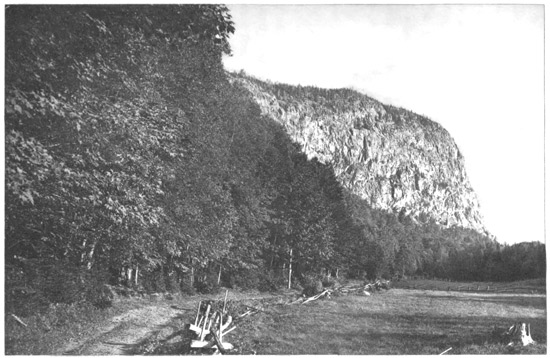
Mount Kineo Cliff
The Indian did not know exactly where the outlet
was, whether at the extreme southwest angle or more
easterly, and had asked to see my plan at the last stopping-place,
but I had forgotten to show it to him. As
usual, he went feeling his way by a middle course
between two probable points, from which he could
diverge either way at last without losing much distance.
In approaching the south shore, as the clouds looked
gusty and the waves ran pretty high, we so steered as to
get partly under the lee of an island, though at a great
distance from it.
I could not distinguish the outlet till we were almost
in it, and heard the water falling over the dam there.
Here was a considerable fall, and a very substantial
dam, but no sign of a cabin or camp. The hunter whom
we met at Telos Lake had told us that there were plenty
of trout here, but at this hour they did not rise to the bait,
only cousin trout, from the very midst of the rushing
waters. There are not so many fishes in these rivers as
in the Concord.
While we loitered here, Polis took occasion to cut
with his big knife some of the hair from his moose-hide,
and so lightened and prepared it for drying. I noticed
at several old Indian camps in the woods the pile of hair
which they had cut from their hides.
Having carried over the dam, he darted down the
rapids, leaving us to walk for a mile or more, where for
the most part there was no path, but very thick and
difficult traveling near the stream. At length he would
call to let us know where he was waiting for us with his
canoe, when, on account of the windings of the stream,
we did not know where the shore was, but he did not call
often enough, forgetting that we were not Indians. He
seemed to be very saving of his breath,—yet he would
be surprised if we went by, or did not strike the right
spot. This was not because he was unaccommodating,
but a proof of superior manners. Indians like to get
along with the least possible communication and ado.
He was really paying us a great compliment all the
while, thinking that we preferred a hint to a kick.
At length, climbing over the willows and fallen trees,
when this was easier than to go round or under them, we
overtook the canoe, and glided down the stream in
smooth but swift water for several miles. I here observed
again, as at Webster Stream, and on a still larger scale
the next day, that the river was a smooth and regularly
inclined plane down which we coasted. As we thus
glided along we started the first black ducks which we
had distinguished.
We decided to camp early to-night, that we might
have ample time before dark; so we stopped at the first
favorable shore, where there was a narrow gravelly
beach on the western side, some five miles below the outlet
of the lake. It was an interesting spot, where the
river began to make a great bend to the east, and the
last of the peculiar moose-faced Nerlumskeechticook
Mountains not far southwest of Grand Lake rose dark
in the northwest a short distance behind, displaying its
gray precipitous southeast side, but we could not see this
without coming out upon the shore.
Two steps from the water on either side, and you
come to the abrupt bushy and rooty if not turfy edge of
the bank, four or five feet high, where the interminable
forest begins, as if the stream had but just cut its way
through it.
It is surprising on stepping ashore anywhere into this
unbroken wilderness to see so often, at least within a few
rods of the river, the marks of the axe, made by lumberers
who have either camped here or driven logs past
in previous springs. You will see perchance where,
going on the same errand that you do, they have cut
large chips from a tall white pine stump for their fire.
While we were pitching the camp and getting supper,
the Indian cut the rest of the hair from his moose-hide,
and proceeded to extend it vertically on a temporary
frame between two small trees, half a dozen feet from the
opposite side of the fire, lashing and stretching it with
arbor-vitæ bark which was always at hand, and in this
case was stripped from one of the trees it was tied to.
Asking for a new kind of tea, he made us some, pretty
good, of the checkerberry (Gaultheria procumbens),
which covered the ground, dropping a little bunch of it
tied up with cedar bark into the kettle; but it was not
quite equal to the Chiogenes. We called this therefore
Checkerberry-Tea Camp.
I was struck with the abundance of the Linnæa
borealis, checkerberry, and Chiogenes hispidula, almost
everywhere in the Maine woods. The wintergreen
(Chimaphila umbellata) was still in bloom here, and
clintonia berries were abundant and ripe. This handsome
plant is one of the most common in that forest. We
here first noticed the moose-wood in fruit on the banks.
The prevailing trees were spruce (commonly black),
arbor-vitæ, canoe birch (black ash and elms beginning
to appear), yellow birch, red maple, and a little hemlock
skulking in the forest. The Indian said that the white
maple punk was the best for tinder, that yellow birch
punk was pretty good, but hard. After supper he put on
the moose tongue and lips to boil, cutting out the septum.
He showed me how to write on the under side of
birch bark, with a black spruce twig, which is hard and
tough, and can be brought to a point.
The Indian wandered off into the woods a short distance
just before night, and, coming back, said, “Me
found great treasure,—fifty, sixty dollars’ worth.”
“What’s that?” we asked. “Steel traps, under a log,
thirty or forty, I didn’t count ’em. I guess Indian work,—worth
three dollars apiece.” It was a singular coincidence
that he should have chanced to walk to and look
under that particular log, in that trackless forest.
I saw chivin and chub in the stream when washing
my hands, but my companion tried in vain to catch
them. I also heard the sound of bullfrogs from a swamp
on the opposite side, thinking at first that they were
moose; a duck paddled swiftly by; and sitting in that
dusky wilderness, under that dark mountain, by the
bright river which was full of reflected light, still I heard
the wood thrush sing, as if no higher civilization could
be attained. By this time the night was upon us.
You commonly make your camp just at sundown, and
are collecting wood, getting your supper, or pitching
your tent while the shades of night are gathering around
and adding to the already dense gloom of the forest.
You have no time to explore or look around you before
it is dark. You may penetrate half a dozen rods farther
into that twilight wilderness, after some dry bark to
kindle your fire with, and wonder what mysteries lie hidden
still deeper in it, say at the end of a long day’s walk;
or you may run down to the shore for a dipper of water,
and get a clearer view for a short distance up or down
the stream, and while you stand there, see a fish leap, or
duck alight in the river, or hear a wood thrush or robin
sing in the woods. That is as if you had been to town or
civilized parts. But there is no sauntering off to see the
country, and ten or fifteen rods seems a great way from
your companions, and you come back with the air of a
much-traveled man, as from a long journey, with adventures
to relate, though you may have heard the crackling
of the fire all the while,—and at a hundred rods you
might be lost past recovery, and have to camp out. It is
all mossy and moosey. In some of those dense fir and
spruce woods there is hardly room for the smoke to go
up. The trees are a standing night, and every fir and
spruce which you fell is a plume plucked from night’s
raven wing. Then at night the general stillness is more
impressive than any sound, but occasionally you hear
the note of an owl farther or nearer in the woods, and if
near a lake, the semihuman cry of the loons at their
unearthly revels.
To-night the Indian lay between the fire and his
stretched moose-hide, to avoid the mosquitoes. Indeed,
he also made a small smoky fire of damp leaves at his
head and his feet, and then as usual rolled up his head
in his blanket. We with our veils and our wash were
tolerably comfortable, but it would be difficult to pursue
any sedentary occupation in the woods at this season;
you cannot see to read much by the light of a fire through
a veil in the evening, nor handle pencil and paper well
with gloves or anointed fingers.
Friday, July 31.
The Indian said, “You and I kill moose last night,
therefore use ’em best wood. Always use hard wood to
cook moose-meat.” His “best wood” was rock maple.
He cast the moose’s lip into the fire, to burn the hair off,
and then rolled it up with the meat to carry along.
Observing that we were sitting down to breakfast without
any pork, he said, with a very grave look, “Me want
some fat,” so he was told that he might have as much as
he would fry.
We had smooth but swift water for a considerable
distance, where we glided rapidly along, scaring up
ducks and kingfishers. But, as usual, our smooth progress
ere long came to an end, and we were obliged to
carry canoe and all about half a mile down the right
bank, around some rapids or falls. It required sharp
eyes sometimes to tell which side was the carry, before
you went over the falls, but Polis never failed to land us
rightly. The raspberries were particularly abundant
and large here, and all hands went to eating them, the
Indian remarking on their size.
Often on bare rocky carries the trail was so indistinct
that I repeatedly lost it, but when I walked behind him
I observed that he could keep it almost like a hound, and
rarely hesitated, or, if he paused a moment on a bare
rock, his eye immediately detected some sign which
would have escaped me. Frequently we found no path
at all at these places, and were to him unaccountably
delayed. He would only say it was “ver strange.”
We had heard of a Grand Fall on this stream, and
thought that each fall we came to must be it, but after
christening several in succession with this name, we gave
up the search. There were more Grand or Petty Falls
than I can remember.
I cannot tell how many times we had to walk on
account of falls or rapids. We were expecting all the
while that the river would take a final leap and get to
smooth water, but there was no improvement this forenoon.
However, the carries were an agreeable variety.
So surely as we stepped out of the canoe and stretched
our legs we found ourselves in a blueberry and raspberry
garden, each side of our rocky trail around the falls being
lined with one or both. There was not a carry on the
main East Branch where we did not find an abundance
of both these berries, for these were the rockiest places,
and partially cleared, such as these plants prefer, and
there had been none to gather the finest before us.
In our three journeys over the carries,—for we were
obliged to go over the ground three times whenever the
canoe was taken out,—we did full justice to the berries,
and they were just what we wanted to correct the effect of
our hard bread and pork diet. Another name for making
a portage would have been going a-berrying. We also
found a few amelanchier, or service, berries, though
most were abortive, but they held on rather more generally
than they do in Concord. The Indian called them
pemoymenuk, and said that they bore much fruit in
some places. He sometimes also ate the northern wild
red cherries, saying that they were good medicine, but
they were scarcely edible. We bathed and dined at the
foot of one of these carries. It was the Indian who commonly
reminded us that it was dinner-time, sometimes
even by turning the prow to the shore. He once made an
indirect, but lengthy apology, by saying that we might
think it strange, but that one who worked hard all day
was very particular to have his dinner in good season.
At the most considerable fall on this stream, when I was
walking over the carry, close behind the Indian, he
observed a track on the rock, which was but slightly
covered with soil, and, stooping, muttered “caribou.”
When we returned, he observed a much larger track
near the same place, where some animal’s foot had sunk
into a small hollow in the rock, partly filled with grass
and earth, and he exclaimed with surprise, “What
that?” “Well, what is it?” I asked. Stooping and laying
his hand in it, he answered with a mysterious air,
and in a half whisper, “Devil [that is, Indian Devil, or
cougar]—ledges about here—very bad animal—pull
’em rocks all to pieces.” “How long since it was made?”
I asked. “To-day or yesterday,” said he. But when I
asked him afterward if he was sure it was the devil’s
track, he said he did not know. I had been told that the
scream of a cougar was heard about Ktaadn recently,
and we were not far from that mountain.
We spent at least half the time in walking to-day, and
the walking was as bad as usual, for the Indian, being
alone, commonly ran down far below the foot of the
carries before he waited for us. The carry-paths themselves
were more than usually indistinct, often the route
being revealed only by the countless small holes in the
fallen timber made by the tacks in the drivers’ boots, or
where there was a slight trail we did not find it. It was a
tangled and perplexing thicket, through which we
stumbled and threaded our way, and when we had finished
a mile of it, our starting-point seemed far away.
We were glad that we had not got to walk to Bangor
along the banks of this river, which would be a journey
of more than a hundred miles. Think of the denseness
of the forest, the fallen trees and rocks, the windings of
the river, the streams emptying in, and the frequent
swamps to be crossed. It made you shudder. Yet the
Indian from time to time pointed out to us where he had
thus crept along day after day when he was a boy of ten,
and in a starving condition. He had been hunting far
north of this with two grown Indians. The winter came
on unexpectedly early, and the ice compelled them to
leave their canoe at Grand Lake, and walk down the
bank. They shouldered their furs and started for Oldtown.
The snow was not deep enough for snowshoes,
or to cover the inequalities of the ground. Polis was soon
too weak to carry any burden; but he managed to catch
one otter. This was the most they all had to eat on this
journey, and he remembered how good the yellow lily
roots were, made into a soup with the otter oil. He
shared this food equally with the other two, but being so
small he suffered much more than they. He waded
through the Mattawamkeag at its mouth, when it was
freezing cold and came up to his chin, and he, being
very weak and emaciated, expected to be swept away.
The first house which they reached was at Lincoln, and
thereabouts they met a white teamster with supplies,
who, seeing their condition, gave them as much of his
load as they could eat. For six months after getting
home, he was very low, and did not expect to live, and
was perhaps always the worse for it.
We could not find much more than half of this day’s
journey on our maps (the “Map of the Public Lands of
Maine and Massachusetts,” and “Colton’s Railroad
and Township Map of Maine,” which copies the
former). By the maps there was not more than fifteen
miles between camps at the outside, and yet we had been
busily progressing all day, and much of the time very
rapidly.
For seven or eight miles below that succession of
“Grand” falls, the aspect of the banks as well as the
character of the stream was changed. After passing a
tributary from the northeast, perhaps Bowlin Stream,
we had good swift smooth water, with a regular slope,
such as I have described. Low, grassy banks and muddy
shores began. Many elms, as well as maples, and more
ash trees, overhung the stream, and supplanted the
spruce.
My lily roots having been lost when the canoe was
taken out at a carry, I landed late in the afternoon, at a
low and grassy place amid maples, to gather more. It
was slow work, grubbing them up amid the sand, and
the mosquitoes were all the while feasting on me. Mosquitoes,
black flies, etc., pursued us in mid-channel, and
we were glad sometimes to get into violent rapids, for
then we escaped them.
A red-headed woodpecker flew across the river, and
the Indian remarked that it was good to eat. As we
glided swiftly down the inclined plane of the river, a
great cat owl launched itself away from a stump on the
bank, and flew heavily across the stream, and the Indian,
as usual, imitated its note. Soon the same bird flew
back in front of us, and we afterwards passed it perched
on a tree. Soon afterward a white-headed eagle sailed
down the stream before us. We drove him several miles,
while we were looking for a good place to camp, for we
expected to be overtaken by a shower,—and still we
could distinguish him by his white tail, sailing away from
time to time from some tree by the shore still farther
down the stream. Some shecorways being surprised by
us, a part of them dived, and we passed directly over
them, and could trace their course here and there by a
bubble on the surface, but we did not see them come up.
Polis detected once or twice what he called a “tow”
road, an indistinct path leading into the forest. In the
meanwhile we passed the mouth of the Seboois on our
left. This did not look so large as our stream, which was
indeed the main one. It was some time before we found
a camping-place, for the shore was either too grassy and
muddy, where mosquitoes abounded, or too steep a hillside.
The Indian said that there were but few mosquitoes
on a steep hillside. We examined a good place,
where somebody had camped a long time; but it seemed
pitiful to occupy an old site, where there was so much
room to choose, so we continued on. We at length found
a place to our minds, on the west bank, about a mile
below the mouth of the Seboois, where, in a very dense
spruce wood above a gravelly shore, there seemed to be
but few insects. The trees were so thick that we were
obliged to clear a space to build our fire and lie down in,
and the young spruce trees that were left were like the
wall of an apartment rising around us. We were obliged
to pull ourselves up a steep bank to get there. But the
place which you have selected for your camp, though
never so rough and grim, begins at once to have its
attractions, and becomes a very centre of civilization to
you: “Home is home, be it never so homely.”
It turned out that the mosquitoes were more numerous
here than we had found them before, and the Indian
complained a good deal, though he lay, as the night
before, between three fires and his stretched hide. As I
sat on a stump by the fire, with a veil and gloves on, trying
to read, he observed, “I make you candle,” and in a
minute he took a piece of birch bark about two inches
wide and rolled it hard, like an allumette fifteen inches
long, lit it, and fixed it by the other end horizontally in a
split stick three feet high, stuck it in the ground, turning
the blazing end to the wind, and telling me to snuff it
from time to time. It answered the purpose of a candle
pretty well.
I noticed, as I had done before, that there was a lull
among the mosquitoes about midnight, and that they
began again in the morning. Nature is thus merciful.
But apparently they need rest as well as we. Few, if any,
creatures are equally active all night. As soon as it was
light I saw, through my veil, that the inside of the tent
about our heads was quite blackened with myriads, each
one of their wings when flying, as has been calculated,
vibrating some three thousand times in a minute, and
their combined hum was almost as bad to endure as
their stings. I had an uncomfortable night on this
account though I am not sure that one succeeded in his
attempt to sting me. We did not suffer so much from
insects on this excursion as the statements of some who
have explored these woods in midsummer led us to anticipate.
Yet I have no doubt that at some seasons and in
some places they are a much more serious pest. The
Jesuit Hierome Lalemant, of Quebec, reporting the
death of Father Reni Menard, who was abandoned, lost
his way, and died in the woods, among the Ontarios near
Lake Superior, in 1661, dwells chiefly on his probable
sufferings from the attacks of mosquitoes when too weak
to defend himself, adding that there was a frightful
number of them in those parts, “and so insupportable,”
says he, “that the three Frenchmen who have made that
voyage affirm that there was no other means of defending
one’s self but to run always without stopping, and it was
even necessary for two of them to be employed in driving
off these creatures while the third wanted to drink,
otherwise he could not have done it.” I have no doubt
that this was said in good faith.
August 1.
I caught two or three large red chivin (Leuciscus
pulchellus) early this morning, within twenty feet of the
camp, which, added to the moose-tongue, that had been
left in the kettle boiling overnight, and to our other
stores, made a sumptuous breakfast. The Indian made
us some hemlock tea instead of coffee, and we were not
obliged to go as far as China for it; indeed, not quite so
far as for the fish. This was tolerable, though he said it
was not strong enough. It was interesting to see so simple
a dish as a kettle of water with a handful of green
hemlock sprigs in it, boiling over the huge fire in the
open air, the leaves fast losing their lively green color,
and know that it was for our breakfast.
We were glad to embark once more, and leave some
of the mosquitoes behind. We had passed the Wassataquoik
without perceiving it. This, according to the
Indian, is the name of the main East Branch itself, and
not properly applied to this small tributary alone, as on
the maps.
We found that we had camped about a mile above
Hunt’s, which is on the east bank, and is the last house
for those who ascend Ktaadn on this side.
We had expected to ascend it from this point, but my
companion was obliged to give up this on account of sore
feet. The Indian, however, suggested that perhaps he
might get a pair of moccasins at this place, and that he
could walk very easily in them without hurting his feet,
wearing several pairs of stockings, and he said beside
that they were so porous that when you had taken in
water it all drained out again in a little while. We
stopped to get some sugar, but found that the family
had moved away, and the house was unoccupied, except
temporarily by some men who were getting the hay.
They told me that the road to Ktaadn left the river eight
miles above; also that perhaps we could get some sugar
at Fisk’s, fourteen miles below. I do not remember that
we saw the mountain at all from the river. I noticed a
seine here stretched on the bank, which probably had
been used to catch salmon. Just below this, on the west
bank, we saw a moose-hide stretched, and with it a bearskin,
which was comparatively very small. I was the
more interested in this sight, because it was near here
that a townsman of ours, then quite a lad, and alone,
killed a large bear some years ago. The Indian said that
they belonged to Joe Aitteon, my last guide, but how he
told I do not know. He was probably hunting near, and
had left them for the day. Finding that we were going
directly to Oldtown, he regretted that he had not taken
more of the moose-meat to his family, saying that in a
short time, by drying it, he could have made it so light
as to have brought away the greater part, leaving the
bones. We once or twice inquired after the lip, which is
a famous tidbit, but he said, “That go Oldtown for my
old woman; don’t get it every day.”
Maples grew more and more numerous. It was lowering,
and rained a little during the forenoon, and, as we
expected a wetting, we stopped early and dined on the
east side of a small expansion of the river, just above
what are probably called Whetstone Falls, about a
dozen miles below Hunt’s. There were pretty fresh
moose-tracks by the waterside. There were singular long
ridges hereabouts, called “horsebacks,” covered with
ferns. My companion, having lost his pipe, asked the
Indian if he could not make him one. “Oh, yer,” said
he, and in a minute rolled up one of birch bark, telling
him to wet the bowl from time to time. Here also he left
his gazette on a tree.
We carried round the falls just below, on the west
side. The rocks were on their edges, and very sharp.
The distance was about three fourths of a mile. When
we had carried over one load, the Indian returned by
the shore, and I by the path, and though I made no particular
haste, I was nevertheless surprised to find him at
the other end as soon as I. It was remarkable how
easily he got along over the worst ground. He said to me,
“I take canoe and you take the rest, suppose you can
keep along with me?” I thought that he meant that
while he ran down the rapids I should keep along the
shore, and be ready to assist him from time to time, as I
had done before; but as the walking would be very bad,
I answered, “I suppose you will go too fast for me, but I
will try.” But I was to go by the path, he said. This I
thought would not help the matter, I should have so far
to go to get to the riverside when he wanted me. But
neither was this what he meant. He was proposing a
race over the carry, and asked me if I thought I could
keep along with him by the same path, adding that I
must be pretty smart to do it. As his load, the canoe,
would be much the heaviest and bulkiest, though the
simplest, I thought that I ought to be able to do it, and
said that I would try. So I proceeded to gather up the
gun, axe, paddle, kettle, frying-pan, plates, dippers,
carpets, etc., etc., and while I was thus engaged he threw
me his cowhide boots. “What, are these in the bargain?”
I asked. “Oh, yer,” said he; but before I could
make a bundle of my load I saw him disappearing over
a hill with the canoe on his head; so, hastily scraping the
various articles together, I started on the run, and immediately
went by him in the bushes, but I had no sooner
left him out of sight in a rocky hollow than the greasy
plates, dippers, etc., took to themselves wings, and while
I was employed in gathering them up again, he went by
me; but hastily pressing the sooty kettle to my side, I
started once more, and soon passing him again, I saw
him no more on the carry. I do not mention this as anything
of a feat, for it was but poor running on my part,
and he was obliged to move with great caution for fear
of breaking his canoe as well as his neck. When he
made his appearance, puffing and panting like myself,
in answer to my inquiries where he had been, he said,
“Rocks (locks) cut ’em feet,” and, laughing, added,
“Oh, me love to play sometimes.” He said that he and
his companions, when they came to carries several miles
long, used to try who would get over first; each, perhaps,
with a canoe on his head. I bore the sign of the
kettle on my brown linen sack for the rest of the voyage.
We made a second carry on the west side, around
some falls about a mile below this. On the mainland
were Norway pines, indicating a new geological formation,
and it was such a dry and sandy soil as we had not
noticed before.
As we approached the mouth of the East Branch,
we passed two or three huts, the first sign of civilization
after Hunt’s, though we saw no road as yet; we heard a
cow-bell, and even saw an infant held up to a small
square window to see us pass, but apparently the infant
and the mother that held it were the only inhabitants
then at home for several miles. This took the wind out
of our sails, reminding us that we were travelers surely,
while it was a native of the soil, and had the advantage
of us. Conversation flagged. I would only hear the
Indian, perhaps, ask my companion, “You load my
pipe?” He said that he smoked alder bark, for medicine.
On entering the West Branch at Nicketow it
appeared much larger than the East. Polis remarked
that the former was all gone and lost now, that it was all
smooth water hence to Oldtown, and he threw away his
pole which was cut on the Umbazookskus. Thinking of
the rapids, he said once or twice that you wouldn’t
catch him to go East Branch again; but he did not by
any means mean all that he said.
Things are quite changed since I was here eleven
years ago. Where there were but one or two houses, I
now found quite a village, with sawmills and a store (the
latter was locked, but its contents were so much the more
safely stored), and there was a stage-road to Mattawamkeag,
and the rumor of a stage. Indeed, a steamer
had ascended thus far once, when the water was very
high. But we were not able to get any sugar, only a
better shingle to lean our backs against.
We camped about two miles below Nicketow, on the
south side of the West Branch, covering with fresh twigs
the withered bed of a former traveler, and feeling that
we were now in a settled country, especially when in the
evening we heard an ox sneeze in its wild pasture across
the river. Wherever you land along the frequented part
of the river, you have not far to go to find these sites of
temporary inns, the withered bed of flattened twigs, the
charred sticks, and perhaps the tent-poles. And not
long since, similar beds were spread along the Connecticut,
the Hudson, and the Delaware, and longer still ago,
by the Thames and Seine, and they now help to make
the soil where private and public gardens, mansions and
palaces are. We could not get fir twigs for our bed here,
and the spruce was harsh in comparison, having more
twig in proportion to its leaf, but we improved it somewhat
with hemlock. The Indian remarked as before,
“Must have hard wood to cook moose-meat,” as if that
were a maxim, and proceeded to get it. My companion
cooked some in California fashion, winding a long string
of the meat round a stick and slowly turning it in his
hand before the fire. It was very good. But the Indian,
not approving of the mode, or because he was not
allowed to cook it his own way, would not taste it. After
the regular supper we attempted to make a lily soup
of the bulbs which I had brought along, for I wished
to learn all I could before I got out of the woods. Following
the Indian’s directions, for he began to be sick,
I washed the bulbs carefully, minced some moose-meat
and some pork, salted and boiled all together, but we had
not patience to try the experiment fairly, for he said it
must be boiled till the roots were completely softened so
as to thicken the soup like flour; but though we left it on
all night, we found it dried to the kettle in the morning,
and not yet boiled to a flour. Perhaps the roots were not
ripe enough, for they commonly gather them in the fall.
As it was, it was palatable enough, but it reminded me
of the Irishman’s limestone broth. The other ingredients
were enough alone. The Indian’s name for these bulbs
was Sheepnoc. I stirred the soup by accident with a
striped maple or moose-wood stick, which I had peeled,
and he remarked that its bark was an emetic.
He prepared to camp as usual between his moose-hide
and the fire; but it beginning to rain suddenly, he took
refuge under the tent with us, and gave us a song before
falling asleep. It rained hard in the night, and spoiled
another box of matches for us, which the Indian had
left out, for he was very careless; but, as usual, we had
so much the better night for the rain, since it kept the
mosquitoes down.
Sunday, August 2.
Was a cloudy and unpromising morning. One of us
observed to the Indian, “You did not stretch your
moose-hide last night, did you, Mr. Polis?” Whereat
he replied, in a tone of surprise, though perhaps not of
ill humor: “What you ask me that question for? Suppose
I stretch ’em, you see ’em. May be your way talking,
may be all right, no Indian way.” I had observed
that he did not wish to answer the same question more
than once, and was often silent when it was put again
for the sake of certainty, as if he were moody. Not that
he was incommunicative, for he frequently commenced
a long-winded narrative of his own accord,—repeated
at length the tradition of some old battle, or some passage
in the recent history of his tribe in which he had
acted a prominent part, from time to time drawing a
long breath, and resuming the thread of his tale, with the
true story-teller’s leisureliness, perhaps after shooting a
rapid,—prefacing with “We-e-ll, by-by,” etc., as he
paddled along. Especially after the day’s work was
over, and he had put himself in posture for the night,
he would be unexpectedly sociable, exhibit even the
bonhommie of a Frenchman, and we would fall asleep
before he got through his periods.
Nicketow is called eleven miles from Mattawamkeag
by the river. Our camp was, therefore, about nine miles
from the latter place.
The Indian was quite sick this morning with the colic.
I thought that he was the worse for the moose-meat he
had eaten.
We reached the Mattawamkeag at half past eight in
the morning, in the midst of a drizzling rain, and, after
buying some sugar, set out again.
The Indian growing much worse, we stopped in the
north part of Lincoln to get some brandy for him; but
failing in this, an apothecary recommended Brandreth’s
pills, which he refused to take, because he was not
acquainted with them. He said to me, “Me doctor,—first
study my case, find out what ail ’em,—then I
know what to take.” We dropped down a little farther,
and stopped at mid-forenoon on an island and made him
a dipper of tea. Here, too, we dined and did some washing
and botanizing, while he lay on the bank. In the
afternoon we went on a little farther, though the Indian
was no better. “Burntibus,” as he called it, was a long,
smooth, lake-like reach below the Five Islands. He said
that he owned a hundred acres somewhere up this way.
As a thunder-shower appeared to be coming up, we
stopped opposite a barn on the west bank, in Chester,
about a mile above Lincoln. Here at last we were
obliged to spend the rest of the day and night, on account
of our patient, whose sickness did not abate. He lay
groaning under his canoe on the bank, looking very woebegone,
yet it was only a common case of colic. You
would not have thought, if you had seen him lying about
thus, that he was the proprietor of so many acres in that
neighborhood, was worth six thousand dollars, and had
been to Washington. It seemed to me that, like the
Irish, he made a greater ado about his sickness than
a Yankee does, and was more alarmed about himself.
We talked somewhat of leaving him with his people in
Lincoln,—for that is one of their homes,—and taking
the stage the next day, but he objected on account
of the expense saying, “Suppose me well in morning,
you and I go Oldtown by noon.”
As we were taking our tea at twilight, while he lay
groaning still under his canoe, having at length found
out “what ail him,” he asked me to get him a dipper of
water. Taking the dipper in one hand he seized his
powder-horn with the other, and, pouring into it a charge
or two of powder, stirred it up with his finger, and drank
it off. This was all he took to-day after breakfast beside
his tea.
To save the trouble of pitching our tent, when we had
secured our stores from wandering dogs, we camped in
the solitary half-open barn near the bank, with the
permission of the owner, lying on new-mown hay four
feet deep. The fragrance of the hay, in which many
ferns, etc., were mingled, was agreeable, though it was
quite alive with grasshoppers which you could hear
crawling through it. This served to graduate our approach
to houses and feather beds. In the night some
large bird, probably an owl, flitted through over our
heads, and very early in the morning we were awakened
by the twittering of swallows which had their nests there.
Monday, August 3.
We started early before breakfast, the Indian being
considerably better, and soon glided by Lincoln, and
after another long and handsome lake-like reach, we
stopped to breakfast on the west shore, two or three
miles below this town.
We frequently passed Indian islands with their small
houses on them. The Governor, Aitteon, lives in one of
them, in Lincoln.
The Penobscot Indians seem to be more social, even,
than the whites. Ever and anon in the deepest wilderness
of Maine, you come to the log hut of a Yankee or
Canada settler, but a Penobscot never takes up his
residence in such a solitude. They are not even scattered
about on their islands in the Penobscot, which
are all within the settlements, but gathered together on
two or three,—though not always on the best soil,—evidently
for the sake of society. I saw one or two houses
not now used by them, because, as our Indian Polis said,
they were too solitary.
The small river emptying in at Lincoln is the Matanancook,
which also, we noticed, was the name of a
steamer moored there. So we paddled and floated along,
looking into the mouths of rivers. When passing the
Mohawk Rips, or, as the Indian called them, “Mohog
lips,” four or five miles below Lincoln, he told us at
length the story of a fight between his tribe and the
Mohawks there, anciently,—how the latter were overcome
by stratagem, the Penobscots using concealed
knives,—but they could not for a long time kill the
Mohawk chief, who was a very large and strong man,
though he was attacked by several canoes at once, when
swimming alone in the river.
From time to time we met Indians in their canoes,
going up river. Our man did not commonly approach
them, but exchanged a few words with them at a distance
in his tongue. These were the first Indians we had
met since leaving the Umbazookskus.
At Piscataquis Falls, just above the river of that name,
we walked over the wooden railroad on the eastern
shore, about one and a half miles long, while the Indian
glided down the rapids. The steamer from Oldtown
stops here, and passengers take a new boat above.
Piscataquis, whose mouth we here passed, means
“branch.” It is obstructed by falls at its mouth, but can
be navigated with batteaux or canoes above through a
settled country, even to the neighborhood of Moosehead
Lake, and we had thought at first of going that way. We
were not obliged to get out of the canoe after this on
account of falls or rapids, nor, indeed, was it quite
necessary here. We took less notice of the scenery to-day,
because we were in quite a settled country. The river
became broad and sluggish, and we saw a blue heron
winging its way slowly down the stream before us.
We passed the Passadumkeag River on our left and
saw the blue Olamon mountains at a distance in the
southeast. Hereabouts our Indian told us at length the
story of their contention with the priest respecting
schools. He thought a great deal of education and had
recommended it to his tribe. His argument in its favor
was, that if you had been to college and learnt to calculate,
you could “keep ’em property,—no other way.”
He said that his boy was the best scholar in the school
at Oldtown, to which he went with whites. He himself
is a Protestant, and goes to church regularly at Oldtown.
According to his account, a good many of his tribe are
Protestants, and many of the Catholics also are in favor
of schools. Some years ago they had a schoolmaster,
a Protestant, whom they liked very well. The priest
came and said that they must send him away, and
finally he had such influence, telling them that they
would go to the bad place at last if they retained him,
that they sent him away. The school party, though
numerous, were about giving up. Bishop Fenwick came
from Boston and used his influence against them. But
our Indian told his side that they must not give up, must
hold on, they were the strongest. If they gave up, then
they would have no party. But they answered that it
was “no use, priest too strong, we’d better give up.” At
length he persuaded them to make a stand.
The priest was going for a sign to cut down the liberty-pole.
So Polis and his party had a secret meeting about
it; he got ready fifteen or twenty stout young men,
“stript ’em naked, and painted ’em like old times,” and
told them that when the priest and his party went to
cut down the liberty-pole, they were to rush up, take
hold of it, and prevent them, and he assured them that
there would be no war, only a noise,—“no war where
priest is.” He kept his men concealed in a house near
by, and when the priest’s party were about to cut down
the liberty-pole, the fall of which would have been a
death-blow to the school party, he gave a signal, and his
young men rushed out and seized the pole. There was
a great uproar, and they were about coming to blows,
but the priest interfered, saying, “No war, no war,” and
so the pole stands, and the school goes on still.
We thought that it showed a good deal of tact in him,
to seize this occasion and take his stand on it; proving
how well he understood those with whom he had to deal.
The Olamon River comes in from the east in Greenbush
a few miles below the Passadumkeag. When we
asked the meaning of this name, the Indian said there
was an island opposite its mouth which was called
Olarmon; that in old times, when visitors were coming
to Oldtown, they used to stop there to dress and fix up
or paint themselves. “What is that which ladies used?”
he asked. Rouge? Red Vermilion? “Yer,” he said,
“that is larmon, a kind of clay or red paint, which they
used to get here.”
We decided that we, too, would stop at this island,
and fix up our inner man, at least, by dining.
It was a large island, with an abundance of hemp
nettle, but I did not notice any kind of red paint there.
The Olamon River, at its mouth at least, is a dead
stream. There was another large island in that neighborhood,
which the Indian called “Soogle” (i. e., Sugar)
Island.
About a dozen miles before reaching Oldtown he
inquired, “How you like ’em your pilot?” But we postponed
an answer till we had got quite back again.
The Sunkhaze, another short dead stream, comes in
from the east two miles above Oldtown. There is said to
be some of the best deer ground in Maine on this stream.
Asking the meaning of this name, the Indian said, “Suppose
you are going down Penobscot, just like we, and
you see a canoe come out of bank and go along before
you, but you no see ’em stream. That is Sunkhaze.”
He had previously complimented me on my paddling,
saying that I paddled “just like anybody,” giving me an
Indian name which meant “great paddler.” When off
this stream he said to me, who sat in the bows, “Me
teach you paddle.” So, turning toward the shore, he got
out, came forward, and placed my hands as he wished.
He placed one of them quite outside the boat, and the
other parallel with the first, grasping the paddle near
the end, not over the flat extremity, and told me to slide
it back and forth on the side of the canoe. This, I found,
was a great improvement which I had not thought of,
saving me the labor of lifting the paddle each time, and
I wondered that he had not suggested it before. It is
true, before our baggage was reduced we had been
obliged to sit with our legs drawn up, and our knees
above the side of the canoe, which would have prevented
our paddling thus, or perhaps he was afraid of
wearing out his canoe, by constant friction on the side.
I told him that I had been accustomed to sit in the
stern, and, lifting my paddle at each stroke, give it a
twist in order to steer the boat, only getting a pry on
the side each time, and I still paddled partly as if in
the stern. He then wanted to see me paddle in the stern.
So, changing paddles, for he had the longer and better
one, and turning end for end, he sitting flat on the bottom
and I on the crossbar, he began to paddle very hard,
trying to turn the canoe, looking over his shoulder and
laughing; but finding it in vain, he relaxed his efforts,
though we still sped along a mile or two very swiftly. He
said that he had no fault to find with my paddling in the
stern, but I complained that he did not paddle according
to his own directions in the bows.
Opposite the Sunkhaze is the main boom of the
Penobscot, where the logs from far up the river are collected
and assorted.
As we drew near to Oldtown I asked Polis if he was
not glad to get home again; but there was no relenting
to his wildness, and he said, “It makes no difference to
me where I am.” Such is the Indian’s pretense always.
We approached the Indian Island through the narrow
strait called “Cook.” He said, “I ’xpect we take in
some water there, river so high,—never see it so high at
this season. Very rough water there, but short; swamp
steamboat once. Don’t you paddle till I tell you, then
you paddle right along.” It was a very short rapid.
When we were in the midst of it he shouted “paddle,”
and we shot through without taking in a drop.
Soon after the Indian houses came in sight, but I
could not at first tell my companion which of two or
three large white ones was our guide’s. He said it was the
one with blinds.
We landed opposite his door at about four in the
afternoon, having come some forty miles this day.
From the Piscataquis we had come remarkably and
unaccountably quick, probably as fast as the stage or
the boat, though the last dozen miles was dead water.
Polis wanted to sell us his canoe, said it would last
seven or eight years, or with care, perhaps ten; but we
were not ready to buy it.
We stopped for an hour at his house, where my companion
shaved with his razor, which he pronounced in
very good condition. Mrs. P. wore a hat and had a silver
brooch on her breast, but she was not introduced to us.
The house was roomy and neat. A large new map of
Oldtown and the Indian Island hung on the wall, and
a clock opposite to it. Wishing to know when the cars
left Oldtown, Polis’s son brought one of the last Bangor
papers, which I saw was directed to “Joseph Polis,”
from the office.
This was the last that I saw of Joe Polis. We took
the last train, and reached Bangor that night.
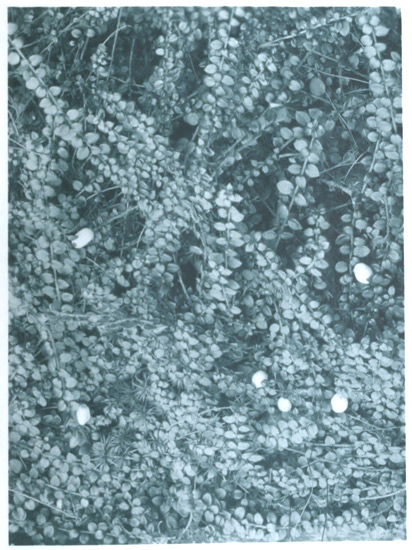
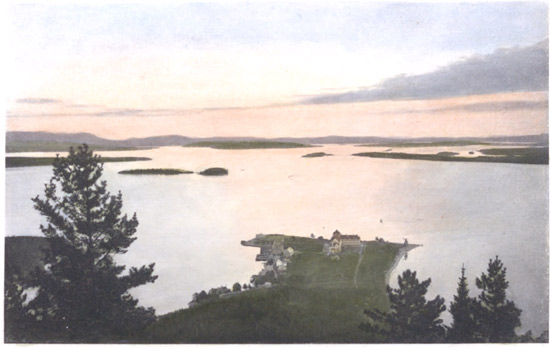
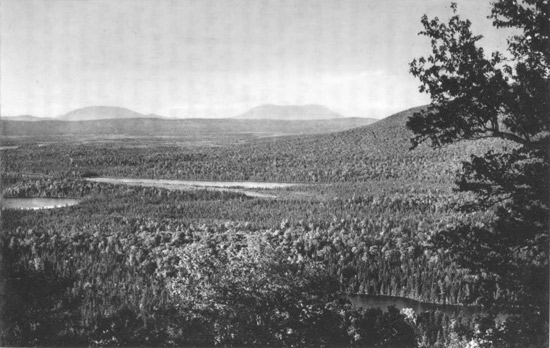
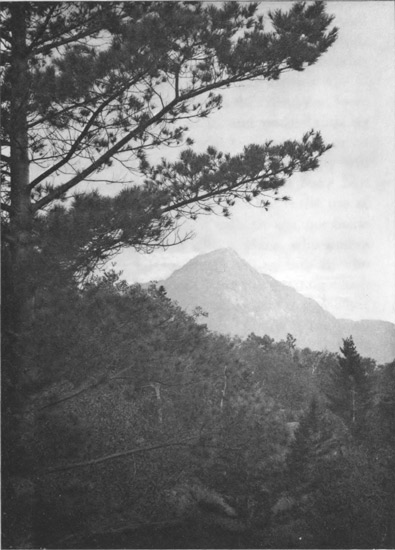
 is saüktaüoui. (Vide Willis.)