The night wind of the plain blew cold in their faces as they stepped out
upon the Great River platform. There was a hint of storm in the air and
clouds rode swiftly overhead. The voices of the trainmen and the throb
of the locomotive, resting for its long climb mountainward, broke
strangely upon the silence. A great figure muffled in a long ulster came
down the platform toward the vestibule from which the trio had descended.
"Hello," called Raridan cheerily, "there's only one like that! Good morning, Bishop!"
"Good morning, gentlemen," said Bishop Delafield, peering into their
faces. The waiting porter took his bags from him. "Has the boy been found yet?"
"No."
"I should have gone on home to-night if I had known that. But what are
you doing here?"
Raridan told him in a few words. They were following a slight clue, and
were going over to the old Poindexter place, in the hope of finding
Grant Porter there. Saxton was holding a colloquy with the driver of the
station hack who had come in quest of passengers, and he hurried off
with the man to get a buckboard.
The conductor signaled with his lantern to go ahead, and the engine
answered with a doleful peal of the bell. The porter had gathered up the
bishop's things and waited for him to step aboard.
"Never mind," the bishop said to him; "I won't go to-night." The train
was already moving and the bishop turned to Raridan and Wheaton. "I'll
wait and see what comes of this."
"Very well," said Raridan. "We won't need our bags. We can leave them
with the station agent." Wheaton stepped forward eagerly, glad to have
something to do; he had not slept and was grateful for the cover of
darkness which shut him out from the others.
"Gentlemen with flasks had better take them," said Warry, opening his
bag. "It's a cold morning!"
"Wretchedly intemperate man," said the bishop. "Where's yours, Mr. Wheaton?"
"I haven't any," Wheaton answered.
When he went into the station, the agent eyed him curiously as he looked
up from his telegraphing and nodded his promise to care for the bags. He
remembered Saxton and Wheaton and supposed that they were going to
Poindexter's on ranch business.
Saxton drove up to the platform with the buckboard.
"All ready," he said, and the three men climbed in, the bishop and
Wheaton in the back seat and Raridan by Saxton, who drove.
"The roads out here are the worst. It's a good thing the ground's frozen."
"It's a better thing that you know the way," said Raridan. "I'm a lost
child in the wilderness."
"If you lose me, Wheaton can find the way," said Saxton.
They could hear the train puffing far in the distance. Its passage had
not disturbed the sleep of the little village. The lantern of the
station-master flashed in the main street as he picked his way homeward.
Stars could be seen beyond the flying clouds. The road lay between
wire-fenced ranches, and the scattered homes of their owners were
indistinguishable in the darkness of the night. A pair of ponies drew
the buckboard briskly over the hard, rough road.
"How far is it?" asked the bishop.
"Five miles. We can do it in an hour," said Saxton over his shoulder.
"We'll be in Clarkson laughing at the police to-morrow afternoon if we
have good luck," said Raridan. "If we've made a bad guess we'll sneak
home and not tell where we've been."
The road proved to be in better condition than Saxton had expected, and
he kept the ponies at their work with his whip. The rumble of the wagon
rose above the men's voices and they ceased trying to talk. Raridan and
Saxton smoked in silence, lighting one cigar from another. The bishop
rode with his head bowed on his breast, asleep; he had learned the trick
of taking sleep when and where he could.
Wheaton felt the numbing of his hands and feet in the cold night air and
welcomed the discomfort, as a man long used to a particular sensation of
pain welcomes a new one that proves a counter-irritant. He reviewed
again the grounds on which he might have excused himself from taking
this trip. Nothing, he argued, could be more absurd than this adventure
on an errand which might much better have been left to professional
detectives. But it seemed a far cry back to his desk at the bank, and to
the tasks there which he really enjoyed. In a few hours the daily
routine would be in progress. The familiar scenes of the opening passed
before him—the clerks taking their places; the slamming of the big
books upon the desks as they were brought from the vault; the jingle of
coin in the cages as the tellers assorted it and made ready for the
day's business. He saw himself at his desk, the executive officer of the
most substantial institution in Clarkson, his signature carrying the
bank's pledge, his position one of dignity and authority.
But he was on William Porter's service; he pictured himself walking into
the bank from a fruitless quest, but one which would attract attention
to himself. If they found the boy and released him safely, he would
share the thanks and praise which would be the reward of the rescuing
party. He had no idea that Snyder would be captured; and he even planned
to help him escape if he could do so.
They had turned off from the main highway and were well up in the branch
road that ran to the Poindexter place.
"This is right, Wheaton, isn't it?" asked Saxton, drawing up the ponies.
"Yes, this is the ranch road."
They went forward slowly. The clouds were more compactly marshaled now
and the stars were fewer. Suddenly Saxton brought the ponies to a stand
and pointed to a dark pile that loomed ahead of them. The Poindexter
house stood forth somber in the thin starlight.
"Is that the place?" asked the bishop, now wide awake.
"That's it," said Wheaton. "This road ends there. The river's just
beyond the cottonwoods. That first building was Poindexter's barn. It
cost more than the court house of this county."
Saxton gave the reins to Raridan and jumped out. "No more smoking," he
said, throwing away his cigar. "You stay here and I'll reconnoiter a
bit." He walked swiftly toward the great barn which lay between him and
the house. There was no sign of life in the place. He crept through the
barb-wire fence into the corral. He had barred and padlocked the barn
door on his last visit, and he satisfied himself that the fastenings had
not been disturbed. There were no indications that any one had visited
the place. He reasoned that if Snyder had sought the ranch house for a
rendezvous he had not come afoot. Saxton was therefore disappointed to
find the barn door locked and the corral empty; there was little use in
looking further, he concluded; but before joining the others he resolved
to make sure that the house also was empty. It was quite dark and he
walked boldly up to it. The wind had risen and whistled shrilly around
it; a loose blind under the eaves flapped noisily as he drew near. The
great front door was closed; he pushed against it and found it securely
fastened. He had brought with him a key to a rear door, and he started
around the house to try it and to make sure that the house was not occupied.
At the corner toward the river, glass suddenly crunched under his feet.
The windows were deeply embrasured all over the house, and he could not
determine where the glass had fallen from. The windows were all intact
when he left, he was sure. He drew off his glove and tiptoed to the
nearest panes, ran his fingers over the smooth glass, and instantly
touched a broken edge. As he was feeling the frame to discover the size
of the opening, the low whinny of a horse came distinctly from within.
He stood perfectly quiet, listening, and in a moment heard the stamp of
a hoof on the wooden floor of the hall. He backed off toward the drive
way, which swept around in front of the house, and waited, but all
remained as silent and as dark as before. He ran back through the corral
to the other men, who stood talking beside the blanketed ponies.
"There's something or somebody in the house," he said. He told them of
the broken window and of the sounds he had heard. "Whoever's there has
no business there and we may as well turn him out. I've thought of a
good many schemes for utilizing that house, but the idea of making a
barn of it hadn't occurred to me."
He threw off his overcoat and tossed it into the buckboard.
"I guess that's a good idea, John," said Raridan, following his example.
Wheaton stood muffled in his coat. His teeth were chattering, and he
fumbled at the buttons but kept his coat on, walking toward the house
with the others.
"We may have a horse thief or we may have a kidnapper," said Saxton,
who had taken charge of the party; "but in either case we may as well
take him with his live stock."
"Let us not be rash," said the bishop, following the others. "He may
prove an unruly customer."
"He's probably a dude tramp who rides a horse and has taken a fancy to
Poindexter architecture," said Warry.
"Quiet!" admonished Saxton, who had lighted a lantern, which he
concealed under his coat.
"You two watch the corners of the house," he said, indicating Raridan
and Wheaton; "and you, Bishop, can stand off here, if you will, and
watch for signs of light in the upper windows. The big front doors are
barred on the inside, and my key opens only the back door."
"I'll go with you," said Raridan.
"Not yet, old man. You stay right here and watch until I throw open the front doors."
"But that's a foolish risk," insisted Raridan. "There may be a dozen men inside."
"That's all right, Warry. It takes only a minute to cross the hall and
unbar the front doors. There's no risk about it. I'll be out in half a minute."
Raridan felt that Saxton was taking all the hazards, but he yielded, as
he usually did, when Saxton was decisive, as now.
"Good luck to you, old man!" he said, slapping Saxton on the back. He
patrolled the grass-plot before the house, while Saxton went to the rear.
The door opened easily, and John stepped into the lower hall. The place
was pitch dark. He remembered the position of the articles of furniture
as he had left them on his last visit, and started across the hall
toward the stairway, using his lantern warily. When half way, he heard
the whinny of a horse which he could not see. A moment later an animal
shrank away from him in the darkness and was still again. Then another
horse whinnied by the window whose broken glass he had found on the
outside. There were, then, two horses, from which he argued that there
were at least two persons in the house. He found the doors and lifted
the heavy bar that held them and drew the bolts at top and bottom. As
the doors swung open slowly Raridan ran up to see if anything was wanted.
"All right," said Saxton in a low tone. "They're mighty quiet if they're
here. But there's no doubt about the horses. You stay where you are and
I'll explore a little."
Raridan started to follow him, but Saxton pushed him back.
"Watch the door," he said, and walked guardedly into the house again.
The horses stamped fretfully as he went toward the stairway, but all was
quiet above. He felt his way slowly up the stair-rail, whose heavy dust
stuck to his fingers. Having gained the upper hall, he paused to take
fresh bearings. His memory brought back gradually the position of the
rooms. In putting out his hand he touched a picture which swung slightly
on its wire and grated harshly against the rough plaster of the wall. At
the same instant he heard a noise directly in front of him as of some
one moving about in the chamber at the head of the stairs. The knob of a
door was suddenly grasped from within. John waited, crouched down, and
drew his revolver from the side pocket of his coat. The door stuck in
the frame, but being violently shaken, suddenly pulled free. The person
who had opened the door stepped back into the room and scratched a match.
"Wake up there," called a voice within the room.
Saxton crept softly across the hall, settling the revolver into his hand
ready for use. A man could be heard mumbling and cursing.
"Hurry up, boy, it's time we were out of this."
The owner of the voice now reappeared at the door holding a lantern; he
was pushing some one in front of him. The crisis had come quickly; John
Saxton knew that he had found Grant Porter; and he remembered that he
was there to get the boy whether he caught his abductor or not.
The man was carrying his lantern in his right hand and pushing the boy
toward the staircase with his left. As he came well out of the door,
Saxton sprang up and kicked the lantern from the man's hand. At the same
moment he grabbed the boy by the collar, drew him back and stepped in
front of him. The lantern crashed against the wall opposite and went
rolling down the stairway with its light extinguished. Saxton had
dropped his own lantern and the hall was in darkness.
"Stop where you are, Snyder," said Saxton, "or I'll shoot. I'm John
Saxton; you may remember me." He spoke in steady, even tones.
The lantern, rolling down the stairway, startled the horses, which
stamped restlessly on the floor. The wind whistled dismally outside. He
heard Snyder, as he assumed the man to be, cautiously feeling his way
toward the staircase.
"You may as well stop there," Saxton said, without moving, and holding
the boy to the floor with his left hand. He spoke in sharp, even tones.
"It's all right, Grant," he added in the same key to the boy, who was
crying with fright. "Stay where you are. The house is surrounded,
Snyder," he went on. "You may as well give in."
The man said nothing. He had found the stairway. Suddenly a revolver
flashed and cracked, and the man went leaping down the stairs. The ball
whistled over Saxton's head, and the boy clutched him about the legs. A
bit of plaster, shaken loose by the bullet, fell from the ceiling. The
noise of the revolver roared through the house.
"It's all right, Grant," Saxton said again.
The retreating man slipped and fell at the landing, midway of the
stairs, and as he stumbled to his feet Saxton ran back into the room
from which the fellow had emerged. He threw up the window with a crash
and shouted to the men in the darkness below:
"He's coming! Get out of the way and let him go! The boy's all right!"
He hurried back into the hall where he had left Grant, who crouched
moaning in the dark.
"You stay here a minute, Grant. They won't get you again," he called as
he ran down the steps. One of the horses below was snorting with fright
and making a great clatter with its hoofs. From the sound Saxton knew
that the fleeing man was trying to mount, and as he plunged down the
last half of the stairway, the horse broke through the door with the
man on his back.
"Let him go, Warry," yelled Saxton with all his lungs.
The horse was already across the threshold at a leap, his rider bending
low over the animal's neck to avoid the top of the door. Raridan ran
forward, taking his bearings by sounds.
"Stop!" he shouted. "Come on, Wheaton!" Wheaton was running toward him
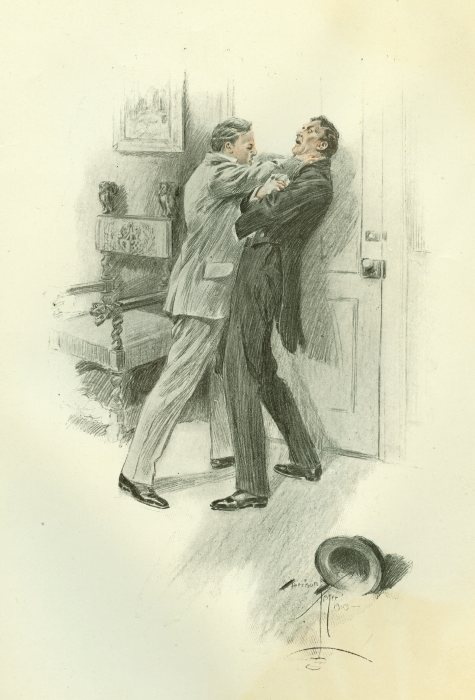
at the top of his speed; Raridan sprang in front of the horse and
grabbed at the throat-latch of its bridle. The horse, surprised, and
terrified by the noise, and feeling the rider digging his heels into his
sides, reared, carrying Warry off his feet.
"Let go, you fool," screamed the rider. "Let go, I say!"
"Let him alone," cried Wheaton, now close at hand; but Raridan still
held to the strap at the throat of the plunging horse.
The rider sat up straight on his horse and his revolver barked into the
night twice in sharp succession, the sounds crashing against the house,
and the flashes lighting up the struggling horse and rider, and Raridan,
clutching at the bridle. Raridan's hold loosened at the first shot, and
as the second echoed into the night, the horse leaped free, running
madly down the road, past Bishop Delafield, who was coming rapidly
toward the house. Wheaton and Saxton met in the driveway where Raridan
had fallen. The flying horse could be heard pounding down the hard road.
"Warry, Warry!" called Saxton, on his knees by his friend. "Hold the
lantern," he said to Wheaton. "He's hurt." Raridan said nothing, but lay
very still, moaning.
"Who's hurt?" asked the bishop coming up. Saxton had recovered his own
lantern as he ran from the house. It was still burning and Wheaton
turned up the wick. The three men bent over Raridan, who lay as he had fallen.
"We must get him inside," said Saxton. "The horse knocked him down."
The bishop bent over and put his arms under Raridan; and gathering him
up as if the prone man had been a child, he carried him slowly toward
the house. Wheaton started ahead with the lantern, but Saxton snatched
it from him and ran through the doors into the hall, and back to the dining-room.
"Come in here," he called, and the old bishop followed, bearing Raridan
carefully in his great arms. The others helped him to place his burden
on the long table at which, in Poindexter's day, many light-hearted
companies had gathered. They peered down upon him in the lantern light.
"We must get a doctor quick," said Saxton, half turning to go.
"He's badly hurt," said the old man. There was a dark stain on his coat
where Raridan had lain against him. He tore open Raridan's shirt and
thrust his hand underneath; and when he drew it out, shaking his gray
head, it had touched something wet. Wheaton came with a pail of water,
pumped by the windmill into a trough at the rear of the house. He had
broken the thin ice with his hands.
"Go for a doctor," said the bishop, very quietly, nodding to Saxton;
"and go fast."
Wheaton followed Saxton to the hall, where they cut loose the remaining
horse. Saxton flung himself upon it, and the animal sprang into a gallop
at the door. Wheaton watched the horse and rider disappear through the
starlight; he wished that he could go with Saxton. He turned back with
sick terror to the room where Raridan lay white and still; but Wheaton
was as white as he.
The bishop had rolled his overcoat into a support for Warry's head, and
with a wet handkerchief laved his temples. Wheaton stood watching him,
silent, and anxious to serve, but with his powers of initiative frozen in him.
"Get the flask from his pocket," said the old man; and Wheaton drew near
the table, and with a shudder thrust his hand into the pocket of Raridan's coat.
"Shall I pour some?" he asked. Raridan had moved his arms slightly and
groaned as Wheaton bent close to him. Wheaton detached the cup from the
bottom of the flask and poured some of the brandy into it. The bishop,
motioning him to stand ready with it, raised Raridan gently, and
together they pressed the silver cup to his lips.
"That will do. I think he swallowed a little," said the bishop. "Bring
wood, if you can," he said, "and make a fire here." Raridan's head was
growing hot under his touch, and he continued to lave it gently with the
wet handkerchief. There was a shed at the back of the house where wood
had been kept in the old days of the Poindexter ascendancy, and Wheaton,
glad of an excuse to get away from the prostrate figure on the long
table, went stumbling through the hall to find this place. There was a
terrible silence in the old house,—a silence that filled all the world,
a silence that could not be broken, it seemed to him, save by some new
thing of dread. There beyond the prairie, day would break soon in the
town where he had striven and failed,—not the failure that proceeds
from lack of opportunity or ability to gain the successes which men
value most, but the failure of a man in self-mastery and courage.
He felt his soul shrivel in the few seconds that he stood at the door
looking across the windy plain,—like a dreamer who turns from his
dreams and welcomes the morning with the hope that his dream may not
prove true. He drew the doors together and turned to go on his errand,
lighting a match to get his bearings, when a sound on the stairway
startled him; there was a figure there—the wan, frightened face of
Grant Porter looked down at him. He had forgotten the boy, whom Saxton
had left in the hall above. Grant shrank back on the stairs, not
recognizing him. It seemed to Wheaton that there was something of
loathing in the boy's movement, and that always afterward people would shrink from him.
"Is that you, Grant?" he asked. The boy did not answer. "It's all right,
Grant," he added, trying to throw some kindness into his voice. "You'd
better stay upstairs, until—we're ready to go."
The boy turned and stole back up the stairway, and Wheaton, encouraged
by the sound of his own voice, brought wood and kindled it with some
straw in the dining-room fireplace.
"Let us try the brandy again," said the bishop. Again Wheaton poured it,
and they forced a little between the lips of the stricken man. Raridan's
face, as Wheaton touched it with his fingers, was warm; he had expected
to find it cold; he had a feeling that the man lying there must be dead.
If only help would come, Raridan might live! He would accept everything
else, but to be a murderer—to have lured a man to his doom! The bishop
did not speak to him save now and then a word in a low tone, to call
attention to some change in Raridan, or to ask help in moving him. The
dry wood burned brightly in the fireplace and lighted the room. The
bishop asked the time.
"He could hardly go and come in less than two hours," said Wheaton. He lifted his head.
"They are coming now." The short patter of pony hoofs was heard and he
went into the hall to open the doors. Two horsemen were just turning
into the corral. Saxton had found the one doctor of the village at
home,—a young man trained in an eastern hospital but already used to
long, rough rides over the prairies. The two men threw themselves to the
ground, and let their ponies run loose. Saxton did not speak to Wheaton,
who followed him and the doctor into the house.
"Has he been conscious at all?" asked the doctor.
The bishop shook his head. The doctor was already busy with his
examination, and the three men stood and watched him silently. Saxton
stepped forward and helped, when there was need, to turn the wounded
man and to strip away his clothing. The skilled fingers of the surgeon
worked swiftly, producing shining instruments and sponges as he needed
them, from the blue lining of his pea-jacket. Suddenly he paused and
bent down close to the stricken man's heart. He poured more brandy into
the silver cup and Saxton lifted Warry while the liquor was forced
between his lips. The doctor stood up then and put his finger on
Raridan's wrist. He had not spoken and his face was very grave. Saxton touched his arm.
"Is there nothing more you can do now?" The doctor shook his head, but
bent again over Raridan, who gave a deep sigh and opened his eyes.
"John," he said in a whisper as he closed them again wearily. The doctor
put Warry's hand down gently, and the others, at a glance from him, drew nearer.
"John," he repeated. His voice was stronger. The white light of dawn was
struggling now against the flame of the fireplace. John stood on one
side of the table, the doctor on the other. The old bishop's tall figure
rose majestically by the head of the dying man. Wheaton alone hung
aloof, but his eyes were riveted on Warry Raridan's face.
"It was another—another of my foolish chances," said Warry faintly and
slowly, the words coming hard; but all in the room could hear. He looked
from one to another, and seemed to know who the doctor was and why he was there.
"The boy's safe and well. We got what we came for. Just once—just
once,—I got what I came for. It wasn't fair—in the dark that way—"
His voice failed and the doctor gave him more brandy. He lay very still
for several minutes, with his eyes closed, while the three men stood as
they had been, save that the surgeon now kept his finger on Warry's wrist.
"I never—quite arrived—quite—arrived," he went on, with his eyes on
the old bishop, as if this were something that he would understand; "but
you must forgive all that." He smiled in a patient, tired way.
"You have been a good man, Warry, there's nothing that can trouble you."
"I was really doing better, wasn't I, John?" he went on, still smiling.
"You had helped,—you two,"—he looked from his young friend to the
older one, with the intentness of his near-sighted gaze. "Tell
them"—his eyes closed and his voice sank until it was almost
inaudible,—"tell them at the hill—Evelyn—the light of all—of
all—the year."
The doctor had put down Warry's wrist and turned away. The dawn-wind
sweeping across the prairie shook the windows in the room and moaned far
away in the lonely house. The bishop's great hand rested gently on the
dying man's head; his voice rose in supplication,—the words coming
slowly, as if he remembered them from a far-off time:
Unto God's gracious mercy and protection we commit thee. Saxton
dropped to his knees, and a sob broke from him. The Lord bless thee,
and keep thee. The Lord make his face to shine upon thee, and be
gracious unto thee. The old man's voice was very low, and sank to a
whisper. The Lord lift up his countenance upon thee and give thee
peace, both now and evermore.
No one moved until the doctor put his head down to Warry's heart to
listen. Then Wheaton watched him with fascinated eyes as he gathered up
his instruments, which shone cold and bright in the gray light of the morning.