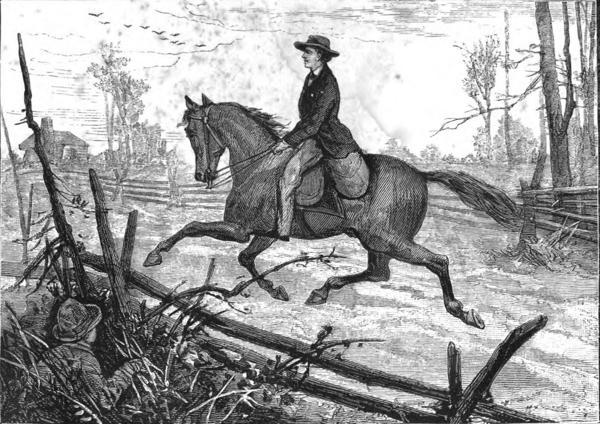
THE horseman came in sight a moment later, and
Dan looked at him in the greatest amazement.
It was his brother David; but what a change had
come over him since Dan last saw him at the cabin!
If he was always dressed as he was now, the people
in the settlement could no longer speak of him as
“that ragamuffin, Dave Evans.” He wore a new
suit of gray jeans, a pair of serviceable boots without
a hole in them, and—which Dan did not fail to
notice—were neatly blacked, a wide-brimmed felt
hat, and, more wonderful than all, a collar and necktie.
He was mounted on a high-stepping colt which
Dan had often seen running in General Gordon’s
stable-lot, had a saddle and bridle that looked as
though they might just have come out of the store;
and, strapped to the saddle was a mail-bag which
Dan had seen so often that he recognised it at once.
David passed swiftly along the road and was out of
sight in a few seconds, but Dan had plenty of time
to take in all these little details, and to note that his
brother’s face wore a happy, contented look, as if he
felt at peace with himself and all the world. Dan
contrasted his situation with his own, and grew angry
at once.
“Wal,” said he, as soon as he had recovered from
his astonishment, “if that thar little Dave of our’n
hain’t got to be a mail carrier! I done heared that
the ole one was agoin’ to quit, but who’d a thought
that one of our tribe would a stepped into his boots?
Boots, mind ye; an’ them’s something me an’ Dave
never owned afore. He must be makin’ stacks of
greenbacks, as much as ten or twelve dollars a month,
mebbe,” added Dan, laying down his rifle and leaning
half way over the fence to take another view of
the boy who was lucky enough to be earning money
so rapidly. “Now, I’ll jest tell ye what’s the gospel
truth: things must be lookin’ up to hum right peart
when thar’s that much comin’ in.”
Dan forgot that he was hungry, and did not give
another thought to the hen-roost he had made up
his mind to rob that night. He went back into the
woods and wandered aimlessly about, paying no heed
to the direction he was taking, and was presently
aroused from his reverie by the sound of an axe.
He looked up and was surprised and a little alarmed
to find that he was in the neighborhood of his home.
The potato cellar, which had once served as a prison
for Don Gordon, was close in front of him, and
through the tall trees, which the autumnal winds
had already stripped bare of leaves, he could see the
cabin.
Dan was about to turn away and plunge into the
woods again, when, he noticed that there was some
one at work in the yard behind the house. He was
sure that it could not be his brother, for David had
not yet had time to go to the landing and deliver
his mail. It could not be his father either, for Godfrey
was hiding in the woods as well as himself; and
besides, the man who was at work in the yard wore
a white shirt—Dan could see it plainly through the
trees—and that was something Godfrey had not
owned for long years. But Dan wanted to see who
it was, so he crept nearer to the fence, and when he
obtained a fair view of the workman he almost let
his rifle fall out of his hands in his astonishment.
It was his father after all; but Dan could hardly
bring himself to believe it until he had rubbed his
eyes two or three times and taken as many good
looks at him. Godfrey was dressed like a gentleman.
There was not a hole to be seen in any of
his garments, his hair and whiskers were neatly
combed, he wore a hat with a brim to it on his head,
boots instead of shoes on his feet, and, what surprised
Dan more than anything else, his sleeves were
rolled up and he was walking into the wood-pile as
if he were in earnest. Two or three times while the
boy was looking at him he stopped, took off his hat
and wiped the perspiration from his forehead.
“Wal, of all the things I ever heared tell on this
yere is the beatenest,” thought Dan, as soon as his
mind had become settled so that he could think at
all. “Looks like pap in the face, but don’t act like
I ever seed him act afore.”
Dan took another good look at his father and
asked himself what in the world could have happened
to bring him home and set him to work; and
while he was revolving the problem in his mind he
ran his eye about the premises and saw that sundry
little improvements had been made during his absence.
The little log structure which was called
the corn-crib, although Dan had never seen any
corn in it, had been thoroughly repaired, and the
golden ears protruded from every crack between the
slats, showing that it was well filled. The miserable
apology for a stable which sheltered the only
mule Godfrey owned had been newly covered; a
little shed had been erected against the rear wall of
the cabin and was filled to the roof with dry fire-wood;
the holes in the house had been freshly
chinked; the rags had disappeared from the windows,
their places being supplied with new lights of
glass; the chips and other rubbish that had for so
many years been accumulating in the back yard had
been cleared away; and in short, the place looked,
as Godfrey would have expressed it, as though white
folks lived there. The change was so great that
Dan could hardly argue himself into the belief that
it was his old home; and when his mother came
down the road, as she did a few minutes later, he
became fully convinced that he was either dreaming
or else that his eyes and ears had entered into a conspiracy
to deceive him. As soon as Godfrey saw
his wife coming he jumped over the fence and took
the heavy basket she was carrying out of her hand.
“Why, Godfrey, how nice things begin to look,”
exclaimed Mrs. Evans, and Dan could not remember
when he had seen her smile before.
“Don’t they, though,” replied Godfrey. “I tell
ye, Susie, I haint felt so peart since the good ole days
when we had niggers to do our work for us. It’s a
heap of comfort to know that yer a trifle forehanded,
aint it? The critters is well provided with shelter
an’ corn; thar’s taters enough in the cellar an’ bacon
enough in the smoke-house to run us till I kin
’arn some more; the shed is full of fire-wood; an’
now it kin blow an’ snow an’ freeze jest as soon as
it dog-gone pleases!”
Godfrey and his wife went into the cabin, and
Dan turned about and crept back into the woods.
“Things is a lookin’ up to hum right peart,” said
he, to himself, as he sat down on a log to think over
what had just transpired. “Pap’s got a pair of
store boots; Dave’s mail carrier; mam looks like a
lady; thar’s glass windows to the house, an’ here’s
me—jest look at me!” added Dan, glancing down
at his ragged clothes. “Now I’ll tell ye what’s the
gospel truth: Pap’s the feller that crept up an’
stole them greenbacks while I was out shootin’ that
squirrel,” continued Dan, who just then forgot the
conclusions at which he had arrived when he found
the print of the boot-heel in the soft earth. “He
was afeared to spend the money, so he brings it back
to Dave, makes up with him an’ the ole woman,
an’ everything goes as slick as ’lasses, an’ nobody
don’t care no more for me nor if I wasn’t Dan at
all.”
There are boys, and men, too, in the world who
can not bear to see other people happy, and we are
by this time well enough acquainted with Dan to
know that he was one of this class. He was not
happy—he could not be with his disposition—and
it would have afforded him infinite satisfaction if he
could have found some way to render his relations,
who now seemed to be getting on so nicely in the
world, as miserable as he was himself. It hurt him
to know that they could enjoy themselves while he
was away from home. Why didn’t they come out
into the woods and search for him, and when they
found him take him to the cabin, put good clothes
on him and act as though they were glad to see
him? “That’s what they had oughter do,” exclaimed
Dan, “an’ to pay ’em for not doin’ it I just
wish I had them hundred and sixty dollars now. I’d
like to see Dave get ’em again.”
Dan scraped a few dry leaves together under the
lee of the log, and went supperless to bed that night.
He lay almost within a stone’s throw of the cabin,
and could hear the door slam every time any one
passed in or out. He fell asleep just before daylight,
and when he awoke he started up in great
confusion, for he saw his brother sitting on a log
near him. Dan was not more surprised to find him
there than he was to notice that he had on another
suit of clothes and a pair of warm mittens. David
must be getting rich.
“Dan, you don’t know how glad I am to see you
again,” said David, as soon as his brother was fairly
awake. “Where in the world have you kept yourself?
Father and I have been in the woods every
day looking for you, but could find no traces of
you.”
This announcement arrested the angry words that
arose to Dan’s lips. He must have been missed at
home, or else his father and brother would not have
spent time in looking for him.
“You shake as though you were half frozen,”
continued David, glancing at his brother’s blue cold
hands and face. “Get up and come into the house
with me. There’s a good fire there.”
“Wal, I dunno,” replied Dan, sitting up on his
bed of leaves, and speaking as plainly as his chattering
teeth would permit. “Mebbe I ain’t wanted
thar.”
“Why, yes, you are, What put that notion into
your head?”
“Ye heared me tell pap whar yer money was, I
reckon, didn’t ye?”
“Of course I did; but I don’t bear you any ill
will for that.”
“Nor mam, nuther?”
“No, nor mother, either. I wish I had never
earned the money, for it has made us a world of
trouble. But, we’ve, begun all over again, and are
going to do better, all of us. Come on, now, Dan;
mother wants to see you, and so does father.”
But Dan didn’t know whether to come on or not.
He felt that he had forfeited all right to his home,
and that he would be justly punished if he were
never permitted to cross the threshold again. But,
he was cold, hungry, and utterly discouraged; and,
after David had argued with him a few minutes
longer, he allowed him to lift him to his feet and lead
him toward the cabin. He hesitated at the door, but
David pushed him in, and Dan was not a little
astonished at the reception that was extended to him.
His mother kissed him and cried over him, his father
wrung his hand until Dan was almost ready to cry
himself, and then he was placed in a chair in the
warmest corner. As soon as he could handle a knife
and fork, a plate filled with the most substantial
breakfast he had ever eaten under that roof was
passed over to him, and Dan did ample justice to it.
He was left pretty nearly to himself, for the family,
knowing what his feelings must be, did not trouble
him with any questions. He sat in his chair—it was
a chair, too, he noticed, and not a nail-keg with a
board placed over the top of it—with his head hanging
down and his chin resting on his breast; but his
eyes were roving everywhere, and they found much
to excite his wonder. The cabin had been furnished
with a new table and a few chairs during his absence;
two comfortable beds had taken the places of the
miserable “shake-downs;” the cracked and broken
dishes had given way to new ones, and everything
was as neat as it could be kept. Dan felt out of
place there.
When Godfrey and David had finished their breakfast
they sat down in front of the fire to whet their
axes, after which the former, with the remark that
they had a hundred cords of wood to cut for General
Gordon, bade his wife and Dan good-bye, and the
two left the cabin. Dan felt much more at his ease
after they were gone. The nice, warm breakfast he
had eaten, and the thorough thawing-out he had undergone,
brought his spirits back to him again, and
he began to make some inquiries in regard to several
little matters that had aroused his curiosity.
“Say, mam,” said he, “what brung pap hum?”
“The general was the cause of his coming home,”
replied Mrs. Evans. “He found your father in the
woods, and talked to him in such a way that he
promised to come back and turn over a new leaf;
and I am glad to say that he has done it.”
There was one thing Mrs. Evans did not tell Dan,
(probably she was not acquainted with the fact herself),
and that was, that if Godfrey had not taken
his old commander’s advice, and returned to his
home and gone to work in earnest to support his
family, he would have been in jail before another
day had passed over his head. Godfrey himself did
not know this, for the general had made no threats.
He had gained his point by argument.
“How come Dave carryin’ the mail?” asked Dan.
“The general has the contract, and he hires David
to do the work,” was the answer.
“He must be makin’ a pile of money, I reckon,
aint he?”
“Thirty dollars a month.”
Dan opened his eyes in great surprise. “How
much’ll that be in a year?” he asked.
“Three hundred and sixty dollars.”
“Whew! We’re gittin’ rich, aint we, mam?”
“O, no! There’s not a cent coming into the family
except what your father and David earn by their
daily labor. David is heavily in debt.”
“How came us by all these yere nice things
then?”
“Well, David had just fifty dollars in money.
Ten dollars of it he earned by breaking Don Gordon’s
pointer, and the rest he received from Silas
Jones for two young bears that were caught in that
trap on Bruin’s Island. Some of the money was
used to pay our grocery bill, and the rest was spent
on the house. David owes the general a hundred
dollars for that colt he rides, and he is worth every
cent of two hundred.”
“Wal now, mam,” said Dan, with some hesitation,
“that ain’t all the money we’uns have got. Whar’s
them greenbacks Dave got fur ketchin’ them quails?”
“Why, didn’t you cut your father’s pocket open
and take the box?” asked Mrs. Evans, while an expression
that Dan could not understand settled on
her face.
“I did, an’ sarved him right, too, fur tryin’ to
cheat me outen my share that he promised, honor
bright, to give me!” exclaimed Dan. “Didn’t he
give it back to Dave?”
“He certainly did not.”
“Wal, I don’t know whar it is, more’n the man in
the moon.”
Mrs. Evans’ face grew a shade paler, and, after
looking steadily at Dan for a few seconds, she leaned
back in her chair and covered her eyes with her
hand. Here was another disappointment in store
for the young mail carrier. He and his parents had
been indulging in the hope that, when Dan returned
to his home, the money for which Dave had worked
so hard would be restored to him. Dan thought, by
the way his mother looked at him, that she did not
believe his story, so he hastened to assure her that
he told nothing but the truth, following it up with a
minute account of the manner in which the thief—whoever
he was—had operated to secure possession
of the box. His mother was satisfied that he stated
the facts as they occurred, and there the matter was
dropped.
David learned of the loss of his money when he
came home that night, and although it was a severe
blow to him he bore up under it, rode his mail route
regularly twice a week and spent the other four days
in helping his father cut General Gordon’s wood.
Dan loitered about the house doing nothing, and
finally began to act a little more like himself. The
feeling that he had lost all his rights to a home under
his father’s roof gradually gave away to the
opinion that he was of vastly more importance than
anybody else. One day he said to his mother—
“Now, mam, I’ve waited just long enough for
’em. I don’t want to be treated this yere way no
longer. Ye hear me?”
“You have waited long enough for what?” asked
his mother.
“Fur my good clothes an’ a pair of store boots
like Dave an’ pap have got.”
“You can have them just as soon as you earn
them.”
“’Arn ’em!”
“Certainly. That is the way your father and
David got theirs.”
“An’ how long did it take ’em?” asked Dan, who
was not a little shocked and enraged to learn that
he must work for his nice things before he could own
them.
“About a week. You ought to earn a dollar a
day by cutting wood, and the general will give you
all the work you can do.”
“An’ while I am workin’ down thar must I wear
these yere rags?” exclaimed Dan. “I’d look purty
if Don an’ Bert should come along on them circus
hosses of their’n, an’ wearin’ their shiny boots an’
nice clothes, wouldn’t I? No, sir! I must have
something better fust. I’ll speak to Dave about it
jest as soon as he comes home to-night.”
“Why, David can’t help you,” replied his
mother. “He has to work hard for everything he
wears.”
“Can’t help me?” yelled Dan, “an’ him ’arnin’
a’most four hundred dollars a year! Ye don’t think
no more of me in this house nor if I was a yaller
dog. His credit is good at the store fur six months,
kase I done heared Silas tell him so.”
But Dan didn’t speak to David about it, for his
father spoke to him. When Godfrey came home
that night he carried on his shoulder two axes, one
of which looked as though it had just come out of
the store. He put his own axe in the corner where
it was usually kept, and with the new one in his
hand he approached Dan’s chair. “Thar, sonny,”
said he, cheerfully, “see what a nice present I brung
ye. It’s the fust one I’ve give ye in a long time,
aint it? Take hold on it. ’Twon’t hurt ye.”
“What shall I do with it, pap?” asked the boy,
as he took the axe in both hands, holding it as awkwardly
as though he had never touched one before.
“Wal, Dannie, I’ll tell ye,” replied Godfrey,
placing his hand on his son’s shoulder and speaking
in a confidential tone. “When the gen’ral found
me loafin’ about in the woods like a lazy wagabone
as I was, he says to me: ‘Godfrey,’ says he, ‘this
is the principle we go on up to our house: them
as don’t work can’t eat!’ I’ve thought of them
words a heap of times since I come home, an’ I
made up my mind that if rich folks do that way,
poor folks had oughter, too. Now, I notus that
yer amazin’ willin’ to set here in this yere
cheer an’ warm yourself by the fire that Dave makes
up every mornin’, an’ yer scandalous fond of drinkin’
the store-tea an’ coffee made outen the water that
he brings from the spring; but I never seed ye cut
no wood yerself nor tote no water. Now, sich doin’s
as them won’t work in this yere house no longer.
Ye’ve had a powerful long rest, an’ to-morrer mornin’
I want to see that thar new axe sharper’n a
razor, so’t ye kin go with me an’ Dave to chop wood
up to the gen’ral’s.”
Dan listened to this speech in silence, and could
not muster up courage enough to make an impertinent
reply, as he certainly would have done if his
father had talked to him in this way a month before.
But his father had never before talked to him in
this way. If he had yelled and flourished his fists
and jumped up and knocked his heels together, Dan
would have met him half way; but he could not understand
this quiet, earnest manner that Godfrey
seemed to have fallen into of late. He didn’t like
it either, for he was sure that it meant business.
At any rate, the axe was sharpened that night with
David’s assistance, and at daylight the next morning
Dan might have been seen in company with his
father and David wending his way toward the general’s
wood lot.
Order having been rëestablished under Godfrey’s
humble roof, and the Evans family being once more
on the road to prosperity, the little settlement of
Rochdale, which had been stirred from centre to circumference
by the incidents, exciting and amusing,
that we have attempted to describe in this series of
books, once more fell back into its old habits, and
peace and quietness reigned. The settlers, like so
many hibernating animals, seemed to have crawled
into their holes for their winter’s sleep, and only
showed themselves to the world on mail-days, or when
five long whistles announced that some steamer was
about to touch at the landing. On these occasions
it was remarked that two persons, who had never
been known to miss a boat or a mail-day, no matter
what the weather might be, were never seen at the
landing now. They were Godfrey Evans and Dan.
The latter, at first, would have been glad to resume
his lazy habits, but his father kept him steadily at
work, and at the end of the first week presented
him with the money he had earned. This was a
great encouragement to Dan, and from that time forward
work was not quite so distasteful to him. Dan
doesn’t hunt as much now as he did a few months
ago, and neither does he own a breech-loading shot-gun;
but he is a thrifty, hard-working boy, and has
placed a very nice little sum of money in Don Gordon’s
hands for safe-keeping, besides refunding that
ten dollars, the loss of which had occasioned David
so much trouble and anxiety.
As for Godfrey, there was no sham about his
reformation. He went to work in earnest to make
amends for the long years he had spent in idleness,
and, in order that he might begin right, he told the
general the story of that highway robbery, and
handed over to him the first twenty dollars he could
save out of his earnings, with the request that it
might be forwarded to Clarence Gordon’s father.
Then he breathed easier. He felt as if a mountain
had been removed from his shoulders.
Don and Bert Gordon kept on the even tenor of
their way, and, having seen David established as
mail carrier, set to work, with the assistance of Fred
and Joe Packard, to build another shooting-box on
the site of the one that was burned by Lester Brigham
and Bob Owens. They knew now that it was
not Godfrey Evans who set fire to it, for their father
told them so: but he did not tell them who the guilty
ones were, and they never tried to find out. The
new shooting-box was finished in a week’s time, and,
as Don had predicted, it threw the old one far into
the shade. Lester Brigham went over there one
night to look at it, but he left it just as he found it.
Lester was not the boy he was once. He was as
much alone in the world as though there had not
been another youth of his age within a hundred
miles of him. How he passed his time no one knew
or cared to ask. He often thought of his old friend,
Bob Owens, and wondered what had become of him.
Of course everybody knew that he had run away
from home, but no one dreamed that he took David’s
money with him when he went. The general impression
seemed to be that Godfrey and Dan could
produce it at any moment, if they saw fit to do so.
David faithfully fulfilled the duties of mail carrier
during the winter, and at the end of six months he
was all out of debt, and had a nice little sum of
money laid by for a rainy day. One morning he
rode down to the post-office after the mail that was
to be carried to the county-seat, and Silas Jones
handed him the following note, which he read as he
galloped along:
“Friend David:
It may surprise you to know that father has just
turned over to me the hundred dollars you paid him
for that colt, and that I hold it subject to your order.
Father intended to return it to you all the time, and
to make you a present of the horse; but he didn’t
let anybody know it, for he wanted you to believe
that you had got to work for your nag before you
could own him. He doesn’t want you to get into
the way of leaning upon any one, or of thinking
that you will always have a friend to lend you a
hand when you get into a tight place. You have
shown him that you are able and willing to take care
of yourself, and so he wants to help you.
Yours,
Don Gordon.”
It was, indeed, a surprise to David. He was just
a hundred dollars richer than he thought he was.
During his ride he could think of nothing but the
general’s kindness, and he made the mental resolution
that he would prove himself worthy of it. When
he returned to the landing that afternoon, he waited
until Silas had distributed the mail, in order to purchase
some groceries for his mother, and found that
there was another surprise in store for him. When
the postmaster gave him the general’s mail, which
David always carried home now, he gave him also a
letter addressed to himself. He did not recognise
the handwriting, so he did as a good many people do
when they receive letters from an unknown source:
he looked at the envelope, and tried to guess whom
it was from. Then he put the general’s mail into
his pocket, took his purchases under his arm, mounted
his horse, and having started him toward home
pulled out the letter again and tore off the envelope.
The first thing that caught his eye was a check for
fifty dollars.
“There!” exclaimed the young mail carrier, “I’ve
opened a letter intended for somebody else; but if
there’s another Dave Evans about here, I don’t know
him.”
David looked at the check again, then at the signature
at the bottom of the letter. It was from Bob
Owens, and read as follows:
“No doubt you will be surprised when you receive
this, for I don’t suppose that you or anybody else in
Rochdale ever expected to hear from me again. I
owe you a hundred and sixty dollars and fifty
cents, and hand you herewith a check for fifty of it.
It is the first money I ever earned in my life. I
should have been glad to send it before, but this is
the first I have received. I am a private soldier in
the regular army. My pay is small, and out of it I
have to buy everything I wear, so my savings do not
amount to any great sum. You probably know by
this time how I came into possession of the money.
I followed Dan to his camp, saw him hide the box
under a log, and go out to shoot a squirrel for his
breakfast. When he was out of sight I slipped up
and took the box, and ran away from home to spend
the money. I have never regretted the act but once,
and that has been every moment I have lived since I
left Mississippi. I hope you have not suffered for
want of the money. Have all the patience with me
you can, and I will send you the rest just as soon
as I can earn it.”
Then followed a postscript requesting David to
acknowledge the receipt of the money, and telling
him where to send his letter. It also contained the
information that Bob had just written a letter to his
father (he said he knew he did wrong in keeping
him in suspense so long, but he could not find it in
his heart to write to him until he could tell him that
he had taken the first step toward making amends
for some of his misdeeds), and, for fear that the
letter might miscarry, he (Bob) would be glad if
David would see Mr. Owens, and give him his son’s
address.
“That clears Dan, and father, too,” said David,
as soon as he had found his tongue. “I didn’t want
to think hard of them while they are trying their
best to do what is right, but somehow I couldn’t
help feeling that that money was hidden in the
woods, and that it would some day be brought out
for the benefit of somebody besides mother and myself.
Am I not the luckiest fellow in the world?
Whatever else Bob Owens may be now, he is an
honest boy.”
This was the opinion of everybody who heard of
this act of reparation on the part of the runaway.
It made him more popular in the settlement than he
had ever been while he was at home. People now
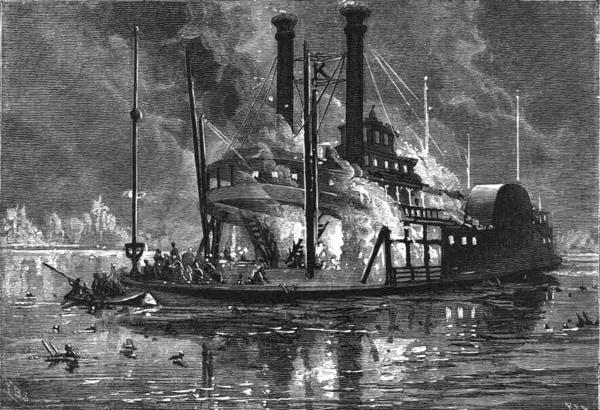
remembered of reading in the newspapers a long account
of the coolness and courage he had exhibited
on the night the Sam Kendall was burned; and
some of those who had had the most to say about
Bob, when he first ran away, now began to see that
there were some good things in him, and predicted
that he would come out all right in the end. Bob
is in the army now. He is on the plains, among
the Indians, right where he wanted to be; but he
would be glad, indeed, if he were a long way from
there. The only thing that prevented him from
being with General Custer, when that gallant soldier
and his command were massacred by Sitting Bull
and his warriors, was the receipt of an order, that
very morning, detailing him as one of the guard of a
wagon-train. Bob doesn’t think as much of that
wild country as he did once. His feelings have undergone
a very great change since the day he stole
the money belonging to the Mail Carrier.
No author of the present day has become a greater favorite
with boys than “Harry Castlemon,” every book by him is sure
to meet with hearty reception by young readers generally. His
naturalness and vivacity leads his readers from page to page
with breathless interest, and when one volume is finished the
fascinated reader, like Oliver Twist, asks “for more.”
GUNBOAT SERIES. By Harry Castlemon. In
box containing the following. 6 vols. 16mo. Cloth,
extra, black and gold $7 50
(Sold separately.)
Frank the Young Naturalist. Illustrated. 16mo. 1 25
Frank in the Woods. Illustrated. 16mo. 1 25
Frank on the Prairie. Illustrated. 16mo. 1 25
Frank on a Gunboat. Illustrated. 16mo. 1 25
Frank before Vicksburg. Illustrated. 16mo. 1 25
Frank on the Lower Mississippi. Illustrated.
16mo. 1 25
GO AHEAD SERIES. By Harry Castlemon. In
box containing the following. 3 vols. 16mo. Cloth,
extra, black and gold 4 50
(Sold separately.)
Go Ahead; or, The Fisher Boy’s Motto. Illustrated.
16mo. $1 50
No Moss; or, The Career of a Rolling Stone. Illustrated.
16mo. 1 50
Tom Newcombe; or, The Boy of Bad Habits.
Illustrated. 16mo. 1 50
ROCKY MOUNTAIN SERIES. By Harry
Castlemon. In box containing the following. 3 vols.
16mo. Cloth, extra, black and gold 3 75
(Sold separately.)
Frank at Don Carlos’ Rancho. Illustrated. 16mo. 1 25
Frank among the Rancheros. Illustrated. 16mo. 1 25
Frank in the Mountains. Illustrated. 16mo. 1 25
SPORTSMAN’S CLUB SERIES. By Harry
Castlemon. In box containing the following. 3 vols.
16mo. Cloth, extra, black and gold 3 75
(Sold separately.)
The Sportsman’s Club in the Saddle. Illustrated.
16mo. Cloth, extra, black and gold 1 25
The Sportsman’s Club Afloat. Being the 2d volume
of the “Sportsman’s Club Series.” Illustrated.
16mo. Cloth, extra, black and gold 1 25
The Sportsman’s Club among the Trappers.
Being the 3d volume of the “Sportsman’s Club
Series.” Illustrated. 16mo. Cloth, extra, black and
gold 1 25
FRANK NELSON SERIES. By Harry Castlemon.
In box containing the following. 3 vols. 16mo.
Cloth, extra, black and gold 3 75
(Sold separately.)
Snowed up; or, The Sportsman’s Club in the
Mountains. Illustrated. 16mo. 1 25
Frank Nelson in the Forecastle; or, the Sportsman’s
Club among the Whalers. Illustrated. 16mo. 1 25
The Boy Traders; or, The Sportsman’s Club among
the Boers. Illustrated. 16mo. 1 25
BOY TRAPPER SERIES. By Harry Castlemon.
In box containing the following. 3 vols. 16mo.
Cloth, extra, black and gold $3 75
(Sold separately.)
The Buried Treasure; or, Old Jordan’s “Haunt.”
Being the 1st volume of the “Boy Trapper Series.”
Illustrated. 16mo. 1 25
The Boy Trapper; or, How Dave filled the Order.
Being the 2d volume of the “Boy Trapper Series.”
Illustrated. 16mo. 1 25
The Mail Carrier. Being the 3d and concluding volume
of the “Boy Trapper Series.” Illustrated. 16mo. 1 25
ROUGHING IT SERIES. By Harry Castlemon.
In box containing the following. 3 vols. Cloth,
extra, black and gold 3 75
(Sold separately.)
George in Camp; or, Life on the Plains. Being the
1st volume of the “Roughing It Series.” Illustrated.
16mo. 1 25
George at the Wheel; or, Life in a Pilot-House.
Being the 2d volume of the “Roughing It Series.”
Illustrated. 16mo. 1 25
George at the Fort; or, Life Among the Soldiers.
Being the 3d and concluding volume of the “Roughing
It Series.” Illustrated. 16mo. 1 25
ROD AND GUN SERIES. By Harry Castlemon.
In box containing the following. 3 vols. Cloth,
extra, black and gold 3 75
(Sold separately).
Don Gordon’s Shooting-Box. Being the 1st volume
of the “Rod and Gun Series.” Illustrated.
16mo. 1 25
Rod and Gun. Being the second volume of the
“Rod and Gun Series.” Illustrated. 16mo. 1 25
The Young Wild Flowers. Being the third volume
of the “Rod and Gun Series.” Illustrated. 16mo. 1 25
Horatio Alger, Jr., has attained distinction as one of the most
popular writers of books for boys, and the following list comprises
all of his best books.
RAGGED DICK SERIES. By Horatio Alger,
Jr., in box containing the following. 6 vols. 16mo.
Cloth, extra, black and gold $7 50
(Sold separately.)
Ragged Dick; or, Street Life in New York. Illustrated.
16mo. 1 25
Fame and Fortune; or, The Progress of Richard
Hunter. Illustrated. 16mo. 1 25
Mark the Match Boy; or, Richard Hunter’s Ward.
Illustrated. 16mo. 1 25
Rough and Ready; or, Life among the New York
Newsboys. Illustrated. 16mo. 1 25
Ben the Luggage Boy; or, Among the Wharves.
Illustrated. 16mo. 1 25
Rufus and Rose; or, The Fortunes of Rough and
Ready. Illustrated. 16mo. 1 25
TATTERED TOM SERIES. (First Series.)
By Horatio Alger, Jr., in box containing the following.
4 vols. 16mo. Cloth, extra, black and gold 5 00
(Sold separately.)
Tattered Tom; or, The Story of a Street Arab. Illustrated.
16mo. 1 25
Paul the Peddler; or, The Adventures of a Young
Street Merchant. Illustrated. 16mo. 1 25
Phil the Fiddler; or, The Young Street Musician.
Illustrated. 16mo. 1 25
Slow and Sure; or, From the Sidewalk to the Shop.
Illustrated. 16mo. $1 25
TATTERED TOM SERIES. (Second Series.)
In box containing the following. 4 vols. Cloth,
extra, black and gold 5 00
(Sold separately.)
Julius; or, The Street Boy Out West. Illust’d. 16mo. 1 25
The Young Outlaw; or, Adrift in the World. Illustrated.
16mo. 1 25
Sam’s Chance and How He Improved it. Illustrated.
16mo. 1 25
The Telegraph Boy. Illustrated. 16mo. 1 25
LUCK AND PLUCK SERIES. (First Series.)
By Horatio Alger, Jr., in box containing the following.
4 vols. 16mo. Cloth, extra, black and gold 6 00
(Sold separately.)
Luck and Pluck; or, John Oakley’s Inheritance.
Illustrated. 16mo. 1 50
Sink or Swim; or, Harry Raymond’s Resolve. Illustrated.
16mo. 1 50
Strong and Steady; or, Paddle Your Own Canoe.
Illustrated. 16mo. 1 50
Strive and Succeed; or, The Progress of Walter
Conrad. Illustrated. 16mo. 1 50
LUCK AND PLUCK SERIES. (Second
Series.) In box containing the following. 4 vols.
16mo. Cloth, extra, black and gold 6 00
(Sold separately.)
Try and Trust; or, The Story of a Bound Boy. Illustrated.
16mo. 1 50
Bound to Rise; or, How Harry Walton Rose in the
World. Illustrated. 16mo. 1 50
Risen from the Ranks; or, Harry Walton’s Success.
Illustrated. 16mo. 1 50
Herbert Carter’s Legacy; or, The Inventor’s Son.
Illustrated, 16mo. 1 50
BRAVE AND BOLD SERIES. By Horatio
Alger, Jr., in box containing the following. 4 vols.
16mo. Cloth, extra, black and gold $6 00
(Sold separately.)
Brave and Bold; or, The Story of a Factory Boy.
Illustrated. 16mo. 1 50
Jack’s Ward; or, The Boy Guardian. Illustrated.
16mo. 1 50
Shifting for Himself; or, Gilbert Greyson’s Fortunes.
Illustrated. 16mo. 1 50
Wait and Hope; or, Ben Bradford’s Motto. Illustrated.
16mo. 1 50
CAMPAIGN SERIES. By Horatio Alger, Jr., in
box containing the following. 3 vols. 16mo. Cloth,
extra, black and gold 3 75
(Sold separately.)
Frank’s Campaign; or, the Farm and the Camp.
Illustrated. 16mo. 1 25
Paul Prescott’s Charge. Illustrated. 16mo. 1 25
Charlie Codman’s Cruise. Illustrated. 16mo. 1 25
PACIFIC SERIES. By Horatio Alger, Jr. 4 vols.
16mo. Cloth, extra, black and gold 5 00
(Sold separately.)
The Young Adventurer; or, Tom’s Trip Across
the Plains. Illustrated. 16mo. 1 25
The Young Miner; or, Tom Nelson in California.
Illustrated. 16mo. 1 25
The Young Explorer; or, Among the Sierras. Illustrated.
16mo. 1 25
Ben’s Nugget; or, A Boy’s Search for Fortune. A
Story of the Pacific Coast. Illustrated. 16mo. 1 25
The Young Circus Rider; or, The Mystery of
Robert Rudd. Being the 1st volume of the “Atlantic
Series.” Illustrated. 16mo. Cloth, extra, black
and gold 1 25
- Transcriber’s Notes:
- Missing or obscured punctuation was corrected.
- Typographical errors were silently corrected.
- Inconsistent spelling and hyphenation was made consistent only when a predominant
form was found in this book.