The cover image was created by the transcriber and is placed in the public domain.
The Magic of Jewels and Charms
“A Volume of Absorbing Interest.”—N. Y. Sun.
THE CURIOUS LORE OF PRECIOUS STONES
BY GEORGE FREDERICK KUNZ,
A.M., Ph.D., D.Sc.
BEING A DESCRIPTION OF THEIR SENTIMENTS
AND FOLKLORE, SUPERSTITIONS, SYMBOLISM,
MYSTICISM, USE IN PROTECTION, PREVENTION,
RELIGION AND DIVINATION, CRYSTAL GAZING,
BIRTH-STONES, LUCKY STONES AND TALISMANS,
ASTRAL, ZODIACAL, AND PLANETARY
With 86 illustrations in color, doubletone and
line. Octavo. Handsome cloth binding, gilt
top, in a box. $5.00 net. Carriage charges extra.
This work represents the observations and
discoveries during twenty-five years of collecting
on the part of Dr. Kunz, and will be found a
rarely interesting galaxy of anecdote, research,
and information upon a fascinating subject.
J. B. LIPPINCOTT COMPANY
PUBLISHERS PHILADELPHIA
By courtesy of W. Griggs and Sons, Ltd., London.
MODEL OF A HINDU LADY, ILLUSTRATING THE MODE OF WEARING JEWELRY IN NORTH INDIA
From the Journal of Indian Art.
BY
GEORGE FREDERICK KUNZ
A.M., Ph.D., D.Sc.
WITH 90 ILLUSTRATIONS IN COLOR, DOUBLETONE AND LINE
PHILADELPHIA & LONDON
J. B. Lippincott Company
COPYRIGHT, 1915, BY J. B. LIPPINCOTT COMPANY
PRINTED IN UNITED STATES OF AMERICA
To the Memory of
THE LATE
PROFESSOR THOMAS EGLESTON, Ph.D., LL. D.
OFFICIER DE LA LÉGION D’HONNEUR AND FOUNDER
OF THE SCHOOL OF MINES, COLUMBIA UNIVERSITY, AN
ARDENT LOVER OF MINERALS, KEENLY APPRECIATIVE
OF PRECIOUS STONES, AND A KINDLY FRIEND OF THE
AUTHOR, THIS VOLUME IS RESPECTFULLY DEDICATED
Preface
vii
Jewels, gems, stones, superstitions and astrological
lore are all so interwoven in history that to treat of
either of them alone would mean to break the chain of association
linking them one with the other.
Beauty of color or lustre in a stone or some quaint form
attracts the eye of the savage, and his choice of material for
ornament or adornment is also conditioned by the toughness
of some stones as compared with the facility with
which others can be chipped or polished.
Whereas a gem might be prized for its beauty by a single
individual owner, a stone of curious and suggestive form
sometimes claimed the reverence of an entire tribe, since it
was thought to be the abode or the chosen instrument of some
spirit or genius.
Just as the appeal to higher powers for present help in
pressing emergencies preceded the development of a formal
religious faith, so this never-failing need of protectors or
healers eventually led to the attribution of powers of protection
to the spirits of men and women who had led holy lives
and about whose history legend had woven a web of pious
imaginations at a time when poetic fancy reigned instead of
historic record. The writer still holds that true sentiment,
the antithesis of superstitious dread, is good for all mankind—sentiment
meaning optimism as truly as superstition
stands for pessimism—and that even the fancies generated
by sentiment are helpful to us and make us happier; and
surely happiness often means health, and happiness and
health combined aid to evolve that other member of the
triumvirate, wealth. Do we not often wish for the union
of these three supreme blessings?
viiiAt all times and in all periods there have been optimists
and pessimists, the former animated by the life-bringing
sentiment of hope, and the latter oppressed by the death-dealing
sense of fear. Let us always choose a happy medium
between a foolish excess of hope and an unreasonable apprehension
of future troubles. The world’s history and our
own experience show us that it is the optimist who has caused
the world to progress, and we should trust and believe that
the sentiment of hope and faith will always animate
humanity.
We know that for centuries it has been believed that
amber necklaces protect children from cold. May we not
also now add that to pearls the same qualities are attributed?
There must be a reason for this. May not this
belief be ascribed to the circumstance that in the wearing of
either of these gems their virtue consists in the fact that the
necklaces do not cover the neck? In other words, they are
worn on the bare throat and the opinion prevails that an
exposed neck means less liability to cold. For, where the
neck is never overheated and then suddenly chilled, a normal
temperature being maintained, there should be protection
from colds and from the many ills resulting from them. As
to pearls, this might serve to illustrate the poetic fancy that
these sea-gems are tears by angels shed to bring mortals
joy.
Having collected a large mass of material, ethnological,
historical and legendary, in the course of personal observations
and study, it was decided that the companion volume,
the twin sister of “The Curious Lore of Precious Stones,”
need not treat of gems alone.
For courtesies, information and illustrations I am indebted
to the following to whom my sincere thanks are due:
Prof. T. Wada, of Tokyo, Japan; Dr. G. O. Clerc, President
of the Societe Curalienne des Amis des Sciences Naturelles,
ixEkaterineburg, Russia; Dr. Charles Braddock, late Medical
Inspector to the King of Siam; Sir Charles Hercules Reed,
Curator of Archæology, British Museum, London; A. W.
Feavearyear, London; Dr. Peter Jessen, Librarian of the
Kunstegewerbe Museum of Berlin; Miss Belle DaCosta
Green; Dr. Berthold Laufer, Oriental Archæologist, Field
Museum of Natural History, Chicago; Dr. Oliver P. Farrington,
Field Museum of Natural History, Chicago; Hereward
Carrington, Psychist, New York; Dr. W. Hayes Ward, Archæologist
and Babylonian Scholar; Mrs. Henry Draper, New
York; W. W. Blake, Mexico City, who has done so much to
encourage Mexican archæological investigation; Dr. Edward
Forrester Sutton, New York; Dr. W. H. Holmes of the
United States Bureau of Ethnology, Washington; Mr.
McNeil M. Judd, Archæologist, United States National Museum;
Dr. Arthur Fairbanks, Director of the Boston Museum
of Fine Arts; Tan Sien Ko, Government Archæologist of
Burma; Dr. Charles C. Abbott, Archæologist, Trenton, N. J.;
Edgar T. Willson, of the Jewelers’ Circular Publishing Co.;
Dr. Edward H. Thompson, Archæologist, of Progreso, Yucatan,
Mexico, and Cambridge, Mass.; Rev. Charles Sadleir of
Aurcaria, Chile; Mrs. Nona Lebour of Corbridge-on-Tyne,
England; and Dr. Charles P. Fagnani, Union Theological
Seminary, New York City.
The Medieval Conception of the Cosmos, the Successive Spheres of the Planets, Including the Sun, and Beyond These the Crystalline Heaven and the Empyrean
Ceremony Annually Observed in the Mogul Empire of Weighing the Sovereign Against Precious Metals, Jewels and Other Valuable Objects, Which Were Distributed as Gifts
Jewelled Sword Given by the Greeks of the United States, on Easter Day, 1913, to Crown Prince Constantine, Later King Constantine XII of Greece. Top of Scabbard, Showing Didrachm of Alexander the Great
While the precious and semi-precious stones were
often worn as amulets or talismans, the belief in the
magic quality of mineral substances was not confined to
them, but was also held in regard to large stone masses of
peculiar form, or having strange markings or indentations;
moreover, many small stones, possessing neither worth nor
beauty, were thought to exert a certain magical influence
upon natural phenomena. An occult power of this sort was
also attributed by tradition to some mythical stones, the
origin of this fancy being frequently explicable by the
quality really inherent in some known mineral bearing a
designation closely similar to that bestowed upon the
imaginary stone.
To certain stones has been attributed the power to produce
musical tones, the most famous example being the
so-called “Vocal Memnon” of Thebes. This colossal statue
was said to emit a melodious sound when the sun rose, and
according to Greek legend this sound was a greeting given
by Memnon to his mother, the Dawn. It appears, however,
that the statue was a respecter of persons, for when the
Emperor Hadrian presented himself before it, he is said to
have heard the sound three times, whereas common mortals
heard it but once, or at most twice, while occasionally the
statue withheld its greeting altogether. A modern traveller
relates a personal experience that may cast a side-light upon
2this matter. His visit to Thebes was made in the evening,
but a fellah who was standing near the statue asked him
whether he wished to hear the musical sound. Of course
the reply was in the affirmative. Thereupon the man climbed
up the side of the colossal figure and hid himself behind
the elbow. In a moment sharp metallic sounds became
audible; not a single sound, but several in succession. Knowing
from their quality that they could not proceed from
the stone, the traveller asked his donkey-boy for an explanation
and was told that the man was striking an iron bar. In
ancient times the priests probably performed this or a
similar trick in a much more skilful way than did the poor
fellah, so that the mystery of the statue was carefully
guarded.[1]
The river Hydaspes was said to furnish a “musical
stone.” When the moon was waxing, this stone gave forth
a melodious sound.[2] This should be understood in the sense
that when the stone was struck at that season the sound was
different from what it was at other times—a fanciful idea
based on some supposed sympathy between the stone and
the moon. As moonstones are rarely larger than a silver
dollar, they would not emit a sound upon being struck, and
it is probably a rock known as “chinkstone” (phonolite)
that is referred to, an igneous rock, very hard and resonant,
that has been found in elongated and flat pebbles of large
size; they ring with the resonance of bells when struck. A
sonorous stone at Megara is reported by Pausanias[3]; when
struck, it emitted the sound of the chord of a lyre. This was
explained by the tale that, while helping Alcathous to build
3the walls of his city, the god Apollo had rested his lyre on
the stone.
The term sarcophagus is to us so clear and precise in its
significance, that we do not stop to think that its etymology
reveals it as literally meaning body-devourer. Tradition
taught that a stone of this type was to be found near Assos
in Lycia, Asia Minor, and also in some parts of the Orient.
If attached to the body of a living person it would eat away
the flesh. Another type, already noted by Theophrastus in
the third century B.C., had the power of petrifying any object
placed within receptacles made from it. If a dead person
were buried in a “sarcophagus” of this material the body
would not be consumed, but would, on the contrary, be turned
to stone, even the shoes of the corpse and any utensils buried
with it, would undergo a like wonderful change. Possibly
actual observations of changes in the bodies of those long
buried, their partial disintegration in some cases, and their
hardening in others, may have given rise to the fancy
that the stone receptacle in which they had reposed was
directly the cause of this, whether it implied destruction or
petrifaction.[4]
Of the substance named galactite, Pliny gives some details.
He states that it came from the Nile, was of the color
and had the odor of milk, and when moistened and scraped
produced a juice resembling milk. The liquid derived from
the galactite when taken as a potion by nurses was said to
increase the flow of milk. If a galactite were bound to a
child’s arm the effect was to promote the secretion of saliva.
To these favorable effects must be added an unfavorable
one, namely, loss of memory, which was said to befall occasionally
those who wore the stone. A kind of “emerald
with white veinings” was sometimes called galactite, and
4another variety had alternate red and white stripes or
veins.[5] Perhaps this “emerald” was a variety of jade, or a
banded jasper.
This so-called galactite, which enjoyed such an extraordinary
reputation in ancient and medieval times, is not,
properly speaking, a stone, but a nitrate of lime. The
strange and famous relics of the Virgin preserved in many
old churches and called “the Virgin’s milk,” were merely
solutions of this nitrate. Possibly pieces of this so-called
galactite were sometimes found by pilgrims in the grotto of
Bethlehem, and were supposed to be petrified milk.[6] As
everything in this sacred spot was regarded as connected
in some way with the miraculous birth of Christ, it is easy
to understand why the devout pilgrims came to believe that
the milky-hued substance represented the milk of the Virgin,
which had been preserved for future ages in this extraordinary
way.
A kind of galactite, evidently a finely deposited form of
carbonate of lime and perhaps absorbent, is mentioned by
Conrad Gesner.[7] This was found on the Pilatus Mountain,
Lake Lucerne, and is described by Gesner as being a
“fungous and friable” substance, white and exceedingly
light in weight. The natives called it Mondmilch (moonmilk)
and it was sold in the pharmacies of Lucerne. The
powder was used by physicians in the treatment of ulcers,
and, like all the other galactites, it was supposed to increase
the flow of milk and to develop the breasts. Besides this it
was credited with somniferous virtues.
An old Mohammedan tradition, cited by Ibn Kadho Shobah
in his Tarik al-Jafthi, relates that Noah, after the
deluge, on setting out with the members of his family to
5settle and populate the regions to the eastward and northward
of Mt. Ararat, confided to their care a miraculous stone
known to the Turks as jiude-tash, to the Persians as senkideh
and to the Arabs as hajer al-mathar, or the “rain-stone.”
On it was impressed the word Aadhem or Aazem, the great
name of God, by virtue of which whosoever possessed this
stone could cause rain to fall whenever he pleased. In the
long lapse of time this particular “precious” stone was lost,
but some of the Turks were said to have certain stones endowed
with a like power, and the more superstitious among
these Turks solemnly asseverated that their “rain-stones”
could beget progeny by a mysterious kind of generation.[8]
Among the many stones or concretions endowed by medieval
belief with wonderful powers, may be reckoned the
“rain-making” stones. Some of these were to be found in
Karmania, south of Khorassan. The miraculous effect was
produced by rubbing one against another. The Arabic
author who reports this declares that this rain-making
power was a well-known fact. He adds that similar stones
might be secured from near Toledo in Spain and also in the
“land of Kimar,” inhabited by Turkish tribes.[9]
The Oriental rain-stones noted by pseudo-Aristotle and
by many other Arabic writers of medieval times, can be
paralleled by similar rain-making or rain-inducing stones in
many other parts of the world and among many primitive
peoples even in modern times. The rain-makers of the
African tribe of Wahumas, dwelling in the region bordering
on the great Albert Nyanza Lake in Central Africa, use a
black stone in the course of their magic rites. This is put
6into a vessel and water poured over it; the pulverized roots
of certain herbs and some blood drawn from the veins of a
black goat are then mixed with the water, and the resulting
liquid mixture is thrown up into the air by the rain-maker.[10]
The sorcerers among the Dieri in Central Australia place
such trust in the efficacy of these conjurations as to believe
that all rainfalls are produced thereby, generally through
the intermediate action of ancestral spirits. If rain falls
in a locality where no proceedings of the kind have taken
place, then it is supposed that they have been initiated in
some contiguous territory, a merely spontaneous and
natural rainfall being out of the question. The clouds
indeed generate the rain, but it will not be brought to the
earth except by magic art. In the complicated magic ceremonies
of these Dieri rain-makers, two large stones are
employed; after a ceremonial, in the course of which the
blood drawn from the two chief sorcerers is smeared over
the bodies of the others, the stones are borne away by these
two sorcerers for a distance of about twenty miles, and there
put far up on the highest tree that can be found, the object
evidently being to bring them as near to the clouds as
possible.[11]
Rock-crystal as a rain-compeller finds honor among the
wizards of the Ta-ta-thi tribe in New South Wales, Australia.
To bring down rain from the sky one of them will
break off a fragment from a crystal and cast it heavenward,
enwrapping the rest of the crystal in feathers. After immersing
these with their enclosure in water, and leaving
them to soak for a while, the whole is removed and buried
7in the earth, or hidden away in some safe place.[12] The
widely spread fancy that rock-crystal is simply congealed
water may have something to do with the choosing of this
stone as a rain-maker.
Sumatrans of Kota Gadanz use a stone whose form
roughly resembles that of a cat in their invocations of rain,
a live black cat being supposed in some parts of this island
to have certain rain-producing virtues.[13] Perhaps the
electric fur of the animal may have suggested a connection
with thunder-storms. Stones of this type, indeed a great
many of those to which magic properties are attributed,
are in many cases smeared with the blood of fowls, or have
incense offered to them, this treatment of such stones being
observed by the peasants in Scandinavia and other parts
of Europe as well as in the Far East.
Stone crosses have sometimes been utilized as rain-bringers,
as in the case of one belonging to St. Mary’s
Church in the Island of Uist, one of the outer Hebrides, off
the Scottish coast. When drought prevailed here the
peasants would set up this cross which usually lay flat on
the ground, in the confident belief that rain would ensue.
Of course, sooner or later, it was sure to come, and then the
cross, having done its duty, was quietly replaced in its
former horizontal position.[14]
A mysterious stone mentioned in Rabbinical legend is
called the shamir. This word occurs three times in the Old
Testament (Jer. xvii, 1; Ezek. iii, 9; Zech. vii, 12), and in
each signifies a material noted for its hardness. In the first
8of these passages there is express indication that the shamir
was a pointed object used for engraving, and the word is
translated “diamond” in our Bible; in the two other cases
it is rendered “adamant” and “adamantine stone,” respectively,
thus leaving the determination of the substance an
open question. However, as it is almost certain that the
Hebrews were not familiar with the diamond, shamir most
probably signifies one of the varieties of corundum, the next
hardest mineral to the diamond, and extensively used in
classic times for engraving on softer stones.
In the luxuriant growth of legend that sprang up in
Rabbinical times, the shamir is not forgotten. It is said to
have been the seventh of the ten marvels created at the end
of the sixth day of creation. In size, it is described as being
not larger than a barley-corn, but it had the power to split
up the hardest substances, if brought in contact with them,
or even in their neighborhood. Some of the legends ascribe
to it even more wonderful magic powers, so that, like Aladdin’s
lamp, great buildings could be constructed by its help,
Solomon having used it in the erection of the temple and
other buildings. The etymology of the word indicates a
pointed object, similar to our diamond-point, but in legend
it is almost invariably described as a small worm, probably
because of a fancied connection between this word and
another designating a species of worm. Many have associated
the Hebrew shamir with the Greek σμίρις, or emery.
The Hebrew shamir and the Greek ἀδάμας were both used
metaphorically of hardness of heart and implacability. The
Hebrew prophet Zechariah (vii, 12) says of the disobedient
Jews that “they made their hearts as an adamant stone”
(shamir), and the Greek poet Theocritus (fl. 228 B.C.) calls
Pluto, the god of the infernal regions, “the adamas in
Hades.” This clearly shows that invincible hardness was
the common characteristic of the material designated by
9these words. However, it appears probable that while
shamir signifies a form of corundum, the word adamas, as
used by the early Greek writers, denoted a hard, metallic
substance. Possibly, when iron first became known to the
Greeks, the adjective ἀδαμάντινος, “indomitable,” was applied
to it, and later the noun adamas was formed from this
adjective and was used by the poets to signify an imaginary
substance even harder than iron; hence, when the diamond
became known in Greek lands, its extreme hardness suggested
the application to it of this name.[15]
An Arab legend concerning the fabled shamir stone is
related by Cazwini in his cosmography. When King Solomon
set about building the temple in Jerusalem, he commanded
Satan to dress the stones that were to be used, but
the work was performed with such demoniac energy that
the people round about complained bitterly of the dreadful
noise. To remedy this trouble, Solomon sought the council
of the leading scribes and also that of the evil spirits known
as Ifrites and Jinns. None of them, however, was able to
help him in this difficulty, but one of them advised him to
question an apostate named Sahr, who sometimes had special
knowledge of such things. When called upon for his opinion,
Sahr declared that he knew of a stone that would do the
work required, but did not know where it could be found;
nevertheless he believed that, by a stratagem, he could secure
possession of it. He thereupon ordered that an eagle’s
nest with its eggs should be brought to him, and also a bottle-shaped
vessel made of very strong glass. Into this he
slipped the eggs, put them back into the nest, and had nest
and eggs replaced where they had been found. When the
10eagle returned to the nest it encountered this obstacle. In
vain it struck at the vessel with claws and beak; after repeated
efforts it flew away, but came back on the second
day holding a piece of stone in its beak, which it let fall upon
the vessel, breaking the latter into two halves without producing
any sound. Upon this, Solomon, who knew the
language of beasts and birds, asked the eagle where it had
secured the stone. The bird answered: “O Prophet of God,
in a mountain in the West called the Samur Mountain.”
This was indication enough to the wise king who, summoning
the Jinns to his aid, soon had in Jerusalem a plentiful
supply of these samûr, or shamir stones, with which the work
of shaping and polishing the blocks for the temple was
noiselessly performed.[16]
Full and precise directions are given by the old authorities
as to the proper way to secure possession of the stone
called corvia. On the Calends, or first day of April, eggs
are to be taken out of a crow’s nest and boiled until they
are quite hard; they are then to be allowed to cool off and
are replaced in the nest. The female bird notes that the
eggs have been tampered with and flies away in search of
the corvia-stone. When she has found it, she bears it to
the nest, and as soon as it touches the eggs they become
fresh and fertile again. This is the auspicious moment for
securing the stone, which must be quickly taken from the
nest else it would lose its virtue.[17] The lucky owner of the
stone is promised increase of wealth and honors, and the
power to read the future.
The fabled gem-bearing dragons of India were said to
have sometimes fallen victims to the enchanter’s art. Certain
11mystic characters were woven in thread of gold upon
a scarlet cloth, and this cloth was spread by the hunters
before the dragon’s den. When the creature emerged, his
eyes were fascinated by the strange letters in which the
enchanter had infused a wonderful soporific power. Hypnotized
by the sight, the dragon would fall into a deep
slumber and the hunters would rush upon him and sever
his head from his body. Within the head were found
gems of brilliant hue, some of these possessing the power
of rendering the wearer invisible.[18]
The “Gem of Sovranty,” or the “Gem of the King of
Kings,” may have been a purely poetic Hindu fancy, or
possibly may have been the diamond. Its surpassing quality
is emphasized by the declaration that though the earth
produced the sapphire, the cat’s-eye, the topaz, the ruby,
and the two mystic gems, the favorite of the sun, and the
favorite of the moon, the Gem of the King of Kings was
acknowledged to be the chief of all “for the sheen of that
jewel spreads round about for a league on every side.”
To King Milinda the following question was put: “Suppose
that on the disappearance of a sovran overlord, the mystic
Gem of Sovranty lay concealed in a cleft on the mountain
peak, and that on another sovran overlord arriving at the
supreme dignity it should appear to him, would you say,
O King, that the gem was produced by him?” “Certainly
not, sir,” replied the monarch, “the gem would be in its
original condition. But it had received, as it were, a new
birth through him.”[19]
The Arabian author, Ibn Al-Beithar (b. ca. 1197 A.D.),
describes a stone called in Arabic hajer al-kelb, or “dog-stone.”
These stones had such attraction for dogs of a
12certain breed that when cast before them they would snap
them up, bite them, and hold them in their jaws. The
magicians saw in this a proof that the stones would produce
enmity and ill-will among men. Having selected seven such
stones they marked them with the names of any persons
between whom they wished to stir up strife. The seven
stones were then thrown one by one before a dog of the
requisite species, and, after he had bitten them, two were
chosen and were placed in water of which the persons who
were to be set at variance were sure to drink. We are
assured that the experiment had the desired evil result.[20]
In ancient times there was found in the river Meander
a stone satirically named sophron, “temperate.” If it were
placed upon the breast of any one, he immediately became
enraged and killed one of his parents; however, after having
appeased the Mother of the Gods, he was cured of his
temporary madness.[21]
A most singular stone is described by Thomas de
Cantimpré under the name of “piropholos.” This substance,
according to Konrad von Megenberg’s version, was
taken from the heart of a man who had been poisoned, “because
the heart of such a man cannot be burned in fire.” If
the heart were kept for nine years in fire this wonderful
stone was produced. It gave protection from lightning, but
its principal virtue was to guard the wearer from sudden
death; indeed, we are told that a man could not die so long
as he held this stone in his hand. However, it did not preserve
him from disease, but only prolonged his life. The
stone was said to be of a light and bright red color.[22]
13After enumerating all the well-known precious stones,
Volmar, in his “Steinbuch,” proceeds to relate that there is
one which produces blindness, another that enables the
wearer to understand the language of birds, still another
that saves people from drowning, and, finally, one of such
sovereign power that it brings back the dead to life. However,
we are told that because of the miraculous virtues of
these stones God hides them so well that no man can obtain
them.[23] About a century earlier Saint Hildegard of Bingen
wrote that “just as a poisonous herb placed on a man’s skin
will produce ulceration,” by an analogous though contrary
effect “certain precious stones will, if placed on the skin,
confer health and sanity by their virtue.”[24]
Persian records tell of a “royal stone” found in the
head of the ouren bad, a kind of eagle; this preserved the
wearer from the attacks of venomous reptiles. If a deadly
poison had been administered to a person, he would be immediately
cured by taking one drachm’s weight of the stone.
It thus appears that its virtues were those of the far-famed
bezoar.[25] Persia evidently had good store of “wonderworkers”
of this kind, for the Persian romance entitled
“Hatim Tai and the Benevolent Lady,” written about the
beginning of the eighteenth century, recites the marvellous
virtue of a stone called the Shah-muhra. If this were
fastened on the arm the wearer became endowed with
miraculous vision and all the gold and precious stones beneath
the earth’s surface were revealed to him.[26]
For ten centuries or more, countless thousands, although
feeling assured of spiritual immortality, were none the less
eager to have eternal youth and vigor and the power to peer
14into the future. Hence Ponce de Leon’s quest for the “Fountain
of Youth” in our Florida. But in addition to this,
there has ever been an intense desire to find something by
means of which gold could be made out of the baser metals,
for youth and vigor, if coupled with poverty, are only half-blessings.
The search for the “Philosopher’s Stone” appears
to have been a more or less aimless pursuit of this end;
but there can be no doubt that this search led to the discovery
of many new substances and reactions, and helped to lay
the foundation of our modern chemistry. Whether the
conscious aim of the alchemist was the discovery of an
actual stone, or merely the discovery of some process for
turning a valueless substance into one of great value, is not
clearly ascertainable from the purposely vague and obscure
treatises on alchemy.
The “Philosopher’s Stone,” the fond dream of so many
who delved into nature’s mysteries in the past, does not
seem so improbable to-day as it did twenty years ago. The
recent discovery of the element radium, which is produced
from the element uranium, and the story of the strange and
protean changes of radium into helium, neon and argon,
according to the environment in which it is placed, have
given the death-blow to the old idea of the immutability
of the elements. Still, while we have been allowed this peep
into the storehouse of nature’s secrets, and are growing to
believe that in eons of time the various different elements
may have been evolved, successively, from one another, the
power to provoke this change at will and in a brief space
of time is as yet withheld from us, and may never be given
to us, just as little as the power to send messages to the
distant spheres, whose bulk, density and composition we can
estimate with a considerable degree of accuracy.
Numerous specimens still exist of what is alleged to
be artificial gold made by the alchemists of a past age. Of
15all these the most striking is a large medallion, bearing in
relief the heads of Emperor Leopold and his ancestors of
the House of Hapsburg. It is related that on the name
day of the emperor in 1677, this medallion, originally of
silver and weighing 7250 grains, was transmuted into gold
by Wenzel Seiler, a noted alchemist of that time. This
wonder was performed in full view of the emperor and
his courtiers, by dipping the medallion in a solution. As
there are four notches on the edge, it has been conjectured
that these were made to secure material for testing the
quality of the transformed metal. However, the simple test
of specific gravity shows that the metal cannot be gold, for
according to Bauer’s calculation made in 1883, the medallion
has a specific gravity of 12.67, between that of silver (10.5)
and that of gold (19.27). This might indicate that in some
unexplained way the alchemist had succeeded in precipitating
a coating of gold upon the face of the object. It seems
probable that the deception was soon discovered, for Seiler,
who had been knighted on September 16, 1676, was exiled
by order of Emperor Leopold, not long after the date on
which the supposed transmutation is said to have taken
place.
An exceedingly rare medal, and one of great interest to
students of alchemy, was struck in 1647 by order of Emperor
Ferdinand III from gold produced in his presence
by Johann Peter Hofmann, a master of the alchemical art.
A specimen of this medal is in the Imperial Cabinet of Coins
in Vienna.[27] On the obverse, around two shields, one bearing
eight fleurs-de-lis and the other the figure of a lion, are
two hermetic inscriptions: Lilia Cum Niveo Copulantur
Fulva Leone (yellow lilies lie down with the snow-white
lion), and Sic Leo Mansuescet Sic Lilia Fulva Virescent16(thus will the lion be tamed and thus will the yellow lilies
flourish). Around a crown surmounting the two shields
appear the initial letters I. P. H. V. N. F., indicating Latin
words the sense of which is “Johannes Petrus Hofmann a
Nurembergian subject made it,” and also the letters
T G V L, intended to signify tinturæ guttæ v. libram, or
“five drops of the tincture [transmuted] a pound.” The
reverse has Latin words denoting that iron was the base of
this tincture, the symbols used for lead, tin, copper, mercury,
silver and gold being each accompanied by a cryptic declaration
that Mars (iron) had controlled the respective metal.[28]
Besides the “Philosopher’s Stone,” the chief object of
their quest, the alchemists believed that several other stones
possessing magic virtues could be produced. Among these
was the “angelical stone,” which gave power to see the
angels in dreams and visions, and also the “mineral stone,”
a substance by means of which common flints could be transmuted
into diamonds, rubies, sapphires, emeralds, etc.[29]
Possibly some alchemists were glass-makers, and fused the
quartz with various mineral salts into imitations of the
gems, having the colors, but not the hardness or other
properties.
One of the strangest fancies as to the medicinal efficacy
of stones is that held by the native Australians, who believe
that “crystals” are embedded in the bodies of their medicine-men.
This belief is encouraged by the medicine-men
themselves; indeed, they are supposed only to retain their
power so long as these atnongara or ultunda stones remain
in their bodies, and a share of their might can be transmitted
by transferring certain of the stones from their
17own bodies to that of another. The ceremony proceeds as
follows:[30]
The Nung-gara [medicine-men] then withdrew from their bodies a
number of small clear crystals called Ultunda which were placed one by one,
as they were extracted, in the hollow of a spear-thrower. When a sufficient
number had been withdrawn, the Nung-gara directed the man who had
come with them to clasp the candidate from behind and to hold him tightly.
Then each of them picked up some crystals, and taking hold of a leg, gripped
the stones firmly and pressed them slowly and strongly along the front of
the leg and then up the body as high as the breast-bone. This was repeated
three times, the skin being scored at intervals with scratches, from which
blood flowed. By this means the magic crystals are supposed to be forced
into the body of the man.... After which each of them pressed a crystal
on the head of the novice and struck it hard, the idea being to drive it into
the skull, the scalp being made to bleed during the process....
One of the Nung-gara then withdrew from his skull just behind his
ear (that is, he told the novice that he kept it there) a thin and sharp
Ultunda, and taking up some dust from the ground, dried the man’s tongue
with it, and then, pulling it out as far as possible, he made with the stone
an incision almost half an inch in length.
The mesticas of the Malays represent a class of stones
differing in important respects from the various types of
bezoars. A principal distinction is that the mesticas are not
supposed to owe their origin to pathological conditions in
the organism wherein they occur, but rather to a superabundance
of the normal and healthy constituents of the
animal or plant. It is probably due to this that the virtues
of these particular concretions are rather talismanic than
therapeutic, and that they are believed to endow the finder,
or one who receives them by gift, with courage, immunity
from injury, and also with cunning and shrewdness in the
affairs of life. Especially by warriors are these stones
highly valued, for they are supposed to protect the wearer
from wounds; indeed, this belief sometimes went so far as
18to lead the Malays to think that absolute invulnerability
was conferred on one who carried several of them bound
so closely to the skin that in some cases they even penetrated
the flesh. The typical mestica is described as a hard stone,
brilliant but seldom transparent; it is found in the flesh or
fat, in the heart or on the legs of animals, and also sometimes
in plants.[31]
Rumphius declares that many extraordinary cases were
related of warriors who could not be injured by any weapons
until the mestica had been cut out of their flesh, wherein it
had become embedded. Indeed, he states that Dutch officers
of proved veracity had confidently asserted that they had
encountered such men among their native antagonists.
While Rumphius feels himself therefore forced to admit
the truth of the invulnerability of these men, he hastens
to add that such powers could not be inherent in any piece
of stone, but must owe their origin to diabolical agencies.[32]
The fact that the Mohammedans had their mesticas blessed
by the priests of their faith, and burned incense beneath
them on Fridays, the Mohammedan equivalent of the
Christian Sunday, did not probably shake the belief of
Rumphius that the Devil had something to do with these
substances.
The medicine-men of the Kainugá Indians of Paraguay
mutter incantations over the bodies of the sick, and then,
after many struggles and contortions, proceed to extract
stones from their mouths, claiming that they have taken the
patient’s disease into their own bodies, the stones being
regarded as the seat of the ailment. In one case, the medicine-man
produced five of these stones before the patient
admitted that his pain was relieved. After the cure was
completed the sorcerer was clever enough to feign extreme
exhaustion, as though his vital forces had been subjected
to a tremendous strain.[33]
INDIAN MEDICINE-MEN
From “Histoire Générale des Cérémonies Religieuses de tous les Peuples du Monde,” by Abbé Banier and Abbé Mascrier, Paris, 1741.
19In British New Guinea similar tactics are resorted to
by the native doctors. A native who was suffering from
lumbago fully believed the tale that his disease was caused
by a stone embedded in his flesh. When the sorcerer made
passes over this man’s back and then exhibited a stone which
he pretended to have taken thence, the sufferer was convinced
that the disease had left his body, and he began to
feel relief. When examined, his back showed some superficial
cuts at the spot where the stone was said to have been
extracted. In another case, however, when a child was to
be operated upon in a like way, the child’s father became
suspicious and seized the operator’s hands before they came
into contact with the little one’s body; the result being that
the disease-laden stone was found concealed in the operator’s
hand.[34]
Pebble-mania or lithomania is an inherent trait in all
mankind. From the most primitive man to the most modern,
especially those of optimistic and investigating tendencies,
this trait is present in a greater or lesser degree. That is,
curious people would collect pebbles for their bright colors, or
markings, for their transparency or translucence, and those
of an investigating turn of mind, under the impression that
the find was perhaps a diamond or a gem of some kind. In
modern times this kind of collecting has developed into a
regular industry, pebbles found on the shores of the United
States and which are either pure white, transparent or translucent
quartz, being cut and offered for sale. These pebbles
20are gathered, and are valuable to those who make a business
of selling them, because the white opaque pebbles become
translucent after cutting, or rather, during the process of
cutting, and they are then passed off for moonstones, which
are worth from one-third to one-half more than the cost of
cutting the quartz pebbles, the purchaser being led to believe
that he is getting a moonstone, although this could not be
possible, since moonstones have never been found on either
the eastern or the western coast of the United States. As for
the cut moonstones which are brought back by the tourist,
under the impression that he is getting native material and
workmanship, these all come from Europe.
Pebble-mania is not confined to mankind alone. Birds
and animals possess it. The magpie picks up and hides
away bright objects, including odd pebbles, or carries them
to its nest. The stones known as ætites were said to be
found in eagles’ nests, although they may have been swallowed
by the birds for digestive purposes, just as the hen’s
crop is full of stones, many of them being transparent, a
proof that the fowl had been attracted by them, and had swallowed
these in preference to other, duller ones. Notable
instances of transparent pebbles are the alectorii, or “cock-stones.”
The great Italian goldsmith and sculptor, Benvenuto Cellini
(1500–1574), relates that when a youth he often shot
cranes with his arquebuse, and that in several instances he
found in their entrails not only fine turquoises, but also fragments
of the so-called plasma-emerald and even occasionally
small pearls. This serves to indicate that the pretty exterior
of such objects exerted an influence upon these birds in some
degree analogous to the impressions aroused in mankind on
viewing them.[35]
21In seventeenth century Denmark there seems to have
been no lack of “magic stones,” for it is related that one
day as King Christian II was strolling along the beach, he
picked up a shining pebble by the aid of which he could
render himself invisible at will. Similar power was said to
exist in stones that could be found in ant-hills if hot water
were thrown onto them on St. Walpurgis Day, or St. Hans’
Day. The Danes of the time also shared in the belief that
the stone from the lapwing preserved from illness and sorrow
as did the “swallow’s-stone” as well.[36]
It has frequently been maintained that the source of pebbles
could be broadly determined by their form and surface;
for example, well-rounded specimens of fairly uniform size
would be classed as marine pebbles, while river-pebbles
would be subangular and usually flat; pebbles of glacial origin,
on the other hand, would have faceted, rounded edges,
their surfaces being polished and striated. However, although
these rules might hold good in many cases, careful
observation has demonstrated that pebbles of all these supposedly
distinct types can be found among those of marine,
fluviatile, or lacustrine origin. This is explicable by the fact
that while the constant, unhindered action of sea or river
would probably produce pebbles of distinct type, the local
conditions often interfere with this. For instance, on a low
sea-coast, with weak wave-action, pebbles frequently became
buried in the sands, thus retaining their form practically
unchanged, and even where the waves are stronger, so that
the pebbles are more or less constantly exposed to their
force, it must be borne in mind that some of these coast
pebbles have been swept down by rivers, or have already
been affected by glacial action. In these cases the force of
22the waves will indeed modify the form, but along the lines
of that already produced by the earlier agencies. Broadly
stated, those that were round or oval would generally remain
so, rectangular fragments might have their angles
worn away and become elliptical, while flat fragments would
not exhibit any notable change in shape.[37]
When a group of pebbles have been long exposed to attrition
by the waters of a powerful stream, especially where the
current is intermittent, and where a large quantity of sand
has been worked or blown into the stream by freshet or wind
storm, they may become rounded by the erosive action of the
water or by the abrasive power of the sand, as well as by the
attrition consequent upon their sharp contact with one another.
This is exemplified in the case of boulders in a river
bed, it having been noted in certain streams on the Navajo
Reservation that while the upstream sides of the boulders
were polished and rounded, and even sometimes faceted and
etched, but little change was observable on the downstream
sides. This has been tested experimentally, holes an inch
in depth having been drilled in opposite sides of sandstone
boulders, and on examination five years later in five different
localities where this had been done, the deepest hole remaining
on the upstream sides measured but four-tenths of an
inch, while in one locality the holes had entirely disappeared,
and yet so trifling was the effect of the water on the downstream
side that a blue-pencil mark had not been washed
away. Of course, the erosion of quartzite and limestone
boulders tested in this way proved to be a much slower
process, amounting to less than one-hundredth of an inch
annually. Another important consideration in the shaping
of pebbles by river-water is the swiftness of the current,
23it having been noted, for instance, that those which have
been washed down the steep slopes of the Navajo Mountain
and the edge of the Black Mesa are somewhat better rounded
than those that have been borne along for a much greater distance
by less swift-flowing water.
That striated, faceted, or polished pebbles are always of
glacial origin, or that those of glacial origin usually offer
these characteristics is far from the fact; indeed, it may
rather be said that they are generally missing. The fluvio-glacial
drift is much more widespread than ground moraine,
and the pebbles found in the former rarely present these
aspects; indeed, it has been noted that in an hour’s search
through the glacial drift of Connecticut, only a single such
specimen may be met with. On the other hand, many pebbles
of this type have been found under conditions plainly showing
that the striation was due to other causes, in some
instances, as with those occurring in conglomerates, to
pressure and differential movement.[38]
The burying of white stones or lumps of quartz with
the dead was not infrequent in early times in Ireland. The
peasants of the north of Ireland call these Godstones. A
cist found at Barnasraghy, County Sligo, was nearly filled
with quartz pebbles, and not long since a white stone was
found in a primitive burial place near Larne, County Antrim.
That this was a usage confined to the earlier period of Irish
history is generally admitted, and the discovery of such
white stones in a grave is accepted as an indication that it
belongs to an early date.[39]
It has been suggested that these white stones were used
for burials because of the symbolic meaning of the color,
24which to the minds of many primitive peoples was that of
purity, as indeed it is still among most modern peoples,
although the symbolism may not always be consciously accepted.
White marble seems to most of us the most appropriate
and beautiful stone for monuments, and if to a
very considerable degree granite is now used as a substitute,
this is principally because of its greater resistance to the
deteriorating effect of atmospheric changes. Already in
prehistoric times, the cave-dwellers showed a fondness for
gathering quartz crystals and fragments, and specimens of
those taken from the Auvergne Mountains have been found
in the cave-dwellings of Les Eyzies; they may have been
used as amulets or talismans.[40]
A legend of the great Irish saint, Columba, gives an
instance of the curative use of white pebbles. After this
saint had vainly entreated Broichan the Druid to free a
Christian bond-maiden, as a last resort he menaced the druid
with approaching death. The prediction or curse was
speedily on the way to fulfilment, Broichan sickened unto
death, and in his terror consented to free the maiden. Hereupon
St. Columba went to the river Ness and picked up
out of its shallows several white pebbles, announcing that
they would, by the Lord’s power, work the cure of heathen
people. One of the stones was blessed by the saint and
placed in a vessel filled with water, on the surface of which
it floated, and as soon as Broichan had taken a draught of the
liquid he was restored to perfect health.[41]
A famous Scotch amulet was a polished globular mass
of white quartz, an inch and three-quarters in diameter,
owned by the chiefs of Clan Donnachaidh and known as the
25“Stone of the Banner.” It had been accidentally found by
a chief of this clan, who, on his way to join Robert Bruce
in 1315, before the battle of Bannockburn, noted a glittering
stone embedded in a clod of earth that had become attached
to his flagstaff. It was looked upon as a powerful talisman
in battle, and water in which it had been dipped was said to
cure diseases. Tradition asserted that this white stone of
Clan Donnachaidh was identical with that used long before
by St. Columba.[42] As such white stones were often deposited
in graves, sometimes even being placed in the mouth of a
deceased person, it has been suggested that perhaps the
sparks emitted by the quartz on percussion were believed
to shed some faint gleams along the dark pathway of the
departed in his journey to the underworld. In Christian
times there can be little doubt in regard to the influence
exercised by the text in Revelation: “To him that overcometh ... I will give a white stone, and in the stone a
new name written, which no man knoweth save he that
receiveth it.”[43]
Crystal balls are not only valued for the visions to be
seen, or supposed to be seen in them, but are sometimes worn
as amulets against illness. In some parts of Japan they are
thought to ward off dropsy, and their wear is also recommended
to guard from all wasting diseases.[44] The likeness
of rock-crystal to congealed water may well be credited, in
the doctrine of sympathy, with its putative power of preventing
the watery infiltration from which a dropsical patient
suffers. As the Japanese make many choice crystal balls,
these objects are generally more or less familiar in that land
26and have thus appealed as well to those who were superstitious
as to those who appreciated things beautiful in themselves.
In Yucatan quartz crystals were not only used for divining,
but also to ensure the success of the crops. The fact
that such crystals have been found in the Indian mounds
of Arkansas, North Carolina, and elsewhere, may warrant
the supposition that they had been worn as talismans and
then interred with the deceased persons as a most intimate
part of their property. The writer’s personal observation
in Garland and Montgomery counties, Arkansas, demonstrated
that quartz crystals were to be found in mounds
together with chipped arrow-points of chalcedony, although
the crystals did not appear to have been worked in any way.
The region about Hot Springs, Arkansas, has furnished
some of the finest rock-crystal found in the United States.
From North Carolina also have come many remarkable
specimens, the largest of which, found in 1886, was unluckily
broken up by the person who discovered it. In its crystal
state it must have weighed about 300 pounds, and if cut
would have furnished a crystal ball 4½ or 5 inches in diameter.
This splendid crystal came from Phœnix Mountain,
Chestnut Hill township, in Ashe County, North Carolina, and
from the largest fragment recovered, weighing 51 pounds,
several slabs 8 inches square and from half inch to one inch
in thickness were cut. Nearby a crystal weighing 285 pounds
was found, and another weighing 188 pounds. Some of
the crystals from this locality had on one side a green coating
of chlorite, and when this was not removed, the effect
was as though one saw a green moss growing beneath a pool
of water. The rock-crystal slabs have an advantage over
glass when used for mirrors, as they more truly reflect the
tints of a fine complexion. Brilliant crystals from Lake
George and its neighborhood have been called “Lake George
27Diamonds.” In marked contrast with the large examples
we have noted, many crystals of quartz are so small that
200,000 would have an aggregate weight of but one ounce
and yet many are perfect crystals and doubly terminated.
The presence of white quartz pebbles in some graves of
the Indian Moundbuilders, appears to be indicated to a satisfactory
extent in the case of certain specimens from the
Etowah Mound in Georgia; these pebbles, which form part
of the Steiner collections in the United States National
Museum, were not, however, worked or polished in any way,
nor are there any traces of use for ornament or decoration.
On the other hand, white quartz pebbles from the Pueblo
region of the Southwest offer undeniable signs of having
been long used and are of frequent occurrence; some of these
have been found in graves. In connection with the probable
reasons determining their presence the designations “fire
stones” or “charms” have been given them; some specimens
of this worked quartz had evidently been worn as pendants,
while others had probably been regarded as fetishes.[45]
It is most interesting to note that the superstitious use
of these objects in burials was so widespread as to prove
that it must have been due to some inherent property or
properties in white stones, and especially in pebbles of white
quartz, which appealed very strongly to the mind of primitive
man. That, as has been noted above, the conception of
purity should be associated with whiteness, in its contrast
to any obscure color, is natural enough, and rests upon the
association of spotless cleanliness with moral purity, and
very probably the sparkles of light emitted by a bright piece
of quartz, normally or on percussion, brought this material
into some connection with the worship of fire, or of fire-gods.
28To another possible conception along the same lines we have
already alluded.
An instance is reported where a very curious quartz pebble,
one-half white and the other black, was found within the
hand bones of the skeleton of an Indian; the finder carried it
about with him for many years as a “lucky stone,” but it
appears that his personal experience of its effects, if these
can be judged from what happened to the bearer of such a
talisman, has been of a kind to shatter the most robust faith
in the protective power of his Indian charm. Possibly the
strange relic may have symbolized night and day for the
Indians, and thus have been believed to guard the wearer
or the person with whom it was buried, at all times and
seasons. That pebbles of this sort were sometimes buried
in the ground, disposed in circles and squares, is vouched
for by some who claim to have unearthed them in ploughing,
but our informant was not able to confirm these statements,
as the arrangements had always been effectually disturbed
before he reached the spot.[46]
In many graves of the primitive Red-paint People of
Maine, small pebbles have been found. As they were not
large enough to have served as paint-grinders, and as but
one such pebble occurs in any single grave, the presumption
is quite strong that they were considered as talismans for
the dead. The fact that the practical laborers of our day
who dug out these graves instinctively named the pebbles
“lucky stones” goes to prove that this supposition is not
too far-fetched, although there is no positive evidence to support
it. The pebbles were yellow, bright red, or gray in
color, the graves explored being at Orland, Maine, as well as
at the outlet of Lake Alamoosook, on the south side of this
lake and at Passadumkeag; indeed such graves have been
29met with all the way from the Kennebec Valley eastward to
Bar Harbor.[47]
The respective symbolic meanings of white and black
are illustrated in the designations “white magic” and
“black magic,” the latter denoting conjurations or spells in
which the aid of the powers of darkness, of the Devil and
his demons, was sought by the sorcerer, while “white magic”
was to be performed by harmless and innocent means, sometimes
even by religious rites. In this way it sometimes so
closely approached the domain of religious miracle, that it
becomes difficult to distinguish between these two conceptions
of supernatural action in the material world.
Quartz of a different type with needle-like inclusions is
called “Thetis’s hair stone.” This is a transparent or translucent
quartz, but so completely filled with acicular crystals
of green actinolite, or occasionally altered actinolite of a
yellow-brown or brown color, as to appear almost opaque;
seals and charms have been made to a small extent of this
variety. Of other inclusions in quartz we may note those of
a very brilliant stibnite projecting in all directions, some of
the intruded crystals being very curiously bent. Exceedingly
beautiful gems have been cut from this material.[48]
When this quartz is cut en cabochon across the ravalette inclusions,
a cat’s-eye effect is produced. The yellow quartz
cat’s-eye of Ceylon and the green of Haff, Bavaria, are of
this type. So densely set were the green actinolite inclusions
in the case of a specimen found at Gibsonville, North
Carolina, that it was believed by the finder to be an emerald.
An extremely beautiful effect in quartz is produced by
enclosed, acicular crystals, or hair-like particles of some
30other mineral, such as rutile, for instance, and sometimes
even of gold. To specimens of this latter type may be referred
the Greek name “chrysothrix,” used in the Orphic
poem “Lithica” and signifying literally “golden hair”; of
this the verses tell us there were two varieties, that which
may be identified with quartz, having a resemblance to
“crystal,” while the other, said to have the appearance of
chrysoberyl, may have been a yellower variety. To the
quartz traversed by filaments of rutile, or the red oxide of
titanium, has been given the taking name of “Venus’s hair
stone”; a pretty French name is Flèches d’Amour or
“Cupid’s Arrows.”[49]
The California beaches have furnished some of the most
interesting ornamental pebbles, the greater number being
of chalcedony or agate weathered from an amygdaloidal
rock, while a few are of jasper or fossil coral. Their variegated
color-markings made them very attractive ornamental
objects in themselves, and there is reason to believe that centuries
ago the Indians of this region valued them as talismans
or amulets. At present the finest specimens are gathered
from Pescadero Beach in San Mateo County, about
twenty-four miles west of San José, Redondo Beach, fifteen
miles south of Los Angeles, and also from Crescent City
Beach, in the northern part of California. On Moonstone
Beach, Santa Catalina Island, many beautiful quartz and
chalcedony nodules have been picked up, which have weathered
out of ryolite rock of sanidine feldspar and quartz. It
has been quite a custom for guests of the hotels to go down to
Redondo Beach and gather these pebbles, and some of those
collected by enterprising natives are placed in a bottle of
water to bring out the beauty of their colors. Sometimes
they are drilled and strung on flexible wire to form long
chains or necklaces. Several pebbles presumably from
Redondo Beach were found, in 1901, in an Indian grave,
where they were probably placed as amulets for the dead.[50]
By courtesy of California State Mining Bureau.
1. Chalcedony and agate pebbles from Pescadero Beach, San Mateo County, California.
2. Pebble Beach, Redondo, Los Angeles County, California.
From George Frederick Kunz’s “Semi-precious Stones of California,” Sacramento, 1905. Bulletin No. 37 of the State Mining Bureau.
31The occurrence of fluid cavities in quartz, chalcedony,
sapphire, and other minerals, is due at times to cavernous
structures formed during the growth of these minerals, when
the crystalline substances, for some reason, instead of filling
these up solid, will avoid the caverns and enclose the
liquid of crystallization. In agate inclusions this is found
with silicious content, possibly due to the fact that it is to an
extent carbonic acid gas, or water containing salt or some
other foreign substance. In agate chalcedony, whether in
pebbles as minute as a pinhead, or in amygdules several feet
across, the liquid is enclosed because the walls of the gas-pores
in the rock, which are frequently almond-shaped, are
gradually becoming smaller, or rather the walls thicken by
the deposition of the silica forming agate, chalcedony, or
any impenetrable layers, or else an impenetrable form of
quartz; then again, frequently toward the centre or when
the liquid forms less rapidly, or through some change, the
quartz becomes crystalline, either colorless, smoky, or amethystine,
and this is due to various inclusions. This gradual
thickening of the walls means that the aperture into which
the liquid penetrates becomes smaller and smaller until at
last it is entirely sealed, so that it becomes enclosed in a kind
of nature’s water-bottle, these being sometimes as large as
in the chalcedony specimens from Uruguay; this is also the
case with the hydrolites and the enhydros, when they can be
shaken and the water rattles as in a bottle.
An occasional small Redondo Beach, California, or Medford,
Oregon pebble contains a moving bubble of air in
liquid.
32Most wonderful specimens of rutilated quartz are the
great, rich brown, possibly titanium-colored masses in the
Morgan Collection at the American Museum of Natural History,
that in the Vaux Collection at the Philadelphia Academy
of Natural Sciences, and a smaller mass in the British
Museum; these were all obtained near Middlesex, Vermont.
The rutile is a rich transparent or translucent red, varying in
thinness from that of an ordinary needle to that of a knitting-needle,
and even to that of a thin lead-pencil. Wonderful
specimens are also found in the Alps of St. Gotthard, in Madagascar,
and in Alexander County, North Carolina, where
they are found in quantity as minute crystals of a rich red
or golden yellow.
Other curious and interesting rock-crystals with inclusions
are those showing enclosed drops of water, the kind
termed enhydros by Pliny[51] and many old writers; in some
of the rarer specimens the enclosed water is present in considerable
quantity. Quartz with inclusions of this type was
highly appreciated in the Greco-Roman world, and one of
the best poets of the Decadence, Claudian (fl. about 400 A.D.),
composed a series of poetic epigrams upon them, seven of
these being in Latin and two in Greek. An example of the
best in each tongue, the first in the former and the second in
the latter, must be of interest, although the literal prose
version cannot have the charm of the original verse.[52]
The Alpine ice, already precious in its frigidity, acquires an intense
hardness through the action of the solar rays, but unable to transform
itself entirely into a gem, it betrays its original source by the water that
still remains within it. This adds at once to the beauty of this liquid stone
and to its value.
In its changeful aspect, this crystal born from snow and fashioned by
the hand of man is an image of the world, of the heavens enclosing cruel
ocean in their wide embrace.
33An old superstition among the Laplanders of Sweden is
that in order to avert or cure disease which may be or has
been caused by sleeping in the open air on the exposed
moorland, three pebbles should be gathered, one from the
water, one out of the earth, and the third from the surface
of the ground or “from the air.” These are placed on a
fire until they become red-hot, and are then thrown into
water; the stone which sizzles most is that belonging to the
element which has caused the illness. The whole body, or
sometimes only the afflicted part, is to be moistened with
the water in which the pebbles have been immersed, and
each separate stone is to be carefully returned to the spot
whence it was taken.[53]
Near Middleville, in Herkimer County, New York, in a
calciferous limestone, gray and brownish-gray in color, there
are numerous cavities varying in size from that of a pinhead
to that of a man’s head. In these cavities are found carbonaceous
substances such as asphaltum and other hard, black
hydrocarbons. These cavities also frequently show mud or
sand adhering to the sides, or mud and sand mixed with the
petroleum, in which are often found brilliant and transparent
rock-crystals, the purest of any found in the world.
They are unusually perfect hexagonal prisms with both
sets of six pyramid faces; that is, with same slight modification,
eighteen brilliantly polished faces. These are especially
sought after on account of their great purity, and
because it is considered that he who wears one will have fair
weather and secure the blessing of fair sailing on the sea of
life. Some of these crystals are so small, though of absolute
perfection, that it would require 250,000 of them to weigh an
ounce; others again are sometimes as large as from one to
34two inches in length. When not entirely transparent they
frequently contain inclusions of black asphaltum or other
hydrocarbons and also contain hollow cavities which are
filled with fluid, sometimes salt water and sometimes liquid
carbonic acid gas. In these are moving bubbles and occasionally
a heavy hydrocarbon; that is, a bubble will ascend and
the hydrocarbon will sink; or else the bubble will rise and
take with it a small speck of hydrocarbon, and another will
sink. In a wonderful specimen now at the American Museum
of Natural History there is an object like a small spider of
hydrocarbon which sinks while a minute water-bubble rises.
They are called fair-weather stones.
Tasmanian rain-makers use white stones in their magical
rites; however, the stone by itself is not considered an
effective talisman, for it must be dipped in the blood of a
young girl to give it added power. After a number of white
pebbles have been steeped for a time in this blood, the rain-maker
ties them up in strips of bark and sinks them in
some deep water-hole in which a diabolical spirit is supposed
to dwell. The natives confidently assert that this ceremony
is soon followed by the desired rainfall. As the belief prevails
here as elsewhere, that these white stones or pebbles
to retain their power must not be looked upon by a woman,
it seems a little strange that the rain-bringing stone is dipped
in a young girl’s blood.[54]
However, white stones have not always and everywhere
been regarded as lucky, for it is stated that among the fishermen
of the Isle of Man the presence of a white stone in a
fishing-smack is confidently believed to portend poor fishing.
Indeed it has been reported by a Scotchman, who went out in
a fishing boat for several consecutive days with a party of
35Manx fishermen, that after a succession of days marked by
poor fishing they began to nickname him “White Stone.”[55]
An oath taken on sacred stones was regarded by the
ancient Scandinavians as peculiarly binding upon him who
took such an oath; in the old Norse annals it is stated that
Gudrun Gjukesdatter offered King Atle that he would take
an oath on the “pure white stone.” The hero Duthmaruno
is said to have sworn by “Loda’s Stone of Power,” which
represented the almighty divinity of the Norsemen.[56]
A sacred well on the north side of Lough Neagh, Ireland,
lends peculiar sanctity to the yellow crystals found in great
quantity near by. The belief in their miraculous quality
finds expression in the legend that they grow up out of the
ground on Midsummer Night, and whosoever wishes to possess
them as talismans must pronounce certain magic rhymes
in the act of collecting them. They then become luck-bringers
of potent virtue and ensure the prosperity of the
household in which they are guarded.[57]
The stone, or rather rock, named catlinite, and popularly
known as “pipe-stone,” was regarded by certain tribes as
one of their most valuable materials,[58] and was extensively
used for pipe-bowls. In color it ranges from a deep red to
an ashy tint; the chief quarry is situated some three hundred
miles west of the Falls of St. Anthony, on the dividing
ridge between the Saint Peter’s and Missouri rivers. This
region was visited in 1836 by George Catlin, to whom we
are indebted for the preservation of so much regarding
Indian folk-lore and customs, and after whom the substance
36is named. While it is impossible to determine with any
degree of certainty for how long a time the Indians were
familiar with this material, there are those who believe that
the quarries were worked and the material used for pipe-bowls
by native sculptors long before the earliest notice we
have to that effect.[59] Great skill and patience were displayed
by the Indians in the making of these pipe-bowls, which
were sometimes carved with various symbolical figures.
We have an early record of such pipes from the pen of
Jacques Marquette, a Jesuit missionary to the Indians, who
saw one when visiting the Illinois Indians in 1673. He reports
it as being of polished red stone, like marble, so
pierced that one orifice served to hold the tobacco, while the
other was fastened on the stem, which was a stick two feet
long, as thick as a common cane and pierced in the middle.
The whole was covered with large feathers of red, green,
and other colors.
Catlin states that at the time of his visit the “pipe-stone”
quarry was guarded with a certain religious reverence
from the visit of the white man, the Indians declaring
that this red stone was “a part of their flesh,” and that to
take it from them would be to tear out their flesh and spill
their blood. This highly poetic language may or may not
have signified a superstitious reverence for the substance;
indeed, it may simply have voiced the fear of these Indians
that they might be despoiled of what for them was an
especially valuable material, which they asserted had been
bestowed upon them by the Great Spirit for the making of
pipes exclusively. In our day an old Ojibway Indian, especially
skilled in the work, has a name signifying “he
who makes pipes,” and carved pipe-bowls of catlinite are
usually sold for from $1 to $10 apiece; as much as $20,
however, is occasionally paid for a particularly large and
finely carved specimen. This substance is also worked up
into charms and other small ornaments which are sold to
tourists, the annual sales of all descriptions amounting to
some $10,000 annually. Catlinite takes a fine polish and is
easily worked; a peculiarly attractive variety is red with
white and gray spots.
HINDU WEARING A COLLECTION OF ANCESTRAL PEBBLES AS AMULETS
37The popular fancy for the “Fairy Stones” from a peak
of the Blue Ridge Mountains, Patrick County, Virginia, is
said to be directly traceable to the tale, “Trail of the Lonesome
Pine,” by John Fox, Jr., who makes one of these pretty
staurolite crystals exercise an important influence over the
destinies of his hero and heroine. This was cleverly utilized
by the manager of a New York theatre, when he gave a
souvenir performance of a dramatized version of the story,
by presenting one of these “Fairy Stones” to each lady in
the audience, a gift not only in perfect rapport with the
play, but one highly appreciated by the recipients, few of
whom were not unconsciously influenced by the symbolic
half-religious, half-mythical quality ascribed to this attractive
little gem.
Collections of stones and pebbles, often of little or no
intrinsic value but supposed to possess occult powers, are
handed down from father to son in many Hindu families of
the poorer class. The accompanying illustration shows an
aged Hindu, as he appeared to a recent traveller, decorated
with such stones to the number of about three hundred on a
ceremonial occasion. In this case they were all pierced and
threaded on cords, so as to be attached to the person, and
the old man proudly declared that, thousands of years ago,
one of his ancestors was a playmate of the god Krishna,
who had bestowed the stones upon him as a special mark
of divine favor.
The presence of erratic boulders was accounted for by
38popular legend in a variety of ways. Sometimes it was
declared that the Virgin or a saint, while bearing an
enormous stone through the air to be used in the construction
of a church, had learned on the way that the church was
completed and the stone no longer needed, and immediately
let it drop to the earth.[60]
A stone having the rude form of a chair or seat, and
known as Canna’s Stone, enjoyed repute in Wales for its
curative powers. It was in a field in close proximity to the
church of Llangan, Carmarthenshire, which owed its foundation
to St. Canna. Near this stone is a well called Flynon
Canna, the waters of which were believed to be a cure for
ague. To make the cure effective, however, the patient, after
imbibing the sacred water, had to sit for a time in Canna’s
Stone, and if he dozed while sitting there this was considered
to promise a speedy recovery. The combined treatment by
well and stone was often repeated for several successive
days and was occasionally prolonged for two or three
weeks.[61]
That a child could be cured of disease by being passed
through an aperture in one of the sacred stones that had
formed part of a dolmen is shown in the case of a stone of
this kind preserved in the church of Villers-Saint-Sépulcre,
dept. Oise, France. There is another such stone in the same
department, at Trie, used in a like way for the cure of feeble
children or those suffering from rachitis. This reveals in
a striking way the persistence of superstitious beliefs which
were already condemned in 567 A.D. by the council of Tours,
which prescribed that the eucharist should be refused to
those who venerated these so-called sacred stones, and at a
39still earlier date, in 443 A.D., a council decree pronounced
those bishops guilty of sacrilege who permitted the making of
vows over these stones or the deposition of offerings
thereon.[62]
Some of the stones of the druidic dolmens were called by
the French peasants of a later age pierres tourniresses, or
“whirling stones,” for it was solemnly asseverated that at
midnight on Christmas Eve these stones gyrated on their
base. A still stranger fancy was that some other stones of
this class became fearfully thirsty at times, once every
hundred days, or perhaps only once in a century, and then
rolled off to the nearest stream to slake their thirst. Under
others, again, it was believed that a hidden treasure reposed,
watchfully guarded by a terrible dragon. However, on one
night in the year, while the clock was striking twelve, he
snatched a moment’s sleep, and whoever was clever enough
and quick enough to make use of this chance could acquire
untold riches.[63]
A strange belief prevails in and about Dourges (dept.
Aube), France. On the top of a hill near this place is a
chapel built in honor of St. Estapin, and in close proximity
to this chapel are rocks with many irregular hollows of such
varying shapes and forms that almost any part of the human
body can be thrust into the openings. On the 6th of August
in each year, those from the neighborhood suffering from
illness or disability of any kind come hither, and, after having
made their way as best they can nine times around the
chapel, proceed to the platform whereon are the wonder-working
stones, and introduce the afflicted part of their body
into the appropriate opening in one of the rocks. The result
40is said to be an immediate cure of the trouble, however
serious this may be, one experiment being sufficient.[64]
Stones of peculiar shape or marked color are those to
which popular fancy has most often attributed a certain
sanctity or power. Instances of this may be found in the
Scottish isles. Thus, on the island of Arran in the Firth of
Clyde, a green stone of approximately spherical form had
acquired great repute for its healing virtue, especially for
those having pains in the side. When this stone was laid
upon the seat of the trouble, the pain would disappear.
This, however, was not the only use to which it was put,
for oaths were taken upon it, proving the presence of a
certain animistic belief in the islanders’ minds, as though
some spirit dwelt in or animated the stone and would take
vengeance on a perjuror. A still better proof of this was
the idea that the green stone of Arran would bring victory
to a leader if he bore it with him and cast it into the enemies’
ranks at the decisive moment of a conflict, as is said to have
been done by the Lord of the Isles. Alongside of this
green stone may be placed a blue stone credited in the Scotch
island of Fladda with the possession of like healing power,
and on which also oaths were taken.[65]
A large, flat stone in St. Andrew’s on the isle of Guernsey
is stated to have borne a somewhat humorously misleading
French inscription. This ran: “Celui qui me tournera, Son
temps point ne perdra,” which has been freely rendered:
To him who turns me up I say
His labor won’t be thrown away.
This tempting promise, interpreted as a sign that some
buried treasure was hidden in the ground beneath the stone,
41finally induced some one to devote much toil and time to the
difficult task of turning the stone over. What, however, was
his chagrin and disgust when the under side presented the
words: “Tourner je voulais, Car lassée j’étais” (I longed
to turn, because I was so tired). Whether the practical
joker who originated the inscription was present to enjoy
the success of his joke is not revealed.[66]
To a mass of quartz at Jerbourg, Guernsey Island, local
fancy has attached a wild legend, which finds expression in
the strange designation of the stone as “The Devil’s Claw.”
The old Chronique de Normandie, which, although written
much earlier, was first printed in 1576 at Rouen, recounts
under date of 797 A.D. that Duke Richard, when on his way
from one of his strongholds to a manor where dwelt a damsel
of surpassing beauty, was assailed by the Evil One; but, like
a second St. Michael, Duke Richard overcame his dangerous
antagonist. Seeing that he could not prevail by force, the
Devil had recourse to one of his most perilous wiles, and
changed himself into a beautiful, richly attired maiden. In
this disguise he lured Duke Richard to the seashore and
induced him to enter a boat and put out to sea. He thus
spirited the duke away to the lonely isle of Guernsey, and
at the landing spot, where the Devil finally seized his too-confiding
prey, stands this mass of quartz, a deep black
splash running right across, indicating in popular fancy the
mark left by the devil’s claws.[67]
A solitary boulder standing on a heath in North Germany
is the subject of a curious legend illustrating the superstitious
reverence inspired by the thunder. Once upon a
time a bridal procession was traversing the heath when a
violent thunder-storm broke out. Taking no heed of this,
the musicians who accompanied the procession continued to
42play their gay and festive music, and as a punishment for
this lack of respect the God of Thunder changed the whole
party into an immense rock.[68]
An erratic boulder lying in midstream in the River Ferse,
in West Prussia, at a bend it makes between Peplin and
Eichwald, is known in legend as the Teuffelsstein (Devil’s
Stone). It can only be reached by swimming to it, the part
above the surface of the water measuring 26¼ feet in circumference,
the height from the bed of the stream being
8¼ feet. A thick growth of alders on the banks of the Ferse
at this point casts strange and sharp shadows over the
gleaming surface of the block which is a biotitic gneiss.
Legend tells that the Devil once tried to wreck the tower
of the church at Peplin by hurling this mass of rock at it,
but just as he had it poised in the air and was about to cast
it forth the church bells began to ring the call for early
mass, and he was forced to let the boulder drop. Another
version is that he really threw it, but that it fell short of its
mark.[69]
Near Hasselager in Denmark there is an immense
boulder about 150 feet in circumference and 32 feet in
height. Of this stone legend tells that a witch became so
enraged at the fact that the steeple of the church at
Svinninge was used by sailors as a landmark, that she picked
up the stone and hurled it at the church, but missed her aim.
As the boulder is estimated to weigh 1000 tons, this “witch”
must have been regarded as a superhuman personality. The
legend seems to indicate that she profited by the shipwrecks
which were only too frequent on this rocky coast, and
grudged the poor sailors the good service rendered them
by the prominent steeple.
43A rock in Ardmore Bay, Ireland, is known as the St.
Declan Stone, after the first bishop of Ardmore, who came
to Ireland even before the arrival of the great St. Patrick.
This rock is believed by the peasants to be endowed with
great and occult powers, and the legend tells that it was
carried through the air from Rome to its present resting
place in the bay, at the time St. Declan was erecting his
church at Ardmore. The fact that the stone rests upon a
number of smaller ones renders it possible for people to
squeeze their way under it at low tide, and those who pass
beneath it three times are believed to have earned the special
favor of St. Declan.[70]
A mass of calcareous stone in a village called Piada de
Roland, situated in the commune of Toufailles (dept. Tarn et Garonne),
France, shares with some other similar stones
in this region the curious name of Roland’s Foot (Piada de
Roland). The one preserved in Toufailles measures
70 cm. × 47 cm. × 50 cm., and bears a natural imprint having
the form of a foot. Legend accounts for this by the
tale that the hero Roland once jumped from this stone to
another at Sept Albres and in taking this tremendous leap
thrust his foot down so strongly upon its support as to
leave an imprint on the solid rock. For a time the “Piada
de Roland” was kept in a cow-house—not a remarkably
honorable place of deposit—but after the death of one of
the cows a sorcerer advised the stone should be broken and
removed, as a precautionary measure; this is said to have
happened but thirty years ago, showing how deeply rooted
such superstitious ideas are among the peasantry in out-of-the-way
parts of France.[71]
Another rock-imprint, this time simulating that made
44by the hoof of a horse, is to be seen toward the edge of the
abyss of Padirac (dept. Lot). Here again a local legend
has been evolved to explain the imprint. We are told that
the attention of both Satan and St. Martin had been powerfully
attracted to the region, each strenuously seeking to
gain possession of the souls of those who died, Satan of
course wishing to bear them off with him to the depths of
the infernal regions, while St. Martin cherished the fond
hope of bringing them to Heaven. Unhappily the sins of
the inhabitants of the region so much outweighed their
merits that the Devil was almost invariably successful.
Once upon a time, when he was riding off to his lurid realm,
bearing with him a sackful of lost souls, he met St. Martin,
who was full of grief at the fact that he himself had not a
single soul to carry heavenward. Knowing, however, that
Satan was passionately fond of gaming, he proposed that
they should play a game the stake of which should be the
sackful of souls. Satan consented, trusting to his powers
of trickery, but all his deceptions proved vain, and the
precious souls became the property of the saint. Enraged
at losing the stakes, the Devil stamped on the ground, and
an immense abyss opened up, threatening to engulf St.
Martin; however, the latter put up a prayer to God, and
spurred on his steed to a supreme and successful effort at
escape, but one of the hoofs struck the rock with such force
that it made an indentation therein figuring the clear outlines
of a horse’s hoof.[72]
KILLING A DRAGON TO EXTRACT ITS PRECIOUS STONE
From Johannis de Cuba’s “Ortus Sanitatis,” Strassburg, 1483. See page 16.
NATURALLY MARKED STONE
From Valentini, “Museum museorum,” Frankfurt am Mayn, 1714. Collection of James I, of England; now in Copenhagen. See page 45.
45The Kiowa have a sacred stone whose form suggests
the head and bust of a man. This image, called taimé, has
long been considered a kind of palladium of the tribe. It
is preserved in a box made of stiff dressed rawhide (parflèche)
and was only shown once a year, at the annual Sun
Dance. As this sacred dance has not been performed since
1887, the taimé of the Kiowa has not been viewed by mortal
eye since that time, not even the custodian of the treasure
having the privilege of opening the box, except on the
occasion of the ceremonial dance above mentioned.[73]
Whether this stone has been rudely fashioned into its
present shape, or whether its natural form suggested its
use as a simulacrum of some deity, has not been determined;
it is evidently not of meteoric origin as were many of the
curiously shaped stones venerated as images of the gods
in ancient times, in both Europe and Asia.
In the rock of St. Gowan’s chapel in Wales was a natural
cavity upon which the name of the Expanding Stone was
bestowed by popular tradition, because the strange fancy
prevailed that this stone automatically adapted itself to
the size of anyone who entered the cavity. The legend ran
that once, during the Pagan persecutions, when a fugitive
Christian, hotly pursued, reached this rock it opened up
of its own accord so that he could slip into it, and then
closed about him so as to hide him effectually from his
enemies. This Expanding Stone was believed to manifest
its magic power by bringing to pass the wish expressed by
anyone who entered it, provided he did not change his wish
while he turned around within it.[74]
The natives of the French colony of New Caledonia in
the southern Pacific, attach special importance to the fortuitous
shape of stones in using them for talismans or
amulets. According to their form such stones are considered
to procure favorable effects against famine, madness,
or death; to induce sunshine or rain, or else to bring good
luck in fishing or in sailing, each special use being suggested
46by some different form, the color also being in some
cases a determining factor. For the purpose of securing a
better yield from fruit-trees a stone having the approximate
shape of the fruit or with markings similar to those on
fruit or tree is the one indicated by nature as the appropriate
talisman, as in the case of the cocoanut palm, where
a stone marked with black lines is the one chosen. Sometimes
two different talismanic stones are used in this practice,
a smaller one figuring the unripe fruit; when the tree
begins to bear, the small stone is buried at its foot, and as
soon as the fruit begins to mature, the small stone is removed
and the larger one, representing the ripe fruit, is
buried in its place.[75]
The Scotch of a century or more ago are said to have
considered that an isolated stone or boulder, firmly fixed
in the earth, possessed powers of a peculiar sort, and some
such stones were used to cure bruises and strains and reduce
swellings.[76] As it was also thought that a blow from
a stone of this type was especially hurtful, this would be
another case of homœopathic treatment of which so many
and various examples are afforded by the superstitious use
of stones and gems, as well as of other objects to which
certain advantageous qualities were attributed.
Small stone boulders have been made use of by ejected
peasants in Fermanagh, Ireland, in a magical incantation
designed to draw down a curse upon a merciless landlord.
For this purpose the peasant would collect a number of
such stones, pile them up on his hearth as he would have
piled turf sods, and then put up a petition that all manner
of bad luck and misfortune might befall the landlord and
his descendants to remote generations. Hereupon he would
gather up the stones again, and, carrying them off, would
47scatter them about in bog-holes, pools or streams, so that
they should never be brought together again.[77] This was
evidently done in the belief that the curse could only be
raised if a counter-invocation were pronounced over the
same collection of stones. An allusion to a custom of turning
stones about while reciting a formula of malediction is
contained in the following lines by Dr. Samuel Ferguson:
They hurled their curse against the King,
They cursed him in his flesh and bones,
And even in the mystic ring,
They turn’d the malediction stones.
Of all “magic stones” none seem better to deserve this
designation than those mysterious and fascinating mineral
specimens, veritable lusus Naturæ, bearing imprinted upon
them by nature’s hand some likeness of the human face or
form. The grandeur and the overwhelming power of the
material world are probably as much or even more felt in
our prosaic age than they were in the earliest times, but
this sentiment is sometimes coupled with a sense of distrust—happily
neither general nor permanent—as to the presence
in this tremendous and inspiring aggregate of forces
of any distinct and definite evidence of the working of an
intelligence closely similar to our own. It seems not unlikely
that to this half-distrust is in great part due the
fascination exercised by these naturally designed stones.
We know, indeed, that when examined critically by the
mineralogist, their strange markings become explicable as
the results of fortuitous stratifications and juxtapositions,
but to our instinctive appreciation they offer so close and
startling an analogy to the artistic reproductions consciously
made by the hand of man, guided by his experience
48and intelligence, that we are almost invariably impressed
with a keener sense of our kinship with nature.
Some very characteristic and interesting specimens of
these natural designs were at one time in the possession of
Queen Victoria, many of them having been formerly among
the treasures in the valuable and extensive collection of
pearls and precious stones carefully gathered together by
the famous banker and connoisseur, Henry Philip Hope.
Quite recently (April 20, 21, 1914) these objects, which had
passed into the J. E. Hodgkin Collection, were sold at Christie’s
in London. Perhaps the most remarkable is thus
described by B. Hertz in the Hope Catalogue:[78]
No. 62. A very beautiful lusus, in white and brown
agate, representing a miniature face and neck, with light
brown hair and white chaplet, surrounded by a dark brown
ground colour.
So singularly natural and artistic is this strange gem,
that it is difficult to banish the conviction that we are not
gazing upon a fine example of a miniature done by an impressionist.[79]
Another interesting, though somewhat less
notable example, was a polished flint, of a brownish-gray
hue, bearing a half-front miniature of an aged head and
face marked in a light brownish-white;[80] still another
offered the representation of a human head, the face half
turned away; this was also a flint, the groundwork of a
light horn-color, the design being of a still lighter shade of
the same color.[81]
While nearly all these natural designs are in the flat,
occasional examples of relief or intaglio are recorded. As
49an instance may be noted a remarkable double gem or
medallion said to have been revealed on splitting open a
clump of copper ore from the Bottendorf copper mines.
On each of the two halves was marked the image of a male
human head, dressed with a peruke, but while on one side
the representation was in relief, on the opposite half it was
in intaglio.[82]
A remarkable find of three of these naturally marked
stones is stated to have been made in the river Theiss, near
the town of Winterhut, in 1556, “on a Monday after the
festival of St. Gall.” On one of these flint pebbles was
depicted a cross, a sword and a rod; the two others bore
respectively a cross and the Burgundian arms, all being
as clearly defined as though the work of the human hand.[83]
These smaller natural pictures were, however, greatly
surpassed in effectiveness by some most extraordinary
representations on slabs of stone, frequently on marble
slabs, the strange arrangement of the veinings constituting
veritable pictures of considerable extent and marvellously
deceptive quality. Thus in the church of San Lorenzo in
Florence was to be seen a natural marble on which were
depicted two men bearing a bunch of grapes on a rod.[84]
Another marble slab, preserved in the Danish Collection
in Copenhagen and originally owned by James I of England,
presented in most beautiful colors an image of a
crucifix.[85]
To the natural image found in a specimen of copper ore
may be added a much more remarkable picture discovered
in a piece of iron ore. This was found on October 8, 1669,
50by a miner of the Innesberg mines. The clump of ore
weighed about two pounds and when the miner split it open
with a blow of his hammer, he was startled to see on the
upper half a strange and marvellous design. Calling up
a companion, he exclaimed: “Look here! Here is the
Blessed Virgin on this stone!” On examining the other
half, the same design appeared there also. This remarkable
find is said to have been recorded in the book of the mine,
the stone itself having been delivered to the German imperial
inspectors.[86]
It is well to bear in mind that the number of these lusus
naturæ seemed very much larger in the eyes of writers of
a few centuries ago than to us to-day, for the numerous
petrifactions, showing a great variety of animal and vegetable
forms, were for a long period included in the same
category with the stones bearing curiously deceptive markings
or veinings. Much ingenuity was expended by early
observers in the attempt to explain the cause of these phenomena.
The learned Jesuit, Athanasius Kircher, for example,
after having proved experimentally that designs
treated with certain chemical agents could be made to impress
figures upon stones, took refuge in the strange hypothesis
that pictures made on wood or some soft material
by primitive miners had been left in the mine and with the
lapse of time had slipped down into crevices in the rock,
and, becoming tightly wedged in, had impressed the design
on the contact-rock; or else he suggested that the original
material on which the design had been made might in process
of time have, by some unknown means, been converted
into marble.[87] As a striking example of a picture of this
class, Kircher notes and figures an image naturally designed
51on a stone slab in St. Peter’s in Rome and bearing a remarkable
likeness to the Blessed Virgin of Loreto.[88]
The electric or magnetic gems, tourmaline, amber, and
loadstone, possess not only great scientific interest, but
demonstrate the fact that a certain energy really does proceed
from some of these fair, ornamental objects, an energy
that produces a positive action from without upon the human
body. This may well serve to make us less resolutely
sceptical as to the possible presence in gem-stones of some
other forms of emanation not as yet susceptible of scientific
determination.
The supersensitiveness of the innocent child-soul to the
most delicate impressions, and hence to the radiations or
emanations from precious stones, is well brought out in
the pretty tale by Saxe Holme (Helen Hunt Jackson), entitled
“My Tourmaline.”[89] The particular specimen here
immortalized was one of the finest from the famous Mount
Mica deposits in the State of Maine. One day, while on a
country ramble, the little heroine’s eye is caught by the
color and sparkle of a brilliant crystal lodged in the gnarled
roots of an old tree. In springing forward to secure this
pretty treasure the girl trips on the outstanding roots, falls,
and sprains her leg very seriously, so that she is laid up
for six weeks. However, the beautiful crystal is her great
consolation through the long, dreary weeks, and, strange
to say, she comes to feel that it has a kind of life in it. This
is manifested to her and also to some others, on touching
the stone, by a pricking or tingling sensation in the hand;
but to the child the sensations excited by the wonderful
crystal, as perfectly formed as though cut by a lapidary,
red at one end, green at the other, with a separating band
of white, are much more pronounced. When it is placed
in the little silken bag that has been made to hold it, and
52is laid against her cheek, her feverish restlessness gradually
disappears and gives place to tranquil sleep. More
than this, she is aware of a species of subconscious sympathy
with the tourmaline. So intense is this sympathy that
although the child consented to part with her crystal that
it might be offered as a unique specimen to a foreign
museum, and was heart-broken to learn that through some
carelessness it had been lost while being taken thither, she
recognized its presence long years after, when, travelling
in Europe as a young bride, she entered the cabinet of an
enthusiastic collector to view his specimens, and was in no
wise surprised when she really found her “Stonie” there
among his prized tourmalines.
In connection with this pretty recital it is interesting
to note that the first chance observation of the attractive
qualities of tourmalines is said to have been made in Amsterdam
by a group of Dutch children whose attention had
been attracted by a number of tourmaline crystals brought
from the Orient, and who were puzzled to see bits of ash
and straw attracted to the stones. This came to the knowledge
of some Dutch lapidaries, who for a time called the
stone Aschentrekker, or “Ash-Attractor.”[90] Our name
tourmaline is derived from turmali, the name given the
stone by the natives of Ceylon.
There seems some little likelihood that certain examples
of the gem called lychnis and noted by Pliny may have been
varieties of the tourmaline. As the first tourmalines brought
to modern Europe came to Holland from Ceylon, we might
conjecture that those kinds of lychnis said by Pliny to have
been brought from India had a like origin. Of these Indian
specimens, the finest examples of this gem, one kind resembled
the carbuncle or ruby, while another bore the designation
Ionia because its color was like that of the violet
53(in Greek ion). The most striking peculiarity of the lychnis
was its power to attract straws or bits of paper, when it had
been heated by the sun’s rays or by hand-friction.[91]
Such is the confusion in the statements made by the early
Greek and Latin writers as to the emerald, under which
generic name they seem to have included almost all green
stones of any ornamental or other value, that we cannot
absolutely reject the conjecture[92] that Theophrastus (third
century B.C.), the earliest of these writers on precious stones,
might have referred to specimens of green tourmaline, when
he states that the true emerald appeared to have been produced
from jasper, as one of the Cyprian specimens was said
to have consisted of one-half jasper and the other half emerald,
the metamorphosis as yet being incomplete.[93] We admit
that if Theophrastus uses the word jasper here to signify
the reddish variety, we would have the combination of green
and red zones in a single crystal sometimes observable in
tourmaline. How this can be reconciled with the previous
statement of the same author that the Cyprian “emeralds”
which came from the copper mines of that island were chiefly
used for soldering gold, and hence seem to have been of the
class of mineral called chrysocolla by ancient writers, is,
however, not easy to suggest.[94]
The so-called Brazilian emeralds mentioned by the Dutch
mineralogist, Johann de Laet, as having been found shortly
before 1647 in mines near Spiritus Sanctus, may perhaps
have been green tourmalines. These crystals were described
54by Gesner as of cylindrical form, striated, and of a vitreous
lustre; their color was like that of the prase and they were
transparent. Although De Laet adds the assertion that the
Oriental emerald (green corundum) was as hard as the sapphire,
the Brazilian emeralds approached more closely to
the Oriental in point of hardness than did emeralds from any
other source of supply;[95] and green sapphires have never
been found in Brazil, while green tourmalines have been.
The earliest published work in which the electric properties
of tourmaline are noted appears to be an anonymous
or quasi anonymous treatise published in 1707, certain initial
letters of the quaint title being italicized to indicate the
initials of the author’s name.[96] The first scientist to derive
the action of the so-called Aschentrekker or “Ash-Attractor”
from electric energy is said to have been the great
Linnæus, who bestowed upon the tourmaline the name of the
“Electrical Stone.”[97]
The attractive properties of the tourmaline are said to
have been first brought to scientific notice by M. Louis
Lémery, in a report made during 1717 to the French Academy
of Sciences; however, Lémery was inclined to attribute
them to magnetic influence. That these phenomena of attraction
and repulsion were really due to the electric properties
of the stone was first clearly brought out by the
German physicist, Franz Ulrich Theodor Aepinus, and his
conclusions were communicated to the Berlin Academy of
Sciences in 1756.[98] Aepinus made his experiments upon
two specimens of tourmaline from Ceylon, which had been
furnished him by Lehmann, a fellow-member of the Berlin
Academy, who, as Aepinus frankly admits, first drew his
attention to the electric action of the stone. That not only
friction but heat also should develop the electric energy, both
positive and negative, of the tourmaline, serves to differentiate
it from many other potentially electric substances, in
the case of which friction alone is effective.
A SIMPLE APPARATUS FOR ILLUSTRATING THE ELECTRIC PROPERTIES OF THE TOURMALINE
The stone is suspended from a hollow rod and will be attracted by the finger, if the latter be brought within a short distance of the tourmaline. When the stone has been slightly heated, its positive electricity will draw toward it the heart-shaped piece of paper, just as amber attracts paper, or magnetic iron does iron filings.
55The specimen shown by M. Lémery to the French Academy
of Sciences in 1717 is stated to have come from “a river
in the Island of Ceylon,” and is described as being of small
size, flat, orbicular, quite thin, of a brown color, and smooth
brilliant surface.[99] Its peculiar property of attracting and
then repelling ashes or iron filings as well as bits of paper,
was duly noted. This specimen had cost M. Lémery 15 livres.
After reciting the constant repulsion and attraction exercised
by a magnet upon the needle, the attraction by the
opposite pole, and repulsion by the same pole, he proceeds
to remark that this Cinghalese stone acted quite differently,
since it first attracted and then repulsed the same object
presented in the same way. This intermittent or irregular
action was in his opinion to be explained by the theory that
a vortex was intermittently developed in the substance. As
it begins the small bodies are attracted, when it ceases they
remain stationary, but when it is renewed “and there emanates
from the stone a material analogous to the magnetic
emanation” then the bodies are repulsed. Another peculiarity
was that the body which had been repulsed could not
again be attracted, whence the conclusion was arrived at that
the stone’s repellent force was superior to its attractive
power. These necessarily somewhat inexact observations
are interesting as marking one of the earliest attempts to
56explain these phenomena, even although the explanation is
faulty.
The great French crystallographer, Abbé Haüy, relates
his experiments on a tourmaline crystal.[100] He set this crystal
in steel clamps, with a long stem which was inserted in a
wooden handle, and then subjected the tourmaline to the heat
of a brasier. As the heat augmented and penetrated the
stone, its natural electric force became decomposed, the two
component fluids being forced to separate from each other.
It was now necessary to cool the tourmaline off a little; when
too much heated the electrical phenomena were interrupted;
they were also diminished in intensity when the stone became
cool again. The perfect crystal chosen for experiment
clearly showed the negative and positive electrical poles;
even the smallest pieces showed this, and, indeed, if a very
small piece were broken off the positively electric side of a
crystal, it would preserve this positive electricity and soon
develop a negative electricity also.
We may be somewhat loath to doubt the tale that little
Dutch children were the first to note what to them was the
queer action of some bits of tourmaline, but preference
should probably be given to the statement that the discovery
of the electric phenomena induced by heating in these stones
was due to the fact that some Dutch jewellers put specimens
of tourmaline in the fire to test their hardness, and then
found that the stones attracted or repelled the ashes of the
fire.[101]
Toward the middle of the eighteenth century Dr. Haberden,
of London, confirmed the deductions of Lémery and the
somewhat later experiments of the German physicist
Aepinus, and the gay world of London took up the idea,
57causing the new stone to become a great favorite with the
fashionable. One of Hogarth’s inimitable designs depicts
a spendthrift fop who has just been arrested while his attention
was riveted on the strange phenomena shown by the
tourmaline.
In view of the important experiments made by Benjamin
Franklin in the then almost unexplored field of electricity,
it is easy to understand that the accounts of the newly-discovered
electric properties of the tourmaline should have
possessed considerable interest for him. This is testified
to by a letter he addressed to Dr. William Haberden, June 7,
1759.[102] Herein he expresses his thanks for two tourmalines
his correspondent had sent him, and states that he is returning
the smaller one. Of the electric phenomena he writes
that he had heard some “ingenious gentlemen abroad” had
denied the negative electricity displayed by one side of a
tourmaline, but he believes the failure to observe could be
explained by defective cutting of the specimens used, the
positive and negative planes having perhaps been obliquely
placed; to obviate this he suggests that the positive and
negative sides should be accurately determined before the
operation of cutting begins. The larger of the specimens
sent by Dr. Haberden was retained by Franklin, who had
it mounted on a pivot in a ring, so that either side could be
turned outward at will. He notes as a curious circumstance
that when he wore this ring, the natural heat of the finger
sufficed to charge the stone, causing it to attract light bodies.
Several of his experiments were made with a cork ball suspended
by a thread, and he claims that the attractive force
of the positive face was increased by coating it with gold-leaf
attached to the stone by white of egg. This greater
effect he supposed “to be occasioned by the united force of
58the different parts of the face collected and acting together
through the metal.”
While the various corundum gems, ruby, sapphire,
Oriental topaz, Oriental amethyst, etc., offer a remarkable
instance of the many varieties of beautiful coloration observable
in a practically identical substance, no single gem-mineral
can be said to equal tourmaline in this respect, more
especially, however, in the combination of several colors
sometimes disposed in bands, at other times in concentric
circles in the same crystal. When to this we add its peculiar
electric qualities, we may truly say that a fine tourmaline
answers our idea of what a talismanic gem or a gem-amulet
should be better than any other of the beautiful crystals
with which bountiful nature has provided us. These most
attractive stones are to be found in widely separated regions
on the earth’s surface, as fine examples have been discovered
in the State of Minas Geraes, Brazil, and in our own
land, in Maine and California especially. Where the color
is homogeneous we may have the splendid red or rose-colored
variety called rubellite, from its resemblance to the
ruby, or the blue tourmaline gem named indicolite.
In times of old there was a belief that stones of various
kinds would guard against the assaults of evil in the form
of witchcraft, disease, and other disagreeable visitations. It
was a warlike period in which peace was an unheard-of doctrine,
and now that the idea of peace has become one of the
ideals of present-day conditions, it is interesting to know
that nature has furnished us with a stone at once beautiful,
interesting, and illustrating the great fundamental principle
of unity and peace.
The Peace Stone is formed by the union in one crystal
of the green and the red tourmaline, with an intervening
band or zone of white, the latter strikingly beautiful effect
being due to the combination at this point of the red coloring
59matter, manganese, and the iron constituent, the source of
the green hue; these two materials, by their union, neutralize
each other, furnishing the transparent, colorless vein or
zone. A slightly different combination of colors appears in
a fine crystal, found some years ago at Mount Mica, Oxford
County, Maine; this even offers a kind of “triple alliance,”
as it shows blue in its lower half, passing through white and
pink to a grass-green at the upper end.[103]
These three hues combined in one body, in indissoluble
union in spite of the differences of quality and color, yet
represent one principle. This action of manganese in neutralizing
the iron is well known to glass-makers; otherwise
white glass could not be made. It would all be greenish in
tint were it not for the use of oxide of manganese, or “glass-maker’s
soap,” as it is termed, which neutralizes the production
of a green tint by the iron and makes the white hue.
This beautifully symbolic stone is found in Paris, Maine,
in San Diego County, California, and in Brazil. At times
the outer edge of the stone is green, a transparent white
zone surrounding the interior red zone, the whole looking
for all the world like a section of watermelon, and hence it is
sometimes called the “Watermelon Stone.” Then again,
the colors are joined in longitudinal strips, showing them
side by side. This variety of tourmaline, although rare,
is not especially costly, and is one more addition to the stones
of sentiment, and more especially to those appropriate as
symbols of our fair ideal, universal peace.
We can see symbolized in them the great and consoling
fact that, however marked may be the differences between
any two peoples, they need not be cause for enmity, but may
instead become true and enduring sources of peace and bonds
60of union. The characteristic talents of each one will supplement
and complete those of the other, so that working
together in harmony they may accomplish far more for each
other and for humanity in general than either could do
singly.
At an early date amber was brought from the Baltic
coast to Rome, and Tacitus states that those who collected
it called it glæsum, a name later applied to the glass introduced
into that region by Roman traders. The natives
knew nothing of the nature or growth of amber, and had
no use for the material, only collecting it for export to Rome,
where it commanded such a high price as to excite their
astonishment. Tacitus gives in the following words his
theory of the origin and character of amber—his chief error
being due to his belief that the substance was of very recent
formation.[104]
Now you must know that amber is a juice of trees, since various
creatures, some of them winged, are often found in it. They have become
entangled in the liquid and then inclosed when the matter hardened. Therefore
I believe that, as incense and balsam are exuded in the remote East, so
in the luxuriant groves and islands of the West are juices which are forced
out by the sun close to them. These flow into the neighboring sea and are
washed up by the tempestuous waves on the opposite shore. If you test the
quality of amber with fire, it may be lighted like a torch and burns with a
small, well-nourished flame; then it is resolved into a glutinous mass
resembling pitch or resin.
Both Juvenal[105] and Martial[106] relate that effeminate
Romans used to hold balls of amber in their hands to cool
them during the summer heat. If any such agreeable sensation
was really experienced, it must have been due to the
well-known electric properties of this substance. It is stated
that the Chinese often place pieces of amber on or in their
61pillows,[107] a use that may have been suggested by the same
considerations.
As a proof of the extravagant value set upon amber by
the Romans of the first century, Pliny notes that a very
diminutive figure of a man, cut out of this substance, sold
for a higher figure than did a healthy, vigorous slave. The
popularity of this material was also attested by the fact
that in the gay world of Rome the term “amber hair” was
used to designate a rare and peculiar shade that became
fashionable in this period.[108] It seems probable that this
modish shade was somewhat lighter than the “Titian hair”
once so much favored, although the difference may not have
been very great.
A change of hue in amber was thought to portend a waning
of love on the part of the giver, as is shown by the
following not especially melodious lines from “The Fruits
of Jealousy” published by Richard Tofte in 1615:[109]
Not only for curative purposes and for general use as an
amulet was amber prized, but an amber necklace was sometimes
regarded as an especially auspicious decoration for a
bride at her wedding, as is shown by an exceptionally fine
necklace of facetted amber beads from Brunswick, Germany,
made in the eighteenth century.
62Our earliest authority on the curative use of amber, the
great encyclopædist Pliny, states that in his day the female
peasants of the valley of the Po, in northern Italy, might be
seen wearing amber necklaces, principally as ornaments,
but also because of their remedial powers; for even at this
early period it was generally believed that amber had most
excellent effects in diseases of the throat and tonsils. The
peasants of this region were especially subject to such disorders,
and Pliny conjectures that they were caused by the
different sorts of water in the neighborhood of the Alps.[111]
He probably refers not only to diseases of the throat, properly
so called, but also to a swelling of the glands of the
neck, the goître with which so many of the peasants living
on the slopes of the Alps, and in other mountainous regions
of central Europe, are afflicted.
The golden-hued amber was called chryselectrum by Callistratus,
as cited by Pliny. This was said to attract the
flame and to ignite if it came in contact with the fire. If
worn on the neck it was a cure for fevers; if powdered and
mixed with honey and oil of roses it was beneficial for dimness
of vision, and its powder, whether taken by itself or
in water with gum mastic, remedied diseases of the
stomach.[112] In ancient and medieval times the fear of poison
being administered in food or drink was very great, and
any substance that was credited with the power to show the
presence of poison, by some change in clearness or color,
was highly valued. An amber cup was said to reveal the
admixture of any of the various kinds of poison with the
liquid it contained.[113]
The use of amber as a preventive of erysipelas finds a
defender in Rev. C. W. King, who writes as follows:
NECKLACE OF FACETED AMBER BEADS
German. Eighteenth century.
63That the wearing an amber necklace will keep off the attacks of
erysipelas in a person subject to them has been proved by repeated experiments
beyond the possibility of doubt. Its action here cannot be explained;
but its efficacy in defence of the throat against chills is evidently due to its
extreme warmth when in contact with the skin and the circle of electricity so
maintained.[114]
The electrical property of amber was remarked as early
as 600 B.C. by the Ionic philosopher Thales, and from this observation
may be dated the beginnings of the study of electric
phenomena.
That faith in the magic powers of amber beads still
exists is illustrated in the case of an old Russian Jewess
who recently died in one of our charitable institutions. This
woman is said to have reached the age of one hundred and
six years, and she ascribed her extraordinary longevity to
the possession of a necklace of very large amber beads,
which had been given her by her mother, who also lived
more than a hundred years. The daughter, a few days
before her death, bestowed this treasured heirloom upon
her daughter, for it is generally believed that the virtues
of gems largely depend upon their being received as gifts.
In northern Germany, also, for more than a century a
string of amber beads was looked upon as a favorite and
necessary gift. The writer has seen hundreds of these
strings, many of which have been worn for one, two, and
sometimes more generations. The beads are round and
usually facetted; however, they have been abraded against
each other for so long that they are often flat disks, and a
string originally fifteen or sixteen inches long will be twelve,
and often only nine inches in length, so much of the original
spheres having worn away.
A well-known physician of the sixteenth century, Johann
Meckenbach, claimed, in 1548, to have discovered the process
64of producing oil of amber. Although Meckenbach was not
entitled to the credit he claimed, as the experiment had
already been successfully made, he gained great repute by
this means, and when he communicated to Duke Albrecht
of Prussia the secret of his process, the rulers of other lands
overwhelmed the duke with requests for a supply of the
precious remedy. Ferdinand, Archduke of Austria, sent a
special messenger the long journey to Berlin, twice in a
year, for a few flasks of the oil, which was regarded as a
cure for many diseases.[115] The oil of amber—oleum succini
of the Pharmacopœia—has maintained its repute as a cure
for various affections up to the present day. In some forms
of gout and rheumatism it relieves the inflammation and
pain in the joints; and its antispasmodic action makes it a
valuable remedy in cases of asthma, whooping-cough,
hysteria, bronchitis, and infantile convulsions.[116]
An early version of the strange tale that ships were
attracted by masses of rocks, or even mountains of loadstone,
is given by Palladius (c. 367–c. 431 A.D.). He relates
that the loadstone was produced on a group of islands called
the Maniolæ, which were on the route to Taprobane (Ceylon),
and continues, “if any ship constructed with iron
nails approached these islands they were drawn by the
power of the loadstone and their course was arrested. For
this reason those voyaging to Taprobane use ships especially
put together with wooden pegs.” Probably the
legend arose from the fact that wood was often used in
the case of vessels trading in this region, because iron was
scarce and expensive. This is the view of Procopius, who
found the same story still current in the sixth century.[117]
65It has been noted as a curious fact that none of the ancient
writers who treat of the loadstone recognized that the attractive
energy exerted by this substance on iron was also
exerted by iron upon the loadstone; on the contrary, they
constructed many ingenious hypotheses to explain why this
was not the case.[118] The strange fancy that in the presence
of a diamond a piece of loadstone was robbed of its attractive
force, must have arisen from an observation of the
well-known electric properties of the first-named stone, and
from the idea that the much more valuable stone should
have the greater power. Here, as in many other cases, we
see how little interest was taken in actual experiment by
ancient writers, a pre-conceived idea of the eternal fitness
of things being the main criterion.
Spaniards of the thirteenth century believed that the
magnetic power of the loadstone would depart from it if
it were steeped in the juice of leek or onion for three days;
but the virtue would return to the stone if it were bathed
in goat’s blood. This recalls the queer notion that the
diamond could only be broken when moistened with goat’s
blood, both fancies having their origin in the idea that
goat’s, or rather ram’s blood, was endowed with warmth
and vitality to a higher degree than other blood.
An ingenious magnetic oracle is described by De Boot.[119]
This consisted of a round board, about the edge of which
were marked the letters of the alphabet, while in the centre
there stood a small wooden figure, set on a pivot, and holding
extended in one hand a little wand. One foot of this figure
was slightly advanced and within it was concealed a small
iron ball. The experimenter held in his hand a wooden
sceptre, with a powerful loadstone at its top, and as he
66touched with his sceptre the lower side of the board, beneath
the spot on which any one of the letters was marked, the
attraction exercised by the loadstone on the iron made the
figure revolve on its pivot so that the little wand pointed
toward the letter indicated. In this way any word could be
spelled out and appropriate answers given to any question.
The device would be too obvious at present, but in De Boot’s
time it would have served well enough to mystify the
spectators.
That the loadstone was highly esteemed in the sixteenth
century was well versified by Robert Norman in “The Newe
Attractive.”
THE MAGNES OR LOADSTONES CHALLENGE
Give place ye glittering sparkes, ye glimmering Diamonds bright,
Ye Rubies red, and Saphires brave, wherein ye most delight.
In breefe yee stones enricht, and burnisht all with gold,
Set forth in Lapidaries shops, for Jewels to be sold.
Give place, give place I say, your beautie, gleame, and glee,
Is all the vertue for the which, accepted so you bee.
Magnes, the Loadstone I, your painted sheaths defie,
Without my helpe, in Indian Seas the best of you might lye.
I guide the Pilots course, his helping hand I am,
The Mariner delights in me, so doth the Marchant man.
My vertue lies unknowne, my secrets hidden are,
By me the Court and Common-weale, are pleasured very farre.
No ship could sayle on seas, her course to runne aright,
Nor compasse shew the ready way, were Magnes not of might.
Blush then, and blemish all, bequeathe to mee thats due,
Your seates in golde, your price in plate, which Jewellers doo rewe.
Its I, its I alone, whom you usurpe upon,
Magnes my name, the Loadstone cald, the prince of stones alone.
If this you can denie, then seeme to make reply,
And let the Painefull sea-man judge, the which of us doth lye.
THE MARINER’S JUDGMENT
The Loadstone is the stone, the only stone alone,
Deserving praise above the rest, whose vertues are unknowne.
67THE MARCHANT’S VERDICT
The diamond bright, the Saphire brave, are stones that beare the name,
But flatter not, and tell the troath, Magnes deserves the same.[120]
It was reported in the seventeenth century that ruptures
were cured in Belgium by the help of the loadstone. The
patient was first given a dose of iron filings, reduced to a
very fine powder; thereupon a plaster made of crushed loadstone
was applied externally to the affected part. This was
said to produce a cure in the space of eight days.[121] Probably
the plaster was believed to draw the iron filings or some
emanation from them through the affected parts toward
the surface.
In medieval Europe this mineral was greatly valued for
its therapeutic virtues. Trotula, the first of the female
physicians connected with the celebrated School of Salerno,
the centre of medical culture in Europe in the Middle Ages,
and who wrote a treatise on female diseases, recommended
the use of the loadstone in childbirth. The stone was to be
held in the right hand, and the learned lady asserted that
the wearing of a coral necklace would aid its beneficent
effect. Both these substances are prescribed for this use by
the Oxford teacher, John Gadesden (1300), in his “Rosa
Anglica.” Francisco Piemontese, who taught in Naples
about 1340, also recommends the loadstone, but he directs
that it be strewn with the ashes obtained by burning the
hoof of an ass or a horse; according to this last authority,
the stone should be held in the left hand.[122]
That wounds caused by burning could be healed if powdered
loadstone were sprinkled over them was confidently
taught even in the seventeenth century. However, some ill
effects were occasionally remarked when the substance was
used medicinally, for it sometimes produced melancholia.
68In this case an antidote was found in the emerald, and we are
assured that if a solution made from this stone were taken
thrice a day for nine consecutive days, the melancholia
would pass away.[123]
In the sixteenth century in India, it was believed that
a small quantity of loadstone taken internally preserved the
vigor of youth, and Garcias ab Orta relates that a king of
Ceylon, when an old man, ordered that cooking utensils of
this material should be made for him, and had all his food
cooked in these. Garcias claims to have this information
direct from a Jew, Isaac of Cairo, who was ordered to make
the vessels.[124]
A loadstone amulet for the cure of gout is stated to have
been worn by a native of the English county of Essex. The
stone was sewed up in a flannel covering to which was
attached a black ribbon for suspension from the neck. Of
course it was worn beneath the clothing, although the encasing
flannel must have prevented direct contact with the
skin. This piece of magnetic iron ore measured about an
inch and a half in width, and was two-tenths of an inch
thick. The patient, a Mr. Pelly, was an elderly man, who
had suffered for some time from annually recurring attacks
of gout which prostrated him for from three to four months.
Learning of the reputed virtues of loadstones, more especially
of those of Golconda, he sent to India for one and
he is said to have been thereby relieved of his disease.[125]
Vignette from the “Lapidario de Alfonso X, Codice Original” (fol. 12). Published in Madrid, 1881. This design shows the finding of the “Stone of Sterility.” Author’s library.
69In Persia a certain stone received the name of Shahkevheren
or “King of Jewels,” for it was reputed to attract all
other precious stones, as the loadstone did iron. The greatest of the Sassanian monarchs, Khusrau II (590–628), had
occasion to test the power of this wonderful stone. He had
lost a ring of great price in the river Tigris, near the spot
where some time later the Mohammedans founded the city
of Bagdad. Taking a shahkevheren the monarch attached
it to a line and literally fished for his ring, using the magic
stone as a bait. We are told that the ring was recovered,
and this must have greatly added to the reputation of the
“King of Jewels.”[126]
In the ninth century Arabic treatise, translated from an
earlier Syriac text and falsely attributed to Aristotle, a
number of fabulous stones are noted. All of these were
said to have attractive properties, and as the loadstone
attracted iron, they attracted various substances, each having
its special affinity. First, we are told of the stone that
attracted gold, then, in turn, of stones that attracted silver,
copper, and other metals.[127] Probably the legend of the
finding of these stones is based upon the employment of
certain mineral substances in the purifying of gold, silver,
etc. Among other fabulous or almost fabulous stones was
one called askab, which, although of mean appearance, was
able to break the diamond just as the diamond broke all
other stones.[128] Have we here an allusion to the polishing
of the diamond by its own dust? It is not improbable that
this art, in an incomplete form, was known to the Hindus
long before it was practised and perfected in Europe.
The stone that attracted hair was the lightest of all
stones and very fragile; a piece as large as a man’s fist
weighed but a drachm. It looked like a piece of fur, but
when touched was found to be a stone. The strange powers
of this extraordinary substance could easily be demonstrated,
70for if placed on a hairy spot of man or beast the
hair was extracted, while if it were rubbed over a bald spot
the hair was made to grow.[129] Probably the appearance of
certain minerals covered with fine, hair-like spines, suggested
the idea that the body of the stone had attracted hair
to itself, and thus gave rise to this strange belief in the
depilatory power of the stone, or it may have been a form of
amber that, owing to its opacity, was not recognized as being
the same as the transparent variety.
The Arabic Aristotle relates many wonderful tales of
stones found by Alexander the Great during his Asiatic
campaigns (327–323 B.C.). While these are all apocryphal,
there can be no doubt that it was subsequent to these campaigns
that western Europe was first made familiar with
many of the precious stones of Persia and India. One of
the stones reported by “Aristotle” bore the name el
behacte or baddare, rendered in a Hebrew version dar
(pearl?). This was the stone that attracted men, as the
loadstone attracted iron. A quantity of these stones were
found on the seashore by the soldiers of Alexander’s army,
but the men were so fascinated by their aspect as to be
unable to gather them up. Therefore Alexander ordered
that the soldiers should veil their faces, or close their eyes,
and, after covering the marvellous stones with a cloth, should
take them away without once looking at them. Hereupon
Alexander gave commands that a wall should be built
around “a certain city.”[130] Possibly we have here a distant
echo of the pearl gates of the New Jerusalem.
Two other strange stones are described, one of these
appearing on the surface of the water only during the night,
while the other shows itself during the daytime and sinks
beneath the surface as soon as the sun sets. The “daystones,”
71according to the legend, were quite useful to
Alexander in his campaigns, for if they were attached to
the necks of horses or beasts of burden, the horses would
not neigh, and the other animals would be equally mute as
long as they bore the stones, so that the passage of the army
would not be revealed to the enemy. The “night-stones,” on
the other hand, produced an entirely opposite effect, for
when wearing them the animals uttered their respective
cries unceasingly. We are not told that Alexander ever
used them to provide an animal symphony as martial music
for his soldiers.
Referring again to the subject of amber, as the objects
placed in Roman sepulchral urns were always chosen because
of some supposed religious or talismanic quality,
there is considerable significance in the fact that an urn of
this type, preserved by Cardinal Farnese, contained a piece
of amber carved into the figure of an elephant. Coming
down to modern times, there is record that the Macdonalds
of Glencoe handed down as heirlooms four amber beads said
to cure blindness, and there seems reason to conjecture that
this substance was sometimes credited with being an antidote
for the poison of snake bites, as a small perforated
stone used as late as 1874 in the Island of Lewis for this
purpose appears to be a semi-transparent amber.[131] Indeed,
amber set as a jewel to cure rheumatism is said to be
offered for sale in London to-day, and the writer has learned
that the late Rev. Henry Ward Beecher long carried amber
beads with him to ward off this malady.
II On Meteorites, or Celestial Stones
72
It is somewhat difficult to obtain trustworthy accounts
regarding the occurrence of meteorites in medieval
and ancient times, as there was a strong tendency to confuse
the real meteorites with flint arrow-heads and hatchets
derived from the stone age. A number of interesting facts
bearing on the history of certain real or supposed aerolites
were given in a recent lecture delivered by Prof. Hubert A.
Newton in New Haven, Conn.[132] Some of the more striking
instances are here presented.
As an illustration of the way in which meteorites may
have come to be reverenced in former times, we have the
modern instance of a stone that fell in the region north of
Zanzibar, on the East African coast, and was seen and
picked up by some shepherd boys. At first all the efforts
of the German missionaries to buy this stone were fruitless,
because the neighboring Wanikas looked upon it as a god,
and, after securing possession of it, proceeded to anoint it
with oil, clothe it with apparel and decorate it with pearls.
They also built a temple wherein the stone received divine
honors. This worship endured for some time, but when,
three years later, the nomad tribes of the Masai swooped
down on the Wanikas and burned their villages and massacred
many of the inhabitants, the Wanikas lost all respect
for the stone and were glad to part with it. This conduct
was, after all, not entirely unreasonable, since the fetish
had failed to prove its divine power.
By Courtesy Soule Photo Co.
THE “MADONNA DI FOLIGNO,” BY RAPHAEL
In the Vatican Collection, Rome. The white curve in the middle of the background shows the passage of the meteor to the earth.
73This occurrence in the nineteenth century may well be
typical of what must have happened in past times. A case
from the fifteenth century, narrated by Professor Newton,
is very interesting, since the treatises on precious stones of
that period and somewhat later contain many notices of
supposed meteorites. We are told that, on November 16,
1492, a stone weighing 300 pounds fell at Ensisheim, in
Alsace. Emperor Maximilian, who was then in Basel,
caused the stone to be brought to the neighboring castle and
summoned a state council to determine the character of the
divine message associated with its fall. The council decided
that the event signified some important occurrence in
the approaching conflict between the French and the Turks,
and the stone, with an appropriate inscription, was suspended
in the church, the strictest injunctions being given
that it should not be removed. Conrad Gesner, in his
treatise, “De figuris lapidum,”[133] states that a fragment of
this stone was given to him by a friend and that it resembled
ordinary sandstone.
We are told that nineteen years later a shower of stones
fell near Crema, east of Milan; these stones fell in French
territory and at that time the Pope was engaged in hostilities
with the French. During the following year, the French,
who had long threatened the States of the Church from their
possessions in Lombardy, were forced to withdraw from
Italy. In the celebrated painting by Raphael, known as
the Madonna di Foligno, one of the greatest treasures of
the Vatican, this Crema fire-ball is depicted.
Naturally the recitals from ancient times are not as
easily controlled as the more modern accounts and it is
always possible that stones other than meteorites were given
a celestial origin by superstitious zeal. The black stone of
the Kaabah, which is probably noted by early Greek writers
and was an object of adoration for the Arabian tribes before
74the time of Mohammed, was believed to have dropped
from heaven together with Adam, and in many Greek
legends images were said to have fallen from heaven. Of
course in the case of real statues this is simply a vague
superstition, but the stone venerated in Phrygia as an
image of Cybele may possibly have been a genuine meteorite.
The following facts in relation to this stone are presented
by Professor Newton:
It was a conical mass bearing a rude resemblance to a human head, and
was said to have fallen near Pessinus. It was placed in the Temple of Cybele
and worshipped as her image. During the second Punic war, in 205 B.C.,
because of Hannibal’s prolonged invasion of Italy, the downfall of the
Roman state was feared, and the Romans were terrified by a shower of
stones from the sky. On consulting the Sibylline books, some verses were
found to the effect that a foreign enemy could be driven from Italy if the
Idæan mother (Cybele) was brought from Pessinus in Phrygia to Rome.
An embassy was sent to King Attalus of Pergamos to request his consent
to the transfer of the stone, and although he even refused obedience to the
commands of the Delphic oracle, which required him to surrender the stone
as an act of hospitality, he at last yielded when a violent earthquake shook
the country, and the voice of the goddess was heard, enunciating these words:
“It is my will. Rome is a worthy place for any god; delay not.”[134]
Herodian, who relates this story, proceeds to narrate
the arrival of the stone at Rome, where Scipio Africanus
was chosen to bear it to the Temple of Victory. A silver
image of the goddess was made, the conical stone serving as
the head. For five hundred years this image, later transferred
to the Temple of the Great Mother of the Gods, was
an object of Roman worship. It has been described very
fully by Arnobius (fl. 300 A.D.).[135] He states that it was a small
stone which could be easily and lightly carried in the hand;
it was of a black hue and of rough surface, and had many
irregular projecting angles. As it was naturally marked
75with the form of a mouth, it was inserted in the face of an
image of the goddess to figure that feature.
As the stone was valueless, modern explorers long hoped
that it might not have been carried off from Rome by the
spoilers, but the search for it has been in vain. In a rare
volume describing excavations made in the Palatine hill in
1730, Professor Lanciani is stated to have found a stone that
had been unearthed at that time in a chapel, lacking any
inscription to indicate the divinity to whom it was dedicated.
This stone was said to be “of a deep brown color, looking
very much like a piece of lava, and ending in a sharp point.”
The similarity of this description to that of Arnobius indicates
that the Cybele stone may really have been found in
1730, but it has since disappeared. It would have been
extremely interesting for mineralogists if they could have
been enabled to examine this supposed meteorite, perhaps
the very earliest regarding which we have such definite
information.
To throw it into greater relief it was surrounded by a
silver rim. When first brought to land from the ship on
which it had been transported to Rome, the sacred stone was
confided to the care of a company of Roman matrons who
passed it on from one to another as it was solemnly borne
to the Temple of Victory.[136]
Whether this stone was really a meteorite, as tradition
taught, or whether it was a fossil of the type later known
as hysteriolithus, as was conjectured by M. Falconnet, in
1770,[137] remains doubtful. Its light weight, upon which quality
Arnobius lays stress, and its peculiar form seem to favor
somewhat the latter supposition. A similar stone to which
divine honors were paid was in a temple on Mount Ida.
76In prehistoric times meteorites were quite naturally
supposed to possess a special sanctity, and were indeed regarded
as animated by the very essence of some divinity.
The name bætylus, given to these stones by Greeks and
Romans, is derived from the Hebrew בֵּית־אֵל(bethel) or
“house of God,” a term indicating clearly enough the belief
held by the ancient Hebrews in regard to meteorites,
or supposed meteorites. However, long before this designation
had reached the Greeks, certain meteorites had been
accorded a peculiar reverence, and even worship. One of
these was a black stone, called the Omphalos of Delphi.
This was said to be the stone given by Rhea to Kronos when
she substituted a stone for her offspring Zeus, to save him
from being devoured by his father, Kronos. Zeus himself
(or Kronos) threw it down to the Earth and the spot where it
struck was supposed to be the centre of the Earth, hence
the name Omphalos, or “navel-stone.” Meteorites probably
played an important part in the development of civilization,
for it is believed that the earliest iron tools and
weapons were made from meteoric iron, apparently the only
supply available before the art of treating iron ores had
been evolved.[138]
While there is admittedly but scant evidence of the
existence of a Stone Age in China, and still less to indicate
that Chinese civilization passed through such a period, a
certain number of stone artefacts, all polished, have been
found within the limits of China. However, curiously
enough in view of this state of things, we find that here, as
almost everywhere else, these objects were popularly regarded
as “thunderbolts.” Thus Chien Tsang-Ki, the
author of a Materia Medica, composed in the first half of
the eighth century of our era, states that objects of this
77kind “have been found by people who explored a locality
over which a thunder-storm had swept and dug three feet in
the ground”; and he adds that some of these stone implements
have two perforations. They were named pi-li-chen,
“stones originating from the crash of thunder,” and a still
earlier writer, Chang (232–300 A.D.) applies a similar designation
to stone axes and wedges “frequently seen among
the people.” Several centuries later Shen Kun (1030–1093
A.D.) testifies that the people of his time found many stone
“thunder-wedges,” in all cases after a thunder-storm; these
were unperforated. It is generally believed that most of
these stone implements had been made by a Tungusian tribe,
akin to the Manchus.[139]
This is partly due to the fact that it was natural, after
a thunder-shower, for a search to be made. Then again,
as thunder-showers are usually heavy rains, they were apt
to loosen the soil and leave on the surface heavy objects,
more especially such materials as jade, of the density of
2.9, or jadeite, of the density of 3.3. These are much heavier
than the quartz, feldspar and other ingredients of the soil,
which vary from 2.6 to 2.7 and are washed away. Finally,
there is the natural disinclination on the part of the Chinese
to dig, from their belief that it is wrong to explore the soil,
and this disinclination on their part has done much to prevent
a better knowledge of the Stone Age, and our knowledge
of the races which must have preceded the civilization
of China; many facts of mining interest have been neglected,
as well, on account of this prejudice. Perhaps
within the next twenty years we may learn something about
a prehistoric race in China, for as traces of the existence of
such races have been found in every other country of the
78world, there can be little or no doubt that such a race existed
in China, although as yet we have no distinct evidences of it.
The Babylonian royal astrologers taught that the mere
fact of the passage of a meteor across the heavens, whether
its course were from east to west, or from north to south,
was a good omen, portending victory and the successful
issue of the royal projects. Especially favorable was the
augury when the meteor was very brilliant and left behind
it a trail that might be likened to the tail of a scorpion.
This not only foretold joy for the ruler and his house, but
for the entire country; evil would be overcome, righteousness
would reign supreme, and prosperity would prevail. A
meteor of this type is recorded as having appeared at the
time Nebuchadnezzar laid waste Elam about 1150 B.C. This
refers to the elder Nebuchadnezzar.[140]
A curious series of cuneiform texts treats of the prognostics
to be drawn from the transformations of stars into
various animals, metals, stones, etc. This is explained as
referring to the apparent form or hue of the meteor itself,
or of the trail it left behind. The transformations into
stones concern the dushu-stone, porphyry (or some other
dark red or purple stone) and lapis lazuli. This omen is
invariably a favorable one.[141]
The Old Testament offers abundant testimony of the
ancient belief that certain stones were animated by a divine
spirit. In regard to this, Benzinger writes:[142] “It was not
Yahweh who found Jacob at Bethel but rather Jacob who
found Yahweh there. He anoints the stone; that is, he
sacrifices to it, for the divinity residing in the stone has
caused his dream.” According to Benzinger’s opinion the
Ark of the Covenant originally served as receptacle for a
79stone of this type, and was hence regarded as sheltering a
divinity.
One of the very earliest references to meteorites appears
in the Book of Joshua (chap, x, verse 11), where we read, in
the account of the battle fought by the Israelites against
the Amorites and their allies, that “the Lord cast down
great stones from heaven” upon the Amorites, so that more
of the latter were killed by these stones than by the weapons
of the Israelites. Admitting the historical character of the
account, this fall of meteorites probably took place in the
twelfth century B.C. In an Assyrian cuneiform inscription,
there is mention of the seven black stones of the city of
Urka in Chaldea. These were bætyli and were regarded
as representations of the seven planets.[143]
The fall of meteors is noted frequently in Chinese records,
the first instance dating from 644 B.C. Of a meteor that
fell in 213 B.C., we are told that it descended as “a star which
turned to a stone as it fell.”[144] A meteorite that fell in
China in 211 B.C. is said to have been the indirect cause of
many deaths. The event took place during the reign of the
tyrannical emperor Chi Hoang-ti, who had incurred the
resentment of all the Chinese litterati by his wholesale burning
of books. Some believer in the power of sorcery caused
an inscription to be cut on this stone predicting the death
of the hated emperor within a year, and when news of the
fact came to the monarch’s ears he gave orders to have the
stone split up, and to put to death all the inhabitants of the
place where it was found, this being no doubt looked upon as
a most effective conjuration of the spell.[145]
In 405 B.C., Lysander won his great victory over the
80Athenian fleet at Ægospotami in Thrace, and Plutarch
writes, in his life of Lysander,[146] that a stone which fell from
the heavens a short time before the battle was regarded
by many as a portent predicting the dreadful slaughter that
was to ensue. At the time Plutarch wrote (circa 150 A.D.)
this stone could still be seen at Ægospotami, where it was
regarded with great veneration by the Chersonites. The
Greek philosopher Anaxagoras is said to have predicted the
fall of this meteorite, as he had observed certain perturbations
in the movements of the heavenly bodies. As Anaxagoras
died in 428 B.C., his prediction must have long antedated
the fall of the meteorite.
A detail given in one of the early recitals might possibly
have constituted the basis of a prediction by some contemporary
physicist. In the latter part of his account of
the phenomenon Plutarch quotes from a Treatise on Religion,
by a certain Daimachus, to the effect that, for seventy-five
days before the fall of the meteorite, a vast fiery body
was seen in the heavens, in appearance “like a flaming
cloud.” This well describes the appearance of a great
comet, and might be regarded as significant when we consider
the latest modern theory of the origin of meteors,
according to which these bodies are detached particles of a
cometary aggregation. Of this meteoric mass said to have
fallen at Ægospotami, Pliny states that it was as large as
a wagon and of a dusky hue, adding that a brilliant comet
was visible at the time of its fall. Regarding the assertion
that Anaxagoras predicted the occurrence, Pliny declares
that this prediction, if true, was a greater miracle
than the fall of the meteor. A portion of the stone was
preserved as a venerated relic in the town of Potidæa.[147]
81The site of the city of Seleucia is said to have been determined
by the fall of an aerolite, and this stone is figured
on some of the coins of the Seleucidæ, a thunderbolt appearing
in its stead on other coins.
In the Temple of Diana, at Ephesus, there was a stone
partly fashioned into the conventional form of the Ephesian
Diana. This, it was asserted, had fallen down from the
heavens. The stone is mentioned in the Acts of the Apostles
(xix. 35), where we read that the city of the Ephesians
was “a worshipper of the great goddess Diana, and of the
image which fell down from Jupiter.” In this text the
word “image” has been supplied by the translators, a
more literal rendering being “that which fell down from
the sky.” This clearly shows that the stone only faintly
indicated the human form.
Tacitus says of the stone sacred to the Astarte (or
Aphrodite) of Paphos, that it was a symbol of the goddess,
not a human effigy, since it was an obscurely formed cone.[148]
In his life of Apollonius of Tyana, Philostratus, also, mentions
this stone and tells us that when Apollonius visited
Paphos, he admired there “the famous symbolic figure of
Aphrodite.”[149] These “living stones” λιθοι εμψυχοι
were often covered with ornaments and vestments, and it
has been conjectured that these adornments were, in some
cases, changed so as to accord with the garments appropriate
to certain special festivals of the respective gods.[150]
The colossal emerald of the temple of Melkarth at Tyre
is designated in the fragments of Sanchoniathon as an
αεροπετῆ ἀστέρα, or star fallen from heaven. It was said
to have been raised up by Astarte, and this last myth is
82represented on the silver coins of Marium in Cyprus. Here
the radiance and splendor of the object suggested a stellar
or celestial origin, and we see the same tendency at work in
the application of the name ceraunia (thunder-stones) to
certain brilliant gems by Pliny.[151]
Virgil[152] seems to confound with thunder the detonation
of a bolide, followed by a train of light, and he seems also
to confound the bolide itself with a lightning flash, for he
says that its fall diffused a sulphurous vapor far and wide.
Seneca was more critical, for he regarded the fact of thunder
sometimes accompanying the fall of a meteorite as
merely a coincidence.
Although, in the absence of exact and trustworthy contemporaneous
accounts of the fall of these sacred stones, we
cannot be absolutely certain that they were meteorites, the
testimony in several cases is sufficient to render this almost
certain, while in many other cases there is no reason to
doubt the substantial accuracy of the tradition. The choice
of some of the bætyli, however, was determined by their
form alone, to which was ascribed a religious significance,
not exactly compatible with our religious ideas of to-day,
but quite easily understood when we remember that the
divine creative energy was concretely represented in ancient
times by many symbols offensive to our sense of propriety.
In the treatise “On Rivers,” attributed to Plutarch, a
stone is said to have been found on Mount Cronius, which
bore the name of “cylinder.” When Jupiter thundered,
this stone, terrified by the noise, rolled down from the top
of the mountain.[153] This passage is interesting as suggesting
one of the reasons which caused the name “thunderbolt”
83to be given to certain stones, for stones adapted to ornamental
use might easily be exposed by the weathering of the
rocks, and then detached by the concussion produced by
heavy thunder. Of course, the cylinder-stone here mentioned
must have more especially signified one of the prehistoric
celts, but it is not unlikely that the name was also
given to other, unworked stones, having a similar form.
Before Galba was chosen emperor, and when he was
acting as governor of the Basque provinces in Spain, a thunderbolt
descended upon the shore of a lake in that region.
Search was made for the stones which were supposed to
have fallen, and Suetonius tells us that twelve axes were
found. This was regarded as a sure augury of Galba’s
elevation to the imperial dignity,[154] but for the archaeologist
the presence of the axes merely signifies that this was the
site of a lake dwellers’ village.
In some cases, the stone which was held to be a dwelling-place
of the divinity was also regarded as a representation,
or epitome, of some sacred mountain. In the earliest stage
of this belief, the god was supposed to have his abode in
the mountain, and later he was thought to animate the stone
which had a fancied likeness in shape to the mountain. A
coin of the Roman emperor Elagabalus (204–222 A.D.)[155]
bears on its reverse a representation of one of the sacred
stones of Astarte, namely, that worshipped at Sidon. This
is shown resting upon a car, and it seems probable that it
was transported from place to place, so that large numbers
84of people could have the privilege of paying reverence to it.
There seems to be fairly strong reasons for the belief
that the Black Stone of the Kaaba at Mecca is an aerolite.[156]
If the conjecture be correct, this stone occupies a unique
place among meteoric masses, for it was an object of worship
for many centuries before the advent of Mohammed,
and is to-day regarded with the highest reverence by one
hundred and twenty millions of Mohammedans. One of
the most solemn acts performed by the pilgrims at Mecca
is the kissing of the Black Stone, and should any one doubt
that true religious enthusiasm is aroused by this act, he
should read the following words of Ibn Batoutah:[157]
The eyes perceive in it a wonderful beauty, similar to that of a young
bride; in kissing it one feels a pleasure that delights the mouth, and whoever
kisses it wishes he might never cease to do so; for this is an inherent
quality in it and a divine grace in its favor. Let us only cite the words of
the Prophet in this connection: “Certainly it is the right hand of God on
earth.”
For centuries before Mohammed’s time the Kaaba at
Mecca had been a famous sanctuary and a religious centre
for the nomadic Arabs. It is stated that there were 360
idols in the temple, a number which suggests a connection
with the year of 360 days in use among the Arabs. The
most celebrated of these idols bore the name of Hobal, and
was the figure of a man cut out of red agate. There was a
tradition to the effect that this idol had been brought from
Belka in Syria. As one of the hands was broken off, the
Koreish, the Arab tribe having charge of the Kaaba, repaired
this defect by attaching a golden hand, in which
were held seven arrows, plain shafts without heads or
feathers, similar to the arrows used for divination by the
Arabs. For some occult reason the agate was supposed to
exercise a certain control over meteorological phenomena,
for in Persia it was believed to ward off tempests, while
prayers for rain in time of drought were made to this agate
image of the Kaaba.[158]
LE TEMPLE DE LA MECQUE
THE KAABA AT MECCA
The letter A indicates the place where the Black Stone is inserted in the wall of the building. From “Histoire générale des cérémonies religieuses de tous les peuples du monde,” by Abbé Banier and Abbé Mascrier, Paris, 1741.
85Much has been written regarding the Black Stone, but
perhaps the most satisfactory description is that given by
Burckhardt, who writes:[159]
At the Northeast corner of the Kaabah, near the door, is the famous
“Black Stone”; it forms part of the sharp angle of the building at from
four to five feet above the ground. It is an irregular oval, about seven inches
in diameter, with an undulated surface, composed of about a dozen smaller
stones of different sizes and shapes, well joined together with a small
quantity of cement, and perfectly smooth; it looks as if the whole had been
broken into many pieces by a violent blow, and then united again. It is
very difficult to determine accurately the quality of this stone, which has
been worn to its present surface by the millions of touches and kisses it
has received. It appears to me like lava, containing several small extraneous
particles of a whitish and of a yellowish substance. Its color is now a deep
reddish-brown, approaching to black.
This description seems to support the conjecture that the
stone is a meteorite. The injuries it has sustained are
attributed to various accidental or intentional causes. In
the early part of the Mohammedan era the Kaaba was
damaged by fire, and the intense heat caused the stone to
break into three pieces. This injury was repaired, but some
years later (926 A.D.) the heretic sect of the Carmates captured
and sacked Mecca. Hoping to divert to another place
the tide of pilgrims, and the riches they brought with them,
the leader of the sect caused the stone to be wrenched from
its place and borne away to Hedjez. During the sack of
Mecca, or possibly in its violent removal, the stone was
broken into two pieces,—perhaps along the line of one of
86the old fractures. At first an offer of 50,000 dinars ($125,000)
was made for the return of the stone, but before many
years had passed the Carmates restored it voluntarily, having
been disappointed in their hope of attracting the pilgrims.
The Black Stone was destined to suffer still greater
injury. In 1022 A.D., Hakem, the ruler of Egypt, who suffered
from megalomania and was disposed to claim divine
honors for himself, dispatched an emissary to Mecca to
destroy the stone. Mixing with the crowd of pilgrims, this
man approached the revered relic, and crying out “How
long shall this stone be adored and kissed?” struck it a
tremendous blow with a club. The story runs that only
three small pieces were broken from the stone, but as it is
also stated that these pieces were pulverized and the powder
made into a cement to fill up the cracks, the injury was
probably much greater than the pious Mohammedans were
willing to admit.[160]
Mohammedan tradition teaches that the Black Stone
was sent from heaven and was once pure and brilliant; it
only grew black because of the sins of men. Legend relates
that Abraham stood on this stone during the construction
of the Kaaba. This edifice was erected in a miraculous
way, for the stones came of themselves, all cut and polished,
from the Mountain of Arafat. However, no place was found
for the Black Stone, and it was afflicted and said to Abraham:
“Why have not I also been used for the House of
God?” “Be comforted,” replied the Prophet; “for I will
see that you are more honored than any other stone of the
edifice. I will command all men, in the name of God, that
they shall kiss you when they pass in the procession.”[161]
A fragment of the Black Stone of Mecca was brought to
Bagdad in 951 A.D. by order of the Khalif Moti Lillah, and
87was inserted in the threshold of the main entrance to the
royal palace there. From a balcony directly above the
entrance was suspended a piece of tapestry taken from
that in the Kaaba, and it was so hung that its lower border
was about on a level with the face of anyone entering
the portal. All who passed in were strictly enjoined to
touch their eyes with this tapestry and also to kiss the piece
of the Black Stone, upon which no one was permitted to
tread. These details are given in Khondemir’s life of Abu
Jafer Al Mostasem, the last of the Khalifs, who died in
1258 A.D.[162]
The Kaaba at Mecca offers to the adoration of faithful
Mohammedan pilgrims to the shrine, not only the famous
Black Stone, which is set in the eastern corner of the building,
but also another sacred stone inserted in the southern
corner at a height of five feet from the ground. This is
designated as the “Southern Stone.” The Kaaba itself is
a small rectangular structure, built of stone from the surrounding
hills, and having a length of 12 metres (39.4 feet),
a width of 10 metres (32.8 feet) and a height of 15 metres
(49.2 feet). One of the few Europeans who have been permitted
to enter the sacred enclosure, Dr. Snouck-Hurgronje,
does not believe that the Kaaba owes its origin and sanctity
to the Black Stone, but that its foundation was rather due
to the presence of the well Zemzem, whose waters were
already reported to have a therapeutic quality in the early
days of Islam, and which may have earned its repute on
this account. If, however, we admit that the medical properties
(of a purgative nature) are due to contamination or
percolation posterior to the primitive time when the well
Zemzem first attracted the reverence of the Arabs of this
region, then the purity of the water may account for its
88high place in the esteem of the Arabs. Of the Black Stone,
a native of Mecca who saw the stone when it had been taken
out of the wall of the building, in the course of the latest
restoration of the structure, states that its inner surface
is of a grayish hue.[163]
The Kaaba also contained the Maquam Ibrahim, a sacred
stone preserved from pre-Islamite times, and brought into
connection with the history of Abraham by the Mohammedan
legends. This stone, enclosed in a receptacle of like
material, was at one time buried in the ground underneath
the building, but receptacle and enclosed stone are now set
within the iron gratings which partition off a part of the
space inside the cupola over the pulpit of the Mosque of
Mecca.[164]
An Oriental poem by Assmai detailing the wonderful
exploits of the hero Antar, describes the way in which he
became possessed of a matchless sword. One day he came
upon two knights in desperate encounter; on seeing him
they paused in their strife and to his question as to its cause
one of the combatants told him that they were brothers,
sons of a great Arab emir, recently deceased. Their father
had once found a black stone, in appearance like a common
pebble, but possessed of such penetrative power that when
a herdsman threw it at a camel it traversed the animal’s
body, inflicting a gaping wound. The emir immediately
recognized that the stone must be a “thunder-stone,” as
meteorites were called; he therefore secured possession of
it and commanded his most skilful smiths to forge a sword
from it. When this task had been successfully performed
the emir clothed the smith in a robe of honor, and then,
drawing the new sword from its sheath, cut off his head
with a single stroke. This served at once as a test of
89the weapon’s quality and as an assurance that it would
not soon be duplicated. On his death-bed the emir called
to him his youngest son and said to him: “My son, take the
sword and hide it from your brother, and when you shall
see that he has seized my goods and is squandering them
in riotous living, and sends you away, without reverence
for the Lord of Heaven and Earth, take the sword away
with you. If you bring it to the court of the Persian King,
Khusrau Nushirwan, he will heap gifts and honors upon
you, or if you elect to go instead to the court of the Byzantine
Cæsar, monarch of the Servants of the Cross, he will
give you as much gold and silver as you may ask for.”
This was the tale told by the younger knight, who added
that when, after the father’s death, the brother had sought
in vain for the famous sword, he had resorted to torture
to extract from the favored son the secret of its hiding-place, and had brought the latter to this spot commanding
him to find it and give it up, and when he refused so to do,
had attacked him. The hero Antar, like a veritable knight-errant,
took up the quarrel of the oppressed brother and
slew his opponent, securing as a free-will offering of gratitude
the magic sword.[165]
The forging of swords from meteoric iron was, in the
opinion of the Orientalist Hammer-Purgstall, the origin
of the characteristic surface given to the famous Damascus
blades. A most interesting modern example of a meteoric-iron
weapon is a dagger made by Von Widmanstädt for
Emperor Francis I of Austria, out of the famous Bohemian
siderite long preserved in the Rathaus at Elbogen and
known as the “Verwünschte Burggraf.” On the surface
of this blade, however, the lines were angular, while on the
90true Damascus blade the lines are wavy.[166] An unsuccessful
attempt to forge a sword from a piece of meteoric iron is
reported by Avicenna in the case of a siderite that fell at
Jurgan in 1009 A.D., from which swords that were ordered
to be made by the Sultan of Khorassan could not be
executed.[167]
In an Arabic work bearing the name of Avicenna and
entitled “The Cure,” the writer mentions a meteorite which
fell in the Jordan, and of which Sultan Mohammed Ghazni
wished to have a sword made for him, thus proving that the
Sultan believed that meteorites possessed marvellous
properties.[168]
A number of Greek and Roman coins bearing representations
of these sacred meteorites have come down to us,
and more than two hundred specimens may be seen in the
section of meteorites in the Natural History Museum
(Königlich-kaiserliches naturhistoriches Hofmuseum) in
Vienna. These coins are of great value in determining the
history of those aerolites which were preserved in the
temples of certain divinities.
The Viennese collection of meteorites is the finest in the
world, and this is largely due to the zeal and intelligence of
the late Dr. Aristides Brezina, while superintendent of
the department of mineralogy and meteorites in the
Museum. In regard to the impression made upon the mind
of man in ancient times by the fall of meteorites, Dr. Brezina
writes:[169]
91The ancients supposed the stars to be the domiciles of the gods; falling
stars and falling meteorites signified the descending of a god or the sending
of its image to the earth. These envoys were received with divine honor,
embalmed and draped, and worshipped in temples built for them.
Title-page of one of the earliest treatises on meteorites.
The coins to which we have alluded were usually struck
in honor of the sanctuaries wherein the aerolites were objects
of adoration, and the temple is often rudely figured
with the stone set up
in the centre. In many
cases the meteorite was
preserved in its original
form, which, if conical,
was regarded as a phallic
symbol; in other cases,
the mass was rudely
shaped into the conventional
form of some
divinity.
It is stated in Spangenberg’s
Chron. Saxon.
that in 998 A.D. two immense
stones fell at Magdeburg
during a thunder-storm.
One of these is
said to have fallen in the
town itself and the other
in the open country, near
the river Elbe. The description
of a meteoric fall given in an eighteenth century
treatise on meteors, presents a vivid picture of the phenomena
attending—or believed to have attended—such a
fall. We are told that on June 16, 1794, at about seven
o’clock in the evening a thunder cloud was seen in Tuscany,
near the city of Siena and the town of Radacofani. This
92cloud came from the north, and shot forth sparks like
rockets, smoke rising from it like a furnace; at the same
time a series of explosions was heard, not so much resembling
the sound of thunder as that produced by the firing of
cannon or the discharge of many muskets. The cloud remained
suspended in the air for some time, during which
many stones fell to the earth, some of which were found.
One of them is described as being of irregular form, with a
point like a diamond; it weighed about five pounds and gave
out a “vitriolic smell.” Another weighed three and a half
pounds, was very hard, of the color of iron, and “smelled
like brimstone.”[170]
The following passage written in the fourteenth, or perhaps
in the thirteenth century, shows considerable accuracy
of observation:[171]
There are some who fancy that the thunder is a stone, for the reason
that a stone often falls when it thunders in stormy weather. This is not
true, for if the thunder were a stone, it would wound the people and animals
it strikes, just as any other falling stone does. However, this is not the
case, for we see that the people who have been struck by thunder (sic) show
no wounds, but they are black from the stroke, and this is because the hot
vapor burns the blood in their hearts. Therefore, they perish without
wounds.
The fall of a siderite twenty miles east of Lahore in
India, on April 17, 1621, is reported in contemporary records.
From this iron, which weighed about 3¼ pounds,
the Mogul Emperor Jehangir ordered two sabres to be
made, as well as a knife and a dagger, and commanded that
the fact should be properly registered. Here, as in other
similar cases, the weapons were believed to possess a quasi-magic
93power because of the celestial origin of the material
employed.[172]
Michele Mercato[173] (d. 1593) gives a vivid description
of the fall of a meteor which was observed near Castrovilarii,
in Calabria, January 10, 1583. Some men in a meadow
observed a black, whirling cloud rushing through the air,
and saw it descend to the earth not far from where they
were standing. The noise accompanying the descent of the
meteorite was so deafening that it was heard far and wide,
and the poor men fell to the ground almost unconscious
from terror. People from the neighborhood hastened to
the spot and, after restoring the terrified witnesses of the
phenomena, discovered a mass of iron weighing thirty-three
pounds at the spot where the black cloud had touched the
earth.
The startling phenomenon of a rain of stones from the
sky which took place under rather queer circumstances is
reported by the Jesuit priest Alvarus as having occurred
in China in 1622. The Taoist priests of that land enjoyed
the repute of being able to bring down rain from the sky
by their magic or religious rites, and when, during the year
mentioned, China was visited by a drought of unexampled
severity, the aid of these rain-makers was invoked. Yielding,
perhaps not unwillingly, to the popular entreaty, a
group of priests ascended a hill and proceeded to pronounce
their invocations. To the joy of the onlookers the sky became
darkened and a rushing sound was heard, at first mistaken
for an oncoming rainstorm, but to the dismay of all
an immense shower of stones of all sizes fell upon the
earth, destroying what remained of the parched fruits and
94grain crops, and killing or maiming many persons. So terrifying
was the sight that the Jesuits who were watching the
result of the affair half-believed that the Last Day had come.
When the panic had finally subsided, the people fell upon
the unlucky Taoist priests and beat them soundly.[174]
In the “Annals of the Ottoman Empire,” by Subhi
Mohammed Effendi, there is an account of the fall of a
meteor at Hasergrad, on the banks of the Danube, on the
fourth of Saban, A. H. 1153 (October 25, 1740). The
weather was fine, not a cloud was to be seen in the sky, and
not a breath of air was stirring. Suddenly there arose
a whirlwind, the air became obscured with clouds of dust,
rain fell in torrents, and it became dark as night. While
all who were out of doors were hastening to seek shelter
from the storm, three terrific peals of thunder were heard,
as loud as the sound of many cannon. After the storm had
passed several strange masses partly of stone and partly
of iron were discovered in a nearby field. The Vizier bore
two of these as great rarities to the Sultan in Constantinople.[175]
The influence exerted by popular beliefs, even upon the
learned, is well illustrated by the opinion given by some
of the leading French physicists of the eighteenth century
as to the character of meteorites. When a meteoric stone
fell at Luce, Dept. Marne, France, September 13, 1768, three
French scientists, among them the celebrated Lavoisier,
were sent to investigate the matter. In their report to the
Academy of Sciences, they state that there must have been
some error in the accounts given of the event, for it was
an assured fact that no such things as pierres de foudre,
or thunder-stones, existed. This was, of course, perfectly
true, but Lavoisier and his companions did not stop to think
95that stones might fall to the earth in some other way.
The result of the investigation was summed up as follows:
If the existence of thunder-stones was regarded as doubtful at a time
when physicists had scarcely any idea of the nature of thunder, it is even
less admissible to-day, when modern physicists have discovered the effects
of this natural phenomenon are the same as those of electricity. There is
no record that the fulgarite, the fused sand or rock struck by the lightning,
has ever been used.
The opinion which seems the most probable to us, and that which is most
in accord with the accepted principles of physics as well as with the facts
reported by Abbé Bacheley, and our own investigation, is that the stone was
originally covered with a slight crust of earth and turf, and was struck
by lightning and so made visible.
Chladni reports in a pamphlet published in 1794 that
the mass of meteoric iron discovered by Dr. Pallas in
Siberia, and known as the Pallas or Krasnojarsk iron
meteorite, was regarded by the Tartars as a sacred object
which had fallen from heaven.[176] As it is somewhat unlikely
that this belief could be accounted for by an ancient tradition,
we must seek an explanation in the conviction among
primitive peoples that any mass of rock or metal of unusual
appearance and differing notably from the surrounding
formations must have come from the sky. In this way
primitive instinct often anticipates the results of modern
scientific investigation. This siderite, of irregular form
and weighing some 1500 pounds, was seen by Dr. Pallas in
1772, and deposited by him in 1776; he learned that it had
been found in 1749 at the summit of a mountain situated
between Krasnojarsk and Abakansk, by a Cossack. Most
of this famous siderite is preserved in the St. Petersburg
Museum.
A singular circumstance in regard to the fall of a meteor,
and one that in ancient times would have been explained in
96a miraculous way, is that during the desperate and bloody
battle of Borodino, won by Napoleon over the Russians,
September 6, 1812, a meteorite is said to have fallen near the
headquarters of the Russian general. This would certainly
have been regarded—after the event—as a manifestation
of divine wrath, and hence a prognostic of the Russian
defeat. However, had the French been defeated, the meteorite
would have been looked upon as a sign of divine favor,
and it would have been honored and reverenced. In modern
times the natural phenomenon is taken for what it is
worth, and the only interest excited is a purely scientific one.
Of all the meteorites that have been discovered, the
most remarkable are undoubtedly those found at Melville
Bay, about 35 miles east of Cape York, West Greenland, in
1894, by Admiral, then Lieutenant, Robert E. Peary, and
brought by him to the United States in 1895 and 1897.[177]
They are now to be seen in the American Museum of Natural
History, New York. The first report of the existence of
meteoric iron in the vicinity came from Captain Ross, who
in 1818 was given two iron knives, or lance-heads, by some
Eskimo of Regent’s Bay. An analysis of the metal revealed
the presence of nickel and immediately suggested a meteoric
origin of the material; nothing more definite could be
learned at the time from the Eskimo than that the metal had
been taken from an “iron mountain” not far away. In
1840, the King of Denmark, whose interest had been aroused
in the matter, authorized the sending out of an expedition to
seek for the suspected siderites, but the search proved unsuccessful;
a later attempt made by the officers of the North
Star, a Franklin relief ship, in 1849–50, also failed. For a
time the determination of the telluric origin of the supposed
siderites discovered at Ovifak, Disko Island, West Greenland,
by Baron N. A. E. Nordenskiold in 1870, cast some doubt
upon the true meteoric character of the iron of which the
Cape York knives had been made, and rather discouraged
further searches. It was not until 1894 that these extraordinary
masses of meteoric iron were at last seen and located by
a European, one of the hunters of the Tellikontinah tribe of
Smith Sound Eskimos serving as Lieutenant Peary’s guide.
The siderites were three in number, the two smaller having
been named by the Eskimo “The Dog” and “The Woman,”
respectively, while the largest was known as “The Tent.”
It now bears the name of Ahnighito, that of the daughter of
the explorer.
By courtesy of the American Museum of Natural History, New York.
“AHNIGHITO,” THE GREAT CAPE YORK METEORITE, WEIGHING MORE THAN 36½ TONS
In the American Museum of Natural History, New York City. Obtained by Admiral Peary.
By courtesy of the American Museum of Natural History, New York.
“THE WOMAN,” CAPE YORK METEORITE
In the American Museum of Natural History, New York City. Weight 3 tons. Obtained by Admiral Peary.
97The two smaller ones reposed loosely upon gneissic rocks,
but Ahnighito, found on a small island some six miles away,
on a terrace 80 feet above tide-water and about 100 feet
from the shore, lay almost buried in rocks and sand.
Eskimo legend had woven its web about these enigmatic
meteorites and the natives saw in them an Innuit woman,
who with her dog and tent had been hurled from the sky in a
bygone age by Tornarsuk, the Evil One. Originally the
mass called “The Woman” was said to have closely resembled
the figure of a woman, seated and engaged in sewing,
but by the gradual chipping away of fragments of the iron
this form had almost disappeared. Peary was told that not
long before, the “head” had fallen off and that a party of
Eskimo had tried to carry it away, lashed to a sledge; however,
as they were passing over the ice, it suddenly broke
up, so that sledge, iron and dogs sank in the water and the
Eskimo themselves barely escaped with their lives.
The dimensions of Ahnighito, the largest siderite ever
discovered, are given as follows: length, 10 feet 11 inches;
height, 6 feet 9 inches; thickness, 5 feet 2 inches. It weighs
something over 36½ tons. The weight of “The Woman”
is 3 tons, and that of “The Dog” 1100 pounds. The
98chemical compositions of these three siderites, which are
regarded as having originally constituted a single mass,
have been determined by J. E. Whitfield. In addition to
small quantities of copper, sulphur, phosphorus and carbon,
the following proportions of the main constituents were
ascertained:[178]
The Dog
The Woman
Ahnighito
Iron
90.99
91.47
91.48
Nickel
8.27
7.78
7.79
Cobalt
.53
.53
.53
Though smaller and less imposing by its mass than the
greatest of the Cape York meteorites, that called “Willamette”
from having been found two miles northwest of
the town of that name in Clackamas County, Oregon, ranks
as the fourth, or possibly the third largest iron meteorite in
the world, and is the largest discovered within the territory
of the United States; remarkable peculiarities of form make
it an especially interesting object.[179] It was a chance find,
made in 1902 by two prospectors in their search for gold
or silver. Noting what appeared to be a very slight rock
projection they tapped this with their hammers and the
sound of the blow revealed the presence of metal; digging
down here and there, they ascertained the existence of a
considerable mass of iron. Although at first no one supposed
that it was a meteorite, before long this fact became known,
and the finder, by very primitive methods and by dint of
tireless efforts, succeeded in transporting the iron to his
own land. His courageous attempt to acquire possession
of it was not, however, crowned with success, as the courts
decided that the company owning the land whereon it had
been found possessed the right to reclaim it from the finder.
By courtesy of the American Museum of Natural History, New York.
“THE DOG,” CAPE YORK METEORITE
In the American Museum of Natural History, New York City. Weight 1100 pounds. Obtained by Admiral Peary.
By courtesy of Rochester (N. Y.) Academy of Sciences.
TWO VIEWS OF THE WILLAMETTE METEORITE NOW IN THE AMERICAN MUSEUM OF NATURAL HISTORY, NEW YORK CITY
Found in Clackamas County, Oregon, near the town of Willamette. Weight 31,107 pounds.
99When weighed on the railroad scales in Portland, Oregon,
the net weight of this siderite was shown to be 31,107
pounds. The most striking peculiarity is the abundance of
pittings and hollows and their unusual size. That these
resulted in part from the effects of the enormous heat generated
by the swift flight of this weighty mass through the
earth’s atmosphere, is generally admitted; but some of the
deepest pits are believed to owe their origin to the decomposition
of spheroidal nodules of troilite, and the cylindrical
holes to the decomposition of rod-like masses of the same
substance. Willamette, which was donated to the American
Museum of Natural History, by Mrs. William E. Dodge, is
10 feet long, 6 feet 6 inches high, and has a thickness of
4 feet 3 inches.[180] Chemical analyses have been made by
Mr. J. M. Davison of the University of Rochester and by
J. E. Whitfield of Philadelphia. Their respective determinations
are here given:
Davison
Whitfield
Iron
91.65
91.46
Nickel
7.88
8.30
Cobalt
.21
?
Phosphorus
.09
?
99.83
99.76
The famous Cañon Diablo meteorite possesses a surpassing
mineralogical interest.[181] In 1891, at the Tenth
International Geologic Congress, Washington, D. C., the
mineralogist Koenig announced that he had discovered some
100microscopic diamonds in this meteorite, and later investigations
by Prof. Henri Moissan confirmed this discovery and
enlarged its scope. A mass of the iron weighing about 400
pounds was used by Professor Moissan; this was cut by
means of a steel ribbon saw. As had been the case in
Koenig’s investigations, the saw soon encountered excessively
hard portions that obstructed its operation, so that
twenty days’ labor was requisite to separate the iron
into two parts, each with a section area of nearly 100 square
inches. On close examination it became evident that the obstacles
to the cutting consisted of round or elliptical nodules,
of a dark gray to black hue, and enclosed in the bright iron.
These nodules were mainly composed of troilite (iron protosulphide).
After chemical treatment an insoluble residue
remained, consisting of silica, amorphous carbon, graphite
and diamond. Many of these very minute diamonds were
black, but a few were transparent crystals, octahedrons with
rounded edges.[182] The presence of this diamond material in
the interior of the iron mass of the meteorite indicates their
formation from carbon by the combined agencies of high
temperature and great pressure, as in the case of the artificial
diamonds experimentally produced by Moissan in an
iron mass first subjected to intense heat in the electric furnace
and then rapidly contracted in volume by sudden chilling.
The fervid imagination of early writers would certainly
have attributed wonderful talismanic powers to stones
like these, probably generated in some lost planet and reaching
our earth through the wastes of celestial space, could
they have been able to observe and distinguish them with the
incomplete optical resources of their time.
The first announcement of the discovery of these diamonds
101from the Cañon Diablo meteorite was made by Dr.
A. E. Foote, and not long after Professor Koenig’s determination
of their character, the present writer suggested
an experiment that would afford absolute proof that the
material was really diamond. This was to charge a new
skaif, or diamond-polishing wheel, with the supposed diamond
dust obtained from the meteorite; should the material
polish a diamond there could be no doubt as to its character.
On September 11, 1893, this experiment was tried at the
Mining Building of the World’s Columbian Exposition.
After the skaif had been charged with the residuum separated
from the meteorite by Dr. O. W. Huntington, it was
given a speed of 2500 revolutions to the minute, and in less
than fifteen minutes a small flat surface had been ground
down and polished on a cleavage-piece of rough diamond
held against the wheel. The experiment was then repeated
several times on other diamonds and always successfully.
This showed conclusively that the residuum of the meteorite
contained many minute diamond fragments.[183]
A most important group of meteorites were found in
1886 in Brenham township, Kiowa County, Kansas, by some
of the farmers of this district in the course of their farming
operations.[184] Entirely unaware of their scientific value, the
finders used these objects to weight down haystacks, or for
similar uses to which they would put small boulders. In all
some twenty of these specimens have been recovered, varying
in weight all the way from 466 pounds down to a single
ounce. Most of them were taken from an area of about
sixty acres, although some were scattered over a wider
tract. The largest piece of the group, that on which the
102farmers had bestowed the fanciful name of the “moon
meteorite,” had lain only three inches beneath the surface of
the ground and broke a ploughshare when it was first struck;
none of the masses appear to have been buried deeper down
than from five to six inches. The largest mass measures
twenty-four inches across the widest part and fourteen and
a half at the thickest part. These Kiowa meteorites are in
a sense gem-meteorites, for a number of beautiful and brilliant
olivine crystals occur in them; many are in two distinct
zones, the inner one being a bright transparent yellow,
while the outer one is of a dark brown iron olivine, in reality
a mixture of troilite and olivine. The character and composition
of the worked iron of meteoric origin found in some
of the Turner group of Indian mounds, in the Little Miami
Valley, Ohio, indicate that the latter may perhaps be
brought into connection with this group of meteorites. For
here, as in the Frozen North among the Esquimo, and in a
number of other cases, the iron available for primitive man
was mainly that of meteorite origin.
In view of the relatively small number of meteorites
that have fallen in historical times, and of the small part
of the earth’s surface actually occupied by human settlements,
we need scarcely be surprised at the statement that
there is but one credibly recorded instance of the killing of
a human being by a meteorite. This unique disaster is said
to have happened at Mhow in India, and fragments of the
meteorite which fell then are to be seen in museum collections.
The great weight of some meteorites would have rendered
them very destructive had they not fallen in the open
country; the heaviest single mass actually known to have
fallen, came to the ground at Knyahinya, Hungary, in 1866,
and weighed 547 pounds; it buried itself 11 feet in the
ground. Of course much heavier aerolites and siderites,
satisfactorily recognizable as such, have been found, the
103heaviest being perhaps that at Bacubrit, Mexico, 13 feet
in length with a width of 6 feet and a thickness of 5 feet;
the weight of this mass is estimated to be some 50 tons.
Of meteorites which have fallen in more or less close proximity
to human beings, may be noted one at Tourinnes-la-Grosse,
which broke the street pavement; another at Angers,
which fell into a garden, near to where a lady was standing;
and still another at Brunau, which passed through a cottage
roof.[185]
Many other accidents caused by meteorites or what were
believed to be meteorites are recorded, the credibility of
some of the statements not being very convincing; others,
however, appear to be quite worthy of credence. Thus the
Chronicle of Ibn Alathir relates that several persons were
killed by a rain of stones that fell to the earth in Africa in
August, 1020 A.D.[186] In the middle of the seventeenth century
the tower of a prison building in Warsaw is said to have
been destroyed by a meteorite.[187] A hundred years or so
before, on May 19, 1552, there was a great fall of stones,
not far from Eisleben, one of which killed the favorite steed
of Count Schwarzenburg, while another wounded the count’s
body-physician, Dr. Mitthobius, in the foot. This was witnessed
by Spangenberg, who reports it in his Saxon Chronicle;
he carried off some of the stones with him to Eisleben.[188]
An eight-pound stone (probably a siderite) is stated by a
certain Olaf Erikson to have fallen on shipboard and killed
two persons, at some time about the middle of the seventeenth
century; this is rather indefinite information.[189] The
most remarkable happening, however, is reported from
104Milan from the end of the seventeenth or the beginning of
the eighteenth century, when a very small meteorite, weighing
not quite an ounce, fell into the cloister of Santa Maria
della Pace (now a cotton factory) and killed a Franciscan
monk. Such was the velocity of this little stone that it
penetrated deep into the monk’s body, whence it was extracted
and preserved for a long time in the Collection of
Count Settála. The greater part of this collection went
later to the Ambrosian Library at Milan, but Chladni sought
in vain there for any trace of the death-dealing meteorite.[190]
Among the Welsh peasants there is a belief that when a
meteor falls to the earth it becomes reduced to a mass of
jelly. This they name pwdre ser. The most plausible explanation
offered for this fancy is that the autumn, the
season when the largest number of meteors may be observed,
is also the time of the year when the jelly-like masses of the
plasmodium of Myxomycetes most frequently appear in the
fields. A peasant who, after noting the apparent fall of
a meteor, should go in search of it, might easily come across
one of these lumps of plasma, and might well be induced to
think that he had found all that was left of the meteor after
its violent fall to the earth. Of course we have here to do
with the apparent, not with the real, fall of a meteorite.
In this connection it is interesting to note that the medusa,
or jelly-fish, has been called a “fallen star” by sailors.[191]
This Welsh fancy that meteors or “falling-stars” turned
to a jelly when they struck the earth appears to have been
quite general in Great Britain, and the jelly-like substance
was variously named “star-slough,” “star-shoot,” “star-gelly”
or “jelly,” “star-fall’n.” The Welsh pwdre ser literally
means “star-rot.” As early as 1641 Sir John Suckling
(1609–1642) wrote the following lines which well describe
105the way in which these gelatinous substances came to
be regarded as the remains of a “fallen star”:
As he whose quicker eye doth trace
A false star shot to a mark’d place
Do’s run apace,
And, thinking it to catch,
A jelly up do snatch.
Sir Walter Scott also, whose familiarity with superstitions
was very great, has not failed to note this one in his
“Talisman,” where the hermit says: “Seek a fallen star
and thou shalt only light on some foul jelly, which in shooting
through the horizon has assumed an appearance of
splendour.” Here the star itself is supposed to have had
this gelatinous form.
An early writer,[192] noting this curious belief that “a white
and gelatinous substance” was all that remained of a fallen
star, declares that he had clearly demonstrated to the Royal
Society that the mass was composed of the intestines of
frogs, and had been vomited by crows, adding that his opinion
had been confirmed by the testimony of other scientific
men. Huxley, from a description, conjectured that the substance
was nostoc, a gelatinous vegetable mass, but this
seems to be somewhat doubtful. In 1744 Robert Boyle states
that some of this “star-shoot” was given to a physician of
his acquaintance, who “digested it in a well-stopt glass
for a long time,” and then sold the liquor for a specific in
the removal of wens.[193]
A jelly-like mass believed by him to be the remains of a
“fallen star” was found by Mr. Rufus Graves at Amherst,
Mass., on August 14, 1819, and duly reported in the American
Journal of Science.[194] As this gentleman was at one
106time lecturer on chemistry at Dartmouth College, his testimony
is worth heeding, but there can be no doubt that while
he accurately describes what he found, he was altogether
mistaken in supposing that the meteor fell precisely on the
spot where he discovered the gelatinous substance. As we
have noted, it has recently been suggested that these “jellies”
are plasmodia of forms of Myxomycetes which do not
appear to have any connection with the spot whereon they
rest, but seem to have fallen from the air.[195]
Falling stars are explained by the natives of Labrador
and of Baffin’s Bay as being souls of the departed bound on
an excursion to Hades in order to see what is going on there,
while the phenomena of thunder and lightning are caused
by a party of old women, who quarrel so violently over the
possession of a seal that they bring the house down over their
heads and shatter the lamps. These “old women” must,
of course, be spirits of the upper air, not human beings.[196]
In some Australian tribes the sorcerers, or “medicine-men,”
taking advantage of the superstitious dread of falling
stars common among the aborigines, pretend to have
marked the spot where such a star has fallen and to have dug
it up and preserved it in their medicine-bag. These supposititious
“fallen stars” are sometimes quartz pebbles, and
in one instance the curiosity of a European investigator
was satisfied by the display of a piece of thick glass, which
the sorcerer strictly maintained he had dug out of the
ground wherein the star had fallen.[197]
Arrow-heads encased in silver were looked upon as the
solid contents of the lightning flash, and were not only
thought to protect the house in which they were kept from
107being struck by lightning, but their protective power was
believed to extend to seven houses in the immediate neighborhood.
An interesting example is a neolithic silex arrow-head
figured by Bellucci. This has been elegantly set in
silver in modern times, and comes from Pesca Costanzo, in
the province of Aquila, Italy.
The Italians are convinced that if the arrow-head, or
similar object, come in contact with a piece of iron, the
“essence of the lightning” departs from it, revealing itself
in a spark; hence they wrap it up, carefully, in skin, cloth, or
paper so as to guard it from harm. Sometimes these objects
are anointed with oil, a survival of the custom of making propitiatory
offerings of oil. This usage in the case of sacred
stones is very general, and is met with in places as remote
from each other as Sweden, India and the Society Islands.[198]
In an Iroquois myth and legend, He-no, the god of
thunder, is an object of great veneration because of the
powerful aid he renders to those whom he favors. He is
believed to direct the rain which shall fertilize the seed in
the earth, and also to give aid to the harvesters when the
fruits of the earth have ripened. While traversing the
celestial vault, in his journeyings hither and thither above
the surface of the globe, he bears with him an enormous
basket filled with huge boulders of chert rock. These he
casts at any evil spirit he may encounter, and when on occasion
a spirit succeeds in avoiding such a boulder, it will
fall down to the earth surrounded by fire. We have here
another version of the almost universal myth of thunder-stones.[199]
In treating of the flint arrow-heads of the American
Indians, Adair notes that in form and material they closely
108resembled the “elf-stones” with which European peasants
were wont to rub any of their cattle believed to have been
“shot” by fairies or elves. A village in which one of these
magic objects existed was considered to be particularly
favored by fortune, as they not only served to protect the
cattle from bewitchment but were equally efficacious in preserving
human beings from the spells of witches.[200]
In East Prussia, when cows are believed to have been
bewitched so that their milk is under a spell, resort is had
to the powers of a perforated “thunder-stone.” Such
stones were ancient stone hammers with a central perforation
for a handle. The stone is held beneath the cow at
milking-time, and the milk is allowed to pass through the
perforation.[201] By this means the spell is broken and the
milk becomes harmless.
Such perforated stones are also used to protect a house
from being struck by lightning. When a storm approaches
nearer and nearer, the owner of one of these magic stones
will thrust his finger through the hole, twirl the stone around
three times, and then hurl it against the door of the room.
When this has been done, the house is believed to be proof
against lightning.[202]
In Westphalia the stone is laid upon a table alongside
of a consecrated candle, the shrewd peasants thus assuring
for their houses the protection of the church as well as that
of the ancient God of Thunder.[203]
Another phase of the superstition in regard to the stone
axes known in many different parts of the world as thunder-stones,
because they are believed to have fallen during
a thunder-storm, is given by Dr. Lund in a letter written
from Logoa Santa in Brazil. He states that the inhabitants
rather look askance at these stones, believing that wherever
they are found the lightning is apt to strike, “in order to
seek its brother!”[204]
By courtesy of the British Museum, London.
FLINT AMULETS OF THE PREDYNASTIC PERIOD, EGYPT
109The stone implements of various forms found in the
shell-heaps of Brazil are called by the natives Curiscos or
“lightning-stones.” The Guaranis name them “stars fallen
from heaven”; the Cajuas, “stones hurled by the thunder”;
and the Coarados, “axe-stones.” A high price is paid for
these by the gold-seekers in Brazil, who believe that, by
attraction, they show the presence of gold beneath the surface,
just as the divining-rod is supposed to be affected by
the presence of water or by hidden treasures.[205]
The peasants of Slavonic descent in Moravia have great
faith in the virtues of the “thunder-stone.” During Passion
Week the stone has the power to reveal the location of hidden
treasures, and it is also believed that warts on man and
horse will disappear if they be rubbed with such a stone
before sunset. However, not only healing virtues are attributed,
for if the stone be hurled at anyone and strikes him,
it inflicts a mortal wound.[206]
A poetic and appropriate name has been applied to the
earliest of the chipped stone artefacts of primitive man by
archæologists. They are called “Dawn Stones” (eoliths),
and the name characterizes these interesting relics, the first
steps in the development of sculptural art, as products of the
dawn of human civilization.
A curious survival of the adoration of stones is reported
by the Earl of Roden in his “Progress of the Reformation
in Ireland.”[207] A correspondent informed Lord Roden that
110in Inniskea, an island off the coast of Mayo, there was, in
1851, a stone idol called in the Irish tongue Neevougi. This
was said to have been preserved and worshipped from time
immemorial. The stone is described as having been wrapped
in so many folds of homespun flannel that it looked like a
mass of that material. This is explained by the custom
of dedicating a dress of this flannel to the stone whenever
its aid was sought, the garment being sewed on by an old
woman who officiated as the priestess of the stone. Prayers
were offered to this strange idol for the cure of diseases, as
it was supposed to be endowed with extraordinary powers.
A stranger petition sometimes made was that a storm might
arise and wreck a ship upon the coast so that the thrifty
islanders might profit by its misfortune; on the other hand,
with charming inconsistency, when they wished to go a-fishing
or pay a visit to the mainland, the trusty stone was
expected to assure them fair weather and a calm sea.
In Tavernier’s time (about 1650) many poor families
living in the woods and on the hillsides in India, far from
any village where there was a temple, would take a stone,
probably one of a peculiar shape, and would roughly paint
on it a nose and eyes in red or green color. This being done,
the whole family would gather about this stone and reverently
adore it as their idol.[208]
In certain districts in Norway, up to the end of the eighteenth
century, superstitious peasants used to preserve
round stones, and set them up in a conspicuous place in their
houses. At Yule-tide these stones were sprinkled with fresh
ale. Some of them were worshipped as divinities, and every
Thursday, or oftener, they were smeared with butter, or
some similar substance, before the fire. This ointment was
allowed to dry on the stone, which was then returned to its
111place of honor. These ceremonies were supposed to insure
the health and happiness of the household.[209]
Types of ceraunia or “Thunder-stones.” From “Museum Wormianum.” Lugduni Batavorum, 1655.
The fact that special ceremonies were performed in
connection with these stones on Thursday, as well as the
name “Thor-stones” applied to many of them, indicates
that in early times they were associated with the worship
of the god Thor. The so-called thunderbolts—usually flint
axe-heads—are believed to have been hurled at the trolls or
elves by the thunder, so
that these evil-disposed
spirits might be subdued
and prevented from fulfilling
an old saying, according
to which they would
desolate the earth. Originally
it was Thor himself
who was believed to hurl
the thunderbolt.
These stones were supposed
to be endowed with
wonder-working powers.
When a woman was in
labor, ale was allowed to
drip over a stone of this
kind, and was then given to
the woman to drink. All through the Scandinavian countries
the peasants believed that if such a stone were hung up
in a house or on cattle, the trolls and other malevolent spirits
would be driven away, and all spells and witchcraft would
be rendered harmless.[210]
In Sir William Brereton’s account of his travels (1634–1635)[211]112we read that he saw in the School of Anatomy at
Leyden a stone called “Fulminis Sagitta, or the dart of the
thunderbolt, about the size of your little finger.” This was
either a belemnite[212] or a stone arrow-head of somewhat
similar form. It bore a Latin inscription to the following
effect: “Many believe that nursing children can be cured
of rupture if this stone be attached to their thighs, or if they
do not suffer from this complaint, they will be preserved
from it.”
On the ridge-beam of an Irish cottage at Portrush was
found a neolithic celt of the kind believed by the peasantry
to be “thunderbolts.” This celt had been placed on the
roof of the cottage to protect it from being struck by lightning,
a notion thoroughly in accord with the theory of sympathetic
magic. In Surrey, England, a like belief is held
as to the fossil belemnites, and nodules of iron pyrites such
as have been found in Cretaceous formations near Cragdon
are also thought to have fallen from the sky during a
thunder-storm, and to possess peculiar powers in reference
to the lightning.[213]
In Ireland the prehistoric stone arrow-head is believed
to have been shot at man or beast by the fairies. Should an
old woman be so lucky as to find one she will become highly
honored in her village, and it is used as a cure for diseases
produced by the wiles of evil spirits. To effect a cure, the
saigead (“arrow”) must be placed in water, which is then
given to the sick person to drink.[214] Cows which have been
wounded by the “fairy-darts” are also made to drink of this
113water. The Irish peasants wore the stone arrow-heads, set
in silver, as amulets for protection against injury from like
weapons at the hands of the fairies. Similar superstitions
exist in the North of England.[215] Nilsson believes
that the “elf-shots” (the arrow-points or axe-points) of
the Irish peasantry are identical with the “Lap-shots” of
the Swedish peasantry. These stones were thought to have
belonged to the Laplanders, the “black elves” of the Edda,
and were therefore used as a protection against the witcheries
of these elves. The idea that the substance or thing that
has caused an injury can effect a cure of this injury, appears
in the Edda.[216]
The shepherds in the French Alps value the “thunder-stones”
(peyros de tron) very highly. They are handed
down from father to son as precious heirlooms, and when
the flocks are driven to the pasturage, one of these wonder-working
stones is embedded in a tuft of wool on the back
of the bell-wether; this is supposed to serve as a protection
for the whole flock.[217] In Spain the peasants call these
stones piedros del rayo, or “lightning-stones.”[218]
The names bestowed on such prehistoric stone implements
by the inhabitants of the Malay Archipelago, of Java
and Sumatra, all indicate that they are believed to have
fallen from the sky. In Malacca they are called batu gontur,
“lightning-stones,” and in Sumatra we have the name anakpitas,
“child of the lightning.” In the island of Nias, near
Sumatra, they are worn as amulets on the head or attached
to the sword. The Watubela islanders denominate them
“teeth of the thunder,” a name which suggests the appellation
glossopetra (“stone-tongue”), and like this is evidently
114derived from the form of certain of these prehistoric celts.[219]
The Burmans have given the highly poetic name of
“rainbow-disease” to the disorder known to us as appendicitis,
and they use the axe-heads and other pointed or sharpened
arrow-heads of the Stone Age for the cure of this
malady, stroking the region affected with one of these implements.
The natives share in the delusion almost universal
among primitive peoples, that these stone implements
have fallen from the sky during thunder-storms, and that
they partake of the nature of thunderbolts; hence they are
supposed to destroy the rainbow-disease, as the approach of
heavy storm clouds, charged with lightning, darken the sun
and put an end to the beautiful natural phenomenon.
In the island of Mindanao, one of the Philippine group,
the heathen Manobos called the thunder the “speech of the
lightning,” and regarded the latter as a kind of wild animal,
so that whenever the lightning struck the earth or a
tree they believed that the animal had buried its teeth in
the spot. They therefore looked upon any stone implement
found there as one of these teeth.[220]
The ancient stone hammers found in Japan are called
rai fu seki, “thunderbolts,” or tengu no masakari, “battle-axes
of Tengu,” the warder of the heavens. Other stone
implements bear the name “fox-axes,” or “fox-planes.”
These peculiar designations are employed because the fox is
a symbol of the devil, and the stone axes are regarded as
weapons of the devil. Of course this in no wise prevents
their use as amulets or medicinally; indeed, their powder is
thought to be an especially effective remedy for boils and
ulcers. Many such stones may be seen in the temples, where
115they are carefully preserved and shown to the pilgrims who
visit the different shrines.[221]
Even at the present day, the superstitious belief in the
magic properties of the prehistoric stone implements still
survives among some of the Scandinavian peasants. They
believe that these offer protection against lightning, and
they are very unwilling to part with them. In some regions
the stone axes or arrow-heads are supposed to afford protection
against lightning, and they are occasionally used to
relieve the pangs of childbirth. In the latter case they are
placed in the bed of the suffering woman. Another curious
use to which they are put is as a cure for an eruptive disease
of children. Here the flint is struck sharply with a piece
of steel, so that the sparks fall upon the child’s head.[222]
This gives us an added proof of the association of these
stone axes, etc., with fire and with the lightning flash.
The Burmese celts or stone hatchets are frequently of
jade and differ from those usually met with in Europe and
India, in that they are provided with a chisel-edge instead
of a double-sloped cutting edge. An interesting account of
the superstitions connected with these implements is given
by Mr. Theobald,[223] from whom we quote the following passage.
It will be noted that the Burmese ideas are in almost
exact accord with those current in Europe.
The Burmese call these implements mo-jio, thunder-chain or thunderbolt,
and believe that they descend with the lightning flash, and, after penetrating
the earth, work their way back by degrees to the surface, where they
are found scattered about the fields among the lower hills, usually after
rain, or on removing the crops. The true mo-jio is supposed to possess
many occult virtues, and it is not common to find one which does not show
signs of having been chipped or scraped for medicinal purposes.
116One of the chief virtues of the mo-jio is to render the person of the
wearer invulnerable; and many an unlucky mo-jio has succumbed to the
popular test, which is to wrap it in a cloth and fire a bullet at it at short
range. If the man misses the cloth, the authenticity and power of the charm
is at once established; if the stone is fractured it is held not to be a real
mo-jio.
Fire will not consume a house which contains one, though I never
heard of this ordeal being attempted. Last but not least is the known fact
that the owner of a real mo-jio can cut a rainbow in half with it.
Certain recent happenings have suggested that the name
“aviator-stone” would be a peculiarly appropriate designation
for meteorites, and indeed this new name would
only serve to emphasize the legendary belief, that he who
bore with him a meteorite when he was in deadly peril would
escape all injury. By a strange coincidence those who are
willing to take great risks and chances are generally more
or less superstitious regarding small things, and a daring
aviator recently remarked that on one occasion, when his
machine had suddenly fallen fifty feet, he felt for his tie
and said to himself: “This accident has happened because
I forgot to put on my opal pin, but I have been saved from
injury because I carried a meteorite.” This aviator, having
mentioned the incident to Harmon, a few minutes before the
latter made his successful attempt to win the Doubleday-Page
aviation prize, Harmon immediately took the meteorite
which had been shown to him, saying: “Let me have it.”
He accomplished his task, and although both the competing
machines were injured, the aviators themselves were saved.
A meteorite, of course, cannot be claimed to be a preventive
of danger on all occasions, but several who have
always carried them have seemed to escape all sorts of
harm. Some years ago a meteorite was given to Edward
Heron Allen, the famous writer on palmistry and the violin,
and this gifted man always wore it about him. One morning
he awakened to find that the entire roof above him had fallen
117in, except just that portion over his bed. He told the story
to one of the best known ladies in Boston; one who is known
for her public spirit, her love of art and her faultless manner
of entertaining. This lady successfully urged Allen to
give her the meteorite. A few days later, while out driving,
a great truck with two runaway horses attached to it struck
her carriage. Instinctively she raised her muff to protect
her face; the muff was almost cut in two, but the lady was
not hurt. A few days later, while she was walking under
some scaffolding, it fell, and the open part where the hoists
went up proved to be just where she stood. Although surrounded
by ruin, she remained unharmed.
In his commentary on Theophrastus, Sir John Hill
touches upon the question of the medicinal virtues of
precious stones. His researches regarding the causes and
conditions determining color in stones, led him to the conjecture
that the active principle, if it really existed, was
to be sought in the coloring matter. As the opinion of a
very clever student in his day, his words will bear quotation:[224]
The greatest part of these [medicinal virtues] cannot but be seen at
first view to be altogether imaginary; and as to the virtues of the Gems in
general, it is now the reigning Opinion, that they are nearly all so, their
greatest Friends allowing them no other than those of the common alkaline
Absorbents. However, whether the metalline Particles, to which they owe
their Colours, are, in either Quantity or Quality, in Condition to have any
effect in the Body, is a Matter worthy of a strict and regular Tryal; and that
would at once decide the Question between us and the Antients, and shew
whether we have been too rash, or they too superstitious.
The so-called “doctrine of signatures” treated of the
marks set by nature upon certain objects to denote their
usefulness in the cure of diseases affecting different parts
of the body, or their power to neutralize the effects of the
bites of certain animals or reptiles. Of this theory Martius
says that the “signatures” are not to be sought in a fanciful
resemblance to the form of the objects with the diseased
parts of the human body, but rather in the color, odor,
taste, composition, etc., of the objects.[225]
119Medieval medical literature has no more interesting
example than the treatise entitled “Thesaurus Pauperum,”
or the “Poor-man’s Treasury,” written by Petrus Hispanus,
who later reigned for a brief period as pope under
the name of John XXI (1276–1277). The birthplace of the
author was Lisbon in Portugal, and he studied for some
time at the University of Paris, where his learning earned
him high praise. Prior to his election as pope, he served
for a time as first physician to Pope Gregory X (1271–1276).
Most of the remedies prescribed in this little treatise
are naturally such as had long been popular among the
peasantry, and the ingredients of which could easily be
secured; vegetable growths, plants, herbs and flowers, and
certain parts of the more common animals, served here, as
in Pliny’s day and earlier still, as those most highly favored.
Of the comparatively few mineral substances whose use is
recommended may be noted the red variety of chelidonius
or “swallow-stone,” for the cure of epilepsy; the powder of
the “iris” (probably an iridescent variety of quartz) was
also a cure for epileptics. Then we find, strange to say, a
recommendation of such costly remedial agencies as emerald
and sapphire, either of which if touched on the eye would
heal diseases of that organ. Cold stones placed on the
temples and tightly bound on were said to arrest bleeding
from the nose, and coral was a great help in syncope. For
stone in the bladder two mineral substances, “humus” and
“songie,” are warmly recommended (the former can scarcely
be held to signify mere “soil”), as are also “stones found
in the gizzards of cocks” (the alectorius) and those from the
bladders of hogs. All these were to be reduced to powder,
dissolved in liquid, and taken in the form of potions. The
use of stones and coral rather as amulets or talismans than
as remedies is occasionally mentioned. Thus the loadstone,
if worn, is said to remove discord between man and woman;
120coral, if kept in the house, destroyed all evil influences, and if
a woman wore touching her skin a concretion taken from the
stomach of a she-goat that had not had young, this woman
would never bear a child.[226]
The curious old medical treatise in verse called the
“Schola Salernitana,” was translated into English by Sir
James Harington in 1607. The following lines give advice
that is as appropriate to the conditions of our own age as
to those of any other:[227]
Use three physitians still, first doctor Quiet,
Next doctor Merry-man and doctor Dyet.
Whether with or without intention, the translator has
omitted to render the qualification given in the original:
“Si tibi deficiant medici” (if other doctors are lacking).
The terrible plague known as the Black Death is said
to have claimed 13,000,000 victims in Europe in the years
1347 and 1348. A contemporary, Olivier de la Haye, in
a poem describing this fearful visitation, gives a number of
recipes used, or to be used as remedies. In one of these
there appear as ingredients pearls, jargoons, emeralds and
coral, one-sixth of a drachm of each of these materials entering
into the composition of the prescription.[228] The symptoms
of this form of the plague, as described by the old
writers, are said to resemble closely those of the disease that
was prevalent not long ago in some parts of Asia, especially
in northern China and Manchuria.
A famous class of medical remedies used in medieval
121times bore the generic name theriaca, or theriac, this designation
being derived from the Greek therion, signifying a
beast, more specifically a poisonous animal and hence also a
serpent. These preparations were primarily antidotes for
poison, but were also freely administered for any form of
“blood-poisoning,” for malarial infection, malignant fevers
and the like. Principal ingredients were the “Armenian
stone” (a friable, blue carbonate of copper), pearls, charred
stag’s-horn, and coral. The Veronese physician, Francesco
India, confidently affirms that this remedy not only cured
the plague, but also protected those who had partaken of it
from contracting the disease; this was said to be more especially
true of the theriaca Andromachi, or Venice treacle
as it was popularly called, which purported to be the invention
of a Roman or Greek physician, Andromachus, who
composed some medical poems dedicated to Cæsar.[229]
In medieval Bohemia the knowledge of precious stones
and their employment for curative purposes is well attested.
There exists a Bohemian manuscript list of precious stones
dated in 1391, in which no less than 55 different gems
are noted. Their medicinal use in Bohemia at this time
is vouched for by the Synonima Apothecariorum where
precious stones are listed among the materials of the apothecaries’
art.[230]
In the testaments of royal and princely personages,
medical stones are often bestowed as precious legacies.
Thus in the will of the Hessian prince, Henry VIII of
Fürstenberg, the following stones are mentioned as especially
costly objects: a “crabstone” (Krebstein), a bloodstone,
and a gravel-stone, the latter being a piece of jade or
nephrite.[231] The crabstone, sometimes called crab’s-eye, is a
chalky concretion which forms on either side of the stomach
122of a crab or other crustacean during the moulting period, and
this was and is still used as an eye-stone for the removing
of foreign bodies that have entered the eye, the eye-stone
being introduced under the eyelid. This results in a rapid
flow from the tear-ducts which often washes away the
foreign bodies, the passage of the stone across the eyeball
occasionally aiding in the work by rubbing off the body.
Interior of fifteenth century pharmacy. From Johannis de Cuba’s “Ortus Sanitatis”, Strassburg, 1483.
THE “ORTUS SANITATIS” OF JOHANNIS DE CUBA, PUBLISHED AT STRASSBURG IN 1483.
The woodcut depicts Adam and Eve beneath the “Tree of Knowledge.”
123In the sixteenth century sapphires, emeralds, rubies,
garnets, jacinths, coral and sardonyxes were used in all
tonics prescribed to protect the heart against the effects
of poison and of the plague. As it was noted that these
remedies were frequently ineffectual, an explanation was
sought in the fact that spurious stones were often used, the
apothecaries either not having the knowledge to recognize
the genuine stones, or being moved by a desire to profit by
the substitution of some inferior substance. Hence physicians
were warned to be on their guard against such deceptions,
and only to employ thoroughly trustworthy apothecaries
for the compounding of their prescriptions. A substitution
frequently made was that of the so-called yellow
chrysoprase (cerogate), a stained chalcedony, for the
jacinth, although the true jacinth of the ancients was of the
color of the amethyst. The grinding of coral in a brass
mortar, instead of in one of marble, was also regarded as
a very dangerous proceeding, which would have the worst
possible results for the unlucky patient who took the powder,
for some particles of the brass might be rubbed away and
mix with the coral. This was said to have often produced
very serious illness.[232]
In a price-list of a firm of German druggists, printed in
1757, all the precious stones still appear. Here the cost of
a pound of rock-crystal is six groschen ($.18); the same
quantity of emerald was priced at eight groschen ($.25),
while the pound of sapphire was quoted at sixteen groschen
($.50), of ruby at one thaler ($.75), and of lapis lazuli at
five thalers ($3.75). This indicates quite clearly the quality
of the emerald, sapphire and ruby offered for sale. A
pound of Oriental bezoar commanded the highest price,
sixteen thalers ($12).[233]
124Regarding the length of time during which various preparations
retained their strength, Braunfels[234] states that,
according to the opinion of the Arabian physicians, the solution
of lapis Armenus lasted for ten years, while that of
lapis lazuli could be preserved only about three years. A
list of the indispensable materials which should be in every
good pharmacy included the following precious stones:
Jacinth
Sapphire
Emerald
Topaz
Margaritha (pearl)
Magnes
Coral
Hematite
Ætites
Jasper
The supposed medicinal properties of precious stones
are subjected to a searching criticism by the Veronese
physician, Francesco India, writing in 1593.[235] After establishing
the distinction between alimentary and medicinal
substances, he proceeds to exclude from the latter category
the jacinth, emerald, sapphire, etc., because although they
could be reduced to a powder, they could not be dissolved,
so that when taken in a potion they could be absorbed in the
human system.[236] Hence no such effects could properly be
ascribed to them as were to be expected from the regular
and normal medicinal agencies. This writer ascribes the
original use of such stones as remedies for malignant fevers
and other dangerous diseases to the Arabs, adding that “had
they not made this mistake and thus led many physicians
into error, they would have been better worthy of praise.”[234]
In fact he does not hesitate to pronounce the emphatic
opinion that these stones are not remedial agents fit to be
125administered or used by any rational physician.[237] That
powdered hematite (red oxide of iron) possesses an astringent
quality and may really be looked upon as a medicine,
he fully recognizes, more particularly its efficacy for the
cure of diseases of the eye, but neither these nor similar
qualities can be credited to sapphires, emeralds, or jacinths.
At the same time he is not disposed to deny that these stones
may have some subtle effect upon the body when worn, or
when held in the mouth for a time. Thus he agrees with
Avicenna (Ben Sina) that a jacinth worn over the heart may
strengthen that organ, for he knows of the power inherent
in jasper to check a hemorrhage. In a word his argument
is principally directed against the internal use of powders
made from these hard and unassimilable stones.[238]
Robert Boyle, writing in 1663, attempts to show that the
theory of the therapeutic action of precious stones is not
incompatible with observed facts. In this connection he
says:[239]
I am not altogether of their mind, that absolutely reject the internal
use of Leaf-Gold, Rubies, Saphyrs, Emeralds, and other Gems, as things
that are unconquerable by the heat of the stomach. For as there are rich
Patients that may, without much inconvenience, goe to the price of the
dearest Medicines; so I think the Stomach acts not on Medicines barely upon
the account of its heat, but is endowed with a subtle dissolvent (whence never
it hath it) by which it may perform divers things not to be done by so
languid a heat. And I have, with Liquors of differing sorts, easily drawn
from Vegetable Substances, and perhaps unrectified, sometimes dissolved,
and sometimes drawn Tinctures from Gems, and that in the cold.... But
that which I chiefly consider on this occasion is, that ’tis one thing to make
it probable, that is, possible, Gold, Rubies, Saphyrs, etc., may be wrought
upon by humane Stomach; and another thing to shew both that they are
wont to be so, and that they are actually endowed with those particular
126and specifick Virtues that are ascribed to them; nay and (over and above)
that these Virtues are such and so eminent, that they considerably surpass
those of cheaper Simples. And I think, that in Prescriptions made for the
poorer sort of Patients, a Physician may well substitute cheaper Ingredients
in the place of these precious ones, whose Virtues are no half so unquestionable
as their Dearnesse.
Whether the somewhat mysterious illness and death of
the popes Leo IV and Paul II could have been caused by the
great quantity of pearls and precious stones they were in
the habit of wearing was a question seriously discussed by
Johann Wolff, the supposed lethal effect being attributed to
the coldness of such objects.[240] Indeed, the frigidity of
precious stones was adduced by certain writers as one of the
chief reasons for their remedial use in fevers.[241]
Not only to King Frederick III of Denmark himself, to
whom on his death-bed in 1670, a dose of pulverized bezoar
was administered, but to his queen and their children such
remedies were given, there being record that on September
19, 1663, a prescription containing red coral and pearl-powder was compounded by the Court Pharmacy for the
queen, while a few years earlier the inevitable bezoar and
also a tonic pearl-milk were administered to some of the
royal offspring.[242]
FAMOUS PEARL NECKLACE OF THE UNFORTUNATE EMPRESS CARLOTTA, WIDOW OF EMPEROR MAXIMILIAN OF MEXICO.
127Some interesting details as to the use of precious stone
remedies for the cure of illness appear in the manuscript
notes of lectures given at the Leyden Hospital by the seventeenth
century physician, Lucas Schacht, in 1674 and 1675.[243]
This shows that these remedial agents were there and at
that time only used as a last resort, when the patient’s condition had become desperate, and the physician is usually
obliged to record the fact that death ensued shortly afterwards.
Thus we are told of the case of a certain Ludovicus
Carels who was suffering from difficulty of breathing and
purulent expectoration; his body was so distended that he
could scarcely move his limbs, and he also had a severe
diarrhœa. This was his condition on November 12, 1674, and
the symptoms steadily grew worse under a treatment of
herb decoctions, until a few days later, on November 21, it
is noted that “he only thinks of death.” Still the doctors
waited until November 24 before they decided to administer
a compound remedy consisting in part of the elixirs of
jacinth and pearl; three days later the patient died. In
general the chief symptoms which justified the use of such
remedies were those of high fever or great weakness.
Although by the middle of the eighteenth century the
belief in the special curative powers of precious-stone material
had almost entirely disappeared, giving place to a
more scientific conception of the chemical composition of
these bodies, still, we find, even in so capable a writer as
the German mineralogist, U. F. B. Brückmann, a lingering
trace of the old idea, for while he declares that all intelligent
physicians have abandoned their use, he adds, “if, however,
any stone of this kind has more effect than an ordinary
earthy substance, it is the lapis lazuli, but we have
a hundred other remedies equally efficacious and much
cheaper.” He also testifies to the fact that very little genuine
material was to be had from the apothecaries, he himself
having often seen a yellow feldspar offered instead of a
jacinth, and poor garnets as substitutes for rubies.[244]
Toward the end of the eighteenth century, a famous
cordial medicine, called “Gascoign’s Powder,” after the
128physician who compounded it, had an immense vogue in
England. This man is said to have got more than £50,000
($250,000) from the sale of this single remedy. It is stated
to have contained Oriental bezoar (the most important
ingredient), white amber, red coral, crab’s eyes, powdered
hartshorn, pearl and black crab’s claws; certainly a most
incongruous mixture and one well calculated to test the
resisting powers of the person to whom it was administered.[245]
A modern writer finds in the homeopathic theory of
medicine an explanation of the apparent therapeutic effects
of precious stones.[246] For if the smaller the dose the greater
the effect, then such super-subtle emanations as are thought
to proceed from precious stones must have effects still more
powerful than those of the most highly diluted tinctures
administered by homeopathists of the old school. Christian
Science, however, with its bold denial of the existence of
disease, and with its purely spiritual treatment of the “mental
error” that is supposed to be at the root of all morbid
symptoms, could even more easily account for the apparent
cures wrought by merely wearing precious stones. The belief
in their remedial virtue would serve to remove the morbid
impression, and would restore the mind to its normal and
healthy state.
An instance from our own day of the application of a
mineral substance externally for the cure of disease, appears
in the use of the uranium pitchblende occurring in Joachimsthal,
Bohemia. This is enclosed in leather bags and applied
to the head for the cure of headache. The most violent pains
are said to be relieved in a short time by this treatment,
129the effect being produced by the radium contained in the
pitchblende.[247]
Treating of the medicinal virtues of agates, Pliny distinguishes
between the Indian agates, which were a remedy
for diseases of the eyes, and those from Egypt and Crete,
which were especially adapted for curing the bites of spiders
or scorpions.[248] This latter quality was probably attributed
to the agate because it was believed to have a cooling influence
upon the body. Damigeron directs that when used
to cure the bites of venomous creatures the stone should be
reduced to a powder, which was to be strewn over the
wound; sometimes, however, this powder was dissolved in
wine and administered internally.[249] As an agate, if held
in the mouth, was supposed to quench thirst, it was recommended
at an early period for the cure of fevers and inflammatory
diseases.[250]
In Byzantine times the use of agate for inflamed eyes
and for headaches is still advised by Psellus (eleventh century),
who adds that it checks menstruation and prevents
the accumulation of water in cases of dropsy. This he
attributes to the wonderful absorbent power of the stone.[251]
It seems most probable that here some kind of hydrophane
has been confounded with the agate. The other use, that of
checking hemorrhages, presupposes the use of a red variety
of agate.
130
Thomas de Cantimpré[252] tells us that the beryl cures
quinsy and swollen glands in the neck if the affected part be
rubbed with the stone. It is also useful as a remedy for
diseases of the eye, and if water in which it has been
steeped be given to anyone suffering from an attack of hiccoughs,
relief will be afforded.
The beryl was warmly recommended as a cure for injuries
to the eyeball, even of the most serious kind. For
use in such cases the stone was to be pulverized in a mortar,
and this powder then passed through a fine sieve. Of the
minute particles thus secured, a small quantity was to be
introduced each morning into the injured eye, the patient
being in a recumbent posture. He was then to keep properly
quiet with his eyes shut for a considerable length of time
after this operation. Although it was not indeed claimed that
where the power of sight had been destroyed it could thus
be restored, still even in case of such severe injury the
eyeball was healed sooner and assumed a better appearance.
In less serious cases a cure was considered to be assured.[253]
Many virtues are attributed to carbuncles. It is related
that those who wear them can resist poisons and are preserved
from the pest. They dissipate sadness, control incontinence,
avert evil thoughts and dreams, exhilarate the
soul and foretell misfortunes to man by losing their native
splendor.[254]
131
Perforated, spherical beads of milky white chalcedony
are worn at the present day by Italian peasant women to increase
the supply of milk. Hence the Italian name for such
a bead, pietra lattea. Perforated beads of white steatite,
belonging to the early Iron Age, have been found near
Perugia, where the chalcedony beads are worn, and it
is believed that these steatite beads were borne for the
same purpose.[255]
Coral and safran, if wrapped in the skin of a cat, were
believed to have marvellous powers; and when emeralds
were added to the coral the talisman would drive off a mortal
fever. To have the proper effect, however, it must be
attached to the neck of the patient.[256] As a cure for hydrophobia,
dog-collars set with flint and Maltese coral were
recommended in Roman times; “sacred shells” and herbs
over which magic incantations had been pronounced were
also attached to, or enclosed in these collars. The use of
coral in this case appears to have been due to the belief in
its power to dissolve the spell cast by the Evil Eye, for
Gratius, who flourished in the first century A.D. and was a
contemporary of the poet Ovid, asserts that if such collars
were put on dogs suffering from hydrophobia, the gods were
appeased, and the charm cast by “an envious eye” was
broken.[257]
The Hindu physicians found that coral tasted both sweet
and sour, and they asserted that its principal action was
132on the secretions of the mucous membrane, on the bile and on
certain morbid secretions.[258] Although the chemical constituents
of coral have but slight medicinal value, it is quite
possible that some effects upon the secretions may have
been observed experimentally after the administration of
a dose of powdered coral.
An old pharmacopœia gives elaborate directions for the
preparation of the “Tincture of Coral.” A branch of very
red coral was to be buried in melted wax, and allowed to
remain over a fire for the space of two days, “after which
time you will see that the coral has become white, while
the wax has assumed a red hue.” A fresh branch of coral
is then to be put into the partially colored wax, and the
above operation repeated; the wax will then be “redder than
before.” It is now to be broken into crusts, which are to be
steeped in alcohol until the liquid has extracted the coloring
matter from the wax and has become reddish. In this way,
after the removal of the wax by filtration, etc., a tincture
was obtained which is represented to have been an excellent
tonic, and to have had the power to expel “bad humors,” by
inducing perspiration, or by its diuretic action.[259] We
strongly suspect that in this, as in many modern “tonics,”
the contents of spirit was the active principle.
An apparent confirmation of the widespread belief of
former centuries that red coral changed its hue in sympathy
with the state of the wearer’s health, caused perhaps by the
exudations or sweats arising from fevers or other ailments,
is given from personal experience by the German physician,
Johann Wittich. Writing toward the end of the sixteenth
century, this author relates that he was called in to attend a
youth named Bernard Erasmus, son of the burgomaster of
133Arnstadt. As the youth sickened unto death a red coral
which he was wearing turned first whitish, then of a dirty
yellow, and finally became covered with black spots. To the
anxious questions of the youth’s sister, Wittich could only
give a mournful answer, telling her to take away the coral,
for death was surely approaching, and this prognostication
proved to be only too true, as in a few hours young Erasmus
was dead.[260]
A rosary of coral beads was sometimes called in France
a pater de sang, or “blood-rosary,” since it was believed
to check hemorrhages. An anonymous author of an eighteenth
century treatise on superstitions, assuming that this
effect could be produced only by thickening the blood, asserts
that such a rosary might do more harm than good, for if it
possessed this power at one time, it must possess it constantly,
and its action would be very injurious.[261] Pearls and
corals were still freely used as therapeutic agents in the last
half of the seventeenth century, for we are told that Louis
XIV (1638–1715), in 1655, took tablets containing gold and
pearls, which had been prescribed for him by his physician
Vallot, and, in 1664, a remedy composed of pearls and corals
was recommended by the same authority.[262]
A stone, which from the description seems to have been
an almost colorless variety of corundum with a faint reddish
tint, is recommended in the Syrian Aristotle for the alleviation
of diseases of the breast. To have the proper effect
134this stone was to be worn on the region affected by the
malady.[263]
The Hindu physicians claimed that they had found that
the diamond had six flavors; it was sweet, sour, salty, pungent,
bitter, and acrid. Since the stone united all these
apparently contradictory qualities, we have no reason to be
surprised that it should be supposed to cure all diseases
and lessen all ills. An elixir of great potency, stimulating
and strengthening all the bodily functions, was made from
the diamond.[264]
The author of the Jawâhir-nâmeh (Book of Jewels),
written about a century ago, gives some of the prevalent
Hindu ideas regarding the diamond. He asserts that the
similarity of this stone and rock-crystal led to the belief
that the latter was only an incomplete or “unripe” form of
the diamond. For this reason rock-crystal was called
kacha, “unripe,” and the diamond, pakka, “ripe.” The
same writer, after noting the general belief that if a diamond
were put in the mouth it caused the teeth to fall out,
states that some were not disposed to admit this, as diamond dust
had been used as a tooth-powder without any bad
effects.[265] It might certainly serve to whiten the teeth, but
any one who trusted to this very drastic dentifrice would
soon be sadly in need of the dentist’s help.
As a proof that the diamond was not much prized as
an ornamental stone in the Middle Ages, although some of
135the praise bestowed upon it by Pliny and other classical
writers was copied and recopied in a more or less perfunctory
way, we may cite the few lines devoted to the stone by
Psellus, who lived in Constantinople in the eleventh century
A.D. This writer simply remarks of the diamond that it is
hard and difficult to pierce, adding, as its chief virtue, that
it would quench the heat of the “semi-tertian” fever.[266]
The belief in this cooling quality of the diamond was suggested
by its lack of color coupled with its extreme hardness,
the latter quality being thought to augment the refrigerant
power supposed to be inherent in colorless crystals which
resembled ice.
The emerald is especially commended for amulets to be
suspended from the necks of children; it is believed to preserve
them from epileptic convulsions and to prevent the
falling sickness; but if the violence of the disease is such
that it cannot be overcome by the stone, the latter breaks up.
Bound to a woman’s thigh it is said to hasten parturition;
hanging from the neck it drives off vain fears and evil
spirits. It strengthens the memory, restores the sight, reveals
adultery and gives a knowledge of the future, produces
eloquence and increases wealth.[267]
Besides the usual designation marakata which Garbe
believes to be derived from the Greek σμάραγδος, the Sanskrit
has several distinguishing names for the emerald. One
of these, açmagarbhaja, signifies “sprung from the rock,”
and well describes the emerald in its matrix. Another name
is garalari, “enemy of poison,” indicating the great repute
enjoyed by this stone in India as an antidote for all animal,
136mineral and vegetable poisons.[268] In Mexico the emerald[269]
bore the name Quetzalitzli, “stone of the quetzal,” because
its color resembled the brilliant green of the plumes of the
bird called in the Mexican tongue quetzal. These plumes
were worn as insignia of royalty by the sovereigns of Mexico
and Central America, and hence the emerald was regarded
as an essentially regal gem, although its use was not confined
to royalty.
The tincture of emerald is recommended by the Arab
physician Abenzoar as an internal remedy for the cure of
dysentery, the dose prescribed being six grains. He also
claims to have cured one of his patients suffering from this
disease by making him wear an emerald.[270] This illustrates
the use of the stone in Moorish Spain in the early part of the
eleventh century, the period of the highest development of
Moorish civilization, for Abenzoar, or Abû Meruân, as he is
sometimes called, was born in Seville about 1091 A.D. and
died in 1161 or 1162.
The curative properties of the hematite were generally
recognized by the early writers, and in this case they were
not so much at fault, as this substance possesses considerable
astringent properties. Galen recommends its use for
inflamed eyelids, following in this the teachings of the Egyptian
schools of medicine. If there were tumors on the
eyelids, the hematite was to be dissolved in white of egg, and
if the tumors were very large it was to be boiled with
fenugreek (fœnum græcum); if, however, there were no
tumors, but simply a general inflammation of the eyelids, a
137solution in water sufficed. At the outset a few drops of a
weak solution were to be poured into the eye through a glass
tube; should this treatment not prove effective, the solution
was to be made thicker and thicker, until at last it had to be
dipped out on the point of the tube. If ground to a fine
powder in a mortar, hematite cured spitting of blood and
all ulcers. Galen advises great care in judging of the quality
and strength of the powder, which was to be poured on
or spread over the sore, but in his own case he admits that
he trusted to his sense of taste to determine its quality.[271]
Sotacus as quoted by Pliny distinguishes five kinds of
hematite, each one of which possessed special medicinal
virtues. The best was the Ethiopic, which was a valuable
ingredient in lotions for the eyes, and for burns. The second
kind was called androdamus and came from Africa; this
was very black, and was exceedingly hard and heavy, whence
its name “conqueror of man”; it was reputed to attract
silver, brass and iron. If rubbed with a moistened whetstone
it gave forth a red juice, and was considered to be a
specific for bilious disorders. The third kind was brought
by the Arabs; this gave scarcely any juice when rubbed
with the whetstone, but occasionally a little of a yellowish
hue, and was useful for burns and for all bilious disorders.
The fourth kind was called elatite in its natural state and
melitite when burned; and the fifth appears to have contained
an admixture of schist. These shared in the general
virtues of the hematite, three grains of whose powder, when
taken in oil, would cure all blood diseases.[272]
That the cause of the friendship between Hector and
Dolon was the latter’s ownership of a hematite is asserted
in the Greek Orphic poem “Lithica.” This statement must
138be derived from some annotation to the Iliad made in the
Alexandrine schools, for Homer himself knows nothing of
it. In the fateful encounter of Hector with Achilles, the
form and aspect of Dolon are assumed by Athena to deceive
Hector into the belief that his friend was at his side to aid
him in the unequal struggle. The blood of Uranus when
wounded by Kronos is stated in “Lithica” as the generating
cause of hematite, and the stone is recommended as a cure
for eye-diseases.[273]
A peculiarly stimulant and tonic effect exercised by the
jacinth was noted by Ben Sina (Avicenna), and to this is
attributed its value as an antidote for poisons. Not, however,
to the material composition of the stone was this effect
to be attributed, for it proceeded from the mass in the same
way as did the virtue of the magnet. Hence Ben Sina is
opposed to the theory that the natural warmth of the body
acted upon the jacinth, when taken internally, producing a
transmutation, dissolution and mingling of its substance
with the volatile spiritual essence.[274]
In Constantinople, at a time when the plague was exceptionally
prevalent, the citizens used to wear jacinths, because
of the special virtues these stones were supposed to
possess as guardians against the plague. That jacinth
amulets intended for therapeutic use were occasionally to be
found in pharmacies, is attested by Ambrosianus, who states
that a jacinth the size of a human nail, and set in silver, was
kept in a “pharmacy in Poland.” This stone, if held to a
wound, was said to prevent mortification.[275]
JADE TONGUE AMULETS FOR THE DEAD. CHINESE
Figs. 1–4, plain types; Fig. 5, carved in shape of realistic cicada (a. upper, b. lower face); Figs. 6–9, conventionalized forms of cicada. From “Jade,” by Berthold Laufer.
By courtesy of the author and Field Museum of National History, Chicago.
139
The first mention of this material is made by Monardes,
who says:[276]
The so-called nephritic stone is a species of stone, the finest of which
resemble the emerald crystal, and are green with a milky hue. It is worn
in various forms, made in ancient times, such as the Indians had; some like
fish, some like the heads of birds, others like the beaks of parrots and others
again round as balls; all, however, are perforated, since the Indians used to
wear them attached for nephritic or gastric pains, for they had marvellous
efficacy in both these infirmities. Their principal virtue regards the nephritic
pain, and the passing of gravel and stone, in such sort that a gentleman
who owns one, the best I have ever seen, wearing it bound on his arm,
passed so much gravel that he often takes it off, thinking that it may be injurious
for him to pass such a quantity; and, indeed, when he removes the
stone he passes much less.... This stone has an occult property, by means
of which it exercises a wonderful prophylactic effect, preventing the occurrence
of nephritic pain, and should it nevertheless ensue, removing or alleviating
it. The duchess my lady, having suffered three attacks of this malady
during a short period, had one of these stones set in a bracelet and wore
it on her arm, and from the time she put it on, she has never felt any pain,
although ten years have past. In the same way it has served many, who
have realized the same benefit. Therefore, it is highly prized and it cannot
now be worn so easily as in former times, as only caciques and noblemen
own it, and rightly, since it has such wonderful effects.
The Chinese Taoist adept T’ao Hung Ching, who flourished
A.D. 500, directs that when powdered jade is prescribed
by a physician, carved jade must not be used, nor unwrought
jade that has been buried in tombs. While sometimes a very
fine powder was recommended, the usual plan was to reduce
the jade by pounding it into pieces the size of small pulse.
When administered in this form the Chinese physicians
asserted that the powder passed unchanged through the
system, but that the essential principle, the innate virtue,
was absorbed by the patient. It relieved heart-burn and
140asthma and stilled thirst. Taken regularly for a long period
it acted as a powerful general tonic, and had the special
effects of strengthening the voice and rendering the hair
glossy; but all these good effects could only be secured by
the use of unwrought jade.[277]
The lapis nephriticus (jade) was held to be a remedy
for œdematous affections of the feet. As this stone was
so highly in favor in Europe for a century or two after it
had first been brought from America by the Spaniards,
many were of the opinion that it should be constantly worn
to exert its full curative power. There were some, however,
who argued that with this as with other remedies, constant
and unremitting use weakened the effect, so that when the
wearer was suddenly attacked by some disorder for which
jade was a cure, his system would have become so habituated
to its action that it would no longer work as a remedy.[278]
Of the lapis nephriticus the old Danish writer, Caspar
Bertholin, relates in 1628 that four prominent citizens of
Copenhagen, whom he had recommended to wear it to break
up the calculi with which they were afflicted, could testify to
its worth, adding, somewhat naïvely, “at least two of them
can, for the two others are dead—but not of the stone.” He
himself, however, although he had sent for specimens at
great expense, to Venice, Nuremberg and Batavia, could not
gain any relief from his trouble, but nevertheless, firm in his
conviction of the special curative power of jade, he asserts
that the calculi which tormented him must have been exceptionally
hard and flint-like, so that they could not be broken
up. The vogue enjoyed by this supposed remedy in the
Denmark of the time is illustrated in the case of the reigning sovereign, Christian IV, who wore on his person a green
nephrite until the day of his death. This stone is still preserved
in the Rosenborg Museum collection among the relics
of this king.[279]
FRONTISPIECE OF MUSEUM WORMIANUM
Printed in Leyden in 1655, showing a part of the remarkable collection of specimens illustrating natural history owned by Olaus Wormius of Copenhagen.
141Johannes de Laet was much impressed with the virtues of
the lapis nephriticus as were most of his learned contemporaries,
since he assures his readers that an oblong, smooth,
moderately thick stone in his possession, having the color
of honey and a very oily surface, had given his wife great
relief from the severe pains caused by renal calculus, when
the stone was bound upon her wrist. This particular specimen
he sent a few years later to his Danish friend, Ole
Worms, for the latter’s cabinet of natural history. De Laet
writes that all the virtues claimed for nephrite by Monardes
in 1574, were observable in his specimen.[280]
As late as 1726, there were some who retained faith in
the curative power of jade, for a record of that date informs
us that the traveller Paul Lucas had just come back to Paris
from the Orient, and had brought with him a specimen of the
lapis nephriticus which he intended to have cut up into thin
slabs to bestow upon such of his friends as were suffering
from gravel or calculus, or similar troubles.[281]
After relating that a specimen of American jadeite had
been sent to him prior to 1602, Cleandro Arnobio states that
when he showed it to a Signor Michele Mercato, “a man
well versed in medicine and in the knowledge of minerals
and herbs,” the latter immediately recognized it and called
it “nephite,” from its virtues, saying also that he had found
it useful in aiding parturition. A pharmacist, to whom it
142was shown in turn, declared that he had used the stone in
this way but did not know its name. This is perhaps the
earliest use of the name nephrite, the form occurring in the
Italian text being either due to a typographical error, or to
Arnobio’s ignorance of the correct spelling.
Proceeding to dilate upon the many virtues of this stone,
Cleandro quotes Aldobrando, “a physician, physicist and
philosopher of Bologna,” who described it as having usually
a purple shade, almost like porphyry, with various figures
of herbs, flowers, knots and Arabic characters in a yellow
color. There were, however, according to the same authority,
some of a darker hue, with protuberances and bands
of yellow and also black spots, as though the stone were a
section of the spleen. This kind was recommended and used
in diseases of the spleen. In another variety, in the midst
of the purple color might be seen a yellow stain with pittings
and hollows; this was thought to figure a section of the liver,
spattered with bile, and such stones were employed with
good effect to cure those suffering from bilious disorders.
To discharge the bile a dose of four grains was administered,
the powdered stone being thoroughly dissolved in wine.
Still another kind, of a reddish hue, “like coagulated blood,”
full of pittings and veinings, was thought to be more especially
valuable as a remedy for disorders of the blood and
for checking hemorrhages.[282]
The learned Ko Kei asserts that the body of a man who
had taken nearly five pounds of jade did not change color
after his death and states that the body having been exhumed
several years later did not show the slightest alteration.
Besides this, it was observed that there were gold and
jade around the tomb. Since then (in China), in the Kan
period, the custom was followed of embalming the dead
bodies of the emperors, and of preserving them in a garment ornamented with pearls and enclosed in a case of
jade.[283]
JADE BELL OF THE KIEN-LUNG PERIOD: 1731–1795.
Carved out of a single piece of jade. Dimensions: height, 20 cm.; width 14.6 cm.; thickness, from 1 cm. to 3.8 cm. From Berthold Lauter, “Jade, a Study in Chinese Archæology and Religion,” Chicago, 1912.
By courtesy of the author and Field Museum of Natural History, Chicago.
143The Indians of Brazil prize the so-called Amazon stones
(jade) more highly than any other of the ornaments they
wear. This is not chiefly because of their ornamental quality,
but rather because these ita ybymbae (green stones)
have in many cases been handed down from generation to
generation for many centuries. They are of cylindrical,
tabular or other regular form and polished, and are believed
to be amulets affording protection against many diseases
as well as against snake bites. They are worn suspended
from the neck and are regarded as valuable aids
in difficult parturition. Because of their remedial virtues
they are sometimes called ita poçanga, or “medicine
stones.” They are also found with the natives of the
Caribbean islands and are there called “the smooth stones
from the far-off continent.”[284]
As in all superstitions, so in those concerning jade in
China, the fact that ill luck instead of good luck fortuitously
resulted from the use of the material was explained in a way
that did not do violence to the fundamental idea. We are
told that on the road near Kneha, in Turkestan, there lies
a block of jade from the quarries of Raskam-Darya, in
Eastern Turkestan. This block was on its way to Peking,
when orders came from the imperial court not to forward
any more jade from this quarry. The reason was that the
heir apparent had been taken ill after having slept on a
couch made of Raskam jade.[285]
144
In the collection of the Biblioteca di Ravenna there is a
red jasper amulet engraved with a device representing
Hercules strangling the Nemæan Lion. Amulets of this
type are recommended for the cure of the colic by the Greek
physician Alexander Trallianus, who flourished in the first
half of the sixth century A.D. He directs that this design be
engraved on a “Median stone,” which is then to be set in a
gold ring and worn by the patient.[286] The fact that the
constellation Leo was believed to rule over the stomach,
and possibly over the liver also, probably determined the
selection of the design. On the reverse of the Ravenna
amulet are inscribed the letters K K K, which are believed
to stand for Κωλική, “colic.”[287]
After noting the power of the jasper (probably the red
variety) to check hemorrhages from any part, and its general
effect upon the circulation of the blood in reducing the
pulse, thus calming desire and quieting the restless mind,
Cardano turns to another of the reputed virtues of this
stone, that of rendering the wearer victorious in battle. The
true reason for this he finds in the stone’s tendency to diminish
passion, and hence to render the wearer timid and cautious,
for “the timid usually conquer, since they avoid a
doubtful contest if possible.” Gesner states that he saw
“in the possession of a writer of Lausanne,” a green jasper,
bearing the image of a dragon with rays, similar to the gem
described by Galen.[288]
Of the jasper, De Boot relates,[289] from his own experience,
that for checking hemorrhages the red variety is the
most effective, and, in this connection, he describes the case
of a young woman in Prague, who had suffered for six
145years from hemorrhages. Many different remedies had
been tried without avail, and when De Boot was called in to
attend the case, he advised the woman to wear a red jasper.
As soon as this stone was attached to her person the hemorrhage
ceased. After wearing the jasper for some time, the
woman thought she could safely lay it aside, but whenever
she did so the hemorrhage returned after a longer or shorter
interval, while it always ceased immediately she resumed
wearing the stone. This seemed to prove conclusively that
it checked the flow of blood. Eventually the woman was so
effectively cured that she was able to give up wearing the
stone. Green jasper, if worn attached to the neck so as
to touch the gastric region, was, according to De Boot, a
cure for all diseases of the stomach. The same writer
alludes to the belief that the virtue of this stone was enhanced
if it were engraved with the image of a scorpion
while the sun was entering the constellation Scorpio, but he
rejects this belief as entirely superstitious and futile, while
admitting that, to obtain the best results, the jasper should
always be set in silver.
Pear-shaped pieces of red jasper seem to have been more
especially favored for use as amulets. Italian amulets of
to-day show this, and Bellucci finds that the form is chosen
as representing a drop of blood, and thus aiding, by sympathetic
magic, in the cure of hemorrhages or wounds, and
preventing the infliction of the latter. Sometimes such
amulets of red jasper are attached to the bed-post by a
red ribbon. In the case of a particularly valued amulet of
this type, Bellucci was informed by the peasant owner that
it owed its great virtue to having been blessed by the parish
priest. Thus the traditional power of a pagan amulet received
the sanction of the church and the object was associated
with purely Christian amulets.[290]
146
Jet, the gagates of the ancients, was said to have been
first found in the river Gagates in Lycia, whence its name
was derived. Galen, the greatest physician of ancient times,
reports, however, that he searched in vain for this river,
although he sailed in a small vessel along the whole coast
of Lycia, so that he might closely observe it. Still, he did
not give up his search for the material, even when he failed
to find its reputed source, and in Cælo-Syria, on a hill on
the eastern shore of the Dead Sea, he came across certain
black, crustaceous stones, which emitted a slender flame
when placed in the fire. These must have been small masses
of bitumen, and, according to Galen, they were used for
chronic swellings of the knee-joint “which are difficult to
cure.”[291]
The fumes of jet are mentioned as a remedy for the pest
in one of the earliest Greek medical treatises, written by
Nicander, who flourished in the second century B.C. He declares
that the most virulent pestilence could be driven away
if the bedrooms were fumigated with the smoke of the
slow-burning jet.[292] The plague was called the black plague
and naturally the aid of a black substance was sought to
cure it.
For Pliny, jet was endowed with many medicinal virtues.
Its fumes were a cure for hysteria and were said to
reveal the presence of a latent tendency to epilepsy; connected
with this in some way was the curious belief, repeated
by later authors with certain variations, that these fumes
could also be used as a test of virginity. When powdered
and mixed with wine, jet relieved the pains of those suffering
from toothache, and if the powder were combined with wax,
147a salve was produced that gave very beneficial results in
cases of scrofula.[293] Even as a toilet preparation jet was
recommended for use, and a most excellent dentifrice is said
to have been made from it. In this connection jet was credited
with tonic as well as cleansing properties, as is shown
by the words of Bartholomæus Anglicus, who declares that
this material was especially beneficial for “feeble teeth and
waggyng,” since it strengthened them and made them
firm.[294]
The delusions and hallucinations of melancholic subjects
were believed to be put to flight by the power of jet, either in
its solid form or when reduced to a solution. The fact that
this material was often used for the beads of rosaries was
thought to have some connection with its supposed virtues,
since the bad dreams or dreadful hallucinations sometimes
accompanying melancholia were designated as “demons,”
and thus the prayers counted off on jet beads might be supposed
to have the greater power to banish the devil and his
black angels. The old writer who cites these particulars
about jet, adds that there was to be found in the river Nile a
black stone the size of a bean, at sight of which dogs would
stop barking, and which also drove away evil spirits. Here
we have another among many instances of the curious blending
of the doctrines of sympathy and antipathy, the black
stone repelling the imps of darkness and nullifying the spells
of the Black Art.[295]
The lapis Armenus was well known to the Arabs under
the name hajer Armeny, and their medical writers describe
it quite accurately and distinguish it from the somewhat
148similar lapis lazuli, with which it was often confused in
ancient times. Ibn Beithar states that if properly prepared
it would not provoke nausea, as was otherwise the case. It
was said to cause a very abundant evacuation of bile and
must have been regarded as an efficient remedy for the
bilious disorders so general in warm climates.[296]
A “blue amulet” against vertigo, melancholia and
epilepsy could be made up of the following ingredients:
shavings from an elk’s horn and from a human skull, to be
reduced to a fine powder, the excrement of a peacock,
white agate, lapis lazuli or lapis Armenus, of which enough
was to be used to give the required sky-blue tint. The whole
mass was then to be softened by the addition of gum tragacanth,
and formed into heart-shaped tablets, which were to
be dried out in the air, and then smoothed on a turning-lathe.
These amulets were to be worn attached to the neck or the
arm, sometimes they were enclosed in a little receptacle of
silver or of red sandal-wood and suspended from the neck.[297]
In Papyrus 3027 of the Berlin Museum, a record that
dates from about the fifteenth century B.C., and appears to
be contemporaneous with the celebrated Papyrus Ebers,
we have directions for the curative use of three stones as
amulets; namely, lapis lazuli, malachite (Amazon stone?)
and, probably, red jasper. The interpretation of the text
offers considerable difficulty, but it seems that the stones
were worked into the form of beads and then strung on a
cord and suspended from a sick child’s neck. Thereupon
a formula was recited, calling upon the disease to pass
149through the beads and disperse itself through water and
air, or, more literally, to attach itself to the denizens of
water and air. The translation of Dr. Adolph Erman is as
follows:[298]
[A red bead? of lapis lazuli thereon.]
... a green bead? of malachite is thereon.
a red bead of jasper? is thereon
O, ye beads! fall upon the haunches [of the ...] in the flood; on the
scales? of the fish in the stream; on the feathers of the birds in the heavens.
Hasten forth! nšw, fall upon the earth
Let this text be recited over the beads?, one of lapis lazuli, the other of
jasper?, the other malachite, which are drawn on a string of ... and
hung upon the neck of a child.
Erman does not venture to translate the name of the disease
(nšw), but says that another word derived from the
same root signifies a discharge from the nose. Possibly
we have to do with croup or some similar disease of the
respiratory organs.
A curious prescription for the cure of cataract is given
in the Ebers Papyrus,[299] dating from about 1600 B.C. The
six ingredients are as follows: genuine lapis lazuli, verdigris
salve, a resinous substance perhaps similar to what is
to-day called tabasheer, milk, stibium, and “crocodile-earth,”
the slime of the Nile. It is possible that the word
chesbet, which usually signifies lapis lazuli, was understood
in this case as indicating some other stone, such as that
known by the name of lapis Armenus—this latter is a carbonate
of copper and really possesses astringent properties.
For remedial use a lapis lazuli (cyanus) of deep hue is
150recommended by Dioscorides. This stone was to be burned
thoroughly and the resultant powder moistened so that a
kind of paste was obtained. This was claimed to have an
astringent and caustic effect, and was freely used as a
counter-irritant.[300] Probably here as in other cases a sulphate
of copper has been confused with the lapis lazuli.
The ancients did not favor the administration of lapis lazuli
internally, and Braunfels[301] therefore regarded the free
use of pills of lapis lazuli which was common in his time as a
source of grave danger. The lapis Armenus, however, if
well prepared and properly washed, was less to be feared;
but, unfortunately, the genuine stone was rarely to be found
in the apothecaries’ shops.
Many medicinal virtues were ascribed to malachite.
Worn as an amulet, it averted attacks of faintness, prevented
hernia, and saved the wearer from danger in falling.
In this latter respect similar powers seem to have been
admitted in the case of the green malachite as were attributed
to the light blue or greenish-blue turquoise. If malachite
were reduced to a powder, dissolved in milk and taken
as a potion, it cured cardiac pains and colic; mixed with
honey, and applied with a linen cloth to a wound, it stanched
the flow of blood, and cramps were relieved if this solution
were applied to the affected part; lastly, if mixed with wine,
it was a cure for virulent ulcers.[302]
Powdered malachite was sometimes administered medicinally,
with what results we have little definite information;
certainly, if not very carefully used, the effect would
151have been anything but favorable. A friend of De Boot
once told the latter that a dose of six grains of powdered
malachite acted as a purgative, but the wary doctor confesses
that he never ventured to test the efficacy of this
prescription.[303] In Bavaria, at the present time, mothers
and midwives are fond of wearing pieces of malachite set
in rings or strung for use as necklaces. These are believed
to help the dentition of children and are also thought to
bring more clients to the midwives. Amulets of this and
other kinds were sold in Bavaria, in the seventeenth century,
by wandering students and by gypsies.[304]
Of the so-called Median stone we read, in Konrad von
Megenberg’s “Buch der Natur,”[305] that it had powers of
good and evil; “for when dissolved in the milk of a woman
who has borne a son, it restores sight to the blind.” It
also cured gout and insanity. If, however, anyone were so
ill-advised as to dissolve the stone in water and partake
of the solution, he would die of hasty consumption; or if he
simply bathed his forehead with the liquid, he would be
robbed of his sight.
A famous medicinal stone was at one time in the Abbey
of St. Alban, founded in 793 A.D. by Offa, King of Mercia, in
honor of the British protomartyr. In 1010, under Abbot
Geoffrey de Gorham, a sumptuous shrine was erected to
receive St. Alban’s body; this shrine was principally of
silver, and was richly adorned with precious stones, chosen
152from among those in the treasury of the monastery. The
records state that one of these stones “was so large that
a man could not grasp it in his hand.” It was believed to
give great help to women in childbirth. Hence, it was not set
in the shrine, but was left free, so that it might be taken
from house to house as required. The size of this stone and
the fact that it was not used for ornamentation might have
induced the belief that it was one of the singular “eagle-stones,”
so celebrated in ancient and medieval times, but
it is expressly described as an onyx-gem, the gift of King
Ethelred II (968–1016) to the monastery. From the description
we learn that on one side of this onyx was cut an
image of Esculapius, the god of healing, and on the other
that of “a boy bearing a buckler.” As the art of gem-cutting
was practically unknown in Europe in the tenth
century, this must have been an antique gem, and may have
served as a pagan amulet many centuries before it was
placed upon the shrine of a Christian saint and used as
a Christian amulet.[306]
An old manuscript of Matthew Paris[307] gives a sketch of
the gem from this author’s own hand. As the special power
exerted by this talisman was to aid women in their confinements,
it was loaned out from time to time to such as were
considered worthy of the honor. In one case, however, it
came into untrustworthy hands, for the favored lady failed
to return the gem when her immediate need of its help had
passed, retaining it in her possession until her death, when
she bequeathed it to her daughter. During her lifetime
the latter appears to have had no prickings of conscience, but
on her death-bed, possibly through the exhortations of her
confessor, she made provision that the long-lost sardonyx
153should be returned to the Abbey. It is said to have borne
the name Kaadman, which Mr. Thomas Wright regarded
as a corruption of cadmeus or cameus, early forms of our
“cameo.”[308]
In Geneva and in the neighboring regions great virtues
are ascribed to a cut and facetted iron (pyrite), very hard,
susceptible of a high polish and of resplendent lustre. This
is cut to resemble the rose or brilliant form of diamond, and
is set in rings, buckles, and other ornaments. In appearance
it resembles polished steel and is called pierre de santé, or
“health-stone,” for it is believed to grow pale when the
health of the wearer is about to fail.[309] This substance is
known as marcasite and is a bisulphide of iron. In the time
of Louis XVI it was largely used for ornamental purposes;
at present steel has almost entirely taken its place, although
it is still utilized to a limited extent. Many believe that this
is the material to which Victor Hugo alludes in his great
romance, “Les Miserables,” as having been manufactured
by Jean Valjean.
Medical men in Rome, in the first century, attested that
no better cautery for the human body could be used than a
crystal ball acted upon by the sun’s rays,[310] and this use of the
material seems to have been very general at that time.
In his commentary on Andrea Bacci’s gem-treatise,
Wolfgang Gabelchover, the German translator, says that
a German name of rock-crystal in his time, the early sixteenth
century, was Schwindelstein (“vertigo-stone”), because
154it was believed to preserve the wearer from attacks of
dizziness. Other remedial or physical effects of rock-crystal
are also noted. Taken as a powder in dry wine, it
was a cure for dysentery, and the physician, Christopher
Barzizius, taught that if its powder were mixed with honey
and administered to mothers, they would be the better able
to nurse their offspring.[311]
The following lines by Robert Wilson (d. 1600), a popular
sixteenth-century comedy writer, credit amber and rock-crystal
with qualities not commonly ascribed to them,
although the fancied growth of rock-crystal from a piece of
ice probably explains its supposed styptic virtue:[312]
Lucre: And if they demand wherefore your
wares and merchandise agree,
You must say, jet will take up a straw;
amber will make one fat;
Coral will look pale when you be sick,
and crystal stanch blood.
That a remedial tincture of rock-crystal could be made
was firmly believed by the Danish chemist, Ole Borch (Olaus
Borrichius, 1626–1690), and in his chemical lectures he gives
the following directions as to the processes to be employed.
A rock-crystal was to be heated to a high temperature and
then cast, while still warm, into cold water; it would thereupon
break up into small fragments. By heating these particles
together with tartaric salts, the whole mass would be
reduced to a liquid solution. Half of the quantity, after
cooling off, was to be put into a distilling glass with the best
“spirit of wine” and was to be digested in a bath of lukewarm
water. It would then be seen that the solution became
red. This process is repeated several times, and finally the
tincture is concentrated by distilling off the spirit of wine,
leaving the pure rock-crystal tincture. Its remedial quality
is stated to have been applicable to dropsy, scrofula, or
hypochondriac melancholia, if it were taken in doses up to
forty drops in a proper medium.[313]
ANCIENT PERSIAN RELIC KNOWN AS THE “CUP OF CHOSROES”
The engraved rock-crystal medallion in the centre depicts Khusrau II, Parwiz (A. D. 591–628), in the peculiar and characteristic garb of the Sassanian monarchs. The strange wing-like adornments rising from each shoulder, and the moon crescent and sun-disk above the head, are especially noteworthy. In the Royal Museum, Bucharest, Roumania.
155To make the magisterium of rock-crystal, a pound of
the substance was to be heated to a high temperature and
then dipped into spirits of vitriol. After this operation had
been repeated ten times, the rock-crystal was to be ground,
on a marble slab, to a very fine powder, which was a sure
remedy for gout and for calculi formed in any of the bodily
organs. The spirits of vitriol in which the rock-crystal had
been dipped was sometimes filtered through blotting-paper
and sold as crystal spirits of vitriol; this was asserted to be
a powerful diuretic, from seven to ten drops being given at a
dose in a cup of meat broth.[314]
As late as the last half of the eighteenth century a
Dr. Bourgeois recommended the use of rock-crystal, calcined
and ground, as a very excellent astringent in the most obstinate
cases of diarrhœa. In reporting this, Valmont de
Bomare (1731–1807) adds that it would be desirable to know
the nature of the acid in rock-crystal and its state of combination.[315]
Here, as in all cases where some of the constituents
of precious stones may really possess certain curative
powers, a better result can be attained by using these
constituents in other forms or combinations.
The wonderful therapeutic virtues of a Scotch lake
named Loch-mo-naire are explained by a local legend as
156having arisen from certain magic crystals which had been
cast into its waters. These crystals, if placed in water, rendered
the liquid a potion of great curative power. They
were the property of a woman who had gained by their possession
a great reputation as a healer, but her success
attracted the envy of a neighbor who determined to secure
for himself the woman’s wonder-working stones. In pursuance
of this design he came to her, feigning illness. She
saw through his deception and sought safety in flight, but he
pursued her and was gaining rapidly on her, when she threw
the stones into the waters of the lake, crying out the Gaelic
word noire, “shame,” and uttering the wish that its waters
should be rendered powerful to cure the sick, all except
those of the clan Gordon to which the would-be thief belonged.
As the correct translation of the name of the lake
is said to be not “Lake of Shame” but “Serpent Lake,” the
legend appears to have no good foundation, but is perhaps as
true as any of the popular tales purporting to explain the
origin of the virtues of healing springs or waters.[316]
To many stones was attributed the power of transmitting
a certain remedial virtue to water or other liquid in
which they were immersed. This, as we have related, was the
case with the white stone that St. Columba sent to King
Brude at Inverness when the king’s druid priest Broichan
was suffering from disease. A peculiarity of this stone was
that if it were required in the case of a person about to die,
it would disappear from view. Thus its remedial powers
could never be put to test unless success were assured.[317]
There can be no reasonable doubt that some remarkable
cures have been effected by means of relics, or by drinking
the waters of a spring believed to have been pointed out
by some divine vision. From a purely scientific standpoint
157this can be explained as the result of an extraordinary stimulation
of the nerve-centres, caused by the rapt enthusiasm
of religious faith. The relics, or the pure water, simply
serve as an object about which this faith crystallizes, so to
speak, and gains a concrete and external form, which in
turn reacts upon the mind of the believer. It is a well-known
fact that a great shock, or imminent peril, has sometimes
suddenly restored the power of motion to those who
have long been paralyzed. This view does not, however,
necessarily exclude a religious interpretation of these phenomena
when they are produced by religious impressions,
for the divine will manifests itself by natural means, and a
true understanding of the regular and normal working of
these means should give us a deeper, truer, and purer faith.
As a substance for medicinal use, the Hindus declared
the sapphire to be bitter to the taste and lukewarm. It had
a remedial action against phlegm, bile and flatulence.[318] A
similar action is ascribed to several other precious stones,
the medicinal qualities attributed to them being less differentiated
among the Hindus than they were with the Greeks
and Romans, or in medieval times.
To drink of a potion made from the sapphire was said
to be helpful for those who had been bitten by a scorpion, and
for those suffering from intestinal ulcerations, or from
growths in the eye; it also prevented boils and pustules, and
healed ruptured membranes.[319] Here we see that the sapphire
shared with the emerald the power of strengthening
the sight, and one authority asserts that if anyone looked
long and intently at a sapphire, his eyes would be protected
158from all injury, and nothing harmful could befall them.[320]
A medieval test of the antitoxin quality of the sapphire
was to place a spider in a vessel to whose mouth a sapphire
was so suspended that it would swing backwards and forwards
just above the spider. The supposedly venomous
insect was not long able to resist the power of the stone and
fell a victim to its virtues. Wolfgang Gabelchover gravely
asserts that this experiment had often been successful.[321]
The removal of particles of sand or dust from the eye
was said to be successfully accomplished by “warming” a
sapphire over the eye, the virtue of the stone thus passing
into the eye and giving the organ the strength necessary for
the ejection of the troublesome foreign body.[322] This attribution
of a chemical action to the sapphire in eye-trouble
may be added to the many statements of its general curative
powers in eye-diseases.
The thirteenth century Hindu physician Naharari states
that the topaz tastes sour and is cold. It is a remedy for
flatulence and is a most excellent appetizer. Any man who
wears this stone will be assured of long life, beauty and
intelligence.[323] Many a curious legend has been woven about
the old belief that the topaz quenched thirst. However,
popular fancy does not endow any and every topaz with
this power. One of these thirst-removing topazes is said
to have been in the possession of a celebrated Hindu necromancer,
whose services had been sought by one of the petty
rajahs of India on the day of a decisive battle. Either this
necromancer’s art must have failed him at the critical
moment, or else a more powerful enchanter guided the fortunes
of the enemy, for the latter prevailed and the owner
of the potent topaz was left dying upon the field of battle.
Alongside him was a poor wounded soldier who was clamoring
for a drop of water to quench his burning thirst. Hearkening
to this prayer, the dying necromancer threw his topaz
to the soldier, telling him to place it upon his heart. No
sooner did he do so than his thirst passed away, and we must
suppose that his wounds were also healed, for we are told
that on the morrow he sought everywhere on the battle-field
for the corpse of his benefactor but could find no trace of it.
1. Emerald that belonged to the deposed Sultan of Turkey, Abdul Hamid; weight 45.33 carats. Auctioned December 11, 1911, Paris.
1½. Side view of the emerald.
2. Almandite garnet (transparent) fashioned into a knuckle bone; on the upper surface is engraved an eagle with outspread wings, above which are the Greek characters κακγ. Charm seal of some early knuckle-bone player.
3. Sardonyx idol-eye of a Babylonian bull, pierced for suspension. Engraved at a later period with the head of a Parthian king.
4. Aquamarine seal (transparent). Sassanian Pahlavi. Found in ruins of Babylonia.
159Tavernier, the great French Seventeenth Century jeweler-traveler,
the first European to visit the ruby mines, took
with him a number of emeralds, generally large. These were
often cut from the top of the crystal, usually darker in color,
and simply domed off, preserving the original hexagonal
shape. Remarkable specimens are in the Indian Museum
and the South Kensington Museum, part of the jewels of
Thebaud, King of Burma. The finest emeralds of this type
belonged to the late Sultan of Turkey; one of the finest,
a remarkable gem, cut rounded en cabochon, was with the
Bijoux du Sultan, S. M. Abd-Ul-Hamid II, sold at the
Galerie Georges Petit, November 28, 1914. It weighed
44³⁄₁₆ carats (old system) or 45.29 carats (metric system).
(See color plate.)
A remarkable charm is a hemispherical, transparent
aquamarine, with figure of hump bull, found in ancient Babylonia.
(See color plate.)
A quaint, ancient amulet is carved out of fine knuckle
bone, an eagle with spread wings engraved on one side;
portrait of a Parthian King. (See color plate.)
A Babylonian idol’s eye, of sardonyx, was pierced and
worn as charm against the Evil Eye; later engraved with
portrait of a Parthian King. (See color plate.)
IV On the Virtues of Fabulous Stones, Concretions and Fossils
160
Not only precious or semi-precious stones were used as
charms or talismans and for curative purposes; a
large number of animal concretions also were and are still
somewhat in favor. These concretions, variously composed
but usually containing a quantity of carbonate of lime, are
found in different parts of animals’ bodies, and they were believed
to contain a sort of quintessence of the nature of the
animal in which they occurred. For this reason the alectorius,
from the body of the cock, one of the most widely known
of the animal stones in ancient times, was thought
to confer valor upon the wearer, and is said to have been
worn by athletes in their contests.
In the case of venomous, or supposedly venomous, creatures,
such as the toad and certain snakes, the stone was
used as an antidote for poisons. This virtue was thought to
be notably present in the so-called bezoar stone, taken from
the stomach of a species of goat, as well as from some
other animals. As we shall see, legend sought to account
for the peculiar qualities of the bezoar by the tale that the
animals in whose bodies the stones were formed had been bitten
by serpents. Indeed, it seems not unlikely that the belief
in the curative properties of the bezoar stone originally
owed its existence to the finding of some such concretion
in the body of an animal that had died from the effects of
snake-bite.
As is well known, certain pathological conditions induce
the formation of stones of various kinds and shapes in the
161human body also. Here the tendency has been to use these
stones to counteract the disease which produced them.
Renal or vesical calculi, for instance, were recommended for
diseases of the kidneys and bladder, a treatment quite in
accord with the popular idea of the homeopathic theory.
Another class of animal substances, namely, the fossil
teeth of the shark, enjoyed a tremendous vogue at one time,
and were known by the name of glossopetræ. These were
usually regarded as stones, and because of their peculiar
form were frequently assimilated to the belemnites and
even to the flint arrow-heads and other prehistoric flint
instruments, which were dug up in many places. All these
flint artefacts were believed to have been precipitated to the
earth by the discharge of electricity during a thunder-storm;
in other words, they were “thunderbolts.”[324] The same
idea was frequently held as to the origin of the glossopetræ,
and those found on the island of Malta were brought into
connection with an incident of St. Paul’s visit to that island.
In many different countries, especially in the north of
Europe, these flint arrow-heads and the fossil remains of
similar form, were called fairy-darts or elf-shots, and were
believed to be the enchanted weapons of the elves and fairies,
who, in the old folk-lore, are represented as beings of a very
different quality from the fairies and elves of the tales of
our childhood. In some parts of Europe at the present day,
for example in Ireland, the peasantry talk with bated breath
of the doings of the “good people,” for they shrink from
using the word “fairy” lest it might offend these mysterious
and generally malevolent beings. The designation “good
people” is therefore used to placate and flatter them.
Extracting toad-stone. From Johannis de Cuba’s “Ortus Sanitatis,” Strassburg, 1483.
Various shell fossils were also used as talismans. Here
the form generally determined the virtues they were supposed
to possess. Some of these strange forms lent themselves
162to an interpretation in line with the primitive adoration
of the life-giving forces of nature, and suggested the use
of such fossils to cure certain special diseases. Other of
these petrifactions retaining the form of the enclosing shell,
especially those of circular shape, and with concentric rings,
were believed to be of meteoric origin and to have fallen
during thunder or rain; hence the names of brontia and
ombria. A certain class of these
fossils, with convolutions on the
surface resembling the form of a
snake, were called snake-eggs (ova
anguina), and, very naturally, enjoyed
the repute of preserving the
wearer from poisons. All these
varieties will be described in this
and the following chapters.
While some believed that the
toad-stone was vomited by the
animal, others held that it constituted
a part of the toad’s head.
That this was the popular belief
in Shakespeare’s time is shown by the well-known lines in
his “As You Like It” (Act II, sc. 1):
Which like the toad, ugly and venomous,
Wears yet a precious jewel in his head.
De Boot, whose treatise was published about the time
that Shakespeare wrote these lines, gives the following
account of the result of his efforts to obtain a toad-stone
according to the prescribed method:[325]
I remember that, when a boy, I took an old toad and set it upon a red
cloth that I might secure a toad-stone; for they say that it will not give up
its stone unless it sits upon a red cloth. However, although I watched the
163toad for a whole night, it did not eject anything, and from this time I became
convinced all the tales concerning this stone were merely fond
imaginings.
A stone called simply the “Indian Stone,” and said to
be light and porous, is noted by pseudo-Aristotle, and to it
is attributed the power to relieve those suffering from
dropsy, by drawing the water to itself. If weighed after
having been applied to the patient, the stone was found to
have increased in weight in proportion to the amount of
water absorbed, and when it was placed in the sun, water of
a yellowish hue exuded, until, finally, the stone resumed
its original appearance and weight.[326] Another and perhaps
earlier authority gives the name “toad-stone” to this
material.[327]
BVFONITES
Toad-stones. Natural concretions of claystone and limonite. From Mercati’s “Metallotheca Vaticana,” Romæ, 1719.
The toad-stone was not only an antidote for poisons,
but was also thought to give warning of their presence by
becoming very hot. To fully profit by this strange quality,
the wearer of such a stone was advised to have it so set in
a ring that it would touch the skin; in this way he would be
164sure to have timely notice, if any poisoned food or drink
were offered to him.[328] The writer who mentions this adds
the following tale of the discovery of a toad-stone:
A clerk once found a toad which had a round knob on its head, wherefore
he thought that there must be a toad-stone. So he took up the toad and
tied it firmly in the sleeve of his coat. When he returned from the fields
and searched for the toad he found it not, although the sleeve of his coat
was tightly bound below and he could not discover any opening through
which the creature could have passed. This shows us that it is a great help
to prisoners in jail.
Another early authority, Thomas de Cantimpré, says
of the toad-stone:
If one take the stone from a living and still quivering toad a little eye
can be seen in the substance; but if it be taken from a toad that has been
some time dead, the poison of the creature will have already destroyed
this little eye and spoiled the stone.
If the toad-stone be swallowed at meal-time it passes
through the system and carries off all impurities.[329] Here the
substance may have been one of many concretionary materials,—bauxite,
impure pearls, concretionary limestone,
stalagmite, or even the eye-stones from the crawfish; indeed,
any material, white or gray, that had a semblance to a toad
color, and was then sold by the vendor of charm stones as
coming from a toad’s head.
The great Erasmus (1465–1536) made a pilgrimage to
the famous shrine of the Virgin in the church at Walsingham,
in Kent. In his description of what he saw there he
expressly notes a wonderful toad-stone:
At the feet of the Virgin is a gem for which there is as yet no Latin
or Greek name. The French have named it after the toad [crapaudine], because
it represents so perfectly the figure of a toad that no art could do this
165so well. The miracle is all the greater that the stone is so small, and that
the exterior surface has not the form of a toad, the image showing through
it as though inclosed within.[330]
As we see, the stone of Erasmus contained the form or
image of a toad. This was not usually the case with the concretions
that bore this name, and it appears probable that
the “crapaudine” of the shrine at Walsingham owed its
peculiarity rather to art than to nature. A rather far-fetched
explanation of the origin of these substances is
given by Ambrosianus, who relates that, in order to investigate
the quality and character of toad-stones, he killed a
number of toads and took out their brains. Although these
were not hard when extracted, they became, in time, as hard
as stones.[331]
A toad-stone which appeared to represent the form of
this animal was preserved as an heirloom in the Lemnian
family. It exceeded the size of a walnut and was often seen
to dissipate the swelling caused by the bite of a venomous
creature in any part of the body, if it were rubbed quickly
over the swelling. It, therefore, seemed to possess the same
quality as was attributed to the animal from which it was
taken, namely, to draw out and annul all poisons. If any
neighbor of the Lemnian family were bitten by a mouse, a
spider, a dormouse, a wasp, a beetle, or any such creature,
he soon sought the aid of this stone.[332]
We have noted De Boot’s unsuccessful attempt to secure
a toad-stone, but he does not seem to have used the orthodox
method for obtaining it. According to one authority,[333] the
creature should be placed in a cage covered with a red cloth
166and then set in the hot sunshine for several days, until thirst
forced the poor toad to eject his precious stone, which was
to be removed as soon as possible lest it should be swallowed
again. Another method proposed is so cruel that it is a
comfort to know that the whole matter is little more than a
fanciful conceit. In this case, the toad was to be enclosed
in a pot with many perforations, and the vessel with its
unlucky inmate was then to be placed in an ant-hill and
left there until nothing remained of the toad except his bones
and the coveted stone. It is quite probable that any stone
found in an ant-hill after this procedure would be termed a
“toad-stone,” since the toad was put away in order to find
one. In some instances they may have been bony concretions
from the head of the toad, or even pebbles that the
toad had swallowed.
While it is quite possible that some of the so-called toad-stones
may really have been concretions found in the head
of the toad, by far the greater part were probably small
pebbles sold as “toad-stones” to those who believed in the
magic virtues of such a stone and were ready to pay a good
price for one. Where there is a demand there will always
be a supply, and the rarer the genuine article is, the greater
is the incentive to imitation or substitution. In the case of
some of these “toad-stones” set in rings to serve as amulets,
the material has been found to be the fossil palatal tooth of
the ray, a species of fish.[334]
The small share of material prosperity that fell to the
lot of wits and literary men in the England of the sixteenth
century, even in the age of Elizabeth, induced Thomas Nash
(1567–1601) to liken the fate of the wit to that of the toad-stone,
or, as he writes, of “the pearl,” which was said to
be in the head of the toad, this “being of exceeding virtue, is
enclosed with poison; the other, of no less value, compassed
167about with poverty.”[335] A writer of the same period affirms
that if the toad-stone were touched to any part, “envenomed,
hurt, or stung with rat, spider, wasp, or any other venomous
beast,” the swelling and pain were diminished.[336]
The bones of the lizard were supposed to have medicinal
virtues similar to those attributed to various “stones”
found in animals. The following directions are given by
Encelius for securing these bones: “Put a green lizard,
while still alive, in a closed vessel filled with the best quality
of salt. In a few days the salt will have consumed the flesh
and the intestines, and you can easily gather up the
bones.”[337] These were used as remedies for epilepsy and
were considered to be as efficacious as the hoofs of the elk, a
recommendation which seems to have been regarded as sufficient
to convince the most sceptical of the remedial virtues
of the lizard’s bones.
The crab furnished the stone called the crab’s-eye, because
in form it resembled an eye. Like almost all the
animal concretions, it was principally used as a remedy for
those suffering from vesical calculi, and no other concretion
was believed to be so efficacious in breaking up or dissolving
the calculi in the case of those who had long been afflicted
with them. Those referred to by Encelius were from the
crawfish and are often used as eye-stones.[338]
In the last joint of a crab’s claw was sometimes found a
small concretion closely resembling in size and appearance
a grain of millet-seed; it was in no wise like the “lapillus”
found in crab’s eyes. We have the testimony of Cardanus
that he had preserved two such concretions, one of which
he had himself come across, while the other had been found
168by a colleague. They were smooth and light, and of a
reddish-white color. Because they were very rarely met
with, the circumstance was regarded as of good augury for
the finder.[339]
A round concretion (a calculus) from the liver of the
ox is described by Ibn Al-Beithar as being of a yellowish
color and composed of successive superimposed layers. If
secured at the time of the full moon it was believed to promote
embonpoint, and was much prized by the Egyptian
women for this virtue. The effect was to be attained by
taking two grains of the pulverized concretion, either with
the bath or directly after bathing, and thereupon a “fat
hen” was to be eaten.[340] The latter prescription, if regularly
and frequently administered, might be thought to suffice
without the powdered calculus.
From the second stomach of heifers was sometimes obtained
a dark brown or blackish concretion of very light
weight and as round as a ball. This was credited with great
remedial virtues provided it had not fallen to the ground.[341]
There seems to have been a belief that the curative or talismanic
properties of animal concretions, or of the teeth of
animals, were weakened, or destroyed, if these objects came
in contact with the earth. This belief was perhaps due to
the idea that the mysterious power of the substance was
originally derived from earth currents, or emanations, and
that the active principle would return to the earth if the
object came in contact with it.
The lapis carpionis or carp-stone, a triangular mass,
was taken from the jaws of the carp. It was smaller or
larger according to the size of the fish. The principal remedial
use was against calculi, or for the cure of bilious diseases
169and colic.[342] These are bony plates from the upper
part of the mouth of the carp. Such so-called “stones” were
also said to check bleeding of the nose, a quality they owed
to their astringent properties, quite noticeable if anyone
tasted the powder made from them.[343]
The cinædias, a white and oblong concretion, had in
Pliny’s time the reputation of possessing extraordinary
powers, announcing beforehand whether the sea would be
clear or stormy.[344] In what way this weather prediction
was manifested we are not told; perhaps the surface of the
concretion may have become dull or grayish when there
was much humidity in the air. The cinædia were said to be
found in pairs in the fish of that name; one pair being taken
from the head of the fish and another pair from the two
dorsal fins. Power to cure diseases of the eye was conferred
upon these concretions by putting nine of them, duly
numbered, in an earthen jar together with a green lizard.
Each day one of the “stones” was taken from the vessel in
the numerical order, and on the ninth day the lizard was
liberated. Evidently it was thought that to kill the animal
would interfere with the transmission of its virtue to the
concretions.[345]
The eye of the hyena was supposed to furnish a stone
called hyænia and Pliny writes that these animals were
hunted to secure possession of it. Like rock-crystal and
many other decorative stones, this hyænia was thought to
give the power to foretell the future, if it were placed beneath
the tongue.[346] Because of the hyena’s uncanny habit
of feeding on carrion, and unearthing dead bodies from
170graves, it has often been associated with necromancy and
with evil spirits.
The lacrima cervi, or “stag’s tear,” is not to be confounded
with the bezoar stone according to Scaliger, who
maintains that it was a bony concretion that formed in the
corner of a stag’s eye only after the animal had passed its
hundredth year; as the stag never attains this age he might
as well have said that the existence of this “tear” was a
fable. However, he describes it as though he had carefully
inspected a specimen, saying that it was so smooth and light
that it would almost slip through the fingers of anyone who
held it in his hand. It had similar powers to those of the
bezoar, being a powerful antidote to poisons and a cure for
the plague if powdered and given with wine; these good effects
resulting from the excessively profuse perspiration
that followed the administration of the dose.[347]
These fabled stag’s tears, though often praised as substitutes
for the bezoar, were not believed in by all the early
writers, one of them, Rollenhagen, giving expression to a
caustic opinion that might do credit to a writer of our own
day. Alluding to the many reports of the existence of such
“tears,” shed by the animals because of the pains they suffered
after indulging in a diet of serpents, he notes that all
those who make these statements are careful to place the
habitat of these eccentric stags as far away from their own
land as possible, always “somewhere in the Orient,” probably
at “Nowheretown,” as he adds.[348]
Types of cheloniæ (tortoise-stones). Natural concretions. From Aldrovandi’s “Museum metallicum,” Bononiæ, 1648.
The chelonia is said by Pliny to have been the eye of
the Indian tortoise. The magicians asserted that this was
the most marvellous of all “stones”; for if bathed in honey
and then placed in the mouth, when the moon was either full
171or new, it conferred the power of divination, and this power
lasted for one entire day.[349] This virtue was not, however,
altogether peculiar to the chelonia, for it was shared by
several other substances; in each case the stone was to be
placed in the mouth, thus coming into more immediate contact
with the organs of speech, and stimulating to prophetic
utterance. A later
writer states that it
was the uterine stone
from the tortoise that
gave the gift of prophecy.
That from
the head cured headaches
and averted
lightning, while the
stone taken from the
liver, if administered
in solution, was a
remedy for ague.[350]
The wild ass was
another of the animals
that furnished
concretions prized
for their talismanic
and medicinal powers.
That taken from the animal’s head cured headache
and epilepsy; that from the jaw made the owner indefatigable,
so that he yielded to none in battle. It was also a
remedy for ague and for the bites of venomous creatures, as
well as a marvellously efficacious vermifuge for children.[351]
Very likely the story of Samson, who wrought such slaughter
172among the Philistines when armed with the jawbone of an
ass, may have suggested the fancy that the concretion from
the ass’s jaw would give victory to the wearer.
Chelidonius, or “Swallow-stones.” From “Museum Wormianum,” Lugduni Batavorum, 1655.
Pliny notes the opinion that a stone taken from the body
of a young swallow, if worn attached to the human body,
helps to strengthen the brain, and he adds that the stone is
said to be found in the young bird even when it has just
broken the shell.[352] According to
Thomas de Cantimpré the swallow-stone
is a talisman for merchants
and tradesmen.[353] The merits of the
chelidonius, as this stone was called,
were fully recognized in Saxon
England and are given due prominence
in an Anglo-Saxon medical
treatise, dating from the first half
of the tenth century. When these
“swallow-stones” had been obtained
they were to be carefully
protected from contact with water,
earth, or other stones. To secure
the best results three of them were
to be applied to the person who
stood in need of their remedial effects. Not only did they
cure headache and eye-smart, but they banished the dreaded
nightmare, rendered futile the wiles of goblin visitors, and
dissolved all fascinations and enchantments. The seekers
after these wonderful stones are stoutly assured that they
can only be found in “big nestlings.”[354]
173The ætites (eagle-stone) is first mentioned by Pliny who
states that it was found in the nests of eagles of a certain
species, and adds that some called this stone gangites. Fire
had no power over it and it was a useful remedy for many
diseases. Its special virtue, however, was to prevent abortion,
this use being suggested by the character of the stone
itself, which “was as though pregnant, for when it was
shaken another stone rattled within it, as though in a
womb.” The curative virtues of the ætites, like that of the
swallow-stone, only existed when the stone was taken from
the bird’s nest. This was probably a story told by the vendors
of such geodes to enhance the value of their wares,
although there may have been some foundation for it in
folk-lore.
They are really hollow concretions of an iron stone, containing
a piece of loose iron or hardened sand, or a concretion
of some kind that rattles, and is called by the Italians
bambino or “babe.” Such concretions are found at many
places on every continent, many fine ones having been found
in Delaware. They vary in size from one to six inches
across. The small ones of a hard, smooth exterior that
have become polished from wear, are especially valued as
charms.[355]
A passage in the treatise on stones by Theophrastus,
pupil of Aristotle, might seem to indicate that the ætites was
already known in the third century B.C. The words he employs
are as follows: “The most astounding and greatest
power of stones (if indeed this be true) is that of bearing
progeny.” As both Pliny and Dioscorides name this stone
or geode and fully describe its character, laying especial
stress upon the loose, rattling material enclosed in its hollow
interior, this fact giving rise in later time to the half-poetic
174name of “the pregnant stone,” there is every reason to believe
that it was already known of three or four, or even
more centuries before their time.[356]
Marbodus of Rennes calls this stone “the guardian and
defender of nests.”[357] Enclosing as it did one or more
smaller stones, it was thought to be symbolically designated
as an aid to parturition. According as it was attached to
the left arm or to the left thigh, it either retarded or accelerated
the natural processes. This, however, by no means
exhausted the virtues of the stone, for when worn on the left
arm of man or woman, it conferred sobriety, increased
riches, and moved the wearer to love; it also brought victory
and popularity, and preserved children from harm. In
addition to all its other powers this stone seems to have
possessed a certain detective quality, to judge from the following
words of Ætius, who wrote in the sixth century A.D.:[358]
The ætites serves to discover thieves, if anyone places it in the bread
which they eat; for whoever has committed a theft is unable to consume the
bread. It has also been stated that, if cooked with any kind of food, the
ætites unmasks thieves, since they cannot eat such food. If taken with wax
from Cyprus, with fresh olive oil, or with any other calefacient, this stone
greatly helps those suffering from rheumatism and paralysis.
Ætites. From Johannis de Cuba’s “Ortus Sanitatis,” Strassburg, 1483.
The loose, enclosed concretion was named in Latin
callimus, and we have a detailed description from the sixteenth
century of one of these, which belonged to Georgius
Fabricius. Because of its curious markings he had it set on
a pivot in a ring, so that both sides of the stone could be
easily seen. The material was in part as clear as a rock-crystal,
evidently a very translucent chalcedony, but the
175chief interest centred in the images or figures traced by
nature upon the stone. These showed what seemed to be
two forms, one of a cowled monk, and the other that of a tall,
beardless man; there was also
a third, showing an undefined
form. On the under side of this
callimus was marked the outline
of a crescent moon.[359]
A seventeenth century writer,
not otherwise uncritical,
does not hesitate to declare that
he had himself witnessed, in the
case of a fig-tree, an instance of
the special power exercised by
the ætites. One of these stones
having been attached to this
tree, all the fruit dropped off in,
the space of ten hours, although
tree had apparently lost nothing of its vigor, its foliage
remaining as luxuriant as before.[360]
An old treatise on the ætites gives the following names
as applied to it in various languages:[361]
Some said that this stone might be found not only in the
eagle’s nest, but also in that of the stork. This idea was,
however, entirely erroneous in Bausch’s opinion, for though
he had caused diligent search to be made by all those who
encountered such nests, no “eagle-stone” could ever be
found. To the supposed “stork-stones” had been given the
name lychnites, as they were believed to be luminous, their
light serving to frighten off any snakes which might be
seeking the new-laid eggs.[362]
Bausch enumerates and rejects a number of explanations
to account for the supposed presence of the ætites in the
nests of eagles. One theory was that these stones served
to give stability to the nest, and enabled it better to resist the
assaults of the wind; others asserted that the coolness of
the stones lowered the unduly high temperature of the eggs
and of the parent bird’s body; others again were inclined
to attribute to them a mysterious formative and vivifying
power exerted on the eggs, or else a talismanic power protecting
these from injury. While rejecting all these notions,
as we have stated, and indeed denying the truth of the assertion
that such stones were ever found in eagles’ nests,
Bausch cites the authority of St. Jerome, in his commentary
on Isaiah, chap. lxvi, that the amethyst had been found
with the young of the eagle, being placed with them in the
nest to protect them from venomous creatures.[363]
That the “eagle-stones” were not always hollow is shown
by a specimen owned in the eighteenth century by the
English family Postlethwayte. This was solid, and had been
cut into the shape of a heart, a hole being pierced at the
177upper end so that the stone could be worn suspended. In a
curious letter written April 25, 1742, by Martha Postlethwayte,
sister of Sir Thomas Gooch, who successively presided
over the episcopal sees of Bristol, Norwich and Ely,
to her daughter Barbara Kerrick, the writer advises her
correspondent, in order to avoid a repetition of former misadventures,
to “wear the eagle-stone and take Mrs. Stone’s
receit,” and adds: “I hope it may have good effect and make
me a good grandmother.” The result was favorable, and
must naturally have affirmed the faith in the powers of the
stone.[364]
An inventory of the furniture, plate, jewels, etc., of
Charles V of France, made in 1379,[365] describes two stones
preserved in a case of cypress-wood which the king always
carried about with him. One of these was called the “holy
stone” and aided women in childbirth. This was probably
an “eagle-stone.” It was set in gold and the setting was
adorned with four pearls, six emeralds and two balas-rubies.
The other stone, which cured the gout, was an engraved gem
bearing the figure of a king and an inscription in Hebrew
characters. This description suggests one of the Gnostic
gems so common in the early Christian centuries. The gem
was suspended from a silver cord, so that it could be worn
on the neck, or perhaps attached to some other part of the
body. We find in the comptes royaux of 1420 an electuary
composed of powdered precious stones, for the cure of the
infirmities of Isabel of Bavaria, who was fifty years old and
had been for several years obese and a valetudinarian.[366]
In some parts of the Orient the superstitious notion exists
that the ætites occasionally emits a wailing sound during
the night, and this is said to be either an expression of the
178birth-pangs of the mother stone, or else the cry of its new-born
offspring, the small stones enclosed within the geode,
for the story goes that each night some of these are
generated.[367]
These “eagle-stones” still retain their repute in Italy,
where they are called pietre gravide, or “pregnant stones,”
and are considered by many of the peasants as almost indispensable
aids to parturition. They are in such demand that
the lucky owners rent them for the nine months during which
they are worn. As soon as one case has been happily concluded,
the amulet is passed on to some other woman who is
in need of it. A fee of five lire, or one dollar, is paid in each
case, and a pledge worth a hundred lire ($20) is required
before the stone is handed over. Some amulets of this class
bear Christian symbols.[368]
Geodes of this description consisting of limonite are to
be found in many places. Some of them are of relatively
recent formation, and one of these shows curiously enough
that in addition to its other virtues the ætites can on occasion
perform the functions of a savings-bank. This strange
specimen was found in 1846, at Périgueux, department Dordogne,
France. On opening the geode there appeared within
some 200 silver coins dated in the fifteenth and sixteenth
centuries; all of these were encrusted with the material
forming the enclosing mass.[369]
Long, white, rough stones, calcareous shell growths,
were sometimes taken from snails and cockles. These were
believed to have a marked diuretic action, and were therefore
strongly recommended for certain diseases of the kidneys
and the bladder. They were also believed to be helpful in
179cases of difficult parturition. Although no details are given,
it seems most probable that the stones were reduced to a
powder from which some sort of potion was concocted,[370] this
having no more action than so much ground shell or marble
dust.
Extracting an alectorius. From Johannis de Cuba’s “Ortus Sanitatis,” Strassburg, 1483.
The alectorius or “cock-stone” is one of the most famous
of those real or supposed animal concretions that were
known in ancient times. From the age of Pliny—and unquestionably
long before his
time—there was a popular belief
that this stone was only to be
found in the gizzard of a cock
which had been caponed when
three years old, and had lived
seven years longer. This was
believed to allow the substance
to acquire its boasted virtue, for
the longer it remained in the
body of the capon, the greater
its power. Such a “cock-stone”
never exceeded the size of a
bean. From its association with
the pugnacious fowl, the alectorius
became a favorite stone with wrestlers, and the great
and invincible Milo of Croton is said to have owed many of
his victories to the possession of one, for if held in the mouth,
it quenched the thirst and thus refreshed the combatant.
Many other virtues of this stone are recorded; it rendered
wives agreeable to their husbands, dissolved enchantments,
brought new honors and powers in addition to those
already enjoyed, and helped kings to acquire new dominions.
How persistent was the faith in the virtue of the alectorius
is shown by the fact that the great astronomer Tycho Brahe
180greatly valued a stone of this kind, not larger than a bean,
and believed that it brought him luck in gambling and in love.
Thomas de Cantimpré[371] says that the name signifies an
allurer or enticer, because the stone excites the love of husbands
for their wives.[372] In order to secure the due effect
it should be held in the mouth, possibly because this would
render the wife less eloquent.
ALECTORIVS
Alectorius. From Mercati’s “Metallotheca Vaticana,” Romæ, 1719.
A specimen of the alectorius is listed in the inventories
of Jean Duc de Berry (1401–1416). It is called there a
“capon-stone” and is described as having red and white
spots. Several other objects to which talismanic virtues
were ascribed are also noted, such, for instance, as the
“molar of a giant,” set in leather; probably the tooth of a
hippopotamus, or the fossil tooth of some antediluvian creature.
There is also what is termed a “tester,” composed of
several “serpent’s teeth” (glossopetræ?), horns of the
“unicorn” (narwhal’s teeth) and stones regarded as antidotes
to poison. These were all suspended by golden chains,
and were valued at seventy-five livres tournois.[373]
As a companion piece to the “cock-stone,” the hen furnished
a concretion possessing special virtues. This came
from the fowl’s gizzard and was of a sky-blue color; its
181Arabic name was hajar al-ḥattaf. If it were worn by an
epileptic, the attacks of his malady would cease; it favored
procreation and also nullified the effects of the Evil Eye,
and it kept children from having bad dreams if placed beneath
their heads when they were sleeping. Thus the effects
it was fancied to produce differed from those ascribed to
the alectorius.[374]
In medieval times bunches of dried “serpent’s tongues”
were sometimes hung around salt-cellars or attached to
spits; but frequently, for royal or princely use, such tongues,
or the jawbones of snakes, were set with valuable precious
stones and constituted a peculiar jewel termed in old French
a languier, or épreuve (tester); for these utensils, often very
rich and tasteful specimens of the goldsmith’s art, were believed
to show in some way the presence of the much-dreaded
poison in any viands with which they were brought in
contact.[375]
The Indians and Spaniards in South America made
remedial use of a stone said to be obtained from the cayman
or alligator, at Nombre de Dios, Cartagena, etc. This was
employed as a cure for various intermittent fevers. Monardes
writes that he applied two of these lapides caymanum
to the temples of a young girl suffering from an attack of
fever, and found that the fever was alleviated thereby; but
he doubts that fevers could be entirely cured by this treatment.[376]
From New Spain was also brought the lapis manati,
taken from the manatee, or sea-cow. This does not appear
182to have been a stone, but rather the cochleæ of the animal,
the small bones in the head which transmit the auditory
vibrations to the sensorium. They were highly valued by
the Indians for their remedial action in cramps and colic,
and the Spaniards collected them and brought them to Spain
to enrich their very miscellaneous pharmacopœia. Sometimes
they were taken internally, but often they were set in
rings or worn suspended from the neck as amulets. This
stone, or bone, is described as oval in shape and of a hue
resembling that of ivory. When pulverized and dissolved,
the solution was odorless and tasteless. They are in size
often as large as a woman’s clinched fist.[377]
Lapis manati. From Valentini’s “Museum Museorum, oder Vollständige Schau-Bühne,” Frankfurt am Main, 1714.
The ear-bones of fish, almost invariably in pairs, are still
used as amulets in Spain and Italy. One of their chief
virtues is to protect children from the Evil Eye, as well as
183from accidents of any kind. They are also believed to preserve
the wearer from deafness or diseases of the ear.[378]
This is quite in accord with the primitive fancy that the
different parts of the animal body had prophylactic or
curative powers in relation to any disease of that portion
of the human body.
Lapis malacensis, stone of the hedgehog or porcupine. From Mercati’s “Metallotheca Vaticana,” Romæ, 1719.
Even the spider was supposed to produce a stone having
remedial power, especially that variety called by the Germans
Kreuzspinne (“cross-spider”). The belief was general
in Germany, in the sixteenth century, that it was very
unlucky to injure one of these spiders;
indeed, Encelius writes that although he
had never seen a “spider-stone,” he had
never dared to dissect one of the spiders
to seek for the stone. He also remarks
that it was in no wise strange this should
have such power, since spider-webs were
used as remedies for many diseases. Naturally
enough the “spider-stone” was an
antidote against poisons, and a belief
was current that in a year when the plague was raging
no Kreuzspinne was to be seen.[379]
An attempt to induce one of these spiders to secrete or
produce its stone or calculus is told by Simon Paulli. On
his return from France in 1630, he stopped for the summer
with his revered master, Sennart, at Wittenberg, in order
to pursue his studies. One day they found by chance that an
enormous spider had wandered into the rain-water holder,
and the extraordinary size of the creature—it was as big
as a muscat nut—suggested the idea of making it the subject
of experiment. It was therefore put into a glass jar
184with a quantity of powdered valerian root, this material (or
salt) being reputed to have a favorable influence in the production
of the stone. However, the experimenters were
doomed to disappointment, for the poor spider was unable
to live up to its reputation. Tired of waiting for nothing,
recourse was finally had to the drastic measure of dissection,
but no stone of any kind could be found. This convinced
the observers that all the talk about spiders’ stones was
mere foolishness or deception. In a note in the Miscellanea
Curiosa, under date of 1686, the statement is made that such
stones could indeed be found, but only in the autumn season
and in no other part of the year.[380]
A small golden amulet, having the form of a heart and
set with various stones, was strongly recommended to ward
off the plague by Oswald Croll, a writer of the early part of
the seventeenth century. On the upper side of the heart-amulet
should be set a fair blue sapphire; above, beneath,
and at either side of this should be put a toad-stone, or a
“spider-stone,” so as to give a cross effect. The “spider-stones”
were asserted to be powerful enemies of the plague.
On the under side of the heart a good-sized jacinth was to be
set, the jacinth also being credited with great virtue against
plague or pestilence. The gold heart was to be hollow
within. To give a finishing touch to the efficacy of the
amulet it was necessary to take a living toad and keep the
creature suspended by its hind-legs until it died and dried
up so that the body could be reduced to a powder. This
powder was then to be kneaded into a sort of paste with a
little very sharp vinegar and introduced into the hollow interior
of the gold heart.[381]
The “fretful porcupine” also contributed its stone to the
185series of concretions; this was usually found in the animal’s
head, and was considered to be even superior to the bezoar
as an antidote against poison. If steeped in water for a
quarter of an hour, the water became so bitter that “there
was nothing in the world more bitter.” Another stone supposed
to be found in the animal’s entrails possessed like
properties, but was said to lose none of its weight when
placed in water, while the first-mentioned stone became
lighter. Tavernier bought three of these stones, paying as
much as five hundred crowns for one of them.[382]
A jewel made of ambergris, in the J. Pierpont Morgan
collection, is said to be the only specimen of its kind that has
been preserved for us from medieval times. The perfumed
material has been skilfully carved into the symbolic figures
of a woman and three children. At one time believed to
symbolize Charity, the later theory is that these figures have
a less pure significance and rather denote the reproductive
energies, for ornaments of this material were credited with
aphrodisiac powers; however, they were also believed to
cure stomachic disorders. The delicate perfume they exhaled
was one of their chief titles to admiration, and after
the lapse of more than three centuries, this particular jewel
still emits a fragrant aromatic odor when it has been held
for some time in a warm hand. The style of the workmanship
indicates that this is a piece of cinquecento Italian
work. It was at one time in the Wencke Collection, in Hamburg,
and later formed part of the Spitzer Collection, until
the sale of the latter in 1893.[383]
While many of the reports of the finding of immense
masses of ambergris (in one the weight of the mass is given
as three thousand pounds) may be classed as at least highly
186improbable, still there is abundant unmistakable evidence
that very large pieces have really occasionally been found.
In Rome and in the Santa Casa of Loreto costly and artistically
shaped pieces of ambergris were to be seen, which
clearly indicated that the weight of the original unworked
mass must have greatly exceeded that of the ornamental
object. There can be no doubt of the authenticity of the details
regarding a great piece of ambergris weighing 182
pounds bought in the year 1693 from King Fidori by the
Dutch East India Company for 11,000 rigsdalers or nearly
$12,000 at the current valuation of the coin of that time. In
form it resembled a tortoise-shell, was 5 feet 8 inches thick,
and 2 feet 2 inches long. After being long kept in Amsterdam
as a curiosity, and having been viewed there by thousands
of persons, it was finally broken up and sold at auction.[384]
A lump extracted from a whale in the Windward
Islands weighed 130 pounds and was sold for $3500, or nearly
$27 a pound.
The livers of certain animals provided concretions called
haraczi by the Arabs; these were much used as remedies
for epilepsy. The Turkish butchers, when slaughtering animals,
always examined the livers carefully so as to secure
these stones. As the Jews were said to suffer much from
melancholia and epileptic disorders they valued the liver-stones
very highly.[385]
The use of fossils as talismans and for the cure of
diseases was mainly due to their strange and various forms.
As color played the most important part in the case of
precious stones, each color being looked upon as possessing
a certain symbolic significance fitting the stone for some
special use or uses, so in the case of fossils the form was
187the determining factor. Sometimes it was as the form of
some creature held by the superstitious to be particularly
endowed with mysterious qualities beneficial to mankind, at
other times the fossil form suggested some part of the
human body, and was therefore believed to afford protection
to this part, or to cure any disease affecting it. This will be
made clearer by a brief notice of some of the principal
fossils which were favored in ancient and medieval times,
either by popular superstition or by those who from interested
motives made use of these superstitions for the purpose
of gain, although they may
have only half believed in the real
virtue of the objects they sold.
Lapis Judaicus. Pentremite heads. From “Museum Wormianum,” Lugduni Batavorum, 1655.
The remedial quality of fossils,
which were believed to have been
formed from shells and marine animals
deposited during the deluge, is
ascribed by Mentzel to the fact that
they had been produced by the action
of fire, and hence had the same quality as though prepared
and calcined by the chemist’s art. They were therefore
believed to have great medicinal virtues in the cure of
diseases.[386]
The lapis Judaicus[387] is described as of oval form, in
shape like an olive, and sometimes provided with a stem at
the upper part as though it had grown on a tree. The stone
was soft and friable and in color either white or grayish.
The “male” variety had several rows of equidistant spines,
while the “female” was quite smooth. The description and
the figured representations of the lapis Judaicus show that it
was a form of pentremite—that is, a form of crinoid. This
fossil, which was said to come from Syria and Palestine, was
taken in solution as a remedy for calculus. The larger, male
188stones, were regarded as the better for renal calculus and the
smaller, female stones, for vesical calculus. Hence this
fossil was sometimes called tecolithos, from τήκειν, to dissolve,
and λίθος, stone.[388] Pliny also states that this name
was applied to certain concretions found in sponges and
supposed to possess similar virtues.[389] Of the remedial use
of this stone, or fossil, Galen states that when prescribed
for vesical calculi, it was pulverized in a mortar, and the
powder being mixed with water, three glasses of the solution
were given. He adds, however: “I must say that as far as
I have seen they have no effect, but they are efficient in the
case of renal calculi.”[390]
Glossopetræ. Fossil shark’s teeth. From “Museum Wormianum,” Lugduni Batavorum, 1655.
No fossils were more prized than the so-called glossopetræ
or “tongue-stones.” Although these were really the
fossilized or petrified teeth of a species of shark, Pliny and
189his sources believed them to be meteorites, which “fell from
the sky when the moon was waning.” This was, indeed,
a prevalent fancy regarding all dart-shaped, pointed or
sharpened fossils, or flints. Because of this celestial origin,
the glossopetræ were said to control the winds and even to
affect the motions of the moon. At a later time the chief
source of supply for these petrified teeth was the island of
Malta, and they were therefore sometimes called lingues
Melitenses, or Maltese tongues; the Germans named them
Steinzungen, or “stone-tongues.” According to popular
belief these so-called Maltese tongues were petrified snakes’
tongues and they were brought into connection with the
miraculous adventure of St. Paul on the island of Malta,
when he shook off a viper that had fastened on his hand, and
sustained no injury from the bite (Acts, xxviii, 3–5). This
was taken to signify that the poison had been taken from all
the snakes on the island.[391]
The material called “St. Paul’s Earth,” said to be derived
from “St. Paul’s Cave,” in the island of Malta, was
reduced to a fine powder and made into tablets. These were
stamped with the Maltese cross; sometimes on the opposite
side some other figure was impressed. As there was temptation
to sell other material for the genuine, the purchaser
was warned to be on his guard. The virtues of this powder—which
was dissolved in wine or water—were numerous, and
were the same as those ascribed to the “tongues” (glossopetræ)
and to the “eyes”; for it was believed to be an antidote
for poisons, cured the bites of venomous creatures, and
remedied many other ills. The “eyes” were set in rings so
that the material touched the wearer’s skin; the “tongues”
were worn attached to the arm or suspended from the neck.
Sometimes vessels were made from the earth. These were
190filled with wine or water, the liquid being allowed to stand
until it had absorbed the virtues of the earth; it was then
taken as a potion with good effects. The “tongues” and
“eyes” were often dipped in wine or water and were supposed
to transmit their curative powers to the liquid.[392]
In the fifteenth and sixteenth centuries a strange belief
was prevalent among the ignorant to the effect that the fossil
sharks’-teeth, the “tongue-stones,” were the teeth of witches
who sucked the blood of infants; these “vampires” were
called lamiæ in ancient times.[393] Probably the fact that a
certain species of shark bore the name lamiæ gave rise to
this idea, which was therefore merely due to a confusion of
names. Nevertheless we can easily understand that this
popular belief added to the repute of the glossopetræ, for the
more dreaded the object the greater the power it was credited
with possessing. In the seventeenth century De Laet
(d. 1649), the Dutch naturalist and geographer, received
in Leyden certain glossopetræ sent him by a friend in Bordeaux,
who wrote that they would cure any one suffering
from soreness of the mouth, whether this were the result
of having eaten impure food, or were produced by some
derangement of the secretions. The “tongues” were to be
dipped in spring water and would cause bubbles to form
therein; as soon as these disappeared, the water was to be
used as a gargle, and the mouth was to be washed with it
two or three times. De Laet’s friend assured him that this
treatment would cure the disorder in twenty-four hours.[394]
A seventeenth century amulet of a fossil shark’s tooth,
mounted in silver and found in an excavation at Salzburg,
Austria, was among the objects exhibited by the writer for
the New York branch of the American Folk-Lore Society, in
191the Department of Ethnology of the Columbian Exposition
held in Chicago, in 1893. They are frequently found at Lake
Constance but are from the ancient fossiliferous formations
and not from the lake. They are often sold as amulets.
Belemnites. Fossilized bony end of extinct cuttlefish. From Aldrovandi’s “Museum metallicum,” Bononiæ, 1648.
Fossils whose form suggested that of a more or less
acutely pointed shaft, were thought to possess special
powers, sometimes offensive as against
enemies, and again defensive for the
protection of the wearer. Thus the
belemnites,[395] considered to represent
the form of a dart, when dissolved
and taken as a potion, were said
to prevent nightmare and to guard
against enchantments. They are often
either ash-colored or whitish, and
sometimes reddish-black. All these
varieties were frequently found during
the sixteenth century in Hildesheim,
and in the marble grotto near the
castle of Marienburg, called the
“Dwarf’s Grotto.”[396]
The umbilicus marinus, a fossil
shell, which in form bore a great likeness
to the human navel, was called
“sea-bean” by sailors. Usually of a
pale saffron hue, some specimens have a reddish or blackish
tinge. In the sixteenth century it was believed to have
astringent properties. We are also told that women used
it as one of the ingredients of a cosmetic for whitening the
complexion.[397]
192Certain echinites (fossil sea-urchins) found on the Baltic
coast are called by the peasants Adlersteine and Krallensteine
(“eagle-stones” and “claw-stones”), since they believe
that while the substance was soft eagles had seized
them with their talons, thus producing the peculiar forms
and markings. Whoever had a fossil of this description on
his table while a thunder-storm was raging ran no risk of
being struck by lightning.[398]
Reich describes another variety of echinite, which was
popularly known as a “toad-stone,” the specimen he figures
having been given him by a certain Johannis Krauss.
In this appeared some large cavities, whose presence Reich
found it very difficult to explain, until Krauss informed him
that they had been made by a former owner of the fossil
who had scraped out a few grains of the substance each year
for medicinal use. He was persuaded that his long life—he
attained the age of eighty—was entirely owing to his employment
of this remedy.[399]
The trochites and entrochus, named Räderstein, or
“wheel-stone,” by the Germans, are other fossils to which
remedial or talismanic virtue was accorded in popular fancy.
These “wheel-stones,” while detachable, fitted as closely
together in the original formation as though they had been
skilfully adjusted by a clever artisan.[400] De Laet states that
when immersed in oil they gave forth bubbles and moved
about spontaneously. Still another of these fossils believed
to be amulets was the enastros, which De Boot terms the
asteria vera, or genuine asteria, since it not merely showed a
star-shaped marking as did the fossil coral bearing the name
193astroites, but was shaped like a five-pointed star. As with
the trochites, chains of these little stars were found, closely
joined together but separable from one another. Some
called them “star-seals,” because the stellar imprint was
sharp and clearly defined as though the work of an engraver
or gem-cutter.[401] These fossils are types of encrinites.
Brontia. Fossil sea-urchins. From Mercati’s “Metallotheca Vaticana,” Romæ, 1719.
194
Trochites
Fossil
Crinoid
From Mercati, “Metallotheca Vaticana,” Romæ, 1719.
Enastros
Stems.
The sections of the stem-like fossils called entrochus by
the older writers have been named St. Cuthbert’s beads in
later times, while the fossil called lapis Judaicus has borne
the name of “stone-lily,” because in form it resembles the
lily. Ages ago the stem and flower-like head united constituted
195a crinoid (a marine zoophyte). These aquatic creatures—half-plant
and half-animal—usually twine their roots
about some shell in the depths of the waters, but sometimes
they become detached and then, moving their delicate tentacles,
they creep along the bottom of the sea.
Bucardites triplex. From Aldrovandi’s “Museum metallicum,” Bononiæ, 1648.
In olden times parts, or segments, of an animal were
worn as a protection against harm from that particular
creature, or else to endow
the wearer with some of its
real or fancied qualities.
In modern times this tendency
finds expression in
the wearing of jewels of
animal form, wherein precious
stones are grouped
and arranged so as to constitute
different parts of
the creature’s body. Such
jewels are often looked
upon as “mascots.”
A peculiar fossil was
known to the Germans by
the name of Mutterstein,
and is called hysterolithus
in the Latin treatises of
Agricola, De Boot, etc., a
word of Greek derivation signifying the resemblance of
the object to an organ of the body. These fossils are
formed from the contents of certain shells, and retain
the shape of the enclosing shell, which has broken away.
Some of these formations were called enorchi from a
fancied resemblance to another organ and were regarded
as phallic emblems, while others were thought to figure
the heart, especially large specimens being named bucardites,
196or “ox-hearts.” This name is already employed
by Pliny. The hysterolithus was used to cure various female
diseases, and to the bucardites was accorded among other
virtues that of increasing the wearer’s courage.[402] The hysterolithus
is believed to be the same as the autoglyphus
mentioned by pseudo-Plutarch as having been found in the
river Sagaris, in Asia Minor. Its peculiar shape was regarded
as symbolizing Cybele, the mother of the gods, and
the story ran that if one of the unfortunate male victims
of Eastern jealousy should obtain a stone of this kind he
would become reconciled to his sad lot and would cease to
regret his lost manhood.
Types of Ombria (Fossil Sea Urchins). From Mercati’s “Metallotheca Vaticana,” Romæ, 1719.
If we were inclined to accord the title of precious stones
to stones greatly esteemed for their talismanic virtues, a
high place in this category would be assigned to the
sâlagrâma-stone of the Hindus.[403] Among the aboriginal inhabitants
of India this was regarded as a symbol of the
female principle in nature, and of its representative the
goddess Prakrti, and in the later Hindu belief the stone was
looked upon as the special emblem of the god Vishnu, the
“Preserver,” the second personage of the Hindu Trimurti.
It is therefore ardently revered by those who are more especially
197devoted to the worship of Vishnu. These stones are
fossil formations, either of ammonites or univalve mollusks
of a spiral order, and consist of a number of spirals surrounding
a circular, central perforation. They are generally
the hardened filling of the shell itself, which has entirely
weathered away. For the stone to be an effectual talisman,
the diameter of the perforation should not exceed one-eighth
of the total diameter of the sâlagrâma. The best specimens
are said to be found in Nepal, on the upper course of the
Gandakî, which flows into the Ganges from the north, and
is called the Salagrama River, because the sacred stone is
found in it.
Cornu ammonis (Fossil Nautilus.) From “Museum Wormianum,” Lugduni Batavorum, 1655.
There can be little doubt that we have here a substance
similar to the fossils described by
Pliny and his successors under the
names brontia, ombria, ovum anguinum,
and cornu ammonis, and it is
most probable that in India, as in
Europe, these fossils were believed
to have fallen from heaven, and were
associated with the thunderbolt.
Hence they would be regarded by
the Hindus as more especially sacred to Vishnu, who was
originally a divinity representing the various forms of
light, one of his manifestations being the lightning.
The sâlagrâmas must be carefully chosen, for not all of
them are luck-bringing, some being bearers of ill-fortune. A
black sâlagrâma brings fame to the owner, and a red one, a
crown; but one with an unduly large perforation would
cause dissension and strife in a family, one with irregularly
formed spirals portends misfortune, and a brown one would
bring to pass the death of its owner’s wife. Each faithful
worshipper of Vishnu has one of these stones, but two may
not be in the same house. To give away a sâlagrâma would
198be equivalent to casting away every prospect of good fortune.
However, only one who belongs to the three highest
castes is entitled to become an owner of the sacred stone,
in which the very spirit of Vishnu is supposed to dwell;
neither a Sudra nor a Pariah enjoys this privilege, which is
also denied to women.
The sâlagrâma is carefully wrapped in linen cloths, and
must be often washed and perfumed. The water with which
it has been washed becomes a consecrated drink. The master
of the house must adore the stone once each day, either
in the morning or in the evening. As the sâlagrâma not only
brings happiness in this world but also insures felicity
in the future world, it is held over the dying Hindu while
water is allowed to trickle through the orifice. This ceremony
appears to have a certain analogy to the rite of extreme
unction administered in the Catholic Church.
It is stated by Finn Magnusen that in Iceland, toward
the beginning of the last century, he saw superstitious peasants
carefully guard small stones of peculiar appearance in
pretty bags filled with fine flour. They treated these stones
with great reverence and either wore them on their persons
or placed them in their beds or other furniture.[404]
The fossils known as brontiæ, ombriæ and chelonites
were all believed to be antidotes for poison and also to make
the wearer victorious over his enemies. Hence they were
sometimes set in the pommels of swords. That these objects
were equally potent in peace, is shown by the fact that
Danish peasant women placed them in their milk pails to
ward off the effects of any spell that might have been cast
over the cow’s milk by a malevolent witch.[405]
199David Reich notes the four kinds of astroites, or “victory
stones,” given by De Boot; the first, marked with small
stars; the second, with rose-like figures; the third, with
wavy lines, like the convolutions of a worm; the fourth, with
obscure and indefinite markings. To these varieties Reich
adds a fifth, the convex side of which was marked with
black crosses, while the other, flat side, showed larger crosses
surrounded by circles; all these markings were so perfect
that an artist could scarcely imitate them; this specimen he
had set, with other precious gems, in a silver cross, the flat
side of the fossil, at the back of the cross, being covered
by a heart-shaped topaz.[406] These were all specimens of
fossil coral.
.ASTROITES.
Specimens of Astroites (asteria), or fossil coral. From Mercati’s “Metallotheca Vaticana,” Romæ, 1719.
The saga of Dietrich of Bern relates of King Nidung that
200on the eve of a battle in which his forces were much inferior
to those of the enemy, he was filled with despair to find that
he had left his “victory stone” in his castle, miles away
from where he had pitched his tent. Overmastered by his
desire to regain possession of his stone at this critical time,
Nidung offered a large sum of money and his daughter’s
hand to anyone who would bring it to him before the battle
began. The distance was so great and the time so short
that the task seemed utterly impossible, and a young esquire,
Velint by name, was the only one willing to risk the enterprise.
He was favored in his quest by having a horse of
wonderful strength and endurance, by whose help he barely
succeeded in making the long journey to the castle and
returning in time. King Nidung, wearing his invincible
stone, was the victor in the battle, and he did not fail to carry
out his rather rash promise.[407]
Amulets of fossil coral are freely used in Italy, especially
in the province of Aquila, and are called “witch-stones”
(pietre stregonie). These are similar to one type
of the “asterias” worn as amulets in ancient and medieval
times. Many of the Italian amulets are incised or engraved
with Christian subjects, one figured by Bellucci bearing the
head of Christ on the obverse, and Christ on the cross on the
reverse side; on others appears the image of the Virgin
Mary.[408]
Crystalline quartz will sometimes show a star either at
base or apex, if cut en cabochon. This is due to the presence
of acicular crystals of rutile or to air spaces. Those specimens
from Albany, Maine and other places present this
phenomenon, and Starolite and Astrolite or “star stone”
has been suggested as an appropriate name for this variety.
V Snake-Stones and Bezoars
201
The bezoar stone, according to the usual belief, was
taken from the intestines or the liver either of the goat
or of the deer. The Arabs told a strange tale as to the
generation of this stone.[409] They said that at certain seasons
the deer were wont to devour snakes and other venomous
creatures, whereupon they would straightway hasten to the
nearest pool and plunge into it until only their nostrils were
above the water. Here they remained until the feverish
heat caused by the poison they had swallowed was alleviated.
During this time stones were formed in the corners of their
eyes; these dropped as the deer left the pool, and were
found on its banks. The stones were a sovereign antidote
for poisons of all kinds. When reduced to a powder and
taken internally, or when simply bound to the injured part,
they effected a cure by inducing a profuse perspiration. It
is curious to note that this tale foreshadows, in a fanciful
way, the latest progress of medical science; namely, the use
of a substance generated in the body of a diseased animal as
an antidote for the disease from which the animal suffered.
We are also told that Abdallah Narach narrates the case
of the Moorish king of Cordoba, Miramamolin, as Monardes
gives the name, to whom a violent poison had been administered
and who was cured by means of a bezoar stone. The
king, overcome with gratitude for the preservation of his
life, gave his royal palace to the man who had brought him
the stone. Monardes remarks: “This certainly was a royal
gift, since we see that at this day the castle of Cordova is
202something rare and of great value and the stone must have
been highly prized when such a price was paid for it.”[410]
Application of a besoar to cure a victim of poisoning. From Johannis de Cuba’s “Ortus Sanitatis,” Strassburg, 1483.
The first mention of the bezoar stone is by the Arabic
and Persian writers. In the Arabic work attributed to Aristotle,
and which was certainly written as early as the ninth
and possibly in the seventh century, it is even described
among the precious stones.
The same is true of the oldest
Persian work on medicine,
namely, that of Abu Mansur
Muwaffak, composed about the
middle of the tenth century.
A valuable monograph on the
bezoar was written in 1625 by
Caspar Bauhin, a learned professor
and physician of Basel;
this work contains all that was
then known of the various
qualities ascribed to this substance
by the older authors.
The bezoar does not appear
to have been used medicinally
in Europe before the twelfth century, when the so-called
pestilential fevers became very prevalent. In their distress
people turned to the lapis bezoar, which was so highly recommended
by the Arabic physicians whose works were, at that
time, becoming more widely known through the intercourse
between the Spaniards and the Moors. Caspar Bauhin
writes:[411] “Even to-day princes and nobles prize it very
highly and guard it in their treasures among their most
precious gems; so that the physicians are forced, sometimes
203against their better judgment, to employ it as a remedy.
So great are its virtues that many imitations are made.”
The name bezoar, derived from the Persian padzahr
(pad, expelling; zahr, poison), or some of its many variants,
was often used to designate any antidote for poison, so that
the Arabs would say that such or such a substance was the
bezoar for a particular poison. This should be understood
to signify that the stone received its name because it was
regarded as a specially powerful antidote.
The various authors give many different sources for the
bezoar. We have already cited Monardes and repeated his
account; other writers asserted that this concretion came
from the heads of certain animals, others again said that it
was taken from their livers, and still others stated that it
was formed in the eye of the stag. Naturally, concretions
of a similar form and quality may well have been obtained
from any of these sources. Indeed, one of the most potent
bezoars was that taken from the monkey. A specimen of
this kind is described and figured in the Museum Brittanicum[412]
with the following description:
A Monkey’s Bezoar, very much resembling one from the goat, of an
oblong shape broke in two, with a long straw, or some such like substance in
its centre; its colour brown, pink, or deep yellow. I found it set as generally
they are for preservation in a little chest, or case, of what is called
Lignum Læevisiunum; the pith or medula of which appears to resemble the
common elder, and may, for what I know, be as curious as the stone itself.
Toll quotes[413] Jacob Bontius to the effect that these
monkey bezoars, which were rounded and a little longer
than the finger, were considered the best of all.
As the chief quality claimed for the bezoar was that it
induced a profuse perspiration, we might understand that
it could have a beneficial effect in some cases. It was
204also remarked that the solution of the stone blackened the
teeth and those who used it were therefore obliged to take
great care that the medicine should not touch their teeth.
Monkey bezoar. From Valentini’s “Museum Museorum oder Vollständige Schau-Bühne,” Frankfurt am Main, 1714.
We learn that a genuine stone was valued at 50 gold
crowns (about $125) in Calcutta; another is said to have
brought 130 crowns ($325). De Boot states that a drachm
of the powdered stone was worth two ducats ($5) in Lower
Germany and four ($10) in
Upper Germany; why, he
does not say.
Garcias ab Horto, a Portuguese
physician of Goa, in
India, describes a variety of
the bezoar called the Lapis
Malacensis, used as an antidote
for poisons in Malacca.
This was found in the liver
of the hedgehog, and the substance
was held in such esteem
that of two found in the
fifteenth Century, one was
sent as a very valuable gift
to the Portuguese Viceroy at Goa. Garcias describes this as
being of a light purple hue, bitter to the taste and smooth as
the skin of a toad. The custom was to steep the stone in water
for some time and then to give this water to the patient as a
medicinal draught. A specimen was brought to Rome from
Portugal by Cardinal Alexandrinus, and Mercato states
that he had seen a test of its virtues as an antidote for
poisons. In the opinion of De Boot: “As an antidote for
any poison which may have been administered, nothing
more excellent than the bezoar stone can be had.”[414] It
205was even asserted that if a bezoar set in a ring were frequently
placed in the mouth and sucked, this would afford
a cure for poison by inducing a profuse perspiration.[415] Besides
its exceptional quality as an antidote for poisons, this
stone was regarded as a panacea for all chronic and painful
diseases, especially if taken each morning for several days,
after the use of a cathartic.
1. Hedge-hogstone from Malacca. 2, 3. Spurious stones of this type manufactured in Ceylon. From Kaempfer’s “Amœnitatum exoticarum fasciculi V,” Lemgoviæ, 1712.
Besides this use as a remedy or antidote, the bezoar was
credited with the powers of an elixir of life, for some of the
Hindus employed it as a preservative of youth and vigor.
Twice a year, after dosing themselves with a strong cathartic
medicine, they would take ten grains of powdered bezoar
daily for fifteen days, and they are said to have derived great
benefit from this treatment.[416]
The celebrated practical test of the bezoar’s power as
206an antidote to poison, recorded by the famous French surgeon,
Ambroise Paré (1510–1590), was performed in Paris
with one which had been brought from Spain to Charles IX
of France. Clearly the only perfectly satisfactory means of
ascertaining whether the reputed virtues of this curious
concretion were really present was to make an experiment
therewith upon a living human being. Now it chanced that
just at this time there was in the royal prison a cook who
had stolen two silver dishes from his master, and who, in
accord with the pitiless laws of that period, had been condemned
to death for this offence. Here was an excellent
opportunity, therefore, to make a trial of the bezoar, but as
the adjudged legal penalty could not well be arbitrarily
changed to some other form of death, the matter was first
laid before the condemned man himself, with the promise
that should he not succumb to the poison he would be given
his liberty. As at the worst this was taking a chance of life in
exchange for certain death, the cook readily consented. The
necessary preparations having been made, the poison was
administered and immediately thereafter the man was given
a dose composed of a part of the bezoar reduced to powder
and dissolved in liquid. The effects of the poison were soon
manifested by violent retching and purging, and when Paré
was called in an hour later, he found the man in great agony,
with blood issuing from his nose, ears and mouth, and from
the other bodily apertures. He piteously complained that
he felt as though consumed by an inward flame, and before
another hour had passed he expired, crying out that it would
have been much better to have died by hanging. From his
report, Paré seems not to have been present when the poison
was given and not to have been informed of its character,
as he merely states that from the results of his autopsy and
from the symptoms he had observed, he concluded that it
207was corrosive sublimate. Probably, conscientious and truly
religious as he was, he was unwilling to take an active part
in such an affair. The king ordered that his discredited
bezoar should be cast into the fire and destroyed. As an
illustration of Ambroise Paré’s humility and piety we may
cite his remark on the recovery of one of his patients: “I
treated him and God cured him.”[417] It was Paré who operated
upon Admiral Coligny after the unsuccessful attempt on
the latter’s life made a few days before his assassination on
St. Bartholomew’s Day, August 24, 1572, at the outset of
the dreadful massacre.
Alluding to the ill-success attending the experiment performed
by Ambroise Paré, in order to test effectively the
supposed virtues of the substance as an antidote for poisons,
Engelbert Kaempfer remarks that Paré’s bezoar may have
been of inferior quality, and, moreover, bezoars could not
be successfully used to counteract mineral poisons, but were
only useful when vegetable poisons had been taken. This
opinion was probably due to the fact that the bezoar itself is
largely or in the main a vegetable substance. That the interior
layers of a specimen should be inferior in quality to
the external layers was not for Kaempfer a proof of its
spurious character, but might easily be accounted for by a
change of pasturage in the case of the creature in whose body
the concretion had formed.
This writer asserts that he considered those bezoars to
be genuine which were of a partly resinous and partly mineral
composition, so that when pulverized they could be
dissolved in nitric acid, the solution having a reddish hue.
The Persians not only attributed to bezoars the same virtues
as did the Europeans, but also recommended the administration
of the bezoar elixir to persons in health, that
they might avoid contracting disease and prolong their lives,
208more especially if the dose were taken at the beginning of the
year. In general, however, he found that where Europeans
used the bezoar as a remedy, the Persians gave a dose of
pearl tincture instead; but as rarities, or perhaps as talismans,
bezoars were even more highly prized in Persia than
in Europe, for there was hardly a Persian of note who did
not preserve one of these concretions among his treasures.
The price depended upon perfection of form and color, as
well as upon size, one weighing a mishkel (about 75 grains
Troy) was commonly valued at one toman, the equivalent of
15 ounces of silver (about $20), according to Kaempfer’s
computation, but the price rose rapidly with the size of the
bezoar in a proportion similar to that observable in the
case of pearls. As Persian bezoars were so costly in Persia,
and the home demand for them so great, those sold by this
name in Europe must have had another origin.[418]
Of several experiments made with criminals to whom
poison was administered and then a dose of bezoar to test
its virtues as an antidote, one of the most interesting has
to do with a criminal incarcerated in the prison at Prague,
in the reign of Emperor Rudolph II. To this man a drachm
of the deadly poison aconitum napellus was administered.
Five hours were allowed to elapse before the bezoar was
given, so that the poison should have full time to be absorbed
by the system. During this time the effects were fully manifested,
oppression at the chest, pain in the gastric region,
dimness of vision and dizziness. When the five hours had
expired five grains of bezoar were given to the man in a
little wine. After taking the dose he felt some relief and
vomited, but the bad symptoms soon returned and even became
aggravated, as though a supreme conflict for the mastery
between poison and antidote were in progress. There
209was delirium, extreme tension of the abdomen, repeated
vomiting, and an irregular, feverish pulse; finally an acute
inflammation of the eyes supervened, causing such intense
pain that the man declared he would rather die than endure
it longer. However, at the end of eight hours’ time from
the administration of the poison—three hours after the dose
of bezoar had been given—all the morbid conditions passed
off, the patient was able to eat food with relish and he slept
quietly. In the morning he was perfectly well, and never
realized any subsequent bad effects. The emperor released
him from prison and even bestowed a handsome reward
upon him.[419]
A strange experiment to determine the character and
quality of bezoars is related by Kaempfer on the authority
of Jager. The latter asserted that while in Golconda he had
the opportunity of examining recently captured gazelles for
the presence of bezoars, and that by compressing their abdomens
he could distinctly feel two such concretions in the case
of one of the animals and five or six in the case of the other.
They were kept some days for further observation, but as
they absolutely refused all food, it was decided to kill them
rather than have them starve to death. This was done, but
when the bodies were opened no trace of any bezoar could be
found, and Jager conjectures that the substance of these
concretions had been absorbed into the system of the animal
for lack of any other nourishment.[420]
In his memoirs, Jehangir Shah relates that an Afghan
once brought from the Carnetic two goats said to have bezoar
stones [pâzahar] in their bodies. Jehangir was much surprised
to note that these animals were fat and healthy
210looking, as he had always been told that those having bezoars
were invariably thin and wretched in appearance. However,
the Afghan was shown to be correct in his conjecture, for
when one of the goats was killed and the body opened four
fine bezoars were brought to light.[421]
About the beginning of the eighteenth century, Charles
Jacques Poncet, a French physician, was called to the court
of the Abyssinian monarch of that time. One of the favorite
remedies of this Frenchman was a kind of artificial bezoar,
which he claims to have used with great success in cases of
intermittent fever. This so-called bezoar he administered
to the sovereign and to two of his children, and he also
revealed to the Abyssinian king the secret of its composition.
He tells us that this “Emperor of Ethiopia,” as he terms
him, showed great interest in medical science, and listened
eagerly to explanations of the character and operation of the
various remedies.[422]
The Indians of Peru had their own theory as to the
genesis of the bezoar stone. In relation to this Joseph de
Acosta writes:[423]
The Indians relate from the traditions and teachings of their ancestors,
that in the province of Xaura, and in other provinces of Peru there are
various poisonous herbs and animals which empoison the waters and pastures
where they [the vicuñas, etc.] drink and eat. Of these poisonous herbs, one
is right well known by a natural instinct to the vicuña and to the other
animals which engender the bezoar, and they eat of this herb and thus preserve
themselves from the poison of the waters and pastures. The Indians
also say that the stone is formed in the stomachs of these animals from this
herb, whence comes the virtue it possesses as an antidote for poisons, as well
as its other marvellous properties.
211Of the mineral bezoar, which was also regarded as an
antidote against poisons, Mohammed ben Mançur relates
that various ornamental figures were formed from it, such
as small images of the Shah or little female figures; these
were perhaps regarded as talismans. Knife-handles were
also made of this material,[424] and here the use may have been
connected with the belief in the curative power of the bezoar,
if brought into direct contact with the skin, as would be the
case when the knife-handle was grasped in the hand.
A mineral bezoar bearing a close likeness to the animal
concretion was found in Sicily. This stone was usually
round, sometimes oblong like an egg, and sometimes compressed;
its usual size was about that of a pigeon’s egg, the
largest stone not surpassing the size of a hen’s egg. It was
commonly white, occasionally of a somewhat ashy hue, and
the surface was generally smooth, though now and then
it was rough with small protuberances. Its taste resembled
that of the white bolus armenus. The composition of this
stone was similar to that of the Oriental bezoar of animal
origin, having the same layers, and in the centre a small
mass of sand over which nature had imposed from eight
to ten layers, just as in the animal bezoar.[425]
A peculiar bezoar is reported from Indrapura, India.
This was said to have been found in the skull of a rhinoceros,
and was of light weight and of a black hue, varying to pale
red when held against the light; it was hard enough to cut
glass. The owner believed it to be a panacea for all ills.
For blood-spitting it was held in the mouth; for rheumatism,
bruises, or burns, it was rubbed over the affected part;
and for the bites of venomous creatures it was simply laid
212upon the wound; even those at the point of death were
revived by it.[426]
An amulet set with a bezoar stone is said to have possessed
such a power to prevent bleeding that when a Malacca
prince was killed in a battle with his rebellious subjects, no
blood was flowing from any of his numerous wounds. On
stripping the body a golden armlet set with a bezoar came to
view, and the moment this was removed blood began to flow
freely from the wounds.[427]
Mercato writes of a marvellous Occidental bezoar, sent
from Peru to Rome in 1534, as a gift to Pope Gregory XIII.
It weighed no less than fifty-six ounces, although it was
defective, since a large portion of the exterior crust was
missing, the second layer was partly broken away, and even
the third layer was damaged in some places. This wonderful
concretion had been dedicated to one of the Peruvian
gods, as a rare and precious object, and it was taken away
by the Spaniards when they spoiled the temple. Mercato
says that this bezoar was “of a truly monstrous size, unheard
of in all previous centuries, and it is still the largest
in the whole realm of nature.”[428]
The bezoars of the New World seem to have differed
considerably from those of India. They had a rough surface,
were usually of a gray color, of various sizes and forms,
and composed of a number of superimposed, coalescing
layers, much thicker than those of the Oriental, or Indian,
bezoar. They were usually of considerable size, either hollow
within or containing seeds, needles and similar substances.
They came from the West Indies, especially from
Peru, and were brought thence by the Spaniards and Portuguese.
213The greater number were found in a kind of chamois;
however, we are told that the bezoar was not found in all
these animals, “but only in the old ones.”[429]
A letter written in the sixteenth century by one who had
travelled extensively in India and in Peru, illustrates the
ideas of that time regarding both Oriental and Occidental
bezoars:
A gentleman living about twenty-eight years in these Countries, writes
to his Friend, that he saw those Animals out of which comes the Bezoar,
and saith, they are very like Goats, only they have no Horns; and are
so swift, that they are forc’d to shoot them with guns. He tells us, that he
and some Friends, on the 10th of June 1568, hunted some of these Creatures,
and in five Days kill’d many of them; and that in one of the oldest of them,
they made diligent Search for the stone, but found it not, neither in the
Ventricle, nor in any other Part of the Animal. They ask’d the Indians that
attended upon them, where the Stones lay; they denied they knew anything
of them, being very envious and unwilling to disclose such a Secret. At
length (he saith) a Boy about twelve years old perceiving us to be very inquisitive,
and to be very desirous of Satisfaction in that Particular, shew’d
us a certain Receptacle and (as it were) a Purse, into which they receive
their eaten herbs, which afterwards when churned, they convey into the
Ventricle.[430]
The same circumstances were observed by this informant
in regard to the Peruvian bezoars, and from the
“pouch” of one of these animals were taken no less than
nine stones, “which, by the help of nature, seemed to be
made of the Juice of those salutiferous Herbs, which were
crammed up into this little Pouch.”[431]
While the Occidental bezoar from South America enjoyed
a special repute in Europe in the sixteenth and seventeenth
centuries, when bezoars were so freely used as poison-antidotes,
214and for the cure of fevers and other diseases, it
has been doubted whether the aborigines of South America
ever valued them in any way before the time of the Spanish
Conquest. What seems, however, to be a proof that they
sometimes did so, is afforded by the discovery of a bezoar,
probably taken from the body of a llama, in a tomb at Cojitambo,
in the Cañari region of Ecuador. In spite of the
contrary opinion expressed by Garcilasso de la Vega, there
is reason to believe that such animal concretions were used
by these Indians in magic practices. The Quichua name is
illa, and Holquin in his Quichua dictionary says that the
natives believed that bezoars were luck-bringing stones.
Another name, quicu, is vouched for by Arriaga, who states
that the Spaniards found some bezoars stained with the
blood of sacrificial victims, thus showing that they were
thought to possess a certain religious or mystic significance.
Another author, Don Vasco de Contreros y Vievedo, writing
in 1650, states that the most highly valued of these concretions
among the natives of South America were those taken
from the American tapir, which they called danta.[432]
The comparative value of Oriental and Occidental
bezoars was still an open question toward the end of the
sixteenth century. In a letter written by Sir George
Carew to Sir Robert Cecil, on October 10, 1594, the former
states that he had submitted a bezoar from the West Indies
to a London jeweler named Josepho, who had told him that
had the substance come from the East Indies he would value
it as high as £100, but that never having made trial of West
Indian bezoars, he would not venture on an estimate,
although he did not doubt but that they were quite as good.
215Nevertheless he would not care to buy this one before having
tested its virtues experimentally.[433]
That good Queen Bess shared the beliefs of her age as to
the virtues of stones is well known, and she appears to have
regarded her bezoars as worthy of a place among the treasures
of the Crown, for in the inventory of the jewels made
at the accession of James I we read:
Also one greate Bezar stone, sett in goulde that was Queene Elizabeth’s,
with some Unicorne’s Horne, in a paper; and one other large
Bezar stone, broken in peeces, delivered to our owne handes, by the Lord
Brooke, the two and twentith day of Januarie, one thousand sixe hundred
and twenty and two.[434]
After the death of Rudolph II, in 1612, the Venetian
envoy, Girolamo Soranzo, wrote to the Doge, “No other
monarch has ever accumulated so many jewels.” He also
communicates the fact that some at least of these gems were
to follow him to the grave, for when interred, his head was
covered with a cap adorned with many valuable precious
stones. However, Rudolph’s fondness for the more splendid
gems and jewels was accompanied by a very particular taste
for the collection of Oriental bezoars, of which a large number
are noted as in his possession at the time of his death.
These ranged in weight from 1 loth (½ oz. Troy) to 25½
loth (a little more than one pound Troy); most of them
were provided with a rich gold setting, and one especially
prized bezoar, weighing about 8 ounces, reposed in a silver
box decorated with 32 diamonds and 26 rubies. Another
of very singular shape, resembling “four toes,” is also entered
on the list. Besides these the imperial collection included
several other curious animal concretions, probably
216regarded as having therapeutic virtues, such, for instance,
as a “stone” from the body of a doe; this had been found by
a certain Helmhardt Jörger and by him presented to the emperor;
another of these treasured concretions came from the
stomach of a stag. A specimen of the famed “eagle-stone”
is also listed; this had a double gold setting, and on it were
inscribed the words “Piedra Geodas,” showing that the real
character of this stone as a geode was then well understood.[435]
Some of the gold mounted bezoars of Rudolph II are
still to be seen in the Hofmuseum, at Vienna. One is surrounded
by a gold band with a scroll pattern; another has a
capping of gold and stands upon a golden base, and still
another, capped and belted with gold, is attached by a chain
to a golden bowl. This was probably to be used as a test of
the freedom from poison of any beverage in the vessel. A
bezoar of the eighteenth century is mounted upon a tree of
gold, against the trunk of which a wild boar is leaning. This
may be only a decorative adjunct, or it might be an indication
of the particular animal source of this special bezoar.[436]
The bezoars of Borneo are taken either from monkeys
or porcupines. For medicinal use, the gratings are dissolved
in water and the solution is administered as required.
Skeats relates that he was once asked $200 by a native for a
small stone, erroneously asserted to be a bezoar. This stone
was carefully wrapped up in cotton and preserved in a tin
box with some grains of rice, the owner firmly believing that
the stone fed on the rice. A red monkey (semnopithecus)
furnishes many of these bezoars, but those from the porcupine
are supposed to be so much the more efficacious that
the Sultan of Saik claims all bezoars of this kind found in
his dominions as his personal property; nevertheless, many
are said to be surreptitiously taken out of the country by
Malayan or Chinese traders. A remarkably fine specimen
in the possession of the Sultan is valued at $900; small
ones may be worth no more than $40, but the value increases
very rapidly with the size of the concretion. Though
it is confidently believed that the bezoars work wonderful
cures in diseases of the bowels and of the respiratory organs,
the natives value them chiefly as aphrodisiacs, this action
being secured either by wearing them or by taking them in
solution.[437]
BEZOARS OF EMPEROR RUDOLPH II, NOW IN THE HOFMUSEUM, VIENNA
217The Chinese work entitled P’ing-chou-k’o-t’an, by Chu
Yü, written in the first quarter of the twelfth century, mentions
the mo-so stone (the bezoar) and states that it was
worn in finger rings. Should anyone have reason to suppose
that he had taken poison, all he had to do in order to
escape any bad effects was to lick the bezoar stone set in his
ring. The Chinese writer adds that it might thus be justly
called “a life preserver.”[438]
The Dayaks of Borneo have a method for producing
bezoars which they call guligas. This is to shoot an animal
with an unpoisoned arrow. When the wound heals, there is
often a hardening of the skin, which finally results in the
formation of a guliga. In some of these concretions the point
of the arrow still remains. The guligas of natural formation
are frequently found between the flesh and the skin of apes
and porcupines.[439]
In the eighteenth century Valmont de Bomare reports
that the bezoars of the hedgehog commanded the highest
218price. These were greasy and soapy, both to the eye and to
the touch, and of a greenish or yellowish color; a few were
reddish or blackish. They were so highly valued in Holland
that a Jew in Amsterdam asked 6000 livres ($1200) for a
specimen in his possession as large as a pigeon’s egg; and
such bezoars were even rented in Holland and Portugal, at
the rate of one ducat ($2.50) a day, to those who were exposed
to contagion, and believed that the bezoars, if worn
as amulets, would protect them from the danger.[440]
In a letter to the Macon, Georgia, Journal and Messenger
of August, 1854, Major J. D. Wilkes, of Dooley County, relates
that while hunting he shot down a fine buck. He states
that on cutting up the animal he found a stone of a dark
greenish color, about where the windpipe joins the lights.
It was from an inch and a half to two inches long, and quite
heavy for its size, although it appeared to be porous. Major
Wilkes says that he had heard of similar stones from old
hunters, and had been told that they possessed the power of
extracting poison, but that they were rarely found. The
communication proceeds to relate a case where this stone
was successfully applied to a dog which had been bitten by
a rattlesnake. We have here one of the few notices extant
regarding an American bezoar stone.[441]
An American bezoar taken from the stomach of a deer
killed in the Chilhowee Mountains, in Tennessee, was reported
in 1866 by Prof. David Christy. In extracting this
concretion the hunter had damaged the outer layer, but
when this was removed there remained a perfectly smooth,
round body, about the size and shape of a hen’s egg, and
of a light brown color. When Professor Christy obtained it,
219this bezoar had already acquired the reputation of possessing
great though somewhat undefined virtues; he presented
it to Professor Wood of the Ohio Medical College in
Cincinnati.[442]
Writing of bezoars in the year 1876, Dr. Learned states
that Signor Korkos, of Morocco, showed him one for which
he had paid twelve dollars. It was as large as a small walnut,
the surface being smooth and cream-colored; a section
revealed the presence of the concentric circular layers characterizing
the formation of this concretion. For remedial
use it was rubbed on a stone until a sufficient quantity of its
powder was obtained, which was then diluted in liquid and
administered as a potion. Strict dieting and absolute rest in
the house for seven days were an essential part of the treatment,
the bezoar powder being more especially recommended
in diseases of the heart, liver or other internal organs, but
for sore eyes and for rheumatism its virtues were praised.
This illustrates a modern employment of the concretion in
Mohammedan Morocco.[443]
Some medical authorities of the sixteenth century were
disposed to regard the calculus produced by the human subject
as superior in medicinal efficacy to the far-famed bezoar.
One of their arguments was that as man was the highest type
of organized being a human product must exceed in value
one from an animal source; then again, his food was of the
best, superior in quality to that taken by the animals furnishing
the bezoars. For every theory a proof can be found if
one is on the lookout for it, and therefore we need not be
surprised if the virtues of calculi or gravel were also supported
by evidence. In 1624 or 1625 the Dutch city of Leyden
was visited by the plague, and to the great regret of the
physicians there was no supply of bezoars on hand. Hereupon
220they were driven to make use of human gravel, and
found to their astonishment that this was an even more excellent
sudorific than the bezoar itself.[444]
Calculi taken from the bladder of Pope Pius V. From Mercati’s “Metallotheca Vaticana.” Romæ, 1719.
Although there is no direct relation between bezoars and
the hair-balls sometimes found in the stomach or intestines
of human beings, there is some slight analogy, as the animal
bezoar concretions seem to have been formed about a nucleus
consisting of some indigestible material that has been swallowed
by an animal. From the report of hospital surgeons,
it appears that these hair-balls, which result from a long-continued
221habit of swallowing hair, are almost exclusively found
in the bodies of women, generally of very young girls.
The large size which they sometimes attain is very surprising;
in several instances they have so filled up the stomach
that they are moulded by it into its exact shape. Although
when a hair-ball has reached this size, and indeed
long before, the most alarming symptoms set in, frequently
recurrent vomiting being the most characteristic, we cannot
but wonder how it is possible for any food to enter and pass
through the stomach under such conditions, the only explanation
being the great power of dilation this organ possesses.
Its disposition to patiently tolerate foreign bodies where it
cannot expel them, renders it often a poor guide in a diagnosis
based upon the patient’s personal experience. These
hair-balls accumulate and lodge not only in the stomach but
also in the intestines, and in either case the eventual result
is almost certain to be fatal unless the obstacle is removed
by operation. Very occasionally only does nature react sufficiently
to expel the impediment without surgical aid. Of
course all treatment is vain unless the morbid habit of hair-swallowing
can be overcome. This does not seem to be an
accompaniment of a distinctly diseased mental condition,
although that is sometimes coincident, but must assuredly
result from some derangement or abnormality of the nervous
centres, inducing a morbid and unnatural craving.[445]
222
Types of the Ovum Anguinum. Echinites (sea-urchins). From Aldrovandi’s “Museum metallicum,” Bononiæ, 1648.
The serpent-stone, called by Pliny ovum anguinum, or
“serpent’s egg,” is said to have been worn by the Druid
priests as a badge of distinction. Pliny relates that he had
seen one of them which was as large as a moderate-sized
apple, its shell being a cartilaginous substance. It was supposed to be generated in midsummer out of the saliva and
slime exuding from a knot of intertwined serpents. When
the moisture had coagulated and formed into a sphere, this
was tossed in the air by the hissing snakes, and, in order to
223preserve its efficacy as a talisman, the finder had to catch it
in a linen cloth before it fell to the ground. Such “serpent’s
eggs” were in high favor with the Romans, who believed
they procured for the wearers success in all disputes and
the protection of kings. So great was the faith reposed in
their magical virtues that Claudius is said to have condemned
to death a Roman knight, one of the Vecontii, simply
because he had an ovum anguinum concealed in his bosom
when he appeared in court during the trial of a lawsuit in
which he was involved. In order to enhance the value of
this amulet, the story was circulated that great dangers were
incurred in securing it; for the snakes pursued any one who
seized the egg and he could only escape by fording a river,
across which they could not swim.[446] In later accounts of
this amulet it is described as a ring, sometimes composed
of a blue stone with an undulating streak or stripe of yellow,
thought to represent a snake.
Certain so-called floating-stones have been found in a
branch of Mann Creek, a tributary of the Weiser River,
which flows into the latter near its confluence with the Snake
River in Idaho.[447] These are hollow quartz globes, with a
shell so thin that the air in the cavity more than makes up
for the specific gravity of the quartz. Some formation similar
to this may possibly have been intended by Pliny in his
description of the ovum anguinum or serpent’s egg of the
Druids, which floated if thrown into a stream, although it
is perhaps more probable that these “serpent’s eggs” were
shells of the sea-urchin, as they are figured by De Boot and
other writers.
The snake-stone, legends regarding which are met with
in so many different parts of the world, is known to the
Lapps of northern Europe, and strange to say, some of the
224elements of Pliny’s old recital touching the “serpent’s egg”
come out in the account given of it by this primitive race,
in general so far removed from any notion of classical tradition.
Anyone in search of this stone must resort, according
to the Lapps, to the pairing place of snakes, for here
they throw the stone, which is small and white, back and
forth to one another; he must steal along quietly until he
is quite near to the snakes and then snatch the stone as it
flies through the air, and run away with it as fast as he can
to the nearest piece of water. Should he reach the water
before the snake does—for the reptile pursues him—he gains
the ownership of the stone; if, however, the snake first
reaches the water, this is very dangerous for the man.
Hence he should carefully search out the nearest water
before snatching the stone, and as the snake will not immediately
know what has become of it, and will hunt for it awhile
before starting in pursuit of the thief, the latter will have
time to come first to the water.[448]
Tertullian writes that the wearing of stones taken from
the head of a dragon or of a serpent was especially reprehensible
in the case of a Christian; for how could a Christian
be said to “bruise the head” of the Old Serpent (Gen. iii,
15) while wearing such a stone about his neck or on his
head, and thus testifying to a kind of serpent worship![449]
The Greek poem “Lithica,” belonging to the fourth century
B.C., also celebrates the virtues of a “snake-stone,”
which is to be pressed closely on the bitten spot; but besides
this application, the drinking of undiluted wine in which the
stone ostrites had been pulverized, is recommended. This
shows that the therapeutic value of alcohol as a stimulant to
225revive the nerve-centres, paralyzed by the animal poison,
was recognized at this time. An unusually precise description
is given of the ostrites; it was round, hard, black and
rough, and was marked by many wavy lines or veins. Some
one of the many varieties of banded agate seems to answer
best to this description.[450]
The legend that St. Patrick drove out all snakes from
Ireland sometimes took the form that the saint had transformed
them into stones. This belief is noted by Andrew
Borde, physician and ecclesiastic, who, writing in 1542,
mentions some strange stones he had been shown on that
island:
I have sene stones the whiche have had the forme and shape of a snake
and other venimous wormes. And the people of the countrie sayth that such
stones were wormes, and they were turned into stones by the power of God
and the prayers of saynt Patrick. And English merchauntes of England
do fetch of the erth of Irlonde to caste in their garden’s, to keepe out and
to kyll venimous wormes.[451]
The legendary serpent-stone is usually one taken from
the reptile’s head, but Welsh tradition tells of one extracted
from the tail of a serpent by the hero Peredur, and having
the magic property that anyone holding it in one hand would
grasp a handful of gold in the other. This stone was generously
bestowed upon Etlym by the finder, who only secured
it after vanquishing the serpent in a dangerous conflict.[452]
The snake-stone (or “madstone”), in Arabic ḥajar alḥayyat,
is described by the Arab writer Kazwini, as being
of the size of a small nut. It was found in the heads of
certain snakes. To cure the bite of a venomous creature the
226injured part was to be immersed in sour milk, or in hot
water, and when the stone was thrown into the liquid it
would immediately attract itself to the bitten part and draw
out the poison.[453] The homeopathic idea plays a considerable
rôle in the superstitions of the Arabs of northern Africa.
To cure the bite or sting of the scorpion, the creature is to
be crushed over the wound it has inflicted. If anyone is
bitten by a dog, he should cut off some of the animal’s hair
and lay this on the bitten part; if, however, the dog was
mad, it must be killed, its body opened and the heart removed.
This is then to be broiled and eaten by the person
who has been bitten.[454]
Many beautiful glass beads of Roman, or perhaps of
British fabrication, have been found in Great Britain and
Ireland. Upon some of these are bosses composed of white
spirals, the body of the bead being blue, red, yellow, or some
other brilliant color. These have been called “holy snake
beads.” Probably most of them are merely ornamental
productions and were not intended to represent serpent-stones.
The curious test of the genuineness of an ovum
anguinum mentioned by Pliny, namely, that even if set in
gold, it would float up a stream against the current, indicates
a very porous structure; perhaps some of these serpent’s
eggs were hollow, vitrified clay balls with wavy lines
on the surface.
De Boot, in his treatise on stones and gems,[455] figures
the ovum anguinum, and says that its form was either
hemispherical or lenticular. In his opinion the name “serpent’s
egg” was given to the stone because on its surface
227there appeared five ridges, starting from the base and tapering
off toward the top. These bore a certain resemblance
to a serpent’s or adder’s tail. The stone was believed to
protect the wearer from pestilential vapors and from
poisons.
The so-called “snake-stones,” many specimens of which
have been found in British barrows, bear in the Scottish
Lowlands the designation “Adder Stanes.” They are also
sometimes called adder-beads or serpent-stones. For the
Welsh they were gleini na droedh and for the Irish glaine
nan druidhe, the meaning being the same, “Druid’s glass.”
Many interesting examples were added to the collection of
the Museum of Scotch Antiquaries, one of these being of red
glass, spotted with white; another of blue glass, streaked
with yellow; other types were of pale green and blue glass,
some of these being ribbed while others again were of smooth
and plain surface. That the glass “snake-stones” were
objects of considerable care and attention is indicated by
the mending of a broken specimen shown by Lord Landesborough
at a meeting of the Society of Antiquaries in 1850.
This broken bead had been repaired and strengthened by
the application of a bronze hoop.[456]
The supposed snake-stones are also to be found among
the Cornishmen, who sometimes call these objects milprey
or “thousand worms,” and they even lay claim to the power
of forcing a snake to fabricate the “stone” by thrusting a
hazel-wand into the spirals of a sleeping reptile. In another
version it is not a bead that is formed but a ring which grows
around a hazel-wand when a snake breathes on it. If water
in which this ring has been dipped be given to a human being
or an animal that has been bitten by a venomous creature,
228all ill effects of the bite will be warded off, the water acting
as a powerful antidote to the poison.[457]
The belief that the snake-stone of Welsh legend—in
reality either a fossil or a bead—was evolved from the
venom or saliva ejected by a concourse of hissing snakes,
gave rise to a peculiar popular saying among the Welsh to
the effect that people who are whispering together mysteriously,
and apparently gossiping, or perhaps hatching
some mischief, are “blowing the gem.”[458]
Many of the glass beads known as “snake-stones” or
“Druid’s glass” are perforated, and this is fancifully explained
as being the work of one of the group of snakes
which forms the bead. This particular snake thrusts its tail
through the viscous mass before it has become hardened
into a glass sphere. In various parts of Scotland such beads
are treasured up by the peasants; according to the testimony
of an English visitor of 1699, who reports that they were
hung on children’s necks as protection from whooping-cough
and other children’s diseases, and were also valued as talismans
productive of good fortune and protective against the
onslaught of malevolent spirits. To guard one of these
precious beads from the depredations of the dreaded fairies
the peasant would keep it enclosed in an iron box, this metal
being much feared by the fairies.[459]
A type of snake-stone used in Asia Minor is described
as being of a pearly white hue, rounded on one side, and flat
on the other. Toward the edge of the flat side runs a fine,
wavy, bluish line, the undulations of which are fancied to
figure a serpent. The victim of a snake-bite first had the
spot rubbed with some kind of sirup; then the stone was
229applied to the bitten spot, and it would adhere to the inflamed
surface for eight days; at the expiration of this time
it would fall off. The bite would be entirely healed and
would not be followed by ill effects of any kind.[460]
A novel theory in regard to the formation of a type of
snake-stones is given by an old Chinese writer. This is that
snakes, before they begin to hibernate, swallow some yellow
earth and retain this in the gullet until they come forth again
in the springtime, when they cast it forth. By this time the
earth has acquired the consistency of a stone, the surface
remaining yellow, while the interior is black. If picked up
during the second phase of the moon this concretion was
thought to be a cure for children’s convulsions, and for
gravel, and was powdered and given in infusion. The infusion
could also be applied with advantage externally to
envenomed swellings.[461]
An old manuscript found in a manor house in Essex,
England, contains a translation, made in 1732 by an Oxford
student, E. Swinton, of some details on the snake-stone,
taken from a work published in the same year at Bologna by
Nicolo Campitelli. After noting that these stones came
from the province of Kwang-shi in China and from different
places in India, their appearance and qualities are described.
In color they were almost black, some having pale gray or
ash-color spots. The test of the genuineness of such a stone
was to apply it to the lips; if not a spurious one, it would
cling so closely to the membrane that considerable force
must be exerted to separate it therefrom. The usual directions
are given for its employment in the cure of snake
bites, but its usefulness by no means ended here; its curative
power was also exhibited in the case of “Scrophulous Eruptions
230and Pestilential Bubos,” and it could be used in the
treatment of malignant tremors, venereal disorders, etc.
With the manuscript was found a specimen snake-stone.
This was described as being a thin oval body, about an inch
in length and three-quarters of an inch broad; the color was
gray with light streaks, and the surface was bright and
polished. It was of the consistency of horn, and the writer
of the note in the “Lancet” believes that it was part of a
stag’s antler or some similar substance, from which the
animal matter had been removed by the action of heat;
many of the Oriental snake-stones are of this type, but, as
we have already seen, a great variety of more or less porous
materials have been and are still used in this way in different
parts of the world. A practical experiment was made in
1867 by Dr. John Schrott, who excited six cobras to bite a
number of pariah dogs. Without delay the snake-stones
were applied to the wounds, but they proved absolute failures,
death resulting as speedily as though nothing had been
done.[462]
Jean Baptiste Tavernier, the great Oriental traveller of
the seventeenth century, gives the following description of
the “snake-stones” found in India:[463]
Finally, I will mention the snake-stone, which is about the size of a
doubloon, some approximating to an oval form, being thicker in the middle
and tapering toward the edges. The Indians say that it forms on the head
of certain snakes, but I rather believe that the priests of these idolators make
them think this, and that this stone is a composition of certain drugs. However
this may be, it has great virtue to draw out all the poison, when anyone
has been bitten by a venomous creature. If the part that has been bitten
has not been punctured, an incision must be made, so that the blood can
flow out, and when the stone has been applied, it does not fall off until it
has absorbed all the poison which gathers about it. To clean it, woman’s
milk is used, or should this be lacking, cow’s milk, and after ten or twelve
231hours steeping, the milk which has drawn out all the poison takes on the
color of pus. Having dined one day with the Archbishop of Goa, he took
me into his museum, where he had several curious objects. Among other
things he showed me one of these stones, and having told me of its properties,
he assured me that but three days before he had seen them tested, and
presented the stone to me. As he was traversing a marsh on the Island of
Salsate, whereon Goa is situated, to go to a country house, one of those
who bore his palanquin, and who was almost entirely naked, was bitten by a
snake and was immediately cured by this stone. I have bought several of
them, and they are sold only by the brahmins, which makes me think the
brahmins themselves make the stones. There are two methods of testing
whether the stone is good or the product of some deception. The first of
these tests is to place it in one’s mouth, for then, if it be good, it springs up
and cleaves to the palate; the second test is to place it in a glass full of
water; if it is not sophisticated, the water begins to seethe, small bubbles
rising from the stone at the bottom to the surface of the water.
Thevenot, a French traveller who visited India in 1666,
about the time Tavernier was there, asserts that the famous
“Stones of the Cobra” were manufactured in the town of
Diu, in Guzerat, and that they were made “of the ashes
of burnt roots, mingled with a kind of Earth they have, and
were again burnt with that Earth, which afterwards is made
up into a Paste, of which these Stones are formed.” After
describing the process employed for cleaning the stones
after they had been used, Thevenot adds that if not freed
from the absorbed venom the stones would burst.[464]
Dr. J. Davy examined and analyzed some of these
“stones,” and found one of them to be a piece of bone partially
calcined. When applied to the tongue or to any other
moist surface it adhered firmly. Another, which lacked all
absorbent or adhesive power, was said to have saved the life
of four men. It therefore appears that while some of the
“snake-stones” really possessed some possible curative
virtues, others were esteemed only because of a superstitious
232belief in their magical properties. Kaempfer, writing in
1712, informs us that these stones should always be used in
pairs, and applied successively to the wound.[465] The belief
in the efficacy of such stones is still general in India, and one
of the varieties is supposed to be found in the head of the
adjutant bird.[466]
Francisco Redi[467] describes the extraordinary healing
power attributed to stones obtained from the heads of certain
serpents, called by the Portuguese “cobras de capello,”
found throughout Hindostan and Farther India. These
stones are claimed to be an infallible remedy for the bites
and stings of all kinds of venomous reptiles or animals, and
likewise for wounds made by poisoned arrows, etc. He repeats
the usual tales of their adhering powerfully when
applied to the bite or wound, and clinging to it like a cupping-glass
until they had absorbed all the poison, when
they would fall off spontaneously, leaving the man or animal
sound and free. Then follows the account of steeping the
stones in milk to remove the poison, the milk assuming a
color between yellow and green. These wonderful stones
and the narrations concerning them had been brought to
Italy by Catholic missionaries, who seemed to have entire
faith in their powers; so that Redi says they offered to prove
the accounts by any number of experiments, such as would
satisfy the most incredulous, and prove to medical men that
Galen was correct when he wrote (Chapter XIV, Book I)
that certain medicines attract poison as the magnet does
iron. For this purpose a search for vipers, etc., was recommended;
but, owing to the season being later and colder
than usual, none could at that time be obtained, as they had
not emerged from their winter quarters. An experiment
was therefore substituted, after much consultation among
the learned men of the Academy of Pisa, whereby oil of
tobacco was introduced into the leg of a rooster. This was
regarded as one of the most fatal of such substances, and
was administered by impregnating a thread with it to the
width of four fingers and drawing it through the punctured
wound. One of the monks forthwith applied the stone, which
behaved in the regular manner described. The bird did
not recover, but it survived eight hours, to the admiration
of the monks and other spectators of the experiment.
Frontispiece and title-page of Francesco Redi’s “Experimenta naturalia,” Amsterdam, 1675, and two specimen pages of this treatise, referring to the snake-stones believed to be taken from the Indian Cobras de Capello, or hooded snakes.
FORMS OF TABASHEER
Bought at Fair at Calcutta, 1888, by Dr. Valentine Ball.
233Redi states that he himself possessed some of these
stones, as did also Vincent Sandrinus, one of the most
learned herbalists of Pisa. Redi describes them as “always
lenticular in form, varying somewhat in size, but in general
about as large as a farthing, more or less. In color some
are black, others white, others black, with an ashy hue on
one side or both,” etc.
Up to the present time no one has apparently identified
what Tavernier referred to in speaking of snake-stones.
It, however, occurred to the writer, after receiving a quantity
of tabasheer from Dr. F. H. Mallet of the Geological
Survey of India, who obtained it at the bazaar of the Calcutta
Fair in November of 1888, that many, if not most of
the Hindu snake-stones must have been tabasheer. Tabasheer
is a variety of opal that is found in the joints of
certain species of bamboo in Hindostan, Burma, and South
America; it is originally a juice, which by evaporation
changes into a mucilaginous state, then becomes a solid
substance. It ranges from translucent to opaque in color,
and is either white or bluish-white by reflected light, and
pale yellow or slight sherry red by transmitted light. Upon
fracture it breaks into irregular pieces like starch. As in
Tavernier’s account of its clinging to the palate and causing
234water to boil when immersed, it actually has the property
of strongly adhering to the tongue, and when put into water
emits rapid streams of minute bubbles of air. It has a
strong siliceous odor, but after absorbing an equal bulk of
water becomes transparent like a Colorado hydrophane described
by the writer several years ago before the New
York Academy of Sciences.
Although tabasheer is mentioned in nearly all the textbooks,
very little of it has reached the United States. It is
highly interesting, since we have here an organic product
scarcely to be distinguished from a similar opal-like body
found by Mr. Arnold Hague in the geysers of the Yellowstone
Park. Both tabasheer and the hydrophane were probably
what was called “Oculus Beli,” “Oculus Mundi,” and
“Lapis mutabilis” by Thomas Nicol, Robert Boyle, and
other writers of the seventeenth century, and “Weltauge”
by the Germans.
The great capacity of this substance for absorbing a fluid
would undoubtedly render it as efficacious for the purpose
of absorbing poison as any other known stone, providing
the wound were open enough; and its internal use to-day as
a medicine is possibly also due to this property.
Tabasheer, as known among mineralogists, is a corruption
of the word tabixir, a name which was used even in the
time of Avicenna, the Grand Vizier and body surgeon of the
Sultan of Persia in the tenth century. It played a very
important part in medicine during the Middle Ages. As to
its origin, Sir David Brewster[468] says that tabasheer is only
formed in diseased or injured bamboo joints or stalks.
SPECIMENS OF TABASHEER
At the upper right-hand corner is figured a hydrophane, or “Magic Stone,” at the upper left-hand corner is a floating stone from Oregon. The tabasheer was bought at the Fair held in Calcutta in 1888.
235Guibourt[469] differs from Brewster, inasmuch as he attributes
the different rates of growth to the fact that when
there is a superabundance of sap the tabasheer is formed
from the residuum. More recently, Henry Cecil[470] says,
“In the onrush of tropical growth in the young shoot,
nature, after flooring the knot, has poured in, as it were,
sap and silica sufficient for a normal length and width of
stem to the knot next above it. But by some check to the
impulse, or by irregularity of conditions, the portion of
stem thus provided for is shorter or narrower than intended,
and the unused silica is left behind as a sediment, compacted
by the drying residuum sap.”
This latter view is sustained by Dr. Ernst Huth, who
discusses the name, history, origin, and reputed virtues of
this substance with much fulness.[471] In regard to its use
in medicine during the Middle Ages, he quotes a remarkable
list of applications to the ills that flesh is heir to.
Here it is cited as a remedy for affections of the eyes,
the chest, and of the stomach, for coughs, fevers, and biliary
complaints, and especially for melancholia arising from solitude,
dread of the past, and fears for the future. Other
writers speak of its use in bilious fevers and dysentery,
internal and external heat, and injuries and maladies.
The writer has examined a large number of so-called
madstones, and they have all proved to be an aluminous
shale or other absorptive substance. But tabasheer possesses
absorptive properties to a greater degree than any
other of the mineral substances examined, and it is strange
that it has never been mentioned as being used as an antidote.
It may be confidently recommended to the credence of
any person who may desire to believe in a madstone.
236
Cobra de Capello. From Tavernier’s Travels, English translation by John Philips, London, 1684.
The writer believes that Tavernier’s snake-stones may
all have been tabasheer, or again, while some of them were of
this substance, others may have been artificially compounded
by the authorized dealers of the Brahmin caste. The instance
he gives of the successful use of such a stone is not
altogether incredible, as, should one of the less active poisons
be sucked out of a wound shortly after this were inflicted, a
cure might well be effected. In view of the great difference
in the virulence of poisons and the varying degrees of the sensibility
to toxic effects, it is not strange that the snake-stones
should sometimes seem to give good results. Tavernier states
that these stones were brought to India by Portuguese soldiers
237returning from service in Mozambique.[472] For successful
use a pair of them were needed, so that, when applied to a
snake-bite, as soon as one became saturated with the venom
the other could be immediately substituted. To have them
always at hand, those natives fortunate enough to own a pair
of pedras de cobra carried them about in a little bag.[473]
A curious traditional belief is current in some parts of
India, notably in Ceylon, to the effect that the male cobra,
during the night, uses a certain luminous stone to lure its
prey and to attract the female. This is probably the chlorophane,
a variety of fluorite, a substance which shines with
a phosphorescent light in the darkness, and this quality,
quite mysterious in the eyes of the natives, may have induced
them to associate the stone with the snake, the epitome of all
subtlety and cunning. Serpent-stones were supposed to
exist in both ancient and medieval times, and the belief in
their existence is widespread among many races of mankind.
A chlorophane is also found in the microlite localities
of Amelia Court House, Virginia. The writer made a series
of experiments and noted that some of these specimens emit
a phosphorescent light at a low temperature. The material
occurs in Siberia, and Pallas describes a specimen from this
locality. When subjected to the heat of the hand, it gave
out a white light, in boiling water a green light, and when
placed on a burning coal a brilliant emerald-green light,
visible at a considerable distance. Similar phenomena have
been observed by the writer, who has found that very slight
attrition, even the rubbing of one specimen against another
in the dark, will produce phosphorescence.[474]
The real or supposed virtues of the “snake-stones” of
Ceylon are detailed at considerable length by the great
238Dutch naturalist, Rumphius. After noting the old tale that
the “natural” snake-stones came from the cobra de capello
(Serpens pilosus), he proceeds to relate the information he
had been able to gather regarding the “spurious” stones
of this type. These were fabricated by the Brahmins, the
process being kept a profound secret; indeed, there were
those who asserted that the Brahmins themselves had lost
the art, as this had been possessed by but a single family
which had died out, leaving the secret unrevealed. Rumphius
describes these artificial stones as usually round and flat,
the size varying from that of a half-shilling piece to that
of a two-shilling piece. Some were of lenticular form and
a few were oblong; all had a white spot in the middle. In
making the application, the bitten spot was first pricked until
it bled, whereupon the stone was immediately laid on and
allowed to remain until it dropped off of itself “just as a
leech would do.” So intense was its absorbent activity
that it would sometimes break, in which case a substitute
had to be quickly applied. The saturated stone was placed
in milk and the absorbed venom was thus drawn out, turning
the milk blue.[475]
One of the tales of the Gesta Romanorum treats of a
serpent-stone of singular medicinal virtue. According to
the story—which is, of course, a mere legend—a certain
Theodosius, who “reigned in a Roman city,” was a most
prudent ruler, but was afflicted with blindness. In his care
for the welfare of his subjects he had decreed that when
anyone who desired justice rang the bell at the palace gate,
a judge must forthwith appear and try his case. Now it
happened that a serpent had its nest near the bell-rope, and
one day, while the reptile was absent, a toad took possession
of the nest. Returning and finding the nest occupied,
239the serpent,—evidently a worthy descendant of the original
serpent of Paradise, “more subtle than any beast of the
field,”—wound its tail about the bell-rope and pulled the
bell. When the judge appeared, as in duty bound, he was
struck by this strange spectacle, and reported it to the
emperor, who told him to right the wrong which had been
done, directing him to expel and kill the toad. Not long
after, the serpent made its way into the palace and entered
the emperor’s room, bearing in its mouth a small stone.
Proceeding to the emperor’s couch, it crawled up, raised its
head above the emperor’s face and dropped the stone upon
his eyes. As soon as the stone touched the eyes, the emperor’s
sight was restored. The serpent disappeared and
was never seen again.[476]
A representative type of “madstone” is a concretionary
calculus occasionally, but very rarely, found in the gullet
of male deer. In form it bears a resemblance to a water-worn
pebble and is usually of oblong shape, the largest
specimens being 3 inches in length and 1½ inches in width.
The chemical analysis of Dr. H. C. White showed that the
chief component was tricalcic phosphate. His experiments
demonstrated that while such a concretion would absorb
water to the amount of 5 per cent. of its own weight, the
quantity of blood or other fluid it was able to absorb only
amounted to 2.3 per cent. of its weight. When immersed in
water, after having been placed on a wound caused by the
bite of a venomous creature, the liquid absorbed was given
out so as to discolor the water, and the material exuded
was found to be of toxic quality. However, experiments
with animals that had been bitten by snakes or other reptiles,
failed to show that the stone exercised any curative effect.
Dr. White states that he has in his possession a “madstone”
240dating from 1654, but this is of a different type, being
a porous sandstone.[477]
Even in South Africa snake-stones are known, but it
appears that the few specimens reported had been brought
thither from the Dutch East Indies; one such stone had
been handed down for generations in a Dutch settler’s
family. From their appearance some of these snake-stones
were judged to be pieces of burnt hartshorn. A Boer farmer
owned an amulet of this kind that he would loan from time
to time to neighbors who might have need of it. On one
occasion, when the daughter of an English hunter had been
bitten by a snake, the father sent off a man on horseback to
borrow this snake-stone. Owing to the unavoidable delay,
some hours elapsed before it could be applied to the wound.
The girl recovered after its use but the wound did not heal
satisfactorily, and this was attributed to the length of time
that had intervened between the attack of the snake and the
use of the remedial stone.[478]
In December, 1887,[479] the writer described a white opaque
variety of hydrophane with a white, chalky or glazed
coating, which had recently been brought from a Colorado
locality. The absorbent quality of this stone is quite remarkable,
and when water is allowed to drop on it, it first
becomes very white and chalky, and then gradually perfectly
transparent. This property is developed so strikingly that
the finder proposed the name “Magic Stone” for the mineral
and suggested its use in rings, lockets, charms, etc., to
conceal photographs, hair, and other objects, which the
wearer wishes to reveal only as caprice dictates.
VI Angels and Ministers of Grace — ITEM DEPOSITIO MARTIRUM [494] — VERSES ON SAINTS’ DAYS AT VARIOUS SEASONS OF THE YEAR. [508] — SAINTS’ DAYS
241
The veneration of angels and the attribution to them
of especial days or months, as well as the idea that
they were guardians of those born on those days or during
those months, was the result of many factors. The belief in
the existence of angels is present in all parts of the Bible,
but in the earlier portions they are not individualized in any
way. The angel of God, or of the Lord (malach Elohim or
malach Yahveh) was simply a messenger of God, employed
to communicate his will or else to accomplish some act of
divine justice.
It is quite possible that the greater prominence given to
angels among the Jews after the Babylonian Captivity was
not solely dependent upon Babylonian or Persian influence.
We learn from the historical and prophetical books of the
Old Testament that the Jews had, from the earliest times,
worshipped other gods besides the God of Israel, and were
ever ready to assimilate the religious superstitions of the
heathen world. Several of the divinities that were worshipped
in Babylonia and Assyria were also objects of
adoration in Israel, not indeed by the chosen spirits of the
nation from whom we receive our records, but by the masses
of the people. This very fact, however, served in a certain
sense to maintain the purity of the national religion. As
the superstitious inclinations of the populace were so fully
satisfied from without, there was no necessity to develop or
distort the national religion in this direction. The Babylonian
Captivity changed all this. It was the élite of the
242Jewish nation that was deported, and the sufferings and
humiliations to which they were subjected in a foreign land
only served to strengthen their faith in Yahveh and in his
Law. Hence it is, that when this tried and purified remnant
returned to Judæa, rebuilt the fallen temple and reorganized
the state, the latter became a theocracy in a much
stricter sense than ever before, and from this time we can
really speak of Judaism as the religion of the whole people.
But the inevitable tendency to split up the unity of the
divine force, a tendency that makes itself felt in all religions
and among all peoples, soon asserted itself anew and
in a different direction. As the people were no longer
allowed, we may even say were no longer inclined, to go
after foreign gods, they proceeded to develop the idea of
divine messengers or intermediaries which had always
formed part of the national faith, but had never been fully
evolved. While Isaiah and Ezekiel both knew of a division
of the angels into certain categories as, for example, cherubim,
seraphim, hayyot (living creatures), ofanim (wheels)
and arelim, there is no attempt at individualization, and the
first mention of an angel’s name occurs in the Book of
Daniel, which later critics are disposed to assign to the
second century B.C. It is most natural to suppose that such
names were known and were familiar to the people long before
that time. When we read in the Book of Daniel, xii, 1:
“And at that time shall Michael stand up, the great prince
which standeth for the children of Israel,” it is easy to see
that the idea that certain special qualities were attributed
to this angel was deeply rooted in the popular mind. In
a previous verse, x, 13, we read: “Michael, one of the chief
princes, came to help me,”—a conclusive proof that a hierarchy
of angels had already been thought out.
Fossil Coral of the Devonian Period 1000 B.C.
Amethystine Quartz About 2500 B.C.
Lapis Lazuli About 2000 B.C.
Anhydrite About 2500 B.C.
Banded Agate About 2800 B.C.
Hematite About 2000 B.C.
Amethystine Quartz Probably Assyrian of 700 B.C.
Lapis Lazuli 2000 B.C. or earlier
Aragonite-banded 3000 B.C.
Amazon Stone About 1500 B.C.
Black Serpentine, hard and compact. Seals of this type are generally as old as 2500 B.C.
Marble, discolored by fire About 2500 B.C.
Jaspery Agate As late as 800 B.C.
Aragonite Probably as old as 3000 B.C.
Rock-Crystal About 1200 B.C.
Serpentine (banded) Probably as early as 2500 B.C.
Ferruginous Agate About 800 B.C.
Shell 3000 B.C. or earlier
Jasper, banded red and black About 1200 B.C.
Chalcedony, Blue Saphirine About 700 B.C.
Agate (banded) Assyrian of about 700 B.C.
ILLUSTRATIONS OF ACTUAL PRECIOUS STONES AND MINERALS USED FOR SEALS IN ANCIENT ASSYRIA AND BABYLONIA
Mostly from the collection in the American Museum of Natural History, New York City.
243The great source of information in regard to angelology
is the Rabbinical literature which had its rise about the
first century B.C. and culminated in the Talmuds of Babylon
and Jerusalem in the fifth century A.D. As these compilations,
although nominally commentaries on the books of the
Old Testament, are almost encyclopedic in their character,
they throw much light on this subject. In a monograph of
Kohut, entitled “Jüdische Angelologie,”[480] many extracts,
belonging to an early period, are given. Seven princes of
heaven were recognized and among these four were especially
favored. They occupied a place near to the Throne
of Light and were bathed in its radiance. We are told that
“God surrounded his Throne of Light with four angels:
Michael, ‘Who is like God?’ at the right; Gabriel, ‘Might of
God,’ at the left; Uriel, ‘Splendor of God,’ before it; and
Raphael, ‘Salvation of God,’ at the west” (Numeri Rabba,
c. 2).[481] They represented various attributes of the divine:
Michael, goodness and mercy; Gabriel, punitive justice;
Uriel, the majesty of God, and Raphael, his providence.
Michael and Gabriel are particularly prominent and are
called Royal Angels (מלכיהון דמלאכיא); they have especial
care of Israel. As we have seen, Michael was singled
out by Daniel and he was commonly regarded as chief prince.
Gabriel was looked upon as the avenger and the executor of
divine judgments and occupied the next place, while Uriel
and Raphael are less frequently alluded to, although the
latter appears prominently in the Book of Tobit.
In the New Testament, also, Michael and Gabriel are
evidently regarded as the chief angels, and Revelation
places Michael at the head of the hosts of the good angels
in their conflict with Satan and his followers. We can see
in the Gospels how widespread was the belief in demoniacal
possession, and in the existence of evil spirits; it was almost
inevitable that the aid of good spirits should be invoked to
244counteract them, and although both Christianity and Judaism
sternly rebuked any direct worship of angels, they were
regarded as ministering spirits, and it was only natural
that the masses should be led to use their names on amulets
and talismans, and little by little to arrive at the belief that
a particular angel was entrusted with the welfare of each
individual. The same tendencies were at work in both
religions, but a new development was initiated for the Christian
church by the growing veneration of the early martyrs
and of their relics. When this became more pronounced,
the saints to a great extent took the place of the angels;
a passage from the writings of St. Ambrose composed in
377 A.D. shows us that this transformation of belief had
already begun to make itself felt at that time. St. Ambrose
writes: “We should address our supplications to the angels
who are appointed to guard us; we should also address them
to the martyrs, whose patronage seems assured to us by a
physical pledge” (their relics).
The danger that the worshipping of angels might lead
Christians away from the Church into magic practices and
beliefs was clearly recognized in the early centuries, and at
the Council of Laodicea, in 363 A.D., it was proclaimed that
Christians should not render worship to angels outside the
church, or in private assemblies or associations. Whoever
was found guilty of such practices (of such idolatry, as it
was called) was pronounced anathema, as he was considered
to have turned away from the Lord Jesus Christ and worshipped
idols. The first Council of Rome, held in 492 A.D.,
expressly forbids the wearing of talismans inscribed with
the names “not of angels as they pretend, but rather with
those of demons.” Indeed, there is abundant evidence that
in this age, and even earlier, those addicted to angelolatry
were not satisfied with the few angels named in the Holy
Scriptures, but addressed their petitions to a multitude of
245angels evolved from the fervid imagination of the superstitious
among the Jews. Of these angels not recognized by
the Church, the following prayer of a certain Aldebert, condemned
by the second Council of Rome, 745 A.D., gives us a
few names: “I pray and supplicate the angel Uriel, angel
Raguel, angel Michael, angel Adimis, angel Tubuas, angel
Sabaoth and angel Simihel.” In the judgment of the Church
fathers, all these names, with the exception of Michael,
designated demons.[482]
A manuscript of the ninth or tenth century in the Library
of Cologne gives the following “nomina angelorum”, and
instructs the reader as to their special virtues:
If when it thunders you think of the Archangel Gabriel, no harm will
befall you. If on awakening you think of Michael you will have a happy
day. Have Orihel (Uriel) in mind against your adversary and you will
prevail. When eating and drinking think of Raphael and abundance will
be yours. On a journey think of Raguhel and everything will prosper.
Should you have to lay your case before a judge, think of Barachahel and
all will be explained. When you take part in a banquet, think of Pantasaron
and all the guests will delight in you.[483]
On some medieval gems appear angel figures, one very
curious specimen of this class being an onyx, engraved in
intaglio. On this gem, which is in the British Museum, the
engraver depicts the Annunciation, but the figure of the
Angel Gabriel is precisely that of a nude Cupid; hand and
foot are raised as though the little god (or angel) were
dancing. It has been conjectured that this strange attempt
at adapting a classic form is due to the fact that the gem
was cut in Constantinople during one of the violent iconoclastic
persecutions, and that the engraver thus sought to
veil the true significance of his work. In this case, however,
246we must believe that the accompanying inscription was
added at a later date, for it expressly names the Annunciation,
the Angel Gabriel, and the Virgin (“Mother of God”).[484]
Another interesting gem, from about the same period,
is a square amethyst, measuring about 3 cm. in each direction.
This bears, engraved in intaglio, a standing figure
of Christ, without a halo; behind his head is the monogram ,
and in his left hand he holds a scroll with the words (in
Greek): “In the beginning was the Word”; his right hand
is stretched forth in benediction, and alongside the figure are
the following angels’ names in Greek characters: Raphaêl,
Penel, Ouriêl, Ichthys, Michaêl, Gabriêl, Azaêl. The fourth
and middle name, Ichthys (fish) is the well-known anagram
of the Greek words signifying “Jesus Christ, the Son of
God, the Saviour,” and the use of this as the name of an
angel is thought to have been suggested by a passage in
Isaiah (ix, 6).[485]
A “prime émeraude” among the Gorlæus gems is engraved
with a design showing two souls brought before God
by the two guardian angels.[486] Somewhat the same belief in
the guiding or conducting of souls after death is found in
Plato’s “Phædon,” where it is said that the daimon which
had guided a person during life led his spirit to the place
in Hades where judgment was to be rendered.
The following list from Lodge’s “Wit’s Miserie,”
printed in 1596, gives the seven good angels and sets over
against them the seven bad angels, each of whom represents
one of the seven deadly sins:
By courtesy of the American Numismatic Society, New York.
ZODIAC MOHURS, COINED BY THE MOGUL SOVEREIGN SHAH JEHAN, ABOUT 1628.
247
Good Angels
Bad Angels
Michael
Leviathan, pride
Gabriel
Mammon, avarice
Raphael
Asmodeus, lechery
Uriel
Beelzebub, envy
Euchudiel
Baalberith, ire
Barchiel
Belphagor, gluttony
Salathiel
Ashtaroth, sloth
The curious book called in Hebrew “Sepher de-Adam
Kadmah” and attributed to the angel Raziel, is supposed to
belong to the twelfth or the thirteenth century, or at the
earliest to the eleventh century,[487] although the redactor may
have used some earlier materials. Legend states that it
was engraved upon a sapphire and was given by the angel
Raziel to Adam when the latter was driven from Paradise.
Handed down from generation to generation, it finally came
into the possession of Solomon. The name Raziel signifies
“secret of God,” in allusion to the revelations contained in
the book, which was supposed to protect the house wherein
it was from all danger of fire.
In this book there is an interesting list of angels, denominated
the twelve princes, set over the twelve months of the
year. The text of the first printed edition appears to be corrupt
in some places, but the names may be transliterated as
follows:[488]
Sh’efiel, “Balm of God”
Presiding over Nisan (April)
Ragael, “Balance of God”
Presiding over Ayyar (May)
Didanor, “Our Light”
Presiding over Sivan (June)
Ta’anbanu, “Answer for us”
Presiding over Tammuz (July)
Tohargar, “Whirlwind”
Presiding over Ab (August)
248Morael, “Fear of God”
Presiding over Elul (September)
Hahedan, “The Brilliant”
Presiding over Tishri (October)
Uleranen, “To chant, celebrate”
Presiding over Marchesvan (November)
Anatganor, “Thou art the Guardian”
Presiding over Kislev (December)
Mephniel, “Before God”
Presiding over Tebah (January)
Tashnadernis, “Saturnus”
Presiding over Shebat (February)
Abarchiel, “Fire of God”
Presiding over Adar (March)
The following list, while probably of later date than the
one we have just given, is more frequently cited as authoritative:[489]
Orders
Angels
Tribes
Signs
Seraphim
Malchidiel
Dan
Aries
Cherubim
Asmodel
Reuben
Taurus
Thrones
Ambriel
Judah
Gemini
Dominations
Muriel
Manasseh
Cancer
Powers
Verchiel
Asher
Leo
Virtues
Hamaliel
Simeon
Virgo
Principalities
Zuriel
Issachar
Libra
Archangels
Barbiel
Benjamin
Scorpio
Angels
Adnachiel
Naphtali
Sagittarius
Innocents
Hanael
Gad
Capricornus
Martyrs
Gabriel
Zabulun
Aquarius
Confessors
Borichiel
Ephraim
Pisces
In Rabbinical writings we are told that if a man fulfilled
one of the commandments, one angel was bestowed upon him;
if he fulfilled two commandments, he received two angels;
if, however, he fulfilled all the commandments, many angels
were given him. This was a literal construction of the text
Ps. xci, 11: “For he shall give his angels charge over thee.”
These angels were believed to shield the believer from the
attacks of evil spirits.[490]
The medieval conception of the cosmos, the successive spheres of the planets, including the sun, and beyond these the crystalline heaven and the empyrean. In an outermost circle are named the great celestial powers, as recapitulated above the spheres. From a XIV century Italian MS. in the author’s library.
249The Mohammedan Atlas, the angel appointed by God to
bear the earth on his shoulders, was given a rock of ruby to
stand upon. Beneath this ruby-rock, were, successively a
huge bull, an immense fish, a mass of water, and lastly darkness.[491]
Thus the grand vision of “the face of the deep”
over which hovered the Spirit of God, before the creative
words were spoken, giving form to the earth, is not altogether
lost sight of in this Mohammedan fancy.
Luther was a firm believer in the existence of guardian
angels, and he even goes so far as to assert that the angels
assigned to men differed in rank and ability as did the men
themselves. Of this he says:
Just as among men, one is large and another small, and one is strong
and another weak, so one angel is larger, stronger, and wiser than another.
Therefore, a prince has a much larger and stronger angel, one who is also
shrewder and wiser, than that of a count, and the angel of a count is larger
and stronger than that of a common man. The higher the rank and the more
important the vocation of a man, the larger and stronger is the angel who
guards him and holds the Devil aloof.[492]
Our idea of a guardian angel is so spiritual and so pure
that it is difficult for us to understand the curious results
this belief has occasionally produced among the primitive
peoples. A weird tale is told of a Congo negro who killed
his mother so as to gain an especially powerful guardian
spirit.[493] The dreadful deed was perpetrated in the full
conviction that the mother’s love would remain unshaken,
while her power for good would be increased. Such ferocious
egoism does not find an exact parallel among civilized
peoples, but the underlying principle is unfortunately too
often illustrated in our midst at the present day.
The belief in guardian angels has the best of Scripture
warrant as offered by the text Matthew, chapter xviii, v. 10,
250where Christ speaking of little children says: “Their angels
do always behold the face of my Father who is in Heaven.”
Another New Testament passage testifying distinctly to the
existence of this belief in the Apostolic Age, is in the Acts
of the Apostles (xii, 15), where we read that after the
miraculous rescue of Peter from his imprisonment, his
friends could not believe the report that he had been seen
standing at the door of their dwelling, and exclaimed: “It is
his angel.”
That not only individuals but nations also had special
guardian angels was, as we have already noted, a belief held
to a certain extent among the Jews after the Babylonian
Captivity. To the trace of this in the tenth chapter of
Daniel (vs. 13, 21), where Michael stands for Israel, may be
added the evidence afforded by the Greek Septuagint version
of Deuteronomy xxxii, 8, part of the “Song of Moses.”
Here the Revised version based on our Hebrew text reads:
He set the bounds of the peoples,
According to the number of the children of Israel.
The Septuagint translators, however, must have had a
slightly different text before them for they render the last
words: “According to the number of God’s angels.” It
therefore seems probable that they read in Hebrew benê
Elohim instead of benê Yisrael. Of the benê Elohim or
“Sons of God” we read in Genesis, chapter vi, verse 2, that
they wedded with the “Daughters of Men.” This has been
given a poetic form by Thomas Moore in his “Loves of the
Angels.” The Book of Job also, in its Prologue in Heaven
(i, 6–12), introduces the “Sons of God” among whom appeared
Satan, the “Adversary.” Of angel names, as has been
noted, there is Biblical warrant only for Gabriel, Michael,
and Raphael, the last-mentioned, in the Apocryphal Book of
Tobit; to these IV Esdras (not a canonical book) adds
Jeremiel and Uriel, names not admitted by the Church.
THE ANGEL RAPHAEL REFUSING THE GIFTS OFFERED BY TOBIT
By Giovanni Biliverti. Pitti Palace, Florence.
251There has been preserved for us a most interesting calendar
for the city of Rome, written by Furius Dionysius Filocalus
in 354 A.D., and containing a series of drawings by his
hand showing the symbolical figures of the months of the
year. Though the original manuscript is lost, several apparently
faithful copies exist, one of which is in the Imperial
Library in Vienna. Much of this work deals with matters
referring to the Roman calendar, but perhaps its most
valuable part is a list of the early Christian saints and
martyrs. As this is the earliest list of the kind, of even
earlier date than the rest of the work, we give it here unabridged,
as a most interesting documentary proof of the
veneration in which the saints were held in the fourth, or,
we should probably say, in the third century.
VIII kal.
Jan. natus Christum in Betleem Judeæ. mense Januario.
XIII kal.
Feb. Fabiani in Callisti et Sebastiani in Catacumbas.
XII kal.
Feb. Agnetis in Nomentana. mense Februario.
VIII kal.
Martias natale Petri de cathedra. mense Martio. non.
Martias. Perpetuæ et Felicitatis, Africæ. mense Maio.
XIIII kal.
Jun. Partheni et Caloceri in Callisti, Diocletiano VIIII et Maximiano
VIII [304]. mense Junio.
252
III kal.
Jul. Petri in Catacumbas et Pauli Ostense, Tusco et Basso cons.
[258]. mense Julio.
VI idus
Felicis et Filippi in Priscillæ et in Jordanorum, Martialis Vitalis
Alexandri et in Maximi Silani. hunc Silanum martirem Nouati
furati sunt. et in Praetextatæ, Januari.
III kal.
Aug. Abdos et Semnes in Pontiani, quod est ad ursum piliatum.
mense Augusto.
VIII idus
Aug. Xysti in Callisti et in Praetextati Agapiti et Felicissimi.
VI idus
Aug. Secundi Carpofori Victorini, et Seueriani Albano. et
Ostense VII ballisteria Cyriaci Largi Crescentiani Memmiæ Julianetis
et Ixmaracdi.
IIII idus
Aug. Laurenti in Tiburtina.
idus
Aug. Ypoliti in Tiburtina. et Pontiani in Callisti.
XI kal.
Septemb. Timotei, Ostense
V kal.
Sept. Hermetis in Basillæ Salaria uetere. mense Septembre.
non.
Sept. Aconti, in Porto, et Nonni et Herculani et Taurini.
V idus
Sept. Gorgoni in Lauicana.
III idus
Sept. Proti et Jacinti, in Basillæ.
XVIII kal.
Octob. Cypriani, Africæ. Romæ celebratur in Callisti.
X kal.
Octob. Basillæ, Salaria uetere, Diocletiano IX et Maximiano VIII consul.
(304) mense Octobre.
pri. idus
Octob. Callisti in via Aurelia. miliario III. mense Nouembre.
V idus
Nou. Clementis Semproniani Claui Nicostrati in comitatum.
III kal.
Dec. Saturnini in Trasonis. mense Decembre.
idus
Decem. Ariston in pontum.
This list, which begins with the great Christian festival
of Christmas, enumerates the days on which Roman martyrs
253died and were buried. The months are given in their order
and below their names appears a very brief record, giving
the day and place of burial and the name of each of the
martyrs. The first entry, for instance, reads: “January 20,
interment of Fabianus in the cemetery of Callistus.” The
earliest martyrs mentioned are SS. Perpetua and Felicitas
who died in 202 A.D.; thus all definite memory of the many
martyrs of the first and second centuries seems to have been
lost. Even heretics do not appear to have been excluded,
for as it is stated that the Novatians carried away the body
of Silanus, it seems more than probable that he himself belonged
to this heretical sect. As martyrs, all are regarded
as equally entitled to the highest veneration, regardless of
what they may have passed through on earth. Other communities
than the Roman one possessed similar lists, as is
clearly indicated by the words of Cyprian, in his thirty-ninth
epistle, where he says: “As you remember, we offered the
sacrifice for them, just as we celebrated a commemoration
of the sufferings of the martyrs and of their anniversary
days.”
To many of the saints curative powers are attributed,
and these powers are usually specialized so that each of
these saints is invoked for aid against a different disease or
defect. With very few exceptions it will be found that
some circumstance in the history or legend of the saint is
the origin of these beliefs. An exception may perhaps be
made in the case of the two saints to whom recourse is most
frequent at the present day, namely, St. Anthony of Padua
(June 13) and St. Anne, the mother of the Virgin Mary
(July 26). Relics of the latter saint, preserved in many
parts of Europe and also in America, are regarded as endowed
with wonderful therapeutic powers. Recently, in New
York City, at the church of St. Jean Baptiste, a relic of
St. Anne was shown to many thousands of the faithful, and
254some wonderful cures are said to have been accomplished
by its aid. Sceptics will be inclined to attribute such cures
to the influence of suggestion, while Catholics will see in
them a proof of the power of the saint’s intercession on behalf
of those who repose their trust in her. St. Anthony is
usually appealed to for success in difficult enterprises, and
more particularly for the discovery of lost articles. Here
the belief in the successful intervention of the respective
saints is more generalized and appears to have grown up
independently of any event chronicled in the legends, but
these instances are quite exceptional.
An exceedingly beautiful jewelled medallion said to have
been given by Pope Paul V, in 1614, to the Archbishop of
Lisbon, Don Miguel de Castro, shows in the centre the figures
of the Virgin and Child, surrounded by a setting of old
Indian, table-cut diamonds. The archbishop donated this to
the Church of St. Antonia da Se, sometimes called the
“Royal House of St. Antonio,” for this church was built on
the site of the house in which dwelt the parents of St.
Anthony, Don Martin de Bulhoes and Dona Teresa de
Azavedo, and in which the saint was born on February 6,
1195. At his baptism he was given the name Fernando, but
later he changed this to Antonio. The great Lisbon earthquake
of 1755 completely wrecked this church, but the high
altar wherein the medallion had been placed escaped comparatively
unharmed, and the jewel was found by some
peasants, who later sold it to the family of Machados e Silvas,
in whose private chapel it reposed until within a few years.
The shrine of St. Anne de Beaupré may be seen in the
Basilica of Beaupré, about 20 miles distant from Quebec.
It stands on the site of a small wooden sanctuary erected
about the middle of the seventeenth century by some Breton
mariners who, when in imminent danger of shipwreck while
navigating the St. Lawrence, made a vow to build a chapel to
255St. Anne, the dearly-loved patron saint of their native province,
at the spot where they should first come to land. St.
Anne was regarded in French Canada as the patroness of
seafarers and hence a large number of those who frequented
her shrine were seafaring people. However, even more
were attracted by the report of the marvellous cures of all
kinds of diseases which were said to have taken place there.
Pilgrimages to this shrine continue to be made at the present
time; indeed, the number of those who thus testify to their
belief in the power of the saint has increased rapidly during
the past thirty years. In 1880 the pilgrims numbered 36,000;
in 1900 the record showed 135,000, and in 1910 the number
had increased to 188,266, a proof that the devotees are more
and more convinced that St. Anne’s relics are the sources
of great healing virtue.
All of the numerous relics of St. Anne exhibited in
Canada and elsewhere are said to have come originally from
the town of Apt in France, where, according to Catholic
tradition, her body was found by the Emperor Charlemagne
in 792, and it is related that when the reliquary covering
the holy body was opened a fragrance as of balsam
emanated from the interior. How the body was transferred
to Apt from its resting place in Palestine is a mystery not
solved even in tradition, although some believe that it was
brought thither by St. Auspicius, known as the Apostle of
Apt. The Basilica of Beaupré contains five of these precious
relics; one of them was brought to Canada from the Cathedral
of Carcasonne, in France, about the year 1662, at the
instance of Monseigneur de Laval, first bishop of Quebec,
and founder of Laval University. This is the first joint of
the middle finger of the saint. The devotees at the shrine
first saw this precious gift March 12, 1670; it is adorned
with two intersecting rows of pearls, forming a cross. Another
relic of peculiar importance is that given in 1892 by the
256late Cardinal Taschereau. This is a bone from St. Anne’s
wrist measuring four inches in length. It is enclosed in a
reliquary made of massive gold and studded with precious
stones, the gifts of those whose prayers to the saint had
been answered. In the ornamentation appear eight diamonds,
four amethysts, a fire opal, etc. At the bottom of the
reliquary there is a gold plate with the inscription: “Ex
brachio S. Annae,” and a gold ring set with twenty-eight
diamonds. This jealously-guarded treasure is exhibited in
the shrine but once a year, from July 26 to August 2, a
period comprising St. Anne’s Day and the week following it;
at other times the reliquary is kept in the Sacristy, but may
be seen on special request.
A remarkable jewel in the treasury of the Basilica is the
seal of Santa Anna, elected president of Mexico in 1832.
A golden eagle, with eyes formed of two rubies, stands on a
rock of lapis lazuli and bears the stamp of the seal; resting
on his spread wings is a sphere of lapis lazuli in which the
words “Diaz, Mexico,” are inlaid in letters of gold. The
seal is engraved with the initials of the president’s name,
surrounded by a design embodying the insignia of his office.
At the feast of St. Blaise, Bishop of Sebaste, in Armenia
(d. circa 316), which occurs on February 3d in the Roman
Church, the wick of a candle is sometimes dipped in a vessel
containing consecrated oil, the throats of the faithful being
then touched with this wick, to preserve them from diseases
of the throat. At other times the ceremony is performed
in a different way. The priest holds two candles, adjusted
so as to form a cross, above the heads of those who come to
seek the saint’s aid, and the following prayer is recited:
“Through the intercession of St. Blaise may God free thee
from diseases of the throat, and from every other disease.
(Per intercessionem S. Blasii liberet te Deus a malo gutteris
et a quovis alio malo.)”
257It is related that this saint in his travels, once meeting
a poor woman whose only child had swallowed a fish-bone,
relieved the child of its trouble by offering up a prayer and
laying his hand upon its throat. In the prayer he adjures
all who may suffer from a like trouble to seek his intercession
with God.
St. Apollonia of Alexandria (February 9) is said to
cure toothache and all diseases of the teeth, the reason for
this being that at her martyrdom all her beautiful teeth were
pulled out. In a similar way St. Agatha, of Catania or
Palermo, in Sicily, is endowed with the power to cure diseases
of the breast, because it is related that before her martyrdom
her breasts were cruelly torn and mutilated.
To recite the formula of St. Apollonia was considered
by the Spaniards of three centuries ago to be a cure for toothache.
This fact is brought out by a passage in Don Quixote,
when the knight’s housekeeper is urged to recite it for her
master’s benefit when he is ailing. To this request the
woman quickly answers: “That might do something if my
master’s distemper lay in his teeth, but, alas! it lies in
his brain.” This formula was probably used before the
age of Cervantes, and has persisted to our own time. It is
in verse and has been literally translated into English as
follows:[495]
Apollonia was at the gate of Heaven and the Virgin Mary passed that
way. “Say, Apollonia, what are you about?” “My Lady, I neither sleep
nor watch, I am dying with a pain in my teeth.” “By the star of Venus
and the setting sun, by the Most Holy Sacrament, which I bore in my
womb, may no pain in your tooth, neither front nor back, afflict you from
this time henceforward.”
Of Santa Lucia (December 13), born in Syracuse on the
island of Sicily, a strange legend is told. A young man fell
258passionately in love with her, and wrote to her that her wonderful
eyes pursued him even in his dreams. Moved by the
Scripture text, “If thine eye offend thee, pluck it out,” and
longing to save the youth from sensual passion, Lucia cut
out her beautiful eyes, placed them on a dish, and sent them
to her lover with the following message: “Here thou hast
what thou so ardently desirest; I beseech thee leave me in
peace.” Very naturally, this saint is believed to cure all
diseases of the eye.
For protection against highway robbers and thieves,
St. Nicholas (December 6), Bishop of Myra, in Lycia, was
invoked. Legend relates of this saint that he restored to
life three boys who had been murdered at an inn by the
wicked innkeeper, a wretch who was in the habit of making
away with his guests and then utilizing their bodies to enrich
his menu. This tale accounts for the fact that, under the
familiar name of Santa Claus, St. Nicholas is the patron saint
of children.
St. Barbara (December 4), born in Heliopolis, is appealed
to for protection against lightning and injury by firearms.
For this reason the gun-room on a ship is called in French
the sainte-barbe. The legend, as usual, gives us the origin
of the belief in the saint’s special powers, for her heathen
father is said to have been killed by a stroke of lightning, because
of his having denounced his daughter, as a Christian,
to the Roman authorities, and then executed judgment upon
her with his own hands. Of St. Barbara the legend says:
“She was a fair fruit from an evil tree.”[496]
Beneath portraits or images of St. Christopher (July 25)
there often appears a Latin verse to the effect that whoever
gazes on the image will not suffer from faintness or exhaustion
on that day. As the saint is said to have been of great
size and strength, the worshipper at his shrine was believed
to acquire some of his physical power.
SANTA BARBARA
French school, 1520. Leaf of a triptych in the Museum of Budapest.
259The cure of diseases of the tongue was the province of
St. Catherine of Alexandria (November 25), who was famed
for her eloquence as well as for her devotion to the study of
the Scriptures.
St. Roch, who was born in Montpelier toward the end of
the thirteenth century (d. August 16, 1327), is regarded as
the special guardian of those afflicted with plague or pestilence.
In his lifetime he went from place to place ministering
to those who suffered from the plague until finally he
himself succumbed to this malady. So great was the repute
of St. Roch’s curative powers that the Venetians are said to
have stolen his body from Montpelier, where it was interred,
and transported it to Venice, that they might have ever-present
help in the numerous pestilences from which this city
suffered, because of the constant commercial intercourse
with the East.
Another saint who was invoked for help in plague and
pestilence was St. Sebastian (January 20), born in Narbonne
in Gaul. In this case the story of the saint’s martyrdom
gave rise to the belief in his curative powers, for the
legend tells us that he was transfixed with arrows, and these
missiles were regarded as symbols of the plague. We have
an illustration of this old belief in the first book of Homer’s
Iliad, where the pestilence that visited the army of the
Greeks is represented as due to the shafts sped from Apollo’s
silver bow.
Although no curative powers are attributed to them, no
one of English speech should forget SS. Crispin and Crispian,
on whose day the battle of Agincourt was fought, in
1415. The old feud between France and England has been
long forgotten, the rivalry between these nations has given
place to a close friendship, and there is no trace of animosity
260in the glow that warms an Englishman’s heart when he reads
the ringing words put by Shakespeare into the mouth of
Henry V:
And Crispin Crispian shall ne’er go by
From this day to the ending of the world,
But we in it shall be remembered.
It is related by Metaphrastus that when St. George was
condemned to death by burning, his executioners (fearing
that the flames of the pyre might be extinguished because of
his virtue) covered his body with a garment of amiantos
(asbestos); for it was believed that when this material
began to burn the flame could not be extinguished. But all
precautions were vain, for as soon as the saint was placed
in the flames the fire went out, contrary to the laws of
nature, and not a hair of his head was injured. This tale
illustrates a curious but not unnatural misunderstanding
of the name asbestos, which really signifies inextinguishable,
but was intended to mean that the substance would not
burn, and hence that no flame could be extinguished in it.[497]
In an unpublished manuscript written by Aubrey are
quoted the following curious lines on the legend of St. George
and the Dragon:[498]
To save a mayd, St. George the Dragon slew,
A pretty tale if all is told be true;
Most say there are no Dragons, and ’tis sayd,
There was no George; pray God there was a mayd.
The St. George thalers, coined by the counts of Mansfeld
(Thüringen), enjoyed in bygone times a reputation as amulets
for soldiers. This belief is said to have originated from
the actual preservation of a soldier’s life by one of these
coins, which he had sewed up in the lining of his coat just
261over his heart for safe-keeping. A bullet which struck him
here and would otherwise have killed him, was diverted by
coming in contact with the thaler. Hungarian St. George
thalers were regarded as amulets for sailors as well as
soldiers. These coins derived their name from bearing the
design of St. George and the Dragon.
Among the wonder-working saints none enjoyed greater
repute in medieval times than Sainte Foy, the virgin martyr
whose remains were taken from Agen to the abbey-church
at Conques, a village on the hills of Aveyron. Pilgrims
came from far and near to the shrine of Sainte Foy, for she
worked marvellous cures upon those who appealed to her
for help, even giving sight to the blind. Her grace appears
to have been bestowed upon animals as well as upon human
beings, a fantastic legend relating that she had raised
donkeys from the grave! Naturally the pilgrims must bring
rich gifts, as otherwise the saint might turn a deaf ear to
their prayers.
Many of these treasures may still be seen in this out-of-the-way
church, wherein no one would suspect the existence
of the rich specimens of early goldsmiths’ work that are
carefully preserved in the treasury. The most interesting
of these treasures is a statuette supposed to represent the
saint. This is a seated figure, about 33 inches high and encrusted
with an immense number of precious stones, uncut
emeralds, sapphires and amethysts, as well as with many
cameos and pearls; all these having been offered at various
times to the saint.
The figure—probably the representation of some ecclesiastic—is
seated on an elaborate chair, originally surmounted
by two golden doves. The saint is said to have appeared in
a vision to the Bishop of Beaulieu and expressly directed
this adornment; these doves have disappeared and have
been replaced by crystal balls. The execution of the statuette—constructed
262of wood covered with gold plates—is stiff
and conventional, but it is not unimpressive and gives
evidence of considerable skill on the part of the artist.
Nevertheless, it certainly has nothing of the youthful grace
we would associate with a virgin martyr.[499]
The offering of precious stones to attract the favor of
gods or saints is really a talismanic use of such gems and
is intimately connected with the wearing of gems for their
talismanic or therapeutic effect. The gift established a sort
of relation between the being whose help was desired and
the petitioner, and the gem was the medium through which
the favor was bestowed.
The legend of the royal princess who was canonized
by the Church as St. Enimie (d. 628 or 630 A.D.) contains an
account of a miraculous spring and also enshrines the popular
view of the cause of the strange outlines of an extensive
mass of heaped-up boulders. This saint was a daughter of
the French king Clotaire II (d. 628). Her most ardent wish
was to devote herself exclusively to the service of Christ,
but her royal parent insisted upon a marriage with one of
the great nobles. The princess, who was the fairest of the
fair, put up an earnest prayer that the Lord would destroy
her beauty, even at the expense of some dreadful malady,
so that she might cease to be an object of desire for men.
Her prayer was heard and she was stricken with leprosy
which entirely blotted out her charms. Not long after this
an angel appeared to her in a dream and directed her to
bathe in the Fountain of Boule, in the region of Gévaudan.
On doing so she was immediately cured of her leprosy, but
as soon as she went away from the spring to return to the
royal residence, the malady returned. A second attempt
had the same favorable and unfavorable results, and she
263now recognized that she must remain near the spring. So
after bathing there a third time and being again completely
cured, she erected a monastery on the spot and became the
prioress. The institution flourished, but a few years later
the saintly prioress was horrified to see that the Devil was
busy with her nuns. Once more she sought for divine aid,
and she was given authority to imprison the Evil One should
she catch him in the monastery. This she did, but the Devil
was crafty enough to make his escape. Near the spot where
the monastery stood was a mass of heaped-up boulders,
through which led a way called the Chasm Road which led
to a rocky aperture of unknown depth. This was fabled
to afford egress and ingress to the Devil in his passage out
of and back to the infernal regions. Along this road he
fled when he escaped from the monastery; St. Enimie fearlessly
pursued, but the agile demon was on the point of slipping
back again into his own realm, when the saint made a
supreme appeal and called upon the rocks to help her. As
she raised her arms in supplication, one of the largest
boulders, called “La Sourde,” moved of its own accord
and fell upon the Devil, pinning him fast to the ground
beneath its ponderous weight. In his rage and despair
he made frantic efforts to free himself and his bloody claws
left an imprint on the rock. This mark, still observable
a half-century ago, though it has now disappeared, was prosaically
explained by scientists as a stain of iron-oxide.
The other boulders were in motion to assist in the good work,
but when the Devil had been caught they stopped short in
their downward course, and this is supposed to account for
the strange angles at which they stand.[500] It would be
pleasant to fancy that His Satanic Majesty eventually failed
264to make his escape, but unfortunately the ever-recurring instances
of his activity from the age of St. Enimie down to
our own time preclude this belief.
An heirloom in the family of Dom Pedro of Brazil is
said to have been loaned to one of the pioneer aviators,
Santos-Dumont, by Dom Pedro’s daughter, the Comtesse
d’Eu. This was a medal of St. Benedict and had been long
regarded as a powerful talisman in the Braganza family.
One of its princely members had a striking proof of this
virtue in 1705, when, after having worn the medal but two
weeks, he was saved from deadly peril by the timely discovery
and consequent defeat of a plot. Santos-Dumont had
just experienced a terrible fall while experimenting with his
new airship in the Rothschild park near Paris, and this it
was that induced the Comtesse d’Eu to loan him the talismanic
medal, with the injunction that he should always
wear it on his person, and the assurance that if he did so
no further harm could befall him. The talisman seemed
to do its work well, for although the aviator had many
narrow escapes, he was always saved from serious injury.
Unfortunately, however, a thief picked it from the pocket
of his coat while he was busily engaged in work on an airship
in a Paris machine-shop.[501]
While it was customary to close the shops of the goldsmiths
on Sundays and feast-days, a special exception permitted
the “Confrérie de St. Eloi,” the goldsmiths’ guild,
to open a single shop (not always the same one) on each
Sunday and feast-day, the profits of the sales being devoted
to providing a dinner on Easter Day for the poor of the
Hôtel Dieu.[502] This combination of commercialism and philanthropy
has illustrations in our own day, and, whatever
265may be the ulterior motives, some good results are certainly
attained.
The Well of St. Cuthbert, near Cranstock, Newquay,
England, long enjoyed the repute of miraculously curing the
ailments of infants. Not only were curative powers attributed
to the waters of the well, but also to a perforated stone
alongside of it. As recently as 1868 a puny infant is said to
have been passed through the orifice of this stone with the
firm expectation that this act would strengthen the infant
and bring good luck to it.[503]
In the region of the Abruzzi, in Italy, more especially
in the province of Teramo, wonderful virtues are attributed
to the intercession of St. Donato. So great is thought to
be his power to cure those afflicted with epilepsy that in this
region the disease is called the malady of St. Donato. This
saint, however, is credited with much more extensive powers,
for he is believed to cure hydrophobia, to prevent the ill
effects of the Evil Eye, and in general to bring to naught the
enchantments of witches. Such being his powers, it is not
surprising that his image was added to many amulets, those
figuring the lunar crescent being frequently surmounted
with the bust of the saint. This type of amulet owes its
supposed efficacy to the horn-like shape of the crescent,
horns or substances having a likeness to a horn, like certain
branches of coral, being regarded as a sure protection
against the Evil Eye. A curious amulet bears the bust of
St. Donato surmounting a crescent moon within which is
the dreaded number thirteen. This fateful number is considered
to be a source of misfortune for those who do not
wear it inscribed on an amulet; but it becomes a source of
good fortune and a happy life for those who possess such
an amulet.[504]
266A notable instance of the use of a saint’s name to facilitate
the perpetration of a crime is afforded in the case of the
poison known as Aqua Tofana. This appears to have been
a preparation of arsenic and was concocted by a woman
named Tofana, a native of Palermo, in Sicily, who eventually
took up her abode in Naples and devoted herself to the
preparation and sale of her poison in Naples, Rome and
elsewhere. To divert suspicion she used vials marked
“Manna of St. Nicholas of Bari,” and bearing the image
of this saint. Most of her clients are said to have been
women who were anxious to rid themselves of their husbands,
and she must have had a large practice in this specialty,
for so many husbands died in Rome in a mysterious
manner that in 1659 the authorities finally took cognizance
of the matter and instituted a searching investigation. This
revealed the fact that there existed in Rome a secret society
entirely composed of women who wished to “remove” their
husbands by poison. The leader of this society and many
of the members were duly executed, but Tofana does not
seem to have been molested.
Many strange superstitions as to the saints prevail
among the Spanish-speaking inhabitants of New Mexico.
If a saint whose aid has been invoked fails to respond to the
appeal, his image is shut up in some receptacle until he
vouchsafes to render the service desired. On the other hand,
if the image of a saint falls to the ground, this is interpreted
as a sign that the saint has performed a miracle. One means
of forcing a saint to perform a miracle was to hang the
image head downward; this was especially recommended in
the case of St. Anthony. All strangers who presented themselves
on St. Anthony’s day or St. Joseph’s day were to be
hospitably received and entertained, for one of them might
be the saint himself. Those who wished to read the future
were instructed to put the white of an egg in a glass of water
on the eve of St. John’s day; on examining the contents of the
glass the next morning they would see written in black characters
on the white background a prophecy of what was to
happen. On this saint’s day women were assured that if
they cut the tip of their hair with an axe, or merely washed
it, they would be blessed with an abundant growth of hair.
BLOODSTONE MEDALLION, SHOWING THE SANTA CASA OF LORETO CARRIED BY ANGELS TO DALMATIA FROM GALILEE
267A strange legend of angelic activity is that touching
the miraculous transportation through the air (from Galilee
to Dalmatia) of the “Santa Casa,” the house wherein the
Virgin Mary dwelt. This event is placed in 1295, and the
reverse of an Italian medallion engraved in 1508, during
the pontificate of Julius II, gives a representation of
the journey to Dalmatia, two angels sufficing to bear the little
edifice. The sea, over which the house is being borne, is conventionally
indicated by waves, but the fact that the medallist
has seen fit to show a relatively large figure of the Virgin
seated on the roof of the little structure and holding the
Infant Jesus in her arms, scarcely adds to the realism of the
effect.
Quite naturally Catholicism could not be satisfied with
the pagan idea that the constellations held sway over the
different parts of the human body, and the saints were substituted
for the stars.
The saints of the Romanists have usurped the place of the zodiacal constellations
in their government of the parts of man’s body, and so for every
limbe they have a saint. Thus, St. Otilia keepes the head instead of Aries;
St. Blasius is appointed to govern the necke instead of Taurus; St. Lawrence
keepes the backe and shoulders instead of Gemini, Cancer and Leo; St.
Erasmus rules the belly with the entrayls, in the place of Libra and Scorpius;
in the stead of Sagittarius, Capricornus, Aquarius and Pisces, the holy
church of Rome hath elected St. Burgarde, St. Rochus, St. Quirinius, St.
John, and many others, which govern the thighes, feet, shinnes and knees.[505]
268When we consider how many beautiful and symbolic rites
and observances have marked the celebration of saint’s days
and holidays in the Old World, and how few of these have
been preserved by the inhabitants of our own country, we
must find this most regrettable. Of late years there has
been a marked tendency to increase the number of holidays,
and in a few cases to revive the celebration of old
holidays, but the popular idea of the best way to celebrate
these occasions seems to be confined to making them carnivals
of noise and disorder. This is largely owing to a lack
of intelligent guidance, for it is too much to expect that any
people, above all those so practical as our American people,
can spontaneously evolve, at short notice, an emblematic
expression of the idea underlying the festival. If, however,
a beautiful and adequate symbolism were presented in a concrete
form, the masses of the people would grasp its significance
quickly enough, and would thus gain a higher and better
conception of the historic anniversary or the time-honored
festival they were called upon to celebrate.
The saint’s days on which the summer and winter solstices
fell were memorized by distichs. For instance:
St. Barnaby bright! St. Barnaby bright!
The longest day and the shortest night.
St. Thomas gray! St. Thomas gray!
The longest night and the shortest day.
The former of the verses is probably the earlier, as St.
Barnabas’ Day is June 11, the day on which the summer
solstice fell in England for some time before the reform of
the “Old Style” calendar, in 1752, replaced this date; while
St. Thomas’ Day is December 21, the date of the winter
solstice in our modern calendar.[506]
Writing of the origin of the rural superstitions in regard
269to the weather on certain saint’s days, Wehrenfels
quotes the distich:
If Paul’s Day be fair and clear
It foreshows an happy Year.
and continues:
The contrary has happened a thousand Times, but however this cannot
destroy the Rule. It once happened; certainly, say they, these Rules of the
Husbandmen are not to be despised; see how exactly they are made good by
Experience. Thus a great Part of Mankind reasons; which if one consider,
he will neither depend much upon the Content of the common People in
these Things, nor wonder at so great a Number of most silly Opinions.[507]
January 25. Saint Paul’s Day:
If the clouds make dark the sky,
Great store of people then will die;
If there be either snow or rain,
Then will be dear all kinds of grain.
(Robin Forby, “Vocabulary of East Anglia,” London, 1830.)
Somewhat different in a Latin form:
Clara dies Pauli multas segetes nitant amni,
Si fuerint nebulæ, aut venti, erunt proelia genti.
February 2. Candlemas Day:
If Candlemas day be fair and bright,
Winter will have another flight;
If on Candlemas day it be shower and rain,
Winter is gone and will not come again.
(John Ray, “A Collection of English Proverbs,” 2d ed., Cambridge, 1678.)
February 12. St. Eulalia’s Day:
If the sun shines on St. Eulalie’s day,
It is good for apples and cider they say.
270February 14. St. Valentine’s Day:
On St. Valentine’s day
Cast beans in clay
But on St. Chad
Sow good or bad.
(Seed time of this Lenten crop limited between February 14 and March 2.)
February 24. St. Matthias’ Day:
Saint Matthew (Sept. 21)
Get candlesticks new;
St. Mattheg
Lay candlesticks by.
March 1. St. David’s Day:
Quoth Saint David, “I’ll have a flood.”
Saith our Lady [Mch. 25] “I’ll have as good.”
(Referring to spring tides in Wales, from Poor Robin’s Almanack, 1684.)
June 15. St. Vitus’ Day:
If Saint Vitus’ day be rainy weather,
It will rain for thirty days together.
(M. A. Denham, “Proverbs and Popular Sayings Relating to the Seasons,” Percy Soc., 1846.)
July 15. St. Swithin’s Day:
St. Swithin’s day, if thou dost rain,
For forty days it will remain;
St. Swithin’s day, if thou be fair,
For forty days t’will rain nae mair.
(M. A. Denham, “Proverbs and Popular Sayings Relating to the Seasons,” Percy Soc., 1846.)
July 15: All the tears that St. Swithin can cry
Aug. 24: Saint Bartholomew’s dusty mantle wipes dry.
(R. Inwards, “Weather Lore,” London, 1893.)
July 20. St. Margaret’s Day:
“Margaret’s floods” (heavy rains).
271July 25. St. James’ Day:
“Whoever eats oysters on St. James’ day will never want money.”
(M. A. Denham, “Proverbs and Popular Sayings Relating to the Seasons,” Percy Soc., 1846.)
August 24. St. Bartholomew’s Day:
St. Bartholomew
Brings cold dew.
(John Ray, “A Collection of English Proverbs,” 2d ed., Cambridge, 1678.)
October 28. St. Simon and St. Jude:
Simon and Jude
All the ships on the sea home they do crowd.
Dost thou know her then?
Trap. As well as I know ’twill rain upon
Simon and Jude’s day next.
(Middleton, “The Roaring Girl,” Act 5, Sc. 1.)
Now a continual Simon and Jude’s rain beat all your feathers as flat down as pancakes!
(Idem, Act II, Sc. 1.)
November 11. St. Martin’s Day:
Expect St. Martin’s summer, halcyon days.
(Shakespeare, “I Henry VI,” Act 1, Sc. 2.)
December 13. St. Lucy’s Day:
Lucy [bright] light
The shortest day and the longest night
(For a long time, before the change of the calendar, St. Lucy’s Day corresponded to our 21st of December.)
December 21. St. Thomas’ Day:
St. Thomas gray, St. Thomas gray
The longest night and the shortest day.
December 27. St. John the Evangelist’s Day:
Never rued the man
That lead in his fuel before St. John.
(Robin Forby, “Vocabulary of East Anglia,” London, 1830.)
272Additional verses on Candlemas Day (Purification of the Blessed Virgin):
If the sun shines bright on Candlemas Day,
The half of the winter’s not yet away.
In Latin:
Si sol splendescat Maria purificante,
Major erit glacies post festum quam ante.
Adrian. September 8. As also of his wife, Natalia. Anniversary of
translation of his relics to Rome; anciently his festival on day of his
martyrdom, March 4, 306. Patron of soldiers in Flanders, Germany,
and northern France; also against the plague. Relics in Abbey of St.
Adrian, Gearsburg, Belgium; and elsewhere.
Afra. August 5. Especially celebrated in Augsburg, of which city (her
native one) she is patroness. Martyred Aug. 7, 304.
Agatha. February 5. Patroness of Malta, and Catania, Sicily. Died February
5, 251.
Agnes. January 21. Supposed anniversary of martyrdom in 304.
Alban. June 22. First English saint and martyr, died June 22, 303.
Present town of St. Albans upon site of martyrdom.
Amable. June 11. Patron of Riom, France. Died 475.
Ambrose. December 7. Patron of Milan. Died April 4, 397. Founder of
church, now Sant’ Ambrogio basilica Maggiore, Milan, in 387. One
of four Latin Fathers.
Andrew. November 30. Apostle, patron of Scotland and Russia.
Anne. July 26. Supposed anniversary of her death. Mother of the
Virgin Mary. Patroness of Canada.
Anselm. April 21. Archbishop of Canterbury (1033–1109).
Anthony. January 17. Hermit (251–356).
Anthony of Padua. June 13. Died June 13, 1231.
Apollonia. February 9. Martyred February 9, 250. Patroness of those
suffering from toothache.
Athanasius. May 2. One of four Greek Fathers. Died May 2, 373.
Augustine. August 28. Died 430. Patron of theologians and learning.
Bishop of Hippo in Africa. One of four Latin Fathers.
Augustine. May 26. Apostle to England in 596. Died May 26, 604.
Babylas. September 1 (14) in Eastern Church; January 24 in Western
Church (237–250). Bishop of Antioch. Relics said to have silenced
the revived oracle of Apollo at Delphi, during reign of Julian the
Apostate.
273Barbara. December 4. Patroness of Ferrara, Mantua and Guastalla,
Italy, and of armourers and gunsmiths. Died December 4, 235 (?).
Barnabas. June 11. His birthday. One of the patrons of Milan. Apostle.
Bartholomew. August 24. Apostle.
Basil the Great. January 1, Eastern Church; June 14, Western Church
(328–380).
Bathilda. January 30 in France; January 26 in Roman Martyrology
(died ca. 680).
Bayo or Bavon. October 1. Patron of Ghent (589–653).
Benedict. March 21. Founder of Benedictine Order (480–543).
Bernard of Clairvaux. August 20. Founder of Abbey of Clairvaux,
one of the Fathers of the Church (1091–1153).
Bernard of Menthon. June 15. Founder of hospices in the Alps, “Great
St. Bernard” and “Little St. Bernard” (923–1008?).
Blaise. February 3. Patron of Ragusa, and of those afflicted with throat
diseases. Bishop of Sebaste, Cappadocia (died 316).
Boniface. June 5. Apostle of Germany (680–755).
Bridget or Bride. February 1. Patroness of Ireland (450–521).
Bruno. October 6. Founder of Carthusian Order (1035–1101).
Catherine. November 25. Patroness of Venice and appealed to against
diseases of the tongue.
Catherine of Siena. Patroness of Siena; lived in fourteenth century.
Cecilia. November 22. Patroness of sacred music (died 100).
Clement. November 23. Patron of farriers and blacksmiths (died 100).
Columban. November 21. Irish saint (543–615).
Crispin and Crispinian. October 25. Patrons of shoemakers (died 284).
Cuthbert. March 20. Patron saint of Durham, England (died 687).
David. March 1. Patron saint of Wales (446–549).
Declan. July 24. First bishop of Ardmore, Ireland.
Denis. October 9. Patron of France. Living in 250.
Domenic. August 4. Founder of Dominican Order (1170–1221).
Edmund. November 20. King of East Anglia and martyr (died 870).
Edward. March 18. King of England and martyr (962–978).
Edward the Confessor. October 13. King of England (1004–1066).
Elizabeth of Hungary. November 19. Daughter of Alexander II, King
of Hungary (1207–1231).
Elmo (Erasmus). June 2 (died 304).
Eloy (Eligius). December 1. Patron of goldsmiths (588–659).
Emeric. November 4. Eldest son of St. Stephen of Hungary.
Engracia.
274Eric (or Henry). May 18. Patron of Sweden (died 1151).
Ethelreda (Audrey). October 17. Princess of East Anglia (died 679).
Euphemia. September 16. Patroness of Chalcedon (died ca. 307).
Felicitas. November 23. Patroness of male heirs (died 173).
Fillan. January 9. Scotch saint (died ca. 649).
Filomena (Filumina, Philomena). August 10. Supposititious saint.
Francis of Assisi. October 4. Founder of Franciscan Order (1182–1226).
Francis Xavier. December 3. Patron and Apostle of India (1506–1552).
Frideswide. October 19. Patroness of city and university of Oxford,
daughter of Sidan, Prince of Oxford (died ca. 740).
Genevieve. January 3. Patroness of Paris.
George. April 23. Patron of England, of Germany and Venice, of soldiers
and armourers (born third century).
Giles. September 1. Patron of Edinburgh (ca. 640–).
Gregory the Great. March 12 (born 540).
Gudula. January 8. Patron of Brussels (born middle of seventh century).
Helena. August 18. Wife of Constantius, mother of Constantine the
Great (died 328).
Henry of Bavaria. July 15. Patron of Bavaria. Emperor (Henry II)
of Germany (972–1024).
Hilary. January 14 (died 368).
Honoratus. Bishop of Arles. Died January 6, 429.
Honoratus (Honoré). May 16. Patron of bakers. Bishop of Amiens.
(Died 690.)
Hubert of Liege. November 3. Patron of the chase and of dogs (died
727).
Ignatius Loyola. July 3. Founder of Jesuit Order (1491–1556).
Isidore the Ploughman (Isidro el Labrador). May 15. Patron of Madrid
and of farmers (born ca. 1110–1170).
James the Great. July 25. Apostle; patron of Spain and of pilgrims to
Jerusalem (died 42).
Januarius. September 19. Patron of Naples (died 305).
Jerome. September 30. Patron of scholars. One of the four Latin
Fathers (342–420).
John the Baptist. June 24, or Midsummer Day.
John the Evangelist. December 27 (died 101).
Joseph. March 19.
Julian Hospitator. January 9. Patron of hospitals (died 313).
275Justina of Padua. October 7. One of the patrons of Padua and Venice
(died 303).
Kenelm. December 13 and July 17. Son of Kenulph, King of Murcia
(812–820).
Keyne (Keyna). Cornish saint (died 689).
Kilian. July 8. Irish saint (died 689).
Lawrence. August 10. Patron of Nuremberg, Genoa, and of the
Escorial.
Leonhardt. November 6. Patron of prisoners and slaves; in Bavaria, of
cattle (died ca. 560).
Lucy (Lucia). December 13. Patron of Syracuse, and against eye-diseases.
Ludmilla. September 16. Patron of Bohemia. Queen of that country
(died ca. 920).
Luke. October 18. Patron of painters.
Macaire the Elder. January 15. (Fourth century.)
Macaire the Younger. January 2. (Fourth century.)
Malo (Maclou). November 15. Patron of St. Malo, France (died 627).
Margaret. July 20. One of the patrons of Cremona and of women in
childbirth (died fourth century).
Mark. April 25. Evangelist (died 68).
Martha of Bethany. July 29. Patroness of cooks and housewives (died
84).
Martin of Tours. November 11, Martinmas. Patron of Tours and of
beggars, tavern-keepers and wine-growers (316–397).
Mary Magdalene. July 22. Patroness of Provence and of Marseilles as
well as of penitent fallen women.
Matthias. February 24.
Maurice. September 22. Patron of Austria, Savoy, Mantua, and of foot-soldiers
(fourth century).
Michael. September 29. Archangel.
Nicholas. December 6. Archbishop of Myra in Lycia, patron of Russia,
and especially of serfs and serfdom (died 342).
Olaf. July 29. Patron of Norway. Not canonized but informally
accepted.
Ouen (Ouine). August 24. Patron of Rouen (595–683).
Pantaleone. June 27. Patron of physicians (fourth century).
Patrick. March 17. Patron of Ireland (born ca. 386).
Paul. June 29 (with St. Peter), and January 25.
276Peter. June 29; also August 1, St. Peter’s Chains, and January 18, Chair
of St. Peter.
Philip. May 1. Patron of Brabant and Luxemburg.
Philip Neri. May 26. Founder of Oratorian Order (1515–1595).
Polycarp. January 26. Bishop of Smyrna (died 167).
Quietus. (No day.) Bones in church of Our Lady of Grau, Hoboken,
enshrined June 1, 1856, Archbishop Bailey officiating.
Roche (Roch, Roque). August 16. Patron of prisoners and the sick,
especially the plague-stricken (born ca. 1280–1327).
Romain. October 23. Patron of Rouen (died 639).
Romuald. February 7 (956–1027).
Rosalia. September 4. Patroness of Palermo (died 1160).
Rumald (Rumbald). November 3. Patron of Brackley and Buckingham,
England. Son of King of Northumbria.
Scholastica. February 10. Sister of St. Benedict (died ca. 543).
Sebald. Son of a Danish king (eighth century).
Sebastian. January 20. Patron of Chiemsee, Mannheim, Oetting, Palma,
Rome, Soissons, and of archers (fourth century).
Secundus. March 30. Patron of Asti (died 119).
Stephen. December 26. Patron of horses.
Swithin (Swithun). July 15. Patron of Winchester (died 862).
Symphorosa. July 18. Only in Greek Church. A Jewish martyr, the
mother of the Maccabees (second century B.C.).
Theresa. October 15. Patron of Spain (1515–1582).
Thomas à Becket. July 7 (1117–1170).
Thomas Didymus. December 21. Apostle, patron of Portugal and Palma.
Urban. May 25. Pope and martyr (died 236).
Ursula. October 21. Patroness of young girls, and of educational institutions
(died 383).
Valentine. February 14 (first century).
Veronica. Shrove Tuesday (first century).
Victor. Patron of Marseilles (fourth century).
Vincent. January 22. Patron of Lisbon, Valencia, Saragossa, Milan, and
Châlons.
Vincent de Paul. July 19. Founder of Order of the Sisters of Charity.
Vitus. June 15. Patron of Bohemia, Saxony, Sicily, and of dancers and
actors (third century).
Walburga. February 25 (died ca. 778).
William. January 10. Patron of Bruges (died 1209).
Winifred. November 3. British maiden of seventh century.
VII On the Religious Use of Various Stones
277
The precious stone mentioned in the earliest biblical
reference, Gen. ii, 12, and there translated onyx, is
rendered chrysoprase in the Septuagint version, and is by
others referred to the emerald on the ground that the land
of Havilah, where it is there said to occur, is thought to
have been a part of what was later called Scythia, and as
such would include the emerald region of the Urals. But the
ancient emeralds are now known to have come largely from
Upper Egypt, and such vague conjectures are of little use
in determining what stone was really meant in this most
ancient allusion. Professor Haupt has even suggested that
we might translate the Hebrew word shoham used in this
passage by “pearl,” since he conjectures that one of the
four “rivers” surrounding the land of Havilah was the
Persian Gulf.
For all attempted identifications of the stones mentioned
in the Old Testament, we are principally dependent upon the
Greek version of the Seventy. As this was made in the
Alexandrian period, not far from the time of Theophrastus,
whose work on gems we shall presently mention, the names
at that time adopted by the Greek translators may be regarded
as fairly correct equivalents of the Hebrew. The
difficulty lies more in the translation of the classical names
into the English, and arises largely from the unscientific
nomenclature of the ancients; the same name being employed
for stones that resemble each other to the eye, but
which are now well distinguished by chemical and physical
differences formerly unknown.
278There are some traces in the Bible of the use of precious
stones as amulets. In Proverbs xvii, 8, we read that “a gift
is like a precious stone in the eyes of the owner; whithersoever
he turneth he prospereth.” This passage is rendered
somewhat differently in the Authorized Version, but the
above translation is evidently more correct. The stones of
the breastplate were of course amulets in a certain sense,
and possibly oracles also, and it is therefore quite probable
that the Hebrews shared in the belief common to all the
peoples around them, although opposition of the orthodox
to all magical practices prevented them from going into particulars
in regard to such superstitious fancies.
In support of his theory that the Urim and Thummim of
the Hebrew high-priest signified the stones of the breastplate
worn on the sacred ephod, and should be rendered
“perfectly brilliant,” Bellermann cites the passage in
Ezekiel (chap, xxviii, verse 14), where he writes of “fiery
stones” in treating of the royal splendors of the ruler of the
great commercial city of Tyre. As to the oracular utterances
of the high-priest when, clad in the ephod and wearing
the glittering breastplate, he sought for the counsel of the
Almighty, this author rejects the idea that the divine will
was revealed by changes in the brilliancy of the stones, by
casting of lots, or by a mysterious use of the ineffable name,
the Tetragrammaton, J h w h (Jahweh), but believes that
the answer to the questions was communicated to the high-priest
by an inner voice, an inspiration similar to that
vouchsafed to the great prophets of Israel.[509]
A curious analogy to the use by Christians of fragments
supposed to have come from the True Cross as amulets,
was the employment by the Talmudic Jews of chips from an
279idol or from something that had been offered to an idol,
for the same purpose. It is needless to say that this was
severely condemned by the Rabbis.
It is interesting to note the statements of Arab historians
that the mummy of Cheops, the Pharaoh of the
Great Pyramid, was decorated with a pectoral of precious
stones. As the regal and priestly functions were united in
the monarch, we may have here the first form of the high-priest’s
breastplate.
The Arab historian Abd er-Rahmân, writing in 829 A.D.,
states that Al Mamoun(813–833), son of Haroun-al-Raschid,
entered the great pyramid and found the body of Cheops:
In a stone sarcophagus was a green stone statue of a man, like an
emerald, containing a human body, covered with a sheet of fine gold ornamented
with a great quantity of precious stones; on the breast was a priceless
sword, on the head a ruby as large as a hen’s egg, brilliant as a flame.
I have seen the statue which contained the body; it was near the palace of
Fôstat.
Essentially the same account is given by Ebub Abd el-Holem,
another Arab, who says:
One saw beneath the summit of the pyramid a chamber with a hollow
prison, in which was a statue of stone enclosing the body of a man, who had
on the breast a pectoral of gold enriched by fine stones, and a sword of inestimable
price, on the head a carbuncle the size of an egg, brilliant as the
sun, on which were characters no man could read.
In the opinion of Mariette Bey these details are so
circumstantial as to leave little doubt that the mummy of
Cheops was found by Mamoun, but he believes that the body
was covered with a gilt wrapper and that the stones were
paste imitations. The ruby was probably the “uræus,” the
sacred asp, emblem of royalty, and the wonderful sword
may have been a sceptre or a poniard similar to those found
in tombs of the eleventh dynasty and in that of Queen Aah-Hotep;
the statue of green serpentine often occurs in later
280tombs. Should this view be correct, precious stones were
imitated in glass at a very remote period.[510]
An exceedingly fine specimen of ancient Egyptian goldsmith’s
work, now in the Louvre Museum, Paris, is a pendant
terminating in a bull’s head, each of the horns being
tipped with a little ball. Above the double reins are four
rondelles, one of gold, two of a material still undetermined,
and one of lapis lazuli; the different parts of the pendant are
connected by gold wire. Its most interesting and attractive
feature, however, is a polished hexagonal amethyst, engraved
on both faces. In each case the form of a priest is
figured; in one he appears with his official staff or wand,
and in the other he is represented as bearing an incense-burner
and offering the mineral and vegetable sacrifices; an
Oriental pearl is set above the engraved amethyst. The religious
and sacrificial significance of this ornament, coupled
with the costliness of the materials and the superior excellence
of the workmanship, make it likely that we have here
an amulet or talisman made for some Egyptian of very high
rank.[511]
St. Jerome (346?–420 A.D.), in his commentary on Isaiah
(liv, 11, 12), alludes to the verses of Ezekiel describing the
glories of the King of Tyre and the precious stones with
which he was adorned. Evidently Jerome believed that this
passage was to be taken symbolically, for he asks:
Who could have so little judgment and intelligence as to think that any
Prince of Tyre whatever should be set in the Paradise of God, and have his
place among the Cherubim, or could fancy that he dwelt with the glowing
stones, which we should without doubt understand as the angels and the
celestial virtues.[512]
281It would be both curious and interesting if we could
trace a connection between the significance of the names of
the Hebrew tribes and those of the breastplate gems assigned
to the tribes. In ancient times names were much more
significant than they are to-day, and the tribal names in particular
possessed for the Hebrews a symbolic meaning, but
this does not appear to have induced any marked tendency
to connect the colors or the symbolic meanings of the different
stones with the fame, or with the characteristics or
fortunes of the several tribes. On the other hand, the foundation
stones, as symbols of the Apostles, became a favorite
theme with the early Christian writers. Possibly the neglect
of ancient Hebrew writers to perform a similar task in connection
with the breastplate stones might still be made good,
even at this late date, and an effort in this direction might
result in giving a wider range to the symbolic value of certain
well-known gems.
The name Reuben signifies “Behold a Son,” and this has
been given a Messianic meaning by some commentators.
In Jacob’s enigmatic blessing, “excellency of dignity” and
“excellency of power” are attributed to Reuben, but this
birthright is taken from him because of a heinous sin he has
committed. Still we might see in the carnelian, the gem of
Reuben, a symbol of “dignity” and “power.”
Simeon has been variously rendered “Hearing” or
“Hearkener.” The blessing accuses him of an act of cruelty
in which he was aided by his brother Levi. To the peridot,
or chrysolite, dedicated to Simeon, could be appropriately
assigned the meaning “good tidings.”
The priestly functions of the tribe of Levi are expressed
by the name itself which means “attached” or “joined,”
that is, to the altar. Hence in the emerald we should see the
symbol of “dedication” or “ministration,” in addition to its
282other and better known meanings, such as “hope,” “faith,”
and “resurrection.”
For the tribe of Judah we have the ruby, and here the
meaning of the name, “praised,” fits in well with the dignity
of the rare and glowing ruby. This noble gem has always
been a favorite adornment for royal crowns and from Judah
sprang the royalty of Israel. The blessing given to this
tribe declares that “the sceptre shall not depart from Judah,
nor a lawgiver from between his feet, until Shiloh come.”
This is often taken to signify the consummation of the
Kingdom of Israel in the Kingdom of Heaven.
Issachar, signifying “reward,” or “the rewarded,” suggests
as symbolic meanings of the tribal stone lapis lazuli,
“success” and “fruition.” This stone, the sapphire of the
ancients, was typical of heaven, probably owing to the
appearance of the specimens most highly valued in olden
times, those in which a number of golden spots are scattered
over the blue surface of the stone, which thus figure
both the blue of heaven and the hosts of the stars.
The tribal name Zebulon signifies “exaltation,” and to
this tribe is assigned a dwelling-place by the sea bordering
on the domains of the rich Phenician seaport, Sidon. We
could thus see in the gem of Zebulon, the onyx, a symbol of
dominion and authority. This could serve to offset some of
the old superstitions regarding the onyx, which was sometimes
charged with bringing discord and dissension.
Of the tribe Joseph, we are told that it was to be increased,
and this meaning is contained in the name itself,
which is rendered: “May God add.” To Joseph were promised
“blessings of heaven above,” and “blessings of the
deep that lieth under.” The sapphire, probably the tribal
stone of Joseph, was known in ancient times by the name
hyacinth and was a stone of good omen, bringing increase
of health and wealth; therefore its significance as a tribal
gem does not differ essentially from the traditional one.
CHINESE JADE AMULETS FOR THE DEAD
Figs. 1a and b, pair of eye-protecting amulets; Fig. 2, presumably eye-amulets; Fig. 3, eye-amulet with design of fish; Figs 4–7, lip amulets, 4 and 7 in shape of fish; Figs. 8–9, amulets in the shape of monsters. From “Jade,” by Berthold Laufer.
By courtesy of the author and Field Museum of Natural History, Chicago.
283Benjamin signifies “son of the right hand,” hence this
name denotes strength and power. This meaning accords
well with what is said in Jacob’s blessing: “Benjamin shall
raven as a wolf; in the morning he shall devour the prey and
at night he shall divide the spoil.” The banded agate symbolizing
this tribe would have the meaning “strength” and
“mastery”; indeed, according to other sources the agate
was reputed to bring victory to the wearer.
Dan is the “judge” among the tribes, according to the
meaning of the name. In Jacob’s blessing Dan is said to be
“a serpent by the way,” and “an adder in the path.” These
metaphors, which may not strike us as commendatory of
the tribe, probably indicated the craft and courage of the
tribesmen in attacking and defeating their foes, and enriching
themselves with the spoils of war. The amethyst, as
the tribal stone of Dan, could thus signify both “judgment”
and “craft.”
To the tribe of Gad was given the beryl, and the fact that
spheres made from this stone were believed to be best
adapted for use in crystal-gazing makes it an especially
appropriate gem for the tribe of “good fortune,” this being
the most probable signification of the name “Gad,” although
in the Bible the interpretation “a troop,” is given. The
beryl would therefore signify “good luck” and perhaps also
“coöperation.”
The twelfth and last tribe, Asher, has the jasper for its
gem. This would also gain an auspicious significance from
its association with Asher, which means “happy.” To the
other meanings assigned to jasper might be added that of
“happiness.” As we have elsewhere remarked, there seems
good reason to suppose that jade was frequently designated
284jasper in ancient times, and this stone was everywhere believed
to possess wonderful magic powers.
The jasper[513] as an emblem of strength and fortitude is
noted by St. Jerome in his commentary on Isaiah (liv, 11,
12), where he writes that the bulwarks or walls of the Holy
City were strengthened by jasper. These bulwarks served
“to overthrow and refute every proud attack against the
knowledge of God, and to subject falsehood to truth. Whoever,
therefore, is most convincing in debate and best fortified
with texts of Holy Scripture is a bulwark of the
Church.”[514] Jerome also alludes to the variety of jasper
called grammatias, because of the peculiar markings, suggesting
letters of the alphabet. This was believed to possess
great talismanic virtue, especially in putting to flight phantoms
and apparitions, since the markings were thought to
signify some potent spell, written on the stone by nature’s
hand. Of another kind of jasper, “white as snow or sea-foam,”[515]
and having reddish stains, we are told that it symbolizes
the spiritual graces, which preserve those endowed
with them from vain terrors; and the learned Father quotes
as descriptive of this stone the words of Solomon’s Song
(v, 10): “My beloved is white and ruddy.”[516]
Writing of the sapphire (lapis lazuli), one of the foundation
stones of the Holy City, St. Jerome likens it to heaven
and to the air above us, adding, somewhat fancifully, that
we might apply to the sapphire the words of Socrates in the
“Clouds” of Aristophanes: “I walk upon air and look down
upon the Sun.” Turning then to Holy Scripture, Jerome
notes the well-known passage in Ezekiel (i, 26) where the
285Throne of God is said to have “the appearance of a sapphire
stone,” and finds in this text a proof that blue denoted the
glory of God.[517] The ingenuity of the ancient commentators
in finding hidden meanings in the simplest things is well
shown by the assertion of Thomas de Cantimpré that St.
John placed the emerald fourth in the list of foundation
stones, because the four evangelists are constant in their
praise of chastity.[518]
Certain gems and stones have a definite relation and
appropriateness to the various religious holidays and festivals.
Notable among these is the rhodonite, a silicate of
magnesia, named from the Greek word rhodon, “a rose,” because
of its beautiful rose-pink hue. This is found more especially
in the Ural Mountains, and in Massachusetts, but in
a number of other places as well. In the Ural Mountains
one single mass was so immense that ninety horses were
needed to move the 22–ton weight a distance of thirty miles
to the Imperial Lapidary Works at Ekaterineburg; here
the material was cut up into smaller masses to be finally
worked up in the Imperial Lapidary Works at Peterhof into
a sarcophagus and tomb for the Emperor Nicholas I.
This stone is a great favorite in Russia, and is frequently
cut into egg-shaped ornaments, either in the form of a simple
egg, or of one with a halo and a moonstone effect at one end.
It may well be termed the “Easter Stone.” For those unable
to afford such an egg-shaped piece of rhodonite, a
yellow fibrous gypsum or satinspar cut into a similar form
may be substituted. Jade cut in the same way is also sometimes
favored, as well as many varieties of rock-crystal.
In marked contrast with the joyful festival of Easter
stands the most solemn day of the Christian year, Good
286Friday, and for this day also we have a singularly appropriate
stone, the variety of jasper known as the bloodstone.
Here the red markings can be regarded as symbolical of the
blood of Our Lord, shed for the salvation of mankind in the
supreme sacrifice of the Passion. When the head of the
Christ is cut in this stone it is often possible to utilize the red
spots to figure the drops of blood flowing from the wounds
inflicted by the Crown of Thorns.
With the glad tidings of Christmas Day is intimately
associated the memory of the Star of Bethlehem, which
served as a beacon light to guide the three wise men of the
East to the humble manger wherein reposed the newly-born
Saviour of the World. Hence for this great Christian
festival no gem can equal the star-sapphire, combining as it
does the pure sapphire-hue, always looked upon as symbolic
of the highest moral, spiritual, and religious sentiments,
and the mysterious moving star, which, shifting its apparent
place with the slightest movement of the stone, seems endowed
with a wonderful independent life, just as the phenomenal
star of Bethlehem, unlike the fixed and changeless
stars of the firmament, glided through the heavenly expanse,
by a miraculous motion, due indeed to some supernatural
law, but differing in kind and degree from all the
usual, every-day aspects of nature.
The symbolism of precious stones presented in so many
different ways by the early ecclesiastical writers appears
in the prayer offered by the Archbishop of Canterbury at
the coronation of the kings and queens of England. While
the king kneels upon a footstool, the archbishop takes St.
Edward’s Crown and lays it upon the altar; whereupon he
pronounces the following words:
LA MADONNA DELLA SALUTE, BY OTTAVIANO NELLI
In the Basilica of S. Francesco at Assisi.
287O, God, the crown of the faithful, who on the heads of Thy saints placed
crowns of glory, bless and sanctify this crown, that as the same is adorned
with divers precious stones, so this Thy servant, wearing it, may be replenished
of Thy grace, with the manifold gifts of all precious virtues,
through the King eternal, Thy Son our Lord. Amen.”[519]
In a tractate “Of the Crown of the Virgin,” ascribed
to Saint Ildefonso (607–669), the writer describes this wondrous
gold crown as adorned with twelve precious stones,
six splendid stars, and six beautiful and fragrant flowers,
thus uniting the fairest treasures of earth and sky in honor
of the Queen of Heaven.[520]
The gems, stars and flowers are given in the following
order: Topaz, Sirius, sard, lily, chalcedony, Arcturus, sapphire,
crocus, agate, the evening star, jasper, the rose, carbuncle,
the Sun, emerald, the violet, amethyst, the Moon,
chrysolite, sun-flower, chrysoprase, Orion, beryl, camomile.
“That thus,” the writer concludes, “with precious stones,
radiant luminaries, and fair flowers, a splendid crown may
be ennobled, beautified and adorned, and may be the more
willingly and gladly accepted by Our Lady.”
In a private collection in Smyrna there is a black hematite
engraved somewhat in the style of an Abraxas gem; and
certainly not Christian. On it is represented a galloping
horseman, beneath whose steed is a crouching man; above
the rider’s head appears a star. The reverse bears the inscription:
σφραγίς θεοῦ, “seal of God.” In contrast with this
is an intaglio carnelian of the Munich Royal Collection, with
the figures of the Virgin Mary and the Infant Jesus, and the
Greek words ἡ ἐικὼν τῆς ἁγίας Μαρίας, “the image of the Holy
Mary.” This is one of the best examples of Byzantine work
in gem-cutting.[521]
288One of the very curious cases of the employment of a
purely secular Roman gem for ecclesiastical uses is offered
by the exceedingly beautiful convex blue aquamarine engraved
with the head of Julia, daughter of Titus, a fine work
of the Augustan Age, now in the French Cabinet des
Médailles in Paris. This was donated in the ninth century by
the Carolingian emperor, Charles the Bald, to the Treasury
of St. Denis, after it had been given a setting of pearls and
precious stones. In St. Denis it was placed at the apex of a
reliquary, which became known as the Oratorium of Charlemagne,
and the head of the vain and worldly princess is said
to have been venerated by the pious monks and priests as that
of the Virgin Mary. As a work of portrait art this gem is
one of the finest examples from classic times.[522]
The strange decadence and the conventionalized but profoundly
earnest quality of Early Christian art is shown
in an intaglio gem of the Royal Numismatic Museum in
Munich. This is a dark-hued sardonyx of two layers, and
the engraving depicts a bearded Christ, enthroned and accompanied
by the twelve apostles, six on either side, four
of them beardless while the remainder are represented with
beards; they are all gazing reverently upon the central
figure, behind whose head appear the arms of the cross and
above them the letters I̅C̅X̅C̅Ἰησοῦς Χριστός.[523] Another somewhat
similar Early Christian gem is a cameo cut in a sardonyx
of three layers, the groundwork being a brownish-black,
and the figures of a light-bluish hue, the upper parts
yellowish-brown. Here also we have an enshrined Christ;
above his head two angels hold a diadem. This is of superior
workmanship to the intaglio gem just described.[524] There is
a sardonyx cameo showing a rude figure of the Prophet
289Daniel, a lion on either side of him, and inscribed with his
name in Greek letters. This is of Byzantine workmanship.[525]
The reliquarium of Wittekind, now in the Kunstgewerbe
Museum at Berlin, is considered to be probably the most
important specimen of early Frankish goldsmith-work that
has been preserved, and is richly set with precious stones,
some of these being ancient gems. This is one of a number
of cases where engraved stones of Pagan times were used
in the adornment of ornamental objects destined for Christian
religious use. The upper edge shows a row of entwined
animal figures, and the front side has medallions with
primitive bird forms in cloisonné enamel; on the reverse
side are very rudely executed repoussé figures of saints.
This work is assigned to the latter part of the eighth century
A.D., and is conjectured to have been a gift from Charlemagne
to the Saxon King Wittekind, on the occasion of the latter’s
conversion to Christianity in the year 807. It was long preserved
in Wittekind’s foundation at Enger near Herford,
to which he had bequeathed his treasures; in 1414 it was removed
for safe-keeping to the Johanniskirche at Herford,
where it remained until 1888, when it came into the possession
of the Berlin Kunstgewerbe Museum. This precious
example of the earliest German work has the form of a small
portable satchel, in which could be placed those sacred relics
the owner might wish to bear around with him because of the
protection they were assumed to afford.[526]
One of the most notable and valuable objects in the
famous Guelph treasure that has recently been brought back
to the city of Brunswick as a result of the marriage of the
Duke of Cumberland’s son, Ernest Augustus, with the
daughter of Emperor William II, is an elaborately designed
290cross, a very fine specimen of the goldsmith’s art of the
twelfth century. This with the other treasures was taken
by the Duke of Cumberland to Vienna for safe-keeping, at
the time he gave up, in 1884, his title as Duke of Brunswick,
rather than acknowledge Prussian supremacy. The
cross, which has the form of a so-called “crutch-cross,”
with rectangular projecting plates at the ends of the arms,
was designed to serve as a reliquary, the relic shrine being
in a cruciform capsule behind a small, round-edged golden
cross set in the midst of the cross proper. The precious
relics reposing here were said to be bones of John the Baptist,
St. Peter, St. Mark the Evangelist, and St. Sebastian.
On the reverse side of the cross are set four large and beautiful
sapphires and in the centre is a remarkably brilliant
topaz.
While nothing definite is known as to the goldsmith who
executed this work, its style and general character suggest
the conjecture that it may have been produced by the artist
who made the “Crown of Charlemagne” in Vienna, really a
crown executed for Conrad III, King of the Germans (1093–1152),
the first Hohenstaufen, and also several regal ornaments
for the latter’s consort, Queen Gisela. In addition
to the jewelled decoration of its reverse, the front of the
cross is set with many pearls, and the form of these settings
is one of the chief arguments adduced in favor of attributing
it to the maker of the so-called “Crown of Charlemagne.”[527]
An ecclesiastical jewel of great beauty and remarkable
historic interest is known as the Cross of Zaccaria. It was
secured in 1308 by Ticino Zaccaria at the capture of the
ancient Greek colonial city Phocæa, in Asia Minor, and was
donated to the Cathedral of San Lorenzo in Genoa. This
291cross is of silver gilt, measuring 64 cm. in height and 40 cm.
in width, and within it behind a crystal is set a piece of the
Holy Cross. It is profusely adorned with precious and
semi-precious stones, there being 57 good-sized rubies, emeralds,
sapphires, carnelians, malachites and amethysts, besides
44 smaller stones and 299 of still lesser size. The
jewel is now preserved in the Palazzo Bianco, Genoa.
The greatest treasure in the Cathedral of Chartres was
the “Sacred Shrine.” It was made of cedar-wood covered
with gold plates and was adorned with an immense number
of precious stones including diamonds, rubies, emeralds,
sapphires, jacinths, agates, turquoises, opals, topazes,
onyxes, chrysolites, amethysts, garnets, girasols, sardonyxes,
asterias, chalcedonies, heliotropes, etc. These had
been presented by many different donors during a long period
of time. In front of this shrine was a cross composed
entirely of precious stones, comprising 56 rubies and garnets,
18 sapphires, 22 pearls, 8 emeralds, 8 onyxes and 4 jacinths.
When this was first placed in the cathedral is not known,
but it was there in 1353, as it is noted in an inventory made
at that time. An uncut diamond weighing about 45 carats,
and constituting one of the adornments of the shrine in
1682, was said to have been the gift of a marshal of France;
another ornament, an oval agate engraved with the Virgin
and Child, may now be seen in the Louvre where it forms
part of the Sauvageot Collection.[528]
That all trace has been lost of an emerald engraved with
the head of Christ and given to Pope Innocent VIII by Sultan
Bajazet II about the year 1488, is greatly to be deplored,
even though there be no truth in the legend or report that it
had been engraved in the time of Christ by the order of
Tiberius Cæsar. The evidence of two medals with Latin
legends and of certain old paintings with English inscriptions
292of the sixteenth century seems to prove the existence
of the gem in the Vatican treasury about the time specified,
and it has been conjectured, with some probability, that the
emerald had been engraved by a Byzantine artist at some
time before 1453, when Constantinople fell into the hands
of the Turks, and that this gem formed part of the booty
they then secured. A print, often copied photographically
and otherwise, purporting to be a representation of this
emerald portrait of Christ, has no evidential value, and has
either been freely worked up from the details of the spurious
letter of Lentulus to Tiberius, giving a personal description
of the Saviour, or still more probably from a Rafaelesque
type of Christ’s head.[529]
The beads of rosaries, when blessed by the Supreme
Pontiff, or by one of the dignitaries of the Church, are considered
to be endowed with a certain special virtue in favor
of the individual for whom the blessing is imparted. However,
should this person loan the beads to another with the
intention of making him a partaker of this special blessing,
or indulgencing, they lose their virtue. It is prescribed
that these beads should be made of stone, glass, or some
other durable material not easily broken, in order that the
effects of the blessing should not be lost, or perhaps that
the object so blessed should be less liable to injury. Various
precious stones as well as pearls are used for this purpose,
there being generally groups of ten small spheres, each
group separated from the other by a larger sphere, the ten
smaller beads serving to numerate the paternosters while
the large bead is passed through the fingers when a credo has
been recited.
A legend very popular in the Middle Ages has been conjectured
to be the source of the word “rosary” as applied
293to a chaplet of beads for counting prayers. This legend
tells of a pious youth, who on each and every day wove a
garland of roses for the statue of the Virgin in the parish
church. His religious zeal soon induced him to become a
monk, and as the restrictions and duties of monastic life
forced him to discontinue his floral offerings, he was much
troubled in conscience, and was only relieved when the abbot
told him that by reciting 150 aves at the close of each day,
he would please the Virgin as much as by the gift of flowers.
The prayers were faithfully said and they eventually became
the occasion of a miracle. One evening, as the young
monk was traversing a dense forest, it suddenly occurred to
him that he had forgotten to recite his aves. He knelt down
quickly and began to pray; all at once he saw a radiant and
beautiful figure standing before him, and he immediately
recognized in it the Blessed Virgin. Graciously she bent
over him and drew from his lips one rose after the other,
until fifty roses of supernatural beauty lay upon the ground.
Of these she then made a garland and placed it upon the head
of her faithful servant.[530]
The first literary allusion to rosaries in India is in a Jain
treatise written about the beginning of our era. The Prakrit
name here employed, ganettiya, is equivalent to the sanscrit
ganayitrika, or “counter,” and it is enumerated among the
ten utensils of a Brahman ascetic. The other nine are
the tridanda-stick, the water jar, the Bramanical thread, the
earthen vessel named karotikâ, the bundle of straw used as a
seat, the clout, the six-knotted wood, the hook, and the
finger-ring. It is said that no mention of rosaries has been
found in Indian Buddhist literature.[531]
294A splendid ecclesiastical ornament is described in the
inventory of the royal treasures in the Château de Fontainebleau
made in 1560, on the accession of Charles IX. This
was of gold and composed of a crucifix with the figures of
the Virgin Mary and St. John. It was “enriched with 41
sapphires, 3 pointed diamonds and 12 balas-rubies,” which
served to mark the nails in the cross. The weight of the gold
was 25 marks 5 ounces, and the value of the entire object,
gold and precious stones, is given as 2720 écus, or about
$6120. The intrinsic value of the gold alone would be about
$4240.[532]
The most impressive of the ecclesiastical ornaments in
the Spanish churches was the custodia, or monstrance, in
which the Holy Eucharist was borne through the streets on
Corpus Christi day; indeed, only at this time was the custodia
publicly shown. It was in fact a large shrine, generally
affecting the form of a church tower. The most ancient
example now in existence is in the Cathedral of Gerona. It
is of gold, is 1.85 m. (over 6 feet) high, and weighs nearly
66 pounds. This work, in which the architectural style is
an ornate Gothic, was completed in 1458 by the goldsmith
Francisco de Asís Artau. One of the finest specimens, however,
was executed by Enrique d’Arphe for Charles V and is
in the Cathedral of Toledo. This custodia measures no less
than nine feet in height and is three feet wide. Here also
the form is that of a Gothic tower; the cross at the apex was
made by the goldsmith Lainez, and is adorned with 86 pearls
and 4 large emeralds.
The shrine itself contains 795 marks’ weight of silver
(about 600 pounds), the gold in its composition weighing
29557 marks, or about 38 pounds. The Venetian Navagero estimated
its worth to be 30,000 ducats.[533]
The wife of Marshal Junot, the celebrated Duchesse
d’Abrantès, seeks to exonerate her husband and to refute
the many charges of spoliation brought against him during
and after the French occupation of Spain in 1808 and the
succeeding years. For her, Marshal Lannes was a much
worse offender, and she asserts that after the siege of
Saragossa in 1809, Lannes secured possession of the immensely
valuable treasures of the church of Nuestra Señora
del Pilar, treasures valued at nearly $1,000,000. On his
arrival in Paris, Lannes informed Napoleon that he had
brought with him from Spain “a few colored stones of little
value,” and was graciously told that he could keep them for
himself. The finest jewel of this collection contained 1300
diamonds, nine of which were of great magnitude and value;
the jewel was heart-shaped, and had in the centre a dove,
typifying the Holy Spirit, with wings extended. It had
been given to the church by Doña Barbara de Portugal,
Queen of Spain.[534]
About the year 1630 there could be seen in Paris a crucifix
a foot and a half high, all of a single piece of yellow amber;
on either side were the figures of the Virgin Mary and of St.
John respectively, each carved in most excellent style. The
writer who gives this information, a lineal descendant of
Lodowyk van Berghem, commonly regarded as the first
diamond-cutter, tells from hearsay evidence of a marvellous
emerald which six hundred years before his time, or about
1060, hung suspended from the top of the nave of the
Cathedral of Mainz. It was “as large as half-a-melon,”
and was of exceeding brilliance.[535]
296The writer of a Bohemian poem on the legend of St.
Catherine’s betrothal to Christ, written about 1355, appears
to have been, in one part, inspired by the glowing adornment
of the Wenceslaus chapel in the cathedral of St. Veit.
The poet gives an enthusiastic description of the gorgeous
ornamentation of the mystic, imaginary temple in which the
betrothal takes place. The pavement is of aquamarine
beryl, the walls are studded with diamonds in golden settings,
the framework of the windows is alternately of emerald
or of sapphire, and the window-panes are not of stained
glass, but of precious or semi-precious stones. Some of these
are not ill fitted for this use, the transparency of rubies,
amethysts, spinels, jacinths, garnets, and similar stones,
admitting quite sufficient light; but others mentioned here,
such as turquoises, chalcedonys and jaspers, would permit
but a dim ray of light to traverse their opaque or semi-opaque
substance. It has been conjectured by some that the
poet drew his material from the account of the temple of
the Holy Grail in the old German legend, probably through
a Bohemian version; but as he omits in his enumeration
twelve of the stones given in the Grail legend, and adds
a number of others, diamond, turquoise, chalcedony, garnet,
etc., this literary source is not fully satisfactory. Rather
might it be believed that the splendid decoration of the Wenceslaus
chapel and of the Karlstein Castle suggested the
vision wrought out by the Bohemian poet, especially as
among the stones he mentions which are not in the Grail
legend, we have the garnet, so eminently a product of Bohemia.[536]
A peculiar and very interesting facetted diamond of
6³⁄₃₂ carats displays alternate black and white facets and
presents the appearance of a clearly defined Greek cross in
297black outline when viewed by transmitted light. The original
crystal, which came from Brazil and weighed 10½ carats,
was an octahedron and was of a jet black hue. The expectation
was that the result of its cutting would be the production
of a black brilliant, but when one of the points of
the octahedron had been removed to form the table, it became
evident that the black tint was only superficial, the
body of the crystal being white. This peculiarity was then
utilized by leaving some of the natural black faces of the
crystal. This diamond was found to be of excessive hardness,
rendering the task of cutting it an exceedingly arduous
one. It is now in the possession of one of the Royal
Household of Siam.[537]
Among the Buddhist legends current in India in the
seventh century A.D. is one referring to the vases offered
by the “four kings of heaven” to the Buddha. They first
brought four gold vases, but the Buddha declared that one
who had renounced the world could not use such costly vases.
Silver vessels were then substituted, and were also refused,
as were successively vases made of rock-crystal, lapis lazuli,
carnelian, amber, ruby and other precious materials.
Finally, four stone vases were proffered. These were of
violet color and transparent, but the fact that they were
not of precious material rendered them acceptable to the
Buddha.[538]
The images of Buddha usually bear as adornment a small
gem. This is most frequently a moonstone, but occasionally
a ruby or some other gem will be used. The reason for this
religious use of gems must not be sought only in the idea
that precious and costly objects are most fitting as decorations
298of the sacred images, but it also implies a certain belief
in the magic or quasi-sacred character of the gem itself.
The Saddharma-Pundarîka, one of the nine most sacred
books of the Buddhists, composed perhaps as early as the
beginning of our era, gives the following description of a
celestial stûpra, a sort of shrine containing a celestial
being:[539]
It [the stûpra] consisted of seven precious substances, viz., gold, silver,
lapis lazuli, musaragalva, emerald, red coral, and Karketana stone.
This stûpra of precious substances once formed, the gods of paradise
strewed and covered it with mandârava and great mandâra flowers. And
from that stûpra of precious substances there issued the voice: “Excellent,
excellent, Lord Sâkyamuni! thou hast well expounded the Dharmapayârya
of the Lotus of the True Law. So is it, Lord; so is it, sugata.”
Some of the most valuable temple treasures in the Island
of Ceylon were preserved in a pagoda near the frontiers of
the realm of Saula. The report of the gold and jewels
accumulated here excited the avidity of the Portuguese, then
in control of a considerable part of the island, and finally an
energetic attempt was made to gain possession of them.
Although the existence of the pagoda was well attested, the
Portuguese were ignorant of its exact location in the tract
of forest land wherein it stood. The expeditionary force
consisted of 150 Portuguese and 2000 Lascars. On nearing
the forest they placed themselves under the guidance of a
native captured in the neighborhood. He led them through
the woodland, traversing it hither and thither, but no pagoda
appeared. Suddenly the native exhibited signs of madness,
which were at first believed to be simulated, but were later
regarded as genuine, on which he was made away with and
another native substituted, however, with the same result.
One after another five natives showed the same symptoms
299and were successively put to death, and at last the Portuguese
were compelled to abandon this unsuccessful quest.
We have here either a remarkable example of fidelity to the
temple, or else an instance of the psychic influence of the
terror inspired by the risk of violating it. Undoubtedly
the priests represented the result as due to supernatural
influence, and perhaps really felt justified in doing so.[540]
An official account of the embassy of the Cinghalese
monarch Kirti Sri to Siam, in 1750, offers a description of
the magnificent pagoda erected over the Sacred Footprint of
Buddha, at Swarna Panchatha Maha Pahath. The free use
of sapphires and rubies is quite natural, when we consider
that some of the finest specimens of these stones are still
found in this region:[541]
Above the sacred footstep and made of solid gold was a pagoda supported
on suitable pillars, forming a shrine. At the four corners were placed
four golden sésat, and from above hung four bunches of precious stones like
bunches of ripe areca-nuts in size. On the edge of the roof hung ropes of
pearls, and on the point of the spire was set a sapphire the size of a lime
fruit. Within and overshadowing the footprint like a canopy, there
hung from the middle of the spire a full-blown lotus of gold, in the middle
of which was set a ruby of similar size. Chariots, ships, elephants, and
horses with their riders, all made of gold, and of a suitable size, were placed
on a golden support above the silver pavement. This was hung on wires of
gold, to which were hung ornaments set with pearls the size of the nelli
fruit, as well as other jewelled ornaments, rings and chains. By some skilful
device all this could be moved along the silver pavement.
Recent excavations made by Dr. J. H. Marshall in the
Punjab, India, on the site of the ancient city of Taxila, captured
by Alexander the Great during his Indian campaign,
have brought to light many valuable Buddhist remains, dating
300from about 2000 years ago. One of the most striking of
these is a relic casket taken from a tope of the type called
dagoba, this name designating that class of those Buddhist
structures designed especially for the reception of relics.
This relic casket is of steatite, and contained a golden box
within which was a fragment of bone, presumably regarded
as a relic of the Buddha; around it were many pearls as well
as engraved carnelians and also a number of other precious
stones.
A carved sapphire, once in the collection of the Marquess
of Northampton, shows a representation of the Hindu divinity,
Siva. It is of Indian workmanship and the stone measures
1½ inches in length, 1½ inches in width and ¾ inch in
thickness.[542]
One of the writers most familiar with Indian gem-lore
recognizes that while the rich and educated Hindus of our
day wear diamonds and other gems chiefly as ornaments, in
ancient times these brilliant objects were more largely employed
in India to enrich the images of the gods, thus rendering
the idols more impressive and causing them to be
worshipped with more intense fervor. In ancient India
gemmed ornaments were believed to bring to the wearer
“respect, fame, longevity, wealth, happiness, strength, and
fruition”; a list of benefits long enough to satisfy the most
exigent. However, as though this were not enough, we are
further assured that these gems “ward off evil astral influences,
make the body healthy, remove misery and ill-fortune,
and wash away sin.”[543]
Ceremony annually observed in the Mogul Empire of weighing the sovereign against precious metals, jewels and other valuable objects, which were distributed as gifts. From “Histoire générale des cérémonies religieuses de tous les peuples du monde,” by Abbé Banier and Abbé Mascrier, Paris, 1741.
301The oldest jewel offered to a shrine by an Indian potentate,
of which we have certain knowledge, was a magnificent
pendant containing a number of precious stones, the gift of
Sundara Pandiyan, at a date prior to 1310 A.D. Another
magnificent gift was a gorgeous jewelled turban adorned
with diamonds, rubies, emeralds and pearls, bestowed in
1623 by Trimal Nayakkan.[544] These gifts or dedications
show the prevailing tendency to propitiate the higher powers
and insure success in royal enterprises.
The English ambassador, Sir Thomas Roe, sent to the
court of Shah Jehangir by King James I, saw the Shah on
the day of his great birthday festival when he was weighed
against a great variety of objects, jewels, gold, silver, stuffs
of gold and silver, silk, butter, rice, fruits, etc. All these
things, heaped up on the scale balancing the one in which
stood the Shah, were distributed as imperial gifts after the
conclusion of the ceremony. Sir Thomas Roe declares that
on this occasion (he missed seeing the actual weighing) the
monarch was adorned with a great array of jewels, and he
adds: “I must confess I never saw at one time such unspeakable
wealth,” a testimony of considerable value, for the
English Court in the time of James I was one by no means
poor in jewels, that sovereign having a great fondness for
them. After the ceremony of weighing had been completed,
Jehangir enjoyed the spectacle of a procession of twelve
troupes of his choicest elephants, each troupe led by a “lord
elephant of exceptional stature.” The finest of these had all
the plates on his head and breast set with rubies and emeralds,
and all the elephants as they neared the Shah saluted
him with their trunks.[545]
In Persia the pink and red coral was believed to have
acquired its beautiful color after removal from the water,
and the odor of the material was said to be a trustworthy
302means of discriminating between genuine and imitation
coral; genuine coral had the smell of sea-water. The
Chinese and the Hindus prized this substance very highly,
because among them it was used to adorn the images of the
gods.[546]
The perforated jade disk called ts’ang pi is still used as
the symbol of the deity Heaven (T’ien) in the temple of that
divinity at Peking. By a regulation of Emperor K’ien-lung,
the proper dimensions of this ceremonial disk were rigidly
established; the diameter of the disk proper was set at 6.1
inches, and its thickness at ⁷⁄₁₀ of an inch; the perforation
was to have a diameter of ⁴⁄₁₀ of an inch. While the quality
of the jade to be employed is not especially determined, the
name ts’ang implies jade of a bluish shade. The veined
type of stone is regarded as peculiarly adapted for this
purpose.[547]
PERFORATED JADE DISK CALLED TS’ANG PI, A CHINESE SYMBOL OF THE DEITY HEAVEN (T’IEN)
From Berthold Laufer, “Jade, a Study in Chinese Archæology and Religion,” Chicago, 1912, p. 157.
By courtesy of the Author and Field Museum of Natural History, Chicago.
303We are apt to regard Tibet as the land least accessible to
modern influence of any kind, and that least in touch with
any aspect of European civilization. It seems, therefore, not
a little strange that at the chief altar of the Royal Chapel in
the Dalai Lama’s palace on Potala Hill, Lhasa, the elaborate
tse-boum (incense vase or vessel), used by the Buddhist
priests in their services, is a product of modern Parisian art,
having been made in Paris about ten years ago. The vessel
proper, which is carved from several exceptionally large
pieces of coral, rests upon a flat, silver-gilt base, ornamented
with two dragons, and is crowned with an oval framework of
lapis lazuli leaves; upon this framework is a coral statuette
of Amitabha, the “Lord of Boundless Light,” revered as the
emanation of Adi-Buddha, supported by a lotus flower of
white chalcedony. At the apex of the leafy oval rests a
representation in white chalcedony of a crescent moon, above
is a sun in yellow stone from which springs a coral flame,
symbolizing the radiance of wisdom (nada). Although
the Dalai Lama was anxious to avail himself of the aid of
French art for the embellishment of his altar, he took due
precautions that the religious character of the vessel should
be properly conceived and maintained, and therefore sent
one of his high-priests to Europe to choose the artists best
fitted for the execution of the vessel, and this priest took
the pains to make a special trip to Leghorn in order to select
the coral appropriate for the sacred utensil. As will be
noted, this material, so greatly prized by the Tibetans, is that
most prominent in this temple incense vase. The dragons
attached to the silver-gilt platter have been placed there to
honor the Chinese, and are so affixed that they can be removed
when no Chinese representatives are present at the
ceremonies. In the older tse-boum, to take the place of which
this Paris product was executed, the red-tinted ivory was
used where coral appears in the newer vessel. The employment
of this color is due to the fact that it is the sacred color
of Amitabha.[548]
Within the sacred precincts of the temple of Cho Kang,
in Tibet, is a splendid, life-size image of the Buddha formed
of solid gold. The priests teach that it is of supernatural
origin, and ascribe its execution to the creative energy of
Visvakarma, a personification of the formative energy in
the cosmos. The gold in this image is, however, not absolutely
pure, but is alloyed with silver, copper, zinc and iron,
the choice of these four metal alloys being dictated by the
significance of the five metals in union as symbols of the
world. The precious-stone adornment of this wonderful
304idol consists of magnificent diamonds, rubies, emeralds and
indranila or Indian sapphires. Pearl, turquoise and coral
necklaces are twined around the figure’s neck and crossed
over its breast; on its head rests a golden coronet with a
setting of turquoises, and rising from the rim of this coronet
are five upright leaves within each of which is a small golden
image of the Buddha; from one of these hangs as a pendant
a remarkably fine, large and flawless piece of turquoise,
measuring six inches in length and four inches in width. All
these splendors lavished upon the image of the great apostle
of the simple life show but a poor comprehension of the
deep meanings and tendencies of his early career.
Treating of the religious associations of turquoise among
the Tibetans, Dr. Berthold Laufer writes:[549]
Turquoises, usually in connection with gold, belong to the most ancient
propitiatory offerings to the gods and demons; in the enumeration, gold
always precedes turquois as the more valuable gift. They also figure among
the presents bestowed on saints and Lamas by kings and wealthy laymen.
The thrones on which kings and Lamas take their place are usually described
as adorned with gold and turquoises, and they wear cloaks ornamented
with these stones. It may be inferred from traditions and epic stories
that in ancient times arrow-heads were made not only of common flint, but
also occasionally of turquois to which a high value was attached. A powerful
saint, by touching the bow and arrow of a blacksmith, transforms the
bow into gold, and the arrow-head into turquois.
In the native languages of Mexico and Central America
the name chalchiḥuitl most frequently designates jadeite, but
it appears sometimes to have been applied to other stones
of a green or greenish-blue color, such as the so-called
amazon-stone from the region of the Amazon River, and even
occasionally to the turquoise. Thus the talismanic value of
the chalchihuitl seems to have depended rather upon its hue
305and its rarity, than upon its mineralogical character; indeed,
among primitive peoples, stones of the same, or closely
similar color, although of different composition, often bore
the same name, and were conceived to have the same virtues
whether talismanic or therapeutic. Writing of the rich gifts
sent by Montezuma to Cortés upon the latter’s arrival at San
Juan de Ulúa (1519), Bernal Diaz de Castillo mentions[550]
“four chalchiuites, a kind of green stone of great value, and
much esteemed by them [the Indians], more highly, indeed,
than we esteem the emerald. They are of a green color.”
And he proceeds to state that each one of these stones was
said to be worth a great weight of gold.
The statue of the earth-goddess Couatlicue, found in the
village of Cozcatlan, Mexico, and now preserved in the
National Museum of Mexico, shows, inserted in the cheek,
a disk of jadeite.[551] Green seems thus to have been the color
sacred to this goddess, which may remind us of the attribution
of the green emerald to Venus. Indeed, green as the
color of foliage and plants must naturally have suggested
itself as eminently appropriate for an earth-goddess, just
as its significance as a symbol of life and generation connected
it with the Goddess of Love.
The story of the emeralds brought from the New World
by Hernan Cortés must have been quite familiar to sixteenth
century writers, for we find Brantôme applying some
details of this story to “a beautiful and incomparable pearl”
said to have been brought from Mexico by Cortés on his
return to Spain. This he later allowed to slip from his
fingers into the sea while showing it to a friend on board
306the ship that was bearing him toward Algiers; it was lost
in the sea, and in the words of Brantôme “vanished from the
sight of mankind, unworthy to possess such a miracle of
nature.” The loss of this pearl is looked upon by the French
writer as a punishment for the “inscription” Cortés had
caused to be placed upon it: Inter natos mulierum non surrexit
major;[552] this refers to John the Baptist and was, as
we have seen, engraved upon one of the famous emeralds of
Cortés. Brantôme believes that its application to a simple
product of nature was sacrilegious and the cause of the
object’s loss; he also sees in this loss an omen of the death
of the Emperor Charles which occurred shortly afterward,
and he draws attention to the fact that the “Africans”
called their kings “precious stones.”[553]
The Aztec art-workers of the period immediately antedating
the Spanish Conquest had attained a high order of
skill in the difficult work of inlaying carefully cut and shaped
bits of precious material so as to produce some form or
design of symbolic or religious meaning. In judging the
artistic merit of such work, we must always remember that
the Aztec inlayers were only provided with rude and primitive
tools and implements for the execution of their task,
and extraordinary patience and application must have been
necessary to complete some of the objects that have been
preserved for us. This art seems only to have been cultivated
in ancient Mexico and Central America, and perhaps
Peru also; of the Mexican work some twenty-five examples
have been saved. The Spaniards, shortly after their first
landing, were given an opportunity to judge of the quality
of this Aztec inlaying, for among the gifts sent by Montezuma
to Cortés, were five such objects, a mask with incrustations of turquoise, so disposed as to figure two intertwined
serpents; a crozier, also with turquoise mosaic and ending in
a serpent’s head; a pair of large ear-rings of serpentine
form decorated with the chalchihuitl stone (perhaps nephrite
or jadeite); a mitre of ocelot skin, surmounted by a large
chalchihuitl, and also decorated with turquoise mosaic, and a
staff of office with similar inlays. A serpent-mask answering
to the description of one of Montezuma’s gifts is now in
the British Museum and is in a fairly good state of preservation,
although unfortunately the two serpent-heads have
been lost. Evidently this mask was used in connection with
the worship of Quetzalcoatl, the serpent-god, an incarnation
of which deity the poor Aztecs at first believed Cortés
to be.[554]
By courtesy of Dr. Edward H. Thompson.
THE SACRED WELL OF CHICHEN ITZA
Wherein, according to tradition, human victims and votive offerings of great value were cast.
307Surpassing this mask in a certain strange and weird interest,
and equalling it in artistic workmanship, is another
most remarkable Aztec ceremonial mask, also in the British
Museum Collection. The foundation of this is the front part
of a human skull, and its outer surface has been covered with
an incrustation of turquoise and jet mosaic in five alternate
bands, the upper, middle and lower ones being of jet, while
the two intermediate ones are of shaped pieces of turquoise;
part of the nose has been removed and the space covered over
by tablets of pink shell; protruding eyeballs are figured by
convex disks of polished iron pyrites with a bordering of
white shell; a number of the teeth have been broken out.
Straps attached at the temples rendered it possible to bind
this mask to the face of an idol, or for a priest of high rank
to wear it on solemn ceremonial occasions.
Some three hundred yards or more from the great temple
pyramid at Chichen Itzá, Yucatan, Mexico, at the termination
308of the Sacred Way traversed in times of tribulation, of
pestilence or famine, by processions of priests conveying
sacrifices to be offered to the offended divinities, was the
Sacred Well. Into this the priests would throw the ornaments
and trinkets dedicated to the gods as peace-offerings.
But such inanimate objects were regarded as insufficient, and
even animal sacrifices were deemed to be inadequate, and
hence it often happened that prisoners of war and fair
maidens were cast into the deep, still waters of the Sacred
Well.[555]
Many fragments of the carved stone ornaments have been
recovered from the depths of this Sacred Well, and even in
their present imperfect state, they testify to a considerable
development of the lapidarian art among the ancient Mayas,
and a high degree of artistic skill in the fashioning of such
objects of adornment. Undoubtedly those used in this way
as sacred offerings were considered to be amulets and therefore
to be the more acceptable in the sight of the gods.
That lapis lazuli was as much favored for religious use
by the aborigines of the New World as it was in ancient
Egypt and in other parts of the Old World, is shown by the
recent discovery of twenty-eight carefully formed cylindrical
beads of lapis lazuli among some very ancient deposits
in the island of La Plata, Ecuador. From the general character
of these deposits it is evident that they did not belong
to permanent dwellers on the island, and there is every
reason to believe that they were left by visitors from the
mainland, who came to the island for the performance of
certain sacred rites and ceremonies.[556]
By courtesy of Dr. Edward H. Thompson.
CARVED AND WORKED STONES FROM THE SACRED WELL AT CHICHEN ITZA, YUCATAN, MEXICO
309The ancient Mexicans held the turquoise in high esteem,
and that Los Cerrillos and other mines in Arizona and New
Mexico were extensively worked prior to the discovery of
America is proved by fragments of Aztec pottery-vases;
by drinking, eating, and cooking utensils; by stone hammers,
wedges, mauls, and idols which have been discovered in the
debris found in many different localities.
While Major Hyde was exploring this neighborhood in
1880, he was visited by several Pueblo Indians from San
Domingo, who stated that the turquoise he was taking from
the old mine was sacred, and must not go into the hands of
those whose Saviour was not a Montezuma, and these
Indians offered, at the same time, to purchase all that might
come from the mine in the future.
About ten miles from Tempe, Arizona, in ruins designated
as Los Muertos, there was found enclosed in asbestos,
in a decorated Zuñi jar, a sea-shell coated with black pitch,
in which were incrusted turquoise and garnets, in the form
of a toad, the sacred emblem of the Zuñi. Incrusted clam
shells, representing toads, may be seen in the Brunswick
Collection, the Christie Collection in the British Museum,
and in the Pitorini Museum, Rome.
At the annual Fiesta which is attended by the San Felipe,
the Navajo, the Isleta, the Acoma, the Jicorrilla, Apache
and other Indians at the Pueblo of Santo Domingo, a place
situated about three miles west by south of Wallace Station
on the Atchison, Topeka and Santa Fé Railroad, a carved
wooden image of the saint, about four feet in height, and
said to date from the time of the conquest in 1692, is carried
in procession through the principal streets to a small tent
made of the finest Navajo blankets, where it is placed on an
improvised altar. Here various offerings are made. Among
them strings of turquoise beads, both round and flat, of the
choicest color, are suspended from the ears of the figure,
and from a string which encircles its neck. On the centre of
310the breast is one of the curious turquoise-encrusted marine
clam-shells similar to the one found by Lieutenant F. H.
Cushing in the excavations near Tempe, Arizona. The
writer saw a fine example of this ornamental object suspended
from the neck of the Virgin of Santo Domingo, at the
Annual Fiesta, August 4, 1890. With the exception of a
black band of obsidian running across the centre, the entire
exterior of the shell is covered with a sort of miniature
pavement of little squares of turquoise which are cemented
to it with a black shellac-like substance obtained from “the
grease-wood” plant common in New Mexico.[557]
It has been suggested that the types of ornamentation
used by the aborigines of Central America may become
fashionable at the time of the opening of the Panama Canal.
In jewelry the crawfish model, as shown in a gold-plated
ornament discovered in the Chiriqui district of Panama,
offers a striking and peculiar form which might win favor;
a curious frog pattern could also be used. If the local usage
in ancient times is to be considered, the emerald and other
green stones would be given the preference for decoration,
as stones of this color were the most in favor among the
primitive inhabitants of Central America because it symbolized
the verdure of field and forest, and hence youth and
vigor. When set in gold these stones gained in symbolic
value, for gold, having the color of the sun, was regarded as
typical of force, courage, and vitality.
The mystic lake of Guatavita, high up on the Andean
plateau of Colombia, South America, was the chief holy
place of the native Indians of this locality hundreds of years
ago, at a time when gold and emeralds were plentiful among
them, luxuries unknown to their impoverished descendants
of our day. Legend had taught them to regard this lake as
311the abiding place of a powerful divinity or demon, whose
good will must be secured at any price if dire disease were
to be held aloof from the people. Four other sacred lakes
on the plateau, Guasca, Siecha, Teusaca, and Ubaque, shared
in a lesser degree with the principal one in the attribution
of mysterious power. As early as 1534 word was brought
to Sebastian de Belalcazar, founder of Quito, that in the
course of the religious ceremonies held by the Indians at the
Lake of Guatavita, they were wont to cast into its waters
immense quantities of gold-dust, emeralds and other precious
stones. It was also related that at these semi-annual
festivals the Caciques and the principal chiefs, bearing valuable
gifts of gold-dust and emeralds, were paddled out in
canoes (or on rafts) to the exact middle of the lake, this
point being determined by the intersection of two ropes
stretching from four temples erected at four equidistant
points on its banks. Arrived at this spot the offerings were
cast into the lake, and the Cacique of Guatavita, whose
naked body had been coated with an adhesive clay, over
which gold-dust was sprinkled in profusion, sprang into
the water, and after washing off the gold-dust, swam to
the shore. This resplendent living golden figure strongly
appealed to the Spaniards’ imagination, and the name they
bestowed upon the Cacique, El Dorado (“The Golden,” or
“Gilded”), is used to our day as a designation of a region
or a spot exceptionally rich in gold. At the moment the
“Golden Cacique” made his plunge into the lake, the assembled
people scattered along its banks turned their backs
toward the water, shouted loudly, and threw their propitiatory
offerings over their shoulders into the lake.
Attempts have often been made to secure the treasures
by drawing off the waters of the lake, but only with very
partial success so far. The first serious effort is said to
have been made by Antonio de Sepulveda, a merchant of
312Santa Fé, in United States of Colombia, who obtained a
Spanish concession. In or about 1823 we have record of
another unsuccessful venture on the part of José Ignacio
Paris, in an account of Colombia written in 1824 by Captain
Charles Stuart Cochrane, of the Royal Navy, who aided
Paris in his efforts. The report that at the time of the
Spanish Conquest, the Cacique of Guatavita caused gold-dust
constituting the burdens of fifty men to be cast into the
lake, greatly contributed to the zeal of the treasure-seekers
in the vicinity. One of the early attempts at least resulted
in the recovery of so much treasure that the Government’s 3
per cent. share is said to have amounted to $170,000.
In none of these essays, however, was the lake really and
effectually drained off, and that of Paris in 1823 or 1824
failed in the same way, because of inadequate capital. He
had succeeded in persuading sixteen shareholders to club
together, each one contributing $500 to a common fund, but
after not only this $8,000, but $12,000 more supplied by
himself had been expended, there still remained 33 feet of
water in the lake.
Recently an English company has recognized that the
treasure must be sought at or even beneath the true bottom,
as this existed at the time of the Spanish Conquest, and thus
at levels considerably lower than those of the bottom at the
present time. The project is, after 30 feet of the present
bottom has been removed, to set up a steam shovel and sink
down 40 or 50 feet in search of the gold-dust, golden ornaments
and emeralds believed to exist here.
VIII Amulets: Ancient, Medieval, and Oriental
313
The present and the following chapter are devoted to a
study of the talismanic virtues attributed to precious
stones and gems, as distinguished from the curative powers
with which they were credited. It is sometimes difficult to
establish a hard and fast dividing line between the two
classes, as everything that conduces to the happiness and
well-being of man also affects his bodily health, but a distinction,
correct in the main, may be made by regarding the
talismanic use as covering all cases except those in which
the stone was used where to-day some really medicinal substance
would be administered.
A modern German writer on amulets has proposed to
apply the term “emanism” (Emanismus) to the virtue existing
or supposed to exist in amulets and talismans, and
gives as his opinion that their virtue is neither a spiritual
nor a personal one, but the operation of forces, the latter not
being special, mysterious vital forces, but impersonal physical
components and qualities, and that these exercise their
influence by means of emanation. Wundt has held that the
very earliest amulets were parts of the human body, and
almost always such parts as were believed to be the bearers
of the soul.[558]
Radiation or emanation of energy, without observable
loss of substance, is a fact familiar enough to us to-day, but
this phenomenon was not so generally accepted centuries
ago. Still the lodestone always offered a striking example
314with which all writers on such subjects were acquainted. A
stranger argument in support of the truth of this property
was adduced by the seventeenth century physician, Sir
Thomas Browne (1605–1682), who writes:[559]
If amulets do work by emanation from their bodies upon those parts
whereunto they are appended and are not yet observed to abate their weight;
if they produce visible and reall effects by imponderous and invisible emissions,
it may be unjust to deny all efficacy to gold, in the non-emission of
weight or deperdition of any ponderous articles.
While the learned doctor does not expressly state his
belief in these “imponderous and invisible emissions” from
amulets, he certainly does not attempt to deny their existence.
The Bolivian natives believe that the so-called mountain-sickness,
the affection from which some travellers suffer at
high altitudes, probably originates in subtle emanations
from certain mineral veins. A confirmation of the fact that
such a belief exists, though not of the truth of the theory,
is found in the native name for this illness, veta, which signifies
at once “mountain-sickness” and a vein or lode. The
fact that at the pass of Livichuco, on the trail from Challapata
to Sucre, there are considerable deposits of antimony,
is regarded as substantiating this strange fancy.[560]
Among the Babylonians one of the most dreaded of the
malign spiritual powers was the terrible female demon
Labastu, and a long series of amulets are recommended, one
or more of which should be worn to ward off her pernicious
influence. For some of these amulets precious stones were
used, and the effect of color, probably a determining circumstance
in the selection of the particular stone, was to be
strengthened by the color of the wrapping about the stone
and of the cord by means of which it was to be hung from the
neck, or attached to the right or left hand or foot, or to other
parts of the body. As this dreadful spirit was chiefly feared
as the inducer of disease, the location of the amulet was
perhaps in some cases determined by the presence of local
pain or disorder; in this case it would be expected to act
as a cure of disease rather than a mere preventive. The
following passages refer to such stone amulets:[561]
EYE AGATES
Used as charms against the Evil Eye. East Indian.
315Thou shalt wrap up a shubu-stone in white wool, and hang it on a white
woollen cord, with four eye-stones (enâti) and four parê, and bind it to thy
right hand.
A black ka-stone shalt thou enwrap in black wool, hang it on a black
woollen cord, provide it with three eye-stones and three parê, and bind it to
thy left hand.
Thou shalt wrap a white ka-stone in red wool, hang it on a red woollen
cord, with four eye-stones and four parê, and bind it to the right foot.
An appu-stone shalt thou wrap up in blue wool, hang it on a blue
woollen cord, furnish it with three eye-stones and three parê, and bind it to
the left foot.
Seven eye-stones and seven parê shalt thou string on a black cord.
The enâti (eye-stones) here mentioned were most probably
eye-agates similar to those still prized in the Mesapotamian
region for their supposed magical virtues, and more
especially for protection against the Evil Eye. There is,
indeed, a bare possibility that some form of the cat’s-eye
(known by that name to the Arabs) or one of the star-stones
may occasionally be signified by this Assyrian name. The
word parê, as it is not preceded by the determinative character
signifying stone, may refer to some other material.
An immediate association of an animal eye with a turquoise,
an example of the sympathetic magic to which we
have frequently alluded, comes from Persia. During the
celebration of the imposing ceremonies attending the great
316annual assemblage of pilgrims at the shrine of Mecca, it is
customary to slaughter an immense number of sheep, and
certain of the Persian pilgrims will secure possession of
some of the eyes of their sacrificial victims, and will embed
turquoises in them, firmly believing that in this way they
have composed an infallible amulet against the Evil Eye.[562]
A Persian manuscript of a work entitled “Nozhat
Namah Ellaiy,” written in the eleventh century by Schem
Eddin, the transcription being dated 1304, asserts that the
turquoise (piruzeh), though lacking in brilliancy, was esteemed
to be a stone of good omen, and one that would bring
good luck, since this was indicated by its name, signifying
in Persian, “the Victorious.”[563]
One of the Egyptian tales from the time of the early
dynasties shows the value placed upon the turquoise in
Egypt at that time. This recital occurs in Baufra’s Tale.
The reigning Pharaoh, to relieve a fit of mental depression,
took a pleasure trip on the palace lake in a boat rowed by
twenty beautiful and richly attired maidens. While bending
over her oar, one of the maidens let fall into the water from
her hair-adornment a fine turquoise (Egypt mafkat, thus
rendered by Petrie) and was deeply chagrined at the loss.
However, the court magician Zazamankh, who accompanied
the sovereign, by his magic arts was able to provide a remedy,
for on his reciting a charm of great power the turquoise
rose up through the water so that it could be picked up from
the surface and returned to its disconsolate owner.[564]
TYPES OF EGYPTIAN SEALS AND SCARABS IN THE MURCH COLLECTION, METROPOLITAN MUSEUM OF ART, NEW YORK
Royal names: Fig. 1, XII Dynasty (2000–1788 B.C.), Usertasen III; Fig. 2, XIII Dyn. (1788–1680, B.C.), Sebekhetep III; Fig. 3, Hyksos Kings (1680–1580 B.C.), Aamu; Fig. 4, XVIII Dyn. (1580–1350 B.C.), Amenhetep I; Fig. 5, XIX Dyn. (1350–1205 B.C.), Rameses II; Fig. 8, XXII Dyn. (945–745 B.C.), Sheshonk I; Fig. 9, XXV Dyn. (712–663 B.C.), Taharka; Fig. 10, XXVI Dyn. (663–525 B.C.), Psamtek I; Private names; Fig. 11, Shemses, “Attendant”; Fig 12, Rera, “Superintendent of the Storehouse of Offerings”; Fig. 13, Ankh, “Attendant”; Figs. 14–16, scroll designs and ornamental groupings of hieroglyphs; Fig. 17, Goodluck amulet “May your name be established, may you have
a son!” Figs. 18–24, animal-back seals.
317The Egyptians believed that the different kinds of precious stones were endowed with certain special talismanic
properties, and these stones were combined in their necklaces
in a way supposed to afford protection from all manner
of malign influences. The beads were of various forms,
sometimes round or oval, and at others, rectangular or
oblong; besides the stones in general use, such as the emerald,
carnelian, agate, lapis lazuli, amethyst, rock-crystal,
beryl, jasper and garnet, beads of gold, silver, glass, faience,
and even of clay and straw, were employed. To complete the
efficacy of the necklace, small images of the gods and of the
sacred animals were added as pendants. Even on the mummies
and mummy cases such ornaments are painted in imitation
of necklaces or collars of precious stones, with flowers,
etc., as pendants.[565]
One of the most artistic and beautiful specimens of ancient
Egyptian goldsmiths’ work was recently sent by Dr.
Flinders Petrie, on behalf of the Egyptian Research Account
Society, to the Boston Museum of Fine Arts. It is adorned
with amethysts set in gold, the stones with their symbolic
settings constituting a charm of powerful amulets for the
protection of the wearer, who is believed to have been the
Princess Sat-Hathor-Ant, of the Twelfth Dynasty, the wife
of the heir to the throne. Dr. Petrie pronounces this to be
one of the finest ancient Egyptian necklaces he has ever seen.
This splendid ornament came from tomb No. 154 at
Haragh. It measures 26.3 inches in length and is composed
of 88 amethyst beads varying in length from nearly a
quarter-inch to about four-tenths of an inch (0.6 cm. to
1 cm.) and in diameter from a little over a quarter-inch to
over four-tenths of an inch (0.7 cm. to 1.1 cm.). The beads
are slightly flattened and the borings were made from both
ends, meeting accurately in the centre in the majority of
318cases. In spite of small surface scars, they are generally of
very clear and even color.[566]
Special chapters from the great Egyptian collection of
hymns and invocations known as the “Book of the Dead”
were inscribed on certain particular stones, as in the following
instances:
Chapter XXVI of the Book of the Dead to be inscribed
on, or recited over, a figure in lapis lazuli.[567]
Chapter whereby the Heart is given to a person in the Netherworld.
He saith: Heart mine to me, in the place of Hearts! Whole Heart
mine to me, in the place of Whole Hearts!
Let me have my Heart that it may rest within me; but I shall feed upon
the food of Osiris, on the eastern side of the mead of amaranthine flowers.
Be mine a bark for descending the stream and another for ascending.
I go down into the bark where thou art.
Be there given to me my mouth wherewith to speak, and my feet for
walking; and let me have my arms wherewith to overthrow my adversaries.
Let two hands from the Earth open my mouth: Let Seb, the Erpâ of
the gods, part my two jaws; let him open my two eyes which are closed,
and give motion to my two hands which are powerless; and let Anubis give
vigor to my legs that I may raise myself upon them.
And may Sechit the divine one lift me up, so that I may arise in Heaven
and issue my behest in Memphis.
I am in possession of my Heart, I am in possession of my Whole
Heart, I am in possession of my arms and I have possession of my legs.
[I do whatsoever my Genius willeth, and my Soul is not bound to my
body at the gates of Amenta.]
Chapter XXVII of the Book of the Dead to be inscribed
on, or recited over, a figure in green feldspar.[568]
Chapter whereby the Heart of a person is not taken from him in the
Netherworld.
319O ye gods who seize upon Hearts, and who pluck out the Whole Heart;
and whose hands fashion anew the Heart of a person according to what he
hath done; lo now, let that be forgiven to him by you.
Hail to you, O ye Lords of Everlasting Time and Eternity!
Let not my Heart be torn from me by your fingers.
Let not my Heart be fashioned anew according to all the evil things
said against me.
For this Heart of mine is the Heart of the god of mighty names
[Thoth], of the great god whose words are in his members, and who giveth
free course to his Heart which is within him.
And most keen of insight is his heart among the gods. Ho to me!
Heart of mine: I am in possession of thee, I am thy master, and thou art
by me; fall not away from me; I am the dictator to whom thou shalt obey in
the Netherworld.
Were there sufficient evidence as to the use of jade by the
ancient Egyptians, we might be justified in finding an allusion
to this substance in the 160th chapter of the Book of
the Dead. This chapter was to be inscribed upon a small
column made of a green stone (Renouf translates “green
feldspar”), as appears in the text, which reads, in part, as
follows:
I am the column of green feldspar which cannot be crushed, and which
is raised by the hand of Thoth.
Injury is an abomination for it. If it is safe, I am safe; if it is not
injured, I am not injured; if it receives no cut, I receive no cut.
Said by Thoth: arise, come in peace, lord of Heliopolis, lord who resides
at Pu.
The text is accompanied by a vignette in which Thoth
is represented bringing the column enclosed in a box or
casket. This is one of the forms of the neshem-stone, a name
used in Egyptian as widely and vaguely as was smaragdus
in Latin. One thing is, however, quite evident, the material
designated here must have been of exceptional hardness and
toughness, for the special virtue of the column-amulet was
to make the body as hard and indestructible as itself. Incidentally
320we may recall that the hermetic work of Thoth,
named by the later Greeks Trismegistos, the Thrice Mighty
One, which was said to have been unearthed in a tomb, was
inscribed upon smaragdus.
The larger part of the amulets used in ancient Egypt
represented some living creature. The most usual type is
the bull’s head, which was cut from carnelian, hematite,
amazon stone, lapis lazuli, or quartz. Prehistoric Egyptian
amulets representing the fly have been found; these were of
slate, lapis lazuli and serpentine. In historic times gold was
employed as the material. Other types occurring in prehistoric
times are the hawk, of quartz or limestone; the serpent,
of lapis lazuli or limestone; the crocodile and the frog.
Carnelian was freely used as the material for amulets in the
earlier historic times, among the prevailing forms were the
hand, the fist, and the eye; amulets figuring the lion, the
jackal-head, the frog, and the bee, also appear. Silver or
electrum was substituted for carnelian in the Middle Kingdom.
At a later period amulets were used less and less
frequently.[569]
The mysterious virtues of the scarab are not yet forgotten
in the East, in Syria at least, for we are told that this
beetle is an object of much veneration among the Syrian
peasants as an amulet. One use of it in this way is to enclose
a specimen in a box and lay this upon the breast of a babe
in its cradle as a sure protection against the greatly-dreaded
Evil Eye. There is also a superstition in this region that
if a “scarab” is found lying helplessly on its back, anyone
who charitably relieves it of its embarrassment by setting
it on its feet, will be relieved of the guilt of a number of sins.[570]
By courtesy of Herbert J. Ward and John Murray, Publisher.
COLOSSAL SCARAB IN BLACK GRANITE, BRITISH MUSEUM
Length 60 in., by 33 in. high. From “The Sacred Beetle” by John Ward, F.S.A.
321It is difficult to see any other origin for the scaraboid, or
imperfect scarab form, than that afforded by the Egyptian
scarabs, some of which date back to about 4000 B.C. Whether
we can literally say that the scaraboid was introduced into
Babylon by the Egyptians may be open to question, as the
form itself appears to have been evolved by Etruscans and
Greeks. Unquestionably the scaraboid was much more easily
shaped than the scarab proper, and for those traders who
wished large supplies for commercial purposes at a low cost,
this was by no means a negligible quality.
The evolution of the ring from the cylindrical seal is of
course purely a matter of conjecture. Here, as is often the
case in a chain or series of fossil remains, we have a succession
of types which may be connected with one another
genetically, but which must not be so connected. That is to
say, we cannot prove the affirmative and can only point to a
probability.
Many cut and engraved stones, some of which had evidently
been used as talismans, have been washed up on the
shore at Alexandria, Egypt. Not all of these are completed,
some being only half worked, as though the engraver had become
dissatisfied with his design, or had found a flaw in the
material, or that they had been lost from boats or ships. It
has been conjectured that these half-completed gems were
the work of household jewellers employed in the palaces of
Alexandria.[571] In Mas’ûdi’s “Meadows of Gold” we read
that in his time, in the tenth century A.D., there was what he
terms “a fishery for precious stones” on the sea-coast near
Alexandria, Egypt. To account for this he relates two bits
322of legend. One of them represents these fragments of precious
stones as having originally adorned the richly decorated
vases and vessels of Alexander the Great, which were
broken up and cast into the sea by Alexander’s mother after
his death. The other tale was to the effect that Alexander
himself had gathered together a mass of jewels and ordered
them to be thrown into the sea near the Pharos, so that its
neighborhood should never be deserted; for, Mas’ûdi remarks,
wherever precious stones are to be found, whether
in mines or in the depths of the sea, men are sure to assemble
to seek for them.[572]
The prophet Isaiah in his third chapter, where he scores
the wantonness and vanity of the Daughters of Zion (vs. 16–26),
enumerates in detail the various adornments of a Hebrew
mondaine toward the end of the eighth century before Christ.
Among the jewels and trinkets, amulets (lehâshîm; v. 20) are
expressly mentioned, and also “crescents,” these being
probably of gold. While it is not possible to determine the
material of the amulets, the fact that they are named together
with rich ornaments of various kinds, rings, nose-jewels,
bracelets, anklets, etc., indicates that they were of
precious material, and were possibly engraved precious
stones or seals of some sort.[573] In the Song of Songs, which
can scarcely be assigned to a later date than Isaiah, and
may have been written earlier, the seal is named in what
is perhaps the most beautiful passage of this unique poem,
Chapter VII, verse 6:
323Set me as a seal upon thine heart;
as a seal upon thine arm.
For love is strong as death;
passion is unyielding as Hades,
The flashes thereof are flashes of fire;
an all-consuming flame.
The golden “crescents” were used as amulets by the
Midianites for suspension on the necks of their camels, at
the period of the Hebrew conquest of Canaan, as appears
from the eighth chapter of Judges (v. 21).
The burying in a grave of valuable gems and ornaments
worn by the deceased during life must have been originally
due to a belief that they served as talismans to guard the
remains from the malign influence of evil spirits, or perhaps
even to afford protection and aid, by some strange occult
power, to the soul of the departed in the under or upper
world whither it had journeyed. In the New World, among
the more highly civilized and wealthy Indian tribes of the
south, this custom was very general, and rich spoils have
been taken from their graves by the unsentimental settlers
from Europe. In the Old World also this usage was quite
common; Egyptian tombs have afforded jewels of gold and
gems worth large sums intrinsically, apart from their
archæological value, and only to note one among many instances,
we may recall the treasures unearthed by the indefatigable
Schliemann in the old Greek tombs of Mycenæ.
However, of all these finds none surpasses in interest that
made by M. Henry de Morgan near Susa on February 10,
1901, when there was brought to light, from a depth of some
six metres below the surface, a bronze sarcophagus containing
the skeleton of a woman. Heaped upon the breast of the
skeleton and strewn about the head and neck was a mass of
finely-wrought and artistic gems and jewels, including several
detached amulets. From coins found in the burial and
also from the general character of these relics, M. de Morgan
324believes that the interment must have been made at some
date between 350 and 330 B.C., just before Alexander’s invasion
of Persia.[574]
The jewels embrace a beautiful gold torque weighing 385
grams (something over one pound Troy). The hoop terminates
in two lions’ heads having cheeks of turquoise, while
on the muzzle is a lapis lazuli flanked by two turquoises; on
the top of the head is a plate of mother-of-pearl. Bracelets
similar in design and decoration to the torque go to complete
the parure. Of even greater interest than the gold torque
was a three-row pearl necklace, 238 of the pearls being still
more or less well preserved; originally there must have been
from 400 to 500 of them. Still another valuable necklace
consists of 400 beads of precious or ornamental stone material
and 400 gold beads. The stones represented are turquoise,
lapis lazuli, emerald, agate, various jaspers, red and
blond carnelian, feldspar, jade (?), hyaline and milky quartz,
amethyst of a pale violet hue, hematite, several marbles and
breccia. A fourth necklace had a row of beads and pendants
incrusted with carnelian, lapis lazuli and turquoise; here
the sharp contrast of the bright red carnelian disturbs the
harmonious effect produced by the combination of the dark
blue lapis lazuli and the light blue turquoise.
The detached amulets are of various forms, one figuring
a sphinx with a ram’s head; this was in white paste with
green enamel. Another, of gold, was rudely fashioned in the
form of a lion or a cat, and there was also a dove of lapis
lazuli, poorly executed, the amulets (mainly of Egyptian
type) being of very inferior workmanship as compared with
the jewels. Still they serve to confirm the belief that this
heaping up in the tomb of all the dearest treasures cherished
325in life, was intended to exert a post-mortem influence upon
the after-life of the dead woman.
That some of the Hebrew patriots who fought under the
banner of Judas Maccabæus toward the middle of the second
century B.C. were tinged with the prevailing superstition regarding
amulets, appears in a passage of the second book of
Maccabees, where it is stated that when Judas collected together
for burial the bodies of those patriots who had fallen
in battle before Odolla, they were found to have worn beneath
their tunics certain idolatrous amulets, a custom strictly
forbidden to the Jews. Their death was then looked upon
as a signal instance of divine justice, which “had made hidden
things manifest,” and Judas exhorted the people to
take this lesson to heart and guard themselves from sin.
The wealth of books on magic and divination produced in
the ancient city of Ephesus, in Asia Minor, was so great that
the designation “Ephesian writings” was quite generally
given to writings of this kind, more especially to denote short
texts that could be worn as amulets or charms. We read in
the Acts of the Apostles (xix, 19) that after hearing the
fervent discourses of St. Paul, in which he eloquently attacked
the superstitions of the Ephesians, many of those
who owned books of this description were so deeply moved
that they burned up all such books in their possession, to the
value of 50,000 pieces of silver, that is to say $9000, equivalent
perhaps to $90,000, if we make due allowance for the
greater purchasing power of money nearly two thousand
years ago. The small literary value of the writings of this
sort that have been preserved for us indicates that the loss
to posterity by this auto-da-fé was not very considerable,
and yet many queer superstitions and strange usages of
which we now lack information must have been noted in
these magic rolls and sheets.
The following lines may serve to show how highly the
326jasper was esteemed in ancient times, this designation covering
jade as well:[575]
Auro, quid melius? Jaspis. Quid Jaspite? Virtus. Quid virtute?
Deus. Quid deitate? Nihil.
What is better than Gold? Jasper.
What is better than Jasper? Virtue.
What is better than Virtue? God.
What is better than the deity? Nothing.
The first mention of the famous charm Abracadabra,
which so often appears engraved on Gnostic gems, occurs in
a Latin medical poem written by Serenus Sammonicus who
lived in the third century and is said to have bequeathed his
library consisting of sixty-two thousand volumes to the Emperor
Gordian the Younger. The poem recommends this
mystic word, or name, as a sovereign remedy for the “demitertian”
fever, if it were written on a piece of paper and
suspended by a linen thread from the neck of the patient.
To have its full efficacy the word should be written as many
times as there are letters in it, but taking away one letter
each time, so that the inscription assumed the form of an
inverted cone.[576]
It is interesting to note that De Foe, writing in the seventeenth
century of the Great Plague in London (1665),
alludes to this strange talisman as still in use.[577] Treating
of the curious prophylactics employed at that time, he reproaches
those who employed such methods, and acted “as
if the plague was not the hand of God, but a kind of possession
of an evil spirit, and that it was to be kept off with
crossings, signs of the zodiac, papers tied up with so many
327knots, and certain words or figures, as particularly the word
Abracadabra formed in triangle or pyramid, thus:
A B R A C A D A B R A
A B R A C A D A B R
A B R A C A D A B
A B R A C A D A
A B R A C A D
A B R A C A
A B R A C
A B R A
A B R
A B
A”
A curious charm which was extensively used as an amulet
in medieval times consists of five Latin words so arranged
that they can be read backwards or forwards and also upwards
or downwards. The disposition of the letters is as
follows:
s a t o r
a r e p o
t e n e t
o p e r a
r o t a s
This charm has been preserved for us in Greek and Coptic
as well as in Roman characters, and examples of it have
been found cut in a marble slab above the chapel of St.
Laurent at Rochemaur (Ardèche), France, and also in the
plaster wall of an old Roman house at Cirncester, Gloucestershire,
England. In a Greek manuscript in the Bibliothèque
Nationale, in Paris,[578] the Latin words are transliterated and
translated as follows:
σάτορ, the sower
ἀρεπο, the plough
τένετ, holds
ὀπερα, works
ρότας, wheels
328Another and more ingenious explanation of this puzzle
has, however, been given.[579] Beginning with the last word
“rotas,” and taking the other words in their order, it is
proposed to read as follows: “The plough-wheels (rotas),
the laborer (opera), holds (tenet), creep after him (arepo),
I, the sower (sator).” The chief defect in this version appears
to be the assumption that “opera” can be rendered
“laborer,” an interpretation which is, at best, supported
by a doubtful use of the word in that sense by Horace. This
charm appears in an Italian manuscript of the fourteenth
century,[580] where it is recommended to be used for the assurance
of a speedy delivery.
Touching the wonderful and mystic power attributed to
the seven vowels of the Greek alphabet by the Gnostics,
C. W. King cites the following words from the Pistis Sophia
of Valentinus:[581]
Nothing therefore is more excellent than the mysteries which ye seek
after, saving only the mystery of the Seven Vowels and their forty and
nine Powers, and the Numbers thereof. And no name is more excellent
than all these [Vowels], a Name wherein be contained all Names and all
Lights and all Powers.
The last sentence probably refers to the arrangement of
these vowels often met with in inscribed Gnostic talismans,
the so-called Abraxas gems. Here we often find them in the
following order Ι Ε Η Θ Ο Υ Α, and the sound of these vowels
really suggests the conventional pronunciation of the Hebrew
name Jehovah (yehowah). The words quoted from
the Pistis Sophia are placed in the mouth of Jesus, and King
calls attention to the fact that in Greek the same word is
used for voice and vowel (φώνη). He therefore believes that
the passage in Revelations (x, 3–4): “The seven thunders
uttered their voices,” signifies that the sound of the seven
vowels “echoed through the vault of heaven, and composed
that mystic utterance which the sainted seer was forbidden
to reveal unto mortals.”
A MEDIEVAL SPELL
From a XIV century Italian MS. in the author’s library. The efficacy of the spell is to be insured by reciting the accompanying invocation thrice.
329Certain talismans were supposed to afford protection
not only to individuals but even to entire cities. Of this
class were two talismans described by Gregory of Tours.
He relates that Paris had enjoyed from ancient times a surprising
immunity from serpents and rats, as well as from
fires. However, in clearing out the channel beneath a bridge
across the Seine, the workmen found, embedded in the mud,
two brazen images, one of a serpent and the other of a rat;
after these had been removed from their resting place,
serpents and rats appeared, and conflagrations became
common.[582]
Of the many memorials of the Age of Charlemagne preserved
in the Cathedral Treasury at Aachen, that popularly
known as the Talisman of Charlemagne always exerted a
peculiar fascination over the minds of those visiting the
shrine, both because of its sacred character and on account
of the mystic power ascribed to it.
The “Talisman” is composed of two large sapphires, cut
en cabochon, one being of oval form and the other square,
these constituting respectively the front and back of the
relic; enclosed between them is a cross made from wood of
the Holy Cross said to have been found in Palestine by St.
Helena, mother of Constantine the Great. This is only
visible when looking through the oval sapphire set in front
of the medallion. The two sapphires are joined and framed
by a band studded with precious stones, and various other
gems are set above and below them. The oval sapphire is of
330a pale blue, and is furnished with a gold openwork bordering.
At the top of the medallion, in a square space is set a lozenge-shaped
garnet, and around the oval sapphire forming the
front are placed successively, (1) an emerald, (2) a pearl,
(3) a garnet, (4) a pearl, (5) an emerald, (6) a pearl, (7) a
garnet, (8) a pearl, (9) an emerald, (10) a pearl, (11) a garnet,
(12) a pearl, (13) an emerald, (14) a pearl, (15) a
garnet, (16) a pearl.
The square sapphire at the back of the medallion is of
poor quality and imperfect color; about it are sixteen settings,
containing respectively, (1) (lacking), (2) a pearl, (3)
a garnet, (4) a pearl, (5) an emerald, (6) a pearl, (7) a garnet,
(8) a pearl, (9) an emerald, (10) a pearl, (11) a garnet,
(12) a pearl, (13) an emerald, (14) a pearl, (15) a garnet,
(16) a pearl.
On the band are set the following stones: (1) a pearl, (2)
a sapphire, (3) a pearl, (4) an amethyst, (5) a pearl, (6) a
sapphire, (7) a pearl, (8) an amethyst, (9) a pearl, (10) an
almost white sapphire, (11) a pearl, (12) an amethyst, (13)
a pearl, (14) a white sapphire.
In the summer of 1804, Empress Josephine went to Aix-la-Chapelle
(Aachen) to take the waters there, and during
her stay, on August 1, she visited the tomb of Charlemagne
in the Cathedral. We are told that Napoleon, who joined
Josephine at Aix-le-Chapelle on September 3, had already
authorized the Cathedral chapter to part with certain of the
relics and bestow them upon Josephine at the time of her
visit to the tomb. This authorization, of course, was only
a polite equivalent for a command, and was duly carried out,
the most prized object secured by Josephine being precisely
this famed talisman. It eventually came into the hands of
Hortense, Josephine’s daughter, the mother of Napoleon
III, and was inherited by him. It is said to be now in a
331private collection in Paris.[583] Empress Eugénie is stated to
have worn it at the time of the birth of the Prince Imperial,
and to have further shown her belief in the mystic, or magic,
virtues of the talisman by sending it several years later to
Biarritz, that it might be kept for a time in the sick-room
of M. Bacciochi, when he was prostrated by illness in that
city.[584]
An Anglo-Saxon treatise on the medical art, from the beginning
of the tenth century, the original manuscript of
which was owned by an Anglo-Saxon leech named Bald, as
testified to by an entry on the title-leaf, gives the agate a
prominent place as a talismanic and curative agent. More
especially is its power over the demon-world emphasized.
Indeed it is asserted to serve as a sort of diagnostic of demoniacal
possession, the words being: “The man who hath
in him secretly the loathly fiend, if he taketh in liquid any
portion of the shavings of this stone, then soon is exhibited
manifestly in him that which before secretly lay hid.” Less
unfamiliar to those acquainted with the early literature on
the subject are the statements that the wearers of agates
were guarded against danger from lightning, and from
venom. The liquid “extract of agate,” taken internally,
also produced smooth skin and rendered the partaker immune
from the bites of snakes.[585]
An extremely strange type of amulets found occasionally
in Gallic sepulchres are disks made from human skulls. It
appears to be a well-ascertained fact that the operation of
332trephining was performed at this early date, almost if not
quite exclusively in the case of infants, and it is believed
principally for the cure of epilepsy. If the child survived
the operation its skull was thought to have acquired a certain
magic power. This idea had its rise in the belief that epilepsy
was the result of an indwelling evil spirit, so that if
the disease disappeared as a result or sequence of the operation,
this evil spirit was believed to have made his way out
through the aperture. On the eventual death of one whose
skull had been successfully trephined, disks were sometimes
cut just on the edge of the opening through which the possessing
spirit had slipped out, leaving as a trace of his
passage some of his diabolic but still potent virtue.[586] That
the superstition regarding these cranial disks lasted well
into the sixteenth century, even among some of the educated,
is proven by the fact that on a bracelet which belonged to
and was worn by Catherine de’ Medici, one of the talismans
was a piece of a human skull.
Attention was first called to the strange amulets taken
from the human skull by the operation of trephining, by
M. Prunetière, at a meeting of the French Association for
the Advancement of Science, held in Lyons in 1873.[587] The
specimen he then exhibited came from a sepulture in the
department of Lozère. This particular example showed a
break on the edge, and M. Paul Broca has conjectured that a
small piece may have been chipped off, so that it might be
pulverized and administered as a powder to persons suffering
from disease of the brain, a treatment favored by those
who doubted the generally-believed supernatural origin of
333epilepsy, and suspected its source in some lesion of the brain
or of the meninges. For this, of course, no more efficient
remedy could suggest itself, according to the old sympathetic
theory of medicines, than a powder made from the skull of
one who had been an epileptic. These skull-amulets have
been unearthed in neolithic burials in various parts of
France, a considerable number having been found by M. de
Baye and others in the department of Marne; a specimen
was also found in an Algerian sepulture by General Faidherbe.
The great Greek physician Hippocrates of Cos, a contemporary
of Plato, advised that resort should be had to the
operation of trephining in many cases of injury to the head,
and that the ancient Hindus were to a certain extent familiar
with it as a method of treating diseases of the brain appears
in one of the Buddhist recitals from a Tibetan source.
Here it is related that Atreya, master of the King of Physicians,
Jîvaka, when appealed to for help by a man suffering
from a distressful cerebral disorder, directed the man to
dig a pit and fill it up with dung; he then thrust the man into
this soft and savory mass until nothing but his head and neck
protruded, and opened his skull. From it was drawn out a
reptile whose presence had caused the malady. Jîvaka
seems to have been in consultation with his master in this
interesting operation, and is said to have later extracted a
centipede from a man’s skull after making an aperture
therein with a golden knife.[588] In neither of these cases, however,
do we have any hint that disks or fragments from the
human skull were used as amulets.
A ghastly object much favored in France in the Middle
Ages, as it was believed to give the owner the power to discover
334hidden treasures, was the so-called main-de-gloire, or
“hand of glory,” which was the desiccated hand of one who
had met his death by hanging.[589]
A remarkable talismanic bracelet owned by Catherine
de’ Medici was set with a skull-fragment and with a representation
of a “main-de-gloire.” This is described in the
catalogue made in 1786 of M. d’Ennery’s collection. The
settings of the bracelet, ten in number, comprised the following
objects, to each of which was probably ascribed some
special significance and virtue.[590]
An oval “eagle-stone” (ætites), on which was graven in
intaglio a winged dragon; above this figure was the date
1559, the year in which the bracelet was composed and that
of the death of Catherine’s husband, Henri II.
An octagonal agate, traversed by a number of tubular
apertures, the orifices of which could be seen on either side
of the stone.
A very fine oval onyx of three colors, bearing graven on
its edge the following names of angels: Gabriel, Raphael,
Michael, Uriel.
A large oval turquoise with a gold band.
A piece of black and white marble.
An oval brown agate, with a caduceus, a star and a crescent
engraved in intaglio on one of its faces, and on its edge
the name Jehovah and certain talismanic characters; on the
other face were figured the constellation Serpens, the zodiacal
sign Scorpio and the Sun, around which were the six
planets.
An oblong section of a human skull.
A rounded piece of gold on the convex side of which was
335graven in relief the “hand of glory” (main-de-gloire); on
the concave side appeared the Sun and Moon done in repoussé
work.
A perfectly round onyx, bearing graven in the centre the
name or word “Publeni”; this possibly designated the original
Roman owner of the stone.
In the opinion of a German writer of the eleventh or
twelfth century, the amethyst, if worn by a man, attracted
to him the love of noble women, and also protected him
from the attacks of thieves.[591] This stone was always prized
because of its beautiful color, even though it was never so
rare or costly as some others. Some authorities assert that
the amethyst induces sleep.[592] Perhaps this was one of the
means by which the stone cured inebriety, as it enabled its
votaries to sleep off the effects of their potations.
As testimony of the belief in the efficiency, remedial or
talismanic, of precious stones prevalent at the opening of the
fifteenth century, may be noted the presence among the
manuscript books of Marguerite de Flandres, Duchesse de
Bourgogne, of a work listed as follows: “The book of the
properties of certain stones.” It was carefully enclosed in
a crimson velvet covering.[593] Incidentally it is a rather interesting
fact that at this early date, 1405, we find in Duchess
Margaret’s little library two Bibles in French and a separate
copy of the Gospels also in that language. This serves to
disprove the popular idea that translations of the Bible into
the vernacular were in distinct disfavor with Roman Catholics
before the era of the Reformation. Of course until the
336invention and use of the art of printing there could be no
wide diffusion of such translations.
The jacinth is described by Thomas de Cantimpré as
being a stone of a yellow color. “It is very hard and difficult
to cleave, or cut; it can, however, be worked with diamond
dust. It is very cold, especially when held in the
mouth.” Among many other virtues, it protects from
melancholia and poison, and makes the wearer beloved of
God and men. It also acts as a sort of barometer, since it
grows dark and dull in bad weather and becomes clear and
bright in fine weather.[594] Cardano says that when the
weather was fine the stone became obscure and dull, but
when a tempest was impending, it assumed the ruddy hue
of a burning coal. It also lost its color when in contact with
any one suffering from disease, more especially from the
plague.[595]
As a result of his study of precious stones, Cardano was
induced to affirm that they had life, but he gravely states
that he had never noted that they possessed sex (a common
belief in his day), although “as nature delights as much in
miracle as we do, some may be so constituted that they
are almost distinguished by sex.”[596]
The beautiful sapphire has always been a great favorite
with lovers of precious stones and to it has been attributed
a chastening, purifying influence upon the soul. Even Burton,
in his Anatomy of Melancholy, wherein precious stones
are rarely mentioned, takes occasion to write as follows of
the sapphire: “It is the fairest of all precious stones of sky
colour, and a great enemy to black choler, frees the mind,
mends manners.”[597]
FROM A PORTRAIT OF QUEEN ELIZABETH
In the possession of the Duke of Devonshire, K. G., Hardwick Hall. The queen has jewels in her hair, a pearl eardrop, and two necklaces, one fitting close to the neck, the other falling over the breast. The stiff brocade skirt is embroidered with a wonderful array of aquatic birds and animals. On the left, the cushion of the chair of state is embroidered with the queen’s monogram. Surmounting the chair is a crystal ball. The original canvas measures 90 × 66 inches.
337The poets have sung the praises of the turquoise. In
Shakespeare’s Merchant of Venice, when the “amorous Jessica”
made off with her father’s jewels, Shylock particularly
bewails the disappearance of his turquoise, crying out
that he would not have lost it for “a wilderness of monkeys.”
The poet Donne, also, writes of this stone and draws attention
to its sympathetic quality in these words:
As a compassionate turquoise that doth tell,
By looking pale, the wearer is not well.
That Queen Elizabeth clung fondly to life is well known,
and it is said that she trusted much in the virtues of a talisman
which she wore round her neck. This was a piece of
gold engraved with certain mystic characters. The statement
has also been made that at the bottom of a chair in
which she often sat, was the queen of hearts from a pack of
cards, having a nail driven through the forehead of the
figure.[598] Could this have been a spell of witchcraft used
against her hated rival, Mary of Scotland?
The belief that turquoise changes its hue with the changing
health of the wearer leads an early seventeenth century
author to offer it as a symbol of wifely devotion, saying that
“a true wife should be like a turquoise stone, clear in heart
in her husband’s health, and cloudy in his sickness.” Although
a more prosaic explanation than that of occult sympathy
has been proposed for this asserted change of hue,
we need not therefore reject the more poetic fancy.[599]
Among the believers in the virtue of amulets must be
counted the French religious philosopher, Pascal. After his
death in 1662 there was found, sewed up in his pourpoint,
a piece of paper bearing a long and very strange inscription.
338At the top was a cross with rays, a similar cross being drawn
at the bottom of the text. This began with the following
words:
Monday, November 23, the day of St. Clement, pope and martyr, and
of others in the martyrology.
The Eve of St. Chrysogone, martyr, and of others. From about half-past
ten in the evening until about a half-hour after midnight,
FIRE
Then follow a series of ejaculations and short religious
sentences, and toward the end, after the name of Christ,
thrice repeated, the words:
I have separated myself from Him, I have fled from Him, denied Him.
and finally the prayer that this separation might henceforth
cease. The original text is said to be in the Bibliothèque
Nationale in Paris with the MS. of the “Pensées.”
Pascal is stated to have always kept this amulet on his
person, removing it carefully from the lining of an old garment
and putting in a new one, when this was assumed. The
strange introduction referred to a vision of fire which he had
had on the night in question, and this has been explained as
resulting from a severe nervous shock he had experienced
six months before, when driving along the banks of the Seine.
As the vehicle neared Neuilly the horses took fright and ran
away, dashing toward the edge of the bank; just on the
brink the reins broke and the horses plunged down into the
river, leaving the carriage in which Pascal was sitting on the
edge of the precipice. This shock impressed him so vividly
that he would often see the precipice before him as distinctly
as though it were a reality. In any case the matter is of interest
as showing that one of the most gifted men of the
seventeenth century was a believer in amulets.[600]
339The giving of corals to new-born infants was expressly
forbidden in 1708 in the bishopric of Bamberg, because of the
superstition connected therewith, although Christian painters
of the fourteenth century often represented the child
Jesus as holding corals in his hand. The persistence of the
superstition as to the Evil Eye and the belief that coral safeguarded
the wearer therefrom, have impressed many cultured
Italians of our day, and even so able and clear-headed
a statesman as prime minister Crispi is said never to have
gone to a parliamentary sitting without having with him
a coral amulet.[601]
Some characteristic Hindu amulets figure the god Jagannath
(Lord of the World), or associated divinities, and also
symbols related to the worship of this form of Krishna.[602]
In the month Joyestha (May-June) his world-renowned temple
at Puri in Orissa is thronged with pilgrims from all parts
of India, and on the great festival day his image and those
of his brother Balarana and of his sister Subhadra are taken
out of the sanctuary and placed in an elaborately decorated
car, which is drawn through the streets of the city. The
readiness of fanatical believers to sacrifice their lives by
casting themselves beneath the wheels of this ponderous car,
has made the expression “Car of Jagannath” almost a
household word, freely used by those who know little or
nothing about Hindu religion. The English Government
has long since put a stop to these reckless and useless
martyrdoms.
Many of these amulets are made of a black steatite. One
represents Krishna (Jagannath) standing and playing on a
flute, another figures this avatar of Vishnu with his wife
340Radha. A curious series presents Jagannath, Balarana and
Subhadra; the unnaturally large heads of the figures and
the truncated crowns and legs are explained by the fact that
the group was carved from the trisala of a tope of a Buddhist
temple erected at Puri in the third century B.C., the Hindus
of a later time having utilized this relic of a former faith for
gods of their ethnic religion. There are also a number of
stamps, incised with emblematic figures such as a shell, a
sankha wheel, a serpent, two footprints, etc., so that the
corresponding seal may be impressed in colored clay upon
the arms of the faithful in the sanctuary of Jagannath.
Many of the amulets bearing the double footprint, emblematic
of Vishnu (Krishna-Jagannath), are arranged in
groups of five, all being perforated so that a group can be
suspended on the person.
The footprints are explained by a curious legend to the
effect that when a dispute as to superiority arose between
the gods of the Trimurti, Brahma, Siva and Vishnu, the
selection of a test to decide this was left to Bhrigu, one of the
ten patriarchs. He approached Brahma without saluting
him; this infuriated the god, but he restrained himself. Approaching
Siva in turn, Bhrigu failed to return the god’s
salutation, which so enraged him that he raised his trident
to slay the insulter, and was only prevented from doing this
by the timely intervention of the goddess Parvati. Nothing
daunted Bhrigu pursued his test, and, finding Vishnu reposing
with his head in Lakshmi’s lap, he kicked the divinity to
arouse him. Vishnu, however, instead of losing his temper,
quietly arose; saluted the rash patriarch, and even thanked
him for the reminder, and craved his pardon that he had not
immediately greeted him, asserting that the kick (which
must have been most vigorously administered if it left two
footprints) had left on his breast a mark of good augury.
COMPLETE VIEW OF THE ANCIENT JADE GIRDLE-PENDANT (FROM, KU YÜ T’U P’U)
From “Jade,” by Berthold Laufer.
By courtesy of the author and Field Museum of Natural History, Chicago.
341A fine presentation of the style of jewels worn by the
Mahârânî of Sikkim, a full-blooded Tibetan by birth, is
offered by a portrait of this queen done in oil by Damodar
Dutt, a Bengali artist, in 1908, while the Mahârânî was sharing
the captivity of her husband at Darjeeling, where they
had been sequestrated by the British authorities for many
years. The elaborate and rather oppressive headdress is a
typical adornment of the queens of Sikkim; the broad bandeaux
are composed of pearls, and a brilliant color effect is
produced by the rows of alternating corals and turquoises.
The gold ear-rings have a turquoise-inlay, in concentric
rings, and from the queen’s neck hangs a long necklace of
coral beads, separated at intervals by large spheres of amber;
a coral bracelet and two rings, with coral and turquoise
setting respectively, complete the very effective, if not especially
costly, jewelry.[603]
Jade girdle pendants having a talismanic quality were in
great favor during the period of the Chou dynasty (1122–249
B.C.). The typical girdle pendant of that time was a seven-jewelled
one, each of the combined ornaments being made
of some one of the choice varieties of jade. These adornments
consisted of a top-piece or brooch, whence depended
a circular central plaque (yü), flanked by two square ornaments
(kü); below followed a centre-ornament of segment
form, on either side of which was a bow-shaped jewel. The
girdle ornaments were rich in symbolic significance, the
rhythmic swinging of the jades caused a musical note whenever
they came in contact with one another, or with any
metallic object; as love-trinkets they had the most fortunate
meaning; as indications of office they gained consideration
and respect for the wearers of high rank, while for those of
342less distinction they were so differentiated as to become
marks of the respective craft or vocation.[604]
In Siam the girls’ heads are shaved, with the exception
of the top of the head, where a knot of hair is allowed to
grow. On the fourteenth anniversary of the girl’s birthday
this “top-knot” is cut off, the operation being accompanied
by a solemn religious ceremony, to mark and consecrate the
event, which denotes the passing of the girl into womanhood.
On this occasion, the members of the family gather together
all the jewels they can secure for the adornment of the “new
woman,” and where they are not wealthy enough to provide
brilliant and rich ornaments from their own possessions kind
friends will always be found ready to supply the deficiency.
In the case of the Siamese girl figured in our plate, and of
a girl companion, the Queen of Siam herself acted as fairy
godmother to the extent of furnishing from her own private
treasures a costly and suitable decoration. The gems and
ornaments worn were worth $20,000 and are said to have
filled a small steamer-trunk.[605]
In a favorite form of white jade amulet, the stone is cut
flat and is then inlaid with rubies in gold settings, so disposed
as to indicate a flower-form. Jade amulets of this type
are found in China and in various parts of northern Asia,
and are believed to guard or free the wearer from palpitation
of the heart.[606]
TIBETAN WOMAN WITH COMPLETE JEWELRY
From “Notes on Turquois in the East,” by Berthold Laufer.
By courtesy of the author and Field Museum of Natural History, Chicago.
343Flowers fashioned from precious stones make most attractive
ornaments, and by their variety of coloring can be
worn with almost any costume. A celebrated beauty of
London society has a number of pansies of different colors,
one made of rubies, another of sapphires, still another of
emeralds, and so on through the range of colors. In this way
she always had a pansy according in color with that of her
gown. As bridal gifts these jewel-flowers are most appropriate,
more especially when the lady-love bears a “floral
name” such as Violet or Rose.
Coral ornaments of all sorts are in great demand in Tibet,
and a fine piece of this material will bring about $20 an
ounce, and is therefore literally worth its weight in gold.
The Venetian traveller, Marco Polo, who visited Tibet in the
latter half of the thirteenth century, already noted that
coral was in high favor there and that coral necklaces
adorned the necks of the women and also those of the idols
in their temples. The love of personal adornment is very
strong among the Tibetan women, and those in any way
well-to-do load themselves with a mass of jewelled ornaments,
great pieces of amber, coral and turquoise constituting
the principal gem-material. The favor extended to coral,
apart from the religious significance of red as symbolical
of one of the incarnations of Buddha, may perhaps have an
esthetic basis as well, for red or pink affords a pleasant contrast
to the dark complexions and hair of the Tibetans.[607]
Much more prized, however, than coral is the beautiful
blue turquoise, which not only serves for purely ornamental
use but is freely employed in the decoration of religious objects,
such as the curious “prayer wheels” so indispensable
a part of Tibetan ritual.
The talismanic quality of this stone is an important element
in its popularity, as it is supposed to bring good fortune
and physical well-being to the wearer and to afford
protection against contagion. The Tibetans share in the
quite general belief that the turquoise will grow pale in
344sympathy with the present or prospective fortune and
health of the person wearing it, and as a loss of color is
considered portentous of coming evil, such stones are gotten
rid of as soon as possible to be replaced by those of a
brighter hue. The dealers who buy up for a trifling sum
these discolored turquoises often treat them with a dose of
blue dyestuff which superficially restores the color, and it is
stated that many of the soldiers of the British expeditionary
force to Tibet in 1904 were at first deceived into buying these
vamped-up stones, but they soon discovered the deception
and were more careful later on. Turquoises are also believed
to guard against the Evil Eye, and a quasi-sacred
character is lent to some especially fine specimens by setting
them in the foreheads of statues of the Buddha or other
religious images.[608]
The women of Tibet are said to prize most highly as
amulets pieces of cloth adorned with turquoise or coral,
which they have acquired from the Lamas, who by the imposition
of their priestly blessing have endowed these objects
with a peculiar sanctity in the eyes of the Tibetan devotees.
Another amulet favored in this far-off land is a small metal
box of gold, silver, or copper, and encrusted with turquoise.
Within are enclosed little scrolls inscribed with mystic characters
to conjure evil spirits and thwart their malevolent
schemes for the tribulation of mankind.
An ingenious, if rather far-fetched explanation of the
supposed power of coral to avert lightning and hail is given
by Fortunio Liceti. In his opinion, coral, being of a warm
quality, overcomes the coldness of the atmosphere, which
produces lightning by the attraction of contraries, and hail
by its own quality. This is a specimen of the attempts to find
a plausible physiological reason for the powers of gems, the
writers never for a moment hesitating to accept the popular
beliefs in this respect.[609]
“THE LIGHT OF THE EAST”
Mural fresco painting by Albert Herter, in the Hotel St. Francis, San Francisco, California. The crystal ball upheld by the female figure is more highly esteemed in Japan than any other jewel. Note the fine contrast afforded by the black armor of the Japanese warrior to the white arm and pure crystal sphere.
By Courtesy of the Artist and Hotel St. Francis, San Francisco.
345Among the Bhots of Landakh in the western part of
Tibet, a large piece of amber or agate is often worn by
the men suspended from the neck as an amulet. Here as in
so many other parts of the world, the amulet is believed to
acquire especial efficacy when worn in this way, as it comes
in immediate contact with the person of the wearer.[610]
A very singular manner of using precious stones as talismans
is noted in Burma.[611] There are certain talismans
called hkoung-beht-set, which are inserted in the flesh beneath
the skin. They are usually of gold, silver, or lead, or
else of tortoise-shell, horn, etc., but sometimes they are rolled
pebbles and occasionally precious stones. We are told that
when a prisoner is found to have such talismans on, or rather
in his person, the jailer cuts them out lest they should be
used to bribe the guards. The talismans owe much of their
supposed power to inscriptions in mystic characters, and
they are so highly favored that some of the natives wear one
or more rows of them across the chest.
For the Japanese, rock-crystal is the “perfect jewel,”
tama; it is at once a symbol of purity and of the infinity of
space, and also of patience and perseverance. This latter
significance probably originated from an observation of the
patience and skill required for the production of the splendid
crystal balls made by the accurate and painstaking Japanese
cutters and polishers.
The belief of Mohammedans in the Evil Eye claims the
authority of the Prophet to the effect that “the áïn (eye)
is a reality.” The Arabs also designate the Evil Eye as
346nuzra, “the look,” and nafs, “breath or spirit.” It is not
commonly regarded as the result of a definite malevolent
intention, but rather as an effect engendered by envy at the
sight of anything especially beautiful or attractive. Indeed,
sometimes the bare expression of great admiration is supposed
to produce evil results, as is illustrated by the assertion
that when a man, on seeing an exceptionally large and
fine stone, exclaimed, “What a large stone!” it immediately
broke into three pieces.
In the Sahara, the horns of oxen, and sometimes their
skulls with the horns attached, are set over the entrances
of dwellings to protect the residents from this dreaded influence;
in Tunis and Algiers, boars’ tusks are also used in
this way. However, the most favored weapons of defence
are the outstretched fingers of the hand, sometimes but two
fingers, but more often all five. The gesture of holding out
the fingers toward the envious person is frequently accompanied
by the utterance of the words: Khamsa fi ȧïnek, “five
(fingers) in your eye!” The number five has thus acquired
such a special significance that Thursday, as the fifth day of
the week, is looked upon as the appropriate day for pilgrimages
to the shrines of those saints whose protection against
the Evil Eye is believed to be most potent.[612]
The Arabs of Arabia Petraæ believe that when anyone
casts longing and covetous eyes upon any animal belonging
to another, part of his soul enters the animal and the latter
is doomed to destruction if it remains in the possession of the
rightful owner. The same idea prevails in the case of a
child whose possession is envied, or who is unduly admired.
Where the identity of the one who has cast the spell is known,
there is a fair chance of rendering it harmless if a piece of
the guilty one’s garment can be stolen and the animal or
child rubbed with it. The virtue of coral as a protection
347from such dangers is generally believed, and almost every
woman, child, mare and camel, wears or bears a coral amulet
of some kind. A special variety of amulets against the Evil
Eye, worn by equestrians, are small, smooth flint-stones,
gathered at a spot where two valleys unite; and, for horses,
protection is believed to be afforded by a ring of blue glass
or blue porcelain, suspended from the neck. Another queer
superstition among these Arabs regarding the Evil Eye
is that if a child yawns, this is supposed to be a sign that he
has been smitten by the evil spell, and the mother is advised
to place glowing coals on a plate, strew alum over the coals,
and bear the plate around the child.[613]
Over the entrance gate of the Alhambra in Granada,
Spain, may be seen the representation of a hand, and this
is regarded as having been figured there to serve for a talisman
against the Evil Eye,[614] just as some of the Arabs are
still wont to paint or figure a so-called “Fatima’s Hand”
on doors or door-posts for a similar purpose. The idea
which has been advanced that the “horse-shoe arch” had
some connection with the belief in the luck-bringing quality
of the horse-shoe, is, however, scarcely to be admitted as an
explanation of this most characteristic feature of Moorish
architecture.
IX Amulets of Primitive Peoples and of Modern Times
348
The folk-lore tales of the settlement called Milpa Alta,
in the Federal District, Mexico, not far from Mexico
City, have preserved many legends from old Aztec times,
as this community was originally settled by some noble Aztec
families fortunate enough to escape with their goods from
the Spaniards at the time of the conquest by Cortés. In
several of these legends the chalchihuitl (a green stone, often
nephrite or jadeite) is mentioned. Thus it is said that when
some minor divinity sees fit to confer upon a man or woman
the endowments of a tlamátque or “sage,” he gave warning
of this in a dream, and the truth of the vision was confirmed
when, during the ensuing day, the dreamer found on the
ground within his enclosure idols of chalchihuitl, or fragments
of obsidian, which were believed to have fallen from
the sky, this usually occurring during a rainstorm. Evidently
the rain had washed them out of the earth or volcanic
ash in which they had been buried. These objects were immediately
picked up and preserved, as they signified that the
person whose dream had thus been verified was admitted to
the companionship of the gods. There appears to have followed
some initiation ceremony to render definite the consecration
of the chosen tlamátque, and this was to be connected
with a fiery ordeal, the traces of which in scars or severe
burns, and sometimes even in the loss of eyesight, served to
recommend the “sage” to those seeking his aid. This was
called for in cases of illness and also for the finding of hidden
treasure and for predictions of the weather. In attempting
349to effect cures, the tlamátque made use of pieces of jade as
talismans, fortified by elaborate exorcisms and prayers.[615]
Among the lower classes of the Mexican Indian population
of Milpa Alta, to cure diseases the aid of a tepo pohque
(one who purifies the disease) is sometimes called in. This
once very general custom is, however, gradually falling into
disuse. The progress of popular scepticism is illustrated
by the half-apologetic tone in which this is explained in the
words: “If he does no good, he will do no harm, and besides
he is so cheap.” The healer may be either a man or a
woman. One of the most important helps is a chain of chalchihuitl
beads. After invocations of the various appearances
of Christ and of the Virgin chronicled in local tradition,
and of the patron saints (for these Indians are devout
Roman Catholics), the healer chooses out a chalchihuitl bead
with which he pretends to extract the “air” from the sick
person. He successively touches with it the patient’s temples,
the sides and top of the head, the stomach, and lastly
the affected part, at the same time forcibly drawing in his
own breath, producing thereby a peculiar noise. The use
of the stone is sometimes supplemented by that of two eggs,
one being held in each of the healer’s hands. A different
type or form of chalchihuitl is used for each different disease,
and as a final operation the affected part is moistened
with alcohol, and then “massaged” with the stone, bathing
with a hot decoction of herbs being also resorted to in some
cases.[616]
A characteristic object secured in the Province of Chiriqui,
Republic of Panama, is a singular amulet of a fine
quality of green translucent jade (jadeite). This is fashioned
into a conventional representation of a parrot with a
350disproportionately long beak. The details of the bird-form
are but roughly indicated, what is supposed to represent the
head and body being but a trifle larger than the beak. In
the region of the neck, marked by a peripheral incision, there
is a hole through which a cord for suspension was probably
passed. The type resembles that of the Chiriquian gold parrots,
and differs from that of the amulets of Las Guacas,
Costa Rica. As a much larger number of jade objects have
been found at this latter place than occur at Chiriqui, it has
been conjectured that the common source was a deposit of
jade somewhere in Costa Rica.[617] Chiriqui has also yielded
a plain, highly-polished amulet of pale green jade; the front
is convex and is traversed by a groove; a small hole has been
pierced near the top to facilitate suspension.
The South American Indians had a class of stone love-amulets,
representing more or less clearly two embracing
figures. It was claimed by their magicians that these had
not been cut or fashioned in any way, but were so formed by
nature, and were endowed with the power of attracting to
the wearer the love of the chosen object of affection. These
special amulets bore in the native language the names of
huacanqui and cuyancarumi. They were said to be found
buried in the earth where a thunderbolt had descended, and
were thus a particular class of the so-called “thunder-stones,”
and a high price could be obtained for one, more
especially if the owner had to deal with a woman. A characteristic
specimen, presumably from Ecuador, is of black
serpentine.[618]
351The Araucarian Indians of Chili and Argentina, who
occupied a region 1000 miles in length, bordering on the
Pacific Ocean, according to facts communicated by the
Rev. Charles Sadleir, had their medicine women, instead of
medicine-men. These women carried with them a quartz
crystal (as did many of the medicine-men of the Indian
tribes) or a rolled fragment of quartz found in the river beds.
They affirmed that this crystal had been entered by a mighty
spirit who dwelt in one of the great volcanoes which existed
in that region (called pillan in the native tongue). This
spirit inspired the medicine-woman with a knowledge of what
she should tell those who came to her for advice or for forecasts
of the future.
A medicine-woman will never show the crystal, because,
as the abode of a spirit, it must not be seen. While it is to
be supposed that the services of these “doctoresses” are not
altogether gratuitous, the Araucarians as a general rule
detest gold, although they willingly accept silver. This preference
for the less valuable metal is due to the traditions
handed down to them from the time the Spaniards persecuted
their ancestors for the gold they owned, or were
thought to own.
These Indians have a peculiar belief in regard to the
nature of the soul, which they regard as a dual being formed
of a superior essence, or spirit, which they call pullu, and
an inferior essence, or soul, to which they give the name am.
An agate charm in the shape of a dog’s head was found
in the Valley of Mexico. The material used here was a
banded agate with a rich stain in the centre. The great
variety of markings presented by these stones rendered
them especially attractive for use as amulets, since fancy
could easily trace designs and figures of symbolic significance
calculated to secure success or protection.
Of all quaint ideas in amulet making and naming, none
352is stranger than that of employing for this purpose artificial
eyes from Peruvian mummies. Originally eyes of the giant
cuttlefish (loligo gigas), they were used by the ancient Peruvians
to replace the natural eyes of the dead because these
substitutes were more durable. Of course the rather grewsome
source whence these mummy-eye amulets were secured,
bringing them measurably in touch with a sort of necromancy,
made them all the more sought after by the superstitious
natives. An example from a mummy found at
Cuzco, Peru, was exhibited by the writer in the Folk-Lore
Collection at the Columbian Exhibition in Chicago in 1893.[619]
A strange animal figure from the Pueblo Bonito ruins,
rudely carved out of stone and having a band composed of
pieces of turquoise set about the neck, was undoubtedly an
amulet. Two depressions in the stone where the eyes should
be indicate that these were of inlaid turquoise. In spite of
the imperfect form of this object, it gives evidence in some
of its details to the skill of the native artist who executed it,
especially in the care he has taken to protect the soft stone
from the attrition of the cord used for its suspension, a piece
of bird-bone having been introduced into the perforation
near the neck, and the ends of the hole countersunk and filled
with gum into which a piece of turquoise was set; one of
these caps still remains in place. Frog forms, entirely of
turquoise, also appear in Pueblo Bonito, several tadpoles
and frogs of this material having been found in the burialroom
explored by Mr. Pepper. Sometimes the form is barely
indicated by the protuberant eyes and a slight incising which
marks the place of the neck.[620]
TURQUOISE INCRUSTED OBJECTS, PROBABLY AMULETS, FOUND AT PUEBLO BONITO, NEW MEXICO
The work of ancient Indian dwellers in this region. From George H. Pepper, American Anthropologist, vol. vii, Pl. xvii. 1. Turquoise incrusted bone. 2. Jet frog with turquoise eyes. 3. Jet plaque with turquoise setting.
353The Pueblo Bonito ruins in New Mexico have furnished
some very effective examples of turquoise inlaying by the
Indians of an earlier time who dwelt in this region. The
symbolic forms, the precious material used for the inlays,
and the labor and skill expended in the execution of certain
of these works, indicate that they must have been regarded
as amulets. Perhaps the finest inlaying-work is shown in
the turquoise decoration of a fragment of bone of peculiar
shape, having alternate bands of jet with a chevron-decoration
of interlaced triangular pieces of jet and turquoise.
Another of these jet and turquoise amulets is a frog, the body
being of jet and the protruding eyes of turquoise; about the
creature’s neck runs a band of turquoise mosaic. Still
another of these relics is a square plaque of jet with an inlaid
turquoise at each of the four corners; two of these inlays
have fallen out.[621]
The history of the turquoise, a stone which has been
mined in Persia for thousands of years, and has long been
prized as one of the most beautiful and attractive of the
semi-precious stones, has been very fully and ably treated
in an exceedingly comprehensive monograph recently published
by Dr. Joseph E. Pogue.[622] This valuable and interesting
work contains extracts from all the older and more
modern writers on the subject, and also describes the stone
fully from a mineralogical point of view, besides discussing
it from the historic standpoints.
So highly was the turquoise esteemed among the Pima
Indians of southern Arizona, that the loss of one was looked
upon as a most ominous event, portending for the owner a
serious illness or physical disability, which could only be
cured by the magic rites of a medicine-man. When one of
354those worthies is called in to avert the impending misfortune,
his favorite remedy consists in placing a piece of slate, a
turquoise and a crystal in a vessel filled with water, the
liquid being administered in regular doses to the threatened
victim. The threefold remedy, comprising a specimen of
the lost stone, is supposed to outweigh and counteract the
probable evil influences of the lost turquoise alone.[623]
The magic power that dwelt in these Indian fetishes was
named oyaron in the Iroquoian tongue, and each person or
kindred was believed to have a special oyaron which exerted
a controlling power over their good or evil fortune. The
material object in which this entity would take up its abode
was determined in a peculiar way. When a youth had attained
maturity, he was entrusted to the charge of an old man
who took him to a far-away lodge in the wilderness. Here
he had his face, shoulders and breast blackened to symbolize
his lack of spiritual or occult enlightenment. He was then
compelled to fast for a considerable time and was instructed
to carefully note his dreams, and if he should have an exceptionally
vivid dream regarding any specific object, to tell
his guardian of it. The fact was then duly reported to the
wise men of the tribe, who decided whether the object was
the chosen abiding place of his oyaron. This having been
satisfactorily determined, an object of the kind was sought
out and was preserved and treasured by the one to whom it
had been assigned in the vision. Perhaps the familiar spirit
might have elected to dwell in a calumet, a pipe or a knife,
or else in some animal, plant, or mineral form.[624]
INDIAN MEDICINE-MAN
From “Histoire Générale des Cérémonies Religieuses du tous les Peuples du Monde,” by Abbé Banier and Abbé Mascrier, Paris, 1741.
355The Midêwiwin, or, as it is sometimes erroneously called,
the “Grand Medicine Society” of the Ojibway Indians, is
an association composed of shamans, whose supposed powers
are much in request among these Indians of the northwest.
Two other classes of medicine-men exist among them to a
very limited extent, the Wâbeno, “Men of the Dawn,” and
the Jessakid or “revealers of hidden things.” The members
of this latter class, who operate singly, are regarded as
very dangerous and generally malevolent sorcerers, having
the power to call evil spirits to their aid, and are even believed
to practise the fearful art of drawing a man’s soul out
of his body, so that he either becomes insane or dies. The
turtle is regarded by the Jessakids as the abode or symbol
of the mightiest spirit. However, the Midês, members of the
Midêwiwin, are far the most numerous, and it is to them that
the Indian looks for help and health. While they usually
“treat” their patients in their own abodes, when the disease
fails to yield to the might of ordinary incantations and spells,
the assistance of the great magic stone in the Medicine Lodge
or Midêwigen must be resorted to. For this purpose the sick
person is carried thither and is laid on the ground constituting
the floor of the lodge, so that the diseased part of his
body may touch the stone. In addition to this magic stone,
which is set in the ground near the entrance, three magic
wooden posts rise up, one behind the other, and at the end
opposite the entrance is set a painted wooden cross, the base
of which is cut four-square, each side having a different
coloring, namely, white, for the East, the source of light;
green, for the South, the source of rain which brings the
verdure; red, for the West, where the red glow of the sunset
appears and whither the spirits of the departed wend their
way after death, and, lastly, black, for the cold and pitiless
North, the origin of disease, famine and death.[625]
356The various adjuncts of the sorcerer’s trade are carefully
preserved by the Midê or Jessakid in his medicine-bag.
A good specimen of this was made out of the skin of a mink,
Putorius vison, Gapp., and adorned at one end with two
fluffy white feathers.[626] Often a flat, black, water-worn pebble
will be one of the great treasures in this sack. The virtues
of a stone of this type are said to have been put to a curious
test on the person of a Jessakid at Leech Lake, Minn., in
1858. The man offered to wager $100 that if he were securely
tied up, hand and foot, with stout rope, but having his stone
resting on his thigh, he could remove the bonds without
assistance. The wager was taken up and the test duly applied;
the Jessakid being left alone in his tent tightly and
firmly bound. Before long he called out to those on the
watch outside the tent that search should be made for the
rope at a certain spot nearby. This was done and the rope
was found with the knots undisturbed, while the Jessakid
was to be seen calmly seated on the ground, smoking a pipe
and still bearing his magic black stone on his thigh.[627]
French missionaries of the early part of the eighteenth
century reported that the Indian wizards of some of the
northwestern tribes would take a pebble the size of a pigeon’s
egg, and mutter over it certain conjurations. This, they
assert, caused the formation of a like stone within the body
of the person who was to be bewitched.[628] The medicine-men
of certain Canadian tribes of this time were not content with
muttered conjurations in treating their patients, but would
not infrequently resort to the charm supposed to be exerted
357by dancing and howling before the sick person. The nervous
shock produced by a combination of such grotesque movements and discordant cries might well “rouse” the patient,
and perhaps had sometimes good effects in restoring vitality.
Canadian Indian Medicine-man. From “Histoire générale des cérémonies, mœurs, et coutumes religieuses de tous les peuples du monde,” by Abbé Banier and Abbé Mascrier. Vol. VII. Paris. 1741.
358An interesting use of the Röntgen rays to detect hidden
amulets is noted by Stewart Culin. It was conjectured by
Mr. Cushing that some pieces of turquoise, conceived to be
the hearts of fetichistic birds, were concealed beneath the
heavy wrapping of brown yarn that binds the finger-loops of
the prehistoric throwing stick in the Museum of the University
of Pennsylvania. This object was too valuable and too
fragile to permit of its examination, and therefore the Röntgen
rays were used, disclosing the presence of four stone
beads, presumably of turquoise, as Mr. Cushing had indicated.[629]
As the Point Barrow Eskimos are so largely dependent
on fishing, they especially favor amulets or talismans referring
to this, and in many cases the peculiar power of the
talisman is accentuated by giving it a specially significant
form. Thus, from Utkiavwin was brought a piece of dark
crimson jasper two inches long, rudely fashioned by chipping
into the form of a whale, and also a similar figure made from
a water-worn quartz pebble.[630] Another Point Barrow amulet
consisted of three small fragments of amber, carefully
wrapped up and placed in a cottonwood box 1½ inches in
length. This box was cleverly made of two semicircular
pieces of the wood, the flat faces having been hollowed out so
as to leave space for the amber. They were then bound together
by loosely knotted sinew braid.[631]
A black jade, adze-shaped, that may have served as a
fisherman’s talisman for the Point Barrow Eskimo, was
brought from Utkiavwin. It measured 5.1 inches in length,
359and was slung with a thong and whalebone, so that it could be
suspended. Its weight is so considerable as to make it
somewhat burdensome for wear on the person, but as one
of these Eskimo wore a stone weighing two pounds suspended
from a belt, the jade artefact may really have been
worn in this way. The form suggests that of a sinker, as
was also the case with the two-pound stone, and it may have
earned its repute as a talisman from having been used in
former times by some exceptionally fortunate or skilful
fisherman, in the belief that it would transmit his good luck
to anyone wearing it.[632] An artefact of somewhat similar
form, 1.4 inches in length, and made of red jasper, came from
the same locality; this was slung in a sinew band for suspension.[633]
The native Greenlanders of a couple of centuries ago had
a great variety of amulets, and Hans Egede, in his Description
of Greenland, notes these “Amulets or Pomanders”
which the natives wore about the neck or arms, the materials
being of the most heterogeneous kind, pieces of old wood,
old fragments of stone, bones of various animals, the bill and
claws of certain birds, and many other objects whose form
or associations had suggested the possession of a magic
potency.[634] A similar account of old Greenland amulets is
given by David Crantz, another early author, who even
asserts that some of the amulets were so grotesque that the
natives themselves occasionally laughed at them. In the
absence of any more definite talisman, recourse was sometimes
had to the expedient of binding a leather strap over
the forehead or around the arm.[635] Possibly, however, some
360talisman was hidden beneath this strap, or else it may have
been designed to serve as a point of support for an amulet
that had been taken off at the time the traveller saw the
strap.
Animal amulets, that is to say, amulets for animals, are
in use in the Arctic regions, one class of these being stones
that have fallen from a bird-rock. These the Eskimo attach
to their dogs, proceeding upon the theory that as these pieces
of rock in falling from a great height have traversed the air
with tremendous rapidity, they will communicate the quality
of fleetness to the dogs.[636] This transmission of an acquired
quality of the stone to the person wearing it is shown in
other instances, a favorite amulet with the Eskimos being
a piece of an old hearth-stone. This is believed to give
strength to the wearer, because the stone has so long endured
the attacks of fire, the strongest and fiercest element. Such
fragments of stone are often worn by Eskimo women, who
wrap them up in pieces of seal-skin, making in this way a
decoration to be worn on the neck.[637]
Not only does the medicine-bag of an Eskimo medicine-man
serve to guard his trusted amulets and talismans, but
some of these wonder-doctors claim to be able to draw within
it the soul of a sick child, so as to keep this soul hidden away
from all harm and danger. In fact, the opinion has been expressed
that many personal amulets have owed their repute
to their supposed power as soul-guardians, the owners’ souls
having been transferred to the material body of the amulet,
which is more easily concealed and kept out-of-the way of
injury than is the human body, the tabernacle of the spirit.
A trace of this belief has been found by some in the term
battê ha-nephesh, used by Isaiah (chap, iii, ver. 20). These
feminine adornments are called “perfume boxes” in the
361Revised Version, but the literal meaning is “houses of the
soul (or life).”[638]
The natives of southwestern Australia regard shining
stones with so much veneration that only sorcerers or priests
are believed to be worthy to handle them, and so great is the
faith in the innate power of such objects that any ordinary
native does not dare to touch them and cannot even be bribed
so to do. For the preservation of the virtue of these stones
it is considered essential that no woman shall be permitted
to touch them, or even to look upon them. A particular
form of talisman is made by winding lengths of opossum
yarn about a fragment of quartz, of carnelian, of chalcedony,
or some other attractive stone, and thus forming a round ball
about the size of a crochet-ball; these are worn suspended
from the girdle. Talismans of this type are very highly
prized for their supposed power to cure diseases, and in case
of illness a tribe which is not provided with one will borrow
it from a more fortunate tribe.[639] White quartz is used by
the natives in New South Wales, Australia, for the manufacture
of a charm to cast a spell over an enemy. This charm
is called muli, and consists of a fragment of white quartz
to which a piece of opossum-fur has been gummed; it must
then be smeared with the fat of a dead body and placed in
a slow-burning fire. It is confidently believed that the person
over whom the spell is cast wastes slowly away and dies.[640]
Jade carvings of an exceedingly peculiar type are the
hei-tikis (neck-ornaments) greatly prized among the Maoris
of New Zealand. The grotesque representation of the human
form here realized by the native carvers, the association of
362these objects, treasured up as heirlooms, with the personality
of some renowned ancestor, the story that the special
portraiture to be made was sometimes communicated in a
dream or vision, all this induces the belief that in former
times, though perhaps not at the present time, the Maoris
looked upon their hei-tikis as amulets, or possibly even as
fetiches.[641]
The Dowager Queen Alexandra is said to greatly value
as a talisman a pendant consisting of a nugget of massive
gold surmounted by a figure of a hunchback, executed in
green enamel. The nugget is hollowed out and opens when
a secret spring is touched; within appears a heart-shaped
ornament made of New Zealand jade. The story runs that
this jewel was given to his mother by the late Duke of Clarence,
the elder brother of the present King George V.[642]
The popularity in England of these queer hei-tiki amulets,
made from the punamu or “green-stone” (nephrite) of
New Zealand, has been ascribed by many to the wearing by
Queen Alexandra of ornaments made of New Zealand jade,
and to the report that every member of the “All Blacks,”
an almost invincible English foot-ball team, carried some
little trinket made from this material while he was engaged
in play. The popular faith in “lucky jade” was further
corroborated by the story that Lord Rosebery had on his
person a jade amulet when his horse Cicero won the Derby
and that Lord Rothschild was wearing such an amulet as
his horse St. Amand carried his colors to victory.[643] When
we consider to how great an extent popular enthusiasm is
excited in England by her great and classic horse-races, we
need not hesitate to believe that these reports did much to
render jade amulets generally fashionable.
HEI-TIKI AMULETS OF NEW ZEALAND
Made of the jade found on the island, the punamu, or “green-stone.” Illustrates the two types of this “neck-ornament,” one with the eyes slanted to the left, the other to the right.
363An old Polynesian legend recounts that jade was brought
to New Zealand from a distant land by a certain Ngahue, who
sought by this means to save the precious material from an
enemy who coveted it. He settled at Arahua, on the west
coast of the middle island, and in this region he found an
eternal and safe resting place for his jade, which he valued
above all things.[644] This legend has often been adduced as a
proof that the New Zealand jade was brought from other
countries, but as it proceeds to state that Ngahue made neck
and ear ornaments of this material, there is at least as great
probability that we have here the supposed origin of the
hei-tiki ornaments, and that the legend testifies to the popular
belief that the art of making these objects came to New
Zealand from without.
The quasi-magic character of New Zealand jade (nephrite)
in the eyes of Maoris of the olden time is proved by
the fact that certain superstitious restrictions were established
in regard to the cutting of nephrite, one of these being
that no woman should be allowed to approach the jade-cutters
while they were engaged in their task. For the drilling
of holes in jade implements or amulets the cord-drill was
employed, and the surface of the object received its polish by
rubbing it with a piece of sandstone, after it had been roughly
fashioned, by chipping, to the desired form. The toughness
of jade is such that infinite patience and long-continued
effort must have been necessary to complete any ornament
or implement under these primitive conditions.[645]
A curious and characteristic jade artefact, known as
nbouet or koindien, is found among the natives of New Caledonia.
364This is a more or less circular disk of jade, with a
cutting edge. In most cases this disk is attached through
two perforations to a straight cylindrical handle, having a
slit at the upper extremity into which the jade disk is introduced.
The lower extremity has an ovoid termination, or
else it is set in a cocoanut shell, usually covered with the
integument of a pteropod. Attached are pendants of beautiful
marine shells, and sometimes the cocoanut shell is filled
with small pebbles so that it can be used as a rattle. These
nbouet were originally used as cleavers to cut up the dead
bodies for the cannibalistic orgies, and this use seems to have
been thought to impart a kind of talismanic virtue to the
objects, for they eventually became insignia of the chiefs of
the native tribes.[646]
The ornament most highly prized by the natives of New
Caledonia is a necklace of perforated jade beads. One of
these necklaces, in the rich collection of Signor Giglioli,
contains 122 jade beads, somewhat larger than peas; another
necklace comprises eight beads alternating with small shells
of the oliva, a species of mussel. As a pendant hangs an
oudip, or slung-shot, of steatite.[647] Necklaces of this kind are
called peigha by the natives, and the high esteem in which
they are held probably arises from their supposed talismanic
powers. The jade ornaments or artefacts found in the neighboring
Loyalty Islands have all been brought from New
Caledonia, and we are told that so great was the value placed
upon them that the natives of the Loyalty Islands often
traded their young girls in exchange for objects made from
the greatly coveted jade.
From a Fijian mission teacher at Goodenough Island
365comes a tale of a magic crystal. Many years ago some Europeans
embarked in a boat manned by two Fijians to visit one
of the smaller islands of the group. After they had landed
and gone off to explore the island, one of the Fijians said
to the other: “You look after the boat while I take a look
around.” He had not gone far when he saw two strange
men, one of whom fled at his approach; the other he seized,
holding on to him fast, although dragged along for a considerable
distance until after scrambling up a hill the strange
man finally loosed himself and disappeared in the hollow of
a tree-trunk. For some time the Fijian lay in a trance, but
awakening from this he found his way back to the boat. In
the course of the afternoon the strange being appeared to
him suddenly and told him “to go back to the tree, where
he would find a small stone wrapped up in a piece of calico.”
This he duly sought and found; it proved to be a crystal,
like glass. In the night time the man or spirit again appeared
and strictly enjoined the Fijian not to let anyone see his
crystal but told him that if he wished for anything he only
had to look into the stone. The possession of this treasure
earned a wonderful repute for the Fijian as a medicine-man,
as when any sick person sought for help one look into the
stone revealed the proper remedy for the disease. All this
time, however, no one had been allowed to see his crystal, or
to suspect the source of his wisdom. At last his fame reached
the ears of some European doctors, who called him in to help
them in their hospital work, and while he was at the hospital
two young men came in and asked him to prescribe for a sick
friend. The Fijian consented, but, unluckily for him, the
men saw him take out his crystal and look into it before prescribing
the treatment. They told this to the doctors and
the man was locked up for two years, his crystal being taken
away from him. The mission teacher who related the story
366believed that Sir J. Thurston, at this time governor of the
islands, had secured possession of the confiscated crystal.[648]
It is rather difficult to determine in what proportions truth
and fiction are represented in this tale.
The doctrine of sympathy finds an echo among the natives
of Melanesia. In the Banks Islands, for instance, if a native
comes across a piece of coral to which the action of the
waves has imparted the form of a loaf of bread, this will
be taken to signify that such a coral has an affinity with the
bread-fruit tree, and the native will bury it under such a tree
in the confident expectation that its fruit-bearing quality
will be enhanced thereby. Chance may perhaps seem to
prove the truth of his belief, and in this case he will permit
his neighbors to bury stones near his own, so that somewhat
of its virtue may pass into them.[649]
To have one’s life depend upon the safe preservation of
a talisman may not always be a blessing, as appears in a
Kalmuck story. A Khan who owned such a talisman thought
that he had concealed it so effectively that no one could find
it, and hence he did not hesitate to make the discovery of its
hiding-place a crucial test of the skill of a wise man who
came to visit his court. The sage proved equal to the emergency
and found the talisman while its owner was asleep,
but was so rejoiced at the successful accomplishment of
the task that he very irreverently clapped a bladder on the
sleeping Khan’s head, who was so much enraged at the indignity
that he ordered the wise man’s immediate execution.
However, the latter quickly made use of the magic power
over the Khan’s life that the possession of the talisman gave
him, and cast it down so violently as to break it. No sooner
367had this happened than blood spurted from the Khan’s
nostrils and death overtook him.[650]
Agate amulets still find favor in Spain, a number of
interesting examples having recently been acquired in that
country by Mr. W. L. Hildburgh, many of them being offered
for sale in small stalls, both in the capital, Madrid, and in
other of the Spanish cities.[651] In a number of cases these
amulets are milky white agates, this hue recommending their
use as lactation amulets. In one specimen, however, secured
in Seville, the agate showed seven concentric white stripes,
probably indicating that it had been used as a charm against
the Evil Eye as well as to favor the secretion of milk.
For the latter purpose, in lieu of agate, white glass beads
are often sold, a dealer in a small stall in Madrid having in
his stock a string of fifty such beads which he sold one by
one to the women who had faith in their efficacy; agate beads
of combined grayish, reddish and white coloration are also
to be found.
Quite an ambitious type of these popular amulets is figured
by Mr. Hildburgh (Pl. i, p. 64, fig. 7). This is a triple
pendant, with chain attached for suspension, the upper part
being an agate grayish-white and reddish, probably rendering
it at once a lactation amulet and one serving still another
use as a woman’s amulet. The middle of this pendant
was of blue glass banded with other colors, and the terminal
was of black glass, spotted blue, yellow and red; both of
these glass objects are supposed to have served against the
Evil Eye. Thus this particular amulet combined a number
of virtues.
Coral is a favorite material for amulets in Spain as in
many other lands, being shaped for this purpose as a “fig-hand”
368or into some other of the diverse forms to which a
certain symbolic significance has been given. One amulet
of rock-crystal is reported, which may have been taken from
some old reliquary; this was used against the Evil Eye.
Amber also, in its way as generally popular as coral, is freely
used in Spain by the makers of amulets; being generally
given the form of beads. The wearing of these is regarded
as very effective in the case of teething children. For some
reason or other, a preference is given to facetted beads, in
spite of the risk that the sharp edges may irritate the sensitive
and delicate skin of an infant.[652]
Some of the “fig-hand” amulets made and sold in Madrid
are of jet, the peculiar hand form being in many cases so
highly conventionalized as to be barely indicated. These
are believed to be efficacious not only against the Evil Eye,
as the other amulets of this form, but also for the preservation
of the hair. When worn for this purpose the women
of Madrid are said to carry them upon any part of the person,
but those of Toledo place them in the hair itself, so that
the desired effect may be more immediate.[653]
In southern Russia amulets enjoy high power both among
Jews and Christians. Especially are they valued for the
protection of children and for the cure of their diseases. An
imitation wolf’s-tooth, made of bone, set in a ring, is one
of these amulets; however, while such imitation teeth are
used, the natural teeth are greatly preferred. As an amulet
against the Evil Eye the wing-bones of a cock will be used.
This malign influence is held in such awe by the common
people that they do not even dare to use the word “evil” of
it and call it “the good eye.” Carnelian beads purporting
369to have been brought from Palestine command what is regarded
as a good price, three roubles being paid for a single
one; these are great favorites with the Jews more especially,
one of their supposed virtues being to prevent abortion.[654]
The religious fervor of the Russians is illustrated by the
character of the amulet said to be constantly worn by the
Czar as a protection against the dangers which hourly
threaten him. This is a ring in which is set a piece of the
True Cross, the sacred material which was believed to lend
a mighty potency to the famous “Talisman of Charlemagne.”
A less venerable belief is said to render the Czar
superstitiously careful to see that an ancestral watch in his
possession is always kept wound up, for a family legend tells
that should this watch ever stop the glory of the reigning
house would pass away.[655]
Of bone amulets there is a great variety. Among those
used in the British Isles may be noted a hammer-shaped
type, fashioned out of a sheep’s bone, worn by Whelby fishermen
as protection from drowning; similarly shaped bone
amulets find favor with some London laborers as preventives
of rheumatism. This is the type of Thor’s Hammer, still
popular with the Manxmen. The strange resemblance of the
os sacrum of the rabbit to a fox’s head has recommended its
use as a talisman, or luck-bringer, and a London solicitor is
stated to have owned an example which he had mounted as
a gold scarf-pin, the likeness to an animal head being brought
out still more by the insertion of onyx eyes.[656]
The talismanic power of the turquoise is still credited in
provincial England, for in the counties of Hampshire and
Sussex it is believed that when two persons station themselves
370on opposite banks of a frozen stream or pond, on a
Christmas Day, and each one slides a turquoise to the other
over the ice, both of them will be blessed with good fortune
for the following year and will prosper in all their undertakings.
If the stream or pond were at all wide, the fact of
having accomplished this feat successfully might indeed be
taken as proof of considerable dexterity, and might perhaps
indicate that one who could succeed in this little exploit had
a chance of making his way in more important matters.
The natural markings on agate pebbles often present designs
having some special symbolical significance, and could
then be looked upon by the superstitious as amulets of notable
power, much exceeding in efficacy those artificially
formed. A strange instance in illustration of this is an agate
pebble picked up not long since on Newport Beach, Rhode
Island. This stone is clearly and definitely marked with the
mystic Chinese monad, a device that is widely known in the
United States from its adoption as a symbol by the Northern
Pacific Railroad.
A limestone pebble with peculiar markings is in a private
collection in New York. This somewhat resembles in shape
the famous magatama jewel of the Japanese, and the markings
suggest that, like the latter, it may have had a phallic
significance, or at least one connected with the worship of
the reproductive powers. The markings indicate an attempt
to figure an undeveloped being, and possibly the object was
intended for use as an amulet to facilitate parturition.
The prevailing reaction against the purely materialistic
beliefs so generally accepted a score or more of years ago,
finds expression in a marked tendency toward a renewal—in
a greatly modified form, of course—of the old fancies or
instinctive ideas touching the virtues of gems. Thus one
modern writer at least was bold enough to suggest not long
since that “the efficacy of charms and precious stones may
be recognized and placed on a scientific basis before many
years are passed.”[657]
HILT OF JEWELLED SWORD GIVEN BY THE GREEKS OF THE UNITED STATES ON EASTER DAY, 1913, TO THE CROWN PRINCE OF GREECE, LATER KING CONSTANTINE XII. See page 373
View from above, showing the splendid star-sapphire, a symbol of success, set at the apex.
371The belief in the hidden powers of precious stones was
used as the theme of one of Hoffman’s novels, “Das Fräulein
von Scudéry.” Here the hero, René Cardillac, is represented
as a man for whom the possession of precious stones
has become indispensable, and who is happy only when he
can handle them and watch the play of light and color emanating
from them. They exert a kind of hypnotic influence
over him, and so intense and absorbing is his devotion to
them that he even resorts to murder rather than part with
one of his darling stones.
In the course of a meeting of the English Folk-Lore
Society, one of the members expressed the opinion that the
revival of interest in amulets and talismans and in all sorts
and kinds of “mascots” was largely due to the articles
printed about such things in certain of the daily and weekly
papers. These items, put in a taking way and read with
avidity, more especially by those who were already predisposed
to a belief in the mythical or magical, served to spread
these fancies far and wide throughout the land. The president
of the society, Dr. Gaster, in closing the discussion,
said that “from his experience the modern belief in amulets
as aids to luck was genuine and widely spread.”[658]
One of the latest Parisian oracles on mystic subjects,
the Baroness d’Orchamps, says that emeralds should not
be worn by women before their fiftieth year, although men
may wear this gem without danger at any age. Sapphires,
on the other hand, may be worn by both sexes at all times,
since they have a potent influence for good luck. Hence
372speculators, and indeed all who hope for a favorable turn
of Fortune’s wheel, should look with favor on this stone.
As medicinal gems, the ruby and the moonstone are especially
recommended; the former for chronic headaches and
the latter for the manifold forms of nervousness. Lastly, the
diamond, if worn on the left side, wards off evil influences
and attracts good fortune. The unjustly maligned opal is
asserted to be robbed of all power to harm if it be associated
with diamonds and rubies.
Many of the members of the French nobility are the
owners and wearers of talismanic ornaments of one kind or
another. A powerful combination of such “life-preservers”
is credited to the Duc de Guiche. On his right hand he wears
three curiously chased rings, one on the first finger, the second
on the middle finger, and the third on the “ring-finger.”
One of the rings is set with a sardonyx engraved with the
figure of an eagle, the second ring bears a topaz on which
has been graven a falcon, and the third ring shows a beautiful
coral bearing the design of a man holding a drawn sword
in his right hand. Both the stones and the special designs
engraved on each one are in accord with the oldest traditional
lore in regard to talismans, and the stones themselves
are those indicated by the date of the duke’s birth and
by his baptismal name. While such an array of finger rings
would hardly appeal to the taste of an American man, the
fashion of wearing an appropriate series of rings has met
with considerable favor among our American mondaines,
and certainly has the merit of lending an individual significance
to the rings selected for wear.[659]
JEWELLED SWORD GIVEN BY THE GREEKS OF THE UNITED STATES, ON EASTER DAY, 1913, TO CROWN PRINCE CONSTANTINE, LATER KING CONSTANTINE XII OF GREECE
Top of scabbard, showing didrachm of Alexander the Great.
JEWELLED SWORD GIVEN BY THE GREEKS OF THE UNITED STATES, ON EASTER DAY, 1913, TO CROWN PRINCE CONSTANTINE, LATER KING CONSTANTINE XII OF GREECE
Side view of hilt.
373The magnificent star-sapphire set in the hilt of the richly
chased and ornamented sword given by the Greeks of
America to King Constantine of Greece, on Easter Day,
1913, just before the recipient succeeded to the royal dignity,
may be looked upon as a talisman designed to assure good
fortune and long life to the sovereign, as well as prosperity
to the state over which he rules. This sword, which was
made by Tiffany & Company, is even more noteworthy because
of its artistic merit than on account of its intrinsic
value. Another talismanic embellishment of the sword is an
inlaid didrachm of Alexander the Great (356–323 B.C.); it is
a well-known fact and one frequently recorded by ancient
and medieval writers, that the coins of this monarch were
often treasured up as amulets or talismans.[660] In the present
instance, indeed, the charm, if charm there be, should work
most effectively, as we can imagine no more appropriate
guardian of the present ruler of Greece than the greatest
hero and the mightiest conqueror the Greek race ever produced.
This sword was presented to His Majesty Constantine
XII, King of the Hellenes, by the Greek residents of the
United States, to commemorate his defeat of the Turks at
Salonika and Janina. By these victories of the Greek armies
under King Constantine, who was at that time the Crown
Prince of Greece, the Greek people of Macedonia and Epirus
were liberated from the Turkish yoke, and these rich
provinces were added to the Greek crown. The Committee
of Presentation consisted of Mr. Caftanzoglu, Chargé
d’Affaires of Greece in Washington; Mr. D. Vlasto, editor
of “Atlantis”; Dr. Breck Trowbridge, president, and Dr.
T. Tileston Wells, vice-president of the Society of American
Philhellenes, with the coöperation of Dr. George F. Kunz,
a member of the council of the above society.
The green variety of microcline, a potash-feldspar, is
known as the “amazon-stone.” It is found at Amelia Court
House, Virginia, at Pike’s Peak, Colorado, at Rockport,
374Cape Ann, and in the Ural Mountains in Russia. It has recently
been proposed as the stone for the Suffrage party.
This amazon-stone could be cut in little beads of a beautiful
pale green and after appropriate mounting they could be
worn suspended by a ribbon from the button-hole. As the
stone is inexpensive it ought to meet with favor among the
hundreds of thousands who are aggressive in their advocacy
of this cause.
Among the many persons of our day who still have or
had a lingering faith in the efficacy of amulets, may be mentioned
the late actress, Mrs. Annie Yeamans, who left special
directions in her will that a little amulet attached to a gold
chain which she constantly wore, should be left on her body
and buried with her. We may call this superstition or sentiment,
as we will, but there seems to be an almost invincible
tendency to associate something of those dear to us and lost
to us with inanimate objects that may have been theirs, and
the memories called up by some simple trinket show that
psychologically a certain power really does exist in such
objects. The sentiment they awaken is only in ourselves, and
the impression that awakes it as well, but the presence of
the inanimate object actually conditions the awakening of
the feeling. Thus we can scarcely deny to amulets a certain
inherent quality in this respect.
Often some strange, quaint, or bizarre design seen in the
shop of a dealer in antiques will make a peculiar and individual
appeal to the observer, and will be chosen by him as
his personal amulet, as though fate had destined the object
for his special use. So we are told that Mr. Augustin Osman,
the artist, secured possession of a singular gold ornament
representing a human skull; upon it was figured in opals
the word “Ave.” On the first night after the acquisition of
this object, the artist had a vivid dream, in which the impression
was conveyed to him that he would always enjoy
good fortune as long as the golden skull remained in his possession.
Evidently the opals took nothing in his opinion
from the luck-producing quality of this grewsome ornament;
indeed, it seems more probable that they added to it.
THE BIRTH OF THE OPAL
Autographed for this work by the authoress, Ella Wheeler Wilcox
375A curious modern talisman is the work of M. Charles
Rivaud, who has frequently exhibited splendid specimens of
artistic jewelry at the Paris Salon; this talisman cleverly
combines artistic merit with a dash of African magic. It is
a slender bracelet composed of interlaced spirals of oxidized
silver and gold; around the circlet is twined a hair taken
from an elephant. Among the tribesmen of the Soudan the
hairs of this animal are believed to be endowed with great
talismanic virtue; indeed, they enjoyed a similar repute
among the ancient Romans. Whether this belief was due to
the idea that the wearer of the hair was assured a mighty
protection, typified by the enormous strength of the elephant,
or whether to the fact that the elephant was with some
peoples a divine symbol, we cannot easily determine.
The opal has long since emerged from the slight cloud
of disfavor due to a most erroneous fancy that it was in some
way associated with ill-luck. This idea, possibly in its origin
explainable by the comparative fragility of the gem, found
a consistent and earnest opponent in the late Queen Victoria,
whose influence did much to make opals fashionable. Of late
years they have become favorite bridal gifts, the exceptional
variety of color in the beautiful examples from the White
Cliff mines in New South Wales, having also contributed to
the renewed popularity of the stone. A parure of these opals
was not long since bestowed upon the Empress Augusta by
Emperor William of Germany, and one of the finest Australian
opals is a treasured possession of the Duchess of Marlborough.
A very attractive example of symbolic jewelry has lately
been made by a jeweler’s firm of Besançon, France. This
376ornament is composed of three keys, to which are given the
respective names, Key of Love, Key of Good Fortune, and
Key of Heaven. They are to open up for the wearer the
treasures of true love, of wedded bliss, and, finally, of paradise.
A legend from the time of the Crusades suggested the
form of this pretty jewel. Mourning the departure of a
knight on the long and perilous journey to Palestine, a Provençal
maiden wandered through the woodland, seeking
peace and consolation in its quiet recesses. As she passed
along the leafy pathways, she all unconsciously gave utterance
to her longings and fears in softly spoken words. All
at once a bright light beamed about her, and a radiant fairy
advanced toward her and gave her an ivory casket in which
lay three jewelled keys, masterpieces of the goldsmith’s art.
The first of these, the fairy assured her, would open the
young knight’s heart to receive her image; the second would
open the church door to admit her, a happy bride; and the
third, when life’s journey was o’er, would unlock for her
the gates of Paradise.
On the deservedly popular watch bracelets, things of
beauty as well as utility, the precious stones used for decoration
are sometimes selected for the significance of the first
letters of their names when read in sequence. The following
example may be noted:
D iamond
E merald
A methyst
R uby
S apphire
A gate
R uby
A methyst
In this way any name or endearing epithet can be prettily
expressed.
X Facts and Fancies about Precious Stones
377
Many interesting facts about precious stones do not
properly refer either to their talismanic or curative
powers, and yet serve in not a few cases to indicate more or
less clearly the reasons which have determined popular
fancy or superstition in attributing particular virtues to a
given stone.
As an instance of the strange vagaries of belief in the
influence exerted by certain of these stones, we may take the
statement that powdered agate dissolved in beer was used
by the Bretons as a test of virginity. If a young girl were
unable to retain this delectable mixture on her stomach, she
was supposed to be impure.[661] The ability to stand this test
seems rather to prove the possession of a strong stomach
than a clear conscience.
Rainbow Agate is a name appropriately applied to agates
showing a beautiful prismatic effect. These are composed
of quartz and chalcedony in very fine layers. The writer
secured a splendid specimen of this type of agate set in a
jewel which had formed part of an old Saxon collection;
it may possibly have come from India. The prismatic play
of color differs from that observed in quartz iris, in that the
iridescence is due to the minute interference lines and not,
as with the iris, to internal fractures.
The greatest interest was manifested in the eighteenth
century in these agates, one of which was described in a special
pamphlet under the title, “Regenbogen Achat,” and
378illustrated with a colored plate. The effect was that of a
spectrum rather than the iris effect of the crystalline quartz.
This iris was also highly valued, and great favor was set
upon brilliant examples of what was in reality rock-crystal
fractured, the small fracture-planes causing the breaking
up of the light and producing the rainbow or iris effect.
In fact it was a spectrum produced by the mixture of quartz
between the chalcedonic layers.
Cellini has a marvellous story to tell of a luminous carbuncle.
A certain Jacopo Cola, a vine-grower, going into his
vineyard one night noticed what appeared to be a bit of
glowing coal at the foot of one of the vines, but on reaching
the spot he was unable to locate the source of this radiance.
Very wisely he retraced his steps to the spot whence he had
first observed the light, which became again apparent, and
when he now very carefully approached the vine he found
that the gleam proceeded from a rough little stone, which he
joyfully picked up and carried off with him. He showed it
to a number of his friends and among them chanced to be a
Venetian envoy, an expert on precious stones, who immediately
recognized that the find was a carbuncle. Thereupon
taking a base advantage of the finder’s ignorance, he succeeded
in buying the stone for only ten scudi, and then
hastened away from Rome, lest his deception should be discovered.
Not long afterwards this same Venetian went to
Constantinople and sold the stone to the Sultan of the time
for 100,000 scudi, a profit of 10,000 per cent.[662] The fact that
the vintner could only see the gleam from a given spot is in
itself sufficient proof that what he noted was merely the reflection
of some distant light striking a smooth surface of
the stone at a certain angle.
Among the many virtues credited to carnelian by the
379Mohammedans may be noted its power to preserve the equanimity
and gravity of the wearer in the midst of disputes or
inordinate laughter. A special and peculiar utilization of
this material was to employ splinters of it as toothpicks.
Their use not only whitened the teeth but also prevented
bleeding of the gums. The Prophet, according to tradition,
asserted that the wearer of a carnelian ring would never
cease to be happy and blessed.[663]
The chrysolite is now regarded as a semi-precious stone
only, yet Shakespeare presented this gem as the type of excellence
in its kind when he wrote (“Othello,” Act V,
Scene 2):
Nay, had she been true,
If heaven would make me such another world
Of one entire and perfect chrysolite,
I’d not have sold her for it.
It is interesting to note that this appreciation of the
beauty of the chrysolite is also shown in an old Greek glossary
of alchemical terms, where occur the words: Ιερὸς λίθος ἐστὶ
Χρυσόλιθος, “Sacred stone means the chrysolite.”[664]
Such was the sacred quality ascribed to strings of coral
beads in some parts of Africa, not long since, that they were
regarded as the most precious gifts a ruler could bestow.
If the favored recipient were so unfortunate as to lose this
royal donation—which was a mark of high rank—he himself,
as well as all involved in the theft, incurred the penalty of
death. A writer of the seventeenth century, Palisot de Beauvais,
relates that in Benin human victims were sacrificed at a
“coral festival,” when the corals of the king and royal family
were dipped in the victim’s blood, so as to placate the
coral fetish and ensure a further supply of the precious
380material.[665] Possibly human blood was believed to strengthen
the special virtue supposed to be inherent in this red substance.
There is a note of republican simplicity in the reported
wearing of coral ornaments on ceremonial occasions by the
present Queen of Italy. Indeed, the assertion that this is
done to stimulate the coral industry in Italy may be true,
as nothing would better tend to do this than such an example
of royal favor for coral. Certainly this is in marked contrast
with the almost exclusive use of pearl ornaments of all
kinds so characteristic of Queen Margarita, whose devotion
to the pearl, now perhaps the most costly of gems, had a
poetic appropriateness for one bearing her name, and we
can scarcely imagine the Pearl of Savoy without her splendid
parures and necklaces of pearls. Still, undoubtedly this new
departure renders it possible for all Italian women, rich or
poor, to loyally follow the example set by their Queen Helena,
and there is little danger that the rich will ever neglect to
avail themselves of the exclusive privilege they possess of
owning and wearing diamonds, pearls, rubies, sapphires and
emeralds, which surpass coral as much in beauty as they do
in price.
A comparatively recent attempt to use diamond dust as a
poison is said to have been made in 1874 on Colonel Phayre,
British Resident at the court of the then reigning Gaikwar
of Baroda. The colonel was in the habit of refreshing himself
after his morning walk with a glass of sugared water
flavored with a little lime-juice. One day, on taking a sip
of his customary beverage, he noted that it had a strange
taste, and instead of drinking it he saved it up and had it
analyzed. The analysis revealed the presence of arsenic in
quantity sufficient to cause death, and of diamond dust as
381well. Here, as in the case of Sir Thomas Overbury, the
really innocuous diamond material was accompanied by an
actual poison. The current belief in the poisonous quality
of the diamond is reflected in the words “mortal as diamond
dust,” used by Horace Walpole in one of his letters to the
Countess of Ossory.[666]
A German writer of the seventeenth century quotes with
admiration a wonderful tale told by Johannes Bustamantius
to the effect that he had seen a marriage of two diamonds,
the two crystals being so firmly drawn toward each other by
mutual sympathy that when they were put in one place they
would cling to one another, as with an “unending kiss,” as
though one were a man and the other a woman, and he
asserts that the union was blessed with offspring. This
curious idea has been repeatedly put forth by certain of the
older writers as we have had occasion to note elsewhere.[667]
After expatiating on the mechanical skill displayed by
the Indians of the New World, an early Spanish traveller
gives the following details regarding their success as gem-cutters:[668]
Yet all that we have said is surpassed by the ingenuity of the Indians
in working emeralds, with which they are supplied from the coast of Manta
and the countries dependent on the government of Atacames, Coaquis or
Quaques. But these mines are now entirely lost, very probably through
negligence. These curious emeralds are found in the tombs of the Indians of
Manta and Atacames; and are, in beauty, size and hardness superior to those
found in the district of Santa Fé; but what chiefly raises the admiration of
the connoisseur is, to find them worked, some in spherical, some cylindrical,
some conical, and of various other figures; and all with a perfect accuracy.
382But the unsurmountable difficulty here is, to explain how they could work a
stone of such hardness, it being evident that steel and iron were utterly unknown
to them. They pierced emeralds and other gems, with all the delicacy
of the present times, furnished with so many tools; and the direction of the
hole is also very observable; in some it passes through the diameter, in others
only to the centre of the stone, and coming out at its circumference they
formed triangles at a small distance from one another, and thus the figure of
the stone to give it relief was varied with the direction of the holes.
The existence of emeralds in the region near Berenice is
vouched for by Ptolemy. The mines of emerald here were
duly entered in the map of the patriarch and the Arabs are
said to have dug for them; but, Pocock writes, “As all stones
that may be found belong to the Grand Signior, the Arabs are
very well satisfied that the presence of emeralds should not be
suspected, because he would have the profit, and the inhabitants
might be obliged to work in the mines for a very small
consideration.”[669]
The number of ancient hematite artefacts found in the
United States indicates that this material was more largely
used within its territorial limits for implements and ornaments
than in any other part of the world;[670] indeed the
somewhat sweeping statement has been ventured that it does
not seem to have been used outside of this section of the
New World; however, some exceptions to this rule must be
admitted. That certain of these ornaments were used as
amulets is highly probable, and they were undoubtedly regarded
as objects of great value, since with the primitive
tools at his command the Indian cutter must have found his
task a very hard one, requiring the expenditure of much
time and patience. In the Andover Collection there is an
exceptionally fine specimen from Ross County, Ohio. It is
383of heavy pure hematite, which has been worked into the
form of a pendant; notches have been made at both ends, as
a form of decoration, and on the lower, broad end, fourteen
lines have been incised; the edges are slightly beveled and
the patina indicates the antiquity of the work. The lines
have evidently been made by a flint cutting-implement.[671]
Another probable hematite amulet is a rudely fashioned
fish effigy. Here the appearances of eye and gill (only on
one side) are evidently merely natural irregularities of
surface, which it has been conjectured determined the cutter
to add a mouth and round off the material so as to approximate
a fish-form; the hematite is black and of fine
quality. This relic comes from Cole Camp, Benton County,
Missouri.[672] The larger number of these hematite artefacts
are from Missouri, southern Iowa, Illinois, Indiana, Ohio,
West Virginia and Kentucky, and considerable numbers
have been turned up in Tennessee, New York, Wisconsin,
and parts of Arkansas. Only a relatively small number
were taken out of burials or graves, the majority of specimens
having been secured on or near the surface.
Shah Jehangir relates in his memoirs that Mûnis Khân,
son of Mihtar Khân, presented him with a jug of jasper
(jade), which had been made in the reign of Mîrzâ Ulugh Beg
Gûrgân, in the honored name of that prince. It was a very
delicate rarity and of a beautiful shape. Its stone was exceedingly
white and pure. Around the neck of the jar were
carved characters expressing the auspicious name of the
Mîrzâ and the Hijra year. Jehangir ordered them to inscribe
his name and the auspicious name of Akbar on the
edge of the lip of the jar.[673]
384Jade ornaments of ancient workmanship have been found
in Syria, and it is quite likely that in many cases where the
designation plasma is used by ancient writers, true jade,
or nephrite, was the material. As there was no specific
designation for jade, the different varieties were assimilated
to other stones of like color and appearance, so that, among
others, the names jasper, plasma and even smaragdus were
used to denote jade.
Mortuary tablets of jade have been used from time immemorial
in China for the reception of historic inscriptions,
the toughness and durability of the material making it especially
desirable for this purpose. In the case of rulers, such
tablets not only bore the names of the deceased sovereign
but also an epitome of the leading events of his reign, and
additions were made to this record from time to time so that
in historic value they may be compared with the clay tablets
of Babylonia and Assyria. One of these interesting monuments
found its way to San Francisco, after the looting of
the Forbidden City by the international army of relief in
1901. On it appeared a record of the treaty between the
United States and China in 1868, and the other records went
back to the death of Shun Chi in 1661. Probably owing to
exposure to the weather the earlier inscriptions were not
very legible.
At all important Chinese marriage ceremonies the priest
carries what is known as a “marriage sword.” This is
usually about twelve or thirteen inches in length and the
sheath is often studded with various pink stones, cut en cabochon.
The stones most favored for this decoration are pink
tourmaline, rubellite from the Shan Mountains, or rose-quartz,
and the natural color of these gems is often intensified
by placing a pink paste or foil beneath them; occasionally
the coloration of the stones is enhanced by dipping them
in a pink aniline solution. A piece of green jade is usually
385set as a boss at the hilt of this symbolical sword. In one
remarkable specimen the guard consisted of a piece of white
jade with the figure of a dragon carved in relief upon it; the
sword-blade was of bronze. At the marriage ceremony the
bridegroom is given the sword to hold, and the bride the
sheath; as the wedding ring is placed upon the bride’s finger,
sword and sheath are brought together.
Among the innumerable forms of jade decoration or
carving, produced by the indefatigable and painstaking
Chinese artists, is a small curved wand often having a trefoil
termination; sometimes the entire wand is of jade, and at
other times it is of teakwood adorned with jade medallions,
frequently showing birds and flowers. This wand was used
as a kind of sceptre of office, and the official entitled to bear it
would hold it in both hands when standing before the
emperor. Its name, ju-i, means “may all be,” and is to be
taken as a wish that everything may turn out fortunately.
In modern times the ju-i is carried as a lucky charm, although
its official significance is not forgotten. This form
of wand is said to have been introduced into China from
India, at the time of the Buddhist propaganda, and in representations
of Buddhist priests they are sometimes shown
carrying one of them. In ancient India it was taught to be
one of the seven precious objects, the septa-ratna, mentioned
in the Vedas.[674] This Indian origin is, of course,
highly probable, but it is strange that in ancient Egypt
also, curved wands of a somewhat different type, made of
ivory and embellished with symbolical figures, possessed
the same blended significance of marks of official dignity
and magic wands.
A large mass of lapis lazuli was found in one of the
386Inca graves of Peru by Señor Emilio Montés, and was exhibited
by him in the Centennial Exhibition of 1913. With
the exception of one corner that has been chipped off, the
block is of symmetrical form, the dimensions being, in inches,
24 × 14 × 9, and the weight 312 pounds. The smoothed surface
gives evidence of careful and fairly successful polishing
by the native lapidaries. This exceptionally fine specimen
of lapis lazuli is now in the Field Museum of Natural
History in Chicago.[675] Evidently in ancient Peru as in the
Old World the “celestial hue” of lapis lazuli was thought to
render it most appropriate for use as a memorial offering
to the dead or as a talisman by the aid of which their heavenward
journey might be made easier.
The so-called “black onyx” has almost entirely replaced
jet. This is a chalcedony impregnated with a carbonic matter,
such as blood or a solution of sugar, the carbonate of
which is charred by sulphuric acid, giving a rich, velvety,
black hue to the stone, which takes a high polish. However,
a certain limited amount of the old “Whitby Jet” once so
highly favored is still mined and worked up into ornaments
in the neighborhood of Whitby on the northeast coast of
England, in the district of Leeds, although but fifty persons
are now engaged in this industry which fifty years ago gave
employment to 1500 workers. Some Spanish jet is also used,
a material harder and more brittle than that found in
England.
Autographed for this work by the author of the poem, Dr. Edward Forrester Sutton.
387The story was current that Pope Leo X (1475–1521) had
a precious stone, probably some type of “moonstone,”[676]
which grew brighter as the moon waxed, exhibiting the soft,
silvery brilliance of our satellite, and then gradually lost
its brightness as the moon waned, growing paler and dimmer
and becoming quite obscure as the moon’s disk ceased to be
illumined by the sun. As a mate to this, Pope Clement VII
(1475–1534) was reputed to have in his possession a stone
with a golden spot which moved across the surface in exact
accord with the apparent motion of the sun across the
heavens from sunrise to sunset.[677] These are undoubtedly
fables that were circulated intentionally, or more probably
through pure love of exaggeration, in order to enhance the
merit of two exceptionally fine specimens of moonstone and
sunstone in the papal treasury.
In the eighteenth century the collection of the Duke of
Brunswick contained a magnificent ancient drinking-cup, of
the kind used in sacrificial ceremonies, cut from a single
piece of onyx; this cup was said to have formed part of the
rich spoils taken from Mithridates by the Romans under
Pompey. It was valued in the duke’s inventory at 150,000
thalers, and Catherine II of Russia is stated to have offered
four times that sum, or 600,000 thalers ($400,000) for this
unique cup.[678]
In the symbolism of the Manichean sect, an early Christian
heresy owing its origin to a direct and predominant influence
of Persian ideas, pearls occupy a prominent place.
A legendary or poetic pearl called “the bright moon” was
the symbol of compassion, and one of the treatises ends with
the words: “Our heart has received the majestic splendor
of the pearl granting every wish.” We are also told of “a
diamond pillar” which sustains humanity, and the Messenger
of Light is likened to a perfumed mountain entirely composed
of a mass of jewels.[679]
388The recital of two Arab travelers, Hasan ibn Vazid and
Sulaiman, who visited India in the ninth century, contains a
curious theory of the formation of pearls or rather of the
pearl-oyster. The primal matter is assumed to be a gelatinous
moss, analogous to that of a species of algæ. This
floats upon the water and attaches itself to the keels of ships,
where it hardens, develops a shell, and finally drops off to
sink into the depths of the sea. The formation of the pearl
itself is then discussed and the theory noted in Pliny’s Natural
History and so often repeated after his time, namely,
that pearls are formed from the “dew of heaven,” is cited;
but the writer adds: “Others say that they [the pearls] are
produced in the oysters themselves. This appears more
probable and is confirmed by experience; for the greater part
of those observed in the oysters are firmly attached there
and are immovable. Those which are mobile are called by
the merchants seed-pearls.” As a true Mohammedan the
writer concludes with the pious ejaculation: “God knows
how the matter really stands!”[680]
The same travellers relate the story of the discovery of a
pearl under very singular conditions. An Arab came to
Bassora with a very fine pearl. He took it to a druggist
whom he knew and asked the latter how much it was worth.
The merchant estimated it at a hundred pieces of silver, to
the great surprise of the Arab, who demanded whether anyone
could be found willing to pay so much. Without hesitation
the merchant declared that he was ready to give the
price himself, and immediately paid over the money. He
then took his purchase to Bagdad, where he secured a large
profit on his investment. On concluding his sale the Arab
told the Bassora druggist how he had secured his pearl. One
day, while walking along the Bahrein coast, he saw on the
389sands a dead fox, whose mouth was tightly compressed by
a strange object. On closer observation this proved to be
an enormous pearl-oyster shell. Evidently the fox had thrust
his snout into the shell while the valves were open so that
he might devour the soft contents, but the valves suddenly
closed upon him and he had died of suffocation. On prying
open the shell the Arab found therein the pearl which was
destined to bring him what he regarded as a fabulous sum.[681]
The women of the Arab town occupying a site close to
that on which stood the Babylon of ancient times, wore, as a
favorite adornment, nose-rings of gold set with a pearl and
a turquoise. The English traveller, John Eldred, who traversed
Mesopotamia in 1583, found this custom so general
that he writes: “This they doe be they never so poore.”[682]
For years a statement has been going through the press
that pearls are liable to become diseased and die, and that
the famous necklace of pearls presented by President Thiers
of France to his wife, and bequeathed by Mme. Thiers to
the French Government, had lost their lustre and died, perhaps
owing to the death of the owner. For there is an old
belief that pearls, as well as opals and turquoises, lose some
of their lustre when the owner or wearer becomes ill, and
change to a dull and lifeless hue when the owner dies. An
examination of the necklace by the writer showed that the
pearls were in good condition, and to confirm his statement
to this effect he had the director of the Louvre Museum write
him a letter. In this official communication the director not
only states that the pearls had not sickened and died, but
that they were in as “healthy” a condition as they had ever
been.
390The invariable experience of the writer has been that
whenever pearls have been said to have suffered in this
way, the true explanation has been that they were old and
poor at the time of their purchase, and that this romance
was started on its travels as an excuse to cover up the defect
of such pearls and to arouse the belief that they had been
remarkably beautiful and valuable when they were originally
acquired.
As though to make amends to the Queen Gem for such
disadvantageous rumors, considerable publicity has recently
been given to a report that, in the Musée de Monaco, there
was a luminous pearl whose beauties were revealed by an
inner light, so that darkness had no power to dim its lustre.
In a thoroughly impartial spirit, the writer went to the fountain-head
for information in this matter, and received as
answer from the director of the museum that there was no
such pearl in the collection and that he had absolutely no
faith in the luminosity of pearls.
As has been seen, both of these legends must be set aside
as false, and we fear there is just as little truth in a report
that a genuine “pearl-powder” is now used by the fair
ladies of Paris and by their numerous imitators. The story
goes that the Arab workmen engaged in pearl-piercing in
India are noted for the clearness—we can hardly say, the
lightness—of their complexions, and that this is supposed to
be attributable to the fact that, when resting from their
difficult task, they are in the habit of taking up some of the
pearl-dust that has fallen on the floor and rubbing their faces
with it. As the conditions under which these men work are
eminently unsanitary, those who noted the clearness and
smoothness of their complexions came to the conclusion that
there must be something especially beneficial in pearl-dust,
and brought the matter to the notice of a French chemist.
The latter proceeded to utilize the suggestion and compounded
391a new cosmetic. He did not, however, pin his faith
to the pearl-dust alone, but wisely added a number of other
ingredients.
Still another mythical tale in reference to pearls has to
be refuted. For some time past numerous specimens of a
so-called “cocoanut-pearl” have been brought from the East.
These are very white pearls, resembling in hue the hard meat
of the cocoanut, and said to have been produced in the cocoanut,
just as other pearls are produced in certain species of
mollusks. However, the writer has always found them to
be pearls secreted by the gigantic mollusk Ostrea Singapora.
A strange poetic fancy regarding the transmutation of
parts of the human form into gems of the sea appears in
Ariel’s song in Shakespeare’s “Tempest”:
Full fathom five thy father lies,
Of his bones are coral made;
Those are pearls that were his eyes,
Nothing of him that doth fade
But doth suffer a sea-change
Into something rare and strange.
Tempest, Act I, Sc. ii.
Some natives of the Sulu Archipelago believe that the
nautilus pearl is a most unlucky object to possess, for should
a man engage in a fight while wearing such a pearl he would
inevitably be killed. Hence, when a native by chance comes
across one of them, he very quickly throws it away, as a
probable bringer of ill-luck. Occasionally, however, such
pearls fall into the hands of those who are less influenced by
superstition, and one weighing 72 grains was given, in 1884,
to an Australian gentleman, by Mohammed Beddreddin,
brother-in-law of the Sultan of Sulu. This was a perfect,
pear-shaped pearl of a creamy-white hue and somewhat
392translucent; it is composed of the porcelanous, not of the
nacreous constituent of the shell.[683]
East Indian Baroque pearl. Weight over 1700 grains, Holland, 1775.
It has been stated that this Sulu superstition is not
shared by the natives of Celebes Island, near Borneo, for
here such pearls are kept as charms and talismans. One of
an irregular pear-shape, weighing 27½ grains, has been
found on the northern coast of the island.[684] The finding of
a nautilus pearl by a Chinese woman in Borneo is noted by
Rumphius, who describes it as being as large as a bean and
white as a piece of alabaster, hard and bright, but of very
irregular shape. The finder put it in a closed box, and was
not a little surprised to discover when she opened the box
after a time that the original pearl had engendered another
one the size of a lentil; later it had two other, smaller offspring.
The woman carefully treasured her find as a lucky
stone which would bring her good fortune in her search for
mussels. Rumphius shrewdly conjectures that the smaller
concretions had broken off the larger one while it was enclosed
in the box.[685]
393The well-known lines in Shakespeare’s “Othello”:
Of one whose hand, like the base Judean’s,
Cast away a pearl richer than all his tribe.
have been explained in many different ways by the commentators,
one of whom (Steevens) saw in them a reference
to the following story current in Venice in the sixteenth
century. A Jew, after long and perilous wanderings in the
East, succeeded in bringing with him to Venice a great number
of fine pearls. These he disposed of there at satisfactory
prices, with the exception of one pearl of immense size and
extraordinary beauty, upon which he set a price so high that
no one was willing to pay it. Finally, the Jew invited all
the leading gem-dealers to meet him on the Rialto, and when
as many of them as answered his call had assembled, he once
more, and for the last time, offered his peerless pearl for
sale, detailing all its perfections in eloquent terms. However,
he made no concession in the price, and the dealers
unanimously refused to purchase it, probably expecting that
the Jew would at last be forced to make a reduction, but to
their amazement, instead of doing this, he threw his pearl
before their very eyes into the waters of the canal, preferring
rather to lose it than to cheapen it.[686]
The belief that the growth of pearls in the pearl-oyster
was due to rain-drops is perpetuated in the Arab proverb:
“The rain of the month of Nisan brings forth pearls in the
394sea and wheat on the land.”[687] This spring month was, and
is still, the period when pearl-fishing begins in the Orient.
Another pearl proverb repeats the evangelical saying in
this form: “Do not throw pearls under the feet of swine.”
A Tonquinise legend of the origin of pearls represents
them as springing from the blood of a young princess who
was slain by the king, her father, because she had betrayed
to her husband the secret of a magic bow, whose death-dealing
arrows always flew to their mark. In his anger at his
daughter’s act, the father drew his scimitar and beheaded
her, but with her last breath she prayed that her blood might
be turned to pearls. Her prayer was heard and now the
finest pearls of this land are found in the waters about the
place where she died.[688]
From blue sapphires the color may be extracted so that
they become white, in such sort that they excellently imitate
the diamond, so well, indeed, that the fraud can only be
detected by an expert jeweller. This art was known at an
early period, and no doubt induced many writers to ascribe
certain of the qualities of the diamond to the sapphire. As
illustrating this, a Rabbinical author states that a certain
man went to Rome to sell a sapphire. The purchaser said to
him: “I will buy it provided I may first test it.” He placed
it on an anvil and struck it with a hammer; the anvil was
split and the hammer was broken to pieces but the stone
remained in its place uninjured.[689]
CLEOPATRA DISSOLVING HER PRICELESS PEARL AT THE BANQUET TO MARK ANTONY
Tapestry. Eighteenth century.
395The virtues of the sapphire are enumerated at length
by Bartolomæus Anglicus, the old scholastic philosopher, who
flourished in the first half of the thirteenth century and
taught theology in the famous University of Paris.[690] After
noting the old dictum according to which the sapphire was
the “gem of gems” and one worthy to adorn the fingers of
kings, Bartolomæus proceeds to instruct his readers in regard
to the wonderful curative powers of this beautiful
gem. These appear always to be connected with its supposed
calming and cooling influence. Thus it reduced the
temperature in fevers and checked the flow of blood; for
instance, if attached to the temples it stopped nose-bleed;
if the heart were unduly excited, this agitation could be
controlled by the power of the sapphire. Too profuse
perspiration was also checked if a sapphire were worn. It
shared with the diamond the virtue of reconciling discord.
Its power as an antidote to poison was believed to be proved
by an experiment in which a spider was placed in a box with
a sapphire. After a short time the poor spider expired,
done to death by the supreme virtue of the celestial stone.
A like story was told by ancient writers in regard to the
emerald. Of course, the chastening virtues of the sapphire
are not forgotten, virtues which have caused it to be selected
as especially appropriate for the rings of cardinals and
high church dignitaries; this belief arose from the association
of purity with the color of the heavens, the pure, unadulterated
blue of the cloudless sky.
One of the rarest and most beautiful of the corundum
gems of Ceylon is locally known there by the name padparasham.
It is of a most rare and delicate orange-pink hue, the
various specimens showing many different blendings of the
pink and orange. The significance of the Cinghalese name
seems to be somewhat obscure, but a probable conjecture explains
it to mean “hidden ray of light”; another etymology
396would see in the first syllable, pad, an abbreviation of padma,
lotus, the petals of this flower often having a soft orange
tint. In this case the meaning would be “hidden lotus,” as
though the very color-essence of the flower were enclosed
within and shone through the gem.[691]
A Persian treatise on precious stones was composed by
Mohammed Ben Mansur[692] in the thirteenth century of our
era. This work was written for Sultan Abu Naçr Behadirchan,
and consists of two divisions, the first treating of
precious stones and the second of metals. It is interesting
to note in this treatise the recognition of the essential likeness
of the Oriental ruby, sapphire, topaz, etc.; these varieties
of corundum are all grouped under the single designation
“yakut.” Ben Mansur writes:[693]
The yakut is six-fold: 1, the red; 2, the yellow; 3, the black; 4, the white;
5, the green or peacock-hued; 6, the blue or smoky-hued. Some divide the
yakut into four classes: red, yellow, dark, and white, reckoning the peacock-hued
and the blue among the dark. The yakut cuts all stones except carnelian
and diamond.
Although the Oriental carnelian is hard and difficult to cut
or polish only popular prejudice accounts for this statement,
as it falls far short of the diamond in hardness.
Pseudo-Aristotle, writing some time from the seventh to
the ninth century A.D., was the first to define clearly the three
leading varieties of the corundum gems (yakut) as the same
mineral substance, and differing only in color. These are
the ruby, the Oriental topaz (jacinthus citrinus) and the
sapphire. Instead of according different medicinal or talismanic
virtues to these three precious stones, this writer
states that each and all of them, when set in rings or worn
397suspended from the neck, protected the wearer from danger
in epidemics, gave him the honor and good will of his
fellow-men, and also the privilege of having his petitions
accorded.[694]
The great Athenian comic poet, Aristophanes (c. 448–c.
385), makes Strepsiades, one of his characters in the
“Clouds,” assert to Socrates that he knows of a stone having
the virtue of saving him from the payment of a claim of five
talents, for which suit has been brought against him. This
stone, called ὓαλος in Greek, was to be found in the stock of
those who dealt in medicines; it was transparent and with it
fire could be kindled. The philosopher, although he knows
the stone well enough, fails to see how it could be made to
help the defendant in a suit at law, and asks Streposiades
what he proposes to do with it. The latter is not at a loss
for an answer and declares that when the clerk proceeds to
write down the charge on his waxen tablet, he, Streposiades,
will hold the stone in the sun’s rays so that its beam of light
will fall upon the tablet and melt the wax, thus quite literally
“wiping out the charge.”[695]
Rock-crystal was so highly prized in Roman times that
one of the greatest treasures preserved in the Capitol was a
mass of this stone, weighing fifty pounds, that had been dedicated
by Livia, wife of Augustus Cæsar. Vessels of great
size were also made from this material, one of the largest
being a bowl owned by Lucius Verus, the colleague of Marcus
Aurelius, the dimensions of which were so great that the
stoutest toper of the time could not empty it at a single
draught. If we can trust a statement of Mohammed Ben
Mansur, the Arabs and Persians of a later age must have
far surpassed the Romans in the size of their crystal vessels,
398for he says that a Mauritanian merchant owned a basin of
rock-crystal within which four men could seat themselves
at the same time. It is true that this basin was composed of
two pieces of the material.[696]
The Chinese word for crystal, ching, was originally represented
by the symbol ; that is, three suns, an attempt to
figure the refraction and dispersion of light by the crystal.[697]
The soui che stone of the Chinese which is said to quench
thirst if it be placed in the mouth, is almost certainly rock-crystal,
for the Chinese, in common with the ancient Greeks
and Romans, believed this substance to be a transformation
of water, a kind of fossil ice. A similar power was attributed
by Pliny to one of the varieties of agate.[698]
Labrets of quartz are used in Central Africa and we have a
very interesting description by M. A. Lacroix regarding these
ornaments as worn by the natives of a part of the French
possessions. In the land of the Bandas the natives highly
prize a piece of rock-crystal so shaped that it can be introduced
into the lower lip. This usage is confined to the basins
of the Ombella, the Kemo and the Tomi, affluents of the
Oubanghi.
The following description of the labrets was communicated
to M. Lacroix by M. Lucien Fourneau, Administrator
of the Colonies:
These objects, called baguérés, consist of hyaline quartz, perfectly transparent;
they are very regularly cut, and measure from four to seven cm.
(two to three inches) in length. Some have the form of a very elongated and
pointed cone, without any protuberances, the greatest diameter being about
one cm. (about half an inch); the others, thinner and sharper, have at the
base a rim destined to hold them in place; in all cases a pad of thread constituting
a kind of permanent plug, assures and completes their stability.
Some women wear as many as three of these singular ornaments, thrust,
point downwards, into the same lip.
399The most regular quartz crystals are selected, and these
are chipped off and roughly shaped by blows struck with a
hard substance; the quartz is then set in a wooden handle,
and the final shaping and polishing are accomplished by
friction upon a round slab of quartzite or sandstone. These
slabs show grooves along which the crystals have been
rubbed. On an average the time required is four or five
days of five hours. The completed ornament is valued at
nine pounds of red wood worth about $1.20; sometimes one
can be secured for three chickens, worth sixty cents.[699] Those
who cannot afford quartz labrets substitute wood, glass, or
pewter. M. Lacroix draws our attention to the fact that a
study of the processes employed in shaping and polishing
these pieces of quartz is of great importance for the elucidation
of the methods in use during the Stone Age.[700]
A nose-jewel from the New Hebrides consists of a crystal
of hyaline quartz reduced to a cylindrical form, one extremity
having been pointed, while the other retains the natural
faces of the crystal. This was passed through the septum
of the nose, and was most likely worn as an amulet.[701]
Rock-crystal has been used extensively in the past year
with ornaments of ribbon-like or plaque-like effects. Sometimes
all the parts are made into the exact shape of a bowknot,
with a bordering of platinum and diamonds, or of platinum
and diamonds with a calibre-cut onyx; that is, the rock-crystal
material is cut into minute square or oblong stones,
which are run into double triangular edges that hold them.
The crystals are dulled, and frequently have the appearance
400of moonstones. At times, indeed, moonstones are used in
their place. Sometimes these panels, or bits and pieces of
rock-crystal, are drilled, diamonds set in platinum are inserted
into the drill-holes, and the ornament is engraved in
classic designs of Watteau-like effects.
The origin of Burmese rubies is thus explained in a Burmese
legend current in the region of the Ruby Mines. According
to this legend, in the first century of our era three
eggs were laid by a female naga, or serpent; out of the first
was born Pyusawti, a king of Pagan; out of the second came
an Emperor of China, and out of the third were emitted the
rubies of the Ruby Mines.[702]
Dealing in precious stones was by no means an unusual
occupation in Europe more than four hundred years ago, as
is shown by the fact that a certain Peter, one of the secret
agents of Perkin Warbeck, a pretender to the throne of
England in Henry VIII’s reign, was called in the secret
correspondence of the conspirators, “The Merchant of the
Ruby.” Such dealers frequently travelled from place to
place, and usually offered their wares to princes and nobles;
hence the statement in a letter that the Merchant of the
Ruby “was not able to sell his wares in Flaunders” might
not seem suspicious if the letter were intercepted and read,
although the meaning was that the emissary had been unable
to obtain succor in Flanders for the cause of the pretender.[703]
Probably this designation also contained a covert
allusion to the Red Rose of York, for Perkin Warbeck gave
himself out to be Richard, Duke of York.
A sixteenth-century traveller, the Portuguese Duarte
Barbosa, after saying that “the rubies grow in India,” proceeds
to state that those of finest quality and greatest value
were for the most part gathered in a river called Pegu and
401were named nir puce by the Malabars. As a test of their
fineness, the Hindus would touch them with the tip of the
tongue, the coldest (densest) being the best. When a superior
ruby was thus picked out, the examiner would attach a
little wax to its finest point, and so pick it up and look
through it against a bright light; by this means any blemish
would immediately become apparent. These rubies came
not only from the river of Pegu but from other parts of the
land of the same name, often being discovered in deep mountain
clefts. However, they were not cut and polished in that
country, but were merely cleaned and sent for cutting to
“Palecote and the country of Narsynga.”[704]
The balas-ruby (originally a spinel from Badakshan) was
one of the most admired precious stones in medieval times,
before the diamond was helped to its proud preëminence by
having its beauties revealed through the exercise of the
diamond-cutters’ skill. Almost all the large “rubies” of
which we read, those of Europe at least, were balas-rubies,
as were also by far the greater part of the so-called rubies in
Oriental royal collections of that and later times. The great
Italian poet Dante uses this stone (balascio) as a symbol of
the glowing radiance of divine joy in the following lines
from the Divina Commedia (Paradiso, ix, 67–69):
L’altra letizia, che m’era già nota
Preclara cosa, mi si fece in vista
Qual fin balascio in che lo sol percota.
In very ancient times as well as at the present day (if
we admit that the anthrax of Theophrastus really was ruby
and not a pyrope garnet), the ruby was the most valuable
of all precious stones, the Greek writer stating that at the
time he wrote, about 260 B.C., an exceedingly small specimen
402would sell for as much as forty gold pieces. His statement
that these stones came from Carthage and Marseilles
should not induce us to prejudge the question as to their real
character, as many articles of Asiatic commerce were distributed
from these parts, more especially from the great
Carthaginian seaport.[705]
A variety of sapphire, having, to a certain extent, the
coloration of the ruby, was called by natives of Ceylon in
the sixteenth century nilacandi;[706] this might be rendered
sapphire-ruby. These stones are purple-red by daylight, but
artificial light kills the blue and they appear red. They are
frequently called phenomenal sapphires or alexandrite sapphires.
Indian poetic fancy has connected the creation of sapphires
in Ceylon with the fair maidens of that island.[707]
When the young Cingalese maidens sway, with the tips of their fingers,
the stems of the lavali blossoms, then do the two dark blue eyes of the
Daitya fall, eyes with a sheen like that of the lotus in full bloom.
Hence it is that this island, with its long sea-coast and its interminable
forests of ketskas, abounds in magnificent sapphires, which are its glory.
The following pretty bit of Oriental imagery occurs in a
Cinghalese poem on the deeds of Constantino de Sá, a Portuguese
Captain-General. Here the poet, writing of a river
that flowed through the island, calls it “that lovely stream,
the Kaluganga, which meandered as a sapphire chain over
the shoulders of the maiden Lanka.”[708] Lanka is a Cingalese
name for Ceylon.
The depth of the coloration of sapphires and other stones
403was believed to indicate their degree of “ripeness,” the pale
stones being “unripe.” As an illustration of this, Cardano
instances a sapphire he had examined, a small part of which
was blue, while the rest resembled a diamond. Specimens of
this kind exist in several collections.[709] The writer has seen
many that are dark blue when viewed from above, and almost
white when viewed through the back. The Cinghalese lapidaries
had very cleverly cut a crystal that was white, with a
thin coating of blue, so that the blue was at the back, fully
realizing the wonderful dispersive power of the sapphire,
and that it would appear dark blue if viewed from above.
The value was naturally only trifling compared with that of
a perfectly even-colored gem.
Al-Berûnî (973–1048 A.D.) gives as the hues of the “red
yakut” (ruby), pomegranate-colored safran (henna), purple,
flesh-colored, rose-colored, and of the shade of a pomegranate
blossom. Other colors of the yakut (corundum crystals)
were yellow (Oriental topaz), gray, green (Oriental emerald),
white (white sapphire), and black. A henna-colored
yakut, if weighing one mitqal (about 24 carats), was valued
at 5000 dinars ($12,500), if its weight was half as much, or
about 12 carats, it was esteemed to be worth 2000 dinars
($4500), but for one weighing as much as 2 mitqals (48 carats)
no definite price could be given, probably because of its
great rarity and costliness.[710]
The Sanskrit name for the topaz, pita, signifies “the yellow
stone.” This Sanskrit word is thought by many to be
the original of the Hebrew pitdah, a stone of the high-priest’s breastplate. Another Sanskrit name is pushparaga,
“flower-colored.”[711] It must be borne in mind, however,
404that these names refer not to our topaz but to yellow corundum,
or Oriental topaz, as it has often been called.
A topaz of exceptional size is that known as the “Maxwell-Stuart
Topaz”[712] from the name of the owner. It was
brought from Ceylon to England with a lot of inferior rubies
and sapphires for use in watchmaking, and was believed to
be simply a piece of quartz. So little was it appreciated that
when sold at auction it only brought £3 10s. ($17.50). When
on closer examination its true quality became apparent,
the owner decided to have it cut in brilliant form. The operation
required twenty-eight days’ consecutive work, the
diamond-wheel being used, and resulted in the production
of a fine cut stone of a pure white hue, weighing
368³¹⁄₃₂ carats. When the cutting was partially completed,
a “feather” became apparent that would have spoiled the
table, but as it was still possible to reverse the position of
table and culet, this was done, and the “feather” removed.
At this time, in 1879, this topaz could lay claim to being the
largest cut stone in existence, although its size is considerably
surpassed now by that of the largest Cullinan diamond,
516½ carats.
The same exceptional position taken by jade among the
Chinese is occupied by turquoise among the Tibetans; these
are so emphatically primates among gem-minerals that the
very name “stone” seems a designation unworthy of them,
and as a Chinese would say, “it is jade, not a stone,” so
would a loyal Tibetan exclaim of his favorite gem, “it is a
turquoise, not a stone.” Another indication of the exceptional
rank of turquoise in Tibet is that, as with the famous
Oriental and European diamonds and also with some celebrated
balas-rubies, certain of the first turquoises of Tibet
have received individual names, such, for example, as “the
405resplendent turquoise of the gods” and “the white turquoise
of the gods.” A tradition relates that the largest turquoise
found up to that time was discovered in the eighth century
A.D. by King Du-srong Mang-po on the summit of a mountain
near the sacred Tibetan city of Lhasa.[713]
In 1613, Shah Abbas of Persia sent to Jehangir six bags
of “turquoise-dust,” weighing in all some 23½ pounds Troy.
However, the material proved to be of very inferior quality,
for the jewellers searched in vain through the whole mass for
a single stone fit for setting in a ring. Jehangir consoles himself
with the reflection that “probably in these days turquoise-dust
is not procurable such as it was in the time of
Shah Tahmasp.”[714]
When the Syrian monarch Antiochus XIII visited Syracuse
during the prætorship of Caius Verres, he bore with
him many richly adorned vessels, some of them being of gold
set with gems after the Syrian fashion. However, the finest
of all was a wine-cup carved out of a single piece of precious-stone
material. When this had once met the gaze of the
greedy Verres, he did not rest until he had got it into his
possession. To attain his end he resorted to a most ignoble
stratagem. Professing his ardent admiration of this as well
as of the other richly-adorned and finely-wrought vessels,
Verres requested that they might be left with him for a short
time so that he might contemplate them at his leisure, and
might also have an opportunity to submit them to examination
by his goldsmiths with a view to having some copies
executed. Antiochus readily acceded to this request, but
when after the lapse of a few days he wished to regain possession
of his things, Verres put him off from day to day, on
406one pretext or another. Finally, as Antiochus refused to
take the more than broad hints that the precious objects
should be bestowed as gifts, Verres spread the rumor that a
piratical fleet was on its way from Syria to attack Sicily, and
forced Antiochus to leave the island that very day, retaining
the borrowed vessels in spite of all remonstrances.[715]
That precious stones should be used to decorate the teeth
seems a rather queer development of art, although the practice
is not altogether unknown at the present day, when we
hear now and again of diamonds being set in teeth to satisfy
the vanity of some eccentric individual. In pre-Colombian
times, however, there is abundant evidence that this strange
form of personal adornment was by no means rare, several
examples having been unearthed from burials in Ecuador,
and evidence of the usage being offered by remains from Mexico
and also from Central America. Among the Mayans here
jadeite seems to have been the stone principally favored for
this purpose, while in Mexico hematite has been met with in
Oaxaca, turquoise in Vera Cruz, and at other places in the
land, rock-crystal and obsidian.[716] For the insertion of the
stones, the primitive dental artists carefully and skilfully
cut or rubbed away the enamel from a section of the front
part of the tooth to be decorated, and then applied the precious
stone, cut to the required shape, as an inlay. The way
in which this was done gives evidence of a remarkably high
degree of skill in this line of work; in many cases an inlay
of gold was used, instead of a precious stone, and it has even
been conjectured that some of these gold inlays represent a
kind of gold filling for the protection of the tooth. While
this is open to question, the undoubted fact that new teeth
were occasionally inserted to take the place of those which
407had fallen out or decayed, as shown in several specimens,
might be regarded as corroborative of the broader assumption.
The expert workmanship of these pre-Colombian
“dental surgeons” is clearly manifested in the good condition
of the teeth whence so much of the enamel had been
removed, showing that the inlays must have been so closely
adjusted that the tooth was effectively protected from the
introduction of moisture.
One of the latest fashionable fads, suggested by the great
variety of bright-colored costumes worn by the mondaines
(and others) at the present day, is the selection and wear of
jewelry set with stones of the same color as the striking
gown. Thus with a costume of glowing red, the ruddy ruby
would be chosen, a sky-blue costume would insure the wearing
of the justly popular sapphire, dress of a golden-yellow
hue would call for one of the shades of topazes, while the
“new brown,” now so much in vogue, finds its complementary
stone in topaz of a slightly darker shade. The grass-green
costume would suggest one of the many beautiful
shades of the tourmaline, and jewelry of the pink tourmaline
would be appropriate to garments of this color. With their
wonderful play of color, opals would accord with all varieties
of hue in costume and might thus be worn with either of the
other more especially matched stones.
An old account of the London trades and guilds, in writing
of the jewellers’ art, makes the following statement regarding
the qualifications of a jeweller, as appropriate to
our own times as to any other.[717]
He ought to be an elegant Designer, and have a quick Invention for
new Patterns, not only to range the stones in such manner as to give Lustre
to one another, but to create Trade; for a new Fashion takes as much with
the Ladies in Jewels as in anything else; he that can furnish them oftenest
with the newest Whim has the best Chance for their Custom.
8. Giovanni B. Rampolli, “Annali Musulmani,” vol. ix, Milano, 1825, p. 481,
note 75.
9. “Exposition de ce qu’il y a de plus remarquable et des merveilles,” by
Abdorrashish, surnamed Yakuti, a geographical work of the fifteenth century,
transl. into French and published in Notices et Extraits des Manuscrits de la
Bibliothèque du Roi, vol. ii, pp. 452, 520, 534; Paris, 1789.
10. F. Stuhlmann, “Mit Emin Pascha im Herz von Africa,” Berlin, 1894,
p. 588.
11. S. Gason, “The Dieyeric Tribe” in “Native Tribes of South Australia,”
pp. 276 sqq.; see also: A. W. Howitt, “The Dieri and Other Kindred Tribes of
Central Australia.”
12. H. L. P. Cameron, “Notes on Some Tribes of New South Wales.” Journ.
of Anthrop. Inst., vol. xiv (1885), p. 362.
13. J. L. van der Toorn, “Het animisme bij den Minangkabaner der
Padangsche Bovenland, Bijdragen tot de Taal-Land-en Volkerkunde van Nederlandsch
Indie,” vol. xxxix, 1890, p. 86.
14. Martin, “Description of the Western Islands of Scotland,” in Pinkerton’s
“Voyages and Travels,” vol. iii, p. 594.
15. See Pinder, “De adamante,” Berolini, 1829, pp. 70 sqq., where the use of
the word adamas to designate iron is said to have been conjectured by
Schneider, in his “Analecta ad hist. rei met. vet.,” pp. 5, 6. Adamas as a man’s
name occurs in the “Iliad,” xii, 140 and xiii, 560.
16. Julius Ruska, “Das Steinbuch aus der Kosmographie des Muhammad ibn
Mahmud al Kazwini,” Beilage to the Jahresbericht of the Oberrealschule Heidelberg,
1895–96.
18. Philostrati, “Vita Apollonii,” Lib. iii, cap. 8.
19. “The Questions of King Milinda,” trans. by T. W. Rhys Davids; Sacred
Books of the East, vol. xxxvi, Oxford, 1894, pp. 14, 303.
20. Traité des Simples of Ibn Al-Beithar, in Notices et Extraits des Manuscrits
de la Bibliothèque Nationale, vol. xxiii, p. 409; Paris, 1877.
21. De Mély, “Le traité des fleuves de Plutarche,” in Revue des Études
Grecques, vol. v (1892), p. 332.
22. Konrad von Megenberg, “Buch der Natur,” ed. by Dr. Franz Pfeiffer,
Stuttgart, 1861, p. 456.
23. Volmar, “Steinbuch,” ed. by Hans Lambel, Heilbronn, 1877, p. 24.
24. St. Hildegardæ, “Opera omnia,” in Pat. Lat., ed. J. P. Migne, vol. cxcvii,
col. 1260.
25. D’Herbelot, “Bibliothèque Orientale,” La Haye, 1778, p. 230.
26. Clouston, “A Group of Eastern Romances,” Glasgow, 1889.
27. “Nützliche Versuche und Bemerkungen aus dem Reich der Natur,” Nürnberg,
1760; cited by Bolton.
28. Bolton, “Contributions of Alchemy to Numismatics,” New York, 1890,
pp. 17, 18.
29. Ashmole, “Theatrum chemicum Brittanicum,” London, 1652, pp. 4–6.
30. Spencer and Gillen, “The Native Tribes of Central Australia,” London,
1899, pp. 525–529.
31. Rumphius, “D’Ambonische Rariteitskamer,” Amsterdam, 1741, p. 291.
32. Rumphius, “D’Ambonische Rariteitskamer,” Amsterdam, 1741, pp. 291,
292.
33. Vogt, “Die Indianer des oberen Paraná,” Mitteilungen d. Anthrop.
Gesellsch. in Wien, 1904, vol. xxxiv, pp. 206, 207.
34. Hovorka and Kronfeld, “Vergleichende Volksmedizin,” vol. 11, p. 900;
communication from Dr. Rudolf Pöch.
35. Benvenuto Cellini, “Due trattati, uno intorno alle otto principali arti
dell’oreficeria,” etc., Fiorenzi, Valente Panizzi & Marco Peri, 1568, fol. 10 recto.
36. Axel Garboe, “Kulturhistoriske Studier over Ædelstene, med særligt
Henblik paa det 17. Aarhundrede,” Kobenhavn og Kristiania, 1915, p. 225; citing
a manuscript in the Royal Library at Copenhagen.
37. See Herbert E. Gregory, “Note on the Shape of Pebbles,” in The American
Journal of Science, vol. xxxix, pp. 300–304; March, 1915; also for two succeeding
paragraphs.
38. See Herbert E. Gregory, “Note on the Shape of Pebbles,” in The American
Journal of Science, vol. xxxix, pp. 303, 304; March, 1915.
39. W. G. Wood-Martin, “Traces of the Elder Faiths of Ireland,” London,
1902, vol. i, p. 329.
41. Nona Lebour, “White Quartz Pebbles and their Archæological Significance”;
reprint from Transactions of the Dumfriesshire and Galloway Natural
History and Antiquarian Society, January 30, 1914, p. 11.
42. Ibid., pp. 13 and 14, citing Proceedings of the Society of Antiquaries of
Scotland, 1860–1, vol. iv, pt. i, p. 219.
43. Ibid., p. 12, citing Proceedings of the Society of Antiquaries of Scotland,
1860–1, vol. iv, pt. i, p. 219.
44. William Thomas and Kate Pavitt, “The Book of Talismans, Amulets and
Zodiacal Gems,” London, 1914, p. 52.
45. From letter of Mr. Neil M. Judd, Assistant in Archæology in the United
States National Museum, communicated by Dr. W. H. Holmes, Head Curator
of the Department of Anthropology in that institution.
47. Warren K. Moorehead, “The Red-Paint People of Maine,” pp. 42, 43.
Reprint from the American Anthropologist (N. S.), vol. xv, No. 1, January-March,
1913.
48. See the present writer’s “Gems and Precious Stones of North America,”
New York, 1892, p. 128.
49. See N. F. Moore, “Antient Mineralogy,” 2d ed., New York, 1859, p. 190.
50. George Frederick Kunz, “Gems, Jewelers’ Materials and Ornamental
Stones of California,” California State Mining Bureau, Bulletin No. 37, Sacramento,
1905, pp. 71–73.
52. Collection des auteurs Latin, ed. by M. Nazaire; vol. i, Lucain, Silius
Italicus, Claudien, text and French trans., Paris, 1850, pp. 737, 738.
53. Torsten Kolmodin, “Lapparne och deres Land; Skildringar och Studier,”
Pt. III, Stockholm, 1914, p. 14.
54. Nona Lebour, “White Quartz Pebbles and their Archæological Significance”;
reprint from Transactions of the Dumfriesshire and Galloway Natural
History and Antiquarian Society, January 30, 1914, p. 10.
55. W. G. Wood-Martin, “Traces of the Elder Faiths of Ireland,” London,
1902, vol. i, p. 331.
56. Finn Magnussen, “Forsog til Forklaring over nogle Steder af Osian”;
Det Skandinaviske Litteraturselskabs Skrifter, 1813, Pt. II, pp. 237, 251.
57. W. G. Wood-Martin, “Traces of the Elder Faiths of Ireland,” London,
1902, vol. i, p. 330.
58. Kunz, “Gems and Precious Stones of North America,” New York, 1890,
pp. 206–210.
59. Basher, “Catlinite, Its Antiquity as a Material for Tobacco Pipes,” Am.
Nat., vol. xvii, p. 745, July, 1883.
60. Renel, “Les religions de la Gaule avant le Christianisme,” Paris, 1906,
p. 387.
61. Wirt Sikes, “British Goblins; Welsh Folk-Lore, Fairy Myths, Legends
and Traditions,” London, 1880, p. 362.
62. Renel, “Les religions de la Gaule avant le Christianisme,” Paris, 1906,
p. 369.
64. Paul Sebillot, “The Worship of Stones in France,” trans. by Joseph D.
McGuire, American Anthropologist, Jan.-Mar., 1902, vol. iv, No. 1, p. 98; citing
Société des Antiquaires, vol. i, p. 429.
65. Martin, “Description of the Western Isles,” in Pinkerton’s “Voyages
and Travels,” vol. iii, pp. 646, 627.
66. Sir Edgar McCulloch, “Guernsey Folk Lore,” London, 1903, p. 150.
68. Kuhn, “Norddeutsche Sagen,” Leipzig, 1848, p. 69.
69. Hermann, “Die erratischen Blöcke im Regierungsbezirck Danzig,” Berlin,
1911, p. 41; in vol. ii, Pt. I, “Beiträge zur Naturdenkmalpflege,” ed. by H.
Conwentz.
70. Walsh, “Curiosities of Popular Customs,” Philadelphia, 1911, p. 325.
71. Armand Viré, “Pierres à gravures et Pierres à légendes dans le Lot et le
Tarn et Garonne”; in Compte Rendu of the Ninth Session of the Congrès
Préhistorique de France, Paris, 1914, p. 349.
73. Dr. Walter Hough in “Handbook of American Indians north of Mexico,”
ed. by Frederick Webb Hodge, Smithsonian Inst.; Bur. of Am. Ethn., Bull. 30;
Washington, 1910, Pt. 2, p. 194.
74. Wirt Sikes, “British Goblins: Welsh Folk-Lore, Fairy Myths, Legends
and Traditions,” London, 1880, p. 365.
75. Father Lambert, “Moeurs et Superstitions des Néo-Calédoniens,”
Noumea, 1900, pp. 217, 218, 222, 292–304.
76. See Scott’s “Border Minstrelsy,” vol. iv, Pt. II, p. 645.
77. Lean’s Collectanea (by Vincent Stuckey Lean), vol. ii, Pt. I, Bristol,
1903, p. 476; see W. F. Wademan in Jour. Roy. Hist, and Arch. Assoc. of
Ireland, July, 1875.
78. Catalogue of the collection of pearls and precious stones formed by Henry
Philip Hope, Esq. Systematically arranged and described by B. Hertz, London,
1830.
91. Pliny, “Naturalia historia,” Lib. xxxvii, cap. 29. In his recently
published “Curious Lore of Precious Stones” the present writer suggested that
Pliny’s lychnis might have been a spinel, but while some of these “ardent
stones” may have been spinels, those displaying the phenomenon of attraction
must have been tourmalines.
93. Theophrasti, “De lapidibus, peri tôn lithôn,” ed. by John Hill, London,
1746, pp. 71–73 (cap. xlvi).
94. Idem, pp. 68–71 (cap. xlvi); see also Hill’s note on p. 69.
95. Johannis de Laet, Antwerpii, “De gemmis et lapidibus, libri duo,”
Lugduni Batavorum [1647], pp. 36, 40.
96. “Curiose Speculationes bey schlaflosen Nächten ... von einem Liebhaber
der Immer Gern Speculirt,” Chemnitz und Leipzig, bey Conr. Stosseln,
1707, 857, pp. 80.
97. Johann Gustav Donndorf, “Natur und Kunst,” Leipzig, 1790, p. 516.
98. “Histoire de l’Académie Royale des Sciences et Belles Lettres,” vol. xii,
1756; Berlin, 1758, pp. 105–121.
99. See Historie de l’Académie Royale des Sciences Année mdcccxvii Paris,
1719, pp. 7, 8.
100. Abbé Haüy, “Trattato dei caratteri fisici delle pietre preziose,” Ital.
trans. by Luigi Configliachi, Milano, 1819, pp. 135–138; see Plate II, fig. 49.
102. The Complete Works of Benjamin Franklin, ed. by John Bigelow, New
York and London, 1888, vol. x, pp. 282–285.
103. See the writer’s “Gems and Precious Stones of North America,” New
York, 1890, Pl. 4, and also his “Precious Stones” in 20th Annual Report of the
U. S. Geological Survey, Pt. VI, Washington, 1899, p. 577.
104. Cornelii Taciti, “Libri qui supersunt,” vol. ii, Lipsiæ, 1885, p. 243.
118. Martin, “Observations et théories des anciens sur les attractions et la
repulsion magnétiques,” in Atti dell’ Accademia Pontefici dei Nuovi Lincei,
vol. xviii, p. 18 (1864–65).
119. “Gemmarum et lapidum historia,” Lug. Bat., 1636, p. 466; Lib. II,
cap. 204.
120. From Robert Norman’s “The Newe Attractive,” London, 1581.
121. Aldrovandi, “Museum metallicum,” Bononiæ, 1648, p. 566.
122. Ploss, “Das Weib,” Leipzig, 1895, vol. ii, p. 350.
123. Aldrovandi, “Museum metallicum,” Bononiæ, 1648, pp. 564, 566.
124. Garcias ab Orta, “Aromatum historia” (Latin version by Clusius),
Antverpiæ, 1579, p. 178. See also Valentine Ball in Proc. Roy. Ir. Soc., 3d Ser.,
vol. i, p. 662; Colloquy xliii, of the work of Garcias, translated from the
Portuguese original.
125. William Jones, “Credulities Past and Present,” London, 1880, pp. 160,
161; citing “Panorama,” vol. vii.
126. D’Herbelot, “Bibliothèque Orientale,” La Haye, 1778, p. 229.
127. Rose, “Aristotle de lapidibus und Arnoldus Saxo,” in Zeitsch. für D.
Alt., New Series, vol. vi. 1875.
131. Nona Lebour, “Amber and Jet in Ancient Burials,” reprint from
Transactions of the Dumfriesshire and Galloway Natural History and Antiquarian
Society, Nov. 27, 1914, pp. 4, 5.
132. American Journal of Science, 4th Ser., vol. iii, pp. 1–13, New Haven, 1897.
136. Prudentius “Hymnus X,” 11, 156, 157. This writer was born in 348 A.D.
and died about 410.
137. “Dissertation sur la pierre de la Mère des Dieux,” in Mém. de l’Acad.
des Inscrip. et Belles Lettres, vol. xxxviii, p. 370; Paris, 1770.
138. Miers, “Fall of Meteorites in Ancient and Modern Times,” Science Progress,
vol. vii, No. 8, July, 1898, p. 351.
139. Laufer, “Jade: A Study in Chinese Archæology and Religion,” Chicago,
1912, pp. 54, 55, 57, 63, 64; Field Museum of Natural History, Pub. 154,
Archæological Series, vol. x.
140. Morris Jastrow, Jr., “Die Religion Babyloniens und Assyriens,” vol. ii,
Pt. II, Giessen, 1912, pp. 689, 690.
153. De Mély, “Le traité des fleuves de Plutarche”; in Revue des Etudes
Grecques, vol. v (1892), p. 334.
154. Suetonii, “Opera,” Lipsiæ, 1886, p. 203; Galba, 8.
155. This name signifies “Mountain-God” and its assumption by the emperor
marked his devotion to the worship of the divinity animating the stone
of Emesa, El Gabal, which Elagabalus had conveyed to Rome, where it remained
until 222 A.D. This stone was regarded as a miniature representation
of the sacred mountain near Emesa. The stone is figured on the aureus of the
emperor Uranius Antonius. See Ch. Lenormant, Rev. Numismatique, 1843,
p. 273, sq., Pl. IX, No. 1.
156. Lenormant, “Lettres Assyriologiques,” Paris, 1872, vol. ii, p. 123.
157. “Voyages d’Ibn Batoutah.” Translation by C. Defremery and B. R.
Sanguinette, vol. i, 3d Ed., Paris, 1893, p. 314.
158. Sale, “The Koran” (Preliminary Discourse), Phila., 1853, p. 14.
159. Burckhardt, “Travels in Arabia,” London, 1829, p. 137.
160. Burckhardt, “Travels in Arabia,” London, 1829, p. 167.
161. Chardin, “Voyage en Perse,” Amsterdam, 1735, vol. iv, p. 171.
162. Giovanni B. Rampolli, “Annali Musulmani,” vol. viii, Milano, 1824,
p. 589, note 104.
163. Dr. C. Snouck-Hurgronje, “Mekka,” Haag, 1888, vol. i, pp. 2, 4, 5.
165. From Hammer-Purgstall’s “Fundgrube des Orients,” vol. iv, Heft 3;
cited by E. F. F. Chladni, “Neues Verzeichniss der herabgefallenen Stein- und
Eisenmassen,” p. 55; Gilbert’s Annalen der Physik, vol. 1.
166. E. F. F. Chladni, “Neues Verzeichniss der herabgefallenen Stein- und
Eisenmassen,” p. 58; Gilbert’s Annalen der Physik, vol. 1.
168. Berthelot, “Histoire des Sciences: La Chimie au Moyen-âge,” Paris, 1893,
vol. iii, p. 225.
169. Brezina, “The Arrangement of Collections of Meteorites”; Proceedings
of the American Philosophical Society, vol. xliii, Jan.-Dec., pp. 212, 213.
170. King, “Remarks Concerning Stones said to have Fallen from the Clouds,”
London, 1796, p. 4.
171. Megenberg, “Buch der Natur,” ed. Pfeiffer, Stuttgart, 1861, p. 92. (This
is based on Thomas de Cantimpré’s “Liber de natura rerum,” written about
1240.)
172. E. F. F. Chladni, “Neues Verzeichniss der herabgefallenen Stein- und
Eisenmassen,” p. 17; Gilbert’s Annalen der Physik, vol. 1. (From copy having
MS. notes and emendations by the author.)
174. Ulyssis Aldrovandi, “Museum Metallicum,” pp. 528, 529.
175. Fundgruben des Orients, vol. iv, p. 282; Wien, 1814.
176. King, “Remarks Concerning Stones said to have Fallen from the Clouds,”
London, 1796, p. 26.
177. Lieut. Robert E. Peary, “Northward over the ‘Great Ice,’” New York,
1897, vol. ii, pp. 553 sqq.
178. Edmund Otis Hovey, “The Foyer Collection of Meteorites,” American
Museum of Natural History, Guide Leaflet No. 26, December, 1907, pp. 23–27.
179. Henry A. Ward, “Willamette Meteorite”; Proc. Rochester Acad. of
Sc., vol. iv, pp. 137–148, plates 13–18.
180. Edmund Otis Hovey, “The Foyer Collection of Meteorites,” American
Museum of Natural History, Guide Leaflet No. 26, December, 1907, pp. 27, 28.
181. See the present writer’s “Diamond and Moissanite; Natural, Artificial
and Meteoric,” a lecture delivered at the Twelfth General Meeting of the
American Electro-chemical Society in New York City, October 18, 1907; here
the literature on this important meteor is fully given. Two other interesting
meteorites are described by George F. Kunz and Ernest Weinschenk in the
American Journal of Science, vol. xliii, May 1892, pp. 424–426, figures.
182. See Henri Moissan, “Étude de la météorite de Cañon Diablo,” Comptes
Rendus de l’Académie des Sciences, vol. cxvi (1893), pp. 288 sqq.; see also his
paper on the Ovifak meteorite, Comptes Rendus, vol. cxxi (1895), pp. 483 sqq.
183. G. F. Kunz and O. W. Huntington, “On the Diamond in the Cañon
Diablo Meteoric Iron and on the Hardness of Carborundum,” American Journal
of Science, vol. xlvi, December, 1893.
184. George F. Kunz, “On Five American Meteorites,” American Journal of
Science, vol. xl, Oct., 1890, pp. 312–323.
185. Lazarus Fletcher, in Encyclopædia Britannica, 11th ed., vol. xviii, p. 263;
article Meteorites.
195. Edward E. Free in Nature, Nov. 3, 1910, No. 2140, vol. lxxxv.
196. Arnaldo Faustini, “Gli Eschimesi,” Torino, 1912, p. 41.
197. Edward M. Curr, “The Australian Races,” Melbourne and London, vol.
iii, p. 29.
198. Bellucci, “Il feticismo in Italia,” Perugia, 1907, pp. 17 sqq.
199. Harriet Maxwell Converse, “Myths and Legends of the N. Y. State
Iroquois,” edited and annotated by Arthur Caswell Parker (Ga-wa-so-wa-neh),
New York State Museum Bulletin, No. 125, Albany, 1908, p. 40.
200. Adair, “History of the American Indians,” London, 1775, p. 425.
201. Frischbier, “Hexenspruch und Zauberbann,” Berlin, 1870, p. 19.
203. Hartmann, “Bilder aus Westfalen,” Osnabrück, 1871, p. 144.
204. Lund, “Om de Sydamericanske Vildes Steenöxer,” Annaler for Nordisk
Oldkyndighed, Copenhagen, 1838–1839, p. 159.
205. Rath, in Globus, vol. xxvi, p. 215 (Braunschweig, 1874).
206. Koudela and Jetteles in Anthrop. Gesellsch. Wien, vol. xii, p. 159 (1882).
207. Quoted by Sir J. E. Tennant in Notes and Queries, vol. v, 1852, p. 121
(No. 119, Feb. 7, 1852).
208. “Les Six Voyages de Jean Baptiste Tavernier,” La Haye, 1718, vol. ii,
p. 439; liv. iii, chap. xi.
209. Magnusen, “Om en Steenring med Runeindskrift,” Annaler for Nordisk
Oldkyndighed, Copenhagen, 1838–1839, p. 133.
210. Magnusen, “Om en Steenring med Runeindskrift,” Annaler for Nordisk
Oldkyndighed, Copenhagen, 1838–1839, pp. 132–134.
211. Brereton, “Travels in Holland, the United Provinces, England, Scotland
and Ireland, 1634–1635,” Chetham Soc., London, 1844, p. 41.
212. The fossilized horny process of an extinct cuttlefish.
213. A. E. Wright and E. Lovett, “Specimens of Modern Mascots and Ancient
Amulets of the British Isles,” Folk Lore, vol. xix, 1908, p. 298; Pl. VI,
fig. 2.
214. Mooney, “The Medical Mythology of Ireland,” Am. Phil. Soc., vol. xxxiv,
p. 143, 1887.
215. Henderson, “Folk-lore of Northern England,” pp. 185, 186.
216. Nilsson, “The Primitive Inhabitants of Scandinavia,” trans. by the
author and ed. by Sir John Lubbock, 3d ed., London, 1868, pp. 200, 201.
217. Tournier, Bull. de la Soc. d’Anthrop., 1874, p. 386.
219. Morgan, “Matériaux pour l’hist. primitive,” Paris, 1885, p. 484; Verhandl.
Berl. Anthrop. Ges., 1879, p. 300; Von Rosenberg, “Der Malayische
Archipel,” Leipzig, 1878, p. 175.
220. Semper, “Die Philippinen,” Würzburg, 1869, p. 61.
221. Von Siebold, Jr., Verhandl. Berl. Anthrop. Ges., 1878, p. 431.
222. Sven Nilsson, “The Primitive Inhabitants of Scandinavia,” trans. by
the author and ed. by Sir John Lubbock, 3d ed., London, 1868, p. 199.
223. Memoirs of the Geological Survey of India, vol. x, pp. 255–259.
224. Theophrastus’s “History of Stones,” with an English version by John
Hill, London, 1746, p. 73.
225. Martius, “Unterricht von der Magiæ Naturali,” Leipzig, 1717, p. 290.
226. From a fourteenth century Italian MS. translation of the treatise in the
author’s library; see fol. 8, recto, col. 2; fol. 9, recto, col. 1; fol. 10, recto, col. 2;
fol. 14, verso, col. 1; fol. 17, verso, col. 1; fol. 25, verso, col. 1; fol. 26, verso,
col. 1; fol. 26, verso, col. 2; fol. 29, verso, col. 2.
227. Regimen sanitatis Salernitanum, ed. Sir Alexander Cooke, Oxford, 1830,
p. 125. This edition contains reproductions of many curious woodcuts from the
old German editions of Curio, published in 1559, 1568 and 1573.
228. Havard, “Histoire de l’orfévrerie,” Paris, 1896, p. 359; Olivier de la Haye,
“Poème sur la grande peste de 1348,” verses 3162 sqq.
229. Francisci Indiæ, “Hygiphylus sive de febre maligna dialogus,” Veronæ,
1593, pp. 125, 126.
230. Dr. B. Jézak, “Aus dem Reiche der Edlesteine,” Prag, 1914, p. 65.
231. Kobert, “Ein Edlestein der Vorzeit,” Stuttgart, 1910, p. 36.
232. Andrea Matthiolus, “Commentaries sur Discoride,” Lyon, 1642 (written
in 1565), p. 538.
233. Fühner, “Lithotherapie,” Berlin, 1902, p. 44.
234. Braunfels, “Reformation der Apptecken,” Strassburg, 1536, fol. XIV b,
XX b.
235. Francisci Indiæ, “Hygiphylus, sive de febre maligna dialogus,” Veronæ,
1593.
239. Boyle, “On the Usefulness of Experimental Philosophy,” Oxford, 1664,
p. 108.
240. Johannis Wolffii, “Curiosus amuletorum scrutator,” Francofurti et
Lipsiæ, 1692, p. 564.
241. J. B. Silvatici, “Controversiæ medicæ,” Francofurti, 1601, p. 223.
242. Axel Garboe, “Kunsthistoriske Studier over Ædelstene,” Kjbenhavn
og Kristiania, 1915, p. 254.
243. See Axel Garboe, “Kulturhistoriske Studier over Ædelstene, med særligt
Henbilk paa det 17. Aarhundrede,” Kjbenhavn og Kristiania, 1915, pp. 141 sqq.
244. U. F. B. Brückmann, “Abhandlung von Edelsteinen,” Braunschweig,
1757, pp. 4, 5 of preface.
245. John and Andrew Van Rymsdyk, “Museum Brittanicum,” 2 ed. revised
and corrected by P. Boyle, London, 1791, p. 51.
246. Fernie, “Precious Stones for Curative Wear,” Bristol, 1907, p. 256.
247. Von Hovorka and Kronfeld, “Vergleichende Volksmedizin,” Stuttgart,
1908, vol. i, p. 355. Communication of Dr. Christof Hartungen, Jr.
248. Damigeron, “De lapidibus,” ed. Abel, Berol., 1881, p. 177.
252. Konrad von Megenberg’s fourteenth century version, “Buch der Natur,”
ed. by Dr. Franz Pfeiffer, Stuttgart, 1861, p. 436.
253. Andreæ Baccii, “De Gemmis et Lapidibus Pretiosis” (Latin version by
Wolfgang Gabelchover of the Italian original), Francofurti, 1603, pp. 100, 101,
Note of Gabelchover.
259. Lémery, “Cursus Chymicus,” Latin version by De Rebecque, Geneva,
1681, p. 338.
260. Johannes Wittichius, “Bericht von den wunderbaren Bezoardischen
Steinen,” Leipzig, 1589, p. 56, cited in Axel Garboe’s “Kunsthistoriske Studier
over Ædelstene,” Kobenhavn og Kristiania, 1915, p. 98.
261. “Histoire critique des practiques superstitieuses; par un prétre de
l’Oratoire,” Paris, 1702, p. 326.
262. Hovorka and Kronfeld, “Vergleichende Volksmedizin,” Stuttgart, 1908,
vol. i, p. 107.
263. Rose, “Aristoteles De lapidibus und Arnoldus Saxo,” in Zeitsch. für
D. Alt., New Series, vol. vi, pp. 378, 379.
265. “Oriental Accounts of the Precious Minerals,” trans. by Raja Kalikishan,
with remarks by James Prinsep; Journ. Asiat. Soc. of Bengal, vol. i, Calcutta,
p. 354.
266. See Pinder, “De adamante,” Berolini, 1829, p. 66.
275. Aldrovandi, “Museum metallicum,” Bononiæ, 1648, p. 965.
276. Monardes, “Delle cose che vengono portate dall’Indie Occidentali,”
Venetia, 1575, Bk. II, chap. XIV, p. 46.
277. T’ang Jung-tso, “Yü-shuo” (a discourse on jade), trans. by Stephen
W. Bushell; Investigations and Studies in Jade, The Bishop Collection, New
York, 1900, pp. 329, 330.
278. Jacobi Wolff, “Curiosus amuletorum scrutator,” Francofurti et Lipsiæ,
1692, pp. 218, 219; citing principally, Bartholini, “De lapide nephritico.”
279. Axel Garboe, “Kulturhistoriske Studier over Ædelstene, med særligt
Henblik paa det 17. Aarhundrede,” Kobenhavn og Kristiania, 1915, pp. 204,
205; citing Caspar Bertholini, “De lapide nephritico opusculum,” 1628.
280. Johannes de Laet, “De gemmis et lapidibus libri duo,” Lugduni Batavorum
[1647], p. 84.
281. “Sammlung von Natur und Medicin-wie auch hierzu gehörigen Kunst-
und Litaratur-Geschichten,” Breslau, 1726, p. 262.
282. Cleandro Arnobio, “Tesoro delle Gioie,” Venetia, 1602, pp. 139–141.
283. “Les Lapidaires,” etc., F. de Mély, vol. i, Les lapidaires chinois, Paris,
1896, p. 178.
284. Martius, “Beiträge zur Ethnographic und Sprachkunde Amerika’s zumal
Braziliens,” Leipzig, 1867, vol. i, p. 729.
285. Grombtchewski, Berichte der Geog. Gesellschaft zu St. Petersburg, vol.
xv, p. 454 (1889).
286. Alexandri Tralliani, “De medicamentis,” Basileæ, 1556, p. 593.
287. Revue Archêologique, 3rd ser., vol. i, pp. 299 sqq.
294. Bartholomæi Anglici, “De proprietatibus rerum,” London, Wynkyn de
Worde, 1495, lib. xvi, cap. 48; De gagate.
295. Johannis Baptistæ Portæ “Phytognomica,” Francofurti, 1591, pp. 170,
171.
296. Ibn el Beithar, “Traité des simples;” French trans. of L. Leclerc in
“Notices et Extraits de MSS. de la Bib. Nat.,” etc., vol. xxiii, Pt. 5, Paris, 1877,
pp. 418, 419.
297. “Der Römisch Kaiserlichen Akademie der Naturforscher ... Abhandlung,
Siebenter Theil,” Nürnberg, 1759, p. 90.
298. Erman, “Zaubersprüche für Mutter und Kind,” Philosophische und
Historische Abhandlungen der König. Pr. Akad. d. Wissenschaften, 1901, Berlin,
p. 9.
299. “Papyrus Ebers, Die Maase und das Kapitel über die Augenkrankheiten,”
by Georg Ebers. In the Abhandl. d. phil. hist. Klasse der Königl. sächs. Gesell. d.
Wissenschaften, vol. xi, Leip., 1890, p. 318.
311. Andreæ Bacii, “De gemmis et lapidibus pretiosis” (Latin translation
by Wolfgang Gabelchover of Italian original), Francofurti, 1603, p. 103.
312. Wilson, “The Three Ladies of London,” 1584. The three female characters
are symbolical or allegorical and are named respectively, Lucre, Love, and
Conscience.
313. From MS. of Borch’s lectures of 1685, in the Royal Library at Copenhagen,
Thottske Collection, 744; cited in Axel Garboe’s “Kulturhistoriske
Studier over Ædelstene,” Kobenhavn og Kristiania, 1915, p. 215.
314. “Der Römisch Kaiserlichen Akademie der Naturforscher ... Abhandlungen,
Siebenter Theil,” Nürnberg, 1759, pp. 162, 163.
315. Valmont de Bomare, “Dictionnaire raisonné universel,” Paris, 1775, vol.
iii, p. 118.
316. Walsh, “Curiosities of Popular Customs,” Philadelphia, 1911, p. 624.
317. MacCulloch, “Religion of the Ancient Celts,” Edinburgh, 1911, p. 332.
364. Albert Hartshorne, F.S.A., in Proceedings of Society of Antiquaries of
London, Sec. Series, vol. xxii, p. 517, May 27, 1909.
365. MS. 8356 of the Bibliothèque Nationale, f. LXXII, verso.
366. F. de Mély La Grande Encyclopédie, vol. xxvi, p. 884.
367. Julius Ruska, “Das Steinbuch des Aristoteles,” Heidelberg, 1912, p. 4,
citing Petermann, “Reisen im Orient,” vol. ii, p. 132.
368. Bellucci, “Il feticismo in Italia,” Perugia, 1907, p. 94, note. (Figures
on pp. 94 and 95.)
369. Lacroix, “Minéralogie de la France,” Paris, 1893–1910, vol. iii, p. 399.
370. Lemnii, “De miraculis naturæ,” Francofurti, 1611, p. 213.
371. In Konrad Von Megenberg’s version, “Buch der Natur,” ed. by Dr. Franz
Pfeiffer, Stuttgart, 1861, p. 435.
372. The writer erroneously derives the name from the Latin verb allectare,
the true derivation being from the Greek ἀλέκτωρ, a cock.
373. Guiffrey, “Inventaires du Duc de Berry,” vol. i, p. 166.
374. Julius Ruska, “Das Steinbuch aus der Kosmographie des Muhammad
ibn Mahmud al-Kazwînî,” Beilage to the Jahresbericht of the Oberrealschule,
Heidelberg, 1895–96, p. 15.
375. Chabœuf, “Charles le Téméraire à Dijon,” 1474; in Mém. de la Soc. burg.
géog. et hist., vol. xviii, p. 137.
376. Monardes, “Semplicium medicamentorum ex novo orbe delatorum historia”
(Latin version by Clusius), Antverpiæ, 1579, p. 51.
377. Valentini, “Museum museorum, oder Vollständige Schau-Bühne,” Frankfurt
am Main, 1714, Bk. III, cap. 27, §§ 1, 4.
378. W. L. Hildburgh, “Further Notes on Spanish Amulets,” in Folk Lore,
vol. xxiv, No. 1, p. 70, March 31, 1913. Sec. Plate I, Fig. 27.
379. Encelii, “De re metallica,” Francofurti, 1557, p. 219.
380. See text in Axel Garboe’s “Kulturhistoriske Studier over Ædelstene,”
Kjbenhavn og Kristiana, 1915, p. 56, note from Simon Paulli, “Quadripartitum
botanicum,” Argentorati, 1667, p. 163.
381. Oswaldus Crollius, “Basilica chymica,” Frankfurt, 1623, p. 213.
382. “Les six voyages de Jean Baptiste Tavernier,” Pt. II, Paris, 1678, p. 470;
liv. ii, chap. 24.
383. Williamson, “Catalogue of the Collection of Jewels and Precious Works
of Art, the Property of J. Pierpont Morgan,” London, 1910, pp. 12–14.
384. Caspar Neumann, “Disquisitio de ambra grysea,” Dresden, 1736, pp.
80, 81.
385. Gimma, “Della storia naturale delle gemme,” Napoli, 1730, vol. i, p. 479.
386. Christiani Mentzelii, “Lapis Bononensis,” Bilefeldiæ, 1675, p. 47.
387. Mercati, “Metallotheca Vaticana,” Romæ, 1719, p. 227.
395. This is the fossilized horny part of the tail of an extinct cuttlefish, and
numerous specimens have been found in the marl of New Jersey as well as in
many other places.
397. Mercati, “Metallotheca Vaticana,” Romæ, 1719, pp. 138–139. Figure
on p. 138.
398. Andree, “Ethnographische Parallelen und Vergleiche,” New Ser., Leipzig,
1889, p. 33.
399. Reichii, “Medicina Universalis” [Vratislaviæ, 1691], p. 76. See Fig. 4,
opp. p. 72.
400. De Boot, “Gemmarum et lapidum historia,” ed. Toll, Lug. Bat., 1647, p.
410; lib. ii, cap. ccxxvii, and also De Laet, “De gemmis et lapidibus,” Lug.
Bat., 1647, p. 138.
421. The Tûzuk-i-Jahangiri or memoirs of Jehangir trans. by Alexander
Rogers, London, 1909, p. 240; Orient. Trans. Fund, N. S., vol. xix.
422. “Voyage d’Ethiopie”; in Lettres édiflantes et curieuses, IV Recueil, Paris,
1713, p. 103.
423. De Acosta, “Histoire Naturelle et Morale des Indes,” tr. by Cauxois,
Paris, 1600, f. 206 r. and v.
424. Von Hammer, “Auszüge aus dem persischen Werke, Buch der Edelsteine,
von Mohammed ben Manssur,” in Fundgruben des Orients, vol. vi, p. 134; Wien,
1818.
425. Boccone, “Recherches et observations naturelles,” Amsterdam, 1674, pp.
238, 239.
426. F. Nix, in Tijdschrift voor Ind. Taal, Land en Volk, vol. v, p. 151.
427. Julii Reichelti, “De Amuletis,” Argentorati, 1676, p. 75.
428. Mercati, “Metallotheca Vaticana,” Romæ, 1719, p. 175.
429. Valentini, “Museum museorum, oder Vollständige Schau-Bühne,” Frankfurt
am Main, 1714, bk. iii, cap. 13, §§ 1, 2, p. 446.
430. Pancirollus, “The History of Many Memorable Things,” London, 1715,
p. 288.
432. R. Verneau and P. Rivet, “Ethnologie ancienne de l’Equateur,” Paris,
1912; vol. vi of Mission du service géologique de l’armée pour la mesure d’un
arc de méridien équatorial en Amérique du Sud, 1899–1906, pp. 235, 236; figure
(nat. size) on p. 235.
433. Historical Manuscripts Commission, MSS. of the Marquis of Salisbury,
Pt. V, London, 1894, p. 3.
434. Archæologia, vol. xxi, p. 153, London, 1837. From Warrant of Indemnity
given by King James I to the guardians of the crown jewels.
435. Jahrbuch der kunsthistorischen Sammlungen des allerhöchsten Kaiserhauses,
vol. xx, Pt. II, pp. lxv, xcvii, Wien, 1899.
436. Figured in Jeweler’s Circular Weekly, Dec. 17, 1913, p. 53; Charles A.
Brassler, “Gold Mounted Specimens of Bezoar.”
437. Skeat, “Malay Magic,” London, 1900, pp. 274 sqq.
438. Chau Ju-Kua, “Chu-fan-chi” (“A Description of Barbarous Peoples”),
trans. by Friedrich Hirth and W. W. Rockhill, St. Petersburg, 1911, p. 16, and
p. 90, note 7.
439. Von Dewall, “Aanteekeningen omtrent de Noordoostkust van Borneo;”
Tijdschrift voor Ind. Taal. Land en Volk, vol. iv, p. 436.
440. Valmont de Bomare, “Dictionnaire raisonné universel,” Paris, 1773,
p. 556.
441. Edwards, “History and Poetry of Finger Rings,” New York, 1855, pp. 110,
111.
442. “Scientific American,” vol. xv, No. 19, p. 299; November 3, 1866.
443. Dr. Learned, “Morocco and the Moors,” 1876, p. 281.
444. S. de Vries, “Curieuse Aenmerkingen der byzonderste Oost en West-Indische
Verwonderens-waerdige Dingen,” Utrecht, 1682, Pt. II, pp. 912, 913.
445. See Ledra Hazlit, M.D., “Hair-balls of the Stomach and Intestines,”
Jour. A. M. A., vol. lxii, No. 2, pp. 107–110, with illustration; and G. A. Moore,
“Hair Cast of the Stomach with Respect of a Case,” Boston Medical and
Surgical Journal, Jan. 1, 1914.
448. Johann Turi, “Muittalus samid birra; en bog om Lappernas liv.”; text,
and Danish trans. by Emilie Demnant, Kjøbenhavn, 1911, p. 184 (p. 62 of text).
449. Tertulliani, “Opera Omnia,” Parisiis, 1879, vol. i, col. 1425, De cultu
feminarum.
451. The fyrste boke of the introduction of Knowledge made by Andrew Borde
of Psysycke Doctore. Ed. by Furnival, London, 1870, p. 121. Early English
Text Soc., Extra Series No. X.
452. Wirt Sikes, “British Goblins: Welsh Folk-lore, Fairy Myths, Legends
and Traditions,” London, 1880, p. 366.
453. Julius Ruska, “Das Steinbuch aus der Kosmographie des Muḥammad ibn
Mahmud al-Kazwînî,” Beilage to the Jahresberichte of the Oberrealschule,
Heidelberg, 1895–96, p. 15.
454. Edmond Doutté, “Magie et Religion,” Alger, 1909, p. 145; quoting
Largeau, “La Sahara algérienne,” p. 80.
455. “Gemmarum et lapidum historia,” Lug. Bat., 1636, pp. 347–349.
456. Daniel Wilson, “The Archæology and Prehistoric Annals of Scotland,”
Edinburgh, 1851, pp. 303, 304. Two specimens figured on p. 304.
457. John Brand, “Observations on the Popular Antiquities of Great Britain,”
London, 1849, vol. iii, p. 371.
458. Wirt Sikes, “British Goblins: Welsh Folk-Lore, Fairy Myths, Legends
and Traditions.” London, 1880, p. 360.
459. J. G. Frazer, “Balder the Beautiful,” London, 1913, vol. i, p. 16.
460. Arakel, “Livre d’histoire,” chap. liii; in Collection d’historiens armeniens,
French transl. by M. Brosset, St. Petersburg, 1874, vol. i, p. 545.
461. F. de Mély, “Les lapidaires de l’antiquité et du moyen âge,” vol. i, “Les
lapidaires chinois,” Paris, 1896, pp. 237–238.
462. “Account of the Snake Stone,” in Lancet, vol. 177, London, July-Dec.
1909, p. 1478.
463. “Les six voyages de Jean Baptiste Tavernier,” Pt. II, Paris, 1678, pp. 410,
411; Bk. II, ch. xxiv.
464. “The Travels of M. de Thevenot into the Levant,” London, 1686, Pt. III,
p. 32; Bk. I, chap. 18.
465. Davy, “An Analysis of the Snake-stone,” Asiatic Researches, vol. xiii,
p. 318; Kaempfer, “Amoen. Exit.,” pp. 395–397; cited in Yule-Burnell, “A
Glossary of Anglo-Indian Colloquial Words and Other Phrases,” London, 1886,
pp. 643, 644.
467. Redi, “Experimenta,” Amstelodami, 1675, pp. 4–8.
468. Edinburgh Philos. Journal, No. 1, p. 147; Philos. Trans., cix, p. 283; and
“The Natural History and Properties of Tabersheer,” 1828; Edinburgh Journal,
viii, p. 288.
469. Jour. de Pharmacies, xxvii, pp. 81, 161, 252; and Phil. Mag., x, p. 229.
474. Kunz, “Gems and Precious Stones of North America,” 2d ed., New York,
1892, p. 183.
475. Rumphius, “D’Amboinsche Rariteitskamer,” Amsterdam, 1741, pp. 303–305.
476. “Die Gesta Romanorum,” ed. Wilhelm Dick, Erlangen, 1890, p. 127.
477. Dr. H. C. White, “The Chemical and Physical Characters of the So-called
‘Mad-Stones,’” British Association for the Advancement of Science, 73d Report,
Meeting of 1903 at Smithfield, London, 1904, p. 605.
484. Dictionnaire d’Archéologie Chrétienne, ed. by Dom Fernand Cabrol and
Dom H. Leclercq, vol. i, Pt. II, Paris, 1907, cols. 2089, 2090.
485. Dictionnaire d’Archéologie Chrétienne, ed. by Dom Fernand Cabrol and
Dom H. Leclercq, vol. i, Pt. II, Paris, 1907, cols. 2088, 2089.
486. Macarius (L’Heureux), “Abraxus seu Apistopistus,” Antwerp, 1657, Plate
XIX, No. 78 (Gorlæus, 1695, Pl. CCXVIII, No. 430).
487. Zunz, “Die gottesdienstliche Vorträge der Juden,” Berlin, 1832, p. 167.
Zunz conjectures that Eleazar of Worms (1176–1238) may have written a
portion of this work.
488. “Sepher de-Adam Kadmah,” Amsterdam, 1701, fol. 34 verso. The interpretations
of the several names are from Schwab’s “Vocabulaire de l’angélologie,”
Paris, 1897, except in the case of Ragael, where Schwab gives
“angel of the moment.”
504. Bellucci, “Il feticismo in Italia,” Perugia, 1907, pp. 113–119. Figures.
505. Pettigrew, “On Superstitions Connected with the History and Practice
of Medicine and Surgery,” p. 36. (Quotation from Melton, “Astrologaster,”
p. 20.)
506. Notes and Queries, 2d Series, vol. viii, London, 1859, p. 242.
507. Wehrenfels, “A Dissertation on Superstition,” p. 36; prefixed to “Occasional
Thoughts on the Power of Curing the King’s-Evil,” London, 1748.
508. Lean’s Collectanea, vol. i, Bristol, 1902, pp. 373–384.
509. Johann Joachim Bellermann, “Die Urim und Thummim, die ältesten
Gemmen,” Berlin, 1824, pp. 21, 22. For a full account of the breastplate see
the present writer’s “The Curious Lore of Precious Stones,” Philadelphia and
London, 1913, chap. viii, pp. 275–306.
510. Wallace-Dunlop, “Glass in the Old World,” London, n. d., p. 6.
511. From “Jewellers’ Circular Weekly,” Nov. 12, 1913.
512. Sancti Eusebii Hieronymi “Opera Omnia,” ed. Migne, vol. iv, Parisiis,
1865, cols 543, 544.
521. Adolf Furtwängler, “Die Antiken Gemmen,” Berlin, 1900; vol. i, Plate
LXVII, Nos. 5, 2; described in vol. ii, p. 309.
522. Ibid., vol. i, Plate LXVIII, fig. 8; described in vol. ii, p. 307.
523. Op. cit., vol. i, Plate LXVII, in No. 7; described in vol. ii, p. 307.
524. Op. cit., vol. I, Plate LXVII, No. 3; described in vol. ii, p. 307.
525. Op. cit., vol. i, Plate LXVII, No. 1; described in vol. ii, p. 307.
526. Handbuch der Königlichen Museum zu Berlin, Kunstgewerbe Museum,
by Julius Lessing, Berlin, 1892, p. 14.
527. The Jewellers’ Circular, Wednesday, December 16, 1914, vol. lxix, No. 20,
p. 43.
528. F. de Mély, “Le Trésor de Chartres 1314–1793,” Paris, 1886, pp. 16–21, 30.
529. See C. W. King, “Early Christian Numismatics,” London, 1873, pp. 95–112;
“The Emerald Vernicle of the Vatican.”
530. Thurston, “History of the Rosary in all Countries,” Journal of the
Society of Arts, vol. 1, p. 271; London, 1902.
531. Leumann, “Rosaries Mentioned in Indian Literature;” in Trans. of the
Ninth Cong. of Orient; (1892), London, 1893, pp. 883–889.
532. Inventory of royal treasures in the Château de Fontainebleau, Bibl. Nat.
MS. franc. 4732; fol. 3 of transcript in author’s library from the collection of
M. E. Molinier.
533. Carlos Justi, “Los Arfe”; in España Moderna, vol. 299, November, 1913,
pp. 83, 87.
534. Mémoires de Madame la Duchesse d’Abrantès, Paris, n. d., vol. 7, p. 447.
535. Robert de Berquen, “Les Merveilles des Indes,” Paris, 1661, pp. 87, 32.
536. Dr. B. Ježek, “Aus dem Reiche der Edelsteinen,” Prag, 1913, pp. 128–131.
537. See G. F. Kunz, “Five Brazilian Diamonds,” Science, vol. iii, p. 649,
No. 69, May 30, 1884.
538. Heuen Tsang, “Mémoires sur les contrées occidentales,” French trans.
by Stanislas Julien, Paris, 1857, vol. i, p. 482.
539. “The Saddharma-Pundarîka, or the Lotus of the True Law,” trans. by
H. Kern, Oxford, 1884, p. 228.
540. See J. Ribeyro, “Histoire de l’Isle de Ceylon,” French trans. of Abbé le
Grand, Amsterdam, 1701, pp. 184, 185.
541. An account of King Kirti Sri’s embassy to Siam in 1672, Saka (1750 A.D.),
trans. from Sinhalese by P. E. Pieris. Extract from Jour. Roy. As. Soc., vol.
xviii, No. 54 (1903).
542. Proceedings of the Society of Antiquaries of London, vol. xvii, p. 168,
illustration.
543. Surindro Mohun Tagore, “Mani Mala,” Pt. II, Calcutta, 1881, pp. 573,
601, 703.
544. Hendley, “Indian Jewellery,” London, 1909, p. 106; see Major H. H. Cole,
“Preservation of the Natural Monuments of India,” Pl. 52.
545. “Journal of Sir Thomas Roe, Ambassador of James I to Shah Jehangir,
Mogul Emperor of Hindoostan”; in Kerr’s Collection of Voyages and Travels,
Edinburgh, 1824, vol. ix, p. 288.
546. Von Hammer, “Auszüge aus dem persischen Werke, Buch der Edelsteine,
von Mohammed Ben Manssur”; in Fundgruben des Orients, vol. vi, p. 138;
Wien, 1818.
547. Berthold Laufer, “Jade, a Study in Chinese Archæology and Religion,”
Chicago, 1912, p. 157.
548. J. Deniker, “The Dalai Lama’s new Tse-boum from Paris,” Century Magazine,
vol. lxvii, No. 4, Feb., 1904, pp. 582–583, with illustration.
549. Berthold Laufer, “Notes on Turquois in the East,” Field Museum of
Natural History, Anthropological Series, vol. xiii, No. 1, Chicago, July, 1913,
p. 11.
550. “Verdadera historia de los sucesos de la conquista de la Nueva España,”
Bib. de Aut. Esp., vol. xxvi, Madrid, 1866, p. 35.
551. Dr. Eduard Seler, “Similarity of Design of Some Teotihuacan Frescoes
and Certain Mexican Pottery Objects,” in Proceedings of the International
Congress of Americanists, XVIII Session, London, 1912; Pt. II, London, 1913,
p. 200.
552. “Among them that are born of woman there hath not arisen a greater.”
Matt. xi, 11.
553. “Œuvres du Seigneur de Brantôme,” Londres, 1779, vol. v, pp. 35, 36.
554. W. H. Holmes, “Masterpieces of Aboriginal American Art,” II, Mosaic
Work; reprint from Art and Archæology, vol. I, no. 3, Nov., 1914; see pp. 96, 97,
and Figs. 2 and 3, pp. 92, 93.
555. Edward H. Thompson, “The Home of a Forgotten Race”; in The
National Geographic Magazine, vol. xxv, No. 6, pp. 585–608; June, 1914.
556. Fewkes, “Archæological Investigations on the Island of La Plata,
Ecuador,” Field Columbian Museum Pub. No. 56; Anthrop. Ser., vol. ii, No. 5,
Chicago, 1901, pp. 266 sqq.
557. George F. Kunz, “Gems and Precious Stones of North America,” New
York, 1890, pp. 61, 62.
558. Karutz, “Der Emanismus,” in Zeitschrift für Ethnologie, 45th Jahrgang,
1913, Heft III, Berlin, 1913, pp. 559, 560.
559. Browne, “Pseudodoxia Epidemica,” London, 1650, Bk. II, chap. 5, p. 65.
561. Morris Jastrow, Jr., “Die Religion Babyloniens und Assyriens,” vol. I,
Giessen, 1905, pp. 335–339.
562. Pogue, “The Turquois,” Washington, 1915, citing an article by Sikes,
In “Folk-lore,” vol. xii, p. 268, London, 1901.
563. Cited by Joseph E. Pogue, in “The Turquois”; Memoirs of the National
Academy of Sciences, vol. xii, pt. ii, Third Memoir, Washington, 1915, p. 13.
From Ouseley, “Travels in Various Countries of the East, more Particularly
Persia,” London, 1819, vol. i, pp. 210–212.
564. Pogue, “The Turquois,” Washington, 1915, citing Petrie “Egyptian
Tales, First Series, Fourth to Twelfth Dynasty,” London, 1895, pp. 16–22.
565. Budge, “The Mummy,” Cambridge, 1894, pp. 330–331.
566. Communicated by Dr. Arthur Fairbanks, Director of the Boston Museum
of Fine Arts.
567. “Life Work of Sir Peter Le Page Renouf,” vol. vi, Paris, 1907.
568. “The Life Work of Sir Peter Le Page Renouf,” vol. iv, Paris, 1907, p. 71.
569. Flinders Petrie, “The Arts and Crafts of Ancient Egypt,” Edinburgh and
London, 1909, p. 79.
570. Carlo Landberg, “Proverbes et dictons de la province de Syrie, Section
de Sayda,” Leyden, 1883, pp. 313, 314.
571. Oskar Schneider, “Ueber Anschwemmung von antiken Arbeitsmaterial an
der Alexandriner Küste,” in “Naturwissenschaftliche Beiträge zur Geographie
und Kulturgeschichte,” Dresden, 1883, pp. 4, 5, 6.
572. Maçoudi, “Les Prairies d’Or,” text and French trans. by Barbier de
Meynard and Pavet de Courteille, vol. ii, Paris, 1863, pp. 436, 437, chap, xxxii.
573. Gesenius in his Hebrew Dictionary even conjectures that the lehâshîm
may have been shells, which when held to the ear gave forth sounds believed to
have an ominous significance.
574. Delegation en Perse, vol. viii, Recherches Archéoligiques 3 ème Série,
Paris, 1905, pp. 36–58.
575. “Curieuse Kunst und Werck-Schul,” Nürnberg, 1705, p. 994.
576. Préceptes Médicaux de Serenus Sammonicus, text and trans. by L. Baudet,
Paris, 1845, pp. 74–77.
577. De Foe, “A Journal of the Plague Year,” London, 1895, p. 38 (vol. ix of
Works ed. by Aitken).
578. Ms. Gr. No. 2411, fol. 60. See C. Werscher, Bull. de la Soc. Nat. des
antiq. de la France, 1874, vol. xxxv, pp. 153 sqq.
579. King, “Early Christian Numismatics,” London, 1873, p. 187.
581. King, “Early Christian Numismatics,” London, 1873, pp. 229, 230.
582. Gregorii Episcopi Turonensis, “Historia Francorum,” ed. Arndt, and
Krusch, Para I, Hannoveræ, 1884, p. 349, lib. viii, cap. 33.
583. Dictionnaire d’Archéologie Chrétienne, ed. by Dom Fernand Cabrol
and Dom H. Leclercq, Fasc. xxv, Paris, 1911, cols. 696–698, with cuts of the
talisman taken from those given by E. Aus’m Weertht to illustrate a paper in
the Jahrb. des Vereins der Alterthumsfreunde im Rheinlande, vols. xxxix-xl,
p. 265–272, Plates IV, V, VI, Bonn, 1866. The original photographs were
taken by express permission of Napoleon III.
584. Emile Ollivier, “L’Empire Libérale,” Paris, 1897, vol. ii, p. 55.
585. Rev. Oswald Cockayne, “Leechdoms, Wortcunning and Starcraft of Early
England,” London, 1865, vol. ii, p. 299 (Bk. II, cap. 66 of the “Laece Boc”).
586. Renel, “Les religions de la Gaule avant le Christianisme,” Paris, 1906,
p. 97.
587. See Paul Broca, “Sur la trépanation du crâne et les amulettes crâniennes
de l’époque néolitique,” Revue d’Anthropologie, vol. vi, 1877, pp. 1–42, 193–225;
and also his “Amulettes crâniennes et trépanation préhistorique” in the
same Revue, vol. v, 1876, pp. 106, 107.
588. Kumagusu Minakata, “Trepanning among Ancient Peoples,” Nature,
Jan. 15, 1914, pp. 555, 556; citing Encyclopædia Britannica, 1910, vol. xiii,
p. 518, and E. A. Schiefner, “Tibetan Tales,” trans. Ralston, 1906, p. 98.
589. Pierre Lacroix, “Sciences et Lettres au Moyen Age,” Paris, 1877, p. 250.
590. Martin, “Histoire de France,” vol. x, Paris, 1844, p. 451, note. From
a communication of Pierre Lacroix, citing as authority: “Catalogue des
tableaux, antiquités, pierres gravées, etc., etc., du cabinet de feu M. d’Ennery,
écuyer,” by Remi and Miliotti, Paris, 1786.
591. Birlinger, “Kleinere deutsche Sprachdenkmäler”; in Germania, vol. iii
(1863), p. 303.
592. Cardani, “De subtilitate,” lib. vii, Basileæ, 1560, p. 473.
593. Inventaire des biens de Marguerite de Flandres Duchesse de Bourgogne,
Bibl. Nat., coll. Moreau, 1727; on fol. 96 of transcription in author’s library,
from the collection of M. E. Molinier.
594. Konrad von Megenberg’s old German version “Buch der Natur,” ed.
by Dr. Franz Pfeiffer, Stuttgart, 1861, p. 449.
595. Cardani, “De rerum varietate,” lib. v, Basileæ, 1557, p. 100.
596. Cardani, “Philosophi opera quædam,” Basileæ, 1585, p. 330.
598. Agnes Strickland, “Lives of the Queens of England,” vol. vii, pp. 770,
778.
599. Alex. Nicholes, “A Discourse of Marriage and Wiveing,” 1615, Hasl.
Misc. II, 180; cited in Lean’s Collectanea, vol. ii, Pt. II, Bristol, 1903, p. 641.
600. F. Lalut, “L’amulet de Pascal,” in Annales méd. psych., I ser., vol. v,
pp. 157–180; and P. E. Littré, “Médecine et médecins,” Paris, 1872, pp. 95–97.
601. “Die Religion in Geschichte und Gegenwart,” ed. by Friedrich Michael
Schiele, vol. i, Tübingen, 1909, col. 455.
602. Enrico H. Giglioli, “Di alcuni ex-voto amuleti, ed altri oggetti litici
adoperati nel culto di Krishna, sotto la forma di Jagan-natha a Puri in Orissa,”
Archivio per l’Antropologia, vol. xxiii, pp. 87–89; Firanzi, 1893.
603. Berthold Laufer, “Notes on Turquois in the East,” Field Museum of
Natural History, Publication 169; Anthropological Series, vol. xiii, No. 1.
Chicago, July, 1913; see text opposite frontispiece plate.
604. Berthold Laufer, “Jade, a Study in Chinese Archæology and Religion,”
Chicago, 1912, pp. 194 sqq.
605. Communicated by Dr. Charles S. Braddock, formerly physician to the
court of Siam, under date of February 13, 1903.
610. Hendley, “Indian Jewellery,” London, 1909, p. 59.
611. H. Shway Yoe, “The Burman: His Life and Nations,” in “Indian
Jewellery,” by T. H. Hendley. The Journal of Indian Art and Industry, Jan.,
1909, vol. xii, No. 105, p. 143.
612. Edmond Doutté, “Magie et Religion,” Alger, 1909, pp. 320 sqq.
613. Alois Musil, “Arabia Petræa,” Wien, 1908, vol. iii, pp. 314, 315.
614. Lean’s Collectanea (by Vincent Stuckey Lean), vol. ii, Pt. I, Bristol,
1903, p. 468.
615. Professora Isabel Ramirez Castañeda, “El Folk-Lore de Milpa Alta, D. F.,
Mexico,” in Proceedings of the International Congress of Americanists, XVIII
Session, London, 1912, Pt. II, London, 1913, pp. 352–354.
617. George Grant McCurdy, Ph.D., “A Study of Chiriquian Antiquities,” New
Haven, Conn., 1911, p. 42, figs. 45 and 49; Mem. of the Conn. Acad, of Arts and
Sciences, vol. iii, March, 1911.
618. R. Verneau and P. Rivet, “Ethnologie ancienne de l’Equateur,” Paris,
1912, vol. vi of Mission du service Géologique de l’armée pour la mesure
d’un arc de méridien equatorial en Amérique du Sud, 1899–1900, pp. 222, 223,
Plate XIII, fig. 4.
619. George Frederick Kunz, “Folk-lore of Precious Stones,” Chicago, 1894;
reprint from Memoirs of the International Congress of Anthropology; see p. 269.
620. George H. Pepper, “The Exploration of a Burial-room in Pueblo Bonito,
New Mexico,” Putnam Anniversary Volume, New York, 1909, pp. 229, 230,
236, 237.
621. George H. Pepper. The plate is from the “American Anthropologist,”
New Series, vol. vii, pl. xvii.
622. “The Turquois. A Study of its History, Mineralogy, Geology, Ethnology,
Archæology, Mythology, Folklore and Technology.” By Joseph E. Pogue.
Third Memoir, vol. xii, National Academy of Sciences, Washington, D. C.,
1915, 162 p., plates 22, 4to.
623. Pogue, “The Turquois,” citing Russell, “The Pima Indians,” in 26th
Annual Report of the Bureau of Amer. Ethnology, 1904–1905, p. 112.
624. “Handbook of American Indians North of Mexico,” ed. by Frederick
Webb Hodge; Smithsonian Inst., Bur. of Am. Ethn., Bull. 30, Pt. II, p. 178;
Washington, 1910.
625. W. J. Hoffman, “The Midêwiwin, or Grand Medicine Society of the
Ojibway”; 7th Report of the Bureau of Ethnology, 1885–86, Washington, 1891,
pp. 149–300, with many illustrations.
627. W. J. Hoffman, “The Midêwiwin, or Grand Medicine Society of the
Ojibway”; 7th Report of the Bureau of Ethnology, 1885–86, Washington, 1891,
p. 277.
628. L’Abbé Banier and l’Abbé Mascrier, “Histoire générale des cérémonies,
mœurs, et coutumes religieuses de tous les peuples du monde,” Paris, 1741,
p. 101.
629. Free Museum of Science and Art, Bulletin No. 4, Jan., 1898, p. 183 (with
figures).
630. John Murdoch, “The Point Barrow Eskimo,” 9th Report of the Bureau
of Ethnology, 1887–88, Washington, 1892, p. 435.
638. J. G. Frazer, “Balder the Beautiful,” London, 1913, vol. ii, p. 155.
See also by the same writer, “Folk-lore in the Old-Testament,” in Anthropological
Essays, presented to E. B. Tyler, Oxford, 1907, pp. 148 sqq.
639. Sir George Grey, “Journals of Two Expeditions of Discovery,” London,
1841, vol. ii, pp. 340, 341.
640. Bonney, Journ. of the Anthrop, Inst., vol. xiii, p. 130.
641. For further details concerning these strange ornaments, see the writer’s
“Curious Lore of Precious Stones,” J. B. Lippincott Company, Philadelphia
and London, 1913, pp. 87–90.
642. Fernie, “Precious Stones for Curative Wear,” Bristol, 1907, p. 39.
643. A. E. Wright and E. Lovett, “Specimens of Modern Mascots and Ancient
Amulets of the British Isles,” Folk Lore, vol. xix, 1908, p. 293.
644. Grey, “Polynesian Mythology,” London, 1855, p. 132.
645. Elsdon Best, “The Stone Implements of the Maori,” Dominion Museum
Bulletin, No. 4, Wellington, New Zealand, 1912.
646. Giglioli, “Materiali per lo studio della Età della Pietra,” Archivio per
l’Antropologia e l’Etnologia, vol. xxxi, pp. 79, 80; Firenze, 1901.
648. “Folk Lore,” vol. xxiv, No. 2, July, 1913, Story sent to R. R. Marett
by Mr. D. Jenness of Baliol College, Oxford.
649. Fraser, “The Golden Bough,” Pt. I, “The Magic Art,” London, 1911,
vol. i, p. 164.
650. J. G. Frazer, “Balder the Beautiful,” London, 1913, vol. ii, p. 142; citing
B. Julg, “Kalmückische Märchen,” Leipzig, 1866, No. 12, pp. 58 sqq.
651. W. L. Hildburgh, “Further Notes in Spanish Amulets,” in Folk Lore,
vol. xxiv. No. 1, March 31, 1913, pp. 63–74; 2 plates.
652. W. L. Hildburgh, “Notes on Spanish Amulets,” Folk Lore, vol. xvii,
1906, pp. 454–472. See Plate VIII, fig. 29, opp. p. 462.
653. W. L. Hildburgh, “Further Notes on Spanish Amulets,” in Folk Lore,
vol. xxiv, No. 1, p. 66, March 31, 1913; one of those amulets is shown in Plate I,
fig. 4, p. 64.
654. S. Weissenberg, “Südrussische Amulette,” in Zeitschrift für Ethnologie,
1897, pp. 367–369.
655. From Jewellers’ Circular Weekly, Feb. 5, 1913, p. 153.
656. A. E. Wright and E. Lovett, “Specimens of Modern Mascots and Ancient
Amulets of the British Isles,” Folk Lore, vol. xix, p. 295, Plate V, fig. 1.
657. See A. E. Wright and E. Lovett, “Specimens of Modern Mascots and Ancient
Amulets of the British Isles,” Folk Lore, vol. xix, 1904, pp. 288–303;
citing Bratly, “The Power of Gems and Charms,” London, 1907.
658. A, E. Wright and E. Lovett, “Specimens of Modern Mascots and Ancient
Amulets of the British Isles,” Folk Lore, vol. xix, p. 303.
660. See the writer’s “The Curious Lore of Precious Stones,” J. B. Lippincott
Company, Philadelphia and London, 1913, p. 125; also pp. 68, 96.
661. Wilhelmus Parisiensis, quoted in Pancirollus, “History of Many Memorable
Things,” London, 1715, vol. i, p. 42.
662. Benvenuto Cellini, “Due trattati, uno intorno alle otto principali arti
dell’ oreficeria,” etc., Fiorenzi, Valenti Panizzi & Marco Peri, 1568, fol. 10.
663. Edmond Doutté, “Magie et Religion,” Alger, 1909, pp. 83, 84.
664. Berthelot, “Collection des anciens alchemistes grecs,” Paris, 1888, 1889,
vol. i, p. 9 of text.
665. Roth, “Great Benin, Its Customs, Art and Horrors,” Halifax, England,
1903, p. 95.
666. See Wilt’s “History of India,” vol. ii, p. 197. Cited in Lean’s Collectanea,
vol. ii, Pt. II, Bristol, 1903, p. 641.
667. C. G. Jentsch, “Dissertatio physico-historica de gemmis,” Lipaiæ, 1706,
p. 19. See also the present writer’s “The Curious Lore of Precious Stones,”
Philadelphia and London, 1913, p. 41.
668. Ulloa’s Voyage to South America, trans. of John Adams, in Pinkerton’s
Voyages and Travels, vol. xiv, London, 1813, p. 546.
669. Pocock’s “Travels in Egypt,” Pinkerton’s “Voyages and Travels,” vol. xv,
London, 1814, p. 238.
670. See Warren K. Moorehead, “Hematite Implements of the United States,”
Bulletin VI of the Department of Archæology, Phillips Academy, Andover,
Mass., Andover, 1912.
673. Note on jade copied from the Tûzuk-i-Jâhangiri, or memoirs of Jahangir,
trans. by Alexander Rogers, London, 1909, p. 146; Orient. Trans. Fund, N. S.,
vol. xix.
674. See The Morgan-Whitney Collection of Chinese Jades and other Hard
Stones, donated to the Isaac Delgado Museum of Art, City Park, New Orleans,
1914, p. 32; plate opp. p. 33.
676. See in praise of the moonstone the poem autographed for this work by
the poet, Edward Forrester Sutton.
677. Petri Servii, “Dissertatio de unguento armario,” Romæ, 1643, p. 43.
678. Johann August Donndorf, “Natur und Kunst,” Leipzig, 1790, vol. ii,
p. 497.
679. Berthold Laufer, “Notes on Turquois in the East,” Chicago, 1913, p. 50,
vol. xiii, No. 1, of Anthropological Series of Field Museum of Natural History;
citing a translation by MM. Chavannes and Pelliot entitled: “Un traité
manichéen retrouvé en Chine,” pub. in Journal Asiatique, 1912.
680. “Ancient Accounts of India and China by Two Mohammedan Travellers,”
trans. by Abbé Renaudot, London, 1733, p. 96.
681. “Ancient Accounts of India and China by Two Mohammedan Travellers,”
trans. by Abbé Renaudot, London, 1733, pp. 97, 98.
682. See Hakluyt, “The Principal Navigations, Voyages and Discoveries of
the English Nation,” London, 1589.
683. H. Lyster Jameson, in “Nature,” Oct. 7, 1912.
685. Rumphius, “D’Amboinische Rariteitskamer,” Amsterdam, 1741, p. 62.
686. Schiller’s “Werke,” ed. by R. Boxberger, vol. iv, Berlin and Stuttgart,
n. d., pp. 179, 180, note; from a communication to the editor by Dr. R. Köhler
of Weimar, in illustration of the following lines of Schiller’s “Don Karlos,”
Act II, Sc. 8:
Dem grossen Kaufmann gleich
Der, ungerührt von des Rialto’s Gold,
Und Königen zum Schimpfe, seine Perle
Dem reichen Meere wiedergab, zu stoltz
Sie unter ihrem Werte loszuschlagen.
687. G. W. Freytag, “Arabum proverbia,” Bonnæ ad Rhenam, 1843, vol. iii,
Pt. 1, p. 495.
690. From a XIII century MS. of his work, “De Proprietatibus Rerum,” fol.
clxi, recto and verso. This vellum MS. was originally in the possession of the
Carthusian Monastery of the Holy Trinity at Dijon. Now the property of
I. Martini of New York.
691. Leopold Claremont, “Singhalese Gems,” in The Jeweler and Metalworker,
pp. 1936a–1936g, December 15, 1913.
692. Abridgment by Von Hammer in the “Fundgruben des Orients,” Wien,
1818, vol. vi.
697. Chalfant, “Early Chinese Writing,” Mem. of Carnegie Museum, vol. iv,
No. 1, Pittsburgh, 1906, Pl. VI, No. 75.
698. De Mély, “Les lapidaires chinois,” Paris, 1896, p. lxiv.
699. Lacroix, “Sur le travail de la pierre polie dans le Haut-Oubangi”; La
Géographie, bulletin of the Société de Géographie, Paris, Oct. 15, 1909, pp. 201–206;
figures.
700. “Sur le travail de la pierre polie dans le Haut-Oubanghi,” Comptes
Rendus de l’Acad. d. Sc., vol. cxlviii, 1909, p. 1725.
701. Giglioli, “Materiale per lo studio della Età della Pietra,” Archivio per
l’Antropologia e l’Etnologia, vol. xxxi, p. 85, Firenze, 1901.
703. Archæologia, vol. xxvii, pp. 175, 207. London, 1838.
704. “A Description of the Coasts of East Africa and Malabar in the Beginning
of the Sixteenth Century, by Duarte Barbosa, a Portuguese,” trans. by
Henry E. Staney, London, 1866, p. 208; Hakluyt Soc. Pub., vol. xxxv.
705. Theophrasti, “De lapidibus (Peri lithôn),” ed. by John Hill, London,
1746; cap. 31.
706. Garcias ab Orta, “Aromatum historia” (Lat. version by Clusius), Antverpiæ,
1579, lib. i, p. 175.
707. Finot, “Les lapidaires indiens,” Paris, 1896, p. 39, from the “Ratnaparikha”
of Buddhabhatta.
708. Ribeiro’s “History of Ceylon,” tr. by P. E. Pieris, Galle, n. d., Pt. II,
p. 317.
709. Cardani, “Philosophi opera quædam lectu digna,” Basileæ, 1585, p. 329.
710. Eilhard Wiedmann, “Ueber den Wert von Edelsteinen bei den Muslimen,”
in “Der Islam,” vol. ii, 1911, pp. 347 sqq.
712. J. H. Collins, “The History of a Remarkable Gem. The Maxwell-Stuart
Topaz.” Mineralogical Magazine No. 13, 1879.
713. Berthold Laufer, “Notes on Turquois in the East.” Field Museum of
Natural History, Anthropological Series, vol. xiii, No. 1, Chicago, July, 1913,
pp. 5, 8.
714. The Tûzuk-i-Jâhangîrî, or memoirs of Jahangir, trans. by Alexander
Rogers, London, 1909, p. 238; Orient. Trans. Fund, N. S., vol. xix.
715. M. Tullii Ciceronis, “In Verrem,” lib. iv, Oratio nona, cap. 27.
716. Marshall H. Saville in the American Anthropologist, vol. xv, No. 3,
July-September, 1913.
717. R. Campbell, “The London Tradesman,” London, 1747, p. 143.
TRANSCRIBER’S NOTES
Silently corrected obvious typographical errors and variations in spelling.
Retained archaic, non-standard, and uncertain spellings as printed.
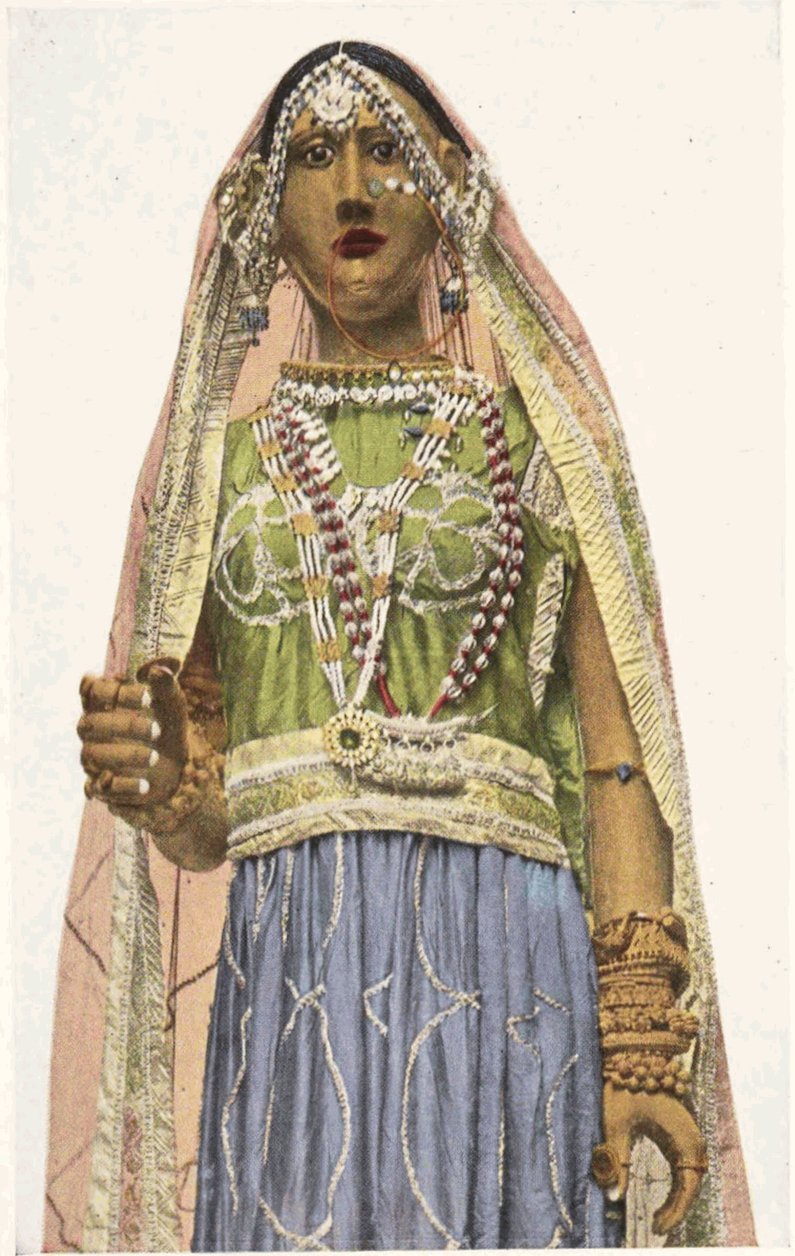

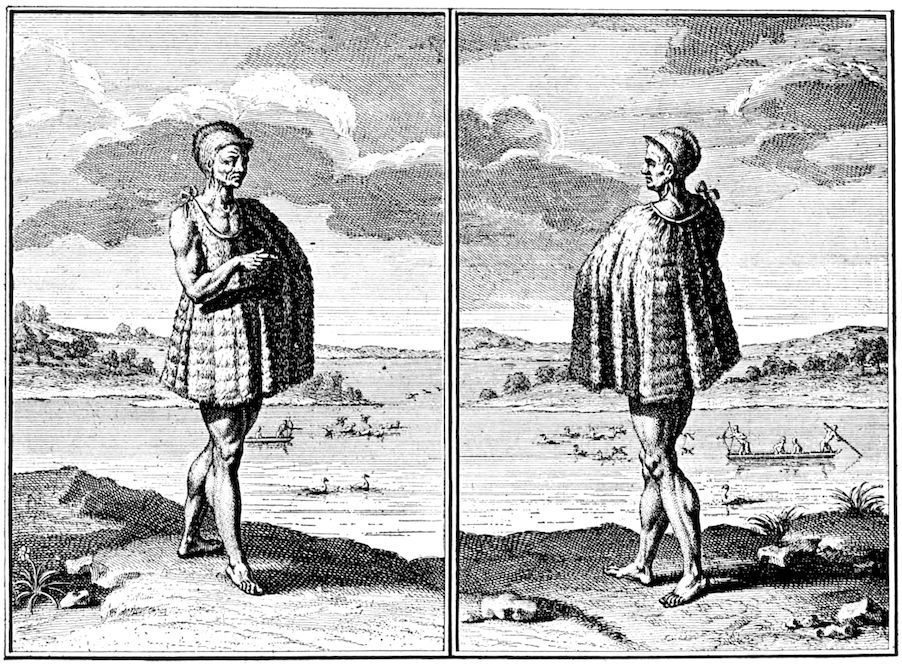
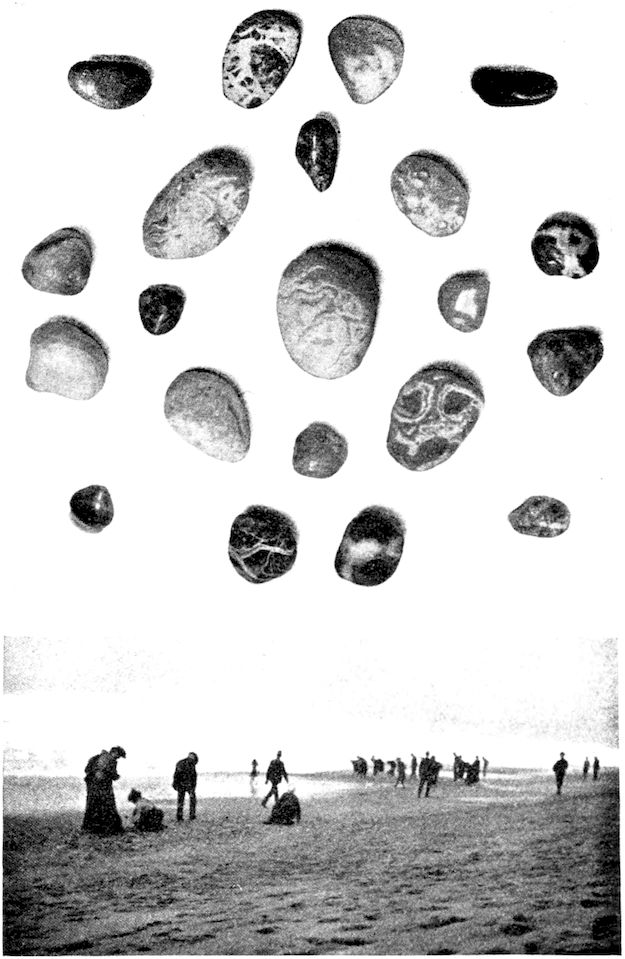
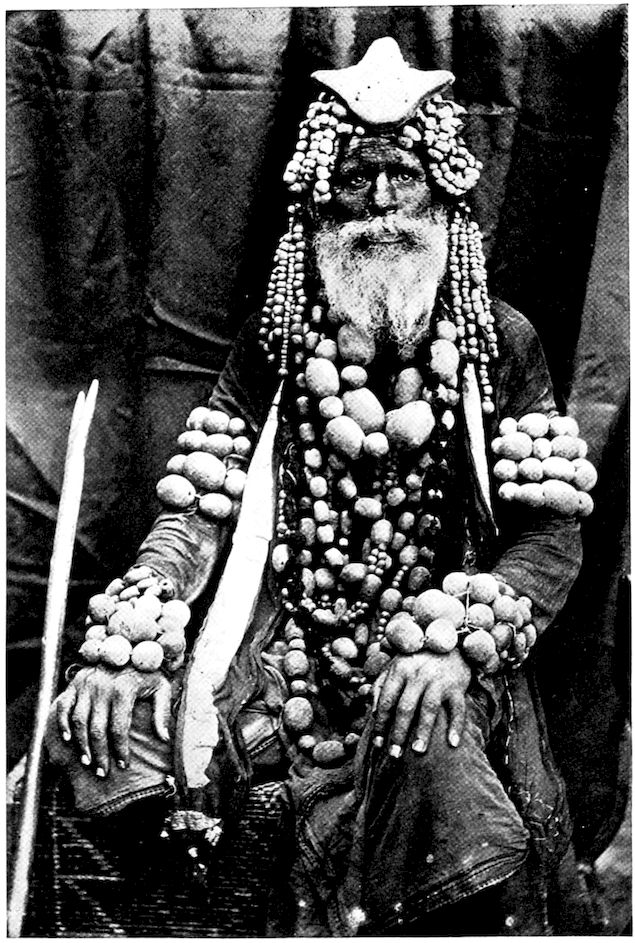
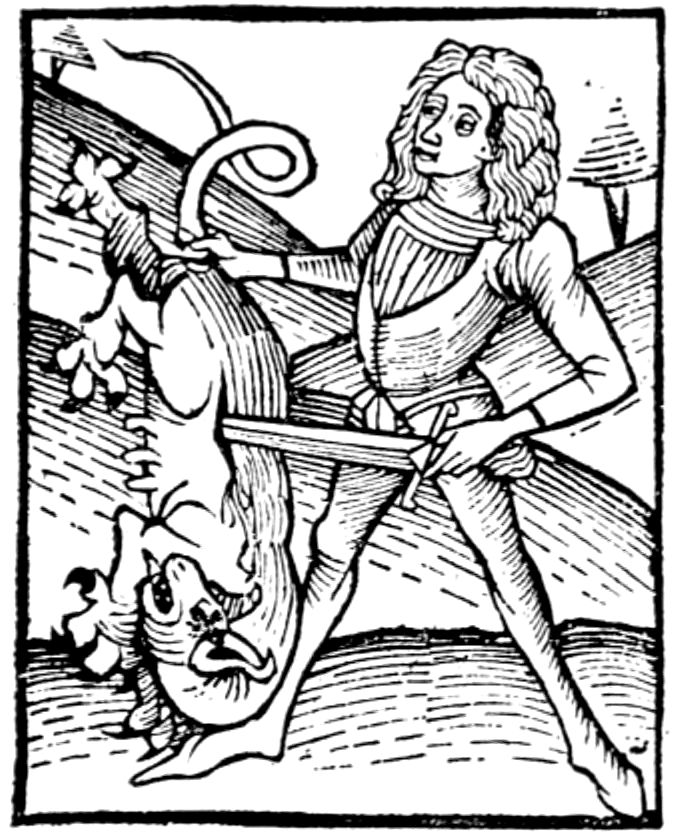
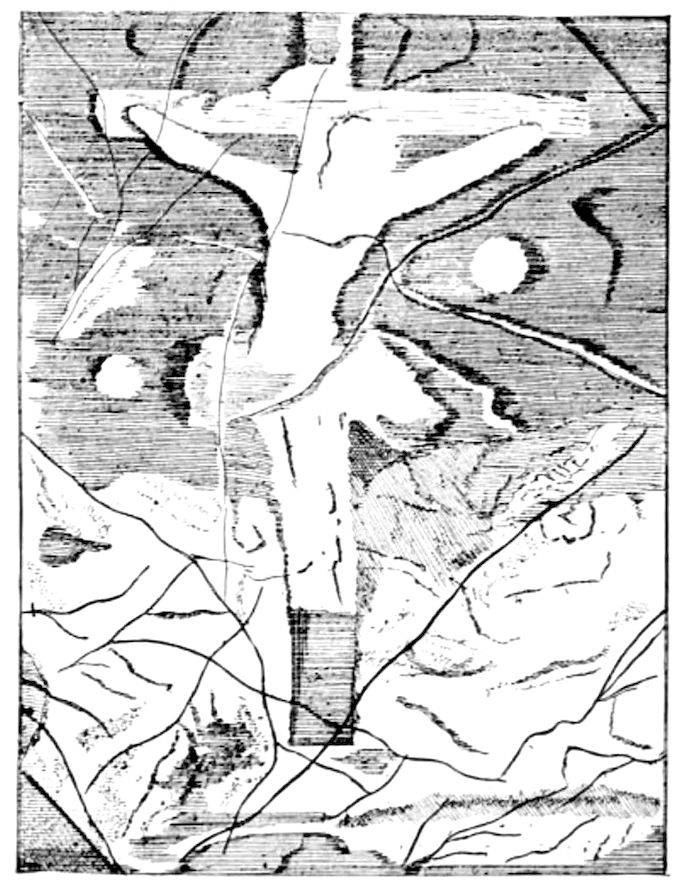
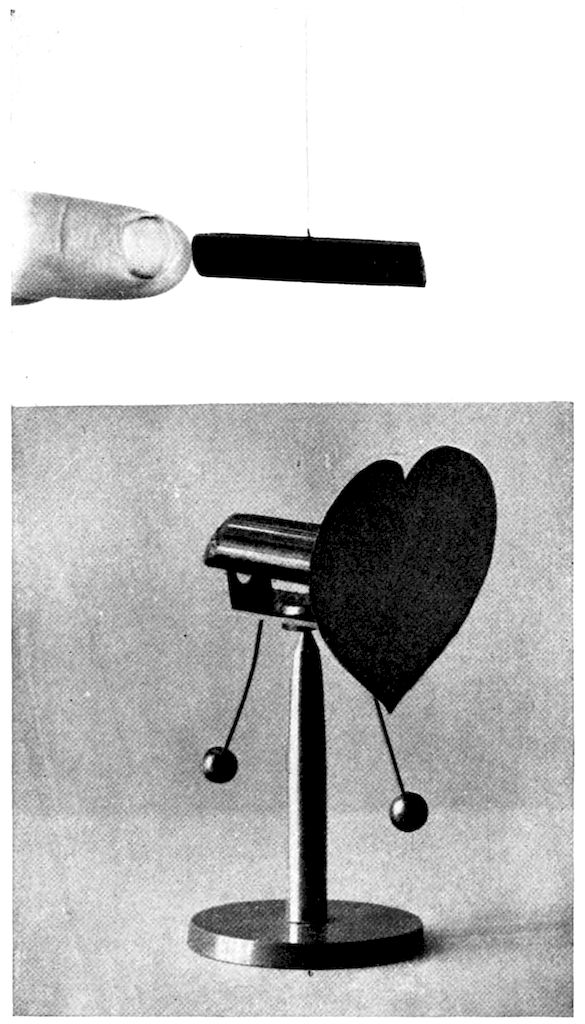
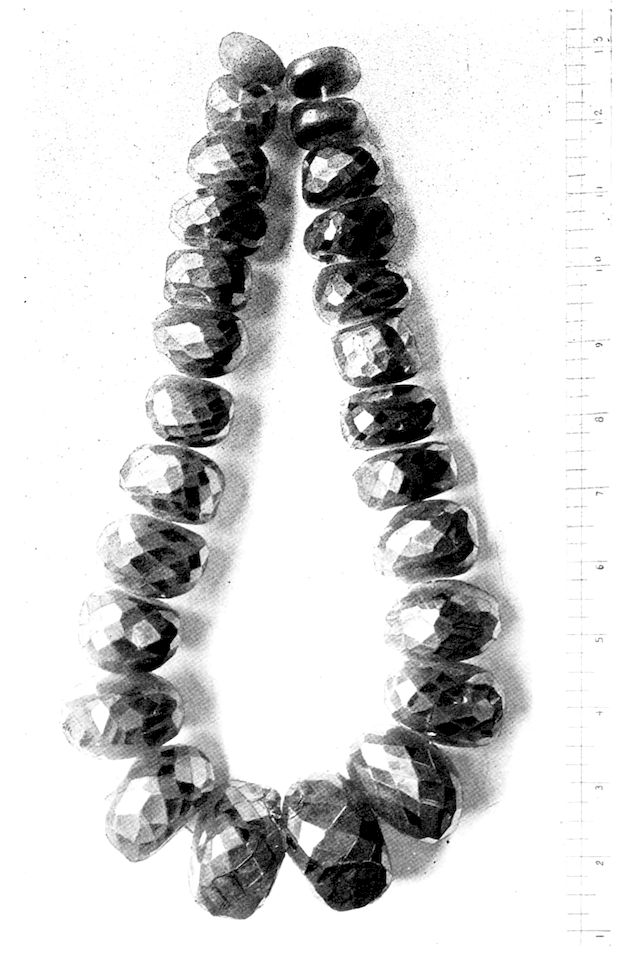
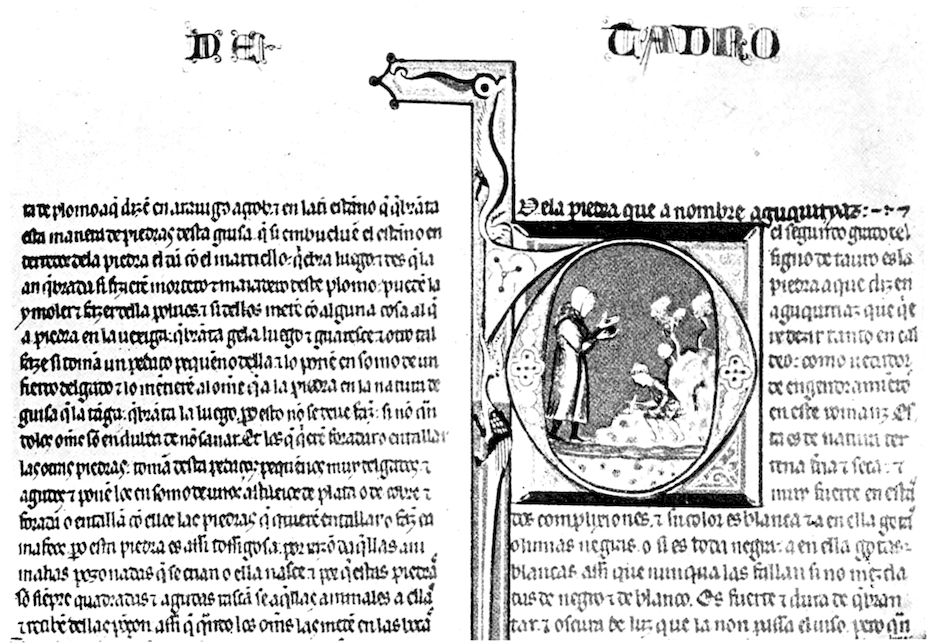

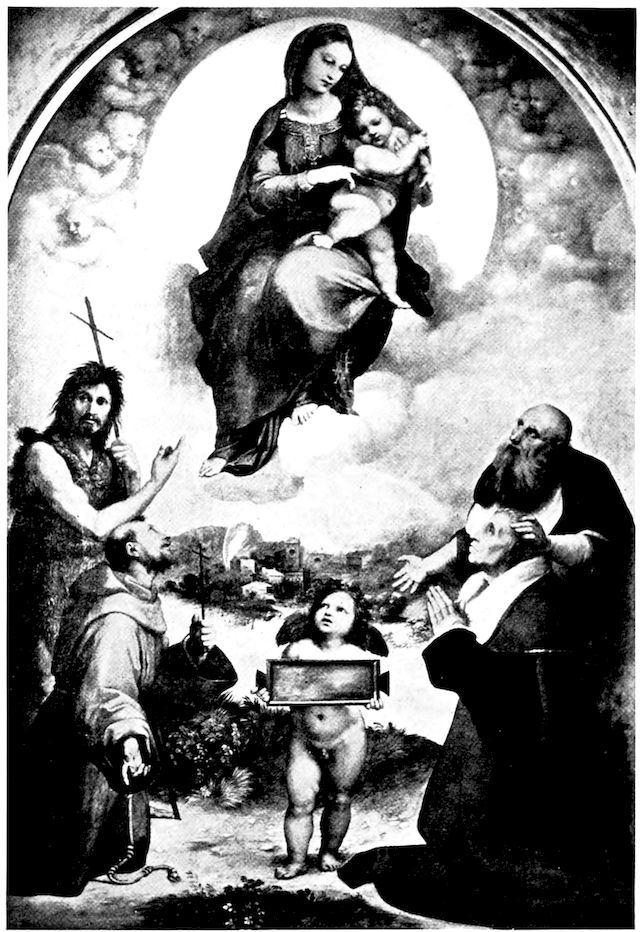
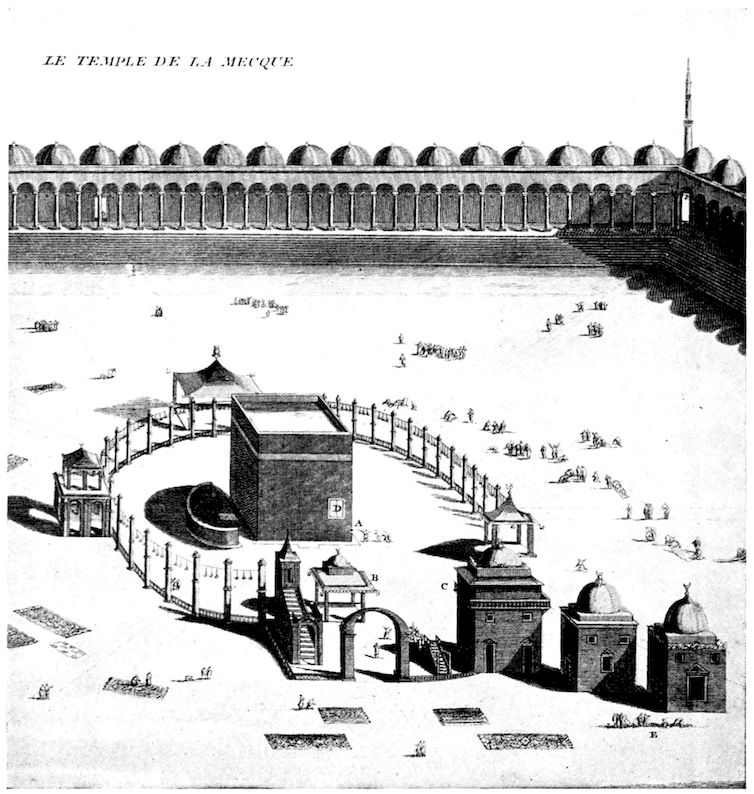
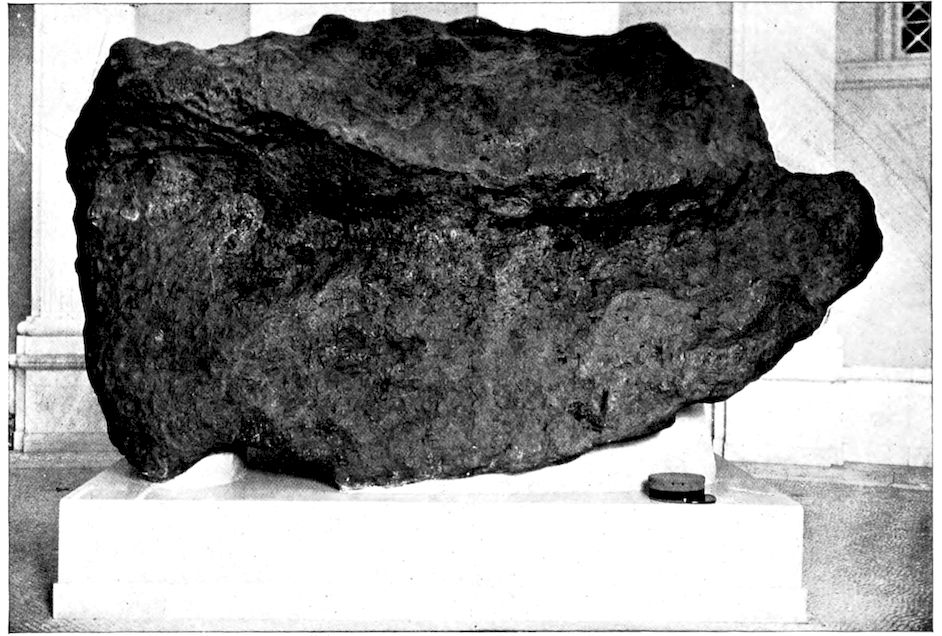
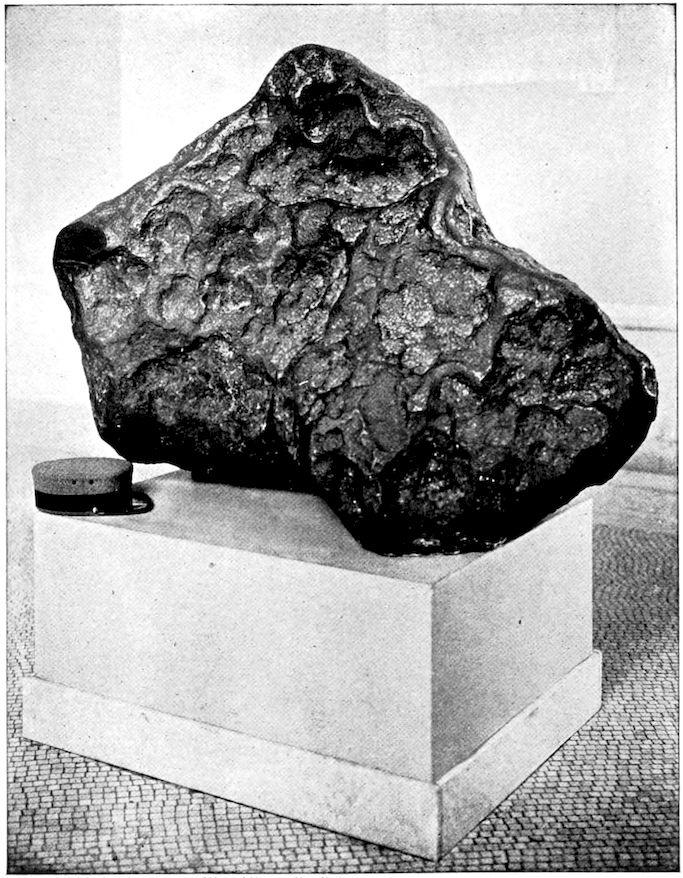
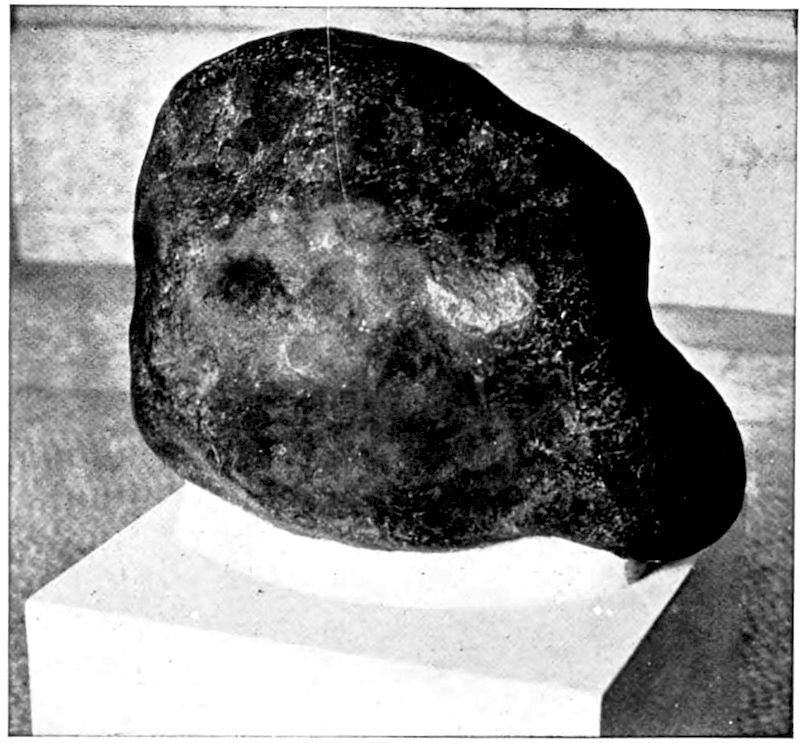
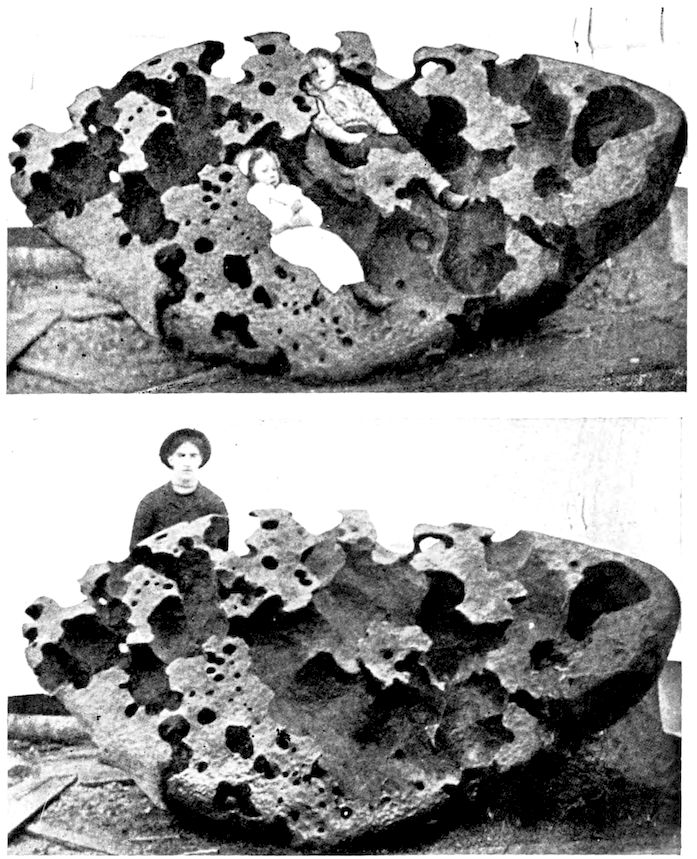
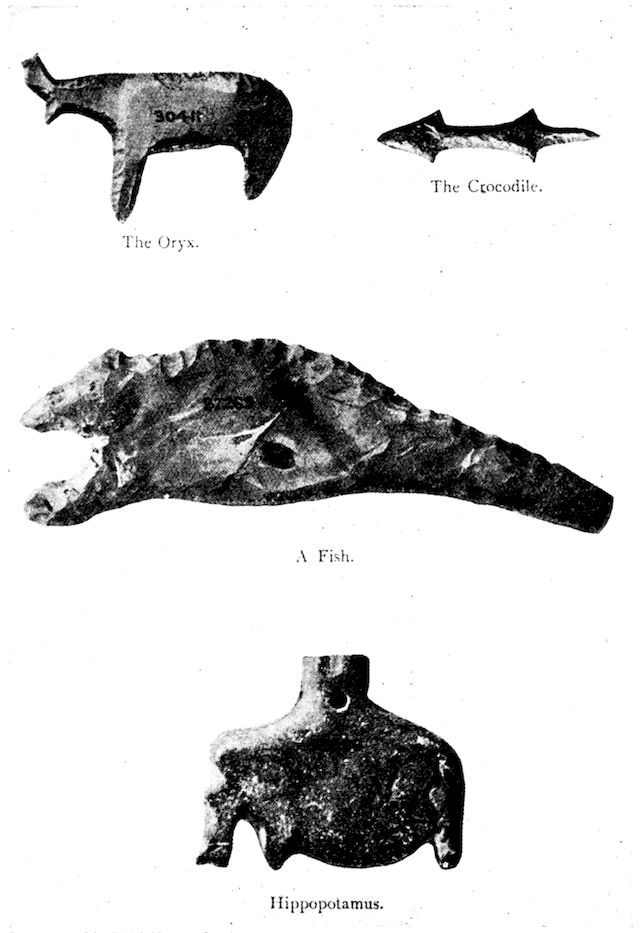
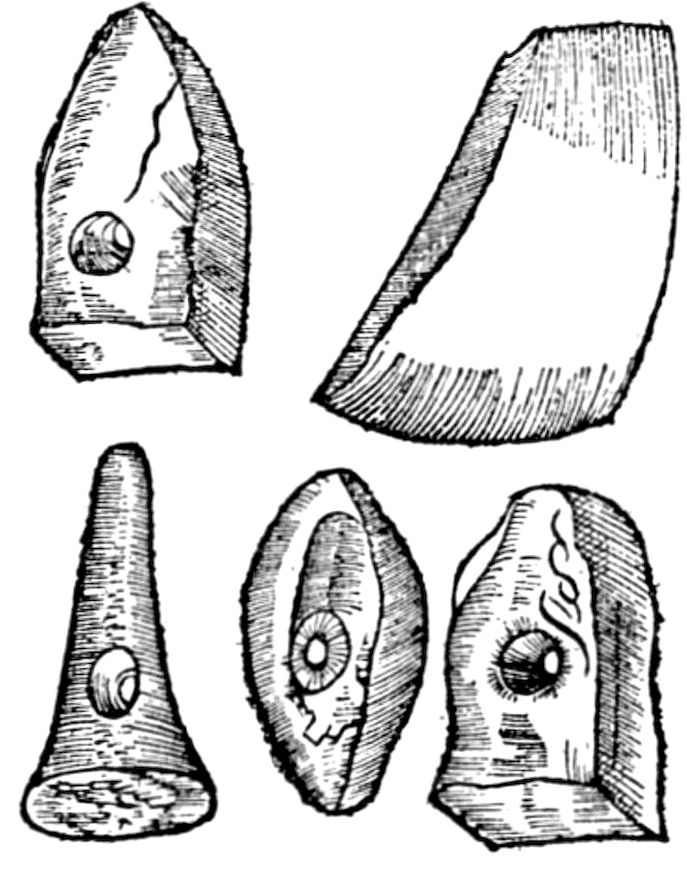

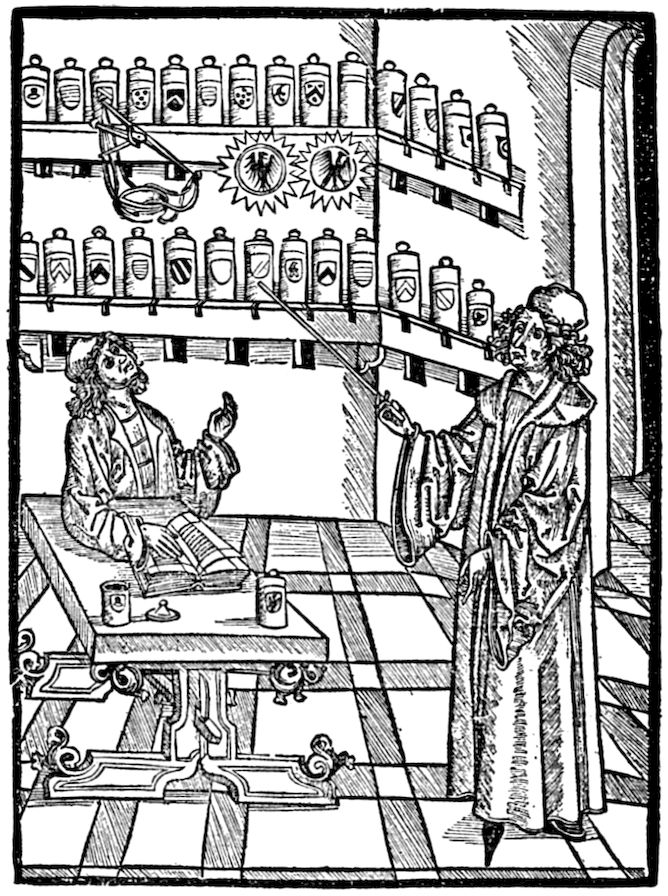
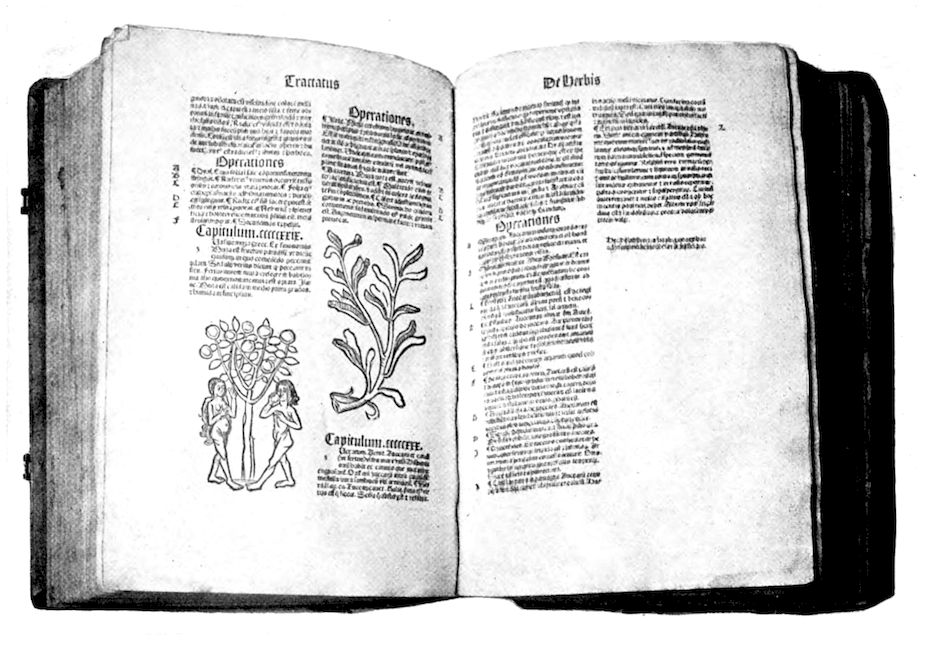
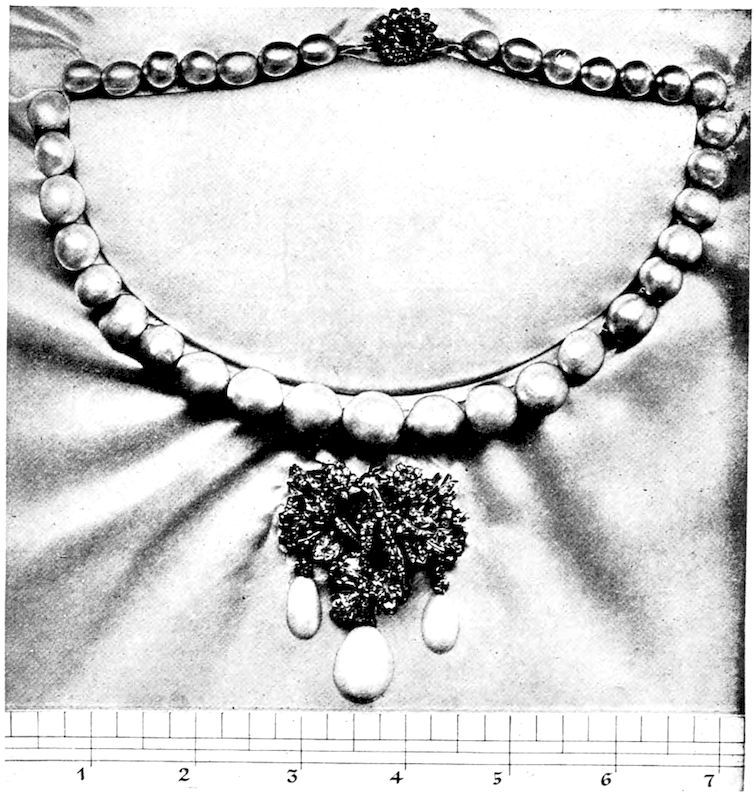
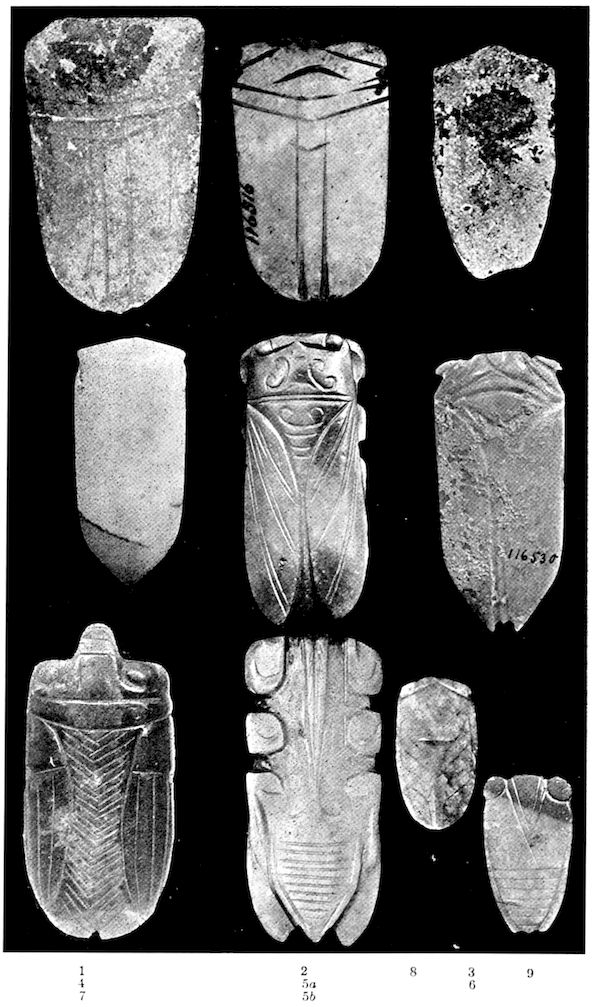
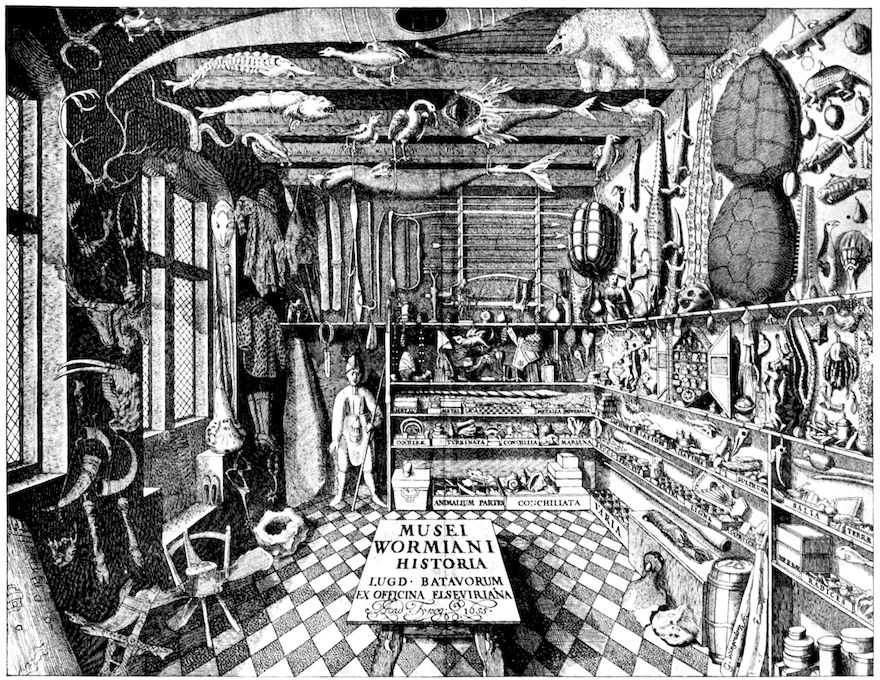
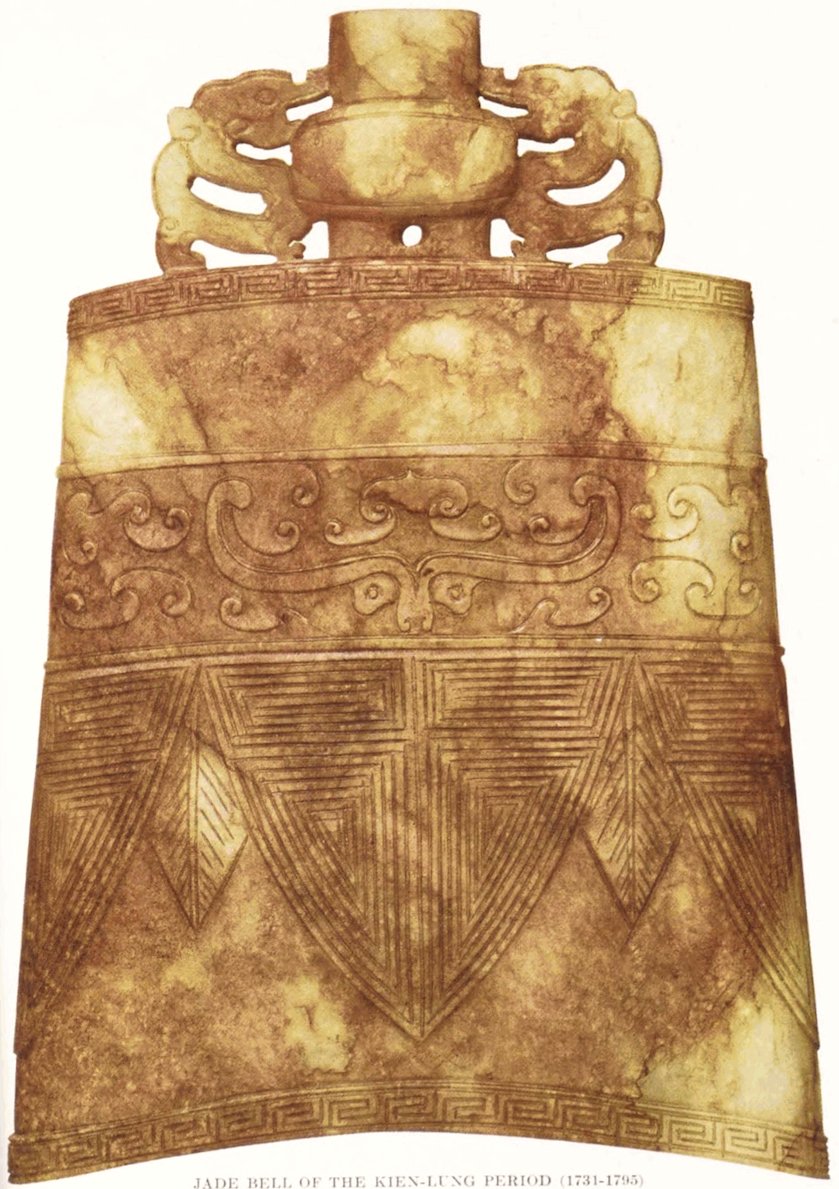
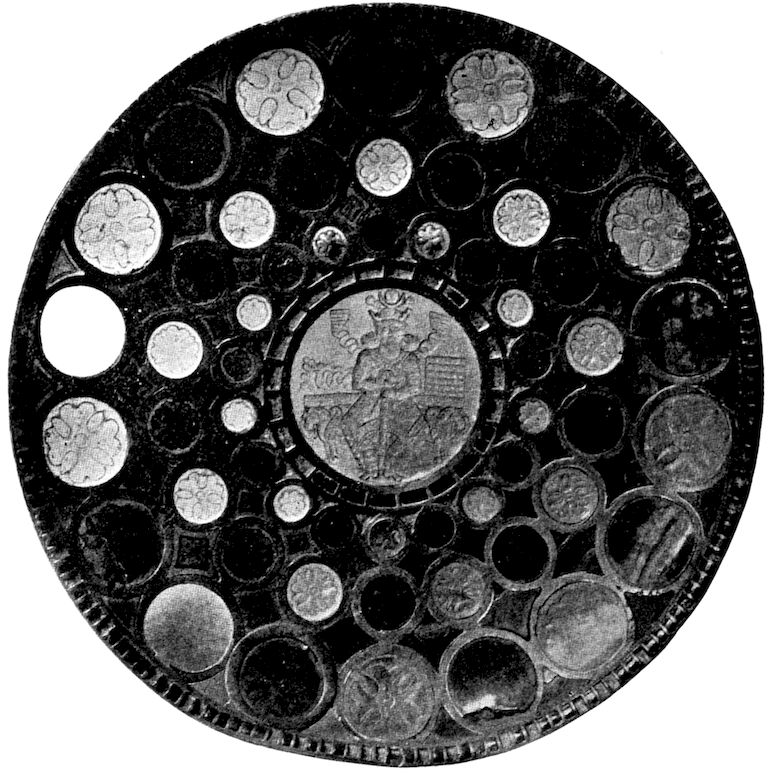
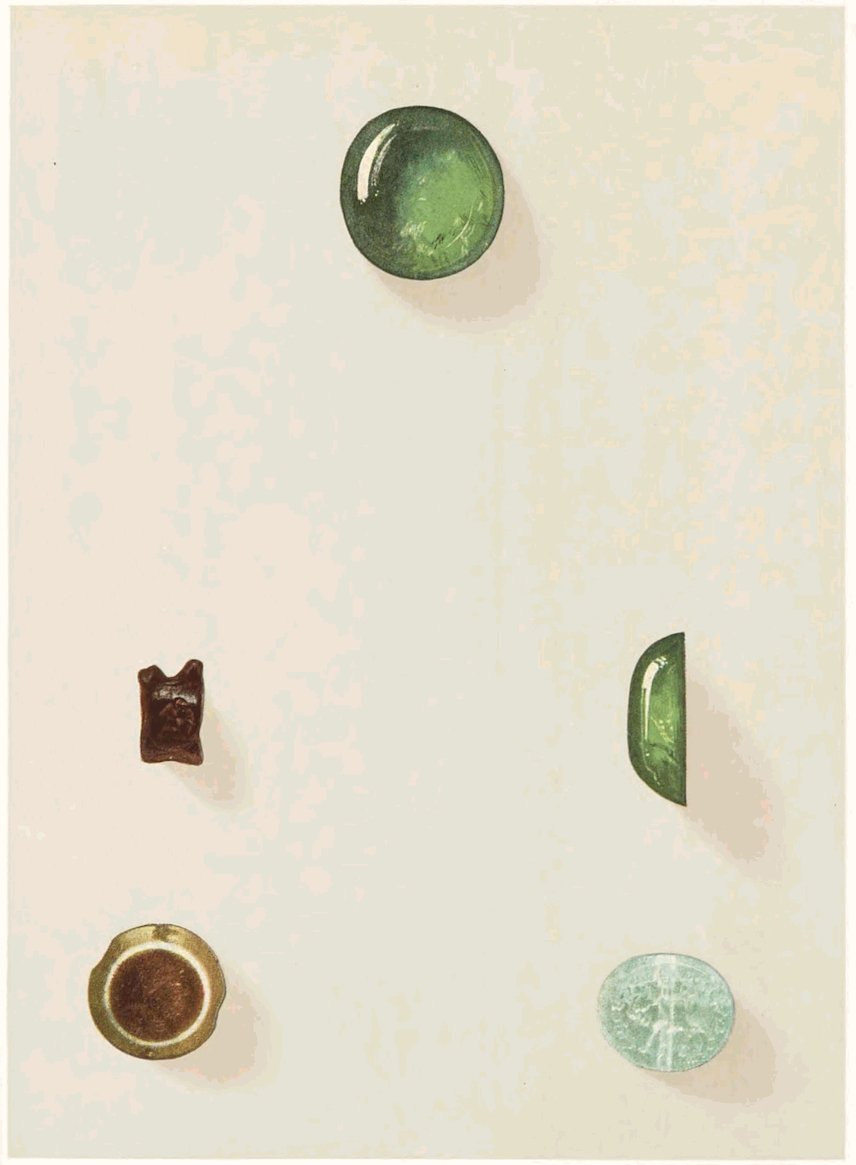
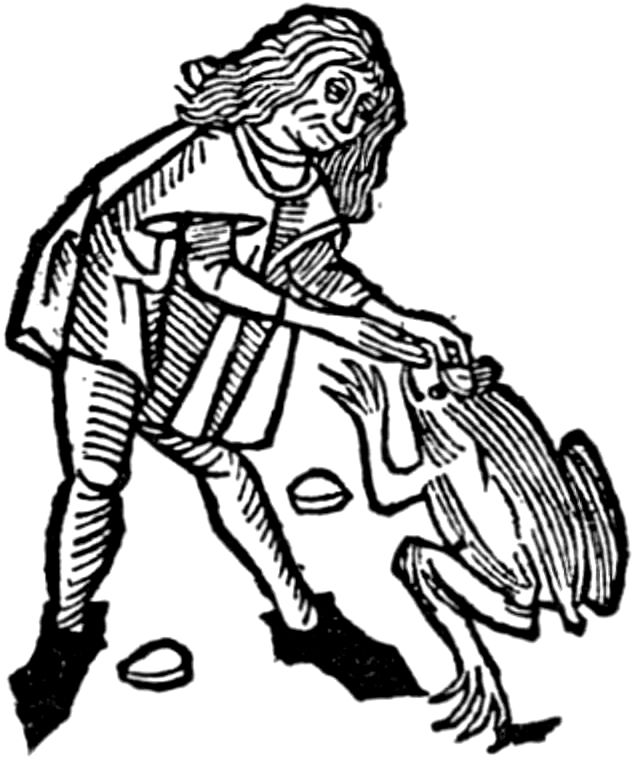
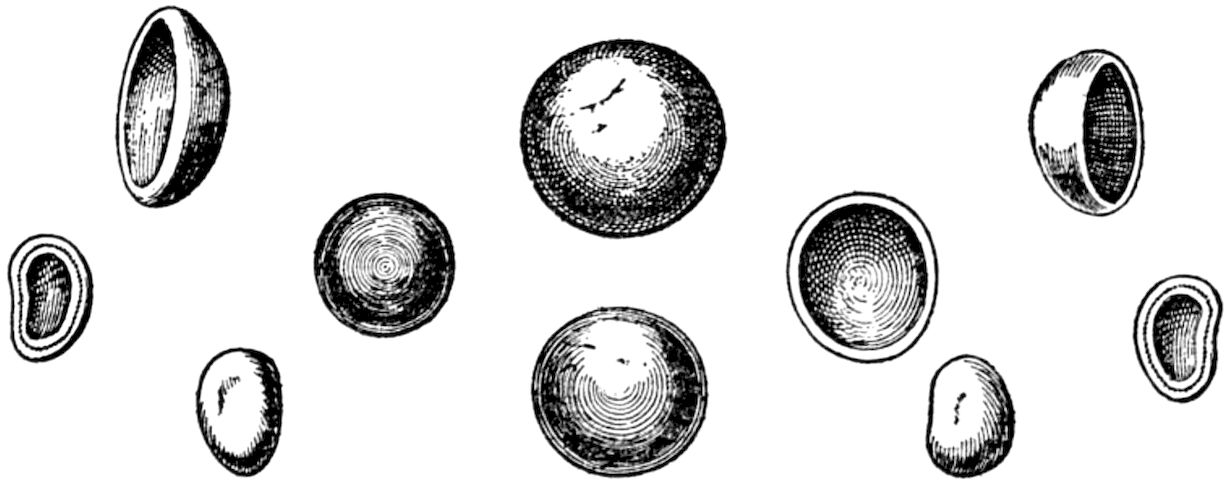
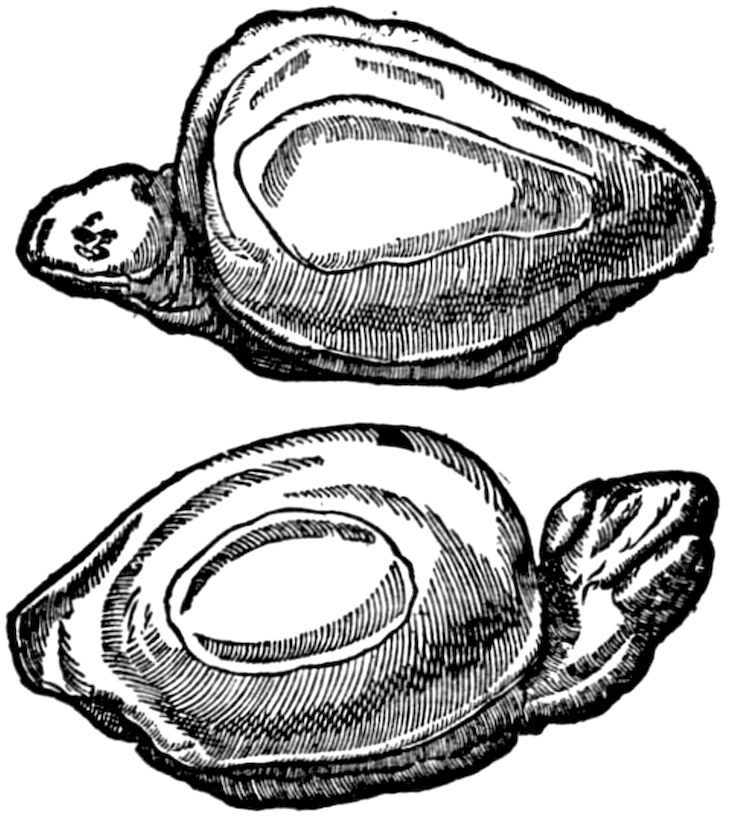
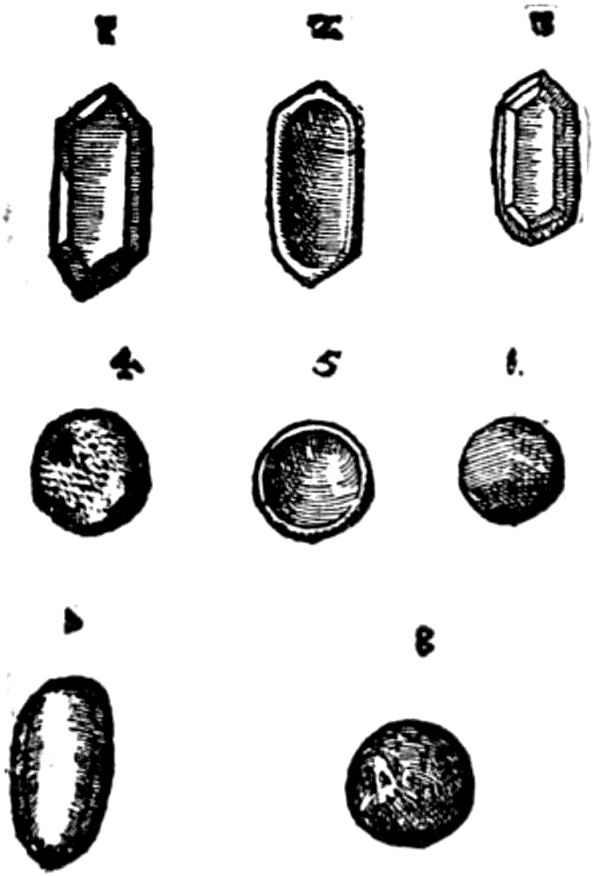
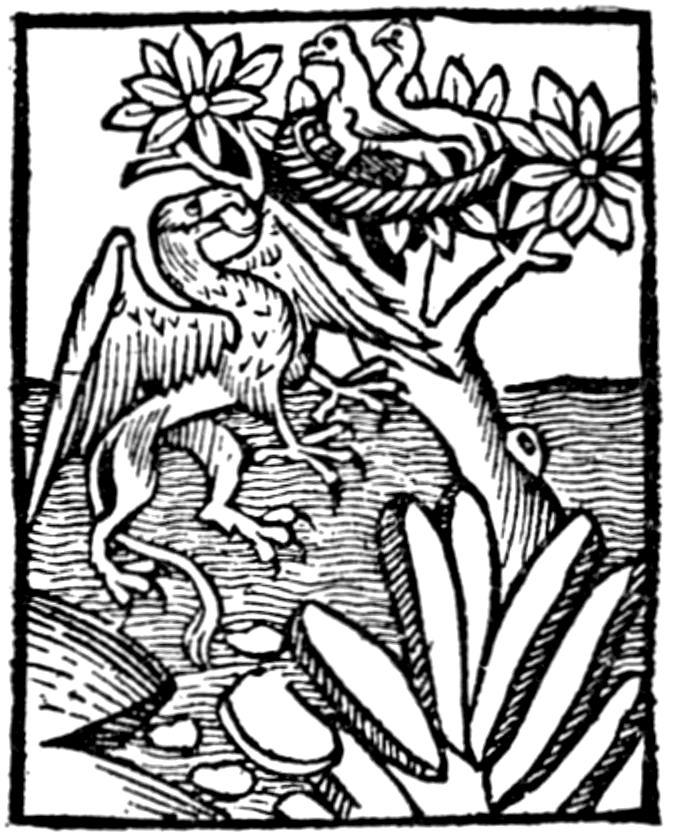
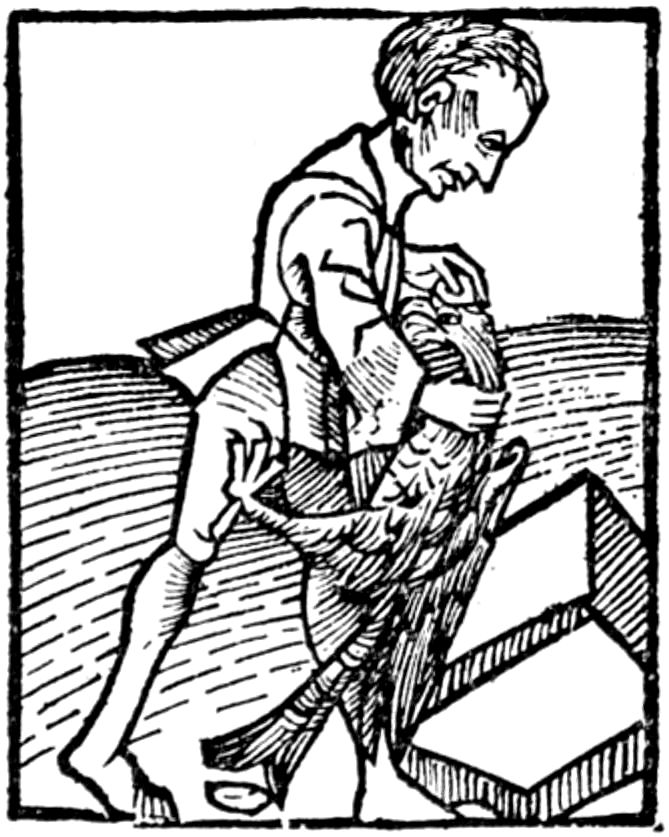

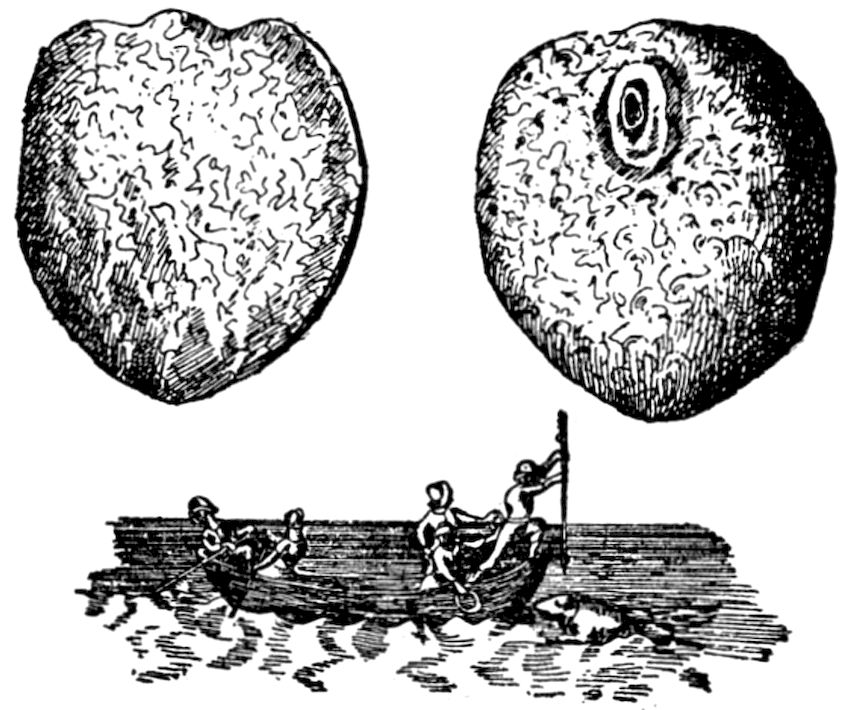

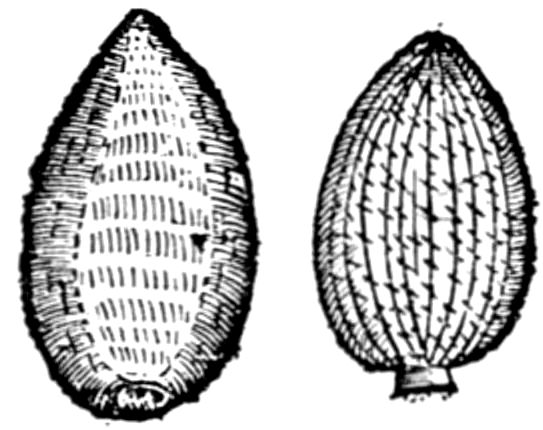
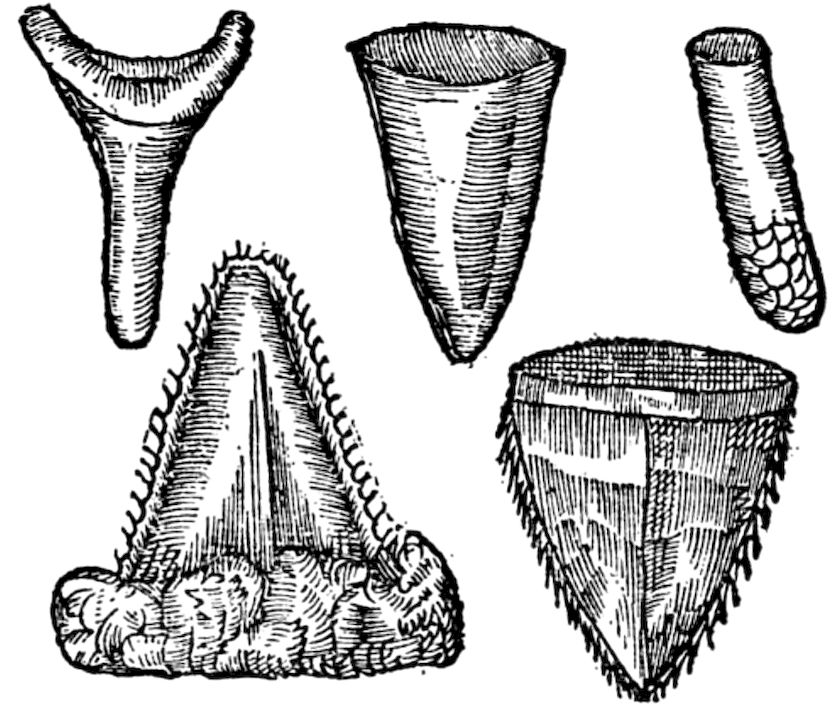
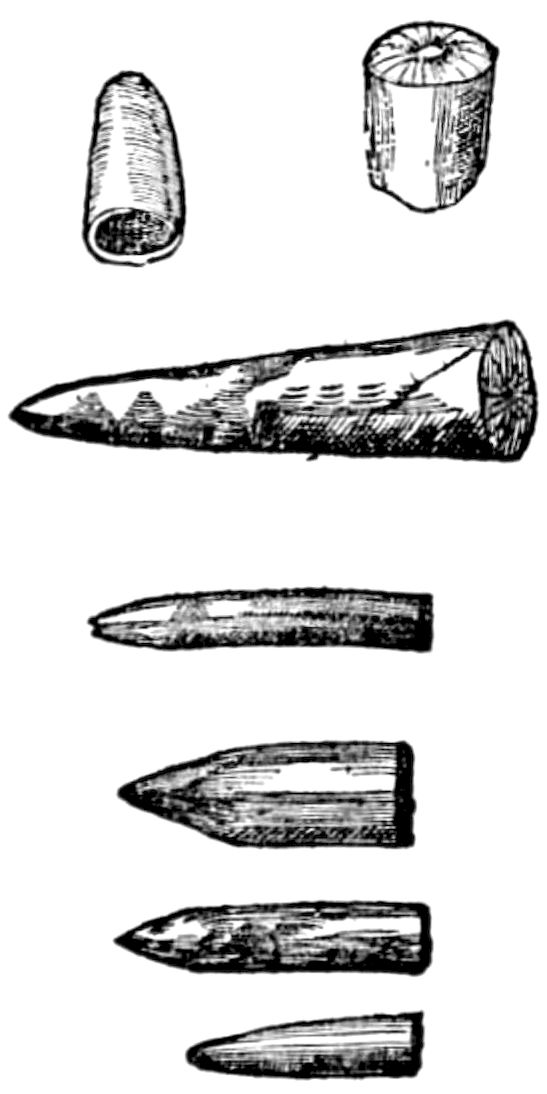
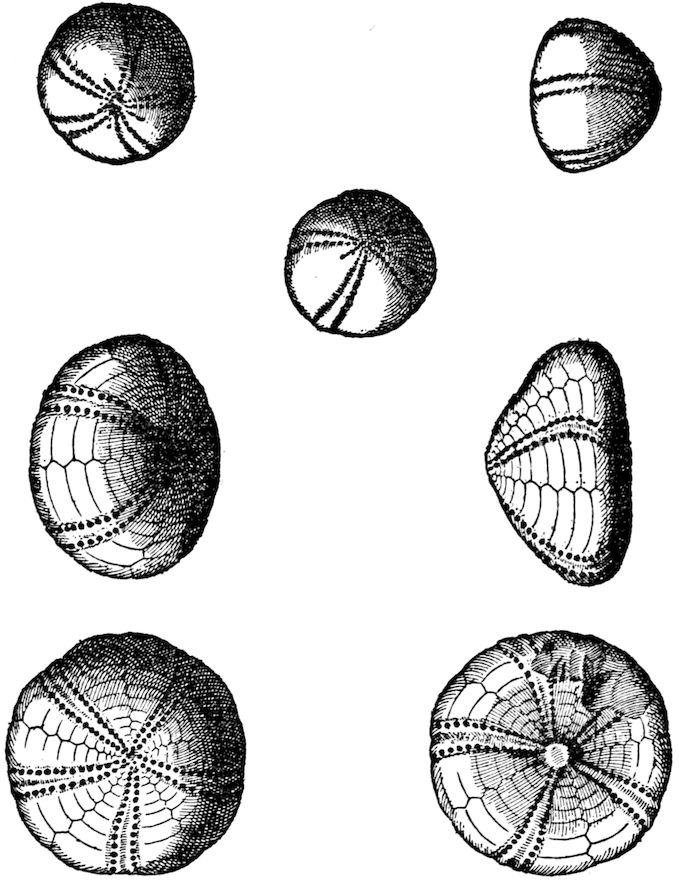
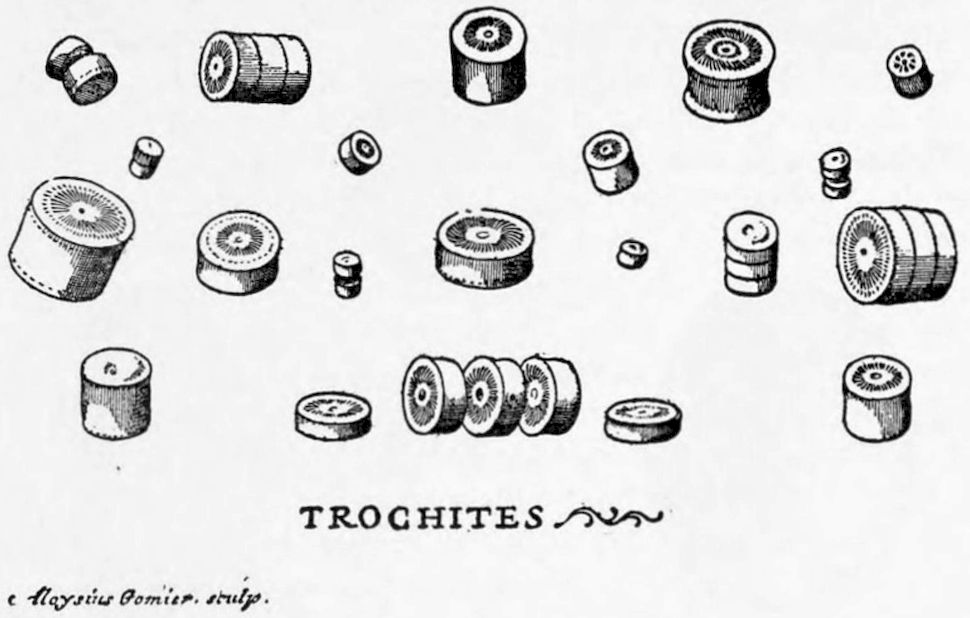
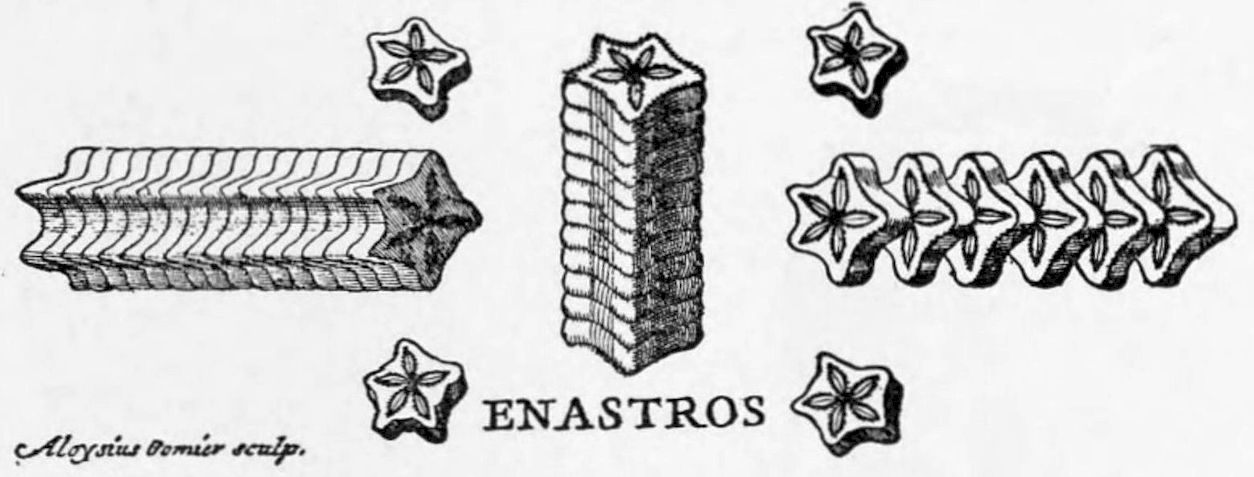
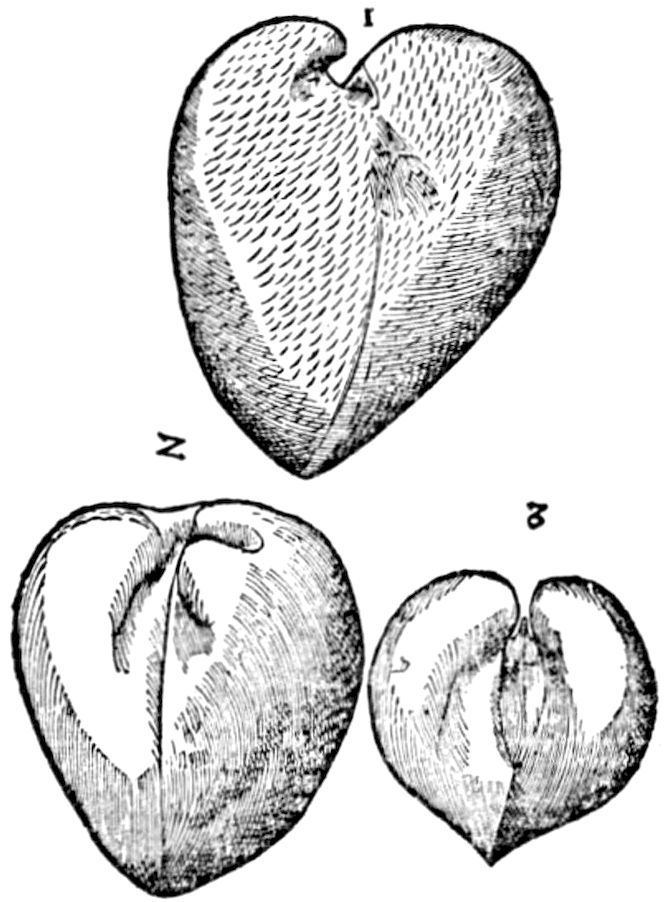
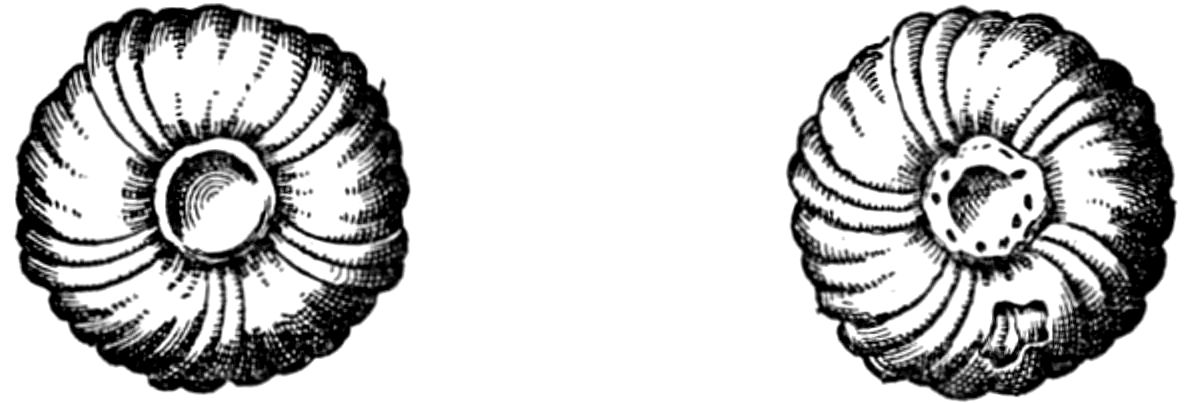
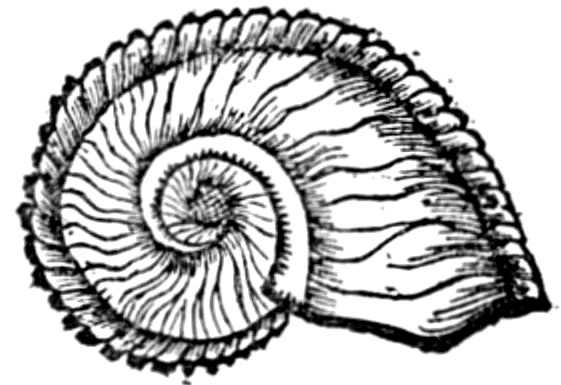
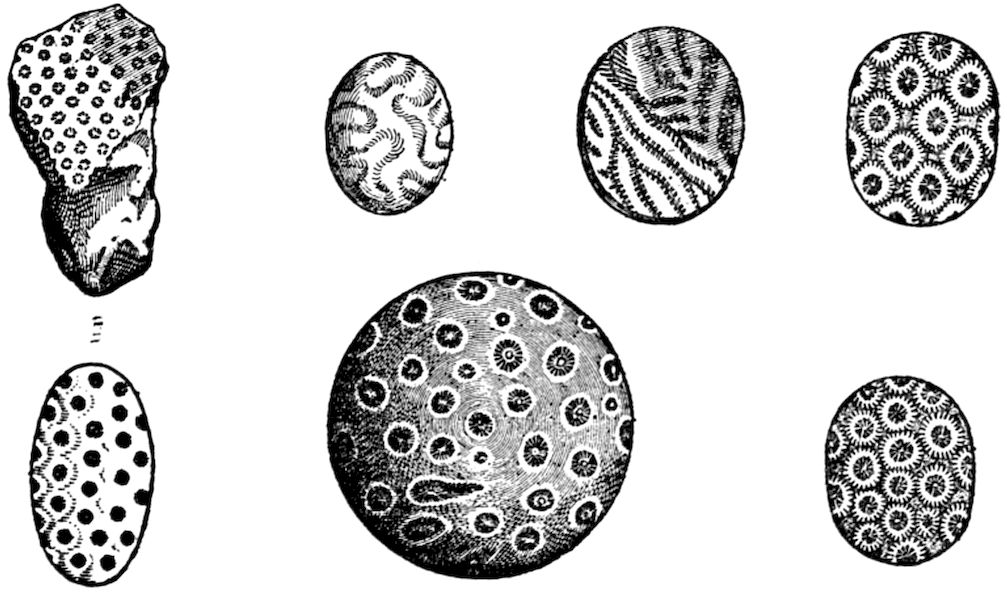

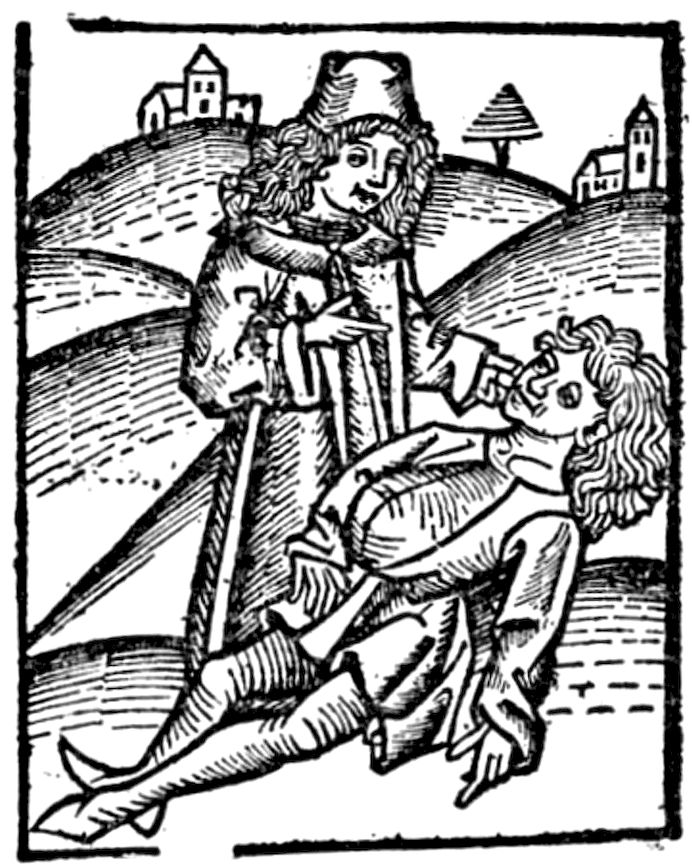
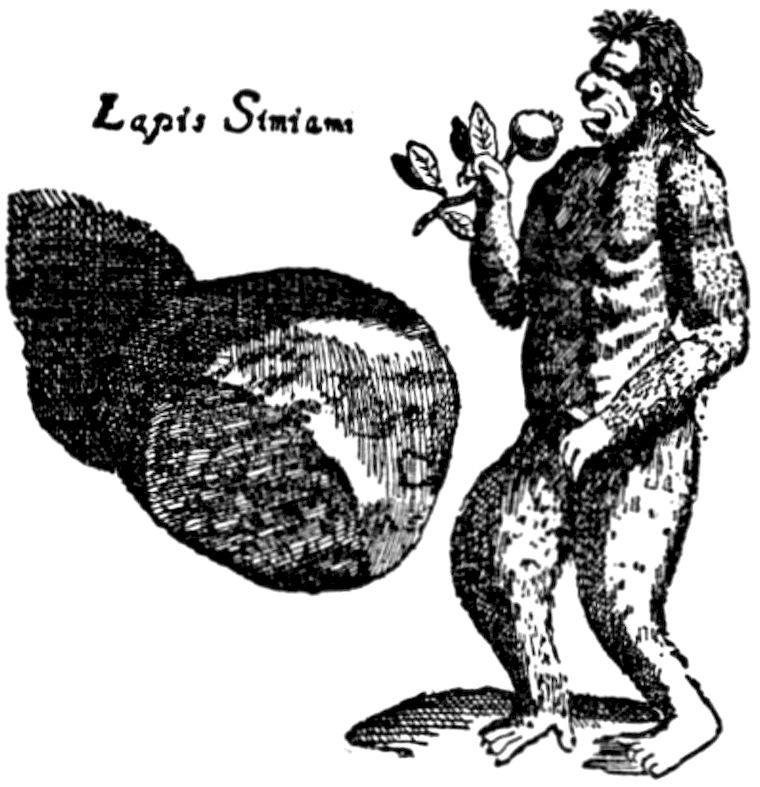
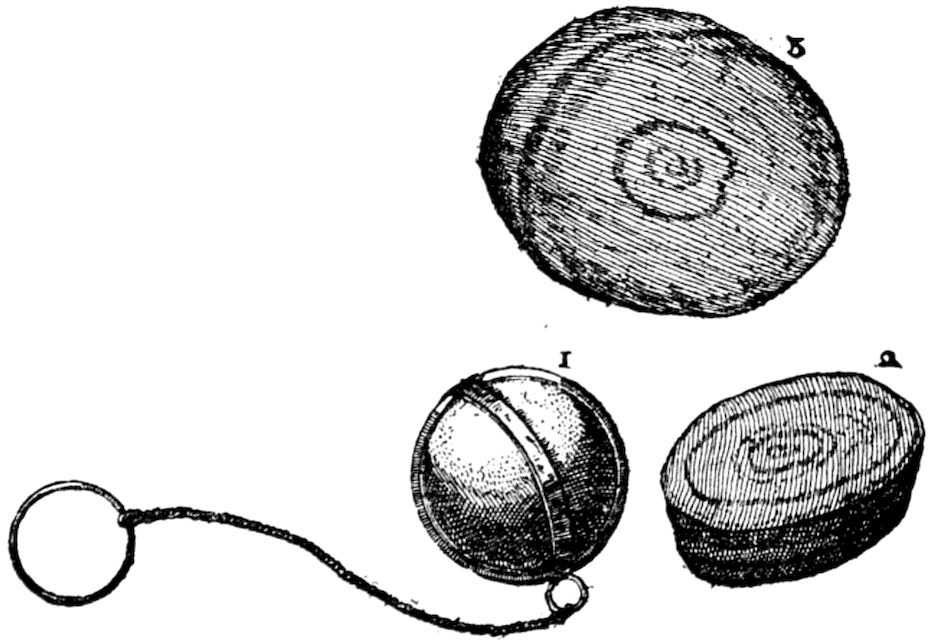
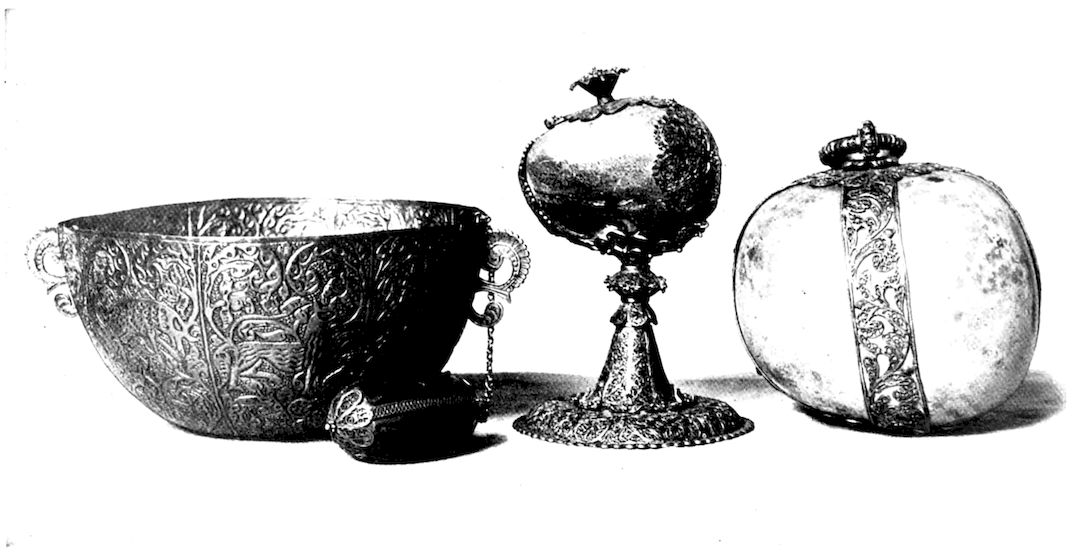
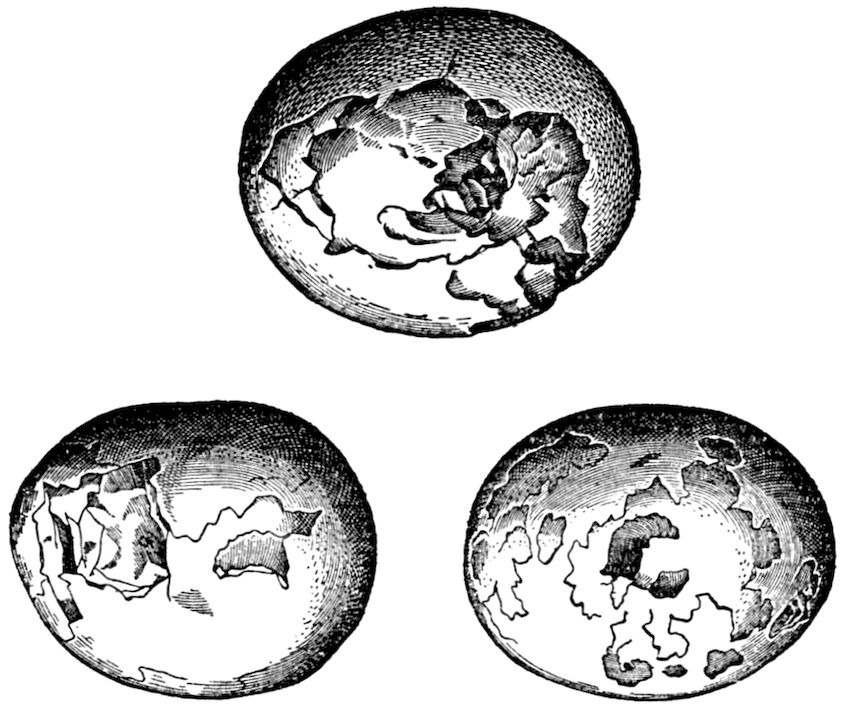
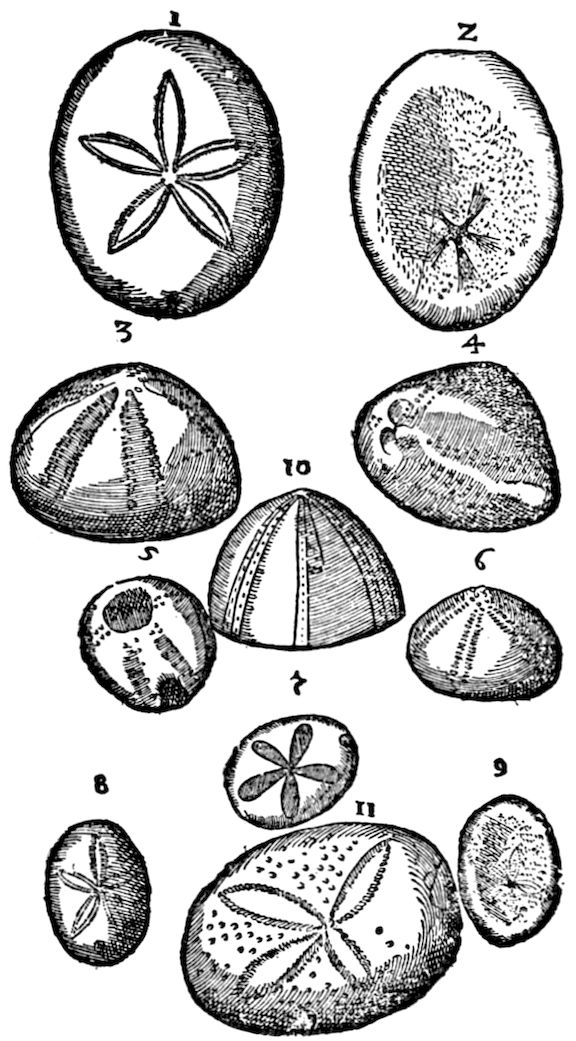
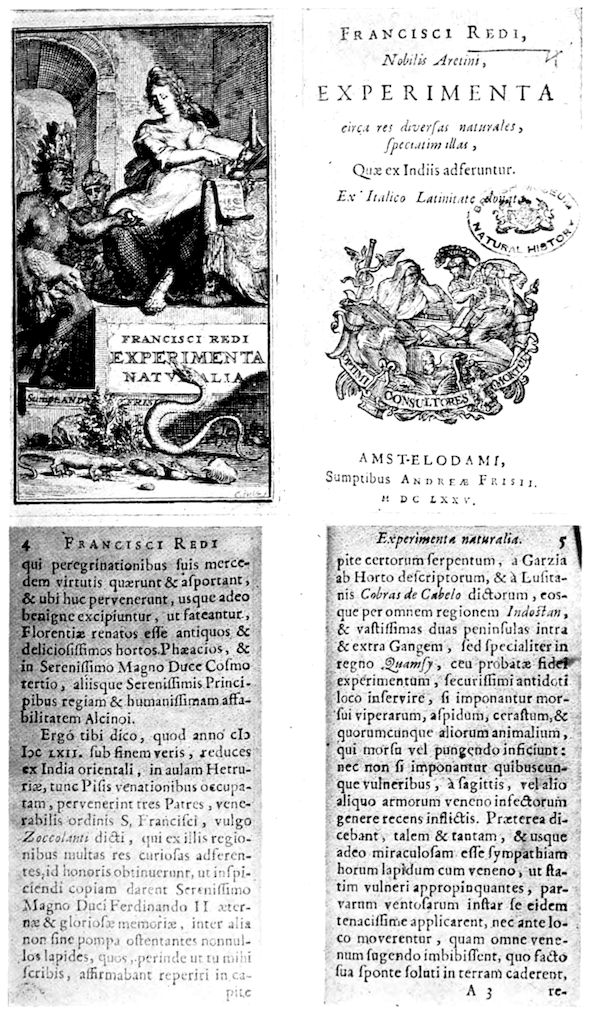
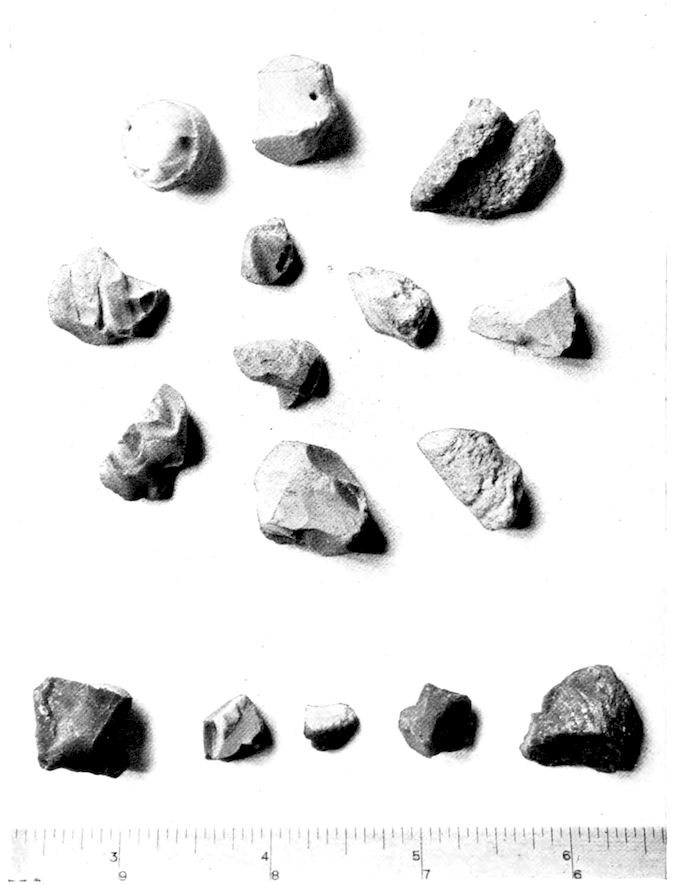
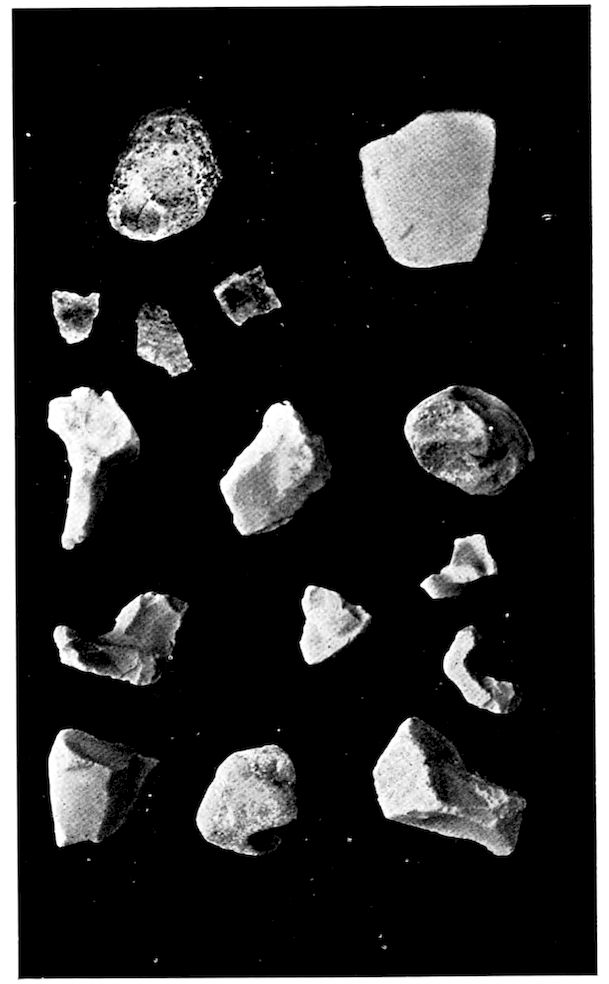
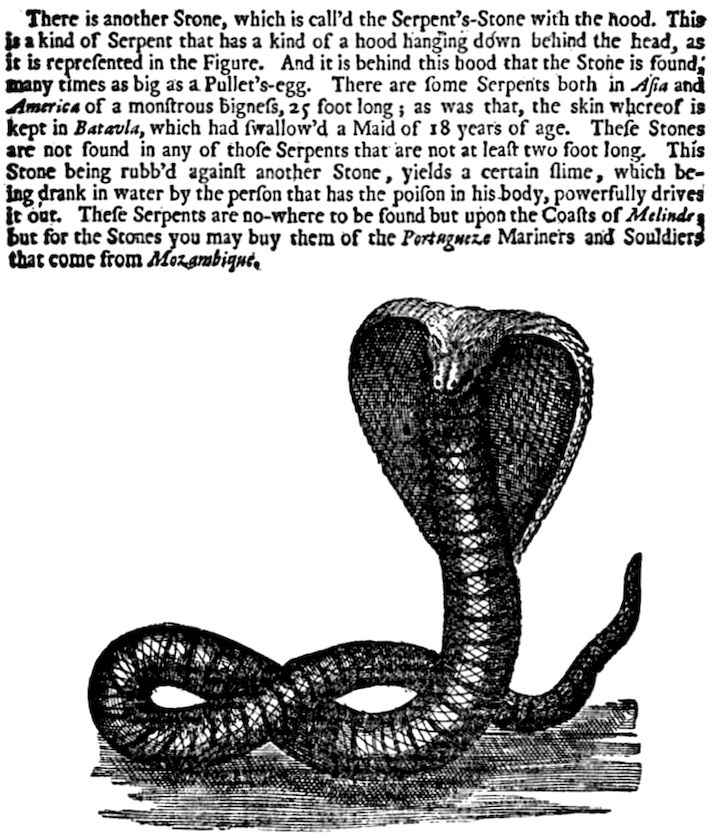

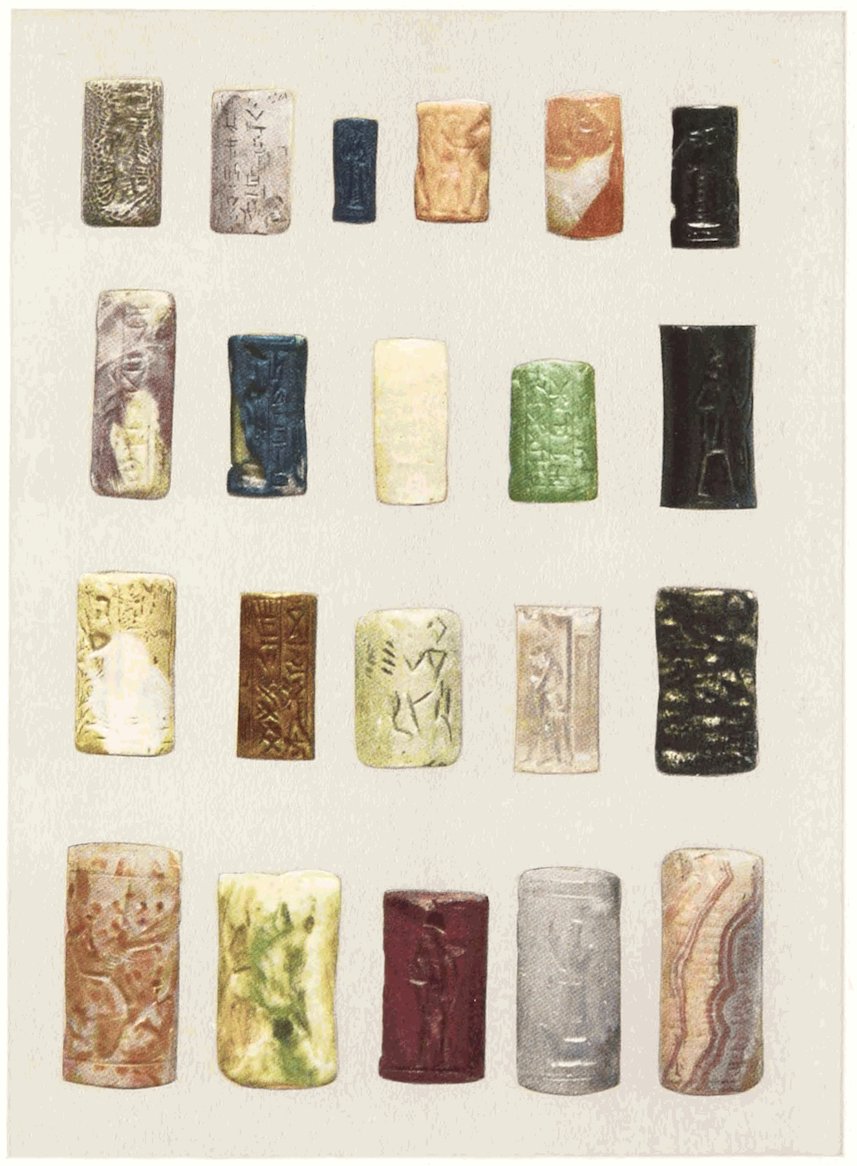
 ,
and in his left hand he holds a scroll with the words (in
Greek): “In the beginning was the Word”; his right hand
is stretched forth in benediction, and alongside the figure are
the following angels’ names in Greek characters: Raphaêl,
Penel, Ouriêl, Ichthys, Michaêl, Gabriêl, Azaêl. The fourth
and middle name, Ichthys (fish) is the well-known anagram
of the Greek words signifying “Jesus Christ, the Son of
God, the Saviour,” and the use of this as the name of an
angel is thought to have been suggested by a passage in
Isaiah (ix, 6).
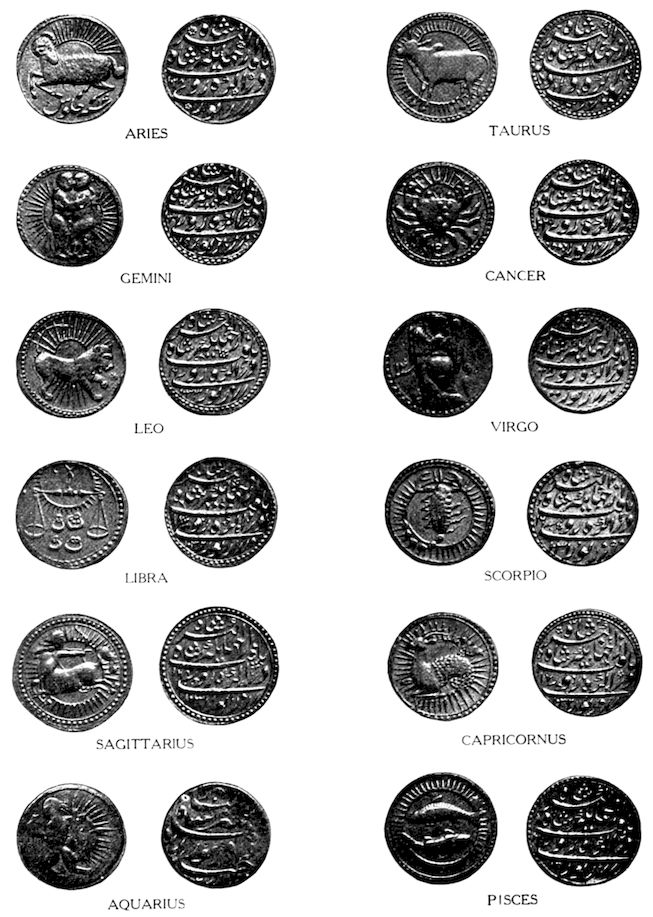
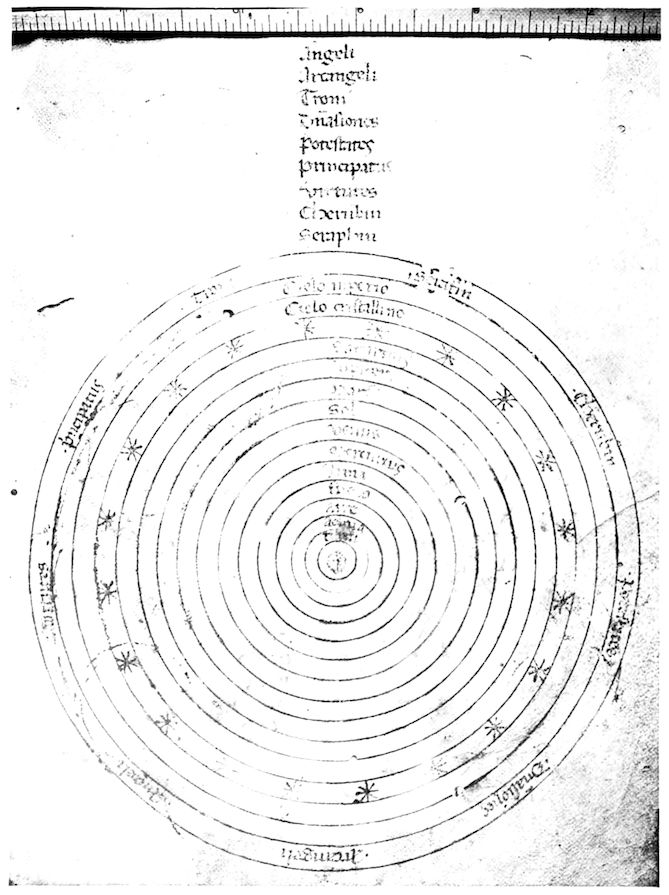
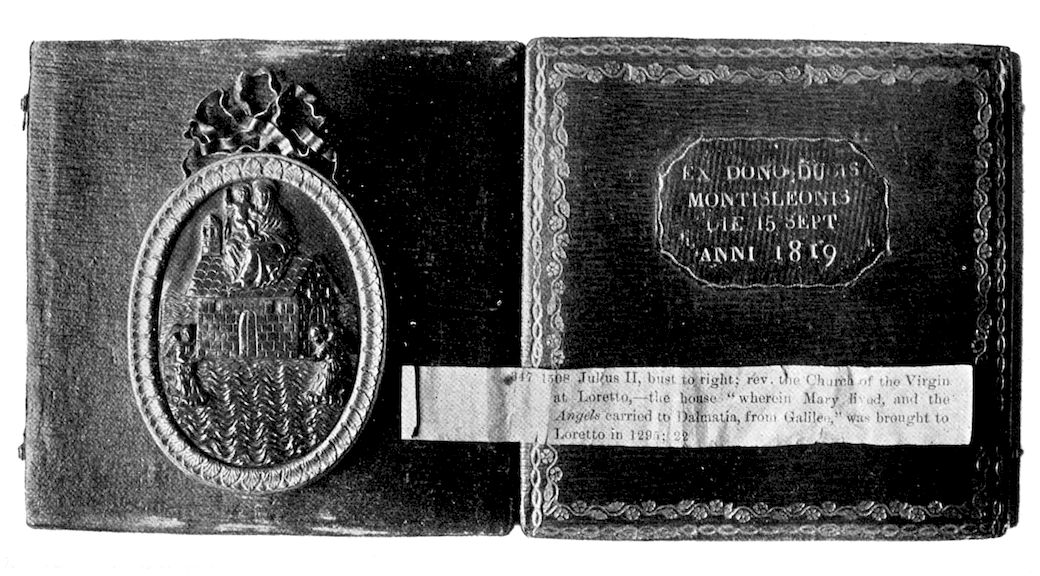

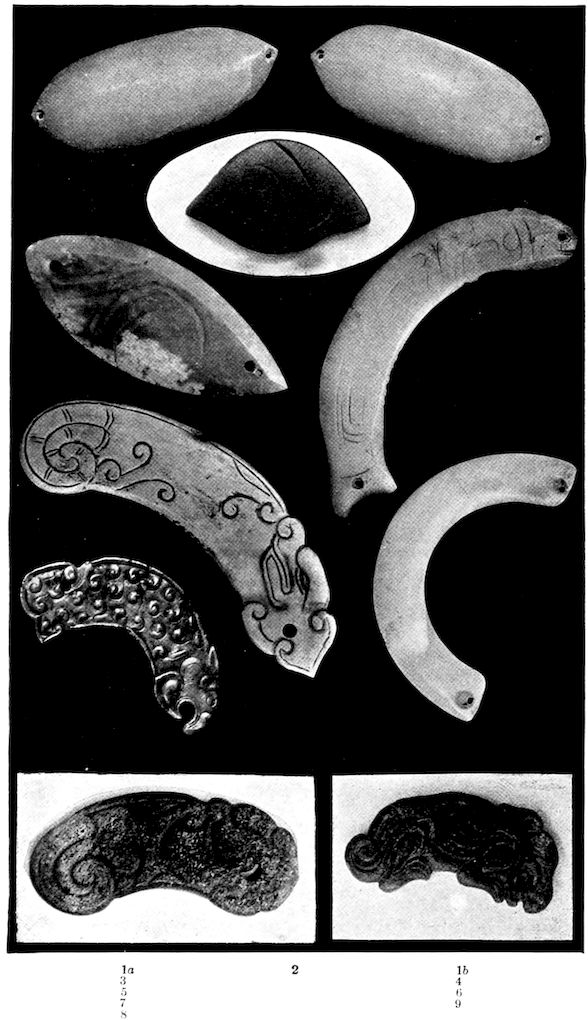
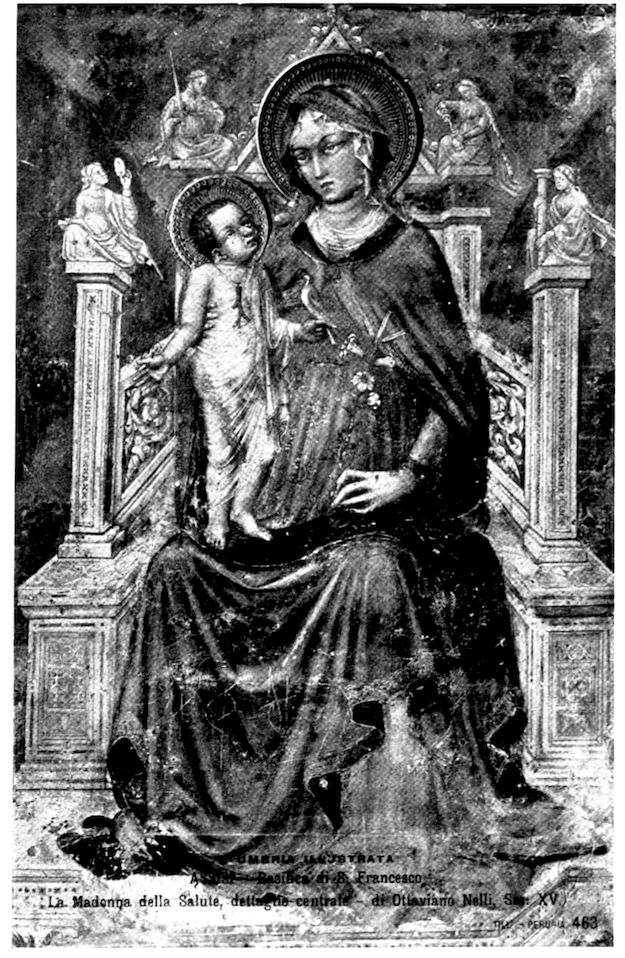
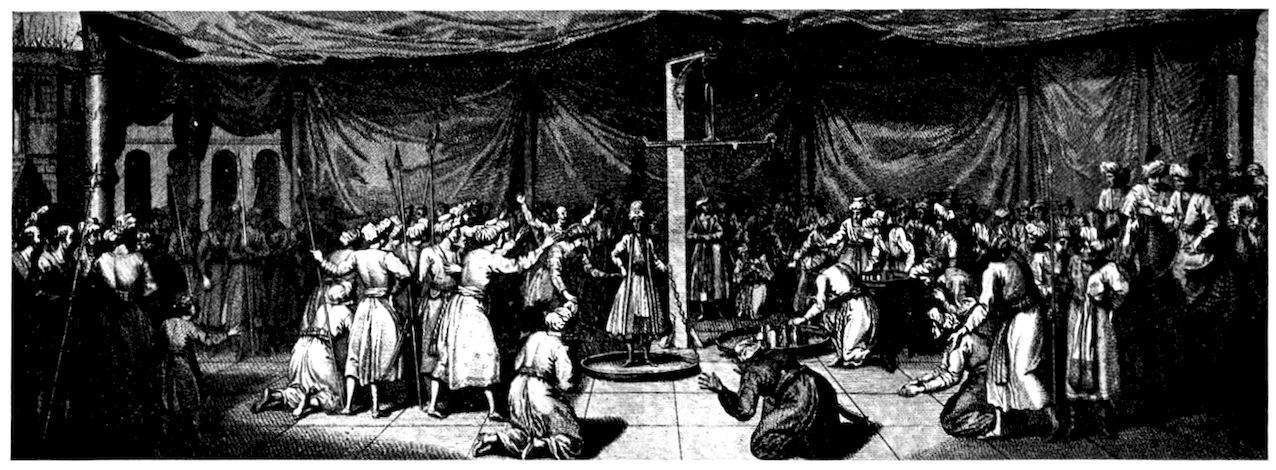
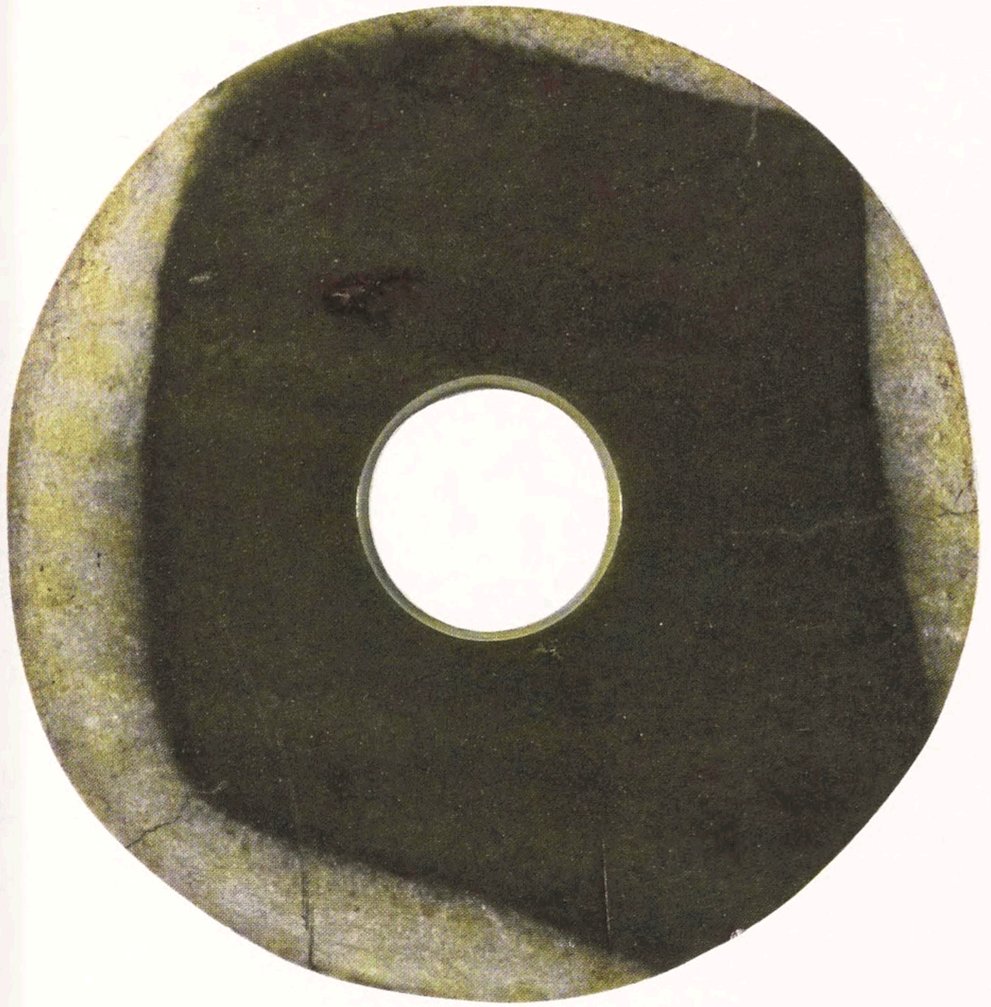
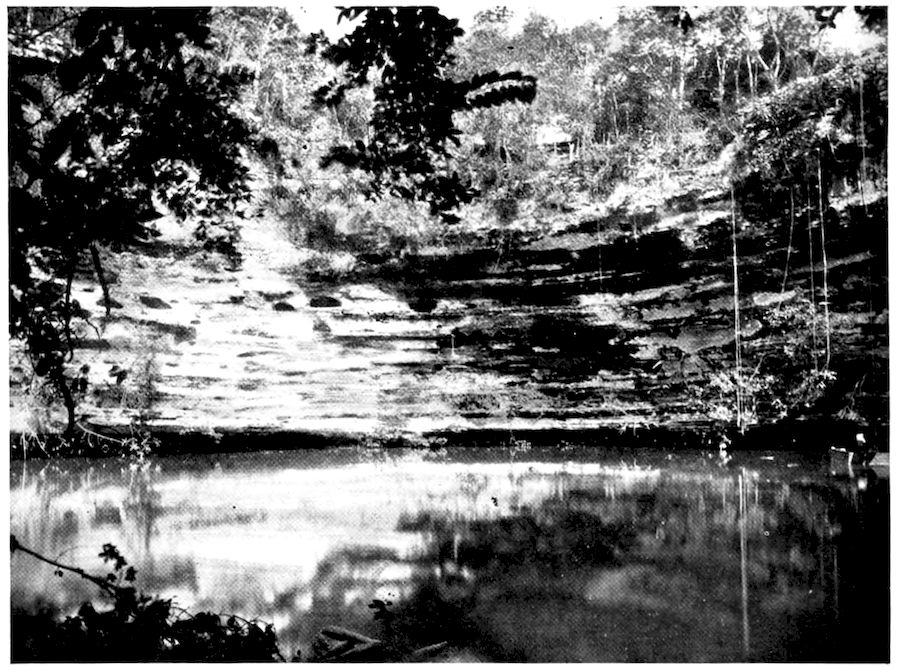
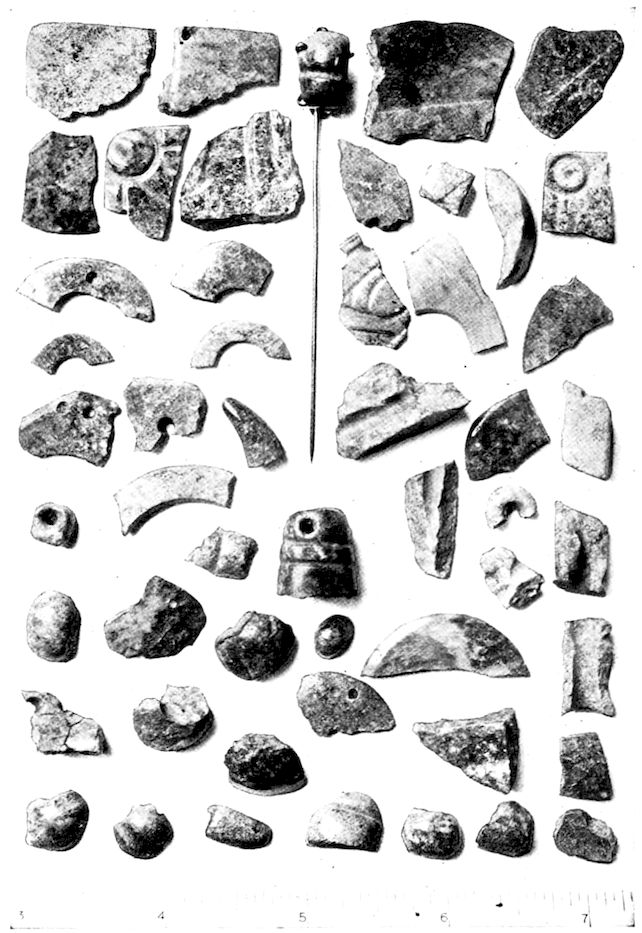

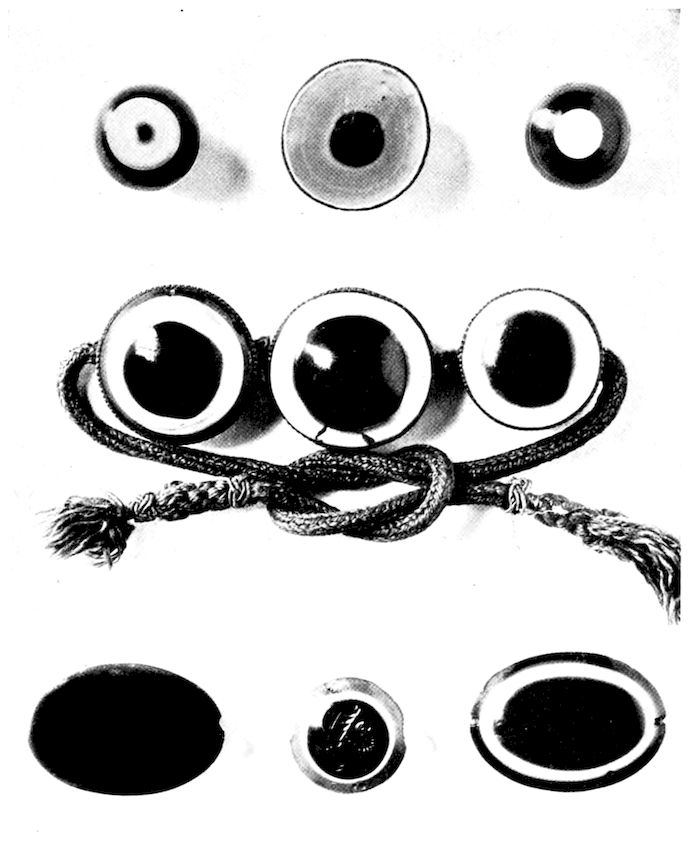
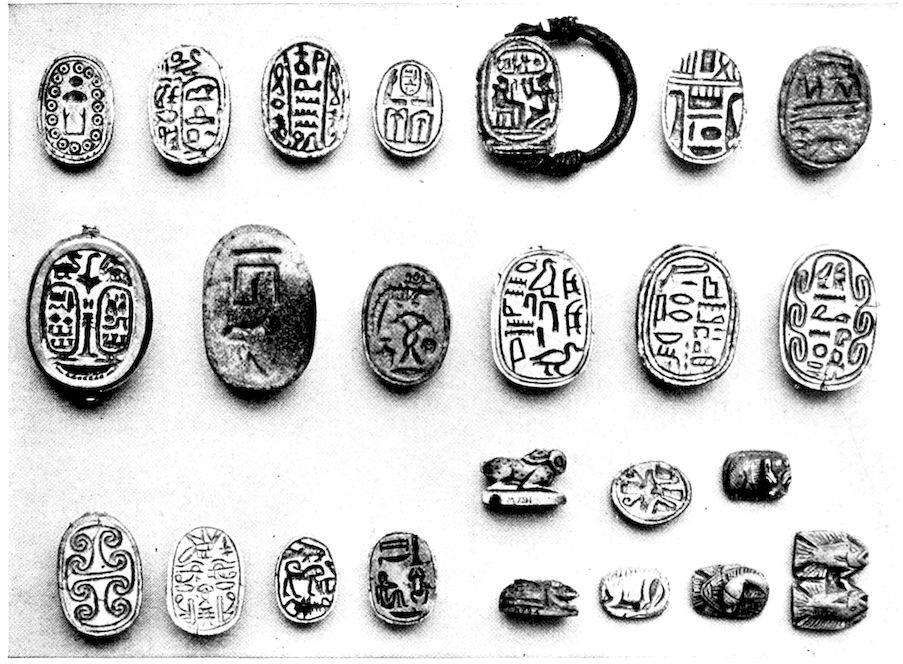
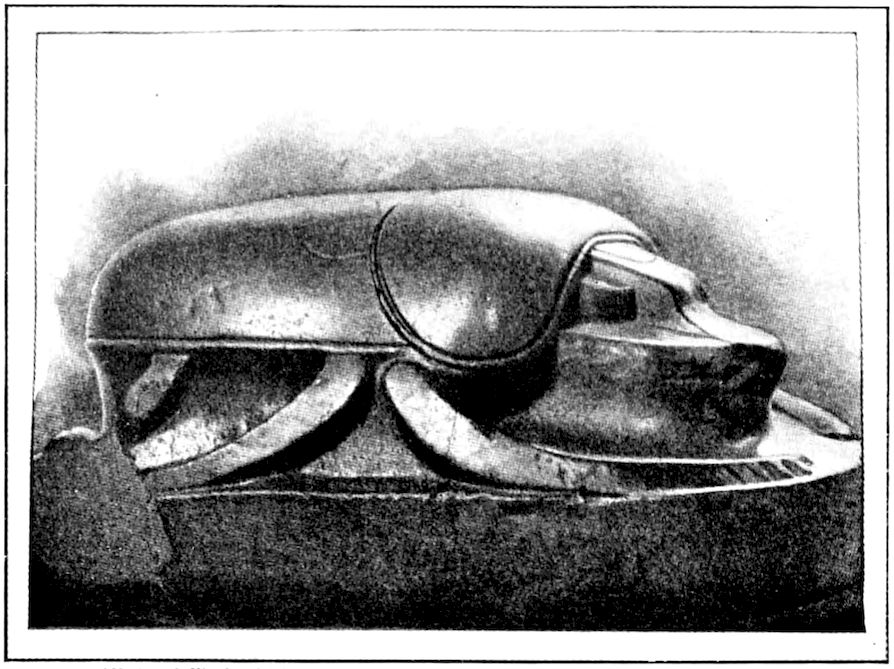
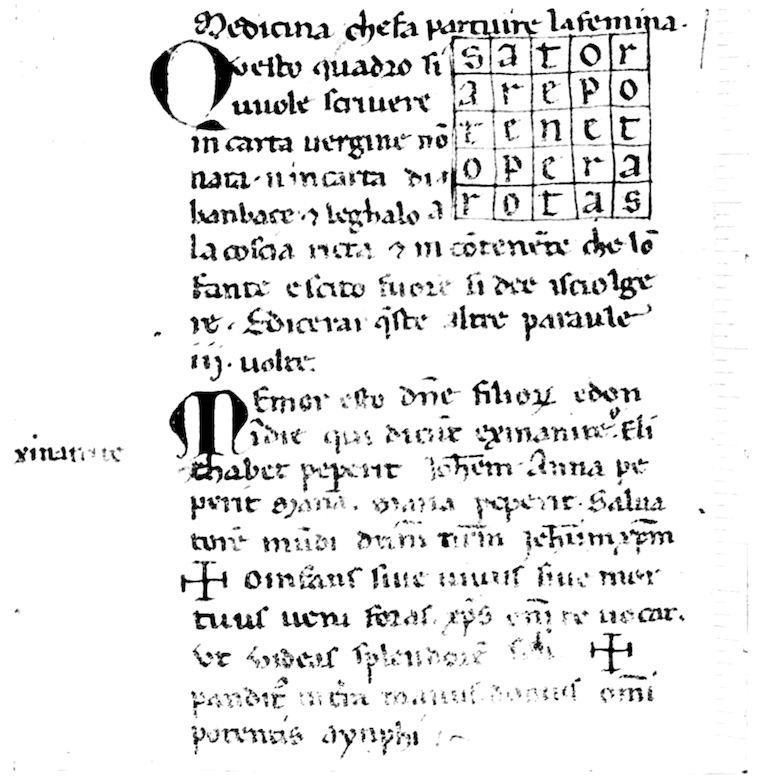
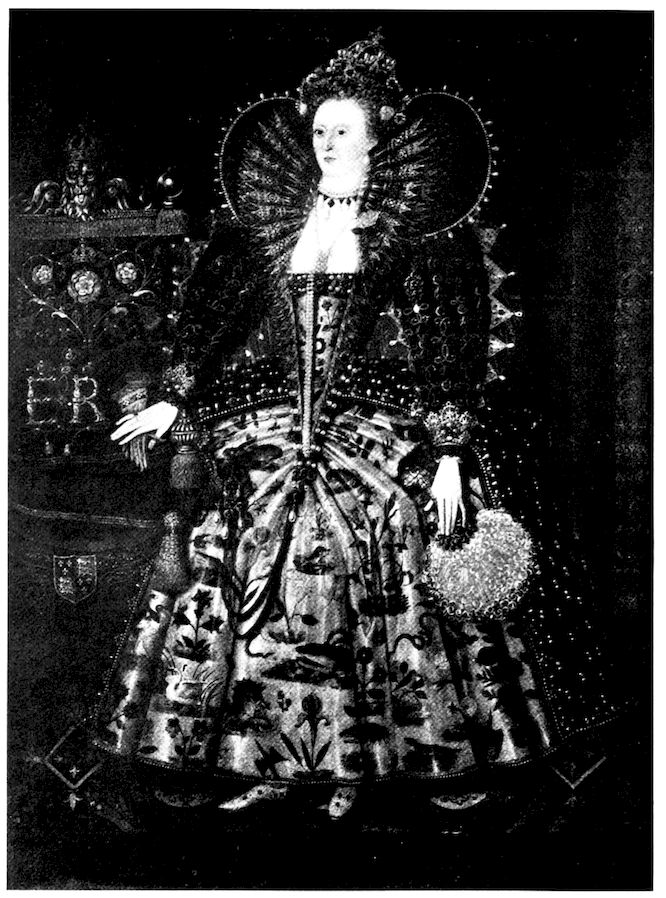
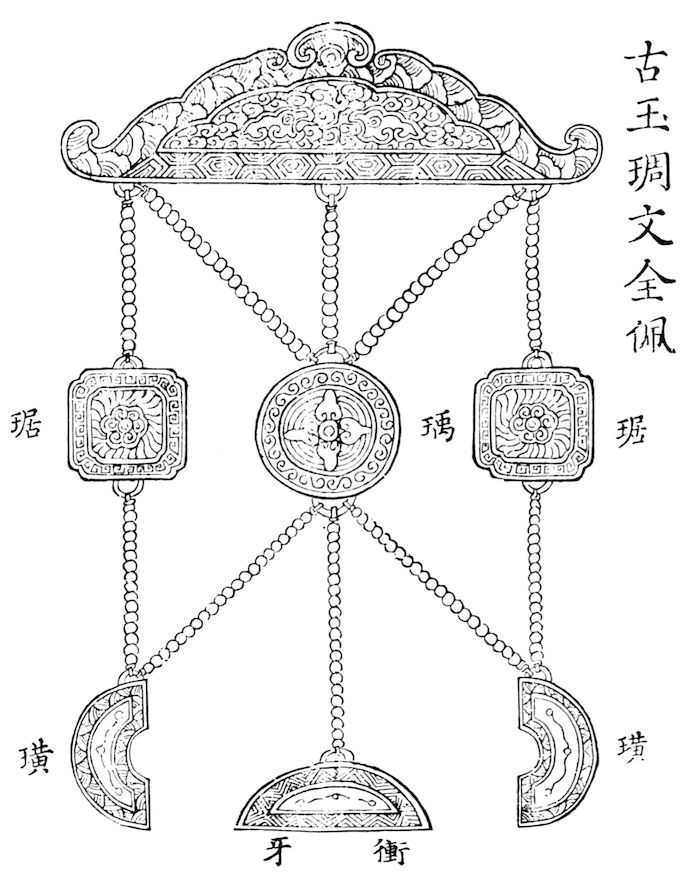
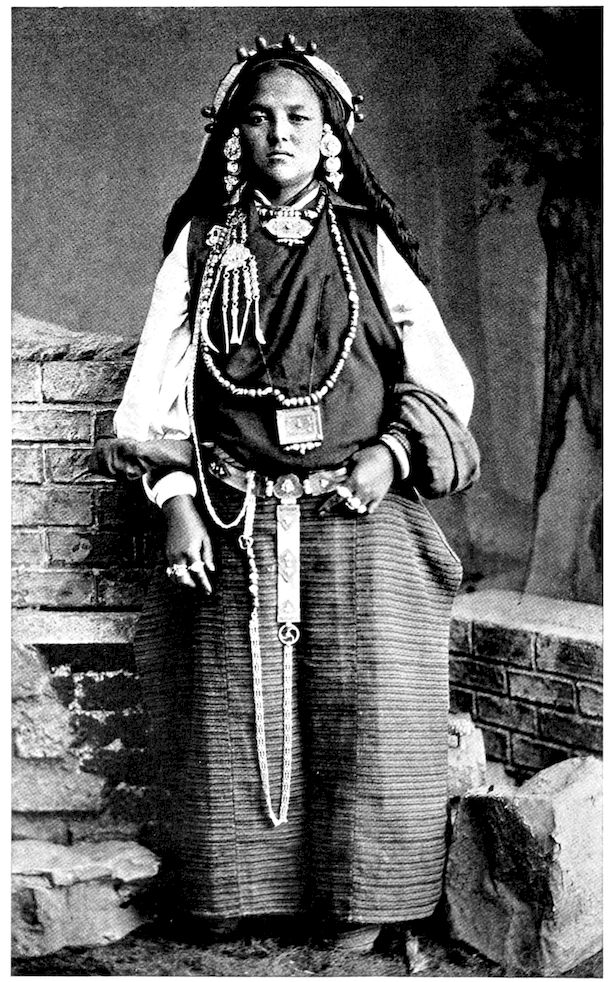
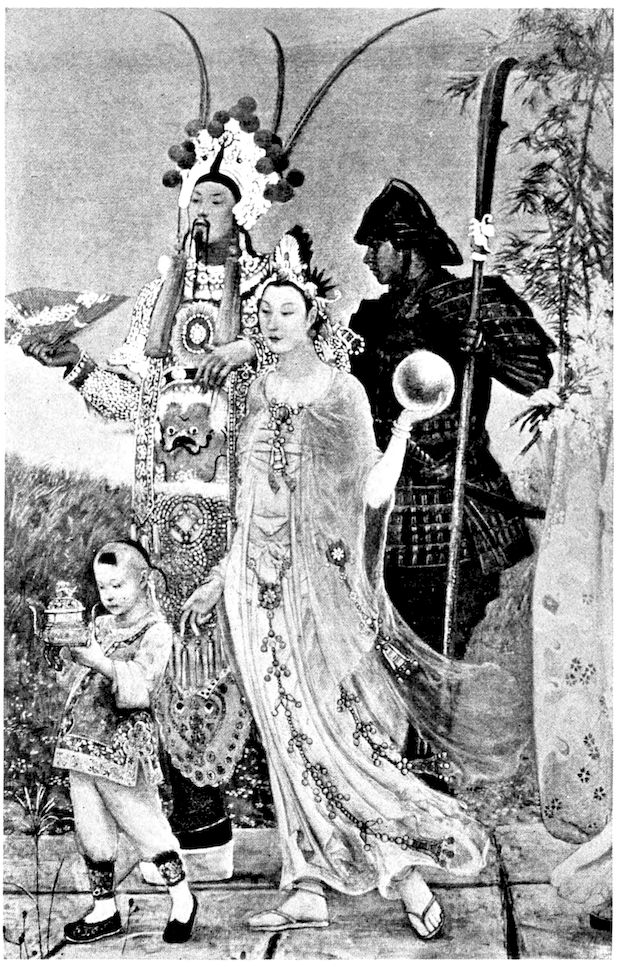

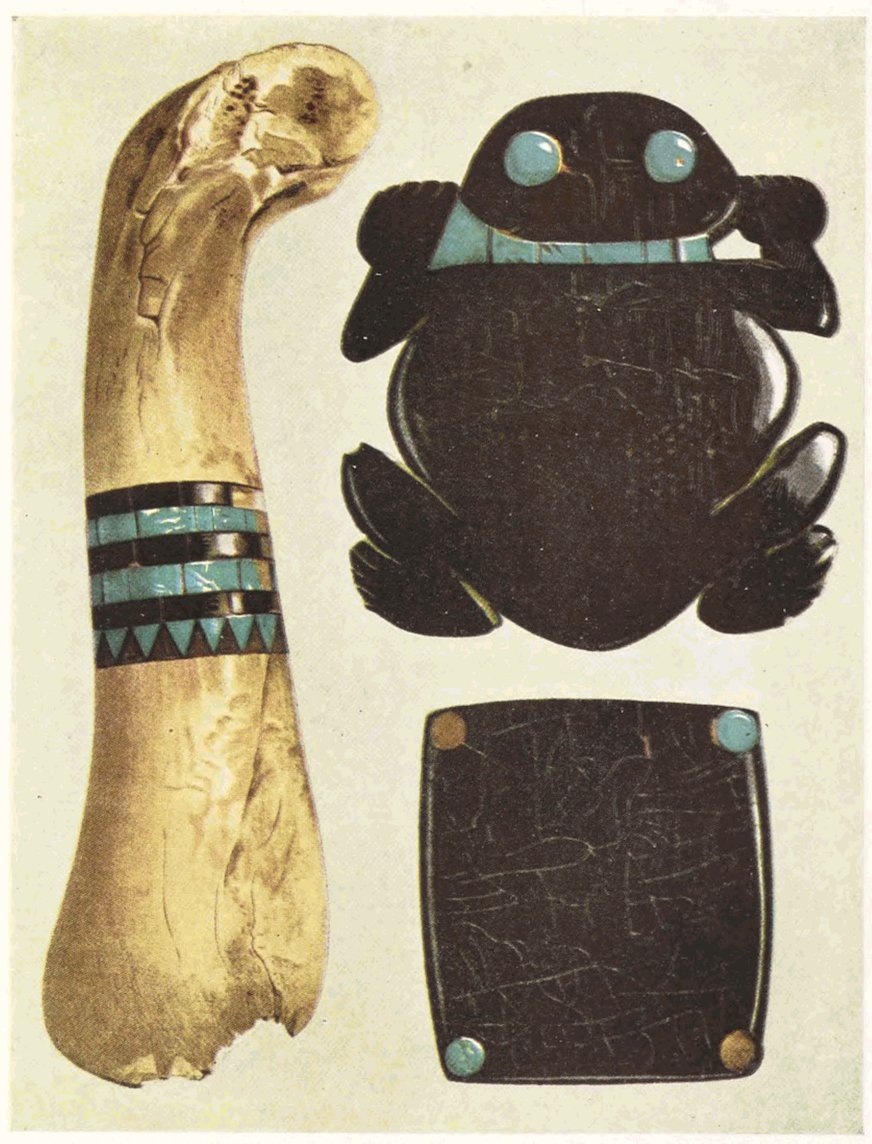
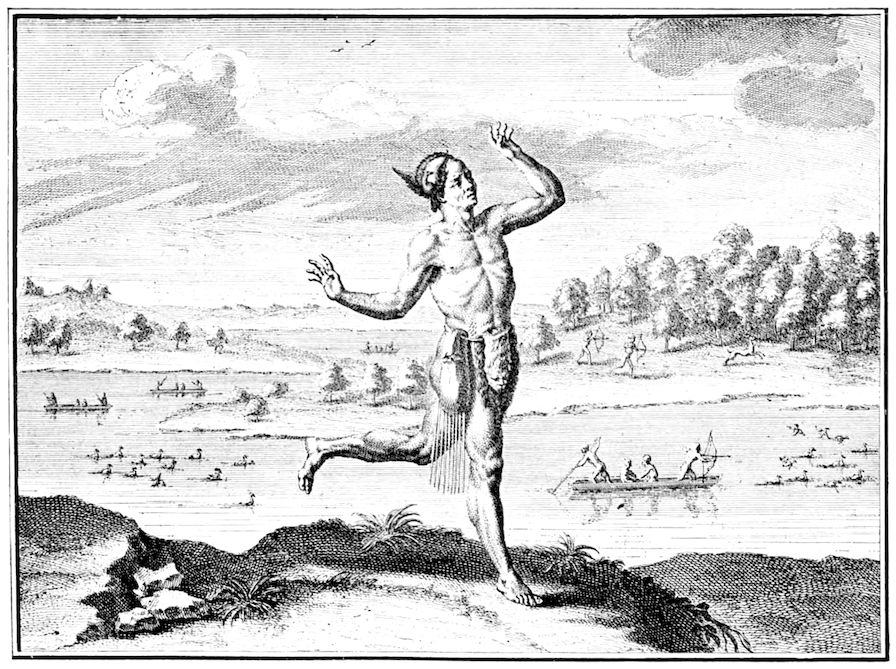
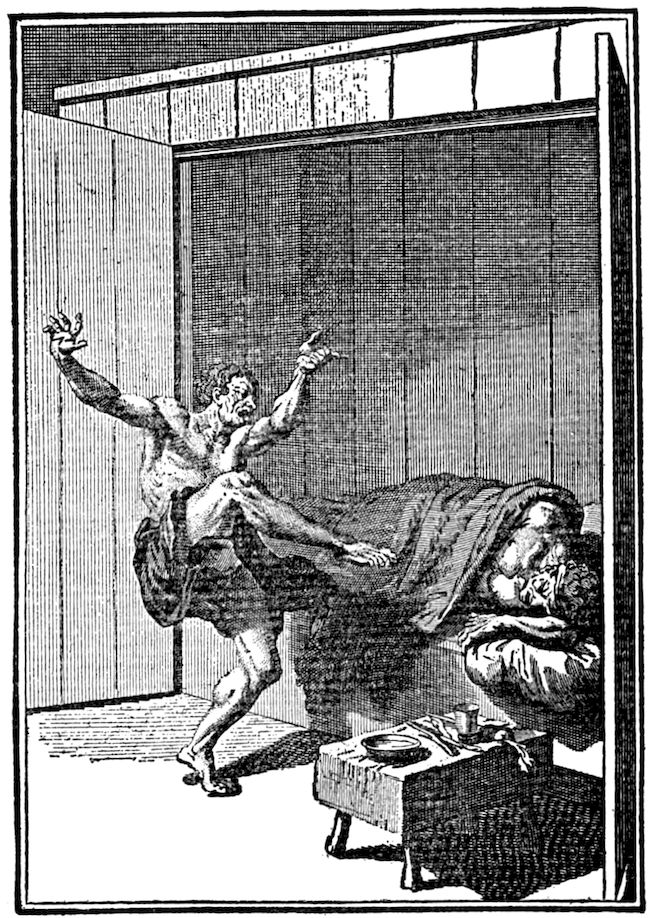
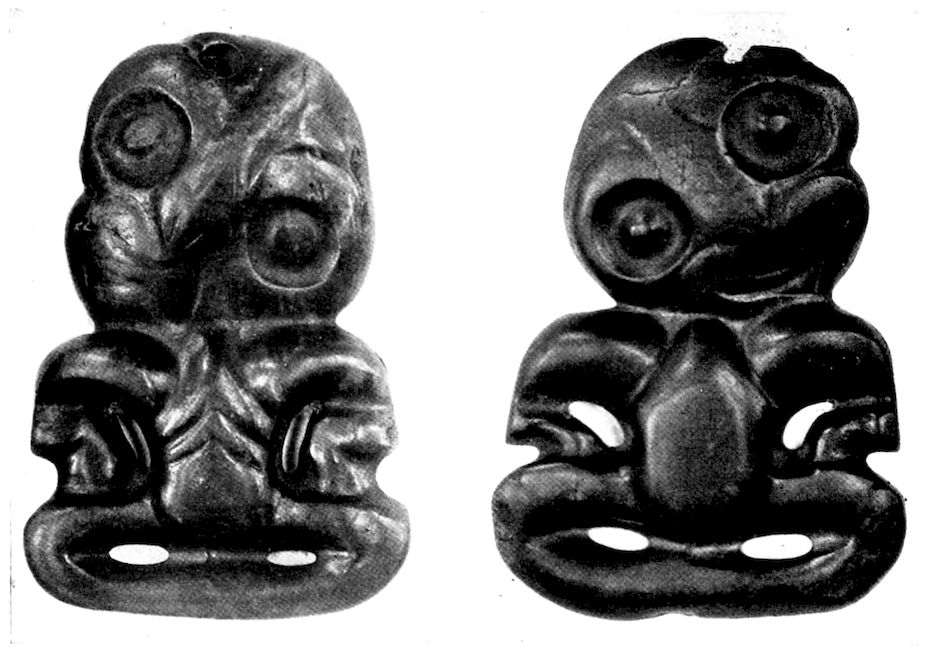
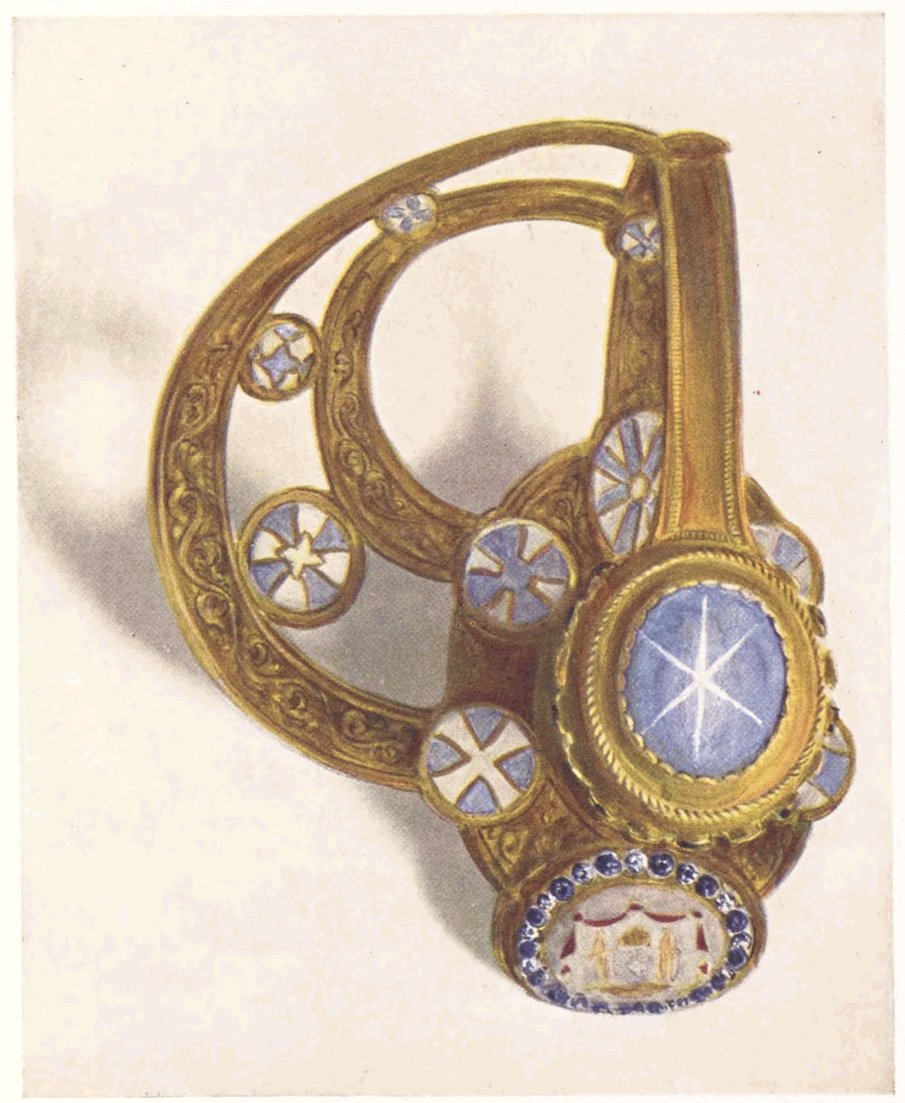
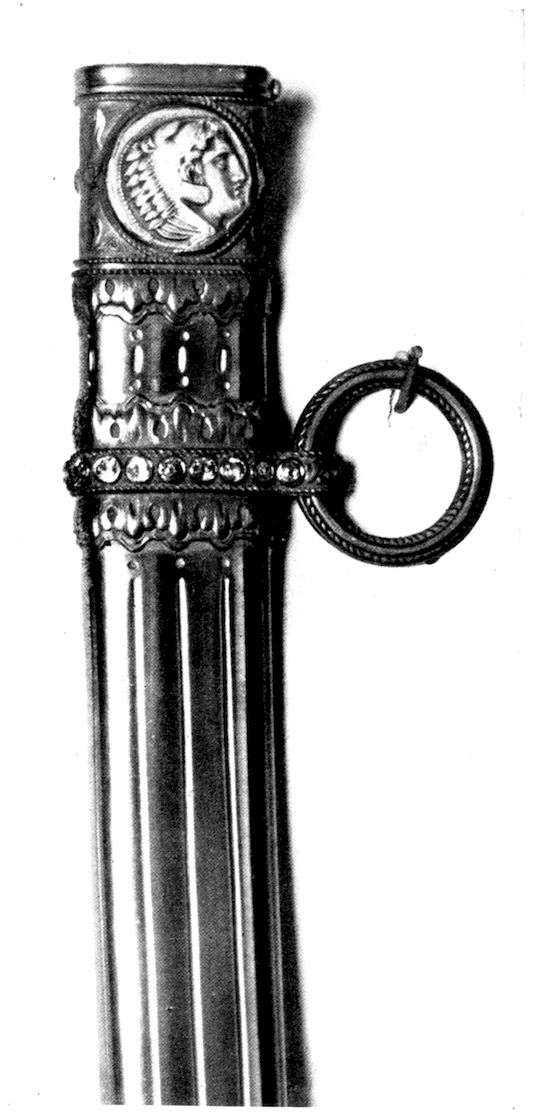
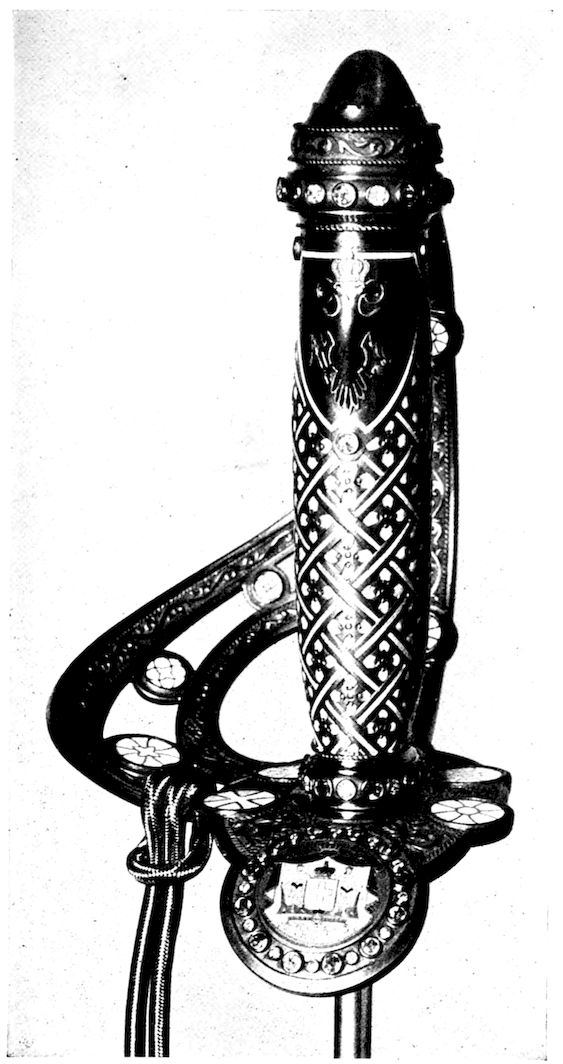

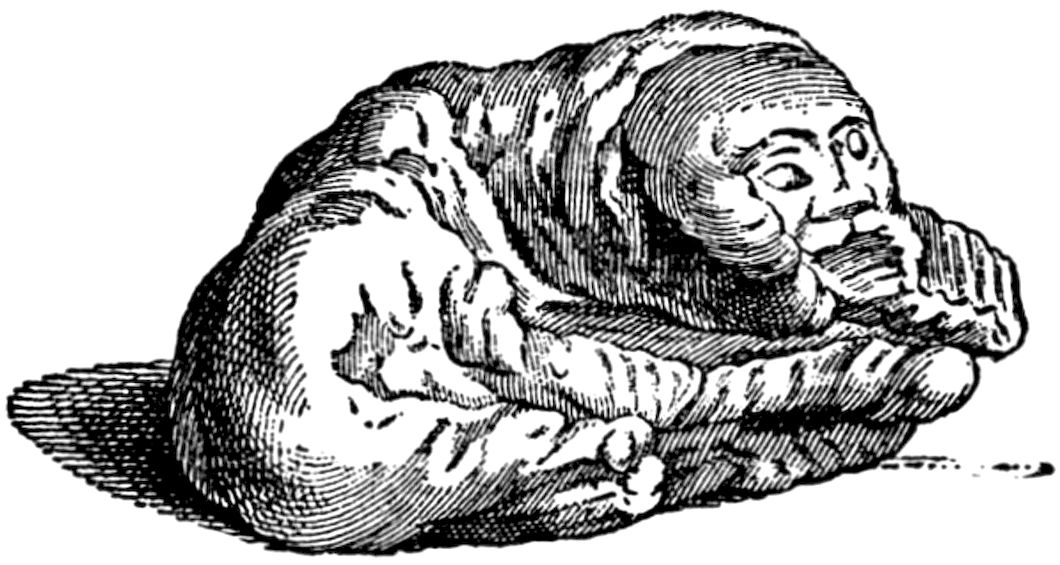
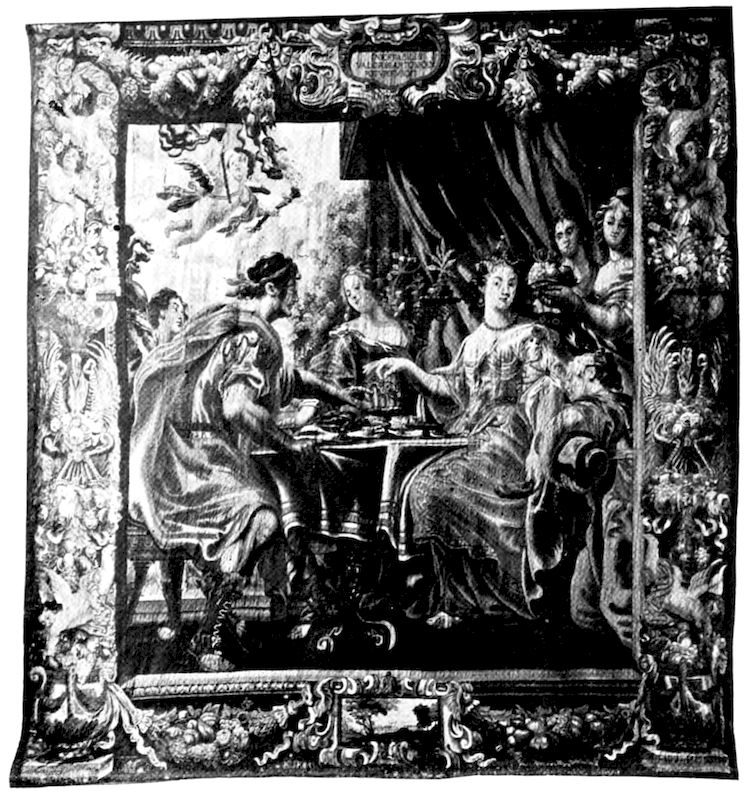
 ; that is, three suns, an attempt to
figure the refraction and dispersion of light by the crystal.