There are many amateur photographers
nowadays who can produce fair transparencies
for the lantern, but at the same time there are
many possessors of a lantern who know nothing
about the ‘black art.’ Luckily for these, first-class
pictures can be bought cheaply, their
average price ranging from eighteenpence to
two shillings each. Any optician’s catalogue
will show what an immense variety of subjects
there is to chose from; not only can we obtain
landscapes of nearly every part of the world,
but we can purchase figure studies, copies of
various pictures from books, maps, diagrams
of scientific matters—micro-photographs and
statuary. These slides if coloured are double
the price of plain ones, and if very well
coloured their price is quadrupled.
It would therefore be serviceable to many if
they could learn how to colour such pictures
for their own use, and I give simple directions
how this can be accomplished. At the
same time it is only fair to state that the work
is really difficult, and anyone to attain even
slight proficiency in slide-painting must devote
a great deal of time and patience to the subject.
The photographic slide as sold consists of
two glasses, one of which bears the photograph.
This is separated from the cover-glass by a
paper mask, the whole being bound round by
a fillet of gummed paper. After carefully cutting
round this fillet the two glasses may be
separated, and the one bearing the picture is
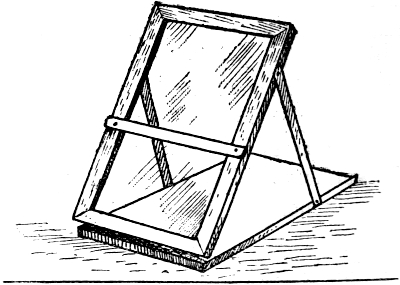
placed, varnished side upwards, upon the glass
easel, ready for colouring. Some colourists
speak in favour of water-colours for glass-painting,
others prefer oil-colours, while some,
I understand, employ both on the same
picture. I have tried each system, and most
certainly recommend oil-colours as being both
easier to work with, and doing more satisfactory
work into the bargain than water-colours.
The materials required comprise ordinary
oil-colours in tubes, of which the following are
perhaps the most useful that can be employed
for the purpose:
| Italian Pink. |
Prussian Blue. |
Rose Madder. |
| Raw Sienna. |
Indigo. |
Purple Madder. |
| Yellow Lake. |
Neutral Tint. |
Crimson Lake. |
| Chinese Orange. |
McGilp. |
Burnt Sienna. |
| Brown Pink. |
Brown Madder. |
Ivory Black. |
It is curious to observe that the suitability
of these colours for the particular purpose of
glass-painting varies with the method of manufacture.
I find by experience that one maker’s
Prussian blue is better than another’s, while
for a suitable crimson lake I have to go to
quite a different shop, and so on.
The brushes used must be of the best, the
majority of them being camel-hair, a few
fine sables being kept for special touches. It
is also necessary to provide some good large
bushy camel-hair brushes to be used as softeners.
A flat porcelain palette is better than one of
any other material, for the strength of the
tints is seen well, and the surface can easily be
cleaned with a little turpentine. A flexible
palette knife must also be provided.
Dabbers to soften down skies and other flat
masses of colour can be made by wrapping a
ball of cotton wool in fine wash-leather. The
leather should be first thoroughly washed with
soap and water, and it will be better if a little
of the soap be left in it as it dries, for this
renders it soft and pliant. Both dabbers and
brushes should be kept in a dust-tight box,
for dust is the greatest enemy of the slide-painter.
It will be noticed that the list of colours
given includes those only which are transparent,
many others used in ordinary oil-painting
being omitted. It is obvious that opaque
colours like Naples yellow or chrome yellow
would simply appear black on the sheet. The
tyro who is used to other methods of painting,
and has some idea of the harmony of colours,
will, of course, have an immense advantage
over anyone without artistic knowledge or feeling;
and when he has once mastered the technicalities
of the new work, will soon be able to
produce passable pictures. The list of colours
given is necessarily limited for the reason
already given, but their number can be increased
indefinitely by judicious blending
one with the other. Let me give a few instances.
There is no green in the list given, simply
because I do not know of a good transparent
one. But various tints of green suitable for
foliage can be easily made up with the colours
named. Prussian blue mixed with any of the
yellows will at once give a crude green, but it
will not be suitable for use without the help of
some other tint, such as burnt Sienna, or one
of the reds. Italian pink and indigo make a
fine green. Italian pink, brown madder, and
Prussian blue is also another useful combination.
Brown pink, indigo, and Vandyke
brown will be found admirable for the
shadows in foliage; indeed, the combinations
for this purpose are endless. Again, there is a
difficulty generally found in obtaining any
approach to scarlet. The best I know of
is a mixture of Italian pink, crimson lake,
and Chinese orange. For browns, Vandyke
brown, Chinese orange, ivory black, and
burnt Sienna, will give any range of tints,
from the coldest to the warmest. The reader
will soon find by experiment the right proportions
for mixing these colours to produce the
desired effect, and he will be much assisted in
the work by studying any good manual of
water-colour painting. I recommend a water-colour
manual in preference to one dealing with
oil-colours, because the first deals more with
transparent tints, which depend for their
effect upon the white ground upon which they
are laid. In like manner a lantern picture
depends much upon the white surface upon
which the tints are subsequently exhibited.
Our first attempt at glass-painting shall be
an open landscape with figures in front—and
we will suppose that the scene is laid in
Britain. This would seem to some an unimportant
point, until they remember that the
skies and atmospheric effects seen in some
other lands would require an altogether
different treatment. I once coloured an
Egyptian scene for a friend, and he admired
my work, with one exception. ‘You have
given me an English sky,’ he said. The sky
will be the first thing to see to, and we will
endeavour to give it a flat tint of blue slightly
darker at the zenith than it is at the horizon.
We squeeze out from its tube a little Prussian
blue upon the palette, and dipping a good-sized
camel-hair brush into a small cup of
turpentine, we take up a little of the colour
and work it about on the palette until it seems
of the right strength. Before applying it to
the glass we add to it a very small quantity of
McGilp medium. Having mixed this last
addition with our brush-load of colour, we can
apply it to the glass, painting it in broad
bands from side to side until the sky is all
striped with blue. If the subject comprises
a range of distant hills, let them too partake
of the blue tint. When this is done, lay aside
the brush and let the coloured glass rest for a
minute, so that some of the turpentine will
dry off. Now proceed to dab it carefully with
one of the leather dabbers. With a very light
touch bring the dabber down over and over
again, and avoid anything like a rubbing
action. The movement must be vertical, and
not in the least horizontal. By bearing a little
more heavily on the dabber as the horizon
is approached, the tint will be sensibly
lightened.
When this sky-colour has been uniformly
dabbed in we may proceed to put in, or rather
wipe out, some cloud effects. A little piece of
soft kid wrapped round a pointed pen-holder
is a good tool to use for the purpose, but a
leather stump will answer the same end. This
part of the work requires a little judgment
and artistic taste. In a picture full of detail
and which only has a small portion of sky
exposed, it is best coloured simply blue. But
where there is not much detail in the landscape,
as in the case for instance of a mill on a bleak
moor, the sky can be worked up with great
advantage to the general effect. The clouds
are wiped out by a rubbing action combined
with a dabbing movement, so that the edges
of the clouds formed remain quite soft. If
they appear too hard they can be corrected by
a few gentle dabs with the top of the finger.
Before the leather is laid aside, it may be employed
for wiping off any portions of colour
which have accidentally been placed where
they should not be. But if there is water included
in the subject, such as a lake or river,
it will when the sky is reflected in it partake
of the same colour, and should be dabbed in
at the same time.
We must now consider how we are going
to treat the rest of our picture. If there is
some expanse of foreground it will make the
best contrast with the sky if we use a warm
sandy colour. Chinese orange, raw Sienna, and
brown pink mixed in various proportions to
suit the lights and shadows of the picture will
give the tint required. At this stage, too, the
middle tints of the composition lying between
the sky and the foreground can also be laid in.
These will mostly consist of subdued greys,
made up of Prussian blue, burnt Sienna,
purple madder, and crimson lake. When
these tints are all dabbed in, and the whole
picture has been carefully gone over with the
leather point, so as to remove truant colour,
the slide may be laid aside to dry. I find it
a good plan to have a tin box containing
grooves for this purpose. The slides when
grounded in in the way just described are
placed in the grooves, and the open box is
turned towards a fire. In an hour or so the
colours are dry enough for further treatment.
We can now once more view our work on
the easel, and most probably we shall see much
to amend. The trees in the middle distance
are too yellow, or too blue. They are easily
corrected by a touch of the tint in which they
fail. But at this stage of the painting we
must use a different medium for our colours.
We have done with dabbing, and must now
lay the colours on as smoothly as possible
with the brush alone. Canada balsam in
turpentine, of the consistence of very thin
varnish, is perhaps the best medium to use.
It should be mixed with every colour as it is
taken upon the brush.
The beginner will find some difficulty at
first, particularly if oil-colours are new to him,
in keeping his brushes in order. He need not
have a brush for every tint. Let one be kept
for skies, but only two or three others are
necessary. When I commence to paint a batch
of pictures I put on my table, after carefully
dusting it all over with a damp cloth, a sheet
of newspaper. In the centre stands my easel.
On the left hand my colour-box, and on the
right my palette. Close to the palette is
placed a double thickness of clean white tissue
paper, and a small pot of turpentine. When
I wish to clean my brush, it is simply dipped
in turpentine, and drawn over the surface of
the white paper until I see that it leaves no
trail of colour. By this simple means one
brush can be used for any number of tints,
for the cleansing of it does not occupy more
than ten seconds.
It is in the foreground of a picture that the
artist must be lavish with his bright colours.
If the figures in the subject will allow of
bright colouring, so much the better; but it
must be remembered that if these colours are
not put in with some regard to contrast, their
effect is much diminished, if not altogether
lost. Let the painter remember that the
principal colours have their complementary
colours, and that wherever we can place one
of these tints against its complementary, we
are bound to have harmony. Thus the complementary
of blue is orange; of red, green;
and of yellow, purple. But for further particulars
of this nature, the aforesaid ‘Manual
of Water-Colours’ must be studied.
When the picture is apparently finished, it
will, most likely, require some finishing-touches.
And here a new tool comes into
use, namely, the etching-needle. Take a
pointed piece of wood, about the size of a
penholder, and bind upon it, by means of
waxed thread, a good strong sewing-needle,
leaving not more than a quarter of an inch
of the point exposed. A few judicious touches
with this needle will make a vast difference
in the effect of a picture, but anything like
coarse scratching must be avoided. The
beginner will do well to view his work in
the lantern as it gradually progresses, for
what may look very well on the easel, will look
very different when all its imperfections are
magnified on the screen. The art of slide-painting
is one which requires constant care
and practice before anything like proficiency
is attained.
In case some of my readers should be well
acquainted with the use of water-colours, and
may be deterred from trying the art of glass-painting
because oils only are recommended
for the work, I will briefly describe how
water-colours are utilized for slide-painting.
At the same time, I hold to my previously
expressed opinion, that oil-colours are the
more suitable pigments to use.
The varnished surface of a glass picture
does not take kindly to water-colour, and as
the brush is applied to it there is a repellent
action which would make the painter despair
if some means were not at hand to obviate the
difficulty. By mixing each colour with a
certain proportion of prepared ox-gall the
difficulty vanishes, and it is a wise precaution
to rub a little ox-gall and water over the
surface of the picture by means of a tuft of
cotton wool, before any colour is applied at
all.
The same transparent colours as those recommended
for oil-painting may be employed,
besides a few more transparent tints which
are commonly not ground up in oil. But the
dabbers are of a different description. Procure
two or three good thick camel-hair
brushes, and cut the hair off straight with a
pair of scissors, so as to leave the ends of the
hairs like a flat stump. Now carefully turn
the brush round and round in the flame of a
spirit lamp, or candle, so as to just singe the
point of each hair. When this is done, rub
the ends of the hair on the finest glass-paper
until every trace of singeing has disappeared.
This treatment will leave the brush with a
flat woolly head like a mop, which makes an
excellent dabber.
When the sky-colour has been applied as
evenly as possible, and has been allowed to
dry, the surface may be worked over with the
dabber. But, before doing this, gently breathe
over the colour. The dabber will remove
little particles of the pigment, and will reduce
the general strength of the tint, so that this
loss should be provided for when the colour
is first applied. Clouds, etc., can be wiped
out with the leather, after the breathing
operation, and in many other respects the two
modes of colouring agree.
When the general tints have been laid in,
the colours may receive a coat of mastic
varnish, and this again can be worked over
with colour to strengthen those tints which
may require it. The varnish also confers a
transparency upon the tints that they do not
possess without it.