VOL. I NO. 4 THE MAGAZINE OF HISTORY WITH NOTES AND QUERIES — CONTENTS — THE PROGRESS OF DISCOVERY OF THE MISSISSIPPI RIVER — I THE VOYAGE OF VESPUCCI PAST THE MOUTHS OF THE MISSISSIPPI
Transcriber’s Note:
New original cover art included with this eBook is granted to the public domain.
| PAGE | ||
|---|---|---|
| THE LEXINGTON MINUTEMAN | Frontispiece | |
| PROGRESS OF DISCOVERY OF THE MISSISSIPPI RIVER (First Paper) | WARREN UPHAM | 195 |
| (Sec’y Minn. Historical Society) | ||
| BETWEEN TWO FLAGS | KATHERINE PRENCE | 203 |
| CIVIL WAR SKETCHES (First Paper) Confederate Finance in Alabama | WALTER L. FLEMING | 214 |
| (Prof. of History, West Va. University) | ||
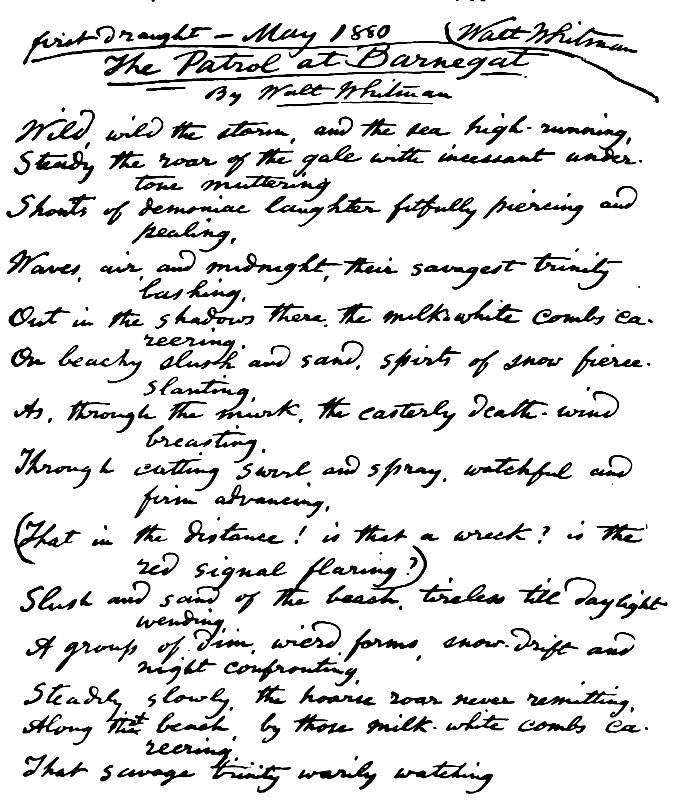
| THE PATROL AT BARNEGAT (Poem MS.) | WALT WHITMAN | 220 |
| EARLY LEGISLATIVE TURMOILS IN NEW JERSEY | WILLIAM NELSON | 221 |
| (Sec’y N. J. Historical Society) | ||
| HITHERTO UNPUBLISHED POEM OF EDGAR ALLAN POE | 231 | |
| WHEN WASHINGTON CAME TO SPRINGFIELD | REV. NEWTON M. HALL | 232 |
| LEXINGTON AND CONCORD (Dr. Fisk’s Bill.) |
HERBERT W. KIMBALL (Registrar, Mass. S. A. R.) |
239 |
| THE DEAD OF PATRIOTS’ DAY | 244 | |
| THE MEMORIAL TREES AT WASHINGTON | 245 | |
| ORIGINAL DOCUMENTS | ||
| Letter from Benjamin Hawkins to Governor Caswell | 248 | |
| Letter from Silas Deane to Capt. Joseph Hynson | 251 | |
| MINOR TOPICS | 252 | |
| GENEALOGY | 253 | |
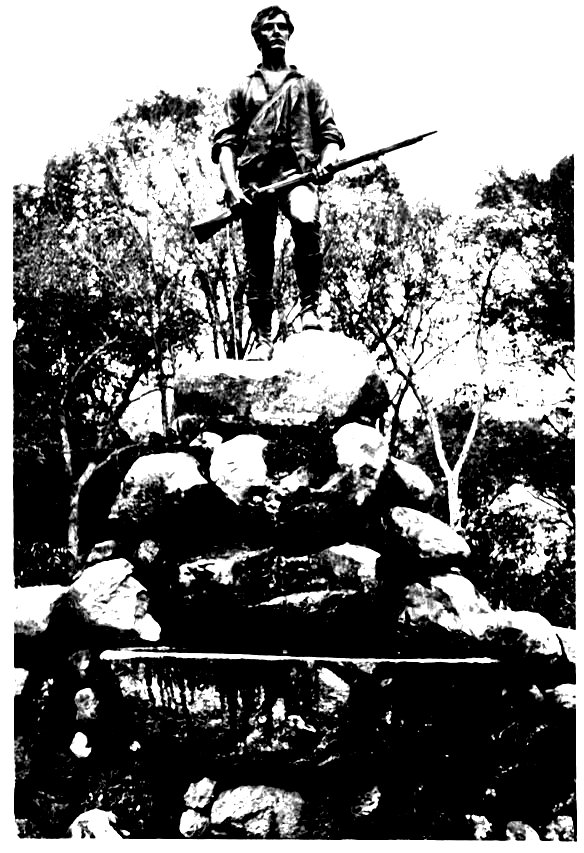
THE FOUNTAIN AT LEXINGTON WITH STATUE OF THE MINUTE MAN.
| VOL. I | APRIL, 1905 | NO. 4 |
According to the historical researches set forth in this first paper of a series on the discoveries and explorations of the Mississippi in various portions of its course, the river appears to have been earliest discovered and mapped at its mouth in a voyage of Pinzon and Solis, with Amerigo Vespucci as astronomer and cartographer, probably in March or April, 1498, less than six years from the first landfall of Columbus. Twenty-one years then passed before the Mississippi was next seen in the voyage of Pineda, in 1519, being reached by ascending a bayou from Lakes Pontchartrain and Maurepas. In 1528 one of the mouths of the Mississippi was seen in the forlorn last voyage of Narvaez; and in 1541 the river was crossed far above its mouth, by the ambitious but ill-fated expedition of De Soto, and after his death it was descended by the survivors in boats to the Gulf. Four times within a period of forty-three years, the Spaniards reached by sea and by land the lower part of the Mississippi. They sought gold or silver in vain, and the extreme disasters of the last two expeditions caused them to abandon their purpose of planting colonies and making this region a part of New Spain. The entire river, excepting its sources, was to be explored and owned by others, but much later, for acquiring wealth by commerce, and for extending the dominion of France.
More than a hundred years after De Soto, the Mississippi was re-discovered by Europeans, this time in its upper course, when Groseilliers and Radisson in 1655, with many Indian canoes, ascended it from 196near the Wisconsin river to Prairie Island, if I have rightly understood the narrative of Radisson; and they crossed it higher, at or near the site of Minneapolis, in 1660, when they went to visit the Prairie Sioux at the farthest limit of their second western expedition.
Halfway in time between De Soto and these men, a Spanish expedition under Oñate, coming from New Mexico in 1601, probably reached the Mississippi near the mouth of the Arkansas river; but we have only scanty records of this exploration, which some have ascribed to the year 1662, following a fictitious narrative that would make Peñalosa the leader.
Eighteen years after Groseilliers and Radisson’s first trip, Joliet and Marquette navigated the Mississippi for a long distance southward from the Wisconsin river, to the Arkansas; and again, after seven years more, in 1680, it was navigated between the Illinois and Rum rivers by Hennepin, and also, above the Wisconsin, by Du Luth. In 1682 La Salle led an expedition from the Illinois to the mouth of the Mississippi, and there proclaimed its vast drainage area to be the property of France. A few years later, about 1685–90, Le Sueur and his relative by marriage, Charleville, canoed from Lake Pepin far upward beyond the Falls of St. Anthony, probably to Sandy Lake; and in the last year of the seventeenth century, just forty-five years after Groseilliers superintended corn-raising by the Hurons on Prairie Island, Le Sueur and a large mining party navigated the whole extent of the Mississippi from near its mouth to the Minnesota river, and then advanced up that stream to the Blue Earth river.
Without seeking or suggestion by himself, the name of Amerigo Vespucci (also commonly known, in Latin, as Americus Vespucius) was bestowed upon the New World, of which, next after Columbus, he was the most notable discoverer in the sense of bringing to the knowledge of Europe what he saw in four voyages. Though not in command of these expeditions, Vespucci was a skilled geographer, and his services as astronomer and pilot were required to determine and chart their courses, with the newly discovered lands. His letters of description, written to friends without expectation of publication, were printed and proved to be of such popular interest that they passed through many editions and translations, leading to the adoption of the name America, after his death, on maps and globes. It was at first applied to Brazil, which Vespucci coasted on his second, third, and fourth voyages, and was later 197extended to both North and South America. In his first voyage, with four vessels, leaving Spain May 10, 1497, and returning October 15, 1498, he appears to have sailed along the shores of Honduras, Yucatan, the Gulf of Mexico, Florida, and our southeastern seaboard north to Pamlico Sound.
Between Vespucci and Columbus a cordial and mutual friendship existed, and the Florentine pilot had no wish nor thought of taking away from the Genoese admiral any part of the honor and gratitude due to him. Both sailed in the service of Spain, but Vespucci also made two voyages for Portugal. It was a Latin book by a German geographer, Waldseemüller, published in the little college town of St. Dié, in a valley of the Vosges mountains in northeastern France, April 25, 1507, which first proposed the name America for the region described by Vespucci south of the equator. There was at that time no intention to include under it the countries farther north discovered and explored by Columbus, Cabot, and other navigators. Winsor and Fiske have traced very instructively the growth of European knowledge of the New World, whereby it was finally learned that all the coasts explored from Labrador to the strait of Magellan are connected parts of one vast continent, on which Mercator bestowed the single name America in 1541, twenty-nine years after Vespucci’s death.
Succeeding generations long imputed blame to Vespucci for this supplanting of Columbus in the name of the new continent; but either would have scorned to wrong the other, or to falsify or exaggerate intentionally in the narrations of their voyages. The personal honor of Vespucci has been vindicated by the researches of Alexander Humboldt and the Brazilian historian, Varnhagen; and the latter, in 1865 and 1869, well ascertained that Vespucci’s first voyage, made in 1497–98, concerning which much doubt and misunderstanding remained because of the lack of many details in the narration, was the source of the first mapping of Yucatan, the Gulf of Mexico, and Florida. In Vespucci’s chart of that very early date the Mississippi river was unmistakably delineated, with a three-mouthed delta projecting into the Gulf.
Varnhagen’s luminous researches, published between thirty and forty years ago, were brought more fully to the attention of readers of our English language by Hubert Howe Bancroft in 1883 (Central America, vol. I, pp. 99–107), and especially by John Fiske’s work, The Discovery 198of America, published in 1892. No official reports nor chart of Vespucci’s first voyage, which was probably under the commandership of Pinzon and Solis, are preserved; but two very early maps, evidently drafted in part from the chart of that expedition, still exist, and were essentially reproduced ten years ago by Harrisse, Winsor, and Fiske, in their elaborate discussions of the Columbian and later discoveries.
One of these two maps was drafted in 1502 by some unknown Portuguese cartographer for Alberto Cantino, an Italian envoy at Lisbon, and hence is called the Cantino map. It delineated crudely the southeastern coast of the United States from the “Rio de los Palmas” (River of Palms)—thought by Fiske to be the Apalachicola river—eastward around Florida and onward north to Pamlico Sound, according to my identification. The coast bears many names of rivers, capes, etc.; and the end of the Florida peninsula is called “C. do fim do Abrill” (Cape of the end of April), whence it is inferred that the expedition in which Vespucci sailed on his first voyage, whose chart supplied this part of the Cantino map, passed through the strait separating Florida from Cuba at the end of April, 1498. The west edge of this map is at its River of Palms, so that it fails to give any information of the part of the Gulf of Mexico farther west.
Comparing the Cantino map with our southeastern coast line, to determine how far Vespucci saw it, I recognize, in their order from south to north, Jupiter Inlet or Indian River Inlet, Cape Canaveral, the St. John’s river (or, probably better, Cumberland Sound and St. Mary’s river, or St. Andrew’s Sound, or the Altamaha), then Warsaw and Tybee capes and the Savannah river, Cape Romain, the Santee river, Winyah Bay and the Pedee river, Cape Fear, New River Inlet, Cape Lookout, the Neuse and Pamlico rivers, and Long Shoal Point (or Sandy or Stumpy Point), extending into the north part of Pamlico Sound. The coast is represented as wholly trending to the north, instead of its curvature to the northeast. Entering Pamlico Sound by Ocracoke Inlet (or whatever passage existed near there four hundred years ago), the ships were probably repaired for the homeward voyage at some very favorable harbor among the many along the exceedingly irregular landward side of this sound, or at some distance up either of its large tributary rivers. The chart failed to note the long beach ridge of sand which forms Cape Hatteras and separates the sound (“mar vaano”) from the ocean.
Waldseemüller, the geographer at St. Dié, drafted the second of 199these maps, at some date probably after 1504 and certainly not later than 1508. It was published at Strasburg in an edition of Ptolemy in 1513, and was entitled “Tabula Terre Nove.” From its reference to a “former Admiral,” probably Columbus, it has been often called “the Admiral’s map.” This bears testimony that the expedition described by Vespucci as his first voyage passed the Mississippi and charted its mouths; for west of the Atlantic coast and Florida, where the shores and names are closely like the Cantino map, Waldseemüller gave a distorted outline of the Gulf of Mexico, with a large river emptying into it by three mouths, pushing its delta far into the gulf, in which respect the Mississippi surpasses any other river, this being indeed the most remarkable feature of its embouchure. I cannot doubt, therefore, that Vespucci sailed past the Mississippi delta early in the year 1498, surveying the mouths of the river from the masthead, or very likely entering the river and spending some time there.
The original “Letter of Amerigo Vespucci upon the Isles newly found in his Four Voyages” was published in facsimile pages, with English translation, under the editorship of George Young, in Philadelphia in 1893, forming a book entitled “The Columbus Memorial,” its earlier half being occupied by facsimiles, translations, and notes of letters by Columbus. Only a very scanty statement was given by Vespucci concerning the voyage from some port on the west coast of the Gulf of Mexico, probably that of Tampico, at the mouth of the Panuco river, to “a harbour the best in the world,” which appears to have been on Pamlico Sound or river, whence, after repairing their vessels, the expedition returned to Spain. Vespucci wrote of the voyage between these ports: “We navigated along the coast, always in sight of land, until we had run 870 leagues of it, still going in the direction of the maestrale [northwest], making in our course many halts, and holding intercourse with many peoples; and in several places we obtained gold by barter, but not much in quantity, for we had done enough in discovering the land and learning that they had gold.”
According to Varnhagen and Fiske, the direction of their sailing, noted as northwestward, referred only to the first start from the port in Mexico, after which they continued along the irregular coast line 870 leagues. It seems to me also noteworthy that they came to this Mexican port by a northwestward course, and so perhaps Vespucci meant only that they went directly onward along the coast, which in that part curves very 200gradually to a nearly north course. From his statements of time, with the date indicated by the maps for passing the south end of Florida, it is probable that the expedition was at the Mississippi river late in March or early in April, 1498. Our history of this river, as known to Europeans, thus extends through four centuries.
As my study of the limit of this voyage of Vespucci on the coast of the United States, regarded thus to be at Pamlico Sound, differs somewhat from the conclusions of either Varnhagen or Fiske, it should be remarked further that the Pamlico region had a considerable Indian population, with many little villages, when it was described ninety years later by Thomas Hariot (or Harriott), a member of the unfortunate colony founded there in 1585 on Roanoke island, under the patronage of Sir Walter Raleigh. The Indians at first were very friendly to these colonists, as their forbears had been (if my identification of the locality is true) to Vespucci and his companions. The translation of this part of Vespucci’s narrative, given by Young, is as follows:
“We found an immense number of people, who received us with much friendliness ... the land’s people gave us very great assistance, and continually furnished us with their victuals, so that in this port we tasted very little of our own, which suited our game well, for the stock of provisions which we had for our return passage was little and of sorry kind. Where [i. e. there] we remained 37 days, and went many times to their villages, where they paid us the greatest honour: and [now] desiring to depart upon our voyage, they made complaint to us how at certain times of the year there came from over the sea to this their land, a race of people very cruel, and enemies of theirs, and by means of treachery or of violence slew many of them, and ate them; and some they made captives, and carried them away to their houses or country; and how they could scarcely contrive to defend themselves from them, making signs to us that [those] were an island people and lived out in the sea about a hundred leagues away.
“And so piteously did they tell us this that we believed them, and promised to avenge them of so much wrong, and they remained overjoyed herewith; and many of them offered to come along with us, but we did not wish to take them for many reasons, save that we took seven of them on condition that they should come [i. e. return home] afterwards in canoes, because we did not desire to be obliged to take them back to 201their country: and they were contented, and so we departed from those people, leaving them very friendly towards us: and having repaired our ships, and sailing for seven days out to sea between northeast and east, at the end of the seven days we came upon the islands, which were many, some [of them] inhabited, and others deserted: and we anchored at one of them, where we saw a numerous people who call it Iti: and having manned our boats with strong crews, and [taken] three guns in each, we made for land, where we found [assembled] about 400 men and women, and all naked like the former [peoples].”
Hard fighting ensued. Many of the natives of the islands were killed, and at last the Spaniards put them to flight and returned to their ships. The next day the natives came again to renew the contest, for which the Spaniards landed.
“After a long battle,” wrote Vespucci, describing this second day, “[in which] many of them [were] slain, we put them [again] to flight, and pursued them to a village, having made about 250 of them prisoners; and we burnt the village, and returned to our ships with victory and 250 prisoners, leaving many of them dead and wounded; and of ours there were no more than one killed, and 22 wounded, who all escaped [i. e. recovered], God be thanked.
“We arranged our departure, and the seven men, of whom five were wounded, took an island canoe, and with seven prisoners that we gave them,—four women and three men,—returned to their [own] country full of gladness, wondering at our strength: and we thereupon made sail for Spain, with 222 captive slaves, and reached the port of Cadiz on the 15 day of October, 1498, where we were well received and sold our slaves.”
Varnhagen, in his discussion of Vespucci’s voyages, presented arguments to show that the Bermudas were the group of islands thus occupied by a warlike and cannibal people, whom he supposed to have been soon afterwards exterminated by slavers, before the discovery of these islands by Bermudez about the year 1522, when they were uninhabited. Bancroft and Fiske inclined to the same view. It seems to me more probable, however, that the Bermudas, distant fully six hundred miles from any other land, had never been peopled until they were found by Europeans. The extreme isolation and comparatively small extent of the Bermuda group, far out in the sea, would make it practically impossible 202for the savages, with any means of navigation that they possessed, to pass back and forth in frequent war expeditions.
Instead, I believe that the islands visited by Vespucci on the return voyage were the northern part of the Bahama group. Without going so far from the coast and its inlets as to incur much danger of storms, or to completely lose the course and the reckoning in cloudy weather, canoe expeditions from the Bahamas could come frequently, as the narrative says, to attack the Indians in the region of Pamlico Sound. These Indians, too, sometimes pursuing their enemies homeward, might learn the situation of their islands, and would thus be able to pilot the way for Vespucci’s ships. According to this view, they sailed south from Pamlico Sound to the Bahamas. The direction of east-northeast, given in the narrative, must be a mistake, being applicable instead for the course taken from the Bahamas to Spain. The larger islands of this very extensive group had many inhabitants when discovered by Columbus; but they were afterward wholly depopulated by the unspeakable cruelties of slave-traders.
The journal and letters of Columbus show that the native people of the Bahamas suffered much from the attacks of the man-eating Caribs, whom they greatly feared but often doubtless bravely repelled. We have also evidence from Vespucci that the Caribs advanced much farther north for war and rapine, boldly navigating the sea in their great canoes, to Pamlico Sound. Whether they had a permanent settlement on the northwestern islands of the Bahama group, can probably never be known; but I believe that either they or the more peaceable Bahama islanders there were attacked, defeated, and many of them captured and sold into slavery, by this Spanish expedition.
This discussion or explanation, though not directly relating to the discovery of the Mississippi river, seems to me needful to set forth my reasons for thinking that Vespucci’s narrative of his first voyage is a true account, excepting mistakes of his memory or writing or of later copying.
BETWEEN TWO FLAGS. — I. — II.
“To-morrow is Valentine’s Day. You are mine. I have chose you out among the rest, the reason is I love you best—so, my Dear, God bless you. I wish you Health and Happiness.”—Isabella Cleghorn to Capt. Joseph Hynson, in a letter from London dated the 13th of February, 1777, intercepted in the general post-office by the British Secret Service, and now preserved among the Auckland MSS. in King’s College, Cambridge.
Isabella Cleghorn? Who was she that her valentine fancies should weigh with nations and be treasured in the archives of a State? A factor in the birth of the American republic? Let those so minded review the evidence and construct an answer to suit themselves.
When the events of our Revolutionary war destroyed commerce with the mother country, it followed in nature, if obscurely, that Joseph Hynson, a young Maryland sea-captain, employed in the London carrying trade, should find his occupation gone. Beating about in search of a new one suited to his taste, Hynson shortly betook himself to France, there to solicit from the American Commissioners some maritime employment in the service of Congress. Several well-known Marylanders in Paris at the time vouched for the newcomer as an able seaman and an honest man. The Commissioners, glad to find a trusty hand, enrolled him among their elect, and Hynson soon received from them orders to cross over to Dover, there secretly to purchase a good cutter-sloop. This vessel, he was told, he should presently command on a voyage across the Atlantic, bearing despatches to Congress.
Once arrived on English soil, it is far from strange that the lively mariner should have longed for a glimpse of old haunts. The circumspect gentlemen in Paris would hardly have smiled, however, upon their emissary’s sally into the heart of London; and his visit to his friends the Jumps, at their house in Stepney Causeway, spoke little for his sense of responsibility.
Mrs. Jump, Hynson’s friend, received him with tender rejoicing. Robert, her son, echoed the welcome, and pretty little Miss Cleghorn, neighbor and intimate of the household, promptly surrendered her heart 204to the handsome sailor. Hynson, “a lusty and a black-looking fellow,” with a salt-water gallantry very potent in the feminine eye, warmed under influences so generous. Discretion melted within him, and before his departure for Dover he had acquainted his hostess with the secret in his charge. Anxiety as great as her affection now filled the good woman’s mind. Sympathizing in private with the American cause, she yet dreaded so dangerous a service for one she loved. And when, in the newness of her trouble, Mr. Vardill, an American clergyman supposedly “disaffected,” chanced to call upon her, her distracted wits could not conceal from his astuteness quite all that loyalty to Hynson demanded.
As Fate would have it, this Vardill, good rebel though he seemed to be, lived, as a matter of fact, “chiefly on his Majesty’s bounty.” Windfalls such as Mrs. Jump had provided might be turned to excellent use in his own and his master’s interest. Lord North, to whose ante-chamber he accordingly ran with his news, pronounced “the farther prosecution of the business a matter of the utmost importance.” And from that instant Joseph Hynson’s every act came under the surveillance of spies, agents assailed him with every artifice of corruption, his most careless note was scrutinized in its passage through the mails; and, finally, poor Isabella’s innocent, schoolgirl love letters seldom came inviolate to the eyes for which alone they were intended.
“My Lord, I take the liberty of sending to you the enclosed Letter from Captain Hynson to his Mistress.... The writing on one side of the Letter is part of a rough draft of a Letter which his Mistress wrote to him,”
says Vardill to North, February 10, 1777. Hynson’s letter is a mere impersonal account of his safe arrival in Dover, but Isabella’s “rough draft,” scrawled on the back of her lover’s page, seems yet warm with the pressure of the hand that wrote by the flicker of Mrs. Jump’s firelight:
“——for my Part I have not slept one hour since your (departure).” [Vardill, in his hasty theft, tore away the sheet so closely as to sacrifice the end of each line.] “I come over (to the Jumps’) as often as I can, but not with such (frequency) as I us’d, for I detest the kitchen and the Arm chair (now). We all do. You will make (us) very happy if you will (come) and fill it up again, for Gods 205Sake Come home for I am (like) one out of their sences about you.... For Gods sake write to me, ... for I am wreatched all (ways). Did you think that Id spare a Groat for Postage. No, not even if I been distressed for it. Mrs. Jump (would) lend it me, so don’t let that be your Excuse, as I (think) you Cant have forgot me in a week. Write——, and send to Mrs. Jump, and Come home——”
A second sad little letter, dated February 13, met another fate. Intercepted and copied in the General Post-Office, it was then restored scatheless to the mail and allowed to go its way. The copy alone is found in the Auckland MSS.
“I rec’d your kind Letter which affords me great pleasure, as it allways does to hear from them that I so dearly love. I should have wrote to you before but Mrs. Jump said I must wait a Day or two, but with great Anxiety I waited.... I have been in great distress about you. Night and Day you are Never out of my Thoughts, my dear Hynson. I must leave off, for I was not certain whether I should write or no.... My dear Hynson, write to me as often as you can, for that’s all the happiness I have, to hear from you——”
Two days later, in a sudden access of fear of the dangerous adventure the nature of which her lover was concealing from her, Isabella wrote again:
“——Dear Hynson, I am afraid you are going to engage in such a thing that will be a means for us to never met again. Oh Hynson, as you will not be open and candid enough to tell me what plan you are upon, I must submit—I long to see you.”
Others, writing to Hynson from the house in Stepney Causeway, confirm Isabella’s account of her melancholy. “As to poor Bell, you have not been out of her head since you have been gone,” Mrs. Jump wrote him, while Robert added a postscript merely to say:
“Bell’s kind love (she bother’d me so I could not help it).”
206In a letter of his own Robert wrote:
“As to my Sister Bell’s Behaviour, for Mamma has adopted her [as a] daughter.... She has been nowhere but to Mrs. Hazelden’s and our house since you went, and you have all this time engrossed all her Thoughts and Discourses.”
And a casual visitor to the household contributed, banteringly:
“I am now sitting beside Mrs. Jump and your fair Isabella, who sends off a Letter to you, and we shall all plague you till we have you again by the Fireside with us, for we can’t spare You. You are a happy Fellow to be so necessary to the Happiness of the Fair. I long to crack a bottle with you once more, and could wish that the summer was come, that we might have a little Junketting about the Country together.”
Hynson himself, writing from Dover to Mrs. Jump, said teasingly, for Isabella’s overhearing:
“You desire me to come back to be tormented by that little Girl, but that is out of the question.”
Yet when a day or two passed without bringing news of the “little Girl,” he grew uneasy, especially in view of the chance of having to quit the country without a farewell message from her.
“Our vessel is not yet ready,” [he told Robert] “but I expect her every minute, when I shall proceed to France, where I long to be.... I am engaged in a manner very agreeable to myself. I shall have an Opportunity now of exerting myself in my Country’s Cause, which is the height of my Ambition.... If I don’t get a letter from Bell this evening I shall sit down in the morning and write her a Discharge.”
But the coveted letter, delayed, probably, by secret-service Philistines, arrived in the nick of time to prevent so desperate a measure:
“Dear Mother,” [wrote its recipient to Mrs. Jump], “I received your kind Letter Thursday night ... and on Friday 207Night one from that little Rogue Belle. I have been reading them ever since.... I have wrote a long Letter to Bell, which I hope she will pay some attention to, as I should not write in the manner I have done if she were indifferent to me. Tell her to be a good Girl.... The reason of my stiling you Mother, is, Bob says you have adopted Bell your Daughter, and if she is a good Girl I must call her Sister—or something else.”
At last, after many vexatious delays, the vessel was secured and Hynson set sail for France, the haven of his ambition. But his final thought was for Isabella:
“I have enclosed a letter to my little Girl,” [he wrote to a friend,] “which I shall desire your care of. You will take care it goes to Mrs. Jump.”
And the first mail coming from Havre after Hynson’s arrival there brought under the eye of the English agent a packet for “Miss Isabella Cleghorn”—a long letter full of good-humored chatter about men, women, and fashions, but ending very seriously with this significant passage:
“My Dear Girl: ... I don’t doubt but if I have success my present situation will be very advantageous ... when I shall be able to receive you with open arms. Till then I shall only wish to hear from you. I shall lose no opportunity of writing to you.... Believe me to be at all times, yours affectionately,
So, very simply, moved this obscure love-affair of long ago. Yet the thought that its consequences might involve the destinies of nations may often have passed through its hero’s mind—a mind essentially intriguing and filled with keen ambition untrammelled by doubt. Nor was the man’s assurance without its legitimate base. Trusted, on the one hand with an important mission in his country’s service, promised the care of affairs of yet greater weight, and cognizant of a multitude of secrets of state, Hynson wielded no inconsiderable power. And when, on the other hand, the chief ministers of the throne completed the circle of his influence by making him an object of flattering solicitations, he felt that his hour was indeed come, and wrote, in frank exultation:
208“I now think myself a man of consequence, and am very happy.”
And now for the bias of the man. In the matter of politics, Hynson, like many a greater statesman, hoped for reconciliation without separation. Colonial independence thrown into the scale, his respect for the integrity of the kingdom weighed heavily against it, and this delicate balance of his public principles gave to his private interests a possibly decisive importance. England, the centre of royal government, commanded his abstract veneration. England, Isabella’s home, held his heart and his pleasure. “He hopes ... to entitle Himself to a Competence and to sit down in England, where he has a Connection which he is anxious to resume,” the King learned from his agents. To that tune the royal money-bags forthwith jingled cunningly.
Though the name of neither Hynson or his sweetheart figures in any of the serious histories of the day, only an unforeseen incident prevented his, at least, from being there recorded. Isabella’s influence was to change all his original program. It now remains to show how serious were the results of Hynson’s uncertain faith, and with what measure of plausibility Isabella Cleghorn may be called an actual though humble and unconscious factor in the creation of the American republic.
Hynson, as has already been stated, was a man possessed of ambition, self-confidence, and a love of intrigue. Half his heart’s desire was to see an early reconciliation of mother-country and colony; the other half to be himself the maker of the peace. His connection with the American Commission to Versailles he consequently regarded purely as a means to this end—his intimacy with the Commission’s affairs as a password to the confidence of Downing Street. Never fearing to match his own wit against that of two nations, he clung to the idea that England must be brought to offer to America acceptable terms of compromise before the conclusion of a Franco-American understanding should lend new courage to the rebellious colony. And English diplomatists astutely upheld his faith in his own powers of high accomplishment: “Ce Capitaine continue à voir le Ld. Stormont, qui lui fait l’accueil le plus capable de le flatter,” said 209Gérald, in his report of April 3, 1777. “Cet homme simple, honnête mais bien intentionné, en a la tête tournee et se croit destiné â être le pacificateur des deux nations.”
The first move in Hynson’s cloudy scheme involved the delivery to the British of certain valuable despatches going from the Commissioners to Congress. As bearer of these papers, which were to be placed in his hands by Franklin in person, the agent lay under orders to sail from Havre about March 10, in the cutter-sloop that he himself had smuggled over from Dover for the purpose. Lords North and Suffolk, being informed accordingly, despatched Lieut.-Col. Edward Smith to Havre, “furnished with £800 on account, in case it should become necessary to make use of money.” No sooner had Smith opened negotiations, however, than a new feature of the scheme developed. Hynson’s complaisance had its limits, and he utterly refused to turn over the despatches in simple barter. “Persuasion hangs not on my tongue to attain it,” wrote Smith. The precious papers must be forcibly wrested from their keeper, on the very deck of his vessel. Every interest, therefore, turned to that vessel’s capture.
“The sloop” [Smith told his principals across the Channel] “is hawl’d up into the most private part of the harbour, and the King’s Dock. Men are at work upon her with all expedition. I mean that she shall be stuffed with everything that is good, to make her a better and more valuable prize.... So tell your ships to be well apprized.... You had better have sixty ships out than miss her.”
The Admiralty responded promptly. Vessels of war on Channel stations received minute instructions toward effecting so important a capture. No precaution was spared, yet in the event all proved vain, for Hynson was balked of his commission.
“A Schooner arrived in the Mean Time at Nantz from Baltimore,” [explained Smith] “with News of the Hessian Misfortune, which determined Messrs. Deane and Franklin to wait for more Events ... to send their Despatches ... and to employ Hynson, on whose Courage & Seamanship they place great Confidence, in some other Service.”
210Foiled in his first design, Hynson now proceeded upon a new one—that of gathering from the Commission to Versailles such news of American affairs as, placed in British hands, might serve his object. Some of these gleanings he gave to Lord Stormont, in Paris, some he confided to Smith, “whom he met as often as they found it convenient,” and some travelled by post to England, under protection of the covers of Admiral Rodney, Hynson’s fellow-lodger in a Parisian inn.
“In doing this,” said Smith, whose relations with Hynson were always most friendly, “he found the Character & Situation of the several People with whom he has to do very favorable to his Purpose. Franklin lives at a little Distance from Paris, but seldom passes a Day without seeing Deane; the latter appears to be the More active & efficient Man, but less circumspect and Secret, his Discretion not being always proof against the natural Warmth of his temper & being weakened also by his own Ideas of the importance of his present Employment. His Residence is at the Hotel d’Hombourg, where he keeps a regular Table for such of his Countrymen as are engaged in the service of the Congress (Carmichael, Weeks, Hynson, Nicholson, Moyland, Franklin’s Grandson, and others).... Hynson, who is a free, easy Fellow, & in good Graces of the whole Party, has a real regard for Carmichael & labours hard to draw him into the same system with himself.... It is certainly material, if he succeeds. For tho’ both Deane and Franklin may be, & are, according to Carmichael’s, account, too ambitious & Determined (or, in other Words, too malevolent against Great Britain,) ever to adopt any line of conduct short of American Independence, yet Deane and Franklin can, in themselves, individually, do little, & if they are betrayed by those whom they must employ, their Agency will soon come to Disgrace & Despair.”
No ships bearing arms or stores left France for America unknown to the English Admiralty if Hynson’s diligence could prevent it. And Hynson’s diligence seldom slept. During all this period, Deane’s confidence in his agent never faltered. Toward the end of May, 1777, he wrote to John Hancock concerning him:
“——I must in duty to my Country say, I believe he will render ... good service in the Navy, being a good Seaman, & of a cool, sedate, and Steady Temper of mind.”
211Again, on the 5th of September, he says: “I can answer for his fidelity,” of which confidence a conclusive proof shortly came forward. On the 7th of October Deane informed Hynson, then in Havre de Grace:
“The Commissioners are sending a packet to America & by this conveyance Capt’n Folger has been wrote to, to take the charge of it if not otherwise engaged, but as it is of importance that this packet goes by safe hands, ... if he cannot go, ... I must depend on your executing the commission.”
The story of the packet’s arrival at the little lodging-house in Havre where Folger and Hynson lived together is thus succinctly told by Lieut. Col. Smith:
“Folger being ready and willing to sail away with them immediately, Hynson took an opportunity of sending Folger out upon some business in the Docks, while he, slipping off the string which was intended to secure the end of the packett, gott possession of the despatches, ... and then, making up paper equal in length and thickness to what he had taken out, he dextrously filled up the vacancy, shutt up the end of the bundle, passed back again the same string; and upon Folger’s returning with a Mr. Moyland, he had the bundle well cover’d, put in a bag, seal’d and deliver’d it to Folger in presence of Moyland, never to be given again out of Folger’s hands (unless to be thrown overboard in case of meeting with one of our ships, or into the hands of those they are directed for).”
“Leaving behind an excuse for his absence, skilfully prepared to hoodwink Deane, Hynson then hurried over to London, carrying the precious papers with him. Official England delighted in the prettiness of the trick.”
“Dear Eden,” [wrote the Earl of Suffolk]. “I am tickled with uncommon pleasure ... at the neat manœuvre by which Hynson has ... proved himself an honest Rascal. He well deserves his reward. I desire I may communicate (the despatches) myself to Lord Mansfield.”
And Eden, in joy too great for formal phrases, informs the King’s self that Hynson “is an honest Rascal, and no fool.”
So it happened that poor, gulled Folger eventually delivered to Congress, 212with all due ceremony, a package of blank paper, and was cast into prison for his pains. Duplicate despatches sent out by the Commission soon after Folger’s departure were lost at sea, and in consequence of the two calamities no official intelligence reached Congress from France between May, 1777, and May 2, 1778, the day of the arrival of the French treaty.
As to the effect of this circumstance, Deane is somewhat explicit. Mentioning Hynson’s exploit as “the only instance of our having our despatches intercepted,” he continues:
“At the time of making out the despatches our prospects both in France and in America were extremely discouraging. The Court of France appeared to view our cause as absolutely desperate, and even the appearance of what little countenance they had before shown us they gave the most unequivocal proofs of their resolution to disavow and leave us to our fate.... The Commissioners were at that time refused any access to the Minister, even in the most secret manner.
“... The Commrs. had not, for some time previous to this date, sent any information of their situation to Congress, for they scarcely knew what to write, and hitherto they had said nothing in a discouraging style, but, on the contrary, had said everything they could ... to encourage Congress to persevere, and ultimately to expect aid from France. In these (Folger’s despatches), though, ... they could not avoid the mention of facts from which the most unfavourable conclusions must have been drawn by Congress had Folger arrived with the dps. instead of blank paper....
“... On the other hand, the British Ministers, from the contents of those despatches and letters, found in what state we were with the Court of Versailles.... This encouraged them to prosecute the war with vigour, confident that it must soon terminate successfully on their part.”
The result of Hynson’s plot, if Deane’s conclusions be accepted, was, therefore, directly contrary to his aim. By his diversion of the despatches, British hopes were raised and British offers of concession delayed until the critical moment had passed and America’s courage had risen beyond all thought of compromise. Thanks to Hynson’s intervention,
“when the Commissioners on the part of Great Britain eventually arrived in America to propose terms of accommodation to Congress, 213no discouraging intelligence had been received ... from the Commissioners in Paris, and they (Congress) still relied on the effect which the victory at Saratoga was expected to have in their favour. They were not, as the event has shown, deceived.”
“In every age of the world,” Deane reflects, “many, if not most of the greatest events, have been produced from the most trifling causes.”
A defensible, if not a profitable, argument might be brought forward to prove the “honest Rascal” the savior of the republic. And, to split a hair still finer, Isabella Cleghorn might, by the same token, be hailed as that savior’s inspiration.
Lord Stormont believed in Hynson’s sincerity as would-be conciliator of the contending powers. Deane, despite heavy evidence, was never perhaps wholly convinced of his agent’s venality. And Hynson himself again and again protested to Smith:
“My motives are not interest,” or, “while ever there is a prospect of the disputes being settled I shall still be in hopes.”
Is the secret of these contradictions to be found in Smith’s sly, early hint:
“He has a connection in England which he is anxious to resume?”
And in Hynson’s own words to Isabella:
“My dear girl, if I have success I shall be able to receive you with open Arms.”
Certainly the King’s gift of a round sum in cash, a pension of £200 yearly, and, if Deane be right, a rank in the English navy, placed that consummation well within his reach, while his ensuing desertion of the stirring life that his soul had loved and retirement into country solitude pointed strongly toward a master motive satisfied. Samson was shorn and drawn into paths of inglorious peace. “God knows what he does!” said a wondering witness. “He dwells with his wife in a little country house, a quarter of a mile out the town.”
Evening Post, N. Y.