n every true home the mother is queen, enthroned in the hearts of her
loving children. There is, therefore, a beautiful double significance,
which we should always have in mind, in looking at the Madonna
enthroned. According to the theological conception of the period in
which it was first produced, the picture stands for the Virgin Mother
as Queen of Heaven. Understood typically, it represents the exaltation
of motherhood.
In the history of art development, the enthroned Madonna begins where
the portrait Madonna ends. We may date it from the thirteenth century,
when Cimabue, of Florence, and Guido, of Siena, produced their famous
pictures. Similar types had previously appeared in the mosaic
decorations of churches, but now, for the first time, they were
worthily set forth in panel pictures.
The story of Cimabue's Madonna is one of the oft-told tales we like to
hear repeated. How on a certain day, about 1270, Charles of Anjou was
passing through Florence; how he honored the studio of Cimabue by a
visit; how the Madonna was then first uncovered; how the people
shouted so joyously that the street was thereafter named the Borgo dei
Allegri; and how the great picture was finally borne in triumphal
procession to the church of Santa Maria Novella,—all these are the
scenes in the pretty drama. The late Sir Frederick Leighton has
preserved for future centuries this story, already six hundred years
old, in a charming pageant picture: "Cimabue's Madonna carried
through the streets of Florence." This was the first work ever
exhibited by the English artist, and was an important step in the
career which ended in the presidency of the Royal Academy.
Cimabue's Madonna still hangs in Santa Maria Novella, over the altar
of the Ruccellai chapel, and thither many a pilgrim takes his way to
honor the memory of the father of modern painting. The throne is a
sort of carved armchair, very simple in form, but richly overlaid with
gold; the surrounding background is filled with adoring angels. Here
sits the Madonna, in stiff solemnity, holding her child on her lap. If
we find it hard to admire her beauty, we must note the superiority of
the picture to its predecessors.
For the enthroned Madonna in a really attractive and beautiful form,
we must pass at once to the period of full art development. In the
interval, many variations upon the theme have been invented. The
throne may be of any size, shape, or material; the composition may
consist of any number of figures. The Madonna, seated or standing, is
now the centre of an assembly of personages symmetrically grouped
about her. There is little or no unity of action among them; each one
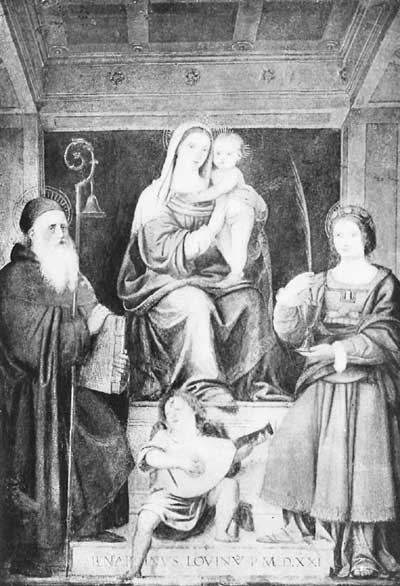
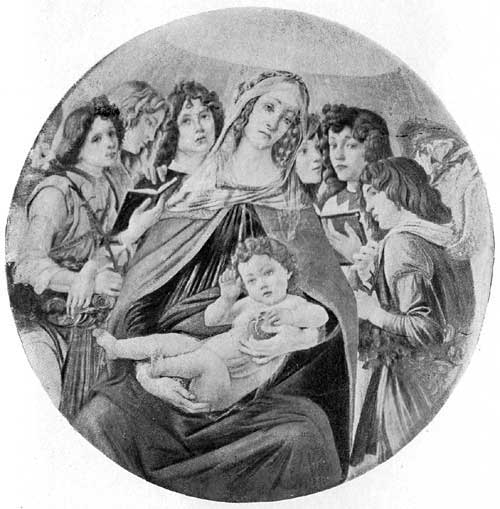
is an independent figure. The guard of honor may be composed of
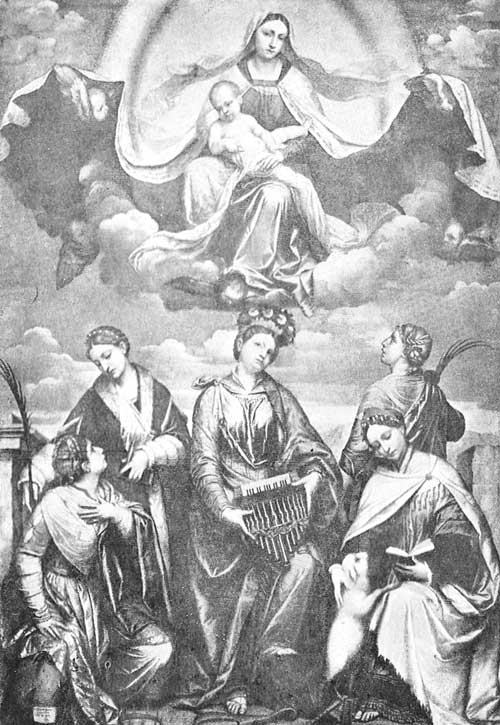
saints, as in Montagna's Madonna, of the Brera, Milan; or again it is
a company of angels, as in the Berlin Madonna, attributed to
Botticelli, similar to which is the picture by Ghirlandajo in the
Uffizi Gallery. Where saints are represented, each one is marked by
some special emblem, the identification of which makes, in itself, an
interesting study. St. Peter's key, St. Paul's sword, St. Catherine's
wheel, and St. Barbara's tower soon become familiar symbols to those
fond of this kind of lore.
Among the idealized presences about the Virgin's throne may sometimes
be seen the prosaic figure of the donor, whose munificence has made
the picture possible. This is well illustrated in the famous Madonna
of Victory in the Louvre, painted in commemoration of the Battle of
Fornovo, where Mantegna represents Francesco Gonzaga, commander of the
Venetian forces, kneeling at the Virgin's feet.
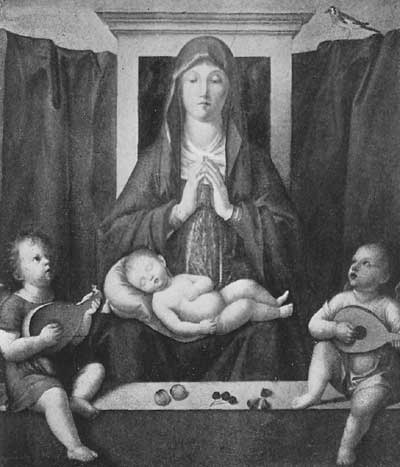
A charming feature in many enthroned Madonnas is the group of cherubs
below,—one, two, or the mystic three. They are not the exclusive
possession of any single school of art; Bartolommeo and Andrea del
Sarto of the Florentines, Francia of the Bolognese, and Bellini and
Cima of the Venetians were particularly partial to them. The
treatment in Northern Italy gives them a more definite purpose in the
composition than does that of Florence, for here they are always
musicians, playing on all sorts of instruments,—the violin, the
mandolin, or the pipe.
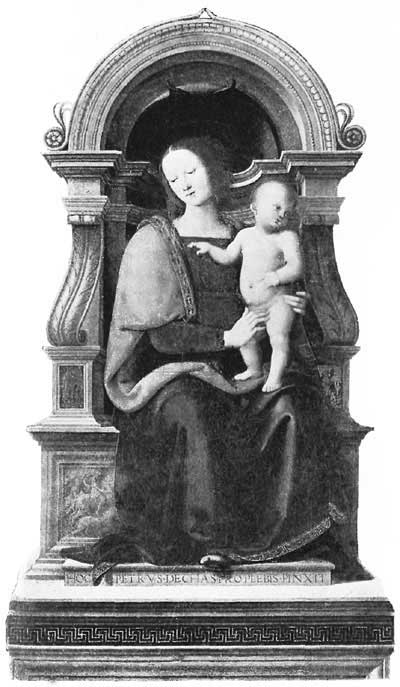 Perugino.—Madonna and Saints. (Detail.)
Bartolommeo was specially successful in the subject of the enthroned
Madonna, having fine gifts of composition united with profound
religious earnestness. The great picture in the Pitti gallery at
Florence may serve as a typical example. Andrea del Sarto's
chef-d'œuvre—the Madonna di San Francesco (Uffizi)—may also be
assigned to this class, although the arrangement is entirely novel.
The Virgin, holding the babe in her arms, stands on a sort of
pedestal, carved at the corners with a design of harpies, from which
the picture is often known as the Madonna of the Harpies. The
pedestal throne is also seen in two of Correggio's Dresden
pictures, but here the Virgin is seated, with the child on her lap. An
exceedingly simple throne Madonna is that of Luini, in the Brera at
Milan, where the Virgin sits on a plain coping not at all high.
A beautiful Madonna enthroned is by Perugino, in the Vatican Gallery
at Rome; one of the artist's best works in power and vivacity of
color. The throne is an architectural structure of elegant simplicity
of design, apparently of carved and inlaid marble. The Virgin sits in
quiet dignity, her face bent towards the bishops at her right, St.
Costantius and St. Herculanus. On the other side stand the youthful
St. Laurence and St. Louis of Toulouse. Although Perugino was an
exceedingly prolific artist, he did not often choose this particular
subject. On this account the picture is especially interesting, and
also because it is the original model of well known works by two of
the Umbrian painter's most illustrious pupils.
Many, indeed, were the apprentices trained in the famous bottega at
Perugia, but, among them all, Raphael and Pinturicchio took the lead.
These were the two who honored their master by repeating, with
modifications of their own, the beautiful composition of the Vatican.
Pinturicchio's picture is in the Church of St. Andrea, at Perugia. A
charming feature, which he introduced, is a little St. John, standing
at the foot of the throne. Raphael's picture is the so-called Ansidei
Madonna, of the National Gallery, London, purchased by the English
government, in 1885, for the fabulous price of £72,000. The
composition is here reduced to its simplest possible form, with only
one saint on each side,—St. Nicholas on the right, St. John the
Baptist on the left. The Virgin and child give no attention to these
personages, but are absorbed in a book which is open on the Mother's
knee.
Raphael had no great liking for this style of picture, which was
rather too formal for his taste. It is noticeable that, in the few
instances where he painted it, he took the suggestion, as here, from
some previous work. Thus his Madonna of St. Anthony, also in the
National Gallery (loaned by the King of Naples), was based upon an old
picture by Bernardino di Mariotto, according to the strict orders of
the nuns for whose convent it was a commission. The Baldacchino
Madonna of the Pitti, at Florence, is closely akin to Bartolommeo's
composition in the same gallery.
Glancing, briefly, at these scattered examples, we learn that the
enthroned Madonna belongs to every school of Italian art, and
exhibits an astonishing variety of forms. Probably it was in the North
of Italy that it flourished most. The Paduan School has its fine
representation in Mantegna's picture, already referred to; the
Brescian, in Moretto's Madonna of S. Clemente; the Veronese, in
Girolamo dai Libri's splendid altar piece in San Giorgio Maggiore; the
Bergamesque, in Lotto's Madonna of S. Bartolommeo. Above all, it was
in Venice, the Queen City of the Adriatic, that the enthroned Madonna
reached the greatest popularity: the spirit of the composition was
peculiarly adapted to the Venetian love of pomp and ceremony.
To understand Venetian art aright, we must distinguish the character
of the earlier and later periods. With Vivarini, Bellini, and Cima,
the Madonna in Trono was the expression of a devout religious feeling.
With Titian, Tintoretto, and Veronese, it was merely one among many
popular art subjects. Thus arose two different general types. The
earlier Madonna was a somewhat cold type of beauty; the faultless
regularity of her features and the imperturbable calm of her
expression make her rather unapproachable; but she shows a strong,
sweet purity of character, worthy of profound respect.
One of Cima's most important works is the Madonna of this type in the
Venice Academy. High on a marble throne, she sits under a pillared
portico, behind which stretches a pleasant landscape. Three saints
stand on each side,—an old man, a youth, and a maiden. On the steps
sit two choristers playing the violin and mandolin.
Palma's great altar-piece, at Vicenza, is another splendid enthroned
Madonna. Attended by St. George and St. Lucy, and entertained by a
musical angel seated at her feet, the Virgin supports her beautiful
boy, as he gives his blessing.
Bellini's enthroned Madonnas are known throughout the world. The
picture by which he established his fame was one of this class,
originally painted for a chapel in San Giobbe, but now hanging in the
Venice Academy. Ruskin has pronounced it "one of the greatest pictures
ever painted in Christendom in her central art power." It is a large
composition, with three saints at each side, and three choristers
below.
The Frari Madonna is in a simpler vein, and consists of three
compartments, the central one containing the Virgin's throne. The
angioletti, on the steps, are probably the most popular of their
charming class in Venice.
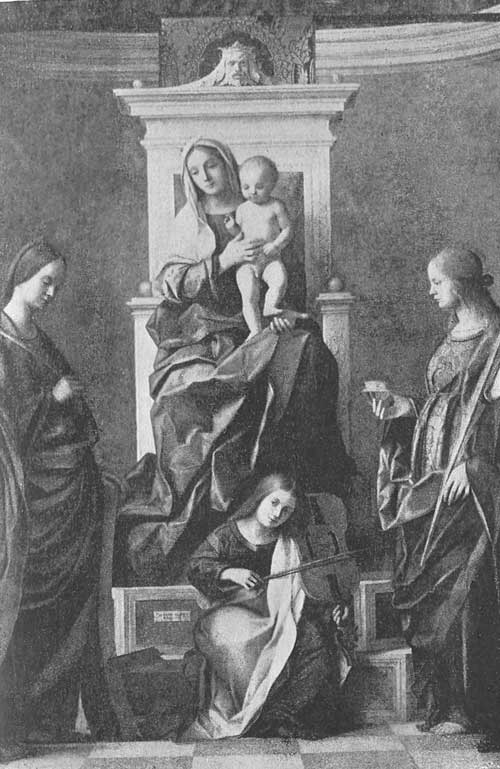 Giovanni Bellini.—Madonna of San Zaccaria. (Detail.)
Please click here for a modern color image
The San Zaccaria Madonna was painted when Bellini was over eighty
years old, and has certain technical qualities surpassing any the
artist had previously attained. The depth of light and shade is
particularly remarkable; the colors rich and harmonious. The attendant
saints are St. Lucy on the right, a pretty blonde girl, with St.
Jerome beyond her, absorbed in his Bible; opposite, stand St.
Catherine, pensively looking down, and St. Peter, in profound
meditation. The entire picture, both in conception and execution, may
be considered a representative example of the times.
Following the Bellini school, and forming, as it were, a connecting
link between the earlier and the later art, was Giorgione. Less than a
score of existing works give witness to the rare spirit of this
master, who was spared to earth only thirty-four years. These are of a
quality to place him among the immortals. The enthroned Madonna is the
subject of two, one in the Madrid Gallery, and another at
Castel-Franco. They create an entirely distinct Madonna ideal,—a
poetic being, who sits, with drooping head and dreamy eyes, as if
seeing unspeakable visions.
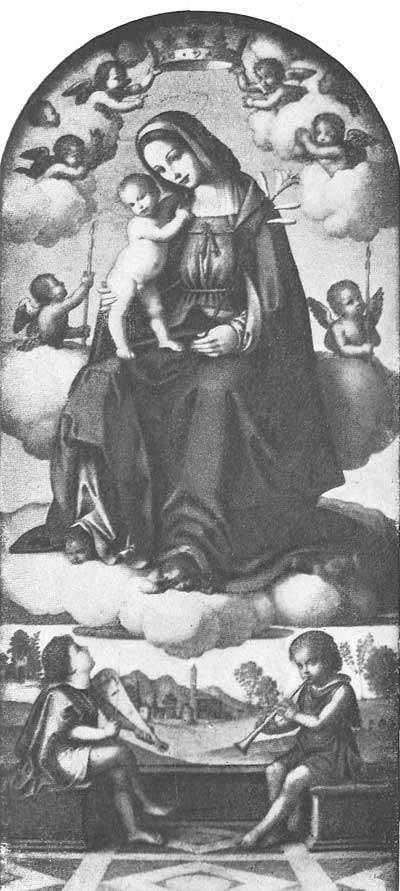
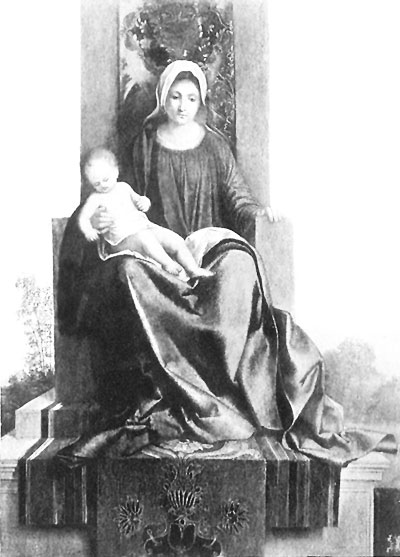
The Castel-Franco picture expresses the finest elements in Venetian
character. Every other composition seems elaborate and artificial when
compared with the simplicity of this. Other Madonnas seem almost
coarse beside such delicacy. The Virgin's throne is of an unusual
height,—a double plinth,—the upper step of which is somewhat above
the heads of the attendant saints, Liberale and Francis. This simple,
compositional device emphasizes the effect of her pensive expression.
It is as if her high meditations set her apart from human
companionship. There is, indeed, something almost pathetic in her
isolation, but for the strength of character in her face. The color
scheme is as simple and beautiful as the underlying conception. The
Virgin's tunic is of green, and the mantle, falling from the right
shoulder and lying across her lap, is red, with deep shadows in its
large folds. The back of the seat is covered with a strip of red and
gold embroidery.
The later period of Venetian art is marked by a new ideal of the
Virgin. She is now a magnificent creature of flesh and blood. Her face
is proud and handsome; her figure large, well-proportioned, and
somewhat voluptuous. No Bethlehem stable ever sheltered this haughty
beauty; her home is in kings' palaces; she belongs distinctly to the
realm of wealth and worldliness. She has never known sorrow, anxiety,
or poverty; life has brought her nothing but pleasure and luxury. Her
throne stands no longer in the sacred place of some inner sanctuary,
where angel choristers make music. It is an elevated platform, at one
side of the composition, as in Titian's Pesaro altar-piece, and
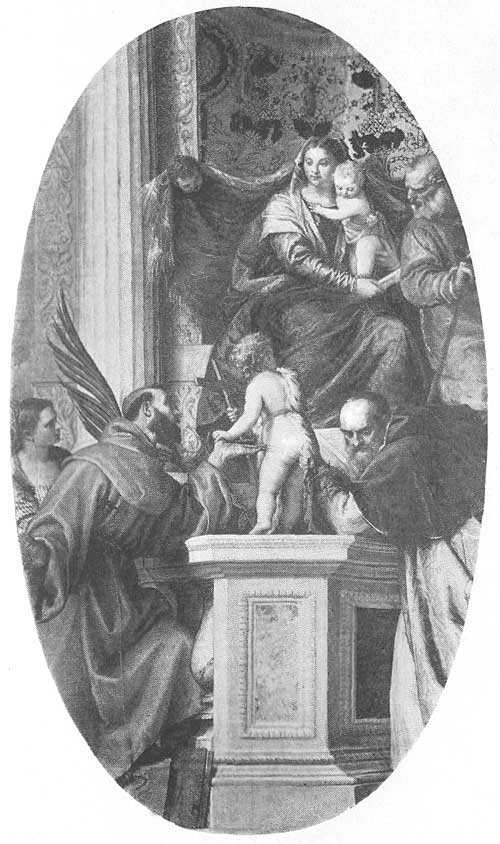
Veronese's Madonna in the Venice Academy. This gives an opportunity
for a display of elaborate draperies, such as we may see in Veronese's
picture.
The peculiar qualities of art in Verona and Venice are blended in
Paolo Veronese. No artist ever enjoyed more the splendors of color, or
combined them in more enchanting harmonies. Such gifts transform the
commonest materials, and, though his Virgin is a very ordinary woman,
she has undeniable charms. An oft-copied figure, in this picture, is
that of the little St. John, a universal favorite among child lovers.
 Veronese.—Madonna and Saints.
Please click here for a modern color image
The reader must have remarked that, though the fundamental idea of
the enthroned Madonna is that of queenship, the Virgin wears no crown
in any of the pictures thus far cited; the crowned Madonna is not
characteristic of Italian art. It is found occasionally in mosaics
from the eighth to the eleventh centuries, and in some of the early
votive pictures, but does not appear in the later period except in a
few Venetian pictures by Giovanni da Murano and Carlo Crivelli. The
same idea was often carried out by placing two hovering angels over
the Virgin's head, holding the crown between them. Botticelli's
Madonna of the Inkhorn is treated in this way.
The crown is essentially Teutonic in origin and character. Turning to
the representative art of Germany and Belgium, we find the Virgin
almost invariably wearing a crown, whether she sits on a throne, or in
a pastoral environment. No better example could be named than the
celebrated Holbein Madonna, of Darmstadt, known chiefly through the
copy in the Dresden Gallery. Here the imposing height of the Virgin is
rendered still more impressive by a high, golden crown, richly
embossed and edged with pearls. Beneath this her blond hair falls
loosely over her beautiful neck, and gleams on the blue garment
hanging over her shoulders. Strong and tender, this noble figure sums
up the finest elements in the Madonna art of the North.
A simple and lovely form for the Madonna's crown is the narrow golden
fillet set with pearls, singly or in clusters. This is placed over the
Virgin's brow just at the edge of the hair, which is otherwise
unconfined. This is seen on Madonnas by Van Eyck (Frankfort), Dürer
(woodcut of 1513), Memling (Bruges), Schongauer (Munich).
 Quentin Massys.—Madonna and Child.
Please click here for a modern color image
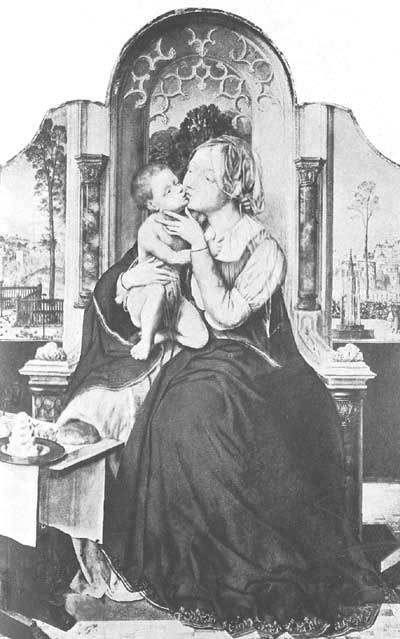
In the enthroned Madonna by Quentin Massys, in the Berlin Gallery, we
have many typical characteristics of Northern art. The throne itself
is exceedingly rich, ornamented with agate pillars with embossed
capitals of gold. The Virgin has the fine features and earnest, tender
expression which recalls earlier Flemish painters. Her dress falls in
rich, heavy folds upon the marble pavement. But, as with Van Eyck and
Memling, Holbein and Schongauer, fine clothes do not conceal her
girlish simplicity or her loving heart. A low table, spread with food,
stands at the left,—a curious domestic element to introduce, and
thoroughly Northern in realism.
Considered as a symbol of the exaltation of motherhood, there is no
reason why the throne should go out of fashion; but if it is to
appear, it must be used intelligently, and with some adaptation to
present modes of thought, not servilely imitated from the forms of a
by-gone age. This is a fact too little appreciated by the artists of
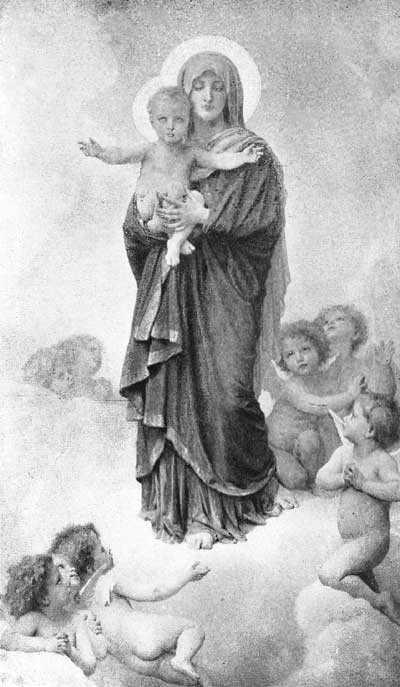
to-day. Many modern pictures could be cited—by Bouguereau, Ittenbach,
and others—of enthroned Madonnas in which is adopted the form, but
not the spirit, of the Italian Rennaissance. In such works, the
setting is a mere affectation entirely out of taste. If we are to have
a throne, let us have a Madonna who is a veritable queen.
 Madonna of Castelfranco. Photogravure from the Painting by Giorgione in the Parish Church, Castelfranco.