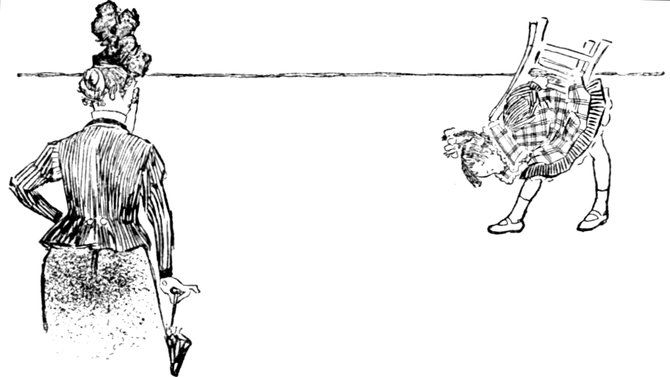
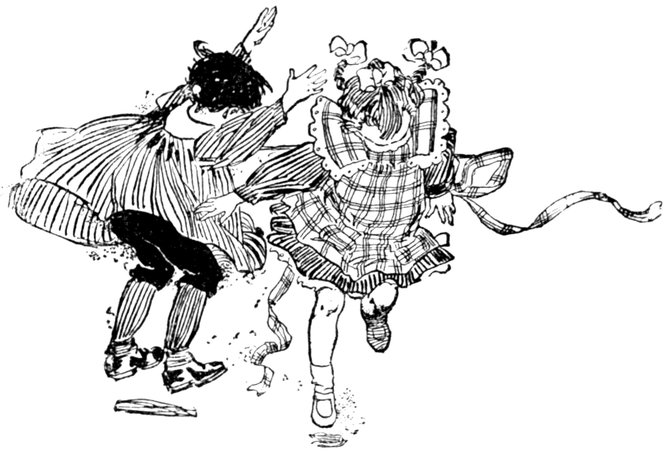
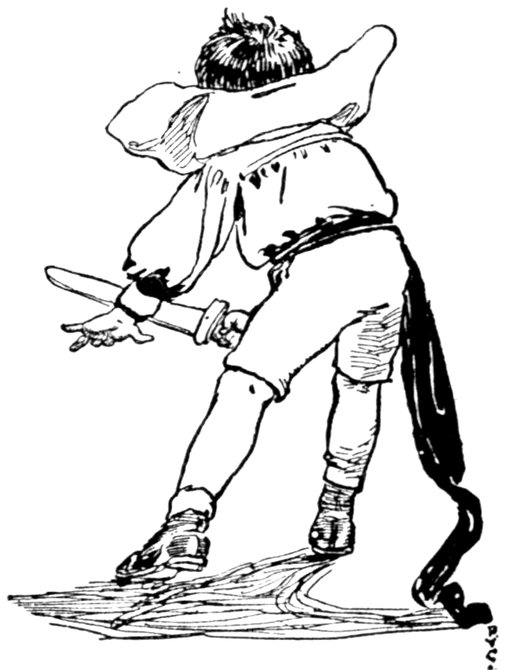
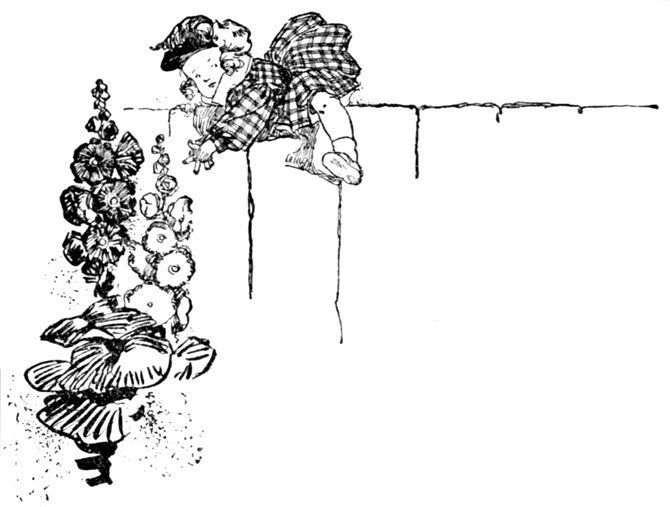
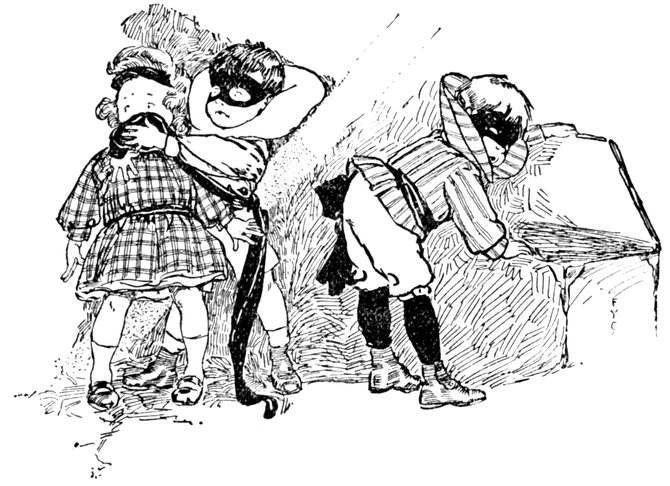
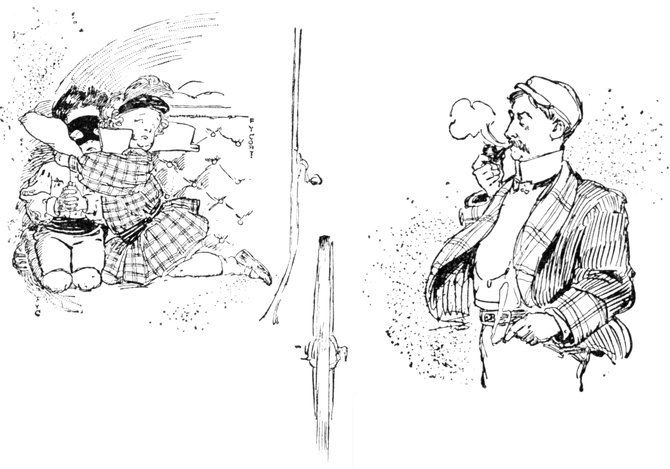
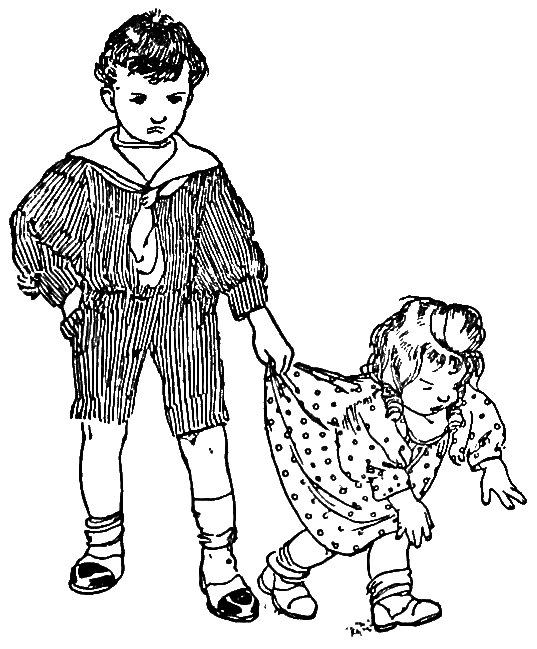
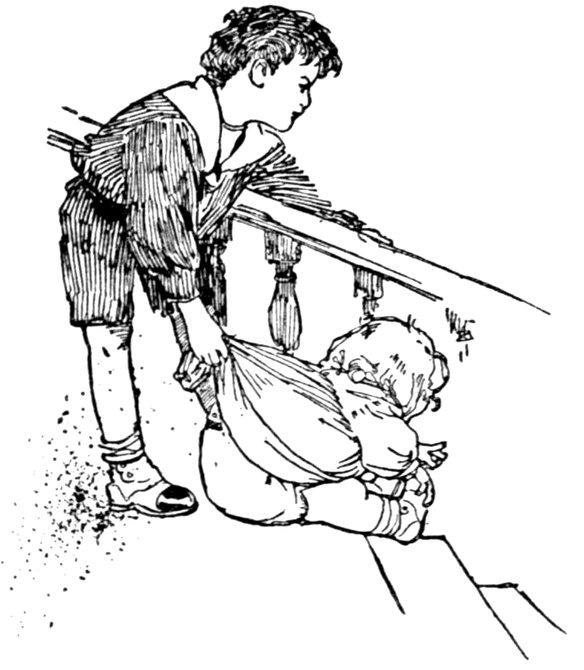
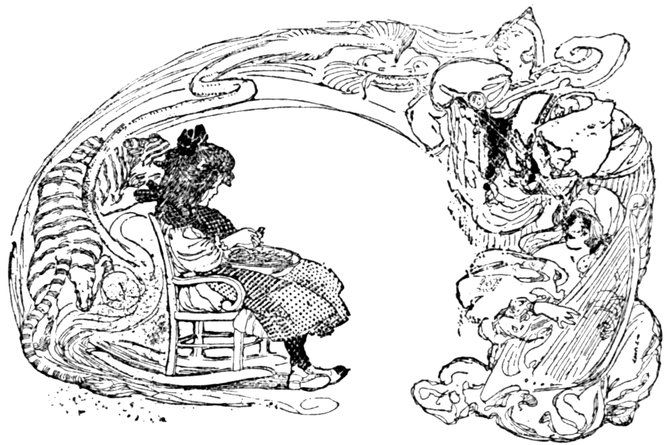
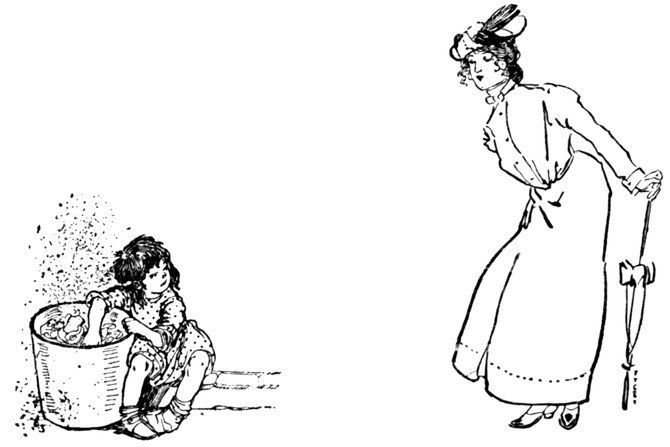
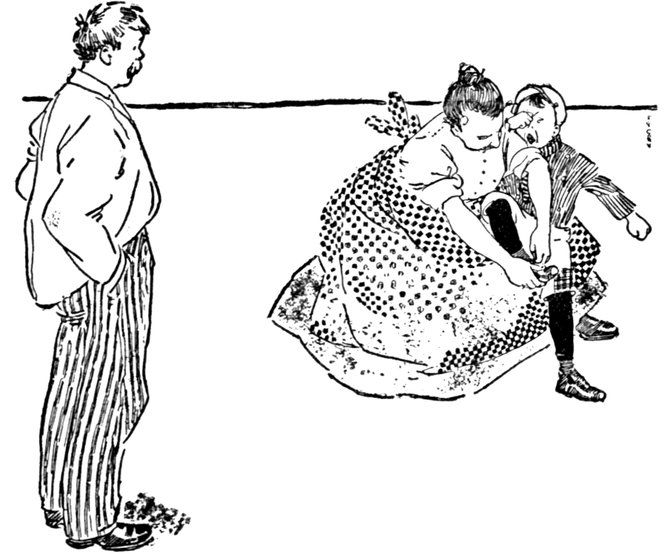
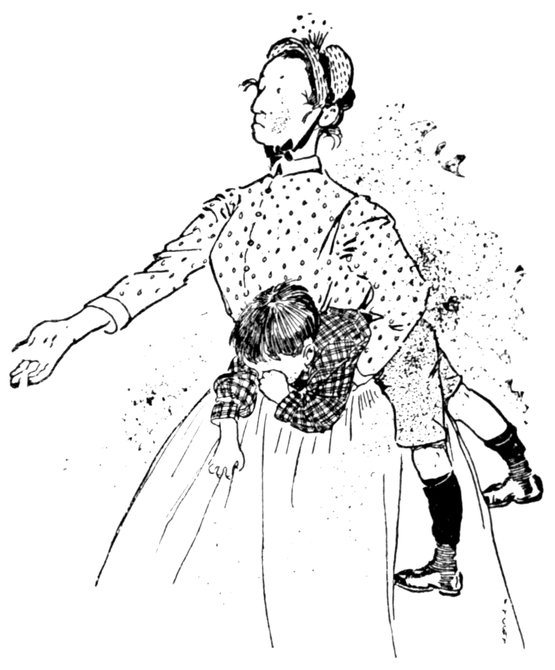
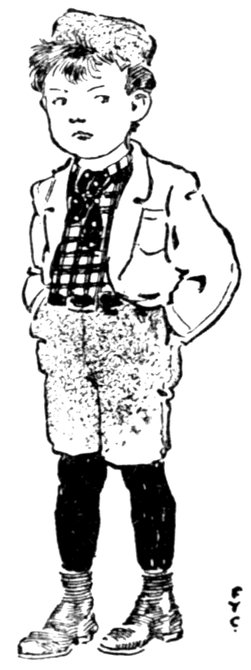
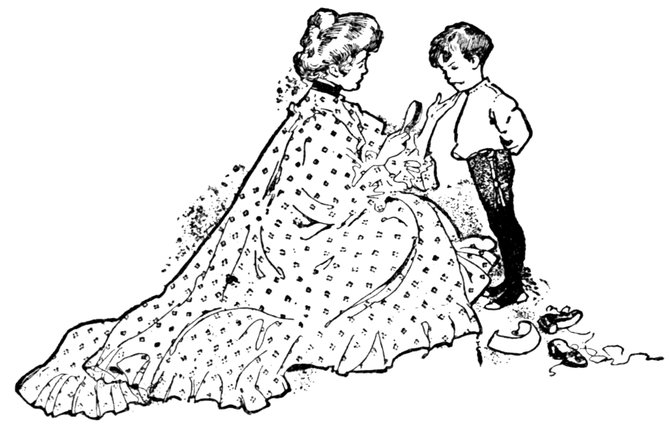
“Checking her vivid denunciations by a judicious application of the pillow.”
His mother, being a woman of perception,
realized early that something was
wrong. Even before breakfast she
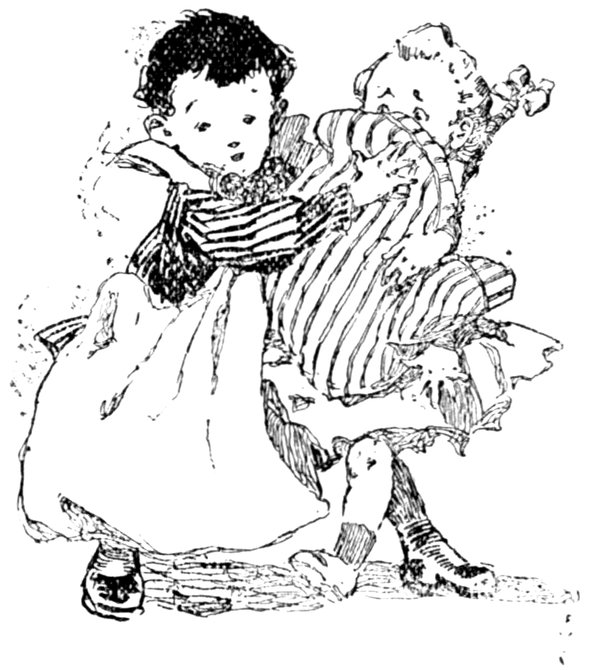
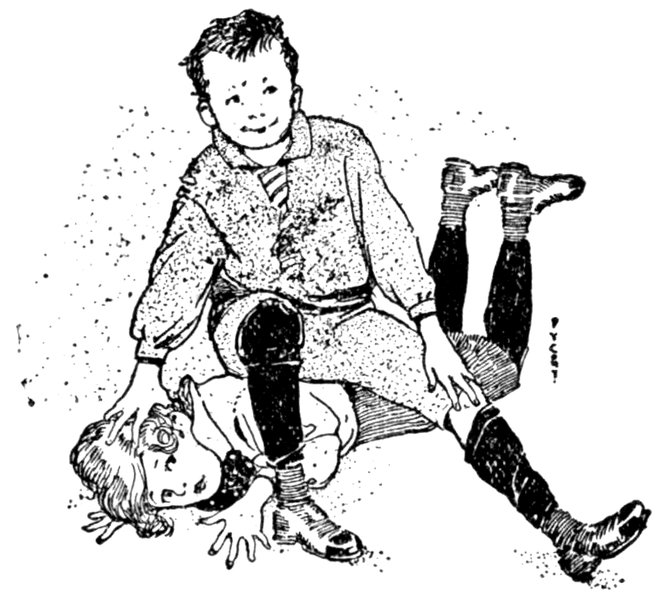
found Philip trying to put his sister into the
bolster case, checking her vivid denunciations by
a judicious application of the pillow. After
breakfast it was impossible
to get him
ready in time, as
his rubbers had
been hidden by a
revengeful sister,
and the bus was
kept waiting fully
five minutes, to the
irritation of the
driver, who made
up the lost interval
by a rapid pace.
2This jolted the children about, and frightened the
youngest ones, so that they arrived at the kindergarten
bumped and breathless, and only too disposed
to take offense at the first opportunity. This
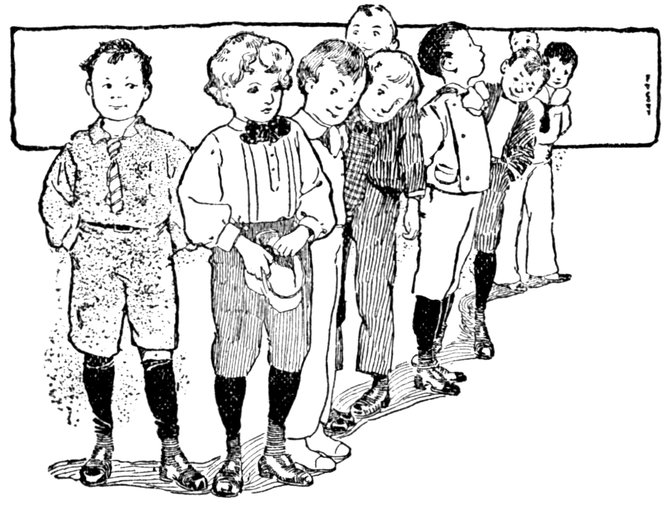
opportunity Philip supplied. As they swarmed
out of the bus he irritated Joseph Zukoffsky by a
flat contradiction of his pleased statement that he
was to lead the line into the house.
“Oh, no, you ain’t!” said Philip.
Joseph stared and reiterated his assertion
Philip again denied it. He did nothing to prevent
Joseph from assuming the head of the line,
but his tone was most exasperating, and Joseph
sat down on the lowest step of the bus and
burst into angry tears—he was not a person of
strong character.
Some of the more sympathetic children joined
their tears to his, and the others disputed violently
if vaguely; they lacked a clear idea of the
difficulty, but that fact did not prevent eager
partisanship. Two perplexed teachers quieted
the outbreak and marshaled a wavering line, one
innocently upholding Philip to the disgusted
3group, “because he walks along so quietly,” the
other supporting Joseph, whose shoulders heaved
convulsively as he burst out into irregular and
startling sobs. It was felt that the day had begun
inauspiciously.
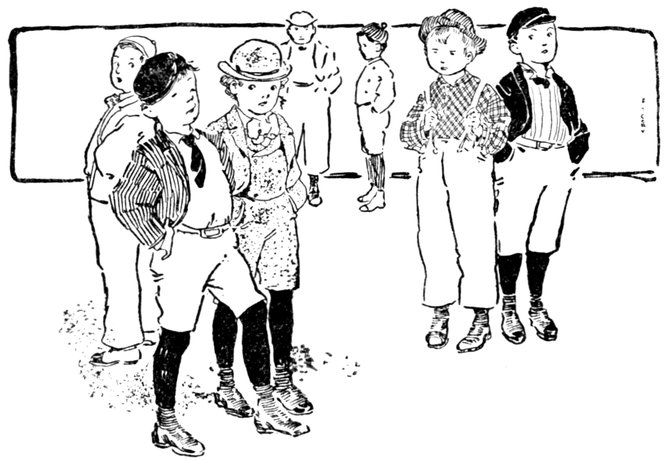
They sat down on the hall floor and began to
pull off their rubbers and mufflers. As Philip’s
eye fell to the level of his feet a disagreeable association
stirred his thoughts, and in a moment
it had taken definite form: his rubbers had been
stolen and hidden! His under lip crept slowly
out; a distinctly dangerous expression grew in
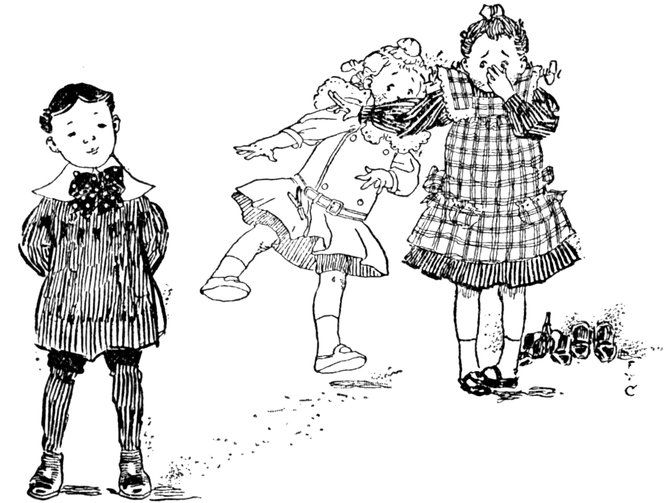
his eyes; he looked balefully about him. Marantha
Judd pirouetted across his field of vision,
vainglorious in a new plaid apron with impracticable
pockets. Her pigtails bobbed behind her.
She had just placed her diminutive rubbers
neatly parallel, and was attaching the one to the
other with a tight little clothes-pin provided for
the purpose.
4
“Tore off the clothes-pin with a jerk.”
Casually, and as if unconscious that Marantha
was curiosity incarnate, Philip took his own
clothes-pin and adjusted it to his nose. It gave
him an odd and, to Marantha, a distinguished
appearance, and she inquired of him if the sensations
he experienced were pleasurable. His answer
expressed unconditional affirmation, and unclasping
her clothes-pin Marantha snapped it
vigorously over her own tip-tilted little feature.
A sharp and uncompromising tweak was the
result, and Marantha, shrieking, tore off the
clothes-pin with a jerk that sent little Richard
Willetts reeling against his neighbor. Out of
the confusion—Richard was a timorous creature,
5and fully convinced that the entire kindergarten
meditated continual assault upon his small person—rose
the chiding voice of Marantha:
“You are a bad, bad boy, Philup, you are!”
To her tangled accusations the bewildered
teacher paid scant heed.
“I can’t see why all you little children find so
much fault with Philip,” she said reprovingly.
“What if he did put his clothes-pin on his nose?
It was a foolish thing to do, but why need you
do it? You have made more trouble than he,
Marantha, for you frightened little Richard!”
Marantha’s desperation was dreadful to witness.
She realized that her vocabulary was
hopelessly inadequate to her situation: she knew
herself unable to present her case effectively, but
she felt that she was the victim of a glaring injustice.
Her chin quivered, she sank upon the
stairs, and her tears were even as the tears of
Joseph Zukoffsky.
The youngest assistant now appeared on the
scene.
“Miss Hunt wants to know why you’re so late
6with them,” she inquired. “She hopes nothing’s
the matter. Mrs. R. B. M. Smith is here to-day
to visit the primary schools and kindergartens,
and——”
“Oh, goodness!” the attempted consolation
of Marantha ceased abruptly. “I can’t bear that
woman! She’s always read Stanley Hall’s last
article that proves that what he said before was
wrong! Come along, Marantha, and don’t be a
foolish little girl any longer. We shall be late
for the morning exercise.”
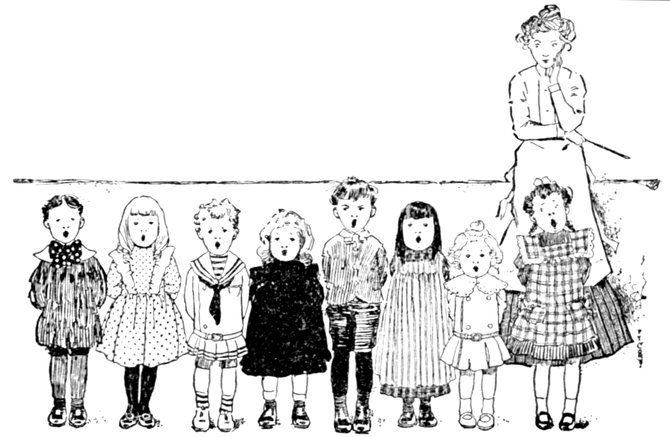
Upstairs a large circle was forming under the
critical scrutiny of a short, stout woman with
crinkly, gray hair. They took their places,
Marantha pink-nosed and mutinous, Joseph not
yet recovered from a distressing tendency to
burst out into gulping sobs—he was naturally
pessimistic and treasured his grievances indefinitely.
Philip’s eyes were fixed upon the floor.
“Now what shall we sing?” inquired the principal
briskly. “I think we will let Joseph
choose, because he doesn’t look very happy this
bright morning. Perhaps we can cheer him up.”
7
“Marantha ... upheld Joseph with all her powers of heart and voice.”
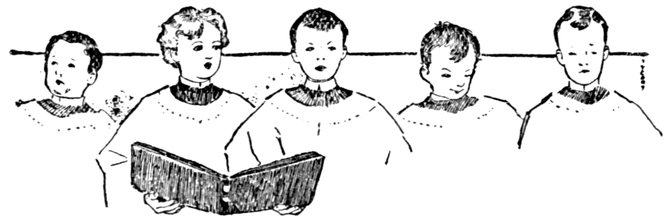
In a husky voice Joseph suggested “My heart
is God’s little garden.” In reply to Miss Hunt’s
opening question Eddy Brown had proposed
“Happy greeting to the rain,” a sufficiently
maudlin request, as there was absolutely no indication
of that climatic condition, past, present, or
future. Eddy possessed the not unusual combination
of a weak mind and a strong voice, and
though the piano prelude was that of Joseph’s
choice, the effect of a voice near him starting the
well-known air of his own suggestion was overwhelming,
and Eddy began shouting
it lustily. Marantha, whose
susceptibilities were, like those of
others of her sex, distinctly sharpened
8by suffering, knew well enough who was responsible
for the rival chorus, and upheld Joseph
with all her powers of heart and voice. The tunes
in question were, like many of the kindergarten
repertoire, somewhat similar, and a few seconds of
chaotic discords amazed Mrs. R. B. M. Smith and
vexed the teachers.
Now see on what slight thread events are
strung! What she innocently supposed to be a
misunderstanding of the song selected, influenced
one of the teachers to announce the subsequent
songs herself. This led Mrs. R. B. M. Smith to
suppose that the teacher was selecting all the
songs, thus depriving the children of the divine,
not to say formative, privilege of individual
choice. This opinion, in turn, led her to beckon
one of the assistants to her and describe her own
system of awakening and continuing, by a ceaseless
series of questions, the interested coöperation
of the child’s intelligence. In order to do this,
she added, the subjects of song and story must be
more simple than was possible if complex historical
incidents were used. She indicated her willingness
9to relate to the children a model story of
this order, calling the teachers’ attention in advance
to the almost incredible certainty that
would characterize the children’s anticipation of
the events thus judiciously and psychologically
selected.
The arm-chairs shortly to contain so much accurate
anticipation were ranged neatly on both
sides of the long room. Some malefic influence
caused the officiating teacher to appoint Philip to
lead one-half of the circle to the chairs and Marantha
the other. More than one visitor had
been wont to remark the unanimity with which
this exercise was performed. Each child grasped
his little chair by the arms, and holding it before
him, carried it to its appointed place in the circle.
So well had they learned this manœuver that the
piano chords were sufficient monitors, and the
three teachers, having seen the line safely started,
gathered around their visitor to hear more of the
theory.
10
“The effect was inexpressibly indiscreet.”
Under what obsession Philip labored, with what
malignant power he had made pact, is unknown.
He had no appearance of planning darkly: his
actions seemed the result of instantaneous inspiration.
Standing
before his chair
as if about to
take his seat,
he subsided partially; then,
grasping the arms, half bent
over, he waddled toward the
circle. This natural method of transportation
commended itself in a twinkling to his line, and
without the slightest disturbance or hesitation,
they imitated him exactly. Experience should
have taught Marantha the futility of following
his example, but she was of an age when experience
appeals but slightly; and determined to
excel him, at the risk of falling at every step
on her already injured nose, she bent over so far
that the legs of her chair pointed almost directly
upward. Her line followed her, and waddling,
11shuffling, gnome-like, they made for the circle.
It had all the effect of a carefully inculcated drill,
and to Mrs. R. B. M. Smith the effect was inexpressibly
indiscreet.
“Is it possible that you—” she inquired,
pointing to the advancing children, many of
whom promptly fell over backward under the
sudden onslaught of the horrified teachers.
Miss Hunt colored angrily.
“Something is the matter with the school to-day,”
she said sharply. “I never knew them to
behave so in my life! I can’t see what’s come
over them! They always carry their chairs in
front of them.”
“I should hope so,” responded the visitor
placidly, “nothing could be worse for them than
that angle.”
“At least they’re safe now,” the youngest assistant
whispered to her fellow-teacher, as the
children sat decorously attentive in their chairs,
their faces turned curiously toward the strange
lady with the fascinating plumes in her bonnet.
“——Nothing like animals to bring out the
12protective instinct—feebler dependent on the
stronger,” she concluded rapidly, and then addressed
the objects of these theories.
“Sneezed loudly and unexpectedly.”
“Now, children, I’m going to tell you a nice
story—you all like stories, I’m sure.”
At just that moment little Richard Willetts
sneezed loudly and unexpectedly to all, himself
included, with the result that his ever-ready suspicion
fixed upon his neighbor, Andrew Halloran,
as the direct cause of the convulsion. Andrew’s
well-meant efforts to detach from Richard’s vest
the pocket-handkerchief securely
fastened thereto by a large, black
safety-pin strengthened the latter’s
conviction of intended assault
and battery, and he squirmed
out of the circle and made a dash
for the hall—the first stage in
an evident homeward expedition.
This broke in upon the story,
and even when it got under way
again there was an atmosphere
13of excitement quite unexplained by the tale
itself.
“’Yesterday, children, as I came out of my yard, what do you think I saw?’”
“Yesterday, children, as I came out of my
yard, what do you think I saw?” The elaborately
concealed surprise in store was so obvious
that Marantha rose to the occasion and suggested:
“An el’phunt!”
“Why, no! Why should I see an elephant
in my yard? It wasn’t nearly so big as that—it
was a little thing!”
“A fish!” ventured Eddy Brown, whose eye
fell upon the aquarium in the corner. The raconteuse
smiled patiently.
“Why, no! How could a fish, a live fish, get
in my front yard?”
“A dead fish?” persisted Eddy, who was never
known to relinquish voluntarily an idea.
14“It was a little kitten,” said the story-teller,
decidedly. “A little white kitten. She was
standing right near a great big puddle of water.
And what else do you think I saw?”
“No, a big Newfoundland dog. He saw the
little kitten near the water. Now cats don’t like
the water, do they? They don’t like a wet place.
What do they like?”
“Mice!” said Joseph Zukoffsky abruptly.
“Well, yes, they do; but there were no mice
in my yard. I’m sure you know what I mean.
If they don’t like water, what do they like?”
“Milk!” cried Sarah Fuller confidently.
“They like a dry place,” said Mrs. R. B. M.
Smith.
“Now what do you suppose the dog did?”
It may be that successive failures had disheartened
the listeners; it may be that the very range presented
alike to the dog and them for choice dazzled
their imaginations. At any rate they made no
answer.
15“Nobody knows what the dog did?” repeated
the story-teller encouragingly. “What would
you do if you saw a little white kitten like that?”
Again a silence. Then Philip remarked gloomily:
“I’d pull its tail.”
Even this might have been passed over had
not the youngest assistant, who had not yet lost
her sense of humor, giggled convulsively. This,
though unnoticed by the visitor, was plainly observed
by fully half the children, with the result
that when Mrs. R. B. M. Smith inquired pathetically,
“And what do the rest of you think? I
hope you are not so cruel as that little boy!” a
jealous desire to share Philip’s success prompted
the quick response:
“I’d pull it, too!”
Miss Hunt was oblivious to the story, which
finished somehow, the dog having done little, and
the kitten, if anything, less. She was lost in a
miserable wonder what was the matter with them?
Alas! she could not know that the root of all
16the evil was planted in the breast of Philip, the
demon-ridden. His slightest effort was blessed
with a success beyond his hopes. He had but to
raise his finger, and his mates rallied all unconsciously
to his support. Nor did he require
thought; on the instant diabolical inspiration
seized him, and his conception materialized almost
before he had grasped it himself. The very
children of light were made to minister unto him,
as in the case of his next achievement.
With a feeling of absolute safety the teacher
called upon Eddy Brown to lead the waiting circle
in a game. Eddy was one of the stand-bys of the
kindergarten. He was a little old for it, but
being incapable of promotion owing to his inability
to grasp the rudiments of primary work, he
continued to adorn his present sphere. It would
almost seem that Fröbel had Eddy Brown in
mind in elaborating his educational schemes, for
his development, according to kindergarten standards,
was so absolutely normal as to verge on the
extraordinary. He was never ennuyé, never cross,
never disobedient. He never anticipated; he
17never saw what you meant before you said it; he
never upset the system by inventing anything
whatsoever—the vice of the too active-minded.
He was perennially surprised at the climaxes of
the stories, passionately interested in the games;
and clay balls and braided straw represented his
wildest dissipations. He sat in his chair till he
was told to rise, and remained standing till he
was urged to take his seat. His voice, if somewhat
off the key, was always prominent in song;
his feet, if not always in time, were always in
evidence when it was a question of marching.
To-day he took the middle of the ring and
beamed cheerfully on them all as they swayed
back and forth and sang to him:
Now Eddie if you’ll teach us
A new game to play,
We’ll watch you and try to
Do just as you say!
There was a slight poetic exaggeration in the
idea of Eddy Brown’s being able to teach anybody
anything new, but this was felt by no one
but the youngest assistant, who, recalling his
18regular programme upon such
occasions, smiled somewhat sardonically.
“’Tripping lightly as we go.’”
As she had expected, Eddy
inclined to play “Tripping
lightly as we go.” His conception
of the process implied in
the song was a laborious jumping
up on one toe and down on
the other. This exercise he
would keep up till the crack of
doom if undiverted from it.
When induced to stop, he signalled to Joseph
Zukoffsky to take his place. Joseph, on being
tunefully implored to produce something new in
the way of a game, declared for “Did you ever
see a laddie?” and the ring started in blithely:
Did you ever see a laddie, a laddie, a laddie;
Did you ever see a laddie, do this way or that?
After some seconds of consideration Joseph
solemnly lifted his left heel from the floor and replaced
it. This enthralling diversion occupied
19the ring for a moment, and then Marantha was
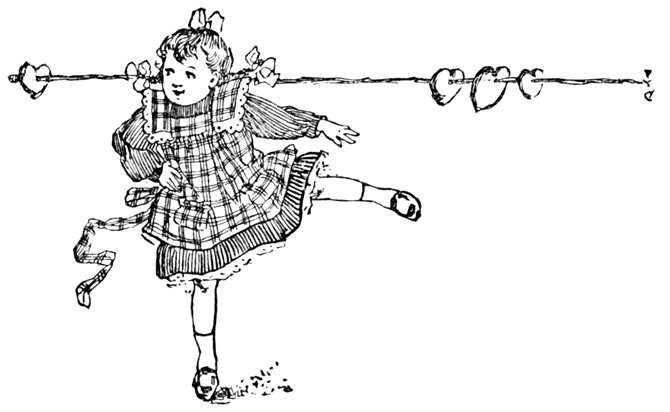
summoned. Though plump as a partridge, Marantha
was born for the ballet.
“Did you ever see a lassie, a lassie, a lassie,”
sang the children as Marantha, arching her little
instep and pointing her toe deliciously, kicked
out to one side, almost as high as her waist, with
a rhythmical precision good to see.
“Marantha was born for the ballet.”
Her eyes sought Philip’s, and with a coy little
smile, she took his hand to lead him to the centre.
Too many poets and novelists have analyzed the
inevitable longing of woman to allure him who
scorns her charms, the pathetic passion to attract
20where she has been brutally repulsed, to make it
necessary for me to discuss her attempted endearments
as Philip sulkily flung away her hand.
Just then somebody wanted a drink; and as
one teacher led the thirsty child away, and the
other turned her head to attract the pianist’s attention
and propose a new tune, Philip, who had
not begun to set his model till the last moment,
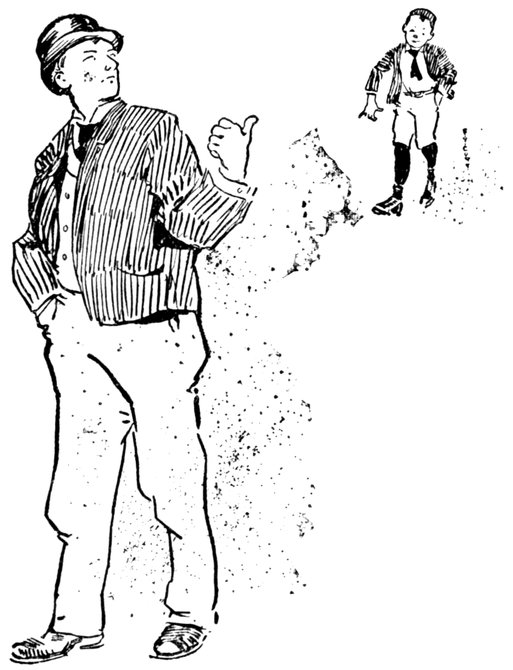
suddenly lifted his thumb to his nose, contracting
and expanding his fingers in strict time.
Her rapid glance had shown the teacher a ring
of children apparently tapping their noses, and
only a horrified snort from Mrs. R. B. M. Smith
and a murmured “Heavens!” from the returning
assistant called her attention to the circle of children
gravely assuming an attitude prescribed nowhere
in Fröbel, nor, indeed, in any system, social
or Delsartean.
Philip, now utterly abandoned to the spirit of
successful deviltry that intoxicated him beyond
control, danced up and down, inviting one, two,
and three out of the demoralized ring to share
his orgy. They pranced about wildly, shouting
21snatches of song, pushing each other, deaf to
the shocked remonstrance of the teachers, while
in their midst,
flushed and
screaming, Philip
and Marantha,
satyr and bacchante,
leaped
high in the air.
“Leaped high in the air.”
In the door
there suddenly
appeared a woman
in a checked
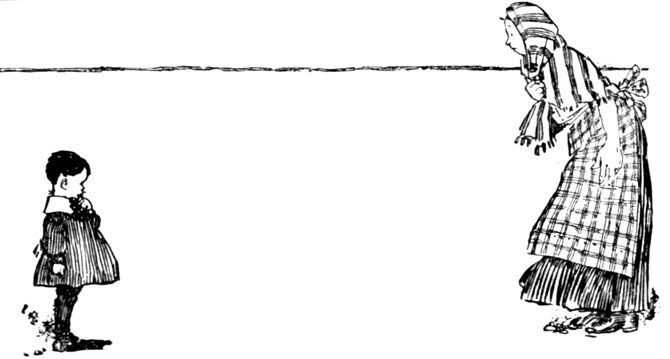
apron with a shawl over her head. As the teachers
pulled the ring-leaders apart, and the pianist,
to a shocked murmur of remonstrance, played
Träumerei with the soft pedal down, while a circle
of flushed and palpitating “little birds” rocked
themselves to sleep with occasional reminiscent
giggles and twitters, the woman in the door advanced
to a little bird whose chief interest, as he
ruffled his gingham plumage, seemed to be to
evade an obviously maternal call.
22“Philup, ye bad boy, where’s the carvin’ knife?”
she said angrily. This was too much for the
youngest assistant, who went off into something
very like hysteria, while the principal tried to
explain the inevitable bad effect of shocks and
slaps upon the delicate organization of the child.
“An’ it’s beggin’ y’r pardon, Miss, but it’s a
rale imp o’ Satan he’ll be some days, like, an’ I
see it in his eye this marnin’! An imp o’ Satan!”
The principal smiled deprecatingly. “We
don’t like to hear a child called that,” she said,
gently. “Philip has not been so good as usual
this morning——”
“Philup, ye bad boy, where’s the carvin’ knife?”
“Ye may say so!” interrupted Philip’s parent.
“An’ whin it’s that way
he is, it’s little good soft
words’ll do, Miss. He
gets it from his father.
An’ me not able to cut
the mate fer his father’s
23dinner! He’s a sly young one! It’s a good
spankin’ he needs, Miss—an’ he’ll get it, too!”
“Take her into the hall with him. Tell her
not to spank him. Tell her we’ll punish him.
We understand how to make him sorry,” murmured
the principal to the youngest assistant, as
she turned to quiet the circle.
The youngest assistant conducted Philip’s
mother, and dragged Philip to the hall.
“Now, Philip, tell your mother where you hid
the carving knife,” she said invitingly. Philip
made a break for the outer door. He was caught
and reasoned with. Incidentally his naughtiness
in leading the game was mentioned. His mother
set her jaw and loosened her shawl.
“An’ that’s what ye did, ye bad boy? What
did I say the last time I see ye at it? Dirty
thrick! You come here to me, sir!”
Philip kicked violently and pinched the youngest
assistant. Her lips assumed the set expression
of the other woman’s. The light of generations
of Philistine mothers kindled in her eye.
As Philip struggled silently but wildly, the voice
24of Mrs. R. B. M. Smith, high and resonant,
floated through the transom.
“And so we never strike a little child, Joseph,
and you must never talk about it. His mother
and Miss Ethel are going to talk with little
Philip, and try to make him see——”
Philip ducked under his mother’s arm and almost
gained the door. The youngest assistant
caught him by his apron-string and towed him
back. His mother looked around hastily, noticed
a small door half open, and caught the youngest
assistant’s eye.
“Cellar?” she inquired.
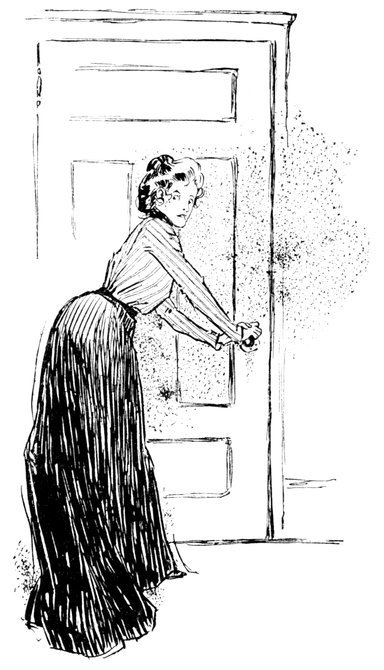
The youngest assistant nodded, and as his
mother lifted Philip bodily and made for the little
door, it was opened for her and closed after
her by the only other person in the hall.
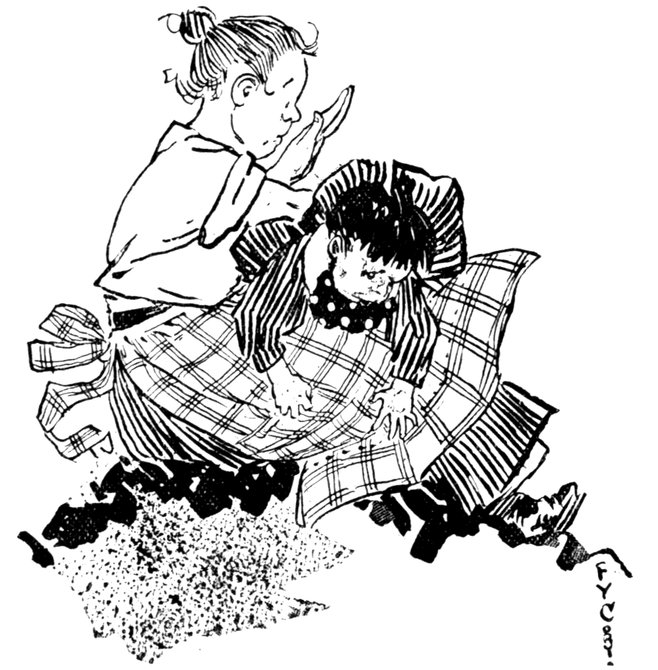
His mother carried Philip to the coal-heap,
and upon it she sat and spanked her son—spanked
him systematically, and after an ancient
method upon which civilization has been able to
make few if any improvements. She had never
read that excellent work, “Child Culture, or
25
“It was opened for her and closed after her.”
26How shall we Train our Mothers?” (R. B. M.
Smith).
Soon she led him in, subdued and remorseful,
the demon expelled, to the principal.
“Spanked him systematically.”
“He’ll throuble ye no more, Miss, an’ the carvin’
knife is underneath th’ bolster av his bed—the
bad ’un that he is!”
“Now that Philip is good again—and you see
27how quiet he was out in the hall; I told you he
was thinking very hard—we’ll all sing a song to
show how glad we are, and he shall choose it.
What would Philip like to sing?”
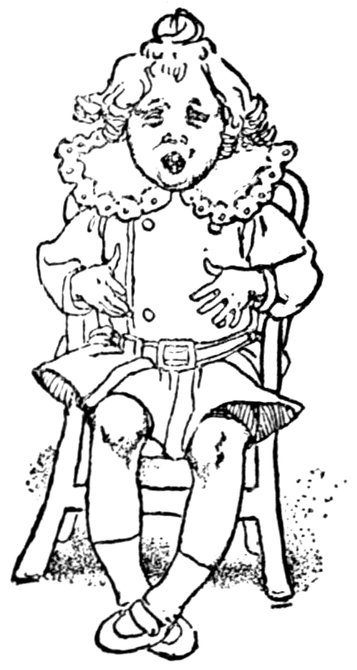
Philip murmured huskily that his heart was
God’s little garden, and there was more joy over
him than over the two dozen that needed no repentance.
But the youngest assistant avoided Mrs. R. B.
M. Smith’s eye, for she had opened the cellar
door!
“Murmured huskily that his heart was God’s little garden.”
A STUDY IN PIRACY
31
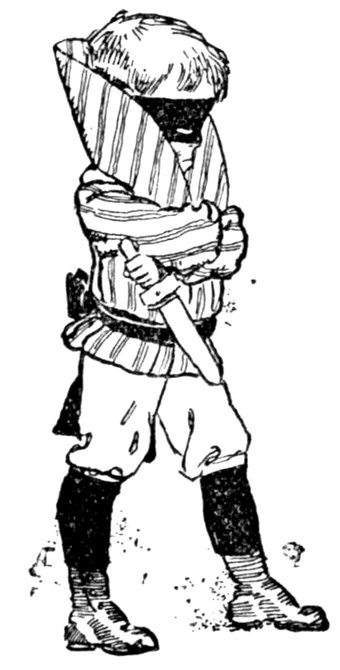
It might not have occurred to you to find
the Head Captain terrible to look upon,
had you seen him first without his uniform.
There seems to be something essentially pacific
in the effect of a broad turn-over gingham collar,
a blue neck-ribbon, and a wide straw hat; and
you might be pardoned for thinking him a
rather mild person. But could you have encountered
him in a black cambric mask with pinked
edges, a broad sash of Turkey red wound tightly
about his waist, and that wide collar turned up
above his ears—the tie conspicuous for its absence—you
might have sung another tune.
His appearance was at such a time nothing short
of menacing.
The Lieutenant was distinctly less impressive.
His sash, though not so long as the Head Captain’s,
was forever coming untied and trailing
behind him, and as he often retreated rapidly, he
32stumbled and fell over it twice out of three
times. This gave it a draggled and spiritless
look. Moreover, he was not allowed to turn his
collar up except on Saturdays, and the one his
sister had made him from wrapping paper had an
exotic, not to say amateur theatrical, effect that
was far from convincing. The eye-holes in his
mask, too, were much too large—showing, indeed,
the greater part of both cheeks, each of
which was provided with a deep dimple. Seen
in the daytime, he was not—to speak confidentially—very
awesome.
As for the Vicar—well, there were obstacles
in the way of her presenting such an appearance
as she would have liked. In the first place, there
was not enough Turkey red to go evenly round,
and to her disgust she had been obliged to put
up with a scant three-quarters of a yard—not a
wide strip at that. What was by courtesy
called the Vicar’s waist was not far from three-quarters
of a yard in circumference, which fact
compelled her to strain her sash tightly in order
to be able to make even a small hard knot, to
33say nothing of bows and ends. She had no collar
of any kind—her frocks were gathered into
bands at the neck—and she was not allowed to
imitate the Lieutenant’s; who, though generally
speaking a mush of concession, held out very
strongly for this outward and visible sign of a
presumable inward and spiritual superiority. So
the Vicar, in a wild attempt at masculinity, had
privately borrowed a high linen collar of her uncle.
The shirts in her uncle’s drawer had printed inside
them, “wear a seventeen-and-a-half collar with this
shirt,” so you will not be surprised to learn that
the Vicar occasionally fell into the collar, so to
speak, and found herself most effectually muzzled.
The Vicar.
But the worst was her mask. Her hair came
down in a heavy bang almost to her straight
brown eyebrows; her round,
brown eyes were somewhat shortsighted;
her eye-holes were too
small. In consequence of these
facts, whenever it was desirable
34or necessary to see an inch before her nose she was
obliged to push the mask up over her bang, when
it waved straight out and up, and looked like some
high priest’s mitre.
Her title was due to her uncle, who, to do him
justice, was as innocent of his influence in the
matter as of the loss of his collar.
“When a person isn’t the head of the Pirates,
but is an officer just the same, and
has some say about things, what do you call
that?” she asked him abruptly one day. He
was reading at the time, and not unnaturally
understood her to say “the head of the
parish.”
“Why, that’s called a vicar, I suppose you
mean,” he answered.
“A vicker! Does he have some say?”
“Some say?”
“Yes”—impatiently—“some say. He
hasn’t got to do the way the others tell him all
the time, has he?”
“Oh, dear, no. Don’t you know Mr. Wright,
down at the chapel? He’s called the vicar. He
35really manages it, I think. Of course it’s not
like being the rector——”
“Chapel? Is that the only kind of vicker,
like Mr. Wright?”
“Why, of course not, silly! There are lots of
different kinds.”
“Oh!” and she retired, practising the word.
The others were much impressed by her cleverness
in discovering such a fascinating title. It
savored of wicked and villain, to begin with;
and pursuing the advantage of their previous
ignorance of it, she invented several privileges
and perquisites of the office, which to deny
would argue their lack of information on the
subject, a thing she knew they would never
own.
One of these was the right to summon the
band, when the Head Captain had decided on an
expedition, to any meeting-place she saw fit;
and though in a great many ways her superiors
found her a nuisance, the Lieutenant in particular
objecting in a nagging, useless sort of way to
most of her suggestions, they could not but admit
36that her selection of mysterious, unsuspected rendezvous
was often brilliantly original.
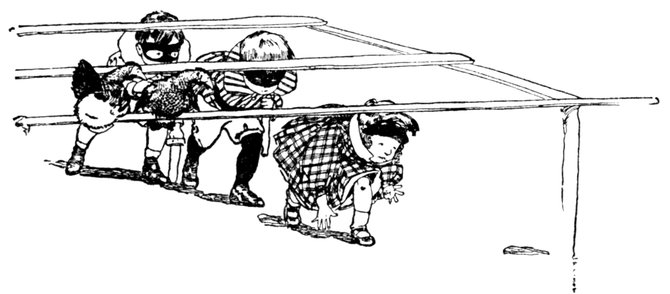
“Crouching along beneath the perches.”
On one especial occasion, a warm afternoon late
in June, when the houses and yards were all
quiet, and the very dogs lay still in the shade,
the Vicar led them softly to the chicken yard,
mystified them by crawling through a broken
glass frame into the covered roost, crouching
along beneath the perches, and going out again
by the legitimate door without stopping to speak.
This effectually silenced the Lieutenant—the
chicken house seemed an old ruse to him, and he
was sniffing in preparation for the expression of
his opinion. Out across the yard and twice
around an enormous hogshead they walked solemnly.
37Such a prelude must mean a great
finale, and the Head Captain felt decidedly curious.
The Vicar paused, made a short detour for
the purpose of getting two empty boxes, piled
them one on the other, and lightly swung herself
into the cask. A loud thud announced her safe
arrival at the bottom, and flushed with delight
at the incomparable secrecy of the thing, the
Head Captain followed her. The Lieutenant,
grumbling as usual, and very nearly hanging
himself in his sash, which caught on the edge,
tumbled after, and standing close together in
the great barrel they grinned consciously at
each other.
The Head Captain broke the silence.
“Are we all here?” he demanded, his voice
waking strange and hollow echoes.
“Yes!” replied the Vicar delightedly, bursting
with pride.
“Aye, aye!” said the Lieutenant with careful
formality.
“Then listen here!” the Head Captain spoke
in a hoarse whisper. “This’ll be a diff’rent
38way. This is going to be the real thing. To-day
we’re going to steal!”
The Vicar gasped. “Really steal?” she whispered.
“Steal what?” said the Lieutenant with a
non-committal gruffness.
“I don’t know till I get there,” replied the
Head Captain grandly. “Gold, I suppose, or
treasures or something like that. Of course, if
we’re caught——”
The Lieutenant sucked in his breath with a
peculiar whistling noise—one of his most envied
accomplishments—and ran his finger-nail with a
grating sound around his side of the barrel.
“Jim Elder stole some apples from my father’s
barn, and my father licked him good,” he suggested.
“Apples! Apples!” The Head Captain
frowned terribly, adding with biting irony: “I
s’pose Jim Elder’s a Pirate! I s’pose he wears
a uniform! I s’pose he knows the ways this
gang knows! I s’pose he meets in a barrel like
this! Huh?”
39There was no answer, and the Head Captain
settled his mask more firmly. “Come on!” he
said.
They looked at the sharp edge of the hogshead;
it was far away. They looked inquiringly
at the Vicar; she dropped her eyes. Oh,
Woman, in your hours of ease you can devise fine
secret places, you can lead us to them, but can
you bring us back to the outer world and the
reality you seduced us from? There was an embarrassing
pause. The seconds seemed hours.
Would they die in this old, smelly barrel?
The Head Captain smiled to himself.
“I guess you kids never’d git out o’ here unless
I showed you how!” he remarked cheerfully.
“Forward! March!” He took the one step
possible, and scowled because they did not follow
him.
“Don’t you see?” he said irritably. “When
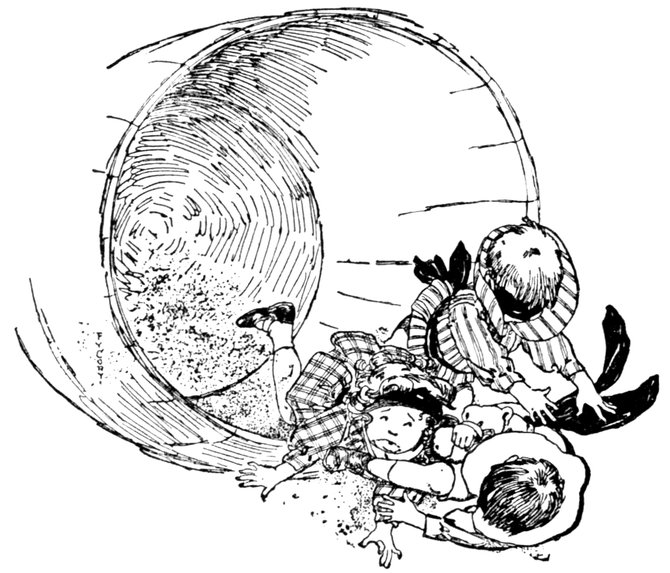
I say ‘three,’ fall over. Now, one—two—three!”
He pushed the Lieutenant and the Vicar
against the side of the barrel, and precipitated
himself against them. The barrel wavered, tottered,
40and fell with a bang on its side, the subordinate
officers jouncing and gasping, unhappy
cushions for their Head Captain, who crawled
out over them, adjusted his collar, and strode off
across the chicken yard. At the gate they
caught up with him.
“’Now, one—two—three!’”
“Lieutenant!”
“Aye, aye, sir.”
“Go straight ahead and watch out for us.
41Whistle three times if the coast is clear. Beware
of—of anything you see!”
“A peculiar caution in the slope of his shoulders.”
“Aye, aye, sir.”
The Lieutenant slunk off, a peculiar caution in
the slope of his shoulders and his long, noiseless
stride. He rounded the barn and disappeared
from sight. There was a moment of suspense.
Suddenly he appeared
again, his
hand raised warningly.
“Sst, sst!” he
hissed.
Promptly they
skipped behind the
woodhouse door. In
a moment a man’s
footsteps were audible;
somebody was
swinging by the barn,
whistling as he went. He called out to the cook
as he went by: “Pretty hot, ain’t it? Hey! I
say it’s pretty hot!”
42He was gone. He had absolutely no idea of
their presence. The first of the delicious thrills
had begun. The Lieutenant, from his post behind
the barn door, could have leaned out and
touched him, but he had no idea. From that
moment the scenery changed. The yard was enchanted
ground, the buildings strange and doubtful,
the stretches between haven and haven full of
dangers.
Presently three soft whistles broke the silence.
They glided out around the barn, and scaled the
first fence. The Head Captain stopped to caution,
the Lieutenant became hopelessly complicated in
his sash, so the Vicar got over first. Though
plump, she was light on her feet, and had been
known to push the others over in her nervous
haste; she threw herself upon a solid board fence
in an utterly reckless way, striking the top flat on
her stomach, and sliding, slipping down the other
side. Her method, thoroughly ridiculous and
unscientific as it was, invariably succeeded, and
she usually waited a few seconds for them after
picking herself up. When one climbs after the
43most approved fashion, employing as few separate
motions as possible, making every one tell, the
result of such slippery, panting scrambles as the
Vicar’s is particularly irritating. The success of
the amateur is never pardonable.
“She threw herself over a solid board fence in an utterly reckless way.”
“Which way, Head Captain?”
A dusty forefinger indicated the neighboring
barn.
“Secret way or door?”
“Secret way.”
They cast hurried glances about them: nobody
44was in sight. At the corner of the barn the
Lieutenant again performed scout duty, and his
three whistles brought them to a back entrance
hardly noticeable to the chance explorer of stable
yards—a low door into a disused cow-house.
Softly they stole in, softly peeped into the
barn. It lay placid and empty, smelling of
leather and hay and horses, with barrels of grain
all about, odd bits of harness, and tins of wagon
grease, wisps of straw, and broken tools scattered
over the floor. Broad bands of sunlight
streaked everything. They crept through a lane
of barrels, and mounted a rickety stair, heart in
mouth. Who might be at the top?
A moment’s pause, and then the Head Captain
nodded.
“All right, men,” he breathed.
They went carefully through the thick hay
that strewed the upper floor, avoiding the cracks
and pits that loosened boards and decayed planking
offered the unwary foot. With unconscious
directness the Lieutenant turned to the great pile
of hay that usually marked the end of this expedition,
45but the Head Captain frowned and passed
by the short ladder that led to the summit. He
pushed through an avenue of old machinery,
crawled over two old sleighs and under a grindstone
frame, and emerged into a dim, almost
empty corner.
The heat of the hay was intense. The stuffy,
dry smell of it filled their nostrils. Where the
bright, wide ray of sunlight fell from the little
window in the apex, the air was seen to be dancing
and palpitating with millions of tiny particles
that kept up a continuous churning motion.
The perspiration dripped from the Vicar’s round
cheeks; she panted with the heat.
Walking on his tiptoes, the Head Captain
sought the darkest depths of the corner, stumbling
over an old covered chest. He stopped, he
put his hand on the lid. The two attendant officers
gasped. The Head Captain, with infinite
caution, lifted that lid.
Suddenly a dull, echoing crash shook the floor.
The Vicar squeaked in nervous terror. I say
squeaked, because with grand presence of mind
46the Lieutenant smothered her certain scream in
the folds of his ever-ready sash, and only a faint
chirp disturbed the deathly silence that followed
the crash. The Head Captain’s hand trembled,
but he held the cover of the chest and waited.
Again that hollow boom, followed by a rustling,
as of hay being dragged down, and a champing,
swallowing, gurgling sound.
“Smothered her certain scream in the folds of his ever-ready sash.”
“Nothin’ but the horses,” whispered the Lieutenant,
removing his sash. “Shut up, now!”
47The Vicar breathed again. The Head Captain
bent over the chest.
“Oh! Oh! Oh, fellows! Look a-here!”
His voice shook. His eyes stared wide. They
crept nearer and caught big breaths.
There in the old chest, carelessly thrown together,
uncovered, unprotected, lay a glittering
wealth of strange gold and silver treasures.
Knobs, cups, odd pierced, shallow saucers, countless
rings as big as small cookies, plain bars of
metal, heavy rods.
The Head Captain’s eyes shone feverishly, he
breathed quick.
“Here, here, here!” he whispered, and thrust
his hands into the box. He ladled out a handful
to the Vicar. For a moment she shrank away;
and then, as a shallow, carved gold-colored thing
touched her hand, her cheeks heated red, she
seized it and hid it in her pocket.
“Gimme another,” she begged softly, “gimme
that shiny, little cup!”
If there had been any doubt as to the heavenly
reality of the thing, it was all over now. No
48more need the Head Captain’s swelling words fill
out the bare gaps of the actual state of the case.
Here were the things—this was no pretend-game.
Here was danger, here was crime, here
was glittering wealth all unguarded, and no one
knew but them!
They gloated over the chest; their hot fingers
handled eagerly every ring and big chain. Only
the Lieutenant, sucking in his breath, excitedly
broke the ecstatic silence.
The Head Captain first mastered himself.
“Hm, that’s enough—from here!” he commanded
with dreadful implication. “Come on.
They’ll kill us if they catch us! Soft, now.
Don’t breathe so loud, Vicar!”
Off in a different direction he led them, having
closed the box softly, and instead of making for
the stairs, stopped before three square openings
in the floor. He lay flat on his stomach and
peered down one. It opened directly above the
manger, and when he had cast down two armfuls
of hay and measured the distance with his
eye, they saw that he meant to drop through,
49and realized that his blood was up, and heaven
knew where he would stop that day.
The Vicar caught the idea before the Lieutenant,
and with characteristic impatience, was through the
second hole before the third member of the band
had thrown down his first armful. Light as a cat
she dropped, scrambled out of the manger, and as
a step sounded in the outer barn, dragged the
Lieutenant through in an agony of apprehension,
stumbled across the great heap of stable refuse, and
crouched, palpitating, behind the cow-house door.
The Head Captain, whom crises calmed and
immediate danger heartened, himself crept back
into the stable to gather from the sound of the
steps the direction taken by the intruder.
He was talking to the horse.
“Want some dinner? I’ll bet you do. Stealing
hay, was you? That’ll never do.”
It was enough. Soon he would go upstairs to
count over the treasures—who would ever have
supposed that this simple-looking stableman had
known for years of such a trove?—and then woe
to the Pirates!
50“Come on, you! Run for your life!” he shot
at them, and they tore across the yard, over a
back fence, and across a vacant lot, panting,
stumbling, muttering to each other, the Vicar
crying with excitement. The Lieutenant caught
his foot in his sash and fell miserably, mistaking
them for arms of the law, as they loyally turned
back to pick him up, and fighting them with
feeble punches. They dragged him through a
hedge and took refuge in an old tool-house.
Slowly they got back breath. The delicious
horror of pursuit was lifted from them. It appeared
that they were safe.
“You goin’ home, now?” said the Lieutenant
huskily.
Home? Home? Was the fellow mad? The
Head Captain vouchsafed no answer.
“Forward! March!”
He strode out of the tool-house and made for
the barn. A large dog barked, and a voice
called:
“Down, Danny, down!”
They returned hastily, and climbed laboriously
51out of a little window on the other side of the
tool-house, striking a bee-line for the adjoining
property. The treasure jingled in their pockets
as they ran stealthily into this barn. The last
restraint was cast away, they were on new territory.
A succession of back-yard cuts had resulted
in their turning a corner, and had they
gone openly and in the light of day out into the
street, they would have found themselves in another
part of the town. The Head Captain
crept in through a low window. He was entirely
wrapped up in his dreadful character. Blind to
consequences, hardly looking to see if the others
followed him, he worked his way over the sill and
stared about him. Imagination was no longer
necessary. No fine-spun trickery was needed to
turn the too-familiar places into weird dens, the
well-known barns into menacing danger-traps.
Here all was new, untried, of endless possibilities.
It was a clean, spacious spot. Great shadowy,
white-draped carriages stood along the sides; a
smell of varnish and new leather prevailed. On
the walls hung fascinating garden tools: quaint-nosed
52watering-pots, coils of hose, a lawn fountain.
All was still. The Head Captain strode
across the floor, extending his hand with a majestic
sweep.
“’Anything we want we can take!’”
“All these things—all of ’em—anything we
want, we can take!” he muttered, but not to
them. They could plainly see he was talking to
himself. Rapt in wild dreams of unchecked
depredation he stamped about, fingering the garden
hose, prying behind the carriages, tossing
his head and breathing hard.
Suddenly came a step as of a
man walking on gravel. It drew
nearer, nearer. For one awful
moment the Lieutenant seemed
in danger of thinking himself a
frightened little boy in a strange
barn; he plucked at his sash nervously.
The next instant two
hands fell from opposite directions
on his shoulders.
“Get into a carriage—quick,
quick, quick!” hissed the Head
53Captain, and he heard the Vicar panting as she
shoved him under the flap of the sheet that
draped a high-swung victoria. She was with
him, huddled close beside him on the floor
of the carriage, and it seemed hardly credible
that the clatter of the Head Captain’s hasty
dive into the neighboring surrey could have
failed to catch the ear of the man who entered
the barn. But he heard nothing. He walked
by them lazily, he paused and struck a match on
the wheel of the victoria, and the smell of tobacco
crept in under the sheet. It seemed to the
Vicar that the thumping of her heart must shake
the carriage. She dared not gasp for breath,
but she knew she should burst if that man stood
there much longer. It could not be possible
that he wouldn’t find them. Ah, how little he
knew! Right under his very pipe lay those
who could take away everything in his old barn
if they chose. Perhaps the very surrey that
now held that terrible Head Captain might be
gone ere morning, he had such ambitions, such
vaulting dreams.
54Thump! thump! thump! went her heart, and
the Lieutenant’s breath whistled through his
teeth. Never in their lives had such straining
excitement possessed their every nerve. Oh, go
on, go on, or we shall scream!
He sauntered by, he opened some door at
the rear. The latch all but clicked, when a
hollow but unmistakable sneeze burst from the
Head Captain’s
surrey. Immediately
the door
opened again.
The man took
a step back.
All was deathly
still, the echoes
of their leader’s
fateful sneeze
alone thrilled the
hearts of his anguished
followers.
“She knew she should burst if that man stood there much longer.”
“Humph!”
55muttered a deep voice, “that’s queer. Anybody
out there?”
Silence. Silence that buzzed and hummed and
roared in the Vicar’s ears.
“Queer—I thought I heard.... Damn
queer!” muttered the man. The Lieutenant
shuddered. That was a word whose possibilities
he hesitated to consider. Piracy is bad enough,
heaven knows,
but profanity is
surely worse.
Again the
latch clicked.
After an artful
pause the nose of
the Head Captain
appeared,
inserted at an
inquiring angle
between the two
sheets that
draped the surrey.
Cautiously
56he swung himself down, cautiously he tiptoed
toward the others.
“Sst! Sst! All safe!” he whispered. They
scrambled out, and a glance at his reserved frown
taught them that the recent sneeze must not be
mentioned.
Like cats they crept up the stairs, and only
the Head Captain’s great presence of mind prevented
their falling backward down the flight, for
there on the hay before them lay a man stretched
at full length, breathing heavily. His face was a
deep red in color, and a strong, sweetish odor
filled the loft. They turned about at the Head
Captain’s warning gesture, and waited while he
stole fearfully up and examined the man. When
he rejoined them there was a new triumph in his
eyes, a greater exaltation in his hurried speech.
“Come here, Lieutenant!”
“Aye, aye, sir.”
“This is a dead pirate. He died defending—defending
his life. He will be discovered if we
leave him here.”
This seemed eminently probable. The Lieutenant
57looked alarmed. He took a step or two
on the loft floor and returned, relieved.
“No, he ain’t dead, either,” he announced,
“he’s only as——”
“He is dead,” repeated the Head Captain
firmly. “Dead, I say. You shut up, will you?
And we must bury him.”
The Lieutenant looked sulky and chewed the end
of his sash. To be so put down before the Vicar!
It was hardly decent. And she, in her usual and
irritating way, grasped the situation immediately.
“We must bury him right off,” she whispered
excitedly, “before that man gets up here.”
“That man,” added the Head Captain, “is a
dreadful bad fellow, I tell you. If he was to
catch us up here, I don’t know—I don’t know
but he’d—here, come back, Lieutenant! Come
back, I say!”
They stole up to the dead pirate, who had not
the appearance attributed by popular imagination
to those who have died nobly. The Lieutenant
was frankly in the dark as to his superior officer’s
intentions.
58“If you take him off to bury him he’ll
wake——”
“Hush your noise!” interrupted the Head
Captain angrily.
The Vicar could not wait for any one else’s
initiative, but began feverishly pulling up handfuls
of hay and piling them lightly over the dead
pirate’s boots. The Head Captain covered the
man’s body with two hastily snatched armfuls,
and as the Vicar’s courage gave out at this point,
coolly laid a thin wisp directly over the red face.
The pirate was buried. It gave one a thrill to
see hardly a dim outline of his figure.
“Hats off, my men,” whispered the Head
Captain, hoarse with emotion, “and we will say
a prayer. Lieutenant,” with a noble renunciation
in his expression, “you may say the
prayer!”
The Lieutenant was touched, and melted from
his sulky scorn.
“What’ll I say? What’ll I say?” he muttered
excitedly. “Not ‘Hollow be thy Name’? That’s
a long one.”
59“Now I lay——” suggested the Vicar tremulously.
“Pshaw, no!” interrupted the Head Captain.
“Not a baby thing like that! If you don’t
know one, Lieutenant, I’ll make one up.”
“No, I’ll say one,” urged the Lieutenant hastily.
“I’ll say one, Captain. I’ll say my colick
that I had yesterday. Wait up a second, till I
remember it.”
The heavy, regular breathing continued to
come out from under the hay, where lay the
martyred pirate. The hens in a near-by henyard
cackled shrilly, the trilling of an indefatigable
canary in the coachman’s rooms rose and fell
through the hot June air. Red and dripping
with the heat, dusty and sprinkled with the hay,
the outlaws stood, solemn and tense, starting at
the least fancied sound from below.
The Lieutenant cleared his throat, shut his eyes
tight to assist his memory, and began his burial
service:
“Almighty ’n’ everlastin’ God, who’s given
unto us, Thy servants, grace by the c’nfession of a
60true faith t’ acknowledge th’ glory of th’ Eternal
Trinity, and—and——”
“And in the power of the Divine Majesty——”
prompted the Vicar ostentatiously.
“Will you keep still, Miss? Majesty to worship
the Unity, we beseech Thee that Thou wouldst
keep ’s—keep ’s steadfast, er, wouldst keep ’s
steadfast——”
“’Almighty ’n everlastin’ God.’”
The Lieutenant paused helplessly.
“In this faith,” added the Vicar with triumph,
dashing on with almost unintelligible
rapidity, “and evermore defend ’s from all ’dversities,
61who livest ’n’ reignest one God, world ’thout
end. Amen!”
She took a necessary breath, and pushed back
her mask still further from her tumbled bang.
The Head Captain was visibly impressed. It
had never occurred to him to say a collect. The
Lieutenant was not such a poor stick, after all.
Gravely he led the way down-stairs and climbed
abstractedly through the little window. Something
was evidently on his mind.
“The last time I saw that pirate,” he began.
The Lieutenant tripped, and sat down abruptly.
“The—the last time you saw him?” he
stammered.
“That’s what I said,” responded the Head Captain
shortly. “The last time I saw him I didn’t
s’pose I’d have to bury him. He’d just got a lot
of treasure and stuff and—Sst! Sst! For your
lives!”
They scuttled off desperately. The ground was
new to them, and had it not been for providential
garbage barrels and outhouses, they could hardly
have hoped to conceal themselves from the man
62who was raking up the yard. To avoid him they
dashed straight through his barn, and rounded a
summer-house without perceiving a small tea-party
going on there, till they ran through it, to their
own sick terror, and the abject amazement of the
tea-party. They tore through a hedge, panted a
doubtful moment in a woodhouse, then took up
their headlong flight with the vague, straining
pace of crowded dreams. On, on, on. Slip behind
that lilac clump—wait! Sst! Sst! Then
get along! Oh, hurry, hurry! Pick up your
sash! Whose is this yard? Never mind! hurry!
“Then took up their headlong flight.”
They dropped exhausted under their own pear
tree.
63“My, but that was a close shave! I thought
they’d got us sure!” breathed the Head Captain.
“Wh-who were they?” asked the Lieutenant,
round-eyed.
“Who were they? Who were they?” the
Head Captain repeated scornfully. “The idea!
I guess you’d find out who they were if they
caught you once!”
The Lieutenant shot a sly glance at the Vicar.
Did she know? You never could tell, she pretended
so. She shivered at the Head Captain’s implication.
“Yes, sirree, I guess you’d find out then,” she
assured him.
Suddenly the Head Captain’s face fell. “The
treasure!” he gasped. “It’s gone!”
In dismay they turned out their pockets. All
those vessels of gold and vessels of silver were lost—lost
in that last mad rush. All but the shallow,
gold-colored saucer in the Vicar’s hand.
They looked at it enviously, but honor kept them
silent. To the Vicar belonged the spoils.
“I don’t see what good they were, anyhow,”
began the Lieutenant morosely.
64“’Good’?” mimicked the Head Captain, enraged.
“’Good’? Why, didn’t we steal ’em?”
Slowly they took off their uniforms and hid
them under the back piazza. Slowly the occasion
faded into the light of common day; objects lost
their mystery, the barn and the tool-house imperceptibly
divested themselves of all glamour.
It was only the back yard.
The Head Captain and the Lieutenant threw
themselves down under the pear tree again and
fell into a doze. The Vicar, grasping her treasure,
stumbled up the back stairs and took an informal
nap on the landing. It must have been at
this time that the gold-colored saucer slipped from
her hand, for when she woke on the sofa in the
upper hall, it was nowhere about.
The same hands that had transferred her to
that more conventional resting-place, bathed and
attired her for supper, and though two hours ago
she would, as a pirate, have exulted in her guilty
possession, somehow as a neat, small person in
pink ribbons she felt shy at approaching the subject,
and ate her custard in silence.
65
“A neat small person in pink ribbons.”
Some time during the hours of the next long
morning, as she played quietly on the piazza, she
caught her mother’s voice, slightly raised to reach
the cook’s ear:
“Why, I suppose it is. I shouldn’t wonder, Maggie.
I suppose the child picked it up somewhere.
Did you hear that, Fred, about Mr. Van Tuyl’s
best harness? All scattered through half the back
yards on Winter Street. All those brass ornaments,
and parts of the very side-lamps, too. Fortunately
they found it all. Take that piece, Maggie,
and give it to the man when you see him.”
The Vicar sighed. Just then she felt, with the
poet, that home-keeping hearts are happiest.
BOBBERT’S MERRY CHRISTMAS
69
“And that’s how I came to be born in a
manger!” Bobbert concluded.
The baby nodded, her mouth a comprehending
bud, her eyes big with interest.
“Nuv’ ’tory! Tell Babe nuv’ ’tory!” she demanded.
“So then the wise men came. They were shepherds.
They came with their flocks-by-night——”
“Huh?”
“Flocks-by-night, I say. It was something
they had. They brought me some Frank’s incense——”
“Unka F’ank! Goo-ood Unka F’ank!”
“Will you keep still? It wasn’t that Frank.”
“Warum nicht?” inquired the baby, with a
startling intelligibility. Her German, for some
reason best known to herself, was as distinct as
her English was garbled.
“Because it isn’t, silly. Uncle Frank isn’t a
70wise man—he’s a p’fessor in college. And they
brought me——”
“Look here, Bobbert, what on earth are you
talking about?”
“I’m telling her all about Christmas, Uncle
Frank.” Bobbert removed the corner of the rug
from the baby’s mouth and handed her her silk
rag doll. “Minna said to amuse her, and I was.
About the manger I was telling——”
“So I heard. But why do you cast it in that
form precisely? You see, you weren’t born in
one, and—and—er—you really oughtn’t to
talk that way, don’t you know.”
“Why wasn’t I?”
“Because you weren’t.”
“Well, where was I, then?”
“You were born in this house.”
“Where in this house?”
“Where? Why, upstairs, I suppose.”
“Are people always born upstairs?”
“Usually.”
“Never born down-stairs at all? Didn’t you
ever know anybody that was born down—”
71“Oh, stop, Bobbert! Go on amusing your
sister. You have a genius for pure idiocy.
Where’s your mother?”
Bobbert’s face fell. The baby tore off a bit
of her doll and swallowed it unrebuked—it was
one of her swallowing days—and began wetting
her finger and following in a smudgy outline the
figures on the Kate Greenaway wall-paper, without
one reprimand from her brother.
“’F I’m goin’ to have a tree, I want to make
it myself. They’re all down in the lib’r’y, and I
have to keep out. They’ve got a ladder in there,
too. And they laugh all the time. I have to
stay here with her! What’s the good o’ calling
it my tree if I can’t help? Aunt Helena says
won’t my eyes pop out when I see; but they
won’t.”
(“Hadn’t she better keep the doll to play with
and eat something else?”)
“I think I might go in! Here, stop eating
that, Baby! Let go! Somebody fell off the
ladder, too, and there I was out in the hall! I
don’t believe they had the little back thing up
72that keeps it from doubling up, sort of, that way
it does, you know. Do you? I could ’a’ told
them about that. What’s the good of a tree,
anyway?”
(“Do you think she improves the wall-paper
with that border? Perhaps the color comes
off.”)
“Here, stop that! Don’t suck your hand,
Baby. Oh, goodness! I wish Minna was here.
I’m not a nurse. I never made such a fuss when
I was little, I know. If I had a tree for anybody,
I’d let them have the fun of it. Wouldn’t you?”
His audience looked uncertain. In his heart
he felt that his nephew was right, but prudence
restrained him, and he rose to go with a temporizing
air. “Well, you know, it’s usually done
this way,” he suggested. “It’s supposed to be in
the nature of a surprise. If you arranged the
whole thing, there wouldn’t be anybody to surprise,
would there?”
Bobbert sniffed. “Oh, if you stay out, we
could s’prise you, I s’pose,” he said, somewhat
cynically.
73“But I’ve seen so many trees——” The defence
was very feeble, and he knew it.
“’Here, stop that.’”
“Oh, all right,” said Bobbert testily, jerking
the baby away from the high fender. “And
they’re popping corn
over the fire in there;
I heard it pop. And
Aunt Helena said
that it was so good
sugared, and that
fat one—the one
with the yellow mustache—said
that
he should think all
that she ate would
taste——”
“How do you know what they said?”
“I heard.”
“How?”
“I heard.”
“How did you hear?”
“Through the key-hole!” Bobbert set his jaw
and twisted a piece of the baby’s dress nervously.
74“And since when have you adopted that
method of obtaining information, Robertson?”
“I don’t care! I only did a moment! I don’t
care if it is sneaky—I might just as well be
sneaky if I’m not going to Annapolis! If I do
anything at all, everybody says: ‘Oh dear! I’m
afraid you’ll never be a lieutenant, after all.
They never do so!’ And if I say I’m going to
be one, they say, ‘I wouldn’t count on it, Bobbert,’
till I’m just sick and tired! Am I going
to Annapolis? Am I? I don’t care about the
old tree if I know that.”
“My dear boy, how do I know? It will depend
on—on—on circumstances,” he concluded
weakly.
Bobbert stamped his foot. His uncle slipped
out of the room.
In the library the tree was towering to completion.
A gilt angel held ropes of pop-corn
that straggled artistically downward; snowy,
ribbon-bound packets dangled from the boughs;
candles dotted the ends. Aunts and uncles chattered
and laughed and quarrelled amicably, while
75Bobbert’s father and mother, bubbling over with
delight and busyness and vague Christmas good
feeling, ran about holding the same parcels,
straightening the same red candle, pulling at the
same rope of cranberries.
“Isn’t it grand, Frank? This is really the
best we’ve ever had. How are the children?
Do they suspect anything?”
“Nothing—nothing whatever,” he assured her.
“Bobbert thinks the odor of hemlock and pop-corn
is to be attributed to the window-boxes, and
I have no doubt that he supposes you’re conducting
a funeral down here. It’s so still and solemn.”
“Oh, Frank, how absurd! Well, I suppose
he does begin to suspect——”
“My dear sister, your penetration does you
credit. Bobbert is only nine, and he has only
seen this performance nine times, so it would be
odd if he should have any exact idea of what you
are all doing, but he probably has a dim——”
“Now, Frank, you are tiresome. Of course he
knows, but how can he know the size of it? He
76never saw one so big. And we never had so
many candles—there are three boxes here. And
look at this. What do you think Uncle Ritch.
has sent him?”
One of the aunts waved at him a set of red,
blue and yellow balls attached by elastic cords to
a brightly colored stick.
“I suppose the dear old man thinks Bobbert
is about two years old! Where have you put
that Japanese juggler’s outfit, Kate? See, Frank,
that beautiful French puzzle! It’s awfully interesting.
I hope he’ll like it. More candy? The
idea! The child would die! Where’s Father
Robertson’s bird-book, dear? I sha’n’t dare let
him take it alone; it’s too exquisite. See, Frank,
there are two hundred and fifty colored plates.
Isn’t it beautiful?”
Bobbert’s uncle fell upon the book. “By
George!” he said, “but that’s a beauty! Rather
wasted on Bobbert, isn’t it? Doesn’t know an
ostrich from a canary, does he?”
“Well, that’s what Father Robertson wants
him to learn!” they cried in chorus.
77He nodded doubtfully. “Pity he can’t come in
and help,” he suggested, “he’d enjoy this rumpus.”
They stared at him in consternation.
“Why, Francis Robertson, what are you thinking
of? Have Bobbert help on his own tree?
Are you crazy?”
“I suppose it wouldn’t do,” he admitted, “but
you see that’s just what a little fellow likes—all
the noise and fuss and running about and the—smells,”
he added vaguely.
“The smells?” demanded Bobbert’s mother.
“The hemlock and the candy and the new
smell of all the things,” he persisted.
“In short,” said the fat one with the yellow
mustache, looking up from a box of many-colored
baubles with which he and Aunt Helena were
playing in undisguised joy, “just what we like!”
“Precisely,” remarked Uncle Frank.
“Really,” said Aunt Kate, somewhat stiffly,
“if Bobbert and Babe should help about the tree,
I can’t quite see whom we’d call in to see it this
evening! What are we working so hard for—to
please ourselves?”
78“Oh, no! great heavens, no!” cried Uncle
Frank.
Bobbert’s father appeared with an armful of
steel rails and cross-pieces. “What do you say
to this, Robertson?” he called delightedly.
“Jove! these are heavy. Three switches to the
thing, and you ought to see the engine! There’s
a parlor-car, a smoker, and two passengers. See
the tender? Jove! I call that pretty good.
Ring the bell, Kate. Look at that piston-rod,
Frank!”
They clustered about him excitedly.
“Father sent it round just now. Wouldn’t
tell what he paid for the thing. You clamp it
down to the carpet—right through it goes. There
are forty-two feet of railing—how’s that? Four
curves and three switches—regular thing, you
know. We’ll put it right through the library,
across the hall, and loop it back in front of the
conservatory. What do you say?”
“Won’t he be delighted!” sighed the aunts.
“Can we get it down before evening?” said
Bobbert’s mother nervously.
79“Well, I should say so!” The fat one with
the yellow mustache seized an armful of rails and
began to study the joinings; Bobbert’s father and
Uncle Christopher explained the switch-workings
eagerly to each other; and Bobbert’s mother flew
about wondering how the rugs could stand it,
and picturing Bobbert’s joy as the train puffed
out from the base of the tree.
“This is great!” Uncle Christopher cried, as
the rails went down with wonderful celerity.
“Haven’t had such fun in an age! Half the fun’s
in getting it ready!”
The fat one with the mustache glanced up and
caught Uncle Frank’s eye.
“Perhaps he’d rather——”
Bobbert’s mother shook her head at them.
“Now stop right there,” she said merrily, “if
you’re going to suggest that he should come
down and help! You don’t seem to see my plan
at all, Frank. I want this thing to be perfect—I
want it all to burst on him at once. How can
we put it down in the evening when we’re all
dressed? And there wouldn’t be time, anyway.
80Oh, Chris, you didn’t get him that, too? See
that lovely dog collar! And the chain, too!
Now Don will look respectable. Just step up
stairs, won’t you, Frank, and keep Bob on that
floor till supper? Minna will bring it to him
up there. He’ll see the rails, you see, if he comes
down into the hall. Helena, if you and Mr.
Ferris eat any more of that broken candy, you’ll
certainly be sick. No, I don’t mean ill—I mean
plain sick.”
“Do you mean to say you’re not going to let
that child out into the dining-room? He’ll be
so disgusted there’ll be no managing him.”
Bobbert’s mother looked plaintive. “I wish to
heaven, Frank,” she said, “that you had some
children of your own! Perhaps you wouldn’t be
so ridiculous then. How on earth is it going to
hurt Bobbert, to-night of all nights, to stay in
the nursery a few hours, just so that we may all
toil for his own particular amusement? Tell
him a story, or something. We’ll barely have
time——”
A burst of laughter interrupted her. Uncle
81Christopher had wound up the train and started
it on what extent of rail was already laid, to his
own great comfort and the disgust of Bobbert’s
father and the fat one with the mustache, who
shrieked at him to
“stop it off,” and
nervously waved
their hands at the
engine as it hove
down upon the unfinished
curve at the
hearth rug, while
Aunt Helena waved
a red flag wildly, and
Aunt Kate began to
pass round a hat for
a purse for “the brave girl who risked her life so
gallantly to save the train.”
“’What are they doing in the hall?’”
He left them with a chuckle, and began to
mount the stairs two steps at a time, just saving
himself from falling upon a huddled group at the
top of the flight.
“What are they doing in the hall?” Bobbert
82demanded, abruptly, clutching the baby’s skirts
with one hand and supporting himself in a peering
attitude with the other. “What makes ’em
scream that way? Why do they say, ‘Down
brakes’? Is it a game? When Aunt Helena
laughs and laughs that way, she us’ally cries
afterward.”
Uncle Frank towed them back into the nursery,
and led the conversation story-ward, but Bobbert
was not to be beguiled.
“I’m tired of stories. I’d rather be down-stairs,”
he yawned. “I know one thing—if I get
another old carpenter’s set, I’ll sell it to-morrow
for five cents. I hate ’em. All I want’s a boat,
and I can’t have that. I don’t see why I can’t go
out, if it is snowing. I never can do a single thing
I want, anyway.”
“You are a little cross,” observed his uncle,
surveying him critically, “but I don’t know that
I blame you. Minna’s coming up soon.”
“Well, she better.” Bobbert scowled at the
baby, who smiled sweetly back.
“You’re bad,” he said, shortly.
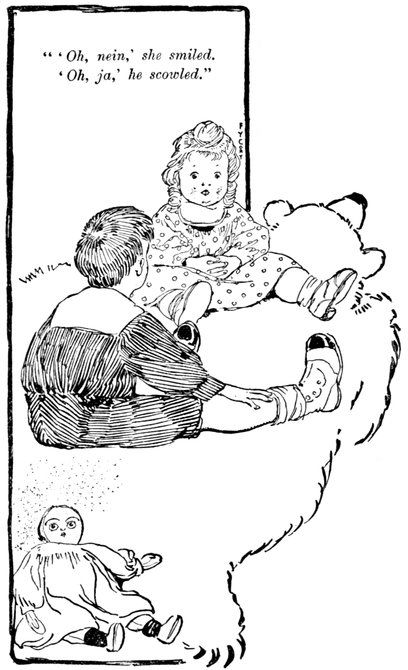
83“Oh, nein,” she
smiled.
“Oh, ja,” he
scowled. “You’re
always chewing
the wrong thing.
Look at
your shoe,
all wet!
What’ll Minna
say?”
She screwed her
face into wrinkles
84and shook her head, wringing her hands with
Minna’s gesture. “Pfui! pfui doch! ’s ist
abscheulich!” she scolded.
“I don’t believe you’ll get a present at all,” he
continued.
“Babe get p’es’t! Babe get big p’es’t!”
“Not a one! Not a one!” he persisted.
Her eyes filled; she implored him earnestly.
“P’ease, Babe get big p’es’t!”
“Not a——”
“Stop teasing your sister, Bobbert. Of course
she’ll get a present. Why not?”
“Because she swore.”
“What on earth do you mean?”
“I mean what I say.”
“When did she swear?”
“Day before yesterday night. She said she
was going to be bad when she got up, and
they kept at her to say she wouldn’t and she
said she would. She can be the worst you ever
saw.”
“Worse ever saw!” echoed the baby.
“And all day they were afraid she would be,
85and she wasn’t and she wasn’t, and she wasn’t.
Not till she went to bed. And she said her
prayers—that one she says, ‘Herr Jesus, mild
und—something—Du’—and
then she
just looked right up
at the ceiling and
swore as hard as she
could.”
“What in th—time
did she say?”
“She said: ‘O
Lord! Good Heavens!
Damn!’”
“’Oh Lord! Good Heavens! Damn!’”
“Oh!”
“And she got her
little hands mighty well slapped, too. She must
never say it again, must you, Baby?”
The baby laughed impishly. There was no
telling what more she knew.
At exactly half-past six the library doors flew
open with a bang, the piano struck up a brilliant
march and Minna escorted her charges pompously
86down the stairs, the baby in white, with a bewildering
number of pink bows, Bobbert in a blue
sailor suit.
Around the gleaming tree stood a ring of
aunts, uncles and grandparents, flushed and
happy.
“Merry Christmas, Bobbert! Merry Christmas,
Babe! How do you like it? Isn’t it grand?
See the angel? See the pop-corn? Don’t look
at the floor yet! (No, it isn’t time so soon.
Chris will start it.) Well, was it lovely, bless
her little heart? Wunderschön, Liebchen, nicht
wahr?”
Bobbert smiled perfunctorily at the tree,
blinked a little, leaped through the ring of bright-frocked
relatives, and fell upon a red-faced, apologetic
man standing with the group of delighted
servants near the door.
“Hello David!” he cried. “When did you
come back? Are you going to stay? Did you
know I could swim? Will you tell me a story
to-night?”
David, whose only fault was too great an attachment
87to the cup that cheered him too frequently,
and who had been devoted to Bobbert,
coughed deprecatingly and explained: “Only
dropped in for the tree, Mr. Bob, your papa
havin’ asked me in with the rest. And a fine
tree it is, I’m sure. I expect most o’ them presents
will be for you, Mr. Bob?”
David prefixed the title of respect in public,
but his private relations with Bobbert had been
anything but formal.
Aunt Kate, dancing with impatience, had begun
to detach the presents from the lower boughs,
and soon they were piling up around him.
“Master Robertson Wheeler. Master Robertson
Wheeler—oh, Bobbert, that’s a whopping
fine present. Miss Dorothea Wheeler. Siehst
du, mein süsses Kind? Master Robertson Wheeler.
See what Uncle Ritch. sent you, Bob! He
forgot how you had grown!”
They were laughing, explaining, thanking,
eating, all at once.
“And the candy, mother’ll keep till to-morrow.
Now, Bob, see! Under the tree!”
88The engine rattled proudly forth. The uncles
and aunts fell upon it.
“There! I told you it wasn’t oiled enough!
See, where the smoke-stack joins on! Will she
take the curve by the rug? See, Bobbert, how
the switches work! Real switches! Father!
Here, this way, Father Robertson! Mr. Ferris
is going to work the switch. Isn’t it wonderful,
Bobbert? It’s from Grandpa Wheeler. Thank
him. It goes through the hall. Oh, Kate, you
can’t work that switch, can you? See Aunt
Kate work the switch, dear.”
Bobbert watched it curiously. He ran forward
to the third switch.
“Want to see how it goes, Bob? Here, I’ll
work it for you. It’s a little catchy at first.
Yes indeed, Mr. Robertson, we had more fun
than a little getting this ready, I assure you.
Quite complete, isn’t it?”
Uncle Christopher began to juggle with the
Japanese outfit, to the intense delight of the servants.
The aunties and Mr. Ferris played with
the engine explaining its mechanism to the wondering
89grandfathers. Grandma Wheeler marvelled
at the French dissecting puzzle. Bobbert’s mother
happily guarding the candy, laughed at the baby,
who, harnessed into the dog collar, pranced along
before her father, waving the colored balls in the
air, a woolly lamb under her free arm. The
merry moments passed.
Suddenly Grandfather Wheeler looked up from
the bird-book, which he was sharing with Uncle
Frank. “But where is Robertson, Jr.?” he inquired
mildly.
They stared. “Why, right here,” they said.
But he was not right there.
Uncle Frank looked about comprehensively at
the relatives and smiled a superior smile. Then
his eye fell on the bird-book in his lap, and the
smile changed its quality.
He glanced at the ring of servants. “And
where is David?” he added. Suddenly he sprang
to his feet. “Come on!” he said. “We’ll
find him. Don’t make a noise—walk softly,
now.”
And still holding the presents, they trooped
90after him through the hall, Bobbert’s mother
close to the leader, the aunties and Mr. Ferris at
the end of the line. Through the dining-room,
through the wide pantry, through the hall, and
up to the kitchen door they tiptoed.
Uncle Frank paused a moment, nodded, and
made room for Bobbert’s father, while the grandfathers
crowded up and the aunties peeped under
and over.
On the floor before the well-swept kitchen
hearth sat David; beside him, a little space away,
squatted Bobbert, a long black hockey-stick in
his hand. Between them were arranged large
pieces of coal from the hod—arranged in what
appeared to be nine-pin patterns.
“I shall attack from the right at daybreak.
You’ll see what the Mosquito Fleet can do, Mr.
David! Your clumsy old Spanish ships can’t
move quick enough! Can they?”
“Wait and see, Bob, my boy!”
“This coal makes dandy ships—don’t it? A
lot of coal would be a fine present—wouldn’t it?
They use wood upstairs, and I don’t believe I
91could get hold of any. Are you enjoying yourself,
David?”
“You bet I am, Bob. Put your flagship in
line.”
“Well, I will. She was out for—for repairs.
When I go skating, David, I’ll never use any
other hockey-stick. I wanted a black one next
to a boat. You were lovely to give it to me.
I’ll be big enough for a boat next year, I
hope.”
“Well, now it’s daybreak. Lieutenant, are
you ready?”
“Aye, aye, sir.”
“Begin the fight!”
“Aye, aye, sir.”
The coal flew about thick and fast, the commanders
shuffled the lumps into place, cheering
and encouraging their officers and crews. Ship
after ship sank, to rise no more, in a clatter of
coal on the hearth.
Under cover of the noise Uncle Frank led
them away, silent, through the empty rooms, to
where the deserted Christmas tree sheltered only
92Minna, cooing German cradle-songs to her sleeping
baby.
“Now look here,” he said. “Let’s be sensible,
dear people. We’ll go on enjoying our presents
and sports—and let Bobbert enjoy his. Why
not, eh?”
THE HEART OF A CHILD
95
The sun-glare lies on the road and the
field and the house. The beetles buzz
and buzz, and the hens chuckle drowsily,
half sunk in the gray dust. There are only three
little white clouds in all the warm blue sky. It is
quite still, except for the hens and the beetles and
the occasional flap of the collie’s tail on the warm
flags. No one passes up or down the road. It is
the hot noon sleep of the country in August.
Suddenly comes the grating sound of something
dragged over the floor, and the door opens. The
Child pushes out with a little wooden rocking-chair
and a great tin pan heaped with unshelled
peas. She stands the chair carefully in the coolest
patch of shade and squeezes her plump little body
between the curved arms. Her blue-checked
apron is tied by the waistband around her neck—it
is a grown woman’s apron, and covers her
and the chair, which is far too small for her, now.
96But one cannot be always eight years old, and
when one is eleven shall one relinquish without a
pang the birthday gifts of one’s childhood?
She lays the pan beside her and puts a handful
of peas into her blue-checked lap. She presses
her brown little thumb against the sharp green
edge and drags it down the pod. Out patter the
little green balls, and rattle into the pan. Truly,
a pleasant sound! Like the rain on the roof.
When she was very little and slept with her
mother, she woke once in the night, and it was
raining hard. The thunder frightened her, and
her mother comforted her and sang her to sleep
in the bed. And when the lightning flashed and
all the room was bright and dreadful, her mother
told her to keep her eyes shut and then the flashes
would not trouble her. So she screwed her eyes
hard together and held her mother’s hand and
drifted off to sleep.
That was so long ago! But whenever anything
rattles and patters she shuts her eyes quickly,
and sees for a moment the dark room and the
square white counterpane, and hears her mother
97singing “Mary of Argyle.” She wonders if when
we die and go to heaven we are reminded by little
sights and sounds of what we used to do on earth.
Of course, we shall do only pleasant things there,
but they might remind us of the pleasant things
here—the pasture in the early morning, when it
is so still and cool and almost strange; the barn,
full of sweet piles of hay, musical with pigeons,
checkered with amber sunlight, a fairy palace on
whose fragrant divans one sits with sultans and
slave girls, and listens to Sindbad and Aladdin;
the shady porch, where cool white milk and dark
shiny gingerbread wait the weary, berry-stained
wanderer. In the brown book in the parlor is a
poem about a little girl who used to “take her
little porringer and eat her supper there.” The
Child feels like that little girl when she eats in
the porch.
There is another little girl in the brown book—“Sweet
Lucy Gray.” She thinks of Lucy when she
comes home alone at dusk, and quickens her steps.
For some maintain unto this day
She is a living child——
98How frightened she would be! Not that the
Child has been foolishly taught to fear. Only that
she is imaginative, and knows enough to be afraid.
In that poem there is mention of one “minster-clock.”
What may that be? She connects it
hazily with the watch that the minister takes out
before the sermon. But that could never strike.
If she could have one wish in all her life she
knows what it would be. A beautiful gold watch
all chased with figures and a cherry-colored ribbon
tied into the handle. Then she would put it into
her waist—but her dresses open in the back! The
disadvantages of youth are obvious enough, in
all conscience, without that last pathetic touch.
When can she have a separate waist and skirt?
Suppose she should die before she grows old
enough to attain this glory? People have died
when they were young—much younger than she.
The little Waters girl died, and she was only nine.
The Child went to the funeral, but not with her
mother. She slipped into the kitchen and listened
at the door. When she told her mother that she
had gone her mother looked at her so strangely.
99“Why did you want to go?” she said. The
Child could not tell.
“It made me cry,” she answered, “but I felt
good, too. I want her to tell my brother that I
am pretty well, and that I hope he is the same,
when she gets to heaven. Do you suppose she
will get there by to-night?”
They talked about her conduct on that occasion
so strangely and so long that she never spoke any
more with them about death or the life after it.
But she thought about these things.
She wondered whether Mary Waters remembered
the secret place they made together in a
hollow gate-post. Mary Waters had a way of
sometimes telling things not quite as they really
were. Did she do so now? Or had she told
enough lies to send her to hell? For liars inherit
hell. It is not that this fact has been impressed
upon her mind by others, but she has read it in
the Bible and heard it read.
There are strange things in the Bible. One is
commanded to refrain from doing so many things
that one never would do anyway. But those
100things must have been done by the Israelites and
the Pharisees and the Hittites and the Publicans.
Then did God mean that the Americans must
keep the same laws? But Americans were free
and equal. They threw over the tea, and with
a wild whoop—wait! let us pretend!
This is Boston. It is still and quiet. Night
is dark all around. Soft and stealthy come footsteps—the
Indians! They gather from the
shadows of the trees and houses, they wave their
tomahawks exultantly, they glide to the wharf.
In their path stands a little girl in a blue-checked
apron. She falls upon her knees in terror.
“Save me!” she cries. The chief laughs a
horrid laugh; he raises his tomahawk—the dog
barks loud and the Child nearly drops the peas
in her lap, so frightened she is.
“I thought they were real! I thought they
were coming!” she whispers to herself.
Let us think of pleasant things! Peas are so
small if you count them by ones! If people considered
whenever they gobbled peas so quickly
that every one had to be shelled by one poor,
101tired little girl! But no, they eat them without
a thought of how she sat in the little tight
chair and rattled them into the pan. If they
were only rich enough to leave the chair and the
peas and the farm and go to a city! What
city? Oh, New York or Boston or Persia. In
Persia the days are full of richness and the
nights are Arabian. Along the streets walk
veiled and lovely women—does it matter that to
the Child their veils are of the dull blue cotton
that wreathes her mother’s hat? By all the Persian
monarchs, no!—driving black dogs and
white hinds, followed by turbaned slaves and
glaring eunuchs, with misty genii hovering in the
background. They enter a frowning portal—but
let us pretend!
This is Persia. The streets are narrow; the
people jostle and crowd to one side a little girl in
a blue-checked apron. She walks along unknown,
unnoticed. Wait! Who is this? It is a slave
in a turban with a scimitar flashing with jewels.
He bows low.
“I am bidden to tell you that your presence
102is desired by my master, lovely maiden!” The
lovely maiden looks haughtily at him.
“I will follow you, Slave,” she says. They go
on to a low narrow door. The slave says a magic
word and the door swings open. Through a long
passage and a great hall they go. There bursts
upon them a radiance of light. Flowers fill the
air with an unearthly fragrance. Golden goblets
and ruby pitchers stand on silver salvers with
“dried fruit, cakes, and sweetmeats, which give an
appetite for drinking.” Lovely slave girls lead
the maiden to the bath, and attire her in rich and
costly robes. They seat her in a golden chair
and give her a bowl of seed-pearls to string.
(These are the pearls.) She lifts her lovely head
and says in a voice of silver music, “Where is
your master?”
“Lady,” says one of the slaves, bowing low,
“he comes.” She hears the feet of the approaching
prince; she dares not raise her eyes. How
will he look? What gift will he bring? She
sinks her hands deep in the pearls. Ah, what is
that? A great sweet-bough drops in the pan.
103“Your gran’ma wants them peas!” says the
prince in genial rebuke. Alas! And did Haroun-al-Raschid
speak through his nose?
The Child stares at him, dazed.
“These are the pearls.”
“These—these are pearls!” she says. “I am
stringing them for my girdle! Does your Highness
desire that I should wear this—this carbuncle?”
His Highness laughs loud and long.
“It’s a sweet-bough,” he chuckles, “and I
guess you better eat it right up, now.” One moment
of wavering: shall awful wrath come upon
this desecrator of the soul’s best rites, or good
104fellowship and feasting be given him? She
scowls, she shrugs her aproned shoulders, she
glances from beneath her lashes, she smiles.
“I’ll give you half,” she announces. After all,
it is hardly probable that the prince would have
helped her shell the peas. And William Searles
will, if he is only the chore-boy. Vain hope!
“I got to drive the chickens ’round back,” he
demurs. “I can’t spend my time shellin’ peas.
Your gran’ma says if you don’t get ’em done
pretty soon you can’t go over to Miss Salome’s
this afternoon. She says you’re a dreadful slow
child!”
This is the last straw. The Child rises with
what would indeed be a freezing dignity were it
not that with her rises the birthday-chair.
“William,” she begins. But more suddenly than
is consistent with her tone she sinks back. William
sits upon the grass shaking with laughter.
“You looked so awful funny, so awful funny!”
he gasps. The Child hangs for a moment between
tears and laughter. Then she accepts the
situation and laughs as merrily as the chore-boy
105“I was pretending I was a princess,” she explains.
“I——”
“Ho!” rejoins William, “you ain’t like a princess!
You don’t look like the ones you tell about,
anyway! Why”—as she glares at him over the
apron, “your hair’s red, red! An’ your eyes are
kind o’ green, they are! An’ you’re just jam-packed
full o’ freckles! I guess I know well
enough how they look, and you ain’t like ’em!”
The tears stand in her eyes, but she will not
let them fall.
“I don’t care, William Searles,” she says
bravely, “I may look freckled, but I don’t feel so!
And it’s better to know how they look than—”
But no! She is an honest Child, with all her
imaginings. She knows that it is better to look
like them than to know about them: better for
the maiden and the prince, at least. William
waits for the sentence. She begins again.
“William Searles,” she says solemnly, “wouldn’t
you rather I could tell you about those princesses
than look like them?” William’s eyes sparkle
greedily.
106“You bet!” he replies with fervor. The
Child sighs with relief.
“All right,” she says, “then don’t complain.”
She is alone again, and only William’s faint
and fainter invitations to the chickens break the
silence. The peas fly into the pan. Suppose
she should be kept from Miss Salome’s! But no,
that shall not be. She looks ahead to the
happy afternoon, singing as she works.
And now, and now the time has come. The
dishes are wiped, the cat fed, and the fennel
picked for the long sermon to-morrow. She, her
very self, in her new dotted lawn walks carefully
up the hill to the big house, terraced and gravel-pathed.
She knocks timidly at the brass ring
and the tall colored butler lets her in. He is the
only indoor man-servant she has ever seen, and
she reverences him greatly. He smiles condescendingly
at her, as he smiles not upon all the
country people.
“If Miss will walk up,” he says. She goes up
the soft-carpeted stairs into the upstairs drawing-room.
She draw’s a long breath of happiness and
107wonder ever new, and makes her little curtsy to
Miss Salome.
Out of the dim delicious dusk of the room
come slowly the familiar treasures: the high polished
desk, the great piano, the marvelous service
of Delft that fills a monstrous sideboard in the
distance, the chairs, all silk and satin and shining
wood, the great pictures in gilt frames. In the
largest chair sits Miss Salome. Will the Child
ever tire of looking at her pale lined face, her silver
high-dressed hair, her beautiful hands sparkling
with rings, her haughty mouth, her tired,
troubled eyes? She must have been almost as
lovely as the Princess Angelica, once. But she
smiles so seldom. She puts out her hand.
“And what has happened since last Saturday?”
she says.
The Child laughs for pure joy. To talk, to
describe, to venture at analysis, to ask the why
and wherefore, to illustrate by gesture as vivid as
her speech—these things are her happiness. To
be suffered this joy in snatches is much, to have
it demanded, and for one whole afternoon! Here
108is no one to reprove, no one to blame the idle
hands, no one to question the propriety of mimicry,
or to insist on her sitting in her little chair.
Miss Salome watches her flitting about the
dusky parlor, her reddish gold hair gleaming now
against the Delft blue, now against the polished
mahogany desk. She tells of the chickens that
lost their mother. She wanders about clucking
for her brood and cooing over the returned prodigals.
She walks across the room as William does—her
slouching gait, open mouth, drawling voice,
irresistibly perfect. She describes the shooting
star that seemed to her like a lost spirit, gone to
sorrow and the earth.
“It made me think of ‘Lucifer, son of the
morning, how art thou fallen!’” she says solemnly.
“I wonder how that star felt, Miss Salome?”
There is a long pause. The lady sighs.
Then, “You may read, if you like,” she says
at last.
The Child’s face flushes for joy. She runs to
the book-cases and brings out a small brown
109book. She fingers lovingly the tree-calf that
covers the precious pages, and opens them before
she finds her chair. She curls up on a great satin
ottoman and smooths the leaves. Where is the
farm? Where the peas? Where William?
They are less than shadows, more unreal than
dreams. Her voice trembles as she begins:
“’And now, your Highness permitting, I shall
relate to your Majesty one of the most surprising
adventures ever known to your Majesty—’”
Ah, it is good to have been a child and perfectly
happy.
What do children know of life, she thinks, who
play with tops and dogs and kittens? There are
books in the world. And they own all lands
and seas and peoples, who own those printed
leaves. Even Miss Salome does not know as
much as the books. Even Miss Salome cannot
say such curious wonderful things. Why is Miss
Salome so good to her? In heaven, will they
see each other? “In my Father’s house are
many mansions.” Suppose she should be put in
Miss Salome’s? Will the “Arabian Nights” be
110there? When she lifts her eyes from the book
they fall on an immense peacock-feather fan. It
glows on the wall, and the eyes dilate and tremble
and satisfy her hungry little soul with the
color she loves. On a small table near her stands
a sandal-wood cabinet. Its faint sweet smell
mingles with the spices and gums of the tale, and
should a Genius spring from the cover and bow
to the ground before them, she would not be surprised.
With a sigh of pleasure she releases the princess
and outwits the evil spirit.
“’And now if your Majesty would care to
listen to the story of the Fisherman——’”
“That is enough,” says Miss Salome. “Are
you tired?” The Child’s eyes answer her.
“Then sing to me.”
“What shall I sing?” says the Child. “’Lord
Lovell’”?
“If you like,” answers Miss Salome.
The Child rises and stands before the great
chair. Her face is raised and serious. She
knows only ballads, but to her they are opera
111and symphony in one. She clasps her hands and
begins:
Lord Lovell he stood at his castle gate,
A-combing his milk-white steed,
When out came Lady Nancy Bell,
To wish her lover good spee-ee-eed,
To wish her lover good speed.
Her voice rings true as a bell. Miss Salome
smiles at the eager little face.
“Now where are you going, Lord Lovell?” she said,
“Now where are you going?” said she.
“I’m going away, dear Nancy Bell,
Strange countries for to see-ye-ye,
Strange countries for to see!”
She carries them through fateful verses and unconsciously
softens and saddens her voice at the
woful ending, where
They buried the lady in the nave of the church,
They buried the lord in the choir,
And out of her bosom there grew a red rose,
And out of her lover’s a brier-ier-ier,
And out of her lover’s a brier.
112Miss Salome applauds vigorously.
“One more,” she begs.
The Child’s heart grows big with happiness.
That she should love it so, and yet with it pleasure
others! It is too much joy. She will make
a special prayer to-night and thank God, as does
her grandmother, for unexpected bounty.
“I will sing, ‘Come with thy lute,’” she says.
It is a quaint, old-fashioned tune, and her voice
rises and falls, and reaches for the notes with an
almost pathetic feeling for their beauty:
Come with thy lute to the fountain,
Sing me a song of the mountain,
Sing of the happy and free:—
She looks at the lovely lady in the white satin
gown in the great gold frame before her. How
beautiful she must have been! She died when
she was very young. Her husband shot himself
with grief for her. She might have sung that
113song to him—who knows? The Child chokes
and swallows her tears at the end of the song,
and when she looks at Miss Salome she sees that
her eyes, too, are full of tears.
“Oh, I have made you cry! I am sorry—so
sorry!”
Miss Salome wipes her eyes.
“If I make my guests unhappy, they will not
care to come again,” she says. “Ring for Peter,
dear child.” So the Child taps the bell, and
Peter comes gravely in with the beautiful silver
tray, and in a flutter of delight the Child forgets
the song and the picture. Miss Salome cuts the
dark frosted cake, and dishes into glass plates
the candied ginger, floating in syrup, and pours
out cups of real tea. And the Fairy Princess is
served with a banquet worthy of her dreams.
Oh, to be at last in Miss Salome’s mansion!
The clock chimes for half-past five. Heaven
is over. She brushes the crumbs to a little heap
on her gilt-rimmed plate.
“I must go now, I think,” she says with obvious
effort. Her hostess smiles.
114“But you will come next week?” she asks.
And the Child’s face lights up.
“Oh, yes! I’ll surely come next week, surely,”
she replies with emphasis. So she goes around
to Miss Salome’s chair, and the beautiful ringed
hand raises her face and strokes her little freckled
cheek.
“Good-by, my Sunshine!” she says. The
Child catches the hand in a rush of loving worship
and kisses it.
“I will never be cross to William Searles
again, never!” she cries. “I will be good to
everybody—even to stupid people!” Miss Salome
pinches her cheek and laughs.
And the Child goes out and down the steps of
the terrace, rapt, wondering, lifted to a height of
love and admiration that keeps her little soul to
its sweetest, highest pitch for—ah, measure not
the time, I beg you! The children who are
older, how long do the glow and the flush remain
with them? They can only say, “There will be
another!” and wait for it as well and patiently
as may be.
115The Child goes back to the life of everyday,
and embroiders its dull web with eyes of peacocks
and sifts into it the scent of sandal-wood, and
sets it weaving to the tune of ballads, quaint and
sweet. Yet she has taken into another’s web,
unknowing, a tiny scarlet thread of happiness,
that weaves through the tarnished cloth of silver
and blesses the pattern as it grows. And the
Master of the Looms has planned it all.
ARDELIA IN ARCADY
119
“Throwing assorted refuse.”
When first the young lady from the
College Settlement dragged Ardelia
from her degradation—she was sitting
on a dirty pavement and throwing assorted
refuse at an unconscious policeman—like many
of her companions in misery,
she totally failed to realize
the pit from which she was
digged. It had never occurred
to her that her situation was anything less
than refined, and though, like most of us, she had
120failed to come up to her wildest ideals of happiness,
in that respect she differed very little from
the young lady who rescued her.
“Come here, little girl,” said the young lady
invitingly. “Wouldn’t you like to come with
me and have a nice, cool bath?”
“Naw,” said Ardelia, in tones rivaling the bath
in coolness.
“You wouldn’t? Well, wouldn’t you like
some bread and butter and jam?”
“Wha’s jam?” said Ardelia conservatively.
“Why, it’s—er—marmalade,” the young
lady explained. “All sweet, you know.”
“Naw!” and Ardelia turned away and fingered
the refuse with an air of finality that caused the
young lady to sigh with vexation.
“I thought you might like to go on a picnic,”
she said helplessly. “I thought all little girls
liked——”
“Picnic? When?” cried Ardelia, moved instantly
to interest. “I’m goin’!”
She brushed the garbage from her dress—Ardelia
was of that emancipated order of women
121who disapprove of the senseless multiplication of
feminine garments, and wore, herself, but one—and
regarded her rescuer impatiently.
“What’s the matter?” she asked. “I’m all
ready. Hump along!”
“We’ll go and ask your mother first, won’t
we?” suggested the young lady, a little bewildered
at this sudden change of attitude.
“Jagged,” Ardelia returned laconically. “She’d
lift y’r face off yer! Is it the Dago picnic?”
The young lady shuddered, and seizing the
hand which she imagined to have had least to do
with the refuse, she led Ardelia away—the first
stage of her journey to Arcady.
Ardelia’s origin, like that of the civilization of
ancient Egypt, was shrouded in mystery. At the
age of two months she had been handed to a policeman
by a scared-looking boy, who said vaguely
that he found her in the park under a bench. The
policeman had added her to the other foundling
waiting that day at headquarters, and carried
them to the matron of the institution devoted
to their interest. Around the other baby’s neck
122was a medal of the Blessed Virgin, and a slip of
paper pinned to her flannel petticoat labeled her
Mary Katharine. The impartial order of the
institution therefore delivered Ardelia, who was
wholly unlabeled, to the Protestant fold, and one
of the scrubbing-women named her.
Later she had taken up her residence with
Mrs. Michael Fahey, who had consented to add
to her precarious income by this means, and at
the age of four she became the official nurse of
Master John Sullivan Fahey. A terribly hot
August, unlimited cold tea, and a habit of playing
in the gutter in the noon glare proved too
much for her charge, and he died on his third
birthday. The ride to the funeral was the most
exciting event of Ardelia’s life. For years she
dated from it. Mrs. Fahey had so long regarded
her as one of the family, that though her occupation
was gone, and her board was no longer paid,
she was whipped as regularly and cursed as comprehensively,
in her foster-mother’s periodical
sprees, as if they had been closely related.
What time she could spare from helping Mrs.
123Fahey in her somewhat casual household labor,
and running errands to tell that lady’s perennially
hopeful employers that her mother wasn’t
feeling well to-day, but would it do if she came
to-morrow, Ardelia spent in playing up and
down the street with a band of little girls, or, in
the very hottest days, sitting drowsy and vindictive
at the head of a flight of stone steps that led
into a down-stairs saloon. The damp, flat, beer-sweetened
air that rushed out as the men pushed
open the swing-doors was cool and refreshing to
her; she was in a position to observe any possible
customers at the three push-carts in her line
of vision, and could rouse a flagging interest in
life by listening to any one of the altercations
that resounded from the tenements night and
day. Drays clattered incessantly over the pavement,
peddlers shouted, sharp gongs punctuated
the steadier din. A policeman was almost always
in sight, and one of them, Mr. Halloran, had
more than once given her a penny for lemonade.
In the room above her head an Italian band practised
every evening, and then Ardelia was perfectly
124happy, for she loved music. Often before the
band began, a hurdy-gurdy would station itself
at the corner, and Ardelia and the other little
girls would dance about, singly and in pairs,
shouting the tunes they knew, rejoicing in the
comparative coolness and the generally care-free
atmosphere. Ardelia was the lightest-footed of
them all; her hands held her skirts out almost
gracefully, her thin little legs flew highest. Sometimes
the saloon-keeper—they called him “Old
Dutchy”—would nod approval as Ardelia
skipped and pranced, and beckon her to him mysteriously.
“You trow your legs goot,” he would say.
“We shall see you already dancing, no? Here
is an olluf; eat her.”
And Ardelia, who loved olives to distraction,
would nibble off small, sour, salty mouthfuls and
suck the pit luxuriously while she listened to the
Italian band.
Except for Mrs. Fahey’s errands, which never
carried her far off the street, Ardelia had never
left it in her life, and her journey to the Settlement-house
125was one of interest to her. She was
a silent child, but for occasional fits of gabbling
and chattering with the little girls in the street;
and though she did not understand why the
young lady from the Settlement should cry when
she introduced her to two other ladies, nor why
so many messages should be left for her mother,
and so many local and general baths administered,
she said very little. She was not accustomed
to question fate, and when it sent her two
fried eggs—she refused to eat them boiled—for
her breakfast, she quietly placed them in the
credit column as opposed to the baths, and held
her peace.
Later, arrayed in starched and creaking garments
which had been made for a slightly smaller
child, she was transported to the station, and for
the first time introduced to a railroad car. She
sat stiffly on the red plush seat with furtive eyes
and sucked-in lips, while the young lady talked
reassuringly of daisies and cows and green grass.
As Ardelia had never seen any of these things, it
is hardly surprising that she was somewhat unenthusiastic;
126but the young lady was disappointed
by this lack of ardor. She was so thoroughly
convinced of the essential right of every child to
a healthy country life, that she was almost disposed
to blame Ardelia for not sharing her eminently
creditable conviction.
“You can roll in the daisies, my dear, and
pick all you want—all!” she urged eagerly.
But no answering gleam woke in Ardelia’s eyes.
“Aw right,” she answered guardedly, and
stared into her lap.
“Look out, dear, and see the fields and houses—see
that handsome dog, and see the little
pond!”
Ardelia shot a quick glance at the blurring
green that dizzied her as it rushed by; the train
was a fast express making up for lost time.
Then with a scowl she resumed the contemplation
of her starched gingham lap. The swelteringly
hot day, and the rapid, unaccustomed
motion combined to afflict her with a strange
internal anticipation of future woe. Once last
summer, when she ate the liquid dregs of the ice-cream
127man’s great tin, and fell asleep in the room
where her mother was frying onions, she had experienced
this same foreboding, and the climax of
that dreadful day lingered yet in her memory.
So she set her teeth and waited with stoical resignation
for the end, while the young lady babbled
of green fields, and wondered why the child
should be so sullen. Finally she laid it to homesickness,
and recovered her faith in human
nature.
At last they stopped. The young lady seized
her hand, and led her through the narrow aisle,
down the steep steps, across the little country-station
platform, and Ardelia was in Arcady.
A bare-legged boy in blue overalls and a wide
straw hat then drove them many miles along a
hot, dusty road, that wound endlessly through
the parched country fields. To the young lady’s
remark that they needed rain sadly, he replied,
“Yep!” and held his peace for the following
hour. Occasionally they passed another horse,
but for the most part the only sight or sound of
life was afforded by the hens clucking angrily as
128the travelers drove them from their dust baths in
the powdery road. Released from her horror of
foreboding, Ardelia took a more apparent interest
in her situation, and would perhaps have
spoken if her chaperone had opened conversation;
but the young lady was weary of such efforts, disposed
to a headache from the blinding heat, and
altogether inclined to silence. At last they
turned into a driveway, and drew up before a
gray wooden house. Ardelia, cramped with sitting
still, for she had not altered her position
since she was placed stiffly on the seat between
her fellow-passengers, was lifted down and escorted
up the shingle-walk to the porch. A
spare, dark-eyed woman in a checked apron advanced
to meet them.
“Terrible hot to-day, ain’t it?” she sighed.
“I’m real glad to see you, Miss Forsythe. Won’t
you cool off a little before you go on? This is
the little girl, I s’pose. I guess it’s pretty cool to
what she’s accustomed to, ain’t it, Delia?”
“No, I thank you, Mrs. Slater, I’ll go right on
to the house. Now, Ardelia, here you are in the
129country. I’m staying with my friend in a big
white house about a quarter of a mile farther on.
You can’t see it from here, but if you want anything
you can just walk over. Day after to-morrow
is the picnic I told you about. You’ll see
me then, any way. Now run right out
in the grass and pick all the daisies
you want. Don’t be afraid; no one
will drive you off this grass!”
“’Huh?’”
The force of this was lost on
Ardelia, who had never been
driven off any grass whatever,
but she gathered that she
was expected to walk out into
the thick, rank growth of
the unmowed side yard, and
strode downward obediently, turning when in the
exact center of the plot, for further orders.
“Now pick them! Pick the daisies!” cried
Miss Forsythe excitedly. “I want to see you.”
Ardelia looked blank.
“Huh?” she said.
130“Gather them. Get a bunch. Oh, you poor
child! Mrs. Slater, she doesn’t know how!”
Miss Forsythe was deeply moved and illustrated
by picking imaginary daisies on the porch. Ardelia’s
quick eyes followed her gestures, and stooping,
she scooped the heads from three daisies and
started back with them, staring distrustfully into
the depths of the thick clinging grass as she
pushed through it. Miss Forsythe gasped.
“No, no, dear! Pull them up! Take the
stem, too,” she explained. “Pick the whole
flower!”
Ardelia bent over again, tugged at a thick-stemmed
clover, brought it up by the roots, recovered
her balance with difficulty, and assaulted
a neighboring daisy. On this she cut her hands,
and sucking off the blood angrily, she grabbed a
handful of coarse grass, and plowing through the
tangled mass about her feet, laid the spoils awkwardly
on the young lady’s lap.
Miss Forsythe stared at the dirty, trailing
roots that stained her linen skirt and sighed.
“Thank you, dear,” she said politely, “but I
131meant them for you. I meant you to have a
bunch. Don’t you want them?”
“Naw!” said Ardelia decidedly, nursing her
cut hand and stepping with relief on the smooth
floor of the porch.
Miss Forsythe’s eyes brightened suddenly.
“I know what you want,” she cried, “you’re
thirsty! Mrs. Slater, won’t you get us some of
your good, creamy milk? Don’t you want a
drink, Ardelia?”
Ardelia nodded. She felt very tired, and the
glare of the sun seemed reflected from everything
into her dazed eyes. When Mrs. Slater appeared
with the foaming yellow glasses she wound her
nervous little hands about the stem of the goblet
and began a deep draught. She did not like it,
it was hard to swallow, and instinct warned her
not to go on with it; but all the thirst of a long
morning—Ardelia was used to drinking frequently—urged
her on, and its icy coldness enabled her
to finish the glass. She handed it back with a
deep sigh. The young lady clapped her hands.
“There!” she cried. “Now, how do you like
132real milk, Ardelia? I declare, you look like
another child already! You can have all you
want every day—why, what’s the matter?”
For Ardelia was growing ghastly pale before
them; her eyes turned inward, her lips tightened.
A blinding horror surged from her
toes upward, and the memory of the
liquid ice-cream and the frying
onions faded before the awful reality
of her present agony.
“A blinding horror surged from her toes upward.”
Later, as she lay limp and white on
the slippery hair-cloth sofa in Mrs. Slater’s musty
parlor, she heard them discussing her situation.
“There was a lot of Fresh Air children over
at Mis’ Simms’s,” her hostess explained, “and
they ’most all of ’em said the milk was too strong—did
you ever! Two or three of ’em was sick,
like this one, but they got to love it in a little
while. She will, too.”
133Ardelia shook her head feebly. She had learned
her lesson. If success, as we are told, consists
not in omitting to make mistakes, but in omitting
to make the same one twice, Ardelia’s treatment
of the milk question was eminently successful.
After a while Miss Forsythe went away, and at
her urgent suggestion Ardelia came out and sat
on the porch under the shade of a black umbrella.
She sat motionless, staring into the grass, lost in
the rapture of content that follows such a crisis
as her recent misery, forgetful of all her earthly
woes in the blessed certainty of her present calm.
In a few minutes she was asleep.
When she awoke she was in a strange place.
Outside the umbrella all was dusk and shadow.
Only a square white mist filled the place of the
barn, the tall trees loomed vaguely toward the
dark sky, the stars were few. As she gazed in
half-terror about her, a strange jangling came
nearer and nearer, and a great animal with swinging
sides, panting terribly, ran clumsily by, followed
by a bare-legged boy, whose thudding feet
sounded loud on the beaten path. Ardelia shrank
134against the wall with a cry that brought Mrs.
Slater to her side.
“There, there, Delia, it’s only a cow. She won’t
hurt you. She gives the milk—” Ardelia shuddered—“and
the butter, too. Here’s some bread
and butter for you. We’ve had our supper, but I
thought the sleep would do you more good.”
Still shaken by the shock of that panting, hairy
beast, Ardelia put out her hand for the bread and
butter, and ate it greedily. Then she stretched
her cramped limbs and looked over the umbrella.
On the porch sat a bearded man in shirt-sleeves
and stocking feet, his head thrown back against
his chair, his mouth open. He snored audibly.
Tipped back in another chair, his feet raised and
pressed against one of the supports of the porch
roof, sat a younger man. He was not asleep, for
he was smoking a pipe, but he was as motionless
as the other. Curled up on the steps was the boy
who had brought them from the station. Occasionally
he patted a mongrel collie beside him,
and yawning, stretched himself, but he did not
speak.
135“That’s Mr. Slater,” said the woman softly,
“and the young man is my oldest son, William.
Henry brought you up with the team. They’re
out in the field all day, and they get pretty
tired. It gets nice an’ cool out here by evenin’,
don’t it?”
She leaned back and rocked silently to and fro,
and Ardelia waited for the events of the evening.
There were none. She wondered why the gas
was not lit in all that shadowy darkness, why the
people didn’t come along. She felt scared and
lonely. Now that her stomach was filled, and
her nerves refreshed by her long sleep, she was in
a condition to realize that aside from all bodily
discomfort she was sad—very sad. A new, unknown
depression weighed her down. It grew
steadily, something was happening, something
constant and mournful—what? Suddenly she
knew. It was a steady, recurrent noise, a buzzing,
monotonous click. Now it rose, now it fell,
accentuating the silence dense about it.
“Zig-a-zig! Zig-a-zig!” then a rest.
“Zig-a-zig! Zig-a-zig-a-zig!”
136She looked restlessly at Mrs. Slater. “Wha’s
’at?” she said.
“That? Oh, those are katydids. I s’pose
you never heard ’em, that’s a fact. Kind o’ cozy,
I think. Don’t you like ’em?”
“Naw,” said Ardelia.
Another long silence intervened. The rocking-chair
swayed back and forth, and Mr. Slater
snored. Little bright eyes glowed and disappeared,
now high, now low, against the dark. It
will never be known whether Ardelia thought
them defective gaslights or the flashing, changing
electric signs that add color to the night advertisements
of her native city, for contrary to all
fictional precedent, she did not inquire with interest
what they were. She did not care, in fact.
After half an hour of the katydids William
spoke.
“Nick Damon’s helpin’ in the south lot t’day,”
he observed.
“Was he?” asked his mother, pausing a moment
in her rocking.
“Yep.”
137Again he smoked, and the monotonous clamor
was uninterrupted.
“Zig-a-zig! Zig-zig! Zig-a-zig-a-zig!”
Slowly, against the background of this machine-like
clicking, there grew other sounds,
weird, unhappy, far away.
“Wheep, wheep, wheep!”
This was a high, thin crying.
“Buroom! Brrroom! broom!”
This was low and resonant and solemn. Ardelia
scowled.
“Wha’s ’at?” she asked again.
“That’s the frogs. Bull-frogs and peepers.
Never heard them, either, did ye? Well, that’s
what they are.”
William took his pipe out of his mouth.
“Come here, sissy, ’n I’ll tell y’ a story,” he
said lazily.
Ardelia obeyed, and glancing timorously at
the shadows, slipped around to his side.
“Onc’t they was an ol’ feller comin’ ’long
cross-lots, late at night, an’ he come to a pond,
an’ he kinder stopped up an’ says to himself,
138’Wonder how deep th’ ol’ pond is, anyhow?’
He was just a leetle—well, he’d had a drop too
much, y’ see——”
“Had a what?” interrupted Ardelia.
“He was sort o’ rollin’ ’round—he didn’t
know just what he was doin’——”
“Oh! Jagged!” said Ardelia comprehendingly.
“I guess so. An’ he heard a voice singin’ out,
’Knee deep! Knee deep! Knee deep!’”
William gave a startling imitation of the peepers:
his voice was a high, shrill wail.
“’Oh, well,’ s’ he, ‘’f it’s just knee deep I’ll
wade through,’ an’ he starts in.
“Just then he hears a big feller singin’ out,
‘Better go rrrround! Better go rrround! better-goround!’”
William rolled out a vibrating bass note that
startled the bull-frogs themselves.
“’Lord!’ says he, ‘is it s’deep’s that? Well,
I’ll go round, then.’ ’N’ off he starts to walk
around.
“’Knee deep! Knee deep! Knee deep!’ says
the peepers.
139“An’ there it was. Soon’s he’d start to do
one thing, they’d tell him another. Make up
his mind he couldn’t, so he stands there still,
they do say, askin’ ’em every night which he
better do.”
Time passed by. To Ardelia it might have
been minutes, hours, or generations. An unspeakable
boredom, an ennui that struck to the
roots of her soul, possessed her. Her muscles
twitched from nervousness. Her feet ached and
burned in the stiff boots.
Suddenly Mr. Slater coughed and arose.
“Well, guess I’ll be gettin’ to bed,” he said.
“Come on, boys. Hello, little girl! Come to
visit with us, hey? Mind you don’t pick poison
vine.”
He shuffled into the house, and the boys followed
him in silence. Mrs. Slater led Ardelia
140upstairs into a little hot room, and told her to get
into bed quick, for the lamp drew the mosquitoes.
Ardelia kicked off her shoes and approached
the bed distrustfully. It sank down with her
weight and smelled hot and queer. Rolling
off, she stretched herself on the floor, and lay
there disconsolately. Sharp, quick stabs from the
swarming mosquitoes stung her to rage; she
tossed about, slapping at them with exclamations
that would have shocked Mrs. Slater. The eternal
chatter of the katydids maddened her. She
could not sleep. Across the swamp came the
wail of the peepers.
“Knee deep! Knee deep! Knee deep!”
At home the hurdy-gurdy was playing, the
women were gossiping on every step, the lights
were everywhere—the blessed fearless gaslights—the
little girls were dancing in the breeze that
drew in from the East River, Old Dutchy was
giving Maggie Kelly an olive;—Ardelia slapped
viciously at a mosquito on her hot cheek, heard a
great June bug flopping into the room through
141the loosely waving netting, and burst into tears
of pain and fright, wrapping her head tightly in
her gingham skirt.
In the morning Miss Forsythe came over to
inquire after her charge’s health, accompanied by
another young lady.
“How do you do, my dear?” said the new lady
kindly. “How terribly the mosquitoes have
stung you! What makes you stay in the house,
and miss the beautiful fresh air? See that great
plot of daisies—does she know that she can pick
all she wants, poor little thing? I suppose she
never had a chance! Come out with me, Ardelia,
and let’s see which can pick the biggest
bunch.”
And Ardelia, fortified by ham and eggs, went
stolidly forth into the grass and silently attacked
the daisies.
In the middle of her bunch the new young lady
paused. “Why, Ethel, she isn’t barefoot!” she
cried. “Come here, Ardelia, and take off your
shoes and stockings directly. Shoes and stockings
in the country! Now you’ll know what comfort
142is,” as she unlaced the boots rapidly on the
porch.
“Oh, she’s been barefoot in the city,” explained
Miss Forsythe, “but this will be different, of
course.”
And so it was, but not in the sense she intended.
To patter about bare-legged on the
clear, safe pavement, was one thing; to venture
unprotected into that waving, tripping tangle was
another. She stepped cautiously upon the short
grass near the house, and with jaw set and narrowed
lids felt her way into the higher growth.
The ladies clapped their hands at her happiness
and freedom. Suddenly she stopped, she shrieked,
she clawed the air with outspread fingers. Her
face was gray with terror.
“Oh, gee! Oh, gee!” she screamed.
“What is it, Ardelia, what is it?” they
cried lifting up their skirts in sympathy, “a
snake?”
Mrs. Slater rushed out, seized Ardelia, half rigid
with fear, and carried her to the porch. They
elicited from her as she sat with her feet tucked
143under her and one hand convulsively clutching
Mrs. Slater’s apron that something had rustled by
her “down at the bottom,” that it was slippery,
that she had stepped on it, and wanted to go
home.
“Toad,” explained Mrs. Slater briefly. “Only
a little hop-toad, Delia, that wouldn’t harm a
baby, let alone a big girl nine years old, like
you.”
But Ardelia, chattering with nervousness, wept
for her shoes, and sat high and dry in a rocking-chair
for the rest of the morning.
“She’s a queer child,” Mrs. Slater confided to
the young ladies. “Not a drop of anything will
she drink but cold tea. It don’t seem reasonable
to give it to her all day, and I won’t do it, so she
has to wait till meals. She makes a face if I say
milk, and the water tastes slippery, she says, and
salty-like. She won’t touch it. I tell her its
good well water, but she just shakes her head.
She’s stubborn’s a bronze mule, that child. Just
mopes around. ’S morning she asked me when
did the parades go by. I told her there wa’n’t
144any but the circus, an’ that had been already. I
tried to cheer her up, sort of, with that Fresh Air
picnic of yours to-morrow, Miss Forsythe, and
s’she, ‘Oh, the Dago picnic,’ s’she, ‘will they have
Tony’s band?’
“She don’t seem to take any int’rest in th’
farm, like those Fresh Air children, either. I
showed her the hens an’ the eggs, an’ she said it
was a lie about the hens layin’ ’em. ‘What d’you
take me for?’ s’she. The idea! Then Henry
milked the cow, to show her—she wouldn’t believe
that, either—and with the milk streamin’
down before her, what do you s’pose she said?
‘You put it in!’ s’she. I never should ’a’
believed that, Miss Forsythe, if I hadn’t
heard it.”
“Oh, she’ll get over it,” said Miss Forsythe
easily, “just wait a few days. Good-by, Ardelia,
eat a good supper.”
But this Ardelia did not do. She gazed fascinated
at Mr. Slater, who loaded his fork with cold
green peas, shot them into his mouth, and before
disposing of them ultimately added to them half
145a slice of rye bread and a great gulp of tea in one
breath, repeating this operation at regular intervals
in voracious silence. She regarded William,
who consumed eight large molasses cookies and
three glasses of frothy milk, as a mere afterthought
to the meal, gulping furiously. He never spoke.
Henry she dared not look at, for he burst into
laughter whenever she did, and cried out, “You
put it in! You put it in!” which irritated her
exceedingly. But she knew that he was biting
great round bites out of countless slices of buttered
bread, and in utter silence. Now Ardelia
had never in her life eaten in silence. Mrs. Fahey,
when eating, gossiped and fought alternately
with Mr. Fahey’s old, half-blind mother; her son
Danny, in a state of chronic dismissal from his
various “jobs,” sang, whistled and performed
clog dances under the table during the meal;
their neighbor across the narrow hall shrieked her
comments, friendly or otherwise; and all around
and above and below resounded the busy noise of
the crowded, clattering city street. It was the
breath in her nostrils, the excitement of her nervous
146little life, and this cold-blooded stoking took
away her appetite, never large.
Through the open door the buzz of the katydids
was beginning tentatively. In the intervals
of William’s gulps a faint bass note warned them
from the swamp:
“Better go rrround! Better go round!”
Mrs. Slater filled their plates in silence. Henry
slapped a mosquito and chuckled interiorly at
some reminiscence. A cow-bell jangled sadly out
of the gathering dusk.
Ardelia’s nerves strained and snapped. Her
eyes grew wild.
“Fer Gawd’s sake, talk!” she cried sharply.
“Are youse dumbies?”
The morning dawned fresh and fair; the trees
and the brown turf smelled sweet, the homely
barnyard noises brought a smile to Miss Forsythe’s
sympathetic face, as she waited for Ardelia
to join her in a drive to the station. But Ardelia
did not smile. Her eyes ached with the great
green glare, the strange scattered objects, the long
147unaccustomed vistas. Her cramped feet wearied
for the smooth pavements, her ears hungered for
the dear familiar din. She scowled at the winding,
empty road; she shrieked at the passing
oxen.
At the station Miss Forsythe shook her limp
little hand.
“Good-by, dear,” she said. “I’ll bring the
other little children back with me. You’ll enjoy
that. Good-by.”
“I’m comin’, too,” said Ardelia.
“Why—no, dear—you wait for us. You’d
only turn around and come right back, you
know,” urged Miss Forsythe, secretly touched by
this devotion to herself.
“Come back nothin’,” said Ardelia doggedly.
“I’m goin’ home.”
“Why—why, Ardelia! Don’t you really like
it?”
“Naw, it’s too hot.”
Miss Forsythe stared.
“But Ardelia, you don’t want to go back to
that horrible smelly street? Not truly?”
148“Betcher life I do!” said Ardelia.
The train steamed in; Miss Forsythe mounted
the steps uneasily, Ardelia clinging to her hand.
“It’s so lovely and quiet,” the young lady
pleaded.
Ardelia shuddered. Again she seemed to hear
that fiendish, mournful wailing:
“Knee deep! Knee deep! Knee deep!”
“It smells so good, Ardelia! All the green
things!”
Good! that hot, rustling breeze of noonday,
that damp and empty evening wind!
They rode in silence. But the jar and jolt of
the engine made music in Ardelia’s ears; the
crying of the hot babies, the familiar jargon of
the newsboy:
“N’Yawk moyning paypers! Woyld! Joynal!”
were a breath from home to her little
cockney heart.
They pushed through the great station, they
climbed the steps of the elevated track, they jingled
on a cross-town car. And at a familiar corner
Ardelia slipped loose her hand, uttered a
149grunt of joy, and Miss Forsythe looked for her in
vain. She was gone.
But late in the evening, when the great city
turned out to breathe, and sat with opened shirt
and loosened bodice on the dirty steps; when the
hurdy-gurdy executed brassy scales and the lights
flared in endless sparkling rows; when the trolley
gongs at the corner pierced the air, and feet
tapped cheerfully down the cool stone steps of
the beer-shop, Ardelia, bare-footed and abandoned,
nibbling at a section of bologna sausage,
secure in the hope of an olive to come, cakewalked
insolently with a band of little girls behind
a severe policeman, mocking his stolid gait,
to the delight of Old Dutchy, who beamed approvingly
at her prancings.
“Ja, ja, you trow out your feet goot. Some
day we pay to see you, no? You like to get
back already?”
Ardelia performed an audacious pas seul and
reached for her olive.
“Ja, danky shun, Dutchy,” she said airily, and
as the hurdy-gurdy moved away, and the oboe of
150the Italian band began to run up and down the
scale, she sank upon her cool step, stretched her
toes and sighed.
“Gee!” she murmured, “N’Yawk’s the
place!”
EDGAR, THE CHOIR BOY UNCELESTIAL
153
You all know how they look in the pictures—enlarged
photogravures, mostly:
they have appealing violet eyes and
drooping mouths and oval faces. They tip their
heads back and to the side, and there is usually a
broad beam of light falling across their little official
nighties. People frame them in Flemish oak
and hang them over the piano, and little girls
long to resemble them.
But Edgar was not that kind. So greatly did
he differ, in fact, that even the choirmaster, who
ought to have known better, was deceived, and
discovered him with difficulty. When that gentleman
confronted them in the parish house, a
mob of suspicious little boys, shoving, growling,
snickering, and otherwise fulfilling their natures,
he promptly selected Tim Mullaly, who possessed
to an amazing degree the violet eyes and the
154drooping mouth and the oval face, as his first
soprano. The choirmaster was young in years
and his profession.
But Tim refused to sing the scale alone, and as
the others scorned to accompany him in this exercise,
Mr. Fellowes, determinedly patient, suggested
in the hilarious “come-on-boys!” fashion
consecrated to childhood by adults, that they
should all join in some popular melody, to limber
them up and dispel their uneasiness.
“But Tim refused to sing the scale alone.”
155“What shall we sing?” he called out breezily,
from the piano-stool, faintly indicating a “ragtime”
rhythm with his left hand, still facing
them as he searched the forbidding countenances
before him for a gleam of friendship.
After all, they were human boys, and they
could all sing after a fashion, or they would not
have been induced by relatives who had read the
qualifications for choir membership to attend this
trying function.
“’Hot time!’” burst from one of the youngsters.
“All right!” and the inviting melody drew
them in; soon they were shouting lustily. Raucous
altos, nasal sopranos, fatal attempts to compass
a bass—at any rate, they were started.
The verse was over, the chorus had begun, when
a sudden sound sent the choirmaster’s heart to his
throat, his hands left the keys. Into the medley
of coarse, boyish shouting dropped a silvery
thread of purest song, a very bird-note. For a
moment it flowed on the level of the chorus, then
suddenly, with an indescribable leap, a slurring
156rush, it rose to an octave above and led them all.
The choirmaster twirled around on the stool.
“Who’s that? Which boy is singing up
there?” he demanded excitedly. There was no
reply. They grinned consciously at each other;
one could imagine them all guilty.
“Come, come, boys! Don’t be silly—who
was it?”
Silence, of the most sepulchral sort. Mr. Fellowes
shrugged his shoulders, swung round again,
and started the second verse. They dashed
through it noisily; he picked out here and there
a sweet little treble, one real alto. But his ears
were pricked for something better, and presently
it came. The rhythm was too enticing.
“Please, oh, please, oh, don’t you let me fall——”
“By George, he’s a human blackbird!”
“You’re all mine, an’ I love you best of all——”
“That’s high C!”
“An you mus’ be my man, ’r I’ll have no man at all——”
The choirmaster burst into a joyous if somewhat
reedy tenor.
“There’ll be a hot time in the old town to-night!”
157He whirled about, still singing, and caught the
ecstatic, dreamy gaze of Tim Mullaly.
“It’s you!” he cried, pouncing on him. Tim
giggled feebly.
“Yessir,” he said.
“Now sing this scale, and I’ll give you five cents.”
An envious sigh quavered through the parish
hall.
Tim threw back his head and opened his drooping
mouth.
“Do, re——”
There was a flash of blue gingham, a snarl of
rage, a sound as of fifty pounds of small boy suddenly
seated on the floor.
“Where’s yer fi’ cents?” a new voice inquired
easily.
The choirmaster perceived with amazement
that the owner of the voice, a freckled boy with
an excessively retroussé nose, was sitting on the
prostrate Tim.
“What is the meaning of this? Get up!” he
said sternly. “What’s your name? I can’t have
any of this sort of thing in my choir!”
158The freckled boy did not rise. In fact, he
seated himself more comfortably on Master Mullaly,
and demanded again:
“Where’s yer fi’ cents?”
“’Where’s yer fi’ cents?’”
The choirmaster stepped forward and seized the
offender’s collar. As his fingers tightened, the
captive burst into the chorus of the moment before—it
was the blackbird voice! So obstinate
was the choirmaster’s first impression that he
looked instinctively at the fallen Tim to catch
the notes, but Tim was struggling meekly but
firmly for breath, and this free trilling came from
above him. The choirmaster relaxed his hold.
159“It was you all the time!” he said in a stupor
of surprise.
“Yep,” replied the singer, “it was me. Did
yer think it was him?” with a slight jounce to
indicate his victim.
“Get up, won’t you, and sing me something
else,” the choirmaster urged. The boy rose
promptly.
“What’ll I sing?” he returned amicably.
There had been a different tone in the choirmaster’s
voice.
“Happy Home! Happy Home!” the crowd
demanded. They had stood to one side in the
most neutral manner during the brief struggle
that had laid Tim low, and listened respectfully
to the brief colloquy that followed. It was evident
that past experience had suggested this
attitude on their part.
The choirmaster looked relieved. He had no
narrow prejudices, but he realized that a hymn
like “My Happy Home” comes with good effect
from the parish-hall windows.
“Where’s your mouth organ?” demanded the
160freckled one of a larger boy in the
crowd. The latter promptly produced
the instrument in question,
cuddled it in both hands a moment
after the fashion of the virtuoso,
and drew forth the jerky and complex
series of strains peculiar to it.
It was evidently a prelude—a
tune vaguely familiar to the choirmaster.
Suddenly the boy’s voice
burst into this sombre background:
“I’d leave my yappy yome fer you,
Oo-oo-oo-oo!”
“’I’d leave my yappy yome fer you, Oo-oo-oo-oo!’”
The choirmaster sighed ecstatically.
A voice so tender, so soft, so rich in appealing
inflections he had never heard. The repeated
vowels cooed, they caressed, they allured.
“You’re the nices’ man n’ I ever knoo,
Oo-oo-oo-oo!”
If you remember how Madame Melba cooes,
“Edgardo! Edgardo-o-o!” when she sings the
mad scene from “Lucia,” you will have an idea
161of the liquid, slipping notes of that snub-nosed,
freckled boy.
“What’s your name?” asked the choirmaster
respectfully.
It appeared at first to be Egg-nog, but resolved
into Edgar Ogden under careful cross-examination,
and its owner agreed to attend three
weekly rehearsals and two Sunday services for the
princely salary of twenty-five cents a week, the
same to be increased in proportion to his progress.
Subsequent efforts proved that it was utterly
hopeless to attempt to teach him to read
music. When Tim Mullaly and the stupidest
alto in the United States—as the choirmaster assured
him—could stumble through what was considerately
known as a duet at sight, and that was
the work of many months, Edgar was still learning
his solos by ear. It was wasted effort to insist,
and the choirmaster spent long hours and
nearly wore his forefinger to the bone, fixing in
his pupil’s mind the succession of notes in anthems
and Te Deums. Once learned, however, he never
162forgot them, and Mr. Fellowes thrilled with pride
as the silver stream of his voice flowed higher,
higher, above the organ, beyond the choir at his
side, till the people in the church sighed and
craned their necks to look at the wonderful boy.
“As a matter of fact, they looked, most of them, at Tim.”
As a matter of fact, they looked, most of them,
at Tim Mullaly, who, fresh from his Saturday
bath, in his little cassock and cotta, realized the
dreams of the most exigent lithographer. He
stood next to Edgar, and owing to a certain weakness
of mind invariably followed with his lips the
entire libretto, so to speak, of the work in hand.
As his appealing expression and violet eyes were
undetachable, he had all the effect of the soloist,
and received most of the credit from that vast
majority who fail to distinguish one little boy,
like one Chinaman, from another, unless he possesses
163some such salient feature as Tim’s pleading
gaze.
This little apprehension was mercifully unsuspected
by Edgar, otherwise it is to be feared that
the services of a physician would have been required
in the Mullaly household. Not that Edgar
had any professional pride in his voice. He possessed,
according to his own ideas, many more valuable
and decorative qualities. His power of song
was entirely hereditary, and came to him from his
father, who was of English descent. The elder Mr.
Ogden, whom rumor reported to run frequent risks
of being bitten like a serpent and stung like an
adder at the last, had mounted to a dizzy height in
the Knights of Pythias entirely through his voice,
a sweet and powerful tenor, and was accustomed
to spend the greater part of his time in committing
to memory and practising dramatic songs of a
highly moral variety with choruses on this order:
“‘You lie! I saw you steal that ace!’
A crashing blow right in the face—
A pistol shot and death’s disgrace
Was in that pack of cards!”
164At the proper point, a friend in another room
would shoot off a blank cartridge to a stormy
accompaniment on the Pythian piano, and the
Knights would become so appreciative that the
soloist, to borrow a classical phrase, rarely got
home until morning. What time Mr. Ogden
found himself able to spare from getting up his
repertoire was judiciously employed in borrowing
money for the purchase of new articles of regalia,
for with the Pythians to rise was to shine.
His elder son Samuel, familiarly known as
Squealer, inherited both his father’s tendencies,
and was in great demand among the saloons and
pool-rooms, where he sang ballads of a tender
and moral nature, dealing mostly with the Home,
and the sanctity of the family relation in general.
One of these in especial, in which Squealer assumed
a hortatory attitude and besought an imaginary
parent to “take her back, Dad,” adding
in a melting baritone,
“She’s my mother and your wife!”
so affected a certain bar-room habitué, whose
habit of chasing his family through the tenement
165with a carving-knife had led them to move out of
town, that he had been known to lay his head on
the bar and weep audibly.
It was a moot point among his friends as to
which was Squealer’s real chef d’œuvre, the song
just mentioned or another which ran,
“You’ll only have one mother, boy,
You can’t treat her too well!”
Very often after singing this Squealer would
become too affected to endure the thought of
what the song described as “the old home,
empty now,” and would repair to some scene
which drew less heavily on the emotions, thus
assuring a sleepless if wrathful night to Mrs. Ogden,
and fluent altercation on his return to the
old home.
Mrs. Ogden was not musical herself, and devoted
most of her energies to fine laundry work,
a less emotional but more lucrative occupation.
Edgar’s professional duties interested her chiefly
by reason of the weekly salary, now grown to
fifty cents, of which one-tenth was allowed him
for his private purse, the remainder being applied
166to the very obvious necessities of the household.
His consequent position as wage-earner was
firmly established, and his mother, though she
cherished a natural contempt for the mental calibre
of any young man who considered Edgar’s
voice worth fifty cents a week, saw to it that so
remunerative an organ received all the consideration
it deserved.
“Shiny storm rubbers were urged upon the artist’s reluctant feet.”
To Mr. Ogden’s undisguised horror, two new
suits of under flannels were purchased at the beginning
167of the winter, and shiny storm rubbers
were urged upon the artist’s reluctant feet on
every slushy day. The most unconvincing cough
was rewarded with black licorice, purchased from
the general household fund, and when Edgar had
the measles, the Prince of Wales, to use Mr. Ogden’s
irritated phrase, might have been glad to
taste the mutton broth and cocoa that fattened
that impudent kid.
“She was not in the habit of applying her disciplinary measures to the throat.”
Nor was her system limited to this soft indulgence,
168as the occasion of one of the choirmaster’s
visits proved. Fearful lest the purpose of his
call should become evident too abruptly, he began
by one of his customary eulogies of his first
soprano’s voice. She received his enthusiasm
coldly, indicated forcibly her own lack of musical
ability, and boasted, with a pride inexplicable to
one who has not been accustomed to consider
this gift synonymous with penitentiary qualifications,
that she could not carry a tune. On his
mentioning somewhat diffidently that Edgar’s
fines for tardiness, absence, etc., must in the nature
of things make appreciable inroads upon his
salary, the interview assumed a different aspect.
Wiping her hands on her apron, Mrs. Ogden
assured the choirmaster that if Edgar wasn’t
earning his wages she’d attend to that part of it,
all right. So intent was her expression that he
felt obliged to put in a plea for gentleness, on
the ground that such a delicate mechanism as
the human throat could not be too carefully
treated. Mrs. Ogden assured him that she was
not in the habit of applying her disciplinary
169measures to the throat, and
the audience was at an end.
The day happened to be Saturday,
and at the evening rehearsal
it seemed to the choirmaster
that things had never
gone so smoothly. After all,
he thought, it needed a mother
to reason with the boys—he
had made several calls of the
same nature that week—a
mother knew best how to influence
them. And he was
abundantly justified in his
conclusions.
“A mild and stolid youth.”
On Sunday afternoon Edgar
marched into the church, impassive
and uninteresting to the outward vision,
with Tim beside him, rapt and effective. Edgar
stared vacantly into space, his feet marked the
time at the proper distance from the crucifer, a
mild and stolid youth, who could never understand
why it was that just as he turned the corner
170and began to climb the steps to the choir-stalls
his cassock should suddenly tighten below the
knees and almost throw him. Edgar’s partner
in the column could have informed him, but prudence
rendered him uncommunicative.
“The brightest hopes we cherish here,
How fast they tire and faint!”
Edgar’s brows met, he took a longer stride in
reaching for his B flat, and the crucifer grasped
his pole nervously and broke step a moment—his
cassock had caught again.
“How many a spot defiles the robe
That wraps an earthly saint!”
“He sings like an angel,” the rector mused.
“How clumsy that Waters boy is!”
Once through with the Psalter, which he
loathed because he was not always certain of his
pointing, and could not endure Tim’s look of horror
at his occasional slips, Edgar, having hunched
his shoulders at just the angle to prevent the
tenor behind him from looking across into the
transept, and ostentatiously opened his service at
171the Nunc dimittis, so that Tim might by his
innocent nudging and indications of his own
Magnificat page call a frown and a fine from the
choirmaster, devoted himself to a study of the
rose-window over the transept.
The decoration of this window was a standing
subject of quarrel between him and the first alto,
Howard Potter. Edgar had advanced the somewhat
untenable proposition that the various figures
in the stained-glass windows represented the
successive rectors and choirmasters of St. Mark’s.
Howard had objected that the dedications under
the windows referred (as he had discovered by
adroit questions that gave his informants no
idea whatever of what he was driving at) to persons
who had never held office of any kind in the
church.
Edgar had then fallen back on the theory that
the figures were portraits of the persons whom the
windows commemorated. Howard triumphantly
queried why, then, should the legend, “Sacred to
the memory of Walter, beloved husband of Mary
Bird Ferris,” appear under a tall woman in dark
172green glass with a most feminine amount of hair
and a long red sash? Edgar was staggered, but
suddenly recalled his father’s glowing account of
a costume ball given by the Knights of Pythias,
in which many of the Knights appeared in women’s
clothes, one in particular, the proprietor of a
fish market, having rented a long and flowing wig
the better to deceive his fellow-Knights and their
delighted guests. This had impressed Edgar as
intensely humorous; he greatly enjoyed picturing
the scene to his imagination, and he strengthened
his wavering infallibility by declaring that the
beloved husband of Mary Bird Ferris was beyond
doubt a Pythian in costume.
This had silenced Howard for a week, but one
afternoon at evensong, just before the electric bell
sounded in the robing-room to summon them to
the hall, he had rapidly inquired in a hissing
whisper, “Who that white puppy carryin’ the
flag in the round window on the side, where the
bird was, was a picture of?”
The bird was the lectern-eagle, and neither of
the antagonists had ever seen a lamb. Edgar
173had recognized the fact that it was a poorly drawn
puppy, and he did not believe that it could possibly
have balanced in one crooked-up knee and
at that perilous angle any such banner as the artist
had given it. It was also crushingly apparent
to him that no Knight of Pythias, with all the
assistance in the world, could transform himself
into such a woolly, curly, four-legged object as
that.
“’Who that white puppy carryin’ the flag ... was.’”
Then why should the brass plate beneath it declare
that this rose-window was placed in “loving
memory of Alice Helen Worden, who departed
this life June nineteenth, eighteen hundred and
ninety”? That was no name for a puppy, to
174begin with. The whole affair irritated Edgar
exceedingly. He saw no explanation whatever.
He perceived that he should have to fight the
first alto. This was not only a great responsibility
in itself, but the necessity of evading the parental
eye added to the nervous strain, and the consciousness
that on this particular Sunday afternoon Mr.
Ogden occupied one of the rear pews, with the idea
of seeing how he behaved during service, and subsequently
accompanying him home, so weighed
upon the spirits of the first soprano that William
Waters accomplished the choir steps, in the recessional,
without a stumble.
Throughout the service Edgar was as one in a
dream. His vision was turned inward, and he
even forgot his effective trick of frightening the
choirmaster into cold chills by looking vacantly
uncertain of the proper moment to take up the
choir’s share of the responses. The fact that he
invariably came in at the precise beat had never
fortified Mr. Fellowes against that nervous shudder
as he saw his first soprano’s mouth open hesitatingly
two seconds before the time. To-day he
175was spared all anxiety. Edgar’s voice and Tim’s
eyes were the perfection of tuneful devotion.
“And blèss thine in-hèr-i-tànce!”
they implored softly. Neither of them had the remotest
idea what inheritance meant—they would
have besought as willingly a blessing for irrelevance
or inelegance; but to the assistant clergyman,
whose nervous scratching of his nose, while
waiting for the alms-basin to reach him, was to
Edgar and Tim as definite and eagerly awaited a
part of the service as any other detail, the slow-syllabled
Gregorian cadence brought the word in
a sudden new light and he made it the text for a
sermon so successful as to get him, a little later,
a parish of his own. This leads us to many interesting
conclusions, musical and other.
The rector noticed with pleasure the seedy-looking
man in the back of the church: he was
just then smarting a little under the accusation of
“aristocratic tendencies”: a body of conservatives
had never approved of the boy-choir. He hoped
to get the man into the Brotherhood of St.
176Andrew, if he were allied to no other organization.
Mr. Ogden, as we know, was on business of his
own—business that kept him glaring fixedly in
the rector’s direction, which encouraged that good
man still further. It is to be doubted if the
Brotherhood would have appealed to him, however.
Not that he would have been hindered by
any narrow sectarian tendencies. Mrs. Ogden,
who did up the shirt-waists of the Presbyterian
minister’s daughter, was by her presented regularly
with a missionary bank in the form of a
papier-maché cottage with a chimney imitating
red brick; and Edgar, employing a Napoleonic
strategy, triumphantly attended the Methodist
Christmas festivals and the Baptist Sunday-school
picnics, the latter society offering a merry-go-round
on a larger scale, the former providing the
infant faithful with more practicable presents and
larger candy-bags. Squealer, moreover, had sung
“The Holy City” more than once for the Congregational
Christian Endeavor Society, so that
Mr. Ogden felt, with a certain justice, that his
177church connection did him credit on the whole,
and excused himself from any undue energy in
that direction.
He watched his son keenly, but Edgar’s ecclesiastical
demeanor was without a flaw. Moreover,
his plans were gradually maturing. He
sang Amen at proper intervals and by a process
of unconscious cerebration managed to get between
the organist and the tenor, who depended
on Mr. Fellowes to mark the time for him with
his left hand, and in consequence of being unable
to see him, bungled his offertory solo; but his
thoughts were otherwhere. He had decided to
slip out of the south transept door, thus eluding
parental pursuit, and fight Howard Potter in his
own back yard before he slept. He would practise
upon his victim a recent scientific acquisition
proudly styled by him “the upper-cut,” which he
had learned from an acquaintance at the cost of
ten cents and three sugar-cookies.
At this point the anthem-prelude drew him to
his feet. He had saved his voice, according to
directions, for his solo, and in the waiting hush
178every word flowed, soft and pure, to the end of
the church.
“Mercy and truth, mercy and truth, mercy—”
Ah, that exquisite soft swoop downward! The
organ rippled on contentedly, a continuation of
Edgar’s flutelike tones—“and truth are me-et
together!” There was all the richness of a woman’s
voice, all the passionless clearness of a
boy’s, all the morning innocence of a child’s.
It occurred to him suddenly that the north
transept would be safer—it was on the side
farthest from home.
“Righteousness and peace, righteousness and
peace have kissèd each other!”
He wondered if Howard had learned the upper-cut
since their last encounter.
Tim’s face was as the face of an angel; a long
slanting ray from the rose-window fell across his
curls.
“Have kissèd each other,” Edgar sighed softly.
“Have kissèd each other—” the caressing tones
melted into the organ’s, whispered once more,
“each other,” and died lingeringly. A long
179breath, an audible “Ah-h-h!” drifted through
the church. The choirmaster kicked his feet
together under the organ for joy. He little
knew that at that very moment the future of
his vested choir was swinging lightly in the
balance.
But such was the fact. Fate, who links together
events seemingly isolated, smoothed Edgar’s
way to his fight, but allowed him to be
beaten. If this had not happened, his wrath
would not have vented itself in hectoring a bad-tempered
bass at the Wednesday rehearsal, by
scampering in front of him and mimicking with
wonderful accuracy his gruff, staccato voice.
“He taketh up the isles—as a ver-ry—little
thing!” mocked Edgar.
“Shut up!” growled the bass.
“A ver-ry lit-tle thing!” Edgar continued
malignantly, slipping across his victim’s path.
“Oh, all right, young feller!” called the bass,
enraged at the grins and applause of the other
men, “all right! Just you wait till Sunday,
that’s all!” If Edgar had not teased him so, he
180would not have added: “I know what’ll happen
then, if you don’t.”
“’You’re going to be bounced, that’s what.’”
“What?” Edgar inquired derisively, catching
up with him.
“You’re going to be bounced, that’s what,”
said the bass irritably.
“Aw, come off! I ain’t either!”
181“Well, you ought to be, the whole pack of
you,” the bass continued decidedly. “Bag and
baggage! And a good riddance, too. No choirboy
camping-out this summer!”
Edgar dropped behind and mused. “Who
told yer?” he called.
“Ask Fellowes—and if he don’t lick you, I
will!” retorted the bass, making a quick grab,
which Edgar easily evaded.
He summoned his mates immediately; the
question was laid before them. Had they heard
that they were to be bounced? Did they believe
that the two weeks’ camping-out, the object
of all their endurance and loyalty, the prize of
their high calling, was to be discontinued? Tim
was deputed to inquire on Saturday afternoon.
He returned disconsolate; they shoved each other
significantly.
“What’d he say? What’d he say?”
“He says mos’ prob’ly not. Says it costs too
much. Says maybe a picnic——”
“Aw! old chump! Goin’ to bounce us,
too?”
182“I dunno. I guess so. I didn’t ask him that.
I just says to him, ‘Aw, say, Mr. Fellowes, ain’t
us boys goin’ campin’?’ An’ he says, ‘I guess
not this year, Tim, mos’ prob’ly. Maybe a picnic——”
“’Well, I bet he don’t bounce me!’”
“Well, I bet he don’t bounce me! I betcher
that, I betcher, now!”
Edgar strutted before them. They regarded
him with interest.
“Whatcher goin’ to do?” they asked respectfully.
183“What’ll I do? I’ll—I’ll bounce myself!”
he called over his shoulder, as he strode home.
His moody air during supper convinced Mr.
Ogden that something was up. Ever since he
had discovered Edgar’s demand for an additional
ten cents a Sunday, on the ground that his mother
thought him worth more, and his later daring
strike for five cents further salary, which the
choirmaster had innocently considered abundantly
justified and paid out of his own pocket, Mr.
Ogden, who, having heard rumors of wild dissipations
in the peanut and root-beer line, had pounced
upon his son returning plethoric from pay day,
and promptly annexed the extra fifteen cents, was
convinced of the necessity of surveillance for this
wily wage-earner, and formed the habit of escorting
him regularly on pay nights, alone at first,
later assisted by Mrs. Ogden, who accompanied
the family group as a self-constituted and final
auditor. It has frequently been remarked that a
great grief may bind together once disunited members
of a family; it is extremely improbable that
any affliction whatever could have produced among
184the Ogdens such a gratifying esprit de corps as
resulted from their unfeigned interest in pay day.
But when Mr. Ogden had shadowed his son to
no more secluded and dangerous spot than the
church-yard, and saw him in earnest conclave with
his attentive mates, he went, relieved, about his
own business, reassured by the words “campin’
out” and “Sunday afternoon,” that he caught
from behind a convenient tombstone. He was
utterly unconscious that the scene he had left was
far more menacing to his household than even the
most disfiguring fight of his warlike son’s varied
repertoire. But so it was. Haranguing, promising,
taunting, threatening, Edgar led them, finally
subdued, into one of the most satisfactory
rehearsals of the year.
They waited till quarter of eleven on Sunday,
and finally the men marched in alone, somewhat
conscious and ill at ease, followed by a red-faced,
determined rector, and a puzzled visiting clergyman.
They sang “O happy band of pilgrims,”
but it was remarked by the wondering congregation
185that they did not look happy themselves.
There was no music but the hymns, which, as
they had been altered to well-known numbers,
were chanted lustily by the inhabitants of the
pews, thus winning the sincere admiration of the
visiting clergyman.
“And made a speech that will adorn the parish annals for many a year.”
“Really, such well-trained congregational singing
186is quite rare,” he remarked afterward to
the rector, and was somewhat surprised at the
short answer: “It shall certainly never occur
again.”
It had gone hard with the vested choir but for
Mrs. Ogden. Mr. Fellowes pleaded in vain; in
vain the Ladies’ Auxiliary passed resolutions;
the rector was firm. It was only when Mrs. Ogden
swept in upon him in his study, a chastened,
still apprehensive boy under one arm, followed by
half a dozen women similarly equipped, and made
a speech that will adorn the parish annals for
many a year, that he yielded, respectfully convinced.
Edgar had met his Waterloo, and lived, so to
speak, under a consequent military surveillance,
with much of his prestige gone, his pay docked
for a month, and the certainty of approaching
warm weather, when it would be impossible to
take cold, and nothing but a summons to the
choir invisible could excuse him from rehearsals
here, to render the future all too clear to him.
In the words of the processional,
187“His tongue could never tire
Of singing with the choir.”
To-day, if you should attend evensong at St.
Mark’s, you will beyond a doubt be delighted
with a silver voice that appears to proceed from
a violet-eyed boy with a sweet expression.
“It is a good thing to give thanks unto the
Lord!” the voice declares melodiously, but it is
doubtful if its owner is in a thankful frame of
mind. He would in all probability prefer to be
with his brother Samuel, who is at present touring
the West triumphantly with a Methodist revivalist,
rendering “Where is my wandering boy
to-night?” to weeping congregations for ten dollars
a week and his traveling expenses. And
even this success leaves Squealer dissatisfied; he
would far rather be in his father’s position—first
tenor in the Denman Thompson Old
Homestead Quartette—and sing “The Palms”
behind the scenes, when the stereopticon vision
of the repentant prodigal thrills the audience.
It would seem that your artistic temperament
188is doomed to discontent. Whereas Mrs. Ogden,
who cannot carry a tune, is perfectly satisfied
with fine laundry work.
“Perfectly satisfied with fine laundry work.”
THE LITTLE GOD AND DICKY
191
“Where are you going?” said somebody,
as he slunk out toward the hatrack.
“He turned like a stag at bay.”
“Oh, out,” he returned, with what a vaudeville
artist would call a good imitation of a person
wishing to appear blamelessly forgetful of
something he remembered quite distinctly.
“Well, see that you don’t stay
long. Remember what it is this
afternoon.”
He turned like a stag at bay.
“What is it this afternoon?” he
demanded viciously.
“You know very well.”
“What?”
“See that you’re here, that’s all.
You’ve got to get dressed.”
“I will not go to that old dancing-school
192again, and I tell you that I won’t, and I
won’t. And I won’t!”
“Now, Dick, don’t begin that all over again.
It’s so silly of you. You’ve got to go.”
“Why?”
“Because it’s the thing to do.”
“Why?”
“Because you must learn to dance.”
“Why?”
“Every nice boy learns.”
“Why?”
“That will do, Richard. Go and find your
pumps. Now, get right up from the floor, and
if you scratch the Morris chair I shall speak to
your father. Aren’t you ashamed of yourself?
Get right up—you must expect to be hurt, if
you pull so. Come, Richard! Now, stop crying—a
great boy like you! I am sorry I hurt your
elbow, but you know very well you aren’t crying
for that at all. Come along!”
His sister flitted by the door in an engaging
déshabillé, her accordeon-pleated skirt held carefully
from the floor, her hair in two glistening
193blue-knotted pigtails. A trail of rose-scented
soap floated through the hall.
“Hurry up, Dick, or we’ll be late,” she called
back sweetly, secure in the knowledge that if such
virtuous accents maddened him still further, no
one could blame her. His rage justified her faith.
“Oh, you shut up, will you!” he snarled.
“Secure in the knowledge that if such virtuous accents maddened him still further, no one could blame her.”
She looked meek, and listened to his deprivation
of dessert for the rest
of the week with an air of
love for the sinner and hatred
for the sin that deceived
even her older sister, who
was dressing her.
A desperately patient
monologue from the next
room indicated the course
of events there.
“Your necktie is on the
bed. No, I don’t know
where the blue one is—it
doesn’t matter; that is just
as good. Yes, it is. No,
194you can not. You will have to wear one. Because
no one ever goes without. I don’t know
why.
“Many a boy would be thankful and glad to
have silk stockings. Nonsense—your legs are
warm enough. I don’t believe you. Now, Richard,
how perfectly ridiculous! There is no left
and right to stockings. You have no time to
change. Shoes are a different thing. Well,
hurry up, then. Because they are made so, I
suppose. I don’t know why.
“’Stop your scowling, for goodness’ sake, Dick.’”
“Brush it more on that side—no, you can’t
195go to the barber’s. You went last week. It
looks perfectly well. I cut it? Why, I don’t
know how to trim hair. Anyway, there isn’t
time now. It will have to do. Stop your
scowling, for goodness’ sake, Dick. Have you a
handkerchief? It makes no difference, you must
carry one. You ought to want to use it. Well,
you should. Yes, they always do, whether they
have colds or not. I don’t know why.
“Your Golden Text! The idea! No, you
cannot. You can learn that Sunday before
church. This is not the time to learn Golden
Texts. I never saw such a child. Now take your
pumps and find the plush bag. Why not? Put
them right with Ruth’s. That’s what the bag
was made for. Well, how do you want to carry
them? Why, I never heard of anything so silly!
You will knot the strings. I don’t care if they do
carry skates that way—skates are not slippers.
You’d lose them. Very well, then, only hurry up.
I should think you’d be ashamed to have them
dangling around your neck that way. Because
people never do carry them so. I don’t know why.
196“Now, here’s your coat. Well, I can’t help it,
you have no time to hunt for them. Put your
hands in your pockets—it’s not far. And mind
you don’t run for Ruth every time. You don’t
take any pains with her, and you hustle her about,
Miss Dorothy says. Take another little girl.
Yes, you must. I shall speak to your father if
you answer me in that way, Richard. Men don’t
dance with their sisters. Because they don’t. I
don’t know why.”
He slammed the door till the piazza shook, and
strode along beside his scandalized sister, the
pumps flopping noisily on his shoulders. She
tripped along contentedly—she liked to go.
The personality capable of extracting pleasure
from the hour before them baffled his comprehension,
and he scowled fiercely at her, rubbing his
silk stockings together at every step, to enjoy the
strange smooth sensation thus produced. This
gave him a bow-legged gait that distressed his
sister beyond words.
“I think you might stop. Everybody’s looking
at you! Please stop, Dick Pendleton; you’re
197a mean old thing. I should think you’d be
ashamed to carry your slippers that way. If you
jump in that wet place and spatter me I shall tell
papa—you will care, when I tell him, just the
same! You’re
just as bad as you
can be. I shan’t
speak with you
to-day!”
“Going daintily and dutifully to dancing-school.”
She pursed up
her lips and maintained
a determined
silence. He
rubbed his legs
together with renewed
emphasis.
Acquaintances
met them and
passed, unconscious of anything but the sweet
picture of a sister and a brother and a plush
bag going daintily and dutifully to dancing-school;
but his heart was hot at the injustice of
the world and the hypocritical cant of girls, and
198her thoughts were busy with her indictment of
him before the family tribunal—she hoped he
would be sent to bed. Life is full and running
over with just such rosy deceits.
He jumped over the threshold of the long room
and aimed his cap at the head of a boy he knew,
who was standing on one foot to put on a slipper.
This destroyed his friend’s balance, and a cheering
scuffle followed. Life assumed a more hopeful
aspect. In the other dressing-room his sister
had fluttered into a whispering, giggling, many-colored
throng; buzzing and chuckling with the
rest, she adjusted her slippers, and perked out
her bows, her braids quivering with sociability.
A shrill whistle called them out in two crowding
bunches to the polished floor.
Hoping against hope, he had clung to the beautiful
thought that Miss Dorothy would be sick, that
she had missed her train—but no! there she was,
with her shiny high-heeled slippers, her pink skirt
that pulled out like a fan, and her silver whistle on
a chain. The little clicking castanets that rang
out so sharply were in her hand beyond a doubt.
199“Ready, children! Spread out. Take your
lines. First position. Now!”
The large man at the piano, who always looked
half asleep, thundered out the first bars of the
latest waltz, and the business began.
“A line of toes rose gradually.”
Their eyes were fixed solemnly on Miss Dorothy’s
pointed shoes. They slipped and slid and
crossed their legs and arched their pudgy insteps;
the boys breathed hard over their gleaming collars.
On the right side of the hall thirty hands
held out their diminutive skirts at an alluring
angle. On the left, neat black legs pattered diligently
through mystic evolutions.
The chords rolled out slower, with dramatic
200pauses between; sharp clicks of the castanets
rang through the hall; a line of toes rose gradually
towards the horizontal, whirled more or less
steadily about, crossed behind, bent low, bowed,
and with a flutter of skirts resumed the first position.
A little breeze of laughing admiration circled
the row of mothers and aunts.
“Isn’t that too cunning! Just like a little
ballet! Aren’t they graceful, really, now!”
There are those who find pleasure in the aimless
intricacies of the dance; self-respecting men
even have been known voluntarily to frequent assemblies
devoted to this nerve-racking attitudinizing
futility. Among such, however, you shall
seek in vain in future years for Richard Carr Pendleton.
“One, two, three! Reverse, two, three!” If
you want your heels clipped, step back inadvertently
into Master Pendleton’s domain. No matter
how pure your purposes, you will illustrate
201the inevitable doom of the transgressor against
nature’s immutable limitations; you will be severely
nipped. And it will be just—he is triumphantly
following the rules.
The whistle shrilled.
“Ready for the two-step, children!”
A mild tolerance grew on him. If dancing must
be, better the two-step than anything else. It is
not an alluring dance, your two-step; it does not
require temperament. Any one with a firm intention
of keeping the time and a strong arm can
drag a girl through it very acceptably. It was
Dicky’s custom to hurl himself at the colored
bunch nearest him, seize a Sabine, so to speak,
and plunge into the dance. He had his eye on
Louise Hetherington, a large, plump girl, with a
tremendous braid of hair. She was a size too big
for the class, but everybody liked to dance with
her, for she knew how, and piloted her diminutive
partners with great skill. But she had been
snapped up by the six-year-old Harold, and was
even now guiding his infant steps around the
hall.
202Dicky skirted the row of mothers and aunts
cautiously. Heaven send Miss Dorothy was not
looking at him! She seemed to have eyes in the
back of her head, that woman.
“Oh, look! Did you ever see anything so
sweet!” said somebody. Involuntarily he turned.
There in a corner, all by herself, a little girl was
gravely performing a dance. He stared at her
curiously. For the first time, free from all personal
connection with them, he discovered that
those motions were pretty.
She was ethereally slender, brown eyed, brown
haired, brown skinned. A little fluffy white dress
spread fan-shaped above her knees; her ankles
were bird-like. The foot on which she poised
seemed hardly to rest on the ground; the other,
pointed outward, hovered easily—now here, now
there. Her eyes were serious, her hair hung loose.
She swayed lightly; one little gloved hand held
out her skirt, the other marked the time. Her
performance was an apotheosis of the two-step:
that metronomic dance would not have recognized
itself under her treatment.
203
“Thethelia,” she lisped.
Dicky admired. But the admiration
of his sex is notoriously
fatal to the art that attracts it.
He advanced and bowed jerkily,
grasped one of the loops of her
sash in the back, stamped gently
a moment to get the time, and
the artist sank into the partner,
the pirouette grew coarse to
sympathize with clay.
“Don’t they do it well,
though! See those little things near the door!”
he caught as they went by, and his heart swelled
with pride.
“What’s your name?” he asked abruptly after
the dance.
“Thethelia,” she lisped, and shook her hair
over her cheek. She was very shy.
“Mine’s Richard Carr Pendleton. My father’s
a lawyer. What’s yours?”
“I—I don’t know!” she gasped, obviously
considering flight.
He chuckled delightedly. Was ever such
204engaging idiocy? She didn’t know. Well,
well!
“Pooh!” he said grandly, “I guess you know.
Don’t you, really?”
She looked hopelessly at her fan, and shook her
head. Suddenly a light dawned in her big eyes.
“Maybe I know,” she murmured. “I gueth I
know. He—he’th a really thtate!”
“A really state? That isn’t anything—nothing
at all. A really state?” he frowned at her
judicially. Her lip quivered; she turned and ran
away.
“Here, come back!” he called, but she was gone.
“Ready for the cotillion, children!” and Miss
Dorothy, her arms full of long, colored ribbons,
was upon him.
There was a rumbling chord from the piano, a
mad rush for the head of the line. A rosy blonde,
with big, china blue eyes, dragged her protesting
sailor-suited partner to the front, and glared
triumphantly at the roly-poly couple behind her.
They stared at each other desperately—they had
had their dreams of precedence—and suddenly,
205as the robbers stood far apart and swung their
arms carelessly high, the roly-poly couple crouched
down, slipped between them, and emerged at the
head of the procession!
The march began. Dicky, linked to a tomboy
in white duck, who whistled the march correctly
as she swung along, had fought for a place
behind his late partner, and as they clambered
into adjacent chairs he nudged her violently and
whispered, “I’m going to choose you!”
She smiled shyly.
“All right,” she said.
Miss Dorothy approached with the favors. A
violent hissing and snapping of fingers burst out
from the line. They wriggled on their chairs.
Miss Dorothy paused, threateningly.
“Perhaps we had better not have any cotillion,”
she said sternly. “If I hear another
hiss—” There was a dead silence.
Dicky sat primly, looking at the ceiling. As
he had expected, a broad violet streamer fell in
his lap. He leaped to the floor, seized Cecelia by
her skirt, hustled the tomboy, as in duty bound,
206within the purple leash, and beckoned to the next
girl in the row. They arranged themselves three
abreast, and he drove them, to the inspiring two-step,
across the room, in line with two other
drivers similarly equipped. On the return trip
they were confronted by three bands of prancing
little boys, perilously realistic in their interpretation
of the pretty figure, and as they met in the
middle, with a scramble of adjustment, the steeds
paired off neatly, and the flushed drivers, more
or less entangled in their long ribbons, accomplished
an ultimate two-step.
“Now, you choose me,” he commanded, as they
scrambled into the chairs. Again she smiled,
again she hid her cheek with her hair.
“All right,” she said again.
In vain Louise Hetherington made signs to him;
in vain the rosy blonde snapped her fingers—he
was blind and deaf. He slipped into the broad
blue ribbon she held out to him at arm’s length,
and cantered cheerfully before her, her slave forever.
How lightly she floated on behind them!
Not like that tomboy Frances, who clucked at
207her team as if they were horses, and nearly ran
them down; nor like that silly, fat, yellow-curled
Gladys, who bubbled with laughter and
hung back on the satin reins until her team
nearly fell over. Cecelia swam like thistledown
in their wake, and slipped the ribbon over their
heads with all the effect of a scarf dance.
“How lightly she floated on behind them!”
“That will do for to-day,” said Miss Dorothy,
gathering up the ribbons, and they surged into
the dressing-rooms, to be buttoned up and pulled
out of draughts and trundled home.
She was swathed carefully in a wadded silk
jacket, and then enveloped in a hooded Mother
Hubbard cloak; she looked like an angelic
208brownie. Dicky ran up to her as a woman led
her out to a coupé at the curb, and tugged at the
ribbon of her cloak.
“Where do you live? Say, where do you?”
he demanded.
Her hair was under the hood, but she hid her
face behind the woman.
“I—I don’t know,” she said softly. The
woman laughed.
“Why, yes, you do, Cissy,” she reproved.
“Tell him directly, now.”
She put one tiny finger in her mouth.
“I—I gueth I live on Chethnut Thtreet,” she
called as the door slammed and shut her in.
His sister amicably offered him half the plush
bag to carry, and opened a running criticism of
the afternoon.
“Did you ever see anybody act like that Frannie
Leach? She’s awfully rough. Miss Dorothy
spoke to her twice—wasn’t that dreadful? What
made you dance all the time with Cissy Weston?
She’s an awful baby—a regular ’fraid-cat! We
girls tease her just as easy—do you like her?”
209“She’s the prettiest one there!” he said.
His sister stared at him.
“Why, Dick Pendleton, she is not! She’s so
little—she’s not half so pretty as Agnes, or—or
lots of the girls. She’s such a baby. She puts
her finger in her mouth if anybody says anything
at all. If you ask her a single thing she does
like this: ‘I don’t know, I don’t know!’”
He smiled scornfully. Did he not know how
she did it? Had he not seen that adorable finger,
those appealing eyes?
“And she can’t talk plain! She lisps—truly
she does!”
Heavens! Was ever a girl so thick-headed as
that sister of his! Brains, technical knowledge,
experience of the world, these he had never looked
to find in her; but perceptions, feminine intuitions—were
they lacking, too?
Poor deluded sex! What shall emancipation,
what shall higher education profit you that cannot
even now discern what charm has entangled your
brothers and husbands?
“She puts her finger in her mouth! She can’t
210talk plain!” Alas, my sisters, it was Helen’s
finger that toppled over Troy, and Diane de Poitiers
stammered!
He listened calmly to his sister’s account of his
infatuation and its causelessness.
“Why, she’s a nice little girl,” said his aunt,
smiling, “but, really, she can’t be called exactly
pretty. There is something rather attractive
about her eyes.”
In this wise may Mark Antony’s aunt have dismissed
the very Serpent of old Nile herself!
“I should like,” he said to his mother the next
day, “to go and see her.”
“Well, you can go with me to-morrow, perhaps,
when I call on Mrs. Weston,” she assented.
“What? Why, of course not! Men don’t
go calling in pumps. Your best shoes will do.
Are you crazy? A straw hat in February!
You will wear your middy cap. Now don’t argue
the matter, Richard, or you can’t go at all.”
Seated opposite her on a hassock, their mothers
chatting across the room, his assurance withered
away. There was nothing whatever to say,
211and he said it, adequately perhaps, but with a
sense of deepening embarrassment. She took refuge
behind her hair, and they stared uncomfortably
at each other.
“Seated opposite her on a hassock.”
“And he has never condescended to have anything
to do with little girls before, so we are
much impressed.”
Oh, why did not the hassock yawn beneath him
and swallow him up! To discuss him as if he
were a piece of furniture! Laugh away! The
crackling of thorns under a pot....
Day before yesterday he had been so easily
grand seigneur, so tolerantly charmed: to-day he
wished he had not come. Why didn’t she speak?
If only they were out of doors; in a room with
pictures and cushions a man is at such a disadvantage.
212“If you’ll come over to my house, I’ll show
you the biggest rat-hole you ever saw—it’s in
the stable!” he said desperately. It was a good
deal to do for a girl, but she was worth it.
“Oh! Oh!” she breathed, and her eyes
widened.
“Maybe you can see the rat—he doesn’t often
come out, though,” he added honestly.
She shuddered and twisted her fingers violently.
“No! No!” she whispered revoltedly. “I—I
hate ratths! I dreamed about one! I had
to have the gath lit! Oh, no!”
Frightened at this long speech, she looked obstinately
in her lap, though he tried persistently
to catch her eye and smile.
Their mothers’ voices rose and fell; they chattered
meaninglessly. Ladies talked and talked:
they never did anything to speak of, they only
talked.
She would not look at him: at his wits’ ends,
he played his highest card. If she were of mortal
flesh and blood, this would interest her.
213“Look here! Do you know what Boston bull
pups are? Do you?”
She nodded vigorously.
“Well, you know their tails?”
She nodded uncertainly.
“You know they’re just little stumps?”
“Oh, yeth!” she beamed at him. “My Uncle
Harry’th got a bulldog. Hith name ith Eli.
He liketh me.”
“Well, see here! Do you know how they
make their tails short? A man bites ’em off! A
fellow told me——”
“Oh! Oh! Oh!” She shuddered off the
hassock, and rushed to her mother, gasping with
horror.
“He thayth—he thayth—” words failed her.
Broken sobs of “Eli! Oh, Eli!” filled the parlor.
He was dazed, terrified. What had happened?
What had he done? He was shuffled
disgracefully from the room; apologies rose above
her sobbing; the door closed behind Dicky and
his mother.
Waves of rebuke rolled over his troubled spirit.
214“Of all dreadful things to say to a poor, nervous
little girl! I am too mortified. Richard,
how do you learn such dreadful, dreadful things?
It’s not true.”
“But, mamma, it is! It truly is. When
they are little a man bites them off. Peter told
me so. He puts his mouth right down——”
“Richard! Not another word! You are
disgusting—perfectly disgusting. You trouble
me very much.”
He retired to the clothes-tree in the side yard—there
were no junipers there—and cursed his
gods. To have made her cry! They thought
he didn’t care, but oh, he did! He felt as if he
had eaten a cold, gray stone that weighed down
his stomach. The cat slunk by, but he threw
nothing at her, and his neighbor’s St. Bernard
puppy rolled inquiringly into the hedge, stuck
there, and thrashed about helplessly, but he said
nothing to frighten it. He thought of supper—they
had spoken of cinnamon rolls and little
yellow custards—but without the usual thrill.
What was the matter? Was he going to be
215sick? There seemed no outlook to life—one
thing was as good as another. He regarded going
to bed with a dull acquiescence. As well
that as anything else. It might be eight o’clock
now for all he cared.
At night his mother came and sat for a moment
on the side of the bed.
“Papa doesn’t want you to feel too bad, dear,”
she said. “He knows that you never meant to
frighten Cecelia so. You know that little girls
are very different from little boys in some ways.
Things that seem—er—amusing to you, seem
very cruel to them. To-morrow would you like
to send her some flowers and write her a little
note, and tell her how sorry you are?”
He could not speak, but he seized his mother’s
hand and kissed it up to her lace ruffle. The
cold, gray stone melted away from his stomach;
again the future stretched rosily vague before
him. In happy dreams he did the honors of the
rat-hole to a sweet, shy guest.
In the morning he applied himself to his note
of apology; his sister ruled the lines on a beautiful
216sheet of paper with a curly gold “P” at the
top, and he bent to his task with extended
tongue and lines between his eyes. Hitherto his
mother had been his only correspondent. He
carried her the note with a sense of justifiable
pride.
“It’s spelled all right,” he said, “because
every word I didn’t know I asked Bess, and she
told me.”
My dear Cecelia:
I am going to send you some flowrs. I am sory they
bite them of but they do. I hope you did not hafto lite
the gas. we are all well and haveing a good time. with
much love I am your loving son.
Richard Carr Pendleton.
“Bess did the periods, but I remembered the
large I’s myself,” he added comfortably. “Is it
all right?”
His mother left the room abruptly, and he,
supposing it to be one of her many suddenly-remembered
errands, was mercifully unconscious
of any connection between himself and the roars
of laughter that came from his father’s study.
217“Just as it is, mind you. Lizzie, just as it is!”
his father called after her as she came out again;
and though she insisted that it was too absurd,
and that something was the matter with her children,
she was sure, nevertheless she kissed him
with no particular occasion, and held her peace
nobly when he selected a hideous purple blossom
with spotty leaves, assisted by the interested
florist.
His offering was acceptable, and if, on the renewal
of an acquaintance destined to grow into a
gratifying intimacy, he learned from bitter experience
that more than one subject was tabooed,
that more than one sudden emotion must expect
no answering sympathy, how was he to evade the
tribulations of his kind? This cup was prepared
for them from the beginning. If earthly bliss
were flawless, should we concern ourselves at all
with heaven?
That day she met him on her walk, and smiling
almost fearlessly, offered him a camel animal
cracker! True, the most obvious projection
was bitten off, and that process is the best part
218of animal crackers; but then, she was only
seven! It is not an age to which one looks for
the most brilliant altruism.
He gave her in return a long-cherished cane-top
of polished wood, cut in the shape of a greyhound’s
head, with eyes of orange-colored glass.
She seemed almost to appreciate it. He had
been offered a white mouse for it more than once.
For two long months the Little God led him
along the primrose way. The poor fellow
thought it was the main road; he had yet to
learn it was but a by-path. But the Little God
was not through with him.
Her brother, an uninteresting fellow at first,
had improved on acquaintance, and though he
scoffed at Dicky’s devotion to his sister—thinking
her a great baby—he had come to consider
him a friend. One day, late in April, he led
Dick out to a deserted corner of the grounds, and
for the sum of a small red top and a blue glass
eye that had been a doll’s most winning feature,
consented to impart to him a song of such delicious
badness that it had to be sung in secret.
219He had just learned it himself, and the knowledge
of it admitted one to a sort of club, whose
members were bound together by the vicious syllables.
Dicky was pleasantly uncertain of its
meaning, but it contained words that custom has
banished from the family circle. They crooned
it fearfully, with faces averted from the house,
and an exhilarating sense of dissipation.
“’Yelly belly, yelly belly.’”
“Yellow belly, yellow belly, come an’ take a swim!
Yes, by golly, when the tide comes in!”
As he slipped back to the house alone, practising
it furtively and foretasting the joys of imparting
it to Peter, the stableman, Cecelia appeared
suddenly from behind a large tree. She
was all smiles—she was not afraid of him any
220more. Dancing lightly on one foot, she waved
her bonnet and began to sing, bubbling with
laughter. Horror! What did he hear?
“Yelly belly, yelly belly, comin’ take a thwim!
Yith, by——”
“Oh, stop! Cissy, stop it! You mustn’t
sing that!” he cried wildly.
She looked elfish.
“Why not? Dicky thingth it,” she said with
a happy smile.
She had a heavenly habit, left from babyhood,
of referring to her interlocutor and occasionally
to herself in the third person.
“But girls mustn’t sing it,” he warned her
sternly. “Don’t you dare to—it’s a secret.”
She danced farther away.
“Dicky thingth it. Thithy thingth it!” she
persisted, and as he scowled she pursed her lips
again.
“Yelly belly, yelly belly——”
“I won’t sing it! I won’t!” he cried desperately.
“I won’t if you’ll keep still! So there!
I tell you I won’t!”
221She stopped, amused at his emotion. All ignorant
of his sacrifice, all careless of his heroic
defense of her, she only knew that she could tease
him in an entirely new way.
And the Little God, knowing that Dicky
would keep his word, and that Peter would never
get the chance for the scandalized admiration
once in store for him, strutted proudly away and
polished up his chains. His victim was secure.
Her brother, on learning the facts, suggested
slapping her well—good heavens!—and having
nothing more to do with her, for a mean, sneaking
tattle-tale. Here was an opportunity to
break his bonds. But to those who have served
the Little God it will be no surprise to learn that
it was on that very evening that he made his famous
proposal to the assembled family, namely,
that he and Cecelia should be really engaged like
her Uncle Harry and Miss Merriam, and in a little
while marry and set up housekeeping in the
guest chamber.
“That’s what Miss Merriam is going to do,”
he explained, “and Cissy’s grandma is sorry, too;
222it doesn’t leave her any place for company but
the hall bedroom. But they’ve got to have the
room, she s’poses.”
“That will do, Richard! You are not to repeat
everything you hear. And I am afraid I
need the guest chamber. What should we do
when Aunt Nannie comes?”
“Oh, Cissy could have her crib right in the
room. She wouldn’t mind Aunt Nanny,” he replied
superbly. “She always sleeps in a crib,
and she always will. A bed scares her—she’s
afraid she’ll fall out. I could sleep on the couch,
like Christmas time!”
But in the manner of age the wide world over,
they merely urged him to wait. There was
plenty of time. Time! and she might be living
in the house with them!
It was that very night that he reached the top
of the wave, and justified the Little God’s selection.
He came down to breakfast rapt and quiet.
He salted his oatmeal by mistake and never knew
the difference. His sister laughed derisively, and
223explained his folly to him as he swallowed the
last spoonful, but he only smiled kindly at her.
After his egg he spoke.
“I dreamed that it was dancing-school. And
I went. And I was the only fellow there. And
what do you think? All the little girls were Cecelia!”
They gasped.
“You don’t suppose he’ll be a poet, do you,
Ritch.? Or a genius, or anything?” his mother
inquired anxiously.
“Lord, no!” his father returned. “I should
say he was more likely to be a Mormon!”
Dick knew nothing of either class. But the
Little God knew very well what he was, and was
at that moment making out his diploma.
The End
225
By A. Conan Doyle
THE HOUND OF THE BASKERVILLES
A Sherlock Holmes Novel
Illustrated by Sidney Paget
The London Chronicle, in a review headed
“THE ZENITH OF SHERLOCK HOLMES,”
says:
“We should like to pay Dr. Doyle the
highest compliment at our command. It is not
simply that this book is superior in originality
and construction to the earlier adventures of
the great detective. Dr. Doyle has provided a
criminal who, as Mr. Holmes admits, is indeed
a foeman worthy of his steel.[1] Hitherto he
has found it comparatively easy to unmask his
antagonists. But in the present case he finds
himself checkmated again and again. There is
pitted against him a skill nearly equal to his
own, and he wins the game almost by a hair.”
1. “I tell you, Watson, this time we have a foeman
who is worthy of our steel.”—Sherlock Holmes.
$1.25
226
By Stewart Edward White
THE BLAZED TRAIL
A tale from beyond the bounds of civilization.
The second in Mr. White’s series of
thoroughly American stories.
The inspiriting breath of the great pine woods is in this
dramatic novel of frontier struggle in which a green
“land looker” plays a lone hand against a powerful and
unscrupulous land company for a vast tract of timber
land.
Third Edition.
$1.50.
By the same author:
THE WESTERNERS
MR. WHITE shows us the rough-and-ready
life of a Western mining camp.
“’The Westerners’ lays strong hold on the reader.
The thing is vital. There is a force and a sincerity distinctly
Western—of the frontier; the grim naturalness
of elemental things. Furthermore Mr. White knows his
West, his plains, his Indians and his mining camps.”
—Chicago Record-Herald.
Third Edition.
$1.50.
227
By George Douglas
THE HOUSE WITH THE GREEN SHUTTERS
The first novel of a new master. The work
has gained wide-spread recognition on both
sides of the water. Three of the most conservative
and authoritative publications in England
include it among the first twelve of the
year. In this country Harper’s Weekly gives
it as one of the two most interesting novels of
the year.
The critics differ as to with what other master
George Douglas should be compared:
The London Times says: “Worthy of the hand that
drew ‘Weir of Hermiston,’” and that “Balzac and
Flaubert, had they been Scotch, would have written
such a book.”
The Spectator: “His masters are Zola and Balzac, but
there are few traces of the novice and none of the imitator.”
Vanity Fair: “It moves to its end with all the terrible
unity of an Æschylean tragedy.”
Harper’s Weekly: “If Thomas Hardy had written of
Scotland, instead of Wessex, it would have been something
like ‘The House with the Green Shutters’.... If
any man is his (Douglas’) master it is Thomas Hardy.”
Hardy, Stevenson, Zola, Flaubert, Balzac, and Æschylus.
Eighth Edition.
$1.50.
228
By Henry Wallace Phillips
RED SAUNDERS
His Adventures, West and East
There is plenty of dash and adventure in
this book, told with a humor whose most delightful
quality is its unstudied naturalness.
The critics are all laughing, not at the book,
but with it.
“Chantay Seechee Red is the sort of cowpuncher
it benefits one to meet even between
the covers of a book.”—N. Y. Evening Post.
“Mark Twain has written no more delicious
stories.”—Philadelphia Inquirer.
“A delightful study of life in the West.”—Newark
Call.
“The wind blows through it, and the meaning
of it is health and joy.”—N. Y. Sun.
“The creator of Red Saunders has an exuberant
sense of humor.”—N.
Y. Evening Telegram.
Second Edition
$1.25
McClure, Phillips & Co.
TRANSCRIBER’S NOTES
Changed “her little courtesy” to “her little curtsy” on p. 107.