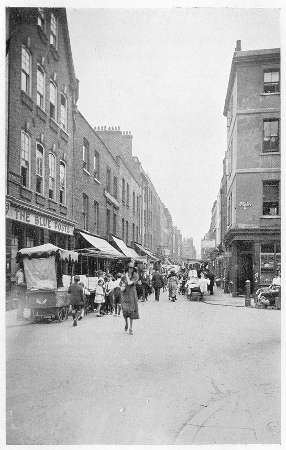
CARRINGTON MEWS,
SHEPHERD MARKET,
November 25th.
DEAR Agatha,—I anticipated your wish that I should make Chelsea the
object of my next pilgrimage. Mrs. D. and I went there yesterday.
The gulls were very busy about nothing over the river, and they
harmonised with the colour scheme of the afternoon. Pale sunshine, a sky
of washed-out blue, a silver river, wharves, and leafless trees in
Battersea Park veiled by a curtain which was part autumn mist and part
smoke from the factory chimneys on the south side.
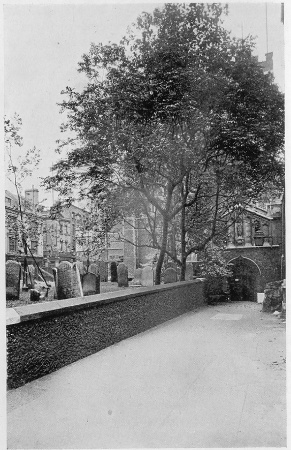
The square brick tower of the old parish church makes a landmark to the
barges and steamboats on their silent passing, and at night its clock
shines out like a full moon above the plane trees which line the
Embankment.
A quaint old place it is inside, with a great west gallery that
encroaches almost to the
chancel. Where the pews leave off the
crowding large tombs begin, and where the tombs end the discoloured
walls are covered with coats of arms. All this, seen by the homely light
of day, which falls through the windows of plain glass, has an intimate
and pleasant appearance. Even the ancient tombs in their proximity to
the worshippers seem friendly.
In Sir Thomas More's chapel a certain Arthur Georges, who died in 1660,
lies under the feet of the person who happens to occupy the chair which
partly hides the inscription on his tomb:—
"Here lies interred the body of that generous and worthy Gent,
Arthur Georges, Esq. Here sleepes and feeles noe pressure of ye
stone. He that had all the Georges Soules in One. Here the
ingenious Arthur lies to be bewailed by marble and our eyes...."
"The ingenious Arthur!" One pictures him. A man who had "a way with
women". Apt to get into scrapes, irresponsible, but with a knack of
getting out of a tight corner. Kind-hearted, given to take what life
offers in the way of pleasure, and always ready to pass on good things,
and do a good turn to the under-dog. The inscription goes on to say,
"When all the Georges rise he'll rise again," which pious belief set me
speculating as to whether I might some day meet the "ingenious Arthur".
I'm sure I should like him.
Mrs. Darling was visibly impressed when I told her that the body of Sir
Thomas More (whose head had been thrown from London Bridge into his
daughter's arms below) was in all probability buried under the church.
His tomb in the chancel consists of a ledge and a tablet of black marble
surmounted by a flat Gothic arch. On the ledge was a bunch of tawny
chrysanthemums and a cross of scarlet immortelles, so the old man who
went to the scaffold rather than be a party to the chicanery and
concupiscence of Henry VIII is not yet forgotten. Sir Thomas More, it
has always seemed to me, carried his asceticism to extreme limits in the
matter of his marriage. "Having determined," so says the historian, "by
the advice of his ghostly father to be a married man, he was offered
the choice of the two daughters of a friend, and although his affection
most served him to the second, for that he thought her the fairest and
best favoured, yet when he thought within himself that it would be a
grief and some blemish to the eldest to have the youngest sister
preferred before her, he, out of a kind of compassion, settled his fancy
on the eldest, and soon afterwards married her."
More's first marriage, curiously arranged as it was, seemed to have
proved happier than his second, and one is driven to the conclusion
that the great man lacked discrimination in affairs of the heart.
Hear his second wife's tirade when visiting in the Tower. "I marvel,"
says she, "that you, who have been hitherto always taken for a wise man,
will now so play the fool as to lie here in this close-fitting prison,
and be content to be shut up thus with mice, and rats, when you might be
abroad at your liberty, with the favour and goodwill of the King and his
council, if you would but do as the bishops and best learned of his
realm have done."
Mrs. Darling said that was what she called "a sensible woman," but
when I explained the marital complications of Henry VIII, and the
particular offence with which the Lord Chancellor was charged, the old
lady changed her front, saying she was glad some one had had the "spunk
to stand up to that ole rapscallion in the 'tammy'!" Mrs. D. is
evidently familiar with pictures of the amorous monarch.
We found our way to that corner of the church where are the chained
books. Mrs. D., whose knowledge of literature included, by hearsay,
"Foxe's Book of Martyrs," accorded a glance of fearful curiosity at the
brown back of the dread old volume. The books, the verger told us, were
taken out of the case and dusted once a month, and I envied the person
to whom the task was allotted.
I think, though, I'd choose a bright early morning when morbid fancies
do not find easy foothold. "Foxe's Book of Martyrs," in the old church
at dusk, might raise ugly phantoms which no bell or candle could lay.
In these ancient buildings, which are so jealous of the admission of
light, the sunbeams play impish pranks once they gain entrance. They are
as elusive as ghosts, and as nimble as fairies. They throw ruddy gleams
on discoloured walls, setting old brasses afire, and giving a semblance
of warmth to the sculptured features of the dead. The venerable walls
are the target for their elfish tricks and wanton caresses, their
fugitive withdrawals and stealthy returns. The soundless game was in
progress as we left the church, and I shall always picture the quaint
homely old building touched to beauty by the tender flitting of these
noiseless visitors.
Crosby Hall, that fragment of antiquity, is within a stone's throw of
the church, and to anyone not knowing the story of its presence there,
it must appear a strange erection standing in the centre of a piece of
waste ground surrounded by a hoarding. It was a daring and ingenious
idea to uproot it from its native soil in Bishopsgate Street, and if the
horrid crime had to be done, no better spot than Chelsea, on the
site of Sir Thomas More's garden, could be found for its transplanting.
We walked all round the hoarding seeking entrance, and at last found a
hitherto unnoticed door. The caretaker said the Hall was not open to
visitors, except by appointment, but that if we liked we could go in. We
went and found the place like a huge, cold barn, its fine oak flooring
chalked out for Badminton, whilst into the cavernous old fireplace,
decorated with Sir John Crosby's crest—a ram, armed and hoofed—had
been put a hideous iron stove. The magnificent timber roof, forty feet
above, looked down on these innovations sadly, and the glorious oriel
window, with the old glass emblazoned with coats of arms, was eloquent
of the times when Richard, Duke of Gloucester, entertained there in
1470, and of such occasions as the visit of Princess Katherine of Aragon
to Sir Bartholomew Bird, or the masque performed by the students of
Gray's Inn before Queen Elizabeth. What changes of fortune have visited
it since! amongst which it has figured in turn as a Presbyterian Chapel
and a restaurant! The caretaker's voice echoed hollow in that husk of a
building from which the kernel is gone. It had borne its transplanting
ill, and even the ghosts, I felt, had deserted it.
Outside, we found the world transfigured by the setting sun, and I
left Crosby Hall behind with a sensation of relief. For once in my
delvings into the past I had missed the thrill, but the blood-red sun
over the river provided a compensation, and I thought of the little
house where J. M. W. Turner died close at hand. If ever he haunts the
spot it would be at such an hour, when the wizardry of the sinking sun
casts its spell of romance and mystery over the most commonplace
objects. All too short are such moments, but Turner, that mad genius who
lived with his visions of splendour in the midst of dirt and squalor,
"the wizened, meagre old man," has snatched and imprisoned for those who
come after him the fleeting miracle.
Mrs. Darling, who is tolerant of what she considers my "balmy"
propensity for "staring at nothink," occupied herself with watching the
craft on the river whilst I meditated before the little green-shuttered
house. It lies below the level of the footpath and behind the frontage
line of its neighbours, seeking, it seems, as would the man who lived,
worked and died there, to evade notice. J. M. W. Turner's action in
suddenly and secretly leaving his "den" in Queen Anne's Street to take
refuge in Cheyne Walk was dictated by a mad impulse to go into hiding,
and one pictures the flight of the strange old man who wanted only to be
left alone with his tyrannical mistress, Art. The house is
described as being "next door to a ginger-beer shop close to Cremorne
Pier". There is no ginger-beer shop now, only "The Aquatic Stores," and
Cremorne has long disappeared.
I looked up at the windows and wondered from which one it was that the
dying painter watched the gates of heaven open to let out the mystic
flood of colour and take in the departing sun. There was the iron
balcony on the roof, erected by Turner himself, so that he should not
fall off when busy there at his easel. How well he must have known the
limitless moods of the river! The silence of its inexorable tides, its
liquid fire under the flaming sun, its pale shiver under the silver
moon, and its black despair on a winter's night.
Mrs. Darling interrupted my meditations to inform me that a policeman
was observing me with suspicion, and that she thought it would be
advisable to move on. She said she had noticed on former occasions that
my "ixcentrik 'abits" had attracted unwelcome notice, but that she
hadn't liked to mention the matter for fear of making me nervous. Pure
imagination on the old lady's part, of course, but she finds a certain
pleasurable excitement in such fancies, and so I humoured her by walking
on with an air of assumed indifference calculated to allay the
apprehensions of any "nosey" member of the force.
4th December.
It was too late when we left Cheyne Walk to go to Carlyle's house, and
we have paid another visit to Chelsea to-day. The weather which, so far,
has been kind to our wanderings, turned the disagreeable side of its
face to us this afternoon. The wind was blowing a gale from the
north-east, and pieces of paper and dead leaves flew as high as the
topmost branches of the plane trees along the Embankment. Mrs. Darling
was quite cheerful. She said the cold weather "agreed" with her feet,
but, for myself, old age slapped me insultingly in the face with every
spiteful gust of the biting blast.
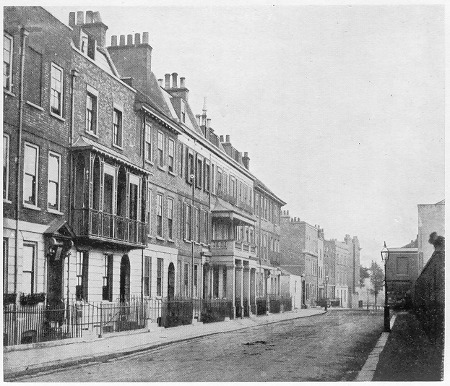
GREAT CHEYNE ROW AND CARLYLE'S HOUSE.
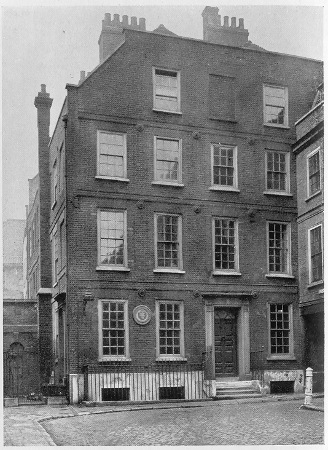
No. 28 Cheyne Row, built in 1708, has a modest exterior which somewhat
belies its interior. I rang the bell, the sound prolonging itself in a
tinkle that seemed to take a journey to some remote corner of the house,
and almost before its warning voice had ceased the door was opened by a
girl whose glance set at rest my fears of intrusion. She ushered us into
a dim, drab room wainscotted from floor to ceiling, but before I go any
further, Agatha, I have a confession to make. It was not Carlyle whom I
had chiefly come to see. If the maid had answered my ring and
said, "Mr. Carlyle is out, but Mrs. Carlyle is at home," I should
certainly not have turned away; indeed, I'm afraid it would have been
difficult to disguise my satisfaction at the prospect of a tête-à-tête
with Jane Welsh—Jane, who never sunk her individuality to the extent of
becoming "the wife of Thomas Carlyle". Jane, who has always been, and
always will be, "Jane Welsh" and not "Jane Carlyle" to her admirers.
It was Jane who had lured me to the old house on this bleak afternoon
when I should have been sitting over the fire, forgetting my sixty-five
years in a novel of youth. Jane, who in her cheery way describes the
house as "an excellent lodgement, and most antique physiognomy, quite to
our humour; roomy, substantial, commodious, with closets to satisfy any
Bluebeard, ..." and who, in an earlier letter on the same subject, says,
"I have a great liking to the massive old concern with the broad
staircase and abundant accommodation for crockery. But is it not too
near the river? And another idea presents itself along with that
wainscot—if bugs have been in the house! Must they not have found there
as well as the inmates room without end?" I hope, by the way, that the
dear lady's fears were unfounded, but judging from her later letters, I
have my doubts.
How shall I describe to you the effect of that chill, prim room, seen in
the light of the bleak winter afternoon! One thing of living beauty
alone made a link with the present—a great bunch of tawny yellow and
white chrysanthemums which a worshipper had brought to the shrine on
this, the birthday, of the great man. We had chosen an auspicious date
for our visit, and inspired by the coincidence, I sought to animate the
dry bones with life. Over the fireplace hangs a picture in which Jane is
represented sitting by the fire in this very apartment, whilst her
spouse, attired in a plaid dressing-gown, stands with his back against
the mantel. Here is the identical room, the identical tables and chairs,
the horsehair sofa and pictures, but the room no more resembles the
home-like one in the picture than do dried rose leaves placed between
the leaves of a book resemble the scented freshness of freshly plucked
velvety petals. Ah, well! the dead cannot live again in this world,
and those of us who visit ghosts' houses must leave our more material
selves on the doorstep.
Everywhere are portraits of the sad, brooding face of Thomas Carlyle.
Mrs. D. said the late Mr. D. used to look like that "when 'e'd lost a
bit on a 'orse," and I was moved to explain that identical results may
be obtained by widely different causes. Who would choose to be a
genius if he realised that loneliness was the price? Loneliness, with
Jane by the fireside! Strange problem! I looked at her portrait in
youth, the heart-shaped face with the parted lips and frank eyes, the
dark curls and beautiful throat, and as I looked sentences in her
letters came to mind. Referring to her choice of a husband, she says,
"Indeed, I continue quite content with my bargain; I could wish him a
little less yellow and a little more peaceable, but that is all."
And again, when writing to him, she says, "Try all that ever you can to
be patient and good-natured with your povera piccola Gooda, and then she
loves you, and is ready to do anything on earth that you wish.... But
when the signor della casa has neither kind look nor word for me, what
can I do but grow desperate and fret myself to fiddlestrings."
Referring to a birthday present from him, she says, "Only think of my
husband, too, having given me a little present! He who never attends to
such nonsense as birthdays, and who dislikes nothing in the world so
much as going into a shop to buy anything.... Well, he actually risked
himself in a jeweller's shop and bought me a very nice smelling bottle!"
Poor little wife! Poor husband, too, when after her death he has so
often to say, "Ah me! too late, too late". Yet they loved each
other well, and when Thomas Carlyle wrote on her tombstone, "For forty
years she was the true and ever-loving helpmate of her husband," and
added that she was "suddenly snatched away from him, and the light of
his life as if gone out," no one doubts that the words came from the
deepest depths of his heart.
In the china closet a glass case contains some pathetic mementoes—a
yellowed old lace cap worn by Mrs. Carlyle, a brooch with the portrait
of her dog Nero, given by the mistress to "little Charlotte," a sock of
Carlyle's with his initials neatly marked in red thread, and two small
cardboard boxes, each containing locks of the hair of Thomas Carlyle and
his wife. Trivial things, which yet in their haunting intimacy are too
sacred, it seems, to be stared at by the curious sightseers.
In a corner hangs an etching that deserves a more prominent place, the
desolate picture of a funereal cortège wending its slow way against a
bleak background of snow and leaden sky.... Thomas Carlyle is being
carried to his last rest, and surely the Great Scene Shifter had well
chosen the setting. The simple dignity of the procession approaching
over the white countryside, the little group of humble folk awaiting its
arrival at the gate of the churchyard, the frozen silence of the
dead day—what could be more touching or impressive!
As we mounted the stairs on our way to the upper rooms, Mrs. D., who had
said nothing for quite five minutes, remarked that, for her part, she
couldn't see why people weren't allowed to rest in their graves. Even
Mrs. D.'s scepticism and want of imagination was not proof against those
little mementoes in the glass case, and I think she resented her
inability on this occasion to take refuge behind the usual, "'Ow d'yer
know it's all true?" The old lady was visibly depressed, and, to cheer
her up, I asked her if she had ever worn a "bustle," quoting a letter of
Jane Welsh's, in which she wrote, "The diameter of the fashionable
ladies at present is about three yards; their bustles (false bottoms)
are the size of an ordinary sheep's fleece. Eliza Miles told me a maid
of theirs went out one Sunday with three kitchen dusters pinned-on as a
substitute."
Whereupon Mrs. D., between laughter and breathlessness, had to pause on
the top stair whilst she adjusted her hat at a still more rakish angle,
and ejaculated, "Oh, saucy!"
It is well nigh impossible, in the later portraits of Mrs. Carlyle, to
recognise the girl in the miniature. The dark brooding face is almost
forbidding, and one is forced to the conclusion that the portraits have
little real likeness to the original. Jane, with a vitality that
upheld her through years of bodily and mental suffering, with a gaiety
and wit which won her the admiration and homage of those celebrated men
who went to see her husband, and stayed to make friends with her, Jane
could never have looked like that! No doubt the coal-scuttle bonnet
and severe style of hair dressing had a great deal to do with it. The
fashions in those days were not kind to the middle-aged woman. All the
same, when I looked at a portrait of Lady Ashburton, Carlyle's friend
and patron, I found there a woman whose beauty could triumph over such
handicaps. Jane thought Lady Ashburton a "cat," and the insolent eyes
and disdainful curve of "Harriet's" mouth incline me to think Jane was
right. Comparisons are unkind, but one is forced to the conclusion that
whilst Lady Ashburton's face might well be her fortune, Jane Welsh would
have to draw on her wit and intellect.
The cold wind outside roared round the cold house, and a piano-organ in
the street ground out a hymn. Down below the bell tinkled. More visitors
were arriving, and wishing to keep in advance of them, we left the
drawing-room for Mrs. Carlyle's bedroom.
"Red bed," says Carlyle in a letter to his wife, "will stand behind the
drawing-room"—and here it is! A four-poster with bare laths hung
with faded red curtains and flounce. There is nothing more intimate than
a bed, but this bed, standing so many years unwarmed by human contact,
has outlived all such associations. It was not always a kind bed,
either, judging from the tragic account in her letters of Jane's
sleepless nights. "Oh!" she writes, "if there was any sleep to be got in
that bed wherever it stands!" (alluding to a change in the position of
her bed at Chelsea). "But it looks to my excited imagination, that bed I
was born in, like a sort of instrument of red-hot torture; after all
those nights I lay meditating on self-destruction as my only escape from
insanity." A woman who could express her sufferings in such vivid
language would be spared no iota of misery. Pin-pricks, which a stupid
person might ignore, would to Jane be sword-thrusts.
As one thinks of her one remembers those words written by her husband:
"Rest? Rest? Shall I not have all Eternity to rest in?" and there, on
the wall close at hand, hangs the photograph of her grave in Haddington
Church.
But, dear me, Agatha, this won't do! I don't want (to quote my pal, Mrs.
D.) to give you the "bloomin' 'ump". One must remember that Jane was not
always ill or unhappy. Jane had her bright days and her friends,
"dandering individuals dropping in," Charles Dickens, Thackeray,
Alfred Tennyson. Note this little vignette of the latter: "Passing
through a long, dim passage" (she was at the theatre) "I came on a tall
man leant to the wall, with his head touching the ceiling like a
caryatid, to all appearances asleep, or resolutely trying it under most
unfavourable circumstances. 'Alfred Tennyson,' I exclaimed in joyful
surprise. 'Well,' said he, taking the hand I held out to him and
forgetting to let it go again, 'I should like to know who you are. I
know that I know you, but I cannot tell your name.'"
Then, too, there was Macready, D'Orsay, Lord Houghton, and Mazzini. Of
the latter she says, "He told me there was nothing worth recording
except that he had received the other day a declaration of love. Of
course, I asked the particulars. Why not?—and I got them fully." And
again, "He had had two other declarations of love! 'What, more of them?'
'Ah, yes!—unhappily! They begin to rain on me like sauterelles!'"
Mrs. Darling said there was "nothink in that!" Her old man had had
six proposals before she herself annexed him. I inquired how she had
succeeded in capturing such a shy bird, and she said it only needed a
bit of confidence and a lot of soft soap. Any woman could marry
any man if she properly set her mind to it. The news was rather
disquieting; also, it was not exactly flattering to one's vanity to
reflect that, apparently, no woman had been anxious enough to marry me
to set her mind properly to the task.
When we mounted the last flight of stairs and entered the attic study we
seemed to leave Jane behind. Carlyle himself met us on the threshold of
this refuge, fondly planned with dreams of quiet in which he could work
unmolested. As a matter of fact, it did not repay him for the
discomforts endured whilst it was being built. "My room," he writes, "is
irremediably somewhat of a failure, and 'quiet' is far off me yet."
The afternoon was beginning to draw in and a little fire glowed in the
old-fashioned grate. Perhaps that was why the attic study seemed the
most cheerful room in the house. It might not be "sound"-proof, but, at
least, the wail of the north-east wind, as it careered round the old
walls, was lost here, and through the ground glass window came a warm
light which suggested a fragment of sunset somewhere out in the
stormdriven sky. The apartment had a hermit-like atmosphere, although
there could have been but little peace for the man who travailed as
Carlyle did over his gigantic tasks. One recalls to mind such words as
"I was in the throes of the French Revolution at this time, heavy laden
in many ways and gloomy of mind...." "I, in dismal continual
wrestle with 'Friedrich,' the inexcusable book, the second of my twelve
years 'wrestle' in that element." ... "Hades was not more laborious than
that book, too, now was to me."
What must it have been to one, who so travailed in the birth of those
children of his brain, to lose as he did, through the "miserablest
accident" of his whole life, the first volume of the French Revolution?
And surely never man behaved so chivalrously to the friend who was the
innocent cause of the disaster as did Carlyle to the unfortunate Mill.
Poor John Stuart Mill! One imagines with a shudder his feelings when,
with the black consciousness of the awful news he had to impart, he
stood on the doorstep of No. 5 Cheyne Row waiting admittance! A visit to
the dentist would, in contrast, have been an occasion of happiness. The
thought of what that wretched man must have suffered diverts my mind
from the contemplation of the cruel blow to the victim. The picture of
Mill as, after having made his terrible disclosure, "he sat three hours
trying to talk of other subjects," passes the bounds of tragedy and
almost verges on the ludicrous. How he must have longed to go! and how
Mr. and Mrs. Carlyle must have ached to see the back of him!
Dusk was gathering on the stairs and in the grey empty rooms as we left
the attic, and we had to go carefully round the corners. Was it the
whisper of a silken gown, or the swish of the wind through the branches
of the bare trees in the little garden which accompanied us? Who can
tell? Who wants to tell? Leave us some room for speculation—some peg
on which to hang our hopes of things beyond which we can see and handle.
We walked down the little street at the end of which is the Embankment
gardens, and there, in the blue twilight amidst the purple branches of
the bare trees, is a seated figure. A figure of which even the distant
view conveys a suggestion of profound and brooding melancholy. There
sits Carlyle, watching for ever the silent passing of the river. Silver
lights dotted the wharves opposite, and in the west, behind the four
tall chimneys of the power station, there was yet a smouldering red
amidst the almost extinct fires of sunset.
Perhaps if the mute lips could speak they would echo the once written
words, "Yes, poor mortals, such of you as have gone so far, shall be
permitted to go farther: hope, despair not".
And on that note I close this long epistle.
Ever your friend,
GEORGE.