“The only th-thing is,” said Fudge, “it’s going
to co-cost a heap, isn’t it?”
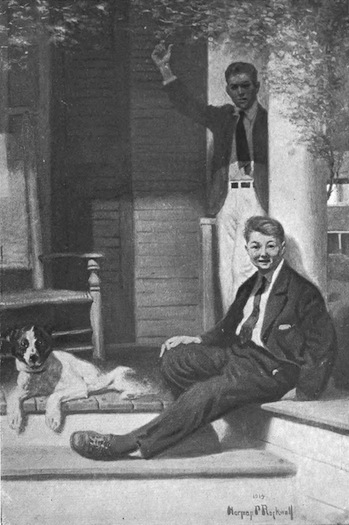
Fudge, whose real name was William
Shaw, was fifteen years of age, had sandy-red hair
and blue eyes and was short of stature and round of
body. His habitual expression was one of pleased
surprise, due probably to the fact that his blue eyes
were very blue and very big. When Fudge was the
least bit excited he stammered, but the habit was too
slight to be an affliction, and his friends sometimes
got Fudge upset in order to enjoy his facial contortions
when the word wouldn’t come promptly. It
was Lansing White who, several years before in grammar
school, had dubbed him Fudge. Lanny declared
that “pshaw” and “fudge” meant the same thing and
that “fudge” was more novel. At the present moment
Fudge was seated in the apple tree which grew
by the fence where the Shaws’ side-yard and the
Merricks’ back-yard came together. It was a favorite
retreat with Fudge, and he had built a shelf handy
to the comfortable crotch he affected on which to
place books and papers when, as was customary, he
was studying his lessons there. To-day, however, as
school was over for the summer, there were no books
about and the shelf bore, instead, a tennis racket which
Fudge had been mending when Gordon found him.
“I don’t see why,” replied Gordon, leaning his arms
on the top of the fence. “We’ve all got our High
School uniforms and we’ve all got bats and mitts and
things. All we’d need to spend money on would be
balls, I guess. Of course, when we went away every
fellow would have to pay his transportation.”
“M-meaning carfare?” queried Fudge. “Say, it’s
a peach of a scheme, Gordie! I wish I could bat better,
though. Maybe I’ll get on to it, eh? I guess what
I need is practice.” And Fudge, swinging an imaginary
bat at an invisible ball, almost fell off the branch.
“Who’s going to be captain?” he asked when he had
recovered his equilibrium.
“We’ll vote, I suppose,” replied Gordon.
Fudge grinned. “Then it’ll be me. I’m awfully
popular. Have you told Lanny yet?”
“Yes, and he says if you play center there’s got to
be a rule that a hit to center field is good for only three
bases.”
Fudge snorted indignantly. “If he ever hit a ball
as far as the outfield he’d fall in a faint! When do
we start?”
“I’ve got to see the other fellows yet. Harry is
working in his father’s store and I don’t know whether
his dad will let him play.”
“That’s so. We need him, too. He’s a peach of a
baseman. Who’s going to play short?”
“I want Pete Robey to,” replied Gordon doubtfully.
“Think he’d do, Fudge?”
“We-ell, Pete isn’t so much of a muchness. Why
don’t you p-put him in center and let me play short?”
“Because a fellow has to have brains to play in the
infield, Fudge, and——”
Fudge tried to reach him with the racket, failed and,
composing his features to an expression of grave interest,
asked: “Won’t it be awfully hard to find anyone
to play first?”
Gordon smiled. “Never you mind about first. Get
your wheel and let’s go around and see some of the
fellows. We can catch Harry at the store if we hurry.
I want to see Tom, too. If he won’t go into it and
pitch for us we might as well give it up.”
“Oh, Tom’ll pitch all right,” answered Fudge, dropping
from the tree, racket in hand. “He’d rather pitch
a baseball than eat. I’ll meet you out front in two
minutes.”
He wormed his way through the currant bushes to
the garden path and disappeared toward the house,
while Gordon, dodging the clothes lines strung near
the rear fence, went along the brick walk and gained
the side porch by the simple expedient of vaulting the
railing. The Merrick house was new—most of the
residences on that end of Troutman Street were—and
was mildly pretentious. Mr. Merrick was a lawyer
and comfortably well-to-do. The family had lived in
Clearfield for six generations and had given its name
to one of the principal streets in the downtown business
part of the city. I refer to Clearfield as a city,
and it really was, but it was not a very large city.
The latest census credited it with something over 17,000
inhabitants. Like many New England cities of
its kind, it owed its growth and prosperity to factories
of various sorts. Mill River, which entered the bay
two miles distant, flowed along the edge of the town
and provided water-power for a number of large
manufacturing plants, knitting mills, a sewing machine
factory, a silverware factory and several others.
The knitting mills were largely owned by Mr.
Brent, the Honorable Jonathan Brent, as the Clearfield
Reporter usually referred to him, and while Gordon
had spoken of Mr. Brent “owning the town,” he
had, of course, exaggerated, but still had not been very
far wide of the mark. Mr. Brent was Clearfield’s
richest and its leading citizen. Besides the knitting
mills he controlled two banks and the street railway
and lighting service and had a finger—usually two or
three fingers—in many other enterprises. The Brent
residence, standing imposingly in a whole block of
land, was visible, further along Troutman Street,
from the Merricks’ porch. In this, the more recently
developed part of the town, the wide streets were
lined with maples as yet too young to afford much
shade, but a giant elm tree, which had been old long
before Clearfield even thought of growing away from
the river, stood just inside the Merricks’ front gate
and effectively screened the house from the hot sunlight.
Gordon contented himself with putting his head
inside the screen door and announcing in a loud voice:
“Mother, I’m going downtown. Is there anything you
want?” Mrs. Merrick’s voice floated down from upstairs
in reply: “No, dear; but please try to be on
time for dinner. You know your father dislikes——”
But Gordon didn’t hear the rest of it. He didn’t
need to. He knew what his father disliked. His
father disliked having him late for his meals, disliked
his going out in the evenings, disliked—oh, so many
things! Gordon sighed as he mounted his wheel.
Life was really extremely difficult at times!
He was a well-built, athletic youth of fifteen years,
with a pleasant, clean-cut face, dark brown eyes and
hair and a well-tanned skin. He looked very much
alive and rather enthusiastic, just the sort of a boy,
in short, to undertake and carry through successfully
such an enterprise as the formation of the Clearfield
Baseball Club.
Fudge was waiting for him around the corner, and
they set off together in search of Tom Haley. Tom
lived in what folks called the East End, which was
that section of the town near the railroad largely inhabited
by workers in the mills and factories. Tom’s
father was a foreman in the sewing-machine works,
and the family occupied a tiny story-and-a-half cottage
so close to the railroad tracks that it shook whenever
the trains passed. Fortunately they found Tom
at home, very busily engaged repairing the front
steps, surrounded by carpenter’s tools and three junior
members of the Haley family. He rescued the chisel
from Tille, aged four, deprived the baby of a handful
of nails, told George, aged six, to stop sawing the
chair leg, and greeted his visitors.
Tom was sixteen, big, broad-shouldered and raw-boned,
with an angular face and high cheek-bones liberally
speckled with freckles. At present he was minus
coat and vest and wore a pair of blue overalls. “You
kids get in the house now,” he instructed the suddenly
silent trio of youngsters, “and tell your mother to keep
you in there, too. You’ve bothered me enough. Shoo,
the whole lot of you!”
They went, with many backward glances, and Tom
cleared a space on the edge of the unrailed porch for
Gordon and Fudge. “Say, it’s some warm, isn’t it?
What you fellows up to to-day? Going to the
pond?”
“No, we’re calling on you,” replied Fudge.
“Much obliged. What’s the game?”
“Baseball,” said Gordon. “We’re getting up a
team to play the Rutter’s Point fellows and we want
you to join, Tom.”
“I don’t mind, if there isn’t much practice. There’s
a lot to be done around the house here this summer.
We’re going to shingle next week, and after that we’ll
paint. Who’s on the team?”
Gordon explained all about it, read Bert Cable’s
letter and Caspar Billings’ and told Tom the line-up
of the nine as he had planned it.
“Sounds all right,” said Tom. “When are you going
to start?”
“Right away. If you’ll pitch for us we’ll be all right.
I’ll answer Billings’ letter and tell him we’ll meet him
a week from Wednesday. That’ll give us a whole week
for practicing.”
“All right, I’m with you, only don’t expect me to
practice much, Gordon. I’m pretty busy. I’ll come out
a couple of times, though; say—let me see—say Friday
and Monday. Going to use the school field?”
“Yes. I don’t suppose anyone will object?”
“Don’t see why they should. You’d better see Mr.
Grayson, though.”
“I will. No, that will be up to Dick. He’s going
to be manager.”
“Dick Lovering?” asked Tom, in surprise. “Well,
I don’t see why not. He can get around all right.
Have you asked him?”
“Yes, and he said he would. The only thing is,
Tom, we’ll have to pay his expenses if we go away
from home very far. I told him we would. It
wouldn’t be much if we shared it. You see, Dick
doesn’t have much money. I guess they’re pretty
hard-up. His father only left them that house they’re
in and a little insurance money, and of course Dick
can’t do much to earn any.”
“He told me the other day,” said Fudge, “that he
was trying to get work tutoring this summer over at
the Point. He could do that finely if he could find
anyone to toot. Hope he does. Dick’s a peach.”
“Then we’ll have first practice Wednesday, the rest
of us, and we’ll look for you Friday, Tom. I’ve got
to catch Harry before he goes home. Maybe his
father won’t let him off. If he won’t we’ll be in a
bad way for a second baseman.”
“If you hold practice late—say, half-past four—I
guess Harry could get there,” said Tom. “And we
wouldn’t play more than twice a week, I suppose. Who
else are you going after besides the Pointers?”
“I don’t know. Maybe Lesterville. They’ve got
a pretty good club over there. I guess we can find
games enough, Tom.”
“I suppose the Springdale team has disbanded,”
said Tom. “I’d like to get another whack at those fellows!”
“So would I,” Gordon agreed. “We never should
have lost that last game, Tom. We all played like
idiots, though. Six errors is going some!”
“It was an off-day with me, all right,” grumbled
Tom. “I couldn’t put ’em over the plate to save my
life in the last four innings.”
“We’ll lick them at football this fall,” asserted
Fudge.
“Bound to,” agreed Tom, with a sly wink at Gordon.
“Fudge is going to play, you know.”
“You bet I am!” exclaimed Fudge. “I’m going to
p-p-play end. I’m g-g-going——”
“So am I,” laughed Gordon. “Right now. Come
along, Fudge, and we’ll hunt up Harry. I’m glad
you’ll come in with us, Tom. By the way, I suppose
we ought to have a sort of meeting to organize pretty
soon. How would it do if you all came to my house
to-morrow evening? We’ll have to choose a captain
and—and talk things over.”
“Oh, you’ll be captain,” said Tom. “It’s your
scheme. Besides, who else is there?”
“You, or Harry, or Will Scott, or——”
“Shucks, they’re not made for it. It’ll be either
you or Lansing, I guess. Anyway, I’ll be over to-morrow,
if you say so, about eight. So long. I’ve
got to get these boards down before dinner.”
They found Harry Bryan in his father’s grocery.
He, too, was very busy, but he stopped putting up
orders long enough to hear Gordon’s tale, and was instantly
enthusiastic.
“I’ll have to ask my dad, though,” he said doubtfully.
“He’s keeping me pretty close to business,”
he added importantly.
“What do you do, Harry?” asked Fudge. “Put
the sand in the sugar?”
Harry treated the insult with silent contempt. “I’ll
ask him to-night, though,” he continued, “and let you
know.”
“Telephone me, will you? We’ll have practice late
in the afternoon, Harry. You wouldn’t have to get
away until after four.”
“I know. I guess he will let me. He ought to.”
Harry observed the yellow slips in his hand somberly.
“I’ve been working pretty hard, I tell you.”
“I should think,” suggested the irrepressible Fudge,
“that if you worked late to-night you could sand
enough sugar to last the week out!”
“Say, they’re not going to let you play, are they,
Fudge?”
“How could they do without me?”
“It’ll be a peach of a nine!” jeered Harry. He was
only a year older than Fudge, but pretended to regard
that youth with amused toleration, and so caused
Fudge deep annoyance at times.
“Well, we’ve got eight good ones,” responded Fudge
sweetly. “If we could only find a fellow to play second
base, we’d be all right.”
“It’s a wonder they don’t put you there.”
“Oh, I was offered the position, bu-but I didn’t want
it. I prefer the outfield. There’s more re-re-responsibility
there.”
“You’re a wonder!” said Harry. “What would you
do if a ball came your way? Hold your mouth open
and try to swallow it?”
“You wa-wait and see! If I co-co-couldn’t catch a
b-b-ball better th-th-than you——”
“Calm yourself, Fudge! You’re off your trolley
again! I’ll be around to-morrow night, Gordon. Now
I’ll have to get busy. Watch Fudge as he goes out,
will you? Last time he was in he got away with three
or four pounds of prunes.”
“I took three of the old th-th-th-things,” said Fudge
bitterly, “and they n-n-nearly killed me!”
They left Harry surrounded by baskets, frowning
over the order slips in his hand, and made their way
back to the sidewalk and their wheels. As it was almost
noon, Gordon decided not to risk his father’s displeasure
by seeing any more of the fellows before
dinner, and he and Fudge pedaled home, Fudge still
sputtering about those prunes.
At a little after four that afternoon Gordon was
back at Dick’s to report success. All the members of
the Clearfield Ball Club had agreed to play and to
attend the organization meeting the next evening—all,
that is, save Harry Bryan, who was to telephone
later.
“Now, Dickums, if you’ll write to Billings and tell
him——”
“If I’ll write!”
Gordon laughed. “Of course; you’re the manager,
aren’t you?”
“Humph! So I have to attend to the correspondence
too, do I? It seems to me that you ought to
write that letter. Bert sent it to you, and you’re captain,
and——”
“Well, that’s what I thought,” responded Gordon
cheerfully, “until I got to thinking it over. Then I
remembered that you were manager, and, of course,
managers always attend to arranging contests; and
there you are. Just tell him we’ll play his team on
Wednesday the sixteenth, Dickums, at the Point.”
“All right. I might call on him and tell him about
it, though, for I’m going over to the Point in the
morning.”
“You are? What for?”
“To get a job, I hope. You know I got them to
put up a notice in the hotel over there for me: ‘tutoring
in French, Mathematics, and English; references;
terms on request.’ This afternoon a Mrs. Townsend
called me up by telephone, and she wants me to come
over in the morning and see about coaching her son.
He’s going to Rifle Point School in the Fall and is
weak on English and Math. He’s thirteen, she says.
She seemed to think the price was all right, but she
wants me to have a look at the youngster first. Sounded
as though she was afraid I wouldn’t like him.
I’d coach a Bengal tiger if I got paid for it. I need
the money, Gordie.”
“That’s fine! Then why not see Billings instead
of writing to him? You could arrange the whole
thing in five minutes. Do you know where he lives?”
“No, but they can tell me at the hotel, I guess. By
the way, why do you want to play over there? Why
not have them come over here?”
“Because I saw Mr. Grayson awhile ago and asked
him if it would be all right if we used the school field,
and he said it would as far as he was concerned, but
that he’d just got notice from Mr. Brent that they are
going to cut the field up pretty soon for building lots.
I suppose we could use it until they begin to build on
it, but I haven’t seen Mr. Brent yet, and I thought it
would be safer to say we’d play them at the Point.
They’ll probably want another game, and then, if it’s
all right about the field, we could play them here.”
“But that will leave us without an athletic field!”
exclaimed Dick, in dismay. “I thought we had a lease
or something on it.”
“Mr. Grayson says not. Says Mr. Brent just agreed
to let us use it as long as it wasn’t needed for anything
else. Now he wants it put in the market for
house lots. Rather tough, isn’t it? I guess we can
find another field somewhere, though.”
“Not in town,” said Dick. “We’ll probably have to
go across the river somewhere. There are plenty of
fields over there, but they’re as rough as the dickens.
What did Mr. Grayson say about that?”
“Nothing much. He seemed to think it was up to
the Athletic Committee.”
“Perhaps it is, but he’s principal, and——”
“Shucks, he wouldn’t care a lot if we didn’t have a
field, I guess!”
“I don’t think that, Gordie. Grayson’s not very
keen about our athletics, I know, but he’s been pretty
decent, just the same. We’ll have to get busy right
away and find a new place. The football fellows will
want to start practice in something like two months.
Does Way know about it?”
“I don’t know. I saw Grayson after I left Way. I
don’t believe he does, for he didn’t say anything. He
will have to get the committee together and have a
meeting, I guess. Who’s on it now?”
“Aren’t you?”
“No, not this year. There’s Way, and Harry, and
Bert——”
“Well, Bert can’t come. I think Will Scott is on it,
isn’t he?”
“Maybe; he probably is if Way belongs. Well, it’s
up to Way. I thought I’d ask Mr. Brent if we could
keep on using the field for a while; or have Morris ask
him. I dare say he’d be more likely to say yes if Morris
asks him. Come to think of it, Dickums, as you’re
manager——”
“No, you don’t! I wouldn’t beard old man Brent in
his den for a hundred dollars! If I’ve got to do that,
I’ll resign!”
“All right, then, I’ll do it!” laughed Gordon. “Or
I’ll see Morris about it. I don’t see why he needs to
cut up that field, though. Seems to me there are
enough houses in this town already.”
“Wants the money, probably. Bet you Jonathan
Brent would cut up the Garden of Eden for house
lots if he had it!”
“You don’t seem to care a whole lot for Mr. Brent,
Dickums.”
“I don’t,” responded Dick emphatically. “We
wouldn’t be like we are now—as poor as church mice—if
father hadn’t got mixed up with Mr. Brent in
one of his real-estate schemes. I’m not saying that
Mr. Brent was dishonest, Gordie, but he was too sharp
for dad, and dad got let in for a pile of money.”
“I didn’t know that,” said Gordon. “You never
told me, did you?”
“No. It was a long time ago, when I was just a
kid. Dad moved here from Norwalk when I was
three years old. He had quite a little money—thirteen
or fourteen thousand dollars it was—and Mr.
Brent got him to invest it in that South-west Division,
as they called it. They got hold of a pile of land down
the river toward the Point. You know; where the picnic
grove is. They were going to sell it for factory
sites and there was a railway coming through to connect
with the Shore Line, and everything was fine—on
paper. But the bottom fell out of the scheme; the
factories didn’t come, and the railroad decided not to
build; and the mortgages were foreclosed; and after
it was all over Mr. Brent had the whole thing and dad
had nothing! And it was all legal and above-board,
too! And that’s why I’ve never had much use for
Jonathan Brent; nor Morris, either, although Morris
has never done anything to me.”
“You and he seem to be pretty good friends,” said
Gordon.
“I know. He—— Well, he seems to like me pretty
well, and you can’t be anything but decent to a fellow
in that case, can you? I suppose if Jonathan Brent
wasn’t his father I’d like him well enough. Well, I’ll
stop in and see this Billings chap to-morrow. It’s
less trouble than writing a letter, I guess. Wednesday
the sixteenth, on their own grounds, at—what
time?”
“Three o’clock, I suppose,” answered Gordon.
“That will give us plenty of time to get over on the
two-o’clock car and warm up a bit before the game.
You might tell him about our field, and say that if they
want a return game we’ll play it over here if we can
get the use of the field. By the way, that grandstand
at the field belongs to the school. We’ll have to move
that if we get out. I wish Mr. Brent would be satisfied
with all the money he’s got and not go and take
our field away from us.”
“So do I. What we want to do, though, is to watch
out and be sure he doesn’t swipe the grandstand too!”
“Well, you are rabid!” laughed Gordon. “Still, I
don’t know that I blame you. I never knew that about
your father, Dickums.”
“Well, don’t repeat it, please. It’s all done with
now, and there’s no use talking about it. I don’t—very
often. Only sometimes—— Well, I get sort of
hot under the collar when I think of all the money Jonathan
Brent has and how awfully hard we have to
scrabble to get along. Good-bye, Mr. Captain.”
“Good-bye, Mr. Manager. I’m not captain, though.”
“You will be,” laughed Dick. “You always are,
you know!”