Mrs. Hudson is going, and, oh dear! we
can’t afford it. It is all Ernie’s fault, too.
How could she have been so careless!
This is the way it happened. We have had a
visit from Mrs. Bo-gardus! No one would have
believed it possible; no one really, I suppose, except
Miss Brown and Robin, entirely believed
there was any “sich a person.” But to-day her
existence was proven to us. Let me begin at the
beginning and explain.
Mrs. Hudson has been with us six months now,
renting the second-story alcove room; and during
all that time, whether the beefsteak was tough or
the house cold, she has never personally complained.
It has been rather,—
“My friend Mrs. Bo-gardus simply couldn’t endure
such a draught as this. It would give her
pneumonia directly. She is a very sensitive
woman;—what I call a true blood aristocrat.”
“Is she indeed?” Miss Brown would murmur,
antiphonically responsive. Miss Brown is meek,
and meagre, and easily impressed.
“Yes,” Mrs. Hudson would continue, swelling
visibly under the arrested attention of the entire
dinner table (for everybody listens when Mrs.
Hudson talks):—“That is what I should certainly
call her. Now a soup such as we are eating
this evening simply wouldn’t sit on Mrs. Bo-gardus’s
stummick. It is too thick.”
“Her stummick is too thick?” queries Mr.
Hancock, anxiously. He is a dyspeptic, himself,
and very much interested in anything pertaining
to symptoms or dietetics.
“Not at all,” answers Mrs. Hudson, slightly
ruffled at the misapprehension. “The soup is
too thick.”
Whereupon Mr. Hancock, who has been eating
quite comfortably up to the present moment, takes
to stirring round and round his plate with reproachful
sweeps of the spoon, till his wife inquires
soothingly,—
“Don’t you think we might try some of that
Glucose Bread we saw advertised, Ducky? I’m
sure Mrs. Graham would get it for you.”
The Hancocks are young, and recently married.
He is a bank clerk with poppy eyes; she is
small, and plump, and pretty. They are “Ducky”
and “Dovie” to each other,—but they are really
nice and considerate, so one feels rather shabby
to poke fun.
However, to return to Mrs. Bo-gardus. It was
not only what she could not eat. She had a
great many opinions as well, especially as to how
people “in reduced circumstances” should live.
“Mrs. Bo-gardus thinks that if you can only
afford one servant you should certainly engage
two, for there is nothing that pays so well as
style.”
She also “thought” a great many other
things,—I can’t pause to relate them here,—and
no matter how patently absurd her opinions might
be, they were reported as such Delphic utterances
that no one dreamed of questioning them.
Every fortnight or so Mrs. Hudson has been in
the habit of paying Mrs. Bo-gardus a call. One
always learned at the breakfast table when one of
these visits was about to take place, for Mrs. Hudson
dressed for them upon rising, no matter what
time of day she may have planned to start, in a
purple velvet walking-suit, with white linen collar
and cuffs, and a very much crimped blond
false front. Her own hair is decidedly gray.
When she goes to church, or shopping with Miss
Brown, or even to the theatre, this answers. It
is only for Mrs. Bo-gardus the blond crimps
appear.
Naturally this morning when Mrs. Hudson
descended upon us “in full panoply of war-paint,”
as Haze expressed it, we supposed she must be
going to pay one of her ceremonial visits. Both
mother and I felt relieved, for the house continued
cold despite all our efforts; but we made
no remark, and Mrs. Hudson volunteered no information
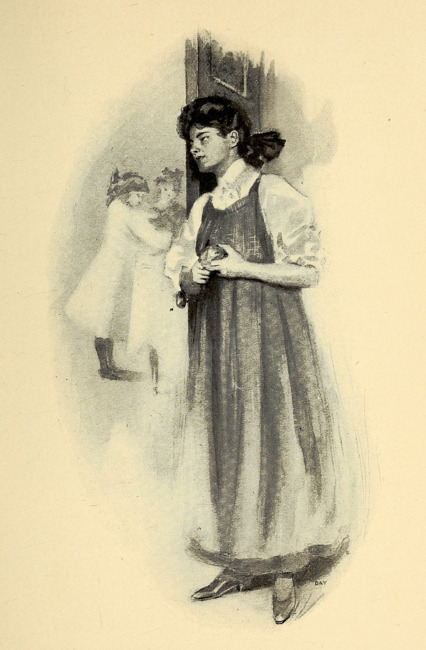
till Rose appeared, rather untidy as to
dress and apron, bearing a plate of slightly
burned biscuits. Then it began.
“Mrs. Bo-gardus’s establishment consists of
three maids and an imported butler. His name is
Samuels,—with an s, if you please, Miss Brown.
One can judge from that fact alone of the style to
which she is accustomed.”
“Yes, indeed,” murmured Miss Brown.
“Now, anything like this,” continued Mrs.
Hudson, helping herself to a biscuit and weighing
it accusingly on extended palm, “simply wouldn’t
sit on Mrs. Bo-gardus’s stummick. She is used
to lunching at Sherry’s or the Waldorf, every
day, if she pleases. However, I have warned
her she must expect to find things different here.
She is fully prepared; for I explained everything
when I issued my invitation.”
“Mrs. Bo-gardus! here!” exclaimed mother,
setting down the cream jug with undue suddenness;
while Mr. Hancock, who had been morosely
weighing his biscuit in servile imitation of Mrs.
Hudson, dropped it into his coffee cup, and stared
with popping eyes.
“Yes,” returned Mrs. Hudson, evidently very
well satisfied with the impression she was producing.
“Haven’t I mentioned that I am expecting
a visit from Mrs. Bo-gardus to-day? She is
coming to lunch with me. It seemed about time
I should repay some of her hospitality. I hope
my little plan in no way inconveniences any one?”
Haze kicked me under the table. Ernie wriggled
ecstatically. Robin sighed, and opened
wide, shining eyes; while poor Miss Brown murmured
feebly,—
“Mrs. Hudson! Mrs. Bo-gardus! oh really!”
Mother was the first to regain her composure.
“We will be very glad to meet any friend of
yours, Mrs. Hudson,” she said; “but I am sorry
you did not tell me before. It would have been
easier to make arrangements.”
“Certainly, I intended to do so,” observed Mrs.
Hudson. “But the fact is, the matter slipped my
mind.”
We looked at one another in open admiration.
Could human cheek be carried further? Mrs.
Bo-gardus was coming to luncheon, and the fact
had slipped Mrs. Hudson’s mind!
Gradually the boarders faded from the room,
leaving us to a hurried family council. It was
Monday; there was cold roast left over from
yesterday’s dinner, and a washerwoman in the
kitchen. Yet, strangely enough, no one thought
of rebellion or complaint.
“Mrs. Bo-gardus,” murmured Haze, in a voice
as nearly like Miss Brown’s as he could make
it, “Mrs. Bo-gardus, you know, is coming to
lunch!”
And then, for no earthly assignable reason, we
dropped into various receptacles along the way
and melted and sobbed with mirth. Robin
caught his knees in both arms and rolled over and
over on the rug, a corner of the tablecloth
stuffed in his mouth. Ernie began to caper and
frisk madly about, hugging the bewildered and
rebellious kitten. I sank helpless on the window-seat,
and hid my face among the curtains.
“Shut the door, Hazard,” gasped mother, as
soon as she was able to articulate. “They
mustn’t hear us!”
At which the gale began afresh. Somehow
the situation struck us as irresistibly funny.
“Well,” chuckled Hazard, weakly at last,
“there’s no lark here for me. I shan’t meet her.
I’ll be away at school.”
“And I have a holiday to-day and to-morrow,
because they are repairing the furnaces! How
jolly!” cried Ernie.
“Will she come in a hansom?” piped Robin,
“or by fairy?”
He meant the ferry; and these two modes of
conveyance are the most elegant known to his
youthful experience.
“Yankee-doodle came to town,
Riding in a han-som!”—
parodied Haze.
“And driven by Samuels,—with an s, if you
please, Miss Brown,” mocked Ernie, wickedly.
“Children! children!” warned mother. “We
must be serious. It is Mrs. Bo-gardus, you
know;—and I had planned cold veal for luncheon!”
“Not even chicken?” pleaded Ernestine.
The situation as one faced it loomed portentous.
The psychic power of that Name was not
to be lightly evaded.
“Well,” said mother, at last, with a little sigh,
“we must do the best we can. Elizabeth will
help me in the kitchen, Rose is never the least
good of a Monday, and Ernestine can dress
Robin and superintend the setting of the table.
Let me see, there will be six, seven, of us,—eliminating
Haze and Mr. Hancock, who fortunately
do not lunch at home. I like an even table
so much better.”
“Let me wait then, mother dear,” volunteered
Ernie. “The way I do Sunday evenings when
Rose is out. You know she never does serve
things properly.”
“You would not mind?” asked mother.
“No, indeed; not a bit,” answered Ernie,
frankly. “Everybody will know I am your
daughter, just the same, and I think it is rather
fun.”
So it was arranged. The menu took a little
longer to plan; and with cooking, dusting, and
dressing, the morning flew swiftly by. One
might have supposed we were preparing for a
royal visit.
Eleven o’clock struck,—half-past eleven.
Robin and Ernie in their pretty blue sailor-suits
flashed down to the kitchen for inspection.
“Will she be here soon?” pranced Robin. His
eyes were bright as stars, his cheeks as pink as
roses.
“I think so,” answered mother. “Run up to
the nursery now, where you can watch from the
window.”
At quarter to twelve precisely there sounded
the clatter of horses’ feet upon the asphalt. Shall
I confess it? Interrupting a hasty toilet I ran to
the window, too, and peeped out like any child.
A hansom-cab, as Robin had predicted, was
drawn up before our door. From it stepped a
middle-aged lady. She was tall, somewhat
spare, attired in conventional black. From the
distance at which I surveyed her she looked a
little, just a little, like—Miss Brown! She
mounted the steps and rang the bell.
The excitement died from my brain. A chill
feeling of disappointment crept over me. Was
this the phœnix? this the invisible mentor under
whose dicta our household had trembled for so
many months? A minute later the sound of
subdued greeting floated up from the hall
below.
“How do you do, Mrs. Hudson?”
“How do you do, Mrs. Bo-gardus?”
I went into the nursery to capture Robin and
give his locks one final dab before lunch should
be announced.
“She’s just like anybody else,” he mourned,
lifting a tear-stained face from where it had been
buried in his arm against the window sill.
“Well, dearest, what did you expect?” I asked,
with an absurd inflection of sympathetic woe.
“I don’t know,” admitted Bobsie, “but,
somehow, I thought—she would be different.”
Then the bell rang, and we hastened downstairs.
In the dining-room the presentations were
being made.
“Mrs. Graham, allow me the Honour of Presenting
my friend Mrs. Bo-gardus; Mrs. Bo-gardus,
Mrs. Graham.—— Miss Brown, allow
me to Present my friend Mrs. Bo-gardus; Mrs.
Bo-gardus, Miss Brown.—— Mrs. Hancock, allow
me the Honour of Presenting my friend Mrs.
Bo-gardus; etc.——”
Immediately our spirits rose. It was an Occasion,
after all. Mrs. Hudson felt it, I felt it,
Robin felt it. He put out his little hand quite
prettily when his turn came.
“So this is the lame boy?” remarked Mrs. Bo-gardus,
in a stiff falsetto.
“No,” protested Robin (I don’t think he had
ever been called lame, before), “I just hop a little,
because sometimes my side aches.”
“It is the same thing, my dear,” explained Mrs.
Hudson. “Mrs. Bo-gardus knows all about such
matters. She sits on two hospitals boards, and
is Secretary of the Free Kindergarten Association.”
“Indeed!” murmured Miss Brown.
With Mrs. Hudson as expositor, and Miss
Brown as chorus, Mrs. Bo-gardus’s glory could
not wane. She shone upon us, enigmatic, sphinx-like,
throughout a somewhat oppressive meal.
No one but Mrs. Hudson ventured to mingle in
the conversation. Indeed, it was not necessary.
Ernie waited very prettily; the croquettes were
silently engulfed, likewise the custards. And,
despite Mrs. Bo-gardus’s sensitive “stummick,”
we were encouraged to believe that they would sit.
“My dear, will you play for us?” Mrs. Hudson
asked after lunch. “Mrs. Bo-gardus is very fond
of music.” It was rather a royal command than
a request, but without an e string what could one
do?
“Then perhaps your little brother will recite?”
persisted Mrs. Hudson.
“What shall I say, Elizabeth?” asked Robin,
obligingly.
“Suppose you say ‘My Shadow,’” I suggested.
So Bobsie, flushed and honoured, standing on
the worn Bokhara rug, began:—
“I have a little shadow that goes in and out with me,
And what can be the use of him is more than I can see.”
The ladies sat about the parlour, their hands
folded in their laps, Mrs. Bo-gardus with her head
a little to one side as if listening for a false
note, Mrs. Hudson pompously responsible, Miss
Brown meekly appreciative.
“The funniest thing about him is the way he likes to grow,—
Not at all like proper children, which is always rather slow,”
piped Robin in his pretty treble.
“For he sometimes shoots up taller,——”
Mrs. Bo-gardus’s head tilted just a little to the left.
“Shoots?” queried Mrs. Hudson. “Are you sure of that word Shoots?”
Robin paused, and looked doubtfully at me.
“Yes,” I answered. “Shoots is right.”
“—like an india-rubber ball,”
continued Robin.
Mrs. Bo-gardus’s head again cocked towards
the left, and a slightly pained expression gathered
between her brows.
“Isn’t it plant, my dear?” corrected Mrs. Hudson.
“Since the first word is shoots it certainly
must be an india-rubber plant?”
“No,” I said, “ball is right.”
“And he sometimes gets so little that there’s none of him at all,”
persisted Robin, bravely.
Mrs. Bo-gardus pursed her lips.
“Well, well,” concluded Mrs. Hudson, hurriedly.
“This is a very pretty piece, no doubt,
and we are much obliged; but Mrs. Bo-gardus
can’t sit here all the afternoon listening to one
little boy recite, when she might hear twenty any
day she pleased, all with kindergarten training,
too! There are some photographs we have
planned to look over upstairs, so if you will excuse
us——” And the two ladies, rising with
majestic accord, swept from the room.
It was rather dampening, to be sure, but Bobsie
bore it well. Only his lower lip trembled a little
as he asked,—
“It couldn’t have been a rubber-plant, now
could it, Ellie?” That is his pet name for me.
He uses it when he stands in need of comfort.
“No, honey,” I answered. “It certainly
couldn’t.”
When just at that moment there was a crash,
and a hurtle, and a smothered squeal in the hall
outside, and we all ran out to see what could be
happening.
I shall never forget it. Down the stairway
from the second story, step after step, with a little
bump on each, coasted Ernie. Her feet were
stuck out straight before her, her arms were aloft,
in one hand she bore a pitcher of ice-water, in
the other a tumbler, while mother’s old silver
serving tray rattled and rolled ahead. The poor
child’s mouth was open, and every few steps she
would emit a deprecating little squeak, as if to
say:—
“I know I ought not to be tumbling downstairs.
But what are you going to do about it?”
Mrs. Hudson and Mrs. Bo-gardus, who had
started to go up in search of the photographs,
stood midway of the flight, directly in the path of
danger.
“Ernie! Oh, Ernie!” I cried. “Look out!
Look out for Mrs. Bo-gardus!”
“I c-c-c-can’t!” gurgled Ernie. “Let her
g-get——”
And then there was a second crash, and a
splash, and a renewed series of squeals, and Mrs.
Hudson, and Mrs. Bo-gardus, and Ernie, and the
pitcher, and the silver tray, all came crashing and
bumping down together in one ignominious
tangle.
Mother, and Mrs. Hancock, and Rose came
running from various parts of the house. In a
moment there was quite a crowd gathered.
First Mrs. Hudson was picked up, spluttering
and bewildered; next we rescued Mrs. Bo-gardus;
then Ernie, who still clung desperately to her half-empty
pitcher. All dignity, all sense of social
circumstance, had vanished. The members of
the dripping little group glared upon one another,
humanly, democratically mad.
“Here,” said Ernestine, thrusting out the
pitcher resentfully to Mrs. Hudson, “I guess this
belongs to you.”
“This” was the ceremonial blond front, which
had somehow come unpinned in the mêlée, and
was now floating mermaid-wise in a few inches
of ice-water at the bottom of the pitcher.
Mrs. Hudson sniffed, fished out her crimps,
and flapped them scornfully.
“I leave this house to-morrow,” she remarked.
“Children are all very well in their
place!”
“It wasn’t my place,” contradicted Ernie,
wrathfully. “I slipped on the top step and tobogganed!”
“Ernestine!” rebuked mother. “I trust you
are not hurt,” she continued, turning to Mrs. Bo-gardus,
who stood beside the newel-post, ruefully
rubbing an elbow.
“Not being a Christian Scientist, nor yet a
gutta-percha image, I confess to a few bruises,”
returned that lady, spitefully; after which she
and Mrs. Hudson swept on their way upstairs,
leaving us at gaze.
“As if I meant to,” brooded Ernestine. “I’m
not a Christian Scientist, myself. Why couldn’t
they get out of the way, I’d like to know? and—who’s
Mrs. Bogardus, anyhow?”
For the first time the question was presented to
us squarely. We gaped at one another, like so
many goldfish.
“That is so,” admitted Miss Brown in a timid
voice, after a moment of deep thought. “Who
is she?”
“And it couldn’t have been a rubber-plant,”
chirped Bobsie with sudden easy confidence, “because
then there wouldn’t be any rhyme.”
“It was a hired hansom she came in,” observed
Mrs. Hancock, cheerfully. “And did you notice
that she ate three of those fried croquettes for
lunch? Her stummick can’t be so very
sensitive, after all! I shall have to tell my
husband!”
Certainly, Ernestine’s pitcher of ice-water had
had a wonderfully quenching effect! But Mrs.
Hudson is going, and, as I said, we can’t
afford it.
“I was only trying to help,” murmurs Ernie,
mournfully pulling off one of her long stockings,
as she sits on the floor in the middle of our little
room. “Do stop writing, Elizabeth, and come to
bed. There is a smudge of ink on the tip of
your nose where you dipped it in the bottle, and
I just know you are saying it is all my fault!”
Dear little Ernie, how did she ever guess?