Footnotes have been renumbered sequentially and collected
at the end of the text. They are linked for ease of reference.
Minor errors, attributable to the printer, have been corrected. Please
see the transcriber’s note at the end of this text
for details regarding the handling of any textual issues encountered
during its preparation.
Any corrections are indicated using an underline
highlight. Placing the cursor over the correction will produce the
original text in a small popup.
New original cover art included with this eBook is granted to the public domain.
Any corrections are indicated as hyperlinks, which will navigate the
reader to the corresponding entry in the corrections table in the
note at the end of the text.
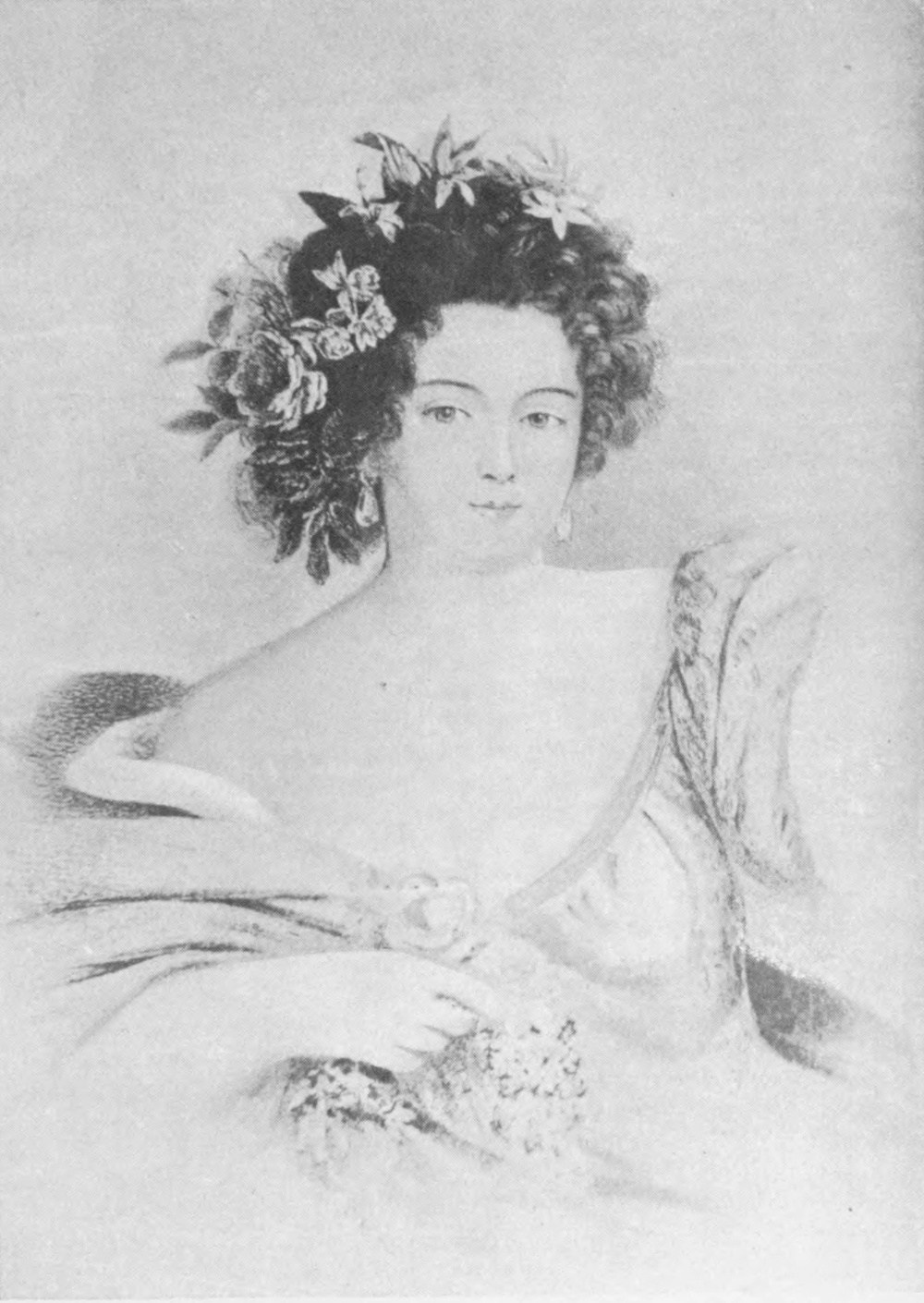
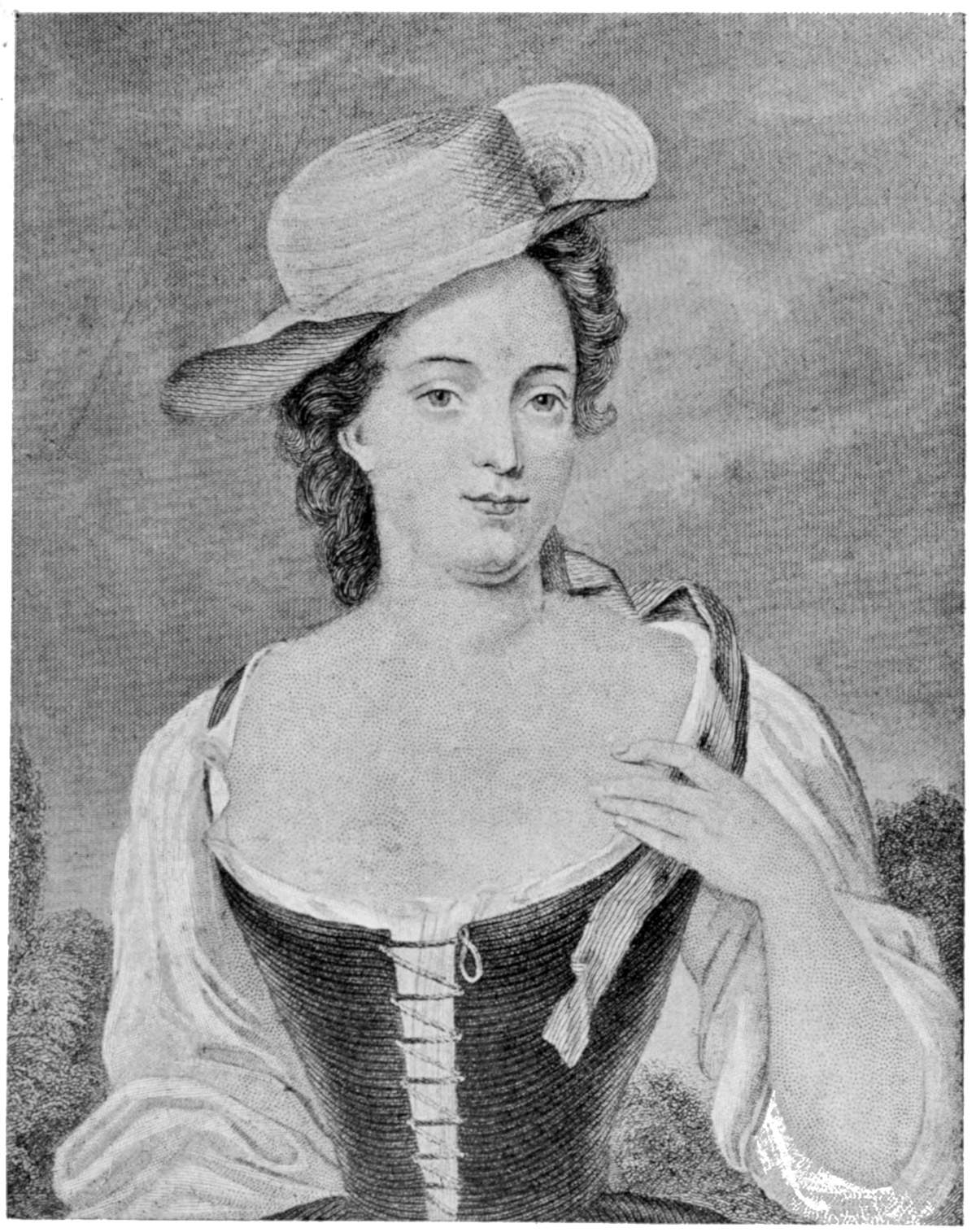
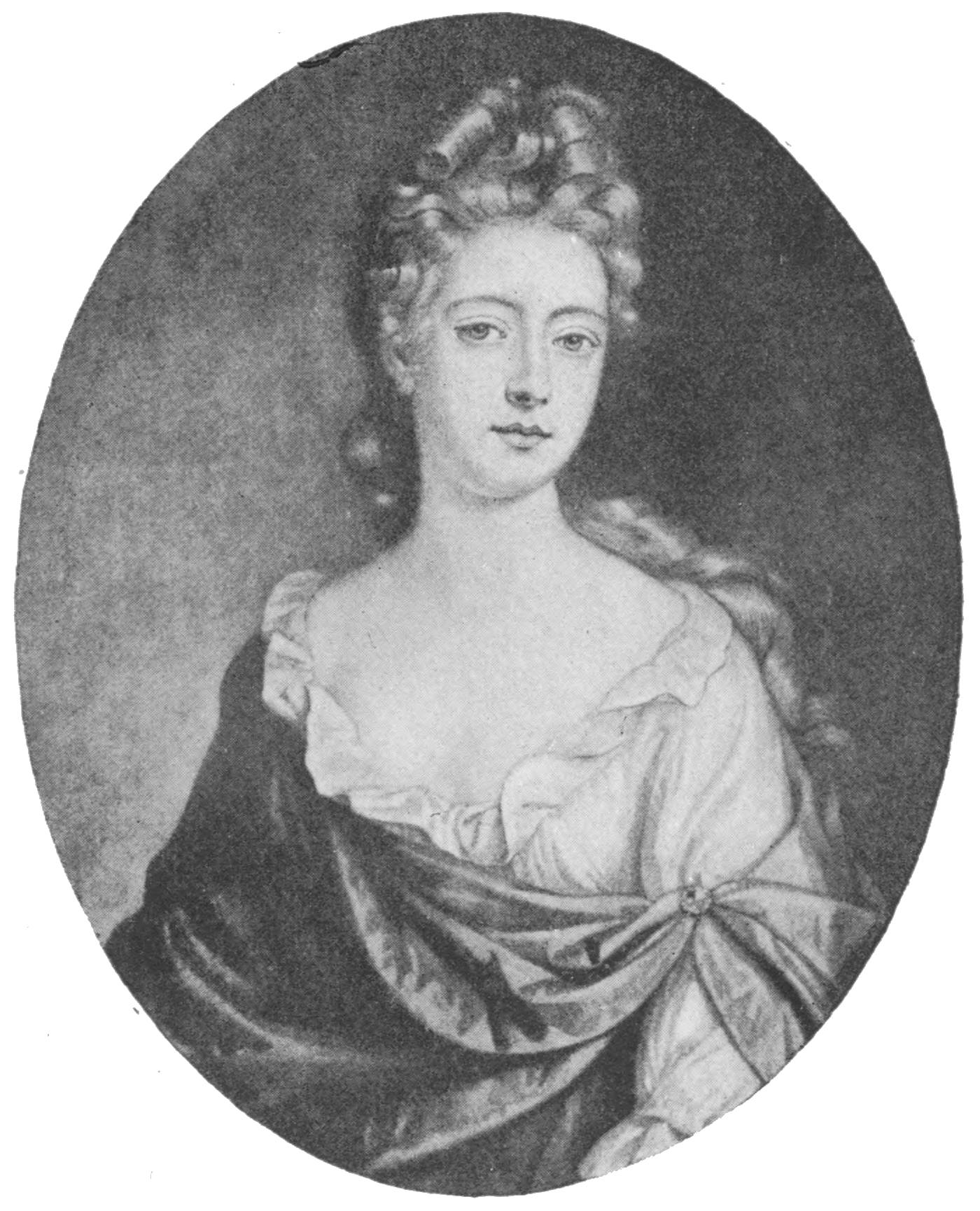
SOPHIE DOROTHEA. From a painting formerly at Ahlden.
THE LOVE OF AN
UNCROWNED QUEEN
SOPHIE DOROTHEA, CONSORT OF
GEORGE I., and her Correspondence with
Philip Christopher Count Königsmarck (Now
first published from the originals)
BY
W. H. WILKINS
M.A. (Clare College, Cambridge), F.S.A.
Author of “Caroline the Illustrious, Queen Consort of George II.”
NEW AND REVISED EDITION
WITH ILLUSTRATIONS
LONGMANS, GREEN, AND CO.
39 PATERNOSTER ROW, LONDON
NEW YORK AND BOMBAY
1903
PREFACE TO THE REVISED EDITION.
v
When this book was first published in April, 1900,
I had no idea that it contained any of the elements
of popularity. The subject which it treats
had been of interest with me for years, and my
researches were made from love of the work. In
my quest I followed as closely as possible the footsteps
of Sophie Dorothea during her life. I visited
Celle where she was born, Hanover where she
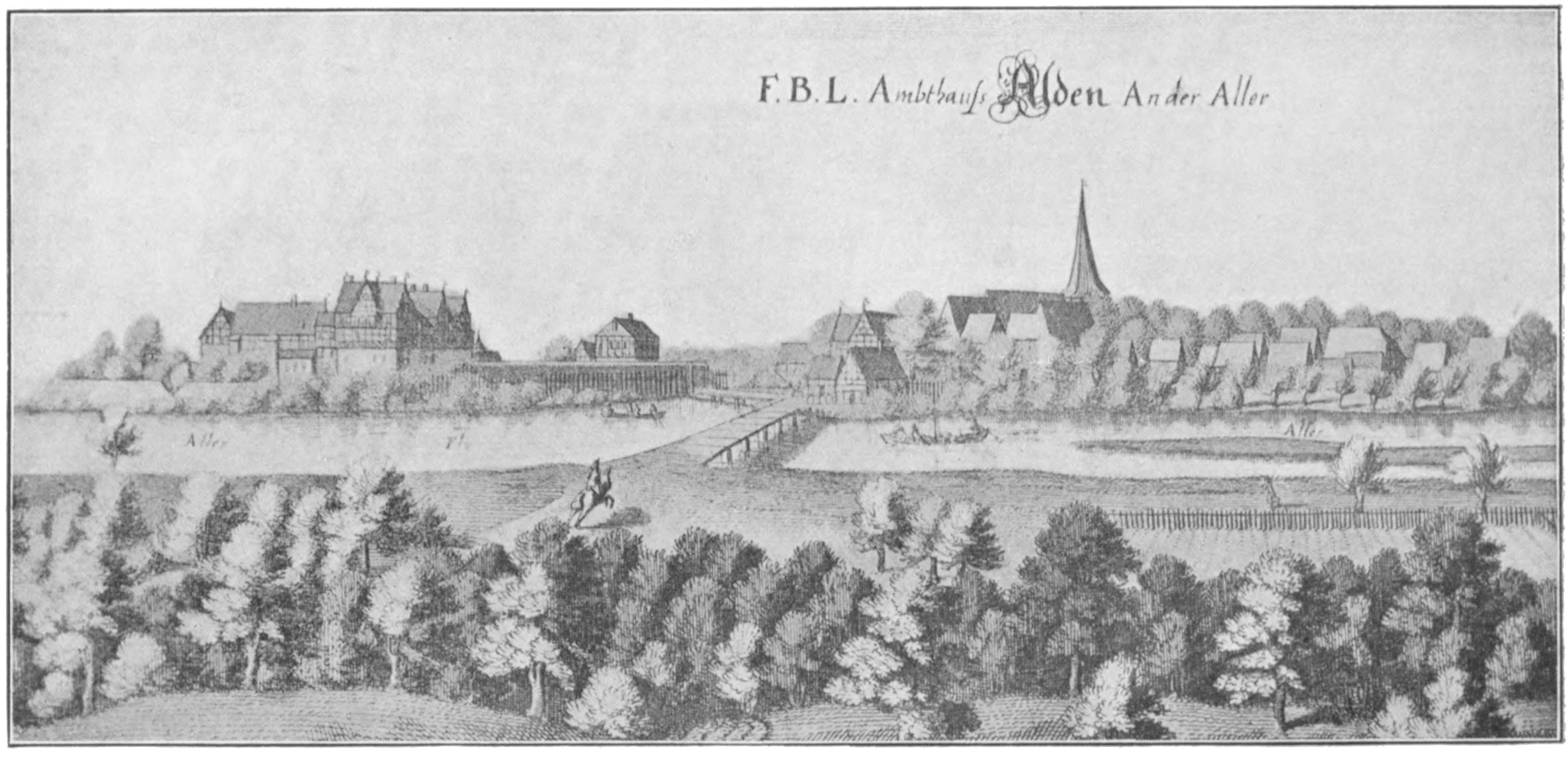
lived during her unhappy marriage, and Ahlden
where for more than thirty years she was imprisoned.
To Hanover I went again and again,
and in connection with this book I also visited
Berlin and Dresden. But it was not until six
years ago, in 1897, that I lighted by chance (while
turning over old volumes in a second-hand bookshop
at Leipzig) upon the fact that an unpublished
correspondence between Sophie Dorothea and
Königsmarck existed. For a long time I could
not find where these letters were deposited, and
went in vain search to Upsala, but at last I learned
that they were reposing in the library of the little
university of Lund in Sweden. To Lund accordingly
I went, and with the permission of the university
authorities carefully examined the manuscripts.
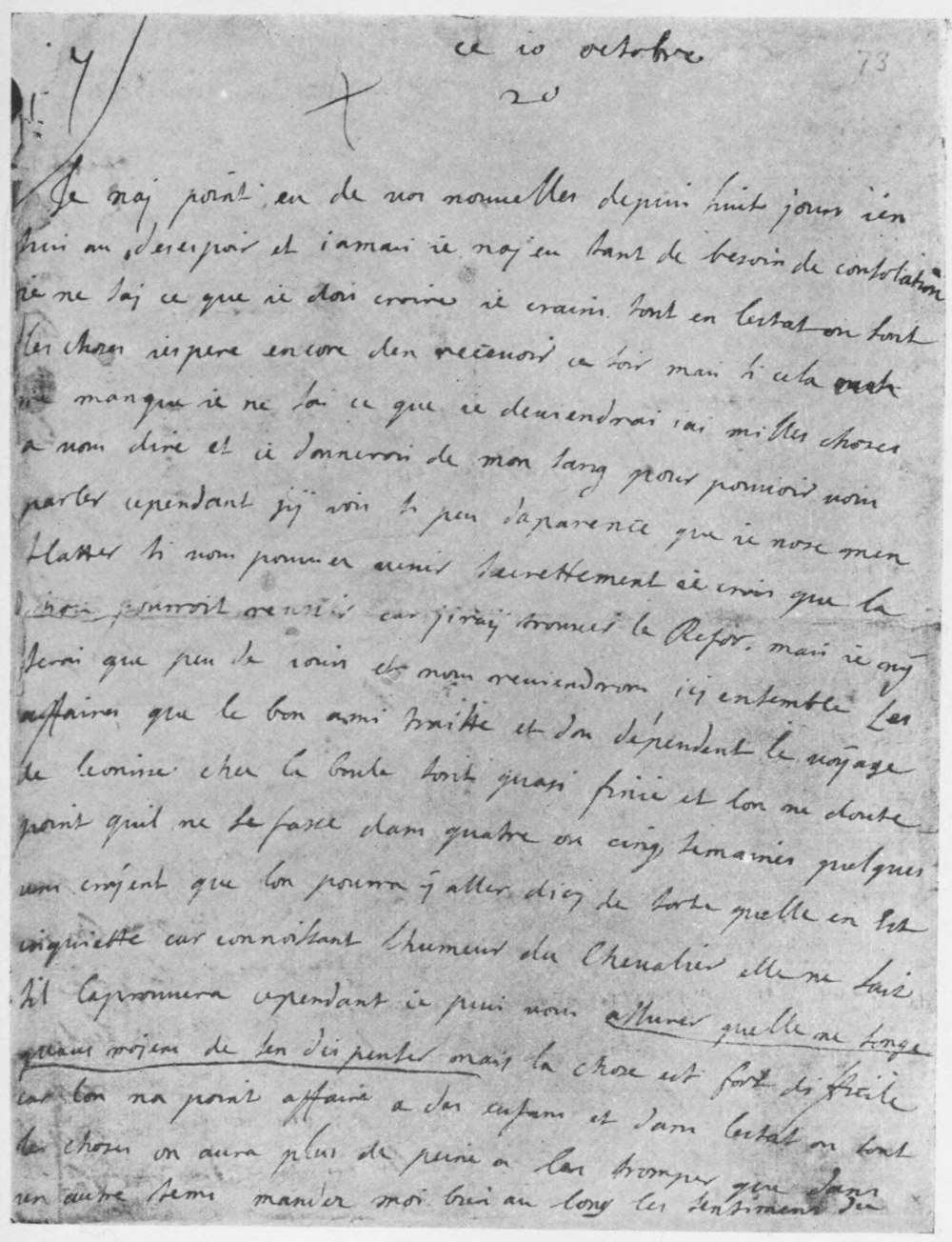
The result of my investigations is described
at length in the chapter on “The History and
viAuthenticity of the Letters”. It was the finding
of these letters which determined me to write this
book; it is built up around them.
Even when the book was written I published
it with misgiving, thinking it would have little
interest for any except the few who love the
untrodden paths and byeways of history. But,
contrary to expectation, the book attracted a good
deal of attention both in England and America.
In France and Germany too it called forth comment,
and in a short time several editions were
exhausted, until at last it ran out of print.
By that time I had learned something from
my critics, more especially from those in Germany,
and I determined not to issue another edition, until
I had the opportunity of testing what I had written
in the light of further historical research. I was
then working at another book, Caroline the Illustrious,
Queen Consort of George II., which also treats
of the Hanoverian period, at a little later date,
and until that book was finished, I had not the
leisure to follow up fresh clues in connection with
this one. Hence the publication of this revised
edition has been delayed, for the book has been out
of print some little time.
Another consideration has also weighed with
me, namely the fact, of which I was ignorant when
the first edition was published, that a further instalment
of the correspondence between Sophie
Dorothea and Königsmarck is preserved in the
Secret State Archives at Berlin. The letters
herein are all from Lund, and found their way
into Sweden through Amalie, Countess Lewenhaupt,
Königsmarck’s sister, who married a Swedish
nobleman and eventually settled in Sweden. But
there are others.
viiIt was known that, after the catastrophe of July
1, 1694, the Hanoverian Government seized many
of the letters that had passed between the lovers,
and these were used against the Princess with
crushing effect, to bring about her divorce on
Hanover’s own terms. As Leibniz says, “They
would never have believed at Celle that she was
so guilty had not her letters been produced”.[1] The
fate of these letters has long been a mystery. It
was known that Duke George William wished them
to be sent to Celle to be destroyed, but the Elector
Ernest Augustus refused and kept them at Hanover.
It was afterwards rumoured that George II., on his
first visit to Hanover after his accession to the
English throne, burned them with his own hands,
to conceal all traces of his mother’s disgrace, but
the rumour was unfounded. It now appears that
all, or nearly all, of them are in existence, and some
are those preserved in the Secret State Archives of
Berlin.
The exact way in which these letters reached
Berlin is unknown, but they have been there a long
time. According to the Calendar of the Secret
State Archives they were found among the private
papers of Frederick the Great at Sans Souci, after
his death. The luckless prisoner of Ahlden was
his grandmother, her daughter, the second Queen
of Prussia, was his mother. It is known that the
Queen of Prussia was much interested in the fate
of her unhappy mother, she corresponded with her
secretly, and at one time sought to obtain her release.
It is probable, therefore, that these letters (a part
of the incriminating correspondence seized by the
viiiHanoverian Government) were sent to Berlin by
order of George I. to convince his daughter, the
Queen of Prussia, of her mother’s errors and so
disarm her sympathy. After the Queen’s death
the letters were not returned to Hanover; they
passed into the hands of Frederick the Great,
and thence into the safe keeping of the Berlin
State Archives.
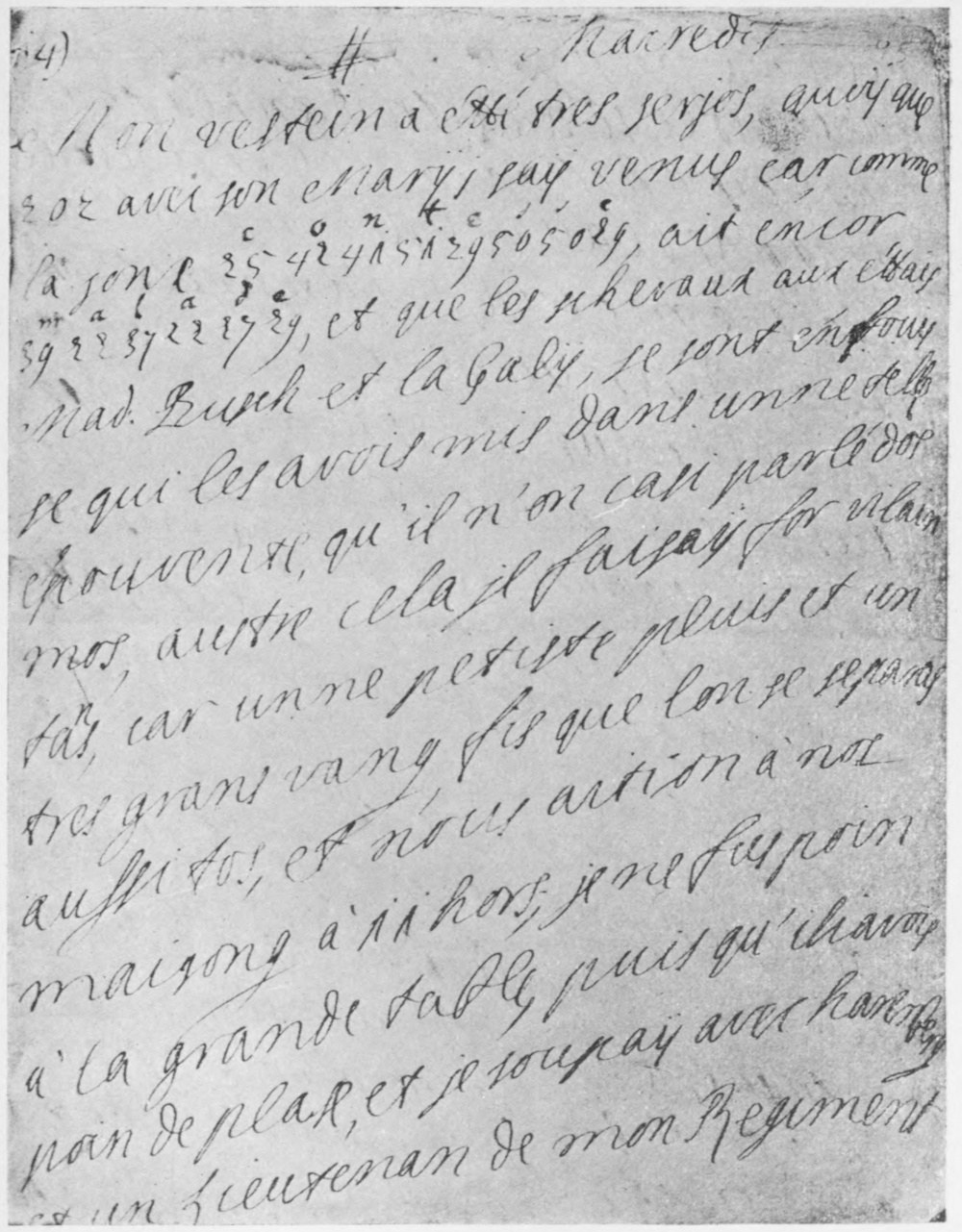
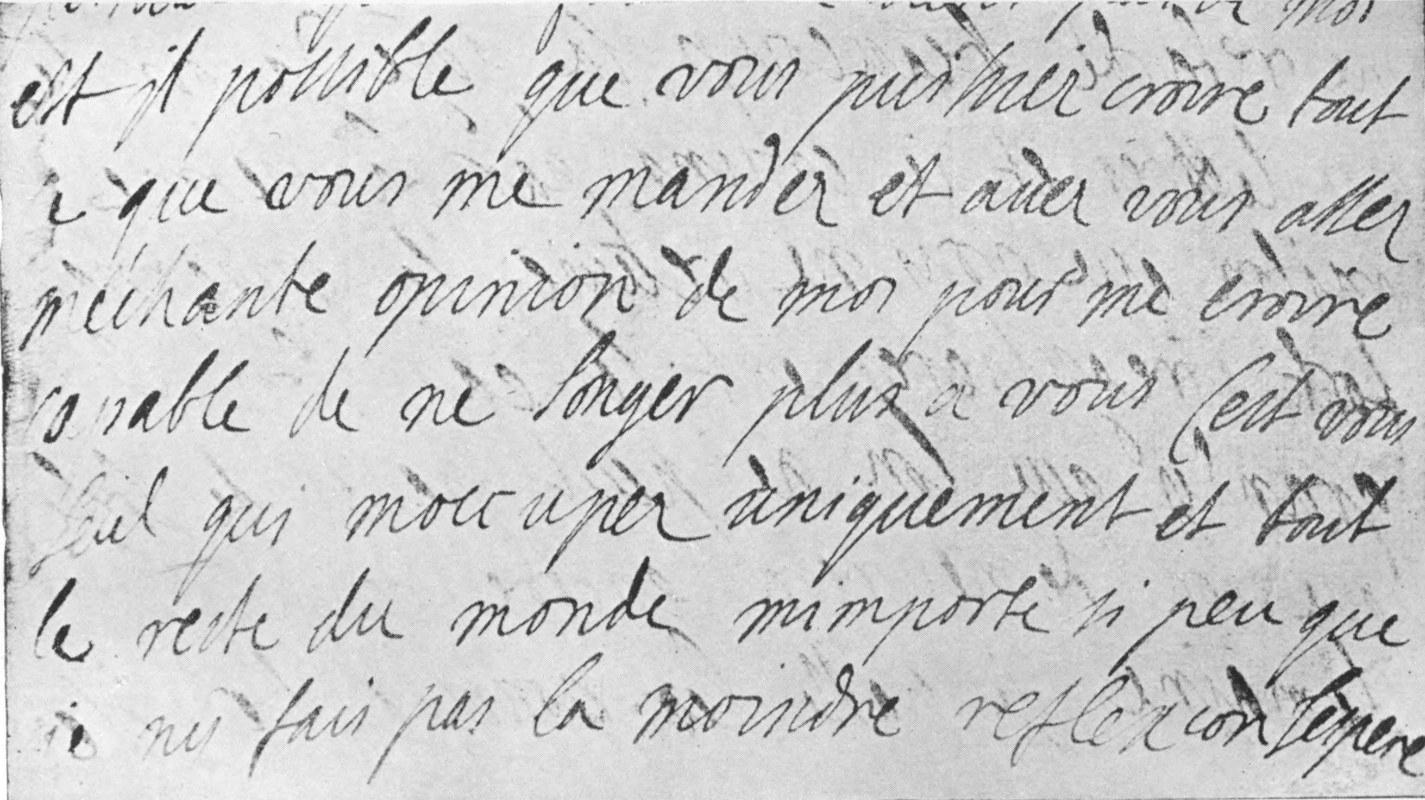
The correspondence between Sophie Dorothea
and Königsmarck is very voluminous. The greater
part of it (six hundred and seventy-nine sheets, one
hundred and ninety-nine from the Princess and four
hundred and eighty from Königsmarck) is preserved
in the university library of Lund. The letters at
Berlin number sixty-five sheets, fifteen from the
Princess and fifty from Königsmarck. It is certain
that the letters at Berlin and those at Lund spring
from the same source, the exact similarity of the
writing, the use of the same cypher and the same
nicknames, the identity of sentiment and style, and
the fact that some of the Berlin letters seem to be
answers to some of those at Lund and vice versa,
prove this beyond doubt. Clearly they stand or fall
together. Applying to the Berlin letters the same
tests as applied to those at Lund, they yield absolutely
the same results.
The Berlin letters afford little historical interest
outside the politics of the petty courts of Hanover
and Celle. Like those at Lund they are alternately
full of jealous reproaches and passionate avowals
of love. They shed no fresh light on the events
immediately preceding the catastrophe of July 1,
1694, for they appear to be written prior to the visit
Königsmarck made to Dresden before he returned
to Hanover for the last time. Letters must have
passed between the lovers in the months preceding
ixthe tragedy, and these are still needed to make the
correspondence complete. But they are not at Berlin,
they are not at Lund, they are not at Hanover. The
question remains, Where are they?
Last summer, when in Germany, I learned
that more love-letters of Sophie Dorothea and
Königsmarck still existed, over and above those
at Lund and Berlin. I learned this important
fact from a trustworthy source which I am not
permitted at present to make public. These remaining
letters were preserved at Hanover until
1866, not in the Royal Archives, but among the
Guelph domestic papers at Herrenhausen. When
the late King of Hanover, George V., was wrongfully
despoiled of his kingdom by Prussia, and
forced to live in exile, he rightly took his family
papers with him into Austria. Among those
papers was some of the correspondence between
his ancestress Sophie Dorothea and Königsmarck.
These letters are now in the possession of his son,
the Duke of Cumberland, de jure King of Hanover,
at Gmünden. What their contents are I am unable
to say, but it is probable that they contain the
missing links wanted to make the chain of the correspondence
complete. It is my desire some day
to translate the whole correspondence at Lund,
at Berlin, and at Gmünden, and arrange it in
chronological order with the aid of first-hand
documentary evidence drawn from other sources.
(But this, of course, depends upon the necessary
permission being granted.) For this reason, and
because they shed no fresh light on the tragedy,
I have not given herein any of the Berlin letters.
On the contrary, I have omitted from this edition
a few of those letters published in the first, which
were merely a repetition of others; their great
xsimilarity of style and sentiment tended to weary
rather than to edify.[2]
I should like to repeat that this book is largely
based upon papers found in the Hanoverian archives
and elsewhere, duly specified in footnotes. The
despatches of Sir William Dutton Colt, of Cresset
and of Poley, English envoys at Hanover during
the period under consideration, and of Stepney,
sometime English envoy at Dresden, now preserved
in the State Paper Office, London, have also been
drawn upon freely. To this list of hitherto unpublished
documents there remain to be added many
letters from the correspondence at Lund, translated
from the French of the original documents. These
have never before been published in English and
(except for a few unimportant extracts in a Swedish
book long since out of print) have never been published
in any language. I may claim to be the first
to edit and arrange this correspondence in something
like chronological order, and to compare it
with historical documents of undoubted authenticity
with a view to proving its genuineness.
Every effort was made in the first edition to render
this biography as complete as possible. I have now
in the light of subsequent knowledge revised the
text. I find little to add and little to take away.
My additions are chiefly in matters of detail, and will
be found in notes scattered throughout the volume.
These notes for the most part either go to prove
further the genuineness of the letters, or to quote
fuller authorities for the text—to specify more clearly
xiwhat is founded on first-hand historical evidence,
and what is derived from less trustworthy sources.
In this I should like to acknowledge the help
I have derived from my critics, more especially from
the writer of the review of my book in the Edinburgh
Review,[3] and the essay by Dr. Robert Geerds, the
eminent German critic and historian in the Allgemeine
Zeitung.[4]
The writer in the Edinburgh Review, an expert
who has himself examined the contested letters at
Lund, and the admittedly genuine ones at Hanover,
and compared them, says in contravention of a doubt
cast on their genuineness:—
“Allowing for the interval of time and for the
difference of circumstances under which the [Princess’s]
love-letters to Königsmarck and her formal
letters to the Electress were respectively written, we
have no hesitation in saying that it is impossible,
after placing the handwritings side by side, to assert
that there is no resemblance between them. We
have also had an opportunity of comparing a photograph
of Königsmarck’s abbreviated signature with
photographs of genuine signatures of his preserved
at Lund and at Hanover respectively, and no doubt
whatever is left in our mind as to the genuineness
of the (abbreviated) signature in the impugned
correspondence.”
And again:—
“After much careful consideration we feel bound
to express our belief that the probability of these
letters having been written by Sophie Dorothea and
Königsmarck is a very strong one indeed”....
xiiDr. Robert Geerds, who has examined and
compared the letters at Lund with those at Berlin
as well as Hanover, says:—
“The writing of some of the Lund letters ...
corresponds so noticeably with the Hanoverian
writing that it is impossible to doubt they were
written by Sophie Dorothea”.
And again, after reference to my discoveries of
the undesigned coincidences between incidents
mentioned in the letters and in Colt’s despatches:—
“No unprejudiced person can any longer doubt
that in this correspondence, which has been called
into question, we have the true and genuine love-letters
of the unfortunate pair whose tragic fate has
met with such universal sympathy”.[5]
I should like to thank Dr. Carl Petersen,
Assistant Librarian at Lund University, for his
courtesy and assistance; Count Carl Lewenhaupt
(sometime Swedish and Norwegian Minister in
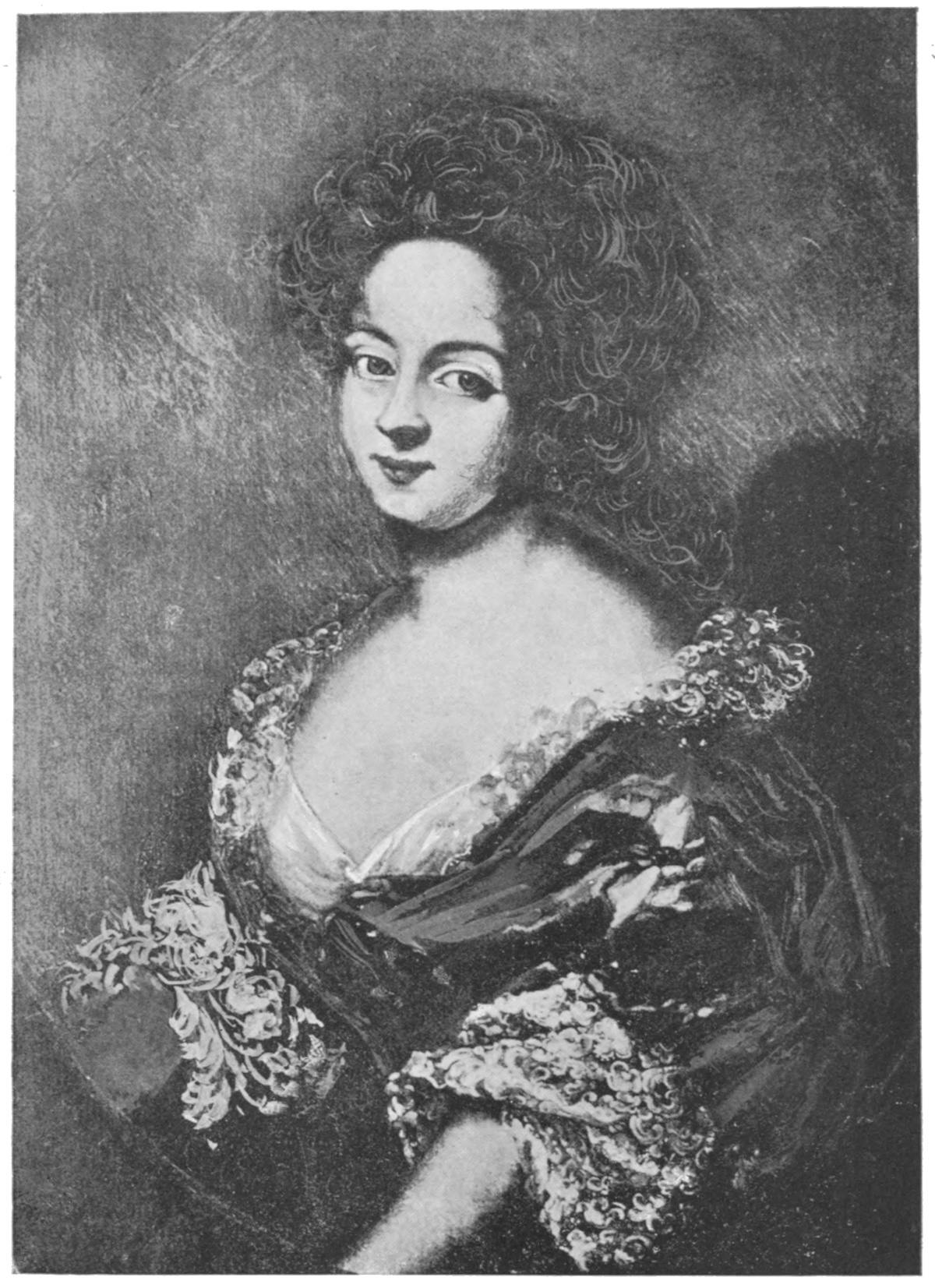
London) for procuring me the portrait of Aurora
Königsmarck, now in the possession of the elder
branch of the Lewenhaupt family; Count C. G.
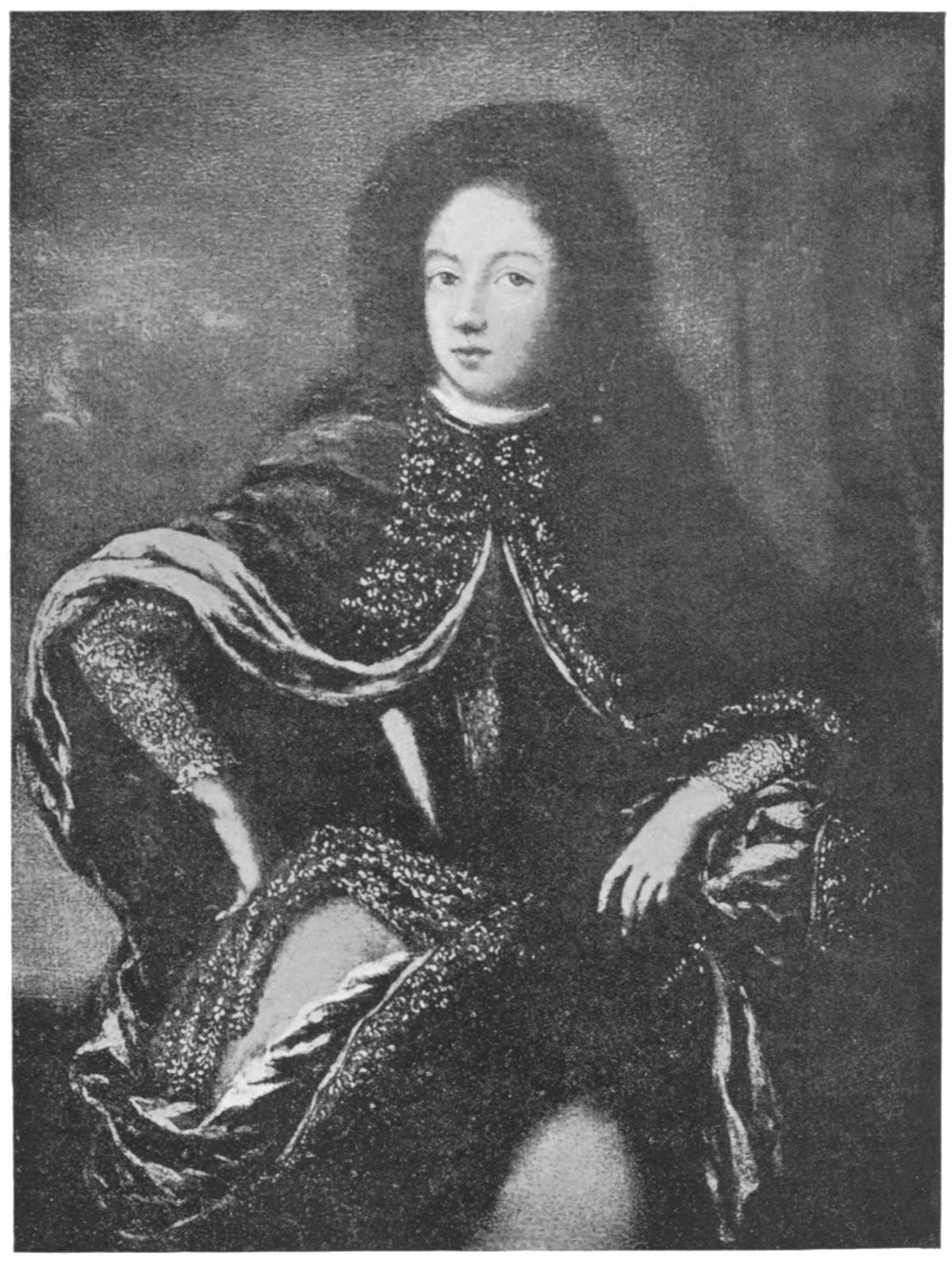
von Rosen for permission to reproduce the portrait
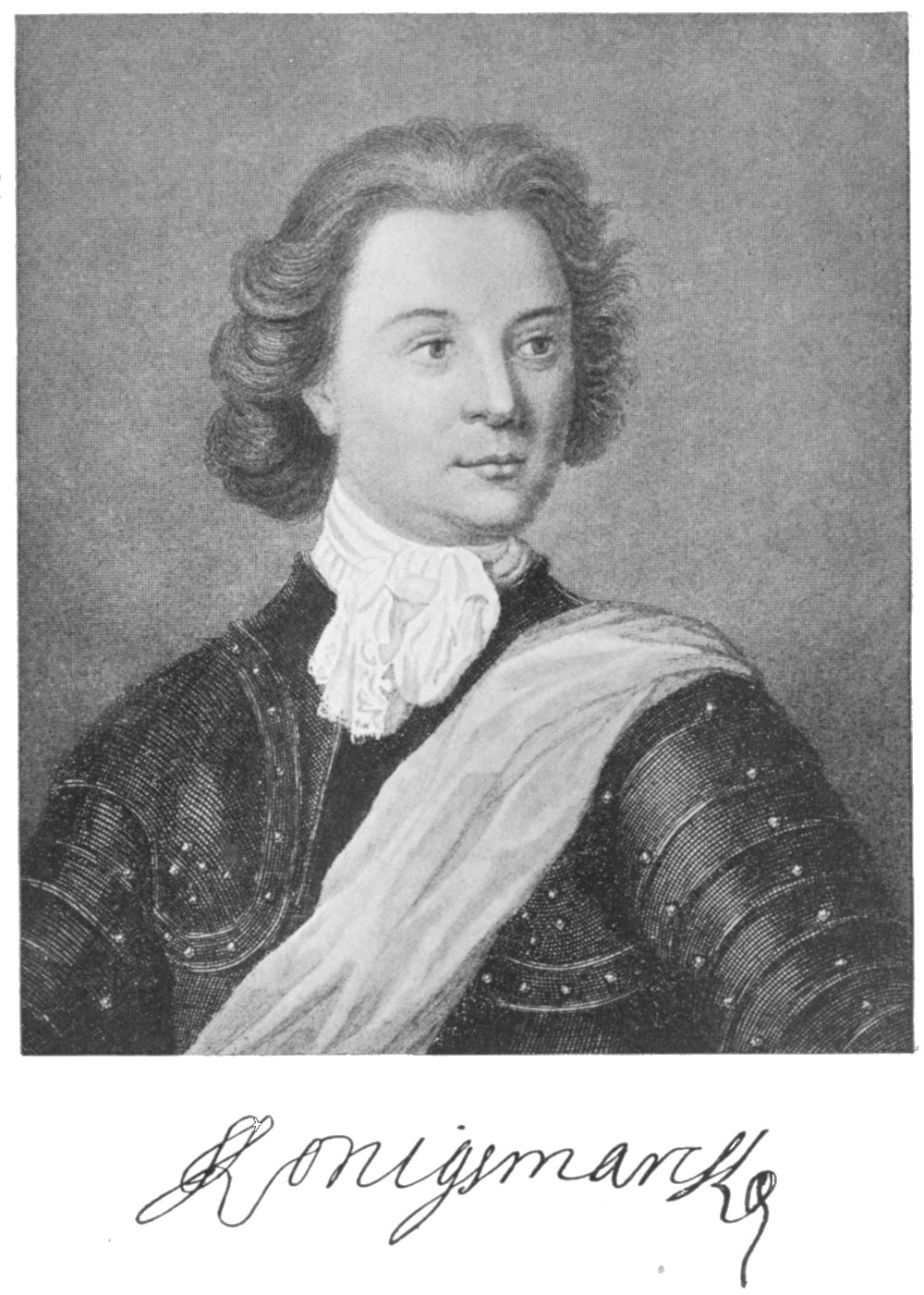
of Philip Christopher Königsmarck; Count
Kielmansegg for allowing me to see Lady Darlington’s
patent of peerage at Gülzow; and Count
Erich Kielmansegg for calling my attention to a
slight error in the history of the Lund letters,
corrected in this edition.
As an edition of this book has been published
in America without my knowledge or consent, and
xiiias it is, moreover, full of grammatical and other
errors, for which I am not responsible, I take this
opportunity of saying that this is the only authorised
edition for sale in America.
In conclusion, I should like to repeat what I
wrote in the preface to my first edition: “The story
of the romantic life of this uncrowned Queen has
been shrouded in mystery, and she has been even
more misrepresented than Mary Queen of Scots.
Her imprisonment in the lonely castle of Ahlden
was longer and more rigorous than Mary’s captivity
in England, and the assassination of Königsmarck
was as dramatic as the murder of Rizzio.”
CHAPTER I. THE ROMANCE OF THE PRINCESS’S PARENTAGE.
1
Life, like a dome of many coloured glass,
Stains the white radiance of Eternity.
Shelley.
Sophie Dorothea of Celle, the uncrowned queen of the
first of our Hanoverian kings, came of the ancient and
illustrious family of Brunswick, which was descended from
Henry the Lion, Duke of Bavaria and Saxony, who, it is
interesting to note, married Matilda, eldest daughter of
King Henry II. of England. It is not necessary to dwell
upon the glories of the House of Brunswick, but the immediate
ancestry of Sophie Dorothea may be of interest.
After the Treaty of Westphalia, which was somewhat
disastrous to the Brunswick princes who took part in the
Thirty Years War, this family was divided into two
branches, Augustus Duke of Brunswick representing one,
and Frederick Duke of Brunswick-Lüneburg representing
the other.
On the death of Augustus, his territories were divided
amongst his three sons, with only one of whom we are
concerned, Duke Antony Ulrich of Wolfenbüttel. It is
necessary to mention him, as he played a not unimportant
part in the life of his cousin, Sophie Dorothea of Celle.
From this branch of the family the Dukes of Brunswick
are descended, and it gave another uncrowned queen to
England in the person of the unfortunate Caroline, consort
of George IV.
Frederick Duke of Brunswick-Lüneburg died in 1649,
leaving the four sons of his brother, Duke George, his heirs.
Of these, the eldest son, Christian Louis, was given the
sovereign principality of Celle, then the most important;
the second son, George William, subsequently the father of
2Sophie Dorothea, was given the sovereign principality of
Hanover. The two younger sons, John Frederick and
Ernest Augustus, had no territory at first.
When the four ducal brothers, all young men, entered
upon their inheritance, changes took place in the sedate and
simple courts of Hanover and Celle. Hitherto they had
been typical of the petty German courts in the Middle Ages,
untouched as yet by foreign influences. According to
Vehse, at the schloss of Celle meals were served daily in
the great hall, at nine in the morning and at four in the
afternoon. The retainers were summoned to meals by a
trumpeter on the tower, and if they did not appear punctually
they had to go without. As they ate, a page went round
“bidding every one be quiet and orderly, forbidding all
swearing, and rudeness, or throwing about of bread, bones,
or roast, or pocketing of the same”. The butler was warned
not to permit noble or simple to enter the cellar; the squires
were allowed beer and “sleep-drinks,” but wine was only
served at the Duke’s high table. All accounts were carefully
kept, and bills paid weekly. The court was one big
family, and the Duke was the father of his people. But this
well-ordered household was in the days of the old Duke
Christian, a predecessor of the four young princes who now
divided the possessions of Brunswick-Lüneburg.
The eldest, Duke Christian, settled down to a fairly quiet
life at Celle; “his only fault,” we hear, “was drinking,” a
very venial offence in those days. But the second brother,
Duke George William, found life at Hanover unbearably
tedious. He had little liking for the stiff and monotonous
routine of his German court; the simple lives of his subjects
bored him, and their rude manners and coarse habit of
living disgusted him. Though all his life strongly anti-French
in his politics, he belonged to the newer school of
German princes and affected the society and fashions of the
French, so much so that on one occasion a French envoy
said to him at his own table: “But, MonseigneurMonseigneur, this is
charming; there is no foreigner here but you”. Though a
young man, George William had already travelled in Italy,
and acquired a certain polish of manners and superficial
refinement not usually to be found among German princes
of his time. The first use he made of his freedom was to
escape from the tedium of his uninteresting little principality,
3and, in company with his youngest brother, Ernest
Augustus, who was then his boon companion, and largely
dependent upon his bounty, he made another tour in Italy,
visiting Milan and Venice. At Venice, then at its zenith,
the brothers plunged into the delights and dissipations
which the gay city offered. George William formed an
intimacy with a Venetian woman, one Signora Buccolini,
by whom he had a son. For many years he was devoted
to her, and maintained her in considerable affluence; for,
with all his faults, he was of a generous disposition. But
the lady was of so passionate, jealous, and exacting a
temperament that at last she tired the patience of her
protector. After many quarrels he made an arrangement
by which he settled a sum of money upon the mother, and
took the charge of the boy’s education upon himself. This
was the final separation. He took back the young Lucas
Buccolini with him to Hanover, clipped his Italian name
into Bucco, or Buccow, and found him a place in his household.[6]
George William’s subjects did not appreciate these
frequent absences of their liege lord, nor did they approve
of the Italian singers and dancers and the Venetian son
whom he brought back with him to his prim little court.
They became exceedingly restive, and pointed out that
there was need of a duchess and an heir. Duke Christian
of Celle was unwed, and Duke George William of Hanover,
who was next in succession, was a bachelor too. Their
subjects, both of Celle and Hanover, considered this a
neglect of duty on the part of their princes, and, remonstrances
having no avail, at last the members of the state
in Hanover threatened to cut short George William’s
allowance if he did not marry forthwith. Moreover, knowing
his predilections, they intimated plainly that they
wished no foreign bride, and suggested that the Princess
Sophia, the orphan daughter of the luckless Frederick
Prince Palatine, ex-King of Bohemia (by the beautiful
Elizabeth, daughter of James I. of England), would be a
suitable duchess.
4The Princess Sophia was well past her first youth, and
was understood to be anxious to settle herself in life. She
was then living with her brother, the Elector Palatine of
the Rhenish provinces, at Heidelberg. The household was
not a happy one, for the Elector and his wife were leading
a cat-and-dog life, and Sophia’s lot, as a poor relative, was
hardly enviable. She was a healthy little body, decidedly
good-looking, though she had not inherited the beauty of
her mother, “The Queen of Hearts”. “My hair,” she writes,
“was light brown and in natural curls; my general appearance
gay and lightsome; my figure good, but not very tall;
my deportment that of a princess. I take no pleasure in
remembering all the rest, of which my mirror shows me
nothing left.” She had sharp wits and a sharp tongue, and
the life she had led, travelling about Europe in the poverty-stricken
court of Queen Elizabeth, had developed both to an
unusual degree. Yet notwithstanding the financial troubles
of her youth, “my spirits,” she continues, “were so high in
those days that everything amused me; the misfortunes of
my house were unable to depress them, although at times
we had to make repasts richer than Cleopatra’s, and nothing
was eaten at court but pearls and diamonds”. This is one
of Sophia’s figures of speech, for it is to be feared that the
pearls and diamonds had long since gone to the Jews. Despite
her poverty, or perhaps in consequence of it, Sophia
was inordinately proud of her birth, especially her English
ancestry, on which she was never tired of expatiating. At
one time she had been put forward as a suitable wife for her
first cousin, the Prince of Wales, afterwards Charles II. of
England, and with that view had been carefully trained in
the English language and English ways. The match fell
through, and so, in the after years, did many others, some
good, some indifferent, which had been projected for her by
her relations. As Sophia was very ambitious, the failure of
her matrimonial chances was a great disappointment to her.
She was now twenty-nine, and her good looks were somewhat
impaired by an attack of small-pox; she was therefore quite
ready to meet the husband whom the Hanoverians had proposed
for her, half way.
George William, seeing that his subjects’ minds were
made up, shrugged his shoulders and submitted to the
inevitable. If it had to be, Sophia would do as well as
5any other. He therefore started for Heidelberg, on the
way to his beloved Venice, accompanied again by his
brother, Ernest Augustus. Without ado he proposed for
Sophia’s hand, and she “did not at all hesitate to say Yes,”
as she admits in her autobiography. He made no pretence
to any affection, and she required none. A marriage contract
was drawn up and duly signed, with the single proviso
that the betrothal should not be made public for a little
time.
The business having been settled, George William
hurried on to Venice, and revelled in his brief spell of
freedom. But his approaching marriage hung over him
like a pall; he thought over the matter, and one morning
he came to the conclusion that after all he could not take
upon himself the restraints of matrimony with a woman for
whom he had not a particle of affection. The situation was
difficult, for, if he did not wed her, his subjects were determined
to reduce his income, and to the pleasure-loving
Duke this was an equally unpleasant alternative. In this
dilemma he bethought himself of Ernest Augustus, his
youngest brother, and suggested to him that he should act
as his substitute. All that his subjects wanted was an
heir, and with this Ernest Augustus would be able to
furnish them, through Sophia, as well as he. Ernest
Augustus was nothing loth to take his brother’s place—for
a consideration. He was favourably disposed towards
the Princess, with whom he had flirted in his youth;
they had met at the Hague and had played the guitar
together, but as he was a younger son, Sophia nipped the
flirtation in the bud. A deed was drawn up between the
two brothers, in which George William undertook to surrender
certain of his revenues, and bound himself not to
marry, so as to leave his inheritance and all his rights to
the brother who would act as substitute for him in the
matter of his intended bride and ducal obligations. Just
as the contract was signed the other impecunious brother,
John Frederick, came into the room, and, on learning its
contents, fell into a rage because the chance had not been
offered to him first; he tried to tear away the document
from Ernest Augustus, George William looking on with
amusement. This happy-go-lucky way of choosing a bride
was quite in keeping with the traditions of the House of
6Brunswick; an ancestor of these princes cast dice with his
seven brothers for a wife on somewhat similar conditions,
and won the prize—a princess of Hesse-Darmstadt.
The next thing was to acquaint the Princess Sophia
with the arrangement; that lady, having satisfied herself
that the terms of the agreement were equally advantageous
to her and her possible heirs, raised no objection to being
handed over like a bale of goods, and though her pride was
hurt she skilfully concealed her resentment. Her brother,
the Elector Palatine, glad to be rid of her and her sharp
tongue, told her that he thought she was better for the
change of brothers, a remark with which she agreed, adding
that “A good establishment is all I cared for, and if this
be secured to the younger brother, the change is a matter
of indifference”.
These negotiations from first to last took two years; in
September, 1658, the marriage was celebrated with some
pomp at Heidelberg, and in November the Duchess Sophia
took up her abode at Hanover, where she was the first lady
in the land, and treated with every honour. She was always
a great stickler for etiquette, and insisted on every tittle of the
respect due to her rank and illustrious ancestry. Curiously
enough, if we may believe her memoirs, no sooner was she
married to Ernest Augustus than George William became
attracted to her, thereby arousing the jealousy of her husband,
until she begged the elder brother, “for the love of God,” to
leave her in peace.
In 1660 her eldest son, George Louis (afterwards George
I. of England), was born at Osnabrück, and the arrival of
the much-wished-for heir increased her importance. The
following year Ernest Augustus succeeded to the bishopric
of Osnabrück,[7] and Sophia’s prospects were the more improved.
Meantime George William had overcome his belated
penchant for Sophia, if indeed it ever existed save in her
7imagination, and was gratifying his pleasure-loving soul by
making a tour of many cities. Among others, he went to
Breda, an exceedingly gay place at the end of the seventeenth
century, albeit money was somewhat lacking there.
It was the chosen home of political refugees, exiled princes,
and deposed monarchs, who kept up their spirits despite
their fallen fortunes, and maintained phantom courts on
nothing a year. Here Charles II. dwelt for some time in
his exile with many celebrated cavaliers; here, too, his
aunt, the Queen of Bohemia, had held her shadowy court;
here, too, was concluded the peace between England and
Holland. All these things contributed to the importance
and the gaiety of Breda; there were feasts, masquerades,
and revelries, and plays with after-suppers and dances.
Among the gayest of the gay was the Princess de Tarente,
an aunt of the Duchess Sophia, a German princess who
had married a French prince. One of her most cherished
protégées was Eléonore d’Olbreuse, only child of the Marquis
d’Olbreuse, a nobleman of ancient family, of Poitou. He
was one of the many French Huguenots who, after the
revocation of the Edict of Nantes, were persecuted by the
government of Louis XIV. As he would not recant, his
estates were confiscated, he was sent into exile, and found
an asylum in Holland.
Before the persecution of the Huguenot nobles Eléonore
d’Olbreuse had figured at the brilliant court of Louis XIV.,
where she was greatly admired for her wit and beauty.
She was endowed with an exquisite figure, dark brown
hair, regular features, and a brilliant complexion. At this
time she was in the first bloom of youth, and her loveliness
was only equalled by her sprightliness and charm of manner.[8]
George William met her at a ball at the Princess de Tarente’s,
and being of an amorous, though not of a marrying disposition,
he fell in love at first sight. He became a constant
visitor at the Princess de Tarente’s, and a closer acquaintance
with the accomplishments and graces of the bewitching
Eléonore only served to rivet his chains. He affected a
great zeal to perfect his French, and the fair Eléonore
willingly consented to give the good-looking Duke lessons,
8thereby offering fine opportunities for flirtation. What
progress George William made with the French language
is not recorded, but in the art of love there is no doubt he
made rapid advances, for after a few lessons in the conjugation
of the verb aimer, he avowed his passion in most extravagant
terms, and swore that he could not live without
her. He found that the citadel did not yield to the first
attack. Eléonore d’Olbreuse was of a very different calibre
to Signora Buccolini; she had only two available assets,
her beauty and her virtue, and she was well aware of the
value of both. She was not versed in the menue galanterie
of the court of the Grand Monarque for nothing. George
William was fervent in his protestations, prodigal in his
promises of devotion, and what was more to the purpose,
most liberal in his proposals as to settlements; but Eléonore
held firm. Her birth was noble, though not royal, and,
despite her poverty, she held that a French marquis of
ancient descent was not so very inferior to a petty German
prince. George William could not be expected to take
this view, for, though indifferent to the trappings of rank,
he, like all German princes, was inclined to over-estimate
his own importance. But he could not give her up; he
who had been accustomed to command in love was
now its humblest supplicant; he who was indolent, easy-going
in temperament, now developed an ardour and determination
altogether foreign to him; he who was slow
of speech now became more eloquent in the language of
love. Eléonore had worked a transformation. So infatuated
was he that he would willingly have married her
then and there but for the document he had signed when
the marriage was arranged between Ernest Augustus and
Sophia. Eléonore knew nothing of this arrangement, but
she positively refused to entertain any proposals short of
marriage.
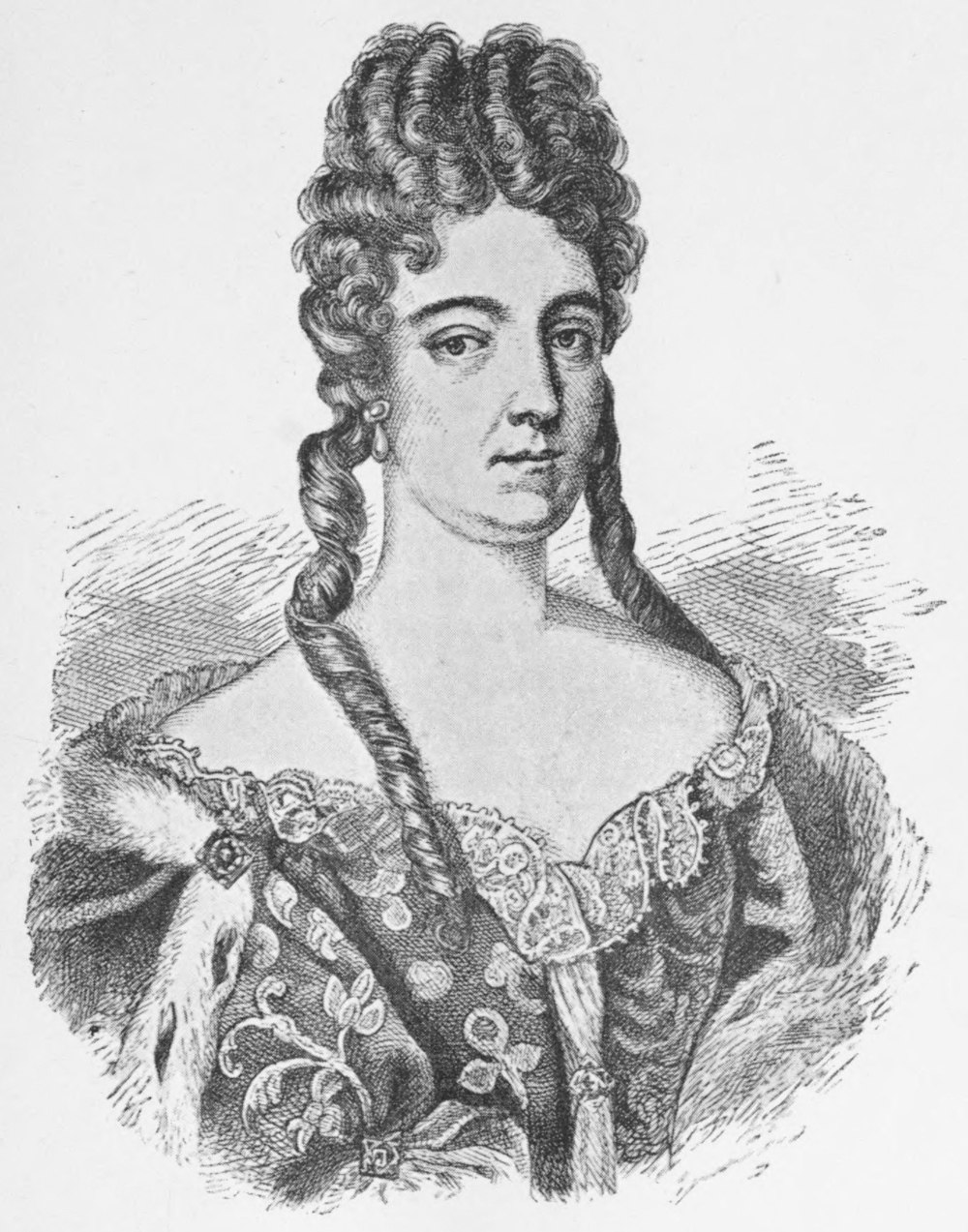
ELÉONORE D’OLBREUSE, DUCHESS OF CELLE. From a painting at Herrenhausen.
In this dilemma George William thought of a morganatic
marriage,[9] and offered handsome settlements. The
Princess de Tarente advised her friend to yield. The
Marquis d’Olbreuse put no pressure on his daughter; but
she was well aware of the straits to which poverty had
9reduced him, and could see that in his heart he favoured
the Duke’s suit. If she consented she would secure for
her father a comfortable provision for his declining years.
Eléonore, too, was really in love with George William;
but still she held back.
To bring matters to a climax, the Princess de Tarente
gave a brilliant entertainment in honour of the birthday of
her friend and protégée, when she presented her with a
jewelled medallion of her lover. The result seemed inevitable,
for she who hesitates is lost; when suddenly couriers
came hot-foot from Celle with the news that George William’s
elder brother, Christian, was dead, and his younger brother,
John Frederick, who owed him a grudge for having been
cheated out of Sophia, had seized on the castle of Celle and
established himself in the duchy. George William had to
post in haste to Celle to uphold his rights and turn out
the usurper, but before leaving Breda he placed a paper
in the hands of his beloved Eléonore, in which she found
that he had settled on her, in the event of his death, the
whole of his private fortune with the exception of a few
legacies.
It took some time for George William to arrange
things satisfactorily at Celle; but at last he persuaded
John Frederick to relinquish the duchy, and gave him
compensation, for his frequent absences had weakened his
rights. George William then became Duke of Celle, and
John Frederick succeeded to Hanover, Ernest Augustus
remaining Bishop of Osnabrück.
When affairs of state were settled satisfactorily George
William’s thoughts once more turned to love. But there
were many difficulties. He could not leave his duchy so
soon again, he could not return to Breda to see the object
of his affections; while she, on her part, refused all entreaties
to come to him. In this dilemma he confided in
his sister-in-law, the Duchess Sophia, of whose judgment
he had great admiration. Sophia sympathised, softened,
doubtless, by one of those little presents whereby George
William was in the habit of buying the complaisance of the
court at Osnabrück, and promised to see the affair through,
provided that nothing were done to impair her rights. It
could hardly have been a congenial task to Sophia, and her
jealousy showed itself early by her scoffing at Eléonore’s
10airs of virtue, which she declared were only assumed to
increase her value. But she was not one to allow sentiment
to stand in the way of substantial benefit. Sophia’s
prospects had again distinctly improved by the death of
Duke Christian. John Frederick was still unwed, and
likely to remain so;[10] and if she could tie George William
down to an amour without legitimate heirs, in the fulness
of time she or her children might reign not only at Osnabrück,
but also at Hanover and Celle. So the illustrious
Duchess Sophia, the descendant of kings, the great lady
of Osnabrück, wrote a specious letter to the poor exiled
Eléonore, asking her to come, assuring her of respect, and
offering her as a pretext the post of lady-in-waiting at her
court. Eléonore still hesitated. She was very proud and
very poor; but she was very much in love, and wearied
with importunities. The Duchess wrote again, even more
urgently. These attentions from one who was known
everywhere as a great princess flattered Eléonore’s pride,
and the prospect of joining her lover gratified her love.
She consented and came.
Eléonore was received with every mark of respect.
Sophia, accompanied by George William, met her at the
foot of the grand staircase of the castle. She was led up to
the Duchess’s own chamber, where coffee and salt biscuits,
an unusual honour, were offered her, and she was then conducted
to her apartments. No one could be more affable
than the Duchess; everything seemed straightforward, and
it is no wonder that Eléonore, a stranger in a strange land,
was outwitted. She soon found that she could not draw
back without compromising her reputation, so she yielded
to advice, not altogether reluctantly, and accepted at last
the left-handed marriage offered her. A contract was drawn
up, worded almost as if it were a regular marriage; but
carefully guarding the rights of Sophia, her husband, and
her children; and the signatures of Ernest Augustus and
Sophia were written under those of George William of Celle
and Eléonore d’Olbreuse. After the ceremony, which took
place in September, 1665, Eléonore was granted the title of
Madame von Harburg, so called from an estate of the Duke’s,
and her nominal place of lady-in-waiting was filled by her
11sister Angelica, whom she later married to the Comte de
Reuss.
In her memoirs Sophia declares that at first she was
agreeably surprised to find Eléonore a very amiable person,
of modest and even retiring manners, and she no doubt
thought she would be easily kept in her place—not a high
one. She soon found herself mistaken. For some months
after the morganatic marriage—the anti-contrat de mariage
Sophia contemptuously called it—Eléonore continued to
live in the household of the Duchess, and was not treated
with any great honour, and certainly not admitted to an
equality of rank. For instance, at meal-times she did not
take her place at the ducal table, and had to sit on a low
chair, without anything to eat, at a respectful distance from
Sophia and George William and Ernest Augustus, who ate
their food while Madame von Harburg looked on. But she
was allowed to remain seated when any princes were present,
and this was considered a great concession. Her pride was
much hurt at this etiquette, nor did the heavy living and
coarse manners of the German court appeal to her finer
tastes. In her interesting letters to her uncle she complains
that “her heart was sadly turned” by the enormous dishes
brought before the princely eaters, their menu consisting
chiefly of greasy sausages thrown in lumps on red cabbage,
and a farinaceous mass of ginger and onions. This was
washed down by cloudy, heavy ale, of which they drank
freely. “Now,” the Duchess Sophia would exclaim after
she had eaten her fill, mopping her face with a napkin,
“you may go, my dear, and help your ‘angelic’ sister with
her saucepans.” This was a jeer at the habit of Eléonore
and Angelica preparing for themselves a little meal after
the French cuisine in their dressing-rooms.
Madame von Harburg was not stinted in her establishment;
she was allowed a chariot drawn by six horses, but
she was never seen abroad with the Duchess Sophia or the
Bishop of Osnabrück. She was not, however, a lady content
with the second place, and as her influence with her husband
was great, and grew greater as his love increased, she had
little difficulty in persuading him to take her away with
him to the schloss at Celle, where she was safe from the
patronage of the Duchess Sophia and could develop on her
own lines. GeorgeGeorge William was glad to take up his abode
12at the capital of his duchy, and, thanks to his morganatic
wife, he abandoned his roving habits and settled down as a
model duke, making plans for the improvement of his castle
and the better government of his people.
After they had been a few months at Celle, Eléonore
set the seal on her influence with her husband by presenting
him with a daughter—Sophie Dorothea.
CHAPTER II. THE PROGRESS OF ELÉONORE. (1666-1676.)
13
Oh, were I seated high as my ambition,
I’d place this naked foot on necks of monarchs!
Walpole.
Sophie Dorothea was born in the castle of Celle on
September 15, 1666. On the anniversary of her birth two
hundred and thirty-two years later it chanced that the
writer visited Celle. It must have been on just such a
September morning that Sophie Dorothea was born, with
the sun blazing down on the yellow-washed walls and
shining into the chamber where the birth-bed was, with the
limes and silver beeches in the garden flecked with the gold
of autumn, and the blue-green reeds waving on the edge of
the sluggish moat. The fine old schloss had changed little
with the flight of centuries. The drawbridge and portcullis
had gone; but the moat, filled with water from the Aller,
still flowed dully about the walls, separated from them only
by a strip of garden. The great courtyard, with its high
yellow walls, timeworn sundial, and pyramid of cannon-balls
in one corner (doubtless the spoil of one of George
William’s many campaigns), even the flock of white and
purple pigeons fluttering down on the rough stones, all
seemed to breathe the spirit of the seventeenth century.
And looking up at the north wing, where Sophie Dorothea
was born, it required little effort of the imagination to
people again the deserted courtyard with lackeys and
squires, to conjure up the clatter of hoofs and the clank of
spurs, the bustle of congratulation, the arrival and departure
of messengers and doctors, all of which signified to the little
town of Celle that a daughter was born to the head of the
great House of Brunswick-Lüneburg, and, though they
knew it not, an ancestress to two of the mightiest monarchs
14of the modern world—the King of England and the German
Emperor.[11]
The little town of Celle, at least that part of it which
clusters around the base of the castle’s mighty walls, has
also changed little since the days of Sophie Dorothea. The
old brick church where the babe of that bright morning now
sleeps with her fathers remains the same. The triangular
market-place and the quaint little streets which branch off
from it, many of them narrow and irregular, bear the marks
of the flight of centuries. The old part of the town still
stands with houses dated from 1600 to 1700, having outer
beams carved with curious and uncouth mottoes. Celle,
though a fairly prosperous town, has not shot ahead like
Hanover. But in those days Celle, with its magnificent
schloss, the seat of the elder brother’s duchy, was a place of
considerable importance. It was a veritable Naboth’s vineyard
to Ernest Augustus and Sophia, his spouse, who, from
their little court at Osnabrück, looked towards it with
longing eyes.
The news of the birth of a daughter was not welcome to
them, but they consoled themselves with the thought that
the child was the fruit of a morganatic union, and, after
they had cracked a few coarse jokes, dismissed the subject
from their minds. But they were soon reminded rather
rudely. The infant was given the names of Sophie Dorothea,
and the christening was celebrated with much ceremony and
many festivities and rejoicings. Ernest Augustus angrily
15remarked that if the infant had been a princess instead of
only the daughter of his brother’s madame, they could not
have made more fuss about it; and that was true, for,
from the first moment Sophie Dorothea drew breath,
though in strict law she was a person of no importance,
expressly excluded from holding any rank at Celle, the
same honours were paid to her as if she had been heiress
to the duchy.
From this time onward the rift between the Duchess
Sophia and Eléonore gradually widened into an open feud.
As long as she had to think only of herself Eléonore had
borne patiently Sophia’s insults and humiliations; but now
that a child was born, she determined to spare no effort
to raise herself and her daughter to a recognised position.
She played her part with consummate skill. She had to
fight against not merely the uncompromising hostility of
Ernest Augustus and the jealous hatred of his Duchess,
but the forces of custom and precedence which bind the
petty German courts with an iron band. She had to beat
down the jealousy and prejudice against herself as an
alien and a stranger, and win the support and recognition
not only of her husband’s subjects, but of the
neighbouring princes, and even of the Emperor himself.
When we consider the forces against her, we are lost
in admiration of the courage, patience, and sagacity of
this woman, who year after year toiled for the end she
had in view, and at last found her efforts crowned with
success.
Success did not come in a night. It took Eléonore ten
years before she obtained the object of her desire—ten
years of constant effort; for her arch-enemy and rival, the
Duchess Sophia, was ever on the alert to check her moves
and foil her plans. One great advantage Eléonore had at
this time, she was sure of her husband’s love; and as George
William was as easy-going as his wife was energetic, and as
contented as she was ambitious, she soon managed to gain
a mastery over him—the mastery of a strong mind over a
weak one. Her next duty was to cultivate the arts of
popularity and win the good-will of her husband’s subjects,
no easy matter, for the prejudice against “the Frenchwoman”
and morganatic wife was strong in the little
German principality. But her tact and affability soon won
16her golden opinions in Celle. From the first she seemed
to take the townsfolk into her confidence; she drove about
the town with her infant daughter, radiant with bows and
smiles, and soon the inhabitants began to regard the little
one as their own child, and to be as jealous of her rights as
they were of their own. This devotion of the honest townsfolk
of Celle to Sophie Dorothea never wavered, but lasted
all through her life.
Not content with sowing the seeds of her child’s popularity
in her infancy, Eléonore used other means to endear
herself to her husband’s subjects. At her instigation Duke
George William proceeded to restore the old schloss on a
scale of considerable magnificence, taking care always to
employ local workmen. The little theatre[12] in the castle,
so long unused, was opened again for plays and musical
performances, and to these entertainments gentle and simple
were bidden, and seated according to their rank. Thus,
after many years, a lady was once more châtelaine at the
schloss of Celle, and again there might be said to be a court
there.
George William warmly seconded all these effort of his
wife, and so great was his love for her and the little child
that his one idea seemed to be how best to advance their
interests. The rival court of Osnabrück, queened over by
the descendant of kings, regarded all these innovations
and the “mock court” at Celle with open ridicule yet
concealed uneasiness. Sophia was presenting her husband
with a numerous family, and she was anxious that
17nothing should be done to prejudice the rights of her
offspring.[13]
Ernest Augustus held the security of his brother’s
promise not to enter into a legal marriage, and believed in
it implicitly; but he naturally asked himself to what end
Eléonore was working. He heard much of George William’s
boundless generosity to his morganatic wife, and he liked not
the diversion of his private property from what he thought
its proper direction, to wit, himself.
Within the next few years Eléonore bore her husband
three more daughters, but they all died in infancy. Her hope
of an heir, long cherished, despite the bitter derision of her
enemies, came to nothing, and Sophie Dorothea remained
the spoiled darling of her parents’ affections. So devoted
was her father to the child that the mother’s influence
grew day by day; and when the little girl was five years
old, George William, knowing that by his thoughtless contract
with Ernest Augustus he had shut out his wife and
daughter from all succession to his dominions, began to
purchase land to bequeath as he pleased. To this end he
bought five domains, and settled them upon Eléonore and
Sophie Dorothea, so as to make provision for them in case
of his death. But even this reasonable arrangement was
not carried through without a bribe to satisfy Ernest
Augustus, who would only tolerate his brother’s liberality
to his wife and daughter on the understanding that he
received a handsome commission for himself. This was
the first marked step in the progress of Eléonore, and a
little later she sounded the Emperor Leopold I. about the
possibility of legitimising Sophie Dorothea. The Emperor
18returned a favourable, if somewhat guarded, reply; it was
evident she could obtain her heart’s desire if she could
manage to pay the price. We find her, therefore, instigating
George William to send troops to help the Emperor in
sundry campaigns. This was done, and George William so
distinguished himself that the Emperor received him in
private audience, and most graciously inquired after his
“Duchess,” pretending not to know the true state of affairs.
The Emperor’s condescension reached the ears of the
Duchess Sophia, and the embers of her jealousy burst into
a blaze. Eléonore’s conduct was a model of wifely devotion;
so, as the Duchess Sophia could not bring any charge
against her after her marriage, she raked up some old
slander, and accused her publicly of having simultaneously
carried on two intrigues when she was at the court of France.
She represented her as a designing adventuress, who, while
doing her best to marry Colin, a page-in-waiting of Elizabeth
Charlotte Duchess of Orleans, tried to catch George William
as the bigger match of the two. These charges were not
very damaging or convincing, but malice went further. We
find the Duchess Sophia writing to her niece, the Duchess
of Orleans: “Never would any respectable girl have entered
the house of the Princess de Tarente, for, though she is my
aunt—to my intense disgust—she is not a person with
whom any one can live and remain clean. However,” she
added, “d’Olbreuse being a nobody, it did not matter
much.” George William treated the tale about the intrigue
with the contempt it deserved, but the statement that his
wife was “a nobody” seems to have rankled; so he and
his lady thought of a very poor means of defence. They
paid two thousand thalers to a French genealogist to make
out an elaborate family tree, to prove that Eléonore
d’Olbreuse was descended in an almost direct line from
the kings of France. The Duchess Sophia received the
pedigree with scorn and derision, and transmitted it to the
Duchess of Orleans, who, being malicious and a wit, made
out a caricature, in which she clearly showed that her head
cook was a descendant of Philip the Bold. Naturally these
tactics did not tend to smooth matters between Sophia and
Eléonore, who were now not on speaking terms, nor were
they successful in winning George William from the object
of his affections. Manlike, the more his wife was attacked
19the more he defended her; and Eléonore, who had her share
of vanity, was so upset and wounded by being thus flouted
that she became quite ill, and had to take a cure at Pyrmont,
then a fashionable watering-place, to restore her health.
George William was worried, too, and by way of a consolation
he purchased for Eléonore another and yet more
valuable estate, including the fertile island of Wilhelmsburg,
in the Elbe, near Hamburg. This he settled upon her for
life, and made arrangements for it to become, after her
death, the inheritance of Sophie Dorothea. Again Ernest
Augustus protested, and again he was bought off, this time
with a bribe of eighteen thousand thalers. But all the
same, the victory remained with Eléonore. If she could
not get the genealogy, at least she had substantial consolation.
The possession of a property like the island of
Wilhelmsburg naturally aroused comment, not only at
Osnabrück, but the neighbouring courts. It was regarded
as open evidence of Eléonore’s influence; she became a
person of consequence outside the little circle of Celle, and
all the German princes began to wonder what would happen
next.
They were not left long in doubt. A few months later
the Emperor Leopold sent to the court of Celle the letters
patent which granted the legitimising of Sophie Dorothea,
and gave the title of Countess of Wilhelmsburg to Eléonore.
If the memoirs of the time are to be believed, this Imperial
message came as a surprise even to George William, who,
though evidently pleased, looked askance at his Eléonore
and grunted, “Hum, hum!” as though he fathomed the
source whence the Imperial condescension sprang. He
was right, for the support which Eléonore had given to the
Emperor in influencing her husband to send troops to the
campaign, and a charming letter she had written to him,
had won the Emperor over to her side, and he graciously
acceded to her desire.
The next few years went by uneventfully. It seemed
to the outside world that Eléonore was resting on her
laurels, but in reality she was working for more. Meanwhile
Sophie Dorothea was growing up a lovely child, petted and
spoiled by her parents and the court of Celle. There is a
picture of her, painted about this time, at Herrenhausen,
the portrait of a beautiful child crowned with flowers and
20holding a great bundle of blossoms in her arms—a happy,
winsome, radiant face; and, making allowance for the
flattery of court painters, it is certain that she must have
been exceptionally lovely. The knowledge that the little
girl was to inherit a large fortune made rumour already
begin to find her a husband among the scions of the
nobility. Among Sophie Dorothea’s playmates in the
gardens of Celle was a handsome youth of some sixteen
years, Count Philip Christopher Königsmarck, son of a
wealthy Swedish noble. The youthful Königsmarck was
receiving his military training at Celle, and was staying
there for a few years. It was not unusual at that time for
a soldier to be trained in different courts and serve in
various campaigns, and so acquire a thorough knowledge
of warfare. Count Philip came of a family with a brilliant
military record. His father had held the office of Minister-General
of Artillery in the service of the King of Sweden;
his uncle, Count Otho William, was a marshal in the service
of Louis XIV., and at the court of the Grand Monarque
became acquainted with Eléonore d’Olbreuse. He was a
Huguenot like herself. This acquaintance probably formed
the link which brought his nephew to Celle. Eléonore,
though popular among her husband’s subjects, was devoted
to the land of her birth; she was always “the Frenchwoman,”
and was fond of appointing her compatriots to little
places in her husband’s court, thereby causing some small
jealousies.
There is little doubt that the boy and girl were thrown
together, and a friendship sprang up between them; but at
Sophie Dorothea’s age we can hardly suppose that there
was any deeper affection, though Königsmarck, for his part
(and he was older), afterwards avowed that he had loved
her from childhood.[14] At the most they could only have
been boy and girl playing at lovers. Count Philip, as we
have seen, came of a distinguished family, even in his
boyhood he was endowed with great personal beauty, and
he was known to be heir to considerable wealth. Sophie
Dorothea was an heiress too, and she was then far removed
from the rank of a princess. The possibility of a match
between the two was not so remote as might have been
21imagined—at any rate their names were linked together
even at that early period in the little court of Celle.
It is scarcely likely that Eléonore, Countess of Wilhelmsburg,
shared these views for her daughter—in fact, we know
that she looked higher. Among the neighbouring German
princes who had watched with benevolent interest the
progress of Eléonore was Duke Antony Ulrich of Wolfenbüttel,[15]
a cousin of George William, who later became co-regent
with his brother, Rudolph Augustus, of the duchy of
Brunswick-Wolfenbüttel. He was a prince of considerable
talents and artistic and literary gifts, a restless spirit always
intriguing. He was a plain man, so plain that the Duchess
of Orleans called him “an ugly baboon”. He early noted
the great influence Eléonore had obtained over her slow,
easy-going husband. He disliked the Bishop of Osnabrück
and he knew of the Duchess Sophia’s hatred of Eléonore.
He was aware of the arrangement that had been made
between the two brothers as to the succession to the duchy,
but nevertheless he thought it would be a good thing if he
could manage to divert some of the wealth of the fat little
principality of Celle into his somewhat empty coffers. With
this end in view he paid a visit to the court of Celle, and
treated Eléonore with every possible respect; in fact, he
seems to have been genuinely impressed with her virtue and
talents, and this homage, coming from a neighbouring
prince, was grateful to Eléonore’s self-esteem, for she was
sensitive about her somewhat equivocal position. She
recognised in him an ally, and laid the foundations of a
friendship which lasted through life.
After an interval, Duke Antony Ulrich came again to
Celle, this time accompanied by his eldest son, Augustus
Frederick. He communicated to Eléonore his wishes that
his son should be betrothed to Sophie Dorothea, and she
was nothing loth. But he pointed out that there was a
difficulty, in that Sophie Dorothea was not a princess, and
so could not make a regular marriage with his son. The
way to overcome this obstacle was for George William to
legally marry Eléonore, and raise her to the rank of duchess,
22and by this means Sophie Dorothea would become a
princess, and equal in rank with Augustus Frederick.
This reasoning was very grateful to Eléonore, for it showed
the way to the goal of her ambition. She willingly agreed
to work with Antony Ulrich for this object, and they took
into their confidence a councillor named Schütz. Thus a
distinct party was formed at Celle opposed to the interests
of the Bishop of Osnabrück and in favour of those of
Wolfenbüttel. For this the Duchess Sophia was largely to
blame; she had so insulted and humiliated Eléonore that
she had thrown herself into the rival camp. George
William was so much under his wife’s influence that he
readily agreed to support her desire to become his duchess,
especially when his cousin and neighbour, Duke Antony
Ulrich, told him she was in every way worthy of the position,
and it was a reproach to him that he had not espoused her
as his legal wife long before. He also viewed with favour
the betrothal of Sophie Dorothea to Augustus Frederick, to
which this was an indispensable preliminary. Everything
was quickly arranged, and it was resolved to petition the
Emperor. He was already friendly to Eléonore, and when
her prayers were backed up by the powerful support of the
Duke of Brunswick-Wolfenbüttel and her husband, they
were sure to be granted.
The news of this double event soon reached Osnabrück
and struck consternation into the hearts of Ernest Augustus
and his wife. The Duchess Sophia was beside herself with
rage, and wrote to tell the news to her niece, Elizabeth
Charlotte of Orleans. “We shall soon have to say ‘Madame
la Duchesse,’” she exclaimed, “to this little clot of dirt, for
is there another name for that mean intrigante who comes
from nowhere?” To which Elizabeth Charlotte replied:
“Nowhere? My dear aunt, you are mistaken, if you will
allow me to say so; she comes from a French family, and
therefore from a fraud.” Sophia also contemptuously
spoke of Eléonore as “the Signora,” professing to regard
her merely as the successor of Signora Buccolini, and she
profanely declared that she would rather George William’s
marriage were one before God than before man. But these
feminine amenities, like the Bishop’s protests, were unavailing;
and soon Ernest Augustus and Sophia arrived at the
conclusion that, as it was too late to prevent the mischief,
23the only thing remaining was to safeguard their interests
as closely as possible. A fresh agreement was drawn up,
lawyers and parchments were brought forth, and the
contract between the two brothers was debated and fought
out, clause by clause, like a bill in committee. The heckling
took many months and bore fruit in many documents.
The result of the controversy was at last summarised in a
document duly signed by Duke George William, the
Bishop of Osnabrück, and Duke Antony Ulrich of Wolfenbüttel.
The agreement was signed at Celle in May, 1676,
and its main clauses may be summarised as follows:—
Duke George William was allowed to “enter into
Christian matrimony with the high-born lady Eléonore von
Harburg, Countess of Wilhelmsburg”; and his daughter
Sophie Dorothea, “promised to wife to His Serene Highness
Augustus Frederick Duke of Brunswick-Wolfenbüttel,”
was to bear the title and arms of a princess by birth of
Brunswick-Lüneburg. But a clause was added: “Any
other children who may be hereafter born in this wedlock
must content themselves with the titles of Counts and
Countesses of Wilhelmsburg, and they can make no pretences
to the succession to the duchy, which is bestowed on
Ernest Augustus Bishop of Osnabrück and his heirs male”.
The unfairness of this clause is patent; but it was somewhat
modified by the fact that it was extremely unlikely
Eléonore would bear her husband any more children. The
Emperor’s assent was proclaimed with some ceremony; a
convocation of the deputies of the principality was then
assembled, and their agreement with the treaty duly notified.
When all the legal preliminaries were over, George William
led his morganatic wife of eleven years to the altar, and
espoused her with much pomp and solemnity before all
his court, his cousin Antony Ulrich, and the little Sophie
Dorothea, who must have wondered what it was all about.
Ernest Augustus and Sophia were not present at these
festivities, and they dissembled their ire as best they could.
“Ah!” exclaimed the Bishop to his court at Osnabrück on
the night of the marriage, “my brother’s French madame
is not a jot the more his wife for being his duchess; but she
hath a dignity the more, and therewith may madame rest
content.” The jibe was duly reported to the court of Celle;
but Eléonore did not feel its sting. She had reached the
24summit of her ambition; she was the acknowledged consort
of the sovereign of Celle; her name was associated with her
husband’s in the Church prayers; her child was ranked as
princess and betrothed to a prince of equal rank. As
Ernest Augustus had said, she could now afford to rest
content.
CHAPTER III. THE WISDOM OF SERPENTS. (1676-1681.)
25
Some rise by sin, and some by virtue fall.
Shakspeare.
The sun of Eléonore’s triumph had no sooner reached its
meridian than its radiance began to be overcast. The first
cloud was the death of the young Prince Augustus Frederick
of Wolfenbüttel, who was killed by a cannon-ball at the
siege of Phillipsburg a few months after his betrothal to
Sophie Dorothea. His death, though it seemed comparatively
unimportant, was destined to exercise an evil influence
over the fortunes of the House of Celle, and it snapped the
strongest band of union between the Celle-Wolfenbüttel
party. The child Princess was happily unconscious of her
loss. The betrothal was merely a matter of policy, to take
effect later; the courtship was yet to come; and when the
tidings came to Celle of the death of her betrothed she was
too young to mourn him.
At first the Prince’s death affected but little the entente
between the courts of Celle and Wolfenbüttel. Duke
Antony Ulrich continued the close friend of Eléonore; he
had another son, more nearly the age of Sophie Dorothea,
and he held him in reserve; for the hour of a fresh arrangement
was not yet, and other plans were in the air.
Meanwhile the little Princess blossomed into lovely girlhood,
the spoiled darling of her father’s court. She was
trained in all the accomplishments suitable to her rank, but
the more solid part of her education seems to have been
neglected, and with the promise of great beauty she early
developed a passion for admiration which lasted all her
life. Now that she was a princess her mother was careful
to keep her away from all suitors not of equal rank. The
early intimacy between the handsome young Königsmarck
26and Sophie Dorothea was broken off, and Königsmarck was
given a hint to leave Celle. He repaired to England to
finish his education, and he and the Princess did not meet
again for many years, and by that time she was a wife and
the mother of two children. Eléonore was justified of her
wisdom, for when Sophie Dorothea was scarcely more than
twelve years old her aunt, the Countess de Reuss, found in
a drawer of the little Princess’s bonheur du jour a love-letter
from a court page. The boy was banished for his audacity
into lifelong exile, and the governess, whose connivance was
responsible, was first imprisoned and then sent away in disgrace.
The news of this affair, which was but a childish
folly after all, got bruited abroad, and reached the ears of
the alert Duchess Sophia. That lady was never tired of
tirading against her sister-in-law, the “little clot of dirt”
as she invariably calls her in her letters to her niece, and
she seized on this incident to point her moral. “Is it not a
pity,” she wrote to the Duchess of Orleans, “that Ernest
Augustus and myself should have made such a blunder and
called to our court that ‘little clot of dirt,’ the more so that
we had at hand the Biegle, whom William liked well enough,
though she was not so fascinating as his French vixen, who
really is a splendid Stückfleisch? She would have done very
well, and at least have remained in her proper place. Never
mind, Sophie Dorothea will avenge us all; she is a little
canaille, and we shall see.”
This, to put it mildly, shows a loose moral view on the
part of the Duchess Sophia, to say nothing of the coarseness
of expression. Her prophecy about the little Princess did
not seem very likely of fulfilment then. The death of
Augustus Frederick of Wolfenbüttel left the field open, and
an alliance with the great House of Lüneburg-Celle was
eagerly courted. The beauty and wealth of Sophie Dorothea,
though she was only just in her teens, made her a desirable
bride, and it was no longer the sons of the nobility who
sought her hand, but princes of the reigning Houses of
Europe. A cousin of William of Orange, Henry Casimir
of Nassau-Dietz, was one of them; for another, the Duke
of Celle had almost arranged a match for his daughter with
Prince George of Denmark (afterwards the husband of Queen
Anne of England) when the Queen of Denmark interposed,
and, with much violence and many expletives, broke off the
27match. This lady had once received Eléonore at dinner, but
had refused her the kiss of honour. In revenge, Eléonore
had commented on the badness of the Queen’s cuisine; so
they were far from friends. Probably the Duchess Sophia,
who was very friendly with the Queen of Denmark, had a
hand in bringing about the failure of these negotiations, for
we find her writing: “Well done! Fancy a king’s son for
that bit of a bastard! Upon my word, one has to come
from Poitou to be so impudent!”
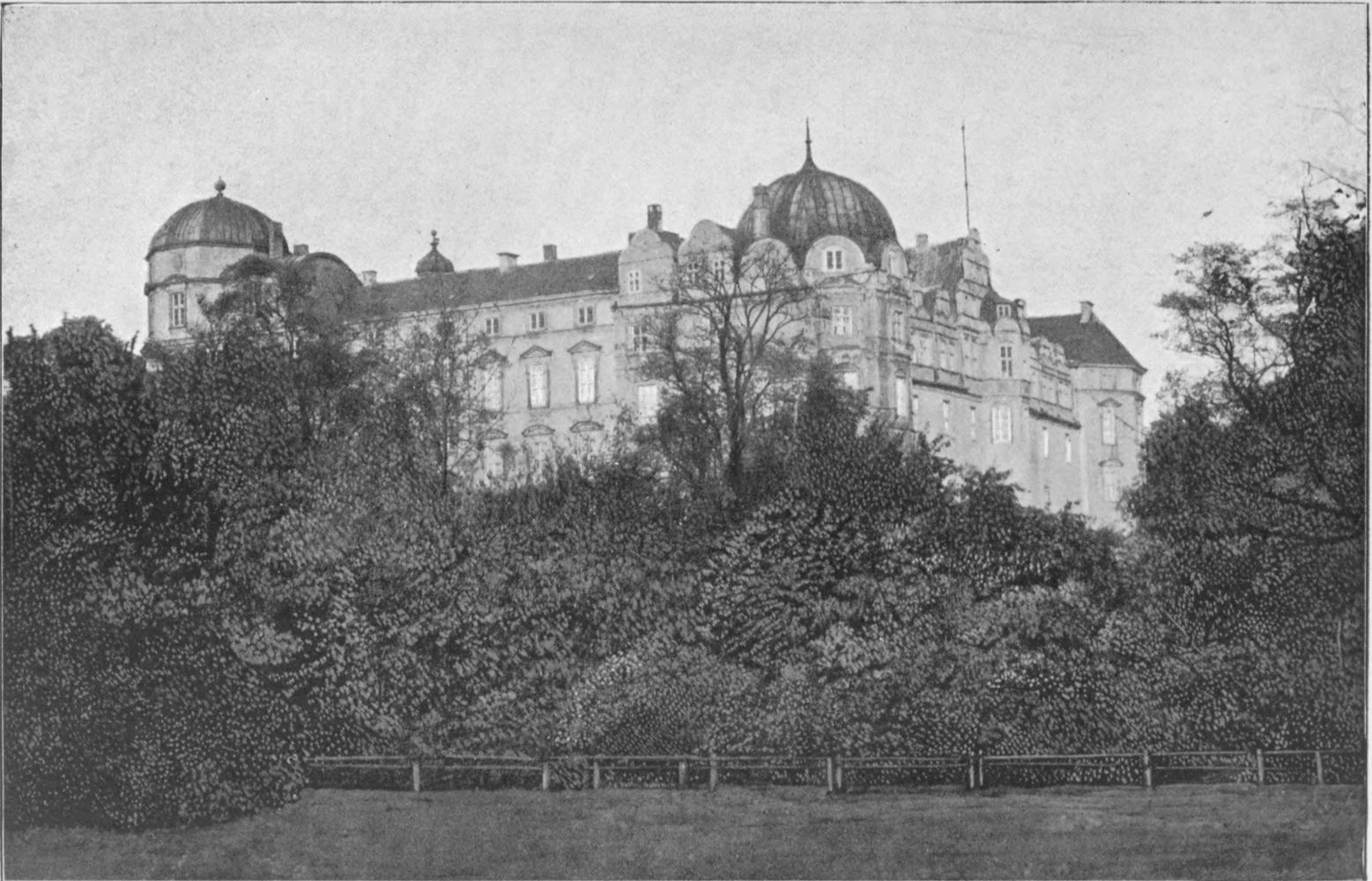
THE CASTLE OF CELLE.
The gibe was of course aimed at Eléonore, who found
herself on this occasion outwitted by her sister-in-law. Up
to this time Eléonore’s influence with her husband was not
sensibly impaired. His thoughts were still engrossed with
her advancement, and he first made a new treaty, by which
his wife was allowed the title of Duchess of Lüneburg-Celle;
and, secondly, drew up an agreement to further safeguard
her rights and those of her daughter to the rich estates of
Wilhelmsburg. Both these documents were countersigned
by the wily Ernest Augustus, whose consent was necessary,
but who was only induced to yield by a high price being
paid for his complaisance.
The Duke of Celle thought his wife worthy of any
pecuniary sacrifice at this time. Her conduct was so
irreproachable as a wife and a mother that she won the
esteem even of those who were prejudiced against her.
Grave, dignified, and beautiful, she held her husband’s
truant affections much longer than any one would have
supposed, and was careful by her conduct to make good
the position to which she had been raised. Her bitterest
enemies were unable to tarnish her fair name, and this is
no mean tribute to her virtue and prudence when we remember
the age in which she lived and the circumstances
surrounding her. Under Eléonore’s rule the court of Celle
became a model of decorum. The jovial Duke, though
wealthy and hospitable, hated display and ostentation, and
loved nothing so much as a quiet life. His tastes were those
of an English country squire. He was a fine judge of wine,
and had many rare vintages in his cellar; he had three
hundred and seventy horses in his stables, mostly English
or bred in England; his kennels, too, were largely filled
with dogs of English breed. He was a mighty Nimrod,
devoted to out-door sports. A little business with his
28Ministers and a good deal of hunting—that was his programme
for the day, and in the evening he loved nothing
better than to share the joys of the domestic hearth with
his wife and child. Eléonore, unlike most ladies who have
risen in the world, seemed equally averse to display for its
own sake, and shunned rather than courted the trappings
of state. So the court of Celle was peaceful and virtuous,
perhaps a little dull.
It was far different at the court of Hanover.
The death of Duke John Frederick without issue in 1679
had now brought Ernest Augustus and Sophia to reign over
Hanover as well as Osnabrück. Duke John Frederick was
not greatly mourned, and his reign, though merry, had been
brief. Like his brothers, he was fond of Italy, and acquired
there a love of foreign ways and a liking for the Roman
Catholic religion, to which he became a convert. Louis
XIV., who regarded himself as a defender of the faith,
gave this ducal convert a handsome pension, and treated
him with marked favour. John Frederick’s eyes were
dazzled by the glory of the Grand Monarque, whose
splendour was the wonder of Europe, and he tried to
turn Hanover into an imitation Versailles: pseudo-classical
statues were erected in the gardens; fountains were dotted
about the terraces; there were fireworks, masquerades, and
pastoral plays, Italian singers and French dancers; many
foreign monsignori flitted about the court, and mass was
again sung in the churches. The honest Hanoverians
rubbed their eyes and knew not what to make of it all.
But alien though their Duke was in some things, he had
one taste in common with his long-suffering subjects—he
loved his beer, and, after a prolonged course of hard drinking,
he died from an overspell of it. As the Duchess Sophia
wrote, “He died as a true German should, glass in hand”.
This “true German” being gathered to his fathers, Duke
Ernest Augustus and Duchess Sophia made haste to reign
in his stead. Sophia thanked Heaven for having thus
placed her husband out of the reach of his enemies, “as
which the whole court of Celle had now to be regarded”.
It was indeed a notable accession of dignity and wealth.
Both were ambitious and loved money and ostentation;
they now had a chance of gratifying their tastes. In a
smaller way Ernest Augustus had also imitated Louis
29XIV.’s court, at Osnabrück, and it seemed to that “most
Christian” monarch that the new Duke of Hanover would
follow his brother in matters of religion. He therefore
despatched a plenipotentiary, the complaisant de Gourville,
to sound him on the subject and to offer the same bait in
the way of pension as he had dangled before the eyes of
John Frederick. But Ernest Augustus was now not so
needy, and he had other objects in view, so he replied
oracularly that though no doubt a change of religion would
be advantageous to his House he himself was too old to
change. All religions were much the same to Sophia; but
she disliked being meddled with in spiritual matters, and had
her own interests, too—her English interests, then remote—which
would certainly be imperilled by a change of faith.
So the worthy pair, after taking counsel together, hit on a
compromise by not educating their daughter Sophia Charlotte
in any faith, so that she might marry the most promising
prince who offered himself, whether he were Catholic or
Protestant. When sounded later on the subject of her
daughter’s faith, the Duchess answered, “She is of no
religion as yet”. It was lucky that Sophia turned a deaf ear
to the blandishments of the French King and the Pope, or
the House of Hanover and the Protestant succession would
never have reigned in England.
Though under the new régime the court of Hanover
differed in religious ceremonial from that of Versailles, in
other respects it was a bad imitation, and the grafting of
spurious French architecture on the little mediæval German
town produced many incongruous effects, as incongruous
as the aping of French manners and French morals. For
the court of Hanover imitated not only the pleasures of
Versailles, but also its vices. Unlike his brother George
William, matrimony had effected no change in the laxities
of Ernest Augustus, and the explanation is probably to be
found in the fact that his was a marriage of policy, while
the other’s was a marriage of love. Ernest Augustus was
a man of six times the ability of George William. He was
selfish and scheming, but there was a certain splendid good
nature about him, and though his court was dissolute, it was
always brilliant. The money for his pleasures, for he was as
great a spendthrift as his brother was the reverse of one, he
raised either by squeezing George William or by equipping
30regiments of his subjects and selling them to foreign service,
as, for instance, to fight the Emperor’s enemies on
the Danube. This was in the approved style of the Grand
Monarque, who always had a war on hand by way of a
kingly pastime. Louis, like Solomon of old, had also his
beautiful favourites in great array, who reaped rich rewards
of wealth and influence. This period of European history
may be said to mark the apotheosis of military and political
adventurers and royal mistresses. There was no court
without its adventurers, and a king was hardly a king
without a bevy of mistresses. Many of them were women
of noble birth, who embarked on the career with the encouragement
of their parents and guardians, and even of
their husbands. Louise de Querouaille, afterwards Duchess
of Portsmouth, went over from France to England to win
the favour of Charles II. In the same way Clara Elizabeth
and Catherine Marie Meisenbug journeyed to Osnabrück
in the hope of capturing the good-will of Ernest Augustus
and his son.
Clara Elizabeth and Catherine Marie were of noble
birth. Their father, Count Carl Philip Meisenbug, was a
needy military adventurer, and their faces were their only
fortune. Their good looks, combined with much impudence,
a lively wit, and an utter absence of principle, sufficed to
form a very attractive pair in those days. When they were
only in their teens Count Meisenbug took his daughters to
Paris with the hope of seeing them shine at the court of
Louis XIV., a sort of Mecca to which all these worldly
pilgrims were then bound. But the established royal
favourites there did not view the fair intruders with favour,
and gave them a hint that it would be better to decamp, or
Paris would soon be too hot to hold them. The Meisenbugs,
who were poor and therefore powerless, needed no
second warning. Fear lent them wings; they packed up
with all despatch, and, looking about for a likely spot to
push their fortunes, they hit upon the little court of Ernest
Augustus, and set out thither with all speed.
The court was then at Osnabrück, and it so chanced
that the demoiselles Meisenbug arrived just when the two
eldest sons of Ernest Augustus, George Louis and Frederick
Augustus, had returned from their travels, accompanied by
their governors Platen and Bussche. The needy Count lost
31no time in presenting his daughters at court, and evidently
they created a favourable impression, for we find them
helping at a fête in honour of the young Princes’ return.
The demoiselles Meisenbug, who were fresh from all the
graces and amusements of Versailles, composed a little
pastoral play in French, which they craved permission to
perform before the Duke and Duchess, and the performance
was the most successful feature of the festival. It was given
at night in the gardens, which were illuminated for the
occasion. The young ladies appeared, as befitted their
pastoral simplicity, in the guise of shepherdesses, and recited
their lines so prettily, and danced and sang in so
charming a way that they delighted their audience and
especially won the hearts of the governors Platen and
Bussche. Having made so favourable an impression, the
sisters remained at Osnabrück to follow up their advantage.
It suited them well. It was a cheap town to live in; they
had the entrée of the court, and the free-and-easy air of the
place gave them room to develop their schemes. At that
time the young adventuresses had to moderate their ambitions.
Ernest Augustus was far above them, and Prince
George Louis was only a boy, and was sent away directly
on military service. But meantime the Meisenbugs made
the best of their opportunities. Platen and Bussche were
both rising men, and enjoyed the confidence of the court.
Failing higher game, the sisters resolved on making a conquest
of them, and they unmasked their batteries with such
success that before long they were comfortably settled in
life, Clara Elizabeth as the wife of Platen, and Catherine
Marie as the wife of Bussche.
Attached now for good or evil to the House of Brunswick-Lüneburg,
the sisters shared in its improved fortunes,
and when the court of Ernest Augustus migrated to Hanover
they went there too.
Of the two sisters, Clara Elizabeth, now Madame Platen,
was immeasurably the superior, if not in youth and beauty,
in cleverness and audacity. This woman is one of the
worst instances in history of the evil influence of the court
mistress. She had no redeeming qualities; she was unscrupulous,
ambitious, and shamelessly corrupt. She was
possessed of the immense power of one who has a fixed
purpose in life, and who will stick at nothing to obtain it.
32Having obtained the first object of her ambition, a safe and
respectable position, she was wise enough to recognise an
identity of interest with her husband, and to see that as he
advanced she would advance with him. To this end she
sought to obtain influence over Ernest Augustus. Platen,
after his marriage, was promoted to a confidential position,
and when the court went to Hanover he was raised to the
responsible post of Minister. His wife thus found herself
within the charmed circle and within touch of what she
most desired—power. A masterful disposition gave her
complete sway over her husband; she dictated to Platen,
who, in turn, advised Ernest Augustus. But this was too
circuitous a method for Madame Platen, who wished to be
next the Duke himself. Before long a post was found for
her in the service of the Duchess Sophia, and thus she came
frequently before the notice of Ernest Augustus. She
played her cards very discreetly, and, with the connivance
of her husband, brought all her arts, flatteries, and fascinations
to bear upon the Duke; so that Ernest Augustus
was first astonished at her cleverness, next flattered by her
pretended admiration for himself, and then fascinated by
her good looks. In a short time her influence over him
was supreme. Not content with having won the Duke,
Madame Platen determined also to bring the son under
her influence. When Prince George Louis returned from
his military service she threw her sister, Madame Bussche,
in his way. Her sister was younger and prettier than
Madame Platen, but much less clever and wholly under
the influence of this imperious woman. The precocious
young Prince fell captive to the charms of Madame
Bussche, who also had a complaisant husband. Thus
Madame Platen became all-powerful at the court of
Hanover. It is an ugly chapter in the history of the
Hanoverian House, but one that cannot be ignored.
Some court mistresses have been real politicians, and
their influence on public affairs has been for good and not
evil. But Madame Platen was hardly a political woman of
the first rank; she was incapable of taking a wide view of
affairs, and her efforts were directed towards the immediate
aggrandisement of the principality of Hanover, without a
thought of the larger interests outside. Into the family
feud between Celle and Hanover she entered with zest, and
33made common cause with Ernest Augustus and Sophia
against Eléonore and the Celle-Wolfenbüttel party. She
noted the growing intimacy between George William and
Antony Ulrich, which she shrewdly suspected boded no
good to the fortunes of the court of Hanover. Her methods
were essentially those of the backstairs, and she persuaded
Ernest Augustus to employ spies at Celle to report all that
went on there. In this way she acquired a knowledge of
the disposition of the Ministers who held office at Celle.
The most powerful of them all was Bernstorff, the Duke’s
Prime Minister. Bernstorff was an ambitious and avaricious
man with little principle, who had already shown jealousy
of the influence which Eléonore exercised over her husband
and resented her interference in affairs of state. Madame
Platen saw in him an instrument for her designs; she
approached him with many promises, and some more substantial
pledges from Ernest Augustus—item, a gold snuff-box
set with diamonds, and similar tokens of good-will.
Bernstorff was quite willing to listen to these overtures; he
was anxious to become a great landed proprietor, and Ernest
Augustus promised to advance his wishes in this and other
respects if he would carry out his plans. He was opposed
to the Celle-Wolfenbüttel party headed by the Duchess
Eléonore, he desired nothing better than her downfall; so
he took the bribe, and confidential communications were
opened up with Hanover. In particular he warned Ernest
Augustus of the schemes of Duke Antony Ulrich, who was
now urging the betrothal of his second son to the little
Sophie Dorothea. These communications were not nominally
carried on between responsible Ministers, but between
a spy at Celle and Madame Platen at Hanover, so that if
anything transpired they could both be disowned by the
responsible officials; but in reality Madame Platen was
dictating the policy of Hanover.
A pretty picture of moral and political corruption, it
must be confessed. One wonders what the haughty Duchess
Sophia thought of it all, and by what inexplicable means
this inscrutable woman was brought to become a passive
witness of the double capture by audacious adventuresses
of her husband and her son. Her policy was always to
ignore anything she could not help; and in this case
she seems to have offered no protest. The key to this
34riddle is probably to be found in her character. The moral
objection would not appeal to her, for though the Duchess
Sophia in her own personal conduct was absolutely above
reproach, and there is abundant evidence to prove she held
that the virtue of princesses should be above suspicion, yet
she had been trained in a school and an age which did not
demand the same standard of morality from men as from
women, least of all from princes. In her day women of the
Platen type were as much a part of the entourage of a court
as the lackeys in the kitchen or the grooms in the stables,
and since this was so, why not Madame Platen as well as
another? Sophia had done her duty to Ernest Augustus
in every sense of the word. She had been a good and
faithful wife; she had upheld the dignity of the courts of
Osnabrück and Hanover; she had borne her husband six
children, five sons and a daughter; and though they had
never any love in the highest sense for one another, yet in
time affection seems to have sprung up between this curious
couple, and they got on very well together, mainly on the
principle of leaving each other alone. According to his
lights, and possibly her lights also, Ernest Augustus was a
good husband; he always treated his consort with profound
respect, and outwardly he fulfilled the letter of his contract
with her, it was only in the spirit he failed, but Sophia
probably did not care about that. She was his duchess,
the mother of his sons, the great lady of the House of
Brunswick-Lüneburg, and that sufficed her. She was
fond of her children, too, especially of the younger boys
and her daughter, but for George Louis, her eldest son, she
had very little love. She therefore probably regarded his
affair with Madame Bussche with indifference. Nor did
religious scruples enter to any extent. She was a free-thinking
woman, who, from a philosophic eminence, looked
down upon all dogma with contempt. “The Princess
Sophia,” says Dean Lockier, “was a woman of good sense
and excellent conversation. I was very well acquainted
with her. She sat very loose in her religious principles,
and used to take a particular pleasure in setting a heretic
(infidel), whenever she could meet such, and one of her
chaplains disputing together.” This is a quaint characteristic;
and we may picture Sophia’s face as she baited her
chaplain with some truculent infidel, and chuckled while
35they fought together, finally dismissing them with “A
plague on both your houses”.[16]
Hitherto we have viewed this Princess in a somewhat
unamiable light—the side she showed to Eléonore; it is
only fair to turn the other side of the shield. Her failings
were the failings of her time, her virtues were all her own.
Reared in a dissolute court, married into a vicious one,
no word of scandal was ever breathed against her moral
character. She remained beyond and apart, a serene and
haughty figure, head and shoulders above the mean, coarse,
voluptuous, lying crowd with which she was surrounded.
Whatever was pure and of good repute, whatever made for
the higher and intellectual life, turned to Sophia at the
court of Hanover. She was a woman of great parts, speaking
five languages—Low Dutch, German, French, Italian,
and English—fluently, and was learned in the literature of
them all. She attracted to Hanover some of the choicest
intellectual spirits of the age, and among them was the
great and learned Leibniz, whose friend and patron she
was. In turn he warmly respected and admired her: she
was the “Serena” of his letters, and together they discussed
those subtle philosophies beside which such things
as court intrigues and court courtesans were as nothing
worth.
It was doubtless her communing in these serene altitudes,
together with the considerations before mentioned,
which enabled the Duchess Sophia to ignore Madame
Platen and lesser annoyances. Outwardly she received
from the court mistress every mark of respect and homage.
However impudent, brazen, and intriguing Madame Platen
might be, she was always submissive and decorous before
the Duchess Sophia, always her very humble lady-in-waiting.
The Duchess was not of a jealous temperament, and in
matters where her rank and her rights were not imperilled
her heart did not enter. Madame Platen would always be
Madame Platen; she could never rise, for instance, to the
heights of the upstart Eléonore, and arrogate to herself the
position of an equal of the daughter of kings; and so long
36as she kept her place, what matter? Besides, according to
her lights, the woman was working for the greater glory of
the House of Brunswick-Lüneburg and against the hated
Eléonore. These seem the ostensible grounds on which it
can be explained why the Duchess Sophia allowed, without
protest, such a power near her throne. But there was
perhaps another reason, too, which overshadowed all the
rest.
The great and splendid inheritance of the throne of
England already flitted before Sophia’s dazzled eyes. English
events absorbed her to the exclusion of others, and the
affairs of the court of Hanover were mere village politics
beside them. Sophia had one virtue for which every
Englishman will love her. She loved “her country,” as
she called England, with all her heart and soul and strength;
“her country,” which she had never seen, which she was
destined never to see; “her country,” over which her
grandfather had reigned a well-nigh absolute monarch;
“her country,” to which her mother had gone back, as to
home, to end her days; “her country,” for which her
brother, the dashing Prince Rupert, had fought on the
King’s side throughout the Great Rebellion; “her country,”
over which her son was to reign and her children’s children
from generation to generation. The reproach of being
German and alien in sympathy, later, often urged against
the House of Hanover, could never have been brought
against Sophia, for her heart was as “entirely English” as
Queen Anne’s. She early imbibed her love for England
and things English. She spoke the language fluently, far
better than many a Stuart. She was learned in England’s
history, its customs, and its laws. She had an English
maid always with her. In her youth she had been within
measurable distance of becoming Queen Consort of England;
in her old age she was within an ace of being Queen
Regnant.[17] It is a pity she was never Queen of England.
She would have been another and a wiser Elizabeth, whom
in many ways she strongly resembled—in her love of
statecraft, her broad and liberal view of things, her contempt
for jarring creeds, her wisdom and resource. Yes, it is a
thousand pities she was never Queen of England; she
37would have made a wiser ruler than any of her Stuart
cousins, and a far better than any of her descendants, save
only the present illustrious occupant of the throne, and
his revered mother, whose long and beneficent reign won
for her the first place among England’s monarchs of any
dynasty.
CHAPTER IV. PRINCE GEORGE GOES A-WOOING. (1681-1682.)
38
He that travels in a country before he has some entrance into the
language, goeth to school and not to travel.—Bacon.
From her watch-tower at Hanover the Duchess Sophia
followed with keen interest the course of events in England,
an interest which increased every day of her life until at
last it became an absorbing passion. She spared no pains
to keep up a good understanding between herself and her
English relatives. When Charles II. was restored to the
throne of his ancestors, she sent him a warm letter of congratulation,
written in the oddest French, which is still
preserved among the Lambeth manuscripts. Throughout
her cousin’s reign Sophia continued to watch affairs in England.
She noted Charles’s childless marriage to Catherine
of Braganza.[18] She noted the dislike and jealousy of the
people of England to Popery, and the conversion of the
heir to the throne, the Duke of York, to the Roman Catholic
religion, and his consequent unpopularity. She noted the
marriage of his eldest daughter, Princess Mary of York, to
William of Orange, and the childless condition of the
Dutchman and his spouse. Last of all, she noted that the
Princess Anne of York, on whom it seemed likely the crown
of England would devolve in the course of nature, had
reached a marriageable age, and she saw in her son, George
Louis, the husband for her, and prepared to act.
George Louis had now attained his majority. He was
not an ideal lover, by no means a Prince Charming, though
so far as looks were concerned he might have passed muster.
39He was about the middle height, dark, with strongly marked
features, but he carried himself badly, and was awkward of
figure, still more awkward in manner. He resembled neither
of his parents. Ernest Augustus gilded his faults by a
certain generosity and refinement, which earned for him
the title of “the gentleman of Germany”. George Louis
was niggardly, he had no charm of manner, he was vindictive,
sullen, slow of speech, and altogether unprepossessing.
His mother, as we have seen, was a woman of high culture
and education and a ready wit, which caused her to be
known as “the merry, débonnaire princess of Germany”.
George Louis’s education had been neglected, he had no
love of learning, and an intense dislike of literature, nor
had he any accomplishments save the love of music characteristic
of his race. But, on the other hand, he was a
good soldier, a man of the camp rather than of the court.
His tutors threw up their hands in despair when they
endeavoured to teach him anything from books, but he
took to military service as a duck takes to water. He
served under his father, when only fifteen, in the campaign
in 1675, and fought bravely at Consarbrück, at the siege of
Treves, and in the campaign on the Rhine; he was at the
sieges of Maestricht and Charleroy, and again at the battle
near St. Denis, and on every occasion he distinguished himself.
He had his own rough code of honour. He never
told a lie. He possessed in a marked degree that courage
which even their bitterest detractors cannot withhold
from the princes of the House of Hanover. Yet with all
his military instinct he loved not bloodshed for its own
sake; he was a man of peace. He had humanity for the
wounded on the field of battle, and could respect a fallen
foe. His methods were brutal, but straightforward; he was
no intriguer, and, though profligate, he was honest.
Ernest Augustus was in despair at the rude manners of
his boorish son, and thought that travel would improve
him. As he was not over-welcome at home, he sent him
to the court of France, to pick up a little polish for one
thing, and, for another, to try to improve matters between
Louis XIV. and himself. But the young Prince returned
much the same. He was not a diplomatist, and his efforts
in that direction were not a success.
It was then that the Duchess Sophia broached her plan
40of sending him to England as a suitor of the Princess Anne
of York. It was emphatically her plan. Madame Platen
had nothing to do with it, was not even consulted; in fact,
Sophia never recognised in any way this woman’s influence.
The moment could not have been more propitious. The
anti-Popery feeling was running high in England, and
already overtures had been made by the Protestant party
to the House of Hanover. Duke Ernest Augustus did not
think much of these overtures; the prospect was too vague.
England was to him little more than a geographical expression,
and the violent events of recent years filled him
with distrust. He had witnessed in England the Great
Rebellion, the downfall of the Monarchy, the execution of
the King, the setting up of the Commonwealth, the downfall
of the Commonwealth, the restoration of the Monarchy,
and now the Puritan party seemed to be rising again. He
did not trust a nation which indulged in such extremes, and
he regarded England much as the average Englishman
to-day regards France. But he was not averse from the
idea of marrying his eldest son to a Princess of the Royal
House of England; in any case she would have a goodly
dower, and so, to please his wife and his own inclinations,
he consented to find the money to despatch George Louis
to England in a manner befitting his rank and errand.
PRINCE GEORGE LOUIS OF HANOVER (AFTERWARDS GEORGE I. OF ENGLAND). From a picture at Hanover.
The Duchess Sophia was delighted with her husband’s
willingness to fall in with her plan (she little knew that all
the while behind her back he was intriguing for another
match for Prince George, should this fall through), and she
took the keenest interest in her son’s visit. Another also
took an interest, that born intriguer, William of Orange, the
husband of the Princess Mary of York, who was jealously
watching events in England. When he heard of George
Louis’s intended visit he scented mischief ahead, and sent a
flattering invitation to Hanover asking the young Prince to
spend a month with him at the Hague on his way to England.
Sophia was glad that her son should visit his Stuart cousins
in Holland, and the invitation was accepted. It was a fatal
error of policy, for William soon learnt from the young Prince
the object of his mission, and immediately set to work to
render it null and void. He, too, was half a Stuart, a grandson
of Charles I., and the prospect of the crown of England
had its charms for him also; he coveted it not merely for
41his wife. If George Louis married the Princess Anne, and
the Princess of Orange died before her (as in fact she did,
though not till she had been Queen), William, her consort,
would probably have to give way to their prior claims; for
George Louis was a Protestant, and only one step further
removed from the blood royal of England than himself;
therefore it behoved him to move heaven and earth to prevent
this match.
He had spies in England, at Hanover, and at Celle, and
he set them all at work. His agent in Hanover was probably
Madame Platen, and at Celle Bernstorff, both of whom were
open to bribes. Their work was simple: they were to represent
to their respective princes how much more suitable
and advantageous it would be if George Louis married Sophie
Dorothea. Of course, they could do nothing more than
prepare the ground, and drop a hint now and then; but
even that would bear fruit. In England William had
emissaries everywhere, at court, and even in the household
of Princess Anne.
Meanwhile the unsuspecting George Louis parted from
his cousins, William and Mary, with many expressions of
good-will, and set sail for England. He anchored off
Greenwich early in December, 1680 (New Style). His
arrival was well timed, from the popularity point of view.
Public feeling was excited over the so-called Popish plots,
and the unpopularity of the Duke of York was at its height.
The Bill which excluded him from the succession to the
throne because he was a Papist was before Parliament, and
in the event of its passing into law George Louis’s prospects
as a Protestant descendant of the Stuarts would be improved.
The Bill did pass with acclamation, but the King
dissolved Parliament immediately.
George Louis’s arrival, though his errand was well
known, does not seem to have been equally popular with
the court; his barque lay in the mud off Greenwich, but no
one was sent to look out for him or to bid him welcome.
When he landed in England again it was as King: such
are the ironies of history. At this time George Louis did
not expect great things; he sent to his uncle Rupert, and
presumably explained matters to him. Henceforward
things went more smoothly. George Louis was lodged in
Whitehall and received by Charles II. very graciously. He
42was presented to the Princess Anne, and by the King’s
permission suffered to kiss her cheek; but his wooing did
not prosper as might have been expected from so promising
a beginning. The Princess Anne at that time was seventeen
years old, in the full bloom of youth, and had a considerable
share of good looks of a florid description. Accustomed as
she was to all the grace and splendour of the English court,
Princess Anne looked with little favour on the awkward
advances of her German cousin, who could not speak a
word of the English language, and whose person was not
pleasing nor his manner courtly. Naturally reserved, he
was very shy when he was first presented to her, and
awkward in saluting her, and William of Orange caused it
to be whispered to Anne that the Prince’s backwardness
was owing to an irrepressible disgust which he felt for her
at first sight, and that he had spoken slightingly of her
charms. This was enough for Anne, whose vanity was
easily wounded; she would have nothing more to say to
her loutish lover, and cherished a lifelong resentment at
the imaginary affront.
Neither the King nor the Duke of York favoured the suit
of the Hanoverian Prince, because he was unjustly supposed
to be in league with the Prince of Orange. But still
George Louis lingered in England, and paid a visit to
Cambridge, where he was received with every mark of
honour and given the degree of Doctor of Laws. Cambridge
was thus early in the field to demonstrate her loyalty
to the House of Hanover. When it is remembered that the
Prince was a stranger to England, and could not speak a
word of the language, it is evident there must have been
some political motive on the part of the university. It was
to be found in party feeling, which then ran high. Parliament
met at Oxford, and was still clamouring for the
Exclusion Bill, but the King put his foot down, absolutely
refused to alter the succession, and again dissolved Parliament.
This was a severe blow to the Protestant party and
incidentally to the Protestant princes.
Soon after, George Louis was summoned home abruptly,
and he returned to Hanover in the spring. Ernest
Augustus, seeing there was no hope of his son marrying
the Princess Anne, became impatient about the English
succession, for which he did not care a fig; besides, there
43was a tendency in England to draw the young Prince into
intrigues, and both Sophia and himself always opposed anything
which might tend to embarrass the reigning House
of England. In this respect the conduct of the House of
Hanover forms an honourable contrast to that of William
of Orange. Her son’s return empty-handed was a bitter
disappointment to Sophia, who saw her English hopes
shattered. She withdrew once more to the consolations
of philosophy, conscious that the failure of her plan had
brought with it a waning of her influence with her husband.
George Louis had been sent on a wild-goose chase, and
Ernest Augustus had to pay the bill, which he did with
very ill grace; for, though he was lavish with money
where his own pleasures were concerned, he had the
German thriftiness about spending it on others.
Madame Platen’s star now rose in the ascendant, and
she urged with added force and plausibility the scheme of
a marriage between George Louis and his cousin, Sophie
Dorothea. Of course, all had to be done behind the back
of the Duchess Sophia, who regarded the court of Celle
with unconcealed aversion. Ernest Augustus had not the
same feeling of personal bitterness against Eléonore as his
wife, and he was quite willing to make terms with George
William, or, for a matter of that, with her, if he could thereby
add to his fortunes, and he therefore gave ready ear to
the idea. The advantages of the union were many and
obvious; the young lady was rich, her dower would be
large, the marriage would unite the severed principalities
of Celle and Hanover, and so add enormously to the power
of the House of Brunswick-Lüneburg; it would end an
unpleasant family feud, fraught with weakness and danger
to both parties, and would set up again an identity of
interest between the brothers. All this would happen if
Sophie Dorothea married George Louis; but if she married
a rival prince, under the present strained relations, dangers
would arise which it would be impossible to foresee. The
breach would widen, and the principality of Hanover would
be threatened with a foe at its very doors. From a political
point of view nothing could be better than this marriage—for
Hanover. At Celle the ground was not unprepared;
Platen had communicated with Bernstorff, and that pliant
tool had also sounded George William who was more than
44willing; the failure of other matrimonial plans for his
daughter made him more complaisant. As the continual
dropping of water wears away a stone, so Bernstorff, by
hint and innuendo, was slowly undermining the influence
of the Duchess of Celle. He traded on the fact that she
was “the Frenchwoman,” he exaggerated the jealousy which
arose from so many French officers holding commissions in
the ducal army, he hinted discreetly to the Duke that the
neighbouring princes and even the Emperor were laughing
at him because he allowed himself to be ruled by his wife,
and he particularly opposed the growing power of the Celle-Wolfenbüttel
party.
Duke Antony Ulrich had by this time brought forward
his eldest surviving son, a handsome prince, as a suitor for
the hand of Sophie Dorothea. The young couple were of
a suitable age, and Eléonore warmly encouraged the match.
If the matter had rested with her, the betrothal would long
since have taken place. Her first check had come when she
proposed it to George William. To her astonishment he
held back. He was superstitious, and thought the untoward
ending of the first match between his daughter and a
Prince of the House of Wolfenbüttel was an ill omen. He
did not approve of her marriage with the younger brother
when she had been betrothed to the elder, for in Germany
at that time betrothal was almost as solemn a compact as
marriage itself. These were the reasons he put forward
for opposing the betrothal; but Eléonore, who suspected
something behind, talked him over, and at last he was
induced to unwillingly give a half promise that was almost
a consent, on the condition that the betrothal should be
postponed until Sophie Dorothea was sixteen, and meantime
the arrangement should be kept secret. With this
Eléonore and Antony Ulrich had to be content. The Duke
was easily swayed, and it was Bernstorff who prompted the
delay; he now used the time gained to further oppose the
match and to urge the Hanoverian claims.
So matters went on until September, 1682, when Sophie
Dorothea was to attain her sixteenth birthday. In some
way the half promise which the Duke of Celle had given
leaked out, and also the news that Duke Antony Ulrich
and his son were coming to Celle for the celebration of the
Princess’s birthday on September 15. Bernstorff immediately
45communicated this to the court of Hanover. The
news filled Ernest Augustus and his advisers, the Platens,
with dismay; they had been intriguing for months, and now,
through a sudden move on the part of the Duchess of Celle,
their schemes were on the edge of failure. If Bernstorff had
not discovered the plot they would certainly have been lost.
In any case the time for talking was past, the time for action
had come; Antony Ulrich and the young Prince were actually
on their way to Celle, and Eléonore was arranging a
great festival, when no doubt the betrothal would be publicly
announced. Then it would be too late. Owing to the
badness of the roads, the news only arrived at Hanover on
the morning of the day before. What was to be done? If
Ernest Augustus were to go to Celle, Eléonore would guess
the reason of his sudden appearance and outwit him. To
send George Louis would be to court failure (they had had
two experiences of his diplomacy); to send a Minister would
be useless; to send Madame Platen an insult. There was
only one person who could hope to carry the difficult business
through, and she was the Duchess Sophia. She had
influence with the Duke of Celle. Her quarrel had been
with his wife and not with him. He had always treated
her with honour and even affection; probably he felt some
twinge of shame for the shabby way he had behaved to her
years before. Her descent from a long line of kings, her
high position, learning, and virtues, her wit and resource,
all made her the ideal ambassadress for such a mission.
George William would be flattered by her condescension
in coming to Celle; he was seeking an excuse to bring
about the match, and would meet her half way. But
would she go?
It was not without misgiving that Ernest Augustus repaired
to his Duchess, laid bare his plan, and implored her
aid. It came to her as a revelation, and at first the haughty
Sophia would have none of it. She hated the d’Olbreuse, and
despised Sophie Dorothea because she was her daughter;
she had never recognised them, never visited them, and
always treated them as dirt beneath her feet. The last
thing she contemplated, or wished, was to be brought into
closer alliance with them. It did not come to her altogether
as a new idea, for the possibility of such a marriage had often
been discussed before, only to be contemptuously rejected
46by Sophia. Five years before, in 1677, it is mentioned
in her correspondence with the Duchess of Orleans, who
profanely denounced it as a “sin against the Holy Ghost”.
But the arguments and entreaties of Ernest Augustus had
weight with her; he reminded her that her English plan had
failed, and urged that she should make some compensation
for the expense and disappointment which she had brought
upon him. She recognised the force of this reasoning; she
was just now suffering all the humiliations of defeat, and if
she could carry this difficult thing through it would restore
her lost prestige. She knew well enough—it did not need
to be explained to her—the substantial advantages that
would accrue from the union of the duchies and the bringing
of a large dowry into the coffers of Hanover. She saw, too,
how disastrous it would be for the Celle-Wolfenbüttel party
to triumph and Eléonore to be victorious. The last thought
was perhaps the most powerful of all; by consenting to go
to Celle she would outwit her rival, wound her to the heart,
frustrate her most cherished plan, and ruin her influence for
ever. So Sophia consented to undertake the mission, and,
with characteristic energy, prepared to start at once. The
state chariot and Mecklenburg horses were ordered out, and
with postillions and outriders the haughty Duchess set forth.
There was no time to be lost; she must reach Celle before
to-morrow morning or the Wolfenbüttels would be there
before her.
It was a dull evening in mid-September when Sophia
rumbled in her heavy coach out of Hanover and over the
rough road towards Celle. Celle is distant from Hanover
about twenty miles as the crow flies; but because of heavy
rains many of the roads were impassable, and the coach had
to travel by a circuitous route. It took the Duchess all night
to reach her journey’s end.
CHAPTER V. THE SACRIFICE. (1682.)
47
After this alliance
Let tigers match with hinds, and wolves with sheep,
And every creature couple with its foe.
Dryden.
The mists of a raw September morning hung about Celle
as the Duchess Sophia drove in from the Hanover road,
stiff and cold from her long journey. One wonders what
thoughts crowded into her brain as the coach rattled through
the quaint streets of the little town. She had not been here
for seventeen years, never since Eléonore had queened it at
the castle, and she had come to-day to disqueen her, by
destroying her influence and bringing to naught her most
cherished scheme. Yet she would have to make peace
with her, turn to her a smiling face, and enter into close
and intimate relations with the woman she hated, insulted,
and despised. It must have been with mingled feelings
that Sophia saw the towers of the mighty schloss rise before
her.
The sleepy sentinel, recognising the unaccustomed
liveries of Hanover, hurried to let down the drawbridge,
raise the portcullis, and salute the great Duchess. The
moment the coach entered the courtyard Sophia alighted.
A glance sufficed to show her she was not too late, the
Wolfenbüttel equipage was not yet there. Brushing aside
ceremony, she, who was so great a stickler for etiquette,
demanded to see the Duke of Celle at once. The few half-awakened
servants who happened to be up as she entered
the castle, astonished at the unexpected apparition, explained
to her that His Highness had not yet risen, he was
even now dressing, but would soon be able to descend and
receive her in a fitting manner. But Sophia was in no
48humour to tarry; ascending the great staircase, she haughtily
demanded to be shown at once to the Duke’s chamber, in
bed or out of bed, dressed or undressed, her business was
one which would admit of no delay. The flurried page
conducted her to the door of the ducal apartment, and here
she ordered him to leave, and announced herself by promptly
opening the door and walking in upon the astonished Duke,
who was then at his dressing-table.
Of all people in the world, his sister-in-law was the one
George William least expected to see; but Sophia cut
short his exclamations and apologies by announcing that
she had travelled all night to present in person her congratulations
to himself and his Duchess on the occasion of
the sixteenth birthday of their daughter, and wound up by
asking curtly, “Where is your wife?” The Duke pointed
to the half-open door of the bedchamber adjoining, where
Eléonore was still in bed—a capacious bed in a comparatively
small room with the ceiling decorated with a
realistic fresco of the legend of Leda and the Swan.[19] Eléonore,
hearing voices, called out to her husband to ask who
came thus early to disturb their rest. The Duchess Sophia,
through the half-open door, repeated in a loud voice what
she had already said to the Duke, thus breaking the ice of
the awkward first greeting with her enemy, and, without
waiting to hear what the perturbed Eléonore had to say in
reply, she turned to the Duke, and, addressing him in Low
Dutch, a language she knew his wife did not understand,
she intimated that she had something important to say to
him alone. George William glanced meaningly at the half-open
door, behind which was the flurried Eléonore, and
suggested they should wait a little while and discuss the
matter elsewhere. But Sophia cut short his excuses and
proposals by answering that what she had to say must be
said there and then. She could not be so rude as to shut
the door in Eléonore’s face, so she drew up a chair by the
Duke’s dressing-table, and, continuing to speak in Low
Dutch, proceeded to unfold her scheme—first exacting from
him a promise that, if he did not accede to her wishes, he
was never to divulge a syllable of what she had come to
say.
49In a few vigorous sentences she skilfully explained the
real object of her visit. She began by deploring the family
feud which had too long existed between the courts of
Hanover and Celle, and expatiated upon the desirability of
reconciliation and the advantages which would inevitably
follow a closer union. George William, who by this time
had made a shrewd guess at what she was driving, followed
her with many encouraging nods and ejaculations, and when
the uneasy Eléonore from the next room called out that she
would like to know the subject of the conversation, he bade
her roughly to be quiet, and invited Sophia to proceed.
That lady then touched upon the services which had been
rendered to the Emperor by the troops of Hanover and Celle,
and hinted at the probable raising of the duchy to an electorate;
she did not say which duchy, but George William
thought it was the duchy of Celle, whereas she had in her
mind (and her surmise eventually proved correct) the accession
of the duchy of Hanover to this coveted dignity.
She went on to say that sooner or later there would be an
addition of territory in the shape of the duchies of Bremen
and Verden,[20] declared it would be a pity if a fine domain
like Wilhelmsburg, Sophie Dorothea’s inheritance, should
be alienated from Brunswick-Lüneburg territory, and then
by a natural sequence proceeded to show that all evils could
be averted and all good things brought about by the marriage
of her son George Louis with George William’s daughter,
Sophie Dorothea. George Louis she described in glowing
terms; she alluded to his high favour with William of
Orange, and his connection, through her, with the Royal
House of England, which assured him the good-will of that
great Power.
George William was completely carried away by the
eloquence and arguments of his illustrious sister-in-law.
No one, he told her, could regret more than he the breach
between the two Houses, it was not his doing, and he was
glad of an opportunity of reconciliation. He saw clearly
the advantages that would follow upon the marriage proposed,
and he promised his consent. He did not need
much persuasion, he only wanted the excuse of meeting the
proposal which her visit gave him, for the marriage had been
50the secret desire of his heart for years. With the warmest
assurances of friendship he kissed Sophia’s hand, and then
escorted her to a suite of apartments to rest after her journey.[21]
The anxious Eléonore, who by this time was up and
dressed, was waiting for her husband on his return, and
asked for an explanation of this unexpected visit. He
gave it promptly, and added the unwelcome intelligence
that he had consented to an alliance between George Louis
and Sophie Dorothea. Eléonore was at first stunned by
this blow to her hopes on the very morning of expected
victory. The alliance she had laboured for years to bring
about with the House of Brunswick-Wolfenbüttel was shattered
to the dust, and the woman who had slighted and
scorned her had only to propose an opposition scheme for
it to be accepted. In vain she urged upon the Duke the
insult such a volte-face would be to Duke Antony Ulrich
and his son. George William answered testily that he had
given nothing but a conditional promise. In vain she
pointed out the hostility and self-seeking policy of the
House of Hanover. George William said he was tired of
family quarrels, and hailed this as a means of putting an
end to them. He then proceeded to dilate upon the advantages
of the union, and the advisability of Eléonore
reconciling herself to the new state of affairs and burying
the hatchet. But Eléonore, to her honour be it said, was
unlike her husband in this—she was deaf to the voice of
51ambition where her heart was concerned. The failure of
her cherished plans was bad enough, but it was as nothing
compared with the wreck of her daughter’s happiness.
She threw herself on her knees before her husband, and
implored him, with tears, not to sacrifice their only child,
the one pledge of their love, to the promptings of policy
and ambition, and doom her to the misery of a loveless
marriage; she reminded him of the tales that had reached
Celle of George Louis’s sullen and profligate character, and
of the hatred with which the House of Hanover had ever
viewed her daughter and herself. It was like throwing their
lamb to the wolves. But George William was obdurate;
he pooh-poohed all these things as idle fancies, and again
told his wife to reconcile herself with the altered state of
affairs, and, deaf to her entreaties, he bade her go and
acquaint Sophie Dorothea with the plans he had made for
her future. With a heavy heart the mother went to break
the news to her daughter, a sad greeting for a birthday
morning.
The young Princess had not been trained to control her
emotions nor to having her will thwarted. The spoiled
darling of her father’s affections, she had hitherto only to
wish for a thing and it was hers, and her wishes had been
law at Celle. When, therefore, she was told it was proposed
to hand her over to a man she had scarcely seen, and whom
she had been taught to despise, without consulting her
wishes in any way, she flew into a violent passion, and
vowed she would have to be dragged to the altar before
she consented. Her heart was free, for, though she was
well disposed towards the young Prince of Wolfenbüttel,
she had not yet learned to love him, and, though romance
has it otherwise, there is no proof that the boy and girl love
between herself and Königsmarck had made much impression
upon her. But she was by no means favourably
disposed towards George Louis. She had heard of his
loutish manners and his loose morals. Her mother had
taught her from her youth up to regard the Duchess Sophia
and her son as her greatest enemies. She knew how they
had insulted her mother and what degrading epithets they
had applied to herself, and the news that she was about to
be handed over to their tender mercies filled her with consternation
and grief. After the first outburst her emotion
52found relief in tears, and she clung to her mother, and
besought her to save her from such a fate. Poor Eléonore,
who was powerless, could only mingle her tears with her
daughter’s.
While this scene was being enacted in one wing of the
castle, in another the Duchess Sophia and George William
sat down and despatched a hearty breakfast. Sophia, delighted
with the success of her mission, spared no pains to
make herself agreeable and to flatter George William to the
top of his bent; she was also pleased to be gracious to
Bernstorff, who had heard of the morning’s work, and who,
on his part, did everything he could to bolster up the Duke
in his determination. A mounted messenger had already
been despatched to carry the good news to Hanover, and
to bid Duke Ernest Augustus and Prince George Louis
come to Celle with all speed.
The breakfast was hardly over, the day had scarcely
warmed, when the trumpeter on the tower announced the
arrival of Duke Antony Ulrich and his son. They came
with a numerous suite, ostensibly to offer their congratulations
on the anniversary of the birthday of Sophie Dorothea,
in reality to claim the fulfilment of her father’s half promise.
The sight of the Duchess Sophia’s coach in the courtyard
and the Hanoverian liveries filled Antony Ulrich with
suspicions which were only too speedily confirmed. The
young Princess, he found, was too much perturbed to receive
their congratulations in person, her mother was shut up
with her; but the Duke of Celle, accompanied by the
Duchess Sophia, received the Wolfenbüttel princes with
much ceremony, and without ado proceeded to inform them
of the news of the betrothal of Sophie Dorothea to George
Louis, and by way of adding insult to injury invited them
to remain to the birthday feast, when the betrothal would
be announced. Duke Antony Ulrich, mastering his indignation
with an effort, was so much insulted at this shameless
right-about-face that, ignoring the invitation, he at once
returned to his coach, accompanied by his son, and shook
the dust of Celle off his feet. It is difficult to call such a
retreat dignified, yet he seems to have made it so, though
he left the Duchess Sophia in possession of the field.
George William, having got rid of his unwelcome guests,
proceeded to the apartments of Sophie Dorothea on the
53troublesome errand of persuading his refractory daughter to
put in an appearance and pay her respects to her aunt. He
took with him a birthday present and a message of congratulation
from the Duchess Sophia. The apartments of
Sophie Dorothea consisted of three rooms leading from one
another; the work-room or school-room, with two large
windows overlooking the lime-trees on to the moat, the
parlour, somewhat elaborately decorated, and the sleeping-room,
with the bed in an alcove, and the superb carved
mantelpiece, supported by four cupids. These rooms Sophie
Dorothea had occupied from her infancy, and her work and
all her little treasures were scattered about. The Duke’s
resolution did not waver, though he found his daughter
lying on the bed in a passion of grief, her mother by her
side entreating her to be calm. Apparently her persuasions
had not, so far, had much effect, for the temper with which
Sophie Dorothea received her father may be gathered from
the fact that when he gave her the Duchess Sophia’s present,
a miniature of George Louis set in diamonds, she threw it
from her with such violence that it was shattered against
the wall, and the precious stones fell all about the room.
Her father began to threaten and storm and reproach
her mother for encouraging their daughter in this insubordination.
Parental authority had its weight with even the
most self-willed young Princess in those days, and the result
of the combination of her father’s threats and her mother’s
entreaties was that Sophie Dorothea gradually became
calmer, and was coaxed, or forced, into getting up and
dressing herself, and consented to be presented to her aunt
Sophia in a proper manner. She had also to go through
the ordeal of receiving the birthday congratulations of the
court and of appearing at the banquet, when her betrothal
was announced; but her tear-stained eyes and downcast
looks, no less than her mother’s pallor and dejection, made
it evident that she was acting under compulsion, and evoked
the pity rather than the congratulations of the court of Celle.
Perhaps the Duchess Sophia found in the tears of Eléonore
and her daughter some consolation for the humiliation she
underwent in thus recognising and meeting them for the
first time as equals.
The next day Ernest Augustus and George Louis arrived
from Hanover. Ernest Augustus was radiant, but George
54Louis was even more sullen than his wont. The beginning
of the wooing was not promising. The young Princess
fainted in her mother’s arms when she was presented to her
future husband. Her dislike was quite reciprocated by
George Louis, who, though willing to go through the affair
for the sake of the money, had been trained to have nothing
but contempt for “Madame” of Celle and her daughter.
His manners at the best were not prepossessing, and in this
case he did not even take the trouble to make himself agreeable
to his future bride. The elders did all the smiles and
congratulations; the principals in the contract rendered
nothing but an outward acquiescence, sulky on his side,
and rebellious on hers.
Yet, looking at it from quite the outside point of view,
if George Louis had sought all over Europe he would
hardly have found a more suitable match than this, and
he certainly could not have found a more charming bride
than his princess cousin. Sophie Dorothea had grown to
great beauty. She was a brunette, with dark brown, almost
black hair, large velvety eyes, regular features, brilliant complexion,
and the veriest little red rosebud of a mouth. Her
figure was perfectly proportioned: she had an exquisite
neck and bust, and slender little hands and feet. She
had nothing in common with the large-waisted, flat-footed
German princesses of the period; she resembled her mother,
and, like her, was essentially “the Frenchwoman,” not only
in appearance, but in manners, dress, and conversation.
She had the Frenchwoman’s instinctive dislike to anything
coarse or unrefined, and she excelled in all the accomplishments
of the time; her dancing was perfect, she was a
skilled musician, she was clever with her needle, and could
express herself gracefully in writing. Her conversation was
sprightly, she was full of wit and repartee, and her ready
tongue, it may be feared, often led her into trouble. She
had the Frenchwoman’s emotional temperament, she was
easily depressed and easily elated, and was capable of
strong and unreasoning passion. But her instincts were
always generous, and she was absolutely free from meanness
in thought, word, or deed.
Such a disposition united to a good and wise husband
might have been trained into a fine and noble nature. As
it was, no man could have been found more unsuitable to
55her than George Louis; their temperaments were totally
dissimilar, it was like the union of cold and heat, of ice
and fire. George Louis had his good qualities, too, though
somewhat latent, and a tactful and sympathetic wife might
have developed them. Poor Sophie Dorothea never even
found them, much less developed them. How could she?
She and George Louis were utterly unsympathetic, and
when two antagonistic chemicals are mixed there is sure
to be an explosion sooner or later. But the hearts and
inclinations of the young couple were the last things the
parents, except Eléonore, thought of in connection with
them.
George William was delighted to play the host again to
his favourite brother and his respected sister-in-law. The
betrothal was announced with much pomp. There were
great feasts at Celle, and every one came to congratulate.
All the neighbouring princes, with the exception of Brunswick-Wolfenbüttel,
and all the great officers of both duchies,
were delighted at the betrothal. Indeed, the advantages
seemed many and obvious, and Eléonore, seeing how
strongly the tide of popular feeling was against her, to
say nothing of George William’s obstinacy, had perforce
to give way, hide her mortification as best she could, and
counsel her daughter to submission to the will of her father.
It was not an easy task, for Sophie Dorothea had a will and
temper of her own, but she was brought to some show of
outward complaisance, and induced to passively receive the
congratulations of the court and the unwilling wooing of her
betrothed.
George William, Ernest Augustus, and Sophia agreed
that, as there was no reason for delay, the marriage should
be celebrated as soon as the necessary formalities and
settlements were completed. Platen and Bernstorff were
called in to help and advise, and lengthy deeds were drawn
up. Eléonore seems to have been too heartsick to interfere,
or perhaps she was powerless, for in the marriage settlement
Ernest Augustus and Sophia had everything their own way,
and Sophie Dorothea’s interests, apart from her husband
and prospective children, were scarcely studied. George
William was in so complaisant a mood that the Duke and
Duchess of Hanover could ask almost what they liked.
He settled to give his daughter one hundred thousand
56thalers a year, which meant that he handed it all over to
the exchequer of Hanover. The estates he had settled on
her were also made over, except in the case of certain
unlikely contingencies, such as the death of George Louis
before his wife. If the Princess were left a widow, she was
to be entitled to a dower of twelve thousand thalers a year.
But the whole gist of the settlement was that the Princess,
apart from her husband and her children, had no money of
her own and no settlement in the modern sense of the term.
Of course, she would be given enough to maintain herself
in proper state as Princess of Hanover; but her money
depended entirely on the good-will of her husband and
what her parents chose to give her from time to time; she
had literally not a penny which she could call her own.
Her position was much that of a married woman in England
before the passing of the Married Woman’s Property
Act. The point is important in view of future developments.
One stipulation the Duchess Eléonore was able to
enforce before the marriage contract was signed: George
Louis’s intrigue with Madame Bussche was a matter of
common notoriety, and she insisted that it should be broken
off and the mistress sent away from Hanover. This very
reasonable request was supposed to be very unreasonable,
but Eléonore was firm. Sophie Dorothea had not yet
notified her consent in writing, and people were beginning
to comment on her downcast looks. The Duke of Celle
did not wish it to appear that she was forced into an unwilling
marriage, and to humour her and her mother it was
promised that Madame Bussche should be sent away. The
Duchess Sophia went back to Hanover to see the business
carried through. In return for this concession Sophie
Dorothea was induced to write the following letter to her
aunt; it was merely a formal letter, probably dictated in
substance and simply copied by her. Reading between the
lines, we can see the mute protest that runs through it.
“Madame,
“I have so much respect for my lord the Duke your
husband, and for my lord my own father, that in whatever
manner they may act on my behalf I shall always be very
content. Your Highness will do me, I know, the justice to
believe that no one can be more sensible than I am of the
57many marks of your goodness. I will carefully endeavour
all my life long to deserve the same, and to make it evident
to Your Highness by my respect and very humble service
that you could not choose as a daughter one who knows
better than myself how to pay to you what is due. In
which duty I shall feel very great pleasure, and also in
showing you by my submission that I am,
“Madame,
“Your Highness’s very humble
“And very obedient servant,
”Sophie Dorothea.
“At Celle, October 21, 1682.”
THE ELECTRESS SOPHIA. Photographed from the statue in the gardens of Herrenhausen.
The Duchess Sophia probably found in this letter and
in the tears and anguish of Eléonore and her daughter
some compensation for the effort it cost her to make the
visit to Celle. Of her part in the betrothal she was probably
ashamed, for we find her making no mention in her letters
to the Duchess of Orleans of her journey to Celle, but concerning
the marriage she wrote as follows:—
“Ernest Augustus always had a queer head, and how
such an idea could have entered it passes all my understanding.
However, one hundred thousand thalers a year
is a goodly sum to pocket, without speaking of a pretty
wife, who will find a match in my son George Louis, the
most pigheaded, stubborn boy who ever lived, and who has
round his brains such a thick crust that I defy any man or
woman ever to discover what is in them. He does not care
much for the match itself, but one hundred thousand thalers
a year have tempted him as they would have tempted anybody
else.”
The marriage contract was signed at Celle by Ernest
Augustus and George Louis on the one part and George
William and Sophie Dorothea on the other; thus the
Princess was induced to sign away not only her liberty, but
her fortune, and she became soul and body the property
of George Louis. The Duchess Sophia came back from
Hanover to be present at the wedding, which was hurried
forward with all speed. Great preparations were made for
it, and costly presents and congratulations poured in from
all sides.
The wedding was celebrated in the private chapel of the
58castle of Celle, according to the Lutheran rites, on November
21, 1682, with every circumstance of pomp and ceremony.
The town was gaily decorated, the castle was thronged with
distinguished guests; there had never been such a wedding
at Celle before. The beautiful little chapel, brilliantly illuminated
and bedecked with flowers, presented a scene of
unusual splendour. There were the bride’s procession and
the bridegroom’s procession, and the procession of the
parents, and the court chroniclers exhausted themselves in
describing the beauty of the bride, the list of her jewels,
the richness of her attire. The bridegroom was scarcely
less bravely arrayed. Outwardly all was fair; but within,
beneath this brave show, what horror, what anguish, what
base and ignoble passions! There was the Duchess Sophia,
exulting over the downfall of her enemies, yet with a spice
of bitterness in her cup; her husband, the wily and covetous
Ernest Augustus; the weak-minded George William;
the sad and anxious mother, who could scarcely restrain
her tears; the bridegroom muttering the unwilling words,
while all the time his heart was with his banished mistress;
the child bride, she was little more than a child, pale and
unresponsive, sacrificed like another Iphigenia. The omens
were unpropitious: there was no sunshine for the bride;
the morning dawned dark and gloomy, and during the
ceremony a furious storm broke over Celle, and the wind
shrieked and raged, shaking the castle walls. But dark
and gloomy though the day was, it was not so dark and
gloomy as the bride’s heart; and fierce though the tempest,
it was not half so fierce as the passions which raged in the
breasts of the little group around the altar. There were
priests and prayers and benedictions, all the pomp of
heraldry and the pageantry of courts; yet when all was
stripped away this marriage was nothing but a shameless
bargain, and a young girl’s life was sold to a man steeped
in selfishness and profligacy and who did not even make
a pretext of loving her. When we are tempted to pass
judgment on all that happened after, we must remember
that the bride’s vows were made half in ignorance, wholly
under protest. The outward form was there, the words
were spoken; but Love, who hallows the sacrament, was
far away, and shuddering hid his holy face.
CHAPTER VI. THE COURT OF HANOVER. (1682-1684.)
59
The court’s a golden but a fatal circle,
Upon whose magic skirts a thousand devils
In crystal forms sit tempting innocence,
And beckon early virtue from its centre.
Lee.
There were great rejoicings at Hanover in honour of the
home-coming of the youthful pair. The marriage was
exceedingly popular among all classes, and the people vied
with the court and nobility in celebrating an event which
was to contribute so materially to the prosperity of the
duchy. George Louis and Sophie Dorothea entered Hanover
in a state coach drawn by six cream-coloured horses
and preceded by a military escort, and passed in procession
through the decorated streets and shouting multitudes to
the Alte Palais (the old palace), where they were to take
up their abode. Sophie Dorothea’s parting from the home
of her childhood had been sad, but her welcome to Hanover
was a warm one, and she forgot her sadness in the general
rejoicing. Yet a shadow fell across the bride’s path on the
very threshold of her new home. Madame Bussche, though
under orders to quit, had not yet left Hanover, but had the
audacity to appear with her sister, Madame Platen, at an
upper window of the palace. Tradition says that as George
Louis was helping his young wife to alight, she looked up
by chance, and saw this Jezebel at the window with her
face convulsed with hate. Sophie Dorothea started and
turned pale, she guessed instinctively who it was. The
Duchess Sophia noticed her too, and was so angry her
orders had been disregarded that she sent an imperative
message to Madame Bussche to leave Hanover that very
night. Her mandate was obeyed; but the mischief had
60been done, and the contretemps was an ill omen for the
success of the marriage.
There were loyal addresses and court festivities, balls,
plays, and feastings for a week on end in Hanover, and the
bride won golden opinions by her beauty and grace. The
events of the last few weeks had tamed her spirit, and she
wore an air of timid dignity which, joined to her extreme
youth, touched all hearts and even softened at first some of
the dislike of her mother-in-law and some of the roughness
of her husband. Ernest Augustus was much pleased with
Sophie Dorothea, and stood between her and her enemies.
Unlike his wife, he had no prejudice against his niece, and
he never could resist a pretty face. Now that she had
come to him as his daughter-in-law, filling his coffers with
her dowry, and adding to the brightness of his court with
her beauty, he was exceedingly well disposed towards her.
With all his faults, Ernest Augustus was no tyrant, but
on the whole a kind-hearted man, and throughout Sophie
Dorothea’s married life at Hanover he was perhaps her
best friend, over-indulgent in some things, culpably lax in
others, but without the malevolence of his wife or the cold
brutality of his son.
To the girl bride, who had been reared under her parents’
wing in quiet little Celle, and sheltered from the knowledge
of evil, the court of Hanover, with its meretricious gaiety and
brilliance, its laxity of morals and profligacy of manners,
must have seemed like another world, and not a better one.
The Hanover[22] to which Sophie Dorothea came could not
boast of a magnificent schloss like Celle, but it had three
palaces instead of one. There was the Alte Palais, where the
young Princess lived at first, an unpretending building in the
centre of the town; across the street was the Leine Schloss,
where also were apartments for the ducal family, a larger
61and more imposing building, used for state functions and
entertainments; and half an hour’s drive outside Hanover
lay the country residence of Herrenhausen, a favourite
retreat of the Duchess Sophia, then a modest place, but
which she later rebuilt, beautified, and enlarged. To this
day Herrenhausen retains its charm. Its quaint, formal
gardens with interminable hedges of clipped hornbeam, its
colossal fountains and monstrous stucco cupids, its orangery,
terraces, and ornamental water, make it unlike anything else
in Europe. No wonder the first two Georges were so fond
of it, no wonder they were eager to run away from gloomy
London to the delights of this homely little schloss, nestling
in the midst of a great park and approached from the outer
world by a long avenue of limes. When we have seen
Herrenhausen we can understand the heimweh of the
earlier Georges, and their regret at leaving the cosy delights
of their snug little principality to take up the uneasy crown
of England.
At the court of Celle there was a comparatively modest
retinue, few festivities, and little pomp of state. Hanover,
modelled on Versailles, maintained a court out of all proportion
to the importance of the duchy. The Duchess
Sophia, who was a strict upholder of dignity, established in
it rigid rules of place and precedence, and no herald’s table
was ever classed more strictly than the different orders of
the court of Hanover. First and foremost, there was the
ducal family—the sacred clan, above, apart, and beyond
all meaner mortals. In the second class came the Field-Marshal
of the army, all alone, a sort of buffer between their
Serene Highnesses and their subjects. Then followed in
the third class, in order meet, the civil and military authorities,
the privy councillors and ministers, and generals of
the army. The fourth class was made up of the High Chamberlain
and the marshals of the court, and so down to the
pages, all of whom were noble. After this class there was a
great gulf—the gulf between noble and simple; and then
came in array a number of lesser court officials, gentlemen
ushers, physicians, musicians, every one in nicely graduated
order, even down to the cooks and footmen, coachmen
and grooms. The stables at Hanover were always a
feature; they are so to-day, and must have been well
worth seeing in Sophie Dorothea’s time. They contained
62some six hundred horses and a great number of splendid
equipages.
Sophie Dorothea held a high place in all this state, and
as Princess of Hanover (as she was formally styled) she
was given a separate household. Her apartments were in
a wing of the old palace; but she had her own establishment,
her chamberlain, her ladies-in-waiting, and her pages.
She seldom drove out except in an enormous gilt coach,
with postillions and running footmen. We may picture
her rumbling through the narrow streets of old Hanover
of an afternoon, her pretty, childish, wistful face looking
out of the window of the great coach, or driving outside
the walls to pay her respects to her haughty mother-in-law
at Herrenhausen.
The young Princess found it exceedingly hard at first
to accommodate herself to all the formalities and restrictions
incidental upon her rank at the Hanoverian court. She
never quite mastered all the minutiæ of court etiquette in
which the Duchess Sophia revelled; she would forget, and
in her childish, impulsive way, greet a member of the fourth
class as though he were a member of the third, or vice versa.
She followed her own likes and dislikes too much, she was
too friendly with one and not friendly enough with the
other, she would sometimes withdraw from the court circle
when she was bored, and did not always appear when she
was wanted. All this greatly scandalised the Duchess
Sophia, who considered court etiquette the very essence
of royalty, and she often wrote to the Duchess of Orleans
complaining of the bad up-bringing of her daughter-in-law
and the way in which her education had been neglected.
Of course they both blamed “Madame” of Celle, who,
being “a nobody,” could not be expected to teach Sophie
Dorothea the customs of a court. Perhaps a little kindness
and forbearance on the part of the Duchess Sophia
might have taught the young Princess how to carry her
dignity even to that female martinet’s satisfaction, for she
was very adaptive and quick to learn. But the Duchess
Sophia showed her no sympathy, and her daughter-in-law’s
little slips were invariably made the occasion of some
slighting remark, either on herself or her mother. It is no
wonder, under these circumstances, that Sophie Dorothea
grew mutinous and careless, and even took a pleasure in
63showing her contempt for the rules of etiquette at the
Hanoverian court by wilfully transgressing them whenever
she pleased.
The poor little Princess, in these first months of her
married life at Hanover, surrounded by spies and enemies,
must often have longed to flee from the hollow splendours
of the court to the home life at Celle and the arms of her
loving mother. While all this importance was attached to
the outward semblance, no one at Hanover heeded, and no
one cared, whether she was happy or not. It was hardly
possible for her to have been happy. Sophie Dorothea
was the victim of one of the cruellest of state marriages,
and her only hope of happiness lay in the chance of some
love and forbearance on the part of her husband. In these
first months of marriage her nature was plastic to her
husband’s touch. A kind word might have wrought her
to love, as a harsh one often drove her to tears and anger.
With a little kindness, a little sympathy, all the misery and
mistakes of later years might have been averted, but George
Louis had no kind words for the daughter of “Madame”
of Celle, and even thus early in her married life she was
neglected, insulted, and forced through experiences from
which her girlish purity recoiled. Even if she had no
claim on his affection, she might have had some on his
pity. She was all alone and with none to help or advise
her, for though Celle was only twenty miles away, the
strained relations between the two courts were not at this
date so relaxed as to admit of much visiting between them,
and the means of communication were so bad that her
father’s principality seemed another country.
Sophie Dorothea had brought with her from Celle a
trusted friend, if not a very wise one, in a young lady,
Fräulein Eléonore Knesebeck, who followed her to Hanover,
as confidential lady-in-waiting. She was a few years
older than the Princess, and the daughter of one of the
councillors at Celle, whose name appears as signing the
marriage contract between Duke George William and
Duchess Eléonore. She was a woman of some ability,
and though no beauty, had a fair share of good looks. Her
devotion to the Princess was beyond doubt, but her discretion,
unfortunately, was doubtful indeed, and even in
these early days she repeated to Sophie Dorothea many
64things that would have been better ignored, and incited her
against her enemies.
We obtain a fairly good idea of the way in which Sophie
Dorothea spent her day from her journals, or diaries, and
if her record may be taken as a sample of the life of a
German princess at the end of the seventeenth century,
there was nothing very edifying or enlivening about it,
even in so gay a court as that of Hanover. The forenoon
would be spent by the Princess either in bed (she was
not an early riser) or in her apartments writing letters, or
working with her needle. If the weather were fine, she
might take a walk in the gardens of the palace, unless it
were a morning on which she “took her bath”. In that
case she kept her room most of the day for fear of a chill;
but the bath does not seem to have occurred too frequently.[23]
Sophie Dorothea would spend the greater part of the forenoon
in dressing, or rather in being dressed—a lengthy
operation, for she was fond of attiring herself. When this
was over to her satisfaction, attended by her lady-in-waiting,
and preceded by a page, she would go down in state to the
substantial mid-day dinner, of which her mother has given
so vivacious an account. Ernest Augustus would descend
in state from his apartments, the Duchess Sophia from
hers, with her daughter, Sophia Charlotte. The Prince of
Hanover (as George Louis was styled) would arrive; and
the younger princes would also appear upon the scene,
and, when all were assembled in the great hall, they would
sit in order of rank, and the most rigid etiquette prevailed
throughout. It must have been a funny sight, the bowing
and curtseying, the devouring of great dishes of heavy food,
the copious drinking of wine and beer. After the dinner
was over, their Highnesses retired to their respective apartments,
and very often (not unnaturally) Sophie Dorothea
would return to bed for a period. When she arose, if the
day were not too far gone, she would take an airing in her
gilded coach, or pay some calls on ladies she wished to
honour with a visit, or receive some visitors, never alone,
65always in the presence of her lady-in-waiting. By this
time it was necessary to dress again for supper, often an
occasion of great ceremony, when rich robes and costly
jewels were donned. Again the Prince and Princess would
repair to the great hall, and again meet the Duke and
Duchess and members of the ducal family in order of
rank. When supper was over, the great personages would
join the general circle of the nobility; there might be music
and conversation, but more likely they would play cards,
ombre and quadrille, and large sums would be lost and
won, for play was high at Hanover in those days. Then
the Duchess Sophia and the Princess would retire to their
apartments, and the company broke up. The next day, da
capo. On occasions of importance, as, for instance, the
arrival of foreign princes or ambassadors at Hanover (and
many arrived at that time, for there was much buying and
selling of troops, and many intrigues), there would be more
ceremony, larger banquets, balls and comedies and plays.
But the above record forms a fair specimen of the average
day at the court of Hanover.
In this way the winter passed. The spring dawned,
the lime-trees and acacias flowered along the banks of the
river Leine. The summer came and went. There were pastoral
plays in the gardens of Herrenhausen, and masques,
and visits of princes and princesses. But Sophie Dorothea
gradually withdrew herself from the festivities, and with the
autumn days there came good news to the courts of Hanover
and Celle. The Princess gave birth to a son and heir,
who was born at Hanover on October 30, 1683, and who
was destined forty-four years later to ascend the mighty
throne of England.[24]
The christening was celebrated with much rejoicing,
and the infant was given the names of George Augustus,
after his two grandfathers. The event naturally increased
Sophie Dorothea’s importance, and it set the seal upon the
reconciliation of the duchies of Hanover and Celle. Henceforward
we find the Duke and Duchess of Celle visiting
Hanover, and Ernest Augustus and sometimes George
Louis, but rarely the Duchess Sophia, returning the visit
at Celle, or staying with George William and his wife at
66their hunting-lodges of Göhre, Brockhausen, and Wienhausen.
Sophie Dorothea also visited her parents frequently,
and for long intervals.
After the birth of the son and heir, the Duchess Sophia’s
manner towards her daughter-in-law seems to have altered
for the better. She apparently determined to make the
best of Sophie Dorothea, and though she never liked her,
and had little in common with her, she dissembled her
dislike, and treated her with outward courtesy. For good
or evil, Sophie Dorothea was her son’s wife, and the mother
of the child on whom the accumulated dignities of the House
of Brunswick-Lüneburg would one day descend. It even
seemed that the birth of the son might form a link between
George Louis and his wife; such an event surely made for
greater identity of interest between them, for a man, unless
he be thoroughly bad, can hardly withhold some sympathy
from the mother of his firstborn child, and George Louis
was by no means wholly bad. He recognised the beauty
and grace of his wife, and if they had been left to themselves,
the young couple, despite their uncongenial temperaments,
might have managed to rub along together fairly well.
But they were not left to themselves; an enemy was on
the alert. Sophie Dorothea, by her amiability, had made
herself generally popular in Hanover, and, as we have noted,
she was especially viewed with favour by her uncle and
father-in-law, Ernest Augustus. Her unaffected manners,
her innocence and charm, contrasted with the craft and
full-blown charms of Madame Platen, were like a cup of
cold, pure water after a highly spiced draught; and Ernest
Augustus found himself attracted more and more to the
society of his daughter-in-law and away from the lures of
his mistress. Madame Platen saw this and trembled. Vice
always fears innocence, and when she noted the growing
influence and importance of Sophie Dorothea, her envy and
jealousy were aroused. Yet she had no real cause of complaint.
She had been largely responsible for bringing about
the marriage, and she had been liberally rewarded for her
share in the transaction, possibly by William of Orange,
certainly by a commission on the substantial dowry; and
in addition to these pecuniary rewards her husband had
been raised to the rank of Baron. On the strength of
these successes she had launched forth into a costly and
67extravagant style of living. Her residence at Monplaisir,
conveniently situated half-way between Hanover and Herrenhausen,
was beautified and enlarged until it vied with the
ducal palaces; her entertainments were of the most lavish
description, her liveries and equipages rivalled those of the
Princess of Hanover, while in dress and adornment she far
outshone the Duchess Sophia. At Monplaisir she held a
court hardly second to that of the Duchess and attracted all
the gay cavaliers and handsome young nobles of Hanover,
who went to bask in the favour of the powerful mistress.
High play, deep drinking, and general looseness of conduct
were the rule at Monplaisir; no wonder the young bloods
of Hanover found it so attractive!
The Duchess Sophia, true to her policy, steadily ignored
all these extravagances on the part of Madame Platen,
and continued to seek distraction in the consolations of
philosophy and the society of Leibniz and other learned
men, whom, to her honour be it said, she invited to the
court of Hanover. Not so Sophie Dorothea, who was first
astounded and then indignant, at the impudent display of
the court mistress. Perhaps vanity had something to do
with her indignation, for she objected to so many of the
young nobles absenting themselves from her quiet little
levées to pay their respects to Madame Platen. In youth
and beauty the Princess far outshone the more mature
Platen, and at the court functions, splendidly dressed and
brilliant with jewels, she was easily first and Madame
Platen nowhere. Madame Platen had so long been the
leading lady at the court of Hanover, in fact if not in
name, that she could ill brook a rival near her throne, and
she had imagined, in her ignorance, that a young girl like
Sophie Dorothea would be amenable to her wishes. But
the Princess, though young, and careless enough about
etiquette in the ordinary way, was not disposed to abate
any jot or tittle of the privileges of her rank and position
in favour of Madame Platen, and quickly intimated to the
woman that she must keep her place. Perhaps Sophie
Dorothea would have done better if she had imitated the
policy of her august mother-in-law, and ignored the powerful
mistress, but she was young and not altogether wise,
and her heart was hot with indignant anger at the woman’s
arrogance and want of respect to herself. She expressed
68herself with considerable freedom on the subject, and her
remarks, the reverse of complimentary, coming to Madame
Platen’s ears, incensed her the more against the airs and
graces of “the interloper,” as she called the Princess.
Madame Platen was, in fact, wounded with her own
weapon; she had helped to bring Sophie Dorothea to
Hanover, only to find her arrayed against her.
When once Madame Platen’s jealousy was aroused
there were no lengths to which she was not ready to go.
First she denounced Sophie Dorothea and her mother as
upstarts who had no right to the titles they assumed, but
this was old matter, and at the best came second-hand
from the Duchess Sophia, therefore it did no harm; then
she collected and retailed to Ernest Augustus all the ill-natured
gossip she could gather about the Princess, but
the Duke laughed at it good-humouredly and would not
listen; he was quite ready to excuse his daughter-in-law
any little indiscretions on the ground of her youth and
good looks, and regarded all this tittle-tattle as mere
feminine amenities. Madame Platen next sounded the
Duchess Sophia, but that lady only smiled her inscrutable
smile and pursued the even tenor of her way. Failing
with the Duke and Duchess, she had recourse to the
husband, and with George Louis she was more successful.
Like most heavy and slow-witted young men, he was
peculiarly sensitive to ridicule. Sophie Dorothea had a
nimble wit and a thoughtless tongue, which were ever
getting her into trouble, and she sometimes made fun of
her husband and his boorish ways, letting fall remarks that
had better have been left unsaid. These were retailed to
Madame Platen by spies, and reported again by her to
George Louis with much embroidery, thus inflaming his
mind against his wife. Words followed between them.
Neither was blessed with a very good temper, nor had
much forbearance. From words they proceeded to open
quarrels, which became more and more frequent, and the
relations between the young couple were soon strained to
the utmost. Madame Platen’s next move was to recall
her sister, Madame Bussche, to Hanover, and throw her
once more in the way of George Louis, but this missed its
mark. Probably he was inconstant in his amours, and
perhaps he had a new favourite; at any rate he refused
69to be fascinated again by the charms of Madame Bussche.
Meanwhile, his wife and he drifted more and more apart.
By-and-by George Louis turned again to his first love—military
service, and the next year or two found him far
more in the camp than at the court The neglected Sophie
Dorothea found consolation in her little son and in frequent
visits to her parents at Celle, Brockhausen, and elsewhere,
and spent only a few months of the year under the same
roof as her husband.
About this time (1684) there were great festivities at
the court of Hanover, for the Duchess Sophia’s matchmaking
proclivities bore fruit in the marriage of her only
daughter, Sophia Charlotte, to the Elector of Brandenburg,
who later became first King of Prussia. True, the Elector
was eleven years older than his bride and a widower, but
the Duchess Sophia did not consider her daughter’s inclinations
in such a matter as her marriage, especially one so
advantageous as this. Sophia Charlotte was the young
lady of whom her mother said, when sounded on the
subject, “that she was of no religion as yet,” and by this
marriage her faith was finally settled on the Protestant
side. The Electress of Brandenburg seems to have justified
this up-bringing, for she was a sprightly princess of extremely
liberal and advanced views. She had inherited
her mother’s abilities and also her dislike for Sophie
Dorothea. There was never any love lost between them,
so the Princess was glad when the Electress of Brandenburg
took her departure from Hanover to Berlin, where she
afterwards reigned as the first Queen of Prussia.
CHAPTER VII. THE POWER OF COUNTESS PLATEN. (1684-1688.)
70
Trust not the treason of those smiling looks
Until ye have their guileful brains well tried,
For they are like unto the golden hooks
That from the foolish fish their baits do hide.
Ed. Spenser.
Shortly after the marriage of his daughter to the Elector
of Brandenburg, the Duke of Hanover gave himself a
holiday from the cares of state and made another journey
to his beloved Italy, where he stayed this time nearly two
years. He travelled with much magnificence and a large
suite, including the indispensable Madame Platen—and
her husband by way of keeping up appearances. Ernest
Augustus made his headquarters at Venice, where he
maintained considerable state, which he was now well able
to do with the aid of Sophie Dorothea’s dowry. Madame
Platen was the great lady of this miniature court, and no
doubt Ernest Augustus often regaled her with tales of the
merry days which he and George William had spent in the
city of the Doges. Brilliant festivities, some of which cost
seven or eight thousand thalers, and a princely liberality,
endeared him to the hearts of the nobility and people, and
consoled the Venetians for the large subsidies they paid for
the two thousand four hundred Hanoverian soldiers Ernest
Augustus sold them by agreement in 1684. The Duke of
Hanover was shrewd even in his pleasures, and was always
ready to do a good stroke of business when the opportunity
came his way. He had not much to sell except his soldiers,
but they were good fighting men, and fetched a high price
in the market,—he sold them like cattle in herds, and
squandered the blood-money on his Platens and extravagant
living.
71Meantime Ernest Augustus’s lawful spouse, the Duchess
Sophia, was left behind at Herrenhausen to carry on the
government of the duchy, and, what was more difficult, to
keep in order the unruly cubs, her sons, who were now
growing up to man’s estate, and whose only point of resemblance
was the hatred they bore to one another in
general and their father in particular. They drank, gambled,
and swore in the approved fashion of the time, squandered
their substance in riotous living, and quarrelled and fought
until the court of Hanover became like a bear-garden. The
Duchess Sophia must have had great trouble with her
unruly brood, and it is impossible to withhold pity from her,
for she was fond of them. Prince Augustus (“Gustchen”),
her second son, was the first to fall into disgrace. We find
her writing: “Poor Gus is thrust out, and his father will
give him no more keep. I laugh in the day and cry all
night about it, for I am a fool with my children.” Maternal
love was the soft side of the great Duchess’s character.
For the rest, she was no doubt glad to be rid of Ernest
Augustus and Madame Platen for a while. The latter had
made herself so aggressive of late, and raised so many
breezes in her quarrels with Sophie Dorothea, that she
must have ruffled even the Duchess’s serene philosophy.
Sophia, too, was greatly interested in affairs in England at
this time. Her first cousin, Charles II., was recently dead,
and his brother, James II., had ascended his uneasy throne.
Sophia heard of Monmouth’s ill-starred rebellion, of King
James’s unwise rule and the rising tide against Popery, of
William of Orange’s intrigues, and these things absorbed
her to the exclusion of lesser annoyances. She paid little
or no attention to her daughter-in-law, Sophie Dorothea,
who, also forsaken by her husband, remained alone at
Hanover; for George Louis had now marched to Hungary
to make war on the Turks, with the soldiers ordered from
Hanover and Celle to assist the Emperor. When the
campaign came to a close, George Louis went to join his
father at Venice without returning to Hanover.
Ernest Augustus then bethought himself of Sophie
Dorothea, who was having a dull life at Hanover shut up
with her stern mother-in-law. Ernest Augustus had a
tender spot in his heart for his niece, and perhaps he had
a twinge of conscience about spending all her money on
72Madame Platen without giving her any of the fun; perhaps,
too, he thought it was time that she and her husband should
come together again. They had not met for nearly a year,
and had parted in anger. So he sent General Ilten, who
was in his suite, back to Hanover with instructions to escort
the Princess to Venice. Sophie Dorothea was delighted
with the prospect of the change; she packed up her prettiest
dresses and jewels, and taking with her Madame Ilten, the
Mistress of the Robes, and Eléonore Knesebeck, her lady-in-waiting,
she set forth at once. She arrived in Venice
just before the carnival.
Sophie Dorothea was now in her nineteenth year, and
every year seemed to add to her beauty. She had warm
French blood in her veins, and her spirits rose to overflowing
at this opportunity of seeing the world; it was her first
experience of foreign life, and she threw herself into the
pleasures of the carnival with a zest that delighted her
uncle and slightly shocked the prim Mistress of the Robes.
Yet Sophie Dorothea’s gaiety was innocent enough; it
was merely the expression of a young girl’s delight, and a
rebound after having been shut up so long with her grim
mother-in-law.
Ernest Augustus, whose taste for pleasure was somewhat
dulled by time, was so pleased at the keenness with which
his daughter-in-law enjoyed everything, and the praises he
heard on all sides of her wit and beauty, that he decided
to give her a further treat and take her to Rome for the
Easter festivities. Madame Ilten was unable to accompany
the Princess, as her duties as Mistress of the Robes compelled
her to return to the Duchess Sophia at Hanover, but
Eléonore Knesebeck went in attendance. Prince George
Louis did not travel to Rome with his wife, some trifling
difficulty about a point of etiquette arose, he seized it as an
excuse, and went to Naples instead.
While she was at Rome Sophie Dorothea met the
Marquis de Lassaye, and about their short acquaintance
much has been written which has no foundation in fact.
Lassaye was a personage. He had served with distinction
in the Imperial army against the Turks, and, when
the campaign was over, journeyed to Italy like Prince
George Louis; he may have travelled with him. He was
a French nobleman, wealthy, and brilliant, and exceedingly
73given to amours and adventures. Brunet, in his edition of
the Correspondence of the Duchess of Orleans, writes of him:
“The life of the Marquis de Lassaye was filled with adventures
romantic enough to form the substance of a most
improbable novel”; and the Biographie Universelle says
he was “well known by reason of his birth, his wit, his
marriages, his law suits, but still more by an uninterrupted
series of love affairs, which occupied the greater portion of
an extremely lengthy career”. This gay Lothario died in
1738, at the age of eighty-seven, without having experienced
any misfortunes, or, as he happily expressed it, “without
having unpacked his goods”.
The fame of the Marquis de Lassaye was at its zenith
when he threw himself across the path of Sophie Dorothea
in Rome, and, if we may believe his word, for we have no
other evidence, he promptly seized the opportunity to make
love to her. Some fifty years later, before he ended his
days in his castle of Lassaye, he made a collection of everything
he had written, or was supposed to have written,[25] and
had it privately printed by his own press in his castle. In
this compilation he inserted thirteen love-letters, which he
asserts that he wrote to Sophie Dorothea when she was in
Italy; but none of them are dated, and all are the vague
rubbish which in those days formed the stock-in-trade of
gallantry. They are couched in extravagant expressions of
devotion, but are singularly unconvincing. If we may believe
his letters, there was a flirtation between the Princess
and the Marquis, Eléonore Knesebeck acting as a go-between;
the affair was discovered, broken off, and the
Princess was admonished, and Lassaye forced to quit
Rome. The letters are not worth repeating in full, but
the last one he alleges that he wrote to the Princess will
serve as a specimen of the rest:—
“I do not desire that you should run the risk of ruining
74yourself by keeping up relations with me: it is better for
me to die and for you to live less unhappily. Stop, then,
writing to a man who always brings misfortunes in his train,
and whose fates are unpropitious. I have almost lost the
habit of sleeping, and am scarcely able to support myself.
Why have I been born with such a sensitive heart? Why
was I destined to be always unhappy? Suffering seems to
be my only lot in the world. Life is a burden to me, and
in dying I should be able to secure your peace and happiness.
Farewell, dear Princess; I can no longer bear the
grief that overwhelms me.”
That Lassaye ever sent these letters to the Princess, or
even wrote them, is extremely improbable. The letters did
not see the light until fifty years later, when the woman
whom he slandered was dead, and unable to refute his
accusations, and it is unlikely he made copies when he
wrote them, and kept them all that time. To what end?
It would have been more to the point if he could have
published the letters he alleges he received from Sophie
Dorothea, but his audacity stopped short at the point of
forgery. He was an exceedingly vain and garrulous person,
fond of boasting of his conquests with the fair sex, and, if
we may believe him, half the princesses of Europe had
capitulated to his fascinations. The high rank, beauty,
and romantic history of Sophie Dorothea made him desirous
of adding her to his list, and he deliberately exaggerated a
passing acquaintance to suit his purpose. The truth seems
to be this. Sophie Dorothea was flattered by the homage of
the brilliant Frenchman. She may perhaps have coquetted
with him a little after the fashion of the time—that is to
say, she may have listened to his pretty speeches and
laughed at his sallies. But when she saw he was likely to
put a false construction upon her amiability, and take advantage
of her good nature, she nipped the acquaintance in
the bud and dismissed him abruptly. Lassaye, with all the
pettiness of a small mind, cherished against the Princess a
grudge for the blow she had inflicted upon his vanity, and
revenged himself by composing bogus letters.
After a few months in Italy, Sophie Dorothea returned
to Hanover, and settled down again to her routine life.
On March 16, 1687, she gave birth to a daughter, who
was christened Sophie Dorothea, after her mother, and who,
75in years to come, married her cousin, the King of Prussia,
and became mother of Frederick the Great.
THE ALTE PALAIS, HANOVER. From a photograph by the Author.
It would seem that the birth of a daughter instead of a
son was in some sense a disappointment to the ducal family
of Hanover, though why poor Sophie Dorothea should be
blamed it is not easy to see. The event did not tend to
increase her prestige, as the birth of George Augustus had
done; and her husband, who was now home again, became
more indifferent and colder than ever. In these two
children, for she bore no more, Sophie Dorothea found all
the happiness she experienced in her unhappy married life.
Some of this unhappiness, it must be admitted, she deliberately
provoked. Though she did not love her husband, she
was furiously jealous of his amours with other women, and
resented the presence of his favourites in proximity to
herself. The little Hanoverian court was a hot-bed of
intrigue, a nest of envy, hatred, malice, and all uncharitableness,
and the more we look into it the more we can understand
the philosophic policy of the Duchess Sophia, who
ignored and kept aloof from it all. No doubt she chose
the better part, though it seems a somewhat unnatural one,
for interference would have been useless, and by abstaining
she preserved her dignity. Sophie Dorothea was different.
At the outset she made an enemy of Madame Platen, and
met gibe with gibe and intrigue with intrigue. Of course
she had the worst of the duel; it was like a fight between
a hawk and a dove. She was no match for the older
woman, who thwarted her at every turn, and grew daily in
authority and arrogance. About this time Ernest Augustus
advanced Platen to the title of Count, and his wife blossomed
into a Countess. Her power was now so great that even
the stoutest of her foes feared to provoke her, and lesser
obstacles were swept out of her path.
As an illustration may be quoted the case of the abigail
Ilse. Court ladies in those days had often in their household
an attendant who filled the middle distance between
the servants and the mistress. Ilse occupied this ambiguous
position with the Countess Platen, and a very hard time she
must have had. She was young and fairly good-looking,
and probably not too strict in her views of right and wrong.
Duke Ernest Augustus was in the habit of consulting his
Prime Minister’s wife far more frequently than his Prime
76Minister, and whiled away many an hour in her congenial
society at Monplaisir. As a rule he sent her notice of his
intention of coming to see her, but one fine afternoon, as he
drove back from Herrenhausen, he thought he would pay
the Countess a surprise visit. He entered Monplaisir by
the garden door unannounced. The Countess was absent,
but under the trees was the abigail Ilse, whom Ernest
Augustus had never seen. The Duke could not resist the
temptation of a few words with a young and pretty woman,
and insisted that the abigail should not withdraw. Ilse
remained, and was laughing and talking with the Duke,
when suddenly the Countess Platen came upon them like a
whirlwind. The Countess curbed her rage for the moment,
and confined herself to an expression of astonishment that
Ilse should have had the impertinence to thrust her company
upon the august presence of His Highness. She bade the
abigail begone, and then, no doubt, gave Ernest Augustus a
sound rating on his lack of dignity and good taste.
Whatever may have taken place between these exalted
personages, one thing is certain; Ilse was dismissed from
Countess Platen’s service with every mark of ignominy. Nor
did her punishment end here. The following week Ernest
Augustus went to Osnabrück, and the moment his back was
turned the Countess Platen clapped the unfortunate abigail
into the common jail, or rather that part of it which was
a “spinning house”. The fact that a woman without any
trial should be dragged off to prison on a trumped-up charge
shows how powerful Countess Platen was in Hanover; her
word seems to have been as good as the Duke’s sign manual.
Ilse was kept in prison some time, and then “dry drummed”
(a sort of seventeenth-century rough music) out of Hanover
as a woman of loose character, dangerous to public morals.
The girl found herself without the walls, friendless and penniless.
In this plight she appealed to Ernest Augustus, but
that volatile Prince had already forgotten her, or was afraid
to arouse the ire of Countess Platen. He sent her a small
present of money, and cynically counselled her to give
Hanover a wide berth in future. Ilse then made her way
to Celle, and laid her sad case before the Duchess Eléonore,
no doubt expatiating upon Countess Platen’s enormities
and her intrigues against Sophie Dorothea. The Duchess
of Celle, after sifting the facts of the case, took Ilse into
77her employment, and found her an asylum in the castle.
Countess Platen resented the Duchess’s action as a personal
insult to herself, and she was the more enraged against her
and Sophie Dorothea. So the quarrel grew.
At the court of Hanover, as we have seen, there were
plots and counterplots; in addition to the women’s squabbles,
father was arrayed against son and son against father, and
brother against brother. Among the unruly sons of Ernest
Augustus, Sophie Dorothea had her friends, and the young
princes for the most part hated Countess Platen quite as
much as she did. Of them all, Maximilian was the most
ungovernable, and had an unlimited capacity for getting into
scrapes. Though well preserved, Countess Platen was by
this time past her first youth, and she had recourse to divers
means to heighten her charms, milk baths, artificial roses,
and cosmetics. The rouge-pot, like dram-drinking, grows
with habit, and the lady’s cheeks became so ruddy that they
were the byword of the court. There was a quaint conceit
that the water peas were boiled in was an infallible test of
rouge, and the monkeyish Max, having a grudge against
the Countess, procured a bottle of this decoction from the
kitchen, and on the occasion of a court ceremonial, when
she appeared in full war paint, he squirted some in her face,
with the result that she had to retire amid the suppressed
titters of the assembly. The Countess, boiling with rage,
complained to Ernest Augustus, and the offender was
severely reprimanded and locked up in his room for many
days. The punishment was not a heavy one, but it served to
engender bad blood between the father and son, and after
he was liberated we find Maximilian intriguing with his two
brothers, Augustus and Charles, against his eldest brother,
George Louis, and his father.
Ernest Augustus’s great desire was to add to the lustre
of the House of Brunswick-Lüneburg. To this end he
sought to unite the duchies of Celle and Hanover, and he
established primogeniture. He made his eldest son heir to
all lands and territory, and only allotted to his other sons
moderate sums of money whereby to support their dignity.
This policy was the opposite to that pursued by his ancestors
and by most of the German princes of his time, who in their
wills were in the habit of dividing their territory among all
their sons. It is no wonder, therefore, that the younger
78princes of Brunswick-Lüneburg disliked the innovation, protested
noisily against it, and intrigued for its overthrow.
The Duchess Sophia also disliked it. The disaffection was
this time nipped in the bud by the vigilance of Countess
Platen, who tried to implicate Sophie Dorothea in the plot,
but nothing could be proved against her. It is possible
that she had a hand in it, for the terms of her marriage
settlement, which practically cut her off from inheriting
territory, and left her at the mercy of her husband, were so
unfavourable that she might be pardoned if she tried to alter
them to her advantage.
These things did not tend to improve Sophie Dorothea’s
position at Hanover. Her best friend, Ernest Augustus,
suspected her of intriguing against him, and George Louis
disliked her the more because he thought she wished to
upset the marriage settlement; except Eléonore Knesebeck,
she had not a friend to whom she could turn. It is
hard to imagine a more difficult position, but her cup of
suffering was not yet full.
Mention has been made of the unsuccessful efforts of
Countess Platen to enamour George Louis again with her
sister, Madame Bussche, who had now returned to Hanover
a widow. It was the policy of Countess Platen to widen
the breach between George Louis and Sophie Dorothea by
every possible means, and, knowing the young Princess’s
jealous disposition, she felt that the most efficacious way
to prevent a reconciliation would be to engage the Prince
in another intrigue. Madame Bussche having ceased to
charm, she must find some one else. The lady whom
she chose as a decoy was Ermengarda Melusina Schulenburg,[26]
the daughter of an illustrious and noble house,
who might have been capable of better things. But Ermengarda
Melusina, not being over-endowed with this
world’s goods, was anxious to settle herself honourably
if she could, dishonourably if no other chance offered,
according to the custom of the time. Schulenburg had
recently arrived at Hanover, and had stayed at Monplaisir.
Countess Platen took her up, presented her at court, and
established her there as a lady-in-waiting. Ermengarda
Melusina seemed of a docile and confiding disposition, and
79Countess Platen thought she would find in her a willing
tool; but though she made no pretensions to wit, and
was slow of speech, she was shrewd, more shrewd than her
chaperone gave her credit. In appearance she was the
opposite to Sophie Dorothea; her features were of the
heavy German type, and she was of gigantic height (the
Duchess Sophia called her “the tall Malkin”); but, en
revanche, she was only nineteen, had good features, large
blue eyes, fair hair, and a fine figure. The Countess introduced
her to George Louis on his return from Hungary.
As he was short himself, he admired tall women, and was
much struck by Ermengarda Melusina’s large and placid
charms, and began to pay her marked attention. He was
seen with her everywhere, riding with her in the hunting-field,
seated next to her at the play, and leading her out at
the dance. His wife was openly neglected for this new
rival.
To do EmengardaEmengarda Melusina justice, she was not spiteful
nor aggressive, nor desirous in any way to injure Sophie
Dorothea. At first she hung back from the glittering
prospect before her, but being very poor, and, as subsequent
history proves, very avaricious, she did not hold out long,
and then surrendered at discretion.
About this time the Countess Platen consoled Madame
Bussche for the loss of her power over the Prince of Hanover
by marrying her in second wedlock to General Weyhe, who
must indeed have been a bold man, for Bussche had only
been dead a few months, and it was well known that his
death had been accelerated by his wife’s extravagance,
bad temper, and misconduct. Probably Weyhe was induced
to marry the widow on the strength of promises of
promotion.
Countess Platen resolved to make her sister’s nuptials
the occasion of proclaiming, more or less informally, George
Louis’s infatuation for Schulenburg, and with a refinement
of cruelty she tried to induce Sophie Dorothea to be present.
Though Sophie Dorothea always treated Countess Platen
with coldness, that lady maintained the semblance of respect
for the rank, if not the person, of the Princess, and
she waited upon her to invite her to the wedding festivities,
and in the course of the interview dropped many hints and
veiled taunts wrapped up in the cloak of flattery. Sophie
80Dorothea had the good sense to keep her temper. She
declined the invitation on the plea of ill-health, but said
that she would send Eléonore Knesebeck to represent her.
The wedding was celebrated with much splendour at
General Weyhe’s country residence a few miles from
Hanover. After the ceremony there was a banquet, and
dancing followed in the evening. The Prince of Hanover
honoured the occasion with his presence, and so did his
brothers, who, though they hated Countess Platen, were
ready to go anywhere to enjoy themselves; but neither the
Duchess Sophia nor the Princess was present. Eléonore
Knesebeck was there to represent the latter. The great
personages at the feast, far eclipsing the bride and bridegroom,
were Ermengarda Melusina, decked in jewels, and
her lover, George Louis, who paid her so much attention
that every one noticed it, and, when he led her forth to the
dance, Weyhe and his wife had to take a second place at
their own festivities. When Knesebeck returned to the
palace she found Sophie Dorothea waiting up for her in
great agitation; nor was she content until she had had a
recital of the whole affair, and learned that she was openly
flouted in the capital of the duchy.
From this time George Louis’s amour with Ermengarda
Melusina assumed a recognised phase. She was sumptuously
lodged, and he visited her daily, and spent most of
his time with her. In this he was only imitating his father,
and, when all was said and done, Schulenburg was much
less offensive than Platen. Unlike her mother-in-law,
Sophie Dorothea writhed and raged under her husband’s
infidelity, but she could obtain no redress. The Duchess
Sophia, true to her policy, declined to interfere, and to
appeal to Ernest Augustus was useless; in her despair she
turned to Celle, and made complaint to her parents. From
her mother, who was helpless, she got both love and
sympathy; from her father she received neither. A change
had come over the spirit of George William’s dream, for
Bernstorff had plied him with many tales to the detriment
of his wife and daughter. So he bade Sophie Dorothea to
keep her place, imitate the example of her estimable mother-in-law,
and ignore such trifles, and he further exhorted her
to be more amenable to her husband, and not to give way
to temper. Thus repulsed in the quarter where she looked
81for help, the unhappy Princess knew not where to turn; she
was friendless and alone, unguided and unaided, ready to
seize at any means of avenging her wounded pride. At
this juncture her evil genius came upon the scene in the
person of Philip Christopher, Count Königsmarck.
CHAPTER VIII. ENTER KÖNIGSMARCK. (1688-1689.)
82
... he seem’d the goodliest man
That ever among ladies ate in hall.
Tennyson.
Count Philip Christopher Königsmarck had led an
adventurous life since the day when, a handsome youth, he
parted from the Princess at Celle, ten years before. He
had grown to man’s estate, travelled far and wide, and
distinguished himself for audacity in many adventures and
gallantry in many courts. He came to Hanover with the
reputation of being a brilliant, dashing young nobleman, a
reputation which his wealth and personal beauty did much
to heighten.
Count Philip Christopher Königsmarck, who was born
in 1665,[27] was the second son of a Swedish nobleman, the
famous General Count Königsmarck, who was killed at the
siege of Bonne in 1673, leaving behind him two sons and
two daughters. Of the elder son more anon. One of the
daughters, Amalie Wilhelmina, had married Count Carl
Gustav Lewenhaupt; the other, Marie Aurora, was still
unwed, and was distinguished throughout Europe for her
grace and beauty.
The Königsmarck brothers and sisters were peculiar
products of the seventeenth century; they were wealthy,
endowed with rare talents, great beauty, and noble birth,
and, had they been so minded, could have lived and died in
their native land honoured and respected by all. But the
spirit of adventure was in their blood. The brothers were
military adventurers, and the sisters court favourites, to use
83no harsher word, and they each and all of them were conspicuous
figures at the most brilliant courts of Europe.
Most of the beautiful adventuresses of this period were the
daughters of poor noblemen. But the Countesses Königsmarck
could not plead poverty for embarking on their
glittering and eventful careers; with them, as with their
brothers, the incentives must have been the spirit of restlessness
pure and simple, the passion for display, and the
love of notoriety, which through all ages have been powerful
attractions to men and women of their temperament.
The elder brother, Count Carl John Königsmarck, began
his travels when a boy. He accompanied his uncle, the
celebrated Count Otho William, sometime Field-Marshal
of France, and afterwards Governor of Swedish Pomerania,
on a tour through the greater part of Europe. He visited
England in 1674. Soon after we find him figuring at
Versailles. Later he joined an expedition of the Knights
of Malta against the Turks, when he nearly cut short his
promising career by tumbling into the sea; but he was
dragged out half drowned, for the Königsmarck family, like
cats, appeared to have nine lives. Later we find him at
Rome, Venice, and Genoa, and then proceeding through
Portugal to Spain. At the court of Madrid he was an
honoured guest, and figured with great éclat at the festivities
consequent on the marriage of the King. During these
festivities he took part in a bull-fight, wherein he distinguished
himself by his quickness and courage, and again
met with an accident which nearly cost him his life. He
was badly gored by a bull, but, bleeding and wounded,
continued to fight until he was carried fainting out of the
arena. The Spanish ladies were delighted with his pluck,
and unanimously declared him to be one of the most gallant
cavaliers that had ever visited Madrid. After these experiences
he returned to Sweden for a time.
He found there Philip Christopher, his younger brother,
who had returned to the family nest from the court of Celle,
where his presence was no longer welcome. It was resolved
to send him to England to complete his education, and Carl
John, who had been in England before, undertook the charge
of his young brother. The two brothers sailed from Gothenburg,
in 1681, and, after a rough voyage, landed at Hull.
Count Carl John presented himself at the court of Charles
84II., bearing with him a letter of introduction from the King
of Sweden. The fame of his exploits had travelled before
him, and the merry monarch cordially welcomed so distinguished
a gallant, and took a great liking to him. Carl
John at once plunged into the gaieties of the dissipated
English court. His younger brother, Philip Christopher,
was lodged in London, and sent to attend Foubert’s Academy
in the Haymarket, a celebrated school of arms in that day.
A man named Hanson was engaged to act as his tutor and
watch over his morals in the gay metropolis, and, in the
intervals of his military training at Foubert’s, to prepare
him for entering the University of Oxford.
The rank and fortune of these distinguished youths and
the favour of the court naturally gave them access to the
great houses of England, and we find them on terms of intimacy
with the highest of the nobility. This was especially
true of the elder brother, who became a general favourite,
and won the favour of many of the court beauties. But
the Swedish noble sought more substantial advantages.
Through the Dowager-Countess of Northumberland he became
acquainted with her young daughter, the Countess of
Ogle, who was one of the great heiresses of the day. This
lady was by birth Lady Elizabeth Percy, orphan daughter
and heiress of the eleventh Earl of Northumberland. She
was married to Henry Cavendish, Earl of Ogle, son of the
Duke of Newcastle, when only eleven years old, according
to the evil practice of giving heiresses in wedlock when
mere children; but, because she was so young, she never
lived with her husband. He died after his marriage year,
leaving his countess the bulk of his fortune, and a greater
prize than ever. The unfortunate child appeared in widow’s
weeds at the court of Charles II., and was known as La
triste héritière. She had few pretensions to beauty, and
suffered from the fact that her hair was bright red, which
in those days was not admired, so she was given the additional
nickname of “the Countess Carrots”.
Count Carl John Königsmarck resolved to win this
prize, and paid his court to her assiduously. Despite her
precocious training, Lady Ogle was too young to know her
own mind; but she seems to have been attracted to her
Swedish suitor favourably, and would probably have yielded
to his pleading had not her family discouraged his suit.
85Count Carl John came with the strongest credentials, and
the King’s favour to boot, but the Dowager-Countess of
Northumberland, who shared the prevalent prejudice against
foreigners, sternly refused to hear a word in his favour, and
shut the door in his face.
Incensed at his unceremonious rejection, the Count
turned his back on England for a time. The spirit of
military adventure being strong within him, he attached
himself to an expedition against the Moors, and fought at
Tangiers with great bravery. The war was of short duration,
and a peace having been patched up with the Moors,
the restless Count next joined a cruise against the Algerines.
While he was thus engaged, news came which determined
him to return to England without delay. Though rejected
by Lady Ogle’s guardians, he had by no means given up
the idea of winning her, and hoped by distinguishing himself
in the wars to strengthen his suit; she was still so young
that they could afford to wait a while, and doubtless he felt
that his doughty deeds would make her heart grow fonder.
Whether they did so or not mattered little, for her heart
was the last thing that Lady Ogle’s guardians took into
consideration; they felt the care of the child heiress a great
responsibility, and resolved to settle her safely as soon as
possible. Therefore, in Count Carl John’s absence, they
married her privately, much against her will, to a country
gentleman, Mr. Thomas Thynne, of Longleat, in Wiltshire,
commonly called “Tom of Ten Thousand” from his wealth,—ten
thousand a year in those days being considered an
immense fortune. The match was a suitable one as regards
money and position, but in other respects it was disastrous.
Thynne was a young man of debauched habits, whom Dryden
lampooned as Issachar in his Absalom and Ahithophel.
This marriage, like the previous one, was never consummated.
The pair separated immediately the ceremony was
concluded, and the young bride fled to Holland to escape
from her second husband. She was then only fourteen
years old!
Count Carl John took upon himself the rôle of champion
of the distressed damsel; he considered that he had been
tricked and the lady betrayed, and by some crooked reasoning
he persuaded himself that if he could only get Thynne
out of the way he would secure the heiress and the fortune
86for himself. Full of this idea he arrived in London early in
1682, accompanied by a Captain Vratz, a dare-devil fellow
who had followed him in all his campaigns, and was absolutely
devoted to his interests. This time the Count did
not present himself at court, but took private lodgings and
remained hidden, on account, he afterwards said, of some
skin disease he had picked up in Morocco which made him
unfit to appear in public. He saw no one but his younger
brother, Philip Christopher, who was still pursuing his
studies at Foubert’s Academy, and Vratz. It is impossible
to say what dark schemes were hatched in Carl John’s
lodgings, but we know for certain that Vratz, who was a
noted duellist, tried to fasten a quarrel upon Thynne, but
that gentleman declined his challenge and refused to meet
him. Vratz was determined to encompass his destruction,
and, since he could not kill him in what was known as an
“honourable way,” he hired two swashbucklers, Lieutenant
Stern, a needy rogue, and Borosky, a Pole, who had come
from Sweden with horses for Count Carl John, to act as his
seconds or confederates, and again endeavoured to provoke
his adversary. But Thynne obstinately refused to come
out, and, failing in his endeavour to murder him legally,
Vratz determined to despatch him in some other way. It
chanced in this wise. One afternoon, just when the dusk
was falling, Thynne was driving in Pall Mall with his boon
companion, the Duke of Monmouth. He put the Duke
down at his lodging, and drove on, but his coach had not
proceeded more than a few yards when it was stopped by
three mounted men, one of whom, Vratz, seized the horses,
another, Stern, knocked down the postillion, and the third,
Borosky, thrust a blunderbuss in at the coach window and
discharged it at Thynne. The three desperadoes then
made off, leaving their victim so dangerously wounded that
he died in a few hours. There was a great hue and cry.
The position and wealth of the murdered man, and the fact
that such a deed had been committed openly in a frequented
thoroughfare like Pall Mall, was too much even for that time.
The law was invoked at once, and the three assassins were
captured and thrown into jail to await their trial. Count
Carl John was arrested as an accessory before the fact. He
denied that he had any knowledge of the murder, but arms
were found at his lodgings; it was proved that he had
87made inquiries as to Thynne’s whereabouts, and it was
even hinted that the young lady, anxious to be rid of her
obnoxious husband, secretly encouraged him. There does
not seem to be any proof of this slander. Lady Ogle (or
Elizabeth Thynne) was a girl, and absent abroad; that she
may have wished to be rid of her husband is likely, and,
under the circumstances, natural, but it is impossible to
believe that she connived at his murder.
The trial took place in February, 1682, and was one of
the most celebrated trials of the reign, equalling in interest,
if not importance, the notorious Popish plots. The whole
town was in a ferment, and for days nothing else was
talked about. The murdered man had many friends of
influence and position, who were determined to bring his
assassins to the gallows, and popular opinion was with them.
On the other hand, the King’s influence was known to be
in favour of Count Carl John; he had come to him with
an introduction from the King of Sweden, and he was
unwilling that so distinguished an ornament of courts and
so brave a soldier should end his days by means of the
common hangman. Among the witnesses for the defence
was Philip Christopher’s tutor, from whose evidence may be
gleaned many particulars of the younger brother’s sojourn
in England: for instance, that he had been sick of the ague,
that he had been on visits to certain of the nobility, that he
was about to leave Foubert’s Academy and go to Oxford,
and lastly, that he, a distinguished foreigner, had been
brought to England to be instructed in the Protestant
religion and a proper knowledge of our free and enlightened
institutions,—this point was supposed to carry great weight
with the jury. Young Philip Christopher also gave evidence
in his brother’s defence. The judge could not understand
why Borosky had come over from Sweden. Philip Christopher
said that his brother had sent for him because he
was a great judge of horses, and he wished to buy some,
not only for himself, but for him. “My lord,” said he, “I
had a bill of exchange.” “For how much money, my
lord?” inquired the Lord Chief Justice Pemberton. “For
a thousand pistoles to buy horses, and he has bought one
horse and wants to buy more.” This testimony, preposterous
though it may seem, carried weight with the Lord
Chief Justice, who evidently had a hint from the King.
88In his summing-up he greatly favoured Count Carl John
Königsmarck, and the result was a verdict of “Guilty”
against the three desperadoes, but “Not Guilty” against
Carl John. The Count thus escaped; and, when he heard
the verdict, there was a scene in court, for the acquitted
man had the audacity to exclaim, “God bless the King
and his honourable Bench!” whereat followed great uproar.
The three accomplices were hanged in chains. Count
Carl John, though he saved his neck, ruined his reputation
in England. The tide of feeling was strongly against him.
The King plainly told him that he could do no more, and
the coldness of the court, the hostility of the nobility, and
the threats of the populace combined to make him quit
England for ever. He repaired to the court of Versailles,
where his recent experiences rather added to his reputation
than otherwise. While there he had the audacity to renew
his suit to Lady Ogle (or Elizabeth Thynne), now widowed
for the second time, but she would have nothing more to do
with him. She probably felt, and rightly, that to marry
such a man would be to implicate herself in his crime. She
went into mourning for her husband—or, rather, “did not
appear public,” as the phrase went—for some six or seven
weeks; she then returned to England, and married Charles
Seymour, third Duke of Somerset, and added her colossal
fortune to his. The marriage was on the whole a happy
one, and she and the Duke were important and powerful
personages at the court of Queen Anne.
Count Carl John returned to his estates in Sweden, but
he could not brook the quiet of country life, and soon
plunged again into the dangerous delights of war. War in
those days was a game at which emperors, kings, and
military adventurers played for a pastime, the soldiers being
the pawns in the game. Carl John was wounded at the
siege of Cambray; he then followed his regiment to Spain,
and distinguished himself at the siege of Verona. The last
stage of his eventful career was when, in 1686, he went with
his uncle, Otho William, to the Morea; he took part in
divers sieges and battles, and so exerted himself that he
brought on an attack of pleurisy, of which he died.[28]
89Though Count Philip Christopher Königsmarck (now,
by the death of his brother, Count Königsmarck) had
nothing to do with the murder of Thynne, yet this untoward
event influenced his fortunes not a little. The name
of Königsmarck had become so odious in England after this
affair that, despite the young Count’s admitted innocence,
the court could not be brought to look upon him with favour,
and so he abandoned the idea of going to Oxford and left
England for France. He was at Versailles some time; he
then travelled through France and other countries. This
was a period of peace in the history of Europe; the great
war which was concluded by the Treaty of Ryswick was not
begun until some years later (1689), and so there was no
opening for Königsmarck’s military talents. It is not easy
to follow his career during this period, but on leaving France
he seems to have gone to the court of Dresden, and proceeded
with his military studies, and while there to have formed
a friendship with Prince Frederick Augustus of Saxony
(Augustus the Strong), and to have accompanied him on
his travels in Spain, Portugal and Italy. We know that he
was in Venice, and probably other parts of Italy, about this
time, and we find him figuring in his own letters as carrying
on a liaison with a beautiful Italian lady connected with
literature.
From 1682 (the date of the famous trial) to 1688
Königsmarck’s career is involved in uncertainty. One
thing, however, is certain, that he appeared in Hanover
on March 12, 1688. This we learn from the records of
the Hanoverian Marshal von Malortie.[29] Herein it is stated
that Königsmarck was present at an entertainment given by
the Prince and Princess of Hanover on the occasion of some
public festival. Before this date there is no mention of his
name in any contemporary records of Hanover, and after
this it occurs frequently; we are therefore justified in supposing
that Königsmarck did not appear at Hanover before
1688. The point is important, more important than appears
at first sight, because it has been stated that Königsmarck
was in Hanover at an earlier date than 1688, and formed
90an intimacy with Sophie Dorothea before the birth of her
daughter, thereby casting doubts on the legitimacy of her
daughter, afterwards Queen of Prussia, and so upon the
Imperial House of Germany. But there is no proof whatever
(everything points the other way) that Königsmarck
was in Hanover before 1688, one year after the birth of the
Princess.
We may take it, there being no evidence to the contrary
that Königsmarck’s appearance at the Prince’s festival was
synonymous with his arrival at the court of Hanover, and
on this occasion he first met the Princess, Sophie Dorothea,
again, after ten years. Many changes had taken place.
When they had parted she was little more than a child,
and it cannot be supposed that their youthful intimacy had
left any deep impression on her mind.[30] With Königsmarck
it seems to have been different. If we may believe his
asseverations later, he loved the Princess as a child, and
never ceased to love her all his life long, even when his
cause seemed most hopeless. On this occasion—their first
meeting after many years—there was no hint of his feelings;
he paid his homage to the Princess of Hanover with the
formal respect due to her rank, though he probably recalled
to her the days they had spent together at Celle. She
greeted him with pleasure as an old friend and an acquisition
to the court circle, and in this latter view she was
supported by Ernest Augustus, who was always glad to
welcome distinguished strangers to Hanover, especially
when they had money.
Witty and accomplished, and withal generous and given
to hospitality, Königsmarck soon became one of the most
popular gallants about the court. He did not omit, like
all the young nobles, to pay his respects to the powerful
Countess Platen at Monplaisir, and she, on her part, was
much impressed with his handsome person and dashing
91manners. The fact that Countess Platen was attracted to
Königsmarck would not render him more agreeable to the
eyes of Sophie Dorothea, and it may be doubted whether
in that year (1688) the Princess saw much of him, though
he was at Hanover for some time.
Ill-treated and rebuffed on all sides, Sophie Dorothea’s
troubles had begun to tell upon her health; the Prince
neglected her more and more for Schulenburg, often not
coming near her for weeks at a time. Sophie Dorothea
felt this slight keenly, and one day visited her husband in
his apartments and demanded an explanation of his coldness
and neglect. Was it due to any fault on her part?
she asked pitifully, because if so she would endeavour to
regulate her conduct to his wishes. But George Louis
would not give her any explanation, and ordered her out
of the room. Sophie Dorothea’s temper was never much
under control, and she lost it altogether at this rude rebuff.
High words ensued between the unhappy pair; they had
a more violent quarrel than ever before, and it was said
that George Louis used personal violence to expel her
from his presence. When at last the Princess returned to
her apartments her agitation was so great that it brought
on a nervous prostration, and some say a miscarriage.
For some time she was confined to her bed, and so ill that
the Duchess Sophia, who generally held aloof and ignored
her, interposed on behalf of the neglected wife. The
Duchess Sophia did not view the Schulenburg affair with
any favour, and reprimanded her son so severely that
George Louis was forced for a time to pay his wife some
attention—that is to say, he would come and sit by her
bedside for a few minutes, and sullenly inquire after her
health.
When Sophie Dorothea rallied a little, the Duchess
Sophia took her off to Herrenhausen with her children,
and paid her every care and attention: this at least must
be noted to her credit. It was probably during this period
that the Duchess gave her daughter-in-law those long
lectures on English history which Poellnitz describes with
such unconscious humour.[31] They lasted hours at a stretch,
92and poor Sophie Dorothea had to listen to the end, though
often tired and bored, for she had not the same interest
in English affairs as her mother-in-law. Sometimes she
seems to have dropped a hint to this effect, for we find the
Duchess Sophia rebuking her want of interest, and telling
her it was necessary that she should know the history of
a country over which she might one day be called to reign
as Queen Consort, and, if so, she trusted she would do her
duty. This provoked Sophie Dorothea’s retort that if ever
she were Queen of England she hoped she would have
more sense than to run away and leave the crown as King
James had done; for the flight of King James and the
accession of William and Mary had just then astonished
Europe, and were events especially agitating the mind of
King James’s first cousin, Sophia, whose sympathies at
this period were secretly with the exiled monarch and his
family, notwithstanding the ties of self-interest.[32]
After a time some sort of wretched truce was patched
up between the ill-mated couple, probably through the
mediation of the Duchess Sophia, and Sophie Dorothea
returned to her apartments in the Old Palace and to outward
union with her husband.
Königsmarck had then left Hanover for a period. The
death of his uncle, Count Otho William, in the latter part
of 1688, called him to Italy, and in the February of the
following year we find him attending the splendid obsequies
of that distinguished relative at Venice, for Count Otho
William was not buried until many months after he died.
By his brother’s death Königsmarck had become a rich
man; by his uncle’s death he became one of the wealthiest
noblemen in Europe, and the splendour of his equipages,
the lavishness of his entertainments, and his reputation for
gallantry made him an acquisition to any court. He was
one of Fortune’s favourites: born in the purple, entering
upon a large inheritance while yet a young man, he had
the opportunity of making the most of the good gifts
Fortune showered upon him. Every court in Europe
was open to him; there were many capital cities where
he might have found a fitting scene for the spending of
93his wealth and the display of his peculiar talents, but
Hanover, little Hanover, drew him back again—whereof
who shall say? He had no ties there of long standing, no
attractions equal to those of Versailles and Dresden, no
friends, unless it were the Princess whom he had known in
boyhood, and who was now in a position which should
have debarred intimacy. Whether it was chance or a set
plan, whether it was destiny or the desire of the moth for
the flame, whatever it was, Königsmarck returned to Hanover,
and from that moment Sophie Dorothea’s good angel
deserted her.
CHAPTER IX. PLAYING WITH FIRE. (1689.)
94
Yet this joy, waited on by fear and doubt,
Plucked casually as by a flower of accident,
On the rough lip and edge of danger’s breach,
How sweeter is it than the rose to smell
We gather from our garden with gloved hands,
And find nor thorn, nor perfume!
Swinburne.
On his return to Hanover Königsmarck set up a sumptuous
establishment. He took a house not far from the
ducal palace, in a street that was then one of the principal
in Hanover, but which is now one of the few bits of
the old town remaining. His beautiful sister, the Countess
Aurora, came to stay with him, and his married sister and
her husband, Count Lewenhaupt, paid him frequent visits.
In addition to his lands in Sweden, Königsmarck had inherited
a large estate near Hamburg, and frequently travelled
there from Hanover. Some idea of his establishment may
be gathered from the fact that his secretary, Hildebrand,
mentions on one occasion that Königsmarck was attended
by a retinue of twenty-nine servants and fifty-two horses
and mules. Where money was concerned Königsmarck
was absolutely reckless; his love of pleasure and display
amounted to a passion, and the result was, notwithstanding
his large fortune, he was often in need of ready money, and
had to raise it at ruinous interest. At present his fortunes
showed no shadow of embarrassment. Hanover was dazzled
by the advent of this wealthy foreigner; the splendour of
his retinue, the magnificence of his entertainments, and the
beauty of his sisters were on every tongue. His fortune
was magnified tenfold, and indeed it seemed inexhaustible.
At court, at the chase, at the opera, in the ballroom, at the
95carnival, Königsmarck carried all before him; he was the
central and brilliant figure.
From the painting at Herrenhausen.
Duke Ernest Augustus marked his appreciation of
the wealthy foreigner by appointing him a colonel of his
Hanoverian guards. As the troops of the ducal brothers
were allied in accordance with the treaty of 1676,[33] he was
sometimes with his regiment at Hanover, and sometimes
at Celle, though he was more particularly in the service
of Hanover. The post gave him free access to the palace,
and was considered one of the most honourable about the
court, elevating its holder to what was known as the third
degree. Though highly ornamental, it was no sinecure;
the pay was not large, and in Königsmarck’s case it may
have been honorary to avoid jealousy at the promotion
of a foreigner. And there was plenty to do. The air
of Hanover was full of the noise of military preparations,
and the prospect of active service was especially attractive
to Königsmarck. It was probably one of his objects in
taking the colonelcy of the guards; for though his pleasure-loving
soul delighted in the glitter of courts, the camp had
its charm for him too. He was a daring and a skilful soldier,
an expert in the profession of arms, and many kings would
have been glad of his services.
Königsmarck struck up a friendship with the young
Princes of Brunswick-Lüneburg, notably with Prince Charles,
the favourite son of the Duchess Sophia; and later he was
very friendly with Prince Ernest, the youngest of them all,
who was many years his junior. Königsmarck was about
the same age as the eldest Prince, George Louis, and some
six years older than the Princess Sophie Dorothea, who was
at this time in her twenty-fourth year. His intimacy with
96Prince Charles, who was a great friend of Sophie Dorothea,
threw him frequently in her society. The memory of their
early friendship helped matters considerably. He and the
Princess had many things in common; they both possessed
a love of things beautiful, and their tastes were artistic and
refined. This refinement showed itself in Königsmarck’s
dress, equipages, and entertainments. His love of display
never degenerated into vulgarity, he could boast of all the
superficial accomplishments, his manners and address were
graceful, and on things in general he was remarkably well informed.
In other ways Sophie Dorothea and Königsmarck
were curiously alike. Both possessed highly strung and
mercurial temperaments. Both were extravagant—Sophie
Dorothea’s expenditure formed the subject of many a
lecture from her husband. Both loved amusement, fine
clothes, lavish entertainment, balls, plays, dances, and continual
excitement. Both were impulsive, emotional, imprudent,
and thoughtlessly generous. Sophie Dorothea was
much beloved by the poor in Hanover and Celle for her
kind heart, which was always ready to respond to the cry
of suffering and distress. Her indiscriminate almsgiving was
another grievance against her. It can easily be imagined
how these two persons contrasted with the cold, sluggish
natures around them, and the stiff routine of the German
court. If we bear in mind all the forces at work, and the
surrounding circumstances, the trend of subsequent events
appear almost inevitable.
The Princess was very unhappy, and welcomed Königsmarck
as a friend. He was not backward in assuring her
of his respect and devotion; his society was pleasant to
her, and his evident homage flattered her vanity. But at
this time there certainly was not, in the conduct of Sophie
Dorothea, anything which would warrant the impression that
a deeper feeling than friendship existed. In a court of many
intrigues their friendship simply meant that Königsmarck
ranged himself with the adherents of the Princess. Her
health was not good, and she spent many hours in retirement
with her children. Königsmarck and Prince Charles
would come to see her, and amuse her by telling her the
gossip of the day. The Princess never saw any one alone,
but always in the presence of her lady-in-waiting, and the
pages were in waiting in the antechamber. There was no
97impropriety in Königsmarck’s visits, and none was at first
imagined; but it was playing with fire, for in time the
Princess began to speak to her friend of her husband’s
ill-treatment and neglect. His conduct was open and
notorious, so there was no concealment in the matter; but
though perhaps natural, it was very imprudent for her to
take Königsmarck into her confidence—it is a commonplace
that a handsome young man is about the worst
counsellor an ill-used wife can find. Königsmarck, of
course, sympathised deeply, and expressed his indignation
in no measured terms (what man would not?), but his
championship did more harm than good. He seems to
have had at this time some idea of provoking George Louis
to fight a duel with him, and so rid Sophie Dorothea of an
unsympathetic husband. It is related that on one occasion,
when Königsmarck was holding forth before a large company
on the superior splendour and attractions of the court of
Dresden, Prince George Louis sarcastically asked him why
he ever left it. Königsmarck retorted: “Because I could
not bear to see a prince destroy the life and happiness of
his good and beautiful wife by neglecting her for an impudent
and worthless mistress!” The company gasped at
the audacity of the answer, for though it was true of the
Elector of Saxony it had a double application; but cold
and sullen George Louis ignored the affront for the time
being, though he never forgot it nor forgave it.
Königsmarck made his appearance at Hanover at a
critical time in the fortunes of the duchy. Duke Ernest
Augustus might well be excused overlooking domestic
squabbles in the face of the wider politics which were confronting
him. The peace of Europe was trembling in the
balance. The great European coalition was forming against
Louis XIV., and the Duke of Hanover was temporising as to
whether he would cast in his lot with the French King or with
the Allies. On the surface there does not seem to have been
any ground for his hesitation; the ties of religion, of blood,
of race, of honour, would naturally bind him to the coalition.
But these things were nothing to Ernest Augustus in
comparison with the promptings of self-interest, and he
determined to sell his support to the highest bidder.
The dispute between the French King and the Emperor
Leopold had reached an acute phase. On the death of the
98Elector Palatine, Louis XIV. had successfully invaded the
palatinate; but his position was uncertain at the close of
1688, and, urged by the infamous counsel of Louvois, he
determined to devastate that fair province. Villages were
burned, churches wrecked, and thousands of families turned
out of their homes and suffered to perish from cold and
hunger. The beautiful castle of the Elector Palatine at
Heidelberg and the fair town of Mannheim were reduced to
ruins. The wanton spoliation and sacrilege, the cruelties
and barbarities committed by the French army aroused the
indignation of Europe. It seems incredible that Ernest
Augustus, considering how closely he was connected with
the palatinate through his marriage,[34] could have hesitated
for one moment on which side to throw in his lot. But he
hesitated.
The crusade against the French King was almost a
Holy War. Louis’s only ally in Europe was the Sultan
of Turkey, whom he assisted against the House of Austria,
and whose Moslem cruelties to Christians were rivalled by
this “Most Christian” King in the atrocities which his
army committed in the palatinate. All Europe cried for
vengeance. The Emperor Leopold, Catholic though he
was, made common cause with the Protestant William of
Orange, now King of England. The King of Spain
followed suit, and the German princes, both Catholic and
Protestant, one by one allied themselves against the King
of France. The Grand Monarque had no one left on his
side but the Sultan, and the exiled King James II. of
England, whose reproaches from St. Germains to their
Catholic Majesties of Austria and Spain for allying themselves
with “that Protestant usurper and enemy of Holy
Church, William, Prince of Orange,” were without avail.
The King of France had proved himself a standing menace
to the liberties of Europe, and in the common effort to
check his aggression all minor differences gave way.
Though the Emperor Leopold at first took the lead,
William of Orange was the heart and soul of the European
coalition against Louis. It was largely the result of his skilful
negotiations; and many times when it was at the point
of breaking up, his statesmanship held it together.
99In the face of so powerful a European combination as
this it would seem that the action of a petty state like
Hanover mattered little. To the Emperor Leopold it
mattered a good deal; it was not merely a question of
Hanover only, but of Hanover and Celle, for the troops
of the ducal brothers were allied, and they had shown
their mettle in many a hard-fought campaign. Besides,
if Hanover and Celle, so nearly allied to the palatinate,
stood aloof, other little states might do the same, and the
unity of the German confederation would be broken. To
William of Orange it mattered something, too, for the
House of Hanover was nearly allied to the Stuarts, and
if it made common cause with the protector of the exiled
King James, his influence in England would be sensibly
weakened.
Ernest Augustus, wily diplomatist that he was, estimated
the advances of these powerful potentates at their
true value. They wished for his support; he was willing
to sell it, but at a high figure. His spouse, the estimable
Sophia, also took a hand in the game. Each had a
coveted desire. The price Ernest Augustus demanded of
the Emperor was the electoral dignity; Sophia asked of
William of Orange a clearer recognition of her claim to
the succession to the throne of England. The Emperor
demurred. There were then eight Electors in the German
Empire: two Protestant, Saxony and Brandenburg; three
Roman Catholic, Bohemia, Bavaria, and the Palatinate;
and three spiritual, the prince-archbishops of Metz, Treves,
and Cologne. The Emperor had no constitutional power
to add to their number, though he might do so by ä stretch
of prerogative. Besides, if such an Elector were elected,
or rather created, the elder branch of the House of Brunswick—Brunswick-Wolfenbüttel—had
prior claim. But
Ernest Augustus remained firm. He even began negotiations
with Versailles, and Sophia, no whit behind
her spouse in intrigue, opened up a correspondence with
St. Germains. These tactics were successful; both the
Emperor and William came to terms. The Emperor
promised the dignity of Elector to the House of Brunswick-Lüneburg,
but under heavy stipulations. The Dukes
of Hanover and Celle bound themselves to support the
Emperor against the French King and also against the
100Turks in Morea, and to pay annually five hundred thousand
thalers; to furnish a force of nine thousand men, and to
uphold the Hapsburg dynasty in its dynastic disputes. The
Emperor held back the formal bestowal of the coveted
honour till a more convenient season, but he made a binding
promise. William of Orange promised to advance the
Duchess Sophia’s chances of succession to the English throne
when he could, and (what was far more important to Ernest
Augustus) to use his influence for the House of Hanover
with the Emperor. Thus did Hanover join the confederation
against France.
These matters settled, events moved rapidly throughout
the winter of 1688 and spring of 1689. Hanover resounded
with military preparations, and there was a continual coming
and going of ministers and envoys, for the Allies hostile to
France were in constant communication with one another.
The manifesto of the German confederation was published
in February, that of the States General in March, that of
Brandenburg in April, and that of Spain in May. England
followed suit in the same month, and the great war between
the Allied Powers and France was declared, which did not
end until the Peace of Ryswick, 1697.
Meanwhile another event, more directly bearing on the
fortunes of the House of Hanover, took place in England.
The Act of Settlement was passed by Parliament, and
though this Act did not specify the Duchess Sophia and
her heirs by name, it expressly excluded any Roman
Catholic prince from ascending the throne, and vested the
crown in the Protestant succession. William and Mary
were childless, Anne was in feeble health (the Duke of
Gloucester, her short-lived son, was not yet born), and so
it seemed in the course of nature that, if the Protestant
succession were upheld, the crown must ultimately devolve
on Sophia or her children as the Protestant descendants
of the Stuarts in the line of succession. William also
intimated that, when occasion served, he would do more
in the matter.
The Duchess Sophia received the news with the liveliest
feelings of joy, and even Ernest Augustus was not insensible
to the importance which accrued thereby to the House of
Hanover. Prince George Louis remained unmoved; he
had not forgotten his unsuccessful mission to England seven
101years before. Prince Max, always in opposition, avowed
himself an ardent Jacobite; the other young princes probably
did not trouble about the matter at all. In default of
a more sympathetic audience, therefore, the Duchess Sophia
turned again to her daughter-in-law, Sophie Dorothea, and
expatiated on the brilliant possibilities before her. Poor
Sophie Dorothea, who was ill and unhappy, proved even
more indifferent than her husband; the prospect of the
English crown was much too vague to allure her, and England
was little more than a name. The Duchess Sophia
had again occasion to remonstrate with her daughter-in-law
on her lack of interest in a matter which affected not herself
only, but her children.
By way of emphasising the importance of the Act of
Settlement, William appointed Sir William Dutton Colt
to be Envoy Extraordinary to the Princes of Brunswick-Wolfenbüttel
and Brunswick-Lüneburg. Colt was charged
with the mission of representing England at the courts of
Hanover, Celle, and Brunswick, and of keeping their respective
princes well disposed towards the great Alliance.
No easy task, it must be admitted; for all the princes
pulled different ways, and the perpetual journeys from
Hanover to Celle, and Celle to Brunswick, to say nothing
of following the Duke of Celle in his ceaseless movements
to Brockhausen, Wienhausen, and Göhre, would have worn
out any but a strong man. As it was, we soon find Colt
complaining of the “perpetual motion” of the court of Celle.
The new envoy arrived at Celle in July, 1689. He
was received by the Duke and Duchess “with all ye respect
and ceremony imaginable,” but his first impressions of
Celle were indifferent. “The town,” he writes, “is very
poor, and all ye country round nothing but a deep sand
and wood of small fyr trees, full of all sorts of wild beasts,
which with the Duke’s passion for hunting makes him
reside constantly here and at some little houses he has in
ye neighbourhood. I fear to pass a very miserable winter
here, in extreme cold and very ill houses.”[35] But Hanover
cheered his spirits. “This place,” he writes, “has much
more the appearance of a court, and the town much larger
and finer, people laying out their money in building and
102furnishing their houses, besides abundance of strangers
resorting constantly hither.”[36] And again: “Nothing can
be happier than we are here, all the court and the ministers
showing us all imaginable kindness”.[37] His secretary, De
la Roque, was even more enthusiastic. “Yesterday,” he
writes, “Sir William Colt had an audience with the Duke
and Duchess and Princess of Hanover [Sophie Dorothea],
who received him with every mark of respect due to him
as His Majesty’s envoy. This court is as splendid as any
in Germany; genius and civility reign here. The Duchess
Sophia is une personne incomparable d’un esprit, d’une bonté,
et d’une civilité à charmer. She speaks all living languages
as well as her own. Her beautiful daughter [in law], the
Princess, is both accomplished and agreeable.”[38]
Soon after this the Duke and Duchess of Celle paid a
visit to the court of Hanover. The two brothers had much
to talk about in connection with the part they were to play
in the great war and the intrigues for the electorate. It is
more than probable the Duke of Celle thought at this time
that, as he was the elder brother, the Emperor would confer
the Electoral dignity on him, and he was so foolish that
the cunning Ernest Augustus, with the aid of his unscrupulous
tools Bernstorff and Platen, could hoodwink him as
much as he pleased. He seemed to be rapidly losing any
will of his own, and he became more and more the pawn
of his ambitious and scheming brother. Proportionately
as the Hanoverian influence waxed, that of the Duchess
Eléonore waned, and she had now no voice in affairs of
state and comparatively little in matters of a purely
domestic nature. The Celle-Wolfenbüttel combination
had long ago fallen to pieces, and George William’s dislike
of Antony Ulrich was not far short of Ernest Augustus’s
hatred of the same prince. Between the courts of Brunswick
and Hanover there existed the most intense jealousy.
The records of the time reveal a network of intrigue,
bribery, treachery, and falsehood between these petty
German courts which has seldom been equalled and never
surpassed; the restricted area and the pettiness of the
disputes added intensity to the bitterness.
103The Duchess Eléonore was not a very welcome guest
at Hanover; but the Duchess Sophia had by this time
sufficiently masked her animosity to receive her with civility,
and, indeed, on account of their grandchildren, little George
Augustus and Sophie Dorothea, common sense told the
older people that it would be well to dissemble their dislikes,
and there was nothing to be gained by perpetual strife.
It had no such lesson for the Prince and Princess of Hanover,
whose dislike for each other seemed to increase as
time went on; and though Duchess Eléonore had abundant
love and sympathy for her unhappy daughter, we find her
henceforth preaching prudence and patience to her, and
urging her, for her children’s sake, to make the best of her lot.
There were many festivities at Hanover in honour of
the visit of the Duke and Duchess of Celle, and among
them the Prince and Princess of Hanover gave a ball to
which the court and nobility were invited. Everything was
done on a scale of magnificence. Duke Ernest Augustus
and the Duchess Sophia with a numerous suite attended in
state, and sat on a raised dais with their honoured guests.
The Duchess Eléonore must have felt that at last she was
a duchess indeed, especially if she contrasted these flattering
attentions from her haughty kinsfolk with their former
snubbings and insults. The evening began with a play—probably
a pastoral with dances; then there was a procession
to the banqueting-hall, and after supper Sophie Dorothea
opened the ball with her father the Duke of Celle. The
Duchess Sophia and the Duchess Eléonore did not dance,
but sat apart on the dais. Duke Ernest Augustus was too
stout, so George Louis led out the Countess Platen, as
vis-à-vis, she being the greatest lady present after their
Serene Highnesses, and it is recorded that the splendour
of her jewels and attire far outshone those of the ducal
party. When the first set dance was over, the dancing
became more general, and Königsmarck and the Princess
stood up for a minuet. Königsmarck wore a suit of pink
and silver, while the Princess appeared as Flora, all in
white, with no jewels and a wreath of natural flowers. They
made so handsome a couple, and withal danced so exquisitely,
that they called forth the admiration of the whole
company. Indeed, the Countess Platen was so struck by
the grace of Königsmarck’s dancing and the beauty of his
104person that when the dance was over, she went up and
complimented him in most extravagant terms before the
whole assembly, to which Königsmarck, who was nothing
if not gallant, replied in a fitting manner. The incident
did not fail to attract the notice of the court, except that
of Ernest Augustus, who seemed blind and deaf where his
favourite was concerned.
From this hour Königsmarck’s intimacy with the
Countess Platen ripened rapidly—an intimacy which may
be palliated, but certainly cannot be excused. He became
a frequent visitor to Monplaisir, where drinking was deep
and play was high. The Countess was always willing to
win a little money from her admirers (it was the recognised
way of buying her favours), and before long rumour spread
the tale that an intrigue existed between the two. It is
difficult to say what was the truth of the matter. The
Countess Platen must at this time have been about forty
years of age, but she was at the height of her opulent
charms;[39] she had power, wealth, and the art of making
herself pleasant and fascinating to men, and she was not
troubled with any scruples. Königsmarck was neither
better nor worse than other young nobles of his day, and
the probability is that Poellnitz’s narrative is in the main
true, and in an unguarded moment Königsmarck threw
over his good intentions and discretion.[40]
Thackeray also says of Königsmarck that “a greater scamp does not
walk the history of the seventeenth century”; but there is nothing to show
that Königsmarck was any greater scamp than his contemporaries; in many
things—notably in his bravery, his generosity, and, later, his fidelity to a
great love passion—he was better than most of them.]
105Königsmarck was soon smitten with remorse. He could
not ignore the fact that his intimacy with the bitterest enemy
of the Princess must look very much like treachery in Sophie
Dorothea’s eyes, and he sought an audience to make excuses
to her for his conduct, declaring, not very ingenuously, that
it was necessary to win the favour of the Countess if he were
to be of any real service to the Princess. The Princess
answered coldly that it was a matter of indifference to
her how he spent his time, or with whom, and he was wise
to pay his court to the mistress, as she could prove a
much more powerful and influential friend than she (the
Princess) could ever be. Indeed, she went on bitterly, she
had no friends; she was betrayed and deserted on every
side. Only recently she had craved leave to return with
her father and mother to Celle for a time, but, through the
interference of Countess Platen, Ernest Augustus had refused
permission, and she must needs remain in Hanover
surrounded by enemies. She burst into tears, and Königsmarck,
smitten by self-reproach, became scarcely less agitated,
and vowed with great fervour his respectful homage
and lifelong fidelity to her interests. Just at this point
Prince Charles came in to pay his respects to Sophie
Dorothea, and, finding both his sister-in-law and Königsmarck
violently agitated with an emotion they were unable
to conceal, his suspicions were aroused. He was a well-wisher
of both, and, though he said nothing to the Princess,
when the visit was over he took Königsmarck aside, and
warned him that the path he was treading was a dangerous
one, and it behoved him to walk more warily.
Königsmarck thought so too. His passion for the
Princess was growing daily, and threatened to outstep all
bounds of discretion. He was not wholly selfish; he loved
her with all the love he was capable of feeling, and he
began to see that his presence, so far from serving her
cause, was likely only to increase her difficulties. His
brief-lived intrigue with Countess Platen filled him with
disgust and remorse; he was at his wits’ end to repel her
advances with civility, and there were the elements of
danger in it too, for should Ernest Augustus suspect anything,
106his career at Hanover would be closed for all time.
The only way out of the dilemma was a temporary absence.
The opportunity soon came. In accordance with his
treaty with the Emperor Leopold, Ernest Augustus, who
this summer had sent troops to Flanders, and his eldest
son, George Louis, to the Rhine, was also sending, in the
autumn of 1689, some regiments of his famous Hanoverians
to the Morea, to fight with the Imperial forces against the
Turks, and Prince Charles, Königsmarck’s bosom friend,
was to accompany them. What more natural than that
Königsmarck should volunteer to go too, especially when
the Duchess Sophia made an appeal to his friendship and
entreated him not to suffer her best-loved son to face the
perils and dangers of this far-away campaign alone? He
at once craved permission to serve with the Hanoverian
troops in the campaign, and it was granted. Dearly as
he loved military adventure, he did not go without sadness
and misgiving. It was hard for him to tear himself away
from the object of his passion; and, as the day of departure
drew near, his depression was noticeable to the whole court,
and the more inexplicable because he had come to Hanover
with the reputation of being a brave and keen soldier. The
Countess Platen remonstrated with him on his decision;
she had no wish to lose so amiable a gallant. He told her
coldly but civilly that his determination was unalterable,
and doubtless in his absence she would forget him. With
the Princess his leave-taking was more difficult. Unaware
of the depth of the feelings he entertained for her, and
seeing in him nothing but a sincere and devoted friend,
Sophie Dorothea did not hesitate to express her regret that
he was leaving her at a time of great stress and difficulty,
when she had most need of his counsel and advice. She
besought him to take care of himself and return quickly,
for she saw before her a time of sore tribulation when she
would need to the utmost all her friends. Königsmarck
was so moved by these gracious words that he had great
difficulty in restraining his emotion; as it was, he contented
himself with vowing again his devotion and fidelity to her
interests, and bade her adieu.
The rigours of an early winter had set in, the snow was
lying on the plains around Hanover, when Königsmarck
and Prince Charles set forth for the Morea.
CHAPTER X. THE EMBROIDERED GLOVE. (1690-1691.)
107
They two alone one summer day:
“Ah Love,” she said, “is hard to lose”.
“And harder still,” he said, “to say
The bitter words that you must choose
Between the lover of to-day
And the true friend of yesterday.”
Lady Arabella Romilly.
The winter was one of the most rigorous known for years,
and brought much hardship and suffering to the troops
fighting in the Morea and privation and want to the people
at home. The Hanoverian subjects groaned under the
weight of the large and increasing military burden imposed
on them. Taxes were high and discontent was general.[41]
But, though soldiers might die and peasants perish of cold
and starvation, the court of Hanover was as gay and extravagant
as ever. Countess Platen kept open house at her
palace of Monplaisir; her jewels and dresses grew more
and more resplendent; her hazard table was the focus of all
the dissolute young nobles about the court. The opera was
thronged nightly. Thousands of thalers were squandered
on feasting and music and dancing, though the duchy was
involved in a bloody and unprofitable war, and its troops
were being mowed down like grass by the scimitars of the
Moslem hordes.
The New Year opened with much festivity. “This
family is here together,” writes Colt, “except the Duke of
Celle and his court. We have had a carnaval and a most
magnificent Opera of voyces from Venice, which has drawn
much company hither.”[42] And again: “Our opera is most
108magnificent fine, exceeding even that of Italy”.[43] But there
was a spectre at the revels which would not be shut out.
“I am under dreadful apprehensions,” he continues, “that
our mirth will not end well, being concerned for the safety
of Prince Charles, the fourth son of this Duke, who is
marching from Prestina. If he be killed it will bring both
the Duke and the Duchess with sorrow to their graves;
nor, indeed, have I ever seen one more generally beloved.”
Poor Sophie Dorothea was probably under “dreadful apprehensions”
too, not only for the safety of her favourite
brother-in-law, who had always taken her part, but for the
man whom she deemed her faithful friend and devoted
adherent; if she lost them she would be friendless indeed.
But however much her heart might ache, it behoved her to
smile and to deck herself in jewels and brave attire, and
take her place in the festivities by the Duchess Sophia’s
side, who had sorrow and anxiety too.
A few weeks later and the evil forebodings were realised.
News came that the young Prince, the flower of his race, the
darling of his mother’s heart, the idol of the court, was lost
in the Morea. There were many contradictory reports:
some said he was slain, others that he was only wounded,
others that he was taken prisoner and carried to Constantinople.
Then followed a month of wearing anxiety; the
Duchess Sophia broke down under it utterly, and the
Electress of Brandenburg came to comfort her mother. It
was supposed, too, that Königsmarck was killed or taken
prisoner. At last the suspense ended. “We have received
certain news,” writes Colt, “that Prince Charles was killed
on the spot where his body was found, with several of his
officers and servants round him, dead. He had several cutts
with a gymeker, and was run thro’ the body with a lance.
Their last hope of his being a prisoner has very much increased
their sorrow here, and we are going into mourning.”[44]
Königsmarck was not numbered among the dead; the
Königsmarck luck was on his side, and by some miracle
he escaped, though the Hanoverian troops were decimated.
The Duchess Sophia fell dangerously ill on receiving the
news of her favourite son’s death, and the court despaired
of her life. The sad affliction in which the ducal family
109were plunged broke down for a time all minor jealousies.
The Duke of Celle came personally to Hanover to offer his
condolences, and the common sorrow seemed to draw all
members of the family closer together. A month later the
Duchess Sophia rallied sufficiently to go with the Duke to
Carlsbad to take the waters. In April Königsmarck came
back to Hanover from the Morea, in company with the
miserable remnant of the gallant troops who had set forth
so bravely the autumn before. Some idea of the slaughter
may be gained from the fact that of the Duke of Brunswick-Wolfenbüttel’s
contingent, which started eleven thousand
strong, only one hundred and thirty returned.
The summer of 1690 was a sad one at Hanover. The
death of Prince Charles and the illness of the Duchess
Sophia cast a gloom over a court which as a rule suffered
not death, nor sickness, nor misery to interrupt its dissipations
and revelries. Prince George Louis went to Flanders
to command his father’s troops, and took Prince Ernest,
the youngest of the princes, with him.[45] It was not a
dangerous expedition, for the troops of the Allies were for
the most part mobilising this year. William of Orange
was not in Flanders; he had his hands full in Ireland,
where, at the head of a motley army (English, Dutch,
Danish, and German—doubtless the first fruits of the great
confederation), he was grappling with King James at the
battle of the Boyne.
Königsmarck did not go to Flanders; he had had
enough of fighting for the present, and he stayed on at
Hanover, where Sophie Dorothea, abandoned, as usual,
by her husband, who much preferred the camp to the
court and his military to his connubial duties, remained
almost alone. Regarding Königsmarck as her staunch
adherent and trusted friend, she rejoiced greatly on his
safe return from the jaws of death, and gave him ready
and frequent audience. In the lifetime of Prince Charles
these interviews had excited no remark, for he went often
to see his sister-in-law and took Königsmarck in attendance.
But things were now different: the beloved Prince Charles,
the true friend of both, was dead, and there was an enemy
once more at work plotting the Princess’s destruction.
110This was the Countess Platen, who, to her long-standing
dislike of the Princess, now added an element of personal
jealousy. She too had greeted Königsmarck’s return with
joy; but he had courteously but firmly repelled her advances,
determined not to be caught tripping a second time. The
Countess fancied she saw the cause of his coldness in his
devotion to Sophie Dorothea, and from that moment she
determined on her ruin. Opportunity to injure her soon
came.
The etiquette of the court was very strict, and the
Princess, as we have remarked, was not always so careful
to observe it in public as she might have been. As
colonel of the guards, Königsmarck had free access to
the palace. One day, when he was there on duty, he met
the Princess coming in from the gardens with her little
daughter. In the ordinary course he should have saluted
and passed on. But the little girl was tired, and shirked
the long flight of steps leading to the apartments of the
Princess. Instead of handing her over to an attendant,
Sophie Dorothea impulsively caught her up in her arms,
and began to mount the steps with her burden. This
alone was supposed to show a deplorable lack of dignity,
and, to make matters worse, Königsmarck laughingly
remonstrated with Her Highness, and insisted on taking
the young Princess from her arms and carrying her up
the stairs to the door of her apartments. Just at this
moment who should pass by but the Countess Platen, who,
seeing them laughing and talking together, cast a withering
glance, and, with an ironically deep obeisance to the
Princess, hurried off to report to the Duke this monstrous
breach of etiquette.
THE LEINE SCHLOSS, HANOVER.
Duke Ernest Augustus was now home from Carlsbad,
much the better of his gout, and in good temper with things
generally. He was indulgent to Sophie Dorothea and her
whims, except when they crossed his wishes. In this case
he could not see anything very wrong in her conduct, though
the circumstance was grossly exaggerated by the Countess,
and he turned a deaf ear to her hints and innuendoes, refusing
to believe any evil. Perhaps he had a shrewd idea
that jealousy was at the bottom of it. But afterwards he
remonstrated with the Princess, and reprimanded Königsmarck
for having been guilty of an impertinence, though,
111Hanoverian etiquette apart, he seems to have only performed
an act of natural courtesy. The incident was reported about
the court, and from the tittle-tattle came the first breath of
scandal which afterwards tarnished so sadly the mirror of
Sophie Dorothea’s fair name.[46]
Soon after this the Hanoverian court, except the Duchess
Sophia, went on a visit to Brunswick, according to their
annual custom, to divert themselves with an opera and the
fair.[47] The Duke and Duchess of Celle were there also, and
Duke Antony Ulrich with his family and a numerous court.
Antony Ulrich had now become co-regent with his elder
brother, Duke Rudolph Augustus, who, being a scholar
and recluse, practically left all government in his hands.
It was Antony Ulrich who dictated the policy of the House
of Brunswick-Wolfenbüttel, and he kept his court sometimes
at Wolfenbüttel and sometimes at Brunswick. Brunswick
was then a Hanseatic town of considerable importance,
strongly fortified, and much frequented by merchants. The
annual fair was a great event which the pleasure-loving
court of Hanover would not forego. Not the recent death
of the Prince, nor the reverses of the army in the Morea,
nor the ill-concealed enmity between the Duke of Hanover
and Duke Antony Ulrich sufficed to keep Ernest Augustus
from the Brunswick revels. Just now in the interests of the
great alliance the feud between them was slumbering.
Sophie Dorothea was there too, and so doubtless was
Königsmarck. The death of the Elector Palatine put a
sudden end to the ill-timed festivities.
At the end of October Prince George Louis returned
from Flanders with his troops, for winter quarters.[48] Absence
had not improved his domestic relations; he spent all his
time with Ermengarda Melusina Schulenburg, and his unhappy
wife saw little or nothing of him; at this time she
was his wife in name only.
112In January, 1691, the Duke of Wolfenbüttel and the
Duke of Hanover, each with a numerous retinue, went to
the Hague to meet William and take part in the deliberations
of the great congress of the Allies. The Duke of
Celle was to have gone too, but an attack of gout at the
last moment prevented him, much to his chagrin, as he was
a staunch friend of England. The quiet Dutch town presented
a spectacle of extraordinary gaiety. William had
just made his triumphal return to his own country for the
first time since he had become King of England, and his
Dutchmen welcomed him with acclamations and delight,
which showed how deeply the Dutch phlegm could be
stirred on occasion. The streets were decorated by day
and illuminated by night; every house was crowded, and
the retinues of the princely throng were sore put about
to find a lodging for their masters, much more for themselves.
It was an imposing gathering; never before had
Europe witnessed such a congress. The haughty Elector
of Brandenburg was there, the young Catholic Elector of
Bavaria, the Regent of Würtemburg, the Landgraves of
Hesse-Cassel and Hesse-Darmstadt, and princes of the
Sovereign Houses of Saxony, Holstein, Nassau, and, as
before mentioned, of Brunswick-Wolfenbüttel and Brunswick-Lüneburg;
plenipotentiaries extraordinary were there
from the Emperor Leopold, the kings of Spain, Poland,
Denmark, Sweden, and the Duke of Savoy. The Hague
was transformed. As Macaulay says:—
“The grave capital of the most thrifty and industrious
of nations was as gay as Venice in the carnival. The
walks, cut among those noble limes and elms in which
the villa of the Prince of Orange is embosomed, were gay
with the plumes, the stars, the flowing wigs, the embroidered
coats, and the gold-hilted swords of gallants from
London, Berlin, and Vienna. With the nobles were mingled
sharpers not less gorgeously attired than they. At
night the hazard tables were thronged; and the theatre was
filled to the roof. Princely banquets followed one another
in rapid succession. The meats were served in gold.”[49]
It was magnificent, but it was not war. The great
113congress resolved to oppose Louis with two hundred and
twenty thousand men, but while they were talking, feasting,
and junketing, the Grand Monarque was up and doing.
Mons, the most important of the fortresses of the Spanish
Netherlands, was besieged and fell. The glamour of the
congress was at once destroyed and the Allies were disquieted.
Louis returned in triumph to Versailles, and
William went back in chagrin to England for a brief visit.
The other princes and potentates broke up in dudgeon and
went their several ways, among them the Brunswick dukes,
who returned to Hanover and Wolfenbüttel respectively.
On the return of the Brunswick princes, intrigues and
discontents ran high at the courts of Hanover and Celle.
The fall of Mons and the continued uncertainty about the
coveted electorate made the Duke of Hanover turn his back
upon William of Orange and lend a willing ear once more
to the overtures of the French King. An envoy of Louis
was at Hanover, and was received with great favour by
Ernest Augustus and by Count and Countess Platen, to
whom he made large presents. The Duke himself does
not seem to have been above the suspicion of bribery, for,
writes Colt, “to show some of us he doth not want money,
he bought a jewel of forty thousand crowns from a Jew of
Amsterdam, or else it was a present, for by that channel
the French money comes”.[50]
The English envoy was hard put to it to counteract
these influences. The Duchess Sophia was on his side, but
she could do little. Prince George Louis was with him too,
but he could do less. On the other hand, the Princess
Sophie Dorothea favoured the French party. “The eldest
prince,” writes Colt, “is a very reserved man and has good
parts, and not in the least French in his inclinations, which
gave that party some discontent; they make all ye court
imaginable to ye Princess, and I fear not without success, for
she has no great fondness for the Prince.”[51] The Princess
was probably influenced by her mother, who was French at
heart, as well as by birth, and, with the Duke of Hanover,
they united in dissuading the Duke of Celle from sending
troops to Flanders. Colt had spoken of the Duchess of
Celle as likely to support France.
114“She be a French woman, and consequently loves ye
imaginary glory and greatness of France; yet I am persuaded
she wishes us [the English] better than those I have
mentioned [Bernstorff, the Platens, etc.], whom she hates,
because they have lessened her credit with the Duke, with
whom she can now do but little.” But now he had no
doubt. “The Duchess of Celle be on ye French side very
much now. For my part I doubt she is changed in the
principalls of her religion too, for she maintains that the
Protestants might have stayed in France, and have complyed
by going to Mass as a less crime than quitting their
King and country. It makes me often wonder at the
Duke’s patience, and how he suffers it.... The Duchess
here [Celle] hath engaged the Princess to assist her in
persuading the Duke.”[52] And again: “The Princess of
Hanover and her son have been here till this day to take
their leave of the Duke, and to remind him how much the
Duchess is to be his care as well as theirs, so that the Duke
of Hanover acts on sure grounds both ways. The Duke
shows great fondness of his daughter and grandson.”[53]
But George William’s sympathies were stoutly English.
He had great admiration for William of Orange, who had
sent him a present of horses, and nothing would induce him
to intrigue with France. But he was won over to adopting
a neutral attitude for a time, with the result that no troops
from the princes of Brunswick-Lüneburg were sent to
Flanders for the campaign of 1691.
These cross-currents and intrigues were very trying to
the English envoy, and he writes home pages and pages
telling of his efforts to stem the tide. Among other things,
he gave a great party and entertained at supper all the
distinguished visitors who were at Hanover, including the
Electress of Brandenburg, the Duchess of Celle, the Duchess
of Hanover, the Duke of Saxe-Gotha, the Princess of East
Friesland and her party, and all the young princes.[54] The
French emissary immediately gave another yet more
splendid, and as he reinforced it with costly presents all
round, his influence was paramount.
The Princess Sophie Dorothea attended both parties;
her sympathy with France is practically the only authenticated
115instance of her interference in politics, if we except
her suspected intrigues with Wolfenbüttel.
Königsmarck went to the Hague in the suite of the
Duke of Hanover, and among the gallants who swaggered
and gambled and played in the taverns and streets of the
old Dutch town none cut a braver figure than he. His
intimacy with Sophie Dorothea seemed to grow no nearer;
he could be of no service to her, and, though most friendly,
she kept him at an arm’s length. He was her most
obedient servant, most faithful friend, but nothing more,
and he desired to be much more. Baffled and depressed
at this time, he wanted to leave the Hanoverian service and
join the army of William; he had known England and
loved it, and while at the Hague had been presented to the
King, who had been pleased to receive him very graciously,
and would have taken him into his service, for he had need
of dare-devil soldiers of the Königsmarck type. But the
Duke of Hanover would not let him go. He liked his
dashing colonel of the guards, and was unwilling that his
court should lose so brilliant an ornament; he, however,
gave him leave to go to Brabant to see the English army,
and thither Königsmarck went in May, but a month later
he was back in Hanover.
Königsmarck celebrated his return by giving an entertainment,
a masquerade, which was honoured by the
attendance of many of the members of the ducal family.
The Prince and Princess of Hanover, Princes Christian and
Ernest, Count and Countess Platen, and the leading nobility
of Hanover were among the guests. Every one came in
fancy dresses and masks. It was a warm summer night,
and the company were dispersed about the dimly illuminated
gardens. The opportunities of flirtation and intrigue
were great, and if we may believe Poellnitz the Countess
Platen determined to improve the occasion by a dramatic
little plot of her own. She had jealously watched the
growing intimacy between Königsmarck and the Princess,
and cast about for an opportunity to ruin them—or at
least the Princess. To this end she stole one of Sophie
Dorothea’s gloves which she had inadvertently put down
at supper (it was one of a pair George Louis had brought
her from Flanders, richly embroidered and ornamented
with her initials and coronet), and, concealing it in her
116dress, she presently lured Königsmarck into accompanying
her to a far-off pavilion in the gardens. Here, without ado,
she plunged into a violent flirtation with him, and so engrossed
his attention that he did not hear footsteps until
two men stood in the path before them in the moonlight.
They were Count Platen and George Louis. The Prince
had been led this way, seemingly inadvertently, by the
husband in agreement with his wife. Uttering a startled
exclamation, as though afraid of being discovered, Countess
Platen took Königsmarck by the arm and fled from the
pavilion; at the same time, unperceived by him, she dropped
the Princess’s glove. George Louis, who was not near
enough to distinguish the masked lady, asked Count Platen
who it was. The wily Minister professed ignorance, but on
entering the pavilion picked up the glove and handed it to
George Louis, who recognised it as one of a pair he had
given his wife. His jealous suspicions were aroused, and
later they were confirmed by hearing the Princess ask for
her missing glove. She could give no account of when
and where she had lost it, and so far as the Prince was
concerned these tactics were completely successful. Notoriously
unfaithful himself, he was only too ready to suspect
his wife of unfaithfulness.
But up till now Sophie Dorothea, though she had shown
signs of wavering, had not told Königsmarck that she viewed
him in any light but as a friend. He, on his part, had now
gone far beyond the bounds of the most privileged friendship,
and, forgetful of her rank and lonely position, had
addressed the Princess in terms of extravagant devotion.
Had she been wise, Sophie Dorothea would at once have
closed the acquaintance. But she was not wise; and in a
court of universal laxity and intrigue she saw no harm in
a little flirtation. It was the almost universal custom of the
time. Nearly every woman of youth and beauty, whatever
her rank, and whether married or not, had gallants sighing
for her smiles and wearing her favours. The Electress of
Brandenburg (her sister-in-law) had many admirers, and
openly avowed her preferences; so had the Duchess of
Saxe-Eisenach, the Princess of Etting, and other princesses.
Why should not she have one too? She was piqued by
her husband’s neglect, flattered by Königsmarck’s homage,
and perhaps, too, her heart was touched. She had known
117him from childhood. He had loved her always, so he swore.
He was the ideal lover, young, handsome, and ardent, and
she was hungry for love—even love like this. She had no
idea, when she listened, of going beyond the bounds of
discretion; yet even for her to listen was indiscreet, nay
dangerous, surrounded as she was by spies and enemies.
She had no one in whom to confide; no one to advise her
except Eléonore Knesebeck, who, though devoted to her
mistress, was a sentimental, silly young woman, eager to
vary the monotony of her duties by acting as go-between
in an intrigue. It was impossible, now that suspicion was
aroused, for Königsmarck to see the Princess so frequently
as he had done, and in an evil moment she consented to
allow him to write to her from time to time, though not
promising to reply. The letters, to disarm suspicion, were
to be addressed to Eléonore Knesebeck.
Thus did Sophie Dorothea first open the sluice-gates a
little way to a little stream, which later swelled into a
mighty river, carrying her and Königsmarck before it, and
engulfing them finally in the rush and roar of its waters.
But the story of all this is best told in the letters themselves.
CHAPTER XI. HISTORY AND AUTHENTICITY OF THE LETTERS. [55]
118
I, for my part, value letters as the most vital part of biography.
Elizabeth Barrett Browning.
The original manuscripts of the remarkable correspondence
between Sophie Dorothea and Königsmarck, a correspondence
unparalleled in the annals of passion, except, perhaps,
by the love-letters of Mirabeau to the Marquise de Monnier,
are still preserved in the University Library of Lund, in
Sweden.
The history of the letters previous to their finding a
resting-place at Lund can be traced back through many
generations.
It will be noted that the correspondence begins in
July, 1691, and ends in December, 1693, thus covering a
period of two and a half years. The first few letters of
Königsmarck show that he was not quite sure of his footing
with the Princess, and the liaison between them was yet in
the bud. Within a few months we find his passion not
only avowed without disguise, but reciprocated by the
Princess with equal ardour. Except for a break in the first
part of 1693, the letters follow the period of their love story
until the last six months, January to June, 1694. During
the greater part of this latter time Königsmarck was at
Dresden, and a few days after he returned to Hanover
he was assassinated (July 1, 1694). It is known that many
letters passed between the Princess and Königsmarck
during this last six months, and a bundle of letters were
seized by the Hanoverian Government in Königsmarck’s
lodgings a few days after his murder. These last letters
and probably many others are therefore missing from this
correspondence, which otherwise forms a fairly complete
119record of the Princess’s love story. The pertinent question
is, how came the many hereafter published to be preserved?[56]
Königsmarck, as we have seen, had two sisters, Amalie
Wilhelmina, who married Count Carl Gustav Lewenhaupt,
a Swedish nobleman, who held for a time a commission as
colonel in the army of the Duke of Celle, and served with
the troops of Brunswick-Lüneburg in Flanders, and the
beautiful Aurora, who was never married. Aurora was in
the confidence of the lovers and on terms of friendship with
the Princess. Countess Lewenhaupt must also have been
cognisant of the affaire, though in a lesser degree. During
Königsmarck’s connection with the court of Hanover
Aurora resided sometimes at Hamburg, often with him at
Hanover, and was occasionally at Celle, Brunswick, and
other places, but always circling around the courts of the
Brunswick princes. The Countess Lewenhaupt was for
the most part with her husband, whose military duties kept
him much at Celle; but she frequently met her brother or
sister. Both sisters often saw their brother, and between
him and them there existed a strong affection.
Aurora sympathised with the love affair between her
brother and the Princess, and at quite an early stage we
find her aware of it. Letters were often sent through her
hands; and so active a part did she play that when suspicion
was aroused in the autumn of 1692, Ernest Augustus
sent her a message to the effect that she would do well to
give Hanover a wide berth in future. For the lovers to
keep each other’s letters in their several possession was
dangerous, and they were unwilling to burn them. For
their safe keeping, therefore, it would seem that both
Königsmarck and the Princess deposited at stated periods
their letters with Aurora: the Princess giving up those
she had received from him, and Königsmarck those he had
received from her.[57]
This continued until the end of 1693. In the six
months that followed (January to June, 1694) Königsmarck
120did not see his sisters; he was in Saxony, and they
were at Hamburg. The letters he had received from the
Princess during that period were still in his possession
when he was murdered, and, as we have seen, many were
seized by the Government. The letters the Princess had
received from him were in her possession, and she probably
burned as many as she could on the first hint that everything
was discovered. On the other hand, the Hanoverian
Government must have seized some, which (with her own)
were used against her at the divorce. But the rest—those
published here—were in Aurora’s keeping at Hamburg,
outside the jurisdiction of the Elector of Hanover.
Of the efforts which both sisters, especially Aurora,
made to discover their missing brother, and to bring his
assassins to justice, we shall have occasion to speak later.
They mourned their brother long and sincerely, and treasured
everything connected with his memory. Doubtless
these letters were among their most cherished possessions.
Aurora, it is well known, led for some years a wandering
and adventurous life, and for better security she must
have transferred this momentous and bulky correspondence
to her sister’s, Countess Lewenhaupt’s, keeping. Count
Lewenhaupt, soon after the murder of his brother-in-law,
quitted the service of the Duke of Celle, and returned with
his wife to Sweden, where he henceforth lived on his estates.
From this time the history of the letters is categorical,
and may be traced step by step. Amalie, Countess
Lewenhaupt, kept the letters, and on her deathbed gave
them to her son, Count Charles Emil Lewenhaupt, telling
him to cherish them with great care, as they had cost “her
brother his life, and a king’s mother her freedom”. Count
Charles Emil Lewenhaupt duly fulfilled his mother’s injunction,
and the letters remained among his most carefully
guarded possessions all his life. He left two sons, the
younger of whom, Adam, inherited Ǒfvedskloster where
the letters were then kept. Count Adam Lewenhaupt sold
Ǒfvedskloster to his brother-in-law Baron Hans Ramel,
who married his sister Amalie Beata. In this way the
letters passed into possession of the Ramel family, and
they reposed in a chest in the library of Ǒfvedskloster for
many years. Amalie Beata, Baroness Ramel (née Lewenhaupt),
died in 1810, and at her death bequeathed the letters
121to her daughter, Elisabeth Sophia Amalie Beata, who was
married to Count Gustaf Adolph Sparre. The offspring of
this marriage was also a daughter, Christina Amalie Hedvig
Adelaide, who married Count Jacob de la Gardie, of Löberöd,
the founder of the famous De la Gardie Archives.
Count de la Gardie, who was a wealthy nobleman, a bibliophile,
and an antiquarian, was greatly interested in these
letters, which came into his possession in 1817 through his
marriage with the lady aforesaid. Quite apart from their
historical value, the way in which they had been handed
down through generations of his wife’s family (she was the
great-great-granddaughter of Countess Lewenhaupt, née
Königsmarck) gave them a personal interest in his eyes.
The letters were removed from Ǒfvedskloster to Löberöd,
where they formed part of his celebrated collection of books
and manuscripts.
It was after the letters came into Count de la Gardie’s
possession that their existence became known to the outside
world; hitherto they had been treated as family papers of
a private nature. The famous collection of archives at
Löberöd attracted scholars from far and wide. In 1831
Probster Wiselgein, in his work De la Gardieska Archivet
(the De la Gardie Archives), vol. ix., mentions that this
correspondence forms part of the archives, and quotes a
single letter from the Princess in the original French as a
specimen. Two years after this same letter was republished
in the Magazin für Literatur des Auslandes (Journal of
Foreign Literature), 1833. But the correspondence did
not receive much attention until 1847, when Professor
Palmblad, of the University of Upsala, in the Blätter für
Literarische Unterhaltung, published a few short extracts
in the original French, together with a brief introduction.
This he afterwards republished as an appendix in his
historical romance, Aurora Königsmarck. To Palmblad’s
labours we shall have occasion to refer again.
When Count de la Gardie died he bequeathed his
almost priceless collection to different libraries in Sweden.
To the University of Lund he left many valuable books
and manuscripts, including the correspondence of Sophie
Dorothea and Königsmarck. In accordance with the
Count’s bequest the letters were deposited in the University
Library of Lund in 1848, and they remain there until this
122day. It is not easy to see how the history of these documents
could be better authenticated.[58]
Shortly after the letters were deposited at Lund, J. H.
Gadd, who from 1848 to 1850 held the post of assistant-librarian
to the university, made a copy of the correspondence.
This copy he afterwards sold, or gave, to the
late Mrs. Evelyn Everett Green, a lady well known for her
historical researches, and who was for many years employed
in the State Paper Office. Mrs. Everett Green, who was
in correspondence with Count Schulenburg-Klosterrode,
author of Die Herzogin von Ahlden, apparently thought of
publishing these letters, for she began the fragment of a
preface. But for some reason she desisted from her task,
and in 1870 sold Gadd’s manuscript copy to the British
Museum. This copy, in French, bears nothing to show
where the original letters are preserved. I discovered by
accident that they were at Lund, when at Leipsig in 1898.
On communicating with the university authorities at Lund
I found that none of them had any knowledge of the
manuscript copy in the British Museum, and they seemed
doubtful of its genuineness. I therefore made a journey
to Lund for the purpose of consulting the original manuscripts,
and found that the copy in the British Museum
was on the whole a faithful one. At Lund, too, I was able
to trace the history of the letters and to examine in detail
the documents.
It would be hard to find a more fitting resting-place for
these letters than the university library of Lund. Nestling
under the shadow of the great cathedral, surrounded by the
elms and limes of the beautiful Lundagård, the old library
123seems to breathe the very spirit of the past. In the silent
rooms, with their mellow tomes and paintings of dead and
gone worthies, there reigns a profound peace, in strong
contrast to the riotous passion, the fret and the fume, the
rapture and despair, which run through these records of an
ill-fated love, and make them human documents indeed.
As we read, the hopes and the fears, the joys and the
struggles of the unlucky lovers rise before us with extraordinary
vividness. The writers live and move and breathe
again; the air is peopled with their presence; and then—we
look up from the page and come back to the old library
and the great stillness, and realise something of the littleness
of human passions beside the passionless flight of
time. Two centuries have gone; the lovers are dead;
the hands that penned these burning words, the eyes that
wept, the hearts that throbbed as they were written, have
crumbled into dust. But their witness is here—here in
these old and faded pages, which breathe even now, faint
as the scent of dead rose leaves, the perfume of their
passion.
A word now as to the outward semblance of these
letters. They are fairly well preserved, the paper being
for the most part of a tough though flimsy nature, which
in places shows the handwriting through. The ink is dim
and faded to a dull brown; here and there it is so faint as
to be almost illegible. Königsmarck’s letters differ in size,
some being written on the ordinary notepaper of the day,
others on scraps torn apparently from a pocket-book; some,
too, are weather-stained, as though they had travelled far.
Envelopes in all cases are missing; nor were they generally
used in those days. The letter was folded and sealed.
Some of Königsmarck’s letters bear his seal in red or black
wax, and a device—a little heart within a large one—with
the motto, Cosi fosse il vostro dentro il mio. One, in addition,
has the ends of a green silk ribbon under the seal,
showing how the letter was tied. The seal represents a
flaming heart on an altar, the sun shining down upon it
with the circumscription, Rien d’impure m’allume. One,
bearing date, Halle, August 3 13, is addressed to “Madamoiselle
la Frole de Knesbeck, à Zelle”; one is addressed
“à la Gouvernante,” one merely “Pour la Personne Connue,”
one “la Frole de Kronbugler”; but there are none directly
124addressed to the Princess. All Königsmarck’s letters are
written in the same great sprawling hand.
The letters of the Princess are written on paper of good
quality, and almost without exception of uniform size. Like
Königsmarck’sKönigsmarck’s, they bear evidence of having been folded;
but the envelopes are missing, and, unlike his, none of
them bear seal or superscription. They are written in two
distinct handwritings, possibly three, which bears out the
theory that some were written by the Princess in her own
hand, some in her handwriting disguised,[59] and the rest by
Knesebeck at the Princess’s dictation. But, disguised or
undisguised, transcribed by Knesebeck or the Princess,
they are easier to read than Königsmarck’s, on account
of their better penmanship, though occasionally they, too,
show traces of haste.
The letters number over two hundred, and form two
bulky packets. With the exception of a few fragments
of German poetry which Königsmarck quotes here and
there, they are all in French, that being the language then
generally used at courts, and especially by the Princess,
on account of her French mother and education. To
Königsmarck—a Swedish noble by birth—French was
more familiar than German, though his knowledge of
either was far from perfect. The letters are arranged in
little or no chronological order, and run in batches; thus
we have first a batch of the Princess’s letters, then a batch
of Königsmarck’s, then another of the Princess’s, and finally
another batch from Königsmarck. Quite two-thirds are
written by Königsmarck and the rest by the Princess—if
we except two or three brief notes, or rather postscripts
from Knesebeck.
If the lovers’ letters differ in outward appearance, they
differ even more in style and diction. Königsmarck’s are
very badly written, ill-spelt, and often ungrammatical, which
may be explained by the fact that he was writing in a
foreign language which, though he could speak it fluently,
he had not thoroughly mastered. Often, by accident or
design, he falls back on phonetic spelling of French words,
which at first renders them almost impossible to decipher,
125and it is only by reading them aloud that one can grasp
their meaning. For instance:—
Saite
= Cette
Can
= Quand
Sansaire
= Sincere
Cas
= Qua
Astor
= À cette heure
and many other renderings equally erratic. Königsmarck’s
style, like his handwriting, was rough-and-ready. Many of
his letters were written in haste when on active military
service, and one does not expect literary grace from a
soldier writing often under difficulties, and always in a
foreign language. His sentences are abrupt, and frequently
broken by exclamations, interjections, and interrogations,
especially when he writes under stress of excitement. But
he has a knack of occasionally enforcing his meaning by a
happy phrase or homely illustration, and this, combined
with frequent allusions to men and things, makes his letters
of more general interest than those of the Princess. Egotism
is the dominant note. His wit has at times a knack of
degenerating into coarseness—a coarseness so great that
even in that coarse age we cannot help wondering how a
man in his position should be found writing such things to
a princess, to a woman he loved and reverenced. But we
have to remember that it was an age of licence and freedom
of speech; and even the letters of the estimable Electress
Sophia to the Duchess of Orleans, whose virtues were
unquestioned, and whose intellectual accomplishments were
far in advance of her time, were disfigured by a coarseness
bordering at times on indecency. If a great princess
could so write to another princess we cease to wonder at
Königsmarck, who was a man and a soldier and surrounded
by the licentiousness of camp and court. Most of his worst
lapses are anecdotes relating to his companions in arms;
they are not many, and I have taken the liberty of suppressing
them, since they are not germane to the narrative.
The letters of the Princess are very different in style
and diction from those of her lover. They are absolutely
free from coarseness (in this respect offering a favourable
contrast, for instance, to the letters of the Electress Sophia
and the Duchess of Orleans), and give evidence of a refined
126and gentle nature. They are in admirable French, and if
here and there a word is misspelt it is evidently the result
of haste. Many of the Princess’s letters are written with
grace of style and felicity of diction, to which no translation
can do justice. The burden of her theme is ever “I love
thee,” or “Thou art not true to me”. The whole of the
correspondence, indeed, both her letters and Königsmarck’s,
are alternated with passionate avowals of love or equally
passionate reproaches. Theirs was not a love that ran
smoothly, but was broken from first to last by fears from
without and jealousies from within. Yet it is impossible
not to see that, after their manner, each loved the other
fondly.
The Princess was a ready writer, the chief blemish of
her letters being a tendency to repetition and an extraordinary
diffuseness; she would take pages to say what
might have been compressed into a few sentences. But
this is a fault common to love-letters—which are not
written for the edification of the world, but only for the
one to whom they are addressed; and we must not judge
them by the ordinary canons of literary criticism. In the
Princess’s case, too, there was often a necessity for her to
wrap her meaning in a cloud of words, lest it should be too
readily discovered, if her epistles fell into other hands.
Though her letters are in two (or three) handwritings, they
are all identical in style and expression—another proof
that those the Princess did not write with her own hand,
disguised or undisguised, she dictated word for word to
Knesebeck.
An elaborate cypher, or rather series of cyphers, is used
throughout the correspondence for the names of persons
and places. To this cypher the lovers alone held the key.
All the personages mentioned in the letters are disguised
under different names; as, for instance:—
L’Aventurière
Countess Aurora Königsmarck.
Le Réformeur (Le Réformateur)
Prince George Louis.
Don Diégo
The Elector Ernest Augustus.
La Romaine
The Electress Sophia.
Le Grondeur
The Duke of Celle.
La Pedagogue
The Duchess of Celle.
127La Perspective
The Countess Platen.
La Boule
The Electress of Brandenburg.
Le bon Homme
Marshal Podevils.
L’Innocent
Prince Ernest Augustus.
Colin
Prince Maximilian.
La Marionette
Princess of Hesse.
Le Satyre Le Barbouilleur
}
Hanoverian Ministers.
La Douairière
The Princess of East Friesland.
La Gazelle
Countess von Lewenhaupt.
La Grosse Dondon
Madame von Ilten.
La Confidente La Sentinelle La Gouvernante
}
Fräulein von Knesebeck.
Léonisse La Cœur Gauche La Petite Louche
}
Princess Sophie Dorothea.
Le Chevalier Tercis
}
Königsmarck.
Some of these nicknames are not very complimentary
to the persons for whom they are intended, but they are
comparatively easy to decipher. The task is much more
difficult when we come to the other cypher, in figures.
Speaking roughly, numbers of one hundred and upwards
signify names of men; two hundred and upwards, names
of women; three hundred and upwards, names of places.
As for example:—
100
Elector Ernest Augustus.
101
Duke of Celle.
102
Prince George Louis.
103
Marshal Podevils.
112
Prince Maximilian.
120
Königsmarck.
128
Bülow.
129
Bernstorff.
200
The Electress Sophia.
201
Princess Sophie Dorothea.
202
Countess Platen.
207
Fräulein von Schulenburg.
214
Fräulein von Knesebeck.
128226
Countess Aurora Königsmarck.
227
The Duchess of Celle.
300
Hanover.
301
Luisburg.
302
Herrenhausen.
305
Celle.
306
Brockhausen.
In the letters which follow, translated from the French
of the original manuscripts into English, I have endeavoured
to render this intricate cypher legible, and have substituted
everywhere the real names of persons and places. The
task of translation and unravelling the cypher has not been
easy,[60] and if an error should be discovered it must not be
ascribed to any inaccuracy in the original letters, but to my
rendering, since in spite of every care it is impossible to
guard against the possibility of a chance error. I have
further endeavoured to reduce the letters to something like
chronological order—also a difficult task, for only four have
the year inscribed, many are without date, some have the
day of the week, and a few the time of day; and in such
cases it is only from the text that one can guess the dates
with accuracy. To do this it has been necessary to sort
the letters from the batches into which they are divided
in the original manuscripts, and to allow them to answer
one another in due order. In the correspondence during
the campaign of 1692, for instance, it will be seen that
Königsmarck’s letters and those of the Princess answer one
another freely. I have also, to better elucidate the text
and preserve the flow of the narrative, interspersed the
letters with a record of current events gleaned from Colt’s
despatches and other documents, and have annotated them
where necessary. The letters hereafter given represent two-thirds
of the whole; the remainder has been omitted simply
because it is made up mainly of repetition and unimportant
details, and to quote it in full would be to weary and not to
edify. For the first time these letters are published in any
language—if we except the few fragments (which would
not make more than six pages of this book) given by
129Palmblad in a Swedish book long since out of print—and
for the first time they are now translated into English from
the original manuscripts, edited, and compared and tested
with contemporary records.
THE UNIVERSITY LIBRARY, LUND, SWEDEN. (Where the letters are preserved.)
Palmblad, as we have mentioned, prefaced his extracts
with a brief introduction, which it is well to examine in
detail, since this is practically the only medium through
which the existence of the correspondence has hitherto
been known.
W. F. Palmblad was a man of considerable literary
repute, a professor of the University of Upsala, and a zealous
antiquarian. But he lacked one quality indispensable
to the historian—accuracy; he was too ready to jump to
conclusions without first verifying his facts from contemporary
records. He examined the manuscript letters when
they were at Löberöd in the possession of the Count de la
Gardie, and learned their history from their owner, which
was amply verified from the family records. He then made
an examination of the correspondence which can only be
regarded as cursory, took out a few extracts here and there,
and prefaced them with an introduction, in which he declares
his firm belief in the genuineness of the letters, but
by his inaccuracies unconsciously does damage to the very
point he labours to prove—inaccuracies which one or two
subsequent writers have seized upon as proofs of the
spuriousness of a correspondence they have never seen.
Later, it is true, another authority, Count Schulenburg-Klosterrode,
who also believed in the genuineness of the
letters, in Die Herzogin von Ahlden, endeavoured to set
Palmblad right on certain points of chronology and cypher,
but a false impression had been given of the correspondence
which it was not easy to eradicate.
Even in his description of the appearance of the letters
Palmblad is inaccurate. He speaks of postmarks, but there
are none visible; he describes the Princess’s letters as
written “in an elegant hand, on very fine, gilt-edged paper”.
It is a mere detail; but the paper is not gilt-edged, and
is the ordinary letter-paper of the day; while as for the
“elegant hand,” which would convey the idea of a sloping
Italian penmanship, the Princess’s letters are in two distinct
handwritings, and in each case written in rather a bold hand
for a woman, certainly the reverse of “elegant”.
130The professor has also made mistakes about the cypher,
especially the cypher in numbers; and in the extracts he
publishes he has muddled men, women, and places in a
hopeless manner, and this makes nonsense. His extracts,
which are taken mainly from Königsmarck’s letters, are
chiefly made up of the racy anecdotes, which for reasons
already given I do not quote. The professor has collected
every one of these anecdotes (not many in all), and gives
them as a fair specimen of the whole. Doubtless this
course avoided chronological and other difficulties; but to
quote them to the exclusion of other and more important
matter is to give a false impression of the correspondence
and the man.
Again, Palmblad makes the assertion, “Of Königsmarck’s
liaison with the Countess Platen the letters do not say a
word”. Here again it is evident he has made a mistake in
the cypher, and confused the Countess with some one else,
for, as will be seen, the letters teem with allusions to Countess
Platen (either as La Perspective or as 202), and there are
frequent references to an understanding or flirtation between
her and Königsmarck. The Princess is again and again
inflamed with jealousy on this account, and reproaches her
lover bitterly, while he is equally fluent with his excuses.
But the gravest inaccuracy is yet to come. In his survey
of the letters Palmblad made no attempt to classify them or
arrange them in order of date—a task which he declares to
be “impossible”. As he had little knowledge of Hanoverian
history at the time the letters were written, or of contemporary
events, the task was doubtless impossible to
him; he would therefore have done wisely to have left it
alone altogether, and not have tried to cover his ignorance
by the wildest guesswork. Yet this is what he has done.
He says: “In one letter mention is made of Bussche, who
was the trusty friend and confidant of Prince George, and
who died in the beginning of the year 1688, and four other
letters have the year 1693 given, so we know with certainty
that the correspondence was spread over a period of six
years”. And again: “In the letter in which Bussche is
mentioned, therefore, written before or during the year
1687, Königsmarck is on the most trusted footing with the
Princess; and in the year 1685 Königsmarck was evidently
in Hanover; and soon after that it appears that the very
131close intimacy between them began. The Princess, her
daughter, who afterwards married the King of Prussia, was
born March 16, 1686;[61] and it is a matter of surmise and
strong doubt whether the family of Prussian kings spring
from the Guelph or Königsmarck blood.” The whole of
this theory is built upon the surmise that the Bussche
mentioned (not in one letter only, but at least a dozen) was
the same Bussche who married Countess Platen’s sister, and
who died early in 1688.
Now the Bussche family was a numerous one, and held
a high position in Hanover. If Palmblad had read the
letters carefully, and had possessed any knowledge of
Hanoverian affairs, he would have seen from the context
that the Bussche mentioned was not the man who died in
1688, but Philip Albert Bussche, a privy councillor and
prominent minister, who later was president of the divorce
court which pronounced judgment on the Princess. Thus
the statement that the letters began in, or before, 1687 and
extended over a period of six years is absolutely incorrect,
and the endeavour to cast a slur upon the legitimacy of the
Princess’s daughter, afterwards Queen of Prussia, is consequently
abortive. There exists no shred of evidence to
show that Königsmarck was in Hanover in 1685 (he was in
England), nor, indeed, until 1688, a year after the birth of
the Princess’s daughter. And it will be seen from the letters
themselves that the affaire between Königsmarck and the
Princess did not assume an intimate footing until the end
of 1691 or the beginning of 1692; until then the borderland
had not been crossed. Whatever were his later relations
with the Princess, he was neither at Hanover nor Celle
when her children were born, and there is no doubt as to
their legitimacy. Palmblad’s slur on the birth of the Queen
of Prussia is as gross a fabrication as the Jacobite lie of
calling George II. “the little Königsmarck”. The whole
theory, which can only have been invented to gratify
Palmblad’s hatred of the House of Prussia, therefore falls
to the ground; and it is no wonder that, starting from so
false a chronological point, he finds it “impossible” to
arrange the letters in any order of date.
I have dwelt fully on Palmblad’s introduction and
132extracts not because of its merit, which is little, nor its size,
which is infinitesimal, but because it has hitherto been
practically the only publication which deals with these
letters, and students and historians have had no other
criterion whereby they might test their genuineness. There
were the original letters at Lund, it is true; but the few
authorities such as Schaumann and Köcher,[62] who have
passed adverse judgment on this correspondence, never took
the trouble to go there and examine the manuscripts personally,
but founded their theories on Palmblad’s version.
Yet it is obviously impossible to pronounce a fair judgment
on a correspondence of this kind without seeing the original
manuscripts, and with no knowledge of it save a few fragmentary
extracts and an introduction full of chronological
and other errors. It is only by examining the whole correspondence
in the original manuscripts, and comparing it
with contemporary documents, that a just idea of its value
can be gained.
Judged by this test, these letters will reveal themselves
as absolutely genuine, and further examination will show
that they contain internal evidence of their authenticity.
Let us briefly glance at this also.
For our present purpose the correspondence may be
divided into:—
1. Königsmarck’s letters to the Princess prior to the
campaign in Flanders of 1692 (July, 1691, to June,
1692).
2. The Princess and Königsmarck’s letters to one
another during the campaign in Flanders and until
the granting of the Hanoverian Electorate (June to
December, 1692).
3. The Princess and Königsmarck’s letters to one
another, when she was at Brockhausen and Celle
with her parents, and he at Hanover (June to July,
1693).
4. Königsmarck’s letters to the Princess when he was
campaigning against the Danes and after his return
to Hanover (August to December, 1693).
This is merely a rough classification, but it will serve.
133The times were stirring in the courts of Hanover and
Celle, and indeed in all Europe, because of the war of the
great Alliance against Louis XIV. Königsmarck served
with the allied armies in the campaign in Flanders of 1692,
as colonel of a Hanoverian regiment, and the following
year he served as colonel of a regiment of the troops of
Hanover and Celle in the abortive campaign of the Brunswick-Lüneburg
princes against the Danes on the banks of
the Elbe. Many of his letters to the Princess were written
when on active military service; and though one does not
look to love-letters for news, it is only to be expected there
should be some allusion to current events. We find in
Königsmarck’s letters from Flanders mention of William
of Orange, Prince George Louis, the Elector of Bavaria,
Duke Frederick Augustus of Saxony (afterwards the
Elector Augustus the Strong), and other exalted personages
who were with the allied armies at that time; also of
certain events in the campaign, such as the battle of Steinkirk,
the attempted siege of Charleroy, and so forth. In
the same way, the following year, during the campaign
against the Danes, allusion is made to the burning of
Ratzeburg and the negotiations between the Danes and
the Brunswick-Lüneburg princes. The same may be said
of the Hanoverian intrigues for obtaining the electorate.
If these mentions of well-known persons and events were
in any way incorrect, it would afford, of course, strong
presumption against the genuineness of the letters; but
they are quite accurate. Moreover, the allusions are made
evidently without design, and arise naturally and casually
in the course of the correspondence as things known, not
only to the writer, but for the most part to the person to
whom he is writing.
It may be admitted that, so far, this does not prove
much, for the events and personages in connection with the
great campaign in Flanders, for instance, were so well
known that only a clumsy forger would make a mistake.
But the case is far otherwise when we come to analyse the
many references which both the Princess and Königsmarck
freely make concerning the persons who figure in the life of
Hanover and Celle, and incidents which were occurring from
day to day in those little courts. We have, for instance,
frequent mention of, or allusion to, the arrival of this prince,
134or the departure of that princess, the coming and going of
foreign envoys, and the movements of the Hanoverian court
from Hanover to Luisburg, or Luisburg to Hanover or
Herrenhausen; of the perpetual motion of the court of Celle
from Celle to Brockhausen, to Epsdorff, to Wienhausen,
to Göhre, and so on; of visits between the ducal brothers,
of journeys to Hamburg, Brunswick, or Berlin, of carnivals
and court festivities, all of which could not possibly have
been written except by some person, or persons, intimately
acquainted, or connected, with the daily life of these petty
courts. Now, a forger of spurious love-letters would certainly
avoid frequent reference to minute events, and content
himself with writing mere vague avowals of passion[63] which
might be written by any one to any one; in short, he would
keep to generalities and avoid particularities, which are so
many pitfalls into which he might tumble, and by his errors
betray his fraud.
Here, then, we have a test. If the frequent references to
persons and incidents in these letters can be proved to be
incorrect or inaccurate; if, for instance, it can be shown
that when the Electress of Brandenburg is said to have been
visiting Hanover she was at Berlin, that when Prince Max
is stated to have been at Celle he was in Italy, that when
the court of Celle was at Brockhausen it was at Epsdorff,
that when the Princess writes from Celle she was at Hanover,
that when certain envoys are represented as having been at
Hanover they were not there, or certain festivities are described
which did not take place,—if it can be shown that
these things (of no importance in themselves, but very important
in their bearing on the letters) are falsely and
inaccurately stated, then it follows, as a matter of logic, that
the letters are themselves false and inaccurate and could not
have been written by the persons from whom they profess to
come. But if, on the other hand, it can be proved by independent
testimony and “undesigned coincidences” (as
Paley would say) that the mention of persons is accurate
and the allusions to even minute events correct in every
detail, it affords the strongest possible proof of the genuineness
and authenticity of the letters.
135But how to apply such a test?
At first sight this is difficult, for the daily life of these little
German courts is not a matter of history, and the ordinary
historical records shed little light upon it. Fortunately I
found in the State Paper Office, in London, the despatches
and entry book of Sir William Dutton Colt, sometime
English envoy at Hanover, which furnish exactly what we
want—independent and authoritative documents with which
we may test the accuracy of many of the minute events
mentioned in these letters. Colt was envoy to the princes
of Brunswick from 1689 to 1693; his entry book covers the
period from July, 1689, to December, 1692, so that the period
of eighteen months only is coincident with the letters, which
do not begin until July, 1691. Early in January, 1693, he
went to Dresden, and afterwards was but little at Hanover
or Celle, so further evidence is lacking. But there is enough
for our purpose. In Colt’s entry book we have a record,
week by week, almost day by day, of the courts of Hanover
and Celle; it is wholly made up of copies of his despatches
to the English Government. At his death the book, with
other official documents, was sent to London, and has since
been preserved in the archives. It was, of course, never
seen by any one in Hanover outside the English Legation,
and it has only been open to the public in England since
the Home Office and Foreign Office papers of that period
were removed to the State Paper Office. It is scarcely
necessary, therefore, to say that between this official record
and the correspondence now at Lund there could have been
no possible collusion. By no possibility could the writers of
these letters have seen Colt’s despatches. Where coincidences
arise they are absolutely undesigned, and the points
of agreement are those which necessarily occur when truthful
and independent records touch on the same incidents.
Colt’s despatches are a record of facts and events; the
love-letters of Sophie Dorothea and Königsmarck are love-letters
first of all, and where mention is made of persons
and events, it is made incidentally and secondarily. Nevertheless,
many coincidences occur and afford strong corroboration
of the genuineness of the letters. I have
noted them in more detail in the correspondence itself.
Here it will suffice to quote a few in illustration of my
meaning:—
136
The Letters.
Colt’s Despatches.
On and after June 20, 1692, the Princess dates her letters from Brockhausen, showing that her parents, with whom she was staying, had moved thither from Celle.
“The Duke of Celle is now at Brockhausen.”—Colt’s Despatch, June 17, 1692.
In her letter of June 23, 1692, the Princess mentions that Prince Max is staying with the court of Celle at Brockhausen.
In his despatches of this time Colt also mentions that Prince Max was staying with the Duke of Celle at Brockhausen, he being in disgrace with his father because of the Moltke affair.
“You have been dancing at Colt’s fête.”—Königsmarck to the Princess, Venlo, July 5 15.
From Colt’s Despatch, Hanover, June 20, 1692, we learn that on Sunday, the 18th, he gave a great “diversion,” which the Duke and Duchess and all the court attended.
“I am grieved you are displeased because I went to Monsieur Colt’s fête, but I could not avoid going; they pressed me so much.”—The Princess to Königsmarck, Brockhausen, (?) July 2, 1692.
“What was the day of the fête?”—Königsmarck to the Princess, Dist, July 5 15. “Sunday was the fête I spoke to you about.”—The Princess to Königsmarck, Celle, July 13 23, 1692.
“They say the Electress of Brandenburg is at Luisburg on a visit to her parents.”—The Princess to Königsmarck, Celle, July 18 28, 1692.
“Moltke was executed on Monday, and the court of Hanover has gone to Luisburg to be out of the way.”—Colt’s Despatch, Hanover, July 18, 1692.
137“The floods still detain us here unfortunately.”—The Princess to Königsmarck, July 2, 1692.
“The extraordinary floods have kept the Duke from Celle.”—Colt’s Despatch, July 4, 1692.
“We start to-morrow for Celle.”—The Princess to Königsmarck, Brockhausen, July 7, 1692.
“The Duke since his return hither....”—Colt’s Despatch, Celle, July 11, 1692.
Her next letter, July 9, is dated from Celle.
“My Lord Portland showed me much favour, and assured me the King held me in his esteem.”—Königsmarck to the Princess, Wavern, August 14 24, 1692.
Colt mentions in his despatches that Lord Portland was with the King in Flanders during the campaign of 1692.
“The Duke of Celle has lost a great many men [in the Battle of Steinkirk].”—Königsmarck to the Princess, from the camp near Wavern, about August 5, 1692.
“The Duke here is really very much troubled for the loss of his troops in the late action.”—Colt’s Despatch, Celle, August 5, 1692.
The Princess, to Königsmarck, in a letter from Celle, August 6 16, 1692, notifies the movements of the court, and says in two days she will accompany her mother to Wiesbaden (which she does).
“This court [Celle] will the next week remove from hence, the Duke to follow his hunting, and the Duchess goes to Wiesbaden, near Mayence, for her health.”—Colt’s Despatch, Celle, August 5, 1692.
“Max is going the day after to-morrow to meet the Electress of Brandenburg, and will accompany her to Luisburg.”—The Princess to Königsmarck, Celle, August 6 16, 1692.
“The Electress of Brandenburg is passing by here on her way to Luisburg, where the Hanoverian court is at a country house.”—Colt’s Despatch, Celle, August 12, 1692.
138“They tell me the Electress of Brandenburg has postponed her visit. She was to have arrived two days after I left. All the horses were ordered for her equipage. The Duke had given up to her his apartments at Luisburg, and they also brought a band. All that for nothing!”—The Princess to Königsmarck, Wiesbaden, August 21 31, 1692.
“Just now we have the news that the Electress of Brandenburg doth not come so soon as she intended, all things having been provided for her.”—Colt’s Despatch, Celle, August 12 22, 1692.
“My news from your part of the world [Hanover] tells me the Duke is going to hunt at Epsdorff, where your father already is.” —Königsmarck to the Princess, Denise, September 10 20, 1692.
In his despatch, September 15, 1692, Colt mentions that the Duke of Celle is at Epsdorff.
“I was hindered the day before yesterday from finishing my letter by the alarm that the French were going to attack Charleroy, but it came to nothing.”—Königsmarck to the Princess, Afflegen, October 6 16, 1692.
“We have just heard the welcome news that the French have failed in their design on Charleroy.”—Colt’s Despatch, Göhre, October 7 17, 1692.
“The journey to Berlin will not take place.”—Königsmarck to the Princess, Hanover, November, 1692.
“The journey to Berlin is postponed.”—Colt’s Despatch, Hanover, November 18, 1692.
These few coincidences, examples of many more, afford
proofs of the genuineness of the correspondence, which a
perusal of it as a whole cannot fail to strengthen. The
very faults of the letters go to prove their authorship. But
the strongest evidence of all, in my opinion, is to be found
in the frequent, and unconscious, self-revelations of the personality
of the writers. These revelations do not always
show the lovers in the most favourable light, but at least
they are very human. Love has been defined as l’égoïsme
à deux. If that be true, it would be hard to find a stronger
illustration of it than these letters afford.
CHAPTER XII. THE DAWN OF PASSION. (1691.)
139
What can we fear, we two?
O God, Thou seest us Thy creatures bound
Together by that law which holds the stars
In palpitating cosmic passion bright;
By which the very sun enthralls the earth,
And all the waves of the world faint to the moon.
Even by such attraction we two rush
Together through the everlasting years.
Stephen Phillips, Paolo and Francesca.
The first mention of Königsmarck in Colt’s despatches
tallies with the first letter in the following correspondence,
and sets at rest the question as to whether Königsmarck
actually held a commission in the Hanoverian service.
Some doubt had arisen concerning the safety of Hamburg;
and Colt, writing to Lord Nottingham, says, “There is not
the least appearance of any danger for the city of Hamburg.
The troops of Hanover march towards the Elbe and two
regiments of Foot under Königsmarck and Cordons.”[64]
It was while Königsmarck was absent on this expedition
that his correspondence with the Princess began.
The first letter, written while he was on the march, runs
as follows:—
“I am in extremis, and the only thing that can save me
is a few lines from your incomparable hand. If I had the
good fortune to behold them I should forthwith be healed.
I hope you will not be so cruel as to refuse me this favour,
for, since it is you who cause my sufferings, it is only just
that you should send me comfort. Were I not writing to
140one for whom my respect is as great as my love, I would
find better terms to express my devotion; but, fearing to
offend, I end here, only beseeching you not to forget me
wholly, and to believe me always your slave.”
The Princess did not respond at once; she had not
promised to answer Königsmarck’s letters, though she
consented to receive them. She must have known how
dangerous it was for her to embark on a correspondence
of this kind; she hesitated, and, hesitating, yielded. After
a little time she seems to have sent him a few lines, and
that the trend of her epistle was not rebuke may be
gathered from his reply:—
“I received your answer to-day. How anxious I have
been all this time! I vow the fear that you had utterly
forgotten me has been the cause of my illness lasting so
long; the suspense gave me intense suffering. Now that I
know the contrary I pick up courage, and shall hope soon
to see you again. Verily, it is I who should complain, I
who am constrained to take so many precautions and suffer
cruel suspense. But I can now bear my hapless lot with
fortitude, since the most amiable, captivating, and charming
being in the universe is the cause of all. For the rest, I
will never change unless you compel me. Ah! how happy
I should be in your service!—my bliss would be perfect
and I should wish for nothing else in the world! These
words of mine mean a great deal; I do not know whether
you weigh them well. If you would graciously deign to
answer me two words, I should quite recover, and then be
better able to assure you by word of mouth that I am verily
your most obedient slave.”
Alas! the Princess did not weigh his words well;
perhaps she did not grasp their full import, certainly she
did not realise to what they must inevitably lead. On
Königsmarck’s return he seems to have presumed overmuch
on the Princess’s condescension, for he was ever a
bold lover. She treated him with reserve, and took alarm
at his temerity and her imprudence.
141Königsmarck was only at Hanover a week, and then
went off again to Hamburg on a diplomatic mission to the
King of Sweden.[67] The Kings of Sweden and Denmark at
first had been inclined to join the confederation of the
Allies, and sent envoys to the conference at the Hague;
but after the fall of Mons they showed signs of wavering,
and were now intriguing with the petty German courts,
with the object of forming what William of Orange called
a “Third Party in Europe”. Duke Ernest Augustus, already
disaffected and leaning towards France, true to his policy
of selling to the highest bidder, coquetted with this Third
Party, and, without consultation with the Dukes of Celle
and Wolfenbüttel, he entered on an offensive and defensive
treaty with Sweden.
The fact that Königsmarck was despatched on this
mission shows that he still stood high in the favour of the
Duke of Hanover, who doubtless sent him thinking, as he
was a Swede by birth, he would be persona grata with the
King of Sweden. In this Ernest Augustus was mistaken,
for the Swedish monarch loved not absentee nobles, and
disapproved of Königsmarck’s holding a commission in the
Hanoverian service. Later he marked his displeasure in a
decided way. Frequent efforts were even now made to
induce the Count to quit an alien service and enter that of
his native King, and it would have been the right and
proper thing for him to do; but there was a magnet at
Hanover which drew him thither with a force he could not
resist. His passion for Sophie Dorothea had completely
mastered him; without her, life was worthless to him, and
he was ready to cast away every consideration to remain
by her side. While absent on this mission he wrote this
letter to the Princess, evidently in answer to a note from
her:—
“Hamburg, July 24.
“If you had been free from blame you would not have
deigned to write at all; yet in spite of the way in which
you have treated me, I needs must worship you still. The
sorrow and contrition you express have determined me to
142leave here the day after to-morrow. If you still wish to
comfort a poor dejected heart torn by jealousy and love,
let me come back. You well know it is probably the only
favour I shall ever ask of you, for I hope the good God will
take me out of this world rather than let me suffer so. Do
not, I implore you, refuse my prayer, and believe that
whatever course you may force me to take I shall never
cease to love you.
From this it would seem there was a likelihood of
Königsmarck’s not returning to Hanover at this time, and
he had probably threatened to enter the service of the King
of Sweden. But, whether by desire of the Princess or not,
he came back, and she gave him audience as before. Timid
and fearful though she was, she could not resist the temptation
of playing with fire,—the very danger lent a zest.
But still the Princess held back from committing herself
definitely, and her uncertain attitude towards her lover
threw him into a tumult of alternative hope and despondency.
The state of his mind is expressed in the following
letter:—
“[Hanover, undated.]
“I am in the depths of despair at finding so little
opportunity of speaking to you. I dare not even admire
the eyes that give me life. For pity’s sake let me see you
alone, that I may say four words—only four small words.
Oh! how dearly it costs me to love you! But the joy of
speaking to you now and then makes amends for all the
pain. I shall go away to-morrow. God knows if I shall
ever see you again, my life, my goddess! The thought
that we may never meet more is death to me. I feel ready
to plunge a dagger into my heart; but since I must live, I
pray that it may be always for you.”
143His threat to leave Hanover was not carried out for
the “four words” were granted, and the intimacy went on
ripening until the end of August, when the Duke of Hanover,
attended by his ministers and a numerous suite, went to
Brunswick to meet his cousin Antony Ulrich in conference,
for Ernest Augustus still remained hostile to the Allies.[69]
Königsmarck went in his train, but Sophie Dorothea remained
at Hanover. On the journey Königsmarck wrote
to the Princess, and again on receiving an answer from her.
That the intrigue must have grown during those few weeks
is evident from the fact that the cypher agreed upon between
them now makes its appearance in the correspondence, and
from the bolder and more affectionate tone of his letters.
Hitherto he had signed himself Vôtre esclave, or Vôtre très-obéissant
valet; now he ends, Adieux, émable Brune. Je
vous embrasse les jenous. Truly a stride in intimacy.
“[Brunswick,] August20 30.
“No mortal was ever so happy as I when, on arriving
here, I found your letter. I am now in your good graces,
and am losing all the weak suspicions that tore my heart
in twain. Do not doubt my love; God be my witness, I
have never loved as I love you. Were you to see me now
you would exclaim, ‘Is it possible that any man can be so
downcast?’ My dejection is wholly the result of absence
from you. My noble travelling companion[70] could tell you
of the state in which he sees me daily, though you may be
sure that I hide from him the cause. You may not believe
it, but on the word of a man of honour, I am often so overcome
that I am near swooning away; and yesterday evening,
when I was out walking, and thinking of the many days
that I must pass before seeing you, I became so agitated
that it brought on a palpitation of the heart, and I was
obliged to return home. I know not what would have
happened had not my servant brought me a cordial, and
even then it was a long time before I recovered. Were it
not for your dear letter, I should have utterly broken down.
Your medicine is excellent for my malady; send me some
oftener.... I am ready to cast at your feet my life, my
144honour, my future, my fortune. I have forsworn all other
women for you; if you doubt this, name any one you would
like me to abandon, and I will never speak to her again.
Adieux, émable Brune. La poste pars, il faux finir. Je vous
embrasse les jenous.”[71]
The court returned from Brunswick, Königsmarck in
its train, and remained at Hanover through September.
Again the Princess became alarmed at the growth of the
intimacy; she saw herself on the brink of a precipice, and
as she did not want to fall into it, she urged her lover to
go away for a time. Königsmarck promised obedience, but
fell ill of malarial fever, which he had contracted in the
Morea—an illness of which he did not fail to make the
most. The Princess’s sympathies were touched; nothing
more was said about his leaving, and during his sickness
she even seems to have been so imprudent as to pay him
stolen visits at his house by night. It was not difficult.
The house where Königsmarck is reputed to have lived in
Hanover is in a street hard by the palace. There was a
way through the gardens in those days, and under cover of
the darkness, disguised, with the help of Knesebeck, the
Princess could have avoided notice. Besides, at that time
Königsmarck probably had his sister Aurora staying with
him, and she could be made the excuse in case of discovery.
But, all the same, the risk was considerable. The Princess
felt that she had gone too far, for when Königsmarck
recovered she again tried to check his ardour. All this is
touched upon in the four following letters which Königsmarck
wrote to the Princess during this period.
“[Hanover, undated.]
“Alas! why do you hold out the hope of letting me
see you alone without meaning it? I know you too well:
you are not brave enough to venture on such a course, and
I do not even ask you, for fear you should expose yourself
to danger. You wish me to leave. It is settled my
journey begins to-morrow week. You wish it—that is
enough. I see, alas! too well that everything is against
me. To live in Hanover without your society is impossible.
145I would rather go and plough the earth than stay here
under such conditions. Oh! if I could only crawl away
somewhere and die quietly! But, after all, nothing matters.
I can no longer hope for happiness. My Intimate[72] takes
tolerable care to keep us apart, and, for him to succeed,
you have only to give credence to all he may tell you. I
hope, however, that the love you seem to bear me will
hinder you from being deceived. If you wish to do me a
favour, let me know with whom you talk at court; it is not
from jealousy that I ask, only from interest. If you answer
this the same messenger will be waiting to receive your
letter, at the same spot. Comfort me, I implore you, for I
suffer much for love of you. If by chance you should play
[cards] in the grand hall, my man, for fear of being seen,
will be waiting in the gallery leading to your apartments.”
“You have laid down a law which it will be hard for
me to keep—to be all day long without seeing you, but,
since you wish it, I must obey. I hope, however, that you
will let me wait on you in your apartments this evening.
If you cannot manage this, will you meet me to-night at
my house? Let me know your decision. Should you
decide on the latter course, you will find no one at my
place; the door will be open, so come in boldly and without
fear. I am dying of impatience to see you. Answer
me soon that I may know what to do. Farewell, dear
heart.”
“Nothing could have comforted me more in my sickness
than your sweet letter, I find it full of tenderness. I am
sorry you have found the time so tedious. I suffer from
the same misfortune, and have no chance of being happier
to-day unless you wish to play. If my fever be not too
great, I will pass under your windows in the hope of seeing
you. You will not refuse me this grace; you know the
sight of you will be a soothing balm in my sickness; a
visit from you would be an infallible remedy. You speak
to me of passion. Alas! it is for me to speak of it—mine
is so great that it will consume me utterly at last. Oh!
my dear, my dear! do you think that you love with as
146much passion as I love?... It is cruelly hard for me
not to be with you always—I am compelled to keep
away from you, God knows with what grief. The Count
de Reuss[73] prevents me from ending my letter as I would.”
“Of a truth I was ill pleased with the cold airs you
treated me to yesterday, and I spent the night most miserably.
I was in great sorrow and fain to weep, and all these
emotions made me very feverish for nearly three hours.
I vow, my divine beauty, that I never remember being in
such a pitiful plight before. ‘Alas! alas!’ I cried, ‘God
burns me with sickness, and gives me no comfort, for He
freezes the heart of my divinity, and life is intolerable.’
I threw myself on my knees, tears in my eyes, and prayed
that, if it were true that you loved me no longer, I might
die.... I cannot tell you, therefore, the joy your letter
gave me. I kissed it time and again. I hate myself for
having thought you guilty of inconstancy; I cast myself at
your feet, praying pardon, and I promise never to be so
ready to believe things again.
“I am awaiting Her Highness’s commands.[74] When you
give me leave I shall fly to you; and if I am not wanted,
I shall show that I cannot attach myself to any one else,
for I shall take the first mail coach to join my regiment.
I hope that in time Fortune will get tired of persecuting
me so cruelly, and Fate will be in my favour; but whatever
misfortunes may befall, I shall bear them with joy so long
as the heart I adore remains constant to me. My happiness
and fortune are there, my ambition is bounded there. For
pity’s sake believe me faithful. To convince you the better
how I love you, how I worship you, I sign this with my
blood. Whilst you love me, you will be worshipped by
”Königsmarck.
“(Written in blood.)”
Duke Ernest Augustus was now setting out on an
autumn visit to the Duke of Celle at his hunting-seats of
Epsdorff and Göhre.Göhre.[75] The Duke of Celle was much keener
147on the chase than on affairs of state. Every autumn he
went to Epsdorff, a village some eight miles from Hamburg,
where he had a schloss, to hunt the stag and the wild boar;
and then to Göhre, a remote spot some fifty miles from
Celle. He took his duchess and his court with him; and
this year he combined pleasure with business, for he invited
the Duke of Hanover and Duke Antony Ulrich to hunt
with him by day and discuss affairs of state in the evening.
The result of this visit was that the Duke of Hanover was
persuaded to take up a neutral, and no longer hostile,
attitude towards William of Orange.
FACSIMILE OF ONE OF KÖNIGSMARCK’S LETTERS TO THE PRINCESS. Photographed from the original manuscript in the University Library of Lund.
Princess Sophie Dorothea was setting out for Epsdorff
with her father-in-law, but the day before starting she was
taken ill. Königsmarck at first hoped that the indisposition
was feigned, in order to avoid her departure from
Hanover and from him.
“Alas!” he laments, “we shall never be happy. No
sooner do I recover from sickness than my adored one sinks
under it. I suffered in mine, but yours makes me suffer a
great deal more; it hurt me so much to see you in pain
that I wished myself a hundred miles away. You will say
that was not very kind, but I could not bear to see you in
such agony. If perchance your illness were not so grave
as it seems, it would be a little comfort, for I might think
you were pretending, for love of me.”
He quickly found that she was not pretending, and as
soon as she recovered the Princess went to Epsdorff and
then to Göhre. Königsmarck suggested that he should go
to Hamburg, which was near the latter place, so that he
might see something of the Princess; but she wisely begged
him not to go, and he went to spend the period of absence
with his regiment, which was quartered near Hanover. A
little later he writes:—
“[From the Camp, undated.]
“I have been hoping to receive one line from your
charming hand. Can it be, after all you told me, that I
am quite forgotten? I cannot believe it. I will pardon
you this time, but have pity. Without an assurance of
your love I cannot live.... I will not go to Hamburg.
148I take Heaven for my witness that since you have been
away from me I have not spent an hour without thinking
of you, without picturing your charms. I delight in doing
so; it nourishes my poor heart crushed with sadness. Why
cannot I take wings like my desire? I should this moment
be in your lovely arms, tasting the sweet delights of your
lips.... I have already brushed away the thing asked of
me, and I hope to succeed, but, remember, it is for the love
of you that I am giving everything up.[76] I am shut up here
in my room without seeing any one; I scarcely ever leave
it. I am away with my thoughts, far away from the earth.
If by chance an officer wants to speak to me concerning
the regiment, I am furious at losing so much time without
thinking of you. I hope after all these assurances you will
not ask me again whether I love you. If you still doubt
it will kill me. But I must tell you that I have a consolation
here, close to me; not a pretty girl but a bear, which
I feed. If you should fail me I will bare my chest and let
him tear my heart out. I am teaching him that trick with
sheep and calves, and he doesn’t manage it badly. If ever
I have need of him—God help me! I shall not suffer long.”
During this separation Königsmarck addressed other
letters to the Princess in a similar strain, full of extravagant
expressions of passion. It is not necessary to quote them,
because they are, in the main, a repetition of what has gone
before. The Princess apparently answered some of the
letters, but she was chary of writing to him from Epsdorff,
for, in spite of all the caution observed, the intrigue had
begun to excite suspicion. It was mentioned to the
Duchess of Celle, and she took the opportunity of her
daughter’s visit to remonstrate with her, and to implore
her to avoid further communication with Königsmarck.
The warnings of her mother, who dearly loved her, aroused
the Princess to a sense of peril. She made another effort
to draw back. When she returned to Hanover, she wrote
to Königsmarck urging him to marry, as the only way of
freeing them both from the dangers that threatened them.
Her letter called forth the following remonstrance:—
149
“[Hanover, undated.]
“Alas! the miserable day that I have feared so much
has dawned. I must marry, since you wish it; it shall
be done. I will obey your wishes; it is enough that you
will have it so. My death-sentence is inscribed by the
hand I adore. I confess I should never have expected to
see so dreadful a sentence passed on me by you. But of
what am I complaining? I must remember that I have
loved you, and I ought to have known the sex better than
to believe all you vowed to me. Alas! I was weak and
believed it; I must now be firm enough to support the
consequences. Your cruelty goes too far, for, unless you
wished to wound me, you could never have treated me
thus. Why has not God given you a heart less cruel and
me a heart less tender?—we should agree better then.
I have never been but yours; I wanted to be so all my
life,[77] but you do not regard my constancy.... You wish
me to marry to save myself from destruction, but you do
not reflect that marriage would surely bring about my ruin.
There are two ways of escape from this dilemma. The
first, and the more agreeable to me, is for you not to suffer
me to marry; and if my ruin follows, as I foresee, not to
forsake me. The second will be easier for you. It is to
let me marry, and swear to me on your oath that you will
always cherish the affection you have seemed to show me.
I will wait until your answer comes, which I hope to receive
from your hand (not disguised, if you please);[78] and I mean
to regulate my conduct accordingly, so that I may have
nothing to reproach myself with. But you love me no
longer—your head has triumphed over your heart; and it
is not even enough that you love me no longer, you wish
me to love you no more. What a hard thing! How will
it be possible for me to obey? No, Madame, in spite of
all, I shall always adore you; my love will be extinguished
only with my life. Pray believe this from your most
humble and affectionate servant.”
150Sophie Dorothea was by nature weak in judgment,
strong in passion. She could not sit down and pen the
sentence of what she supposed must be lifelong wretchedness
to her lover, and urge him to marry while his heart
was still wholly devoted to her. She had neither the
courage nor the firmness to insist on separation; in fact,
until she came face to face with the alternative of giving
him up for ever, she had not realised how much she loved
him nor how great an influence he had gained over her.
So the marriage scheme was dropped. She wrote him to
the effect that she could not help loving him, but he must
restrain himself and be more prudent in the future. She
was rewarded by an ecstatic reply:—
“I am the happiest man in the world. If it be true
that you love me as you say, and your love will last always,
where is the bliss to equal mine? I fear my joy will be
too apparent, that every one will see in my eyes it can only
emanate from you. I will restrain myself as much as I
can; but ‘when the heart is so proud the eyes play the
traitor’. Your eyes, more than I dared hope, declared to
me last evening the feelings of your heart. I am so overjoyed
that I am hardly able to express myself. I hope to
tell you this evening all I am not writing.”
It was now the autumn. Military operations in Flanders
had reopened in the summer, but the campaign of 1691
had been more or less of a farce. The two armies, that of
William and that of Louis, had marched and counter-marched,
advanced and retreated, without coming to an
engagement, and after having thus performed a stately
minuet for some months, both armies retired to winter
quarters. The Brunswick prince took no part in the campaign,
and all this time Prince George Louis, who was very
friendly with William, had been sulking over his enforced
inaction at home. In October he was seized with a serious
attack of measles.[79] His illness aroused the slumbering
sympathies of his wife, and she nursed him towards recovery;
doubtless she felt that such conduct was the best
answer to the malicious tales of her enemies. Königsmarck
151was thrown into despair on hearing of the improved relations
between Sophie Dorothea and her husband, for his
passion for her was very virile and very selfish. He
addressed to her this jealous protest:—
“With what grief I hear that you have been in other
arms than mine! I cannot express what I feel, but it
must be so, I suppose; at least, you suffer it with regret,
and take care to tell me. I confess I should never have
enough power over myself to endure the embraces of a
person I did not love; I would rather see all the Furies
than an object I detested. However, your promises reassure
me of your affection, and give me comfort; without
that small consolation I should be miserable indeed. I
adore and love you to distraction, yet I must not see you!
Are there any torments like this in hell? But I can endure
the anguish by remembering my martyrdom is through you,
and it is for love of you I suffer: you are well worth the
pain. I am wrong to be so disturbed since you assure me
of your love. ‘What will assure me of your constancy?’
Your conduct is the guarantee I ask of you. It is superfluous
for me to make new protestations of love and faithfulness,
for I have given you solid and convincing proofs;
but if, haply, you will not believe these, believe the vows I
made you and am ready to make at any time.”
Despite this letter, the illness of the Prince made the
Princess more friendly with her husband, and this friendliness
was accompanied by a coldness on her part towards
Königsmarck. When he remonstrated she excused herself
on the ground that he had shown her indifference. This
called forth the following:—
“If I had behaved like you I might be accused of
indifference, but when sorrow wears me to a shadow you
are cruel to thus accuse me. All the people at court are
asking me what ails me; they think my face as haggard
as if I were recovering from a serious illness. I have been
obliged to pretend that I fell downstairs; but many will
not believe this excuse. Let them think what they please,
so long as they do not suspect that the true cause of my
illness arises from your injustice and disdainful airs. Do
152you think me the man to easily condone such conduct? If
so, you are mistaken. I would rather go off to the Indies
than be treated in this way. If our love were a little
fashionable gallantry, well and good; I should accommodate
myself to your moods, and quarrel with you almost
every day, but I treat our affair more seriously, and therefore
I cannot possibly submit to your coldness. Did I not
beg of you, for God’s sake, to tell me what ailed you? But
I could get nothing from you except, ‘Leave me in peace’.
I answered, ‘No, I will know at any cost’. You then had
the courtesy to say, ‘Get you gone’. I went at once, with
a firm resolution not to appear before you again unless you
positively ordered me. That is why I have not seen you
this evening.”
The rest of the letter contains requests that he might
know how he stood with the Princess, so that he might
shape his course accordingly. He was beside himself with
jealousy. He could not believe that she had any compassion
for her husband, and persisted in looking for the
cause of her coldness elsewhere. Especially he resented
her attending the opera and taking part in sledge-parties
to which he was not invited, and he wrote to Knesebeck
complaining bitterly of the Princess’s treatment.
The Princess so far relented as to receive from her lover
two letters expressing grateful delight at the change of her
conduct; but his delight apparently was not unalloyed.
When Prince George Louis was better, the Princess left to
visit the Duke and Duchess of Celle at Wienhausen,[80] another
country place of the Duke’s a short distance from Celle.
From Wienhausen she went to Celle, whither Königsmarck
followed her, greatly daring. The Duchess of Celle, who
now learned that Königsmarck had neither married nor
gone away, and things were apparently much as before,
again remonstrated with her daughter, and urged her to
break with him definitely. The Duchess did not dream
there was anything more than a passing fancy, a little
imprudence; but she reminded her daughter that she was
surrounded by enemies who would seize on any pretext to
encompass her ruin. The Princess saw the force of her
153mother’s reasoning. She had not yet reached that point
of passion which takes no count of consequences; but
Königsmarck had reached it, and compromise seemed impossible.
She implored her lover to leave her, at any rate
for a time. Seeming to acquiesce, he wrote:—
“[Celle, undated.]
“I see nothing but ruin before my eyes, but I hope to
avert it by a glorious death, which I will seek all over the
earth. It is the only thing to pray for now: for since I
may not live with you, I will not live at all. I am very
grateful to you for undeceiving me about your coolness.
You give me back life by assuring me that all they tell you
does not turn you against me.... I have had a letter
from a friend who is in the same state as myself,—that is
why he is going to the Morea.[81] If Fortune does not change,
I shall go on that expedition with him, and, I hope, never
return. Perchance you may be kind enough to have a
memorial erected for me; if so, do not forget to inscribe on
it that I welcomed death with joy, because I was forbidden
to look into your beautiful eyes. Ah, Madame! how you
make me suffer! Are these the delights of love?
When wilt thou have pity? When shall I overcome thy
coldness? Wilt thou ever keep from me the rapture of
tasting perfect joy? I seek it in thy arms; and if I may
not taste it there, I care for naught else. No! if I may not
be happy with you, I will not be happy at all. If fortune
were to destine me to a kingdom, I would not care for it
without you. On the contrary, if I desire anything for
myself, to win renown, to push myself to great estate, it is
only for the love of you and in the hope that you may
love me more, for an insignificant lover without high employment
cannot hope to be long in the good graces of a
lady of your rank. If God spare my life, I vow I will
154remain a constant lover, and advance in dignity and honour.
You see, Madame, I have a good opinion of myself. Know
this: when one wishes to climb for the love of the lovely
one, one succeeds or one sinks utterly; it will be one or
the other with me. My resolve to leave you is not consistent
with such tender love, I admit; but you suffer too
much on my account. I should be the cruellest man on
earth were I not to go away, and so give you a little relief
from the persecution you are suffering; for when my
enemies see me no longer happy, they will cease from
tattling. But will absence injure me with you? Are you
a woman who can still love without seeing the loved one?
Will my envious enemies succeed in their infamous designs?
Will you forsake me?”
The Princess was so much frightened at the thought that
her lover was going on another perilous campaign in the
Morea, where he had narrowly escaped death the year
before, and where Prince Charles was slain, that she recalled
her words and wrote begging him to stay. Königsmarck
at once seized the advantage he had gained; he
became bolder and more definite in his demands. For
every inch the Princess yielded he took an ell. He
answered:—
“You know only too well that I should not go away
except on your account, and since you ask me to stay I
will do so with joy. My greatest delight is to pay you my
court. But, Madame, you are unjust to imagine I love you
no longer. Is it for people we do not love that we change
our moods and plans? Is it because I do not love you I
suffer no end of humiliation, anxiety, and sorrow? I am
not so unjust as you; I like to believe that you love me.
There are many men who would not believe all you say
took place, but for myself I set such store on everything
you tell me that I believe it like the Gospel. Rest assured
that my love is above all things. I see you in so tender
a mood that I cannot find words to thank you enough,
though I fear you are willing to let me continue in misery,
even though you no longer fear your parents’ preachments.
You are too charming, my divine Princess. I am so
touched that I rule myself wholly according to your will.
155I would leave my head on the scaffold rather than neglect
anything you may wish me to do. I had very little opportunity
of speaking to you yesterday, yet I was much
relieved, for the only sign I received, though given in haste,
reassured me so much that I slept soundly. It is the first
time I have slept since I came to Celle.... Commune
with your heart: if it be true to me, it will encourage you
to do something bold. Courage, Madame; see me for
once—no more—half a quarter of an hour. I wish to
thank you on my knees for your constancy. It is the
only thing I ask you. But do not risk anything for me; it
might spoil all. It is better to suffer a little while than
always.”
That his prayer was granted may be gathered from
the following:—
“The moments seem to me centuries. I cannot watch
the daylight without raging. Why do not the hours shut
up into moments? What would I not give for twelve
o’clock to strike? Be sure to have ready de l’eau de la
reine d’Hongrie, for fear I swoon of rapture. What! I
shall embrace to-night the loveliest of women. I shall
kiss her charming mouth. I shall worship her eyes, those
eyes that enslave me. I shall hear from her very lips that
she loves me. I shall have the joy of embracing her knees;
my tears will chase down her incomparable cheeks. I shall
hold in my arms the most beautiful body in the world.
Verily, Madame, I shall die of joy. But so long as I have
time to tell thee that I die thy slave, I care for naught
beside.”
CHAPTER XIII. CROSSING THE RUBICON. (1692.)
156
Bist du mein?
Hab’ ich dich wieder?
Darf ich dich fassen?
Kann ich mir trauen?
Endlich! Endlich!
Art thou mine?
Do I behold thee?
Do I embrace thee?
Can I believe it?
At last! At last!
Tristan und Isolde.
While the Princess was still at Celle an event happened
at Hanover which created much excitement. Colt writes:
“The gates have been shut for two days at Hanover, accompanied
with a great consternation. Yet first the two
Moltkes were brought to court under a guard, where they
are kept close, and all their papers taken. One is Jagermaster,[83]
and hath been employed in the business with the
Duke of Saxe-Gotha; and the other was Lieutenant-Colonel,
and had waited upon the Prince Max; and there is also
secured a secretary to the Duke of Wolfenbüttel, who
formerly served Prince Augustus, the Duke’s second son,
who was killed in Transylvania. And next day Prince
Max was secured under guard in his chamber, none of his
servants being suffered to come near him; but the Duchess,
who is under great affliction, and the Duke say’d publicly
that there were designs against his person and Government,
and many storeys are dispersed about.”[84]
The story circulated by authority was that Count
Moltke, who was in waiting on the Duke, had presented
157a snuff-box to His Highness when he was playing at
quadrille. The Duke, suspecting something wrong, asked
the Count to take his cards for a moment, and going into
the adjoining room gave a pinch of the snuff to a pet
spaniel, with the result that the dog immediately fell dead.
When he had given some hurried orders, the Duke returned
to the card-table, and presently told Count Moltke
that some one was waiting for him without. When the
Count went out of the room, he found himself a prisoner,
and his arrest was followed by that of his brother, the
Wolfenbüttel secretary, and Prince Maximilian.
This was the rumour industriously spread abroad; but
it was not correct. Moltke had made no attempt against
the life of his sovereign; but he had undoubtedly plotted
against his authority. The old question of the union of
the Dukedoms of Celle and Hanover, and the settling of
all territory on Prince George Louis to the exclusion of
his younger brothers, had cropped up again. This was
the Duke of Hanover’s darling scheme, a necessary step
towards the coveted electorate, and he would allow nothing
to come between him and his ambition. The younger
princes stoutly opposed it and rebelled. The Duke of
Wolfenbüttel secretly abetted them, because primogeniture
would add largely to the future aggrandisement of
Hanover; and even the Duchess Sophia regarded the plan
with dislike, as it pressed so hardly on her younger sons.
Prince Augustus being dead, it now fell on Prince Max,
the third son, to rebel, and Count Moltke and his brother
aided and abetted him. The Wolfenbüttel secretary was
also implicated; the plot was almost ripe, and a rising was
planned, when the conspirators were betrayed by a double
traitor, who had wormed himself into their confidence by
pretending to be their friend. An outbreak of the populace
was feared, for the people’s sympathies were with the young
princes in their resistance to this innovation, and Prince
George Louis was unpopular.
The Duke of Hanover’s resentment was very great,
especially against his cousins of Wolfenbüttel, with whom
all relations were abruptly broken off. Prince Max continuing
mutinous, and, vowing he would never submit, was
kept a closer prisoner than ever; his guards were doubled
and his mother forbidden to go near him. Indeed, she
158herself was suspected and examined before the council.
It has been said that the Princess Sophie Dorothea was
implicated too, and Moltke was offered his liberty if he
would confess her share in the business, but he refused and
denied. The suggestion was probably made at the instigation
of the Countess Platen, who would start any lie against
the Princess. There is no authority for the statement;
Colt in his long account of the affair does not even mention
the Princess’s name. She was at Celle at the time the plot
was discovered, and both the Duke and Duchess of Celle
were in favour of the ultimate settlement by primogeniture
of the dukedoms on Prince George Louis, seeing that he
had wedded their daughter, and the children were their
only descendants.
The Princess and her children came back to Hanover
with her parents early in January for the carnival. “The
court of Celle arrived here last night,” writes Colt, “and
were received with extra kindness, much different to what
I have seen since I have been in these parts, and they seem
to bind all their thoughts to secure the union of these two
dukedoms.”[85] And again: “The court of Celle will continue
here for some time, and the Duke and Duchess of
Celle shew an extraordinary fondness for their daughter
and grandchildren”.[86]
By this time Prince Max had been sent away as a
prisoner to the castle of Hamelin, and after a good deal of
blustering had promised to submit to paternal authority
under certain conditions. Further inquiries revealed that
the plot was an old one and had many branches. Duke
Antony Ulrich had been the moving power, and both the
dead princes, Augustus and Charles, were inculpated.
The feeling at the Hanoverian court ran strongly against
Duke Antony Ulrich, and even the Duchess Sophia found
herself exposed to resentment, though nothing could be
proved against her, poor lady, beyond that, having a
mother’s heart, she had helped her unruly sons now and
then out of her slender pin money (not that she had much
to give—Countess Platen saw to that) when their father
had cast them out with the proverbial shilling. It must
have been a sore time for the proud, high-spirited Duchess.
159To add a drop more of bitterness to her cup, the Duchess
of Celle was now at Hanover, a witness of the humiliation
of her rival, and herself flattered and courted. It may be
doubted if Eléonore had sufficient magnanimity not to
vaunt her triumph; yet she would have done well to be
humble in the days of her prosperity, for even at this, its
apogee, there was a far more dangerous intrigue than any
Prince Max was involved in, secretly but surely undermining
her future happiness, and threatening to bring
disaster on her cherished schemes, and ruin and dishonour
on all most dear to her.
But whatever misery and wretchedness lay behind the
scenes, externally the court of Hanover was as gay and
brilliant as ever. The New Year opened as usual with the
carnival, an Italian opera, and a series of festivities, in which
all took part, from the court down to the common people.
The taverns were thronged with mummers and masqueraders,
the streets of the old town were bright with booths
and bunting, and a large concourse of merrymakers flocked
to Hanover from the surrounding towns and villages. The
nobility came from their country estates, and many of the
neighbouring princes and princesses came for the carnival
too. In all these festivities Sophie Dorothea was the central
figure. Every one paid court to the beautiful young
Princess of Hanover, who, high in the favour of her parents
and the Duke of Hanover, triumphed for the moment over
her enemies and seemed to gather up in herself and her
children all the brilliant hopes of the House of Brunswick-Lüneburg.
The children formed the strong link of the alliance between
Celle and Hanover. Even the Duchess of Celle had
come to see that, however much in her heart she might
dislike the Duchess Sophia and the Hanoverian influence,
henceforth their interests were to a great extent identical.
The young Prince George Augustus was now nine, the
little Princess Sophie Dorothea five; they were her grandchildren
and the representatives of the fast accumulating
dignities of the House. The future union of the dukedoms
was settled, the electorate of Hanover was almost assured,
the crown of England, now that William and Mary had
ascended the throne, no longer a mere mirage. Who
could tell to what brilliant future these children might
160not be destined? Her descendants—the descendants of
the hated and despised Eléonore—the “Frenchwoman,”
the canaille, the “Signora,” the “little clot of dirt”—might
live to ascend the mightiest thrones of Europe.[87]
These considerations might well make Duchess Eléonore
pause, and make her watch closely the conduct of her
daughter, lest by folly or indiscretion she might blight her
career and injure the prospects of her children. She again
spoke to the Princess and urged her to avoid Königsmarck.
The Princess-Dowager of East Friesland, who, with her
daughter-in-law, had come to Hanover (ostensibly for the
carnival, in reality to try to smooth things down between
the Dukes of Hanover and Wolfenbüttel), also repeated
certain rumours she had heard to the Duchess of Celle,
who in turn communicated them to her daughter. The
Princess was frightened, and directed Knesebeck to tell
Königsmarck of what had passed, and to impress on him the
need of greater caution in the future. Königsmarck wrote:—
“[Hanover, February.]
“I am extremely surprised to learn from La Confidente
all that has happened. As I had heard nothing from you,
I was in despair; but when your letter came it was so
loving that I will not hint at what I feared most. I again
picked up a little courage. What worries me most is that
your mother has been preaching at you; for though she
may be on your side she is sure to watch you closely, and
when she learns that you have been talking to me she will
become more suspicious, and I fear will tell everything to
the Duke. Try to prevent that, or we are lost for ever.
I am grieved to be the cause of all this trouble. But you
are so sweet and charming, it is not my fault; you must
blame yourself for having made in me such an unlucky
choice. It is cruel to think that while everybody can
make love to you, and you can speak to whom you will
without any fault-finding, I am the only one excluded.
When I think how your mother encourages Monsieur
Welling,[88] on the one hand, and on the other forbids me
161to speak to you, I am so enraged that I could stab her, and I
wish her a thousand times a day to the devil. If the earth
were to open and swallow up her and the Dowager,[89] how
glad I should be! I believe all the fiends plot together to
annoy me, but they will not succeed if only you remain
faithful. I can patiently endure all things so long as you
do not change, but I fear they will terrify you so that in
the end they will succeed in their diabolical plans. How I
hate them! Were I lord of the thunderbolts there would
be many grey heads battered about; but as I am not, I
can only implore you to hate all those who are working
against me, and urging you to forget me. You will not
refuse this prayer if you have any love left for me. If you
wish, I will go away to some village near, for I cannot veil
my eyes so that the world does not see my adoration; but
if you will suffer me even to look at you, you will give me
joy,—without that I cannot stay. Be merciful and write to
me. Forget not to assure me of your love, for now is the
time; if your heart begins to cool, the plotters will succeed
in their infamous designs.
“Now as to reproaches. You might have spoken to me
coming out of the Princess’s[90] door, for your father had
already retired, and there would have been no danger on
account of the Prince. But terror prevented you; I know
you so well. I have everything to fear; every one plots
against me, men and demons, and even old women, who
are worse than demons.”
The Princess was torn by conflicting emotions—her infatuation
on the one hand, and her dread of discovery on
the other. She had not yet capitulated wholly; but under
the impetuous assaults of her lover the outworks were falling
one by one, the citadel would soon be stormed. While she
was hesitating, the carnival broke up, and Sophie Dorothea
returned with her parents to Celle. The Duchess Sophia
seems to have gone too.[91]
The Duke of Hanover had an object in sending “all the
162women” out of the way, for he wished to try his prisoners
and bring Prince Max to his knees—things he could do
better when freed from feminine influence. He soon succeeded,
for Max renounced his claims, and the prisoners were
found guilty and sent back to their prison to wait sentence.
The Duke of Hanover then went to join his brother at
Celle, where much company was assembled, including the
Duke and Duchess of Saxe-Eisenach. KönigsmarckKönigsmarck was
there too, perhaps in the suite of the Duke of Hanover,
possibly on a visit to his brother-in-law, Count Lewenhaupt,
to whom the Duke of Celle had recently given the command
of a regiment of Foot.[92]
Königsmarck was, of course, invited to all the court
festivities at Celle, and had many opportunities of meeting
the Princess. But she was on her guard in public, so much
so that the Duchess of Celle could detect nothing definite,
though she seems to have sounded KönigsmarckKönigsmarck, if we may
judge from his next letter to the Princess. In this letter
appears the first hint of an idea which gradually matured
in the Princess’s mind side by side with the growth of her
passion—namely, that she and her lover should escape by
flight from a situation intolerable to both.
“[Celle, March.]
“La Confidente will tell you that I was more than
satisfied yesterday, though I had no other delight than
pressing your hand. Our restraint has its charms, for
though the last few days I have seen you only in places
where even the language of the eyes is scarcely possible, I
have had many happy moments. What a delight ma
petite, for us to be able to communicate with impunity in
the presence of thousands of people! What a delight!
Speak to me a little more in the same way, but only when
there is no risk, for I should be sore distressed to cause you
more trouble than I do already.... Keep in the same
mind as you were yesterday, and though the whole world
conspire against us, never mind so long as we love one
another. They will soon tire of preaching at you, and
then we shall enjoy perfect peace. I have not yet seen
163Aurora, but I shall know all from her. I have had a long
conversation with the Duchess of Celle. I believe her to
be the most deceitful of women. She says the prettiest
things to me, yet all the time she is doing her best to ruin
me with you. I hope to Heaven she will not succeed!
Do not believe all these women may tell you, for they will
make every effort to set you against me. But I should be
wrong to doubt you after the proposition you made to me—that
you are willing to leave all this pomp and splendour and
retire with me to some corner of the world. After that I
have nothing to fear. I accept your offer with joy. You
have only to say the word and I am ready. If the result
of your parents’ persecution be to force you to take such a
step, I hope they will persecute you a hundred times more,
so that you may act promptly. Why should we not fly
to-night?
“Surely, Madame, my manner towards the Duchess of
Saxe-Eisenach[93] must have shown you that my heart is all
yours, and no other beauty can find place there, not even
that princess. I hope you have no cause to complain of
my behaviour to the other ladies here. It is true I flattered
His Highness’s mistress,[94] in the hope she would tell me
what she was about, and she would not say anything. I
stand well with Monseigneur,[95] and he shows me more
courtesy than usual.”
The Princess, during the next few days at Celle, seems
to have behaved with more circumspection. In this she
was only obeying the dictates of common prudence. Nevertheless
her precautions called forth the following remonstrances:—
“I imagined that in possessing your love I should be
the happiest man in the world. I little thought I should
have so few opportunities of speaking to you. I tell you
frankly this continual restraint falls far short of perfect
felicity, and my happiness will never be complete until I
enter upon it wholly. Believe me, this is true. I was
speaking to La Confidente about it last night; she will tell
164you my wishes anon. I have to talk to you just like every
one else, and precautions have to be taken, though they
wound and vex us. Let us hope for better times, for until
then we are doomed to suffer. Meanwhile forget nothing
that will give me comfort, and assure me of your tender
love; you cannot do this better than in letting me see you
as often as possible. Did you really notice how the Duchess
of Saxe-Eisenach attacked me? I hope when I have
answered her two or three times as curtly as possible, she
will clearly understand that I want no intercourse with her.”
“Your kind note assures me of your tender love and
assurances must suffice for the present. But, Madame, I
am not the man to let myself be made sport of, and if your
promises do not agree with your conduct they will not make
the slightest impression on me. You have not treated me
very well the last two days, and I cannot quite believe your
notes; but if you change your manners, I am quite ready
to accept your protestations. I am forced to assume an
extremely distant manner towards you, and it makes me
furious; I wish you could alter it, but you cannot. Pardon
me once more. It is my hot temper—I know it, but you
are the cause.”
Königsmarck’s “hot temper” seems to have led him into
a breach of good manners, for later we find him writing:—
“If you could see my despair you would forgive me the
fault I have just committed. I was piqued and annoyed
because you would not deign to look at me once during the
play, though I sat immediately opposite. I do not deserve
your haughty airs; the sacrifice I have made for you of the
Duchess of Saxe-Eisenach[96] at least deserved a glance. You
can see for yourself that I hardly look at her, and when she
speaks to me I answer her very briefly, so as to cut short
any further conversation. Her lady-in-waiting says that
the Duchess finds me much changed. But a truce to all
that; it is not worth speaking about. Give me pardon,
Princess, I implore you, and arrange for me to see you
165to-morrow. I could hardly get a glimpse of you, for the
dancing made me very hot, and, as I was unable to change
my linen, I did not like to come near you. This is a poor
excuse, and I can only throw myself upon your mercy.
La Confidente will intercede for me. I hovered outside
your apartments for half an hour to see if La Confidente
were coming out. I wanted to knock at your back door,
but I dared not. What torment for me to miss the society
of my adored one! What a night I shall spend! Grand
Dieu! what was I thinking about? What demon possessed
me? If you will not forgive me you will drive me to
despair. I shall go away at once and weep over my sins
in the regiment, so let me know my fate. Farewell, my
dearest one. Shall I dare to call you so again? Verily I
do not deserve that privilege. I am in torment. When
will you send me an answer? For the love of Heaven, let
me have one soon.”
The Princess forgave him, probably on the morrow, and
how fully may be gathered from the following rapturous
epistle:—
“I slept like a king, and I hope you did the same.
What joy! what rapture! what enchantment have I not
tasted in your sweet arms! Ye gods! what a night I
spent! The memory of it blots out all my troubles, and
for the moment I count myself the happiest man on earth.
You see, it rests wholly with you to make me happy, and
when I am sad you are the cause. Adieu, dear heart. How
long the day will seem to me without seeing you! Adieu.”
And he wrote later the same day:—
“Verily I am overwhelmed by the tokens of love you
have vouchsafed to me. I shall never be able to show you
my gratitude, but shall always be your debtor. I love and
I am loved. Is there any bliss approaching mine? I count
myself the happiest of mortals, and even of the gods. Ah!
most beautiful one! The tenderness you have shown me
compels me to love you, and makes me despise the favours
of good and the caprices of bad fortune. Time will bring no
change in my love. I would abandon for you all ties—family,
166relations, women, even wife and children had I any.
My passion intoxicates me. I can no longer think—words
fail. I commit myself to your keeping; do with me as
you will. I can scarcely keep my heart within bounds; it
strives perpetually to burst away and thank you for its
captivity, for it loves to be the slave of one who treats it
so generously. I fear I shall lose it altogether, but as I
cannot live without a heart, for pity’s sake, Madame, give
me yours in return, for without one or the other I shall die.
Do not put off my seeing you this evening, I beseech you.
You have convinced me so deeply that you love me, that
I have never loved you so much before. You have never
appeared to me so altogether lovely. With crossed hands
and bended knees I thank you for all you have vouchsafed
unto me. Suffer me therefore to see you again to-day, and
do not put me off. I should die.
“The Prince went away to-day at eight o’clock. He
is angry because you wished to remain with your mother.
All goes wonderfully well. Farewell.”
On the return of the court to Hanover, Duke Ernest
Augustus concentrated his energies on obtaining the long-deferred
electorate, and he made the electoral bonnet a
positive condition to his rejoining the Allies. William of
Orange was already at the Hague, busily making arrangements
for the forthcoming campaign of 1692. He found
that Denmark and Sweden threatened to become actively
hostile. Brandenburg was sullen, and Saxony disaffected.
He could therefore ill afford to lose the services of the
Duke of Hanover, and had again to promise him his support
and influence with the Emperor for the Electorate.
But Ernest Augustus wanted something more than promises.
“This Duke,” writes Colt, “is certainly resolved
to make all things as sure as he can with the Emperor
before he lets his troops stir out of the country.”[97] The
Duke of Celle, who was warmly on the side of the Allies,
generously waived his claim as elder brother to the electorate,
seeing that his younger brother could be gained on no
other terms. But still the Emperor hesitated. He knew
that the French agent was at Hanover, and intrigues were
167on foot with Denmark and Sweden, and he stipulated that
the Duke should first declare against France. As neither
side trusted the other, negotiations did not advance very
quickly.
In the meantime Königsmarck went on one of his
frequent journeys to Hamburg, ostensibly to visit his estate
hard by, probably to combine pleasure with his business.
Hamburg was then a strongly fortified town much frequented
by the princes of northern Germany. Some ten
years previously the first theatre in Germany for operas
was opened at Hamburg, and this helped to make it a
favourite resort of the gay world. Just at this time it
gained a special importance, as it was the meeting-place
of many of the representatives of the great Alliance, including
several German princes and the disaffected northern
Powers who came thither to intrigue concerning the coming
campaign. Königsmarck’s visit might possibly have had
something of a diplomatic nature, but no hint of this appears
in his letters. His relations with the Princess had continued
in unbroken harmony, if we may judge from the little note
he sent her on the eve of his leaving:—
“[Hanover, undated.]
“I should deem myself all unworthy of your love
were I to go away without assuring you how deeply I am
sensible of your kindness. Yes, beautiful mouth, you love
me, I doubt no longer, and my bliss is perfect. I start with
that belief only.... The letter inclosed from Hamburg
will show how things are going with my sister. I will
write you more fully. I kiss your hands. I am all
yours.”
The ensuing letters which he wrote to the Princess when
on this journey explain themselves:—
“Hamburg, March 22.
“I have reached here at last, after great trouble and
danger, for about a league from Hanover my carriage broke
down, and in crossing the Elbe I thought I should have been
drowned. My servants had taken lodgings at the inn to
which I usually come, and to crown all, I found that the
168Princess d’Otfrise[98] and the Duchess of Saxe-Eisenach were
lodged there. I was greatly puzzled what to do, for they
sent word for me to come and dine with them; but, my
dear little heart, I remembered my promise to you, and
determined to decamp. So I pretended that I had pressing
and urgent business which compelled me to leave at once,
and, without seeing them, I marched off and changed my
quarters. But I did not leave the town, for I found my
brother-in-law and sister[99] here. I gave my sister an exact
account of all that had taken place since she left, and she
did the same to me....
“To come to my story, they say I named you personally.[100]
You know the rest. I need not justify myself to you; you
know me too well. I am now trying to find the author
of this underhand business. Should I unearth him, I will
avenge myself in a way that will make others careful not to
invent any more lies. My brother-in-law also has a little
matter to settle. Some one said in his cups: ‘O, truly,
when one has a sister-in-law who sleeps with a prince
one can soon have regiments’.[101] They say that the author
of this story is Lieutenant-Colonel Grot, or little Count
Steinbock. We shall demand an explanation sword in
hand, and see what they will say. I leave to-morrow for
my estate. Farewell.”
“En Route.
“On dismounting here they gave me three of your letters.
Picture my joy! I had begun to think that you had quite
forgotten me. M. de Bielke has begged me to come to
supper with him, but as some ladies with whom I used to
flirt will be there, I am not going, for I want to have the
satisfaction of swearing to you that all the time I am away
I have not said sweet things to any woman whatsoever....
Do not write to me any more. Two of your letters have
been sealed with another seal, and that makes me fear. I
will show them to you.”
“As I again catch the post here I cannot let it go without
writing, and I think this letter will reach you sooner
than the one I sent this morning by my servant. Let us
unite against those who would break us asunder; they will
tire when they see our constancy. It is distraction to have
no news from you and to be unable to hold you in my arms.
I must arm myself with patience, little by little, for I am
sore afraid that this summer I shall have to exercise myself
greatly in that virtue. The postillion is on horseback. If
I could be in his place I could see you by dinner-time, but
as it is I cannot until after to-morrow. I am raging that
old Time should lag so much. I spend every evening in
miserable inns. Since I left Hanover I have only slept on
straw; but (think of my impertinence!), uncomfortable
though I was, every moment I wished you with me, without
thinking that you would be uncomfortable too. If my desire
had come to pass I should have pitied you; for you would
often have been very badly off for a bed, and roughly lodged.
Farewell. I shall die if I do not see you soon.”[103]
On his return Königsmarck renewed his court to the
Princess, with varying fortune as before.
Great military activity now prevailed at Hanover and
Celle. The Duke of Hanover, satisfied that the electorate
was to come soon, at last declared for the Allies. The
diplomacy of William of Orange had triumphed all along
the line. The Brunswick princes were sending troops to
Flanders. Saxony had been bribed with a present of one
hundred thousand rix-dollars and the promise of the Garter.
Brandenburg had been conciliated; and, last and most
difficult of all, Denmark and Sweden were appeased for
awhile. But these negotiations lost time; and while the
Allies were haggling and William conciliating Louis again
took the field. In vain William tried to hasten his confederate
princes; they were late as usual in sending troops.
The French king started on his campaign, and his progress
resembled a triumphal march. To gratify his love of display,
Louis held a grand review near Mons, the scene of
170his triumph the previous year. The pageant over, he set
forth to lay siege to Namur. Fully alive to the advantage
gained by the French, King William made every effort to
hurry his laggard allies, with the result that the troops of
the several princes gradually took the field.
The troops of Celle and Hanover were to be commanded
by Prince George Louis, and preparations at Hanover were
pushed forward with all speed. Königsmarck was to go
with his regiment; but to the astonishment of all he manifested
no enthusiasm to serve in the campaign, and lingered
until the eleventh hour. His letter to the Princess will
explain his conduct. Knowing how she was spied upon,
and doubtful of her strength and his, the Princess was
afraid to risk a parting in private. He writes:—
“[Hanover, June.]
“The reluctance you have shown to speak to me surprises
me; nay, more, it makes me tremble. But I will
still try to believe that you could not do otherwise without
giving ground for suspicion. Yet one should risk something
when it is a question of ‘Good-bye’ for six months.[104] I
think so, for instead of going I linger here. See how much
I love you! I neglect my duty, which calls me away for
the rest of the year, though it is so urgent that I ought to
go at once. But, my dear one, how can I leave without
bidding you adieu? My love does not suffer me—I would
rather die. I will not reproach you; I will keep silence
and watch you at the games, for Madame la Princesse
must play, apparently! I will go; but it must be from
your lovely eyes that I learn my fate. If you do not like
to say ‘Good-bye,’ let me see it in your eyes,—they will
give me light. Unless I cruelly deceive myself, I shall
find much love in them. If I had sufficient self-control
could I not have gone away—could I not have had orders
so pressing that it would have been impossible for me to
return, or perchance feigned an illness as an excuse for
not bidding you farewell? Yet I am glad that you give
me the opportunity of showing you how much stronger my
love is than yours. I am truly your slave, and wear your
chains with joy.”
171And again:—
“I cannot leave Hanover without writing to you, yet to
write renews my grief. The torments of hell would not
pain me more than distance and absence from you. How
happy I should be if I could be as one of the least of your
servants, to be near you, to hear your voice! I would
willingly change my condition for the common sentinel, for
at least I could stand under your windows and worship you
from there. Alas! that cannot be; and since I am destined
to suffer, assure me of your love and constancy. Adieu.”
At last Königsmarck tore himself away, and left Hanover
for the camp, to march on the morrow to Flanders. At this
point the Princess’s letters begin.
CHAPTER XIV. THE PRINCESS’S LETTERS.
172
My letters! all dead paper, mute and white!
Elizabeth Barrett Browning.
I can but do as wills the spirit in me,
Which is your spirit’s servant. Ah! my lord,
My one love every way, my poor heart’s blood,
Breath of my lips, and eyesight of mine eyes,
How did I live the life that loved you not?
Swinburne.
The Duke of Hanover, astute time-server that he was, must
have doubted at first whether he had done wisely in again
throwing in his lot with King William, for victory everywhere
attended the arms of Louis. The French king made
rapid progress with the siege of Namur, and on the eighth
day the virgin fortress surrendered to his conquering army.
The citadel fell three weeks later. This victory marked the
summit of the great monarch’s glory. Te Deums were sung
in all the churches of France, and his camp rang with shouts
of triumph. But even in this hour of victory there came to
Louis a reminder that he was not everywhere invincible;
for while he lay before Namur, his priests chanting, his
cannon blaring, sounds of rejoicing reached him from the
camp of the Allies—rejoicings over the naval victory of La
Hogue, wherein the English admiral, Russell, had utterly
routed the French ships, and shattered for ever James II.’s
chances of reascending the throne of England. The French
king affected to treat this reverse lightly, and a short time
after retired to Versailles, leaving Luxemburg, the first
general of France, in command of the army.
William hastened towards Namur in the hope of bringing
relief, but he was too late. Between him and the already
fallen fortress lay the troops of Luxemburg. The grand
army of the Allies then took up their headquarters at
Lambeque, and William was sometimes there and sometimes
173at Brussels. About six miles from Lambeque, at
Steinkirk, Luxemburg had encamped with the main body
of the French army. Thus the two armies remained
throughout July, almost within sight of one another; but
the country between was full of hedges and ditches, and
neither would make the attack. The delay gave William
one advantage: it afforded time for the laggard troops of
his German allies to come up.
The Hanoverian troops, commanded by Prince George
Louis and accompanied by Prince Christian, fifth son of the
Duke,[105] and with Königsmarck in command of a regiment of
foot-guards, began their march to Flanders the first week
in June. On the day they set out the Duke of Hanover,
accompanied by Prince George Louis and the English envoy
Colt, went to the camp and held a grand review.
The Duke of Hanover ordered a general thanksgiving
to celebrate the victory of La Hogue and so testify his
fidelity to the English king. To set the seal upon it, Colt
gave a magnificent entertainment, a banquet and a ball.
He writes:—
“The Duke and Duchess with all their courts have done
me the honour to sup with me, when they and the greatest
part of the city proclaimed their affection and good will to
His Majesty.” And again: “My share in the affair [the
general rejoicings] you will see at large in the paper apart
[probably the bill] which I hope will be approved of. I
have on this occasion given a greater diversion than ever
they saw in this place.”[106]
Sophie Dorothea was present at Colt’s entertainment
and took part in the festivities. Her husband, who went to
Brockhausen after the review to take leave of the Duke of
Celle, came back to Hanover on purpose to attend the
celebrations, and a few days later he set out for Flanders.
The Princess then left Hanover on a visit to her parents at
Brockhausen; she remained there for some weeks. Prince
Maximilian was also staying with the Duke of Celle, still
in disgrace with his father, and urging his uncle to use his
influence to save Moltke’s life. His prayers were unavailing.
Moltke was executed at Hanover in the second week of July.
174and the court went to Luisburg—a country place of the
Duke of Hanover, about twenty leagues distant—to be out
of the way.
All this time, from the day of their parting, the Princess
was in constant correspondence with Königsmarck, who was
marching with his regiment to Flanders. He joined the
grand army near Brussels about the middle of July, and his
letters to the Princess were written from the camp and
different halting-places on the line of march, while she wrote
to him from Hanover and Brockhausen.
Whatever restraint Sophie Dorothea may have put upon
herself in public converse with her lover, no trace of it appears
in her letters. Believing that she was writing to him alone,
she pours forth her soul in absolute abandonment. She
gives herself to him so completely, so unreservedly, and
withal so intimately, that one almost shrinks from laying
bare this confession of woman’s love for man.
FACSIMILE OF ONE OF SOPHIE DOROTHEA’S LETTERS TO KÖNIGSMARCK. Photographed from the original manuscript in the University Library of Lund. Note.—This letter is in the Princess’s own handwriting—not copied by Knesebeck.
The Princess to Königsmarck.
“[Hanover, undated.]
“I spent the stillness of the night without sleeping, and
all the day thinking of you, weeping over our separation.
Never did a day seem so long to me; I do not know how
I shall ever get reconciled to your absence. La Gouvernante[107]
has just given me your letter; I received it with rapture.
Rest assured I will do even more than I have promised,
and lose no opportunity of showing you my love. If I
could shut myself up while you are away and see no one
I would do so gladly, for without you everything is distasteful
and wearisome. Nothing can make your absence
bearable to me; I am faint with weeping. I hope to prove
by my life that no woman has ever loved man as I love
you, and no faithfulness will ever equal mine. In spite of
every trial and all that may befall, nothing will sever me
from you. Of a truth, dear one, my love will only end with
my life.
“I was so changed and depressed to-day that even the
Prince, my husband, pitied me, and said I was ill and ought
to take care of myself. He is right,—I am ill; but my
175illness comes only from loving you, and I never wish to be
cured. I have not seen any one worth mentioning. I went
to visit the Duchess [Sophia] for a little while, but returned
home as soon as possible, to have the joy of talking about
you.[108] La Gazelle’s husband[109] came to wish me good-bye;
I saw him in my chamber, and he kissed my hand.
“It is now eight o’clock, and I must go and pay my
court. How dull I shall seem!—how stupid! I shall
withdraw immediately after supper, so that I may have the
pleasure of reading your letters again, the only pleasure I
have while you are away. Farewell, my worshipped one.
Only death will sever me from you; all human powers will
never succeed. Remember all your promises, and be as
constant as I will be faithful.”
“[Hanover,] June 12, Sunday.
“I have no news of you; I am restless, in despair, full
of sad forebodings. I cannot believe that you would willingly
neglect me, you have so deeply convinced me of your
faithfulness; but I love you too fondly to be free from the
anxiety inseparable from such love. I am not getting
reconciled to your absence; it is intolerable, and nothing
can equal my grief at being so far from my adored one.
I deluded myself with the hope that I might have seen you
after the review; I could have done so in all liberty, as the
Prince was away. That false hope made me keep vigil
two nights at the window, and every one who passed I
fancied was you. La Confidente kept telling me differently,
but I would hear no reason.
“I must give you an account of my day. I retired
after dinner. In the evening there was music, and I played
a little,—that is all. You must be pleased with my conduct....
Do not forget your oaths, nor let absence lessen
the love you swore to me, for I love you to madness, and
the mere thought that you may forget is enough to upset
my reason. Above all, be faithful to me, or I shall die.
The Duchess to-day spoke much of your beauty and
the regularity of your features. Alas! I fear me others
176will discover this comeliness too; it will cost me many
tears.
“I must end this. It is three o’clock, and I must go
to bed. Never doubt my fidelity; it is inviolable. I will
live and die yours only.”
Königsmarck to the Princess.
“[The Camp, undated.]
“You must let me complain, ma chérie, of the mean
farewell you gave me. My love deserved something far
different; but if you had a heart of ice you could not have
given me a colder parting. I found the company very
lively at the camp, every one sword in hand, prancing to
the music of trumpets and kettledrums; but it all diverted
me so little that I wished myself twenty leagues away. My
dejection was so apparent that Monsieur Bielke[110] asked me
what was the matter, and why I would not drink a glass
of wine with him. I told him that I knew he was vexed
about Aurora, and I was annoyed too, but I hoped he would
not blame me in any way, as I knew nothing about it. He
embraced me, and said he was sure I did not, but the pain
she had caused him the last two days surpassed everything;
and much more—too long to write—I will keep it for word
of mouth. I will only add that he swore awful oaths that
he would never speak to her again. The clinking of glasses,
the noise of trumpets and kettledrums,[111] mingled with the
softer sound of flutes and the hoarse cries of men drinking,
made the drollest harmony in the world; but the revelry
gave me opportunity to hide myself in a corner and dream
at will. Whilst the others kissed, embraced, danced,
stripped, and jumped on the tables, I thought only of my
sad plight, and I found it so miserable that, in spite of all
the festivity, tears sprang to my eyes and I was obliged to
steal away to go to bed. Three hours of absence from you
have grieved me so much that I am no longer master of
177my heart. I am so overcome with all these emotions that
I have been beside myself all the evening.”
“[While on the March, undated.]
“In this unpleasant abode nothing could be so dear to
me as your dear letter. I read it again and again; I know
it by heart, word for word. It is charming and tender, and
heals all jealous pains. Be as good as your word, or you
will never see your lover alive again.
“I knew the Prince was not returning to Hanover after
the review, and therefore determined to take the post to see
you, but I was watched so closely by a spy of Countess
Platen that I dared not risk it. The post-horses were
ordered and ready, but I could not get rid of the man, who
is named Mesbuck. You may imagine my rage, for I
dreamed of the happiness of surprising you; but my plan
miscarried. I have not had a happy moment except those
your delightful letter gave me. I am an hour from Detmold.
The Count sent a coach with six horses to meet me,
and a message to say I would find very pleasant company
at his house; but I excused myself on the ground that I
was too tired. I did not tell him that love fatigued me.
My major went to the party in my stead, and on his return
told me all about the company, with whom he was greatly
delighted. He praised the ladies to the skies. Meanwhile
I had gone to bed to think over my sorrows. I found them
piteous, and trembled to see myself near the brink of an
abyss. But why should I worry you? I have told you so
many times that I fear your inconstancy, and you have so
often reassured me, that I am a fool to doubt; yet I always
fear. Water falling drop by drop pierces the most stony
heart, and I am sure you will listen to me. You will give
me your heart. You must ward off evil at the beginning.
“In bidding farewell to us all, Marshal Podevils[112] spoke
178to me with much friendliness and sincerity (it was between
us alone), and he said something which startled me greatly.
He said he believed me to be a man capable of much dissimulation,
and he feared I had dissembled with him. I
was taken aback, and made him many protestations. He
answered that he wished to believe me, and promised his
friendship; but, in bidding good-bye, he again took me
aside and said: ‘My dear friend, may God guard thee, but
take this advice from me: do not let thy love ever hinder
thee from thinking of thy fortune.’ I replied that contentment
had more charms for me than ambition; but he
turned away and answered nothing. He left me full of
cruel suspicions. Try to find out what it is all about, I
implore you. Aurora’s letters predict nothing good. Misfortune
everywhere; but so long as one holds the loved
one, what matters the price?”
The Princess to Königsmarck.
“[Hanover,] Monday, 13.
“I have this moment received your letter—at last. I
hungered for it; I was sick with sadness. Nothing now
gives me joy but the token that you remember me: I am
sensitive to that—all else is indifferent. Grand Dieu!
what happiness it would have been if you could have come
back! I think I should have died of very joy. But, alas!
it was not to be....[113] This is not the only grief Countess
Platen will cause me; I believe all my troubles will come
through her. What our good friend Marshal Podevils said
to you doesn’t make me anxious; it concerns me, it is true,
but he is an open and honest man, and we have nothing to
fear from that quarter. I am indeed grateful that you refused
the invitation to join the company at Detmold. It is
charming that you should think of me; I pray you continue
to do so, and be sure I am not unworthy. My one
179thought is how to please you, and I shall succeed. I am
in despair that Aurora has not....”[114]
Königsmarck to the Princess.
“In the Country of Teglenburg, [June] 8.
“I should feel that I had committed a mortal sin were
I to miss a place where the post passes without assuring
you of my very humble obedience, though I can tell you of
nothing but my love, and how little life has for me when I
am away from your sweet self. The farther I am from
you, the more I adore you. I fret night and day without
finding any comfort. Sometimes I wish the French would
be beaten, for then there would be a ray of hope that I
should see you again, because the King[115] would not require
me; sometimes I wish myself dead, since I have to live
without seeing you. In this way am I agitated day and
night, without any hope of relief. What will become of
me, dear one, should my love drive me to madness? Comfort
me in my sad estate, and reassure me that I shall see
you again—the most gracious lady in the universe, the
most constant, and the most faithful. But I desire a constancy
without any reproaches or any coquetry.
“I dined at Monsieur Bussche’s[116] yesterday; the company
was not very choice—only some flighty people, so
lively that they disgusted me in my sad mood. Madame,
his wife, dined with us. She is the best woman in the
world. I don’t know if you are well acquainted with her;
she is extremely thin, her age is fifty, but she is very witty,
and her conversation pleased me the more because it ran
mainly on morality and devotion. I certainly go in for the
180latter. I pray always that my passion may not become
fatal to me, and God may keep you constant and make
you an example to all your sex. I commend you to the
Divine protection to keep you straight, so that I may never
be tortured by thinking you behave badly. I hope to
receive some of your letters from Wesel.”
The Princess to Königsmarck.
“[Hanover,] Monday, 20.
“At my awakening they gave me your letter. I found
it charming, loving, and all I would have it to be. Continue
to feel as you write, for if you change I will not live.
When I think each step you take removes you farther from
me, I despair. Thousands of times I have thought of
following you. What would I not sacrifice to be always
with you! Alas! I should be too happy; there is no such
perfect joy in this world. I avoid all men, and speak only
to women: pray do not thank me for this, for I am pleased
to do it. I never leave my chamber. I start to-morrow,[117]
and go this evening to bid farewell to the Duchess. Prince
Ernest is going to visit the Electress of Brandenburg, and
perhaps they will return together.
“If I were to tell you all I feel and how vast is my love,
I should never end; it is beyond all I can find words to tell,
and I should count myself happy indeed were your love to
equal mine. I will not preach to you to be faithful to me,
it would be unavailing; but I shall die if you are not. I
have told you thousands of times that all the peace of my
life depends on your fidelity. You may find others more
lovable, but never one so loving; your slightest wish will
be always law to me. But why should you change? You
are loved to idolatry—your heart is sound. Farewell, cher
enfant. You will be for ever loved.”
The next day the Princess left Hanover for Brockhausen
on a visit to her parents. Colt mentions in his despatch of
June 17 the fact that the Duke of Celle was staying at
Brockhausen, thus corroborating the Princess’s letters, which
are written from there after the 20th.
181
“Brockhausen [undated].
“The only joy left me now is assuring you of my unalterable
devotion: my love grows daily. I am glad to
be in this quiet place, for it gives me more time to think
of you: my mind is full of you only. My father and
mother often speak to me, but I don’t hear them, for my
heart and my thoughts are far away—with you. I have
not had a moment’s happiness since you left; and when I
think it will be four or five months before we can meet
again, I fall into a melancholy I cannot hide. Sad forebodings
crowd in upon me; I fear they will separate us
for ever, or put obstacles in the way of our happiness. I
see myself on the edge of a precipice (as indeed I am). If
you saw my sad state you would pity me.
“You may be easy about my conduct; nothing on that
account need ruffle your quiet or trouble your rest. To-day,
for instance, scarcely was I dressed than I had to dine.
Afterwards I went to see my mother for a little while, and
then she sent me home.[118] Max[119] escorted me. I left him
in the antechamber; I did not stop a moment. He is
more stupid than ever; he was quite confused. My father
came to see me and showed me many attentions. I played
with Chauvet.[120] We supped, and then I retired, without
staying to talk to any one. Good-night; I must to bed.
Alas! what sad nights since you left me! When I think of
the joys we shared together and my loneliness now, a great
pang goes through me. Be true, dear one,—all the happiness
of my life hangs on it. I live only for you.”
182
“Brockhausen, June 25 July 5.
“I hoped to have had news of you from Wesel, and
am much cast down because none came. I attribute it to
the carelessness of your servants at Hanover, for I scarcely
think you would neglect me: at least, let me flatter myself
to that extent; it is the only consolation I have left. When
I think you love me I forget all the disasters which threaten—but
I shall worry you with my fears. My father and
mother overwhelm me with kindness, and, most reassuring,
they have not mentioned your name since I came here.
I am rather surprised at this, but I hope they are satisfied
with what I told them before.
“I heard yesterday of the death of La Court’s[121] brother.
It was a shock, for I thought of you. Like you, he was
young, he was well, yet now he is dead. You cannot
imagine my sad reflections: I fear for you more than ever.
If you truly love me, be careful of yourself for my sake;
for if anything happened to you, what would become of
me? I would not stay a moment in this world; life would
be impossible. As it is, since you went away, I lead only
a lingering life; but I look forward to seeing you again,
and that hope brings consolation. What would be left if
I lost it? But I will not fret myself with these sad thoughts;
all my prayers and desires are for your safety. Day and
night, night and day, the good God is troubled with the
prayers I offer Him for you. If you but knew how intense
is my love you would pity me; it increases every moment,
absence does not lessen it. Without change or swerving
I love you, and everything that touches you, so tenderly,
so perfectly, so delicately, that imagination fails to tell.
“I take a positive delight in avoiding persons. My
parents and Bernstorff are pleased. They think I shun
every one because I wish to be with them; they little
know it is because of you—that I may show you my
devotion and my love. They talk of going to Wiesbaden.
My mother wishes it, as her health is very indifferent, and
my father thinks of going too, and they want me to go
with them. Let me know if you approve. If you do not,
they will find it difficult to make me go; but as long as I
please you the rest counts for nothing.”
183
Königsmarck to the Princess.
“Borguemon the 16th [June].
“My courier has brought me a packet of letters without
any from you; it is incredible. The post goes by
again to-morrow, and if I get none it will nearly kill me. I
hope my correspondent has sent them to Antwerp. I have
written to the Widow Goodsblut; but if it turn out that
she has none either I shall die of grief. Have you forgotten
the man who worships you in the space of a fortnight? I
shall wait eight days, and then, if I hear nothing, I shall
know you love me no longer, and I will hasten to the grand
army (as soon as I know from Antwerp) and seek a glorious
death. Then you can boast that your unfaithfulness has
killed me. But first tell the world the promises you vowed
to me, and let that theatre judge if I were wrong in seeking
death. Can it be that God has made such a charming
woman with so little fidelity? I am like a man on whom
sentence of death has been passed and who is waiting for
the hour of his execution. I hardly feel as if I were alive.
My mind is so troubled that I can scarcely finish this page.
Farewell, perhaps for ever!
“I am three leagues from Wesel. The post goes by
again without any letter from you. Cruel one! is it possible
that you have such a traitor’s heart, and forget me so
soon?”
The Princess to Königsmarck.
“Brockhausen, June 27 July 7.
“I do not deserve your reproaches; I shall never deserve
them. I cannot imagine why you accuse me of
negligence, for even if you do not receive my letters you
ought to know me well enough not to lay the blame on me.
The fault is not mine, I assure you. Is it possible you
mean all you say? You occupy my heart solely and entirely;
all the rest is of so little account that I do not give
it a thought. I have written with all possible regularity;
if I could have written oftener I would have done so gladly,
for my only pleasure is to make you remember me and
assure you of my love and faithfulness. But this place
[Brockhausen] is so far from every means of communication
184that it greatly delays the joy of receiving your letters,
and the same reason, I fear, may lead to your receiving
mine very irregularly; besides, the floods are so great that
the couriers cannot pass, and so they are obliged to remain
here all the week. I spend the whole day with my mother,
who talks to me of the danger of abandoning one’s self to
one’s penchant. I say ‘Amen’ to it all, and so get on well
with her, and all of them.
“I have a thousand fears about you. Chauvet told me
yesterday that according to all appearances there might
be a battle to-day. You know how I love you. Imagine,
then, my state of mind when I think that the only being
I care for in the world, for whom only I live, is exposed
to thousands of dangers. If you love me, take care of
yourself; I should die if any accident were to happen to
you. I am leading the saddest life imaginable. The more
change I have the more I find that cure is useless, for
everywhere I carry my love and my sorrow. The burden
is no easier for me in this peaceful place. I see no end to
my worries, and the time I have to get through without
you seems an eternity. But what joy when I see you
again! It will be impossible for me to moderate my
transports; I fear everybody will see how much I love
you. It matters little, for you are worthy, and I never can
love you enough.”
Königsmarck to the Princess.
“Venlo, July1 11, 1692.
“It is true, then, that you have forgotten me, and the
pleasures of the comedy, the music, and, what is worse, the
foreigners,[122] are the cause of your forgetfulness? I know it
from Monsieur le Prince,[123] with whom I dined to-day. I
suppose this is the way to love; but I, alas! cannot. I
have neglected everything since I left you; I have even
forgotten to shave, and I went all unkempt to the court
185quarter of the camp. Everybody stared. Even the Prince
asked me what was the matter, for he found me so haggard
and worn. I pretended that I had the colic; he little knew
the truth. Until now I only feared that you had forgotten
me; but since I know that the Piedmontese Count and the
Austrian have arrived, I no longer doubt your inconstancy.
Cruel one! I know my rivals. Yes, I know them, and
that is sufficient. But you have to deal with a man who
loves you to distraction, and you made me believe you
loved me in the same way. I have neglected fortune,
happiness, everything for you, and you treat me like this!
It is abominable. I will avenge myself and die. Yes, I
will avenge myself in such a way that the whole world will
ring with my wrongs. You wished to remain in your
chamber to bewail my departure. Your chamber became
the opera house, your weeping came from laughing overmuch,
and your consolation, instead of reading my letters,
as you told me, was in hearing sweet things from others.
It is too much. I can bear no more. You drive me to
extremities. I will join the Elector of Bavaria’s service,
and then seek those who have stolen from me your ungrateful
heart.”
“Venlo, 1 11.
“I am sighing and trembling while I write this to you.
I have no idea how I stand with you, for I have received
only one of your letters. I am cursing my bad luck, but,
alas! that does not give me comfort in my misery.[124]...
No, by Heaven! I will not lose you! I will move heaven
and earth before I give you up. Were you to change
yourself into Jupiter I would not fear the thunderbolt, but
would try to avenge myself on my rivals. I could not
get leave to go to the grand army, so I must wait until our
troops march. It is annoying; but I bear all with patience.
“My sister would like to know if the court is going in
the autumn to some baths, as she would greatly like to
go to pay her respects to Madame la Princesse. La
Confidente says nothing about the unfaithfulness of her
good mistress, but that is only natural, for if I cannot trust
you, neither can I trust the people about you. But you
186know well that God will punish you; there is nothing so
certain as that. Take heed therefore and beware.”
The Princess to Königsmarck.
“Brockhausen, June 30 July 10.
“Two of your letters reached me to-day, but instead of
finding them full of love, I found reproaches which I do
not deserve nor shall ever deserve. I cannot tell you my
surprise at the tone of your letters. I have done absolutely
nothing since you left. I shall never do anything all my
life except what will be agreeable to you, for my one
desire is to make manifest the love I bear you. My
constancy is without flaw, and I am far from being the
coquette you so unjustly call me. I could not help bursting
into tears when I read all the hard things you wrote.
What right or cause have I given you to have such a bad
opinion of me? Is it because I love you to adoration,
because I neglect all the friends I have in the world, because
I have not heeded the lectures and preachments of my
parents, nor thought of all the misfortunes that may come
upon me through this? I cannot express to you my grief.
You hint at my pleasing people who may supplant you in
my affections; they assuredly do not deserve the honour
you do them, and I am ashamed to have to excuse myself
on their account. I spoke very little to the Piedmontese
Count, and not a word to the Austrian. I wrote to you
very precisely about everything I have done and everything
I am prepared to do for you. I have sworn all the vows
you wished, to convince you thoroughly of my good faith.
Nothing will make me change. I love you far above what
I can tell you, even when you give me cause to repent.
Yet you will attach yourself to the Elector of Bavaria, you
will forsake me, and all for a suspicion that has not the least
appearance of reason! Is this loving? Do you love me
still, or are you only seeking a pretext to leave me? If
you still have doubts it will be very easy for me to clear
them away, for I have taken no step nor done anything
whereof my conscience is afraid. I will gladly swear
thousands of dreadful oaths to you on my innocence. I
shall have no peace until I know how I stand with you.
If the tenderest love and the most inviolable faithfulness
187will satisfy you, you may be satisfied, for no love was ever
so sincere as the love I bear for you.”
Königsmarck to the Princess.
“Four Leagues from Venlo, 5 15.
“The lieutenant who went to the court quarter of the
camp brought me a large bundle of letters. I was in
highest joy, thinking surely I should find some from you;
but I was deceived, for I found nothing except letters from
Prince Ernest and from Marshal Podevils. Every one is
writing but you. I have reproached you so much that I
will say no more, except that you have been dancing at
Colt’s fête.[125] I will, however, wait for your letters from
Antwerp, which I hope will clear up everything. But you
cannot excuse your behaviour at Hanover, especially when
the foreigners were there; and whatever the Duke might
have wished you to do, you ought not to have consented.
This will be the very last letter I shall write to you if I
hear nothing from you.”
The Princess to Königsmarck.
“Brockhausen [undated (? July 2)].
“I suffer agony, and can no longer bear the pain your
unjust suspicions cause me. You told me yourself to write
only once to Wesel, and all my other letters have gone to
Antwerp. You ought, however, to have received some of
them. I know not to whom to attribute this carelessness,
but you are greatly in the wrong if you believe that I have
forgotten you. Time will prove my innocence and your
injustice. I am hurt to the quick, for since your departure
my only thought has been how best to show you my fidelity.
I am grieved that you are displeased because I went to
Monsieur Colt’s fête, but I could not avoid going, they pressed
me so much. The foreigners did not detain me at Hanover;
they left a few days before I came to Brockhausen; I have
already told you I did not talk to them. I am incapable
of deceiving you, even in thought; I love you too passionately.
Yet you believe I betray you. You will not write
to me. You plunge me in despair. How do I know?
188What if some one has held back my letters to make us
quarrel? I have thousands of evil forebodings and many
fears, but you cap them all and overwhelm me with grief
by believing me guilty. Ought it even to enter your mind
that I should fail in the love I bear you? I would rather
fail to myself, for you are a thousand times dearer to me.
“Unfortunately the floods still detain us here.[126] I am
grieved because of my letters. We may be here for a week,
perhaps.”
“Brockhausen, July 7.
“We start to-morrow for Celle, where I hope to find some
letters from you; I am in sore need of them to deliver me
from this anxiety. I have not a moment of peace. I am
trembling for fear we are betrayed; but what I fear most
of all is your violent temper, which will not let you reflect
in the least, nor give a thought without at once believing me
guilty. This suspense is driving me mad. To-morrow I
shall know what to expect. If I find nothing I am lost.
Good-bye.”
CHAPTER XV. DOUBTS AND FEARS.
189
Ah, Love, but a day,
And the world has changed!
The sun’s away
And the bird estranged.
Browning, James Lee’s Wife.
The floods having abated, the court of Celle left Brockhausen
and returned to Celle. The Princess accompanied
her parents and continued to stay with them. She feared
at one time she might have to join the Hanoverian court
at Luisburg; but instead she remained at Celle, and made
preparations for a long visit to Wiesbaden with her mother.
On arriving at Celle she writes to Königsmarck:—
“Celle, July 9.
“I was burning with impatience to get here,[127] for I hoped
to find your letters. Alas! there were none, and I spent a
night of tears. Again I hoped to receive one this morning.
My hope was vain, and for the last eight days, ever since
you wrote me that cruel letter, I fear that we are betrayed.
I am trembling on the edge of a precipice, but my own
danger is the least of my anxieties. I scarcely think of
the misfortunes, inevitable and unavoidable, which surely
await me if discovered: you, only, occupy my thoughts.
More than death or disgrace I fear that you may leave me;
if you do, there is no more happiness for me. You are all
my life, and if I lose you, nothing in the world will console
me. I shall not have a moment of peace until my fears
are set at rest.
“I received a letter from your sister[128] this morning
saying that you had written her a violent letter about me,
190and she had a good mind to send it on. I wish she had;
at least, I should have seen what you thought of me. She
tells me also that if my parents go to the baths at Aix, she
will go there with her sister.[129] At present they speak only
of Ems or Wiesbaden, but it amounts to the same thing.
I have already asked whether you approve of my going on
that journey. Le Satyre[130] is here. He tells me that a little
while before the discreet Prince’s departure, some woman
asked His Highness whether he did not wish to fight you
because you got on so well with me, whereas he seemed to
be on bad terms with me for a long time past. It is not
difficult to guess who asked this question![131] I have a
continual palpitation of the heart, which I attribute to my
anxiety the last few days. You make me suffer, but I
suffer gladly for your dear sake.”
“Celle, July15 25.
“I shall know my fate to-morrow; I am waiting for it
with such anxiety that I cannot sleep. I feel sure that if
you had received my letters you would not have missed
two posts without a line, unless indeed you take pleasure in
bringing me to despair. Everything tends to confirm my
fears that we are betrayed. If Countess Platen begins to
meddle you may imagine what there is to dread, but I
tremble most at your own violence. You say you will
enlist in some other service, and I shall see you no more.
The thing may already be done for aught I know. I am
terribly depressed; it may be a foreboding of misfortunes
to come. All I can say is, that if it costs you so little to
give me up, you have a very feeble love after all. When
the heart is deeply touched one does not give up the loved
one so easily; at least, one takes the trouble to examine
thoroughly the charges against her. But I cannot expect
you to have the patience to do that; I know your ways
too well. At the first hint you will break away altogether:
perhaps, later, thoughts and reflections will follow; but it
will be too late then, and I shall have the grief of loving
you to adoration, and knowing all the while that you have
never truly loved me. The thought is so maddening that
191it nearly turns my brain. Farewell. You will be the cause
of all my misery in the same way as you have been the
source of all my happiness; but I love you—Mon Dieu!
how I love you!”
SOPHIE DOROTHEA. From a painting formerly at Ahlden, now at Herrenhausen.
Königsmarck to the Princess.
“Near Dist, July5 15.
“At last I have been so happy as to receive two of your
letters, and as one is dated Monday, the 13th, and the other
the 16th, I don’t think there are any missing. But you tell
me in one that you spoke in the preceding letter of the
foreigners at Hanover. I have not seen that yet. The
last came from Antwerp, on which was all my hope.
I received them in a packet—two letters, as I notify above;
but what makes me uneasy is that they have been sealed
with a wafer and not with your usual seal. I beg you tell
me the reason, for it makes me most anxious. A funny
thing has happened. I wrote to Prince Ernest joking about
many ladies of our court; I also spoke about Madame
la Princesse, but in such terms as respect commands.
I sent the letters to the commissary, to forward to Hanover.
A certain adjutant happened to see the man carrying the
letters, looked at the top of them, and as he found one
addressed to ‘Monsieur le Prince’ he looked no farther,
but took the whole bundle to our general,[132] who, without
looking at the superscription, opened it, but seeing it was
written in terms of great friendship, he only read, he says,
the beginning, and sent it back to me, sealed by Lenner,
who swore to me that the Prince did not read it all through.
The harm would not have been very great, except that
I spoke of La Platen and Schwartzen and La Schulenburg[133]
a little lightly. Your story about those two made me
laugh as much as my sadness would allow,[134] but I cannot
forget the stay you made at Hanover when the foreigners
were there. At any other time I should have forgiven you,
but as it is I know not what to say.
“The day before yesterday I had a long conversation
with my colonel’s wife in the Capuchins’ garden, where
192I was taking a solitary walk. She came up with her
husband and several officers, and took upon herself to chaff
me about my beard. Then she went on to say she pitied
me because I was so unlucky, and another man was more
successful. I pressed her to tell me whom she thought
I loved. She would not tell me positively, but she let me
know enough to be sure she meant you. I urged her to
tell me the name of the happy man; I did not want to know
the name of the lady, only the cavalier, but she refused.
I begged of her to tell me where she got her information.
She said nothing definite, but enough to make me guess
she got it from Madohr. You cannot think what an impression
it has made on my mind. I tell you frankly that
unless you cure me of my new and just suspicions I shall
never return to you. It will be hard for me; I shall not
be able to survive it. But it is better to die than to live
without being loved.... In finishing my letter I took up
yours again to look for a little comfort. I found some;
but as you only give me an account of the 13th, and as
the Prince went on the 6th,[135] I want to know what you were
doing the other days. Apparently the foreigners were at
Hanover, for the Duchess took you to the comedy on the
13th, a sure sign that the foreigners were there, otherwise
the comedy would not have been played. On the 15th
the little man[136] went. You kept your room, but not on the
16th, 17th, 18th, and 19th. What was the day of the fête?[137]
There were three days you might have kept indoors, for
the Prince’s departure was a good pretext; but the desire
to be seen by the foreigners made you forget all your
promises. You cared nothing about the Prince’s departure
nor for mine; both must have been very welcome to you....
You tell me in your letter, ‘let us love one another
for ever’. Did you really think about what you were
writing? At that very time I believe your mind was full
of pleasing Monsieur le Rittermeister.[138] No doubt he told
you that he had come from the wilds of Turkey to admire
193your beauty, of which he had heard the Turks speak when
he was a prisoner amongst them. He charmed you, for
that sort of flattery is sure to please a woman, and you
doubtless believed he was telling you the truth; but he
only came to Hanover to pick up a few hundred ducats
to set up his ruined equipage again before Grossvardein.
I tell you that I cannot speak of the man without my blood
boiling. I may suspect you wrongly, but appearances are
against you. I have suffered torments for weeks from not
having received your letters. Your departure from Hanover
did not take place when you said; I knew from the first
that the foreigners were there. You go to the comedy, the
festival, and the music, notwithstanding that you had a
good pretext to remain in your rooms; and, above all,
I know that you talked with that Count. That is the
foundation for my suspicions.”
The Princess to Königsmarck.
“Celle, July13 23.
“This morning I have received a letter from you—at
last. I cannot describe my misery and suspense the last
twelve days; now nothing can equal my joy. Though you
reproach me so bitterly, and though you suspect me, it is so
easy to justify myself that I am not in the least anxious.
My anxiety is lost in the fact that you are unchanged; and
I find charm and tenderness in all you say. I implore you
remain in this mood, and rest assured that I would rather
die a thousand deaths than do anything to displease you.
I appreciate your sensitive tenderness. I can assure you
that all the actions of my life will bear witness to the love
I have for you. I am surprised that you still write about
the foreigners. I wrote to you every day everything I did—I
forgot no detail; but you mix up my narrative so much
that I must endeavour to make clear all the points which
puzzle you, and again relate everything. The Prince went
to Brockhausen after the review. He returned to Hanover
the Friday following. On Saturday he and the Duke paid
me a visit according to custom, and the same day the Count
who vexes you so much put in an appearance. It is true
I played in the evening, but I only spoke to him at the
194dinner-table, and that very little. The next day was
Sunday. After dinner there was music. I appeared rather
late. I played cards, as usual, and I spoke a few words to
the Count as he was looking on at the game. On Monday
the Prince and the Duke went back.[139] The Duke was to
have come for the comedy, but the Duchess came alone to
it, and afterwards she went back. I am ready to make any
vow you like that I had not the least flirtation with the
Count, nor had I the wish or thought to talk to him. The
day he took his leave I was passing through the antechamber
of the Duchess’s apartments, but I did not pause
a moment; I went home directly. He went away the
next day (Tuesday). On Wednesday I did not leave my
chamber, as the Prince left. I did not appear either on
Thursday or Friday. I saw no one for four days except
my women. On the Saturday, when the Prince and the
Duke came, I had to show myself; and on Sunday was the
festival of which I have told you so much already that I
have no more to say. On Monday I took leave of the
Duchess. On Tuesday I went home.[140] I am glad my
memory is better than yours, for, were it to fail, you are just
the man to pick a quarrel about nothing. I should have a
rough time of it; but carping as you are, I defy you to find
fault with my conduct, for it is irreproachable, and my love
passes words. You must surely see from all I have just
told you that it was not for the Count’s beaux yeux I lingered
[at Hanover]. I am ashamed to be compelled to justify
myself concerning him. Neither he nor any man in the
world could make me take any step displeasing to you. I
know, alas! your sensitiveness on these matters. Your
suspicions and accusations of coquetry drive me to despair.
I have renounced such arts for ever, and in giving myself
to you, I think only how best to please you: all my wishes
are bounded there.
“It is hard to excuse you for your injustice, except on
the ground of the silly things your colonel’s wife told you.
Have I made any impression on your mind? You remember,
I told you a thousand times that my enemies would
spare no effort to part us, and begged you urgently not to
195listen to their tales. However, ask the woman to give you
the name of the cavalier, so that I may see how far her
audacity goes. Were I at Hanover people might tell me
the same things about you, but I should not so readily
believe them, for I trust you, and your promises. Believe
me, my heart is safe in your keeping. When you think of
your merits and of my love you ought to have no uneasiness;
I belong so truly to you that death alone can part us.
The last twelve days I have known, alas! the extent of my
tenderness too well to believe any one ever loved so strongly
as I love you. I had no doubt that I was betrayed, and the
Countess Platen had meddled; but though I was in danger
of being lost for ever, I vow I never even thought about it,
for you alone made me anxious. I feared to lose you; I
trembled lest on the impulse of the moment you would
enlist in the service of the Elector of Bavaria, and I should
see you no more! But I am far different to-day: my joy
is now so great that I cannot hide it. Why am I so far
from you? What joy to be with you, to prove by my
caresses how I love and worship you. In God’s name,
believe me, and put away anything which might make you
doubt. Above all, do not heed the silly tales you may
hear. We have any number of people to fear; therefore
let us be on our guard. Be unto me as I am to you. If
you remember, you once said you would give up war and
live for me alone, but I fear you have already forgotten it.
If my blood were wanted to ransom you from danger I
would give it gladly, for I cannot exist without seeing you.
I lead a lingering life. I have not really lived a moment
since you left; only your dear letters give me a gleam of
gladness. I think of all the joys we had together, and then
on my weariness and loneliness to-day. What a difference!
When will that delightful time return?
“The siege of Namur[141] makes me tremble. Take care
of yourself, and remember that my life is linked with yours.
Ah! my dear one, why am I not with you in the battle?
I would gladly die by your side. Once more, good-bye.
My love is inexhaustible; I belong to you a thousand times
more than to myself.
196“I got into bed when I had finished this and was reading
your dear letters. I thought myself safe because I had given
out that I was asleep; but to my surprise my mother came
to wish me good-night a second time. All La Confidente
could do was to hide the letters under the quilt. I scarcely
dared move for fear the paper might rustle; but at last
my mother went away, to my great relief, for I was terribly
afraid. I dislike all these surprises, but it is impossible to
avoid them.”
“Celle, July18 28.
“I cannot employ my time better than in writing to
you; it gives me such delight that I could spend whole
days at it, though nothing happens here except the same
smooth, uneventful round. But my love is inexhaustible,
and of itself would give me enough to entertain you;
though to tell you the truth I am sad at having received
no news of you. I fear you have found some more agreeable
occupation than thinking of me. I do all I can to
drive away such thoughts, but I love you too fervently
to be easy, and you are altogether too fascinating for
women to leave you alone. They will do their best to
estrange you from me. Resist their allurements, I implore
you, and come back to me as tender as when we parted.
The memory of all that has taken place between us forms
my only joy now; indeed, I wish for no other while you
are absent.
“They say the Electress of Brandenburg is at Luisburg.[142]
If so I shall be unable to avoid going there. I am much
vexed about it, for I shall have to be always with her,
when my only pleasure is to be alone, thinking of you. I
am dying to see you with your beard. I would give my
blood to be two hours with you. But, dear God! I must
not think of it; that is what distresses me. Never leave
me again, but let us look forward to that happy future
when we shall be parted no more. I would rather brave
everything than live without you. Oh, my love, my love!
all the misfortunes of the world, all the blame, all the
197shame, are not half so dreadful to contemplate as separation
from you!”
“Celle, July20 30.
“I do not know what construction to put upon your
silence; I cannot imagine the reason. To-day I have
received another letter from the Prince: I am piqued to
notice that he is more regular in writing than you. What
has become of your eagerness? Does the Brussels air
inspire you with coldness? Has a new passion entirely
effaced me from your memory? I cannot reassure myself.
You have no good excuse for your neglect, for while you
are with the army you can write at any moment, but you
do not. Had you not received any of my letters, and had
I not received any of yours, I might think that knavish
tricks are being played; but as that is not so, I cannot
delude myself any longer. I have written to you so regularly
that you must surely see my only pleasure lies in
assuring you of my love and fidelity. You reply so irregularly
that I fear I weary you; pray don’t force yourself to
write to me unless you can do so with a good heart. No
doubt you have pleasanter occupations, and I would not be
so unkind as to take you away from them. I wish your
inclination to govern all your actions, but I cannot suit
myself to everything you do for the mere sake of decorum.
I confess I am piqued, very much so, at your indifference.
I try to excuse you as much as possible, but I cannot find
any solution of the riddle. I have never been wounded so
sensibly before. But, believe me, however much I have
reason to be dissatisfied, however much I may become
indifferent to you, I will not fail in anything I have promised.
Pray let me know if you consent to my going to
Wiesbaden. The journey is almost decided. My mother
wishes it extremely, and she is writing to-morrow to the
Prince to ask his permission for me to go. I entreat you,
write as soon as you possibly can. What you wish shall
be done. Farewell.
“I wanted to finish thus, but I have not the strength.
I take up my pen again to beg you to come back to me.
Without you I cannot live; I will expose myself to everything
rather than lose you. See how low you bring me!
198I am forced to believe you guilty, however much I wish to
think you innocent. Yet I write thus.”
“Celle, July 25 August 4.
“This is the third post and still no letter! Surely so
tender a lover as you always seemed to be cannot have
wholly forgotten me—or are we betrayed? It positively
must be one thing or the other. The suspense is so acute
that I have not a moment’s peace. But my great fear is
that you have changed. I think of nothing else, nor of
all that may happen to me. Is it possible that you have
forgotten your vows of eternal fidelity? I strive to drive
away my sad thoughts, but I am in such abject melancholy
that I fear it is a foreboding of misfortune. If you love
me no longer I shall never be comforted. But what is the
use of telling you that? You know it, and perhaps the
knowledge has not prevented you from becoming unfaithful.
Why do you force me by your silence to believe the worst?
I have not deserved this coldness, for none ever loved so
tenderly before. If I receive no letter from you by the
next post I shall no longer be able to doubt. What pleasure
can you find in grieving me thus? What have I done
to be treated in this way? Is it because I love you to
madness and am faithful to you with a faithfulness that
nothing will ever equal? I have not the strength to say
more, for I am writing perchance to an ungrateful being,
and the thought is death. Farewell. If no letters come by
the first post I shall risk sending a note by Lenner, for if
there should be treachery I fear that you have received
none of mine. I send you this by the postmaster here.”
Fräulein von Knesebeck to Königsmarck.
“Mon Dieu! what does it mean? Why do the letters
miscarry so? I would give much to know the reason.
Her Highness fears that you have become unfaithful, and
though I keep telling her the contrary, she does not believe
me. All my fear runs on treachery. It must be the fault
of your servants; you would do well to write and ask
them the reason. It appears they forward you all your
letters. If the others fare as badly as these it will comfort
me, but if you receive them more regularly what can it
199mean? Why should these letters be so long on the road?
Beware, sir. Do not neglect to find out, for the more I
think of it the more anxious I become. I think you wrote
in one of your letters that you were uneasy about the seal
which I put inside the letter, and I wrote afterwards that I
sealed it with that. All this makes me fear that the letters
have been opened, and that they have taken away something.
You have also written to Her Highness asking
what she did after His Highness left. She told you everything,
day by day; it cannot have been taken out of the
letters. In truth, I know not what to think. I am half
inclined to go and see about it myself, and end this anxiety.
In the last letter, I wrote to you to send me an answer direct
here; I do hope you addressed the letter to me in my own
name. If you have not done so let me know, so that I
may see to it.
“At last I have reached the pinnacle of bliss. I
received five of your letters at once, but I see by the last
that two are still missing. That distresses me, for I do
not know how to recover them, and I would not like to
lose any of your dear letters, they comfort me too much.
You cannot imagine what joy it gives me to find you are
innocent. I humbly beg your pardon for having unjustly
suspected you. I am greatly grieved about it, and I hope
you will not be disgusted with me altogether, for it is
because I love you so much that these fancies come to me.
Do not punish me as I deserve; I have been punished
enough already by the anguish these wicked suspicions
have caused me. I promise you to have no more of them.
What can I do to show you my gratitude for the quiet life
you are leading? If my eternal love suffices, it is yours;
if you desire a life sans peur et sans reproche, it is yours
also. Night and day, day and night, I only think of how
to please you. My love for you passes passion; I will
be faithful unto death. What! I suspected you of inconstancy.
200Ah! base am I! You have shed tears for love of
me. Oh! dear heart, do not pain those lovely eyes; I am
not worthy. What distresses me most is to find that you
are more reasonable than I, for you tell me you have not
received my letters, and you attribute this to the neglect
of my servants at Hanover. You are right, for this is the
eighth I have written to you, though I had not received
any from you. I was inclined at first to think it was your
fault, without considering that a hundred accidents might
have hindered. This is my defect—my weakness; but,
dearest, remember it springs from loving you so much.
I am very glad you are going to Wiesbaden. I am so
satisfied with your conduct that you might go to Paris
without causing me any anxiety. I am glad you are on
such good terms with your parents; this time you should
take advantage of it, for there are moments we can never
recover.... I am delighted to hear that you find Prince
Max sillier than ever; I hope he will never again salute
you. The portrait I have with me is dearly cherished;
you need not fear any one seeing it, for I guard it so carefully
that I defy the cleverest man in the world to guess
where it is. My pretty heart, you say in one of your
letters that perhaps at this very moment I am dividing
my heart with others. Yet see how I am all yours! We
have been for six days only four leagues from Brussels
without my having thought of setting my foot therein.
Yesterday there was a great feast in Brussels called the
‘Feast of the Miracle,’ and Monseigneur l’Electeur[144] and
all the great ones and generals of the army went in post-chaises
to celebrate it; many fair ladies were there, too.
I knew of it soon enough to have gone; but I swear,
my dearest, I never thought of going. My soldiers went,
and they could not praise it enough, particularly the fair
sex. I would not go to Brussels at all if I were not
obliged to have a certain bracelet made for me, of which
you know, and a copy in miniature of a portrait I shall
wear for ever next my heart. My Lord Portland[145] showed
201me much friendliness, and assured me that the King held
me in esteem. All that does not make we wish to better
my fortune. No, Beloved, so long as I can count you mine,
I wish nothing more; all the favours of kings are useless to
me. The King’s interview with our Prince was very dull,
for both are men of few words. Yesterday the Prince went
to see His Majesty in his camp. I did not go in his suite;
but to-morrow I attend him to the Elector’s, and I will
give you an account of that. Prince Frederick Augustus
of Saxony is the dupe of all; he is cheated in his horses,
and money is won from him at cards; he has already lost
one thousand pistoles. He has no one to advise him, and
is being ruined. I heard to day that Prince Christian is to
marry the widow of the Duke d’Arenburg.”
“[On the 16th.]
“What joy, what rapture, what delight to be loved by
you! I have just received two more of your letters. No,
my divinity, I will not exact any oaths from you; I know
you well, and will trust you and believe everything you tell
me. Your devotion shows me that I am the happiest man
in the world. I feel so happy; my only sorrow is that we
are separated. The days seem weeks to me, the weeks like
months, and the months centuries; and when I think that
I have still two months of campaigning to go through
before I see you, I despair, and pray a thousand times a
day that I may be wounded in the fight, and so have a
pretext for returning to Hanover—and to you. I am so
despondent that I am wasting away; and what grieves me
most is the thought that when you see me again you will
find me as ugly as sin. The Elector told me so only to-day,
and all my friends find me so pale and careworn they
scarcely recognise me. Every day they ask me if I am
ill; but my complaint only comes from loving you. Cruel
little one! You think I am so hasty that I would commit
some folly on the strength of a mere suspicion; but, dearest,
when a man loves as I love, he can never abandon the
woman he adores. I loved you through it all, so think no
more about it.”
202
The Princess to Königsmarck.
“Celle, July 28 August 7.
“I, too, ask your pardon for all my unjust suspicions;
I would not for worlds have been in the right. I am at a
loss for words to express my joy at finding you still so
tender; but, indeed, there is a little laziness in you, and it
is very good of me to forgive you so easily for the three
posts you let pass without writing. Tell me what hindered
you; I should like to know. Find me a good excuse, for,
really, your neglect rankles in my heart. I am greatly
vexed that two of my letters are lost, for if they reflect at
all what I am thinking, it will not be difficult to guess that
they are written by me. You do not understand what I
meant to say about the portrait. I did not mean to speak
of mine, for I am sure you will have greater care for all
that concerns me than I have myself. It was about yours
I was uneasy. You say you are going to have a copy
made of it; for whom do you intend that copy? I thank
you for giving me leave to go to Wiesbaden; you can do
so without any risk, for I so belong to you that you have
nothing to fear. All the same, without your consent I
would have died rather than have gone, for my only desire
is to please you. The Duke and Duchess [of Hanover]
have written to me the kindest, most affectionate, and
politest of letters concerning the journey. I do not know
if I shall be able to receive your letters as quickly as if I
were remaining here; I hope so, for they are my only joy
and comfort—the least delay grieves me greatly.
“It was so thoughtful of you not to go to Brussels.
However, do not restrain yourself; I have no wish to be
exigeante so long as you cherish me in your memory. I
am too happy, too pleased; but keep your heart whole for
me, and do not allow any one to divide it. I am delighted
that you are, for once in your life, satisfied with me; were
you reasonable you would always be so, for all I do goes to
prove my love and devotion. I do not know what you are
doing, perhaps very often thinking of me. I dream of you
often, and with infinite pleasure, thinking I am with you;
then I awake and am inconsolable to find it was only a
dream. I cannot delude myself into thinking the vision
may soon become a reality, for the Prince writes to me
203that they are going to raise the siege of Namur. What
terrors that news has for me! Grand Dieu! I think of
you exposed to danger. How can I keep calm when all
that I love, all the delight of my life, is in deadly peril?
I offer endless prayers for you, keeping a good heart while
saying them, trying to believe they will be granted. Farewell.”
CHAPTER XVI. THE BATTLE OF STEINKIRK.
204
I have loved you; yea, when I rode in war
Your face went floated in among men’s helms,
Your voice went through the shriek of slipping swords.
Swinburne, Chastelard.
“I offer endless prayers for you,” writes the Princess to
her lover. He had need of them, for even while the ink
was wet Königsmarck was fighting in one of the fiercest
battles of the century. The battle of Steinkirk took place
on August 3, 1692. William surprised Luxemburg, and
began the attack early in the morning while it was yet
dark, and at first it seemed that he would succeed. The
French general was off his guard, but with consummate
skill he checked the advance of the Allies and called up
reinforcements. All day long the battle raged without
either side gaining advantage; the fight was so close and
desperate that the muzzles of the muskets crossed. In the
forefront of the battle were the British troops, commanded
by Count Solmes, an incapable Dutch general. Though
faced by overwhelming numbers, they would not yield an
inch, and five fine British regiments were cut to pieces.
Mackay’s division of Highlanders was simply mown down
with sword and bayonet. No wonder that afterwards there
arose a great cry in England that English soldiers should
henceforth be commanded by English generals. Had it
not been for La Hogue, Steinkirk would have cost William
of Orange his English crown.
At last, night drawing on, the army of the Allies retired
towards Lambeque, leaving the French in possession of the
field. The French lost seven thousand men killed and
wounded, the Allies not many more; but the victory was
with France. The French rejoicing at this barren victory
was only equalled by the disgust of the Allies at their
205defeat. In the camp at Lambeque all was disunion and
discontent; the sudden withdrawal of Prince Frederick
Augustus of Saxony (though Königsmarck puts it down
to gambling debts) was due as much to political as personal
reasons. The Hanoverian contingent was held in reserve
as a possible reinforcement, and took no part in the battle,
a forced inaction which must have been very galling to
their general, Prince George Louis. Königsmarck obtained
leave to go to the fight as a volunteer, and attached himself
to the Prince of Würtemburg, “following him everywhere
in the battle”. The troops sent by the Duke of Celle
were in the thick of the fray and suffered great loss.
The disastrous news reached Celle within two days. The
little court was plunged into mourning, and the Princess
was in agonies of grief and anxiety lest Königsmarck
should be numbered among the slain. In the general
lamentation her emotion passed unnoticed, or was put
down to natural uneasiness about her husband. Colt,
who was then at Celle, writes: “The disappointment is
great here, when by the news they had received last post
they were almost confident of a victory, or at least some
considerable advantage; but now, by the relation they
have had by a courier, they are told that their troops have
suffered very much, and many of their officers killed and
wounded. Many persons are in great trouble at the loss
of their friends.”[146]
The Princess soon received tidings of her lover’s safety,
and with a good heart proceeded to complete her arrangements
for the trip to Wiesbaden with her mother. They
were interrupted by the unwelcome news that the Electress
of Brandenburg was coming to pay the Duke and Duchess
of Hanover a visit at Luisburg, and Sophie Dorothea feared
that she would have to go there to assist in the festivities.
“I dread that more than death,” she writes, thus showing
how great was her unhappiness at the Hanoverian court.
But her fears were groundless.
Königsmarck’s letters continue to be written from the
camp at different places, and are alternately full of passionate
love and violent reproaches. They are more varied
than those of the Princess (which are, indeed, so full of her
206love as to leave room for little beside), and give us curious
glimpses of contemporary manners. Königsmarck was in
high favour with King William, the Elector of Bavaria, and
many of the princes and generals of the campaign. Undoubtedly
his prospects were brilliant if he had cared to
profit by them; but, like the Princess, he was ready to
sacrifice everything to his passion. The period covered
by this brief introduction is August and September, and
the correspondence opens with the reception of the news
of the battle of Steinkirk at Celle.
The Princess to Königsmarck.
“[Celle,] July 29 August 8.
“I learned on my awakening that a fearful battle had
taken place and you were in it. Imagine my agitation.
It was noticed by every one, for I could not hide my feelings.
I am in inconceivable anxiety. I cannot sleep, and shall
not until I know you are out of danger. My plight is
pitiful: it seems to me that every gun is pointed at you;
you must be running terrible risks. Grand Dieu! if any
hurt were to happen to you, what would become of me?
I could not conceal my grief nor be mistress of my emotion;
I should start at once for the camp, hasten to give you all
necessary care and attention, and never leave you more.
My sufferings are intense. I know you have been going
through great danger, but know not how you fare. I
shudder, tremble, and am overwhelmed with woe. Do not
expose me to such fears in the future—leave me no more.
If it be true that you love me, spend the rest of your life
with me; let us build up a happiness in each other which
none can shatter. I have not the heart to write more; I
am so beside myself that I hardly know what I am writing.
You have caused me many tears since you went away; I
fear me they will only cease to flow when you come back,
for you will be exposed to danger all through the campaign.
I hate King William, who is the cause of it all; he breaks
my heart by thus risking all I have in the world. Good-bye.
Take care of yourself. Remember my life is fused
with yours; I would not live a moment were you to
die.”
FACSIMILE OF ONE OF THE PRINCESS’S LETTERS TO KÖNIGSMARCK. Photographed from the original manuscript in the University Library at Lund. This letter is probably written at the Princess’s dictation by Knesebeck.
207
Königsmarck to the Princess.
“From the Camp near Wavern.
“Here I am again. I have escaped once more. Our
troops did not come in for any fighting, but I did for I
volunteered, and was in the most terrible fire. The Prince
of Würtemburg will bear me witness that I followed him
everywhere in the battle; but as I was only a volunteer I
could not distinguish myself, and that grieves me, for I ran
just the same risk as if I had been ordered to the front.
The Duke of Celle has lost a great many men.[147] I will not
tell you any more about the battle, for you will know
enough from other sources. But, dearest, I will tell you
that I received, while marching, your letter of the 18th,
and after reading it, I put it next my heart and kept it
there until I was out of the fight, and I believe it was your
dear letter that saved my life. I am grateful indeed for
the talisman, and adore you more than ever, since you
have rendered me such a service. Until now, dear one,
they have not sought to tempt me from you, nor have I
even seen a woman; if I had she would have made no
impression upon me.
“I must tell you of the precautions I took about your
letters on the eve of the battle. I sealed them all, with the
portrait, in a packet, and gave them to Daniell, an officer
of my regiment, with strict orders to burn them at once if
I were killed. But joy! I can still read them, and my
eyes will have the pleasure of looking into yours.
“I have heard from Prince Ernest that the Electress
[of Brandenburg] is going to Luisburg, and therefore I
imagine you will go also; but pray keep to your strict rule
of conduct, for you will be sure to find there some of your
old admirers, who will try to win your good graces. The
Electress will notice it, and to annoy us both she will try
to entangle you in a flirtation with Le Barbouilleur;[148] but
you have been so good that I am sure you will continue in
the same path.”
208
“At the Camp of Halle [undated].
“I have only now received your twelfth letter; it was
given me with three others. You cannot fairly accuse me
of being negligent, and it grieves me that you should
imagine the ladies of Brussels might hinder me from paying
you due attention. Here are more grievances; but I forgive
you, for of course you were unaware that I had not set foot
there, and were it not for the bracelet, I assure you I should
not think of going at all. Play prevented me from writing
the day before yesterday; and there I am in fault rather,
the more so as yesterday I could not write because of the
enemy giving an alarm; otherwise, my dear one, I should
never have missed writing. Your letters were a great
comfort to me; they came very à propos, for I got them
when I came back from the King’s tent, where I had lost
a thousand pistoles, and, as that is a considerable sum, it
was vexing me not a little, but your dear letters made me
forget my trouble. Still I found in one of them something
which tells me that if I were the man to break my vows
you would easily be consoled. You are certainly very
complaisant when you say: ‘I fear that I weary you. Pray
don’t force yourself to write to me unless you can do so
with a good heart. No doubt you have pleasanter occupations,
and I would not be so unkind as to take you away
from them.’ If I were such a traitor as to change you
ought to be grieved, and not beg me to divert myself, and
not to restrain myself. But surely you did not mean it.
It was anger that made you write thus. It is strange that
you should not have received any of my letters. This is
the fifth I have written to you from this camp, and I have
not missed a post except the two before mentioned. I
would scold you much were I not in the same plight as
yourself; yet I have never prayed you to write to me no
more. That shocks me much in your letter, and twenty
times at least I have thrown down my pen as I thought of
the wrong you do me. But I cannot better pass my time
than in writing to you, though it be always in a strain of
complaint. I have received a letter to-day from my agent
at Antwerp, but without enclosing any from you; that adds
to my sadness, for my only comfort is in reading your letters.
I have little enough of it, for the whole of your letters I
have received since I left Hanover could be read in half an
209hour. I often find comfort in sitting before your portrait,
and if it could speak to you on my return it would tell of
the passion with which I gaze on it for hours together, how
often it brings tears to my eyes, how often I sigh, ‘Ah!
mon Dieu!’ and, ‘Oh! what joy for me to die!’ I swear,
my charming pet, that all the day long I speak to no one;
I only think of you, and often in the night your vision rises
before my eyes.... If you remain true to me you will
no doubt make me turn into a sober citizen of Hanover,
for, after all, one only seeks to be happy, and how could I
be happier than in possessing you wholly and solely. There
is a rumour here that we shall attack Mons; if that be so,
keep the ‘Festa’. If you are true to me, pray for me,
besiege Heaven with prayers and vows; but if you are not
true, then do not pray for me, for I would rather find my
grave there—though, however untrue you might be, I would
give much to see you again.
“In a previous letter I told you that there were very few
distinguished-looking men in the train of the King or the
Elector; but if I had seen the Duke of Richmond,[149] son of
the Duchess of Portsmouth, sooner, I should not have said
so, for he is the most charming youth. He unites to perfect
manners an air of great distinction; he is well made,
and has a handsome face and fine eyes. I only hope he
may not become my rival; he is such a good-looking boy
that if I were not sure of your constancy my chances would
be very poor.
“You ask if any woman has tempted me to forget you.
I vow that since I left Hanover I have not gone astray.
My health is poor, but before I see you again I hope to be
in such perfect condition that you may command me as
you will. I go on my knees before your portrait and
exclaim, ‘I pray your pardon for my wicked suspicions. I
see that I greatly wronged you, and am waiting for my
sentence; it could not be hard enough for me to deserve.’
“The Prince allowed me to leave my regiment and go
to the battle, with an order to come back soon; but as I
was in the thick of it I did not return in a hurry. When
210all was over he said to me, ‘You were away a very long
time,’ but he said it very nicely. I went to dine with him
yesterday, and found him as usual.”
The Princess to Königsmarck.
“[Celle,] August4 14.
“What joy to know that you are out of danger! One
must love as I love to feel as I feel. I passed two days
and nights in mortal anguish; no one ever suffered so
much. And now two of your letters come at the same
time. I am overjoyed with them, for you assure me that
you are pleased with me and I need fear nothing on the
score of your constancy. But I love you so dearly that I
needs must scold you for having exposed yourself to unnecessary
danger. What have I done that you should
treat me so lightly? Ought you not guard yourself for me?
I should be grieved were you to risk your honour, but I
cannot forgive you for doing rash things like a foolish boy;
I entreat and implore you do not commit any more of such
follies. What would become of me were I to lose you?
Do you never think that my life is bound up with yours,
and I would not live a moment if you were to be killed?
I hope the campaign will soon end, for if they are going to
attempt anything fresh I shall die of terror lest some hurt
befall you. I don’t know what the Elector [of Bavaria]
could have been about with his eyes to have thought you
‘as ugly as sin’. Had he seen you with mine he would
have found you the most charming and the handsomest of
men. No one can dispute the palm with you, and however
many wonderful things you may tell me about the Duke of
Richmond, I am sure he must pale in comparison with you.
You would have no reason to fear him were he to ‘become
your rival,’ for he would only pave the way for your triumph.
Neither he nor any man in the world could please me after
you. I could pay you any number of compliments of this
sort, but I fear to offend your modesty, so I will stop.
“The Electress of Brandenburg will not come for some
time, and I shall be gone before she arrives. Our escort
on the journey are not dangerous. You may rest easy:
they are only my mother’s two pages and Verfuy. When
we meet you will find me more faithful and loving than
211ever; be the same, I implore you. Let me thank you for
taking such precautions concerning my letters and portrait;
but they were unnecessary, for had you fallen, my grief
would have discovered everything. I should not have had
the strength to restrain myself; and, indeed, it would have
been immaterial to me whether I was lost or not, for without
you life would be intolerable, and imprisonment within
four walls pleasanter than to go on living in the world.[150]
Thank God, I am now free from such sad thoughts, and I
make many prayers not to come again to such straits.
“All the court to-night complimented me on my cheerfulness.
The fools thought the Prince was the cause of it;
but, to tell the truth, I have not once thought about him.
I cannot tell you the delight I feel because, at last, you are
pleased with me. Let it be so always; and the more you
know me the more you will love me. The love I bear you
will last till death, and all the powers of the universe will
never part us. If you could peep into my heart at this
moment and behold the confusion you cause there, you
would be satisfied. You are fascinating, loving, faithful—what
can woman wish for more? My happiness is beyond
compare, and I have only one wish left in the world—to see
you soon. Would you were with me at this very moment!
When once I hold you again I will never let you go. Good-night.
It is late. I am fain to end, though I have so many
more things to say that my words will never tarry. Be all
mine, I implore you. As for me, I live only for you. I am
grieved that you are not in good health. I thank you for
the care you take of yourself, and, though I am surprised
at it, I am grateful, as I ought to be. Good-bye.
“I cannot end. I take so much delight in writing to you
that I could spend the whole night at it. La Confidente is
going to sleep; I must send her to bed. Love me as I love
you. I am too happy for words.”
“[Celle,] August5 15.
“My mother, who has just left me, tells me it is quite
true there will be another battle. If I had not been in bed
she would have noticed the shock her news gave me; I
212have not got over it yet. Again I am in mortal terror,
and can only write of my sorrow to-day. It is agonising to
think of your being perpetually exposed to danger. Am I
destined to sorrow all my life? Shall I never be able to
taste quietly the joys of loving and being loved? I long
for news of you on the morrow. I shall spend a sleepless
night.
“My father and mother have just interrupted me. I
was writing this letter, and it was all I could do to hide it;
it would have astonished them if they had seen it. They
are very considerate and kind, but are always preaching to
me to behave properly to the Prince. My father will not
hear any jokes or ridicule at his expense, and therefore I
do not speak to him as much as I should otherwise do. If
you only knew how weary I am, you would never have the
cruelty to leave me again. But I must not think of this;
I must make up my mind to divide your heart with your
love of glory. You have all mine. There is no room in
it for any one or anything—the desire to please you fills it
entirely. I love you far more than you love me. Farewell.
It is my desire to become an example of the tenderest love,
the most perfect constancy, that ever existed since the world
began.
“L’Envoi.—I have just received your letter. I deserve
to be scolded, it is true; but how can I guard my words
when I fear losing you, when I love you to madness? I
would rather die over and over again than cease to be loved
by you. You are right in thinking it was anger made me
write the words that wounded you: I cannot be reasonable
when I love so passionately. I will write to you fully to-morrow.
I have no time to say more now, as my father is
coming to take me to a ‘bull-bait,’[151] the same as they have
in England. It is not necessary for me to assure you again
that I shall never change. If there be any vows left I would
sign them with my heart’s blood.”
213
Königsmarck to the Princess.
“Halle, August.
“I again asked your pardon for all I wrote in haste. I
missed the post twice (not three times, as you say) for good
and sufficient reasons. Still, I ought to have left all to acquit
myself of my duty to you. My dear, I own my fault, so I
hope you will forgive me; I will not neglect writing another
time.... You make fun of me when you say that I took
away a copy of my likeness. I swear that I never did such
a thing. I went yesterday to Brussels to have the bracelet
and the portrait made, but for nothing else. Prince Christian
and several other of my friends wanted me to go to the
Assembly. I refused, and went for a walk. I saw La
Reingrave, La Delvassine,[152] and other ladies, but they were
so dull and unattractive that I mounted my horse and rode
back to the camp. Indeed, my dearest, I find those ladies
hideous now, though they pass for the handsomest in
Brussels. What are they compared to you? Two years
ago I thought them passable, but now I am astonished at
my bad taste. They are as pale-faced and sickly as if they
had had the fever; pallor is very fashionable in Brussels.
“How sweet is that part of your letter in which you say
that if an accident had befallen me you would have hastened
to my side and have never left me more! Why wasn’t I
riddled with bullets? Why couldn’t those cowardly Frenchmen
catch me? We are going to undertake something again
soon, and then I will face the fire, and with intrepid courage
brave the enemy. I will seek the most perilous places, and
if I get wounded I shall hope to see you, hold you in my
arms, and tell you how dearly I love you.
“I hear that your father is going to Luisburg; if so, you
will probably be one of the party. Pray tell me your plans,
for I know not where to write, nor when to see you. They
say our troops will be quartered at Louvain or Dist; in
that case I shall be nearer you. If your mother were still
away at Wiesbaden, I might hope to see you without its
being known; but what I fear most is that the court of
Celle will be at Epsdorff. In that event I shall lose patience,
for you will be there a long time, and what shall I do at
Hanover without you? I must tell you an ugly story about
214the Duke of Richmond; he was giving a party to Duke
Frederick of Saxony and some women.[153]... I have altered
my good opinion of him. Duke Frederick has promised
me to come to the next carnival at Hanover, and you can
easily guess why I press him. Is it to make me happy or
unhappy? I say no more. Monsieur Kielmansegge is very
anxious to go back to Hanover, and if His Highness asks
it of the Duke they will allow him. I give you this piece
of news as I am sure it will please you.... The Electress
of Brandenburg is sending me compliments through Prince
Ernest. I don’t know what she means; perhaps she wishes
to become your rival. How we should laugh at her! Farewell,
dear heart.”
The Princess to Königsmarck.
“[Celle,] August6 16.
“I could not have carelessly allowed three posts to go
by without sending any news to you, and when one loves to
madness it is hard to be calm. I crave your pardon for all
I wrote that has displeased you; you are right to attribute
it to anger. Had you forgotten me, whatever I may have
said, I could not have borne it quietly, for I claim you as
all mine. I would stand up for you against the world.
Pardon me, then; for what I wrote only came from excess
of love.
“I am not astonished at Duke Frederick’s indiscretion;
it is so common to all men that I think you are the only
one exempt from it. I should like to know whether you
are not a little angry about La Marionette’s complacency;
it takes a good deal off the price of the favours she granted
you. I felt a malicious joy with regard to that adventure.
Put it against my account. I should much like to know
what she says about Ferdi.[154] The Prince has answered my
mother about my going with her to Wiesbaden; he leaves
everything to the Duke, and says neither yea nor nay. He
tells me the same thing, so we shall start in two days from
now. I have already told you the Duke is quite agreeable.
215My father stays here,[155] and Max is going to visit the Electress
of Brandenburg; she will not come just yet. Since you don’t
wish me to go anywhere except to Wiesbaden, I will avoid
Frankfort, and will try all I can to prevent my mother from
going. She has determined to take me herself, or send me
there to see the fair; but I will give it up, for I wish all my
actions to mark my love and show my desire to please you.
I will write to your sister[156] and tell her of our journey. I
have not done so before because it was not settled, but I
fear it will be too late for her to join us. You were not
wise to wish her to keep watch over me. If I wished to
deceive you, neither she nor anybody could prevent me.
But let your mind be at rest; I would rather die a hundred
deaths than suffer the thought to cross my mind.
“I could not finish my letter this afternoon. I had to
make some visits with my mother, and on coming home
I learned that the Electress of Brandenburg will be at
Luisburg next week; she has already sent a list of her
suite, so no doubt she is coming. I am vexed about it, for
I was looking forward to going to Wiesbaden—more for
the purpose, I assure you, of shunning the world than of
seeking it. I am uncertain what will happen now. I may
be compelled to go to Luisburg, and I dread that more
than death. The Electress will be sure to spy on me,
cross-question me, and watch all my actions, and she will
find me so different from what I used to be that she will
guess the reason. Never mind, this is the least of my cares.
Prince Max is going the day after to-morrow to meet her
and will accompany her to Luisburg.[157] If I do not receive
any letters commanding me to stay, I shall start on Tuesday.”
Königsmarck to the Princess.
“Halle [undated].
“So far from forgetting you, I only think of you, and I
study all possible means of seeing you again. To that end
216I arranged with Monsieur de Goritz, if the battle had been
victorious to us, to have borne the good news to our court,
and so perhaps to have had the joy of seeing and embracing
you; but, my dear angel, Fortune did not favour my plan.
All these accidents about the letters make me wretched.
I am grieved at your anxiety on that account, but you
accuse me unjustly, and, in turn, I claim you will ask my
pardon as I did yours.”
The Princess to Königsmarck.
“[Celle,] August8 18.
“I should have died with joy if you had come as you
thought of doing; and, though you did not come, I am
grateful to you for having had the thought. I am so absorbed
in my love that I am becoming insensible to everything
else; nothing can please me but to see you again and
spend my life with you: as long as that cannot be, I shall
always be wretched. I have already asked your pardon
for the wrong I did you; I do it again, since you wish me.
I am delighted to be wrong, and I only wish I had always
been so mistaken. I, too, know a prison waiting for my
prisoner with great impatience. If I told you all my
troubles, all my sorrows, I should make you weep. My
trip will last six or seven weeks. I hope we shall both
return [to Hanover] about the same time. I must not see
you the first time in public: my emotion would betray me.
They still say there will be a second battle; it makes me
tremble. I have not slept for many nights, and am rather
unwell. I think it comes from loving you overmuch, but
that is such a sweet sickness I do not wish to be cured. I
will write to you as often as I possibly can, but do not
blame me if you do not get my letters.
“I leave to-morrow. The Duchess Sophia has just
written to my mother to say the Electress is coming, but
as she wishes me a pleasant journey I no longer fear
having to remain.”
CHAPTER XVII. THE VISIT TO WIESBADEN.
217
Why now do pangs of torment clutch thy heart,
Which with thy love should make thee overjoyed?
Dante Gabriel Rossetti.
The Electress of Brandenburg did not go to Luisburg
after all. Elaborate preparations had been made for her
reception, for Duke Ernest Augustus was anxious to gain
his powerful son-in-law’s support for the coveted Electorate,
and so wished to treat his daughter with special honour.
But the Elector of Brandenburg hung back, and at the
eleventh hour the Electress changed her plans, to the great
chagrin of her parents. By this time Princess Sophie
Dorothea was well on her way to Wiesbaden, where she
stayed with her mother for some weeks. Before returning
to Hanover she visited the Frankfort fair. Frankfort was
even then a place of considerable importance, and the
annual fair was a carnival to which all the great world
flocked from far and wide. It was very natural for the
Princess to wish to see it when she was so near, and she
hardly merited Königsmarck’s reproaches for going. She
writes to her lover en route to Wiesbaden:—
“I am writing haphazard; but I cannot exist any longer
without assuring you that I love you, and absence only increases
my passion. I am not telling you everything that
has happened every day, for I fear my letter might be lost,
and then all the different places I should have to name
would disclose everything. I will send you a list when I
arrive, if anything worth mentioning takes place. I think
of you from morning to night; it is my only occupation
218and pleasure. I am so delighted to think I am getting
nearer the time when we shall meet again. I have no end
of dreams concerning that meeting; they are pleasant,
though impossible. I am told you are losing money at
play. I am grieved, but one cannot be lucky in everything;
your gains in love must console you for your losses at cards.
I hope you will return [to Hanover] about the same time
as I do.”
“[Wiesbaden,] August21 31
“I reached here last night after twelve days’ journey,
which seemed as many centuries, because I could not hope
to have news of you while we were travelling. I am hungering
for your letters, and hoping that I shall have some
to-morrow. Nothing took place on the journey worth
mentioning, nor did I see a face worth remembering. I
did nothing but eat, drink, and sleep, and I played cards
sometimes with my mother. It is hardly worth while to
send you an account of what I did every day, and, besides,
as I said before, I should have to name the different places
I passed through, and that might reveal everything. The
prudent Confidente advises me to do nothing of the kind;
but if you do not trust me, I will send a list, in spite of
all. We are alone; the house is like a convent, and there
is no one here but ourselves, so you can be at rest. But if
tout le monde were here you would have nothing to fear:
I am yours only. I wrote you once on the journey; I am
sorry I could not do so oftener. About a league from
Wiesbaden a courier came to me with a letter from La
Marionette.[159] I am sending you a copy of it, and of another
which she enclosed from her brother, who is with the army.
I am much surprised at their contents. I don’t know what
object the little woman has in worrying me, for I have
never thought of her or her brother. Perhaps she wishes
219me to come to harm, so that she may have you all to herself;
but she mustn’t think she has to deal with a fool who
gives herself away to the first man who comes along, as she
does. My love for you is the joy and happiness of my life,
the only love I have ever felt for any one; it will die with
me.
“The Prince writes to me that another battle will shortly
take place. Think of the sorrow his news causes me, for
my life is bound up with yours. I hope God will answer
the prayers I make for you; I say them with a pure heart:
you make me quite devout. You are right in saying that
it is misery to live absent from the loved one. I experience
that truth every day, but I hope to be rewarded for all my
trouble and sorrow when once I hold you in my arms. You
will be very clever if you escape me again. I am thinking
of the moment when I shall see you, and the thought fills
me with transports of joy. I believe I shall die of rapture—pray
God it may be so. My love is above everything:
I worship you.
“They tell me the Electress of Brandenburg has postponed
her visit.[160] She was to have arrived two days after
I left. All the horses were ordered for her equipage; the
Duke had given up to her his apartments at Luisburg,
and they also brought music,—all that for nothing! They
say her husband wished her to put off her visit until another
time, but I feel sure she will not come; the postponement
is only a pretext. It will make the Duke and Duchess
very angry; in fact, it is mocking them, but it matters
very little to me.”
Königsmarck to the Princess.
“From the Camp of Ninove, August13 23.
“For five days I have not received any letter from you;
but I know you are travelling, and that explains it. I hope
to have news from Wiesbaden, for you can make no excuse
about the post there. I am grateful for your anxiety about
me when in the battle; it shows you have some fragment
of love left for me still. But perhaps it would have been
220better for me to have been shot while fighting, for, though
I am sure of myself, I cannot be sure of you. I know not
if all they tell me about you is true. Your journey is much
against my wishes, and I have taken a resolution which
will astonish you greatly. On your love depends all my
happiness; but, alas! it is like building on sand. But
I cannot change my nature, and, however much I may try,
I cannot root out my love for you. If ever there was a
woman worthy to be loved, that one is surely you. I have
one thing in common with many men—‘I love a charming
being, who is loved by many’. That is from a song, and
I give it you for what it is worth; it does not come out
of my brain,—that, alas! is too much worried with cares,
jealousies, sorrows, and anxiety to be able to invent anything
witty or clever. Farewell. I crave your forgiveness
if I suspect you without cause.”
The Princess to Königsmarck.
“Wiesbaden, August 23 September 3.
“I should like to know why you are angry and who has
been telling you tales about me. I am greatly wounded
by your want of confidence. If you trusted my love, and
believed me incapable of treachery, you could not so easily
credit all these silly tales.
“It puzzles me to tell you any news; we continue to be
quite alone. You will see from my note yesterday that I
have seen a few silly faces—happily only for a little while,
for they left again the same day. I really enjoy being
alone; it is as pleasant to me now as it might have been
unpleasant formerly. It is you who have worked this change,
and I can assure you it is not your least glorious achievement:
in truth, people bore me and are in my way; solitude
is far more to my taste. I am no longer equal to conversation;
you fill my thoughts too much to leave my mind free.
“I have had a letter from the Duchess, who tells me the
Prince is aware of everything said of him; she also tells me
about the Cabinet, and that the Prince has written begging
that all who invented the slander should be punished.[161]221I don’t think he is over-pleased, but it is immaterial to
me.
“I hope to-morrow to have another of your letters. I
shall not be able to sleep all night, for I am not satisfied
with your last. I have just read it over again. You attribute
my anxiety for you to come safely out of the battle to
some ‘fragment’ of my love. So far from being a fragment,
it is the result of the most ardent devotion ever felt by
woman. In all you say there is a coldness that freezes me
to the heart. I am pierced to the soul. But I take some
comfort in the thought that if you were wholly indifferent
to me you would not be so sensitive. I would rather you
were so hard, mortifying though it be, than that you should
be indifferent. I am going to bed now, but I cannot get you
out of my head; waking or sleeping, you are always in my
thoughts. Good-night. You are the most perfect man in
the world, but you are never satisfied,—that is your only
defect. Cure yourself of it, and be all mine.”
Königsmarck to the Princess.
“From the Camp at Deinze, August21 31.
“I am glad you say that if any hurt befall me you will
not abandon me. I almost wish I could see you again
without my legs if it would give me the joy of holding you
always in my arms. But you need not fret yourself; they
are losing all hope of doing anything in this campaign, and
it must soon end. Therefore, resume again your merry
looks and lively airs; tears and sadness do not agree with
fairs and baths. It is true I am not so exact in writing as
you. I will not dispute the point; I know you cannot
always write, for sometimes you are prevented by other
distractions. Alas! if you were to find real pleasure in
loving and being loved you would be the most satisfied of
women. I should have believed you had you said your
heart was without passion, save the passion for journeys;
but I must be pleased, provided the journeys do not let
other passions enter in. This is what I have to fear. Ah!
if you only mean what you say when you write, ‘It is my
desire to become an example of the tenderest love, the most
perfect constancy that ever existed since the world began!’
“I assure you what Duke Frederick Augustus told me
222about La Marionette made little impression, for before that
I was disgusted with her; her ways show the sort of woman
she is. I have not yet even mentioned you to him. He
cut himself with a sword and made a large wound in his
head, trying to cut the head of one Montrany. I call upon
him every day. He is most uncomfortable and dirty in
his bed; all the bandages are swathed round his head, and,
with that terrible mouth of his, he looks a very disagreeable
object. But he is a good sort of prince. I wish he would
become Elector, I should have a very good friend. My
sister Aurora is already at Hanover; I think both my
sisters will soon join you.... The Electress of Brandenburg
will not go, after all, to Luisburg, and the court will
soon be at Hanover. You heard about Ferdinand’s affair[162]
some little time ago. Not only did he lose all his money,
but he owed two thousand pistoles. The Huguenots who
had won it from him could not get it, so they went to the
Prince of Anhalt and demanded that they might be paid.
The Prince sent orders to the illustrious lover to pay his
debts before leaving Berlin. But Ferdinand, in a rage,
went and told the Electress, and she was so annoyed at the
affront offered to her fancy man that she sent word to the
Prince of Anhalt that she was astounded at the liberty he
had taken, and she would complain to the Elector, and so
on. The Prince begged her pardon. I believe Ferdinand’s
mistresses will find some means of satisfying his creditors
and of getting him out of the scrape. But the funniest
part of the story is to come. The Electress determined to
take Ferdinand with her to Luisburg, but his acknowledged
mistress begged her to leave him behind and she would pay
the debts. The Electress replied with determination that
she kept Ferdinand for her pleasure, and when she tired of
him the other could do as she pleased, but until then she
would keep him well. There is a happy man! As for his
mistress, she may comfort herself, for the lover remains [at
Berlin] and the Electress remains.
“I am waiting with extreme impatience for your news.
223If, haply, you have arrived, I hope my prayers will protect
you from misfortune, and that you will compass your
journey in perfect health. Since there seems so little
chance of getting anything substantial from your parents,
I do not see why you should be afraid of them, or why you
flatter them, for everything that is to come to you after
their death will come to you without that, so you can easily
spare yourself the trouble. But you are very timid—so much
the worse for you! They would be silly if they gave you
anything when they see you are contented with fine words.
I have won a thousand pistoles, but I may lose them again.
The King has asked me to play with him in the Elector’s
tent, where he is breakfasting; but I don’t know if my rage
will let me go, for I am in the very devil of a rage. I am
yours until the tomb.”
The Princess to Königsmarck.
“Wiesbaden, August 24 September 3.
“Yesterday I received two of your letters, one very
different from the other. One filled me with ecstasy. If I
had held you in my arms I could have devoured you with
kisses then and there. I will begin by answering all the
nice and charming things you say, and then I will scold you
for so easily believing all the lies they wrote to you about
me. I deserve more than a little of the love you show me,
for nothing equals my devotion.
“I have long ago forgiven your carelessness, though I did
not get your letter until I had sent three times the post
without finding any, not twice, as you say; but when your
letter came it gave me such joy that I forgot all my sorrow
and anxiety of a fortnight. One kind word from you is
enough to bring me back from that other world of grief
and pain.
“Since you went away I have found existence so wearisome
that I have longed for death to put an end to the
sorrows and troubles which, as you know, are many and
threaten to overwhelm me. I hope you will not be foolish
enough, or brave enough, to get wounded for the sake of
seeing me the sooner. I would rather wait a long time than
any hurt should befall you, though, believe me, I am so
eager to embrace you that I am ill with longing. What
224you ask kept me awake all night. What would I not give
for the thing to be possible on your part! On my part it
is easy, but I will say no more about it. We can never tell
what the future has in store for us; but this I know—if
anything should happen to you I should not survive it. If
you had chosen a place to hide me from all the world you
could hardly have found a likelier spot than this. It is
away from all society, in utter solitude. At any other time
I should have found it tiresome, for there is not a soul to
speak to, and the people with us are anything but lively;
but as I know your wishes it is a positive pleasure to me
to be cloistered like this. It would have vexed me to find
any man here: you would certainly have jumped to the conclusion
that I came to seek him. I have so utterly renounced
coquetry that I hate it now as much as I used to love it.
I hardly know myself, and cannot understand how any
woman can have changed as I have done. As I have told
you a thousand times, I think of you only, and count everything
else as nothing.
“I hope I may not go to Epsdorff; the Prince’s return
may prevent me. I shall do all I can to get out of it, for
I would not delay a moment the joy I would buy with my
blood—to see you once more and to seal with my lips my
vows of love. You are admirable about your Duke Frederick
Augustus. A fine test you would put me to! I shall be
sorry if you place me under an obligation not to look at
him, though it is scarcely worth while, for surely you need
not fear. You know full well that you are far above them
all. You see, I am giving you back all the sweet things
you tell me about La Reingrave and Madame Delvassine.
“But I am too long in justifying myself concerning
your accusations in your other letter. Please explain, for
I do not understand. You speak as if I had done something
foolish, or, if I were too far away, I nevertheless
wished to do it. If you did not receive my letters for a
week it was not my fault. I wrote to you secretly from
Celle by the post which was to leave after me, and I wrote
to you on the journey. It is true I only wrote once, but it
was impossible for me to do so oftener. You must have
had the spleen very badly to wish you were shot in the
battle. I am anxious to hear what new fabrications they
have told you about me; I cannot imagine what they can
225be. I am wholly innocent. I went over everything in my
mind last night to see if any one could have given a crooked
turn to any of my actions; but they have been all so
straight that they could not have been maligned. The
talebearers must have simply invented lies on purpose to
make you quarrel with me. Alas! I see too well that
they wish to estrange us, and you are simple enough to
fall into the trap. It is very hard that, however much I
may strive to prove my love and devotion, you blindly
believe all these foolish tales. I should be mad if I were
to give you the least cause to complain about me, for I
would rather die than do it. There is madness indeed in
the passion I have for you. I cannot understand how any
one can love as I love; you will never feel or experience it
unless you ‘build on sand,’ as you say you do when you
trust me. Only be to me as I am to you; I ask no other
happiness.”
[PHILIP CHRISTOPHER COUNT KÖNIGSMARCK. From a painting in the possession of Count Gustav Lewenhaupt.
Königsmarck to the Princess.
“Deinze, September 3.
“I have received the letter you wrote from Eimbeck.Eimbeck.
I see in it, with much joy, that you have not forgotten
me yet. I greatly wish, on your return, you may be able
to say the same things to me; but alas! what have I not
to fear? You always speak of my not exposing myself to
danger, but you are exposed to the eyes of many handsome
cavaliers. Who knows but that among the crowd at the
fair you will see some one who may wound you. The
sharper the attack the greater the danger. Mon Dieu!
if you are wounded what shall I do? Where shall I turn?
Why are you so lovely?
“I have just returned from a walk with the King.
The Duke of Richmond was there, like a thrush, committing
all kinds of extravagances. Duke Frederick
Augustus has decamped without saying anything to any
one. He owes more than fifteen thousand pistoles;
I hold eight thousand against him. He leaves behind
him many people who speak badly of him, but I have
a great regard for him personally, though his conduct is
devilish bad. As to having too much wit, he has none at
all; he has not even won the approval of the ladies in
226Brussels. You were right when you withheld him yours.
The Elector [of Bavaria] went the day before yesterday to
Ghent, which he likes better than Brussels. He finds the
ladies prettier there, but as I have not seen them at either
place I do not know whether he is right.”
“... Perhaps I am mistaken, but I detect a vein of
irony in your letter which is far from pleasant. I have no
wish to see any cavalier, for you would surely think I came
here because of him; but I need not have any uneasiness
on that score at Wiesbaden, for there is not a decently
dressed man about the place. You will have nothing to
reproach me with about this journey, thank God; for I
dread your criticisms. You are the most troublesome
creature when you set about them. What matter even if
there be a man within a hundred leagues of me? Why
should you, the handsomest and most fascinating of all
men, fear him? I cannot forgive your mistrust. You do
not believe my promises, or you would not perpetually
worry me about my demeanour. If you could see the
hole I am in even you would be satisfied.
“Here is my day: I played cards with my mother all
the afternoon. I rested a long time on my bed. I went
for a walk with my women. I supped and I am going to
bed. I hope you will be satisfied.”
Königsmarck to the Princess.
“[Undated.]
“You depict the place where you are so dreadfully dull
that I have not the heart to forbid my pet from being
cheered a little. The Frankfort fair will give you some
amusement. I am sorry not to be one of your party.
What about your mother? When will she take the road?
and will she return with you to Hanover, or is she going
to stay on at Wiesbaden? Those who wrote to me from
Hanover only sent me the news of the place; they didn’t
mention you, therefore don’t be angry, there are no tale-bearers,
and if there were I should not believe them.”
227
The Princess to Königsmarck.
“[Wiesbaden,] September5 15.
“I am delighted to hear from you that the campaign
will soon end; but it will not end as soon as I wish, for I
am awaiting your return with an impatience which only
equals my love.
“We are still alone here, and if any tell you the contrary
they are very badly informed. I am going to the fair, and
La Marionette has arranged for me to meet her there. My
mother made me write and ask her to be at Frankfort the
same time as ourselves. I implore you, do not get ill;
nothing will take place there to make you so. I am grateful
to you for giving me leave to do as I please; you know
well that you risk nothing in granting me freedom, for I
am incapable of abusing it. I know to the tip of my little
finger everything I ought to do to please you, and I never
fail in doing it. But can I be so sure of you? Shall I see
you again as tender as before? I flatter myself, yes; but
if it be otherwise I will not live a moment. I know no
happiness in the world save the one of being loved by you;
I ask for no other, for you are the source of all my joy.”
Königsmarck to the Princess.
“Deinze, September10 20.
“When you have read my previous letter you will see I
have had very little correspondence at Hanover with any
one concerning you. The fear our affair may be discovered
makes me go with a bridle in my mouth, and I have few
acquaintances to whom I would confide such a secret. I
think the Duchess of Hanover answered the Prince very
well; she is careful to support the Cabinet. She is just
like the Countess Platen; I fear some day she will have
the same power.... I have been looking forward to seeing
you again soon, but the news from Hanover tells me that
the Duke is going to hunt at Epsdorff, where your father
is now.[164] The Prince is going there too, and, as the Duchess
of Hanover is going to visit the Electress of Brandenburg,
you are sure to be one of the hunting party.
228“The Electress of Brandenburg has been in a great
rage with Montalbany. She joked him at supper because
people said he had such thin, lean legs. Next morning he
waited on the Electress in her chamber, and she laughed at
him again about the same thing. He lost his temper, and,
kicking his leg up on the toilet table, said to her, ‘Voilà,
Madame, all those who have told you such things have
lied.’ The page-in-waiting, seeing his impertinence had
carried him too far, tried to make him retire; but Montalbany
was in such a rage that he gave him a fillip which
made the blood flow out of his mouth and eyes. The
Electress flew into a furious passion, forbade Montalbany
ever to see her again, and ordered him from her presence.
But she did not long keep to that resolution, for one of his
friends begged and prayed for him so hard that she made
it up again. They say here it was Ferdinand, and the
scandal does much harm to that lady. Prince Ernest
writes nothing of it to me.
“In one of my letters the news from Hanover tells me
that my two sisters have gone to Wiesbaden. I fear they
will find you no longer there, which will be a disappointment
to them, as they looked forward to paying their court
to you at Wiesbaden, since there is so little chance of their
doing it elsewhere, except at Celle. It is annoying, for
they would like to show their devotion, but have not the
opportunity of doing so.... What shall I do if you go to
Epsdorff? I shall not see you until the carnival; and I
must see you, whatever it may cost me. Try to think how
I can do so, and let me know of a plan. I should like to
know, too, if you wish me to wear my own hair this winter,
or whether you would rather see me in a wig. Your wishes
will be my law in this as in other things; in the merest
trifle I shall always study your sweet will.”
The Princess to Königsmarck.
“[Wiesbaden,] September11 21.
“How happy I am to have a lover like you! The more
I read your letters the more I am delighted with them.
No one ever had noble qualities so noble; no one could
imagine a more gracious lover. I am so grateful to you for
giving me leave to go to the fair.
229“Last night I received La Marionette’s answer. She
will be at Frankfort the same day as ourselves. What
would I not give for you to be with us! I should die of
joy. Nothing can equal the impatience I feel to see you
again; but I must be patient, though it is very hard when
one loves to distraction. I do not know yet whether there
will be any one else at Frankfort. I shall write to you as
soon as I get there and give you an account of everything
I do; but be sure that if all the delights and charms of the
earth were at the fair you would fill my mind wholly, and
I shall do nothing that does not show my love for you—a
love beyond all that I can express. I defy the whole
world to equal me in tenderness and faithfulness; and you
deserve it wholly, for you are a king among men.
“La Confidente has been far from well the last few days,
and I am anxious about her; but I hope the change will
soon set her right, for this air is bad, and I am dying with
impatience to leave it. Here are so many sick people that
I fear I may become one of them myself. I should be
so distressed if you were to find me ugly on your return
that I would make up on purpose to please you. They
say I am getting stouter. I am going to bed now, but I
feel very lonely in it, for, since you left, how many prayers,
what eagerness, what desire, to see you again! Good-night,
my dear one. If I hold thee once again thou wilt
never escape me more.”
Königsmarck to the Princess.
“Deinze, September16 26.
“Since you have asked me to explain all I have against
you I will make a clean breast of it;[165] four things, of which
the last is the worst. The first is that you did not mention
that you saw Spar at Celle. The second, it gave you great
pleasure to meet Guldenlon at Wiesbaden. The third,
although you assured me you did not care about going to
the fair, you seize any pretext for going. You pretend it is
because your mother wishes it! The fourth is the new
rival [the Prince of Hesse]. He is near you, in his own
country. His sister (La Marionette) pleads for him. You
230are going to the fair, and he will be there with his maquerelle;
and if he goes to Hanover, his old sister, who is the most
cunning of women and well versed in intrigue, will be
there too, on the pretext of a visit, to take him to your
chamber, even though you were abed. I will not suffer
such things; I would rather go to the Indies. It would
not be pleasant for me to find a lover in your chamber,
while I, who worship you, must not enter. But I forget,
he is a prince, and for that reason privileged by his rank.
All the same, I yield him nothing.... I fear this letter
would be offensive if I believed all I wrote; but no, dear
angel, I know your virtue and your constancy, and so I
warn you to be careful. Two women are with you, one
of whom has already done her best to make you hate
me—your mother. My dear Léonnisse (I give you that
name, for it is that of an incomparable woman, if you are
anxious to know whom, read the Duc de Bourbon’s romance,
Prince de Tarente), what should I do without you? I have
met with a lot of bad luck in life, but at least I have had
the joy of worshipping you, and from the first day I saw
you my heart was touched, though I was only a boy and
unable to declare my passion.[166] But even then I loved
you, and I love you now. As my love for you was born
with me, so to speak, so it will also die with me. Oh,
Léonnisse! if you only knew how I worship you, you would
freely excuse all the follies passion makes me commit and
all the suspicions that take shape in my brain. The Elector
[of Bavaria] swears at me about my gloomy temper,
which he says I brought from Hanover. That is true; but
I am the only one who knows the cause of my complaint,
and the remedy. I am in a most piteous state night and
day. I open my eyes only to weep, and my mouth opens
only to sigh. You ask me to tell you the vow that I have
taken. It is to love you as long as a drop of blood remains
in my veins, and though you may change to me, I shall
never change to you.
“I have seen your first lover, the one you were on the
point of marrying.[167] What a face! They tell me his wife
is at Ghent, and the ladies of the place will not pay their
231respects to her, she gives herself such airs. She sees nobody;
but you would have enjoyed yourself like a queen. Think
how pleased I should have been, for you would only be two
hours from me, and your husband in the army!
“Duke Frederick Augustus has left the army with
very few honours; he owes money right and left. He left
Brussels under a cloud, for he gave a powder to the first
jeweller who dunned him which sent the poor man nearly
mad. The rogue knew he was going to bolt, but he concealed
his intentions and still made promises. The other
day I dined with him at the Comte d’Egmont’s, when he
made me many hypocritical promises. That is the way
young men go on nowadays; I give them a good rating.
The season is getting so cold that every one is beginning
to speak about winter quarters.”
Königsmarck to Fräulein von Knesebeck.
“You are right to think the visit to Frankfort would
displease me, especially as I begged and prayed her not to
go. However, all can be repaired if she only stops one day
there. It is not fair. Did she not say she hoped I would
not go often to Brussels? That was sufficient. I only set
foot there for four hours for a game of tennis; I did not
even go to Ghent. The wealthy marriage they proposed
for me I rejected from the first.[168] I also refused to undertake
the journey of which you know,[169] though it was the
only thing to save my property. Count Oxanstern[170] assured
me that if I had gone the King [of Sweden] would have
made me an offer of a regiment with the title of general,
and Marshal Hasbert also said that if I had attached myself
to the service of the King I should at present be a general.
Consider, dear friend, what I have sacrificed and what she
is doing, and then say who is in the wrong. This is between
ourselves, for I do not wish her to know about this at all,
so pray don’t mention it.”
232
Königsmarck to the Princess.
“Gavern, October4 14.
“I am extremely sorry to hear that La Confidente is
unwell. I trust, however, that the gaiety of the fair will
soon put her to rights. I am glad to see you are going
to leave that unhealthy place (Wiesbaden) without being
attacked by any complaint or illness. You need not be
so very anxious on my behalf about your looks, for I could
not find you more beautiful than I do already, and if you
wish to “make up” for me, I shall not see you for some
time, and your visit [to the fair] will have fatigued you.
Had you done so after your trip I might have flattered
myself it was for me; but in any case your care will not
be thrown away. The fine world of Frankfort will have
the benefit, and you will have the satisfaction of finding
yourself hated by the ladies of the city, for you will surpass
them all in beauty and take away their lovers. You have
made so many conquests in so many different countries
that I do not doubt for a moment that you will enjoy the
same triumphs in Frankfort, and include that town in the
list of your trophies. You seek the banks of the Rhine
and the Maine for people to admire you and rave about
you; but why do you not cast a glance towards this unfortunate
country? Here are kings, dukes, electors, and
princes ready to woo, and who of them could resist your
charms?
“We arrived here after a march of thirty-six hours without
a rest; some of our men fell from their horses, and
others have the fever. Several wanted to entertain the
Prince at Ghent: Goritz wanted to give him a dinner at
his wife’s, Ovenair wanted to give him a livelier one with
loose women. They tossed dice for it, and Ovenair won.
The Prince told me I could make one of the party. Monsieur
Goritz goes to the Hague, the Prince starts on the 15th,
and Monsieur de Königsmarck goes to Brussels to cure
himself if he can. Here in a few words is news you will
not much relish; but, to finish with a bonne bouche, I vow
to you with much submission that no one on earth could be
your more humble servant than I.”
CHAPTER XVIII. KÖNIGSMARCK RETURNS FROM THE WAR.
233
Come back! from love of thee my soul is glowing,
Come back! without thee my sad heart is grieving,
Come back! for by thy absence, my beloved one,
Bewildered, bitter tears in floods are flowing.
Hafìz.
The Princess and her mother went to the Frankfort fair;
but their visit was a brief one, and the Prince of Hesse was
prevented from meeting them, so Königsmarck’s jealous
fears were groundless. From Frankfort the Duchess of
Celle took her daughter back with her to Epsdorff, where
the Duke was a-hunting. We find Königsmarck writing,
“At present my greatest happiness is to know that you are
at Epsdorff, and you are going to stay”.[171] But the Princess
remained there only a few days, as her presence was imperatively
required at Hanover, where the Elector and
Electress of Brandenburg had at last arrived on their long-expected
visit, and were being entertained with every mark
of honour. The Duke of Hanover was anxious to be invested
with the Electoral dignity forthwith, and urged the
Elector of Brandenburg to put pressure upon the Emperor.
The defeat at Steinkirk had sown discontent among the
Allies, and many of them, including the Duke of Hanover,
if he did not receive his dues, were ready to lend ear again
to Louis. Colt writes: “Balati [the French envoy] is at
last returned, bringing many fine things with him, especially
for the ladies, and he says so many fine things of the
French court in public, besides what he doth in private,
that I have met with much coldness from the Minister,
Count Platen, and his lady, who govern all things here;
and if I could speak with the tongue of an angell, and this
Duke’s interest were never so much on my side, it would
234avail but little, unless I did make some presents as they
had from France”.[172] The Duke, a born diplomatist temporised
with France, and got what he wanted from the
Elector of Brandenburg, who brought his visit to a close,
well pleased, and departed with many expressions of goodwill.
Two days later the Duke of Hanover went to carry
the good tidings to the Duke of Celle at Göhre.
With all this important public business on hand it would
not have been surprising if private and court intrigues had
been for the time overlooked; but it was not so. While
the princes were busy with affairs of state, the princesses
were no less concerned with family matters. In some way
the intimacy between Sophie Dorothea and Königsmarck
had again attracted attention. Perhaps some of the letters
miscarried (it is noteworthy that none of the Princess’s
letters from Frankfort are preserved), or the servants
babbled to Countess Platen and aroused her jealousy
afresh, or the Duchess of Celle, who narrowly watched her
daughter while she was with her, discovered something and
communicated her fears to the Duke. However that may
have been, suspicion was aroused, and it was determined
to prevent Königsmarck and the Princess from coming
together again. Suspicion fell on Countess Aurora as an
accomplice in the intrigue, and Duke Ernest Augustus
sent her a message to the effect that she would do well to
avoid Hanover in the future. Königsmarck also seems to
have received a hint that other princes might find his
services more useful.
All this threw both the Princess and her lover into
great alarm and agitation, though their fears, in either
case, were not on account of personal danger (which was
considerable), but lest they should be parted from one
another. Much of this is told in the five letters that follow.
The Princess to Königsmarck.
“[Hanover,] September 28 October 8.
“It is not enough for me to be bowed down to the
earth by the fear of losing you, but you must add to the
peine by being dissatisfied with me. All the rest is nothing
235in comparison with this last affliction; it makes me oblivious
to everything else. I can find no comfort anywhere. You
reproach me with having met La Marionette [the Princess
of Hesse] as arranged at Frankfort. I could not help going
there; my mother insisted on it. Besides, I knew that the
Prince was not coming with his sister; I thought him much
farther away than he actually was. In any case, everything
passed off so well that you are the most unjust of men if
you are not satisfied. I did not see a single person there
worth mentioning, as I have already told you. The person
you sent to spy has doubtless informed you to the same effect,
and I am hoping that the first letter I receive from you will
give me as much joy as the last four have given me sorrow.
They are all in the same strain, and I am desperate because
you are so unjust. My life ought to show that my love for
you is unequalled. I have ceased to take interest in anything,
and for this long while have sacrificed everything for
you—to prove better that I am worthy of your love.
“If I must give up seeing you, I will give up the world
altogether. I cannot contemplate such a thing. Yet I
fear I must be prepared for it, for the Electress of Brandenburg
has told me that you will be sent away, but on some
pretext which will not apparently concern me; she had it
from Countess Platen. I cannot describe to you the state
I have been in for the last four or five days; if grief could
kill, I should surely be dead. I no longer sleep, I do not
eat at all, and I am a prey to gloomy foreboding. It may
be that time and absence will cure you of your passion, but
mine will end only with my life. That is a truth time will
show. I have your portrait. I cannot look on it without
tears; I wish it might testify to the intensity of my sorrow
and love. I fear many afflictions and misfortunes are in
store. Le Barbouilleur is in league with Countess Platen
and her cabal. He tries to harm Aurora in everything he
possibly can, and went so far as to say to the Duchess
Sophia that she was a ‘she-devil’. I should hardly have
believed he could have been so base a coward as that. I
told you that he once began to show airs to me, but he did
not go far; the anger I evinced soon stopped him.
“You say you are ‘going to Brussels to cure yourself’.
How can you have the cruelty to write such a thing to me—who
am so sensitive and tender? Anger alone spoke
236when you wrote those words. You don’t mean to go. I
know not yet by what mischance one of your letters was
opened: La Confidente is trying to find out; fortunately
you say little in it. But you tell me that they will force
you to leave me. Let me know what makes you think so;
reassure me in my trouble and anxiety. My love is proof
against all; I vow you an everlasting constancy.
“The Duke [of Hanover] went away this morning on a
visit to my father.[173] He took only Le Barbouilleur with
him. I believe the Duchess will follow, and I shall go with
her, unless the Prince should arrive soon.... I have been
interrupted at this point in an alarming manner. I thought
I was perfectly safe, for I gave orders to say that I was
asleep. I had your portrait quite near me, attached to a
screen, and....”[174]
The Princess to Königsmarck.
“[Hanover,] October10 20.
“I have heard nothing from you for a week. I am in
despair, for I have never been in such need of consolation
as now. I still hope to receive a letter from you this evening,
but if that hope should fail I know not what will become
of me. I have endless things to tell you. I would give my
blood to be able to tell them to you by word of mouth, but
I see little or no chance of it. If you could come secretly
I think the plan might succeed. I shall go to meet the
Prince,[175] but I shall be there only a few days; we shall
return here together. The matter they are trying to arrange,
and on which depends my visit to the Electress of
Brandenburg, is almost settled. There seems to be no
doubt that the investiture will take place in four or five
weeks. Knowing your temper, I am not sure if you will
approve of my visit. I can assure you I think only of how
to escape from going; but it is very difficult, for I have not
to deal with children, and in the present state of things it
237would be harder to make excuses than at any other time.
Let me know your wishes, and think, too, of some sensible
expedient, in case you should not wish me to go. The
Prince has written a ridiculous letter, with an order to give
it, from him, to Le Barbouilleur, with his compliments. I
did nothing of the kind. La Confidente returned it to him
without a word from me. He avoids me as much as I shun
him. No one could spend a more miserable life than I do.
I am in a perpetual state of terror, and, to crown all, your
letters are so cold that they make me lose patience. I declare,
every one conspires against me. Instead of loving
me more firmly than ever, you overwhelm me with unreasonable
complaints. Maybe you rejoice at the obstacles in the
way of my happiness. While I am fretting my heart out
here, and have not a moment’s peace for fear they may part
us for ever, you may be secretly tasting the joys of new
conquests, without giving me so much as a thought. I am
surprised that I still keep my reason, or know what I am
saying. Persecuted as I am on all sides, tormented by
anxiety on your account, I should not wonder if my brain
were to give way. I have never deserved your love more
than now. However bitterly you may reproach me, however
much I may fear, nothing shakes my resolve to love you
for ever, and to prove it to you all I can. They can hinder
me from seeing you, but they can never keep me from being
yours all my life long: you take the place of all to me.
They told the Duke [of Hanover] that you moved to another
house with your sister Aurora, and so sought to lure
me to your place. Think of that! How they seek to ruin
you! I did not sleep all night thinking of our being parted
for ever. I know now the agony of separation so well that
I dread it more than death. Yet I believe with a little
prudence and good behaviour one could remedy all these
evils, but I would rather speak to you about the measures
to be taken than write. When shall I have that bliss?
It seems very far away. I am so uncertain about your
feelings towards me that I hardly know what to think.
It is my great anxiety, for were I sure of your love my
sufferings would be much less. I am trembling as I
write—I fear every sound; but I worship you, and as long
as you love me I can console myself easily about all the
rest.”
238
Königsmarck to the Princess.
“Deinze, September20 30.
“We have sent our baggage on to Ghent, and as I am
in need of paper, I beg your pardon for using loose pieces
which I pick up from anywhere. I cannot hide from you
any longer my fear that they will separate us soon. To
tell you all. My sisters wished to go through Hanover on
their way to ——. Marshal Podevils, knowing they had
arrived at Hamburg, asked leave to go and see them. The
Duke told him he knew my sisters were there, and he had
been informed that Aurora wished to visit Hanover. He
therefore begged the Marshal to tell her with his compliments
that he had the highest regard for her, but she would
do him a great favour in changing her plans, as she and
all her house had witnessed their last carnival at Hanover.[176]
My sister, astonished at such a message, which perhaps
was never before sent to a lady of quality, begged Marshal
Podevils in reply to tell His Highness that she had not
expected such civility from a prince, or one who passed as
such, and it was easy to obey his commands, as she had
no intention of spending another winter in Hanover, for the
last visit gave her no longing to return. Her answer was
smart enough, but I wish she had written it to Monseigneur
le Duc, for Podevils will not tell it to him like that. You
can see how far the power of that woman[177] goes; we all
have to fear her. She was waiting for the Marshal after
his interview with His Highness at Luisburg, and said to
him: ‘I know you are going to see Königsmarck’s sisters
at Hamburg, and they tell me Countess Aurora is coming
to Hanover. I can allow her to return to court if His
Highness is willing to permit it, though we have no great
confidence in her.’[178] These are the exact words she used,
and I do not know whether they mean that the Duke or the
Countess has no confidence in her. I don’t think Aurora
cares much about the confidence of either; her greatest
trouble is that she cannot pay her respects to Madame
239la Princesse. You will understand how these things worry
and distress me. I have thought of writing to Marshal
Podevils and begging him to tell me if this affair was
doing me harm with the Duke, as I should have to take
precautions, and adding that I expect him to do me this
kindness as a good friend of our house; but as his answer
would probably be to advise me to leave [the Duke’s service],
I have not carried out my intention without knowing your
wishes, which are my law. If, however, you give me leave,
you will see a fine row, for I will avenge myself on this
insult in such a manner that the whole world will talk
about it, though that pleasure would cost me dear, for I
should have to leave you.”
“Afflegen, October6 16.
“I was hindered the day before yesterday from finishing
my letter by the alarm that the French were going to
attack Charleroy,[179] but it came to nothing, and therefore I
am able to write now. As my previous letters seem to
have upset you so much, I am dying to know what there
was in them to offend you so greatly. You command me
to make the amende honorable; I willingly do so. I am
only too happy to find myself mistaken, and hope you
will forgive me. The Prince of Würtemburg’s affair must
have prevented the Prince of Hesse from carrying out his
intention of going to the fair. I have not heard who went
to Frankfort, but I think that ma chérie has been badly rewarded
for her trouble in going to the fair, for I hear very
few men of quality were there. You are good enough to
say if I find anything in your letters to vex me I must put
it down to anger: of course, one must pardon anything
from an angry lady, so tell me, I pray you, what shall
I do to be reconciled to you? Command me and I will
obey. My crime is suspicion. Surely it is only right and
fair that I should tell you my fears, even though I may be
in the wrong. I own I am wrong, and am ready to offer
you any reparation. I have never sighed ‘for fresh conquests’
since I paid my court to you. To be sure of your
240heart is my only happiness and desire; but, Beloved, I cannot
suffer any rivals.... All the treasures, all the pleasures,
all the charms of the world will not lure me from the woman
who has my heart. You may be sure that neither kings nor
riches, neither castles nor all the tortures of hell, would
make me change.”
“Six o’clock, fromCharleroy, October10 20.
“I sighed a long time for your letters. Two came
yesterday. I opened them with joy, but gladness was
soon changed to direst grief. My misery is so great that
it will surely drive me to some desperate deed. I was so
troubled and distraught that I did not notice yesterday that
the King was looking for me in the crowd, and bowed to
me. Monsieur Bülow warned me, otherwise I should not
have seen him. The order that our troops are to go to the
relief of Charleroy could not have come more à propos, for
I shall seek death there, and so find relief from my troubles.
Think only of yourself, and take every care that their suspicions
may not get you into trouble. I implore you do
this. I will bear all the disgrace with joy if only I see you
out of danger. I will gladly be of all men the most miserable,
I will give up the only woman I have ever loved in my
life, I will leave the Hanoverian service, and so be deprived
at one blow of my divinity, my calling, and my consolation.
The North takes away from me the means of livelihood,[180]
and even in play bad luck persecutes me. See to what
plight I have come! I have borne ruin and disgrace with
impunity, happy in the joy of being able to love you with
a lasting love, but now I must live without you! I cannot
do so. If I have to leave you I must leave life too.
Charleroy will help me; there I will seek death to end
my sorrow.... If death does not decide my fate, I will
never abandon you—not even though I were poisoned,
massacred, beaten black and blue, or burned alive. But I
talk like a man who has lost his reason. I do not see how
in suffering all these insults I am gaining you. I am only
drawing on you no end of trouble. I must give you up;
but, if I must die, I will die avenging myself on those who
are forcing me to abandon you.
241“My greatest grudge is against La Platen, and on her
I will avenge myself, for to her I attribute all my misfortunes.
I will seek out her son, pick a quarrel with him,
and send him to the other world. After that I will tell
everybody how she persecuted me, tell them also all the
foolish things I did with her, and then, if the Duke still
shuts his eyes, the first time I meet her off her dung-hill I
will insult her so publicly that all her life long she will never
dare to show her face again. But how small is such revenge
in comparison with the harm she does me! for she robs me
of the only joy I have in the world. I lived only for ma
chérie, I wore her chains with gladness; she was my joy,
my divinity, my all. Imagine, therefore, the misery this
jade of a Platen brings upon me! If I were lord of creation
I would offer a sacrifice of her, and give her to the bears to
eat; the lions should suck her devil’s blood, the tigers tear
her cowardly heart out. I would spend day and night
seeking new torments to punish her for her black infamy
in separating a man, who loves to distraction, from the
object of his love.... I thought it very likely they would
try to remove me, because they egged on my sister Aurora
to send so rude an answer to the Duke. But as to what
you tell me from the Electress of Brandenburg, don’t you
think she said it to see whether you would betray yourself;
for I cannot believe that La Platen would have said that to
her! Should the Duke come to hear of it she would be
ruined.
“Your last letter of the 28th comforts me a little, for you
say that you will always be faithful to me, and all these
persecutions only serve to encourage you in that determination.
You give me back life. Should their plan of sending
me away from you come to anything, we shall see what will
happen. I do not see any way for you to make me happy
unless you, some time or another, confide in your mother
that your love and my removal would make you do something
foolish. That fear will either make them keep me
near at hand or send me to the other world. They are
desperate remedies; but if one cannot hope, one fears
nothing. I know not if my dear one takes my meaning.
“L’envoi.—The mischance with the portrait makes me
tremble. If I see you again I will take care to be hidden.
Is it possible that you think your assurances of love weary
242me? Your letters are the only joy I have. Continue to
send them, I pray you, and be wise. I read the last word
with as much joy as the beginning—if only you do not
speak of my removal or of your going away for some time.
The sweetest part of your letter is where you ask me to tell
you what to do so as to obey. I entreat you, do not suffer
them to part us; use every effort to prevent it, and if in the
end it must be, come with me, following the fate of Léonnisse
and her chevalier; it is the only real way for us to be
happy.”
The Princess’s letters are now missing, and we are left
to gather the substance of them from Königsmarck’s epistles.
Apparently the Princess did not approve of the desperate
remedies suggested in his last letter. As Königsmarck
often complains, she was of a timid disposition and not
given to heroic measures. She was unwilling to take her
mother into her confidence; she was not prepared to leave
all and flee with her lover, except as a last resort, nor did
she approve of his writing to the Field-Marshal. She took
counsel, it seems, with the Electress of Brandenburg, who,
she must surely have realised, had she reflected, was one of
her enemies. The Electress, a clever and brilliant woman,
does not appear in an amiable light in this affair. Like her
mother and all her house, she despised Sophie Dorothea,
but she seems to have suspended her animosity towards her
sister-in-law for a time from the pleasure it gave her to find
that she had an intrigue. The Electress advised her to
temporise; to make her peace with Countess Platen, whose
jealousy was at the bottom of the whole business; to advise
Königsmarck to do the same, and all would be well. The
advice was unworthy, but the unhappy Princess resolved to
follow it. It seemed to her the only thing to be done, and
anything was preferable to separation from her lover. In
her new-found confidence with the Electress of Brandenburg
she paid her a brief visit at Lützenburg, her beautiful palace
just outside Berlin, now known as Charlottenburg.
Meanwhile Königsmarck was trying in vain to obtain
his leave and return to Hanover and his divinity; but on
some pretext or another it was always refused. The campaign
was now at an end. King William had gone back to
England, the Prince of Hanover had left the camp, and all
243the electors and princes had departed their several ways.
The Hanoverian troops were sent to the garrison at Dist,
into winter quarters, and Königsmarck with them. Impatient
at the delay in getting his leave, he threatened to
return to Hanover without it, though this would be tantamount
to resignation, and so play into the hands of his
enemies. He writes:—
“Jenappe, October 25.
“You know well that rather than do anything which
might displease you I would be torn into a thousand pieces.
I will therefore not write to the Field-Marshal, but obey
your commands in this as in other things; it will always be
a joy for me to do so.
“I cannot understand what it means about my sister
Aurora wishing to estrange the ducal family. I am curious
to know what she has done. Since you wrote so freely to
Aurora, I hope you will tell her to burn your letters. The
phrase ‘kind friend’ in the mouth of La Platen has a hidden
meaning; it is evident she suspects something without quite
knowing what, for I am certain if she really knew the least
thing she would not fail to inform those who ought not to
know it. I do not at all agree with the Electress of Brandenburg’s
advice. My soul would be very base to pretend submission
to a person who is persecuting you. Were it not
for your sake I would make her pay for all the harm she
does to honest people. I cannot understand the Electress
speaking so freely to you about me and La Platen. There
is something hidden which I hope to discover.”
“Louvain, October17 27.
“I have arrived here at last, but have not yet got my
leave. I don’t know what it means, for all the other officers
who have asked have received it. I am determined, in case
I do not get it, to demand my discharge. I may as well do
so, since they seek a pretext of getting rid of me, and I can
find again in the King of England’s service all I shall lose
from giving up this. But what breaks my heart is that all
the kings in the world will not console me for the loss of a
goddess like you. Alas! what shall I do? If I enter that
service I shall see you rarely, and how shall I exist? No,
244that cannot be! I would rather attach myself to the King
of Sweden, for at any rate I should be nearer at hand, and
could find means of seeing you oftener.”
THE COUNTESS AURORA KÖNIGSMARCK. From the painting in the possession of Count C. G. von Rosen.
“October 27.
“At last I have received three of your letters at once,
and am greatly comforted, even though I see that all plot
against me. I am more than satisfied with you, and I
cannot understand how you got it into your head that you
were forgotten—you who are charming above all women.
What is more fervent than your ardour, more sure than
your promises, more touching than your sighs, more tender
than your love, more pleasant than your company, sweeter
than your intercourse, and, in fine, more charming than
your beauty? With so many perfections and attractions,
how can you have the least doubt that I could ever leave
you? Do not think it so light a matter, for my heart is
full of your charms, and I respect you as much as I adore
you. I give myself wholly to you—my body, my soul, my
possessions, my honour: I sacrifice all for the love of you.
But even thus I am not sure of you. You cause me many
sorrows; but when I remember all our exquisite transports,
all our sweet violence, I forget my grief. What ardour,
what fire, what love have we not tasted together! Shall
we ever enjoy those precious moments again?
“To answer you about the journey you are making.[181]
I think you show too much eagerness to go, but since you
wish it so ardently of course I approve. You had the same
wish to go to Frankfort! If I were to tell you my true
thoughts, I do not care too much for my lovely one to seek
places of amusement at such an unhappy time; but what
must be, must be—and, indeed, how can we prevent it?
To comfort myself I whispered to my heart it was the very
place for me to see you without being known; but it
answered, ‘You will have only a moment, and the rest of
her day must needs be given to others’.
“I don’t mind the Electress of Brandenburg’s talk, and
the way you say you conducted yourself at her court
charmed me, though I cannot quite believe it. But you
245do not tell me the names of the gallants who were there,
and it is very vexing that you have not had my letters.
The Prince will not join the others, but go to the Elector
of Brandenburg’s. You are wise perhaps to put yourself
right in that quarter, but to what end will it lead you?
You have not enough strength of mind to alter your
conduct. What do you mean to do? When we are the
best friends in the world, the least rumour frightens you
and makes you wish I were ten thousand leagues away;
but then, when you reflect, you are sorry for your fears.
This continual vacillation does not help us. Look at the
Electress of Brandenburg. She lets the world talk till it
is tired—till it no longer talks about her. Yet she has the
same to fear as you.[182] As long as they know nothing positively,
all will work for the best if you are courageous; but
the least thing frightens you. How then can I give you
any advice? You do me an injustice when you say that
I am ‘engaging in new conquests’. I swear to you on my
oath that so far from having any such intention, I have
never been to visit any woman except the wife of my lieutenant-colonel,
whom I cannot avoid calling on sometimes.
I did, however, accept the supper invitation of the Elector
and the Count of Nassau, and many light ladies were
present, of whom I have told you.
“The tale about my house can only have originated
with Countess Platen, and she may one day have to pay
very dearly for her lies. I could revenge myself on her
very well through Aurora’s lover, but I fear that might do
harm, and I should not like to go to that extremity before
I am forced to do so.”
“Two Hours from Dist, October 31.
“Here I am arrived at my garrison—the most barren
spot in the world! I am lodged with the nuns; they are
not like those of Venice, for they see only their nearest
relations. I have not got my leave yet, but that does not
worry me much; I shall be consoled if I get it soon. I
should have gone about it without fail to-day, only I have
hurt my foot and may have to rest here a few days. Still,
246it makes me rage, for I hoped to have gone before the
Prince’s departure; now I cannot. See what bad luck I
have! Were it not for a stout heart I should break down.
Pardon me, I pray, for having advised you to forget me. I
am too much your friend not to know I ought to do so;
but it is no use. I cannot give you up. I do nothing but
weep. My beard is like a hermit’s; my nails are as long as
if I were going to dig up my grandfather.... When my
servant was combing my hair he found several, at least
ten or twelve, grey hairs, which show how I take things to
heart. Farewell.”
“Dist, October 27 November 6.
“I am in the most cursed hole in the world. I can get
nothing I want, neither your letters nor leave from my
regiment. I have to-day sent my equipage to Hanover,
and am waiting for orders to start; the moment I get them
I will post at once to the place where my love calls me. I
am desperate at waiting so long for my leave, and will give
up the service rather than remain here. If I am driven to
that, what would you have me to do? Don’t think you
will dissuade me, for my mind is made up, and if I leave
the service I shall at least be able to see you secretly. I
remember asking you whether you wish me to wear a wig
or not; as you haven’t answered, I fear you have not got
my letter. I am not expecting any more letters from you
here, but I beg you to arrange so that I may find some at
Hanover, at our good friend’s. Will ma petite louche write a
word or two about her journey, so that our friend may take
precautions. I cannot live without you.... I have composed
a song in German about my lovely one; I sang it at
a party. I told the guests that the beautiful one was called
Léonnisse, and they swore that they would drink their toasts
to that name. That made me happier, and I drank with
them. To make the wine pleasanter, I found an old red
ribbon, rather faded, which I dipped into it. You know
from whom the ribbon comes. This is the only hour I
have had a little happiness for three weeks. I must have
some if I am to live. When we meet you will win me
back to my merry mood. No fear will make me falter,
no obstacles hinder me; dangers will not weaken me—on
247the contrary, they will increase my passion, and hindrances
will make the sweetness all the greater. That is how one
should love. Love me likewise, and I shall be as happy as
a king.”
All this time the court of Hanover was in great excitement
about the electorate. The desire of years was now
at the point of realisation, and Duke Ernest Augustus was
daily expecting a notification from the Emperor that he
had been invested with the electoral bonnet. The powerful
support of the Elector of Brandenburg was now on his
side. On the other hand, his arch-enemy, Antony Ulrich
of Wolfenbüttel, was plotting with might and main against
him, and pages of Colt’s entry book at this time are filled
with tales of intrigue. The electorate was trembling in
the balance. News from Vienna was alternately good and
bad. The visit to Berlin was settled, then it was deferred,
then it was decided upon again.[183] During this anxious
period the Duke of Hanover and his eldest son went to
Celle to take counsel with Duke George William, who was
warmly supporting his brother.
Meanwhile Sophie Dorothea, who cared nothing for
electorates, but whose whole soul was absorbed in her
secret passion, was keeping up a constant correspondence
with Königsmarck, and longing with eager impatience for
his return. The Electress’s visit, the return of the Prince,
and other matters had rendered it impossible for her to see
Königsmarck, even if he should come back; but the visit
of her husband and father-in-law to Celle at last gave her
the opportunity for which she yearned. She wrote to
Königsmarck entreating him to come to her at once,
with leave or without it. On receipt of her letter he set
out immediately, riding night and day. The following
letters were written by him on the eve of, and during, the
journey:—
“Dist, October 31 November 10.
“Since you bid me lose no time in coming to you, I
have determined to start at once, without waiting for
leave, whatever may happen. It is not very prudent, for
248it will give them the pretext they seek; but since you
wish to see me, I fly, I rush to the spot where you are.
Why cannot I be there to-night? You relieve me of my
forebodings by saying that with prudence and wisdom we
shall be able to outwit our enemies. Let me know your
plans, and I will give you my views. My life and happiness
depend on them. I am sorry your letters were delayed,
for I suck from them much sweetness. Anima mia,
what can I do to prove my gratitude? How happy I am,
mine angel, my divinity, my delight, my sole consolation!
Your merits are beyond all else in the world, your charms
above all the sex, your beauty equal to that of the goddesses.
I cannot live without you any longer. I am dying to be
near you; but there are yet many days. Adieu, my soul,
my life. Adieu.”
Pour la personne connue.
“Sunday, November6 16.
“This is to give you warning that I shall arrive to-morrow
evening. You understand me, do you not?
Should this fall into your hands before ten o’clock to-morrow
morning, Monday, let me have a line or two from
you. On receiving your letter I will act accordingly; but
should you receive mine after ten o’clock, I will await the
usual signal. Farewell.”
“[En route, later.]
“I hoped to have found post-horses here, but there are
none. Therefore, instead of Monday, I shall not be with
you until Tuesday, the 8th. Do not let the seal alarm
you: I opened the letter. Though the hasty journey
will have tired me to death, I cannot let the night pass
without throwing myself at your feet. Do not refuse me
my prayer, or I shall die. You will see me in a mean
guise, but I hope you will not mind. I can come in
secretly, without any one seeing me, and be hidden as
long as you like. I only wait for a word in answer from
La Confidente. I will come according to your usual
signal. The answer can be sent to my secretary. He
will know where I am; it will be given me without fail.
Farewell. I am pining for the hour.”
249Thus, after a week’s journey, hindered by many obstacles
and delayed by the many subterfuges, Königsmarck
entered Hanover by stealth in disguise, and the same
night, all travel-stained and weary as he was, he found his
way to the Princess’s chamber. The lovers met again after
a separation of six months. They were fully aware of the
risk they ran. What tears and sighs and shadow of parting
must have been mingled with the joys of that brief
hour’s reunion!
The next day Königsmarck doffed his disguise and
reported himself to the Field-Marshal. As he had left
his regiment without leave he fully expected to be sent
away to his estates at Hamburg—a proceeding which
would be tantamount to his dismissal from the Hanoverian
service. He had furnished the pretext his enemies were
seeking: he had had his hour and was prepared to pay
the price.
But the Duke was away at Celle, and Marshal Podevils
was Königsmarck’s very good friend, and was not disposed
to press too hardly on his breach of discipline. Instead of
sending him to Hamburg he ordered him to remain at
Hanover. The lovers’ joy was unbounded, and for a few
days they enjoyed one of their brief spells of happiness,
unalloyed by jealousy and fear. The story of this is told
in Königsmarck’s letters.
“[Hanover,] Wednesday, November 9.
“I was never more surprised or rejoiced in my life than
at dinner, when Marshal Podevils ordered me not to go to
Hamburg. I am still ignorant of his reasons, but I shall
know to-morrow. I asked him to remember his orders in
case they wished to refuse my request, that he might take
my part. He reassured me on that account. I am the
happiest man in the world. Fortune, who has turned her
back on me so often, shows her face again, and I draw a
good omen. Heaven be praised if our sorrows should end
in this way and we should be able in future to live as we
wish! You may be sure I slept well last night, for, as you
saw, want of sleep was depressing me unduly. But I think
you made allowance for a man overwhelmed by love, grief,
and a thousand other emotions.
“Last night makes me the happiest and most satisfied
250man in the world. Your embraces showed me your tenderness,
and I could not doubt your love. They still talk
much about the journey to Berlin, and flatter themselves
that the business at Vienna will end as they wish.[184]Je
reste inviolablement à vous.”
If Königsmarck were to remain unmolested at Hanover,
it was necessary that he should win again the good-will of
the Countess Platen and lull to rest her jealous suspicions.
She was all-powerful, and, acting on the advice of the
Electress of Brandenburg, Sophie Dorothea sought to
conciliate her, and again advised Königsmarck to do the
same. He at first refused with real or simulated indignation,
but eventually yielded, and made his peace with her.
The lovers then enjoyed a period of comparative immunity.
Every person about the court was, in fact, too much occupied
with business of high political importance to heed them
and their affairs. Would the Duke of Hanover go to Berlin,
or would he not? Would the Emperor invest him
with the electorate, or would he not? These were the all-absorbing
questions at Hanover. One was soon answered
in the affirmative. On December 2 the Duke of Hanover
set out for Berlin, accompanied by the Prince. Princess
Sophie Dorothea was to have gone too, but at the eleventh
hour, as she wished to remain with Königsmarck, she
feigned illness. Her ruse was completely successful. The
court physician was called in, and the Princess was declared
unfit to travel, kept at Hanover, and made to undergo a
course of treatment. Königsmarck writes:—
“[Hanover, November.]
“On rising from my mattress, which I found the softest
bed of down, they gave me your letter, wherein I found,
what I knew before, the most constant love in the world.
Your many virtues set you above the goddesses, and your
constancy raises you above your sex. I note that your
answer to the one [Electress of Brandenburg] who proposed
you should make it up with La Platen, was to the
effect that if the Duke ordered it you would obey, though
you did not see to what end. You ask me my feeling
251about the matter. I would never advise you to do such a
thing, for it is beneath noble souls. But what grieves me
is that while you think it a mean action on your part,
you advise me to do it. I believe you wish to try me,
and so I forgive you; otherwise I should be very angry
with you for wishing me to do a despicable thing. Don’t
imagine I will consent. I will not budge an inch from
my determination for all the countesses in the world; but
I am willing to aid your plan, since you hope for a happy
ending. I am willing to be civil to her, even friendly, as
in former times, if she be civil to me; but never could I
make her believe I liked her, hating her as I do. Fie!
it is beneath me. My transports of delight when I held
you in my arms prevented me from realising the full force
of your proposition; I find it so much beneath me that
I refuse altogether, and beg you will say no more about
it. How can I thank you, angel mine, for all your sweet
favours? You have made me the happiest man in the
world.”
“November.
“You could not have given me pleasanter news. Though
the journey will not take place,[185] I still owe you the same
debt, but with this difference—if they shatter themselves
with their politics, we shall not risk the same chance of
being discovered. That may easily come to pass; indeed
I hope to God they will break each other up. But,
Madame, my joy is not without alloy, for Prince Ernest
told me that the Prince assured him, if the journey to
Berlin fell through, he would go to Aller. However, I
would rather see you there than run the risk of being sent
away from you, which would surely happen if we were
discovered. My ill-luck follows me, and I see no hope of
being luckier in the future. I could most certainly have
come to you last night, but La Dondon[186] whispered to
the Duchess’s valet-de-chambre, and I thought they were
whispering about us, so I made up my mind to deprive
myself of the happiness of being with you. I am very
grateful to you for promising to appear this evening. Do
252come, that I may see the divine eyes that give me light.
If you suffered at the comedy, I suffered more. I was dying
to look at you, for I found you more beautiful than ever;
but I dared not give my eyes that delight for fear of spoiling
everything.
“The journey to Hamburg depends on your commands,
and I will take them from your lips this evening. At the
same time I will tell you all about my interview with La
Platen—to rejoice you. I will only tell you now that at
first our conversation was interrupted by her tears of rage,
but I found a way of changing them to loving looks at
your bidding. This was an outrage on my love for you, for
which I mean to see you at my feet begging my pardon.
You cannot love me as much as I love you, for at your
bidding I have with her sinned against my love for you.”
“November 29 December 9 1692.
“I have heard nothing of your illness except that the
Duchess told me you were very unwell, and the Prince said
so too; in fact, every one thinks you are quite unequal to
the journey. Mind you do not undeceive them! Everything
goes well up to now; my throat is rather swollen, but
that will not hinder me from seeing you, if you wish it,
to-morrow evening. I am sorry you are so triste: why
cannot I be with you to make you forget your pains? But,
beloved, remember you are making the effort for a man
who will be ever grateful to you, and who is convinced that
he is loved by the sweetest woman in the world. To-night,
between six and seven o’clock, I shall write to you again.
Farewell.”
“AboutNovember 30 December 10, 1692.
“Poor child! what are you not suffering? To be
rubbed[187] without being ill is too much! I am really unworthy
of the pain you are undergoing, and am quite
crushed by all you tell me of your sufferings. Can I do
nothing to deserve all you do for me? I call to witness all
253my tenderness, my love, my overwhelming passion, my
devotion, hoping thus to be worthy. I would sacrifice myself
a thousand thousand times, only too happy to seal
with my blood the love I bear you, counting it an honour
to lose my life for so sweet a woman. If my stupid verses
can divert you and make you laugh, here they are. I will
compose some every day:—
Du sagst Du liebst mich,
Und ich anbet’ Dich,
Da sind wir Beide vergnügt, etc.
“I have heard nothing new. The news from Vienna is
good; they expect the courier every moment. The Prince
is going; and every one pities you, poor dear! they are
quite sure you are unable to go. Up till now everything
goes on well. Tell me if you think it possible for us to
meet to-morrow. They certainly spy upon us, but if we
fear no surprises, pour l’amour de Dieu let me see you! I
cannot live so many days without a glimpse of you. I
would rather die than lose my love.”
“December1 11.
“I could learn nothing about your journey. La Rose[188]
said he thought it would be very inadvisable for you to
travel, for your illness might come from your being enceinte,
and travelling would be hurtful to you—even dangerous.
La Court said she did not believe the Prince would go;
but one cannot be sure about that—the only sure thing is
that you must stop where you are. I will tell you more
to-morrow. Arrange for some one to wait for me in the
gallery at half-past eleven. I will write to you all I know,
and you may be sure that after the sweet privileges you
have given me I could never change. On the contrary, I
love you a thousand times more every day. Your charms
fire me so much that I can hardly live. I have the sweetest
dreams about you. Farewell until to-morrow.”
The Duke of Hanover’s journey was wholly successful,
and if gratified ambition can make a man happy he returned
to Hanover a happy man. The labours and the intrigues
254of years were at last crowned with success, the dearest
object of his life was granted—he came back Elector. The
news was eagerly expected. Colt writes: “A courier is
come hither with the welcome news that the electoral bonnet
was given on the 9th, and just now we have had advice that
the new Elector will be here this day”.[189]
The new Elector arrived as advised, and the whole city
turned out to meet him. His entry was a triumphal procession.
There were great court ceremonials: all the foreign
envoys went in state to pay their respects to the Elector;
there was a general thanksgiving in the churches and much
firing of cannon.
In the court functions Sophie Dorothea—henceforth to
rank as the Electoral Princess—was called upon to play
her part. As she was naturally fond of gaiety, there is no
doubt she rapidly recovered from her “illness,” and entered
with zest into the spirit of the festival. Equally certain is
it that Königsmarck’s jealousy was again aroused. He
made little or no excuse for the exigencies of her position,
and indeed would seem to have resented her access of rank
as a personal affront; he was certainly jealous of her
husband, if we may judge from the following remonstrance,
which is perhaps better given in the French:—
“December, 1692.
“Princesse Electorale! L’on peut à présent vous nommer
comme cela, car apparemment le prince Electoral vous
aura investie de ce titre d’honneur cette nuit passée. Les
embrassades sont-elles plus charmantes quand on est dans
ce rang!... Je ne peux dormir de rage, qu’un prince
électoral me prive du plaisir de voir ma charmante maîtresse.
Je vous aurai félicité aujourd’hui de votre nouvelle dignité,
mais je doute que votre époux ait fait son devoir, aujourd’hui,
car si l’on doit juger de son empressement pour vous revoir,
l’investiture ne sera faite qu’à six heures du matin. Je
souhaite que celle-ci vous soit rendue immédiatement après
vous aurez en fraîche mémoire les plaisirs électorals....
Hélas! je n’oserais vous faire souvenir de ceux que nous
avons eus ensemble; ils vous paraîtront si minces (je me
sers du mot mince, parce qu’une chanson dit: ‘Hélas, mon
255prince, que vos amours sont minces’) que vous n’en aurez
plus l’idée.”
This letter brings the correspondence to a close for a
time. Soon after the court festivities consequent on the
Electorate came to a close, and Königsmarck left on a visit
to his estates near Hamburg.
The year 1692 ended brilliantly for the House of Hanover.
CHAPTER XIX. THE TRYST AT BROCKHAUSEN.
256
O friend of all true lovers—tender Night!
O solace of the dark! O comforter!
Cover us in from the too garish light
With curtains that no curious breathings stir.
Hem us about, and set thy stars to stand,
That none may come us nigh to hear or see
How mouth seeks trembling mouth and hand holds hand,
The future was casting dark shadows along the path of
the Princess and her lover throughout the year 1693. Their
meetings were brief and stolen; their partings anxious and
prolonged—a foretaste of that long parting when they would
meet no more. The letters which passed between the lovers
during the first five months of this year apparently did not
find their way into the hands of Aurora, and are therefore
not preserved in this collection. It is, moreover, difficult
to follow the movements of the courts of Hanover and
Celle during this period, for Colt, our invaluable guide,
went to Dresden in January to invest the Elector of Saxony
with the Order of the Garter, and remained many months.
The English envoy had also to meet the Saxon demands
in return for the aid the Elector was to give William and
the Allies in the forthcoming campaign. This occupied
him until May, when he returned to Celle, and soon after
the campaign began simultaneously in Flanders and in
the Palatinate. The Electoral Prince of Hanover went
257with the Hanoverian troops to Flanders, and the Elector
of Saxony led his troops to the Palatinate.
Königsmarck went neither to Flanders nor the Rhine,
but remained at Hanover, despite the fact that his position
had become more and more precarious. Whispers of his
intrigue with the Princess ran around the court; he was
out of favour with those in authority, the Elector treated
him with marked coldness. Yet he could not tear himself
away from the Princess, and would not quit the Hanoverian
service, as it gave him the pretext for keeping near her.
For Königsmarck to remain in the Hanoverian army meant
ruin; he had no hope of promotion, and if the intrigue
were discovered it would probably mean his imprisonment
or death, certainly his banishment. His financial affairs
were neglected, and this, added to his gambling and extravagant
living, made him very short of ready money;
while, to make matters worse, the King of Sweden, who
(with Denmark) was now quarrelling with the Brunswick
princes to a point which looked like open war, threatened
to confiscate his lands unless he quitted the service of an
unfriendly prince. The outlook could hardly have been
gloomier, and Königsmarck gained little to compensate him
for the risks he was running. Since the beginning of the
year there had been an obvious, though unexpressed, determination
on the part of those in authority to keep him and
the Princess apart. In January he went to Hamburg. On
his return to Hanover the Princess was sent to Celle, and
she did not return until the preparations for the campaign
were well advanced. It was expected that Königsmarck
would serve in the campaign in Flanders as he had served
the year before; but he excused himself on divers grounds—the
hope of being near the Princess through the summer,
while the Electoral Prince was away, was too tempting for
him to resist. There may have been another reason, too,
for last year he had contracted heavy gambling debts in
Flanders which were not yet paid.
Under ordinary circumstances it would have been difficult
for Königsmarck to have had himself excused, but it
so happened that there was a possibility of his services
being required nearer home. The kings of Sweden and
Denmark, always uncertain, had practically withdrawn from
the Alliance, and were now threatening hostilities, more
258particularly against Hanover and Celle. Their demands
not being satisfied, the Danes gathered their troops around
Ratzeburg, in Saxe-Lauenburg, a fortified town north-east
of Hamburg, not far from the Holstein frontier. Only
three years before, when the Duke of Celle inherited Saxe-Lauenburg,
as he feared his warlike neighbours, he had
repaired the fortifications of Ratzeburg at great expense.
The Danes and the Swedes, seeking a pretext for war, now
found a menace in these fortifications, and demanded their
demolition. This demand the Emperor was disposed to
grant; but the Duke of Celle and the Elector of Hanover
strongly resisted it, and it looked as though they would
have to send troops to the aid of the fortress, and in that
event (which at first seemed very unlikely) Königsmarck
volunteered his services.
Whatever the lovers’ hopes were of remaining near one
another throughout the summer, they were doomed to
speedy disappointment. No sooner had the Electoral
Prince set out for Flanders early in June than the Electoral
Princess, much against her will, was hurried away from
Hanover to Luisburg, and she remained there, under the
eyes of the Elector and Electress, until she went to Brockhausen
on a visit to her parents, who were almost as vigilant.
But, despite all obstacles, the lovers found a way to meet,
and one night, at Brockhausen, a country house of the
Duke of Celle’s, the Chevalier came to his Léonnisse. The
outlines of the tryst are given; it needs but little imagination
to fill in the picture. The warm June night ... the
air heavy with the scent of the limes ... the cavalier
hidden amid the trees ... the signal, the soft low whistle
... the Princess stealing through the dusk to meet her
lover.... It is the tale of Tristan and Isolde over again.
The correspondence in this chapter opens on the day
when the Princess was sent to Luisburg, and the letters are
those which passed between the lovers through June while
she was at Luisburg and Brockhausen. They are largely
taken up with the possible gallantry of Prince Max, a lover’s
quarrel because Königsmarck went to a supper party at the
Countess Platen’s, a reconciliation and subsequent meeting.
Save for the stolen visit to Brockhausen, Königsmarck
was all the time at Hanover, holding himself in readiness
to march against the Danes if need be. Perhaps the most
259noteworthy point in the letters is the conduct of the wily
Electress[191] in praising Königsmarck to her daughter-in-law.
Her only possible object could have been to sound poor
Sophie Dorothea, who readily fell into the trap, and no
doubt betrayed herself much more than she admits.
The Princess to Königsmarck.
“[Luisburg,] Thursday, June 8, 1693.
“I arrived here in great distress; I cannot tell you the
anguish I suffered after we parted. The thought that I
may not see you for three months robs me of happiness.
I am continually reproaching myself for not having said
more to you—for having lost those precious moments.
But I thought the other coach was following me, and my
grief was so great that I never dreamt of asking about it,
and I was walking slowly, waiting for my ring.
“To crown my misery, I found they had put Max
next to me, in the room belonging to my husband. I
wanted so much to go to bed when I got here. I was
quite broken down, and had such a headache I could
scarcely hold up. Imagine my astonishment when I
found everything in uproar and disorder, for my servants
had not had the wit to prepare anything, although they
knew my wishes, as well as I know yours. It was most
careless and impertinent of them. I do not ever remember
having been so angry. Every one was at supper when
I arrived. I sent word to the major-domo to change
my rooms quickly, as I absolutely refused to have those
arranged. He raised very absurd difficulties, and excused
himself by saying he had only obeyed the Elector’s orders.
At last I ordered Kopstein to come. You would have
laughed much had you seen me, for I was very angry, and
rated him soundly. He went and spoke to the Elector,
and came back presently to tell me that if the suite of
apartments were three times as large it would be for me
alone, and gave orders that Max should be lodged in the
other house. I hear Max was mighty civil, and would not
let his people do anything without knowing whether I
approved. If the Elector had not sent me a proper answer,
260I should have gone away to-day—reason would have said
to Brockhausen, but my heart would have whispered to
you, and I know not whether my heart would have prevailed
over my reason. I should have spent the night, on
my own authority, in the apartments opposite, which they
say are reserved for my father, but it is rumoured are kept
for La Platen. However, I am as I would be, away from
all company; and the Electress’s [plan] has fallen through
also, so I have nothing more to fear. I saw no one yesterday
except those I have mentioned, and I have seen no
one to-day. I shall not go out. I prefer to be alone and
give myself up to my tears, which are even more abundant
to-day than yesterday. As long as I was able to see you
I did not realise what our separation meant, but now I have
no hope—no comfort in the world. Grand Dieu! why am
I fated to be separated from such a lover as you? How
sensible I am of your love and tenderness!—they are
graven on my heart and memory for ever.... I longed
to write to you last night, but I could not, as I had neither
paper nor ink. I was very much vexed, for it would have
relieved me to have sat down and poured out to you the
immensity of my pain and my passion. Adieu, mon enfant
adorable. I must end, not through my heart’s fault—it is
so full that I should never end—but because my eyes hurt
me so much.”
Königsmarck to the Princess.
“Hanover, June 8.
“My grief is greater now than when we parted. Your
tender caresses kept me from realising all our separation
meant at the moment; but now, alas! I am the most miserable
man alive. I love, I am loved; my mistress is loving,
constant, and true: yet I cannot hope for happy days. Oh!
cruel Love, for whom dost thou keep thy sweetness?—for
the inconstant and those who love not truly? It seems so,
for were love’s sweetness for the constant, we should surely
taste more of it. If my sorrow is so overwhelming now,
when I am only five leagues from you, what will it be when
the fatal day dawns for my departure? Every thousand
paces will plant a dagger in my heart, and before I join the
army my sobs will have stifled me. But I will gladly suffer
261torments, and chance all the odds of changeable Fate, if I
can only see you again as before, lovable, passionate, constant,
charming, gracious, and true. Give me but the hope
of our meeting, and I can endure all the cruel woes a cruel
absence can cause. I curse the day it entered my mind to
ask permission to go to the war. Dieu! can I truly love
you when I take so false a step? Hate me, see me no more
in your life, forbid the very mention of my name, keep my
letters no more, treat me like a dog, like the meanest of
men,—I deserve it all! But what advice am I giving you?
Grand Dieu! I shudder when I reflect. Were you to take
me at my word, what would become of me? Be generous,
forgive my fault, have pity on me, for I am losing my head
and know not what I say.
“I send herein the numbers,[192] which are rather meagre;
but never mind—the rest will follow. I cannot conceal from
you a misfortune that befell me last night. La Platen, to
damn me, sent to beg me to come to supper in the castle
behind the mill. I pretended to be ill, but as she insisted
and sent a second time, I went, for fear she might guess the
cause of my sadness. What bondage!”
The Princess to Königsmarck.
“[Luisburg,] Friday, June9 19, One o’clock after midnight.
“I did not expect to get any news from you so soon,
so picture my joy when I received a thick packet. Alas!
my joy did not last long, for if the beginning of your letter
is delightful, the end of it is much the reverse. I should
have written to you even if I had not received it, for my
only pleasure is to make you remember me, and I could
not go to bed without assuring you of my love and faithfulness.
I am heartbroken at not being able to see you, and
until we meet again I shall find no relief from my sorrows.
But I don’t know why I tell you all this: you do not feel
the same towards me, as your conduct shows only too well.
I am not at all pleased with you for going to La Platen’s
supper party; it pierces me to the heart. You have
certainly a command over your feelings which I cannot
hope to imitate. It would not have been possible for me
to have shown my face at a party the very day we bade
262farewell, but I am sure you concealed your emotions so well
that no one suspected you of sorrow. I do not wish to
reproach you, but if it be true that you love me, you should
be sorry for showing it so little. Surely I deserve better
of you, for the way I live and the sorrow I suffer might let
you deprive yourself of a little amusement. I can hide my
grief so little that Sitardie to-day asked me the cause of
my sadness, and then he went on to say he was going to
compose a lament on your absence! I came late from my
room, and went only a moment to see the company playing
cards. The Elector wants me to take a hand at Neike (?),
so that he may play with me; Ilten to be a third. I shall
keep out of his way, for I have not the same command
over my feelings as you. I drove out with the Electress.
We were quite alone, and she spoke of you and said you
were très gentil. Balati[193] offered me his hand when I came
down to supper. I should have refused him had I dared,
for it suffices that he is no friend of yours for me to hate
him. After supper I kept close to the Electress; she went
to the table, and the game ended a moment after. I retired
as soon as I could, and walked with La Confidente under
the trees near the palace. See the difference between my
conduct and yours, and think how much my love is above
yours. I shun everybody, I am careful over the smallest
trifle; yet, no sooner am I gone than you forget your vows
and console yourself with a woman who hates me. No!
Nothing can excuse your conduct, nothing can be more
unkind. You had no end of pretexts for declining that
supper party, yet you went. I tremble for the future.
What will it be, Grand Dieu! in a few months, if you can
do such a thing on the very day I leave? You are so
easily comforted. I cannot write more—for my tears.”
“L’envoi, the next morning.
“I have not slept a wink; my eyes are as big as fists,
and I dare not show myself in public. La pauvre Confidente
is pale because I fret so; she sleeps in the small
room next me, and I woke her up at five o’clock in the
morning. I am still in bed in agonies of despair at your
conduct; it shows so little love for me, I cannot be comforted,
263for it was the last thing I expected—a thunderbolt
would not have astounded me more. Was not your
absence enough to bear? Why do you crush me with
such cruelty? I should like La Rose’s opinion to come
true, but I don’t expect it. Adieu, Monsieur. I wish you
many pleasures; no doubt you will find fresh ones every
day, and forget all about me.”
Königsmarck to the Princess.
“Hanover, June10 20.
“Once on a time I was wont to complain that I did not
dream of you; but now, thank Heaven, not a night goes by
but I dream of you only. A poet has composed these lines
on my dream delights:—
L’autre jour j’aperçus en songe
Celle qui cause oies soupirs,
Qui consentait à mes désirs;
Mais tout cela n’est qu’un mensonge.
Ah! ce mensonge m’a flatté
Autant qu’a fait la verité.
La beauté qui le jour se couvre,
Pendant la nuit ne cache rien:
Les yeux fermés je vis un bien
Qui disparaît quand on les ouvre.
Dieu, pour soulager mon amour,
Faites que je dorme toujours!
Rien ne fut plus doux que Silvie,
Et, sans que je fisse d’efforts,
J’eus dans l’image de l’amour,
Le plus doux plaisir de la vie.
Dieu, pour soulager mon amour,
Faites que je dorme toujours!
I wish you the same delight, the sweetest the absent can
know. If my song win your approval, and I find any one
who can fit music to the words, I will send it to you. I
sing it with the greatest pleasure.
“What do I not owe to you? You behaved so well
about Prince Max. You see, you have more power than
264you think. As long as your father lives they will always
treat you with consideration: the Elector has need of
him, and will not readily fall out with him. You wish
to know, ma chérie, how I pass my time. Alas! how can
I spend it away organizing you but in dreaming day and night
of your lovely eyes? I pine, I sigh, I curse the day of my
birth. Sleeping, I dream of thee; waking, I sing:—
Dieu, pour soulager mon amour,
Faites que je dorme toujours!
“La Platen sends me pressing invitations every day,
but I only went once—I told you, the day before yesterday,
at nine o’clock. I found them all at table. Without
joining the party, I walked up and down by myself, singing,
and as soon as they rose I returned to town without saying
a word. If this does not please you, order me as you will;
I am ready to obey all your commands. If you think we
can meet while you are at the Elector’s, let me know, for I am
dying with impatience to see you; but, for the sake of our love,
do not risk anything,—we should pay for the joy too dearly,
our bliss would be turned to bane. How grateful I am to you
for telling me your love in terms so tender! Believe me,
mine equals yours. I cannot find words strong enough to
express it. My eyes bear witness of my heart’s passion;
they have spoken for my loving heart in torrents of tears.
When a man loves as I love, he does not change; and you
are one of those rare women whom a man respects, honours,
and adores all the more when he knows them well. My
love is rather worship. If any comparison can be made
between mortals and the gods, you could well be taken as
an example. What beauty, what goodness, what sweetness,
what charity, what brightness, what charm, what loveliness,
what clemency! You are mercy incarnate. You are like
the divine beings of whom the Bible speaks. Do not be
astonished at my quoting you sweet things from the Bible,
for I am in a most devout mood.
“Tell me when you are going to Brockhausen and
what answer your mother has sent you: I must know.
I should like to know also how the Elector behaves to
you and what the Electress has said. I rejoice that Prince
Max’s charming manners do not charm you.”
265
The Princess to Königsmarck.
“[Luisburg,] Sunday, June10 20.
“I am starting in two hours’ time with the Electress
for Brockhausen; we shall be back to-morrow evening.
She is taking no one but Bruno and a lady’s maid, and I
am taking only Marie. I received your letter, and it gave
me great pleasure. I should have nothing to complain
about if you had not accepted La Platen’s supper party on
the very day I left: it is like a dagger’s stab to me; but I
have written you a long letter already on the subject, so
I will say no more. If you can justify yourself and give
some good reason for having gone, you will relieve me
greatly.... I have had a letter from my husband; he
permits me to go to Brockhausen, but does not wish me
to be there long. I told him that the Electress had given
you a knot of ribbon for your standard, and other ladies
had done the same. Here are his very words in answer:
‘You must have a great lack of news to write to me about
la galanterie de madame ma mère; I doubt not that you
followed her example’. There is something in his answer
that grates on me.
“Your song is very pretty. Send me the music.
Alas! I have not had a pleasant dream yet: how can I
when I sleep so little? Sitardie told me again yesterday
that he is composing some verses on your absence in
which he depicts me as wasting with sorrow. I don’t
quite like the joke, yet I dare not take it seriously. I did
not leave my room until very late. The Elector has been
asking me why I will not play. I excused myself on the
ground that Ilten could not be seated so long; he was
so much interested with Sitardie that he was always wanting
to run about after him. I fear he did not believe me;
but I look on it as a positive torture to be so long with
people. I went for a drive with the Electress. She did
not go to the supper-table, so I supped alone in my room
and went for a walk after with La Confidente; then I went
to bed. I have no joy but in solitude. It would be a
great joy to me to see you once more; not a moment
goes by that I do not wish it. La Confidente is in the
small room next me, and you could stay without being
seen; there would be nothing to fear. You could even
266stop a whole day without any one guessing it; but as it
is almost impossible for you not to be met coming or going
by some one who would recognise you, I will say nothing
about it, for though I long passionately to see you, I would
rather deprive myself of the joy than expose you to danger....
My mother has not yet answered my letter. When
I know her plans I will let you know; but in any case I
shall come back here with the Electress for a few days.
I was nearly forgetting to thank you for the sweet things
you say, and when I am quite pleased with you I will send
some to you; but I shall not look for them in the Bible
(as you do), but in my heart. You ask how the Elector
behaves to me. He is the same as usual, I believe; but
to tell you the truth I haven’t troubled to find out. The
Electress is very friendly.”
Königsmarck to the Princess.
“[Hanover,] June11 21.
“Your letter of the 9th would have given me great
comfort had not your most unjust reproaches wrung my
heart. I only went to the supper to prevent people talking,
but you think it a crime. How unfortunate I am to have
done a thing which displeases you, through motives of
policy! You know I am compelled to keep a watch over
myself before others, and to go about as usual, therefore
you are wrong in finding fault.... I love to see you a
little jealous, but am thoroughly distressed when you think
I have consoled myself in your absence with such as La
Platen. Assuredly you are going out of your way to
wound me. Why take such a contrary view of my conduct?
What I did was only for love of you, but you will
not take policy as an excuse. Maybe I have done foolishly;
but think what you did a year ago in going to Monsieur
Colt’s ball—a great fête as it was. You danced much and
merrily, and in truth I was hurt, but policy excused it, and
after reading this I hope you will not think me so guilty, for
what comparison is there between my walking near the
river while others dance, and your dancing with many men?
What I say is true, 107[194] I will bear witness. I swear that I
267walked with him while they were dancing, and did not go
near the lively company; but, on the contrary, without talking
to anybody, I walked on the ramparts behind the cavalry
barracks. After refusing La Platen’s invitation three times,
I could not very well excuse myself for that night, for
La Rose had taken me apart, saying, ‘Why are you so
melancholy? Are you ill?’ I went, therefore, and paid
my respects to La Platen. They were at the supper table.
After supper they went out walking, but I sat down on a
heap of fresh mown grass without saying a word to any one.
I thought only of your charms and the joy of being loved
by you, and then I took my way home without seeing La
Platen any more. This I vow on my damnation; and I
swear to you also that I will never put foot in her house
again except to take leave, be the consequences what they
may; so you can be at rest about that. I will never see
her again, though it ruin me. All your entreaties will avail
nothing.
“Now let us look into your conduct a little—you, so
tender and true—and see if we can find a flaw in you.
Prince Max went to your apartments, which could not be
helped, and Balati escorted you downstairs. I heard this
last piece of news through my enemies. You know well
I am jealous of him. What, too, of the long conversations
with Sitardie, which took place ‘only because he spoke of
me’? However, I am satisfied, if you would be the same.
But you are so suspicious—and why? Because I went to
a supper without eating, and to a dance without dancing.
That is all my guilt. Do you think I would forsake my
divinity for a supper? Really, if you have such a bad
opinion of me, you had better leave me. But I tell you,
without losing my temper, I love you passionately and
without guile, and no interest, no beauty, no supper, and
no dance will ever make me do anything which would give
you just cause to suspect me. I entreat you, tell me frankly
if you are cured of your suspicions.”
The Princess to Königsmarck.
““[Luisburg, undated.]
“I returned with the Electress very late last night from
Brockhausen, and had the joy of finding your letter, which
268I read over at least ten times. I should have answered it
before going to bed if it had been possible. But first let
me tell you what happened at Brockhausen. We arrived
there Sunday at nine o’clock in the evening; we supped,
and after the company had retired I sat up with my parents
until nearly two o’clock. They entered into my grievances
very fully; they are not pleased with the way the court of
Hanover is acting, and they think exactly as I would have
them do. My husband, it appears, wrote a very civil letter
to my father, leaving him absolutely free to keep me as
long as he pleases. You know he wrote to me quite the
contrary, and I told them so. They want me to ask him
how long he will let me stay away. Let me know if you
approve of this. I will await your answer until Monday.
I spent half the next day in bed, the other half with the
Electress and my parents.
“They say the Danes are certainly marching. I know
not whether to rejoice or be sad, in any case I fear I shall
not have the joy of seeing you, for they seem determined
to keep me here [Luisburg] as long as they can. Max
is staying here. I have not said a single word to him: in
fact, I should forget how to speak if it were not for the
Electress and La Confidente; they are the only two with
whom I have any conversation. We left Brockhausen at
seven o’clock, and arrived here at eleven, and I had supper
in my room. I took a bath this morning as an excuse for
not going out. This is an exact account of everything
I did yesterday and to-day.
“I must now answer your letter. I am sorry if mine
grieved you, but my heart was so full that if I had told you
all my anger you would not have got off as lightly as you
did. I am satisfied with your excuses, and glad of your
assurance that everything took place in public. Yet, even
so, I would have given my heart’s blood for you not to
have gone. Without offence, how can you be such a fool
as to draw a comparison between my going to Monsieur
Colt’s ball, whither I went a fortnight after you left,[195] and
because the Elector and Electress insisted upon it, and your
going to La Platen’s supper party two hours after I had
gone, and when you had bidden me so tender a farewell?
269I never even dreamt that you were disporting yourself in
that way. But we will talk no more about it, for I love
you, and I cannot be angry for long. Even before you
wrote I had forgiven you. I am a fool to confess it; but
do not take advantage of my weakness. Don’t give me
ground for thinking you are acting a part again; but, on
the other hand, don’t be so silly as to keep away from La
Platen altogether. You know my views on the subjects
and it is most important to keep her in good humour;
therefore, for the sake of our love, go there as before. It
was not your visiting her that I found so bad, but the time
and the way you did it—on the very day I left. It nearly
drove me out of my mind.
“You seem to mock at the account I have sent you of
my doings. Mock as much as you please, but it is true.
You tell me I talked a good deal with Sitardie. He told
me he was composing some verses on your absence; but
you can disabuse your mind of the idea that any one is
flirting with me. I shall start at the end of the week for
Brockhausen.”Brockhausen.”
“[Luisburg,] Wednesday, June14 24.
“The Electress talks about you every time I walk out
with her; and, as I have told you, I am alone with her
a good deal. I know not whether she does it through
friendship for you or because she thinks it pleases me;
in either case, it is the same. Je ne peux même entendre
nommer votre nom sans un transport dont je ne suis pas
la maîtresse. She praises you so highly that were she
younger I should be jealous. I really think she is fond of
you; she can hardly show it more, and it makes me quite
uncomfortable! She has just sent me word to come out
for a walk with her, and so robs me of the joy of writing
to you—my only one when we are not together. Some
day perhaps I shall be able to see you as I will, and never
to leave you more. I believe I shall go mad, for the life
I lead is intolerable. Let us hope for a happy change;
let us do everything to be together. I shall never get
used to separation from you; I find it harder every day,
for I love you more ardently than ever.”
270
“[Luisburg,] Twelve midnight [Saturday].
“I could not finish this afternoon. The Electress prevented
me from bathing to-day. She tells me I have so
very few days to remain here that she wishes me to be with
her. However, I shall take a bath to-morrow.... I have
never felt the force of my love for you more than now—except
perhaps in our most rapturous moments. I tell you
again, my life and my peace are in your hands. Mon Dieu!
how dear you are to me! how dearly I love you! I shall
never be happy until we are together all our life long.
When will that bliss come? How I long and yearn for it!
Such joy as that cannot be bought too dearly.... They
tell me La Platen is not coming here after all; I am not
surprised to hear it. I should have been astonished if she
had come as long as you remain in Hanover. She is quite
free now, and, should you take advantage, the opportunity
is excellent. I am absent, and les absents ont toujours tort.
But no! you would be incapable of anything of the kind.
You are loving, tender, and true; it is a crime to suspect
you.”
HERRENHAUSEN.
Königsmarck to the Princess.
“[Hanover,] June13 23.
“I am waiting to show you how absence has wasted me.
I must know the hour, the day, and where I am to come.
I will see to the rest. But tell me, how will you be able
to keep me hidden without endangering yourself? The
risk I run is not very great, and to see the one who loves
me I would willingly be torn in pieces.
“Let me kiss the beautiful lips that kissed me so
sweetly. Ah! when we meet we will show the sweet
violence of our passion by the tenderest tokens. I would
give my blood this very moment for one sip of your honey
lips. I know battles are dangerous for us men, particularly
against the Danes, for we always lose; but if you really
wish to dispute the fact that I have more passion, more constancy,
more devotion than you, I accept your challenge.
Know this: for two months I have been preparing myself
to meet the attack, and as it is long since I have taken up
arms, I might be overcome. Yet I will fight a duel with
271you with the greatest possible joy. I only wish to know
the rendezvous, the arms, and the seconds. My weapons
will be my eyes and my mouth.... Choose a day and
hour when duty will not hinder me from coming, and you
will see how I shall fly to you. Come out when it suits
you. I am glad you give me the chance.
“I am delighted to hear that La Confidente has put
aside her chilly airs, and am curious to know with whom
she has been flirting. She will say, ‘But, alas! it is a
dream. Why is it not for good?’ I hope it is Bal aux
Fores, though, i’ faith, she deserves some one more attractive,
more gallant and younger, for I verily believe she
would show much passion for her lover, who would soon
make her lose her coldness, for she is passing fair and has
a good figure.”
“[Hanover,] June15 25.
“It is very bad the Prince should write in two ways—bad
for himself, but all the better for you and me; for
they will clearly see what a rage he is in. You must
have irritated him extremely. I have heard from Marshal
Podevils. According to appearances war will be declared
very soon, and as a great favour (which enrages me) they
will let me take part in the campaign. I must take it ‘as
a great favour,’ that some one evidently wishes to get rid
of me! My regiment will march to the Elbe, and I shall
be able to do the campaign, and to smooth matters down a
little. The Marshal tells me I may return when they give
me an order to do so. I am not to start this week, for he
wishes first to learn the issue of a conference which is being
held where you are [at Luisburg].[196]
“It is not a little matter that your father is beginning to
listen; and, with your mother’s help, you may perhaps succeed
in your plan, provided you do not relax your efforts.
Remember, it is the only way for us to become happy....
I should not advise you to write to the Prince to ask him
the time you ought to stay, for in doing so you subject yourself,
and it is always better to be free. Wait first to learn
my fate, and when we know for certain what will be done
272with me, you can go to Brockhausen. If your parents again
press you to write, say you know it will displease the Prince
and you positively refuse to displease him while you have
so little support to expect from your father. But should
they promise anything substantial, write anything and
everything they wish, but beware of being tricked. That
is my little piece of advice. And now for yours. Don’t
think of inducing me to return to La Platen. All your
commands and prayers will be in vain. Had I followed
my own inclination, I should have kept to that resolution
long ago; but you made me feign and act in a cowardly
manner, which, but for you, I should never have done. But
you will not catch me that way any more. Whatever may
happen, I will avoid Monplaisir like hell. I have seen no
lady in this house since you went away. I bathe in the
river every evening at seven o’clock, and to kill time I
shoot swallows from my window. I hope these innocent
diversions will not give you further ground for unjust suspicions.”
The Princess to Königsmarck.
“[Brockhausen,] Friday, June16 26.
“After pining for three days and suffering tortures of
suspense, I have the joy of receiving two letters from you.
The desire of my heart is to see you again. I have already
told you it is quite easy as far as I am concerned. La
Confidente sleeps in a small room near me. You can come
in by a back door and stay twenty-four hours if you wish
without the least risk to me. Every evening I walk alone
with La Confidente under the trees, quite near the house.
I will look out for you from ten o’clock until two o’clock.
You know the usual signal. You must also know the
back door. The door of the palisade is always open. Do
not forget to give the [first] signal; it is you who must
give it, and I will wait for you under the trees. I look forward
with rapture to seeing you; I have longed for it every
moment since we parted, and on that account have put
off going away [from here]. My mother and father are
in a great hurry to return [to Celle] as soon as possible.
We can talk over our business when we meet; it would
take too long to write about it. I think only of the joy
273of seeing you. If joy kill, it will kill me. You will find
me as tender as ever—even more so. I shall give you so
many kisses, and with such fondness, that you will be sorry
you ever doubted me.... I am sorry that you no longer
go to Countess Platen’s, it is rather important you should
go. As for the other minx, she does not trouble me. I
entreat you go there as usual, and so relieve my fears.
I am quite easy now, for I believe you will always be
mine. Come soon—soon; never mind the day; the
sooner the better.”
Königsmarck to the Princess.
“[Brockhausen (?),] June16 26.
“I make haste to let you know I am here, and I flatter
myself you will be as glad as I am. Le Feltam gave me
my leave. I have changed my mood. At present let us
think only of embracing each other. What joy for me, a
hopeless lover! I had not shaved since our sad adieu, but
to-day I am clean-shaven and merry-looking. Let every
one sing ‘The chevalier is conqueror,’ and for my sake, for
yours, and all that is dear to us, let me throw myself at your
feet. See how joyful I am! Until now you have known
me sorrowful, but I am beginning to breathe again and
forget my troubles. Don’t think, though La Platen may
be ‘free,’ she could in any way alter my devotion to you;
death itself would not efface it, still less that old cocotte.
I don’t know what I have done to deserve the Electress’s
favour, but if it does us any good I am very glad to have it.”
“June17 27.
“... I will not fail unless the command to march
prevents me. I am dying with joy and longing. To-morrow
night at ten o’clock I will be at the rendezvous.
Le signal ordinaire nous fera connaître. Je sifflerai du loin
‘Les Folies d’Espagne’. If I understand the spot aright, it
is near the house, between where the Duke’s stables used
to be and the house. I will be there at ten o’clock.”
“[Hanover,] June20 30.
“This is to let you know my expedition ended without
accident, except that in coming out of the palisade I saw
274two men walking about six paces from me. I did not dare
turn my head, and so was quite unable to see their faces.
One of your women lighted a candle outside the dressing-room
as I went through, but I do not know which one it
was, for I did not dare turn my head. These are all the
incidents, dear heart, except that I found the way much
longer returning than coming. The difference is easily
understood! I found when I got back a despatch to the
effect that I must march with my regiment at the end of
the month, and a letter from my secretary which makes
me tremble. I will send you the original at the first opportunity.
A million thanks for your sweet tenderness and
dear proofs of love! Were it not for the comfort and
consolation they give me, I should die of trouble, for no
man before ever saw himself ruined all at once. But I
have found a treasure worth all that Northern land, and
I would not change places with that barbarous and unjust
King [of Sweden].”
“[Hanover,] June 23 July 3.
“I shuddered on reading your letter.[197] To what danger
I have exposed you! Dieu! how near we have been to
our ruin! What a fatal accident to occur just at the wrong
time! It is so like a novel that were you to tell it, many
people would not believe you. I had no idea so many
people were about, and two of them followed me. I thought
it was without design, but I see now that I owe it to my
legs that they did not catch me. But I lost myself, and
did not get back to my horse until four o’clock. Just think
of the time I took in running from left to right and right
to left! The favour which Providence has showed us is
indeed great; I shall remember it for a long time. Just
think how easy it is to be lost. All human prudence cannot
avoid an accident, but we have come through safely.
I vow that no one recognised me.
“You were sweet to say you were pleased with me, and
I am so charmed with your assurances that I cannot thank
you enough. I have slept well the last few nights; and I
needed it, for the run on foot was very tiring. Your divine
275kisses intoxicated me so much that I drank a bumper to
steady myself. They say the Elector will certainly be here
on Monday. See how unfortunate we are. What ill-luck
this is! I fret all the more because you are not coming
with him. I am going away this day week. They say
your father is going to Celle; if so, I hope greatly I may
see you again. Think if it can be managed. Ma petite
brunette, how I will kiss thee when I hold thee again!
Meanwhile I dream of thee.
Dieu, pour soulager mon amour,
Faites que je dorme toujours!”
The Princess to Königsmarck.
“[Brockhausen,] June 23 July 3.
“I am very anxious. I have not heard from you yet.[198]
I have had a letter from my husband in answer to the
one I wrote from Luisburg complaining that they tried to
lodge Max next me. I also mentioned that you were
going to the Ukraine. He answers as follows: ‘You have
acted like a veritable Lucretia towards Max. I see that
my honour is safe in your hands. I am surprised to hear
Königsmarck is going to take part in the campaign to the
Ukraine; it will do him no good. I fear he has not paid
his debts yet, and from all they say he will get into trouble
in consequence.’ I am in sore distress about this. Tell me
what you wish me to answer him, for I am sure my husband
takes a malignant delight in writing thus, he is full of envy
and hatred against any one like you, who is charming and
deserving, and merits distinction. I am engrossed with my
own plans. My mother is beginning a business which will
be very good for me if she succeeds. She wants to make
over her Celle estates as a present, with money, to me. She
spoke about the business to Bernstorff, who promised great
friendship, and offered his services on my behalf. If they
would only employ him I am sure he would see I had my
rights. If he would take up my interests my father would
do everything that could be wished. We must try every
means in our power. The matter is too near my heart for
276me to neglect it, for upon the issue hangs all my future
happiness.”
“[Brockhausen,] June 25 July 5.
“We start to-morrow after dinner for Celle. I am very
glad, for it brings us nearer to one another, and I shall hope
to have news of you oftener. I have not been able to write
from here as much as I should have liked. I am broken
with many anxieties, and tremble lest your embarrassments
may take you to Flanders. Your Swedish business worries
me also, and to crown my misery I cannot see you, and
shall have to spend a whole month without you—you, who
are the only joy of my life. Grand Dieu! how weary I am
of the existence I lead! how sad and hopeless it all is!
The end of my misery seems still very far off. But I am
wrong to complain, since you love me: that thought should
console me for everything, for as long as you do not change
I shall be happy.... I hear my mother. Adieu.”
CHAPTER XX. LOVE’S BITTERNESS.
277
Ah! what a little time to love is lent;
Yet half that time is in unkindness spent!
Dryden.
The Princess spent the month of July at Celle and Wienhausen
with her parents. She did not once meet her lover,
who remained at Hanover daily expecting orders to start
on the campaign against the Danes. For, contrary to expectation,
and despite the mediation of an Imperial envoy,
who journeyed to Hanover on purpose to arrange matters,
the Duke of Celle and the Elector of Hanover came to an
open rupture with Denmark and Sweden over the fortifications
of Ratzeburg, and Denmark sent troops to demolish
them. This, of course, was tantamount to a declaration of
war. It was an anxious time for the little court of Celle,
for the Danes were far superior in numbers, and if successful
at Ratzeburg they might follow up their advantage by
entering the duchy and even seizing Celle itself.
It was especially unfortunate for the Princess, who,
absorbed in her mad passion and desperately unhappy,
had come to the conclusion that she could no longer live
at the court of Hanover, or indeed anywhere apart from
her lover. She therefore concentrated her energies on obtaining
a grant of money from her father, a sum sufficient
for her to maintain an establishment of her own. The plea
for independence was reasonable enough, for she had been
very unfairly treated in her marriage settlement; and at
any other time the Duke, ignorant of the real reason for
which she wanted the money, might have been disposed to
listen, but now, with the expense of raising many troops
and the possibility of defeat and ruin, he was quite unable
to accede to her wishes. Without money things must e’en
go on as before, for separate establishments were expensive,
278and flight was even more so, and Königsmarck, wealthy
though he was, had none at this juncture. He was crippled
with gambling debts, he had neglected his affairs, and the
King of Sweden threatened to confiscate his estates. The
lovers were in despair; everything fought against them;
all around was war and rumour of war; while, to add to it
all, Königsmarck was now to be sent away on a campaign
against the Danes. Yet, as usual, their letters are filled
alternately with ardent love and fierce jealousy; their love
was not of a nature to give either of them any rest, even if
things had gone smoothly. The proximity of Prince Max,
despite the fact that he was the Princess’s brother-in-law,
was sufficient to arouse Königsmarck’s suspicions (a curious
comment on the morals of the time), and she, in her turn,
was furiously jealous because he gave a farewell party to
which the Countess Platen was invited. But the story of
all this is told in the letters, which begin with the Princess’s
arrival at Celle and close with her return to Hanover. The
Princess sent Königsmarck a few lines to tell him that she
had reached Celle (and a little poem unfortunately lost), to
which he replied.
Königsmarck to the Princess.
“Hanover, June 26 July 6.
“After many days I received a letter from you. It
gave me as much joy in reading it as a starving man would
have in devouring a delicate morsel when he had not tasted
food for days. It satisfied my craving a little, but I still
hunger until I kiss you again. I don’t understand in what
your father is hard, unless it be in the matter of your
separate establishment. If that be so, I am surprised you
should have broached the subject so soon, when you had
only been home one night. I hope you will succeed, for
your mother is on your side, and if your love be true you
will work for it.... If you really wrote that song you
ought to write some more, for it is very well done, and
most kind to ‘Tercis’; he thanks you very much, and
when certain fancies are out of his head, he will try to
answer it. Though your mother has promised you two
thousand crowns, I fear it will be very little good, but it is
well to have her on your side—would to Heaven your
279father were the same! I hope I shall not offend if I
implore you, in case your mother warns you against me,
not to let her make the least impression on your mind.
The officious attentions of Prince Max and of those of
whom you do not write, as well as the conversation you
had with him, displease me very much. You asked me if
you might speak to him, and you did so without my consent.
Why did you not tell me?...
“I am a little reassured, for Prince Max has just arrived.
Tell me all about the foreigners who have been at Celle.
Marshal Podevils asked me yesterday to come and see him
to-day, as he had something to say. I went about eleven
o’clock. He said that having been always one of my
friends, he wished to warn me some one had spoken to him
about us, saying: ‘What a row there will be if there should
really be an intrigue between them!’ I answered: ‘Monsieur,
since the day you warned me of the Elector’s suspicions
I have not spoken to Madame la Princesse tête-à-tête’;
and I promised him to be very discreet. He said he
told the person who mentioned the matter that he would
answer for me, and it was better not to speak about such
things. He would not give the person’s name, but I think
it is a friend of yours and mine, 110.[199] The Marshal firmly
believes this gossip originates with La Platen. He is on
your side and pities you much, and it is kind of him to
have warned me. He declared that the Elector was no
longer suspicious, which is a comfort.
“The companies of infantry are marching, but my
regiment remains near Hanover for a few days. Whether
the Danes advance or not, I shall still have to go with the
army. I must start without seeing you unless you can
arrange it otherwise. It depends on your mercy and
tenderness to say whether I shall be able to kiss your feet,
and if my kisses are dear and sweet to you, you will say
‘Yes’. Do not risk anything, for precautions must be
taken. We are treading on dangerous ground; but when
people love as we love they do not consider trifles, and if
one holds the loved one, what matters the cost? Were I
to see the scaffold before my eyes I would not swerve.”
280
The Princess to Königsmarck.
“[Celle,] Wednesday, July 8.
“If my letters give you pleasure, yours are the only joy
of my life. But I have had one to-day which both rejoices
and grieves me. I am desolée to see you are not satisfied
with me. If I did not mention I had spoken to Max it
was because I had not then done so. I had no conversation
with him until the day he left, and this is word for word
what passed between us. I said: ‘Max, I thank you for
the courtesy you showed me at Luisburg’. He replied:
‘It was only my duty, and I shall always be glad to serve
you in all things’. I was rinsing my mouth. Bernstorff
and my mother were at the other side of the room, quite
near. I vow our conversation ended there. That same
evening he took leave of my father and my mother (who
was holding my hand). She kissed him, and desired me
to do the same. I withdrew my hand abruptly, and went
to the other side of the room, whence I asked him in a
loud voice to convey my respects to the Electress. Later
on, my mother begged my pardon, and I asked her never
to suggest such a thing again, as it annoyed me greatly.
“What Marshal Podevils told you surprises me. I
thought they no longer suspected anything between us.
I am not accusing 110; all my suspicions fall on 103.[200]
Had 110 done so, he would have been the falsest of men;
for he swore on his honour to warn me of anything that
might be said about me, and assured me he never heard
anything. Try to find out from Marshal Podevils who
told him this gossip, for it is of consequence if the Elector
suspects anything afresh; if not, I count it of no importance.
They are all very much pleased with my conduct here; the
Electress spoke of me in the highest terms. I little expected
you to tell me you are still going with the army—if you
can. The blow stuns me. Why did you let me think you
were going to stay when you all along meant the contrary?
I am deeply hurt to think you are going far away from me,
perhaps for long. Were you to stay, in three weeks’ time
I should be able to see you again. How I long for it!
How dull and tedious are the days! You are all my joy.
La Confidente and I are always thinking how we can
281manage things for you to come here; but the difficulties
make me feel hopeless. I long for you with passionate
longing.
“Grand Dieu! if you go away without seeing me
I shall die....”
Königsmarck to the Princess.
“Hanover, June 28 July 8.
“I advise you not to speak of me so frequently, and not
answer the Prince unless you wish to write to him; in that
case you might say that you asked me when I took leave of
you why I was not going to Flanders, and I said I had first
to raise money to pay my debts in Flanders. I think you
can easily say this; it would do neither harm nor good, so
please yourself, and do whatever may be most à propos.
Pray be on good terms with Bernstorff; but beware! Do
not let him see you are estranged from the Prince, and don’t
let him guess that you wish the money to retire upon some
day, and prevent your mother from making a fuss or saying
anything about it. Mind you take my advice. You must
not ignore the fact that everything Bernstorff knows La
Platen knows; and business of this consequence is liable to
be known by them simultaneously. Do not fret about my
losses; they are not very great, and if I lose villages I gain
a divinity, who is worth more to me than all the kingdoms
put together. Your vows of constancy console me for all
my troubles.”
The Princess to Königsmarck.
“[Celle,] Friday, June 30 July 10.
“I witnessed yesterday a scene between my father and
mother which gave me much food for thought. One could
not imagine anything more unkind and bitter than the things
they said to each other. Buccow[201] was the cause; my father
defended him, which made my mother desperately angry.
I trembled to see two people whom love alone united so
much exasperated at so little; indeed, they threatened to
leave one another. Two hours after they made it up; but
282my mother was stung to the quick by my father’s words,
and with reason. You may imagine she has very little
influence if she cannot succeed in a business she has so
much at heart. It doesn’t make me hopeful about my
affair, for all my trust was in her, and I see it is enough for
her to wish a thing for it not to be done. My father is hard
beyond imagination. I am far from expecting great things
of him, and I see from his manner towards my mother that
one cannot believe in his kindness; so I am in a very bad
humour to-day....”
Königsmarck to the Princess.
“[Hanover,] Friday, June 30 July 10, Twelve o’clock midday.
“The life I have been leading since the court returned
must, I fear, give you cause for much jealousy, for I am
playing every night with ladies, and, without vanity, they are
neither ugly nor of mean rank. I crave your pardon, but
I cannot live without a little pleasure, and one of them is
so much like you that I cannot help being in her society.
You will be curious to know her name, but I will not tell,
for fear you may forbid me to pay her my court. I cannot
forget those delectable moments at Brockhausen. What
pleasure! what transports! what ardour! what rapture we
tasted together! and with what grief we parted! Oh that
I could live those moments over again! Would that I had
died then, drinking deep of your sweetness, your exquisite
tenderness! What transports of passion were ours!...
I will always be your true lover, absent or present, wherever
you may be, and whatever may befall. La Platen has appeared
dressed in a ridiculous yellow cloak.”
“[Hanover (?),] Sunday.
“You ask me to give up the campaign. I will obey you
blindly without reflecting, but on one condition, if to save
my honour I must needs go once more you will give me
leave. They tell me that General Pless, in Denmark, is
disgraced; and if that be so, that was the post they wanted
to give me. The terms were very advantageous, but it does
not matter now. The Elector has gone to Brockhausen,
that charming place where you were. Will that sweet hour
283ever come again? One of my manœuvres to deceive my
servants is to spend a few nights on the soft grass, unless it
rains.”
The Princess to Königsmarck.
“[Celle,] July.
“I am inconsolable at finding so many difficulties in the
way of our meeting, but I could not dream of exposing you
to danger, and you know how dangerous it would be. Pity
me! I have no comfort in the world but you, yet everything
is against us. Your tender caresses still linger in my
memory; I feel them still. Ah! how I long for a return
of those moments! But the joy would kill me verily. Had
I not received a letter from 205[202] before I got yours, you
would have put me in a fever by speaking so much of your
pleasures and the lady you flirted with; but I am free from
anxiety, thanks to her, for she writes to me: ‘Yesterday all
the ladies were at court; but they must have been very
dull, for I saw our courtiers languishing and not flirting at
all. A man must be blasé indeed to be reduced to playing
with children. Yet that is what Königsmarck did all the
evening; he passed the time making houses with cards for
the little princess and the little chevalier.[203] I admired him
for it, because he seemed anxious not to give his lady-love
cause for jealousy—that is, if he has one, but it is hard to
say whether he has or no.’ You may imagine how your
ways delight me and bind me more strongly to you. But
there is much malice, my very dear one, in leaving a poor
woman in such dire anxiety, for you had not the charity to
tell me the name of the lady with whom you were enjoying
yourself. Except for knowing how admirably you behave,
205’s letter does not give me much pleasure; I am terribly
afraid she may suspect something. You ought to be the
proudest man going, for every one admires you. You are
a universal favourite—even old women bear witness to your
charms. As for me, I count it the highest glory to possess
such a lover. Love himself is not more beautiful and
284charming. You unite tenderness and faithfulness with the
most perfect manners. Nothing is wanted to complete
my bliss but to see you again and never leave you more.
I spend many sleepless nights thinking about it all; it
would be infinitely more pleasant were I to spend them in
converse with you, Beloved. That is a joy I cannot hope
to grasp for several days yet; but I am resolved not to
delay much longer.
“The Electress told my mother that nothing could be
more hideous than La Platen’s yellow cloak. I rejoice that
neither she nor her cloak will come in my way. I am thine,
my beautiful one. I will die all thine.”
Königsmarck to the Princess.
“[Hanover,] July2 12.
“I am grieved to hear that your mother has quarrelled
so with your father about Le Bâtard. It is easy to see
which side is the weaker, and I fear we can hope for nothing.
You will be compelled to devote yourself more closely than
ever to the Prince, and I shall have to seek some corner
of the world, and beg for bread that I may not starve.
Frankly, your father’s conduct surprises me; there is no
doubt it is prompted by La Platen, through Bernstorff, for
she rules him absolutely and he is almighty with your
father. Your preceding letter cheered me much, for it
seemed that Bernstorff wished to interest himself on your
behalf; but he is as deceitful as the devil, and thinks to
trick you. Do not trust his smooth words, but let him
show his good-will in deeds.... The Elector has gone to
Herrenhausen. I asked Prince Max where he is to be
lodged, and—would you believe it?—he is to be put in
your father’s apartments next your own. You may imagine
my dismay. I cannot advise you to return, for as soon as
you are back they will make me march. When you are at
Herrenhausen and Prince Max lodged, for all intents and
purposes, in your apartments, and I forced to leave just when
I hoped to find joy and satisfaction—when all this happens,
what will become of me? I suffer every kind of misfortune—loss
of money, family quarrels, and false friends; twenty
men who were under me are advanced above me; now they
285are trying to make me lose my reputation, and, what is
worse, I am always sent away from my own love.
“The party was very merry. The little prince and
princess danced, but I did not join. I walked with some
others by the river, and withdrew early, abandoning myself
to my sorrow and tears, which I shed abundantly. When
I had undressed I paced alone on the ramparts until one
o’clock.... Monsieur Rosse came here yesterday. He
brings news that the Danes are marching and will surely
bombard Hamburg. You cannot believe the joy this news
gives me, for I may see you sooner than I thought. Marshal
Podevils has left without any one knowing whither he has
gone. That is mysterious. God grant us a happy ending
to our troubles, for I am at the end of my tether!”
“[Hanover,] Monday morning, July3 13.
“The enclosed letter will show you how my affair in
Flanders is going on, and I send one also from my secretary;
tell me what you think of it. It seems he wishes to
free me from my chains, but they are borne with joy; all
the arguments in the world will not make me go far away
from you. Who are the people who are trying to draw
Prince Max again into a troublesome intrigue? and how
go things with your father and mother? Does your mother
still hope to succeed in your cause, or has she given it up?
“I went to pay my respects to La Platen yesterday,
and she proposed une partie pour dîner chez un cabaretier,
each man to take his lady. I said promptly, ‘I will take
Madame la Capitaine’. La Platen became as red as
scarlet, and screamed out, ‘I will take Monsieur Balati’.
She was in such a temper all through dinner that every
one noticed it. I doubt if she will forgive me the slight;
but that is the least of my troubles. So long as you are
faithful I count the rest as nothing.”
The Princess to Königsmarck.
“[Wienhausen,] Wednesday, July5 15.
“I am at last out of anxiety; to-night I received
two of your letters. I am grateful for your kindness in
granting my prayer about the campaign, and I vow that
286I will never ask anything that might harm your honour.
As they tell you, Pless[204] is disgraced, and they formerly
offered you his place; it is certain they will now offer it
again. They are sounding you about it. I am terribly
frightened every time promotion is offered you, though I
am greatly distressed to think that I am the cause of your
refusing it. Yet I should die of grief if you were to accept,
for it would take you away from me so far that it
would scarcely leave any hope of my seeing you again.
You know well enough that without you life is nothing to
me; you take the place of all. Do not abandon me, for
the sake of the love I bear you.
“I tremble at all you tell me about your embarrassments;
I feel them more than if they were my own, for
you are dearer to me than myself. My father and mother
have quite made it up, and are on better terms than ever.
I do not give up all hope of getting my wish, and I will
not throw up the game even if they refuse me. But I find
this a very unfavourable time, for they talk of nothing but
the war, and difficulties arise on every side. We must wait
until a more convenient season. My father is more affectionate
to me than ever, and my mother overwhelms me
with kindness; every day she assures me that all she possesses
in the world is for me, so I am at rest about that. If
only my father were the same I should be free of my
troubles. I will die rather than ‘devote myself to the
Prince,’ as you think I shall be compelled to do. There
is no difficulty I will not conquer to be united to you.
It is the dearest wish of my heart, and I think I shall
succeed. I trust to the good-will of Bernstorff. My
mother urges him every day to make the estates of the
duchy give me thirty thousand crowns; but this terrible
war will delay the business.
“I gather from your letter that I must not think of
coming back to Hanover while Max is lodged near me.
We are really very unlucky; everything conspires to vex
us, in little things as in great. I hope he will soon tire of
staying at Herrenhausen and return here. If that happens,
I shall start at once to join you.... You will always be
the arbiter of my destiny. The more I read your letter
287the more I am touched by it. You tell me you will be
obliged ‘to seek some corner of the world and beg bread
that you may not starve’. Do you count me as nothing?
and do you think I will ever give you up, whatever may
happen? If you were reduced to that extremity, be sure
nothing in the world would hinder me from following
you; I would starve with you. Mais, mon Dieu! do not
let us give way to such sad thoughts. We may perhaps
be happier than we think. Let us love and comfort one
another, whatever may befall. Perhaps our sorrows will
end as I have foreshadowed; for I hope to get what I wish
when things right themselves. I will continually urge it,
so that it will be hard to resist me.
“You ask who are those who try to stir Max up again.
They are Denmark and Wolfenbüttel. It is quite true, for
my father told me, and it is feared he will yield. You have
forgotten to send me your secretary’s letter and the one
from Flanders; pray remember to do so. I fear if you
irritate La Platen too much she will revenge herself. Deal
gently with her, but not too gently. I know well she will
harm me all she can, but I love you so passionately that I
cannot be reasonable.”
Königsmarck to the Princess.
“Tuesday evening.
“I forgot to enclose the letters I mentioned, so I send
them now. The review of my regiment prevents me from
sending this by the midday post. My affairs in Sweden
are as bad as they can be, and your prospects with your
parents are perishing. It is enough to make us despair....
Some officers are just coming in; I am obliged to end.
Adieu, mon ange. How dearly I love you! Adieu.”
The Princess to Königsmarck.
“[Celle,] Friday, July7 17.
“Are you not ashamed to write me such short letters?
The one yesterday was rude in its curtness. I do not think
there are more than ten lines. True, you make excuses
about your officers and duties; but I am not satisfied with
such reasons, for I have every day more obstacles than you
288will ever have all your life, yet I overcome them, and write
letters so long that I fear they weary you. Your secretary’s
letter conceals something which you can easily find out if
you like. Farewell, this will be short, after your example.”
“[Celle,] Sunday, July9 19, One o’clock in the afternoon.
“If the Count de Steinbock[205] and Count de la Gardie
are still with you, and intend coming here, I entreat you to
come with them. It is a feasible pretext. I don’t think
any one could find fault. I hope when you get here Love
will aid us, and we shall find means of seeing one another.
It will be much easier to see you here without any fuss. I
shall die if I have not the joy of embracing you. I picture
such delights when we meet that I am in ineffable transports.
Should you come, let me know beforehand, so that
the excess of my joy may not betray me. I tremble lest
it may lead me to do some dangerous, extravagant, and
ridiculous thing.”
“[Celle,] Monday, July10 20.
“If you knew the joy the eagerness you show for us to
live together some day gives me you would see I have
nothing else in my head but to succeed in the business I
have in hand. I have always feared it was only your kindness
for me that made you suggest it, and your inclination
had no real part; but I am quite free of that trouble now,
for it really seems you want it as much as I do. Be sure I
have nothing so near my heart, and I shall move heaven
and earth to succeed. Can you doubt that I would sacrifice
with pleasure the whole universe for you? I ask of God
only an opportunity to prove what I say. I count all else
as nothing: you alone suffice for me. My ambition is
limited to pleasing you and keeping your heart true. You
take the place of crowns, kingdoms, and thrones to me, and
all the universe would not console me for your loss.
“I don’t think I can make Max move from where he
is lodged at Herrenhausen; I have no pretext, for our
289apartments are quite separate, and have no communication
whatever except by one door, which I can close if I
choose. All my women will be lodged around me.”
Königsmarck to the Princess.
“[Hanover,] Tuesday morning, July11 21.
“You are glad, I believe, I wrote you that short letter,
so that you might have something to scold me about. I
did it on purpose, so you might know by experience what it
is like. I have more than ten of yours even shorter than
mine, but I did not call you rude for so writing. You have
licence to call me what you like, but you are unjust not to
accept the excuse of my military duties. I know one
ought never to admit any obstacle to one’s love, but ma
chérie, how many times have you not made excuses—the
sentinel, the watch, or some silly tale of people hanging
about? Have I ever said a word? have I not shown more
forbearance than you? You are very imprudent to play
cards with the General and his wife; you certainly will not
win much. He is a very gallant general—at least Prince
Max told me so—but he forgets his place in praising
you so highly. I should like to see you playing with him—with
your smiles and graces. How you will receive
this attention and that! and what sweet glances you will
cast him to reward him! How your eyes will sparkle at
his compliments! I fancy I see you: I know your airs.
Don’t think I am jealous; it doesn’t matter to me. I know
you cannot live without admiration, and therefore it is
better that it should come from an old fool than a young
fop. I talked to Prince Max about your father’s affection
for you, and he agreed with me that it is un amitié de singe,
since he does nothing for you. True parental love consists
in settling on one’s daughter a comfortable sum; and it is
just now that your father ought to do it, for if he should be
ruined [by the Danes], on what would you live?”
“[Hanover,] Friday, July14 24.
“If Count Steinbock had been going to Celle I would
have accompanied him; but as he is not, I cannot gather
from your letter how I am to come. You disguise your
290hand so much that I can hardly make out what you write.
I should dearly love to come and see you; but it is difficult,
for Count Steinbock has gone, and they don’t speak about
my marching, so I must come incognito. But, before I can
come disguised, I must have instructions, and it is not easy
unless I am well posted in what I am to do; I might take
a wrong step and ruin everything. I cannot gather from
your letter what it is you wish, and I cannot make out from
the feigned writing which way I am to come, or even where
you are, or how I am to keep myself hidden when I get to
Celle.”
The Princess to Königsmarck.
“[Celle,] Saturday, July15 25.
“As the two counts have gone away, you have no
longer any pretext for coming here openly. I did not
think the thing was possible otherwise. I am opposed to
your coming disguised: it is too dangerous, and, as you
say, it might ruin us for ever. Do you think that if I had
been able to find some way of seeing you I should have
waited for you to ask me how? I should have taken advantage
of it long since, and not have pined like this. Do
not dream of coming here without my knowledge; it would
be a miracle if you escaped, and there are no miracles in the
time we live. You seem displeased because I don’t tell
you positively about my return. You are absolutely master
of my movements, and if you read my letters carefully you
will see what I mean. I can quite understand it would not be
pleasant for you that I should be lodged so near Max; and
therefore I am compelled, in spite of my longing to see you,
to stay here. You suspect no end of things; you imagine that
if I had a real wish I could find no end of pretexts to come.
I thought you would be satisfied with my delicacy about
Max. It seemed to me that if you could have induced him
to come here, I could seize the advantage by starting the
very day he left Hanover. But do you decide, and do not
think that any reason or consideration whatever will prevent
me from coming to you. I will wait for your answer
that I may do as you wish; but, for goodness’ sake! make
it so clear and straightforward that I shall not misunderstand.”
THE ELECTOR ERNEST AUGUSTUS OF HANOVER. From an old print in the British Museum.
291
“[Celle,] Monday, July17 27.
“I do not think you will stay long enough in Hanover
for me to see you there. My father is in great trouble.
The Danes are advancing, and have everything necessary
to cross the Elbe. That will put me at a greater distance
from you. Everything combines to make me despair. I
dare not, in the state matters are, press my father about
my affairs, for if the war turns out badly things will go hard
with him.
“The beginning of your letter is charming. You assure
me you will risk your life to see me. How can I show you
my gratitude for all your tenderness? But perhaps you no
longer feel like this, and your love has gone. If that be so,
I wish for death! Without your love what have I to do
with life? It would only trouble me, since it is for you I
wish to live. I wrote to you yesterday all that you wish
to know; that is why I say no more. Your answer will
govern my movements; I may possibly get it to-morrow
night very late. I am sure the week will not pass without
your having to march; everything they say makes me think
so. In case that should be, and I may not be able to go
to you, I will point out what you are to do to see me here.”
“Twelve at Midnight.
“My mother tells me to-night that she wishes to take
me to Milady Colt’s[206] to-morrow. I fear it may hinder me
from writing to you—a grief to me; for, were I to write
every moment of the day, my pen would never run dry on
the subject of my love. I think of nothing but of seeing
you soon; the thought fills me with joy. I asked Chauvet,
who came back from Engesen to-night, whether my father
would set out this week. He assured me that he would
not, and said the Elector and my father would not leave
each other; so at last I have arrived within sight of my
desire, and no longer fear hindrance in the way of seeing
you. I much approve of your advice, and am acting upon
292it with all possible despatch. I believe we shall be fortunate
and have everything we wish. I am beginning to
hope that good luck will at last attend us. Every day my
affairs improve; I will give you details about them when
we meet. Only Max worries me. I will not suffer him to
stay where he is at Herrenhausen; but as I go to Hanover
first, and not to Herrenhausen until late the next day, I
hope to be two nights running in Hanover. Perhaps they
will let me spend the remainder of the week there. But
I feel sure the Elector and my father will set out together,
and in that case Max will go with them. I will do exactly
as you wish; you have only to say what I am to do. Let
me find you tender and loving. You will be very cold if
you resist all the love I shall bring to bear on you. I think
I shall die in your arms; my rapture will kill me. Adieu.
Do not forget to come to me the very day I arrive. Were
you to fail, I should never forgive you as long as I live.
Farewell. In the spirit I kiss you again and again; I
would give half my blood to be kissing you in reality.”
Königsmarck to the Princess.
“[Hanover,] Monday, July17 27.
“I went to dinner yesterday at La Platen’s; she showed
me a letter from the Electoral Prince, which was very kind,
very long, and rather familiar. I hope this news will not
give you ground for jealousy, and I hope, too, the fact that
Monsieur de la Sitardie is at the point of death will not
make you too sad. The young Countess Platen[207] is very
ill, so all the house is in grief. They say the Prince will
come back loaded with laurels, so it seems there has been
something to do over there after all.... I did all I could
to induce Prince Max to go to Celle, but he declared that
he had business here which prevented him. I rage about
it.... There is no news here about the Danes, which
makes me hope I shall not march for some time. I shall
certainly go through Celle if we march towards the Elbe,
but I mean to have a private audience of you, so prepare
yourself for it. It seems to me that going to the comedy
293every day means that you are enjoying yourself. I do not
grudge you pleasure; on the contrary, I am glad, provided
the gallants do not come into your box and whisper sweet
things in your ear, as I hear certain people do at the comedy.
I am delighted you should enjoy yourself, and will try to
do the same,—that is why I have asked our ministers to
supper. La Platen will not be one of us because of her
daughter’s illness. I fear none of them will be so amusing
or witty as your company, but I can live without amusement
and you cannot.”
The Princess to Königsmarck.
“[Celle,] Wednesday, July19 29.
“At last I have your answer, the one I have been waiting
for impatiently to determine my movements; but I am
none the wiser. All I can make out is that you do not
want me to come for a few days. At any other time I
should have been very angry, but now I am as indifferent
as you. You seem to be very phlegmatic about all I do,
and I assure you I am equally so as regards yourself. I am
rather glad to be in this mood, for otherwise I should have
been hurt about the fête you gave last night to La Platen
and other ladies. Stubenfol gave a full account of it at the
dinner table. ‘Everybody was delighted. No party could
have gone off better; everything showed forethought and
gallantry.’ I am not surprised you surpassed yourself, the
ladies were well worth the trouble, and when a host is inspired
by such charming guests he must needs succeed to
perfection. It is easy for me to follow your advice. I feel
quite content to stay here as long as it pleases you. Many
thanks for all the news you tell me. I am not jealous of
La Platen because she has had a letter from the Prince. I
am delighted to see so fine a union. I also send no end of
good wishes for the continuation of your pleasures; I should
be quite distressed to interrupt them by my presence. I
don’t know how you expect me to reconcile the eagerness
you pretend to show concerning my movements with the
indifference you display by your conduct. If you had even
a little consideration for me you would not behave as you
do. Continual pleasure-parties take place. But I am
wrong to complain or to find fault with your behaviour; it
294is my conduct, forsooth, that is open to criticism! I go,
you say, every day to the comedy; the gallants whisper
in my ear; they caress me in the box! Is it to fill up your
paper that you tell such falsehoods? There is not a word
of truth in them. Since I have been here they have
played a comedy only twice, and each time I have been in
my father’s box alone with him. I am always considering
your wishes: I am ashamed of it, for I carry consideration
much further than you deserve. But I have said enough on
the subject; it is so unpleasant that I am very glad to
end it.
“You wish me, I believe, to tell you about my affairs.
Yesterday I read over my marriage contract; it could
hardly be more disadvantageous to me. The Prince is
absolutely master of everything, for there is nothing I can
dispose of without his consent. Even the clause about my
dower is so badly worded that they can easily cheat me
and take it away.[208] I was very much surprised at this unexpected
blow, and so hurt that tears started to my eyes.
My mother was moved, and tried to comfort me; nothing
could be more tender or kind than what she said to me.
She even went so far as to offer to sell her jewels so as to
settle on me some sort of an income. At last we decided
295it would be better to speak to my father first, as perhaps he
would be able to put the matter right. My mother did so
this morning, and his answer was favourable. I hope I
shall get what I want. My mother advised me to talk to
Stubenfol, and ask him to push the thing also, to show him
my marriage contract, and point out how unjust it is to me;
so that without any one being able to guess my plans, I
have the finest pretext ever known.”
“[Celle,] Thursday.
“I am even angrier to-day than I was yesterday. The
more I think of what you have done the more I find cause
for annoyance. You have reason to be thankful for having
delayed my return, for had I arrived piqued as I am you
would surely have had a piece of my mind. I don’t know
why I revert so often to the same grievance, but, though I
wish to speak to you on other subjects, I unconsciously fall
back on this one. The cause is not hard to find. Your
unkindness cuts me to the heart, and, though I ought to
get used to it, I cannot help being sensitive. Here are
three unkind things all at once, which one surely should
not expect from a man who prides himself on his delicacy
and values his love so highly. You will remember you
went to a feast at La Platen’s two hours after I left Hanover
for Luisburg, in spite of the overwhelming grief in which
you left me and the sorrow you pretended to show. You
had enough self-control to hide your sadness so well at the
feast that no one perceived it. The second party, which
you say was so innocent, and which I am willing to believe
was so, since you wish it, took place a week ago; and your
most magnificent and brilliant entertainment the day before
yesterday. Here are three parties in a very short time to
my knowledge, not counting those I shall never know
about, which, being secret, are doubtless all the sweeter to
you. I am beginning to get used to your unkindness, and
so far from spending the night weeping and wailing, as I
was weak enough to do at Luisburg, I sleep very well, and
wake up fortified and angrier than ever. I am quite convinced
that this is a matter of indifference to you either
way, because if you had ever so little regard for me you
would have behaved very differently. But I am certain
you do not love as I do, and renounce all pleasure; you
296are incapable of so strong a passion. Do not restrain
yourself, I entreat you. Think only of your pleasures;
count me as nothing. No doubt all these revelries will
terminate in a complete reconciliation between you and La
Platen, or some fresh intrigue. If only my wishes are
needed to contribute to your happiness, you can have them:
there is no joy I do not wish you. It so happens that
Fortune, to give me revenge, has sent hither to-day a young
baron from Mayence. He is very handsome, well built, and
magnificent. You are no doubt willing that, rather than
die of ennui, I should amuse myself with him! I believe
you to be still too much my friend to refuse me that little
comfort. You see, I am franker than you, for though you
sent me word of your fête you said nothing about the ladies
and La Platen coming to it; yet the whole thing was got
up for her! Of a truth, I am well repaid for living like a
nun and shunning every one, even men of sixty, mais
n’importe. I will say no more! You ought to be ashamed
of yourself to act as you do. I will not reproach you; you
ought to reproach yourself. But it shows, alas! there is
very little love proof against absence. Unfortunately for
me, my love does not lessen, and I am too tender and
sensitive. Teach me how to learn the secret of indifference.
I must end this. In spite of all my resolutions, it might
escape me that I love you, and I would rather die than tell
you so to-day.”
Königsmarck to the Princess.
“Wednesday, July19 29.
“My banquet, as you call it, was a very dull affair,
though La Platen came with her husband. The young
countess is still very ill. Madame Bussche’s coach-horses
took fright and bolted, and the ladies were so unnerved by
the accident that they scarcely spoke two words, added to
which it was very bad weather, for fine rain set in and a
great wind arose which made us break up very early: they
all went home before eleven o’clock. I did not sit at the
centre table, as there was no room; I supped with Harrenburg
and a lieutenant of my regiment, and was delighted
to have a pretext to escape from my guests. I was a
very convenient host; they will not boast much about my
297attentiveness. But how could I be attentive when I was
so distrait and my heart far away with you? I vow I
thought more of you than of all my guests put together.
My reason for giving the supper was because I am going
away soon, and it was the right thing for me to do. I have
been so often to their dinners that it was necessary for me
to make some return. Do not think I did it to court any
one, or with any thought of intrigue. I vow, on my perdition,
it was not so. I have told you the true reason;
there was none other, I swear to you. Don’t draw unjust
comparisons. As a man, I am compelled to do many
things which as a woman you need not do. Some one
has been telling me I have become so odd that it is no
use seeking my company. I said: ‘When good fortune
forsakes a man, what would you have him do? I get
no promotion and I am losing all my possessions.’ He
answered: ‘What about love?’ I replied: ‘I no longer
think of it’. But God forgive me, it was the greatest untruth
I have ever told in my life.”
The Princess to Königsmarck.
“[Celle,] Friday, July21 31.
“Since you tell me your party was dull and tedious,
and everybody went home early, I am fain to believe you;
though Stubenfol said nobody ever was so merry a host as
you, and the party did not break up until after midnight.
I can quite believe you found the time so short: the
company was too pleasant to admit of weariness. You
must give me leave to doubt that you thought more about
me than of any one present. I am not vain enough to
flatter myself so much. I count myself happy if you think
of me in your spare time (should you have any), for everyone
is talking about your entertainments and continual
parties, at which you shine so brilliantly. I rather think
you spoke the truth when you said you ‘no longer thought
of love’.
“But I must speak of something else. I want to forget
all about that affair: my thoughts kill me. I should have
been willing to defer my return to Hanover for a few days
had your fête not taken place just then to distress me, for
298the very moment you ask me to stay here you plunge into
deeper pleasures there. What can I think of your conduct?
Must it not convince me that you did not want me, so
that you might better amuse yourself, and you feared my
presence would be a hindrance? You ask me to comfort
you, but it is from you I expect comfort. I certainly have
no pretext for staying at Hanover only three or four days;
I shall very likely be there for twelve or fifteen days at
least, so take precautions accordingly. I think you will
know your movements before the end of next week, and
when you are certain, let me know positively what you
wish me to do. I shall not think of leaving here until
you let me know.”
Königsmarck to the Princess.
“Hanover, Friday, July21 31.
“I have received your very charming letter. Your
‘handsome and well-made man’ and Monsieur le Huguenot
more than convince me that you find your stay at Celle
very pleasant. All I have to say is this—if you are not
pleased with me, I am even less pleased with you, and if
this sort of thing goes on I will no longer be your dupe. I
am quite able to find answers to all your accusations, but
I will shorten my letter for fear of keeping you from a
pleasant conversation or a walk. I am, Madame, with
much respect, all yours.”
“Sunday, July 23 August 2.
“At last I am in a fit state to answer you about your
baron from Mayence. I have taken a few hours to settle
my bile, and I am now cool enough to write and tell you
the vengeance you propose to take is too small, even if I
have sinned as much as you think; but my oaths, attested
by Gohr and d’Els, whom I can call as witnesses, must
surely convince you that Stubenfol lied. Don’t you think
you have been a little quick to take your revenge? I
must needs send my witnesses, since you will not believe
my word of honour. In any case, I will never forgive your
tricks with the baron. Your natural tendency shows itself
again. You are only too glad to seize any pretext for
299flirting; you would rather die than miss the chance. What
am I to think of you? You know my weakness: I am
naturally jealous, and such behaviour as yours makes me
a hundred times worse. How many times have you urged
me not to give way to violence, but first to hear your
excuses and the truth? If you were piqued about my
supper, why didn’t you write and scold me as much as
you liked? But no! you were too charmed with the
baron; he is young, well made, handsome, and captivates
you,—that is why you find, or pretend to find, my conduct
so guilty. Oh! it is too much! I can no longer deceive
myself. Your letter of Friday confirms my worst fears.
Your excuses for not coming here do not deceive me.
You are the most unfaithful of women. Go to, cruel one!
and flirt with your new cavalier. Why have you held me
so long with your deceitful airs and promises? Why have
I sacrificed everything for you? You are not content to
take away my peace of mind, but you rob me of my honour,
my reputation, and all I have in the world. Is it not for
such as you that I have neglected everything? You know
the state of my affairs. I am well rewarded, truly! I will
fly from Hanover, where I might meet you. Did not my
house force me to stay here, I would leave to-morrow. I
hope, however, to find an honourable pretext for getting
away; and should the Danes confiscate my lands in
Holstein, that will serve. Madame, I am not dishonest, like
you. I will send you back everything I have belonging to
you, and as soon as I get to Hamburg I will take counsel
with my friends as to my future plans. I will return to my
own people, and though I may have neglected them the
future shall make amends. ‘The continual ceremonies in
which I shine’ are with my dragoons; I am with them
every day, drilling them, and for three days I have not
been anywhere except to the hunt, in which I take part
every day. Have I not always given you the choice of
coming here or staying at Celle? I did it on purpose to see
if you had sufficient love to risk coming; but I soon saw
something was keeping you back, though I was ignorant of
its being a ‘handsome, well-built young baron’. You now
ask me to tell you positively what you are to do. Why
the devil should you want me to give you directions?
Were I to tell you to stay and amuse yourself with your
300new lover, or were I to tell you to come here, it would not
matter—you would find some excuse for quarrelling with
me in either case.”
“Saturday, July 24 August 3.
“My letter of yesterday has no doubt surprised you.
When I read it over I said to myself: ‘Is it possible I
could come to such a pass as to write such a letter to the
woman who is dearer to me than all the world?’ I was
ashamed to send it, but after reading your letter three times
I determined to send mine on to you. Looking at things
in the right light, I ought to be more manly; I ought not
to be so sensitive. I am much obliged to Stubenfol for
spreading such monstrous reports about my banquet. You
know the man he is—‘Much ado about nothing’. I don’t
wonder he found my banquet a fine one, for he ate six
partridges all by himself, and drank a whole barrel of
sherry. It was the finest and grandest festival he ever
attended—was it? Give him the same thing in a pig-sty
and he will exaggerate it into having been served in the
finest flower garden of Italy.... I was coming to the
baron presently, but, for fear I should lose my temper,
I will try to go to sleep instead: it is two o’clock. If
I went on much longer I should write things I should be
sorry to say to a lady.”
The Princess to Königsmarck.
“[Celle, undated.]
“I expected to receive an infinity of excuses from you,
and the most beautiful things ever written, to appease me.
I was much deceived, for I found your letter quite the
contrary: you are still too proud to beg my pardon. I
could not help laughing to see how you fell into my trap,
and how my ‘baron’ sticks in your throat. Your anger
gives me so much joy that I have quite forgotten mine.
I am delighted to have revenged myself singly, and I like
myself all the better for it. I hope you will be free from
anxiety before you receive this letter, for I have sent you
the portrait of the personage, and that suffices. But the
idea of your giving yourself such airs! I am the injured
301one, yet you scold me! That is rather an odd way to
seek reconciliation. How tired I am of being angry—otherwise
you would not be let off so easily. But I have
a weakness for you which will not suffer me to quarrel
with you for long. I should be delighted to make it up
with you: you have only to make my mind easy about
your banquet, and swear you love me as much as ever.
I will forget and forgive everything, and make you see in
return that you are very wrong to be dissatisfied with me,
for I deserve all your love, and do everything to please
you. When you have realised the injustice you do me
by your mad imaginings, you will ask my pardon, and
deeply repent of your bad and wicked thoughts. I fear
our first interview will be spent wholly in explanations,
and the love and tenderness which alone ought to be
present will be conspicuous by their absence; but you will
have it so—it is not my fault.
“I am coming to you on Tuesday or Wednesday. I
have already sent you word by Stubenfol, and I hope to
find you tender and faithful. If you be not I shall die,
for I am fain to confess that I love you to distraction: in
spite of all my anger and annoyance, I have never loved
you more.
“I forgot to speak about what you told me a few days
ago—that you had made a vow to keep the sixth[209] commandment
if we should ever live together. There are no
vows I would not joyfully make to be with you always,
too: I wish for nothing else in the world; all my thoughts
are bent upon it.”
CHAPTER XXI. THE CAMPAIGN AGAINST THE DANES.
302
There is not in the fierce world anything,
Scorn, agony, stripes, bonds, fears, woes, deep shame,
Kingdomless ruin, but with open hands,
With joyous bosom open as to love,
Yea, with soul thankful for its great delight,
And life on fire with joy, for this love’s sake
I would not embrace and take it to my heart.
Swinburne.
The Princess came back to Hanover, and a few days
later Königsmarck set out for the war, so their meetings
were few and brief. She was expected to proceed to Herrenhausen,
where the electoral court then was; but she
lingered in Hanover, excusing herself on the ground that
Prince Max’s apartments at Herrenhausen adjoined those
set apart for her. The excuse was flimsy, for Prince Max
had recently been staying with her parents at Celle while
she was there; and though his gallantry had once threatened
to exceed the friendship allowed to a brother-in-law, that
was long ago, and he now treated her with only ordinary
courtesy. But she had raised a similar objection successfully
at Luisburg, and it served to delay her visit to Herrenhausen
until Königsmarck left Hanover. His orders to
march came suddenly, on his return from a visit to the
Princess, and he had to start the same night without wishing
her good-bye. He left her apartments piqued because
she seemed to be in a hurry for him to go: in truth, she
was conscious of being watched by spies, and snatched
every moment of her lover’s company with a fearful joy.
The first of the following letters of the Princess was written
before she knew Königsmarck had left Hanover for the
campaign; the next two or three describe an interview she
had with Countess Platen, of which the most notable point
is that the Countess tried to persuade Sophie Dorothea
that it was not she, but the Electress Sophia, who had
303made mischief with the Elector about her intimacy with
Königsmarck. The Princess’s letters end with reproaches
to her lover for having left her so unkindly, and having
sent her no word since he went away.
“[Hanover,] Monday, July 30 August 9.
“It is four o’clock, and I can no longer hope to see you
to-day. Que je suis malheureuse! Vous n’êtes pas content
de moi. I fancy your good-bye was not so tender as it
ought to have been. I am overwhelmed with many troubles.
You are going away, and I shall not see you for ever so
long. I am so distressed that I wish myself dead this very
moment. I have not slept, I have a dreadful beating of
my heart, and I am so grieved at not seeing you to-day
that I am almost beside myself. Life is unbearable without
you: how cruel of you to doubt it! I cannot forgive
your cruel injustice last evening. Is it possible you think
me capable of feeling joyous and gay on the eve of your
departure—I, who would like to be dead all the days I
spend without you, and only live when I see you again?
“My mother has written to me about Max. This is
what she says: ‘Je ne conseille pas, 201 (moi) de s’embarrasser
du voisinage; si le voisin fait trop de bruit, il n’y a
que faire passer votre lit dans l’antichambre; par là vous
éviterez le bruit, et vous éloignerez du galant’. I shall know
what to do! My mother also tells me the Electress has
thanked her for letting me come back, and said she was
delighted to see me again. My mother says, considering
the kindness the Electress shows me, it is the right and
proper thing for me to have left my parents and pay her
my court, but she hopes at some future time the Electress
will be good enough to let me return to Celle. That makes
me despair more than ever, for I dare not hurry my return
home, since my mother does not wish it, and I have only
just come back to Hanover.”
“[Hanover,] Monday, Eleven at night.
“I have been to Herrenhausen. The Electress told me
she had spoken to the Elector, and he thought it absurd
for me to imagine such things about Max, and said: ‘It
is only a silly excuse she is making. I’ll take care that
304Max won’t thrust himself upon her in any way.’ He also
said many other things, too long for me to tell all at once.
When he had finished talking, the Electress asked him if
she were to repeat everything he had said to me. At
first he said ‘Everything you like,’ but afterwards he said
‘No’. I asked if the Elector wished me to remain ignorant
of what he had said, because then he wouldn’t understand
my coming to Herrenhausen after saying I should stay in
Hanover, and the Electress (who is by way of being very
attentive to me) said she should write to me a note to-morrow
with full instructions what I am to do, but, whatever
happens, I shall now be here the whole week. The
Elector will be obliged to start in a few days, and, from
what the Electress says, Max will be one of the party.
“La Confidente went last night to La Platen’s, who
talked a good deal about me. She said that people do
not understand the retired life I lead, and every one is
talking about it; but that is the least of my troubles, for
I scorn the whole world so long as we love one another. I
had hoped, as I can see you no longer, that I should receive
a line from you to-day; I am much disappointed
that nothing has come. I wonder I have the strength
to write to you. I am distressed beyond words at your
departure on this campaign. Mon Dieu! why have you
gone? What would I not give to scold you in person
for the injustice you did me yesterday when you thought
I wanted you to leave me sooner than usual? I would
give my warm blood and very life to lengthen the moments
we spend together.
“La Confidente says that La Platen asks to see me
to-morrow; I fear she wants an explanation. I expect
to be terribly lectured about my ways, but I will answer
her as she deserves. Max is ill: I wish he were ill
enough to change his quarters. I am ill too, but my
sickness comes from loving you, and only you can soothe
my pain and cure me.”
“[Hanover,] Tuesday, August 1.
“I cannot be comforted because I see you no longer.
I am sad, too, at not having had a word from you; there
may be some coldness, and I love you so passionately that
I wish myself dead if you love me not likewise. I had a
305note this morning from the Electress, and she says: ‘The
Elector told me over again the same things I told you
yesterday—that it would be absurd for you not to come
to Herrenhausen through such unfounded scruples, and he
will answer for any slander they may circulate; Max will
not force himself on you in any way, and you have only
to lock the door. So it rests with you to come whenever
you like, when you have quite done making a fuss.’ She
adds to that much love. I will turn and twist as much as
I possibly can, so that the Elector will have gone before
I get there.
“I fear the letter I wrote to you yesterday has not the
smallest amount of sense in it. I was in a pitiable state,
for your abrupt departure shows that you are not pleased
with me, and I was so ill I could hardly bear myself. La
Platen is coming to see me; I will tell you our conversation
before I go to bed.
“Eleven at night.
“I have had a three hours’ tête-à-tête with La Platen.
The most important part of the conversation is that she
knows the Electress lectured me last year about you,
and said that so far from the Electress speaking to the
Elector in the way she wished me to believe, c’est elle qui
lui en a rompu la tête, et que jamais l’électeur ne lui a dit un
mot, and afterwards the Electress told several people that
she had warned me to change my conduct with you, as it
did you harm. La Platen then went on to entreat me to
alter my ways [changer de manière], saying I lead such a
retired life that everybody wonders at it. People were
complaining that I neither look at nor speak to them; I
could not imagine all they say, because it was not natural
for a woman of my age to turn her back so decidedly on
society, and they are seeking to find the cause of it all. I
answered that if I had made any difference between one
and another, if I had not treated everybody in the same
way, people would have had a right to find fault; but as I
favoured nobody, they have no cause to complain. She
spoke several times about you; she is only too pleased
with you. At last we parted as intimates; no friendship
could have been confirmed by more promises than she
made me.
306“I have not been out of my room to-day, and my
journal will be very long. I am going to bed, as I am
worn out, but I shall not be able to sleep. How can I,
when I have such a big boy as you in my head?”
“[Hanover,] August 5.
“This is the sixth day since you left, and I have not
had a word from you. What neglect and what disdain!
In what way have I deserved such treatment? Is it for
loving you to adoration, for having sacrificed everything?
But what use to remind you of this? My suspense is
worse than death; nothing can equal the torments this
cruel anxiety makes me suffer. What an ill fate is mine,
good God! What shame to love without being loved! I
was born to love you, and I shall love you as long as I live.
If it be true that you have changed, and I have no end of
reasons for fearing so, I wish you no punishment save that
of never finding, wherever you may be, a love and fidelity
equal to mine. I wish, despite the pleasures of fresh conquests,
you may never cease to regret the love and tenderness
that I have shown you. You will never find in the
whole world any one so loving and so sincere. I love you
more than woman has ever loved man. But I tell you the
same things too often; you must be tired of them. Do
not count it ill, I implore you, nor grudge me the sad
consolation of complaining of your harshness. I am very
anxious for fear they have detained the letter you were to
have written to me from Celle. I have not received a
word; everything conspires to crush me. Perhaps in addition
to the fact that you no longer love me, I am on
the eve of being utterly lost. It is too much all at once;
I shall break down under it. I must end this to-morrow;
I shall go to Communion.”
This is the last of the Princess’s letters preserved in this
correspondence; she ends as she began, full of love and
tender reproaches. The remaining letters are written by
Königsmarck, and we have to invoke the aid of external
evidence to fill up the blanks. Unfortunately this is meagre,
for Colt (whose entry book has been a trusty guide) had
left Celle on his last diplomatic mission early in July. His
orders were to attend the Elector of Saxony during his
307campaign on the Rhine. The fatigue of the long marches
was too much for him, and he died suddenly at the Saxon
headquarters, in August, a martyr to duty if ever there was
one, leaving his widow, who was at Celle, very badly off.
He was succeeded by Cresset, who did not take up his
duties at the courts of Celle and Hanover until the following
January.
The campaign against the Danes does not appear to
have come to a regular engagement; the object of the
northern Powers was rather to frighten the Duke of Celle
and the Elector of Hanover into submission than to drive
them to open warfare; and even when the two armies were
in sight of one another, separated only by the Elbe, a truce
was being negotiated. Königsmarck gives a brief account
of his march to the Elbe, which seems to have been from
Hanover to Celle, thence to Lüneburg viâ Epsdorff.
Königsmarck to the Princess.
“[On the March,] ~Saturday, August 5/Tuesday, August 15~.
“I hope you had my letter yesterday; it was sent by
express, but I fear it may not have been delivered to you.
I went to dinner at Celle. Their Highnesses asked me if
Madame la Princesse were still in Hanover. I told them
I had the honour of playing cards with her and Madame
l’Electrice on Saturday, and since then I had seen neither
of them. Bülow gave me so much to drink que j’avais une
bonne raidis. Later they took me to Madame Boidavis’s;
but I don’t remember what I did or said there, and as I
had to return to my quarters, I did not stay very long.
Monsieur Goritz arrived after dinner. He talked a long
time with Monseigneur le Duc, and I had the honour of
conversing with Madame la Duchesse. We talked of serious
and pressing matters, but I had so much wine afterwards
that I have clean forgotten the conversation, wherefore I
am very sorry. Thus the day ended. Wednesday and
Thursday went by in marching, hunting, and being very
badly lodged. Friday, August 4, I had your letter. Don’t
think I had forgotten you; all the time I was thinking of
you, whatever work my regiment may have given me. I
even forgot my duties dreaming of you; you are the only
308being in the world who would make me forget them. My
great anxiety is lest you should be at Herrenhausen. You
know what that means: Prince Max is there.... I cannot
forget how you hurried me out of your apartments last
Monday—God knows for what reason. But, ma chérie,
don’t think I suspect you of any mean design—no, I believe
you are incapable of any such thing; it was because it was
absolutely necessary that I should go, lest we should be
discovered.... Adieu, mon ange. Think of him who worships
you, and don’t let him go out of your thoughts for
one moment. Believe me loving and faithful and proof
against all. Hell and its torments will never make me
change. I will be faithful until death, and after death.”
“[On the March,] August6 16.
“Your letter clearly shows that you will always remain
a child and let every one govern you. Your mother orders
your movements more than you do yourself. Because,
i’faith, she tells you the Electress is so kind that you should
pay her great attention, you are let in for staying at
Herrenhausen and Hanover, in spite of your wishes and
mine. Pull yourself together, and remember you are a
woman and no longer a child. Don’t let them lead you
by the nose in this way. It is shameful! Such childish
fears do not become true-born hearts. Follow your own
inclinations, not those of others. I daresay if La Platen
ordered you to live in a particular way you would obey
her, especially if she told you the Elector thought it right.
He has only to say it is ‘absurd’ for you to change your
plans, and forget in a moment all that you have sworn
a thousand times to me. Say to your heart, ‘Courage,
heart of mine’.”
“[From the Camp,] August6 16.
“I hope my two preceding letters have reached you.
This morning I received yours of August 1. I hope you
will be satisfied with what I told you. I did not fail to
remember you, but I could not help my letter miscarrying;
I swear that I sent it by that peasant.... I vow by all
that is holy my love for you has not lessened. If my
conduct has altered, it is because I saw you so different
309that I hardly knew you. While I see you so timid and
troubled what am I to think? You will not run the least
risk for me. If what La Platen told you be true, the
Electress’s favour will please you mightily. Remember
what I have told you about her. I doubt whether the
Elector ever spoke to the Electress, or if she ever troubled
him on the subject. I know you must be careful. La
Platen may be right about that coincidence; there is much
likelihood, for the Elector’s haughtiness does not agree
with what the Electress told you. I wonder you still
cringe to the Electress as you do; she will be your ruin
sooner or later. I should send her to the devil if I were
in your place; but you count her as one of your best
friends. She has told you so many untruths that she
may not have spoken at all to the Elector about Prince
Max, and I firmly believe she has not done so.
“If you had followed my advice, you would not have
given any explanation at all to La Platen about your
conduct. You would have answered curtly, ‘I do as I
please’; and it would have been better. If she be pleased
with me, it is because I disapproved of my sister’s conduct
and pretended to keep in with her. I don’t disapprove
of your making up your quarrel with her, but I hope you
will be wise enough not to tell her anything that might do
you the least harm. God save you from her. You must
look upon her as one of your greatest enemies. I am not
in the least surprised she spoke to you of me—she is
brazen enough for anything. I should like to have seen
you together—a haughty mistress like her with so timid
a child as you! I am surprised you saw her alone. I
defy her to tell you the least thing about me which might
shake your trust. If I have said anything pleasant to her,
it was only on very indifferent matters, and at a time when
I quarrelled with you. Do not complain about my temper,
I implore you; no one could be gentler than I am, and I
am learning to be patient. You know I hate La Platen
with a deadly hatred, and it is indifferent to me whether
she comes here or not. I am too much occupied in thinking
of you. I love you, I adore you now with as much
ardour as I have ever done. Had I not written to you,
you would have been right in saying that I don’t love you,
but this is the third letter I have written on the march. I
310could not do more, for I have only been at villages where
the post does not pass near by leagues. I don’t in the
least deserve your reproaches, though I read them with
some pleasure; for I see tenderness mingled with the
anger. Ah! if you loved me as I love you, how happy
I should be! But, ma chérie, our last evening together
was not all that I would have wished. I could not write
before I left Hanover, for when I got home I found everything
packed up and ready to start, and I was in such
despair I jumped on my horse and rode out of the town as
fast as I could.... Farewell. My superior officers have
arrived—Prince Max also.”
“[By the Elbe,] August17 27.
“We are hard pressed here, and the truce is broken; it
looks as though we shall bang away at one another to-morrow.
Should anything happen to me I have given
orders for your letters and portrait (which I have sealed in
a packet) to be burned. I want to die less than ever, for
your letter gives me hope and courage, it is so tender
and unconstrained. I am delighted with it; it makes me
happier than the gods. I am more in love than ever. I
have plenty of time to think of my passion, for I am
patrolling day and night. You are always before my eyes;
I think of you from the crown of your head to the tip of
your toe. I reflect I am the only possessor of the jewel,
which fell into my hands in so marvellous a way, and count
myself the happiest man in the world. Should I die, if the
good God has decreed my death, remember I die your true
slave and faithful lover; and if one can go on loving in the
other world, I vow that I will declare myself to you, and
all the beauties of Paradise will never lure me from thee.
Adieu.”
“[By the Elbe,] August20 30.
“My letters are so short that I fear you may be angry;
yet it is not through negligence, but the calls of duty. We
have so few officers that I cannot get a moment’s peace.
It is now between ten and eleven o’clock at night, and at
twelve o’clock we go on guard, which lasts till morning.
From three to seven I sleep, and at seven Le Felton gives
311me work for half the day. Our plans here change every
day! I cannot tell you what will happen. I had a talk
with Buccow about many things. Among other things, I
said your mother was rapidly wasting away. He contradicted
me flatly, and swore he would wager three thousand
crowns in solid silver against me. If he be right you will
be happy. Buccow told me that when you were at Celle
the Duchess bathed on the ramparts in the great vats that
are there. Do please tell me if this is true, for he said you
did the same.”
While negotiations were pending between the King
of Denmark and the princes of Brunswick-Lüneburg, the
Danish general took the law in his own hands, bombarded
Ratzeburg, and destroyed the fortifications. It was urged
that he misunderstood his orders and acted too soon; but
there is little doubt this excuse was merely a diplomatic
ruse; and, the ostensible casus belli—the fortifications of
Ratzeburg—having been removed, the King of Denmark
signified his willingness to make peace on his own terms.
As the only alternative was invasion, which they were ill
prepared to resist (and which later happened under the
Duke of Lauenburg), the Duke of Celle and his brother
had to put the best face they could on the matter, and the
next two months were taken up in negotiations for the
treaty. All this time the Hanoverian army was compelled
to remain by the Elbe, and Königsmarck with it. Fever
broke out among the troops, and Marshal Podevils, the
commander-in-chief, was seized with it, and had to be
taken to Lüneburg.
The Princess meanwhile had left Hanover for another
visit to her parents at Celle, where doubtless she renewed
her prayers for money. She could not have chosen a worse
time, for the exchequer of Celle was very low, and she was
met with stern refusal. This, joined to the desperate state
of Königsmarck’s affairs and the general hopelessness of
the situation, preyed on her mind so much that she became
seriously ill. When Königsmarck heard the news, his first
thought was to get leave and go to her at Celle; but on
reflection he saw the thing was impossible, as his presence
was required at the camp. All this is made plain in the
following letters:—
312
“[From the Camp,] August 27 September 6.
“At this very moment Bülow is crossing the Elbe with
the news that Ratzeburg is bombarded; it is in ashes.
His mission is to testify to their Highnesses that General
Vaidel has bombarded the place a day sooner than he
ought to have done, for the King gave him orders to wait
till Monday, meaning all day Monday; but Vaidel, too
delighted to open fire, began on Monday at six o’clock in
the morning, and at noon the town was all in flames.
When the King heard of it, he ran to cry a halt, for he
had promised to do nothing before Wednesday. I let you
know this because the King is sending a message by Bülow
to express his regret and to make an offer of peace[210], on the
basis of the last terms proposed on his side. So it now
depends upon our masters whether there shall be peace or
war. In the latter event I shall not see you for a long
time, and you may be obliged to flee for safety to Berlin or
Amsterdam.”
“[From the Camp,] August 28 September 7.
“Danger is over for the present; and I do not exert
myself much, for there is no longer any prospect of advancement
for me. So it seems you will probably see your
lover safe and sound, unless the sickness all about should
catch him. Do not therefore be any longer uneasy about
me. The courier who went to Flanders was only sent to
make the thing look more important. I firmly believe
that they will not make the troops come back, for they are
really talking about patching up this affair: rather a difficult
task, but our side must make a virtue of necessity. That
is how things stand.
“Your assurances of tenderness fill me with rapture;
you say you would love me without arms or legs. Surely
you wish me to give up the ghost altogether for very joy.
You are my idol; I worship you, and my love will only
end with my life. I am passionate, tender, faithful; my
only joy is to think of your lovely eyes and the fire which
313darts from them—that sweet fire which burns my heart.
But I cannot understand why you went to see La Platen
before you left Hanover; for three years you have not
been near her, and now you begin. I know you are very
timid, but why should you go to see her? Sometimes we
must worship the devil lest he should harm us.”
“[From the Camp,] August 29.
“I can see from your letter that you are ailing, for I
found in it nothing to move me. I won’t scold you, for I
want to know if you are really very ill. Don’t alarm me
if it be not so, and I implore you, don’t eat fruit,—there is
nothing so bad for one; lots of people fall ill through that.
Dysentery is raging everywhere. Dieu! if such a misfortune
were to fall on me, I couldn’t bear it. I am raging
to know how you are. I wanted to leave my post and go
to Celle; but then it would all have burst, and we should
be ruined in reputation. Alas! poor lover! do you consider
your reputation when your beautiful one is ill? No,
no! let me risk everything. If I do not hear to-morrow
evening that you are better, expect me. I will fly to your
side, and won’t budge an inch until you are well. I beg
your pardon, my beautiful one, for all I have ever said
to wound you. Do not refuse forgiveness, I entreat you;
take care of your health, my life; rest, and spare yourself.
What shall I do if a great sickness seize you? I shudder
when I think of it, and death looms before my eyes. If I
could only be at the foot of your bed to take care of you,
it would comfort me a little! But how can I manage it?
Perhaps I should not see you at all, for you will be surrounded
by your women if it be true you are really ill.
Marshal Podevils has been carried off to Lüneburg, and
that gives me more work; for though Bocage has the left
wing, I have so much to do on the right wing that I haven’t
a moment to myself. I shall be glad to end this campaign
without having anything to reproach myself with. Adieu.
May the angels preserve you!”
Königsmarck to Fräulein von Knesebeck.
“You distress me by not giving me better news. Tell
Her Highness not to trouble about writing to me. I
314absolutely refuse to allow her to write while she suffers so.
How joyfully I would go to comfort her were it not for
Marshal Podevil’s illness! Besides, the truce ends to-day,
and I have received orders to be on guard. You can
imagine how that news grieves me. I am rewarded by the
Duke of Celle, but not by the Elector, so I am raging. I
vow, on my damnation, that were it not for my dearest love
I would quit the Hanoverian service directly this business
is over. I will write of this more to-morrow. I received
Léonnisse’s sweet messages with joy. I pray God soon to
give her better health. Embrace her tenderly from me.”
Königsmarck to the Princess.
“Altemburg, September19 29.
“The joy I feel at knowing that you are out of danger
is very great, and I pray Heaven you will soon lose your
weakness. If it will only go away, I shall not mind if it
leave you pale and thin and reduced to a shadow. My
only wish is that you suffer no longer. I should be unhappy
indeed were my love only inspired by your beauty, for in
twenty-four hours, nay, even less, your loveliness might
change to ugliness, and then where should I be? My love
is founded on more solid qualities, and it will never change
even when you are eighty years old. The beauty of person
is but a passing thing, but the beauty of merit lasts for eternity.
I am not a man to be in love with mere beauty; it
often dazzles me, but never blinds me, for I have frequently
noticed that where beauty is so great merit is very little.
I vow to you still that I do not know when my love for you
has made me easy for even a quarter of an hour; even now
scarcely a night goes by but I sit up half the time fearing
this and fearing that. I sometimes think if I had done
right I should never have paid you my court, for I ought to
have thought about the future and all the consequences that
would follow upon our love. But then, I knew you, and I
gave myself up to you. I could not listen to reason, but
only to my heart. Too late I see all the obstacles in the
way of our happiness, and I know you see them too. You
have more to lose than I have, in the rank you are; but
we cannot alter that, so, ma chérie, let us have pity on each
315other and hate the fate which makes us so unhappy. Do
not think that I shall ever repent having devoted myself to
you. No, no! my divine Léonnisse; had I to begin all
over again I should do the same thing. My passion carries
me away. I cannot write so coldly as you did for four whole
pages, but no doubt your weakness made your love seem
weak. I will say what my true and sound heart dictates.
In spite of all obstacles if only you will not waver, I will
show you a constancy that will last till death. Ah! my
dear, my dear! true heart wounds are incurable. All joy,
all danger, make no difference. They only bring home to
me that nothing is dearer than the love I bear for you; and
the more dangers, the more difficulties there are to be overcome,
the greater will be the victory. The conquest of the
whole world is nothing to me compared with the conquest of
your heart. When the time comes for us to be together
always, we will sing, ‘How delightful is this place! Let us
taste its delights.’delights.’ But when will that happy hour dawn?
I am waiting for it with intense impatience. It is ‘better
late than never,’—a detestable proverb for loving hearts, but
what would you?
“As the Prince has desired you to return to Hanover
soon, it is no use your thinking of going to Epsdorff, or
Göhre, but go straight to Hanover. I shall not be done
here this month, and the month of November will bring
back all our warriors, and as the Prince is one of them
we must take advantage of the precious time. If it be true
that you have such an aversion to the Prince, I pity you,
for you will suffer even more than I do, and that is not a
little.... The Prince is one of those monsters who sought
to devour the unhappy Andromeda. Would to Heaven I
were Perseus to free you from him; but, alas! what can a
mortal man do?... I am all yours, heart, soul, and body.
Ah! if I could but kiss that little mouth whose sweetness I
have so often tasted. My blood riots when I think of it.
For eight weeks I have been keeping Lent. I have not
shaved since I left Hanover, I have been living like a monk,
fasting on Sundays and not missing a sermon, and all for
the sake of the sweetest little woman in the world, whom I
love more than my two eyes—so tenderly that I cannot
find words to express my feelings. My only joy is in
gazing on and kissing your portrait as I lie on my bed,
316without taking my eyes and lips off it for two hours at
a stretch. In those moments I must own that I am
not a monk, for my passion carries me away. Adieu,
adieu.”
When the Princess had recovered from her illness she
was sent back to Hanover, and her mother went with her.
The Electoral Prince, George Louis, had now returned from
the campaign in Flanders, and the Elector of Hanover and
the Duke of Celle agreed that it would be better for him in
the future to remain at home and see more of his wife and
children. Even the Duchess of Celle urged her daughter
to attach herself more to her husband. The affairs of the
House of Brunswick-Lüneburg were not at their brightest;
the trouble with the Danes was a heavy blow, and the
campaign this year in Flanders had been attended with
disaster all along the line. The French had captured
Ghent, won the battles of Linden and Neerwinden, and
besieged and taken Charleroy. The star of William and
the Allies was certainly not in the ascendant, and the
general depression made itself felt at Hanover and Celle.
Under these circumstances it was all the more necessary
for the families to pull together and show no disunion.
The Princess was therefore bidden to return to Hanover and
her wifely duty, and make the best she could of her lot—advice
which could hardly have been more unpalatable.
Her dismay was shared by Königsmarck, who, on receipt
of the news, endeavoured to obtain leave from the camp
and set out for Celle, where the Princess was. She had
been delaying her departure on the pretext that she was
not yet well enough to travel. Of Königsmarck’s letters
at this time I give the following:—
“[From the Camp,] October 1.
“Oh, cruel destiny! oh, endless misfortune! why wilt
thou always distress me? Scarcely did I see the sun’s rays
than a cloud robbed them from my eyes. Only this fatal
blow was needed. What! I may not even taste three or
four days of bliss with you? Oh, my dear one! I ought to
have worshipped you from afar, not loved you; Heaven
punishes me for my audacity. You are happier than I, for
317you hope your mother will find a way out of your troubles;
but I have no hope, and greatly fear your plans will not
succeed. Alas! where am I to look for consolation? My
charming divinity, let me bury myself in some lonely corner
of the world, far away from the light, since all hope of
passing my life with you is lost. I pity you, my angel;
yet I suffer more, for I am the cause of your pain and
sorrow. Take care that the Prince does not find any
coldness in you, though that advice is greatly against my
inclination. You must guard yourself against the danger
that threatens you. I therefore advise you to cajole and
flatter the man I wish you to hate; you must coax him
without fail. The tears you are shedding are tears of blood
to me. But for me you would be the happiest woman in
the world; yet remember, I suffer no less than you. I
thought by devoting myself wholly to you that I should
be the happiest of men; but destiny has thwarted us. I
have forsaken relatives, friends, countrymen, estates, and
wealth to have the joy of sometime tasting peacefully the
delights of our mutual love; but, alas! I have lost all without
gaining my desire.
“A certain friend of our court told me that they think
the treaty will soon be signed, but the Danes make so
many quibbles that it is postponed from day to day. We
shall still be here ten or twelve days, so the Prince will
see you before me, and this cuts me to the heart. Count
Platen’s son came to see me yesterday, and brought me a
letter from his mother, who is reckoned great among us
here; I enclose it to you, so that I may have nothing to
reproach myself with. My answer was only six lines, and
as cavalier as courtesy permitted. When I have the happiness
of seeing you, I will repeat it word for word. The
young Count told me that the peace would be signed for
certain on Tuesday, but as that is too long for me to wait
I must try to find some other means of seeing you at Celle
before you go to Hanover. I don’t know if I can manage
it, but I shall know to-morrow....
”L’envoi.—I am writing to ask Marshal Podevils to give
me leave for three days. I shall be at Celle before you go
away. Directly I know I will start at once. I will come
disguised. Wait for me on the small staircase two nights
running until twelve o’clock. I know the way to the hidden
318staircase at the back, and will wait for the signal if I reach
there safely. Adieu.”
Whether Königsmarck saw the Princess at Celle or
not it is impossible to say. But this much is certain—he
returned to Hanover from the campaign late in October,
some weeks after the Princess’s arrival there. The following
letters (which bring this correspondence to an end)
were all written between then and the close of the year.
The first is the most interesting, for it shows that the
Princess had qualms of conscience about the double life
she was leading, though she had not the strength to break
from it. Her desire was to flee with Königsmarck to some
far-off land, obtain a divorce from her husband, marry her
lover, and live in what Count Schulenburg-Klosterrode
quaintly calls “an honourable married state”. In other
words, she wished paradoxically to get rid of the temptation
by yielding to it. Königsmarck, on his part, was
not backward in sophistries; he reminded her that their
thoughts had always been directed towards matrimony,
and, once united to the Princess, he vowed to lead a sober
and cleanly life. Whether these good intentions would
have been carried out it boots not to speculate; but one
thing was now certain, Königsmarck could not remain in
the service of the Elector of Hanover. He was still received
at court, but every movement was watched. His stolen
meetings with the Princess were few and far between and
attended with great risk. Often their appointments were
not able to be kept, while the fact of a letter having gone
astray or a signal misunderstood was sufficient to throw
them both into a fever of agitation. Yet he was still so
unreasonable that, if the Princess treated him in public
with necessary reserve, he reproached her passionately in
private. Marshal Podevils warned him again, the Duchess
of Celle warned her daughter, and the coldness of the
Elector and Electress and the gossip of the whole court
must have been surely more than sufficient to point out the
extreme danger of the path the lovers were treading. Yet
they rushed on, not blindly, but with their eyes wide
open, to the very edge of the precipice. Thus ended the
year.
319
Königsmarck to the Princess.
“[Hanover,] Thursday morning.
“If your father be ruined you will have nothing left to
hope for, but I believe the demands of the Danish envoys
will not be so exorbitant as all that. You think that I no
longer wish to see you; you must know I wish it more
than ever, and it will not be good for us to be kept apart
much longer—for many reasons, the chief being that should
the Danes come into the country—God preserve us!—they
might open all letters, and ours also. To avoid that possibility
we should have to break off all communication, and
without being able to see or write to you my life would
not be worth living. So you think your love for me is a
great sin, and you believe God punishes you for it. Great
heavens! what a thought! Do not get such an idea in
your head, for that kind of folly might lead you far from
me. You know that our resolves, our inclinations, our
wishes are in harmony with the divine laws, and it only
depends on Him above to take us away from the life we
lead. I vow to Him after that I will sin no more against
the sixth commandment, and I will lead a pious life, free
from reproach. Make Him also the same vows—perhaps
He will hear our prayers. I am longing for that happy
consummation, and with what joy I will repent of my sins!
Your caresses, your love, your very presence will be all-sufficient
to me.”
“[Hanover,] Tuesday, Two o’clock after midnight.
“Your conduct is not very kind. You appoint a
rendezvous, and then leave me to freeze to death in the
cold, waiting for the signal. You must have known that I
was there from 11.30 till 1, waiting in the street. I know
not what to think, but I can hardly doubt your inconstancy
after having such icy proofs of it. You did not deign to
look at me all the evening, you purposely avoided playing
cards with me, and you wanted to get rid of me. I will
go away quickly enough. Farewell, then. I start to-morrow
morning for Hamburg.
“[The next morning.]
“Having spent the whole night without sleeping, I have
had time to think over my troubles. I determined to go,
320but then I remembered I once swore to you that I would
never go away abruptly, and I want to know before I go
the reason of your behaviour. That is why I am still here
to-day. I shall not appear at court, for I mortally hate it,
and so you will not be able to give me the signal with your
eyes; but the other way will let me know if I may come in.
I am glad I did not continue my letter last night, for I was
in so violent a rage that I should certainly have said some
unpleasant things for which I should now be sorry.”
“[Hanover, undated.]
“I was sure that you would be dissatisfied with me
because I did not keep my appointment. I don’t know
if you think my reason a good one, but it was a very real
one....[211] But, I say, why did you let me wait the day
before yesterday two hours in the street? and why do you
not excuse yourself? Do you think I am not hurt by such
treatment. Read my first letter, you will see the reasons
why I thought you ought to have let me know. I did not
cry out about it, but that did not prevent me being very
much piqued. Your letter of yesterday charmed me: I
will make a play of it, for, besides the wit, it is filled with
natural and convincing tenderness. I can see it is my
charming princess, my Sophie, who wrote it—adorable
angel! I shed tears in reading your letter. Your lovely
eyes have been bathed in tears, and I am the cause!
Königsmarck, thou dost not deserve to possess Sophie’s
loving heart.”
“[Hanover,] Tuesday.
“My anxiety will not let me sleep. I go over everything
in my mind, even my childhood; but I cannot find
the letter I had from you last night nor remember where I
put it. I burned one yesterday,—it might have been yours
by mistake. Unfortunately the missing letter is the one in
which you notified when and where I might see you. It
was the last I had from you. I remember it well; I had
it from La Confidente on Sunday morning, for yesterday
morning she had one from me; but she did not write back,
321and that worries me. I did not find anything in my hat
last night. You remember that you asked me what I was
looking for. I answered: ‘My hat; some one has stolen
my gloves’. You replied: ‘No doubt, for Count Horne,
or Oxensterne, I don’t remember which one it was, had a
fringed pair of gloves stolen’. You see, I remember trifles.
Do not imagine, then, I could have forgotten such a thing
as an appointment with you. Would to Heaven I had
forgotten, for I fear our carelessness will be our ruin. I
swear to you that I looked in my hat, and, as to my gloves,
I put them on, but there was nothing in them. I was angry
with La Confidente, for she had given me the signal and
yet I found nothing [in my hat]. I thought she had not
had an opportunity. But I was much surprised on leaving
the room to find nothing, for La Confidente had given me
the signal a second time. I wanted to speak to her about
it, but Prince Ernest followed me so closely, and Stutenfrich
was next to me on the other side, that I could not do so.
You will see from my letter of last night that I made no
mistake; it was written as soon as I got home. If I had
one from you I should not have forgotten it in three hours’
time, despite my poor memory. Dieu ait pitié de nous, car
sans son secours je ne sais comment nous sortirons de cette
affaire. I take Him as witness that I fear not the peril I
run. But to lose you for ever, that is what distresses me!
“If I wished to go away from you, it was because I
might be able to help you better at a distance than if I
were near. They might imprison me perhaps, but that is
a ridiculous thought; I will not dream of it. I was admiring
you last evening, watching you laughing before that
mirror in so merry a mood; yet all the time I was trembling,
for I thought that the Elector and your mother were
already talking about that letter, and were planning how
to punish us. Your cheerfulness makes me suspect many
things: sometimes I think you will not see me for a long
time and little by little detach yourself from me. Other
thoughts come into my head whereof I will not write to
you. I am so troubled because of that accident that my
brain is in a whirl. To crown it all, Madame Goritz has
told me that she knows I hid incognito three days in the
town without showing myself, and the people I employed
in my intrigue had betrayed me, and a dozen things beside;
322it would take too long to write it all. This, added to the
loss of your note, makes me beside myself. If among all
my sorrows I had not the one of fearing that you might
weary of me, I should console myself in spite of everything,
but that thought finishes me. Should they begin
to question La Confidente as to whether I have written
to her sometimes, she must say at once that I wrote to
her several times from Flanders, but not from here. My
brother-in-law [Count Lewenhaupt] must be apprised of
the same thing, so that we may not betray ourselves. It is
necessary my brother-in-law should know what to answer
in case he should be questioned, and know to whom the
letters were addressed which my lacquey brought him.
I shall say that when I went away I asked him to give the
letters addressed to the ‘Frole Crunbuglen’ to a woman
who would ask for them under that name, and he sent on
to me the answers the woman brought, without asking
from whom the letters came. He must say neither more
nor less. If I do not make my meaning clear, I must have
a word with you, for it is wise to take precautions in time,
lest we be discovered. You must deny ever having written
to me at all, but La Confidente must not deny that I have
spoken about you, in case they ask what I have written to her.”
“[Hanover, undated.]
“What will you say, Madame, when you learn that they
did not let me go through the day without the misfortune
I dreaded? Marshal Podevils was the first to tell me to
beware of my conduct, because he knew on good authority
that I was watched. I pressed him to give me more
particulars, saying I did not understand what he meant;
but he would tell me nothing except that it was concerning
a lady of the court, and you can see to whom he refers.
I was not satisfied, and implored him to tell me more
positively in what way my conduct was wrong. He said
he would do so to-morrow on condition I promised not to
speak to any one about it. Prince Ernest has told me the
same thing; and he is not quite as guarded as the other,
for he admitted that the conversations I had from time to
time with you might draw upon me very unpleasant and
serious consequences. I could not wait any longer in the
antechamber for fear of breaking down after hearing such
323news. Were you to see the state I am in you would pity
me; my eyes, from which a torrent of tears has flowed,
would show you how my heart is aching. O God! where
am I to find a shelter to end my misery? O cruel Fate!
scarcely hast thou let me taste the delights of love than
thou plungest me into the most pitiable state ever known!
From what I could gather from Prince Ernest, all that he
knows is through Le Barbouilleur, and he, no doubt, will
speak to me about it, but up to now he has avoided me.
I shall know to-morrow: perhaps I shall suffer arrest and
death.... Nothing has touched me to the quick so much
as to find that our affair is in every one’s mouth. I
wouldn’t mind the Electress of Brandenburg’s knowing it,
if only half the court did not know it too. When am I to
see you? When shall I gaze into those beautiful eyes?
When will they beam on me and declare the joy it gives
you to rest in my arms?”
“[Hanover], Tuesday evening, 5 o’clock.
“I do not know if I am to attribute the sadness in your
eyes to your pious scruples or to the thought of our approaching
separation. I flattered myself it was the latter
during the game; but at supper the sad look vanished and
you were as cheerful as ever. Perhaps your partner’s conversation
had something to do with it, for he seemed to put
you in good temper in a moment. But I may do you
wrong; and you restrained yourself because no one should
notice your grief; in that case I forgive you. I wanted to
ask you yesterday to let me affect a cheerful look, but I
could not do so. I beg you, don’t let La Confidente make
me signs when she has nothing to give me, or when she
does not want to speak to me. I was anxious about her
signals all night.
“I needed your letter to deliver me from profound grief.
Everything depends on to-morrow’s news. I feel like a
criminal under sentence of death, who is to be executed
on the morrow. Death would not grieve me more than
separation from you. I am more than grateful for your
consent to see me; but I know that interview will break my
heart, for you are leaving me to go amid many pleasures,
in the midst of court society, and surrounded by no end of
handsome gallants. The Electress of Brandenburg will put
324opportunities in your way and you will not be able to avoid
them.[212]
“Until now I have always thought my passion was the
cause of our differences, and I have blamed myself for acting
in so jealous a manner; but, Madame, the quarrel we had
yesterday evening shows me clearly you cannot live without
quarrelling. From the most innocent thing in the world
you magnify the greatest fault imaginable. When I am
in the wrong and offend you, why are you not reasonable
enough to say: ‘I will not have you speaking to me in that
way, and if it occur again we shall fall out’. I should then
take care not to commit the same fault again. But no, you
are always picking a quarrel with me. You know such
ways distress me, and, added to the wicked affronts I suffer
every day from all sides, they crush me so that I do not
know what keeps me from taking my leave. I shall certainly
do so to-morrow, for it is evident you wish to make my life
unbearable. Le Barbouilleur found a good deal of fault
with you for talking so much to that violinist.[213] Of course
it was not seemly for a lady of your rank; but I am no
longer in the state of mind to tell you what is seemly and
what is not. I must think about beating a retreat, for the
way you treat me is beyond bearing; I would rather lose
my sight than be treated so. For mercy’s sake, cannot you
alter your ways for the sake of a lover who adores you
tenderly? Think of all the trouble you have caused me,
of all the risks I run, and if there be the least spark of love
left in you, you will not let a heart perish on which your
image is for ever graven.”
“[Hanover, undated.]
“I am joyful to hear of your return (from Lützenburg),
and as my sickness is ended, if you will allow me to come
to you and kiss your knees and ask your pardon for all my
suspicions, I shall be overjoyed. I am punished enough
for them, God knows; for I have been sick unto death with
grief and rage, and I had no news of you. I will see you
any day and hour you wish. Farewell.”
CHAPTER XXII. THE GATHERING STORM.
325
My star! a baleful one.
I see the black night, and hear the wolf.
What star?
Tennyson, Queen Mary.
Königsmarck went to Hamburg in January to see if he
could raise money, but he failed, and returned to Hanover
more embarrassed than before. At Hanover he had long
outworn his welcome: the court had no smiles for alien
nobles when they were short of money, and Königsmarck
was now a suspect and under a cloud.
Apart from the chronic difficulty with Sophie Dorothea,
the Electoral family had its own worries. Prince Max
was again troublesome, and the King of Denmark and
Duke Antony Ulrich of Wolfenbüttel were secretly inciting
him to rebel. The hatred of the last-named prince for the
House of Hanover was now open and declared; and he
was an exceedingly dangerous enemy, as his knowledge of
the domestic discontent in the Elector’s family gave him
much opportunity of intrigue. Informed of everything at
the Hanoverian court, it is said that Duke Antony Ulrich
made overtures to Sophie Dorothea to induce her to take
part against the Electoral House, and she was not indisposed
to listen, though she hesitated to commit herself
until all hope of obtaining money for a separate establishment
from her father was at an end.
Both Hanover and Wolfenbüttel were full of spies, employed
by their respective princes against each other, and
the Elector soon got knowledge of these intrigues. Prince
Max was sent to Savoy, where he took command of a regiment
of cavalry, his father allowing him thirteen thousand
dollars instead of the six thousand he had previously granted
him. But, as the English envoy shrewdly remarks, this was
326“only to get rid of him, for fear he should revolt again”.[214]
Prince Christian, who was also suspected, was sent into
Hungary to take part in a campaign for the Emperor. Of
the disaffected there remained only Sophie Dorothea, whose
intrigue with Königsmarck, if the Elector had but known
it, was the most dangerous of all. But as soon as Ernest
Augustus had got rid of his insubordinate sons he fell ill,
so ill that fears were entertained of his life; these family
worries had probably told upon his health, for he was now
advancing in years, and had always been a free liver.[215] He
was not nearly as robust as his elder brother, the Duke of
Celle, whose temperate habits and love of hunting and out-door
pursuits gave him the enjoyment of vigorous health.
The Elector’s serious illness brought many questions
to the front which had hitherto lain in abeyance. Though
there was every reason to believe the Electoral Prince
would adhere in the main to his father’s policy, yet the
Elector’s death which now seemed within the range of
practical politics, would of necessity bring about changes—none
more momentous than the dethronement of Countess
Platen from the position of power she had so long enjoyed.
It would mean, also, the relegation of the Electress Sophia
to the comparative obscurity of Electress-Dowager, and
would, of course, involve the accession of Sophie Dorothea
to the dignity of Electress. Sophie Dorothea did not
covet the Electoral diadem, but it would be thrust upon
her whether she would or no, and the mere fact of being
Electress, though she had no influence with her husband,
would of necessity give her added dignity and honour.
She would become a force for her enemies to reckon with,
especially as she had the Celle family influence at her back.
The prospect of Sophie Dorothea reigning at Hanover
as Electress was not contemplated with equanimity either
by the Electress Sophia or by the Countess Platen, though
from different reasons. Countess Platen well understood
that the new Electress would certainly not ignore her arrogance
as the Electress Sophia had done, and she might
327even refuse to receive her at her court. She therefore
redoubled her efforts to involve the Princess in disgrace
and ruin, and unfortunately the Königsmarck affair gave
her a handle. There is nothing to show that the Electress
Sophia took part in these tactics, for though she strongly
disliked the idea of the daughter of the despised d’Olbreuse
taking precedence of her, her line of policy had hitherto
been to give Countess Platen a wide berth, and she was not
likely to reverse it now.
The Princess cared nothing for affairs of state, and,
absorbed as she was in her mad passion for Königsmarck,
heedless alike of appearances and consequences, she thoughtlessly
played into the hands of her enemies. Countess Platen
was so far successful in her manœuvres that she managed
to poison the mind of the Elector against his daughter-in-law,
and she inflamed the Electoral Prince against his wife
anew. The immediate result was that he put spies to
watch Sophie Dorothea and Königsmarck, and the Princess’s
position at Hanover became more intolerable than
before. The lynx-eyed Knesebeck became aware of the
danger, and implored the Princess either to give up the
intrigue, or to allow her to retire from her service. But
the Princess refused to let her go, and Knesebeck, who was
devotedly attached to her mistress, realising that if she
abandoned her she would be without a friend, stayed on.
She was aware of the constant efforts which the Princess
was making to leave Hanover and obtain a residence in
Celle territory from her father, and she probably thought
if she remained she might save her mistress from desperate
steps and follow her in an honourable retreat from Hanover.
But obstacles only seemed to heighten the Princess’s
passion. Since her return from Celle in the autumn she
had not relaxed her efforts to obtain money from her
parents; but the Duke of Celle had no funds to spare,
crippled as he was by ruinous wars, nor was he in a mood
to listen to the language of revolt. With her mother the
Princess appears to have been more successful, for we find
Cresset, the English envoy, writing to England about this
time of “the desire of this Duchess [Celle] to pay thirty
thousand or forty thousand crowns à fond perdu into our
bank, if it be not filled or clogged up”. In the light of the
Princess’s letters we may hazard a guess that the Duchess
328intended this sum to go towards her daughter’s separate
establishment, little dreaming, of course, that the separate
establishment was but a blind, and she really wanted the
money to fly with Königsmarck to some distant land.
Every thought and action of the Princess at this time
was directed to one end only—flight, whither, when, and
how she knew not. A hundred expedients flitted through
her brain only to be dismissed, for one obstacle rendered
them all impossible—lack of money; a prosaic reason to
enter into the romance of princely personages, but nevertheless
a real one. The Princess did not want much money,
but some she must have—enough to enable her to live in
decent independence. It seemed to her, that when she had
taken her flight to some far-off country, the court of Hanover
would be only too glad to be rid of her, a divorce
would inevitably follow, and she would then be allowed
to marry Königsmarck and to spend the rest of her life
quietly with him. That she would have found either happiness
or peace may be doubted, but she was willing to
take the risk. She was willing to abandon her high position
and rank, the pomp and glitter of courts, a brilliant
prospect of crowns and kingdoms, for obscurity, dishonour,
and comparative poverty. Whatever view we may take of
her ethical standard, we cannot doubt the depth and sincerity
of her one great love passion, all the greater because
of the unworthiness of the man for whom she counted it
joy to sacrifice all she had in the world.
Königsmarck, in his letters and interviews, now as
before, was constantly inciting the Princess to revolt, and
his alternate temptations and reproaches drove her nearly
beside herself. In truth Königsmarck was himself in a
tight place. Even Marshal Podevils, his staunchest friend,
turned against him; and when he remonstrated with the
Field-Marshal about his lack of promotion, and threatened
to quit the Hanoverian service, Podevils curtly replied that
he would put no obstacle in his way. Undoubtedly the
most dignified course for Königsmarck to have taken would
have been to have acted on this hint and have resigned his
commission in a service where he was so unwelcome.
At this juncture the Countess Platen, who knew how
hard pressed he was, but who retained a liking for him,
sought anew to tempt him from his allegiance to the
329Princess, and with shameless effrontery offered him her
daughter in marriage, promising him in return the favour
of the Elector, rapid promotion in the army, and her powerful
support. She knew full well that his embarrassments,
though acute just now, were only temporary, and thus she
would not only secure an eligible parti for her daughter,
but would win him over to her own interests.
To his credit, be it said, Königsmarck resisted the temptress,
and rejected her offer with scorn and indignation.
He went so far as to remind the Countess Platen that there
were certain reasons why he should not marry her daughter.[216]
These scruples the Countess Platen neither understood nor
sympathised with; indeed, she strongly resented them, and
she and Königsmarck parted in bitter anger. “A slighted
woman knows no bounds,” and she soon made her quondam
lover feel the weight of her displeasure. A rumour ran
round the court that Königsmarck would be arrested on
the ground that he had not paid his gambling debts in
Flanders and thereby brought discredit to the Hanoverian
army.
At this moment, just when Königsmarck’s affairs were
at their blackest, a door of escape was opened to him by
the sudden accession of his friend Duke Frederick Augustus
to the Electorate of Saxony. Duke Frederick Augustus
succeeded his brother, the Elector George Frederick, whose
death was sudden and tragic. The young Elector George,
who was weak and dissolute, was entirely under the sway
of a beautiful brunette of twenty, whom he created the Countess
von Röohlitz. During her brief reign the favourite
ruled Dresden with a rod of iron, and drove the Electress
from the court. Early in April, 1694, she died suddenly of
small-pox, and the Elector, who would not leave her bedside,
caught the fell disease and died eleven days later.
Stepney, the English envoy at Dresden, thus writes in his
quaint way:—
330“The revolution we have had here is so sudden and so
extraordinary and so surprising that I know of no romance
or tragedy to compare to it except All for Love. A virtuous
Electrice has been slighted like Octavia, yet supported
her disgrace with a patience and constancy equall to ye
Roman Ladyes. An Elector has revelled in pleasures with
an Imperious Mistress (who pretended to be a wife), and
defyed ye open Scandall of Adultery and double Marriage;
till ye Scene changed, and ye fond Pair were carried off
ye Stage one after ye other (like Anthony and Cleopatra)
in less than a month. Our Saxon-Lady was dressed up
in as much State after her death as ye Egyptian Queen
was before she applied ye Aspicks, and was buryed in a
Mausoleum where lay three Princes of ye Electorall family,
but has had little rest there; For ye rage of ye new Government
has rifled her coffin of all her ornaments and has
transported ye Corps naked to a churchyard where lye
none but Malefactors and those who dye of pestilential
distempers. The Mother for having had a handsome
daughter is prosecuted as a Witch; as if Beauty without
Philters were not charm enough to make a Prince of 26
Love passionately as ye Elector did, and all families here
who have either Allyances or friendship with these poor
Ladyes are either crushed or shaken by the Fall, as is
usuall in mighty ruines.”[217]
Truly a revolution—transformation, rather! Youth,
beauty, vice, insolent in their power, and suddenly King
Death waves his wand and they are swept from the stage
and become as though they had never been. What an
opportunity for the moralist! It may be feared, however,
that the moral was lost on the royal brother Augustus who
succeeded thus unexpectedly; and so far as morals went
the court of Dresden lost rather than gained by the exchange.
Augustus II., better known in history as Augustus
the Strong, the modern Sardanapalus, “the Saxon man of
sin,” as Carlyle calls him, scandalised and dazzled Europe
for nigh on half a century with his vices. The Elector
George was weak, the besotted lover of one imperious
mistress, who ruled him wholly. The Elector Augustus
was physically strong, and ruled by nothing save his despotic
331will and his unbridled lusts. The number of his mistresses
bid fair to rival those of Solomon, but no one of them ruled
him, for he devoted himself to none. “Constancy is not in
his nature,” writes Stepney, “and he may be called in ye
liberall sense a father of his people, as good King Charles
was, for he is an impartial distributor of his bounty, and
while he is in ye humour, the first woman yt offers is sure
of his caresses.”[218] This was written in no spirit of exaggeration.
Augustus was “father of his people,” indeed, for his
court formed a seraglio, and when he died he had no less
than three hundred and fifty-four children by his numerous
mistresses. Yet there was a certain splendour about the
Saxon Elector. Like Augustus of Rome, he found a city
of brick and left a city of marble. During his reign
Dresden became one of the most beautiful cities in Europe.
He established noble picture-galleries and museums full of
objects of art, metal work, armoury, precious stones, porcelain,
and glass. Great though were his vices, wanton though
his extravagances, his love of the fine arts redeemed him
from utter grossness. His reign indeed recalled the declining
days of imperial Rome, when the most exquisite
polish and the grossest licentiousness flourished side by
side. Reckless, selfish, ambitious, luxurious, and despotic,
the career of Augustus the Strong affords few parallels
since the days of the Cæsars.
Such was the Prince whose sudden advent to power
was hailed by Königsmarck as a means of deliverance from
his troubles. He had written of him long ago to the
Princess: “He is a good sort of prince; I wish he would
become Elector”. His wishes were now gratified, and
on receipt of the news he posted off to Dresden without
delay.
The truth of the familiar Scripture, “Put not your trust
in princes,” must surely have been proved by Königsmarck
more than once in his adventurous career. Yet there were
several reasons why he should be inclined to put his trust
in this particular prince: they were old friends and boon
companions; they had travelled about Europe together
in 1687; they had fought together, drank together, and
332gambled together during the campaign in Flanders in
1692, when Duke Frederick Augustus disappeared, leaving
behind him a pile of unpaid gambling debts, and his boon
companions cursing him, as well they might. Of them
Königsmarck was one of the heaviest creditors, for the
Saxon Prince owed him no less than thirty thousand
crowns. While he was only Duke Frederick Augustus,
with extravagant habits and no power, to redeem the debt
seemed hopeless, but it was quite another thing now that
he had become Elector. So Königsmarck argued, and the
present state of his affairs lending him wings, he set off
for Dresden in almost indecent haste, lest other claimants
should be in the field before him. He had interest, too,
at his back, for without that interest his claim would have
been little worth.
Königsmarck arrived at Dresden within a week of the
Elector George’s death. Notwithstanding the nature of
his errand, which could hardly have been quite agreeable
to the new Elector, he was favourably received, and
his petition listened to very graciously. Augustus had
not forgotten—not at all; he never forgot a debt of honour,
but it was a little inconvenient for him just then to
find so much ready money. He was barely settled on
his Electoral throne, and heavy expenses consequent on
funeral rites and coronation festivities had to be borne;
but he would give Königsmarck the post of major-general
in the Saxon army in payment of the debt. This was
hardly what Königsmarck expected or desired: his wish
was a large sum of ready money. But the offer was better
than nothing; the post was one of dignity, the pay was
large, and the rank and perquisites considerable. The
favour of the Elector was an earnest of better things to
come (which indeed were hinted at), so he accepted it with
all the grace he could.
It is not easy to see how Königsmarck could have
accepted this post as major-general in the Saxon army, as
he undoubtedly did, consistently with the fact that he held
at the same time the post of colonel in the Hanoverian
army[219] and with his promise to the Princess to fly with her
333at the first opportunity to some far-off corner of the world.
But perhaps in this, too, he looked to the favour of the
Elector.
Königsmarck’s business having been settled, his thoughts
lightly turned to pleasure, and the court of Dresden afforded
ample opportunities. Augustus the Strong did not greatly
mourn his departed brother, who indeed left few to mourn
him; and after he had gratified his love of display by giving
him a gorgeous funeral, he turned his attention to the
ceremonies and festivities of his own coronation, and he
found time to inaugurate the round of revelry, feasts, and
entertainments which lasted throughout his reign. To
these entertainments Königsmarck was bidden as a welcome
guest, and the new major-general proved his mettle,
as was meet for one so distinguished in love and war and
so celebrated in his adventures. Nor was he merely a
welcome guest at the table of the Elector. From the
English envoy’s (Stepney’s) correspondence at this period
it appears that he was well received in Dresden as the
favoured guest of many nobles, and he himself entertained
him, as he “had known him in England, Hamburg,
Flanders and elsewhere”. True he states that he had “no
great opinion of ye sparke,” but that was after his fall, and
no one has a great opinion of the fallen.
Feasting and riotous living seem hardly fitting for a
disconsolate lover such as Königsmarck avowed himself
to be, whose one desire was to find some “corner of the
world” where he might live with the object of his love, and
forego all honour and pleasure for her dear sake. But few
men are quite consistent, and Königsmarck was not among
them. While the Princess was eating her heart out in the
palace at Hanover, weeping and wailing, quarrelling with
her husband, importuning her parents, moving Heaven and
earth to advance her pet scheme, Königsmarck was revelling
in the wanton halls of Augustus the Strong. It is a
sad fact, but there is no denying it, for this is a true history.
His conduct was far from that of an ideal lover. If
he had kept to eating and drinking and high play, it
would have mattered little, but unfortunately the wine-cup
loosens the tongue, and the brilliant Königsmarck, known
334to all Europe for his wit and amours, must needs maintain
his reputation at Dresden by boasting of his conquests
at the court of Hanover. Nothing interested the different
courts of Germany so much as the vices and scandals of
their neighbours, and the court of Hanover afforded a rare
opportunity. Königsmarck was more than ready to gratify
their curiosity about it. Countess Platen, Madame Weyhe,
Madame Podevils, Fräulein Schulenburg, the Elector and
the Electoral Prince all furnished matter for sundry spicy
tales, Countess Platen most of all. How Countess Platen
bathed in milk and then gave it away as a dole to the poor
of Hanover, how she painted her face, how she domineered
over the Elector, and how she made overtures to
Königsmarck, offering him her daughter, and his reasons
for refusing—all this and much more he babbled in his cups,
and all was duly reported and exaggerated, if exaggeration
were possible, to the court of Hanover by informers at
Dresden.
The rage of Countess Platen and the other ladies may
be better imagined than described. Whether Königsmarck
went further, as his enemies alleged, and to his lasting dishonour
boasted of his intrigue with the Electoral Princess,
there exists no evidence to show. From Stepney’s despatches
it would appear that he did not, for that worthy
later mentions the Princess’s name in connection with
Königsmarck with surprise. On the other hand, it must
be remembered that the same charge had been brought
against Königsmarck before, and he had denied it so far as
the Princess was concerned, though he admitted it in the
case of Countess Platen and others. His denial counts for
little, for he was probably too much intoxicated to remember
what he said and what he did not say. We must not judge
him too harshly for his free drinking, for it was in those
days the custom of courts, and there was never a festive
gathering but that the majority became more or less intoxicated.
But the fact that he was a wine-bibber undoubtedly
detracts from the value of his denial. Be that as it
may, there is no doubt whatever that Königsmarck’s gossip
at Dresden was repeated at Hanover to the people about
whom he talked, and they were incensed beyond measure.
This did not only apply to Countess Platen and the Elector
Ernest Augustus, but to Fräulein Schulenburg and the
335Electoral Prince. Ermengarda Melusina Schulenburg, to
her credit be it said, never mixed herself up in court quarrels,
nor sought to thrust herself upon the Electoral Princess;
she was of a peaceable disposition, and this no doubt was
the secret of her lasting hold on George’s affections. But
even Ermengarda Melusina had her foibles; she was avaricious
(perhaps wisely so, for she knew that the favour of
princes was fickle), and she was not without her share of
vanity. To hear that her grasping propensities had been
publicly derided and her charms decried at the court of
Dresden by that loose fish Königsmarck was more than
she could bear, and her tears of rage and vexation made
the Electoral Prince more bitter towards his wife’s lover
and more incensed with his wife. So altogether Königsmarck
had a pretty tempest brewing against his return to
Hanover.
Meantime the unhappy Princess, railing more than ever
against her Hanoverian surroundings, was counting the
days for her lover’s return in her dull apartments in the
old Leine Schloss, and seeking a pretext which would serve
to carry out her scheme of separation from her husband.
It was not long in coming. The sullen and silent Electoral
Prince as a rule avoided meeting his consort save in public;
but one day, provoked by the tears of Schulenburg and the
tales from Dresden, he burst into Sophie Dorothea’s apartments
without ceremony, and upbraided her coarsely for
her favours to Königsmarck, telling her that she was the
by-word of the Saxon court. The Princess, who hated her
husband with a loathing which passes words to describe,
was not slow to defend herself. Her ancient grievance
against Schulenburg lent a barbed tip to her tongue, and
with passion she retorted that it was not she, but her husband
and his scarecrow mistress who were the laughing stock of
the courts of Europe. She went on to say that the one
thing she desired was a divorce, to which the Prince retorted
that he would be only too glad to grant it to her, and would
enter into any plan to bring it about. Bitter recriminations
followed, and the quarrel grew fiercer, until at last, goaded
beyond control by some taunt levelled at his mistress,
George Louis sprang at his wife, and, seizing her by the
throat, threatened to strangle her. The shrieks of the
Princess brought Knesebeck and other attendants rushing
336into the chamber, and then the Prince relaxed his hold on
his half-fainting wife, and threw her from him, crying with
an oath that he would never see her again. As soon as
she recovered, the Princess, still smarting under this brutal
insult, without asking leave of the Elector, as she ought to
have done, set out for Celle immediately, announcing, to
all who cared to listen, her intention of seeking her parents’
protection and of never returning to Hanover. So far as
her husband was concerned she declared that the breach
was irreparable, as indeed it proved to be.
Travelling nearly all night, the Princess arrived at Celle
early in the morning and threw herself at her astonished
parents’ feet. To them she told her pitiful story, pointing
to the marks of violence which she bore on her body and
entreating their aid and shelter. The Duchess of Celle, who
loved her daughter beyond all things, took her part warmly,
and declared that nothing should part them again; but
the Duke, influenced by Bernstorff, refused to listen to
his daughter, rebuked her for her insubordination, and bade
her roughly to return to Hanover and her duty. He had
no sympathy with her grievance against Schulenburg, and
he bade her take as an example of wifely duty her excellent
mother-in-law, the Electress Sophia, who never raised difficulties
of this kind. No doubt he thought the graceless
Königsmarck was at the bottom of it all. In truth, the
Duke of Celle could ill afford a rupture with Hanover just
then. His brother had stood by him bravely throughout
the war with the Danes, which was far more his quarrel
than the Elector’s. The danger was not yet over, for the
Danes were still threatening to invade his territory, and
their demands for indemnity had reduced his exchequer to
its lowest ebb. Thus there were reasons of state as well as
of domestic policy for his insisting on his daughter’s return
and if he could have had his way he would have packed her
back to Hanover the same day. But a man, even though
he be a duke and a father, is apt to reckon without his host
where women are concerned, for, finding tears and prayers
unavailing, Sophie Dorothea promptly relapsed into violent
hysterics. Her mother declared her quite unfit to travel,
and in this opinion she was duly seconded by the court
physician, who feared the strain on the Princess’s reason.
There is little doubt that Sophie Dorothea was really
337ill—worn out by anxiety and grief; and this, added to her
husband’s brutality, and her father’s repulse, reduced her to
a state of nervous prostration from which she took some
weeks to recover. The old Duke, who really loved his
daughter after his fashion, though incensed at her conduct
(and it must be admitted she was a troublesome daughter),
was moved by her illness and distress, and, when he had
posted a despatch to Hanover he gave her leave to remain
with her mother for a time, premising that she must return
to Hanover and her duty as soon as she was able to travel.
He could grant her this favour the more easily, as the Elector
and Electress were setting out for Wiesbaden for a cure, and
the court would be away from Hanover for the time being.
So Sophie Dorothea stayed on with her mother at Celle in
absolute retirement, seeing no one, her health being still
delicate, and when the court moved to Brockhausen she
went there too with her parents.[220] Whenever she had an
opportunity she renewed her entreaties to her father to give
her a separate establishment, but he sternly refused.
Smarting under her disappointment, the Princess wrote
the letters to her lover, complaining bitterly of her father’s
harshness, which afterwards told so heavily against her, and
alienated the only powerful friend she had in the world.
The Princess went to Celle at the end of April, soon
after Königsmarck’s departure for Dresden; she remained
there and at Brockhausen all through May, and it was not
until the middle of June that the Duke of Celle insisted on
sending her back to Hanover. The Elector and Electress
had now returned from Wiesbaden, and had signified their
willingness to welcome back their errant daughter-in-law;
moreover, the Electoral Prince, who had incurred his share
of blame for bringing about this family scandal, had gone
to Berlin on a visit to his sister, the Electress of Brandenburg.
It was thought advisable that he should absent
himself for a time from his wife, and meanwhile the parents
hoped to patch up again the outward semblance of a reconciliation
between the ill-mated pair, as they had often done
before. The Princess would therefore not have to face the
ordeal of meeting her husband immediately on her return
to Hanover, and as she was now better, the Duke of Celle
338insisted that she should go back, as her absence for so long
a time was creating a scandal. In vain the Princess wept
and prayed. The Duke, prompted by Bernstorff, bade her
roughly go back to her duty. It is possible that had he
temporised, or held out hope of granting her request, the
catastrophe which afterwards wrecked the happiness of his
daughter might have been averted. But the Duke was
nothing of a diplomatist; he was simply a headstrong old
man, and unfortunately the Princess had inherited from him
a similar temperament. Thus, driven to bay, she lost her
temper and threatened desperate courses. Words passed
between her and her father which were never forgotten nor
quite forgiven. In vain the Duchess of Celle tried to make
peace, but between two such headstrong natures her words
were only oil to the flames. There was nothing for the
Princess to do but to return to the place she had left two
months before vowing she would never see it again. This
meant the triumph of the Platen faction and the public
humiliation of the Princess. To her proud spirit it was
worse than death.
Thus thrust from her father’s gates, Sophie Dorothea
set out on her return journey, her heart full of anger
and revolt. A message had been sent to Celle that the
Elector and Electress would be happy to receive her at
Herrenhausen, where they were now staying. The road
from Celle ran past the gates of Herrenhausen, which
was situated about a mile from Hanover. It was expected
and required by the rigid etiquette of German courts that
the Princess on her return should call and pay her respects
to the head of the family (appearances must be kept up at
all hazard); and, advised from Celle of the day and hour
she would return, the Elector and Electress and their court
assembled to receive her with due formality. The courtiers,
who knew all the circumstances of the case, were on the tip-toe
of expectation to see how the Princess would demean
herself. Countess Platen, more eager than the rest, and
anxious to triumph over her fallen foe, craned her head
out of the window to see if the Princess were coming, just
as she and her sister, Madame Weyhe, had done once
before, when Sophie Dorothea made her first entry into
Hanover as a bride on the occasion of her ill-omened
marriage. The Princess’s carriage was heard approaching,
339the outriders were already visible, the gates of Herrenhausen
were thrown open, when to every one’s astonishment
the Princess leant forward and, without stopping the
carriage, bade the coachman drive as fast as he could past
Herrenhausen into Hanover.
The astonishment of the courtiers, and the indignation
of the Elector and Electress at seeing themselves thus
publicly flouted, knew no bounds. One must understand
the rigidity of German court etiquette at that period to
appreciate the enormity of the Princess’s offence; it was
not merely an act of discourtesy, but one of revolt. It is
impossible not to sympathise with the spirit which dictated
this act, for even if there had been no other reason, the
presence of Countess Platen was sufficient to justify it.
Arrived at Hanover, the Princess went at once to her
apartments in the Leine Schloss, and there, attended only
by the faithful Knesebeck, who followed her mistress still,
albeit with fear and trembling, she gave out that she was
ill, and steadily refused to see any one. Her conduct was
at once reported to Celle, and those in authority were at a
loss to know what to do. The situation was one which
certainly could not be maintained for long, and the excuse
that the Princess made was seized upon to deceive the
world, and a polite fiction was circulated to the effect that
the Princess’s health had broken down during the journey
to Hanover, and she would shortly return and join her
parents at Wienhausen. We cannot but admire the decorum
with which these Hanoverian princes tried to hush
up their family scandals. Ill the Princess undoubtedly
was, but it was an illness of the mind rather than of the
body. She was sick unto death of Hanover and its surroundings
and, all the time when she was refusing to see
any one, she was maturing a desperate plan of flight.
CHAPTER XXIII. THE MURDER OF KÖNIGSMARCK.
340
How do men die? But I, so trapped alive—
O, I shall die a dog’s death, and no man’s.
Swinburne.
A day or two after the Princess returned to Hanover
Königsmarck came back from Dresden. He had been
kept informed of her movements, and, as her affairs grew
more desperate, the question of flight was freely discussed
in their letters. Königsmarck at first advised the Princess
to fly to France, change her religion, and throw herself
on the protection of the French King. France was her
mother’s country, and the Duchess of Celle was known to
be friendly towards France, and even suspected of leaning
to Popery. The Princess, too, through Balati, the French
envoy, had exchanged compliments with Louis XIV., and
had distinctly favoured the French party in opposition to
her husband, who always upheld William and the Alliance.
In the days gone by, when the Duchess of Celle and her
daughter were supposed to have some influence, they had
received many valuable jewels from the French King. A
change of religion would effectually exclude the Princess
from the court of Hanover, now deeply pledged on the
Protestant side, and constitute a claim on the munificence
of Louis, who liberally pensioned distinguished converts,
such as, for instance, the late Duke John Frederick of
Hanover and King James of England. There was no
reason why he should not pension the Princess as well, as
she would certainly be a thorn in the side of his adversaries.
Königsmarck, too, was favourably known at the court of
Versailles, and were he to enter the French service he might
hope for promotion and a career with honour.
Undoubtedly there was a good deal to be said in favour
of the Princess’s flight to France, but there was also much
341against it. Such a step would cut off Sophie Dorothea
irrevocably from the House of Brunswick-Lüneburg—not
only from Hanover, which she ardently desired, but from
Celle, which she did not desire, and from all future favours
from her father. The Duke of Celle all his life long had
been the stoutest opponent of France, and for his daughter
to go over to his enemies would be unpardonable treason;
it would mean disinheritance without hope of reinstatement.
The Princess, too, though not a deeply religious woman,
was attached to the faith in which she had been brought
up, and had no wish to change it, and without a change of
religion there was no hope for her in France. Moreover,
Elizabeth Charlotte, the Duchess of Orleans, who was the
devoted niece and correspondent of the Electress Sophia,
occupied a prominent position at the French court. She
hated the Duchess of Celle and the Electoral Princess, and
would undoubtedly do everything in her power to make
things unpleasant for Sophie Dorothea. Lastly, and this
obstacle was insuperable, the Princess had not enough
money to fly to France and to maintain herself there for
any time; it was a long way, and she ran considerable risk
of being overtaken. So she dismissed the French plan, and
turned her thoughts to one far more practicable—flight to
Wolfenbüttel.
Here the ground was well prepared. Knesebeck had a
married sister in Brunswick, one Frau von Metsch, whose
husband was in Königsmarck’s service and to whom many
letters were sent at this time. She doubtless acted as an
agent between the Princess and Duke Antony Ulrich. The
strained relations between the Princess and the electoral
court were well known to Antony Ulrich. She was his
cousin; he had known her from childhood; she was nearly
being allied to his house by the closest ties, and he was her
mother’s earliest friend. In this, her hour of trial, he communicated
to her his sympathy and assured her of his support,
more especially as he saw in these family dissensions something
which might be turned to his advantage and could not
fail to humiliate the Elector. The union of Hanover and
Celle had been a hard blow to him, and anything which
tended to disunion was in his favour.
Finding every other means of escape from a position
which had become intolerable cut off, the Princess resolved
342to fly to Wolfenbüttel, and place herself under the protection
of her cousin and old friend. The journey was short and
inexpensive, and her escape from Hanover to Wolfenbüttel
would not be as irrevocable as flight to France; it would
not involve a change of religion, or make an unbridgeable
gulf between herself and her father, for Wolfenbüttel’s
quarrel was not so much with Celle as with Hanover.
Once there, Duke Antony Ulrich would be sure to plead
in her favour, and would certainly not give her up to the
tender mercies of the Hanoverian Court. It would be
better for Königsmarck too, for Brunswick-Wolfenbüttel
was allied with Denmark and Sweden, and Königsmarck, a
Swedish subject, had only to throw in his lot with his King
to be received back into favour. Of course, from the point
of view of the Hanoverian government, the Princess’s flight
to Wolfenbüttel would be a treason even worse than flight
to France, for all relations between the two courts had long
since been broken off and Brunswick-Wolfenbüttel was a
declared enemy of the electoral house. Putting Königsmarck
out of the question altogether, the Princess’s policy
was unpardonable in the eyes of the Hanoverian government:
she first revolted and then plotted treason.
Unfortunately for the best interests of the Princess,
Königsmarck was a factor in the situation. He had come
back to Hanover almost simultaneously with the Princess,—an
audacious act in itself, for he was in disgrace at court
on account of her. Ostensibly he had returned to attend
to some necessary business; in reality he came back for
the one and only purpose of aiding the Princess in her flight
to Wolfenbüttel. He still held the post of colonel in the
Hanoverian guards, and it was necessary that he should
resign it formally, since he had accepted a commission in
the Saxon service. But, during the few days which elapsed
between his return to Hanover and July 1, he took no steps
to resign his commission, nor did he show himself in public.
He went straight to his house and lived there in retirement,
occupying himself mainly with arranging his affairs and
sorting his papers. The Princess was also in retirement in
her apartments at the palace, still insubordinate, and refusing
to see any one on the plea of illness. She, too, was
very busy in much the same way. Communications passed
between the lovers during these few days, but they were
343not able to arrange a meeting. The situation was dangerous,
far more so than they seemed to realise. It is true
that they knew they were watched, but they hoped to
evade the spies as they had often done before. But then
it had been convenient for their enemies to turn a blind
eye to the intrigue; now they were on the alert. Every
movement was observed and reported to headquarters.
Königsmarck was watched day and night, the Princess
also; and had they reflected they must have seen the
danger they were running. The imprudence and recklessness
of their proceedings seem almost incredible; they
rushed right on to their doom. As the Princess had
settled on flight, it would have been wise for her to have
dissembled a little; but she and Königsmarck provoked
suspicion—she by her rebellion and threats of desperate
proceedings, and he by returning to Hanover. There was
really no need for him to have come back at all. He
could have met the Princess at Wolfenbüttel, and she
could have travelled there alone almost as easily as she
made the journey to Celle. But despite every warning
and the dictates of common prudence, Königsmarck came
back into the very hands of his enemies, who were seeking
an opportunity to destroy him.
The opportunity was not long in coming.
On the evening of Sunday, July 1, 1694, Königsmarck
received a note from the Princess, written in a feigned hand,[221]
asking him to come to her that night without fail, and appointing
the hour and mentioning the signal. In obedience
to this summons, long expected, the same night, between
ten and eleven o’clock, he stole out of his house and made
his way towards the Leine Schloss. It afterwards transpired
that his servants noticed him leave the house; they
had also observed during the day that he was restless and
disturbed. But he thought he was unobserved, and, as
344usual on the occasions of these stolen meetings with the
Princess, he adopted what was practically a disguise. He
wore a pair of shabby old summer trousers, a much-worn
white jacket, very short, and a brown cloak. There is a
conflict of testimony as to whether he was armed or unarmed;
but the burden of the evidence goes to prove that
he was girt with a short sword, which was part of the
ordinary equipment, but for practical purposes he was
unarmed. Why should he be armed? He had had many
stolen interviews with the Princess before, and had come to
no hurt.[222]
Arrived at the Leine Schloss, Königsmarck went round
to the wing where the Princess’s apartments were situated
and gave the signal, whistling [probably] a few bars of a
well-known air. The signal was replied to [probably] by
a light in the window, and a minute later he was admitted
through the postern by Knesebeck and conducted to the
Princess’s chamber. Here La Confidente withdrew and the
lovers were left alone. They had not seen one another for
more than three months, and now met under the shadow of
great peril. We may imagine their meeting—the Princess’s
tearful reproaches anent her lover’s conduct at Dresden, his
fervent denials, and her sweet forgiveness; the tears, the
vows, and the broken words. But they had other things
before them than loving words and rapturous embraces;
the time was short and there was much to say and much
to do concerning the flight they had planned for the morrow.
Both were agreed that the situation was intolerable, and
could last no longer; both were ready to make the fatal
plunge and brave the consequences. There could hardly
be a more favourable time than the present, so it seemed
345to them: the Electoral Prince was at Berlin, the Electress
at Herrenhausen; there was no one of all the Hanoverian
Royal Family in Hanover but the old Elector, weak and
ailing, in a far-off wing of the palace; time and circumstances
alike were favourable for flight.
But they had forgotten one whose hatred, like her vengeance,
never slumbered. Countess Platen, enraged against
Königsmarck by his scandalous gossip about her at Dresden,
had lost for the time the tendresse for him which had
hitherto held her back from extreme measures. The Princess
she detested and despised, and would have killed her
rather than see her triumphant in Königsmarck’s affections.
The return of Königsmarck from Dresden, combined with
the Princess’s sudden revolt against all authority, made her
suspicious that something unusual was going on, and for
the last week she had doubled her spies, and every movement
of both had been reported to her. No sooner, therefore,
had Königsmarck let himself out of his house that
night and stolen away disguised under cover of the darkness,
than he was tracked to the palace and seen to enter the
Princess’s apartments. The quarry was run to earth at
last. Information was at once given to Countess Platen,
who in hot haste, regardless alike of the hour and place,
repaired to the Elector’s apartments, and told him, with
much agitation and many gestures, that Königsmarck was
even now in the chamber of the Electoral Princess, and she
besought him to take immediate steps to arrest and punish
the offenders.
The picture of Countess Platen posing as a champion
of outraged virtue might have afforded the cynical old
Elector some amusement under other circumstances, but
this came too near home. Though of easy morality, and
by no means inclined to be hard on offences of this nature,
the audacity of Königsmarck enraged him beyond measure.
He was already angry with the Princess because she had
flouted his authority, and he determined to make her feel
the weight of it now. When he had relieved his feelings
by a few round oaths, he declared his resolve of going in
person to the Princess’s chamber and surprising the lovers;
but Countess Platen threw herself in his way and entreated
him not to go. It would certainly, she pleaded, lead to
disturbance, and probably result in a public scandal. The
346great thing was to keep an affair of this kind from being
known, and if His Highness would leave the matter to
her, she would find a way to arrest Königsmarck quietly,
and then the Elector might punish the delinquents at his
leisure, and far more effectually. The first burst of his
rage being over, the easy-going Elector gave way. He
hated scenes and he hated trouble, and so he agreed to
shift the disagreeable task upon the Countess, who was
only too ready to undertake it. At her suggestion he
signed a warrant to the Commandant of the palace guard,
authorising him to give the Countess Platen four halberdiers,
who were to accompany her and obey her in all
things without question. That the Elector had nothing
more in his mind than the arrest of Königsmarck is evident
from the fact that he said to the Countess, with a touch of
malice, he was sure his colonel of the guards was safe in
her hands, as he was so good-looking.
Armed with the Elector’s sign-manual, the Countess
went down to the guard-room and obtained four trusty
halberdiers. After she had given them drink and sworn
them to secrecy, she led the way through the dark corridors
of the great rambling palace to the wing occupied
by the Electoral Princess.
The Leine Schloss, or Royal Palace of Hanover, has
been considerably altered since that fatal night; but the
walls are still standing, and it is easy, even now, to follow
the original plan of the castle. The Electoral Princess
occupied a suite of rooms overlooking the river Leine,
then spanned by a drawbridge, now by a permanent way.
A wide corridor ran from her apartments, which still remains.
This corridor touches at one end a magnificent
hall, known as the rittersaal, or knights’ hall, and there
was also a vestibule, or inner hall, hard by.
By the door of the rittersaal the Countess paused, and
peered down the long corridor leading to the Princess’s
apartments. There was no sound to be heard, but a faint
glimmer of light beneath the door showed her that the
Princess was still astir. The thought that Königsmarck
was at this moment in her hated rival’s arms excited
Countess Platen beyond control. She turned to the four
desperadoes, and ordered them to lie in ambush and await
her signal, and then rush out and take the first man who
347passed, at all hazards, dead or alive. The halberdiers
concealed themselves under the shadow of the huge projecting
chimneypiece of the rittersaal.[223] The Countess
withdrew to the vestibule hard by, and there waited for
her prey.
She had some time to wait, for the lovers, unconscious
of danger, had so much to say that the hours flew by unheeded,
and still they were absorbed in one another. They
discussed every detail of the escape on the morrow, and re-discussed
every precaution against discovery. They would
have talked till dawn had not Eléonore Knesebeck interrupted
them and called attention to the fact that it was
high time to put an end to the conversation. Still the
lovers, perchance with the presentiment of the coming
peril, were loth to part, until at length Knesebeck almost
forced Königsmarck out of the chamber. With a last fond
embrace he bade the Princess farewell until the morrow,
bidding her be of good courage, for the hour was at hand
when they would part no more. Of a truth it was their
last parting.
La Confidente conducted Königsmarck to the outer
door of the Princess’s apartments, and there left him.
There was no light, but he knew his way so well that he
could find it in the dark, so he walked softly down the
long corridor, humming a tune under his breath. It was
characteristic of the man and his careless, dare-devil spirit
that he treated the affair so lightly. He was embarked on
a venture which would revolutionise his whole future life,
which would set every court in Europe by the ears, and
involved the happiness of the woman he loved; yet it all
weighed so lightly with him that he left her humming a
tune. Yet elopement with an Electoral Princess was a
somewhat serious undertaking even in those days.
A few steps brought Königsmarck to the door in the
left-hand corner of the corridor by which he had been
admitted, opposite the rittersaal. The door had purposely
been left unbarred for his exit; it was now locked. The
348tune died on his lips, and he turned to retrace his steps.
At that moment the four desperadoes sprang from their
hiding-place and rushed upon him with their weapons.
The unfortunate man realised that he was caught in a
trap; but, though taken by surprise and comparatively
unarmed, he defended himself doughtily. For a few
minutes there was a fierce conflict, during which two of
his adversaries were wounded, and though Königsmarck
was fighting in the dark against four armed men, the
result seemed uncertain until his sword snapped in twain.
This placed him at the mercy of his assailants, and he fell,
severely wounded in the head by a cut from a battle-axe,
and run through the body by a sword. Even as he fell
his cry was, “Spare the Princess! Spare the innocent
Princess!” and then he swooned.
The men bound and dragged him, all bleeding as he
was, into the vestibule, where Countess Platen awaited her
victim. By the light of a feeble candle she bent over him
and peered fearfully into his face. Things were worse
than she had bargained for, and at first it seemed that he
was already dead. But no; he opened his eyes. At the
sight of his enemy’s malignant face Königsmarck realised
that he was a victim of her hate, and he rallied all his
ebbing strength to curse her bitterly for the foul thing she
was. His lips were shut by the foot of his murderess,
who, pretending to slip on his blood, trod by design upon
his mouth. Too weak to resent the outrage, Königsmarck
swooned once more. He recovered consciousness again,
only to protest with feeble tongue and broken words the
innocence of the Princess. Then his head fell back, and
he died with her name on his lips.
THE MURDER OF KÖNIGSMARCK. From an old print.
At first Countess Platen refused to believe that he was
dead, and made every effort to restore him to life, pouring
cordial down his throat, rubbing his hands, and binding up
his wounds; but when she saw it was too late her anxiety
gave place to terror and perhaps to remorse. She cherished
a sort of tigress’s passion for the murdered man, though
she would rather see him dead at her feet, as he now was,
than in the arms of her rival. When she gave the word to
take him, dead or alive, she hardly contemplated so literal
an obedience to her orders, and she bitterly upbraided the
soldiers for their blunder and excess of zeal. The assassins
349were no less frightened than the Countess when they realised
that the murdered man was none other than the
popular Count Königsmarck. The Countess did not fail
to take advantage of their consternation by declaring that
the Elector would of a surety hang the lot of them, if
they did not swear the Count’s death was due wholly to
his own desperate resistance. This they at once vowed,
and declared that in the darkness they could not see what
they were doing; they acted only on the defensive, and
he rushed blindly upon their weapons. The Countess
rehearsed them carefully in this story, and made them
promise to testify the same, separately and collectively,
to the Elector.
The Countess then repaired to the Elector’s apartments,
and with many tears and much trepidation told him of the
fatal mishap, which she ascribed wholly to Königsmarck’s
recklessness. The Elector was aghast at what had occurred
and greatly enraged at the way the Countess had abused
his authority. He would have punished Königsmarck for
his presumption by arrest and ignominious dismissal from
the Hanoverian service, but he never contemplated his
murder. Cruelty and assassination were not among the
vices of Ernest Augustus, and throughout his reign no
deed of violence could be laid to his charge. Moreover,
he foresaw that by this wicked crime the very thing he had
most desired to avoid—publicity—would be brought about,
a very painful family scandal would be dragged before the
world, and he could not hope to escape the odium which
was sure to accrue. Königsmarck was known throughout
Europe; he had many powerful friends at the courts of
Saxony, Sweden, and Denmark, possibly England and
France too: some of these would certainly raise a storm
when they heard of the foul manner of his death. Ernest
Augustus in his old age did not care to burden his conscience
with a crime which would only bring harm to him,
and disrepute to his house. In fact, it was worse than a
crime; it was a stupid blunder, which when known would
involve the electoral court in no end of difficulties. So the
old Elector stormed and raged at his favourite, cursing her
in no measured terms, and vowing he would never forgive
her. She was astounded at his fury. Never in all the
long years of her ascendency had she seen him like this,
350and, indeed, her influence over him was never the same
after that night. It was with much difficulty that she
contrived to bring the Elector to something like reason.
She pointed out the uselessness of mere denunciations,
bringing to bear the unanswerable argument that the man
was dead and nothing could call him back to life.
Meanwhile the hours were slipping by and some action
must be taken unless Königsmarck’s body were to be left
in the vestibule all night and discovered in the morning.
Countess Platen pointed out that the evil consequences the
Elector dreaded were dependent upon the Count’s death
being known, and they might all be avoided if it were
concealed. Why should it not be concealed? No one
had seen him enter the palace except her trusted spies,
and no one had seen him inside its walls except herself,
the halberdiers, the Princess, and Knesebeck. For herself
and the soldiers she could answer, and there was an easy
way of stopping the mouths of the Princess and her waiting-woman.
The Elector listened, ever ready to avoid a difficulty,
and presently intimated that, since she had got him into
the mess, she must get him out of it. This the Countess
expressed herself as ready and able to do. The Elector
then reluctantly accompanied her to the room where the
murdered man still lay, guarded by his assassins. These
men[224] were sworn, under penalty of death, not to disclose
a word of their night’s work. Königsmarck’s pockets were
searched and the contents handed over to the Elector.
Then the corpse was dragged to a hole, or treppe, hard by,
thrust down, covered with quicklime, and the place walled
up. The blood-stains were carefully washed from the floor,
and every trace of the murder was obliterated. The men
must have worked very quickly and expeditiously. No
one in the sleeping palace was aroused, and everything was
351completed before the morning light, which, at that time of
the year in Hanover, began to dawn soon after three o’clock.
Thus perished miserably, with his body given the sepulture
of a dog, Philip Christopher, Count Königsmarck, the
head of a noble and famous family, and one of the most
brilliant adventurers who strutted across the stage of Europe
in the seventeenth century. It may truly be said of him
that nothing in his life became him so well as the way he
quitted it. He died bravely, fighting against overwhelming
odds, and he died gallantly, defending with his last breath
the honour of the woman he loved. That he loved the
Princess, as far as it was in his nature to love any one,
must be admitted; it was not the highest kind of love, but
a passion selfish in its essence, to which men of his kind
are prone, very fierce while it lasted and very real, but
probably not enduring. He made great sacrifices for her
sake, refused honour, promotion, fame, all that men hold
dear; so he must have loved her after his fashion. That
he was unworthy of the love she gave back to him fourfold
must be admitted also; he was utterly unworthy. Yet to
judge him fairly we must judge him by the standards of
his time. Those standards were not high ones. He lived
in an age of profligacy and in courts where laxity of
manners and morals were the order of the day, and he
was lax and profligate accordingly. But if he were no
better he was no worse than his compeers, and certainly
does not deserve the censure which has been heaped upon
him; for, surrounded as he was by parasites and flatterers,
the marvel is not that he was so bad, but that he was
as good as he was. The worst part of his conduct was
his intrigue with Countess Platen—conduct impossible to
palliate or excuse, and which brought its own punishment.
Otherwise he had his own rough standard of honour, and
as far as we can see he acted up to his lights, which
certainly were not bright ones. He was a brave soldier,
fearless in the field; he was open-handed, generous to a
fault, and those who knew him best were greatly attached
to him. His sisters loved him, his servants were devoted
to him, and these things speak in his favour. Of him it
may be said his vices were those of his era, his virtues were
all his own. He did wrong, let us admit it, but he paid
the penalty with his blood.
CHAPTER XXIV. THE RUIN OF THE PRINCESS.
352
What if my life be all undone,
And all things false below the sun,
Yet still I have been true to one—
Most passionately true!
Lady Arabella Romilly.
After Königsmarck had left, the Princess passed most
of the night in packing up her jewels, sorting and burning
papers, and completing arrangements for her flight. It
was arranged that, on receipt of a note from Königsmarck
in the morning, the Princess and her lady-in-waiting should
steal disguised to some quiet spot in the city, and thence
escape in his coach, which, it afterwards transpired, was
under orders to start for Dresden at a moment’s notice.
Outside Hanover the order would have been reversed; the
coachman would have been told to drive with all speed to
Wolfenbüttel, and once across the Hanoverian frontier the
fugitives would have been safe from pursuit.
During the night Knesebeck fancied that she heard
sounds, but thought nothing of them. Königsmarck had
promised to send the Princess word early in the morning,
but when the day wore on and nothing came she grew
anxious, and her anxiety increased when she learnt that
he had not returned home and his servants knew nothing
of his whereabouts. His absence did not trouble his servants,
as the Count was given to nocturnal adventures and
often remained away for days together. But it troubled the
Princess greatly, and she began to fear that some evil had
befallen him. Presently some one came into the antechamber
with the rumour that Königsmarck had fought a
duel with Count Lippe, and had been run through the
body. Greatly alarmed, the Princess sent to Marshal
Podevils to find out if the report were true, but the Marshal
said that it was groundless and Königsmarck was doubtless
353safe and well. Later, when the Princess attempted to go
out, she was informed that it was the Elector’s pleasure she
should not leave her apartments, and no reply was vouchsafed
to her remonstrance. Her children were in the habit
of coming to see her daily at a certain hour, but this day
they came not, and when she requested their presence she
was told that the Elector had given orders they were not
to be admitted, and the young Prince George Augustus
was dining with the Elector alone.
By this time the Princess had no doubt that she was
betrayed, and gave herself up to a passionate agony of
grief; while Knesebeck, though greatly frightened also,
vainly endeavoured to comfort her. Great though the
Princess’s fear was, and great though her peril, she gave
little thought to her own danger; all her anxiety was for
Königsmarck’s safety. She was in the same plight as she
had written to him long ago: “I fear that we are betrayed.
I am trembling on the edge of a precipice, but my own
danger is the least of my anxieties. I scarcely think of the
misfortunes inevitable and unavoidable if we are discovered:
you, only, occupy my thoughts.” Then her terrors
were imaginary; now they were real. At the very moment
of fruition all her hopes were dashed to the ground, and she
saw before her nothing but ruin and lifelong misery. To
all her frenzied inquiries (and it was no use sending Knesebeck
for further information, as that lady had now been
ordered not to quit the Princess’s chamber) she could elicit
no reply; and the fact that she was a prisoner in her apartments
made her fear the worst. She passed the night in
a torment of anxiety.
Meantime the inquiries which Knesebeck had started
set Königsmarck’s servants on the same track, and all sorts
of rumours flew around Hanover. It was reported that the
previous night Königsmarck, surrounded by a bright light,
had been seen in the palace through the windows, and a
crowd assembled outside the gates, to the manifest discomfort
of the Elector, who gave orders for them to be dispersed.
So passed Monday. The next day, Tuesday, July 3, Hildebrand,
Königsmarck’s secretary, went to Marshal Podevils
to get information, if possible, of his master’s fate, as there
was now a report that he was imprisoned in the palace.
Podevils, who had always been a good friend of the
354Königsmarck family, and who must have suspected that
there was foul play, nevertheless stood loyally by his master,
the Elector, and said: “The Count will be found somewhere.
There is no use making a fuss. Tell the servants to keep
quiet.”
Up till now no rumour had reached Celle of the
catastrophe, for we find the English envoy, Cresset,
writing on this date: “The Electoral Prince is amusing
himself in Berlin, and the Electoral Princess is always ill
at Hanover”.[225]
The following day Hildebrand received a strong hint to
keep quiet, but nevertheless he despatched a trusty servant
to Dresden to tell the Elector of Saxony of his master’s
disappearance. Hardly had he done so, than the Elector of
Hanover sent three officials to search Königsmarck’s rooms
thoroughly, and particularly his writing-table. Several
papers were seized, and the rooms and their contents were
sealed up with the official seal. The next day Hildebrand
wrote a guarded letter to Königsmarck’s sisters at Hamburg
to tell them that their brother was missing, and asking for
directions as to what he was to do with his effects. He
added that he believed the Count was still alive, and asked
them to wait eight days before demanding his restoration;
but so frightened was he, lest the Hanoverian authorities
might intercept this letter, that he did not mention that
the Count’s rooms had been searched and his papers
seized.
These same papers sealed the doom of the Princess.
They were taken to the Elector, who went through them
carefully with the Platens. They were found to include
many letters from Sophie Dorothea to her lover from the
beginning of the year, and especially during his absence at
Dresden, detailing minutely the story of her wrongs. They
showed evidence of an extended secret correspondence, but
the letters before January were missing and some even since
that date. They had passed into the hands of Königsmarck’s
sisters; they are the letters published in this book.[226] But
355though these could not be found, there remained more than
enough to reveal everything. The cypher was easily made
out, and though some of the Princess’s letters were written
in a disguised hand, and some transcribed by Knesebeck,
this did not conceal anything, but only served to implicate
the lady-in-waiting in the intrigue. The letters contained
convincing proofs of the Princess’s passion for Königsmarck
and of her hatred of her husband and the House of Hanover.
They contained, too, many severe reflections on her father’s
harshness, especially when he refused to grant her a separate
maintenance,—words written in the heat of anger, and perhaps
forgotten as soon as written, but the writing remained.
They afforded, also, full evidence of her projected flight to
Wolfenbüttel, in which Frau von Metsch and Knesebeck
were implicated—an act of treason in itself. The old
Elector was incensed at these revelations; and though he
might have overlooked the intimacy with Königsmarck, for
he was not hard on such weaknesses, he could not forgive
the intrigue with his arch-enemy of Wolfenbüttel. This
prejudiced him hopelessly against the Princess, and made
him harden his heart against any thought of mercy. It
was clear that not only the honour, but the safety of his
House demanded that the Princess should be kept in
durance vile.
The Electress Sophia, who had now been informed of
the course of events, had no word strong enough to express
her condemnation of the offender. She at last saw a
chance of ridding herself for ever of the daughter of the
d’Olbreuse, and she hailed it gladly. There was no mercy
in the heart of the Electress for her erring daughter-in-law,
nor would she hearken to any plea of extenuating circumstances.
Yet if she had reflected she might have seen that
it was she who had helped to drive the unhappy woman to
356these desperate steps. A little kindness, a little forbearance,
a word of advice at the right season might have saved
Sophie Dorothea: but no help ever came from the Electress
Sophia.
Meantime the Princess, half-crazed with fear and suspense,
implored to see the Elector and to know whereof
she was accused; but no answer was returned to her
prayers. She wrote long letters to her parents at Celle,
complaining bitterly of the indignities to which she was
subjected, and begging them to come to her succour. But
at Celle she had been forestalled by Count Platen, who, on
the discovery of the secret correspondence, posted off to
Duke George William under orders of the Elector. Count
Platen laid bare to the Duke the whole miserable story,
and last, but not least, told him of the Princess’s aspersions
upon her father. He showed him the Princess’s own letters
to Königsmarck, especially those which animadverted on
her father’s meanness and cruelty in refusing her shelter
from her enemies at Hanover.
The Duke of Celle was wounded to the quick when he
read these letters, and enraged beyond measure; his pride
was hurt, too, by the dishonour done to his House. His
standard of morality was not a high one, but he held that
princesses of the House of Brunswick-Lüneburg should be
above reproach, as in the case of his own wife and the
Electress Sophia. The Electoral Prince’s many infidelities
formed to him no excuse for his wife going astray. He
argued that however immoral a man might be, he could not,
like a woman, introduce spurious offspring into the family,
or affect the legitimacy of the succession. The old Duke
prided himself on being a blunt, straightforward man, and
he had a horror of intrigue and double-dealing. From
every point of view it seemed to him that his daughter’s
conduct was as bad as it could be—a view in which Platen
did not hesitate to back him up.
With the Duchess of Celle it was different. However
culpable she might deem her daughter to be, she would not
forsake her in her desperate straits, for she believed that
the Prince was far more culpable than she. The Duchess,
too, refused to believe, however imprudent her daughter
might have been, that she was actually guilty with
Königsmarck. She reminded the Duke of how alone and
357unprotected his daughter was, how surrounded by enemies,
whose cruelty had goaded her to these desperate steps.
She urged that her harsh expressions about her father were
written when she was beside herself, and therefore allowance
was to be made for them. Then, seeing he was still
obdurate, she threw herself at his feet, and with tears and
prayers besought him not to desert his only child in her
hour of trouble. But the Duke would hear no reason.
His wife had long since lost her influence over him, and he
cursed her, and her daughter, and the day when he first
brought her to his house, and drove her from him with
bitter words. The Duchess next went to Bernstorff,
who had ever shown himself her enemy, and besought
his aid in this terrible crisis, offering him a large sum of
money if he would work for the interests of the Princess
and do what he could to mitigate the Duke’s anger against
her.
Bernstorff, already in the pay of Hanover, double traitor
that he was, did not reject the proffered bribe, and hypocritically
promised the Duchess that he would use his best
exertions. It must have been a triumph to his mean soul
to see this proud and imperious woman humbling herself
before him as a suppliant. He knew well her day was
over, that the sun of her power had set for ever: the ruin
of the daughter meant also, comparatively speaking, the
ruin of the mother. The Duchess Eléonore had indeed
to drink the cup of humiliation to the dregs. For years
she had planned and laboured until she had reached
the summit of her ambition, and now she was hurled
from it by the cruellest blow that Fate could have dealt
her. Yet her mother’s heart beat true. She had no reproaches
for her erring daughter, only love; and, bitter
though her fall was, it was not half so bitter as her impotence
to help.
Though the Duchess could do little, she did not cease to
importune every one concerned—the Duke, Bernstorff, and
Platen—that the Princess should be treated with leniency;
and especially she pleaded against harsh and hasty judgment.
Had it not been for those unlucky letters she might
have succeeded, for the Duke’s anger was not wont to be
long-lived; but unfortunately they remained, and bore
damning evidence against the unhappy Princess. Count
358Platen’s mission to the court of Celle was first to prejudice
the Duke against his daughter and then to take counsel
with him as to what should be done. There were grave
issues at stake, and it was important that whatever steps
were taken should be taken in concert between the two
courts. Things had come to a desperate pass; but it was
resolved not to abandon all efforts to bring about, not a
reconciliation, for that was impossible, but an arrangement
which might obviate the necessity of public scandal.
This task was very difficult, and was rendered more so
by the irreconcilable attitude of the Princess. She was
still ignorant of Königsmarck’s fate, but she refused positively
to remain at Hanover of her own free will. To keep
her there as a prisoner would give occasion for the enemy
to blaspheme, and the courts of Hanover and Celle were
anxious above all things to keep the real facts of the case
from leaking out. Both courts resolved that Königsmarck’s
name should not be even mentioned in connection with the
Princess, and that any course agreed upon should be carried
out as though the Count had never existed. Pending
further negotiations, it was resolved to remove the Princess
to her father’s territory—not to the castle of Celle, for
that would look as though he condoned her conduct and
bring her and her mother together—but to Ahlden, a lonely
magistrate’s house in a distant village, some twenty miles
from Hanover and Celle respectively, where she would be
effectually cut off from intercourse with the world. It was
determined, if possible, to give this removal the appearance
of voluntary flight; and the imprisonment of Knesebeck
was also decided upon.
While Count Platen was at Celle the Princess had
addressed another letter to the Elector, who had always
hitherto been inclined to treat her with indulgence, asking
for an interview with him, and for permission to be allowed
to retire to the territory of Celle. The Elector merely
acknowledged the letter, saying the matter was under
consideration.
The return of Count Platen to Hanover, bringing the
news of how utterly Duke George William condemned his
daughter’s conduct, deprived the unhappy woman of her
last chance of protection; her own father had turned
against her, and there was now no longer any need to treat
359her with consideration, or even with respect. Knesebeck
was arrested forthwith, and without any explanation was
hurried off to prison. Then the Princess knew that she
must expect the worst.
As Count Platen had seen the Duke of Celle, he was
deemed the fit and proper person, despite the infamous
conduct of his wife, to interview the Princess, and conduct
the difficult and delicate negotiations necessary to bring
her to reason. Armed therefore with the Elector’s authority,
he went to the Princess’s apartments, entrusted with full
power to deal with her as need required. The Princess
had now been shut up in her rooms for nearly a fortnight
under strict surveillance, without any explanation having
been vouchsafed, though she had guessed the reason but
too well.
Platen went expecting to find her humble and contrite;
instead he found her angry and defiant, and most indignant
that he of all people should have been sent to her: she did
not forget that she was still the Electoral Princess and the
heiress of Celle, and her first question was why the Elector
had not come to see her himself. Platen replied that His
Highness bade him say that he declined to have any further
communication with her, and had sent him to communicate
to the Princess the fact that she would no longer be permitted
to remain at the court of Hanover. To this the
Princess replied that she desired nothing better than to go
away from it for ever; it had been her wish for a long time
past. But she demanded the reason of her unjustifiable
detention. Platen retorted that her detention was not unjustifiable;
it was in accordance with the orders of her
father as well as of the Elector, and she had brought it
upon herself by her misconduct. The Princess haughtily
asked him to what he referred, and he replied tout court, to
her criminal intimacy with Königsmarck; and by way of
thrusting the insult home, added that her imprisonment
was likely to be prolonged as it was suspected that she was
pregnant by Königsmarck. The Princess’s anger blazed
forth at this coarse insult, and she asked Platen if he mistook
her for his shameless wife. Platen rejoined that it
was useless for the Princess to equivocate or to deny:
everything was discovered and known; they had possession
of her letters, and her lover had met with his deserts. The
360Princess’s face blanched, and she exclaimed, “Where is
Königsmarck?” Platen answered that the Count was discovered
leaving her chamber on the night of July 1, and
had been killed in resisting his arrest.
This cruel blow completely shattered the Princess’s self-control;
her agony and despair were piteous to behold.
The thought of Königsmarck’s murder swallowed up all
else, and, lost to the sense of her own peril, she burst into
weeping and lamentations, praying God to take her, since
he was dead, and vowing she would live no longer. Platen
looked on unmoved, and noted down all these cries as so
many proofs of her guilt. The Princess, beside herself with
grief, denounced him in the most passionate terms, and not
him only, but the Elector and all the House of Hanover as
murderers and assassins; she refused to parley with Platen
longer, and bade him begone from her presence. He left,
not without giving orders for the Princess to be watched
closely, as she threatened to kill herself. He reported all
that had passed to the Elector, saying that the Princess was
very violent, and impenitent, and more insubordinate than
ever.
It is quite possible that the Princess would have committed
suicide if she had possessed the means of doing so,
for now, deprived of every friend and help on earth, she
abandoned herself to despair. Beside the fact that Königsmarck
was dead all else was nothing. She no longer cared
for her safety or heeded her interests; life had nothing left
for her. As she wrote to him long ago: “My life is bound
up with yours. I would not live a moment if you were to
be killed.” And again: “Without you life would be intolerable,
and imprisonment within four walls preferable
than to go on living in the world”. The thought that her
lover had been foully murdered coming from her chamber
that night, with her kisses still warm on his lips, drove her
nearly mad, and to her excited imagination his blood seemed
to be on her head. Her horror and loathing of his assassins,
among whom she included the Electoral family of Hanover
as well as the Platens, knew no bounds; compromise with
them was impossible, and her one desire was to quit this
hated palace and find some quiet spot where she might die.
To this frame of mind—absolute recklessness of the future
and indifference to her own interests—must be attributed
361much of the subsequent attitude of the Princess, an attitude
her enemies were not slow to take advantage of to work for
her hurt.
The Princess’s defiance was reported to Celle, and reconciliation
was seen to be absolutely impossible or even
an amicable settlement. Something would have to be done
forthwith, and it was resolved that steps should be taken to
procure a separation, on the ground of the Princess’s wilful
desertion of her husband and refusal to submit herself to
her consort’s connubial rights; the more drastic measure
of divorce was not yet hinted at. The first thing was to
remove the Princess from Hanover, and communications
passed daily between the two courts as to when the Princess
should be sent to Ahlden and the best means of twisting
events so that the Königsmarck affair might be kept in
the background, and colour given to the theory of wilful
desertion.
In accordance with this policy extraordinary care was
then, and afterwards, taken to destroy or suppress any documents
containing mention of Königsmarck’s name. But
though no reference to Königsmarck can be found in the
manuscripts preserved in the Hanoverian Archives, they
contain several interesting papers which have reference
to the Princess’s case, and among them may be found a
despatch bearing on this particular crisis, a despatch of
Platen to Bernstorff, dated July 13, 1694.
In it Platen replies to a letter from Bernstorff, and says
that he gathers from it the Princess may set out for Ahlden
on July 15. The Princess will hear this “with great satisfaction,
as she is much annoyed that the journey cannot be
undertaken on the 14th, so anxious is she to leave Hanover”.
After discussing the journey, retinue, and luggage,
he goes on: “As to the proposition of suggesting through
Monsieur Bussche to Madame la Princesse that she may
declare, in order to save appearances, that she will not, and
cannot, live with the Prince, and therefore has begged leave
to retire before his return here, we consider it desirable to
spread such a rumour abroad, but not to suggest to the
Princess that she should say it. We will speak to Her
Highness to-morrow on the matter and see what her resolve
is.”
On July 15 Platen again writes to Bernstorff saying
362that he will put his letter of the 14th before the Elector,
and does not doubt that he will fall in with all Bernstorff’s
proposals with regard to the journey to Ahlden. Further
on it is again stated: “She [the Princess] is extremely
anxious to leave this place, so much so that she receives
the news that her journey must still be delayed a couple of
days with great impatience And finally: “The departure
of Madame la Princesse Electorale cannot possibly
pass for desertion, as she wishes to take all her belongings
and attendants with her”.
It is evident from these letters that the courts of
Hanover and Celle were anxious to save appearances,
even to the extent of circulating a false report as to the
Princess’s flight.
On July 17 the journey was, so to speak, put upon the
stage, and the Princess quitted Hanover for ever. On
arrival at Ahlden she found herself a state prisoner.
Despite all these elaborate precautions, the truth was
beginning to leak out. Every court in Europe was talking,
and, notwithstanding persistent denials, the imprisonment
of the Princess and the disappearance of Königsmarck were
coupled together. Louis XIV. asked the Duchess of Orleans
at supper whether it was true that Königsmarck was imprisoned
in a cellar of the castle at Hanover. Stepney
writes from Dresden:—
“We have whisperings as if one of Count Königsmarck’s
servants was come hither Post from Hanover to
tell ye Elector, His Master has been missing ever since the
30th of last month, the day he designed to leave Hanover
and come hither, where he has been made lately Major
Generall, to cleare a debt of m/30 Dollars which He won of ye
Elector when he made ye campaign two years ago with you
in Flanders. If it be true that ye Count is not to be found,
’tis an even lay that they have used him little better than
his Brother did Esquire Thinn, and perhaps a great Lady
likewise (with whom he is suspected to have been familiar)
may have been some cause of his misfortune. All I can
say of ye matter, the Electorall Prince of Hanover is at
Berlin, acting Comedyies, and making merry with his sister
ye Electrice.”[227]
THE CASTLE OF AHLDEN AS IT WAS WHEN SOPHIE DOROTHEA WAS IMPRISONED THERE. From an old engraving in the Castle.
363In Hanover, too, the wildest rumours flew about, and in
Celle, where the Princess was very popular, there was a great
feeling of indignation at the way she was being treated. All
this was very unpleasant to the ducal brothers, and feeling
that some explanation was advisable, they drafted a circular
letter to their representatives abroad “as a declaration for
foreign courts wherever delicate points occur”.
“The Princess at first,” so runs the document, “displayed
only some coldness towards her husband, but Fräulein von
Knesebeck by degrees inspired her with such dislike to him
that she begged from her father permission to return to her
parents’ home. Her father was displeased, and warned the
Princess to place confidence in her husband. After that she
paid her father a visit at Brockhausen; but when he learnt
that the Prince was intending to make a journey to Berlin
to see his sister, he sent his daughter back to Hanover with
further admonitions that she should speak with her husband
before his departure. But her dislike of her husband was so
intensified by the machinations of Fräulein von Knesebeck
that she determined not to await his return from Berlin. As
soon as his arrival was imminent, she withdrew again from
Hanover to her father. He, however, sent messengers to
meet her on the way to forbid her coming to Celle, and insisted
on her either returning, or withdrawing for the present
to the magistrate’s house at Ahlden, which lay on the way.
The Princess chose the latter course; but her corrupter,
Fräulein von Knesebeck, was arrested at the wish of the
Duke George William.”
This circular was duly despatched to the Brunswick-Lüneburg
envoys at the different courts. The very fact of
speaking of Ahlden as if it lay on the road between Hanover
and Celle, when it was twenty miles away from either of
them in an opposite direction, shows that this report relied
on the ignorance of foreign courts to conceal the actual
circumstances. If we compare Count Platen’s two letters
already quoted with this circular, it is clear the whole policy
of those in authority at this time was to mislead. There is
no mention of Königsmarck’s name, no more than if he had
never existed. Knesebeck is made the scapegoat, and her
conduct is distorted to veil the Princess’s errors.
We must now leave the Princess for a space and return
to the fate of her lover.
364Though this circular to the foreign courts might explain
the Princess’s captivity, it shed no light whatever on
Königsmarck’s disappearance, with which they were much
more concerned. The Hanoverian government at this time
were verily at their wits’ end to meet the inquiries which
beset them on every side, and the truth that murder will out
was being proved once more. The Count’s sisters were most
untiring in their efforts to discover their missing brother.
Acting on the secretary’s advice, the Countess Aurora and
the Countess Lewenhaupt, then at Hamburg, waited twelve
days after receiving his letter, before taking any steps, in
the hope that their brother might turn up. Then they
wrote to the Elector of Hanover for information, saying
that they were credibly informed he was imprisoned in
the Elector’s palace. To this letter as to all others, from
whatever quarter, the Elector replied, saying that he had
no knowledge of Königsmarck’s whereabouts, nor was he in
any way responsible for him. On receiving this unsatisfactory
reply Aurora set out for Hanover and proceeded to
prosecute a vigorous search. At Hanover she was simply
ordered to leave, and given a time to quit the town.[228] She
then went to Celle, where Bernstorff told her that her importunate
demands would only have the effect, in case her
brother was in the hands of the Hanoverian government,
of making them refuse to give him up;[229] so after remaining
some time at Celle without any result, she set out for
Dresden to implore the aid of the Elector of Saxony.
Before the arrival of Aurora the Elector of Saxony had
already instituted a search for the vanished man. On
receipt of a letter from Hildebrand he sent Bannier to
Hanover on July 13 to demand the instant restitution of
Königsmarck, on the ground that he was major-general
in a cavalry regiment of the Saxon army, under orders to
join the active forces on the Rhine. Aghast at this peremptory
message from his brother of Saxony, the Elector
Ernest Augustus shuffled and said that he had no wish
to detain the Count, and did not hold him in his power.
Bannier rejoined that Königsmarck had disappeared, and
365it was the duty of the Elector to institute a search for him.
The answer was that His Serene Highness, “in personal
remembrance of the high services as colonel rendered by
the vanished man, would not have failed to institute such
an inquiry, but the fact had been elicited from the Count’s
own servants that he had often gone away at night without
leaving any message, and remained away for days at a
time, and so there was no ground for instituting inquiries”.
Bannier then pertinently asked why the Count’s belongings
had been sealed and his papers seized. This was met by
the statement that when an officer in the Hanoverian service
died it was customary to subtract his official papers;
and stress was laid on the fact that the Count was still in
the Hanoverian army when he vanished, and therefore the
Elector, though willing to do all in his power, could not
rightly be expected to hand the man over if he were found.[230]
But, however much the Hanoverian ministers might evade
or deny, it was firmly believed at Dresden that Königsmarck’s
disappearance was connected with the Princess.
Something of this may be gathered from the following letter,
which Stepney wrote at this time to Cresset, the English
envoy at Hanover:—
“I have great curiositie to know what piece of mischief
has been brewing at Hannover. If you dare not trust it
at length, I must beg you to satisfy me in Cypher, as likewise
with ye particulars of your Princess’s ruine. Amours
are fatall in these parts; wee have had a scene of them
here, and may hereafter have more ye like nature. But at
present ye Tragedy is removed to yr Courts, and I fear
Daggers and poyson will be as familiar among you as they
are in Italy. Yr Princes have been often there, and may
have learned ye humour of ye country of despatching people
without Noise. A servant or two of Count Königsmarck
run frequently betwixt this place and Hannover, (as I have
heard Count Berlo’s dog did betwixt ye Camp and Brusses
after ye Battle of Fleuros,) seeking out their master, but
have no tidings: our Elector sent one of his Adjutants,
Mr. Bannier (a Swede likewise) to Hannover, I believe
with a design to stopp ye blow if it was not yet given.
But I suppose the Corps by this time is in ye common
366shore, and our Elector by ye accident has cleared ye debt
m/30 R he had lost to him two years ago at play. I have
been told his sister raves like Cassandra, and will know
what is become of her brother; but at Hannover they
answer, like Cain, that they are not her brother’s keeper,
and that ye Body should be found (which I believe as little
as yt of Moses), yet ye circumstances of ye Murder will be
left as much in ye dark as ye manner of despatching Sir
Edmonbury Godfrey has been. He was not recommended
to me by Mr. Stratford; I knew him in England, at Hamburg,
in Flanders and at Hannover for a dissolute debauchee
whom I would always have avoided. By chance I ate
with him here at Count Frizews and our new privy
counsellor Haxthausen, and by chance likewise they did
suppe with me, whereas they were invited to Mr. Bomenburgh’s,
who too late remembered it was a fish-night, and
so shifted off his own company on me. This is all I have
had to do with ye spark, and if he has been so black as we
think he is, his Fate (be what it will) is not to be pityed.”[231]
To modify the somewhat cavalier treatment of Bannier
at Hanover a statement was drawn up by the Hanoverian
government, and Count Witgenstein was despatched to
Dresden as an envoy extraordinary to explain matters
personally. Witgenstein was well received by the Elector
of Saxony, and the matter would probably have blown
over without further noise had it not been for the arrival
at Dresden of the Countess Aurora. This beautiful and
brilliant woman, the fame of whose charms had travelled
to every court of Europe, threw herself at the Elector’s feet,
and, repeating all that she had gleaned of her brother’s
disappearance at Hanover and Celle, besought his powerful
aid and protection. Augustus the Strong could never refuse
the prayer of beauty in distress. He assured Aurora that
he would do everything in his power to discover the missing
man, and force the Elector of Hanover, if need be at the
point of the sword, to give him up. Stepney writes again:—
“Connigsmark’s sister is come hither under pretence of
getting ye Elector to interest himself more warmly than
he has done hitherto with the Dukes of Brunswick-Luneburg
about her brother’s liberty, if he be still alive: she
367believes he is, and wherefore ye Elector has sent orders to
his Adjutant Bannier to demand him vigorously. Count
Witgenstein (who is here from Hannover) endeavours to
mitigate ye Elector by alledging he ought not to concern
himself for a person who was actually in the Hannoverian
service having received ye pay three days before he was
missing, besides that it is usual before laying down to make
up accounts with the Regiment, to take leave at ye head
of it, and so have a Congé in form signed by ye Master.
All which ceremonies being omitted, he was lyable to be
punished as a Deserter if he were yet to be found which
ye Elector of Hannover will know nothing of, he being
a debauched rambling sparke, who kept irregular hours,
and consequently it is next to an impossibility to give
an account what may become of him. I cannot tell if
ye Elector of Saxony will be contented with these excuses.
Count Witgenstein told me yesterday his greatest misfortune
is that the Elector has not given ye cognizance of
this affaire to his Privy Council, but has referred it as he
does almost all others to his favourite Haxthausen, and
he communicates all to his cousin ye Dane, who, being a
boutefeu, seeks all occasions to embroile this house with
that of Hannover, and thinks he has now got a good handle
besides ye old dispute about Saxe-Lawenburg, which is only
covered with Ashes, and will certainly break out when time
serves. If ye Count be dead, I suppose ye other syde of his
sister’s errand will be to try if she can recover any part of
ye m/30 Dollars (which as I told you) ye Elector had lost to her
brother in Flanders, and I am persuaded she will not take
his death to heart when she has once got her hand on his
inheritance. They have lodged her in ye court.”[232]
Augustus the Strong again told Bannier to prosecute
his inquiries at Hanover with the utmost vigour; and thus
it came about that, while the Hanoverian envoy in Dresden
was being cordially received, the Saxon envoy in Hanover
was pressing and threatening more than ever. Bannier
declared he was instructed by his master to demand once
more the restitution of Königsmarck sharply and energetically,
and a refusal might entail mischief, for his master had
promised their brother’s production to the Count’s sisters,
368and made a point of honour of fulfilling his promise. The
situation was very unpleasant for the Hanoverian government,
for it was feared that Saxony might give its powerful
support to the enemies of Hanover—Wolfenbüttel, Münster,
and Denmark.
The brothers of Hanover and Celle, driven to extremities,
appealed to the Emperor, and declared that
unless Augustus the Strong took up a more reasonable
attitude they would withdraw their troops from the Allies.
This threat made a strong impression in Vienna, where the
action of the Saxon court was called preposterous. How
could the Elector Augustus, the Emperor asked, demand
from the Elector of Hanover a man who had not been
given into his charge? The Emperor and the Elector of
Brandenburg brought pressure to bear on Saxony, and
both these potentates used their influence in opposition to
the promptings of the Countess Aurora. Stepney writes at
this time:—
“The Danish Haxthausen pretends to be going from
hence in a day or two and ye Countess of Königsmarck
likewise. The Elector had used her with great distinction,
and has supp’d with her twice with ye Privy Counsellor
Haxthausen at his House, some think these Curttisyes are
only to put her of with good words since there is nothing
more to be done for her Brother. However, Mr. Bannier is
still soliciting at Hannover, and Count Witgenstein making
the best excuses he can here.”[233]
It would seem from this that Aurora was losing ground;
but still Bannier was instructed to insist at the court
of Hanover for Königsmarck’s restitution. He therefore
offered Count Platen two alternatives—either Königsmarck
was in confinement, or they had put an end to him. If the
former, and his release was not to be obtained by mild
measures, His Highness would be obliged to show his just
resentment and take others; and he let slip the remark
casually that other Powers would be likely to interest
themselves in the fate of Königsmarck, and make common
cause with the Elector of Saxony if His Highness should
be driven to resort to extreme measures. He went on to
say that if Königsmarck did not reappear, “the witnesses
369whom they could produce would support Saxony to the
astonishment of the whole world, and matters would come
to extremities”.
But Bannier’s threats at Hanover were checkmated by
Witgenstein’s representations at Dresden, and eventually
the long and violent altercation came to an end without
anything having been done. How could it be otherwise?
Königsmarck was dead, and all the princes and potentates
of the world could not bring him back to life.
Stepney thus describes the final scene of the dispute:—
“Yesterday Count Witgenstein received an express from
Hannover about Count Coningsmark, and had this morning
audience of the Elector, in which (he tells me) he made long
contestations in ye Elector of Hannover’s name, how willing
he is to cultivate his friendship by doing all that could
be desired of him, but that he protested he knows not
what has become of ye Person for whom application was
made, and to ye Question whether he was alive or dead no
positive answer could be given, since after ye best enquiry
that could be made they were able to make no true discovery,
which left a very strong suspicion that he is rather
dead than Living. The Elector of Saxony seemed very
moderate after this answer, as if he doubted not the truth
of what had been offered and replyed, only that he hoped
as an instance of friendship that ye Elector of Hannover
would give him notice as soon as he should learn any tidings
of Count Coningsmark, and I believe here that ye affair
will end without causing any breach betwixt ye two Electors.
The Count’s sister is gone hence, but I know not which
course she steers.”[234]
Thus ended the ineffectual search for Königsmarck.
His disappearance nearly set Europe by the ears, and shows
that he was a far more important personage than his enemies
are wont to admit him to be.
If the Countess Aurora left Dresden, it was only for a
time, and she returned later to be one of the many mistresses
of Augustus the Strong. The result of their liaison was
the birth of the most celebrated of all Augustus’s three
hundred and fifty-four illegitimate children—Maurice, the
famous Marshal de Saxe.
370Aurora soon found herself superseded in the fickle favour
of the Elector, and a quarrel ensued between her and her
lover. She bitterly reproached him, and it would seem that
the Elector had also something against Aurora, since he
reminded her that Cæsar’s wife should be above suspicion.
In reply she gave utterance to the celebrated mot: “The
cases are not parallel: you are not Cæsar, and I am not
your wife”. The rest of Aurora’s strange career and all
that she did—how she withdrew to the Abbey of Quedlinburg,
how she went on her ineffectual mission to the King
of Sweden, how she paid her son’s debts and plotted for
him, and all the other events of her most eventful life,
belong not to this history.
CHAPTER XXV. THE DIVORCE.
371
Here are full many men of counsel met;
Not one for me.
Swinburne, Mary Stuart.
Hope, withering, fled, and Mercy sighed. Farewell!
Byron.
We now return to the Princess at Ahlden, where she was
still kept in rigorous imprisonment. The fiction of the
Princess’s so-called desertion was maintained even in the
instructions which Duke George William gave to his commandant
for the treatment of the Princess on her arrival
at Ahlden. The commandant was Seigneur de la Fortière,
Grand Falconer to the court of Celle. And the Duke
wrote:—
“1. Since it is my intention that my daughter should
remain at Ahlden, and have no communication, either by
letter or other means, with any one whatsoever until she
returns to her duties with the Electoral Prince, her consort,
the Seigneur de la Fortière will make himself acquainted
with these wishes of mine and what I have ordered, as I do
by this present. He is not to convey, nor permit to be
conveyed by others to my daughter, any letters except
such as come with an order signed by my hand; and in like
manner he is not to dispatch, nor allow to be dispatched,
any letter of my daughter’s except with express permission
from me.
“2. In conformity with this order, the Seigneur de la
Fortière will instruct the women, valets, and other domestics
in attendance on my daughter and all who enter the castle,
that those who have, or receive, letters for any one whatsoever
in, or out of, the castle must place them in the hands
of the Seigneur de la Fortière on pain of death.
“3. All letters which come for any of the servants, or
372which are sent by any on their business, will likewise be
given to the Seigneur de la Fortière, and read by him,
before being allowed to pass; and those which are allowed
to go must be stamped with his seal. If the Seigneur de
la Fortière finds the slightest cause for suspicion in them,
he will send them direct to me.
“4. The Seigneur de la Fortière can have all persons
searched by the officer or soldiers of the guard who give
him the slightest cause to suspect them of being implicated
in bringing forbidden messages or letters.
“5. Except those at Ahlden in attendance on my
daughter, no one else will enter the castle without my
express permission; and the above-mentioned servants are
to have no conversation with any strangers—that is to say,
with any others but those of the household and people of
Ahlden—except in the presence of the Seigneur de la
Fortière or of some one commissioned by him for that
purpose; and the Seigneur de la Fortière will give orders
that as soon as strangers arrive in the said Ahlden he shall
be immediately informed of the fact.
“6. The women and other attendants on my daughter
will not go out of the castle without the Seigneur de la
Fortière’s permission, and the remainder of the servants
will only enter the castle at fixed hours to perform their
duties, and will go away again as soon as they are done.
“7. My daughter will only leave the castle to take a walk,
if she wishes, in the garden between the two moats, and then
she must be accompanied by the Seigneur de la Fortière.
“8. If my daughter wishes to take her meals in the
salon outside her rooms, she will have permission to do so,
and the persons whose business it is to be in waiting, and
the footmen will attend at these meals; but the Seigneur
de la Fortière will always be present, and, after rising from
table, everybody will leave my daughter except the lady-in-waiting
and her chamber attendants.
“9. The Seigneur de la Fortière will have the power to
require the officer of the guard, in virtue of the orders I
have given him for that purpose, to adopt strong measures
to ensure the exact execution and observance of the above,
as far as such may be necessary.”
It is very difficult to follow accurately the successive
373stages of the proceedings that followed the Princess’s
arrival at Ahlden, as most of the official documents written
at the time were published with intent to deceive, and the
greater part of the divorce proceedings have been suppressed;
but Dr. Köcher, a most eminent authority on the history of
the House of Hanover, and sometime keeper of the Hanoverian
Archives, has collected together sundry fragments
of documents which remain, and has published them with
comments of his own in Sybel’s Historische Zeitschrift—a
valuable contribution, in which he demonstrates that the
divorce trial partook of the nature of a farce, inasmuch as
everything had been determined beforehand. Schaumann,
the historian, another eminent authority, on the other hand,
maintains that the divorce proceedings were instituted from
a real desire to bring about a reconciliation between the
Princess and her husband. Here we have a conflict of
opinion. But this much at least seems certain: the court
of Celle would gladly have brought about a reconciliation
had it been possible, and the court of Hanover would
probably have reluctantly agreed to one if it had been
possible for them to get rid of the Princess and at the
same time to keep her territory. But the determined
attitude of the Princess to break at all hazards with the
hated House of Hanover rendered from the first any
attempt at reconciliation out of the question; and Köcher
is no doubt right in his main contention. The only point
where we differ from him in his elaborate study of the
divorce question is that he seems to treat the Princess as
though she were a lay figure, to be pulled about at will,
and overlooks the fact that she was a passionate and self-willed
woman, just now driven to bay by the death of her
lover, and determined at all cost to free herself from her
husband. Under no conditions would she make terms with
Königsmarck’s murderers, or return to the life she loathed;
in her present state of mind she preferred imprisonment, or
even death, to such an alternative. The only thing therefore
that remained was to bring about a separation or
divorce as expeditiously, and with as little scandal, as possible.
Meanwhile the Princess in the castle of Ahlden was
alone; her mother was not permitted to see her, and the
only person suffered to approach her was a minister of
374religion. Soon after her arrival at Ahlden two ministers
from the court of Celle, Bernstorff and Bülow, came to wait
upon the Princess. It must have been a bitter moment for
her when she received them, for she looked to Celle for
help, and none came. The two ministers spent some hours
with her, and when they left they drew up a report of what
happened in a protocol headed, “Report of what took place
at Ahlden,” which begins as follows:—
“The reason of our journey was to tell the Princess the
true state of affairs, that everything was discovered, and
therefore nothing could be denied or questioned; to tell
her what would be publicly said in her defence, and how
she ought to speak in public and conduct herself in the
forthcoming divorce case”.
In this document Königsmarck is not mentioned, but
it is easy to see what is referred to in the expression “everything
was discovered”. The true reason was to be hidden,
for the honour of the House; and the Princess was to
acquiesce in a divorce on the ostensible ground of her
wilful desertion. The ministers found her only too ready
to fall in with their suggestions, and the report goes on to
say: “and she acquiesces in the separation, and recognises
that no other course could be taken.... They were to tell
her what to do, and she would submit....”
The ministers found her cast down and despondent, but
hardly what they describe as penitent, for despite their
statement “that everything was known,” they failed to
elicit an avowal of conjugal unfaithfulness. The Princess
admitted appearances were against her. They might think
her culpable or not as they pleased, but she denied the
actual offence in toto, and nothing ever made her swerve
from this position. In this she was borne out by Knesebeck,
then far away from her beloved mistress and in prison at
Springe. This lady, though examined and cross-examined
and threatened with punishment unless she told the whole
truth, absolutely denied that the Princess had been guilty
with Königsmarck, though she admitted to “a few letters
and indiscretions”. Later she was examined again, on her
removal to the fortress of Schartzfels, and she still affirmed
that the Princess was innocent, and no threats of imprisonment
375or torture made her swerve from her loyalty. Years
later, when she had gained her liberty and petitioned Duke
George William for her confiscated property, she did not
omit to bear witness again to the innocence of the Princess.
This, of course, opens up the much-vexed question of
how far the Princess’s love for Königsmarck went. Some
there are, like Duke Antony Ulrich, who believe the Princess
to be absolutely innocent, even in thought. This theory,
however, is untenable, since both the Princess and Knesebeck
admit, at least, to indiscretions. Others there are,
like the Duchess of Orleans, who considered the Princess
absolutely bad; but their bias is manifest, and they produce
no evidence in support of their contentions. Between
these two classes are the more numerous company of
witnesses, who include such eminent names as Schaumann
and Köcher. These do not believe the Princess guilty of
actual unfaithfulness to her husband. Köcher says, in
summing up an elaborate argument: “We shall probably
therefore hit the mark aright when we say that the
Princess wandered on the edge of an abyss by vouchsafing
to a man who was a foreigner and of loose morals not a
criminal intimacy, but a confidence which was a slight on
duty and propriety”.
But it must be remembered that Köcher[235] and Schaumann
do not accept the authenticity of the letters, which
they had never examined and have never seen, save for
the few fragments published by Palmblad, confused as to
the cypher and the dates, and possibly a stray letter in
one or two essays. There remains another authority,
Count Schulenburg-Klosterrode, who believes firmly in
the authenticity of the letters, and yet agrees with Köcher
that the love between the Princess and Königsmarck was
never consummated. With all the good-will in the world,
it is not easy to agree with this view, believing as we do
in the genuineness of the letters, and when we remember
the fiery passion breathed through them, the stolen meetings,
the utter laxity of the morals of the time, and last,
but not least, the harshness of the Princess’s father, who
would surely never have refused to see his only child and
376have condemned her to lifelong imprisonment if she had
only been guilty of “indiscretion”. When we remember
all this, it must be admitted that the evidence against her
is so strong as to be almost overwhelming. This much was
certain: she loved one man and one man only, she sacrificed
everything for him, and she was faithful to her love in life
and in death. Whatever were her mistakes, she was more
sinned against than sinning.
When Bülow and Bernstorff returned to Celle, after
their interview with the Princess at Ahlden, convinced
that she was steadfast in her resolve never to return to
Hanover, and would agree to anything which would bring
about this result, short of an avowal of actual guilt, matters
were greatly simplified. The ministers of Celle were in
favour of a separation, the Hanoverian government demanded
a divorce, and, as the Princess’s attitude was
utterly unyielding, Celle gave way and a divorce was
decided upon. We find Cresset about this time writing
from Walsrode, a little country town near Ahlden:—
“Our unlucky scene lies as it did, the divorce going
forward, and we are all to be quite shamed. I have been
twice shooting with this Duke just under the walls of the
house where his daughter is confined. I hear she is suddenly
to be removed into the country of Hanover. Next
post I will write what I can learn of it to my Lord Duke.
At present I know nothing new. All things look tragical.”[236]
THE CASTLE OF AHLDEN AS IT IS TO-DAY.
The ministers of Hanover and Celle held several conferences
at Engesen, where a plan was drawn up for the
divorce of the Princess. It was resolved to form a special
Consistorial Court to try the divorce case, and care was
taken that everything should be done in due order and with
an appearance of legality. Königsmarck’s name was not
to be so much as mentioned; indeed, how could it be mentioned
when his avengers were knocking so loudly at the
gates? Taking it for granted that the divorce would be
377decreed, the following arrangements were then made between
the Elector and the Duke of Celle for the Princess’s safe
keeping and maintenance:—
George William agreed to keep the Princess guarded at
some magistrate’s house in his country, and to settle on
her the magistrate’s house at Ahlden as her permanent residence
in case of his demise. The retinue and personal
attendants and guard which were to attend the Princess
were arranged, and it was agreed that no changes should be
made without the approval of both the Elector of Hanover
and the Duke of Celle. The Princess was to be allowed a
sufficient establishment for her maintenance and that of her
suite. Ernest Augustus was to allow her a yearly sum of
eight thousand thalers (£1,200), and he agreed to raise this
sum to £1,800 when her father died, and yet again by
another £800 when she had completed her fortieth year—a
sum total of £2,600 per annum, not a bad allowance when
we consider the value of money in those days and the
circumstances of the case. The Princess, moreover, was
heiress to considerable property from her mother, which
would remain untouched. In return, Duke George William
conceded certain modifications of his daughter’s marriage
settlement, whereby the freehold lands he had bequeathed
to her should pass directly to her son, Prince George
Augustus, and the administration of the same should pass
into the hands of the Electoral Prince. On only one point
were the brothers unable to agree. Duke George William
proposed that the love-letters of the Princess (the incriminating
correspondence found in Königsmarck’s rooms)
should be sent to Celle, after the divorce, to be burnt, or
they should be burnt at Hanover in the presence of the
ministers of Hanover and Celle. This suggestion found no
favour with Ernest Augustus, who put the matter off for
the time being. Doubtless he feared that his brother might
relent at some future time towards his daughter, and he
did not wish to lose this damning evidence against the
Princess.[237]
Thus it will be seen that everything was settled before
the Divorce Court assembled, and the verdict was treated
as a foregone conclusion. The ministers drew out instructions
378for the judges and attorneys, and watched over the
trial that ensued step by step.
The agreement above mentioned was signed by Duke
George William and the Elector Ernest Augustus on
September 1, 1694, and a few days later the Princess was
brought over from Ahlden to the magistrate’s house at
Lauenau, in Hanoverian territory, so as to be nearer the
scene of the trial. Even this slight change was not effected
without difficulty, for the Princess viewed with terror any
return to the Principality of Hanover; but she was pacified
by being told that as soon as the divorce was decreed she
would be allowed to return to the territory of Celle—she
believed as a free woman. This made her all the more
impatient for a divorce and the more ready to concede
anything and everything demanded by her enemies. The
story that the Princess, shortly after her arrival at Lauenau,
took the sacrament in the presence of the Hanoverian
ministers, solemnly vowing her innocence and daring
Countess Platen to do the same, is very dramatic, but
lacks confirmation. It would contradict the evidence of
the few genuine documents still remaining, which go to
show that the whole policy of the ministers of both courts
was to hush up any allusion to a criminal intrigue.
Everything having been now arranged, the tribunal of
the Divorce Court began its solemn farce. The court was
composed of a president and eight judges, four lay and
four spiritual, in equal numbers from Celle and Hanover
respectively. Privy Councillor Albert Philip von Bussche
was appointed President by both Hanover and Celle. All
these judges were sworn by a special oath: “To judge in
this matter uprightly and honestly to the best of our
understanding, in accordance with godly and worldly rights
and the custom of the Christian Evangelical Church, and
not to let ourselves be led away or hindered by anything,
whatever its name may be”. A goodly oath indeed; and
yet it had little meaning for most of them, though some of
the judges had qualms of conscience and did not prove
quite the docile tools they were expected to be.
On September 20 the Divorce Court assembled at
Hanover and received the suit of the Electoral Prince,
who prayed for a dissolution of marriage on the ground
of his wife’s wilful desertion and refusal to grant him his
379connubial rights. This was duly set forth in a formal
document presented to the court by the Prince’s attorney.
After considering it for two days the court sent it to the
Princess at Lauenau, and requested a reply, leaving it to
her option to decide whether she would submit her answer
in writing, or make it orally by word of mouth to a deputation
of the court. This was a fair proceeding, and guarded
against the possibility of undue influence, but it did not
agree with the ministerial programme; so the Government
refused to sanction the alternative of an oral reply, lest the
Princess might express herself too freely to the deputation.
Marshal von Bülow, of Celle, and Thies, the attorney, were
therefore directed by George William to go to Lauenau
instead, and obtain a written declaration from the Princess
in harmony with the policy already decided upon.
Bülow was instructed, so Duke George William’s directions
read, “to seek an opportunity to speak to the Princess
alone, and endeavour to remind her to take pains before
everything else to express her answer in such terms as to
give no possible further cause for exasperation [aigreur]”.
Further, Thies was to be introduced to the Princess in
order to learn from her directly “whether she was agreeable
to his superseding her attorney’s functions, which,
being the case, the Princess would accede to him full
powers”. Then the Princess “would furnish him with
materials out of which he was to formulate her defence;
and she was, among other matters, to declare positively
whether she would, or could, ever again prevail upon herself
to return to her consort, the Electoral Prince, and, if
not, whether she would be content to accept the verdict of
the court on the matter”.
The result of this mission was exactly what might
have been expected. The Princess was quite incapable of
looking after her interests, especially in this case, where
they seemed to run counter to her inclinations, for she
desired the divorce above all things, and fully believed that
when it was obtained and she had obeyed her father’s and
her uncle’s wishes she might safely trust to their indulgence
and generosity. Subsequent events proved that she was
wrong, but at the time her policy seemed the right one.
She authorised the attorney to act for her as directed, and
without ado signed a written declaration, declaring in most
380emphatic language she would never again cohabit with her
husband.
The Princess’s declaration was withheld from the Divorce
Court until it had been examined by the ministers. Vice-Chancellor
Hugo of Hanover expressed himself dissatisfied
with the wording, and he feared the Divorce Court would not
be content. He therefore drafted another, more formally
worded, to be submitted to the Princess.
As this document was in substance the same, the ducal
brothers, who were then hunting at Göhre, professed indifference
as to which should be presented; but Bülow put
in a plea for the consideration of the Princess on the ground
that she might be confused by having to sign another declaration.
Bernstorff, always the enemy of the Princess,
favoured the draft of Hugo, because it would have the
effect “of inducing the court to imagine that the Princess
was the much more self-willed and not to be overruled”;
and he went on to write to Hugo in favour of his draft,
saying: “It shows a more rebellious spirit [contumacia],
and the court will on that account have all the more cause
to give a verdict of divorce”. The matter was referred to
Hugo, who naturally decided in favour of his own draft.
Thies, the Princess’s attorney, was then directed to go
again to Lauenau and obtain the Princess’s signature to
this second document. He was instructed to exhort, “in
a general way,” the Princess to a reconciliation with her
husband; but that the admonition was regarded as a mere
form may be gathered from the fact that we find Bernstorff
writing: “Although he [Thies] might bring the most powerful
arguments to bear on the Princess’s case in order to
talk her over to return to her husband, he would effect
nothing whatever”. Bernstorff’s surmise was quite right;
the Princess was only too ready to play into the hands of
her enemies, and Thies found her most impatient at the
delay. She anxiously asked if the suit would result in a
divorce. Her attorney replied that a definite declaration
was necessary, the other not having been definite enough.
She then took a pen and resolutely signed the new document
laid before her, which was worded as follows:—
“Now we [Sophie Dorothea] give the circumstances
mentioned by the attorney of our Consort Louis, in the
charge of desertion brought against us, their due place;
381but we cannot refrain from again adding that we adhere
persistently to the resolution, once drawn up and constantly
affirmed, that we will not, and cannot, ever again live in
conjugal relations with our Consort Louis, Duke of Brunswick
and Lüneburg, Prince Electoral, and we will therefore
accept the verdict of the court on the matter”.
Thies was an honourable and conscientious man, and
had his doubts as to the wisdom of the suicidal policy the
Princess was pursuing. He therefore entered upon his task
of advising the Princess without seeming to persuade; but
she would not hear him. He, however, told her frankly
that the result of her declaration would assuredly be a
verdict acquitting the Prince and allowing him to marry
again, and convicting her as the guilty party, and forbidding
her to marry. The Princess answered firmly: “In spite
of this, my determination is unalterable”. Then Thies
added a clause to the Princess’s declaration stating that:—
“In spite of the fact that all suitable and urgent advice
from higher authorities has been given to the Princess, and
pressed finally by myself as her appointed attorney, yet
it must, to my great regret, be stated that nothing more
could be extracted from Her Serene Highness, except the
written declaration enclosed with this”.
These documents were then sent to the Divorce Court.
Despite all these elaborate stratagems and precautions,
the very thing happened which the ministers wished to
avoid. The Divorce Court refused to be satisfied with the
written declaration, and insisted on the necessity of an oral
hearing. To this end a deputation of the judges was sent
to Lauenau, that they might hear the Princess’s declaration
from her own lips and judge whether any undue influence
had been brought to bear upon her.
The ministers of both Hanover and Celle were alarmed
at this hitch in the proceedings, and immediately took steps
to prevent any untoward results. Another Conference was
summoned at Engesen on November 15.
It is notoriously difficult to save those who are bent on
their own destruction, as the Princess seemed to be; but
in the meantime the Duchess of Celle was making every
effort on behalf of her daughter, and seized on the opportunity
afforded by this delay to urge some concessions.
The result was that, when the Conference met at Engesen,
382Bernstorff brought forward, on the part of Duke George
William, a motion to the effect that the separation should
only be a judicial one (i.e., a mensâ et thoro); but the reason
alleged—namely, that a complete separation would be
prejudicial to the children—did not make the slightest impression
on the Hanoverian ministers, who saw in this the
hand of the Duchess of Celle. They replied with some
logic, that if a separation of that kind was all that had been
desired, it might have been arranged by the parties themselves
without the services of the Divorce Court; and to
make such a change so late in the day would cast a slight
not only on the Electoral Prince, but on the House of
Hanover. Seeing they would not give way, Bernstorff
changed his tactics, and put in a plea that the verdict
might at least not be made public. But the Hanoverian
ministers declared that such a course would lead to prejudicial
interpretations; and the Conference broke up without
coming to an agreement. The Elector of Hanover strongly
supported his ministers, and sent to Celle the following
communication:—
“That because, as is well known, it was decided after
careful consideration of the facts to bring forward a suit on
the charge of desertion, that the honour and high reputation
of the Electoral Prince and the Princess herself and their
children might be guarded, and also of that of our most
gracious selves, their parents, so the publication of the
verdict is all the more unavoidable, as otherwise there
would be every opportunity of interpreting the cause of the
separation to the injury and prejudice of the persons just
mentioned on both sides”.
And the argument went on to say that it would
be equally prejudicial to the children. Thereupon Duke
George William gave way, and the Duchess of Celle was
beaten.
This interlude also goes to prove that the verdict of the
Divorce Court was already settled by the higher powers
before the deputation from the judges went to Lauenau
to admonish the Princess. The deputation consisted of
two only, Molanus and the President Bussche. Molanus
entered upon his task in an earnest and honourable spirit.
Bussche, who was in the secret confidence of the ministers,
contented himself with platitudes of the commonest order.
383Molanus, who was a worthy divine, treated the Princess to
a long dissertation on the duties of holy matrimony, quoting
to her the First Epistle of Saint Paul to the Corinthians
vii. 10. Coming down from these heights, he proceeded
to point out to her, as her attorney had already done, that,
as the culpable party, she would not be permitted to make
a second marriage, though the privilege would be allowed
to the other side. He also reminded her of what her
children would lose when deprived of their mother, and
expatiated on the grandeur of the position which the
Princess was abandoning. He suggested that the dispute
should be reconsidered under the influence of fervent
prayer, at which a minister of religion might assist. But
his admonitions and his prayers made absolutely no impression
on the Princess, who declared that she could better
serve the Almighty by remaining alone, and she was thankful
to have the opportunity of withdrawing from the world.
She insisted that under no circumstances whatever would
she return to the court of Hanover, or to the Electoral
Prince, her husband. In short she reaffirmed verbally and
with emphasis the declaration she had already made in
writing. It is true that she had no alternative, for everything
had been settled beforehand; but there is no reason
to suppose that she was acting under compulsion, as all
along she had retained a fixed desire to be free of Hanover
at all costs. Yet, even so, the Divorce Court refused to be
satisfied. They were conscious of the doubtful legality of
the proceedings, and they were desirous of guarding their
honour and saving appearances as far as possible. So the
Princess had, for the third time, to sign a written declaration
to the effect that:—
“We adhere firmly to the resolution already expressed
by us in writing, that our attorney shall not oppose anything
further that may be urged against us, but shall adhere
to our previous resolution, and strive to bring the matter
to a speedy issue”.
The Divorce Court met again on December 1, and the
Princess’s reply and the report of the deputation were
formally handed in. These papers were submitted to the
Prince’s attorney, and it was asked if His Highness persisted
in his suit. Two days later the Prince’s reply was
handed in. The substance of it was as follows:—
384That His Highness had given this most important
matter, with all the consequences it might entail, his most
careful consideration. It was only with painful feelings he
could decide to take this extreme course, and he had left
no stone unturned to bring the Princess to a better frame
of mind, and his father and father-in-law had also given
themselves personally the greatest trouble about it. But
as nothing had been effected by this means, and the issue
proved that the Princess adhered to her resolution, and
her purposed desertion had been quite clearly proved, the
Prince felt bound to maintain the petition expressed in his
suit.
The sword was now ready to fall, but at the eleventh
hour the Duchess of Celle made one more effort on behalf
of her daughter. We find that Duke George William
entered a request for a lightening of the intended verdict.
He took exception to the demand of the court of Hanover
that the sentence of the court should expressly forbid the
Princess to marry again, and so threatening was his tone
that the judges began to hesitate about complying with
the Hanoverian orders, and the verdict was postponed. In
order to break down this opposition of the Duke of Celle,
Vice-Chancellor Hugo, who held a brief for Hanover, drew
up a long legal opinion for the direction of the Divorce
Court, and sent it to Bernstorff at Celle for approval and
return. This document is very interesting. The first part
of the “opinion” deals wholly with legal matters; the
second part, which considers the peculiar arguments of
the case from the dynastic point of view of the court
of Hanover, may be quoted in full:—
“1. The Princess has given evidence of wicked intentions,
of her purposed flight from the country in secret,
thereby bringing the House into everlasting shame and disgrace.
It would not have been possible for this to occur,
unless very bitter opponents who were interested in the ruin
of the House had seized the opportunity to make use of her
evil designs in their schemes.
“The House has been thereby cast into such disorder
and danger as cannot be contemplated without a shudder.
We must thank the kindness of Providence for having prevented
it, and in addition consider what is to be expected
in the future from a person who has ventured already on so
385desperate a scheme, and how extremely necessary it is to
place not only practical, but legal, restraints upon her, which
are best carried out by expressly forbidding her again to
marry: there will thus be the less occasion for cavilling.
“2. The judges forming the deputation have reported
how strongly the Princess desired the sentence of separation
and what joy she manifested on learning that it might
soon be passed. It may be conjectured that if she had been
of a good disposition she would have been deeply grieved
at causing her own father so much pain, and bringing such
injury on those who showered kindness and affection on
her. She ought further to consider how she will fall from
her high position. She ought also to show compassion for
her children. But when a mother displays joy over her
separation from her children, we may gather what is to be
expected of her.[238]
“It is known, that before she conceived these evil designs,
she had on different occasions expressed a longing to
be a marchioness of France (these are people of no particular
worth) rather than Princess of Brunswick-Lüneburg, for
then she would be able to amuse herself better, whereas
she was at present as good as a prisoner. Such a disposition
is easily concealed for a time, but difficult to overcome.
What can we opine from so intense a craving for a separation
except that her intention is to seek some such position
as that she has already hoped for? And such a course is
all the more to be expected of her should we not refuse her
the right to marry again in the judicial verdict.”
Köcher (in whose article in Sybel’s Historische Zeitschrift
this is quoted) goes on to say: “In place of the third and
fourth arguments, which are crossed out in the copy before
me, the following is interpolated in Hugo’s handwriting:
‘There are still more serious considerations, which, however,
cannot be well discussed’. The original words, however,
which can be deciphered pretty clearly under the thick lines,
are:—
“3. She has an indulgent mother, who does not grasp
the position of affairs, nor judge of them correctly, and who
shows peculiarly little affection for this Electoral House.
386“4. The Princess looks forward to a very large fortune
from her mother. Her father also is not likely to forget
her.
“5. [In short] We must be on our guard against the
enemies of the House, and give them as little occasion as
possible for gaining a hold on us.
“6. [To much the same effect, with arguments ad Deum
thrown in.]”
The “opinion” concludes with an apostrophe to the
judges:—
“This most lofty House has placed its safety and
dignity in your hands, my lord judges, confiding in your
prudence. Your country and innocent people have exposed
the dangers assailing them to you, and demand your
aid for their security,” etc., etc.
It was therefore mainly the fear of the influence of the
Duchess of Celle, as well as doubt of the vacillating spirit
of Duke George William, which made the Hanoverian
government determined to bind the heiress of Celle as
tightly as possible, and this document shows how anxious
they were. For some days no answer was returned from
Celle, and Hugo wrote two or three times, begging for a
reply. It was the final duel between the Duchess of Celle
and Bernstorff, with Duke George William between; and
the Duchess got the worst of it, for after considerable
hesitation, the Duke gave way.
It is not possible to follow the exact order of the proceedings;
but that the Duchess was beaten is obvious from
the fact that on December 15 Thies handed in the final
reply of the Princess, and as he repeated again the Princess’s
declaration we must conclude that an understanding had
been arrived at. The verdict, which was delivered immediately,
shows that the Princess’s enemies had won. It runs
as follows:—
“In the matrimonial suit of the illustrious Prince George
Louis, Electoral Prince of Hanover, against his consort, the
illustrious Princess Sophie Dorothea, etc., we, constituted
president and judges of the Matrimonial Court of the
Electorate and Duchy of Brunswick-Lüneburg, declare and
pronounce judgment. After attempts have been tried and
have failed to settle the matter amicably, and in accordance
387with the documents and verbal declarations of the Princess
and other detailed circumstances, we agree that her continued
denial of matrimonial duty and cohabitation is well
founded, and consequently that it is to be considered as
an intentional desertion. In consequence whereof we have
considered sentence, and now declare the ties of matrimony
to be entirely dissolved and annulled. Since in similar
cases of desertion it has been permitted to the innocent
party to re-marry, while the other is forbidden, the same
judicial power will be exercised in the present instance in
favour of His Serene Highness the Electoral Prince.
“(Published in the Consistorial Court of Hanover,
December 28, 1694.)”
This sentence was signed by the president and all the
judges, and delivered to the Princess at Lauenau on December
31. The same day—the last day of that evil year—she
formally signified her acceptance of the verdict.
The result of the trial was duly communicated to the
representatives of Hanover and Celle at foreign courts, and
from that time the Princess was politically dead. Her name
was never mentioned in the Electoral court of Hanover;
it was struck out of the Church prayers, and expunged
from official documents. Thrust out from the Hanoverian
court, she found her father’s court also closed to her, and
she entered upon her long captivity of thirty-two years—a
captivity from which death alone was to bring release.
CHAPTER XXVI. THE PRISONER OF AHLDEN.
388
Oh! give me liberty—
For were ev’n Paradise my prison,
Still I should long to leap the crystal walls.
Dryden.
For two months after the divorce the Princess was detained
at Lauenau, in the Principality of Hanover, despite the
stipulation Duke George William had made that, when the
trial was ended, his daughter should be sent back at once
to his keeping in the territory of Celle. Various reasons
caused this delay, which amounted to a breach of contract,
the chief being the fear that the Duke of Celle would relent
towards his daughter.
So far, the Hanoverian government had won all along
the line. They had got rid of the Princess and had kept
her property, and they were determined that nothing should
upset so admirable an arrangement for them. It was known
that the Duchess of Celle was moving heaven and earth on
behalf of the unhappy Princess (nor did she cease her efforts
as long as she lived), and it was feared that if she and
Sophie Dorothea came together the Duke might be persuaded
into seeing his daughter, and then all would be
undone. Moreover, there was a strong party at Celle, including
many persons of rank and influence, who loudly
declared that their Princess had been hardly and unfairly
treated, and they were ready to promote an agitation in her
favour and to question the legality of her divorce, certainly
of her imprisonment. Popular demonstrations at Celle
were things to be avoided by those who desired the union
of the Duchies, and it was determined to keep the Princess
locked up in Hanover territory until the excitement had
cooled down.
The behaviour of the Elector and Electress and all the
Electoral family, throughout this unhappy affair, was callous
389in the extreme. It would only have been seemly if, after
a painful family scandal such as this, the Electoral court
had gone into retirement for a time; but the annual carnival
and festivities took place at Hanover as if nothing
had happened. Nor did the death of Queen Mary II. of
England, though it put the Electoral court into mourning
and advanced the Electress Sophia one step nearer the
English throne, make any difference to the pleasure-loving
Hanoverians.[239]
The solitary confinement of the Princess at Lauenau
gave her ample time for reflection, and she gradually awoke
to a sense of her position. The murder of her lover had
stunned her for a time, and her passionate grief at his loss
had almost robbed her of reason. The desire to break
absolutely with Hanover, where she had suffered so much
misery and insult, amounted to a mania, and this, added
to the fact that “everything was known,” had led her
into acquiescence with anything and everything that had
been proposed to her. She now began to see that she had
been betrayed into forfeiting her interests, and had consented
to a divorce, and the surrender of her property and
rank, without insisting upon adequate guarantees. She, all
along, had been given to understand by her attorney and
the ministers who visited her that, when once the divorce
was accomplished, she would be free, allowed to return to
the territory of Celle, and given an establishment where
she could live in retirement, which was all she now desired.
Her father’s anger, she hoped, would be mollified by her
submission; but her hope turned out to be vain. That
she would be shut out from his court, kept a strict prisoner,
and forbidden to even see her mother did not enter her
mind. Too late she saw that she had been entrapped into
a false position.
There is no doubt that this harsh treatment of Sophie
Dorothea was thoroughly approved by the Electress
Sophia (if, indeed, it was not in some respects instigated
by her), who in this connection appears in a most unamiable
light. Knowing what manner of man her son
was, she might have made some allowance for his unhappy
390young wife; but she had no feeling for her save hatred
and contempt. Her letters to her niece, the Duchess of
Orleans, at this period are missing (they have evidently
been purposely destroyed); but the letters of the Duchess
to the Electress are still extant, and have been published.
They are, for the most part, replies to her aunt’s letters,
and are an echo of the hatred with which the Electress
Sophia pursued the disgraced daughter of the d’Olbreuse.
Elizabeth Charlotte calls the Princess “a miserable creature,
who deserves every misfortune”; she denounces her
“wicked tongue,” and describes her as “a person as malicious
as she is frivolous,” her frivolity being an inheritance
from her French mother, whose bad training of her daughter
was the fount of all her misfortunes.
Incredible though it may seem, both the Electress and
her niece took the part of the Countess Platen, and defended
her against the defamatory rumours that were flying about.
The part the Countess had played in the murder of Königsmarck
and the consequent ruin of the Princess were matters
of common gossip at every court of Europe, and her conduct
universally reprobated. King Louis questioned Elizabeth
Charlotte about it at table at Versailles; but the Duchess
denied everything, and writes to her aunt that she told
the King: “So far as concerns Countess Platen, I believe,
from what I had heard of the Princess and from my own
knowledge of the Countess, that the former is a much more
evil-minded person than the latter, whom I believe to be a
very good sort of person”.
Again we find the Duchess of Orleans writing:—
“There is no likelihood that the Countess Platen would
have degraded herself with so young a man as Königsmarck.
I am much more inclined to believe that she flattered
him in the hope of making a match between him and
her daughter, for he was a good catch. It may be, however,
that Königsmarck wished, from motives of vanity, to make
the former think that all women were in love with him, in
order that his society might be the more acceptable to her, for
all young fellows are generally vain; and when the Princess
afterwards found herself betrayed, she imagined that the
Countess was the cause of it. I am sorry for the Countess,
who it seems has taken the matter so much to heart that
she has got ill. Such slanders, when not true, should be
391simply despised and laughed at, and not taken seriously.
It is miserable to see oneself so badly treated by the very
persons whom one imagined held one dear, and I am not
surprised that the Countess has taken it to heart.”
The Countess Platen was ill not only in body, but in
mind. Her reputation had suffered a severe blow, and,
despite the protection of the Elector and the ægis of the
Electress, a number of personages about the court looked
coldly upon her. Both Königsmarck and the Princess were
popular, and many official people among the Hanoverian
nobility shunned the woman whom they believed to have
been the cause of the death of the one and the ruin of the
other, while at Celle her name was held in execration. All
this served to enrage the Countess the more against the
imprisoned Princess, and she did all she could to prevent
any mitigation of her punishment. In this she was supported
by the Electress Sophia. Schaumann indeed holds
the Electress primarily responsible for all the Princess’s
troubles, and declares that: “The presence of the Princess
Sophie Dorothea in Hanover was from the first impossible
and untenable on account of the unquenchable hatred and
scorn which the Electress Sophia, her mother-in-law, evinced
towards her”. We have seen that the Electress Sophia
was capable of dissembling this hatred and of acting with
outward consideration to her daughter-in-law; but the moment
she caught her tripping, all her latent enmity blazed
forth, and she rejoiced to see the Hanoverian court rid of
the daughter of her hated rival. The Princess had fallen
through her own folly, and now was the time to trample
on her. To the hatred of these two women, the wife and
the mistress of the Elector, must be attributed many of
the rigours of Sophie Dorothea’s imprisonment, and her
detention at Lauenau.
At last, owing to the persistent efforts of the Duchess
of Celle, who was never tired of pointing out to her husband
the breach of contract involved in the Elector’s keeping the
Princess in Hanoverian territory, the captive was removed
from Lauenau to Ahlden, where she had been confined for
some weeks prior to the divorce.[240]
392On February 28, 1695, the Princess left Lauenau and
returned under strong escort to the castle of Ahlden, which
had meantime been prepared for her reception. According
to the arrangement arrived at between the two brothers at
Engesen, on her arrival there she was formally given the
rank and title of “Duchess of Ahlden,” and was accorded
a suite of attendants, a military escort of cavalry and
infantry, and a governor of the castle. There was yielded
to her an outward semblance of honour; but in reality the
title was a blind to conceal her real position from the world,
the suite were spies, the escort and the governor her jailers.
Except for one brief interlude of a few months’ duration,
Ahlden was henceforth the Princess’s residence and prison
to the day of her death—more than thirty years later. A
description of the place may therefore be of interest. With
a view to writing this book, I visited Ahlden on September
10, 1898, and made the following notes the evening of the
same day:—
“It was not without difficulty that I discovered Schloss
Ahlden was still in existence; many people in Hanover
had never heard of it. I, at last, found that there was a
village of Ahlden, with a magistrate’s house still standing,
near the country town of Walsrode, some twenty miles from
Hanover; and the nearest station was Reitlagen. Acting
on this information, a friend and myself set out from Hanover
at 7 A.M. by the local train to Reitlagen. At that early
hour we were almost the only passengers, and the plain,
over which the single line of railway ran, was enveloped in
a thick mist. We travelled very slowly, stopping every few
minutes at some little wayside station. A bell was fixed
to the engine to warn stray cattle off the line, and as we
went through the fog it tolled like a funeral knell. By-and-by
the mist began to lift, and we saw we were traversing
a flat, marshy country. There were reeds, thistles, flags
and rushes in the grass fields, and a good deal of common
land, on which nothing but scrub and brushwood seemed
to grow. About nine o’clock the train pulled up at the little
station of Reitlagen. Here we found a conveyance to take
us to Ahlden, which was said to be some five miles distant;
it proved to be much nearer.
“By this time the mists had lifted, the sun was shining
393brilliantly. As we drove along the dusty road, bordered
by poplars and limes, we passed a cottage or two with
gardens full of plum-trees laden with purple fruit, and
every now and then a patch of yellow lupin. The land
was for the most part rough pasture, and the country
reminded me of the fen districts of Cambridgeshire, and a
windmill and a flight of plover served to strengthen the
resemblance. We drove across the Aller, which shone like
steel under the cloudless sky, and then suddenly, long before
we anticipated, we saw a red roof peeping out among
the trees on the south bank of the river, and the driver
pointed with his whip and said, ‘There is Schloss Ahlden’.
In the distance the castle looked like a fair-sized English
manor-house, but on closer inspection it proved to be
something different. The moat had long since been filled
up, and the drawbridge yielded place to a short avenue of
limes; but the square entrance-gateway still remained, and
externally the castle was little changed.
“Above the gateway was the date of the building of
the castle—1613—and an elaborate coat-of-arms, carved
in stone, supported by figures of Piety and Justice. The
irony of it! There was little of either piety or justice in
the treatment meted out to the hapless captive who gave
the castle its sole title to fame. There was also an inscription
to show that it was erected by Duke Christian
of Brunswick-Lüneburg as the magistrate’s house of the
district.
“Passing under the arched gateway, rudely painted
with frescoes, we found ourselves in a grass-grown quadrangle:
one wing only, the left as we entered, had been
inhabited by the Princess Sophie Dorothea.
“Entering the doorway in the centre of the wing, we
mounted a wooden staircase, traversed a corridor with a
rough floor and whitewashed walls, and presently found
ourselves in the Princess’s apartments. They consisted of
a bedroom and sitting-room of moderate size, say twenty-two
feet by sixteen, leading from one another, with a bare
ceiling and wooden floor. The rooms were destitute of
furniture, and we were told that they had never been
used since the Princess died in them. The sleeping-room
had two windows, looking over the garden towards the
village, and an alcove for the bed. The sitting-room had
394two windows also, looking across the Aller over the marsh
land. Beyond these apartments was a larger room, now
partitioned, which had served as a dining-hall for the suite
and attendants. The Princess was permitted, if she wished,
to dine with her household, and sat at the head of the
table. The rest of the wing was occupied by her suite.
“Another side of the quadrangle was the magistrate’s
house, then inhabited by the Governor; a third served as
barracks for the military guard; and the fourth as out-houses
and stables. In reality the Princess had for her
own personal use only two small rooms, and the whole
building was no larger than a moderate-sized English
country-house. Even as we saw it on a bright September
morning it was indescribably dreary: in the winter,
with the mists and floods, it must be a veritable ‘House on
the Marsh,’ and to the poor prisoner who wore her life out
there, it must have seemed a ‘Castle of Despair’.
“The castle is in tolerable repair, and is still used as the
magistrate’s house of the district, and justice is dispensed
there at stated times. The magistrate no longer resides
there. It is in charge of a castellan, who is also a farmer
and carpenter in the village. We found this official courteous
and willing to give us any information he possessed,
which unfortunately was not much.
“There are absolutely no relics of the Princess remaining
at Ahlden, for the Hanoverian government, after her
death, did everything to stamp out her name and her
memory. Her picture, which hung in the castle for many
years, was sent to Herrenhausen. Only fifteen years ago
two large boxes of papers at Ahlden, said to have belonged
to her, were ordered to be sent to Hanover. They were
put on a cart, to be despatched from Reitlagen by train,
but on the way to the station they mysteriously disappeared.
Whether they dropped out of the cart, or whether
they were stolen none can say; they have not been heard
of from that day until now. We were told this by the
castellan, who assumed an air of mystery on this and other
matters. He pointed out to us the window from which the
unfortunate Princess was said to gaze with wistful eyes for
hours together across the marsh, looking for the deliverance
that never came. Year in and year out, for thirty years
and more, she would gaze from this window, while youth
395went by, and middle age went by, and old age crept on,
until one November morning she was seen no more.
“From the castle we walked down the village street to
the little Lutheran church—a plain, ugly building, part of
which is ancient, but most of it built during Sophie Dorothea’s
residence at Ahlden. We saw the organ which the
Princess gave to the church, which bears the inscription,
Presented by H.S.H. the Duchess Sophie
Dorothea, 1721
and we were pointed out the place which she was said to
have occupied when she attended divine worship, a wooden
pew in the second gallery. Most authorities say that she
was never permitted to enter the church, and a minister
attended her in the castle; but local tradition contradicts
this statement, the truth probably being that at first she
was not permitted, but when the stringency of her prison
rules was relaxed a little she was allowed to attend public
worship. It is said that she was conducted to and from
the church, only a few yards from the castle gate, by an
escort. She was not allowed to walk about the village,
only in the castle garden, which is very small, hardly larger
than a prison yard, and bounded on one side by the Aller,
and on the other by the moat and marsh. She was permitted
to drive a distance of six miles from the castle,
along a certain road to the west. There is a stone bridge
on the way to Hayden which marked the six-mile limit
of the drive. The Princess was never allowed to cross this
bridge, nor could she drive along any other road but this.
Thus far and no farther could she go; this way and none
other for thirty years. How tired she must have got of it!
When the weather was fine she drove herself in a cabriolet,
and when it was cold, or wet, she was driven in a closed
carriage. She was always accompanied by a lady-in-waiting
and a guard of soldiers. She was fond of driving very
fast, and would tear furiously up and down the road, which
she would traverse many times.
“Local tradition among the peasants of Ahlden still
hands down the picture of the mysterious great lady of the
castle, always beautifully dressed, and with diamonds gleaming
in her dark hair, galloping up and down the road, followed
by an escort of cavalry with drawn swords.
396“The village of Ahlden has to-day some thousand
inhabitants. The oak-trees and red-tiled roofs give it the
appearance of a Hampshire village, but the country around
is like Norfolk at its flattest and dreariest. The village is
made up of three or four irregular streets, two or three beer-houses,
and a large school. The memory of the ‘Duchess
of Ahlden’ still lingers among the village folk; they sell
postcards with her portrait on them, and speak with pity of
her fate.
“Certain authorities at Hanover warned me that I should
find absolutely nothing at Ahlden and my visit would be a
waste of time. On the contrary, I found the place full of
interest and rich in tradition. Without seeing Ahlden it is
impossible to realise the utter loneliness of this poor lady’s
thirty-two years of confinement there.”
There were three governors at Ahlden during the years
of the Princess’s captivity. The first, the Seigneur de la
Fortière, a noble of Celle, until 1702; then Charles Augustus
von Bothmer, a Hanoverian noble, from 1702 to 1721; and
Sigismund, Count Bergest, from 1721 to 1726, the year of
her death. A certain George von Bussche, a relative of the
President of the Divorce Court, held office in her household
but not as governor; also a Herr von Marlortie,—they
were probably gentlemen-in-waiting. Among her
ladies-in-waiting we have the names of Madame von
Ilten, Madame von Marlortie, and Madame von Arenswald.
When the Princess had settled down at Ahlden certain
concessions were granted to her to support the theory of
her being duchess of the place. She was allowed, through
an agent or deputy, the administration of her property and
of the Ahlden territory. This extended for several miles,
and included the towns of Retham and Walsrode and certain
custom-house stations on the Weser and Aller. She was
also given the nominal management of her household, which
was fairly numerous. It consisted of one or two ladies-in-waiting,
one or two gentlemen-in-waiting, and two pages.
Among the domestics were two valets, fourteen footmen,
twelve female servants, three cooks, a confectioner and
baker, and a butler. There were also the Governor of the
castle and the escort of forty soldiers, cavalry and infantry.
As time went on the Princess grew interested in the
397management of her property and household, and these
things helped to pass many of her weary hours. She also
took the poor of the village under her care, and did what
she could to help them, though she was not permitted to
enter their cottages. She interested herself in the village
schools, and the children used to come to her on their fête
day and receive from her hands prizes and little gifts. Her
name became a household word round the country-side for
kindness and benevolence, and for works of pity and mercy.
As Duchess of Ahlden she was permitted some little state:
she held a small levée on certain days, at which the local
magnates, clergy and nobility, with their wives, were wont
to attend; but visitors were limited strictly to people who
lived within her territory of Ahlden; and the Governor of
the castle and the ladies- and gentlemen-in-waiting were
always present at these receptions. She was not permitted
to return these visits.
The Princess was scrupulous in the observance of religious
duties; she restored the church and enriched it by
various gifts. The parish minister acted as her chaplain,
and read prayers daily to the garrison and household in the
large dining-room aforesaid. The Princess and her ladies
listened in a room adjoining, the door being left ajar. Her
titular rank was always outwardly respected, but she was
subjected to any number of petty and insulting restrictions.
She was never allowed to leave the castle at night under
any circumstances whatever; her letters were supervised,
and every letter which came in and went out of the castle
was read. Despite this, she carried on an active correspondence
with her mother and acquaintances, which
gradually increased in volume. Her great grievance during
these early years at Ahlden was that she was not permitted
to see her mother. The Duchess of Celle persistently endeavoured
to break through this rule, but the Hanoverian
government made such strong representations to the Duke
of Celle of the evils that would follow, that, despite her tears
and entreaties, she could not gain permission. Even if the
Duke had wished to intervene, which may be doubted,
Bernstorff was always on the alert to counteract the influence
of the Duchess. It was known that Duke Antony
Ulrich was in communication with the Duchess, and warmly
championed the cause of the imprisoned Princess, and the
398Hanoverian government feared, or pretended to fear, that a
new intrigue would be set on foot against them, and perhaps
a new attempt at flight.
The Princess, therefore, though treated with every
outward semblance of respect, remained a prisoner. At
first she was not allowed outside the castle gates; but her
health suffering from the confinement, she was granted
another concession and permitted to take her daily drives.
Count Schulenburg-Klosterrode, in his Herzogin von Ahlden
quotes the following words taken from the mouth of an old
woman of Ahlden named Marie Ratze, about the year 1800.
This old woman was then ninety-six years of age, had
worked in the Princess’s apartments as chambermaid, and
remembered her well. She says: “The Princess was of
middle height and rather stout, and during the first years
of her sojourn at Ahlden was exceedingly beautiful. Her
hair was jet black, and the diamonds, which she never
forgot to put in her hair when she went out for her airings,
shone with great brilliancy.” Thus we see how a generation
or two spans the intervening centuries.
Sophie Dorothea had inherited from her mother the
Frenchwoman’s love of dress, and all through the years of
her imprisonment she took pleasure in devising and wearing
elaborate toilettes, and in decking herself with jewels, though
there was no one to see them but her little household and
the few local magnates round about. This would go to
prove that her thoughts were not so detached from the
world as some of her chroniclers untruly assert. On the
contrary, from the beginning of her imprisonment to the
day of her death, she took a keen interest in all that was
going on in the world outside, and kept herself remarkably
well informed of contemporary events not only in Hanover
and Celle, but in England and the courts of Europe. Yet
all the while she was politically dead, and, her father being
set against her and her mother powerless, the only way she
could hope to recover her position was through her children;
but her piteous appeals and oft-repeated prayers to be allowed
to see them were always refused, nor was she permitted to
carry on an open correspondence with them, though later
she was able to smuggle through communications secretly.
When at last the Princess realised, in her solitary
Ahlden, that though granted an allowance and a separate
399establishment on her father’s territory as stipulated, it was
the intention of her enemies to keep her a prisoner, perhaps
for life, she saw too late the trap into which she had fallen,
and she continually petitioned the Elector Ernest Augustus
for her freedom; nor did she cease to struggle for liberty
till the day of her death. In the early part of her captivity
she was pacified by being told that she would probably get
what she wanted by quietly submitting to the will of the
Elector for a time, and she was reminded that he had
always been as indulgent towards her as circumstances
would allow. She acted on this hint and submitted to the
very letter of the law, however much she rebelled against
it in spirit. So far did she carry this submission, that one
night when a fire broke out in her wing of the castle, which
she was forbidden to leave after sunset on any pretext
whatever, she was seen pacing up and down the corridor
almost frantic with terror, her jewel-box under her arm,
yet refusing to quit the wing, in spite of the encroaching
flames, without a signed order from the Governor. She
was assured that her good behaviour would bring its reward.
Thus passed the first three years of the Princess’s
captivity at Ahlden—three years of hope deferred. Even
her mother counselled patience, and wrote that things were
working in her favour, when suddenly their hopes were
dashed to the ground by the death of the Elector Ernest
Augustus, which took place in January, 1698. Ernest
Augustus had been suffering from ill-health for years, and
his death was not altogether unexpected. He was an able
ruler and an astute politician, and under his rule Hanover
grew and prospered, and was raised from the obscurity of
a dukedom to the dignity of an electorate. His failings
were a lack of straightforwardness, a love of display, and
allowing himself to be ruled by mistresses, notably by the
notorious Countess Platen. But his court was brilliant, he
was good-natured and open-handed to a fault, and his
subjects infinitely preferred him to the sullen and niggardly
ruler who succeeded. But George Louis, now the Elector
George, was strong where his father was weak, and from
the first he made it clear that he would have no petticoat
interference in politics. He retained Count Platen nominally
as his Prime Minister, but he took the management of
affairs into his own hands. He gave the Countess Platen
400to understand that her day was over, and the ex-mistress
retired in dudgeon to Monplaisir, and there, suffering torments
from disease, she dragged out the remaining years
of her infamous life.
Another and more illustrious lady also found her
position much impaired by the Elector’s death. This was
none other than the Electress Sophia, who during the last
few years had been steadily gaining power and influence.
The Elector George disliked his mother, who had opposed
him in the primogeniture, and would not suffer from her
the slightest interference in state affairs. He relegated her
to Herrenhausen, gave her a mean allowance, and even
neglected to pay her the proper honour and respect to
which she was entitled as his mother and as Electress-Dowager,
and which her age, rank, and high character
undoubtedly demanded. The proud spirit of the old
Electress felt these slights keenly, but she was too wise to
resent them openly, and she betook herself once more to
the consolations of philosophy and to watching her prospects
in England, which, since the birth of Anne’s son,
the little Duke of Gloucester, had not been of the rosiest.
But one consolation at least was hers—the daughter of
“the little clot of dirt” would never take precedence of her
as Electress at the Hanoverian court, and Sophia determined
that nothing she could do should be left undone to keep
her daughter-in-law safely shut up in Ahlden.
The Elector George, though he differed from his mother
in most things, was at one with her as to this. He knew
the divorce was of doubtful legality and might any day be
upset by a revision, so he confirmed it by declaring his
resolve to act strictly upon the letter of the agreement
signed by his father and the Duke of Celle: he would not
permit his wife to assume the title of Electress, and he
reaffirmed the order that she was always to be styled the
Duchess of Ahlden. Thus her husband’s accession to the
Electoral dignity made no difference to the rank and position
of Sophie Dorothea, but it made a great deal of difference
to her chances of freedom. The new Elector hated
his cast-off wife with sullen vindictiveness, whereas the old
Elector had only been harsh to her from motives of policy,
and because he was instigated by her enemies. The Elector
George determined from the first to maintain the existing
401arrangement—a very convenient one for him, and he had
no desire to see his wife back again. He was happy in the
society of his Ermengarda Melusina, whose temper was
always equable, who meddled not in politics, and who only
thought of enriching herself. He also found variety in the
society of the other mistresses whom he added from time
to time to his unattractive harem.
SOPHIE DOROTHEA’S WING OF THE CASTLE OF AHLDEN. From a photograph by the Author.
Four years of captivity in the dreary loneliness of
Ahlden, had now brought Sophie Dorothea to a more
reasonable frame of mind. She regretted bitterly her lost
freedom, and she was now as eager to return to the world
as she had once been to retire from it. So anxious was she
to see her children, that she was willing for their sake to
humble herself to her enemies. She was not always quite
consistent. When the tidings of the death of Ernest
Augustus reached her, probably urged by her mother, she
wrote the following letters, which are still preserved in the
Hanoverian Archives:—
“Ahlden, January 29, 1698.
“To the Elector George Louis.
“Monsieur,—I have the honour to write to Your
Highness to assure you that I take a real share in your
grief at the death of the Elector your father, and I pray
God that He may console you, that He may bless your
reign with His most precious favours, and that He may
console Your Highness with every form of prosperity.
These are prayers that I shall make every day of my life
for you, and I shall always regret having displeased you.
I beg you to grant me pardon for my past faults, as I still
entreat you herewith on my knees with all my heart. My
sorrow for them is so keen and so bitter that I cannot
express it. The sincerity of my repentance should obtain
pardon from Your Highness; and if to crown your favour
you would permit me to see and embrace our children, my
gratitude for such longed-for favours would be infinite, as I
desire nothing so earnestly as this, and I should be content
to die afterwards. I send a thousand prayers for your
preservation and good health, and am,
“Submissively and respectfully, Monsieur,
“Your Highness’s most humble and obedient servant,
“Sophie Dorothea.”
402
“Ahlden, January 29, 1698.
“To the Electress-Dowager.
“Madame,—It is my duty as well as my pleasure
to assure Your Highness that there is no one who takes
more share than I do in your grief at the death of the
Elector your consort. I pray God with all my heart,
Madame, that He will console you and keep you for many
years to come in all prosperity and good health. I beg
of you once again to pardon me for everything that I have
done to incur your displeasure and to take some interest
in me with the Elector your son. I implore you to grant
me the pardon that I so earnestly long for and to permit
me to embrace my children. And I long also to kiss Your
Highness’s hands before I die. If you would grant me this
favour I should be filled with gratitude. I beg you to do
me the honour to believe that nothing equals the infinite
respect with which I remain, Madame,
“Your Highness’s most humble and obedient servant,
“Sophie Dorothea.”
No reply was vouchsafed to these piteous appeals.
The sullen Elector never mentioned his wife’s name, and
the Electress Sophia dismissed the prayer with angry scorn.
Seeing that no hope was to be expected from that quarter,
the Princess wrote to her mother, and besought her to
seize the opportunity afforded by the change of government
to effect some amelioration of her unhappy lot, or at least
to prevent it from becoming harder. The Duchess of Celle
made strong representations to the Duke, and earnestly
pleaded that their child might no longer be kept in imprisonment.
But the Duke could do nothing of himself,
even if he would, as it would involve a breach of the
agreement arrived at four years ago with the Hanoverian
government; yet he relented so far as to give his wife
permission to go to see her daughter at Ahlden, and the
new Elector, who had his own reasons for wishing to be
on good terms with his uncle, did not venture to do more
than protest. A good deal of capital has been made out
of the fact that the Elector George gave the Duchess of
Celle leave to visit her daughter, but in reality his permission
was not asked; the Duke of Celle granted it on his
own initiative, and the order was never afterwards revoked.
403All the other mitigations of the Princess’s lot were effected
before the old Elector’s death. Backed by the Electress
Sophia, the new Elector flatly refused to grant his wife
the slightest indulgence.
We may imagine with what joy the imprisoned Princess
hailed her mother’s visits. After four long years they
met again, and were able to exchange confidences and
take counsel together. But it was too late to effect much.
The Duchess had lost all political power and the Princess’s
imprisonment had now become an accepted fact; nothing
they could say, and nothing they could do, availed against
the vindictive hatred of the court of Hanover.
Shortly after this concession Sophie Dorothea’s heart
was rejoiced by the news of the escape of her faithful friend,
Eléonore Knesebeck, from the fortress of Schwarzfels, where
she had been confined the last four years. Knesebeck’s
escape was little short of miraculous. For a long time
no one knew where she was imprisoned, and her disappearance
seemed almost as mysterious as Königsmarck’s; but
at last her sister at Brunswick, Frau von Metsch, received
intelligence that she was a prisoner at Schwarzfels, and set
on foot a plan for her release. The poor Knesebeck had
been made to suffer great hardships. She was imprisoned
in one small cell in the tumbledown fortress, which she was
never permitted to leave, given the coarsest food, and was
waited on by one old woman. At last the roof of her
prison partly gave way, and a tiler was instructed to repair
it. This tiler turned out to be a friend in disguise, and one
night he let down a rope, which Knesebeck tied round her
waist; she was then pulled up through the hole in the roof
and lowered down the prison walls. She had a long drop,
for the rope was too short; but she managed to regain her
feet, and fled with all speed to Wolfenbüttel, where she
received a warm welcome.
Her first steps were to petition for the restitution of her
property and bear testimony again to the innocence of herself
and her mistress. The Hanoverian government were
much perturbed by the escape of their prisoner, and gave
orders that the Princess at Ahlden was to be watched more
strictly than ever. Inquiries were made at Schwarzfels to
discover how Knesebeck had escaped, and her vacant cell
was carefully searched. It was found that the unfortunate
404Fräulein had passed her days in writing with charcoal on
the whitewashed walls of her prison, her blessings and
curses, complaints and consolations. These writings were
copied for the Hanoverian Privy Council and form very
quaint reading; they are still preserved in the Archives
at Hanover. We have first of all inventories of the confiscated
property of the imprisoned lady, for which she
afterwards put in a claim, and then a large number of
utterances as to her wrongs, and seeking to know why she
was imprisoned. “I imagine,” she says, “it is on account
of the Princess. The Hanoverian government must have
committed a great wrong, as they want to stop my mouth;
for if they can be responsible to the whole world for what
they have done to the Princess, may I not speak too?
If she be rightly judged, how should I dare to speak untruthfully—I,
a poor, miserable girl—against an Elector? If he
be acting justly, how could I speak wrongfully? Is he
not powerful enough to repress a thousand girls like me?
What is the meaning of the Government stopping my
mouth? what are they afraid of my saying? It is clear
from this they must have committed a great injustice, and
so they choke and repress me with force that their injustice
may not be brought to light.” She repeatedly laid stress
on the fact that four crimes were laid to her charge. “I
am so important in the eyes of the Hanoverian councillors
that they have broken the Fifth, Seventh, Eighth, and
Ninth Commandments on my account: the Fifth in that
they try to kill my body and soul by cruelty; the Seventh
by kidnapping me; the Eighth by laying four false crimes
to my charge; and the Ninth by stealing my property.”
But neither her prayers in prison, nor her clamourings
when out of it, induced the Hanoverian government to
make her any restitution, though the Duchess of Celle
helped her all in her power, and she found a warm
champion in Duke Antony Ulrich. She lived for several
years at Brunswick and Wolfenbüttel, and was later taken
into the service of Sophie Dorothea’s daughter, the Queen
of Prussia. She never married, and died as she had lived,
protesting her mistress’s innocence and her own.
CHAPTER XXVII. THE FLIGHT OF YEARS. (1698-1714.)
405
The moving Finger writes, and having writ
Moves on; nor all your Piety nor Wit
Shall lure it back to cancel half a line
Nor all your Tears wash out a Word of it.
Omar Khayyam.
The next few years brought no further relief to the prisoner
of Ahlden, though the Duchess of Celle was regular in her
visits and did everything to carry consolation to the captive.
Sophie Dorothea had frequent news of her children, for they
were often at Celle and their grandmother Eléonore did
not fail to impress them with a sense of their mother’s
wrongs. It seems their secret sympathies were with their
imprisoned mother, whom they were never permitted to
see, nor at Hanover even to mention her name. Duke
George William was extravagantly fond of his grandson,
George Augustus, and often took him with him on his
hunting expeditions. The old Duke gave the boy much
good advice, which young George sometimes forgot to
follow; but he always remembered his grandfather with
affection and respect.
Many years later, when he was George II. of England,
babbling reminiscences by the bedside of his dying consort
Caroline, Lord Hervey relates that “he said that the Duke
of Zelle was fond of him, but had often told him, as well as
he loved him, if he ever found him guilty of a base action,
and that he should prove a liar or a coward, he would shoot
him through the head with his own hand”.[241]
George Augustus must have been a lovable youth, and
his early portraits show him to have been very like his
mother, especially in his large, almond-shaped eyes. About
406this time he made a determined effort to see his mother.
The story goes that one day when he was hunting in the
woods near Luisburg, he stole away from the rest of the
party, and, laying spurs to his horse, rode at full speed
in the direction of Ahlden. His suite, missing the Prince
and guessing his intention, gave pursuit, and eventually
caught him up in a wood near Reitlagen, some four miles
from the castle. Another version says that the Prince
managed to get as far as Ahlden, and actually beheld his
mother, who waved to him from the window. The Governor
of the castle refused him admission, and he then sought to
gain an entrance by swimming across the Aller. In either
case his suite followed him, and, on his refusing to return,
conducted the Prince back to Hanover under compulsion.
His escapade was visited by the Elector’s heavy displeasure,
and the young George’s partisanship of his mother
was probably the beginning of bad blood between father
and son, for they were frequently quarrelling, and came to
hate one another with an intense hatred. “Il est fougueux,
mais il a du cœur,” said the Elector George once of his son,
and certainly his effort to see his mother would seem to
bear out his father’s estimate of his character.
In April, 1700, events took a turn, which, under favourable
circumstances, might have resulted in the Princess’s liberty,
and actually gained her the one respite in her thirty-two
years’ captivity. The invasion of the Principality of Celle
by French and Polish troops under the command of the
Danish Count Ahlefield and their nearness to Ahlden, gave
the Duchess of Celle the opportunity she was longing for,
and she implored her husband to bring the Princess to Celle,
where she would be out of danger. It was a pretext merely,
for there was no real danger, and even if there had been,
Sophie Dorothea would doubtless have been glad if the
invaders had broken into her prison house and taken her a
captive of war. It would at least have varied the monotony
of her existence, and the change might have been for the
better; it could hardly have been for the worse.
Despite difficulties raised by Bernstorff and the Elector
George, George William was prevailed upon to grant his
wife’s prayer; but he had to stipulate that his daughter
should be confined to one wing of the castle of Celle, and
he refused to see her. So one April day the gates of Ahlden
407were thrown open, and the Princess was escorted over the
moorland to Celle. Every care was taken to prevent a
popular demonstration. She arrived in the dead of the night,
and was conducted at once to her apartments in the old
part of the schloss, which she had occupied as a child and
during her unhappy married life on her visits to her parents.
Here the Princess remained for nearly a year, a prisoner in
her father’s house, studiously avoiding any breach of the
rules laid down, and seeking by good behaviour to soften the
hearts of her jailers. The possibility of any danger from
the French soon passed away. Still the Princess lingered
at Celle, and though orders came from Hanover that she
was to be sent back to Ahlden they were not obeyed. The
Duchess intervened, and sometimes on the plea of ill-health
and sometimes on other pretexts she kept her daughter with
her.
At last, however, the pressure from Hanover was so
strong that the Princess was forced to leave Celle without
having spoken to her father, though she had been nearly
a year under his roof. She returned to Ahlden, and her one
golden chance of liberty was gone for ever. The good folk of
Celle were loud in favour of their beloved Princess, and got
up noisy demonstrations; but all to no purpose. Nothing
availed against the pitiless hatred of the Elector George
and the Electress Sophia.
The following extracts from letters written by the
Duchess of Orleans to the Electress Sophia bear upon this
incident:—
July 29, 1700.—“The Duchess of Celle has lost no time
in having her daughter brought to Celle. I should think
that her father must be very much embarrassed about the
matter, for it will grieve him to send his daughter away
again without seeing her, and yet the honour of the House
does not permit him to let her remain at Celle, and there
is the fear that the Elector would take it ill.”
August 8, 1700.—“I should like to know if the Elector
will allow the Duchess of Ahlden to remain at Celle or if
he will send her back to Ahlden again. I hear that the
Princess leads a very solitary life, but all the same she is
splendidly dressed, and when she takes a walk on the
408ramparts at Celle she always covers her face with a veil. I
fancy she hopes to touch the heart of her husband by her
decorous life, so that he may take her as his wife again.”
August 26, 1700.—“I hear that the Duchess of Celle
has received orders to send her daughter back to Ahlden,
but they have not been carried out. The people of Celle
are not to be blamed for lamenting on account of their
Princess, but her father deserves praise for exhibiting such
firmness.”
While the Princess was at Celle an event occurred in
England pregnant with consequences to the future of the
House of Hanover, and it might perhaps have contributed
indirectly to the Elector’s determination to send his wife
back to Ahlden. The heir-presumptive to the throne of
England, Anne’s sickly little son, the Duke of Gloucester,
died in July, 1700. Henceforth, for practical politics, the
succession lay between the direct line of the exiled and
Roman Catholic House of Stuart, and the remote line of
the Protestant House of Hanover.[242] The Hanoverian succession
was viewed with little favour in England, at best it
was a last resort; but the failing health of King William,
the impossibility of Anne having any more children, and
the determination not to restore a Roman Catholic to the
throne, made it imperative that, the nation should do something
to settle the succession. In the autumn of 1700 the
Electress Sophia, accompanied by her daughter the Electress
of Brandenburg, paid a visit to King William at Loo.
The ostensible reason of the Electress’s visit was to gain
his aid in elevating the electorate of Brandenburg to the
kingdom of Prussia (which took place a little later); but of
course English people saw in it a move in the direction of
Sophia’s succession to the throne of England. The Electress
seems to have felt, as every one felt then, that events
were working in favour of the royal exiles at St. Germains;
409but King William, who hated Anne more than all the exiled
House of Stuart put together, urged the Electress Sophia
to assert herself in some way in opposition to the Princess
Anne. The wily old lady discreetly declined, and even
suggested that the King should come to terms with the
expatriated Prince of Wales. She would not stand in her
own light, but short of that she was a Jacobite. Her suggestion
had the effect of enraging William. He turned his
back on her and left for England the next day. So the
Electress had to return crestfallen to Hanover.
Nevertheless William, on thinking the matter over, acted
upon Sophia’s hint, and, inspired by his hatred of Anne,
made a formal offer to King James to adopt the young
Prince of Wales, bring him over to England, and make
him his successor. This policy was only possible if the
Prince would change his religion; but even if he had been
willing to do so, which he was not, it had no chance. The
offer was rejected with scorn by King James. He would
make no terms with the usurper. Stung by this contemptuous
rejection, William once more took up the wild idea of
making the Electress Sophia his successor to the exclusion
of his detested sister-in-law Anne; but the old Electress
knew that she had no chance against Anne, and was far too
astute to listen to any such proposal. If it were only a
question of Anne’s life, Sophia, or her son, would not have
long to wait, for Anne’s health was notoriously bad, and
her life was worth little more than William’s. Foiled in
this direction, the King had no alternative but to push on
the Act of Parliament which settled the succession of the
crown of England on the Electress Sophia and the heirs of
her body, being Protestants, after the death of himself and
of Anne without heirs. This Act, known as the Bill of
Succession, was passed by both Houses without much opposition,
and became law in the summer of 1701.
As William was desirous of gaining the support of the
Elector George Louis to a grand alliance he was then meditating,
he made the passing of the Act an occasion to pay
special honour to the Electoral House. He despatched
Lord Macclesfield to Hanover charged with the mission of
delivering a copy of the Act to the Electress Sophia, and
of investing her son with the Order of the Garter. The
selection of Lord Macclesfield was doubtless due to the fact
410that he was “some sort of a relation” of the Electress
Sophia’s mother, Elizabeth, daughter of James I., through
whom the succession came to the House of Hanover. His
mission was a curious compromise between the official and
unofficial. He was not given any appellation as plenipotentiary
or envoy, yet he took with him a numerous and
splendid suite, including the Irish traveller, Toland, to whose
lively pen we are indebted for an account of this mission.
Whatever indifference the Electress Sophia and her son
may have feigned towards the splendid prospects opening
out before them, it vanished when the news came that Lord
Macclesfield had actually set out from England. He was
met on the frontier of the electorate by the ministers and
chief officials of the electoral court, and escorted with great
pomp to Hanover, where a reception of unparalleled magnificence
was accorded to him. He and every member of his
suite, down to the very valets, were treated with profuse
liberality, and lodged and entertained in the most sumptuous
manner. Had Macclesfield been William himself he
could not have been entertained more royally. A banquet
was held over-night, and the next day, the proudest day of
the Electress Sophia’s life, Lord Macclesfield formally presented
her with the Act of Succession and invested her
son with the insignia of the Garter. The Electress Sophia
gave him her portrait, surmounted by the electoral crown
in diamonds, and the Elector George gave him a gold basin
and ewer. The chaplain of the mission, Dr. Sandys, presented
many prayer-books to the Electress, which she did
not use, and she rewarded him with many books in return
and a gold snuff-box. All the suite were likewise given
souvenirs, and they returned to England with wonderful
tales of the liberality of the Hanoverian court, which they
represented as a land flowing with milk and honey.
Toland, writing later to the English minister in Holland,
gave a long description of the Electress Sophia and other
personages at Hanover, but of poor Sophie Dorothea, who
had now gone back to her dreary captivity at Ahlden, he
has not a word to say, though he must have known of her
existence; nor had she, “the genuine wife,” as Horace
Walpole calls her, any share in her husband’s new and
growing honours.
Soon after the delivery of the Act of Succession old
411King James died at St. Germains, and his son declared
himself determined to walk in his father’s faith, which was
all in favour of the Hanoverian succession and the Electress
Sophia. England and English affairs now absorbed her
wholly, and she had neither time nor inclination to think
about Sophie Dorothea. The Duchess of Celle kept up an
agitation in her daughter’s favour, but the Electoral court
was inflated with its English prospects and took no heed.
Nothing was gained that affected the principle of the agreement
arranged before the divorce. We find the Duchess
of Orleans writing to her aunt:—
December 24, 1702.—“As the Duchess of Ahlden often
sees her mother and other ladies, and can also go for drives,
she is not so much to be pitied.”
And this was doubtless the view of the Electress Sophia,
who would have kept her even a closer prisoner if she could.
The death of William III. and the accession of Anne
to the throne of England brought the Electress Sophia one
step nearer to her coveted goal, and she became “the heiress
of Great Britain,” as she loved to describe herself. But
Anne had no love for her “heiress” and kept her at arm’s
length. The Duchess of Celle, who had heard of Anne’s
dislike of her Hanoverian relatives and of her kindness of
heart, seized the opportunity to place the sad case of her
daughter before the powerful Queen of England. She
wrote beseeching her to use her influence on behalf of the
imprisoned Princess.[243] After some time an answer came—what
it was history sayeth not. It is probable that Queen
Anne did not send an absolute refusal, but promised to give
the matter her consideration. This promise, it would seem,
she kept, and she did what she could, for we find the Duchess
of Orleans writing two years afterwards to the Electress
Sophia:—
November 30, 1704.—“They say in Paris Lord Marlborough
intends to travel to Hanover and do his best to
412bring about a reconciliation between the Duchess of Ahlden
and the Elector, and he proposes to offer his daughter in
marriage to the Prince [George Augustus].”
If Marlborough really undertook this delicate mission,
it had little or no effect. The Princess would not have
bought her liberty at the price of cohabiting again with
her husband, and it may be doubted if the Elector would
have had her back on any terms. With two natures so
stubborn even the diplomacy of Marlborough could have
effected nothing.
The following year, 1705, the Princess’s chances of
liberty received what must be considered their final blow
by the death of her father. Of late years the old Duke had
manifested considerable interest in his daughter, and had
talked of going to see her; but Bernstorff had thrown such
obstacles in the way, and had drawn such a picture of the
Electoral displeasure and the difficulties which this meeting
would surely create with Hanover, that the ease-loving
Duke gave way and postponed his visit. But he returned
to the subject ever and anon, and that his heart had
softened towards his only child is manifest from a codicil
which he added to his will dated January 26, 1705, which
materially benefited the Princess, and made her the residuary
legatee of his large fortune. The same day the Duchess
of Celle also made a will, with the approval of her husband,
which provided that the “Duchess of Ahlden” should inherit
at her death a sum of sixty thousand thalers deposited
in the banks of the Hague and Amsterdam, also the estate
of Olbreuse in Poitou, the mansion of Wienhausen, and all
her jewellery, furniture, and plate. She also left her an
income of three thousand thalers a year from another estate.
The combined effect of these wills was to make the
prisoner of Ahlden one of the richest heiresses in Europe.
Both her father and her mother must have had in mind
her eventual liberty, as it would have been a mere mockery
to have left her this wealth and have kept her shut up in
Ahlden, where she could not spend it, and where her income
was already in excess of her needs. The old Duke
at last seemed determined to do what he could to repair
the injustice done to his daughter, and when the wills were
signed he announced his determination of going to see her.
413He was now in his seventieth year and his strength was
fast failing; he wished to be reconciled to his only child
before he died. This natural and laudable desire Bernstorff
opposed as long as he dared, but seeing the Duke’s mind
was made up, he changed his tactics and merely advised
him to postpone his visit until after a shooting expedition
on which he was bent. The delay, as the minister hoped,
proved fatal; the Duke caught a chill, which he tried to
remedy by taking the waters of Wienhausen, and he followed
this drastic cure even after he had taken to his bed. Poley,
who had now succeeded Cresset as English envoy, writes:—
“That which contributed to his distemper was the taking
the waters in bed, and, being in a sweat, he was so
impatient as to rise in his shirt and open the windows, by
which he got a great cold, which threw him into the colik
and took away his stomach.... I forgot to mention ye
worse symptoms which attended ye Duke of Zelle’s distemper
in the beginning was a hyccop, which continues,
and he vomits all he takes.”[244]
The “hyccop” proved fatal. The Duke died ten days
later, and was universally mourned by his subjects. He
was of a singularly upright and straightforward character,
always a true friend, generous and kind-hearted; but he
was irresolute and easily swayed, and possessed that vein
of obstinacy often found in weak characters. On this
weakness the wily Bernstorff played to the great benefit of
Hanover and to the detriment of the Duchess of Celle and
her daughter. Bernstorff was now rewarded for his breach
of trust by being raised to the rank of Count, and a little
later he succeeded old Platen as confidential minister to
the Elector of Hanover.
The death of the Duke of Celle left his widow and
daughter at the mercy of their implacable foe the Elector.
The Duchess Eléonore could expect no consideration, and
her daughter no justice, from their enemies at Hanover.
With indecent haste the widow was ordered to quit the
Castle of Celle and withdraw to Wienhausen, which had
been provided for her under her husband’s will. The
414whole of the territory of Celle now became merged with
that of Hanover under the Elector George, whose power
and dignity were greatly enhanced thereby; but the
“genuine wife,” through whom all this wealth came, was
still kept a prisoner at Ahlden, and to her prayers and
entreaties for freedom her husband turned a deaf ear. All
Sophie Dorothea now asked was that she might be allowed
to go to live somewhere quietly with her widowed mother,
and permission afforded her to see her children. Both
requests were refused. It has been stated that George
greatly increased the rigours of the Princess’s imprisonment
after her father’s death; there exists no proof of this,
but he may have cut her off from attending public worship
in the parish church and have limited her drives. Her
mother was still allowed to visit her and did so until her
death, but no new concessions, not even the most trifling,
were accorded. The Elector took his stand on the agreement
arrived at before the divorce between his father and
his uncle, and it was rigidly maintained. The Princess
might as well have pleaded to a stone.
The same year that witnessed the death of Duke
George William saw also the decease of two of the enemies
of Sophie Dorothea. Sophia Charlotte, Queen of Prussia,
better known in this book as the Electress of Brandenburg,
expired suddenly when on a visit to Hanover. Some say
she passed away with an epigram on her lips, and others
that she departed in the true faith of a Christian. With
such a conflict of testimony, who shall say? She had been
brought up “of no religion as yet,” and she probably died
in the same frame of mind. Her aged mother mourned
her greatly.
A month later the Countess Platen died. Her last
years had been rendered a torment by a disease which
made her hideous to behold and deprived her of sight.
But, blind though she was, she nevertheless, as Thackeray
says, “constantly saw Königsmarck’s ghost by her wicked
old bed”. She suffered torments of remorse for her share
in his death, and it is said that she made a confession on
her deathbed of the part she had played in his murder. A
document purporting to come from her confessor has been
published, but there is no proof of its genuineness.
The bells at Hanover had scarcely ceased tolling for
415the Duke of Celle’s death, than they rang out a merry
peal for the marriage of Sophie Dorothea’s son, George
Augustus, to Caroline of Ansbach, afterwards the illustrious
Queen Caroline of England. The young Princess had
been brought up at the court of Berlin under the wing of
the Electress of Brandenburg, first Queen of Prussia. She
was beautiful, witty, and clever, and early sided with her
husband against his father; but there is nothing to show
that she took the part of his persecuted mother. The
marriage of her son affected in no way the fortunes of
Sophie Dorothea, nor was the event officially communicated
to her. But the English envoy Poley writes: “During the
Duke of Zell’s being here [Hanover] the Duchess of Zell
goes to stay with her daughter, and probably to acquaint
her with her son’s marriage”.[245]
About this time Poley was recalled to England, and he
sent home an interesting document,[246] in which he gives a
detailed account of the Electoral family of Hanover. It
is, of course, written with a courtly pen, with a view to possible
eventualities, and the description which he gives of
the Electress Sophia and the Elector is more moderately
worded than that of Toland. Unlike Toland, he could
not ignore the existence of the prisoner of Ahlden, and this
is how he mentions her:—
“The Elector was formerly married to a daughter of
the Duke of Zell, by whom he had one son and one
daughter, but was afterwards separated from her; since
which time she hath lived at Ahlden, of which she bears
the title, in the country of Zell. She hath a revenue appropriated
to her, and of which is in possession, and, as
some have imagined, may perhaps goe live with her mother
at the town of Lüneburg, whither it is said that the
Duchess-Dowager of Zell intends to retire.”
The case could hardly be more diplomatically worded;
the facts are correct, yet the inference they convey is
wholly false. One would gather from this effusion that
416Sophie Dorothea was living in dignified and voluntary
retirement instead of being a prisoner in two small rooms,
closely guarded, and watched over by jailers and spies.
The following account of her children from the same
despatch is also of interest:—
“The Prince Electoral was born in the year 1683, and is
of middle stature, but seems of constitution less vigorous
than his father. He hath much witt and good humour in
his conversation, and hath all the inclinations suitable to his
quality. He was lately married to a Princess of the House
of Brandenburg-Anspach of the same age with himself, and
of so many good qualities and endowments as may promise
much happiness to the Family.
“The Princess of Hanover, daughter of the Elector, is
of about eighteen years of age, and something about middle
stature and well shaped. She hath much beauty and is of
agreeable conversation. Her marriage hath been talked of
with the King of Sweden, but I doe not know that it was
ever proposed. The Prince Royall of Prussia, her couzen
germane, is thought to have more inclination for her than
for anybody else, but it hath been doubted if the King of
Prussia would be willing to consent to that marriage.”
Poley’s surmise that the Crown Prince Frederick
William of Prussia was in love with his cousin, the young
Sophie Dorothea, proved to be correct, for though he had a
“choice of three” he loved her above all others, and overcame
his father’s dislike to the match. They were married
in November, 1706, with much ceremony, at Hanover, and
soon after set out for Berlin. The lonely mother at Ahlden
heard of her daughter’s brilliant marriage in the same way
as she had heard of her son’s, through her mother; but she
was not allowed to communicate with her, nor was the
Duchess-Dowager of Celle present at either of the weddings.
To the Electoral family Eléonore had once more become
“the d’Olbreuse,” and was treated accordingly. Her age,
her grey hairs, her bereavements, her powerlessness to do
harm, made no difference to the contempt and hatred with
which the Electress Sophia and her son pursued her. Her
grandchildren, however, took her part, and, though they were
powerless to help their mother, they protected their grand-mother
417from open insult. The young Crown Princess of
Prussia was now far away from her mother and the centre
of a brilliant court, yet the lonely captive at Ahlden
contrived to enter into some sort of correspondence with
her.
There was now a strong disposition on the part of
the Hanoverian court to hush up all mention of Sophie
Dorothea. The time was certainly favourable: her father
was dead, her mother powerless, her children married; she
was without a friend on earth. Why should she not be
quietly buried in her living tomb? But family skeletons
are notoriously hard things to hide; they have a habit of
popping out at inconvenient seasons, and Sophie Dorothea
was not a woman to be easily suppressed. She had come
to see that there was nothing to be gained by submission,
and henceforth she assumed more aggressive tactics, filling
the air with her cries, and beating her wings against the
bars of her cage in vain endeavour for freedom. Poor
woman! it was vain to cry, and she only bruised her bosom
with her struggles; but one thing she achieved,—she saved
herself from being forgotten by the outside world. Her
mother’s old friend, Duke Antony Ulrich, was especially
indignant at the way she was treated after her father’s
death and at the Elector’s refusal to allow her to go and
live quietly with her mother. Animated by hatred of the
House of Hanover, quite as much as by sympathy for
Sophie Dorothea, he resolved to give the world the story
of her wrongs. He was powerless to help her in any other
way, but for this task he was peculiarly fitted. Unlike
most princes of his age, he dabbled in literature and was a
voluminous and ready writer, the author of prose romances,
poems, and plays. He determined to turn his gifts to account
by elaborating the story of his much-wronged cousin,
which, indeed, would furnish material for any romance.
He had been working for some time at the Roman Octavia,
a series of episodes nominally taken from the Roman emperors,
into which he had incorporated many scenes and
events of his own life and times disguised by ancient
names. He now devoted the sixth, or supplementary,
volume to the history of Sophie Dorothea. No doubt he
was aided in this by Eléonore von Knesebeck, who was
then living at Wolfenbüttel.
418The narrative so closely resembled what had actually
happened, that every one could penetrate through the thinly
veiled disguise of fictitious names and learn the story of
the injured Princess. It was told in the form of dramatic
dialogue, with due regard to stage effect. Duke George
William appears as King Polemon of Cappadocia; his
Duchess is Dinames, a Spanish Princess; Ernest Augustus
is Mythridates, King of Pontus. The Electress Sophia,
whom Antony Ulrich especially hated, is satirised under
the name of Adonacris, “who, as the sister of the great
Indian king, gave herself the airs of one of the mightiest
princesses in the world”. George Louis figures as Prince
Cotys, a dull and brutal youth; while Sophie Dorothea
appears as the Princess Solane, who for beauty and riches
had no rival in Asia. Königsmarck figures as Æquilius,
one of the Roman lords at the court of the incomparable
Queen Adonacris. The Princess’s story is then told from
the beginning: her early marriage to the man she loathed,
the cruelty with which she was treated at the court of
Hanover, the appearance of Königsmarck, who had known
her as a child, and his passion for her. But the Princess in
the play is represented to be as virtuous as she was beautiful,
and she resisted her lover’s advances by every means
in her power. The account of the catastrophe is consequently
modified to suit the theory of the innocence of the
Princess. It is stated that one of Her Highness’s ladies hid
the cavalier in her chamber, and then sent a message to the
Princess saying that she was ill. The Princess, in compassion,
came to see her, and as soon as she entered the room
the lover threw himself at her feet. At this juncture the
Prince, her husband, appeared on the scene with a drawn
sword; the Princess swooned, and the lover was hurried
away, never again to see the light. The Princess’s protestations
of innocence were without avail, and as appearances
were against her a divorce was effected, and she was consigned
to prison, where she bore her fate with dignity.
Such, in rough outline, is the story of this work, which
had a great success. It was eagerly read in every court of
Europe and continued to have a large circulation far into
the eighteenth century, and even in the present century
has formed the unacknowledged source of many so-called
“lives” of Sophie Dorothea. The lonely Prisoner of Ahlden
419was one of the most talked-about women of her generation.
The secrecy and mystery surrounding her only served to
whet the public curiosity.
The Electress Sophia early obtained a copy of the
Octavia, and so did her niece, the Duchess of Orleans. We
find her writing to her aunt:—
July 25, 1708.—“I am going to read the Octavia over
again, as George Louis has been kind enough to send me
the key to it. Duke Antony Ulrich makes Solane appear
innocent, but that is only done to save the honour of the
House. In all matters his truth is mixed with a modicum
of lies. Cotys I consider cold, but not brutal. There is no
doubt that Solane was a coquette; Lassaye has told me
plenty about that, so much that I have not the slightest
doubt about it. I was obliged to laugh, when Duke Christian
looks on it as an improvement that she had at least stuck
to one in particular.... I, however, find safety in numbers:
one is dangerous, as events have proved. I should like to
know if her husband has still any wish to see her, particularly
as they say she is still beautiful. It would be only
right for her mother to keep her company, for her bad
upbringing is the cause of all the daughter’s misfortunes.”
On this string, the bad upbringing, the Duchess is always
harping. Still, as the years went on, even she could not
forbear some pity for the imprisoned woman. We find
the following allusions in her letters to her aunt, and they
are about the only authentic record we have of Sophie
Dorothea during these years:—
October 27, 1709.—“It must grieve the Princess deeply
to know that her children are so near and not to be able to
see them; I really feel sorry for her. I should like to know
if her children have any desire to see her.”
But apparently she repents of this pity, for the next
year we find this:—
May 8, 1710.—“That the Princess always sits before
her looking-glass may be excused her, and proves that her
nature is to coquette.”
420Two years later the correspondence between these two
remarkable women ceased for ever—the Electress Sophia
was dead. She died within sight of her promised land.
Sophia expired suddenly in the gardens of Herrenhausen
on June 10, 1714, Queen Anne on the following September
1, so the Electress missed being Queen of England by
a little more than two months, and died with the desire
of her heart ungratified. “I care not when I die,” said this
dauntless old woman, “if on my tomb it be recorded that
I was Queen of Great Britain.” But on her coffin in the
vault at Herrenhausen it is only written that she was
“Heiress of Britain”. Perhaps this was a retribution on
her for her harshness to her unhappy daughter-in-law,
Sophie Dorothea.
CHAPTER XXVIII. CROWN AND GRAVE. (1714-1726.)
421
Dead, long dead,
Long dead!
And my heart is a handful of dust.
Tennyson, Maud.
A few hours after Queen Anne breathed her last the
Elector of Hanover was proclaimed in London as George
I. King of Great Britain and Ireland as quietly as if he had
been undisputed heir to the throne, and Lord Berkeley was
sent with a fleet to Orange Polder, in Holland, to bring
over the new King. The news was speedily conveyed to
Hanover; but George received it without enthusiasm, and
showed no haste to enter upon his inheritance. When he
at last set out for his new dominion he took with him a
horde of Hanoverian parasites, and two unlovely women,
one his mistress, Ermengarda Melusina von Schulenburg,
and the other Madame Kielmansegge, a daughter of
Countess Platen, but whether the King’s mistress, or
half-sister, or both, must remain a vexed question. She
herself claimed to be the daughter of Ernest Augustus,
and George I. appears to have acknowledged the kinship.[247]
Accompanied by these two favourites, King George set
sail from Orange Polder, where the English fleet was waiting,
and landed two days later at Greenwich. He was not
left stranded on the mud this time, as in the days of his
former visit when he came a-courting the Lady Anne of
York. A servile crowd of place-hunters was now awaiting
him whose fervent expressions of loyalty he rated for what
422they were worth. Two days later the King made his
public entry into London. His heavy, ungainly presence
and ungracious manner did not impress the populace
favourably; but their dislike changed to derision when
they saw the two hideous women by whom he was accompanied,
and they relieved their feelings by hoots and yells.
So entered into his kingdom the first of our Hanoverian
Sovereigns.
In her lonely castle of Ahlden Sophie Dorothea heard
of the splendid heritage of the English crown; but she had
no regrets on that score, all she grieved for was her loss of
liberty. The accession of George I. made no difference to
her lot; she was still kept in durance vile, still styled
Duchess of Ahlden, and refused the rank and title of Queen
as she had been refused the rank and title of Electress.
Yet she was de jure, if not de facto, queen consort of George
I., albeit a disowned and uncrowned one, as Caroline of
Brunswick was, nearly a century later, the uncrowned consort
of George IV. There seems little authority for the
statement made by Doran and others that, previous to the
King’s departure for England, he made overtures through a
confidential minister to his imprisoned wife for a reconciliation,
and on this and other occasions he was met by her
words: “If I am guilty, I am not worthy of him; if I am
innocent, he is not worthy of me”. It is also said that she
stipulated, as a preliminary, for a public apology and perfect
freedom, and as this was refused negotiations broke
down. But in the face of other evidence it seems unlikely
that the King would have entered upon such negotiations
at all. He had never shown the least wish to have his wife
back again, and she had always declared her determination
never to return to conjugal relations with him on any pretext
whatever; it may be doubted if the prospect of becoming
Queen Consort of England would have been sufficiently
dazzling to have tempted her to rejoin him.
Viewed as a matter of policy, it would have been a good
thing if George I. could have taken his wife to England
with him. Though now well advanced in middle life
(Sophie Dorothea was nearly fifty years of age and had
been imprisoned twenty years), she was still beautiful, and
her many accomplishments, her grace and dignity, would
have lent a charm to the dull court of St. James and have
423helped to popularise the Hanoverian régime. But Sophie
Dorothea had never shown herself une femme complaisante,
and would most surely have objected to the harem which
accompanied her husband to England. Knowing this,
George I. doubtless thought it better to keep his wife shut
up in Ahlden than to embark upon any hazardous scheme
of reconciliation. His hands were full enough of domestic
worries without being troubled with any more. His quarrels
and bickerings with the Prince of Wales were matters of
common notoriety, and reflected little credit on the dynasty;
so every effort was made to keep the other family scandal
hidden from his English subjects. Some of the Hanoverian
suite who accompanied the King to England gave out that
His Majesty was a widower; others that his wife was mad;
and others that she was a Papist; but the Jacobites ferreted
out the truth, and did not scruple to make the most of it.
The harshness with which the King treated his consort
formed the favourite indictment against him, and was
always brought up at popular demonstrations, as, for
instance, on the anniversary of the death of Queen Anne,
until the end of his reign. The story of Sophie Dorothea’s
hardships and misery in her mysterious castle was greatly
exaggerated, and any allusion to the subject was resented
by the King, who was especially sensitive on this score.
He even thought it possible that his wife might escape
from her prison, come over to England, and proclaim the
story of her wrongs; so when he left Hanover he gave
orders that she was to be guarded more closely than ever.
This espionage was accompanied by extraordinary care
for her health; the most loving husband could not have
been more solicitous. In addition to her resident doctor
at Ahlden, court physicians from Hanover visited the
captive at stated intervals and made reports. This solicitude
arose, not from regard, but from superstition. “It is
known,” writes Walpole, “that in Queen Anne’s time
there was much noise about the French prophets, and it
certainly was a most superstitious age. One of this company,
a prophetess Deborah, who was much esteemed for
her prophetic gifts, once came to Hanover and told King
George, who was then Elector, to take every care of his
wife, as he would certainly not survive her twelve months.”
Like all Germans, George I. was very superstitious,
424and Madame Schulenburg was even more so; so orders
were given that everything should be done to keep the
prisoner at Ahlden in good health. To this she probably
owed what liberty she possessed, including her daily
drives. The reports which reached her tyrant from time
to time were reassuring, for the captive enjoyed the best
of health, to which her regular life no doubt contributed.
Her one grievance now was her imprisonment, against
which, during the whole of her residence at Ahlden, she
did not cease to protest and struggle. Time only intensified
her desire for freedom. Short of this she bore her lot
with fortitude and resignation, and even her enemies gave
grudging testimony to the admirable way in which she
ordered her life. The daily round, weary and monotonous
though it was, brought little duties which she never
neglected. Her household and estates were admirably
managed, and in the country around the poor rose up
and called her blessed. When the village of Ahlden was
burnt down in 1715 she rebuilt it at her own expense, and
widened the view from the castle. She derived great comfort
from the consolations of religion, and every Sunday
she took the sacrament in the presence of her household,
and prayed God to forgive her enemies and turn their
hearts. Even against her arch-enemy, her husband, she
at this time said nothing. The only ray of light in her
gloom were the visits of her mother, who, despite her
advanced age and increasing infirmities, still came from
Wienhausen to see her beloved daughter as often as she
was permitted to do so. She also found relief in her
literary labours; she was always a graceful and ready
writer, and in her later years she cultivated this faculty
to her utmost. She wrote her memoirs in the hope that
they would be permitted to see the light; but they were
never given to the world, though many spurious imitations
have been foisted on the public. It is believed also that
romance and poetry flowed from her pen; reams and
reams of paper were covered by her handwriting, and boxes
and boxes of manuscripts accumulated at Ahlden during
the long years of her captivity, most of them circling
around the tale of her own sad lot, and chiefly written
with a view to setting herself right with the world. All
these papers were ultimately suppressed, burned, or otherwise
425destroyed by order of the Hanoverian government,
and, save for a few scattered fragments of little value,
nothing has been left; her literary labours were as vain
as the labours of Sisyphus. When she first came to
Ahlden she carried on an extensive correspondence with
friends and acquaintances, but it had gradually thinned
by death. She still, however, wrote and received many
letters, many of them quite openly, some in secret. Of
the latter, the most important was her correspondence
with her daughter, the Queen of Prussia.
SOPHIE DOROTHEA, SECOND QUEEN OF PRUSSIA (DAUGHTER OF SOPHIE DOROTHEA AND GEORGE I.). From the painting by Johann L. Hirschmann.
Soon after the young Princess’s marriage the King of
Prussia died, and on her husband’s accession she became
the second Queen of Prussia. One of her first acts was to
take into her service the faithful Eléonore Knesebeck, who
until this time had been living at Brunswick and Wolfenbüttel.
From Knesebeck the Queen learned the story of
the captive’s wrongs.[248] Her heart had always yearned to
her imprisoned mother, and, moved to fresh pity by the
recital of Knesebeck, she determined to do what she could
to ameliorate her lot. Under the seal of secrecy she
opened up a correspondence with the prisoner of Ahlden.
As this was contrary to the orders of both the King of
Prussia and the King of England, it was necessary to
surround it with extraordinary precautions. For several
years mother and daughter managed to keep up a frequent
correspondence, which was maintained chiefly through the
Count de Bar, who, since the death of the Duke of Celle,
had acted as Sophie Dorothea’s man of business, and
looked after her money matters; Ludwig, a privy councillor
at Berlin; Frederick, one of the Queen of Prussia’s pages,
and Ludemann, a bailiff at Ahlden also assisted. Many
communications passed between mother and daughter,
not only on private matters, but on public affairs; the
mother always imploring her daughter to aid her to gain
her liberty, the daughter always promising to do her best,
counselling patience, and sending from time to time little
gifts to mark her good-will. The King of Prussia soon
got to know what was going on, but he discreetly shut his
426eyes for reasons of his own. He knew that his mother-in-law
was possessed of a large property entirely under her
control, and was also heiress to another. At her death
she would leave her daughter a substantial share, if not
the whole, and she was therefore a person to be humoured.
The Queen of Prussia knew this, too, and subsequent
events seem to show that this knowledge was not without
its influence on her display of filial affection. But the
poor lady at Ahlden believed her daughters solicitude to
be all born of love, and she gave back the love fourfold.
She was of a warm-hearted, affectionate, and impulsive
disposition, a nature years of solitude and misery had
neither warped nor soured.
King George would have been very angry if he had
known of this correspondence; but he was now chiefly in
England, and he tried to forget the very existence of his
wife.
Far away from Ahlden, he was acquitting himself after
his manner in his new dominions. He loved not England;
he never troubled to learn the language, nor to make himself
acquainted with the laws and customs of the country
over which he was called to reign. He left all government
in the hands of his ministers, made them responsible, and
directed his energies to plundering England for the benefit
of his beloved Hanover. His favourite ladies followed suit,
and their greed and unloveliness gave rise to the grossest
lampoons.
As a reward for their complaisance in following him to
England, King George had settled on them large incomes,
and lodged them in St. James’s Palace. He created Schulenburg
Duchess of Kendal, and Kielmansegge Countess of
Darlington. These were the ladies who graced the court
of St. James under George I. Never had England seen
more avaricious favourites, not even in the worst days of
the Stuarts. Charles II. had his mistresses, numerous and
extravagant enough in all truth, but they were beautiful, as
Lady Castlemaine, or witty, as the Duchess of Portsmouth,
or good-natured, like Nell Gwynne. But the Georgian
favourites were not as these; they represented vice in all
its ugliness. Even in their failings the Stuarts were picturesque,
and invested their wrongdoing with a certain
splendour and refinement. But what can be said in defence
427of the court of our first Hanoverian Sovereign? how palliate
its utter grossness, its ugliness, meanness, and avarice?
And as George I. began his reign, so it continued to the
end: the English court, if court it could be called, had
never sunk so low. The palace of St. James became a
focus of shameless immorality and sordid corruption, and
to it all was added the bitterness of a family feud. The
father hated the son, and the son hated the father; the
ministers hated the mistresses, and the mistresses hated the
ministers. All was, in short, hatred, falsehood, and intrigue;
the worst passions of human nature were fostered in this
fœtid atmosphere. Such was the reign of the first George,
and such was the man who sat in judgment on his wife, and
doomed her to lifelong imprisonment because, in her youth,
she had loved one man, not wisely, but too well. Faugh!
the air stifles us, let us open the windows and away.
Back again to Ahlden, back to the lonely castle on the
desolate heath, over which the wind swept shrilly. Yet,
shrill and biting though it was, it at least had no taint of
the poisonous breath of St. James’s. Back again to the
poor prisoner of nearly thirty years, eating her heart out
in loneliness and woe, praying daily for the deliverance,
that never came. Let us hasten quickly: it is our last
journey.
Early in 1722 Sophie Dorothea lost the one being whom
she could trust in the world, the mother whose love had
never failed her, and who, in the darkest hour, sought to
protect her interests and defend her good name against
all the world. Since her husband’s death the Duchess of
Celle, though grudgingly accorded the outward honours
due to her rank, had been subject to many petty insults and
annoyances from the Hanoverian government, which she
suffered uncomplainingly.
Up to a short time of her death the Duchess Eléonore
was regular in her visits to her daughter. Her cheerful
presence came as the one gleam of sunshine in the darkness
of Ahlden; she was never tired of preaching resignation
and of holding out the hope of a brighter future. One of
her last acts was to again make her will in favour of her
daughter, securing to her more firmly all the property she
possessed, with the exception of a substantial life income
which she bequeathed to her old friend Duke Antony Ulrich
428of Wolfenbüttel. As soon as she had settled her earthly
affairs the Duchess grew much weaker, and was warned that
her end was near; but, weak and ailing though she was, she
rose from her bed and made a supreme effort to visit her
daughter once more. She journeyed to Ahlden, and had
her last interview with the unhappy captive, and gave her
her blessing. Mother and daughter parted with tears, fully
persuaded they would never meet again. Their forebodings
were soon realised, for when the Duchess reached
home she returned to her bed, from which she never rose
again. She was buried in the ducal vaults of Celle next
her husband, but the vacant niche for her statue in the
chancel above has never been filled,—another instance of
the meanness of George I., who carried his vindictiveness
even beyond the grave.
The courts of England, Hanover, and Berlin decreed
mourning as in duty bound, and in this the “Duchess of
Ahlden” was permitted to join. Previously she had received
no official notification of the mournings and rejoicings
in her family, not even of her father’s death and
her children’s marriages.
Sophie Dorothea had reason enough to mourn, God
knows: she had lost her one true friend on earth, and there
seemed no prospect for her but to live on, uncared for,
at the mercy of the relentless tyrant, her husband. Her
fortitude of years began to give way, and in despair she
meditated wild plans of escape, and set aside large sums of
money to this end. But, alas! the very people she trusted
took her gold with one hand and betrayed her with the
other. For a little time she was not without hope. Her
son-in-law, King Frederick of Prussia, seemed interested
in her cause; but his interest proved purely selfish. He
was absolutely indifferent as to what became of his wife’s
mother, but was exceedingly interested in her fortune, which
had been largely augmented by the death of the Duchess
of Celle. He employed an agent in Hanover to discover
exactly how matters stood and what share his wife would
inherit from her mother. These inquiries gave great umbrage
to King George. But they need not have done so,
for when the King of Prussia discovered that his Queen
would possess at least half her mother’s fortune he no
longer paid the captive of Ahlden the least consideration,
429and ordered his wife to discontinue her correspondence
with her mother. Nevertheless, communications continued
to pass between Ahlden and Berlin, though under greater
secrecy than before. The Count de Bar, who was indeed
a traitor of the deepest dye, was suspected by the
Queen of Prussia, and she repeatedly warned her mother
against him; but Sophie Dorothea clung to him to the
very last.
One fertile subject of correspondence between mother
and daughter was on what was called the “double marriage
scheme” between Sophie Dorothea’s grandchildren—namely,
the marriage of Frederick, son of the Prince of
Wales, to Wilhelmina, daughter of the King and Queen of
Prussia, and of their son Fritz, afterwards Frederick the
Great, to Amelia, second daughter of the Prince of Wales.
This double marriage was a darling project of the Queen of
Prussia, cherished by her almost from the time the children
were born. She was supported by her father, the King of
England, but opposed by her husband, the King of Prussia.
The “Duchess of Ahlden” opposed it, too, and instructed
her agent at Berlin to work against the scheme, though how
it could have made any difference to her passes imagination.
This opposition so incensed the Queen of Prussia that she
sent word to her mother to the effect that when the marriage
scheme was an accomplished fact she would work her hardest
to set her free, but not until then. As these marriages
could not come off for years, in consequence of the youth
of the Princess Amelia, this message was disheartening,
and at first Sophie Dorothea would not credit it; but it
is characteristic that it made no change in her opposition.
There was no more to be expected from the King and
Queen of Prussia. Foiled in the direction she had hoped
for deliverance, she fell back again on plans of escape.
From time to time she had entrusted Count de Bar with
large sums of money, amounting altogether to some sixty
thousand pounds, which he deposited in the Bank of
Amsterdam. He afterwards appropriated most of this to
his own use;—but that is to anticipate. At this time
Sophie Dorothea trusted him wholly, and her object in
placing this money at Amsterdam was that it might come
in useful to her in case she escaped from her husband’s
territory; but how she thought to effect a flight from the
430closely guarded castle of Ahlden it is impossible to say.
In this secret flight the Count de Bar was to assist. The
Queen of Prussia became aware of the project, and in much
alarm entreated her mother to be patient. She again
promised that she would help her as soon as her pet
scheme of the double marriage was out of the way, and
she asked her mother to help her to effect it. She must
have meant help with money to bribe ministers and agents,
for there was no other way save money in which the imprisoned
Princess could be of any use. She also advised a
“general amnesty,” which meant that her mother should
seek a reconciliation with King George, and express her
willingness to submit to his terms, whatever they might be.
But Sophie Dorothea had a proud spirit, which all these
years of captivity could not break, and she was a difficult
woman to deal with. Much as she desired her freedom,
she would make no sacrifice of dignity or consistency.
In the following letter to the Count de Bar, then at
Berlin, she thus expresses herself on these proposals:—
“[Ahlden,] July 28, 1725
“I thank God that nothing in the world, not even the
most dazzling and tempting prospect, would make the least
impression upon me, or lead me into any meanness. I
repeat that you are absolutely master to do as you please;
but it is impossible for me ever to give my approval to
a marriage scheme which would indubitably separate my
daughter from my interests, and the consequences of which
speak but too plainly for themselves. As to the ‘general
amnesty’ which is deemed absolutely necessary, I told you
last year what I thought on that subject. I merely add
now that I have Christian sentiments, and am neither implacable
nor animated with an unworthy desire of vengeance.
I am far from wishing anything harsh or cruel. But it
would be very mortifying to me to find myself disappointed
of all satisfaction after so many outrages and insults; and
this cannot be considered as a criminal revenge, but rather
as a point of honour, conformable to Holy Scripture and the
example of St. Paul. See the Acts of the Apostles, chap.
xvi., vv. 36, 37.
“Sophie Dorothea.”
431There is little doubt that Sophie Dorothea was wise
in refusing to part with money to advance the Queen of
Prussia’s marriage schemes without some adequate security
that her daughter would really carry out her promise; and
she was probably wise, too, in spurning the idea of a general
amnesty if that involved submission to George I. and his
mistresses. She would sacrifice her dignity and consistency
on the one hand, and would gain nothing on the other, for
it was hardly likely that the King’s promises, supposing
that he made any, were to be trusted. This uncompromising
attitude on her part furnished the Queen of Prussia with
a further pretext for doing nothing more for her mother,
and she directed her confidential agent, Frederick, to communicate,
through Ludemann, the bailiff of Ahlden, “that
affairs were in so bad a state that it was impossible to take
any steps without making bad worse and causing more unhappiness,
but that time and Providence would ameliorate
everything”. She also refused to receive the Count de Bar
any more at Berlin, as she distrusted both his good faith
and his ability. Frederick, the Queen’s agent, was sent to
interview Ludemann, either at Ahlden or at some place
near, and to communicate to him verbally the Queen’s
message to her mother. Ludemann drew up a report of
his conversation with Frederick, which, inter alia, runs as
follows:—
“The Queen sends her best regards to Her Highness
with the strongest assurances of her entire affection, respect,
and filial devotion, soliciting to maintain a place in the
affections of her mother, for whom she forwards some
souvenirs. She would with pleasure have written, but the
circumstances in which she is placed render writing too
hazardous. The least movement in Her Highness’s favour
cannot be made without great danger.”
The Queen of Prussia’s messenger went on to say that
all correspondence and communications must cease for a
time. On behalf of the Queen he again denounced the
Count de Bar as a dangerous traitor. Ludemann, Sophie
Dorothea’s agent, commented on the Queen’s dislike of the
Count as very strange, considering how long a time he had
served Sophie Dorothea and her father before her. After
432considerable parley the report shows that the Queen again
promises her mother that if she would only keep quiet until
the affair of the double marriage was arranged she would
do all she could to help her. It is clear from this that the
Queen of Prussia’s interest was a purely selfish one.
Sophie Dorothea was greatly dissatisfied with Ludemann’s
report of his interview with the Queen’s agent and
refused to believe much of it. She was unable to appreciate
the necessity of secrecy, she refused the presents, and expressed
her confidence and trust in the Count de Bar in
the two following spirited memoranda to her daughter:—
“Ahlden, August 26, 1725.
Sophie Dorothea.”
“Ahlden, September 5, 1725.
“In case there should be repeated at Hanover what has
been said at Rhaburg concerning the Count de Bar, I declare
that my firm and constant will is that the Count de
Bar shall continue to act for me in my affairs as he has
always done hitherto. I ought not, and I will not, prevent
those, whom Heaven in its infinite mercy has been pleased
to raise up to have compassion on me, from acting in my
favour and for my interest. But in future he shall not
annoy anybody in Berlin.
“Sophie Dorothea.”
In the autumn of the same year Sophie Dorothea learned
that the Queen of Prussia was coming to Hanover on a
visit to her father, George I., who had come over from
England to spend a few months in his beloved electorate.
As the Queen would be so near her mother’s prison Sophie
Dorothea prayed earnestly to see her, and the daughter
433half promised to come. The moral effect of a visit from
the Queen of Prussia to the neglected captive at Ahlden
would have been very great, and could not have failed to
benefit the prisoner, at least in increased consideration and
respect. It would have been a sign to all the world that
her daughter was on her side. No wonder the friendless
captive desired it so ardently! When she heard that her
daughter had arrived at Hanover she dressed herself with
more than usual care, and looked out from her window day
after day across the moorland. It was a different face from
that which had looked out from the casement thirty years
before in the bloom of its youthful beauty. The Princess’s
hair was white now, and her face lined and drawn, but she
still retained traces of great loveliness.
The days went by and the Queen came not, though
day by day, and hour by hour, the captive strained her
eyes in the direction of Hanover and her ears for sound of
the chariot wheels. When the Queen of Prussia arrived at
Hanover she was afraid to move in the matter. Her husband
forbade her to go to Ahlden, for fear of angering her
father, whom he wished to conciliate. So she abandoned
the idea, and lost her one chance of seeing her mother.
By-and-by the news came to Ahlden that the Queen
of Prussia had gone back to Berlin, and for the first time
for long years Sophie Dorothea gave up hope. She had
counted so much on this visit, built so many castles in the
air upon it, made so many plans, gone over again and again
what she would say and how she would greet her daughter,
that the disappointment nearly broke her heart. Her
daughter had failed her, as all others had failed. It was a
convincing proof that, despite all protestations, the Queen
of Prussia could not, or would not, make any decisive step
on her mother’s behalf.
The result of this disappointment was to make Sophie
Dorothea cling more closely to the Count de Bar and centre
her hopes around him. She caught at him as the drowning
man catches at the proverbial straw. One by one her
friends had died or proved false, the last of the list of
traitors being Ludemann, the bailiff of Ahlden; but she
trusted all the more implicitly the Count de Bar, who was
the greatest traitor of all. She wrote to him when she was
still smarting under the sense of her daughter’s neglect
434the following letter, in which she again assures him of her
confidence:—
“Ahlden, September 27, 1725.
“Words cannot express all I think,” she writes, “all I
have always thought without the least diminution, all I shall
never cease to think. In the name of God, be always the
same to me, as I shall be to you till my latest breath.”
She speaks of the “dragons and spies” by whom she
was surrounded, and, after adverting on the marriage scheme
and the treachery of Ludemann, she goes on to say:—
“I am of opinion that the whole of this black business
[the treachery of Ludemann] has been got up by the clique
here for reasons and ends easy to be perceived. This affair
has caused me very deep and poignant grief, and shows
me the deplorable and dangerous condition wherein I am
placed—a condition which is getting worse and worse. I
am surrounded by people, without pity or justice, and their
number is daily increasing. I am incessantly exposed to
their calumnies, false suspicions, and ill-turns. They now
have it more than ever in their power to invent words and
actions which they attribute to me, and so strive to blacken
my reputation. Ludemann, who was the only channel
through which I could learn anything and make known the
truth, is at present absolutely devoted to them.
“If I feared poison many years ago, my present circumstances
are such as to strengthen that fear; and as
life is not now indifferent to me, this suspicion, added to
all the rest, would surely disturb my tranquillity did not
the Almighty grace of God preserve peace in my heart
in spite of all storms, and give me increased strength and
courage in proportion to the greater need I have of them:
I have never had more need of them than now. You may
rest assured that, with the aid of that divine grace, nothing
on earth will bring about a change in my sentiments or
conduct, nor lead me to any action in the slightest degree
mean and unworthy. I will resolutely and steadfastly adhere
to what I have held fast for so many years, without the
smallest change. My honour and what I owe to myself
demand it, and every conceivable reason strengthens me
in this policy.
435
“My health is good, and better than might be expected
in my agitated state of mind. The God of mercy supports
me in a marvellous way; and I take care of myself, since my
friends have the goodness to be interested in my welfare.
The strong expressions I made use of in my preceding
letter on this subject were intended to convey an idea of
the great annoyance I am suffering on all sides. Indeed,
they excite in me an intense disgust of this place and an
ardent desire to leave it.”
Sophie Dorothea was utterly alone in the world: her
mother was dead, her daughter had failed her, and she was
at the mercy of hirelings, who, under pretext of sympathy,
were continually robbing and betraying her. Her one idea
now was to effect an escape from Ahlden. A year later
we find her writing again to the Count de Bar; in her letter
she speaks of the “unheard-of injustice and fury of my
enemies,” and entreats him to come to her. She goes on
to say:—
“Ahlden, August 19, 1726, 3 o’clock in the morning.
“I must confess that the news that has come from beyond
the sea occupies my mind. God grant there may be
no obstacle to delay what I have at heart more than I can
express! You are not ignorant, sir, what that is: all my
sentiments are known to you. I picture myself becoming
a monster losing its sight, but I have hardly thought about
it. I doubt whether Heaven, in exchange, will be pleased
to open certain eyes. I am entirely ignorant of what is
passing in the world except what I learn from the ordinary
political news. I am guarded, and more pains than ever
are taken to prevent my learning anything.”
This was the last cry for help. The Count de Bar
hastened not to her succour, but, instead, the Pale Horseman
came galloping over the heath. Deliverance was at
hand—the last deliverance, whose name is Death. Yet
before that came Sophie Dorothea had to drink the last
drop in her cup of bitterness. Convincing proof was
brought her that the man in whom she trusted was added
to the long list of traitors. He had never meant to come,
436he had never wished her to escape; she had henceforth no
one to whom she could turn.
This was the last betrayal the unhappy woman had to
suffer. Under it strength and fortitude gave way. She
wrote one more letter (to be delivered after her death),
and gave it under seal to a trusty messenger. Then she
broke down utterly, and took to her bed with an attack
of something like brain fever. The Governor of the castle
sent hurriedly to Hanover, and the news of her serious
illness was conveyed to the King in England. Everything
that medical skill could do was done without avail: court
physicians, apothecaries, and surgeons hurried from Hanover
to the lonely castle; but they could do nothing. Confidential
ministers of state came, too; but they were also
helpless—they could only listen, shuddering, to the awful
ravings of the dying woman. The seal she had set on her
lips for years was broken at last, and day after day as she
fought for life she denounced the tyrant who had been her
jailer and her judge, and cried to Heaven for vengeance
upon him. She lost all rallying power, and grew weaker
and weaker, until at last, one dull November day, when
the chill mists hung heavy over the marshes around Ahlden,
Sophie Dorothea breathed her last in the little room which
had been her prison for many weary years!
Sophie Dorothea died on November 13, 1726, in the
sixty-first year of her age and the thirty-third of her captivity.
CHAPTER XXIX. RETRIBUTION. (1727.)
437
My conscience hath a thousand several tongues,
And every tongue brings in a several tale,
And every tale condemns me for a villain.
Shakespeare, King Richard III.
Over in England the King heard the news of his wife’s
death with ill-concealed concern, born not of remorse, but
fear. In his superstitious soul he remembered the prophecy
and trembled. His forebodings of evil were not lessened
when Prince Waldeck arrived from Hanover with secret
despatches, which gave a detailed account of the awful
deathbed at Ahlden and the dying woman’s appeal to the
retribution of Heaven. Nor did the King derive much
comfort from his withered mistresses, for the Duchess of
Kendal, to whom he confided all, had a firm faith in omens,
visions, and soothsayers, and was even more troubled than
he. By way of averting the curse she became more devout
than ever, and attended church as many as four times a day,
notwithstanding the fact that the Lutheran minister at the
German Chapel Royal refused her the communion on the
ground that she was living in unrepentant adultery. King
George sought to shake off his depression by every means
in his power, and the very evening that he learned the
tidings his wife was no more he sought distraction by going
to see a performance of the Italian comedians at the Haymarket,
accompanied by the Duchess of Kendal and Lady
Darlington. The next day he commanded a special performance
at the King’s Theatre, which was followed by
others, though up to now the play was a pastime he had
very rarely indulged in. But all his efforts were ineffectual,
for the shade of his victim haunted him, and her dying cry
438for vengeance rang in his ears. Sophie Dorothea was more
powerful in death than in life.
Outwardly the court of St. James ignored the event,
and, beyond a line in the London Gazette to the effect that
the “Duchess of Ahlden” had died at Ahlden on a date
specified, the death of the wife of the King of England
and the mother of the King to be received no official notice
whatever. But the court of Hanover on receipt of the
news from Ahlden had very properly assumed mourning,
as on the occasion of the decease of the Duchess of Celle.
When King George heard this he waxed exceeding wroth,
and sent peremptory orders to the Hanoverian officials to
return to their ordinary wear. His anger was increased
when he learned that the court of Berlin had decreed the
deepest mourning, as for a Queen of England who was
also mother of the Queen of Prussia. It was a natural
mark of respect for the daughter to pay, and it showed to
all the world that she believed her mother to be an injured
woman. George I. resented the court mourning
at Berlin as a personal affront, and protested; but his
protest was in vain. Thus did his mean malice pursue his
victim even in death.
Meanwhile the body of Sophie Dorothea lay in a plain
leaden coffin in the vaults of the castle of Ahlden, awaiting
the King’s orders. None dared pay the remains any
honour, nor even give them a decent and Christian burial,
for fear of offending the tyrant in England. With the
new year (1727) Prince Waldeck came back from London
with the royal command that the “Duchess of Ahlden”
should be buried with as little ceremony as possible in a
grave dug in the garden of the castle. But the season was
rainy and the Aller overflowed its banks, and though the
grave-diggers dug again and again in the swampy ground
the waters always rushed into the grave and rendered
their labours vain. It was impossible to communicate
quickly with the King across the sea, so the coffin was
ignominiously carried back again to the cellar, covered
over with a heap of sand, and left until further orders. It
would have been left there until now, for all the King
cared, had he not been a prey to superstitious fears. He
could not sleep, he could not rest, and life was becoming
a burden to him. This may have been due to advancing
439years and an impaired digestion, for he was a coarse and
heavy eater; but the Duchess of Kendal declared that
she was warned in a dream that it was all the work of the
unquiet spirit of Sophie Dorothea, and her ghost would
never rest, nor let the King rest, until her body was laid
by the side of her ancestors at Celle.
THE CHURCH AT CELLE, WHERE SOPHIE DOROTHEA IS BURIED.
One May morning, therefore, a King’s messenger arrived
at Ahlden from England with orders, under the royal sign
manual, that the remains of the “Duchess of Ahlden” should
be interred in the ducal burial-vaults in the old church of
Celle as quietly and expeditiously as possible. That same
night the body was taken from the cellar, hoisted on to
a vehicle, and conveyed across the moorland to Celle, where
it arrived while the little town was still sleeping. Three
or four workmen from the castle were waiting in the church
and everything was in readiness. Without any ceremony
or religious service the coffin was hurried down to the vaults
under the chancel, where it lies until this day.
The church above is full of effigies of Sophie Dorothea’s
ancestors, whose deeds and renown are blazoned forth in
brass and marble and painted glass; but there is neither
memorial nor inscription to mark the last resting-place of
the heiress of Celle, who, by virtue of her sufferings, was
the most famous of them all. In the dark vault below, her
remains could not be identified at all were it not for a small
shield on the top right-hand corner of the coffin, containing
her name and the dates of birth and death. Hard by in
the “French Garden” of Celle there stands a monument
to Caroline Matilda, Princess of England and Queen of
Denmark, whose sad lot closely resembled that of her
ancestress Sophie Dorothea, and whose body was deposited
in the same vault half a century later. But of the heiress
of Celle, direct ancestress of two of the mightiest sovereigns
in the modern world, there exists no monument whatever.
Now that the flight of years has obliterated the bitterness
which clung around her name it is surely time that some
memorial were raised to her memory. And where more
fitting than in the place of her birth, near the grey walls
of the old castle? She was the last princess of Celle, and
in the hearts of the people the tradition of her beauty and
her woes still lingers.
The vision which appeared to the Duchess of Kendal
440must have been a lying spirit, for though Sophie Dorothea
slept with her forefathers, no relief came to her oppressor.
King George was overwrought, nervous, and dispirited. His
government was honeycombed with intrigues, his quarrel
with his son was intensified in bitterness; and not all his
avaricious mistresses with their ruddled cheeks could give
him comfort. He was consumed with a desire to return
to Hanover. Peradventure, like certain criminals, he felt
impelled to revisit the scene of his crime.
On June 3, 1727, a month after the tardy burial of
his victim, the King set out from England for Hanover.
Travelling night and day, he reached Dalden on the far
frontier of Holland at midnight on June 9th. Here he
stopped to change horses and he devoured a huge supper.
Instead of tarrying for the night, as his suite expected and
his travelling physician advised, for he had eaten heavily
and was worn out with the long journey, the King was
seized with an overpowering restlessness to reach Hanover,
and started off again at three o’clock in the morning.
As the royal coach rumbled out of the courtyard a
man stepped forth from the shadow and threw a document
through the window on to the King’s knees. Neither his
Majesty nor his escort thought anything of the incident,
supposing the paper to be one of those many petitions
with which George was wont to be pestered on his return
to the electorate. By the grey light of the dawn the King
broke the seal and read, and as he read his hands shook
and his face grew ashen. It was a letter from his dead
wife, written when she felt the hand of death upon her.
The trusty messenger, to whom she had given the packet,
had waited and waited until the King should come from
England that he might surely deliver it into his hands.
It was an awful letter for a woman to write, doubly awful
for the man to receive. It was penned evidently when
Sophie Dorothea’s brain was on fire with her wrongs—when
her reason was trembling in the balance; in it she
reiterated her sufferings and his cruelty, cursed him with
her dying breath, and summoned him to meet her within
a year and a day before the judgment throne of God, there
to answer for the wrong he had done her. To the trembling
tyrant it came like a voice from the dead. He recalled
again the prophecy that he would not long outlive his
441wife, and now came the confirmation of his fears. He
heard his victim, like an accusing angel, calling him to his
doom—a year and a day—a year and a day,—and that
was last November. The letter fell from his nerveless
hands, there was a rush of blood to his eyes, a beating in
his brain, and he fell forward in a fit.
In great alarm the equerry called a halt, and the long
procession of coaches and escort, pulled up by the wayside.
But the King recovered almost immediately, and, insisting
that it was nothing, angrily commanded them to proceed.
Landen, the next stopping-place, was reached in a few
hours, and here dinner awaited the royal traveller. But
the King could not eat. His indisposition was evidently
worse than he would admit. The surgeons bled him and
dosed him and advised a rest; but their patient would
hear no reason, his one desire was to push forward to his
beloved Hanover.
Quitting Landen at sunset, the royal cortége thundered
forward with all speed. An hour later the King became
much worse, but he hastened on as though pursued by a
legion of furies. His escort would fain have halted; but
still the King urged them on, leaning forward from the
window, and shouting “To Osnabrück! to Osnabrück!”
as the horses galloped through the gathering dusk. Osnabrück
was reached at ten o’clock; but by that time the
King had again collapsed, falling forward into the arms
of his gentleman-in-waiting. They bore him into the
palace, now occupied by his youngest brother Ernest
Augustus, bled him again, chafed his clenched hands,
applied restoratives; but all in vain. George never recovered
consciousness, and died at midnight in the very
room where he was born sixty-seven years before. He
had obeyed the dread summons, and had gone to meet his
wife before the judgment throne of God.
Thus died George I., the first of our Hanoverian kings,
unloved and unmourned—nay, not quite unmourned, for
even this man had one who loved him. His aged mistress,
the Duchess of Kendal, had not been able to pack up in
time to travel with her liege, but was following him with
all speed. When the news of his death was brought her
on the road she gave way to the loudest demonstrations of
grief, beating her breast, tearing her hair, and filling the
442air with lamentations. She had lived with him nigh on
forty years, and though he had not been true to her—for it
was not his nature to be true to any one—in his way he
had been fond of her; she had become as indispensable to
him as he had to her.
The new King, George II., did nothing so far as we
know to clear his mother’s memory, though Horace Walpole
writes: “The second George loved his mother as
much as he hated his father, and purposed, it was said, if
she had survived, to have brought her over and declared
her Queen-Dowager. Lady Suffolk told me her surprise,
on going to the new Queen the morning after George I.’s
death, at seeing hung up in the Queen’s dressing-room the
whole length of a lady in royal robes, and in the bed-chamber
a half-length of the same person, which Lady
Suffolk had never seen before.”[249] They were pictures of
his mother, which the Prince had till then kept concealed.
This hardly tallies with Lord Hervey’s testimony of
George II.’s reticence concerning his mother, “whom,” he
writes, “on no occasion I ever heard him mention, not
even inadvertently or indirectly, any more than if such a
person had ever had a being”.[250] The Jacobites used to
call George II. “the little Königsmarck” (an unfounded
libel if ever there was one!), and this may have accounted
for his silence. Another poetaster twitted “dapper George”
with being governed by his Queen, and advised him
... if you would have us fall down and adore you,
Lock up your fat spouse, as your dad did before you,
which shows that Sophie Dorothea’s imprisonment at
Ahlden was fairly familiar to the English public.
That the true story of his mother’s life became known
to George II. is certain, for on his first visit to Hanover
after ascending the throne of England he ordered the secret
records of the divorce proceedings, and some of the incriminating
letters to be brought to him, and read them through
carefully. Extraordinary care was taken at Hanover to
suppress any and every compromising document or paper
which contained mention of Sophie Dorothea or Königsmarck.
Despite these precautions, the most damning evidence
of all came to light. Some workmen employed in
443renovating the wing formerly occupied by Sophie Dorothea
in the Palace of Hanover, came across the skeleton of a
man, almost unrecognisable from quicklime, but, from a
ring and fragments of clothing, was identified as that of the
missing Count Königsmarck. Orders were given that the
place should be bricked up again, and the remains were
thrust out of sight once for all—probably pulverised and
cast into the river Leine.
THE CASTLE OF OSNABRÜCK.
These things go to prove that the son lacked the courage
to do justice to his mother’s memory, or he believed her
guilty. In death, as in life, Sophie Dorothea continued to
be the family skeleton of the House of Hanover.
But we can afford to be more merciful in our judgment.
Whatever were the faults of her youth, she atoned for
them fourfold. Her dauntless spirit, her fortitude, her dignified
resignation through long years of captivity, invest
her memory with a halo of suffering. Her love and her
sorrows plead for her—her sorrows most of all, for it may
be doubted if either history or romance can offer a parallel
to the long-drawn agony of the life of this uncrowned queen.
APPENDIX. LIST OF AUTHORITIES QUOTED, AND BOOKS TO WHICH REFERENCE HAS BEEN MADE. — UNPUBLISHED MSS. — SOME PUBLISHED WORKS.
445
The Correspondence of Princess Sophie Dorothea and Philip
Christopher, Count Königsmarck, 1691-1693 (in French). Preserved
in the University Library of Lund, Sweden.
The Despatches and Correspondence of Sir William Dutton
Colt, Envoy-Extraordinary to the Princes of Brunswick and
Lüneburg, 1689-1693. In the State Paper Office, London.
The Despatches and Correspondence of Mr. Cresset (who succeeded
Sir W. D. Colt at Hanover) and his Secretaries, 1693-1702.
In the State Paper Office, London.
The Despatches of Mr. Poley (who succeeded Mr. Cresset at
Hanover), 1705. In the State Paper Office, London.
Sundry Letters of Mr. Stepney, sometime British Envoy to the
Court of Dresden, 1694-1695. In the State Paper Office, London.
Sundry Letters and Papers (in French and German), specified
elsewhere. Preserved in the Royal Archives and Library, Hanover,
and at Brunswick and Dresden.
Die Herzogin von Ahlden, Stammutter der Königlichen Häuser
Hannover und Preussen. Leipzig, 1852. Now out of print.
Written anonymously by Count Schulenburg-Klosterrode.
Die Prinzessin von Ahlden. By Dr. Adolph Köcher. Two
articles in Sybel’s Historische Zeitschrift, 1882, vol. xlviii.
Römischen Octavia, 1707, vol. vi. By Duke Antony Ulrich of
Wolfenbüttel.
446The Magazine of the Historical Association of Lower Saxony,
1879.
Sophie Dorothea, Prinzessin von Ahlden und Kurfürstin Sophie
von Hannover. By A. F. H. Schaumann. Hanover, 1879.
Briefe der Herzogin von Orleans, Elizabeth Charlotte, an die
Kurfürstin Sophie von Hannover.
Briefe der Prinzessin Elizabeth Charlotte von Orleans, 1676-1722.
Memoiren der Herzogin Sophie, nachmals Kurfürstin von Hannover.
Dr. Adolph Köcher. Leipzig, 1879.
Memoires du règne de George I. “Anon.” The Hague, 1729.
Letters with Varied Contents. Frankfurt and Leipzig, 1772.
Geschichte der Herzogin von Ahlden. Copenhagen, 1786.
Short Narrative of My Fate and Imprisonment. Hamburg,
1840. Edited by “W. L. Mollor” (Major Müller).
This purports to be an autobiography written by the Princess Sophie
Dorothea, but it is spurious. Yet the deeds and letters quoted show that
the author had access to genuine documents, and show the writer to be
Major Müller, librarian to the late Duke of Cambridge, Regent of Hanover.
Memoirs of Sophie Dorothea. Two vols. London, 1845. Out
of print. Translated into the German also. Written anonymously.
[By Major Müller, sometime librarian to the late Duke of Cambridge.]
This covers much the same ground as the Short Narrative, and also
contains some authentic documents and papers. Like the Short Narrative
it is evidently based on Duke Antony Ulrich’s Octavia. But the
“Diary of Conversations,” in vol. ii., purporting to be written by Sophie
Dorothea, is undoubtedly spurious.
Aurora Königsmarck. By Professor W. F. Palmbald. Six
vols. Translated from the Swedish into the German. Leipzig,
1853. Out of print.
Memoirs of Aurora von Königsmarck. By Cramer.
An article on Fresh Contributions to the History of the Hanoverian
Princess Sophie Dorothea. By Edward Bodemann.
Histoire Secrette de la Duchesse d’Hanover, Épouse de Georges
Premier. London, 1732. Ascribed to Baron von Poëllnitz (some
say erroneously).
The Electress Sophia. Article in The Quarterly Review, vol.
161.
Eléonore d’Olbreuse. By the Baroness von Amstel. Article
in Nineteenth Century, 1898.
1. Written by Leibniz on the margin of an account of the divorce sent by
the Duchess of Orleans to the Electress Sophia (vide Köcher’s Hist. Zeitschrift,
vol. xlviii., p. 233, note).
2. I have also condensed the later chapters which deal with the death of
the Electress Sophia and the accession of George I. to the English throne.
These events are not strictly germane to the history of Sophie Dorothea, and
moreover I have treated of them much more fully in Caroline the Illustrious,
Queen Consort of George II., which may be regarded as a sequel to this
book.
3. The Love of an Uncrowned Queen, Edinburgh Review, January, 1901,
No. 395, pp. 56-86.
4. “The Letters of the Duchess of Ahlden and Count Philip Christopher
von Königsmarck,” by Dr. Robert Geerds (Supplement to the Allgemeine
Zeitung, 1902, No. 77).
5. I quote from these critics because they have examined the letters themselves
and can speak with first-hand knowledge. I do so with more freedom
because they have not been slow in pointing out my shortcomings. I should
also like to express my indebtedness for many other critical reviews, notably
to the Athenæum, to Monsieur de Wyzewa for his essay in the Revue des
deux Mondes, and to Mr. Andrew Lang in Longman’s Magazine.
6. On attaining to man’s estate, this youth filled the office of Master of
the Horse at the court of Celle; later he became a colonel of the dragoons.
He seems to have been of a jealous disposition, and was always grumbling
because his putative father did not do more for him.
7. Osnabrück was a see founded by Charlemagne. Luther had many
followers among the citizens, and at the Treaty of Westphalia, 1648, which
was concluded at Osnabrück, it was arranged that the Prince Bishop should
be alternately a Lutheran and a Roman Catholic, the selection of the Lutheran
bishop being left with the chapter, restricted, however, to the family of Brunswick-Lüneburg.
This arrangement resulted in some very odd bishops. The
last member of the English Royal Family to hold the title was Frederick
Augustus Duke of York, son of George III.
8. There is a portrait of her, dressed in a blue robe, in the Guelph Gallery
at Herrenhausen, as she was in middle life—a beautiful woman, with masses
of dark brown hair and a superb figure.
9. A marriage ad morganaticum, sanctioned by the Church, but so far disallowed
by law that the children of such wedlock were infantes nullius, and
could succeed to no inheritance.
10. He married later, 1668, but his wife brought him no children.
11. Short genealogical table showing descent of King Edward VII. and the
Emperor William II. from SOPHIE DOROTHEA of Celle.
Sophie Dorothea,
married her first cousin, George Louis (afterwards George I.); they had two children—viz.
George II.
The Queen of Prussia.
Frederick Prince of Wales.
Frederick
Prince William Augustus.
George III.
the Great.
Frederick William II.
The Duke of Kent.
Frederick William III.
Queen Victoria.
Emperor William I.
Edward VII.
Emperor Frederick.
Emperor William II.
12. The theatre is in the old part of the castle at Celle, approached by
vaulted, stone corridors, with walls five feet thick, and has a large stage and
a number of little boxes, the Royal box of course occupying a position of
prominence. The decorations are simple; most of the theatre is whitewashed.
Like the rest of the castle of Celle, it has changed little, though the castle
has witnessed many changes. On the death of George William, the castle
passed into the possession of George III., and through him to successive
kings of England. On the accession of Queen Victoria, the schloss became
the property of the King of Hanover, Ernest Augustus (Duke of Cumberland),
who altered it somewhat inside, not for the better, and it remained in the
possession of the Royal Family of Hanover until the Revolution of 1866,
when it was seized, together with other Hanoverian possessions, by Prussia,
and merged into the Province of Brunswick. For some time it was used as
one of the summer palaces of the present Prince Regent of Brunswick; but
he rarely goes there now, and the schloss is almost dismantled of furniture,
but well kept and in perfect order.
13. Table showing descent of Sophia from James I. of England, and her
children.
James I.
Queen of Bohemia.
Sophia, m. Ernest Augustus (afterward Elector of Hanover).
George Louis,
Maximilian
Charles
Ernest
b. 1660, d. 1727
William,
Philip,
Augustus
(afterward
b. 1666,
b. 1669,
Duke of York,
George I. of
d. 1726.
d. 1690.
b. 1674,
England), m.
d. 1728.
Sophie
Dorothea of
Sophia,
Christian,
Celle.
Charlotte
b. 1671,
Frederick
Brandenburg
d. 1703.
Augustus,
(Electress of
b. 1661,
Brandenburg
d. 1691.
and first Queen
of Prussia),
b. 1668, d. 1705.
14. The authority for this statement is to be found in the Protocol of the
trial of Knesebeck, published in Cramer’s Memoirs of Aurora Königsmarck.
15. Wolfenbüttel is an old town on the Oker, not far from Brunswick.
The famous library contains Luther’s Bible, and the ducal schloss and
mortuary chapel are the only other buildings worth mentioning. The seat
of the duchy was at Brunswick.
16. A similar pastime was frequently indulged in by her grand-daughter-in-law,
Queen Caroline, wife of George II., who was also most tolerant of her
husband’s mistresses. No doubt she learned both these peculiarities from
Sophia.
17. She died less than three months before Queen Anne.
18. “She [Sophia] told me,” writes Lord Dartmouth many years later,
“that she was once like to have been married to King Charles II., which
would not have been worse for the nation, considering how many children
she had brought, to which I most sincerely agreed.”
20. This did not actually take place until the reign of George I.
21. I have been taken to task by eminent critics for accepting, on the
authority of the Roman Octavia, the night journey of the Duchess Sophia to
Celle, and the discomfiture of Duke Antony Ulrich and his son. But I would
in all humility point out that the Roman Octavia was written by Duke Antony
Ulrich himself, and published within the life-time of nearly all the parties
concerned. Though the form in which it is written, a dramatic dialogue with
the personages disguised under fictitious names, precludes absolute accuracy,
yet it is generally admitted that the narrative closely followed in many respects
what actually happened. The Duchess Sophia read the Roman Octavia
when it appeared, but we do not find any record that she contradicted Antony
Ulrich’s version of the part she played in bringing about the marriage. The
Duchess of Orleans, writing to her aunt of Antony Ulrich’s book, says: “In
all matters his truth is mixed with a modicum of lies,” and she proceeds to
criticise it in detail, but she says nothing about this incident. If it were untrue
we should expect to find Sophia denouncing it with her customary vigour;
but she was probably ashamed of the part she had played and so passed it by
in silence, tacitly admitting its truth. Dr. Köcher has clearly shown that
negotiations for the marriage had been going on between the two courts for
years more or less definitely, but I do not see that this affects the truth of
Antony Ulrich’s version of the action which Sophia took at the last.
22. Hanover is still in some respects the same as it was in the time of Ernest
Augustus and Sophia. Until the beginning of Queen Victoria’s reign, it
must have been almost exactly the same; but the divorce from the English
crown which then ensued made a difference, and the expulsion of the King
of Hanover, in 1866, brought the town under Prussian rule, and resulted in
the abolition of many landmarks. Under the iron heel of Prussia, Hanover is
losing many of its distinctive features. It has become much like any other
modern Prussian city, with wide streets, huge barracks, and enormous and
hideous buildings, vast manufactories and breweries. The town has advanced
in prosperity, but has lost in picturesqueness.
23. The morning bath was not a daily institution at the end of the seventeenth
century, even with princesses; for aught I know, it may not be in
Germany to-day. Cleanliness was not a prominent virtue, and in the long
list of servants at the court of Hanover there appear to have been only two
washerwomen employed!
25. This collection is called Mémoires de Monsieur de Lassaye. It bears
also the better title of Recueils de différentes choses, for the parts of which it
is composed are very varied and disconnected—love affairs, philosophy, ethics,
satire, reflections on various matters, and letters, all jumbled up together.
Lassaye had only a few copies of this collection printed for himself and a
select circle of friends, so copies are extremely rare and cannot be bought.
Herr Edward Bodemann managed to stumble across one in a second-hand
bookshop in Paris, and to him I am indebted for the perusal of the correspondence
in the original French.
27. The vexed question of the date of Königsmarck’s birth is settled by
Count Adam Lewenhaupt in an article in Historisk Tidskrift, Stockholme,
1898, in which he quotes from documents deposited in the Record Office,
Stockholme.
28. We have dwelt thus on the career of Count Carl John Königsmarck
because Horace Walpole and other chroniclers have fallen into the error of
confounding him with his younger brother, Philip Christopher; and Horace
Walpole even goes so far as to describe Philip Christopher, in his Reminiscences
of the Court of George II., as the murderer of Thynne, which he
certainly was not.
29. Published in Hanover, 1847, under the title of Der Hannoversche Hof.
30. The fact that Sophie Dorothea and Königsmarck were children together
is proved by a reference to the Protocol of the judicial inquiry with regard
to Fräulein von Knesebeck, tried before the Vice-Chancellor Hugo and
Count Platen. In it appear these questions:—
“How long is it that the Count and the Princess have loved each
other?” The answer was: “They have loved each other from childhood.
The Countess Rens (? Reuss) has related to me that when they were yet
children they loved.” “How old were they then?” “Nine or ten years.”
“And they always loved each other?” “Yes, that was always so, and thus
he came to this court to serve.”
31. Histoire Secrette de la Duchesse d’ Hanover, Épouse de Georges Premier,
etc., said to be written by the Baron von Poellnitz. Published in French,
London, 1732. This work is not trustworthy.
32. In King William’s chest was found a large bundle marked “The
Electress Sophia’s correspondence with St. Germains”.
33. A doubt has been raised as to whether Königsmarck was ever in the
army of Brunswick-Lüneburg at all, in consequence of the trouble which was
taken subsequently to erase his name from all official documents of Hanover
and Celle relating to the troops. But the doubt is settled by the auditor of
his regiment, named Rudiger, in his evidence in the Secret Senate Chamber
of Hanover on July 27, 1694. Rudiger stated he had served in a regiment
of foot-guards commanded by Königsmarck in Flanders. He had also served
in a regiment of dragoons in which Königsmarck held the same rank. This
document may be found in the Archives of Saxony, Royal Courts of Justice,
Dresden. The correspondence of Colt, sometime English envoy at Hanover,
also (as we shall shortly show) contains reference to Königsmarck as holding
a commission in the Hanoverian troops. This correspondence is in the State
Paper Office, London.
34. The Duchess Sophia was the daughter of one Elector Palatine (the
“Winter King” of Bohemia) and the sister of another.
39. Thackeray calls her a “hideous old court lady”; on what authority I
know not. She certainly was not old at that time, and far from hideous.
There is a picture of her at Herrenhausen in a rich crimson robe, a fine
voluptuous-looking woman, with black hair and an ample bust, just the sort
of woman one would expect her to be. Curiously enough the picture hangs
immediately beneath that of Königsmarck.
40. Poellnitz asserts that on receiving the Countess Platen’s compliments
on his dancing at the ball, “Königsmarck comprit tout le sens de ces paroles,
et la passion qu’il avoit pour la Princesse ne le rendit pas insensible aux
avances d’une aussi belle personne que la Comtesse. Il lui répondit qu’il
étoit confus des bontez qu’elle vouloit bien avoir pour lui qui le méritoit si
peu, et que puisqu’elle lui permettoit de l’aller trouver le soir.... Königsmarck
fut chez la Comtesse, qu’il trouva en deshabillé sur un lit de repos.
Elle se leva et ayant laissé toute modestie, elle courut l’embrasser, en lui
avoüant sa foiblesse et lui faisant voir tant de charmes, que Königsmarck ne
se fit point scrupule de répondre à sa tendresse. Le jour étoit prêt à paroître
quand il se retira chez lui. Il se jetta sur son lit pour y prendre quelque
repos, mais ce fut en vain, et il se reprochoit continuellement d’avoir été
sensible aux charmes de l’ennemie déclarée de la Princesse” (Histoire
Secrette de la Duchesse d’Hanover, pp. 80-81).
41. “Every prince here keeps more troops than he can possibly maintain”
(Colt’s Despatch, Hanover Correspondence, December 4, 1689).
46. The authority for this incident, and the episode of the embroidered
glove which follows, may be traced either to the Roman Octavia, by Duke
Antony Ulrich, or to the writings of Major Müller, who was for some time
librarian to the late Duke of Cambridge, when Regent of Hanover, and who
had free access to the Hanoverian archives. Count Schulenburg considered
his writings worthy of credit, but I cannot vouch for their accuracy, though
the inherent probability of these incidents justifies their insertion here.
47. Colt’s Hanover Correspondence, August 12, 1690.
49. Macaulay’s History of England, vol. iv., p. 7. Macaulay’s authority
was Relation de la Voyage de son Majesté Britannique en Hollande (Brunet,
ii., 72).
55. This chapter is an interpolation dealing with the history and authenticity
of the correspondence and does not affect the narrative.
56. Those published in this book are all from the collection at Lund. But
many more (doubtless those seized by the Hanoverian Government) are
stated to exist, unpublished, at Berlin and Gmünden.
57. In the Protocol of the trial of Fräulein Knesebeck, she states that she
was commanded by the Princess always to return his own letters to Königsmarck,
because she herself did not dare to keep them, nor did she think them
safe even in the hands of Knesebeck.
58. Table showing the descent and ownership of the letters from the time
Aurora Königsmarck gave them to her sister until the present day.
Amalie, Countess Lewenhaupt (née Königsmarck),
Count Charles Emil Lewenhaupt (her son),
Count Adam Lewenhaupt (his son),
Amalie Beata Baroness Ramel (his sister),
Countess Sparre (her daughter),
Countess de la Gardie (her daughter),
Count de la Gardie (her husband),
The University Library of Lund, 1848.
59. FräuleinFräulein Knesebeck in the Protocol of her trial expressly states that
the Princess was able to write two different hands.
60. In this task I was aided by the fragment of a key to the cypher found
with the letters at Lund.
62. Against the adverse opinion of these authorities may fairly be set
Thackeray and Carlyle, who accept the letters as genuine. But, like Schaumann
and Köcher, they never saw the originals.
63. The letter of Lassaye, quoted on pp. 73-74, affords an excellent illustration
of this.
66. Wherever square brackets occur the matter is interpolated.
67. “Since my last, July 31, the Count Königsmarck is sent from Hanover
with the ratification of the late Treaty to Hamburg, either to carry it to
Sweden himself or send it thence.”—Colt’s Despatch, Celle, August 4, 1691.
68. Some lines of German doggerel which can only be rendered thus.
78. This is a reference to the fact that some of the Princess’s letters to
him at this time were dictated by her only, and actually written by Knesebeck
(La Confidente) to disarm suspicion. Some too she wrote in a disguised
hand.
81. Troops were being sent to the Morea at this time, and Prince Christian,
son of the Duke of Hanover, wished to go with them. He did not go.—Vide
Colt’s despatches.
82. This is a literal rendering of Königsmarck’s French.
87. As, in point of fact, they did, George Augustus as George II. of Great
Britain; Sophie Dorothea as Queen of Prussia, and mother of Frederick the
Great.
88. “Baron Welling is come hither to prepare matters.”—Colt’s Despatch,
Hanover, January, 1692.
89. The Princess-Dowager of East Friesland. “The two Princesses of
East Frise [Friesland] arrived yesterday.”—Colt’s Despatch, Hanover,
February 9, 1692.
91. “The Duke of Hanover hath sent all the women hither.”—Colt’s
Despatch, Celle, February 23, 1692.
92. “The Duke of Celle hath at last given the new-raised regiment of Foot
to the Count Lewenhaupt, a Swede, brother-in-law to Count KönigsmarckKönigsmarck,
who commands a regiment of Hanover.”—Colt’s Despatch, January 22, 1692.
93. “The Duke and Duchess of Saxe-Eisenach are come hither.”—Colt’s
Despatch, Celle, March 4, 1692.
96. “The courts of Hanover and Saxe-Eisenach go from hence after to-morrow;
there has been much company here for several days.”—Colt’s
Despatch, Celle, March 8, 1692.
100. It is worthy of note that the same charge, boasting when he was in his
cups, of his intimacy with the Princess was made against Königsmarck two
years later (1694) at the court of Dresden.
101. This refers to Aurora von Königsmarck and the recent appointment of
Count Lewenhaupt to a regiment of Celle.
109. La Gazelle may have been Countess Lewenhaupt (so called because
of her gazelle-like eyes), whose husband was about to march with the Duke
of Celle’s troops to Flanders.
110. “Count Bielke (a Swedish envoy), the most dangerous man in these
parts ... full of French designs.”—Vide Colt’s Despatches, June, 1692.
111. “According to that old Teutonic fashion with which Shakespeare
has made his countrymen familiar, as often as any of the great princes
proposed a health, the kettledrums and trumpets sounded.”—Macaulay’s
History of England, vol. iv., p. 7.
112. Field-Marshal Heinrich von Podevils is spoken of in this correspondence
as le bon ami, the good friend of Königsmarck and Sophie Dorothea; and
indeed he was so. Marshal Podevils was born in 1615 in Pomerania, and
took service in the Thirty Years War. His military talent was first discovered
by the famous Duke Bernard of Saxe-Weimar. At the death of the Duke,
Podevils entered the French Army, and advanced rapidly in honour, and,
because of his good services, he was naturalised in France. But Podevils
was a Huguenot, and, in consequence of the Revocation of the Edict of
Nantes, he left the French Army, and took service under Duke John Frederick
of Hanover as Colonel-in-Chief of the Hanoverian Army. When Duke Ernest
Augustus succeeded to the Duchy of Hanover he appointed Podevils successively
General, Field-Marshal, President of the Council of War, and
Governor of the Royal Palaces of Hanover. Podevils died at Hamburg in
1696, full of years and of honour. The fact that such a man was the true
friend of Königsmarck, and thought highly of him, speaks much in Königsmarck’s
favour.
114. The letter is torn off here. Doubtless the Princess is beginning to allude
to Aurora’s intrigue with Count Bielke, mentioned in Königsmarck’s letter.
115. King William III. of England, commanding the allied armies.
116. This Bussche must not be confounded with Bussche who married
Catherine Meisenbug (sister of Countess Platen), sometime the mistress of
Prince George Louis. That Bussche died in 1688, and, as we have seen,
his widow subsequently married General Weyhe. The Bussche above mentioned
was a kinsman. He was subsequently president of the court which
divorced the Princess Sophie Dorothea from the Electoral Prince.
A little later we find Colt also writing: “They have sent Monsieur
Bussche, one of their privy councillors, to the Elector of Brandenburg, to
press him to a speedy compliance with his former promise.”—Colt’s Despatches,
Hanover, June 26, 1692.
118. The Duke of Celle’s hunting-box at Brockhausen was very small, and,
as the accommodation was insufficient, the Princess and her suite were lodged
in a house hard by.
119. Prince Max was staying with the Duke of Celle for a time, who was
trying to talk him to reason (vide Colt’s despatches). The Princess’s estimate
of Prince Max’s character agreed in the main with that of Colt, who, speaking
of his share in the Moltke plot, says: “Nor indeed was his [Prince Max’s
own capacity very fit for it, though he is a very worthy gentleman, and much
improved since he hath been at home these two years, having before lost his
time by being too much delighted with the pleasures of Venice, where he had
been in service five years.”
120. Marshal Jeremiah Chauvet was one of the Frenchmen whom the
Duchess Eléonore brought in her train to the court of Celle. He was not
of noble birth, but the son of a blacksmith in Lorraine. In 1670 the Duke
of Celle advanced him to the rank of colonel, and he became successively
major-general, general, and field-marshal.
122. They were probably special envoys, who had come to Hanover on
business connected with the campaign against the Turks in the Morea, the
intrigues concerning the Electorate, and other matters. Colt mentions that
a Baron Eck came to the court of Hanover in June from the Elector of
Saxony, and also a Baron Hasfelt “on his way to France”.
123. Prince George Louis, who had now joined the troops.
124. Here follow pages of reproaches and upbraidings.
140. I.e., went to her parents at Brockhausen. It is noteworthy that Hanover
is not “home” to her.
141. Namur was besieged throughout the first weeks of June. The citadel
fell about June 21.
142. “Moltke was executed on Monday, and the court has gone to Luisburg
to be out of the way.”—Colt’s Despatches, Hanover, July 18, 1692.
The Electress changed her mind.
143. La Sentinelle—one of the pseudonyms of the Fräulein von Knesebeck.
145. Hans William Bentinck, first Earl of Portland and ancestor of the
present Duke, accompanied William of Orange to England as confidential
adviser, who created him Earl of Portland in 1689. He was in command
of a regiment of Dutch Guards at the battle of the Boyne, and probably held
the same commission in Flanders. Colt mentions in his despatches that
Lord Portland was with King William at Brussels and during the campaign.
147. “This Duke here is really very much troubled for the loss of his troops
in the late action.”—Colt’s Despatch, Celle, August 5, 1692.
148. Le Barbouilleur, the scribbler, the spoiler of paper. He must have
been some one holding high office at the court of Hanover.
149. Charles Lennox, illegitimate son of King Charles II. by Louise de
Querouaille, Duchess of Portsmouth, was created Duke of Richmond in
1675, and is ancestor of the present Duke. He was born in 1672, and would
therefore be in his twenty-first year at this time.
150. In view of subsequent events this is almost prophetic.
151. Bull-baiting was a popular pastime in England during the sixteenth and
seventeenth centuries, patronised by royalty and persons of rank. Queen
Elizabeth gave one in honour of the French ambassadors in 1559, and the
Queen and the ambassadors greatly enjoyed “the sport”. This barbarous
pastime was also practised as late as the reign of Queen Anne, and was very
popular, too, in market towns and rural villages. But these bull-baitings
drew such a mob of low and dissipated persons together that they were at
last abolished in the interests of the public peace.
154. Ferdi, i.e., Ferdinand, the favourite musician of the Electress of Brandenburg,
a violinist.
155. “This court will the next week remove from hence: the Duke to follow
his hunting, and the Duchess goes to Wiesbaden, near Mayence, for her
health.”—Colt’s Despatch, Celle, August 5, 1692.
156. The Countess Aurora, who was then at Hanover. Many of the letters
passed through her hands, though they were sometimes sent direct.
157. “The Electress of Brandenburg is passing by here on her way to
Luisburg, where the Hanoverian court is at a country house.”—Colt’s Despatch,
Celle, August 12, 1692.
158. Eimbeck, a little town on the road, in Grubenhagen.
159. La Marionette was a German princess, probably a princess of Hesse.
The mention of her brother being “with the army” refers not to the campaign
in Flanders, but to the fact that on the Upper Rhine, and along the
frontier which separates France from Piedmont, there was a desultory war
being carried on in connection with the Palatinate. The letters mentioned
are two, one from La Marionette, commending her brother to the Princess
and expressing a hope of meeting at the Frankfort fair, and the letter enclosed
from her brother, containing extravagant expressions of his admiration of
Sophie Dorothea.
160. “Just now we have the news that the Electress of Brandenburg doth
not come so soon as she intended, all things having been provided for her.”—Colt’s
Despatch, Celle, August 12, 1692.
161. This may have some reference to Moltke’s plot, in connection with
which Duchess Sophia was examined by the Cabinet. Vide Colt’s Despatch,
August 29, 1692: “The Duchess of Hanover hath been examined in several
articles before the Duke and his Council”.
162. Ferdinand was the Electress of Brandenburg’s violinist. She took him
with her wherever she went and treated him with marked favour. But she was
passionately fond of music, and we need not therefore accept Königsmarck’s
construction of the intimacy, which, however, agrees with the common scandal
of the court of Berlin at that time.
164. Colt mentions that the Duke of Celle was at Epsdorff (vide Despatch,
September 15, 1692); and he was also there on October 7. On the 10th he
went to Göhre.
165. Evidently in answer to the Princess’s letter of August 24/September 3.
166. Another reference to their early friendship at Celle.
167. Most probably Prince Henry Casimir of Nassau-Dietz, Hereditary
Governor of Friesland, and nephew of William of Orange.
168. This marriage has been alluded to before—in 1691.
169. The mission to Sweden; he went no farther than Hamburg.
170. A Swedish noble of high rank, sometime envoy at Hanover. This
letter is very characteristic, and undoubtedly shows that Königsmarck had
made sacrifices of his worldly prospects to be near the object of his devotion.
But it was hardly generous of him to remind the Princess of it, even indirectly,
for she had made a much greater sacrifice for him.
171. Königsmarck to the Princess, Ghent, September 11 21;
172. Colt’s Despatch, Hanover, September 27, 1692.
173. At the Duke of Celle’s hunting-seats of Epsdorff and Göhre. In his
Despatch, September 30, 1692, Colt mentions that the “Elector of Brandenburg
has gone home and that the Duke of Hanover is with his brother,
hunting”.
178. Contemporary evidence of the quarrel between Countess Platen and
Aurora is given in a letter of the Electress Sophia, published in Cramer’s
Memorials of the Countess Königsmarck.
179. Colt’s Despatch, Göhre, October 17: “We have just heard the welcome
news that the French have failed in their design on Charleroy; they were for
the most part sure here that Charleroy must be taken”.
180. The King of Sweden was threatening to confiscate his estates.
182. This is not quite fair, for the Electress of Brandenburg never attached
herself to one man in particular and her numerous friendships were most of
them intellectual.
181. Another visit to Lützenburg, near Berlin; this was deferred for a time
(Colt’s Despatch).
184. The visit to the Elector of Brandenburg at Berlin and the Electoral
investiture at Vienna by the Emperor.
185. The journey to Berlin was postponed (vide Colt’s Despatch, November
18).
186. La Dondon, the plump woman, a lady-in-waiting.
187. “Pauvre enfant! Que ne souffrez-vous point! Suer, se faire frotter,
sans avoir de mal c’en est trop.” Apparently a seventeenth-century form of
massage.
199. 110, probably some courtier at Hanover, but the key is missing.
(? Sitardie.)
200. I cannot find the key to these numbers in the cypher.
201. Buccow (Le Bâtard), the illegitimate son of the Duke of Celle.
202. This number cannot be traced; it must be some court lady at Hanover.
203. The little Princess Sophie Dorothea and Prince George Augustus. This
and the following letter contain the only mention of the Princess’s children
throughout the correspondence.
204. “Monsieur Pless, who formerly belonged to the Prince of Denmark.”—Vide
Colt’s Despatches.
205. Count Steinburg (or Steinbock) was an Imperial envoy, who was
probably at Hanover trying to arrange matters about the Danes on the part
of the Emperor. Colt mentions him a little later as being in the Palatinate
on a similar mission.
206. Lady Colt, who lived at Celle, was Sir William Dutton Colt’s second
wife. The only child of this second marriage, Leonora Sophia, was born at
Celle, and the Electress Sophia and the Duchess of Celle stood as her godmothers.
One of her descendants is Mr. N. Bond, to whom I am indebted
for this information.
207. Countess Platen’s daughter, Charlotte Sophia, who afterwards became
Madame Kilmansegge and accompanied George I. to England, where she was
created Countess of Darlington.
208. A fragment of this letter relating to the Princess’s marriage settlement
is quoted (in the original French) by Palmblad in his Aurora Königsmarck,
and Dr. Köcher has seized on it as an inaccuracy which goes to prove that
the letters are not genuine. Yet it is substantially correct. The Duke of
Celle was undoubtedly beguiled into a marriage contract most unfavourable
to his daughter. He gave her a marriage portion of one hundred thousand
thalers and the estates already settled on her. The hundred thousand thalers
promptly went into the Hanoverian coffers (there was no Married Woman’s
Property Act in those days). The estates were not disposed of so easily. If
no son were born, these estates, particularly the lordship of Wilhelmsburg,
were to remain the Princess’s; and should the Prince die before his consort,
this property and all its revenues were to revert to his widow, and her
children could only inherit them after her death, and, as a widow, the Princess
was to be entitled to a dower of twelve thousand thalers. But the
Princess had a son, Prince George Augustus, and so these estates were locked
up; she could not realise them or raise money on them in any way. She
was not likely to become a widow (however devoutly she might hope for that
consummation), and so she was penniless, with nothing of her own save the
allowance the Elector of Hanover thought fit to dole out to her for her dress
and petty expenses. Her father, of course, might subsidise her occasionally,
but that was merely a matter of his good-will. Hence her efforts to obtain
a sufficient sum to enable her to set up a separate establishment and be independent.
In this, as in other things, the evidence is all in favour of the
absolute genuineness of these letters.
210. Here we have another proof of the authenticity of the letters.
Königsmarck’s account of the sending of the Danish Commissioner Bülow
is in complete agreement with that given by the Electress Sophia in her
letters now preserved in the Prussian National Archives. The sending of
Bülow is mentioned nowhere else.
211. He was ill, but there is no need to quote his detailed description of his
illness.
212. This must refer to a visit Sophie Dorothea was going to make to the
Electress of Brandenburg at Lützenburg. The Electress was probably staying
at Hanover and Sophie Dorothea was returning with her to Lützenburg.
213. Probably Ferdinand, the favourite violinist of the Electress of Brandenburg.
214. Cresset’s Despatches, Celle, March 20, 1694. Prince Max subsequently
became a Roman Catholic and Jacobite, and died in open rebellion against
his elder brother (George I.) in 1726.
215. Schaumann is my authority for this statement. The Elector’s illness
is not mentioned in the English envoy’s despatches.
216. This lady, Charlotte Sophia, the young Countess Platen referred to
once or twice in the correspondence, was said to be the daughter of Countess
Platen by the Elector Ernest Augustus. She married, later, Baron Kielmansegge,
Master of the Horse, and accompanied George I. to England. On the
death of her husband George I. raised her to the rank of Countess of Darlington.
There is evidence to show that George I. recognised the kinship
between him and Lady Darlington, but she was generally supposed to be
his mistress. The precise relationship must always remain a mystery.
217. Stepney’s Despatches, Dresden, May 18 28, 1694, State Paper Office,
“Foreign Papers,” Germany.
218. Stepney’s Despatches, Dresden, May 29/June 8, 1694.
219. Many chroniclers have puzzled their heads to reconcile these two facts,
but the question is absolutely set at rest by the despatches of Stepney, which
are now published for the first time in this book. They will be quoted later,
and show quite clearly that Königsmarck was major-general in the Saxon
army at the same time that he was a colonel in the Hanoverian service.
221. The Princess asserted later that this note was not hers at all; it was a
forgery written by the Countess Platen as a snare, and she was greatly surprised
when Königsmarck appeared and showed her the note. She gave it
back to him saying that she had not written it. Knesebeck, on the other
hand, in her statement asserts that the Princess had appointed to meet
Königsmarck. It is therefore impossible to credit the poor Princess’s denial,
which was natural enough under the circumstances, but cannot be believed.
If she had not expected Königsmarck, how came he to be admitted to her
chamber at that hour of the night?
222. From this point to the end of the chapter a curtain of impenetrable
darkness descends and no gleam of light can be gathered from historical
documents. All the English envoy’s despatches which might contain reference
to the tragedy are destroyed. The account which follows is built upon
the Roman Octavia by Duke Antony Ulrich of Wolfenbüttel; Cramer’s
Memoirs of Aurora von Königsmarck, a work which contains many genuine
documents and some spurious ones; Schulenburg’s Herzogin von Ahlden, a
critical, honest and painstaking book, and Müller’s Sophia Dorothea, a work
which, though not trustworthy, compels consideration from the fact that the
author was private secretary to the late Duke of Cambridge when Regent of
Hanover, and had access to the Guelph domestic papers. Moreover this
account of the catastrophe is the one that gained acceptance at European
courts and is supported by tradition.
223. I visited the scene of the murder in 1898. This chimneypiece still remains,
elaborately carved and wrought, a splendid monument of masonry.
The rittersaal, too, has little changed, except that it was redecorated in the
early part of this century. The long corridor has been laid down with parquet,
but the attendants show the spot where the murder was committed.
224. Of these halberdiers little is known. One was named Bushmann, and
is said to have made a confession on his deathbed to a priest named Cramer
of his part in the murder. He is said to have been so badly wounded in the
struggle by Königsmarck that he could do nothing for six weeks, but the
authority for this statement is doubtful. Local tradition gives the name of
another of these men as Luders, who, from the date of the crime, became
the owner of an estate given him by the Hanoverian government. His
descendants until recently lived at Hanover, and may be living there still for
aught I know, and are well-to-do people. Some information of both these
men is given in Cramer’s book on Aurora Königsmarck.
226. We have the following evidence of how a portion of them were rescued,
even at the eleventh hour. In the Memoirs of Countess [Aurora] Königsmarck,
Auditeur Rüdiger, a confidant of Königsmarck’s, states that Metsch, one
of the intermediaries employed by the lovers in their secret correspondence,
was with Secretary Hildebrand after Königsmarck’s disappearance on July 1.
Hildebrand asked him if he knew of any letters that might incriminate the
Count. “As I answered in the affirmative,” proceeds Rüdiger’s statement,
“and added I had seen a packet of letters in the small box on the Dresden
journey, tied together with a yellow ribbon, of which the Count took especial
care, the secretary requested me to take the box with me to my room and
when the packing up was done to send it unopened by the lackey Mickel
to Celle.” Aurora and her sister we know were at Celle soon after, and we
are justified in surmising that these letters reached them by the hand of some
trustworthy person, and thus ultimately came to hand with the other letters.
227. Stepney to Blathwayt, Dresden Despatch, July 10 20, 1694.
228. The Magazine of the Historical Association for Lower Saxony, 1879,
p. 65.
229. Communication of Bernstorff at the Conference of Engesen, August 5,
1694.
230. Vide Article in Magazine for Lower Saxony, 1879.
231. Stepney to Cresset, Dresden Despatch, July 24/August 3, 1694.
232. Stepney’s Despatch, Dresden, August 14 24, 1694.
233. Stepney to Blathwayt, Dresden, August 17 27, 1694.
234. Stepney to Blathwayt, Dresden, August 21 31, 1694.
235. Yet Köcher knew that letters did exist, for he quotes himself the testimony
of Leibniz: “They would never have thought her so guilty at Celle
had not her letters been produced” (Hist. Zeitschrift, vol. xlviii., p. 233).
236. Cresset’s Despatch, August 14, 1694. The letter which Cresset mentions
as being about to write to the Duke of Shrewsbury is not preserved in the
State Paper Office, nor indeed are any letters of his at this time, save a few
fragments probably overlooked, which have been quoted here. There is
nothing bearing on the Princess or Königsmarck. As the English envoy’s
correspondence is voluminous just before and just after the catastrophe, these
letters have been doubtless suppressed purposely: it is a pity, as they would
have thrown great light on this vexed question.
237. Some of these letters are probably those now at Berlin; others probably
at Gmünden.
238. But Sophie Dorothea thought she would be allowed to see her children
occasionally after the divorce. She had no idea that her retirement involved
perpetual imprisonment.
239. “The Carnaval here is very provoking, but they cannot live without it;
they are a sort of people that can rejoice even in their own disgraces.”—Cresset’s
Despatch, Hanover, January 11, 1695.
240. “The unlucky Princess is still in this country and they talk of removing
her suddenly into her father’s territory.”—Knatchbull’s (secretary to Cresset)
Despatch, Hanover, February 22, 1695.
242. The next in blood, after the children of James II., was the Duchess of
Savoy, daughter of Henrietta, Duchess of Orleans (a daughter of Charles I.),
and then the family of Elizabeth, Queen of Bohemia (daughter of James I.);
but all these, save the Electress Sophia, were Roman Catholics. It is interesting
to note that the lineal descendant of Charles I., through the Duchess
of Savoy, is Mary, Consort of Prince Ludwig of Bavaria, eldest son of the
Prince Regent and heir-presumptive to the throne of Bavaria.
243. The letter dated September 20, 1702, is said to be in the State Paper
Office, but I cannot find it, though mention is made by Cresset of a letter
from the Duchess of Celle to Queen Anne, and he writes to the Foreign
Minister at home for an answer.
246. Still preserved in the State Paper Office. “Called Mr. Poley’s account
of the House of Brunswick, etc., upon his return from being Her Majesty’s
envoy at Hanover, November 9, 1705.”
247. He created her Countess of Darlington, and in the patent of her peerage,
which by the courtesy of Count Kielmansegg I have been permitted to see
at Gülzow, the words “dilectam consanguineam nostram” appear.
248. It is probable that the Queen of Prussia knew also of her mother’s
mistakes, for the letters which passed between Sophie and Königsmarck, now
in the Berlin archives, are supposed to have been sent to Berlin from Hanover
to prejudice the Queen against the prisoner of Ahlden.