LIFE AT CAMBRIDGE AND FLIRTATIONS AT SOUTHWELL
Baffled in love, Byron returned to Harrow, after a term’s absence, in
January 1804, and remained there for another eighteen months. This
eighteen months is the period during which he describes himself as having
been happy at school. It is also the period during which he haunted the
Harrow churchyard, indulging his day dreams as he looked down from the
hillside on the wide, green valley of the Thames. Those dreams, it is
hardly to be doubted, were chiefly of Mary Chaworth; and we may picture
the poet’s secret sorrow as giving him, fat though he was, a sense of
superiority over other boys who had no secret sorrows. Apparently, too,
casting about for an explanation of his failure, he realised that, in the
rivalries of love, the victory is far less likely to rest with the fat
than with the lame; and so, presently,—though not until after an interval
of reflection—he set himself the task of compelling his too solid flesh
to melt.
He has been laughed at, and charged with vanity for doing so; but he was
right. He would also have been ridiculed, and with more justice, if he had
resigned himself to be overwhelmed by the rising tide of superabundant
tissue. Fatness is not merely a grotesque condition. It is a condition
incompatible with fitness; and it is far nobler to resist it with
systematic heroism than to cultivate it and call heaven and earth to
witness that one is the fattest person going; and the fact that Byron, by
dint of exercises which made him perspire, a careful diet, and a
persistent use of Epsom salts, reduced his weight from fourteen stone six
to twelve stone seven, is no small achievement to be passed over lightly.
It is, on the contrary, one of the most memorable incidents in his
development—the greatest of all the feats performed by him at Trinity
College, Cambridge,[3] where he began to reside in October 1805.
He did not read for honours. At Oxford he might have done so, and might
have figured in the same class list as his Harrow friend, Sir Robert Peel,
who took a double-first, and Archbishop Whately, who took a double-second.
At Cambridge, however, the pernicious rule prevailed that honours were
only for mathematicians. The Classical Tripos was not originated until a
good many years afterwards, and Byron had neither talent nor taste for
figures. The most notable, though not the highest, wranglers of his year
were Adam Sedgwick, the geologist, and Blomfield, Bishop of London. Byron
would have had to work very hard to make any show against them. He did
not enter the competition, but let his mind exercise itself on more
congenial themes, cherishing the belief—so erroneous and yet so
common—that Senior Wranglers never come to any good in after life.
His allowance was £500 a year; and he kept a servant and a horse. His
general proceedings, except when he was writing verses were pretty similar
to those of the average young nobleman who attends a University, not to
instruct but to amuse himself. He rode, and fenced, and boxed, and swam,
and dived; he gambled and backed horses; he was alternately guest and host
at rather uproarious wine-parties, and was spoken of as a young man “of
very tumultuous passions.” The statement has been made—he has made it
himself and his biographers have repeated it—that he lived quietly at
first, and only latterly got into a dissipated set; but as we find him, in
his second term, entreating his sister to back a bill for £800, the
statement probably needs to be modified in order to square with the facts.
Apparently Augusta did not comply with his request; but the proofs that he
lived beyond his means are ample. Mrs. Byron was as loud in her wail on
the subject as the widows of Asher. She complains—this also in the second
term—of bills “coming in thick upon me to double the amount I expected”;
and she protests, in Byron’s first Easter vacation, against his wanton
extravagance in subscribing thirty guineas to Pitt’s statue; while, in the
course of the next Easter vacation we find her consulting the family
solicitor as to the propriety of borrowing £1000 to get her son out of the
hands of the Jews, and declaring that, during the whole of his Cambridge
career he has done “nothing but drink, gamble, and spend money.”
Very similar is the testimony of his own and his sister’s letters. “I was
much surprised,” Augusta writes, in the second term, to the solicitor, “to
see my brother a week ago at the Play, as I think he ought to be employing
his time more profitably at Cambridge.” Byron himself, writing to his
intimates, confesses to several departures from sobriety. The first was in
celebration of the Eton and Harrow match, which was followed by a
convivial scene, foreshadowing those at the Empire on boat-race night, at
some place of public entertainment. “How I got home after the play,” Byron
says, “God knows. I hardly recollect, as my brain was so much confused by
the heat, the row, and the wine I drank, that I could not remember in the
morning how I found my way to bed.” Later, in a letter to Miss Elizabeth
Bridget Pigot of Southwell, he speaks of his life as “one continual
routine of dissipation,” talks of “a bottle of claret in my head,” and
concludes with the specific admission: “Sorry to say been drunk every day,
and not quite sober yet.”
Possibly he exaggerates a little; but those who know the Universities best
will be least likely to suspect him of exaggerating very much. There is
always a set which lives in that style at any college frequented by young
men of ample means. Their ways, mutatis mutandis, are faithfully
described in the pages of “Verdant Green.” Byron’s career, once more
mutatis mutandis, was not unlike the career of Charles Larkyns and
Little Mr. Bouncer in Cuthbert Bede’s picture of life at the sister
University. He had, at any rate, one foot in such a set as that, though he
was in a better set as well, and formed serious friendships with such men
as Hobhouse, afterwards Lord Broughton, Charles Skinner Matthews,
afterwards Fellow of Downing, Scrope Davies, afterwards Fellow of King’s,
and Francis Hodgson, ultimately Provost of Eton. It is not quite clear
whether he was, or was not, one of the rowdy spirits who “ragged” Lort
Mansell, the Master of Trinity.[4] He certainly annoyed the dons by
keeping a bear as a pet, and asserting that he intended the animal to “sit
for a fellowship.” But the most characteristic picture, after all, is that
which he draws (selecting his solicitor, of all persons in the world, for
his confidant) of his mode of reducing his flesh.
“I wear seven waistcoats, and a great Coat, run and play cricket in
this Dress, till quite exhausted by excessive perspiration, use the
bath daily, eat only a quarter of a pound of Butcher’s Meat in 24
hours.... By these means my ribs display Skin of no great Thickness,
and my clothes have been taken in nearly half a yard.”
That is the closing passage of a letter which begins with the confession
that “Wine and women have dished your humble servant.” The two
statements, taken in conjunction, furnish two-thirds of the picture. The
remaining third of it may be deduced and constructed from the verses which
Byron had then written or was then writing.
It might be tempting to see in the period of dissipation a disappointed
lover’s desperate attempt to escape from an ineffaceable recollection; and
the view might be supported by Byron’s own subsequent declaration that “a
violent, though pure, love and passion,” was “the then romance of the
most romantic period of my life.” Undergraduate excesses, however, rarely
require such recondite explanations; and Byron’s reminiscences had, as we
shall see, been coloured by intervening events. All the contemporary
evidence that one can gather goes to show that they were inexact; that,
though he had been hard hit by Mary Chaworth’s disdainful reception of his
suit, he did not mope, but, holding up his head, was in a fair way to live
his trouble down; and that his theory of himself, put forward in the
well-known lines in “Childe Harold”:
“And I must from this land begone
Because I cannot love but one”
is an after thought entirely inconsistent with his practices as a
Cambridge undergraduate.
One would be constrained to suspect that, even if the early poems
addressed to Mary Chaworth stood alone. There are not many of them, and
they lack the intensity of passion—the impression of all possible hopes
irremediably blighted—which “The Dream” reveals. They strike one as a
little stiff and artificial, as though the poet had tried to express, not
so much what he actually felt, as what he considered that a man in his
position ought to feel. That is particularly the case with the poems of
the first period. There are boasts in them which we know to have been
quite unwarranted by the circumstances of the case. The poet pictures
himself as one who might disturb domestic peace if he chose, but refrains,
being merciful as he is strong:
“Perhaps his peace I could destroy,
And spoil the blisses that await him;
Yet let my rival smile in joy,
For thy dear sake, I cannot hate him.”
The boasts there, we see, are the prelude of resignation; and, a line or
two further on, resignation is followed by the resolution to forget:
“Then, fare thee well, deceitful Maid,
’Twere vain and fruitless to regret thee;
Nor Hope nor Memory yield their aid,
But Pride may teach me to forget thee.”
That is very conventional—hardly less conventional than the Elegy on
Margaret Parker—a sentimental “prelude to life,” one would judge, of
quite an ordinary kind. And, as has been said, the sentimental utterance
does not stand alone. Other verses, hardly less sentimental, addressed to
several other ladies, were, at the same time, pouring from Byron’s pen.
Burgage Manor, a house which his mother had taken at Southwell, near
Nottingham, was his vacation home. He fled from his home, from time to
time, because of Mrs. Byron’s incurable habit of rattling the fire-irons
in order to draw attention to his faults; but he returned at intervals,
and stayed long enough to form a considerable circle of friends—friends,
be it noted, who belonged not to “the county” but to the professional
society of the town.
The county did not “call” to any appreciable extent. A few of the men
called on Byron himself; but none of the women called on Mrs.
Byron—whether because her reputation for rattling the fire-irons and
hurling the tongs had reached them, or because, on general principles,
they did not think her good enough to mix with them. Byron, as was
natural, resented their attitude and refused to return visits which
implied a slight upon his mother. Whatever his own disputes with her, he
would not have her snubbed by the local magnates, or himself enter their
doors on sufferance while she was excluded from them. He mixed instead
with the clergy, the doctors, the lawyers, the retired colonels, and
flirted with their sisters and daughters. In that set he moved as a triton
among the minnows, fluttering the dovecotes of Southwell pretty much as,
at a later date, Praed, fresh from Eton, fluttered the dovecotes of
Teignmouth. He could not dance, of course, owing to his lameness; but he
could distinguish himself in amateur theatricals, and he could write
verses.
His success in the Southwell drawing-rooms and boudoirs was the first
reward of his success in resisting and repelling the encroachments of the
flesh. The struggle was one which he had to renew at intervals throughout
his life; but his “crowning mercy” was the victory of this date. He
emerged from it slim, elegant, and strikingly handsome. He rejoiced, and
the girls of Southwell rejoiced with him. They understood, as well as he
did, that it is difficult for a man to be fat and sentimental at one and
the same time; that there is something ludicrously incongruous in the
picture of a fat boy writing sentimental verses and professing to pine
away for love. And they liked him to write sentimental verses to them, and
he was quite willing to do so. He was, at this time, the sort of young man
who will write verses to any girl who will give him a keepsake—the sort
of young man to whom almost every girl will give a keepsake on condition
that he will write verses to her.
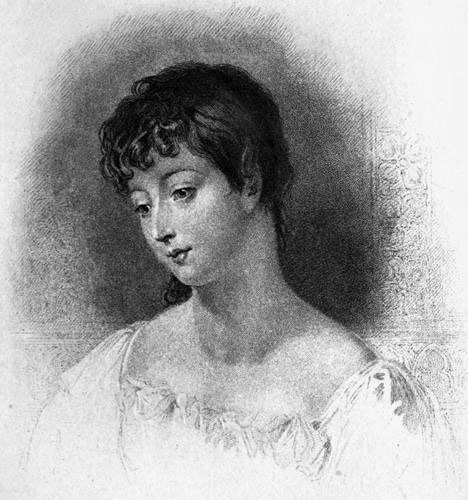
He wrote lines, for instance, “to a lady who presented to the author a
lock of hair braided with his own and appointed a night in December to
meet him in the garden.” Nothing is known of her except that her name was
Mary, and that she was neither Mary Duff nor Mary Chaworth, but a third
Mary “of humble station.” Southwell, when it saw those verses, was
shocked. It seemed highly improper to Southwell that maidens of humble
station should be encouraged to presume by such attentions on the part of
noblemen. Probably it was on this occasion that the Reverend John Becher,
Vicar of Rumpton, Notts, expostulated with the poet for
“Deigning to varnish scenes that shun the day
With guilty lustre and with amorous lay.”
But Byron kept Mary’s lock of hair, and showed it, together with her
portrait, to his friends and wrote:
“Thro’ hours, thro’ years, thro’ time ’twill cheer—
My hope in gloomy moments raise;
In life’s last conflict ’twill appear,
And meet my fond, expiring gaze.”
To Mary Chaworth herself Byron could hardly have said more, but he was, in
fact, at this time, saying the same sort of thing to all and sundry. Just
the same sentiment recurs in the lines addressed “To a lady who presented
the author with the velvet band which bound her tresses”:
“Oh! I will wear it next my heart;
’Twill bind my soul in bonds to thee:
From me again ’twill ne’er depart,
But mingle in the grave with me.”
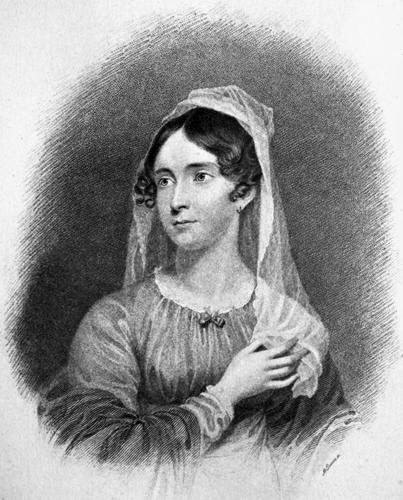
Yet if Byron proposes to be faithful for ever to this un-named lady, he
proposes, at the same time, to be equally faithful to a lady who can be
identified as Miss Anne Houson:
“With beauty like yours, oh, how vain the contention!
Thus lowly I sue for forgiveness before you;—
At once to conclude such a fruitless dissension,
Be false, my sweet Anne, when I cease to adore you!”
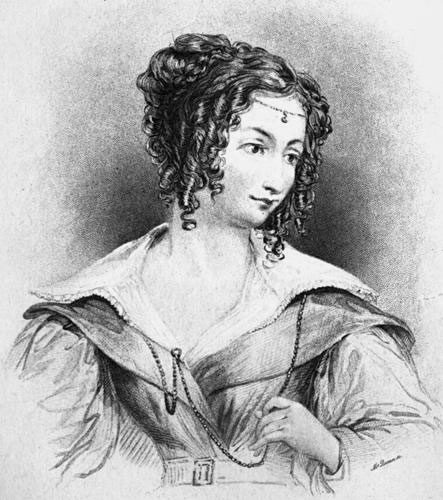
And then there are other lines—innumerable other lines which would also
have to be quoted if the treatment of the subject were to be
encyclopædic—lines to Marion, lines to Caroline, lines to a beautiful
Quaker, lines to Miss Julia Leacroft, whose brother, the fire-eating
Captain John Leacroft remonstrated with Byron, and, according to Moore,
even went so far as to challenge him, on account of his pointed attentions
to his sister: lines, finally, to M.S.G. who would appear, if verse could
be accepted as autobiography, to have offered to yield to Byron, but to
have been spared because of his tender regard for her fair fame:
“I will not ease my tortured heart,
By driving dove-ey’d peace from thine;
Rather than such a sting impart,
Each thought presumptuous I resign.
“At least from guilt shalt thou be free,
No matron shall thy shame reprove;
Though cureless pangs may prey on me,
No martyr shalt thou be to love.”
With that citation we may quit the subject. Not one of the sets of
verses—with the single exception of the set addressed to Miss
Leacroft—has any discoverable story attached to it. All of them—or
nearly all of them—have the air of celebrating some profound attachment
from which no escape is to be looked for on this side of the grave.
Byron’s later conception of himself as a man who had loved but one had not
crept into his poetry yet. He had not even begun to strike the pose of the
Childe impelled to “visit scorching climes beyond the sea” because the one
he loved “could ne’er be his.”
The idea, indeed, of a man fleeing the country in 1809 because he had
loved in vain in 1804 would not, in any case, carry conviction. Even to a
poet the idea could hardly have presented itself without some definite
renewal of the memories. They were revived, in fact, at a dinner party, in
1808, of which we find an account in one of Byron’s letters to Hodgson:
“I was seated near a woman to whom, when a boy, I was as much attached
as boys generally are, and more than a man should be. I knew this
before I went, and was determined to be valiant and converse with
sang froid; but instead I forgot my valour and my nonchalance, and
never opened my lips even to laugh, far less to speak, and the lady
was almost as absurd as myself, which made both the object of more
observation than if we had conducted ourselves with easy indifference.
You will think all this great nonsense; if you had seen it, you would
have thought it still more ridiculous. What fools we are! We cry for a
plaything which, like children, we are never satisfied with till we
break open, though, like them, we cannot get rid of it by putting it
on the fire.”
That is the prose record of the meeting, and there is also a record in
verse. There are lines “to a lady on being asked my reason for quitting
England in the Spring”; there is the piece beginning, “Well! thou art
happy”:
“Mary, adieu! I must away:
While thou art blest I’ll not repine;
But near thee I can never stay;
My heart would soon again be thine.”
And also:
“In flight I shall be surely wise,
Escaping from temptation’s snare;
I cannot view my Paradise
Without the wish of dwelling there.”
Poor stuff, as poetry, it will be agreed. Any one who wrote poetry at all
might have written it. The sentiment rendered in it is just the sentiment
which any sentimental youth would have felt to be proper to the occasion.
We can find in it, at most, only the faint fore-running shadow of the
Byronic pose. It rings very insincerely if we set it beside the lines in
which Walter Savage Landor, at about the same period, commemorated a
similar moment of emotion:
“Rose Aylmer, whom these waking eyes
May weep but never see;
A night of memories and of sighs
I consecrate to thee.”
In that comparison, most decidedly, all the advantage is with
Landor—inevitably, because his were the feelings of a man, whereas
Byron’s were the feelings of a boy. He was only twenty, and his age is the
explanation of a good deal. It explains his startled timidity, described
in the letter to Hodgson, in a novel, romantic situation. It explains his
hugging his grief as a precious possession on no account to be let go. It
also explains the zest with which, when grief had had its sacred hour, he
could turn from it and throw himself into other activities.
He rejoiced in the pose, only outlined as yet, which was presently to make
him the most interesting man (to women at all events) in Europe; but he
also rejoiced in his youth. He flirted, as we have seen; he took part in
amateur theatrical performances; he engaged energetically in most of the
sports of the day, fencing with Angelo, boxing with Gentleman Jackson,
swimming the Thames from Lambeth to the Tower; he accumulated debts with
the fine air of a man heaping Pelion on Ossa; he flung down his defiant
challenge to the literary bigwigs in “English Bards and Scotch Reviewers”;
he drew his plans for the grand tour. The world, in short, was just then
“so full of a number of things” that Mary Chaworth’s importance in it can
easily be, as it has often been, exaggerated.
Presently we shall see Byron exaggerating it; and we shall also see how he
came to do so—how the boy’s occasional pose became the determining
reality of the man’s life. But before we come to that, we must turn back.