WE have already followed the development of the early Flemish or
Netherlandish art during the fifteenth century, and observed how
it eventually passed under the Italianising influences which are
unmistakable in the pictures of Barend van Orley (1495?–1542) and
his contemporaries. The early painters of Holland as distinct from
Flanders cannot be traced with any certainty much farther back than
Albert von Ouwater (fl. 1420–1460), who worked at Haarlem from 1430 to
1460. As we have already seen, the early Flemish painter, Gerard David
(1460?–1523), was born at Ouwater, which may well have had its school
of painters. Neither Albert von Ouwater, who is represented to-day by
a single work, the Raising of Lazarus in the Berlin Gallery, nor his
unidentifiable contemporary who painted the Exhumation of St. Hubert,
in the National Gallery (No. 783), are included in the collection of
pictures at the Louvre.
The influence of these painters and Dierick Bouts is seen in the rare
works of Geertgen tot S. Jans, or Gerard of Haarlem (1465–1493) whose
Raising of Lazarus (No. 2563a) in this collection is an
achievement of the highest order, and was purchased as recently as
1902 for £4000 from Baron d’Albenas, after having been for many years
in Spain. This pupil or follower of the Ouwater master was a native of
Leyden, and worked at Haarlem. He took his name from the commandery of
the Knights of St. John at Haarlem for whom he worked, as we see from
the careful inscription, “Gerardus Leydanus pictor ad S. Io. Baptist.
Harlem pinxt,” on his triptych at Vienna.
Among his contemporaries were Cornelis Engelbrechtsen, who was born
in 1468 at Leyden, where he died in 1533, and Lucas van Leyden
(1494–1533). The latter played an important part as an engraver quite
as much as a painter in the university town of Leyden, which now
possesses his large Last Judgment and became famous as the birthplace
of Rembrandt in 1606. The Louvre possesses no picture by either
Engelbrechtsen or Lucas van Leyden.
Jacob Cornelisz van Oostsanen (fl. 1470–1533) is also unrepresented
here. Portraits by painters in this group are often confused, as in the
case of the Portrait of the Duke of East Friesland, in the Oldenburg
Gallery, which has been attributed to both Lucas van Leyden and Jacob
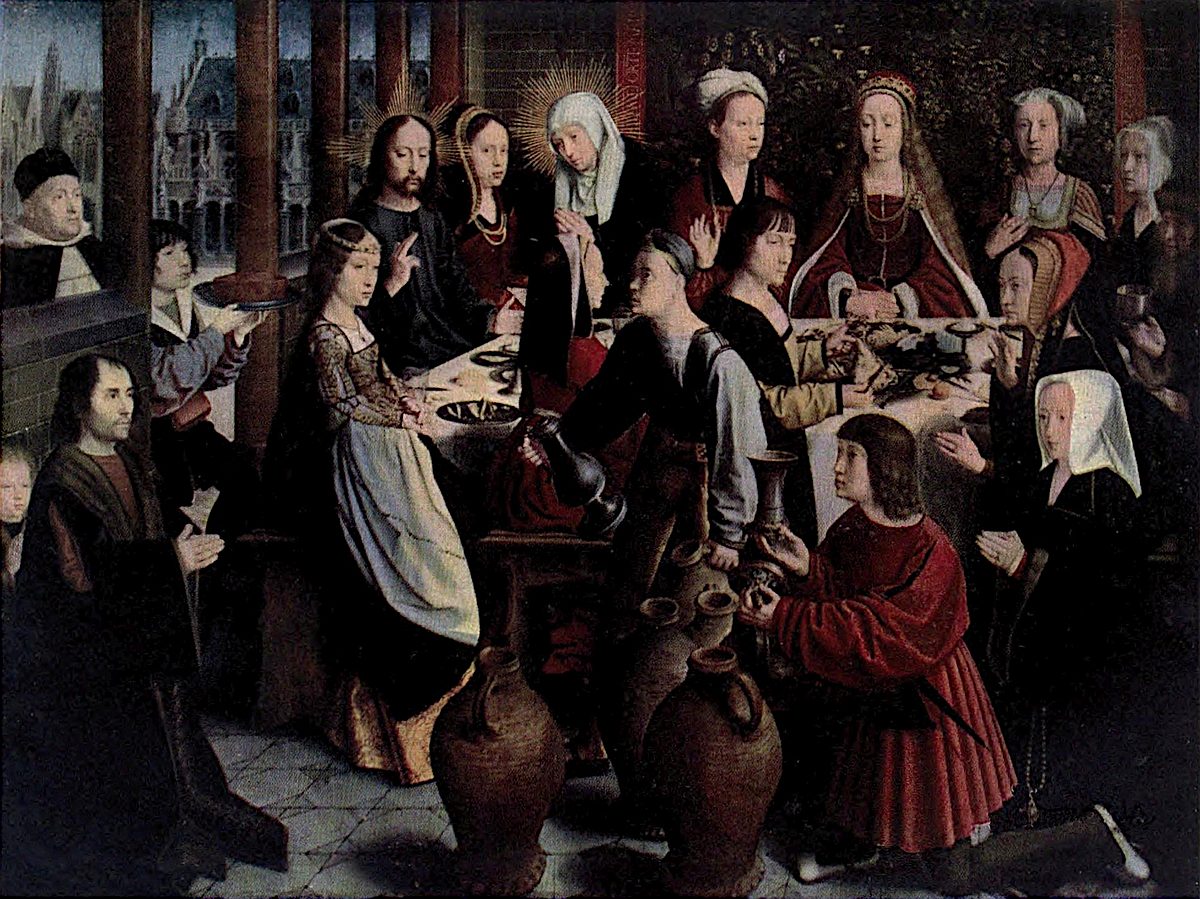
Cornelisz. A pupil of the latter may have painted the Cana of Galilee
(No. 2640c). It is safe to assign to “the Master of the
Female Half Figures,” the Young Lady Reading (No. 2641c),
which has a close analogy with the well-known picture in the Harrach
collection at Vienna, representing half-length figures of three young
ladies in crimson velvet dresses cut square at the neck, and singing
to the accompaniment of a flute and a lute. The name of this painter
is not known, but his pictures, which are neither numerous nor of any
conspicuous merit, are easily recognisable.
To this period of transition and mediocre painting belongs Jan
Scorel (1495–1562), whose Portrait of Paracelsus the Doctor (No.
2567a) is inscribed:
“FORMOSO DOCTOR PARASELSUS,”
and is in every way superior to the Portrait of a Man (No.
2641b), which is labelled with the name of Scorel, but
catalogued as being by an unknown artist. From Scorel, a much
travelled Dutch artist, who at one time worked at Nuremburg with
Albrecht Dürer and visited Venice and the East, we naturally pass
to Jan Mostaert of Haarlem. Mostaert of Haarlem is unrepresented at
the Louvre, a remark which equally well applies to the anonymous
“Pseudo-Mostaert,” who painted so much in his style that a large
number of inferior productions have been credited to him from time
to time. Pictures of this type vary so considerably that the name
“Pseudo-Mostaert” is little more than a generic designation for
unassignable Flemish and Dutch pictures of the middle of the sixteenth
century; such pictures bear some relationship to the Christ bearing
His Cross (No. 2299), and the Abraham’s Sacrifice (No. 2300),
officially attributed to the little-known and quite negligible painter
Alart Claeszoon (1498–1564) of Leyden.
From Leyden we may pass to Utrecht, which was the birthplace of the
much-travelled, distinguished, and cosmopolitan painter, Antonis Mor
(1512–1578?). He was a pupil of Jan Scorel, but soon freed himself
from the hard manner he acquired under that master by his study in
Italy of the best works of the Venetians. Indeed, some of his pictures
have passed as the work of Calcar, the pupil of Titian. Mor, or Moro,
excelled as a painter of vigorous and truthful portraits, and the
portraits and replicas he painted of Queen Mary are well known. The
Prado Gallery at Madrid and the Vienna Gallery contain good examples
of his art, and he is fairly well represented in the Louvre. While he
was in the service of Philip II. of Spain he lived in much splendour,
and was amply paid for his work. His close intimacy with the monarch
induced him on one occasion to take the liberty of touching with a
brush dipped in red paint the hand of the king. This serious breach
of Court etiquette created a profound impression on the courtiers
present; and, although the painter sued for pardon and obtained it from
the king, he soon recognised that he had made himself obnoxious to the
Inquisition, who asserted that Moro had got from the heretic English,
while painting the portrait of Queen Mary, a charm that enabled him to
bewitch the Spanish monarch. Being thus compelled to leave Spain, he
settled in Antwerp, where he died between 1576 and 1578.
The pictures of Mor, who was the contemporary of Titian, at different
periods of his art bear traces of the Dutch, Spanish, and Flemish
schools. He in turn also had an influence on the portrait painters of
Spain half a century before the birth of Velazquez. The Portrait of a
Man (No. 2478), which is signed and dated:
“ANT MORO pingebat, 1565,”
was in the past held by some writers to bear the features of Sir
Francis Drake, who was, however, at the date here given only twenty-one
years of age. The two large paintings in the Duchâtel Bequest which
pass as the Portrait of Louis de Rio and His Wife (No. 2480 and No.
2481) are, judging by the attitudes of the figures and the shape of the
panels, the wings of a large altarpiece. The Dwarf of Charles V. (No.
2479) reminds us that the painter, while still young, was taken into
the service of that emperor. The Portrait of Edward VI. of England
(No. 2481a) bears a very suspicious-looking inscription.
The political events of the reign of Philip II. of Spain, the mistaken,
mischievous, and oppressive policy he adopted with regard to his
territory in the Netherlands, and the contempt with which he treated
his Dutch subjects, soon alienated their sympathies; but the Duke of
Alva by his harshness and bigotry incited them to frenzy. When he set
forth in 1567, all hope of peace and mercy fled before him, and within
a short period his tyranny and ferocity fanned the flame of rebellion,
which after a struggle of eighty years was to end in the Peace of
Münster of 1648. In that year Spain ignominiously surrendered, and
the independence of the northern Netherlands was recognised. During
the long period which elapsed between the Union of Utrecht in 1579
and the negotiations at Osnabrück and Münster in 1648 must have been
destroyed innumerable religious pictures, the loss of which renders it
almost impossible for us to estimate the full significance of artistic
endeavour in Holland in the closing years of the sixteenth century.
A new era in Dutch history, social life and art was beginning to
open out by the year 1612, when Abraham Blomaert (1564–1651) painted
and signed his very large Nativity (No. 2327), which was formerly
attributed to Bernardino Fassolo. Blomaert’s Portrait of a Man (No.
2327a) is also a signed work.
Blomaert’s contemporary, Michiel Jansz Mierevelt (1567–1641), who
was at one time Court painter to the Princes of Orange at The Hague,
and was with undue flattery hailed as the “New Xeuxis of Delft,” is
represented by the Portrait of Olden Barnevelt (No. 2465) and three
other portraits, one of which (No. 2466) is in a very bad state. Stiff
but characteristic is the Portrait of a Woman (No. 2534), which was
painted by Jan van Ravesteyn (1572–1657) in 1633, while his initials
are also found on a panel (No. 2535) which was commissioned of him in
the following year. Although Gerard Verspronck (1600–1651) was many
years his junior, and in 1641, in the period of his maturity, achieved
the Portrait of a Lady (No. 2576a), the top corners of
which have been added, he painted on the lines of tradition, and showed
little originality. He came under the influence of Frans Hals, under
whose name his pictures often pass.
Nor can it be said that the numerous portraits which Cornelis Janssen
van Ceulen (1593–1664?) undertook in England, give signs of the new
artistic impulse which was daily manifesting itself in Holland in the
early works of Frans Hals. Janssen, who was baptized at the Dutch
Reformed Church, Austin Friars, London, throve until the establishment
in England of Van Dyck, before whom he quickly had to give way;
although he withdrew to Kent and lived in retirement, he did not
receive the Speaker’s warrant to pass beyond seas until 1643. That
“Cornelius Johnson Picture Drawer” made use of pallid flesh tones and
lifeless grey tones, is obvious from the two portraits (No. 2338 and
No. 2339) exhibited in the Louvre.
The very modern looking Portrait of a Young Man (No. 2303a),
signed “d. bailly,” is officially held to be the work
of a Leyden painter of that name who would appear to have been a
contemporary of Cornelis Janssen.
Although the great Dutch painter, Frans Hals (1580?–1666) was born
at Antwerp, his parents were natives of Haarlem, whither he removed
about 1600, and where he settled for the remainder of his eventful,
irregular, and improvident career. This lusty and unromantic master by
his forceful characterisation, his rapid wielding of his brush, and his
frank realism, in a few years transformed the earlier portrait-making
of Holland, and the rendering of the commonplace and obvious
likeness of an individual, as seen in the works of Moreelse and
others, into the region of great art. He was by about a quarter of
a century the senior of Rembrandt, who is the greatest genius among
Dutch painters, and developed his art on logical lines. It is, however,
necessary to know the outstanding facts of his personal history, the
fluctuating circumstances under which he worked, and the grinding
poverty of his latest period. Perhaps no other painter in the whole
range of art was so affected by his environment as Hals.
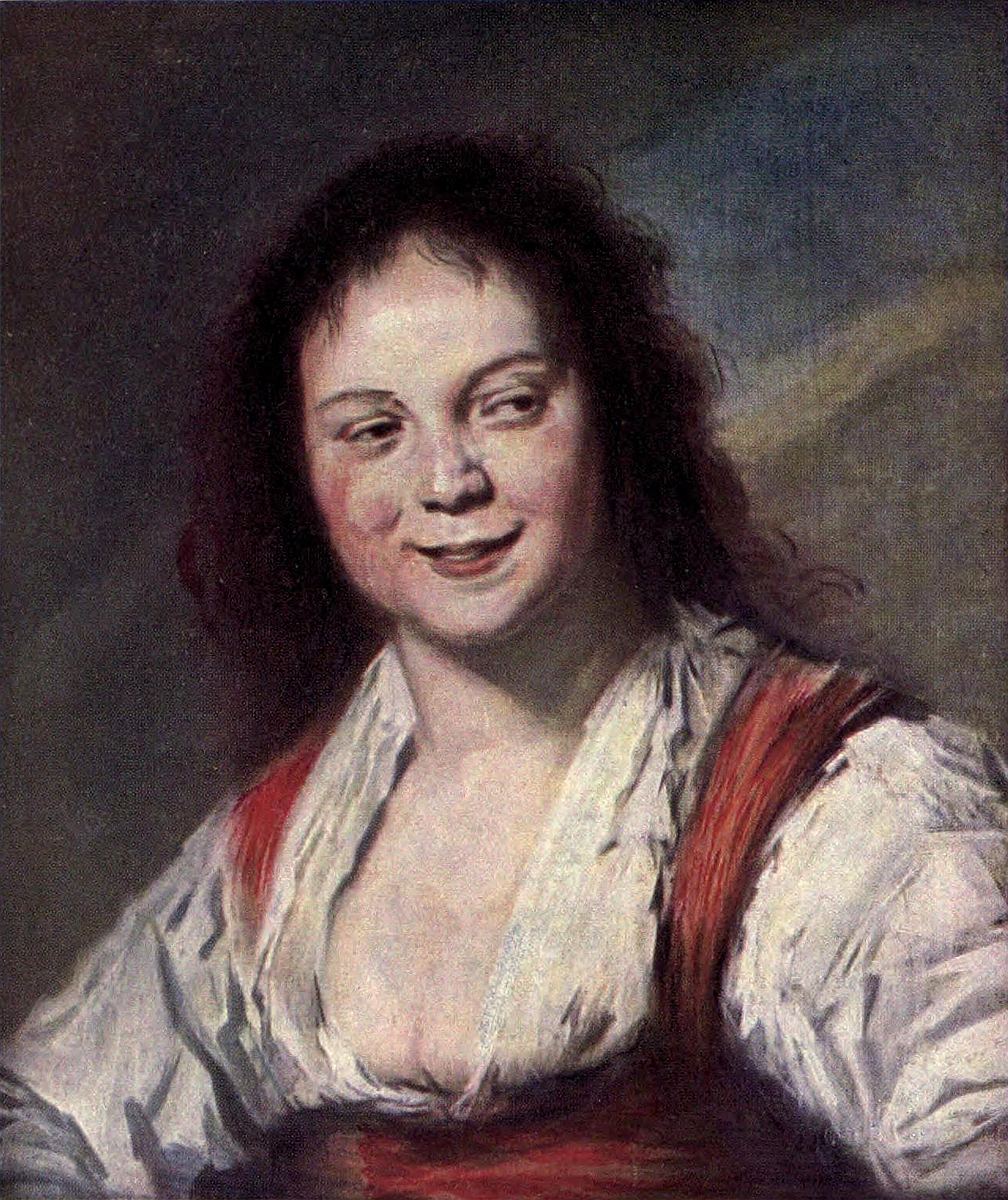
PLATE XXVII.—FRANS HALS
(1580?–1666)
DUTCH SCHOOL
No. 2384.—THE GIPSY GIRL
(La Bohémienne)
She wears a red dress, which is open at the neck; she smiles as she
turns her eyes to the right; half-length figure.
Painted in oil on canvas.
2 ft. 6 in. × 2 ft. 3 in. (0·76 × 0·68.)
Whether he was a pupil of Cornelis Cornelissen, Hendrick Goltzius, and
Karel van Mander (the Dutch Vasari), is not known with any certainty,
and no picture painted by him earlier than 1613, when he may have been
thirty-three years of age, is known to-day. Early in the year 1616,
when he painted his famous Banquet of the Officers of the St. Joris
Shooting Guild, one of his early masterpieces still preserved in the
small gallery at Haarlem, he was summoned before the Burgomaster of
the “town of the tulip,” and reprimanded for his cruelty to his first
wife. Exactly a year later he married a second time, and as the years
went on he became the father of at least six sons who adopted the
profession of the painter but earned no permanent success. The Louvre
possesses no example of his Doelen-pieces of archer-groups which won
him his earliest fame in his own country, but is fortunate enough to
contain the famous Gipsy Girl (No. 2384, Plate XXVII.), which alone
would have earned for him the title of “the master of the laugh.”
It passed through the Ménars sale in 1792 for 301 livres. The three
pictures of the Beresteyn family were bought for £4000 in 1884, when
his paintings were not as highly prized as they are to-day. They give
an excellent idea of the virility his art had attained by about 1629.
The best of these is the Portrait of Nicolaes van Beresteyn (No.
2386), which is inscribed, “Aetat suae 40. 1629.” His hands
are superbly painted; while the companion Portrait (No. 2387) of
his wife is equally striking. The large and imposing Portrait-Group
of the Beresteyn Family (No. 2388) is marred by the excessive use in
places of a strong red, and has been enlarged by the addition down the
right side of the canvas of a strip about fourteen inches broad, but
yet shows a certain felicity of grouping, and a joyous and exuberant
outlook. The Portrait, of René Descartes, the French Philosopher (No.
2383) is so simple in treatment and so easy in pose, that it makes an
instant appeal to the student. Another Portrait of Descartes (No.
78), by Sébastien Bourdon, is in this gallery, and a third was in the
Arsène Houssaye collection. The Portrait of a Lady in a Black Dress
(No. 2385, Plate XXVIII.) is unaffected and lifelike, while the subtle
and hasty brushing in of the gloves could only have been done by a
great painter. It seems to have been generally overlooked that a study
for this picture is in the collection of Lord Ronald Gower, and has for
some time past been on loan to the FitzWilliam Museum, Cambridge. In
the study, however, the artist had not yet thought of the gloves.
In 1654, Hals had to appear before a public notary of Haarlem at the
instance of his landlord, who sued him for debt. The great Dutch
painter in his testimony affirmed that his only possessions were two
pictures by Vermander and Van Heemskerck, and three by himself and one
of his sons, as well as three mattresses and bolsters, a cupboard and a
table! The Louvre exhibits no pictorial record of Hals’s latest phase,
when he was deserted by his friends, neglected by art patrons, and no
longer possessed any inner moral support.
The colouring of his early portraits is vigorous, the tone deep,
and the execution careful; gradually he employs richer colouring,
subordinates the local colours, and becomes broader in treatment. From
about 1650 his olive-greens gradually take on a more ash-grey hue,
until we are inclined to the belief that if the master had been
able to dispense with colour altogether, he would have willingly done
so. It is then that the colours on his palette, like the outer world,
became grey and black for him.
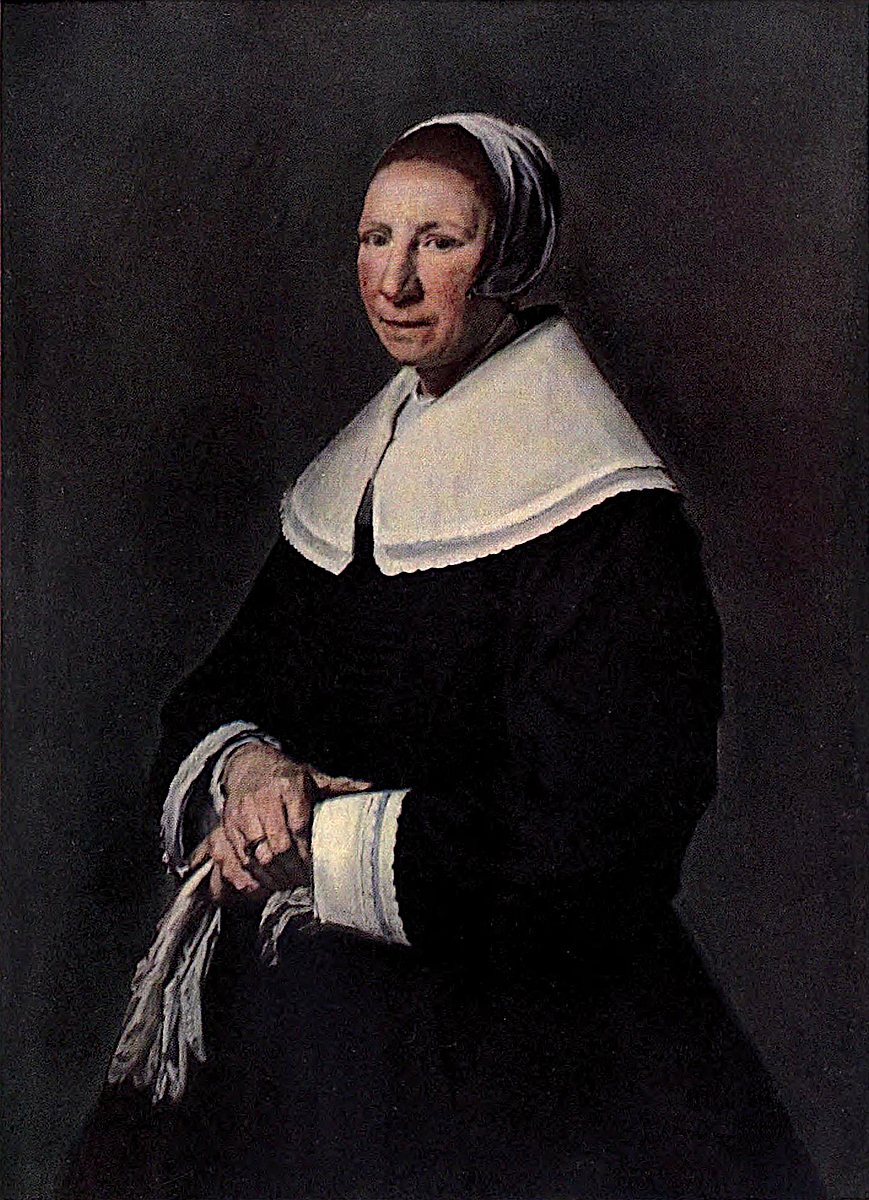
PLATE XXVIII.—FRANS HALS
(1580?–1666)
DUTCH SCHOOL
No. 2385.—PORTRAIT OF A LADY IN A BLACK DRESS
(Portrait de Femme)
A middle-aged woman wearing a black dress, with white collar, cuffs
and cap, is seen at three-quarter length, standing and turned
three-quarters to the left; in her hands, which are superposed, she
holds her gloves.
Painted in oil on canvas.
3 ft. 3½ in. × 2 ft. 7½ in. (1·00 × 0·80.)
This great master of the brush some time before his death had to avail
himself of poor relief granted by the municipality of Haarlem, and
after his death, in 1666, his widow received an allowance of fourteen
sous a week! Such was the tragic end of one of the most accomplished of
portrait painters in the whole range of art.
Holland after a terrible struggle had ultimately succeeded in throwing
off the Spanish yoke before the art of Hals was on the wane. Dutch
art then became gradually more independent, self-centred, democratic
in outlook, and Protestant in tendency. Religious subjects became
less frequent, and domestic scenes dealing with indoor and outdoor
life were before long largely on the increase. Before we pass to the
detailed study of the most striking characteristics of art in Holland
in the last half of the seventeenth century, we must examine at some
length the far-reaching influence and the world-famous achievements of
Rembrandt, for whom Hals may be said to have prepared the way.
As his name denotes, Rembrandt Harmensz van Rijn (1606–1669) was
born on the banks of the Rhine, his father being a miller at Leyden.
When fourteen years of age he entered the university of his native
town and had a classical education, which stood him in good stead
through his long and troubled career. Although he was at first placed
as a pupil of Jacob van Swanenburgh, he at an early age removed to
Amsterdam. There he worked under Pieter Lastman (1583–1633), whose
Abraham’s Sacrificing Jacob (No. 2443a) of 1616 is hung
opposite the works of his illustrious pupil. The independent spirit
of Rembrandt soon asserted itself, and as early as 1627 he placed his
name on pictures which still exist, notably in the Berlin and Stuttgart
museums. His earliest picture in the Louvre is the Old Man Reading
(No. 2541a), which is signed and dated 1630, and was presented
by M. Kaempfen, a former Director of this gallery, on his retirement.
Three years later came the two small and very similar versions (No.
2540 and No. 2541) of the Philosopher in Meditation, the former of
which is signed and dated; in 1633 was painted the Portrait of the
Artist (No. 2552), while another oval picture of the same subject (No.
2553) is inscribed 1634. In this early period the artist was in the
habit of portraying members of his own family, who were naturally his
most accessible models.
At this moment of his career Rembrandt had to measure himself with
many rivals in Amsterdam, notably with Thomas de Keyser (1596?–1667),
whose Portrait of a Man (No. 2438a) was formerly in the
Rodolphe Kann collection, while a half-length Portrait of a Man
(No. 2438b), also by de Keyser, was formerly at Versailles.
From the trammels and restrictions which the art of de Keyser would
have been likely to impose on a less gifted and original mind,
Rembrandt readily set himself free; and he must have had great hopes
for the future when, in 1634, he took to wife the wealthy Saskia van
Uylenborch. However, the oval Portrait of Himself wearing a black cap
(No. 2554), dated 1637, is of marked inferiority to the dignified and
deeply religious panel, The Archangel Raphael leaving Tobias and his
Father Tobit (No. 2536), of the same year. A year later he must have
painted the Portrait of an Old Man (No. 2544), and his first pure
landscape.
The influence of domestic bereavements on Rembrandt’s art is
clearly reflected in the choice of his subjects, in their more
intimate setting, and in the deep feeling which evidently inspired
them. No better example of this side of his character and his art could
be found than the Holy Family in the Carpenter’s Shop (No. 2542),
which he painted in 1640. In that year his mother died, an event which
followed rapidly on the death of his two infant daughters and his son,
and his wife’s frequent illness. He, however, still went on painting
such varied compositions as the Portrait of a Man (No. 2546), of
1645, and the Woman Bathing (No. 2550), which he achieved two years
later.
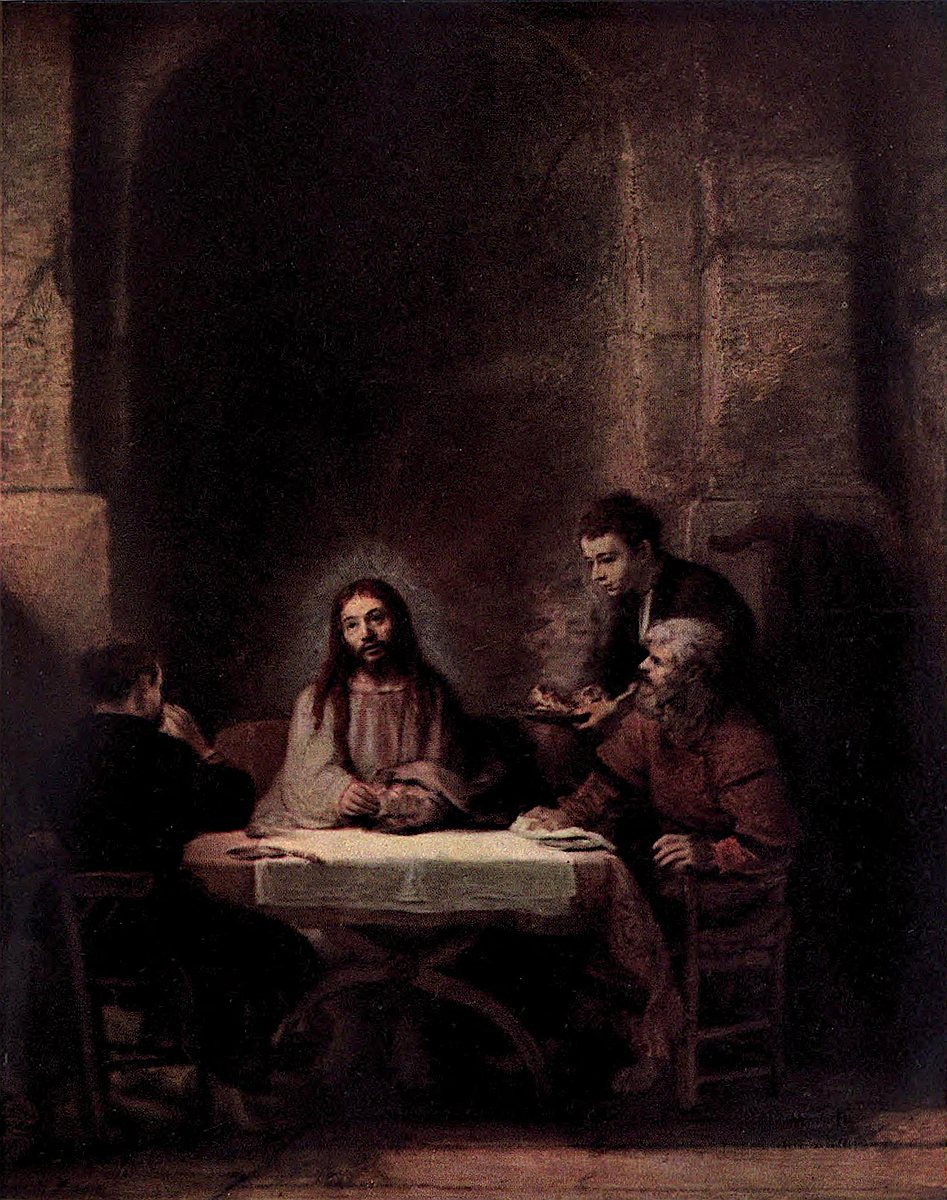
PLATE XXIX.—REMBRANDT
(1606–1669)
DUTCH SCHOOL
No. 2539.—THE PILGRIMS AT EMMAUS
(Les Pèlerins d’Emmaüs)
In a lofty room in front of a shallow niche in a wall, Christ and
the two disciples sit at table; a young serving-man enters from the
right, carrying a dish. Christ, whose bare feet are seen underneath the
table, gazes heavenward as He breaks bread, by which act the disciples
recognise Him as their Lord. The room is lit from the left.
Painted in oil on panel.
Signed below on the left:—“Rembrandt f. 1648.”
2 ft. 2¾ in. × 2 ft. 1¾ in. (0·68 × 0·65.)
The famous Night-Watch, in the Amsterdam Gallery, testifies to his
inventive faculty in 1642, the year in which the death of his beloved
Saskia caused him intense grief. From this he never really recovered,
as we see from the frequency with which during the remainder of his
life he painted pathetic subjects. What artist in the whole history
of painting has been able to impart to his rendering of the Good
Samaritan the kindly solicitude of the principal character in this
parable, and the feeling of complete collapse seen in the body of the
wounded man, as Rembrandt has done in his superb canvas (No. 2537) of
1648 in this gallery? No less poignant is the grief depicted on the
face of the barefooted Man of Sorrows in the Christ and the Pilgrims
at Emmaus (No. 2539, Plate XXIX.) of the same year. Here we see
convincing proof of the dexterous use that the Dutch “magician-painter”
could make of chiaroscuro, which he has handled with such masterly
effect in the Portrait of Hendrickje Stoffels (No. 2547, Plate XXX.).
All these paintings belong to the same period as the soul-moving
Polish Rider, which in 1910 passed from the collection of Count
Tarnowski at Dzikow in Galicia into that of Mr. H. C. Frick in New
York for £60,000. The Portrait of a Man holding a Bâton (No. 2551),
in the La Caze collection in this gallery, was painted three years
later than the Bathsheba, or Woman Bathing (No. 2549), of 1654.
The wonderfully realistic and in no way repellent Carcase of an Ox
in this gallery (No. 2548), like the picture of the same subject at
Glasgow, is an achievement of a very different kind, and belongs to the
year 1655.
The Louvre authorities have been well advised in recent years in
hanging all the pictures by Rembrandt in this collection in one Bay of
the Long Gallery. Here now we may study the Portrait of a Young Man
(No. 2545), the wonderful and rather later Portrait of the Artist at
his Easel at the age of Fifty-four (No. 2555), and the striking St.
Matthew (No. 2538) of 1661. Before these three works were painted, the
great Dutch master had been declared bankrupt, the sale of his most
treasured possessions realising a ridiculously small sum in the winter
of 1657.
Although Rembrandt’s own standard of morality offended his neighbours,
and his relations with Hendrickje Stoffels seem to have caused much
scandal in Amsterdam, we are not concerned with the morals of one of
the greatest and most esteemed of the world’s painters, but only with
his œuvre, a high place in which must be accorded to the Portrait of
Hendrickje Stoffels and her Child as Venus and Cupid (No. 2543), which
was painted in 1662, the year that the large Syndics, now in the
Amsterdam Gallery, was completed.
He is also to be credited with the alternative version of the Pilgrims
at Emmaus (No. 2555a), a painting of the same date, which for
many years was at Compiègne, where, however, it passed only as a school
picture. This profoundly creative painter, who learnt as time went on
to handle his chiaroscuro with increased effect, was also an etcher of
the highest order.
We may here note that the art of Jan Lievens (1607–1674), a
fellow-pupil with Rembrandt under Pieter Lastman, is seen in the large
but far from imposing Visitation (No. 2444).
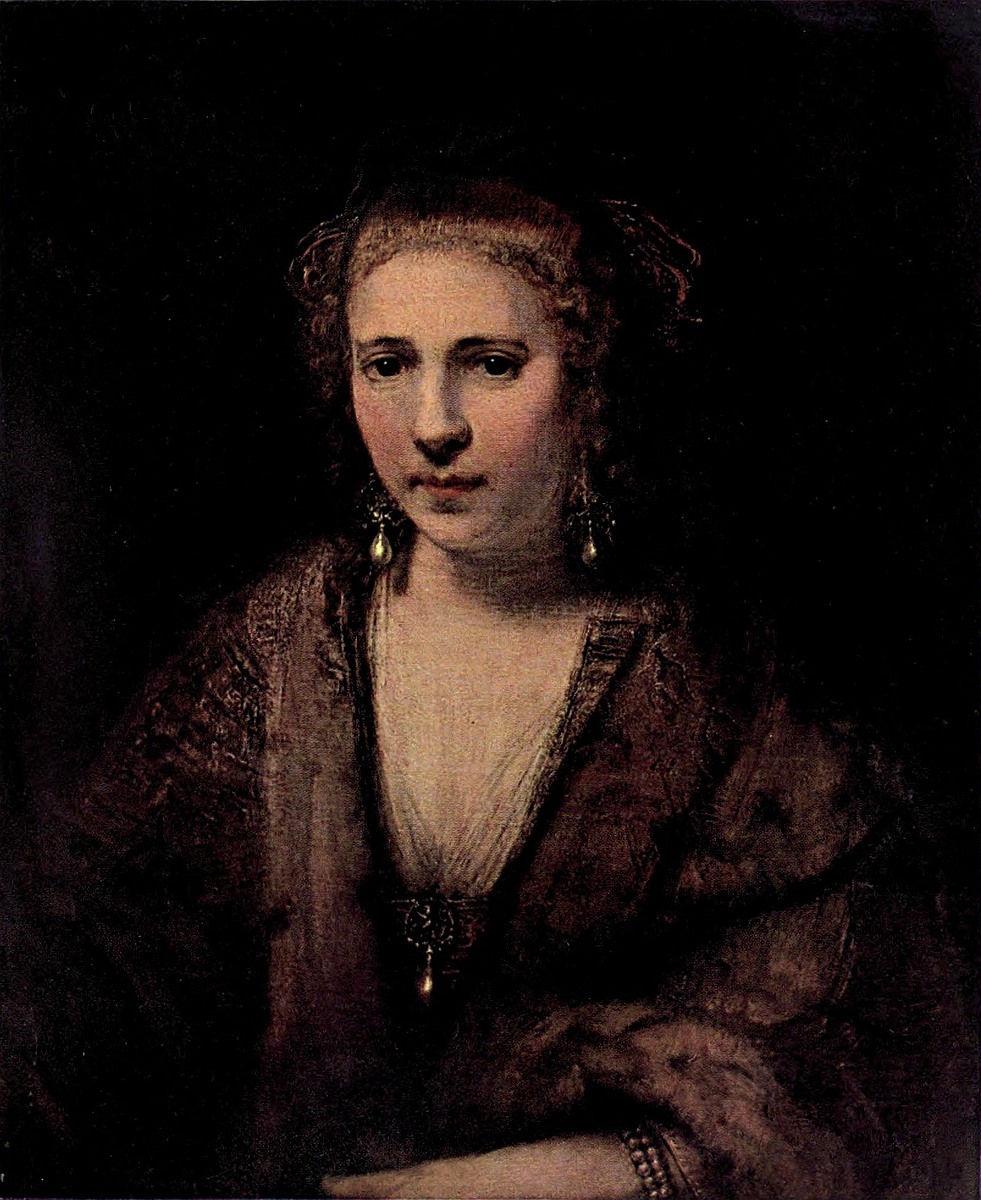
PLATE XXX.—REMBRANDT
(1606–1669)
DUTCH SCHOOL
No. 2547.—PORTRAIT OF HENDRICKJE STOFFELS
(Portrait de Hendrickje Stoffels)
She is seated, and looks at the spectator. Over her rich brown hair
she wears a grey cap with narrow red ribbons; pearl pendants are in
her ears, and she wears a brooch on her breast. Life-size half-length
figure.
Painted in oil on canvas.
2 ft. 4½ in. × 1 ft. 11¾ in. (0·72 × 0·60.)
That Govaert Flinck (1615–1660) was a pupil of Rembrandt, is evident
from his Announcement to the Shepherds (No. 2372) rather than from
his Portrait of a Young Lady (No. 2373), a signed work of 1641.
Ferdinand Bol (1617–1680) was a pupil and imitator of the great Dutch
master, and his Portrait of a Mathematician (No. 2330) is one of his
best paintings; but his Philosopher in Meditation (No. 2328) compares
most unfavourably with Rembrandt’s two early pictures of the same
subject which hang opposite it.
The ineffectual productions of Jan Victoors (1620–1670) include the
Portrait of a Young Lady (No. 2371), a typical example of the “niche”
portrait which became so popular, and a large Isaac blessing Jacob
(No. 2370), which vividly recalls his small canvas in the Dulwich
College Gallery that in less critical days passed as a Rembrandt.
G. van den Eeckhout (1621–1674) in his picture (No. 2364) shows his
dependence on Rembrandt; and Cornells Drost’s repulsive Bathsheba
(No. 2359a) has no claim to be regarded as a “fort bonne
peinture,” as a French critic has thought fit to term it.
Bartholomeus van der Heist (1612–1670), a native of Haarlem, who
painted under the early Dutch master, Nicholas Elias, surnamed
Pickenoy, and subsequently worked at Amsterdam, has fully signed his
Shooting Prize (No. 2394, Plate XXXI.), which is dated 1653. It has
been regarded as a replica on a very reduced scale of The Officers
of the Brotherhood of St. Sebastian at Amsterdam, in the Amsterdam
Gallery, which, curiously enough, bears the date 1657, and is also
signed on a slate.
Pieter van der Faes, who is better known as Sir Peter Lely
(1618–1680), after painting at Haarlem in the school of Pieter de
Grebber, went to England in 1641. He there succeeded Van Dyck as Court
painter, and at the Restoration became the favourite Royal painter. The
affectation and mannerism of his Windsor Beauties, now at Hampton
Court, is well known. He had a certain facility in painting
“The sleepy eye that spoke the melting soul.”
Three pictures (Nos. 2367–2369) are placed to his credit here, but
“The bugle eyeball and the cheek of cream”
have done their magic now.
The name of H. van Vliet (1611?–1675) is, doubtless, correctly
connected with two portraits on canvas (Nos. 2605 and 2605a),
while his contemporaries, Cornelis Saftleven (1606–1681) and D. van
Santvoort (1610–1680), are represented by The Artist’s Portrait (No.
2562) and the Pilgrims at Emmaus (No. 2564) respectively. Jakob van
Loo (1614–1670), who became a naturalised Frenchman, may be judged by
his diploma picture (No. 2451) and a very poor Nude Female (No. 2452).
Such mediocre producers of uninspired and unconvincing panels as Dirk
Hals (1591–1656), the brother and pupil of Frans Hals, whose Festive
Repast (No. 2389) hangs in Room XXIII.; Cornelis van Poelenburg
(1586–1667), whose art is here admirably illustrated (Nos. 2518–2523);
Hendrick Pot (1585–1657), who evidently derived some satisfaction from
the elaborate inscription he has placed on his quite ineffectual,
but fortunately diminutive, Portrait of Charles I. (No. 2525); and
the little-known and less-esteemed L. F. Zustris (1526–1600), whose
absurd Venus and Love (No. 2640) shows what a waste of time it was
for him to study under Titian in Italy—these and many more worked
as “business artists” for undiscriminating patrons. In the same
category come Adriaen van de Venne (No. 2601), Pieter Codde (No.
2339a), Jacob Duck (No. 2360–2361), and A. Palamedesz (No.
2515a).
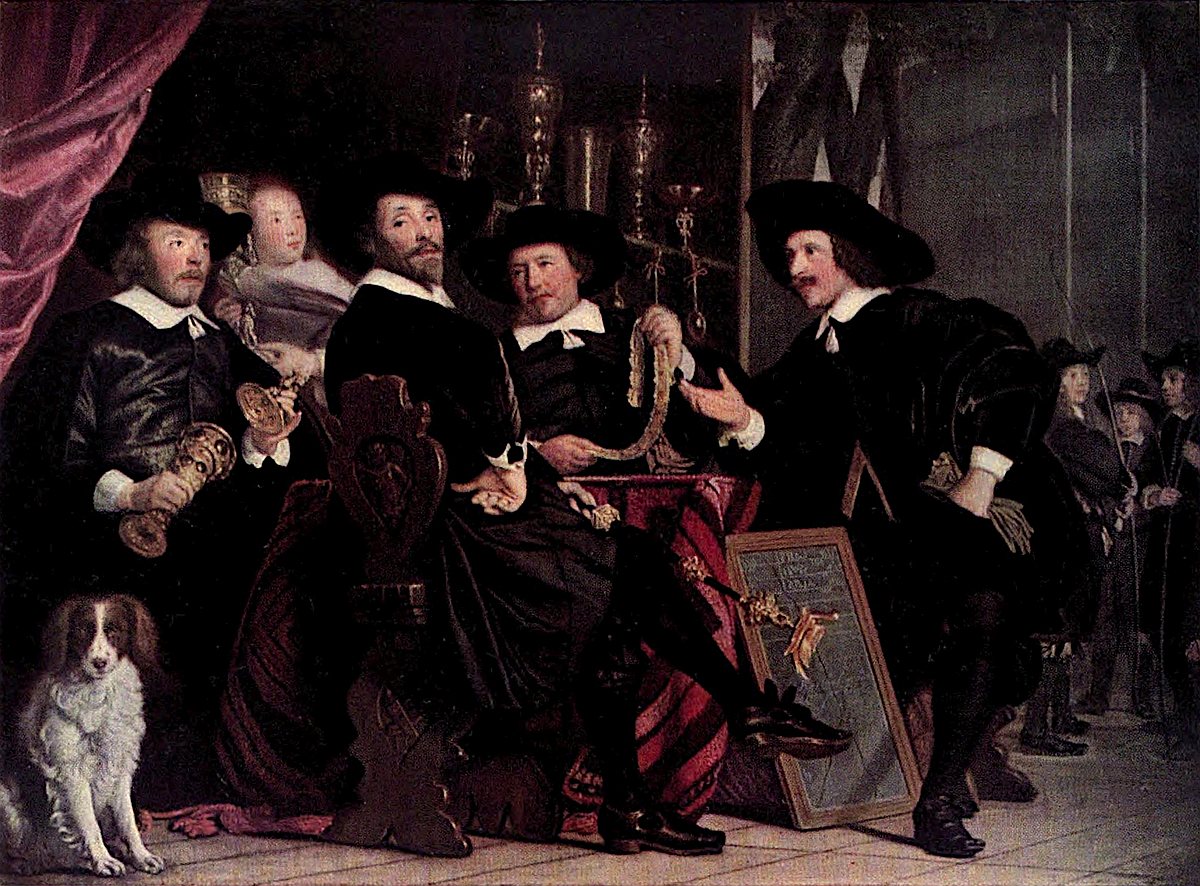
PLATE XXXI.—VAN DER HELST
(1613–1670)
DUTCH SCHOOL
No. 2394.—THE SHOOTING PRIZE
(Les Chefs de la Gilde des arbalétriers)
The four officers of the Brotherhood of St. Sebastian at Amsterdam
are seated at a table in the foreground, with the insignia of the
Brotherhood displayed before them. By the side of the officer who,
seated to the right, is addressing his companions, is a slate on which
are inscribed their names. In the background to the right are three
young men with bows and arrows. From the left enters a maid-servant
with a drinking-horn.
Signed on the slate:—“bartholomeus van der helst fecit, 1653.”
Painted in oil on canvas affixed to panel.
1 ft. 7¾ in. × 2 ft. 2½ in. (0·50 × 0·67.)
This rough sketch must suffice for our study of the History and
Portrait Painters of Holland. Although, of course, portraiture played
a most important part throughout the whole range of Dutch art, we must
now deal with those of their contemporaries and successors who are
classed as painters of genre subjects, Interiors, Conversation-pieces,
and Rustic Scenes. The compositions of these men at first show high
technical excellence, and a refined feeling for light and shade;
they depict simple scenes and homely incidents which make a wide
appeal in any age. By the end of the seventeenth century their scenes
become festive, and eventually boisterous, and so degenerate into
unimaginative renderings of far-fetched incidents which are treated
with a parade of mere imitative skill. In the last phase of their art
the subjects become even more uninviting, the panels are smoothly
painted, and all originality disappears.
Adriaen van Ostade (1610–1685), as a pupil of Frans Hals at Haarlem,
occupies an important position in his school. He is seen to very great
advantage at the Louvre. From his early Interior of a Cabaret (No.
2506), which is signed on a form
“A. V. OSTADE 1641,”
we see the direction his life’s work was to take; and his Interior of
a Cottage (No. 2498) of the following year, strengthens that view.
although Reading the Gazette (No. 2505), of 1653, is painted on
a very small panel, it heightens our appreciation of this able and
careful painter, who, a year later, must have spent a long time in
the completion of a Family Group, which traditionally passes as the
Family of the Artist (No. 2495). The Toper (No. 2401), of 1668, and
the intensely realistic Smoker (No. 2500), are highly characteristic,
while the Schoolmaster (No. 2496) shows great observation. The Fish
Market (No. 2497), the Business Man in his Study (No. 2499), the
Man Drinking (No. 2502), the Man Reading (No. 2503), the Reading
(No. 2504), and the Interior of a School (No. 2507), are both in
subject and handling good examples of his methods, which were affected
by a study of Adriaen Brouwer and Rembrandt.
Adriaen van Ostade was the elder brother and the master of Isack van
Ostade (1621–1649), who is equally well represented at the Louvre.
although he painted two Interiors (Nos. 2512 and 2514), a Toit à
porcs (No. 2513), a Halt (No. 2509), and an overcrowded Travellers
Halting (No. 2508), his best works, here as elsewhere, represent
landscapes and frozen river scenes.
Adriaen van Ostade had also as pupils Cornelis Bega (1620–1664), by
whom the Louvre possesses a very late Rustic Interior (No. 2312), of
1662; and H. M. Sorgh, called Rokes (1611?–1670), three of whose panels
(Nos. 2571–2573) are exhibited.
Gerard Dou (1613–1675) was in his day a highly popular and prosperous
painter of petty tragedies. As a boy of fifteen he entered the studio
of “the skilled and far-famed Mr. Rembrandt,” who was, however, his
senior by only seven years. One is apt to tire of his irritating
parade of cleverness in the manipulation of light and shade effects,
and over-scrupulous and niggling treatment of detail. Yet it is these
very qualities that brought him financial success when in later life
Rembrandt was receiving scanty treatment at the hands of the art
patrons of Holland. The Dentist (No. 2355) is an early work. Dou’s
Portrait of an Old Lady (No. 2358) is now held to be a Portrait of
Rembrandt’s Mother, and is regarded as the companion picture to the
Old Man Reading (No. 2567), by Dou’s pupil, Godfried Schalcken. The
Grocer’s Shop (No. 2350), which has been, with needless precision,
“ranked about the seventh best of this master’s productions,” is signed
in full on the slate, and dated 1647 on the mortar, while the Cook
with a Dead Cock (No. 2353) is signed on the window-sill, and dated 1650.
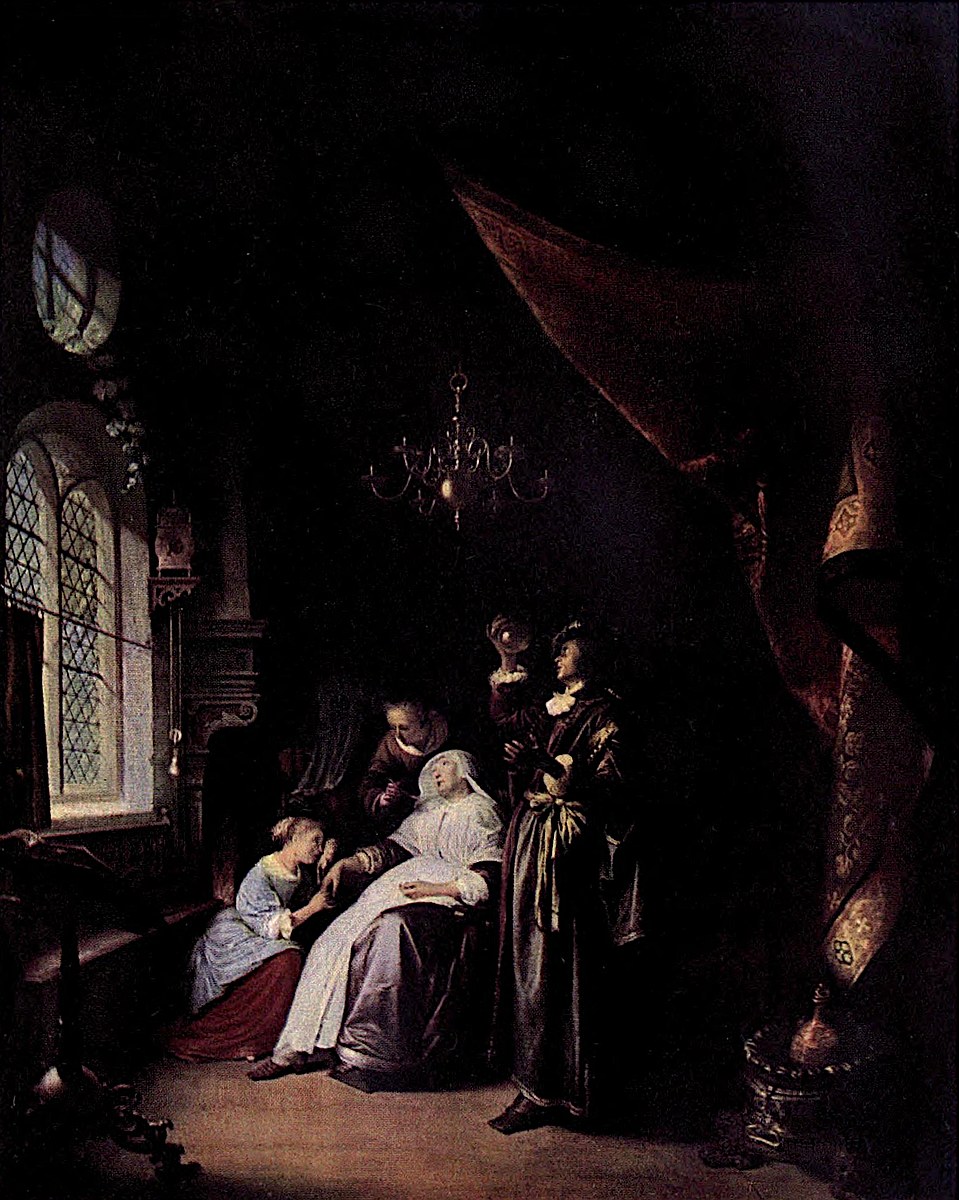
PLATE XXXII.—GERARD DOU
(1613–1675)
DUTCH SCHOOL
No. 2348.—THE DROPSICAL WOMAN
(La Femme Hydropique)
In a well-appointed room, lighted by an arched window on the left, an
old woman is seated in an arm-chair. The sick woman, who raises her
eyes to heaven and is taking a spoonful of medicine from a young woman,
gives her right hand to a girl who kneels on the left by her side.
Towards the right stands the doctor, who holds up to the light a glass
full of liquid. A chandelier hangs in the centre, and on the right are
a large tapestry curtain and a wine-cooler.
Signed on the edge of the book placed on the reading-desk in the left
foreground:—
“1663. g. dov. ovt. 65 jaer.”
Painted in oil on panel.
2 ft. 8¾ in. × 2 ft. 2½ in. (0·83 × 0·67.)
The Trumpeter (No. 2351) is perhaps the pendant to the Girl at a
Window, of 1657, now in the Rothschild collection at Waddesdon Manor.
On the window-ledge in the Trumpeter we see the same silver flagon
and a dish that also appear in the Dropsical Woman (No. 2348, Plate
XXXII.), a world-famous, but not on that account a great, picture. It
bears a somewhat enigmatical inscription:
“1663. G. DOV. OVT. 65 JAER”
on the edge of the book placed on the reading-desk. Dou
in 1663, the year here given, was only fifty years of age, and the
statement of age in the second half of the inscription may be a later
addition, or capable of another interpretation. The light comes in from
the window on the left. The woman who is dying of dropsy is receiving
a dose of medicine, while her daughter in grief kneels and kisses her
hand, and the doctor holds up to the light the vial, the contents
of which he is carefully examining. The artist in this his largest
picture is at much pains to show the dexterity with which he can paint
the fabric of the dresses, the large tapestry hanging in folds on the
right, and the reflection of light on the chandelier. This panel, which
is Dou’s masterpiece and is in an excellent state of preservation, was
originally contained in an ebony case, the outside of which (in two
pieces) was formerly the still-life painting of a Silver Ewer and
Dish (No. 2349).
The Man weighing Gold (No. 2354) is signed in full, and dated 1664;
elaborate care and much time have been expended, if not wasted, on
every wrinkle in his face, and every hair in his white beard. It
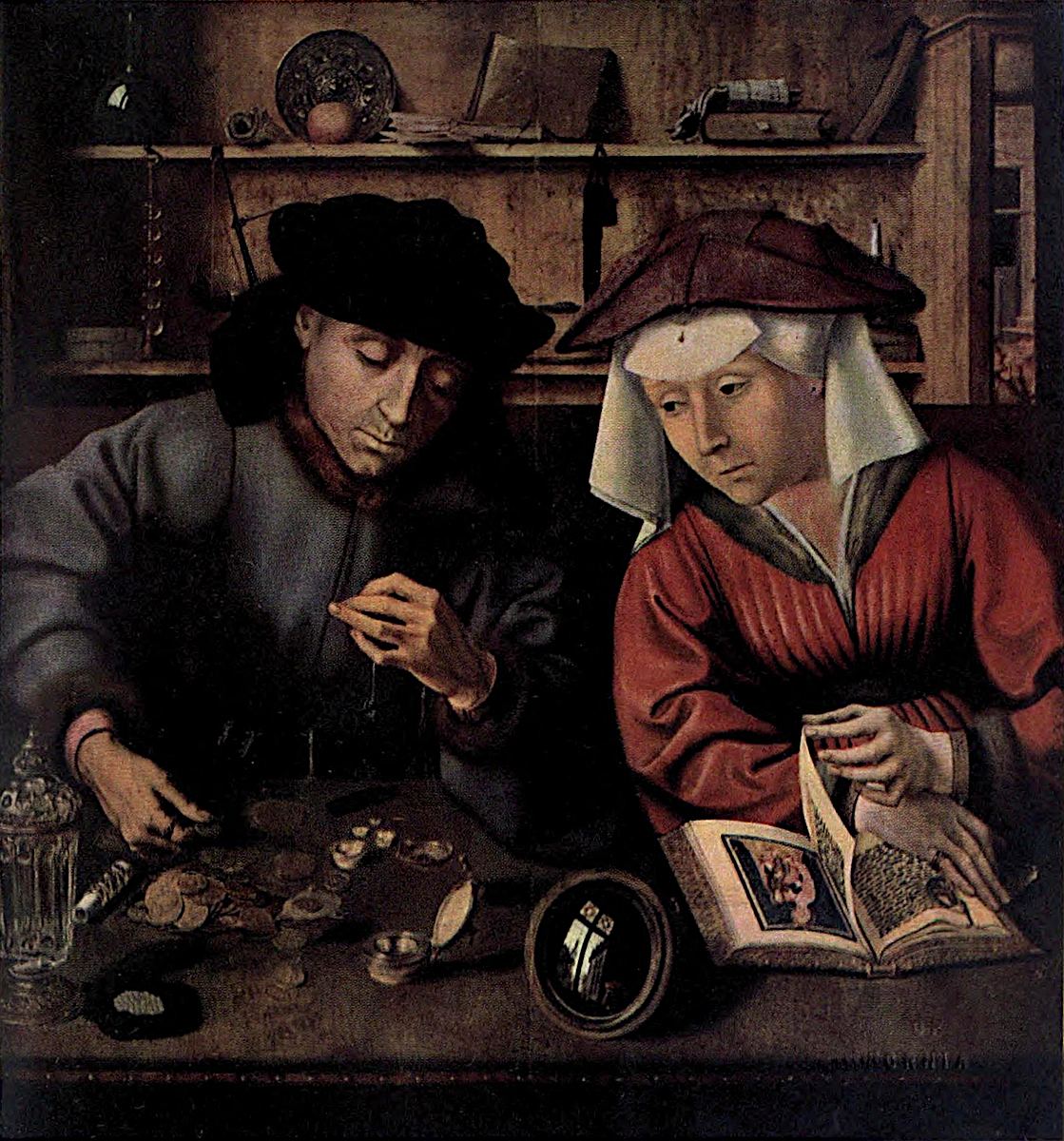
has points of analogy with Quentin Matsys’s Banker and his Wife
(No. 2029), which was painted in Flanders nearly a century and a
half earlier. Dou’s meticulous art is also exemplified in the Old
Man Reading (No. 2357), Reading the Bible (No. 2356), the Dutch
Cook (No. 2352), and the highly characteristic but quite negligible
Portrait of the Painter (No. 2359). In many respects this type of
picture warns us that within a few years of Dou’s death, in 1675, the
art of Holland passed into decadence.
He had several pupils. Of these Quiryn van Brekelenkam (1620?–1668)
holds a respectable place among the Small Masters of Holland, as we
see from his Consultation (No. 2337) in this collection rather than
from his Monk Writing (No. 2338). Herman van Swanevelt (1620–1655),
who from his journeys south earned the name of Herman of Italy, gives
us three Landscapes (Nos. 2584–2586). Karel de Moor (1656–1738),
a native of Leyden, who has signed his Dutch Family (No. 2477),
worked under both Dou and Frans van Mieris the Elder (1635–1681). The
latter owes much of his technique and meticulous work to Dou, as is
revealed by a hasty inspection of his Tea Party (No. 2471), with
two over-dressed women taking tea, and three other panels (Nos. 2469,
2470, and 2472). Ary de Vois (1632–1680) was a pupil of the German
painter N. Knupfer and of his own countryman Abraham van den Tempel
(1622–1672), who is here represented by a Portrait of a Lady with an
Apple (No. 2586a); but he also came under the influence of
the painter of the Dropsical Woman (Plate XXXII.), as is testified
by his small interior Portrait of a Man (No. 2606), his Portrait
of a Painter at his Easel (No. 2607), and his feeble Woman
cutting a Lemon (No. 2608). Traces of Dou’s art are seen in J. A. van
Staveren’s (1624?–1668) Philosopher in his Study (No. 2577); but P.
C. van Slingelandt (1640–1691) was a direct pupil. His Dutch Family
(No. 2568) is said to have been bought by Louis xvi. from an
English brewer, and the Portrait of a Man (No. 2569) and Kitchen
Utensils (No. 2570) have long been in the collection. The Magdalene
(No. 2570a) and St. Jerome (No. 2570b) were
bequeathed to the Louvre.
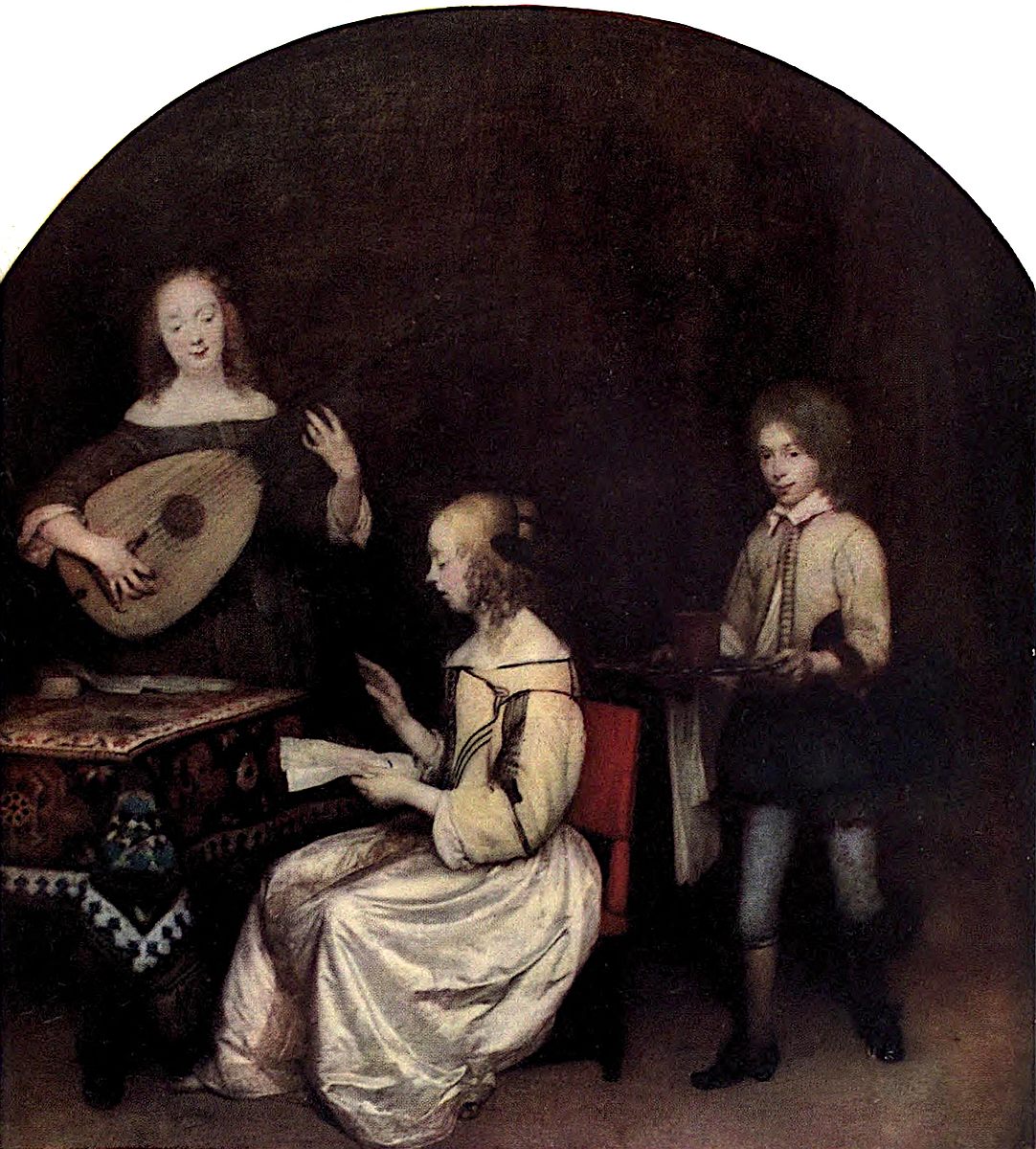
PLATE XXXIII.—TERBORCH
(1617–1681)
DUTCH SCHOOL
No. 2589.—THE CONCERT
(Le Concert)
A young lady in white satin dress and yellow bodice is seated in the
centre before a table covered with a richly coloured tablecloth. She
is singing to the accompaniment of a lady in the left background; a
page-boy enters from the right.
Painted in oil on panel.
1 ft. 6¾ in. × 1 ft. 5 in. (0·47 × 0·43.)
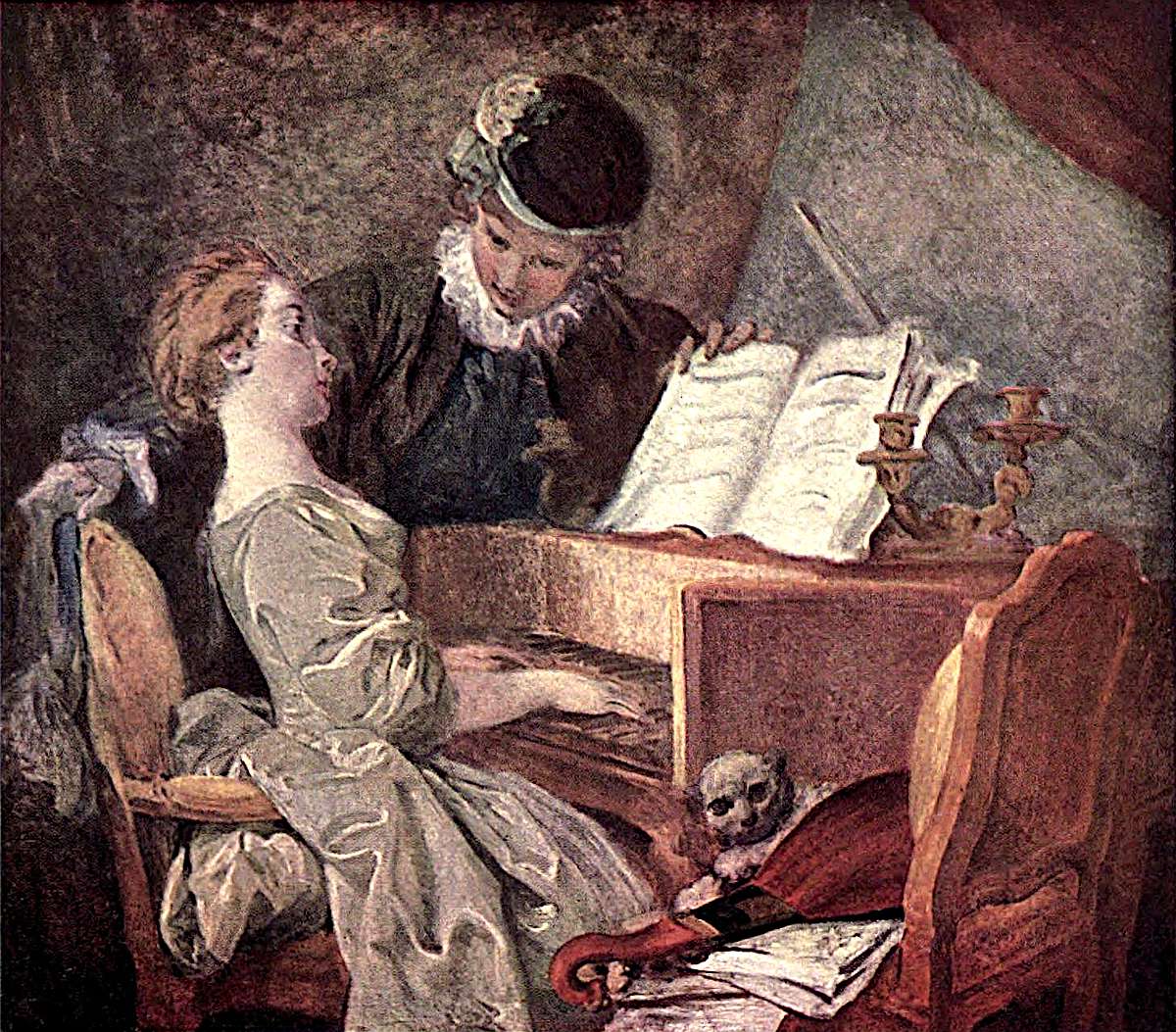
Gerard Terborch (1617–1681) was the creator of the
“Conversation-piece,” and one of the earliest to portray the well born
engaged in music lessons and similar occupations; he was one of the
greatest of the Dutch “small-masters,” and in every way the superior
of the uninspired Dou. Terborch invites us to join him in the fine
decorum of a noble chamber where the appointments are carefully tended,
while its occupants give themselves up to cultured, if not perhaps
deeply intellectual, pursuits. We forget all about the carousing and
bestial profligates who people the taverns of Jan Steen and much
less accomplished painters, and watch the refined fingers stray over
the keyboard of the open spinet or sweep the strings of a well-made
mandoline, as in the Concert (No. 2589, Plate XXXIII.). Equally fine
are the two Music Lessons (No. 2588 and No. 2591), the former being
signed and dated 1660.
The Military Galant (No. 2587) exhibits Terborch’s dexterity in the
rendering of reflected light on a red tablecloth, although the subject
has an innuendo which hardly adds to its charm. The Ecclesiastical
Assembly (No. 2590) is only a small sketch on panel, and affords but
a feeble echo of this painter’s masterpiece, the Ratification of the
Peace of Münster, in the National Gallery. Terborch was a pupil of
his father, who had visited Italy, and he studied also under Pieter
Molyn the Elder at Haarlem previous to visiting England in 1635. He
travelled much more extensively than most of his contemporaries, and
went to Spain during the best period of art in the Peninsula. He does
not seem to have been dependent on his professional success for his
living, which was passed in easy circumstances. Nor did he busy himself
as a teacher, his only direct pupil being Caspar Netscher (1639–1684),
who gives us a Music Lesson (No. 2486), of the approved stamp, and a
Violoncello Lesson (No. 2487).
It is not known for certain whether Jan Steen (1626?–1679) was a pupil
of Nicholaes Knupfer, a native of Leipzig who resided for a time at
Leyden, but he certainly worked under Adriaen van Ostade at Haarlem,
and later became a pupil of Jan van Goyen, whose daughter Margaretha
he married as his first wife. Steen certainly leased a brewery in
Delft for six years, and he is frequently mentioned in the archives of
that town about 1656; he subsequently kept a tavern in the Langebrug
in Leyden in 1672. His art is vivacious if not boisterous, and the
strength and versatility he displayed in the nine hundred pictures with
which he is justly credited give him a high place among the artists of
Holland in the seventeenth century. The frequency with which he painted
the Interior of a Tavern (No. 2578) has suggested that he carried on
the tradition of the Flemish-Dutch roysterer Adriaen Brouwer; but such
scenes, magnificently as they are handled, are apt to become boring in
time. This large canvas is dated 1674, and the coat of arms of Charles
v. is fastened on to the balcony in which are spectators.
The Merry Company at Table (No. 2579) is somewhat sketchy in parts,
but the lighting is well regulated, and the canvas is signed in full
on the back of a blue-covered chair to the right. That the Bad
Company (No. 2580, Plate XXXIV.) is admirably painted will be conceded
by all, but refinement is not its distinguishing feature. A young
man dressed in a red jacket is sleeping with his head on the lap of
a girl, while another girl is relieving him of his watch. The scene
is laid in a tavern, on the floor of which are painted with wonderful
precision a number of tiny objects. It was not Steen’s habit to paint
representations of cultured society such as Terborch delighted in.
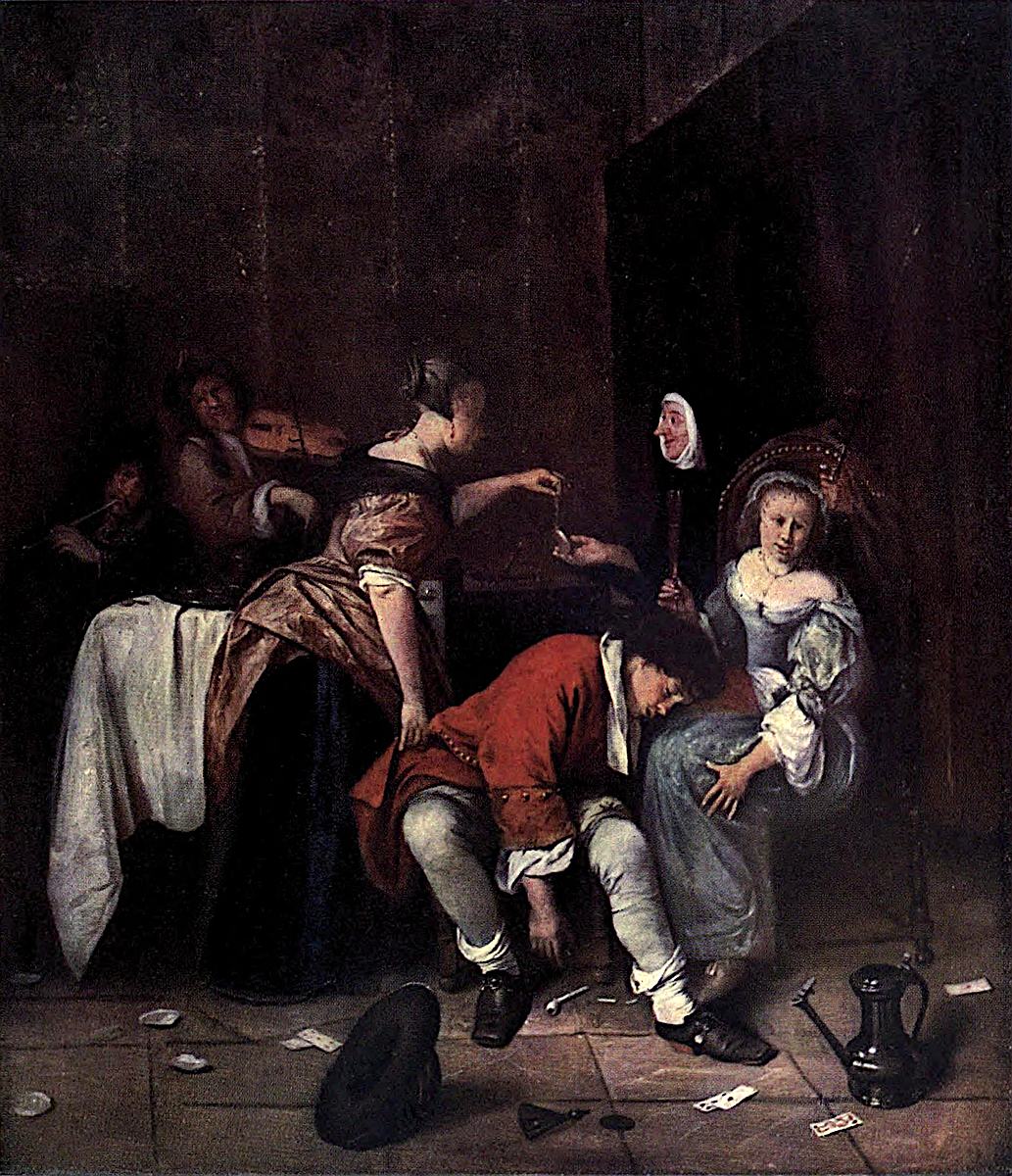
PLATE XXXIV.—JAN STEEN
(1626?–1679)
DUTCH SCHOOL
No. 2580.—BAD COMPANY
(La Mauvaise compagnie)
The scene takes place in a tavern. A young man has fallen asleep with
his head in the lap of a girl, who is seated to the right of the
composition, and holds a glass of wine in her right hand. Another girl
has just taken the young man’s watch from his pocket and is giving it
to an old woman, who receives it with evident glee. On the left a man
sits at a table smoking his pipe, and another is playing the fiddle.
Signed in full in the left bottom corner.
Painted in oil on panel.
1 ft. 6¾ in. × 1 ft. 2¼ in. (0·47 × 0·36.)
The Louvre contains only two paintings by Pieter de Hooch, who was born
in 1629 at Rotterdam, a town which played a relatively unimportant part
in Dutch painting. He also lived at Delft and Leyden. The Interior
of a Dutch House, with a Woman preparing Vegetables (No. 2414), is
a good example, and is fully signed in the bottom left-hand corner.
The Dutch Interior, with a Lady playing Cards (No. 2415, Plate
XXXV.), is full of incidents, contains six figures, and is signed
on the base of one of the columns supporting the mantelpiece in the
left foreground. No museum in the world exhibits the art of Pieter de
Hooch in such excellence as does the National Gallery, which contains
three masterpieces from his hands that have indirectly been the cause
of assessing the whole of the artist’s life-work on too generous a
basis. It is indisputable that during the last ten years of his life,
of which nothing is known later than the signature and date, 1677,
on the Music Party in the collection of Baron H. A. Steengracht at
The Hague, his art deteriorated very considerably both in colouring
and draughtsmanship. He may well have been a pupil of Karel Fabritius
(1624–1654), but it is almost incredible that he can have been a pupil
of the Italianiser Nicholaes Berchem, as Houbraken ventured to assert.
This museum contains nothing by Ochtervelt, many of whose pictures have
from time to time been accepted as the work of Pieter de Hooch.
From the shortlived artist Karel Fabritius derives the almost
incomparable master Jan Vermeer van Delft (1642–1675), whose fifty
authentic pictures are to-day among those most coveted by collectors.
As a painter skilled in the technicalities of his profession Vermeer
must be accorded the highest rank. The subtle and mysterious handling
of his Lace Maker (No. 2456, Plate XXXVI.), with its cool colour
scheme and dominant tones of blue and lemon-yellow, make it difficult
for us to realise that until twenty years ago his works were neglected.
Indeed, this small canvas was acquired in 1870 at the Vis Blokhuyzen
sale for the ridiculous sum of £290. Jan Vermeer (or Van der Meer)
van Delft is not to be confused with Jan Van der Meer of Haarlem
(1628–1691), who is included in the official catalogue as the painter
of the Outside of an Inn (No. 2455, marked No. 2022 on the frame). It
is fully signed, and bears the date 1652.
One of the last lingering influences of Rembrandt is seen in the
art of Nicolas Maes (1632–1693). The genre pictures of his early
period are so vastly superior to his later portraits that it was
formerly assumed that there might well have been two artists of the
same name. He certainly delighted in painting several versions,
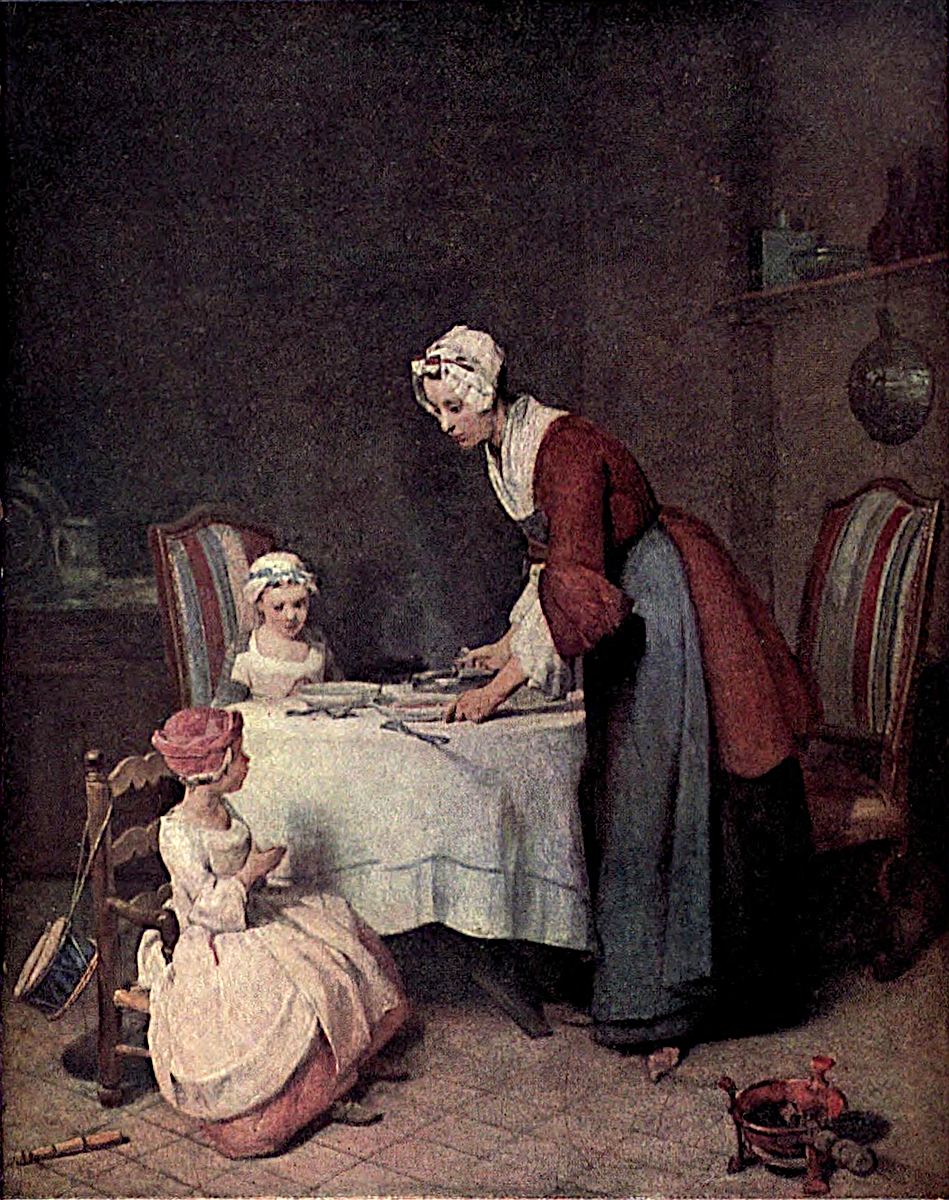
which vary considerably in size, of Grace before Meat (No. 2454).
In his pictures we see the mind that broods, and women who meditate
rather than act. The best examples of his domestic scenes are finely
graduated, although the sadness of advancing age becomes monotonous in
time.
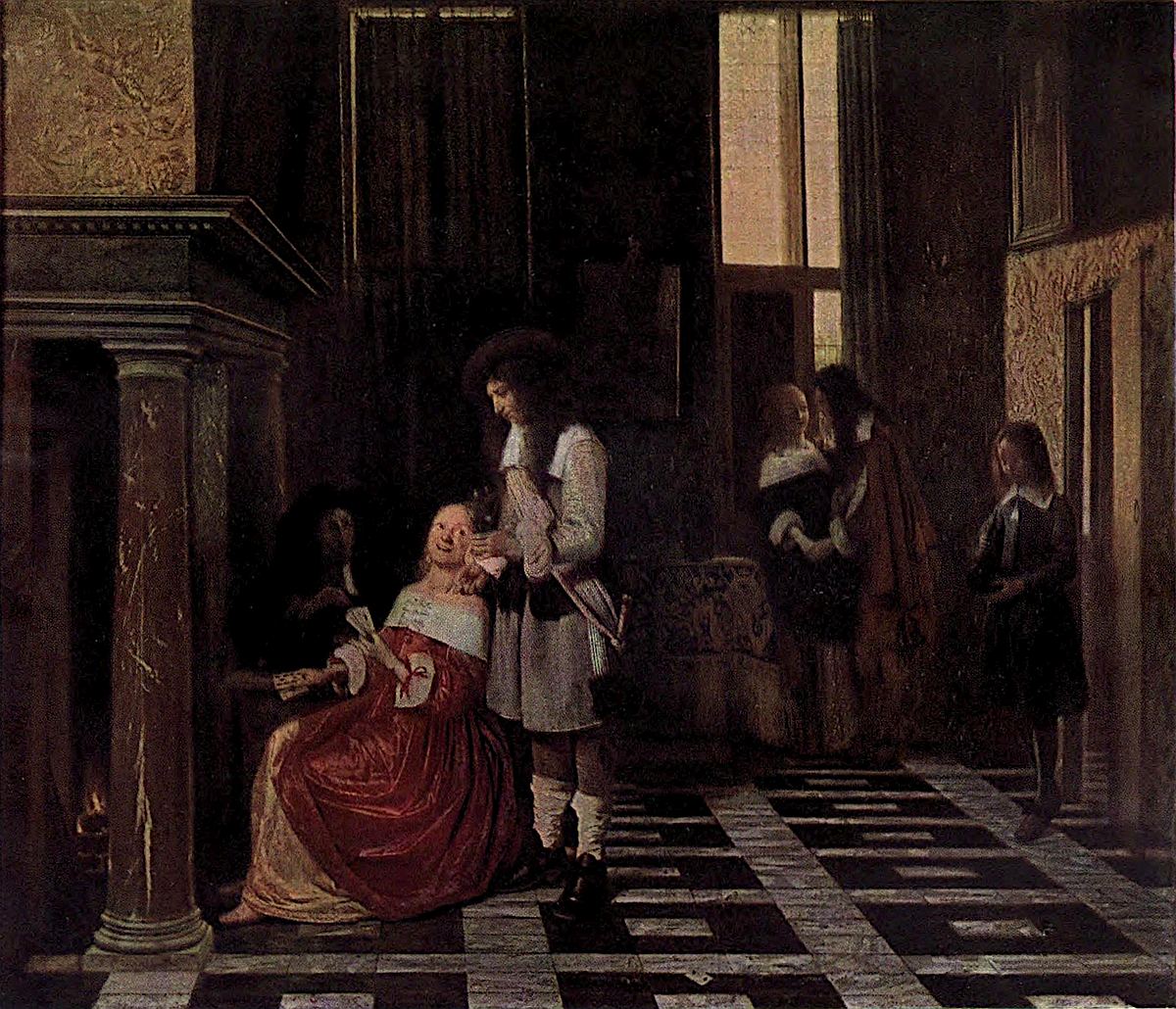
PLATE XXXV.—PIETER DE HOOCH
(1629–1677?)
DUTCH SCHOOL
No. 2415.—DUTCH INTERIOR WITH A LADY PLAYING CARDS
(Intérieur hollandais)
By the fireplace to the left a lady is seated. She is playing cards
with a gentleman, and shows her hand to a cavalier who stands beside
her. In the background stand two lovers, and a boy is entering the
room, a richly appointed room, hung with gilt leather.
Signed on the base of one of the columns supporting the
mantelpiece:—“p. d. hooch.”
Painted in oil on canvas.
2 ft. 2½ in. × 2 ft. 6½ in. (0·67 × 0·77.)
A high place among the painters of “Conversation-pieces” must be
accorded to Gabriel Metsu (1630?–1667), a shortlived artist who was
born at Leyden and learnt the first principles of his art from Dou. As
early as 1644 he seems to have earned some reputation as a painter,
his signature appearing on his Court Physician in that year. He came
under the influence of Rembrandt, and in later life practised as a
painter at Amsterdam, where he died.
Metsu, whose work is at first sight not easily distinguishable from
Terborch’s, acquired a facility in the control of the expression and
the ever-varying gesture of the hands in his pictures, that was denied
to many of his contemporaries. Instances of this are the figure of the
Christ writing a long Latin inscription on the ground in the Woman
taken in Adultery (No. 2457), the ease with which the young lady in
a white satin dress runs her fingers over the keys of the spinet in
the Music Lesson (No. 2460), and the treatment of the Dutch Lady
(No. 2462), who holds a jug in her right hand. The last-named panel is
evidently the companion to the very thinly painted Dutch Cook peeling
Apples (No. 2463), which is signed “g. metsu.” Perhaps
his best outdoor scene of humble life is the Vegetable Market at
Amsterdam (No. 2458), although his handling of the trees suggests that
his forte was the Conversation-piece of Dutch tradition, and that he
would not have risen to high rank as a landscape painter. The placing
of the signature on a letter, which in this instance lies on the
ground, is a favourite device with Metsu. He has derived much pleasure
from the treatment of the textures of the tablecloth, the curtain, and
the chair in the Officer visiting a Lady (No. 2459). The Alchemist
(No. 2461) may be the companion picture to the Sportsman in the
Gallery at The Hague. Much speculative criticism has been indulged in
by critics as to whether the so-called Portrait of Admiral Cornelis
Tromp (No. 2464) represents that admiral, and some doubt has also been
cast on its attribution to Metsu.
The naturalistic treatment of the landscape background in the religious
pictures of Jan van Eyck and his successors, Memlinc, Bouts, Hugo van
der Goes, and other painters in the Netherlands, in time brought about
the promotion of landscape painting to an independent art. Among the
earlier Dutch artists who approached the study of Nature were Arent
Arentzen (1586?–1635?), as we see from his Landscape with a Fisherman
(No. 2300a), and Roeland Roghman, who was born a year
later than Jan van Goyen, and lived as late as 1685. He painted the
Landscape (No. 2555b), which was formerly in the Paul Mantz
collection. Indeed, several Dutchmen of the period sought to commit to
panel views of nature, as in the case of Pieter de Bloot (1600–1652),
who gives us a Landscape with a River (No. 2327b).
The romantic feeling which so often pervades the background of
Rembrandt’s paintings, and is so apparent in such etchings as the
Three Trees, can only be touched on here. This new tendency is best
exemplified in the works of Jan van Goyen (1596–1656), who may be
regarded as the founder of a self-centred school of landscape painting
in Holland; but it was his ever handy sketch-book that enabled him to
outstrip his rivals in this branch of Dutch art. He is seen to great
advantage in his very fine Banks of a Dutch River (No. 2375), his
superb River View with eight Men in a Boat (No. 2378), a signed and
dated work of 1649, a large light-brown-toned River in Holland (No.
2377), a good Banks of a Canal (No. 2379), as well as a Dutch Canal
(No. 2376) and a Dutch River (No. 2377).
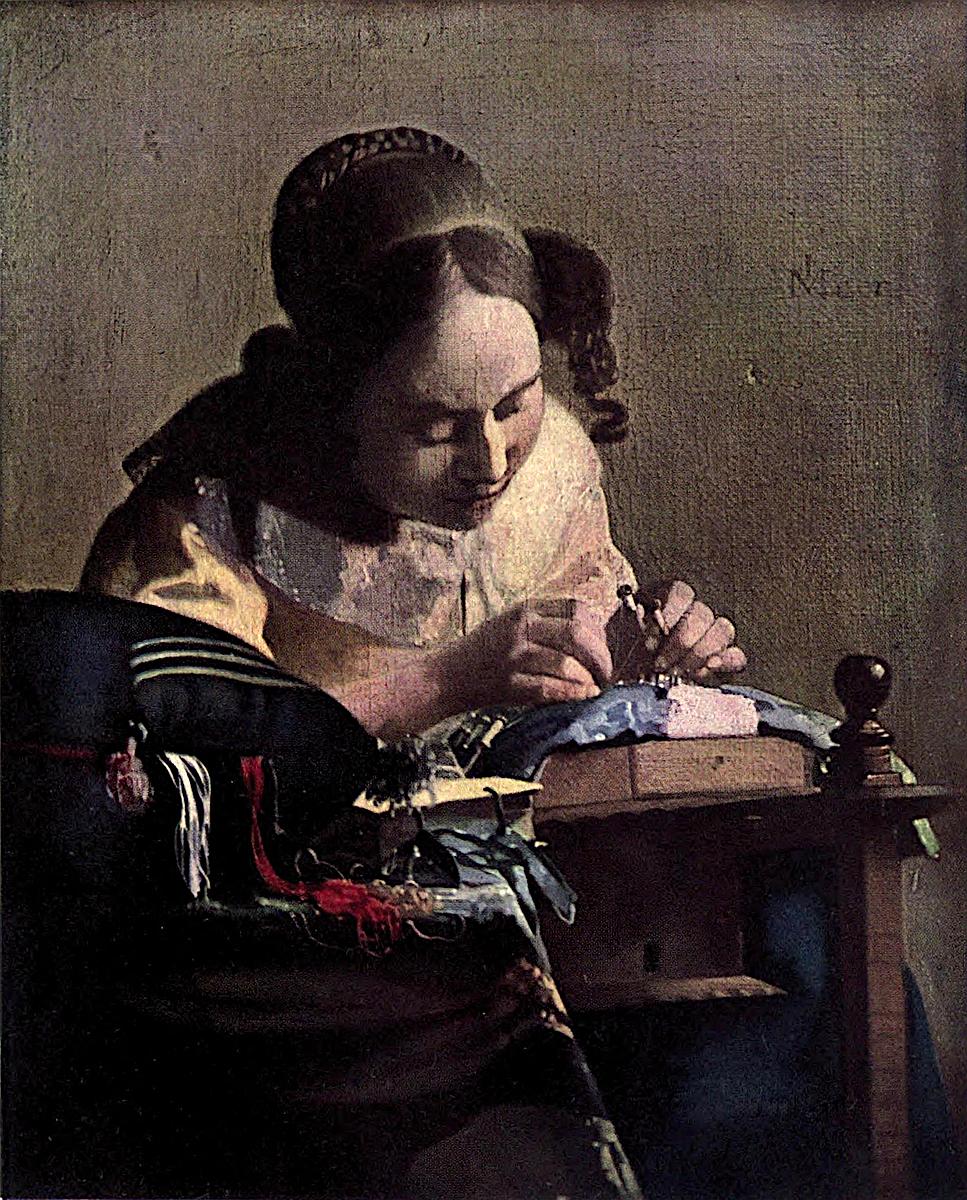
PLATE XXXVI.—JAN VER MEER VAN DELFT
(1632–1675)
DUTCH SCHOOL
No. 2456.—THE LACE MAKER
(La Dentellière)
A girl, wearing a yellow bodice and a blue skirt, is seated behind a
table. She is bending her head over a light-blue lace pillow as she
adjusts the bobbins with both hands. A dark-blue cushion and a book are
on the table to the left.
Signed in the upper right-hand corner:—“J. v. Meer,” the first
three letters being intertwined.
Painted in oil on canvas.
9½ in. (0·24) square.
Aert van der Neer (1603–1677) painted with strong contrasts of light,
as in his Banks of a Dutch Canal (No. 2483); and his monogram is
to be found on the seat at the foot of a tree in his Dutch Village
(No. 2484), where his propensity for painting moonlight scenes is well
illustrated. Herman Saftleven’s (1609–1685) Banks of the Rhine (No.
2563); Jan Asselyn’s View of the Lamentano Bridge on the Teverone
(No. 2301), Landscape (No. 2302), and Ruins in the Roman Campagna
(No. 2303); and the two Landscapes (Nos. 2332 and 2333) by Jan Both
(1610–1652), who worked in Rome and painted Italian landscapes under
the influence of the French artist Claude Lorrain, show the gradual
introduction of foreign influences. Joris van der Hagen (died 1669)
takes a new line in the representation of a very low horizon in his
Environs de Haarlem (No. 2382); but his Landscape with Peasants
crossing a Ford (No. 2381) is dull in tone and composed of unrelated
parts.
The Banks of a River (No. 2561d) is a superb example of the
art of Salomon van Ruysdael (1600?–1670), one of the founders of the
Haarlem school of landscape, and the uncle of Jacob van Ruisdael. The
Large Tower (No. 2561c) gives a better idea of his power
than the Ford (No. 2561b). Another painter in the same
school, Cornelis Decker (1618?–1678), has a Landscape (No. 2346).
although Isack van Ostade at times gave himself up to trivial subjects,
as we have already seen, the merit of his frozen river scenes (Nos.
2510, 2511, 2515) is firmly established, and the happy way in which
he combined a genuine appreciation of nature with great skill in the
placing and treatment of his figures has earned for him a high place
among the Dutch landscape painters.
Unlike most of the artists of his time in Holland, Aelbert Cuyp
(1620–1691) was highly esteemed by his contemporaries, his social
position and his good fortune in money matters freeing him from the
poverty which Hobbema and others endured. He painted portraits with
much skill, as we see from his Portrait of a Man (No. 2345a)
and his Portrait of a Boy and a Girl with a Goat (No. 2344); but he
is best known as a cattle painter, his sturdy cattle being artistically
grouped in thick green pastures flooded with sunshine, as in his
Herdsman with Cattle (No. 2341). He attained much success also with
his riding pictures, and the Starting for the Ride (No. 2342) and the
Riding Party (No. 2343) are in every way preferable to his Boats
on a Rough Sea (No. 2345). Following his usual habit, he has placed
no date on any of these six pictures. He had no pupil in the proper
sense of the term; but a host of imitators, such as Jacob van Stry
and the much later English Royal Academician Sidney Cooper, failed
ignominiously in their feeble attempts to copy his methods.
Jan Wynants was another landscape painter in the Haarlem School,
although he settled in Amsterdam and died there in 1682. His Outskirts
of a Forest (No. 2636) is signed and dated 1668, and is superior to
the Landscape (No. 2637) which bears his own signature as well as
that of Adriaen van de Velde, who on numerous occasions inserted the
figures for him. Wynants has also placed his name on a small Landscape
with Sportsman and Falconer (No. 2638).
Adriaen van de Velde has been careful to sign and date each of the
seven pictures by which he is represented (Nos. 2593–2599). By Allart
van Everdingen (1621–1675), who travelled in Norway and painted rocky
scenes and waterfalls, we find two Landscapes (Nos. 2365 and 2366).
The greatest of all Dutch landscape painters, with the possible
exception of Jan van Goyen, is Jacob van Ruisdael (1628?–1682), who
occupied himself more especially with rushing waterfalls and undulating
country. His Storm on the Coast (No. 2558) is a fine achievement, but
his best picture in this collection is the Landscape (no No.), which
was bequeathed by Baron Arthur de Rothschild. His Woody Landscape
(No. 2559), the Road (No. 2559a), Landscape (No. 2561),
and the Entrance to a Wood (No. 2561a), cannot, however,
compare with his Sunny Landscape (No. 2560), which bears the artist’s
monogram.
The talents of Meindert Hobbema (1638–1709) were so disregarded by his
countrymen that in disgust he, at the age of thirty, took a humble post
in the Customs. His woody scenes seen in the pale sunlight of the early
afternoon are not copied from any chance scenery, but composed; and his
Water Mill (No. 2404), fine though it is, contains passages that will
be met with elsewhere. The Farm (No. 2404a) is a very good
picture, as also is the Landscape (No. 2403) from the Nieuwenhuys
collection. A very large number of painters, including Wyntrack, who
gives us a Farm (No. 2639), painted the figures into the foregrounds
of Hobbema’s best works.
In a large number of Philips Wouwerman’s pictures the landscapes are
of secondary importance to the figures; and although the execution
is careful and conscientious, the frequenter of picture galleries is
apt to tire of his make-believe genre-pieces, landscapes with horses,
riders, sportsmen, soldiers, robbers, gipsies, and the like. The Louvre
presents an imposing array of fifteen of the twelve hundred or more
pictures by Philips Wouwerman (1619–1668), and his brother and pupil
Pieter is credited with a poor but historically interesting View of
the Porte de Nesles, Paris, in 1664 (No. 2635).
It will be convenient here to group Adam Pynacker (1622–1673) with his
three pictures, Willem Romeyn (1624?–1696?) with one, Abraham Begeyn
(1637?–1697) with one, Guilliam de Heusch (1625?–1692) with one, Dirk
van den Berghen (1645–1690?) with two, and Glauber (1646–1726) with
a single Landscape (No. 2374) in which the figures are inserted by
Gerard de Lairesse. Mention must, however, be made of Paul Potter,
the highly esteemed cattle painter, who died in 1654 at the early age
of twenty-nine. One of his latest canvases is the Cows and Sheep in
a Field (No. 2527), of 1652; but his Horse in a Field (No. 2528)
of the following year, and the Wood at The Hague (No. 2529), give
an excellent idea of his art. These and the Horses at the Door of a
Cottage (No. 2526) show that Paul Potter had a sound knowledge of
animal anatomy. He is seen at his best in small compositions such as
are here exhibited, in which the construction and mise-en-scène are
simple and the details delicately rendered. It is a popular fallacy
that his chief contribution to the fame of Dutch art was his large
Bull of 1647, which measures 8 ft. by 12 ft., in The Hague Gallery.
He did not live long enough to form a “school.”
The Italianising influence was already beginning to make itself felt,
to the lasting detriment of Dutch painting, and the typical example
of this downward movement is Nicolaes Berchem (1620–1683), who was
founded on his father, Pieter Claesz, and on Pieter de Grebber, and Jan
Wils at Haarlem, while he also was impressed by Claes Moyaert and J.
B. Weenix at Amsterdam, where he removed in 1677. There is scarcely a
well-furnished gallery in Europe that does not seek to pride itself on
possessing one of Berchem’s renderings of Crossing the Ford, or a
Woman upon an Ass in conversation with another Person. The Louvre is
no exception to this rule, and exhibits his Cattle crossing a Ford
(No. 2315) and nine other canvases and panels, nearly all of which bear
his much-vaunted signature. His art is to-day deservedly out of fashion
with discerning collectors.
Berchem’s pupil, Karel du Jardin (1622–1678), who is invariably at
much pain to sign his pictures, is seen to some advantage in his very
Italian and in every way characteristic Italian Charlatans (No.
2427), the typical Ford in Italy (No. 2428), and eight other works.
His attempts to depict a Calvary (No. 2426) have not been crowned
with success, as the composition is overcrowded and undramatic; nor do
we experience any emotion on regarding his Portrait of Himself (No.
2434), a small production on copper.
Breenberg (1599–1659?), who was born at Deventer, the home of Terborch,
has depicted a View of the Campo Vaccino at Rome (No. 2334), and a
Ruins of the Palace of the Cæsars (No. 2335) in the Italian manner
beloved by Berchem and Pieter van Laer. The latter, who is also
named Bamboccio, is represented by two small oval panels. Lingelbach
(1622–1674), who frequently collaborated with other Dutch artists, may
be judged by his Vegetable Market at Rome (No. 2447) and three other
canvases, and Frédéric de Moucheron (1633?–1686) by a Leaving for the
Hunt (No. 2482). It will be convenient to mention here Reynier Nooms,
whose View of the Old Louvre from the Seine (No. 2491) has some
historical interest.
A limited number of painters busied themselves in making faithful
transcripts of the streets and the exterior appearance of the
buildings. Jan van der Heyden (1637–1712) was perhaps the most
successful in this direction, and his View of the Town Hall of
Amsterdam in 1688 is an excellent example of his methods, while
the Louvre also possesses three small panels by him. Jan Abrahamsz
Beerstraten (1622–1666), the son of a cooper at Amsterdam, travelled
to Italy and the Mediterranean, proof of which is afforded by his Old
Town Gate at Genoa (No. 2310). The typical architectural painter is,
however, Gerrit Berckheyde (1638–1698). Although he never went to
Italy, his View of Trajan’s Column (No. 2324) is a welcome relief
from the many versions he painted, with conspicuous success, of The
Market-Place of Haarlem.
Hendrik van Steenwyck (1580–1648) almost invariably contented himself
with reproducing the Interiors of Churches (Nos. 2582, 2583); but
his Christ in the House of Martha and Mary (No. 2581) is an unusual
subject with him, and must be his masterpiece. The Vestibule of a
Palace (No. 2490), by Isaac van Nickelle (fl. 1660), is very good of
its kind; but the Interior of a Guard-Room (No. 2453), by Aart van
Maes, is a poor attempt at dramatic action.
The fact that the Dutch had fought with swamp and water and possessed
a large maritime commerce, is reflected in the Seascapes of Simon de
Vlieger (1600–1660), and in the art of Ludolf Backhuysen (1631–1708),
who is represented by a Stormy Sea (No. 2309) and five other
canvases; but one of the best works of this class in the Louvre is
the Marine-piece (No. 2600) by Willem van de Velde the Younger
(1633–1707), who crossed over to England, and after a long career died
at Greenwich. These men sought to carry on the earlier tradition of Jan
van Goyen and the two Ruisdaels, but they showed less originality and
power.
Much appreciation and some extravagant praise has been lavished on
the still-life painters who, at the time when the higher aims of
artistic endeavour began to die out in Holland, displayed remarkable
ability. The cultivation of horticulture at Haarlem, the centre of the
tulipomania fever in the middle of the seventeenth century, may have
had an influence on the artistic presentation of inanimate nature;
this feeling was no doubt stimulated by the display made by the
goldsmiths in an age of great prosperity. Willem Claesz Heda, who was
born 1594, is among the earliest of the Dutch still-life painters, and
his picture (No. 2390) is dated 1637; he, however, did not die until
more than forty years later. Jan Davidsz de Heem (1606–1684), the
painter of Fruit and a Vase on a Table (No. 2391) and of another and
much larger picture (No. 2392), was the pupil of his father, David de
Heem; as he spent many years at Antwerp, he is sometimes regarded as
a Flemish painter. That Abraham van Beyeren (1620–1675?), who painted
several sea-pieces, was specially fond of copying the appearance of
fish, is seen from his Still-life: Fish (No. 2326a), at
the Louvre, which has in recent years also acquired another work (No.
2312a) by him. Willem Kalf (1621?–1693) may have studied
under H. G. Pot, the Haarlem genre-painter. He was evidently impressed
with the chiaroscuro of Rembrandt, and often placed the drinking-cups,
wine-glasses, and fruit on a richly-coloured tablecloth. He is here
represented by four examples, of which the Dutch Interior (No. 2436)
is the best. Eight pictures by Jan Huysum (1682–1749), two by Jan
van Os (1744–1808), and one by C. van Spaendonck (1756–1839) belong
to the latest phase of art in Holland, and mark the decadence in
full operation. It will be noticed that the Louvre has a much larger
selection of still-life pictures than the National Gallery, which seems
to regard achievements of this kind with disdain.
Melchior Hondecoeter (1636–1695), the painter of the farmyard, gives
unmistakable proof of his power in his large signed Eagle swooping
down on a Farmyard (No. 2405), and two rather smaller pictures (Nos.
2406–7).
Jan Weenix (1640–1719), who usually concerns himself with dead game
and birds, is working on the usual lines in three (Nos. 2610, 2611,
and 2612a) of his four pictures in the great French museum;
the other represents A Seaport (No. 2612). He was the fellow-pupil
of Hondecoeter in the studio of his father, Jan Baptist Weenix
(1621–1660), who studied for a time under the early Dutch master,
Abraham Blomaert, and worked in Italy for four years. For that reason
the latter has adopted an Italian mode of signing his only picture (No.
2609) in the Louvre.
Although Gerard Honthorst (“Gerard of the Night”) was born as early as
1590, and was a pupil of Blomaert, he may he relegated to the period
of decline. Almost invariably he resorted to the trick of lighting the
figures in his pictures, whether he was painting religious subjects,
portraits, or conversation-pieces, with a candlelight effect. This
habit he had acquired in Italy by studying the style of Caravaggio. Of
his five pictures here, the best is perhaps the Portrait of Charles
Louis, Duke of Bavaria (No. 2410), of 1640. His Concert (No. 2409),
painted sixteen years earlier, is an ill-balanced and overloaded
composition.
Such artists as Abraham Hondius, who paints a Man Selling Pigeons
(No. 2407a); Karel de Moor, who was a pupil of G. Dou, and
gives us an insignificant Dutch Family (No. 2477); Eglon van der
Neer, whose name is signed on a small panel, A Man Selling Pigeons
(No. 2485); Egbert van Heemskerck, whose Interior (No. 2393) is in
the La Caze collection; Jan Verkolie, whose Interior (No. 2602) has
been engraved; H. van Limborch, whose Pleasures of the Golden Age
(No. 2446) was in the collection of Louis xvi.; Louis de Moni,
the painter of a Family Scene (No. 2476); and Willem van Mieris, a
replica of whose Soap Bubbles (No. 2473) is at The Hague,—all these
mediocre painters are the despair of the critic, and afford merely
momentary entertainment for the curious.
It is apparent that by this period the art of Holland was marked
by mechanical inventions, the surface of these eighteenth-century
paintings being highly fused and metallic in appearance. The four
panels of Adriaen van der Werff (1659–1722), which include an
unpleasant Magdalene in the Desert (No. 2617) and a repulsive
Dancing Nymph (No. 2619), are characteristic examples of his
monotonous art. The Disembarkation of Cleopatra (No. 2441) and the
Hercules between Vice and Virtue (No. 2443) of Gerard de Lairesse
(1640–1711), have the enamel-like smoothness and meaningless expression
of academic art, although they have their usefulness as museum pieces.
It is a remarkable fact that the Louvre does not contain a single
example of the revival of art in Holland in the third quarter of the
nineteenth century.