ENGLAND’S PROPHECY FULFILLED IN THE
BERLIN CONGRESS—THE HARP OF TARA THE HARP OF
ISRAEL—THE FUTURE EUROPEAN ALLIANCES—ROYAL SUCCESSION
OF THE HOUSE OF ISRAEL.
“I will overturn, overturn, overturn it; and
it shall be no more, until He comes whose right it is; and I will
give it Him.”—Ezekiel xxi. 27.
The closing of the famous European Congress will now freely
permit us to canvass the work and results of the same, and to
compare the sequences with the teachings of the prophets and
intentions of Providence. The results of the Congress have
taken the world by surprise. The very fact that one should
have been held under the enforced conditions of the crownless
king, Disraeli, was a wonder in itself. But the wonder is
not confined to the meeting and work of
the Congress, for outside of, and in spite of the Congress, a
treaty has been made which converts wonder into amazement.
Back in the middle of last May (1878), England and Turkey formed
an alliance, offensive and defensive. Nay, more, for Turkey
cedes to England the fruitful and strategic island of
Cyprus. What a triangle of strongholds—Cyprus, Malta,
and Gibraltar! Shades of Bonaparte! Where is France
in these days? She is renewing her strength, and is wisely
standing aside so as not to oppose Providence. In all this
there is nothing new or strange to the prophetic student.
For long ago it was written of Israel that she should be a
company of nations, and possess the gates of her enemies.
It is not by might, nor power of human origin, that these
events must be judged, or that they come to pass. But
surely by the Spirit of God. “There is a spirit in
man, and the inspiration of the Almighty giveth it
understanding.” Here Job gives us the key to unlock
the mysteries of the crownless king and his success. The
apothegm of Bonaparte is as false as he was
unsuccessful—namely, that Providence is always on the side
of the strongest battalions. In Israel, in time of old,
this was seldom true. In fact, it was not true in the
experience and campaigns of Bonaparte. The logic of such a
faith has been the ruin of lovely France more than once, and will
be again. For it must needs be that France break her
alliance with England, though now they are friends. France
in a few years will ally with the Beast, the Roman Church, in its
last struggle for rule and supremacy; and she will join hands
with Anti-Christ. France will repeat the follies of
’93. She will again seek to dethrone Religion, and
enthrone Reason. Her Marats, Desmoulens, Herberts,
Clootzes, and Robespierres are at hand ready to overturn.
And the Church of her choice is patiently waiting to re-enact the
scenes of blood and terror of St. Bartholomew. Her time of
opportunity will appear to have come in a few years.
Bismarck and Kaiser William will be out of the way,
and Germany will languish for want of two equal successors.
And France will not forget to pay back the debt of revenge she
owes to Germany, and seek to reclaim her prestige in councils,
and especially to restore her lost influence over Egypt, Turkey,
and the Mediterranean.
Last year it would not have been so easy to see how France and
England were to become once again enemies. This Cyprus
wedge has cleft open a little farther the dark and mysterious
way.
Last Monday we received the astounding telegram of the treaty
between England and Turkey. It evidently was a surprise, we
have no doubt, even to Rev. Dr. Storrs, and the New York
Herald, as well as to many others who could see nothing but
defeat and shame for Israel-England. From Dr. Storrs we
have not heard what he now thinks of his child of promise,
Russia. From the Herald we did hear, for, by the
way, the Herald is one of our morning papers. By an
editorial of a column and a half the Herald struggled
nobly to wriggle out of the tight corner in which its sympathies
for Russia had crowded it. We like and admire the
Herald, because of its tact and ingenuity in getting news
first from any part of the world. Still this time she was
behind time. Two years ago, from this pulpit, we announced
the exciting facts of the past week. Last Sunday evening we
closed our discourse in these words: “Now, again, England
pledges herself a Continental Power, nay, more, an Asiatic
Power. She will come forth from the Congress the virtual
ruler of Turkey, the owner of Palestine.”
If the Saxons be the Ten Lost Tribes of Israel—and most
certainly they respond to all the features that were to
distinctly mark them when found, as written in the
Bible—then the English throne is a continuation of
David’s throne, and the seed on it must be the seed of
David, and the inference is clear—namely, that all the
blessings attaching by holy promise to David’s throne must belong to England. This
is the key that unravels and makes plain the marvellous and
sublime history of the English nation and throne. We know
many scout the idea of the Lost Tribes ever being found, although
over thirty times God declares by the prophets that they must
return; surely before they return they must be found. God
has not cast away His people for ever. No, no. He
declares Israel to be His inheritance, and that this people He
had formed for Himself.
The Two Tribes forming the Jews of to-day are said by the best
calculation to number about nine millions. If, then, the
Two Tribes number nine millions, how many ought we to expect the
Ten Tribes to number? If the Two Tribes have stood and
survived the shock and persecution of centuries when known, and
therefore open to assault, is it not reasonable to suppose that
the Ten Tribes will be in existence, a numerous and powerful
people, for they have been hid, and thus have they evaded the
persecution that a knowledge of their nationality would have
entailed upon them from the Gentile and Pagan nations?
Some, indeed, persist in looking for God’s chosen
seed—His people, His inheritance—among the bushmen of
Africa, the Indians of America; indeed wherever they can find a
people mean, and few, and very low in the scale of
civilisation. They overlook the fact that Israel, not the
Jews, were to be the most powerful and prolific people on the
face of the earth, to be as sands of the sea, as the stars of
heaven. Especially were these promises to be true in the
latter day—for then God promises to multiply them, men,
beasts, and the fruits of the field. This is one of the
signs of the times, and it is a remarkable one. See our
harvest, see our cattle, and see the Saxon race—doubling,
at least, every forty years. No other nation is doubling at
that rate. Germany comes the nearest, and both in Prussia
and Austria they only double every one hundred years. In
one hundred years from to-day the Saxons will control the world
for peace and Christ.
To this end God is overturning, and will overturn until
the whole world shall be federated around one throne, and that
throne is David’s—the only throne God ever directly
established, and the only one He has promised perpetuity
to. God has a land—Palestine. He has a
people—Israel. He has a throne—David’s,
and for that throne He has a seed, just as the seed of Levi was
selected for Temple service.
This kingdom is the fifth kingdom, to be set up in the latter
days of those kings, says Daniel. The kingdom was never to
be left unto other people. It is typified by the stone cut
out of the mountain that is to fill the world. Why then
stand amazed at the cession of Cyprus to England, if she be
Israel. To her was promised the isles of the sea, the
coasts of the earth, the waste and desolate places—the
heathen and uttermost parts of the earth, as a possession.
Already out of the fifty-one million square miles which composes
the earth, England, including the United States, now owns about
fourteen millions, or say one-fourth. She bears rule over
one-third of the people of the earth; she adds a colony every
four years on an average. At the present rate it will not
be long before the kingdoms of this world will be given to the
saints of the Most High. It is no marvel in the light and
instruction of prophecy that this throne and people should be so
stable and prosperous.
Turn your attention to the founding of this throne of
David. You will find the throne and seed unconditionally
federated, the place and measure of prosperity conditioned on the
obedience of the people and throne to God. “The Lord
has sworn in truth unto David; He will not turn from it; of
the fruit of thy body will I set upon thy throne”
(Psalm cxxxii. 11). Again, “I have sworn unto David,
thy seed I will establish for ever, and build up thy
throne to all generations” (Psalm lxxxix. 3,
4). This promise is to all generations—not a part,
nor simply for sixty years. For the kingdom was rent in
twain when Rehoboam, the grandson of David, began to reign.
The throne of David would be about the poorest
type of Christ’s throne and rule, and reign, if we can only
see it in Palestine. There it was soon divided, very
corrupt. “If ye can break My covenant of the day and
night in their season, then may also My covenant be broken with
David My servant, that he should not have a son to reign upon his
throne . . . Thus saith the Lord: If My covenant be not with day
and night, and if I have not appointed the ordinances of heaven
and earth, then will I cast away the seed of Jacob and David My
servant, so that I will not take any of his seed to be
rulers over the seed of Abraham” (Jer. xxxiii. 25,
26). Let anybody of the same mind read the seventh chapter
of the second book of Samuel, and they will see that God promised
to David that his house and kingdom should be established for
ever, and that God would set up the seed of David after
him. Well might David exclaim when he sat before the Lord,
“Who am I, O Lord God, and what is my house, that Thou hast
brought me hitherto? And this was yet a small thing in Thy
sight, O Lord God; but Thou hast spoken also of Thy
servant’s house for a great while yet to
come.” It is a pity men will not take and
interpret the Bible by the rules of common sense.
David at this time was king over all the Tribes and was at
peace, and settled and prospered. But God told him that
“He would appoint a place for My people Israel, and
will plant them that they may dwell in a place of their own and
move no more.” This promise was to Israel. If
the promises of the multitudinous seed were to be fulfilled to
Israel, then it would be necessary to find them another place,
for Palestine wouldn’t hold them. So God has planted
them. God never promised to find the Jews another country;
Palestine is specially reserved for them. They have been
without country, king, or government. In the year 725 b.c. the Jews and Israelites were separated,
and since that time they have never been united. But the
day is coming, says the prophet, when they shall dwell together and appoint one head over them. The
Israelites are only to return to Palestine representatively (Jer.
iii. 14).
When Nebuchadnezzar carried the Jews captive, he took the
king, Zedekiah, with him, and destroyed all his family, and all
the real royal seed of David. Zedekiah died in
Babylon. He placed upon the throne of David,
Gedaliah. Now Gedaliah was not of the seed royal: but God
was displeased and permitted the crown to go to others.
Ezekiel was taken captive to Babylon in the reign of Jehoiachim,
the father of Zedekiah. The prophecy of the text was
written in Babylon, and refers to Zedekiah, whom Ezekiel calls
the “wicked prince of Israel, whose day is come, iniquity
shall have an end. Thus saith the Lord God, Remove the
diadem and take off the crown, this shall not be the same; exalt
him that is low, and abase him that is high. I will
overturn, overturn, overturn it, and it shall be no more until He
comes whose right it is; and I will give it to Him.”
Now all this is plain if we keep in mind that Zedekiah was the
last prince of the House of David that ever reigned in
Palestine. God removed the diadem. But in the course
of time a lawful heir of the seed of David shall appear, and the
throne and the seed will be established again in Jerusalem.
It is to this end Providence is overturning Turkey to make way
for this seed royal. But where is this seed royal?
Answer: It is on the English throne. Listen carefully to
the following:
Jeremiah tells us that with him he had the daughters of
Zedekiah, who had by some means escaped the destroying edicts of
Nebuchadnezzar (Jer. xliii. 6). And from Jer. xliv. 14, we
learn that they visited Egypt, and from Jer. xliv. 28, we learn
that a small number escaped. Now Jeremiah, being the only
prophet in Judah at that time, had a right to take charge of the
royal seed. He could not stay in Egypt, nor in Palestine,
nor would he go to Babylon. Where, then, did the prophet
go? He no doubt took ship with the Danites, and sailed for
Cornwall, in England, for this place was called
Tarshish. We learn from Ezekiel the ships of Dan traded in
tin, and other things. History and tradition both agree
that there landed on the coast of Ireland in the North, a divine
man and a princess. God had promised to Jeremiah his life
wherever he went. “But thy life will I give thee for
a prey in all places whither thou goest” (Jer. xlv. 5).
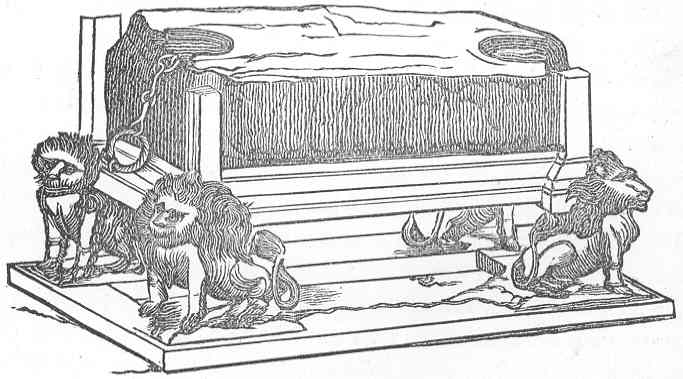
The North of Ireland had been settled with the Tribe of Dan;
they at once understood who their visitor was. They called
him Olam Folla, meaning a Divine man or teacher. The
princess was called Tea Tephi, the beautiful one from the
East. This princess was married to Heremon, of Ulster, the
king of Lothair Croffin, for such was the name of the city of
Tara. This word Tara is Arat spelled backward. The
Hebrew reads from right to left; English left to right.
Lothair Croffin was changed into Tara at the time of the
wedding. Tara means law. Thus began the seed of David
to take root, and from there it spread over all Ireland, then to
Scotland, thence to England, and Jacob’s Stone in
Westminster Abbey marks the journey of David’s throne, and
has always kept with the seed, and they have been always crowned
on it. Ezekiel’s riddle is at once solved. The
tender twigs were Zedekiah’s daughters. One of
these twigs was planted by the great waters in a land of
traffic. Our Episcopalian friends intended by their
beautiful service to aid the members of their communion to read
in order, and through the Bible, or a given portion of each
chapter, once per year. But strange to say, this 17th
chapter of Ezekiel, they have left out both of the Old and New
Lectionary. It is itself a riddle, why this should so
happen, that the only two chapters of the Bible left out or
proscribed are the 17th and 21st of Ezekiel. Surely
blindness in part has happened to Israel, and what we esteemed as
accidental in the increased light of Revelation, stands to view
as the ordered purposes of an all-seeing God.
The royal standard of England has nine lions on it and a
unicorn. Let anyone set this standard before him as a map,
the right hand will represent East, the top North, left West, the
bottom South. The unicorn comes from the East, it has a
chain round its neck. So the Tribe of Benjamin came that
way, and, as Normans, were finally attached to the throne.
The big lion comes from the West, so it did from Ireland to
Scotland and London. On the top we have a crown, and on the
top of this we have a lion. On the first quarter are three
lions, second quarter one, on the third a stringed harp with an
angel’s head, and on the fourth three lions, the total of
lions nine, and an unicorn. The fact is, this standard, had
we time, teaches a world of history, and with the Psalmist we may
say: “Thou hast given a banner to them that fear Thee; that
it may be displayed because of the truth” (Psalm lx.
4). The genealogy and descent of Queen Victoria from
Zedekiah we will furnish you. This genealogy has been got
up by the faithful and very persevering labours of Rev. F. R. A.
Glover, M.A., and Rev. A. B. Grimaldi, M.A., two Episcopalian
clergymen of England. The chart is supposed to be as near
perfect as any such thing can be. If any of you find any
defect be kind enough and let me know. In the following
genealogy those who reigned have K.
prefixed—the dates after private names refer to their birth
and death, those after Sovereign’s names to their accession
and death.
1. Adam (b.c.
4000–3070), Eve.
2. Seth (b.c.
3873–2978).
3. Enos (b.c.
3765–2860).
4. Cainan (b.c.
3675–2765).
5. Mahalaleel (b.c.
3605–2710).
6. Jared (b.c.
3540–2578).
7. Enoch (b.c.
3378–3013).
8. Methuselah (b.c.
3313–2344).
9. Lamech (b.c.
3126–2344).
10. Noah (b.c.
2944–2006), Naamah.
11. Shem (b.c.
2442–2158).
12. Arphaxad (b.c.
2342–1904).
13. Salah (b.c.
2307–2126).
14.. Heber (b.c.
2277–2187).
15. Peleg (b.c.
2243–2004).
16. Reu (b.c.
2213–2026).
17. Serug (b.c.
2181–2049).
18. Nahor (b.c.
2052–2003).
19. Terah (b.c.
2122–2083), Amtheta.
20. Abraham (b.c.
1992–1817), Sarah.
21. Isaac (b.c.
1896–1716), Rebekah.
22. Jacob (b.c.
1837–1690), Leah.
23. Judah (b. b.c. 1753),
Tamar.
24. Hezron.
25. Aram.
26. Aminadab.
27. Naashon.
28. Salmon.
29. Boaz (b.c. 1312),
Ruth.
30. Obed.
31. Jesse.
32. K. David (b.c.
1085–1015), Bathsheba.
33. K. Solomon (b.c.
1033–975), Naamah.
34. K. Rehoboam (b.c. b.
1016, d. 958), Maacah.
35. K. Abijam (b.c.
958–955).
36. K. Asa (b.c.
955–914), Azubah.
37. K. Jehoshaphat (b.c.
914–889).
38. K. Jehoram (b.c.
889–885), Athaliah.
39. K. Ahaziah (b.c.
906–884), Zibiah.
40. K. Joash (b.c.
885–839), Jehoaddan.
41. K. Amaziah (b.c. b. 864,
d. 810), Jecholiah.
42. K. Uzziah (b.c. b. 826,
d. 758), Jerushah.
43. K. Jotham (b.c. b. 783,
d. 742).
44. K. Ahaz (b.c. b. 787, d.
726), Abi.
45. K. Hezekiah (b.c. b. 751,
d. 698), Hephzibah.
46. K. Manasseh (b.c. b. 710,
d. 643), Meshullemeth.
47. K. Amon (b.c. b. 621, d.
641), Jedediah.
48. K. Josiah (b.c. b. 649,
d. 610), Hamutah.
49. K. Zedekiah (b.c.
599–578).
50. K. Heremon fl. (b.c.
580), Q. T. Tephi. She was Zedekiah’s daughter.
Reigned 15 years.
51. K. Irial Faidh (reigned 10 years).
52. K. Eithriall (reigned 20 years).
53. Follian.
54. K. Tighernmas (reigned 50 years).
55. Eanbotha.
56. Smoirguil.
57. K. Fiachadh Labhriane (reigned 24 years).
58. K. Aongus Ollmuchaidh (reigned 27 years).
59. Maoin.
60. K. Rotheachta (reigned 25 years).
61. Dein.
62. K. Siorna Saoghalach (reigned 21 years).
63. Oliolla Olchaoin.
64. K. Giallchadh (reigned 9 years).
65. K. Aodhain Glas (reigned 20 years).
66. K. Simeon Breac (reigned 6 years).
67. K. Muireadach Bolgrach (reigned 4 years).
68. K. Fiachadh Tolgrach (reigned 7 years).
69. K. Duach Laidhrach (reigned 10 years).
70. Eochaidh Buaigllcry.
71. K. Ugaine More the Great (reigned 30 years).
72. R. Cobhthach Coalbreag (reigned 30 years).
73. Meilage.
74. K. Jaran Gleofathach (reigned 7 years).
75. K. Conla Cruaidh Cealgach (reigned 4 years).
76. K. Oiloilla Caisfhiaclach (reigned 25 years).
77. K. Eochaidh Foltlenthan (reigned 11 years).
78. K. Aongus Tuirmheach Teamharch (reigned 30
years).
79. K. Eana Aighneach (reigned 28 years).
80. Labhra Luirc.
81. Blathuchta.
82. Easamhuin Eamhna.
83. Roighnein Ruadh.
84. Finlogha.
85. Fian.
86. K. Eodchaidh Feidhlioch (reigned 12 years).
87. Fineamhnas.
88. K. Lughaidh Raidhdearg.
89. K. Criomhthan Niadhnar (reigned 16 years).
90. Fearaidhach Fion Feachtnuigh.
91. K. Fiachadh Fionoluidh (reigned 20 years).
92. K. Tuathal Teachtmar (reigned 30 years).
93. K. Conn Ceadchathach (reigned 20 years).
94. K. Art Aonfhir (reigned 30 years).
95. K. Cormc Usada (reigned 40 years).
96. K. Caibre Liffeachair (reigned 27 years).
97. K. Fiachadh Sreabthuine (reigned 30 years).
98. K. Muireadhach Tireach (reigned 30 years).
99. K. Eochaidh Moigmeodhin (reigned 7 years).
100. K. Nail of the Nine Hostages.
101. Eogan.
102. K. Murireadhach.
103. Earca.
104. K. Feargus More Mac Earca (a.d. 487).
105. K. Dongard (d. 457).
106. K. Conrad (d. 535).
107. K. Aidan (d. 604).
108. K. Eugene IV. (d. 622).
109. K. Donald IV. (d. 650).
110. Dongard.
111. K. Eugene V. (d. a.d.
692).
112. Findan.
113. K. Eugene VII. (d. a.d.
721), Spondan.
114. K. Etfinus (d. a.d.
761), Fergina.
115. K. Achaius (d. a.d.
819), Fergusia.
116. K. Alpin (d. a.d.
834).
117. K. Kenneth II. (d. a.d.
854).
118. K. Constantin II. (d. a.d. 774).
119. K. Donald VI. (d. a.d.
903).
120. K. Malcolm I. (d. a.d.
958).
121. K. Kenneth III. (d. a.d.
994).
122. K. Malcolm II. (d. a.d. 1003).
123. Beatrix m. Thane Albanach.
124. K. Dunkan I. (d. a.d.
1040).
125. K. Malcolm III. Canmore (a.d. 1055–1093), Margaret of
England.
126. K. David I. (d. a.d.
1153), Maud of Northumberland.
127. Prince Henry (d. a.d.
1152), Adama of Surrey.
128. Earl David (d. a.d.
1219), Maud of Chester.
129. Isobel m. Robert Bruce III.
130. Robert Bruce IV. m. Isobel of Gloucester.
131. Robert Bruce V. m. Martha of Carrick.
132. King Robert I. Bruce (a.d. 1305–1329), Mary of Burke.
133. Margery Bruce m. Walter Stewart (I.).
134. K. Robert II. (d. a.d.
1390), Euphemia of Ross (d. a.d.
1376).
135. K. Robert III. (d. a.d.
1406), Arabella Drummond (d. a.d.
1401).
136. K. James I. (a.d.
1424–1437), Joan Beaufort.
137. K. James II. (d. a.d.
1360), Margaret of Gueldres (d. a.d.
1463).
138. K. James III. (d. a.d.
1488), Margaret of Denmark (d. a.d.
1484).
139. K. James IV. (d. a.d.
1543), Margaret of England (d. a.d.
1539).
140. K. James V. (d. a.d.
1542), Mary of Lorraine (d. a.d.
1560).
141. Q. Mary (d. a.d. 1587),
Lord Henry Darnley.
142. K. James VI. and I. (a.d. 1603–1625), Ann of Denmark.
143. Princess Elizabeth (1596–1613), K. Frederick
of Bohemia.
144. Princess Sophia m. Duke Ernest of
Brunswick.
145. K. George I. (1698–1727), Sophia Dorothea
Zelle (1667–1726).
146. K. George II. (1727–1760), Princess Caroline
of Auspach (1683–1737).
147. Prince Frederick of Wales (1707–1751),
Princess Augusta of Saxe-Gotha.
148. K. George III. (1760–1830), Princess Sophia
of Mecklenburgh Strelitz (1744–1818).
149. Duke Edward of Kent (1767–1820), Princess
Victoria of Leiningen.
150. Q. Victoria (b. 1819, cr. 1838), Prince Albert of
Saxe-Coburg.
Thus do we see how God has kept His word to David, and with
this view, English and American history are at once
understandable. The future is assuring and grand. God
will assuredly overturn till His throne once more is planted in
Jerusalem.


