“And so they rowed from the land; and Sir Bedivere
beheld all the ladies go with him. Then Sir Bedivere
cried, Ah my Lord Arthur, what shall become of me now
ye go from me, and leave me here alone among mine
enemies? Comfort thyself, said the King. For I will go
into the vale of Avilon, to heal me of my grievous wound.
And if thou never more hear of me, pray for my soul.”—Malory.
“Whether the Kinge were there or not,
Hee never knewe, nor ever colde,
For from that sad and direful daye
Hee never more was seene on molde.”
Percy Reliques.
“O, three times favoured isle, where’s the place that might
Be with thyself compared for glory or delight
Whilst Glastonbury stood?...
Not great Arthur’s tomb, nor holy Joseph’s grave,
From sacrilege had power their sacred bones to save,
He, who that God in man to his sepulchre brought,
Or he, which for the faith twelve famous battles fought.”—Drayton.
A quaint old-world look is upon the face of the
city of many legends, King Arthur’s “isle of
rest.” It lies deep in a green well-watered valley,
and its steep sudden hill, the Tor, rising abruptly
to a height of over five hundred feet and crowned
with a lonely square tower, seems to shelter and
keep watch upon the traditional apple-island.
The orchard lawns are seen everywhere with
their deep-green carpet and the crooked branches
of innumerable fruit-laden trees casting grotesque
shadows upon it. The whole year round the
western airs are balmy, though in spite of hoary
legend and poetic eulogy Glastonbury has felt the
effects of terrific storms, whirlwinds, and earthquakes.
Its history—a history of marvel and
wonder, inextricably mingled for many centuries
with superstition—takes us far back into the
misty past when the ancient Britons named the
marshland, often flooded by the water of the
Bristol Channel, Ynyswytryn, or Inis vitrea, the
Glassy Island; either, it has been surmised, on
account of the “glasten” or blue-green colour of
its surface, or from the abundance of “glass”
(or woad) to be found in the vicinity.[30] On the
other hand Professor Freeman believed that Glastonbury
was the abode and perhaps the possession
of one Glæsting, who, on discovering that
his cattle strayed to the rich pastures, settled in
that part, which in the natural order of things
became Glæstingaburgh. That it was veritably
an island admits of no doubt; the circuit of the
water can still be traced; and when the Romans
in turn made discovery of the fruitfulness of the
region enclosed by the waters of the western sea,
they denominated it Insula Avalonia, or Isle of
Apples. This was the “fortunate isle,” celebrated
in the ancient ode of which Camden has given us
a version, “where unforced fruits and willing
comforts meet,” where the fields require “no
rustic hand” but only Nature’s cultivation, where
“The fertile plains with corn and herds are proud,
And golden apples shine in every wood.”
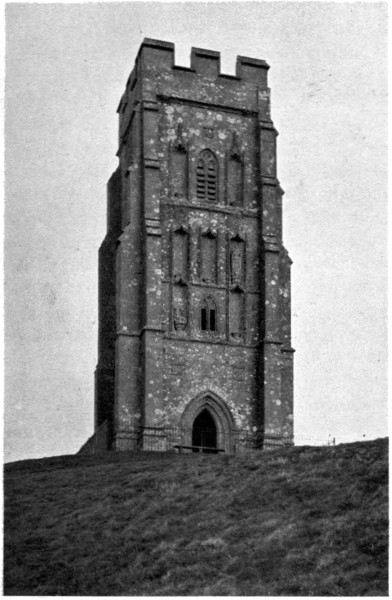
ST. MICHAEL’S TOWER, GLASTONBURY
[To face p. 218
The inflowing of the sea made islands not only
of Glastonbury, but of Athelney, Beckery, and
Meare; and not many centuries ago, when a
tempest raged, the sea-wall was broken down and
the Channel waters swept up the low-lying land
almost as far as Glastonbury Church. The simple
record of this event reads: “The breach of the
sea-flood was January 20th, 1606.” Again in
1703 was Glastonbury threatened with a deluge,
and the water was five feet deep in its streets;
but as geologists are able to affirm that the sea
is receding from the western coast it is unlikely
that such catastrophes will recur. A little lazy
stream, the Brue, almost engirdles the city, and
thus permits the inhabitants with seeming reasonableness
to retain for Glastonbury the name loved
best—the Isle of Avalon. That Roman name has
been full of dreamy suggestiveness to the poet’s
mind; and though the poet’s Avalon may often
have been an enchanted city, the “baseless fabric
of a vision,” the Avalon of Somerset, with its
two streets forming a perfect cross, its Abbey
ruins, its antiquities, and its slumbrous aspect,
is assuredly not unworthy of the legends clustering
about it.
Only by devious paths can Glastonbury, once
the remote shrine for devout pilgrims from all
parts of the land, be reached, for it is still somewhat
out of the common track. But to wander
awhile in the apple-country is delightful alike to
the mind and the physical sense—to drink in its
associations, to inhale its warm, sweet air, to see
the gleam of white blossoms and the crimson
softening upon the round ripened cheeks of the
pendent fruit, these are the sources of enjoyment
and the elements of the charm. Countless
gardens send forth a rare perfume, and the quiet
of the whole city in the midst of orchards and
streams and showing the relics of by-gone splendour
has a lulling effect upon the traveller who
comes from the roaring town and the busy mart.
When the twin dark towers of Wells Cathedral
are fading shadow-like in the distance the new
strange picture of the island-valley is revealed.
There stretch the long level meadows of deep
emerald, there glooms a forest of trees whose
twisted branches are bright with apple-blossoms.
The high Tor hill looks stern and bare, but cosy
and inviting is the town below with its rows of
irregular houses, many of which date back to long
past days, while others, constituted of stone with
which the architects of Dunstan’s and of Becket’s
time wrought, seem to bear mute tribute to the
famous era when the Abbey was in its glory and
reverend pilgrims from afar came to bring oblations
to that hallowed shrine. To-day the visitor
finds a welcome at the “Inne” built in 1475 for
the devout travellers whom the Abbot could not
accommodate within the walls of the Abbey; and
so few are the changes of time that the lofty
façade, the parapet and turrets, the wide archway,
the ecclesiastical windows, and the long
corridors, remain almost as they were first designed
and made. Side by side stand “Ye Olde
Pilgrim’s Inne” and the Tribunal, or Court
House, built by Abbot Beere, for the trial of petty
offenders against the law. Unexplored dungeons
are reported to exist underground, together with
subterranean passages communicating with the
Abbey from the “Inne” and the Tribunal. In
the neighbourhood is a conspicuous building once
used for collecting the tithes, called the Abbey
Barn, dating from 1420, in some respects the
best preserved of all the ancient memorials. But
the pride and glory of Glastonbury centre in the
wondrously beautiful remains of the oldest, richest,
and stateliest of English Abbeys—an Abbey
whose reputed founder was Joseph of Arimathæa,
that Joseph who had seen the face and heard the
voice of the Saviour of mankind. It was the only
church of first rank in England standing as a
monument of British days which escaped the
scath and wreck which followed the storm of
Norman conquest.
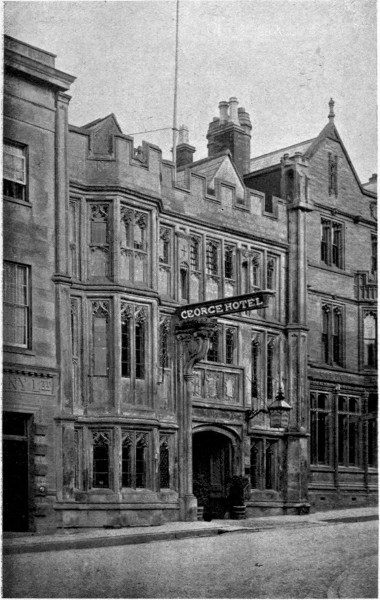
THE OLDE PILGRIM’S INN, GLASTONBURY
[To face p. 222
To what dim epoch the earliest history of Glastonbury
belongs is more or less conjectural,
though the discovery of some sixty low mounds
by archæologists led to the discovery that a prehistoric
lake-village in remote times occupied the
site. Excavations revealed the remains of human
habitations and of successive occupation by the
same race—a race which hunted the boar, the
roebuck, and the deer, and whose sole accomplishment
was the making of coarse, rude pottery.
But this people has passed away and not
even a tradition of its existence is extant. It was
at a much later period, though, looking backward,
the time seems far distant, that the first
legend of Glastonbury took root and flowered.
So pure, fragrant, and beautiful is that treasured
blossom that it would seem ruthless to attempt
to pluck it by the roots from the ground, and to
cast it aside as a worthless weed of ignorance
and superstition. It brings to us the memory of
that time when the Son of Man was on earth; it
is a seed blown from that land which His presence
sanctified. Nearly two thousand years ago
the crucified Nazarene was watched by agonised
crowds upon Calvary. Joseph of Arimathæa, “a
good man and a just,” begged the dead body
from Pilate and buried it in his own garden,
thereby incurring the fierce resentment of the
Jews. He fled from Palestine, fearing for his
life, and so enraged were his enemies at his
escape that they expelled his friends also—Lazarus,
Mary Magdalene, and Philip among others—putting
them out to sea without oars or sail.
“After tossing about many days,” says one
writer, “they were driven in God’s providence to
Marseilles, and from Marseilles St. Joseph came
to Britain, where he died at a good old age, after
having preached the Gospel of Christ with power
and earnestness for many years.” This was
about A.D. 63. “The happy news of the Saviour’s
resurrection, and the offer of the only assured
means of salvation to all who would embrace it”
were welcomed by King Arviragus, who assigned
to St. Joseph the Isle of Avalon as a retreat.
When Joseph and his little Christian band, passing
over Stone Down where stand the two notable
Avalon Oaks, came to the place, weary with
long travelling, they rested on the ridge of a hill,
which in its name of Weary-all Hill (really
Worall) is supposed to commemorate this incident;
and where the saint’s staff touched the sod,
a thorn tree miraculously sprang up, and every
Christmas Day it buds and blossoms as a
memorial of our Lord, and of the first Christian
festival.[31] Another story says that the saint was
met by a boisterous mob of the heathen, and that,
planting his pilgrim’s staff in the earth, he knelt
down to pray; and as he prayed, the hard, dry
staff began to bud and give forth fragrance, and
became a living tree. Then said Joseph, “Our
God is with us,” and the heathen, transfixed by
the miracle, were convinced and pacified. So
runs the earliest Christian legend in England,
and as a fitting sequel we learn that not long
after Joseph’s mission had begun the first Christian
chapel was built, and occupied part of the
site on which the most beautiful of holy houses
was afterwards reared—Glastonbury Abbey. St.
Joseph’s Chapel, magnificent in ruin, is one of
those hallowed places in which one might spend
hours in silent contemplation. Through many
centuries the legend of the Holy Thorn has been
preserved, and Glastonbury has remained distinguished
by the fact that there the “winter thorn”
has blossomed every Christmas “mindful of our
Lord,” or, as a pupil of Caxton’s wrote in 1520—
“The hawthornes also that groweth in Werall
Do burge and bere green leaves at Christmas
As fresh as other in May.”
The tree was regarded with great awe and superstition
by the inhabitants, and when the change
in the calendar was made they looked to the
“sacra spina” for confirmation of the righteousness
of what had been done. Many people refused
to celebrate the new-style Christmas Day
because the Thorn showed no blossoms, and when
the white flowers appeared on January 5th, the
old-style Christmas was held to have been divinely
sanctioned. A trunk of the tree was cut down
by a Puritan soldier, though his sacrilege caused
him to be severely wounded by a piece of the
dismembered tree striking him; but when the
Thorn was cast into the river as dead and worthless
it miraculously took root again. The spot
where it grew is marked by a monumental stone
bearing the inscription:—I. A. A.D. XXXI.
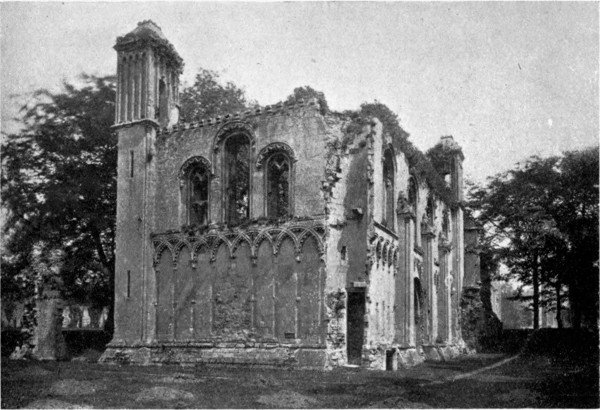
ST. JOSEPH’S CHAPEL, GLASTONBURY ABBEY
[To face p. 224
A Somerset historian likewise records that in
addition to the Holy Thorn there grew in the
Abbey churchyard a miraculous walnut tree, which
never budded forth before the feast of St. Barnabas,
namely, the 11th of June, and “on that day
shot forth leaves and flourished like its usual
species.” This tree is gone, but another “of the
commonplace sort” stands in its place. “It is
strange,” we read, “to say how much this tree
was sought after by the credulous; and though
not an uncommon walnut, Queen Anne, King
James, and many of the nobility of the realm,
even when the times of monkish superstition had
ceased, gave large sums of money for small cuttings
from the original.” The walnut tree, however,
never vied with the Holy Thorn in popularity.
The “Athenian Oracle” (1690) wriggled
out of the difficulties attending a belief in the
budding of the hawthorn tree with characteristic
ingenuity, and supplied an example that most of
us would gladly imitate. To an inquirer who
asked for information and an opinion, the
“Oracle” replied (none too grammatically), “All
that Mr. Camden says of it is, that if any one
may be believed in matters of this nature, this
has been affirmed to him to be true by several
credible persons; it was not in Glastonbury itself,
but in Wirral Park, hard by it; however,
this superstitious tree, true or false, was cut
down in the last reforming age, though it seems
they did not make such root and branch work
with it but that some stumps remained, at least
some branches or grafts out of it were saved, and
still growing in the same country; though whether
they have the same virtue with the former, or that
had any more than any other hawthorn, we don’t
pretend to determine any more than the forementioned
historian.” The belief in the tree and
the knowledge of its peculiar properties were so
wide-spread that Sedley’s verse on Cornelia, who
“bloomed in the winter of her days like Glastonbury
Thorn” was easily understood. Bishop Goodman,
writing to the Lord General Oliver Cromwell
in 1652, said he could “find no naturall cause”
either in the soil or other circumstances for the extraordinary
character of the tree. “This I know,”
said the prelate, “that God first appeared to Moses
in a bramble bush; and that Aaron’s rod, being
dried and withered, did budde; and these were
God’s actions, and His first actions; and, truly,
Glastonbury was a place noted for holiness, and
the first religious foundation in England, and, in
effect, was the first dissolved; and therein, was
such a barbarous inhumanity as Egypt never
heard the like. It may well be that this White
Thorne did then spring up, and began to blossome
on Christmas day, to give a testimony to religion,
and that it doth flourish in persecution,” and so
forth. Infinite meanings and significances could
be extracted from the legend, that fantastic casket
of man’s art and devising which is made to enshrine
the small pure pearl of truth. If this were
the place for sermons it might be pointed out that
the vitality of the Thorn is an emblem of the
vitality of the religion it commemorates; but our
duty is to trace its connection with history. The
legend has been somewhat altered in form in
order to bring it into direct association with the
building of the Abbey. This new version of the
miracle is that Joseph of Arimathæa was commanded
to build a church in honour of the Virgin
Mary, but finding that the natives were distrustful
of him and his mission he prayed, like Gideon,
for a miracle. Forthwith his staff began to shoot
forth leaves and blossoms, and the unwithered
Thorn took root. Be that as it may, the first
Christians built a chapel of twisted alder, in the
form of a parallelogram, 60 feet long and 26 feet
broad (to come to details), and having “a window
at the west end and one at the east; on each
side were three windows, and near the western
angle was a door each side.” A representation
of the first building for Christian worship erected
in this country is found on an old document now
in the British Museum, and it is said to have
been copied from a plate of brass which had been
affixed to an adjoining pillar. The chapel is
variously referred to in ancient records as
“Lignea Basilica,” “Vetusta Ecclesia,” and the
“Ealdechirche,” and with its walls of wattles and
its roof of rushes it must long have been an object
of revered contemplation. Joseph built and
preached in “the little lonely church,” “built with
wattles from the marsh,” journeying from thence
across the plain to the Mendips, where he found
other half barbarous Britons to listen to the story
of the Redemption. He laid the foundations of a
bishopric at Wells, which was afterwards to be
the rival of Glastonbury Abbey itself, and to the
end of a long and fruitful life continued his
ministry to the people.
Chalice Hill revives by its name and associations
another reminiscence of our Lord even more
amazing. St. Joseph was the bringer to this
country of two precious relics—one—
“The Cup itself from which our Lord
Drank at the last sad supper with His own,”
the other, some of the blood which oozed from
the crucified Saviour’s body. The chalice, or
sacred cup, was buried by Joseph at the spot
where a perpetual spring of water bubbles—the
“Blood Spring,” which supplies the Holy Well,
scene of many miraculous cures in times past.
That the waters are medicinal admits of no doubt;
that it issues from the Cup is a matter of faith,
especially as the Holy Grail is claimed to be now
in safe keeping by more than one far-distant
Abbey.[32] As for the second relic, it is said that
St. Joseph confided the memorial to his nephew
Isaac, who sealed up the blood in two vials and
secreted them from the invading Roman pagans.
When danger menaced him, he hid the phials in
an ancient fig-tree, which he then cast into the
sea. Carried by the waves to Gaul, the fig-tree
was cast up at the spot which now forms Fécamp
harbour; and there a few centuries later it was
found with the two phials secure. Fearless Duke
Richard of Normandy was so impressed by the
discovery that he built an Abbey in which fitly to
enshrine the Precious Blood, and Fécamp Abbey
bears witness alike to his faith and his devotion.
It was upon the story of the Grail that chroniclers
seized with avidity after Borron had once shown
its capabilities—a story now believed by many to
be almost wholly of Celtic origin, the Sancgreal
being none other than Fionn’s healing cup. Mr.
Nutt, to whose exhaustive work on the subject
reference has previously been made, has told
us of every form, rudimentary and developed,
in which the Grail legend has appeared, and of
every explanation advanced as to its meaning.
Whether the legend is based upon Christian
canonical or uncanonical writings, or whether it
is an ancient saga into which a Christian element
was imported, whether it was extant in any
definite form before the time of Robert de Borron,
or whether it was a fabrication of the era to
which many monkish fables have been traced, are
points which to discuss in detail would require,
and have had, volumes devoted to them. Within
fifty years (1180-1225) there were eight versions
of the story in which the idea of the Grail was
elaborated, and we know how the idea has been
developed and enriched and idealised until our
own time. “The vanished Vase of Heaven that
held like Christ’s own Heart an Hin of Blood,”
has been a marvellously fecund seed of inspiration
to romancist and poet. Percival and Galahad are
the highest human conceptions of purity, and their
quest is the most exalting and ennobling upon
which heroes can set forth. Yet, as we have
already seen, the conclusion cannot be resisted
that the story had its root in paganism, and that
the history of the Grail is nothing but the history
of the gradual transformation of old Celtic folk-tales
into a poem charged with Christian symbolism
and mysticism. “This transformation, at
first the inevitable outcome of its pre-Christian
development, was hastened later by the perception
that it was a fitting vehicle for certain moral and
spiritual ideas.” Avalon, lying not far from the
western sea beyond which tradition said were the
happy isles of the blessed dead, was the Cymric
equivalent for the Celtic paradise, and thus did
Glastonbury become associated with the glorious
legends which have made it in the eyes of the
romancists the most sacred and wondrous city of
earth. So may Glastonbury truly be said to
gather round it “all the noblest memories alike of
the older and the newer dwellers in the land.”
Nor is it surprising that in a place of so much
reputation modern marvels should be reported to
occur or wonderful discoveries be made. An
elixir was found in the ruins of the Abbey in 1586,
one grain of which, being dropped upon an ounce
and a quarter of mercury, was found to transmute
the mercury into an ounce of pure gold. Another
grain of it, dropped upon a piece of metal cut out
of a warming-pan, turned the metal into silver,
and this with the warming-pan was sent to Queen
Elizabeth that she might “fit the piece with the
place where it was cut out.”
Such facts are worthy of being related at some
length not only on account of any curious interest
they possess in themselves, but because they enable
us to understand a number of allusions in the
Arthurian story, and help to account for the
selection of Glastonbury as the scene of the most
solemn episodes in the career of the British king
and his knights. The poet Spenser, in recording
that Sir Lucius was the first to receive “the
sacred pledge of Christ’s evangely,” hastens to recall
the Glastonbury legend, and to explain that—
“Long before that day
Hither came Joseph of Arithmathy,
Who brought with him the Holy Grayle, they say,
And preacht the truth.”
All the chief points in the old beliefs and the
myths and traditions are caught up in Malory’s
history. The account of Joseph and his coming
to England may be read in the Book of Sir Galahad,
for the story was told by the stainless knight
who bore the marvellous shield—
“Sir,” said Sir Galahad, “by this shield beene full many
mervailes.” “Sir,” said the knight, “it befell after the
passion of our Lord Jesu Christ thirtie yeare, that Joseph
of Aramathy, the gentle knight, that tooke downe our
Lord from the crosse, and at that time hee departed from
Jerusalem with a great part of the kindred with him, and
so they laboured till they came to a citie that hight Sarras.
And at that same houre that Joseph came unto Sarras
there was a king that hight Evelake, that had great warre
against the Sarasins, and in especial against one Sarasin,
the which was King Evelake’s cosin, a rich king and a
mighty, the which marched nigh this land, and his name
was called Tollome le Feintes. So, upon a day these two
met to doe battaile. Then Joseph, the son of Joseph of
Aramathy, went unto King Evelake, and told him that he
would be discomfited and slaine but if he left his beleeve of
the ould law and beleeve upon the new law. And then he
shewed him the right beleeve of the Holy Trinity, the which
he agreed with al his hart, and ther this shield was made
for King Evelake, in the name of him that died upon the
crosse; and then through his good beleeve hee had the
better of King Tollome. For when King Evelake was in
the battaile, there was a cloath set afore the shield, and
when hee was in the greatest perill hee let put away the
cloath, and then anon his enemies saw a figure of a man
upon the crosse, where through they were discomforted.
And so it befell that a man of King Evelake’s had his hand
smitten off, and beare his hand in his other hand, and
Joseph called that man unto him, and bad him goe with
good devotion and touch the crosse; and as soon as that
man had touched the crosse with his hand, it was as whole
as ever it was before. Then soone after there fell a great
mervaile, that the crosse of the shield at one time vanished
away that no man wist where it became. And there was
King Evelake baptised, and for the most part all the people
of that cittie. So soone after Joseph would depart, and
King Evelake would go with him whether he would go or
not; and so by fortune they came into this land, which at
that time was called Great Brittaine, and there they found
a great felon panim that put Joseph in prison. And so by
fortune tidings came unto a worthy man that hight Mondrames,
and hee assembled all his people, for the great
renown that he had hard of Joseph; and so he came into
the land of Great Brittaine, and disherited the felon panim
and consumed him, and therewith delivered Joseph out of
prison. And after that, all the people were turned to the
Christian faith.”
According to Malory it was “Not long after
that,” that Joseph was “laid in his death bed,”
his last act being to make “a crosse of his owne
blood” upon the shield before giving it to King
Evelake. “Now may yee see a remembrance that
I love you,” he said, “for yee shall never see this
shield but that yee shall thinke on mee, and it
shall be alwayes as fresh as it is now. And never
shall no man beare this shielde about his necke
but hee shall repent it, unto the time that Sir
Galahad the good knight beare it.” It is the
general opinion that Joseph of Arimathæa was
buried in the ground surrounding the church of
his foundation, for a burial ground to contain a
thousand graves had been prepared in his time.
William of Malmesbury wrote that there were
preserved in that consecrated place “the remains
of many saints, nor is there any space in the
building that is free of their ashes. So much so
that the stone pavement, and indeed the sides of
the altar itself, above and below, is crammed with
the multitude of the relics. Rightly, therefore,
it is called the heavenly sanctuary on earth, of so
large a number of saints it is the repository.”
There is no clear record of who immediately succeeded
Joseph, but his ministry was carried on
by St. Patrick, who was a native of Glastonbury,[33]
by St. David, by Gildas, and by Dunstan. It was
St. Patrick who, returning from his labours in
Ireland in 461, found that the church built with
wattles from the marsh was in a state of decay,
and erected a substantial edifice on Tor Hill, dedicated
to St. Mary and St. Michael. He was
Glastonbury’s first abbot, though this fact is
traditionary rather than historical, and his grave
was near the altar of the original church. An
oratory had previously existed on the site, having
been founded a century after Joseph’s arrival by
two saints, Phaganus and Duruvianus. The
Abbey itself now began to take definite shape, the
eyes of all Christians being drawn to Glastonbury
by reason of its sacred record. In the sixth
century, in King Arthur’s time, it was approaching
its fulness of power and nearing that zenith
of fame and splendour which did not decline for
nearly a thousand years.
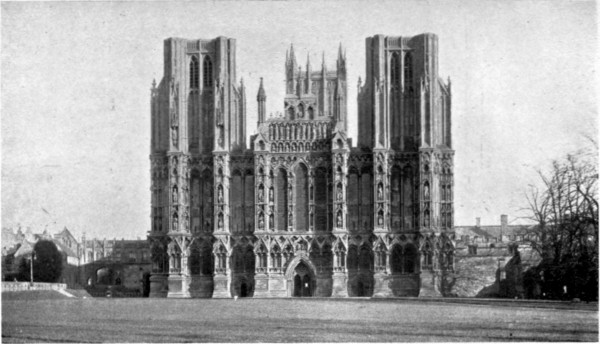
WELLS CATHEDRAL
[To face p. 236
According to Professor Freeman, Glastonbury
became, in the year 601, the great sanctuary of
the British in the place of Ambresbury, which had
but lately fallen. How it grew, how it was ruled
by great leaders in the church, how it became the
largest, the most beautiful, the most wealthy of
all abbeys, how its fall was compassed, and how
the last of its abbots, an aged man, was dragged
to the hill-top and hanged, are historic facts which
belong to a date far later than that with which
we are concerned. We cannot even dwell upon
St. Patrick’s sojourn at Glastonbury, or upon
Dunstan’s retirement to its cloisters in order to
devote himself to study and music. Here it was
that he wrestled with the Evil One in person while
labouring at his forge; here it was that heavenly
visions were vouchsafed to him; here it was that
he began his work of reformation in the Church
and made the Abbey the centre of religious influence
in the kingdom. After the lapse of
centuries we gaze only upon the ruins of the
fabric, and from them learn how majestic the
temple in its prime must have been, comprehending
a little of the truth half revealed and half concealed
in the silent storied places with their
shattered walls, their crumbling archways, their
unroofed chambers, their windows darkened with
trailing weeds, and their floors overgrown with
lank grasses and moss.
King Arthur’s connection with Glastonbury cannot
be deemed wholly mythical, though the mysteriously
beautiful narrative which tells of his last
days in Avalon seems too poetical for reality.
There are, however, other links, not so generally
recognised, connecting him with this consecrated
place. Glastonbury was not only his “isle of
rest;” nor was the Abbey known only to him as
a shrine. He claimed, or it was claimed for him,
that he was descended on his mother’s side from
Joseph of Arimathæa, the genealogy being thus
given:—“Helianis, the nephew of Joseph, begat
Joshua; Joshua begat Aminadab; Aminadab begat
Castellos; Castellos begat Mavael; Mavael
begat Lambord, who begat Igerna of whom Uther
Pendragon begat the famous and noble Arthur.”
Glastonbury, in addition to its celebrity as a
Christian sanctuary, would therefore have a claim
upon King Arthur’s attention for the sake of his
venerated ancestor, though there seems little
reason to doubt that in his day it was the cynosure
of the eyes of all who claimed to be within the
religious fold. Lady Charlotte Guest, in one of
the valuable notes to her translation of the Mabinogion,
calls attention to a record of William
of Malmesbury, which proves how much Glastonbury
was in King Arthur’s mind on all occasions.
“It is written in the Acts of the illustrious King
Arthur,” we read, “that at a certain festival of
the Nativity, at Caerleon, that monarch having
conferred military distinction upon a valiant youth
of the name of Ider, the son of King Nuth, in
order to prove him, conducted him to the hill of
Brentenol, for the purpose of fighting three most
atrocious giants. And Ider, going before the
rest of the company, attacked the giants valorously,
and slew them. And when Arthur came
up he found him apparently dead, having fainted
with the immense toil he had undergone, whereupon
he reproached himself with having been the
cause of his death, through his tardiness in coming
to his aid; and arriving at Glastonbury, he
appointed there four-and-twenty monks to say
mass for his soul, and endowed them most amply
with lands, and with gold and silver, chalices,
and other ecclesiastical ornaments.” From this
we might well infer that King Arthur was in the
habit of paying periodical visits to the island-valley.
“The great Lady Lyle of Avelyon,” girt
with a sword which only Balin could draw from
its scabbard, with results afterwards disastrous
to himself, is a link in the associations of Arthur
and his court with the island-valley.
His war with King Melvas, of Somersetshire
(strongly reminiscent of the last war with Mordred,
as related by Malory), reads like veritable
history. While engaged in subduing the savage
hordes in Wales and Cornwall, and in beating
back the advancing Saxons, he found that the
“Rex Rebellus” Melvas had stolen away his wife
Guinevere, and carried her to Ynyswytryn. King
Arthur gathered a large force, and set out with
his knights to take summary vengeance on the
ravisher, whom he forthwith besieged. A well-known
antiquary has found reason to believe
that Arthur’s force was “a numberless multitude;”
but at all events there is little doubt that
Melvas, who was only an “underlord,” would
have been heavily defeated had a battle ensued.
But conflict was avoided by the intervention of
Gildas, the Abbot, who commanded Melvas to
restore Guinevere to her rightful lord, and then
succeeded in reconciling the two foes. They both
ended by swearing friendship and fidelity to the
Abbot, and the facts go far to show the potentiality
of that dignitary at this period. Thus, by
establishing King Arthur’s connection with Glastonbury,
we increase the likelihood of his choosing
the holy place at Avalon for his last resting-place.
He knew the shrine well and had visited
the fruitful, balmy island-valley in which his
ancestor’s name was deeply revered; and when
his time drew nigh he could think of no sweeter,
better spot in which to seek for peace. “Comfort
thy selfe,” said the king to weeping Sir
Bedivere after the last battle, “and do as well as
thou maiest, for in mee is no trust for to trust
in; for I wil into the vale of Avilion for to heale
me of my grievous wound; and if thou never
heere more of me, pray for my soule.” And with
the three mourning queens he passed from the
bloody field of Camlan up the waters of the Bristol
Channel to the isle
“Where falls not hail, or rain, or any snow,
Nor ever wind blows loudly.”
“King Arthur, being wounded in battle, was
brought to Glastonbury to be healed of his wounds
by the healing waters of that place,” an old record
runs. But his wound was too grievous; and
though Merlin prophesied that he “cannot die,”
the current tradition is that when he reached the
sacred isle he “came unto his end.” In the time
of the first Plantagenet, when the fame of King
Arthur was revived, search was made at Glastonbury
for the bones of the great British chief.
Henry II. was then on his way to Ireland, and
Henry of Bloys, then Abbot of Glastonbury,
undertook the task, fully intending, no doubt,
that it should be successful. Between two pillars
at a depth of nine feet a stone was found with a
leaden cross inscribed on its under side in Latin,
“Here lies buried the renowned King Arthur, in
the isle of Avalon”; and seven feet lower down
his body was found in an oaken coffin. The
historian Selden gives us an instructive report of
how King Henry was induced to set about the
strange enterprise of discovering the remains of
King Arthur. He tells us that the king in his
expedition towards Ireland was “entertained by
the way in Wales with bardish songs, wherein
he heard it affirmed that in Glastonbury (made
almost an isle by the river’s embracements) Arthur
was buried betwixt two pillars. He therefore
gave commandment to Henri of Blois, then Abbot,
to make search for the corps, which was found in
a wooden coffin (Girald saith oaken, Leland thinks
alder), some sixteen foot deep; but after they had
digged nine foot they found a stone on whose
lower side was fixt a leaden cross (crosses fixt
upon the tombs of old Christians were in all places
ordinary) with his name inscribed, and the letter
side of it turned to the stone. He (King Arthur)
was then honoured with a sumptuous monument,
and afterwards the sculls of him and his wife
Guinevere were taken out (to remain as separate
relics and spectacles) by Edward Longshanks and
Eleanor.” But notwithstanding the useful and
apposite inscription on the leaden cross, “Hic
jacet sepultus inclytus rex Arthurus in insula
Avalonia”; or as it is otherwise more epigrammatically
given, “Hic jacet Arthurus, Rex quondam,
Rexque futurus”—
“His Epitaph recordeth so certaine
Here lieth King Arthur that shall raigne againe;”—
it is hardly necessary to add that there is almost
every reason to believe that this extraordinary
“find” could have been nothing but a pious fraud,
in majorem monasterii gloriam. If the truth be
not established, however, it has been incorporated
into many chronicles as genuine history. Bale,
in his Actes of English Votaries, bears testimony
in these words: “In Avallon, annus 1191, there
found they the fleshe bothe of Arthur and of hys
wyfe Guenever turned all into duste, wythin theyr
coffins of strong oke, the bones only remaynge.
A monke of the same Abbeye, standing and beholding
the fine broydinges of the womman’s
heare as yellow as golde there still to remayne:
as a man ravyshed, or more than halfe from hys
wyttes, he leaped into the graffe, XV fete depe,
to have caughte them sodenlye. But he fayled of
hys purpose. For so soon as they were touched
they fell all to powder.” The reference to the
depth of the grave reminds us that Stow, in his
Chronicle, declares that King Arthur was buried
sixteen feet underground to prevent the Saxons
offering any indignity to his corpse, “which
Almighty God, for the sins of the Britons, afterwards
permitted,” he disappointingly concludes.
Camden’s account of the discovery is in these
words: “When Henry II, King of England, had
learned from the songs of the British bards, that
Arthur, the most noble hero of the Britons, whose
courage had so often shattered the Saxons, was
buried at Glessenbury between two pyramids, he
order’d search to be made for the body; and they
had scarce digg’d seven feet deep, but they light
upon a cross’d stone (cippus) or a stone in the
back part whereof was fastened a rude leaden
cross, something broad. This being pulled out,
appeared to have an inscription upon it, and under
it, almost nine foot deep, deposited the bones of
the famous Arthur. The letters have a sort of
barbarous and Gothic appearance, and are a plain
evidence of the barbarity of the age, which was
involved in a fatal sort of mist, that no one was
found to celebrate the name of King Arthur.”
The most detailed account of all is given in Joseph
Ritson’s scholarly work on King Arthur, and the
famous antiquary’s outspoken comments on the
records “and other legendary rhodomontades”
of the monks of Glastonbury can be read with
amusement as well as with profit. It is a sufficiently
remarkable fact that none of the chroniclers
agree in their details, and Matthew Paris distinctly
declares that the letters inscribed upon the
tomb could “in no wise be read on account of too
much barbarism and deformity.” Antiquary Leland
was sceptical as to the coffin, and William
of Malmesbury (1143) said “The sepulchre of
Arthur was never seen”; but, despite all contradictions
and doubts, the discovery seems to
have been generally accepted as genuine, while
for many reasons it was gratifying to the people
of that and subsequent ages. Caxton would have
regarded it as “most execrable infidelity” to have
had a doubt upon the subject. At Glastonbury
we indubitably seem to get nearer the real Arthur
than we are able to do in any of the other localities
mentioned by Geoffrey and the later chroniclers.
Whether he was the monarch described in the
romances or a semi-barbarous chieftain leading
the Britons to a final, though only temporary,
victory against the Saxons, there remains the
same likelihood of his connection with the first
Abbey raised in the land.
On the authority of Gildas, we learn that when
the Abbot brought about peace between Arthur
and Melvas, both kings made oath never to violate
the holy place, and both kings gave the Abbot
much territory in token of their gratitude. If,
however, it is hard to reconcile the death of King
Arthur with Merlin’s prophecy, it is harder still
to account for the discovery of his bones and his
grave in face of the ancient triad which declared
his grave to be unknown, and remembering which
Tennyson related—
“His grave should be a mystery
From all men, like his birth;”
while the older poet tells how he “raygnes in
faerie.” There was, however, a substantial
reason for the finding of King Arthur’s tomb by
Henry of Blois, for at that time the revenues
brought by pilgrims to the shrine were not sufficient
to provide funds for the building. The contest
between Wells and Glastonbury had also
begun, and the discovery of the bones of a saint
was one of the surest methods of obtaining an
advantage. According to Stow’s Chronicle, the
body was found “not enclosed within a tomb of
stone, but within a great tree made hollow like a
trough, the which being digged upon and opened,
therein were found the bones of Arthur, which
were of a marvellous bigness.” This circumstantial
evidence seems almost irresistible, and no
doubt there was a conscientious belief in the discovery
at the time it was reported to have been
made. Stow has further details to give on the
authority of Giraldus Cambriensis, “a learned
man that then lived, who reporteth to have heard
of the Abbot of Glastonbury that the shin-bone of
Arthur being set up by the leg of a very tall man,
came above his knee by three fingers. The skull
of his head was of a wonderful bigness; in which
head there appeared the points of ten wounds,
or more, all which were grown in one seam, except
only that whereof he died, which being
greater than the other, appeared very plain.”
Such, then, are the records of this wondrous
discovery.
Modern Glastonbury has its museum in which
may be seen some pottery from “King Arthur’s
Palace at Wedmore,” and a thirteenth or fourteenth
century representation on the side of a
mirror case of Queen Guinevere deserting with Sir
Lancelot, the only two relics, I believe, which in
any way recall the connection of King Arthur
with the place. There are evidences of the
antiquity of the Abbey in abundance; though
pilgrims’ staffs, leather bottles, palls, grace cups,
roods, “counters” made by the monks to serve
as coin, and even the reliquary containing a small
piece of bone supposed to be of St. Paulinus, sent
or left by St. Augustine himself for the purpose
of establishing the modified form of the Benedictine
rule, do not quite take us back to the
sixth century. Though the actual date of King
Arthur’s death is not known, and though his age
is variously given from just over fifty to passing
ninety, and though there is no consensus of
opinion as to the length of his reign, we never
hear of him at a later date than 604; and unfortunately
all the Glastonbury relics take us back
at most to the tenth century. Yet enthusiastic
Drayton might well be carried away with the
theme with which Glastonbury supplied him; and
remembering the marvels of its past and the
splendour of its aspect in his own day, he asked
what place was comparable with the “three times
famous isle?”
“To whom didst thou commit that monument to keep,
When not great Arthur’s tomb, nor holy Joseph’s grave
From sacrilege had power their holy bones to save?”
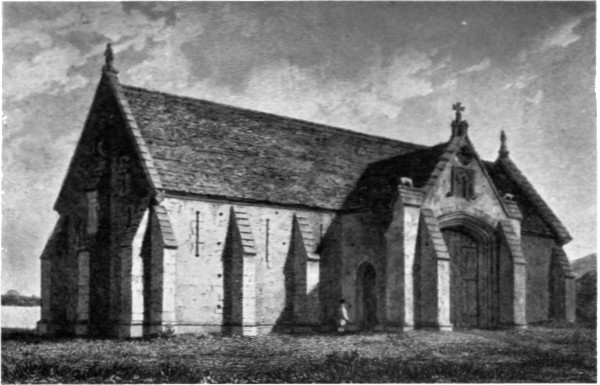
THE ABBEY BARN, GLASTONBURY
[To face p. 248
This is one of the insoluble mysteries. The remains
of Arthur and Guinevere are stated to have
had noble burial by King Henry’s command in “a
fair tomb of marble,” and the cross of lead bearing
the original inscription was placed in the
church treasury. At the suppression of the monasteries
it is assumed that all the tombs and
monuments shared one fate. Edward I and his
queen visited Glastonbury in 1278, and after
seeing the shrine, fixed their signets upon the
separate “chests” in which the dust was deposited.
Within the sepulchre they placed a
solemn written record of what they had seen, together
with the names of the principal witnesses.
King Edward is also said to have had Arthur’s
crowns and jewels rendered to him. He and his
queen were satisfied that they had gazed upon
“the bones of the most noble Arthur”; and theirs
were the last eyes to see the remains, false or
true. The historian Speed, in indignant strain,
tells of the doom that befell the Abbey in Henry
VIII.’s days, when “this noble monument, among
the fatal overthrows of infinite more, was altogether
razed by those whose over-hasty actions
and too forward zeal in these behalfs hath left us
the want of many truths, and cause to wish that
some of their employments had been better spent.”
Whatever sign of King Arthur’s tomb, real or
pretended, had existed, thus vanished for ever,
and the prophesied mystery of his grave became
fulfilled.
All that now remains in association with his
name, and his final acts, and his uncomprehended
fate, is the Abbey, surpassingly beautiful in ruin,
founded in times faded almost from the recollections
of a race; it is itself half mystery and half
monument. The stateliest of its chambers still
bears the name of St. Joseph’s Chapel, and itself
with its delicate tracery, its exquisitely designed
windows, its carved pillars, is like a fairy tale in
stone. The little church built with wattles from
the marsh became the church triumphant and the
church supremely beautiful in after-time. When
the second Henry visited it the already venerable
Abbey was a pile of architectural wonders and
magnificence, thanks to the labours of Abbot Harlewinus.
It was he who designed and erected
that veritable gem of architecture, gorgeously
ornamented and finished in classic grace, which
serves as memorial to the first Christian saint in
England. “Imagination cannot realise,” says
one chronicler, “how grand and beautiful must
have been the view from St. Joseph’s Chapel
through its long-drawn fretted aisles up to the
high altar with its four corners, symbolising the
Gospel to be spread through the four quarters of
the world.” The matchless temple was over a
hundred feet longer than Westminster Abbey;
and its spaciousness was only equalled by its
riches. Lofty mullioned windows rose nearly to
the vaulting, richly dight and casting a dim
religious light; and the profuse decorations of
the walls took the form of running patterns of
foliage, while vivid paintings of the sun and stars
gave colour and animation to the cold stone.
Little wonder that the gorgeous Abbey in all its
loveliness and noble proportions was deemed a fitting
resting-place for kings and saints. Claiming
St. Joseph as its founder, it was almost in natural
sequence that it should make claim to be the
shrine of the last and greatest of the Christian
kings, the Arthur whom Geoffrey of Monmouth
had made renowned—“the most king and knight
of the world, and most loved of the fellowship of
noble knights, and by turn they were all upholden.”
It was to Glastonbury that the “Bishop
of Canterbury” fled, and took his goods, and
“lived in poverty and in holy prayers” when the
war with Mordred broke out. To this hermit
came Sir Bedivere, and found him by a tomb
new-graven. “Sir,” said Sir Bedivere, “what
man is there interred that ye pray so fast for?”
“Fair son,” said the hermit, “I wot not verily,
but by deeming. But this night, at midnight,
here came a number of ladies, and brought hither
a dead corpse, and prayed me to bury him; and
here they offered an hundred tapers, and gave me
an hundred besants.” “Alas,” said Sir Bedivere,
“that was my lord King Arthur, that here lieth
buried in this chapel!” Then Sir Bedivere
swooned, and when he awoke prayed that he
might abide there henceforth and live with fasting
and prayers. “Far from hence will I never
go,” said he, “by my will, but all the days of my
life to pray for my lord Arthur.”
Glastonbury to-day, amid all its ruin, spoliation
and change, hints everywhere of the glory of its
past. The charm of it lingers though the excellence
of it has vanished. In its stillness and
seclusion it retains an old-world air of beauty
and of simplicity; time which has overthrown so
much has tainted nought. Tower, wall, and roof
mingle their grey and brown and red in the peaceful
valley which the sparkling rivulets water and
entwine as with silver threads. The sheltered
gardens upon which the sunlight falls luxurious
are bounteous as ever they were, and one might
almost expect to see in the shadowy consecrated
places cowled and hooded monks pacing noiselessly,
their eyes intent upon black-letter missals,
or uplifted to behold the magic and splendour of
hill and dale. The winding road has felt the pressure
of many pilgrims’ feet; at the vesper hour
the weary fervent throng gathered about the
Abbey doors; and through the spacious aisles,
cool and shadowy, or stained with the rich colours
carried by slanting beams through the painted
windows, the holy brothers moved in slow and
solemn procession, their voices subdued in chant,
the air they breathed sweet with incense. Easily
imagined is the hallowed aspect of the lofty
fane when the last rays of the sun shot redly
within, suffused the altar in a crimson haze, and
glowed upon the burnished ornaments and the
carvings of veined marble and whitest stone;
when the darkness gathered hauntingly, and one
by one the tapers were lit, while the people were
hushed and expectant, and the monks bowed
themselves in adoration. Holy relics would show
dimly in their places, rod and crucifix stand out
dark against the walls, the royal tombs be covered
as with a pall, and a mysterious awe descend
upon the worshippers in the temple. Outside the
world would be hushed, even as it is hushed to-day
when the pilgrim stands amid the broken
walls of St. Joseph’s Chapel, or treads the thick
green turf between crumbling vestibule and arch.
Truly Glastonbury was an isle of rest.
King Arthur had fought against the pagan
horde and “upheld the Christ.” Glastonbury
withstood the heathen, and boasted to the last of
never having fallen into sacrilegious hands. It
was Christian always—the Church of martyrs like
Indractus, of saints like Cuthbert, Patrick, David,
and Dunstan, and of kings like Ina, Edmund, and
Arthur. The massive walls nobly withstood the
assault of time, and the ruins of to-day are the
work of the iconoclast, due to desecration and
not decay. The remnants are pathetic in their
significance; the scene of mutilated beauty is
mournful beyond expression. Yet the beauty remains,
though it is not the beauty of spirituality
and life, but of the ethereality of death. As we
gaze we are with a bygone age and generation,
and that age seems to imbue our thought and
tinge our reflections. Everywhere may be seen
mementoes; all sounds are like echoes, faint and
far; all sights are dim with haze. Glastonbury
is for retrospection. The air is full of traditions;
its history deals with phantoms and its opening
page is of myths.
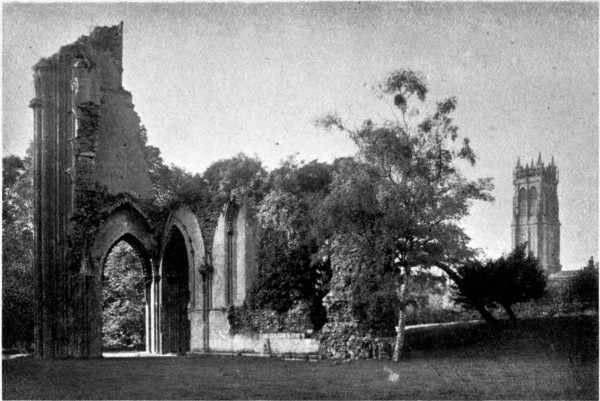
RUINS OF ST. JOSEPH’S CHAPEL, GLASTONBURY
[To face p. 254
Take your stand on Wearyall Hill, and brood
awhile upon the surroundings. You thrill to think
that here St. Joseph might have paused; that
here, where lies a stone engraved with J. A., his
withered pilgrim’s staff might have burst into
bloom. A few young trees are bending to the
wind; down below the old city stretches away
in grey lines, and there are some tumble-down
houses of antique appearance produced by the old
rafters and rough stone of which they are constructed.
Bright and cheerful are many lattice
windows which twinkle out between the heavy
time-scarred mullions wrought long and long ago.
Yonder is Tor Hill, and the great green valley
spreads southward, strewn with trees thickly, and
ending only where the dipping horizon meets it.
The two Glastonbury towers are standing out
boldly, almost as if defiant; the red roofs of the
city cluster below; and, set deeply and immutably
among aged and dark green trees, are the rent
but erect walls of the first Christian Abbey.
Or retrace your steps, and after passing the
Abbey bounds, mount the steep Tor and stand by
the Tower which alone escaped the shattering
force of earthquake. From this summit the view
of the landscape is far and good. Scarcely can
you realise that once the salt waves lapped this
steep eminence, but the sand and shells mixed
and embedded in the soil have graven that event
more legibly than the pen of man could have
inscribed it. It is sunset—sunset over the Avalonian
isle. The day has been calm and grey, and
the end is to be calm, autumnal, subdued. There
is one long quivering stretch of cardinal in the
west, but elsewhere the sky is wonderfully sombre,
yet exquisitely soft and pearly clear. The furthermost
limit of the vale fast becomes invisible, fading
imperceptibly, apparently merging into the
sky as it becomes a pure deep blue. Here and
there a purple peak of the range of hills running
seaward rises sharply and pierces the thin gauzy
clouds which the wind brings up. The white
road gleams below, wholly deserted, yet fancy
may conjure up spectres gliding at nightfall along
the once hallowed way to the shrine. On this
steep hill, alone, cloud-high, you feel that the
silence is mystical, and wonder if the sleeping city
with its ghosts and traditions is like the fabled
cities of enchanters which rise at night without
foundation and dissolve like mist in the earliest
light of morning.