I was nearly fifteen and my brother Tom
was a little over sixteen when father died.
There were no more of us, for our mother
had died when I was so little that I could
scarcely remember her. The only relation
we had in the world was an uncle whom we
had never seen and who lived in America,
in the colony of the Carolinas.
Father was a British channel pilot, and
Tom and I were born and had lived except
for one week, all our lives, in Bristol. This I
have been told is the finest city in England,
though, of course, everybody knows that it is
not quite so big as London. Father owned
a share in a pilot boat, and he often took us
out with him when he was cruising for a
homeward-bound ship. We used to help the
men work the boat, and we were better
sailors than either of the two apprentices.
Once a man hired father to sail a new brig
from Bristol round to Penzance, and we
went with him. That was the one week
when we did not live in Bristol, which I just
mentioned. We enjoyed it very much and
learned a good deal about square-rigged
vessels while we were in the brig.
Pilots did not make much profit in those
days, and father left us nothing except half
a crown and his share of the pilot boat. Before
he died he told his partners to sell his
share and use the money to send Tom and
me to our uncle in America. The two partners
bought the share themselves for thirty
pounds, which was all it was worth, for they
were good honest men, and when they had
paid our passage to America on the brig
Swansea, they gave us two pounds ten and
threepence, which was all the money that
was left.
The captain of the Swansea agreed to take
us as if we were gentlemen passengers. We
were to live with him in the great cabin and
were not to do any work. Not that we were
not quite willing to work our passage, but
Captain Robinson, father’s oldest partner,
said, “No; it was our late pardner’s orders
that you was to be sent to America, and that
did not mean that you should work your
way; and it shall be done accordin’ to orders,
for a dead man’s wishes ought for to be carried
out, providin’ it can be done; you don’t
want to have ghosts a-visitin’ you.”
The Swansea was a fine brig of four
hundred tons. She carried four guns on a
side besides a big gun amidships. These
guns were to keep off pirates, though, as it
turned out, they were the very reason why
we fell into the hands of pirates; for if we
had not been so well armed I doubt not
that we should have sailed straight to
Charleston and the poor captain would have
been alive at this day.
We had two mates and a crew of twelve
men besides the cook and the cabin boy, so,
for the size of the brig, we were strong-handed.
The captain, whose name was Fearing,
was a Bristol man, who had known father
for many years. He was a good, kind man,
but he was not severe enough to keep a bad
crew in order, and, what was worse, he often
drank too much spirits, and then acted so
foolishly that the men had no respect for him.
I do not like to say this, because Captain
Fearing was always kind to Tom and me.
He was a brave man, too, and always ready
to do his duty when he was sober, but it is
the truth, and there is no help for it.
The mate was a smart, active seaman, but
I did not like him, for I always felt that he
could not be trusted. Instead of keeping
spirits from the captain, he would often bring
a bottle with him on deck and offer it to the
poor man who could not resist the temptation
to drink when the stuff was, as you
might say, held up to his lips. But I had
no reason to complain of the mate’s treatment
of Tom and me. He was always pleasant
and respectful, treating us indeed like
young gentlemen, and he would sometimes
tell us wonderful stories of the exploits of
great pirates, such as Captain John Morgan,
and other like bloody men.
The second mate, Mr. Otway, was a hard,
brutal man, who was fond of knocking the
men about and of using dreadful language;
but one night, after we had been at sea about
three weeks, he fell overboard. At least he
was missing, and it was supposed he had
fallen overboard, though I now believe that
he was murdered by the crew.
And surely a worse crew never sailed out
of Bristol. They were shipped because
sailors were scarce at the time, and Captain
Fearing had to take such men as he could
get. They were mostly Englishmen, but a
drunken, vagabond set, and there were three
or four foreigners among them, Spaniards
and such—wicked-looking men who were
fit for any desperate work. The men obeyed
Mr. Otway because they were afraid of him,
and they generally treated the mate respectfully,
but they would insult the captain to
his face.
We had pleasant weather all the voyage,
for it was the month of June, when the winter
was over and the summer hurricanes had
not begun. The brig was a very fast sailer,
and was not heavily loaded, but I heard that
her cargo was a very valuable one, although
I never knew what it was.
There is a strong current called the
Gulf Stream that sets up the American coast,
and when we were approaching it the captain
kept to the southward in order to make
allowance for it; for he was not an expert
navigator with instruments, and used to say
that he valued dead reckoning and the hand-lead
more than all the brass instruments and
mathematics that were ever invented. As it
afterwards turned out, he was mistaken in
his reckoning, and we were much further
south than we ought to have been, though I
think the mate knew it all the time.
Early one morning Tom and I were awakened
by a noise in the cabin, and turning
out in a hurry, we found the cabin filled
with men. The captain was sitting in a
chair with his hands and feet tied, and the
mate was standing in front of him making
a speech. Nearly all the crew were there,
some of them grinning and passing low
jokes, but more of them looking fierce and
excited. The captain was quite sober and
had evidently been seized and bound while
he was asleep, for he was in his night-clothes.
Nobody paid any attention to Tom and me,
and we tried not to attract any notice.
“I’m very sorry that this has happened,
Captain Fearing,” said the mate, “for I’ve
nothing in the world against you, but you
must see that it’s a shame that a smart brig
like the Swansea, and a stout crew should be
wasted in trading when we could make our
fortunes out of hand in a few months as gentlemen
rovers.”
“You’re a scoundrel, John March,” replied
the captain, “a mutinous, piratical hound.”
“Now, don’t use such language, Captain,
for I want to be friendly with you, though,
in course, I knew that you’re ruffled a bit
at being lashed up in your own cabin. But
it’s this way, you see. The men are determined
to make a cruise or two in the brig,
and as I’m the only navigator on board,
except you, they naturally want me to take
charge of her, knowing that you’ve a prejudice
against a roving life. I’d have continued
the voyage to Charleston if I’d had
my way, but when it’s a choice between commanding
as brave a set of men as ever I sot
eyes on, or having my head split open, why,
in course, I chooses the first.”
Here some of the men began to murmur
that there had been enough talk,
and that they couldn’t wait all day for soft
speeches.
“What do you mean to do with me?”
asked the Captain. “And what do you mean
to do with the two young gentlemen?”
“We are going to treat you very handsome,
Captain,” replied the mate. “The brig
is at this identical moment hove to in sight
of the coast of Florida. There’s a boat all
ready for you, and you and the two young
gentlemen can take it and pull ashore, or
steer for Charleston, just as you please.
We’ll give you provisions and arms, and
you’ll find fresh water ashore; and I think
you’ll admit that this is more than you’ve
any right to expect.”
“Let the kids join in with us, if so be that
they want to make their fortins,” said one
of the men.
“They don’t want to join; they wouldn’t
be of no use except to share our earnings,
and besides it was in our bargain that they
were to be put ashore with the captain. I
sticks to my bargain, my lads, and I expect
you to stick to yours,” said the mate.
I was very glad to hear this said, for I
was beginning to have a terrible fear that
I should be made to stay with the pirates.
“And now, Captain,” continued the mate,
“if you’ll pass your word to go ashore quiet
and peaceable, I’ll cast off these lashin’s, and
you shall dress yourself and leave us, for
there’s a nice breeze springing up.”
The captain wanted to burst out in violent
language; but he saw it was no use, so he
presently said, “I’m in your power and I
must submit.”
“That’s right,” exclaimed the mate; “I do
like to see a man act smooth and appreciate
a kindness when it’s shown to him. Now,
men, you can go on deck and I’ll stay here
till the captain and the young gentlemen
are ready.”
Tom and I dressed in a hurry, and as soon
as the captain was ready we all went on deck,
and the mate invited us to get into one of
the quarter boats. The men stood near by,
silent and scowling.
“You’ll find everything comfortable in
the boat,” said the mate, as pleasantly as if
we had hired it of him for a pleasure trip.
“There’s two hams, and some biscuit, and
there’s two guns and ammunition, and there’s
blankets, and a lantern. Why, you might
go a pirating yourself, Captain, with that
craft. I really envy you, I do.”
All the while he was talking the mate
was pushing us into the boat, and passing
one of the falls to the captain and one to
me. “Now lower away smartly,” he added,
“for we want to make sail on the brig.”
“This is all foolishness,” cried one of the
sailors, with a lot of wicked words which I
won’t mention. “Cut one of the falls, and
drown the lot of them, I say.”
March jumped on the rail, holding on by
one of the davits, and drew a pistol. “I’ve
passed my word that they shall go ashore
safe,” he said, “and you know me and know
I’m a man of my word. The first man
that touches one of those falls is a dead
man.”
The men said no more, and we lost no
time in getting clear of the brig. As we
pulled away the mate waved his hat to the
captain, and then jumped down from the
rail and we saw him no more.
We pulled straight for the shore, Tom
and I taking the oars and the captain steering.
The shore was only about ten miles
away, and the sea was quite smooth, with a
nice light breeze that helped to keep us
cool. The captain said nothing for a long
while, but kept looking back at the brig.
The pirates had filled the main topsail as
soon as we had left, and were now standing
to the south’ard, and we never expected to
see them or the brig again.
“It’s the bottle that has done this,” exclaimed
the captain after a while. “If I’d
have kept sober I could have seen this
mutiny brewing, and stopped it, but now I
am a ruined man. All I had in the world
was in that vessel.”
As he seemed to be talking to himself
and not to us, neither Tom nor I said anything
to him.
“And John March, too, a man whose life
I had saved. To think that he should turn
against me and seize my brig. But he never
had any conscience, and he is sure to come
to the gallows.”
“But if it hadn’t been for him, sir,” I
ventured to say, “we should all have been
drowned.”
“I suppose so,” answered the captain;
“but it would have been better for me if I
had been. Take warning by me, boys, and
never touch spirits. I’ve taken my last drink,
but I’ve mended my ways when it is too late
to undo the ruin that I have brought on myself.
Before you ever take a glass of spirits,
you jump overboard and drown yourself, for
you’d much better be dead than a drunkard.”
I was very glad to hear that the captain
had resolved never to drink again, for I liked
him very much, all but his one bad habit.
But before very long he began to overhaul
the things in the stern sheets, as if he
were searching for something, and could
not find it. Then he said, “Boys, just look
about you and see if there is a bottle in the
boat.” We couldn’t find any, and then the
captain broke out against the mate, saying
that he had purposely set him ashore without
a drop of spirits, though he knew he
couldn’t live without it. So I saw that the
captain’s reformation would only last till
he could get at the bottle again. It was
very lucky for us that the mate had not put
any strong liquors in the boat; for if he had
done so the captain would certainly have
made himself unfit to manage the boat and
would very likely have capsized it and
drowned us all.
I had noticed a little piece of white paper
lying on the bottom of the boat, and when
the breeze fluttered it I saw it had writing
on it. So I pointed it out to the captain,
and he read it out loud, for he was a poor
scholar and could not read unless he pronounced
every word, and spelled all the long
ones. I picked the note up afterwards and
have kept it to this day. Here it is:
Honored Captain:
I take the great liberty of saying that we are now in latitude
29°, your calculations not having been quite right, through no fault
of yours. You will find a small river, if you pull straight ashore,
but the entrance to it won’t be easy to find unless you bring two
tall pine trees in a line. If I may humbly advise I would say
don’t stop on this coast, for you might meet some bad characters,
but steer northerly for about eighty miles, where you will find a
settlement. With my duty to the young gentlemen, and wishing
you health and a prosperous voyage I am your humble servant,
John March.
CHAPTER II. ASHORE.
When the captain had read the mate’s
letter he was more angry than ever, and said
that Mr. March was the most cruel and cowardly
hypocrite that ever lived. I did not
know what to think, for though the mate
had turned pirate, and stolen the captain’s
ship, he had saved the captain from being
murdered by the crew and had saved Tom
and me from what would have been worse
than being murdered. It was certain that
he was a very bad man, but for all that he
did seem to be kind-hearted, and it was good
in him to write that letter, for without it we
could never have found the river.
When we came near the shore we could
see nothing but a long stretch of sand beach
with low sand hills, and a thick forest of
pine-trees behind them. There were two
pines that were about half a mile apart, so
far as we could judge, and stood out separate
from the rest of the trees, for, as we
afterwards found, the forest had been cleared
away around them. We brought these two
trees in line with one another and then
steered for the beach, where we found an
inlet with the tide running into it. This
brought us into a little lagoon that lay between
the beach and the mainland. Continuing
to keep the trees in line we crossed
the lagoon and found ourselves at the mouth
of a small river, up which we pulled, delighted
to find ourselves in the shade of the
forest.
It was a beautiful river. It was so narrow
that the trees on each bank nearly touched
their branches overhead, and half a mile
from the lagoon the water became perfectly
clear, so that we could often see the sandy
bottom, though in most places the river was
very deep. All sorts of strange and beautiful
birds were among the trees, and we saw
more snakes in the water and on the shore
than we wanted to see. Once we startled
a large wild beast that was sleeping on
the shore and that was spotted like a leopard,
but as soon as it saw us it bounded into the
forest. Tom and I were perfectly happy.
The beautiful river was so much better than
the cabin of the Swansea, that we began
to be glad that the crew had mutinied and
driven us away.
A mile up the river we came to a small
clearing where there was a sort of fort, very
near the river, and a nice landing-place for
boats. The fort was quite deserted, and at
once we went ashore to explore it.
It was built of great pine logs, squared
and fitted closely together. It had only two
windows, high above the ground, one at
each end, and was loop-holed, like a real
stone fort on every side. There was an immensely
thick door in the side toward the
river, which could be fastened from the inside
with an iron bar, but it stood wide open
and the doorway was filled with the biggest
spider-webs I ever saw. There was another
smaller door in the opposite side of the
house, which also had its iron bar, and was
closed.
There was nothing in the house but loose
straw, which was scattered all over the floor;
a long table, some rough benches, and a few
pots, pans and plates. Grass had grown up
between the boards of the floor in many
places, and it was plain that nobody had
been inside the fort for a long while. There
was a curious smell about the place that
reminded me of a menagerie I had once
seen in Bristol, and I could not understand
why Captain Fearing would not at first let
us search the fort, but told us to go and bring
up the things that were in the boat.
While we were busy the captain found a
long pole with which he carefully stirred up
the straw, and finally threw it all out of the
back door. Then he made us help him stop
up the holes in the floor with clay, and
finally we scrubbed the place out with thick
branches of trees, and then made beds out
of pine twigs that we cut and brought into
the fort.
We had a dinner of cold ham and biscuit,
and then the captain when he had lit his
pipe told us that the fort must have been
built by pirates as a place to stay in while
repairing their vessels. Near the brink of
the river there was a great tar-kettle that
was empty, but which had been used for
heating pitch with which to calk seams.
“You see,” said the captain, “that villain
the mate knows this place, and has been a
pirate at some time in his life. Perhaps his
gang was the only one which used the fort,
for in my opinion, nobody has been here for
a good many years.”
In the afternoon Tom and I went out to
explore, after the captain had warned us to
keep a sharp lookout for snakes, especially
a terrible variety with watchmen’s rattles at
their tails, which can kill a man in an hour
or two, they are so venomous.
We went out of the back door and up a
sloping path which led through bushes so
tall and thick that you might have stood
close to the side of it without suspecting
that there was a path there. The path itself
was pretty well grown up with weeds and
bushes, but still we could make it out and
we followed it till we came to a hill, in the
side of which was the entrance to a cave.
Mr. March had kindly given us a lantern,
and Tom ran back to get it. We lit it with
a flint and steel that I always carried in my
pocket, and then we entered the cave. It
was so large that we could stand up straight
in it, and the bottom, which was fine gravel,
sloped downward pretty steeply. There was
not much to see in the cave until we had
gone, I should think, twenty rods into it,
when we came to a wonderful little lake
which occupied the whole floor of the cave
and prevented us from going any further.
The roof of the cave glittered beautifully,
for it was all full of white crystals, some of
which hung down in long points and sparkled
like frost on a window when the sun
strikes it.
There was a small skiff lying partly in
the water and partly on the shore, with a
short paddle lying in the bottom of it.
There was a little water in the skiff, but
when we launched it the water did not increase,
which showed that the skiff did not
leak. We hauled it up on the shore again
to keep it from drifting away, and resolved
to come back and make a voyage on the
lake the next day.
On the way back to the house we found
an orange-tree full of delicious fruit, and
some bushes covered with large, beautiful
berries such as we had never seen before.
We did not venture to eat the berries, for
oftentimes it happens that strange fruit is
deadly; but we carried some of them to the
captain, who said that they were wholesome
and particularly refreshing on a hot day.
When night came the captain loaded the
two guns and placed his powder-horn and
bullets where he could easily reach them.
Then he barred the big door, and we all lay
down and Tom and the captain soon fell
asleep.
I was not sleepy, and was lying and watching
the pattern that the bright moonlight
made on the floor, as it streamed through
the loop-holes, when I heard a curious rattling
noise under the floor, and thought at
once of the terrible snakes of which the
captain had spoken. The noise kept growing
louder and more frequent, as if there
were a great number of reptiles under the
floor. I was about to waken my companions
when I saw a serpent gliding over the
floor just where the moonlight that came
through one of the windows made a great
square patch of light.
The snake was close to Tom and was
moving towards him, but as soon as it
passed out of the moonlight it became invisible.
It was making a slow rattling noise
as it writhed along, but this stopped the
moment I struck my flint and steel. I kindled
the lantern as soon as possible, and
saw the snake close to Tom and just beginning
to crawl across his body. My brother
was always a sound sleeper and he did not
wake until the snake had passed over him
and crawled a dozen feet away. Then I
shouted, and both Tom and the captain
started up, and I thought at first the captain
would have shot me before I could
explain what was the matter.
When we came to look about us carefully
we found five of the serpents in the room,
four of which we killed, but the fifth escaped
down an opening in the floor which we had
overlooked when we were stopping up the
holes, and through which our horrible visitors
had without doubt entered. When we
had made this hole safe by turning a large
iron pot upside down over it, and had thrown
the carcasses of the dead reptiles out of the
door, we lay down to sleep again. Under
the floor, the snakes kept up their rattling,
and the captain said there were probably
hundreds of them there, but as we were now
sure that they could not get at us, we did
not mind them.
But about midnight we had another visit.
We heard the branches and twigs crackling
in the woods outside, and thought at first
that the pirates must be approaching, but
presently near the door some animal began
to snarl and growl, like a lion—or as I suppose
a lion growls, for I am thankful to
say I never heard one. We were all awake
and listening, and after a while made out
that there were at least two of the beasts,
for they began to quarrel and swear at one
another, and every one knows that it takes
two to quarrel.
The captain was at first all for getting up
and shooting the beasts through a loop-hole,
but he remembered that our supply of ammunition
was small and that we might need
it to defend ourselves against worse foes
than wild beasts. “Let ’em growl, boys,”
said he. “They’re like sailors; the more
they growl the less mischief there is in
them; that is, if so be that they are growling
on the other side of a stout wall.”
The beasts were really what the colonists
of the country farther north called panthers.
They growled and fought, and made
a hideous noise, so that the snakes, not
liking it, rattled all the louder, but we knew
that no beast could break the door open,
and so we felt perfectly safe.
Suddenly a great dark object came flying
through one of the windows and landed
on the floor with a heavy thud. Of course
we were on our feet in an instant, for we
knew by the growling of the beast and the
flashing of its eyes that it was a panther.
As soon as it saw us it retreated to a corner,
where it crouched, watching us and making
up its mind on which one of us it would
spring. But it did not have much time for
thinking, for the captain fired at it and
killed it instantly with a brace of bullets
between its eyes.
All this was exciting, and Tom and I being
too young to be sensible naturally enjoyed
it. Still I was tired and would gladly
have slept, and could have wished that the
snakes and beasts were less fond of visiting
strangers. There was no way of closing
the window, and it was quite possible that
another panther or some new kind of animal
would use it to pay us another visit, so we
resolved that one of us should stay awake
and keep watch while the others slept.
Tom agreed to be the first to keep watch,
so the captain and I were soon asleep. But
I am sorry to say that Tom, forgetting his
duty, followed our example, though doubtless
it was his purpose to remain watchful,
and he fell asleep by accident. But we were
not to sleep much more that night, for before
very long a scream from Tom awoke
us all, and we found that another panther
had come in at the window.
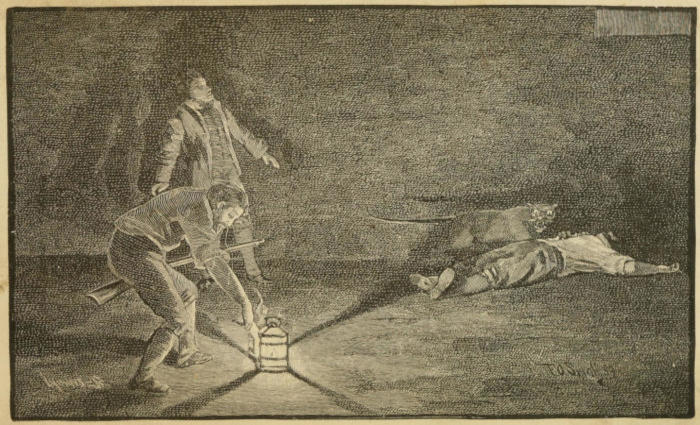
This time the beast had fallen directly
upon my brother and had sunk its claws
deeply into his arm, but being alarmed at
the noise that followed it, lay still, growling
and threatening, but not biting. Once again
I lit the lantern, the captain all the while
telling Tom to lie perfectly still and feign
to be dead, which was his only chance of
escape.
The captain and I stood each with a gun
in hand at a short distance from the panther,
who watched us as closely as we watched
him. We did not dare to shoot lest we
should hit Tom as well as the enemy, and
we could only wait and see if the beast
would not move away from Tom, and give
us the occasion to fire. But the panther
was not in the least hurry. He was not at
all afraid of us, and was apparently wondering
whether he had better make a meal of
Tom, without killing the captain and me, or
whether it would not be better policy to kill
us first and enjoy his dinner afterwards.
The only thing that disturbed him was
the lantern, which stood on the floor near
the captain. Doubtless the beast thought
it was the eye of some monstrous animal,
though he must have wondered what had
become of the animal’s body. He turned
his head toward it every few minutes and
growled fiercely, but he never let go his
hold of Tom, and gave us no chance to fire
at him.
At last the captain could contain himself
no longer, and he thought of a way of frightening
the beast. He took a paper from his
pocket, and crumpling it together, lit it at
the lantern. When it had become a flaming
ball of fire he boldly approached the panther
and threw it in the monster’s face. The
panther let go his hold of Tom and sprang
back, but almost instantly he leaped with
amazing swiftness upon the captain, bringing
him violently to the floor. I was now
desperate, for if Tom and the captain were
killed it would be only misery for me to live
in that wild place. The captain was lying
on his back with the panther on his chest,
and it was as dangerous to fire at the beast
from a distance as it had been when poor
Tom was in his clutches. But I ran close
up to the panther, and putting my gun
against its shoulder pulled the trigger, trusting
that the bullets would not pass through
its body and pierce the poor captain.
As it turned out I had done the best thing
that could have been done, for the beast was
instantly killed, and the captain, pushing the
carcass from him, rose up unhurt except for
a few scratches, none of which were serious.
Tom was in a dead swoon. This, however,
was not so much from fright, for he was a
brave fellow, as from the pain of his wound.
The creature’s claws had somewhat torn the
flesh of his left arm, and it had sunk its
claws deeply into his left breast.
However, by chafing his sound arm and
hand we soon brought Tom back to his
senses, and the captain bound up his wounds
and made him lie down where no creature
springing through the window could reach
him. I was surprised to see the captain
carefully pick up the burnt fragments of the
paper he had thrown at the panther, and
then drop them with a sigh. I asked him
what the paper might be.
“It was my commission, lad,” he replied.
“My commission as master of the Swansea.
But of what use could it be to me now?
All the papers in the world could not make
me less a poor drunken wretch who has
let his ship be taken from him.”
CHAPTER III. IN THE CAVE.
There had been so little sleep among us
all that night that as soon as the dawn came
and brought with it assurance that the wild
creatures would leave us in peace, we disposed
ourselves to rest, and I found one of
the dead panthers as good a pillow as I had
ever known.
We woke toward noon much refreshed.
The captain washed and dressed Tom’s
wounds and told us that by the next day
at the furthest we must leave the fort and
voyage along the coast in search of a settlement.
“Why not stay here until my brother is
quite recovered?” I asked. “If we bar the
windows so that nothing can enter, we shall
be very comfortable. Besides, there is the
cave which we ought to explore.”
“No good can come of our staying here,
and much harm may come of it,” he replied.
“May I ask what harm, sir?” I asked.
“I mistrust John March and I mistrust
the crew. They would gladly have murdered
us, and they may yet turn back and
make sure that we do not escape to tell tales
of them. It is my duty to see you young
gentlemen safely to Charleston, and when
once that is done I care little what happens
to me.”
“Suppose the pirates should come,” said
Tom. “Could we not hold the fort against
them?”
“We have but a dozen charges of ammunition
for each gun and the villains know it.
They would surely capture us at last, and
would put us to the torture in return for
having resisted them. If they find us here
we are lost, and I am therefore anxious to
make good our escape as soon as possible.”
“Then let us start at once,” cried Tom.
“If I cannot row at least I can steer, and in
a few days the stiffness will have gone from
my arm.”
“Let us start then to-night, so that if by
chance the wretches should have returned
and should be lying off the coast they could
not see us,” answered the captain. “We
will carry a cargo of oranges with us, for
they are both food and drink, and it will
take us at least a week before we can gain
the nearest settlement.”
Tom and I thought that the matter being
thus decided we should explore the cave
without any more delay; so we took the
lantern and set about it. But first we resolved
to ascend the hill in which was the
entrance to the cave. We had climbed
but a short distance when we were able to
see the sea, and there, to our great dismay,
we saw a vessel lying but a short distance
from the land.
We made out at once that she was not
the Swansea, for she was a schooner, and
we began to hope that she might be an
honest vessel, that had run short of water;
that her captain meant to supply himself
from our river, and that he would take us
off with him.
We were going to carry the good news to
Captain Fearing when I remembered that
beyond doubt the fort had been built by
pirates and that no honest vessel knew anything
about the river. So all the more we
hurried to warn the captain. Providence
willed, however, that we should be too late,
for we had scarcely entered the back door
of the fort when a large boat carrying fifteen
men whom we knew at a glance to be
pirates, swept up the river and came to the
landing-place, where all the men hastily
tumbled out.
Captain Fearing had seen the boat, and
had boldly gone down to meet it, before we
could speak to him. He was unarmed, and
I could see that the pirates were greatly
surprised to find him there, and that they
were not of the crew of the Swansea. They
gathered around him while he spoke to
them, and then some of them went to see
our boat, that was lying partly behind an
overhanging tree, so that they had not at
first seen it. I greatly admired the bravery
of the captain, who trusted himself among
those bloody men; I was hoping I know
not what, for I well knew that between an
honest man and pirates there could be no
peace, when I saw one of the wretches put
a pistol to the captain’s head and blow out
the poor man’s brains.
There could not be the least doubt that
the captain was dead, and terribly as we
were shocked we knew that if we were not
to share his fate we must escape before the
pirates caught sight of us. The very fact
that they did not come to the fort to search
for us the instant they had shot the captain
was proof that he had not told them of us.
“The cave is our only chance, Tom,” I
whispered. “Catch up the ammunition and
the guns and I will take all the provisions I
can carry, and we will hide in the cave. It
is lucky we have the lantern all ready.”
While I was speaking I gathered up as
many biscuit as I could stuff in the breast
of my shirt, and seized what was left of the
two hams—which was a whole one and a
fragment of another—and ran towards the
cave, meaning to leave the provisions, and if
possible return for more. But I had hardly
started back when I met Tom running at
full speed, and I learned from him that the
pirates were approaching the fort, and that
he had just time to escape unseen.
As there was really no chance of our
remaining concealed in the cave if the
pirates should search it, Tom suggested that
we should put all our things in the boat
and paddle out into the lake. Although I
had been eager to make such a strange underground
voyage only an hour before, the
death of the captain had somehow changed
my thoughts, and I did not hanker after the
darkness of the cave. So I said to Tom
that unless the pirates knew of the cave
they would not be likely to come to it,
and that at any rate they would not search
for us, because they did not know of our
existence.
“Well,” said Tom, not very well pleased,
“I suppose we can stop half an hour or so
here at the mouth of the cave, for it will
take them that time to break into the fort.”
“What do you mean?” cried I.
“Why, I shut the big door and barred it
before I left,” answered Tom. “That will
delay them and give us time.”
“And tell them, too, that the captain had
some one with him, for they well know that
he could not have left the fort and barred
the door from the inside himself. How
could you be so stupid? Now after they
have broken in they will find the back door
open and know the way we have taken.
They will be here in a few moments.”
“We have plenty of time,” said Tom,
without trying to defend himself. Indeed
he never did, for the dear, honest, brave lad
knew that he was a little slow and dull, and
thought it quite natural that what he had
done should be wrong. “The pirates,” he
continued, “will make sure that there is
somebody in the fort ready to defend it, and
the very silence will make them cautious.
As I said, it will be a good half-hour before
they get here, and if we have the skiff all
ready we can take to it before they can see
us. Besides, they may have no light with
them.”
“The boat is sure to have a lantern,” I
replied. “However, Tom, you did what
you thought was best, and perhaps it was.
Come, let’s get the skiff ready.”
We baled all the water out of the skiff
and stowed our provisions and ammunition
in it; and then, gun in hand, we went back
to sit at the mouth of the cave and see the
sunlight as long as possible. We knew the
way between the mouth of the cave and the
place where the skiff lay so well that we
could find it without a light, so we left the
lantern in the skiff.
We talked in whispers as we sat waiting
for the pirates, and I think neither of us had
very much hope that when once we should
be driven into the cave we should ever see
the dear light of day again.
At last we heard a shout from the fort
and knew that the pirates had broken in.
We instantly started for the skiff, but the
pirates must have known all about the cave,
for they were close after us with a lantern
that gave light enough to light up the whole
cave, and we had barely time to leap into
the skiff, blow out our own lantern and
shove off when they were upon us, yelling
and calling on us with awful oaths to come
back.
I sat in the stern of the skiff and paddled
hard, but to our great fright we found that
what we had supposed to be a lake was
really a small pool of water. An underground
stream entered the cave a few yards
from the place where we found the boat,
and after making a little pool perhaps fifty
feet wide and seventy-five long, the stream
left it through an archway some four feet
high. This archway was situated at the
further end of the cave.
It was impossible to find any place where
we would be out of sight of the pirates. As
I paddled around the pool hoping to find a
projecting rock that would give us a shelter
the pirates could see us plainly. They ordered
us to come back, and as we paid no
attention to them they began firing at us.
By great good fortune none of them had
guns, but as there were nine of them in the
cave and nearly all of them discharging their
pistols at us, it was not at all pleasant. Several
times the balls hit the boat, and once
one came so near my ear that I thought it
had struck me.
“This won’t do,” exclaimed Tom. “Shove
her under that arch as quick as you can,
Jack.”
You may ask why I had not already done
this, as I have said that the arch was high
enough to admit the skiff. The reason was
that the water flowed under it with a current
so strong that I feared that once in it the
skiff would be swept along in spite of the
paddle. But our affairs were now desperate,
and certain death awaited us unless we
could find a shelter.
We were only two boats’ lengths from
the arch when Tom spoke. I had made up
my mind that the arch was our only chance,
and since Tom was willing to risk it, I
turned the skiff into the current and we
glided under the arch out of sight and range
of our enemies.
The moment we found ourselves in the
current I was more frightened by far than
when the pirates were firing at us. The
force of the water was terrible, and we were
whirled along in deep darkness without the
possibility of stopping our progress. The
passage in which we were was apparently
made with as much regularity as if it was
the work of man. I could touch either side
with my paddle, but the sides seemed perfectly
smooth and slippery, and there was
nothing to which I could cling. As for the
roof of the passage, it was for the most part
so high that I could not reach it, though
once the paddle, which I was holding over
my head, struck violently against the rock.
We had traveled in this way for several
minutes, although it seemed very much
longer, and neither of us had spoken, when
I accidentally caught hold of an iron ring
on the left side of the passage or gallery,
and although I was nearly dragged out of
the boat I managed to hold on and bring
the boat to a standstill. We had no rope
with us, or I would have made the boat fast,
but as it was I could hold her for a long
time without getting exhausted. I called to
Tom to light the lantern. When he had
done this and we could see each other the
place seemed less dreadful.
The ring had of course been fastened in
the rock by some one, though for what
reason I could not imagine. But its finding
gave me new courage, for it showed that we
were not the first ones who had explored the
cave.
“What are we to do now?” I said to Tom.
“Go on, when you get tired of holding
the skiff,” he replied.
“Can you see what I am holding on by?”
“No,” he answered. “A bit of rock, I
suppose.”
“Nothing of the kind,” I exclaimed. “It
is an iron ring.”
“And what if it is?” asked Tom.
“Why, just this; somebody has been here
before us, and put this ring in its place.
What do you suppose that was done for?”
“I’m sure I don’t know,” said Tom, without
showing much interest in the ring.
“I think,” I continued, “that this is only
one of a number of rings, and that a rope
used to run through them the whole length
of this channel, so that when a boat wanted
to return against the current, the man in the
boat could lay hold of the rope and pull
himself back.”
“That may be so,” said Tom, “but the
rope isn’t there now, so it’s of no use to us.
You can’t hold on to that ring forever, and if
you could we should starve to death, after a
while. You’ll have to let go presently, and
then down we float again.”
“But, Tom, can’t you see that if people
used to go up and down this passage it must
lead somewhere, and we are not going to be
carried down any dangerous cataract or anything
of that sort?”
“I suppose it does lead somewhere; but
since we can never get back again, I don’t
think it makes much difference whether it
leads over a cataract or into some dark hole
where we will have to stay and starve. But
let her go, Jack. We might as well know
what is going to happen, for it is no good stopping
here.”
I did not much like the idea of committing
ourselves to the current again. There
seemed no help for it, however; so after saying
my prayers I let go the ring and the
skiff shot away once more.
The lantern, which was now lighted,
showed us that every few yards there was a
ring in the wall, and to one of these rings
was hanging a bit of rope. I caught hold of
it, but it was very rotten. However, I knew
now that I was right about the rings. I felt
sure that it was perfectly safe to go down the
channel, though I saw that it would be
impossible to return.
I know very well that a person badly
frightened and floating with a strong current
in the dark can know but little of the
distance over which he passes. But I was
quite sure that we were moving fully eight
miles an hour, and we were certainly in
that curious underground river for at least
ten minutes. I also feel safe in saying that
we must have gone a good mile when I saw
a glimmer of light ahead. Then we came
suddenly into another large pool where the
water was quiet and which was dimly lighted
by an opening in the roof of the cave that
seemed fifty feet above us and through which
we could catch a glimpse of a little scrap of
blue sky.
CHAPTER IV. MAROONED.
No sooner had we entered this second
pool than we were startled by a loud hail.
Greatly surprised we peered through the indistinct
light and saw dimly the figure of a
man. He was standing on a little beach at
one side of the pool and was waving his
arms at us.
We were so glad to see any one in that
dismal place that we at once paddled ashore
without caring whether the man was a pirate
or not, though even if he had been we
were well armed and had nothing to fear
from one man.
When we reached him he fell on his
knees and begged us to have pity on
a poor wretch and take him away with us.
Then he asked who we were; if we belonged
to Blackbeard’s crew, and if we were rovers,
and a dozen other questions all at once.
He was the most ragged man I had ever
seen. His clothes were so tattered that he
no longer wore them as clothes were worn,
but merely twisted them around his body,
leaving himself half-naked. His hair and
beard were very long and nearly white.
His eyes had a strange wild look about
them, due no doubt to the long time that
he had spent in the dark cave.
As soon as he found that we were not
dangerous, he begged for rum and tobacco.
Finding that we had none, he was very
thankful for a piece of boiled ham, which he
ate ravenously.
“How long have you been here?” I asked,
after he had finished the ham.
“About three or four years,” he replied.
“Leastways I think so, but a man can’t keep
his reckoning when he’s buried alive. I
remember it was the year 1718 that I shipped
with Blackbeard, and I was with him two
years when he marooned me here.”
“Then you’ve only been here about a
year; it is 1721 now.”
“One year or four years, what’s the odds
when you’re alone and starving underground?”
he answered. “Seems to me I’ve
been here a hundred years.”
“And there isn’t any way out of the cave
except by water?” I asked.
“Not unless you was a bird or a bat and
could fly out of that there scuttle up there.
You can see about all there is of the cave.
Here I’ve lived and slept and starved and
had nothing to do but to walk up and down
and catch fish. I’ve had fishin’ enough to
last me the rest of my life.”
“Haven’t you had anything to eat but
fish?”
“Not a blessed thing, young master,” he
replied. “And raw fish at that.”
“How did you catch them?” I asked.
“I’ll show you,” he said, getting up and
wading into the water till it was up to his
waist. He stood perfectly still for a while,
looking down into the water, for his eyes
were so well used to the dim light that he
could see as well as we could in bright daylight.
Presently he darted his hands into
the water with wonderful swiftness and
brought up a good-sized fish which he
showed to us and then flung back into the
pool.
“It’s easy enough after you get used to
it,” he said, coming ashore again; “but it was
a good while, and I was precious hungry
before I thought of it. You see the fish
here is naturally blind—for what would be
the use of wastin’ eyes on ’em?—and so
they can’t see me. But never mind about
fish, young master; let’s get out of here and
get some decent grub.”
“Before we agree to take you with us,”
said I, “we must know all about you. So
go on and tell us who you are and how you
came here.”
“I’ll tell you everything, faithful and
true, for I know you’re too kind to desert a
poor wretch here. I can see it in the handsome
faces of the pair of you.
“I’ve been a pirate, young masters both,
for why should I deny it? I’m an Englishman,
like you, and I went a privateerin’ when
I was a boy. It was just about the same
thing as piratin’, but it didn’t pay as well,
and wasn’t as pleasant for a lad of spirit; so
I deserted at Cape Haytien and j’ined a
crew of rovers—that is what you call
pirates, you know.
“I was in the business for several years,
and had made a lot of money and lost it
mostly, when I had the bad luck to ship
with Blackbeard. What did I do it for?
Because he was at the very top of the profession
then, and any man was proud to
belong to his crew. He was the boldest
and cruelest man that ever sailed. Even a
Spaniard would have been too good to do
some of the things he did. Blackbeard
would have made his own mother walk the
plank as soon as he would a merchant captain.
The only thing he was afraid of was
ghosts. I remember one night off the north
coast of Cuba, it blowing a hurricane at the
time, and there was two corposants aloft
that scared most of us, but Blackbeard
laughed at them, and practiced firing at
them with his pistol. But all of a sudden
he sung out that he was a dead man, and
jumped below. I followed him, for all hands
were on the quarter deck, the men being
afraid to stay forrard or go below on account
of the corposants. Blackbeard had locked
himself in his cabin and was callin’ to me to
bring him the rum. When I brought it he
told me that he had seen the ghost of a
woman sittin’ perched on the jaws of the
main gaff pointin’ at him with her finger,
and that I must tell the mate to bring the
schooner up into the wind and shake the
ghost off.
“Of course I didn’t tell the mate, for I
didn’t want to have the schooner founder all
on account of a ghost that nobody saw except
the captain, so I left him in his cabin
and went on deck again.
“Blackbeard didn’t care to be with other
pirates, so he hunted over the river that you
must have come up, and built the fort at
the landin’ place. No one knew about it
but him and his crew; he never let a man
leave him without swearin’ him on the Bible
to keep the secret. We used to careen the
schooner at the landin’-place when she
needed cleanin’ or calkin’, and this cave
was the place where we kept our treasures.
“I don’t know when Blackbeard had the
rings let into the rock and the line run
through them so as to haul a boat out of
this pool and back to the daylight. It was
done afore my time and I remember thinkin’
that the rope was gettin’ pretty rotten
and might part some day and leave a lot of
us anchored here as I’ve been. It was here
that the men used to leave their spare earnin’s,
and you’ll find some empty chests
yonder that I’ve seen pretty near full of
gold and silver. It’s all gone now, for Blackbeard
gave the order to take everythin’
aboard the schooner and abandon the cave.
He probably suspected that the secret had
got out, as it was sure to do some day.
“The men, as I was sayin’, kept their
treasures here, and I’ve seen pretty near the
whole ship’s company carousin’ and fightin’
here by the light of battle lanterns. But
Blackbeard had a place of his own further
down the cave. He had a big iron gate
all across the mouth of the channel, and you
can see it now if you look across the water.
He always used to go to it alone, lockin’ the
gate after him, but the last time he went
down the channel he never came back.”
“Then he must have got out of the cave
some other way,” I exclaimed, “for he is
alive yet.”
“I’m sorry to hear that,” said the man.
“I’ve been a-hopin’ that he’d been cast
away in some place darker than this and
had starved worse than I have. That was
the only cheerful thought I’ve had here.”
“You must be a pretty bad man to want
to have another man suffer,” I said.
“Just so,” he answered, “I have been middlin’
bad, young masters, but you’ll see how
different I’ll be when we get away from
here. But I’m not gettin’ on with my
story.
“I was Blackbeard’s servant the last year
I was with him. He’d killed both his last
two servants, and I didn’t care much for the
place, but it wouldn’t have done to refuse it.
Besides, he treated me pretty well, and I had
an easy time waitin’ on him, and eatin’ what
was left from his table, and it was a sight
better than raw fish. However, he banged
me over the head considerable and the last
time we came up the river I made up my
mind to bolt, and take my chances of reachin’
a settlement, for I knew the country
hereabouts very well. One day Blackbeard
looked into my bunk and saw that I had
made a bundle of my clothes, for I meant
to bolt at the very first chance. He must
have suspected it and that is the reason he
left me here.
“We had taken everythin’ out of the cave,
and expected to sail as soon as the job of
cleanin’ the schooner’s bottom was finished.
Early one morning, Blackbeard ordered
me to bring a lantern and take him into
the cave. When we got to this place he
ordered me to wait for him while he took the
skiff and went to his own private cave. You
see he always kept a little skiff, just big
enough to hold two, for his own use, and the
skiff you come in was the one the men
used.
“He set me ashore here and then paddled
to the iron gate, unlocked it, passed through,
locked it again and disappeared. I’ve never
set eyes on him or on another livin’ man
since, till you come.
“At first I couldn’t believe that he was not
comin’ back. Then I thought that he had met
with bad luck and couldn’t get back, and I
kept thinkin’ that by and by the men would
miss him and come for him, and take me
away. But nobody ever came, and that
made me think that perhaps he knew another
way out of the cave and had left me here to
starve.
“Talk about ghosts! I saw whole shiploads
of them first along while I was here. They
wern’t ill disposed, and must have come just
out of curiosity, for they never offered to do
anythin’ except sit and look at me, and
whenever I went towards them they would disappear.
I was that lonesome that I would
gladly have took up with any sociable ghost,
and wasn’t a bit afraid of them, but I couldn’t
get one of them to speak. They’re a worthless
lot—them ghosts; I never could see
any use on ’em, anyway.
“I was that weak from starvin’ before I
found I could catch fish, that I used to fall
and stave in my head against the rocks, but
after that I had enough to eat, such as it
was.
“If Blackbeard had marooned me on a
desert island I wouldn’t have minded, provided
I could see the sun, and live on the ground
like a man. But he left me here, which was
the same as buryin’ me alive, and it was the
cruelest thing that ever he did. I’ll never
rest till I bring him to the gallows. I’ll
knock off piratin’; I’ll give up rum; I’ll
even ship aboard a man-of-war, and some day
we’ll capture him and he’ll be tried, and
old Bill Catchley’ll be the chief witness
against him and will swear him to the gallows
and stand by and see him swing.”
I haven’t told the old man’s story in
exactly his own words, for as you might
expect he used pretty bad language, but I
never doubted that what he said was true,
for Captain Blackbeard was well known to
be more of a fiend than a human being.
Tom and I told the old man that if he
would help us to escape we would help him.
We told him all that had happened to us,
and made him promise that if we could get
out of the cave he would neither join the
pirates nor deliver us into their hands.
He swore most solemnly that he would
do what we asked. He said that if we could
get Blackbeard’s iron gate open we could escape
the same way that he did. He was not
surprised to learn that the rope which formerly
led through the iron rings in the passage
through which we had come had rotted away,
and he felt sure that the iron gate must
have rusted so much that we could manage
to break it open. He had never tried it,
for the gate was in deep water, and he
could not swim a stroke. One would have
thought that he would have taught himself
to swim in the hope of escaping by that
means, but like most people who cannot
swim he thought it was the most difficult instead
of being one of the easiest of arts.
When old Bill had finished his story we
were as anxious to leave the cave as he was,
and we got into the boat again and paddled
over to the iron gate.
The gate was placed at the entrance to
another arched passage precisely like the
one through which we had come. It was
made of stout iron bars an inch thick, and
was locked by a big padlock. We found that
though the padlock was rusted it was still so
strong we could not break it; and the iron
bars seemed as strong as if they were new.
But the old man was not in the least discouraged.
Indeed he was as cheerful as if
he was going to a picnic. He said he would
have the gate open in a jiffy. He worked
for some time forcing a bit of dry rag into
the lock and pulling it out again; and when
he thought it was dry enough, he asked for
the powder horn, filled the lock with powder,
fitted a slow match made of rag, lighted it
with the lantern, and asked me to paddle the
skiff a short distance away from the gate.
The explosion blew the lock to pieces,
and with a little effort we were able to swing
open the rusty gate and enter the passage.
The swift current swept us along as before,
and we noticed pieces of rotten rope hanging
from rings in the side of the passage just
as we had in the other one.
“One does learn a sight of useful things
piratin’,” said old Bill thoughtfully; “there’s
where I learned how to open a padlock without
a key, and you see for yourselves, young
masters, how handy it come in.”
The channel in which we now found ourselves
was short compared with the other
one, and in a few moments we had shot
through it and had reached another open
space with quiet water. There was no daylight
here, but by the light of the lantern we
could see a landing place on our left, where
we hastened to land, hoping that we had
reached the end of our underground voyage.
As the skiff came up to the shore she struck
on what we found to be a sunken boat which
Bill immediately recognized as the boat
once belonging to Blackbeard.
CHAPTER V. LOST IN THE LABYRINTH.
We landed on a little rocky platform close
to a narrow passage not much larger than
the companion-way of the Swansea, which
led into what was evidently the dry part of
the cave. We followed this passage a little
distance, finding it widening all the time till
we came to a great gallery, wide and high,
in which there stood three wooden chests.
Two of them were open and empty, but the
third contained a great quantity of excellent
candles of all sorts; some of them were of
wax and at least two feet long, and must
have been stolen from some church altar.
In the empty chests Blackbeard had doubtless
kept his treasure, for I picked up, close
to the chests, a small piece of gold which
had been dropped there. But I was more
pleased to see the candles than I should
have been to have found the chests full of
diamonds, for I knew our lantern must be
nearly burnt out, and that without a light
we should never be able to find our way
out of the cave.
“There’s a way out of here,” said old Bill,
“and we’ll find it if the candles last long
enough. It’s this way, you see: Blackbeard
has been here and took away his treasure.
Now, he didn’t take it away in the skiff, for
that he sunk, and he must have sunk it on
purpose. Besides, I saw where the water
runs out of this pool, and the channel is too
small for the skiff. So, you see, there’s a
way out of the cave that Blackbeard knowed
of, and all we’ve got to do is to follow it.”
There was so much reason in what he
said that I felt quite easy about our escape.
But by this time Tom’s arm had began to
pain him a good deal. It was swollen and
stiff. He made light of it, but I could see
that he was feverish and tired, and I wanted
to save him from any unnecessary work. So
I told him that Bill and I would leave him
to rest while we searched for the way out
of the cave, and that as he had plenty of
candles he need not feel lonesome. Tom
was very ready to rest, and said that he
would lie down and try to sleep awhile.
While we were talking the lantern suddenly
went out, and I had great difficulty in
lighting a candle with the flint and steel,
for my tinder was damp. But I succeeded
at last, and lighted three candles—one for
each of us. Then Bill and I stuffed some
biscuits in our clothes, and leaving the guns
and everything else with Tom, we set forth
to explore the cave.
At first we had no trouble, for all we had
to do was to follow the gallery we were in,
but presently we came to other galleries,
great and small, leading out of it, and we
could not tell which one to follow.
However, we chose a large one and followed
it for about half a mile, as nearly as
I could judge. It was very crooked, and we
very soon were so confused by its many
windings that we could not tell in which
direction we were going. Then we came to
more galleries, leading out of the one in
which we were. Sometimes we would follow
one of these till we would come to the end
of it and would have to turn back; and once,
after wandering for miles, we came to a place
where we could see our footprints in the
sand, and so perceived that we had made no
progress during all that time, but had only
got back to the place from which we had
started an hour before.
The floor of the cave was for the most
part covered with dry sand, but occasionally
it was wet and muddy. In one of these wet
places I slipped and dropped my candle into
the water, so that now we had only one left.
We were getting rather tired, but there was
nothing for it but to keep on till we could
find our way out.
We had talked together very briskly when
we first started, but now that we had become
uneasy neither of us cared to talk.
We knew that we were lost in an enormous
cave, that we had only one candle, and that
unless we could find the outlet, or the place
where we had left Tom, we should be almost
certain to die in the dark. But neither of
us cared to say so lest we should
discourage the other; so we trudged on in silence.
I began to think how frightened Tom would
be if his candle should burn out while he was
asleep, and he should wake up in the darkness;
but I remembered that he had the flint
and steel, for I had accidentally left them on
the lid of a chest, near the biscuit, and that
he would be sure to find them. Of course he
would be alarmed when we did not return,
but I felt sure that he would know we had
been lost and that he would search for us
and perhaps find us before we had perished.
We met nothing that was alive in the cave,
except in one large hall, if I may call it so,
where there were thousands of bats. This
encouraged me, for I thought that the bats
would be sure to live somewhere near the
entrance to the cave, so that they could easily
fly out; but we could not find any way out
of the hall except through the passage by
which we had entered it. Once we came to
a little stream of water, only an inch or two
wide, and we tried to follow it, but it soon
lost itself in a crevice of the rock.
We had now tramped so long that we
were completely exhausted, and Bill proposed
that we should rest a few minutes and eat
a bit of cracker. He knew as well as I did
that we must not waste the little time that
would remain to us before our candle would
burn out, but we were too tired to keep on
our feet. So we lay down, ate a few mouthfuls,
and swallowed a little water from the
stream, and then resumed our journey.
“We may be near your brother,” said the
old man, all of a sudden. “Let’s hail him,
and perhaps he will hear us.”
We shouted at the top of our lungs, but
there was no answer except the echoes. For
all that I can tell, Tom may have been
fifteen miles away.
“How long will the candle burn?” I asked,
after we had given up the effort to make
Tom hear.
“Well, not more than half an hour,” replied
Bill, “and probably it won’t burn that
long.”
“Then we must walk faster, for we can’t
do anything in the dark.”
We walked as fast as our tired legs would
let us, Bill at the same time sheltering the
candle with his hand, so that it would not
be blown out by the wind caused by our
movements. Still there seemed to be no end
to the cave; there were hundreds of bewildering
passages. At last Bill stopped. The
candle was now too short to be held in the
fingers; he placed it on the ground.
“You mustn’t be disheartened, young
master,” said the old man, “but the time’s
come when we can’t do no more, but wait
till your brother comes for us. I’m going
to turn in and take a sleep; and if you’ll
take my advice you’ll do the same thing.”
So saying, the old man stretched himself
on the sand and fell asleep at once. I followed
his example, but I could not sleep, for
I could not take my eyes off the candle. It
was so horrible to think that in a few moments
we should be in the darkness. I
thought of the poor miners that are sometimes
buried alive, and knew how they must
dread to see their lamps burn out.
The candle burned longer than I thought
it could. All the wax melted, and the little
piece of wick fell over in a pool of hot wax,
but still it continued to burn. Suddenly the
flame vanished, and a dim little spark smouldered
for a while and then went out, leaving
us in total darkness.
I was so very tired, that in spite of my
misery I fell asleep, and have no idea how
long I slept. I woke up finally feeling
rather stiff, and in a low voice asked Bill if
he was awake. He said he had been awake
a long while, but that he had not moved for
fear of disturbing me.
“We’re in an awful scrape,” I said to my
companion, “and you were a good deal better
off before we found you, for you weren’t
altogether in the dark.”
“But I was all alone, young master,” Bill
replied, “and I’d a great sight sooner be
here alongside of a human being than
stark alone in my old cave. And don’t
you get faint-hearted. We’ll get out of
this, yet.”
I did not answer, for I had nothing to say,
and after a little the old man said,
“Mayhap you can lay your hand to a
prayer or two, young master. You’ve been
brought up ashore.”
I was astonished and ashamed that I who
had been piously brought up should be
advised to pray by a wicked old pirate. It
is true I had already prayed that we might
be delivered from our great danger, but I
had been ashamed to pray out loud.
“Certainly I know some prayers, Bill,” I
said.
“Then,” said he, “if you’ll kindly shove
ahead with them, I’ll take my turn when
you’re through. You ought to come before
me, being a young gentleman, and handy
with prayers; whereas, I don’t know a single
prayer except one that I knocked together
myself when I was alone here, before
you came, and I know it ain’t very ship-shape.
But then, you see I never had any bringin’
up, and of course pirates don’t carry chaplains
along with them.”
I kneeled down in the dark and prayed
aloud to God to have mercy on us and bring
us once more to the blessed daylight.
When I had finished I could hear Bill
getting upon his knees, and then he said,
“Lord, if you’ll only get me out of this I’ll
turn over a new leaf and never go to sea
again, except in an honest trade. Amen.”
“I know very well,” said Bill, “that it
ain’t a first-class prayer, but it works well,
and it’s bound to get us out of here. Now,
if we only had a Bible, and a candle to read
it by, we’d be as nice and comfortable as
you could wish.”
“Bill,” said I, “that piracy was an awful
business. How could you have ever followed
it?”
“Well, I know it wasn’t right, and I’m
never goin’ back to it again, for I’ve passed
my word, and what I’ve said I sticks to.
But, you see, I’d made a cruise in a man-of-war,
and two or three cruises in a privateer,
and I couldn’t see much difference between
them and a pirate. However, that’s all done
with now, and I’m goin’ to lead an honest
life, and I’ll get a wife as can read the Bible,
and I’ll knock off rum, and I’ll get a berth
as sextant of a church yet, you see if I don’t.”
I couldn’t help remembering that Bill had
talked quite differently when we first met
him, but perhaps he was excited then, and
did not mean all he said. Of course I could
not agree with him that piracy was not much
worse than privateering or any other lawful
business, but it would have been foolish to
expect an old and ignorant pirate to have
right ideas about everything. However, I
couldn’t help but see that in one thing this
poor old man was better than I was, for he
was not ashamed to pray, and I had been
ashamed to propose such a thing to him.
So I learned one useful lesson of him, at
any rate.
Of course we could not tell whether it was
day or night, and indeed in that dark place,
it made little difference which it was, but
I felt sure that Tom must be awake, and
must be in search of us. I proposed to Bill
that we should call out at the top of our
voices every few minutes, and he agreed to
it; but just as we were going to begin we
heard a dull noise, that echoed for several
minutes, so it seemed to us, through the
cave.
“That’s Tom’s gun,” I exclaimed. “Now,
Bill, let’s answer him.”
We both called “Tom!” as loud as we
possibly could; then after waiting till I had
counted two hundred we called again. We
had done this perhaps half a dozen times
when we heard Tom’s voice answering us,
and after a long time he found the way to
us with a light.
Though he was slow he always had good
judgment, and when he found that we did
not come back, he knew our candles must be
burnt out and that we were helpless in the
dark. So he loaded himself down with candles
and came in search of us. He had also
brought some more biscuit, for he knew we
must be hungry.
We ate the biscuit and then set out to
find our way back to the landing-place to
get the other gun, for, on account of his
wounded arm, Tom had only brought one
gun; and as he insisted that he could find
the way back without any trouble, we resolved
to go back, get the gun, and take a
fresh start.
“How are you going to find the way
back?” I asked Tom, feeling a little doubtful
if he could do it.
“Easy enough,” he answered. “Every
time I made a turn while I was looking for
you I made a mark on the side of the cave
with a candle.”
“That’s what we ought to have done, only
we didn’t think of it,” said I.
“It’s what Blackbeard did, for he wouldn’t
have taken the chance of losing himself,”
said Bill. “If his marks are on the rocks
yet all we’ll have to do is to follow them.”
Tom led us back without much trouble
to the landing-place, for at every turn we
found a smear of candle grease pointing in
the way we were to go. We took the gun,
and as many more candles as we could carry,
and began to search the sides of the cave
for Blackbeard’s marks.
We could find no marks made by candles,
but before long we found a cross scratched
in the rock, where another gallery opened
out of the one we were in, and after that we
always found the same mark whenever we
came to a fresh turning.
We had not traveled a long distance, perhaps
not more than half a mile, when we saw
daylight. It was very dim at first, but as
we approached it the cave gradually lighted
up, and soon we came to an opening through
which we could see the blue sky.
It was a small opening, just large enough
for a man to squeeze through, but when we
had passed through it we found ourselves on
a side hill that was covered with a thick
growth of bushes. In the valley below we
saw the tops of great trees, and in one place
we caught a glimpse of a bit of water. This
time I was not afraid, but I fell on my knees
and thanked God that we were safe.
CHAPTER VI. OLD BILL’S RAID.
“We’re out of the cave, sure enough,
but what are we to do now?” asked Tom.
“We’ll find the fort, and if the pirates
have gone, and haven’t taken our boat with
them, we’ll start for Charleston,” I answered.
“But how on earth are we going to find
the fort?”
“Young masters,” said Bill, “there’s water
yonder, and what we want to do is to make
for it. Whenever a man’s in trouble ashore,
with constables or anything else, let him
make for blue water. That’s what I’ve
learned by experience, and I know it’s
right.”
“Very well,” said I, “come along, then,
and don’t waste any time.” And so, with
Bill carrying one of the guns, while I carried
the other, we started for the water.
Bill marched straight on through the
woods, without turning either to one hand
or the other, and we soon came to a small
river.
“Now the question is,” said I, “whether
this is our river, and whether we should go
up or down it.”
“It’s sure to be the river that you come
up when you come ashore,” said Bill. “If
it isn’t then it’s some other river, and it
runs into the sea, and we’re pretty near the
mouth of it now.”
“How can you tell that?” I asked.
“Look at the trees,” he answered. “Don’t
they all have a list up-stream? It’s the sea-breeze
blowin’ up the valley that does that,
and you don’t get the sea-breeze very far
inland. What we want is a raft so as we
can float down without breakin’ our way
through the thick underbrush.”
I was convinced that the old man was
right, and we all three began to search for
timber with which to make a raft. Not
having any tools but a pocket knife we could
not cut logs, but we found a dead trunk of a
tree with very few branches, and managed
to launch it. Then we pulled up some young
saplings and lashed them across the tree
with vines, so that it would not roll over and
over in the water. Our raft, when it was
finished, was the most awkward and clumsy
raft ever built, but it would float us, and that
was all we wanted.
It must have been about five or six o’clock
in the morning when we came out of the
cave, and it was noon by the sun when we
shoved off the raft and started down the
river. We all sat with our feet drawn up
on the big log, and tried to steer the raft
with poles. There was not much current
and the raft floated very slowly. Still we
managed to keep it somewhere near the middle
of the stream, and the high trees on the
banks shaded us, so we did not feel the sun.
Tom took the opportunity to bathe his
wounded arm and breast, and we were delighted
to see that although his arm was
still stiff the wounds were healing fast.
We were nearly all the afternoon on the
raft, but at last we saw a column of smoke
some way ahead of us, so we worked the
raft to the shore and made it fast.
“That smoke’s black,” said Bill, “which
means that somebody is burnin’ tar.”
“Who is it?” I asked.
“It’s the pirates,” Bill replied. “They’ve
brought up the schooner and careened her
and are payin’ her seams with pitch; so
they’re ashore yet.”
“Shall we creep down through the woods
and see if we can find the boat?”
“Not till dark, or else they’ll be middlin’
sure to catch us.”
“But,” said I, “we can’t find our way
through the woods after dark.”
“That’s so,” replied Bill. “Give me a
few minutes to think this thing over.”
Presently he said, “There’s two ways,
young masters. One is for me to leave you
here and go right among the pirates. They’ll
treat one of Blackbeard’s men well, never
you fear. I could let on that I meant to
join them, and could get some clothes, and
then after dark I could take the best boat
and scuttle the others, and pull up after
you.”
“What’s your other plan?” asked Tom.
“Just to leave you here,” said Bill, “while
I sneak down and try to steal the boat without
being seen. There’s just one reason
why the first plan ain’t a tiptop one,” he
continued. “You see, I might get drunk
and not get back here until you had got
tired of waitin’. I’ve promised to knock off
rum, but they’ll give it to me, naturally; and
if I don’t take it they’ll believe that I’m
tellin’ them a yarn about havin’ been a pirate
myself; and if I do take it then I break my
word, and I won’t answer for bein’ sober
again till I get to sea.”
“Then you mustn’t go among them,” I
said. “You would be going straight into
temptation, and now that you’ve turned over
a new leaf that wouldn’t do.”
“I’m glad to hear you say that, young
master,” exclaimed Bill, “so we’ll give that
plan up. Now, I’ll just work my way along
the bank and see what I can do toward
carryin’ off a boat. No; you needn’t come
along, for two would make twice as much
noise as one. I’ll be back by midnight, anyway;
and if I don’t, why, you’ll know that
they’ve captured me, and you’ll have to try
what you can do without me.”
The old man tied his rags around his
waist and started on his dangerous expedition.
I was astonished to see how easily
he made his way through the bushes and
among the thick trees with so little noise,
and felt that if anybody could approach the
pirates without being discovered, it was he.
It was long after midnight before Bill returned,
and then he startled us by suddenly
appearing in the moonlight, dressed in a
new shirt and trousers, and wearing a hat.
However, we knew him by his beard, and
were only frightened for a moment.
He told us that he had watched the pirates
for hours while he was hid in the bushes.
They were busy calking the schooner, which
was careened at the landing place. When
they knocked off work some of them went in
swimming, and he managed to steal one
man’s clothes while he was in the water.
“It looks a little like piratin’, this carryin’
off another man’s clothes,” said Bill thoughtfully,
“but I don’t think it ought to be
counted against me. These clothes are
brand-new, you see, and they’ve been stole
out of some Frenchman’s chest, for they’re
made of French flannel, while the chap who
was good enough to leave them where I
could get them when he undressed, was an
Englishman.”
Bill could not get our boat because it was
nowhere to be found, and from what he
heard the pirates say, a party had taken her
and gone down to the lagoon to fish. All
the schooner’s boats were hauled up on the
shore under the trees, and they were so heavy
that it would have taken three or four men
to launch one of them. So there was nothing
to be done but for us to wait until the
next night, and then make another attempt
to recapture the boat.
The next morning we were very hungry,
for all our provisions were gone and we had
nothing for breakfast except berries. Perhaps
we could have shot something, for the
woods were full of game, but the pirates
would have heard us if we had fired a gun,
and then all chance of getting a boat would
have been lost.
Toward the end of the afternoon Bill set
out a second time for the pirate’s fort, but
this time I insisted on going with him, and
I took my gun. He would not take a gun,
for he said it would be of no use unless he
meant to fight, and he wasn’t fool enough to
fight a whole crew of pirates. However, I
felt easier in consequence of having a gun
with me, though, as it turned out, I did not
have to use it.
We hid ourselves in a place where we
could see everything the pirates did and
hear most that they said. Our boat was
lying at the landing, but it was directly in
sight of the pirates, and it was impossible to
make any attempt to get it until after they
should be asleep. Bill said that they never
set a watch at night except when at sea, and
they would all be sound asleep by midnight.
And so it happened. Long before midnight
they all went into the fort, with the
exception of two young fellows, and were
soon asleep. The two pirates who remained
outside walked up and down talking together
in a low tone for an hour or two, and then
they fetched their blankets from the fort and
lay down in the shade of one of the schooner’s
boats—for there was nearly a full moon,
and every one knows that in tropical countries
it is dangerous to sleep in the moonlight.
We waited until we thought they were
asleep, and then Bill cautiously crept out
from our hiding-place, telling me to remain
concealed until he could cast the boat loose
and bring it around a bend in the river.
One of the two men who were lying on
the ground was wide awake, and when he
saw Bill walking toward the landing he
called out, “Who’s that?”
I was sure now that Bill would be captured
and I grasped my gun and cocked it.
“None of your business,” replied Bill.
“Who are you, anyway?”
“I’m Sandy Burns,” replied the man.
“You needn’t be so uppish if you are a
bos’n.”
It was plain that the pirate thought that
Bill was the boatswain of the schooner, and
I began to hope that he might escape, after
all.
“Who’s uppish?” exclaimed Bill. “Can’t
a man leave the blazin’ hot fort and come
down here for a swim without being hailed
as if he was a constable?”
The man said no more, and Bill going
straight to his boat undressed and threw his
clothes into her.
Instead of trying at once to carry off the
boat, he dropped into the water, clinging to
the boat so that he could not be seen from
the shore. He remained a long time in the
water before he climbed into the boat, and
then he leisurely cut her loose and rowed
quietly up-stream.
The man who had hailed him was evidently
sound asleep, but if he had been
awake, Bill told me that he should have pretended
that he had taken the boat so that
he could dive from her in deep water.
As soon as Bill started with the boat I followed
along the bank until I reached the
bend of the river, where I found the boat
waiting for me. Bill was already dressed,
and in high glee, and each of us taking an
oar sent the boat along at a fine rate. We
soon came to where Tom was sleeping, and
rousing him up took him into the boat.
“We’ve got to make the best of our time
to-night,” old Bill told us, “and hide the
boat in the bushes to-morrow, so that if the
pirates chase us they won’t find us. But I
don’t believe they’ll chase us. They won’t
ever suspect that any one has carried off
their boat.”
“Why, they’ll see that the boat is gone in
the morning; they can’t help but see it,” I
said.
“Of course they’ll see it, but they’ll lay it
to the bos’n. That fellow that hailed me
will say that he saw the bos’n come down
for a bath and saw him put his clothes in
the boat. Most likely he’ll say too that
he saw the bos’n pull about the river in the
boat so as to find a good divin’ place.
Then everybody will b’lieve that when the
bos’n come ashore he didn’t make the boat
properly fast and so she drifted away. Naturally
they’ll think she drifted down-stream,
so they’ll send down-stream for her, and
when they can’t find her they’ll think she
has drifted out to sea, and they’ll take it out
of the bos’n.”
“What will they do to him, do you think?”
I asked.
“Oh! they’ll shoot him, or maroon him, or
give him three or four dozen. It depends
on how much the captain wanted this boat.
I wouldn’t be in that bos’n’s skin to-morrow,
not for a good bit of money.”
Not only had we got back our own boat,
but there were a quantity of useful things
in her. There were half a dozen fishing
lines, a hatchet, a breaker of fresh water, and
a big knife, that had been used to clean fish.
Then there was a bag of biscuit, and a
small grapnel, and a mast and sail. Tom
and I were in excellent spirits, and old
Bill seemed to be perfectly happy, especially
whenever he thought of the unfortunate
boatswain.
“I don’t understand,” said Tom, “why we
are pulling up-stream. We can’t get to
Charleston this way, and we shall only get
further and further away into the wilderness.”
I left Bill to answer this question, for I
didn’t understand either why we had continued
up-stream after we had taken Tom
into the boat.
“Them pirates,” replied Bill, “will be sure
to search for the boat down-stream, and if
we had gone that way they would have
caught us sure. Now, supposin’ they do suspect
us and follow us, we shall have a whole
day’s start of them, and they’ll give up the
chase before they can find us.”
“But how are we to get out of this river?”
I asked.
“Don’t you fear about that,” he answered;
“I know all this country and have cruised
on this very river. We follow it up till we
come to a big fresh-water lake, then we turn
to the south’ard and coast along for a couple
of days till we come to another river and we
follow it down to the sea. We shall then be
only a matter of fifty or a hundred miles to
the south’ard of where we are now, and we
can then shape a course for Charleston.”
“And shall we find plenty to eat?” asked
Tom.
“We’ll find all the fish we want, but
we’ll have to be sparin’ of the powder, for
you haven’t got more than a dozen charges
in that horn, and we may want them for
somethin’ better than shootin’ game.”
“But we sha’n’t meet any more pirates,”
said I.
“No, I don’t expect we will; but we may
meet savages—Injins and such—and
they’re not much better than pirates. But
you leave it to me; I know the channel,
and I’ll take you through safe.”
I was rather cast down to find that after
escaping from pirates we were in danger
of falling into the hands of savages, but we
had been preserved from so many dangers
that I could not help believing that we
should be brought safely to Charleston at
last. So I gave up thinking about it and
bent my back to the oar, and pulled so
strong that Bill, who was pulling the bow
oar, had hard work to keep the boat straight.
CHAPTER VII. INTO THE EVERGLADES.
We rowed till daylight and then hauled
the boat out of the water and hid her in the
bushes. We slept the greater part of the
day and made a splendid supper of fish that
we caught in the stream and cooked over a
fire that we built in a hollow a long way
back from the river, where there was little
risk that the smoke would be seen by the
pirates, should they attempt to follow us.
That night we slept under the boat,
covering ourselves with the sail, and in the
morning, as we were now sure that the
pirates were not in chase of us, we started
by daylight to find the lake of which Bill
had spoken.
We were four days on the river without
meeting with any adventures. We rowed
by day, slept by night, and lived on broiled
fish. Tom’s arm healed up so that he could
do his share of the work, and we were as
happy as if we had been on a pleasure
cruise.
Old Bill seemed a little uneasy at first
and we found out that it was on account of
his clothes. He had become so used to
wearing nothing but a few rags twisted
around his waist, that clothes made him feel
uncomfortable. So he said that if we didn’t
object he would put on his rags again and
keep his clothes to wear when we should
reach a settlement. Of course Tom and I
did not care, so the old man made himself
comfortable once more.
We found that he knew all about the
woods—a thing hardly to be looked for in a
sailor; but from some hints that he dropped
I felt sure that at some time he had been
marooned in a place where there was a great
forest, and as he would not speak of it, he
had probably done something to deserve
marooning which he considered disgraceful.
However that may be he could tell the
points of the compass by studying the bark
and branches of trees and could make his
way swiftly and silently through thick brush
that I could not have passed through without
making almost as much noise as an elephant.
He knew precisely where to look for fish,
and when we went ashore he would look
carefully for signs of some sort and would
then tell us that there were no savages
about. Once however he told us that ten
or twelve Indians had crossed the river two
days before. How he knew this I have no
idea, but I am sure he was right.
On the fifth day we came to a lake so
large that in some places we could not see
the opposite shore. The lake was shallow,
and though there was not much breeze, there
was a sea that constantly broke, and that
would have made us very wet had we not
kept the boat’s head to it. On the beach,
near the entrance to the river up which we
had come, we saw four great alligators lying
asleep, huge ugly beasts, smelling strongly
of musk, and, doubtless, ready to drown us
had they awakened and found us within their
reach.
The breeze was blowing from the west,
and we had to sail down or up the lake—whichever
way may be called down or up—toward
the south. But near the shore the
sea was breaking, and we could not present
the side of the boat to it without getting a
great deal of water into her, so we rowed
out into deeper water before we hoisted sail.
We ran down the lake under full sail,
which was rather more than the boat should
have carried in such a breeze. Bill stood at
the steering oar, and Tom and I sat up to
windward, and got our backs well wet with
the spray. We sailed very fast, keeping
about a quarter of a mile from the shore,
except in places where the shallowness of
the water compelled us to keep further out.
“Young masters,” said the old man, “do
you want to be rich—very rich: richer than
Blackbeard ever was?”
“If we could be rich honestly,” said I, “of
course we should like it. Who wouldn’t?”
“Then, unless the Injuns find us, we’ll be
worth thousands of guineas before the sun
goes down to-night.”
“We look like it, don’t we?” said Tom.
“Are the guineas in your pocket, Bill, or are
they lying on the shore waiting for us to
stop and pick them up?”
“They’re ashore, not far from here, young
master; and they’ve been waiting many a
long year for you and Master Jack and me.”
I wondered if the old man was crazy, but
presently he explained what he meant.
“About seven years ago I came here with
a captain who knew just where a big chest
full of gold was buried. I don’t know who
buried it or how the captain knew about it,
but he wasn’t the man who buried it.
“As I was telling you, there’s another
river to the south’ard of us that is an outlet
of this lake. The captain and me and
three men pulled up this river and come to
where the chest was buried. He had the
bearin’s of it on a piece of paper, and I remember
them as if it was yesterday. You
start from a big tree, with a cross cut on it,
and measure twenty-one paces towards a
clump of three trees, steerin’ for the middle
one of the three. Then you dig, and right
there under your feet is the chest.”
“But how can it be there now if you found
it seven years ago?” asked I.
“Because, you see, we weren’t allowed to
take it away. We had just marked the spot,
and was goin’ to dig when a lot of Injuns
opened fire on us. We couldn’t see but one
or two of them, for they kept hid behind the
trees, but there must have been twenty or
thirty of them. They killed the captain and
two of the men, and wounded another one
before we could get ready to fight them.
The wounded man and me made a rush for
the boat and shoved off. There was a good
breeze blowin’, just as there is now, and we
made sail in her and stood up the lake.
We didn’t dare to come back, but luckily
we found Blackbeard’s river, and got down
to the open sea again. The man that was
with me died while we were on the river,
and when I was picked up by a coaster I
never said nothing about the treasure, and
let the coaster’s crew believe I’d been shipwrecked.
There ain’t a livin’ soul that
knows about that chest except us, and if
we’ve any luck we’ll have it aboard this boat
to-night.”
This story did not seem very improbable,
for pirates often buried their treasure in out-of-the-way
places. There could be no doubt
that the treasure of which Bill spoke had
been buried by pirates, and of course they
had come by it through robbery and murder,
but unless we could find the real owners
of it, which seemed impossible, I could see
no good reason why we should not keep it
if we could find it. For my part I believed
Bill’s story, and already looked on myself as
rich; but Tom said that he didn’t believe
that any chest had ever been buried near the
lake, and that if it had the Indians had found
it long ago.
We reached the end of the lake after a
long sail, and entered a sort of river or long
narrow bay flanked by low islands, with
smaller channels opening between them.
“This is what sailors calls the Everglades,”
said Bill. “There’s hundreds of miles of
islands and channels here, clean down to the
lower end of Florida. And there’s wild
beasts and snakes and Injuns and fever. I
always expected to come back here for that
chest, but I don’t like the place, and I hope
I’ll never have to see it again.”
We sailed on for a mile or two further,
the wind hauling further aft all the time,
and then Bill took in the sail, and we got
out the oars, Bill having muffled them with
rags so that they should make no noise in
the rowlocks. Having used up his rags in
this way he was obliged to put on his shirt
and trousers, which pleased me, for he looked
like such a frightful savage when half-naked.
He told us to talk only in a whisper, and
to keep near the left shore so that the trees
would partly hide us. He pulled the stroke-oar
this time, for he had to steer the boat
himself, as Tom did not know the channel,
and while he rowed he kept a sharp lookout
all about us. He had both the guns lying
in the bottom of the boat where he could
lay his hand on them, but I think he put
them there mainly to keep them out of our
reach, so that we could not fire them incautiously,
for he never wanted to fight with
Indians or pirates if he could escape without
fighting.
By four o’clock we reached an island
where we stopped rowing, and Bill steered
the boat into a little cove so completely surrounded
with bushes that a savage might
have stood within a yard of the boat without
seeing it. Then we went ashore and
searched for Bill’s landmarks.
The big tree was there, and Bill showed
me something that might have been a cross
cut in the bark, though it was now hardly
visible because of the growth of the bark.
Then he showed me three trees standing
close together about fifty yards from the tree
with a cross. Between these two landmarks
the island was quite clear of trees and large
bushes, so that it was easy to measure off
twenty-one paces.
“Now,” said Bill, after we had made the
measurement, “right under us lies our fortin’.
We’ll share and share alike, young masters,
won’t we?”
“Certainly we will,” I replied.
“Better give Bill a good half of the lot,”
said Tom. “That is, if there is any money
there, which I will believe when I see it.
It’s more Bill’s than ours, by rights.”
“No, no,” said the old man. “You took
me out of the cave and I took you here.
So share and share alike’s the right thing.
But don’t let’s waste any more time, but let’s
dig this minute.”
“All right,” said Tom, “but what are you
going to dig with?”
We had not thought of this before, but we
had absolutely nothing to dig with except a
hatchet; so we saw that before we could do
anything we must cut some sharp sticks to
use as spades. It was not easy to find any
sticks which we could use for this purpose,
since we did not want to cut down and trim
a whole tree to make one stick.
We wandered some distance from the
boat while we were searching for our sticks,
and at last we saw, lying in a heap on the
ground, just the sticks we wanted. But Bill
was not at all pleased to see them.
“Don’t touch ’em,” he whispered to me.
“They belong to the Injuns, and there must
be a village close to us. If they catch sight
of us they’ll scalp us, sure.”
In fact there was a narrow path leading
from the pile of sticks into the forest, and
Bill proposed that we should follow it and
see if there were any Indians in the neighborhood.
“You see,” said he, “the path hasn’t been
used lately, for the new grass is growing in
it. That means either that the Injuns don’t
come this way very often, or else they used
to have a village here last winter and have
gone somewhere else this summer. Any
way, the best thing for us to do is to find
out just how things are before we go to diggin’
and get fired on as I was the other
time.”
We followed the path as silently as we
could. We dropped on all-fours when the
bushes were so low that our heads would
show above them; we walked on tiptoe the
rest of the way. After walking nearly half
a mile we came to a large open place where
there was every sign that there had once been
an Indian village, but which was now entirely
deserted. Naturally we were greatly relieved,
and ventured to talk in our natural voices,
being still careful, however, not to make any
unnecessary noise.
“They’re gone, that’s certain,” exclaimed
Bill, “and now, perhaps, we can dig without
being interfered with. We’ll go back, now,
and get our sticks and go to work.”
We sharpened three good-sized sticks, and
when we had reached the place where the
treasure was buried Bill once more paced off
twenty-one paces and we began to dig.
It was slow work, for while we could break
up the earth with the sticks, we had to stop
every little while and scoop the loose dirt up
in our hands. As we could not be quite
sure that Bill’s paces were the same length
as those of the man who buried the treasures,
we dug a long hole—say six feet long
by eighteen inches wide—so as to allow for
any reasonable difference in measurement.
By and by my stick broke off so many times
that it was useless, and both Tom and Bill’s
sticks were worn so dull that they needed
to be sharpened. By this time we had made
our hole not more than a foot deep and were
beginning to get very tired.
“How deep must we dig, Bill?” said I.
“I can’t rightly say. As a general rule,
when a man buries a chest in the sand he
buries it about six feet deep, and I suppose
this chest lies about that deep.”
“Then we must sharpen up our sticks before
we work any more,” said Tom. “And,
come to think of it, we left the hatchet by
the wood-pile, and I’ll go back and get it.”
“You won’t go alone,” said I. “We must
not run the risk of being separated.”
So we all walked back to the pile of sticks,
and I selected a new one, and we sharpened
all three with the hatchet that Tom had
carelessly left on the grass.
“We’ll get on faster if we make something
like a real spade,” said Bill. “I don’t believe
there’s any Injuns about here, and if
there are we’ve got to take the risk of their
hearin’ us. I’m goin’ to chop down that
there young tree yonder and make a spade
while you take a rest.”
Tom and I sat down on the grass and
watched the old man at his work. He
chopped away as if he had forgotten all
about the Indians, and made noise enough
to have been heard half a mile away.
In the course of half an hour Bill had
finished his spade.
“Now,” said he, “you may think I’ve
wasted time with this, but you’ll find we’ll
get the chest out sooner than we would if
we’d kept at work with nothing but sticks.”
Bill put his spade on his shoulder and
Tom and I rose up ready to follow him.
Tom had just stooped to pick up the hatchet,
which Bill had left for him to carry, when
six savages armed with guns stepped suddenly
out from behind the bushes. Two of
them seized Bill’s arms; the rest stood quietly
by looking at Tom and me and ready to
shoot us down if we made the least attempt
to escape.
CHAPTER VIII. PRISONERS.
It would have been foolish for us to try
to resist our captors, and we neither did nor
said anything, except that Bill whispered
cautiously, “Keep quiet, young masters; it’s
our only chance.”
The two Indians who had seized Bill by
the arms marched off with him, and Tom
and I followed close behind with the rest of
their number. We walked slowly, for Bill
had suddenly become very lame, and walked
with his left knee perfectly stiff. In about
a quarter of an hour we reached a clearing
where there was an Indian village, consisting
of twenty or more huts made by covering
a framework of poles with skins and old
blankets. One large hut was covered with
canvas, which must have been part of a
ship’s sail.
A crowd of savages, who were chiefly
women and children, came to meet us, and
surrounded us as we stood waiting to see
what would be our fate. Some of the women
made hideous faces at us, but they behaved
decently compared with a horrible old man,
with a painted face, and a row of sharks’
teeth hung around his neck, who spit in
our faces, and several times made believe
to stab us with his long sharp knife.
After talking about us for a while the
Indians took us to a hut where they bound
us hand and foot with pieces of rope, making
us sit down on the ground and tying our
feet together and then tying our wrists under
our knees. Then they placed a guard at
the entrance of the hut and left us to ourselves.
“I’ve been lashed up in Blackbeard’s cabin
two days at a time in just this fashion,” said
Bill. “I wonder if they learned it of him.
These bits of rope come from some wreck
they’ve plundered. I hope it was Blackbeard
who was wrecked.”
“What will they do with us, Bill?” asked I.
“They mean to torture us in the morning
and then they’ll kill us. Most likely they’ll
burn us at the stake. But they hain’t done
it yet, you know, and they won’t if we can
get away to-night.”
“Much chance of our getting away,” exclaimed
Tom.
“It don’t look much like it,” said Bill,
“but more unlikely things has happened.
Master Jack knows a clipper of a prayer, and
I know a sort of one, and probably you know
one. I propose that we all turn to and take
a spell at prayin’. It may fetch us out of
this, for it fetched us out of that cave.”
We were all silent for a long while, and I
don’t believe that more earnest prayers were
ever said than those that were offered in
that hut by old Bill the pirate, and his two
miserable companions.
“Our being tied up don’t matter much,”
said I, after a while, “for I could always slip
my hands through any rope that was tied
around my wrists, and, if that Indian would
move away from the door for five minutes I
would undertake to have our feet and hands
free in less than that time.”
“Why, now I told you we weren’t killed
yet by no manner of means. The only thing
that troubled me was these lashin’s, for I
couldn’t see my way to get out of this camp
so long as we couldn’t move hand or foot.
But don’t you move yet a while, Master Jack.
Wait till night, when them heathens will be
asleep. We’re safe to be left here till mornin’,
and if we can manage that chap that is
keepin’ guard over us, we can walk out of
here some time to-night.”
“Then you think we will have to lie here
till the Indians are asleep?” said I.
“Of course we will, and if you’ll take my
advice you’ll heave a groan now and then,
just as if you were sufferin’ terribly and had
no hope of gettin’ off. Oh! I know them
savages. Nothin’ pleases them so much as
to see a feller suffer. I’d like to serve that
medicine man out, though, before we go.”
“What is a medicine man?” I asked.
“He’s a sort of Indian parson and fortin’-teller
and doctor,” replied Bill. “That chap
with the sharks’ teeth is the medicine man,
and he’ll be for puttin’ us to the worst kind
of torture. It was pretty hard to have him
spit in your face, and never be able to heave
as much as a belayin’-pin at him. But we
mustn’t let them hear us talk or they’ll think
we’re plottin’ somethin’.” So saying, Bill
groaned in a way that almost made me laugh,
and then rolled over on his side and lay
perfectly still.
After it was dark the Indians must have
built a big fire in the middle of the village,
for we could see the light and hear the
flames crackle. Bill whispered that they
were holding a council to decide what they
would do with us.
“Or,” he added, “I ought to say how to
do it, for they’ll never dream of lettin’ us
save our scalps.”
It must have been very late, for the fire
had died down and all was quiet when the
medicine man came to our tent. He sent
away the guard and, entering, sat down and
stared at us. He was evidently gloating
over his victims, and his sending away the
guard meant that he intended to watch us
himself.
He was an old man, but for all that he
looked as if he was very tough and wiry.
Still, I had made up my mind that I would
risk freeing my hands, and jumping on him
in hopes of getting possession of his knife,
and frightening him into keeping quiet while
I cut the ropes that held Bill and Tom. It
was a mad plan, and would doubtless have
failed, but, fortunately, I did not have to try
it. The Indian had placed his knife on the
ground beside him, probably in order to
make us think that he intended to cut our
throats. But he was half tipsy, and, after
sitting awhile in the hut, he fell sound
asleep.
I quietly slipped my wrists out of the rope,
untied the rope from my ankles, and cautiously
reached out and grasped the medicine
man’s knife. Then, without making the
slightest noise, I set Tom and Bill free, and
handed Bill the knife.
Bill crept noiselessly up to the Indian, and
had him by the throat with the point of the
knife close to his eyes before the savage
knew what was the matter. He had the
good sense, however, to remain perfectly
still, and it did not take long for me to tie
his hands behind his back. Then Bill tore
off a piece of his new flannel shirt and made
a gag which he lashed on the Indian’s mouth
so that he could not call for help if he wished
to. Finally Bill tied a long rope around the
Indian’s neck and then told me to cut a slit
in the back of the hut and creep out.
We crept out on all-fours, Bill and the
medicine man being the last to leave the
hut. Not a soul except ourselves was stirring
in the village, and as the hut stood close to
the woods we were soon in the shadow of
the trees and could stand upright.
“Do you know the way to the boat?” I
asked.
“I should think so,” replied Bill. “What
was I pretendin’ to have a stiff knee for except
so as to be able to dig my heel into the
ground and leave a mark?”
So that was why Bill had suddenly become
lame. As he said, we had no difficulty in
finding our way back to the wood-pile where
we had been captured, and of course we
knew the way from there to the boat.
As soon as we reached the boat Bill tied
the Indian hand and foot just as we had
been tied, and laid him under the thwarts.
I supposed that we would lose no time in
shoving off, but Bill was still bent upon
carrying off the treasure, and he had brought
his spade with him from the wood-pile.
“We’re safe enough for a while,” he said;
“you can bet that the medicine man gave
orders that nobody should come into our hut
while he was there. That’s the way they
always do. They won’t look for him till
daylight, and we can get that chest out
in a few minutes. Come on now and
dig your very best, if you want to be rich
men.”
I was so anxious to get away from the
Indians that I would gladly have abandoned
the treasure, and as for Tom, he had never
really believed that it was there. However,
it did not seem probable that our escape
would be discovered for an hour or two at
least, so I took the medicine man’s knife to
dig with, for I had no stick, and we set
to work.
In the course of a few minutes I struck
something with the point of my knife which
proved to be the lid of, not an iron chest
as Bill had said, but a small iron-bound one.
We had it out in almost no time, and Bill
carried it to the boat without opening it.
Then, casting loose, we shoved off.
We rowed about a quarter of a mile up
the channel and then Bill tossed his spade
into the bushes, where the Indians would be
sure to find it. Next he turned the boat
around and we rowed rapidly to the southward
past the place where we had dug up
the treasure chest.
“Them fellows will never think that we
are going further south,” said Bill; “especially
when they find that spade. They’ll
paddle up the lake for a day or two before
they give it up, and by that time we’ll be
safe at sea.”
“And what are we going to do with our
prisoner?” I asked.
“I’d like to string him up to a tree,”
replied Bill, “but seein’ as I’ve knocked off
piracy for good and all, I’ve knocked off
piratical fashions too. We’ll take him with
us till we get to the beach and then we’ll turn
him loose. He won’t dare to go back to his
tribe after this, for they won’t believe in a
medicine man that let himself be captured by
unarmed prisoners.”
The savage lay perfectly quiet in the
bottom of the boat, and probably thought
that we meant to torture and kill him. He
was, I doubt not, greatly surprised when I
gave him a bit of biscuit and a drink of
water, but he said nothing.
“Now that there was a chest buried there,
after all, and we’ve actually found it, I wonder
what is in it?” said Tom. “It can’t be gold,
that I know, for I lifted it and it don’t weigh
but very little.”
“There’s diamonds and rubies and pearls
in it—you can be sure of that,” replied Bill.
“And they’re worth a sight more than gold.
It stands to reason, don’t it, that nobody
would bury a chest unless it had treasure
in it? I ain’t in any hurry to open it, for it’s
safe in our hands now, and the first thing
we’ve got to do is to get safe to blue water.”
It must have been about two o’clock when
we left the Indian village, for it began to
grow light very soon after we had begun to
row. We rowed steadily for at least four
hours, winding in and out among a countless
number of islands, so that I began to
be afraid that Bill would lose the way.
“No danger of that,” he said, when I
spoke to him about it. “It took four of us
four hours to pull up from the place where
the river leaves the Everglades to the place
where the diamonds were buried, and I remember
we kept due north by compass.
Now we’ve only two oars, but then our boat
is lighter than the other boat was, and what
it took her four hours to do we ought to do
in five. We’ll keep on a while longer, and
when we find the river we’ll stop and take a
rest. It can’t be far off now.”
Indeed, in what I should think must have
been just about five hours of rowing we
found the channel turning to the left, and
with a very perceptible current, so that there
could be no doubt that we were in Bill’s river.
We rowed on a few miles further and then
the current became so strong that we let the
boat drift, and Bill and I being both very
tired of rowing, lay down to take a nap while
Tom steered the boat.
When we awoke, and Tom took his turn
at sleeping, we got out the oars again and
pulled leisurely along. The river was very
much like Blackbeard’s river, though somewhat
smaller, and Bill said it was very much
shorter. We met with no adventures while
on the river, and saw no signs of savages.
Toward the end of the day we came in
sight of the sea and found that the river
ended in a stagnant pool of water, separated
from the sea by a narrow line of sand
beach.
“There’s goin’ to be some heavy work for
us,” said Bill. “The sea has dammed up
the river, and we’ll have to haul the boat
over the sand. We’ll have our supper first,
and then camp on the beach till mornin’.
There’s lots of turtles all along the shore
here, and they’re as good eatin’ as anythin’
that comes to the king’s table.”
Bill told the truth about the turtles. We
caught a good-sized one and broiled it, shell
and all, over a fire made of the brush-wood
that the river had brought down, and Tom
and I agreed that we had never tasted anything
so delicious.
We took our prisoner ashore, and tied his
feet together with a short rope, so that he
could walk very slowly, and gave him a
share of our supper. Then we tied him
securely for the night, lashing him in the
boat, and we were then ready to sleep on
the sand.
“Bill,” said I, “before we turn in, I, for
one, should like to see what’s in the chest.”
“So should I,” said Tom.
“All right then, young masters,” said
Bill; “we’ll have it open in a jiffy, and
after that we’ll fasten it up again, and
divide the diamonds after we get to a
settlement. If we divide them now, somebody
will lose his share while we’re knocking
about in the boat, and I’m willin’ to trust
Master Jack with chest and all till we go
ashore for good.”
This was agreed to, and Bill brought the
chest out of the boat and proceeded to
pry the lid open with his knife. “Those
Spaniards,” said he, “was always good judges
of precious stones, and I don’t doubt that at
this identical minute the vally of a million
pounds is in this chest.”
The lid came open easily, and I never
again expect to see such a look of dreadful
disappointment as came over poor Bill’s face.
For instead of precious stones, the chest
contained nothing but a human skull,
mounted with a few shillings worth of old
silver.
“It’s a Saint’s skull!” exclaimed Tom.
“Some pirate thought it was a great treasure,
and buried it to keep it out of the way
of the Indians. I always thought it was
strange that pirates should go such a distance
into the woods to bury gold, when the
beach is always handy.”
Bill said not a word, but walked away
about a quarter of a mile down the beach
and threw himself on the sand, and Tom
and I thought that the kindest thing we
could do was to leave him alone until
morning.
CHAPTER IX. ON BLUE WATER.
It was very easy to see how the mistake
about the buried treasure had been made.
Certain Spanish priests, escaping from the
Indians, had buried the skull of some Saint
which they prized above everything else,
and had written down a description of the
place where they had buried their “treasure,”
so that it might be found again. This
writing had fallen into the hands of a pirate
chief, who had probably captured and murdered
the poor priests, and who of course
supposed that if anybody buried a treasure
it must consist of gold or precious stones.
I will confess that I was greatly disappointed,
for it would have been very
pleasant to have become suddenly rich, but
I was very young and I did not begin to
care so much about it as Bill did; as for
Tom, he seemed to think it was a good joke
to run so many risks merely to dig up an
old skull, and he apparently did not care in
the least about losing the fortune that Bill
had promised us.
In the morning Bill aroused us early, and
said that we must try to launch the boat
before the sun should be too hot; so we set
to work with a will. We let the medicine
man help us, for it was a terrible task to
drag the heavy boat through the deep sand.
We loosened the rope around his feet, and
made him push the boat, which he could
do perfectly well with his wrists tied
together. But we could never have got
the boat through the sand had we not taken
out the bottom boards and laid them down
for a track over which the keel could slide.
Two hours of hard work were needed
before we got the boat to the water’s edge;
then we had a breakfast of turtles’ eggs,
and put a lot more of them into the boat.
We filled the breaker with fresh water, and
were then ready to start.
The Indian was much surprised when we
took off his lashings and told him, by signs,
that he was free. I was astonished to see
Bill present him with the chest and the
skull, for he had seemed very bitter against
the medicine man. But we did not care to
take the skull with us, and if the Indian
wanted it he was perfectly welcome to it as
far as I was concerned. The last we saw
of him he was walking up the beach with
the chest under his arm.
“That skull will bring that chap the
worst luck he ever had. Two priests and
four men have been killed already on
account of it, and we come mighty near
being burnt alive. I’ve served that medicine
man out now for spitting in my face,
and he’ll wish he had never been born
before that skull gets through with him.”
This is all Bill ever said about his great
disappointment, and all the time that he
was with us he never once mentioned the
buried treasure again.
The wind was blowing off shore and
there was very little surf; so we launched
the boat without any accident. Although
we had no compass, the weather was fine,
and we had no fear of losing our reckoning
so long as we could see the stars at night.
Bill advised that we should stand out to sea
far enough to be sure that we could not be
seen from the shore; for of course we could
see the land from a distance when our
boat could not be seen by any one standing
on the beach.
As Bill was the best sailor of the three he
naturally took charge of the boat, though
he always treated me as if I was his captain.
We ran out to sea under sail for a long distance.
When the coast began to look
rather dim we hauled up to the northward
and started on our voyage to Charleston.
After we had eaten our dinner, Bill said
that he felt very tired and sleepy, and that
if I would take the steering oar he would lie
down. He stretched himself in the bottom
of the boat and fell asleep. I think his
disappointment, together with the hot sun
on the beach, must have had a bad effect
on him, for he did not seem at all like
himself.
A boy may learn to handle a boat as well
as the most skillful seaman, but to read the
signs of the weather can only be learned by
years of experience. I could handle the
boat, but when a low black cloud gathered
in the west, I thought it only meant that
we should have a shower, and I paid very
little attention to it. Tom had followed
Bill’s example and was sleeping in the stern
sheets, and I was half nodding myself when
I heard a strange noise, and, looking to windward,
saw an awful sight.
A white wall of water was coming down
upon us with a roar that every moment grew
louder. One of those terrible tempests which
spring up so suddenly in these southern seas
was close at hand. It did not seem possible
that the boat could live a moment after
the gale should strike us. I called loudly
to Bill and Tom, and threw the boat’s head
up to meet the coming squall; but the wind
had shifted a little, and the change in the
boat’s course took the breeze out of the sail
and left it flapping.
Bill sprang up and saw at once what was
the matter. He lowered the sail and unstepped
the mast in a moment, calling to
Tom and me at the same moment to get
out the oars. Then he took the steering
oar himself, and heading the boat directly
toward the roaring, advancing wall of water,
told us to row for our lives.
Tom forgot all about his wounded arm,
and we both put our backs into the work
till our oars bent. Old Bill stood crouched
over the steering oar, and watched the great
white roaring swell which was close upon
us. “Now give way,” he cried, “and never
mind how much water comes aboard. Don’t
lose your stroke, if you ever want to see land
again.”
In another moment the gale was upon
us. The boat dashed partly over and partly
through the sea, but although it filled us
half-full of water it did not swamp us;
the worst of the danger was over almost
in an instant. “Keep her head to it,”
called out Bill, at the top of his voice, for
the wind almost carried his words away
from us, “while I bail.” So saying, he
seized Tom’s hat and bailed out the water
faster than I had ever seen it done before.
It was a long job to get the boat free of
water, but Bill did not stop till it was done.
There was as yet but little sea on, with the
exception of the one great wave which we
had passed, for the wind blew so hard
that it kept the sea down. However, we
knew that before very long there would
be a very ugly sea, and we noticed that
although we were rowing hard directly in
the teeth of the wind we were making stern
way all the time. I was not surprised,
therefore, when Bill said that we must put
the boat before the wind while the sea was
yet smooth enough to permit us to do so.
The boat’s sail was a good-sized lug, but
there had been no provision made for reefing
it. As, however, we had plenty of small
cordage of one sort and another in the boat,
including fishing lines, Bill soon made
shift to reduce the sail to a mere handkerchief,
by cutting away more than half of it,
and by partly rolling up and lashing the
rest of it; so that when it was set there was
no danger but that the boat could carry it
before the wind, no matter if it were to blow
a hurricane. Then we put her directly
before the wind, and taking in the oars
Tom and I sat up almost on the gunwale—one
on either side of the boat—to keep her
from rolling, while Bill steered her.
She started like a racer; she fairly flew
before the wind. Tom and I were excited
by the rapid rate at which we were sailing
and had gotten over our fright, but Bill
looked anxious.
“We’re all right now, are we not?” I
asked him.
“We’ve got a good boat under us, and
if we handle her careful she’ll carry us to
England or anywhere else, but it’s goin’ to
blow harder than it blows now, and you can
see for yourself it’s blowin’ us off the coast.”
I had not thought of that, but already the
land was out of sight, for the air was thick
with fine spray, and I saw that we were in
danger of being blown hundreds of miles
out to sea, with a short supply of food and
water and no compass.
“Just take a look at the water breaker,
will you,” said Bill, “and see if it is tight.”
I went forward to where the breaker was
stowed and found that it was all right; but
when I looked at the bag of sea biscuit, I
found it soaked with water, while all but
seven of the turtles’ eggs were broken,
probably because Bill had stepped on them
while working with the mast and sail.
“Seven eggs,” said Bill thoughtfully; “if
we serve out half an egg a day to each man,
that’ll be about four days’ provisions. It’s a
good job the water’s all right, for if we’ve
got water we can live four or five days
without food. So cheer up, my lads; we’ll
weather this gale and fetch Charleston yet.”
Tom groaned at the prospect of only half
a turtle’s egg a day, for he was rather fond
of eating, but there was no help for it, and
I knew that he would not grumble when it
came to real starving.
The wind blew harder and harder, and by
degrees the sea got up until there was great
danger that a following sea would come
aboard and swamp us. Bill took a strip of
canvas that had been cut from the sail, and
telling Tom and me to sit one on each side
of him, he passed the canvas behind our
backs, bringing the ends in front of us, and
so made a sort of breakwater that partly
kept out the seas. Still every now and
then a sea would strike us on the back and
nearly knock the breath out of us, and of
course more or less of it would get into
the boat. After a while Bill gave me the
steering oar while he bailed, and after that
he and Tom and I took turns in steering
and bailing—two of us being always in the
stern sheets to break the force of the seas.
The sun was hidden by clouds and mist,
and although we knew that the wind had
come from the west we could not tell if it
still blew from the same direction, and in
consequence we could not feel sure to what
quarter of the compass we were drifting.
Still Bill was cheerful and said that we
might be in a far worse condition than that
in which we found ourselves. He had once
been in a boat with sixteen men and not
a drop of water, he said, and assured us that
we should certainly be picked up in the
course of a few days.
I will not dwell long on the story of our
wild run before the gale. That we were
in great danger all that day and the next
night I knew very well, but we were mercifully
preserved. Tom and I always felt
that we owed a great deal to Bill’s skillful
seamanship.
The next morning the wind died away
almost as suddenly as it had sprung up, and
in an hour or two the sea had gone down so
that it was no longer dangerous. We were
in hopes that we would be able to lay a
course for the American coast again, but
when the wind came up it came from the
northwest, and we knew that it would be useless
to try to work the boat to windward.
Bill took advantage of the calm to repair
the sail, sewing the part that he had cut off
to the rest of the sail with fishing-line, and
making holes in the canvas with the point
of his knife instead of using a needle. When
he had finished his work he set the sail and
turned the boat’s head to the south.
“We can’t work to wind’ard in this boat
and get anywhere while our food and water
hold out,” said he, “so the best thing we can
do is to run to the south’ard and find some
island where we can revictual. There’s the
Bermudas and the Bahamas and the West
Indies. They’re all somewhere to the south’ard
of us, and all we have to do is to stand
to the south’ard till we find them; and I
don’t believe it will be very long before we
find them, ’specially if we get a fresh northerly
breeze.”
The northwest wind sprang up very gently
at first, but it soon freshened and the boat
slipped on before it at a rate of at least six
knots an hour. It was a good steady breeze,
and we were able to take turns in sleeping,
leaving only one of us to manage the
boat.
We saw no land that day, but early the
next morning we sighted an island directly
ahead of us. We were so hungry that Tom
and I suggested that as we were so certain
to be on shore in a few hours, we could,
without danger, eat all the turtles’ eggs.
Bill, however, would not listen to this.
“Sightin’ land is one thing,” said he, “but
makin’ it’s another. We may be blown off
again before we can make a landin’, or we
may land and find nothin’ to eat. Only half
an egg apiece for us to-day, young masters,
unless we get ashore and find plenty of provisions.”
We saw that the old man was right and
agreed to follow his advice, although we felt
as if we were starving.
But we reached the island before noon
and landed on a little beach where trees
grew almost down to the water. Tom and
I were overjoyed at being ashore once more,
but Bill was not so well satisfied. He cautioned
us not to make much noise, for pirates
often landed on uninhabited islands, and we
might find that we had sailed into a nest of
pirates.
“We’ll all explore the island together,”
said Bill, “but we’ll do it as quietly as we
can till we find out if we are alone here.
We’ve got to find a spring of water here,
and I hope we’ll find somethin’ to eat, but
so far I don’t see anythin’.”
We hauled the boat up on the sand, and
taking our guns we entered the woods. The
trees and underbrush were so thick that it
was plain that nobody had passed through
the woods in a long time, and this gave us
reason to hope that there were no pirates
on the island. But after reaching the top
of a steep hill that we had seen from the
beach, Bill suddenly stopped and whispered,
“I see the spars of a vessel.”
He was a little in advance of me, and I
cautiously made my way to him. We were
just at the top of the little hill and could see
below us, in what appeared to be a land-locked
cove, the spars of a vessel that I
instantly knew to be our old brig the
Swansea.
CHAPTER X. THE SWANSEA AGAIN.
For some time we lay flat on the ground
with only our heads in sight of any one who
might be on board the brig and might be
keeping a sharp lookout with a spy-glass;
so we felt pretty sure that no one would see
us. We could see the greater part of the
island, and Bill remembered that he had
once before landed there when he was on
his first piratical cruise.
There was a long and narrow inlet that
reached from the sea nearly to the centre
of the island. Here the pirates had a sort
of camp or village where they lived when
ashore. Sometimes they kept heavy cargoes
of vessels in store, waiting for a chance to
dispose of them. Bill explained that the
reason that the brig did not go up to the
camp was that there was a ledge of rock
directly across the channel which a vessel
could only pass at high tide, and not even
then if she drew more than three feet of
water.
It was the habit of the pirates when they
came ashore to leave their vessel at anchor
just below the reef, with two or three men
on board, and to make their way up the inlet
in boats. There was a battery, so Bill said,
of two twenty-four-pounders, concealed among
the trees near the anchorage, and in case a
man-of-war should come into the inlet it
would be quite easy for the pirates to sink
her with a few shots at such short range.
We could not see the camp from where
we were, nor the deck of the Swansea, so we
took the risk of creeping along the brow of
the hill till we could get a better view.
There was a small boat lying at the main-chains
of the Swansea, but we could not
see a soul on board the brig. At the camp
there were two men cooking, and two or
three moving lazily about; but it was clear
that most of the pirates were still asleep.
There was a schooner lying near the camp,
and she was so high out of the water that
she could have had nothing in her except
the three guns that were on her deck. From
her size Bill felt sure that she could only
pass over the reef at very high tide, and that
she must have been brought up to the camp
in order that she might be repaired in some
way.
After we had seen everything that we
could see we cautiously made our way back
again until we were on the side of the hill
where the pirates could not see us. Then
we got on our feet and went a long way into
the woods, where we sat down to talk over
our situation.
“We’re safe enough here for a while,”
said Bill. “Pirates when they’re ashore are
too fond of gettin’ drunk and sleepin’ all
day to care for cruisin’ around in the woods.
Unless they were to catch sight of our boat
lyin’ on the sand, we might stay in these
woods a month without bein’ roused out by
them.”
“But we don’t want to stay here a month,”
exclaimed Tom. “We want to get away
the first moment we can do so.”
“We can’t start till after dark,” said I,
“for if we do some one will be sure to see
the boat before she can get out of sight. It
stands to reason that the pirates must keep
a lookout over the sea, even if they don’t
over the island.”
“Then we’ll lie here till night and start as
soon as it gets dark,” said Tom.
“For my part,” said Bill, “I’ve had
enough of cruisin’ in a small boat. In course
I’m ready to do anythin’ that’s ordered, but
if we’re to do any more cruisin’ I say let’s
do it aboard the Swansea.”
“So, after all you’ve said, you want to join
the pirates again,” said I. “It’s hard to believe
it of you, Bill.”
“Who said anythin’ about jinin’ pirates?”
replied he. “What I says I sticks to, and I
said no more piratin’ for me, never.”
“Then what do you mean?” asked Tom
and I both together.
“I mean this. Here’s the Swansea with
no more than two men aboard her, and
both of them sure to be snorin’ all night.
Here’s three of us, and here’s a boat to take
us to the Swansea. Here’s the tide, that’ll
begin runnin’ out about six o’clock, and by
nine, certain, that schooner can’t pass the
reef. Why shouldn’t we go aboard the brig
about nine o’clock, heave them two chaps
overboard, cut her cable, make sail on her
and have everythin’ comfortable? Why, it
can be done as easy as anythin’; and if you,
young masters, don’t care to try it, I’m game
to try it myself, and pick you and the boat
up afterwards.”
“What do you say, Tom?” I asked, though
from the look in his face I knew what he
would say.
“Say!” cried Tom. “I say I’ll go with
you two, now, if you say so, without waiting
for night.”
“Then it’s settled,” said I. “Bill knows
what he’s talking about, and I ask his pardon
for thinking for a minute that he meant
to turn pirate again.”
“No offense, young master,” replied the
old man. “It’ll be many a year before people
will believe that a man like me has
turned over a new leaf. I don’t blame ’em,
for I wouldn’t believe it myself of any pirate
I ever knew yet.”
When we came to discuss our project more
seriously it did seem rather rash. To be
sure we had two guns and a hatchet, and we
had no fears that we could not overpower
two sleepy pirates. But then we could not
be sure that there were only two of them on
board the brig. Then how could we make
sail on her without making considerable
noise, and if the noise should attract the
attention of the pirates who were ashore they
would recapture the brig at once and would
show us no mercy. But, after all, the risk
was no greater than the risk that our boat
would be seen and overhauled if we tried to
leave the island in her.
I thought of all the difficulties in the way
of capturing the brig and getting off clear
with her, and I am sure Tom thought of
them, too, but we did not speak of them, for
we had made up our minds to try it, and
when you have once looked a thing in the
face and decided that it must be done, it is
foolishness to discourage yourself by counting
up the obstacles in the way.
We were so determined not to lose the
chance of capturing the Swansea by any
fault of our own that we did not leave the
woods until it began to grow dark. Then we
were so hungry that we ate up all our provisions,
and a great quantity of bananas that
we had found on the edge of the woods. For
if we did not succeed in capturing the Swansea
we knew very well that we should never
need any more food, while if we did capture
her we would be sure to find food enough
aboard her.
We had come across a small spring of
very good water, and by Bill’s advice we
filled our water-breaker, for, as he said, it
was possible that we should not find any
water aboard the Swansea, and he had a
sailor’s horror of dying of thirst.
We ate our supper in the woods, only
going down to the boat to get the turtles’
eggs. We felt much more courageous
after supper than we had felt before, and I found
myself getting very anxious that nine o’clock
should arrive. I was troubled by no doubts
whatever as to the success of our attack on
the brig.
When we thought that it must be about
eight o’clock we all went up to the top of
the hill again. The brig lay in the darkness
where we could hardly make her out except
by the appearance of her spars against the
sky. There was no light aboard her so far
as we could see, and Bill said that either the
men in charge of her were asleep or that
they had gone ashore. There were a number
of lights at the camp and occasionally
we could hear voices. Once the pirates
sang part of a song with a long chorus. So
it was plain that they were wide awake,
although there was no sign that they were
keeping any lookout.
It did not seem to me that it would be
safe for us to stir as long as the camp
seemed to be awake; but Bill thought differently.
He said that the chances were that
there was not a soul on board the brig, but
that if we waited long enough the men
whose duty it was to be on board her would
return. Then he reminded us that the more
noise the people at the camp might make
the less they would notice any noise that we
might make in getting the Swansea out of
the inlet. Besides there was the tide, and it
was of the greatest importance for us to get
away from the island while the tide was so
low that the schooner could not get across
the reef to pursue us. So we resolved that
we would not wait any longer, but would
start at once.
We went down to the boat where we
muffled the oars, and placed our arms where
we could lay our hands on them in case of
need. It was quite dark when we pushed off,
though the stars were bright, and there was
a nice fresh, southerly breeze.
Tom and I rowed while Bill steered. He
kept close in by the shore and we only spoke
to one another in whispers. Tom had the
bow oar, and it was agreed that when we
reached the brig he was to make our
painter fast in the main channels, and that
he was then to follow me on board. Bill
was to climb on board first and Tom and I
were to follow him and obey his orders.
It was a longer pull around the island to
the inlet than we thought it would be, but
when we came in sight of the brig there was
no sign of life on her deck, though there
was a glimmer of a light coming through one
of the cabin windows. Bill did not hesitate
a moment, but steered straight for the
Swansea, and we made the boat fast and
climbed on board without the least difficulty.
Tom and I left our shoes in the boat, and
when we once reached the deck we followed
Bill noiselessly as, first forward and then aft,
he went, searching the deck thoroughly.
We found no one, and it then occurred to
us to look over the side for the boat in which
the pirates went to and from the shore.
There was no boat but ours anywhere near
the brig except one which hung from the
davits, so that I at once felt sure that the
pirates were ashore and that we were alone.
I was just about to speak in a louder tone
of voice when Bill who understood what I
was thinking of gripped my arm and whispered
“Remember the light in the cabin.”
It was of course impossible for us to risk
cutting the cable until we could make sure
that there was no one in the cabin ready to
come on deck and give the alarm. So
leaving Tom to watch for any boat that
might come from the shore, Bill and I stole
down the companion way as quietly as possible.
There in the cabin, in the very chair
where poor Captain Fearing used to sit, sat
his wicked mate, Mr. March, the very man
who had stolen the Swansea.
March was sound asleep. His arms were
on the table and his head rested upon them.
We crept up to him and Bill had one arm
around his chest and his hand on the man’s
mouth, before he awoke. When he did
awake he found that Bill was holding him
firmly, that my gun was pointed directly at
him, and that it was useless to resist.
“Now you make just the least bit of noise
and you’re a dead man,” said Bill to the mate.
“Keep quiet and you won’t be hurt; that is,
not at present. I’m old Bill Catchley, the
same that was shipmate with you in the
Ruby, and you know I’m a man of my word.”
The mate never offered to say a word
while Bill lashed him fast with the fellow’s
own silk sash and then gagged him with his
cap.
“Now,” said the old man, “you’re quite
comfortable, and you can just lie here where
we can keep an eye on you through the skylight.
If you offer to move we’ll shoot you
out of hand; so bein’ as you’re a sensible
sailor-man you’ll keep precious still. And
now, young master, we’ll go on deck and set
the men at work.”
I was on the point of asking “What
men?” when I saw that Bill wanted the
mate to think that we had a strong force
with us.
On deck we found Tom anxiously watching
for the pirates’ boat, which, as we feared,
might come off to the brig any moment.
“The first thing to do,” said Bill, “is to
run up the jib and get her head round before
we cut the cable. I’ll lay out and loose the
jib and you’ll hoist it; but remember that
any noise will bring the pirates on us.”
We got the jib up without much noise,
though the hanks did rattle in a way that
frightened me, and then, after the sheet was
trimmed, Bill rushed to loose the fore topsail,
telling me to cut the cable the moment the
sail filled, and then to sheet home as quickly
as possible.
I obeyed orders strictly, and in a few minutes
the cable was cut and before Tom
and I had the weather clue sheeted home
Bill was with us. He sent me to the wheel,
and with the help of Tom he managed to
get the sail set and the braces trimmed after
a fashion, though he had to leave the yard
on the cap.
The brig was now before the wind, though
she had nothing on her that drew except the
topsail, and that was partly masked by the
high ground of the island. Still the tide
was running out of the inlet, and what with
the wind and tide, we were dropping down
to the open sea at a fairish rate.
Having satisfied himself that I could see
which way to steer, Bill took the topsail
halyards to the capstan, and with the help
of Tom managed to mast-head the yard.
Then he went aloft to loose the main topsail.
I ventured to lash the helm amidships
and thus to leave it in order to help Tom
with the topsail sheets.
The clanking of the pawls of the capstan
had made a terrible noise, and it seemed to
me impossible that the pirates on shore
should not hear it; but there was no help
for it, for we could not get the yard up without
the capstan. It was the same thing
with the main topsail, only it took longer
to get the yard up and it seemed to me that
the capstan made more noise than ever.
Still we heard nothing of the pirates, and
soon the main topsail was drawing nicely.
I had gone back to the wheel while Bill
was aloft loosing the maintop-gallant sail. I
was beginning to think that we were out
of danger, when suddenly a terrible roar like
a clap of thunder, and a bright flash from
the shore, changed my mind. At the same
instant a twenty-four pound ball flew over
the brig, and Bill yelled at the top of his
lungs, “Jump below there and put out that
cabin light.” Almost at the same moment
he slid down the back stay, and calling for
Tom hauled away with the strength of a
giant at the top-gallant sheets.
CHAPTER XI. GOOD-BY TO OLD BILL.
The light shining from the cabin window
made a fine mark for the battery, and I lost
no time in blowing it out. Our prisoner
was lying where we had left him, but as he
was gagged he naturally did not speak to
me, and I was in too much of a hurry to
speak to him, for there was no one at the
wheel. When I returned to the deck Bill
and Tom were hoisting the top-gallant yard,
and when they had mast-headed it they came
aft to where I was standing.
The battery had not fired but once. This
surprised me, for I knew that in a very few
minutes the brig would be clear of the inlet
and out of range. We waited rather anxiously
for another shot, but it did not come;
and when we had edged around a point of
land at the entrance to the inlet and felt
perfectly safe I expressed my wonder that
they had not sunk us.
“It was only one or two chaps that fired
that gun,” replied Bill. “S’pose now, that
two fellows did happen to sight us under
sail. Well, as they couldn’t man a boat and
board us alone, they jest jumped into the
battery and fired a shot so as to bring
down the whole gang. But we can’t stop
here, for we must trim them yards a bit.”
When the yards were trimmed—for we
now had the wind a little on the starboard
quarter—Bill dropped on the deck to rest.
He seemed to be completely exhausted. But
he had only rested a very few minutes when
he got on his feet again and said he would
loose the foretop-gallant sail. He seemed
to stagger as he walked along the deck, and
I called to him, begging him to wait and
rest. He only answered, “There’s got to
be more sail on her if we’re goin’ to get
clear of the schooner,” and climbed slowly
up the rigging.
From where Tom and I were standing—for,
as I have said, I was at the wheel—we
could not see the old man on the foretop-gallant
yard, and we waited a long while for
him to make his appearance on deck. He
did not appear, however, and at last we got
so uneasy that Tom, after hailing him and
receiving no answer, went aloft to look for
him. In a few minutes Tom came to me
with a scared face and said that Bill was
nowhere to be found.
I told Tom to take the wheel while I
searched the deck fore and aft for the old
man, but without success. The sail that he
had gone aloft to loose was hanging in the
brails, and it was evident that Bill had either
fallen overboard in a fit, or that he had
missed his footing. Of course it was idle
to think of searching for him, for even if
we had been strong-handed enough to put
the brig about, I had heard Bill say that he
could not swim a stroke, and we knew that
he must have gone to the bottom long before
we missed him.
What with grief for the loss of the old
man—for Tom and I had come to feel a
strong attachment for him—and the certainty
that we two lads could not work the
brig without help, I felt more discouragement
than I had yet experienced even when Bill
and I were lost in the cave. It was Tom
who put heart into me by reminding me that
we were not alone, but that we had a man
in the cabin who was at least as strong as
poor Bill. “Why shouldn’t we make him
work his passage?” asked Tom.
Why indeed? The idea was an excellent
one, and taking my gun I went down into
the cabin, lit a candle, put it where it could
not light up the stern windows, and then
took the gag out of Mr. March’s mouth, and
asked him if he was hungry.
“Thankee, my lad,” he answered very
cheerfully. “I could make shift to eat a bit
of cheese which you’ll find in the pantry,
and I’m as thirsty as a bucket of sand.”
I found the cheese and some water, and
gave the mate as much as he wanted. I did
not venture to set his hands free, so I had
to feed him as if he was a baby. This
seemed to amuse him very much, and when
he had finished his supper he asked me to
get his pipe and tobacco out of his pocket
and give him a smoke.
“You’ve captured this brig very handsome,”
he said after his pipe was lit. “It
was well done considerin’ there were only
three of you—an old man and two boys.”
“How do you know how many of us there
are?” said I.
“Because, young gentleman, I’ve got a
pair of ears and you forgot to gag ’em. I’ve
heard your voice and your brother’s voice
and Bill’s voice on deck, and never another
voice. I don’t say but what you may have
a gang of deaf and dumb chaps with you,
but it don’t look probable.”
I did not say anything, and Mr. March
presently said, “I suppose you know your
own business, but my advice to you is to
get all the sail you can on her, for before
daylight the schooner will be in chase of
you, and she is faster than the Swansea,
unless it blows a livin’ gale.”
I told him that the brig was doing very
well, and that we knew how to sail her.
“But you don’t know how to navigate
her,” he rejoined. “Bill, I know, can’t read,
and couldn’t work up observations even if
he knew how to take ’em. It’s mighty lucky
for you that you found me here, instead of
some ignorant, lazy fellow who would only
have been a trouble to you.”
“So you are ready to join with us, are
you?” I asked.
“Am I a natural born fool?” he replied.
“Why, what else could I do? I joined the
men when they mutinied because I’d rather
be captain of the brig than walk the plank.
All the same they didn’t keep their word,
and after I had navigated them to the
island they made another chap from the
schooner captain of the Swansea. Now if
I join you and navigates this ship into port,
I expect you’ll stand by me, and get the
owners to allow me salvage. Whereas, if I
don’t join you, I’ll have to lie here till you
run up against the land somewhere, and
then I’ll either be drowned or hanged, accordin’
as I get ashore or don’t.”
“But how can we trust you, Mr. March?”
I asked. “You helped seize this brig;
you’re a pirate, and you naturally want to
get the brig in your hands and deliver her
to the pirates again.”
“I don’t naturally want to do any such
thing,” he answered. “They’d shoot me
even if I brought the brig back to them,
because they’d say you couldn’t have captured
her if I’d kept a good lookout; and
they’d be right about it, too. I’ve as much
reason to want to get away from the island
as you have, and you need me a great sight
more than I need you. So do as you choose.
Take me or leave me. Only you’ll make a
mistake if you lose the services of an able
navigator.”
“Very well, Mr. March,” I said, “we’ll
trust you. Come on deck at once and help
us make sail. I might as well tell you that
Tom and I are alone. Old Bill has fallen
overboard from aloft.”
“Then you couldn’t get on without me,
even if you wanted to,” said the mate.
“Please remember that when you come to
see the owners. They’d ought to give me
half the value of the brig for salvage. It’s
a great pity that there isn’t anything in
her but ballast and stores, and mighty little
stores, too.”
I unfastened Mr. March’s arms and he
stood up and stretched himself. Then he
clapped me on the back and said, “Never
fear, my lad. We’ll take this brig into
Charleston and make all our fortunes. But
we’ve got to get every foot of canvas on her
that will draw, and we mustn’t lose any time
about it, either.”
We went on deck, and as soon as we had
set the top-gallant sail Mr. March braced
the yards around and changed the course of
the brig from due north to due east. By
this means he hoped to deceive the pirates,
who would naturally suppose that our first
attempt would be to run directly before the
wind and reach the nearest American port
as soon as possible. Besides, the Swansea’s
best sailing point was with the wind abeam,
as I ought to have remembered, but did not.
We worked hard for hours, and finally
succeeded in setting every sail that the
Swansea owned, except the studding sails. It
was two o’clock by the time we had finished,
and then Mr. March insisted that either
Tom or I should go below till four o’clock.
It was finally agreed that I should have the
first rest, so I went below, and in two minutes
was fast asleep in the captain’s stateroom.
When Tom called me it was broad daylight,
and I noticed that instead of staying
below to rest he hurried on deck as soon as
he saw that I was awake. I was not long
in following him, and as soon as I put my
head out of the companion-way, I saw that
something was the matter.
A fine fresh breeze was blowing and the
Swansea, being lighter than I had ever
known her to be, was rushing through the
water at the rate of nearly ten knots an
hour. Tom was at the wheel, and the compass
told me that we were still heading east.
The mate was standing near the main rigging,
with a telescope in his hand, and away
to the westward, so far that I could not
make out her rig, I could see a sail.
“That’s the schooner,” he said, as he shut
up the glass and came aft. “I know her as
well as if she was a cable-length from us.”
“Do you think she sees us?” I asked.
“Sees us! Why, if we can see her, she
can’t help but see us.”
“Can you tell how fast she is gaining on
us?” asked Tom.
“I can’t, tell yet, but the odds are that
she’s running two feet to our one. She’s a
much faster boat than we are, and this is
just the wind that suits her.”
“Is there anything that we can do that
we haven’t done?” I asked anxiously.
“Nothing. The only thing we can do is
to overhaul the gun and try to knock a stick
out of her when she comes near.”
So saying the mate asked me to come
with him and cast loose the long gun, which
we did in a few minutes, for he knew all
about the handling of big guns. Then we
went below to where the pirates had made a
magazine on the lower deck, and brought
up a dozen rounds of ammunition, which we
stowed on deck in the lee of the deck-house.
Then Mr. March loaded the gun, and built
a fire in the galley so that he could heat a
poker to use in firing the gun.
“Now that we’ve got a fire, we’ll have some
coffee, and then Master Tom and me will take
an hour below, for we need to feel fresh when
the pinch comes. The brig is going along
as steady as a wagon, and if you want to
rouse me out you can pound on the deck with
a handspike.”
We had our coffee, and then the mate and
Tom left me alone at the wheel with a handspike
within ready grasp.
My gun and Tom’s were still loaded, but
we had no more ammunition. We had left
our ammunition and all our other traps in
our boat when we boarded the brig, and
Tom must have made her fast carelessly, for
when we went to look for her, after we had
got clear of the inlet, she was gone. However
the guns I knew would be of little use in a
fight with the schooner; for if she once
should get near enough to board us, it would
be useless to resist.
I let my companions sleep as long as I
dared, but the schooner gradually gained on
us, and in two hours after I came on deck
she was so near that I could easily make her
out. I therefore pounded on the deck and
almost immediately Tom and the mate were
with me.
“In an hour more she’ll be near enough
for her big gun to reach us. She won’t try
to hit us, though, for they don’t want the job
of repairing the brig when they get her.
She’ll come alongside, and if we don’t surrender
she’ll board us.”
“When her gun can reach us, our gun
can reach her, can’t it?” asked Tom.
“To be sure it can,” answered Mr. March,
“and may be we’ll have the luck to cripple
her. Anyway we’ll try.”
It was slow work waiting through the
next hour, but by that time the schooner
was near enough for us to try a shot. Tom
went to the wheel and the mate and I went
forward.
I brought the poker from the galley,
and Mr. March trained the gun with great
care and primed it. Then he took the
poker and touched the loose priming, while
I watched with the glass to see where the
shot would strike.
But Mr. March had been so long in getting
ready that the poker was cold, and we
could not fire the gun. I had to heat it
again, and when after all this preparation we
fired and did not touch the schooner I was
greatly disappointed.
The mate was not in the least discouraged.
“No man ever hits anything the first time,
and mostly he misses the second time.
Wait till I get a third shot, and perhaps it will
do some work.” He was always a cheerful
man, and whatever it might be that he was
doing, he was better satisfied with himself
than any man I ever saw.
Our second shot was as bad as the first
one, and it took us so long to load and fire
that the schooner kept gaining on us frightfully.
We had to bring the brig up pretty
close to the wind every time we fired, so as
to bring the gun to bear on the schooner,
and of course every time we did this we
lost headway.
But the third shot went through the
schooner’s main topmast, just above the
hounds, and took in her topsail for her in a
hurry. This brought her speed down to
just about ours, and the mate said that he
would only fire one more shot, and that then
he would go to the wheel and see what close
steering would do to help our sailing. This
fourth shot made a hole in the schooner’s
foresail and evidently put her captain in a
rage, for he began firing at us as rapidly as
his men could work their long gun. They
were much better marksmen than Mr. March,
too. Their second shot carried our foretop-mast,
and the brig, coming up in the
wind, was very nearly taken aback.
CHAPTER XII. THE LAST OF THE SWANSEA.
We could now no longer run, and our
only chance of escape lay in crippling the
schooner worse than she had crippled us.
When she saw the effect of her shot she
ceased firing, and came after us, luffing up
to windward so as to board us on the weather
side. Mr. March and I worked at the gun,
loading as rapidly as possible, and aiming
with the greatest care for the schooner’s
spar. We did little damage for some time,
and it was not until the pirates were within
half a mile that a lucky shot carried away
their mainmast. We gave the loudest cheer
that we could give, and then the mate and I
jumped aloft and cut adrift the wreck of the
foretop-mast. Meanwhile Tom was hanging
on to the wheel which he had to keep
jammed hard up, for the brig had now no head
sail on except the foresail. We drew steadily
away from the schooner, however, and as
soon as we had cleared away the wreck we
managed to set the foretop-mast staysail
flying, leading the halyard to a block lashed
to a bolt in the head of the foremast. This
helped her a little, and made her steer somewhat
easier.
All the while Mr. March and I were at
work aloft the schooner was firing at us.
Sometimes she aimed apparently at our spars
with the hope of dismasting us, but for the
most part her shot struck us in the hull,
and I was convinced that in their rage, the
pirates were trying to sink us. But beyond
cutting up our running gear and putting a
few holes through our sails, the schooner
seemed to do us little harm. The wind was
freshening, and the pirates were brought
almost to a standstill by their mainmast
which was towing overboard with all its
gear, and which they were unwilling to cut
adrift probably because they had no spare
mainsail with them.
WE DID LITTLE DAMAGE UNTIL THE PIRATES WERE WITHIN HALF A MILE.
The schooner made no further effort to
follow us, and when we had distanced her
so far that it was useless for her to waste
shot on us, she ceased firing. We were, you
may be sure, pretty well tired with hard work
and excitement, and after we had eaten our
breakfast, such as it was, I relieved Tom at
the wheel and he and the mate lay down on
the deck to rest.
“It’s very queer that all that cannonading
did us so little harm,” said Tom. “I always
thought a cannon was such a terrible thing.
But its bark is worse than its bite.”
“We were in a bad way at one time,” said
the mate. “What would you have done if
I hadn’t been here to work the gun? It
was my shot that saved us, and considering
that I’m entitled to half the value of the
ship for recapturin’ her, I’ve earned the
other half by beatin’ off the pirates in a
fair fight. Not but what you young gentlemen
have behaved very well, and I promise
you that I’ll see to it that the owners stand
something to you in the nature of a reward.”
“It seems to me,” said I, “that the brig
feels heavier than she did. She doesn’t rise
to the seas as lively as when we were running
away early this morning.”
The mate started up and looked over the
side. “You’re right,” he cried. “She’s
deeper than she was. I’ll go below and see
if she is leaking.”
He dived down the main hatchway, and in
a very short time came back looking rather
grave. “Some of those shot have hit her
below the water line,” he said. “I can hear
the water runnin’ into her. The lower hold
has got four feet of water already. We
must start the pumps or we’ll never see
Charleston.”
The pump was so heavy and cumbersome
that two men could not work it long without
being tired out. The mate and Tom,
however, went to work with a will, and kept a
big stream of water pouring out of the scuppers
for at least half an hour. Then the mate
sounded the well and found that the water
had gone down an inch. This was a proof
that the leak could be kept under as long as
we could keep the pumps going. We were
much encouraged—at least Tom and I
were—and I took Mr. March’s place at the
pump while he took my place at the wheel.
We pumped another half-hour, and lowered
the water another inch. Mr. March
then went below and tried again to find the
leak, but it was where he could not get at it.
He and I then fell to pumping again, but
before the half-hour was up we were so
utterly exhausted that we dropped the brakes
and threw ourselves on the wet deck.
“There’s no use in pumpin’ any more,”
said the mate. “We can’t free her. All we
could do with the pump would be to keep
her afloat a little while longer than if we
didn’t break our hearts and backs.”
“But we can lower the water an inch
every half-hour,” said I.
“There’s four feet in her now, let’s say.
That’s forty-eight inches, ain’t it? Very
well. Suppose we could pump two hours at a
spell; that would lower the water four inches
only. Then we’ll have to rest an hour, and
she’d make a foot or two of water in that
time. I’m willin’ to pump another hour and
a half, after we’re rested a bit, just so as to
get as far away from where we left the
schooner as we can, but after that we’ll let
the old Swansea go and take to the boats.”
There was good sense in what the mate
said. It did seem a hopeless task to try
to save the brig by pumping. However,
Tom had an idea, and as usual it was a good
one.
“Mr. March,” said he, “why can’t we get
a sail over the side, and stop the leak that
way?”
“That’s just what I was goin’ to do,” replied
the mate. “It may not work, but we’ll
try it. There’s the fore topsail lying on the
deck all ready as soon as we cut it adrift
from the yard. Wait till I rest a bit longer,
and then we’ll see what we can do.”
It was a long job getting the sail over the
side, and stretching it over the place where
we supposed the leak must be, but we did it
at last, and then went to the pumps again.
We pumped a good half-hour and sounded
the well, only to find that we had lowered the
water just an inch and no more. So it was
plain that the sail did no good. This was
discouraging, especially as the water had
been gaining all the time we were working
with the sail, and was now four feet and six
inches deep.
“Never mind,” exclaimed Mr. March.
“Thunder away at the pump, boys, for another
hour if we can do it, and then we’ll
knock off for good. I reckon that she’ll
float a good four hours yet, and we’ll have
plenty of time to get a boat ready and start
away comfortably.”
We pumped as long as we could, without
regard to time, and only gave up when we
had so little strength left that we really
could not work the pump.
The schooner had long been out of sight,
and as it was now five o’clock in the afternoon,
we resolved to rest till seven, and then
get a boat ready. In the meanwhile there
was nothing to gain by carrying sail, so we
brought her close to the wind under the
main topsail, and the makeshift fore staysail
that we had set after losing our fore
topmast. Under this sail she would very
nearly steer herself, and we were able to
leave the wheel; only we had, of course, to
keep a sharp lookout, and run to the wheel
whenever she came up too close.
I think I never was so exhausted in my
life as I was that day, and the mate and
Tom were quite as much exhausted as I
was. We made some coffee and made a
supper of coffee and biscuit, and then we
all lay down on the poop. We must have
dropped asleep almost instantly. I was
awakened by the loud flapping of a sail, and
sprang up just as Mr. March and Tom
awoke. It was bright starlight.
It was a beautiful quiet night with a light
breeze, but I was alarmed to see that the
main deck was all awash, and that the brig
was fairly water-logged. I ran to help clear
away the boat, while Tom filled a breaker
from a fresh-water cask, and the mate went
to the binnacle and took out the compass.
We put the water and the compass in the
solitary quarter-boat that remained to us,
and then Mr. March told us to jump in and
lower away as soon as possible, for the brig
might sink any moment.
We got the boat in the water safely, for
the brig had little way on her and the sea
was smooth. Then we rowed a short distance
from her and waited for her to sink.
We did not have to wait very long. Quietly
enough the Swansea settled down and disappeared.
Had we slept fifteen minutes
longer we should have gone down with
her.
We were again adrift in a small boat, and
very much worse off than we were when,
with old Bill, we started in a small boat
from Florida. Then we had provisions and
a sail. Now we had no sail and there was
nothing in our boat besides the oars except
a compass and a breaker of water. Besides,
we were far out at sea, and had not the least
idea where we were.
“Keep your courage up, boys,” said the
mate. I noticed that lately he had ceased
to call us “young gentlemen,” and instead
always called us “boys.” “We’ll make
Charleston yet; never fear. We’ve got no
grub, but we’ve got plenty of water, and
we’ll make the Florida coast before we
starve, let alone that we may be picked up
or may catch a fish or a turtle. Just pour a
little water into my shoe, will you, and give
me a drink. It’s mighty lucky for you that
you’ve got an experienced sailor to look
after you. Without me, now, you’d have
walked the plank hours ago.”
Mr. March took off his shoe and passed
it to Tom to be filled with water, but when
he had taken a drink he spat it out, and
cried, “Where did you get that water? It’s
salt.”
“I got it out of a cask on deck,” said
Tom.
“Well, the salt water has got to it, and
we’ve got nothing to drink. Unless we’re
picked up we’re all dead men. This comes
of trusting to boys.”
“I thought you’d done everything, Mr.
March,” said I, “and that we boys were under
your care.”
“Don’t answer me back, boy,” said the
mate, “for I won’t have it. It’s all your
fault that we haven’t any water, and I was a
fool ever to have anything to do with you.”
So saying he lay down in the bottom of the
boat, with his face on his arms, and remained
silent until he fell asleep.
We were undoubtedly in a perilous position,
but I could not hear poor Tom blamed
for what was not his fault. He came aft to
where I was sitting and said, “I’m sorry, but
I could not help it.” So I comforted him
and told him that the Lord who had preserved
us so far would not let us die of
thirst; and we put our arms about each
other and sat still.
There was so little sea that the boat did
not need any attention, so we let her drift,
and being so excessively tired we too fell
asleep after a while, and slept as soundly as
if we had been in our beds. We did not
awake until daylight, and then I startled the
mate by a loud cry, for there was a big ship
not half a mile away and heading directly
for us.
There was no fear that the ship would
miss us, for we could see men on the forecastle
head looking at us, and by the time
we had got on our legs and hailed her at
the top of our lungs, we saw the main topsail
yard swung round and the ship was
hove to.
We got out our oars and pulled as if we
were crazy, but it seemed an endless time
before we reached the ship and found ourselves
safe on board.
She was the London City, bound to
Charleston from the Mediterranean, and the
captain was as kind and pleasant as he could
be. As soon as we came on board he called
us down into his cabin, where he asked us
who we were and where we came from.
I was going to answer, but before I could
speak Mr. March told the captain that he
was in charge of the boat, and that after the
crew of the Swansea—of which he had
been mate—had mutinied and set the captain
adrift, and carried him (the mate) a
prisoner to the Bermudas, he had watched
his chance and carried off the brig single-handed,
with a little help from us two boys,
who had been passengers; that he had
fought the Swansea when she was afterwards
attacked by a pirate schooner and
had beaten the schooner off, but that afterwards
the Swansea had sunk in consequence
of the injuries received during the
battle. He added that we were both good
boys, and had really been of considerable
help to him.
We did not contradict him, but we resolved
to tell the whole truth as soon as we
reached Charleston. We were afraid that
the captain of the London City would not
believe us, and thought it did not make
much difference to us what story the mate
might tell.
But when we got to Charleston the mate
told the same story to the owners of the
ship—or rather to their agents—and when
Tom and I tried to tell what was really the
truth no one believed us, because the captain
of the London City said that we had
admitted that the mate’s story was true
while we were on board his ship. So Mr.
March was paid a handsome sum of money
for what was called his noble conduct, and
we were warned to stop telling stories against
him. Soon afterwards Mr. March went to
sea again, and I never heard of him afterwards.
All in good time, when my uncle
came to know Tom and me, and to know
that we could be trusted, he believed our
story, and that was of more consequence
to us than the opinion of strangers who
knew nothing of us.
This is the end of the story of the Swansea,
and I am glad to say that piracy has
almost ceased, and that honest seamen can
now follow their profession without fear of
such wretches as the bloodthirsty Blackbeard,
the ferocious England, and other
cruel rovers of their like.
D. LOTHROP COMPANY’S — WONDER STORIES OF SCIENCE. — WONDER STORIES OF TRAVEL. — WOODS (Kate Tannatt). — WOODS (William S.).
By Rev. D. N. Beach, Amanda B. Harris, Mary W. Fisher and
others. 12mo, fully illustrated, 1.25. (5)
Recommended by the State Board of Minnesota and other States for use in their
public school libraries.
“Twenty-one charming sketches are
included in this little volume. The boys
can make an excursion in a balloon, the
girls can spend an afternoon in a Christmas
card factory, or they can go to
another factory and see how numberless
women earn their living by making dolls’
shoes. One chapter tells how newspapers
are made, another, where and how
umbrellas are made, etc., etc. There is
a great deal of information to be obtained
in this little book, and all in a
wonderfully delightful way.”—Christian
Observer, Louisville, Ky.
“It is as interesting as fiction.”—Zion’s
Herald, Boston.
12mo, fully illustrated, 1.25. (5)
Recommended by the State Board of Minnesota and other States for use in their
public school libraries.
Tales written by several writers in which peculiarities of people and things abroad
are brought out.
“It is in a line of books peculiar to this
house, in being intended to agreeably
teach the young how to see and enjoy the
earth and life about them. This book,
and several of its class from these publishers,
has special claims upon parents
who seek to direct the reading of their
young.”—Boston Globe.
SIX LITTLE REBELS. 12mo, illustrated by Boz, 1.50.
“This is a story of boys and girls during
the first years of our Civil War. The
‘little rebels’ were five boys, brothers
and cousins, and a colored servant, a veritable
male Topsy, who were sent from
Richmond to Washington and placed
under the guardianship of a good doctor
there, an old friend of their parents....
The story of their pranks and their
sorrows, their visits to Boston and summers
by the sea in Massachusetts, with
the sombre war cloud hanging over all,
and giving an undertone of pathos to the
narrative, is charmingly told. Glimpses
are caught here and there of President
Lincoln, General McClellan and other
famous persons.”—Worcester Spy.
DOCTOR DICK (A Sequel to “Six Little Rebels”), 12mo,
illustrated by Boz, 1.50.
OUT AND ABOUT; or, The Hudsons’ Trip to the Pacific.
Square 8vo, cloth 1.75; boards, 1.25. (5)
Cape Cod to the Golden Gate with a lot of young folks along and plenty of yarns by
the way. Pictures of now and then a sight, but a great deal more in the types.
HOW BENNY DID IT. 12mo, 1.25. (5)
The writer of this story is a business man of long experience, and he was moved to
its preparation by a fact which experience had shown him that there is much in currently
received business principles—even among those whom we call good men—that
is wrong, and so wrong as to be not only injurious to him upon whom, but by whom
committed. He places the hero of the story, Bennie Stout, in positions to exemplify
this fact, and to show how a boy of good principle and a strong will can not only resist
temptation himself, but can even exert an influence over his elders.