The modern commercial
bee-keeper—the man who keeps his bees in hives of the most
approved construction, all alike in colour and shape, and all in
straight rows—is too prone to look only on the practical
side of his work, and to regard with a certain ill-concealed
contempt anything that does not directly promote what is, in his
view, the one and only object of apiculture, that of
honey-getting.
But with the bee-keeper who is also a bee-lover, the tendency
is all the other way. To live in the very spirit of wonder,
as he must who has once dipped down below the surface of
hive-life, is to saddle but a slow, ambling jade for the race in
material prosperity. In a bee-garden the habit of
rumination comes on one like creeping paralysis, gradually but
irresistibly. It is one thing, on a fine June morning, to
start away from the house, pipe in mouth and busily trundling the
honey-barrow, intent on a long day’s work among the hives;
it is quite another thing to keep industriously to the task hour after
hour, when the sun has fixed his slothful golden grip upon you,
and the drowsy song of the bees has worked its will on heart and
mind.
Good resolutions have a way of petering out, reasonably
enough, under these inviting circumstances. The
honey-barrow makes the most comfortable seat in the world, and
can be pulled up just where the shade of the linden-trees is
thickest. Moreover, the blue smoke of tobacco, drifting
lazily up through the sunshine, adds just that touch of
deliberation needed in a scene where all is unmitigated, almost
desperate toil; while what difference can it make if one alone be
idle in the hundred thousand? And so, as often as not, the
creaking wheel comes permanently to rest under the lindens; the
honey is left to the honey-makers; the thoughts follow the bees
into their hives, or may-be wend away over seas to the great
plantations, where the dry weed filling the pipe-bowl was once a
green leaf in an ocean of green, flecked over with blossom, and
sung over by bees, whose ancestors might have come from this very
nook in old England, where it is now all ending in smoke and
quiet thought.
But, especially on rainy days, when there is much to do
indoors—preparing the section-racks, discharging the honey
from the full combs that, empty, they may be returned to the
hives for refilling on the morrow, and what not—the
tendency to set aside obvious, humdrum duties in beemanship has
a still more capable ally.
The beeman with a microscope has given the seven-leagued boots
to his conscience; he will never catch up with it again in a
whole life’s march. If the daily work in the hive, as
seen with the naked eye, is a fascinating, duty-dispersing study,
a microscopic acquaintance with the hive-worker herself, and the
details of her extraordinary equipment, lets one into a whole new
world of fact and thought.
It is only under a strong glass that the true place of the
honey-bee in the scale of creation can be entirely
estimated. Her work is evident to the most casual eye, but
of the worker herself we get only a vague idea of a dim-hued,
crystal-winged atom running a perpetual race with the wind and
sunshine, or forming an all but undistinguishable speck in the
seething, heaving multitudes within the hive.
But here, on the stage of the microscope, the honey-bee is
revealed as a totally new creature; and, by little and little, a
story unfolds itself about her which, in its way, is a perfect
epic of life. No one can study the perplexities of
hive-life for long without a conviction that a creature executing
such varied and elaborate works must, of necessity, be herself
highly developed in body and mind. But it seldom happens,
even with the veriest tiro, that the expectation comes anywhere
near the reality in such an examination of the common
worker-bee. The unaided eye sees a creature, fashioned
simply enough to all appearances—a brown, attenuated body,
two pairs of wings, the usual six legs common to all insects, and
a couple of bent horns, like threshels, that continuously waver
to and fro. But under the glass this simplicity at once
vanishes. From the tip of her antennæ to the barbed
end of her sting, there is nothing about the honey-bee that is
not made on the most bewilderingly, complicated plan.
Watching a hive at work on a busy day in summer, the attention
is first drawn to the pollen-gatherers, labouring in by the
thousand with the big, oval, brightly-coloured masses fixed to
their hindmost legs; and it is first to the pollen-carrying
organism that the glass is now naturally directed. The six
legs, which looked all very much alike to the naked eye, are seen
to be in three pairs, and the construction of each pair differs
very markedly from that of its fellows. So far from their
being simple legs, each has no fewer than nine jointed parts, and
nearly every part carries a special piece of mechanism necessary
and vital in the daily work of the bee. Whole treatises
might be written on the functions of the human hand, yet the hand
is a very simple contrivance compared with the legs of the
honey-bee. The pollen-carrying device is on the thigh of
the hind leg. The thigh is broadened out and hollowed, and
round
this oblong cavity is a fringe of incurving bristles which look
as if they would hold anything. But before the pollen can
be packed in these baskets it must be collected and kneaded
together. Practically the whole body of the bee is used in
pollen-gathering. Under the low power of the microscope it
is seen that hardly any part of the trunk or limb is without its
dense covering of hairs; but with the high objective these hairs
cease to be hairs, and are changed into actual feathers, delicate
herring-bone implements, which sweep up the pollen as the bee
dives into the flower-cup for the nectar that lies below.
Nearly every joint of each leg is furnished with a comb of
bristles, with which this pollen-dust is scraped off and
transferred to the carrying-basket after being moistened by the
tongue; while the hind-legs have each a complete,
perfectly-fashioned curry-comb. Here the leg is widened and
flattened, and covered on one side with nine or ten rows of
short, strong spines, with which the bee scrapes her body just as
a groom curry-combs a horse. At ordinary times she will
carefully pack her load of pollen into its proper receptacles
before returning to the hive, so that it shall be all ready for
transference to the cells. At the cell-mouth she pushes
each lump off by means of her other legs, leaving it to be rammed
down into the cell by the store-keepers. No distinction is
made here, every kind and colour of pollen being indiscriminately stored in the same cell; and when the
cell is full, a thin layer of honey is smeared over all, to
preserve it from the air. When, however, time presses, the
bee will not stop to knead up the load, but will carry it home as
it is, arriving in the hive smothered completely from head to
foot as with gold-dust. Then the house-bees gather round
her, soon scraping her free of her encumbrance, and she starts
off again for another load.
The fact that insects can walk on both upper and under
surfaces apparently with equal ease, is none the less remarkable
because we see it going on every day of our lives. Yet the
fly, crawling up the window-glass, or running about on the
ceiling, owes his power of topsy-turvy perambulation to a very
ingenious device. This is well illustrated in the foot of a
bee. She has a pair of short, strong double claws, which
will take her securely over all but the smoothest and shiniest
surfaces; and it is with these claws that bees form themselves
into dense clusters and knots and cables within the hive, holding
hand-to-hand, as it were, in all directions. But when there
is nothing for the claw to hold by, another part of the foot
comes into play. This is a soft, flexible pad, which is
always covered by a thick, oily exudation. In walking, the
bee puts her feet down three at a time, the pads adhering
instantly they come into contact with the smooth surface.
At the next step the other three pads come into play, while the
first three are stripped off. But each foot is capable of
attaching and detaching itself independently of its
fellows. In this case the stripping is accomplished by
downward pressure of the claws of the same foot.
On each of her fore-legs the bee has an appliance which
fulfils a very important office. It is a semicircular notch
with a fringe of strong hairs, and when the leg is bent up, this
notch engages with a curious projection on the next upper joint,
forming an eyelet roughly circular in shape. With this
exact and special tool she cleans her antennæ, and this is
done at short intervals throughout the whole active time of her
life, much as, in the operation of winking, the human eye is kept
cleansed. The tongue also is freed from adhering grains of
pollen by this device.
The question, How does a bee gather the flower-juices to make
her honey? is met by certain popular naturalists with the
assurance that she sucks them through a tube. This is so
easy a generalisation that it amounts very nearly to positive
error. The tongue of the bee is not a tube, as the word is
usually understood. And she laps up the nectar as often as
she sucks it. It depends entirely on the quantity to be
dealt with; and a little careful dissection of the mouth-parts of
the bee, by means of the microscope and a pair of long needles,
will soon make the whole matter clear.
She is no beauty—the honey-bee, seen at such close
quarters; unending toil, and a perverted, baffled
nature, do not tend to loveliness in any of her sex. But
her positive and almost terrifying ugliness, when looked at so
disadvantageously, is soon forgotten as one comes to realise her
abounding possession of that other kind of beauty—the
beauty of utility.
To the naked eye her tongue is a bright brown, shining piece,
protruding from her mouth, and hanging down with much the same
appearance as an elephant’s trunk. Under the
microscope it is soon seen that this is not a tongue in the
proper sense, but a continuation of the under-lip. It
consists of six or seven different parts capable of being fitted
together lengthways. There is a central part, longer than
the rest, with a hairy spatula at its end, and when the other
parts are closed about this, the whole virtually forms a tube
within a tube. The spatula does the lapping when only
minute quantities of fluid have to be taken up, and these pass
into the mouth more by capillary attraction than by actual
sucking; but when there is a brimming cup of nectar to be
emptied, the whole mechanism of the tongue is brought into
play. The longitudinal strips are placed together edge to
edge, and the liquid is drawn out of the flower-cup by the action
of the tongue-muscles in much the same way as water is lifted by
a pump.
Now that we have the head of the bee under observation, many
curious things about it can be ascertained. The strong,
curved jaws, working sideways, are doubly interesting as the main
implements used in the preparation of the wax, and largely in the
comb-building. But the eyes and the long, flail-like
antenna rivet attention first. Whether the bee was made for
her life, or the life—imposed on her by inexorable
conditions—made the bee what she is to-day, the
extraordinary adaptation of her physique to her environment is
beyond all question. The great compound eyes, with their
thousands of facets each pointing in a slightly different
direction, are obviously made for wide and distant
outlooks. It is with these eyes that the bee finds her way
out and home over miles of country. In the worker the
compound eyes occupy the whole sides of the head, but in the
drone they are much larger, and meet entirely at the top.
Thus, dallying in the sunshine, he is able the while to keep the
whole arc of the sky under scrutiny, ready at an instant’s
notice to take up the love-challenge of the young queens.
But these large multiple eyes of the bee are of little use to
her at close quarters, or in the deep twilight of the hive.
For indoor use, and for near vision, she has three other eyes,
containing a single lens each, and set in her forehead just above
her antennæ. The popular belief, that the honey-bee
carries on her busy life, and elaborate enterprises in complete
darkness, is mainly a fallacy. Probably there is
always some light, even in the remotest recesses of the
hive—enough, at least, for the eyes of the bee, if not for
our own vision.
The bee, however, would seem to depend very little on sight
alone in the prosecution of her various tasks. There is
little doubt that she possesses all the other four senses in a
marked degree. Both the tongue and the lips have certain
highly developed structures upon them which can be nothing else
than organs of taste; while the most superficial acquaintance
with the life of the hive must convince anyone that the bee
possesses the senses of smell and hearing, and that very
acutely. Where the seat of these two faculties lies is at
present doubtful, and the exact functions of the antennæ
are still a matter of conjecture. But it is at least
certain that these latter perform vital office in every act or
enterprise of the bee. It is obvious that the antennæ
are very delicate organs of touch, but it is equally obvious that
they are much more than this. It has been ascertained that
they carry no less than six totally different kinds of
instruments, each of which must have its distinct use.
Observation of the ways of the honey-bee has been carried on
for thousands of years. More books have been written about
the bee than perhaps of all other creatures put together.
And yet our knowledge of her powers and organisation must still
be
reckoned in its infancy. The microscopists have dissected
her antenna and isolated all their various parts, but of the
particular functions of these little or nothing is known at
present. There are certain hairs, evenly distributed over
the whole surface, which are presumably instruments of
touch. But there are other hairs, or fine cones, which are
hollow, enclosing a delicate nerve-fibre; hairs set loosely in a
cavity; hairs curved and ringed, and of different lengths.
Then there are mysterious pits and depressions, either open or
covered with incredibly thin membranes, enshrining nerve-ends
only just visible with the highest objectives. And the
whole is linked up in an intricate nervous system that baffles
every art and patience of research; while, when all has been
investigated and described, no one is really any the wiser.
The antenna are certainly touch-organs, and, in all
likelihood, it is by their means that the bee hears and
smells. Yet this only exhausts a few of their manifest
possibilities. It is quite clear that we must admit the
honey-bee to possess other senses than the five we know of;
and—for a guess—some of these mysterious implements
on her antenna may be thought-transmitters and -receivers on the
wireless plan. The wonderful unanimity of action among bees
may be due to the fact that they can exchange ideas through the
air, as men have now at last come to do. The faculty of
speech, hitherto held up as man’s insignia of lordship over
the rest of creation, may be indeed a crude, archaic thing,
compared with the mind-language of the honey-bees.
There is another conceivable function which the antennæ
of bees may perform—that of unerring and instant estimation
of short distances. They may be delicate measuring
instruments, not mechanically applied in the way of a foot-rule
or metric scale, but registering dimensions inherently, as our
ears record intensity of sound. This would go far to
explain how honeycomb is built, how the cells are made all of the
same shape and size, although hundreds of the mason-bees are at
work on the structure, not only at the same moment, but in
succession, each bee coming and going in the murmurous gloom of
the hive, and beginning instantly and unhesitatingly at the point
where her predecessor broke off. As the central division of
the comb grew, expanding in all directions downward, and the
cells were built out horizontally at the same time, the bee would
know by her sense of dimension when the limit of each side in the
hexagonal cell-base was reached, and would know the proper angle
to turn off at in the laying of the next foundation-line.
Anyone who has watched the flight of the bee must have been
struck by its sheer facility and freedom no less than by its
speed. It is quite evident that the bee is not only an
accomplished aërial navigator, but that she sustains and
propels herself through the air with very little effort.
Obviously her equipment for flight must be a thoroughly efficient
one, and yet at first glance it is not quite clear how she
manages so well. The student of the flight-problem, taking
his ideas and conception of first principles from the flight of
birds, is accustomed to believe that there are at least two vital
indispensable elements in the process—a pair of wings or
combination of aëroplane and propellers that will sustain as
well as drive, and some sort of steering-apparatus like the
bird’s tail. Yet, as far as a first general
inspection carries us, the bee appears to have no
rudder-mechanism at all, but to depend on her four wings for
every purpose. The wings of the bird have a variable
action. They can be used together or separately, and are as
capable of eccentric adjustment, both in themselves and in
relation to one another, as a pair of human arms. But the
bee’s wings have none of this adaptability. They have
but the one motion, up and down; and they work symmetrically,
each wing keeping time with its fellow. Yet the bee steers
herself perfectly well in a hundred different evolutions,
accomplishing all that the bird attains with his more complicated
apparatus for flight.
The whole problem is bound up with another problem; and the
two, difficult of solution apart, easily resolve one another when
taken in conjunction. Insects are so called because their
bodies are in two parts, entirely divided except for an extremely
slender connecting joint. We are so accustomed to accept
this arrangement as a common fact in nature that we seldom stop
to consider its real significance. It is not easy to see
how such a construction can be anything else than a drawback to
any living creature. But in the hive-bee the whole
arrangement seems to amount to what must be called an ideal
inconvenience, seeing that her honey-sac and complicated organs
for producing the larval food are in her abdomen, with no way to
them but through this fine joint. Clearly there is some
weighty reason for it, out-balancing all other considerations, or
it would not exist; and when we come to study it in connection
with the honey-bee’s peculiar system of flight, we soon
arrive at the true solution.
It has been said that the wings of the bee have a perfectly
symmetrical action, and that they have a single fixed direction,
moving up and down, always at right-angles with the line of the
thorax. Under the microscope each of the four wings is seen
as a transparent, impervious membrane, intersected with fine
ribs. The front wing, however, has a much stronger and
stiffer rib running the entire length of its upper edge, and it
is on this main rib that almost the entire force of the
flight-muscles is concentrated. If you look farther, you
will see that the under wing has a row of fine hooks along
its top edge, while the lower edge of the upper wing is flanged
or folded back. In flight the hooks on one wing engage with
the flange on the other, and thus the wings on each side are
automatically locked together, forming one continuous
air-resisting surface. This combined wing is very flexible
throughout, except at its upper edge, where it is stiffened by
the main rib. In action, therefore,—the force being
applied practically to the edge alone, which resists the air
while the rest of the wing bends to it—the result is that
the whole wing becomes an oscillating, inclined plane, whose
inclination, forward on the down-stroke, is still forward on the
up-stroke, because the plane-inclination reverses itself
automatically.
From this it will be understood how the flexible wings of the
bee are used in straightforward flight; but, seeing that the
wings themselves are incapable of independent or irregular
action, it is not yet clear how the bee contrives to steer
herself, rising or descending, or turning sideways, just as the
mood seizes her. It is here that the reason for the
peculiar construction of her body becomes plain. The fine
link which unites her abdomen to her thorax is really an
universal joint, actuated by a series of powerful cross-muscles,
and the bee steers herself through the air by using the weight of
the lower half of her body as a counterpoise. By swinging
her heavy abdomen forward or backward, or from side to side, she
changes her centre of gravity, and the line of force of her
aëroplanes, at one and the same time. Actually her
body keeps its vertical position, being her heaviest part, and it
is the lighter wing-supporting thorax which is deflected.
But the result is the same, and every variety and direction of
flight is accomplished by the bee on what seems a far more simple
plan than that evidenced in the flight of birds.
One of the most difficult things to account for in the life of
the honey-bee is the fact that the temperature of the hive can be
varied at the will of its occupants. The system of
mechanical ventilation will, of course, explain how the hive is
kept cool in the greatest heats of summer, but it does not
explain the sudden accessions of heat to which it is liable from
time to time. These occur principally when the wax is being
generated. Under the bronze armour-plates of her body the
worker-bee has six shallow, but broad depressions, beneath which
the wax-glands are placed. Perfect rest and a high
temperature seem to be necessary for the stimulation of these
glands, and the wax-makers consume a large quantity of sweet-food
during the process. It is generally stated that bees fill
themselves from the stores of mature honey before uniting in the
cluster; but it is more probable that the food consumed during
wax-making is principally the nectar, almost as gathered from the
flowers. This view is confirmed by certain
experiments which were undertaken to decide the amount of food
assimilated during the production of a given weight of wax.
When the bees had access only to honey, it was found that five or
six pounds were needed during the time that one pound of wax was
produced. But if the bees were fed on a plain syrup of
cane-sugar, more wax was generated. The chemical
composition of fresh nectar is almost identical with that of
sugar from the sugar-cane, but mature honey contains practically
no cane-sugar at all. It is very doubtful, therefore, if
the economic bee would deplete her hard-won stores of honey for a
purpose that could be better accomplished in another and cheaper
way. And it should also be borne in mind that the natural
time for comb-building coincides with the season when nectar is
in greatest plenty.
These sudden variations in temperature appear to be brought
about by a wholesale increase in the rate of respiration among
the bees; and there is nothing that excites the wonder of the
student of hive-life more than the breathing-apparatus of the
bee, as seen under the microscope. Practically her whole
physical system is directly supplied with air, drawn in through
her many spiracles. As far as scientists have been able to
determine, there is not a fibre or nerve in her entire body that
is not reached by the minute ramifications of the air-ducts, in
direct communication with the great main breathing-vessels in the
bee’s abdomen. Respiration appears to be largely
voluntary with the honey-bee. She breathes only when the
necessity for it arises, and will sometimes arrest the action
entirely for three or four minutes together. But when the
wax-making is going forward, or swarming-time is near at hand,
the quick, vibratory movement of respiration is visible
everywhere in the throng of bees, and the temperature of the hive
climbs up often to a dozen degrees above its normal point.
The breathing system of the honey-bee is closely connected
with her sound-organs. Anyone asked to describe the note
made by a bee would probably say that she hums or buzzes, and
there would be an end to most ideas on the matter. But to
the beeman this is a pitifully inadequate statement of the
truth. The bee comprises in herself not one, but a whole
choir of voices, and she has a compass of at least an octave and
a half. Every one of her fourteen spiracles, and each of
her wings, is capable of producing sound; and these sounds can be
endlessly varied in quality, intensity, and pitch. It is no
exaggeration to say that the honey-bee is as accomplished a
musician as any bird; but as each individual voice is for the
most part lost in the general symphony of the hive, it is
difficult to get a complete idea of her capabilities as a
soloist.
The voice-apparatus in the spiracles is one of the most
intricate things in the whole anatomy of the
bee. It has a multiplicity of parts, and is obviously
designed to convey a great variety of sounds. The wings
also produce tones that run up or down in the scale, according to
their rate of oscillation; and from them comes the sibilant note
usually called buzzing. Listening to the hive-music at any
season of the year, it is impossible to resist the thought that
bees not only hold individual communication by means of these
infinitely varied sounds, but that the general note given out by
the multitude unerringly expresses the state of affairs within
the hive for the time being. A prosperous stock voices its
busy contentment in a way impossible to misunderstand. It
is a deep, blithe, resonant sound, like the steady running of
well-oiled machinery, each wheel adding its own whirring melody
to the general theme. Weak or famishing colonies give out a
wavering, intermittent note, the very voice of complaint and fear
for the future. When a hive has lost its queen, a capable
bee-master should have no difficulty in divining the trouble by
listening at the hive-entrance. A queenless stock is all
clamour and the hubbub of divided counsels. The ordinary
rich reverberation of labour stops, and a sound of panic goes to
and fro in the hive unceasingly. If a hive be quietly
opened, and its queen removed with little disturbance, it may be
some time before the bees discover their loss. Some
colonies experimented with in this way realise their deprivation
immediately, and the hue-and-cry begins at once.
But one of the most curious facts in bee-life is the variation in
intelligence, and alertness of perception, between the different
hives. A steady-going, dull race may be a considerable time
before it perceives the absence of its queen. The common
note of work goes on unchanged until the fact dawns on it.
And then the peculiar shrill outcry commences, overpowering all
other sounds until reason again asserts itself in the colony, and
the bees set about the work of raising another queen.
The voice of the drone is deeper and hoarser than that of the
worker-bee, by reason of his larger body; and his noisier buzzing
is explained by his greater length and breadth of wing. The
queen also has a deeper, more husky voice during flight; but she
has, in addition, a peculiar cry of her own, an old familiar
sound to bee-keepers all the world over. It is heard
principally just before the swarming of the hive. Certain
old skeppists profess to be able to foretell the date on which a
swarm will issue by studying the cry of the queen. On quiet
nights, just before the swarming-season commences, it may
frequently be heard above the general murmur of the hive by
bending the ear down to the entrance. It is a shrill piping
sound, repeated over and over again, and often answered by other
and fainter notes. How it is produced is not certainly
known, but probably it is caused by the wings or legs being sharply
rubbed together, much as a cricket or grasshopper utters its
cry. The louder note is made by the old queen, and there is
no doubt of its import. Jealousy and the lust of battle are
on her, and she is trying to get at the young princesses in their
cells. The cry is one of baffled fury as she strives with
the guards about the cells, and the answering notes come from the
imprisoned queens who are just as eager for the fray. The
old skeppists are never far out in their reckoning. When
this state of affairs has begun, the crisis is imminent; and the
morrow is sure to see the emigrating party setting off for its
new home, carrying the old queen irresistibly with it.
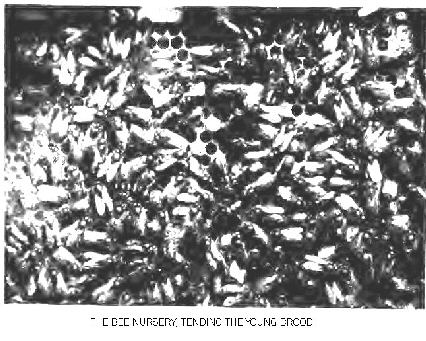
It has been said that the nurse-bees, who have the entire
charge and care of the young brood, feed the larvæ from
their mouths with a thick white fluid, which is aptly called
bee-milk. All the time the nurses are engaged on this work,
they are themselves hearty eaters of both honey and pollen; so
that at first sight it appears as if the bee had the power of
instantaneous digestion, feeding herself at one moment, and, at
the next, regurgitating this food, changed into a totally
different substance, to feed the young grubs. Moreover,
there is another wonderful thing regarding this bee-milk.
It has been proved by careful analysis that its composition
varies considerably. The male, female, and
queen-larvæ are all fed with it, but its constitution
differs, not only with each kind of larva, but according to the
age the larva has reached. The bee must therefore have her
whole system of digestion under full voluntary control. How
she manages this critical part of her work can only be understood
by the aid of a good microscope.
Perhaps there is nothing more wonderful, in the whole
wonderful anatomy of the bee, than her digestive organism and its
contributory system of glands, each of which has its special and
important use. When she draws up the nectar from the
flowers, it passes at once into the first of her two stomachs,
which is simply and solely a reservoir. Here it can remain
indefinitely at the will of the bee; or it can be thrown up and
poured into the comb-cells, to be brewed into honey; or it can be
allowed to pass through a valve at the base of the reservoir into
the bee’s second and lower stomach, where digestion takes
place and the honey and pollen are formed into chyle. But,
by one of the most ingenious devices in nature, this second
stomach is also capable of returning its contents to the mouth,
and the chyle is there changed into bee-milk for the nourishment
of the larvæ.
The worker-bee has, in all, four distinct glands, each
secreting a fluid with properties different from the other
three. These glands are all situated in the mouth.
Two of them have a common opening in the upper side of the root
of the tongue; and as the bee sucks, their combined secretions
mingle with the flower juices automatically, and the first
step in the change of the nectar into honey takes place.
The third gland is in the roof of the mouth, and it is the
secretion from this gland which acts on the regurgitated chyle,
and changes it into brood-food. The fourth gland is
double. These twin-glands have their openings at the base
of the jaws, and the action of chewing is necessary to excite
their secretion.
The valve between the upper, or honey-stomach, and the lower,
or chyle-stomach, has an extensible neck, and the bee can, at
will, raise this telescopic piece through the interior of the
honey-sac until the valve is pressed against the opening into the
gullet. Thus the contents of the lower stomach can be
driven into the mouth without coming into contact with the stored
sweets in the reservoir, and this pre-digested matter is always
ready at an instant’s notice for the use of the larva, or
for the nourishment of drones or queen.
It has been said that the nursery-work of the hive is
undertaken exclusively by the young bees during the first
fortnight or so of their lives. After this time they make
their first foraging expedition, beginning with pollen-gathering,
and relinquishing this in turn for the collection of nectar when
they have arrived at full maturity. The mature workers take
no part in the feeding of the larvæ, except on very rare
emergencies. In relation to this, it is a curious fact that
the gland in the roof of the mouth, which acts on the chyle, forming it
into brood-food, is in full development only during the first
weeks of the worker-bee’s career. After that its
activity swiftly declines, until, in old workers, it becomes
largely atrophied.
The digestive gland-system of the honey-bee, although it has
been fairly well explored by the scientific naturalists, is still
much of a mystery, and this especially with regard to the glands
attached to the jaws. The secretion from these
glands—obviously a very powerful acid—is mainly used
to convert the raw wax from its hard, brittle character into the
soft, ductile material of which the combs are made. It is
probably used to some extent, also, in the preparation of the
brood-food, in conjunction with the gland in the roof of the
mouth. It mingles with the pollen when this is masticated,
and no doubt it has various other uses; but no one seems as yet
to have discovered why these two glands should be so enormously
developed in the queen, who takes no part in the nursery-work or
comb-building. The whole question will naturally have
little more than a passing interest for the general reader; but,
to the bee-keeper with a microscope, it takes a prominent place
among the debatable things in hive-life. If the difference
between the queen-bee and the worker-bee—a difference of
organic structure as well as mere development—is really
brought about by variation in the quality and quantity of
the food supplied to the larva, then the action of these glands
cannot be over-estimated in importance, and cannot be studied too
deeply: they form the very spring and fount of life. Yet is
it certain that the influence brought to bear on the young grubs
by the nurse-bees is wholly restricted to the matter of
food? The worker-bee has several curious organs and
gland-systems in various parts of her body, in addition to those
already enumerated, to which no rational use has yet been
assigned. The more we study her extraordinary equipment,
the less justification there appears to be for dogmatising about
her, limiting or particularising the function of any one gland or
implement in the whole unending array. The old adage, that
there is nothing invariable about the honey-bee, is like to be as
true with regard to her physiology as it is with her habits of
life; and, for all we can tell, to-morrow’s knowledge may
render obsolete much of the carefully garnered knowledge of
to-day.
If the story of the honey-bee’s anatomy has everywhere
some of the elements of romance about it—in its unexpected
incidents, its adventurous colour, its shadow of a great
design—this spirit suffers no abatement when we come, in a
last view of it, to consider her as one carrying arms, one
bearing such a weapon of offence as never came into human mind to
fashion. The long curved scimitar of the queen, which she
cherishes so carefully that nothing will induce her to strike with
it except when it is to be turned against a royal foe, is
otherwise little else than a harmless piece of domestic
furniture. But the sting of the valorous worker-bee, seen
under a microscope, is a positively terrifying engine of
destruction. Popular science generally describes it as a
sheath containing a barbed and poisonous dart; and the trite
comparison is always made of the bee’s sting with the
finest sewing-needle, the latter being likened to a rough bar of
iron. The idea of a sheath is pure fiction, as a little
painstaking examination will soon reveal.
The bee’s sting is made up of three separate lances,
each with a barbed edge, and each capable of being thrust forward
independently of the others. The central and broader lance
has a hollow face, furnished at each side with a rail, or
beading, which runs its whole length. On the back of each
of the other two lances there is a longitudinal groove, and into
these grooves fit the raised beadings of the central
lancet. Thus the sting is like a sword with three
blades—united, but sliding upon one another—the
barbed points of which continue to advance alternately into the
wound, going ever deeper and deeper of their own malice
aforethought after the initial thrust is made. It is a
device of war, compared to which the explosive bullet is but a
clumsy brutality. Yet this is not all. To make its
death-dealing powers doubly sure, this thorough-minded
amazon must fill the haft of her triple blade with a subtle
poison, and so contrive its sliding mechanism that the same
impulse, which drives the points successively forward, drenches
the whole weapon with a fatal juice.
The tendency to be unduly scientific, to meet these things
with exact and unimaginative interest, receives its final quietus
here. For he who realises the whole deadly efficacy of the
honey-bee’s sting cannot logically pass it by as a mere
remarkable provision of nature, praising God for it complacently,
but must concede it a much wider significance. This
complicated weapon of the stunted, sex-perverted worker-bee owes
its existence as much to deliberate art as to nature, or those
who watch the Omnipotent in hive-life are strangely and
perversely led astray. In the queen-mother, whose physical
organism may be said to be comparatively unchanged from its
aboriginal type, we see the part corresponding to the
worker’s sting, essentially another creation. The
queen’s ovipositor is longer; it is curved; the barbs upon
it are small and insignificant; the fluid in the secreting-gland
is no poison at all, but a thick opaque substance, whose true use
is probably to glue the eggs safely to the bottoms of the
cells. She is also provided with a pair of blunt
instruments covered with sensitive hairs, which serve, with the
ovipositor, to guide the egg securely to its
destination. The worker-bee has these feelers on either
side of her sting, but she has perverted them to a very different
office, that of seeking out the vulnerable parts of her
enemy. And what a drastic change her will, or that of her
foster-mothers, has wrought in the whole contrivance! She
has bartered the privilege of motherhood and years of life for a
few short months and a share in the communal sovereignty.
She must be ready to further the well-being of the hive by the
art of war as well as by the arts of peace. Therefore she
has deliberately helped in fashioning the ploughshares into
cannon. A little change in her food as a nursling, an
infinitesimal leaking from a gland that takes the full power of
the strongest glass to see,—and, with all the other
multitudinous changes of form and character, this last miracle
comes quietly into being. The egg-depositing shaft grows
short and straight; its moderate indentations become cruel jagged
barbs designed to hold as well as to kill; the harmless,
egg-fastening gluten is quickened into a virulent poison; and the
death-dealing thing is ready and ripe for service against all
honey-lovers, the hereditary foes of the hive.


