The silkworm eggs came in a very small box. They
were sent by a friend of Uncle George’s who lived in
the south of England. The eggs were stuck to pieces
of paper in scattered groups. Some pieces of paper had
only one or two eggs on them, others had as many as
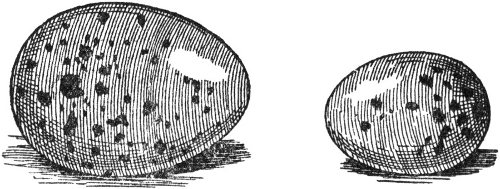
forty. They were small, round things, flattened on the
top, and coloured light green. They reminded the boys
of small mustard seeds, but they were not so round.
In answer to Frank’s question as to why the eggs
were laid in irregular groups, Uncle George answered:
“When the silk-moth emerges from her pupa case,
she lays her eggs anywhere on the floor of her cage.
As the eggs are coated with a gluey material when newly
laid, they stick firmly to the floor.
“Those people who rear silkworms always have a
sheet of clean paper covering the floor of the cage before
egg-laying commences. After the eggs are laid, they are
found adhering to this sheet of paper. The paper is
taken out of the larva cage, and those parts containing
eggs are cut out with scissors.”
“How many eggs are laid by one moth,” Frank
asked.
“From four to five hundred,” his uncle replied. “Let
us get our larva cage cleaned out, and we will put these
eggs in the lower part of it and await their hatching.”
82
“Why in the lower part,” Frank asked, as he set
about cleaning the cage.
“Because its floor is a drawer which can be pulled
out. If you put them in the upper part, you must lay a
sheet of paper on the floor first, for your silkworms
must not be handled on any account.”
“And how long do we have to wait for these eggs
to hatch?” asked Tom.
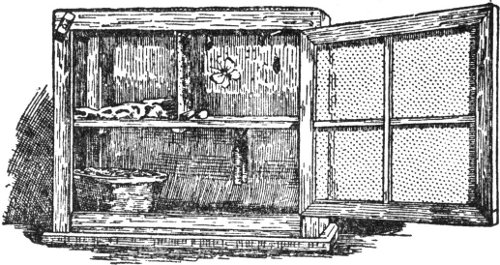
Larva Case.
“That depends altogether upon the amount of warmth
they receive, Tom. They will remain unhatched ever
so long if kept in a cool place; but whenever they are
placed where they can get the necessary amount of
warmth, they begin to hatch. Let us put them in the
front window, where they can get most sunshine.”
About a week after the larva cage was placed in the
window, Frank reported to his uncle that some of the
eggs had turned white.
“Take your lens and examine carefully those eggs
which have lost their colour,” said Uncle George.
Lifting out one of the small pieces of paper with eggs
on it, Frank examined it with the glass.
83
“Oh,” he said, “these colourless eggs are just empty
shells, and there are two small creatures crawling along
the edge of the paper. How small they are! They are
no longer than the breadth of a pin-head. They are
almost black in colour, covered all over with hair, and
have very large heads.”
“Well, these are newly-hatched silkworms,” said
Uncle George, “and they are already looking for food.
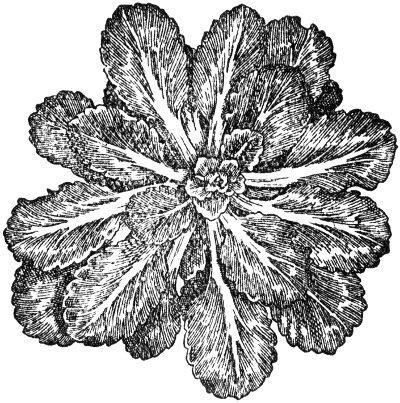
Run out to the garden and bring in some fresh lettuce
leaves.”
Uncle George carefully dried the lettuce leaves before
putting them into the cage. In two days all the eggs
were hatched, and in their place were as many black,
hairy, crawling little creatures with clumsy heads.
Although they did not seem to eat much, they grew
very rapidly. When three days old, they were fully twice
as big as when hatched.
In five days the silkworms seemed to have increased
in number as well as in size. In fact, there
seemed to be twice as many grubs as there were of
eggs.
Then Uncle George explained that half of these were
not grubs, but simply empty skins.
“The silkworm, in order to grow, must cast its skin,”
he said. “It does this four times during its lifetime.
Look out for another moult, or skin-casting, in four days’
time.”
Four days later the grubs cast their skins again, just
as Uncle George had said. They were now about half
an inch in length, and much lighter in colour.
In six further days they moulted a third time. Instead
of dingy, hairy grubs, they were now hairless caterpillars,
84
yellowish-white in colour, and with round black heads.
Their fourth and last moult took place in another week.
By this time they were over an inch in length. They
now began to eat the lettuce leaves ravenously, and
grew very fast. For ten days they ate much and grew
rapidly. Then they seemed to get tired of feeding, and
began to crawl lazily up the sides of their cage.
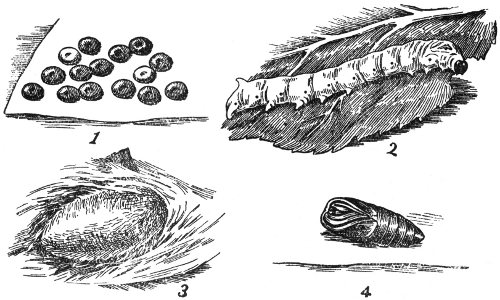
Silk Moth.
- 1. Eggs.
- 2. Larva.
- 3. Silk Cocoon.
- 4. Chrysalis.
“They are full grown now, boys,” said Uncle
George, “and will soon begin to spin their silken
cocoons.
“They are now about three inches long, and very
different from the tiny hairy grubs which came out of
the eggs over a month ago.”
“We have been comparing drawings of them with
drawings we made of the caterpillar of the white cabbage
85
butterfly,” said Frank, “and we find that they are very
much alike.”
“That is good,” said Uncle George. “They are,
indeed, very much alike. The body is made up of
thirteen segments, and they have the same number of
legs. They differ from the cabbage caterpillar, however,
in size and colour. Notice the little horn which sticks
up out of the twelfth segment. Your cabbage caterpillar
did not have that. If you look closely you will
notice a long silk thread issuing from the head of one
of these silk-spinning caterpillars. This one has just
begun to make his cocoon; and, in order to prevent
his threads becoming entangled with those of the other
caterpillars, I will place this small paper cone over
him.”
Next day Uncle George covered several of the caterpillars
with paper cones. On the roof of the cage the
boys saw one caterpillar surrounded with a flimsy web
of silk of a golden-yellow colour. As they watched
the creature turning its head round and round inside
the silky veil, their uncle told them that the creature
was spinning silk at the rate of about a foot per
minute.
In three days each caterpillar had surrounded itself
with a dense silken cocoon as large as a walnut. Then
Uncle George took one of the cocoons, and, cutting it
open, showed the boys the brown, shining chrysalis inside.
He took another cocoon, and, having dipped it into warm
water, began to wind the silken thread on to a piece of
card.
Both Frank and Tom were amazed at the length of
this silken thread. They were more surprised when they
86
were told that each caterpillar produces a silk thread
more than half a mile long.
“Tell us, please, Uncle George,” said Frank, “why
the creature spins all this silk, and how it makes it?”
“You are asking a difficult question,” said his uncle,
“but I will tell you something about it.
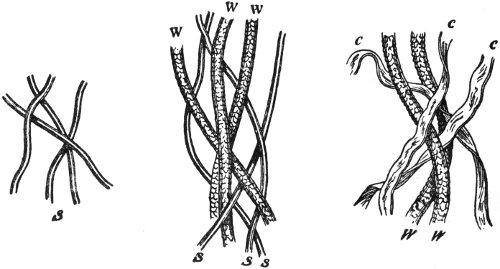
- S. Silk Fibres.
- W. Wool.
- C. Cotton.
- (All highly magnified.)
“The creature spins this cocoon to protect its
chrysalis, of course. The silk is produced in two long,
coiled tubes, which occupy nearly the whole length of
the creature’s body.
“Silk, before it issues from the caterpillar’s body, is
a fluid. Whenever it comes out into the air, it becomes
horny. Two strands are produced at once—one from
each of the long coiled tubes. Before they leave the
caterpillar’s body they are pressed together to form one
flat, ribbon-like thread. Silk is one of the strongest
fibres in the world. It is nearly as strong as steel, and
much stronger than many of our metals.
87
“In a fortnight your silken cocoons will produce
white, fluffy moths. ‘Then you can supply your friends
with hundreds of ‘silkworm’ eggs, and still have enough
over to stock your larva cage.”
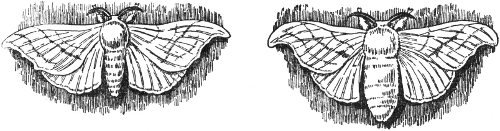
Silk Moths—Male and Female.
- 1. Are “silkworms” really worms? What creatures do they most resemble?
- 2. Many of our common caterpillars spin silk of a kind. Take in “woolly bear” caterpillars. Feed them on the plants you find them on. Compare the cocoons they make with those of the “silkworm.”
- 3. Compare egg, larva, pupa, and perfect insect of the “silkworm” with that of the white cabbage butterfly. Does the caterpillar of the latter spin any silk?
- 4. Make a list of all the spinning insects you know, and try to explain the use of the “silk” thread in each case.
88