“Look here, boys,” said Uncle George, “you have
been paying nearly all your attention to the larva cage
during my absence, and have forgotten the caddis
worms.”
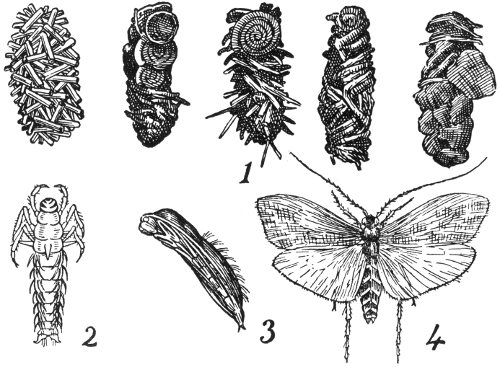
- 1. Caddis Cases.
- 2. Larva out of Case.
- 3. Pupa.
- 4. Caddis Fly.
Uncle George made believe to be cross.
“We changed the water every two days,” said
Frank.
“Yes, I know. But you have not reported any
changes in the creatures themselves. What has been
going on in the larva cage has also been going on
here in the water, for caddis worms are simply water-caterpillars.
89
You nearly missed something of very great
interest.”
Uncle George laid three saucers on the table, and
continued:—
“We are going to look into the life of the caddis
fly to-day; but before I take them out of the water, I
want you to tell me what you have noted about them
up to now.”
“They are always climbing up the water weeds,”
said Frank.
“They are always adding to their cases,” said
Tom.
“Some of them have died,” said Frank.
“What?” said his uncle. “Do you mean these at
the bottom of the tank? These are not dead, they
are only asleep. Put your hand in, and take some of
these out.”
“Their cases are stuck to the pond weeds and to
each other,” said Frank, as he lifted a few out, and
placed them in a saucer.
“Ah, I have it, Uncle George! They have gone into
the pupa state. Is that not so?”
Uncle George nodded.
“Look!” exclaimed Tom. “There are things like
earwigs floating on the water.”
“Never mind these just now, Tom,” said his uncle.
“I am coming to them by and by. Observe the
wonderful cases which the caddis worms have made
for themselves.
“Here is one whose case, when we found him, was
made of neatly cut pieces of water rush. He has
almost doubled the length of his case since then; for
90
see, the front half is made of cut stalks of water weed
neatly arranged.”
“He has got a fine collar of green pieces round
his neck,” Frank observed.
“Why are they always adding to the length of their
cases?” asked Tom.
“Because they are always growing,” said Frank.
“That is the reason,” said Uncle George; “and they
grow so fast that they have actually to work hard at
building.
“Observe those that make their cases out of tiny
shells and stones. They have made free use of the
coloured beads and small pieces of coal which we
put in.”
“How do they manage to stick these things
together?” asked Tom.
“A caddis worm is a busy creature,” his uncle
replied. “He does two things besides eating and growing.
With those strong pincers, which you see at his
head, he saws off pieces of weed.
“Near his mouth he has got a kind of loom for
spinning silk. These pieces are stuck together with
silk, which is a gluey substance when it first comes
from the creature’s body.
“These rough cases are lined with silk.”
“Why does he have to make a house for himself,
and carry it about with him?” said Frank.
In answer to this, his uncle took out a few of the
active caddis worms, and placed them in a saucer with
water. He held one up.
“You see,” he said, “his case is open at both
ends. Now, if I tried to get him out from the front,
91
I should never manage it. This is the way to get
him out.”
As he spoke, Uncle George pushed the head of a
pin into the tail end of the case, and the creature
scrambled out at once.
“It is too bad turning you out of your cosy room,
Mr Caddis,” Uncle George observed; “but you’ll go
back again as soon as you get the chance, won’t you?
I want my nephews to understand why you work so
very hard.
“Now, Frank, you can answer your own question,
I think—‘Why does the caddis worm build a house?’”
“Because he has a soft body.”
“Quite right. But why is he forced to protect his
body?”
“Fishes would eat him.”
“Right again, Frank. If trout could speak, they
might tell you that the sweetest morsel in the stream
is the caddis worm. Now, take your lens, please, and
tell me something about him.”
“His body is divided into rings, and there are the
same number of them as we found in the caterpillar.”
“Very good, Frank. Now give Tom a chance.”
“His head and the first three divisions of his body
are hard cased. They are black and yellow in
colour.”
“He has six legs,” said Frank, “and they are
attached to the first three divisions of his body.”
“What about the last division of his body?” Uncle
George asked.
“Oh, how funny!” said Frank. “It is divided into
two large things like horns.”
92
“These,” said his uncle, “are the hooks by which
he fixes himself so firmly in his case.”
“And what are all these curious big bristles for?”
asked Tom. “They are all over his body.”
“These are his breathing organs,” Uncle George
answered. “The caterpillar, if you remember, had
breathing-holes along the sides of his body. By moving
his long body, the caddis worm causes a constant
current of water to pass through his dwelling.
“Look at the fourth segment of his body. How
does it differ from the others?”
“It is the broadest segment,” said Frank, “and
there is a stout rounded thing in the middle
of it.”
“Yes,” his uncle replied, “and if we can get him
turned on his back we shall see two more of these
stout outgrowths below, one on each side of the same
segment. This is really very clever. By it the animal
keeps himself in the middle, so that the current of
water must flow all around him.
“Now, look at the case of a sleeping caddis.”
“The front of the case is closed,” said Frank.
“How is it closed, Frank?”
“Well, there is a network of threads over it,”
answered Frank.
“Yes; you see a caddis worm cannot do without
fresh water, even when he is asleep; so, before going
to sleep, he builds a grating over the entrance.
“When he wakes up, he has quite a new shape
altogether. And this brings us to those things which
Tom said were like ‘earwigs.’ There are five of them
floating on the water, and two of these are dead. If
93
you look, you will find five empty caddis cases in the
tank.”
“How does he get out of the case?” inquired Tom.
“Easily enough. Look at the strong pair of pincers
he has got for cutting his way through the silken
grating with. No longer burdened with his heavy case,
he floats up to the surface. He crawls up out of the
water into the air.
“If there are no rushes or floating leaves about, he
is sure to drown; for your caddis is no longer a water
insect, but a fly inside a thin skin.
“Now, boys, I am going to show you something
wonderful.”
Uncle George then took out the three living pupæ
that were floating on the water, and placed them on
the table. The boys watched them for a long time.
They were beginning to get impatient, when suddenly
the skin of one of the creatures burst along the back,
and a lovely little fly, with brown, gauzy wings and
long feelers, came out.
After airing its wings for about a minute, it flew
to the window. The other two acted in just the same
way.
“Now, my dear boys, I think you know something
about the life of the caddis fly. For a whole year of
his life he is a crawling water insect, then, for about
a single day, he is a lively fly.”
“How does the caddis larva first get into the
water?” asked Frank.
“As an egg, Frank. The female caddis fly lays her
eggs in the water. She sometimes even crawls down
right into the water to lay them.
94
“A tiny caddis grub, no bigger than this pin-head,
comes out of each egg. As soon as he hatches out,
he begins to build his case, to eat, and to grow; and
from the moment of his birth up to the closing up of
his tube, he is scarcely a moment idle.”
- 1. Turn a caddis worm out of his case in the way described in the lesson. Place the insect in a saucer half filled with water, and make a rough sketch of it.
- 2. When you have finished your sketch, place the empty caddis case in the saucer, and watch how the creature gets into it.
- 3. Make two columns by drawing a line down the centre of a page of your note-book. In the first column, describe the structure of the caddis larva and fly; in the second, that of the cabbage caterpillar and butterfly. Compare them.
- 4. In the same way describe the mode of life of the caddis fly (Column 1), and of the white butterfly (Column 2).
95
APPENDIX. HINTS TO TEACHERS.
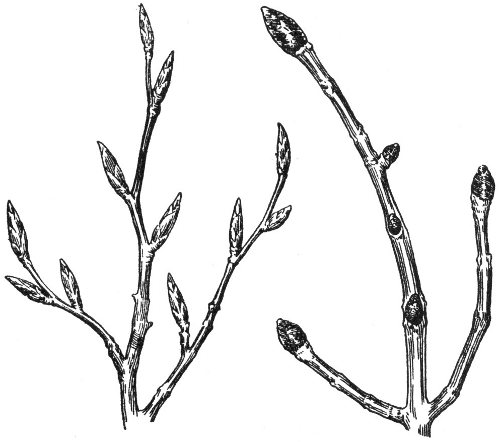
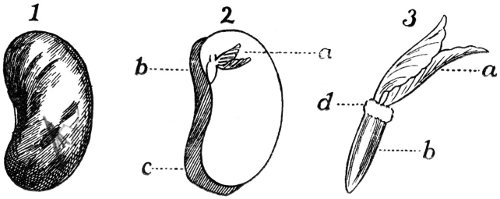
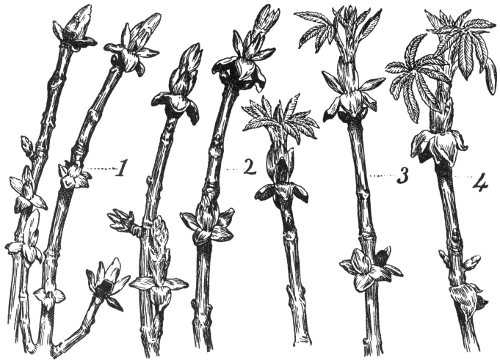
BUDS.—Twigs of beech, horse-chestnut, lilac, and hawthorn ought to
be taken in in December and placed in water. They should have as much
warmth and light as possible.
Willow twigs (for catkins) might also be forced in this way.
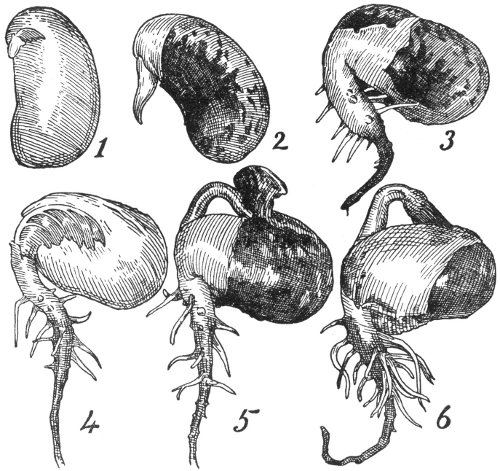
SEEDS.—Seeds should be soaked for twenty-four hours and then
sown in sawdust in boxes 4 inches deep. They should be sown in
presence of the pupils.
In winter these boxes should be kept on the hot pipes in school. The
sawdust should not be allowed to get dry, neither should it be deluged with
water, but kept evenly moist if possible.
Be careful to use water not colder than the temperature of the room
in which the seeds are grown. Nothing checks growth more effectively
than chilling with icy-cold water. It is a good plan to keep the watering-pan
full of water near the hot pipes, refilling it always after use.
Seeds germinate best in the dark, but whenever the plumule shows above
the sawdust, the box containing them should be placed in the light.
Sufficient seeds should be sown at one time to supply a plant to each pupil
once a week for at least four weeks. A number of seeds or plants should be
dug up once a week and sketched by the children. Each sketch should be
compared with that of the previous week, and all changes duly noted down.
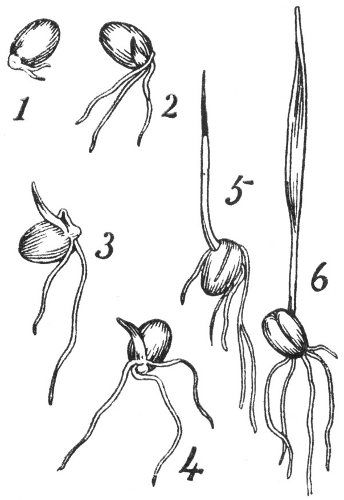
The best seeds to grow are:—Broad bean, common or “large white”
maize, runner bean (“Painted Lady”), French bean, kitchen pea
(“Stratagem”), and white mustard.
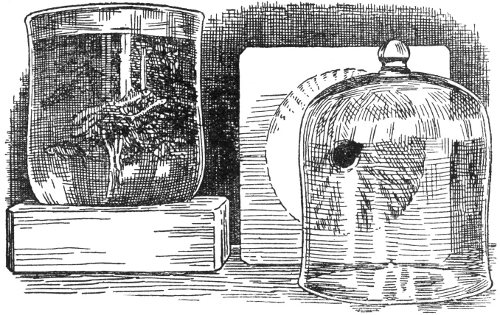
A few seeds of white mustard should be sprinkled on a small piece of
moist blotting-paper, and covered over by a small glass bell-jar or an
inverted tumbler. In less than a week the root-hairs may be seen.
If hot-water pipes are available, the following seeds should be grown,
as their germination is interesting:—date stones, walnuts, chestnuts,
almonds, cherry stones, orange pips, seeds of cucumber and sunflower.
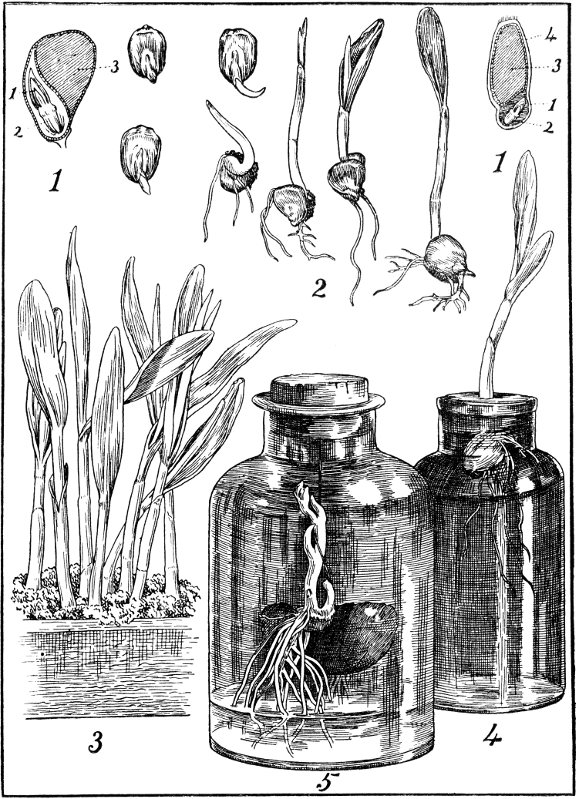
After maize and bean (or pea) plants have reached the height of
5 inches, they should be transferred to bottles of tap water—as described
at the end of Lesson VI.—and the continuous growth sketched and
noted from week to week.
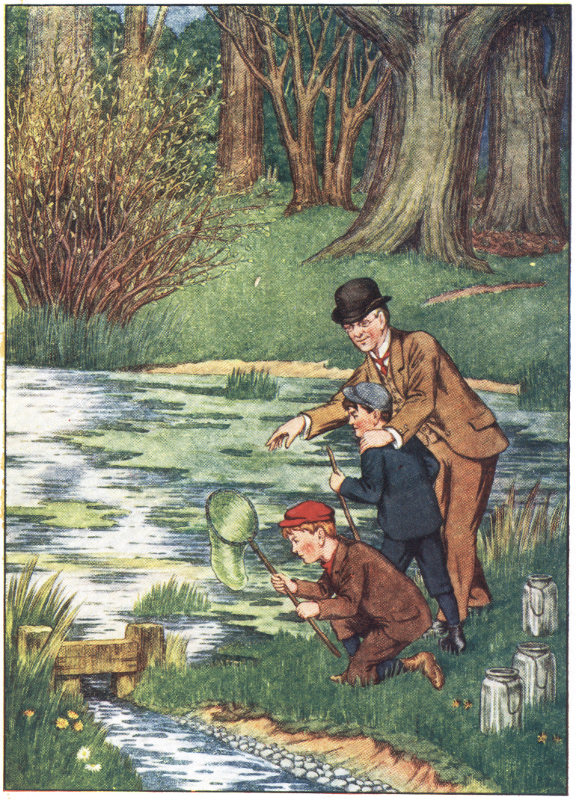
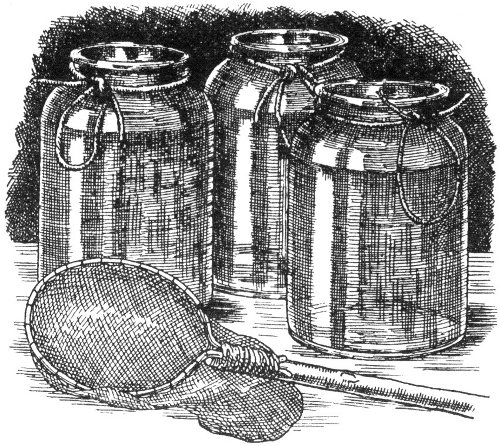
POND AND DITCH HUNTING.—Make a ring of stout brass wire
about 8 or 10 inches in diameter, and to this attach a bag net made of
mosquito netting not more than 9 inches deep. In making the wire
ring, leave attached to it about 5 inches of the twisted ends of the wire.
Such a net as this can be easily carried and quickly attached to the
end of a walking-stick by means of a piece of string.
The best “finds” are often made by sweeping the net under banks
and among pond weeds.
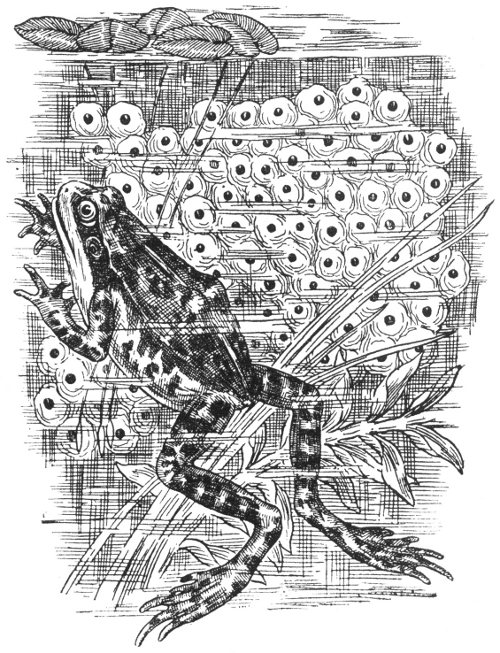
FROG SPAWN.—Frog spawn is abundant in ponds and ditches
everywhere in March. It should be kept immersed in as much water
as possible in a large vessel, preferably of glass. Whenever the water
show signs of fouling, it should be changed; but, as changing water
containing tadpoles is somewhat difficult, the fewer changes the better.
As in the case of seed growing, the development of the tadpole
should be learnt by weekly sketches and notes.
NEWTS.—Newts can be taken with the gauze-net or in the following
way:—Tie a piece of small worm on to the end of a cotton thread
96
fastened to the end of a willow or hazel switch. Cast into the part
of the pond where the newts are, and await results.
Live newts, fish, frog spawn, etc., may be obtained from Messrs
Willson, Live Stock Providers, 37 New Oxford Street, London; Thomas
Bolton, 25 Balsall Heath Road, Birmingham, and other dealers. Newts
should be fed once a day on pieces of small worms.
CATERPILLARS.—Caterpillars and pupæ, if not obtainable in local
woods, fields, and gardens, can be had from Messrs Watkins & Doncaster,
36 Strand, London, and others.
CADDIS LARVÆ.—Caddis worms are to be found in almost every
stream, pond, and ditch. Most of them are vegetable feeders: therefore
a plentiful supply of water weeds should be placed in their tank.
Carnivorous caddis worms may be fed on small pieces of raw meat.
(See Stickle-backs.)
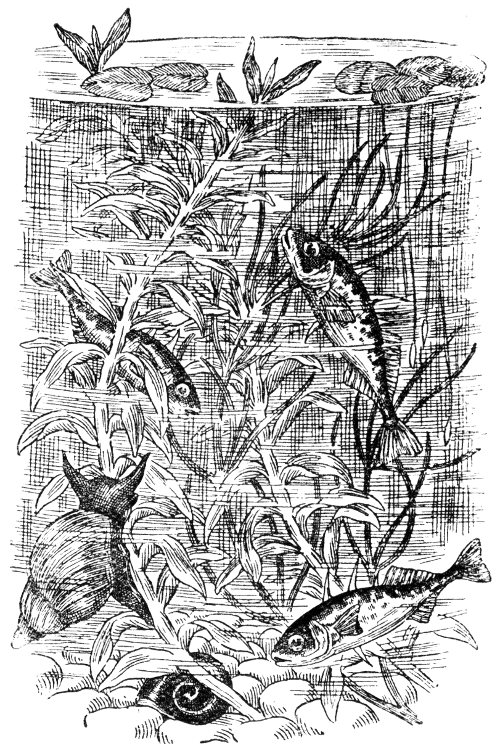
STICKLE-BACKS.—Stickle-backs are common in canals and streams.
They are easily caught with the net. They should be fed once a day
on grated biscuit, and occasionally on raw meat. The meat should be
chopped very fine, and then pressed through a piece of perforated zinc.
Very little food suffices. If too much is put in, the residue should be removed
by means of a glass tube, as described in Lesson IX., p. 56. If no green
water plants are obtainable, the water should be changed at least every
second day by means of a siphon. Once a month is quite often enough if
sufficient green plants are kept in the tank and decaying matter carefully
removed. Do not over-stock—few fishes and much water is the rule.
WATER PLANTS.—It is best to take the water plants which are
found growing locally. The following are fairly common:—Elodea canadensis,
water millfoil; Potamogeton (nitens, crispus, or filiformis),
“water soldier”; Vallisneria spiralis, Chara, Nitella, water star-wort
and watercress. A good selection of excellent aquarium plants are advertised
at a cheap rate by the Solway Fishery Co., Dumfries. Water
plants, if not rooted in the tank, should be renewed occasionally.
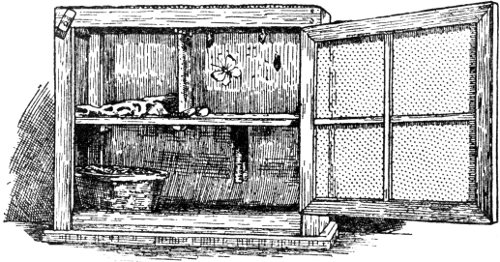
LARVÆ CAGE.—Take four square pieces (about 1½ inches square)
of wood, each a foot long, and nail or screw them upright into the four
corners of a square piece of ¾-inch deal measuring a foot each way.
Stretch mosquito netting over sides, end, and top, arranging that one side
can be opened. This can be managed by fastening the last fold of
netting to one of the upright posts by three drawing-pins. Fresh
leaves should be supplied daily. For those caterpillars which pupate in
the soil, a shallow earthenware flower-pot—known in the trade as a
“seed-pan”—should be supplied. The seed-pan should be filled with
soil, the pupæ placed on the surface, and a layer of moss placed over
them. Once a week the moss should be dipped in water, squeezed
almost dry, and replaced on the pupæ.
AQUARIUM.—Procure from a local florist or seedsman what is
known as a “propagating bell.” These cost from 1s. up to 2s. 6d. A
block of wood 12 inches square and 4 or 5 inches in thickness is also
required. Bore a hole about 2 inches in diameter right through the
centre of the block, to hold the knob of the bell. Then, with a gouge
chisel, make a saucer-shaped hollow round the hole, to roughly fit the
rounded end of the bell. Before fitting the bell into the block, interpose
a thin layer of moss.
This makes an excellent aquarium—elegant and serviceable. Keep
the aquarium in a window, but shade it from bright sunlight.