A large warehouse on Main Street in Richmond had been converted into a
hospital. Conveniently situated, it had received many of the more
desperately wounded from Williamsburg and Seven Pines and from the
skirmishes about the Chickahominy and up and down the Peninsula. Typhoid
and malarial cases, sent in from the lines, were also here in
abundance. To a great extent, as June wore on, the wounded from
Williamsburg and Seven Pines had died and been buried, or recovered and
returned to their regiments, or, in case of amputations, been carried
away after awhile by their relatives. Typhoid and malaria could hardly
be said to decrease, but yet, two days before the battle of
Mechanicsville, the warehouse seemed, comparatively speaking, a cool and
empty place.
It was being prepared against the battles for which the beleaguered city
waited—waited heartsick and aghast or lifted and fevered, as the case
might be. On the whole, the tragic mask was not worn; the city
determinedly smiled. The three floors of the warehouse, roughly divided
into wards, smelled of strong soap and water and home-made
disinfectants. The windows were wide; swish, swish! went the mops upon
the floors. A soldier, with his bandaged leg stretched on a chair before
him, took to scolding: "Women certainly are funny! What's the sense of
wiping down walls and letting James River run over the floors? Might be
some sense in doing it after the battle! Here, Sukey, don't splash
that water this a-way!—Won't keep the blood from the floor when they
all come piling in here to-morrow, and makes all of us damned
uncomfortable to-day!—Beg your pardon, Mrs. Randolph! Didn't see you,
ma'am.—Yes, I should like a game of checkers—if we can find an island
to play on!"
The day wore on in the hospital. Floors and walls were all scrubbed,
window-panes glistening, a Sunday freshness everywhere. The men agreed
that housecleaning was all right—after it was over. The remnant of the
wounded occupied the lower floor; typhoid, malaria, and other ills were
upstairs. Stores were being brought in, packages of clothing and lint
received at the door. A favorite surgeon made his rounds. He was cool
and jaunty, his hands in his pockets, a rose in his buttonhole. "What
are you malingerers doing here, anyhow? You're eating your white bread,
with honey on it—you are! Propped up and walking around—Mrs. McGuire
reading to you—Mrs. Randolph smilingly letting you beat her at her own
game—Miss Cooper writing beautiful letters for you—Miss Cary leaving
really ill people upstairs just because one of you is an Albemarle man
and might recognize a home face! Well! eat the whole slice up to-day,
honey and all! for most of you are going home to-morrow. Yes, yes!
you're well enough—and we want all the room we can get."
He went on, Judith Cary with him. "Whew! we must be going to have a
fight!" said the men. "Bigger'n Seven Pines."
"Seven Pines was big enough!"
"That was what I thought—facing Casey's guns!—Your move, Mrs.
Randolph."
The surgeon and nurse went on through cool, almost empty spaces. "This
is going," said the surgeon crisply, "to be an awful big war. I
shouldn't be surprised if it makes a Napoleonic thunder down the
ages—becomes a mighty legend like Greece and Troy! And, do you know,
Miss Cary, the keystone of the arch, as far as we are concerned, is a
composition of three,—the armies in the field, the women of the South,
and the servants."
"You mean—"
"I mean that the conduct of the negroes everywhere is an everlasting
refutation of much of the bitter stuff which is said by the other side.
This war would crumble like that, if, with all the white men gone, there
were on the plantations faithlessness to trust, hatred, violence,
outrage—if there were among us, in Virginia alone, half a million
incendiaries! There aren't, thank God! Instead we owe a great debt of
gratitude to a dark foster-brother. The world knows pretty well what are
the armies in the field. But for the women, Miss Cary, I doubt if the
world knows that the women keep plantations, servants, armies, and
Confederacy going!"
"I think," said Judith, "that the surgeons should have a noble statue."
"Even if we do cut off limbs that might have been saved—hey? God knows,
they often might! and that there's haste and waste enough!—Here's Sam,
bringing in a visitor. A general, too—looks like a Titian I saw once."
"It is my father," said Judith. "He told me he would come for me."
A little later, father and daughter, moving through the ward, found the
man from Albemarle—not one of those who would go away to-morrow. He lay
gaunt and shattered, with strained eyes and fingers picking at the
sheet. "Don't you know me, Mocket?"
Mocket roused himself for one moment. "Course I know you, general! Crops
mighty fine this year! Never saw such wheat!" The light sank in his
eyes; his face grew as it was before, and his fingers picked at the
sheet. He spoke in a monotone. "We've had such a hard time since we left
home—We've had such a hard time since we left home—We've had such a
hard time since we left home—We—"
Judith dashed her hand across her eyes. "Come away! He says just that
all the time!"
They moved through the ward, Warwick Cary speaking to all. "No, men! I
can't tell you just when will be the battle, but we must look for it
soon—for one or for many. Almost any day now. No, I cannot tell you if
General Jackson is coming. It is not impossible. 'Washington Artillery?'
That's a command to be proud of. Let me see your Tiger Head." He looked
at the badge with its motto Try Us, and gave it back smilingly. "Well,
we do try you, do we not?—on every possible occasion!—Fifth North
Carolina? Wounded at Williamsburg!—King William Artillery?—Did you
hear what General D. H. Hill said at Seven Pines? He said that he would
rather be captain of the King William Artillery than President of the
Confederate States.—Barksdale's Mississippians? Why, men, you are all
by-words!"
The men agreed with him happily. "You've got pretty gallant fellows
yourself, general!" The King William man cleared his throat. "He's got a
daughter, too, that I'd like to—I'd like to cheer!"
"That's so, general!" said the men. "That's so! She's a chip of the old
block."
Father and daughter laughed and went on—out of this ward and into
another, quite empty. The two stood by the door and looked, and that
sadly enough. "All the cots, all the pallets," said Cary, in a low
voice. "And out in the lines, they who will lie upon them! And they
cannot see them stretching across their path. I do not know which place
seems now the most ghostly, here or there."
"It was hard to get mattresses enough. So many hospitals—and every one
has given and given—and beds must be kept for those who will be taken
to private houses. So, at last, some one thought of pew cushions. They
have been taken from every church in town. See! sewed together, they do
very well."
They passed into a room where a number of tables were placed, and from
this into another where several women were arranging articles on broad
wooden shelves. "If you will wait here, I will go slip on my outdoor
dress." One of the women turned. "Judith!—Cousin Cary!—come look at
these quilts which have been sent from over in Chesterfield!" She was
half laughing, half crying. "Rising Suns and Morning Stars and Jonah's
Gourds! Oh me! oh me! I can see the poor souls wrapped in them! The
worst of it is, they'll all be used, and we'll be thankful for them, and
wish for more! Look at this pile, too, from town! Tarletan dresses cut
into nets, and these surgeons' aprons made from damask tablecloths! And
the last fringed towels that somebody was saving, with the monogram so
beautifully done!" She opened a closet door. "Look! I'll scrape lint in
my sleep every night for a hundred years! The young girls rolled all
these bandages—" Another called her attention. "Will you give me the
storeroom key? Mrs. Haxall has just sent thirty loaves of bread, and
says she'll bake again to-morrow. There's more wine, too, from
Laburnum."
The first came back. "The room seems full of things, and yet we have
seen how short a way will go what seems so much! And every home gets
barer and barer! The merchants are as good as gold. They send and send,
but the stores are getting bare, too! Kent and Paine gave bales and
bales of cotton goods. We made them up into these—" She ran her hand
over great piles of nightshirts and drawers. "But now we see that we
have nothing like enough, and the store has given as much again, and in
every lecture room in town we are sewing hard to get more and yet more
done in time. The country people are so good! They have sent in
quantities of bar soap—and we needed it more than almost anything!—and
candles, and coarse towelling, and meal and bacon—and hard enough to
spare I don't doubt it all is! And look here, Cousin Cary!" She
indicated a pair of crutches, worn smooth with use. To one a slip of
paper was tied with a thread. Her kinsman bent forward and read it: "I
kin mannedge with a stick."
Judith returned, in her last year's muslin, soft and full, in the shady
Eugénie hat which had been sent her from Paris two years ago. It went
well with the oval face, the heavy bands of soft dark hair, the mouth of
sweetness and strength, the grave and beautiful eyes. Father and
daughter, out they stepped into the golden, late afternoon.
Main Street was crowded. A battery, four guns, each with six horses,
came up it with a heavy and jarring sound over the cobblestones. Behind
rode a squad or two of troopers. The people on the sidewalk called to
the cannoneers cheerful greetings and inquiries, and the cannoneers and
the troopers returned them in kind. The whole rumbled and clattered by,
then turned into Ninth Street. "Ordered out on Mechanicsville
pike—that's all they know," said a man.
The two Carys, freeing themselves from the throng, mounted toward the
Capitol Square, entered it, and walked slowly through the terraced,
green, and leafy place. There was passing and repassing, but on the
whole the place was quiet. "I return to the lines to-morrow," said
Warwick Cary. "The battle cannot be long postponed. I know that you will
not repeat what I say, and so I tell you that I am sure General Jackson
is on his way from the Valley. Any moment he may arrive."
"And then there will be terrible fighting?"
"Yes; terrible fighting—Look at the squirrels on the grass!"
As always in the square, there were squirrels in the great old trees,
and on the ground below, and as always there were negro nurses, bright
turbaned, aproned, ample formed, and capable. With them were their
charges, in perambulators, or, if older, flitting like white butterflies
over the slopes of grass. A child of three, in her hand a nut for the
squirrel, started to cross the path, tripped and fell. General Cary
picked her up, and, kneeling, brushed the dust from her frock, wooing
her to smiles with a face and voice there was no resisting. She
presently fell in love with the stars on his collar, then transferred
her affection to his sword hilt. Her mammy came hurrying. "Ef I des'
tuhn my haid, sumpin' bound ter happen, 'n' happen dat minute! Dar now!
You ain' hut er mite, honey, 'n' you's still got de goober fer de
squirl. Come mek yo' manners to de gineral!"
Released, the two went on. "Have you seen Edward?"
"Yes. Three days ago—pagan, insouciant, and happy! The men adore him.
Fauquier is here to-day."
"Oh!—I have not seen him for so long—"
"He will be at the President's to-night. I think you had best go with
me—"
"If you think so, father—"
"I know, dear child!—That poor brave boy in his cadet grey and
white.—But Richard is a brave man—and their mother is heroic. It is of
the living we must think, and this cause of ours. We are on the eve of
something terrible, Judith. When Jackson comes General Lee will have
eighty-five thousand men. Without reinforcements, with McDowell still
away, McClellan must number an hundred and ten thousand. North and
South, we are going to grapple, in swamp, and poisoned field, and dark
forest. We are gladiators stripped, and which will conquer the gods
alone can tell! But we ourselves can tell that we are determined—that
each side is determined—and that the grapple will be of giants. Well!
to-night, I think the officers who chance to be in town will go to the
President's House with these thoughts in mind. To-morrow we return to
the lines; and a great battle chant will be written before we tread
these streets again. For us it may be a pæan or it may be a dirge, and
only the gods know which! We salute our flag to-night—the government
that may last as lasted Greece or Rome, or the government which may
perish, not two years old! I think that General Lee will be there for a
short time. It is something like a recognition of the moment—a
libation; and whether to life or to death, to an oak that shall live a
thousand years or to a dead child among nations, there is not one living
soul that knows!"
"I will go, father, of course. Will you come for me?"
"I or Fauquier. I am going to leave you here, at the gates. There is
something I wish to see the governor about, at the mansion."
He kissed her and let her go; stood watching her out of the square and
across the street, then with a sigh turned away to the mansion. Judith,
now on the pavement by St. Paul's, hesitated a moment. There was an
afternoon service. Women whom she knew, and women whom she did not know,
were going in, silent, or speaking each to each in subdued voices. Men,
too, were entering, though not many. A few were in uniform; others as
they came from the Capitol or from office or department. Judith, too,
mounted the steps. She was very tired, and her religion was an
out-of-door one, but there came upon her a craving for the quiet within
St. Paul's and for the beautiful, old, sonorous words. She entered,
found a shadowy pew beneath the gallery, and knelt a moment. As she rose
another, having perhaps marked her as she entered, paused at the door of
the pew. She saw who it was, put out a hand and drew her in. Margaret
Cleave, in her black dress, smiled, touched the younger woman's forehead
with her lips, and sat beside her. The church was not half filled; there
were no people very near them, and when presently there was singing, the
sweet, old-world lines beat distantly on the shores of their
consciousness. They sat hand in hand, each thinking of battlefields; the
one with a constant vision of Port Republic, the other of some
to-morrow's vast, melancholy, smoke-laden plain.
As was not infrequently the case in the afternoon, an army chaplain read
the service. One stood now before the lectern. "Mr. Corbin Wood,"
whispered Judith. Margaret nodded. "I know. We nursed him last winter in
Winchester. He came to see me yesterday. He knew about Will. He told me
little things about him—dear things! It seems they were together in an
ambulance on the Romney march."
Her whisper died. She sat pale and smiling, her beautiful hands lightly
folded in her lap. For all the years between them, she was in many ways
no older than Judith herself. Sometimes the latter called her "Cousin
Margaret," sometimes simply "Margaret." Corbin Wood read in a mellow
voice that made the words a part of the late sunlight, slanting in the
windows. He raised his arm in an occasional gesture, and the sunbeams
showed the grey uniform beneath the robe, and made the bright buttons
brighter. Thou turnest man to destruction; and sayest, Return, ye
children of men. For a thousand years in thy sight are but as yesterday
when it is past, and as a watch in the night.
The hour passed, and men and women left St. Paul's. The two beneath the
gallery waited until well-nigh all were gone, then they themselves
passed into the sunset street. "I will walk home with you," said Judith.
"How is Miriam?"
"She is beginning to learn," answered the other; "just beginning, poor,
darling child! It is fearful to be young, and to meet the beginning! But
she is rousing herself—she will be brave at last."
Judith softly took the hand beside her and lifted it to her lips. "I
don't see how your children could help being brave. You are well cared
for where you are?"
"Yes, indeed. Though if my old friend had not taken us in, I do not know
what we should have done. The city is fearfully crowded."
"I walked from the hospital with father. He says that the battle will be
very soon."
"I know. The cannon grow louder every night. I feel an assurance, too,
that the army is coming from the Valley."
"Sometimes," said Judith, "I say to myself, 'This is a dream—all but
one thing! Now it is time to wake up—only remembering that the one
thing is true.' But the dream goes on, and it gets heavier and more
painful."
"Yes," said Margaret. "But there are great flashes of light through it,
Judith."
They were walking beneath linden trees, fragrant, and filled with
murmurous sound. The street here was quiet; only a few passing people.
As the two approached the corner there turned it a slight figure, a girl
dressed in homespun with a blue sunbonnet. In her hands was a cheap
carpet-bag, covered with roses and pansies. She looked tired and
discouraged, and she set the carpet-bag down on the worn brick pavement
and waited until the two ladies came near. "Please, could you tell me—"
she began in a soft, drawling voice, which broke suddenly. "Oh, it's
Mrs. Cleave! it's Mrs. Cleave!—Oh! oh!"
"Christianna Maydew!—Why, Christianna!"
Christianna was crying, though evidently they were joyful tears. "I—I
was so frightened in this lonely place!—an'—an' Thunder Run's so far
away—an'—an' Billy an' Pap an' Dave aren't here, after all—an' I
never saw so many strange people—an' then I saw you—oh! oh!"
So brushed aside in this war city were all unnecessary conventions, that
the three sat down quite naturally upon a wide church step. An old and
wrinkled nurse, in a turban like a red tulip, made room for them, moving
aside a perambulator holding a sleeping babe. "F'om de mountains, ain'
she, ma'am? She oughter stayed up dar close ter Hebben!"
Christianna dried her eyes. Her sunbonnet had fallen back. She looked
like a wild rose dashed with dew. "I am such a fool to cry!" said
Christianna. "I ought to be laughin' an' clappin' my hands. I reckon
I'm tired. Streets are so hard an' straight, an' there's such a terrible
number of houses."
"How did you come, Christianna, and when, and why?"
"It was this a-way," began Christianna, with the long mountain day
before her. "It air so lonesome on Thunder Run, with Pap gone, an' Dave
gone, an' Billy gone, an'—an' Billy gone. An' the one next to me, she's
grown up quick this year, an' she helps mother a lot. She planted," said
Christianna, with soft pride, "she planted the steep hillside with corn
this spring—yes, Violetta did that!"
"And so you thought—"
"An' Pap has—had—a cousin in Richmond. Nanny Pine is her name. An' she
used to live on Thunder Run, long ago, an' she wasn't like the rest of
the Maydews, but had lots of sense, an' she up one mahnin', mother says,
an' took her foot in her hand, an' the people gave her lifts through the
country, an' she came to Richmond an' learned millinery—"
"Millinery!"
"Yes'm. To put roses an' ribbons on bonnets. An' she married here, a man
named Oak, an' she wrote back to Thunder Run, to mother, a real pretty
letter, an' mother took it to Mr. Cole at the tollgate (it was long ago,
before we children went to school) an' Mr. Cole read it to her, an' it
said that she had now a shop of her own, an' if ever any Thunder Run
people came to Richmond to come right straight to her. An' so—"
"And you couldn't find her?"
"An' so, last week, I was spinning. An' I walked up an' down, an' the
sun was shining, clear and steady, an' I could see out of the door, an'
there wasn't a sound, an' there wa'n't anything moved. An' it was as
though God Almighty had made a ball of gold with green trees on it and
had thrown it away, away! higher than the moon, an' had left it there
with nothin' on it but a dronin', dronin' wheel. An' it was like the
world was where the armies are. An' it was like I had to get there
somehow, an' see Pap again an' Dave an' Billy an'—an' see Billy. There
wa'n't no help for it; it was like I had to go. An' I stopped the wheel,
an' I said to mother, 'I am going where the armies are.' An' she says to
me, she says, 'You don't know where they are.' An' I says to her, I
says, 'I'll find out.' An' I took my sunbonnet, an' I went down the
mountain to the tollgate and asked Mr. Cole. An' he had a letter
from—from Mr. Gold—"
"Oh!" thought Margaret. "It is Allan Gold!"
"An' he read it to me, an' it said that not a man knew, but that he
thought the army was goin' to Richmond an' that there would be terrible
fightin' if it did. An' I went back up the mountain, an' I said to
mother, 'Violetta can do most as much as I can now, an' I am goin' to
Richmond where the army's goin'. I am goin' to see Pap an' Dave an'—an'
Billy, an' I am goin' to stay with Cousin Nanny Pine.' An' mother says,
says she, 'Her name is Oak now, but I reckon you'll know her house by
the bonnets in the window.' Mother was always like that," said
Christianna, again, with soft pride. "Always quick-minded! She sees the
squirrel in the tree quicker'n any of us—'ceptin' it's Billy. An' she
says, 'How're you goin' to get thar, Christianna—less'n you walk?' An'
I says, 'I'll walk.'"
"Oh, poor child!" cried Judith! "Did you?"
"No, ma'am; only a real little part of the way. It's a hundred and fifty
miles, an' we ain't trained to march, an' it would have taken me so
long. No, ma'am. Mrs. Cole heard about my goin' an' she sent a boy to
tell me to come see her, an' I went, an' she gave me a dollar (I surely
am goin' to pay it back, with interest) an' a lot of advice, an' she
couldn't tell me how to find Pap an' Dave an' Billy, but she said a deal
of people would know about Allan Gold, for he was a great scout, an' she
gave me messages for him; an' anyhow the name of the regiment was the
65th, an' the colonel was your son, ma'am, an' he would find the others
for me. An' she got a man to take me in his wagon, twenty miles toward
Lynchburg, for nothin'. An' I thanked him, an' asked him to have some of
the dinner mother an' Violetta had put in a bundle for me; but he said
no, he wasn't hungry. An' that night I slept at a farmhouse, an' they
wouldn't take any pay. An' the next day and the next I walked to
Lynchburg, an' there I took the train." Her voice gathered firmness. "I
had never seen one before, but I took it all right. I asked if it was
goin' to Richmond, an' I climbed on. An' a man came along an' asked me
for my ticket, an' I said that I didn't have one, but that I wanted to
pay if it wasn't more than a dollar. An' he asked me if it was a gold
dollar or a Confederate dollar. An' there were soldiers on the train,
an' one came up an' took off his hat an' asked me where I was goin', an'
I told him an' why, an' he said it didn't matter whether it was gold or
Confederate, and that the conductor didn't want it anyhow. An' the
conductor—that was what the first man was called—said he didn't
reckon I'd take up much room, an' that the road was so dog-goned tired
that one more couldn't make it any tireder, an' the soldier made me sit
down on one of the benches, an' the train started." She shut her eyes
tightly. "I don't like train travel. I like to go slower—"
"But it brought you to Richmond—"
Christianna opened her eyes. "Yes, ma'am, we ran an' ran all day, making
a lot of noise, an' it was so dirty; an' then last night we got
here—an' I slept on a bench in the house where we got out—only I
didn't sleep much, for soldiers an' men an' women were going in and out
all night long—an' then in the mahnin' a coloured woman there gave me a
glass of milk an' showed me where I could wash my face—an' then I came
out into the street an' began to look for Cousin Nanny Pine—"
"And you couldn't find her?"
"She isn't here, ma'am. I walked all mahnin', looking, but I couldn't
find her, an' nobody that I asked knew. An' they all said that the army
from the Valley hadn't come yet, an' they didn't even know if it was
coming. An' I was tired an' frightened, an' then at last I saw a window
with two bonnets in it, and I said, 'Oh, thank the Lord!' an' I went an'
knocked. An' it wasn't Cousin Nanny Pine. It was another milliner. 'Mrs.
Oak?' she says, says she. 'Mrs. Oak's in Williamsburg! Daniel Oak got
his leg cut off in the battle, an' she boarded up her windows an' went
to Williamsburg to nurse him—an' God knows I might as well board up
mine, for there's nothin' doin' in millinery!' An' she gave me my
dinner, an' she told me that the army hadn't come yet from the Valley,
an' she said she would let me stay there with her, only she had three
cousins' wives an' their children, refugeein' from Alexandria way an'
stayin' with her, an' there wasn't a morsel of room. An' so I rested for
an hour, an' then I came out to look for some place to stay. An' it's
mortal hard to find." Her soft voice died. She wiped her eyes with the
cape of her sunbonnet.
"She had best come with me," said Margaret to Judith. "Yes, there is
room—we will make room—and it will not be bad for Miriam to have some
one.... Are we not all looking for that army? And her people are in
Richard's regiment." She rose. "Christianna, child, neighbours must
help one another out! So come with me, and we shall manage somehow!"
Hospitality rode well forward in the Thunder Run creed. Christianna
accepted with simplicity what, had their places been changed, she would
as simply have given. She began to look fair and happy, a wild rose in
sunshine. She was in Richmond, and she had found a friend, and the army
was surely coming! As the three rose from the church step, there passed
a knot of mounted soldiers. It chanced to be the President's staff, with
several of Stuart's captains, and the plumage of these was yet bright.
The Confederate uniform was a handsome one; these who wore it were young
and handsome men. From spur to hat and plume they exercised a charm.
Somewhere, in the distance, a band was playing, and their noble, mettled
horses pranced to the music. As they passed they raised their hats. One,
who recognized Judith, swept his aside with a gesture appropriate to a
minuet. With sword and spur, with horses stepping to music, by they
went. Christianna looked after them with dazzled eyes. She drew a
fluttering breath. "I didn't know things like that were in the world!"
A little later the three reached the gate of the house which sheltered
Margaret and Miriam. "I won't go in," said Judith. "It is growing
late.... Margaret, I am going to the President's to-night. Father wishes
me to go with him. He says that we are on the eve of a great battle, and
that it is right—" Margaret smiled upon her. "It is right. Of course
you must go, dear and darling child! Do not think that I shall ever
misunderstand you, Judith!"
The other kissed her, clinging for a moment to her. "Oh, mother,
mother!... I hear the cannon, too, louder and louder!" She broke away.
"I must not cry to-night. To-night we must all have large bright
eyes—like the women in Brussels when 'There was revelry by
night'—Isn't it fortunate that the heart doesn't show?"
The town was all soft dusk when she came to the kinsman's house which
had opened to her. Crowded though it was with refugee kindred, with
soldier sons coming and going, it had managed to give her a small quiet
niche, a little room, white-walled, white-curtained, in the very arms
of a great old tulip tree. The window opened to the east, and the view
was obstructed only by the boughs of the tree. Beyond them, through
leafy openings, night by night she watched a red glare on the eastern
horizon—McClellan's five-mile-distant camp-fires. Entering presently
this room, she lit two candles, placed them on the dressing table, and
proceeded to make her toilette for the President's House.
Through the window came the sound of the restless city. It was like the
beating of a distant sea, with a ground swell presaging storm. The wind,
blowing from the south, brought, too, the voice of the river, passionate
over its myriad rocks, around its thousand islets. There were odours of
flowers; somewhere there was jasmine. White moths came in at the window,
and Judith, rising, put glass candle-shades over the candles. She sat
brushing her long hair; fevered with the city's fever, she saw not
herself in the glass, but all the stress that had been and the stress
that was to be. Cleave's latest letter had rested in the bosom of her
dress; now the thin oblong of bluish paper lay before her on the
dressing table. The river grew louder, the wind from the south stirred
the masses of her hair, the jasmine odour deepened. She bent forward,
spreading her white arms over the dark and smooth mahogany, drooped her
head upon them, rested lip and cheek against the paper. The sound of the
warrior city, the river and the wind, beat out a rhythm in the
white-walled room. Love—Death! Love—Death! Dear Love—Dark
Death—Eternal Love—She rose, laid the letter with others from him in
an old sandalwood box, coiled her hair and quickly dressed. A little
later, descending, she found awaiting her, in the old, formal, quaint
parlour, Fauquier Cary.
The two met with warm affection. Younger by much than was the master of
Greenwood, he was to the latter's children like one of their own
generation, an elder brother only. He held her from him and looked at
her. "You are a lovely woman, Judith! Did it run the blockade?"
Judith laughed: "No! I wear nothing that comes that way. It is an old
dress, and it is fortunate that Easter darns so exquisitely!"
"Warwick will meet us at the house. We both ride back before dawn. Why,
I have not seen you since last summer!"
"No. Just before Manassas!"
They went out. "I should have brought a carriage for you. But they are
hard to get—"
"I would rather walk. It is not far. You look for the battle to-morrow?"
"That depends, I imagine, on Jackson. Perhaps to-morrow, perhaps the
next day. It will be bloody fighting when it comes—Heigho!"
"The bricks of the pavement know that," said Judith. "Sometimes,
Fauquier, you can see horror on the faces of these houses—just as
plain! and at night I hear the river reading the bulletin!"
"Poor child!—Yes, we make all nature a partner. Judith, I was glad to
hear of Richard Cleave's happiness—as glad as I was surprised. Why, I
hardly know, and yet I had it firmly in mind that it was Maury
Stafford—"
Judith spoke in a pained voice. "I cannot imagine why so many people
should have thought that. Yes, and Richard himself. It never was; and I
know I am no coquette!"
"No. You are not a coquette. Ideas like that arrive, one never knows
how—like thistledown in the air—and suddenly they are planted and hard
to uproot. Stafford himself breathed it somehow. That offends you,
naturally; but I should say there was never a man more horribly in love!
It was perhaps a fixed idea with him that he would win you, and others
misread it. Well, I am sorry for him! But I like Richard best, and he
will make you happier."
He talked on, in his dry, attractive voice, moving beside her slender,
wiry, resolute, trained muscle and nerve, from head to foot. "I was at
the Officer's Hospital this morning to see Carewe. He was wounded at
Port Republic, and his son and an old servant got him here somehow. He
was talking about Richard. He knew his father. He says he'll be a
brigadier the first vacancy, and that, if the war lasts, he won't stop
there. He'll go very high. You know Carewe?—how he talks? 'Yes, by God,
sir, Dick Cleave's son's got the stuff in him! Always was a kind of
dumb, heroic race. Lot of iron ore in that soil, some gold, too. Only
needed the prospector, Big Public Interest, to come along. Shouldn't
wonder if he carved his name pretty high on the cliff.'—Now, Judith, I
have stopped beneath this lamp just to see you look the transfigured
lover—happier at praise of him than at garlands and garlands for
yourself!—Hm! Drawn to the life. Now we'll go on to the President's
House."
The President's House on Shockoe Hill was all alight, men and women
entering between white pillars, from the long windows music floating.
Beyond the magnolias and the garden the ground dropped suddenly. Far and
wide, a vast horizon, there showed the eastern sky, and far and wide,
below the summer stars, there flared along it a reddish light—the
camp-fires of two armies, the grey the nearer, the blue beyond. Faint,
faint, you could hear the bugles. It was a dark night; no moon, only the
flicker of fireflies in magnolias and roses and the gush of light from
the tall, white-pillared house. The violins within were playing
"Trovatore." Warwick Cary, an aide with him, came from the direction of
the Capitol and joined his daughter and brother. The three entered
together.
There was little formality in these gatherings at the White House of the
Confederacy. The times were too menacing, the city too conversant with
alarm bells, sudden shattering bugle notes, thunderclaps of cannon, men
and women too close companions of great and stern presences, for the
exhibition of much care for the minuter social embroidery. No necessary
and fitting tracery was neglected, but life moved now in a very intense
white light, so deep and intense that it drowned many things which in
other days had had their place in the field of vision. There was an old
butler at the President's door, and a coloured maid hovered near to help
with scarf or flounce if needed. In the hall were found two volunteer
aides, young, handsome, gay, known to all, striking at once the note of
welcome. Close within the drawing-room door stood a member of the
President's Staff, Colonel Ives, and beside him his wife, a young,
graceful, and accomplished woman. These smilingly greeted the coming or
said farewell to the parting guest.
The large drawing-room was fitted for conversation. Damask-covered sofas
with carved rosewood backs, flanked and faced by claw-foot chairs, were
found in corners and along the walls; an adjoining room, not so brightly
lit, afforded further harbourage, while without was the pillared
portico, with roses and fireflies and a view of the flare upon the
horizon. From some hidden nook the violins played Italian opera. On the
mantles and on one or two tables, midsummer flowers bloomed in Parian
vases.
Scattered in groups, through the large room, were men in uniform and
civilians in broadcloth and fine linen. So peculiarly constituted were
the Confederate armies that it was usual to find here a goodly number of
private soldiers mingling with old schoolmates, friends, kindred wearing
the bars and stars of lieutenants, captains, majors, colonels, and
brigadiers. But to-night all privates and all company officers were with
their regiments; there were not many even of field and staff. It was
known to be the eve of a fight, a very great fight; passes into town
were not easy to obtain. Those in uniform who were here counted; they
were high in rank. Mingling with them were men of the civil
government,—cabinet officers, senators, congressmen, judges, heads of
bureaus; and with these, men of other affairs: hardly a man but was
formally serving the South. If he were not in the field he was of her
legislatures; if not there, then doing his duty in some civil office; if
not there, wrestling with the management of worn-out railways; or, cool
and keen, concerned in blockade running, bringing in arms and
ammunition, or in the Engineer Bureau, or the Bureau of Ordnance or the
Medical Department, or in the service of the Post, or at the Treasury
issuing beautiful Promises to Pay, or at the Tredegar moulding cannon,
or in the newspaper offices wrestling with the problem of worn-out type
and wondering where the next roll of paper was to come from, or in the
telegraph service shaking his head over the latest raid, the latest cut
wires; or he was experimenting with native medicinal plants, with
balloons, with explosives, torpedoes, submarine batteries; or thinking
of probable nitre caves, of the possible gathering of copper from old
distilleries, of the scraping saltpetre from cellars, of how to get tin,
of how to get chlorate of potassium, of how to get gutta-percha, of how
to get paper, of how to get salt for the country at large; or he was
running sawmills, building tanneries, felling oak and gum for artillery
carriages, working old iron furnaces, working lead mines, busy with
foundry and powder mill.... If he was old he was enlisted in the City
Guard, a member of the Ambulance Committee, a giver of his worldly
substance. All the South was at work, and at work with a courage to
which were added a certain colour and élan not without value on her
page of history. The men, not in uniform, here to-night were doing their
part, and it was recognized that they were doing it. The women, no less;
of whom there were a number at the President's House this evening. With
soft, Southern voices, with flowers banded in their hair, with bare
throat and arms, with wide, filmy, effective all-things-but-new dresses,
they moved through the rooms, or sat on the rosewood sofas, or walking
on the portico above the roses looked out to the flare in the east. Some
had come from the hospitals,—from the Officer's, from Chimborazo,
Robinson's, Gilland's, the St. Charles, the Soldier's Rest, the South
Carolina, the Alabama,—some from the sewing-rooms, where they cut and
sewed uniforms, shirts, and underclothing, scraped lint, rolled
bandages; several from the Nitre and Mining Bureau, where they made
gunpowder; several from the Arsenal, where they made cartridges and
filled shells. These last would be refugee women, fleeing from the
counties overrun by the enemy, all their worldly wealth swept away, bent
on earning something for mother or father or child. One and all had come
from work, and they were here now in the lights and flowers, not so much
for their own pleasure as that there might be cheer, music, light,
laughter, flowers, praise, and sweetness for the men who were going to
battle. Men and women, all did not come or go at once; they passed in
and out of the President's House, some tarrying throughout the evening,
others but for a moment. The violins left "Il Trovatore," began upon
"Les Huguenots."
The President stood between the windows, talking with a little group of
men,—Judge Campbell, R. M. T. Hunter, Randolph the Secretary of War,
General Wade Hampton, General Jeb Stuart. Very straight and tall, thin,
with a clear-cut, clean-shaven, distinguished face, with a look half
military man, half student, with a demeanour to all of perfect if
somewhat chilly courtesy, by temperament a theorist, able with the
ability of the field marshal or the scholar in the study, not with that
of the reader and master of men, the hardest of workers, devoted,
honourable, single-minded, a figure on which a fierce light has beaten,
a man not perfect, not always just, nor always wise, bound in the toils
of his own personality, but yet an able man who suffered and gave all,
believed in himself, and in his cause, and to the height of his power
laboured for it day and night—Mr. Davis stood speaking of Indian
affairs and of the defences of the Western waters.
Warwick Cary, his daughter on his arm, spoke to the President's wife, a
comely, able woman, with a group about her of strangers whom she was
putting at their ease, then moved with Judith to the windows. The
President stepped a little forward to meet them. "Ah, General Cary, I
wish you could bring with you a wind from the Blue Ridge this stifling
night! We must make this good news from the Mississippi refresh us
instead! I saw your troops on the Nine-Mile road to-day. They cheered
me, but I felt like cheering them! Miss Cary, I have overheard six
officers ask to-night if Miss Cary had yet come."
Warwick began to talk with Judge Campbell. Judith laughed. "It was not
of me they were asking, Mr. President! There is Hetty Cary entering now,
and behind her Constance, and there are your six officers! I am but a
leaf blown from the Blue Ridge."
"Gold leaf," said Wade Hampton.
The President used toward all women a stately deference. "I hope," he
said, "that, having come once to rest in this room, you will often let a
good wind blow you here—" Other guests claimed his attention. "Ah, Mrs.
Stanard—Mrs. Enders—Ha, Wigfall! I saw your Texans this afternoon—"
Judith found General Stuart beside her. "Miss Cary, a man of the Black
Troop came back to camp yesterday. Says he, 'They've got an angel in the
Stonewall Hospital! She came from Albemarle, and her name is Judith. If
I were Holofernes and a Judith like that wanted my head, by George, I'd
cut it off myself to please her!'—Yes, yes, my friend!—Miss Cary, may
I present my Chief of Staff, Major the Baron Heros von Borcke? Talk
poetry with him, won't you?—Ha, Fauquier! that was a pretty dash you
made yesterday! Rather rash, I thought—"
The other withered him with a look. "That was a carefully planned,
cautiously executed manœuvre; modelled it after our old
reconnoissance at Cerro Gordo. You to talk of rashness!—Here's A. P.
Hill."
Judith, with her Prussian soldier of fortune, a man gentle, intelligent,
and brave, crossed the room to one of the groups of men and women. Those
of the former who were seated rose, and one of the latter put out an arm
and claimed her with a caressing touch. "You are late, child! So am I.
They brought in a bad case of fever, and I waited for the night nurse.
Sit here with us! Mrs. Fitzgerald's harp has been sent for and she is
going to sing—"
Judith greeted the circle. A gentleman pushed forward a chair. "Thank
you, Mr. Soulé. My father and I stay but a little while, Mrs. Randolph,
but it must be long enough to hear Mrs. Fitzgerald sing—Yes, he is
here, Colonel Gordon—there, speaking with Judge Campbell and General
Hill.—How is the general to-day, Mrs. Johnston?"
"Better, dear, or I should not be here. I am here but for a moment. He
made me come—lying there on Church Hill, staring at that light in the
sky!—Here is the harp."
Its entrance, borne by two servants, was noted. The violins were hushed,
the groups turned, tended to merge one into another. A voice was heard
speaking with a strong French accent—Colonel the Count Camille de
Polignac, tall, gaunt, looking like a Knight of Malta—begging that the
harp might be placed in the middle of the room. It was put there. Jeb
Stuart led to it the lovely Louisianian. Mrs. Fitzgerald drew off her
gloves and gave them to General Magruder to hold, relinquished her fan
to Mr. Jules de Saint Martin, her bouquet to Mr. Francis Lawley of the
London Times, and swept her white hand across the strings. She was a
mistress of the harp, and she sang to it in a rich, throbbingly sweet
voice, song after song as they were demanded. Conversation through the
large room did not cease, but voices were lowered, and now and then came
a complete lull in which all listened. She sang old Creole ditties and
then Scotch and Irish ballads.
Judith found beside her chair the Vice-President. "Ah, Miss Cary, when
you are as old as I am, and have read as much, you will notice how
emphatic is the testimony to song and dance and gaiety on the eve of
events which are to change the world! The flower grows where in an hour
the volcano will burst forth; the bird sings in the tree which the
earthquake will presently uproot; the pearly shell gleams where will
pass the tidal wave—" He looked around the room. "Beauty, zeal, love,
devotion—and to-morrow the smoke will roll, the cannon thunder, and the
brute emerge all the same—just as he always does—just as he always
does—stamping the flower into the mire, wringing the bird's neck,
crushing the shell! Well, well, let's stop moralizing. What's she
singing now? Hm! 'Kathleen Mavourneen.' Ha, Benjamin! What's the news
with you?"
Judith, turning a little aside, dreamily listened now to the singer, now
to phrases of the Vice-President and the Secretary of State. "After
this, if we beat them now, a treaty surely.... Palmerston—The
Emperour—The Queen of Spain—Mason says ... Inefficiency of the
blockade—Cotton obligations—Arms and munitions...." Still talking,
they moved away. A strident voice reached her from the end of the
room—L. Q. C. Lamar, here to-night despite physicians. "The fight had
to come. We are men, not women. The quarrel had lasted long enough. We
hate each other, so the struggle had to come. Even Homer's heroes, after
they had stormed and scolded long enough, fought like brave men, long
and well—"
"Ye banks and braes and streams around
The castle o' Montgomery—" |
sang Mrs. Fitzgerald.
There was in the room that slow movement which imperceptibly changes a
well-filled stage, places a figure now here, now there, shifts the
grouping and the lights. Now Judith was one of a knot of younger women.
In the phraseology of the period, all were "belles"; Hetty and Constance
Cary, Mary Triplett, Turner MacFarland, Jenny Pegram, the three Fishers,
Evelyn Cabell, and others. About them came the "beaux,"—the younger
officers who were here to-night, the aides, the unwedded legislators.
Judith listened, talked, played her part. She had a personal success in
Richmond. Her name, her beauty, the at times quite divine expression of
her face, made the eye follow, after which a certain greatness of mind
was felt and the attention became riveted. The pictures moved again,
Mrs. Fitzgerald singing "positively, this time, the last!" Some of the
"belles," attended by the "beaux," drifted toward the portico, several
toward the smaller room and its softly lowered lights. A very young man,
an artillerist, tall and fair, lingered beside Judith. "'Auld lang
Syne!' I do not think that she ought to sing that to-night! I have
noticed that when you hear music just before battle the strain is apt to
run persistently in your mind. She ought to sing us 'Scots wha hae—'"
A gentleman standing near laughed. "That's good, or my name isn't Ran
Tucker! Mrs. Fitzgerald, Captain Pelham does not wish to be left in such
'a weavin' way.' He says that song is like an April shower on a bag of
powder. The inference is that it will make the horse artillery
chicken-hearted. I move that you give John Pelham and the assemblage
'Scots wha hae wi Wallace bled'—"
The singing ended, there was a wider movement through the room. Judith,
with Pelham still beside her, walked on the portico, in the warm,
rose-laden air. There was no moon, and the light in the east was very
marked. "If we strike McClellan's right," said the artillerist, "all
this hill and the ground to the north of it will be the place from which
to watch the battle. If it lasts after nightfall, you will see the
exploding shells beautifully." They stood at the eastern end, Judith
leaning against one of the pillars. Here a poet and editor of the
Southern Literary Messenger joined them; with him a young man, a
sculptor, Alexander Galt. A third, Washington the painter, came, too.
The violins had begun again—Mozart now—"The Magic Flute." "Oh, smell
the roses!" said the poet. "To-night the roses, to-morrow the
thorns—but roses, too, among the thorns, deep and sweet! There will
still be roses, will there not, Miss Cary?"
"Yes, still," said Judith. "If I could paint, Mr. Washington, I would
take that gleam on the horizon."
"Yes, is it not fine? It is a subject, however, for a mystic. I have an
idea myself for a picture, if I can get the tent-cloth to paint it on,
and if some brushes and tubes I sent for ever get through the block."
"If I had a tent I certainly would give it to you," said Pelham. "What
would you paint?"
"A thing that happened ten days ago. The burial of Latané. The women
buried him, you know. At Summer Hill.—Mrs. Brockenborough, and her
daughter-in-law and grandchildren. Somebody read me a letter about
it—so simple it wrung your heart! 'By God,' I said, 'what Roman things
happen still!' And I thought I'd like to paint the picture."
"I read the letter, too," said the poet. "I am making some verses about
it—see if you like them—
"For woman's voice, in accents soft and low,
Trembling with pity, touched with pathos, read
O'er his hallowed dust the ritual for the dead:
"'Tis sown in weakness, it is raised in power'—
Softly the promise floated on the air,
While the low breathings of the sunset hour
Came back responsive to the mourner's prayer.
Gently they laid him underneath the sod
And left him with his fame, his country and his God!" |
"Yes," said Judith, sweetly and gravely. "How can we but like them? And
I hope that you will find the tent-cloth, Mr. Washington."
Reëntering, presently, the large room, they found a vague stir, people
beginning to say good-night, and yet lingering. "It is growing late,"
said some one, "and yet I think that he will come." Her father came up
to her and drew her hand through his arm. "Here is General Lee now. We
will wait a moment longer, then go."
They stood in the shadow of the curtains watching the Commander-in-Chief
just pausing to greet such and such an one in his progress toward the
President. An aide or two came behind; the grand head and form moved on,
simple and kingly. Judith drew quicker breath. "Oh, he looks so great a
man!"
"He looks what he is," said Warwick Cary. "Now let us go, too, and say
good-night."
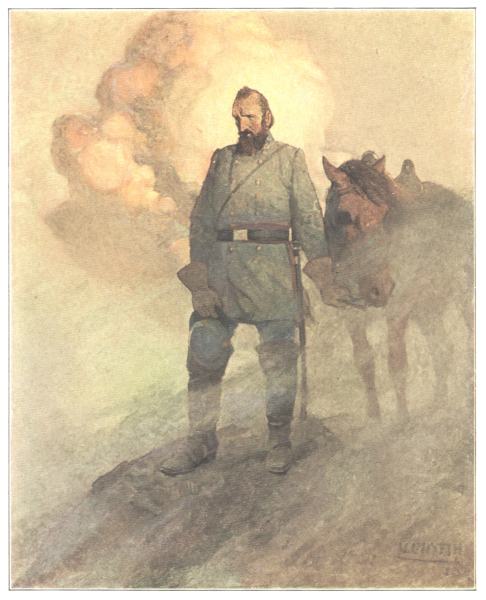 STONEWALL JACKSON