by Donald F. Hoffmeister, Assistant Professor of Zoology and Curator of the Natural History Museum, University of Illinois
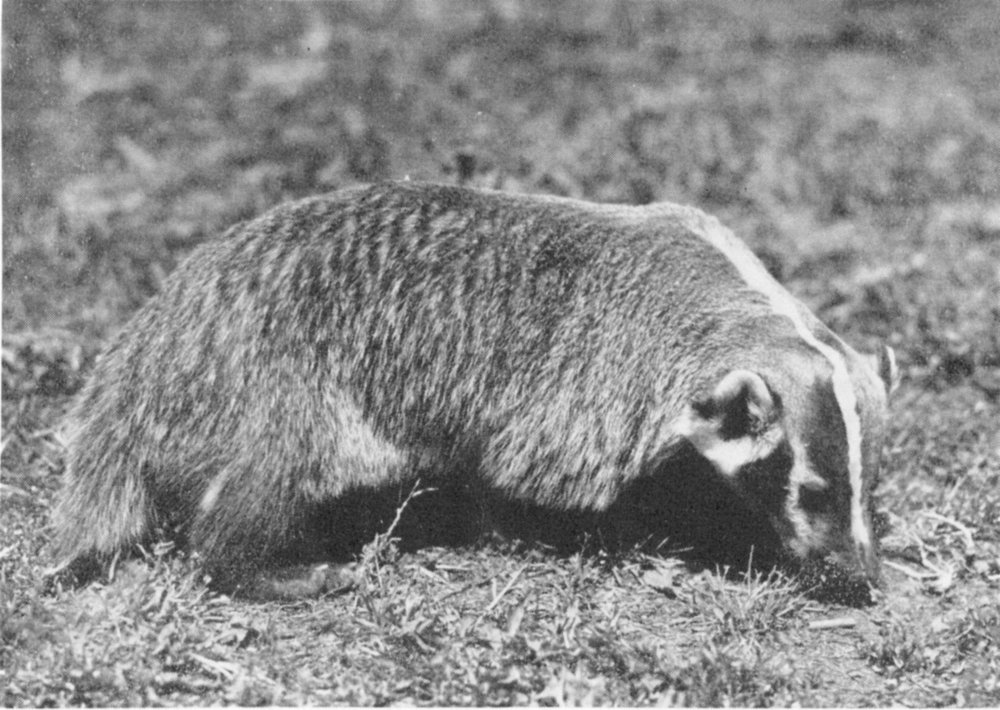
Photograph by E. P. Haddon, Fish and Wild Life Service
Although for many years the
badger was common in Illinois, it
all but vanished from this State
about the first half of the 19th
century. By 1861, an Illinois biologist
commenting on the badger
wrote that the species had “nearly
abandoned the State,” and by the
latter part of the past century the
badger was definitely on the wane
in Illinois.
But strangely enough, within recent
years the badger once more
has increased in numbers in northern
Illinois and has reinvaded some
of the territory it formerly occupied
in central Illinois. It is most abundant
in our northwestern counties,
but even as far south as Fulton
County this animal has been seen
in nearly a dozen different localities
in the past ten years. Two
badgers were taken nearly as far
east as the Indiana line in 1953.
The badger, in spite of man’s attempt
to control it, apparently is
increasing and spreading.
Although you may live in an
area where the badger is common,
it would not be surprising if you
had never seen this animal, for it
is abroad principally at night. However,
its presence is usually well
known by the abundance of its diggings.
The badger is excellently
equipped to dig, with powerful forelegs
tipped with long, strong claws.
It is squat and streamlined for getting
through—not over—the ground.
More than once, a group of men
have cornered a badger in a shallow
burrow, but one badger with
its own digging apparatus extended
the burrow faster than the crew of
men could shovel. When pursuing
or pursued, the badger never rests
on its “shovels”, but keeps them
going at such a rapid pace that the
tunnel behind is soon filled with
422
moved dirt. The front legs loosen
the dirt and push it under the animal,
where the hind legs pick up
the process and continue the earth
on out behind. The operation proceeds
like an endless track, without
a wasted motion. As many as ten
men, all equipped with shovels,
have failed to keep up with the
excavating of a badger, and the
latter has escaped their intents. Ten
men against a 30-pound badger!
No wonder it has been called a
master excavator. With the powerful
front legs, the badger is not
readily deterred in its burrowing.
I have seen where a badger had
decided to come to the surface
from its subterranean burrow beneath
a heavily macadamized road.
The well-packed rocks, gravel, and
tar, some four or five inches thick,
were torn away and a sizeable hole
made as if no roadway were there.
A captive badger was given the run
of a concrete basement. This
seemed like a safe enough place.
However, the animal found a crack
and enlarged it until he was successful
in removing a piece of
concrete.
The badger is yellowish gray in
color, with a conspicuous white
stripe on the head, extending from
the nose over the forehead, and disappearing
on the back. Because
the animal belongs to the weasel
and skunk family, it possesses scent
glands and a strong odor which is
emitted only infrequently. When
tormented, the badger holds its
stubby tail erect, skunk-fashion, and
hisses in a menacing way.
In Illinois, the badger is at home
on the rolling, sandy prairies, as
well as on prairies with heavier
soils. Franklin ground squirrels,
thirteen-lined ground squirrels,
woodchucks, and meadow mice provide
food for the badger population.
When prey is sensed in the
badger’s underground burrow, the
dirt flies until the hunter has it
securely in mouth. Snakes, frogs,
insects, and rabbits also are eaten;
and because the majority of these
items in its diet are pests of man,
the badger is considered a most important
animal in northern Illinois
in keeping small mammals in check
and is vastly underrated as a natural
control of many of our pests.
To condemn the woodchuck and
badger, or the ground squirrel and
badger, in the same breath would
be like despising both garbage and
the garbage man.
Badgers have a single litter of
young each year in May or June.
The young are cared for in a nest
at the end of a protective subterranean
burrow. In wintertime,
badgers are said to hibernate, but
they do not do so in the strict
sense of the word. They may become
inactive during periods of
extreme cold, but they do not enter
into the deep sleep, with reduced
metabolic activities, that the woodchucks
and ground squirrels do in
Illinois.
In our State, the badger has few,
if any, enemies, other than man.
Man traps the badger, makes unusable
some of its preferred habitat,
poisons off the squirrels and woodchucks
which are its preferred
source of food, and runs it down
on the highway. The fur of the
badger nowadays has little or no
value, but in former years it was
in demand, and a badger hide, at
inflated prices, would have been
worth as much as ten dollars. Conservationists
maintain that it is unwise
not to give some protection to
one of our most interesting mammals,
a potentially valuable fur-bearer,
and a foremost controller
of rodent pests.
May the “diggings” of the badger,
the next time you encounter them,
thrill you with the thoughts of one
of Illinois’ first and foremost engineers,
a master excavator.
423