INSECTS.
Insects are easily distinguished from the other jointed animals by many salient characters.
They have one pair of antennæ, two large compound eyes, composed of a great number of facets, and
sometimes one, two, or three simple eyes placed on the crown or front of the head. In its adult
condition an insect is composed of three different parts, which can be most readily noticed in a
wasp. There is the head, with the antennæ and mouth-parts; the thorax, to which one or two pairs
of wings are attached above, and three pairs of legs below; and the abdomen. Insects breathe
through openings, called "stigmata," in the sides of the thorax and abdomen. They never possess
more than six legs in the perfect state, the abdominal legs present in caterpillars, etc.,
disappearing in the adult condition. They generally pass through what is called a
"metamorphosis,"—four different stages of life, called respectively egg; larva or
caterpillar; pupa, nymph, or chrysalis; and imago, or perfect insect.
Insects are divided into several large sections, of which the following seven are the most
important, and many entomologists prefer to include all insects under them:—
Sheath-winged Insects, or Beetles; Straight-winged Insects, or Earwigs, Cockroaches,
Soothsayers, Stick-insects, Crickets, Grasshoppers, and Locusts; Nerve-winged or Lace-winged
Insects, or Dragon-flies and their relatives; Stinging Four-winged Insects, or Ants, Bees and
Wasps, and their allies; Scale-winged Insects, or Butterflies and Moths; Half-winged Insects, or
Bugs and Frog-hoppers; Two-winged Insects, or Flies.
We proceed to notice these orders separately.
SHEATH-WINGED INSECTS, OR BEETLES.
BY THE REV. THEODORE WOOD, F.E.S.
Beetles are distinguished from most other insects by the fact that the front wings are not
employed in flight, but are modified into horny sheaths, which cover and protect the lower pair
while not in use. This arrangement, however, is also found in the Earwigs as well as in the
so-called "Black-beetle" and its allies, and it is to be noted that the wing-cases of beetles lie
evenly side by side together when the wings are folded, while the folding of the wings themselves
is transverse as well as longitudinal. The number of species is very great, upwards of 100,000
having already been described, of which about 3,400 have been taken in the British Islands.
The order is again divided into several smaller groups, first among which stand the predaceous
beetles of the land. Of these the common English Tiger-beetle is a
familiar example. It is found on sandy and peaty heaths, and may be known at once by its bright
green wing-cases, marked with white spots, and the metallic blue of the abdomen. The legs are
coppery. It flies with great swiftness in the hot sunshine, taking to wing as readily as a
blue-bottle fly, and feeds entirely upon other insects.
Another representative of the group is rich golden green in colour, with coppery reflections.
It is only an occasional visitor to Britain, but abounds in France and Germany, where it feeds
upon the caterpillars of the famous Processionary Moth, and is largely instrumental in checking
their ravages in the great oak forests.
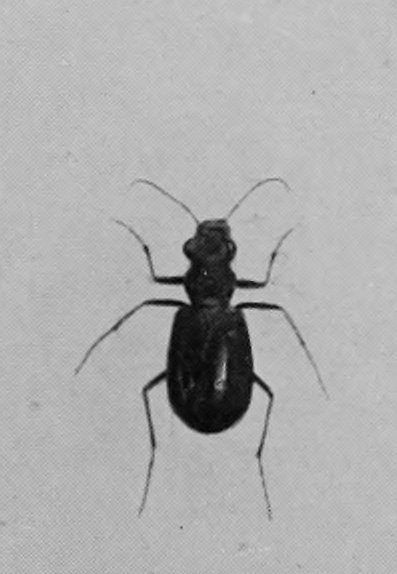
Photo by W. P. Dando, F.Z.S., Regent's Park.
TIGER-BEETLE.
The colouring of this insect is bright green with white markings and coppery
legs.
Familiar to almost all is the Purple Ground-beetle, so plentiful in
gardens, and easily recognisable by the violet margin to the black wing-cases. It pours out an evil-smelling
liquid from the end of the body when handled.
The curious red-and-blue Bombardier, which, when interfered with,
discharges a little puff of bluish-white smoke from the tip of the abdomen, accompanied by a
distinct report, is also a member of this group. It is found under stones on river-banks, and also
on the coast.
Next come the predaceous beetles of the water, of which we have a well-known British
representative in the Great Brown Water-beetle. This insect, which is
plentiful in weedy ponds, swims by means of its hind limbs, which are modified into broad, flat
oars, with a mechanical arrangement for "feathering" as they are drawn back after making each
stroke. It flies by night, often travelling for a long distance from one pond to another, and
regains the water by suddenly folding its wings and allowing itself to fall from a height. In the
female insect the wing-cases are grooved for about two-thirds of their length.
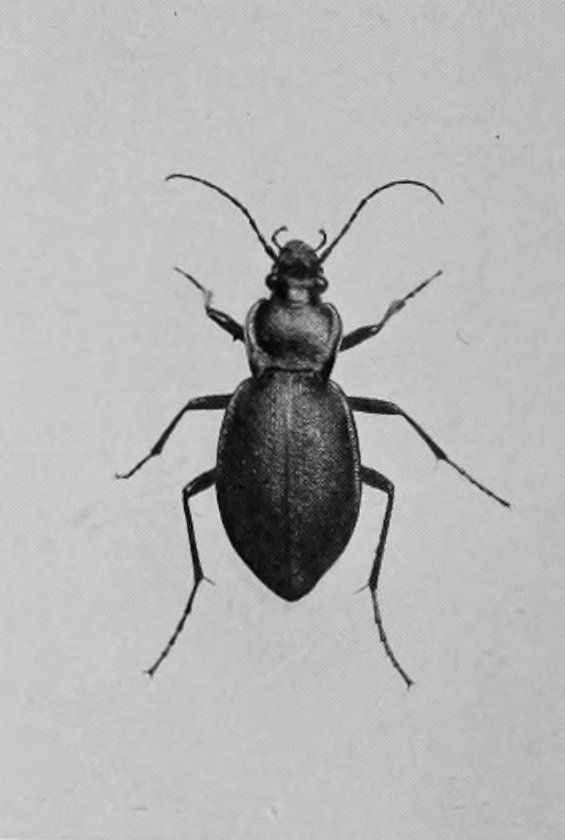
Photo by W. P. Dando, F.Z.S., Regent's Park.
GROUND-BEETLE.
The beetles of this group are generally of a black or bronzy colour, some
species being beautifully metallic.
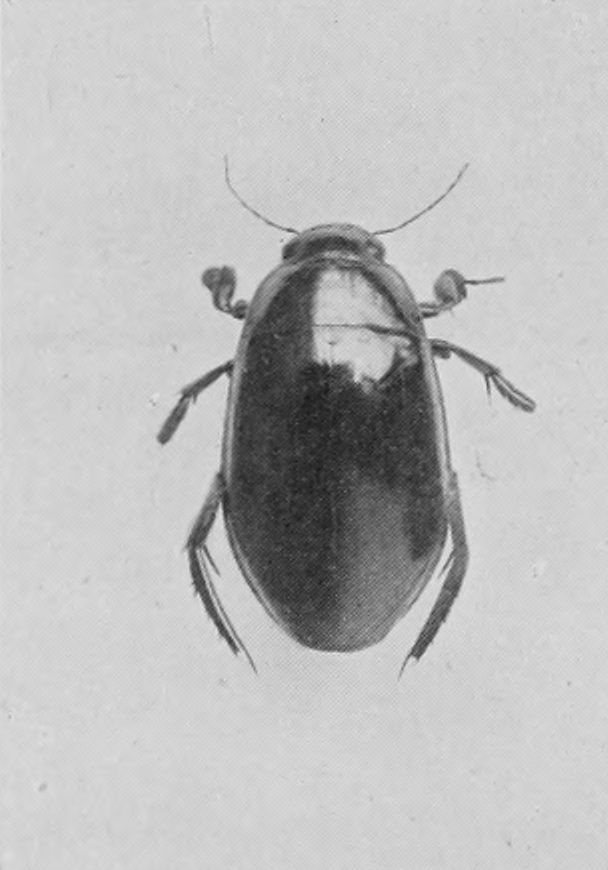
Photo by W. P. Dando, F.Z.S., Regent's Park.
GREAT BROWN WATER-BEETLE (MALE).
A large olive-brown species, about an inch in length, and nearly half as broad.
The wing-cases of the female are grooved.
This beetle must not be confounded with the still larger Black
Water-Beetle, which belongs to another group. This fine insect, which is not predaceous in
the perfect state, is locally plentiful in ditches, and is in great request as an inmate of the
freshwater aquarium. The hind limbs are not modified for swimming purposes.
Next in order come the Cocktails, so called from their curious habit of
turning up the end of the body when alarmed. To this group belong most of the tiny "flies" which
cause such severe pain when they find their way into the eyes. Some species, however, attain to a
considerable size, the well-known Devil's Coach-Horse being fully an inch
in length. The great majority are scavengers, being found in carrion, manure, and decaying
vegetable matter. A few, however, are lodgers in the nests of ants, by whom they appear to be
regarded as pets and treated with the utmost kindness.
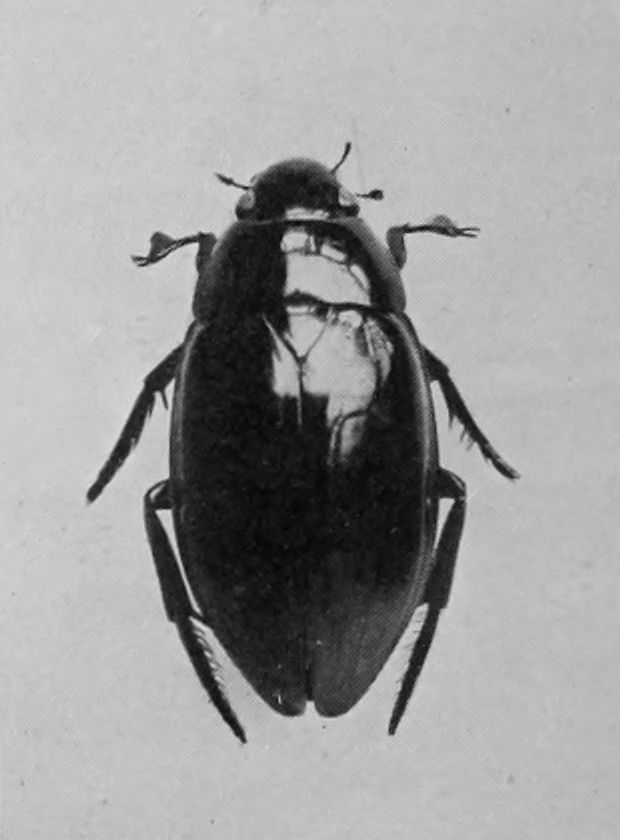
Photo by W. P. Dando, F.Z.S., Regent's Park.
BLACK WATER-BEETLE.
A shining black species, longer, narrower, and more convex than the Great Brown
Water-beetle.
The next group includes the curious insects popularly known as Burying-Beetles, which inter the bodies of small animals in the ground, scooping
out the earth from underneath them by means of their broad and powerful heads, and shovelling it
back when the carcases have sunk to a sufficient depth. The eggs are laid in the carrion thus
buried. Most of these beetles are distinguished by broad blotches or bars of orange on the
wing-cases, but one common British species is entirely black.
Allied to these, and very similar in habits, are the Flat
Burying-Beetles, of which there are about a dozen British species. In the best known of
these the thorax is dull red in colour, and the black wing-cases are curiously wrinkled. Another
species is reddish yellow in colour, with two round black spots on each wing-case. It is found on
oak-trees, and feeds upon caterpillars.
The Leaf-horned Beetles are distinguished by the fact that the terminal
joints of the antennæ lie one upon another like the leaves of a book. In many cases they can be
expanded at will into a broad fan-like club. The well-known Stag-beetle of
Great Britain is a representative of this group. It is a somewhat local species, being plentiful
in some parts of the country, and entirely unknown in others. The grub lives for several years in
the trunks of elm-trees, feeding upon the solid wood. When fully grown, it buries itself in the
earth, and constructs a large cocoon, in which it passes the chrysalis stage of its existence. The
perfect beetle emerges in November, but remains within the cocoon until the following June. In the
female the jaws are very much smaller than in the male, but are nevertheless more formidable as
weapons. The insect may often be seen flying on warm summer evenings.
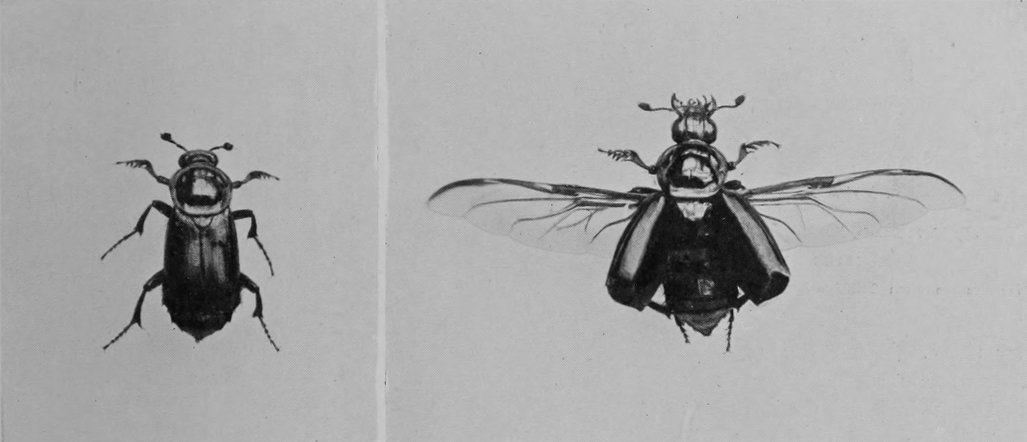
Photos by W. P. Dando, F.Z.S.] [Regent's Park.
TWO BURYING-BEETLES.
These insects are about an inch in length; many are black, but others have
orange-red bands on the wing-cases.
A still larger insect belonging to the same group is the Hercules
Beetle, found in the West Indies and tropical America, a male of average size being nearly
5 inches in length. In this beetle the thorax is prolonged into a horn, which is curved downwards,
while the head is produced into a similar horn curved upwards, so that the two look like a pair of
enormous jaws. It has been stated that these horns, both of which are furnished with tooth-like
projections, are employed in sawing off the smaller branches of trees, the beetle grasping a bough
firmly, and flying round and round in a circle, till the wood is completely cut through. This
assertion, however, is totally unworthy of credit. An example of the beetle—evidently
imported—was recently found crawling on a hedge near Biggleswade.
One of the largest of all known beetles is Drury's Goliath Beetle, a
native of the Gaboon, whose body is almost as big as the closed fist of a man. It appears to feed,
while a grub, on the wood of decaying trees, and undergoes its transformation to the chrysalis
state in an earthen cocoon, the peculiarity of which is that a thick belt, or ridge, runs round
the middle. How this belt is formed is a mystery, as it lies upon the outside, while the grub
necessarily constructs the cocoon from the inside. Several living examples of this beetle were
exhibited in the summer of 1898 in the Insect-house of the Zoological Gardens in the Regent's
Park, where they remained for five or six weeks, feeding on the flesh of melons. A photograph of
this beetle will be found in the Coloured Plate.
The common Cockchafer belongs to another division of the same group.
This insect is extremely injurious, as the grub lives for three years or more underground, feeding
on the roots of various cultivated plants. The perfect beetle appears in May and June, and is only
too plentiful almost everywhere. A month or so later its place is taken by the Summer Chafer, or June Bug, which may often be seen
flying in hundreds round the tops of low trees soon after sunset, while the smaller Coch-y-bonddhu—the "Cockerbundy" of the angler—often appears about
the same time in hundreds of thousands. The beautiful Rose-beetle, too,
with its bright golden-green wing-cases marked with wavy whitish lines, may often be seen sunning
itself in roses or on the blossoms of pinks.
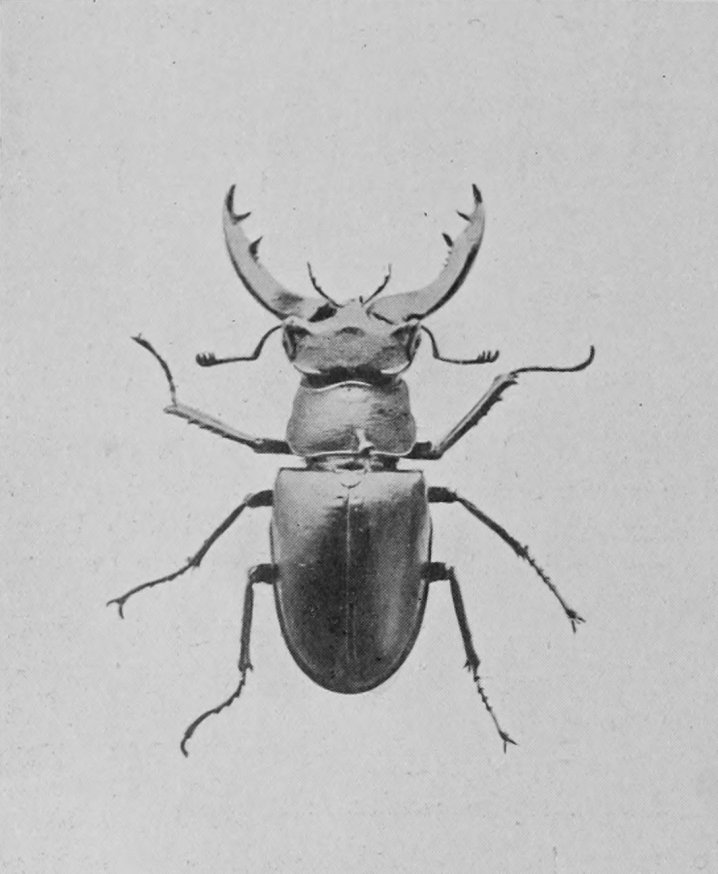
Photo by W. P. Dando, F.Z.S.] [Regent's Park.
MALE STAG-BEETLE.
The males are often 2 inches long; the females have comparatively small
jaws.
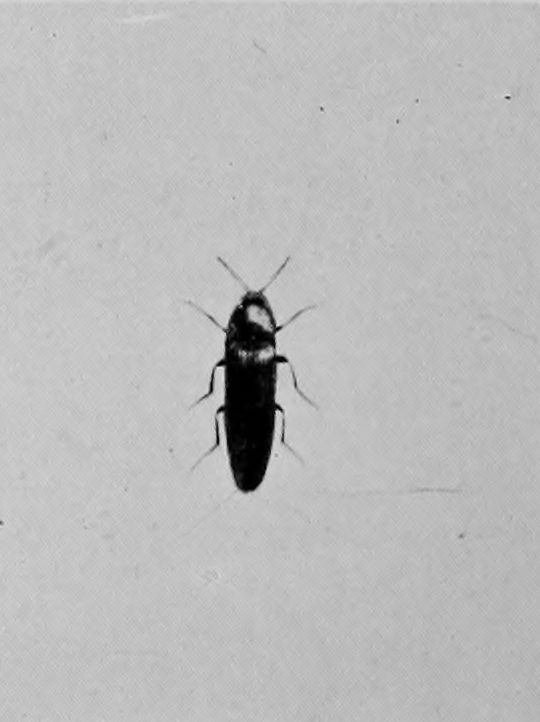
Photo by W. P. Dando, F.Z.S., Regent's Park.
SKIPJACK BEETLE.
The larvæ of this family are known as Wire-worms.
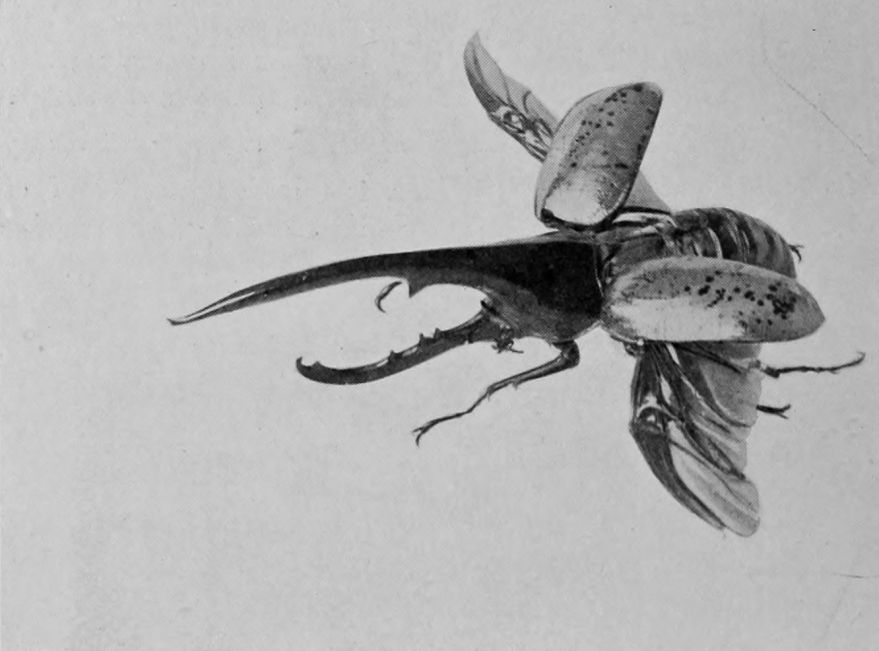
Photo by L. H. Joutel] [New York.
HERCULES BEETLE FLYING.
The most remarkable feature about this insect is its huge horn-like projection
from the thorax, which is nearly as long as the rest of its body.
The famous Egyptian Scarabæus is also a member of this group. It is
remarkable not only for the sacred character attributed to it by the ancient Egyptians, but also
for its curious habit of rolling along balls of dung until it can find a soft spot in which to
bury them. When the egg hatches, the grub feeds upon the dung, the quantity provided being exactly
sufficient for its requirements. The common Dor Beetle of Great Britain is
allied to this insect; it tunnels down to a depth of 14 or 15 inches beneath a patch of excrement,
and lays its egg at the bottom of the burrow.
The Skipjack Beetles, parents of the well-known Wire- worms, which
cause so much mischief by feeding upon the roots of cultivated crops, represent another group.
These beetles owe their popular title to their singular method of regaining their feet when they
happen to roll over upon their backs. Their bodies being very smooth and polished, and their legs
very short, they cannot recover their footing in the ordinary manner. On the lower part of the
body, however, is a highly elastic spine, known as the "mucro," which lies in a sheath. When the beetle falls
over, it arches its body into the form of a bow, resting only upon the head and the extreme tip of
the abdomen, removes the spine from its sheath, and then drives it sharply back again. The result
is that the central part of the body strikes the ground with such force that the insect springs
into the air to a height of 2 or 3 inches. Then, turning half over as it falls, it alights on its
feet.
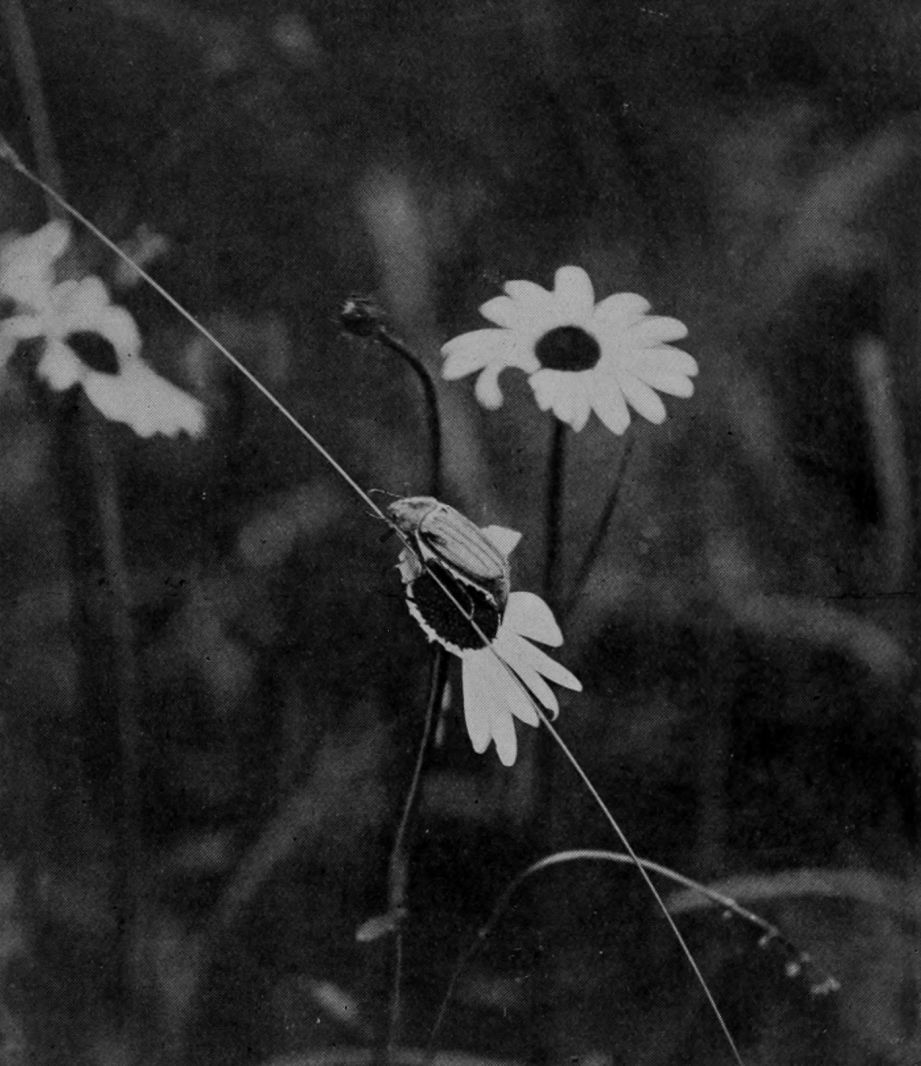
Photo by B. H. Bentley] [Sheffield.
COCKCHAFER ON DAISY.
A very destructive insect which feeds on the leaves of trees. The larva devours
the roots of plants, and is often so plentiful as to cause very serious mischief.
The Fire-fly of the tropics belongs to the same group. The luminosity
of this insect proceeds from two different parts of the body, a brilliant yellowish-green light
shining out through two transparent window-like spots on the thorax, while an orange glow is
visible on the lower surface of the abdomen. The exact cause of the light is unknown, as is also
the manner of its control by the insect.
The same may be said of the common English Glowworm, in which the light
proceeds from the lower surface of the hind part of the body. The male of this insect is winged;
the female is grub-like in appearance and wingless. The grub itself, which may be found in autumn,
is also luminous, and feeds upon snails.
Another group includes a very large number of beetles of very varying character and appearance.
Among these are the Oil-beetles, so called from their habit of exuding
small drops of an oily liquid from the joints of their limbs when handled. The eggs are laid in
batches of several thousand in holes in the ground, and the little long-legged grubs, on emerging,
clamber up the stems of flowers, and hide themselves among the petals to await the coming of a
bee. When one of the latter appears, two or three of the grubs cling to its hairy body, and are
carried back to the nest, in which they live as parasites. One of these beetles may be seen
commonly upon grassy banks in early spring.
Allied to these insects is the Blister-beetle, or Spanish Fly, so well known from its use in medicine. It is a very handsome
species, of a bright golden-green colour, occasionally found in Great Britain on the foliage of
ash-trees. In many parts of Southern Europe it is extremely abundant.
The beetles belonging to the large and important group of Weevils are
characterised, as a rule, by the fact that the head is prolonged into a more or less long and
slender snout, or "rostrum," at the end of which the jaws are situated. The number of species
already known is above 20,000.
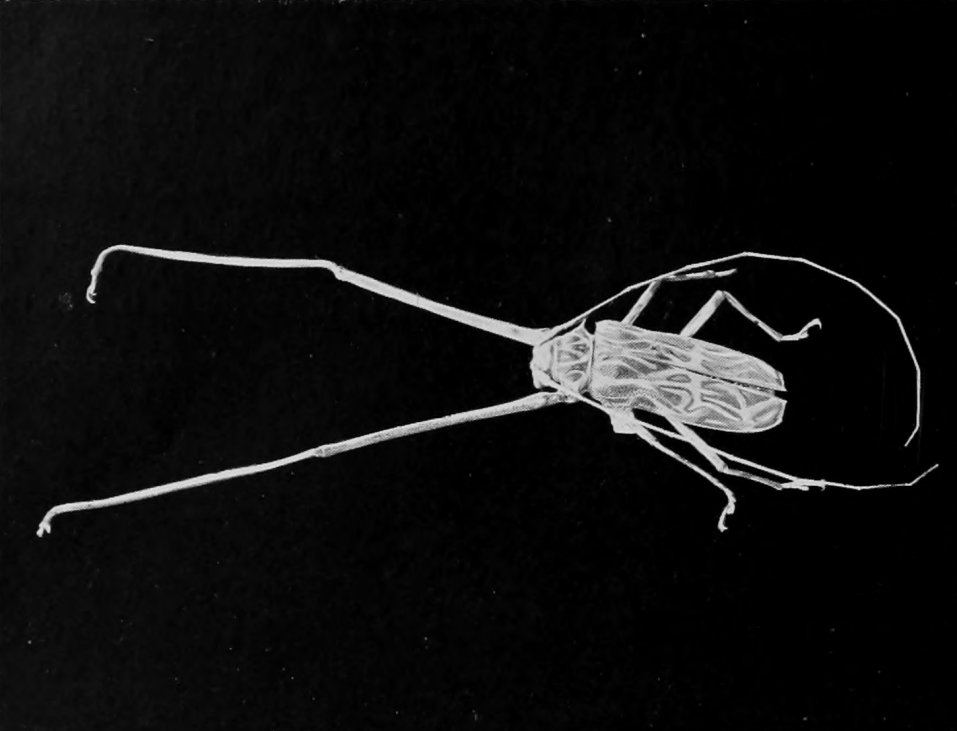
Photo by L. H. Joutel] [New York.
HARLEQUIN BEETLE.
Notice the enormous length of the front legs.
One of the largest and most famous of these insects is the Diamond-beetle of Brazil, the scales from whose wing-cases are so frequently
mounted as microscopic objects. When viewed through a good instrument under a powerful light, the
beauty of these scales is simply indescribable. All that one can say of them is that they seem to
be composed of diamonds, rubies, topazes, and emeralds massed together in rich profusion, while
diamonds are transformed into rubies, rubies into topazes, and topazes into emeralds at every
change of light.
The Osier-weevil, a black-and-white species about three-eighths of an
inch long, is found on osiers in Great Britain, the grub boring galleries in the stems, and often
causing considerable damage. The well-known Corn-weevil is still more
destructive in granaries, the walls of which are often completely blackened by its crawling
multitudes. The grub lives inside the grain, eating out the whole of the interior, and a single
pair of the weevils are said to be capable of producing a family of more than 6,000 individuals in
the course of a single season. The Rice-weevil is equally destructive to
rice, and may be recognised by the two red spots on each wing-case.
The famous "Gru-gru" of the West Indies, which is regarded as so great
a dainty both by the negroes and by many of the white colonists, is the grub of the Palm-weevil. It lives in the stems of palm-trees, and also in those of
sugar-canes, causing a great deal of mischief by its burrowings. When fully fed, it constructs a
cocoon by tearing off strips of bark and weaving them neatly together. The Sugar-weevil is still more troublesome, feeding upon the juice of the
sugar-cane, and affecting the entire plant in such a manner that sugar can no longer be
manufactured from it.
"Bad" nuts are also due to one of these insects, the common Nut-weevil.
which introduces its egg into the kernel during the earlier stages of its development. When the
grub hatches, it proceeds to devour the kernel, leaving a quantity of bad-flavoured "frass" behind
it, while the shell is left untouched until the perfect insect emerges. An allied species attacks
acorns in a similar manner.
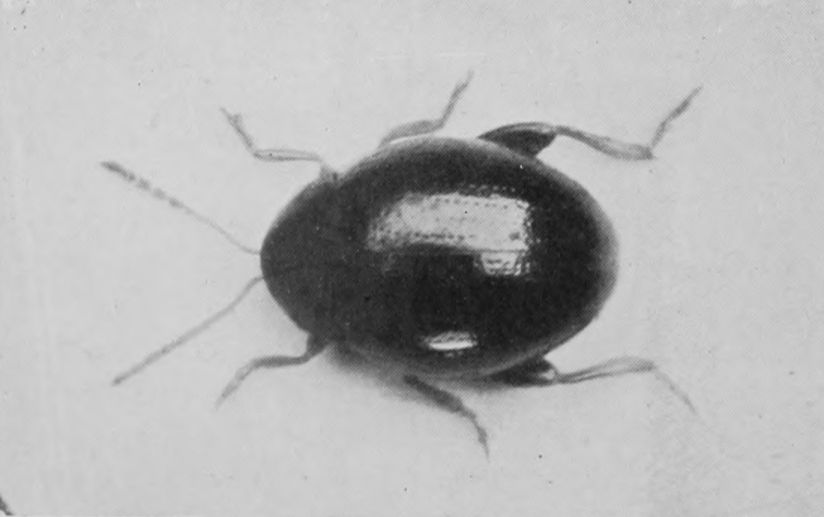
Photo by J. Edwards] [Colesborne.
JUMPING-BEETLE. ALLIED TO THE TURNIP-FLEA.
It is about one-tenth of an inch in length.
Among the finest and largest of all beetles are many of those belonging to the great Long-horn
group, of which the common British Musk-beetle is a familiar example. This
insect owes both its popular and scientific titles to its powerful odour, which perhaps
resembles that of sweetbriar rather than musk, and can often be detected at a distance of twenty
or thirty yards. The beetle, which is rich metallic green in colour, with long, slender antennæ,
may be found in July sunning itself on the trunks or foliage of willow-trees. It varies
considerably in size.
Still more plentiful is the Wasp-beetle, with its black wing-cases
banded with bright yellow. While flying, it may easily be mistaken for the insect whose name it
bears. The grub lives in old posts, rails, hop-poles, etc., feeding upon the solid wood.
The Timberman is remarkable for the extreme length of the antennæ,
which, in the male insect, are three or four times as long as the body, and trail out far behind
it during flight. It is found, not uncommonly, in fir woods in Scotland.
The beautiful Harlequin Beetle of tropical America is one of the
largest members of the group, and is remarkable for the great length of the front legs as well as
for the singular colouring of the wing-cases. It lives almost entirely in the trees, swinging
itself from branch to branch somewhat after the manner of a spider-monkey. When it ventures into
the air, it is greatly incommoded by the size of its limbs and the length of its antennæ, and
seems to have but little power of directing its course.
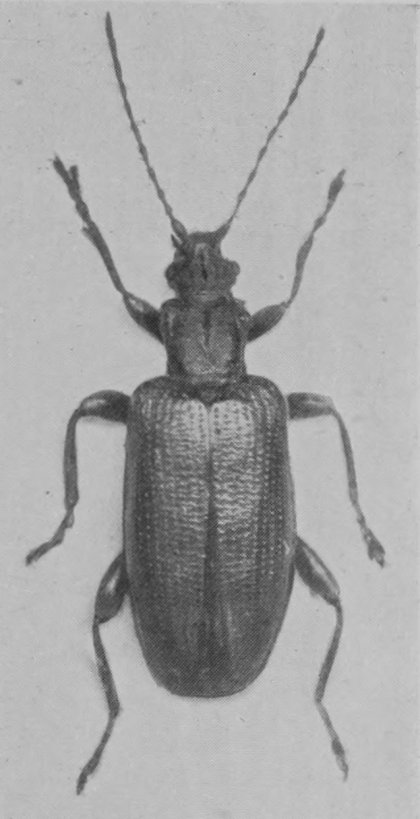
Photo by J. Edwards, Colesborne.
REED-BEETLE.
Among the group to which this insect belongs are
many of the most brilliantly coloured British beetles.
Another great group of beetles is that of the Plant-eaters, many of
which are exceedingly beautiful. The Reed-beetles of Britain, for example,
are resplendent in crimson and green and purple and blue, while the metallic radiance of others
has gained for them the title of Golden Apples.
The notorious Colorado Beetle is a member of this group. It may be
recognised at once by the five black streaks running down each of the yellow wing-cases. On the
havoc which it causes among potato-plants in North America it is unnecessary to dilate. On a
smaller scale, the Turnip-flea is very mischievous in Britain, perforating
the leaves of turnip-plants, or—worse still—eating off the seed-leaves as soon as they
appear above the surface of the ground. Of only too many of these exquisite beetles, in fact, it
must be said that their beauty is only equalled by their destructiveness.
The Ladybirds include a very large number of species. Some of these,
such as the common Two-spot Ladybird, are exceedingly variable, a long
series being easily obtained in which no two specimens resemble one another. Both as grubs and as
perfect insects they feed upon the "Green Fly" of the farmer, combining with the grubs of the
Lace-wing and Hoverer Flies to keep its numbers within due limits.
Almost equally common is the Seven-spot Ladybird, a considerably larger
insect, with seven round black spots on its scarlet wing-cases, which may be seen on almost any
grassy bank in spring. Both this and the preceding species sometimes visit the Kentish coast in
vast swarms, the beach being reddened by their bodies for miles. The last immigration of this
description took place in 1886, in the summer of which year the hops in East Kent were almost
destroyed by blight, and the ladybirds made their way at once to the hop-fields and cleared them
of the pest in a wonderfully short space of time. A much smaller species, known as the Twenty-two Spot, is yellow in colour and has eleven black spots on each
wing-case. It is generally found crawling about on nettle-leaves in the early part of the
summer.
Allied to the Ladybirds are the very curious Tortoise-beetles. In these
insects the wing-cases project to a considerable distance beyond the sides of the body, and the
legs are so short that only the feet can be seen from above, so that the appearance is very much
like that of a
tortoise with the limbs partly withdrawn into the shell. Many different species are known, in some
of which the wing-cases are streaked with brilliant metallic silver, which, however, fades away
very shortly after death. The commonest of the British tortoise-beetles is found on thistles.
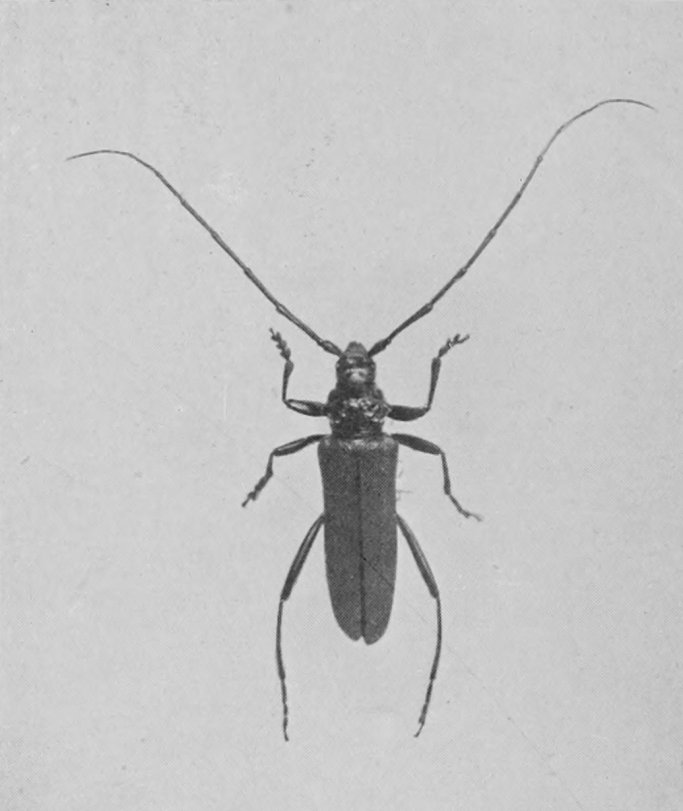
Photo by W. P. Dando, F.Z.S.] [Regent's Park.
MUSK-BEETLE.
The odour of this beetle may often be detected at a distance of twenty or
thirty yards.
Another very large group of beetles is represented by the Cellar-beetle, which is generally very common in old houses. This insect must
not be confused with the so-called "Black-beetle," from which it may easily be distinguished by
its deep black colour, its very much shorter feelers, and the curious point into which the end of
its body is produced. It hides away in dark corners by day, and crawls slowly about by night.
Related to it is the Meal-worm, so much in request for the food of
cage-birds, which is usually very plentiful in granaries.
Very different, in appearance, yet belonging to the same group, is the handsome Cardinal Beetle, a bright scarlet insect which is not uncommon in summer. It may
sometimes be found lurking behind pieces of loose bark, and is also fond of resting upon the
flowers of umbelliferous plants in the hot sunshine. A second species, which is not nearly so
plentiful, may be distinguished by the fact that the head is entirely black.
Still more curious is the Rhipiphorus Beetle, which is parasitic within
the nests of wasps. Where the egg is laid, or how the grub first finds its way into the nest, no
one has yet succeeded in discovering; but having made its entry, the insect proceeds to burrow
into the body of a wasp-grub, and lives within it for several days, feeding upon its flesh
meanwhile. After increasing considerably in size, it creeps out of the carcase of its victim and
changes its skin, after which it resumes its interrupted meal, and continues to feed until the
last vestige of the wasp-grub has been devoured. It then changes to a chrysalis in the cell, and
the perfect insect appears a few days later. Oddly enough, the wasps appear to take no notice of
its presence, and never attempt to molest it. The two sexes of this beetle are quite unlike one
another, the male having the wing-cases yellow and the feelers heavily plumed, while the female is
black, with the feelers only slightly toothed.
Most singular of all the insects belonging to this order, however, is the strange
little Stalk-eyed Beetle, which spends the greater part of its life half
buried in the body of a bee. In this insect the feelers are branched, somewhat like the
antennules, or lesser feelers, of a lobster, and the eyes, which are comparatively few in number,
are set at the ends of short foot-stalks. The male has very narrow wing-cases, but extremely large
wings, which have a milky appearance during flight that can hardly be mistaken. The female has no
wings at all, and in general aspect is nothing more than a grub. In early spring a great number of
solitary bees are infested by this extraordinary parasite, which burrows into their bodies under
cover of the projecting edges of the segments, and there remains feeding upon their internal
juices for several weeks, with only just the tip of its tail protruding. When fully fed, it
emerges from the body of its involuntary host, leaving a large round hole behind it, which
frequently closes up and heals. In any case, strange to say, the ravages of the parasite appear to
have but little effect upon the health of the bee.
STRAIGHT-WINGED INSECTS, OR EARWIGS, COCKROACHES, SOOTHSAYERS,
STICK-INSECTS, CRICKETS, GRASSHOPPERS, AND LOCUSTS.
BY W. F. KIRBY, F.L.S.
The insects of this order are less numerous in species than those of any other but the next,
and are easily recognised. The fore wings are usually of a leathery consistency, and the hind
wings are folded beneath them like a fan in the more typical families, though in the Earwigs and
Cockroaches a somewhat different arrangement prevails. In the Earwigs, indeed, the wings are
doubled back at the ends, and in the Cockroaches the wing-cases, or "tegmina," as they are
technically called, overlap. As a rule these insects feed entirely on vegetable substances. The
"Soothsayers" form an exception, being carnivorous, though they are not parasitic, like the
Ichneumon-flies, but feed on fresh food; and several species of Earwigs, Cockroaches, and
Crickets, especially those which are semi-domesticated, are omnivorous, and will eat animal as
well as vegetable food. These insects have an imperfect metamorphosis—that is, there is no
inactive pupa-state; but, the young, on emerging from the egg, already possess a recognisable
resemblance to their full-grown parents, and their metamorphosis consists of a series of moults,
before the last of which rudimentary wings appear in those species which ultimately acquire these
appendages. A considerable number of species never have wings, a circumstance which frequently
renders it difficult to determine whether a specimen is fully developed. The antennæ are usually
long, and the joints distinctly separated, but are very rarely feathered. At the other end of the
body we often find two long jointed organs, called "cerci." The jaws are always furnished with
strong mandibles. Many Grasshoppers and Locusts have a curious arrangement on the shank of the
front leg, consisting either of a round or an oval cavity on each side, closed by a membrane, or
of two long parallel slits in front. These are considered to be organs of hearing. The largest
known insects belong to this order; the proportion of large or moderate-sized species is
considerable; and the smallest are probably considerably larger than the smallest members of any
other group. They are not numerous in temperate climates; there are only about fifty British
species, and most of the larger of these are either naturalised species, or merely casual visitors
from abroad.
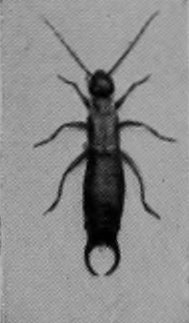
Photo by W. P. Dando, F.Z.S., Regent's Park.
EARWIG.
The forceps-like appendage at the end of this
insect's body is said to be used for folding and unfolding the wings.
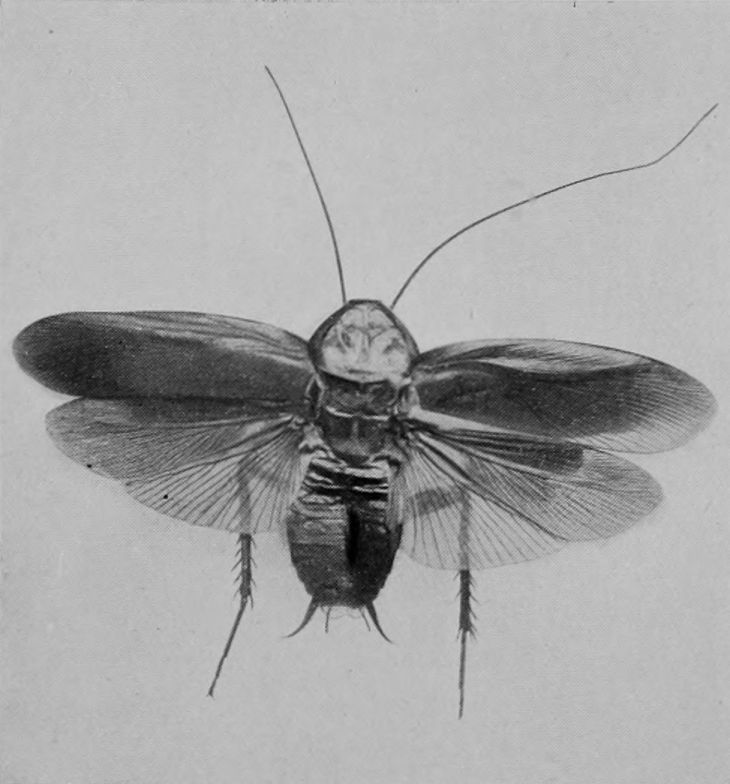
Photo by W. P. Dando, F.Z.S.] [Regent's Park.
AMERICAN COCKROACH.
Common in many warehouses in England, and now found in most parts of the
world.
The Earwigs form the first family. Some are wingless, but most have
very short wing-cases, under which very large wings, forming the most beautiful feature of these
otherwise unattractive insects, are doubled and folded into a very small compass. Some of the
smaller species fly readily; but others, such as the Common Earwig, though
furnished with ample wings, are rarely seen to use them. The most conspicuous organ of the earwigs
is the curious forceps at the extremity of the body, the use of which does not seem to be well
made out, though it has been suggested that it is used for folding and unfolding the wings. The
forceps differs very much in size and shape in different species; it is always larger in the male
than in the female, and often differently shaped. In the common earwig the male forceps is
flattened and contiguous at the base, and rounded and incurved at the extremity. There are two varieties, in one of
which the forceps is twice as long as in the other; but intermediate gradations do not seem to be
met with. In the female the forceps is narrow, nearly straight, and approximating. The earwig is a
nocturnal insect, and hides itself during the day in large-headed flowers, like dahlias, to which
it is very destructive, or in any convenient dark and narrow crevice, especially among decaying
vegetable matter. It derives its name from its occasionally entering the human ear, but it may be
easily driven out by dropping in a little olive oil. In most books it is denied that earwigs enter
the ear at all, but it is, nevertheless, an undoubted fact; and the fanciful derivation that has
been suggested of earwing in the place of earwig cannot be entertained respecting an
insect which seldom shows its wings at all. It should be noted that the female earwig is said to
tend her young very much as a hen tends her chickens—an uncommon habit in insects.
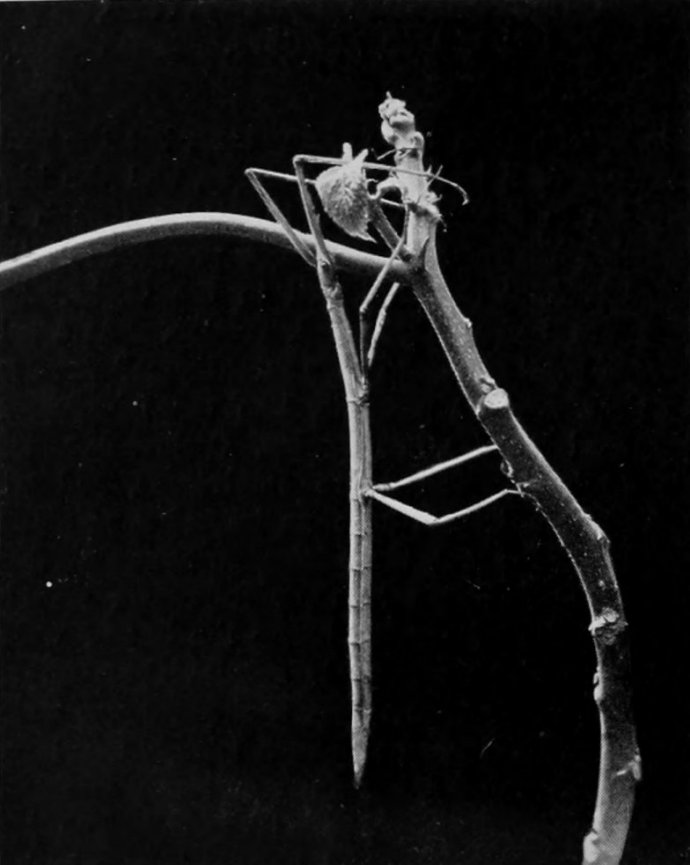
Photo by Highley.
STICK-INSECT.
The largest insect known is a species of stick-insect; it is a native of
Borneo, and measures 13 inches.
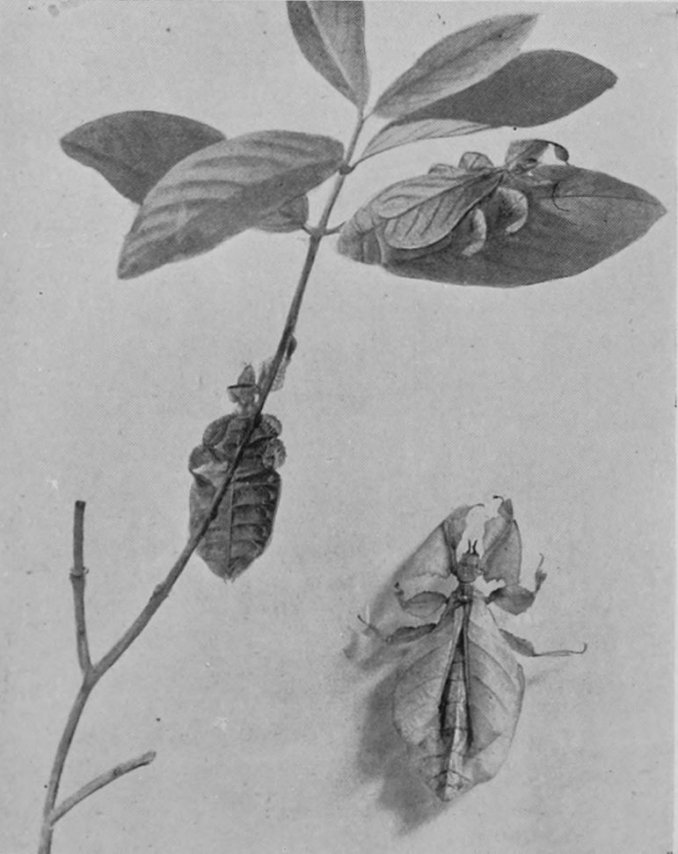
Photo by Scholastic Photo Co.] [Parson's Green.
WALKING LEAF-INSECTS.
Natives of the East Indies, and remarkable for their resemblance to green
leaves.
The Common Cockroach is too well known to need description. The
individuals with half-developed wings are the perfect females; but there are other species in
which the wings are fully developed in both sexes, others in which the male is winged and the
female wingless, and others again in which both sexes are wingless. In warm countries and on
ship-board cockroaches are far more troublesome than in cold climes; and the large brown ones,
with a mark on the back of the thorax resembling a crown, and very broad wing-cases and wings, are
called Drummers in the West Indies, from the loud noise they keep up
during the night.
Lady Burton has given an amusing account of her introduction to cockroaches abroad: "After two
days we were given a very pleasant suite of rooms—bedroom, dining- and
drawing-room—with wide windows overlooking the Tagus and a great part of Lisbon. These
quarters were, however, not without drawbacks, for here occurred an incident which gave me a
foretaste of the sort of thing I was to expect in Brazil. Our bedroom was a large whitewashed
place; there were three holes in the wall, one at the bedside bristling with horns, and these were cockroaches
some three inches long. The drawing-room was gorgeous with yellow satin, and the magnificent
yellow curtains were sprinkled with these crawling things. The consequence was that I used to
stand on a chair and scream. This annoyed Richard very much. 'A nice sort of traveller and
companion you are going to make,' he said; 'I suppose you think you look very pretty and
interesting standing on that chair and howling at those innocent creatures.' This hurt me so much
that, without descending from the chair, I stopped screaming, and made a meditation like St. Simon
Stylites on his pillar; and it was, 'That if I was going to live in a country always in contact
with these and worse things, though I had a perfect horror of anything black and crawling, it
would never do to go on like that.' So I got down, fetched a basin of water and a slipper, and in
two hours by the watch I had knocked ninety-seven of them into it. It cured me. From that day I
had no more fear of vermin and reptiles, which is just as well in a country where Nature is
over-luxuriant. A little while after we changed our rooms we were succeeded by Lord and Lady
Lytton, and, to my infinite delight, I heard the same screams coming from the same room a little
while after. 'There,' I said in triumph, 'you see I am not the only woman who does not like
cockroaches.'"
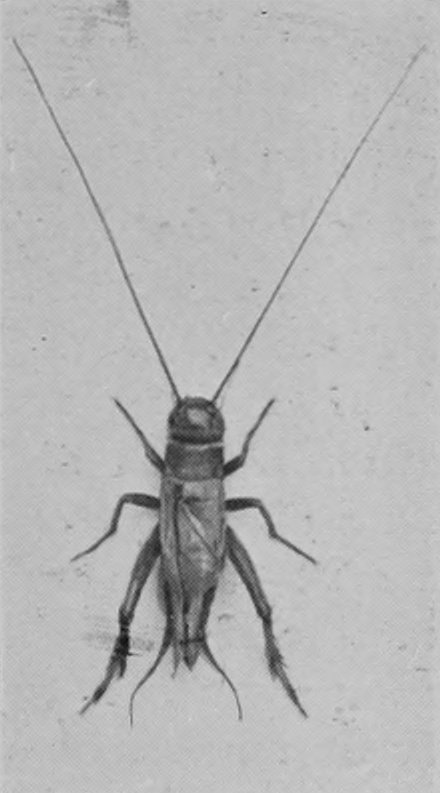
Photo by W. P. Dando, F.Z.S., Regent's Park.
HOUSE-CRICKET.
Very similar in its habits to the cockroach.
The dimensions of the insects are not so much exaggerated; for I believe this story refers to
the large reddish American cockroach, which is common in many English cities, although only in
warehouses. It does not usually much exceed an inch in length; but the antennæ are very long, and
the wing-cases expand nearly 3 inches. (See photograph on page 689.)
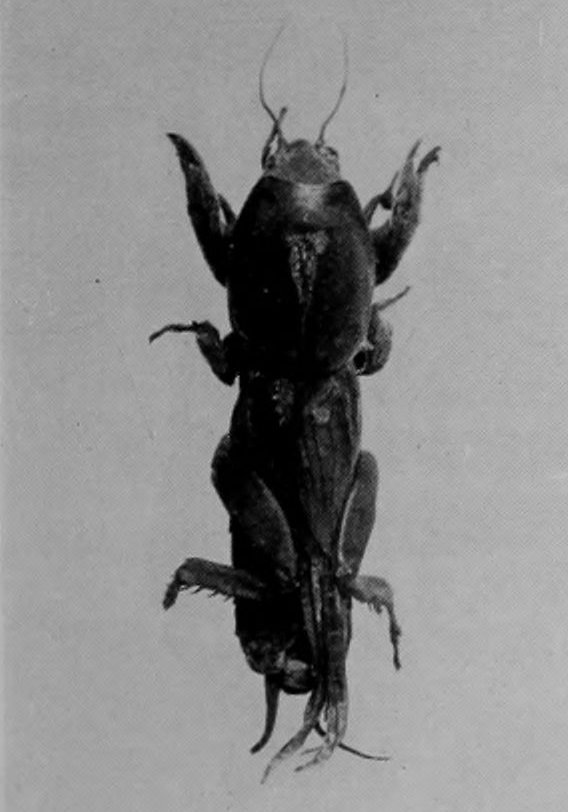
Photo by W. P. Dando, F.Z.S., Regent's Park.
MOLE-CRICKET.
A brown insect about 2 inches long. The very broad and flat front legs are used
for burrowing.
The Soothsayers, or Praying-insects, are not
British, though one or two species are found in the south of Europe. They have long fore legs, the
shanks of which are set with a double row of long, curving, sabre-like spines, and when at rest
they hold them up as if in the attitude of prayer; but they are really on the look-out for prey,
and the long spines are admirably adapted for wounding or grasping the insects which form their
food. They also fight fiercely among themselves, and it is no uncommon occurrence for a female to
tear to pieces and devour her mate, either during or after their courtship. The soothsayers are
often of a green colour, so as to match the grass and leaves among which they live, and thus
conceal them from their prey.
The Stick-insects. or Spectre-insects, have
some resemblance to the Soothsayers, but are exclusively vegetable-feeders, and have long,
sprawling legs, or shorter ones, sometimes more or less lobate; but they never possess prehensile
fore legs for seizing prey. The wing-cases are generally quite small; but some species have
beautiful large green or pink wings, folded fan-wise, and covered by the stout front border of the
wing. Many species are wingless, and of a grey or brown colour, which renders them scarcely
distinguishable from dry bits of stick; and among these is the largest living insect known, a grey
stick-like species from Borneo, measuring nearly 13 inches from head to tail. Other species have
curious excrescences on the legs and body, which make them look like bits of wood overgrown with
moss or lichen; while others possess large flat lobes growing from the legs and body, which cause
them to be almost indistinguishable from green leaves; and, indeed, these insects are frequently
called "Walking Leaves."
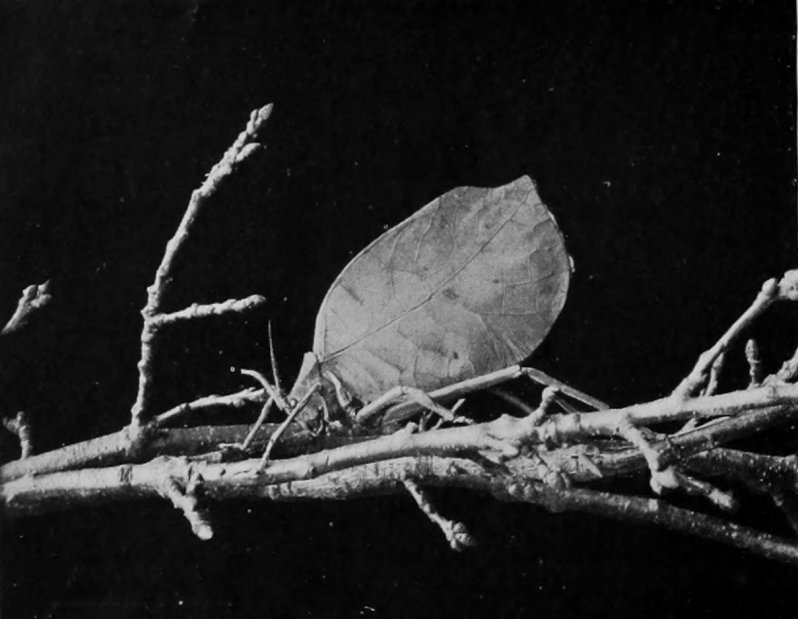
Photo by L. H. Joutel] [New York.
LONG-HORNED GRASSHOPPER.
This insect belongs to the same family as the
well-known British species. The specimen from which this photograph was taken had
unfortunately (as is often the case) broken antennæ; they should be twice as long as the
wings.
With the Crickets we commence the last three families of the group,
which are distinguished from the others by their power of leaping. The hind legs are very long,
with very thick thighs, and generally a double row of strong teeth or spines on the shanks. The
feet are generally three-jointed, and there is usually a long ovipositor in the females. There are
very few true crickets in England, but three of these are very conspicuous species. The first is
the Mole-cricket, a large light brown insect nearly 2 inches long, with
broad, short front legs rather like those of a mole, which it uses in a similar way. Though common
and destructive in fields and gardens, it is not often seen: but if water be thrown on the ground
overnight, and a board laid over it, one or two mole-crickets are likely to be found underneath in
the morning. The House-cricket resembles this insect in colour, but is not
much more than half an inch long, and there is nothing remarkable in the structure of its legs. It
is almost the only noisy insect found in English houses, and is very similar to the common
cockroach in its habits, although free from the disagreeable smell which adds to the disgust the
latter insect often inspires. The third species, the Field-Cricket, is a
smooth black insect, larger and stouter than the house-cricket. It constructs burrows in grassy
places, but is not now a very common species in England. In the last two species, and many others,
there is a bare space on one of the wing-cases of the male, crossed by ribs in a manner varying
according to the species, which helps to produce the loud chirping for which these insects are
remarkable.
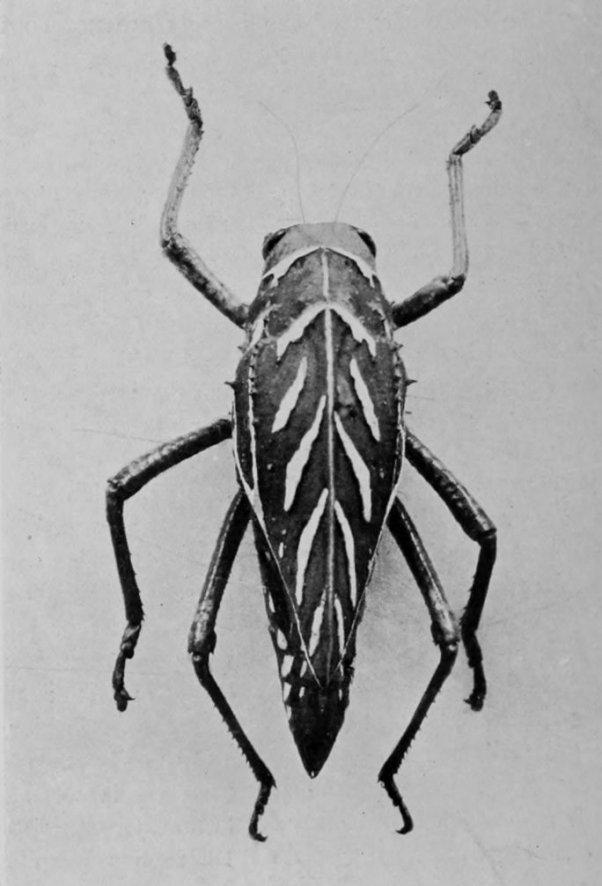
Photo by J. Edwards] [Colesborne.
CAPE GRASSHOPPER (FEMALE).
This insect, which is remarkable for the inflated
bladder-like appearance of the male, is an object of superstition among the Boers. Colour,
bright apple-green with white stripes.
The Long-horned Grasshoppers, which form the next family, are
distinguished by having four joints to their feet, a long ovipositor in the female, and very long,
slender antennæ. The commonest species inhabiting England, and one of the largest grasshoppers, is
the Great Green Grasshopper, which is found leaping about among long grass
and low bushes, especially in the south of England. It is about 2 inches in length. Among the
foreign species of this rather extensive family, we may mention some green or reddish South
American species, with a large round spot on the hind wings, not unlike those seen in the
peacock-butterfly.
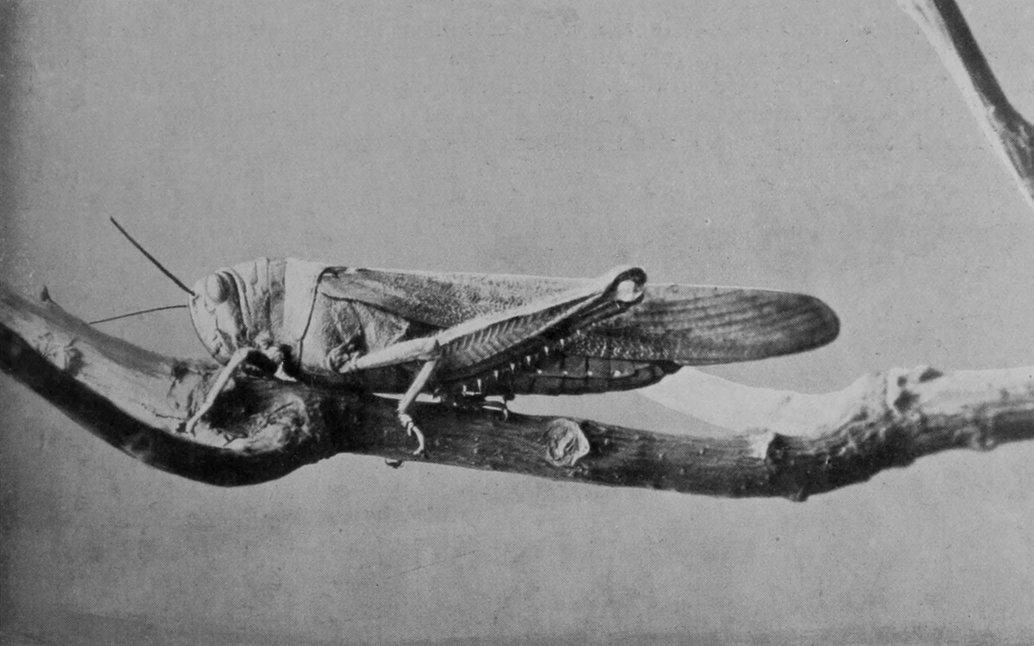
Photo by Highley.
EGYPTIAN LOCUST.
A common North African species, of which specimens occasionally visit
England.
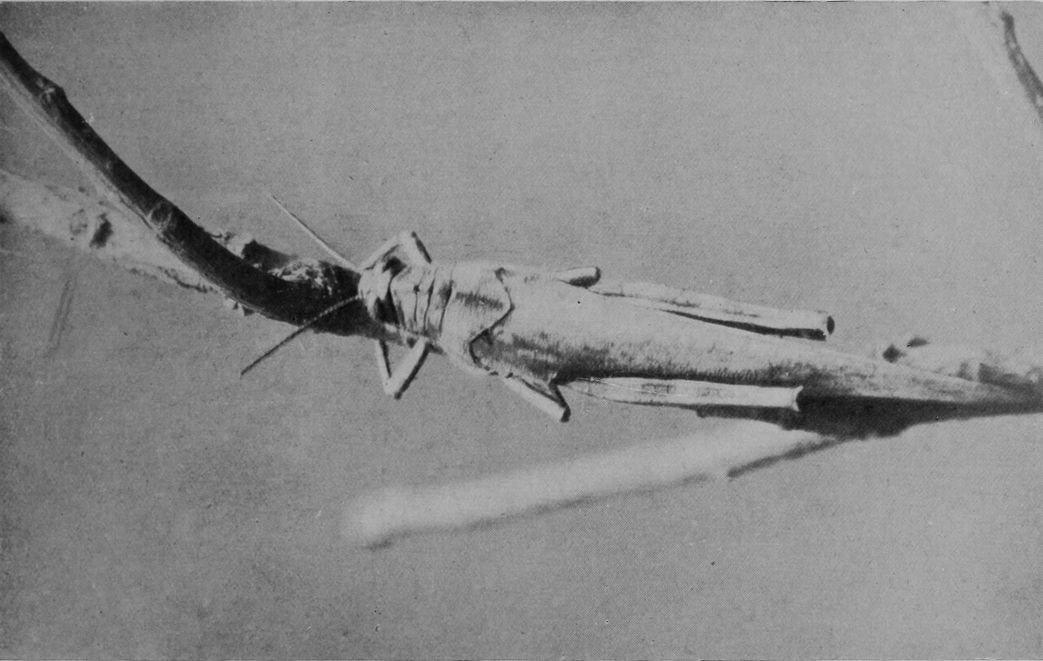
Photo by Highley.
EGYPTIAN LOCUST.
This figure shows the upper surface of the specimen represented in the
preceding photograph.
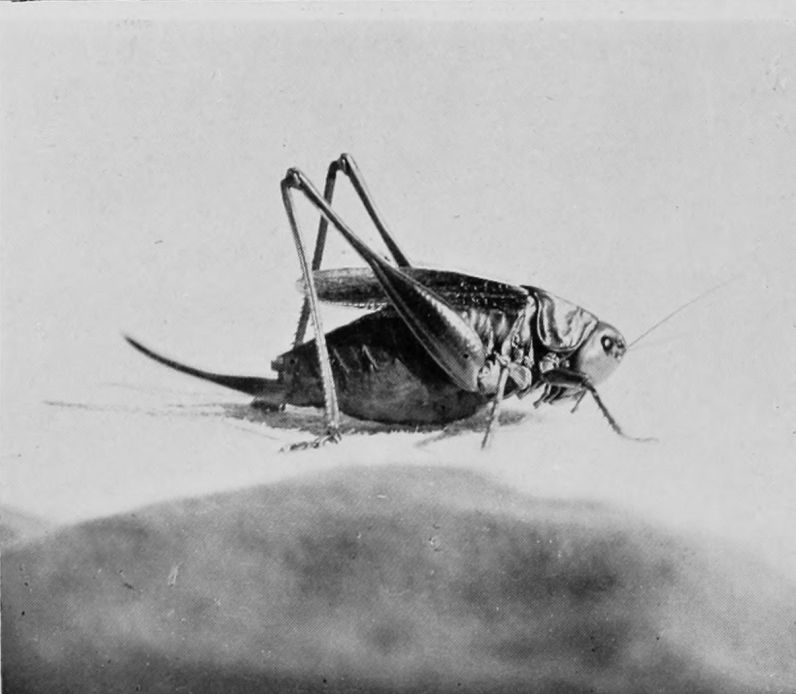
Photos by W. L. H. Duckworth] [Cambridge.
WART-EATING GRASSHOPPER (TWO VIEWS).
Used by Swedish peasants to bite off their warts.
The last family includes the Short-horned Grasshoppers, or True Locusts, so very destructive in many countries, though the real Migratory Locusts are only casual visitors to England, the native British
species being all small insects, found among grass, and doing but little damage. The commonest of
the Migratory Locusts visiting Britain is the Red-legged Locust, which
expands from 2 to 4 inches, and has grey wing-cases varied with brown, pale green hind wings, and
red hind shanks, with white black-tipped spines. Another species, the Egyptian
Locust, more rarely met with, has brown fore wings, and grey hind wings, crossed by a broad
blackish band. Two photographs are given on page 693 of a specimen brought
to England among vegetables in the spring of 1901. Many foreign locusts, large and small, have
beautiful red or blue hind wings, and some of these are common on the Continent, though not in
England; those found in Europe are comparatively small, measuring only 1 or 2 inches across the
wing-cases; but some of the great South American locusts measure as much as 7 or 8 inches in
expanse. However, some of the smaller species, such as the Cyprian Locust
and the Rocky Mountain Locust, which measure less than 2 inches across the
wing-cases, are much more destructive than the large species.
A real invasion of locusts is a terrible calamity, for the insects fly like birds,
but in vast flocks, and devour every scrap of vegetation where they settle. Sometimes a flight,
two or three miles broad, continues to fly steadily over the same spot for hours together.
Sometimes flocks perish at sea, and are cast up on the beach in heaps like sand-hills, extending
for a distance of forty or fifty miles. Nor are the young locusts less destructive before they
acquire wings; for they march across a district in such numbers as to extinguish fires, fill up
trenches, and overcome all similar obstacles placed in their way by sheer force of numbers; and it
is well said of a visitation of locusts, "The land is as the Garden of Eden before them, and
behind is a desolate wilderness."
NERVE-WINGED OR LACE-WINGED INSECTS, OR DRAGON-FLIES AND THEIR
RELATIVES.
BY THE REV. THEODORE WOOD, F.E.S.
The Nerve-winged Insects owe their title to the peculiar character of their wings, the horny
veins which form the framework of those organs being multiplied and sub-divided to such an extent
that they assume the appearance of exceedingly delicate network.
These insects fall naturally into two great groups, in one of which the chrysalis, or pupa, is
active, and continues to take food like the grub, while in the other it is passive and helpless,
like that of a butterfly or a moth.
Prominent among the members of the first division are the Dragon-flies, which owe their title
partly to their extreme voracity, and partly to the fact that they feed entirely upon living
insects, which they pursue through the air. They are exceedingly swift of wing, and may be seen
hawking over ponds and streams on any fine day throughout the summer and early autumn.
The earlier part of their lives is spent in the water, in which the eggs are laid by the parent
insect. The grubs are usually of a dull grey or brownish-green colour, and are remarkable for a
curious organ known as the "mask," which partly covers the lower surface of the head. This
apparatus consists of two joints, which fold upon one another, but can be extended at will, the
one farthest from the head terminating in a pair of large and powerful jaws. When the grub
perceives an insect-victim, it swims cautiously beneath, and seizes it by means of these jaws. The
"mask" is then folded, and the prisoner drawn down within reach of the mandibles, by means of
which it is speedily devoured.
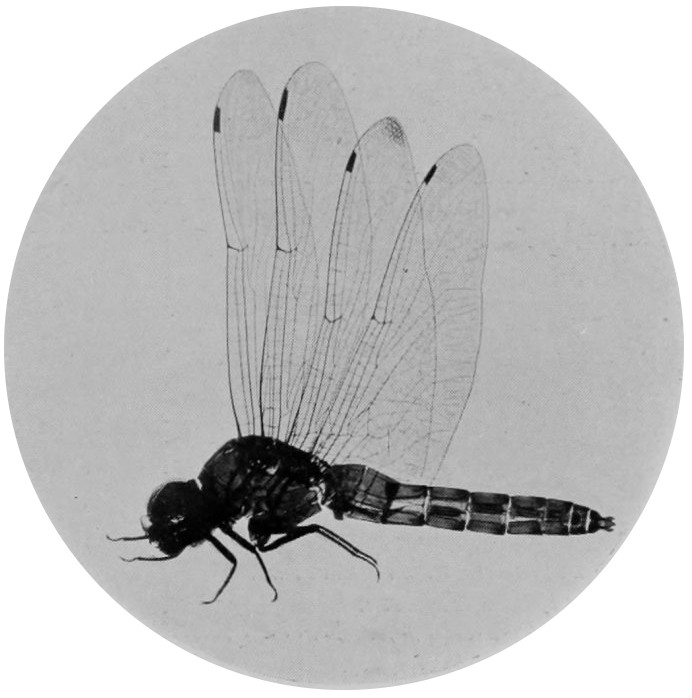
Photo by W. P. Dando, F.Z.S.] [Regent's Park.
DRAGON-FLY.
These insects are often known as "Horse-stingers,"
although they do not sting horses; in fact, they are perfectly harmless, except to insects
smaller and weaker than themselves.
The method of swimming practised by the dragon-fly grub is also very curious. Through the
centre of the body runs a longitudinal tube, terminating in a circular orifice, closed by means of
five tightly fitting valves. These valves, which together form a sharp spike when closed, can be
separated at will. When the insect wishes to swim, it fills the tube with water, and then squirts
the contents forcibly out, the result being that it is driven swiftly forwards by the
reaction.
The pupa of the dragon-fly is very much like the grub, with the exception that the rudiments of
the future wings may be seen on the back.
About forty species of these insects are found in the British Islands, of which the Great Dragon-fly is a well-known example. The body is 3 inches in length, while
the extended wings measure about 4 inches from tip to tip. In colour it is light rusty brown, with
a few pale markings. The "Horse-stinger"—which is perfectly
harmless, notwithstanding its popular title—is also common, and may be recognised at once by
its flat dull yellow body, which becomes blue in the fully developed male. In the graceful and
beautiful Demoiselle the male is deep blue, with black patches on the
wings, while the female is entirely green.
Allied to these insects is the Common May-fly, popularly supposed to
live for one day only. As a matter of fact, however, it spends a couple of years in the grub and
pupa states, inhabiting burrows in the banks of ponds and streams. These burrows are curved, and
have two entrances,
one above the other, so that the insect can pass in and out with perfect ease.
The May-fly is also remarkable for the fact that the perfect insect changes its skin shortly
after reaching maturity. Before this change takes place the female insect is the "Green Drake" of
the angler; afterwards, the "Grey Drake."
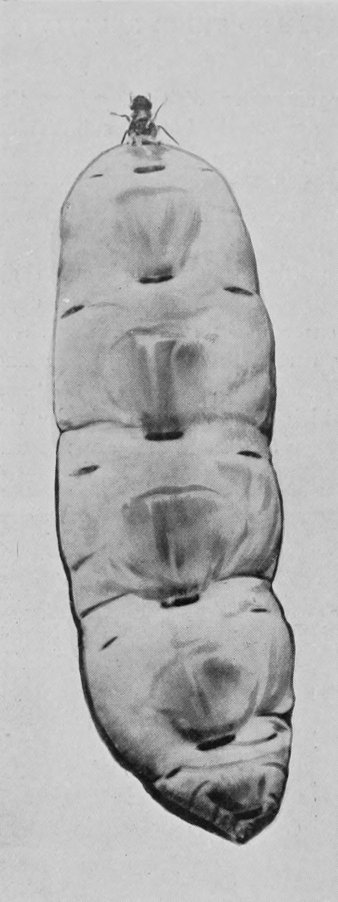
Photo by W. P. Dando, F.Z.S., Regent's Park.
QUEEN TERMITE.
Her huge white body is full of eggs, of which she lays thousands every day.
To this group belong also the Termites, or "White Ants," so exceedingly
numerous in almost all the warmer parts of the world. These are social insects, living together in
vast colonies, and making most wonderful nests, which consist of a vast and complicated series of
chambers and passages, sheltered beneath a turreted dome of clay. In the centre is the "royal
cell," inhabited by the "king" and "queen," as the perfect male and female are called. These are
winged when first they leave the pupal shell. But after taking a single flight, they snap off
their wings at the base, just as ants do; while for the rest of their lives they are absolute
prisoners in the cell built around them by the workers.
Shortly after this strange incarceration takes place, the body of the queen swells to a huge
size, so that, to quote Professor Drummond, she becomes "a large, loathsome, cylindrical package,
2 or 3 inches long, in shape like a sausage, and as white as a bolster." She now begins to deposit
eggs at the rate of several thousands in a day, which are at once carried off by the workers, to
whom is entrusted the entire care of the helpless young. These workers, which are exceedingly
numerous, also enlarge the nest from time to time, and construct tunnels of clay up the trunks and
along the branches of trees, through which they may convey to the nurseries in security the gums
and decaying wood for the nutriment of the young.
A fourth form of insect is also found in the termites' nest, known as the "Soldier." The head
is much larger and the jaws are much longer and stronger than those of the worker, and the sole
function appears to be to defend the nest when attacked. Both soldier and worker, apparently,
proceed from the same eggs which produce the king and queen, the difference in development being
probably due—as in the hive-bee—to the character of the food with which the young are
supplied.
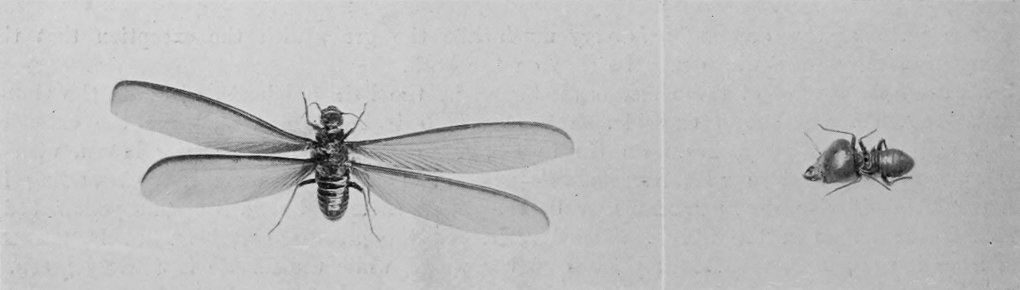
Photo by W. P. Dando, F.Z.S.] [Regent's Park.
TERMITES.
The perfect male and female are winged, the "worker" and the "soldier" being
more like grubs than perfect insects.
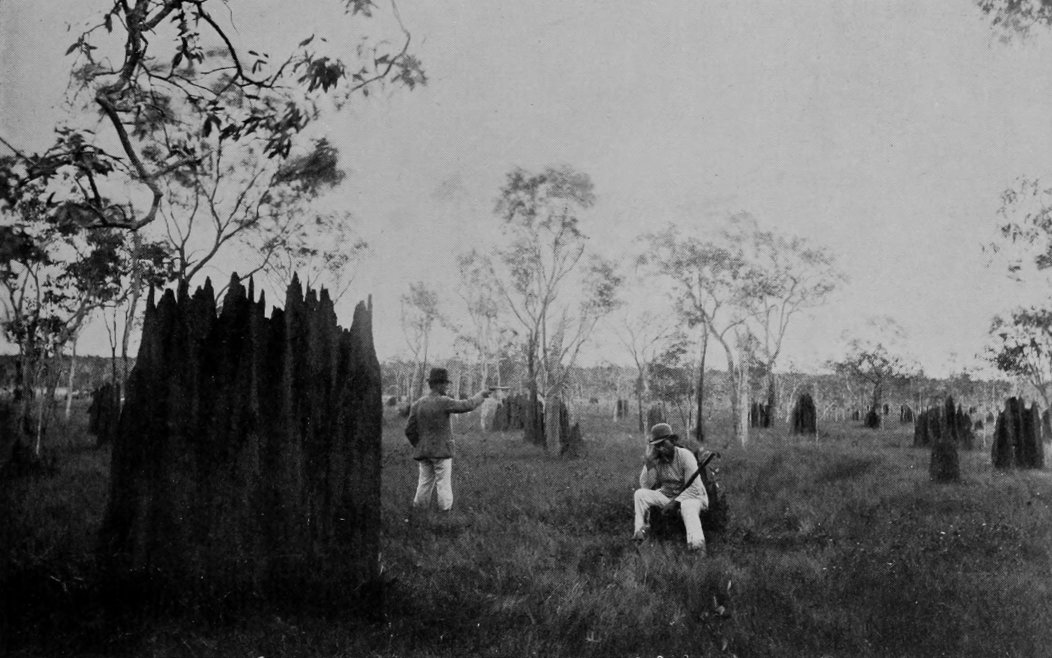
Photo by W. Saville-Kent, F.Z.S.] [Milford-on-Sea.
TERMITES' NESTS IN QUEENSLAND.
These nests are sometimes 14 or 15 feet high.
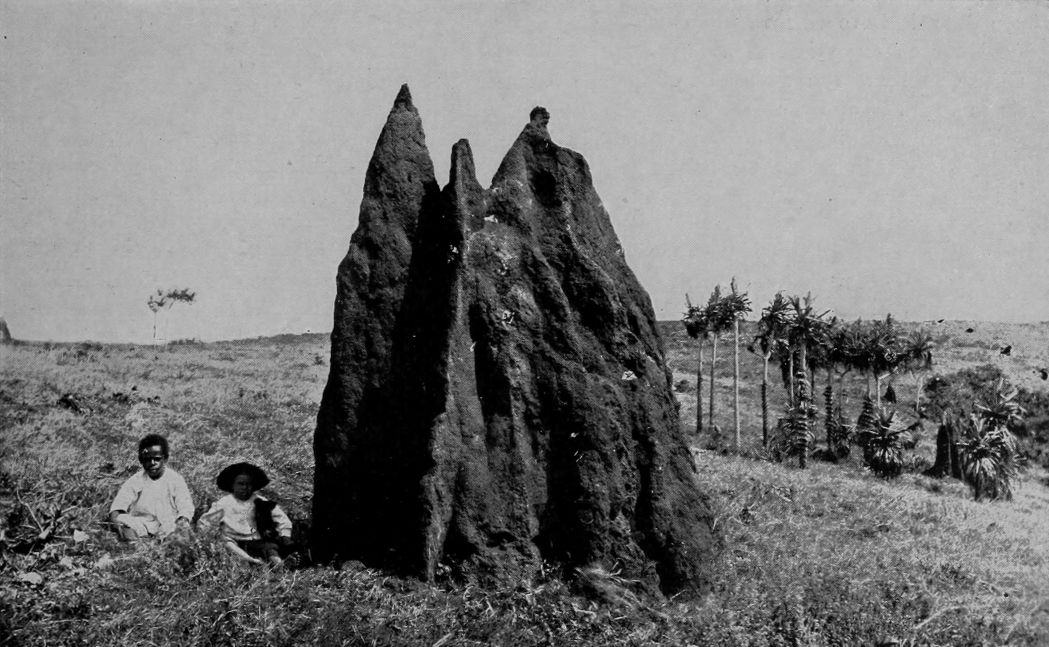
Photo by W. Saville-Kent, F.Z.S.] [Milford-on-Sea.
TERMITES' NEST IN QUEENSLAND.
The smaller nests, when opened and emptied, are used by the natives as
ovens.
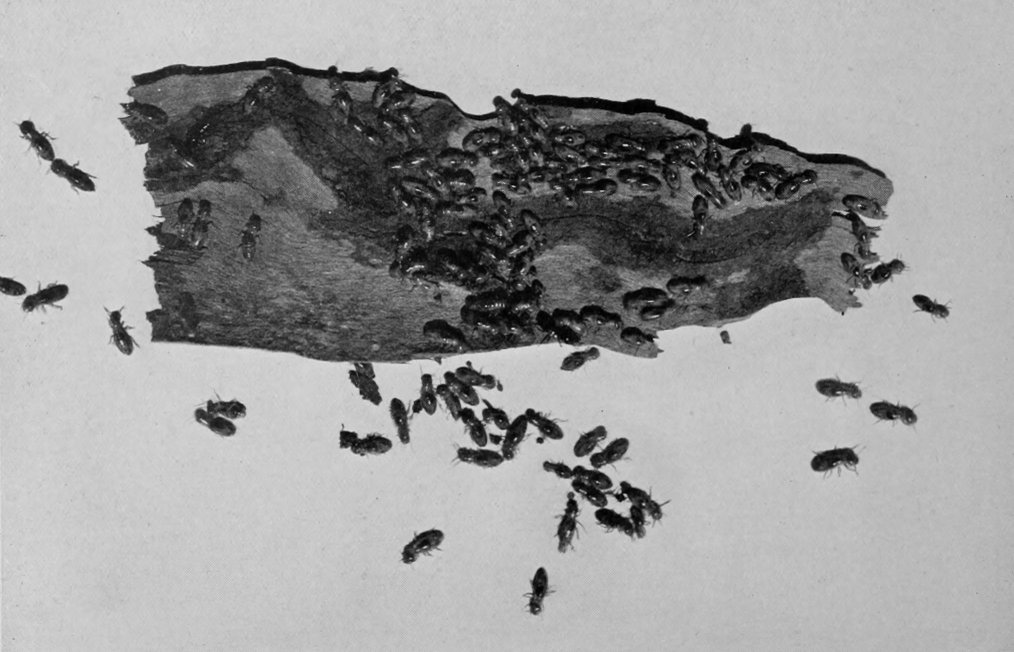
Photo by W. Saville-Kent, F.Z.S.] [Milford-on-Sea.
TERMITES AT WORK.
This shows one of the most destructive of wood-eating insects, nearly of the
natural size.
In a state of nature termites are undoubtedly beneficial. They are scavengers, in fact, whose
duty it is to remove the dead and decaying wood which would otherwise encumber the ground for many
years. But in civilised districts they are extremely mischievous, books, furniture, and all the
woodwork of houses being often completely destroyed by them before their presence is even
suspected.
The second division of the order also forms two well-marked groups—namely, the
Flat-winged Insects, in which the wings are fully spread, horizontally or obliquely, even in
repose, and the Hairy-winged Insects, in which those organs can be folded longitudinally, like the
joints of a fan.
Of the former group, the Ant-lion of Southern Europe is a familiar
example. The perfect insect is seldom seen, owing to its nocturnal habits. In appearance it is not
unlike a small and delicately built dragon-fly, with a yellowish head, a black body, and
transparent wings marbled with brownish spots. The larva, however, is terrestrial, and lives in a
funnel-shaped pitfall which it scoops out in the sand, always working backwards in a spiral
direction, and jerking out the sand with its broad head in an almost continuous shower. Having
completed the excavation, it buries itself at the bottom with merely the tips of its jaws
appearing above the surface, and there waits for ants or other small creatures to fall down the
sloping sides, accelerating their descent, if need be, by flinging sand upon them. The size of the
pit varies with that of the insect, the fully grown grub digging down to the depth of about 2
inches, while the cavity is about 3 inches in diameter.
The mouth of the ant-lion grub is very curiously constructed, the jaws lying in a groove on the
inner margin of the mandibles, or jaws proper; so that while an insect is held prisoner by the
latter, the former can be employed in sucking its juices. When the body of the victim has been
completely drained, the empty skin is thrown out of the pit by a jerk of the head.
The chrysalis, too, is remarkable for possessing jaws, by means of which it cuts its way out of the cocoon which it
made, when a larva, by spinning grains of sand together with silken threads.
In some South European and African insects allied to the ant-lions the hind wings are modified
into extremely long and slender shafts, slightly expanded at the extremities. In an Indian species
belonging to a related genus these wings are scarcely more than threads, and bear a superficial
resemblance to the attenuated limbs of certain gnats. One group, of which a Japanese species is a
well-known representative, is characterised by the long, slender, and clubbed antennæ.
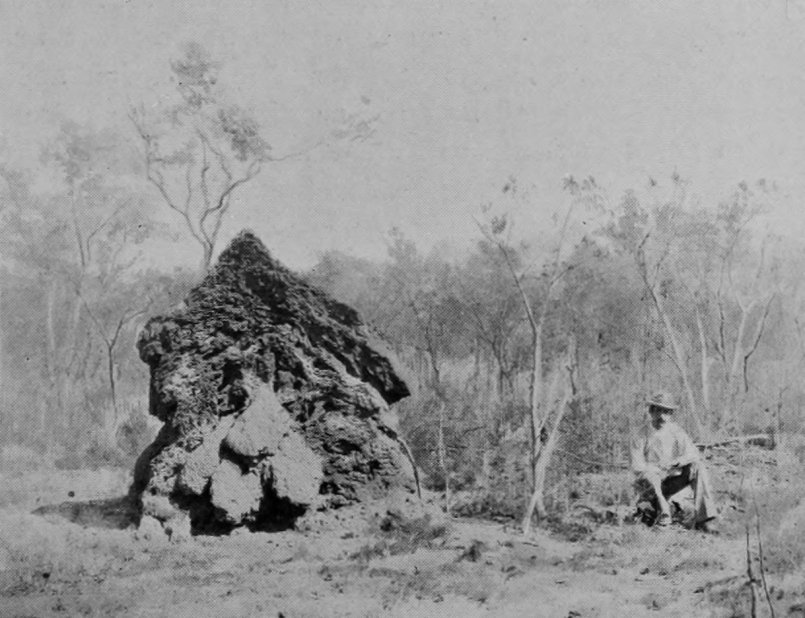
Photo by W. Saville-Kent, F.Z.S.] [Milford-on-Sea.
TERMITES' NEST.
Showing one year's reconstruction to nest, of which the photographer made a
section.
The Mantis-flies are remarkable for the structure of the fore limbs,
which are almost exactly similar in character to those of the praying-mantis. The upper segment of
the leg is so lengthened as to look like an additional joint; the lower surface of the thigh is
armed with a number of long, sharp spines; and the tibia, or lower part of the leg, folds closely
down upon it, after the manner of the blade of a clasp-knife. These limbs are used for seizing, an
insect which is once grasped being effectually prevented by the spines from breaking away.
The larvæ of these insects are parasitic in the nests of tree-wasps and spiders, and have the
peculiarity of practically losing their limbs as they approach maturity; so that while at first
they are free and active, they afterwards become almost as helpless as those of many beetles. One
species is found in Southern Europe, the remainder being widely distributed over the hotter
regions of the globe.
Allied to the Mantis-flies are the curious Snake-flies, or Camel-flies. In these insects the head is very large, and is attached to the
thorax, or central division of the body, by a long and distinct neck, which allows it great
freedom of motion. The neck is usually raised and the head bent down, giving to the insect a
remarkably snake-like appearance.
These flies are predaceous in their habits, and the four British species may be found on the
banks of ponds and small streams, where they can obtain insect-victims in plenty. The larvæ live
beneath the bark of trees, and wriggle about in a singularly serpentine fashion.
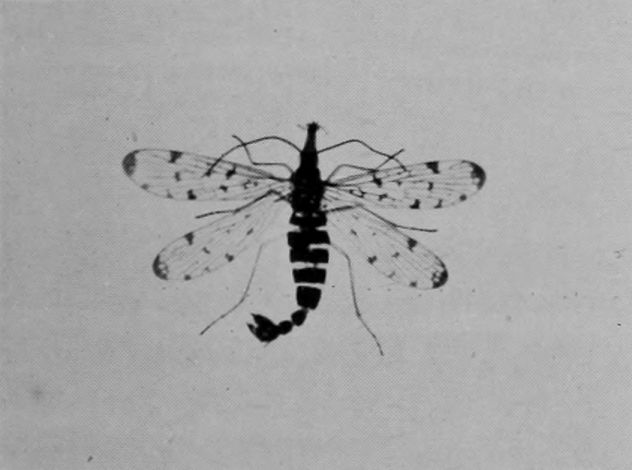
Photo by W. P. Dando, F.Z.S., Regent's Park.
SCORPION-FLY.
Remarkable for the curious structure of the end of the body.
Equally curious in a different way are the Scorpion-flies, in which the
body is prolonged into a slender three-jointed process, the extremity of which, in the male, is
furnished with a pair of curved forceps. In spite of their somewhat formidable appearance these
insects are perfectly harmless. They are very plentiful almost everywhere, and may be found in
numbers on any sunny summer morning resting on the herbage on hedge-banks, or running actively
about on the leaves of low bushes. Like the Snake-flies, they are predaceous, feeding entirely upon other insects,
and often attacking those which are bigger and apparently stronger than themselves. The eggs are
laid underground, and the grubs, which are entirely subterranean in their habits, feed upon
decomposing vegetable matter. When fully fed, they burrow still deeper into the ground, and there
change into pupæ, from which the perfect insects emerge about a fortnight later. In the common
English species the body is shining black, and the legs are yellow, while the transparent wings
are marked with brown spots, which generally form three broken transverse bands. The insect is
about half an inch in length.
Certain allied insects have very slender bodies and long legs, and might easily be mistaken for
"daddy-long-legs" by any one who failed to notice the presence of two pairs of wings. A species
found in Southern Europe is reddish yellow in colour, with a brown thorax and yellowish wings. It
has a curious habit of suspending itself from a twig by its fore legs, and seizing any flying
insect which may come within reach with the middle and hinder pairs.
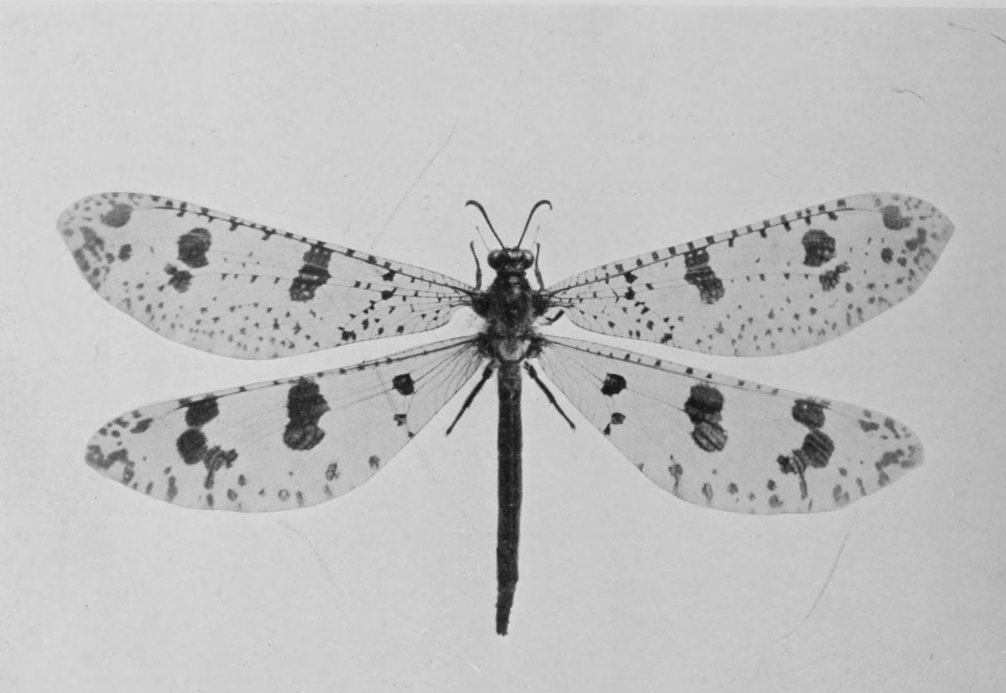
Photo by W. P. Dando, F.Z.S.] [Regent's Park.
ADULT FORM OF ANT-LION.
The grub of this insect lives in small pits in sandy places, and feeds upon the
ants, etc., which roll down the sloping sides.
Allied to the foregoing is the extraordinary little snow-insect, which makes its appearance in
mid-winter, and may even be found crawling on the surface of snow. In general appearance it is not
unlike a larval grasshopper, with very long, slender legs, and antennæ of about the same length as
the body. There is also a well-developed beak. The wings are quite rudimentary in the female,
while even in the male they are so short as to be perfectly useless for flight. The insect is
remarkably active, nevertheless, and possesses the power of leaping, although the hinder thighs
are not developed in any great degree. In colour it is metallic green, with the beak, antennæ,
legs, wings, and ovipositor rusty red. It is not uncommon in the north of England and
Scotland.
Far more generally distributed is the Lacewing-fly, or Golden-eye, which may be seen almost anywhere on warm summer evenings flitting
slowly to and fro in the twilight. During the daytime it may often be found resting upon fences,
or sitting on the leaves of low plants. In colour it is pale green, with a peculiar milky
appearance, and the eyes glow as though lighted by an inward fire. The wings are so closely and
elaborately veined that they look like a piece of the most delicate lace-work. It is not advisable
to handle the insect, for, although perfectly harmless, it possesses the power of pouring out from
its body a liquid of the most horrible odour, which clings to the fingers in spite of repeated
ablutions.
The life-history of the lacewing-fly is very curious. When the maternal insect lays her eggs,
she first deposits a drop of a highly glutinous fluid upon a leaf or slender twig, and then, with
an upward jerk of her long body, draws it out into a slender thread. On contact with the air this
thread immediately hardens, and just as she releases her hold the fly attaches a single egg to the
tip. In this way 200 or 300 eggs are laid together in a little cluster, which looks just like a
tiny patch of moss. In the earlier botanical manuals, indeed, it was actually named, figured, and
described as a moss.
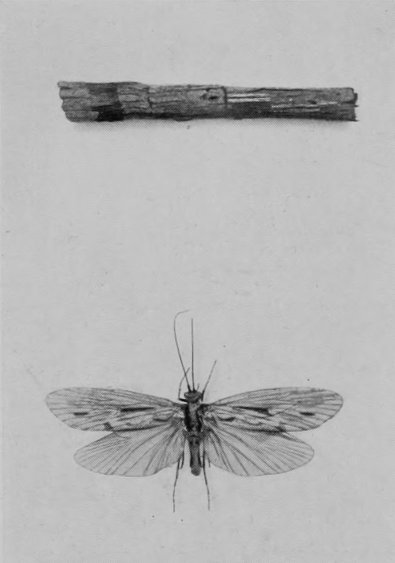
Photo by W. P. Dando, F.Z.S., Regent's Park.
LARGE CADDIS-FLY.
The largest British species measures about an inch and a half across the
wings.
The grubs which hatch out from these eggs feed upon plant-lice, of which they devour vast
numbers, draining the juices by means of their hollow jaws, and then fastening the empty skins on
their own backs, as an American Indian might decorate himself with the scalps of his victims.
Owing to this singular habit, the grub becomes perfectly unrecognisable after the first few days
of its life, only the jaws and feet being visible beneath the pile of dry skins. When fully fed,
it changes to the pupal condition in a silken cocoon, which it attaches to a leaf, and the perfect
insect makes its appearance in the course of a few days.
The Alder-flies, in general appearance, are not unlike caddis-flies,
but may easily be distinguished by the fact that the wings are not longitudinally folded while at
rest. They are very abundant in the neighbourhood of ponds and small streams, where they may be
seen flying slowly and heavily, or resting on low herbage or the foliage of trees and bushes. The
female insect lays her eggs in clusters of 300 or 400 on the leaves of water-plants, and the
little grubs make their way down into the water immediately on hatching out, where they creep
about on the mud at the bottom in search of the tiny creatures on which they feed. When
full-grown, they are about an inch in length. They then leave the water and bury themselves in the
earth, where they change to pupæ, the perfect insects emerging in June or July.
The Caddis-flies, of which there are many British representatives,
belong to the Hairy-winged group. The larvæ of these insects are entirely aquatic, and remind one
of hermit-crabs, the front part of the body being clothed with horny armour, while the hinder part
is entirely unprotected. In order to escape the attacks of predaceous insects these grubs
construct cases round their bodies, which they drag about wherever they go. In one or two
instances, however, the case is attached to the lower surface of a stone.
The materials of which these cases are made vary in accordance with the species. In one group,
for instance, they consist of pieces of twigs and leaves, cut into short lengths, and arranged
side by side in such a manner as to form a spiral band. The larva of another kind uses entire
leaves, gluing them firmly together and living between them. A third species employs grains of
sand and tiny stones, which it arranges in the form of a cow's horn. Most curious of all, however,
is the case of a caddis-fly which is made entirely of the shells of water-snails. As these shells
are, as a rule, still tenanted by their owners, the snails may sometimes be seen attempting to
crawl simultaneously in half a dozen different directions, while the grub is dragging them in a
seventh.
All the grubs retain tight hold of their cases by means of a pincer-like organ at
the end of the body. When fully fed, they close the aperture at each end of the tube, and assume
the chrysalis state, the perfect insects emerging a few weeks later. Although the wings are large
and broad, they fly very slowly, and never seem to take more than a short journey through the air.
They may often be seen in numbers resting upon the herbage on the banks of streams and ponds, or
crawling down into the water in order to deposit their eggs.
STINGING FOUR-WINGED INSECTS, OR ANTS, BEES AND WASPS, AND THEIR
ALLIES
BY W. F. KIRBY, F.L.S.
The order of insects to which the Ants, Bees, and Wasps belong includes a very large number of
species. All these are provided with four membranous wings, alike in consistency, and provided
with comparatively few nervures. The wings are usually of small size, as compared with the
dimensions of the insects, but are very powerful, owing to the fore and hind pair being connected
together during flight by a series of little links; and the flight of the insects is usually very
rapid. These insects pass through a perfect metamorphosis, the pupa being always inactive; the
jaws are provided with mandibles, though a proboscis, or sucking-tube, is also present, and the
abdomen of the female is armed with an ovipositor, or boring instrument, which is frequently
modified into a powerful sting, used to deposit the eggs in their proper position. One peculiarity
is that several species of ants, bees, and wasps live in large communities, in which the bulk of
the inhabitants, on whom most of the work of the nest falls, are imperfectly developed and usually
sterile females, called neuters, or workers. This arrangement is also met with in the White Ants,
which belong to the order of Lace-winged Insects. Among both the Ants and White Ants the neuters
are unprovided with wings; but these organs are present in the fully developed males and females,
though soon cast.
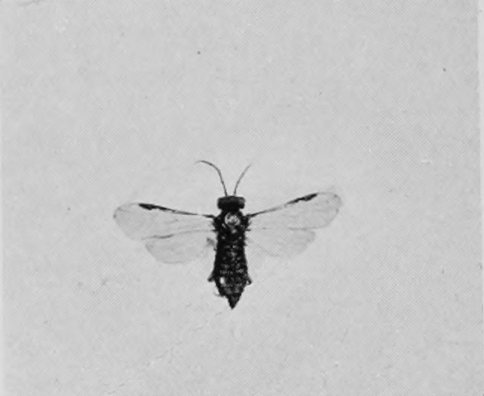
Photo by W. P. Dando, F.Z.S., Regent's Park.
SAW-FLY.
One of the commonest of the larger British species
is a blackish hairy insect, measuring rather more than an inch in expanse, with transparent
wings bordered with brown.
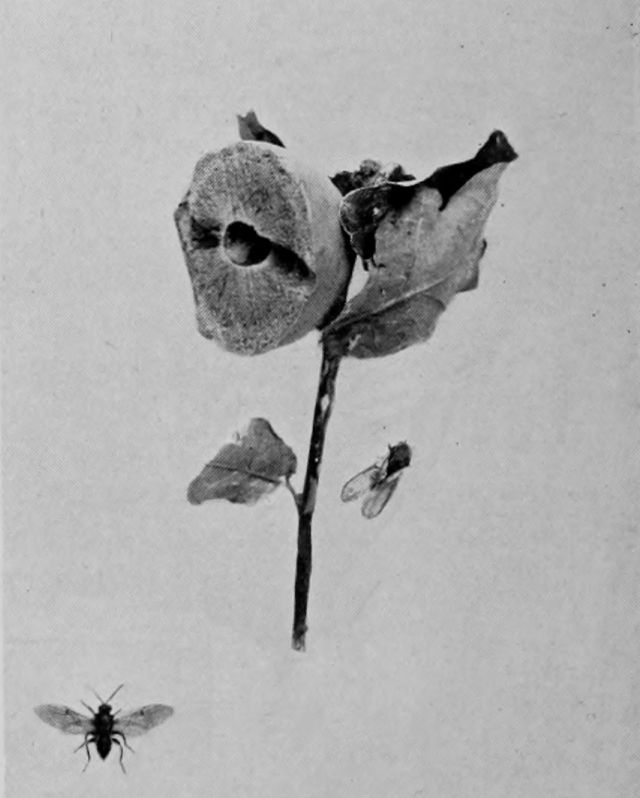
Photo by W. P. Dando, F.Z.S., Regent's Park.
MARBLE GALL-FLY AND GALL.
Found on oak, and not unlike the foreign gall used for making ink.
A great variety of other insects also belong to this order, such as Saw-flies, Gall-flies, and
an immense number of parasitic species, generally called Ichneumon-flies, among which are some of
the smallest insects known.
This extensive order of insects is divided into two principal sections—those in which the
ovipositor is used as a saw or an auger, and those in which it is modified into a sting. One of
the most interesting sections of the Borers includes the Saw-flies, in
which the boring instrument is modified into a pair of toothed saws, which are used for cutting
incisions in leaves, or in the tender bark of twigs, in which to deposit the eggs. These flies
have four transparent wings, sometimes stained with yellow or purple, and their bodies are
moderately stout and obtuse, and generally black, red or yellow. The antennæ are very variable in
form, and are sometimes knobbed at the end like those of a butterfly; sometimes they are formed of
a number of long, slender joints; sometimes of only three—a moderately long basal one, a
short middle one, and a long terminal one, composed of a number of joints united into one; and
rarely, as in the case of the males of some small species about half an inch long which feed on
fir and pine, the antennæ are feathered. The grubs are very like caterpillars, and are sometimes
called "false caterpillars"; but a true caterpillar (except in one or two very rare exceptions
among foreign species) has never more than sixteen legs, while these "false caterpillars" have
more, often as many as twenty-two. They also resemble caterpillars in another way, for the pupæ
are enclosed in cocoons. One interesting Australian species, which feeds on gum-trees, proceeds
from a black caterpillar with only six legs. The perfect insect has a blackish head and thorax,
with three large yellow spots on the latter, yellowish antennæ and wings, and a green abdomen; it
measures about an inch and a half across the wings, and has knobbed antennæ. An allied species,
found in Tasmania, is said to tend its young larvæ—an unusual habit, except among social
insects like bees, wasps, and ants. Among the commonest and the most destructive saw-flies in
England are those feeding upon the currant, gooseberry, and pear, of which there are several
species, measuring about half an inch across the wings. The commonest flies which lay their eggs
on the gooseberry and currant are yellow, with the head, antennæ, and three long spots on the back
black, and the wings transparent, with black veins. The grubs are bluish green, with twenty legs,
and numerous black dots; and several may often be seen on one leaf. The best-known of the Pear Saw-flies is black, with the wings transparent, except the veins; the grub
is very like a slug, and is green or yellow, very slimy, with the front of the body much
thickened.
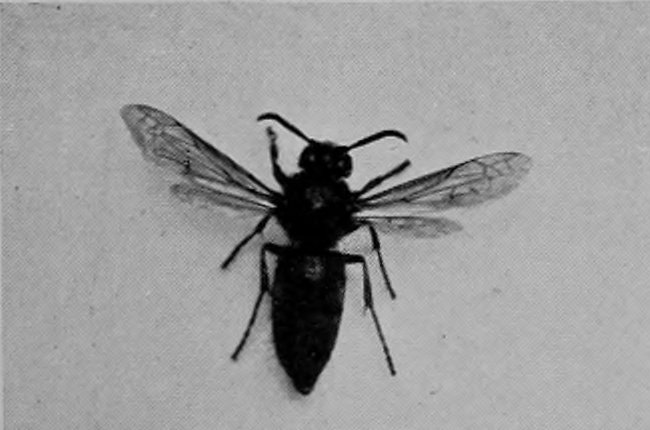
Photo by W. P. Dando, F.Z.S., Regent's Park.
TREE-WASP.
Very similar to the common wasp, but builds its nest in trees instead of in the
ground.
The Wood-wasps include only a few species, the grubs of which live in
the stems of plants, or in the solid wood of trees. One of the largest feeds on fir- or
pine-trees, and the fly measures from half an inch to an inch and a half in length, and varies
much in size, though the male is generally much smaller than the female. The female is yellow,
with two black bands, and a stout ovipositor half as long as the abdomen. In the male the tip of
the abdomen is black, and ends in a rectangular point. The wings are transparent, with yellow
nervures.
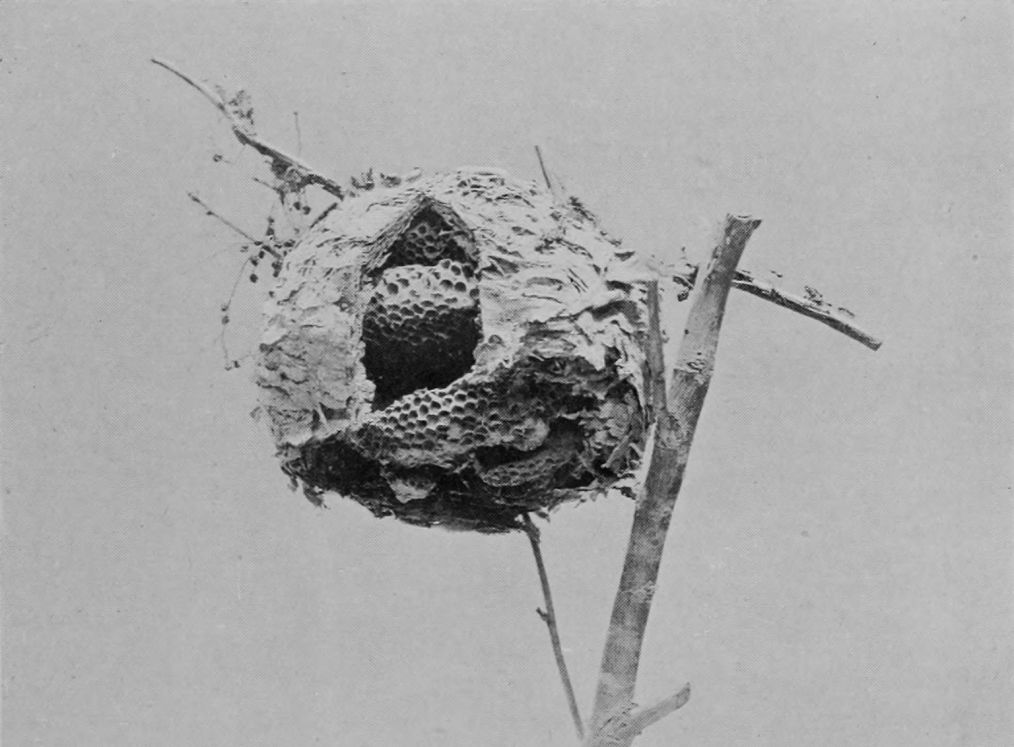
Photo by Scholastic Photo. Co.] [Parson's
Green.
TREE-WASP'S NEST.
Generally built in a thick bush.
Next to these insects come the Gall-flies, most of which produce round
galls on oaks; and in some species we meet with a wingless brood, living alternately with the
winged broods, but at the roots of the trees instead of in the open air. The veining of the wings
is reduced to one or two veins; the antennæ are rather long, and not angulated; and the abdomen is
short, and constricted
at the base. The flies seldom measure more than half an inch across the wings. Some galls are
hard, like the one found on the Turkey oak, from which ink is made; while others are large and
juicy, resembling cherries, or small apples, among which is the so-called apple of Sodom. Others,
like the Bedeguar, which is found on roses, have a mossy appearance. The latter are produced by a
small black saw-fly, with part of the legs, and, in the female, the base of the abdomen, red
beneath.
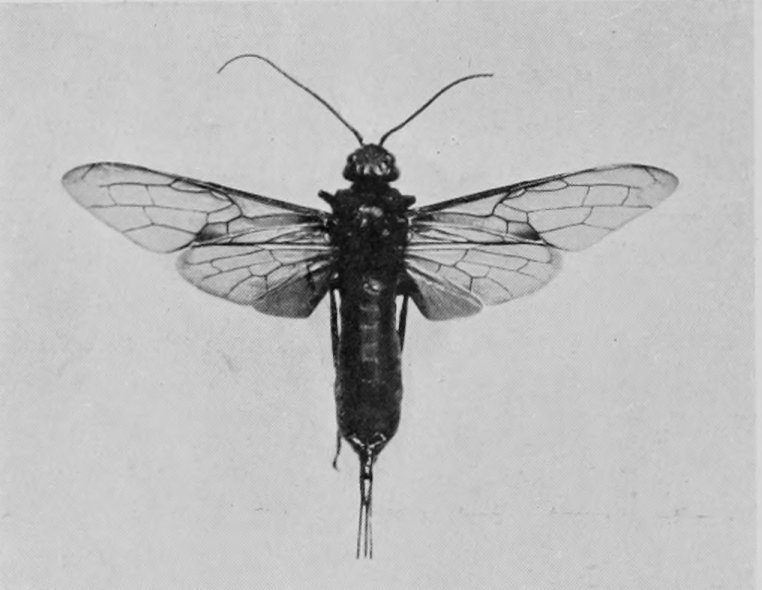
Photo by W. P. Dando, F.Z.S.] [Regent's Park.
PINE-BORING WASP (FEMALE).
Formidable in appearance, but quite harmless.
Some of the smaller gall-flies do not produce galls, but are parasitic on other insects; but
galls are very liable to the parasitic attacks of other insects, especially to those of small
brilliant metallic green four-winged flies, belonging to an allied family, with very few nervures,
but with a black membranous spot on the front edge of the fore wings, and angulated antennæ. Many
galls do not begin to grow until the larva is hatched and begins to eat.
We now come to five or six families of parasitic species, popularly called Ichneumon-flies, and immensely numerous and varied. There are probably
considerably over 2,000 species in England alone; but they are comparatively little known or
studied. Some of these have beautifully delicate wings, fringed with long bristles, and are among
the smallest insects known, being of quite microscopic dimensions. These are parasitic on the eggs
of various insects, and some are aquatic. But the more typical ichneumon-flies are of larger size,
often measuring more than an inch across the wings. Their bodies are usually black or yellow, and
there is often an irregularly shaped space in the middle of the fore wing, where the veins of the
wing converge. In these flies the ovipositor is very short; but in others it is of great length,
especially in the case of the largest British insect of this group, which is parasitic on the
larvæ of the great black-and-yellow wood-wasp, of which we have already spoken. This parasite is
as large as the wood-wasp, but much more slender; it is black, with red legs, and two white dots
on each segment of the abdomen. The ovipositor, which looks like three black threads, is as long
as the whole body.
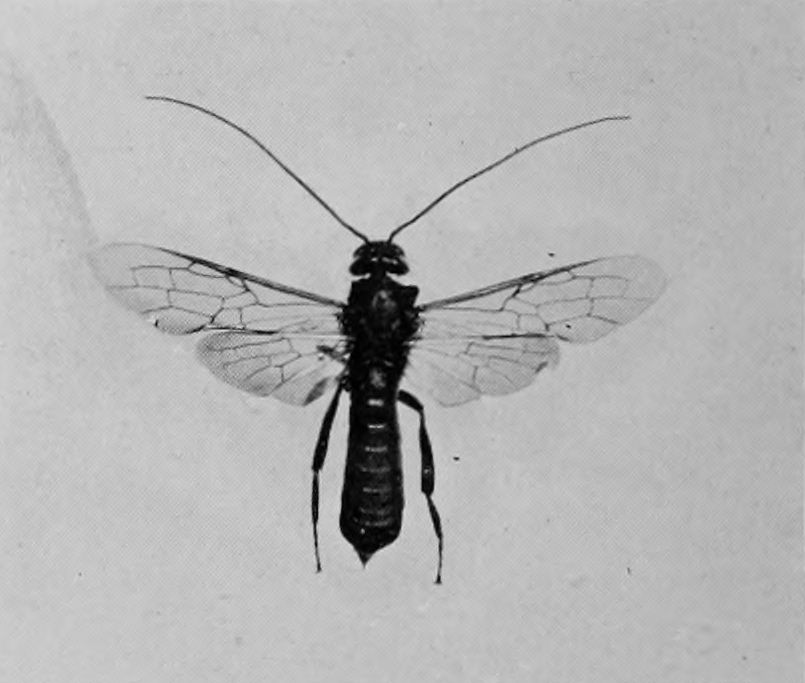
Photo by W. P. Dando, F.Z.S., Regent's Park.
PINE-BORING WASP (MALE).
Smaller than the female, and very different in appearance.
The numerous parasites of which we have spoken usually deposit their eggs in punctures in the
bodies of caterpillars or other immature insects, which the grubs devour from within during the
life of their victim, leaving it to die when they themselves have reached their full growth.
Intermediate between the boring and stinging insects of this order comes the small family of
the Ruby-tailed Flies. These are brilliantly coloured bronze-red, blue, or
green metallic four-winged flies, with the thorax covered with large depressions, and the abdomen
smooth, and usually composed, as seen from above, of one large, smooth joint, and one or two much
smaller coarsely punctured ones beyond it, the last ending in a variable number of short teeth.
They roll themselves up in a ball when alarmed, and are parasites, depositing their eggs in the
nests of other insects. An entomologist once saw a ruby-tailed fly hurled to the ground by a
mason-bee which had built her nest in a hole in a wall. The fly rolled herself up into a ball,
when the bee bit off her wings, and then flew away. But as soon as she was gone the wingless fly
stretched herself out again, and climbed up the wall to the bee's nest to deposit her eggs.
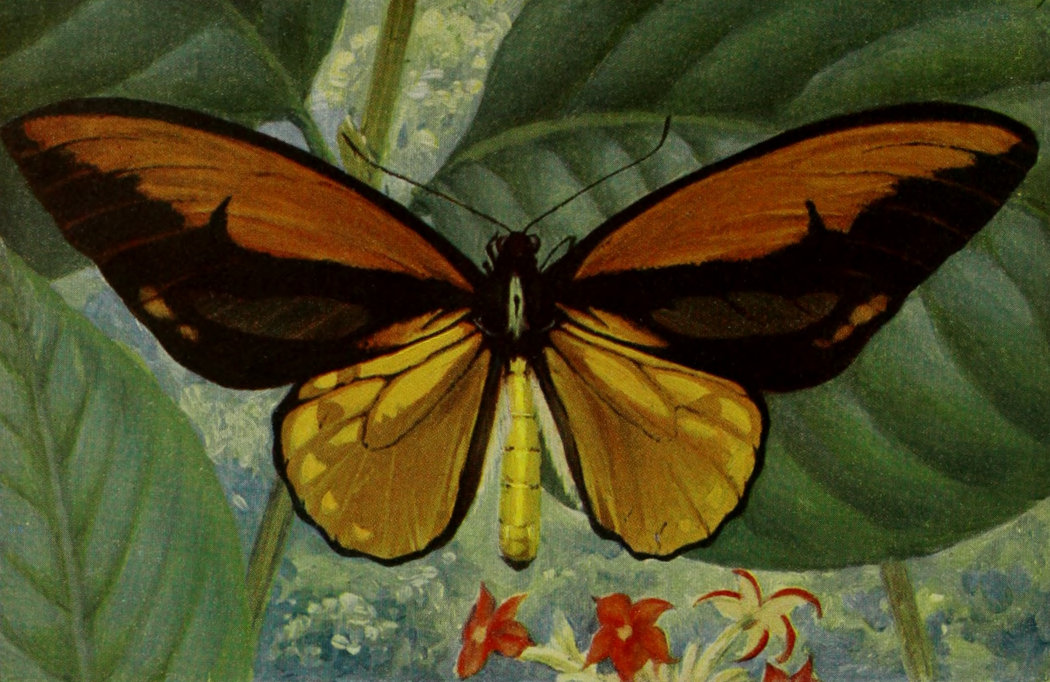
CRŒSUS BUTTERFLY OF BATCHIAN
Male natural size
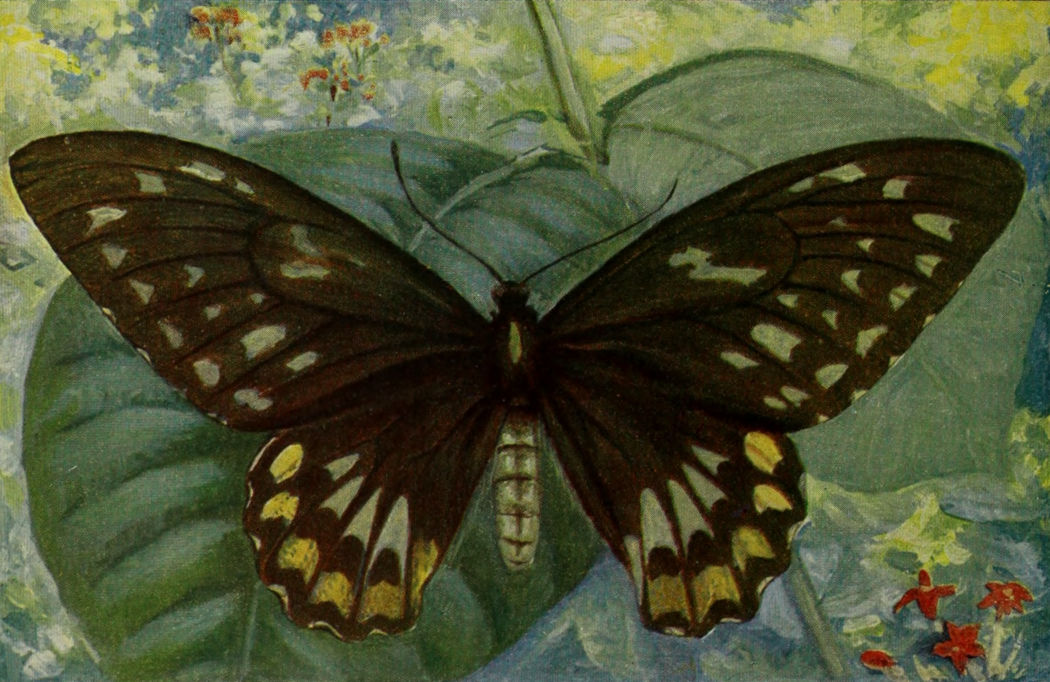
Photo by W. P. Dando F.Z.S. Regent's Park. Printed at Lyons,
France.
CRŒSUS BUTTERFLY OF BATCHIAN.
Female slightly reduced
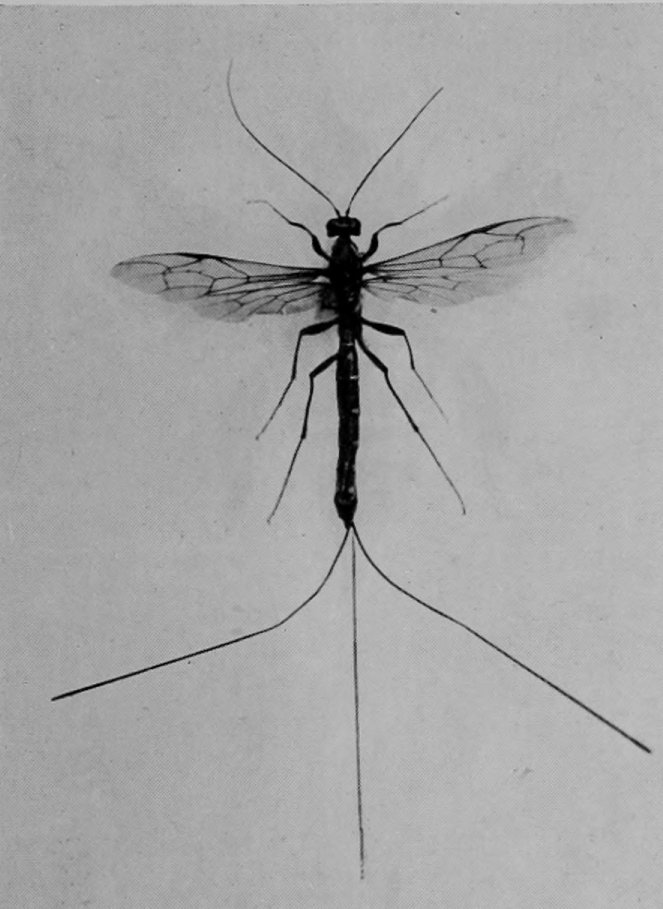
Photo by W. P. Dando, F.Z.S.] [Regent's Park.
ICHNEUMON-FLY.
One of the largest British species of a very extensive group of parasitic
insects.
The group of stinging insects begins with the Ants, which are probably
the most intelligent animals now living in the world. Different species, however, differ very much
in their manners and customs, and in the grade of civilisation to which they have attained. Some
of the more industrious among them keep other insects as cattle, and even as pets; others harvest
grain, while a few species cultivate grain for their own use; and others make large mushroom-beds
of comminuted leaves, and thus do great harm to cultivated trees in many parts of tropical
America. When the industrious ants are not too busy, they sometimes indulge in sports and
pastimes. But there are some species which live in idle communities. Such ants are only energetic
as marauders, and are so degraded that they cannot even feed themselves, and starve to death if
they are deprived of the services of their black slaves, which have been carried off as pupæ by
the others in piratical raids, and brought up by other slaves, which do all the work in the nests
of their captors.
Quitting the Ants, we arrive at a rather extensive series of insects of moderate or
considerable size, and with very spiny legs, called Burrowing-wasps. They
are brightly coloured, active insects, and generally dig holes in the ground, which they provision
with caterpillars, grasshoppers, or spiders, which they paralyse with their stings, and leave in a
moribund condition to form the food of their progeny. They are generally winged in both sexes, but
in one family the females are stout and very hairy, and look like large hairy ants, while the
males are slender winged insects, very unlike their partners. In the burrowing-wasps the front of
the thorax, or second division of the body, is usually transverse, and often narrow; but in the
True Wasps it bends back to the wings. Among these latter it is only the
small group of the Social Wasps which are gregarious, and among which we
find workers as well as males and females. The largest of the British wasps is the Hornet; but there are several much larger species in the East Indies, some of
which are black and yellow, like the Chinese Mandarin-wasp, the largest of
all, which often measures 2 inches across the wings. Others are black, with one large reddish band
on the abdomen. Their nests, which they construct of a kind of paper, are formed in a hole in the
ground, in a hollow tree, or in a bush, or under the eaves of a house. A nest is commenced by a
single female which has survived the winter, and is afterwards enlarged by the exertions of her
progeny.
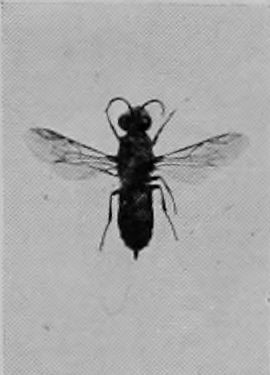
RUBY-TAILED FLY.
Generally of a brilliant metallic green or blue.
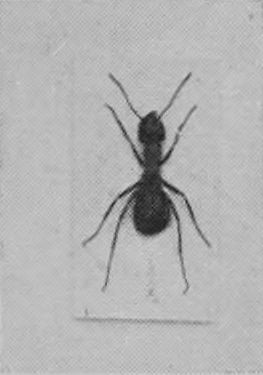
Photos by W. P. Dando, F.Z.S., Regent's Park.
WOOD-ANT.
The largest species found in Britain.
The last group in this order are the Bees. They may generally be easily
recognised by their shaggy bodies and legs. As with the Wasps, most species are solitary, or live
in very small communities. Some few are smooth, and more or less metallic. A photograph of a large and
beautiful South American species appears in the Coloured Plate. The largest British bees are the
stout-bodied Humble-bees, or Bumble-bees, which
are generally yellow, more or less banded with black, or else black with a red tail. They form a
small nest of cells just beneath the surface of the ground in meadows. A common European species,
not found in England, is the large black, violet-winged Carpenter-bee,
which makes its nest in a gallery burrowed in a post, where there is a separate compartment for
each grub.
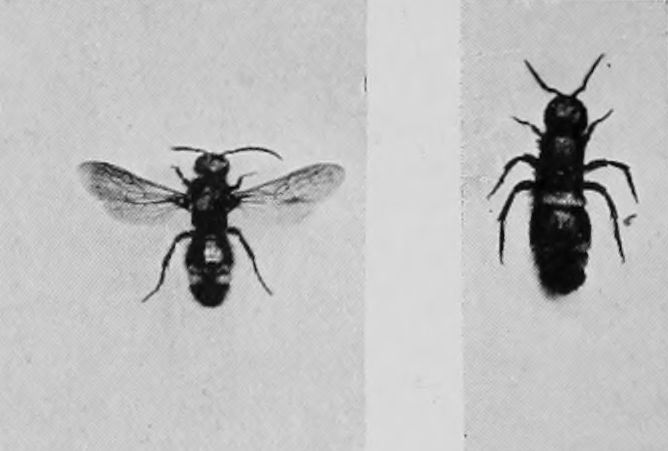
Photos by W. P. Dando, F.Z.S., Regent's Park.
SOLITARY ANT.
(MALE.) (FEMALE.)
Not a true ant, but a burrowing-wasp, believed to be parasitic in the nests of
humble-bees.
There are only a few species belonging to the True Hive-bees found in
different parts of the world. They can always be distinguished from any of the Solitary Bees, some of which much resemble them, by having a single long, narrow
cell, about four times as long as broad, running along the front edge of the fore wing. In the
solitary bees the corresponding cell is much broader and shorter, rarely more than one and a half
times as long as broad, and only occupying a small portion of the front edge of the wing.
Hive-bees have always been looked upon with more interest than most other insects, both on
account of the valuable products of honey and wax which they produce, and because of their
remarkable habits. They are probably less intelligent than ants, but they are larger; and as all
classes of their adult population are winged insects, and have been kept in a domesticated or
semi-domesticated state for many centuries, they have lent themselves more readily to
observation.
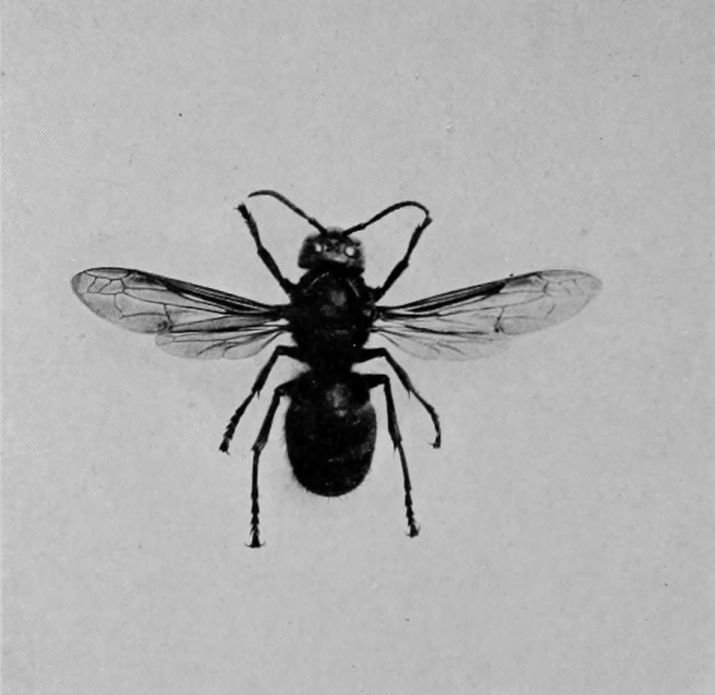
Photo by W. P. Dando, F.Z.S.] [Regent's Park.
HORNET.
The largest species of true wasp found in Britain.
The hive-bees live in very large communities, and in a state of nature they make their nests in
hollow trees or in crevices of rocks, where they build their waxen cells, store their honey, and
rear their young. There are three classes among them,—the queen-bee, the female and the
mother of the hive; the male, or drone; and the neuter, or worker, which is really an imperfectly
developed and usually sterile female. Like other insects, bees pass through a metamorphosis, which
in their case is of the description called "complete," for the immature forms of the bee show no
resemblance whatever to the winged insect which will finally be perfected. Every bee commences its
life in the form of an egg. Each egg is laid by the queen-bee in a separate cell, and in a few
days the egg hatches into a white footless maggot, which is carefully tended by the workers, and
fed by them with a preparation secreted by the bees, which is carefully graduated, not only
according to the age of the grub, but is differently constituted according to the sex and status
of the bee; for it is well known that it is in the power of the workers to develop a young grub
which would otherwise become a sterile worker into a perfect queen-bee, by placing it in a large
cell, and rearing it on the same nourishing food which is supplied to those grubs which are
intended to become perfect queens. When the grub is full-grown, it spins itself a small silken
cocoon, and becomes a pupa, or nymph, as it is called. The pupa somewhat resembles a swathed
mummy, for all the external portions of the future bee can be seen outlined in the hard casing
which encloses it. As soon as it arrives at maturity, it makes its way out through the upper end,
when the cell is at once prepared by the other bees for a fresh occupant. The newly
born bee is at first moist, flabby, and pale-coloured; but in a few hours her skin dries and
hardens, when she at once commences her life-long labours, at first tending the young bees and
doing other necessary duties in the hive, and then, a fortnight later, going forth with her
companions to collect honey and pollen in the meadows and gardens.
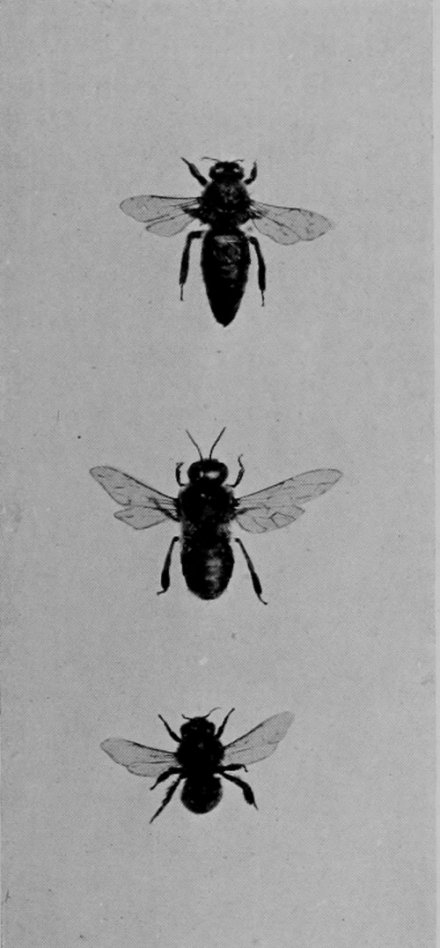
Photo by W. P. Dando, F.Z.S., Regent's Park.
HIVE-BEE.
(QUEEN, WORKER, AND DRONE.)
There are only about ten or twelve kinds of true hive-bees known.
There is never room for more than one queen-bee in a hive; and the queens, which may be
recognised by their longer bodies and shorter wings, have such a mortal hatred of each other that,
whenever two of them meet, they will fight, if permitted, until one is killed. But in summer, when
young bees are hatching daily in large numbers, and the hive is getting over-populated, the
workers do not permit the queens to fight; and finally one of them (usually the old queen in the
first instance) works herself up into a great flurry, and rushes out of the hive, attended by
several hundred followers, to seek for fresh fields and pastures new. This is called "swarming";
and a strong hive will often throw off as many as four or five swarms in the course of the summer.
It is then the object of the bee-keeper to get the queen to enter a new hive, for otherwise the
swarm may fly to a distance and be lost; but wherever the queen-bee takes up her abode, her
companions will assemble round her, and at once commence the work of building combs and storing up
honey.
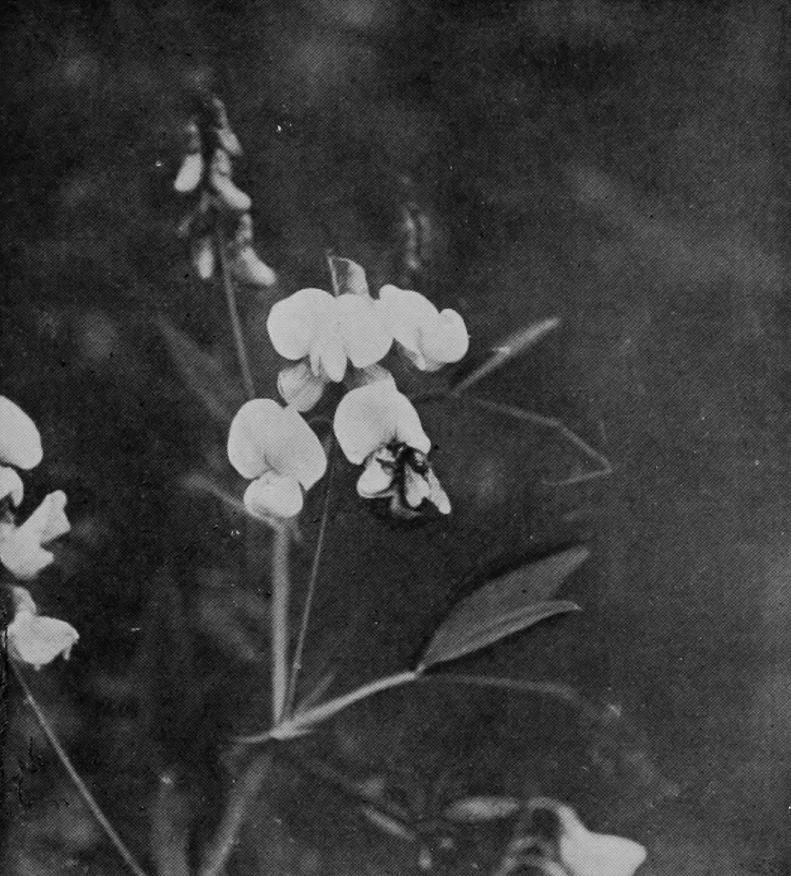
Photo by B. H. Bentley] [Sheffield.
BUMBLE-BEE ON EVERLASTING-PEA.
Bumble-bees make their nests in the ground, and live in smaller communities
than the hive-bee.
The drone, or male bee, is rather larger than the worker, and has a more obtuse body. He may be
at once distinguished by his long thirteen-jointed antennæ, or feelers, for the antennæ are
shorter and only twelve-jointed in the queen and worker. There are several hundred drones in a
hive; but the queen only pairs once in her life, on the wing, and the ceremony is immediately
followed by the death of the drone. The drones have no sting, for the sting of the female and
worker is really a modified ovipositor, or egg-laying apparatus, analogous to the organ which is
so conspicuous in many ichneumons and other insects belonging to the same order as the bees. In
the autumn the unfortunate drones are all massacred or else driven forth from the hive by the
workers, when they speedily perish. The workers are by far the most numerous of the inhabitants of
a bee-hive; there may be many thousands of them, and their number appears to be only limited by
the dimensions of the hive itself.
The ancients had observed something of the economy of bees, but many of their ideas on the
subject were strangely fantastic. It was perhaps natural to suppose that the leader of the bees
was a king rather than a queen; but it was also supposed that a swarm of bees could be obtained by
killing an ox and leaving the carcase to rot. This notion appears to have originated in swarms of
flies, more or less resembling bees, having been noticed flying round or near putrefying
carcases.
Among all the truly social insects—i.e. hive-bees, wasps, ants, and termites, or
so-called white ants—we find that the bulk of the community consists of sterile females, and
the number of fertile females is very small, even in those cases where more than one female is
permitted to live in a nest, as among wasps.
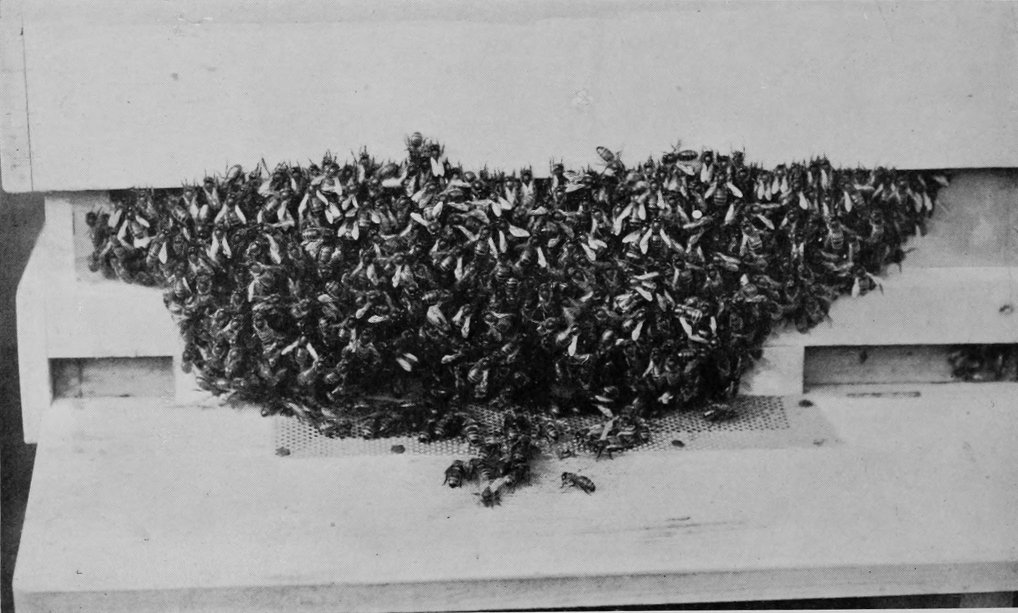
Photo by C. Reid] [Wishaw, N.B.
BEES.
Swarming from the hive after the queen.
Humble-bees live in small communities, consisting of males, females,
and workers; but their economy is very simple compared with that of the hive-bee, and they do not
confine themselves to a single female to a nest.
The Solitary Bees are very numerous in species, and consist only of
males and females. They do not live in communities, but each female constructs a dwelling for her
own young. Many of them burrow in the ground, and they are so far gregarious that a large number
of females will sometimes form their burrows near each other in the same bank. There are about two
hundred different kinds of bees known to inhabit the British Isles. The solitary bees are very
varied in their habits, and some of them are parasitic on other species.
The large Carpenter-bees, which form their nests in wood,
are not British; but there are some small British species which make theirs in the interior of
bramble-sticks. Some are very hairy; others are smooth, and look at first sight like small wasps,
being banded with black and yellow. But one of the handsomest and most conspicuous of the solitary
species is the Fulvous Bee, which is a hairy species much resembling a
small humble-bee, and is one often seen in abundance along with other bees, flying round sallow
blossoms in spring.
SCALE-WINGED INSECTS, OR BUTTERFLIES AND MOTHS.
BY W. F. KIRBY, F.L.S.
Butterflies and Moths are easily distinguished
from other insects by many very obvious characters, and a considerable number are remarkable for
the beautiful and varied colours of their wings. These are, as it were, tiled with overlapping
scales, attached to the membrane by a slender stem; hence their name, Scale-winged Insects. These
scales differ very much in shape, sometimes being long and slender, and almost hair-like, while at
other times they are widened at the extremity, like a battledore, or they may be short and broad,
like a fan or a shovel. Different forms of scales are found on different parts of the wings of the
same insect; and some forms of scale are peculiar to the male, as are usually the dense tufts of
scales found on the fore wings of the Skipper Butterflies, and on the hind wings of the Chrysippus
Butterfly. The varied colours of these scales are due partly to pigment, interposed between the
extremely delicate double or triple tissues of which the scales are composed; or, more rarely, to
the refraction of light from the surface of the scales themselves, or, as has recently been
stated, to different coloured scales alternating so that the varying colours are visible at
different angles, as in the metallic "shot" colour of the Purple Emperor Butterfly, and in various
species found in South America and other countries. In the case of the Purple Emperor, and in many
other butterflies, this "shot" colouring is confined to the males. Indeed, as a rule, female
butterflies and moths are larger than the males, but far less brilliantly coloured than their
mates. There are, however, many species in which the sexes differ little in size or colour; but it
only rarely happens that the female is more brightly coloured than the male.
The bodies of butterflies and moths, the legs, and often more or less of the base or borders of
the wings are clothed with hair or hair-like scales. These insects have a long or short proboscis,
through which they imbibe their food, which consists of the honey of flowers, the sap of trees, or
moisture from the ground. Like other insects, they have six legs in the perfect state; but in some
species either the front or hind pair becomes more or less rudimentary, especially in the
males.
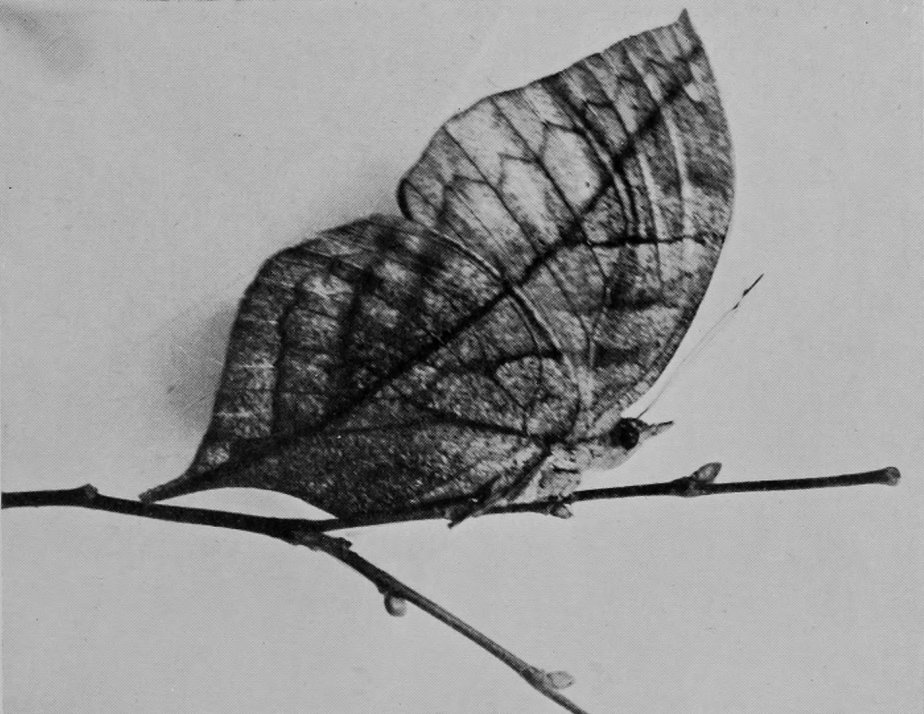
Photo by J. Edwards] [Colesborne.
LEAF-BUTTERFLY.
These butterflies are so remarkably like certain leaves that it is almost
impossible to distinguish the difference even at close quarters.
Butterflies and moths pass through four stages. The egg is laid by the female on some plant
which will provide suitable nourishment for the caterpillar. A caterpillar, which is the next
stage, is a jointed, worm-like creature with sixteen legs; those corresponding with the legs of
the perfect insect are horny, and a pair is placed on each of the first three joints behind the
head. The next four pairs, called "prolegs," are thick and fleshy, and a pair is placed under each
of joints seven to ten (reckoning the head as joint one), the last joint of all being provided
with a pair slightly differing from the others, and called "claspers." In many young caterpillars,
however, and also in the full-grown caterpillars of a considerable number of moths (especially
among those with slender bodies), one or more of the first three pairs of pro-legs may
be rudimentary or absent, and the caterpillar walks by arching its back at every step, in a way
that must be seen to be appreciated, though such caterpillars (popularly called Loopers, on
account of the way they loop up their bodies in walking) are often very active, and cover the
ground much more rapidly than one might imagine. Sometimes the claspers, or last pair of legs, are
modified into tentacles, which, in the caterpillars of the Puss-moth and its allies, contain
retractile whips, used as weapons of defence.
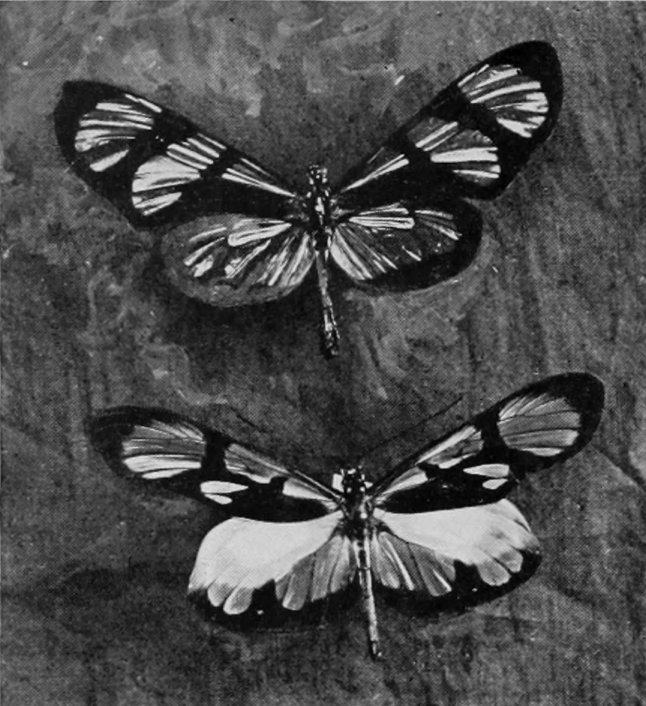
Photo by L. H. Joutel] [New York.
SOUTH AMERICAN LONG-WINGED BUTTERFLIES.
Showing external resemblance between two butterflies of different families.
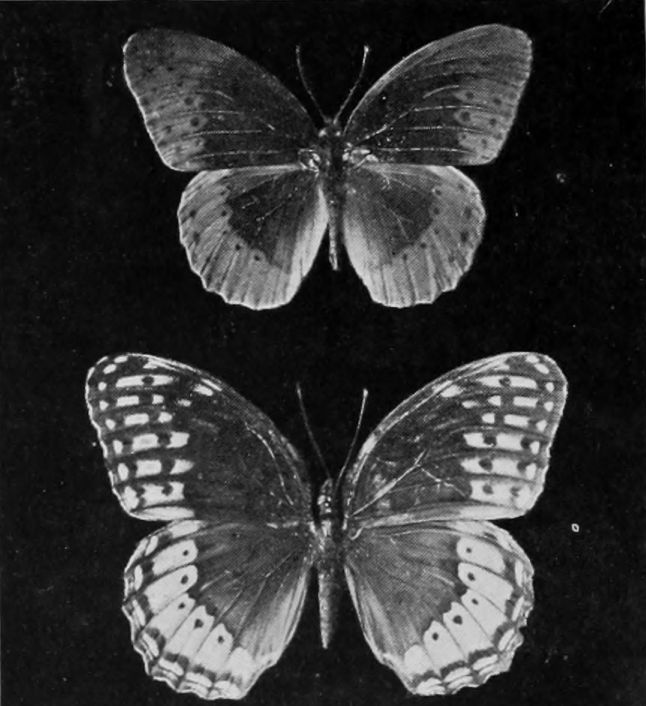
Photo by L. H. Joutel] [New York.
DIANA FRITILLARY.
The male is dark brown, with a broad orange border spotted with black. The
female has green marginal markings.
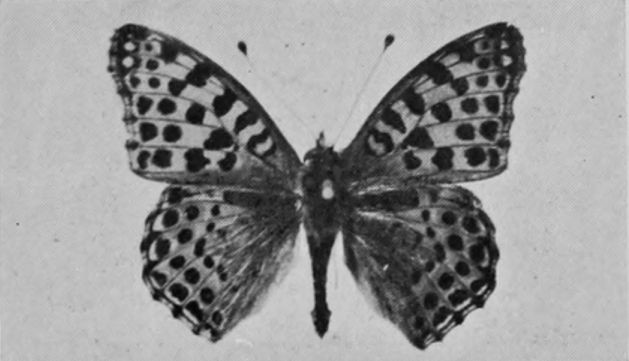
Photo by J. Edwards] [Colesborne.
QUEEN OF SPAIN FRITILLARY.
Brown above, with plush spots; spotted with silver beneath.
Caterpillars are very voracious, and increase in size with great rapidity; and whenever their
skin gets too tight, after splitting it, they slip it off (along with the lining of the stomach
and intestines), and after a few hours' lethargy, necessary to recover from the debilitating
effects of such a serious operation, and to give the new skin time to dry and harden, they begin
to feed again as voraciously as ever. The number of these moults varies according to the species;
when the caterpillar has attained its full growth, it enters upon the third stage of its life as a
pupa, or chrysalis.
A pupa means a doll, or swaddled baby, and is a very appropriate name for the dark-coloured
object, cased in a horny skin, with no detached organs visible, except the sheath for the
proboscis in some of the Hawk-moths, in which this organ is unusually long, but with the separate
cases of the wings, legs, etc., of the future butterfly or moth plainly visible in the sutures on
its surface. The pupæ of some butterflies have more or less metallic colours; and to these only is
the term "chrysalis" applicable.
Some pupæ are naked, and those of most butterflies are either suspended by the tail, or
attached to a branch by a belt of silk round the body. Those of moths are generally formed either
in an earthen cell under the surface of the ground, or else are enclosed in an oval case called a
"cocoon," chiefly composed of silk, though sometimes moss or chips of wood are worked into it.
Other pupæ are found between leaves, or, in the case of caterpillars which feed in the wood of
trees, or in the stems of plants, in the galleries where they have lived.
When the perfect butterfly or moth is ready to emerge, the pupa splits, and the insect works
its way to the open air. Its body is limp and heavy, and the wings are like little flaps of wet
rag; but it discharges a quantity of superfluous fluid, generally of a red colour, and fixes
itself on a branch, or other convenient foothold, where its wings can hang downwards. The expansion and
contraction of the muscles pump air into the hollow tubes which form the framework of the wings;
these rapidly expand to their full size, and become dry and firm at the same time. After this, the
insect flies about with its companions, pairs, lays its eggs, and then dies, after enjoying its
life for a period, varying according to the species and the season, from a few hours to several
months.
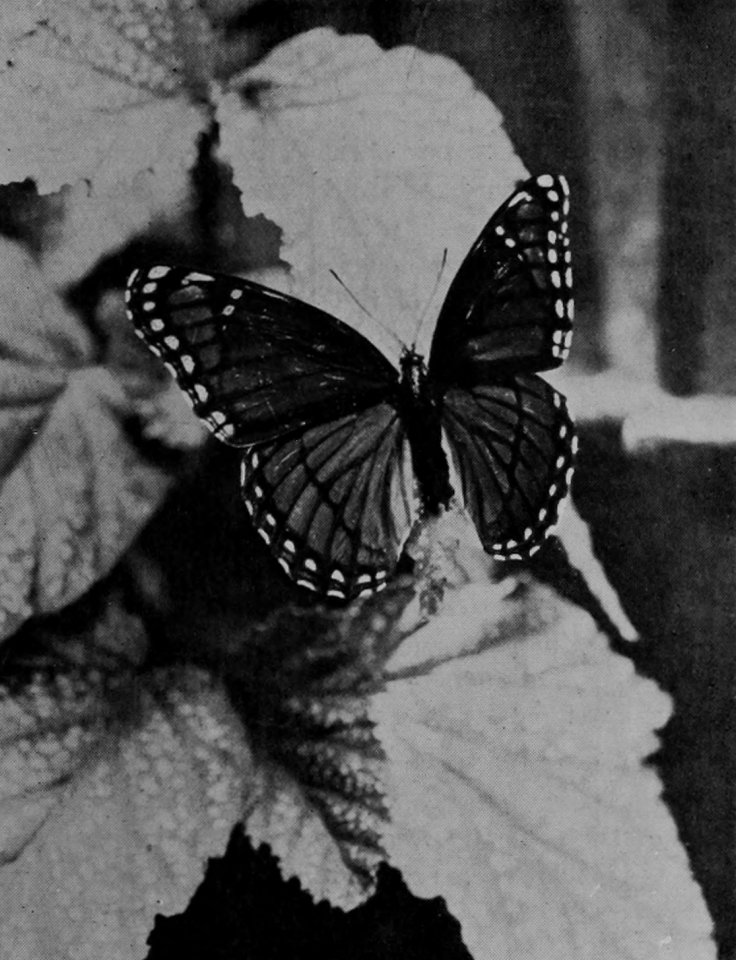
TAWNY ADMIRAL.
A North American butterfly.
We have not yet spoken of the feelers, or antennæ, of butterflies and moths. They
are two long, jointed organs, nearly always knobbed at the end in butterflies, or at least the
terminal joints are thicker than the rest. But in moths the antennæ are of different shapes, and
generally end in a point. Sometimes they are simple and thread-like; sometimes they are thickest
in the middle, and thinner at both ends, as in the Hawk-moths; and they are often comb-like,
especially in the males, as in the Silk-moths.
Butterflies.
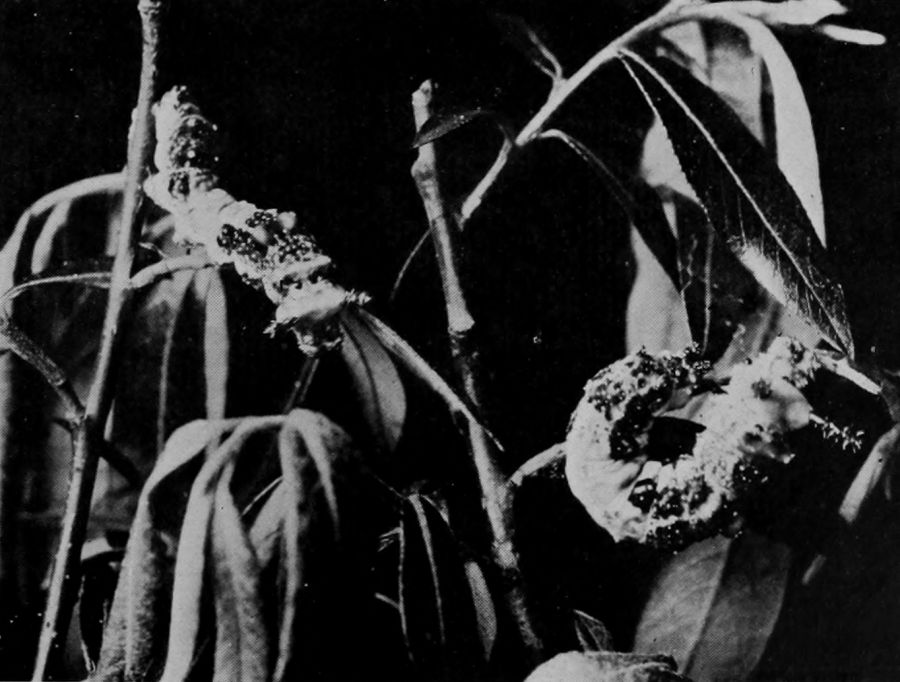
Photo by L. H. Joutel] [New York.
CATERPILLAR OF TAWNY ADMIRAL.
Remarkable for the sharply contrasted black and pale markings.
As already mentioned, butterflies may be distinguished from moths by their antennæ being
thickened at the extremities. There are comparatively few species in Europe—only about three
hundred, of which between sixty and seventy are met with in the British Islands; but in tropical
countries they are much more numerous and varied. It is a mistake to suppose that butterflies are
always bright-coloured insects, and moths the reverse; for though many butterflies are brightly
coloured, others are very dingy. On the other hand, although it is equally true that many moths
are dull-coloured, others, especially among those with slender bodies, or those which fly by day,
are quite as brilliantly coloured as any butterflies.
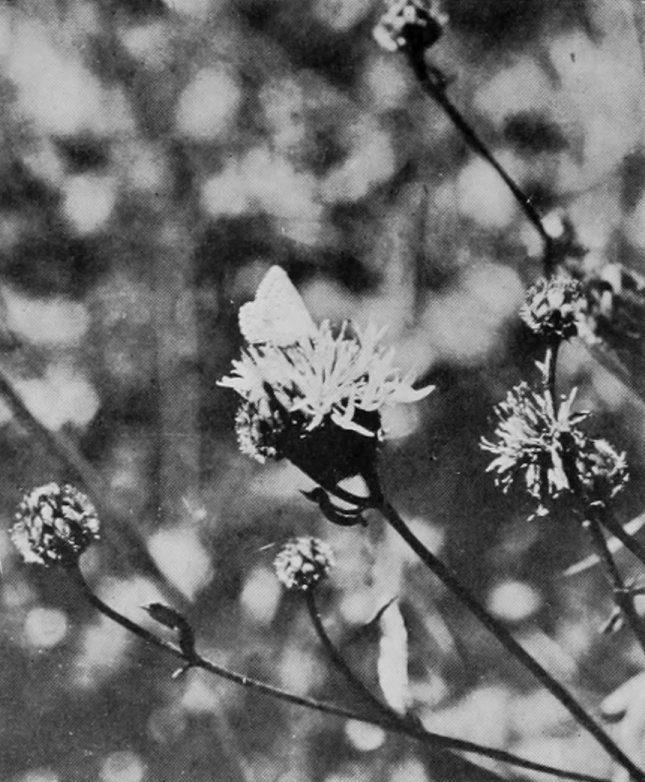
Photo by E. C. Atkinson.
BLUE BUTTERFLY.
Among the most conspicuous of the smaller European butterflies.
Butterflies are divided into several groups, the first of which includes the Brush-footed Butterflies, so called because the front pair of legs is converted
into hairy paws, useless for walking, and only employed for toilet purposes. This is a very
extensive group, including about half the butterflies known, and is divided into several smaller
sections. The most interesting species among the Danaids is the Monarch, one of the largest and commonest butterflies found in North America. It
is migratory in its habits, and has succeeded in acclimatising itself throughout the Pacific
islands as far as Australia and New Zealand, as well as in the Canaries; and so many specimens
have been taken recently in the south of England that it seems not unlikely to take up its
residence there also. It is a tawny butterfly, not unlike the one represented on the preceding
page, but much larger, measuring about 5 inches across the wings. The caterpillar is yellow, with
transverse black bands, and a pair of long, black slender filaments near each extremity of the
body. The pupa is pale green, with golden spots, and is suspended by the tail, as is the case with
most of those of the Brush-footed Butterflies.
The next group, the Long-winged Butterflies, includes a considerable
number of species with long rounded wings, found in tropical and sub-tropical America. A species
with black and transparent markings is shown on page 710, but many have
wholly transparent wings, except for a narrow black or brown border.
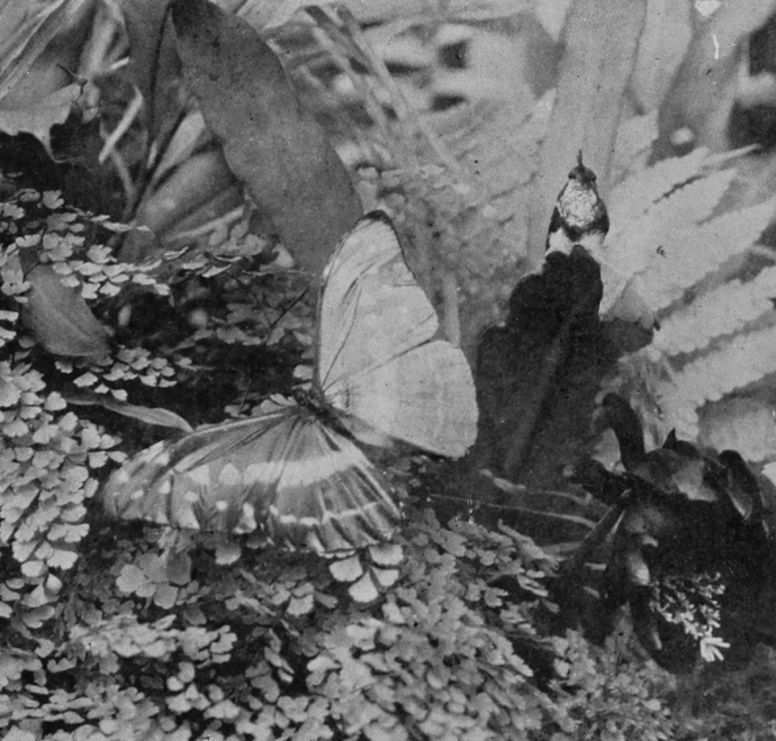
Photo by W. Saville-Kent, F.Z.S.] [Milford-on-Sea.
BLUE MORPHO BUTTERFLY AND HUMMING-BIRD.
Note proportionate sizes.
Turning to more familiar insects, there are several kinds of large or moderate-sized tawny
butterflies, marked with black spots and lines, called Fritillaries in
England. The caterpillars are spiny, and feed on violets and other low-growing plants. The
photograph on page 710 shows the Diana Fritillary,
a large and handsome species, which is somewhat of a rarity in the Southern States of America; it
measures 4 inches in expanse, and the sexes are very dissimilar. It is dark brown, with a broad
orange border spotted with black in the male, and rows of more or less connected green or white
spots in the female.
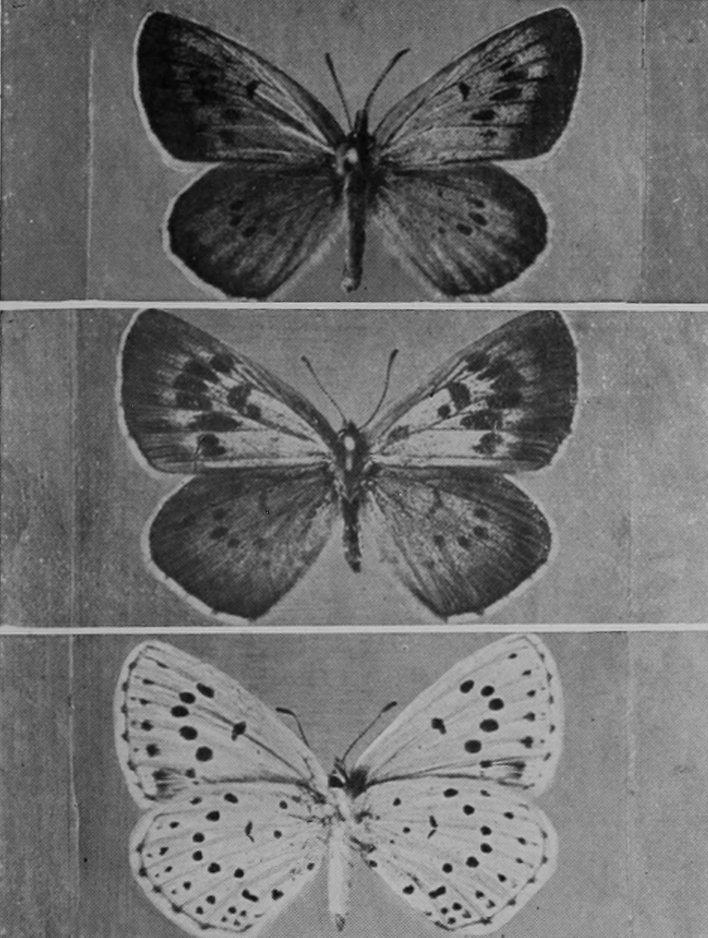
Photos by J. Edwards]
LARGE BLUE BUTTERFLY (MALE, FEMALE, AND UNDERSIDE).
Scarce and nearly extinct in England.
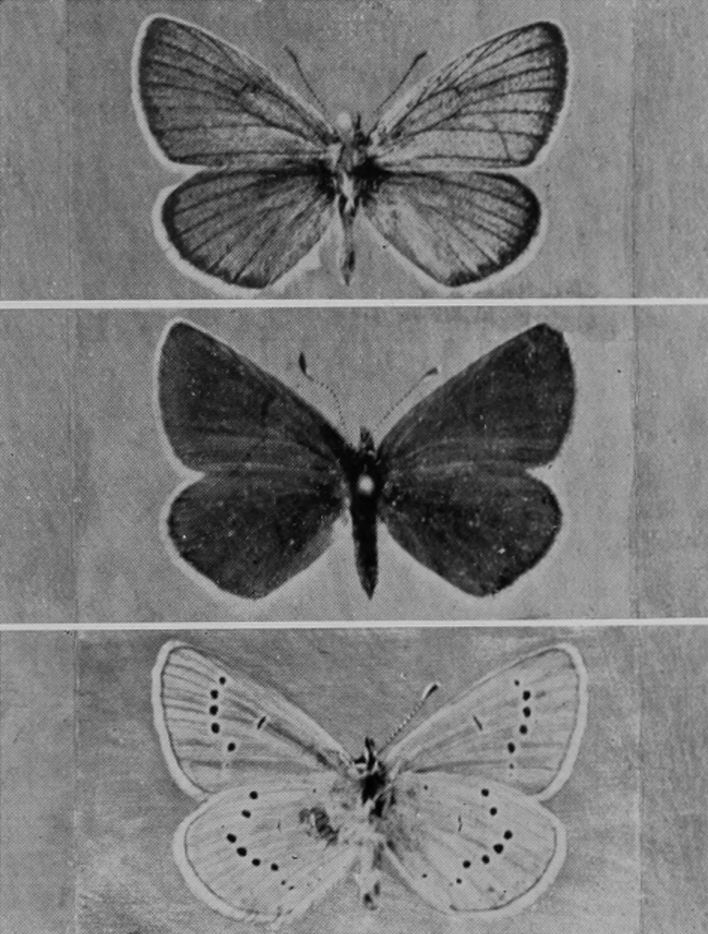
[Colesborne.
MAZARINE BLUE BUTTERFLY (MALE, FEMALE, AND UNDERSIDE).
Practically extinct in England.
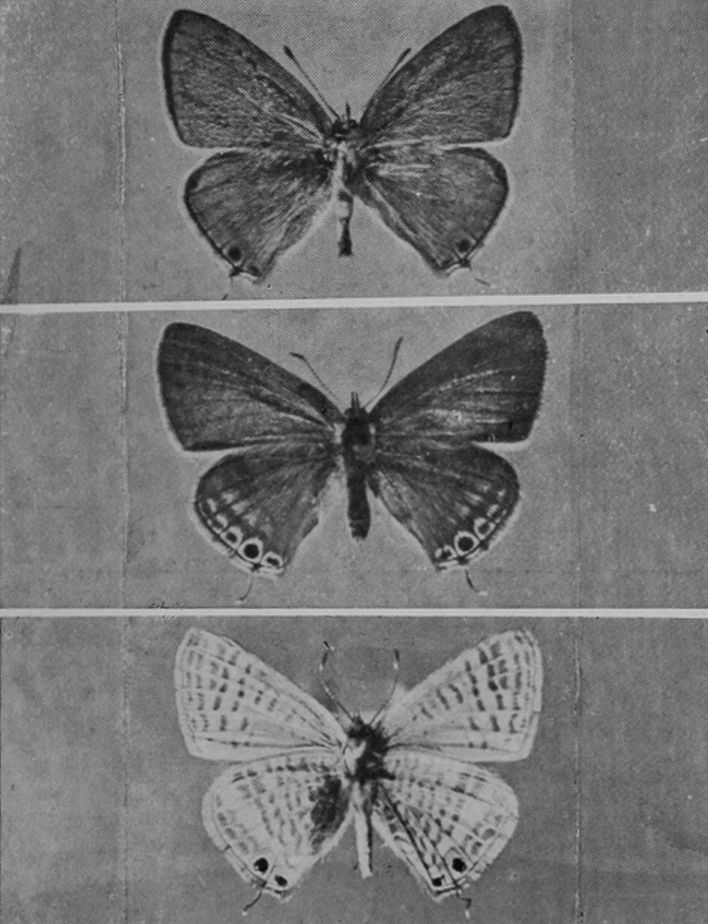
Photos by J. Edwards] LONG-TAILED BLUE BUTTERFLY (MALE, FEMALE, AND
UNDERSIDE).
An occasional immigrant on the south coast of England.
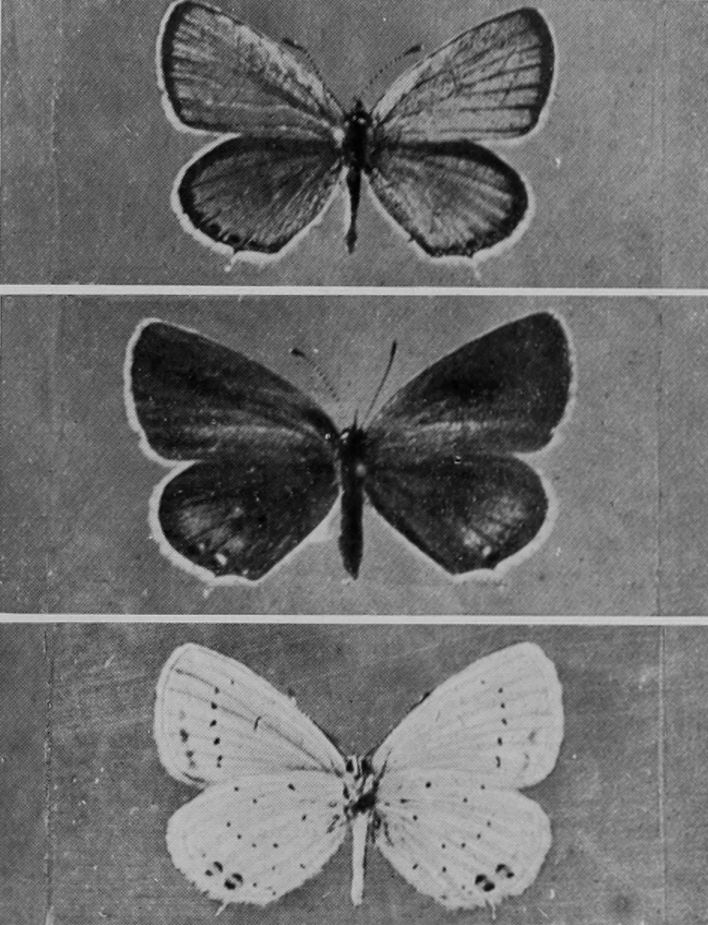
[Colesborne.
BLOXWORTH BLUE BUTTERFLY (MALE, FEMALE, AND UNDERSIDE).
Probably a casual visitor in England.
The Angle-winged Butterflies include several of the best known and most
brightly coloured British species, such as the Red Admiral, a velvety
black butterfly, with a transverse red band on the fore wings, and several white spots between
this and the tip, the hind wings having a red border, spotted with black and blue. It measures
about 2½ inches across the wings, and is common in gardens and orchards in summer and autumn. The
caterpillar, which feeds on nettle, is brown or black, with yellow stripes and spines. The Tawny Admiral is a North American butterfly, remarkable for its resemblance to
the larger butterfly called the Monarch, of which we have already spoken. The Danaids and
Long-winged Butterflies have tough integuments and a disagreeable odour, which more or less
protects them from birds. Many other butterflies belonging to other families have a superficial
resemblance to these, and are believed to share in their immunity. This phenomenon is technically
called "mimicry." The caterpillar of the tawny admiral is grey and black, with curious spiny
tufts.
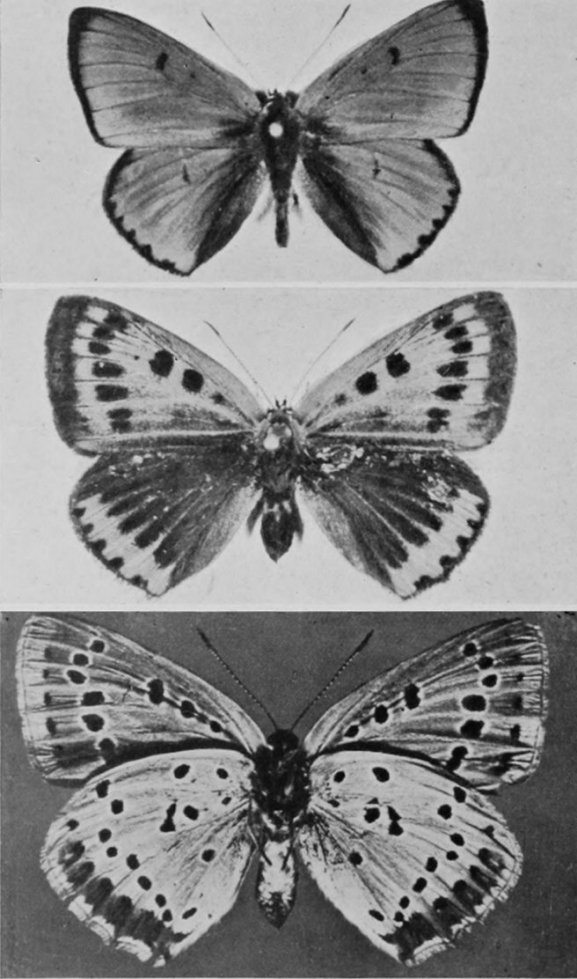
Photos by J. Edwards]
LARGE COPPER BUTTERFLY (MALE, FEMALE, AND UNDERSIDE).
Extinct in England since 1860.
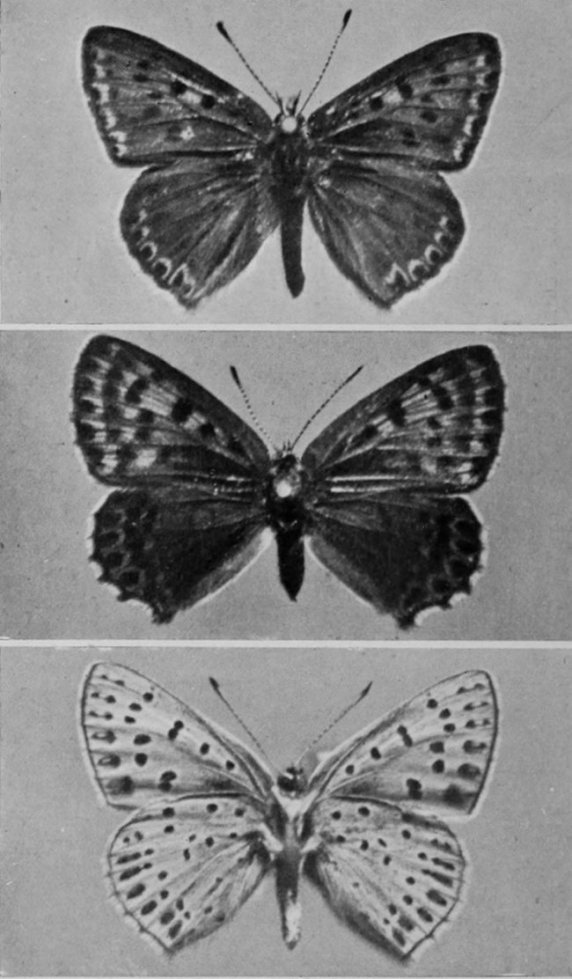
[Colesborne.
DUSKY COPPER BUTTERFLY (MALE, FEMALE, AND UNDERSIDE).
Taken near Ilfracombe, August, 1887.
The group of the Satyrs contains a great variety of moderate-sized
brown or tawny butterflies, usually with round spots centred with white towards the margins of the
wings. Many species are common in meadows; others, which are dark brown or black, with red,
white-centred marginal spots, are numerous in mountainous countries, and two species are found in
the north of England and Scotland. The caterpillars of the Satyrs are usually smooth and green,
with a forked tail, and the pupæ are formed on the surface of the ground.
The great Blue Butterflies of South America form another group of
Brush-footed Butterflies.
The second family is almost entirely American, and is only represented in England by a brown
butterfly about an inch in expanse, called the Duke of Burgundy
Fritillary. The caterpillar is reddish, and feeds on primroses. It is not a
very abundant species in England.
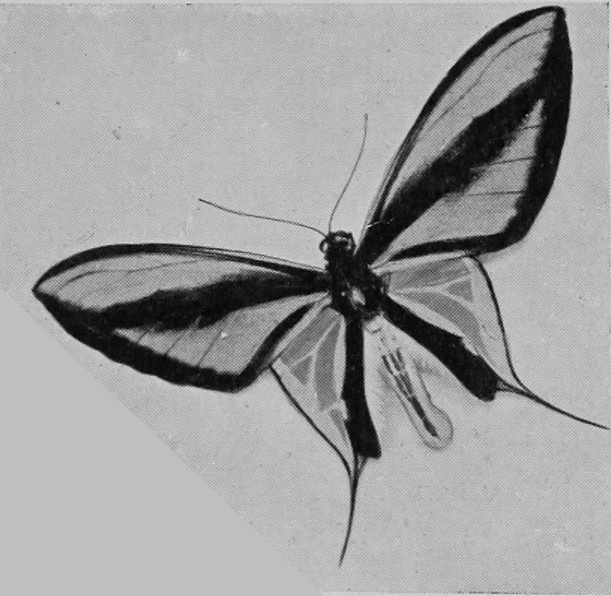
Photo by W. Saville-Kent, F.Z.S., Milford-on-Sea.
NEW GUINEA GOLDEN BUTTERFLY.
A remarkable and recently discovered swallow-tailed butterfly.
The third family is represented in Britain by three very distinct sections of rather small
butterflies, the largest of which scarcely measures more than an inch and a half across the wings.
These are the Hair-streaks (brown, with light lines on the under surface
of the wings, and a short tail on the hind wings, except in the Green
Hair-streak, so named from the green under surface of the wings); the small Blue Butterflies, which generally have brown females; and the Coppers, the only common species of which measures about an inch across the
wings. The fore wings are bright coppery red, with dark brown spots and borders, and the hind
wings are dark brown, with a coppery red border, spotted outside with black. The small copper
butterfly and some of the blues are common in meadows and gardens.
Many of the members of the fourth family are of a white or yellow colour, among which are the
destructive White Cabbage-butterflies, three species of which are very
common in England, where they may be seen in every garden throughout the summer. The photograph on
page 716 represents one of these at rest. A prettier species is the Orange-tip, which is common in spring. The underside of the hind wings is
mottled with green; and there is a bright orange spot before the tip of the fore wing, both above
and below. Some of the South American butterflies of this family much resemble the Long-winged
Butterflies of the same country.
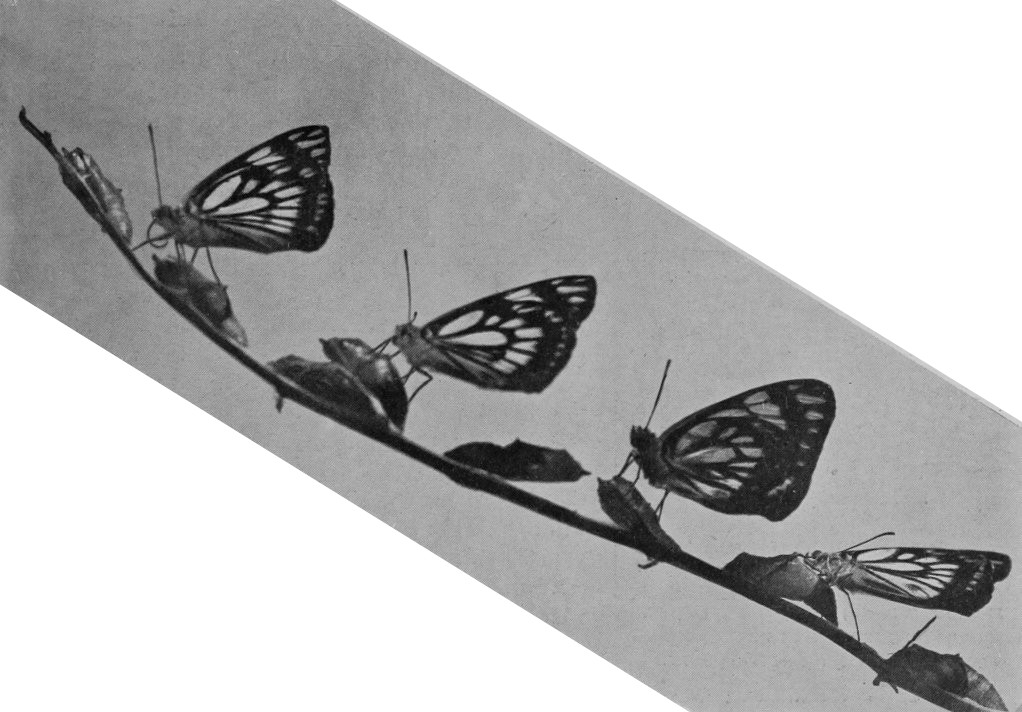
Photo by W. Saville-Kent, F.Z.S., Milford-on-Sea.
AUSTRALIAN BUTTERFLIES.
Emerging from their pupæ.
The family of the Swallow-tailed Butterflies includes a considerable
number of large and handsome species, but they are not numerous in Europe, and only one
black-and-yellow species, measuring 3 inches across the wings, is found in England, where it is
now almost confined to the fens of the south-eastern counties; its green caterpillar, with
transverse black bands spotted with orange, feeds on carrot, fennel, and other similar plants. All
the caterpillars of this family are remarkable for possessing a retractile fork on the neck; but
the butterflies do not all possess the long appendage to the hind wings which has given some of
them the name of Swallow-tails. Thus it is wanting in most of the great Bird-winged Butterflies of the Eastern Islands, one of which, the Crœsus Butterfly, is represented in the Coloured Plate. The great
difference between the sexes is well worth noting. The female is considerably larger than the
male, but in the coloured figure the former has been reduced, owing to the exigencies of space.
Mr. A. R. Wallace writes as follows of the capture of the first specimen:—
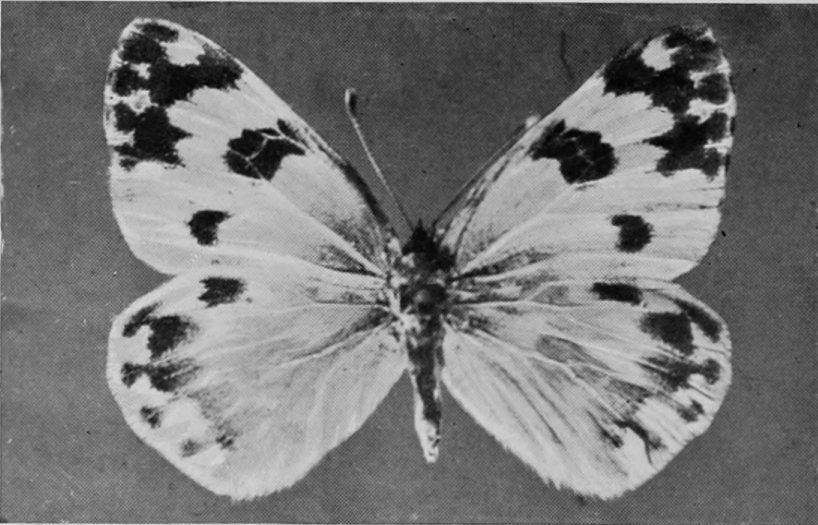
Photo by J. Edwards] [Colesborne.
BATH WHITE BUTTERFLY.
Always rare in England, though common on the Continent.
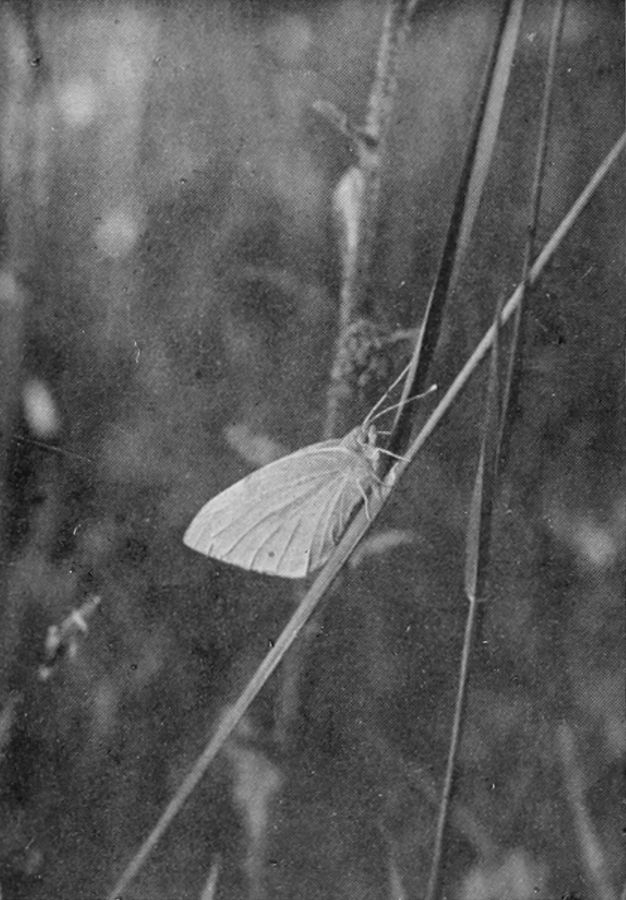
Photo by B. H. Bentley] [Sheffield.
GREEN-VEINED WHITE BUTTERFLY.
The cabbage-butterfly referred to on page 715.
"One day about the beginning of January, I found a beautiful shrub with large white leafy
bracts and yellow flowers, a species of Mussænda, and saw one of these noble insects hovering over
it, but it was too quick for me, and flew away. The next day I went again to the same shrub and
succeeded in catching a female, and the day after a fine male. I found it to be as I had expected,
a perfectly new and most magnificent species, and one of the most gorgeously coloured butterflies
in the world. Fine specimens of the male are more than seven inches across the wings, which are
velvety black and fiery orange, the latter colour replacing the green of the allied species. The
beauty and brilliancy of this insect are indescribable, and none but a naturalist can understand
the intense excitement I experienced when I at length captured it. On taking it out of my net and
opening the glorious wings, my heart began to beat violently, the blood rushed to my head, and I
felt much more like fainting than I have done when in apprehension of immediate death. I had a
headache the rest of the day, so great was the excitement produced by what will appear to most
people a very inadequate cause."
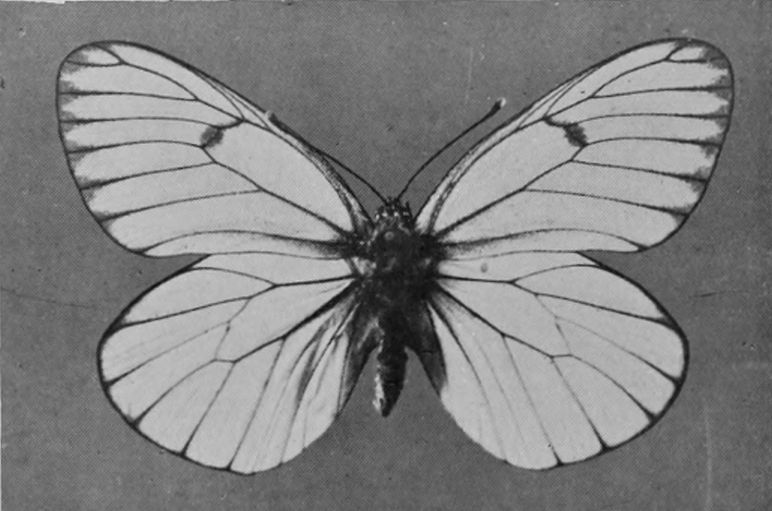
Photo by J. Edwards] [Colesborne.
BLACK-VEINED WHITE BUTTERFLY.
A much rarer species in England now than formerly.
The Skippers, the last family of butterflies, are
comparatively stout-bodied insects, with the antennæ widely apart at the base, and sometimes
forked at the tip. They are not numerous in Europe; the prettiest of the British species is
perhaps the Pearl-skipper, which measures rather more than an inch across
its brown and tawny wings; the under surface of the hind wings is green, and marked with several
clear white spots.
Moths.
Moths are much more numerous than butterflies, and there are about 2,000 different kinds found
in the British Islands alone. Consequently we are able to notice only a few.
The Hawk-moths have long, pointed wings, thick, tapering bodies, and the
antennæ thickest in the middle. The pink, greenish-striped Elephant
Hawk-moth (see page 718) is a comparatively small species. The
specimens measure about 2½ inches across the wings. Some species are much larger. The Death's-head Hawk-moth, whose caterpillar feeds on potato-leaves, is 5 or 6
inches in expanse; and some of the South American species measure as much as 9 inches. The
caterpillars of the hawk-moths are generally green, often with oblique lines of a different colour
on the sides. They are not hairy, though the skin is sometimes rough, and there is a fleshy
appendage, called a "horn," on the back, just before the extremity of the body. The brown pupæ are
found in cells in the ground.
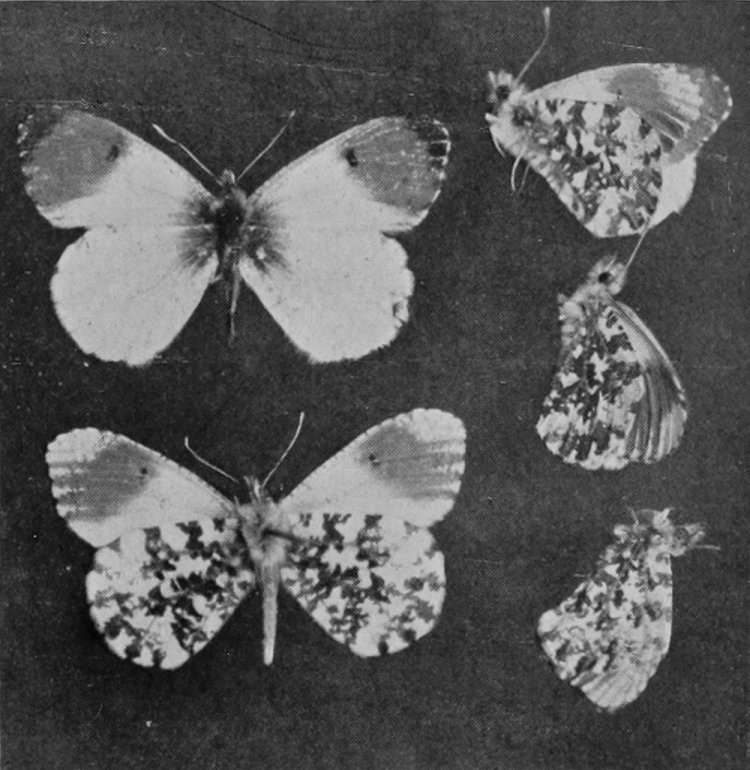
Photo by E. C. Atkinson.
ORANGE-TIP.
Showing three different positions when wings are folded, and partly or entirely
concealing upper wing.
The Chinese Mulberry-silkworm, which produces most of the silk of
commerce, is a smooth, whitish caterpillar, about 2 inches long, with a horn. It is often reared
in England on lettuce. The moth is a sluggish, stout-bodied insect. It is whitish, with two dusky
stripes on the fore wings. The pupa is enclosed in an oval whitish or yellow cocoon of pure
silk.
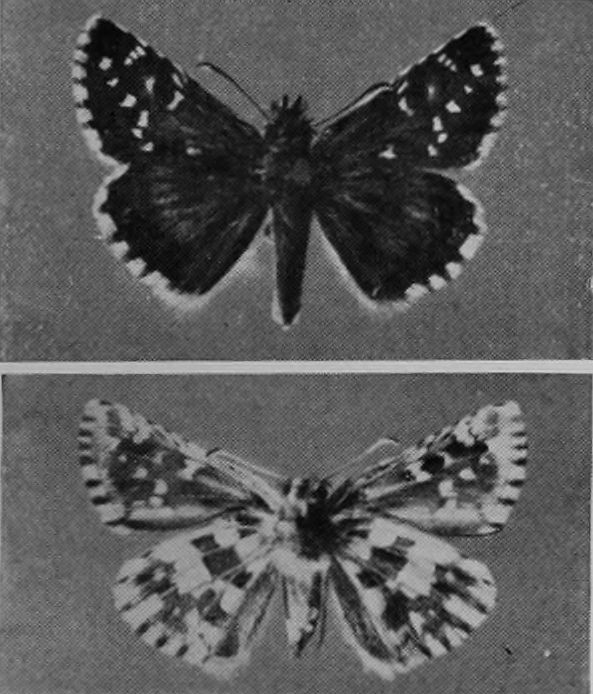
Photo by J. Edwards, Colesborne.
LARGE GRIZZLED SKIPPER BUTTERFLY.
Upper- and under-sides.
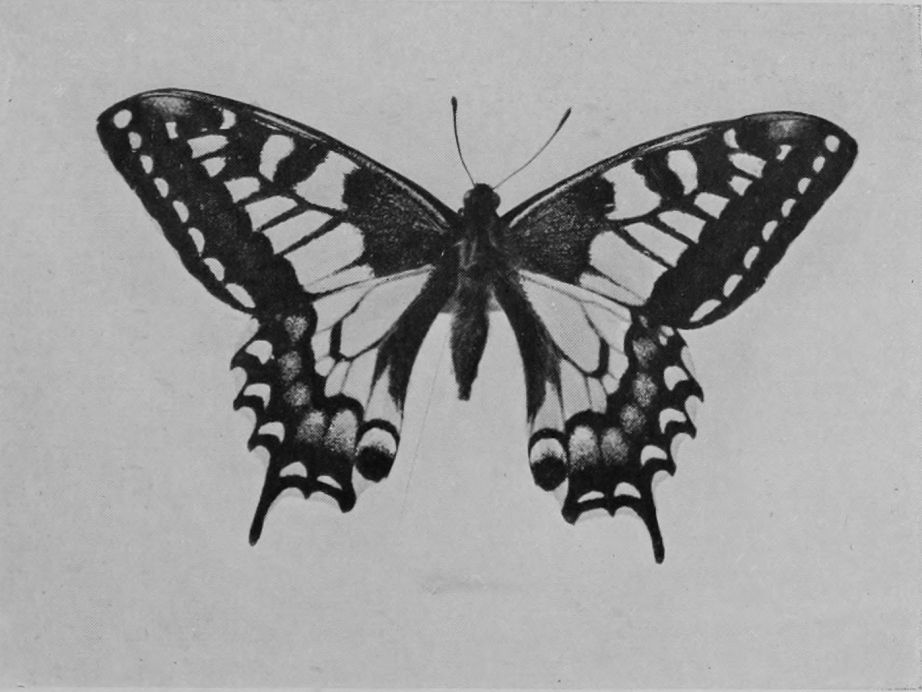
Photo by W. P. Dando, F.Z.S.] [Regent's Park.
SWALLOW-TAILED BUTTERFLY
The only British species of this butterfly is almost confined to the fen
districts of Norfolk.
The Emperor-moths, of which there is only one species in England,
likewise spin large cocoons, sometimes used for commercial purposes. The caterpillars are
generally more or less spiny or tufted. Some of the moths have long tails on the hind wings, like
swallow-tailed butterflies, and there are several species in South Europe, South Africa, the East
Indies, and North America of a beautiful sea-green colour. It will be noticed that the specimens
represented on page 718 have the tails a little broken, which is a very common accident with
swallow-tailed butterflies and moths. We may also notice the round or crescent-shaped spots in the middle of
the wings of some of the moths represented on this page and the next. These are very
characteristic of the emperor-moths, and there is often a transparent spot in the centre of the
concentric markings. Two other North American species of this family are shown in the photographs
on page 719, rather under natural size. The second of these, the Cecropia Moth, is represented with its cocoon. This moth has occasionally been
captured in England, having been introduced either accidentally or by design. A year or two ago a
specimen was brought to the Natural History Museum at South Kensington which had been caught in
the street close by. During the summer many foreign butterflies and moths may be seen alive in the
Insect-house at the Zoological Gardens, Regent's Park, and several of the photographs given in
these pages were taken from specimens living there in the summer of 1901. The largest of the
emperor-moths is the great Atlas Moth of North India, the largest of all
known butterflies or moths, which occasionally measures almost a foot across its reddish-tawny
wings.
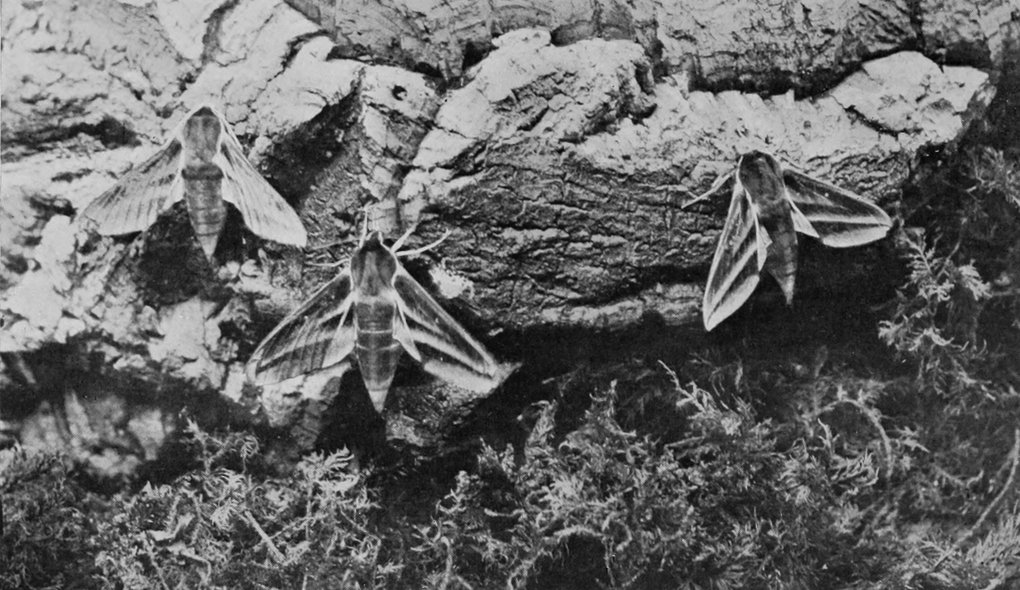
Photo by Highley.
ELEPHANT HAWK MOTHS
Showing position when at rest.
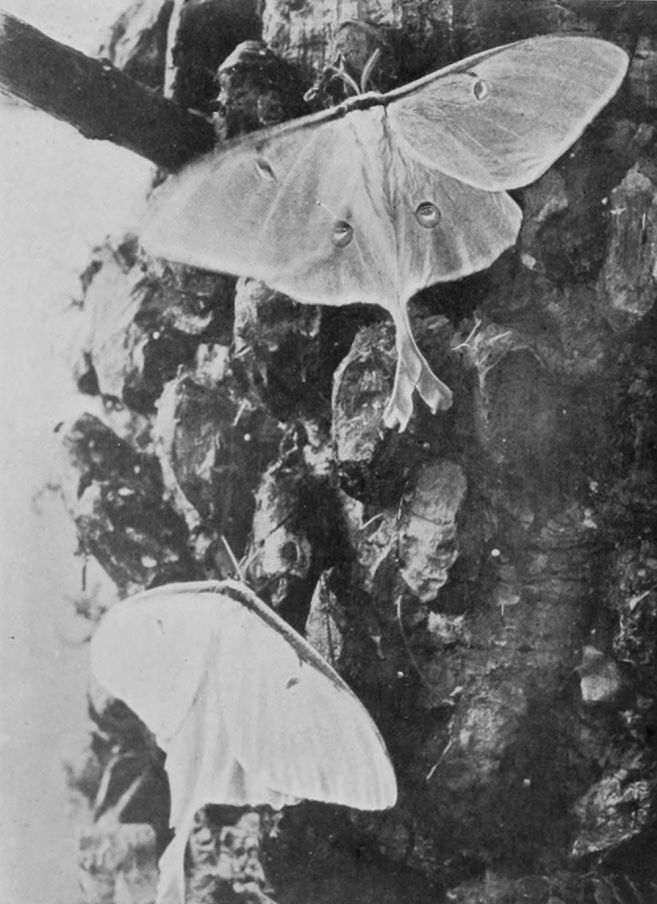
Photo by Highley.
LUNA MOTHS.
A green North American moth with tail, allied to the English Emperor-moth.
The Imperial Moth, a handsome North American moth belonging to a family
allied to the emperor-moths, is represented below.
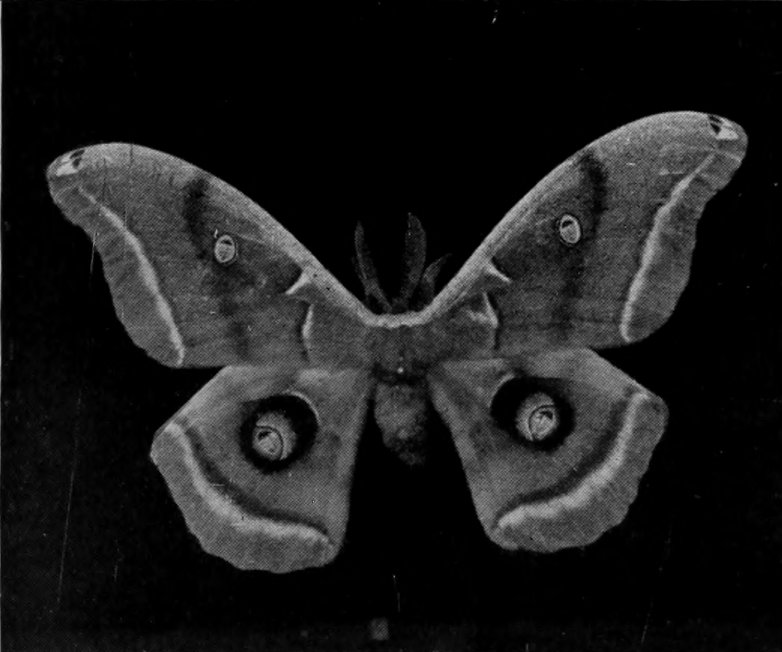
Photo by L. H. Joutel, New York.
POLYPHEMUS MOTH.
A handsome North American Emperor-moth.
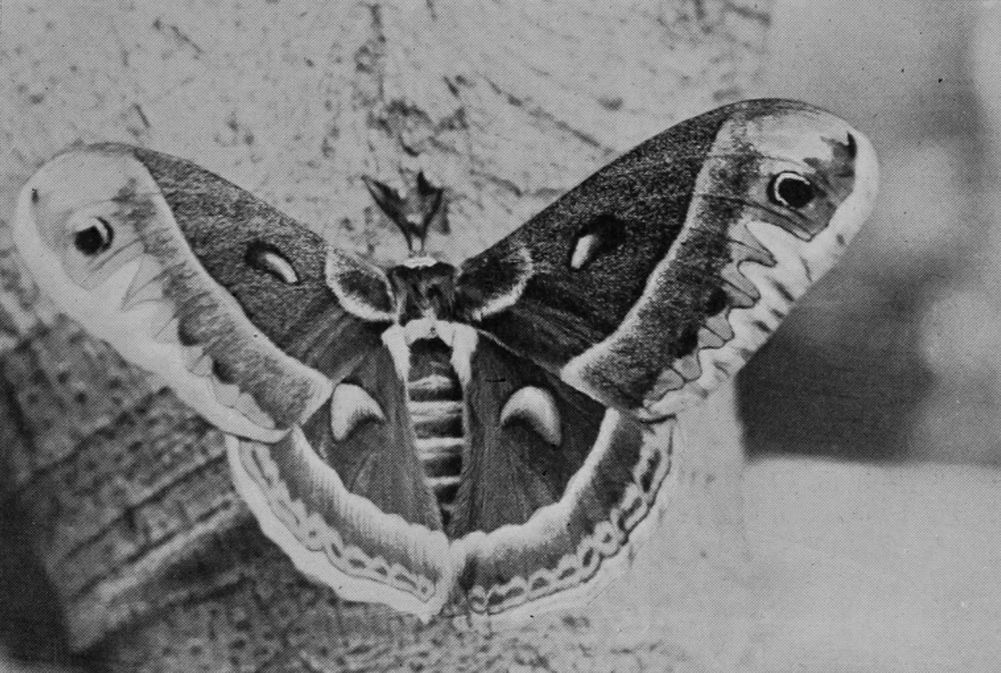
Photo by Highley.
CECROPIA MOTH.
The largest of the North American Emperor-moths.
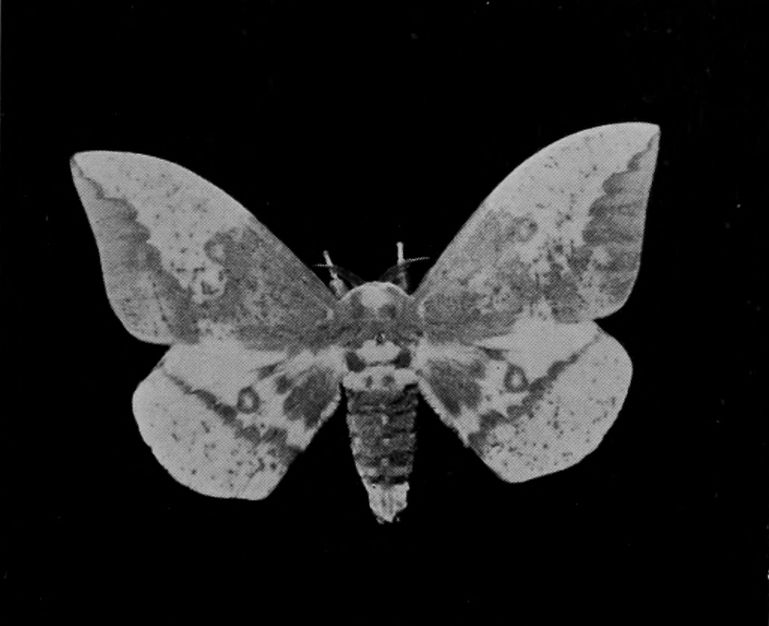
Photo by L. H. Joutel] [New York.
IMPERIAL MOTH.
Yellow with purplish-brown dots and blotches. Native of North America.
The Eggars form another allied family, also with tufted caterpillars,
but with the central eye of the wings absent, or reduced to a small black spot. A set of
remarkable photographs, representing the eggs, caterpillars, cocoons and sections of cocoons, and
the moths of a large and handsome species—the Cypress-moth of
Smyrna—appears on pages 720 and 721. We have received the following
account of their habits from Mr. Mavroyeni, to whom we are indebted for the photographs: "In the
month of July they start weaving their cocoons, in which they remain for seventeen days. A couple
of weeks after the moths have emerged from their cocoons and laid their eggs, the eggs hatch, and
the young caterpillars run up the tree, and feed from the end of August, during autumn, winter,
and spring." We believe that the cocoons of this species are prepared for use as silk in
Greece.
Among other kinds, we may notice the bright-coloured Tiger-moths, with
their black and cream-coloured fore wings and red-and-black hind wings, which frequent gardens,
and are reared from reddish-brown caterpillars with long hair. These are stout-bodied moths; and
there are other moths, with brown fore wings and whitish hind wings, which fly to candles, or buzz
over flowers in the evening. These are called Owl-moths; but there are
larger and handsomer members of the same family, called Yellow
Underwings, measuring nearly 2 inches across the wings, and likely to be flushed in
strawberry-beds or hay-fields. They have brown fore wings, and bright yellow hind wings, with a
black border. The Red-underwing Moth is about 3 inches in expanse, and has
greyish-brown fore wings, and red hind wings, with a black central band; it is often seen flying
about willow-trees in the afternoon, or resting on tree-trunks, when the bright-coloured hind
wings are quite concealed.
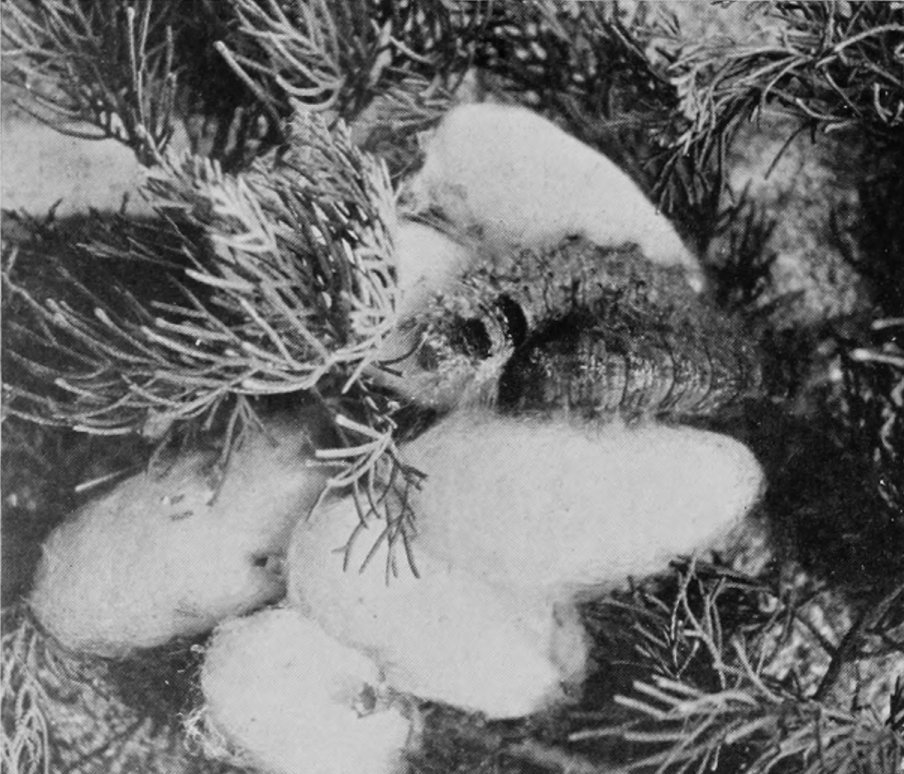
Photo by C. N. Mavroyeni] [Smyrna.
COCOONS OF CYPRESS-MOTH.
These yield silk.
The Looper-moths are those produced from caterpillars which have only
ten legs instead of sixteen, as already explained. Most have slender bodies of moderate length,
and broad and rather brightly coloured wings, green, russet-brown, yellow, etc. Some, measuring
about an inch in expanse, are called Carpet-moths, from the zigzag
patterns on the fore wings, which are generally black and white, or brown and white, and sometimes
green. The Yellow-shell, a yellow moth, with some zigzag brown and whitish
lines across the wings, which expand about an inch, is common in hedges and bushes. The white,
black-and-yellow-spotted Gooseberry-moth, or Magpie-moth, so common in gardens, is also one of the Loopers.
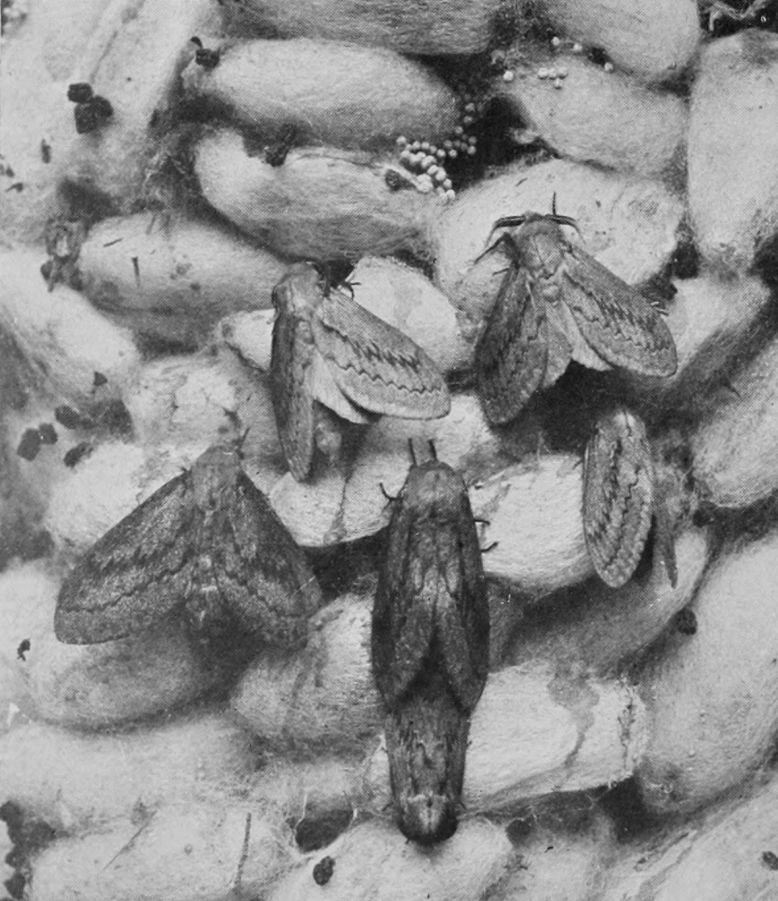
Photo by C. N. Mavroyeni] [Smyrna.
CYPRESS-MOTHS AT REST.
In the month of July they start weaving their
cocoons, in which they remain for seventeen days. A couple of weeks after their eggs are
hatched, and the young caterpillars run up the tree, and feed from the end of August, during
autumn, winter, and spring.
Among the smaller moths are the Pearl-moths, with long slender bodies,
wings longer than broad, and often with a pearly lustre, one or two species of which are common
among nettles. We may also mention the Snout-moth, a brown slender-bodied
moth, with a pointed beak projecting in front of the head, likewise a common insect among nettles.
The Grass-moths are small moths, with narrow whitish fore wings, and broad
brownish hind wings, which they wrap round their bodies when at rest. They are common in every
field and meadow. The Bell-moths have broad truncated fore wings, and rounded hind wings. A
species belonging to this family, with green fore wings and brown hind wings, may be shaken from
every oak-tree in summer, and at the same time numbers of its little green caterpillars will drop
themselves down, and remain swinging at the end of a thread, till they think that the danger is
past, when they climb up again.
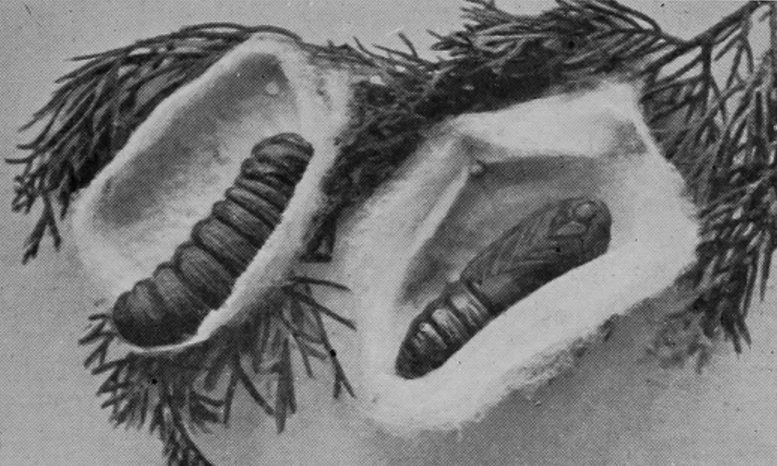
Photo by C. N. Mavroyeni] [Smyrna.
CYPRESS-MOTHS.
The inside of the cocoons, showing the pupæ.
The Clothes-moths, familiar to everybody, are representatives of an
enormous family of small moths, comprising nearly two-thirds of the British species, but only a
few live in houses. Most have narrow wings with long fringes, and many feed in tortuous galleries
which they eat in the substance of leaves. Some are among the smallest moths known.
The White Plume-moth, which may be noticed floating about in weedy
places like a piece of thistle-down, is a representative of a small family in which the fore wings
are divided into three separate feathers, and the hind wings into two. The other species are
brown, and smaller. When at rest, they look like small daddy-long-legs.
The Twenty-plume Moth is a yellowish-grey species, less
than an inch in expanse, often to be seen at rest on windows or palings. It might easily be taken
for a small looper-moth, but that each wing is split into six feathers.
Silkworms.
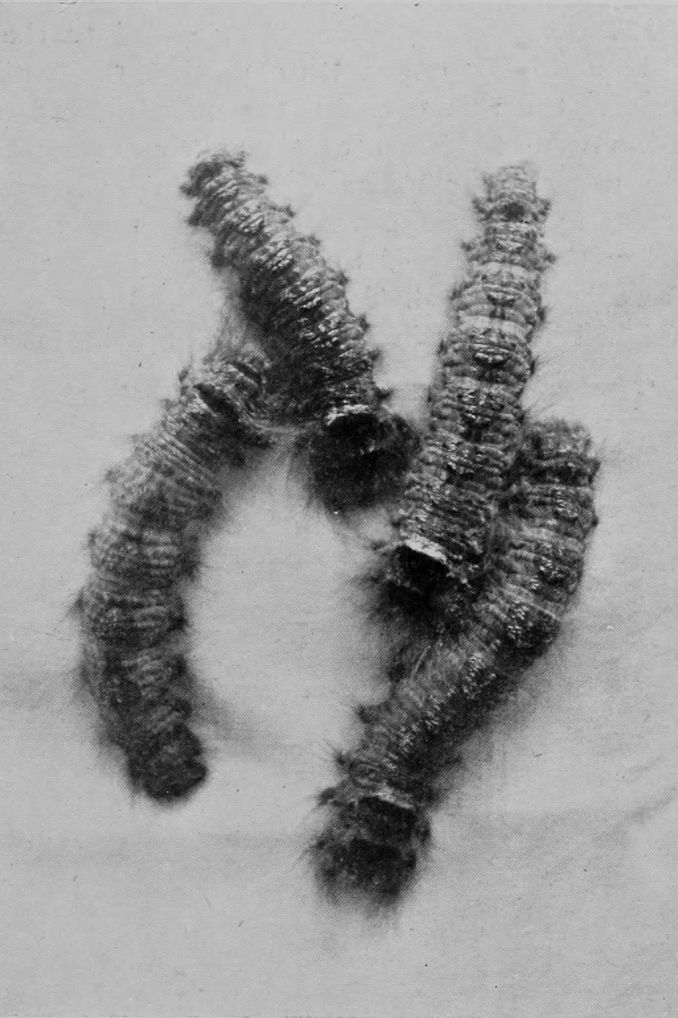
Photo by C. N. Mavroyeni] [Smyrna.
CYPRESS-CATERPILLARS.
When they leave their cocoons, the young caterpillars run up the tree to
feed.
We have now completed a rapid survey of the principal groups of Butterflies and Moths, and may
fittingly conclude this part of our subject by giving a short account of the history of Silkworms—insects which far surpass all other butterflies and moths in
their importance to mankind, on account of the valuable product which is obtained from their
cocoons. The industry has been carried on from time immemorial in China; and many old Chinese
works contain interesting particulars, especially relating to the rearing of silkworms by the
queens and their ladies, for silk was probably a royal monopoly in old times. These Chinese
records date back to about 2200 B.C., when the silk industry was
already flourishing; but, according to the usually received tradition, silkworms were first reared
during the reign of the Emperor Hwang-té (2640 B.C.) by his queen.
The following extracts from the "Le-he Book of Ceremonies," written between 204 B.C. and 135 B.C., and quoted by Horsfield and
Moore in their "Catalogue of the Lepidoptera of the East India Museum," may not be uninteresting to our
renders:—
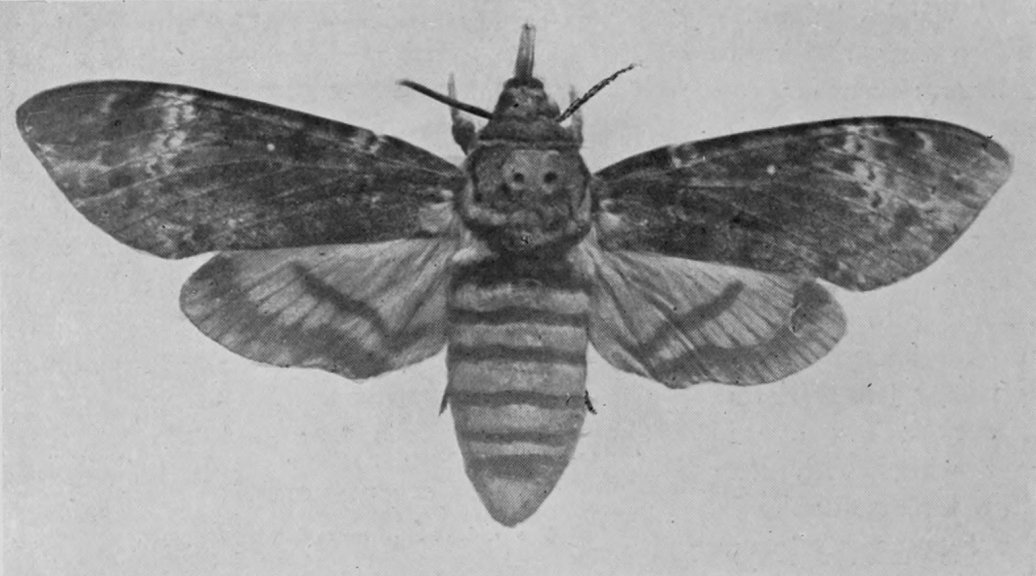
Photo by J. Peat Millar] [Beith.
DEATH'S-HEAD MOTH.
Remarkable for the skull-like pattern on the back.
"In the first month of spring orders were issued to the forester not to cut down the
mulberry-trees; and when the cooing doves were observed fluttering with their wings, and the
crested jays alighting upon the mulberry-trees, people were to prepare the trays and frames for
the purpose of rearing the silkworms.
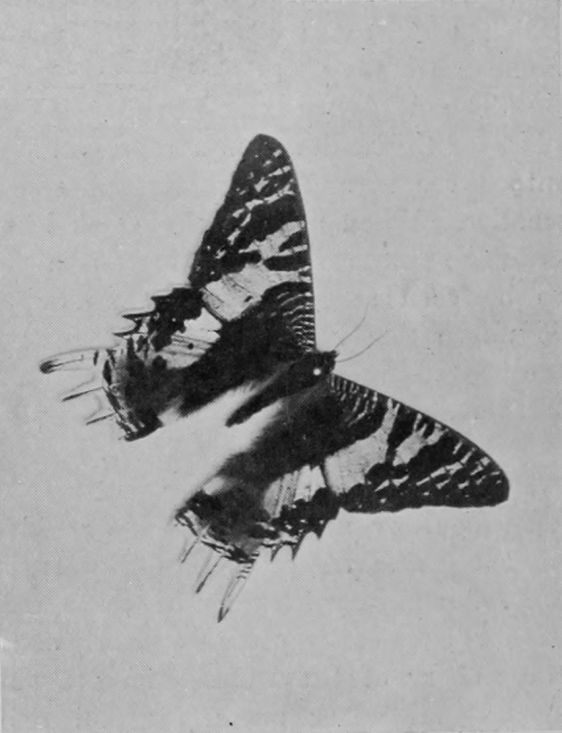
Photo by W. Saville-Kent, F.Z.S., Milford-on-Sea.
DAY-FLYING MOTH OF MADAGASCAR.
Remarkable for the brilliancy of its colours—green and black, with the
hind wings brilliant coppery red towards the extremity.
"In the spring season, when the empress and her ladies had fasted, they proceeded to the east,
and personally engaged in picking the mulberry-leaves. On this occasion the married and single
ladies were forbidden to wear their ornaments, and the usual employments of females were lessened,
in order to encourage attention to the silkworms. When the rearing of the silkworms was completed,
the cocoons were divided (for reeling) and the silk weighed (for weaving), each person being
rewarded according to her labour, in order to provide dresses for the celestial and ancestorial
sacrifices. In all this none dared indulge in indolence.
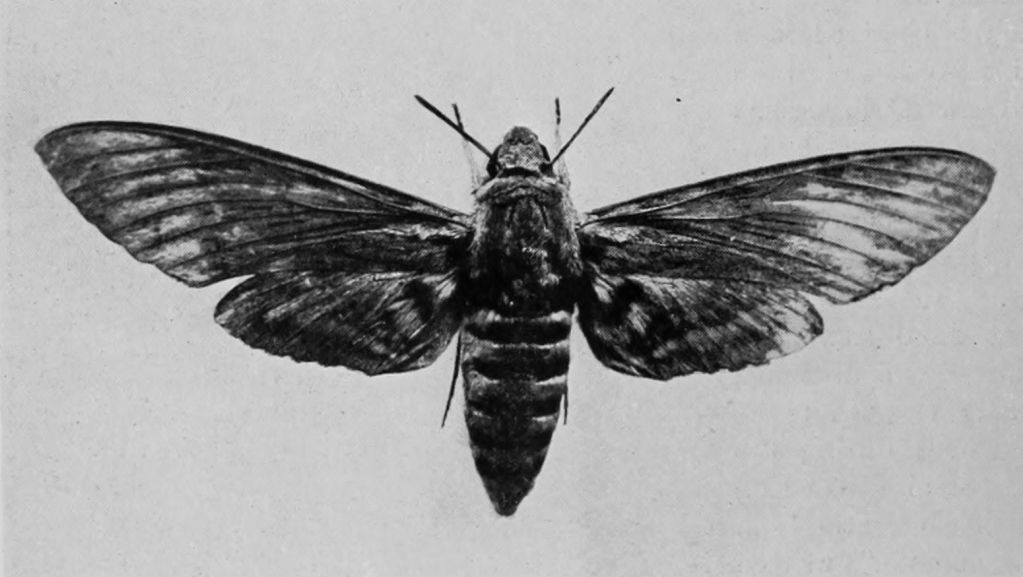
Photo by J. Peat Millar] [Beith.
CONVOLVULUS HAWK-MOTH.
A grey moth, with pink bands on the body.
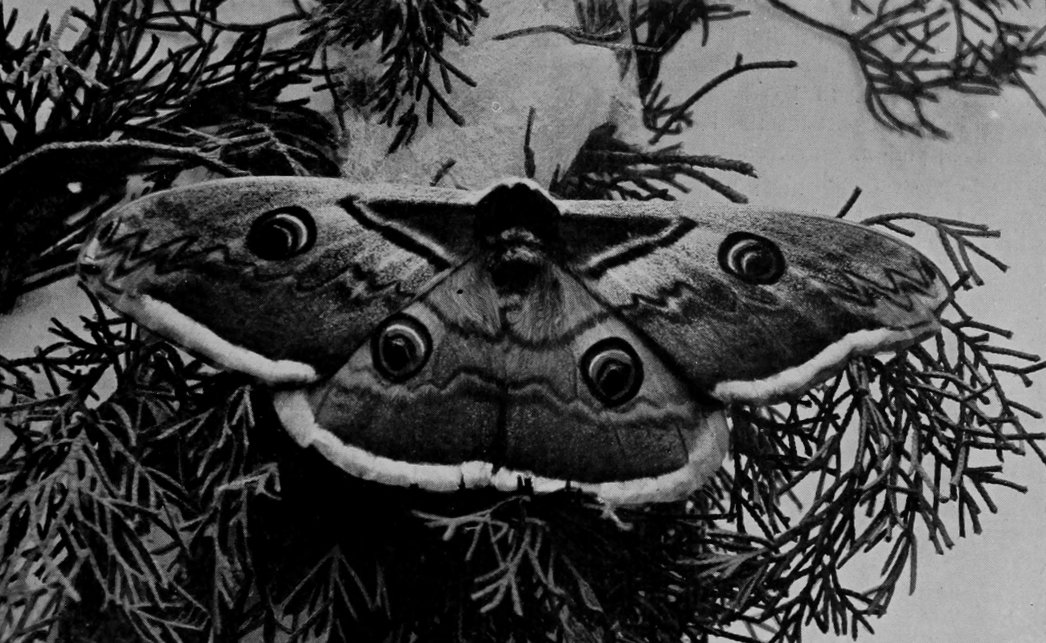
Photo by C. N. Mavroyeni] [Smyrna.
GREAT PEACOCK-MOTH.
Brown with pale borders. The largest moth found in Europe.
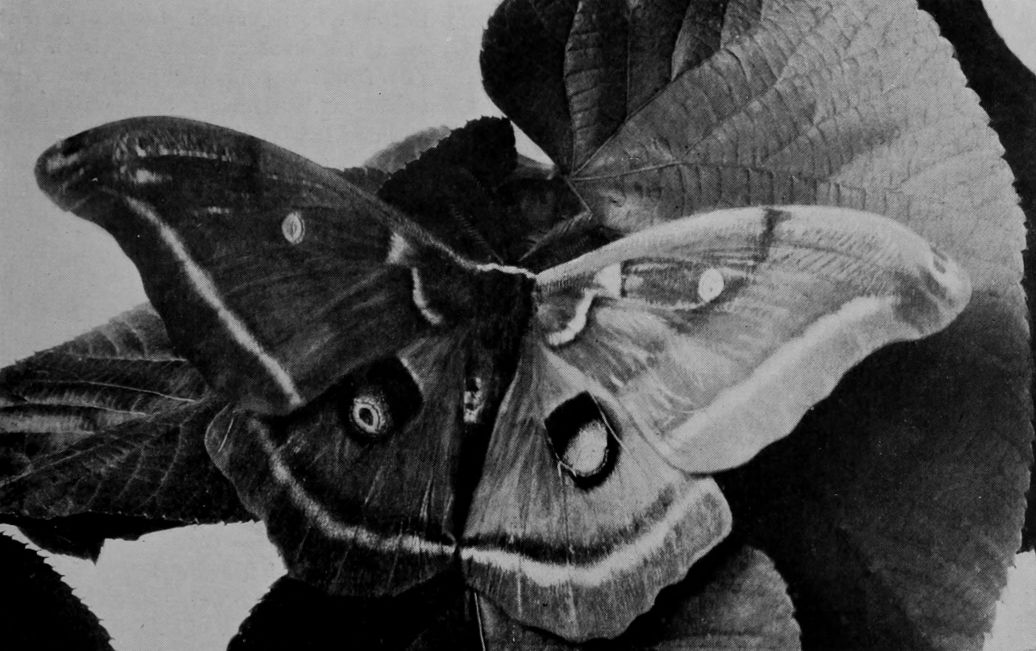
Photo by Dr. R. W. Shufeldt] [Washington.
POLYPHEMUS MOTH.
On leaves of linden-tree, just out of cocoon. A native of North America.
"In the last month of summer the order was given to the female officers to dye the silk of
various colours, in order to weave chequered sarcenets, comprising black and white, black and
green, green and red, with red-and-white checks—all of which was to be done according to the
ancient rule, without the least variation; the black, yellow, azure, and red tints were all to be
correct and good, without the least fault, in order to provide dresses for the celestial and
ancestorial sacrifices, and standards for distinguishing the high and low degrees.
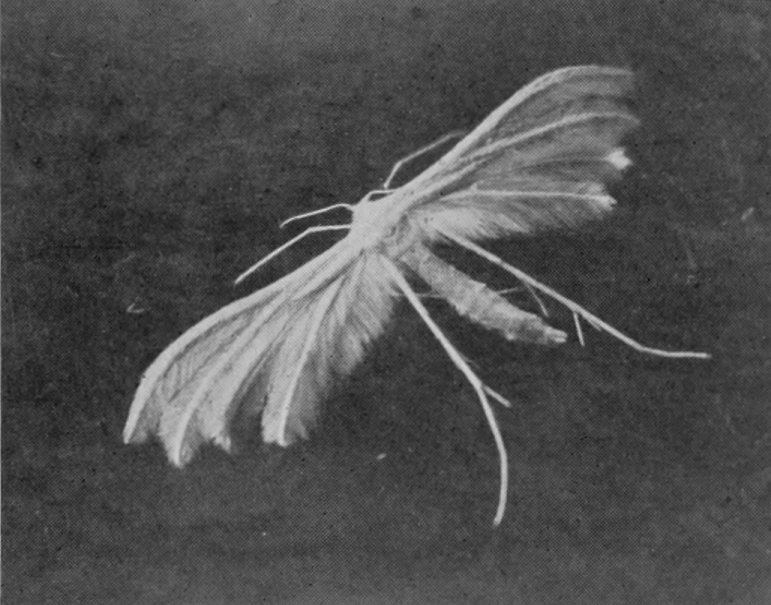
Photo by W. Saville-Kent, F.Z.S.] [Milford-on-Sea.
WHITE PLUME-MOTH.
A very delicate insect. The wings are cleft almost to the base into separate
feathers, two on the fore wings and three on the hind wings.
"In ancient times the emperor and his princes had a public mulberry garden and a silkworm
establishment erected near some river. On the morning of the first day of the third month of
spring, the sovereign, wearing a leather cap and a plain garment, ascertained by lot the chief of
his three queens, with the most honourable amongst his concubines, and caused them to attend to
the rearing of the silkworms in the above-named establishment. They then brought the eggs of the
worms, and washed them in the river above alluded to, after which they picked the mulberry-leaves
in the public garden, and aired and dried them, in order to feed the worms.
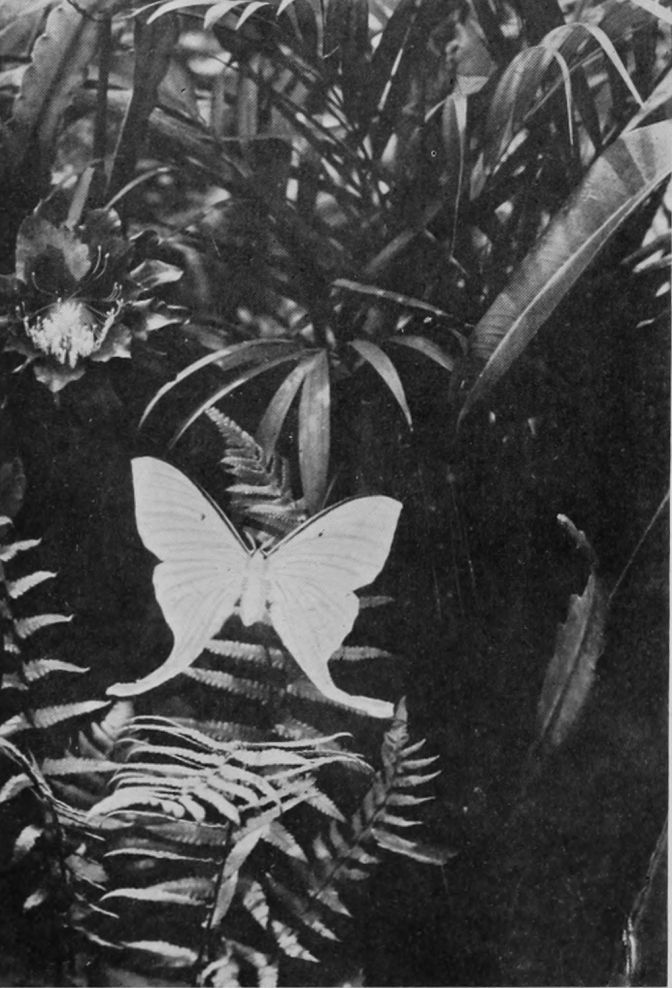
Photo by W. Saville-Kent, F.Z.S.] [Milford-on-Sea.
INDIAN SWALLOW-TAILED MOTH.
Resembles the American Luna Moth figured on page 718,
and of an equally delicate green.
"When the season was over, the royal concubines, having completed the business of rearing the
silkworms, brought the cocoons to show them to the prince, when he presented the cocoons again to
his consort, whereupon his consort said, 'This is the material of which your highness's robes are
to be formed.' Having said which, she covered herself with her robe, and received the cocoons. On
this occasion the ladies of the court were honoured with the present of a sheep. This was the mode
in which the presentation of the cocoons was anciently conducted."
In the reign of Justinian eggs of the Chinese mulberry-silkworm were smuggled into
Europe by two monks, and the culture of silk rapidly spread through Southern Europe, where it has
continued to form a staple industry ever since. In the Peloponnesus especially such large
plantations of mulberry-trees were grown for the purpose of rearing silkworms as to give the
peninsula its modern name of Morea. Silk is obtained in different parts of the world from the
cocoons of various other moths, chiefly belonging to the group of Emperor-moths; but these
products are only of local importance, and are not likely to compete with the
mulberry-silkworm.
HALF-WINGED INSECTS, OR BUGS AND FROG-HOPPERS.
BY W. F. KIRBY, F.L.S.
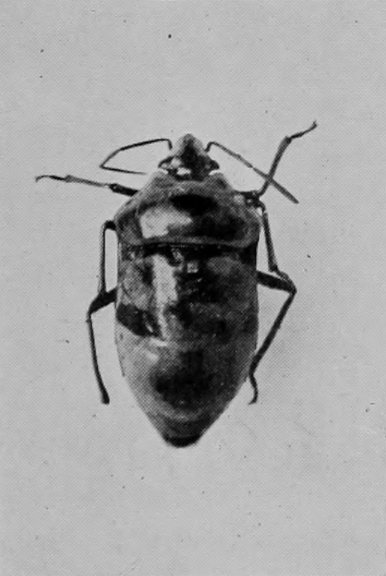
Photos by W. P. Dando, F.Z.S.]
SHIELD-BUG.
In tropical countries these bugs are often as large as cockchafers.
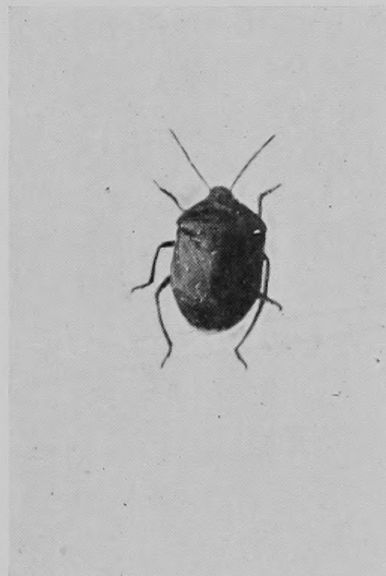
[Regent's Park.
JUNIPER-BUG.
Some species of this family are carnivorous as well as herbivorous.
The order including the Bugs and Frog-hoppers is divided into two sub-orders. There are also
one or two small groups, sometimes treated as separate orders, and sometimes regarded as aberrant
sections of the order, to which we shall allude later.
The True Bugs have their fore wings of a horny texture, but generally
overlapping, and the extremities form a transparent membrane, resembling that of the hind wings.
They have a long sucking-proboscis curved down beneath their bodies, and their antennæ usually
consist of only four or five long joints. Most are vegetable-feeders, but some species feed on the
juices of other insects, while a few attack warm-blooded animals, either casually or
habitually.
The first family includes the Shield-bugs. These derive their name from
the unusual development of a part of the thorax called the "scutellum." In most insects it is only
a small plate of no great importance, attached to the end of the thorax; but in the Shield-bugs it
forms a great solid arch, covering the whole of the wings, and protecting them as the wing-cases
protect the wings of beetles. There are only a few small species in England, but a great number of
beautiful species inhabit warm countries, some of a brilliant blue or green or yellow, or spotted.
Many of them are comparatively large insects, nearly an inch long, and resemble brilliantly
coloured beetles, from which, however, they can easily be distinguished by the antennæ, the
proboscis, and the shield, the latter of which is not divided down the middle like the wing-cases
of beetles.
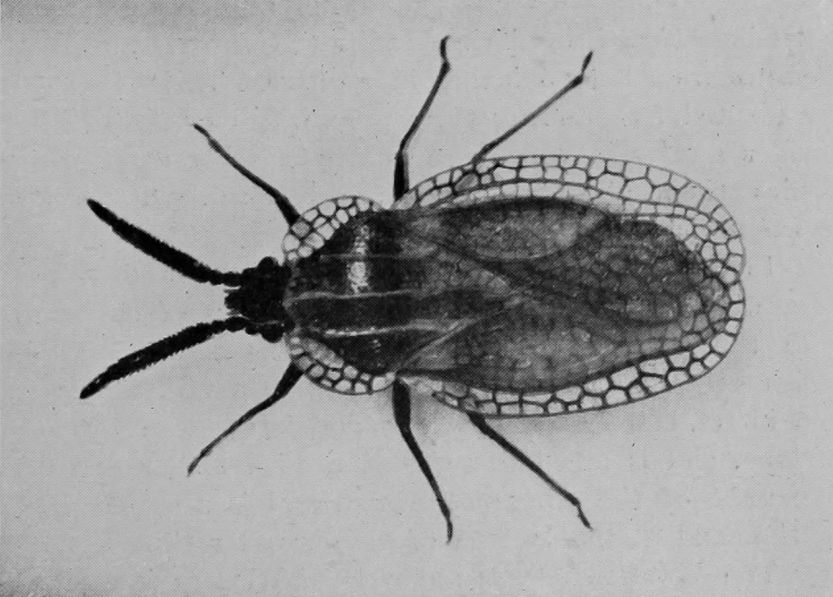
Photo by J. Edwards] [Colesborne.
LACE-WING BUG.
An elegant little insect, injurious to pear-trees.
Next to the Shield-bugs, and considered by many entomologists as belonging to the same group,
are the Pentagonal Shield-bugs, so called because the scutellum, though
much smaller than in the Shield-bugs, is often half as long as the abdomen, and forms a broad
triangle, sometimes broken at the sides, so as to make a five-sided plate, lying above the bases
of the wings. Several green or brown species of this family, about half an inch long, are common
in England among bushes. Many have a very disagreeable smell, and hence they are called Stink-bugs in America. They feed on vegetable juices, and also frequently on
soft-bodied insects. Several species (chiefly foreign) among the Shield-bugs and the
present group have a strong spine, or else a blunt protuberance, projecting from each
shoulder.
The remaining plant-bugs are much more numerous—at least in England—than those
already mentioned, and form several families, which cannot be noticed in detail. Many species are
rather small and delicate creatures, narrower and softer than the Shield-bugs and Pentagonal
Shield-bugs, and are adorned with various colours, black and red predominating. Some have more
transparent wings than the others, such as the beautiful little Lace-winged
Bugs, one species of which is often very destructive to pear-trees.
The Bed-bug is a reddish-brown, somewhat oval insect, common in many
old houses, hiding in cracks and crevices in walls and woodwork, and coming out at night to suck
the blood of sleepers with its sharp proboscis. There are allied species, sometimes found in
hen-houses, pigeon-houses, and places where bats congregate. The bed-bug has only been known in
England for a few centuries, and though now a great pest in all parts of the world, was probably a
native of Africa originally.
The bed-bug, notwithstanding its offensive odour, is preyed upon by several other insects,
among which are the common cockroach and the Masked Bug. The latter is a
black-winged bug about three-quarters of an inch long, and remarkable for the habits of its larva,
which conceals itself with dust or fluff, so that it may steal upon its prey unobserved. The
masked bug and its larva feed on soft-bodied insects of various kinds, and are more frequently
found in outhouses than in dwelling-rooms. This bug occasionally attacks warm-blooded animals; and
a short time ago a great deal of nonsense was published in the newspapers about a mysterious
insect-pest in North America, called the Kissing-bug, which seems to have
been nothing more unusual than this insect. There are, however, some much larger species belonging
to the same family, which are formidable pests in the Southern States of North America, Chili, and
various other countries.
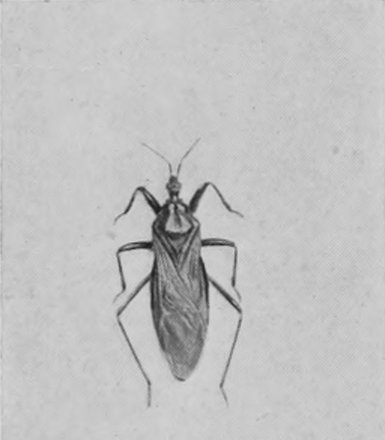
Photo by P. Danado, F.Z.S., Regent's Park.
MASKED BUG.
The larvæ of these insects cover themselves with
dust, in order to creep upon their prey unnoticed.
After these insects come the Water-bugs, of which there are several
families, though the number of species is comparatively small. Some are very slender insects, with
long, slender legs, and may be seen running on the surface of ponds in England; while others,
which are tropical species, are marine, and are met with running on the surface of the water in
the open sea.
The largest members of the group are some of the great water-bugs found in Africa, India, and
America. Their fore wings are of a light brown, and measure from 3 to 5 inches in expanse. Their
legs are short and strong, and the front legs are adapted for grasping their prey, which consists
of insects and small fishes. There are some smaller species in which the female lays her eggs in a
cluster on the back of the male, which carries them about till they are hatched. These bugs fly
about in the evening, and are frequently attracted by electric light.
In England there are two allied species called Water-scorpions, from
their long front legs, which somewhat resemble the nippers of a scorpion. The commonest is a brown
insect, with the abdomen red beneath. It is about an inch long, including the breathing-tube,
which sticks out behind the body like a tail, and is formed of two separable parts. It is an oval
insect, half as broad as long, and is common in stagnant water. The other species is twice as
long, and is much more slender, with longer and more slender legs. It is yellowish brown, like
most of the other water-bugs, and is a sluggish and rather scarce insect, creeping about in the
mud at the bottom of deeper water than that preferred by the commoner species.
The Water-boatmen are yellowish-brown insects, measuring half an inch
in length, with smooth bodies, and long, hairy hind legs, with which they row themselves about on
the water, as if with oars, while floating on their backs. All the larger water-bugs are capable
of inflicting a severe puncture with their sharp proboscis, if handled incautiously.
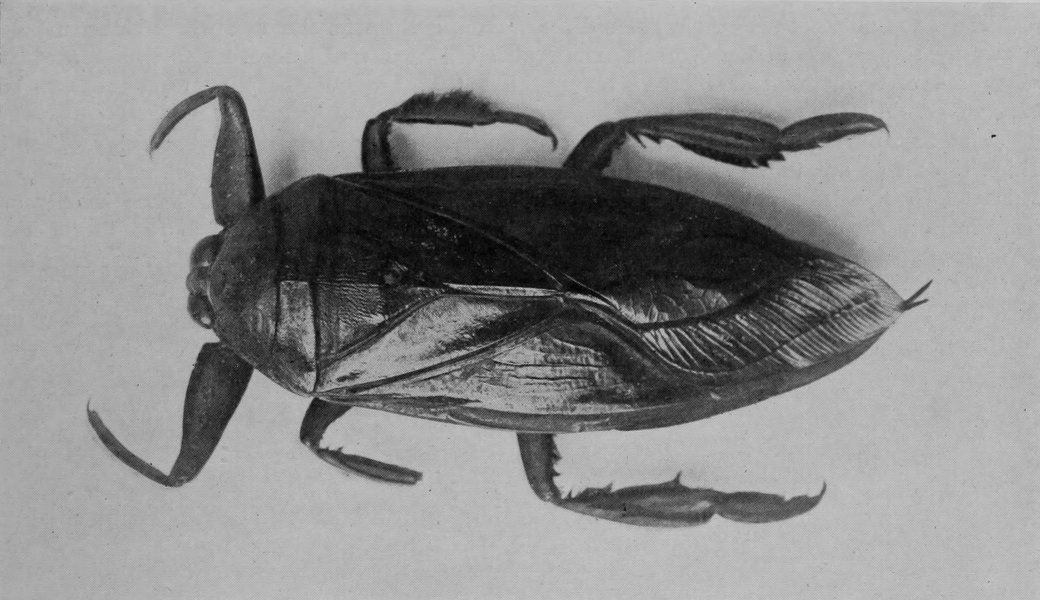
Photo by W. P. Dando, F.Z.S.] [Regent's Park.
GREAT WATER-BUG.
Very similar species are found in Africa, Asia, and America.
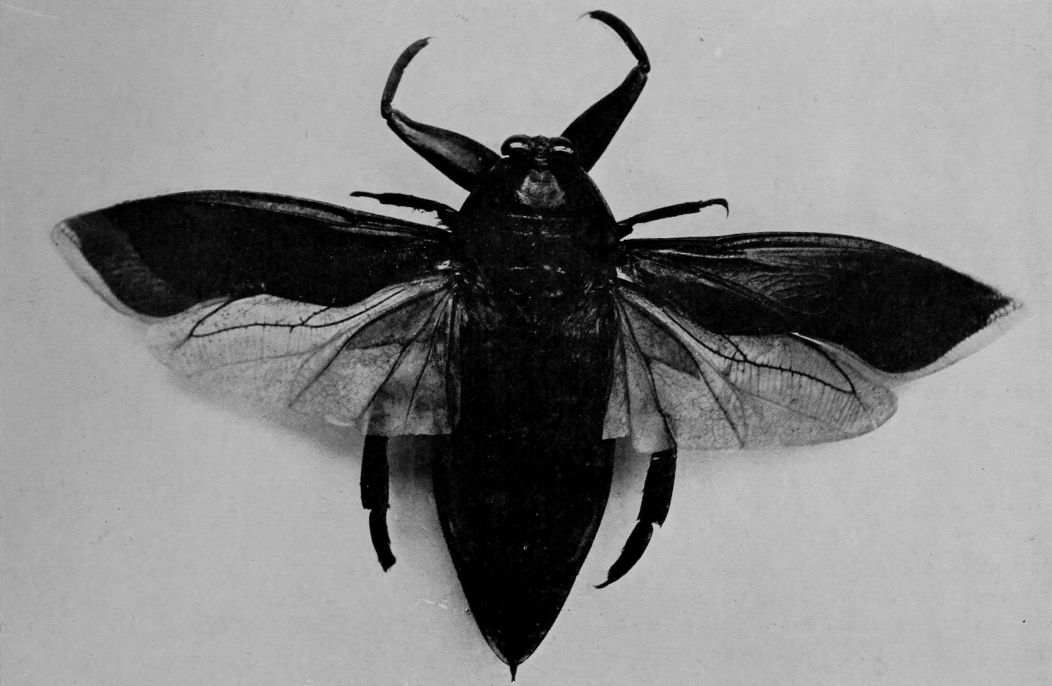
Photo by W. P. Dando, F.Z.S.] [Regent's Park.
GREAT WATER-BUG.
These insects live in water during the day, and fly about in the evening.
The Frog-hoppers and their allies differ from the Bugs in the fore
wings being uniform in texture throughout, and not membranous, with the tips transparent.
Sometimes the fore wings are of a more or less horny texture, but they are frequently as
transparent as the hind wings. All the species are plant-feeding insects.
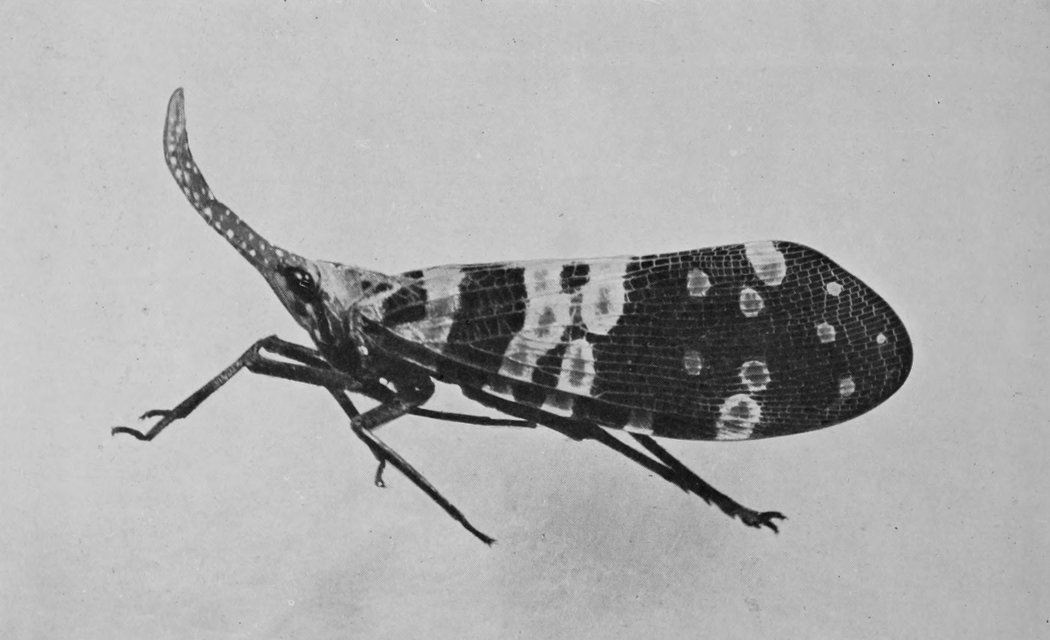
Photo by J. Edwards] [Colesborne.
INDIAN CANDLE-FLY.
Erroneously stated to be luminous.
The first family, the Cicadas, includes a number of large or
moderate-sized species, in which the males are provided with a large, drum-like apparatus on the
abdomen, and some of which make the loud noise for which they have long been celebrated. There is
only one comparatively small species in England, which is rare, and almost confined to the New
Forest. It is black, with transparent wings, about 1½ inch in expanse, and has red transverse
lines on the abdomen. The largest Indian species, however, sometimes expands 8 inches. Cicadas
have broad heads, broad short bodies, ending rather abruptly in a point, and their larvæ live in
the ground, where they are sometimes injurious to the roots of trees. The wings are usually, but
not always, transparent—a very common Indian and Chinese species, about 3 inches in expanse,
being black, with large yellow spots on the fore wings. In North America and Australia cicadas are
often miscalled Locusts.
The Lantern-flies, or Candle-flies, which form
the next family, derive their name from having been stated to be luminous, a statement which is
now considered very doubtful. They are insects of considerable size and bright colours,
occasionally resembling butterflies and moths; the largest species, the Lantern-fly of South America, sometimes measures as much as 5 inches across the
wings, which are of a pale yellowish or greenish tint, with a large round spot on the hind wings,
formed of black rings or crescents, and enclosing one or two large white spots. On the head is an
immense hollow, blunt protuberance, marked with one or two longitudinal red lines. In some species
there is a curved horn in front of the head; in some the horn forms a short cross; in others it
ends in a red knob; while others are destitute of such an appendage. The hind wings are often
brightly coloured, red or yellow usually predominating.
The True Frog-hoppers are small insects about a quarter of an inch
long, found among grass and bushes. The fore wings are of rather a stout consistency and uniform
in colour (often yellowish), and the hind wings transparent. The larvæ are soft grubs, and live in
the masses of froth so common in grass and bushes, which are vulgarly known as "cuckoo-spit."
Passing over several families of small species, we arrive at two which contain many very
destructive insects. The Aphides, Plant-lice, or
Smother-flies are the small green or brown winged or wingless insects
which frequently cover the shoots of roses and other trees and plants, and exude a sweet sticky
substance, called "honey-dew," very attractive to ants. One species, known as the American Blight, is extremely destructive to apple-trees, patches of a substance
resembling white cotton appearing on the bark. Under these patches the bark rots from the attacks
of the insects, the pest being very difficult to eradicate.
Photo by W. P. Dando, F.Z.S., Regent's Park.
APHIS.
A sexual wingless form.
Photo by W. P. Dando, F.Z.S., Regent's Park.
SCALE-INSECT.
The females die, covering their eggs with their own bodies.
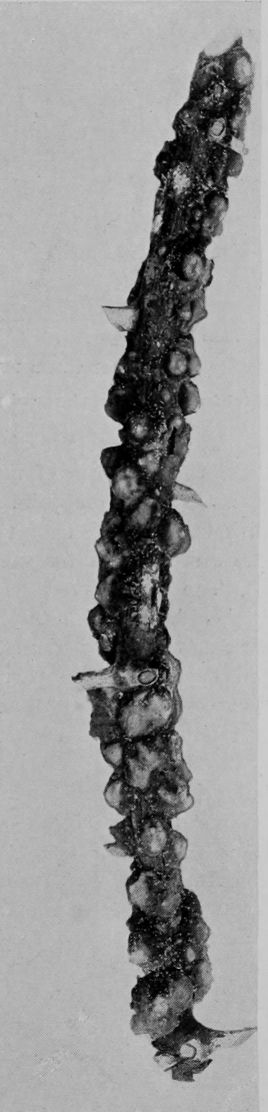
Photo by W. P. Dando, F.Z.S., Regent's Park.
SCALE-INSECTS.
Showing their appearance when crowded together on a branch.
Many of the Aphides exhibit the curious phenomenon known as "alternation of generations." The
first brood consists of winged males and females; but the eggs which the latter lay produce
exclusively wingless females, or rather sexless creatures capable of laying eggs, and these
multiply indefinitely for a time, till perfect males and females are again reproduced. In some
cases the winged forms live on the leaves of trees, and the wingless forms at the roots of grass,
etc. One of the most destructive of all these insects is the Vine-aphis,
which was probably introduced into Europe from America, and which threatened at one time almost to
destroy the vine industry in France. Wingless sexless forms live and multiply at the roots of
vines; and in summer winged males and females are produced, which fly up, and lay eggs on the
leaves; while some of the wingless insects also quit the ground, and form small galls on the
vine-leaves. Although very abundant in America, the insect is not nearly so destructive to the
plants which it attacks as in Europe.
Some species of Scale-insects are almost equally destructive,
especially to greenhouse plants. The male is slender and two-winged, but the female is wingless
and often legless, and after depositing her eggs usually dies above them, thus forming a covering
to protect them from injury. Cochineal consists of the bodies of a species of scale-insect which
infests the leaves of a cactus in Mexico.
The True Lice are found on various species of mammals, and
imbibe their food through a proboscis. The Bird-lice, or Biting-lice, form a well-defined group by themselves. They are sometimes
regarded as forming distinct orders of insects; but some authors treat the first group as a
degraded family of insects allied to the Frog-hoppers, and the second group as an equally degraded
and aberrant family allied to the Lace-winged Insects.
TWO-WINGED INSECTS, OR FLIES.
BY W. F. KIRBY, F.L.S.
This order of insects is probably one of the most numerous in individuals, though it may be
that, when we know more of the insect population of the world, we shall find that it is
outnumbered in species by the Beetles or the order to which the Bees and Ants belong. It differs
from all other orders in possessing only two wings instead of four, which is the usual number in
insects. The metamorphoses are complete, and the mouth is furnished with a proboscis for imbibing
liquid food. Hind wings are represented in many species by a pair of organs called "poisers,"
resembling a knob at the end of a stick, and other species have two small additional lobes
attached to the wing, called "winglets "; but there is no such thing as a really developed hind
wing in any insect belonging to the group. They are always two-winged flies, except in the case of
a few aberrant species, such as the Fleas, in which no wings, or only mere rudiments of wings, are
to be met with. The Gnats, Daddy-long-legs, and House-flies are among the commonest
representatives of this order.
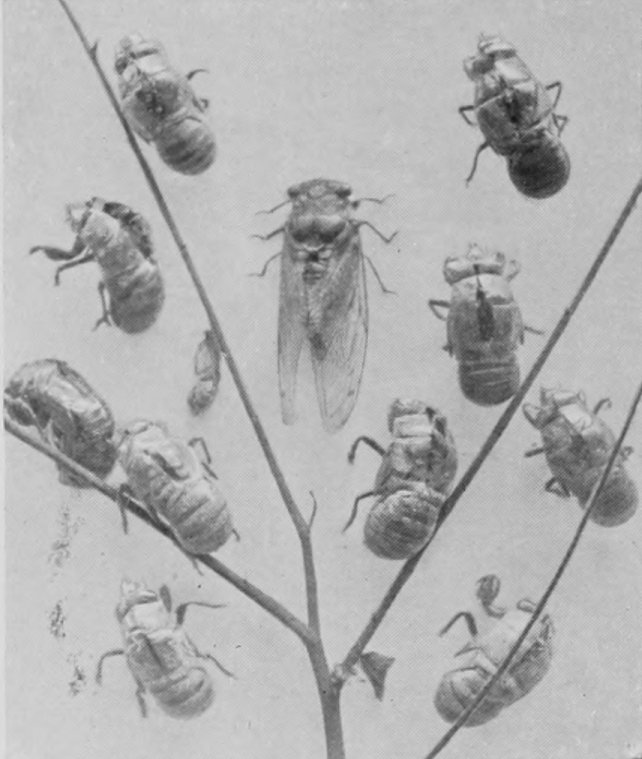
Photo by C. N. Mavroyeni] [Smyrna.
CICADA AND PUPÆ.
Noted for the loud drumming sound produced by the males.
The first section of the group includes the Gnats and the Daddy-long-legs, or Crane-Flies, the members of which
may be distinguished by having moderately long antennæ, composed of more than six joints, and
never terminating in a bristle. They are all vegetable-feeders, with the exception of the females
of gnats and sand-flies, which are furnished with a lancet-like arrangement for sucking the blood
of warm-blooded animals.
The Gall-flies, Wheat-midges, etc., have rather
long, jointed antennæ, which are not feathered, though sometimes tufted on the sides, and their
maggots produce small galls on various trees and plants, or distort and otherwise injure them.
They resemble small gnats, and there are two particularly destructive species which attack corn in
England and elsewhere,—the Wheat-midge, an orange-yellow fly with
black eyes, which produces little yellowish or reddish maggots which injure the growing grain in
the ear; and the Hessian Fly, which is brown, and produces
semi-transparent maggots, which afterwards grow darker, and when full grown become pupæ resembling
flax-seeds. The maggots attack the stalk, feeding on the sap till the stalk cracks and bends over.
This is an infallible sign of their presence, and of the mischief they are doing.
Among the best-known insects of this group are the Gnats, or Mosquitoes, of which there are many genera and species. There is no difference,
however, to permit of their being classified in two separate popular categories. In England any of
these troublesome insects are called Gnats; out of England they are termed Mosquitoes, if we are
tormented by them, even though they may belong to the same species as the English ones—for
"mosquito" is merely the Spanish word for "gnat" Anglicised.
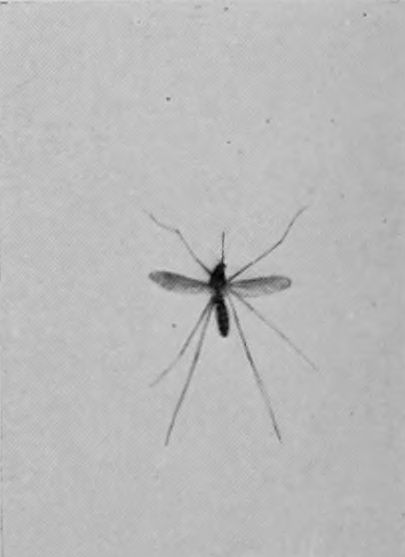
BROWN MOSQUITO.
Observe the proboscis in front of the head.
Gnats breed in standing water, fresh or otherwise, but seem to prefer rain-water, for they are
very numerous about small pools and water-butts. Consequently they were formerly far more abundant
in England than at present, when the fens were still undrained, and when every house had its rain-water butt. The
females of some species construct small rafts of eggs, which float about on the surface of the
water till hatched, and then produce small maggots with a breathing-apparatus at the end of the
tail. In this condition they swim head-downwards, while the more compact pupa floats head-upwards.
They may be destroyed by pouring a little kerosene into their breeding-places; and as this floats
on the surface of the water, it does not interfere with the use of the water in water-butts, which
is usually drawn off by a tap below. The males of gnats often have feathered antennæ and long,
slender legs. The females, however, are more nocturnal in their habits, and come into houses in
the evening, and keep people awake by their humming and painful "bites," or rather punctures,
which frequently cause a distressing irritation for a day or two afterwards. What is worse is that
they are now known to disseminate various diseases, such as elephantiasis and also malarial fever
of every kind, in this manner—from the comparatively mild ague of the English fens (now
nearly extinct) to the terrible malaria of Southern Europe, India, and Africa, formerly attributed
to the unhealthy atmosphere of marshy countries, or to exposure to the night air in warm
countries, but now known to be caused by the bites of the gnats, or mosquitoes, which breed in
swampy places, and fly about in the evening. It is believed that only certain species of gnats
convey the germs of these diseases; and it has been stated that, though ague-bearing species of
gnats are still found in England, those which have been examined for the purpose have been free
from these germs, and are therefore incapable of propagating the disease.
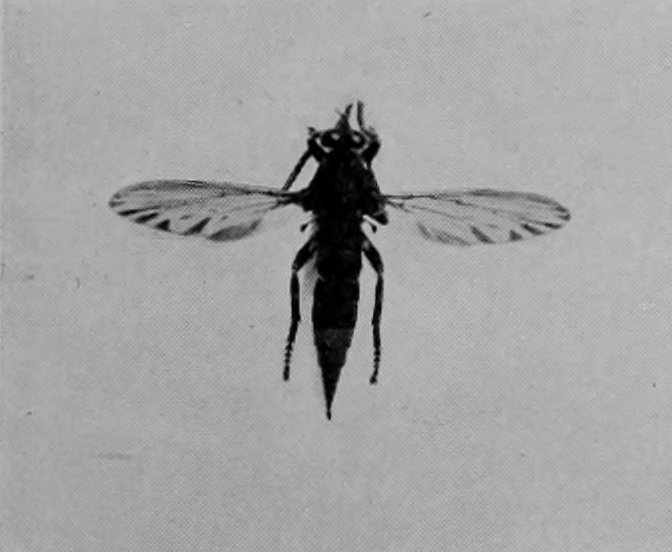
Photo by W. P. Dando, F.Z.S., Regent's Park.
HORNET ROBBER-FLY.
Common in the south of England.
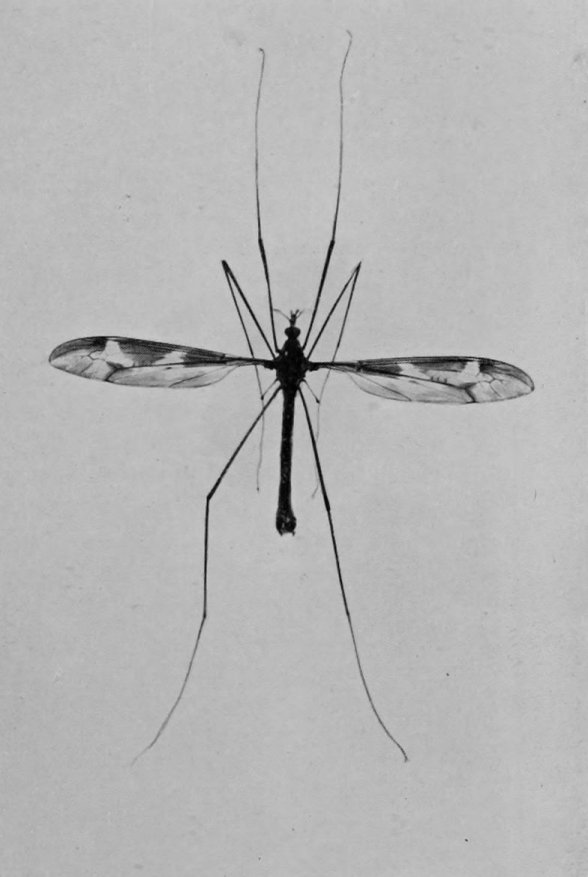
Photo by W. P. Dando, F Z.S.] [Regent's Park.
DADDY-LONG-LEGS.
Large species, with variegated wings.
In many parts of the world gnats are excessively numerous and troublesome at certain seasons of
the year, filling the air like clouds of dust, so that it is difficult to sleep or eat from the
annoyance and irritation caused by their attacks. This will be readily credible to those who have
experienced the pain which they cause even when not very numerous, and have been kept awake at
night by their shrill piping as they approach. They appear to be equally numerous in cold and warm
countries—Lapland, France, South Russia, Italy, various parts of America, and in fact most
parts of the world being liable to the inordinate multiplication of different species.
In England they were formerly so abundant in the fenlands that mosquito-curtains were in use
less than a century ago, and may be so still. But their numbers have so diminished of late years
that, whenever gnats are a little more troublesome than usual, it is reported that there has been
an invasion of mosquitoes. A year or two ago there was a report that "mosquitoes" had been brought
to Cromer in some fishing-vessel, and the newspapers contained paragraphs about "mosquitoes"
having caused much annoyance in different parts of London. But many of the specimens submitted to
the inspection of entomologists proved to be nothing more than the commonest of all the
blood-sucking gnats, called the Piping-Gnat by Linnæus, on account of its
shrill note. The note is produced by the rapid vibration of the wings, which has been estimated at
the rate of 3,000 per minute. Gnats do not always fly near the ground. Sometimes they have been
seen ascending from cathedrals and other high buildings in such vast swarms that they resembled
clouds of smoke, and gave rise to the idea that the building was actually on fire.
Equally troublesome and annoying are the Sand-Flies, as they are called
in England, or the Black-Flies, as they are called in America. They are
very small flies, short and broad, and with broader wings than gnats; and one of them, which
actually destroys many mules and other domestic animals in the Mississippi Valley, as we learn
from Professor Comstock, is called the Buffalo-Gnat, from a fancied
resemblance of the side-view of the insect to a buffalo. Other species are equally destructive to
the cattle in the Banat of Hungary. It is a curious circumstance that, in the case of nearly all
two-winged flies which attack men and animals, it is usually only the females which suck blood,
the males frequenting flowers and being perfectly harmless.
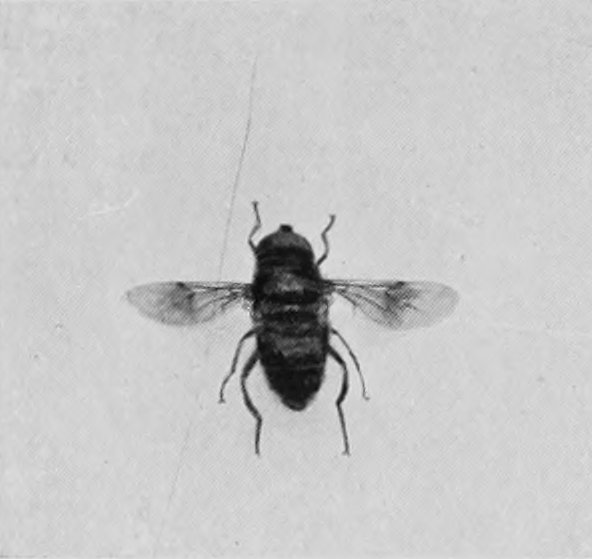
Photos by W. P. Dando, F.Z.S.
HOVER-FLY.
This fly has a superficial resemblance to a bee. (See page 734.)
[Regent's Park.
RAT-TAILED LARVA.
Common in filthy water.
Respecting mosquitoes in South America, Mr. H. W. Bates writes, in his work "The Naturalist on
the Amazons," when passing a night in a boat about twenty-five miles from the town of Villa Nova:
"At night it was quite impossible to sleep for mosquitoes; they fell upon us by myriads, and
without much piping came straight at our faces as thick as rain-drops in a shower. The men crowded
into the cabins, and then tried to expel the pests by the smoke from burnt rags; but it was of
little avail, although we were half suffocated during the operation." But the sand-flies,
encountered a little higher up the river, were much worse: "We made acquaintance on this coast
with a new insect-pest, the Piúm, a minute fly, two-thirds of a line in length, which here
commences its reign, and continues henceforward as a terrible scourge along the upper river, or
Solimoens, to the end of the navigation on the Amazons. It comes forth only by day, relieving the
mosquito at sunrise with the greatest punctuality, and occurs only near the muddy shores of the
stream, not one ever being found in the shade of the forest. In places where it is abundant, it
accompanies canoes in such dense swarms as to resemble thin clouds of smoke. It made its
appearance in this way the first day after we crossed the river. Before I was aware of the
presence of flies, I felt a slight itching on my neck, wrist, and ankles, and, on looking for the
cause, saw a number of tiny objects, having a disgusting resemblance to lice, adhering to the
skin. This was my first introduction to the much-talked-of Piúm. On close examination, they are
seen to be small two-winged insects, with dark-coloured body and pale legs and wings, the latter
closed lengthwise over the back. They alight imperceptibly, and, squatting close, fall at once to
work, stretching forward their tiny front legs, which are in constant motion, and seem to act as
feelers, and then applying their short, broad snouts to the skin. Their abdomens soon become
distended and red with blood, and then, their thirst satisfied, they soon move off, sometimes so
stupefied with their potations that they can scarcely fly. No pain is felt whilst they are at
work, but they each leave a small circular raised spot on the skin, and a disagreeable irritation.
The latter may be avoided in great measure by pressing out the blood which remains in the spot; but this is
a troublesome task when one has several hundred punctures in the course of a day [like Prince
Siror, in one of Bulwer Lytton's stories, who fell "pierced by five hundred spears"]. I took the
trouble to dissect specimens, to ascertain the way in which the little pests operate. The mouth
consists of a pair of thick fleshy lips, and two triangular horny lancets, answering to the upper
lip and tongue of other insects. This is applied closely to the skin, a puncture is made with the
lancets, and the blood then sucked through between these into the œsophagus, the circular
spot which results coinciding with the shape of the lips. In the course of a few days the red
spots dry up, and the skin in time becomes blackened with the endless number of discoloured
punctures that are crowded together. The irritation they produce is more acutely felt by some
persons than others. I once travelled with a middle-aged Portuguese who was laid up for three
weeks from the attacks of Piúm, his legs being swelled to an enormous size, and the punctures
aggravated into spreading sores."
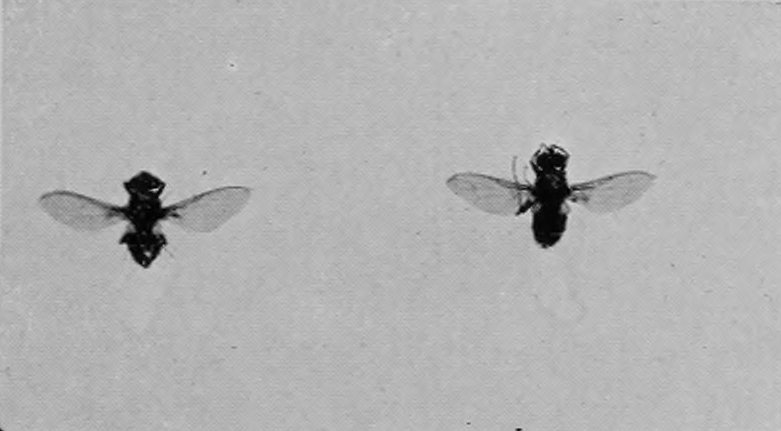
Photo by by W. P. Dando, F.Z.S., Regent's Park.
HOUSE-FLY (MALE AND FEMALE).
The larvæ of the house-fly live in refuse, so do not thrive where cleanliness
abounds.
However, the traveller in Amazonia has one consolation: the great rivers which traverse the
forests are of three different colours; and the black-water rivers—so called from the dark
colour of the water, owing apparently to the amount of vegetable matter which they hold in
solution—are never infested with mosquitoes. Probably the character of the water renders it
unsuitable to them for breeding purposes.
The Crane-flies, or Daddy-long-legs, are also
very injurious insects, but in a different manner, for their subterranean maggots feed on and
destroy the roots of grass in the same way as the grubs of the Cockchafers. They are insects of
considerable size, with slender bodies, terminating in a short, horny point (the ovipositor) in
the female, and with long, slender legs, which are liable to break off at the least touch. The
commonest species has a grey body and transparent wings; but there is a larger one with the wings
prettily variegated with brown, and a smaller one in which there are yellow markings towards the
end of the body.
The more typical Flies have usually shorter and broader wings, and
thicker, shorter, and more hairy legs, than those just mentioned; and the antennæ have usually
only three or four joints, and are often furnished with a long, slender bristle at or before the
end of the last joint.
As in the case of the Gnats and Crane-Flies, so as regards the more typical Flies, we have only
space to notice a few of the more important families.
Some of the Gad-flies are no larger than house-flies, but others are as
large as wasps or larger, with broader wings, and of a black, grey, or yellowish colour; they
frequent fields, and settle on cattle, or on our clothes or hands. Some have transparent and
others dark-coloured wings, but they are all capable of inflicting a severe puncture, often
sufficient to draw blood, even in the case of the smaller species.
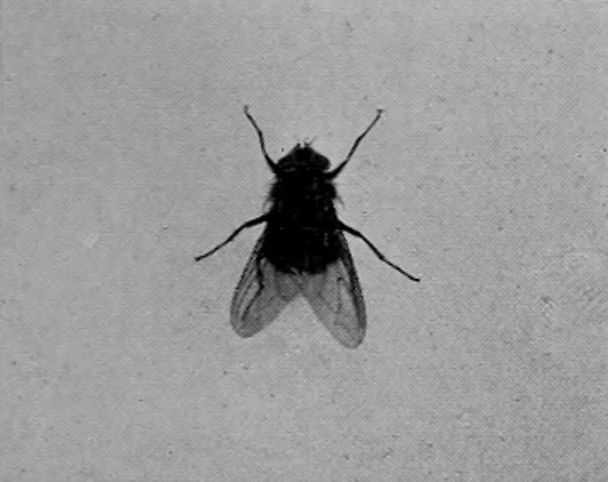
Photo by W. P. Dando, F.Z.S., Regent's Park.
BLUE-BOTTLE FLY, OR BLOW-FLY.
These flies deposit their eggs on meat, when it becomes "fly-blown."
The prettiest of the gad-flies are the Golden-eyed Flies. They are
black, with the abdomen more or less marked with yellow; and black, or black and transparent,
wings. The eyes are of a beautiful golden green, dotted and lined with purple. They are moderately
stout insects, about the third of an inch long, and are not uncommon. Another insect, known as the
Blood-sucking Rain-fly, has a rather long and slender body for a gad-fly,
and is nearly half an inch long. It is of a lighter or darker grey, with reddish markings on the
sides of the abdomen in the male. The wings are greyish brown with whitish dots, and a white mark
towards the tip. Both these flies are very troublesome, the latter chiefly on the edges of woods
or near water, especially in rainy weather.
The Robber-flies are large flies, with long, tapering bodies, of a
black or partly yellow colour, and feed on smaller flies and other insects of different kinds.
They have very thick, hairy and a strong proboscis. A handsome Australian species, allied to
these, but with a broader body, is represented in the Coloured Plate.
The Hornet Robber-fly, represented on page 731,
is one of the most conspicuous of the British species. Among other places, it may be seen flying
over the short grass at the top of the cliffs between Brighton and Rottingdean. They are very
predaceous, and are probably rather beneficial than otherwise, by contributing to keep down
injurious insects. But in North America there is a species called the Bee-killer, which is an extremely destructive insect, taking up its station in
front of a hive, and killing large numbers of bees as they fly backwards and forwards from the
hive.
The Hover-flies are brightly coloured, rather smooth flies, and are
familiar objects in gardens, and in open places in woods. They have the habit of hovering
motionless in the air, and then darting off suddenly. Some of the larger species proceed from
curious maggots, with long tails, which have been compared to the tail of a rat. These live in
putrid water; and as the flies have a slight resemblance to bees, the fact is believed to have
given rise to the old fable that bees are generated from the rotting carcases of oxen or other
large animals.
The Bot-flies are remarkable for being parasitic on warm-blooded
animals, their maggots living in tumours on the skin of oxen, known as "warbles," or in the
stomach and intestines of horses, or in the nostrils and other cavities in the heads of sheep or
deer.
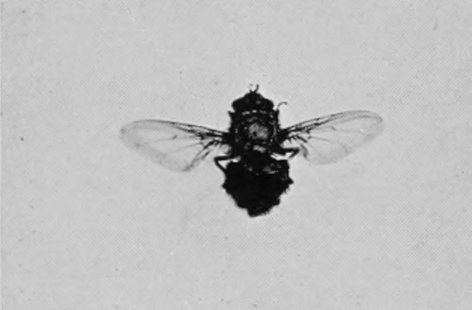
Photo by W. P, Dando, F.Z.S., Regent's Park.
BLUE-BOTTLE FLY, OR BLOW-FLY.
This photograph shows the wings expanded.
The House-flies and their allies form a very large group, divided into
many families. The true house-fly is an autumn insect; but there are other flies which resemble it
which live in houses at different times of the year. Most of them are harmless, although there is
one species, very like a house-fly, which comes into houses in rainy weather, and inflicts a
puncture like a gad-fly. This is the meaning of the popular saying that "the flies bite in rainy
weather."
Although house-flies do not bite, yet they are sometimes exceedingly troublesome when they are
in unusual numbers; and as they settle everywhere, they may convey infection mechanically, though
not as the principal agents in the dissemination of definite diseases, like the mosquitoes. Thus,
in Egypt, they are said frequently to convey ophthalmia, a very prevalent disease in that
country.
The very first paper published in the "Transactions of the present Entomological Society of
London" (for the existing Society had several short-lived predecessors) was a paper read by
William Spence at the meeting on April 7, 1834, about a year after the Society had been definitely
founded, entitled "Observations on a Mode practised in Italy of excluding the Common House-fly
from Apartments." This desirable result is attained simply by stretching a net of white or
coloured thread, with meshes of an inch or more in diameter, across an open window, which the
flies will not venture to pass, if the room is lighted from one side only—"for if there be a
thorough light either from an opposite or side window, the flies pass through the net
without scruple." Mr. Spence's son also referred to a passage in Herodotus where he says that
Egyptian fishermen in his time defended themselves from the gnats by covering their beds with the
nets which they had used in the day for fishing, and through which these insects, though they bit
through linen or woollen, did not even attempt to bite. The matter seems to have been overlooked
in recent years, though it is evidently well worthy of consideration when flies or gnats are
troublesome.
There is a conspicuous insect allied to the house-flies, but a little larger, measuring about
half an inch in length. It is called the Noon-day Fly, and is often seen
in considerable numbers, in the hottest part of the day, flying round and settling on the trunks
and leaves of trees; it also settles on cow-dung. It is a shining black fly, with the sides and
under surface of the
head golden yellow in the male; the wings are transparent, slightly tinged with pale brown, and
bright rusty yellow towards the base.
The African Tsetse-fly is not very unlike a house-fly, and is one of
the worst pests to cattle in those parts of Africa which it infests; for any horse, ox, or dog
attacked by it will infallibly die after a longer or shorter period of suffering, though wild
animals and sucking calves are not affected by it. It used to be supposed that the fly itself
infused some deadly venom with its puncture; but later experiments have led naturalists to the
conclusion that the fly is not itself poisonous, but that it forms the channel of communication of
some fatal disease, just as some species of mosquitoes convey the infection of malaria.
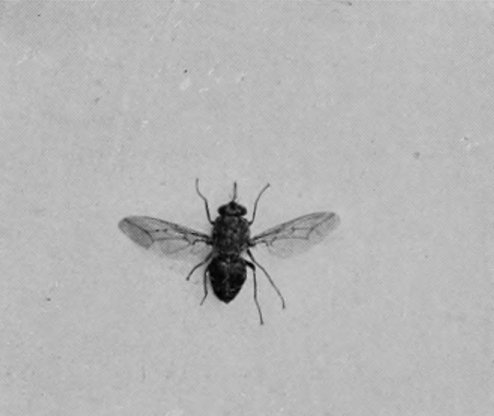
Photo by W. P. Dando, F.Z.S., Regent's Park.
TSETSE-FLY.
Destructive to horses and cattle in Africa.
The Blow-flies, or Blue-bottles, of which there
are several species closely allied to each other, are common in houses; and a smaller brilliant
green fly, called the Green-bottle Fly, is common on hedges. These are all
flies which lay their eggs on fresh or putrid meat, when it is said to be "fly-blown." They will
also lay their eggs in open sores; and in former days the sufferings of the wounded after a battle
were often frightfully aggravated by this cause; and at the present day farmers would frequently
lose sheep through their attacks, if they were not carefully tended in hot weather.
Various species of flies in Eastern Europe, the Southern States of America, Jamaica, etc.,
habitually lay their eggs in the mouths or nostrils of men and animals, and the resulting maggots
cause dreadful suffering and often death. In India, and especially in the Eastern Archipelago,
there are some brilliantly coloured, smooth, metallic blue and green flies as big as bumble-bees.
There is also a family of flies allied to the house-fly, which have very bristly bodies, and are
parasitic on caterpillars, like ichneumon-flies.
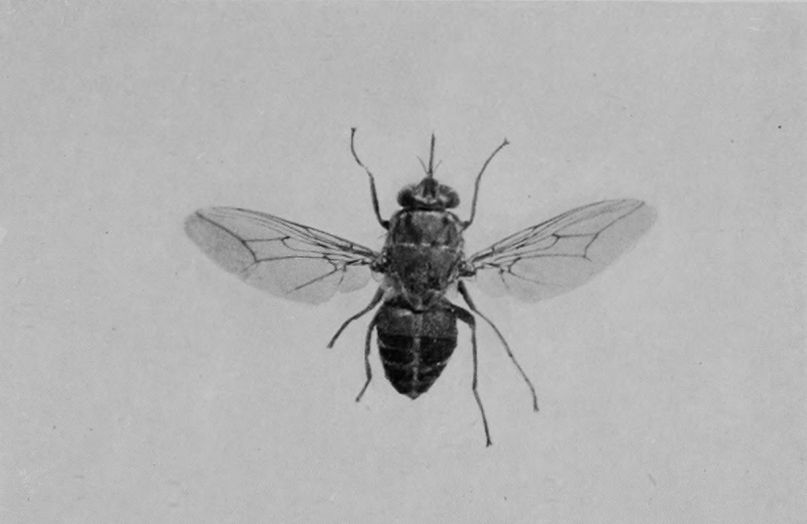
Photo by W. P. Dando F.Z.S.] [Regent's Park.
TSETSE-FLY (ENLARGED).
Showing the proboscis and veining of the wings more distinctly.
There are other flies which easily attract attention, such as the yellow hairy fly found about
cow-dung, and some rather small species with prettily variegated wings, which feed on flowers or
fruit. The cheese-hoppers are also the maggots of a small black fly.
Besides these, there are some aberrant parasitic families of flies with long, hairy legs, and
only one or two joints to the antennæ. These are the Forest-flies and
Bird-flies, which attack horses and birds; and also some wingless insects,
such as the so-called Sheep-tick (easily distinguished from a true tick by
possessing only six legs), the Bee-parasites, and the spider-like Bat-parasites. This parasitic group is also remarkable for depositing full-grown
larvæ or pupæ instead of eggs.
The Fleas are a small group of small wingless insects, with such powers
of leaping that it has been said that if a man was as agile as a flea he could jump over the dome
of St. Paul's. The larvæ of fleas are small, worm-like creatures, with bristles, but without legs;
they probably live on any sort of animal or vegetable refuse. They subsequently change to pupæ in
small cocoons, and emerge as perfect fleas, which live by sucking the blood of warm-blooded animals; or, when that fails
them, they may attack caterpillars, or other small soft-bodied creatures. Though not very
particular about their food, different species are more or less attached to different animals; and
while in Europe the most troublesome species is the one considered to be most particularly
attached to man, the species most troublesome in North America is known in Europe as the Dog-flea. They are all very similar in habits and appearance. Fleas are not only
annoying, but, in conjunction with rats, are believed to be among the principal agents in the
spread of the plague. There is another insect called the Jigger, or Sand-flea, common in most of the warmer parts of America, and which has more
recently been introduced into Africa. The female burrows into the feet of men or animals, where
her body swells up with eggs to the size of a pea; and serious and sometimes fatal ulcers are the
ordinary result, unless the insect is carefully extracted at an early stage of the attack.
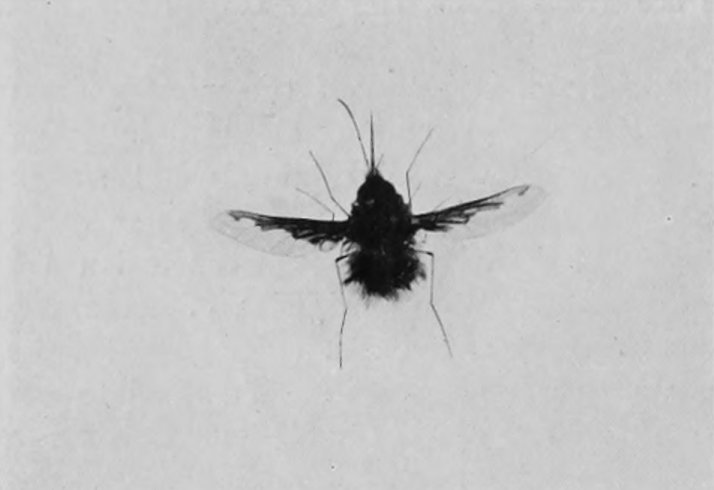
Photo by W. P. Dando, F.Z.S.] [Regent's Park.
BEE-FLY.
Similar to the fly which destroys the locust eggs in Cyprus.
Uses of Flies.
It must not be supposed from the foregoing observations that flies are simply and solely pests
to man and beast, without any redeeming qualities. Their services are less required in cold and
settled countries, but in warm climates their value as scavengers can hardly be over-estimated. As
regards the removal of carrion alone, Linnæus declared that the progeny of only three blow-flies
would devour the carcase of a dead horse as quickly as a lion—a statement which, even if
slightly exaggerated, conveys a vivid idea of their voracity and the rate at which they
increase.
Flies are also useful in keeping down the multitudes of destructive insects. Numbers of
caterpillars fall victims to the bristly flies alluded to on the last page; and the Bee-flies,
which form a family placed next to the Gad-flies, render far greater service in destroying
locusts. They much resemble small bumble-bees, being very much the same shape, and they are
clothed with yellow down in the British species, and the transparent wings are conspicuously
marked with black bands (as in the photograph above), or with brown shading and spots. The insects
have a very rapid flight, and use their long proboscis to suck the honey of flowers; but their
grubs are parasitic—at least in some instances—on wild bees; and it is probable that
their resemblance to bees has some reference to this mode of life. But in Cyprus, Algeria, North
America, etc., the larvæ of allied species feed inside the egg-cases of locusts, sometimes
destroying as large a proportion as four-fifths of the whole brood. Locusts have many enemies, but
it will easily be seen that the attacks of foes like these must reduce their numbers considerably,
notwithstanding the swarms which frequently survive, and which are liable to the attacks of other
enemies, such as robber-flies, locust-birds, etc., after they have actually arrived at
maturity.
Nor must we omit to notice the use of flies as articles of food for man or useful animals. Many
persons are very fond of cheese-hoppers, which are really the maggots of a small fly; and we read
in Kirby's "Textbook of Entomology," page 92: "The Rev. A. E. Eaton informs me that he believes
that two species of Ephemeridæ (May-flies) form a portion of the so-called 'Kungu Cake,'
manufactured by the natives of South Africa of gnats, and probably any other insects which can be
obtained in sufficient abundance." "Gentles," which are the maggots of flies, are used by anglers
for ground-bait.
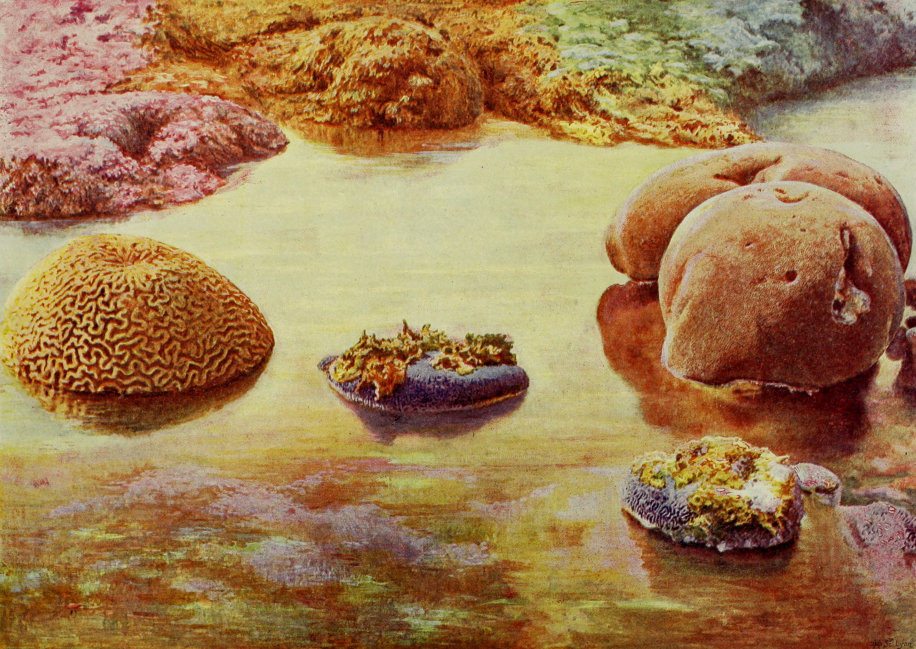
Photo by W. Saville Kent, F.Z.S. Milford-on-Sea.
PORTION OF INSHORE CORAL REEF AT THURSDAY ISLAND, TORRES STRAITS.
In the foreground are hemispherical masses of the
so-called Brain-Stone and Star-Corals. In the background the rocks are encrusted with various
species of soft-fleshed corals allied to the similar "Dead Men's Fingers" of the British
Seas.
BY W. SAVILLE-KENT, F.L.S., F.Z.S.
CHAPTER I.
SHELL-FISH, OR MOLLUSCS.
The Molluscan Group or Sub-kingdom represents one, if not the most important, of the
invertebrate sections of living animals with relation both to its numbers and variety and in its
commercial and economic utility to mankind. In its ranks are included all those animals generally
known as Shell-fish, and familiar to the non-scientific in the shape of Oysters, Mussels, Whelks,
Periwinkles, and the innumerable varieties of gorgeous or delicately tinted shells of tropical
seas.
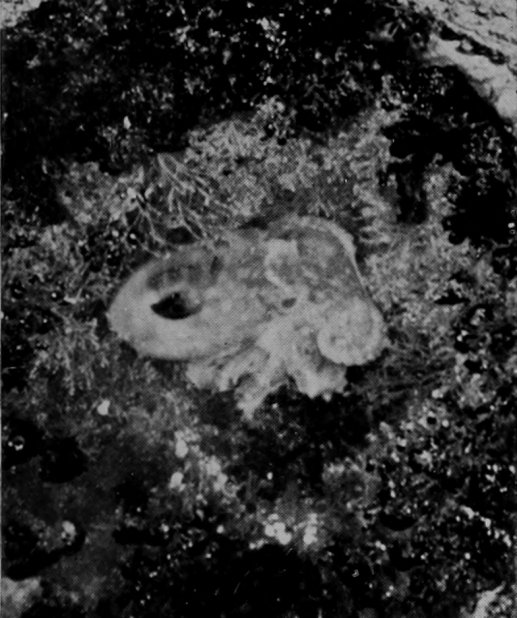
Photo by W. Saville-Kent, F.Z.S., Milford-on-Sea.
AN OCTOPUS CROUCHING IN A ROCK-POOL.
Green shore-crabs constitute the chief food of the octopus.
Collectively, Molluscs differ from all such invertebrate groups as Insects, Crustaceans, and
Worms in that they possess neither jointed limbs nor jointed bodies, their body-substance being
enclosed by a more or less distinct muscular sac, or integument, technically known as the
"mantle." Molluscs possess no internal skeleton; but for the protection of their soft and
otherwise defenceless bodies the mantle is among the great majority of species endowed with the
property of secreting a more or less indurated calcareous shell, within which, when danger
threatens, the creature can entirely withdraw. In some species the shell secreted is relatively
small, and serves only as a protective shield to especially vital areas; while in a third very
considerable assemblage a shell is altogether absent. The minute yet technically recognisable
structural differences between the shells of even the most closely allied specific forms, and the
wider and distinctly evident divergences that separate the more remotely connected varieties,
furnish the basis for their classification and nomenclature by the systematic conchologist.
Molluscan shells, being so extensively preserved in the fossil state, furnish the geologist with
invaluable data for his determination of the age and respective relationship of the fossil-bearing
strata of the earth's crust.
Photo by W. Saville-Kent, F.Z.S., Milford-on-Sea.
AN OCTOPUS ON ITS BACK AT BAY, LEFT HIGH AND DRY BY THE RETREATING TIDE.
In this attitude the octopus can use its many-suckered tentacles and its
formidable parrot-like beak as defensive weapons.
Having no jointed limbs, molluscs are dependent upon some other mechanical adaptation for their
powers of locomotion. This, in the majority of species, is represented by a modification of the
lower surface of the animal's body, which is so richly supplied with muscular tissues as to
constitute an effective creeping-base. As a locomotive organ this muscular area is usually known
as the "foot."
Photo by W. Saville-Kent, F.Z.S.] [Milford-on-Sea.
OCTOPODS.
A blue-spotted West Australian species.
Of living molluscs some 50,000 distinct species have been recorded. The great majority of these
organisms are, as is well known, marine. A very considerable number, however, are inhabitants of
fresh-water; while a yet smaller proportion, like the Slugs and Snails and their allies, are
especially adapted for a terrestrial existence. Excepting two relatively small and inconspicuous
groups, the great natural division or sub-kingdom of Molluscs is separated by systematic
zoologists into three main sections or classes. The particular modification of the locomotive
organ, or foot, serves, on the one hand, to readily distinguish the first or most highly organised
group from the second or central class; while the third or lowest one is as clearly separated from
the second and first by the character of the shell. The first and most highly developed section
includes such species as the Octopus, the Cuttle-fish, the Squid, and the several varieties of
Nautiluses; to the second or central group are referred all the marine and terrestrial Slugs and
Snails with their innumerable modifications; while the third and lowest group comprises all the
double-shelled or bivalve forms, such as Oysters and Mussels.
Photo by W. Saville-Kent, F.Z.S.] [Milford-on-Sea.
A TASMANIAN SQUID, OR CUTTLE-FISH.
Giant species of squids have been recorded in
which the shorter tentacles measured 12 feet, and the two longer ones as much as 30 or 40 feet
in length.
In the Octopus and its allies the creeping-base, or foot, is prolonged
round its margin into eight or more arm-like extensions. The anterior of these in the earlier
phases of their development grow round and enclose the mouth, which consequently opens upon the
centre of the locomotive surface. The arms of the octopus and other forms are in most instances
provided throughout their length with complex sucking-disks, wherewith their owners can seize and
retain their prey or walk with ease and celerity over the smoothest perpendicular or overhanging
rock-surfaces. The octopus, as the type of its class, possesses yet another most effective locomotive organ.
This is the so-called funnel, or siphuncle, a membranous tube connected with the capacious
gill-cavity which is formed by a folding of the mantle on the under-surface. When at rest or
moving leisurely, the water taken in through the pocket-like entrance to this cavity is discharged
through the funnel without any particular effort. The animal can, however, at will leave go its
attachment to the rocks, and propel itself swiftly through water by successive forcible expulsions
of the water through the funnel. By directing the aperture of the funnel to the right or left, the
creature can also direct its course in whatever direction it desires. When thus swimming, its
translation is necessarily backwards. Another notable feature of the octopus is the "ink-bag," a
huge gland secreting an inky-black fluid, which, as produced by the common cuttle-fish,
constitutes the sepia of commerce. The contents of the ink-bag are discharged through the funnel
at the will of the animal; as soon as the ink is brought into contact with the water, it becomes
distributed through it in the form of a thick cloud, under cover of which the mollusc makes good
its escape from any attacking enemy.
The octopus in British seas by no means attains to its maximum growth. Examples with arms from
2 to 2½ feet in length are accounted large specimens. In Mediterranean waters, however, these
dimensions are much exceeded, individuals with arms 5 feet long, which are capable of covering a
circular area no less than 10 feet in diameter with their fully extended appendages, being
frequently recorded. In the West Indies, on the North-west American coast, and also in Chinese
seas, similar, if not larger dimensions are attained by these creatures. That these monster
octopods, or "devil-fish," as they are sometimes designated, prove a source of danger to human
life has been abundantly demonstrated. Lurking, as is their custom, among rock-crevices, they
seize hold of any moving object which approaches within reach of their extended arms. Bathers in
this manner have been seized and drowned, it being impossible for even the strongest swimmer to
free himself from the clutches of one of these animals, which, while retaining a firm hold on the
rocks with a portion of its hundred-suckered arms, has entwined the others around its victim.
Photo by W. Saville-Kent, F.Z.S.] [Milford-on-Sea.
SHELL OF THE PEARLY NAUTILUS.
The inner lining of this shell is brilliantly iridescent.
The natural food of the octopus are crabs, lobsters, and their like; and in places like the
Channel Islands, where the tide retires very low, leaving the rock-fissures inhabited by the
molluscs more or less exposed, their presence may be often foretold by the accumulation of empty,
broken-up crab-shells around the entrances to their retreats. In common with other members of its
tribe, the octopus is furnished with a strong, horny, parrot-like beak, wherewith it can with ease
break through the shells of its accustomed food. The year 1900 was remarkable for the
extraordinary abundance of the octopus on the English south coast, the result of their collective
depredations very seriously affecting the local crab and lobster fisheries. The pots laid down
over-night, in place of yielding the following morning their customary quota of marketable
crustaceans, were more often than otherwise found to contain nothing but broken-up shells and a
loathsome "devil-fish."
The Squids and Cuttle-fishes, with their large
lustrous eyes, are especially adapted for an open sea life, and for this purpose are furnished
with lateral fin-like membranous expansions. A more important structural distinction is their
possession of two supplementary appendages, which, usually retracted within special pouches when not in use, can
be shot out to a length at least twice that of the eight ordinary arms. Both the cuttle-fish and
the squid, or calamary, are also the possessors of an internal calcareous or horny shell which
underlies and strengthens the upper-surface. The cuttle-bone used as a dentifrice and ink-eraser
is the product of the first-named mollusc. The Ten-armed group, as it is named, with reference to
the two supplementary arms, ten in all, possessed by its members, is notable for including species
whose dimensions not only exceed those of any other invertebrate type, but whose fully extended
length rivals that of the largest vertebrates. Giant squids, or calamaries, have been taken off
the coast of Newfoundland, yielding, with their tentacular arms extended, a linear measurement of
over 50 feet, associated with an estimated weight of as much as 1,000 lbs. There can be no doubt
that these giant squids have in many instances furnished the basis of the oft-recurrent
sea-serpent stories, more especially on those occasions where the supposed marine reptile and a
whale have been reported as seen engaged in combat. As a matter of fact the sperm-whales
habitually feed on deep-sea squids, and have been known, when mortally wounded, to vomit forth
detached portions of these gigantic molluscs. The long tentacular arms of one of these monsters,
thrown around the whale with which it had entered upon a death-struggle, might at a little
distance be easily mistaken for some huge snake-like organism.
Photo by W. Saville-Kent, F.Z.S.] [Milford-on-Sea.
SHELL OF THE ARGONAUT, OR PAPER-NAUTILUS.
The female animal only possesses a shell, and uses it as a cradle for her eggs
and young.
The various species of Nautilus, including the so-called "Paper" and
"Pearly" species, belong likewise to this group of Molluscs. In the former case, however, it is
only the female animal which secretes a shell, and this is used as a cradle wherein she deposits
her eggs and rears her young. The pretty romance of the Paper-nautilus, or
Argonaut, as it is technically termed, floating on the sun-lit waves with
spreading sails and an even keel, has unfortunately been entirely dissipated by the penetrating
search-light of modern science. The animal only floats on the surface when ill, or when torn from
its customary pasture-fields by abnormal storms, otherwise it creeps about the sea-bottom, or
disports itself in the sub-marine grottoes like an ordinary octopus, with which, in point of fact,
the shell-less male agrees in all essential details. The shell-cradle of the paper-nautilus is not
vitally connected with the body of the animal, as is that of the pearly species and all ordinary
shell-fish. It is freely detachable from the body, and during life is grasped and held closely to
it by the expanded extremities of the two lateral tentacles by which the delicate shell is mainly
secreted.
The next group comprises the great bulk of Simple-shelled Molluscs, of which it is impossible
in these pages to give more than a brief enumeration of some of the most prominent. The
Lung-breathing section, which is usually awarded the first place on the list, includes the
familiar Garden-snails, the Shell-less Slugs, the
Fresh-water Snails which come to the surface to breathe, and many distinct
terrestrial species. The largest living representative of this group is the huge Land-snail of
tropical West Africa, sometimes known as the Agate-snail, the shell of
which is not infrequently as much as 7½ inches long.
Photos by W. Saville-Kent, F.Z.S.]
LIMPETS, WHELKS, AND BARNACLES.
On the rocks at Ilfracombe when the tide was low.
[Milford-on-Sea.
SHELL BEACH, ABROLHOS ISLANDS.
Composed of iridescent top-shells.
Photos by W. Saville-Kent, F.Z.S.]
GREAT CLAM-SHELL ON CORAL-REEF.
The soft parts have been removed to show the size of the shell and the pure
whiteness of the interior.
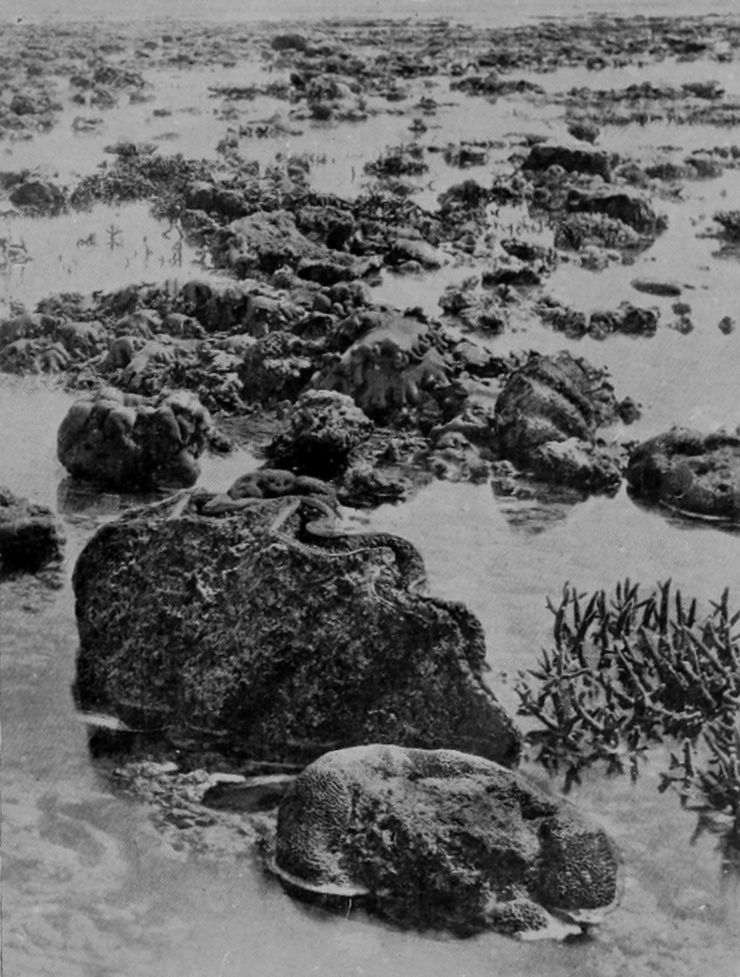
[Milford-on-Sea.
GIANT CLAM-SHELLS ON THE GREAT BARRIER REEF, AS EXPOSED AT EXTREME LOW
TIDE.
The shell in the foreground is 4 feet in diameter.
The Naked-gilled Sea-slugs constitute a second clearly defined group.
All the species are essentially marine, and most abundant among seaweeds and coral-growths, over
twenty species occurring in British seas. They are notable for the slug-like form of their body,
which is usually supplemented by the outgrowth from it of complex, variously modified
gill-filaments. In some species these external gills take the form of symmetrical flower-like
tufts at the posterior end of the back, while in others simple or variously branched gills may be
developed on the upper-surface. The colours of many of these sea-slugs are more brilliant than
those of any other molluscs, this being especially the case with the tropical
coral-reef-frequenting species. Bright scarlet, yellows, and blues, separately or variously
combined, are among the dominant tints. Many of these tropical species are also of considerable
size. One particular kind, having a flower-like dorsal gill-tuft, observed by the writer on the
West Australian reefs, was over 10 inches long and 8 inches broad. Its general ground-colour was
intense vermilion, relieved, however, by a frilled border nearly an inch in width of the purest
white, with radiating streaks of scarlet. It is an interesting circumstance that these
naked-gilled molluscs, shell-less so far as their adult phases are concerned, emerge from the egg
with a perfectly formed, but necessarily very minute, transparent shell, resembling that of a
garden-snail. It is consequently inferred that the group has been derived from some permanently
shell-bearing form.
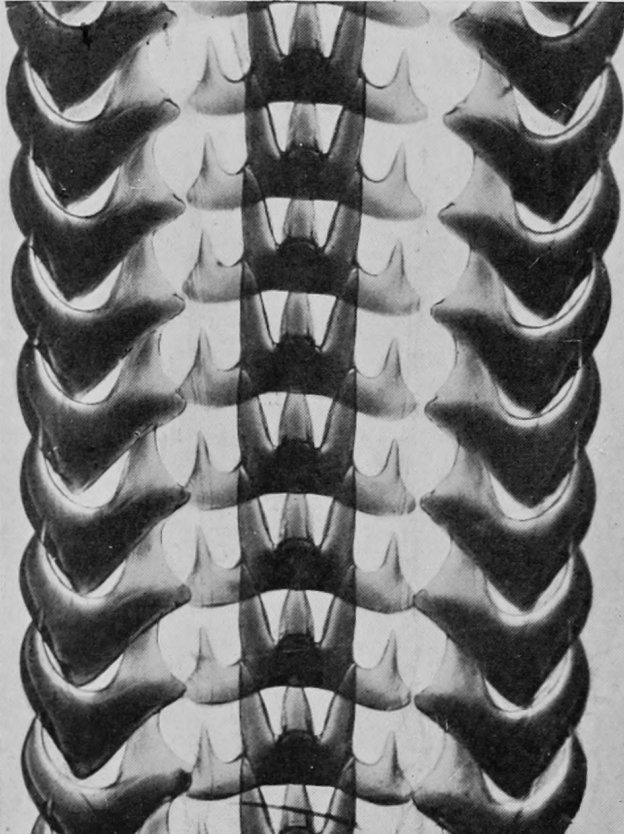
Photo by W. Saville-Kent, F.Z.S.] [Milford-on-Sea.
HIGHLY MAGNIFIED TONGUE OF A SEA-SNAIL.
With this structure its owner bores or files a hole through the shells of other
molluscs upon which it preys.
The Comb-gilled section embraces the great majority of the marine molluscs having a single more
or less convoluted or spirally twisted shell. They take their name from the circumstance that the
gills have a compactly disposed comb-like contour. This gill-tuft is situated in an excavated
chamber inside the shell, immediately over the neck. The Common Whelk, the
Pelican's-foot Shell, and the Winkle are a few
typical British marine representatives of this group, which, however, attains to the zenith of its
development in the size, variety of form, and ornate coloration of its shells in tropical seas.
The inter-tropical coral-reefs in particular yield a most abundant harvest in this direction. The
shells in common use obtained from such a source include the ponderous Helmet-shells, or Conchs, employed for the manufacture
of cameos; the Giant Whelks and Trumpet-shells,
often over 18 inches long, used as signal-horns throughout Polynesia and on the tropical
Australian coast; and the capacious Melon-shells, made to do duty for
boat-baling and as water-vessels and general domestic receptacles throughout the same tropical
area. To this list may be added the Harp-shells, Volutes, Cones, Mitres, Olives, Thorny Woodcocks, and a host of others prized by
the conchologist. To this section must also be referred the innumerable species of Cowries, of which the large, boldly mottled "Tiger" and
"Panther" species are well known. The comparatively small, yellowish,
thickly built, porcelain-like shell of the "Money-cowrie" constitutes, as
is well known, the current coin throughout extensive areas of Africa and India. It is recorded
that as large a quantity as sixty tons of these small shells, originally collected from tropical
seas, have been shipped from one British port alone to the African coast for commercial use within
a single year. One very diminutive cowrie, pale pink in colour, with a delicately streaked
surface, is indigenous to British waters.
The third large group of Molluscs which demands attention is that of the Bivalves, or Leaf-gilled group. Though
not so numerous in species as the last, it outrivals it in the enormous abundance in which the
individuals of many varieties are produced. Oysters, Mussels, Cockles, Scallops, and
other allied forms occur in closely associated colonies, constituting natural "beds" or "banks,"
which may be of vast extent and, in at any rate the case of oysters, several feet in thickness.
From a commercial and economic standpoint this group is undoubtedly of the highest importance to
the human race. Not only do its members, as instanced by the foregoing forms, contribute largely
to the world's commissariat, they also yield the much-prized material known as "mother-of-pearl"
and the purest and most æsthetically beautiful gems—orient pearls. Pearls and
mother-of-pearl are the products of two groups of shell-fish, respectively known as Pearl-oysters and Pearl-mussels. There are a
considerable number of species, mainly denizens of tropical seas, which, like ordinary oysters and
mussels, occur naturally in banks and beds of vast extent. In some species, such as the Ceylon Pearl-oyster, the shell is small, and the mother-of-pearl substance, or
"nacre," as it is technically termed, so thin as to be of relatively little value. Hence the
fishery for this species is conducted almost exclusively for the sake of the pearls, which are
fairly numerous and frequently of the finest quality. From the tropical Australian seas
pearl-shells of the largest size, which produce the thickest and most valuable mother-of-pearl,
are obtained. Pearls of the best quality are more rarely found in this description of shell, and
its fishery is prosecuted primarily on account of the substantial substance and magnificent
quality of its nacre. A single pair of shells of this species will attain in its adult state to a
weight of from 12 to 18 lbs. The fishery for this pearl-shell has, however, been prosecuted so
relentlessly that bivalves of such matured age and weight are now of rare occurrence, and obtained
only from almost inaccessibly deep waters. Unless, in point of fact, systematic methods of
conservation and cultivation are resorted to on an extensive scale and on lines corresponding
fundamentally with those successfully followed in the culture of ordinary commercial oysters,
there would seem to be an imminent risk of the valuable Australian pearl-shell fisheries becoming
depleted to more or less complete exhaustion.
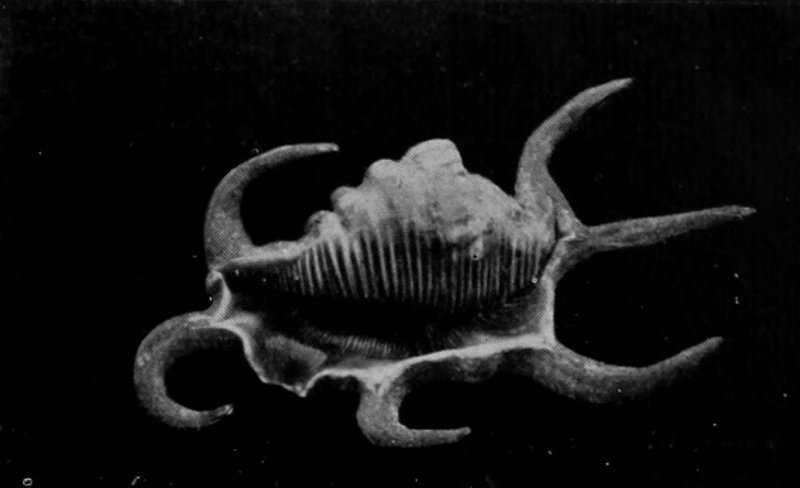
Photo by W. Saville-Kent, F.Z.S.] [Milford-on-Sea.
A SCORPION-SHELL.
Closely allied to the "Pelican's Foot," found on the British coast.
Photo by W. Saville-Kent, F.Z.S.] [Milford-on-Sea.
ROCK-OYSTERS.
This is the ordinary commercial oyster of the Australian shores.
The tropical Australian seas, and notably those which wash the Great Barrier Reef, are famous
for the production of the largest of living bivalve molluscs. These are represented by the Giant Clams, which, dwelling among the coral-growths, are left exposed to view
for brief periods during abnormally low spring tides. A photograph of a colony of these monster
bivalves, taken by the writer amidst this mollusc's characteristic surroundings, is reproduced on
page 741. The example in the foreground measured no less than 4 feet in
diameter and weighed several hundred-weights. In many clams the living tissues, or mantle-borders,
that are exposed to view when the shell-valves are partly open, are brilliantly tinted.
Photo by W. Saville-Kent, F.Z.S.] [Milford-on-Sea.
A QUEENSLAND OYSTER-BANK.
Illustrating another characteristic growth-phase of the Australian
rock-oyster.
Of the Scallops many of the larger species are highly esteemed for the
table. It is notable of them that they can progress through the water in a jerky, flight-like
manner by the repeated flapping of their opposing shells. In many scallops the jewel-like eyes are
developed in a row round the margin of the mantle.
The Bivalve Class includes certain representatives which are held in evil repute, on account of
their destructive habits. Pholas and its allies bore their way into solid
rock, bringing about its complete disintegration. From the dreaded Ship-worm, or Teredo, on the other hand, there would
appear to be no description of wood that can withstand its ravages.
The Bivalve Molluscs are not without fresh-water representatives. The well-known Pond- and River-mussels, which form the most conspicuous
examples of this group, number several hundred species. While insipid and of no account for the
human commissariat, many of its members produce pearls of value. One such, obtained from the river
Conway, in North Wales, is said to occupy a place in the crown of England.
The Chitons, or Multivalve
Molluscs, invite brief notice. As the last-named title implies, the shell-elements in this
group are relatively numerous, consisting of eight pieces, or plates, which may form contiguous
transverse shelly shields that entirely cover in and protect the dorsal surface of the elongate,
boat-shaped body, or may be more or less isolated from one another. In the former instance the
animal bears some considerable resemblance to a gigantic limbless wood-louse, and, like that
familiar terrestrial crustacean, it is capable of rolling itself into a spheroidal shape as a
means of protection. None of the chitons are provided with eyes in the adult state in that region
of their body—namely, the head—where they might be most naturally expected to exist.
Recent scientific investigation has, however, elicited the fact that in various species the
respective shell-plates are studded with minute eye-specks, the aggregate number of visual organs
thus possessed by certain forms reaching to the astonishing figures of 11,000 or 12,000. The
majority of the chitons are shallow-water, rock-frequenting molluscs, which may be successfully
sought by turning over stones at low water. Several species are inhabitants of British seas.


