MARSUPIALS AND MONOTREMES.
BY W. SAVILLE-KENT, F.L.S., F.Z.S.
MARSUPIALS.
With the order of the Pouched Mammals we arrive—with the exception of the Echidna and
Platypus, next described—at the most simply organised representatives of the Mammalian
Class. In the two forms above named, egg-production, after the manner of birds and reptiles,
constitutes the only method of propagation. Although among marsupials so rudimentary a method of
reproduction is not met with, the young are brought into the world in a far more embryonic
condition than occurs among any of the mammalian groups previously enumerated. There is, as a
matter of fact, an entire absence of that vascular or blood connection betwixt the parent and
young previous to birth, known as placentation, common to all the higher mammals, though certain
of the more generalised forms have been recently found to possess a rudiment of such development.
In correlation with their abnormally premature birth, it may be observed that a special provision
commonly exists for the early nurture of the infant marsupials. In such a form as the Kangaroo,
for example, the young one is placed, through the instrumentality of its parent's lips, in contact
with the food-supplying teat, and to which for some considerable period it then becomes
inseparably attached. Special muscles exist in connection with the parent's mammary glands for
controlling the supply of milk to the young animal, while the respiratory organs of the little
creature are temporarily modified in order to ensure unimpeded respiration. The fact of the young
in their early life being commonly found thus inseparably adhering to the parent's nipple has
given rise to the falacious but still very widely prevalent idea among the Australian settlers
that the embryo marsupial is ushered into the world as a direct outgrowth from the mammary
region.
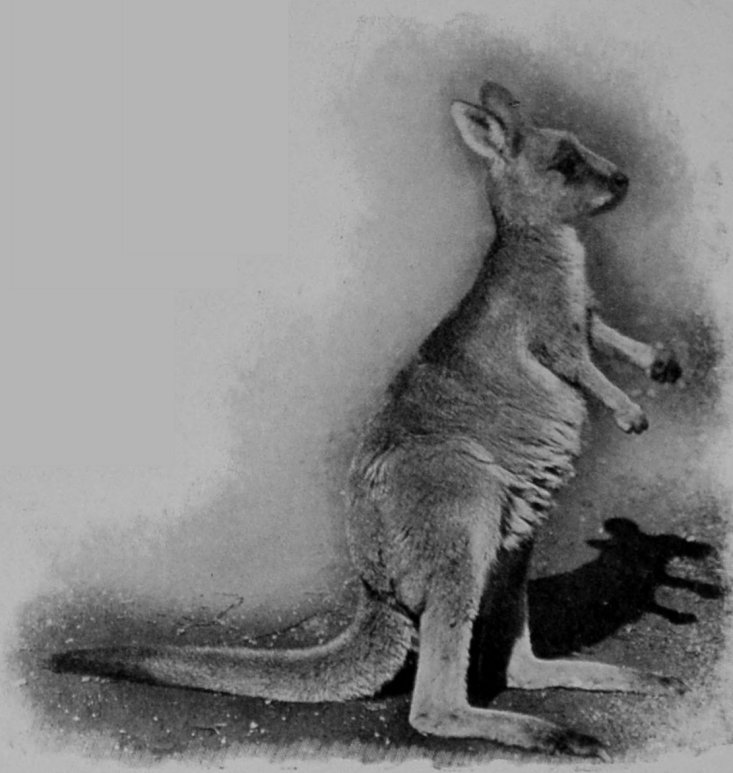
Photo by Billington] [Queensland.
SILVER-GREY KANGAROO.
In general form the kangaroos are so like one another that one figure would
almost serve for all.
At the present day, with the exception of the small group of the American Opossums and the
Selvas, the entire assemblage of marsupials, comprising some 36 genera and 150 species, are,
singularly to relate, exclusively found in Australia, New Guinea, and the few neighbouring islands
recognised by systematic zoologists as pertaining to the Australasian region. What is more, this
region of Australasia produces, with some few insignificant exceptions, chiefly rodents, no other
indigenous mammals.
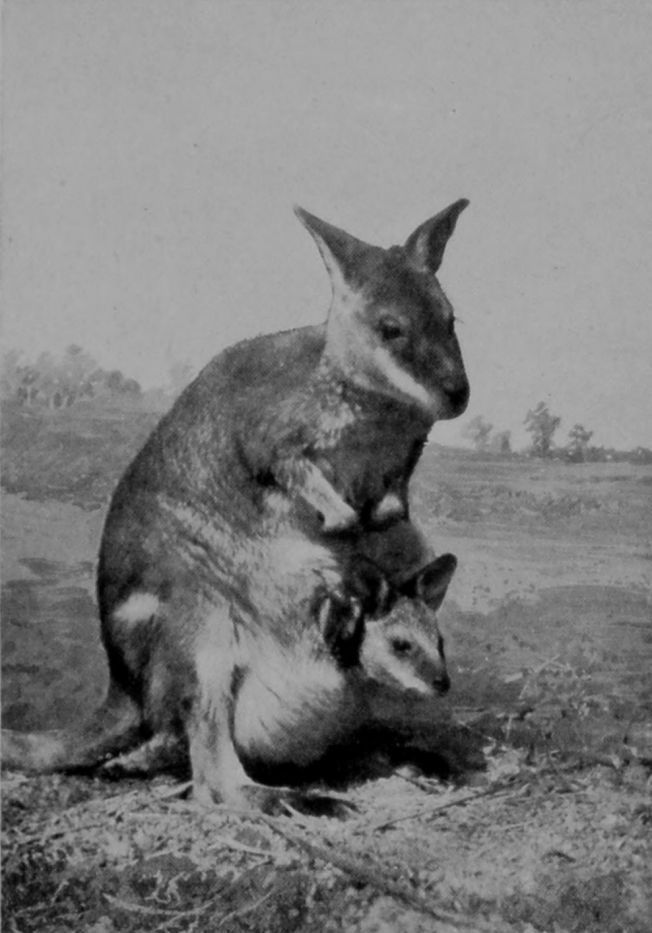
Photo by E. Landor] [Ealing.
BLACK-STRIPED WALLABY.
Female with half-grown young in her pouch.
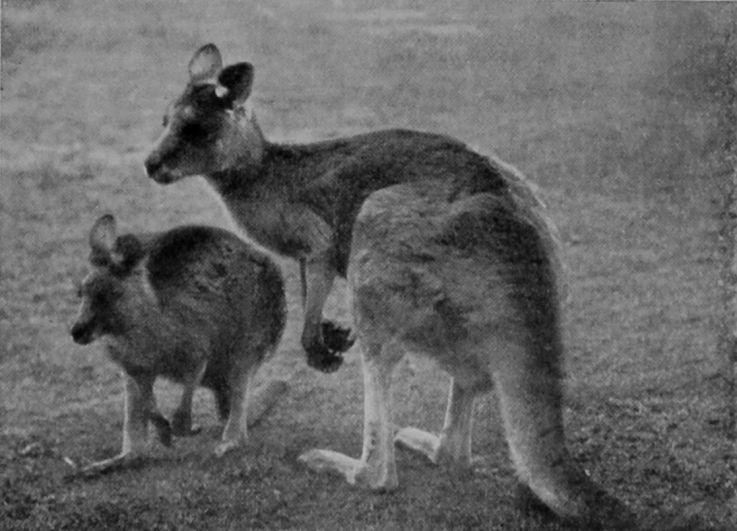
Photo by J. T. Newman] [Berkhamsted.
BENNETT'S WALLABY AND THE GREAT GREY KANGAROO.
This photograph illustrates the relative sizes of these two species.
It is interesting to note that within the limits of this isolated and anciently founded
marsupial order we have an epitome, as it were, of many of the more important groups of an
equivalent classificatory value that are included among the higher mammalia previously described.
In this relationship we find in the so-called Tasmanian Wolf, the Tasmanian Devil, and the "Native
Cats" carnivorous and eminently predatory forms whose habits and general conformation are
immediately comparable to those of the typical Carnivora. The Bandicoots, Banded Ant-eater, and
Phascogales recall in a similar manner the higher Insectivora. In the tree-frequenting Opossums
and Phalangers the external likeness and conformity in habits to the arboreal rodents is notably
apparent, several of the species, moreover, possessing a parachute-like flying-membrane
essentially identical with that which is found in the typical Flying-squirrels. An example in
which the ground-frequenting or burrowing rodents are closely approached is furnished by the
Australian Wombat, an animal which may be appropriately likened to an overgrown and lethargic
Marmot. In this form, moreover, the rodent-like character of the dentition is especially
noteworthy. The higher grass-eating mammals find their counterparts in the family group of the
Kangaroos, in which, in addition to their essentially herbivorous habits, the contour of the head
and neck, together with the expressive eyes and large expanding ears, are wonderfully suggestive
of the various members of the Deer Family. The Cuscuses of New Guinea and the adjacent islands,
both in form and habits, somewhat resemble their geographical neighbours, the Lorises, belonging
to the Lemur Tribe, compared with which higher mammals, however, they possess the advantage of an
eminently serviceable prehensile tail. The Australian Koala, or so-called "Native Bear," has been commonly compared
by zoologists with the Edentate Sloths; while in the most recently discovered marsupial, the
Pouched Mole, we have a counterpart, in both form and habits, of the familiar European species.
Finally, in the small American section of the Marsupialia, we meet with a type—the so-called
Yapock, or Water-opossum—in which the resemblances to an Otter, in both aspect and its
aquatic habits, are so marked that the animal was originally regarded as a species only of the
Otter Tribe.
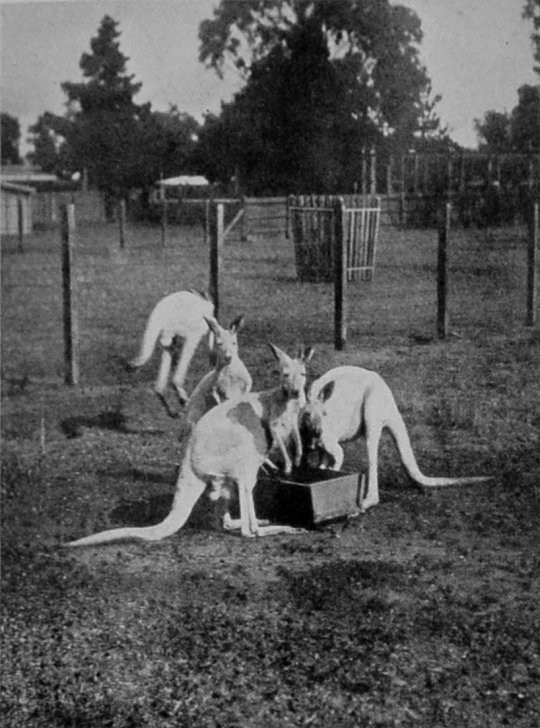
Photo by D. Le Souef] [Melbourne.
ALBINO RED KANGAROOS.
Albino kangaroos and other Australian animals have been observed to be the
product of special, narrowly limited locations.
The character of the marsupium, or pouch, differs materially among the
various members of their order. It presents its most conspicuous and normal development in such
animals as the Kangaroos, Wallabies, and the Australian Opossums or Phalangers. In the Tasmanian
Wolf and the Bandicoots the pouch opens backwards. In such forms as the Phascogale, or Pouched
Mouse, the pouch is reduced to a few rudimentary skin-folds, while in the Banded Ant-eater its
position is occupied by a mere patch of longer hairs, to which the helpless young ones cling. On
the same lucus a non lucendo principle there is no trace of a pouch in the Koala, nor in
those smaller species of the American Opossums which habitually carry their young upon their back.
Even in these pouchless marsupials, however, the peculiar marsupial bones are invariably present,
and in all other essential details their accord with the marsupial type of organisation and
development is fully maintained.
The Kangaroos.
The typical and most familiar member of the Marsupial Order is the Kangaroo—the heraldic mammal of that vast island-continent in the South
Seas, whose phenomenal advance by leaps and bounds, from what scarcely a century since was
represented by but a few isolated settlements, has been aptly likened to the characteristic
progression of this animal. Of kangaroos proper there are some twenty-four known species
distributed throughout the length and breadth of Australia, extending southwards to Tasmania, and
to the north as far as New Guinea and a few other adjacent islands.
In point of size the Great Grey Kangaroo and the Red or Woolly species run each other very closely. A
full-grown male of either species will weigh as much as 200 lbs., and measure a little over 5 feet
from the tip of the nose to the base of the tail, this latter important member monopolising
another 4 or 4½ feet. The red or woolly species more especially affects the rocky districts of
South and East Australia, while the great grey kind is essentially a plain-dweller and widely
distributed throughout the grassy plains of the entire Australian Continent and also Tasmania. It
is to the big males of this species that the titles of "Boomer," "Forester," and "Old Man
Kangaroos" are commonly applied by the settlers, and the species with which the popular and
exciting sport of a kangaroo hunt—the Antipodean substitute for fox-hunting—is
associated. The pace and staying power of an old man kangaroo are something
phenomenal. Our home country fox-hounds would have no chance with it; consequently a breed of
rough-haired greyhounds, known as kangaroo-dogs, are specially trained for this sport. A run of eighteen miles,
with a swim of two in the sea at the finish, and all within the space of two brief crowded hours,
is one of the interesting records chronicled. The quarry, when brought to bay, is, moreover, a by
no means despicable foe. Erect on its haunches, with its back against a tree, the dogs approach it
at their peril, as, with a stroke of its powerful spur-armed hind foot, it will with facility
disembowel or otherwise fatally maim its assailant. Another favourite refuge of the hunted
"boomer" is a shallow water-hole, wherein, wading waist-deep, it calmly awaits its pursuers'
onslaught. On the dogs swimming out to the attack, it will seize them with its hand-like fore
paws, thrust them under water, and, if their rescue is not speedily effected, literally drown
them. Even man, without the aid of firearms, is liable to be worsted in an encounter under these
conditions, as is evidenced in the following anecdote.
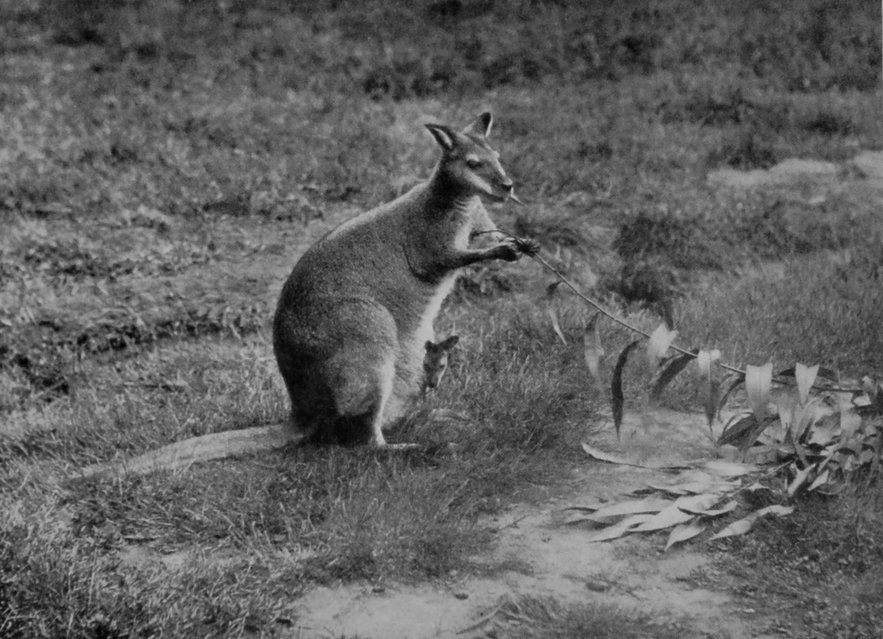
Photo by W. Reid] [Wishaw, N.B.
TASMANIAN WALLABY.
Has softer and thicker fur than its relative of the Australian mainland.
A newly arrived settler from the old country, or more precisely from the sister island,
ignorant of the strength and prowess of the wily marsupial, essayed his maiden kangaroo hunt with
only a single dog as company. A fine grey boomer was in due course started, and after an exciting
chase was cornered in a water-hole. The dog, rushing after it, was promptly seized and ducked; and
Pat, irate at the threatened drowning of his companion, fired, but missed his quarry, and
thereupon jumped into the water-hole, with the intention, as he afterwards avowed, "to bate the
brains out of the baste" with the butt-end of his gun. The kangaroo, however, very soon turned the
tables upon Pat. Before he had time to realise the seriousness of the situation he found himself
lifted off his feet, and soused and hustled with such vigour that both Pat and his dog most
narrowly escaped a watery grave. A couple of neighbours, by good luck passing that way, observed
the turmoil, and came to the rescue. Between them they beat off and killed the kangaroo, and dragged
Pat to land in a half-drowned and almost insensible condition. Pat recovered, and vowed "niver to
meddle with such big bastes" again.
The doe kangaroos, while of smaller size and possessing much less staying power than their
mates, can nevertheless afford a good run for horses and dogs, and are commonly known as "flyers."
When carrying a youngster, or "Joey," in her pouch, and hard pressed by the dogs, it is a common
thing for the parent to abstract her offspring from the pouch with her fore paws, and to throw it
aside into the bush. The instinct of self-preservation only, by the discharge of hampering
impedimenta, is usually ascribed to this act; but it is an open question whether the maternal one
of securing a chance of escape for her young, while feeling powerless to accomplish it for
herself, does not more often represent the actual condition of the case.
In proportion to the size of its body the kangaroo yields but a limited amount of meat that is
esteemed for food. The tail represents the most highly appreciated portion, since from it can be
compounded a soup not only equal to ordinary ox-tail, but by gourmands considered so superior that
its conservation and export have proved a successful trade enterprise. The loins also are much
esteemed for the table, but the hind limbs are hard and coarse, and only appreciated by the native
when rations are abnormally short. "Steamer," composed of kangaroo-flesh mixed with slices of ham,
represented a standing and very popular dish with the earlier Australian settlers; but with the
rapid disappearance of the animal before the advance of colonisation this one time common
concoction possesses at the present day a greater traditional than actual reputation.
The hunting of the kangaroo is conducted on several distinct lines, the method of its pursuit
being varied, according to whether the animal is required for the primary object of food, for the
commercial value of its skin, as a matter of pure sport, or to accomplish its wholesale
destruction in consequence of its encroachments on the pasturage required for sheep- and
cattle-grazing.
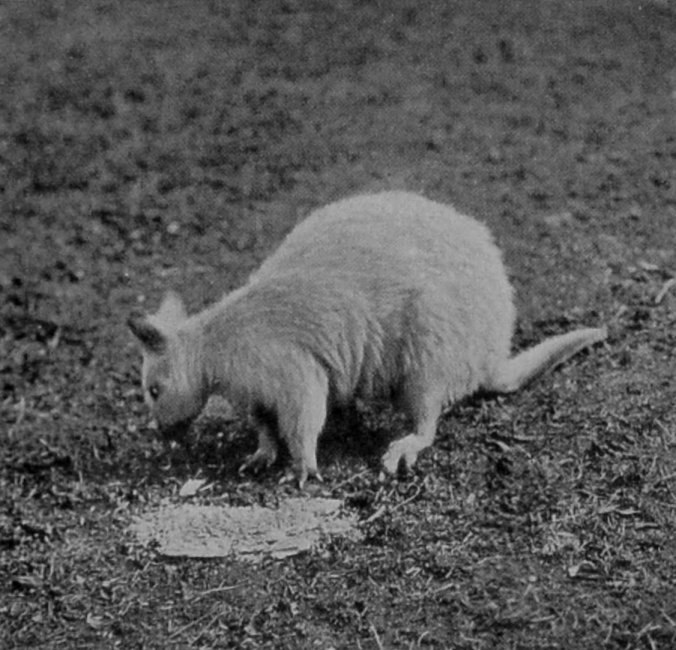
Photo by D. Le Souef] [Melbourne.
ALBINO RED-BELLIED WALLABY.
Many of the Marsupials, including Kangaroos and the Opossum-like Phalangers,
exhibit a tendency to albinism.
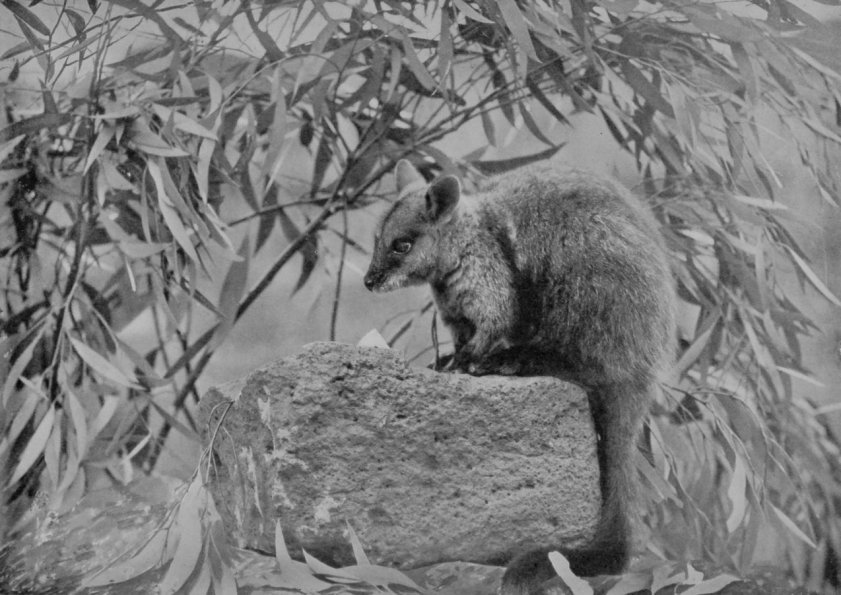
Photo by Billington] [Queensland.
ROCK-WALLABY.
The Rock-Wallabies, in contradistinction to the Kangaroos, are for the most
part nocturnal in their habits.
The greatest measure of healthy excitement in hunting the kangaroo, from the standpoint of pure
sport, is no doubt to be obtained when running the marsupial down with horse and hounds in
congenial company, as referred to on a previous page. The stalking of the
animal single-handed on horseback or on foot, much after the manner of the deer, has also its
enthusiastic votaries, and calls into play the greatest amount of patience and savoir-faire
on the part of the sportsman. It has been affirmed by a Queensland writer, "To kill kangaroos with
a stalking-horse requires the practice of a lifetime, and few 'new chums' have the patience to
learn it. It is, in fact, only stockmen, black-fellows, and natives of the bush who can by this
method expect to make kangaroo-shooting pay." The horse which is successfully employed by
experienced bushmen for stalking purposes is specially trained to its work, and, walking
apparently unconcernedly in the direction of the selected quarry, brings the gunners, if they are
experts in the art of keeping themselves well concealed, within easy range. In this manner two or
three kangaroos are not infrequently shot in the same stalk, the animals having a tendency, on
hearing the report of the gun, but not locating the direction from which it was discharged, to
rush about in an aimless manner, and, as frequently happens, in the immediate direction of the
hidden sportsman. In the good old times it is recorded that an experienced hand might kill as many
as seventy or eighty kangaroos in a day by this stalking method. The marsupials are at the present
date, however, so severely decimated that even in the most favourable settled districts a bag of
from twelve to twenty head must be regarded as exceptional. Stalking the kangaroo on foot without
the horse's aid is more strongly recommended to those to whom an occasional shot is considered
sufficiently remunerative. Taking full advantage of intervening bushes and other indigenous cover,
an approach to within a hundred yards or so of the quarry may be usually accomplished, though not
quite so easily, perhaps, as might be at first anticipated. It is the habit of the kangaroo to sit
up waist-high in the midst of the sun-bleached grass, which corresponds so closely in colour with
its own hide that unless the animal is silhouetted against the sky-line it readily escapes
detection.
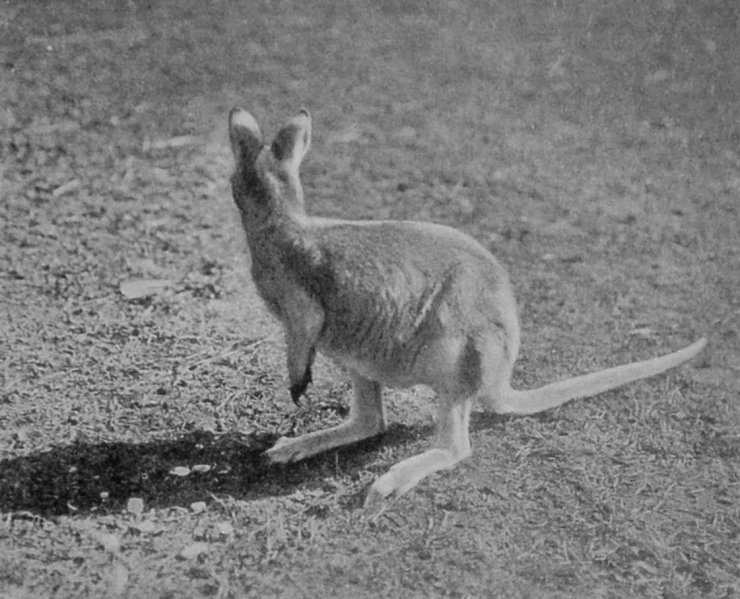
Photo by D. Le Souef] [Melbourne.
PARRY'S WALLABY.
In attitude of listening.
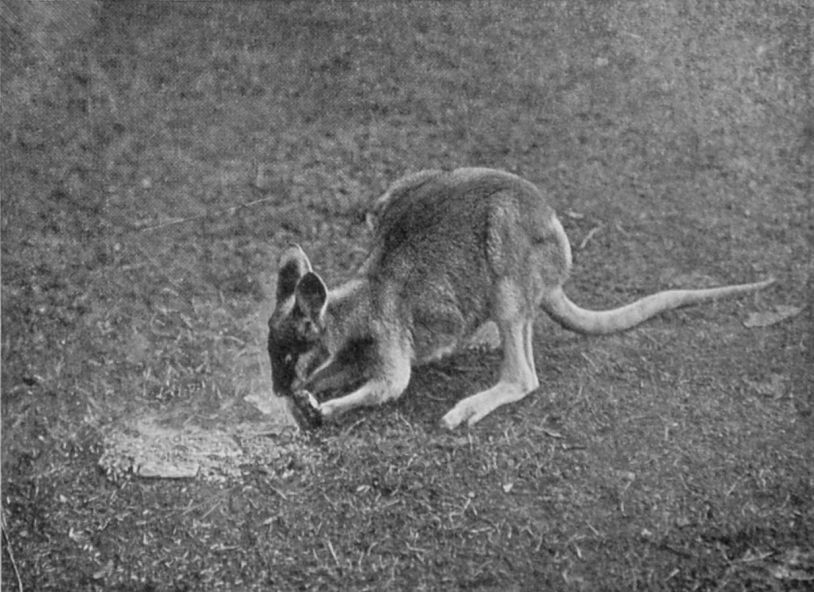
Photo by D. Le Souef] [Melbourne.
PARRY'S WALLABY.
Characteristic feeding attitude.
The conditions under which the kangaroo is obtained for the main purpose of supplying the human
commissariat is perhaps most aptly illustrated in connection with its chase as prosecuted by the
Australian aborigines. In Tasmania and the Southern Australian States the primeval man is either
extinct or more rare than the kangaroo. In the extreme north and far north-west, however, he still
poses as "the lord of creation," and conducts his hunting expeditions on a lordly scale. The
food-supply of the Australian native is essentially precarious. Long intervals of "short commons"
are interspersed with brief periods of over-abundance, in which he indulges his appetite to its
fullest bent. A kangaroo drive on native lines represents to the Australian mind one of these
last-named
superlatively memorable occasions. The entire tribe, men, women, and all capable youths,
participate in the sport. Fires are lit by one section of the tribe, according to the direction of
the wind, encircling a vast area of the country, while the other section posts itself in
detachments in advantageous positions to intercept the terrified marsupials as they fly in the
presumed direction of safety to escape the devouring element. Spears and waddies and boomerangs,
in the hands of the expert natives, speedily accomplish a scene of carnage, and the after feast
that follows may perhaps be best left to the imagination of the reader. The encroachments of
neighbouring natives on the happy hunting-grounds that time and custom have conceded to be the
sole monopoly of any one particular tribe is most strenuously resented, and constitute one of the
commonest sources of their well-nigh perpetual inter-tribal battles.
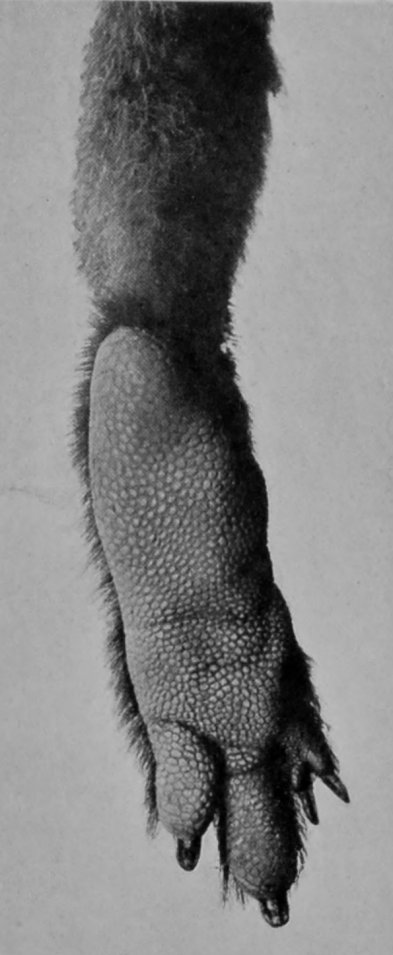
Photo by D. Le Souef, Melbourne.
FOOT OF TREE-KANGAROO.
Underside, showing peculiar skin-corrugations and the united second and third
toes.
A kangaroo battue, as carried into practice by European settlers in those few remaining
districts where the animal is sufficiently abundant to constitute a pest by its wholesale
consumption of the much-prized pasturage, is far more deadly in its results to the unfortunate
marsupials. Existing sheep-fences, supplemented by a large suitably enclosed yard, are first
specially prepared for the reception of the expected victims. All the settlers, stockmen, and farm
hands from the country round are pressed into service, and assemble on horseback or on foot at the
appointed rendezvous at break of day. A widely spreading cordon of beaters being told off, a
systematic drive is then commenced, which results in all the animals being driven towards and
collected within the enclosed yard. The culminating scene is one of wholesale slaughter with club
and gun. From these battues none of the unfortunate animals escape, as they are so closely hemmed
in.
The first record of the existence of the kangaroo, coupled with its characteristic name, is
found associated, it is interesting to observe, with the history of one of the earlier voyages of
Captain Cook. The neighbourhood of Cooktown, in Queensland, claims the honour of supplying the
first example of the animal which was brought to Europe and astonished the zoologists of that time
by the singularity of its form and reported habits. Captain Cook happened—in July,
1770—to be laying up his ship, the Endeavour, for repairs, after narrowly escaping
total wreck on the neighbouring Great Barrier Reef, in the estuary of the river subsequently
coupled with his ship's name. Foraging parties, dispatched with the object of securing, if
possible, fresh meat or game for the replenishment of the ship's well-nigh exhausted larder,
returned with reports of a strange creature, of which they subsequently secured specimens. Skins
were preserved and brought to England, but it was some little time before the zoological position
and affinities of the creature were correctly allocated. By some naturalists it was regarded as
representing a huge species of Jerboa, its near relationship to the previously known American
Opossums being, however, eventually substantiated. The closer acquaintanceship with the peculiar
fauna of Australia that followed upon Captain Cook's memorable voyage of discovery along the
coast-line of that island-continent soon familiarised naturalists with many other of the allied
species of which the kangaroo constitutes the leading representative.
Some considerable amount of obscurity is associated with the prime origin of the animal's
almost world-wide title of "Kangaroo." It is most commonly accepted as representing the native
name for the creature in that Queensland district from whence it was first reported by Captain
Cook. No later investigations and enquiries have, however, in any way established the correctness
of this hypothesis, those explorers who have made a special study of the dialects and habits of
the aboriginal inhabitants entirely failing to elicit anything even remotely coinciding with the
name in question. It has, in fact, been reluctantly concluded by one of the most experienced
Queensland authorities on these matters that the name originated as a mere miscomprehension of the
information elicited from the natives. Verbal communication with the native tribes under the most
favourable circumstances is liable to a vast amount of misunderstanding, and where other than
linguistic experts are present it frequently happens that much mongrel or "pidgin English" gets
mixed up with the native terms. Assuming this to have been the case in the present instance, it
has been suggested that the name of Kangaroo, or "Kanguroo," as it was originally spelt, implied
some form of negation of the knowledge which the enquiring white man was seeking to elicit, or,
maybe, partly even a phonetic and parrot-like repetition of the constantly recurring query that
was doubtless current among the "handy men" of the Endeavour's commission, such as "Can
you" tell me this or that concerning the many unfamiliar objects that greeted the eyes of the new
arrivals in this strange land. The writer retains a vivid recollection of a closely analogous
manner in which the rural inhabitants of Vigo Bay, on the Spanish coast, appropriated a common
phrase used by the crew of the yacht with whom he landed there. Having evidently noted that the
two words "I say" prefaced the majority of Jack-tar's speeches, this catch-phrase was adopted and
applied by them as a greeting and as a reply to almost every interrogation in dumb-show or
otherwise that was addressed to them. An unknown animal submitted to these rustic Solons would
doubtless have been dubbed the "I say"; and had the land been a new one—say, somewhere in
the South Seas—that name would probably have stuck to it. Applying this interpretation to
the kangaroo, and bearing in mind the fondness of the Australian native to duplicate his
name-words or syllables—e.g. wagga-wagga, debil-debil, and so forth—the
"Kang-you-you" or a closely resembling phonetic expression would present itself to the native mind
as a much more correct rendering of the simpler "Can you" or "Kang you" which he had picked up as
a catch-phrase from the Endeavour's crew. In the absence, at all events, of any more
rational interpretation of the mystery, this one would seem to merit consideration.
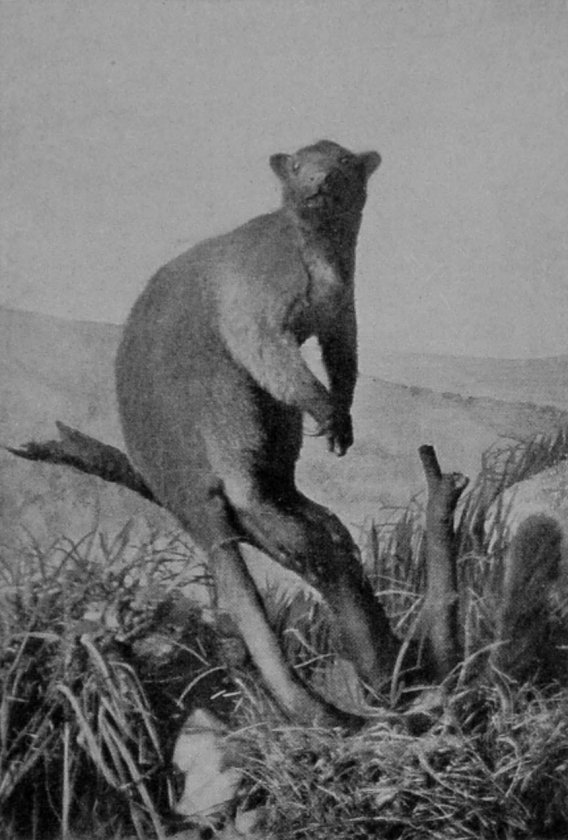
Photo by W. Saville-Kent, F.Z.S.] [Milford-on-Sea.
BROWN TREE-KANGAROO.
This species represents the group in North Queensland.
While the kangaroo is being speedily dethroned from the dominant position it originally
occupied in the indigenous Australian fauna, praiseworthy and highly successful attempts have been
made to acclimatise this marsupial on British soil. At Tring Park, Lord Rothschild's estate,
Woburn Abbey, and elsewhere, troops of these graceful creatures may be seen under conditions of
happiness and liberty scarcely inferior to those by which they are environed in their native
"bush."
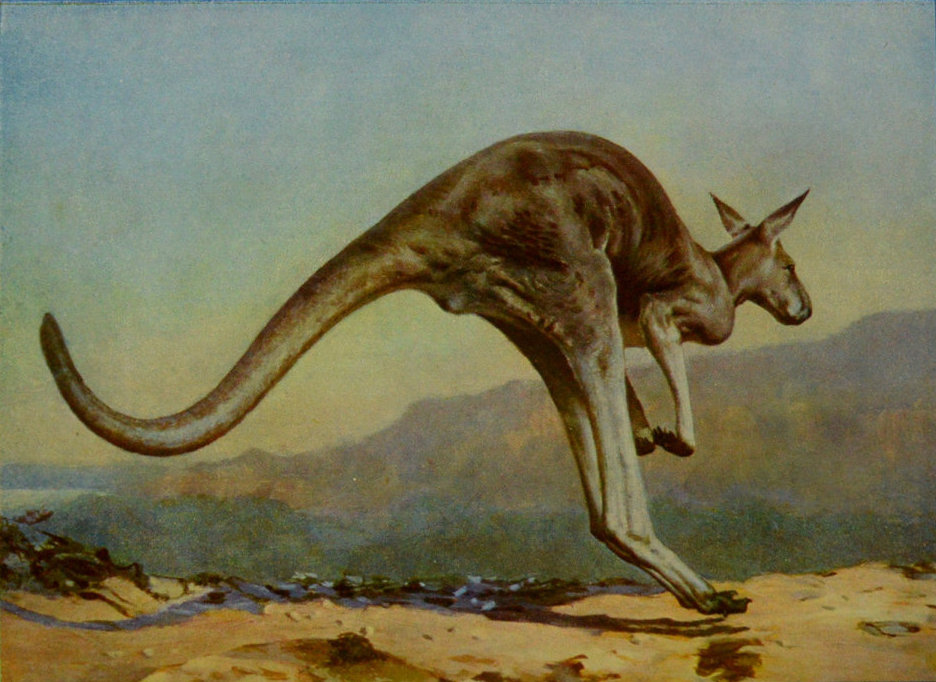
Photo by Ottomar Anschütz, Berlin. Printed at Lyons,
France.
THE GREAT KANGAROO LEAPING.
In the posture in which this animal is represented the extraordinary size and
strength of the hind limbs and tail are displayed to the best advantage. Both features are
connected with the animal's marvellous powers of leaping.
Of smaller members of the Kangaroo Family, there are some thirty distinct forms, popularly
known in Australia as Wallabies, Wallaroos, Paddy-melons, Potoroos, Kangaroo-hares, Kangaroo-rats, etc. The wallabies, which
represent the most important group with regard to their larger size and economic utility, number
some fourteen or fifteen species, and are distinguished, with relation more especially to their
habitats or peculiar structure, as Rock-, Brush-tail, and Spur-tail Wallabies, etc. Among the
rock-wallabies the yellow-footed species from South Australia is undoubtedly one of the handsomest
as well as the largest member of its group, the uniform grey characteristic of the majority of its
members being in this instance represented by an elegantly striped and banded form, in which the
several tints of brown, yellow, black, and white are pleasingly interblended. A very fine example
of this wallaby was included in the valuable collection of animals, formerly at Windsor, recently
presented to the Zoological Society by His Majesty King Edward, and is now on view at the Regent's
Park. The successful stalking of rock-wallabies in their native fastnesses entails no mean amount
of patience and agility. Although these animals are so abundant in favoured localities as to make
hard-beaten tracks to and fro betwixt their rock-dwellings and their pasture-grounds, one may
traverse the country in broad daylight without catching a glimpse of a single individual. One
species, about the size of a large rabbit, is very plentiful among the rocky bastion-like hills
that border the Ord River, which flows into Cambridge Gulf, in Western Australia. Efforts to stalk
examples in broad daylight proved fruitless; but by sallying out a little before daybreak, so as
to arrive at their feeding-grounds while the light was still dim, the writer succeeded in securing
several specimens. Many of these rock-wallabies are notable for the length, fine texture, and
pleasing tints of their fur, their skins on such account being highly esteemed for the composition
of carriage-rugs and other furry articles.
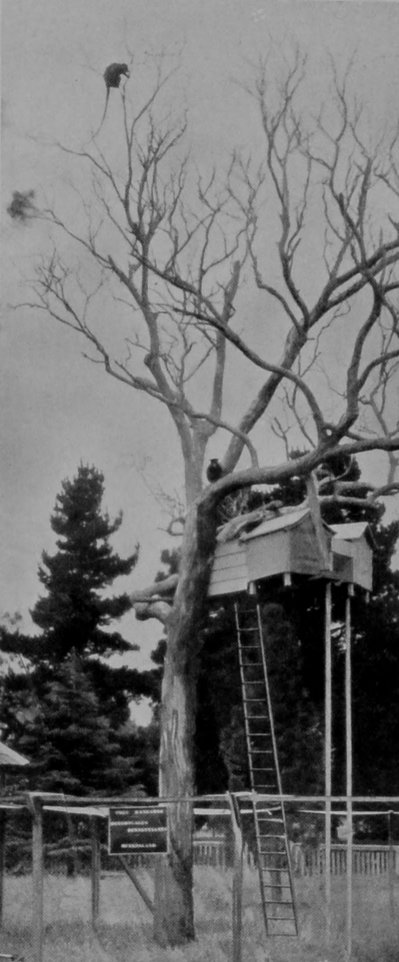
Photo by D. Le Souef] [Melbourne.
TREE-KANGAROOS.
Examples acclimatised in the Melbourne Zoological Gardens.
Of the larger brush or scrub varieties, the species known as the Black
Wallaby is the most familiar form. It is particularly abundant in the Southern Australian
States, and also in Tasmania. Its flesh is excellent eating, and, dressed and served up in the
orthodox manner of jugged hare, can scarcely be distinguished from that toothsome dish. Some of
the smaller species, such as the hare- and rat-kangaroos or potoroos, are, as their names denote,
of no larger dimensions than the familiar rodents from which they are popularly named. Several of
these smaller species, including notably the potoroo, or kangaroo-rat of New South Wales, are
addicted to paying marked attention to the settlers' gardens, and, being to a large extent root-feeders, have acquired
a special predilection for the newly planted or more fully matured potato crops.
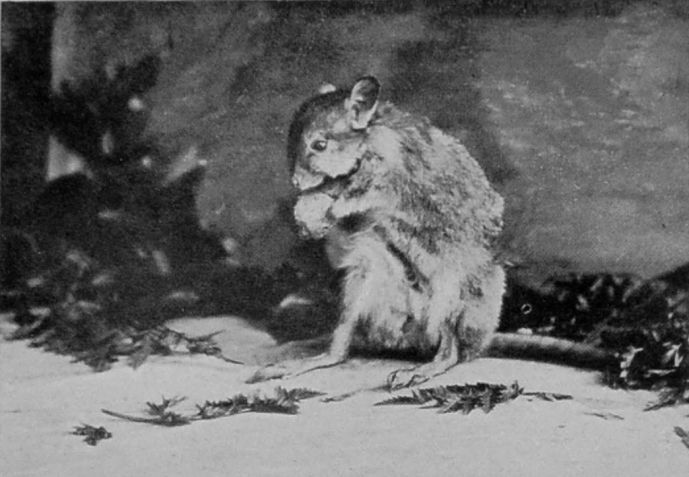
Photo by York & Son] [Notting Hill.
GAIMARD'S RAT-KANGAROO.
A species named after the French naturalist, Gaimard.
The most abnormal group of the Kangaroo Family is undoubtedly that of the Tree-kangaroos, formerly supposed to have been limited in its distribution to
the island of New Guinea, but which has within recent years been found to be represented by one or
more species in Northern Queensland. At the Melbourne Zoo they have been found, except in the
coldest weather, to thrive well in the open—a moderate-sized tree, with a small fenced-in
enclosure around it, being admirably suited to their requirements, at the same time providing a
most instructive exhibition of their peculiar forms and idiosyncrasies. Seen at its best, however,
the tree-kangaroo, or "boongarry," as it is known amongst the Queensland natives, is a most
clumsy, melancholy-looking beast, which has apparently found itself "up a tree," not as the
outcome of its personal predilections, but owing to the force majeure of untoward pressure
in the form either of relentlessly persecuting enemies or the failure of its normal terrestrial
commissariat. Compared with the graceful and superlatively agile tree-frequenting phalangers,
between whom and the ordinary kangaroos it has been sometimes, but erroneously, regarded as
representing a connecting-link, the boongarry presents a most ungainly contrast. Its climbing
powers are of the slowest and most awkward description, the whole of its energies being
concentrated on its endeavour to preserve its balance and to retain a tight hold upon the branches
of the trees it frequents, and to which it clings with such tenacity with its long sharp claws
that it can with difficulty be detached. In its wild state, moreover, these claws can be very
effectively used as weapons of defence; and hence the natives, with whom the animal is highly
esteemed as an article of food, are careful to give it its quietus with their clubs or waddies
before venturing to handle it. The tree-kangaroos inhabit the densest parts of the forests or
"scrubs" of New Guinea and tropical Queensland, and appear to confine their movements chiefly to
the trees of moderate size, or the lower branches only of the taller ones.
The species which constitutes the most natural known connecting-link between the typical
Kangaroos and the family of the Phalangers, next described, is the Five-toed
Rat-kangaroo, or Potoroo. As its name implies, it is a small
creature of rat-like aspect and dimensions, and possesses, like a rat, a long, cylindrical, naked,
scaly tail. It is the structure of the feet, however, that constitutes the important distinction.
In place of the four toes only to the hind limbs it possesses the full complement of five, and the
first toe, moreover, is set farther back, and is opposable for grasping purposes. This animal is
from Queensland.
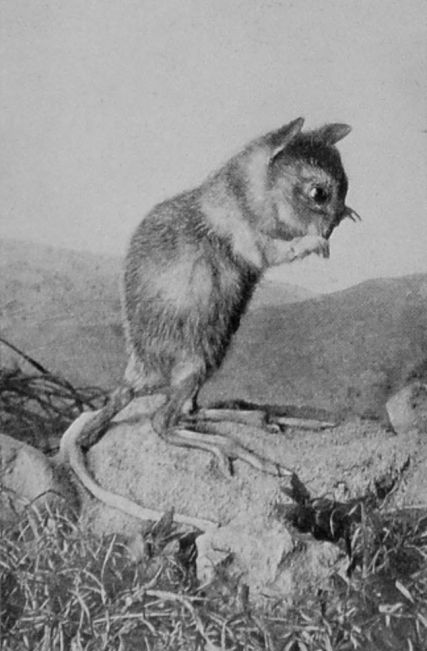
Photo by W. Saville-Kent, F.Z.S., Milford-on-Sea.
RAT-KANGAROO FROM NEW SOUTH WALES.
One of the small jerboa-like species.
The Phalangers.
The Phalanger Family of Marsupials, which next invites attention, is constituted of animals
especially adapted to lead an arboreal life, though among themselves they exhibit very
considerable structural variations. The species usually placed at the head of this group is the
essentially droll and in many respects abnormal form known as the Koala,
or Australian Native Bear. Its little podgy tailless body, short thick-set
head, and round tufted ears lend some countenance perhaps to the ursine analogy; but there the
likeness ends.
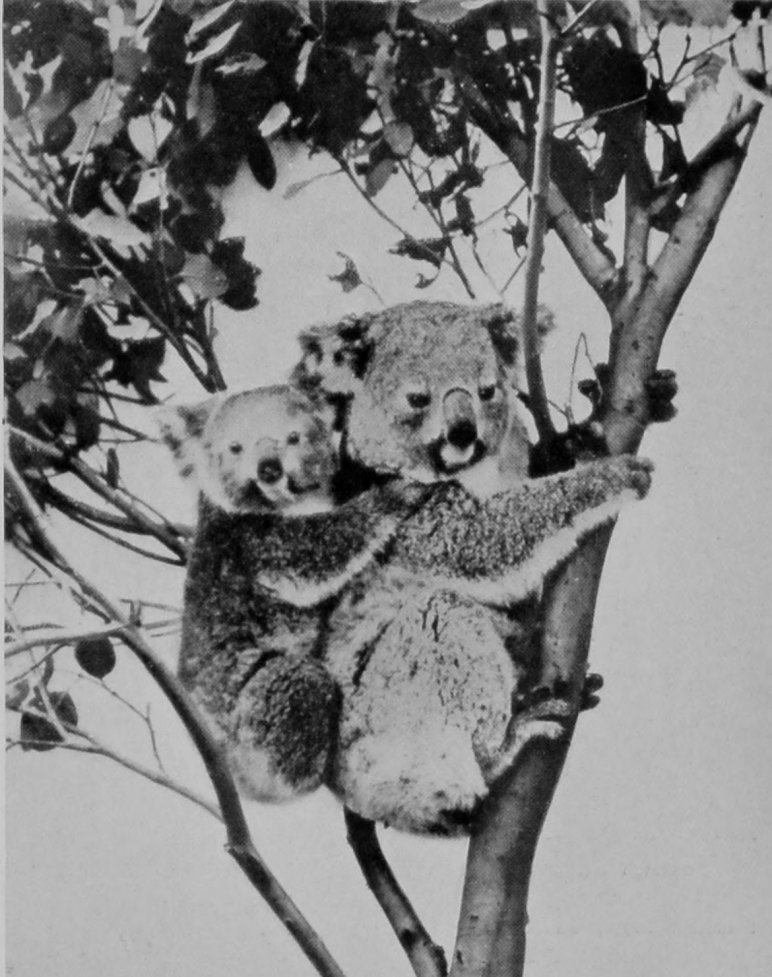
Photo by W. Saville-Kent, F.Z.S.] [Milford-on-Sea.
KOALA, OR AUSTRALIAN NATIVE BEAR AND CUB.
An excellent illustration of the way in which the female koalas carry their
young securely perched on their backs.
The koala is limited in its distribution to the south-eastern region of the Australian
Continent, and is there found inhabiting the loftiest gum-trees, on the leaves and flowers of
which it almost exclusively feeds. Compared with the opossum and squirrel-like phalangers, the
koala is a very slow and sedentary little animal, remaining stationary in and browsing upon the
leaves of the same gum-tree for days or even weeks at a stretch. Taking advantage of this
home-staying propensity, examples are established, with full liberty to wander at will among the
large gum-trees, in the Melbourne Zoological Gardens, and have never abused the confidence reposed
in them by surreptitiously absconding. The young koalas in particular make the most droll and
delightful of household pets, speedily becoming attached to and following their owners about the
premises, or contentedly settling down to the possession of an allotted corner of the verandah, in
which an improvised perch has been erected and a constant supply of its favourite gum-leaves is
daily assured. One such example, kept in Brisbane, Queensland, furnished the writer with the
material for the photograph on this page; also of another one that illustrated in an interesting
manner the very singular attitude assumed by the animal when asleep. Instead of creeping into the
hollow trunk or spout of a gum or other tree, as the opossums and other phalangers are wont to do,
the little "bear" simply sticks tight to his supporting branch, and, tucking in his head and ears
and limbs, converts himself into an apparently homogeneous rounded mass of fur or moss, and, thus
disguised, peacefully sleeps. Seen at some little distance, in fact, none but a trained eye could
distinguish this sleeping bear from one of the round woody excrescences or bunches of
misletoe-like parasitic growths that are of common occurrence on the trees in every gum forest. In
this way the little creature secures immunity from the attacks of enemies by mimicking the characteristic
peculiarities of its environment, as obtains so generally among insects and other of the lower
orders of animated nature. A closely analogous sleeping attitude, it may be mentioned, is assumed
by one of the African lemurs or pottos, which have been dealt with in a previous
chapter.
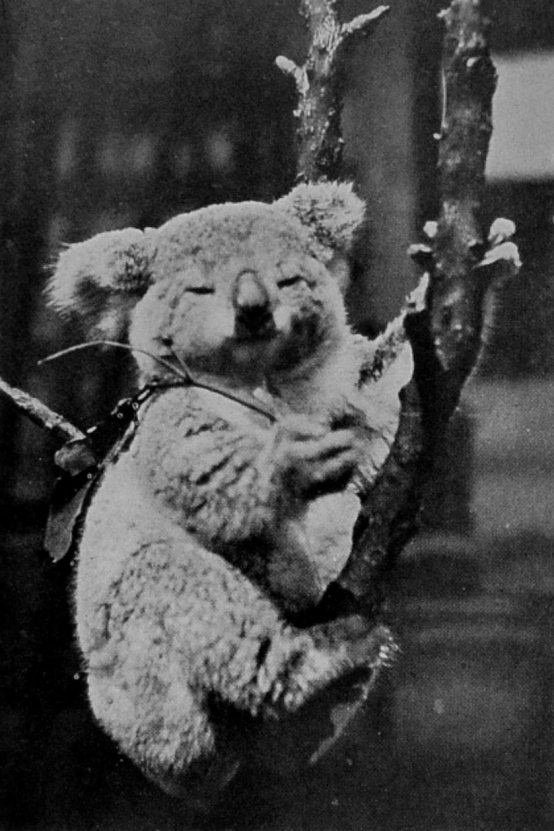
Photo by W. Saville-Kent, F.Z.S.] [Milford-on-Sea.
KOALA, OR AUSTRALIAN NATIVE BEAR.
The koala has no tail, and is a stout, clumsily built animal, about 32 inches
in length, with thick woolly fur of a greyish colour.
Although in captivity the koala takes kindly to a mixed diet in which bread-and-milk and fruit
may form substantial elements, it can rarely be induced to altogether dispense with its customary
gum-leaf regimen, and it is this circumstance that mainly accounts for its rarity in European
menageries. Time and again, however, this interesting animal has put in an appearance at the
Regent's Park; but in spite of Kew Gardens and other sources being laid under contribution for a
supply of gum-tree leaves, its sojourn there has been but brief. As a matter of fact, the common
or blue gum-tree, which is alone cultivated and available in any quantity in this country, and
which is indigenous to Tasmania, is not the species on which the koala is accustomed to feed. Of
gum-trees there are some hundred species, every one differing in the peculiarity of its aromatic
scent and flavour, and having its special clientèle among the ranks of leaf-browsing animals. So
far as the writer's observations extended, it was the big Queensland "white" and "swamp" gums that
were especially patronised by the Australian bears, and these are not grown in England.
Although at first sight, and normally so far as the younger individuals are concerned, the
koala would appear to represent the most perfect embodiment of peace and goodwill among mammals,
he is accredited at a maturer age, when crossed in love or goaded to resentment by some other
cause, to give way to fits of ungovernable rage. These temporary lapses are, however, very
transient, and our little friend soon recovers his customary bland placidity. While it is being
threshed out, nevertheless, the "burden of song" delivered by rival claimants for a partner's
favours is a remarkable phenomenon. The circumstance that the vocal duet is commonly executed high
up among the branches of the loftiest gums no doubt adds very considerably to both the timbre of
the "music" and the distance to which it is carried. The old-time phrase of "making the welkin
ring" would undoubtedly have been applied with alacrity and singular appropriateness by the poets
of the departed century to the love-song of the koala, had they been privileged to hear it.
Among the examples of the koala which have been in residence at the Zoo, one of them came to a
pathetic end. As told to the writer by Mr. A. D. Bartlett, the late superintendent, it appears
that the little animal, on exhibition in the gardens during the day, was brought into the house at
night, and allowed the run of a room which, among other furniture, included a large swing
looking-glass. One morning the little creature was found crushed to death beneath the mirror, upon
which it had apparently climbed and over-balanced. The information that the animal was a female
evoked the suspicion that personal vanity and the admiration of its own image in the glass had
some share in compassing its untimely end. Possibly, however, it hailed in the reflection the
welcome advent of a companion to share its lone banishment from the land of the gum-tree, and in
its efforts to greet it thus came to grief.
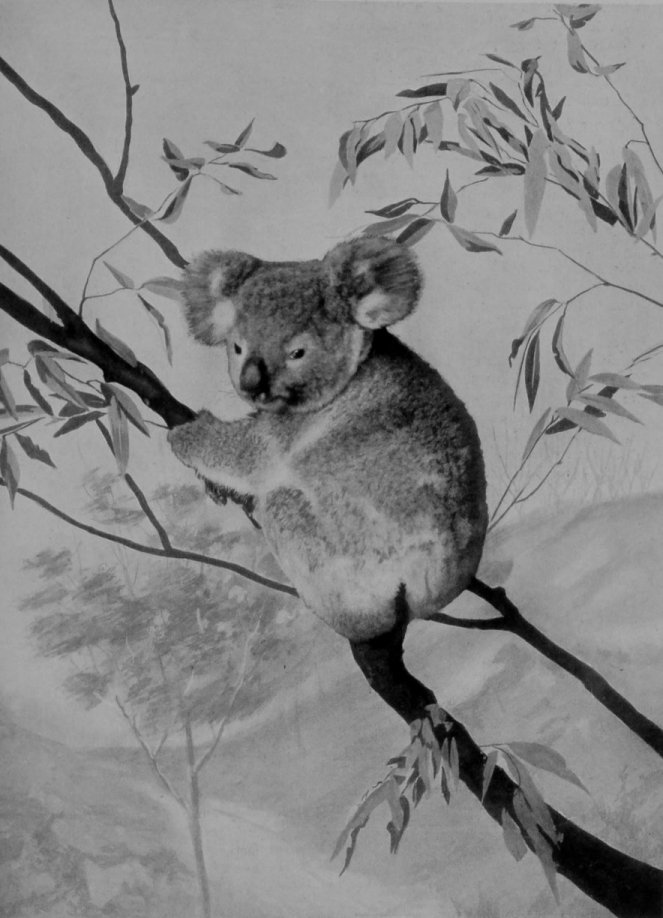
Photo by W. Saville-Kent, F.Z.S.] [Milford-on-Sea.
KOALA, OR AUSTRALIAN NATIVE BEAR.
These animals make a peculiarly plaintive cry when molested in any way by human
beings.
The female koala produces but one cub at a time. At an early period after its birth this is
transferred to its mother's back, and is thus transported until its dimensions are about one-half
of those of its parent. The pair as shown in the illustration on page 355
presents, under these conditions, an essentially grotesque aspect.
It is a noteworthy circumstance that, compared with the male, the female koala is but rarely to
be observed wandering abroad during broad daylight. As with the typical phalangers food is
consumed chiefly at night or during the brief Australian twilight hours. While the male at certain
periods, more especially the months of March and April, is much in evidence in daytime to both the
senses of sight and hearing, as attested to on a previous page, the female spends the whole or
greater portion of the day clinging as an inert sleeping mass to a convenient branch.
"Bear"-shooting in Australia, as might be anticipated from the description here given of the
animal's habits and temperament, affords but sorry sport. It may further be remarked that those
who have shot at and only disabled one of these inoffensive little creatures are scarcely likely
to repeat the experiment. The cry of a wounded koala has been aptly compared to that of a
distressed child, but still more pathetic. When fatally shot, it also more frequently than
otherwise clings tenaciously back-downwards, like the South American sloths, to the supporting
tree-branch, and is thus frequently irrecoverable. With the non-sentimental Australian furrier the
koala's pelt of soft, crisp, ashy-grey fur is unfortunately in considerable demand, being made up
mostly, with the quaint round head and tufted ears intact, into, it must be confessed, singularly
attractive and warm rugs.
The correspondence of the koala in form and habits to the sloths among the higher mammalia has
been previously mentioned. The parallelism might be pursued in yet another direction. In earlier
times the small tree-inhabiting South American sloths were supplemented by ground-frequenting
species, such as the Megatherium, which were of comparatively titanic proportions. The epoch of
the accredited existence of these huge ground-sloths was so comparatively recent—the later
tertiaries—that it is even yet not regarded as altogether improbable that some existing
representative of the race may yet be discovered in the fastnesses of the South American forests,
and thus claim a niche in the pages of a subsequent edition of "Living
Animals." In a like manner the little sloth-like tree-frequenting "Australian Bear" had his
primeval ground-dwelling colossi, and there is yet a lurking hope among enthusiastic zoologists
that some surviving scion of the little koala's doughty forebears may yet turn up in the
practically unexplored Central Australian wildernesses. Some such anticipations, as a matter of
fact, stimulated the hopes and aspirations of the participators in one of the latest of these
exploring expeditions, which, while not successful in this instance in obtaining so great a prize,
secured for science that most interesting and previously unknown marsupial mammal the Pouched
Mole.
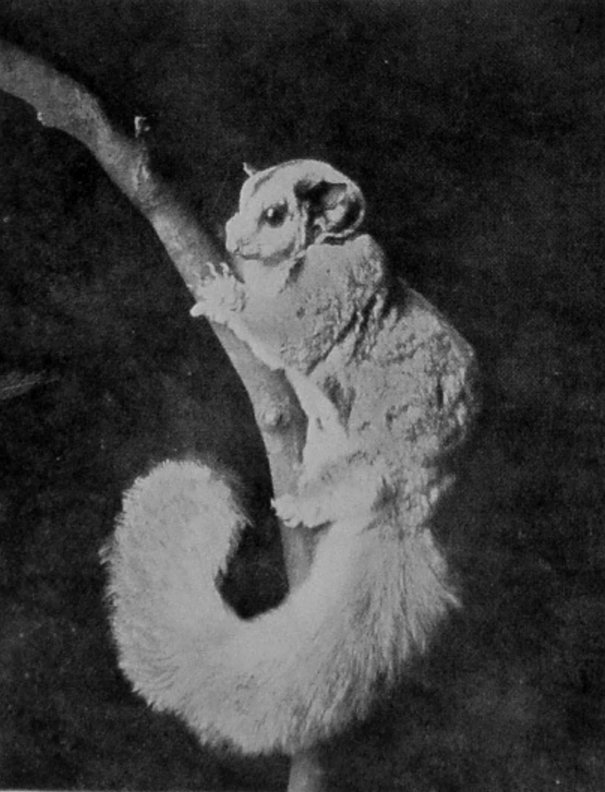
Photo by W. Saville-Kent, F.Z.S.] [Milford-on-Sea.
SQUIRREL-LIKE FLYING-PHALANGER OF VICTORIA.
This animal has soft grey fur like that of the chinchilla.
The Typical Phalangers.
The typical Phalangers, or Opossums, as they
are familiarly known throughout Australia, include a very considerable number of representatives,
ranging in size from that of a small mouse to that of a full-grown cat. All are essentially
arboreal in their habits, feeding principally on the leaves and flowers of the various gums. They
are for the most part strictly nocturnal in their habits, and make their homes and retiring-places
during the day in the hollow trunks and limbs that are of such abundant occurrence in the
periodically fire-swept Australian forests. Almost all the larger species are notable for the
length, thickness, and exquisitely fine texture of their fur, a circumstance for which they are
consequently laid under heavy penalties for the sake of their pelts. The island colony of
Tasmania, in the extreme south, with its colder climate, as might be anticipated, produces the
finest qualities of these furs, that of the Black or Sooty Opossum, which is peculiar to the island, being most highly prized. The
length and furry character of their in many instances prehensile tails also form a conspicuous
feature of this group. Nature, in fact, apparently distributed caudal material so over-liberally
among these marsupials that the little koala had to make shift without.
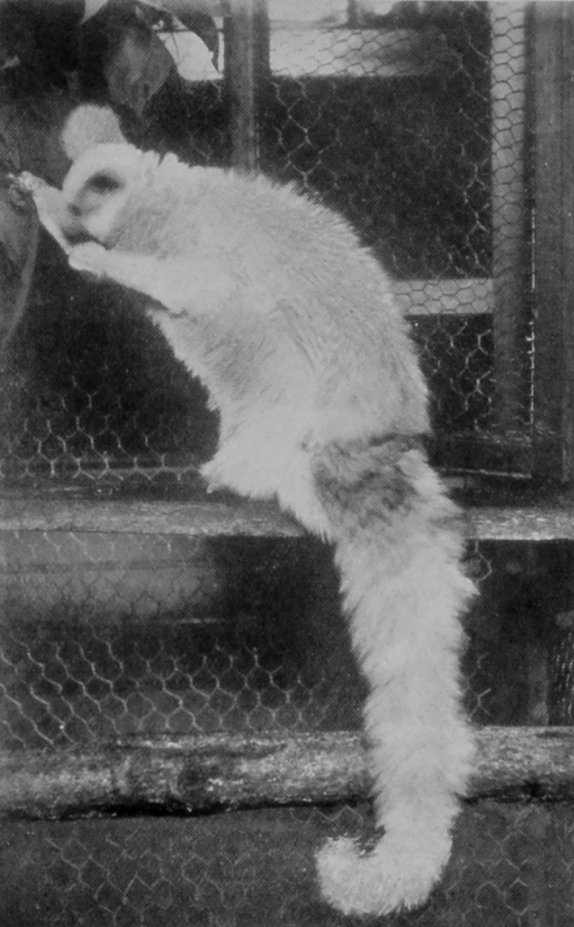
Photo by W. Saville-Kent, F.Z.S.] [Milford-on-Sea.
LARGER FLYING-PHALANGER.
A nearly pure white example.
The group of the Phalanger Family popularly known as Flying-squirrels,
or more correctly as Flying-phalangers, is almost universally admitted to
include some of the most beautiful of living mammals. In external structure, so far as their
peculiar so-called "flying" mechanism is concerned, these animals coincide in a remarkable manner
with the true flying-squirrels, belonging to the Rodent Order, indigenous to the Asiatic and
American Continents. In neither instance is there flight, in the true sense of the term, similar
to that of birds and bats, but the fore and hind limbs are connected by a parachute-like membrane,
which, outstretched when the animal leaps from tree to tree, buoys it up and enables its owner to
traverse, in a straight and gradually descending line only, very considerable distances.
The smaller squirrel-like form common to the south-eastern districts of Australia, and on
account of its predilection for sweets commonly known as the Sugar-squirrel, makes a most charming little pet. For the most part addicted to
sleep, and impatient at being disturbed during the day, towards sundown it wakes up, and is full
of frolic. One such example was the writer's travelling companion for a considerable interval in
Western Australia. While remaining packed conveniently away in a small box throughout the day, it
was accustomed to enjoy the liberty of whatever apartment its owner occupied in the evening and
throughout the night, returning of its own accord to its sleeping-box with the approach of dawn.
On one exceptional occasion, however, Master Tiny, as this individual was named, was missing in
the morning from his accustomed crib, and a prolonged search and examination of every corner and article of
furniture that could afford shelter failed to recover him. That the little creature was lost
through some one having unwittingly left the door of the apartment open, permitting its escape,
was the only and much-deplored conclusion that could be arrived at. Towards evening, however,
there was a slight rustle close at hand, and Master Tiny was discovered emerging, like Minerva
from the head of Jupiter, from the top of one of the old-fashioned china dogs that decorated the
hotel-room mantelpiece. The ornament, seemingly intact from the front, had the back of the head
battered in. Through the resulting crevice the little animal had managed to squeeze itself, having
come to the conclusion, doubtless, that this newly chosen retreat more nearly resembled the
cavernous shelter of its native tree-spout than its accustomed artificially constructed box. This
singular domicile Master Tiny was permitted to monopolise for the remainder of his sojourn at that
hostelry. One of the favourite diversions of this little phalanger during the evenings was to
climb up the curtain and cornice of the room he occupied, and thence hurl himself through the air
with outspread parachute to the writer at the opposite end. The apartment, happening to be the
commercial room of the hotel, some thirty feet in length, gave him good scope for exercising his
characteristic flying leaps. The attitude invariably maintained during these flights is aptly
illustrated in the accompanying photograph; the body is never poised with the head inclined
downwards, as is commonly depicted in artists' fancy sketches of the animal contained in popular
natural histories. A friend of the writer's in Tasmania, who kept one of these flying-phalangers
as a household pet, was accustomed to leave a crevice of the window open at night, so that the
little fellow could go in and out as it liked. After the manner of most pets, however, a day
arrived upon which its box was found vacant, a marauding cat or other disaster having apparently
compassed its untimely end.
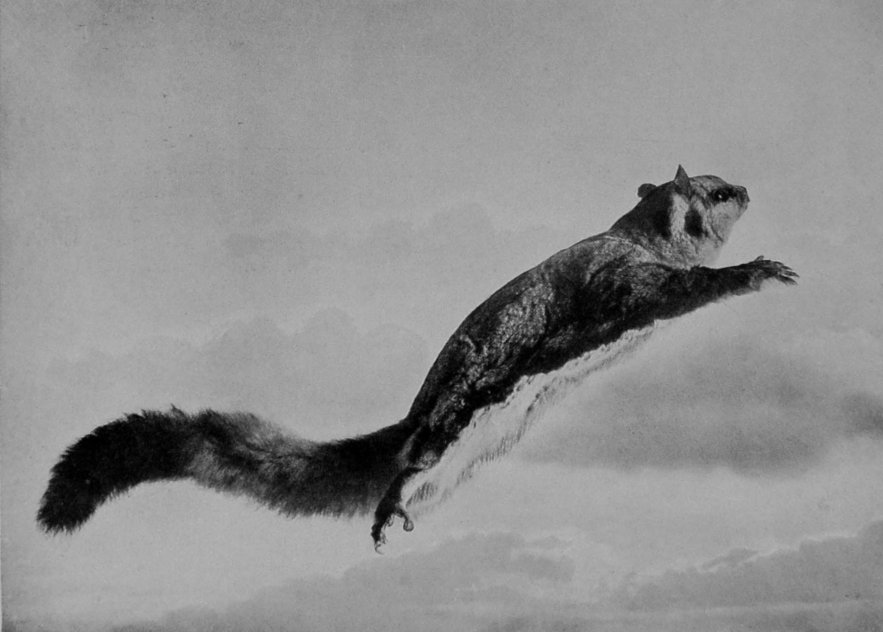
Photo by W. Saville-Kent, F.Z.S.] [Milford-on-Sea.
LESSER FLYING-PHALANGER.
Illustrating position maintained during its remarkable flying leaps.
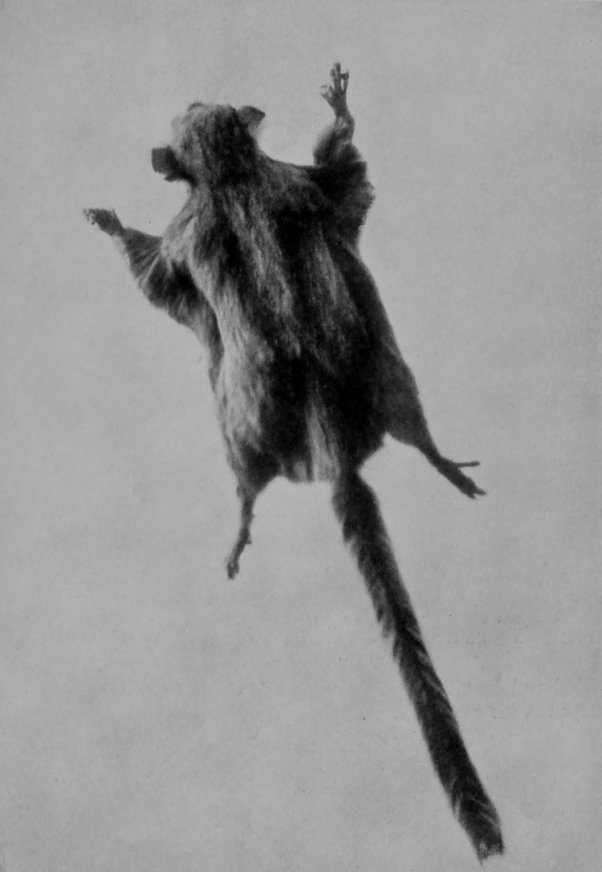
Photo by W. Saville-Kent, F.Z.S.] [Milford-on-Sea.
PYGMY FLYING-PHALANGER.
A life-size photograph. The hairs of the tail in this animal are arranged in
two parallel lines, like the vanes of a bird's feather.
The larger flying-phalanger, the dimensions of our domestic tabby, and with fur as long and as
soft as the Persian variety, is less frequently domesticated. It has, in fact, an evil reputation
for scratching, biting, and general untamableness. One that was kept for some little time by the
late Dr. Bennett, of Sydney, and brought to England, never entirely lost its innate savagery. On
the voyage from Australia it became sufficiently tame as to be allowed occasionally to run about
on the deck, and was so far amiable as to lay on its back and permit itself to be tickled. On
attempting to handle it, however, "it displayed its usual savage disposition, digging its sharp
claws and teeth into the bands of its captor." The writer was fortunate in being the recipient in
Queensland of a couple of these large phalangers which were exceptions to the usual rule. These
specimens—a mother and its young male offspring—also varied in colour from normal
examples, which are usually dark slate or blackish brown above and whitish underneath. The mother
in this instance was a beautiful cream-white throughout; and her young one, while dark
chinchilla-grey upon the back, limbs, and tail, had white ears and breast. Both were very
friendly, and would of their own accord climb over their owner's person, seeking in his pockets
for hidden lumps of sugar and other acceptable dainties. As with the smaller squirrel-like forms,
they slept throughout the greater portion of the day, waking to activity and making excursions in
search of their food as soon as the sun went down. The tail of this species of phalanger is
abnormally long and furry, but not prehensile. It was observed of them that when feeding leisurely
on the gum-tree leaves this appendage was permitted to hang or rest loosely, but that when walking
along the branches they would very frequently coil this member into a tight spiral coil, like a
watch-spring or the proboscis of a butterfly, against their hindquarters. This phenomenon is
apparently unique among mammals. Although generally seeking the darker retreat of their box for
their long daylight sleep, the female, more particularly, would frequently simply curl herself
up into a furry white
ball in one corner of the cage, the head, limbs, or other features being at such times altogether
indistinguishable. The aid of the magnesium flash-light was successfully called into service to
secure the photographic likeness of this animal, here reproduced, which was taken while it was
enjoying its evening meal.
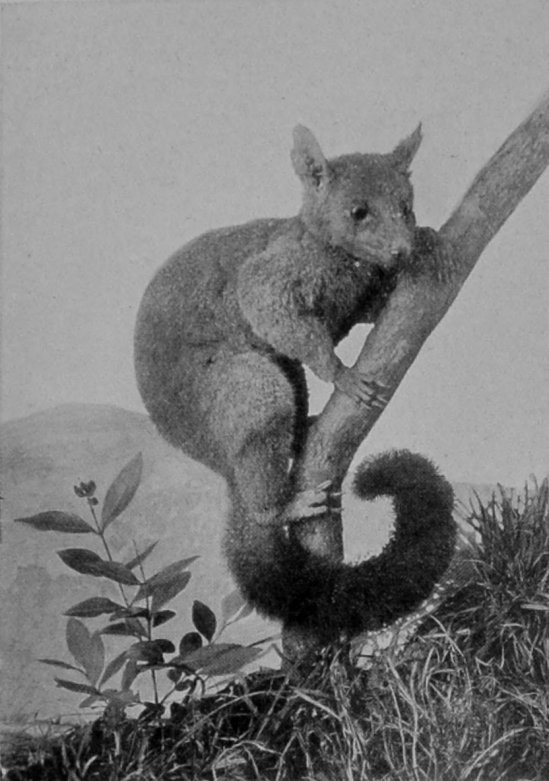
Photo by W. Saville-Kent, F.Z.S.] [Milford-on-Sea.
COMMON GREY OPOSSUM, OR PHALANGER.
The fur of this species is in great demand for the manufacture of
carriage-rugs.
As previously mentioned, some representatives of the flying-phalanger group are no larger than
mice, and are furnished in a similar manner with a parachute-like membrane that enables them to
take abnormally long flying leaps, or as it were to sail horizontally through the air. The Pygmy Flying-phalanger, whose length of body does not exceed 2½ inches, is one
of the most interesting. The tail in this form is also adapted for aerial flotation, the long
hairs that grow upon this appendage being arranged in two parallel lines like the vanes of a
feather. Its distribution is limited to the south and eastern districts of the Australian
Continent. There are also a number of mouse- and squirrel-like phalangers destitute of the
flying-membrane, which in this respect very closely resemble in external aspect more typical
members of the Rodent Order. One form in particular, the Striped Phalanger
of New Guinea, decorated with broad longitudinal black and white stripes, is singularly suggestive
of some of the variously striped American squirrels. This interesting island of New Guinea also
produces a little Pygmy Phalanger with a feather-like tail which, except
for the absence of a parachute or flying-membrane, is the very counterpart of the Australian kind.
Another species, which in shape, size, and more especially with reference to its long, pointed
snout, closely resembles a shrew-mouse, is found in Western Australia. The tail of this species,
known as the Long-snouted Phalanger, is highly prehensile; and it is also
provided with a long, slender, protrusile tongue, with which it abstracts the honey from Banksias
and other flowers, upon which it customarily feeds.
The two large phalangers known as the Black and Grey or Vulpine Opossums, which are chiefly laid under
contribution for the Australian fur supplies, are provided with prehensile tails, the under side
of the extremity of which grasps the supporting fulcrum and is devoid of hair. The adaptation of
the tail for use as a fifth hand—as in the New World monkeys—is, however, much more
conspicuously manifested in what are known to the colonists as the Ring-tailed
Opossums, and to zoologists as Crescent-toothed Phalangers. In
these the tail tapers to a fine point, and the hair throughout the terminal third of this
appendage is so fine and short that it at first sight presents the appearance of being entirely
naked. This terminal third of the tail, moreover, in the greater number of species, contrasts with
the remaining portion by being white in hue. It occasionally happens, however, that individuals
occur which are entirely white. One such which came into the writer's possession was obtained from
the Bruni Islands, in the Derwent Estuary, Tasmania, and afterwards became a great pet with the
young people at Government House, Hobart. It is an interesting circumstance that the Bruni Islands
were noted for the production of albino animals of various descriptions, white kangaroos and white
emus having also been obtained from this locality. Probably some peculiarity of the soil, and its
action on the vegetable food the animals consumed, played an important part in the unusually
frequent occurrence of this phenomenon.
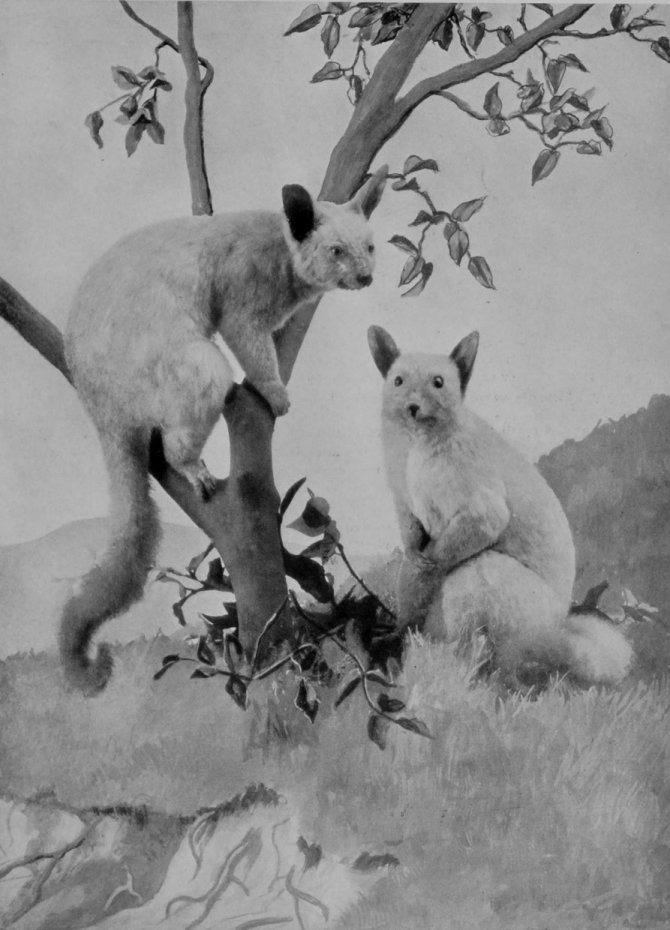
Photo by Henry King] [Sydney.
AUSTRALIAN GREY OPOSSUM, OR PHALANGER.
On account of its "foxy" appearance, this species is also known as the Vulpine
Phalanger.
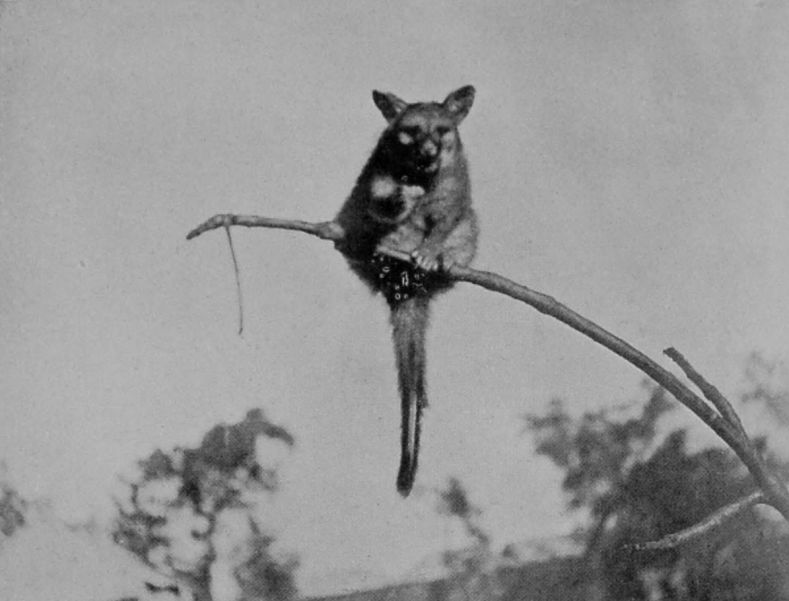
Photo by W. Saville-Kent, F.Z.S.] [Milford-on-Sea.
FRONT VIEW OF GREY OPOSSUM, OR PHALANGER.
Displays the bare under-surface of the prehensile tail.
The ring-tailed opossums differ essentially from the common opossum or phalanger and its allies
in their life habits. While these latter habitually take up their abode and bring forth their
young in hollow trees, the ring-tailed species construct a regular nest of interlaced sticks,
leaves, grass, or any other available material for their domicile. The structure much resembles
the nest, or "drey," of our own familiar European squirrel, and may be perched high up among the
tree branches or within only a few feet from the ground among the scrub thickets. In New Guinea a
variety of these ring-tailed phalangers occurs, not found in Australia, which has no white tip to
its tail, and the ears are very short and wide. The group as represented by this species leads to
the consideration of the so-called Cuscuses or typical phalangers
indigenous to New Guinea and North Queensland, though but rarely seen there, which, as an
exception to the Marsupial Tribe, are distributed among the Indo-Malay Islands as far westward as
Celebes. In the cuscuses the tail is altogether naked, and pre-eminently prehensile throughout
almost its entire terminal moiety; the ears are round and, proportionately, exceedingly small;
while the fur is very short, thick, and woolly. Compared with the opossums or phalangers, the
cuscuses are very dull and sluggish in their movements, creeping slowly among the branches of the
trees to browse on the fruit and leaves which constitute their principal diet. Like the opossums,
however, or even to a greater extent, they vary this vegetarian regimen with insects or an
occasionally captured bird.
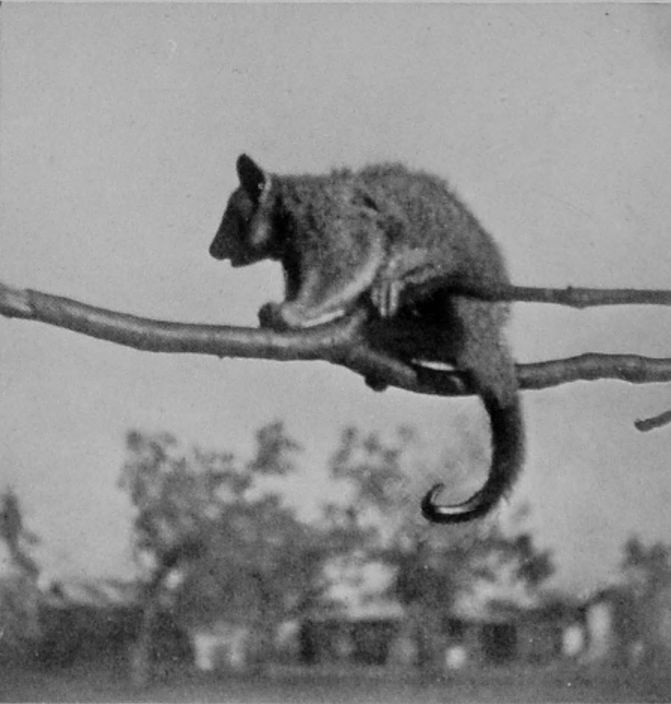
Photo by W. Saville-Kent, F.Z.S.] [Milford-on-Sea.
PROFILE VIEW OF GREY OPOSSUM, OR PHALANGER.
The opossums are usually shot by moonlight, as seen silhouetted against the
sky.
The Cuscuses.
The familiar Spotted Cuscus of New Guinea is the most ornate marsupial
mammal. The males, more especially, are as variegated in colour as a tortoiseshell cat, their
tints, moreover, closely corresponding in hue with those of the feline. No two individuals,
however, are precisely alike in this respect. Usually the ground-colour of the back is a dirty or creamy
white, interspersed with various-shaped blotches of nut-brown or black; the chin, breast, and
under-parts are a purer white, and the limbs grey or reddish brown, or, as shown in the photograph over-leaf, mottled like the body. The Black
Cuscus of Celebes is, as its name denotes, a much more sombre-looking animal, and is also
the largest species, its dimensions equalling or exceeding those of a large cat. The uniformly
tinted Grey Cuscus of Timor, Amboina, and other of the Indo-Malay Islands
is very similar in size and aspect, excepting for the half-naked tail, to the common ring-tailed
phalanger. All the cuscuses are of rare occurrence in even their most favoured habitats. On one
occasion the writer came across an example of the grey species in the scrub forest of Thursday
Island, Torres Straits. In this instance, however, it is doubtful if the animal was not an escaped
pet brought over from the neighbouring coast of New Guinea.
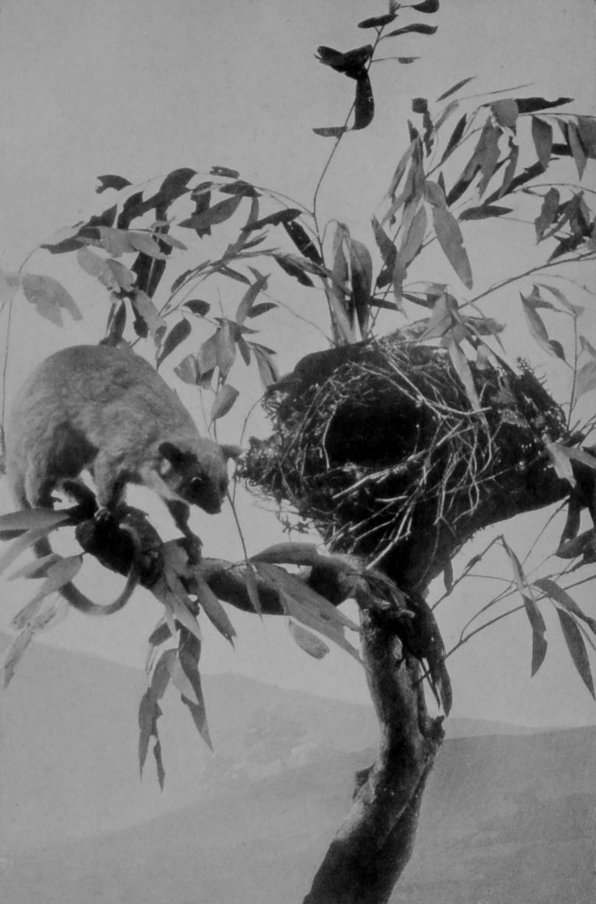
By permission of S. Sinclair, Esq.] [Sydney.
RING-TAILED OPOSSUM, OR PHALANGER, AND NEST.
This is the only Australian opossum which builds a regular nest.
Much interesting information concerning different varieties of the cuscus is contained in Dr.
Alfred Wallace's interesting work "The Malay Archipelago." An anecdote of one which was brought to
this naturalist during his residence in the Aru Islands—the headquarters of the great bird
of paradise—is thus related: "Just as we had cleared away and packed up for the night, a
strange beast was brought, which had been shot by the natives. It resembled in size and in its
white woolly covering a small fat lamb, but had short legs, hand-like feet with large claws, and a
long prehensile tail. It was a Spotted Cuscus, one of the curious marsupial animals of the Papuan
region, and I was very desirous to obtain the skin. The owners, however, said they wanted to eat
it; and though I offered them a good price, and promised to give them all the meat, there was
great hesitation. Suspecting the reason, I offered, though it was night, to set to work
immediately, and get out the body for them, to which they agreed. The creature was much hacked
about, and the two hind feet almost cut off, but it was the largest and finest specimen of the kind I had
seen; and after an hour's hard work I handed over the body to the owners, who immediately cut it
up and roasted it for supper."
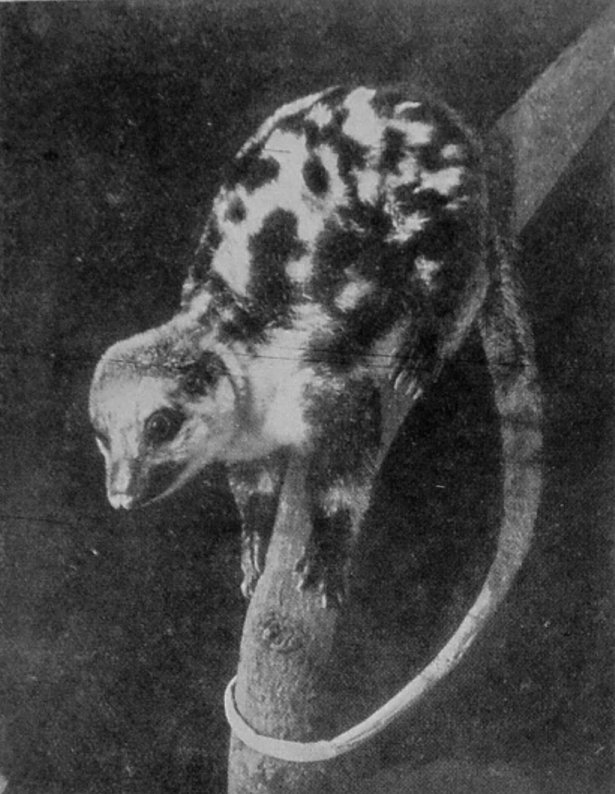
Photo by W. Saville-Kent, F.Z.S.] [Croydon.
SPOTTED CUSCUS.
The cuscuses are sleepy animals, with soft, woolly fur, which in this species
is curiously variegated in colour.
The remarkable tenacity of life possessed by the cuscus is fully attested to by Dr. Wallace. He
says: "They move about slowly, and are most difficult to kill, owing to the thickness of their
skins and tenacity of life. A heavy charge of shot will often lodge in the skin and do them no
harm, and even breaking the spine or piercing the brain will not kill them for some hours. The
natives everywhere eat their flesh; and as their motions are so slow, easily catch them by
climbing; so that it is wonderful that they have not been exterminated. It may be, however, that
their dense woolly fur protects them from birds of prey, and the islands they live in are too
thinly inhabited for man to be able to exterminate them."
One of the most notable circumstances respecting the cuscus is the fact that it is
one of the few marsupials whose geographical distribution extends so far east in the Malay
Archipelago as to be found associated with many of the higher mammalia which are altogether
unrepresented in Australia or New Guinea. The Moluccas, including notably the islands of Silolo,
Ceram, Boru, and many smaller ones, for example, produce no less than three species of cuscus, and
are also the home of a species of baboon, a civet-cat, a deer, and that remarkable pig the
babirusa. One other marsupial, a little flying-phalanger, is likewise a denizen of these islands.
It has been suggested by Dr. Wallace that none of the foregoing higher mammals are possibly
indigenous to the Moluccas. The baboon, he remarks, is only found in the island of Batchian, and
seems to be much out of place there. It probably originated from some individuals which escaped
from confinement, these and similar animals being often kept as pets by the Malay inhabitants and
carried about in their praus. The civet-cat, which is more common in the Philippines and
throughout the Indo-Malay region, is also carried about in cages from one island to another, and
not infrequently liberated after the civet has been abstracted from them. The deer, which is
likewise tamed and petted, its flesh also being much esteemed for food, might very naturally have
been brought by the Malays from Java with the express object of its acclimatisation. The babirusa,
whose headquarters are in the island of Celebes, is only found in Boru, its nearest neighbour in
the Moluccan group. Dr. Wallace anticipates that these two islands were in former times more
closely connected by land, and that under such conditions the babirusa may have swum across the
intervening channel. Should these several hypotheses be correct, the Molucca Islands must be
regarded, from a zoological standpoint, as an essentially Australasian or marsupial-producing
region.
The Wombats.
The Wombat Family, claiming the next position in the marsupial galaxy, constitutes the very
antithesis to the light and graceful arboreal phalangers. There are but three known species, one
of these inhabiting Tasmania and the adjacent islands, while the other two are peculiar to the
southern region of the Australian Continent. In forms and gait their thick-set tailless bodies
suggest a cross between a small bear and a capybara, and as "bears" and "badgers" they are familiarly known by
the Australian colonists. The badger simile is perhaps the most pertinently applied with reference
to their habit of excavating huge earth-burrows as dwelling-places, and out of which they
customarily emerge only at night to feed. The Tasmanian Wombat, at all
events, is essentially gregarious in its habits; In the neighbourhood of Swansea, on the east
coast, it is, or was, particularly abundant, forming regular warrens among a light undergrowth of
vegetation, through which travelling on horseback is a distinctly risky proceeding. The
temperament of the wombat is peculiarly placid; and hence, as it might be anticipated, they are
essentially long-lived. One, Charlie by name, which has been domiciled at the Zoo for the past
thirty years, is still hale and hearty, and evidently disinclined yet awhile to immolate himself
on the altar of fame as a much-needed successor to the antique effigy which has for so long
represented his species in the British Natural History Museum. Waiting for dead men's shoes is a
proverbially tedious task, and for a coveted wombat's skin evidently more so.
The tough hide, with its thick, harsh fur, of the Tasmanian wombat, or "badger," as it is
locally dubbed, is somewhat highly prized in the land of its birth. For floor- and door-mats and
rugs the pelt is practically indestructible; and as such, though scarcely a thing of beauty, the
special pride of the thrifty housewife. This animal is also not infrequently made a household pet,
and will waddle as complacently as an over-fed poodle around the premises after its owner. The
wombat, like the large majority of the marsupial animals, is for the most part nocturnal in
habits, and a strict vegetarian.
The wombats present several interestingly distinct structural peculiarities. In the first
place, their teeth, which are twenty-four in number, all grow uninterruptedly throughout life, and
are consequently devoid of roots. The incisor teeth are represented by but a single pair in each
jaw, and, having enamel only on their front surfaces, wear away in a chisel-like form, as in the
beavers and other rodents. Superficially in both form and habits, as well as in the character of
their dentition, the wombats may in fact be aptly likened to some unwieldy representative of the
Rodent Order. Another structural peculiarity of the wombat is that it is the proud possessor of
two more pairs of ribs than any other marsupial.
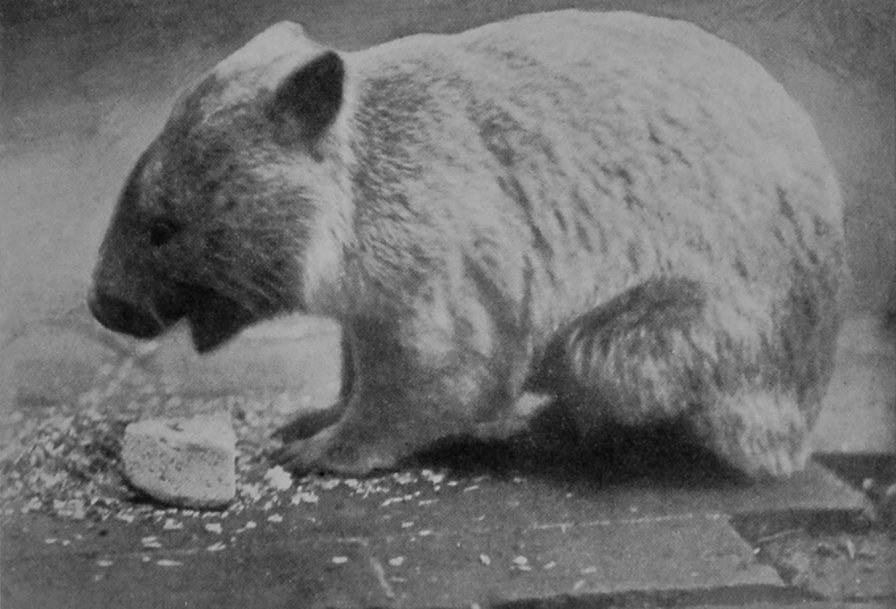
Photo by E. Landor] [Ealing.
COMMON WOMBAT.
A burrowing animal about the size of a small pig.
Of the three known species, the Common Wombat of the South and Eastern
Australian States is the largest, attaining to a length of as much as 3 feet. The colour of this
form is subject to considerable variation, being sometimes yellow, yellow more or less mixed with
black, or completely black. Albinism, as in the kangaroos and phalangers, is of apparently rare
occurrence. The hair, while coarse, is less so than in the Tasmanian species. What is known as the
Hairy-nosed Wombat, inhabiting South Australia, is intermediate in size
between the common and the Tasmanian varieties; its most distinctive features are the soft and silky character
of its brownish hair, and its longer and more pointed ears. The coarseness of the hair of the
Tasmanian species has been previously referred to; in colour it is most usually a dark greyish
brown, while the ears are small and rounded.
The flesh of the wombat is somewhat esteemed for food, being regarded by some as equal to pork,
and much resembling it in flavour. The predilection of tame specimens for milk is very strong, and
it has been recorded of one animal that it was not only in the habit of seeking out the milk-pans
and pushing off the covers in order to drink the contents, but afterwards of taking a bath in what
was left.
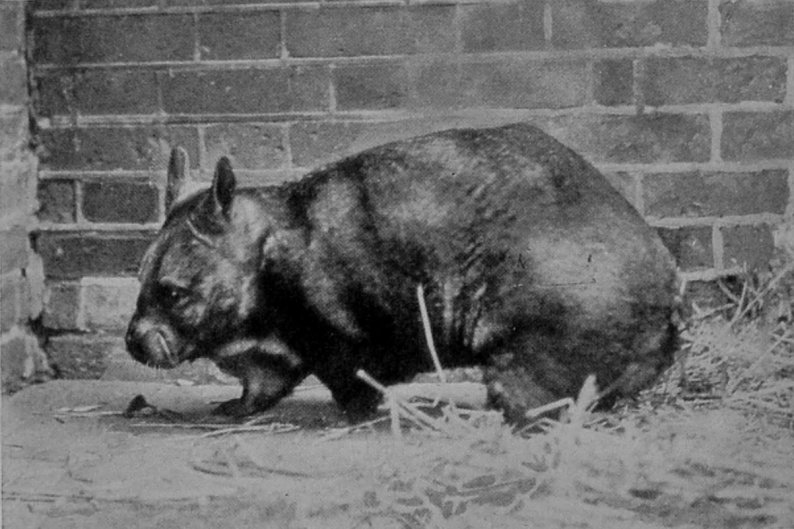
Photo by E. Landor] [Ealing.
HAIRY-NOSED WOMBAT.
A form peculiar to South Australia.
A remarkable habit has been accredited to the wombat which invites scientific investigation. It
is said to be capable of sustaining life for an abnormally long period under water, and that when
in the course of its travels it meets with a pond or river it does not attempt to swim, but,
deliberately entering the water, walks along the bottom, and so emerges on the opposite bank.
The animals of Australia living in not very remote geological times included a near
ally of the wombat which equalled a tapir in dimensions.
The Bandicoots.
The Australian Bandicoots—not to be confounded with their
namesake of India, which is a big rat—constitute a very distinct little family group. They
number in all some eight or nine species, distributed throughout the length and breadth of
Australia and Tasmania, and found also in New Guinea. The largest member is about the size of a
rabbit; and as its general shape, long ears, and soft silky hair impart some slight resemblance to
that rodent, it is commonly known as the Rabbit-bandicoot. With the
above-enumerated points, however, the likeness ceases—its possession of a moderately long
tail, pointed snout, and feet modified on a plan closely resembling those of the kangaroo's
indicating its essentially distinct nature. In a second variety, having somewhat the same external
contour, but smaller in size, the fore limbs are very short, and the feet so modified that only
two toes are visible externally. With reference to this peculiar feature, it is known as the Pig-footed Bandicoot. In a third kind of similar dimensions, with harsh brown
fur, the ears are comparatively short, and the snout is so abnormally prolonged that, it has been
appropriately named the Long-nosed Bandicoot. Superficially, in point of
fact, this and other allied species so closely resemble certain of the long-snouted insectivorous
mammals, such as the Tenrec and Solenodon, that they might be excusably mistaken by the
non-scientific for members of the same group. The bandicoots are chiefly nocturnal, and at all
events incorrigible "sun-downers," turning up for their meals when the evening shadows fall, and
taking a heavy and unwelcome toll of the farmers' potatoes, beets, or other root, crops. Like the
wombat, already described, they are earth-burrowers. Some of them, however, construct nests
above-ground in long coarse grass or low tangled shrubs, which are so ingeniously built in accord
with their environment as to readily escape detection. Insects and worms, in addition to a main
diet of vegetable matter, contribute to the bandicoot's somewhat heterogeneous menu.
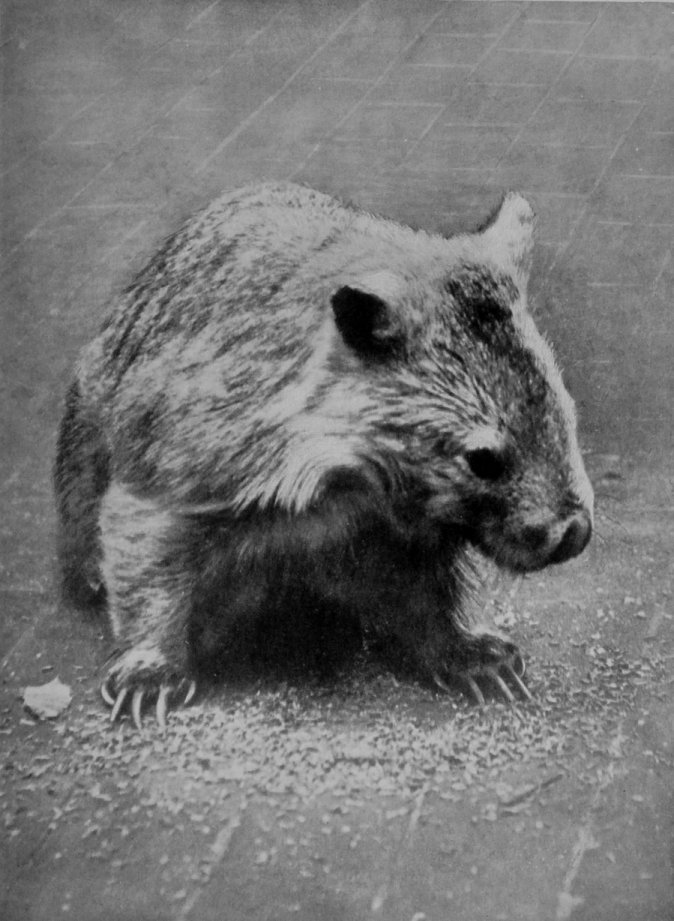
Photo by G. W. Wilson & Co., Ltd.] [Aberdeen.
COMMON WOMBAT.
The Wombats may be said to hold the place occupied in other parts of the world
by the Badgers.
The wood- and root-boring larvæ of a moth which infests the Australian wattle- or acacia-trees
are a very favourite food with several of the species, and it is worthy of remark that the
bandicoots are not alone in displaying a penchant for this delicacy. Under the title of "bardies"
they are collected and highly esteemed for food by the natives of Western Australia, who eat them
either cooked or raw. These larvæ are, moreover, acceptable to many European palates, and the
writer has witnessed little faggot-like bundles of them brought round by the natives to the hotels
at Geraldton, Western Australia, for sale or barter to chance customers. It may be observed in
this connection that the analogous wood-boring larvæ of the goat-moth, which were kept and
specially fattened for the occasion, constituted one of the dainty dishes of the luxurious
Romans.
One of the commonest species found in Tasmania is known as the Banded
or Striped-backed Bandicoot, being so named on account of the
characteristic markings of its fur. The general ground-colour of the coat is an almost equal
admixture of black and yellow hairs, the black tint, however, prevailing on the back, and the
lighter one on the sides. The hindquarters are, however, variegated by the presence of some three
or four broad transverse stripes that are almost entirely black, while the intervening spaces are
a light whitish yellow. A few shorter stripes are sometimes continued as far as the root of the
tail, this appendage also having a dark line running along its upper surface. The head is of a
somewhat lighter tint than the remainder of the body, while the breast, abdomen, and feet are
white, slightly tinged with grey. The transversely striped pattern of ornamentation of the
hindquarters of this bandicoot is of interest with relation to the circumstance that a similarly
located banded variegation of the fur occurs also in the Tasmanian wolf, or thylacine, and in the
banded ant-eater, described in a following section. As a colour-pattern it would appear to be
quite peculiar to these marsupials, no such restriction of the markings occurring among the higher
or placental mammals. In the South African suricate, a member of the Ichneumon Tribe, in which the
nearest approach to this dorsal banding is met with, the stripes are equally developed as far
forward as the base of the neck.
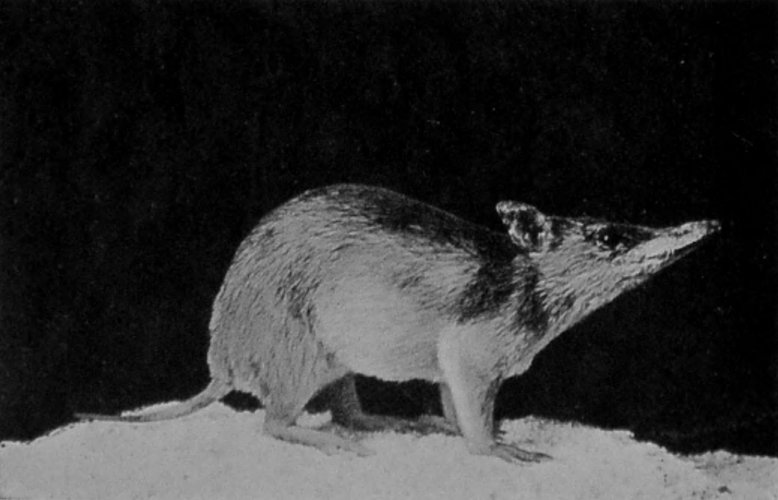
Photo by W. Saville-Kent, F.Z.S.] [Milford-on-Sea.
LONG-NOSED AUSTRALIAN BANDICOOT.
Bandicoots, although larger, have somewhat the appearance of shrews.
Both the banded and other species of bandicoots are extremely swift and active in their
movements, and are at the same time noted for the singularity of their gait. This consists of a
half-running and half-jumping action, induced by the peculiar structure of their feet and greater
length of the hind legs, which are modified on a plan intermediate between that of the kangaroos
and the dasyures, or native cats. The back of the animal while running being highly arched, adds
to the grotesqueness of its appearance. Like the native cats, the pouch in the bandicoots opens
backwards; it is furnished with eight teats, but not more than two young are usually produced at a
birth.
The striped-backed bandicoot is not infrequently adopted as a household pet, in spite of its
notorious garden depredations. When thus domesticated, it appears to be capable of developing a
strong attachment for its owner. One that was owned by friends of the writer especially attached
itself to the lady of the house. It was acquired when quite young, having escaped from the pouch
of an adult female
which the dogs had killed, and being then about the size of a mouse. It speedily learned to lap
milk, and throve on a diet of bread and raw potato. As it grew larger it was allowed the run of
the house, and also of the garden, but habitually returned to the sleeping-quarters selected by
itself, and represented by the woolly depths of its mistress's work-basket. In this haven of rest
it slept all day, scolding and snapping at any intruding hand. Towards dusk it would waken up and
bustle about in a most energetic manner, with the air, in fact, of having an immense amount of
business to transact within the very shortest limits of time. Its first dart was always towards a
corner where a supper of bread-and-milk and potato was usually placed. This meal discussed, its
evening's occupation commenced of scampering around the room and over every accessible article of
furniture. Nor was it shy of climbing up and resting for a few seconds on the shoulders of its
human friends, being always, however, in too great a hurry to prolong the visit. Finally, as with
all pets, "Coota," as he was familiarly named, came to an untimely end—not a cat, however,
on this occasion, but, if rumour whispers true, through over-indulgence in a too liberally
furnished meal of custard pudding.
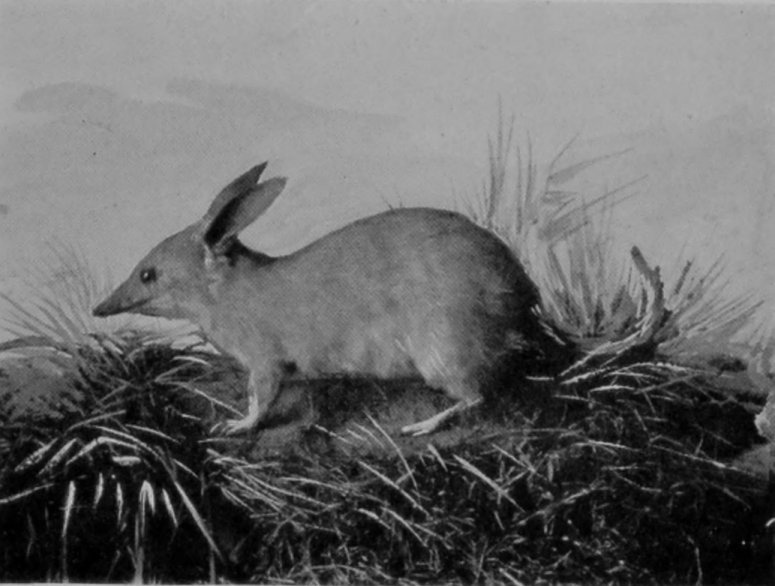
Photo by W. Saville-Kent, F.Z.S.] [Milford-on-Sea.
RABBIT-BANDICOOT.
The largest of the bandicoots; about the size of a rabbit.
The flesh of this and other species of bandicoots is esteemed for food both by the
natives and the white settlers in Australia. It is noteworthy of the banded variety, more
especially, that the skin adheres so tightly to the flesh that its removal is a matter of some
considerable difficulty. When full grown, this species measures as much as 18 inches in total
length, and is little inferior to a rabbit with regard to the amount of good meat it provides for
the larder.
The Pouched Mole.
A still more essentially insectivorous marsupial is represented by the little mammal discovered
only a few years since in the wild sandy wastes of Central Australia. In form and habits it so
nearly resembles the familiar European mole that the title of the Pouched
Mole has been very suitably given to it. At the same time, with regard to its remarkable
organisation, it constitutes the sole representative of its peculiar family group. The first
suspicions of the existence of this singular little animal were raised by the observation of
peculiar sinuous three-lined tracks at irregular intervals on the surface of the sandy regions it
inhabits.
After a long quest, with the aid of the aborigines, the first specimen was discovered reposing
under a tuft of coarse porcupine-grass. A further investigation elicited the fact that its
burrowing proclivities were much less pronounced than those of the ordinary moles, the little
creature progressing alternately over the surface of the sand, and then ploughing its way, for
several feet or yards, two or three inches only beneath the surface. All efforts to preserve
examples of this marsupial alive for longer periods than three or four days proved abortive; for
though the remains of ants and other insects were found within its viscera, it refused to feed
upon the living supplies that were provided for it. In fact, the animal itself apparently ran the
greater risk of being eaten.
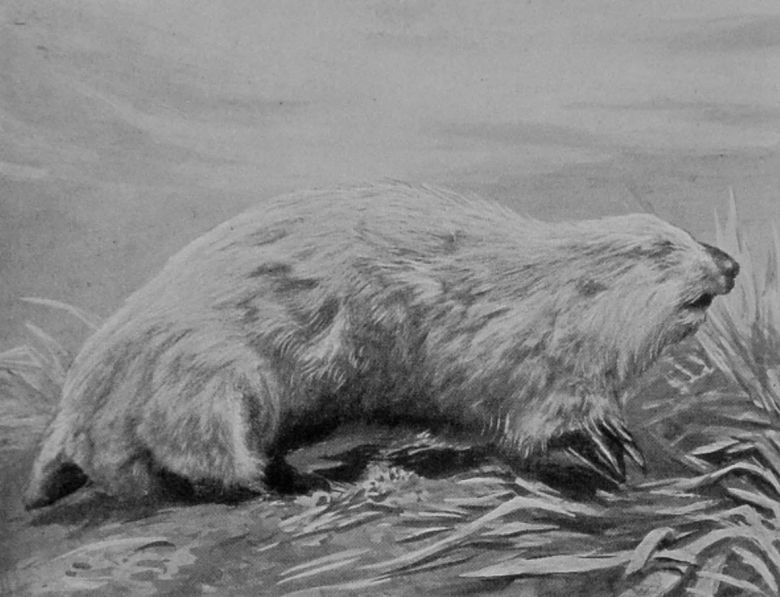
Photo by A. S. Rudland & Sons.
POUCHED MOLE.
This animal is of a pale golden-red colour, and
about 5 inches long. It spends most of its time burrowing, which it can do with great
rapidity, in the sand of the Australian deserts in search of insects.
The colour of the pouched mole is for the most part light fawn, varying in parts to golden
yellow. One of its most conspicuous features, as illustrated in the accompanying photographs, is
the abnormal size of the third and fourth toes of the fore limbs, their peculiar scoop-like
character proving of eminent service to the animal in its customary sand-burrowing habits.
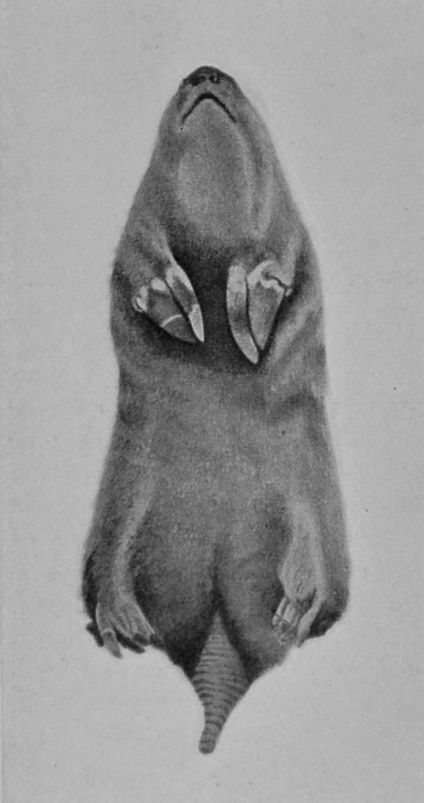
Photo by W. Saville-Kent, F.Z.S., Milford-on-Sea.
UNDER SURFACE OF POUCHED MOLE.
Notice the abnormal size of the third and fourth toe of the fore limbs, and
their peculiar scoop-like shape.
The Tasmanian Wolf.
The remaining family of the Australian marsupials constitutes a parallel to the carnivorous
order of the higher mammalia, all its members being more or less flesh-eaters, and having their
dentition modified with relation to such habits. One of these (the Tasmanian
Wolf, or Tiger of the colonists, better known to zoologists as the
Thylacine) is an animal of considerable size. Its dimensions equal those
of a wolf or mastiff, with which the contour of its body and more especially that of the head very
nearly correspond. In common with the true dogs, the thylacine hunts its prey by scent. This is
well attested to by the following incident, as related by eye-witnesses. While camping out among
the hills in Tasmania their attention was attracted very early one morning by a brush-kangaroo
hopping past their fire in an evidently highly excited state. Some ten minutes later up cantered a
she thylacine with her nose down exactly on the track, evidently following the scent, and in
another quarter of an hour her two cubs came by also in the precise track. While not very swift,
the Tasmanian "tigers" possess immense staying power, and will keep up a long, steady canter for
many hours on end. Accustomed in its primitive state to run down and prey upon the kangaroos,
wallabies, and other weaker marsupial mammals indigenous to the regions it inhabits, the Tasmanian
wolf speedily acquired a predilection for the imported flocks of the settlers, and proved almost
as destructive to them as its Old World namesake. To check its ravages, a price was put upon its
head by the Tasmanian Government; and this measure, in conjunction with the rapid advances towards
the complete settlement of the country which have been accomplished within later years, has
compassed this animal's extermination in all but the wildest and most inaccessible mountain districts. The
colour-markings of this animal are somewhat striking, the grey-brown tints which characterise the
ground-hues of the body and limbs being varied by a series of dark bands traversing the buttocks,
these being widest in this region, and continued forwards to the middle of the back. A somewhat
similar cross-stripe pattern of ornamentation occurs in the relatively small member of the same
family described later on as the Banded Ant-eater.
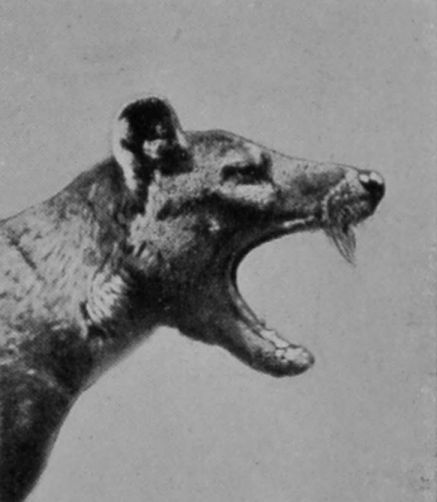
Photo by L. Medland, F.Z.S., North Finchley.
TASMANIAN WOLF.
This photograph shows the great width of gape of this ferocious animal.
Examples of the Tasmanian wolf have frequently been on view at the Regent's Park Gardens, a
very fine young male specimen being at present located in the marsupial section. Within a few
weeks of its arrival it was on excellent terms with its keeper, though, owing to its somewhat
imperfect sense of vision during the daytime, it was apt to snap somewhat promiscuously at those
attempting to cultivate its close acquaintanceship. That a bite from its formidable teeth is not
to be lightly risked will be made abundantly apparent by a glance at the successful yawning pose
photograph secured of this example by Mr. Medland, and here reproduced. Although the thylacine is
at the present time entirely limited in its distribution to Tasmania, it occurs in the fossil
state on the Australian mainland; while, singularly to relate, the remains of a closely allied
form have within recent years been unearthed in Patagonia. This circumstance, taken in conjunction
with the fact that many other fossil types with Australian and New Zealand affinities have been
discovered in the same South American strata, has strengthened the supposition maintained by many
zoologists that in bygone ages a vast Antarctic continent, spreading through the areas now
occupied by the Southern Indian and Pacific Oceans, temporarily united the now distinct lands of
South America and Australasia.
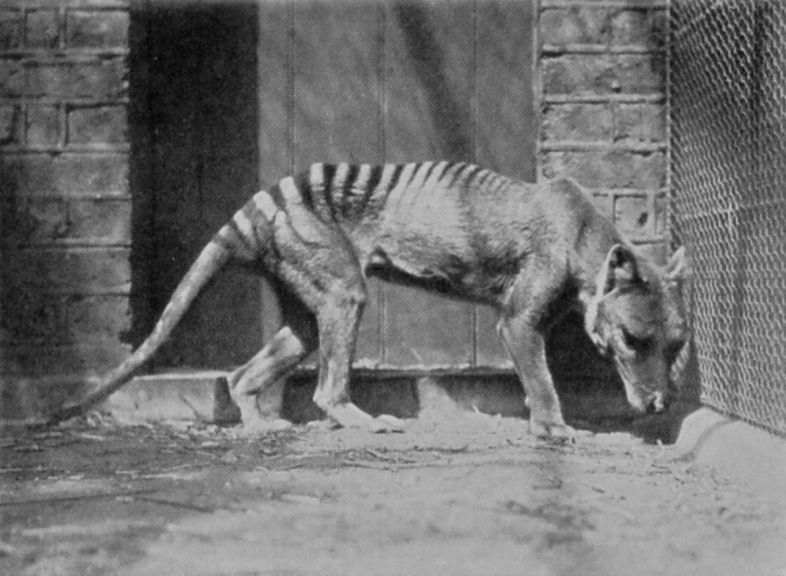
Photo by L. Medland, F.Z.S.] [North Finchley.
TASMANIAN WOLF.
In this photograph are shown nearly all the chief characteristic points of the
Tasmanian wolf.
The Tasmanian Devil.
Next in size to the thylacine, but possessing a more unenviable notoriety for the
uncompromising sulkiness and savagery of its disposition, is the animal which, in virtue of the
aforesaid qualities, is known by the title of the Tasmanian Devil. In
shape and dimensions this marsupial carnivore somewhat resembles a badger; but the head is
abnormally large, the masseter muscles which control the action of the powerful jaws monopolising
a very considerable share of the face area. The limbs are short and also very powerful, the front
paws being well adapted to its burrowing habits. There is some slight variation in the colours of
this marsupial Apollyon; and, as the aphorism runs concerning his sable namesake, he is not always
so black as he is painted. More or less or in fact mostly black he always is, but there is usually
a redeeming thread or patch of white upon his coat. This may take the form of a small star-like
spot only on the front of its chest, which not infrequently extends to a narrow crescent-shaped
band or line continued round the neck almost to the shoulders. One or more supplementary spots of
white may also be developed upon the flanks and hindquarters.
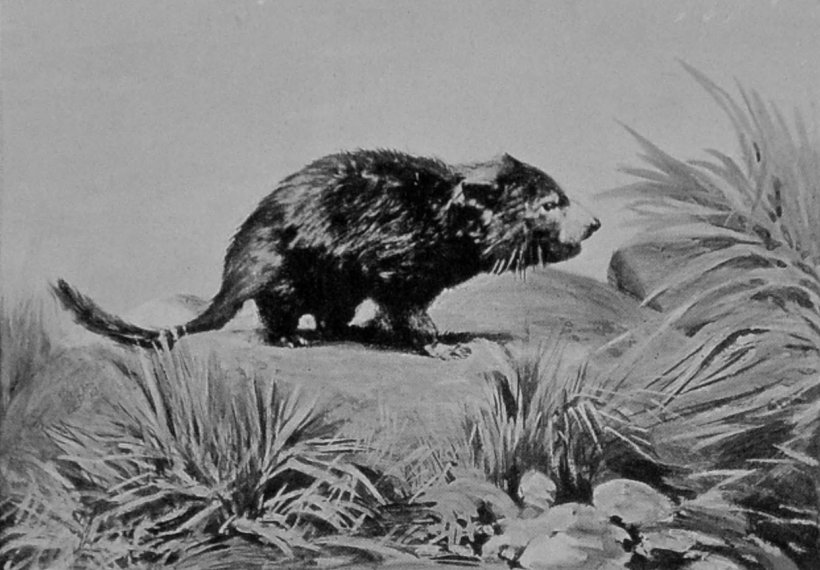
Photo by York & Son] [Notting Hill.
TASMANIAN DEVIL.
A small, but stout and powerful animal, very destructive, and absolutely
untamable.
The destructive propensities of the Tasmanian devil, wherein the farmers' sheep and poultry are
concerned, are in no way inferior to those of the Tasmanian wolf, and in consequence of their
former much greater abundance the havoc these animals committed was the more serious. Placed, like
the last-named type, under Government ban, these native devils have, in comparison with the
earlier days of colonisation, very considerably ceased from troubling, and with the
ever-progressing march of settlement and civilisation will probably be altogether exterminated at
a no very distant date. A bag of no less than 150 of these marauders, in the course of one winter,
was recorded from an upland sheep-station some twenty or thirty years ago. In common with the
thylacine, it has been observed that the Tasmanian devil has a marked predilection for prowling
along the seashore in search apparently of crabs, fish, or any acceptable flotsam and jetsam that
may be cast up by the waves.
Examples of this most unamiable of mammals were brought in alive on several
occasions to the Hobart Museum during the writer's residence in Tasmania, but in all cases
obstinately resisted every attempt towards the establishment of a friendly footing. Their ultimate
relegation to the specimen-cases was, under the circumstances, unattended by any very poignant
manifestations of regret. A fact brought into prominent notice during subsequent post-mortem
investigations was the extraordinary extent to which these animals are infested with vermin.
Possibly this circumstance is to a considerable extent accountable for the creature's
unconquerable irritability. The experiment as to whether a course of disinfecting treatment, by
baths or otherwise, would not conduce towards the taming of this native devil, where all other
applied methods have failed, would at all events be worth the trial. The bath pure and simple is a
wonderful soporific for unruly tempers. As most schoolboys know, a pail of water, from which the
patient is withdrawn when a watery grave is apparently inevitable, is an unfailing specific for
the taming of mice and other "small deer." The writer's experience with a villainously savage cat
which one night fell incontinently into an uncovered cistern, and was rescued by him at almost the
last gasp, will not be readily forgotten. That cat, though still a vixen to the ordinary members
of the household, forthwith attached itself affectionately to its rescuer, and would sit for hours
awaiting his arrival on the doorstep when the business of the day was over. Other fierce
creatures, including the Tasmanian devil, would possibly prove amenable to the judicious
application of the "water cure."
The Native Cats.
The animals common in Tasmania and throughout the greater portion of the Australian Continent,
and familiarly known as Spotted or Native Cats,
and to zoologists as Dasyures, enjoy also an unenviable reputation for
their depredations among the settlers' hen-roosts. To look at, these native cats are the most
mild-mannered and inoffensive of creatures. Actually, however, they possess the most bloodthirsty
proclivities, and may be aptly compared in their habits to the stoats, weasels, polecats, and
other Old World carnivora. There are some five known species, the largest being equal to an
ordinary cat in size, and the smaller ones about half these dimensions. All of them are
distinguished by their spotted pattern of ornamentation, such spots being white or nearly so, and
more or less abundantly sprinkled over a darker background which varies from light grey to
chocolate-brown. In the commonest form, represented in the accompanying photograph, the ears and
the under surface of the body are also often white. No two individuals, however, are to be found
precisely alike in the pattern of their markings. The dasyures differ from the two preceding
types, the Tasmanian wolf and the devil, in being essentially arboreal in their habits, living by
day and breeding, as the majority of the Australian opossums, in the hollow gum-tree trunks, from
which they emerge at nightfall to seek their food. This, in their native state, when hen-roosts
are not accessible, consists mainly of birds and such smaller marsupial forms as they can readily
overpower.
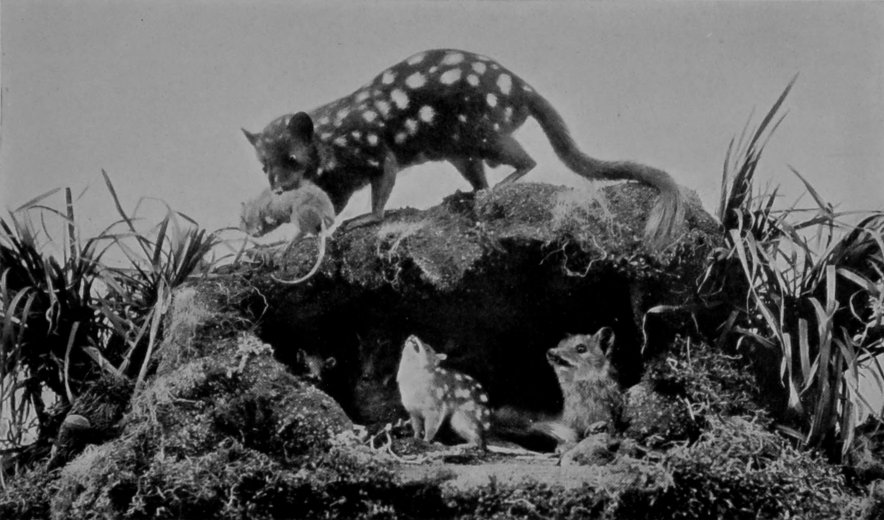
By permission of S. Sinclair, Esq.] [Sydney.
SPOTTED DASYURES, OR AUSTRALIAN NATIVE CATS.
This species is rather smaller than an ordinary-sized cat. All the dasyures are
arboreal in their habits, and very destructive to birds.
The Pouched Mice.
The so-called Pouched Mice represent a group of smaller-sized
carnivorous mammals which have much in common with the dasyures, but are devoid of their spotted
ornamentation. None of them exceed a rat in size. They number about twelve or fourteen known
species, and are distributed throughout the greater part of Australia and New Guinea, and extend
thence to the Aru Islands. They are said not to occur in the extreme north of the Australian
Continent. The writer, however, obtained an example of the brush-tailed species, here illustrated, from the
neighbourhood of Broome, in the farthest north or Kimberley district of Western Australia. This
specimen, which was caught alive in a rat-trap, exhibited astonishingly potent gnawing powers,
almost succeeding one night in eating its way through the wooden box in which it was temporarily
confined. The habits of this species are omnivorous, and chiefly akin to those of the ordinary
rats, it being accustomed to prowl round the out-buildings at night, picking up any unconsidered
trifles in the way of food that may be left unprotected.
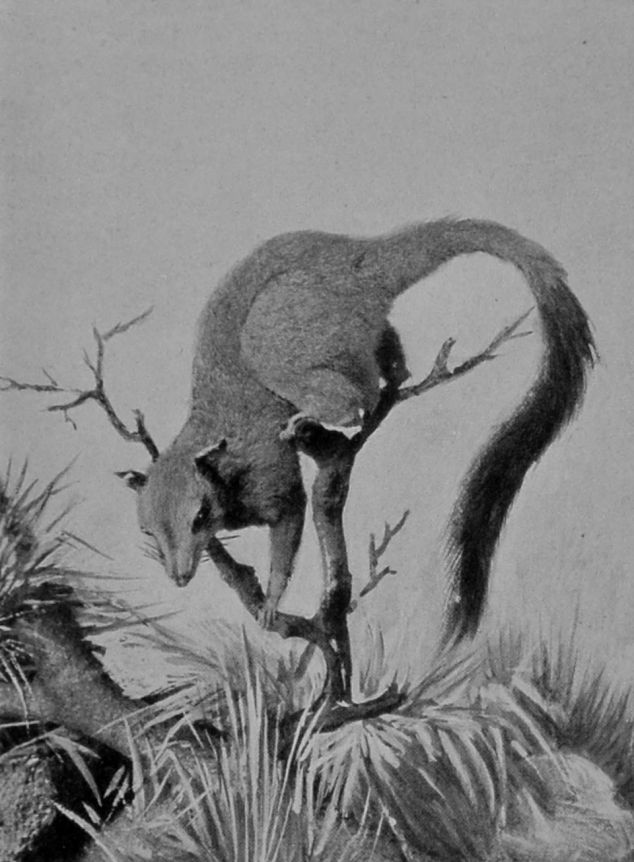
Photo by W. Saville-Kent, F.Z.S.] [Milford-on-Sea.
BRUSH-TAILED POUCHED MOUSE, OR PHASCOGALE.
A slender and graceful animal, the largest of the thirteen known species, and
about the size of an ordinary rat.
Many of the smaller members of this tribe are no larger than mice; and in one form,
known as the Jerboa Pouched Mouse, inhabiting Queensland and New South
Wales, the hind limbs are abnormally prolonged, and the animal progresses by leaps and bounds,
after the fashion of the true jerboas, or its nearer relatives, the ordinary kangaroos and
rat-kangaroos.
The Banded Ant-Eater.
One of the most interesting from the zoologist's standpoint, and the last on our list of the
Australian marsupials, is the little creature, limited in its habitat to Western Australia,
locally known as the Squirrel. The Banded
Ant-eater, with reference to its striped ornamentation and ant-eating habits, is the name
by which it is usually chronicled in natural history works. In size and shape, except for its more
pointed snout, its squirrel-like aspect is certainly somewhat striking. Like the true ant-eaters
of the Edentate Mammalian Order, it, however, possesses a long protrusile tongue, with which it is
accustomed in a similar manner to lick up the ants which constitute its main food-supply.
The most interesting biological peculiarity of this animal is the abnormal development of its
teeth. These number as many as from fifty-two to fifty-six, and exceed the dental formula of any
other known existing marsupial. The usual colour of this interesting little animal is a warm
chestnut-brown, banded transversely over the back with white, these stripes being widest and most
conspicuous over the hindquarters. This somewhat paradoxical marsupial possesses no pouch, the
young, when first born and attached to the nipples in the manner characteristic of ordinary
marsupials, being covered over and concealed among the longer hairs that clothe the abdominal
region. In the dasyures, or native cats, previously described, the pouch exists only in a
rudimentary condition, its function being fulfilled by merely a few skin-folds; while in the
"tiger" and native devil the pouch, contrary to that of the kangaroos, opens backwards.
In disposition the banded ant-eater presents a marked contrast to that of many of
the preceding types. Caught in its native habitat, it does not attempt to bite, and soon becomes
reconciled to captivity. The peculiar nature of its diet, however, militates against its being
easily transported over-sea from the Antipodes.
The American Opossums.
The little group of the American marsupials contains some three or four generically distinct
types whose relationship with the Australian members of the order is in the direction of the
dasyures and bandicoots rather than with the kangaroos and phalangers. Included in one family,
they are popularly known as Opossums, but differ among themselves very considerably both in aspect
and habits. The most remarkable among them is undoubtedly the so-called Yapock, or Water-opossum, an inhabitant of South
America, and ranging in its distribution from Guatemala to Brazil. In both form and habits this
animal so closely resembles an otter that it was referred by the earlier naturalists to the Otter
Tribe. It tunnels holes in the banks of the rivers it frequents, and feeds entirely upon fish,
crustacea, and aquatic insects. The feet, and more especially the hind ones, are distinctly
webbed; the tail is naked, scaly, and non-prehensile; and the fur is short and thick, as in the
ordinary otters. The ground-tint of the fur is a light grey: this is diversified by a black or
dark brown stripe that runs down the centre of the back, and expands over the shoulders, loins,
and hindquarters into saddle-shaped patches or bands of the same dark hue.
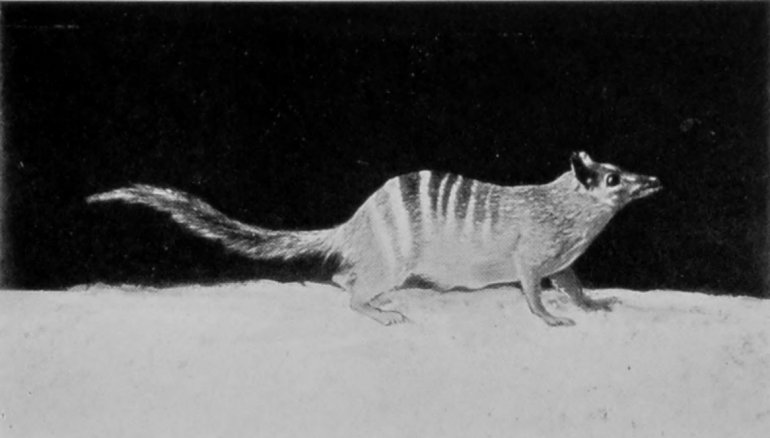
Photo by W. Saville-Kent, F.Z.S.] [Milford-on-Sea.
BANDED ANT-EATER.
From an anatomical point of view, this is one of the most remarkable of the
pouched mammals.
The Common or Virginian Opossum, while the only
representative of the Marsupial Order found in the temperate latitudes of the North American
Continent, has a very considerable range of distribution, occurring in equal abundance throughout
the tropical regions of South America. In these warmer latitudes it differs to such an extent in
the character of its fur and other minor points that it was for some time regarded as a distinct
species, and was distinguished by the title of the Crab-eating Opossum.
Biologists are, however, now agreed that the supposed species is only a local variety. As a matter
of fact, a very considerable amount of variation in the colour and markings is found to exist
among the individuals of the most familiarly known northern race. In form the animal may be
suitably compared to a huge rat, nearly equalling a cat in size, with an abnormally large head and
pointed snout. The tail is long, almost naked for the greater portion of its length, and
pre-eminently prehensile. The fur is of a mixed character, consisting of an undergrowth of a fine,
close, woolly texture, through which protrudes a less dense series of long bristle-like hairs. The
colour of the fur ranges from black to white, and includes all varieties of intermixture. The
face, more especially in the northern race, is usually much the lightest or altogether white,
while in the tropical South American examples it is more often darker, or it may be completely
black.
The opossum, like the rat, is an omnivorous feeder; and being of so much larger size, and
possessing an insatiable appetite, constitutes itself a veritable pest to the fruit-grower, the
agriculturist, and the poultry-farmer. In effecting its entrance to hen-roosts or other
food-yielding enclosures, it exhibits an amount of cunning and pertinacity possessed by no other
mammal. Caught red-handed in these depredations, it has recourse to stratagems which have won for
it a reputation that has long since passed into a household word. Feigning death, or "playing
'possum," is a game at which it is well known to be a past-master, but by which it still frequently succeeds in
hoodwinking the unwary, and so saves its skin. Discovered thieving, and receiving perhaps a
haphazard but by no means disabling blow, it at once collapses, and with film-covered eyes and
protruding tongue is to all intents and purposes dead. It may be kicked round the premises, and
finally probably taken up by the tail and flung ignominiously outside, without betraying vitality
by even so much as a wink. But no sooner is the coast thoroughly clear of the avenger than the
stiffened limbs relax, the eyes reopen, and Brer 'Possum trots off, as fresh as ever. Maybe it is
the ripening maize or the persimmon-patch that next engages his attention, and in either case he
walks in and feeds right royally, laying up a goodly store of fat against the approaching winter
months of scarcity.
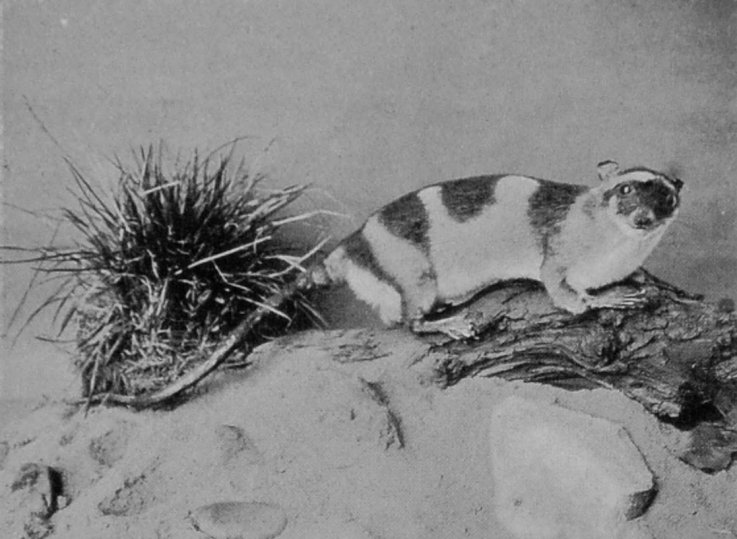
Photo by W. Saville-Kent, F.Z.S.] [Milford-on-Sea.
YAPOCK, OR WATER-OPOSSUM.
In habits, although not in size and colour, this marsupial may be compared to a
wolf.
Away from human habitations the opossum is an essentially arboreal animal, living and breeding
for the most part, like his Australian cousins, in hollow trees, and making excursions therefrom
in all directions in quest of food. His much-mixed natural diet may consist of tender shoots and
leaves, and the wild grapes and the many other berries and fruits the forest produces. He craves,
however, after a due admixture of animal pabulum, and birds and their eggs, insects, lizards, and
the smaller mammals furnish their quota to his menu. Crustacea, such as crabs and the crayfish
which abound in the American streams and marshes, have an irresistible attraction for him; and it
is on this account that, in the southern area of his distribution, where these crustacea are so
plentiful as to constitute his main diet, and his face is browned by the more glowing sun, he is
known by the title of the Crab-eater.
Although fattening up against the winter, he, even in his most northern limits, does not
hibernate, but may even be seen leisurely picking his way over the snow, probably tracking some
unfortunate squirrel to its lair, which in due time is located, dragged out, and devoured. While
assimilating his meal of flesh or fruit, Brer 'Possum likes to have all four hands at liberty, his
hind feet being also graspers; and so he twists his tail round a convenient branch, and, hanging
perdu, leisurely enjoys his feast. The opossum, like the rat—to which it has in
aspect and many of its habits been likened—is a most prolific breeder, as many as from six
to sixteen young being comprised in the litter. When born, they are immediately transferred to the
somewhat capacious pouch, and remain there without venturing outside until they are about the size
of an ordinary mouse.
A third and very distinct type of American opossums is the one represented on page 380, which, from its mouse-like size and aspect, is commonly known as the
Murine Opossum. The most distinct feature of this little animal is that,
though a genuine marsupial, it has no pouch, but carries its young on its back, the little
creatures twining their tails round that of their mother, and so securing a stable anchorage.
Although thus loaded up and transformed for the time being into a sort of combination perambulator
and feeding-flask, the happy but anxious parent pursues the even tenor of her way among the
tree-branches and thicket-growths with almost unabated agility. This species, in common with Meriam's Opossum and the Woolly Opossum and several
others which carry their young, to as many as a dozen in number, on their backs, are denizens of tropical South
America. One of these, named the Philander Opossum, attains to the
somewhat larger size of about 2 feet in total length, the long prehensile tail representing,
however, the greater moiety of these dimensions.
The Selva.
South America has one other marsupial—the Selva—an animal
which, while possessing the dimensions and much of the aspect of an ordinary rat, is remarkable as
differing so materially in the character of its teeth and other structural points that it cannot
be referred to any existing marsupial family. On the other hand, this type is found to coincide in
the above particulars with species hitherto only known in the fossil state, and excavated from the
same tertiary deposits in Patagonia which have been productive of the distant ally of the
Tasmanian wolf. It is yet hoped by zoologists that the discovery of other interesting and possibly
some supposed extinct mammals may reward the thorough exploration of the vast South American
forests. The capture in the flesh of some form allied to the huge ground-sloths, such as the
Mylodon and Megatherium, is, however, now considered to be quite beyond the pale of
possibility.
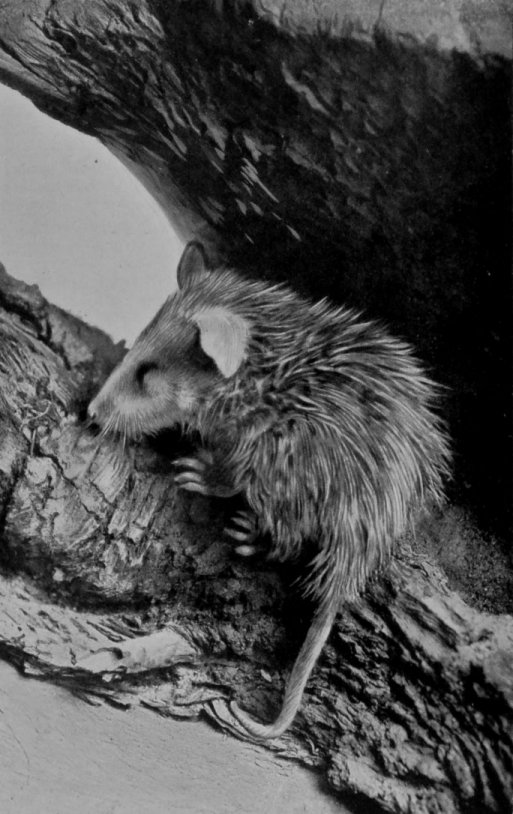
Photo by Dr. R. W. Shufeldt] [Washington.
YOUNG OPOSSUM (NATURAL SIZE).
This is an interesting photograph, as it is
reproduced life-size, and gives an excellent idea of the animal in its native land.
MONOTREMES, OR EGG-LAYING MAMMALS.
With this group or order of the Mammalian Class we arrive, as it were, on the borderland
between the mere typical Mammals and Reptiles. In the last group, that of the Marsupials, it was
observed that the young were brought into the world at an abnormally early and helpless phase of
their existence, and usually consigned, until able to see and walk, to a variously modified
protective pouch. With the Monotremes a yet lower rung in the evolutional ladder is reached, and
we find that the young are brought into the outer world as eggs, these being in the one case
deposited in a nest or burrow, and in the other carried about by the parent in a rudimentary sort
of pouch until they are hatched.
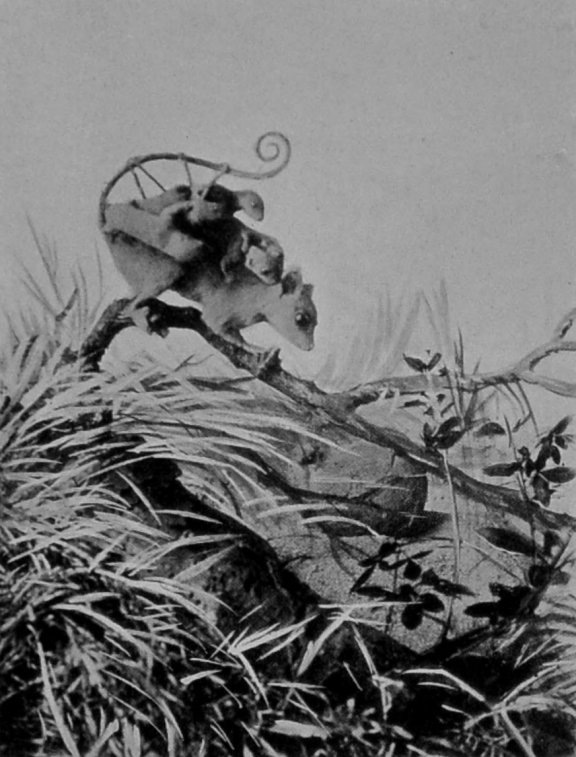
Photo by W. Saville-Kent, F.Z.S.] [Milford-on-Sea.
WOOLLY AMERICAN OPOSSUM.
This animal is about the size of a large mouse. It carries its young on its
back, their tails being entwined round that of their parent.
The living representatives of this singular mammalian order are but few in number,
being restricted, in point of fact, to only two distinctly differentiated family types—the
Echidna or Porcupine Ant-eater, and the Platypus. These monotremes, moreover, like the majority of
the existing marsupials, are limited in their distribution to the Australasian region. The single
species of the Platypus is only found in Tasmania and the southern and eastern districts of the
Australian Continent, while the Echidna numbers some three recognised species, two of which belong
to Australia and Tasmania and the third to New Guinea.
The Echidna.
The Echidna, Porcupine Ant-eater, or "Porcupine," as it is commonly called by the Australian colonists, would seem at
first sight to represent an animal in which the characters of the hedgehog and the common
porcupine are interblended, the innumerable spines being longer than those of the former, but less
in length than those of the last-named animal. The head, with no externally visible ears and
remarkable elongated beak-like snout, however, at once proclaims it to be altogether distinct from
these. The animal has no teeth, and the tiny mouth at the termination of the beak-like snout
simply constitutes an aperture for the extrusion of the worm-like glutinous tongue, wherewith,
after the manner of the true ant-eaters, it licks up the inhabitants of the ants' nests upon which
it feeds. For tearing down the ants' nests and obtaining its customary food, as also for its
inveterate burrowing propensity, the feet, and more especially the front ones, are provided with
strong, blunt, and very powerful claws. The male animal is in addition armed on the hind feet with
a peculiar supplementary spur, which is, however, still more conspicuously developed in the
platypus.
Three distinct species of the echidna are recognised by zoologists. The one peculiar to the
cooler climate of Tasmania is remarkable for its more slender spines, the much greater abundance
of the long bristle-like hairs, and the thickness of the seal-brown under-fur, as compared with
the typical Australian form. In North-west New Guinea the largest and most aberrant form is met
with. Normally it has only three toes in place of five to each foot, the spines are very long and
thick, the body is deeper and more compressed, and the animal stands comparatively high upon its
feet.
The writer, during his residence in Tasmania, had several examples of the local species as
domestic pets. For the first few days they were very shy and untractable, burrowing into the earth
and seeking to escape, or presenting an impenetrable cheval de frise of sharp-pointed
spines to the hands that sought to caress them. After a short interval, however, the creatures
became entirely reconciled to human society and the small amount of restraint to which they were
subjected. They would follow their owner about the garden, or, flattening their bodies and
spreading out their limbs to the greatest extent, lie basking in the sun close to where he might
be seated. They also apparently appreciated being carried, slung across their owner's arm after
the manner of a lap-dog. Living in the near vicinity of unreclaimed bush-land, it was found
possible to keep these echidnas well supplied with their customary food; they were, in fact,
permitted to forage on their own account. Liberated amidst their normal surroundings, they would
walk leisurely from one ant-hill to another, tearing down the side of it with their powerful front
claws, and appropriating its living contents with the greatest relish. It was observed, however,
in this connection that the echidna paid attention entirely to the succulent white larvæ and pupal
phases of the insects with which the inner chambers of the ant-hills are customarily crowded, and
that adult ants, as they abounded in the tracts near at hand or elsewhere, were altogether
neglected. In addition to this natural food these animals were supplied daily with a saucer of
either well-softened bread or porridge and milk, for which they evinced a decided appreciation,
assimilating this food dexterously, though somewhat slowly, with the aid of their long protrusile
tongues. Allowed to wander about the house, they displayed a most inquisitive turn of mind,
peering into every crevice, and climbing upon every accessible article of furniture.
The echidna usually produces only one egg at a time; it is relatively small, not larger than a
sparrow's egg, but equally and obtusely rounded at both extremities, and with a white leathery
shell like that of a reptile. For some time previous to hatching, this egg is carried in a
skin-fold or rudimentary pouch in the parent's abdomen, much similar to that possessed by many of
the marsupials. The young one is also retained in this pouch for some weeks after escaping from
the egg. When finally leaving the pouch, it is between three and four inches in length, and the
spines are in an altogether rudimentary condition.
Examples of the Australian echidna have on several occasions been "in residence" at the Zoo;
while the Hon. Walter Rothschild has been fortunate in keeping living specimens of both this and
the very rare three-toed New Guinea variety in his admirably appointed menagerie at Tring.
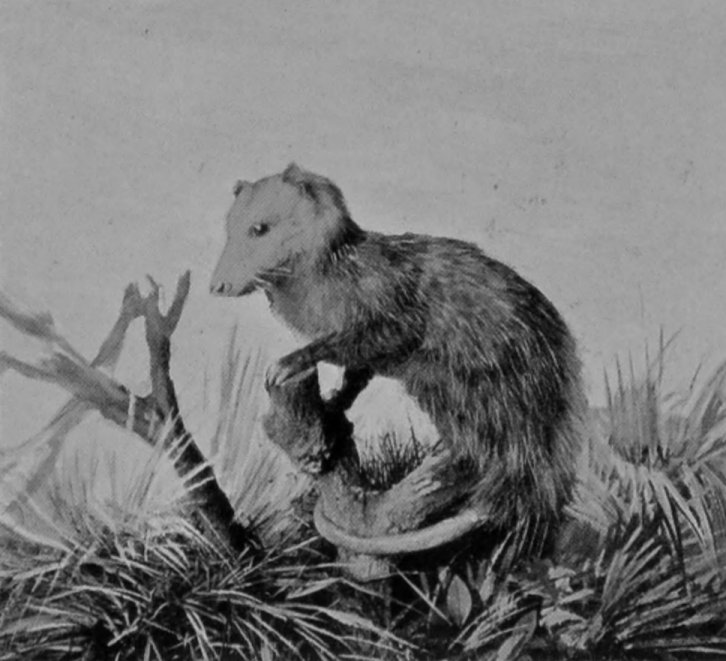
Photo by W. Saville-Kent, F.Z.S.] [Milford-on-Sea.
COMMON OR VIRGINIAN OPOSSUM.
The only marsupial animal found north of Mexico.
The Platypus.
The egg-laying mammal known as the Duck-billed Platypus differs very
essentially from the echidna both in aspect and habits. It is adapted especially for an amphibious
life, and for feeding on molluscs, worms, and insects, which it abstracts from the muddy bed or
banks of the rivers that it frequents. The somewhat depressed ovate body is covered with short
dense fur much resembling in colour and texture that of an otter. The tail is short and flattened
like that of a beaver, but in place of being naked and scaly, as in that animal, is covered, on
the upper surface more particularly, with long, coarse, bristle-like hairs that
intercross one another in all directions. Neither is this tail used, as with the beaver, as a
mason's trowel, it being simply subservient as a steer-oar. The feet are all four distinctly
webbed, the membranes of the front feet in particular projecting to some distance beyond the
extremities of the claws, and so communicating to these members a singular resemblance to the feet
of a duck. The head of the platypus tapers off from the body without any conspicuous neck, and
terminates in a most remarkable duck-like beak, having at its base a supplementary membranous
ferrule-like structure which would seem to serve the purpose of limiting the distance into which
the beak of the animal is thrust into the mud during the quest for its accustomed food, and at the
same time protecting the creature's eyes. The mouth of the adult platypus contains no teeth,
simply a few horny plates; but, singularly to relate, rudimentary teeth exist temporarily in the
young animals. These provisional teeth, moreover, correspond in a marked manner with those of some
ancient types of mammals which occur as fossils in the tertiary deposits of North America. The
platypus, with relation to the obliteration of its teeth in the adult state, is regarded as a very
exceptionally modified form and not as the immediate prototype of the ordinary mammals.
The platypus is found in Tasmania and in the south and eastern districts of Australia only,
being altogether unknown in the west and north. Being especially shy and retiring, and to a large
extent nocturnal in its habits, it is not frequently seen even in districts where it may be rather
abundant. The animal excavates burrows of so great a length as from thirty to fifty feet in the
river-banks that it frequents, and at the extreme end of these burrows it constructs a loose nest
of weeds and root-fibres, which it uses as its retreat, and also for the production of its eggs
and young. There are invariably two entrances to these burrows, the one being under water, and the
other usually opening into a tangle of brushwood at some little distance from the water's edge. As
many as from one to four eggs and young may be produced at a time, but two is the more general
number. From the first it would appear that the eggs and young are deposited and nursed in the
nest, not being retained or carried about in a pouch, as observed of the echidna.
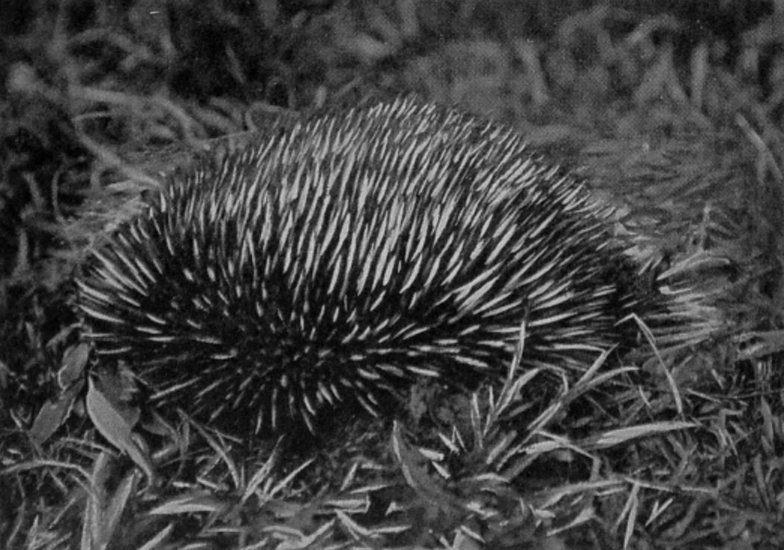
Photo by D. Le Souef] [Melbourne.
ECHIDNA, OR ANT-EATING PORCUPINE.
The female echidna can carry two eggs in her pouch, which in due course are
hatched by the heat of her body.
The late Dr. George Bennett, of Sydney, New South Wales, has probably placed on record the most
detailed account of the ways and life-habits of these remarkable animals, though it did not fall
to him to solve the much-vexed question as to whether or not they were oviparous. This discovery,
as applied also to the like phenomenon in the case of the echidna, was the outcome within quite
recent years of the researches of Mr. Caldwell. After much indefatigable exploration, in which he
was ably assisted by the natives, Dr. Bennett obtained from the extremity of an exceptionally long
burrow a mother and pair of half-grown young. The young ones survived several weeks, and proved
most droll and interesting pets. In playful habits they much resembled puppies, chasing and
rolling one another over, and pretending to bite with their toothless bills. They were also much
addicted to climbing every scalable article of furniture, including even a tall book-case, which
they would negotiate by "swarming" up behind it as a sweep climbs a chimney, with their backs to
the wall and their feet against the back of the book-case. The sleeping and waking hours that both these and other
examples kept were observed to be very irregular; for while usually most lively and disposed to
ramble after it grew dusk, they would at other times come out of their own accord in the daytime,
or perhaps one would ramble about while the other slept. When going to sleep, they would roll
themselves up in a perfect ball, the head, tail, and limbs being closely folded over the
abdomen.
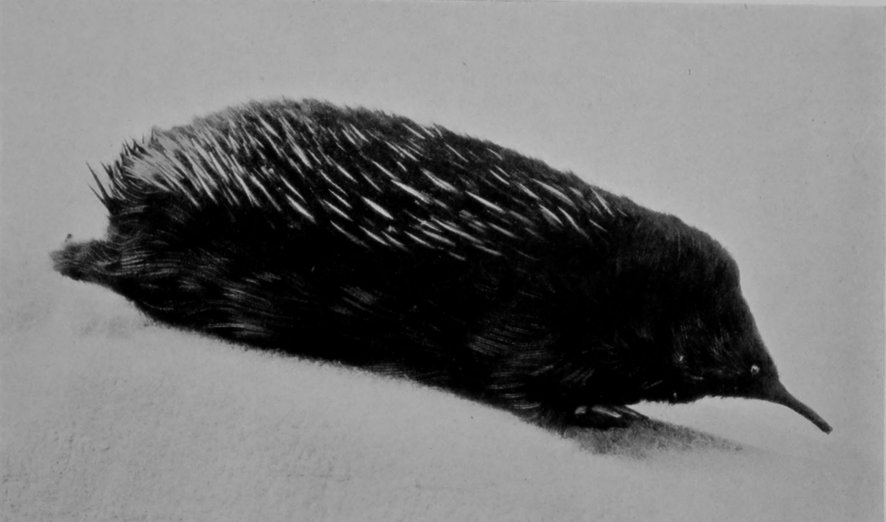
Photo by W. Saville-Kent, F.Z.S.] [Milford-on-Sea.
TASMANIAN ECHIDNA, OR PORCUPINE ANT-EATER.
This is the largest variety of the five-toed species; it grows to a length of
20 inches, and has the fur so long as almost to conceal the spines.
The food question appears to have presented almost insurmountable difficulties so far against
the permanent acclimatisation of these interesting animals in any of our European zoological
gardens. At the Melbourne Zoo some considerable success was obtained by fencing off a small pond
abounding with insects and well-established water-plants for their reception, and in this instance
they had also the advantage of being brought speedily and within a few hours of their capture to
their new home. For their long voyage to Europe the provision of an adequate quantity of living
insects or other aquatic organisms is a by no means easy task. They have, however, been known to
thrive on broken-up river-mussels for the space of two or three weeks, and would probably have
done so for a longer period. This material might easily be stored for their use on board ship.
An incident concerning the natural predilections of the platypus that fell within the writer's
observation in Tasmania might also be utilised in their experimental transportation. At the trout-
and salmon-rearing establishment on the river Plenty—of which the writer was at the time
superintendent—the platypuses proved to be most destructive to the spawn both deposited in
the hatching-boxes and upon the natural spawning-beds, or "redds," and they had in consequence to
be systematically destroyed. This being the case, it is probable that they would be found to
thrive well on a diet consisting to a large extent of the preserved roes or spawn of any easily
procurable fish—such as the Murray perch and cod—and of which adequate supplies might
with facility be stored aboard ship. The admixture in all cases of a certain amount of sand or mud
with their provided pabulum would appear to be essential for digestive purposes, such material
being always found in considerable quantities in their stomachs when dissected.
A distinguishing feature which the male platypus shares in common with the echidna is the
peculiar spur developed on its hind foot. It is in this case, however, much larger and sharper,
and has been accredited with aggressive functions and poisonous properties. There can be little
doubt, however, that they are normally used by the animal only as clasping or retaining
instruments during intercourse with the female at the breeding-season. At the same time, undoubted
cases of persons receiving severe wounds from these animals' spurs have been placed on record. One
such that fell within the writer's cognisance happened on the Murray River, on the Victorian and
New South Wales boundary. A young fisher-lad, on taking up his nets, found a half-drowned platypus
entangled in them, and, whilst disengaging it, it convulsively gripped his hand between the two
spurs, the points penetrating deeply into the flesh on either side. The result was a festering
wound that refused to heal for many months, and for such time entirely deprived the lad of his use
of that hand.
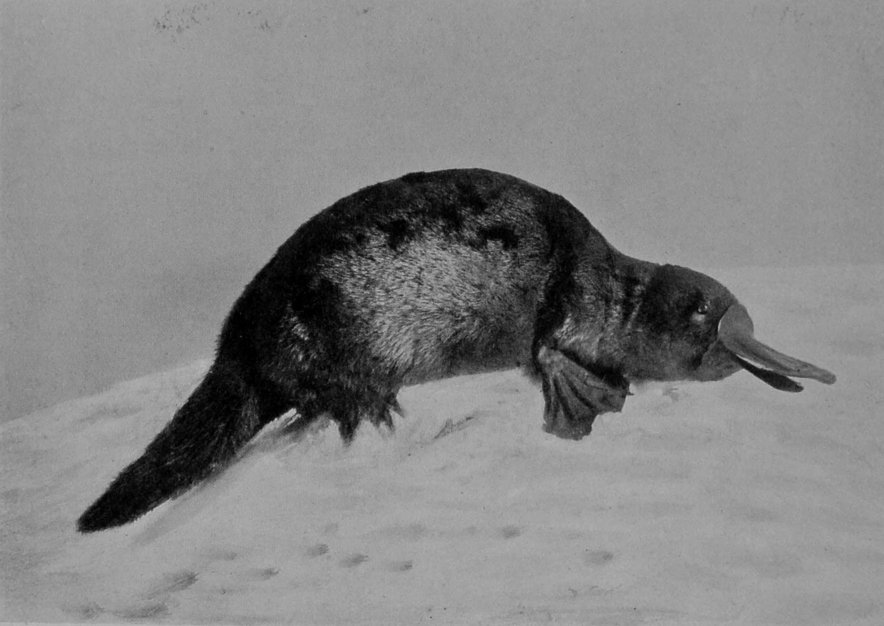
Photo by W. Saville-Kent, F.Z.S.] [Milford-on-Sea.
DUCK-BILLED PLATYPUS.
This curious egg-laying mammal, the only representative of its family, is
mainly nocturnal in habits.
The fur of the platypus, dressed so as to remove the outer and longer series of hairs, nearly
resembles that of the fur-seal in both colour and texture, and as a rare local product is highly
prized for the manufacture of carriage-rugs and other articles.
With the egg-laying Echidna and Platypus we terminate the Mammalian Series, and
they pave the way to the typical egg-laying animals which follow.
End of Vol. I.
Note


 -shaped blow-hole near the end of the snout. The well-known spouting
of whales is merely the breathing out of warm vapour, which, on coming in contact with the colder
air—and it should be remembered that most whaling is carried on in the neighbourhood of
icebergs—condenses in a cloud above the animal's head. I have seen many a sperm-whale spout,
and the cloud of spray, often mixed with a varying volume of water if the whale commences to blow
before its blow-hole is clear of the surface, drifts forward over the forehead. This is due to the
forward position of the blow-hole. I never to my knowledge saw a whalebone-whale spouting, but its
double jet is said to ascend vertically over its back, and this would in like manner be accounted
for by the more posterior position of the blow-holes. Having filled its lungs, which are long and
of simple structure, with fresh air, in enormous draughts that fill the great cavities of its
chest, the whale sinks to the depths. There, in ordinary circumstances, it will lie for a quarter
of an hour or more, but the pain of the harpoon and the knowledge that there is danger at the
surface may keep it below for as much as an hour. When it has to breathe again, a few powerful
strokes from the laterally set tail suffice to bring it quickly to the surface. This is not the
place for a detailed anatomy of the whale, but no one can fail to notice with admiration such
parts of its equipment for the battle of life as the structure of its windpipe, which enables it
to breathe with comfort with its mouth full of water, the complicated network of blood-vessels
that ensures the slow and thorough utilising of all the oxygen in its lungs while it remains at
the bottom, and the elastic cushion of blubber that makes this gigantic animal indifferent to
extremes of pressure and temperature. Thanks mainly to its coat of blubber, the whale exists with
equal comfort at the surface or hundreds of fathoms below it; in the arctic or in tropical
seas.


