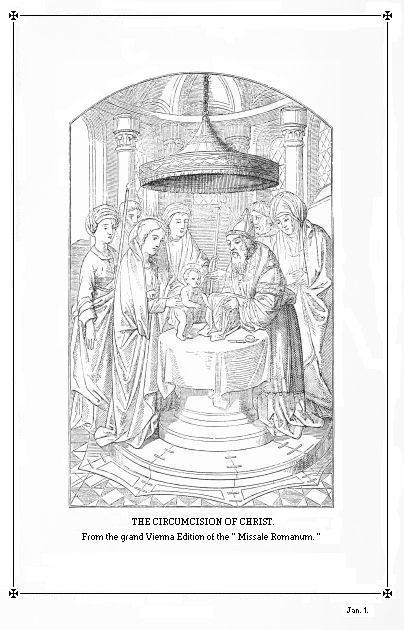
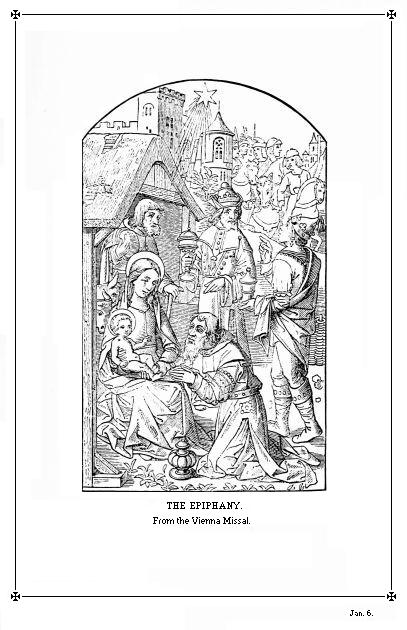
The Feast of the Circumcision of our Lord Jesus Christ.
S. Gaspar, one of the Magi.
S. Concord, P. M., at Spoleto, in Umbria, circ. a.d. 175.
SS. Elvan, B., and Mydwyn, in England, circ. a.d. 198.
S. Martina, V. M., at Rome, a.d. 235.
S. Paracodius, B. of Vienne, a.d. 239.
S. Severus, M., at Ravenna, a.d. 304.
S. Telemachus, M., at Rome, a.d. 404.
S. Fulgentius, B. C. of Ruspe, in N. Africa, a.d. 533.
S. Mochua, or Cuan, Ab. in Ireland, 6th cent.
S. Mochua, or Cronan, Ab. of Balla, in Ireland, 7th cent.
S. Eugendus, Ab. of Condate, in the Jura, a.d. 581.
S. Fanchea, or Fain, V. Abss., of Rosairthir, in Ireland, 6th cent.
S. Clare, Ab. of Vienne, circ. a.d. 660.
S. William, Ab. S. Benignus, at Dijon, a.d. 1031.
S. Odilo, Ab. Cluny, a.d. 1049.
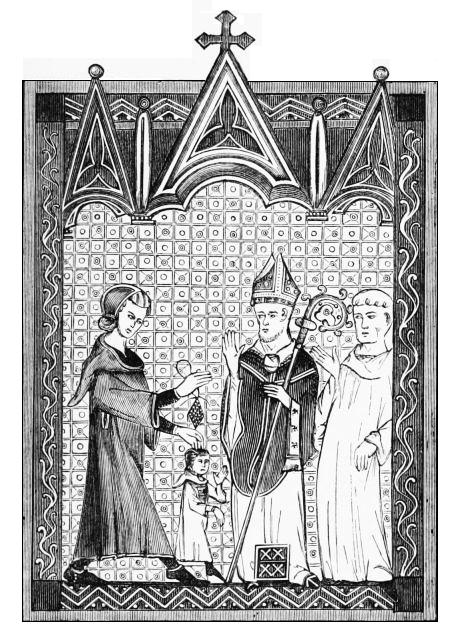
his festival is celebrated by the Church in order
to commemorate the obedience of our Lord in
fulfilling all righteousness, which is one branch
of the meritorious cause of our redemption,
and by that means abrogating the severe injunctions of the
Mosaic law, and placing us under the grace of the Gospel.
God gave to Abraham the command to circumcise all
male children on the eighth day after birth, and this rite was
to be the seal of covenant with Him, a token that, through
shedding of the blood of One to come, remission of the
original sin inherited from Adam could alone be obtained.
It was also to point out that the Jews were cut off, and
separate, from the other nations. By circumcision, a Jew
belonged to the covenant, was consecrated to the service
of God, and undertook to believe the truths revealed by
Him to His elect people, and to hold the commandments to
which He required obedience. Thus, this outward sign
admitted him to true worship of God, true knowledge of
God, and true obedience to God's moral law. Circumcision
looked forward to Christ, who, by His blood, remits sin.
Consequently, as a rite pointing to Him who was to come,
it is abolished, and its place is taken by baptism, which also
is a sign of covenant with God, admitting to true worship,
true knowledge, and true obedience. But baptism is more
than a covenant, and therefore more than was circumcision.
It is a Sacrament; that is, a channel of grace. By baptism,
supernatural power, or grace, is given to the child, whereby
it obtains that which by nature it could not have. Circumcision
admitted to covenant, but conferred no grace.
Baptism admits to covenant, and confers grace. By circumcision,
a child was made a member of God's own peculiar
people. By baptism, the same is done; but God's own
people is now not one nation, but the whole Catholic Church.
Christ underwent circumcision, not because He had inherited
the sin of Adam, but because He came to fulfil all righteousness,
to accomplish the law, and for the letter to give the
spirit.
It was, probably, the extravagances committed among the
heathen at the kalends of January, upon which this day fell,
that hindered the Church for some ages from proposing it as
an universal set festival. The writings of the Fathers are full
of invectives against the idolatrous profanations of this day,
which concluded the riotous feasts in honour of Saturn, and
was dedicated to Janus and Strena, or Strenua, a goddess
supposed to preside over those presents which were sent to,
and received from, one another on the first day of the year,
and which were called after her, strenæ; a name which is
still preserved in the étrennes, or gifts, which it is customary
in France to make on New Year's Day.
But, when the danger of the heathen abuses was removed,
by the establishment of Christianity in the Roman empire,
this festival began to be observed; and the mystery of our
Blessed Lord's Circumcision is explained in several ancient
homilies of the fifth century. It was, however, spoken of in
earlier times as the Octave of the Nativity, and the earliest
mention of it as the Circumcision is towards the end of the
eleventh century, shortly before the time of S. Bernard, who
also has a sermon upon it. In the Ambrosian Missal, used
at Milan, the services of the day contain special cautions
against idolatry. In a Gallican Lectionary, which is supposed
to be as old as the seventh century, are special lessons
"In Circumcisione Domini." Ivo, of Chartres, in 1090,
speaks of the observance of this day in the French Church.
The Greek Church also has a special commemoration of the
Circumcision.
(about 175.)
[S. Concord is mentioned in all the Latin Martyrologies. His festival is
celebrated at Bispal, in the diocese of Gerona, in Spain, where his body
is said to be preserved, on the 2nd Jan. His translation is commemorated
on the 4th July. The following is an abridgment of his genuine
Acts.]
In the reign of the Emperor Marcus Antoninus, there
raged a violent persecution in the city of Rome. At that
time there dwelt in Rome a sub-deacon, named Concordius,
whose father was priest of S. Pastor's, Cordianus by name.
Concord was brought up by his father in the fear of God, and
in the study of Holy Scripture, and he was consecrated sub-deacon
by S. Pius, Bishop of Rome. Concord and his father
fasted and prayed, and served the Lord instantly in the person
of His poor. When the persecution waxed sore, said
Concord to his father, "My lord, send me away, I pray thee,
to S. Eutyches, that I may dwell with him a few days, until
this tyranny be overpast." His father answered, "My son,
it is better to stay here that we may be crowned." But
Concord said, "Let me go, that I may be crowned where
Christ shall bid me be crowned." Then his father sent him
away, and Eutyches received him with great joy. With him
Concord dwelt for a season, fervent in prayer. And many
sick came to them, and were healed in the name of Jesus
Christ.
Then, hearing the fame of them, Torquatus, governor of
Umbria, residing at Spoleto, sent and had Concord brought
before him. To him he said, "What is thy name?" He
answered, "I am a Christian." Then, said the Governor,
"I asked concerning thee, and not about thy Christ." S.
Concord replied, "I have said that I am a Christian, and
Christ I confess." The Governor ordered: "Sacrifice to
the immortal gods, and I will be to thee a father, and will
obtain for thee favour at the hands of the Emperor, and he
will exalt thee to be priest of the gods." S. Concord said,
"Harken unto me, and sacrifice to the Lord Jesus Christ, and
thou shalt escape eternal misery." Then the governor ordered
him to be beaten with clubs, and to be cast into prison.
Then, at night, there came to him the blessed Eutyches,
with S. Anthymius, the bishop; for Anthymius was a friend
of the governor; and he obtained permission of Torquatus
to take Concord home with him for a few days. And
during these days he ordained him priest, and they watched
together in prayer.
And after a time, the governor sent and brought him
before him once more and said to him, "What hast thou
decided on for thy salvation?" Then Concord said,
"Christ is my salvation, to whom daily I offer the sacrifice
of praise." Then he was condemned to be hung upon the
little horse; and, with a glad countenance, he cried, "Glory
be to Thee, Lord Jesus Christ!"
After this torment he was cast into prison, with irons on
his hands and neck. And blessed Concord began to sing
praise to God in his dungeon, and he said, "Glory be to
God on high, and in earth peace to men of good will."
Then, that same night, the angel of the Lord stood by him,
and said, "Fear not to play the man, I shall be with thee."
And when three days had passed, the governor sent two
of his officers, at night, to him with a small image of Jupiter.
And they said, "Hear what the governor has ordered;
sacrifice to Jupiter or lose thy head." Then the blessed
Concord spat in the face of the idol, and said, "Glory be
to Thee, Lord Jesus Christ." Then one of the officers
smote off his head in the prison. Afterwards, two clerks and
certain religious men carried away his body, and buried it not
far from the city of Spoleto, where many waters flow forth.
(about 198.)
[Mentioned in English Martyrologies, and by Ferrarius in his General
Catalogue of the Saints. The evidence for these Saints is purely traditional;
the first written record of them was by Gildas, a.d. 560, but his
account is lost. It is referred to by Matthew of Westminster.]
Saint Elvan of Avalon, or Glastonbury, was brought up
in that school erroneously said to have been founded by
S. Joseph of Arimathea. He vehemently preached the truth
before Lucius, a British king, and was mightily assisted by
S. Mydwyn of Wales (Meduinus), a man of great learning.
Lucius despatched Elvan and Mydwyn to Rome, on an
embassy to Pope Eleutherius, in 179, who consecrated Elvan
bishop, and appointed Mydwyn teacher. He gave them, as
companions, two Roman clerks, Faganus and Deruvianus; or,
according to some, Fugatius and Damianus. They returned
with these to King Lucius, who was obedient to the word of
God, and received baptism along with many of his princes
and nobles. Elvan became the second archbishop of
London. He and Mydwyn were buried at Avalon. S.
Patrick is said to have found there an ancient account of the
acts of the Apostles, and of Fugatius and Damianus, written
by the hand of S. Mydwyn. Matthew of Westminster
gives the following account of the conversion of Lucius,
under the year 185:—"About the same time, Lucius, king
of the Britons, directed letters to Eleutherius, entreating him
that he would make him a Christian. And the blessed
pontiff, having ascertained the devotion of the king, sent to
him some religious teachers; namely, Faganus and Deruvianus,
to convert the king to Christ, and wash him in the
holy font. And when that had been done, then the different
nations ran to baptism, following the example of the
king, so that in a short time there were no infidels found in
the island."
There is a considerable amount of exaggeration in this
account of Matthew of Westminster, which must not be
passed over. Lucius is known in the Welsh triads by the
name of Lleurwg, or Lleufer Mawr, which means "The great
Luminary," and this has been Latinized into Lucius, from
Lux, light. He was king of a portion of South Wales
only. The Welsh authorities make no mention of the
alleged mission to Rome, though, that such a mission should
have been sent, is extremely probable. Some accounts say
that Medwy and Elfan were Britons, and that Dyfan and
Ffagan (Deruvianus and Faganus) were Roman priests. But
both these names are British, consequently we may conjecture
that they were of British origin, but resided then at Rome.
Four churches near Llandaf bore the names of Lleurwg
(Lucius), Dyfan, Ffagan, and Medwy, which confirms the
belief in the existence of these Saints, and indicates the scene
of their labours. Matthew of Westminster adds:—"A.D. 185.
The blessed priests, Faganus and Deruvianus, returned to
Rome, and easily prevailed on the most blessed Pope that
all that they had done should be confirmed. And when it
had been, then the before-mentioned teachers returned to
Britain, with a great many more, by whose teaching the
nation of the Britons was soon founded in the faith of Christ,
and became eminent as a Christian people. And their
names and actions are found in the book that Gildas the historian
wrote, concerning the victory of Aurelius Ambrosius."
Geoffrey, of Monmouth, who, unsupported, is thoroughly
untrustworthy, mentions the same circumstance, on the
authority of the treatise of Gildas, now lost. The embassy
to Rome shall be spoken of at length, under the title of
S. Lucius, December 11th. See also Nennius, § 22; Bede's
Eccles. Hist. i. 4; and the Liber Landavensis, p. 65.
(about 404.)
The following account of the martrydom of S. Telemachus
is given by Theodoret, in his Ecclesiastical History,
book v., chap. 26:—"Honorius, who had received the empire
of Europe, abolished the ancient exhibitions of gladiators
in Rome on the following occasion:—A certain man,
named Telemachus, who had embraced a monastic life,
came from the East to Rome at a time when these cruel
spectacles were being exhibited. After gazing upon the
combat from the amphitheatre, he descended into the arena,
and tried to separate the gladiators. The bloodthirsty spectators,
possessed by the devil, who delights in the shedding
of blood, were irritated at the interruption of their savage
sports, and stoned him who had occasioned the cessation.
On being apprised of this circumstance, the admirable
Emperor numbered him with the victorious martyrs, and
abolished these iniquitous spectacles."
For centuries the wholesale murders of the gladiatorial
shows had lasted through the Roman empire. Human
beings, in the prime of youth and health, captives or slaves,
condemned malefactors, and even free-born men, who hired
themselves out to death, had been trained to destroy each
other in the amphitheatre for the amusement, not merely of
the Roman mob, but of the Roman ladies. Thousands,
sometimes in a single day, had been
"Butchered to make a Roman holiday."
The training of gladiators had become a science. By their
weapons, and their armour, and their modes of fighting, they
had been distinguished into regular classes, of which the
antiquaries count up full eighteen: Andabatæ, who wore helmets,
without any opening for the eyes, so that they were
obliged to fight blindfold, and thus excited the mirth of the
spectators; Hoplomachi, who fought in a complete suit of
armour; Mirmillones, who had the image of a fish upon
their helmets, and fought in armour, with a short sword,
matched usually against the Retiarii, who fought without
armour, and whose weapons were a casting-net and a
trident. These, and other species of fighters, were drilled
and fed in "families" by lanistæ, or regular trainers, who
let them out to persons wishing to exhibit a show. Women,
even high-born ladies, had been seized in former times with
the madness of fighting, and, as shameless as cruel, had gone
down into the arena, to delight with their own wounds and
their own gore, the eyes of the Roman people.
And these things were done, and done too often under
the auspices of the gods, and at their most sacred festivals.
So deliberate and organized a system of wholesale butchery
has never perhaps existed on this earth before or since, not
even in the worship of those Mexican gods, whose idols
Cortez and his soldiers found fed with human hearts, and
the walls of their temples crusted with human gore. Gradually
the spirit of the Gospel had been triumphing over this
abomination. Ever since the time of Tertullian, in the
second century, Christian preachers and writers had lifted
up their voice in the name of humanity. Towards the end
of the third century, the Emperors themselves had so far
yielded to the voice of reason, as to forbid, by edicts, the
gladiatorial fights. But the public opinion of the mob, in
most of the great cities, had been too strong both for Saints
and for Emperors. S. Augustine himself tells us of the horrible
joy which he, in his youth, had seen come over the
vast ring of flushed faces at these horrid sights. The weak
Emperor Honorius bethought himself of celebrating once
more the heathen festival of the Secular Games, and formally
to allow therein an exhibition of gladiators. But, in the
midst of that show, sprang down into the arena of the Colosseum
of Rome, this monk Telemachus, some said from Nitria,
some from Phrygia, and with his own hands parted the combatants,
in the name of Christ and God. The mob, baulked
for a moment of their pleasure, sprang on him, and stoned
him to death. But the crime was followed by a sudden revulsion
of feeling. By an edict of the Emperor, the gladiatorial
sports were forbidden for ever; and the Colosseum,
thenceforth useless, crumbled slowly away into that vast
ruin which remains unto this day, purified, as men well said,
from the blood of tens of thousands, by the blood of this
true and noble martyr.[14]
(a.d. 533.)
[Roman Martyrology and nearly all the Latin Martyrologies. His
life was written by one of his disciples, and addressed to his successor,
Felicianus. Many of his writings are extant.]
Fulgentius belonged to an honourable senatorial family
of Carthage, which had, however, lost its position with the
invasion of the Vandals into Northern Africa. His father,
Claudius, who had been unjustly deprived of his house in
Carthage, to give it to the Arian priest, retired to an estate
belonging to him at Telepte, a city of the province of Byzacene.
And here, about thirty years after the barbarians had
dismembered Africa from the Roman empire, in the year 468,
was born Fulgentius. Shortly after this his father died, and
the education of the child devolved wholly on his mother,
Mariana. It has been often observed that great men have
had great mothers. Mariana was a woman of singular intelligence
and piety. She carefully taught her son to speak Greek
with ease and good accent, and made him learn by heart
Homer, Menander, and other famous poets of antiquity. At
the same time, she did not neglect his religious education, and
the youth grew up obedient and modest. She early committed
to him the government of the house, and servants,
and estate; and his prudence in these matters made his
reputation early, and he was appointed procurator of the
province.
But it was not long before he grew weary of the world;
and the love of God drew him on into other paths. He
found great delight in religious reading, and gave more time
to prayer. He was in the habit of frequenting monasteries,
and he much wondered to see in the monks no signs of
weariness, though they were deprived of all the relaxations
and pleasures which the world provides. Then, under the
excuse that his labours of office required that he should take
occasional repose, he retired at intervals from business, and
devoted himself to prayer and meditation, and reduced the
abundance of food with which he was served. At length,
moved by a sermon of S. Augustine on the thirty-sixth
Psalm, he resolved on embracing the religious life.
There was at that time a certain bishop, Faustus by name,
who had been driven, together with other orthodox bishops,
from their sees, by Huneric, the Arian king. Faustus had
erected a monastery in Byzacene. To him Fulgentius betook
himself, and asked to be admitted into the monastery.
But the Bishop repelled him saying, "Why, my son, dost
thou seek to deceive the servants of God? Then wilt thou
be a monk when thou hast learned to despise luxurious food
and sumptuous array. Live as a layman less delicately, and
then I shall believe in thy vocation." But the young man
caught the hand of him who urged him to depart, and,
kissing it said, "He who gave the desire is mighty to enable
me to fulfil it. Suffer me to tread in thy footsteps, my
father!" Then, with much hesitation, Faustus suffered the
youth to remain, saying, "Perhaps my fears are unfounded.
Thou must be proved some days."
The news that Fulgentius had become a monk spread far
and wide. His mother, in transports of grief, ran to the
monastery, crying out, "Faustus! restore to me my son,
and to the people their governor. The Church always protects
widows; why then dost thou rob me, a desolate widow,
of my child?" Faustus in vain endeavoured to calm her.
She desired to see her son, but he refused to give permission.
Fulgentius, from within, could hear his mother's cries.
This was to him a severe temptation, for he loved her
dearly.
Shortly after, he made over his estate to his mother, to be
discretionally disposed of, by her, in favour of his brother
Claudius, when he should arrive at a proper age. He
practised severe mortification of his appetite, totally abstaining
from oil and everything savoury, and his fasting produced
a severe illness, from which, however, he recovered, and his
constitution adapted itself to his life of abstinence.
Persecution again breaking out, Faustus was obliged to
leave his monastery, and Fulgentius, at his advice, took
refuge in another, which was governed by the Abbot Felix,
who had been his friend in the world, and who became now
his brother in religion. Felix rejoiced to see his friend once
more, and he insisted on exalting him to be abbot along
with himself. Fulgentius long refused, but in vain; and
the monks were ruled by these two abbots living in holy
charity, Felix attending to the discipline and the bodily
necessities of the brethren, Fulgentius instructing them in
the divine love. Thus they divided the authority between
them for six years, and no contradictions took place between
them; each being always ready to comply with the will of
the other.
In the year 499, the country being ravaged by the
Numidians, the two abbots were obliged to fly to Sicca
Veneria, a city of the proconsular province of Africa. Here
they were seized by orders of an Arian priest, and commanded
to be scourged. Felix, seeing the executioners
seize first on Fulgentius, exclaimed, "Spare my brother,
who is not sufficiently strong to endure your blows, lest he
die under them, and strike me instead." Felix having
been scourged, Fulgentius was next beaten. His pupil
says, "Blessed Fulgentius, a man of delicate body, and
of noble birth, was scarce able to endure the pain of
the repeated blows, and, as he afterwards told us, hoping
to soothe the violence of the priest, or distract it awhile,
that he might recover himself a little, he cried out, 'I will
say something if I am permitted.'" The priest ordered
the blows to cease, expecting to hear a recantation. But
Fulgentius, with much eloquence, began a narration of his
travels; and after the priest had listened awhile, finding this
was all he was about to hear, he commanded the executioners
to continue their beating of Fulgentius. After that,
the two abbots, naked and bruised, were driven away.
Before being brought before the Arian priest, Felix had
thrown away a few coins he possessed; and his captors, not
observing this, after they were released, he and Fulgentius
returned to the spot and recovered them all again. The
Arian bishop, whose relations were acquainted with the
family of Fulgentius, was much annoyed at this proceeding
of the priest, and severely reprimanded him. He also urged
Fulgentius to bring an action against him, but the confessor
declined, partly because a Christian should never seek
revenge, partly also because he was unwilling to plead before
a bishop who denied the divinity of the Lord Jesus Christ.
Fulgentius, resolving to visit the deserts of Egypt, renowned
for the sanctity of the solitaries who dwelt there, went on
board a ship for Alexandria, but the vessel touching at Sicily,
S. Eulalius, abbot at Syracuse, diverted him from his intention,
assuring him that "a perfidious dissension had severed
this country from the communion of S. Peter. All these
monks, whose marvellous abstinence is noised abroad, have
not got with you the Sacrament of the Altar in common;"
meaning that Egypt was full of heretics. Fulgentius visited
Rome in the latter part of the year 500, during the entry of
Theodoric. "Oh," said he, "how beautiful must the
heavenly Jerusalem be, if earthly Rome be so glorious." A
short time after, Fulgentius returned home, and built himself
a cell on the sea-shore, where he spent his time in prayer,
reading and writing, and in making mats and umbrellas
of palm leaves.
At this time the Vandal heretic, King Thrasimund, having
forbidden the consecration of Catholic bishops, many sees
were destitute of pastors, and the faithful were reduced to
great distress. Faustus, the bishop, had ordained Fulgentius
priest, on his return to Byzacene, and now, many places demanded
him as their bishop. Fulgentius, fearing this responsibility,
hid himself; but in a time of such trial and
difficulty the Lord had need of him, and He called him to
shepherd His flock in a marvellous manner. There was a
city named Ruspe, then destitute of a bishop, for an influential
deacon therein, named Felix, whose brother was a friend
of the procurator, desired the office for himself. But the
people, disapproving his ambition, made choice unanimously
of Fulgentius, of whom they knew only by report; and upon
the primate Victor, bishop of Carthage, giving his consent
that the neighbouring bishops should consecrate him, several
people of Ruspe betook themselves to the cell of Fulgentius,
and by force compelled him to consent to be ordained.
Thus, he might say, in the words of the prophet, "A people
whom I have not known shall serve me."
The deacon, Felix, taking advantage of the illegality of the
proceeding, determined to oppose the entrance of S. Fulgentius
by force, and occupied the road by which he presumed
the bishop would enter Ruspe. By some means the
people went out to meet him another way, and brought him
into the Cathedral, where he was installed, whilst the deacon,
Felix, was still awaiting his arrival in the road. Then he
celebrated the Divine Mysteries, with great solemnity, and
communicated all the people. And when Felix, the deacon,
heard this, he was abashed, and refrained from further
opposition. Fulgentius received him with great sweetness
and charity, and afterwards ordained him priest.
As bishop, S. Fulgentius lived like a monk; he fed on the
coarsest food, and dressed himself in the plainest garb, not
wearing the orarium, which it was customary for bishops to
put upon them. He would not wear a cloak (casula) of gay
colour, but one very plain, and beneath it a blackish, or
milk-coloured habit (pallium), girded about him. Whatever
might be the weather, in the monastery he wore this habit
alone, and when he slept, he never loosed his girdle. "In
the tunic in which he slept, in that did he sacrifice; he may
be said, in time of sacrifice, to have changed his heart rather
than his habit."[15]
His great love for a recluse life induced him to build a
monastery near his house at Ruspe, which he designed to
place under the direction of his old friend, the Abbot Felix.
But before the building could be completed, King Thrasimund
ordered the banishment of the Catholic bishops to
Sardinia. Accordingly, S. Fulgentius and other prelates,
sixty in all, were carried into exile, and during their banishment
they were provided yearly with provisions and money
by the liberality of Symmachus, Bishop of Rome. A letter
of this Pope to them is still extant, in which he encourages
them, and comforts them. S. Fulgentius, during his retirement,
composed several treatises for the confirmation of the
faith of the orthodox in Africa. King Thrasimund, desirous
of seeing him, sent for him, and appointed him lodgings in
Carthage. The king drew up a set of ten objections to the
Catholic faith, and required Fulgentius to answer them.
The Saint immediately complied with his request, and his
answer had such effect, that the king, when he sent him new
objections, ordered that the answers should be read to himself
alone. He then addressed to Thrasimund a confutation
of Arianism, which we have under the title of "Three Books
to King Thrasimund." The prince was pleased with the
work, and granted him permission to reside at Carthage; till,
upon repeated complaints from the Arian bishops, of the
success of his preaching, which threatened, they said, the
total conversion of the city to the faith in the Consubstantial,
he was sent back to Sardinia, in 520. He was sent on board
one stormy night, that he might be taken away without the
knowledge of the people, but the wind being contrary, the
vessel was driven into port again in the morning, and the
news having spread that the bishop was about to be taken
from them, the people crowded to say farewell, and he was
enabled to go to a church, celebrate, and communicate all
the faithful. Being ready to go on board when the wind
shifted, he said to a Catholic, whom he saw weeping,
"Grieve not, I shall shortly return, and the true faith of
Christ will flourish again in this realm, with full liberty to
profess it; but divulge not this secret to any."
The event confirmed the truth of the prediction. Thrasimund
died in 523, and was succeeded by Hilderic, who gave
orders for the restoration of the orthodox bishops to their
sees, and that liberty of worship should be accorded to the
Catholics.
The ship which brought back the bishops to Carthage was
received with great demonstrations of joy. The pupil of
the bishop, and eye-witness of the scene, thus describes it:—"Such
was the devotion of the Carthaginian citizens, desiring
to see the blessed Fulgentius again, that all the people
ardently looked for him whom they had seen wrestle so manfully
before them. The multitude, which stood upon the
shore, was silent in expectation as the other bishops disembarked
before him, seeking with eyes and thoughts only him
whom they had familiarly known, and eagerly expecting him
from the ship. And when his face appeared, there broke
forth a huge clamour, all striving who should first salute him,
who should first bow his head to him giving the benediction,
who should deserve to touch the tips of his fingers as he
walked, who might even catch a glimpse of him, standing
afar off. From every tongue resounded the praise of God.
Then the people, going before and following after the procession
of the blessed confessors, moved to the Church of S.
Agileus. But there was such a throng of people, especially
around Fulgentius, whom they especially honoured, that a
ring had to be formed about him by the holy precaution of
the Christians, to allow him to advance upon his way.
Moreover, the Lord, desiring to prove the charity of the
faithful, marvellously poured upon them, as they moved, a
heavy shower of rain. But the heavy down-pour deterred
none of them, but seemed to be the abundant benediction
of heaven descending on them, and it so increased their
faith, that they spread their cloaks above blessed Fulgentius,
and composed of their great love a new sort of tabernacle
over him. And the evening approaching, the company of
prelates presented themselves before Boniface, the bishop
(of Carthage) of pious memory, and all together praised and
glorified God. Then the blessed Fulgentius traversed the
streets of Carthage, visiting his friends and blessing them; he
rejoiced with them that did rejoice, and wept with them that
did weep; and so, having satisfied all their wishes, he bade
farewell to his brethren, and went forth out of Carthage,
finding on all the roads people coming to meet him in the
way with lanterns, and candles, and boughs of trees, and great
joy, giving praises to the ineffable God, who had wondrously
made the blessed Fulgentius well pleasing in the sight of all
men. He was received in all the churches as if he were
their bishop, and thus the people throughout Byzacene
rejoiced as one man over his return."
Arrived at Ruspe, S. Fulgentius diligently laboured to
correct what was evil, and restore what was fallen down,
and strengthen what was feeble in his diocese. The persecution
had lasted seventy years, so that many abuses had
crept in, and the faith of many was feeble, and ignorance
prevailed. He carried out his reformation with such gentleness,
that he won, sooner or later, the hearts of the most
vicious.
In a council, held at Junque, in 524, a certain bishop,
named Quodvultdeus, disputed the precedency with the
Bishop of Ruspe, who made no reply, but took the first
place accorded him by the council. However, S. Fulgentius
publicly desired, at the convention of another council, that
he might be allowed to yield the precedence to Quodvultdeus.
About a year before his death, the bishop retired from all
business, to prepare his soul for its exit, to a little island
named Circinia. The necessities of his flock recalled him,
however, to Ruspe for a little while.
He bore the violent pains of his last illness with great
resignation, praying incessantly, "Lord grant me patience
now, and afterwards pardon." He called his clergy about
him, and asked them to forgive him if he had shewn too
great severity at any time, or had offended them in any way,
and then, committing his soul into the hand of God as a
merciful Creator, he fell asleep in the evening of January
1st, a.d. 533, in his sixty-fifth year.
Relics, at Bourges, in France, where May 16 is observed
as the feast of his translation, in the year 714.
(about 6th cent.)
[Commemorated in the ancient Irish Martyrologies on the 11th April;
probably as being the day of his translation. But he died on Jan. 1st.
The life of S. Mochua, in the Bollandists, is legendary, and is full of the
wildest fable.]
Saint Mochua was the son of a certain Cronan, of noble
race, and spent his youth in fighting. At the age of thirty,
he laid aside his arms, and burnt a house, with all its contents,
which had been given to him by his uncle, saying that a
servant of Christ should take nothing from sinners. Then he
settled at a spot called Teach Mochua. He is said to have
healed S. Finnan, or Munnu, of leprosy, and when S. Finnan
was about to return home, and his horse broke its leg, S.
Mochua summoned a stag out of the forest to come and
draw the vehicle, in place of the horse.
In his time, the first stone church was erected in Ireland
by S. Kieran, and during the building of the church, there
fell no rain to impede the masons, for the clouds were stayed
by the prayers of S. Mochua. He is said to have founded
thirty churches. To assist in drawing wood from the forest to
build these churches, Mochua called to his aid twelve stags,
which served as patiently and obediently as oxen. And
when his virtues drew to him many people and much praise,
the old man fled from place to place, for he considered that
the glory of this world would turn his heart from the glory
of the world to come. And when very aged, he escaped
with his oratory bell into a wild and mountainous part, and
there the clapper fell to the ground, at a place called
Dagrinnis. He was troubled in spirit, so bleak and lonely
did the place appear; but an angel announced to him that
there he was to build a cell, and there to die; and in this
spot he spent thirty years, and wrought many miracles, and
died in the ninety-ninth year of his age.
It is difficult to clear the lives of many of the Irish Saints
from the fable wherewith lively imaginations have invested
them, in their oral transmission through many hundreds of
years.
(7th cent.)
[The day of his death is unknown. He is here mentioned because of
the similarity of his name to that of S. Mochua, of Teach Mochua. His
life is legendary.]
Saint Mochua, or Cronan, was the third son of Began, a
man of good family. As a child, he was despised by his
parents, and sent to keep sheep. But S. Congal, passing by
his father's house, called the boy to follow him, and made
him a monk. S. Mochua founded the monastery of Balla
in Connaught. He departed to the Lord in the fifty-sixth
year of his age.
(a.d. 1049.)
[Roman and Benedictine Martyrologies. Two lives of S. Odilo are
extant, one written by Jotsald, a monk, who had lived under his rule,
and who wrote it for Stephen, the nephew of the Saint. The other, a
very inferior life, by S. Peter Damian. Both are printed in the Bollandists,
but the first is from an imperfect MS. It was printed entire by
Mabillon, Acta SS. O. S. B.]
Odilo belonged to the family of Mercœur, one of the most
illustrious of Auvergne. Jotsald says:—"In the beginning
of the account of his virtues I must relate what happened to
him as a boy. And lest it be thought incredible, I mention
that I heard it from those to whom he was wont to narrate
the circumstance. When he was quite a little boy in his
father's house, before he was sent to school, he was destitute
of almost all power in his limbs, so that he could not walk or
move himself without help. It happened that one day his
father's family were moving to another place, and a nurse
was given charge of him to carry him. On her way, she put
the little boy down with her bundles before the door of a
church, dedicated to the Mother of God, as she and the
rest were obliged to go into some adjacent houses to procure
food. As they were some while absent, the boy finding
himself left alone, impelled by divine inspirations, began
to try to get to the door and enter the Church of the
Mother of God. By some means, crawling on hands and
knees, he reached it, and entered the church, and went to
the altar, and caught the altar vestment with his hands;
then, with all his power, stretching his hands on high, he tried
to rise, but was unable to do so, his joints having been so
long ill-united. Nevertheless, divine power conquered,
strengthening and repairing the feeble limbs of the boy.
Thus, by the intervention of the Mother of God, he rose,
and stood upon his feet whole, and ran here and there
about the altar. The servants returning to fetch their bundles,
and not finding the child, were much surprised, and
looked in all directions, and not seeing him, became greatly
alarmed. However, by chance, entering the church, they
saw him rambling and running about it; then they recognised
the power of God, and joyously took the boy in their
arms, and went to their destination, and gave him, completely
whole, to his parents, with great gladness."
As a child, he showed singular simplicity, modesty, and
piety. "Thus passed his childish years, and as the strength
of youth began to succeed to boyhood, he silently meditated
how to desert the flesh-pots of Egypt, and to strive to
enter the Land of Promise, through the trials of the world.
O good Jesu! how sweet is Thy call! how sweet the inspiration
of Thy Spirit, which as soon as Thou strikest on the
heart, turns the fire of the Babylonish furnace into love of
the celestial country. So! as soon as thou strikest the heart
of the youth, thou changest it." Whilst he was thus meditating,
S. Majolus passed through Auvergne, and Odilo came
to him; then the old man, looking on the graceful form and
comely face of the youth, and by the instinct of the Saints
seeing into his soul, he loved him greatly; also the youthful
Odilo felt a great affection for the aged monk. And when
they spoke to one another, Odilo opened his heart to
Majolus, and the venerable man encouraged the youth to
persevere in his good intentions.
Shortly after, Odilo left his home, "as Abraham of old
went forth out of Ur of the Chaldees, and sought admittance
into the abbey of Cluny, as into the Promised Land. O
good Jesu! how pleasant it was to see this sheep shorn of
its worldly fleece, again ascend as from the baptismal font!
Then, wearing our habit, you might have seen our sheep
amongst the others of His flock, first in work, last in place,
seeking the pastures of eternal verdure; attending to the
lamps, sweeping the floors, and doing other common offices.
But the pearl could not remain long concealed. After four
years, S. Majolus, after many hard labours borne for Christ,
went out of the darkness of Egypt, entered Jerusalem, and
was placed in eternal peace by Christ. As death approached,
he chose Odilo to be his successor, and to him and to the
Lord, he committed his flock." But S. Odilo shrank from
the position for which his youth, as he considered, disqualified
him; however, he was elected by the whole community,
and was therefore unable to refuse the office wherewith he
was invested by the vote of the brethren, and the desire of
the late abbot.
His disciple, Jotsald, gives a very beautiful picture of his
master. He describes him as being of middle stature, with
a face beaming with grace, and full of authority; very emaciated
and pale; his eyes bright and piercing, and often
shedding tears of compunction. Every motion of his body
was grave and dignified; his voice was manly, and modulated
to the greatest sweetness, his speech straightforward
and without affectation or artificiality.
His disciple says that he would recite psalms as he lay on
his bed, and falling asleep, his lips would still continue the
familiar words, so that the brethren applied to him the
words of the bride, "I sleep but my heart waketh," Ego
dormio et cor meum vigilat. He read diligently, and nothing
gave him greater delight than study. His consideration for
others was very marked. "He was burdensome to none, to
none importunate, desirous of no honour, he sought not to
get what belonged to others, nor to keep what was his own."
His charity was most abundant; often the brethren feared
that it exceeded what was reasonable, but they found that
though he gave largely, he did not waste the revenues of the
monastery. Once, in time of famine, he was riding along a
road, when he lit on the naked bodies of two poor boys
who had died of hunger. Odilo burst into tears, and descending
from his horse, drew off his woollen under garment
and wrapping the bodies in it, carefully buried them. In this
famine he sold the costly vessels of the Sanctuary, and despoiled
the Church of its gold and silver ornaments, that he
might feed the starving people. Amongst the objects thus
parted with was the crown of gold presented to the abbey
by Henry, King of the Romans. He accompanied this
Prince in his journey to Rome, when he was crowned emperor,
in 1014. This was his second journey thither; he
made a third in 1017, and a fourth in 1022. Out of devotion
to S. Benedict, he paid a visit to Monte Cassino, where
he kissed the feet of all the monks, at his own request,
which was granted him with great reluctance.
"The convocation of the brethren was regularly held by
him till he was at the point of death. O how joyous he was
in the midst of them, as standing in the midst of the choir,
and looking to right and left he saw the ring of young
plantings, and remembered the verse of David's song, 'Thy
children shall be as the olive branches round about thy
table.' Filii tui sicut novellæ olivarum, in circuitu mensæ
tuæ. And the more the number of brothers increased, the
more he exhibited his joy of heart by signs. And when
some seemed distressed thereat, he was wont to say, 'Grieve
not that the flock has become great, my brothers, He who
has called us in, He governs, and will provide.'"
Fulbert, Bishop of Chartres, called him the archangel of
monks; and the name, says his disciple, became him well.
S. Odilo, out of his great compassion for the souls of the
dead expiating the penalty of their sins in purgatory, instituted
the commemoration of All Souls for the morrow of All
Saints, in the Cluniac order, which was afterwards adopted by
the whole Catholic Church in the West. Many incidents of
his travels, and miracles that he wrought, are related by his
pupil. As he was riding over the Jura mountains, in snowy
weather, the horse carrying his luggage fell, and was precipitated
into the valley, and all the baggage was scattered
in the snow-drifts. With much trouble, the horse and much
of the baggage were recovered, but a valuable Sacramentary,
inscribed with gilt letters, and some glass vessels, with embossed
work, were lost. That evening, Odilo and his monks
arrived at a cell, under the jurisdiction of S. Eugendus, and
being much troubled at his loss, as much rain fell in the
night, S. Odilo sent some of the brethren early next morning
to search for the lost treasures. But the snow-drifts
were so deep that they could not find them, and he was
obliged to leave without them. However, as the spring
came round, a certain priest, named Ermendran, was walking
in the glen, and he found the book uninjured, and the
glass goblets unbroken. He brought them to the cell, and
on the return of Odilo to the Jura, he received his lost
treasures intact.
Another story of a glass vessel comes on good authority.
The circumstances were related by Albert, Bishop of Como,
in these words, "Once our Abbot and Superior came to the
court of the Emperor Henry, and whilst there, it happened
one day that at table a goblet of glass, of Alexandrine workmanship,
very precious, with coloured enamel on it, was
placed before him. He called me and Landulf, afterwards
Bishop of Turin, to him, and bade us take this glass to Odilo.
We accordingly, as the Emperor had bidden, took it, and
going to the abbot, offered it to him, on the part of the Emperor,
humbly bowing. He received it with great humility,
and told us to return after a while for the goblet again. Then,
when we had gone away, the monks, filled with natural curiosity
to see and handle a new sort of thing, passed the
vessel from hand to hand, and as they were examining it, it
slipped through their fingers to the ground, and was broken.
When the gentle man of God was told this, he was not a
little grieved, and said, 'My brothers, you have not done well,
for by your negligence, the young clerks who have the custody
of these things will, maybe, lose the favour of the
Emperor, through your fault. Now, that those who are innocent
may not suffer for your carelessness, let us all go to
church and ask God's mercy about this matter.' Therefore,
they all ran together into the church, and sang psalms and
prayed, lest some harm should befall us—Albert and Landulf,
each of them earnestly supplicating God for us. When
the prayer was over, the holy man ordered the broken goblet
to be brought to him. He looked at it, and felt it, and
could find no crack or breakage in it. Wherefore, he exclaimed
indignantly, 'What are you about, brothers? You
must be blind to say that the glass is broken, when there is
not a sign of injury done to it.' The brethren, considering
it, were amazed at the miracle, and did not dare to speak.
Then, after a while, I and my companion came back for the
vessel, and we asked it of him who was carrying it. He
called me apart, and returned it to me, bidding me tell
the Emperor to regard it as a great treasure. And when
I asked his meaning, he told me all that had happened."
S. Odilo seems to have been fond of art, for he rebuilt the
monasteries of his order, and made them very beautiful, and
the churches he adorned with all the costly things he could
procure. The marble pillars for Cluny were brought, by his
orders, in rafts down the Durance, into the Rhone, and he
was wont to say of Cluny, that he found it of wood and left
it of marble. He erected over the altar of S. Peter, in the
church, a ciborium, whose columns were covered with
silver, inlaid with nigello work.
When he felt that his death approached, he made a
circuit of all the monasteries under his sway, that he might
leave them in thorough discipline, and give them his last
admonitions. On this journey he reached Souvigny, a priory
in Bourbonnais, where he celebrated the Vigil of the Nativity,
and preached to the people, although at the time suffering
great pain. After that, he announced to the brethren in
chapter, that he was drawing nigh to his end, and he besought
their prayers. As he was too weak to go to the great Church
of S. Peter, which was attended by the monks, he kept the
festival of the Nativity with a few brethren, whom he detained,
to be with him in the Chapel of S. Mary; joyously
he præcented the psalms and antiphons, and gave the
benedictions, and performed all the ceremonies of that glad
festival, forgetful of his bodily infirmities, knowing that soon
he was to see God face to face, in the land of the living,
and no more in a glass darkly. Most earnest was he, lest
death should come and find him unprepared. Throughout
the Octave, he was carried in the arms of the monks to
church, where he assisted at the choir offices, night and
day, and at the celebration of the mass, refreshing himself
at the sacred mysteries, and looking forward to the feast of
the Circumcision, when his friend William, abbot of Dijon,
had fallen asleep, on which day, he foretold, he also should
enter into his rest.
On that day, carried by his brethren, he was laid before
the altar of the Virgin Mother, and the monks sang vespers.
Now and then their voices failed, through over much sorrow,
and then he recited the words of the psalms they in
their trouble had omitted. As night crept in at the windows,
he grew weaker and fainter. Then the brothers laid
sack-cloth and ashes under him, and as he was lifted in the
arms of one, brother Bernard, he asked, reviving a little,
where he was. The brother answered, "On sack-cloth and
ashes." Then he sighed forth, "God be thanked!" and he
asked that the little children, and the whole body of the
brethren, might be assembled. And when all were gathered
around him, he directed his eyes to the Cross, and his lips
moved in prayer, and he died thus in prayer, gazing on the
sign of his salvation.
His body was laid in the nave of the Church of Souvigny,
near that of S. Majolus.
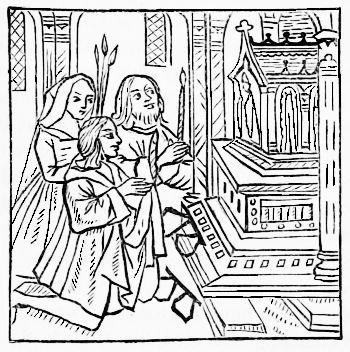
He is often represented saying mass, with purgatory open
beside the altar, and those suffering extending their hands
to him, in allusion to his having instituted the commemoration
of All Souls.