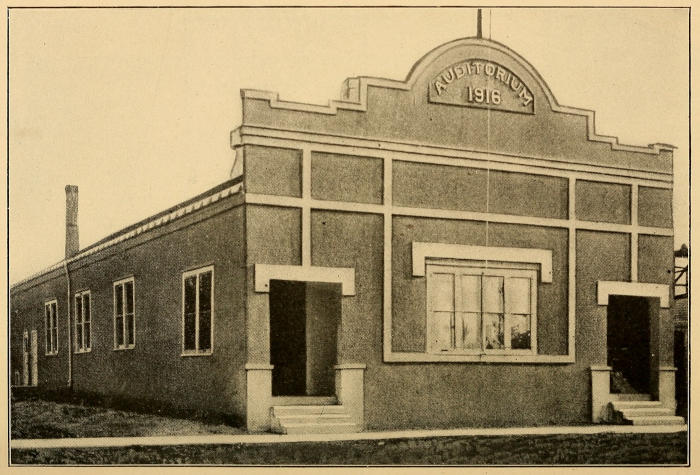
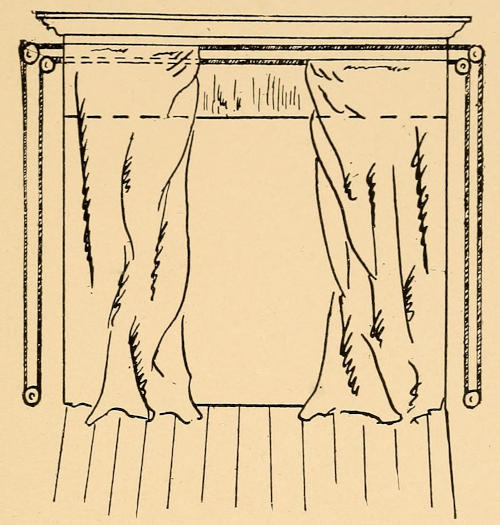
One day, about three weeks before the
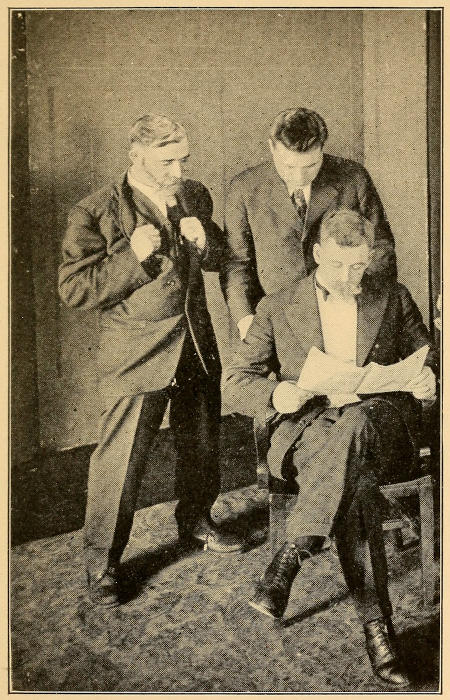
Christmas holidays, two young men
came to see me. I shall never forget
the incident because to me it marked one of
the most fascinating episodes in the social life
of country people. One of the young men was
tall with broad shoulders and had light hair
and grey eyes. The other was of medium
height and had dark hair. His home was in
Iceland. That they both had something important
to say was evident from the expression
on their faces. After a few moment’s hesitation,
they told me they had thought out an idea
for a play. Both of them were brimful of
enthusiasm in regard to it. Whether or not
they could produce it was a question. An
obstacle stood in the way. Most of the scenes
were laid in Iceland. And what playhouse or
village hall, especially a country theater, ever
owned any scenery depicting home life, snow-capped
mountains, and landscapes in that far-away
region? Above all, there was no money
to buy any, either.
“Perhaps we will meet again like the raindrops.”
When told that they would have to paint
the scenery themselves, they looked somewhat
surprised. It is doubtful whether either of
them had ever painted anything more than his
mother’s kitchen floor or perhaps whitewashed
a fence or the interior of a barn. They finally
decided to do the job. A painter was called
over the phone who said he wouldn’t charge
the boys a cent for the colors if they painted
the scene. Up in an attic of a building near by
there was an old faded pink curtain that had
been cast aside. It was thought to be no
longer useful. Within twenty-four hours the
curtain was brought over and hoisted, and the
floor of the stage adjacent to the office was
covered with paint pails, brushes, and water
colors. With dogged determination they decided
to finish the painting during the holiday
vacation. A few minutes before midnight on
New Year’s Eve the last stroke of the brush
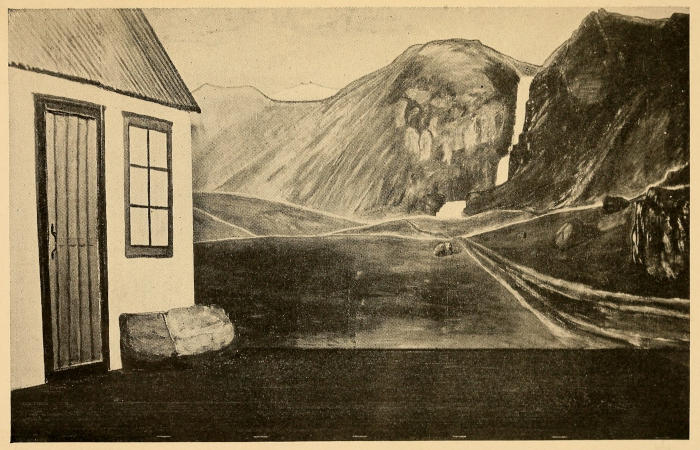
was made. The quaint cottage, the snow
white-capped mountain, the tumbling waterfall
and the steep ascending cliffs were painted in a
manner which brought many favorable comments
from competent art critics. The blending
of the colors was magnificent. It was
genuine art. The beauty of it all was that
these two young men found that they could
express themselves even on canvas.
Just as they had painted their scenery on
the stage of the theater, so did they write their
play, acting out each line before they put it in
final form for presentation. Often they worked
all night until four o’clock in the morning.
They called their play “The Raindrops.” The
theme is told in the second act of the play.
The scene represents the interior of an Icelandic
home. It is evening. The family circle
has gathered. Some are sewing and others
knitting. The children want to hear a story.
Sveinn, one of the characters in the play, finally
says to them, “All right then, if you are quiet,
I will tell you the story of the raindrops who
met in the sky.” And he narrates the following
which the children listen to with rapt
attention.
“Once there were two raindrops away-way
high up in the clouds. The sun had just lately
smiled at them as they were playing in the big
ocean, and his smile had drawn them up into
the sky. Now as they danced and sported
about in its radiance he decked them in all the
bright and beautiful colors of the rainbow;
and they were so happy over being rid of the
dirt and salt that they almost forgot themselves
for joy.
But somehow there seemed to be something
that reminded them of the past. They felt as
if they had met before. Finally one said, “Say,
friend, haven’t we met before?” “That is just
what I’ve been thinking,” said friend. “Where
have you been, comrade?”
“I’ve been on the broad prairies on the west
side of the big mountain that you see down
there,” answered comrade.
“Oh,” said friend, “and I’ve been on the
green slope on the east side of the mountain.
I had a friend who fell at the same time as I
did, and we were going to keep together, but
unfortunately he fell on the other side of the
ridge.”
“That was too bad,” said comrade, “the
same thing happened to me but my friend fell
on the east side just close to that stone you
see down there.”
“Why, that is just where I fell,” said friend.
This was enough—they could scarcely contain
themselves with joy over meeting and recognizing
one another again.
After they had danced one another around
for a while, shaken hands a dozen times or
more, and slapped one another on the back
till they were all out of breath, friend said,
“Now, comrade, tell me all about everything
that has happened to you.”
“And you’ll have to tell me everything that
you have seen,” said comrade.
“Yes, I’ll do that,” said friend, and then
comrade began:
“Well, I fell on the west side of that stone,
as you know. At first I felt kind of bad, but I
gradually got over it and began to move in the
same direction as the others I saw around me.
At first I could not move fast, for I was so
small that every little pebble blocked my road,
but then the raindrops held a meeting and
agreed to work together to help one another
along and I joined the company to help form
a pretty little brook. In this way we were able
to push big stones out of our road and we were
so happy that we laughed and played and
danced in the sunlight which shone to the bottom
of the brook, for we were not too many
and we were all clean.
“Gradually more and more joined us till we
became a big river. Nothing could any longer
stand in our road and we became so proud of
our strength that we tore up the earth and dug
out a deep, deep path that everyone might see.
“But then our troubles began. We became
so awfully dirty that the sun no longer reached
any but those on top, while others were forced
to stay in the dark. They groaned under the
weight of those up higher, while at the same
time they tore up from the bottom more and
more filth.
“I wanted to get out of it all, but there
didn’t seem to be any way. I tried to get up
on the big, broad banks where all sorts of crops
were growing, but I was met and carried back
by others rushing on into the river, evidently
without realizing where they were going. The
current tossed me about, first in the sunshine
and then in the depths of darkness, and I had
no rest till at last I got into the great ocean.
There I rested and washed off most of the
dirt.”
“I wish I could have seen the river,” said
friend, “but why didn’t you spread out more,
so as to help the crops on the plains and so that
all might have sunlight?”
“I don’t know,” said comrade, “First we
wanted to leave a deep path for others to see,
and then later it seemed that we were helpless
in the current that we ourselves had started.
You must now tell me your story.”
“Yes,” said friend. “I fell on the east side
of that stone, and when I couldn’t find you I
started east, because I saw the sun there. After
a while I bumped into a great big stone which
was right across my path. It was such an ugly
thing that I got angry and said, ‘Get out of my
way, you ugly thing, or I’ll get all the other
raindrops together and roll you out of the
road.’
“Oh, no, do not do that,” said the stone,
“for I am sheltering a beautiful flower from
the wind, but I’ll lift myself up a little so you
can crawl under.”
“It was awfully dark and nasty and creepy
under the stone, and I didn’t like it a bit, but
when I came out into the sunshine and saw the
beautiful flowers on the other side I was glad
that I hadn’t spoiled their shelter.”
“‘Isn’t this lovely?’ said a raindrop near me,
‘let us go and look at all the flowers.’ Then a
crowd of raindrops that had gathered said,
‘Let us spread out more and more and give
them all a drink,’ and we went among the
flowers on the slope and in the valleys. As we
watered them they smiled back at us till their
smiles almost seemed brighter than the sunlight.
When evening came we went down the
little brooks over the waterfalls and hopped
and danced in the eddy while we told one
another about the things we had seen. There
were raindrops from the glaciers and from the
hot springs, from the lava fields and from the
green grassy slopes, and from the lofty
mountain peaks, where all the land could be
seen. Then we went on together singing over
the level plains and into the ocean.”
For awhile neither one said anything. Then
comrade spoke, “Yes, when I go back I’ll get
the others to go with me and we’ll spread out
more—and now I am going back. See the
grain down there, how dry it is. Now I’m
going to get the other raindrops to spread out
over the plains and give all the plants a drink
and in that way help everyone else.”
“But see the flowers there on the slope on
the east side,” said friend. “They’ll fade if I
don’t go down again to help them.”
“We’ll meet again,” said both, as they
dashed off to help the flowers and the grain.
The story ends. A pause ensues and Herdis,
the old, old lady in the play says, “Yes, we are
all raindrops.”
It is a beautiful thought and exceptionally
well worked out in the play. The raindrops
are brothers. One’s name is Sveinn. He lives
in Iceland. The other is Snorri. His home is
America. Snorri crosses the ocean to tell
Sveinn about America. Upon his arrival he
meets a girl named Asta and falls in love with
her, little thinking that she is the betrothed of
his brother Sveinn. Asta is a beautiful girl.
She has large blue eyes and light hair which
she wears in a long braid over her left
shoulder. In act three, when speaking to Asta,
Snorri says, “Sometimes I think I am the raindrop
that fell on the other side of the ridge,
and that my place may be there; but then I
think of the many things I have learned to
love here—the beautiful scenery, the midnight
sun, the simple and unaffected manners of the
people, their hospitality, and probably more
than anything else some of the people I have
come to know. A few of these especially I
have learned to love.”
It does not dawn upon Snorri that Asta has
given her hand to his brother Sveinn until the
fourth and last act of the play. The scene is a
most impressive one. It was something the
authors had painted themselves. At the right
stands the quaint little sky-blue cottage, with
its long corrugated tin roof. To the left, the
stony cliffs rise. In the distance the winding
road, the tumbling waterfall, and snow-capped
mountain can be seen. Near the doorway of
the cottage there is a large rock on which Asta
often sits in the full red glow of the midnight
sun.
As the curtain goes up Snorri enters, looks
at his watch, and utters these words, “They
are all asleep, but I must see her to-night.” He
gently goes to the door, quietly raps, turns and
looks at the scenery, and says: “How beautiful
are these northern lights! I’ve seen them before
stretching like a shimmering curtain across
the northern horizon, with tongues of flame
occasionally leaping across the heavens; but
here they are above me, and all around me, till
they light up the scene so that I can see even in
the distance the rugged and snow-capped hills
miles away. How truly the Icelandic nation
resembles the country—like the old volcanoes
which, while covered with a sheet of ice and
snow, still have burning underneath, the eternal
fires.”
Asta then appears in the doorway and exclaims,
“Snorri.” After an exchange of greetings
they sit down and talk. Snorri tells Asta
of his love and finally asks her to become his
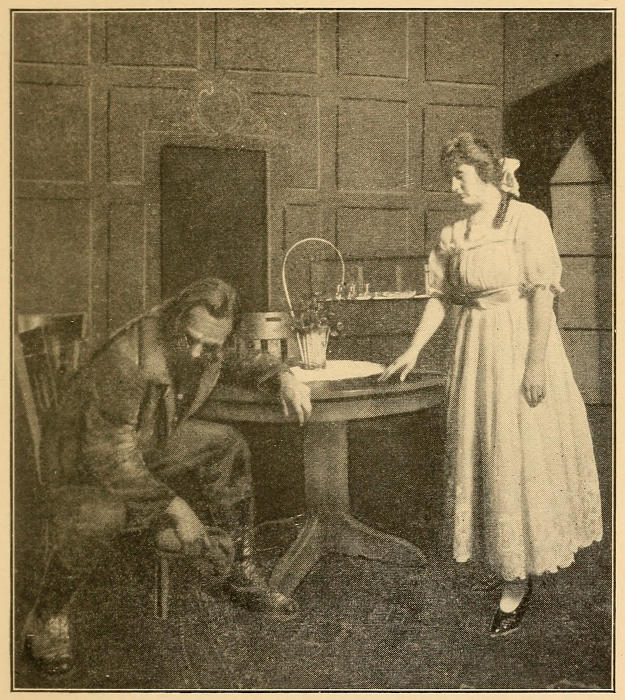
wife. Asta is silent. She turns and looks at
the northern lights, then bows her head and
with her hands carelessly thrown over her
knees she tells him that it cannot be—that it is
Sveinn.
Snorri arises, moves away, covers his face
with his hands and exclaims, “Oh, God! I
never thought of that. What a blind fool I
have been!” As Asta starts to comfort him
Sveinn appears in the doorway, sees them and
starts to turn away, but in so doing makes a
little noise. Snorri startled, quickly looks
around and says, “Sveinn, come here. I have
been blind; will you forgive me?” Then he
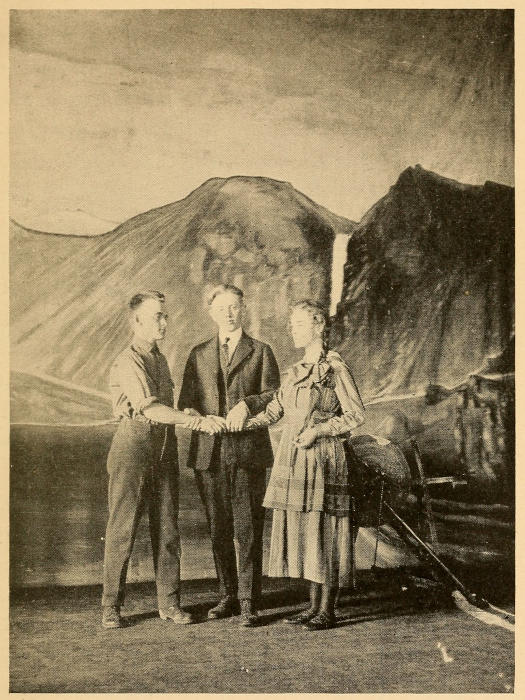
takes Asta’s hand and places it in Sveinn’s, bids
them good-by and starts to leave.
Sveinn says, “Snorri! Where are you going?
You are not leaving us at this time of night,
and in sorrow?”
Snorri, returning, looks at the quaint little
cottage, the waterfall, and then at Asta and
Sveinn, pauses a moment, and says, “Perhaps
we shall meet again—like the raindrops.” The
curtain falls and the play ends.
Neither of these young men who wrote the
play ever had any ambition to become a playwright,
a scene painter, or an actor. To-day,
one is a successful country-life worker in the
great northwest. The other is interested in
harnessing the water power which is so
abundant in his native land.
When the play was presented, the audience
sat spellbound, evidently realizing that two
country lads had found hidden life forces in
themselves which they never knew they possessed.
All they needed, like thousands of
others who live in the country and even in the
city, was just a chance to express themselves.
Authors of play—M. Thorfinnson and E. Briem.
COUNTRY FOLKS
There are literally millions of people in
country communities to-day whose abilities
along various lines have been hidden,
simply because they have never had an
opportunity to give expression to their talents.
In many respects this lack of self-expression
has been due to the social conditions existing
in the country, the narrow-minded attitude of
society toward those who till the soil, and the
absence of those forces which seek to arouse
the creative instincts and stimulate that imagination
and initiative in country people which
mean leadership.
Social stagnancy is a characteristic trait of
the small town and the country. Community
spirit is often at a low ebb. Because of the
stupid monotony of the village and country
existence, the tendency of the people young and
old is to move to larger centers of population.
Young people leave the small town and the
country because of its deadly dullness. They
want Life. The emptiness of rural environment
does not appeal to them. The attitude
of mind of the country youth is best expressed
by Gray in his “Elegy Written in a Country
Church-yard” which runs as follows:
“Full many a gem of purest ray serene
The dark unfathomed caves of ocean bear;
Full many a flower is born to blush unseen,
And waste its sweetness on the desert air.”
Many young people find the town and country
dead simply because they crave fellowship
and social enjoyment. When an afternoon
local train passes through a certain section of
any state, people gather at every station, some
to meet their friends, others to bid their
friends farewell, and dozens to see some form
of life. With many it is the only excitement
that enters their lives, except on extraordinary
occasions. After the harvest many a country
lad goes to the city to enjoy a feast of entertainment,
in order to satisfy his social hunger.
A few years ago the national Department of
Agriculture sent out hundreds of letters to
country women, asking them what would make
life in the country districts more attractive.
Hundreds of the replies which were received
from practically every section of America told
the story of social starvation and the needs of
country communities. One woman from Kansas
in her reply wrote:
“We hope you can help us to consolidate
schools and plan them under a commission of
experts in school efficiency and community education.
Through this commission we could
arrange clubs, social unions, and social, instructive,
and educational entertainments. We
ought not to be compelled to go to town for
doubtful amusements, but, rousing the civic
pride of the community, have the best at
home.”
Another one from Wyoming in her letter
stated that she thought the country child had
the same right to culture and refinement as the
city child. A woman whose home was in
Massachusetts gave the following suggestions
in her reply:
“On the side of overcoming the emptiness
of rural life; articles suggesting courses of
reading both along the line of better farming
and of subjects of public interest. Perhaps the
wider use of the rural school or church for
social centers, or for discussion by farmers,
their wives, sons and daughters might be suggested.”
A letter written from Florida contained the
following:
“First, a community center where good lectures,
good music, readings, and demonstrations
might be enjoyed by all, a public library
station. We feel if circulating libraries containing
books that can be suggested on purity,
hygiene, social service, and scientific instruction,
that our women in the rural districts need
to read for the protection of their children;
also books on farming and poultry raising,
botany, culture of flowers, and many other
themes that will help them to discover the special
charm and advantage of living in the pure
air and being familiar with the beauties of
nature and thereby make our people desire to
stay on the farms.”
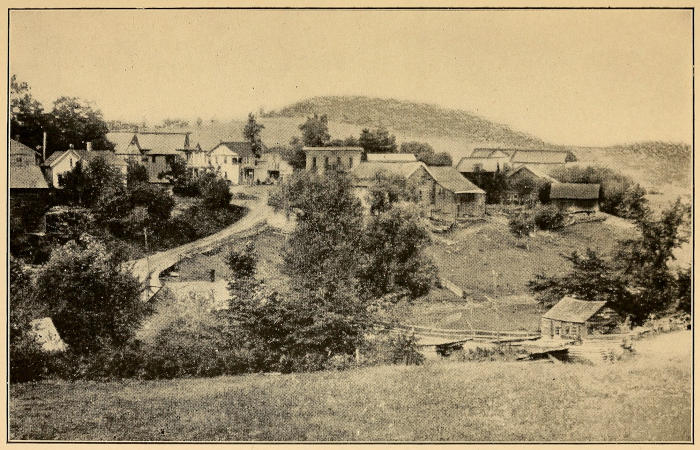
Social Stagnancy is a Characteristic Trait of the
Small Town and the Country
A letter from Tennessee said: “Education
is the first thing needed; education of every
kind. Not simply agricultural education, although
that has its place; not merely the primary
training offered by the public schools in
arithmetic, reading, grammar, etc. I mean the
education that unfastens doors and opens up
vistas; the education that includes travel, college,
acquaintance with people of culture; the
education that makes one forget the drudgery
of to-day in the hope of to-morrow. Sarah
Barnwell Elliott makes a character in one of
her stories say that the difference between
himself (a mountaineer) and the people of the
university town is ‘vittles and seein’ fur.’ The
language of culture would probably translate
that into ‘environment and vision.’ It is the
‘seein’ fur’ that farm women need most, although
lots of good might be done by working
some on the ‘vittles.’ Fried pork and sirup and
hot biscuit and coffee have had a lot to do with
the ‘vision’ of many a farmer and farmer’s
wife. A good digestion has much to do with
our outlook on life. Education is such an end
in itself, if it were never of practical use. But
one needs it all on the farm and a thousand
times more. ‘Knowledge is power,’ as I
learned years ago from my copy book. But
even if it were not, it is a solace for pain and a
panacea for loneliness. You may teach us farm
women to kill flies, stop eating pork, and ventilate
our homes; but if you will put in us the
thirst for knowledge you will not need to do
these things. We will do them ourselves.”
A note from North Carolina read something
like this:
“The country woman needs education,
recreation, and a better social life. If broad-minded,
sensible women could be appointed to
make monthly lectures at every public schoolhouse
throughout the country, telling them how
and what to do, getting them together, and
interesting them in good literature and showing
them their advantages, giving good advice,
something like a ‘woman’s department’ in
magazines, this would fill a great need in the
life of country women. Increase our social life
and you increase our pleasures, and an increase
of pleasure means an increase of good work.”
All these answers and many more show
something of the social conditions in the country
so far as women are concerned. In other
words, older people desert the country because
they want better living conditions and more
social and educational advantages for themselves
and their children. Moral degeneracy
in the country, like the city, is usually due to
lack of proper social recreation. When people
have something healthful with which to occupy
their minds, they scarcely ever think of wrong-doing.
A noted student of social problems
recently said that the barrenness of country life
for the girl growing into womanhood, hungry
for amusement, is one reason why so many
girls in the country go to the city. Students of
science attribute the cause of many of the cases
of insanity among country people to loneliness
and monotony. That something fundamental
must be done along social lines in the country
communities in order to help people find themselves,
nobody will dispute. Already mechanical
devices, transportation facilities, and
methods of communication have done much to
eliminate the drudgery, to do away with isolation,
and to make country life more attractive.
An influence which has done a good deal to
stifle expression in country people has been the
narrow-minded attitude certain elements in
society have taken toward those who till the
soil. When these elements have wanted to belittle
their city friends’ intelligence or social
standing, they have usually dubbed them “old
farmers.” Briefly stated, the quickest way to
insult a man’s thinking power or social position
has been to give him the title “farmer.” The
world has not entirely gotten over the “Hey-Rube”
idea about those who produce civilization’s
food supply. A certain stigma is still
attached to the vocation. As a group, country
people have in many places been socially
ostracized for centuries. A social barrier still
exists between the city-bred girl and the
country-bred boy. As a result, all these things
have had a tendency to destroy the country
man’s pride in his profession. This has weakened
his morale and his one ambition has been
to get out of something in which he cannot be
on an equal with other people, and consequently
he has retired. Goldsmith in “The Deserted
Village” hit the nail on the head when he said:
“Ill fares the land, to hastening ills a prey,
Where wealth accumulates, and men decay:
Princes and lords may flourish, or may fade;
A breath can make them, as a breath has made;
But a bold peasantry, their country’s pride,
When once destroyed, can never be supplied.”
To be an honest tiller of the soil, to be
actively engaged in feeding humanity, should
be one of the noblest callings known to mankind
and carry with it a social prestige. The
Chinese Emperor used to plow a furrow of
land once a year to stamp his approval upon
agriculture. The reason Washington, Lincoln,
Justin Morrill, and Roosevelt became so
keenly interested in country life was that they
saw the significance of it and its importance to
the world. George Washington was a farmer,
a country gentleman. Mount Vernon is a
country estate, a large farm. The father of
our country believed that a great country people
was the basic foundation of a great
America. Thomas Jefferson once said, “The
chosen people are those who till the soil.”
When you ridicule any people, they are not
likely to express their talents and the finer instincts
which lie hidden in them. A weak rural
morale eventually means rural decay. The
heart of rural America will never beat true
until society looks upon agriculture as a life,
as something to get into and not steer away
from or get out of its environment.
Another factor which has retarded the expression
of the hidden abilities of those who
live in the small towns and country communities
has been the absence of any force which
seeks to arouse the creative instincts and to
stimulate the imagination and initiative. Even
to-day, those agencies in charge of country-life
problems, as well as city life, direct very little
of their energies into channels which give color
and romance and a social spirit to these folks.
The most interesting part of any country community
or neighborhood is the people who live
in it. Unless they are satisfied with their
condition, it is little use to talk better farming.
A retired farmer is usually one who is dissatisfied
with country life. A social vision must be
discovered in the country, that will not only
keep great men who are country born in the
country, but also attract others who live in the
cities.
The impulse to build up a community spirit
in a rural neighborhood may come from without,
but the true genuine work of making country
life more attractive must come from within.
The country people themselves must work out
their own civilization. A country town or district
must have an individuality or mind of its
own. The mind of a community is the mind of
the people who live in it. If they are big and
broad and generous, so is the community.
Folks are folks, whether they live in the city or
country. In most respects their problems are
identical.
It is a natural condition for people to crave
self-expression. In years gone by men who
have been born and reared on the farm have
left it and gone to the city, in order to find a
place for the expression of their talents. This
migration has done more to hinder than to set
forward the cause of civilization. People who
live in the country must find their true expression
in their respective neighborhoods, just as
much as do people who live in the city. You
cannot continually take everything out of the
country and cease to put anything back into it.
The city has always meant expression—the
country, repression. Talent usually goes to the
congested centers of population to express
itself. For generations when a young man or
woman has had superior ability along some
particular line and lived in the country, their
friends have always advised them to move to a
large center of population where their talents
would find a ready expression. You and I, for
instance, who have encouraged them to go
hither, have never thought that we were sacrificing
the country to build the city. This has
been a mistake. We all know it.
Over fifty years ago a country doctor became
the father of two boys. In age they were
five years apart. The doctor brought them up
well and sent them away to a medical school.
Unlike most country-bred boys who go to large
cities, when they finished their courses they
went back to the old home town and began
their practice. By using their creative instincts,
organizing power, imagination, and
initiative, it was not long before they became
nationally known. People call their establishment
“the clinic in the cornfields.” To-day
these “country doctors” treat over fifty thousand
patients. Their names are known wherever
medical science is known. Railroads run
special sleepers hundreds of miles to their old
home town in Olmstead County, Minnesota,
which, by the way, is one of the richest agricultural
counties in America. The great big thing
about these two men is that they found an
opportunity for the expression of their talents
in a typical country community. They didn’t
go to a large city, they made thousands of city
people come to them.
Conservatively speaking, there are over ten
thousand small towns in America to-day. More
than ten million people live in them. These
communities are often meeting places for the
millions whose homes are in the open country.
Rural folks still think of a community as that
territory with its people which lies within the
team haul of a given center. It is out in these
places where the silent common people dwell.
It is in these neighborhood laboratories that a
new vision of country life is being developed.
They are the cradles of democracy. It is here
that a force is necessary to democratize art so
the common people can appreciate it, science
so they can use it, government so they can take
a part in it, and recreation so they can enjoy it.
The former Secretary of Agriculture aptly
expressed the importance of the problem when
he said:
“The real concern in America over the
movement of rural population to urban centers
is whether those who remain in agriculture
after the normal contribution to the city are
the strong, intelligent, well seasoned families,
in which the best traditions of agriculture and
citizenship have been lodged from generation
to generation. The present universal cry of
‘keep the boy on the farm’ should be expanded
into a public sentiment for making country life
more attractive in every way. When farming
is made profitable and when the better things
of life are brought in increasing measure to the
rural community, the great motives which lead
youth and middle age to leave the country
districts will be removed. In order to assure a
continuance of the best strains of farm people
in agriculture, there can be no relaxation of the
present movements for a better country life,
economic, social, and educational.”
THE LAND OF THE DACOTAHS
A skilled physician when he visits a
sick room always diagnoses the case of
the patient before he administers a
remedy. In order to comprehend thoroughly
the tremendous significance the Land of the
Dacotahs bears in its relation to the solution
of the problem of country life in America, one
must know something about the commonwealth
and its people.
North Dakota is a prairie state. Its land
area comprises seventy-one thousand square
miles of a rich black soil equal in its fertility to
the deposits at the delta of the River Nile in
Egypt. There are over forty million acres of
tillable land. The state has one of the largest
undeveloped lignite coal areas in the world.
Its climate is invigorating. The air is dry
and wholesome. The summer months are delightful.
The fields of golden grain are inviting.
The winters, on the other hand, are long
and dreary, and naturally lonely. People are
prone to judge the climate of the state by its
blizzards. Those who do, forget this fact—a
vigorous climate always develops a healthy and
vigorous people. No geographical barriers
break the monotony of the lonesome prairie
existence. A deadly dullness hovers over each
community.
The population of the state is distinctly
rural. Over seventy per cent of the people
live in un-incorporated territory. Seven out of
every eight persons are classed as rural. The
vocation of the masses is agriculture. Everybody,
everywhere, every day in the state talks
agriculture. At the present time there are
about two hundred towns with less than five
hundred inhabitants.
One of the most interesting characteristics
of this prairie commonwealth is its population.
They are a sturdy people, strong in heart and
broad in mental vision. The romance of the
Indian and the cowboy, the fur-trader and the
trapper, has been the theme of many an interesting
tale. The first white settler, who took
a knife and on bended knee cut squares of sod
and built a shanty and faced long hard winters
on this northern prairie, is a character the
whole world loves and honors. Several years
ago an old schoolmaster, whose home is not so
very far from Minnehaha Falls, delivered a
“Message to the Northwest” which typifies the
spirit of these people. He said in part:
“I am an old man now, and have seen many
things in the world. I have seen this great
country that we speak of as the Northwest,
come, in my lifetime, to be populous and rich.
The forest has fallen before the pioneer, the
field has blossomed, and the cities have risen
to greatness. If there is anything that an old
man eighty years of age could say to a people
among whom he has spent the happiest days of
his life, it is this: We live in the most blessed
country in the world. The things we have
accomplished are only the beginning. As the
years go on, and always we increase our
strength, our power, and our wealth, we must
not depart from the simple teachings of our
youth. For the moral fundamentals are the
same and unchangeable. Here in the Northwest
we shall make a race of men that shall
inherit the earth. Here in the distant years,
when I and others who have labored with me
shall long have been forgotten, there will be a
power in material accomplishment, in spiritual
attainment, in wealth, strength, and moral influence,
the like of which the world has not yet
seen. This I firmly believe. And the people
of the Northwest, moving ever forward to
greater things, will accomplish all this as they
adhere always to the moral fundamentals, and
not otherwise.”
The twenty-odd nationalities who live in the
Dacotahs came from lands where folklore was
a part of their everyday life. Many a Norseman—and
there are nearly two hundred thousand
people of Scandinavian origin, Norwegians,
Danes, Swedes, and Icelanders, in the
state—knows the story of Ole Bull, the famous
violinist, who when a lad used to take his instrument,
go out in the country near the waterfalls,
listen attentively to the water as it
rushed over the abyss, then take his violin,
place it under his chin, and draw the bow across
the strings, to see whether he could imitate the
mysterious sounds. Most of these Norse people
live in the northern and eastern section of
the state. The hundred thousand citizens
whose ancestors came from the British Isles—the
English, the Welsh, the Scotch, the Irish,
and the Canadians—know something of Shakespeare
and Synge and Bobbie Burns. Ten
years ago there were sixty thousand people of
Russian descent and forty-five thousand of
Teutonic origin in the state. They were acquainted
with Tolstoy and Wagner. Greeks,
Italians, and Turks, besides many other nationalities,
live in scattered sections of the state. In
fact, seventy-two per cent of the citizens of the
state are either foreign born or of foreign
descent. All these people came originally from
countries whose civilizations are much older
than our own. All have inherited a poetry, a
drama, an art, a life in their previous national
existence, which, if brought to light through
the medium of some great American ideal and
force, would give to the state and the country
a rural civilization such as has never been heard
of in the history of the world. All these people
are firm believers in American ideals.
One excellent feature in connection with the
life of the people who live in Hiawatha’s Land
of the Dacotahs is their attitude toward education.
They believe that knowledge is power.
Out on these prairies they have erected schoolhouses
for the training of their youth. To-day
there are nearly five hundred consolidated
schools in the state. One hundred and fifty of
these are in the open country, dozens of which
are many miles from any railroad. Twenty-three
per cent of the state area is served by
this class of schools. Much of the social life
of a community is centered around the school,
the church, the village or town hall, and the
home. The greater the number of activities
these institutions indulge in for the social and
civic betterment of the whole community, the
more quickly the people find themselves and
become contented with their surroundings.
In most respects, however, North Dakota is
not unlike other states. People there are
actually hungry for social recreation. The
prairies are lonely in the winter. Thousands
of young men and women whose homes are in
rural communities, when asked what they
wanted out in the country most, have responded,
“More Life.” The heart hunger of
folks for other folks is just the same there as
everywhere.
THE LITTLE COUNTRY THEATER
With a knowledge of these basic facts
in mind, as well as a personal acquaintance
with hundreds of young
men and women whose homes are in small communities
and country districts, the idea of The
Little Country Theater was conceived by the
author. A careful study of hundreds and
literally thousands of requests received from
every section of the state, as well as of America
and from many foreign countries, for suitable
material for presentation on public programs
and at public functions, showed the necessity of
a country life laboratory to test out various
kinds of programs.
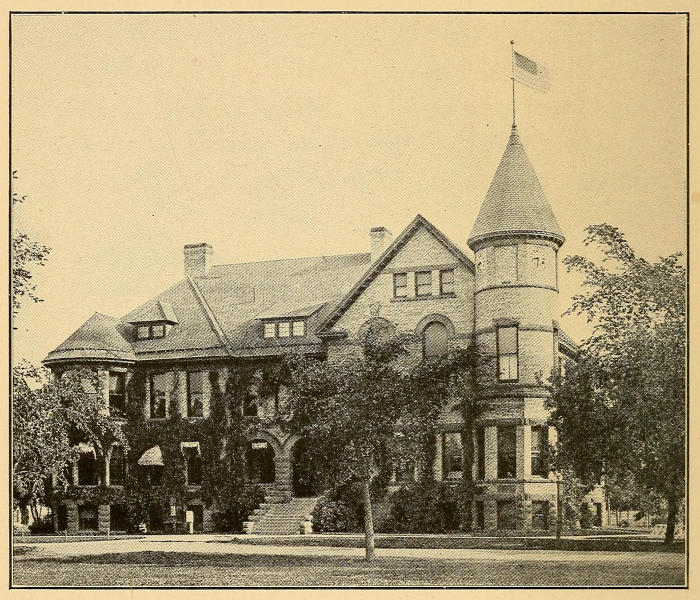
The idea conceived became an actual reality
when an old, dingy, dull-grey chapel on the
second floor of the administration building at
the North Dakota Agricultural College,
located at Fargo, North Dakota, was remodeled
into what is now known as “The Little
Country Theater.” It was opened the tenth
day of February in the year nineteen hundred
and fourteen. In appearance it is most fascinating.
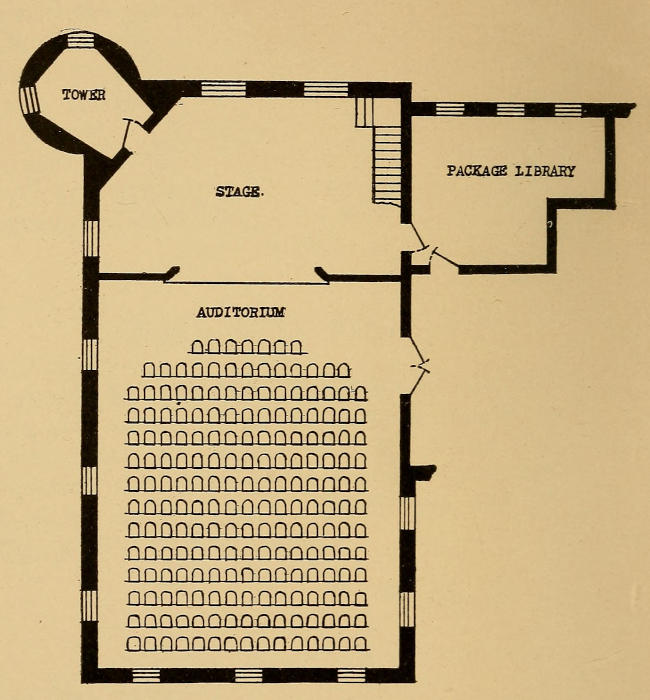
It is simply a large playhouse put
under a reducing glass. It is just the size of
an average country town hall. It has a seating
capacity of two hundred. The stage is thirty
feet in width, twenty feet in depth, having a
proscenium opening of ten feet in height and
fifteen feet in width. There are no boxes and
balconies. The decorations are plain and
simple.
The color scheme is green and gold, the gold
predominating. Three beams finished in golden
oak cross the mansard ceiling, the beams projecting
down several feet on each side wall,
from which frosted light bowls and globes are
suspended by brass log chains, the indirect
lighting giving a soft and subdued tone to the
whole theater. The eight large windows are
hung with tasteful green draperies. The curtain
is a tree-shade green velour. The birch-stained
seats are broad and not crowded together.
There is a place for a stereopticon
and a moving picture machine. The scenery
is simple and plain. Whenever possible, green
curtains are used. Simplicity is the keynote of
the theater. It is an example of what can be
done with hundreds of village halls, unused
portions of school houses, vacant country
stores and basements of country churches in
communities.
An Old Dingy, Dull-Grey Chapel on the Second Floor of the
Administration Building was Remodeled Into What Is Now Known
as The Little Country Theater
There are three unique features in connection
with The Little Country Theater which deserve
special mention—the tower, the attic or
“hayloft,” and the package library system.
The tower is just to the right of the lower
end of the stage. It, too, is plain and simple.
It is used as a study and contains materials
gathered from all over the world on the social
side of country life.
The attic is to the left of the stage and up
a flight of stairs. It was formerly an old garret.
For over twenty years it was unused. It
is the workshop of the theater and contains
committee rooms, dressing rooms, a property
room, a costume wardrobe, a small kitchen, and
a dining room which will comfortably seat
seventy-five persons. In many respects it corresponds
to the basement of a community
building, a church, or an addition tacked on to
a village hall. It is often used for an exhibit
hall or a scenic studio. In short, The Little
Country Theater is a typical rural community
center, a country-life laboratory. One significant
feature about this experimental laboratory
is that the birch-stained seats, the green
curtains, the scenic effects, the stage properties,
the five hundred costumes, the furniture, the
dishes, and all the other necessities have been
bought with funds taken in from entertainments
and plays, thereby demonstrating that
any community can do the same. Endowments
in the country are always difficult to raise.
Twelve years ago a country school-teacher
sent in a request for some program material.
Three personal copies of plays were sent to her,
one of which she staged. It was not very long
before others heard where she secured her
data and many inquiries followed. Out of this
request, together with an acquaintance with an
old, white-haired man who had just started a
similar system at a leading western university,
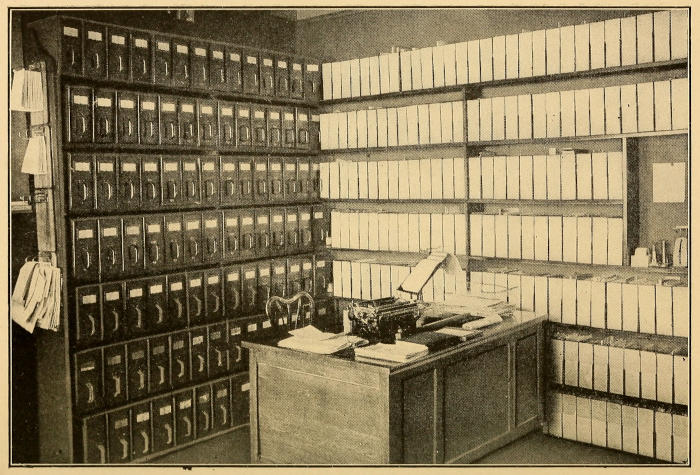
the package library idea came into existence.
It is a sort of an intellectual rural free delivery.
One might call it the backbone of The
Little Country Theater. In order to understand
thoroughly the importance of the service
which the system renders it will be necessary
to say something about the aim of the work,
its scope, how the data is gathered, and the
practical results already obtained.
The aim of the package library system is to
vitalize all the sources of information which
can be used for material for presentation on
public programs. Its chief object is to make
the schools, the churches, the homes, and the
village or town halls, centers of community
activity where men and women and their children,
young and old, can meet just to talk over
things, to find out the normal human life forces
and life processes, and really to discover themselves.
The field of work is the state and its people.
The scope of the service is broad. Any individual
or group of people in the state can
obtain program material simply by writing and
asking for it.
In order to render the best aid possible, the
system gathers data and information from
reliable sources. Briefs upon subjects relating
to country life, copies of festivals, pageants,
plays, readings, dialogues, pictures of floats,
parades, processions, exhibit arrangements,
costume designs, character portrayals, plans of
stages, auditoriums, open-air theaters, community
buildings, constitutions of all kinds of
organizations, catalogues of book publishers—in
short, every kind of material necessary in
building a program which will help people to
express themselves—are loaned for reading
purposes to citizens of the state. A few minutes’
talk with anybody interested in getting up
programs in small communities will soon show
the dearth of material along these lines.
In the years gone by, as well as in the present,
the letters which come to the desk daily
have told many an interesting story.
An energetic teacher in a country school in
the northern part of the state sent for several
copies of plays and play catalogues. None of
the plays sent suited her. She decided to give
an original play, “The Comedy.” When
asked for a description of the staging of the
original production, she sent the following
letter, which is indicative of what people really
can do in the country to find themselves.
“When I wrote to you about ‘The Comedy,’
I do not know what idea I gave you of it;
perhaps not a very true one; so I am sending
you a copy. The little song is one I learned
from a victrola record, so the music may not
be correct, but with a little originality, can be
used. The little play has the quality of making
the people expect something extraordinary,
but when performed, the parts are funny, but
still not funny enough to produce a ‘roar.’
They are remembered and spoken of long
afterwards. Now around here we often hear
parts spoken of. I enjoyed training the young
people, and they were quite successful. I have
found that every place I go people in the country
enjoy the school programs very much and
speak of them often. We wanted to take
some pictures, but could not. The weather
was so cloudy before and afterward that we
could not take any, but may this Sunday afternoon.
I wish I knew just what to write about
or just what you wish to know. I liked our
arrangements of lights. We only had lanterns.
A dressing room was curtained off and the rest
of the space clear. We hung four lanterns in a
row, one below the other, and had one standing
on the floor at the side opposite from the
dressing room, and then one on the floor and
one held by the man who pulled the curtain on
the other side. This gave splendid light.
There was no light near the audience except at
the organ.
“Hoping you will enjoy reading ‘The Comedy’
as much as we did playing and writing it,
I am
“Yours sincerely,
“A. K.”
There is something very human about a letter
when it solicits your personal help and
suggestions. To quote from several of the
thousands received will not only show the need
for the package library, because of the scarcity
of material in small towns and the country,
but also give an insight into the mind of the
people themselves.
“Barton, N. D., October 23, 1911.
“Gentlemen:—Would you kindly send a
copy of the following plays: Corner Store,
The Deestrick Skule, Country Romance, Pa’s
Picnic, A Rival by Request, School for Scandal,
Tempest in a Tea-pot, Which is Which.
“I wish to get up an entertainment in my
school and wish you could help me select a play
which would not require too much room and
too many actors. Will return the ones I do
not use immediately. Any favor which you
may render will be greatly appreciated.
“Very respectfully,
“E. S.”
“Gilby, N. D., Jan. 18, 1912.
“Dear Sir:—
“Will you please forward your list of amateur
plays. We are about to stage the annual
H. S. play, and find it rather difficult to select a
play not too sentimental in characters. We
would like one for 5-7 boys and 5-8 girls. Our
hall is small with cramped stage room, and the
scene must be quite simple. If you have any
suggestions to offer or any sample play to forward
for examination, will you kindly let us
know as soon as possible.
“Yours very truly,
“E. F. L.”
Ross, N. D., Jan. 22, 1913.
“Dear Sir:—
“Enclosed find plays, also stamps to cover
mailing expenses.
“Please send me the following amateur
plays: Exerbition of District Skule, Mock
Trial, Scrap of Paper, Sugar and Cream.
Please send also the following as listed under
package libraries: Manual Training, School
House as an Art Gallery, School House as a
Social Center, Fireless Cooker.
“Yours truly,
“M. C.”
“Backoo, N. D., Jan. 24, 1914.
“Dear Sir:—
“I rec’d the packet of information on Country
Life and will return it after our next meeting
the 27th. Can you send me two or three
dialogues suitable for a Literary Society in a
rural district. We have 6 or 8 young ladies
that might take part but very few young men.
And will you suggest a few subjects for debate
of interest and benefit to a country community.
“Yours truly,
“J. B. P.”
“Austin, N. D., Feb. 11, 1914.
“Gentlemen:—
“I should be very glad if you could send me
a short play of say 30 or 45 minutes length as
you mentioned in Nov. We are using the
schoolhouse as a meeting place and so have not
much room on the stage. Could use one requiring
from 4 to 8 characters.
“Yours truly,
“H. W. B.”
It Has a Seating Capacity of Two Hundred
“Verona, N. D., Feb. 14, 1915.
“Dear Mr. ⸺:
“While to-day the blizzard rages outside—inside,
thanks largely to yours and your department’s
work, many of us will be felicitously
occupied with the mental delights of literary
preparation and participation. Our society is
thriving splendidly. Last Friday another similar
society was started in the country north of
here. Went out and helped them organize.
They named their club the Greenville Booster
Club. Some of the leading lights are of the
country’s most substantial farmers. Suggest
that you send literature on club procedure to
their program committee. This community,
both town and country north, has for the past
many years been the scene of much senseless
strife over town matters, school matters, etc.
“I believe the dawn of an era of good feeling
is at hand. These get-together clubs are
bound to greatly facilitate matters that way.
At their next meeting I am on their debate and
supposed to get up a paper to read on any
topic I choose, besides. Now with carrying the
mail, writing for our newspaper, practicing and
singing with the M. E. choir, also our literary
male quartet, to say nothing of debating and
declaiming and writing for two literaries my
time is all taken up. Could you find me something
suitable for a reading?
“Sincerely yours,
“A. B.”
“Regan, N. Dak., Nov. 30, 1917.
“Mr. A. ⸺:
“My sister sent to you for some plays which
we are returning. We put on ‘The Lonelyville
Social Club’ after ten days’ practice and
cleared $39.10 in Regan and $93.00 when we
played it last night in Wilton. It took well
and we are much pleased with our effort. The
proceeds go to the Red Cross.
“Thanking you most sincerely, I am
“V. C. P. (and the rest of the troop).”
“Hensel, N. D., Mar. 15, 1918.
“Dear Friend:
“I received the paint which you sent me. I
thank you very much for it, it certainly came in
handy. Do you need it back or if not how
much does it cost? I would rather buy it if you
can spare it.
“The play was a success. We had a big
crowd everywhere. Everybody seemed to like
it. Some proclaimed it to be the best home
talent play they had seen. We have played it
four times. Whether we play more has not
been decided.
“Yours truly,
“A. H.”
“Overly, N. D., Mar. 21, 1918.
“Gentlemen:—
“Have you any book from the library that
would help with a Patriotic entertainment to be
given in this community for the benefit of the
Red Cross? If you can offer suggestions also,
we will appreciate it.
“Thanking you, I am, truly yours,
“G. L. D.”
The Package Library System
“Lansford, N. D., May 25, 1920.
“Dear Mr. A.:
“As a teacher in a rural school I gave a program
at our school on last Saturday evening.
We had an audience of about seventy-five people
and they simply went wild over our program.
Our school has an enrollment of four
girls, being the only school in the county where
only girls are enrolled and also the smallest
school in the county. Our program lasted two
hours and twenty minutes and was given by the
four girls.
“We have been asked to give our entertainment
in the hall in Lansford. Now I want to
ask you for a suggestion. Don’t you think that
in a make-up for ‘grandmothers’ that blocking
out teeth and also for making the face appear
wrinkled’ would improve the parts in which
grandmothers take part?
“Would it be possible for you to send me the
things necessary as I would like to get them as
soon as possible and do not know where to send
for them. If you can get them for me I shall
send the money also postage, etc., as soon as I
receive them.
“Trusting that this will not inconvenience
you greatly, I remain,
“Very truly yours,
“E. B.”
It is not an uncommon occurrence to get a
long distance call at eleven o’clock at night
from someone two or three hundred miles
away, asking for information. Telegrams are
a common thing. Conferences with people who
come from different communities for advice are
frequent. The tower, the attic, and the package
library are an integral part of the theater.
The aim of The Little Country Theater is
to produce such plays and exercises as can be
easily staged in a country schoolhouse, the basement
of a country church, the sitting room of a
farm home, the village or town hall, or any
place where people assemble for social betterment.
Its principal function is to stimulate an
interest in good clean drama and original entertainment
among the people living in the
open country and villages, in order to help
them find themselves, that they may become
better satisfied with the community in which
they live. In other words, its real purpose is
to use the drama and all that goes with the
drama as a force in getting people together and
acquainted with each other, in order that they
may find out the hidden life forces of nature
itself. Instead of making the drama a luxury
for the classes, its aim is to make it an instrument
for the enlightenment and enjoyment of
the masses.
In a country town nothing attracts so much
attention, proves so popular, pleases so many,
or causes so much favorable comment as a
home talent play. It is doubtful whether Sir
Horace Plunkett ever appreciated the significance
of the statement he once made when he
said that the simplest piece of amateur acting
or singing done in the village hall by one of the
villagers would create more enthusiasm among
his friends and neighbors than could be excited
by the most consummate performance of
a professional in a great theater where no one
in the audience knew or cared for the performer.
Nothing interests people in each other
so much as habitually working together. It’s
one way people find themselves. A home talent
play not only affords such an opportunity, but
it also unconsciously introduces a friendly feeling
in a neighborhood. It develops a community
spirit because it is something everybody
wants to make a success, regardless of the
local jealousies or differences of opinion. When
a country town develops a community consciousness,
it satisfies its inhabitants.
The drama is a medium through which
America must inevitably express its highest
form of democracy. When it can be used as an
instrument to get people to express themselves,
in order that they may build up a bigger and
better community life, it will have performed
a real service to society. When the people who
live in the small community and the country
awaken to the possibilities which lie hidden in
themselves through the impulse of a vitalized
drama, they will not only be less eager to move
to centers of population, but will also be a force
in attracting city folks to dwell in the country.
The monotony of country existence will change
into a newer and broader life.
If The Little Country Theater can inspire
people in country districts to do bigger things
in order that they may find themselves, it will
have performed its function. It is the Heart
of a Prairie, dedicated to the expression of the
emotions of country people everywhere and in
all ages.
THE HEART OF A PRAIRIE
People are more or less influenced by
their emotions. What matters is not so
much what persons think about certain
things as how they feel toward them. Thought
and emotion usually go hand in hand. One is
essential to the other. It is through the heart
of a people that emotions are expressed. For
centuries the drama has been the great heart
strength through which humanity expresses its
higher and finer instincts. Its power to sway
the feelings of mankind by seeking to find out
the hidden life forces in us all can never be
overestimated. It is through the drama that
people learn to interpret human nature, its
weakness and its strength. The sad and the
happy, the rich and the poor, the strong and
the weak, the young and the old, those with
many different ideas and ideals see their actions
reflected in this mirror. The supreme duty of
society is to point out the way to its citizens,
whether they live in the country or in the city,
to live happy and useful lives. In this respect
the drama plays an important rôle. As Victor
Hugo once said, “The theater is a crucible of
civilization. It is a place of human communion.
It is in the theater that the public soul is
formed.”
In the early generations of the world it was
the only form of human worship. The Shepherds
of the Nile conceived a sacred play in
which the character “the God of the Overflow”
foretold by means of dramatic expression the
period of the flooding of the valley. The Vedic
poets sang their songs in the land of the Five
Rivers of India. The Hebrews expressed their
religious philosophy through a democratic
festival called the Feast of Tabernacles. The
country people who made Rome their center
celebrated the ingathering of their food with a
festival called the Cerealia. The Festival of
Demeter was a characteristic play of the early
Greeks. The country people of the Orient had
ritualistic dramas dealing with animal and
plant life. The Incas, the Indians of Peru,
worshiped at the Altars of Corn. In the realm
of nature, Ceres, the goddess of grains,
Mother Earth, Pomona, the goddess of fruits,
Persephone, emblematical of the vegetable
world, Flora, the goddess of flowers, Apollo,
the sun god, and Neptune the god of water,
have been the theme of many a dramatic story.
All these ceremonies and many more not only
signify the wide usage of this art in every age
and every part of the world, but also unfold
tremendous possibilities for future pageant,
play, and pantomime among country people.
If civilization’s sense of appreciation could be
aroused to see the hidden beauties of field and
forest and stream—of God’s great out of
doors—men and women and children would
flock to the countryside. The drama is one of
the many agencies which seeks to stimulate this
sense of appreciation. It deals with human
problems by means of appeals to the emotions.
The absence of a vision in many country
communities has been one of the chief causes
for their backwardness, their dullness, and
their monotony. When the country develops a
robust social mind, one that appeals because of
the bigness of the theme, it is then that life in
the open and on the soil will become attractive.
The lure of the white way will pass like ships
at night. That a new light seems to be breaking
is evidenced by the establishment of consolidated
schools, community buildings, and
country parks. These and other social institutions,
together with better means of communication
and transportation, materially assist in
the solution of the country life problems. A
country district must be active and not passive
if it would interest the young and even the old.
If the drama can serve as just one of the
mediums to get the millions of country people
here and elsewhere to express themselves in
order that they may find themselves there is
no telling what big things will happen in the
generations to come. If, as has often been said,
agriculture is the mother of civilization, then
every energy of a people and every agency
dramatic and otherwise, should be bent to make
that life eventful and interesting from every
angle. The function of The Little Country
Theater is to reveal the inner life of the country
community in all its color and romance,
especially in its relation to the solution of the
problems in country life. It aims to interpret
the life of the people of the state, which is the
life of genuine American country folks.
CHARACTERISTIC INCIDENTS
While still in its infancy, the work of
The Little Country Theater has already
more than justified its existence.
It has produced many festivals, pageants, and
plays and has been the source of inspiration to
scores of country communities. One group of
young people from various sections of the
state, representing five different nationalities,
Scotch, Irish, English, Norwegian, and Swede,
successfully staged “The Fatal Message,” a
one-act comedy by John Kendrick Bangs. Another
cast of characters from the country presented
“Cherry Tree Farm,” an English
comedy, in a most acceptable manner. An illustration
to demonstrate that a home talent
play is a dynamic force in helping people find
themselves was afforded in the production of
“The Country Life Minstrels” by an organization
of young men coming entirely from the
country districts. The story reads like a fairy
tale. The club decided to give a minstrel show.
At the first rehearsal nobody possessed any
talent, except one young man. He could clog.
At the second rehearsal, a tenor and a mandolin
player were discovered. At the third, several
other good voices were found, a quartet
and a twelve piece band were organized.
When the show was presented, twenty-eight
different young men furnished a variety of acts
equal to a first class professional company.
They all did something and entered into the
entertainment with a splendid spirit. “Leonarda,”
a play by Björnstjerne Björnson with
Norwegian music between acts, made an excellent
impression.
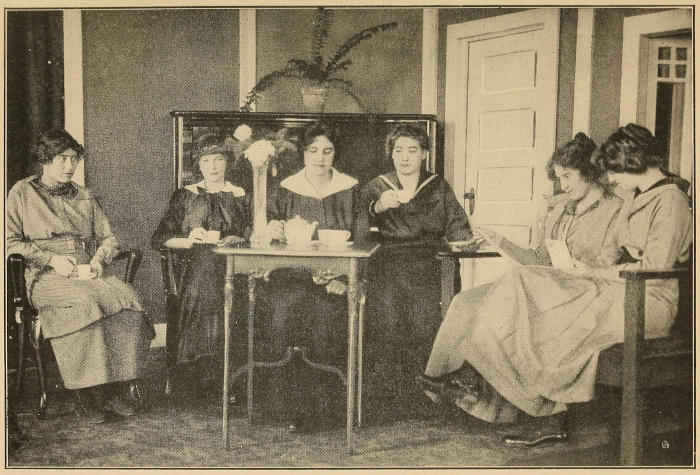
A Farm Home Scene in Iceland Thirty Years Ago
Perhaps the most interesting incident that
has occurred in connection with the work in
this country life laboratory was the staging of
a tableau, “A Farm Home Scene in Iceland
Thirty Years Ago,” by twenty young men and
women of Icelandic descent whose homes are
in the country districts of North Dakota. The
tableau was very effective. The scene represented
an interior sitting room of an Icelandic
home. The walls were whitewashed. In the
rear of the room was a fireplace. The old
grandfather was seated in an armchair near the
fireplace reading a story in the Icelandic language.
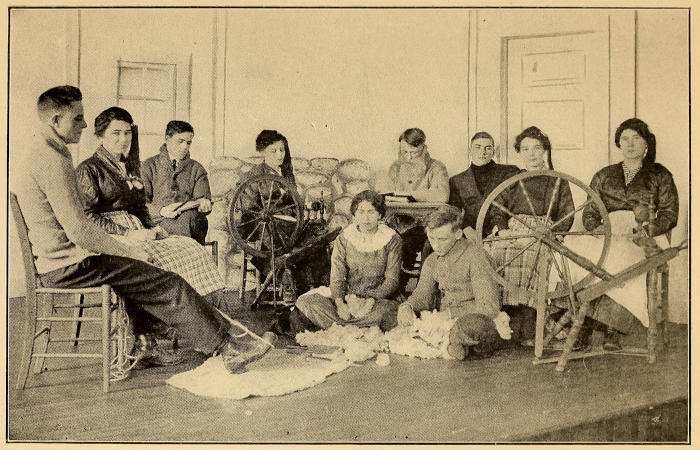
About the room were several young
ladies dressed in Icelandic costumes busily engaged
in spinning yarn and knitting, a favorite
pastime in their home. On a chair at the right
was a young man with a violin, playing selections
by an Icelandic composer. Through the
small windows rays of light representing the
midnight sun and the northern lights were
thrown. Every detail of their home life was
carried out, even to the serving of coffee with
lumps of sugar. Just before the curtain fell,
twenty young people, all of Icelandic descent,
joined in singing the national Icelandic song,
which has the same tune as “America.” The
effect of the tableau was tremendous. It
served as a force in portraying the life of one
of the many nationalities represented in the
state.
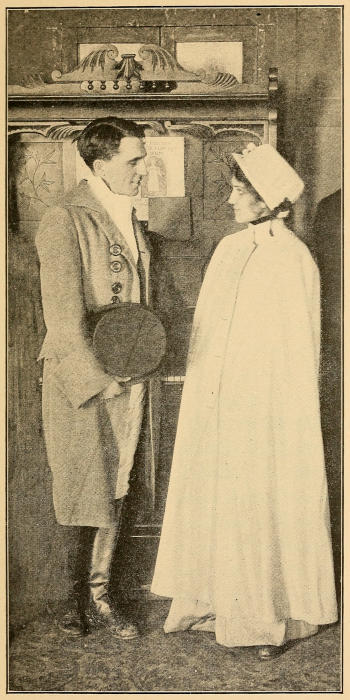
When “The Servant in the House” by
Charles Rann Kennedy was presented, it was
doubtful in my mind whether a better Manson
and Mary ever played the parts. Both the
persons who took the characters were country
born. Their interpretation was superb, their
acting exceptional. In fact, all the characters
were well done. Three crowded houses
greeted the play.
An alert and aggressive young man from
one part of the state who witnessed several
productions in the theater one winter was instrumental
in staging a home talent play in the
empty hayloft of a large barn during the summer
months. The stage was made of barn
floor planks. The draw curtain was an old,
rain-washed binder cover. Ten barn lanterns
hung on a piece of fence wire furnished the
border lights. Branches of trees were used
for a background on the stage. Planks resting
on old boxes and saw-horses were made
into seats. A Victrola served as an orchestra.
About a hundred and fifty people were in attendance
at the play. The folks evidently
liked the play, for they gave the proceeds to a
baseball team.
Scene—“Leonarda” By Björnstjerne Björnson
Every fall harvest festivals are given in different
sections of the state, with the sole purpose
of showing the splendid dramatic possibilities
in the field of agriculture. A feature
in one given a few years ago is deserving of
special mention. Country people in North
Dakota raise wheat. The state is often called
the bread basket of the world. A disease called
black rust often infests the crop and causes the
loss of many bushels. In order to depict the
danger of this disease, a pantomime called
“The Quarrel Scene between Black Rust and
Wheat” was worked out. The character representing
Wheat was taken by a beautiful fair-haired
girl dressed in yellow, with a miniature
sheaf of grain tucked in her belt. The costume
worn by Black Rust was coal-colored
cambric. The face was made up to symbolize
death. Wheat entered and, free from care,
moved gracefully around. Black Rust stealthily
crept in, pursued and threatened to destroy
Wheat. Just about the time Wheat was ready
to succumb, Science came to the rescue and
drove Black Rust away. Wheat triumphed.
Several thousand people saw this wonderful
story unfolded in the various places where it
was presented. Everybody caught the significance
of it at once.
Just the other day a farmer from Divide
County who had planned a consolidated schoolhouse
came to the theater, in order to find out
how to install a stage “so the people in his
community could enjoy themselves” as he put
it. Divide County is some three hundred
miles from The Little Country Theater.
One young man from the northwestern part
of the state wrote me a letter well worth reading.
He said in part:
“Dear Sir:—I thought you might like to
know how we came out on the play ‘Back to
the Farm,’ so I am writing to tell you of the
success we had.
“In the first place we had a director-general
who didn’t believe in doing things by halves.
For nearly a month we rehearsed three times
a week. That means after the day’s work was
done we ate a hasty supper, hurried through
the chores, cranked up the Ford and ‘beat it’
to rehearsal. And when we did give it we
didn’t waste our efforts in a little schoolhouse
with a stage consisting of a carpet on the floor
and a sheet hung on a wire for the curtain.
Nix! We had an outfit that any theater in a
fair sized town might well be proud of.
“Well, we had a full house and then some,
they even came from Minot fifty miles north
of here and from other neighboring towns.
After it was over we got all kinds of press
notices, nice complimentary ones, too. Our
fame even went as far as Washburn and the
County Supt. of Schools asked us to come down
and give it at the Teachers’ Institute, Nov. 4,
to give the teachers an idea what could be done
in other communities y’see? We didn’t go
though, didn’t have any way to pay expenses
as he wanted to give it free. However, we
went to Garrison, Ryder, Parshall, Makoti
and drew a full house every time except once
and that was due to insufficient advertising,
only two days. We collected enough money to
buy chairs and other furnishings for our new
‘Little Country Theater’ and also the salary of
an instructor to our orchestra we are just
starting.
“Our stage is surely ‘great.’ The wings, interior
set and arch are made of beaver board,
with frames of scantling, the frame of the arch,
however, is not scantling, but two by fours. It
is all made in such a manner that it can be
knocked down and packed away, when we wish
to use the building for basketball or other
games. The back drop is the most beautiful
landscape I have ever seen, a real work of art.
“The front drop curtain is what made it
possible for us to get the entire outfit. It has
the ad of nearly every business man in Ryder
and represents something like $240. The complete
stage cost us $200 so we still had some
left over.
“The theater which is not yet completed is
in the basement of the new brick consolidated
school. It will be steam heated and later electric
lighted, two dressing rooms back of the
stage, and well I guess that’s enough for
a while. The auditorium will be about 19 x
40 ft.
“Now I believe what we can do others can
do as we are only an ordinary community, our
director was a college graduate with a lot of
pep and push, that’s all.
“Do you ever loan out any of your scenery?
Another party who has ‘caught the fever,’ is
going to try the same stunt with modifications.
I am getting to be a sort of an unofficial agent
for your Extension Div. as people here are
getting interested in these ‘doin’s’ so don’t be
surprised if you get a letter from us now and
then.
“Yours truly,
“A. R.”
When “The Little Red Mare,” a one-act
farce was given, Hugh’s father came down to
see me and tell me that if there was anything
needed in the country it was more life and good
entertainments for the young people. He was
a very interesting character and a bit philosophical.
When I told him about the mistakes
made in the work, he pulled out a lead pencil,
placed it between his fat thumb and finger and
looking straight at me said, “if it wasn’t for
mistakes we’d never have rubbers on the ends
of our pencils.” His son, Hugh, who took the
character of the old deaf fellow in the play,
did a superb piece of acting.
Over in the village of Amenia they have a
country theater. It is located on the second
floor up over a country store, and has a seating
capacity of about one hundred and seventy-five
people. The stage is medium size. The
curtain is a green draw curtain. The lighting
system is unique, containing border lights, foot
lights, house lights, and a dimmer. The plays
selected and produced are only the best. One
villager said he never thought plays would
change the spirit of the community so much.
Scene—“The Servant in the House”
By Charles Rann Kennedy
Up near Kensal, North Dakota, about four
miles out from the town, the McKinley
Farmers’ Club have a place modeled in some
ways after The Little Country Theater. The
country people formed a hall association, sold
stock to the extent of three thousand dollars,
donated their labor, and put up the building.
The site was given by a country merchant. It is
a typical rural center, consisting of auditorium,
stage, rest rooms, dining room, and kitchen.
An excellent description of its activities is contained
in a letter from one of its members
dated April 17, 1918, which I shall quote in
part:
“The club year, just closed has been satisfactory
in all events. From a social standpoint,
this community through the efforts of the McKinley
Club has enjoyed the fellowship of their
neighbors and friends in a manner that is foreign
to most rural communities.
“The officials of the past year have injected
literary work into its meetings or rather at the
close of the club meeting. Meetings are held
on the second and fourth Saturday evenings of
each month. The men of the club meet in the
auditorium and transact regular business while
the Ladies’ Aid of the Club meet in the dining
rooms. At the close of the business session all
congregate in the auditorium where a program
made up of songs, recitations, readings, essays,
debates, dialogues, monologues, the club journal,
four minute speeches, etc., is given. With
the program or literary over, all retire to the
dining rooms, where the ladies have a lunch arranged
which is always looked forward to.
Home talent plays and public speakers are
from time to time in order and always enjoyed.
A five piece orchestra composed from amongst
the membership play for dances, at plays, etc.
The dramatic talent of the club has just played
‘A Noble Outcast’ and despite a rainy evening
the proceeds counted up to $93.00. The proceeds
were used to pay for the inclosing of the
stage and stage scenery. They will put this on
again, the proceeds to go to buy tobacco for
the boys ‘Over There.’ Last June the club
members and their families in autos made a
booster trip boosting the play ‘Back to the
Farm,’ presented by The Little Country Theater
Players. They canvassed ten towns in a
single day, driving one hundred and twenty
miles. The result was that when the ticket
force checked up $225.00 had been realized.
The club celebrates its anniversary in June of
each year.
“The Ladies’ Aid of the club have been a
great help and their presence always appreciated.
To date they have paid for out of their
funds, and installed in the club hall, a lighting
system that is ornamental and is of the best, a
piano, kitchen range, and a full set of dishes
with the club monogram in gold letters inscribed
on each piece.
“The stage is enclosed and scenery in place
so that the dramatic talent of the community
have an ideal place for work.
“I have in a hurried manner given you some
of our doings in general.
“Respectfully,
“J. S. J.”
I shall never forget the night referred to in
the above letter when “Back to the Farm” was
given in the hall. Automobiles loaded with
people came from miles around. The hall was
packed. Children were seated on the floor
close up to the stage. Fifty persons occupied a
long impromptu plank bench in the center aisle,
with their bodies facing one way and their
heads looking toward the stage. They stood
on chairs in the vestibule at the back. The
windows were full of people. Three men paid
fifty cents each to stand on a ladder and watch
the play through the window near the stage.
It was as enthusiastic and appreciative a crowd
as ever witnessed a play. They still talk about
it, too.
One of the most artistic pieces of work ever
done in the Theater was the part of “Babbie”
in Barrie’s play “The Little Minister.” The
charming young lady who took the character
seemed, as the folks say, “to be born for it.”
“Little Women” a dramatization of Louisa
Alcott’s book was also cleverly acted.
A group of twenty young men and women
from fifteen different communities dramatized
“The Grand Prairie Community School Building”
project in five scenes. The first scene told
the story of the organization of the Grand
Prairie Farmers’ Club in the old one-room
country school, and the endorsement of the new
structure. The second showed the plans and
specifications of the proposed building, by
means of an illustrated lecture given in the old
town hall. In the third and fourth parts the
basement with the installation of the lighting
system and the preparation of the lunch in the
kitchen for the visitors were portrayed. The
last scene displayed the auditorium and stage in
the community school building complete, together
with the dedication ceremonies. The
scenery, properties, curtains, and lighting effects
were arranged by these young men and
women. The two hundred people who saw this
dramatic demonstration will never forget the
effect it had upon them. It proved that any
community which is farsighted enough can with
imagination and organization erect a similar
structure or remodel a village hall so the people
can have a place to express themselves. The
essentials are an assembly room and a stage,
that’s all.
Scene—“Back to the Farm” By Mereline Shumway
Three outdoor spectacles, “The Pastimes of
the Ages,” “The Enchantment of Spring,” and
“The Master Builder” revealed the infinite
possibilities of the drama in picturing “tongues
in trees, books in running brooks, sermons in
stones, and good in everything.” All of these
pageants and many more aim to teach the people
who live in God’s gardens to appreciate
their surroundings. “The Pastimes of the
Ages,” as well as the other two outdoor plays,
was presented on a flat prairie, a parade ground
about three or four hundred feet from The
Little Country Theater. Over fifteen thousand
people saw the spectacle and twelve hundred
people took part in it. The scene was a most
impressive one. At one end of the natural outdoor
amphitheater the silent sphinx and three
pyramids rose in all their Oriental grandeur.
At the other stood a temple of glittering gold,
in which the Spirit of Mirth reigned supreme.
The play opened with Mirth running out of the
temple singing and dancing. In the distance
she saw a caravan approaching the pyramids.
She beckoned them to come forward. The
grand procession followed. On entering the
temple the sojourners were greeted by flower
maidens. Mirth then bade the caravan to be
seated on the steps of marble and witness some
of “The Pastimes of the Ages.” The Greek
games were played. An Egyptian ballet was
danced. Forty maidens clad in robes of purple
with hands stretched heavenward chanted a
prayer. Two hundred uniformed Arabs
drilled. The chimes rang. Mirth gestured for
all to rise and sing. The bands en masse
struck the notes of that song immortal, written
by Francis Scott Key. The caravan, having
seen all the pastimes in which men and women
have indulged in ages gone by, journeyed back
to the place from whence it came. And the
story of the most gorgeous spectacle ever seen,
on the Dacotah prairie ended.
“The Enchantment of Spring” was a pageant
in two episodes, with its theme taken
from the field of agriculture. The setting was
The Temple of Ceres. The Herald of Spring
came to the temple with Neptune the God of
Water, Mother Earth, Growth, Apollo the
God of the Sun, Persephone emblematical of
the vegetable world, Demeter the Goddess of
Grains, Flora the Goddess of Flowers, and
Pomona the Goddess of Fruits, to announce
the approach of Spring. The trumpeters signaled
the coming of the east and west and north
and south winds. They met, they quarreled
and Fate drove the north wind away. The
three winds then counseled with Neptune,
Apollo, and Mother Earth, companions of
Growth, as to her whereabouts. They finally
discovered Growth at work and bade her to go
to the temple. The welcome and the rejoicing
followed. At the entry of Spring, the flowers
awoke. Ceres called to Spring to come to the
steps of the temple. The Crowning of Spring
ended the pageant. When it was produced, it
opened up the vision of many people as to the
latent possibilities of the drama in the vocation
of agriculture.
Festival—“The Pastimes of the Ages.”
By Alfred Arnold. Parade Grounds, North Dakota
Agricultural College, Fargo, North Dakota
Just recently “The Master Builder” was presented.
The scene of the story was laid in the
Great Outdoors. The play centers about a
man who builds, a mechanic called the Master
Builder. In his dream a vision comes to him,
a picture of a beautiful temple that he has
longed for years to construct. Around him
and about him the dream children dance. They
are the messengers that tell him that the workmen
are coming. Before him in a procession,
passes Ahura Mazda and the Sun Worshipers,
Vulcanus and the torch-bearers, Atlas and his
men of power, the Great Architect and his associates,
Praxiteles and the stone-cutters, Tubal
Cain and the blacksmiths, Joseph and the carpenters,
and Michael Angelo and the painters.
After he consults with the architects and approves
the plans, they sing and rejoice. Nature’s
forces—light, power, and fire—combine
to help him realize his dream. Even the
flames, often the elements of destruction, turn
their energies into power to help him. Finally,
Praxiteles and the stone-cutters begin the temple,
and Joseph and the carpenters, Tubal Cain
and the blacksmiths, Michael Angelo and the
painters complete it. The Anvil Chorus plays,
Enlightenment awakens the Master Builder
from his dream, and Achievement shows him
that his vision has been realized. The beautiful
temple stands before him.
All three of these spectacles show untold
dramas in fields of thought yet untouched.
They were mediums through which the ideals,
the traditions, and the beauties of nature and
human nature could be expressed.
The great mass of people in the state love
good plays. Just like most folks, they want
something with a homely story mixed with a
few bits of comedy. Ninety out of a hundred
persons are usually human, anyway. “David
Harum,” a three-act comedy by Eugene Noyes
Westcott, seemed to hit the right spot with
hundreds of the Dacotah folks. Personally, I
do not believe a finer piece of non-professional
acting has ever been done in America than that
of the young man who took the part of David
Harum. His phenomenal success in the character
is all due to the fact that he lived the part
every time he acted it. Naturally, he had
strong support in the presentation of the play.
One incident in regard to the place of its
production I shall never forget. During the
past twenty-five years it has been my good fortune
to see plays and programs presented in
village halls, schoolhouses, churches, homes,
country stores, gymnasiums, auditoriums, theaters,
hotels, barns, parks, groves, streets, and
other places. But I have never had the good
fortune to see a baseball diamond used for a
theater, and on the Fourth of July, with a play
like “David Harum.” It all happened down
at Lisbon. The second baseball game had just
finished. It was about six-thirty in the evening.
A frame of two-by-four scantling was erected
and braced like a city billboard. The center of
the frame was exactly nine feet from the home
plate. On it fourteen foot green draperies
were hung. A large soiled canvas was laid on
the worn ground for the stage. Three electric
bulbs with a few batteries and two good sized
automobiles furnished all the light necessary
for the production. The baseball pits, where
the players stay before they are called upon to
bat, were used as dressing rooms. The crowd
began to assemble at half past seven, and at
eight o’clock the bleachers were brimful. The
overflow crowd was seated on planks close up
to the stage. For two solid hours and on the
Fourth of July, mind you, several hundred people
sat, watched, and listened to David Harum.
Not a soul left. The interest manifested by the
audience was tense at all times. It was one of
the most unique instances ever experienced by
the writer.
Scene—Sitting Bull-Custer. By Aaron McGaffey Beede
An Indian drama called, “Sitting Bull-Custer,”
written by an Episcopal priest, now a
judge in Sioux County, told the story of the
Redman’s version of the Custer Massacre. It
was presented on a Dacotah prairie at sunset,
seven years ago. The scene represented an Indian
village on the Little Big Horn River. It
was dawn, June twenty-fifth, eighteen hundred
and seventy six. A thick clump of trees, in
which the Indian characters, Echonka, Gall,
Rain-in-the-Face, Old-man, Old-woman, and
Old-Woman-Diviner were hidden, furnished
the background. There, secluded as spies, they
anxiously awaited the arrival of Sitting Bull,
believing that he would unfold valuable secrets
in regard to the coming battle. Fool-mink, an
Indian story teller and singer, the comedian of
the play, was everywhere present. He sang
and he danced. His music irritated Rain-in-the-Face,
because it reminded him of the time
Tom Custer handcuffed him. In several sharp
encounters which ensued between Fool-Mink
and Rain-in-the-Face, Gall acted as the peace-maker.
Silence reigned. Sitting Bull arrived.
He looked at the dawn wistfully, started a fire,
and sat down beside it. He spoke with rapid
tongue. He told the story of the Redman, the
most misunderstood creature on earth. He
gave the reason why his race feared the white
man—he wanted to be left alone and have food
to eat. He foretold the battle. Suddenly his
body became as rigid as a statue. Mid pauses,
he spoke in a far-away ghostly voice.
“Great Custer speaks. I hear him say,
Brave action crushes calumny.
No lies can crush a glittering fact,
If man, ignoring self, will act.
I’m not a man without a flaw,
What man has not his foibles? Pshaw!
Courtmartial me! For what? To blight
My name! I swear, by yonder light
Of morning, I’ve no serious wrong!
The truth will flame abroad ere long.
Their teeth shall bite the dust to-day,
A soldier’s grave can sing a lay
Of praise, while foibles dare not peep,
And those who twisted foibles sleep
Forgotten. They suppose I shrink
From death as they do. As they think
They judge me. Open your sweet jaws,
Brave death, and swallowing petty flaws,
Make Custer’s rightful honor bright
And clean, as youthful morning light!
To die! To die gives them the shame,
And me, I ask no word of fame,
Save this,—that ere I slept in dust.
He pauses, waves his lifted hand,
He’s beckoning toward the spirit land.”
In this reverie he pictured Custer as the idol
of the Redman. The arrival of the herald
from the enemy’s camp awakened him from his
stupor. A council of war was hastily called.
It was noon and after. The battle was on.
The smoke rose in every direction. Soldiers
and warriors appeared and disappeared.
Echonka was seen. His gun failed to discharge.
A bullet laid him low. Winona,
Echonka’s lover, came running, looked at him
with an agonized face, lifted her hands toward
heaven, and shrieked. She knelt at his side and
cried as if her heart would break. The fatal
day soon ended. It was after sunset. Sitting
Bull in searching among the dead found the
body of Custer. The wailing for the dead
could just be heard. He uttered a soliloquy,
covered Custer’s face with a silk handkerchief,
lifted his own face and hands in prayer, and
was silent. The play ended.
The effect upon the three thousand persons
who witnessed the Indian play was excellent.
Religious dramas, sometimes in prose and
poetry and often in tableau and pantomime,
are given. “The Evergreen Tree,” “The
Nazarene in Song and Story,” and “The Man
of Galilee” were especially well presented.
Every year a series of one-act plays is produced
for the sole purpose of training young men and
women to be able to stage dramas in the districts
where they expect to live. Programs
containing features characteristic of the activities
of a community are frequently given.
A great many original plays have been
written and presented to large crowds. “The
Prairie Wolf,” “Bridging the Chasm,” “Every
Ship Will Find a Harbor,” “The New Country
Woman,” “The Country Side,” not to mention
dozens of others, are productions which
have come out of the country people themselves.
The place was crowded at the presentation
of every one of these plays. Over
eighty per cent of the audiences were country
people, who had come to see dramas of their
own creation, plays that had come out of the
soil. “The Prairie Wolf” was written by a
young man who was interested in horses and
cattle. It pictured in a most vivid manner the
financial troubles of a great many farmers.
The central thought in “Bridging the Chasm”
brought out the gap between city and country.
A city girl and a country boy had fallen in love
with each other. The city prejudice against
country people made her hesitate before she
said yes. “Every Ship Will Find a Harbor”
was worked out by a country lad who was very
fond of machinery and electricity. The action
of the play took place in a country store, in the
woods near the Langer farm, and in the sitting
room of a farm home. The play told the story
of a lazy country boy who decided to leave the
farm and go west in search of adventure, and
to study about machinery with the aid of a correspondence
course. He didn’t like school.
After being in the employ of a western power
company for a few years, he returned home.
His arm was broken. While at home he became
interested in the community where he was
born. In order to help his people enjoy life he
showed them how to harness nature’s power,
so that the drudgery of the farm might be done
by machinery instead of man power. The
crowd which witnessed this play was a very
responsive one. “The New Country Woman,”
written by a girl of French descent, brought
out the leadership of woman in improving the
social conditions in the country. There were
ten characters in the play. The action took
place in three scenes. The existing rural conditions
in the state were splendidly portrayed
in “The Country Side.” It was exceptionally
well written, the thought and the English well
nigh perfect.
Scene—“American Beauties”—A One-Act Play by A. Seaman
Whenever possible, the young people who
are competent are broken in as directors on the
original plays as well as on the others. This
is done to give them the experience, so that
they can help when called upon in their communities
to assist. It also develops leadership.
In other words, The Little Country Theater is
not only a laboratory to try out different kinds
of plays and entertainments for country folks,
but also a place to train country-life workers.
One could go on indefinitely with hundreds
of incidents which show the magnitude of the
work of this particular country-life laboratory
in the Northwest.
A BEE IN A DRONE’S HIVE — ACT I. — ACT II
Just a few years past a young man from
near Edmunds, North Dakota, came to
see me. He said he wanted to try a hand
at writing a play. When asked what was the
most interesting thing in his life at that particular
time, he told me about two people who
had lived on the farm the greater share of
their lives. One wanted to retire and the other
to remain. I asked him how he stood on the
subject and he said if he were to make a decision
he would stay on the farm. “Good,”
said I, “there’s the theme for your play, country
life versus city life. Lay the scene of the
first act in the city and have the farmer retired,
showing that all the advantages of real
life are not found in the city. Place the second
act out in the country and demonstrate the
social possibilities of life on the farm.”
Nothing more was said. He left the office.
In about three or four weeks he returned with
a copy of a play. It was written in lead pencil
on an old-fashioned yellow tablet. I asked
him what the name of the play was, and he
said he had called it “A Bee in a Drone’s
Hive.” At first I objected to the title, but
after questioning him found that the reason he
called the play, “A Bee in a Drone’s Hive”
was that he thought that a man who really
understood the country should never move to
the city; that he was just as much out of place
in the city as a bee was in a drone’s hive.
At first thought, I intended to go over the
play with him and correct it and make a suggestion
here and there. Then another idea
struck me. What if this young man were out
in the country, would it be possible for him to
have anybody go over a play he had written
there? Just about that time I made a trip
east and read the play to several audiences. It
met with a hearty reception wherever read.
After a talk with a great many playwrights,
authors, and men of affairs, I came to the inevitable
conclusion that the best thing to do
was to bring the play back and let the author
stage it just as he had written it. This was
done. Within several weeks the play was presented
in the theater.
A full house greeted the performance. Men
and women from all over the state were present
to witness the production. Everybody said
it was the best thing they had ever seen. Rural
workers in the audience claimed it was one of
the finest arguments in favor of country life
that they had ever heard. The author took the
part of Hiram Johnson, the philosopher. His
make-up was remarkable. He did it himself.
After the play several persons suggested that
the thing for him to do was to go away and
take some courses in writing plays. This did
not appeal to him, as he loved the farm and
wanted to return to it. What he really found
out was that he could express himself.
To-day he operates nearly four hundred
acres of land. He has forty head of cattle,
eight of which are registered short-horns. He
is a successful farmer in every respect. During
his spare moments he takes part in home talent
plays. He loves the drama. He is married
and has a family.
“A Bee in a Drone’s Hive” is the product
from the mind of a farmer who actually farms
and lives on the farm. Following is the play
in full form just as he wrote it and as it was
produced.
Scene—“A Bee in a Drone’s Hive”
By Cecil Baker
Scene: Benson’s home in the city. Room lavishly furnished.
Ethel at desk writing, Mr. Benson sitting in easy chair
reading, and Mrs. Benson darning socks.
Mrs. Benson
Ethel, who are you writing to?
Ethel
Oh, I was just dropping a line to brother
Harry. Thought he would be glad to know
how we were getting along in the city by now.
You know I promised him I would write often
and let him know how you and father took to
city life. He said you would never like it here
after the novelty of it wore off.
Mrs. Benson
Tell him I would write some, too, only I’m
such a poor writer and it hasn’t been long
since I did write. You know people like to get
letters often, so if you write now, and then me
after while, he may like it better. I want to
read what you have written when you get
through.
Ethel
Sorry, mother, but I can’t let you read this
one—at least all of it. You know brother and
I always did confide in each other. I’ve often
thought how much better we understand each
other than most brothers and sisters, and how
much more pleasant it is. I always feel sorry
for girls who have no brothers and for boys
who have no sisters.
Mr. Benson
You say you’re writin’ to Harry, Ethel? By
jinks, I’d like to know how he is getting along
on the old homestead. S’pose he’s got his
grain most cleaned by now, and just waitin’
till it thaws out so he can get into the fields.
I’d sure like to see that car load of yearlin’s he
says he just bought. Bet that bunch he’s finishin’
for the June market is fine by now; you
know he wrote last spring that they were
lookin’ mighty promisin’ and he takes such
pride in them, too.
Mrs. Benson
Harry does think a lot of the stock and that
dear little wife he got takes such an interest in
things, too, and she’s so encouraging. Did you
notice the way she pulled him out of the blues
once when they were first married? He always
goes to her for advice in everything he does.
Mr. Benson
Yes, and by Jinks, her advice is worth somethin’
too. Harry always says that’s just the
way he looks at it, but thought he’d ask her
first. You know as how I used to always be
against those agricultural colleges and never
had much faith in ’em. Well, that pair has
completely converted me. Harry never did
like stock till he went away to school. As soon
as he got back he began talkin’ as how we could
improve ours, and as how many we ought to
have more for the size of our farm. By jinks,
I’ve got to slip out there fore long and see
those cattle.
Ethel rises with two letters in hand and rings
for the butler.
Mrs. Benson
Looks as though you were confiding in someone
else, too.
Ethel
Oh no, just a letter to Mabel.
Mr. Benson
Rising.
Ethel, if you don’t care I’ll take your letters
to the box. I’ve simply got to get more
fresh air. I’ve begun to feel like a house plant
what’s bin sittin’ in the bay window all winter.
When the hired man comes, tell him to fix up
the fire.
Ethel
All right, father. Be sure you put the letters
in a mail box and not in the police telephone
box like you did once. (Exit Mr.
Benson.) Mother, father makes me think of a
bee in a drone’s hive; he’s just dying for something
to do and there isn’t a thing around here
to do that would satisfy him. He’s just aching
to be out among the stock on the farm. I
really feel sorry for him, but I guess there
isn’t any way to better things; he’s not able to
run the farm any longer.
Mrs. Benson
No, he isn’t and I wouldn’t think of movin’
in with Harry and Jennie, even though they
wouldn’t object. It breaks up the home spirit
so to have two families in one home. I’ve
never let on to your pa, but I don’t like the city
life half as well as I thought I would, and I
really never thought of what a handicap it
would be to you.
Ethel
Oh, don’t you care about me. I have a
good home here as long as you live and I don’t
know of a place where I’m needed as bad as I
am right here looking after you and father. I
consider it my calling.
Mrs. Benson
I don’t see how we would get along here
without you, but it’s not fair, and you don’t
owe it. I was just thinking the other day about
Clarence. He must be about through college
by now. There wasn’t a better fellow livin’
than Clarence and he seemed to think so much
of you. How’s come you and him don’t write
any more? You used to.
Ethel
Yes, we did write till three years ago, when
he failed to answer my letter and I never wrote
again.
Mrs. Benson
Maybe he didn’t get your letter.
Ethel
I heard through a friend that he did. I
thought that if he didn’t want to write, that
was his own business. I suppose he found another
girl. But mother, it’s hard to forget—I
didn’t know I did care so much. But—oh
well, it’s too late now. I’m going to stay by
you and father, so I should worry.
(Walks across room to desk.)
Mrs. Benson
Speaking to self.
I wish we had never come to the city. Poor
girl.
Ethel
Mother, I’ve something amusing to tell you.
What do you think, Mr. Smith, who called to
see me last night, asked me to marry him.
Mrs. Benson
What!
Ethel
Wouldn’t that make you laugh?
Mrs. Benson
Why, you haven’t known him more than a
month and a half, have you?
Ethel
No, and I’ve only seen him a few times at
that.
Mrs. Benson
That beats anything I ever heard of. Is
the fellow in his right mind?
Ethel
Oh, I guess he’s sane enough—but he’s so
used to having his money get what he wants,
that I suppose he thought it would buy me,
too.
Mrs. Benson
How much money has he got?
Ethel
I don’t know, but from the way he talks he
must have quite a bit.
Mrs. Benson
Well, he had better trade some of it for a
little common sense.
Ethel
By the way, mother, is this Thursday or
Friday? You know we’ve invited the Asterbilts
for dinner Friday, and you know—
Mrs. Benson
Interrupting.
That’s what’s the matter, and this is Friday
and it’s six-thirty now. They ought to have
been here three-quarters of an hour ago—mighty
good thing they’re late.
Ethel
I wonder if the maid has forgotten, too.
Mrs. Benson
My goodness, what if she has forgotten!
You be straightening the room—I’ll go and see
her.
Exit Mrs. Benson. Enter butler.
Walter
Sorry, I’m so long, Miss Ethel.
Ethel
You don’t look so very long to me. Fix the
fire and see that everything is ready for company,
the Asterbilts are coming.
Walter
The Asterbilts! You having those swell
bugs here! You had better order a butler and
have him delivered at once.
Exit Walter.
Ethel
This is an awful state of affairs. Here the
swellest people in town are coming and we’re
not ready. I didn’t much want to have them,
but mother insisted. She said it was time I
ought to be getting acquainted with some of
the good people of the city. I’m not very ambitious,
if they’re all like Mr. Smith. Some
idea he’s got of what love is; and father makes
so many mistakes. He simply can’t learn the
city ways and this is the first time we’ve invited
in any society people. Well, it’s too late now
to talk about it—we’d might as—
Enter Mr. Benson.
Mr. Benson
Mailed your letters, Ethel. Why, what’s
up, girl—be ye cleanin’ house so soon? Don’t
think you’ll last if you go over this house at
that pace.
Ethel
We invited the Asterbilts for supper and
we’d forgotten all about it till it was past the
time they were supposed to be here. They’re
almost an hour late now. This is enough to
give one nervous prostration. Maybe they’re
not coming, though.
Mr. Benson
By jinks, I hope they’ll come. I was just
wonderin’ the other day why we couldn’t have
in some of our neighbors and get acquainted a
little. Why, we don’t even know the people
across the street from us. Out on the farm we
knew people from six to twelve miles around.
Enter Mrs. Benson.
Mrs. Benson
The maid says everything is ready. Wonder
why they don’t come or phone us. I wish they
wouldn’t come, now. Why, what will they
think of us in these clothes?
Enter Walter. Hands Mrs. Benson a card.
Mrs. Benson
Reading.
They’re here, show them up, Walter.
Walter
I’m afraid I’m a poor butler.
Exit.
Mr. Benson
I don’t see what there is to worry about—your
clothes are clean and neat. What more
can they expect? By jinks, I don’t let a little
thing like that worry me.
Enter Mr. and Mrs. Asterbilt, preceded by
butler.
Mrs. Benson
Shaking hands with Mrs. Asterbilt who
holds hand high for fashionable hand shake.
How do you do, Mrs. Asterbilt.
Mrs. Asterbilt
Good evening.
Mrs. Benson
I hope you’ll excuse—
Mrs. Asterbilt
Interrupting.
Mrs. Benson, my husband.
Mr. Asterbilt
Mrs. Benson, it gives me very great pleasure
to make your acquaintance.
Mrs. Asterbilt
And I suppose this is your daughter.
Shakes hands with her.
Mr. Benson
Yes, that’s her.
Mrs. Asterbilt
You’re a very charming young lady.
Mr. Asterbilt
Shaking hands with Ethel.
Indeed you’re very charming, Miss Benson.
Mrs. Benson
This is my husband, Mrs. Asterbilt.
Mr. Benson
Makes a couple of attempts to shake hands
with Mrs. Asterbilt and at last finding her
hand, which is held high, pulls it down and
gives real handshake.
I’m so glad ter know you, Mrs. Asterbilt.
(Shakes with Mr. Asterbilt.) How do ye do,
Mr. Asterbilt. By jinks, I’m glad you folks
come this evenin’. I was just tellin’ Ethel as
how we didn’t know our next door neighbor
here in town. Do ye know, Mr. Asterbilt, I
don’t think the town folks are near as sociable
as us country folks. Won’t ye take your wraps
off and stay a while?
Mrs. Asterbilt
Removing wraps, hands them to Walter,
who wads them all up in his arms and drops
Asterbilt’s hat.
I’m so sorry we were unable to get here for
dinner or to let you know. We fully intended
to get here, but we went out auto riding in the
country and were detained by a breakdown.
When we arrived home and saw we were so
late, we took our dinner at the cafe before
coming. I hope our delay hasn’t put you to
any great anxiety. Since we couldn’t get here
for dinner, we thought we would call for a
while, rather than disappoint you completely.
Exit butler with wraps.
Mrs. Benson
We’re very glad you did, won’t you be
seated?
Mr. Benson
Indeed we’re glad you have come. Anyone
is welcome at our house any time. Don’t you
know people aren’t so sociable as they uster be.
Why, when I was a boy we either called on
some of our neighbors, or they called on us
every night of the week during the winter
months. I’ve been noticin’ as how the town
folks don’t call at all unless they’re invited. By
jinks, come to think about it, you folks are the
first to come since we’ve been here, exceptin’
one of our neighbors from the farm.
Begins slowly to remove shoes.
Mr. Asterbilt
By the way, Mr. Benson, what is your opinion
of the commission form of government
this city is going to submit to the voters next
election? You know some of the cities have
already adopted it and it is promising to become
quite popular.
Mr. Benson
Can’t say as I know much about it. If it’s
anything like the commission the grain and
stock buyers get, I don’t think much of it. You
see lots of those fellers getting rich while many
of the farmers who haul their grain in to them
are just barely holdin’ their own. So they’re
wantin’ to make a big thing outen the city people,
too, are they?
Mr. Asterbilt
You have the wrong impression, Mr. Benson.
This commission form of government
consists of several committees of three men
each and each committee has some special phase
of city work to look after, such as streets,
parks, public health, etc.
Ethel
Father, you’ll have to be reading up a little,
so you’ll know which way to vote at the election.
Mr. Benson
Rubbing his feet.
Guess you’re right, Ethel.
Mrs. Asterbilt
Miss Benson, I don’t think I have seen you
at any of the balls this winter—it must be that
you haven’t been introduced yet, for young
ladies are in quite a demand. I believe you
would be a very graceful dancer.
Ethel
I’ve been to a few social gatherings given by
the young ladies’ society of our church—we’ve
had some real nice times.
Mrs. Asterbilt
Those will do for some people, I suppose,
but you’re charming enough to get into real
society. I can give you the name of a fine
dancing school where you can learn to dance
in a very short time. They guarantee to get
their pupils into society as soon as they have
completed.
Mr. Benson
Has been rubbing his feet, now places them
on the back of a chair.
These pavements just tear my feet to pieces
every time I go for a walk. The cities talk
about their improvements, why don’t they
cover their walks with rubber so as to save
one’s feet? I’d lots rather have an old cow
path to walk on.
Ethel
Leaving room.
Father, may I see you for a moment?
Exit.
Mr. Benson
I’ll be back in a moment, just go right on
visitin’.
Exit.
Mrs. Asterbilt
Do you folks like the city life better than the
country life?
Mrs. Benson
I can’t say as we do—we miss our neighbors
so.
Mrs. Asterbilt
You should get into society. We have some
very cultured people in this city, with high
social standings. Your daughter is good looking
enough to marry a rich young man. You
should give a ball in her honor.
Enter Hiram Johnson. He looks around
the room much awed by its splendor.
Mrs. Benson
Rises to meet him.
Why, hello, Hiram.
Hiram
How do you do, Mary? Golly, but you
have a swell home! A feller told me this was
where you lived so I walked right in without
knocking. This is a swell room—don’t you
sorter feel like a snake in a bird’s nest?
Mrs. Benson
How did you happen to come here?
Hiram
I was just takin’ a little vacation to see the
sights. Many of our learned men get much of
their education just traveling.
Mrs. Benson
Meet our company, Hiram. It’s Mr. and
Mrs. Asterbilt.
Hiram
Shaking hands in a friendly way.
I’m glad to know any one whose friends to
John and Mary. I knowed they would soon
get acquainted when they came here, for
they’re so neighborly.
Enter Mr. Benson with house slippers on.
Mr. Benson
By jinks, if it ain’t Hiram.
Exit Mrs. Benson.
Hiram
Crossing to Benson.
Golly, John, you look like a house plant. I
see right now that you’ll have to get more sunshine,
or this here city life will get the best of
you. How do you like the city life, anyway?
Gee! but such a room!
Mr. Benson
The house is all right, but the life is pretty
doggone dull.
Hiram
Just what I told your son, Harry. The
conveniences are all right, but you’re just as
much out of place as a pump handle on an ice
house.
Mr. Benson
I suppose it is the only life for those that is
brought up that way.
Hiram
Sure, but it’s just as hard for a farmer to
get used to city ways as it is for a fish to get
used to living on land.
Enter Mrs. Benson.
Mrs. Asterbilt
Mrs. Benson, I think we had better be
going.
Mrs. Benson
Oh, you musn’t go so soon—I have ordered
a light lunch.
Mrs. Asterbilt
But we ought to be going, and then you’ll
want to be visiting with your neighbor.
Hiram
Don’t let me be causing you to leave, the
more the merrier. I wouldn’t advise you to
leave until after the lunch Mrs. Benson has
prepared. She’s the finest cook round, they
always calls on her to make the biscuits for
the ladies’ aid doin’s at the church and picnics
in the summer time. I’d advise you to stay.
Mr. Asterbilt
Mr. Johnson, I suppose you are taking a
little vacation to get away from the monotony
of the farm. It must be an awful dull place to
spend one’s life in.
Hiram
By golly, you couldn’t pull me away from
the farm with a train of cars. Why what have
you got in the city that’s pleasant? Ye haven’t
got anything but crowded streets and houses.
Everything ye have is artificial. Why you talk
about the monotony, I’d like to know where ye
get any more than in the city. Why, everything
in the city is always the same. Ye never
have any change unless some one starts a fire
to get some insurance and burns half the town
down. Out in the country everything grows
up new every spring and we have the pleasure
of seem’ nature at its great work. What’s
more pleasant than sowin’ a little seed and
watchin’ hit go through all the stages till it
gets to be a big plant? Why, look at these
flowers—I bet John paid no less than a dollar
a head for ’em. Out on the farm they will
grow right in your own door yard. Ain’t that
right, John?
Mr. Asterbilt
That may be true, but what about your long
winter?
Hiram
Why, what can be more beautiful than to see
nature asleep and covered with a blanket of
snow? Why, it makes ye have a feelin’ ye can’t
explain. And, golly, the feelin’ ye have when
the sun begins removin’ the blanket and all
nature begins to wake up again. It makes ye
feel like ye’d been asleep with it and was wakin’
up with it and fresh for work. There’s nothin’
like it. Ain’t that right, John?
A maid enters carrying a tray full of large
meat sandwiches.
Maid
Har your sanvitches bane vot yu vanted.
Mrs. Benson
Taking tray and offering them to Mrs. Asterbilt.
Won’t you have one?
Mrs. Asterbilt
No, thanks. Really, Mrs. Benson, we must
be going. We have had a very delightful time.
Will you ring for our cloaks?
Mrs. Benson
Placing biscuits on table.
I’m sorry you people have to leave so soon.
Rings for Walter.
Mrs. Asterbilt
I hope we haven’t inconvenienced you, Mrs.
Benson, by our not being here for dinner.
Mrs. Benson
Oh no, not at all. We were only going to
have some sausage and sour kraut. They’re
not as good as what we make on the farm, but
I thought perhaps you’d like that better than
anything.
Enter Walter. Hiram takes a biscuit from
tray and begins eating.
Mrs. Benson
Bring their wraps, Walter.
Hiram
Mary, you sure haven’t forgot how to make
those biscuits you used to make.
Mrs. Benson
But, Hiram, I didn’t make them. We have
a maid to do the work here.
Mr. Benson
Yes, and by jinks, we haven’t had a good
meal since.
Hiram
By golly, that’s right, there isn’t anything
like home cookin’. Ye ought ter be back on
the farm where ye can have eggs and bakin’
powder biscuits and honey for breakfast—a
nice young fried rooster for dinner with good
old white gravy, mashed potatoes, dressin’ and
dumplin’s.
Mr. Asterbilt
Mr. Benson, here is my card. I’m running
for commissioner of city improvement. Hope
I may have your vote at the election.
Mr. Benson
If you are a Republican, you can count on it.
Mr. Asterbilt
Smiling.
Politically, I am.
Enter butler with wraps.
Mrs. Benson
Taking wraps and dismissing butler. Hands
wraps to guests.
Now that you’ve made a start, I hope you
will come often.
Mr. Benson
Sure, drop in often, and don’t wait for to be
asked; ye’re welcome any time.
Mrs. Asterbilt
Thank you very much. (To husband) Are
you ready? (Bowing to Mr. and Mrs. Benson.)
Good evening.
Exeunt Mrs. Asterbilt and Mrs. Benson.
Mr. Asterbilt
Shaking hands with Mr. Benson.
Good night, Mr. Benson.
Mr. Benson
Good night.
Mr. Asterbilt
Good night, Mr. Johnson. I’m glad I met
you.
Hiram
Same to you. Meetin’ a new friend gives me
as much joy as findin’ a dollar bill in my pocket
that I didn’t know I had there. If ye ever get
out my way drop in and see me.
Exeunt Mr. Asterbilt and Mr. Benson.
Enter Ethel.
Ethel
Well, if it isn’t Hiram! What possessed
you to come to the city?
Hiram
Just travelin’ round a little.
Ethel
I didn’t suppose you traveled very much.
Hiram
We didn’t use to, but now we take a trip
most every year back to old Ohio. Back to
the old neighborhood where we were born and
married. So ye haven’t got married yet, have
ye? Most birds finds a mate when they get
full feathered. Looks like you’d be catchin’
some of these rich city fellers. They could
line yer nest with feathers.
Ethel
Oh yes, no doubt they could. How did you
leave everybody at home?
Hiram
Just like a rose in July. Saw your brother
Harry the day before I left. He sent a letter
down for you. Said ter be sure and give it ter
you and not let the folks see it.
Ethel
Opens letter and reads to self—then to
Hiram.
Oh, Hiram, listen to this.
Enter Mr. and Mrs. Benson unobserved—stop
and listen as Ethel reads. Ethel reading.
I take it from your last letter, that the folks
are out of place in the city and discontented.
I’m not surprised—in fact I looked for you to
write and tell me before, but I suppose you
thought I couldn’t do anything. But listen, I
can and I am. I have it all planned. Just
across the road on the south quarter there is a
piece of a building spot. I was talking with
the carpenters yesterday and they said they
would be able to start building the house next
week. I have let them suffer as long as I can.
Out here they won’t have anything to do but
to look after themselves and enjoy life where
they know how.
Mr. Benson
By jingo and jumpin’ John Rogers, I’m
goin’ to-morrow.
Curtain.
Scene: Picnic grounds in the country near Harry Benson’s
farm. Scene is at dinner-time on the picnic grounds. The
band is heard playing in the distance. Ethel, Jennie, and
Mrs. Benson are busy taking food from a large box. Mr.
Benson is sitting on a spring buggy seat at one side of the
stage. Toy balloon whistles can be heard at different
intervals, some louder than others. Also auto horns tooting
occasionally.
Mrs. Benson
While working.
Ethel, I thought the pageant went just fine.
Didn’t you, Jennie?
Jennie
I certainly did. Ethel makes a mighty good
milk-maid. That fellow in love with her
seemed to think the same thing.
Mr. Benson
By jinks, it did me a lot of good to see her
snub that city feller.
Ethel
I’m glad you all enjoyed it. It went better
than we thought it would.
Mrs. Benson
How did you train that dog to walk across
the stage like he did?
Ethel
We didn’t—he walked across of his own
accord. It fitted in the scene fine, but I could
hardly keep from laughing.
Mrs. Benson
Well, I declare, it looked just like he was
supposed to do it. (Looking in box) I can’t
find any salt or pepper.
Auto horns toot in the distance.
Jennie
They’re wrapped up in some white paper in
one corner.
Mrs. Benson
Here they are.
Unwraps and puts on table.
Jennie
Wonder what’s keeping Harry. I saw him
right after the game, and he said he’d be down
in a little while. Which dish is the salad in,
Ethel?
Ethel
It’s in that large oval dish.
Auto horn toots.
Jennie
Do you know what we forgot? We forgot
the sugar for the lemonade.
Mrs. Benson
Dear me, now what are we to do?
Ethel
Do you remember I started to get it this
morning when you asked me to whip the cream
for the cake? I never thought of it again.
Jennie
I wonder if the Newtons would have any
more than they want.
Ethel
I’ll run up to where they are eating and see.
Exit Ethel. Enter Harry in baseball suit.
Harry
My, but this shady place feels refreshing.
Wow! Such a hypnotizing odor. Better
watch me. I’m liable to go into a spell and eat
the whole works. I feel like a starved wolf.
Mr. Benson
What’s the matter with you fellers, Harry—didn’t
I hear you say our club had a better
nine than the Lyon Club?
Harry
Can’t expect to beat that umpire. We got
another one for this afternoon’s game and I’ll
bet they don’t beat us then. That umpire this
morning was absolutely “rotten.” He called
me out twice on second base and I was there a
mile before the ball both times. Called Jones
out on a home base and the catcher dropped
the ball before he even touched him. We had
to strike at everything that came along, for
he’d call it a strike anyway.
Jennie
We hope you’ll beat this afternoon. Are
you too tired to get a pail of water from the
spring?
Harry
Not if you will have dinner ready when I
get back.
Takes bucket on exit.
Mr. Benson
I wonder why Hiram and his wife ain’t here
to-day. They’re generally along the first ones
at a picnic.
Mrs. Benson
I was talking with her over the phone yesterday
and she said they were coming.
Mr. Benson
Doesn’t seem quite natural without Hiram
around.
Enter Ethel with Floyd.
Ethel
Opal, I brought Floyd down to play with
you.
Opal
Jumping from swing clapping hands.
Oh goodie, won’t you swing me, Floyd?
Ethel
Here is lots of sugar.
Jennie
Good, Harry has gone after the water.
Mrs. Benson
I guess everything is all ready when he gets
here.
Enter Harry with water.
Harry
I feel just like a starved bear. If dinner
isn’t ready I’m going to jump in this bucket of
water and drown myself.
Ethel and Jennie busy making lemonade.
Jennie
All we’d need to do would be to pour in this
juice and sugar (they do so) and you’d soon
drink the pond dry.
Harry
Yes, and I’d do it so quick I wouldn’t even
get wet.
Exit Opal and Floyd.
Ethel
If you people are hungry, get around here,
it’s all ready.
Jennie
Grandma, you and grandpa sit around here.
Harry
I’ll sit close to the salad.
Has lemonade on box close to him—everybody
takes seat, leaving two for Opal and
Floyd and enough to set one more plate.
Jennie
I wonder where the children have gone to.
Mrs. Benson
I didn’t see them leave. I expect they went
up to play with the Smith children.
Harry
When you run dry on lemo, just hand your
cups this way. Will you pass the buns, please?
Jennie
You ought not to be hungry after eating that
big breakfast this morning. What do you
think—he ate four eggs, six baking powder biscuits
and about a cup full of syrup, to say nothing
about potatoes.
Harry
Just the same I don’t believe pa would advise
me to go to the city to cure my appetite,
would you pa?
Mr. Benson
I guess not, by jinks! We eat to live, so
why not live where we have an appetite for
what we eat?
Enters Hiram smoking corn-cob pipe.
Hiram
Golly, but I’m just in time.
Mr. Benson
Hello, Hiram, come and have some dinner.
Hiram
Well, I never turn daon’ a meal when I’m
hungry. Got some of those good biscuits,
Mary?
Ethel prepares a place.
Mrs. Benson
We’ve got some biscuits, but I can’t say as
they’re very good.
Hiram
Lays pipe at side of stage—takes seat at
table.
Wall, I can say it without ever tastin’ them.
John, I reckon ye can’t say ye haven’t had a
good meal since you moved back ter the farm.
I can’t keep from talkin’ about you movin’ to
the city. Ye thought everything was going to
be honey, but it turned out ter be merlasses.
Ain’t I right, John?
Mrs. Benson
Where’s Rachel, didn’t she come?
Hiram
She woke up with a headache this morning.
I wanted ter stay hum with her, but she made
me come down for a while. There seems to be
a large crowd here, to-day.
Harry
A very large crowd. I never saw the like of
autos as were out to the game.
Hiram
John, what do you know about these fellers.
Henry tells me they got beat.
Harry
The umpire played a fine game.
Hiram
That’s what Henry was tellin’ me, but I just
laughed at him. Everybody hates to acknowledge
they’re whipped. John here even kinder
hates ter say the city got the best of him. Of
course, that’s different then getting beat in a
game. It wasn’t any honor ter the city, but ye
fellers were on equal footin’ and both teams
are used ter the grounds, while John here, he
was on a strange diamond. We never had
umpires when I was a boy, but we found plenty
of other excuses for getting beat.
Mr. Benson
Harry says they’re goin’ to beat them this
afternoon.
Harry
You two just watch us and see. We got a
good umpire and we’re going to beat them on
equal footin’ as you say.
Enter Opal and Floyd, hold of hands—stop
quick and stand looking.
Jennie
You children are rather late—here’s your
places around here between grandma and me.
They take places at table, Jennie places bib
around them.
Where have you been?
Floyd
We went up to play with Ruth and Harold.
They’ve got a swing fastened away up high
and you can swing twice as far as you can with
this one.
Opal
It almost took my breath away.
Hiram
The country’s the place to raise children in.
Here they have all the fresh air and good plain
food ter make them grow. In the city they are
all crowded up together in a bunch. Their
fresh air is all filled with smoke. They have
no place for the children to play exceptin’ in the
parks where they’re so careful with their hay
they have signs all around ter “keep off the
grass.” Why, we have to raise their food for
them, but they don’t get it until it’s been in
cold storage for a year or so or else canned. I
tell ye people, God intended fer us ter live in
the country—if He hadn’t He’d made the city
instead. Ain’t that so, John?
John
I hadn’t thought of it that way, but I guess
you’re right.
Hiram
Of course, I’m right.
Floyd
We’re going back after dinner, ain’t we,
Opal?
Opal
Can we, mama?
Jennie
Oh maybe, if you’ll not get in anybody’s way
and not get hurt.
Opal and Floyd
Oh, we won’t.
Harry
Pass the salad, please.
Hiram
How was your play, Ethel?
Ethel
It went off very well.
Hiram
We were wantin’ ter see it so bad—such a
fine day for it, too. Do ye know we’d enjoy a
doin’s like that, where we know the actors, better
than we would a play we’d have ter pay
three or four dollars to see in the city? Ain’t
that right, John?
John
I guess you’re right, I never saw anything
better anywhere.
Hiram
Ethel, how about you? Do ye think ye’ll
ever be wantin’ to move back? Rachel and I
was just talkin’ the other day about what a loss
it would be ter the community if you married
a city feller and moved out; we were just wonderin’
if there were any on yer track.
Mrs. Benson
You don’t need to worry. One rich feller
tried it and he didn’t get her.
Ethel
Mother, you shouldn’t tell my little secrets.
Floyd
I’m ready to go.
Begins leaving table.
Opal
So am I.
Jennie
Let me wipe your hands before you go.
Wipes their hands and mouths.
Floyd
As he begins leaving stage before Opal is
ready.
Hurry up, Opal!
Opal
I’m coming. (As they go skipping out.)
Good-by, mama!
Exeunt.
Hiram
Ain’t that just like little tots? I tell ye,
people, we don’t appreciate being little till
we’re old. Did ye ever notice how older people
enjoy sittin’ around talkin’ about the things
they did when they were little? Golly, but
I’ll never forget the time when I was about
three years old and my mother started to walk
over ter one of our neighbors that lived about
a mile and er half from our place. We didn’t
get very far when I wanted ter be carried.
Well, she couldn’t carry me so fur so she goes
and breaks a hazel brush for a stick-horse and
gives it ter me ter ride. Wall, I can remember
just as well as if it was yesterday, how I gets
on that stick-horse and begun ridin’, runnin’ on
ahead kickin’ up my heels and runnin’ side ways
like a proud army horse. Then I’d get scared
and go to rearin’ and backin’. Then I run
clear back again.
Enters a little boy and begins fooling with
swing.
Well sir, I rode that stick-horse all the way
over and back and never asked once to be carried
again. Ye’ve got ter give a kid something
to do if you don’t want ter get into trouble.
Give a kid something to do
And he’ll grow up, pure, noble and true.
Ain’t that right, John?
Mr. Benson
I guess you’re right, that’s the way I was
brought up.
Ethel
Speaking to boy at swing.
Hello, little man, why don’t you get in and
swing?
He does so.
Mr. Benson
How’s your cattle lookin’ lately, Hiram?
Hiram
Fine, by golly, I never seen ’em grow so fast.
I get ’em on that new field of bromus grass.
They’ll be in mighty fine shape to fatten this
fall.
Enters Leslie Larsen in band suit, carrying
horn.
Leslie
Everybody seems to be happy.
Harry
Hello Leslie, going to play at the game this
afternoon? We’re going to beat ’em.
Leslie
We’ll be right there, but I’m not so sure
about the beating part since that game this
morning.
Jennie
Had your dinner, Leslie?
Leslie
Yes, we’ve been through half an hour. I
was just going to the bowry. We’re going to
have a little concert before the speaking.
Hiram
Who’s the speaker to-day?
Leslie
Senator McDonald. I saw him coming this
way before I started. I met him this morning.
Seems like a fine fellow.
Hiram
John, why don’t yer give ’em a talk on how
to be happy in the city?
Senator walks across rear of stage without
noticing anyone. Leslie calls him.
Leslie
Mr. McDonald, come here a moment.
Mr. McDonald
Why hello, Mr. Larsen!
Leslie
Mr. McDonald, this is the Benson family—one
of our prominent farmers in this community.
Mr. McDonald
People, I’m very glad to meet you. It does
my heart good to get out and meet the tillers
of the soil. I always consider it a great honor
to have such a privilege as a day like this. I
was out walking to get some fresh air before
my talk.
Hiram
No place like the country for fresh air, ain’t
that right Senator?
Mr. McDonald
You’re right. Hope you fellows will be at
the speaking. I always like a large crowd.
Mr. Benson
You can count on our being there.
Mr. McDonald
Good! bring all your friends. I’ll be walking
on. Good-by.
Exit.
Jennie
If everyone has had enough, we’ll spread the
tablecloth over the table—we’ve got to eat
supper here before we leave.
Women arrange table.
Leslie
Well, I’ll have to be going or I’ll be late.
Harry
Guess I’ll walk up with you. I guess the
women will come together.
Exeunt.
Mr. Benson
Hiram, you ought to order you a running
water system and an electric light plant for
your farm. They’ve got ’em down now so ye
can’t afford to be without ’em.
Hiram
John, are ye havin’ a nightmare about the
city?
Mr. Benson
By jinks, I’m speakin’ my right mind. We
just sent in an order for an electric light plant.
Harry says we can get a motor so small we
can carry it around under our arms and can
attach it to the wire any place and run our fan
mills, pumps, grinders, washin’ machines, in
fact everything dependin’ on the size of the
motor. In the house you can take off a light
bulb and attach a “lectric” iron and cooker,
make it do the churnin’ and sweepin’, run the
sewin’ machine, and even rock the cradle, besides
havin’ light all over yer buildin’s without
any danger of fire.
Hiram
Wall, I’ll be goll durned. John, are ye sure
ye haven’t been drinkin’ too much lemonade?
Mr. Benson
It’s right. In the spring we’re goin’ ter git
a runnin’ water system made especially for the
farm. Harry has had it all planned for over
a year now.
Hiram
Wall, if that don’t beat the cat’s a fightin’.
I knew that boy had the stuff in him when he
planned that house for you and Mary.
Jennie
If you folks are going, you had better be
coming along.
Mr. Benson
Looking at watch.
By jinks, it is time we were going.
Ethel
I’ll be there as soon as I find my fan.
Exeunt all but Ethel. Enters Clarence unobserved.
Ethel looks through box and around
for fan.
Well, I’m sure I brought that fan along, I
couldn’t think of losing it, for it’s one Clarence
gave me before he went away to school and
before we moved to the city. Well, that’s
funny—I know I couldn’t have lost it on the
way, and we—
Clarence
You don’t need a fan in this cool place.
Ethel
Clarence! You here?
Rises and takes him by the hand.
Clarence
Yes, I graduated last week—came home to
settle down and do something. One feels
mighty ambitious after going through college
and wants to get right out and begin applying
his knowledge and getting the practical experience.
But you? I thought you were in the
city. Out for a visit, I suppose?
Ethel
Visit! Why, the folks have moved back on
the farm. Being the baby, I naturally had to
come too. Of course, I hated to leave.
Clarence
I’m mighty glad to know your folks have
moved back on the farm. Now that it won’t
be necessary for you to look after them so
closely, I suppose you will soon be moving back
and start your practical applications, there.
Ethel
Oh, maybe—things are mighty handy, you
know.
Clarence
Lots of fine fellows there, too, I suppose?
Ethel
Lots of them. The girls are scarce, too.
Tell me about your college days. Suppose you
graduated with high honors?
Clarence
Oh, no, no! Not many anyway. There
was a lot—
Enters Hiram, stops and listens.
of things I wanted to get at the bottom of; so
many things I was in doubt about. I was too
busy to think of honors. I went in to prepare
myself for higher honors to be won later in life
and that shall be remembered and enjoyed by
those that follow after me when I’m gone.
Hiram
That’s right, my boy. It ain’t so much what
you do in school as it is what ye get, and you
do after ye get out. That’s the time to do
something. Look at Lincoln—he hardly seen
the inside of a schoolhouse, but he studied and
got something then went and done somethin’.
He came from the farm, too. Pardon me,
children, I left my pipe layin’ there by this tree
when I set down ter dinner. (Takes pipe and
lights, taking long, loud draws.) I’ll be
leavin’, I know young folks like to be alone.
Exit.
Clarence
I guess he didn’t recognize me. Have I
changed much, Ethel?
Ethel
A little more mature in looks is all.
Clarence
Tell me about your life in the city, Ethel.
Ethel
I haven’t much to tell—we had a fine house
and servants, but the folks were out of place
and didn’t feel at home. You see they had
lived in the country too long to get any comfort
out of the city life—there isn’t anything that
seemed real to them. Mother didn’t like to
let on for she was the strongest advocate of
going, and you couldn’t blame her when she
thought of all the conveniences in the city. But
even at that she had lived in the country too
long to get any enjoyment out of the city. As
for me, I’m young and can soon adapt myself
to the new conditions in the city. Can’t you
imagine what a good city belle I would make?
Clarence
Ethel, you have been the best friend I ever
had outside of mother and father and they’re
both gone. The reason I went away to school
was the thought that I might some day be
worthy and capable of making a home for you
equal to the best found anywhere. I realize
that the majority of farmers buy conveniences
for themselves without realizing the conveniences
their wives need in the house, so they
have to go on in the same way their grandmothers
did. Ethel, you remember that last
letter you wrote me, three years ago, I believe?
Ethel
Yes, and you never answered it.
Clarence
No. When you went away to the city you
were young and I did not dare ask you to wait
for me. Besides I thought it would be useless
for you were thinking that when the time came
you would marry a city fellow who could offer
you a home without the drudgery some women
have on the farm. In that last letter, you were
telling me about a certain rich man. Well, I
knew your youthful dream had come true. I
didn’t want to stand in your way. I knew you
were old enough to know what you wanted, so
I didn’t write. Ethel, I almost gave up then,
and I don’t know but what I would had it not
been for my roommate, noble old chap. He
got me started right again. Ethel, I hope you
will be happy in the city.
Rises and crosses stage.
Ethel
I did write about a certain young man, but—
Clarence
But what?
Ethel
I didn’t think you would take it so seriously.
Clarence
You mean to say—
Ethel
That I was only teasing you about the city.
Clarence
Then you’re not—
Takes her hand.
Ethel
Not if I can help it. How about that home
you were dreaming about?
Clarence
It’s yours, Ethel, and it’s going to be the
very best (embrace).
Embrace. Enter Hiram and Mr. Benson.
Stop short on seeing Ethel and Clarence in each
other’s arms.
Mr. Benson
Harshly.
Ethel!
Ethel and Clarence separate embarrassed.
Clarence
Going up and taking Mr. Benson by the
hand.
Mr. Benson, I know this is no way to be
caught with your daughter, but since it couldn’t
be helped I suppose the only way to get around
it will be for you to give your consent to marry
her.
Mr. Benson
Are you going to live on the farm?
Clarence
Would you advise me to?
Mr. Benson
By jinks, you can’t have her unless you do.
Clarence crosses and puts arm around Ethel.
Hiram
By golly, it does me good to see the cream of
the country come pourin’ back again. Don’t
you know some of our greatest men like Lincoln
and Washington, come from the farm?
They’d all like to have gotten back again but
they were so tied up in the world they couldn’t
break loose. The cities are all right in a way,
and I suppose we couldn’t get along without
them now, but, by golly, there would never
have been a city if it hadn’t been for the country.
Why, I can remember when all the young
men that wanted to do something worth while
went to the cities and left the very poorest fellows
at home. And the old fellows when they
got enough money they moved ter the city and
spent their money there. By golly, that’s
right, ain’t it, John?
Mr. Benson
I guess you’re right, Hiram.
Hiram
Of course, I’m right. By golly, it sure does
me good ter see the change coming where the
best people of the country stay on the farm instead
of movin’ ter the city where they’re just
as much out of place as “A Bee in a Drone’s
Hive.”
Author of play—Cecil Baker.
Curtain.
LARIMORE
Somebody once said a pageant was a
big outdoor play in which people in
everyday walks of life—John and Joe
and Susan—take an active part and tell the
story of what happened in the neighborhood,
county, or state in their own manner. It is
something that might be called a human festival,
because the people young and old and
even “the animals, the oxen and the horse, the
donkey and the dog” all take part.
This particular kind of a play was especially
well portrayed in “The Story of Grand Forks
County,” a historical pageant in five episodes,
which was presented in the little town of Larimore
on June second, nineteen hundred and
twenty. Thirty different communities, working
in coöperation and under the direction of a
central committee, selected the material,
dramatized the events, and acted the parts.
One thousand persons, ranging in age from a
seven-months-old baby to a white-haired man
of sixty-five were the players. Schools,
churches, clubs, bands, choruses, and various
other social agencies contributed their enthusiasm
and energies in making the spectacle a
success. Ten thousand people saw the production.
Eleven hundred automobiles were parked
on the grounds, and this did not include those
standing in rows in the center of down-town
streets.
Larimore, after all, isn’t such a big town,
but it is a mighty interesting place. Its population
is made up of people who appreciate the
big things in life. And when a worth-while
thing comes along they put their shoulders to
the wheel and—well they make whatever it is
go. They showed their mettle when they built
the stage for the pageant in a corner of their
newly laid-out park. For several days, sometimes
in the morning as early as five o’clock,
the men in the community were up and at work.
They used ice tongs to carry the four hundred
bridge planks, which, by the way, were eighteen
feet long, twelve inches wide, and four inches
thick. They borrowed these from the county
commissioners and constructed a huge platform
seventy-two feet in width and thirty-six feet in
depth. The background was one hundred and
fifty-six feet long and twenty feet in height.
There were two wings, fourteen and sixteen
feet high respectively, on each side. All of
these were covered with branches of trees cut
and hauled on hayracks from a nearby brook.
In the center of the background rows of seats
were built in the shape of a tree which held a
chorus of two hundred girls, robed in pure
white. They came from different sections of
the county and sang during the interludes. The
seats were arranged in amphitheater style. At
each corner a band was stationed. Tents
pitched back of the stage were used for dressing
rooms. The stage manager happened to
be a local auto taxi owner.
June second was an ideal day. At two
o’clock in the afternoon the buglers announced
the opening of “The Story of Grand Forks
County,” a historical pageant in five episodes.
Then came the procession of the bands and a
chorus. The prologue or story of the play
followed. It was written by one schoolmaster
and given by another. It is well worth quoting,
for it not only shows a fine poetic temperament
but tells the history of one of America’s finest
agricultural counties.
“Friends, we have gathered here beneath the vaulted sky,
In God’s great out-of-doors, where nature greets the eye,
With grass and trees and flowers—we’ve gathered here to stage
The story of our County down to the present age.
In song and dance and tableau its history will be told;
In interludes and episodes our pageant will unfold.
We journey back in fancy a span of fifty years,
Back to the days of Indians and hardy pioneers.
Here waves a sea of prairie grass upon the endless plain;
Here lies a pile of whitening bones that mark the bison’s reign.
Within a fringe of forest green that skirts a river’s flow,
The Indians are breaking camp—’tis time for them to go.
‘The white man comes,’ the scouts report, ‘our hunting here is done,
The white man comes and we must go, on towards the setting sun.’
“As night comes on and in the west the sun sets for the day,
Full slowly up the valley an ox-team weaves its way.
It draws a covered wagon. On the driver’s seat a man,
His head turned back, is speaking to a woman in the van;
‘Look, Mary, there’s a likely spot in yonder grove of trees,
There’s water, fuel, fish, and game; the grass comes to my knees;
The land is fertile, level, smooth—what need to farther roam?
Come let us halt in this fair place and build ourselves a home.’
Thus did they come, our pioneers, brave husband, braver wife,
Heroic souls that sang and worked and asked no odds of life.
So friends, to-day, the picture that first will meet our sight,
Is the leaving of the red man and the coming of the white.
The world is restless, craves to move, and therefore mankind feels
A deep abiding gratitude to the man who first made wheels.
The great improvements made in wheels, the constant evolution
From wagon down to motor car has caused a revolution,
Affecting every phase of life, our business and our pleasure,
And proved itself in countless ways a blessing beyond measure.
It was a happy day indeed when on the frontier trails
The pioneers beheld the sight of shining iron rails,
That spelled the end of grueling trips to market by ox-team,
And heralded the coming of their greatest ally—steam.
When now the growth and progress of transportation’s shown,
It will explain one reason why prosperity has grown.
“Year after year more settlers came, each year more fields were tilled,
And lavish Nature blessed their work, their granaries were filled
With golden wheat and other grains; their herds of cattle grew;
They prospered greatly and progressed and those who failed were few.
Then one by one the towns sprang up, with smithy, bank, and store,
With elevator, mill, and yard, and markets at their door.
The towns and farms worked hand in hand, theirs was a common cause.
And from the start unto this day, advancing without pause,
Our industries have grown apace, have made our County great—
Till it is known both far and wide the banner of the State.
“The greatest factor in the growth of county, state, or nation,
No thing is dearer to our hearts than is the common school,
What makes for happiness and peace is public education;
For well we know that it must be if liberty shall rule.
Our fathers when they came built schools, albeit they were rude,
Judged by our standards, poorly taught, ill-disciplined, and crude.
These schools did foster splendid men and noble women too;
And from that small beginning our present system grew.
Our pageant here will show to you how we have forged ahead,
How in the work of betterment our schools have always led.
Yet, we can not be satisfied with that which we have done,
For after all our schools’ advance is only well begun.
“Whence came these men who wrought these deeds? What land did give them birth?
They came from distant lands and climes, from far across the earth.
The Frenchman came; the Irishman; the German, Scotch, and Norse;
And every mother’s son of them, a man of strength and force,
That threw himself into the work with hands and heart and brain,
That labored for our Country’s weal with all his might and main,
Their children, born beneath our flag and fostered in our schools,
Hold for the land of liberty a love that never cools;
They all are real Americans—Americans through and through
They stand for order, law, and right, for all that’s good and true.
So in this pageant of to-day as episodes unfold
The marvels of our progress; as our wondrous growth is told,
All is centered round the people; ’tis their story we portray,
For the people made the County what the County is to-day.”
G. T. Almen.
After the prologue, the five episodes and interludes
were enacted in a manner highly satisfactory
to the ten thousand spectators. Real
Indians, dog and pony travois, an old prairie
schooner, a sod shanty, the Red River ox-cart,
the first railroad engine to enter the county, a
stage coach of pioneer days, the cradle, the
reaper, the old breaking plow, the one room
school house, the different peoples from foreign
countries who settled in the county, added interest
and gave color to the pageant. The children
from the different schools in the county
were costumed to represent the different grains,
the prairie roses and the violets, the strawberries
and the potatoes. One set of girls interpreted
an original wind dance. A boys’
band, a business men’s band, a farmers’ band,
and a chorus furnished the music.
The final tableau or scene was a magnificent
sight, something that will never be forgotten.
In the center of the forest background on tiers
of raised seats, two hundred girls clad in white
were standing. Above them the Stars and
Stripes were floating. Down on the stage, a
thousand players, real country people, were
grouped. On the ground and in a circle ten
thousand people were standing. The bands
were playing and everybody was singing “The
Star-Spangled Banner.”
One who stood there and looked at it all
could not help but think what tremendous opportunities
there are out on these prairies, if
only the people can find their true expression.
As a certain person who was very active in making
it a success said, “What shall we say of it?
What shall be the future?” The joy of self-expression
is a supreme one. “I was in it.” “I
made a poster.” “We made the violet costumes.”
“Our dog hauled the wigwam”—in
fact, “I helped,” these are the words on every
lip. Truly it was a pageant “of the people,
by the people, for the people,” with none too
great nor too small to participate.
For everyone it has meant a great lesson in
patriotism and coöperation. For each community
in the county it means a refreshing
social contact and an unselfish interest in local
affairs. It means the creating of pure and
wholesome pleasure, rather than the purchasing
of that which is often doubtful. It means
the discovery of much hidden talent. For the
individual it means greater development of
social consciousness, a broader and deeper appreciation
of his brother and friend, a desire
not only to do something for himself but to
help someone else. And this is the real gospel
of America to-day, the flower of service, which
with the aid of stirring imagination will develop
into one of everlasting sweetness and
beauty.
Up in Grand Forks County they have a
county superintendent with a vision, one who
not only sees but organizes and does the things.
The pageant did what she dreamed it would do.
It brought into play all the talent of the county.
The art of the people was expressed through
the setting, the costumes, the posters, and the
light effects; the music, through song and instrument;
the organizing power through promotion,
seating arrangement, rehearsal, and
presentation; the mechanical genius through
the stage construction; and the literary ability
through the gathering, the arranging, and the
writing of the subject matter.
When all these faculties are brought into exercise,
they cannot help but arouse the creative
instincts in the mind of the county or the community.
They appeal to the heart instincts.
This is one of the pageant’s great values to
society.
FORTY TOWNS
In order to feel the pulse of the people of
the state in regard to their attitude toward
plays, as well as to carry the drama to the
people, a road tour of forty towns was made.
Twenty-two counties were visited. The play
selected for this trip was “Back to the Farm,”
written by Merline Shumway, a former student
at the Minnesota Agricultural College. It is a
three-act rural comedy. The central thought
running through the play is the old way of doing
things on the farm versus the new method.
It appeals to all classes of people and especially
to those who have tilled the soil. One farmer
said it was the best thing he had ever seen. Another
told his friends that “‘Back to the
Farm’ had ‘The Birth of a Nation’ skun a
mile.” They were both right, because to them
the play came out of the soil.
A cast of eight characters was taken on the
tour. They were given twenty-five dollars a
week and their railroad fares. In the evening
they presented the play and during the day
made a brief social survey of every community
visited. For instance, one young man would
go to the livery stable or garage and find out
something about the roads in the surrounding
community. Naturally, roads have something
to do with people getting together. Another
would measure the size of village halls, the assembly
rooms in schoolhouses, the basements
of churches, empty country stores, and lodge
rooms—in fact, any place where people assembled.
Listing musical activities in the town
was the duty of one member of the cast. Still
another looked up everything he could find
about athletics in the different places. The
various clubs, organizations, and societies in
the town were tabulated by one young man.
The three ladies in the cast ascertained the
number of festivals, pageants, home talent
plays, programs, games, folk dances, library
facilities, and newspapers. All of these facts,
combined with other data obtained before and
since then, make a splendid social diagnosis of
certain phases of country life in North Dakota.
They give one an insight into the activities of
country folks out on a prairie. Many interesting
conditions were revealed by the survey and
knowledge gained elsewhere.
As a rule the roads are good. Travel in the
late spring, summer, and fall is comparatively
easy. In the winter it is more difficult, just as
it is in any state. In some places the roads are
graded ten, fifteen, and twenty miles out from
a center. The prairie or grass road is frequently
used to save time. It is not an uncommon
occurrence for parties to drive twenty and
thirty miles to attend a picnic, a play or a social
function of some kind. Even in the winter and
early spring the snow and “gumbo” do not stop
them from attending social activities. Automobiles
average from one to three to a section
of land. Means of communication are constantly
improving. Inasmuch as the homes in
the country in the state are far apart, due to
the present large acreage of the farms, the
roads are an important factor in developing
the social life in the country districts.
Folk Dances, Parades, and Pageants Have Become an
Integral Part of the Social Life of the State
Practically every community possesses some
sort of a hall or a meeting place. In size they
accommodate, so far as the seating arrangement
is concerned, from one to six hundred persons.
In the forty towns visited, four had halls
with a seating capacity of less than one hundred
and fifty, fifteen with two hundred, twelve
with three hundred, five with four hundred and
four with six hundred and over. The seats
were not stationary, the halls being used for
other purposes. For the most part they consisted
of folding chairs, kitchen chairs, boxes,
saw-horses, and barn floor planks. The stages
were small and the scenery scarce. In several
places one could stand on the stage, and touch
the ceiling with his hands. The front curtains
were usually roll curtains and covered with advertising.
Very few stages had a set of scenery.
Oil and acetylene lamps furnished the necessary
light. Barn lanterns were not uncommon. Occasionally
some enterprising community would
have electricity. In one village hall electric
light bulbs were set in large tomato cans
which were cut down on one side. These served
as footlights. Automobile head lights facing
toward the stage quite frequently gave the necessary
light. Plumbers’ candles were sometimes
used. Dressing room facilities were generally
lacking. Sometimes a ladder was
placed at the back window near the stage and
the characters in the play who found it necessary
to change their make-up would climb out
on the ladder and go down in the basement between
acts and make the necessary adjustments.
Screens, blankets, and sheets pinned across the
back corners of the stage make a good impromptu
stage dressing room. Several of the
halls had excellent dining rooms in connection
with them. All the buildings were used for
many different community activities. Most of
them lacked good architecture, simply because
the agencies in education had never taken
enough interest in planning community buildings
for country districts. The present tendency
in consolidated schools is to install stages,
platforms, and gymnasiums, in order to make
them available for every activity characteristic
of community life. A great many of the communities
had splendid well arranged halls.
The musical survey showed that in districts
where the people were of foreign descent all
kinds of music thrived. The majority of the
places had the talent, but not the leadership
and the organization. Music in the schools
was fairly well developed. Dance orchestras
were popular. One town had a good orchestra,
a fine band, and a glee club. Another had just
a band of fifteen pieces. Victrolas were popular
and in use in every school for games and
folk dances. An interesting feature of the different
kinds of music was the popularity of the
violin. Every orchestra was blessed with this
particular kind of a string instrument.
So far as clubs and organizations are concerned,
every community has plenty of them.
Some of them are very active and broad-minded,
as well as farseeing in their work.
Others are petty in their attitude and inclined
to do very little. Many duplicate each other’s
work. Where there is leadership, the organizations
are alert and perform many valuable
acts of service.
Of the Fifty-three Counties in the State
Thirty-five Have County Play Days
Athletic activities in the various towns and
country districts are extremely popular with
both the young and the old. Baseball is generally
played at twilight, between seven-thirty
and nine-thirty in the evening. Basketball
tournaments in consolidated school districts attract
considerable attention. Field days at
farmers’ picnics create an unusual interest.
County play days in which all the children in
the county meet at some particular place and
participate in games, folk dances, parades, and
pageants have become an integral part of the
social life of the state. Out of the fifty-three
counties in the state over thirty-five have play
days. From two to ten thousand people attend
these annual affairs.
The attitude of the weekly papers toward
social functions and public programs is excellent.
Space is freely given. The library facilities
for furnishing data for presentation on
public programs are not good, due primarily to
lack of material and funds with which to purchase
it. The possibilities for library work in
the country districts in the state and even other
states are infinite. Thousands of letters besides
the survey of the forty towns attest this
fact.
Hundreds of plays are presented in the state
every year. Home talent plays are generally
greeted with great crowds everywhere. Everybody
“likes ’em.” Operettas are popular because
large casts of characters are necessary to
produce them. And besides everybody likes to
see his offspring, relative, or friend take part.
It is human nature to see what is in a person.
The audiences are always enthusiastic and appreciative.
The repertoire consists of comedies,
classical plays, Christmas festivals, pantomimes,
operettas, and May fetes. The community
without a play is one without a leader.
In a great many towns and rural districts the
play, the picnic, and the Christmas festival are
annual affairs. It is doubtful whether anything
proves so popular with the vast majority of
people as a real play staged by honest-to-goodness
country folks. It also unconsciously brings
out a spirit of leadership.
These few facts which were gathered by the
cast during the day, coupled with other information
secured before and after the tour, tell
one something, perhaps not much, about the
social life of country people in a prairie state.
The experiences encountered during the
forty-day sojourn were interesting, to say the
least. The audiences ranged in size from
twenty-six persons to seven hundred. A county
fair or circus admission of fifty cents for adults
and twenty-five for children was charged.
Sometimes the audiences were made up of cowboys,
or cow-punchers, as the Westerners say.
In one community two hundred sheep herders
saw the play. In another, lignite coal miners
and their families witnessed the production.
For the most part the halls were filled with
wheat growers and dairymen and their kin.
With a few possible exceptions the crowds were
rural in their complexion. Out in the extreme
western part of the state the lights balked and
the play never started until nine forty-five in
the evening. In one town a thirteen dollar and
fifty cent crowd enjoyed the comedy. It was
necessary to purchase a bolt of chocolate colored
cambric in another place, because only one
screen could be found in the whole community.
The cambric was used as a background and the
screen for a left wing. The back of a piano
with the American flag drooped over it served
as the right wing. Old-fashioned acetylene
lamps gave the necessary light. A large dry
goods box was used for a ticket stand. Planks
resting on saw horses satisfied the crowd so far
as a seating arrangement was concerned.
Social functions frequently followed the presentation
of the play. After paying all expenses,
the profits on the forty town road tour
amounted to six dollars and sixty-seven cents.
The tour showed that people actually like
plays. It carried the drama to the people.
COLD SPRING HOLLOW
A little over a year ago it was my good
fortune to spend several days in Berkley
County, West Virginia. “Tepee,”
a jovial and good natured fellow and myself
were in a camp out three miles from historic
Martinsburg. The place was not so very far
from the Maryland border. The festival chosen
was “The Ingathering,” a story about America,
in which food for humanity was the central
theme. The characters were the country youth
from those West Virginia hills. The site selected
was Cold Spring Hollow near Opequan
Creek. It was a beautiful spot in a little valley
on Uncle Nat’s farm. On the hillsides which
rose right and left from the hollow, there were
many stately pines. A spring in the upper part
of the valley kept the grass green and furnished
many a refreshing drink.
The scene of the story of “The Ingathering”
is laid in the Garden of Freedom where
the Altar of Liberty is concealed. Mother
Earth is escorted through a field of golden
grain to the Garden. Here she stops and tells
her escort that the Holy Earth has a soul and
that through the ages her friends have been,
Story, Art, and Song and that the elements of
nature when the seasons were made selected
Autumn as the most beautiful of all. The
Spirit of Autumn, arrayed in all the colors
characteristic of that season, moves about the
field with graceful rhythm. Story then comes
running through the field into the Garden of
Freedom and tells Mother Earth that her children,
representing many different races, are
coming in search of the Altar of Liberty. They
enter the field talking, though they do not understand
each other. They babble. As they
approach the Garden she halts them, asks them
to be seated and gives Story a basket of bread
that they may have food to eat. Mother Earth
realizes that when people break bread with
each other they not only understand each other
better, but they also exemplify the noblest virtues
of mankind—sacrifice and charity. Story
then tells Mother Earth that people since time
immemorial have commemorated the ingathering
of food. Art comes and teaches the races
many games and frolics with them. In the
distance Song is heard. She enters and succeeds
in getting all these people singing together.
Mother Earth beckons Story, Art,
and Song to bring all these people to the Garden
of Freedom. They come and kneel with
hands outstretched. For a moment darkness
reigns everywhere. Story, Art, and Song uncover
what these children for generations have
been praying for. Light again appears and before
their eyes the Altar of Liberty is seen in
the Garden of Freedom which is located in the
land called America.
The Altar of Liberty was constructed out of
poles and evergreens cut from the nearby
woods. Joe and Jim, two country lads, were
the architects and builders. Joe was fat and
chubby and about as large around as an apple
barrel. He had a pair of merry blue eyes and
everybody liked him. One day after the rehearsal,
when we were laying out the frame
work of the altar with poles, I said, “Joe, don’t
you think you had better get a saw and cut the
ends of these poles straight so they’ll stand
erect?” Joe looked at me and said, “Don’t
you think I can cut them?” He was standing
with his hand and foot resting on the handle
and blade of a wood chopper’s ax. When told
he might try, he raised the ax over his shoulder
and with several strokes cut the pole off as
straight and clean as any first-class carpenter
would have sawed it. After that day when
anybody saw Joe carrying an ax around the
camp they would follow him, because they
knew Joe was an expert woodsman. Jim, his
pal, was lean, had brown eyes, and was somewhat
rough spoken. But Jim could drive
twenty penny spikes. His aim was true. Of
the many he drove he never missed a head.
The construction of the Altar of Liberty was
the medium through which Joe and Jim got interested
in the festival.
The evening it was presented the automobiles
which usually furnished the lights were
not there. The hilly roads prevented their
coming down into the valley. Some other kind
of light had had to be found. One day during
the week a fourteen-year-old boy had been seen
scratching a match on the edge of a tin can
cover. When asked what made the flame he
said it was pitch. After a few trials as to its
light power, the lads were sent up into the
woods to get all they could find. They brought
back large quantities. Chunks of pitch as large
as your fists were placed on flat pieces of limestone
near the altar. These natural footlights
with a huge bonfire furnished all the light necessary
for the production. A small organ,
about the size of three suit-cases placed on top
of each other, was used for the musical effects.
The audience was made up of about a hundred
and twenty-five country people. They were
seated on peach crates, buggy seats, camp
stools, horse blankets, and checkered bed quilts.
The evening the festival was presented was
an ideal one. The air was cool and crisp. The
stars were out. In the distance Opequan
Creek could be heard. The scene was a most
impressive one. Evergreen boughs laid on the
ground in the form of a circle separated the
audience from those who took part in the play.
At the right and up the hill a little way the
organ could be heard at intervals. The most
beautiful part of it all was near the end of the
festival when the reflection of the lights on the
flat stones showed the ensemble of the characters.
They were kneeling in the Garden of
Freedom with their hands outstretched toward
the Altar of Liberty singing—
“Our fathers’ God, to Thee,
Author of Liberty
To Thee we sing;
Long may our land be bright
With freedom’s holy light;
Protect us by Thy might,
Great God, our King!”
The effect was thrilling. In a valley in the
foothills of West Virginia a group of country
people were not only finding themselves, but
they were also expressing a great American
ideal.
The message of The Little Country Theater—to
help people find their true expression in
the community in which they live—was carried
beyond the golden stubbled field of the
land of the Dacotahs into the heart of the hills
of West Virginia.
Knowledge is of two kinds—We know a subject ourselves
or we know where we can find information upon it.
Samuel Johnson.
APPENDICES
He reads much. He is a great observer, and he looks
quite through the deeds of men.
Shakespeare.
In order to give the reader of this narrative on The Little
Country Theater an insight into the hidden possibilities for
the development of a life in both town and country, a life
with more color and romance, a select list of reading
materials is given. Aside from the program material
sources, a careful reading of such books as The Holy Earth,
by Liberty Bailey; Three Acres and Liberty, by Bolton Hall;
The Fairview Idea, by Herbert Quick; The Village, by
Ernest Poole; The Farmer and The New Day, by Kenyon
Butterfield, and scores of other books cannot help but
broaden one’s outlook upon life. A reading taste could easily
be developed in this and other countries if every community,
regardless of its size, would place a book shelf containing
interesting literature in the country store, village post office,
community hall, school house, or somebody’s home. A few
dollars, say fifteen or twenty-five would be a sufficient
fund to begin the reading circle. The school master,
especially the county superintendent, would soon see a
changed attitude and a renewed interest in education. The
grown-ups, the folks whose school days are no more, as well
as the school children would, if a library bookshelf was
placed in every hamlet, be given an opportunity to spend
at least a part of their leisure time, with pleasure and profit.
Good books are good friends. Reading one is like visiting
somebody you haven’t seen in a long while. The author
dedicates the several pages left to those who want to read
that they may know.
APPENDIX A — GENERAL REFERENCES — COUNTRY LIFE — SUGGESTED LIST OF PLAYS—ONE ACT — SUGGESTED LIST OF PLAYS—MORE THAN ONE ACT — PRESENTATION OF PLAYS — PROMOTION OF PLAYS
Select list of suitable reference material—General References,
Country Life, Suggested Lists of Plays, Presentation of Plays,
Promotion of Plays.
Ancient Art and Ritual—Jane Ellen Harrison. Publisher,
Henry Holt and Company, New York City, New York.
Book of Days, The—R. Chambers. Publisher, W. and R.
Chambers, London, England.
Dramas and Dramatic Dances—William Ridgeway. Publisher,
Cambridge University Press, London, England.
Drama of Savage People, The—Loomis Havemeyer. Publisher,
Yale University Press, New Haven, Connecticut.
Fine Arts, The—G. Baldwin Brown. Publisher, Charles
Scribner’s Sons, New York City, New York.
Golden Bough, The—J. G. Frazer. Publisher, The Macmillan
Company, New York City, New York.
Play of Man, The—Karl Groos. Publisher, D. Appleton and
Company, New York City, New York.
Amateur and Educational Dramatics—Evelyne Hillard, Theodora
McCormick, Kate Oglebay. Publisher, The Macmillan
Company, New York City, New York.
Art Theater, The—Sheldon Cheney. Publisher, Alfred A.
Knopf, New York City, New York.
Book of Marionettes, A—Helen Haiman Joseph. Publisher,
B. W. Huebsch, New York City, New York.
Chief Contemporary Dramatists—Thomas Dickinson. Publisher,
Houghton Mifflin Company, New York City, New York.
Civic Theater, The—Percy Mackaye. Publisher, Mitchell
Kennerley, New York City, New York.
Community Theater, The—Louise Burleigh. Publisher, Little,
Brown and Company, Boston, Massachusetts.
Drama, The—Alfred Bates. Publisher, The Athenian Society,
London, England.
Drama League Series of Plays, The—Publisher, Doubleday,
Page and Company, New York City, New York.
History of the Theater in America, A—Arthur Hornblow.
Publisher, J. B. Lippincott Company, Philadelphia, Pennsylvania.
Insurgent Theater, The—Thomas Dickinson. Publisher, B.
W. Huebsch, New York City, New York.
Life and Art of Edwin Booth—William Winter. Publisher,
The Macmillan Company, New York City, New York.
Life and Art of Joseph Jefferson—William Winter. Publisher,
The Macmillan Company, New York City, New York.
Masterpieces of Modern Drama, The—John Alexander
Pierce and Brander Matthews. Publisher, Doubleday,
Page and Company, New York City, New York.
Mediaeval Stage, The—E. K. Chambers. Publisher, A. C.
McClurg and Company, Chicago, Illinois.
Neighborhood Entertainments—Renee B. Stern. Publisher,
Sturgis and Walton Company, New York City, New York.
Our American Holidays—Robert Haven Schauffler, Publisher,
Moffat, Yard and Company, New York City, New York.
Plays and Players—Walter Prichard Eaton. Publisher,
Stewart and Kidd Company, Cincinnati, Ohio.
Studies in Stage Craft—Clayton Hamilton. Publisher, Henry
Holt and Company, New York City, New York.
Ten Thousand Words Often Mispronounced—William H.
Phyfe. Publisher, Putnam Sons, New York City, New York.
Theaters and Picture Houses—Arthur S. Meloy. Publisher,
Architects Supply and Publishing Company, New York
City, New York.
Theater Through Its Stage Door—David Belasco. Publisher,
Harper and Brothers, New York City, New York.
Training for the Stage—Arthur Hornblow. Publisher, J. B.
Lippincott Company, Philadelphia, Pennsylvania.
Adult Recreation as a Social Problem—Edward Alsworth
Ross. Source, The American Journal of Sociology, January,
Nineteen Eighteen. Publisher, The University of
Chicago Press, Chicago, Illinois.
American Country Girl, The—Martha Foote Crow. Publisher,
Frederick A. Stokes Company, New York City,
New York.
Chapters in Rural Progress—Kenyon L. Butterfield. Publisher,
The University of Chicago Press, Chicago,
Illinois.
Constructive Rural Sociology—John M. Gillette. Publisher,
Sturgis and Walton Company, New York City,
New York.
Country Life Movement in the United States, The—L. H.
Bailey. Publisher, The Macmillan Company, New York
City, New York.
Country Town, The—Wilbert L. Anderson. Publisher, The
Baker and Taylor Company, New York City, New York.
Educational Needs of Farm Women—United States Department
of Agriculture, Report No. 105. Publisher, Government
Printing Office, Washington, D. C.
Fairview Idea, The—Herbert Quick. Publisher, The Bobbs-Merrill
Company, Indianapolis, Indiana.
Farm Boys and Girls—William A. McKeever. Publisher,
The Macmillan Company, New York City, New York.
Farmer and the New Day, The—Kenyon L. Butterfield. Publisher,
The Macmillan Company, New York City, New
York.
Holy Earth, The—L. H. Bailey. Publisher, Charles Scribner’s
Sons, New York City, New York.
Introduction to Rural Sociology—Paul Vogt. Publisher, D.
Appleton and Company, New York City, New York.
Little Town, The—Harlan Paul Douglas. Publisher, The
Macmillan Company, New York City, New York.
Our European Neighbors—Twelve volumes edited by William
Harbutt Dawson. Publisher, G. P. Putnam’s Sons,
New York City, New York.
Outlines of Economics—Richard T. Ely. Publisher, The
Macmillan Company, New York City, New York.
Plans of Rural Community Buildings—W. C. Nason. Source,
Farmers Bulletin 1173. Publisher, United States Department
of Agriculture, Washington, D. C.
Proceedings—First, Second, and Third National Country
Life Conferences. Publisher, National Country Life Association,
Amherst, Massachusetts, c/o Kenyon L. Butterfield.
Psychic Causes of Rural Migration—Ernest R. Groves.
Source, The American Journal of Sociology, March,
Nineteen Sixteen. Publisher, The University of Chicago,
Chicago, Illinois.
Rural Improvement—Frank Waugh. Publisher, Orange,
Judd Company, New York City, New York.
Rural Life Problem of the United States, The—Sir Horace
Plunkett. Publisher, The Macmillan Company, New
York City, New York.
Rural Versus Urban—John W. Bookwalter. Publisher, The
Knickerbocker Press, New York City, New York.
Six Thousand Country Churches—Charles Otis Gill and Gifford
Pinchot. Publisher, The Macmillan Company, New
York City, New York.
Social Anatomy of a Rural Community, The—Charles J. Galpin.
Source, Wisconsin Research Bulletin, Number 34.
Publisher, University of Wisconsin, Madison, Wisconsin.
State and the Farmer, The—L. H. Bailey. Publisher, The
Macmillan Company, New York City, New York.
Three Acres and Liberty—Bolton Hall. Publisher, The Macmillan
Company, New York City, New York.
Village, The—Ernest Poole. Publisher, The Macmillan Company,
New York City, New York.
Afternoon Rehearsal, An—Lizzie M. Knapp. Characters,
Six Female. Publisher, Walter H. Baker, Boston,
Massachusetts.
American Beauties—A. Seaman. Characters, Six Female.
Publisher, Walter H. Baker, Boston, Massachusetts.
Aunt Minerva—Catherine Tudor. Characters, Five Female.
Publisher, Samuel French, New York City, New York.
Bank Account, The—Howard Brock. Characters, One Male,
Two Female. Publisher, Brentano, New York City, New
York.
Barbara—Jerome K. Jerome. Characters, Two Male, Two
Female. Publisher, Samuel French, New York City,
New York.
Belles of Canterbury, The—Characters, Eleven Female. Publisher,
Samuel French, New York City, New York.
Between the Soup and the Savory—Gertrude Jennings.
Characters, Three Female. Publisher, Samuel French,
New York City, New York.
Bishop’s Candlesticks—Norman McKinnel. Characters,
Three Male, Two Female. Publisher, Samuel French,
New York City, New York.
Bracelet, The—Alfred Sutro. Characters, Four Male, Four
Female. Publisher, Samuel French, New York City,
New York.
Brown Paper Parcel, A—M. J. W. Characters, Two Female.
Publisher, Samuel French, New York City, New York.
Business Meeting, A—Arlo Bates. Characters, Ten Female.
Publisher, Walter H. Baker, Boston, Massachusetts.
Christening Robe, The—Anne L. Estebrook. Characters,
Twelve Female. Publisher, Walter H. Baker, Boston,
Massachusetts.
Christmas Chime, A—Margaret Cameron. Characters, Two
Male, Two Female. Publisher, Samuel French, New
York City, New York.
Christmas Tale, A—Maurice Boucher. Characters, Two
Male, Two Female. Publisher, Samuel French, New
York City, New York.
Clod, The—Lewis Beach. Characters, Four Male, One Female.
Publisher, Doubleday, Page and Company, New
York City, New York.
Cooks and Cardinals—Norman C. Lindon. Characters, Four
Male, Two Female. Publisher, Harvard Plays, 47 Workshop,
Brentano’s, New York City, New York.
Courtship of Miles Standish—Eugene W. Presbrey. Characters,
Two Male, Two Female. Publisher, Samuel
French, New York City, New York.
Cut Off with a Shilling—S. T. Smith. Characters, Two Male,
One Female. Publisher, Dramatic Publishing Company,
Chicago, Illinois.
Dancing Dolls—Kenneth Sawyer Goodman. Characters,
Four Male, Seven Female. Publisher, The Stage Guild,
Chicago, Illinois.
Day That Lincoln Died, The—Prescott Warren and Will
Hutchins. Characters, Five Male, Two Female. Publisher,
Walter H. Baker, Boston, Massachusetts.
Deacon’s Hat, The—Jeanette Marks. Characters, Three
Male, Three Female. Publisher, Three Welsh Plays,
Little, Brown and Company, Boston, Massachusetts.
Dear Departed, The—Stanley Houghton. Characters, Three
Male, Three Female. Publisher, Five One Act Plays,
Samuel French, New York City, New York.
Dinner at Seven Sharp—Tudor Jenks. Characters, Five
Male, Three Female. Publisher, Walter H. Baker, Boston,
Massachusetts.
Dress Rehearsal of Hamlet—Mary Macmillan. Characters,
Ten Female. Publisher, Stewart and Kidd, Cincinnati,
Ohio.
Embers—George Middleton. Characters, Two Male, Two
Female. Publisher, Henry Holt and Company, New
York City, New York.
Far Away Princess, The—Herman Sudermann. Characters,
Two Male, Seven Female. Publisher, Roses, Charles
Scribner’s Sons, New York City, New York.
Fatal Message, The—John Kendrick Bangs. Characters,
Five Male, Four Female. Publisher, Harper and
Brothers, New York City, New York.
First Come, First Served—John Maddison Morton. Characters,
Three Male, Three Female. Publisher, Dramatic
Publishing Company, Chicago, Illinois.
Florist Shop, The—Winifred Hawkridge. Characters, Three
Male, Two Female. Publisher, In Harvard Plays,
Brentano’s, New York City, New York.
Futurists—Mary Macmillan. Characters, Eight Women.
Publisher, Stewart and Kidd, Cincinnati, Ohio.
Gettysburg—Percy MacKaye. Characters, One Male, One
Female. Publisher, Duffield and Company, New York
City, New York.
Ghost of Jerry Bundler, The—W. W. Jacobs and Charles
Rock. Characters, Seven Male. Publisher, Samuel
French, New York City, New York.
Girls, The—Mabel H. Crane. Characters, Nine Female.
Publisher, Samuel French, New York City, New York.
Green Coat, The—Alfred De Musset and Emile Augier.
Characters, Three Male, One Female. Publisher,
Samuel French, New York City, New York.
Holly Tree Inn—O. Berringer. Characters, Four Male,
Three Female. Publisher, Samuel French, New York City, New York.
Hour Glass, The—W. B. Yeats. Characters, Three Male,
One Female. Publisher, Plays from the Irish Theater,
Macmillan and Company, New York City, New York.
How the Vote Was Won—Cicely Hamilton and Christopher
St. John. Characters, Two Male, Eight Female. Publisher,
The Dramatic Publishing Company, Chicago, Illinois.
Indian Summer—Meilhac and Halevy. Characters, Two
Male, Two Female. Publisher, Samuel French, New
York City, New York.
In Hospital—Thomas H. Dickinson. Characters, Three
Male, Two Female. Publisher, In Wisconsin Plays, B.
W. Huebsch, New York City, New York.
Intruder, The—Maurice Maeterlinck. Characters, Three
Male, Five Female. Publisher, Dodd, Mead and Company,
New York City, New York.
In the Wrong House—Martin Becher. Characters, Four
Male, Two Female. Publisher, The Dramatic Publishing
Company, Chicago, Illinois.
In the Zone—Eugene O’Neill. Characters, Nine Male. Publisher,
The Moon of the Caribbees, Boni and Liveright,
New York City, New York.
Joint Owners in Spain—Alice Brown. Characters, Four
Female. Publisher, Samuel French, New York City, New York.
Kleptomaniac, The—Margaret Cameron. Characters, Seven
Female. Publisher, Samuel French, New York City,
New York.
Lend Me Five Shillings—J. Maddison Morton. Characters,
Five Male, Two Female. Publisher, Dramatic Publishing
Company, Chicago, Illinois.
Little Red Mare, The—O. E. Young. Characters, Three
Male. Publisher, Dick and Fitzgerald, New York City,
New York.
Lonesomelike—Harold Brighouse. Characters, Two Male,
Two Female. Publisher, Gowans and Gray, London,
England.
Lost Silk Hat, The—Lord Dunsany. Characters, Five Male.
Publisher, Mitchell Kennerley, New York City, New
York.
Maker of Dreams, The—Oliphant Down. Characters, Two
Male, One Female. Publisher, Gowans and Gray,
London, England.
Marriage Has Been Arranged, A—Alfred Sutro. Characters,
One Male, One Female. Publisher, Samuel French,
New York City, New York.
Marriage Proposal, A—Anton Tchekoff. Characters, Two
Male, One Female. Publisher, Samuel French, New
York City, New York.
Merry, Merry Cuckoo, The—Jeanette Marks. Characters,
Four Male, One Female. Publisher, Little, Brown and
Company, Boston, Massachusetts.
Misdemeanor of Nancy, A—Eleanor Hoyt. Characters,
Two Male, Three Female. Publisher, The Speaker,
Volume Two, Hinds, Hayden and Eldredge, New York
City, New York.
Miss Civilization—Richard Harding Davis. Characters,
Four Male, One Female. Publisher, Samuel French,
New York City, New York.
Modesty—Paul Hervieu. Characters, Two Male, One
Female. Publisher, Samuel French, New York City,
New York.
Mouse Trap—Burton Harrison. Characters, One Male,
One Female. Publisher, Dramatic Publishing Company,
Chicago, Illinois.
Mouse Trap, The—William Dean Howells. Characters, One
Male, Six Female. Publisher, Houghton, Mifflin Company,
New York City, New York.
Mrs. Oakley’s Telephone—Eudora M. Jennings. Characters,
Four Female. Publisher, Samuel French, New York
City, New York.
Mrs. Patt and the Law—Mary Aldis. Characters, Three
Male, Two Female. Publisher, Plays for Small Stages,
Duffield and Company, New York City, New York.
Nance Oldfield—C. Reade. Characters, Three Male, Two
Female. Publisher, Walter H. Baker, Boston, Massachusetts.
Neighbors—Zona Gale. Characters, Two Male, Six Female.
Publisher, Wisconsin Plays, B. W. Huebsch, New York
City, New York.
Newly Married Couple, A—Björnstjerne Björnson. Characters,
Three Male, Four Female. Publisher, E. P. Dutton
and Company, New York City, New York.
Noble Lord, The—Percival Wilde. Characters, Two Male,
One Female. Publisher, Henry Holt and Company,
New York City, New York.
Obstinancy—R. Benedix. Characters, Three Male, Three
Female. Publisher, The Dramatic Publishing Company,
Chicago, Illinois.
Old Peabody Pew, The—Kate Douglas Wiggin. Characters,
One Male, Eight Female. Publisher, Samuel French,
New York City, New York.
Op’-O-Me-Thumb—Frederic Fenn and Richard Pryce. Characters,
Five Female, One Male. Publisher, Samuel
French, New York City, New York.
Orange Blossoms—J. P. Wooler. Characters, Three Male,
Three Female. Publisher, Dramatic Publishing Company,
Chicago, Illinois.
Our Aunt from California—M. D. Barnum. Characters, Six
Female. Publisher, Samuel French, New York City,
New York.
Overtones—Alice Gerstenberg. Characters, Four Female.
Publisher, Washington Square Plays, Doubleday, Page
and Company, New York City, New York.
Pair of Lunatics, A—W. R. Walkes. Characters, One Male,
One Female. Publisher, Samuel French, New York City,
New York.
Pantaloon—J. M. Barrie. Characters, Four Male, One
Female. Publisher, Half Hours, Charles Scribner’s
Sons, New York City, New York.
Pipers Pay, The—Margaret Cameron. Characters, Seven
Female. Publisher, Samuel French, New York City,
New York.
Playing with Fire—Percival Wilde. Characters, One Male,
Two Female. Publisher, Dawn and Other One Act
Plays, Henry Holt and Company, New York City, New
York.
Pot of Broth, A—W. B. Yeats. Characters, Two Male, One
Female. Publisher, In the Hour Glass and Other Plays,
Macmillan Company, New York City, New York.
Prairie Wolf, The—John Lange. Characters, Five Male,
Three Female. Publisher, The Little Country Theater,
North Dakota Agricultural College, Fargo, North
Dakota.
Press Cuttings—Bernard Shaw. Characters, Four Male,
Four Female. Publisher, Press Cuttings, Brentano’s,
New York City, New York.
Princess Faraway, The—Edmond Rostand. Characters, One
Male, Two Female. Publisher, Hinds, Noble and Eldredge,
New York City, New York.
Proposal under Difficulties, A—John Kendrick Bangs. Characters,
Three Male, Two Female. Publisher, Harper
and Brothers, New York City, New York.
Real Thing, The—John Kendrick Bangs. Characters, Two
Male, Five Female. Publisher, Harper and Brothers,
New York City, New York.
Riders to the Sea—J. M. Synge. Characters, One Male,
Three Female. Publisher, John W. Luce, Boston,
Massachusetts.
Rising of the Moon, The—Lady Gregory. Characters, Four
Male. Publisher, Samuel French, New York City, New
York.
Sam Average—Percy Mackaye. Characters, Three Male,
One Female. Publisher, Duffield and Company, New
York City, New York.
Side Show, The—John Kendrick Bangs. Characters, Six
Male, Four Female. Publisher, Harper and Brothers,
New York City, New York.
Silent System, The—A. Dreyfus. Characters, One Male,
One Female. Publisher, Walter H. Baker, Boston,
Massachusetts.
Six Who Pass While the Lentils Boil—Stuart Walker. Characters,
Seven Male, Two Female. Publisher, Little,
Brown and Company, Boston, Massachusetts.
Spreading the News—Lady Gregory. Characters, Seven
Male, Three Female. Publisher, Samuel French, New
York City, New York.
Sunbonnets—Marian D. Campbell. Characters, Eleven Female.
Publisher, Walter H. Baker, Boston, Massachusetts.
Sunset—Jerome K. Jerome. Characters, Three Male, Three
Female. Publisher, The Dramatic Publishing Company,
Chicago, Illinois.
Suppressed Desires—George Cram Cook and Susan Glaspell.
Characters, One Male, Two Female. Publisher, Plays
by Susan Glaspell, Small, Maynard and Company,
Boston, Massachusetts.
Swan Song, The—Anton Tchekoff. Characters, Two Male.
Publisher, Charles Scribner’s Sons, New York City, New
York.
Teeth of the Gift Horse, The—Margaret Cameron. Characters,
Two Male, Four Female. Publisher, Samuel
French, New York City, New York.
Three Pills in a Bottle—Rachel L. Field. Characters, Five
Male, Three Female. Publisher, Plays 47 Workshop,
Brentano’s, New York City, New York.
Tickets, Please—Irving Dale. Characters, Four Female.
Publisher, Walter H. Baker, Boston, Massachusetts.
Tradition—George Middleton. Characters, One Male, Two
Female. Publisher, Henry Holt and Company, New
York City, New York.
Traveling Man, The—Lady Gregory. Characters, One
Male, One Female, One Child. Publisher, Samuel
French, New York City, New York.
Trifles—Susan Glaspell. Characters, Three Male, Two
Female. Publisher, Frank Shay, New York City, New
York.
Washington’s First Defeat—Charles Nirdlinger. Characters,
One Male, Two Female. Publisher, Samuel
French, New York City, New York.
Waterloo—Sir Arthur Conan Doyle. Characters, Three
Male, One Female. Publisher, Samuel French, New
York City, New York.
Which Is Which—H. Theyre Smith. Characters, Three
Male, Three Female. Publisher, The Dramatic Publishing
Company, Chicago, Illinois.
Wire Entanglement, A—Robert Mantell. Characters, Two
Male, Two Female. Publisher, The Dramatic Publishing
Company, Chicago, Illinois.
Workhouse Ward, The—Lady Gregory. Characters, Two
Male, One Female. Publisher, Samuel French, New
York City, New York.
Zone Police, The—Richard Harding Davis. Characters,
Four Male. Publisher, Charles Scribner and Sons, New
York City, New York.
Abraham Lincoln—John Drinkwater. Characters, Thirty-three
Male, Eight Female. Publisher, Houghton, Mifflin
Company, New York City, New York.
Admirable Crichton, The—J. M. Barrie. Four Acts. Characters,
Seven Male, Seven Female. Publisher, Charles
Scribner’s Sons, New York City, New York.
Adventure of Lady Ursula, The—Anthony Hope. Four Acts.
Characters, Twelve Male, Three Female. Publisher,
Samuel French, New York City, New York.
Alabama—Augustus Thomas. Four Acts. Characters, Eight
Male, Four Female. Publisher, The Dramatic Publishing
Company, Chicago, Illinois.
Alice-Sit-By-The-Fire—J. M. Barrie. Three Acts. Characters,
Four Male, Five Female. Publisher, Charles Scribner’s
Sons, New York City, New York.
All-Of-A-Sudden-Peggy—Ernest Denny. Three Acts. Characters,
Five Male, Five Female. Publisher, Samuel
French, New York City, New York.
Amazons, The—Arthur Pinero. Three Acts. Characters,
Seven Male, Five Female. Publisher, Walter H. Baker,
Boston, Massachusetts.
Anti-Matrimony—Percy Mackaye. Four Acts. Characters,
Two Male, Three Female. Publisher, Doubleday, Page
and Company, New York City, New York.
Arrival of Kitty, The—Norman Lee Swartout. Three Acts.
Characters, Five Male, Four Female. Publisher, Walter
H. Baker and Company, Boston, Massachusetts.
Arrow Maker’s Daughter, The—Grace E. Smith and Gertrude
Nevils. Two Acts. Characters, Six Male, Seven
Female. Publisher, Samuel French, New York City,
New York.
Arrow Maker, The—Mary Austin. Characters, Eight Male,
Nine Female. Publisher, Duffield and Company, New
York City, New York.
As You Like It—William Shakespeare. Five Acts. Characters,
Sixteen Male, Four Female. Publisher, The
Dramatic Publishing Company, Chicago, Illinois.
Bachelors’ Romance, A—Martha Morton. Four Acts. Characters,
Seven Male, Four Female. Publisher, Samuel
French, New York City, New York.
Back to the Farm—Merline H. Shumway. Three Acts.
Characters, Six Male, Four Female. Publisher, University
of Minnesota, Agricultural Extension Division,
Minneapolis, Minnesota.
Barbara Frietchie—Clyde Fitch. Four Acts. Characters,
Thirteen Male, Six Female. Publisher, Samuel French,
New York City, New York.
Bee in a Drone’s Hive, A—Cecil Baker. Two Acts. Characters,
Nine Male, Five Female. Publisher, The Little
Country Theater, North Dakota Agricultural College,
Fargo, North Dakota.
Beyond the Horizon—Eugene O’Neill. Three Acts. Characters,
Six Male, Four Female. Publisher, Boni and
Liveright, New York City, New York.
Bob, Mr.—Rachel E. Baker. Two Acts. Characters, Three
Male, Four Female. Publisher, Eldridge Entertainment
House, Franklin, Ohio.
Breezy Point—B. M. Locke. Three Acts. Characters,
Thirteen Female. Publisher, Walter H. Baker and
Company, Boston, Massachusetts.
Brown Mouse, The—Mabel B. Stevenson, adapted from the
Novel by Herbert Quick. Four Acts. Characters, Ten
Male, Five Female. Publisher, Samuel French, New
York City, New York.
Cabinet Minister, The—A. W. Pinero. Four Acts. Characters,
Ten Male, Nine Female. Publisher, Walter H.
Baker, Boston, Massachusetts.
Captain Rackett—Charles Townsend. Three Acts. Characters,
Five Male, Three Female. Publisher, The Dramatic
Publishing Company, Chicago, Illinois.
Chinese, Lantern, The—Lawrence Housman. Three Acts.
Characters, Six Male, Two Female. Publisher, Samuel
French, New York City, New York.
Clarence—Booth Tarkington. Four Acts. Characters, Five
Male, Five Female. Publisher, Samuel French, New
York City, New York.
Christopher Columbus—Alice Johnstone Walker. Four Acts.
Characters, Eighteen Male, Two Female. Publisher,
Henry Holt and Company, New York City, New York.
College Widow, The—George Ade. Four Acts. Characters,
Fifteen Male, Ten Female. Publisher, Sanger and
Jordan, New York City, New York.
County Chairman, The—George Ade. Four Acts. Characters,
Sixteen Male, Six Female. Publisher, Sanger and
Jordan, New York City, New York.
Cousin Kate—H. H. Davies. Three Acts. Characters,
Three Male, Four Female. Publisher, Walter H. Baker
and Company, Boston, Massachusetts.
Country-Side, The—Harry Hagerott. Three Acts. Characters,
Eight Male, Three Female. Publisher, The Little
Country Theater, North Dakota Agricultural College,
Fargo, North Dakota.
Cricket on the Hearth—Charles Dickens. Three Acts.
Characters, Seven Male, Eight Female. Publisher, The
Dramatic Publishing Company, Chicago, Illinois.
Cupid at Vassar—Owen Davis. Four Acts. Characters,
Twelve Female. Publisher, The Dramatic Publishing
Company, Chicago, Illinois.
David Garrick—T. W. Robertson. Three Acts. Characters,
Eight Male, Three Female. Publisher, The Dramatic
Publishing Company, Chicago, Illinois.
David Harum—Eugene Noyes Westcott. Three Acts.
Characters, Eight Male, Three Female. Publisher,
Charles Frohman Company, New York City, New York.
Doll’s House, The—H. Ibsen. Three Acts. Characters,
Three Male, Four Female. Publisher, Walter H.
Baker, Boston, Massachusetts.
Engaged—W. S. Gilbert. Three Acts. Characters, Five
Male, Three Female. Publisher, The Dramatic Publishing
Company, Chicago, Illinois.
Esmeralda—Mrs. Frances Hodgson Burnett and William
Gillette. Three Acts. Characters, Ten Male, Five
Female. Publisher, Samuel French, New York City,
New York.
Every Ship Will Find a Harbor—Albert C. Heine. Three
Acts. Characters, Five Male, Four Female. Publisher,
The Little Country Theater, North Dakota Agricultural
College, Fargo, North Dakota.
Farmerette, The—Evelyn Gray Whiting. Three Acts.
Characters, Seven Female. Publisher, Walter H. Baker,
Boston, Massachusetts.
Fortune Hunter, The—Winchell Smith. Four Acts. Characters,
Seventeen Male, Three Female. Publisher, Samuel
French, New York City, New York.
Girl With the Green Eyes, The—Clyde Fitch. Four Acts.
Characters, Ten Male, Seven Female. Publisher,
Samuel French, New York City, New York.
Great Divide, The—William Vaughn Moody. Three Acts.
Characters, Eleven Male, Three Female. Publisher,
Sanger and Jordan, New York City, New York.
Green Stockings—A. E. W. Mason. Three Acts. Characters,
Seven Male, Five Female. Publisher, Samuel
French, New York City, New York.
Hadda Padda—Godmundur Kamban. Four Acts. Characters,
Nine Male, Seven Female. Publisher, Alfred
Knopf, New York City, New York.
Hazel Kirke—Steele Mackaye. Four Acts. Characters,
Nine Male, Five Female. Publisher, Samuel French,
New York City, New York.
Her Husband’s Wife—A. E. Thomas. Three Acts. Characters,
Three Male, Three Female. Publisher, Samuel
French, New York City, New York.
Hick’ry Farm—Edwin M. Stern. Two Acts. Characters,
Six Male, Two Female. Publisher, The Dramatic
Publishing Company, Chicago, Illinois.
Hour Glass, The—William Butler Yeates. Characters, Four
Male, Two Female, Two Children. Publisher, The
Macmillan Company, Chicago, Illinois.
House Next Door, The—J. H. Manners. Three Acts. Characters,
Eight Male, Four Female. Publisher, Walter H.
Baker, Boston, Massachusetts.
Hurry, Hurry, Hurry—Leroy Arnold. Three Acts. Characters,
Six Male, Three Female. Publisher, Samuel
French, New York City, New York.
Importance of Being Earnest, The—Oscar Wilde. Three
Acts. Characters, Five Male, Four Female. Publisher,
Samuel French, New York City, New York.
It Pays to Advertise—Roi Cooper Megrue and Walter
Hackett. Three Acts. Characters, Eight Male, Four
Female. Publisher, Samuel French, New York City,
New York.
Kindling—Charles Kenyon. Three Acts. Characters, Six
Male, Four Female. Publisher, Doubleday, Page and
Company, New York City, New York.
Lady of the Weeping Willow Tree, The—Stuart Walker.
Three Acts. Characters, Six. Publisher, Stewart and
Kidd Company, Cincinnati, Ohio.
Lady Windermere’s Fan—Oscar Wilde. Four Acts. Characters,
Seven Male, Eight Female. Publisher, Samuel
French, New York City, New York.
Leonarda—Björnstjerne Björnson. Four Acts. Characters,
Six Male, Six Female. Publisher, The Dramatic Publishing
Company, Chicago, Illinois.
Little Minister, The—J. M. Barrie. Four Acts. Characters,
Eleven Male, Five Female. Publisher, Charles Scribner’s
Sons, New York City, New York.
Little Women—Marian De Forest, adapted from Story by
Louisa M. Alcott. Four Acts. Characters, Five Male,
Seven Female. Publisher, Samuel French, New York
City, New York.
Lion and the Mouse, The—Charles Klein. Four Acts.
Characters, Ten Male, Eight Female. Publisher, Samuel
French, New York City, New York.
Lonelyville Social Club—W. C. Parker. Three Acts. Characters,
Ten Female. Publisher, Eldridge Entertainment
House, Franklin, Ohio
Man from Home, The—Booth Tarkington. Four Acts.
Characters, Ten Male, Three Female. Publisher,
Sanger and Jordan, New York City, New York.
Man of the Hour—George Broadhurst. Four Acts. Characters,
Thirteen Male, Three Female. Publisher,
Samuel French, New York City, New York.
Man Without a Country, The—Elizabeth McFadden and A.
Crimmins. Three Acts. Characters, Twenty-three
Male, Two Female. Publisher, Samuel French, New
York City, New York.
Melting Pot, The—Israel Zangwill. Four Acts. Characters,
Five Male, Four Female. Publisher, Sanger and Jordan,
New York City, New York.
Mice and Men—Madeline Lucette Ryley. Four Acts.
Characters, Six Male, Six Female. Publisher, Samuel
French, New York City, New York.
Milestones—A. Bennett and E. Knoblauch. Three Acts.
Characters, Nine Male, Six Female. Publisher, George
H. Doran, New York City, New York.
Miss Hobbs—Jerome K. Jerome. Four Acts. Characters,
Five Male, Four Female. Publisher, Samuel French,
New York City, New York.
Miss Lulu Bett—Zona Gale. Three Acts. Eight Characters.
Publisher, Zona Gale, Portage, Wisconsin.
Mrs. Bumpstead-Leigh—Harry James Smith. Three Acts.
Characters, Six Male, Six Female. Publisher, Samuel
French, New York City, New York.
Mrs. Temple’s Telegram—Frank Wyatt and William Morris.
Three Acts. Characters, Five Male, Four Female.
Publisher, Samuel French, New York City, New York.
Much Ado About Nothing—William Shakespeare. Two
Acts. Characters, Eight Male, Three Female. Publisher,
Walter H. Baker, Boston, Massachusetts.
Nathan Hale—Clyde Fitch. Four Acts. Characters, Twelve
Male, Four Female. Publisher, Walter H. Baker, Boston,
Massachusetts.
New Country Woman, The—Lillian Rolle. Four Acts.
Characters, Six Male, Four Female. Publisher, The
Little Country Theater, North Dakota Agricultural College,
Fargo, North Dakota.
New York Idea, The—Langdon Mitchell. Four Acts.
Characters, Nine Male, Six Female. Publisher, Walter
Baker, Boston, Massachusetts.
Nothing but the Truth—James Montgomery. Three Acts.
Characters, Five Male, Six Female. Publisher, Samuel
French, New York City, New York.
Officer 666—Augustin MacHugh. Three Acts. Characters,
Eight Male, Three Female. Publisher, Samuel French,
New York City, New York.
Our Boys—Henry J. Bryon. Three Acts. Characters, Six
Male, Four Female. Publisher, The Dramatic Publishing
Company, Chicago, Illinois.
Pair of Spectacles, A—Sydney Grundy. Three Acts. Characters,
Seven Male, Three Female. Publisher, Samuel
French, New York City, New York.
Peg O’ My Heart—J. Hartley Manners. Three Acts.
Characters, Five Male, Four Female. Publisher, Samuel
French, New York City, New York.
Pillars of Society, The—H. Ibsen. Four Acts. Characters,
Ten Male, Nine Female. Publisher, Walter H. Baker,
Boston, Massachusetts.
Pomander Walk—Louis N. Parker. Three Acts. Characters,
Ten Male, Eight Female. Publisher, Samuel French,
New York City, New York.
Private Secretary, The—Charles Hawtrey. Three Acts.
Characters, Nine Male, Four Female. Publisher, Samuel
French, New York City, New York.
Professor’s Love Story, The—J. M. Barrie. Three Acts.
Characters, Seven Male, Five Female. Publisher, Chicago
Manuscript Company, Chicago, Illinois.
Prunella—Lawrence Housman and Granville Barker. Three
Acts. Characters, Eleven Male, One Female. Publisher,
Little, Brown and Company, Boston, Massachusetts.
Pygmalion and Galatea—W. S. Gilbert. Three Acts.
Characters, Four Male, Four Female. Publisher, The
Dramatic Publishing Company, Chicago, Illinois.
Quality Street—J. M. Barrie. Four Acts. Characters, Seven
Male, Six Female. Publisher, Sanger and Jordan, New
York City, New York.
Raindrops, The—M. Thorfinnson and Eggert V. Briem.
Four Acts. Characters, Five Male, Three Female.
Publisher, The Little Country Theater, North Dakota
Agricultural College, Fargo, North Dakota.
Rejuvenation of Aunt Mary, The—Anne Warner. Three
Acts. Characters, Seven Male, Six Female. Publisher,
Samuel French, New York City, New York.
Rip Van Winkle—Charles Burke. Two Acts. Characters,
Eleven Male, Three Female, One Child. Publisher, The
Dramatic Publishing Company, Chicago, Illinois.
Rivals, The—R. B. Sheridan. Five Acts. Characters, Eight
Male, Four Female. Publisher, The Dramatic Publishing
Company, Chicago, Illinois.
Romancers, The—Edmond Rostand. Three Acts. Characters,
Five Male, One Female. Publisher, Walter H.
Baker, Boston, Massachusetts.
Rose O’ Plymouth Town—Beulah Marie Dix and Evelyn
G. Sutherland. Four Acts. Characters, Four Male,
Four Female. Publisher, The Dramatic Publishing
Company, Chicago, Illinois.
Russian Honeymoon, A—Eugene Scribe. Three Acts. Characters,
Four Male, Three Female. Publisher, The
Dramatic Publishing Company, Chicago, Illinois.
Sanctuary—A Bird Masque—Percy Mackaye. Characters,
Four Male, Twenty-two Female. Publisher, Frederick
A. Stokes, New York City, New York.
School for Scandal—Richard B. Sheridan. Five Acts.
Characters, Thirteen Male, Four Female. Publisher,
Dramatic Publishing Company, Chicago, Illinois.
Scrap of Paper, A—J, Palgrave Simpson. Three Acts.
Characters, Six Male, Six Female. Publisher, The
Dramatic Publishing Company, Chicago, Illinois.
Servant in the House, The—Charles Rann Kennedy. Five
Acts. Characters, Five Male, Two Female. Publisher,
Harper and Brothers, New York City, New York.
She Stoops to Conquer—Oliver Goldsmith. Five Acts.
Characters, Sixteen Male, Four Female. Publisher, The
Dramatic Publishing Company, Chicago, Illinois.
Silas, the Chore Boy—Frank Bernard. Three Acts. Characters,
Six Male, Three Female. Publisher, Samuel
French, New York City, New York.
Sitting Bull—Custer—Aaron McGaffey Beede. Characters,
Nine Male, Four Female. Publisher, Bismarck Tribune,
Bismarck, North Dakota.
Shore Acres—James Herne. Four Acts. Characters, Ten
Male, Eight Female. Publisher, Charles Frohman
Company, New York City, New York.
Sweethearts—W. S. Gilbert. Two Acts. Characters, Two
Male, Two Female. Publisher, The Dramatic Publishing
Company, Chicago, Illinois.
Taming of the Shrew—William Shakespeare. Three Acts.
Characters, Fifteen Male, Three Female. Publisher,
Walter H. Baker, Boston, Massachusetts.
Tempest, The—William Shakespeare. Five Acts. Characters,
Five Male, Seven Female. Publisher, The Dramatic
Publishing Company, Chicago, Illinois.
Three Hats, The—A. Shirley. Three Acts. Characters,
Five Male, Four Female. Publisher, Walter H. Baker,
Boston, Massachusetts.
Thousand Years Ago, A—Percy Mackaye. Four Acts.
Characters, Nine Male, Two Female. Publisher,
Doubleday, Page Company, New York City, New York.
Toastmaster—Norman Lee Swartout. Three Acts. Characters,
Eight Male, Two Female. Publisher, The
Dramatic Publishing Company, Chicago, Illinois.
Trelawney of the Wells—Arthur W. Pinero. Four Acts.
Characters, Ten Male, Eight Female. Publisher, The
Dramatic Publishing Company, Chicago, Illinois.
Twelfth Night—William Shakespeare. Five Acts. Characters,
Ten Male, Three Female. Publisher, Walter H.
Baker, Boston, Massachusetts.
Valley Farm—A. L. Tubbs. Four Acts. Characters, Six
Male, Six Female. Publisher, T. S. Denison and Company,
Chicago, Illinois.
Washington, the Man Who Made Us—Percy Mackaye.
Three Acts. Characters, Sixty-six Male, Ten Female.
Publisher, Alfred A. Knopf, New York City, New York.
What Every Woman Knows—J. M. Barrie. Four Acts.
Characters, Five Male, Four Female. Publisher, Charles
Scribner’s Sons, New York City, New York.
What Happened to Jones—George Broadhurst. Three Acts.
Characters, Seven Male, Six Female. Publisher, Samuel
French, New York City, New York.
Witching Hour, The—Augustus Thomas. Three Acts.
Characters, Twelve Male, Three Female. Publisher,
Samuel French, New York City, New York.
You Never Can Tell—Bernard Shaw. Four Acts. Characters,
Six Male, Four Female. Publisher, Brentano’s,
New York City, New York.
When We Were Twenty-One—H. V. Esmond. Four Acts.
Characters, Nine Male, Five Female. Publisher, Samuel
French, New York City, New York.
Why Smith Left Home—George Broadhurst. Three Acts.
Characters, Five Male, Seven Female. Publisher, Samuel
French, New York City, New York.
COSTUMES
Bankside Costume Book for Children—Melicent Stone.
Publisher, Saalfield Publishing Company, New York
City, New York.
Costumes and Scenery for Amateurs—Constance Mackay.
Publisher, Henry Holt and Company, New York City,
New York.
Costumes for Bazaars and Masquerades. Publisher, The
Ladies’ Home Journal, Philadelphia, Pennsylvania.
Costumes in England—F. W. Fairholt. Publisher, Macmillan
Company, New York City, New York.
Practical Publicity—Truman A. De Weese. Publisher,
George W. Jacobs and Company, Philadelphia, Pennsylvania.
Signists’ Modern Book of Alphabets, The—F. Delamotte.
Publisher, Frederick J. Drake and Company, Chicago,
Illinois.
APPENDIX B
GLOSSARY OF STAGE TERMS
Arch—Doorway or archway in section of scenery.
Act—Division of play.
At Rise—Beginning of play or act.
Back Stage—Portion back of visible stage.
Back Drop—Large curtain hanging at rear of stage showing
a landscape, garden or woods.
Borders—Section of different colored cloths or scenery hanging
at intervals from above. Usually represents sky,
ceiling or branches of trees.
Border Lights—Rows of lights in tin troughs suspended from
ceiling used to illuminate stage.
Brace—Support, usually slender pole to keep scenery in
place.
Bunch Lights—Groups of lights on movable standards.
Business Manager—Person who looks after finances of production,
promotes advertising campaign, sells and takes
tickets, etc.
Comedy—A play light and amusing, having a happy ending.
Costume—A character dress of a particular period or locality
worn in a play.
Cue—Last words of a speech indicating time for next actor
to begin.
Cross—To move from one side of the stage to the other side.
Dimmer—Electrical device to regulate quantity of light on
stage.
Drops—Curtains or pieces of scenery extending height and
whole width of stage.
Down—Down stage means direction of audience.
Discovered—In person on stage at beginning of play or act.
Drama—A composition intended to portray life or character
to be performed on stage.
Farce—A light, somewhat ridiculous play usually short.
Festival—A periodical season of entertainment embracing
pageantry, drama, music and dancing.
Footlights—Illumination on front of stage floor.
Front—Part of stage nearest audience.
Lash Line—Rope used to hold sections of scenery together.
Left—Actor’s left on stage when facing audience.
Music Plot—Brief statement of incidental music in play.
Off—Away from visible stage.
On—On stage.
Pantomime—A dramatic performance where words are not
used—a dumb show.
Pageant—An outdoor spectacle or play of large proportions.
Pastoral Play—A drama describing rural life.
Prompter—One who reminds actor of parts forgotten.
Property Man—One who looks after properties in play.
Puppet Show—A small image in human form play.
Properties—Articles used in play.
Proscenium—Arch framing the stage where front curtain
hangs.
Run—Portion of stage leading to visible part.
Set Piece—A structure built on stage like tree, wall or
cottage.
Set—Scenery for certain act in play.
Scene—Subdivision of play or act in play.
Stage-Manager—One who looks after arrangement of stage
scenery for a play.
Spotlight—Light aimed at certain section of stage.
Tableau—Representation of some scene by grouping of
people.
Tormentors—Passages near proscenium opening.
Trap—Hole in stage floor.
Tragedy—A dramatic composition having an unhappy
ending.
Up—Toward rear of stage.
Upstage—Part of stage farthest away from audience.
APPENDIX C
OPEN AIR THEATERS—STADIUMS
Greek Theater, University of California, Berkeley, California,
The Crescent—El Zagal Park, Fargo, North
Dakota—The Harvard Stadium, Harvard University,
Cambridge, Massachusetts.
The Greek Theatre, University of California, Berkeley, California
“The Crescent,” one of America’s Largest
Open Air Theaters, El Zagal Park, Fargo,
North Dakota
The Stadium, Harvard University
The Interior of the Stadium, Harvard University
APPENDIX D
RURAL COMMUNITY CENTER—TYPES OF COMMUNITY BUILDINGS
Rural Community Center, Rusk Farm—Community House,
Leeland, Texas—Village Hall, Wyoming, New York—Community
Building and Floor Plan—Auditorium, Hendrum,
Minnesota.