THE DAY AFTER THANKSGIVING.
"There! You are ready at last!" said Mrs.
Sherman, as she finished buttoning Lloyd's gloves,
and fastened the jewelled clasp of her long party
cloak. She had come over to help the Little
Colonel dress for the Butterfly Luncheon at Anna
Moore's.
Feeling very elegant in her unusual party array,
Lloyd surveyed herself in the mirror with a satisfied
air, and sat down beside Allison to wait for the
carriage that Mrs. Moore had promised to send for
them. Mrs. Walton was tying Kitty's sash, and
in the next room Elise was buzzing around like
an excited little bee.
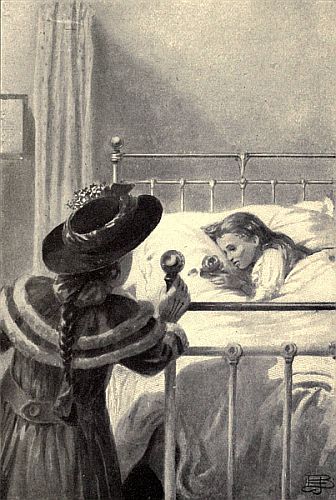
"Hold still! Do now!" they heard Milly say,
impatiently. "I'll never get the tangles brushed out
of your curls, and the others will go off and leave
you, and you'll have to miss the party."
Presently there was a long protesting wail from
Elise. "Oh, Milly, what did you put that ribbon on
my hair for? It isn't pink enough to match my
stockings."
"There's scarcely any difference at all in the
shades," answered Milly. "Sure it would take a
microscope to tell, even if they were side by side,
and your head is too far away from your heels for
anybody to notice."
"Oh, but it won't do at all!" cried Elise, breaking
away from her to run into the next room. "See,
mamma, they don't match." In her eagerness Elise
leaned over, bending herself like a little acrobat, till
the pink bow on her hair was on a level with the
pink silk stockings.
"There's barely a shade difference," laughed Mrs.
Walton. "The difference is so slight that nobody
will notice it unless you expect to double up occasionally
like a jack-knife and call attention to it."
"Of course I don't expect to do that," said Elise,
with such a funny little air of injured dignity that
her mother caught her up with a hasty kiss. "You're
a dear little peacock, even if you do think too much
of your fine feathers. But you can't stop to make a
fuss about your ribbons now. It would be making
a mountain out of a mole-hill. Run back to Milly
for your hat. I hear the carriage stopping out
in front."
"What a lot of things I'll have to write about
in my next letter to the girls," thought Lloyd,
as they rolled along in the carriage a few minutes
later. "Joyce and Betty will like to hear about
the general's home and all the interesting things
in it, and Eugenia will enjoy this part of my visit
most."
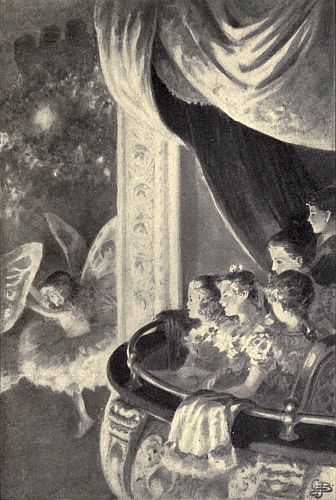 THE BUTTERFLY CARNIVAL.
It was with a view to impressing Eugenia with the
elegance of her friends, that Lloyd noticed every
detail of the beautiful luncheon. She intended that
Eugenia should hear about it all. Gay butterflies, so
lifelike that one could not believe that human hands
had made them, were poised everywhere, on the
flowers, the candle-shades, the curtains. The menu
cards were decorated with them, the fine hand-painted
china bore swarms of them around their dainty rims,
and even the ices were moulded to represent them.
The little hostess herself, fluttering around among
her guests as gracefully as if she too were a
winged creature, wore a gauzy dress of palest blue,
embroidered in butterflies, and there were butterflies
caught here and there in her golden curls.
The Little Colonel could scarcely eat for admiring
her. She felt very elegant and grown up to be
the guest at such an entertainment, and as she took
her place at the table between Malcolm and Rob, she
wished with all her heart that Eugenia could peep in
and see her.
It was time to start to the Butterfly Carnival
almost immediately when luncheon was over, and
again Lloyd felt very elegant and grown up rolling
along in the carriage to the matinee. Mrs. Moore
ushered the party into the box she had taken for
Anna and her little friends, and more than one person
in the audience turned to ask his neighbour,
"Who are those lovely children? Did you ever see
such handsome boys? They have such charming
manners. It is like a scene from some old court-play."
The Little Colonel, sitting beside Anna, with
the two little knights leaning forward to talk to her,
to pick up her fan, or adjust her lorgnette, was all
unconscious that any one in the audience was watching
her admiringly, but she wished again that Eugenia
could see her.
When the curtain went up the scene on the stage
was so absorbing that she forgot Eugenia. She forgot
where she was, for the play carried her bodily
into fairy-land. The queen of the fairies was there
with her star-tipped wand and all her spangled court,
and Lloyd looked and listened with breathless attention,
while the naughty Puck played pranks on all
the butterflies, and, finally catching them at play in
a moonlighted forest, took all the gauzy-winged creatures
captive. It was as entrancing as looking into a
living fairy tale, and when at last the queen released
the prisoners with a wave of her star-tipped wand, and
to the soft notes of the violins, the butterflies danced
off the stage, Lloyd drew a long breath and came
down to earth with a sigh. She could have listened
gladly for hours more.
But the curtain was down, the people were rising
all over the house, and Keith was holding her party
cloak for her to slip into. Mrs. Moore turned to
Allison.
"Elise is wild to see behind the scenes," she said.
"I am going to keep her with me a little while.
Your cousin Malcolm says that he and Keith can
take you home in their carriage with Lloyd and
Kitty. So I'll send Anna and Rob home in mine
and wait here until it comes back. Tell your mother
I'll take good care of Elise and bring her home as
soon as I attend to my little protegés behind the
scene."
Many of the children who had taken part in the
performance were from the free kindergarten, and
Elise, holding fast to Mrs. Moore's hand, watched the
transformation behind the scenes, from gauzy wings
to gingham gowns, with wondering eyes.
"It is like when Cinderella lost her glass slipper,"
she said. "The clock struck twelve, and her silks
turned to rags."
All the glitter and glory of fairy-land had disappeared
with the footlights. In the wintry light of
the late afternoon, some of the faces were pitifully
thin and wan.
"Here are three little butterflies that must go
back home and be grubs again," said Mrs. Moore, as
she beckoned to the children whom she had promised
to take home in her carriage. Elise looked at them,
wondering if it could be possible that they were the
same children, who, fifteen minutes before, had looked
so radiantly beautiful in their spangled costumes on
the stage. They were shy little things who could
scarcely find words to answer Mrs. Moore's questions,
but they seemed to enjoy the drive in the warm
closed carriage, behind the team of prancing bays.
Elise chatted on gaily, telling Mrs. Moore how
much she had enjoyed the carnival, how she had
admired the fairy queen, and how she longed for a
real live fairy. She had looked for them often in
the morning-glories and the lily-bells. If she could
find one maybe it would tell her where to look for
Dot.
Presently they turned into a side street among
unfamiliar tenement-houses, and paused at an alley
entrance.
"I am going to the top of the stairs with the children,"
said Mrs. Moore, preparing to step out of the
carriage. "I want to inquire about the baby, who is
sick. I'll be back in a moment, Elise."
As the carriage door closed behind her she spoke
to the coachman. "Wait here a moment, Dickson."
The man on the box touched his hat and then turned
his fur collar higher around his ears. There was a
cold wind whistling through the alley. Elise pressed
her face against the glass and looked out into the
wintry street. Mrs. Moore's moment stretched out
into five. The baby up-stairs was worse, and she was
making a list of the many things it needed for its
comfort.
There was little of interest to watch from the carriage
window. Few people were passing along the
narrow pavement, and Elise wondered impatiently
why Mrs. Moore did not come. Presently, down the
street came a ragged child with its arm held up over
its eyes, sobbing and sniffling as it shuffled along in
a pair of wornout shoes many sizes too large for its
little feet.
Elise's heart gave a great thump, and she started
forward eagerly.
"Molly's little lost sister!" she exclaimed aloud.
"It must be, for she looks just like the girl in the
picture. Oh, I must call her!"
She was fumbling at the knob of the carriage door,
but before she could get it open, the child turned and
started up the dirty alley, still sobbing aloud, with her
arm over her face.
"Oh, I must call her back," thought Elise.
"Everybody will be so glad if she is found. I
mustn't let her get away."
It took all her strength to turn the knob, but with
another desperate wrench she got the door open, and
climbed out to the pavement. The coachman, half
asleep in his great fur collar and heavy lap-robes, did
not hear the tap of the little pink boots, as she ran
up the dark alley between the high, rickety buildings,
with their bad smells and dirty sewers.
"Oh, she is going so fast!" panted Elise. "I'll
never catch up with her!" The pretty pink boots
were wet and snowy now, the silk stockings splashed
with muddy water. Her big velvet hat was tipped
over one eye and her curls were blowing in tangles
over the wide collar of her fur-trimmed cloak. But
forgetting all about her fine feathers, she ran on,
around corners, into strange passages, across unfamiliar
streets, following the flutter of a tattered
gown. All of a sudden she paused, looking around
in bewilderment. The child she was following had
disappeared.
With a bitter sense of disappointment swelling in
her little heart, she turned to go back to the carriage,
and then stood still in bewilderment. She could not
tell which way she had come. She was lost herself!
For a few minutes the little pink boots trudged
bravely on, then the tears began to gather in her big
black eyes.
"They'll feel so bad at home," she thought,
"when they hunt and hunt and can't find me anywhere.
Oh, what if I'd stay lost, and get to look
all ragged and dirty like Dot, and just have to stand
in a corner and cry. If there was any nice stores
along here, I'd go in and ask the man to send me
home, but these places look so dreadful I'm afraid."
She was in a disreputable part of the town, where
second-hand clothing stores and pawn-shops were
crowded in between saloons and cheap restaurants,
and she dared not venture into any of them to ask
for help. Little as she was, she felt that she was
safer on the streets than inside those crowded, dirty
quarters, where half-drunken negroes and coarse,
brawling white men quarrelled and swore in loud
tones.
"It's the saloons that brought all the trouble to
Molly and Dot," thought Elise, shrinking away from
a group of noisy loafers, as they straggled out of one.
"They made their father mean and their mother die
and their grandmother go crazy and them lose each
other. They're worse than wild beasts, and I'm afraid
of 'em. Maybe if I walk far enough I'll come to a nice
policeman, but I'm so tired now." Her lip quivered
as she whispered the words. "Oh, it seems as if
I'd drop! And I'm so cold I am nearly frozen."
As she walked on, across her way an electric arch
suddenly shot its cold white light into the street.
Then another and another appeared, and as far as
she could see in any direction the streets were brilliantly
illuminated.
"Oh, it's night!" she sobbed. "I'll freeze to
death before morning if somebody doesn't come and
find me."
Still she dragged on, growing more tired and
frightened at every step, until she could walk no
longer. At the end of a long block she sat down on
a doorstep, and huddled up in one corner out of the
wind. A dismal picture came to her mind of the little
match-seller in Hans Andersen's fairy tales. The
little match-seller who had frozen to death on Christmas
eve, on the threshold of somebody's happy home.
"She had a box of matches to warm herself with,"
sobbed Elise. "I haven't even that. Oh, it's awful
to be lost!"
With the tears trickling down her face she pictured
to herself the grief of the family in case they should
never find her.
"Mamma will stand in the door and look out into
the dark and call and call, but her little Elise will
never answer. And Allison and Kitty will feel so
bad that they won't want to play. They'll divide my
things between them to remember me by, and for a
long time it'll make them cry whenever they see my
dolls and books, or my place at the table, or my little
wicker chair in the library, that I'll never sit in any
more. Ranald won't cry, 'cause he's a captain and
he's brave. But he'll be just as sorry. Oh, I wish
Ranald wasn't out in the country! He could find
me if he was at home."
It was growing colder and colder on the doorstep.
The child's teeth chattered and her lips were blue.
Still she sat there, until an evil-looking man in the
next house slouched out on to the street with a lean
spotted dog at his heels. Suddenly, for no reason
that Elise could discover, for she did not know that
he was half drunk, he turned and kicked the poor
beast, cursing it violently. It shrank away, yelping
with pain. Seeing that the man was coming toward
her, Elise sprang up in terror, and with one frightened
glance over her shoulder, darted around the corner.
Once out of his sight, she stopped running, but
fear kept her moving, and she walked wearily on
and on. Every step carried her farther away from
home.
Through unwashed windows she could see the
yellow lamplight streaming over dingy rooms. Most
of the sights were unattractive, but in one house,
cleaner than the rest, she saw a crowd of clamouring
children seated around a supper-table, all reaching
their spoons and plates toward a big steaming platter
in the middle. It reminded her that she was hungry
herself, and she lingered a moment, looking wistfully
in at the cheerful scene. Then on she started
again. Once she stumbled and fell in the slush of a
snowy crossing, but scrambled bravely up again,
walking on and on.
Meanwhile Allison, Kitty, and the Little Colonel,
who had gone ahead in the carriage with the boys,
had stopped at Klein's for a box of candy, and at a
book store for a dissected game they had been discussing
at the luncheon. When they reached Mrs.
Walton's, Malcolm sent the carriage home, and both
the boys went into the house with the girls.
"Tell mamma we'll come up-stairs in a few minutes
and tell her all about the carnival," said Allison to
the maid who opened the door.
The five children went into the library with their
candy and game, and Mrs. Walton, busy with many
letters, did not notice how Allison's few minutes
lengthened out, until it grew so dark that she had to
lay down her pen. As she did so, a carriage drove
rapidly up to the house, Mrs. Moore hurried up the
steps, and there was a hasty dialogue at the door
between her and Allison.
Mrs. Walton did not hear the frightened cry,
"Oh, mamma! Elise is lost!" that went up from
Allison. And impetuous Kitty, hearing no answer,
and feeling that she must summon help in some
way, began beating madly on the bells of Luzon,
as if she were trying to call out the whole fire
department.
As the clangour startled her, Mrs. Walton's first
thought was that the house must be on fire, and she
hurried out to the head of the stairs and looked over
the bannister. Kitty was still beating on the bells
with an umbrella that she had snatched from the
rack.
"Stop, Kitty!" she called. "Tell me what is
the matter?"
"Elise is lost!" repeated Allison, and Mrs. Walton,
with a white face, hurried down to hear Mrs.
Moore's explanation.
She had been detained some time in the tenement-house,
listening to the tale of woe that the sick
baby's mother poured out to her; but she had felt
no uneasiness about Elise, knowing that the foot-stove
in the carriage would keep her warm and
comfortable. When she came down, to her utter
amazement the carriage door stood open, and the
child was gone.
The sleepy coachman, who roused himself from
his cold doze when he heard her coming, was as surprised
as she, and declared he had not heard the
carriage door open or the child slip out. He had no
idea what could have become of her. They made
inquiries of people all along the block, but nobody
had seen a child answering to the description of Elise.
Then Mrs. Moore thought that the child must have
grown tired of waiting, and for some reason had
started to walk home. She had driven out to the
house with the hope that she might find her there,
or might overtake her on the way.
Mrs. Walton acted quickly. "Telephone to your
father, Malcolm," she cried, "and to the police station.
Oh, my poor baby, out in the cold streets with
night coming on. I must look for her without losing
a minute."
She started up the stairs to call Milly to help her
dress for the search. "Get my furs," she called,
"and my heaviest coat. It will be a cold night."
But Malcolm stopped her.
"Don't go, Aunt Mary," he cried. "Papa is on
his way here now, and we boys will go in your place.
The policemen are being notified all over the city,
and it will do more good for you to stay here ready
to answer any questions that may come."
"I'll wait until Mr. MacIntyre comes," said Mrs.
Moore, "so that I can take him straight back to that
tenement district if he thinks best to go."
While they were still standing, an anxious little
group in the hall, Mr. MacIntyre came in, and after
a hurried consultation he and Mrs. Moore drove in
one direction, and the boys started in another.
None of them like to remember the three hours
that followed. The news spread like wild-fire, and
the telephone bell rang constantly with friendly messages.
Each time they hoped that some one of the
searching party was calling them up, but each time
they were disappointed. At intervals one of the
girls stole to the front door to look out into the night
and listen. Every voice made them start, every
footstep. Every roll of carriage wheels along the
avenue made them hold their breath in suspense
until it had passed.
Presently, Kitty, leaving her mother at the telephone,
and Allison and Lloyd on the stairs, strolled
down to the kitchen, where Milly and the cook were
talking about Charlie Ross and all the children they
had ever heard of who had mysteriously disappeared
from home.
"An' it's just the loikes av her they'd be afther
taking," said the cook, wiping her eyes. "She was
that pretty wid her long currls, an' eyes shparklin'
loike black dimonts, an' her swate little mouth wid
its smile fit for a cherub. I moind the very last
toime I saw her. Only this afthernoon she coom
down here to show me her foine clothes she was
wearin' to the parrty. There's no doubt in me
moind but that somebody's stolen her on account
av them same illigent clothes. Mebbe they think
there'll be a big reward offered. Bless the two little
pink shoes av her! It'll be a sorry day for this
house if they niver coom walking into it again."
Kitty stole out of the kitchen cold with this new
horror, and went back to whisper it to Allison and
Lloyd, as they sat on the stairs ready to spring forward
at the first sound of coming footsteps.
"Now if it had been Allison who was lost," thought
Mrs. Walton, "she could have found her way home
without any difficulty. She is such a sensible,
womanly child, always to be trusted for doing the
right thing in the right place. Kitty might not act so
wisely, but she would bang ahead and come out all
right in the end. She is the kind one might expect
to see come home in almost any style, from a coal
cart to a triumphal car. But my baby Elise is so
little and so timid, my heart aches for her. She will
be so sorely frightened."
Dinner was put on the table and carried out again.
Nobody could eat, and as the moments dragged by
the girls still sat on the stairs, and the anxious mother
sprang to the telephone at every tinkle of the bell,
praying for a hopeful message from the police-station.
Elise, stumbling on down strange streets, exhausted,
hungry, and cold, stopped on a street corner and
looked around her. She had strayed down among
the warehouses now, and the little feet, numb with
cold, were too tired to go much farther. Down here
few people were passing. A big tobacco warehouse,
looming up tall and dark above her, made her feel so
tiny and lost, that the last bit of her courage ebbed
away, and she began to sob aloud.
Out of the shadow just ahead a man was coming
toward her. So tall and broad-shouldered he looked,
that he seemed a giant to her terrified eyes. She
put her little gloved hands over her eyes to shut out
the sight, and crouched close against the wall, her
baby heart fluttering like a frightened bird's.
On he came, with slow, heavy tread, his footsteps
ringing through the silent street with a strange
metallic echo. As he passed out from the black
shadow of the warehouse, into the light of the street-crossing,
Elise peeped between her fingers again, and
then smiled through her tears. It was a big, burly
policeman.
The next instant she was running toward him,
calling, "Oh, Mister Policeman, I'm lost! Please
take me home!"
It was a safe haven she had run into. The policeman
had just come from home to go on his beat, and
in a little cottage not many blocks away were three
children who were still in his thoughts. They had
followed him to the door to swarm over him and kiss
him, and had called after him down the snowy street,
"Good night, daddy!" The childish voices were still
ringing in his ears.
As tenderly as if she had been one of his own, he
lifted Elise in his strong, fatherly arms, wiped her
tear-stained face, and began to question her. She
told him her name, but in her confusion could not
remember the name of the street where she lived.
It was the work of only a moment to carry her into
a drug-store around the corner, ring up headquarters,
and report his discovery, and it was only a few
moments after that until they were on an electric
car, homeward bound.
Elise was not the first lost child the big, tender-hearted
policeman had taken home, but he had never
had such a royal welcome as the one that awaited
him in the hall when the joyful family met him.
He glanced around him curiously, seeing on every
side the relics of victorious battle-fields, the grim
weapons of warfare that stood as mute witnesses of a
brave soldier's life. Beyond in the library he caught
a glimpse of the portrait, the flag, and the sword, and
then suddenly realised in whose presence he stood.
"Don't mention it, madam," he said, awkwardly, as
the grateful mother tried to express her thanks.
"Don't you know that this is about the proudest
moment of my life? To know that it was his little
one I found, and brought back with her arms around
my neck! I read everything there was about him in
the papers (he nodded toward the portrait), and I
always did say he was exactly my idea of a hero.
But I never thought the day would come when I'd
stand in his house and see all the things he touched
and looked at."
"That's the way everybody seems to feel about
the general," thought the Little Colonel, glancing
from the blue-coated policeman to the portrait. "It's
grand to be a hero."
Elise was too tired and sleepy to talk about her
adventures that night, and asked to be put to bed as
soon as she had had the bowl of oyster soup that was
being kept hot for her. When the cook brought it
in, loudly blessing all the saints in the calendar that
the child had been found, all the family remembered
that they were hungry and the long delayed dinner
was brought on again.
Elise fell asleep at the table before she finished
the soup, but she opened her drowsy eyes as they
were carrying her away to bed to say, "You all won't
feel very bad, will you, if I give you just a teenty
weenty Christmas present this year? 'Cause I want
to save most of my money to buy something nice for
that big policeman that brought me home. Being
found is the very best thing in all the world, and I
would have been lost yet, if it hadn't been for him."