CHRISTMAS GREENS AND WATCH-NIGHT EMBERS
There is a chapter in Betty's Good Times book
which tells all about that last day at the seminary,
before the Christmas vacation; of the hurried packing
and leave-taking; of her trip to town with Lloyd
to meet Papa Jack and come out home with him on
the five o'clock train, laden with Christmas packages
like all the other suburban passengers; of the carriage
waiting for them at the depot, just as if they
had been away at some school a long distance from
the Valley, and then the crowning joy of seeing
her godmother on the platform, waving her handkerchief
as the train stopped in front of the depot.
They had not expected her back from Hot Springs
until the next day, and all the way out on the train
had been discussing the reception they intended to
give her. There had been a twinkle in Mr. Sherman's
eyes as he listened, for he knew of this surprise
in store for them, and had had a hand in
planning it.
It is all in Betty's Good Times book, even to the
way they rolled down the steps and fell over each
other in their haste to reach her, and the welcome
that made it seem more than ever as if they were
coming home from a long journey to spend their
Christmas vacation, just as thousands of other
schoolgirls were doing all over the country. Then the
drive homeward in the frosty, starlit dusk to find
Locust all a-twinkle, a light in every window and a
fire on every hearth; the great front door swinging
wide on its hospitable hinges to send a stream of
light down the avenue to meet them, and the spirit
of Christmas cheer and expectancy falling warm
upon them as they crossed the threshold.
The memory of it would be something to be glad
for always, Betty thought, as she danced into the
long drawing-room after Lloyd, and saw the old
Colonel start up from his chair before the fire and
come forward to meet them, the candle-light falling
softly on his silver hair and smiling face.
Although Betty had laid aside her unfinished
romance of Gladys and Eugene, she could no more
help writing than a fish can keep from swimming,
and that is why her Good Times book held so many
interesting pages. All the energy and time that
would have been put into the silly little novel went
instead to the description of real scenes and real
people, which in after years made the little white
books the most precious volumes in all her library.
As fast as one was filled she began another. The
one now on her desk had the number IV. stamped
in gold on the white kid cover, under her initials.
There were few pages in this fourth volume more
interesting than the ones she found time to write
on Christmas Eve. She had gone with Lloyd and
Allison and Kitty that afternoon in search for Christmas
greens with which to decorate the house.
Malcolm and Keith Maclntyre, Rob Moore, and
Ranald Walton had met them in Tanglewood, their
guns over their shoulders, and had joined them in
their quest. The mistletoe they wanted grew too
high to be climbed for or to be dislodged by throwing
at, but Ranald, an expert marksman, volunteered
to shoot down all they could carry. He was just
home from military school on his vacation, and Rob
Moore had been out for two days hunting with
him. Malcolm and Keith had been at their grandmother's
several days, tramping long distances over
the frosty fields, and coming in well satisfied each
evening with the contents of their game-bags.
Malcolm and Rob were to leave for the same college-preparatory
school after the holidays, and as
they were going back to town on the five o'clock
train they had but a short time left to spend in the
Valley. So the party, after some discussion, divided
into three groups, agreeing to meet at the depot.
Ranald strode away across the woods as fast as
his long legs would carry him to the trees where
the mistletoe hung. Kitty and Katie kept close in
his wake, swinging the baskets between them that
he was to fill. Keith and Betty hurried on to the
place where the bittersweet grew thickest, while
Rob and Allison, Malcolm and Lloyd strolled along,
filling their baskets from the occasional trees of
hemlock, spruce, and cedar they found on their
way among the bare oaks and beeches. Now and
then they found a pine with the brown cones clinging
to the spicy boughs.
Only Betty's part of that quest is in the little
white record; how they ran along through Tanglewood
that afternoon, she and Keith, in the late
December sunshine, breathing in the woodsy odour
of the fallen leaves and the crisp frostiness of the
air, until the blood tingled in their finger-tips and
their cheeks grew red as rosy apples.
It was a pretty picture she left on the page, of
the winter woods, of the old stile leading into the
adjoining churchyard, where in almost a thicket
of bare dogwood-trees and lilac-bushes stood the
little Episcopal church, built like the one next the
manse, of picturesque gray stone. The walls were
aglow with the brilliant red and orange berries
of the bittersweet, which hung even from the eaves
and cornices, and from every place where the graceful
vines could trail and twist and clamber.
Lloyd kept no record of that afternoon, but she
never forgot it. She walked along, her eyes shining
like stars, her cheeks glowing. Her dark blue cap
and jacket made her hair seem all the fairer by
contrast, and there was a glint of gold in it, wherever
the sun touched it through the trees.
Rob and Malcolm were full of their plans for
the coming term, and talked of little else all the
way through the woods, but as they reached the
stile, over which Keith and Betty had passed some
time before, Rob exclaimed:
"I forgot to tell you, Lloyd! When we were out
hunting yesterday we stopped at a cabin ever so far
from here, to rest and warm. And what do you
suppose we saw on the pendulum of an old clock,
swinging away on the mantel as big as life? Your
picture! The one of the Princess, you know, with
the dove. I couldn't believe my eyes at first. The
old man told us it had been given to his daughter,
and when he found out who Ranald was he sent
a message to Mrs. Walton about her. She's in
a hospital and will soon be well enough to come
home. Mrs. Walton told us all about it last night,
how the girl imagined every time the clock ticked
that you were saying, 'For love will find the way.'
It made quite a pretty story, but you can't imagine
how queer it was to stumble across your picture in
such an out-of-the-way place, and fixed up in such
odd shape, on a pendulum, of all things!"
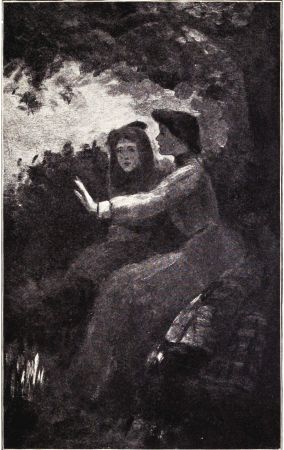
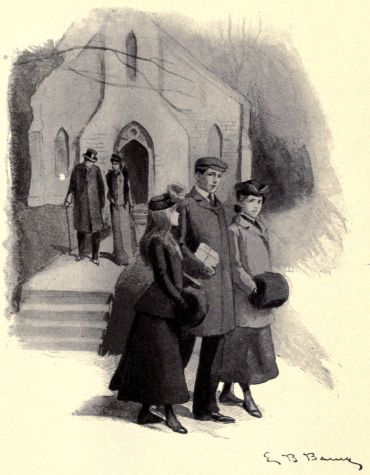
 "MALCOLM, LEANING ON HIS GUN, STOOD WATCHING HER."
"It helped Corono ever so much, mother said,"
remarked Allison. "That's one good thing our
Shadow Club led to, if nothing else." She climbed
up on the stile and stood looking over, exclaiming at
the beauty of the old gray walls, draped in the
masses of brilliant bittersweet; then, springing
down, ran across the churchyard to join Betty and
Keith on the other side and make her own selection
of vines.
Rob leaned his gun against the fence and took
out his watch. "Only half an hour longer," he
announced. Then, opening the back of his watch-case,
he held it out toward Lloyd.
"Do you remember that?" he asked, nodding
toward a little four-leaf clover which lay flat and
green inside. "Your good-luck charm worked
wonders, Lloyd. It helped me through my Latin in
such fine shape that I intend to carry it through
college with me all the way. It's like the picture
on the pendulum, isn't it? only this says, 'For luck
will find the way.'"
As Lloyd began some laughing reply about his
being superstitious, Betty's voice called from the
vestry door, "Oh, Rob! Come around here a minute,
please! Here's the loveliest bunch of berries
you ever saw, and it's too high for any one but
you to reach!"
With one leap Rob was over the stile hurrying
to Betty's assistance. Lloyd had filled both pockets
of her jacket with hickory-nuts on her way through
Tanglewood, and, seating herself on the top step
of the stile, she began cracking them with a round
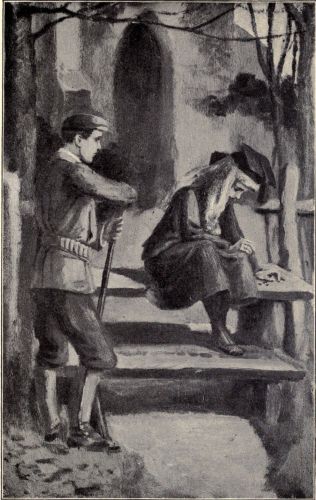
stone which she had picked up near the fence. Malcolm,
leaning on his gun, stood watching her.
"You never gave me any four-leaf clover, Lloyd,"
he said, in a low tone, as Rob strode away.
"You nevah happened to be around when I found
any," answered Lloyd, carelessly. "Have a nut
instead." She nodded toward the pile on the step
beside her.
Malcolm flushed a trifle. He was nearly sixteen,
tall and broad-shouldered, but the colour came as
easily to his handsome face now as when a little
fellow of ten he had begged her to keep his silver
arrow "to remember him by."
"No, thanks," he answered, stiffly. There was a
jealous note in his voice as he added, "And you
wouldn't let me keep the little heart of gold that
night after the play."
"Of co'se not! Papa Jack gave me that. I think
everything of it."
"You wouldn't even lend it to me," he continued.
"Because we'd come to the end of the play. You
were not Sir Feal any longah, and you didn't have
any shield to bind it on, so what good would it
have done?"
"But we haven't come to the end of the play,"
he insisted. "I've thought of you ever since as
my Princess Winsome, and it has been more than
a year since that night. Yesterday, when I saw your
picture on the pendulum, and heard how it had influenced
that girl in the cabin, I wished that I could
make you understand how much more your influence
means to me; and I made up my mind to ask you
for something. Will you give it to me, Lloyd? It's
just the tip of that little curl behind your ear. It
shines like gold, and I want to put it in the back
of my watch as a talisman, like they used to carry
in old times, you know—a token that I am your
knight, and that I may do as it says in the song,
come back to you 'on some glad morrow.' I want
to carry it with me always, as I shall always carry
your shadow-self wherever I go."
Lloyd bent her head so far over the nuts as she
chose one with great deliberation that her hair fell
across the cheek nearest him, and he could not see
how red her face grew. How handsome he was,
she thought. How deep and clear his eyes looked
as they smiled into hers. If she had never known
of Ida's mistake—if she had never heard the Hildegarde
story—there might have crept into her girlish
fancy, young though she was, the thought that this
was the love written for her in the stars. But like
a flash came the recollection of old Hildgardmar's
warning:
"And many youths will come to thee, each begging,
'Give me the royal mantle, Hildegarde. I am
the prince the stars have destined for thee!'"
And then his words of blessing:
"Because even in childhood days thou ever kept
in view the sterling yardstick as I bade thee, because
no single strand of all the golden warp that Clotho
gave thee was squandered on another, because thou
waitedst till thy woman's fingers wrought the best
that lay within thy woman's heart, all happiness shall
now be thine."
"Please, Lloyd," he asked again, in a low, earnest
tone.
"I—I can't, Malcolm," she stammered, giving
the nut she had chosen a sudden blow that completely
smashed it.
"Why not? You gave Rob the clover to carry in
his watch."
"That was different. Rob doesn't care for the
clovah on my account. He carries it for the good
luck it brings; not because I gave it to him."
"But he'll get to caring after awhile," said Malcolm,
moodily. "He couldn't help it. Nobody
could who knew you, and I don't want him to."
Then, after a long pause in which Lloyd attended
so strictly to her nut-cracking that she did not even
glance in his direction, he asked, jealously: "Would
you give him the curl if he asked for it?"
Something in his tone made Lloyd look up with a
provoking little smile. "No," she answered, "not
even the snippiest little snip of a hair, if he asked
for it the way you are doing, and wanted it to mean
what you do—that he was my—my chosen knight,
you know."
"Is there anybody you would give it to, Lloyd?"
His persistence only made her shake her head the
more obstinately. It did not take much teasing to
arouse what Mom Beck called "the Lloyd stubbo'ness."
"No! I tell you! And if you keep on talking
that way I'm going home!"
"Why won't you let me talk that way? This is
the last time I'll see you until next summer, and I'm
dreadfully in earnest, Lloyd. You don't know how
much it means to me. Don't you care for me at
all?"
A dozen things came crowding up to her lips
in answer. She wanted to tell him the story of
Hildegarde's weaving and old Hildgardmar's warning.
She wanted to say that she could not trifle
with the happiness that was written for her in the
stars by giving away even a strand of Clotho's
golden thread before she was old enough to choose
wisely the one on whom to bestow such a favour.
But she knew that he would not understand these
allusions to a story of which he had never heard.
She did not know how to put into words the vague,
undefined feeling that she had, that he must not
come to her with such speeches until he had won
his spurs and received his accolade. It was her
helplessness to answer as she wished that made her
spring up impatiently and say in her most imperious,
Little Colonel-like way, "Didn't you heah me tell
you to stop talking that way, Malcolm Maclntyre?
Of co'se I care for you. I've always liked you, and
I think you're one of the nicest boys I know, but
I won't if you keep on that way when I tell you
to stop. You might at least wait till you come back
from college and let me see what sawt of a man
you've turned out to be!"
"I'll be whatever you want me to be, Lloyd," he
began, but just then the mistletoe gatherers came
running down the path toward them, and Ranald's
whistle brought the others from the churchyard
with their bittersweet. Lloyd flung away her nut-shells,
and standing on the top of the stile brushed
her dress with her handkerchief. Malcolm, swinging
his gun to his shoulder, picked up her basket
and walked beside her in conscious silence, as the
merry party strolled on toward the depot.
Several times she glanced up shyly at him, saying
to herself again that he was certainly one of
the nicest boys she knew, the most courteous, the
most attractive, with the same beauty of face and
polish of manner that had made him such a winning
little Knight of Kentucky. But the little pin he
had worn as the badge of that knighthood, that
stood for the "wearing the white flower of a
blameless life," was no longer on the lapel of his
coat. He had laid it aside more than a year ago,
saying that he had outgrown that child's play, and
that it was impossible for a fellow of his age to
live up to it.
As Lloyd noticed its absence she was glad that
she had answered him as she did. But almost with
the same breath came the recollection that he had
said, "I'll be whatever you want me to be, Lloyd,"
and she wondered with a quicker heart-throb if it
were really so that she had power to wield such an
influence over him, and she wondered also, if she
had given him the curl as he asked, and told him
that she wanted him to wear the white flower again
and live up to its meaning, if he would have done
it for her sake.
Keith rushed on ahead to see if the man had
brought their suit-cases down to the waiting-room,
and the others crossed over to the store for some
hot pop-corn. There were several holly wreaths
hanging in the window, and although Lloyd knew
that a number of them had already been sent out
to Locust from town, she could not resist the temptation
of buying the largest one there, it was so unusually
bright and full of berries. They had barely
reached the waiting-room again when the train came
thundering along the track.
With hasty good-byes the three boys hurried up
the steps. Keith and Rob hung on to the railing
on the platform of the rear car, swinging their caps
and calling back various messages about Christmas
and next week and after the holidays, but Malcolm,
after one long look into the Little Colonel's eyes,
turned and went into the car. He wanted to carry
away with him undisturbed the picture she made as
she stood there on the platform, waving her handkerchief.
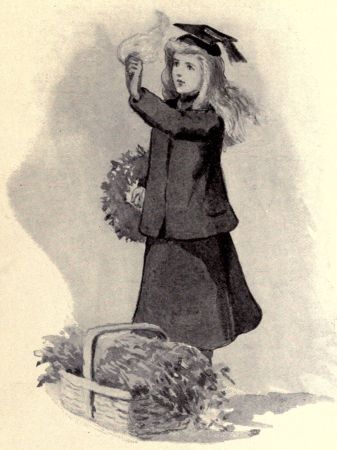
She was all in dark blue, her fair hair
blowing in the wind, her cheeks a delicate wild rose
pink. At her feet was the basket of Christmas
greens, and on her arm hung the glowing wreath
of Christmas holly.
It was the last night of the old year. Watch-night,
Mom Beck called it, and as soon as dinner was over
she and Aunt Cindy and Alec hurried away to Brier
Creek Church, where the coloured people were to
hold services till midnight, watching the old year
out and the new year in.
It had been a busy week for Lloyd and Betty.
The happiest of Christmas Days had been followed
by neighbourhood parties, entertainments, and
merrymakings of all descriptions. The old Southern
mansion rang with many gay young voices, and
overflowed with life, for there were guests within
its hospitable gates from morning until night.
But now a lull had come in the festivities. The
last guest had departed on the evening train, and
ten o'clock found the house strangely still. The
servants were all out. Betty, locked in her room,
busy with embroidery silks, was finishing a little
New Year's gift with which to surprise her godmother
on the morrow. Mrs. Sherman had gone
up-stairs to sit with the old Colonel awhile. She
had not been able to give him much of her time
since their return to Locust, and to-night, with the
waning year, he seemed to want her to himself to
talk to him of his "long, long ago," and listen to
his tales of old days which grew dearer with each
passing holiday season.
Only Lloyd and her father were left in the long
drawing-room. She had begged to be allowed to
keep Watch-night with him.
"It's only two houahs moah, mothah," she said,
beseechingly. "I'll sleep late in the mawning to
make up for it. I've scarcely seen Papa Jack since
we came home, and he's going away so soon again.
Besides, I nevah did sit up to watch a new yeah
come in."
So she had her way, and, sitting on a low stool
at his feet, with his hand softly stroking her hair,
they talked of many things.
He began in a teasing, playful way, "You haven't
told me what you learned at boarding-school, Little
Colonel. You must have absorbed a vast amount
of knowledge, when even your nights were passed
in such a learned institution."
The face she turned toward him was a very serious
one, for the time had come for confession. Yet
after all confession did not seem as hard as she
had thought it would be. The very touch of his
hand on her hair made it easier, it was so kind
and sympathetic. She had always gone to him with
all her childish troubles as freely as she had to her
mother. Presently she had poured out the whole
story, her part in the clandestine correspondence,
Edwardo's coming to Locust, her struggle in that
very room to be loyal to the family honour and her
father's trust in her.
Allison's Christmas present to her had been an
autograph copy of the story of "The Three
Weavers." It was bound in water-colour paper,
tied in the rose and gold ribbons of the Order, and
bore on the cover a design of Allison's own painting,
a filmy spider-web held by a row of golden stars.
Lloyd showed it to him as she told of the forming
of the Order of Hildegarde to take the place of the
old Shadow Club, and then, spreading the book
open across his knee, read it aloud—the little tale
which was destined to play such an important part
in her life, and which already had influenced her
far more than she was aware.
When she had finished she sat idly turning the
leaves and gazing into the fire. "You see," she
said, presently, "this is a story for fathahs and
mothahs, too, and—and—I want you to give me
my yah'dstick, Papa Jack."
As she glanced up at him with a roguish smile
dimpling her face, she was astonished to see tears
in his eyes. He had been very silent while she read
the story.
"My precious little Hildegarde!" he exclaimed,
drawing her to his knee and folding his arms around
her. She laid her head on his shoulder, and he
began: "I don't suppose you can understand how
I feel about it, Lloyd. It breaks me all up to think
that my Little Colonel is near enough grown to
come to me with such a request. If I could have
my way I would be selfish enough to want to keep
you a little girl always. I hate to think that a time
can ever come when any one may ask to take you
from me. But, Lloyd darling, it takes all the sting
out of that thought to know that you are willing
to come to me so freely with your questions—to
know that there is such perfect confidence between
us that you do not feel the embarrassment that most
girls feel in talking with their fathers on such a
subject. Let me think a moment, for I want to
answer as wisely as old Hildgardmar did, if that be
possible."
It was a long time before he spoke again. Then
he said, slowly, "There are only three notches on
the yardstick which I am going to give you, Lloyd.
The prince who comes asking for you must have,
first, a clean life. There must be no wild oats sowed
through its past for my little girl to help reap, for
no man ever gathers such a harvest alone. Next, he
must be honourable in every way which that good
old word implies. The man who is that will not
ask anything clandestine, nor will he ask to take
you from a comfortable home before he is able to
provide one for you himself. Then, if he would
measure up to the third notch, he must be strong.
Strong in character, in purpose, and endeavour.
There are many things that I might ask for my
only child, many things that I would gladly choose
for her if the choice were left to me: family, position,
wealth—but they are nothing when weighed
in the balance with the love of an honest man. If
his life be clean and honourable and strong, then
choose as you will, my blessing shall go with you!"
Instantly there flashed into Lloyd's thoughts the
recollection of a boyish figure standing beside the
old stile, and she wondered how far he would
measure up to that standard. Clean in life and habit?
He had always seemed so, but a little doubt disturbed
her as she thought of the white flower he no
longer wore, and what he had said about it. Strong
in purpose and in effort? It was too soon to tell.
He was only a boy with all his uncertain future
before him, with all the temptations of his college
days still unmet and unconquered.
As she felt her father's protecting arm around
her, she nestled closer in that safe, sure shelter,
and sat considering what he had said. Once she
glanced up at the portrait over the mantel, and met
the gaze of the beautiful eyes of the young girl
beside the harp—Amanthis, who had made no
mistake in her choosing, whose girlish romance had
bloomed as sweetly as the June roses that she wore.
Presently Lloyd's arm stole up around her father's
neck, and she softly repeated the words of Hildegarde's
promise:
"'You may trust me, fathah. I will not cut the
golden warp from out the loom until I, a woman
grown, have woven such a web as thou thyself shalt
say is worthy of a prince's wearing!'"
"Dear child," he answered, huskily, "you have
crowned not only this year for me, but all the years,
with that promise. God grant that you may find
all happiness written for you in His stars!"
The candles were burning low in their silver
sconces now. The fire on the hearth was only a
mass of glowing embers, and as the clock ticked on
toward midnight, they sat in happy silence, awaiting
the dawn of the untried new year.
THE END.
BOOKS FOR YOUNG PEOPLE
THE LITTLE COLONEL BOOKS
(Trade Mark)
By ANNIE FELLOWS JOHNSTON
Each 1 vol., large 12mo, cloth decorative, per vol. $1.50
The Little Colonel Stories.
(Trade Mark)
Illustrated.
Being three "Little Colonel" stories in the Cosy
Corner Series, "The Little Colonel," "Two Little Knights
of Kentucky," and "The Giant Scissors," put into a
single volume.
The Little Colonel's House Party.
(Trade Mark)
Illustrated by Louis Meynell.
The Little Colonel's Holidays.
(Trade Mark)
Illustrated by L. J. Bridgman.
The Little Colonel's Hero.
(Trade Mark)
Illustrated by E. B. Barry.
The Little Colonel at Boarding School.
(Trade Mark)
Illustrated by E. B. Barry.
The Little Colonel in Arizona.
(Trade Mark)
Illustrated by E. B. Barry.
The Little Colonel's Christmas Vacation.
(Trade Mark)
Illustrated by E. B. Barry.
The Little Colonel, Maid of Honour.
(Trade Mark)
Illustrated by E. B. Barry.
The Little Colonel.
(Trade Mark)
Two Little Knights of Kentucky.
The Giant Scissors.
Big Brother.
Special Holiday Editions
Each one volume, cloth decorative, small quarto, $1.25.
New plates, handsomely illustrated, with eight full-page
drawings in color.
"The books are as satisfactory to the small girls, who find
them adorable, as for the mothers and librarians, who delight
in their influence."—Christian Register.
These four volumes, boxed as a four-volume set $5.00
In the Desert of Waiting: The Legend
of Camelback Mountain.
The Three Weavers: A Fairy Tale for
Fathers and Mothers as Well as for Their
Daughters.
Keeping Tryst.
The Legend of the Bleeding Heart.
| Each one volume, tall 16mo, cloth decorative | $0.50 |
| Paper boards | .35 |
There has been a constant demand for publication
in separate form of these four stories, which were originally
included in four of the "Little Colonel" books.
Joel: A Boy of Galilee. By Annie Fellows
Johnston. Illustrated by L. J. Bridgman.
New illustrated edition, uniform with the Little Colonel Books, 1 vol., large 12mo, cloth decorative $1.50
A story of the time of Christ, which is one of the
author's best-known books.
Asa Holmes; or, At the Cross-Roads. A
sketch of Country Life and Country Humor. By
Annie Fellows Johnston. With a frontispiece by
Ernest Fosbery.
Large 16mo, cloth, gilt top $1.00
"'Asa Holmes; or, At the Cross-Roads' is the most delightful,
most sympathetic and wholesome book that has been
published in a long while."—Boston Times.
The Rival Campers; or, The Adventures
of Henry Burns. By Ruel Perley Smith.
Square 12mo, cloth decorative, illustrated $1.50
Here is a book which will grip and enthuse every boy reader.
It is the story of a party of typical American lads, courageous,
alert, and athletic, who spend a summer camping on an
island off the Maine coast.
"The best boys' book since 'Tom Sawyer.'"—San Francisco
Examiner.
The Rival Campers Afloat; or, The
Prize Yacht Viking. By Ruel Perley Smith.
Square 12mo, cloth decorative, illustrated $1.50
This book is a continuation of the adventures of "The
Rival Campers" on their prize yacht Viking. An accidental
collision results in a series of exciting adventures, culminating
in a mysterious chase, the loss of their prize yacht, and
its recapture by means of their old yacht, Surprise.
The Rival Campers Ashore. by Ruel
Perley Smith, author of "The Rival Campers,"
"The Rival Campers Afloat," etc.
Square 12mo, cloth decorative, illustrated $1.50
"The Rival Campers Ashore" deals with the adventures
of the campers and their friends in and around the town of
Benton. Mr. Smith introduces a new character,—a girl,—who
shows them the way to an old mill, around which the
mystery of the story revolves. The girl is an admirable acquisition,
proving as daring and resourceful as the campers
themselves.
The Young Section-Hand; or, The Adventures
of Allan West. By Burton E. Stevenson,
author of "The Marathon Mystery," etc.
Square 12mo, cloth decorative, illustrated by L. J. Bridgman $1.50
Mr. Stevenson's hero is a manly lad of sixteen, who is given
a chance as a section-hand on a big Western railroad, and
whose experiences are as real as they are thrilling.
The Young Train Dispatcher. By Burton
E. Stevenson, author of "The Young Section-hand,"
etc.
Square 12mo, cloth decorative, illustrated $1.50
The young hero has many chances to prove his manliness
and courage in the exciting adventures which befall him in the
discharge of his duty.
Captain Jack Lorimer. By Winn Standish.
Square 12mo, cloth decorative, illustrated by A. B. Shute $1.50
Jack is a fine example of the all-around American high-school
boy. He has the sturdy qualities boys admire, and
his fondness for clean, honest sport of all kinds will strike a
chord of sympathy among athletic youths.
Jack Lorimer's Champions; or, Sports
on Land and Lake. By Winn Standish, author of
"Captain Jack Lorimer," etc.
Square 12mo, cloth decorative, illustrated $1.50
All boys and girls who take an interest in school athletics
will wish to read of the exploits of the Millvale High School
students, under the leadership of Captain Jack Lorimer.
Captain Jack's Champions play quite as good ball as do
some of the teams on the large leagues, and they put all
opponents to good hard work in other summer sports.
Jack Lorimer and his friends stand out as the finest examples
of all-round American high school boys and girls.
Beautiful Joe's Paradise; or, The Island
of Brotherly Love. A sequel to "Beautiful Joe."
By Marshall Saunders, author of "Beautiful Joe."
One vol., library 12mo, cloth, illustrated $1.50
"This book revives the spirit of 'Beautiful Joe' capitally.
It is fairly riotous with fun, and as a whole is about as unusual
as anything in the animal book line that has seen the light. It
is a book for juveniles—old and young."—Philadelphia Item.
'Tilda Jane. By Marshall Saunders.
One vol., 12mo, fully illustrated, cloth decorative $1.50
"It is one of those exquisitely simple and truthful books
that win and charm the reader, and I did not put it down
until I had finished it—honest! And I am sure that every
one, young or old, who reads will be proud and happy to
make the acquaintance of the delicious waif.
"I cannot think of any better book for children than this.
I commend it unreservedly."—Cyrus Townsend Brady.
The Story of the Graveleys. By Marshall
Saunders, author of "Beautiful Joe's Paradise,"
"'Tilda Jane," etc.
Library 12mo, cloth decorative, illustrated by E. B. Barry $1.50
Here we have the haps and mishaps, the trials and triumphs,
of a delightful New England family, of whose devotion and
sturdiness it will do the reader good to hear.
Born to the Blue. By Florence Kimball
Russel.
12mo, cloth decorative, illustrated $1.25
The atmosphere of army life on the plains breathes on
every page of this delightful tale. The boy is the son of a
captain of U. S. cavalry stationed at a frontier post in the
days when our regulars earned the gratitude of a nation.
In West Point Gray. By Florence Kimball
Russel.
12mo, cloth decorative, illustrated $1.25
West Point forms the background for the second volume
in this series, and gives us the adventures of Jack as a cadet.
Here the training of his childhood days in the frontier army
post stands him in good stead; and he quickly becomes the
central figure of the West Point life.
The Sandman; His Farm Stories.
By William J. Hopkins. With fifty illustrations by
Ada Clendenin Williamson.
Large 12mo, decorative cover $1.50
"An amusing, original book, written for the benefit of very
small children. It should be one of the most popular of the
year's books for reading to small children."—Buffalo Express.
The Sandman: More Farm Stories.
By William J. Hopkins.
Large 12mo, decorative cover, fully illustrated $1.50
Mr. Hopkins's first essay at bedtime stories met with such
approval that this second book of "Sandman" tales was
issued for scores of eager children. Life on the farm, and
out-of-doors, is portrayed in his inimitable manner.
The Sandman: His Ship Stories.
By William J. Hopkins, author of "The Sandman:
His Farm Stories," etc.
Large 12mo, decorative cover, fully illustrated $1.50
"Mothers and fathers and kind elder sisters who put the
little ones to bed, and rack their brains for stories, will find
this book a treasure."—Cleveland Leader.
"Children call for these stories over and over again."—Chicago
Evening Post.
Pussy-Cat Town. By Marion Ames Taggart.
Small quarto, cloth decorative, illustrated and decorated in colors $1.00
"Pussy-Cat Town" is a most unusual delightful cat story.
Ban-Ban, a pure Maltese who belonged to Rob, Kiku-san,
Lois's beautiful snow-white pet, and their neighbors Bedelia
the tortoise-shell, Madame Laura the widow, Wutz Butz the
warrior, and wise old Tommy Traddles, were really and truly
cats.
The Roses of Saint Elizabeth. By Jane
Scott Woodruff, author of "The Little Christmas
Shoe."
Small quarto, cloth decorative, illustrated and decorated in colors by Adelaide Everhart $1.00
This is a charming little story of a child whose father was
caretaker of the great castle of the Wartburg, where Saint
Elizabeth once had her home.
Gabriel and the Hour Book. By Evaleen
Stein.
Small quarto, cloth decorative, illustrated and decorated in colors by Adelaide Everhart $1.00
Gabriel was a loving, patient, little French lad, who assisted
the monks in the long ago days, when all the books were
written and illuminated by hand, in the monasteries.
The Enchanted Automobile. Translated
from the French by Mary J. Safford.
Small quarto, cloth decorative, illustrated and decorated in colors by Edna M. Sawyer $1.00
The enchanted automobile was sent by the fairy godmother
of a lazy, discontented little prince and princess to
take them to fairyland, where they might visit their story-book
favorites.
The Red Feathers. By Theodore Roberts,
author of "Brothers of Peril," etc.
Cloth decorative, illustrated $1.50
"The Red Feathers" tells of the remarkable adventures of
an Indian boy who lived in the Stone Age, many years ago,
when the world was young, and when fairies and magicians
did wonderful things for their friends and enemies.
The Wreck of the Ocean Queen. By
James Otis, author of "Larry Hudson's Ambition,"
etc.
Cloth decorative, illustrated $1.50
This story takes its readers on a sea voyage around the
world; gives them a trip on a treasure ship; an exciting experience
in a terrific gale; and finally a shipwreck, with a
mutineering crew determined to take the treasure to complicate
matters.
But only the mutineers will come to serious harm, and
after the reader has known the thrilling excitement of lack of
food and water, of attacks by night and day, and of a hand-to-hand
fight, he is rescued and brought safely home again,—to
realize that it's only a story, but a stirring and realistic
one.
Little White Indians. By Fannie E.
Ostrander.
Cloth decorative, illustrated $1.25
The "Little White Indians" were two families of children
who "played Indian" all one long summer vacation. They
built wigwams and made camps; they went hunting and
fought fierce battles on the war-trail.
A bright, interesting story which will appeal strongly to
the "make-believe" instinct in children, and will give them a
healthy, active interest in "the simple life."