New original cover art included with this eBook is granted to the public domain.
BY
MAGNUS MACLEAN
M.A., D.Sc., LL.D.
NEW EDITION
BLACKIE AND SON LIMITED
50 OLD BAILEY, LONDON; GLASGOW, BOMBAY
1926
PREFACE
v
Celtic studies have grown apace within recent years. The
old scorn, the old apathy and neglect are visibly giving way
to a lively wonder and interest as the public gradually realise
that scholars have lighted upon a literary treasure hid for
ages. This new enthusiasm, generated in great part on the
Continent—in Germany, France, and Italy, as well as in
Britain and Ireland, has already spread to the northern
nations—to Denmark, Sweden, and Norway, and is now
beginning to take root in America.
A remarkable change it certainly presents from the days
when Dr. Johnson affirmed that there was not in all the
world a Gaelic MS. one hundred years old; and the
documents were so derelict and forgotten, so little known
and studied, that though this prince of letters travelled in
the Highlands expressly to satisfy himself, Celtic knowledge
of the existing materials and Celtic studies were so deficient
that they proved wholly inadequate to the task of disproving
his bold statement.
It was left to the scholarship of the nineteenth century
to unearth the ancient treasures and to show that Gaelic
was a literary language long before English literature came
into existence, and that there are still extant Celtic-Latin
MSS. almost as old as the very oldest codexes of the
Bible.
There is undoubtedly a charm in the thought that all
over the Continent of Europe, in the libraries of many of its
romantic cities and towns, there are scores of MSS., some
of them upwards of a thousand years old, fugitives in the
viearly times from these much harassed islands; and that
European scholars of the highest erudition, such as Zeuss,
Ebel, Nigra, Ascoli, Windisch, Zimmer, and Whitley Stokes,
have been profoundly interested in these literary relics, and
have devoted much of their time to the work of studying,
translating, elucidating, and editing the Gaelic texts or
glosses found in them.
To-day the number of those engaged in similar research
at home and abroad is vastly on the increase, and augurs
well for the future of this department of knowledge.
Professor Kuno Meyer, Ph.D., himself a distinguished
German Celticist, in reviewing the present state of Celtic
studies last year at Dublin, made the following significant
statement:—
“I cannot conclude without casting a glance into the
future. I am convinced that the present is but the beginning
of an era of still greater activity in all departments of
Celtic studies. Everything points to that.
“The more reliable text-books and hand-books will be
published, the greater will be the numbers of those taking
up Celtic studies. As the fields of other more ancient and
more recognised studies become exhausted, there will come
a rush of students on to the fresh, and often, almost virgin
soil of Celtic research, to study the great Celtic civilisation
at its source, to collect the last lingering remnants of a
mighty tradition.
“Again and again it has happened during recent years
that workers in other subjects have in their researches finally
been led on to the Celtic soil, where lie the roots of much
medieval lore, of many institutions, of important phases of
thought.
“And another thing, too, I will foretell. The re-discovery,
as it were, of ancient Celtic literature will not only arouse
abroad a greater interest in the Celtic nations, but it will
lead to beneficial results among those nations themselves.”
Mr. W. B. Yeats, in the Treasury of Irish Poetry, 1900,
gives pen to similar reflections and anticipations:—
vii“Modern poetry,” he writes, “grows weary of using
over and over again the personages and stories and metaphors
that have come to us through Greece and Rome, or from
Wales and Brittany through the Middle Ages, and has found
new life in the Norse and German legends. The Irish
legends in popular tradition and in old Gaelic literature are
more numerous and as beautiful, and alone among great
European legends have the beauty and wonder of altogether
new things. May one not say then, without saying anything
improbable, that they will have a predominant influence in
the coming century, and that their influence will pass through
many countries.”
The interest thus lately evolved in the literature of the
Celts, who were among the earliest inhabitants of the country,
and whose blood still courses in our British veins, has
naturally awakened a desire in many minds to know the
nature and extent of the literary legacy they have bequeathed—its
substance and quality, and also to gain some
acquaintance with the opinions and results of recent scholarship
on the subject.
But, strange to say, notwithstanding the activity of
Celticists, no book has yet appeared which professes to give
in short compass a general survey of the whole field. There
is thus, I venture to think, room for such a volume as the
present, which is intended to serve as a popular introduction
to the study of the literature. Containing, as it does,
the gist of two series of lectures which I delivered under
the Maccallum Bequest in the University of Glasgow during
the sessions 1900–1 and 1901–2, it is now prepared and
issued with a view to meeting the demands not only of
the general reader, but also of the private student in quest
of a guide to the original sources, the authorities, and books
on the subject.
In its preparation, in addition to the numerous published
works mentioned in the text, I have received valuable help
from Professor Mackinnon, Edinburgh University, and Dr.
Alexander Macbain, Inverness, both of whom supplied me
viiinot only with many of their printed papers embodying the
fruits of their own personal research, but also with other
useful information. To the former I am still further indebted
for interesting details regarding the life and work
of several of the scholars, and to Professor Rhys of Jesus
College, Oxford, for kindly reviewing in MS. form the chapter
on Welsh Literature.
And, finally, I have to record my special indebtedness
to the kind assistance of my friend, Mr. David Mackeggie,
M.A., whose knowledge of Celtic history and literature is
both extensive and accurate, and who, besides giving me
much suggestive aid in the preparation of the lectures, read
the proofs of this volume.
MAGNUS MACLEAN.
The Technical College,
Glasgow, May, 1902.
This volume has already appealed to so wide a circle of readers that a
reprint is now called for; and it is very gratifying to the author to find
that his confidence in the growing demand for a book of this kind has
been amply justified.
MAGNUS MACLEAN.
November, 1906.
In the present reissue no alteration of the reprint has been required.
MAGNUS MACLEAN
June, 1926.
CONTENTS
ix
CHAPTER I
THE ARRIVAL OF THE CELT IN HISTORY AND LITERATURE
PAGE
The Celts in primitive Europe—Advent in British Isles—Two branches—Observations of Cæsar and Tacitus—Main facts of Celtic progress on the Continent—A vast empire—Interview with Alexander the Great—Colony in Galatia—Cup of conquest full—Disintegration—The scattered remnants—Recent statistics—The ancient Celts as seen through Greek and Roman eyes—Literary awakening—Ogam writings—First men of letters—Earliest written Gaelic now extant—Modern linguistic discovery—The place of Celtic in the Aryan group
The historical Patrick—Authentic records—Earliest known Gaelic litterateur—Dates elusive—Birthplace—Autobiographical details of his youth—Taken captive—Escape—Obscure wanderings—Return home—The rôle of missionary in Ireland—Epoch-making career—Remarkable Patrician Dialogues—His own literary work—The “Confession”—“Epistle to Coroticus”—“Deer’s Cry”—Ireland’s oldest book—Three other antique compositions from the Book of Hymns—A curious prophecy—Personal character—Death
xThe fugitive MSS.—Gaelic a literary language for ages—Scotland’s first writer—St. Columba one of the rarer master-spirits—His peculiar qualities—Intellectual standpoint—Birth—Early life—A fateful incident—Set sail for Pictland—Motive—Arrival in pagan Scotland—His missionary enterprise—Light the lamp of literature—An ardent scholar, penman, and poet—The famous “Cathrach”—His Gaelic poems—Latin hymns—The Columban renaissance—Encouragement of bards and scholars—The Amra Choluimcille—Iona as an educational centre—European fame and influence
Oldest Scottish book in existence—A sturdy survival—Criteria of age—Dorbene the copyist—Romantic history of the MS.—Now in Schaffhausen—Adamnan, a rare personality—Abbot and scholar—Influential career—Attitude to the two great questions that divided the Celtic churches—Pathetic estrangement—“Lex Adamnani”—A mighty social revolution—Death—His writings—“The Vision of Adamnan”—His Life of Columba in three parts—Remarkable contents—Most valuable monument of the early Celtic Church—List of MSS. in which preserved—Latin versus Gaelic
An ancient curio—Second oldest book of Scotland—Where did it come from?—Its contents threefold—Gaelic colophon from the ninth century—The work of a native scribe of Alba—Peculiarities—The ecclesiastical art of the period—The Gaelic entries—“Legend of Deer”—Drostan’s tears—Some very quaint history—The earliest source for Scottish Gaelic—Authentic glimpses into the Celtic condition of Scotland—Origin of shires, parishes, burghs, individual freedom, and the use of the English language—Three editions of the Gaelic of the Book of Deer—Now one of the very oldest MSS. of native origin that Cambridge can boast of
xiA fresh start in the study of Celtic literature—Advent of foremost scholars—The new basis found by Zeuss—Resurrection of ancient texts—Unexpected light—H. d’Arbois de Jubainville and his mission to this country—The numbers, dates, and localities of Gaelic MSS.: (1) on the Continent; (2) in the British Isles—Subject matter—Examples of the oldest written Gaelic poetry in Europe—The great books of saga—Leabhar Na h’Uidhre—Books of Leinster, Ballymote, and Lismore—Quotations—Account of the Ancient Annals—Tighernach—The Chronicon Scotorum—The Four Masters—Romance of the fugitive documents
Cabinet in Advocates’ Library—Curious assortment of vernacular literature—Number and character—Origin of the collection—Highland Society and Kilbride MSS.—Subsidiary additions—Work for the expert—Fate of some luckless documents—Value of MSS. XL., LIII., and LVI.—Three literary monuments of the Western Highlands: (1) The Book of the Dean of Lismore—History, description, value, contents, extracts, names of contributors; (2) The Fernaig MS.—Characteristics—Interesting details of supposed author; (3) The Book of Clanranald—Quaint relic—Two MSS., the Red and the Black—History and contents, with specimen prose-poem and elegy
A rich and abundant saga literature—Three leading periods or cycles—The myths and folk-tales—Problems to men of science—The philologists and anthropologists take opposite sides—Their theories—Attitude of the annalists and romancists of Ireland—Their craze for genealogy—Early settlers in Erin—Advent of the Milesians or Gaels—The Three Sorrows of Gaelic Storydom: (1) “The Tragedy of the Children of Tuireann”; (2) The fascinating “Aided of the Children of Lir”; (3) Story of “Deirdre and the Sons of Uisneach”—Extraordinary interest evinced in this saga—Marvellous output of texts and translations
xiiThe golden age of Gaelic romance—Number of the tales—Cuchulinn—His early adventures—The Wooing of Eimer—Training in Skye—The Bridge of the Cliffs—Tragedy of Conlaoch—Elopement—The “Táin Bó Chuailgné,” and exploits of Cuchulinn—Ferdia at the ford—The two champions of Western Europe—Cuchulinn in the Deaf Valley—Death—The Red Rout of Conall Cearnach—Instruction of Cuchulinn to a prince—His “Phantom Chariot”—Modern translations of these rare sagas
The old order changes—Who were the Feinn?—Ossian, his name and relation to the bardic literature—The Ossianic tales and poems very numerous—Earliest references—First remarkable development—Original home of the Ossianic romance—The leading heroes—A famous tract—Legends, regarding Fionn, and curious details of his warrior-band—The literature divided into four classes—Most ancient poems of Ossian, and the Feinn—Quotations—“The Dialogue of the Ancients”—Ossian and Patrick—Story of Crede—Miscellaneous poems—Prose tales—“Pursuit of Diarmad and Grainne”—“Lay of Diarmad”—Norse Ballads—Dream figures, a remarkable Gaelic tradition
THE INFLUENCE OF THE NORSE INVASIONS ON GAELIC LITERATURE
The dreaded Vikings—In English waters—Descents on Iona—Monasteries favourite objects of attack—Destruction of books—Their own eddas and sagas—Modern discovery of the wonderful Icelandic literature—The Northmen in a new light—Literary effects of their invasions—Arrested development—Lamentable dispersion of the literary classes—Pilgrim Scots—The rise of Scottish Gaelic—Present-day differences between it and Irish—Introduction of Norse words—Decay of inflection—Gaelic examples of Viking beliefs and superstitions—The Norseman still with us
xiiiThe Myvyrian Archaiology—Oldest texts—The Black Book of Caermarthen—The Book of Aneurin—The Book of Taliessin—The Red Book of Hergest—Gildas and Nennius—The ancient Laws and Institutes—A great dialectic battle—The princes of song—“I Yscolan”—A Welsh Ossianic poem—Characteristics of the early poetry—The medieval romances—Their history—Modern translations of the Mabinogion—Two classes of tales—The legend of Taliessin—His curious odes—Kilhwch and Olwen—The Lady of the Fountain—Three striking features of the Arthurian romances—Their influence on Western Europe
Sixth century awakening throughout Celtdom—Illustrious names—Brittany’s wonderful cycle of song—Charming examples—Dearth of tenth century—A strange trait of Celtic life—The brilliant medieval renaissance—Output of Ireland, Wales, and Brittany—The Cornish dramas—Last speaker of that dialect—Period of inactivity and decline—Recrudescence—1745–1800 the high-water mark of Highland production—A galaxy of poets—Splendid lyrical outburst—New Ossianic cycle—Seana Dana—Caledonian Bards—The Welsh Eisteddfod—Latest Celtic renaissance—Some characteristic features, results, manifestations—Antiquity, thou wondrous charm!
“The Owlet”—Three Macgregor songs—The old bardic system superseded—Era of modern Gaelic poetry—Mary Macleod—Details of her life—Famous songs—Iain Lom—Ardent poet and politician—His “Vow”—Eventful career—Poems—Created Gaelic Poet-Laureate—Influence on Highland history—Other minor bards and bardesses—Imitations by Sir Walter Scott—The blind harper, and the blind piper—A comic poet—Two major bards—Maccodrum’s Muse—Characteristics of the group before the Forty-five
xivThe origins of Celtic literature—Two streams—The Pagan—The Christian—Influence of the early Celtic Church as patron of letters—Originates a written literature—Attitude towards the ancient sagas—Medieval obscurantism—The Dialogues between Ossian and Patrick quoted and discussed—Their significance—Bishop Carsewell and the Reformation—The rival influences of Naturalism and the Church—Decline of Gaelic oral literature—The Nineteenth, a century of gleaning rather than of creative work—Reasons—Present-day return to nature—Splendid services of individual Churchmen
Earliest contact—Loan-words—Three periods of marked literary influence—Layamon’s “Brut”—A fascinating study for critics—The development of the Arthurian Romance—Sir Thomas Malory—Question as to origin of rhyme—A Celtic claim—Elements in Scottish poetry—in English literature—Gray’s “Bard”—Macpherson’s “Ossian”—Influence on Wordsworth and his contemporaries—Moore’s “Irish Melodies”—Sir Walter Scott—Tennyson—Interesting comparison—Arnold, Shairp, Blackie—Novelists after Scott—Living writers
Two interesting bibliographies—Surprising revelations—First Gaelic printed book—Meagre output prior to the Forty-five—Earliest original works issued—No complete Bible in type before 1801—Nineteenth century activity—The Highlander’s favourite books—A revelation of character—His printed literature mainly religious—Translations—The two books in greatest demand—Dearth of the masterpieces of other languages—The most popular of English religious writers—of native bards—Gaelic poetry—The printed succession—Notable books—Account of the Gaelic grammars—Dictionaries—Periodicals—Value of the literature
xvThe work of the gleaner—Authors of the three most precious relics of Celtic literature, Leabhar Na h’Uidhre, Book of Hymns, and Book of Leinster—of the three Highland treasures, Book of the Dean of Lismore, Fernaig MS., and Book of Clanranald—Advent of Macpherson—Collections and collectors between 1750 and 1820—First printed gleaning—Four nineteenth-century monuments, Campbell’s Leabhar na Feinne, Mackenzie’s Beauties of Gaelic Poetry, Sinclair’s Songster, and Carmichael’s Carmina Gadelica—Other recent gleaners and their books
The bards and seanachies—Six men of outstanding literary eminence—The earliest pioneer of the modern philological movement—Representatives of the older scholarship—Those of the new—The brilliant Zeuss—Foreign periodicals dealing with Celtic—Foremost scholars of the various nations—Italian—German—French—Danish—Scandinavian—American—British, including English, Irish, Welsh, Manx, and Scottish—Many literary problems solved—The promise of future harvests
CHAPTER I THE ARRIVAL OF THE CELT IN HISTORY AND LITERATURE
1
The Celts in primitive Europe—Advent in British Isles—Two branches—Observations
of Cæsar and Tacitus—Main facts of Celtic progress on the
Continent—A vast empire—Interview with Alexander the Great—Colony in
Galatia—Cup of conquest full—Disintegration—The scattered remnants—Recent
statistics—The ancient Celts as seen through Greek and Roman eyes—Literary
awakening—Ogam writings—First men of letters—Earliest
written Gaelic now extant—Modern linguistic discovery—The place of Celtic
in the Aryan group.
Emerson, looking forth from the new time on the nations
of Europe, gave pen to the reflection, “The Celts are of the
oldest blood in the world. Some peoples are deciduous or
transitory. Where are the Greeks? Where the Etrurians?
Where the Romans? But the Celts are an old family
of whose beginning there is no memory, and their end is
likely to be still more remote in the future, for they have
endurance and productiveness—a hidden and precarious
genius.”
A sweeping statement withal, yet the thoughtful finding
of an eminently studious and dispassionate mind.
When the curtain lifts over primitive Europe, and
authentic history first begins, the Celts are already there,
and loom formidable in the heart of the Continent. Not
the earliest inhabitants by any means; archæology points
to anterior races. These the ethnologists designate according
to the shape of their heads and supposed colour of their
2hair. Their remains have been found in caves, and in what
are known to science as the Neolithic or Stone Age
barrows. And they present types of humanity widely
differing from the succeeding so-called Aryans.[1] But
beyond their material survivals, and the people who were
supposed to have been descended from them, there is
absolutely no record of these vanished races. They belong
to prehistoric times.
So do the Celts in great part, but unlike their predecessors
they have emerged in history, and projected themselves
on its pages to this day. They have stepped out of
the impenetrable haze, and appear at the opening of the
written drama of Europe.
History finds them for the first time located about the
upper reaches of the Danube, in the lands corresponding to
modern Bavaria, Wurtemburg, Baden, and the country
drained by the Maine to the east of the Rhine. The idea
of an ingress from Asia has lately been abandoned. Research
seems to have effectively exploded it.[2]
They were barbarians from our point of view, not
savages; not civilised, but apparently a good stage onward
from earlier types. It was they who gave names to many
of the rivers and mountains of Europe—“names which are
poems,” says Matthew Arnold, “and which imitate the
pure voices of nature.”
Hyperboreans they seemed to have been called by the
original Greeks, but since the time of Hecatæus and
Herodotus, that is, from about 500 B.C., they came to
be known to the classic writers as κελται or κελτοι—a
name which at that early period the Greeks applied indiscriminately
to all the people of north and west Europe
who were not Iberians.
3To them, as well as to the Romans, all that stretch of
the Continent appeared to be occupied mainly by κελτοι.
And though the Germans lived from time immemorial
beyond them in the north, not till the first century B.C. did
the Romans discover that they were a different people.
Cæsar himself was one of the earliest to observe and
chronicle the fact.
But there were reasons for this apparent ubiquity of the
Celts. Apart from their chronic unrest and frequent
migrations, we can well understand why the Germans
appeared merged in them. The Germans were early
deprived of their independence, and held in slavish subordination
till they recovered their freedom about 300 B.C.
For centuries before that date, conqueror and conquered
apparently lived under a common regime, obeying the same
chiefs, and fighting in the same armies, though generally in
the relation of dominant masters and subject slaves. In
this way they even came to have many words in common,
as their respective languages show.
At what time the Celts entered Gaul, Britain, and
Ireland is a question unhappily beyond the knowledge of
man. The seventh century B.C., or even the tenth as the
Irish tradition maintains, is given as an approximate date.
But of this there is no authentic record. Nor yet of a
second immigration assumed to have followed in the third
century B.C.
That there were two such invasions of Britain with a
considerable interval between them is one of the pet theories
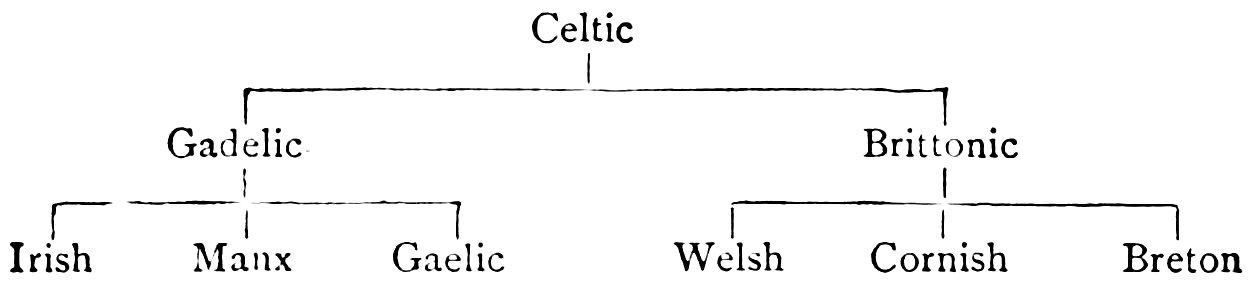
of philology. For two branches of an originally parent
stock may be traced, known as the Gadelic and the Brittonic,
or more recently as the Q and P groups. The one includes
the Irish, Manx, and Gaelic-speaking peoples, and was the
earlier to arrive; the other embraces the Welsh, Cornish,
and Breton, who came later.
This linguistic fact might be represented tabularly,
thus:—
4
The main difference between those two branches is,
that in Gadelic the original guttural of the Aryan tongue
came gradually to be c with the sound k, ogam qu, and that
in Brittonic it became p. So we say:—
English
Gaelic
Welsh
Latin
Four
ceithir
pedwar
quatuor
Five
coig
pimp
quinque
Such a distinction points to a great change from the
common speech of earlier Celtic times. It existed prior to
the Christian era, and is still strikingly in evidence. Edward
Lhuyd, the illustrious Welsh antiquary, writing in the early
part of the eighteenth century, noted that there were
scarcely any words in the Irish that began with p, beyond
what were borrowed from Latin or some other language.
So much was this the case, that in an ancient alphabetical
vocabulary which he had beside him, the letter p was
entirely omitted. Other instances might be given. For
example, in O’Reilly’s Irish Dictionary, out of upwards of
700 pages, only twelve are occupied with that letter; and
when we come to examine the most recent Gaelic collection
of words—the etymological dictionary of Dr. Macbain—we
find about 270 beginning with p out of a total of well over
7000; and even of these, the majority are derived or
borrowed from Norse or English. There is a MS. of the
eighteenth century in the Laing collection of Edinburgh
University, which puts the case succinctly, when in the
sections of what promised to be a good Gaelic grammar, it
observes that of old no word, except exotic words, began in
Gaelic with a p. Fastening on so characteristic a distinction
Professor Rhys, some years ago, decided to call the Brittonic
5the P, and the Gadelic the Q group, as the more simple and
fundamental classification.
Thus far philology helps to differentiate between the
two branches, and points to a remote advent of the Gael in
Britain.
But when we turn to history we find there is nothing
definite on this most attractive subject till Cæsar arrives and
makes personal observation. Speaking of the south—for he
had not penetrated the northern parts—he tells us that he
found two races in possession: one in the interior, which considered
itself indigenous; the other on the sea-coast, roving
adventurers from the Continent who arrived later. Tacitus,
writing nearly a century and a half after Cæsar, namely, about
82 A.D., practically confirms Cæsar’s report of a double
occupation, and adds the further interesting details, that the
one race was dark complexioned and had curly hair, while
the other, resembling the Gauls, had red hair and were tall
of stature. In the eighth century A.D. we know, on the
authority of Bede, that there were in these islands five written
languages, viz. those of the Angles, the Brythons, the
Scottis, the Picts, and the Latins, the first four[3] of which were
spoken. It is the ever-puzzling yet fascinating work of
philology and ethnology to trace the origin and exact racial
connection of these—a work which hitherto has proved
as elusive as the finding of the North Pole. Who are
the dark complexioned race of the South? and who the
Picts of the North? are questions of perennial interest to
the experts.
But though early British and German history is so elusive,
we are on sure ground with the main facts of Celtic
progress on the Continent from the fifth century B.C.
Authentic history then opens with the advent of the classical
writers just at the time when the Celts were entering upon a
series of conquests which for the next 200 years made
them the dominant race in Europe.[4] It is needless to
6follow their various migrations, even if it were possible. As
their territories became congested on the Danube, they sent
forth horde after horde of conquering tribes who surged
every way. Now westward for the most part, till, in the
graphic language of Galgacus, uttered centuries after, “there
was now no nation beyond—nothing save the waves and
the rocks” (Nulla jam gens ultra; nihil nisi fluctus et
saxa), then, like the back-rushing tides, they receded
eastwards.
“Tumults,” the Romans called these irrepressible outbursts,
and most felicitously too, for they were the terror of
Europe.
A cursory glance at some of the more famous of their
invasions suffices to show the restless energy of the Celts
and their far-reaching conquests.
From Gaul, where they appear to have established themselves
north of the Garonne and about the Seine and Loire,
the hungry tribes made a dash for Spain, shortly before 500
B.C., and wrested the peninsula from the hands of the
Phœnicians. One hundred and twenty years later North Italy
shared the same fate. Surging through the passes of the
Alps they overthrew the Etruscans on their own ground in the
great battle of Allia, 390 B.C., and annexed their territory.
Flushed with the victory they pressed forward, and within
three days stormed and sacked the town of Rome itself.
Indeed, it is with this momentous incursion that authentic
Roman history begins.
One more mighty invasion of the East, and the Illyrians
along the Danube are vanquished, thus rendering the
conquerors masters of a vast territory extending from that
river and the Adriatic to the Atlantic, and bounded on the
north by the Rhine and Mid-Germany, and on the south by
Mid-Italy and Mid-Spain, and including the British Isles—a
magnificent empire rivalling that of Alexander or of Cæsar
7in their palmy days. Goldsmith’s lines might well apply to
them—
One only master grasps the whole domain,
And half a tillage stints the smiling plain.
So formidable, indeed, were the Celts during the period
of their ascendency that it served the purpose of the classic
nations—Greeks and Romans—to keep the peace with
them as best they could, and even to play them off against
their own hereditary foes. And so the expansive tribes
were for the most part on friendly terms with both,
especially with the Greeks. We have an account in Strabo
of an interview which Alexander the Great had with their
ambassadors. It is given on the authority of Ptolemy, his
general. The young potentate knew well the advantage of
cultivating good fellowship with his powerful neighbours, and
when the tribes of the Adriatic sent delegates he received
them with all due courtesy and respect.
While they were drinking, says the general, Alexander
asked them what was the object of their greatest fear,
thinking they would say himself. But the imaginative Celts
had quite other views. They feared no man. One thing
only alarmed them, they replied, and that was lest the
heavens should one day fall and crush them. Still, they
added, that they valued the friendship of such a man as he
was above everything.
“How vainglorious these Celts are!” muttered the young
autocrat to his courtiers, a little piqued, perhaps, at their
rejoinder. Yet, if such were really the object of their superstitious
dread, the promise they made was not without its
own grim cogency. “If we fulfil not our engagement,”
they said, “may the sky falling upon us crush us, may the
earth opening swallow us, may the sea overflowing its
borders drown us.”
With Alexander they kept their pledge, but in 280 B.C.,
when another king ruled Macedonia, they over-ran his
territories, slew him in battle, and pillaged the temple of
8Delphi itself—an act of vandalism so shocking to the Greeks
that it roused their patriotism to such a pitch that they were
able to repulse the enemy in the neighbouring gorges.
Thus compelled to evacuate Greece, the Celts invaded
Asia Minor in 278 B.C., and established there the well-known
colony of Galatia. It was to their descendants that St. Paul
addressed his trenchant epistle, and the words, “O foolish
Galatians, who hath druided you?”
For six centuries after they continued to speak their
language there, so that St. Paul must have heard one dialect
at least of the ancient tongue.
It may surprise students of the classics to learn that the
Celts claim Hercules as one of their own potentates. In an
old Gaelic MS. in the Advocates’ Library, Edinburgh, we
find the renowned hero figuring thus: “Ercoill mac Amphitrionis,
mhic Antestis, mhic Andlis, mhic Mitonis, mhic
Festime, mhic Athol, mhic Gregais, mhic Gomer, mhic
Jafed, mhic Noe”—a truly wonderful genealogy, tracing
him up to Noah through the Cymric Gomer.
The Greek version of the myth is interesting. It tells
how Hercules, on his expedition against Geryon, turned
aside into Gaul and married there a handsome Gaulish lady,
by whom he had a son, Galates. This Galates, surpassing
all his countrymen in strength and prowess, led the way to
conquest, and exercising a wide sway, his territory and
subjects eventually came to be named after him—the one
Galatia, the other Galatæ.
In whatever way the classic story originated, it is matter
of history that after the Celtic invasion of Greece, Galatæ
became the popular Greek name for the people hitherto
known as κελτοι, even as Galli was the favourite Roman
one.
But already, before the Greek repulse, the Celtic cup of
conquest was full, and their vast empire began to crumble
and disintegrate. The first great shock was given by the
revolt of their born thralls, the Germans, about 300 B.C. In
the struggle for independence these recovered their liberty
9and big stretches of territory. Besides falling out with the
Greeks, the flurried tribes in that wild consternation of
defeat came to blows with the Romans also, who in two
different battles got the victory over them. Forced to ally
themselves with former foes, now with the Etruscans, again
with the Carthaginians, the Celts still fought desperately,
but all in vain. Their dominion was doomed. And as if
to hasten the swift debacle, the various sections of the same
great people attacked and dispossessed each other. It was
probably in the pressure of those times that the Brittonic
invaders surged into Britain and elbowed their Gaelic
kinsmen into more straitened circumstances; for all the
continental Celts were simultaneously in the throes of a
lamentable dispersion. Reverse followed reverse with
singular fatality. Every attempt to redeem their desperate
fortunes seemed to fail. “They went to the war, but they
always fell,” said their own sad bard afterwards, summing
up in one terse antithesis the history of their collapse.
The failure was crushing and irretrievable. They lost
Spain, they lost the north of Italy, they lost Gaul, and
subsequently Britain.
The story of Cæsar’s conquests needs no rehearsal. By
80 A.D. all Britain south of the Firth of Forth figured as a
Roman province.
Meantime the Celtic dialects of Gaul and Spain were
gradually being superseded by the Latin, and even the laws,
habits, and civil administration of the people were becoming
Roman, until in the third century of our era scarcely a
vestige of the ancient régime remained outside of the
British Isles and Brittany, except to the south of the latter,
where the influence of the discarded dialect on the adopted
Latin might be traced.[5]
In Britain the Romanising process was suddenly arrested
by the hasty departure of the conqueror; and in the helpless
10abandonment that ensued the Saxons found an open door.
The same fate that they had themselves formerly inflicted
on their kinsmen now overtook the Britons, who were
hustled in great numbers into the wilds of Cornwall, of
Wales, and Strathclyde. And the last stage of the driving
west remained to be accomplished in the case of the Irish,
when the Anglo-Celts arrived in the twelfth century.
Since the great debacle of their race the Celtic remnants
have continued to speak one or other of the dialects bequeathed
from their ancestors. Five of these are living
tongues. Apart from the number that speak them abroad,
it is estimated there are upwards of 3,000,000 people in
Brittany and the British Isles whose mother tongue is
Celtic. The distribution and proportion, according to the
latest available statistics,[6] are full of interest, in view of the
long struggle for existence of the language and people, and
the extraordinary vitality they have evinced in defying the
tooth of time. These facts may be crisply tabulated thus:—
West of a line in Ireland from Dungarvon Bay to Loch Swilly.
Manx.
3,000.
West Coast, Isle of Man.
Welsh.
900,000.
Over Wales.
Cornish.
Extinct.
Formerly Cornwall.
Breton.
1,300,000.
In Brittany, N.W. corner of France.
A sadly dwindling minority are these fag-ends of once
so mighty a race. There can be no doubt that we see the
isolated parts gradually expiring on the horizon, and with
more accelerated speed within the last few decades than for
centuries before. Modern industrialism now woos them
away from the strongholds of their own characteristic life,
and the separate units get absorbed in the common national
life and the common civilisation. Numbers of them—of the
Irish especially—are still seeking a home, following the
11hereditary instincts of their ancestors, and hiving westwards
to America, only to lose their distinctive Celtic existence
and to be merged in the larger life of that great nation.
The facts are sufficiently patent, but to show the rapidity
with which the disintegration is going on it may be mentioned
that since 1851, 3,925,133 persons have emigrated from
Ireland alone—a number larger than that of all the remaining
Celtic-speaking population in Europe. In 1899 the
number was 43,760; in 1900, 47,107; in 1901, 39,870,
the vast majority of whom were from the western Irish-speaking
provinces; and, as in the depopulation of the
Highlands, it is largely a drain of the best blood, the land
being left in the hands of the old and the feeble.
There are those who still write and dream of laying the
foundations of a new Celtic civilisation, but in view of the
present subtle and swift dissolution it is hard to know what
they mean, unless indeed it be a leavening of the existing
civilisation by a recrudescence of the Celtic spirit and Celtic
aspirations.
In the main the race has already become fused with the
population of Europe, disappearing as Gallo-Grecians in the
east, as Celt-Iberians in Spain, as Gallo-Franks and Anglo-Celts
in the north-west—all but the Celtic fringes that are
shedding their past.
Thus far the history, and from what we have said it will
appear that the Celts first emerge in literature in the fifth
century B.C., from which time the classical writers make
frequent, though generally short and meagre allusions to
them. Dr. W. Z. Ripley,[8] one of the latest authorities on
ethnology, would discount their evidence as of little value for
the purposes of modern scientific research into race origins
and affinities, yet, nevertheless, so far as it goes, it is highly
interesting and important.
The earliest of all the Greek authors to mention the Celts,
if we except the geographer Hecatæus (520 B.C.), is Herodotus
(484–425?), who twice refers to them in his history as
12dwelling at the sources of the Danube and bordering on the
Kunesii, the westermost inhabitants of Europe. Xenophon,
at a later period (390), speaking of them as mercenaries with
Dionysius of Syracuse in 368 B.C., remarks that “the ships
brought Keltoi and Iberes.” Plato, Ephorus, Pytheas, and
Scylax all furnish hints in the same century. Aristotle also
knew about this extraordinary people, who, he was told,
feared “neither earthquake nor floods,” living in a country so
cold that even the ass did not thrive there, yet putting little
clothing on their children. It appears he had also heard
that they had sacked Rome. Timæus popularised the new
name Galatæ in bringing into notice Galatia, which, he
avers, is named after “Galates, son of Cyclops and Galatia.”
From this time onward we get fuller details of the Celtic
character, manners, and customs. And to show the number
and variety of authorities from which information may be
gleaned, the following may be selected: Polybius, a Greek
writer of the second century B.C., and Posidonius of the first.
Julius Cæsar and his contemporary Diodorus Siculus, Strabo,
a geographer of the early part of the first century A.D., Virgil,
Cicero, Livy, Tacitus, Dion Cassius, Pliny, Ptolemy, and
Ammianus Marcellinus, the latter bringing the list down
towards the end of the fourth century, when the Roman Empire
in its own turn began to break up, and the Gaels were at
length prepared to enter the arena of literature and speak for
themselves.
It is outwith the scope of this chapter to go into many
of the interesting details which these various authors furnish,
but a few of those which astonished the writers may be
noted in passing, such as, the Celts’ intellectual cleverness;
their numbers and great size; the magnificence of their
funerals, and their belief in the immortality of the soul.
Their cities were forests, and though otherwise cleanly in
their eating, lion-like, they were wont to take up huge joints
and gnaw at them. Other features of striking peculiarity
were their figurative, exaggerated language; the functions of
bards and druids; their chariots and excellent horsemanship;
13the fierceness and noise of their first onset in battle; their
readiness to be disheartened by reverse; their astounding
clothes,—dyed tunics, flowered with various colours, flaming
and fantastic, striped cloaks buckled on their shoulders, and
breeches. Their chiefs generally appeared with a retinue of
followers. Of old, the Celts devoted themselves to plundering
other people’s countries. The heads of their fallen enemies
they cut off and hung to their horses’ manes; they were warlike,
passionate, and always ready for fighting; otherwise
simple, frank, hospitable to strangers, but vain, quarrelsome,
fickle, and ever prone to waste their strength on personal
feuds and factions. Such were some of the curious traits
and customs of our Celtic progenitors as seen through Greek
and Roman eyes.
Scarcely had the Romans finally abandoned Britain than
the Celts enter upon a new rôle. They annex the Roman
script, the Roman language for literary work, and the Roman
art of writing. And thus equipped, they proceed to produce
a literature of their own in Latin and Gaelic. The wonder
is that with their natural quickness and thirst for knowledge
they did not achieve a record in this direction before.
When we reflect on the other great nations of antiquity, we
find that they generally had a literature of some kind, written
down, if not in books, then on skins or slabs and in temples.
The Egyptians had their “Book of the Dead,” the Indians their
“Rig-veda,” the Persians their “Zend-avesta,” the Chinese
and Hebrews their “Sacred Books,” the Greeks and Romans
their classics, and we naturally ask, “What had the Celts in
the zenith of their power?” say between 500 and 300 B.C.
No writing at all that we know of. At this day only a few
inscriptions remain in the Gaulish language of Cæsar’s time
and later, but nothing earlier. These nomadic warrior
populations may have had their bardic compositions and
tales floating by oral tradition, but we have no evidence that
they developed a literature, though some of them may have
known Greek letters.
It is to the insular Gaels, to those of Ireland and Scotland
14in the fifth and sixth centuries of our era, that we
have to look for the early beginnings of Celtic literature.
The Irish first showed signs of a rude awakening to activity
in this direction. They invented a system of writing peculiar
to themselves, simple and ingenious, and good enough for
rough inscriptions on stones, but too cumbrous for the needs
of literature.
Their earliest records are to be found in this Ogam
script, which consists of a number of short lines drawn
straight or slanting, either above, below, or through a long
stem-line. Thus—
represents the letters h, d, t, c, qu, being the first letters of the
first five numerals in Gaelic, h’aon, dha, tri, ceithir, coig; the
last in Manx is queig; in Irish cuig; and in Latin quinque.
The vowels are similarly represented, broad vowels, a, o,
u; small vowels, e, i—
Over two hundred stones have been found inscribed with
Ogam writing, most of them in the south-west of Ireland,
from twenty to thirty in Wales and Devonshire, and ten in
Scotland. The Book of Ballymote, a MS. of the fourteenth
century, fortunately contains a key to some of these inscriptions,
so that many of them have been read, though not all.
Who introduced this peculiar mode of writing? and
when? are questions that have never yet been determined.
Brash, who made personal inspection of most of the stones,
was of opinion that they are of pre-Christian origin, whereas
Dr. Graves has attempted to prove that they belong to a
period between the fifth and seventh centuries A.D.
References to Ogam inscriptions are frequently met with
in the earliest Celtic literature, and some examined contain
grammatical forms alleged to be older than those of the
15most ancient MSS., and corresponding even with the archaic
forms of the antique Gaulish monuments.
The Ogam used to be written on wood and stone, and
it is not improbable that many of the genealogies and bits of
legendary lore may have been handed down from generation
to generation in this way, as well as by oral tradition.
It is with the great wave of Christian evangelisation that
passed over Ireland and Scotland successively, through the
labours of St. Patrick and St. Columba, that the use of the
Roman script became widely general, and we trace the dawn
of letters. Round the names of these two men there shines
a lustre which the lapse of ages has failed to dim. They
not only kindled the torch of a higher faith and purer life
among their Celtic brethren, but they lighted also the lamp
of literature, which has continued to burn with more or less
radiance for 1500 years.
St. Patrick, as the earlier of the two, is really the Cædmon
of Gaelic literature. Born in Scotland, probably, as the
later critics think, at Old Kilpatrick, near Dumbarton, he was,
while yet a youth of sixteen, carried captive to Hiberio, and
though he escaped after six years from his hard fate as his
master’s thrall and feeder of cattle, his missionary zeal, new
kindled, urged him to return as evangelist to the land of his
former oppression. The visions of his early captivity, as he
lay down to rest of nights near the cattle, remind us of
Cædmon’s vision in the stable at Whitby, upwards of two
hundred years after—a vision which issued in the birth of
English literature, as did those of St Patrick in that of
Gaelic.
And so the unassuming herd emerges as the first known
writer of the ancient Celtic people, the first of whom we
have any definite authentic knowledge.
Three literary compositions stand in his name, namely,
his “Confession,” written in rugged Latin, his “Epistle to
Coroticus,” in similar language and style, and the “Deer’s
Cry,” a lorica or prayer in Gaelic. This hymn has always
been regarded, and rightly too, as a gem of sacred song.
16The religious and literary dawn that lit up Ireland in
the fifth century reached Scotland in the sixth through the
advent of the heroic Columba. He too, by unhappy
circumstances driven over sea, lived an exile in “the land of
his adoption tried,” and with even more brilliance and
learning did for Scotland what St. Patrick did for Ireland.
So that the school of Iona became for centuries after his
death a centre of light and leading in religion and letters,
not only for Scotland and Ireland, but also for many parts
of Europe.
His own special contributions to literature include several
beautiful poems in Gaelic and Latin, and many transcripts
in Latin of parts of books of Scripture, such as the Cathrach,
a copy of the Psalter believed to have been made while he
was yet a student, and perhaps also the Book of Durrow and
the Book of Kells—two wonderful specimens of penmanship
and early Celtic art. If these latter are not exactly the
work of his own hands they belong at least to the Columban
period, an era of great literary activity, which produced,
among other well-known works, the Amra Choluimcille of
Dallan Forgaill, Adamnan’s Life of Columba, and the
Book of Deer.
It will thus be seen that the earliest written MSS. of the
Celtic people are essentially a Christian literature, which
ignored almost entirely the pagan traditions of the race in
its effort to supersede them. But the atmosphere was heavy
with these, and apparently from pre-Christian times there
had come floating down by oral transmission a great mass
of heroic saga which at length found written expression in
the seventh or eighth century A.D. So that now to the
purely Christian literature there was added the purely pagan,
which much more faithfully reflected the characteristic flavour
of the race, its strength, and its weakness, its facts, its fancies,
and its foibles. Professing to go back to a remote antiquity,
it is significant that the setting of this ancient saga is confined
exclusively to these islands. None of the stories
belong to Europe or the doings of the parent stock in its
17palmy days. As compared with the Christian, this pagan
contribution is by far the more important from a literary
point of view. Yet it must be borne in mind that though
there are still extant in Ireland Celtic Latin MSS. which
reach up to the time of St. Patrick and St. Columba, there
is none existing which contains actual Gaelic writing prior
to the eighth century.
Almost the only specimen of continuous prose written
by the end of the eighth century now known to exist is a
portion of a Gaelic sermon on temperance and self-denial
from the text, “If any man will come after me, let him deny
himself, and take up his cross, and follow me.” This curious
relic is in the town library of Cambray, in a MS. containing
the canons of an Irish council held in 684. The
MS., however, bears direct evidence that it was not written
until about a century afterwards.
The earliest written Gaelic is contained in MSS. on the
Continent, such as those at Milan, Cambray, Vienna, St.
Gall, and other places. And even these are not books of
saga, but generally Latin books with some Gaelic poems
jotted on the leaf margins, or glosses, and other explanatory
writing. There are a few such literary monuments also in
the British Isles, containing ancient Gaelic. The Book of
Armagh, for example, dates from 807, and in addition to
vernacular notes, preserves the Latin “Confessions” of St.
Patrick, copied, it is believed, from the apostle’s own autograph
MS. The Book of Deer, almost equally venerable,
with a Gaelic colophon, belongs to the same century. To
its original contents were added in the eleventh and twelfth
centuries Gaelic entries which are of uncommon philological
and historical interest and value.
But setting aside these Latin books in which the Gaelic
jottings are purely incidental and secondary, we need to
come down as far as the eleventh century to reach the
existing sources of the earliest written compositions in the
native tongue. It is in such MSS. as the Leabhar Na
h’Uidhre, the Book of Hymns, and the other great MiddleAge
18gleanings of after days that we find the Patrician and
Columban literature as well as the ancient sagas.
Till within very recent times the Celt had no idea that
he was heir to such a vast literary inheritance as really
exists. As in the olden times men sometimes buried their
wealth to save it from the hands of ruthless foes, and, dying
themselves or falling in the fray, lived not to indicate to
others the site of their hid treasures, so it has happened
in the case of Gaelic literature. Much of it perished at the
hands of the enemy and the avenger. What was saved
from the wreck of the more stormy and turbulent periods
of our history owes its existence to-day very largely to
concealment and neglect. And as the plough or the spade
occasionally turns up an old stone cist, or a casket of ancient
coins, or a canoe of primitive man, so the casual researches
of antiquarians and scholars have brought to light a hidden
mass of ancient writings which appear to have been scattered
broadcast over Europe and the British Isles. These Gaelic
relics are now jealously preserved in various countries, and
within the last century have been made the subject of the
most interested scrutiny by leading Continental and British
philologists, with the result that they have thrown a welcome
light on some of the darker problems of history, philology,
and ethnology. For example, as late as the first quarter
of last century few people had any idea that the Celtic
populations were allied with the southern nations of Europe,
or that their language had any connection whatever with
the Romance and Teutonic tongues. One solitary scholar,[9]
indeed, threw out the hint as early as 1786, but offered no
proof; and it remained a visionary hypothesis until the long
list of documents reappearing one by one enabled scholars
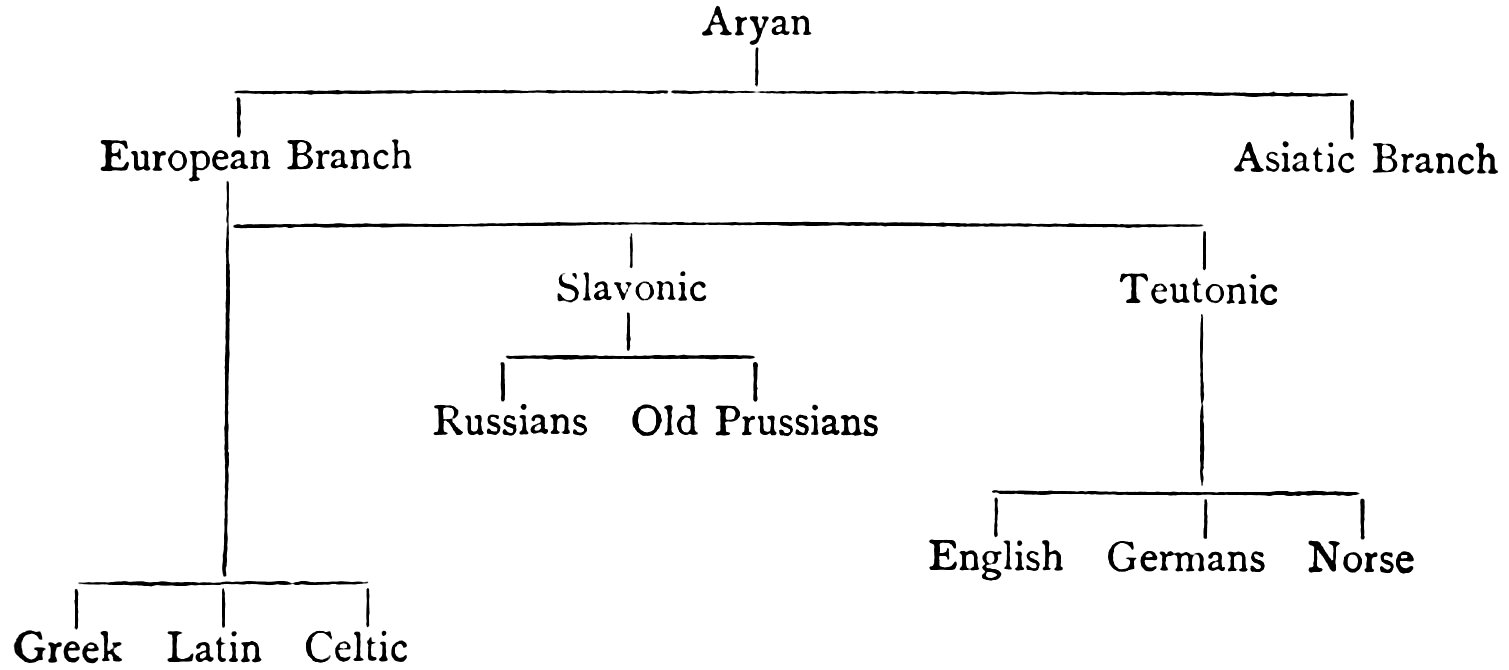
to establish the point beyond question, that linguistically the
Celtic people are a branch of the great Aryan family, and thus
closely allied with the Teutonic, and still more nearly with
the Greek and the Latin peoples. Roughly, this relationship
may be represented as under. The table is not meant to
19indicate race affinities, which it is very far indeed from doing,
but simply to exhibit the affinities of language which modern
philological studies have traced:—
It is this important and surprising discovery, that we are
a part of a vast Indo-European family spread to the east
over a great part of Asia, and to the west over the most
of Europe including Russia, that has given such impetus to
Celtic studies within recent years. The Gaelic has been
found to have roots which go far down towards the parent
stock. And its literature, therefore, is of the utmost value
to all who seek to read the riddle of the past and to push
back the horizons of knowledge beyond the age even of
Herodotus, “the father of history.”
There is a fascination and refining influence in the study
of the Greek and Roman classics, but for the man of large
outlook and broad human sympathies there is much also to
interest and attract in the literature of the Gael—so old, so
weird, so fanciful.
Wordsworth, as he listened to the song of the Highland
maid in the harvest field, felt the pathos of the past in that
moving Gaelic product, and would fain learn its story.
Hence his reverie—
Will no one tell me what she sings?
Perhaps the plaintive numbers flow
For old unhappy far-off things,
And battles long ago.
20That is just what they do; dealing with much brighter
things too. For the spirit of the race is enshrined in these
old writings, and the fortunes of the race in their history.
APPENDIX TO CHAPTER I
Number of Persons speaking Gaelic and English, and Gaelic only, in Scotland in 1891 and 1901.
County.
Population.
Gaelic and English.
Gaelic only.
1891.
1901.
1891.
1901.
1891.
1901.
Inverness
89,317
89,796
44,084
43,179
17,276
11,721
Ross and Cromarty
77,810
76,135
37,437
39,235
18,577
12,171
Argyll
75,003
73,083
36,720
34,224
6,042
3,313
Lanark
1,046,040
1,337,886
22,887
26,695
84
101
Sutherland
21,896
21,239
14,786
14,076
1,115
469
Perth
126,199
123,276
13,847
11,446
304
78
Renfrew
290,798
268,459
8,435
5,585
63
40
Edinburgh
434,159
487,702
6,308
5,745
19
75
Caithness
37,177
33,623
4,068
2,865
76
20
Dumbarton
94,495
113,627
3,556
3,040
36
14
Bute
18,404
18,641
3,482
2,713
29
20
Nairn
10,019
9,291
2,487
1,325
53
10
Elgin
43,453
44,749
2,263
1,860
12
2
Stirling
125,608
141,847
1,840
2,021
2
10
Ayr
226,283
254,165
1,827
1,654
14
16
Aberdeen
281,332
303,908
1,534
1,331
8
8
Forfar
277,773
283,736
1,461
1,303
8
13
Fife
187,346
218,347
726
840
6
3
Banff
64,190
61,440
639
499
3
Haddington
37,485
38,656
575
459
7
7
Linlithgow
52,808
64,796
486
575
2
5
Clackmannan
28,432
31,994
215
170
1
1
Dumfries
74,221
72,564
201
176
1
Roxburgh
53,741
48,804
177
132
Kincardine
35,647
40,896
116
103
1
Berwick
32,406
30,793
89
74
1
Orkney
30,453
27,727
88
70
Selkirk
27,353
23,356
73
57
Peebles
14,761
15,066
70
72
1
Kirkcudbright
39,985
39,335
69
98
Wigton
36,062
32,593
68
84
Shetland
28,711
27,736
67
52
Kinross
6,280
6,981
56
55
Persons on Board Ship in Scottish Waters
9,856
887
6
Total
4,025,647
4,472,103
210,677
202,700
43,738
28,106
21In the census of 1901 the schedule restricts the entries in the
Gaelic column to persons over three years of age. According to
the previous census the number of persons under three years of
age amounted to 7½ per cent of the whole population. This
must be taken into account in order to institute a fair comparison
between the returns of the Gaelic-speaking population in 1891
and 1901.
CHAPTER II ST. PATRICK, THE PIONEER OF CELTIC WRITERS
22
The historical Patrick—Authentic records—Earliest known Gaelic litterateur—Dates
elusive—Birthplace—Autobiographical details of his youth—Taken
captive—Escape—Obscure wanderings—Return home—The rôle of missionary
in Ireland—Epoch-making career—Remarkable Patrician Dialogues—His
own literary work—The “Confession”—“Epistle to Coroticus”—“Deer’s
Cry”—Ireland’s oldest book—Three other antique compositions
from the Book of Hymns—A curious prophecy—Personal character—Death.
It is a characteristic of our age to doubt, if not to deny, the
historical reality of many of the heroic figures that hover in
the background of history. And such a doubt has extended
even to St. Patrick, due largely to the fact that he is not
mentioned by the early historians Prosper of Aquitaine
(402–463) and Bede (673–735), both of whom attribute the
conversion of Ireland to Palladius.
But this seeming omission has been explained on the
highly probable assumption that Patrick[10] was the Palladius
of these writers; and against the merely negative inference
there is the positive and almost overwhelming voice of
history and tradition, which puts the essential features of
Ireland’s apostle beyond all doubt.
The authentic records of his career are numerous and
very old, dating back, we may say, to his own handwriting.
For in the Book of Armagh we have what professes to be a
copy of the autobiographical “Confession” which he wrote
23himself late in life. This Book of Armagh, one of the most
ancient and exquisite of the Irish MSS., is itself nearly
1100 years old, having been written in 807 by a scribe
Ferdomnach, and, in addition to the “Confession” and other
interesting contents, it has preserved to us various Patrician
documents. That the writer had before him the actual
autograph MS. of the saint when copying the “Confession”
is inferred from his own words, “Thus far the volume which
Patrick wrote with his own hand. On the seventeenth day
of March was Patrick translated to the heavens.” And also
from his frequent marks of interrogation and casual hints,
such as, “The Book is uncertain here,” showing that during
the intervening centuries since Patrick wrote the writing
must have become faded and even illegible in some places.
Besides his own personal account, there is no lack of
early lives by other authors. Among those that may still
be consulted are: (1) the biographical Hymn by Fiacc of
Sletty, one of the saint’s own contemporaries; (2) two
seventh-century Lives known as Tirechan’s and Muirchu
Mac Cumachteni’s, found in the Book of Armagh; (3) the
Tripartite Life, largest of all, from three very ancient
Gaelic MSS., believed by Colgan, though not by later critics,
to belong to the early part of the sixth century, and translated
by him in his Trias Thaumaturga, 1645; (4) the
Monk Jocelin’s memoir, twelfth century; and (5) other
MSS. of the eleventh and fifteenth centuries. Subsequent
authors, of course, are mainly dependent on these.
A great historic character was this St. Patrick, who
could not be buried in documents. His own words have
far-reaching significance, beyond even what he himself meant
to convey when he wrote, “He who is mighty came and in
his mercy supported me, and raised me up and placed me
on the top of a wall.” On this eminence St. Patrick is
great, not merely as apostle of Ireland, but also as occupying
a niche in the origins of Celtic literature. Essentially
a man of religious initiative, and making no claim to distinction
as a writer, he is nevertheless the earliest known
24pioneer of letters in Ireland—the first of whose work we
have definite records to attest the authenticity.
What share he had in making the latter a literary
country it is difficult to say; but from his missionary
advent in Ireland a knowledge of letters seems to have
spread rapidly over the land. His monasteries and
churches were centres and nurseries of learning. “He
used,” as Tirechan tells us, “to baptize men daily and to
read letters and abgatoriae with them.”
There is a high probability that the Ogam writing
peculiar to Ireland originated before his time, and even the
beautiful modification of the Roman alphabet found in Irish
books. These are still matters for research. But one
thing, at least, is claimed for the saint and his Christian
followers, that they made the use of the Roman script for
the first time widely general. And this had far-reaching
results for the future, since only by its adaptation, as apart
from the rude and cumbrous though ingeniously simple
Ogam, was any real literature possible.
In view of the mass of biographical material that has
collected round the venerated name of St Patrick, it might
be supposed that every event of his life would stand out
clear and luminous. Yet such is the perversity of historic
authorship, that names and dates and even oft-told incidents
are hard to get at in their true setting. The career of the
apostle is inextricably jumbled up and confused with that of
two others—the traditional Palladius and another Patrick,
both of which semi-mythical characters appear and disappear
again and again, crossing his path like his double;
insomuch that it has been conjectured that the incidents of
one life are often transferred to another, and the saint is
credited with experiences which really belonged to the
history of the other two, such, for example, as his alleged
mandate from the Pope and the superior continental training
under Germanus.
Dates especially are wonderfully elusive. The usual
chronology for St. Patrick’s career is given as follows:
25Birth, 387; missionary advent in Ireland, 432; death, 492 or
493. Yet each of these dates is still under discussion.
Dr. Whitley Stokes puts the advent as early as 397; Dr.
Todd as late as 439 or 440. And so, after all that has
been said and searched, we are dependent for the essential
features and outstanding facts of his life upon the apostle’s
own writings.
Such historical details as are generally accepted may be
briefly given. But in this case there is an advantage in
quoting the ipsissima verba of the saint, and thus allow him
to tell his own tale at critical points of his career, for his
style and matter are themselves a revelation of character.
He first projects himself on the canvas of literary history
by relating early circumstances and the pregnant event
which changed the whole aspect of his life, and gave it the
direction it afterwards took. Thus he begins:—
I, Patrick, a sinner, the rudest and least of all the faithful and
the most despicable among most men, had for my father Calpornius
a deacon, son of the late Potitus a presbyter, who was of the town
of Bonaven Taberniæ; for he had a farm in the neighbourhood
where I was taken captive. I was then sixteen years old. I knew
not the true God, and I was carried in captivity to Hiberio with
many thousands of men according to our deserts, because we had
gone back from God and had not kept His commandments, and
were not obedient to our priests who used to warn us for our
salvation.
Bonaven Taberniæ has been the subject of much eager
inquiry to this day. Where is it? or Nemthur, the alternative
name furnished by Fiacc of Sletty? Many places
claim the honour of being the birthplace of the saint.
Boulogne, Bristol, Glastonbury, Carlisle, Tours, Caerleon, and
Ireland have all contended at one time or another for the
prestige. But the best authorities in recent times seem to
favour Old Kilpatrick, near Dumbarton, as the most likely
locality from which sprung the saint, and as fulfilling better
than any of the others the actual suggestions of the records.
In the river opposite the town there is a rock visible at low
26water, called St. Patrick’s stone, tradition alleging that the
ship in which he sailed away to Ireland struck against it,
but continued its voyage unharmed.
In captivity in Antrim he remained for six years, his
daily employment being to feed cattle. Then the love of
God entered his heart, he tells us, and a spirit of prayer
grew upon him. Often he would say a hundred prayers in
a day, and rise of nights to resort to the woods and mountains
in snow, and frost, and rain, for the same purpose.
While thus exercised, one night, in a dream, a voice
came to him saying, “Thy fasting is well; thou shalt soon
return to thy country.” Later on, the dream was repeated,
the same voice assuring him that the ship was now ready,
200 miles away.
Waiting no longer, the poor enthused slave fled from
his master, and, after long wandering, reached the port,
where he found indeed a ship, but the captain of it proved
rough and hostile, and refused to have anything to do with
him. On the way back to his hut he was recalled by a
sailor, the upshot of the parley being that he accompanied
the crew on the voyage. Afterwards he seems to have
been detained by them on shore, perhaps in Gaul, as they
wandered in a desert and suffered great hardships. “How
is it, Christian?” said the captain one day when no food
could be had. Patrick gave a characteristic reply, and he
tells us that they were saved from starvation on that occasion
by a herd of swine soon after appearing, some of which
they killed and ate.
There is no mention in his account of any Continental
sojourn,[11] though almost all the Lives make reference to
such. Fiacc of Sletty waxes poetical over it:—
He went across all the Alps—great God, it was a marvel of a journey—
Until he staid with German in the south, in the south part of Latium;
27In the isles of the Tyrrhene Sea he remained, therein he meditated,
He read the Canon with German; it is this that writings declare
To Ireland God’s angels were bringing him in his course,
Often was it seen in vision that he would come thither again.
If such wandering took place, it was probably after he
escaped from the mariners. For, over twenty-two years of
his life at this period seem to be a blank, unless accounted
for by some such sojourn in this country or abroad. At
length, after great privations and lonely struggle, he made
his way back to his parents, who received him “as a son,
and earnestly besought him not to expose himself to fresh
dangers, but to remain with them henceforth.”
For a while he did stay, and then the apostolic spirit
came upon him. “In the dead of night,” he says, “I saw
a man coming to me as if from Hiberio, whose name was
Victoricus, having innumerable epistles. And he gave me
one of them, and I read the beginning of it, which contained
the words, ‘The voice of the Irish.’ And whilst I was
repeating the beginning of the epistle, I imagined that I
heard in my mind the voice of those who were near the
wood of Foclut, which is near the Western Sea, and then
they cried, ‘We pray thee, holy youth, to come and henceforth
walk amongst us.’”
He is supposed to have been forty-five years of age then.
His mission, we see, he attributed solely to an inward call
or divine command. There is no mention of any authority
from the Pope, of any visit to Rome or Gaul, or even of
the superior education he is credited with having received
on the Continent under Germanus. On the contrary, he
speaks of himself in his early condition as “a rustic, a fugitive,
unlearned, and not knowing how to provide for the coming
day;” spiritually, “like a stone lying in the deep mud.”
And in later life, in reference to the “Confession,” “Wherefore
I thought of writing long ago, but hesitated till now,
for I feared I should not fall into the language of men;
because I have not read like others who have been taught
28sacred letters in the best manner, and have never changed
their language from infancy, but were always adding to its
perfection; for my language and speech is translated into a
foreign tongue. Indeed, it can be easily perceived from the
childishness of my writing after what manner I have been
instructed and taught.”
He had used Latin, no doubt, as his mother tongue
in boyhood, but, not having received much instruction in it,
he had never cultivated it as a literary language, and consequently
it had, during his captivity, fallen very much into
abeyance, so that it was difficult for him in later days to
write this language of the learned as fluently as he would
wish.
His father was of Roman descent. His mother is said
to have been British—a merely conjectural statement.
Like St. Columba in after years, St. Patrick addressed
the tribesmen through their chiefs and kings, and was
tolerant of contemporary superstitions, seeking rather to
graft the new faith upon the old. He adopted the pagan
festivals and associated them with Christian events. At
Tara, however, he attacked paganism in its stronghold and
burnt the druidical books, extorting from King Laoghaire a
reluctant acquiescence in his work. From the chief, Daire,
he obtained the site for his famous monastery at Armagh,
which became his headquarters. He threw down, in what
is the present county of Cavan, the great idol Crom Cruach—object
of immemorial veneration and savage rites. From
the huge stone, which bowed westward on that day of doom,
the demon is reported to have fled to hell, leaving his fallen
image leaning over, so that what was once called “The Chief
of the Mound” was henceforth known as “The Crooked one
[Crom Cruach] of the Mound.”
As his work advanced, a vast following of missionaries,
bishops, and even chiefs and sub-kings, with their subjects,
came under his influence. He had a share also in reforming
the ancient druidical laws of Ireland, and bringing them
more into harmony with Christian principles. According to
29the “Four Masters,” it was in 438 the part of the Brehon
Law known as the Seanchus Mor, and still preserved in
venerable documents, was redacted. Much of the work
may be of later dates, but tradition credits St. Patrick with
having undertaken the task along with others, and with
having effected a drastic purification in his own lifetime.
Many legends have gathered round his name during the
ages, and superstitious beliefs, as one might expect. Yet, so
great is his prestige in the land of his adoption to this day,
that not only are thousands called by his name, but the
peasantry of Ireland actually believe that St. Patrick banished
snakes from the island.
The historical records know nothing of any meeting
between Ossian and the saint; yet in some of the older
MSS. there are Dialogues[12] in the heroic style reported as
having been carried on between them, the bard representing
the pagan ideal of his ancestors, the saint the Christian ideal
of the Church. They are evidently the work of later times,
some centuries, no doubt, after the saint’s time. But, both
from a literary and religious point of view, they are profoundly
interesting.
Besides these characteristic Dialogues reported in the
Book of Lismore and other ancient MSS., and assumed to
have taken place between St. Patrick and Ossian, there is
a romantic and beautiful one recorded by Tirechan, and
repeated with more or less variations in the Lives of St.
Patrick, and consequently of great antiquity. It is taken
from the Book of Armagh.
The saint had come to the well called Clebach, and
before sunrise sat down beside it with his followers.
And lo! the two daughters of King Laoghaire, Ethne the fair
and Fedelm the ruddy, came early to the well to wash after the
manner of women, and they found near the well a synod of holy
Bishops with Patrick. And they knew not whence they were or in
what form or from what people, or from what country; but they
30supposed them to be divine sidhe, or gods of the earth, or a
phantasm, and the virgins said unto them, “Who are ye! and
whence come ye?” And Patrick said unto them, “It were better
for you to confess to our true God, than to inquire concerning our
race.”
The first virgin said,
“Who is God?
And where is God?
And of what (nature) is God?
And where is His dwelling-place?
Has your God sons and daughters, gold and silver?
Is He ever living?
Is He beautiful?
Did Mary foster His Son?
Are His daughters dear and beautiful to men of the world?
Is He in heaven or in earth?
In the sea?
In rivers?
In mountainous places?
In valleys?
Declare unto us a knowledge of Him,
How shall He be seen?
How is He to be loved?
How is He to be found?
Is it in youth?
Is it in old age that He is to be found?”
With swift strides the narrative goes on to tell how the
saint enlightened the two maidens, how they believed and
were baptized, how they received the eucharist of God and
slept in death. Thereafter they were laid on the same bed,
covered with garments, while their friends raised great
lamentation for them.
Such is a summary of the chief events in St. Patrick’s
long and epoch-making career in Ireland, taken generally to
have lasted sixty years, so that he must have lived to a ripe
old age, if the records report with any exactness.
Leaving now the biographical and coming to the purely
literary aspect of his life, we find that there are three pieces
of literature assigned to him, namely, the “Confession”
and the “Epistle to Coroticus,” both in Latin, and the
31“Deer’s Cry” in Gaelic. The two former are sometimes
styled his epistles, numbered I. and II., the history of
whose preservation to our own time is not without its
peculiar interest.
Besides the copy of the “Confession” in the Book of
Armagh, there are four other MSS. in existence: (1)
the Cottonian, in the British Museum; (2) two MSS. in
the Bodleian Library, Oxford, formerly preserved in the
Salisbury Cathedral; (3) one MS. in the Public Library of
Arras. The text of the Bollandist Fathers was taken from
the Arras MS. and published at Antwerp in 1668 in their
Acta Sanctorum. A copy of the “Epistle to Coroticus” accompanies
each of the above except that in the Book of
Armagh.
Of the “Confession,” the style and gist may be gathered
from the extracts given as we recounted his life. It is
perhaps the earliest piece of authentic Celtic literature we
have, inasmuch as it is the first of which the authorship
can be definitely and historically asserted. Its Latin is rude
and archaic, answering to the description St. Patrick gives of
his own writing. It quotes from the pre-Vulgate version of
the Scriptures, and contains nothing inconsistent with the
period in which it professes to have been written.
The saint appears to have penned this document as a
kind of defence of his apostolic work against the attacks of
men who regarded the whole undertaking as arrogant and
presumptuous in view of his own rusticity. “The rustic
condition was created by the Most High,” he gently reminds
them, and adds some plain truths which show that, like
Jesus, and St. Paul, and St Francis of Assisi, and other
great master-spirits of the Christian Evangel, he did not
disdain poverty, but voluntarily assumed it for the promotion
of the Gospel. It would be tedious, he says, to relate even
a portion of the many toils and dangers he had gone
through. Twelve times his life was in imminent peril.
Never one farthing did he receive for all his preaching and
teaching. He challenges his detractors to say if he did
32and it will be returned. The people, indeed, were generous
and offered innumerable gifts, which, out of principle, he
refused, lest it might furnish an opportunity for cavil against
the disinterestedness of his mission. On one occasion, on
being told that his own nephew declared that his preaching
would be perfect if he insisted a little more on the necessity
of giving, he gave the noble reply, that “for the sake of
charity he forebore to preach charity.”
The “Epistle to Coroticus” is evidently from the same
pen. The Latin and the literary style are similar. It also
quotes from the pre-Vulgate version, and there is no internal
evidence against the assumption that it was written by the
saint. Though not found in the Book of Armagh, it is
preserved in the other MSS. cited, some of which may be
as old as the eleventh and twelfth centuries.
Certain authorities identify Coroticus with the Welsh
prince Caredig. Other more recent scholars, such as Drs.
Skene, Whitley Stokes, and Douglas Hyde, contend that he
was a prince of Strathclyde, Ceretic by name, who had his
capital at Alclwyd, the modern Dumbarton, and thus that
he hailed from St. Patrick’s own district.
At any rate, the soldiers and allies of this nominally
Christian king suddenly made a descent on the eastern
shores of Ireland, which they harried, carrying away many
of St. Patrick’s converts to be sold as slaves, and ruthlessly
killing numbers of them on the very day after their baptism,
while the symbol of their faith, as he says, was still wet
upon their foreheads, and these neophytes were yet clad in
their white vestments. The letter was sent as a remonstrance
against such barbarous conduct, and to urge the
lawless prince to restore the captives. But to little effect,
for the invader treated messengers and letters alike with
ridicule and contempt, delivering the converts abducted into
the hands of the Picts and Scots.
In this letter, as in the “Confession,” St. Patrick gives
interesting personal details. A few extracts are worth
quoting. For example:—
33I, Patrick, an unlearned sinner do truly acknowledge that I
have been constituted a bishop in Ireland. I accept it of God that
I am. I dwell among barbarians a proselyte and an exile for the
love of God.
I have written these words to be given and delivered to the
soldiers and by them to Coroticus.... I do not say to my fellow-citizens
nor to fellow-citizens of pious Romans, but to fellow-citizens
of demons, through their evil deeds.... I was of noble birth
according to the flesh, my father being a Decurio. For I bartered
my nobility—I do not blush nor regret it—for the benefit of others.
No thanks to me. But God hath put in my heart the anxious
desire that I should be one of the hunters or fishers who as God
formerly announced should appear in the last days.... What
shall I do, Lord? I am greatly despised. Lo thy sheep are torn
to pieces around me and plundered by these aforesaid marauders
under the command of Coroticus.
In this letter he mentions also that he is constrained by
the Spirit not to see any of his kindred.
For St. Patrick’s beautiful hymn, the “Deer’s Cry,” we
are indebted to the Book of Hymns of the eleventh century,
which, like the Book of Armagh, contains several Patrician
pieces. It is a Gaelic composition alleged to have been made
by the saint while on his way to the great Court of Tara.
It was celebrated for generations before the English conquest
as a lorica or prayer for protection. Dr. Todd says, “That
this hymn is a composition of great antiquity cannot be
questioned. It is written in a very ancient dialect of the
Irish Celtic. It was evidently composed during the existence
of pagan usages in the country. It makes no allusion to
Arianism or any of the heresies prevalent in the Continental
Church. It notices no doctrine or practice of the Church
that is not known to have existed before the fifth century.
In its style and diction, although written in a different
language, there is nothing very dissimilar to the Confession
and the letter about Coroticus, and nothing absolutely inconsistent
with the opinion that it may be by the same
author.” Beyond this no positive proof can be given.
In the Liber Hymnorum it is prefaced by the following
distinctive account in Gaelic:—
34Patrick made this hymn. In the time of Laoghaire son of
Nial it was made. The cause of making it however was to protect
himself with his monks against the deadly enemies who were in
ambush against the clerics. And this is a corselet of faith for the
protection of body and soul against demons and human beings and
vices. Every one who shall say it every day with pious meditation
on God, demons shall not stay before him. It will be a safeguard
to him against every poison and envy; it will be a comna to him
against sudden death; it will be a corselet to his soul after dying.
Patrick sung this when the ambuscades were sent against him by
Laoghaire that he might not go to Tara to sow the faith, so that
there seemed before the ambuscaders to be wild deer and a fawn
after them, to wit, Benen;[13] and faed fiada (guard’s cry) is its name.
Apparently the assassins mistook the chanting of the
lorica for the cry of the deer. This saved the party, and
furnished a name for the hymn.
A very remarkable and striking piece of literature it is,
and one that does credit to the language in which it is
clothed. “For its glow of imagination and fervour of
devotion,” says Dr. Dowden, the author of the Early Celtic
Church in Scotland, “it will always challenge a high place in
the history of Christian hymnology.”
It it well worth transcribing also as exhibiting the
saint’s creed, his belief in contemporary superstitions and
attitude towards them, his piety and poetic gift. In all
probability we have here a very fair representation of the
gist of his teaching. Like the authors of the Vedic hymns,
and the votaries of all primitive religions, he invokes the
powers of nature, a phase of the religious spirit which seems
to have fallen devotionally in abeyance in modern times.
What strikes our age perhaps as more curious and superstitious,
he prays for protection against the spells of women,
smiths, and Druids, like any good heathen.
35I[14] bind myself to-day to a strong virtue, an invocation of (the) Trinity. I believe in a Threeness with confession of an Oneness in (the) Creator of (the) Universe.
I bind myself to-day to the virtue of Christ’s birth with his baptism,
To the virtue of his crucifixion with his burial,
To the virtue of his resurrection with his ascension,
To the virtue of his coming to the Judgment of Doom.
I bind myself to-day to the virtue of ranks of Cherubim,
In obedience of angels,
(In service of archangels),
In hope of resurrection for reward,
In prayers of patriarchs,
In predictions of prophets,
In preachings of apostles,
In faiths of confessors,
In innocence of holy virgins,
In deeds of righteous men.
I bind myself to-day to the virtue of Heaven,
In light of sun,
In brightness of snow,
In splendour of fire,
In speed of lightning,
In swiftness of wind,
In depth of sea,
In stability of earth,
In compactness of rock.
I bind myself to-day to God’s virtue to pilot me,
God’s might to uphold me,
God’s wisdom to guide me,
God’s eye to look before me,
God’s ear to hear me,
God’s word to speak for me,
God’s hand to guard me,
God’s way to lie before me,
God’s shield to protect me,
God’s host to secure me,
Against snares of demons,
Against seductions of vices,
Against lusts (?) of nature,
Against every one who wishes ill to me,
Afar and anear,
Alone and in a multitude,
So have I invoked all these virtues between me (and these)
Against every cruel, merciless power which may come, against my body and my soul,
Against incantations of false prophets.
Against black laws of heathenry,
Against false laws of heretics,
Against craft of idolatry,
Against spells of women, and smiths, and Druids,
Against every knowledge that defiles men’s souls,
Christ to protect me to-day.
Against poison, against burning, against drowning, against death wound,
Until a multitude of rewards come to me!
Christ with me, Christ before me, Christ behind me, Christ in me!
Christ below me, Christ above me, Christ at my right, Christ at my left,
Christ in breadth, Christ in length, Christ in height!
Christ in the heart of every one who thinks of me,
Christ in the mouth of every one who speaks to me,
Christ in every eye who sees me,
Christ in every ear who hears me.
I bind myself to-day to a strong virtue, an invocation of (the) Trinity,
I believe in a Threeness with confession of an Oneness in (the) Creator of (the) Universe
Domini est salus, Domini est salus, Christi est salus,
Salus tua Domine, sit semper nobiscum.
36The oldest book in Ireland is now believed to be the
Domhnach Airgid, a copy of the four Gospels in Latin
presented, according to the “Tripartite Life,” by St. Patrick
to St. Aedh Maccarthenn of Clogher. For protection it
has a triple shrine of yew, silver-plated copper, and gold-plated
silver. Shrine and MS. are to-day among the most
prized treasures of the Royal Irish Academy. It is highly
probable, says Professor G. T. Stokes and Dr. Wright, that
it was the veritable copy used by St. Patrick himself.
The Book of Hymns has also three other very interesting
compositions, which profess to date back to his time.
First there is Sechnall’s Hymn in praise of St. Patrick,
supposed to have been written during his lifetime, and
generally regarded as genuine. St. Sechnall, or Secundius
37as he is sometimes called, was the nephew and disciple of
Patrick, and associated with him in the See of Armagh,
either as contemporaneous bishop or as his successor. It
was he who annoyed the saint by his sordid remark about
preaching on the necessity of giving. To condone for the
pain he gave his uncle, the penitent Sechnall composed this
poem of twenty-two stanzas in his praise, thus constituting
himself, if written before the “Deer’s Cry,” the first
known poet of Christian Ireland. In view of its alleged
acceptance by St. Patrick, the hymn has been held in great
veneration, and sung as one of his honours on the days of
his Festival.
A second Patrician piece in the Book of Hymns is Fiacc
of Sletty’s metrical life—also called a Hymn. It is purely
biographical, and written after St. Patrick’s death, according
to the introduction in the above ancient MS. Here we are
told in Gaelic, with Latin words curiously interpolated, that
Patrick said to Dubthach, chief bard of Ireland, “‘Seek for
me a man of rank, of good race, well-moralled, one wife
and one child with him only.’ ‘Why dost thou seek that,
to wit a man of that kind?’ said Dubthach. ‘For him
to go into orders,’ said Patrick. ‘Fiacc is that,’ said
Dubthach, ‘and he has gone on a circuit in Connaught.’
Now while they were talking, it is then came Fiacc from his
circuit. ‘There,’ said Dubthach, ‘is he of whom we spake.’
‘Though he be,’ said Patrick, ‘yet what we say may not
be pleasing to him.’ ‘Let a trial be made to tonsure me,’
said Dubthach, ‘so that Fiacc may see.’ So when Fiacc
saw he asked, ‘Wherefore is the trial made?’ ‘To tonsure
Dubthach,’ say they. ‘That is idle,’ said he, ‘for there is
not in Ireland a poet his equal.’ ‘Thou wouldst be taken
in his place,’ said Patrick. ‘My loss to Ireland,’ says
Fiacc, ‘is less than Dubthach’s (would be).’ So Patrick
shore his beard from Fiacc then, and great glee came upon
him thereafter, so that he read all the ecclesiastical ordo in
one night—or fifteen days, as some say—and so that a
bishop’s rank was conferred on him, and so that it is he
38who is Archbishop of Leinster thenceforward and his successor
after him.”
Dr. Todd thinks it impossible to attribute so high an
antiquity to the Hymn as Fiacc’s own time, since it contains
an allusion to the desolation of Tara. Colgan 250 years
previously met the difficulty by regarding the latter reference
as prophetic.
We must not omit a very curious prophecy regarding
St. Patrick which the Scholiast on Fiacc’s Hymn has preserved.
It is in the copy of the Book of Hymns now in the
convent of St. Isidore at Rome, a MS. of the eleventh or
twelfth century. From internal evidence it may be recognised
that the stanza cannot be older than the beginning of
the seventh century, but it is written in a very ancient dialect
of the Gaelic, and purported to be an old-time prediction by
a pagan Druid.
Ticfa tailcend
Tar muir murcend,
A brat tollcend,
A crand chromcend,
A mias in iarthur a thigi,
Frisgerad a muinter uili
Amen, Amen.
He comes, he comes, with shaven crown, from off the storm-toss’d sea,
His garment pierced at the neck, with crook-like staff comes he,
Far in his house, at its east end, his cups and patens lie,
His people answer to his voice. Amen, Amen, they cry.
Amen, Amen.
A third Patrician fragment in the Book of Hymns,
eleventh century, is entitled Ninine’s Prayer, with the explanatory
head-line, “Ninine the poet made this prayer, or
Fiacc of Sletty.” It runs:—
We put trust in St. Patrick, chief apostle of Ireland,
Conspicuous his name, wonderful; a flame that baptized Gentiles,
He fought against hard-hearted Druids; he thrust down proud men with the aid of Our Lord of fair heavens.
39He purified the great offspring of meadow-landed Erin,
We pray to Patrick, chief apostle, who will save us at the Judgment from doom to the malevolences of dark demons.
God be with me with the prayer of Patrick, chief apostle!
In all this varied literature, reaching from his own time
till ours, the Apostle of Ireland stands forth a commanding
personality, as different from St. Columba as St. Francis
was from St. Bernard. Genial, earnest, humble, sensitively
sympathetic, with commanding force of character and irresistible
determination as the agent of a Divine Mission, his
enthusiasm made way for him. Less impulsive, less warlike,
and less learned than Columcille, he carried on his spiritual
campaign in a spirit of self-denying devotion and love of
men. “Patrick, without loftiness or arrogance,” as Fiacc
describes him, “it was much of good he thought.” At the
end of the day we find him in poverty and misery writing
his Confession, not sure but the morrow of his life may bring
a violent death, or slavery, or some other dread evil.
Yet true to the last in his unquenchable zeal, his own
words seem to sum up the high aim of his life: “Therefore
it is very fitting that we should spread our nets that a
copious multitude and crowd may be taken for God, and
that everywhere there may be clergy who shall baptize a
needy and desiring people.”
He died at Saul, while on a visit there from Armagh,
and his grave is believed to be at Downpatrick, to which
place tradition says the remains of St. Columba were transported
from Iona in the more troublous times, and re-interred
beside those of his great forerunner.
CHAPTER III ST. COLUMBA AND THE DAWN OF LETTERS IN SCOTLAND
40
The fugitive MSS.—Gaelic a literary language for ages—Scotland’s first writer—St.
Columba one of the rarer master-spirits—His peculiar qualities—Intellectual
standpoint—Birth—Early life—A fateful incident—Sets sail for Pictland—Motive—Arrival
in pagan Scotland—His missionary enterprise—Lights
the lamp of literature—An ardent scholar, penman, and poet—The famous
“Cathrach”—His Gaelic poems—Latin hymns—The Columban renaissance—Encouragement
of bards and scholars—The Amra Choluimcille—Iona
as an educational centre—European fame and influence.
Modern research and historical criticism have done much
for Celtic literature. Not long ago the subject might be
regarded as a tangled web of fact and fiction. Inquirers
found it hard to thread their way through the unsifted mass
of materials, to know the true from the fabulous, authentic
history from myth and legend.
All the more because the original documents, like the
graves of a household, were “severed far and wide by mount
and stream and sea,” and for the most part inaccessible. It
must be matter of astonishment to many to learn that very
few of our older Celtic MSS.—MSS. written in these islands—have
found a home in Scotland. They have long ago
been transferred to the Continent, to France, Italy, Holland,
Switzerland, Austria, and Germany. So that to-day scores
of these venerable relics are preserved in places as distant
and far apart as Milan, St. Gall, Würzburg, Carlsruhe,
Brussels, Turin, Vienna, Berne, Leyden, Nancy, Paris. Even
the oldest MS. now existing that can be proved to have
41been written in Scotland, is kept not in Edinburgh or
Glasgow, but in the public library of Schaffhausen in
Switzerland.
One reason for this seems to have been that the Irish
or Scots gave so many evangelists and professors in those
early days to the Continent, men like Columbanus and St.
Gall, and their followers; and another, when the books
were in danger in the British Isles from the depredations of
the Norsemen, they were removed for security to the monasteries
and seats of learning presided over by these Celtic
scholars.
The records thus available, here and there, carry us
back over a period of well nigh 1500 years to the days of
St. Patrick and St. Columba. As Cædmon was the pioneer
of English literature, so is St. Patrick the first known
litterateur of Ireland, and St. Columba the first of Scotland.
From the time of the introduction of Christianity by these
men, Celtic literature has a history, continuous and verifiable.
Beyond their day all is uncertain and cloudy. Pagan Scotland
lies in the dim background enveloped in haze. Sagas
and myths and poems and romances it undoubtedly had in
abundance, floating by oral tradition, but no written record.
In almost every instance of its old-time lore, authorship is
unknown. That by-past is the region of conjecture, and we
can be as little certain of the origins as Greek scholars are
of the genesis of the Iliad or of the Odyssey.
In this study, then, we go back to the march between
Pagan and Christian times, and leaving behind at present the
doubtful and uncertain, we shall endeavour to trace the dawn
of letters in Scotland.
On that far horizon the first man we encounter with a
pen and a passion for writing is the wonderful St. Columba.
Across the ages his impressive figure still stands out massive
and strong in the background of history. Among the men
of fame—the rarer master-spirits who have helped to make
Scotland what she is—Columcille stands earliest. Vividly
and terribly in earnest himself, he stamped his religious
42convictions not only upon many districts of Ireland, but also
upon heathen Alba.
He possessed just the qualities that were best fitted to
give him an ascendancy over men in that rude age. Unlike
most of the great evangelists of Christianity, he was of
princely origin, descended both on his father’s and his
mother’s side from illustrious Irish kings. This noble lineage,
combined with the patronage of his own kinsman Conall,
King of Dalriada—our modern Argyllshire—gave him an
immense influence in an age when the tribes, even in matters
of religion, followed their king or chief.
But Columcille was personally a born leader of men.
Physically and intellectually he towered above his fellows.
Of a tall and commanding appearance, powerful frame, broad
face, close and curly hair, his grey eyes large and luminous,
he looked the saint he was, joyful and radiant, with a love
for everything beautiful in nature, animate and inanimate.
Withal he had a loud and resonant voice, well adapted for
impassioned speech. When preaching, tradition says that
he could be easily understood across the Sound of Mull.
And Adamnan assures us that when singing with his brethren
in the church, the venerable man raised his voice so wonderfully
that it was sometimes heard at the distance of 1000
paces, while from the “Old Irish Life” we learn that his
reading carried even farther. A voice to soothe the savage
breast with its plaintive sweetness, and yet of power and
range sufficient to awe the pagan mind.
For this apostle of Scotland, despite his name, was no
mere cooing dove. He could be very terrifying when roused.
Of a hot and passionate temper, he was in reality a perfervid
Celt; stern and even vindictive at times, he would fight his
battles with the carnal weapons, if need be, just as readily
as he would with the spiritual. Three battles at least, fierce
and sanguinary, stand to his account in history, he their
instigator, two of these even after he became Abbot of Iona.
Altogether a strange character to contemplate was this
father and founder of monasteries, especially when viewed
43from our scientific age—the intellectual standpoint of his
time was so wholly different from ours. He continually
moved in a halo of miracles, prophecies, and angels, as real
to him as physical laws and nerves and germs are to us. So
credulous was he that he never seemed even to question the
magical impostures of his opponents, the Druids. He is not
represented as trying to expose their marvels, but rather as
endeavouring to outrival them by greater miracles of his
own. The one set he believed to be from the evil one, the
other of God. For him the seen always merged in the
unseen; the natural is construed in terms of the supernatural.
Science, of course, had not then formulated laws or facts as
we know them, and St. Columba was a child of his age,
imbued with the same credulity as the contemporary heathen
around him, and very much the same superstitions. He
believed he could bless men or blight them by his intercessions,
and sometimes in the exercise of this power he did
not even hesitate to curse irreconcilables and consign them
to future destruction.
On one occasion, exasperated with a thief of noble birth
who had twice plundered the house of a man of humble
condition, and mocked and laughed at the rebukes of the
saint himself, the irate Columba—and this is a picture for
an artist—followed him to the water’s edge, and wading up
to the knees in the clear green sea-water, raised both his
hands to heaven and solemnly invoked a curse on the man.
Returning to the dry ground he sat down, and forthwith
told his companions what the fate of the scamp would be.
No maudlin saint was the imperious Columcille. Gentle,
affectionate, and kind, yet a man to impress the wild Pictish
tribes with awe and reverence.
Born at Gartan, Donegal, in the north of Ireland in 521,
and brought up from youth in Christian principles, he was
trained under the best masters, and apparently caught up in
the wave of evangelisation that swept over Ireland from St.
Patrick’s time. At any rate, when twenty-five years of age
he founded the Church of Derry, and seven years later the
44Monastery of Durrow. Other establishments soon followed,
springing up here and there under his initiative and fostering
care, until when full forty years old an event occurred which
in a manner changed the whole aspect of his career, and
gave a new direction to his energies. This was the battle of
Cooldrevna, of far-reaching import.
Two causes are usually assigned for the fight. St.
Finnian of Moville, under whom the future abbot first studied,
brought back with him from Rome a copy of the Psalms,
supposed to be the first copy of St Jerome’s Vulgate that
appeared in Ireland. This the master treasured, and wished
to keep private and reserved. But Columcille, then an ardent
student and rapid writer, sat up for nights together and
surreptitiously transcribed the book for his own use. Hearing
of this, Finnian claimed the copy, but in vain. His disciple
refused to part with it, and the matter was referred to King
Diarmad at Tara. This monarch, to whom no doubt a legal
quarrel over a book was new, could find nothing in the
Brehon Law to adjudicate the case by, except the practical
adage, le gach boin a boinin (with every cow her calf), and
being perhaps more disposed to favour Finnian, as of his own
kin and jurisdiction, he, not unnaturally, adapted this precedent
to the case in point, giving the judgment, “As with
every cow her calf, so with every book its son.”
This decision is the first we know in the law of copyright.
It gave dire offence to Columba, which was greatly heightened
some time after by another regal affront. It happened
at the Great Convention of Tara that a young prince, in
utter violation of the law of sanctuary, slew the son of the
king’s steward, and knowing the penalty to be certain death,
fled for refuge to the northern princes, who placed him under
the sheltering wing of their kinsman, the sacred Columba.
Ignoring the saint’s authority, the king had the refugee
promptly seized and put to death. This, it appears, exasperated
the imperious Columcille to the last degree, and he
immediately made his way north, and roused to arms the
race of Hy-Neill, the northern branch against the southern.
45And with the King of Connaught, whose son had been slain,
they marched their forces southward. A furious battle
ensued at Cooldrevna, in the red ruin and carnage of which
King Diarmad was defeated with the loss of 3000 men.
Two years after, the Hegira took place, when the saint
fled or migrated on his great mission to Scotland—henceforth
an exile from Erin.
Speculation has been rife as to the real motive that
drove this intensely patriotic Irishman over the wave. Many
would fain believe, in view of its epoch-making significance,
that this momentous step was purely voluntary “for the love
of Christ,” as the “Old Irish Life” puts it. Adamnan, while
connecting it with the battle, also puts this construction upon
it. “In the second year after the battle of Culdreimhne,”
he says, “and in the 42nd year of his age, St. Columba
resolving to emigrate for Christ sailed from Scotia (that is
Ireland) to Britain.” Many other saints had wandered elsewhere
on similar missions. But there is a persistent tradition
that this unique missionary was banished by the Synod of the
Saints in Ireland for the bloodshed he had caused; and that
this sentence was confirmed by St. Molaise, whom the unhappy
Columba consulted, and who advised him to seek as
many souls in conversion among the heathen as there fell
of men in battle. Some, on the other hand, construe his
action as a voluntary penance, self-inflicted. Others find
mainly a political motive in his removal to Dalriada, where
he might be of immense service to his kinsmen in helping to
avert the ever increasing and harassing incursions of the
Picts. Certainly he became a bulwark to them.
Imbued with a high missionary zeal, there is no doubt
that ultimately he went forth to the new spiritual campaign
voluntarily, but, as in the case of most fateful careers, it is
evident that circumstances wound him up to the task, the
most conspicuous and compelling of which was Cooldrevna.
That the parting from Erin was bitter, a very tearing of the
heart, is matter of history. The verses, the records attributed
to himself on this occasion, reveal the depths of his feelings.
46“How rapid the speed of my coracle and its stern turned
toward Derry. I grieve at the errand over the proud seas,
travelling to Alba of the Ravens. There is a grey eye that
looks back upon Erin, it shall not see during life the men of
Erin nor their wives. My vision over the brine I stretch
from the ample oaken planks; large is the tear from my
soft grey eye when I look back upon Erin. Upon Erin is
my attention fixed, upon Loch Leven, upon Linè, upon the
land the Ultonians own; upon smooth Munster, upon Meath.”
As Dr. Douglas Hyde has sympathetically observed,
“Columcille is the first example in the saddened page of
Irish history of the exiled Gael grieving for his native land
and refusing to be comforted, and as such he has become
the very type and embodiment of Irish fate and Irish
character.”
A pity it is that history has not photographed the dramatic
scene when the great monk, forty-two years old, tall and
powerful, lands from his curach the “Liath Bhalaidh,” with
twelve followers on the island of Hy, now the famous Iona.
It was in 563 that he took possession of this future home,
of which he had received a grant from the King of Dalriada,
which was afterwards confirmed by King Brude. Modern
Scotland had not yet emerged, being in early fragments.
And it is important to note, for it has been very confusing
to historians, that in Columba’s day Ireland was Scotia, from
whence in earlier days the Scots had come, who then occupied
Dalriada, or, as it is known to-day, Argyllshire. North and
east were the Picts, possessing the body of Alba, as modern
Scotland was then called; and in Strathclyde the Britons.
Not till centuries after was the name of Scotia or Scotland
finally transferred from Erin to Alba.
The Dalriadic Scots, though not destitute of a primitive
civilisation, were rude and barbarous. Slavery and polygamy
were common, blood feuds incessant. Women fought side
by side with the men in battle, until first Columba and
afterwards Adamnan obtained exemption for them. The
heathen Picts were even more degraded, under the tyranny
47of a Druid regime, full of sorcery and superstition. No ray
of Christianity seemed as yet to have penetrated their darkness.
Such were the wild and waste lands into which the
devoted Columba threw himself as a deliverer. For two
years he remained in Hy, organising his base, and, it is
thought, learning the Pictish language, before setting out on
his visit to “the powerful king of the Pictish nation.”
His missionary labours for the next thirty-two years, in
collaboration with the devoted band of men who imbibed
his spirit and adopted his methods, have caught the eye of
the world.
But there is another aspect of his enterprise, far-reaching
and magnificent, which has been largely overlooked and overshadowed
by our one-sided veneration for his religious genius.
And that is the significance of his literary work. It is not
so generally known that the Apostle of Scotland was a
patron of letters, intensely interested in literature, an ardent
writer and disseminator of knowledge—one in fact who has
left his literary mark on the ages, and who was the first to
help to raise Scotland to the proud eminence in education
which she occupies to-day.
As in the great awakening in Europe in the sixteenth
century there were two movements, independent of each
other and yet going on side by side—a revival of religion
and a revival of learning, known as the Reformation and the
Renaissance; so, in St. Columba’s enterprise two similar
movements were fostered, not as separate and hostile to each
other, but as mutually helpful and conjoined.
The abbot was from youth a great lover of books and
an unwearied scribe. His standard biographer, Adamnan,
says that he never could spend the space even of one hour
without study, or prayer, or writing, or some other holy
occupation, watching or fasting. This love of books
continued in his case to the very end. Not till the day of
his demise was the pen finally laid aside. On that day, after
blessing the Monastery, he descended from the hill and sat
48in his hut transcribing the Psalter. But the vitality of that
once deft hand and brain was now well-nigh spent, and
answered feebly, like the diminishing flow of water from a
spout. “Here,” cried the saint, at length, conscious of the
impending change, “at the end of the page I must stop, and
what follows let Baithene write.”
It was his love of literature that got him into trouble
with St. Finnian, and in the “Calendar of Aengus” the
story goes that he once visited a man, Longarad, noted for his
collection of books. In anticipation of the visit, and mindful
perhaps of Cooldrevna, the sai or saoidh (wise man) hid his
treasures, whereupon Columba left “a word,” that is, a curse,
on the books, so that when in after ages they had become
unintelligible from various causes, this was deemed the full
and sufficient reason. “May your books be of no use after
you, since you have exercised inhospitality in withholding
them.”
He composed a book of hymns for the office of every
day in the week, and in the “Old Irish Life” he is credited
with having written “three hundred gifted, lasting, illuminated
noble books.” It is highly probable that those thus
referred to were simply transcribed by him, for we have no
evidence that he wrote any prose literature.
The three books still existing in Ireland which tradition
and some high authorities regard as the work of his
own hand are simply transcripts. They are certainly very
ancient, even if they do not quite reach up to his day. Two
of them are in Trinity College, Dublin, and the third in the
Royal Irish Academy. The former, known as the Book of
Durrow and the Book of Kells,[15] are copies of the Gospels in
Latin, the one finished, the other not, but the Book of Kells,
which is the unfinished one, contains on its blank pages copies
of charters of the eleventh and twelfth centuries, connected
with the endowment of the Institution. The other book
referred to as in the Royal Irish Academy is the famous
49“Cathrach,” believed to be the identical copy of the Psalter
that Columba made when he was a student. The skill displayed
in the penmanship and decoration of these ancient
MSS. is astonishing, and they have covers which are brilliant
specimens of early Celtic art. The Book of Kells, in
particular, is spoken of as “the unapproachable glory of
Irish illumination.” In fact, the codex known as the “Four
Masters” alleges that “it was the principal relic of the
western world on account of its remarkable cover.”
Great interest attaches to the celebrated “Cathrach” or
“Battler,” so called from the circumstance that a battle was
fought on account of it. It continued an heirloom in the
successive generations of the saint’s family, the O’Donnells,
until a comparatively recent representative, exiled as a
supporter of James II. carried it with him to the Continent in
the beautiful shrine prepared for it at the end of the eleventh
century. In early days it used to be carried three times
round the army when Cinal Conaill went to battle, in the
belief that if thus carried on the breast of a cleric free from
mortal sin it would get them the victory.
In 1802 the precious relic was recovered from the
Continent and opened. Within was found a decayed wooden
box covering a mass of vellum stuck together and hardened
into a single lump. By careful moistening treatment, the
various leaves at length came asunder, and proved a real
Psalter, written in Latin in a “neat but hurried hand.”
Fifty-eight leaves remained, containing from the 31st to the
106th Psalm, and an examination of this text has shown
that it is precisely a copy of the second revision of the
Psalter from the Vulgate of St. Jerome, which strengthens
the belief so long and tenaciously held, that this may have
been the very book for which 3000 warriors fell.
From very early times Columba was spoken of as a poet.
That he wrote verse and befriended the bards is attested by
the oldest tradition and some of the most ancient records.
Many Gaelic poems are attributed to him. “Thrice fifty
noble lays,” says one poet—
50Some in Latin which were beguiling,
Some in Gaelic, fair the tale.
Among his reputed Gaelic poems may be mentioned
three that Colgan considered genuine, 250 years ago, and
were printed by Dr. Reeves in his first edition of
Adamnan’s Life of St. Columba: his “Farewell to Ara,”
published in the Gaelic Miscellany of 1808; and another
on his escape from King Diarmad, reproduced in the
Miscellany of the Irish Archæological Society. There are
three verses composed as a prayer at the battle of Cooldrevna,
ascribed to him in the Chronicon Scotorum; and there is a
collection of fifteen poems in the O’Clery MSS. at Brussels.
But by far the largest collection is contained in an oblong
MS. of the Bodleian Library at Oxford. This document
embraces everything in the shape of poem or fragment anywhere
believed as his, and that could be collected about the
middle of the sixteenth century.
None of these are found in the oldest MSS., though not a
few are apparently very ancient and beautiful, breathing the
intensity of feeling and passion so characteristic of the Gael.
Dr. Hyde is perhaps not far off the mark when he says that
of the great number of Irish poems attributed to him, only
a few—half a dozen at the most—are likely to be even
partly genuine. It is very hard to say how much or how
little is his. But this authority is inclined to agree with
Dr. Healy, author of Ireland’s Schools and Scholars, that at
least the three considered genuine by Colgan represent substantially
poems that were really written by the saint.
“They breathe his pious spirit,” says Healy, “his ardent love
for nature, and his undying affection for his native land.
Although retouched, perhaps, by a later hand, they savour
so strongly of the true Columban spirit that we are disposed
to reckon them amongst the genuine compositions of the
saint.”
A few specimens are worth quoting, by way of illustrating
Columba’s poetic genius:—
51Were the tribute of all Alba mine, from its centre to its border,
I would prefer the sight of one house in the middle of Derry. The
reason I love Derry is for its quietness, for its purity and for the
crowds of white angels from the one end to the other.... My
Derry, my little oak-grove, my dwelling and my little cell, O eternal
God in heaven above, woe be to him who violates it.
Ara was a little isle, like Iona, in the west of Ireland,
where St. Enda lived, and was visited by the saints.
Farewell from me to Ara. It anguishes my heart not to be
in the west among her waves, amid groups of the saints of heaven.
It is far, alas! it is far, alas! I have been sent from Ara West out
towards the population of Mona to visit the Albanachs. Ara Sun,
oh Ara Sun, my affection lies buried in her in the west, it is the
same to be beneath her pure soil as to be beneath the soil of Paul
and Peter. Ara blessed, O Ara blessed, woe to him who is hostile
to her, may he be given shortness of life and hell.
The next, so characteristic of the saint’s love of nature,
is taken from the poem on Cormac’s visit—one of the three
considered genuine:—
It were delightful, O Son of my God, with a moving train,
To glide o’er the waves of the deluge fountain to the land of Erin,
O’er Moy-n Eolarg, past Ben-Eigny. O’er Loch Feval,
Where we should hear pleasing music from the swans,
The host of gulls would make joyful, with eager singing,
Should it reach the port of stern rejoicers, the Dewy Red,
I am filled with wealth without Erin, did I think it sufficient.
In the unknown land of my sojourn of sadness and distress,
Alas, the voyage that was enjoined me, O King of secrets,
For having gone myself to the battle of Cuil.
How happy the son of Dima of the devout church
When he hears in Durrow the desire of his mind
The sound of the wind against the elms when ’tis played,
The blackbird’s joyous note when he claps his wings,
To listen at early dawn in Ros-grencha to the cattle,
The cooing of the cuckoo from the tree on the brink of summer,
Three objects I have left, the dearest to me on this peopled world,
Durrow, Derry, the noble angelic land, and Tir-Luighdech,
I have loved Erin’s land of cascades, all but its government.
My visit to Comgall and feast with Cainnech was indeed delightful.
52Of his Latin hymns only three remain. They are preserved
in the Liber Hymnorum, a MS. probably of the end
of the eleventh century, and are known as the “Altus,” “In
te Christo,” and “Noli Pater.” No doubt exists as to the
genuineness of the “Altus.” It is the most famous of the
three, and is supposed to have been written after the battle
of Cooldrevna. The poem takes its name from the first
word, and each of its twenty-two stanzas begins in order
with a letter of the alphabet, probably as a help to the
memory. The stanzas are rudely constructed, with a kind
of rhyme between every two lines. The poem has enjoyed
a great reputation, and has been variously rendered into
English. Perhaps the best translation is that of the Rev.
Anthony Mitchell:—
Ancient of Days; enthroned on high;
The Father unbegotten He,
Whom space containeth not nor time,
Who was and is and aye shall be;
And one-born Son and Holy Ghost,
Who co-eternal glory share.
One only God of Persons Three
We praise, acknowledge and declare.
Attention has been directed by Dr. Dowden, Bishop of
Edinburgh, to the saint’s curious conceptions of the physical
causes of clouds, and rain, and tides, in the stanza beginning
with I:—
In the three quarters of the sea,
Three mighty fountains hidden lie,
Whence rise through whirling water-spouts,
Rich-laden clouds that clothe the sky:
On winds from out his treasure house,
They speed to swell bud, vine, and grain;
While the sea-shallows emptied wait
Until the tides return again.
In the R stanza we have a picture of the judgment not
unlike the “Dies Iræ”:—
53Riseth the dawn:—the day is near
Day of the Lord, the King of Kings;
A day of wrath and vengeance just,
Of darkness, clouds, and thunderings:
A day of anguish, cries, and tears,
When glow of women’s love shall pale;
When man shall cease to strive with man,
And all the world’s desires shall fail.
What now are we to think of this new literature and the
other productions, Latin and Gaelic, to which the monasteries
of the period gave rise? Is the Columban renaissance
really a decadence in comparison with what went before,
the old unwritten inheritance? “Yes,” says Darmesteter,
and if we accept the antiquity of the oral tradition, I think
we must admit the truth of it. The sagas and historic tales,
and the poetry that is mingled with them, are of far greater
importance from a purely literary point of view. With a
wild freedom of imagination and an old-time conception of
life untouched by Christian thought, they breathe the spirit
of pre-Christian ages, very much in the primitive manner of
Homeric poetry; and being intensely human and heroic,
they have a charm even for minds set to later ideals.
For example, in the Colloquy or Dialogue of the Ancients,
it is recorded that St. Patrick himself felt a little uneasy at
the delight with which he listened to the stories of the
ancient Feinn, and in his over-scrupulous sanctity he feared
it might be wrong to appreciate and enjoy so much, these
worldly narratives. But when he consulted his two guardian
angels they not only assured him that there was no harm in
listening to the tales, but even desired him to get them
written down in the words of ollamhs, “for,” said these wise
counsellors, “it will be a rejoicing to numbers and to the
good people to the end of time to listen to these stories.”
Yet for all this the Columban period was a renaissance.
You cannot spring a new creed and new ideas upon a nation
without a reawakening of thought and corresponding
progress.
54Over and above his own personal contributions to literature,
Columba helped forward the cause of letters in two other
ways, namely, by encouraging the bards and the scholars.
In his day the bards in Ireland had become an intolerable
nuisance—idle, numerous, and insolent; in fact they had
developed into a loafing class, who quartered themselves on
the working-classes, on the chiefs and farmers. They went
about the country in bands, carrying a silver pot, nicknamed
by the people “the pot of Avarice.” Their tyranny was
such that he who refused to contribute was mercilessly
satirised and disgraced. Three attempts had been made to
suppress them, but hitherto to no purpose. At length Aedh,
the High King of Ireland, considering them to be too heavy
a burden on the land, resolved to banish the whole profession.
Summoning a great Convention of all Ireland to Drumceat
in 590 to settle important national affairs, he made this one
of the chief items. And the fate of the bardic institution
would most certainly have been sealed had not Columcille
averted it. With 140 followers he had crossed over to
attend the Conference, and besides obtaining exemption from
military service for the women, and independence and freedom
from taxation for Dalriada, which was henceforth simply to
help the parent kingdom in affairs of war, he also succeeded
in moderating the fury of the chieftains against the bards.
Their numbers were reduced and their prestige abated, but
the profession was amply compensated for this by acquiring
a new and recognised position in the State. No bards
except those specially sanctioned were to pursue the poetic
calling. But for the maintenance of these latter distinct
public estates in land were set apart for the first time, in
return for which they were obliged to give public instruction
to all comers in the learning of the day, after the manner of
university professors. The rate of reward for their poems
was also legally fixed, so that from this time down to the
seventeenth century the bardic colleges, as distinct from the
ecclesiastical ones, taught poetry, law, and history, educating
the lawyers, judges, and poets of the Irish nation.
55In recognition of the service rendered them on this
occasion the bards appeared before Columba in a body, with
Dallan Forgaill, their chief, at their head, bringing the famous
“Amra” or elegy which the latter had composed in his
praise. This poem is in the Fenian dialect, so ancient and
obscure as to be very baffling and almost unintelligible to
scholars. It has come down to us heavily annotated with
gloss and commentary in the eleventh century MS.
(Leabhar Na h’Uidhre). So far as can be made out, it
speaks of the saint in relation to the people as “their soul’s
light, their learned one, their chief from right, who was
God’s messenger, who dispelled fears from them, who used
to explain the truth of words, a harp without a base chord,
a perfect sage who believed in Christ; he was learned, he
was chaste, he was charitable, he was an abounding benefit
of guests, he was eager, he was noble, he was gentle, he
was the physician of the heart of every age; he was
to persons inscrutable, he was a shelter to the naked,
he was a consolation to the poor, there went not from the
world one who was more continual for a remembrance of the
cross.”
But a recent writer, Dr. Strachan of Manchester, casts
doubts upon the antiquity of its present form, thinking it
belongs, as transcribed, to a later date.
The other way in which St. Columba helped forward the
cause of letters was by encouraging the scholars. The
monasteries became great schools of learning as well as
missionary centres. In all the institutions he founded, ample
provision was made for the multiplication of books. The
knowledge of Hebrew and Greek was fostered among the
monks as well as of Latin and Gaelic. To the monastic
houses founded throughout Pictland by the Columban clergy
the tribes sent their youth to be trained. And for several
centuries, as Skene has observed, there was not a Pictish boy
taught his letters but received his education from a Columban
monk. In later times students from the Continent flocked
to the more famous of the Celtic seats of learning in Ireland
56and Scotland, and we even hear of Iona sending professors
to Cologne, Louvain, and Paris.
There is no evidence that the northern Picts had a
knowledge of letters before Columba taught them. There
is even doubt as to what language these tribes spoke. Yet
in 710 A.D., a little more than a hundred years after his
death, a knowledge of letters was common in Pictland.
With reference to subsequent ecclesiastical changes, it is
known that King Naitan sent a proclamation “by public
command throughout all the provinces of the Picts to be
transcribed, learned, and observed.” This we have on the
authority of Bede, a statement which shows that learning
must have made considerable progress among the people
even at that early date. So that in this respect we may
very well endorse the opinion of Professor Mackinnon, when
he says that “we have not yet perhaps fully realised the
part which the School of Iona had in shaping the destinies
of the Scottish nation.” When in Scotland we discuss the
past history of our national education, the figure of John
Knox invariably rises before us as prime inaugurator of the
first real system, but the great Abbot of Iona was at it
1000 years before him.
Shaping the destinies of the Scottish nation; ay, and
might we not add of literature? For a further striking
claim has been repeatedly put forward on behalf of the
Celtic poets in the Columban period, namely this, that
they taught Europe to rhyme. And this claim has been
made not so much by partisans as by some of the
foremost European scholars, including Zeuss and Nigra,
who have remarked and pointed out that the Latin verses
of Columcille and other early saints, either rhyme or have
a strong tendency to rhyme. Referring to the advance
towards final assonance in later times made by the English
in their Latin poems, Zeuss says, “We must believe that
this form was introduced among them by the Irish, as
were the arts of writing and of painting and of ornamenting
manuscripts, since they themselves, in common with the
57other Germanic nations, made use in their poetry of nothing
but alliteration.” It is only some 500 years after Columba
that we find rhyme beginning to appear in English literature.
The other foreign writer of note, C. Nigra, with equal
emphasis asserts that “final assonance or rhyme can have
been derived only from the laws of Celtic phonology.”
Meanwhile this must be regarded as a moot point. For
other eminent scholars, Thurneysen and Windisch, have
professed their opinion that it may be traced to the Latin.
But “this at least is clear,” observes Dr. Hyde, who has
gone very carefully into the matter, “that already in the
seventh century the Irish not only rhymed, but made
intricate Deibhidh and other rhyming metres, when for
centuries after this period the Germanic nations could only
alliterate.”
It is our proud boast as an English-speaking people
that we can go back as far as Cædmon to the beginnings
of our literature; yet how few British subjects realise that
Gaelic was a literary language long before then in the hands
of men like St. Patrick, St. Columba, and Dallan Forgaill,
and that there are Latin MSS. still extant associated with
Columba and the School of Iona which are almost as old as
the very oldest existing codex of the Bible.
It is worth our while to think of this, and of the
remarkable man who, in the obscurity of his island home,
recognised the value and permanence of his own work,
giving utterance to a sentiment which the ages have amply
verified: “Small and mean though this place is, yet it shall
be held in great and unusual honour, not only by Scotic
kings and people, but also by the rulers of foreign and
barbarous nations, and by their subjects; the saints also
even of other churches shall regard it with no common
reverence.” And it is so. Systems and dynasties have
since fallen, yet the fame of Iona still stands secure, and
continues to attract the saint and the foreigner.
CHAPTER IV ADAMNAN’S “VITA COLUMBÆ”
58
Oldest Scottish book in existence—A sturdy survival—Criteria of age—Dorbene
the copyist—Romantic history of the MS.—Now in Schaffhausen—Adamnan,
a rare personality—Abbot and scholar—Influential career—Attitude to the
two great questions that divided the Celtic churches—Pathetic estrangement—“Lex
Adamnani”—A mighty social revolution—Death—His writings—“The
Vision of Adamnan”—His Life of Columba in three parts—Remarkable
contents—Most valuable monument of the early Celtic Church—List of
MSS. in which preserved—Latin versus Gaelic.
Many Scottish visitors visit Schaffhausen, on the Rhine
in Switzerland, and perhaps few of them are aware that
in the public library there, is deposited one of the rarest and
most interesting relics of Scotland.
It is a parchment MS. of sixty-eight leaves, each
about eleven inches by nine. The volume looks as if in
the original binding. Its sides are of beechwood, greatly
worm-eaten and covered with calfskin, the sewing of the
back very rude and curious, and the front would seem to
have been formerly secured by clasps.
This is not a Gaelic work, though Gaelic names appear
in it. It is written in Latin in double columns. Capital
letters abound, some of them of great size and adorned with
red and yellow paint. The summaries at the beginning,
the headings of chapters, and the colophon of the scribe are
all in rubric which on the whole is wonderfully fresh and
beautiful.
Three handwritings may be traced: the first, that peculiar
59to the greater part of the book; the second, in evidence
towards the end, in all probability the work of the same
writer, but with different pen and ink and in smaller,
rounder letters; the third, corrections in spelling by a later
and much inferior penman.
The ink is dark, almost jet-black, except in some places
where it has turned brown.
Such is the general appearance of the relic. And marvel
not if a vague, far-away look steals into the eye when one
reflects that this book which he sees and handles is well
nigh, if not quite, 1200 years old; that it is, in fact, the
oldest now existing, known to have been written in Scotland,
and separated by the lapse of 100 years from the next
most ancient.
A copy of Adamnan’s Life of St. Columba, made by one
of his contemporaries in Iona—this, the sturdy survival is
taken to be. And if the criteria of its age are not misleading,
it dates from before 713 A.D. These criteria are in
themselves profoundly interesting.
1. It is recognised that the handwriting is that peculiar
heavy kind found in the oldest Gaelic MSS.—not quite so
round as that in the Books of Kells and Durrow, but possessing
many features in common, and certainly anterior to
that of the Book of Armagh, fixed at 807.
2. Similarly the Latin spelling corresponds with that of
the more ancient Celtic MSS. at home and abroad.
3. The Greek characters which appear in the text are
in the semi-uncials of the period, without accents or breathings.
4. The later corrections, supposed to have been made on
the Continent, are reckoned by Dr. Ferdinand Keller, an
expert in the handwriting of Charlemagne’s time, to belong
to the period between 800 and 820.
5. The parchment is in goat-skin, in colour and condition
extremely ancient.
6. But more conclusive still is the remarkable colophon
of the scribe at the end of the volume, where he says, “I
60beseech those who wish to transcribe these books, yea,
rather, I adjure them by Christ, the judge of the world,
after they have diligently transcribed, carefully to compare
and correct their copies with that from which they have
copied them, and also to subjoin here this adjuration:
‘Whoever readeth these books on the virtues of St. Columba
let him pray to the Lord for me Dorbene that after death I
may possess eternal life.’”
Here we have actually the name of the scribe—a splendid
clue to the age of the MS. which critics have not been backward
in availing themselves of. The name is so rare in the
records that they had only a choice between two, one anterior
to Adamnan’s day, the other his contemporary, and Abbot-elect
of Iona in 713. But this latter Dorbene died that
same year before assuming office, and only nine years after
Adamnan himself. He in all probability it was who copied
the Life.
To the objection, Why not by another of the same name?
Dr. Reeves replies in effect, “Not likely, as the name is
almost unique and pointedly connected with the Columban
society.” And to the further objection that it might possibly
be by a later hand from the autograph of this Dorbene, he
answers, “Even less likely, as the colophon in Irish MSS. is
always peculiar to the actual scribe, and usually omitted by
other transcribers. And this is the only MS. of Adamnan’s
Life that has the name and the colophon.”
The interest attaching to it on account of its extraordinary
age and subject-matter is greatly enhanced when
we consider its history. For the old document had hairbreadth
escapes and adventures, and if it could speak for
itself doubtless could unfold a tale infinitely more surprising,
because more real and tragic, than many of the miraculous
incidents it does record. All the long agony of the early,
the middle, and the modern ages has transpired since first
it went a-wandering. Invasions, crusades, and revolutions,
the rise and fall of systems and nations—whole populations
passing swiftly and stormfully across the bosom of Europe
61into oblivion, and the book in the heart of the troubled area
survives them all and emerges at length, as if from the debris,
to reassert that “there lived a man.”
Adamnan, ninth Abbot of Iona, wrote the original in the
years 691 to 693—that is, ten or twelve years before his
death, which occurred in 704. In the second preface—for
there are two—he tells us that it is the substance of the
narratives learned from his predecessors, and is founded
either on written authorities anterior to his own time or on
what he heard himself from ancient men then living. And
we know that he was sufficiently near the fountainhead, both
in time and place, to be able to draw from authentic sources;
for he wrote just a century after St. Columba’s death, and
at the urgent request of his brethren. In his boyhood he
had frequent opportunities of conversing with those who had
seen and known the saint, and he was surrounded in the
monastery and in the island with all the halo of association
and piety in which the memory of his hero was enshrined.
The written material he could rely on was not meagre
even at so early a date. There was the narrative of
Cummene the Fair, seventh abbot of Iona, and thus
one of his own immediate predecessors. His account
Adamnan transferred entire and almost verbatim into the
third book of his own work. It was really a tract entitled
De virtutibus sancti Columbæ. In addition to this he had
at least one other Latin memoir and various Gaelic poems
in praise of the saint, such as the “Amra” of Dallan
Forgaill, and those of Baithene Mòr, and perhaps of St. Mura.
In another of his books (De Locis Sanctis) the author
informs us how he generally set about composing his literary
efforts. He wrote the first draft on waxen tablets, revised
and corrected it, and then from the text so prepared, a clean
copy was neatly written out on parchment.
Dorbene the Scribhnidh may have copied the Life in
Adamnan’s own time; if not quite so early, then shortly
after his death. And whatever became of Adamnan’s
original, Dorbene’s copy appears to have remained in the
62monastery till the beginning of the ninth century, when it
was probably taken to Germany. At that time a strong
tide of Scotic pilgrims set in towards Central Europe, owing
no doubt to the Norse invasions, which rendered life and
property insecure in Iona and elsewhere.
In 825 Blathmac was murdered in the monastery, along
with several of the brethren, because he refused to tell where
the Columban relics were hid. The likelihood is that after
that narrow escape one of the fleeing monks carried the
book to St. Gall or Reichenau on the Rhine. At any rate
it is significant that Walafridus Strabus, formerly Dean of
the Irish monastery of St. Gall in Switzerland, and then
Abbot of Reichenau from 842–849, knew of the tragic event
and wrote a poem in Latin on the death of Blathmac. And
it was in this very house of Reichenau, that used to be
frequented so much by Scotic missionaries, that the MS.
was ultimately found. And quite casually too.
Ages had elapsed when, in the beginning of the seventeenth
century, Stephen White, a learned Irish Jesuit in search
of Gaelic documents on the Continent, luckily discovered it.
He immediately transcribed the venerable codex, and gave
Ussher, Colgan, and the Bollandists the benefit of his copy.
Both the latter published the text—Colgan in 1647, the
Bollandists in 1698.
Thereafter, a second time the original vanished. When
or how it was removed from Reichenau is not known, but it
must have been before that monastery was suppressed in
1799. Once more it emerged, this time at Schaffhausen,
rediscovered by Dr. Ferdinand Keller of Zurich, the distinguished
archæologist.
Writing of the interesting find in January 1851, Dr.
Keller tells the story of its reappearance, showing into what
sorry neglect it had fallen before it reached its ultimate
coign of vantage. “The present proprietor of the MS. of
St. Columba,” he says, “is the town-library of Schaffhausen.
Here I found this codex in 1845 at the bottom of a high
book-chest, where it lay pell-mell with some other MSS.
63and old books totally neglected, bearing neither title nor
number.” It was twice borrowed by Keller, and on the
last occasion in 1851 he made a valuable collection of
facsimiles from it.
Finally the aged record, after well-nigh 1200 years’
vicissitudes, was published by Dr. Reeves, Bishop of Down, in
1856, and his work republished in 1874 by the publishers
of the Series of Scottish Historians, this time with English
translation and re-arrangement of the Notes, which Dr.
Reeves permitted in order to adapt the book to a wider
circle of readers.
A truly romantic history, taking it all in all, is this story
of the ancient wanderer which has come to honour in a
foreign land, but has not yet found a way home to its native
soil. What would Schaffhausen take and part with it?
Scotland has never asked. Some day she may, when she
awakens to the fact that the very oldest and, at the same
time, one of the most intensely interesting monuments of
her literary history is an alien in a strange country.
Apart from the book itself, the hero of the book, and its
faithful copyist, there is a fascination and much insight to
be drawn from a study of the personality of its author.
Adamnan, like Boswell, has achieved immortality through
an enthusiastic and almost self-effacing hero-worship. His
great object, as he tells us again and again, is to show up
the wonderful character of the saintly Columba, and any
deed or tale that he thinks will enhance the prestige of this
“great father and founder of monasteries” goes down with
unfailing devotion.
Born about the year 624 in Donegal, Adamnan, like
Cummene, was a kinsman of St. Columba. Indeed, the
three men were descended from three brothers, all of royal
lineage. His peculiar name is understood to be a diminutive
of Adam, and is frequently followed by the patronymic Ua
Tinne, meaning grandson of Tinne. Of his father Ronan,
or his mother Ronnat, we know absolutely nothing beyond
their descent, which was of high degree. And of his own
64childhood and youth there remains only a single legend,
supposed to be the creation of a later age, reporting his
first meeting with Finnachta, afterwards monarch of Ireland,
with whom Adamnan was on the most friendly terms. This
Finnachta, as his biographer relates, was riding along one day
to his sister’s house with a numerous cavalcade, when he met
a schoolboy with a jar of milk on his back. In his haste
to get out of the way the stripling knocked his foot against
a stone, and tripping, down went the jar with its contents
upon the ground. Whereupon the great prince spoke kindly
to the boy and assured him of protection, bidding him not
to sorrow over it. To whom the latter replied, “O good
man, I have cause for grief, for there are three goodly
students in one house and three more of us are attendants
upon them. And how we act is this: one attendant from
among us goes out in turn to collect sustenance for the
other five, and it was my turn to-day; but what I had
gathered for them has been spilled upon the ground, and
what grieves me more, the borrowed jar is broken and I
have not wherewith to pay for it.”
These are the boyish and dramatic circumstances in
which Adamnan emerges on the canvas of tradition. From
his youth it would thus appear that he was inured to hardship,
and consequently qualified for the rigorous discipline
of the monastic life. Plain living went with high thinking,
and the quiet, thoughtful student soon acquired a reputation
for scholarship. He was just the kind of man to obtain
entrance into the distinguished circle of Iona, and though we
cannot trace his career as subordinate there, with certainty,
we know that in 679, when fifty-five years of age, he became
head of the institution. At that period the monastery was
already known far and near for its learning. And there
seems little doubt that the new abbot was, taking him all
in all, the ablest and most accomplished of St. Columba’s
successors. A great linguist, he knew not only Latin, but,
it may be inferred from his writings, Hebrew and Greek
also.
65Four years prior to his own promotion, Finnachta had
become king in his native country. That monarch, it would
appear, never lost sight of the boy with the jar, whose whole
bearing indicated a youth of rare promise. The latter was
afterwards invited to his court, and ultimately constituted
the king’s spiritual adviser (anamchara). This we have on
the authority of an ancient bardic composition in a vellum
MS., formerly in the possession of W. Monck Mason, Esq.
Besides his interesting relations with Finnachta, Adamnan
was fortunate in possessing the friendship of King Aldfrid
of Northumbria. This intimacy probably dates from the
time when the latter as prince had occasion to seek refuge
in Ireland from his intriguing foes. At that time he may
have even been, as Duald Mac Firbis’s annals affirm, a pupil
of Adamnan.
At any rate, with two such royal friends, the influence
of the Ionan abbot was very great. And on important
occasions he served as ambassador or “go-between” in
matters of State betwixt the two kings. For example, after
a raiding expedition by the North Saxons on Meath,
Finnachta got him to undertake a mission to his friend
Aldfrid to negotiate for the return of the captives, and the
abbot had the satisfaction of personally conducting sixty of
them back to Erin in 686.
Two years later he paid another visit to the Court in
Northumbria. On both occasions a dreadful plague was
raging in that country, and throughout a great part of
Europe. In his usual ultra-rational manner Adamnan attributes
his own immunity from the pestilence, and that of the
Picts and Scots in general, to the intercession of his holy
patron St. Columba.
On these tours he made the acquaintance of the leading
clergy in the north of England. It is supposed he met
Bede, then a young man, at the Court also. This distinguished
historian gives various facts regarding the abbot
and his movements. He appears to have read Adamnan’s
book on the “Holy Places,” though it may be that he never
66saw the biography, which was a much later production.
At least he makes no mention of it anywhere.
There were two great questions that then divided the
Celtic churches—the celebration of Easter and the tonsure.
Through his intercourse with the English clergy in Northumbria,
and more especially, it is affirmed, through a lively
discussion he had with the learned Ceolfrid, Abbot of Jarrow,
Adamnan was persuaded to adopt the Catholic in preference
to the Celtic usage in these matters. On his return to Hy
the brethren strenuously opposed the innovation, and there
was a lasting difference of opinion thus originated by his
change of views. For years the abbot, who was pre-eminently
a man of peace and unity—and, like the great and
pious scholar he was, always open to conviction,—earnestly
strove to win them over to what he deemed to be the better
method, but did not succeed in his own lifetime, though in
after years the change was ultimately adopted. In 692 he
visited Ireland, and again in 697, between which years he
wrote the book that has made his name and memory
immortal. A man of great energy and incessant diligence,
he was much on the move convening synods and negotiating
affairs. Like his extraordinary patron, he interested himself
in politics as well as in religion and literature, of which he
was a shining light.
Unhappily the law which St. Columba had got enacted,
exempting women from fighting in actual warfare, had soon
fallen into abeyance, and Adamnan resolved to have it
re-enacted. According to a legend in the Leabhar Breac
and Book of Lecain, his attention was called to the inhuman
custom in the following accidental way. One day he
happened to be travelling through the plain of Bregia, says
the legend, with his mother on his back, when they saw two
armies in deadly conflict. During the heat of the combat his
mother’s eye caught sight of a woman dragging another
woman by means of an iron reaping-hook from the opposing
battalion. The hook was fastened in the unfortunate victim’s
breast. Sitting down overcome by the sight, the distressed
67Ronnat said to her son, “Thou shalt not take me from this
spot until thou exemptest women for ever from being in
this condition and from excursions and hostings.” Adamnan
promised it. And at the important Synod of Tara, convened
in 697, with the approval of King Finnachta, the point was
carried, involving a mighty social revolution from henceforth
in the life and customs of the Gael. For under the old
regime, men and women went equally to battle.
The enactments of this synod were afterwards known
in Latin as “Lex Adamnani,” and in Gaelic “Cain Adhamhnain.”
In addition to a certain privilege conceded to
him and to his successors of levying contributions for sacred
purposes, Dr. Reeves thinks it was on this occasion that
the questions of Easter and the tonsure were publicly discussed,
and Adamnan’s views and usage adopted in Ireland.
Afterwards he seems to have been some years in that
country promoting his reforms. He certainly was there in
701; and Bede mentions that he crossed from Erin to Hy
the summer of the year that he died, and indicates that he
had been there a considerable time previously. His death
occurred on September 23rd, 704. It is thus touchingly
commemorated by the great historian. “For it came to
pass that before the next year came round he departed this
life; the Divine goodness so ordering it that, as he was a
man most earnest for peace and unity, he should be taken
away to everlasting life before the return of the season of
Easter he should be obliged to differ still more seriously
from those who were unwilling to follow him in the way of
truth.” He had apparently celebrated his last Easter in
Ireland, and died at the mature age of seventy-seven.
His fame rests on his writings, chiefly the Life of St.
Columba, and his book on the “Holy Places”—De Locis
Sanctis. Adamnan himself saw not these Holy Land
localities, but a French bishop on his return from the east
was driven by a storm to spend the winter with Adamnan,
who took down on waxen tablets his interesting accounts of
the chief places visited, and afterwards wrote out, brevi textu,
68on parchment. It is better written and more fluent even
than the biography, and when found many years after, it
was published as “the earliest account coming from modern
Christian Europe of the condition of Eastern lands and the
cradle of Christianity.”
Adamnan presented the book to King Aldfrid of Northumbria.
There are extant MSS. of it as old as the eighth,
ninth, and tenth centuries still on the Continent—at Rome,
Corbey, Saltzburg, and other places.
Besides these chief Latin works he is credited with a
Life of St. Patrick; poems, quoted by Tighernach, the “Four
Masters,” and the Book of Lecain; a History of Ireland to
his own times, and An Epitome of Irish Laws in Metre. These
two latter are only mentioned by Ward[16] (on what authority
is not known), and may be probably only compilations of
more modern times.
In the Liber Hymnorum, however, there is a short
hymn in Gaelic entitled Adamnan’s Prayer. It may be
read in Dr. Stokes’ Goidelica. And in the Leabhar Na
h’Uidhre there is a more lengthy production known as “Fis
Adhamhnain.” It is in the form of a sermon, and may have
been written down some two hundred years after the abbot’s
time. In this remarkable vision Adamnan figures as “the
high sage of the western world,” and like Aeneas or Dante,
he is privileged on the festival of St. John the Baptist to
visit heaven and hell. The scenes he beheld are depicted
in the original Gaelic with a realism and power of vivid
imaginary detail that puts even Thomas Boston in the
shade. As Dante found his Florentine enemies in not too
comfortable circumstances in the Inferno, so Adamnan is
here represented as seeing the Aircinnich—the lay administrators
of the church lands, who too often abused their
trust, in similar dool. But this sentiment alone is sufficient
to show that the composition is of later date than Adamnan’s
day, for such Aircinnich had yet to arise, and the broad
acres they mismanaged.
69It is said that at the time of the great Synod in 697
the public mind had for long been kept in such a state of
suspense and alarm by the prevailing pestilences and portents,
that the report of the abbot having some such vision made
it so susceptible to his influence that he had far less difficulty
in carrying into effect his revolutionary measures than he
would have had in ordinary circumstances.
But all these things—writings and traditions alike—tend
to show how this quiet, intellectual, studious, pious, and—from
our point of view—amazingly credulous, yet influential
scholar, impressed his own and succeeding ages.
Adamnan’s best known book is essentially a Life of St.
Columba, written not in any chronological order, but on a
characteristic plan of his own. There are two prefaces, and
what would really be the gist and subject-matter of a modern
biography is condensed by him into one short paragraph
at the end of the second of these. The work is then
divided into three parts or books. The first deals with
prophetical revelations, the second with miracles, the third
with visions of angels; and under these titles he groups all
the most striking stories of the saint’s life. All the collateral
information—and it is not much—regarding the history of
the time, the social life, the manners, customs, language,
topography, etc., we get merely by the way in the telling of
the tale. Adamnan apparently had no thought that his
readers would wish to know something of these, or if he
had he did not deem it any part of his task to enlighten
them. He was writing for his own times, and he could
not conceive that the eye of any monk or other reader could
wander off from the central luminary to mere details of the
environment. It is at once the limitation and strength of
the enthusiast and the specialist. How could he know that
he was writing for the far-distant future?—this unassuming
monk in his cell, unconsciously addressing a people who
have emerged from his theory of the universe, and who
listen and wonder at his stories, which to them have all the
charm and interest of fairy tales.
70Tempora mutantur, eheu! The little facts that incidentally
dropped from his pen are those most sought and valued
now, while the miracles, visions, and prophecies which he
took to be the soul and substance of the book, wear a
different aspect to modern eyes. It is these trifling details,
sometimes mere names, that give us glimpses into the state
of society in Ireland and Pictland, and into the civil and
ecclesiastical history of the time.
Adamnan’s consuming desire at all times is to present
“the evidences which the venerable man gave of his power.”
And when we reflect that he believed that “by some divine
intuition” St. Columba, “through a wonderful experience
of his inner soul, beheld the whole universe drawn together
and laid open to his sight, as in one ray of the sun,” we
need not be surprised at the wonders unfolded. In the
first chapter of Book I., and before entering upon illustrative
examples, he gives a summary of his hero’s supernatural
qualities. For example, he healed diseases; expelled from
the island “innumerable hosts of malignant spirits, whom
he saw with his bodily eyes assailing himself and beginning
to bring deadly distemper on his monastic brotherhood.”
The surging waves quickly became quiet at his prayer, and
contrary winds changed into fair. He took a white stone
from the river Ness and blessed it for healing purposes. This
famous pebble floated like an apple when placed in water.
In the country of the Picts he raised a dead child to life,
and while yet a young man in Hibernia turned water into
wine. An immense blaze of heavenly light was occasionally
seen to surround him in the light of day, and he was
frequently favoured with the society of bright hosts of
celestial beings. He often saw just men carried by angels
to the highest heavens, and reprobates hurried by demons
to hell. The blessed man even foretold the destinies of
individual men, pleasing or painful, according to their deserts.
And “in the dreadful crash of wars he obtained from God
by the virtue of prayer, that some kings should be conquered
and others come off victorious.”
71And now, coming to the substance of the separate books
in order, we need not dwell on the prophetical revelations,
numerous and curious though they are, beyond giving one
or two as typical examples. The credulity of the author
and his capacity for belief are passing strange, and even
foreign to an age like our own. A peasant, he tells us, once
asked the saint by what death he would die. “Not in the
battlefield nor at sea,” came the ready response, “but the
travelling companion of whom thou hast no suspicion shall
cause thy death.” And the man died through the effects of
a wound accidentally caused by his own knife.
One wonderful experience may be quoted, as quite in
line with Professor James’ argument in his Gifford Lectures
at Edinburgh University (May, 1901). In discussing “The
reality of the Unseen,” this brilliant exponent of the new
Psychology instanced a number of curious cases of the
occurrence of a “presence” to individuals, and he maintained
that the sentiment of reality could indeed attach itself to
things of which the representative faculty could frame only
the dimmest sort of an idea. And abstractions other than
the ideas of pure reason had the power of making us feel
presences that we were impotent articulately to describe.
No more striking example of his contention could be desired
than the following. It is entitled, “Of the consolation which
the monks when they were weary on their journey, received
from the saint visiting them in spirit.”
Baithene and the brethren were returning in the evening
to the monastery from the harvest work when something
strange and unusual was felt by them all. It is thus
described by an elder brother. “I perceive,” he said to the
others, “the fragrance of such a wonderful odour, just as
if all the flowers on earth were gathered together into
one place. I feel also a glow of heat within me, not at all
painful, but most pleasing, and a certain unusual and inexpressible
joy poured into my heart, which on a sudden so
refreshes and gladdens me that I forget grief and weariness
of every kind. Even the load, however heavy, which I carry
72on my back, is in some mysterious way so lightened from
this place all the way to the monastery that I do not seem
to have any weight to bear.”
King Brude and his Druids had rather a different sensation
when, outside their fortifications near Inverness, some of
the latter tried to prevent the saint from chanting the evening
hymns. Very much in the flesh this time, St. Columba
began to sing the 44th Psalm so wonderfully loud, like the
rattle of thunder, that king and people were terror-struck
with the awful noise, and forthwith relented. Columba
seems to have been more than a match for these pagan
opponents. For in the second book, where the miracles are
recorded, among other confusions to which he drove the
resisting Picts, the following is recorded. When first he
visited Brude, it happened that the king, elated by the pride
of royalty, acted haughtily and would not open his gates to
his distinguished visitors. But the man of God, observing
this, approached the folding doors with his companions and,
having first formed upon them the sign of the cross, he
knocked and then laid his hand upon the gate, which
instantly flew open of its own accord, the bolts sliding back
with great force. The saint and his followers then passed
through, and ever after, as long as he lived, king Brude
knew how to respect and reverence his imperious visitor.
It was to him that the latter gave the remarkable white pebble
which effected cures. “And what is very wonderful,” says
our author, “when this same stone was sought for by those
sick persons whose term of life had arrived, it could not be
found.” Even King Brude himself was abandoned in articulo
mortis by the fateful pebble.
After giving examples of miraculous punishments inflicted
on those who were opposed to St. Columba, Adamnan
instances a few encounters with wild beasts, and as
they relate to our own Scotland they are of ancient and exceptional
interest.
“On one occasion,” to quote our author, “when the
blessed man was staying some days in the Scian island
73(Skye), he left the brethren and went alone a little farther
than usual to pray; and having entered a dense forest he
met a huge wild boar that happened to be pursued by
hounds. As soon as the saint saw him at some distance he
stood looking intently at him. Then raising his holy hand
and invoking the name of God in fervent prayer, he said to
the beast, ‘Thou shalt proceed no farther in this direction;
perish on the spot where thou hast now reached.’ And no
sooner were these fateful words uttered than it appears his
formidable opponent collapsed, expiring on the spot.”
But an experience on the mainland of the Picts seems to
have been even more exciting. One day he had to cross the
river Ness. And when he reached the bank of the river he
saw some of the inhabitants burying an unfortunate man,
who, according to the accounts of those who were burying
him, was a short time before seized as he was swimming, and
bitten most severely by a monster that lived in the water;
his wretched body was, though too late, taken out with a
hook by those who came to his assistance in a boat. The
blessed man, on hearing this, was so far from being dismayed
that he directed one of his companions to swim over
and row across the coble that was moored at the farther
bank. And Lugne Mocumin, hearing the command of the
excellent man, obeyed without the least delay, taking off all
his clothes except his tunic and leaping into the water. But
the monster, which, so far from being satiated, was only
roused for more prey, was lying at the bottom of the stream,
and when it felt the water disturbed by the man swimming,
suddenly rushed out, and giving an awful roar darted after
him with its mouth wide open, as the man swam in the
middle of the stream. Then the blessed man, observing
this, raised his holy hand, while all the rest, brethren as well
as strangers, were stupefied with terror, and invoking the
name of God, formed the saving sign of the cross in the air,
and commanded the ferocious monster, saying, “Thou shalt
go no farther, nor touch the man; go back with all speed.”
Then at the voice of the saint the monster was terrified, and
74fled more quickly than if it had been pulled back with ropes,
though it had just got so near Lugne as he swam that there
was not more than the length of a spear staff between the
man and the beast. Then the brethren, seeing that the
monster had gone back, and that their comrade Lugne had
returned to them in the boat safe and sound, were struck
with admiration and gave glory to God in the blessed man.
And even the barbarous heathens who were present were
forced, by the greatness of this miracle which they themselves
had seen, to magnify the God of the Christians.
The raising of the hand and forming the sign of the cross in
the air seems to have been a frequent and effective expedient.
In the case of a youth who was returning from the milking
of the cows with his pail on his back, and who stopped at the
door of the cell where the blessed man was writing, it was
the means of driving out a demon that lurked in the milk
pail. No sooner had he left than the saint made the sign.
Instantly the air was greatly agitated. The bar which
fastened the lid of the pail being pulled back through the
two openings which received it, was shot away to a great
distance, while the lid fell to the earth and the greater part
of the milk was spilled upon the ground. The demon
that lurked in the bottom of the pail could not endure the
power of the sign, and fled thus violently in terror.
Such is the unvarying style of Adamnan. That he
himself credited those versions of stories reported is beyond
question. “Our belief in the miracles which we have recorded,”
he says, “but which we did not ourselves see, is
confirmed beyond doubt by the miracles of which we were
eye-witnesses.” Three times in his own experience he saw
unfavourable gales changed into propitious breezes.
As Book III., dealing with visions and angels, embodies
Cummene’s contribution, it is of the highest interest to consider
some of its choice memories. “On a certain night,”
proceeds chap. ii., “between the conception and birth of
the venerable man, an angel of the Lord appeared to his
mother in dreams, bringing to her as he stood by her a
75certain robe of extraordinary beauty, in which the most
beautiful colours, as it were, of all the flowers seemed to be
portrayed. After a short time he asked it back and took
it out of her hands, and having raised it and spread it out
he let it fly through the air. But she, being sad at the loss
of it, said to that man of venerable aspect, ‘Why dost
thou take this lovely cloak away from me so soon?’ He
immediately replied, ‘Because this mantle is so exceedingly
honourable that thou canst not retain it longer with thee.’
When this was said, the woman saw that the forementioned
robe was gradually receding from her in its flight, and that
then it expanded until its width exceeded the plains, and in
all its measurements was larger than the mountains and
forests. Then she heard the following words, ‘Woman, do
not grieve for the man to whom thou hast been bound by
the marriage bond; thou shalt bring forth a son of so
beautiful a character that he shall be reckoned among his
own people as one of the prophets of God, and he hath been
predestined by God to be the leader of innumerable souls to
the heavenly country.’ At these words the woman awoke
from her sleep.”
A priest, to whose care the sacred youth had been confided,
upon returning home from the church after mass found
his house illuminated with a bright light, and saw in fact a
ball of fire standing over the face of the little boy as he lay
asleep. And in after years a higher personage, St. Brendan,
reported that he observed a most brilliant pillar wreathed
with fiery tresses preceding the same wonderful individual.
It was not to be supposed that such a distinguished
ornament of the church militant could escape the attention
and intrigues of its arch-enemy. And so, on another day,
while the holy man went to seek in the woods of Iona for a
place more remote from men and fitting for prayer, he
suddenly beheld, as he afterwards told a few of the brethren,
a very black host of demons fighting against him with iron
darts. These wicked demons, as the Holy Spirit revealed
to the saint, wished to attack his monastery and kill with the
76same spears many of the brethren. But he, single-handed,
against innumerable foes of such a nature, fought with the
utmost bravery, having received the armour of the apostle
Paul. And thus the contest was maintained on both sides
during the greater part of the day, nor could the demons,
countless though they were, vanquish him; nor was he able
by himself to drive them from his island until the angels of
God—as the saint afterwards told certain persons—and they
few in number came to his aid, when the demons in terror
gave way.
The chapter, which is far and away the most thrilling and
humanly interesting, is the last of the volume, entitled, “How
our patron Saint Columba passed to the Lord.” It lingers
with loving memory over the closing scene of this remarkable
life, giving a minute account of the saint’s last words and
acts, his preparations for the impending change, and the
manner and circumstances of his death. But as this is an
oft-repeated and well-known passage, it need not be quoted
here.
Adamnan’s Vita Columbæ is not the only ancient Life
of St. Columba after Cummene’s, but it is undoubtedly the
standard classic one, from which most of the subsequent
biographies draw their facts and inspirations, with the exception,
perhaps, of the “Old Irish Life,” which furnishes
particulars not mentioned in this one.
Neither is the Schaffhausen document the sole existing
MS. copy of the great biography. Dr. Reeves consulted as
many as seven distinct MSS., three of which contained a
longer and four a shorter text. Besides these he had heard
of five other extant copies, more or less complete.
The seven from which he obtained his own various
readings are the following:—
I. Codex A.—The famous Schaffhausen one, the
oldest of all, dating from the early years of the eighth
century.
II. Codex B.—A vellum of the middle of the fifteenth
century, preserved in the British Museum.
77III. Codex C.—The Canisian text, which was published
in 1604 from a MS. in the monastery of Windberg, Bavaria.
IV. Codex D.—The second tract in a large vellum of
the thirteenth century, in Primate Marsh’s library, Dublin.
V. Codex F.—A vellum consisting of fifty leaves, now
in the Royal Library of Munich.
VI. Codex G.—A small quarto MS. on vellum of the
early part of the ninth century, in the Library of St. Gall.
VII. Codex Cottonianus in the British Museum, also a
vellum of the latter part of the twelfth century.
The others, which he had not seen, are variously distributed
in Austria, Bavaria, Switzerland, and Belgium.
With all its defects, Adamnan’s masterpiece is the most
valuable monument of the early Celtic Church which has
escaped the ravages of time; imaginative, superstitious,
magical, and steeped in hero-worship, it is characteristically
Celtic and of surpassing interest to the archæologist and
philologist.
Its value as such would have been vastly enhanced in
these times had it been written in Gaelic, and doubtless, too,
had the author condescended more on social and historical
details. But Adamnan apparently had no high opinion of
his native language as a literary medium. In his first preface
he almost apologises for using Gaelic names of men and
tribes and obscure places in the “base Scotic tongue,” which
he thinks rude in comparison with the languages of foreign
nations, and begs his readers not to despise a record of useful
deeds on account of these native words inserted.
Dr. Reeves seems to regret that Adamnan did not follow
the method of Bede and give us an ecclesiastical history
instead of a biography. We cannot all share his sentiment.
Had it been other than it is—had it even been in Gaelic—the
probability is that it might not have survived. In Gaelic it
certainly never could have attained the celebrity it enjoyed
on the continent of Europe during the Middle Ages, and
which helped to perpetuate it. On the other hand, without
the memoir as thus preserved, the life of St. Columba, the
78greatest pioneer of Scottish history, religion, and literature,
would now be as vague and jumbled as that of any mythical
hero, even as that of the historical St Patrick outside his
own “Confession” unfortunately is; and we should be ignorant
of many points concerning which we have now first-hand
information.
As it stands, the Vita Columbæ is still the most authentic
voucher we have for various important particulars in the civil
and religious history of the Picts and Scots, and the severe
Pinkerton himself was perhaps never nearer the truth on
Celtic subjects than when he pronounced it “the most complete
piece of such biography that all Europe can boast of,
not only at so early a period, but even through the whole
Middle Ages.”
CHAPTER V THE BOOK OF DEER
79
An ancient curio—Second oldest book of Scotland—Where did it come from?—Its
contents threefold—Gaelic colophon from the ninth century—The work
of a native scribe of Alba—Peculiarities—The ecclesiastical art of the period—The
Gaelic entries—“Legend of Deer”—Drostan’s tears—Some very
quaint history—The earliest source for Scottish Gaelic—Authentic glimpses
into the Celtic condition of Scotland—Origin of shires, parishes, burghs,
individual freedom, and the use of the English language—Three editions of
the Gaelic of the Book of Deer—Now one of the very oldest MSS. of native
origin that Cambridge can boast of.
In the year 1860, Mr. Henry Bradshaw, Librarian of
Cambridge University, while rummaging among old books,
came upon a curious production which at once usurped his
attention. Here, thought he, is surely a survival from some
remote time. And examining the MS., he found it to
consist of eighty-six parchment leaves, six inches long, four
and a half wide, and closely written on both sides.
The language was Latin, written in the Irish character,
“not very unlike the Bodleian Cædmon.” Each page
showed marks of ruling with a sharp instrument, and the
letters hung from the ruled lines instead of resting on them.
The pages were surrounded by ornamented borders, most of
them filled in with interlaced work in panels, and with fretwork
of a peculiar kind.
On a casual inspection of the subject-matter, the accomplished
librarian had no difficulty in ascertaining that it
consisted of the first six chapters of St Matthew’s Gospel,
and part (verses 1–22) of the seventh; the first four chapters
80of St. Mark, and part of the fifth (to middle of verse 35);
the first three chapters of St. Luke, with the first verse of
the fourth; the whole of the Gospel of St. John; a fragment
of an Office for the Visitation of the Sick, in a later hand;
and the Apostles’ Creed. The writing of the Gospels was all
in one uniform hand, the ink dark-brown with age, and the
initial letters of paragraphs designed in fanciful dragonesque
forms and variously coloured. At the end of the book, just
after the Apostles’ Creed, the writer had added a colophon in
another language, which looked like Gaelic, and on the margins
and vacant spaces of the volume there was a number of entries
in the same vernacular, but evidently inserted much later.
What greatly enhanced the rarity and interest of this
remarkable codex, in the finder’s eyes, was that it also contained
a collection of coloured pictures and ornamental designs
contemporary with the writing, executed in the same style,
and apparently by the same hand that penned the Gospels.
Where did this ancient curio come from? It was easy
for him to trace its entrance into the Library, for he found
it among the remainder of the books of John Moore, at one
time Bishop of Norwich, and later of Ely. These books
had come into the possession of the University in a very
interesting way. After the prelate’s death, which took
place in 1714, it appears that King George the First,
acting on the suggestion of Lord Townshend, bought the
extensive library of the deceased for the sum of 6000
guineas, and gifted it to the College Library.
The small octavo MS. of which we are speaking, and
now known as the Book of Deer, had formed part of
Bishop Moore’s collection in 1697, and strange to say, after
its removal to Cambridge, it lay apparently neglected for a
century and a half on the shelves of that University Library,
until the discriminating eye of Mr. Bradshaw singled it out as
of exceptional antiquity and value—as, in fact, one of the very
oldest MSS. of native origin that Cambridge can boast of.
Thus far the history of the quaint foundling. For the
rest, it must tell its own tale.
81Obviously one of the few relics of the Celtic Church
now extant, it required an expert in the Gaelic language
and antiquities to elicit the desired information regarding
its origin and long past. And when Whitley Stokes sought
a perusal, we can almost fancy the eager Bradshaw addressing
his fellow-linguist in the language of Marcellus to Horatio
when the ghost of Hamlet’s father suddenly appeared, “Thou
art a scholar; speak to it.” Here was the worn and faded
form of a book resurrected from the dust of oblivion, and,
like the shade of the dead king, once more catching the eye
of men, and making their hearts quiver with eerie curiosity.
A rising Celticist, Mr. Whitley Stokes soon applied
himself to the interesting inquisition, following the venerable
scroll back for a thousand years to the ancient time when
it first took shape. And in the Saturday Review of December
1860 appeared an anonymous article from his pen, in the
form of an appreciative notice, giving translations of the
Gaelic, and otherwise making known to the public the importance
of this latest literary discovery.
In the contents of the volume he found sufficient internal
evidence to be able to trace its past, so far as many details
of its early origin and environment are concerned.
These contents, as already hinted, are threefold. First,
the original substance of the book; second, its ornamentations;
and third, the notes and memoranda inserted at a
later time on the margins and blank pages.
And into what age and environment, we naturally ask,
do these lead us?
As on receipt of an unknown letter, the receiver turns
with eager eyes to scan the signature at the end, so here the
expert first directs his attention to the colophon or postscript
of the scribe.
In this particular instance it happens to be in Gaelic,
and may be rendered thus: “Be it on the conscience of
every one in whom shall be for grace the booklet with
splendour, that he give a blessing on the soul of the poor
wretch (truagain) who wrote it” (“Forchubus caichduini
82imbia arrath inlebran colli aratardda bendacht forainmain
in truagain rodscribai”).
This Gaelic, says Whitley Stokes, is identical with the
oldest Irish glosses given by Zeuss in his Grammatica Celtica,
and “certainly as old as the ninth century.” Professor Westwood,
from a study of the written characters, which are those
at that time common to the Irish and Anglo-Saxon schools,
came to the same conclusion as to the age of the book.
The version of the Gospels which it contains is one of
a class which has been called “Irish,” because, while mainly
corresponding with Jerome’s Vulgate, it preserves occasional
readings from versions of earlier dates. The text, in other
words, agrees with the text of the various Books of Gospel
used in the Scoto-Irish monasteries of the period, such as
the Books of Durrow, Kells, Dimna, Moling, Armagh, etc.
It would appear that Jerome’s recension made its way
early among Gaelic scholars, and during the isolation of the
Celtic Church, there had been a sort of revision which
produced a native version exhibiting characteristics peculiar
to itself and common to all the above-mentioned texts.
Hence the wonderful uniformity alike in the text and in the
peculiarities of spelling found in all the surviving Gaelic
MSS. of that early period.
It is not known whether the book was produced in the
place whose name it bears or in Iona, or whether it was
written by a Pict or a Scot. Scholars are content to affirm
their opinion that it is the work of a native scribe of Alba,
without particularising too confidently.
Dr. Stuart, who edited it for the Spalding Club in 1869,
observed that though the handwriting is good and uniform,
casual examination of the MS. will show that it is a careless
transcript of a corrupt text. The spelling is frequently
barbarous and capricious. There are many violations of
grammar, with omissions, transpositions, repetitions and interpolations
of various kinds, while the prepositions are almost
always joined to the word which they govern.
Generally speaking, this Book of Deer exhibits many of
83the peculiarities of spelling which Tischendorf noted in the
Vulgate, for example:—
Magdalenæ for Magdalene.
Babtismum for baptismum.
Occulus for oculus.
Abracham for Abraham.
Channa for Cana.
Profeta for propheta.
Diciens for dicens.
Zabulus for diabolus.
Horiens for oriens, etc.
But the copying is otherwise of such a kind that it
appears very doubtful if the scribe really knew Latin well.
It certainly indicates a great falling away from the high
scholarship of Adamnan and the verbal accuracy of Baithene.
And this itself might confirm us in the idea that it may have
been written in Deer or somewhere in Buchan rather than in
Iona. Very curious blunders might be quoted; but perhaps
none more grotesque than that in the genealogy in St.
Luke, where Seth is set down as the first man and father of
Adam, or again in John xviii. 22, “Sic respondis Pontifici”
(Answerest thou the high priest so?) is written “Sicrespem
dispontifici.” In other cases words are introduced which
entirely destroy the sense.
The second feature of this remarkable codex to arrest
the attention, is the decoration, which also is found to exhibit
the character of the ecclesiastical art of the period at which it is
presumed to have been written. The style of ornament of
the illuminations is in fact entirely similar to that used in
the well known Irish Books of Gospel prior to the ninth
century, and on its own account is exceedingly interesting.
The first folio has its page divided into four panels by a
plain Latin cross, with a rosette in the centre. In these are
four figures representing, most likely, the four evangelists,
though they might very well stand for clerics. Fronting the
beginning of the first Gospel is a figure, full-page size, taken
84to represent St. Matthew, the author of that Evangel. He
appears with a beard, and clothed in ecclesiastical vestments,
all but the feet, which are bare. In his right hand he holds
a sword of unusual form, turned downwards with the point of
the scabbard resting between his feet; the handle is guarded
before and behind, the guards being curved and reversed.
On either side of the evangelist there looks forth a
smaller figure, which seems to be intended for an angel.
At the beginning of St. Mark’s Gospel is another figure
in the same style, with an object in front of his breast like a
book in ornamental binding. In his own place, St. Luke
appears in the attitude of prayer, his arms outspread. St.
John is surrounded by six smaller figures, similar to those
accompanying St. Matthew. The two last pages of the MS.
have also designs of which one repeats with variations
that at the beginning of the book; while the other is a
combination of similar figures with geometric ornament.
Throughout the volume are found here and there small
drawings—quaint little flourishes representing fern leaves,
birds, and animals, curiously wrought, and words as
if in trial of the pen, some of which show very delicate
and correct lines. The initial letter of each Gospel is
enlarged and ornamented with patches of different colours,
about two inches high, and the ends of the principal strokes
of the letters terminate in dogs’ heads.
Yet it must be added that with all its similarity of style
and attractive colouring, the art is poor in comparison with
that of contemporary Irish MSS.
Such are the original contents of the codex. There
remain the later notes and memoranda on the margins and
blank spaces. And these are of two kinds—those written
in Latin and those in Gaelic. The Latin ones consist of (1)
the fragment of an Office for the Visitation of the Sick
inserted between Mark and Luke, and with a single line of
Gaelic rubric in the body of it, namely, “Hisund dubeir
sacorfaic dau” (“Here give the sacrifice to him”); (2) a
Charter by King David confirming to the monks of Deer
85their lands and their privileges. As the Office for the Sick
may have been the first insertion, perhaps 200 or 250 years
after the original book was written, so the King’s Charter,
granted some time before his death in 1154, was with a
single exception apparently the last, for in declaring that the
clerics of Deer were free from all lay interference and undue
exaction, “as it is written in their book,” it is implied that
the rest of the entries had already been made.
These latter are the six Gaelic ones, and they contribute
the chief value to the Book of Deer. They all relate to
grants of land and other privileges given from time to time
to the Monastery of that name. At Banff and Aberdeen,
in the early part of the twelfth century, the book was produced
in the King’s Courts in evidence of the rights of the
clerics to the land in question, and their claim was thereby
substantiated. The entries were made at different times,
from the end of the tenth or the beginning of the eleventh
century down to the middle of the twelfth. They occur in
the earlier part of the book, and though inferior in point of
penmanship and even of ink to the original contents of the
MS., they are well written and perfectly legible throughout.
Inscribed as they were in the Gaelic of the place and of the
period, these entries introduce us direct and at once into the
community of monks who owned the codex.
The first is of exceeding great interest. It is known
as the “Legend of Deer.” Based upon a tradition of some
500 years, it cannot be regarded as strictly historical, which
all the others are. The tradition was that the monastery
of Deer was founded by St. Columba. According
to the legend, the great Abbot came with his pupil Drostan
from Hy (Iona) to Abbordoboir, the modern Aberdour in
Aberdeenshire, but whether by land or sea is not stated. The
record simply says, “As God had directed them.” Bede the
Pict was, at the time, Mormaer or Grand Steward of Buchan,
and gave them the town in freedom for ever from mormaer
and toisech (chieftain). They came after that to the other
town of the district, now known as Deer, and “it was pleasing
86to Columcille because it was full of God’s grace,” and he
asked Bede to give him that one too, but the Pict refused.
Then a son of this ruler took ill and was at the point
of death, when his father sent to the clerics—Columba and
his pupil—to pray for the lad that he might recover, and he
gave them in offering the land from “Cloch in tiprat to
Cloch pette meic Garnait” (“From the stone of the well to
the stone that marks the bounds of the son of Garnat’s
place”). They offered a prayer and health came to the
dying youth. After that, Columcille departed from the
district, gifting the town to Drostan. But before he set out
he blessed it, and left as his “word,” “Whosoever shall
come against it, let him not be many-yeared or victorious.”
Drostan’s tears (deara), we are told, flowed freely on
parting with his famous Chief, whereupon the immortal
Columba said, “Let Dear be its name henceforward.” And
thus the town and monastery derived their name, since
variously spelt as Dear, Der, Deir, Dere, and Deer.
The facts underlying the legend are not at all improbable.
On the contrary, they are quite in keeping with the
character of St. Columba and the range of his mission.
Arguing from the circumstance that no Drostan is mentioned
in history in connection with the saint, an attempt
has been made by Dr. Macbain to show that the founder of
the monastery may have been another individual of that name
who lived about 700 A.D., but there is no sufficient data.
The word is a diminutive of the British name Drust. And
whoever Drostan was, as a saint he has been held in honour
in the Buchan district from very early times. The church of
Aberdour was dedicated to him, and Drustie’s fair used to
be held annually at Deer on the 14th of December.
In connection with the “word” said to have been left
by Columcille, there is some very quaint history in after
years. The Celtic Earls of Buchan, partly influenced by it,
no doubt, showed a munificent spirit towards the Church of
Deer till the fall of their House with the Comyns, when
Robert the Bruce came to the throne.
87The Comyns had opposed the latter and were so
utterly overthrown that, according to a chronicle of the
period, of a name which numbered at one time the three
Earls of Buchan, Mar, and Menteith, and more than thirty
belted knights, there remained no memorial in the land
“save the orisons of the monks of Deer.”
Sir Robert de Keith, the influential Marischal of Scotland
and staunch supporter of the Bruce, got a grant of
some pleasant lands in the neighbourhood of the monastery
from the King as a reward for his services. Thereafter, partly
through intermarriage, the Marischals in succession became
the leading family in the district, and at the time of the Reformation
were tenants of the abbey lands. By authority
of a member of the family who had become “Abbot and
Commendator of Deer,” the property was by a certain process
rather mendaciously made over to the Earl of the day.
But the Earl’s wife, “a woman both of a high spirit and of
tender conscience, forbade her husband to leave such a consuming
moth in his house as was the sacrilegious meddling
with the Abisie of Deir.” Unfortunately, however, “fourteen
chalders of meill and beir was a sore tentatione, and he
could not weel indure the randering back of such a
morsell.” Her demand was met with “absolut refusall.”
So she had a vision of the impending ruin of the house.
It is thus curiously recorded by Patrick Gordon, a writer of
the eighteenth century, in his book entitled, A Short
Abridgement of Britanes Distemper from the year of God
1739 to 1749.
The night following, “in her sleepe, she saw a great number of
religious men in their habit, cum forth of that Abbey to the stronge
Craige of Dunnoture which is the principall residence of that
familie. She saw them also sett themselves round about the rock,
to gett it down and demolishe it, having no instruments nor toilles
wherewith to perform this work, but only penknyves; wherewith
they foolishly (as it seemed to her), began to pyk at the Craige.
She smyled to sie them intend so frutles are interpryse; and went
to call her husband to scuffe and geyre them out of it. When she
had fund him and brought him to sie these sillie religious monckes
88at their foolishe work, behold! the wholl Craige, with all his
strong and statly buildings, was by their penknyves undermynded
and fallen in the sea, so as ther remained nothing but the wrack of
ther rich furniture and stufe flotting on the waves of a raging and
tempestuous sea. Som of the wiser sort, divining upon this vission,
attrebute to the penknyves the lenth of time befor this should com
to pass; and it hath bein observed, by sundrie, that the Earles of
that house before wer the richest in the kingdom, having treasure
in store besyd them; but ever since the addition of this so great
revenue, they have losed their stock by heavie burdeines of debt and
ingagment.”
The writer who relates this wonderful vision did not live
to see the downfall of the House in the following century, or,
it is surmised, he would have regarded it in the light of a
literal fulfilment.
But a much more distinguished author in recent times,
the French Comte de Montalembert, has not hesitated to
connect the ruin of the family fortunes with the sinister
“word” of the famous Columcille: “Whosoever shall come
against it, let him not be many-yeared or victorious.” The
scribes who inserted the later entries had kept up the
ominous prediction by concluding the fourth with the sentence,
“And the Lord’s blessing on every mormaer and on
every toisech who shall fulfil this, and to their seed after
them;” and the fifth, with the alternative, “And his blessing
on every one who shall fulfil this after him, and his curse on
every one who shall go against it.”
In Gaelic entry No. 2 we suddenly emerge from the
traditionary elements of the first into the region of historical
fact. We need not detail the various grants referred to in
the entries 2 to 6 or the names of the donors. Our chief
interest in these vernacular addenda lies in the circumstance
that they throw an ancient and fresh light on the language
and history of the period. Philologically, they are of great
value as the earliest specimens of Scottish Gaelic extant. In
Adamnan’s Life of St. Columba there are, of course, some Celtic
words, but these are merely names of persons or places and the
book is the work of a scholar born and educated in Ireland.
89Hitherto, therefore, so far as the Gaelic literary monuments
of Scotland have survived, they may all be regarded
as more or less of Irish origin, character, and inspiration.
But here at length and for the first time we have one that
is distinctly Scottish, both in language and the manner of
writing. As Windisch has expressed it in his Celtic Speeches,
“the oldest source for Scottish Gaelic is the Book of Deer.”
After it there is no other for 400 years, till the Dean of
Lismore’s book is produced between 1512 and 1526.
Before the sixteenth century you will look in vain for a
scrap of any literature or even record in Scottish Gaelic
outside the Book of Deer. The arguments that may be
adduced to show that in the latter we have the genuine
native vernacular, as distinct from the Irish Gaelic in vogue
in contemporary MSS., are these.
First, the book was evolved in a corner of Scotland as
remote as could be from Ireland. The district formed part
of the country of the Picts, who had asserted a kind of
independence in ecclesiastical affairs.
Second, the Norsemen by their frequent incursions had
inserted a wedge as it were between the two countries that
hitherto had so much in common. They destroyed Iona
and forced the Church to adopt Dunkeld as its chief
abbatial centre. Since Malcolm Canmore’s time, Scotland
was thus becoming a separate kingdom, independent
of English and Irish influences, and the establishment of
bishoprics by the Kings Alexander and David freed even the
Church from both England and Ireland. The twelfth century
was therefore a likely time for the birth of a native literature.
Third, the writing in the Book of Deer is of a thoroughly
practical kind, relating to business transactions, and the
Gaelic of the district must have been used. The very purpose
of the memoranda was to substantiate claims against
future mormaers and toisechs who might be disposed to
dispute their legality.
Fourth, it is believed that even in the Western Highlands,
not to speak of Buchan, the difference between Irish
90and Scottish Gaelic was then wider than the literature
would lead us to infer. For this reason, that the Gaelic
MSS. of the period were produced by men who derived
their culture from Ireland and naturally followed the Irish
standard in their written compositions. The contents of
the Book of Deer fully justify that conclusion.
The Gaelic text is of the same age with that in the
Leabhar Na h’Uidhre and Book of Hymns. Yet a comparison
with these typical Irish monuments shows that the
monks of Deer had developed peculiarities in writing Gaelic
which differed considerably from the standard of the Irish
scholars. Windisch, commenting upon this circumstance,
says, “The manner of expression, words, and forms are as
in the Irish, but the manner of writing shows already a
stronger phonetic decay; whether it be that the Scotch
Gaelic has lived faster, or that only the manner of writing
has remained less ancient, and has fitted itself more exactly
to the pronunciation of the time.”
It is in this respect more like the Middle than the
Ancient Irish.
Those who are interested in the study of archaic words
and grammatical forms will find the Book of Deer not a
bad quarry; in fact our very oldest bed-rock for Scottish
idioms. There are few declensional specimens, it is true, but
these suffice to show, as Dr. Whitley Stokes observed,
that the Highlanders declined their nouns in the eleventh
century as fully as the Irish, which is very far from being
the case to-day. Some of the peculiarities of the newly-fledged
Scottish Gaelic may here be noticed. For example,
that distinction of vowels so noticeable in the Authorised
Version of the Scriptures, where we have the Irish o in focal
instead of the Scottish a as in facal, may be observed in the
colophon of the Book of Deer, where we have truagain, “the
poor wretch,” and not trogan as in the Irish Priscian of St.
Gall. Another feature is the confusion of vowels if ending
words, as i for e, the sinking of c and t to g and d, and
the assimilation of ld and ln to ll. The spelling has further
91local characteristics, perhaps due to Pictish influence, as, for
example, cc for ch; thus imacc is for imach, modern a mach,
“out of,” “henceforth;” buadacc is for buad(h)ach, “victorious.”
The aspirated d or g is dropped, as in blienee, just as from
Jocelyn of Furness (1180) we learn that the pronunciation
of tighearn was at that time tyern, though in Irish tigerna.
Another Gaelic Scotticism is the manner of treating n in the
preposition in. In early Irish the n disappears before s and
p; here it is retained, as insaere, inpett. We also find ibbidbin
for im-bidbin and ig-ginn for in-cinn. Thus the two peculiar
features of Celtic grammar known as aspiration and eclipsis,
or vocalic infection and nasal infection of tenues, are observed.
The great rule for spelling known as “Leathan ri leathan
is caol ri caol,” that is, “broad (vowel) to broad, and small
(vowel) to small,” forced on Scottish Gaelic from Ireland, is,
with very rare exceptions, ignored in the Book of Deer. The
orthography of the latter has many contractions, and is more
phonetic than that of the Irish MSS. All of which peculiarities
and circumstances point to the conclusion arrived at
by Celtic scholars in general, that the Scottish Gaelic dialect
of the eleventh and the twelfth centuries, and especially the
accent, differed much from the language of educated Irishmen.
The next two literary monuments of this vernacular,
namely, those of the Dean of Lismore and of Duncan
Macrae of Inverinate, both of whom wrote phonetically,
bring out this difference between the two dialects still more
clearly. It is an interesting fact, apparent from the Book
of Deer, that the present Aberdeenshire, now so Teutonic,
was, when the entries were made, a Gaelic-speaking district.
The names of the kings, mormaers, and toisechs mentioned
are all Celtic, indeed most of them are common enough
names to-day in the Highlands,—Cathal, Domnall, Muridach,
Maelcolum, Cainnech, Donnchad, Gartnait, Aedh, Comgall,
Maledoun, Matadin; Nectan was Bishop of Aberdeen, Leot
Abbot of Brechin, Domangart, a ferlegin or “man of learning,”
and Cormac Abbot of Turiff. A few are non-Celtic, such
as Andrew, Samson, and David. Unhappily, in these records
92the names of women do not figure much. Two very
euphonious and beautiful ones, however, are given,—Eua, the
“wedded wife” of Colban, and Ete, daughter of Gillemichel.
It is a wonder that these delightful names, especially Ete
or Eite, have gone out of use in the Highlands.
The Celts seem to have had a genius for coining
melodious appellations, sweet and endearing, as well as
strong, rough, and uncouth.
Unlike Adamnan’s Vita Columbæ and Bede’s History,
there is no hint in this MS. of any language other than Latin
and Gaelic. The latter was in evidence in the Courts of
Banff and Aberdeen, and we would gather from the line
of vernacular inserted in the Latin fragment of an Office for
the Visitation of the Sick that the monks of Deer were more
familiar with their Gaelic than their Latin; for in the Irish
Book of Dimna the direction is not the Gaelic “Hisund
dubeir sacorfaic dau,” but it is the Latin “Das ei Eucharistan.”
But apart from their philological value, the memoranda
in the Book of Deer throw a welcome light on an early and
obscure period of our national history. Where the student
of the social, political, and ecclesiastical machinery of the
time would otherwise have to grope his way among dim and
doubtful hints and analogies, he has here authentic glimpses
into the Celtic condition of Scotland.
And these notices are all the more valuable because
they were made at the time when a great social and
ecclesiastical revolution was impending. There was, on one
side, the change from the primitive patriarchal polity to the
feudal regime, and on the other, from the monastic to the
parochial system. The period covered by the entries is
towards the close of the Celtic epoch, before this momentous
transition had taken place. We see the old order ready to
depart, and we get some light on the origin of the new
institutions which were about to supersede it.
Queen Margaret, wife of Malcolm Canmore, had much
to do with the remoulding of the ancient structure of society
in Scotland. This old system of inherited peculiarity was
93first confronted with one founded on different principles,
when the Celtic clergy of Scotland met in council, to listen
during three days to the addresses of the Saxon princess,
whose speeches were translated into the language of the Gael
by her husband the King. Just as in the other great social
movements of later times in the Highlands, the influences that
undermined the old order were not the result of natural
progress in the Celtic polity, but of foreign ideas and principles
introduced from without. It was these that led to the destruction
of the civil and ecclesiastical institutions on which the
old regime rested. In the train of Queen Margaret had come
into Scotland a race of Saxon, and afterwards of Norman
settlers, whose presence in the country led to a quickening
of the national life, and the awakening of a feeling of unity
such as could find no place among the divided clans of a
Celtic people.
In the Book of Deer we still have the old patriarchal
system in full swing. There is the Ardrigh or High King.
Under him and over the provinces are the mormaers, and
under the mormaers the tribal or district chieftains known
as toisechs. All these had their exactions out of the land,
besides having their own fat manor lands. They had rights
of personal service, civil and military; of entertainment
when travelling; and of exacting rent in kind or in money.
There were neither dioceses nor parishes as yet. The
patriarchal idea was carried out even in the monastic system.
Each tribe or tuath had a monastery. Its abbot belonged to
a leading family of the tuath or of the founder, in which family
the office was hereditary. The system gave rise to great
abuses; for as the monastery grew rich in lands the abbot
took to do more with the temporal than with the spiritual
management, and often the lands passed out of the possession
of the monastery altogether into the hands of the laymen.
“It was not so in the case of Deer, the clerics of which
down to the middle of the twelfth century were still receiving
from the bounty of the Gaelic chiefs of this district additions
to their monastic inheritance, in the whole of which they
94were secured by King David I., with full immunity from all
secular exactions.” It is plain, however, from the terms of
the royal charter, that attempts had been made to fleece
them, and that they were able to maintain their rights in
virtue of the grants recorded in their book.
The abuses of the lay abbacies, though not wholly removed,
were fairly checked by Queen Margaret and her
sons, through the creation of bishoprics and the gradual
supersession of the monastic by the parochial system. Soon,
dioceses and parishes, which cannot be traced farther back
than the time of Alexander I., began to appear in the
records. They had been established in England much earlier.
Other new civil divisions and distinctions emerge. The
old “countries” and “provinces” become shires. Towns
spring up, and the number of individuals and corporations
holding personal property and corporate rights increased.
A large part of the best land was given by charter from
King David to men who held of the crown in feudal tenure.
The mormaer became merged in the Earl, and the
toisech in the Thane. In short, with the growth of feudal
law, and the change to the parochial system, the old Celtic
regime was fast becoming a thing of the past, though many
of the customs and traditions associated therewith lingered
on till the great overthrow of the Forty-five, and even in
some localities almost to our own times.
We are thus able, through the medium of this venerable
Book of Deer, to reach a hand over time to Columcille and
his faithful Drostan, to Bede the Pict, to the monks of
Buchan, and that succession of the Ardrighs, mormaers, and
toisechs who lived in the old and primitive conditions,
before the new institutions and the regime under which we
ourselves exist were evolved. We can hardly think of Scotland
to-day apart from the categories of parishes, burghs,
individual freedom, English language, and many others, and
yet in these far-off times the monks of Deer and their contemporaries
had to be doing without them. For all this,
these men were not lacking in culture or pious devotion.
95Their book shows us that they revered the spiritual Columba
as their Chief, and founder of their monastery, and besides
being expert caligraphists, having some skill in painting and
illumination, they were educated with a sufficient knowledge
of Latin to transcribe it intelligently and use it in the services
of the church. “This is not much to say of them,”
says Dr. Anderson in his Rhind Lectures, “but,” he adds,
“it is a great deal more than we have it in our power
to say of any other community or institution from similar
evidence, if we except the parent community of Iona itself.”
Of the Gaelic of the Book of Deer there are three
editions. The first was prepared, Latin and Gaelic together,
with valuable preface and facsimile plates, by Dr. Stuart,
and published by the Spalding Club in 1869. It is one of
the many excellent and beautifully printed volumes we
owe to that distinguished Association. Mr. Stokes was
responsible for the English translation. The second publication
he has given himself, in his own Goidelica. There
we find all the later entries of the codex with translation,
notes, and glossary. A similar service has since been
rendered by Dr. Macbain of Inverness, who provides the
text with translation, notes, and glossary of his own, founded
on the work of the previous editors, but throwing additional
light on the vocabulary. This contribution appears in the
eleventh volume of the Transactions of the Gaelic Society
of Inverness (1884–85), and is a welcome aid to the study
of the text.
As in the case of the oldest book of Scotland, so in the
case of this second oldest, it is to be regretted that the
Book of Deer has strayed outwith our own land, yet no doubt,
it is to this fact that we owe the existence of both to-day;
for no other book of so ancient a calibre has been able to
survive the many stormy convulsions and turbulent ferments
known as Scottish history. Cast up like flotsam and jetsam
in a late age, and treasured in the high places of learning, they
both add a lustre and a glory now to our ancient language
and literature which we would otherwise in vain desiderate.
CHAPTER VI THE MS. LEGACY OF THE PAST
96
A fresh start in the study of Celtic literature—Advent of foremost scholars—The
new basis found by Zeuss—Resurrection of ancient texts—Unexpected
light—H. d’Arbois de Jubainville and his mission to this country—The
numbers, dates, and localities of Gaelic MSS.: (1) on the Continent; (2)
in the British Isles—Subject matter—Examples of the oldest written Gaelic
poetry in Europe—The great books of saga—Leabhar Na h’Uidhre—Books
of Leinster, Ballymote, and Lismore—Quotations—Account of the Ancient
Annals—Tighernach—The Chronicon Scotorum—The “Four Masters”—Romance
of the fugitive documents.
It is practically within the last fifty years that the great
revival in the study of Celtic literature has taken place.
About the middle of last century the foremost scholars
began to arrive, and since then there has been quite a galaxy
of experts, both on the Continent and in the British Isles,
who have approached the subject on scientific lines, and by
careful literary research have not only opened to us the
treasures of the past, but have also thrown a flood of light
on them.
Prior to their advent, Celtic studies had no solid basis,
for the sufficient reason that the materials were not available.
Old-time convulsions had dispersed the documents to the
four winds, and they remained where they lay, buried for
ages from the public eye.
Such learned men as occupied themselves with these
studies before the middle of last century confined their
attention in great part to the languages and literatures of
97the Neo-Celtic races—the Welsh and the Bretons. They
sought in these light to dissipate the obscurity that hung
over the early history of the Celtic race—the period anterior
to the conquest of Gaul by the Romans. They consulted
grammars and dictionaries published in Brittany, Wales,
Scotland, and Ireland, during the last three centuries. Of
the texts themselves, the oldest they knew were Welsh, dating
from about the thirteenth century; and some poems of
Welsh bards preserved in MSS., of which the most ancient
went no farther back than the end of the twelfth century.
These were literary treasures indeed, with the characteristic
Celtic flavour, as may be seen from the beautiful critiques
of Renan and Matthew Arnold, both of whom were charmed
by the spirit and sentiment they breathe.
But in general it may be said that the early scholars
had only mastered the more modern forms of the language,
and it was from texts comparatively recent that they sought
illumination of a past removed from them by more than
nineteen centuries.
Such was the stage Celtic study had reached—a kind
of arrested development—when suddenly a unique resuscitation
took place.
The first of the new scholars to arrive were O’Donovan
and O’Curry. Eugene O’Curry, Professor of the Catholic
University of Ireland, went straight to the necessities of the
case by publishing in 1849 a catalogue of the Gaelic MSS.
in the British Museum, and then, of those in the Royal
Academy of his native land. Afterwards, besides other
valuable contributions, he gave to the world his Lectures
on the MS. Materials of Irish History, enhancing the
interest of the work by putting a very large and varied
selection of facsimiles of the ancient writings in the
appendix. A very Tischendorf was this indefatigable MS.
hunter and interpreter. Very aptly indeed did he speak of
himself as an underground worker. Much had been done
by other labourers, but the foundation was still to seek and
still to lay. And it is significant of former methods, that
98he knew not one man previous to his own time who had
qualified himself for the work in hand, either by mastering
the ancient Gaelic, or by making himself acquainted with
the MSS. And yet these are the genuine sources of historical
and antiquarian knowledge in this department.
Close after O’Curry came the great Continental savant
Zeuss, who may be regarded as the real founder of the new
and solid basis on which Celtic studies now rest. His
monumental work, the erudite Grammatica Celtica, appeared
in Leipzig in 1853, giving a new impetus all over
Europe to a study which hitherto had attracted but a
languid, or at the best, a restricted attention. And when,
following up this great work, the German grammarian published
the glosses found in some of the oldest Gaelic MSS.
on the Continent, it was recognised that he had opened up
a new and most fertile field for future explorers. These
latter were immediately forthcoming—learned authorities,
like Nigra, Ascoli, Ebel, Stokes, Windisch, and Zimmer,
who brought to light other important documents and explained
their significance. Thus was the new movement in
Celtic study duly inaugurated, with what results we shall
see.
The glosses published by Zeuss, though they furnish no
fresh ideas, offer to the learned world a grammatical interest
of the highest kind. They belong, some to the eighth
century, others to the ninth, and the venerable Gaelic in
which they are couched presents certain antique and curious
characteristics which are entirely lacking to the Welsh of
the same period, and still more to that of the twelfth and
following centuries—the only forms known to the scholars
before Zeuss.
Since his time the new basis which he found for Celtic
studies has been wonderfully enlarged, chiefly through the
discovery of other Gaelic texts contemporary with some of
those that served for his own beautiful work. And then
the remarkable publications of erudite men in Dublin, and
the excellent work of Windisch, Professor of Sanskrit at
99Leipzig, have called the attention of experts on the continent
to a great mass of documentary material in the British Isles.
Under the transcription and retouching of many of these
MSS. by later copyists, there are found original compositions,
primarily in the ancient Gaelic of which Zeuss was the
first interpreter.
Unlike the glosses, they furnish us with a vast storehouse
of new ideas and traditions of every sort, comprising
especially the mythological and legendary, the legal also,
and even the grammatical under various forms. Their
originality is unquestionable. These texts, in carrying us
back to pagan times, throw quite unexpected light on the
incomplete though precious accounts which ancient writers
like Cæsar, Diodorus of Sicily, and Strabo have given of the
primitive civilisation of the Gauls. We should expect to
find in this mass of curious heroic literature some expression
of the traditions common to all the Celtic race before the
settlement of the different branches in the countries which
now bear their name, and we are not disappointed. The
MSS. preserved do give us a crowd of fresh thoughts on the
beliefs and customs of the Celts in the most ancient epochs
of their history.
In this respect they help to gratify the longing desire
of living men to know something of the actions, the range
of thought, the character of mind, the habits, the tastes, the
arts, the religion, and, in short, the everyday life of so old
and venerable a race as our own, which has played such a
wonderful part in the drama of history.
The French authorities have been fully alive to the
value of these studies, and on one occasion, at least, the
Minister of Public Instruction showed his interest in a very
practical and laudable way. In February of 1881 Jules
Ferry, who was in office at the time, appointed H. d’Arbois
de Jubainville, Professor of Celtic in the College of France, as a
special commissioner to visit the British Isles, and investigate
and make a list of all the Gaelic MSS. he could find. This
literary mission De Jubainville carried out the same year,
100subsequently embodying his report in a book which gives
not only his catalogue of MSS. inspected in England and
Ireland, but also a list of those on the Continent. For
some reason or other he omitted to include Scotland in the
area of his research, and so the large collection of valuable
documents in the Advocates’ Library, Edinburgh, is not
chronicled in his interesting résumé. Yet still, we have now
for the first time a pretty general estimate of all the more
important material available.
We need not follow this enthusiastic MS. hunter in his
peregrinations through the British Isles and on the Continent,
entering, as he frequently did, the precincts of ancient
universities, cloisters, and museums, sitting in odd corners
in libraries, poring over musty leaves, deciphering antique
characters, looking at some documents through glass cases
which he would fain see opened, handling others with eager,
hurried scrutiny, while a verger or a monk mounts sentry
over the inquisitive foreigner, watching the precious relics
with jealous care, and limiting the time for observation.
What concerns us most are the tabulated results; and
we might look in the passing at some of the more striking
facts which they exhibit.
And first of all it is not a little surprising to learn that,
while the libraries of the Continent possess twenty MSS., or
more correctly twenty portions of MSS., written in the
Gaelic language before the eleventh century, in the libraries
of England and Ireland there are only seven of that remote
age. But after that date the British libraries take the lead,
since the number of their Gaelic MSS. before the seventeenth
century amount to 133, whereas the total on the Continent
down to the seventeenth century is only thirty-five. Of
course this excludes the Celtic Latin MSS., of which there
are upwards of 200 in European libraries.
Altogether there are just fifty-six Gaelic documents that
are known to be on the Continent of dates ranging from the
eighth to the nineteenth century, and these are distributed
as follows:—
101
8th century
2
Milan, Cambray.
8th to 9th century
2
St. Paul in Carinthia, Vienna.
9th century
13
Berne, Carlsruhe (2), Dresden, Laon, Leyden, Nancy, Paris (2), Rome, St. Gall (2), Turin.
9th to 10th century
1
Würzburg.
10th century
2
Paris.
11th century
6
Carlsruhe, Rome (2), St. Gall, Vienna (2).
11th to 12th century
1
Klosterneuburg.
12th century
1
Engelberg.
13th to 15th century
1
Rennes.
14th to 16th century
1
Paris.
16th century
1
Stockholm.
17th century
12
Brussels (11), Paris.
18th century
5
Paris (4), Rouen.
19th century
4
Paris (2), Rouen (2).
Dates uncertain
4
Berne, Florence, Milan (2).
Besides the number, antiquity, and wide distribution of
these MSS., we are struck with two things. First, the fact
that Milan and Cambray, two Continental cities, have the
honour of possessing the two most ancient Gaelic MSS. now
extant. One of these relics is a Latin commentary on the
Psalms, the other a Latin sermon, but in both there are
glosses in Irish or Gaelic written in the eighth century.
Earlier than that we cannot go for actual writing still
extant in the native tongue.
The other striking thing about the list is the entire
absence of Gaelic MSS. in the northern countries of Europe,
such as Norway, Sweden, and Denmark, where we should
most expect to find them. There is one indeed at Stockholm,
but it is merely a copy written in the sixteenth
century. Surely this goes far to confirm the sinister
reputation of the marauding Danes and Norsemen with
regard to learning. Keating, writing 250 years ago, asserts
their destructiveness. “It was not allowed to give instruction
in letters.... No scholars, no clerics, no books, no
holy relics, were left in church or monastery through dread
102of them. Neither bard nor philosopher nor musician pursued
his wonted profession in the land.”
Apparently these northern pillagers, who laid waste so
many monasteries, instead of removing the rare and
precious books to their own lands, were no better than the
Vandals in their mad business of burning and destroying on
the spot what they evidently themselves could not value or
appreciate.
But coming now to the British Isles, we might briefly
consider the literary legacy which the learned Frenchman
found in those libraries of England and Ireland that he
visited. In all, he mentions 953 as the number of MSS. to
which he had access, and these were located as follows:—
At
Cambridge
3
„
British Museum
166
„
Oxford
15
„
Royal Irish Academy
560
„
Trinity College, Dublin
63
„
Franciscans, Dublin
22
„
Lord Ashburnham
63
„
Some special libraries
61
Total
953
So far from being exhaustive, our literary commissioner
thinks these figures very far below the actual number of
Gaelic MSS. in the British Isles. Though he makes no
reference in this respect to Wales or Scotland, he is aware
that there must be many in private libraries that he has not
indicated. And he admits that, according to O’Curry,
Trinity College has 140 instead of the 63 he mentions.
And besides its 559 catalogued MSS., the Royal Academy
of Ireland possesses about as many more not catalogued, of
which only one, the Book of Fermoy, was described to him
as worthy of his special attention.
Though in point of antiquity there is none of all these
British MSS. to compare with the oldest glosses on the
Continent, there are two which come near it. They date
103from the ninth century, and are both located in Trinity
College. These are the Book of Armagh and the Book of
Dimna. Next in order, between the ninth and tenth
centuries, come (1) the Irish Canons at Cambridge; (2) the
Gospel of Maeielbrid Mac Durnâin, tenth century, at Lambeth
Palace; (3) the Psalter of Southampton, end of the
tenth century or beginning of the eleventh, at St. John’s
College, Cambridge; (4) The Book of Deer, with its Latin,
ninth to tenth, and Gaelic entries tenth to twelfth, also at
Cambridge in the University Library; and (5) the Gaelic
portion of the Missal of Stowe, bought by the British
Government with the rest of Lord Ashburnham’s collection
for their Museum.
These seven MSS. are the most ancient, the only ones,
in fact, in which you find Gaelic written before the eleventh
century within the British Isles. Yet they are not Gaelic
MSS., strictly speaking, but Latin ones in which are found
some words or phrases or paragraphs written in the native
tongue. The Gospel of Maeielbrid, for example, contains
only a line and a half of Gaelic, the Book of Armagh four
pages.
To find what we would strictly call Gaelic documents,
we must come down as far as the closing years of the
eleventh century, which yields us four. Henceforth there is
no lack of abundant and rich material. The twelfth century
is credited with seven, the thirteenth with eight, the fourteenth
with eleven, the fifteenth and sixteenth with ninety-six,
the seventeenth with sixty-six, the first half of the
eighteenth with seventy-seven. Total down to the year
1750, 276 MSS. in the British Isles of the whole number
953 catalogued by De Jubainville. So that the remainder,
the vast majority of the British MSS., are of comparatively
recent date, subsequent in fact even to the days of Macpherson
of Ossianic fame.
More important than the number, dates, and distribution
is the subject-matter of our literary legacy, and
this now falls to be considered. It is very difficult to
104classify the MSS. according to their contents, as so many
of them are miscellaneous. Yet they do admit of being
brought under certain categories. Leaving aside for the
present all the later ones written after 1600, we have in all
168 Continental and British documents to deal with.
Of these we must place in a section apart all the Latin
ones that only contain glosses or poems or notes in Gaelic
which are additional or secondary to the original text. This
is the case with all the Continental MSS. concerned, except
three, one at Rennes, one at Paris, and one at Stockholm.
It is also the case with ten Britishers, viz. (1) the Book of
Deer, (2) the Irish Canons, (3) the Psalter at Cambridge, (4)
the Gospel of Maelbrigte hua Maelûanaig, (5) the Book of
Dimna, (6) the Book of Armagh, (7) the Book of Kells, (8)
the fragment of Psalter attributed to St. Camin, (9) the
Missal of Stowe, and (10) the Gospel of Maeielbrid Mac
Durnâin at Lambeth Palace.
That makes a total of forty-two in which the Gaelic is only
added in notes to a Latin original. Yet they comprise the
most ancient of all we have, and though their grammatical
value is very considerable, their literary interest is but meagre—almost
nil in fact—with the exception of the few
poems at Milan, St. Gall, Dresden, St. Paul in Carinthia, and
Klosterneuburg.
As these poems seem to lie like wayside flowers in our
path, it is worth our while, before passing on, to turn aside
for a little to cull some of the verses.
Of the two poems in the Milan codex, Dr. Stokes
declares they are difficult to decipher and more difficult to
translate. But of the four quatrains on the margin of the
Priscian of St Gall, here are two charming examples, very
characteristic of the Gael’s love of nature and learning, as
well as reminiscent of his wild environment. The first is
not unlike the lyric of Columcille himself, when he describes
the peace of Durrow:—
A grove surrounds me:
The swift lay of the blackbird makes music to me—
105I will not hide it;
Over my much-lined little book,
The song of the birds makes music to me.
The author of the second, as Professor Mackinnon has
fancied, must often have seen the storm burst upon a wild
spot on the west of Ireland, or, more likely still, on Iona,
Tiree, Oronsay, or Skye.
Is acher in gaith innocht:
Tufuasna fairggae findfholt;
Ni ágor reimm mora minn
Dond laechraid lainn oa Lochlind.
Wild blows the wind to-night:
The white-haired billows rage;
The bold warriors from Norway
Fear not the path of a clear sea.
In the Codex Boernerianus of Dresden we have the following
lines. Translated literally, they run thus:—
To go to Rome is much of trouble, little of profit. The King
whom thou seekest here, unless thou bring him with thee thou
findest not.
Great folly, great madness, great loss of sense, great folly since
thou hast proposed (?) to go to death, to be under the unwill of
Mary’s Son.
It was the late Herr Mone, Archivdirektor at Carlsruhe,
who discovered the Gaelic poems in the MS. belonging to
St. Paul in Carinthia, and sent the first verse of the first of
these poems to Dr. Reeves. Thereafter Dr. Whitley Stokes
wrote him requesting to be favoured with the remainder,
with which request he not only complied, but also sent two
other extracts from the same codex, and a letter dated
Carlsruhe, January 24th, 1859. There are in all five short
Gaelic poems or fragments in the MS.
The first, of eight stanzas, is in praise of Aedh, son of
Diarmad, and has been translated by Eugene O’Curry.
We give here simply the first and last verses:—
106Aedh great to institute hilarity,
Aedh anxious (desirous) to dispense festivity,
The Straight Rod, the most beautiful,
Of the hills of cleared Ro-er-enn.
At ale-drinking, poems are sung
By companies among people’s houses
Sweet-singing bards announce
In pools of ale the name of Aedh.
The next to be quoted is part of a longer poem found
in the Books of Leinster, Ballymote, Glendaloch, Lismore,
and a Bodleian MS. The copy from the Book of Leinster
is given in full by Dr. Whitley Stokes in his Goidelica, but
here are the two quatrains of it in the Carinthian codex:—
He is a bird round which a trap shuts,
He is a leaky bark in dangerous peril,
He is an empty vessel, he is a withered tree,
Who so doth not the will of the King above.
He is pure gold, he is a heaven round the sun,
He is a vessel of silver full of wine,
He is an angel, he is wisdom of saints,
Every one who doth the will of the King.
The third poem, Dr. Stokes says, is exceedingly obscure.
It seems to mean—
There remains a fort in Tuain Inbir ... with its stars last
night, with its sun, with its moon.
Gobhan made that: let its story be perceived by you: my
heartlet, God of heaven, he is the thatcher that thatched it.
A house wherein thou gettest not moisture; a place wherein
thou fearest not spear-points. More radiant it is than a garden, and
it without an udnacht around it.
Another of the pieces in this Carinthian MS. is of a very
different order. A monk in a humorous and facetious strain,
according to Professor Zimmer, contrasts his own serious
studies with the very different pursuits of another person
whom he calls Pan Gurban (or Panqur ban, Windisch), a
107Slavonic name, meaning, as Zimmer thinks, “Mr. Hunchback.”
Omitting the forty-two Gaelic documents from the 168,
we have 126 remaining which have been written before the
year 1600, and these deal with a great variety of subjects:
religion, law, medicine, astronomy, grammar, history, and
legendary history.
The texts that treat of theology, mysticism, lives of
saints, and martyrologies, are very numerous; those of law
few. Medicine figures in a class apart. Astronomy gets
even a smaller place than medicine. Its most ancient
monument dates from the fourteenth century.
One of the most curious and least known of all the
Gaelic relics is a treatise on Gaelic grammar, written in
Gaelic. It is divided into four books, and is preserved to
us in ten MSS. of the fourteenth, fifteenth, and sixteenth
centuries. The four books of which it is composed are
attributed, the first to Cennfaelad, an historic personage who
died in 678; the other three to mythical, prehistoric authors,
such as Fercertné, Amergin Glûngel, and Fenius Farsaid.
The antiquity and ability of the latter grammarian for the
work, may be inferred from the somewhat startling statement
that he is said to have composed the Gaelic tongue out of
seventy-two languages, and afterwards his son Nial visited
Egypt to teach the languages after the confusion of Babel.
Verily the Celts were an enterprising race to have a
grammarian first in the field, and the nebulous Fenius
Farsaid deserves a grave as high as Browning’s hero, for even
before Moses “ground he at grammar.” It is a pity that
this rare old treatise which Ireland possessed in the Middle
Ages has not been published. The MSS. are in the British
Museum, Royal Academy of Ireland, Trinity College, and
with the Franciscans of Dublin.
But not in any of the above-named categories do we
find the body and soul of Celtic literature. The real
breathing spirit of the past speaks to us rather in the great
MSS. of the Middle Ages, those which deal with romance and
108history—the earlier sagas and the later annals; and these
deserve more than a passing reference. The saga or heroic
literature is far and away the most curious and abundant.
De Jubainville himself chronicles no less than 540 pieces of
this class. But its greatest monuments are the miscellaneous
MSS. known as the Leabhar Na h’Uidhre, the Book of
Leinster, Book of Ballymote, Book of Lecain, and Book of
Lismore.
No more precious and important document in the whole
range of ancient Gaelic literature has reached us than the
Leabhar Na h’Uidhre, or Book of the Dun Cow, said to be
so called after an original text of that name now lost, but
of which it contains a copy. St. Ciaran, it appears, wrote
down from the dictation of the risen Fergus, the tale of the
“Táin Bó Chuailgné,” in a book which he had made from
the hide of his pet cow. This favourite from its colour was
called the Odhar (or Dun), of which Na h’Uidhre is the
genitive. The existing Leabhar Na h’Uidhre is a MS. of
the end of the eleventh century, and, even more than the
Book of Hymns, its contemporary, it merits the distinction
of being the earliest exclusively Gaelic document that we
have. Besides preserving St. Ciaran’s version of the Táin,
it contains a copy of Dallan Forgaill’s famous “Amra” in
praise of Columcille, and quite a number of ancient sacred
and secular pieces, some of which are of great interest.
The compiler of this venerable codex was Maelmuiri, son of
the son of Conn nam-Bocht, a writer who met his death in
1106 in the middle of the great stone church of Clonmacnois,
at the hands of a band of robbers. There is a quaint
inscription at the top of folio 45 in his own original handwriting.
The words run, “This is a trial of his pen here by
Maelmuiri, son of the son of Conn.”
Next in importance to Leabhar Na h’Uidhre comes the
Book of Leinster, written fifty years later. Rich in saga, it
contains the fullest account of the “Táin Bó Chuailgné.”
O’Curry sets so high a value upon this codex that he writes:
“I think I may say with sorrow that there is not in all
109Europe any nation but this of ours that would not long
since have made a national literary fortune out of such a
volume, had any other country in Europe been fortunate
enough to possess such an heirloom of history.”
The Book of Ballymote belongs to the end of the
fourteenth century—that of Lismore to the fifteenth. The
latter is the property of the Duke of Devonshire, having
been discovered in his Castle of Lismore, county of Waterford,
Ireland, so late as the year 1814. Besides containing
Lives of saints, etc., it is considered specially important
in point of view of the Ossianic cycle.
Of all the heroic sagas the greatest and the longest is
that for which we are indebted to the Book of Leinster and
Leabhar Na h’Uidhre—the “Táin Bó Chuailgné.” This is
not the place to deal with such a lengthy story; but by way
of illustrating the quality and literary interest of these old
world MSS., preserving as they do the most characteristic
traits of Celtic genius in the age before writing, we give two
quotations from this wonderful saga.
And the first will show the keen perception, the wealth
of pictorial detail, and descriptive power of language so
characteristic of the Gaelic ursgeuls and poems. It is the
personal account of the Ulster chiefs as given in the Táin.
“There came another company there,” said Mac Roth; “no
champion could be found more comely than he who leads them.
His hair is of a deep-red yellow, and bushy; his forehead broad
and his face tapering; thin red lips; pearly shining teeth; a white
smooth body. A red and white cloak flutters about him; a golden
brooch in that cloak at his breast; a shirt of white kingly linen with
gold embroidery at his skin; a white shield with gold fastenings at
his shoulder; a gold-hilted long sword at his left side; a long, sharp,
dark-green spear with a rich band and carved silver rivets in his
hand.” “Who is he, O Fergus?” said Ailill. “The man who
has come there is in himself half a battle; the fury of the slaughter
hound,” etc.
Truly a wonderful accoutred warrior was this, and gorgeous
in his apparel for his age. Like our Oriental Nabobs
110and savage chiefs he believed in colour and luxurious
display.
But I fancy it would be hard to beat the second quotation
as an illustration of the riotous luxuriance of the
Celtic imagination in the days when it was at its best,
unsobered by science, unrestricted by reason. The quotation
is from the description of the fight between the two
rival bulls in Queen Meve’s country. In the poetic language
of the tale, “the province rang with the echoes of their
roaring, the sky was darkened by the sods of earth they
threw up with their feet, and the foam that flew from their
mouths; faint-hearted men, women, and children hid themselves
in caves, caverns, and clefts of the rocks, whilst even
the most veteran warriors but dared to view the combat
from the neighbouring hills and eminences. The Finn-bheannach
or White-horned at length gave way, and retreated
towards a certain pass which opened into the plain in which
the battle raged, and where sixteen warriors bolder than the
rest had planted themselves; but so rapid was the retreat
and the pursuit that not only were all these trampled to
the ground, but they were buried several feet in it. The
Donn Chuailgne at last coming up with his opponent,
raised him on his horns, ran off with him, passed the gates
of Meve’s palace, tossing and shaking him as he went, until
at last he shattered him to pieces, dropping his disjointed
members as he went along. And wherever a part fell, that
place retained the name of that joint ever after.” And thus
it was that “Ath Luain, now Athlone, which was before
called Ath Mor or the Great Ford, received its present
name from the Finnbheannach’s luan or loin having been
dropped there.”
This “Táin Bó Chuailgné” opens a window upon the past,
and were it only for the rich and abundant historical details
it so lavishly furnishes, must be held a treasure. “Notwithstanding
the extreme wildness of the legend,” says O’Curry,
“I am not acquainted with any tale in the whole range of
our literature in which the student will find more of valuable
111details concerning general and local history; more of description
of the manners and customs of the people; of the
druidical and fairy influence supposed to be exercised in the
affairs of men; of the laws of Irish chivalry and honour;
of the standards of beauty, morality, valour, truth, and
fidelity exercised by the people of old; of the regal power
and dignity of the monarch and the provincial kings, as well
as much concerning the division of the country into its local
dependencies; lists of its chieftains and chieftaincies; many
valuable topographical names; the names and kinds of
articles of dress and ornament; of military weapons; of
horses, chariots, and trappings; of leechcraft as well as
instances of perhaps every occurrence that could be supposed
to happen in ancient Irish life. All of these details
are of the utmost value to the student of history, even
though mixed up with any amount of the marvellous or
incredible in poetical traditions.”
So much for the sagas and monuments of heroic literature.
There remain the other great class of MSS. to which
we have referred—the Annals. They serve as a basis for
Irish history, and only the more quaint and important need
be mentioned here, such as the Annals of Tighernach,
the Chronicon Scotorum, the Annals of Innisfallen, the
Annals of Boyle, the Annals of Ulster, the Annals of Loch
Cé, the Annals of Clonmacnois, and most important of all,
the book called the “Four Masters.”
Of all these the Annals of Tighernach is the most
ancient and most reliable, having for author the abbot of
that name who died in 1088. It is supposed that in compiling
this work he had as basis a chronicle kept by the
monks from the founding of the abbey in 544. The MS.
of this history belongs to the twelfth and thirteenth centuries.
A considerable part of it is in Gaelic, interspersed with
numerous quotations from Latin and Greek authors. Dr.
O’Conor, commenting on this, remarks that Tighernach’s
balancing of these authorities against each other manifests a
degree of criticism uncommon in the early age in which he lived.
112The precious historical composition known as the
Chronicon Scotorum exists in a copy written towards 1650
by Duald Mac Firbis. The original belonged to the twelfth
century, the chronicle itself ending in 1135. It begins
with the following title and short preface by the compiler:—
The chronicle of the Scots (or Irish) begins here—
Understand, O Reader, that it is for a certain reason, and particularly
to avoid tediousness that our intention is to make only a
short abstract and compendium of the history of the Scots in this
book, omitting the lengthened details of the historical books; wherefore
it is that we beg of you not to criticise us on that account as
we know that it is an exceedingly great deficiency.
He then passes rapidly over the first three ages of the
world,—the earlier colonisation of Ireland, the death of the
colonists at Tallaght in the county of Dublin, and the visit
of Nial, the son of Fenius Farsaid, to Egypt to teach the
languages. With winged speed the compiler reaches the
year 375, when St. Patrick was born, and then the red
letter date 432 which witnessed his arrival in Ireland.
Columcille’s prayer at the battle of Cooldrevna is given
under the year 561, and numerous scraps of poems here
and there quoted as authorities. A large deficiency occurs
between 722 and 805 A.D., where the compiler has written,
“The breasts (or fronts) of two leaves of the old book out
of which I write this, are wanting here, and I leave what is
before me of this page for them, I am, Dubhaltach Firbisigh.”
A similar defect, it may be noted, occurs in the Annals of
Tighernach from 756 to 973.
The other Annals above-mentioned carry the history
down towards the end of the sixteenth century.
Almost contemporary with the Chronicon Scotorum
arose the greatest of all, The Annals of the Kingdom of
Ireland by the Four Masters, commonly cited as the “Four
Masters,” a name given to its authors by Colgan. It was
the work of Michael O’Clery and other three great scholars,
begun in 1632 and finished in 1636. All the best and
113most copious Annals he could find throughout Ireland were
collected by him for this magnum opus. Like so many
others of these historical compilations, it begins far back, in
the year of the world 2242, and finishes in 1616 A.D.
“There is no event of Irish history,” says Dr. Hyde, “from
the birth of Christ to the beginning of the seventeenth
century, that the first inquiry of the student will not be,
‘What do the “Four Masters” say about it?’ for the great
value of the work consists in this, that we have here in
condensed form the pith and substance of the old books of
Ireland which were then in existence, but which, as the
Four Masters anticipated, have long since perished.”
The work has been published by O’Donovan in 1851.
His is regarded as the best and most complete edition in
translation and notes. It forms six volumes, without counting
the supplementary index. The autograph MS. still
exists, composed of two volumes, of which the first, stopping
at the year 1169, forms No. XXI. of the Stowe Collection.
Of the second volume there are two autograph copies:
the one complete, in the library of the Royal Academy of
Ireland; the other, comprising only the years 1335 to 1605,
is preserved at Trinity College, Dublin.
And now looking back over this long legacy of vellum,
is there not something eerie in the thought of these old-world
musty MSS. creeping out once more into the light,
after ages of gravelike oblivion?
If we could follow their actual history, from their slow
genesis under the pen of ancient amanuenses through their
subsequent fortunes, when perhaps some of them under the
cloak of a fleeing monk, or in a shaky coracle at sea, barely
escaped the fury of illiterate warriors or the waves; some
of them other perils on land in their wanderings through
the British Isles and the Continent,—what a revelation of
life and destiny that would be! They have slept a long
sleep through turbulent ages since then, apparently unappreciated,
buried, neglected, and forgotten, but now in this
new age, as we have seen, there is a mighty hunt and
114scramble for the resurrected relics. Many of them have
been already published, and there is a movement afoot by
the Irish Text Society to print the more important of the
rest. Libraries and individuals compete with each other for
possession of the originals. So that now, in the eyes of the
wise and the wealthy, the hitherto obsolete MSS., often
cast aside in odd chests and closets as mere brown rubbish,
are more prized and coveted as rare treasure than even their
rivals of to-day. And what a legacy of vellum all-told
we owe to the old scribes of cell and cloister; from the
legended Fenius Farsaid all the way down to the “Four
Masters.”
CHAPTER VII THE SCOTTISH COLLECTION OF CELTIC MSS.
115
Cabinet in Advocates’ Library—Curious assortment of vernacular literature—Number
and character—Origin of the collection—Highland Society and
Kilbride MSS.—Subsidiary additions—Work for the expert—Fate of some
luckless documents—Value of MSS. XL., LIII., and LVI.—Three literary
monuments of the Western Highlands: (1) The Book of the Dean of Lismore—History,
description, value, contents, extracts, names of contributors; (2)
The Fernaig MS.—Characteristics—Interesting details of supposed author;
(3) The Book of Clanranald—Quaint relic—Two MSS., the Red and the
Black—History and contents, with specimen prose-poem and elegy.
In a cabinet in the Advocates’ Library, Edinburgh, may be
seen what looks like the decayed and mouldering remains of
some obsolete literature. Very rarely is the case opened,
and only once in a while does the casual observer show any
more than a passing interest in these faded and tattered
remnants. Why should he? In comparison with the vast
variety of neatly printed and handsomely bound volumes
around, their appearance is uninviting. Handwritten, many
of them with frayed edges, leaves missing, ink faded, words
illegible, it is only too apparent they have not escaped the
marks of age, damp, soot, and moths.
Here is No. IX., for example, a portion of a single leaf
of dirty paper—no more. And No. LII., loose leaves and
scraps gathered together under one cover; XXXVII., one of
the best known of all, with several of its leaves torn, and in
many places quite illegible. No. XL., five layers of different
origin stitched together in a vellum cover. And what shall we
116say of the curious little volume only two inches long and one
and a half in breadth and thickness, bound together with
thongs in quite primitive fashion? On a page in the middle
is written: “Is e so leabhar Neil Oig” (“This is Neil the
Younger’s book”). And here and there on some other musty
records we find such entries as these: “Is mise Eoin o Albain”
(“I am John from Scotland”), or “Is mise Domhnall a foghlumach
Maigbeathadh” (“I am Donald Bethune the Scholar”).
All are not equally tattered and faded. The handwriting
in several is fresh and clear as on the day of production.
It varies from the coarse and careless to the highly finished
and artistic, from the merest daubs to the richly coloured and
ornamental.
Yet to the superficial observer with no antiquarian tastes,
there is little here to attract, the more because most of these
torn and dirty fragments exhibit a language and orthography
hard to decipher, and much harder to read and understand.
It took the late Dr. Maclauchlan of Edinburgh five years
to decipher and copy a single MS.—No. XXXVII., and he
tells us pathetically that it was the hardest piece of work
he was ever engaged in.
The interested spectator, on the other hand, if his eye
happens to be directed to the obscure and tattered miscellany,
naturally inquires, and learns to his surprise that this is the
Scottish collection of Gaelic MSS., all that could be gathered
into one place in this country of the vernacular MS. literature
of the past. A swift inspection shows upwards of threescore
documents, of which thirty-six at least are parchments,
the rest paper or paper and parchment combined. Alongside
lie later volumes—transcripts of tales, ballads, and other
lore. A few of the parchments hail from the fourteenth
century, but the majority were written in the fifteenth and
sixteenth. The paper MSS. were all produced within the
last 350 years, mainly in the end of the seventeenth and the
first half of the eighteenth centuries, while the adjacent
accretions of transcripts and books belonged to men who
lived within the last 100 years.
117It is easy to tell the tale of this assortment. Ireland,
England, and the Continent had their rich collections long
ago. With Scotland such a thing seems to have been an
afterthought. Only in 1861 were these literary monuments
of the past brought together and deposited as a kind of
national treasury in the Advocates’ Library, and this laudable
result is due mainly to the energy and interest of Dr. Skene,
author of Celtic Scotland, and formerly Historiographer-Royal
in Edinburgh.
He knew of two collections fairly large and representative
that had been made earlier, and exerted himself to have
them united and housed where they might be reasonably
accessible. These belonged, one to the Highland Society,
the other to the Kilbride family.
The former was made in the opening years of the nineteenth
century, while the battle still raged over the authenticity
of Macpherson’s Ossian. With Mr. Henry Mackenzie,
author of the Man of Feeling, as their chairman, the
Society instituted an inquiry into the whole question, and
scoured the country far and near for Ossianic MS. literature.
In this way they secured a good many documents, the greater
number of which came from London through Macpherson’s
literary executor. It was well known that in his lifetime
Macpherson had carried away from the North-West Highlands
and Islands some very old literary MSS., which he afterwards
deposited with his London publishers for public inspection.
But so few cared to see them that the originals thus exhibited
cannot now be identified.
It is highly probable that some of those which the
Highland Society received from the Metropolis were among
the number. The rest came to them from other quarters.
Some were purchased, and the whole reported on in the Proceedings
of 1805.
The history of the Kilbride[17] collection is even more
fortuitous. A letter from Lord Bannatyne to the Chairman
118of the Society and Committee tells how it was first discovered.
Acting on the suggestion of Lord Hailes, Bannatyne
when Sheriff of Bute, and accustomed to attend the Circuit
at Inverary, made inquiries among the Highland gentlemen
he met there regarding any fugitive Gaelic MSS. they might
happen to be cognisant of, and in this way there came into
his hands one of the Kilbride collection, belonging to Major
Maclachlan. It appears that from the time of the
Reformation, the Kilbride family had cultivated a taste for
Celtic antiquities, as a result of which they possessed a very
large number of Celtic documents, gleaned partly in the
Highlands and partly in Ireland. Following up the clue thus
incidentally found, the enthusiastic Sheriff obtained permission
for a delegate “to take inspection and bring an account
of the MSS. in Major Maclachlan’s possession.” These
were found to number twenty-two, exclusive of five that were
lent. They are catalogued V. to XXXI. in the Edinburgh
Cabinet.
We need not dwell upon the subsidiary additions to this
original and double nucleus in the Advocates’ Library. But
it may be noted, there are besides in the University Library
of Edinburgh, a Gaelic medical MS.; one collection of poetry
made in the middle of the eighteenth century, by Jerome
Stone; another in the beginning of the nineteenth, by Irvine,
and a fragment of a Gaelic grammar. The Library of Scottish
Antiquaries also exhibits a Gaelic curio in the form of a
translation of the “Lilium Medicinæ” of Bernardus Gordonus,
a foreign physician. And counting the few extra productions
in private hands, these comprehend all the MS. literature of
the Gael now extant in Scotland, so far as known.
Not a satisfying sum-total by any means. The harvest
truly was plentiful but the gleaners were few, and this forlorn
remnant hardly does credit to our national prestige and
veneration for the past. It cannot compare either in number,
variety, antiquity, or content, with the rich assortments elsewhere,
such as those in Ireland, England, and the Continent.
Yet this collection, such as it is, has a value of its own, and
119in some important respects supplements the material of other
more ancient and valued documents.
The wonder is that so many of these manuscripts have
survived to tell their tale of dool, considering the haphazard
way in which they have been preserved. There is something
to be said for the apparent apathy and neglect, when
we remember the stormy past, the national vicissitudes and
convulsions that continued down almost to last century.
And how should our Scottish ancestors know that there
was any purpose to be served in preserving books which
nobody could read? The peculiar idiom and orthography
had long since become obsolete. Until fifty years ago no
scholar could interpret the scrolls, and the wiseacres of the
past, no less than the multitude of illiterate clansmen, might
well be pardoned if it never occurred to them that the brain
of a modern critic would some day forge a key for these old-world
hieroglyphics, and through the study of the derelict
parchments, make a dead language speak.
Instances are on record of the fate of some luckless MSS.,
which serve to illustrate the doom of many more.
Before the Forty-five, for example, a valuable collection
of old Gaelic poetry was made in Strathglass, which
afterwards found its way to the Catholic College of Douay.
The last heard of this vagrant volume was that the Principal,
while yet a student there, saw the leaves of the mutilated
document torn out to kindle the fire in their stove.
A similar vandalism overtook the library of the Macvurichs,
seanachies of Clanranald, who had been accumulating
material for seventeen generations, from the time
of Muireach Albanach, about 1200. There were many
parchments, according to the testimony of a recent
illiterate descendant, and among them the Red Book made
of paper, but none of these are now to be found, because,
when deprived of their lands, his family lost their
literary taste and zeal. He knew not what became of the
parchments. Two or three he saw cut down by tailors to
make measuring tapes, and although he himself fell heir to
120some after his father’s death, being without education, he set
no value upon them and they disappeared.
Dr. Skene has prepared a general catalogue of the Scottish
collection. But half of the documents have never been read
or described. No Zeuss or Zimmer has yet arisen in Scotland
with leisure or patience enough to decipher them.
Strange that the cry “Made in Germany” should apply
even to the key to the ancient Gaelic, that the Continent
had to come to our aid to interpret our own literature, and
that now, the key having been handed over, these remaining
relics should continue, hieroglyphically locked in the land of
their nativity. Yet it is so. With the exception of a few
specimens culled here and there, we have no English rendering
of some of the finest pieces of this MS. literature.
Though poor in history and law, and destitute of dramatic
writings, the collection is fairly rich in the poetic, the heroic,
the legendary, and more wonderful still, the medical. The
latter treatises have a quaint interest of their own, and offer
a basis of comparison for measuring the progress in the
medical department of science. What would our modern
savants, for example, think of the “Notes according to Jacques
de Forli”? Even the old-fashioned doctor himself might
be puzzled to get at their meaning.
Jacques de Forli says that there are two ways of administering
an electuary; according as it is intended for the vitals or the
extremities. For the extremities there is tria sandaili for the side,
and diamargariton for the head, and pliris for the brain, and sweet
electuary to strengthen the parts of the bladder, and diacostum in
the folds of the diaphragm, and each of these is to be given before
food, that they may affect the part at a distance from the stomach;
for the food prevents the moving of the electuary towards the parts
which it is necessary to invigorate.
Dr. Kuno Meyer has described MS. XL. as one of the
most important. Its principal claim on our attention lies in
the fact that it contains a considerable number of old texts,
of which no other versions or no other equally old and good
versions are known to exist. The handwriting of the oldest
121part is of the fourteenth century. Initial letters are coloured,
and the contents are seven Aideda or Death-tales of the heroic
cycle of early Irish legend. It supplements the Book of
Leinster by relating the death of Conchobar, who was hit in
battle by a ball made of lime mixed with the brains of a
slain foeman known as Mesgedra, and though the bullet
could not be removed from his head, the wound was stitched
with thread of gold to match his auburn hair. Afterwards
when debarred from physical exertion, an awful trembling
shook creation, and on inquiring, the king learned from his
Druids that Christ was pitilessly crucified that day. Whereupon
a great rage seized Conchobar for the iniquity thereof,
and drawing his sword he rushed against a wood, attacking
the trees till the wood was level. And with the fury the
brains of Mesgedra started out of his head, his own brains
following after, so that he fell dead.
From the versions in LIII, and LVI., much valued by
scholars, Dr. Whitley Stokes has published the Tale of the
Sons of Uisneach (Irische Texte: Stokes and Windisch,
Leipzig, 1887).
Specially interesting, from the purely Scottish point of
view, are the three well-known literary monuments hailing
from the Western Highlands, and they deserve more than a
passing reference.
The first figures in the Advocates’ Library as a MS.
collection of Gaelic poetry taken down from oral recitation
as early as 1512 to 1526. It is known as “The Book of
the Dean of Lismore,” the accepted belief being that Sir
James Macgregor, at that time Dean of Lismore in Argyllshire,
and his brother Duncan were the compilers.
Originally it was brought into notice by John Mackenzie,
Esq., of the Temple, London, literary executor of Macpherson,
who gave it among the other documents to the Highland
Society. How it came into his hands or where it lay for
the 300 years that elapsed between the Dean’s time and the
beginning of last century is not known.
The book, as it stands, consists of 311 quarto pages.
122Several are amissing at the beginning and at the end. Many
of the leaves are stained and almost illegible from the effects
of damp. Others are worn by use and exposure. But
apart from these defects, which are common to other codexes,
the MS. differs from all the MSS. in the Scottish collection
in two essential features. It is written in the current Roman
hand of the period, and the spelling is phonetic.
There are two distinct handwritings, and thus apparently
two compilers. On the lower margin of the 27th page
stands the inscription:—
Liber Domini Jacobi Macgregor Decani Lismoren,
the handwriting of which has a striking resemblance to that
of the major part of the volume. And this is really all there
is to show that the Dean was compiler.
The other Macgregor, whose name occurs on page 144,
is for good reasons identified as his brother:—
Duncha deyr aclyth Mac Dhowl vic Eone Reawych
“Duncan (the ‘deyr aclyth’ is untranslatable), son of Dugald, son of John the Grizzled.”
The book is of great interest on account of its age, orthography,
and contents. It has a double value, as Dr. Skene
has pointed out—linguistic and literary. Linguistic, because
its peculiar orthography presents the language at the time in
its aspect and character as a spoken language, and enables
us to ascertain whether many of the peculiarities which now
distinguish the Gaelic were in existence 400 years ago.
Literary, because it contains poems attributed to Ossian, and
to other poets prior to the sixteenth century which are not to
be found elsewhere; and thus presents to us specimens of the
traditionary poetry current in the Highlands prior to that
period, which are above suspicion, having been collected
nearly 400 years ago, before any controversy on the subject
had arisen.
In other words, we have here the oldest written Scottish
Gaelic, except that in the Book of Deer, with numerous
123productions of the time antecedent to the Reformation, and
some even of the fourteenth century, for comparison with our
modern Gaelic. And we have the complete refutation of
Dr. Johnson’s bold assertion that the language had nothing
written. “The Erse never was a written language,” said
that vigorous critic; “there is not in the world an Erse (that
is, a Gaelic) MS. a hundred years old.” Into what strange
neglect had our literature fallen when such an emphatic
dictum could be made on the housetops.
This one was at that time over 200 years old, and could
it have been resurrected from its nameless obscurity would
surely have satisfied the unconvinced and sceptical Doctor.
Voluminous and various are its contents, culled from
about sixty-six different authors, the whole extending to
11,000 lines of Gaelic poetry, with 800 in the genuine
Ossianic style. The pieces vary from half-a-dozen to a
hundred lines. And a peculiarity of the Ossianic fragments
in this MS. is the frequent introduction of St. Patrick, who is
represented as holding dialogues with the bard. Seeing that
in the poems of Macpherson the saint never emerges, it is
surmised that he regarded all references to him as unauthentic,
interpolations of later times, when the Church ideas
and dogmas crept into vogue. The Dean’s collection is
divided naturally into two parts, one more ancient and
untouched by Christian sentiment, the other more modern,
and not free from ecclesiastical leaven. To the former
category belong those poems superscribed “The author of
this is Ossian,” and of these the finest is the bard’s eulogy
of his father Finn. “The ideal here set forth is perfectly
Homeric,” wrote Professor Blackie; “Achilles in his best
moments and most favourable aspect might have stood for
it.”
In its English rendering, which is poetically inferior to
the original, it runs thus:—
’Twas yesterday week,
I last saw Finn;
Ne’er did I see
124A braver man;
Teige’s daughter’s son,
A powerful King;
My fortune, my light,
My mind’s whole might.
Both poet and chief,
Braver than kings,
Firm chief of the Feinn
Lord of all lands,
Leviathan at sea,
As great on land,
Hawk of the air,
Foremost always,
Generous, just.
Despised a lie,
Of vigorous deeds,
First in song,
A righteous judge,
Firm his rule,
Polished his mien,
Who knew but victory,
Who is like him,
In fight or song?
Resists the foe
In house or field.
Marble his skin,
The rose his cheeks,
Blue was his eye,
His hair like gold.
All men’s trust,
Of noble mind,
Of ready deeds,
To women mild,
A giant he,
The field’s delight.
Ne’er could I tell,
Though always I lived,
Ne’er could I tell,
The third of his praise,
But sad am I now
After Finn of the Feinn!
and so on.
125As it is quite impossible to produce in English the
euphonious effect of the peculiar rhythm of the original
Gaelic, with its alliteration and vocalic concords, here is an
example from the above description:—
Dean Text
Modern Version
Fa Filla fa flaa
Fa filidh, fa flath,
Fa ree er gire
Fa righ air gach righ,
Finn flah re no vane
Fionn flath righ nam Fiann,
Fa treat er gyt teir
Fa triath air gach tir,
Fa meille mor marre
Fa miol mor mará
Fa lowor er lerg
Fa luthmhor air leirg,
Fa schawok glan gei
Fa seabhag glan gaoithe
Fa seit er gi carde
Fa saoi air gach ceird.
Fa hillanit carda
Fa h’ oileamhnach ceirde
Fa m’kyt nor verve
Fa marcach nar mheirbh,
Fa hollow er zneit
Fa ullamh air gniomh,
Fa steit er gi scherm
Fa steidh air gach seirm,
Fa fer chart a wrai
Fa fior cheart a bhreith,
Fa tawicht toye
Fa tabhach tuaith,
Fa Ly’seich naige
Fa ionnsaigheach ’n aigh
Fa brata er boye.
Fa breadha air buaidh.
At page 87 there is a curious fragment on Tabblisk,
supposed by some to be chess, by others backgammon:—
Ruinous is Tabblisk, few men but know it,
Of what I know myself, I have a little tale to tell,
On a certain day I was travelling through Foytle. The land,
Variegated, beautiful, pleasing. I came there at noon,
When a maiden of red lips met me in the town,
And asked me to join in one of these games;
She produced a chess-board, etc.
Here follows the description of this game.
They made much of blood in those days, even as we do
of heredity now:—
The blood of forty and three kings in the blood of the Great King,
The blood of many races is thy pure blood which we cannot name,
The blood of Arthur in thy gentle veins....
The blood of Conn of the two Conns beneath thy soft skin;
The blood of Grant, as also of the race of Neil, etc.
126It is quite interesting to note the names of some of the
contributors to the Dean’s book. They are so various in rank
and character.
Of these Duncan Mor O’Daly was Abbot of Boyle in
1244. Some of his pieces have reference to persons and
events in Irish history. One of them, beginning, “Mayst
thou enjoy thy belt, O Cathal,” gives a very full description
of that ornamented article of attire and its adjuncts. There
is another whose name has been preserved by tradition,
namely, Muireach Albanach, and he has been claimed by
Scottish Gaels as the first of the celebrated Macvurichs.
Four of the poems in the MS. are by Campbell, the
Knight of Glenorchy, who fell in the battle of Flodden; three
by the Earl of Argyll, and other three by the Countess
Isabella.
The compositions generally are very difficult to read, yet
the book is not lacking in colour. Here are aphorisms from
Phelim Macdougall, reflecting, no doubt, the fashionable
virtues and vices and partialities of the age:—
’Tis not good to travel on Sunday,
Not good to be of ill-famed race;
Not good to write without learning,
Not good is an Earl without English.
Not good is a sailor if old,
Not good a priest with but one eye,
Not good a parson if a beggar.
Not good is a lord without a dwelling,
Not good is a woman without shame,
Not good is fighting without courage,
Not good is entering a port without a pilot;
Not good is a maiden who backbites,
Not good is neglecting the household dogs,
Not good is disrespect to a father,
Not good is the talk of the drunken,
Not good is a knife without an edge,
Not good is the friendship of devils;
And thy Son, oh Virgin most honoured,
Though he has saved the seed of Adam,
Not good for himself was the cross.
127The Fernaig MS. is another Highland production that
was not known in Johnson’s day. In 1807 it was in the
west of Ross-shire, at the place whose name it bears, and
afterwards came into the possession of Dr. Skene. This
collection was made between the years 1688 and 1693, in
the country of the Macraes, in far Kintail, and breathes the
spirit of the times, politically and religiously, as then reflected
in Highland Jacobite circles.
The MS. consists of two paper volumes in brown pasteboard
cover, containing 4200 lines of poetry. There are
several leaves loose, and others blank, a few half pages written
upon, and one folded in. The second part was never finished.
In one place six leaves closely written on both sides have
been neatly removed.
Like the Dean of Lismore’s, the handwriting is in the
current Roman character, and the spelling phonetic. The
collection includes compositions by different authors within
the area extending from South Argyll to the north of
Sutherland, Bishop Carsewell being among the number.
Some of the pieces date back to the beginning of the sixteenth
century. Strange to say for a Highland gleaning, there is
no love or drinking song. Wine and women have scant
notice here. The Gaelic in great part is practically the
dialect still spoken in Kintail and district.
Little is indicated of the history of the book or of the
author in the text itself. But on the first page of volume I.
occurs the significant and suggestive superscription:—
Doirligh Loijn Di
Skrijvig Lea Donochig
Mack rah 1688.
Professor Mackinnon, adopting this clue, made careful search,
and is satisfied that the writer was Duncan Macrae of Inverinate,
chief of that name. In the course of his investigation,
the professor alighted upon some curious and interesting
facts, full apparently of local colour.
It appears there were two Duncan Macraes of some
128note living on the shores of Loch Duich at that time. Big
Duncan of Glenshiel, a warrior who fell at Sheriffmuir, and
whose mighty claymore, said[18] to be preserved in the Tower
of London as “the great Highlander’s sword,” with one
terrible stroke cut through trooper and steed, ere he succumbed
himself in the onslaught. The other, Donnachadh nam Piòs,
or Duncan of the silver plate, so called from the magnificence
of his table service, was our author. Born about 1640, in
early life he studied in the University of Edinburgh, and was
known as a man of unique ingenuity and mechanical skill.
As evidence thereof it is said he had something to do with
bringing the water into Edinburgh, and it is related how, on
one occasion, a foreign vessel having got dismasted in passing
through Kyle Rhea, he made a new mast for the craft
by splicing pieces of wood together. For this the captain,
deeply grateful, gave him the famous silver herring, which
remained in the family for generations, and was reputed to
attract the herring from far and near into Loch Duich.
The oak trees now at Inverinate he reared from French
acorns.
Like his brother John, who graduated at the University,
King’s College, Aberdeen, on July 12th, 1660,
Duncan possessed the bardic gift. Poems attributed in the
MS. to “an certain harper” and “Tinkler” are, by good
authorities, set down to his own Muse, these being simply
noms de plume.
Cultured, liberal, and deeply religious, he was ecclesiastically
an ardent Episcopalian, politically a vehement
Jacobite. His wife, the heiress of Raasay, it appears, diddled
him out of her property by conveying the title-deeds to a
relative to keep the lands for her own clan. Blood was
thicker than the marriage bond.
But in spite of this the Kintail chief prospered, and
bought lands in Glen Affaric from the Chisholm. Like the
passing of Arthur, his death was rather dramatic. He had
gone to Strathglass, attended by a single follower, to settle
129about this new property, and was returning with the papers
in his possession. On coming to Dorisduan he found the
Connag River in high flood, but ventured to cross, only to be
carried away in the attempt. Unfortunately for him, his
companion possessed the fatal gift of or na h’Aoine, by which,
according to local belief, he could cause the death, if he
wished, of any one seen by him crossing the stream on a
Friday. And at this juncture the unhappy man, seeing his
master battling with the flood, and unable to keep from
looking at him, much less to render assistance, in his distress
exercised his sinister gift, thereby drowning the poetic
Duncan, his own chief.
The Fernaig MS., apart from other considerations, is of
great value as representing the literary output of the seventeenth-century
period in the Highlands, and so helping to
fill the gap between the Dean of Lismore’s time and the
pregnant Forty-five.
One other very interesting relic of Highland MS. literature
remains to be noticed. It is the Book of Clanranald,
found in two MSS. known as the Red and the Black. The
latter, a thick little paper codex strongly bound in black
leather boards, is of the size of a New Testament and
of the nature of a commonplace book, containing accounts
of the families of the Macdonalds, and the exploits of
the great Montrose, together with some of the poems of
Ossian.
The history of the book is obscure. Many years ago
Dr. Skene picked it up among some old Irish MSS. at a
bookstall in Dublin, and, buying it, sent the fugitive back to
the family of Clanranald, in whose possession it now is.
But of the two MSS. the Red is far and away the more
famous, as it figured largely in the Ossianic controversy,
and gives the Macdonald and Montrose histories fuller. On
Macpherson’s visit to the West he received this MS., by
consent of Clanranald, from Nial Macvurich, and it was only
after Macpherson’s death that the present Red Book was
restored. Authorities are not certain that this is the real
130original, but Clanranald believes that it is, and the editors
of Reliquiæ Celticæ are of the same opinion.
Since its return it has been much consulted by Ossianic
inquirers, as well as by the historians of the country. A
transcript and translation, not very accurate, were made of the
historical parts early in last century. Sir Walter Scott made
use of these in his notes, Lord of the Isles, and Mark Napier
in his Montrose, to throw light upon the obscurer points of
Highland conduct in that great chief’s campaign. In later
times a better rendering has been given by the great Irish
scholar, O’Curry, who translated the history for Dr. Skene’s
Celtic Scotland.
Both MSS., the Red and the Black, are closely allied
and supplement each other. The only English in the
former is a satire on Bishop Burnet, whereas nearly the
whole of the last half of the latter is in that language. The
writers were the Macvurichs, hereditary bards of the Clanranald
chiefs, who traced their descent from Muireach
Albanach. The early history of the Macdonalds, down to
about 1600, was probably composed by successive members
of this line, but the record of the Montrose wars and following
events is evidently the work of Nial Macvurich, whose
life extended from the reign of Charles the First beyond
Sheriffmuir. It may have been written prior to 1700. Its
chief purpose is to vindicate the Gael in his marvellous
exploits under Montrose. Here Alasdair Macdonald and
not the brilliant Lowland leader is hero.
Needless to say, besides Ossianic fragments, old as the
Ages of the Feinn and Cnoc an Air, the MSS. contain genealogies,
chronologies, history, poetry, geography, grammar,
and various disconnected jottings.
A most curious production is the genealogy of Clanranald
as far back as Adam, often with name and date, and
some of the names are portentously long.
The Macdonald history begins with the superscription,
“The age of the World at the time the sons of Milé came
into Ireland 3500” (that is, 1700 B.C.), and in the opening
131sentence announces that Amergin Whiteknee was poet and
historian and judge to them, and the first Gaelic author.
There is a wonderful prose poem on page 210 of the
Red Book, on the “Army and Arming of the Last Lord of
the Isles,” part of which is worth quoting for the way in
which it hits off the characteristics of the clans, and the
graphic description it gives of the armour of this supreme
King of the Gael.
And they were in well arranged battalions, namely, the proud,
luminous countenanced, finely-hued, bold, right-judging, goodly,
gifting Clan Donald; the ready, prosperous, routing, very bold,
right judging Clanranald; the attacking, gold shielded Clan Alister;
the protecting, firm, hardy, well-enduring Macphees; the fierce,
strong men, the Maclachlans; the lively, vigorous, liberally-bestowing,
courageous, austere, brown-shielded Macdougalls; the cheerful,
chief-renowned, battle-harnessed Camerons; the inimical, passionate,
hardy Macneils; the manly, sanguinary, truly noble Mackinnons;
the fierce, undaunted, great-feated Macquarries; the brave, defending,
foraging, valiant, heroic, ale-abounding Mackenzies; the active,
spirited, courteous, great-bestowing Clan Morgan (or Mackay) and
the men of Sutherland came as a guard to the Royal Prince; and
the powerful, lively, active, great-numbered, arrogant Mackintoshes
in a very large powerful force around the Chief of Clan Chattan in
active, hardy battalions with their champions. There came along
with these warriors earls, princely high chiefs, knights, chiefs, lords,
barons and yeomen, at one particular place, to the noble son of
Alexander, and these numerous, rejoicing, heroes, and powerful,
active, fierce, sounding hosts gathered together.
This is the manner in which they appointed the powerful, fierce,
active, mighty-deeded, white-armoured, supreme King of the Gael,
viz., the terror-striking, leopard-like, awful, sanguinary, opposing,
sharp-armed, fierce, attacking, ready, dexterous, powerful, steady,
illustrious, full-subduing, furious, well-prepared, right-judging Earl, as
he received on him the armour of conflict and strife against every
tumult, that is, his fine tunic, beautifully embroidered, of fine
textured satin, ingeniously woven by ladies and their daughters; and
that good tunic was put upon him.
A silk jerkin which was handsome, well-fitting, rich, highly-embroidered,
beautiful, many-coloured, artfully-done, gusseted,
corded, ornamented with the figures of foreign birds, with branches
of burnished gold, with a multiplicity of all kinds of embroidery on
132the sides of the costly jerkin. That jerkin was put upon him to
guard him against dangers.
A coat of mail which was wide, well-meshed, light, of substantial
steel, beautifully-wrought, gold-ornamented, with brilliant Danish
gems. Such a mail coat as that was possessed by the lithe Luga of
Long Arms.
We may conclude this brief account of the Book of
Clanranald by a specimen of its poetry—an elegy for Sir
Norman Macleod, which Nial Macvurich made. It illustrates
how to the Gael, when in grief, all nature seems to
suffer and reciprocate his feelings; and the mighty portents
associated in the olden days with the birth or demise
of a chief.
A death of the deepest anguish it is
To his friends and his followers;
Over his grave as they perform a neachd
They have their turn at the tomb which we cannot get.
The women of every country are in sadness,
Also their heroes and ecclesiastics;
Their faithful freemen are in grief,
The extremity of severe affliction is among them.
The hospitality, the pure generosity,
The joyous exclamation, the ready welcome,
They have all gone with him into the earth,
For an age after him there will be but lamentation.
We are in want of gold and cattle,
Since the Chief of Rushgarry died;
The learned men since the hour of his death,
Have forsaken their havens of watching.
Flaming troubles pervaded the stars of heaven,
They poured forth the showers of lightning;
The hills are not illumined by day,
Their grief for him mastered them.
The rivers are rising over the woods,
There is a scarcity of fish in the bays;
The fruitage is not found in the land,
The roaring of the sea is very coarse.
133At the last hours of his death,
Dreadful tokens appeared to us;
Foreboding clouds which denoted grief,
Were of gold colour in the Northern region.
Such is our heritage of Celtic MSS. in this country, and,
in view of the paucity of these existing relics, may we not
reiterate the lines of Horace?—
Full many a chief and warrior lived
Ere Agamemnon saw the day,
Of whom no record hath survived
The glories that have passed away.
Unwept, unsung, unknown they lie,
For want of hallowed Poesy.
CHAPTER VIII THE MYTHOLOGICAL CYCLE
134
A rich and abundant saga literature—Three leading periods or cycles—The myths and
folk-tales—Problems to men of science—The philologists and anthropologists
take opposite sides—Their theories—Attitude of the annalists and romancists
of Ireland—Their craze for genealogy—Early settlers in Erin—Advent of
the Milesians or Gaels—The Three Sorrows of Gaelic Storydom: (1) “The
Tragedy of the Children of Tuireann”; (2) The fascinating “Aided of the
Children of Lir”; (3) Story of “Deirdre and the Sons of Uisneach”—Extraordinary
interest evinced in this saga—Marvellous output of texts and
translations.
With the arrival of Christianity and its literary promulgators,
St. Patrick and St Columba, authentic history may be said
to have begun, first in Ireland, and then in Scotland. Before
the fifth century there existed a rich and abundant saga literature
transmitted by oral tradition. But even the very oldest of
the tales we now have, could hardly have been written down
in MS. form before the seventh or eighth century. Such
is the general belief of scholars who have sifted and examined
the earliest records.
The mass of saga carried over from pagan times, goes
back over ages untold and immemorial. And yet it is found
to sort out under great leading periods or cycles, three of
which seem to stand out distinct and pre-eminent. These
are known as the Mythological, the Heroic, and the Ossianic.
Roughly speaking, the Mythological cycle, beginning
away back in the vague and dim past, stretches to near the
beginning of the Christian era. The other cycles follow,
135filling up the 400 odd years that elapse before the dawn of
written history.
The mythological stories are fewer than the rest, and of
course more absurd and unintelligible. Most of them are
found in O’Clery’s Leabhar Gabhala, or Book of Invasions,
1630, of which the more important MSS. are the Books of
Leinster and Ballymote. Their chief interest lies in the light
they throw upon the early religious ideas of the Celt.
In a practical age like our own, most people are impatient
of ancient myth and fairy tales. They seem so utterly
unreal, absurd, and impossible, that it is hard to conceive
how any sane mortal could have given them credence for
one moment. And yet so universal are such stories among
every race of mankind, and so credible and far-reaching in
their influence in early times, that they have survived when
multitudes of recorded facts have perished. They show
that men, and especially primitive men, have the same kind
of thoughts, desires, fancies, habits, and institutions all the
world over.
The myths and folk-tales have a wonderful similarity,
reappearing in different guise but in substance the same,
among the most varied races and peoples, so that savages
to-day in different continents and islands have beliefs and
customs corresponding to those which stagger us in the
sagas of our own Celtic ancestors, and quite as fantastic.
It is this which lends the fascination to students of comparative
mythology and to the folk-lorist. What seems
arrant nonsense and the height of absurdity to ordinary
intelligence, lures them on to seek in these wild stories for
the origins of belief, for the early conceptions which influenced
men in their religion and in their life. Removed from
primitive man by centuries of progress, and ruled as we are
by a scientific view of the world, it is hard for us to put
ourselves at the centre of vision and standpoint of our early
ancestors, to whom the facts of life were more confused than
they appear to us, and in a manner more uncanny and
mysterious. Like the savage of to-day, judging from their
136myths, they conceived all things as animated and personal,
capable of endless interchange of form. Men might become
beasts, beasts might change into men. Even the gods
appeared in human or bestial forms. Animals, plants,
stones, earth, winds and waters, spoke and acted like human
beings, changing their shapes accordingly.
This is the very essence of myth and fairy tale. Or as
Professor Max Müller has expressed it, “What makes
mythology mythological in the true sense of the word is
what is utterly unintelligible, absurd, strange, or miraculous.”
What appears most incredible and repugnant, the ugly
blots and scars of these narratives are just the problems
to men of science. How to account for them? How to
explain their origin? Over this, contending schools are
constantly engaged in a kind of guerilla warfare. Leaving
the archæologists to pursue their own studies among the
material “survivals,” the philologists and anthropologists
take opposite sides each in defence of his own particular
theory.
Briefly stated, the difference between them is this: the
philologists maintain that language—language as it were in
a state of disease—is the great source of the mythology of
the world. Professor Max Müller held this view and gave
it a widely accepted vogue. The ugly scars he explained
as due to the old words and popular sayings lingering on
in a language after their original harmless and symbolic
meanings had been lost. Thus what might have been
originally a poetical remark about nature, might in process
of time be interpreted colloquially and become an obscene,
brutal, or vulgar myth. To go no further afield than the
Hebrew sacred writings, when we think of an impassioned
apostrophe to the sun, and the subsequent popular legend
that the sun and the moon stood still, we see that the
philologist argument is not without force and cogency.
Yet the anthropologists are more in the line of evolution,
for they maintain that mythology on the whole represents
an old stage of thought, from which civilised men have
137slowly emancipated themselves. This is also the view of
Mr. Andrew Lang, who recently contributed a work on the
subject. The scars so-called are the remains of that kind
of taste, fancy, customary law, and incoherent speculation
that prevail in human nature in its primitive barbarian state.
And indeed when we contemplate the credulity, superstition,
and readiness to accept the grotesque and fabulous, that
dominate such inhabitants even of a civilised country as are
kept ignorant and isolated, this theory seems to point to the
main source of myth and fairy tale.
As in the early literature of Greece the gods and heroes
are mixed up, so in the records of the Gael. But the
annalists and romancists of Ireland, who had a passion for
writing history, evidently had no inkling of this. The
thought of mythology was far enough removed from their
way of thinking, and such floating tales and personages and
events as they found wafted towards them on the stream
of tradition they took for actual fact. At any rate, they
wove them into the story of the past of their nation in such
a way as to lead us to believe that the mythical beings were
as real to them as the kings and warriors of their own age.
And these historians had quite a craze for genealogy;
never satisfied unless they could trace their chiefs or heroes
and ancestors up to Adam, which they invariably succeed in
doing, bridging the gaps with very fertile ingenuity.
Thus the last great chasm to be spanned in the line of
pedigree is the Deluge—to surmount which was a work
more intricate and needing more skill in a manner than the
Forth Bridge; for if they could once connect with Noah,
the Bible record does the rest.
The feat is accomplished, set down by the annalists of
the Middle Ages with all the plausibility of sober fact. Forty
days before the Flood, the Lady Cæsair, niece or granddaughter
of Noah—it is immaterial which—with fifty girls
and three men came to Ireland. This, we are to understand,
was the first invasion or conquest of that country. All
these were drowned in the Deluge, except Finntan, the
138husband of the lady, who escaped by being cast into a deep
sleep, in which he continued for a year, and when he awoke
he found himself in his own house at Dun Tulcha. It is
charming to note with what precision and sangfroid names
are quoted in this legended history. At Dun Tulcha he
lived throughout many dynasties down to the sixth century
of our era, when he appears for the last time with eighteen
companies of his descendants engaged in settling a boundary
dispute. Being the oldest man in the world, he was ipso
facto the best informed regarding ancient landmarks.
After the Flood various peoples in succession stepped
on to the platform of Irish history. First the Partholans;
then the Nemedians, Firbolgs, Tuatha de Danann, and last
of all the Milesians, thus carrying the chronology down to
the time of Christ. From the arrival of the earliest of these
settlers, the Fomorians or “Sea Rovers” are represented as
fighting and harassing the people. Sometimes in conjunction
with the plague, at other times with the Firbolgs and
Gaileoin and Fir-Domnann, they laid waste the land. The
Partholans and Nemedians were early disposed of. And
then appeared from the north of Europe, or from heaven,
as one author says, the Tuatha de Danann, who at the
great battle of Moytura South overcame the Firbolgs,
scattering them to the islands of Aran, Islay, Rathlin, and
the Hebrides, and afterwards defeating the Fomorians at
Moytura North, thus gaining full possession of the land.
Much of this fabulous history is taken up with these early
struggles between the Fomorians and the Tuatha de Danann,
of whom Breas and Lugh of the Longhand, and Dagda are
the great heroes.
At length from Spain and the East came the last
invaders, known under various names, as the Milesians, the
Scots, or Gaels. They are the ancestors of our modern
race, called Milesians from an ancestor Milé, and Gaels or
Gaidels from an ancestor Gadelus. When they arrived at
Tara, a vast army from over the seas, they met the three
kings and queens of the Tuatha. The latter complained
139that they were taken by surprise, and entreated the Milesians
to embark again on their ships that they might have a fair
chance of opposing them. This they did, retreating for
“nine waves” on the sea. But on facing about, lo! Ireland
was not to be seen. The Tuatha de Danann by their
enchantment had made the island as small as a pig’s back,
and therefore invisible from the ships. Besides, they raised
a violent storm with clouds and darkness. Many Milesian
ships were wrecked, and a crisis was only averted by their
leader, Amergin, who was also a Druid, pronouncing a
Druidic prayer or oration, addressed it would seem to the
Tuatha, when the storm immediately ceased and they landed
in peace. After some skirmishes, the Tuatha eventually
retire to the Land of Promise, the country of the Sìdh—fairy
mounds, where in the popular lore they were till lately,
taking considerable interest in the affairs of their quondam
conquerors.
Druidism, it will be seen, enters largely into all these
ancient contests, the opposing parties using spells as well as
blows.
The Milesians we are supposed to have some knowledge
of—with more or less of their blood in our veins. They
are regarded as the main body of the Gaelic people. But
who were the Tuatha de Danann and the Fomorians?
Personifications of the forces of nature, or the Gaelic gods
of the upper and lower worlds, argue writers on mythology.
As Zeus, Poseidon, Pluto, and the rest of the Greek deities
rule over the heavens, the earth, the sea, and the shades, so
do the Tuatha, the pagan gods of the Gaelic people; while
the Fomorians, vicious and troublesome as they were, may
in their origin be none other than the sea powers—the
rough chaotic tumult of the Atlantic Ocean, against which
in the west of Ireland the various settlers had to contend.
But the early introduction of Christianity, throwing the
pagan gods and traditions, as it did, into the limbo of perdition,
renders it very difficult for us now to arrive at any
definite and certain conclusions on these matters.
140The literary interest of the mythological cycle centres
largely in the “Three Sorrows of Story-telling,” two of which
belong exclusively to it, the third to the Cuchulinn cycle.
Though connected with the period of the Tuatha de Danann,
it is well to remember that these two as well as the third
were actually written later than the earliest of the heroic
tales.
First comes the “Aided or Tragedy of the Children of
Tuireann.” It is mentioned by Cormac in his Glossary
(ninth or tenth century), and by Flann of Monasterboice
(ob. 1056). The story is partially told in the Book of Lecain
(cir. 1416), and is found in several MSS., including No. LVI.
of the Scottish collection. O’Curry, O’Duffy, and Joyce
have each at various times edited and published it with
translation; the first in the Atlantis, vol. iv.; the second for
the Society for the Preservation of the Irish Language in
Dublin, 1888; and the third in his Old Celtic Romances,
London, 1879.
The scene opens near the ramparts of Tara, in the reign
of Nuada of the silver arm. Two handsome, young, and
well-formed men are seen approaching. Accosted by the
doorkeeper, who had only one eye, they announced themselves
as physicians, and subsequently offered to put his
cat’s eye in the place of the one he had lost. This done,
the substitute proved convenient and inconvenient, for when
he desired to take sleep or repose, then the eye would start
at the squeaking of the mice, the flying of the birds, and the
motion of the reeds; whereas, when he wished to watch a
host or an assembly the same organ continued in deep sleep.
Similarly, but to better effect, the king was fitted with a new
arm, namely, that of the swineherd, of equal length and
thickness with his own. The bones only were removed
from its original owner and set by the one leech, while the
other sought herbs to put flesh and muscle upon it.
This introduction apparently has no bearing upon the
story proper, which now begins.
The Fomorians who dwelt in Lochlann laid Ireland
141under heavy tribute. Whoever paid not the tax had his nose
cut off. One day, when the King of Sire held a fair upon
the hill of Balar, the Tuatha de Danann, who were there
assembled, saw a goodly host coming towards them. This
was Lugh Lamhfhada and the fairy cavalcade from the Land
of Promise. Lugh was mounted on a steed which was as
swift as the bleak, cold wind of spring, and sea and land
were equal to her, and her rider was not killed off her back.
When the troop came where the king was they presently
saw a grim and ill-looking band advancing towards them—eighty-one
Fomorian ambassadors come to lift the tax.
Lugh arose and slaughtered them, leaving only nine to
bring back the news. Incensed, the Fomorians, under Breas,
the son of Balor of the mighty blows, resolved to invade
Ireland and take revenge on Lugh. “And after ye have
overcome him and his people,” said Balor to the departing
warriors, “put your cables round this island of Erin which
gives us so much trouble, and tie it to the stems of your
ships; then sail home, bringing the island with you, and place
it on the north side of Lochlann, whither none of the Tuatha
will ever follow it.” Thus the Irish difficulty is not of yesterday,
and Balor proposed to settle it in a very drastic way.
Lugh heard of their arrival and sent to assemble the
fairy cavalcade from every place where they were. Cian,
his father, traversing the plain of Muirtheimhne on this
quest suddenly encountered three warriors—the sons of
Tuireann, with whom, though relatives, he was at deadly
feud. The only ruse he could think of for defence in this
awkward plight was to strike himself with a Druidical wand
into the shape of a pig, and join the herd of swine he
saw feeding near him. But the brothers detected the
trick, and Brian the eldest, with one swift stroke of a magic
wand transformed the others into two slender fleet hounds,
who gave tongue ravenously upon the trail of the Druidical
pig. While the latter made for a wooded grove Brian’s
spear transfixed her in the chest, and the pig screamed in
human speech, imploring quarter. The only concession
142granted the unhappy beast was that she might return into
her original shape and therein get killed. In this Cian had
his revenge, for, instead of the eric of a pig, he assured them
they would now be liable for an eric altogether oppressive,
because of his rank.
Six times they buried the body and the earth refused
it, but the seventh time they put it under the sod the earth
took to it.
Meanwhile Lugh had joined issue with the Fomorians
and got the victory. And after the slaughter and triumph
of the battle, missing his father, he set out with the fairy
cavalcade to find out what had befallen him. When lo! as
he crossed the scene of his sire’s sad fate, the earth spoke to
him and said:—
“Great was the jeopardy in which your father was here,
O Lugh, when he saw the children of Tuireann, for he was
obliged to go into the shape of a pig; nevertheless they
subsequently killed him in his own shape.”
The body was thereupon dug up and examined. Lugh
kissed it three times, uttering words of lamentation, and
ending with a mournful lay.
“Cian was again placed in the grave after that, his
tombstone was erected over his tomb, his dirge was sung,
and his name inscribed in Ogam.”
And now it will be ill with the sons of Tuireann.
Having reached Tara, and as he sat in honourable position
next the King of Erin, Lugh looked round on the miscreants
and ordered the Chain of Attention of the Court to be shaken,
that all present might listen. Of the entire company the
children of Tuireann were the best in agility and dexterity;
they were the handsomest as well as the most honoured. So
Lugh approached the subject of the death of his father and
the vengeance due with circumspection and inquiry. Brian
denied: “Nevertheless,” he said, speaking for himself and
his brothers, “we shall give eric for him to thee, as though
we had done the act.”
Thereupon, in presence of all, Lugh announced the
143compensation required, “namely, three apples, the skin of
a pig, a spear, two steeds, a chariot, seven pigs, a whelp, a
cooking spit, and three shouts on a hill.” A mere trifle this
eric may seem, but it turned out afterwards, when the special
items demanded were characterised, that there was as much
hazard involved in getting any one of them as there was for
the youthful David in another Court, and for another king, to
get one hundred foreskins of the Philistines. Brian suspected
treachery, but he accepted the bill, and with his two brothers
went forth to seek the payment. Daring feats of valour
have to be faced to get those wonderful apples from the
Garden of Hesperides, and the skin of the pig of the King
of Greece, and the well-poisoned spear of the King of Persia,
and all the rest. But they got a loan of Lugh’s curach to
ferry them over the wave wherever they wished, and their
sister Eithne, going down to the harbour, uttered a lay over
them as the warrior band put out from the beautiful and
clearly-defined borders of Eire.
Success crowned their extraordinary adventures, much
to the chagrin of Lugh, who sent a spell of magic after them
to bring them back. They present him with their spoils,
taken in strange and distant lands, only to be reminded that
the full measure of the eric has yet to be discharged. On
the morrow they went to their ship, and the maiden, with
moist eyes, sees them off once more. Again they are
successful. Thereafter, in attempting the last feat of all,
namely, to give three shouts on the hill of Midkena in
Lochlann, they got severely wounded by the spears of its
champion guardians. And on their return they despatched
their aged father, Tuireann, to Tara with all haste to seek
from Lamhfhada the gifted skin to relieve them, but Lugh
refused; and the life went forth from the brothers three at
the same time.
Their father sang their death song, and “after that lay,
Tuireann fell upon his children and his soul left him;” and
they were interred, parent and sons, and, it is even alleged,
sister too, all in one grave.
144The “Tragedy of the Children of Lir” is the second in
order of the Three Sorrows. Though set in the earliest cycle,
it is not represented in any of the ancient MSS. The oldest
as yet known to contain it is No. XXXVIII. of the Scottish
collection, written at the latest in the early seventeenth
century. There is a copy also in MS. LVI. All the other
copies, which are pretty numerous, belong to the eighteenth
and nineteenth centuries, and are in the MSS. of Dublin and
the British Museum. Monsieur H. d’Arbois de Jubainville
in his survey noted no less than seventeen of these. The
comparative lateness of the records has led Mr. Alfred Nutt
to surmise that this story may simply be the Gaelic version
of the “Seven Swans” märchen, once common in the country,
and worked up by a monk of the sixteenth century—a
suggestion Professor Mackinnon thinks not at all unlikely.
O’Curry published the tale with a translation in the Atlantis,
and Dr. P. W. Joyce included it in his Old Celtic Romances.
The incidents of this once very popular tale are as
follows: In a conflict with the Milesians the Tuatha de
Danann were defeated, and found it necessary to deliberate
on the policy they must pursue and the king they should
elect. Various candidates are eligible, but Bodhbha Dearg
is ultimately chosen. In high dudgeon, Lir, who sought the
exalted position for himself, left the assembly and returned
to his own Sìdh. So far from retaliating, the new ruler,
when Lir’s wife died, sent for him and offered him his choice
of three of the most beautiful and best-instructed maidens
in all Erin. He took the eldest of these sisters and married
her. But she died, leaving four handsome children, a daughter
and three sons. A second time Lir had his choice, and
Eva, sister number two, came as spouse to his home at Sìdh
Fionnachaidh. A devoted stepmother she proved to the
children, till by and by green-eyed jealousy infected her.
She saw that their father would often rise from his bed in
the dawn of the morning and go to theirs to fondle them.
And fancying herself slighted, “she lay in bed a whole year
filled with gall and brooding mischief.”
145The outcome of this passion was a plot to do away
with the children, whom for the purpose she enticed to a
lonely spot and bribed her servants to slay. This they
refused to do, and although she made the attempt herself
she had not the nerve to execute it. “Her woman’s weakness
prevented her.” Yet she had her revenge in a curious
way. She got the children to bathe in Lake Dairbhreach,
and once there, by Druidical enchantment she transformed
them into four beautiful snow-white swans. As such for
300 years they swim back and fore on the smooth lake,
then for 300 in the Sruth na Maoile (off Kintyre), and
300 more at Iorus Domnann and Innis Gluaire, in the
Western Sea. And in no way could they escape their
bird life “until the union of Larguen, a prince from the north,
with Becca, a princess from the south,” or as the Irish
version adds, “until Talchend Adzehead (that is, St. Patrick)
shall come to Erin, bringing the light of a pure faith, and
until ye hear the voice of the Christian bell.”
The vindictive Eva repented her evil deed, but could
not undo the mischief. To ameliorate their lot, she granted
her enchanted victims the use of their Gaelic speech, of their
human reason, and the power of singing sweet, plaintive, fairy
music, surpassing all known in the world in its harmony and
soothing influence.
Swift retribution ultimately overtook this once beautiful
woman; for when the king heard of her cruel deed, he asked
her “what shape of all others on the earth, or above the
earth, or under the earth she most abhorred?” To which she
replied, “A demon of the air.” “A demon of the air you
shall then be to the end of time,” said the angry Bodhbha
Dearg.
Meanwhile the centuries roll over the children of Lir on
the peaceful Lake Dairbhreach, not altogether without sunshine,
since the people—Milesians and Tuatha de Danann
alike—were wont to crowd on its shore to hear their music
and watch their graceful movements. But the time came
when they found themselves in “the current of Mull,” tossed
146on the stormy seas twixt Erin and Alba, and here they had
to dree their weird with much suffering for another cycle;
sometimes separated from each other in the storm and darkness;
at other times almost frozen to death on Carraig-nanròn.
Hapless birds! the slow moving ages bring them to
the third stage, which is pretty much a repetition of their
experiences in the second. For in the Western Ocean round
Glora Isle they are still tormented by the restless wave and
the cold and vicious winds of winter, till their three hundred
years therein are accomplished.
And then at last St Kemoc comes; they hear the sound
of the Christian bell and their spell is broken. Thereafter
the children of Lir, no longer swans, receive Christian
baptism and die. For rashly attempting to take the birds
prematurely away from his protection one of the MSS.
asserts that St. Kemoc cursed King Larguen with righteous
energy. And after their death, in the manner of the previous
interments, he buried these ill-starred children all in one
grave, sang their death-song, performed their funeral rites,
raised their tomb, and wrote their names in Ogam. Thus
ended their chequered career, which lasted well-nigh a
millennium.
The third Sorrow of Gaelic storydom, that of “Deirdre
and the Sons of Uisneach,” does not belong, strictly speaking,
to the mythological cycle; yet it is prehistoric and mythical
in every other respect, though devoid of the absurd and
fantastical elements so characteristic of the other two.
Indeed it may have sprung, as Mr. J. F. Campbell maintains,
from some Indo-European romance, the common heritage in
one form or other of the Aryan family from India to
Ireland. The tale is at once the oldest and most famous of
the three Aideds, and must have had a wide vogue in early
times, for it is mentioned in so ancient an authority as the
Book of Leinster, that it was one of the primscela that the
bards were bound to know. Many versions of the saga
exist, but chiefly in ballad form.
The oldest and shortest is that in the Book of Leinster,
147twelfth century, with which may be classed one in the
Yellow Book of Lecain, fourteenth century, and in the
Egerton MS., British Museum. The best and fullest version,
now published, is generally held to be that obtained from
MSS. LIII. and LVI. of the Scottish collection, the former
a vellum of the fifteenth century. In addition to various
other documents in the Advocates’ Library, such as Nos. V.
and XLVIII., which contain fragments, Monsieur H. d’Arbois
de Jubainville found seventeen copies of the legend in later
MSS. in London and Dublin.
The extraordinary interest evinced in this saga is not
confined to ancient or medieval times, but continues unabated
down to our own day, if we may judge by the
attention it has received at the hands of authors, editors, and
translators. Nearly every foremost scholar of the nineteenth
century has dealt with it in text, or notes, and translation.
Of many and various publications in modern times, the
following will suffice to show the place it holds in Celtic
literature. The texts, printed sometimes with notes and
translation, are usually of different versions.
O’Flanagan, Transactions of the Gaelic Society of Dublin,
1808; O’Curry, Atlantis, vol. iii. 1860, from Yellow Book
of Lecain; Campbell, Leabhar na Feinne, 1872; Windisch,
Irische Texte, vol. i. Leipzig, 1880; Dr. Whitley Stokes,
Irische Texte, vol. ii. Leipzig, 1887, the former from Book of
Leinster, the latter from MSS. LIII. and LVI., Advocates’
Library. Dr. Cameron’s Reliquiæ Celticæ, also from MS.
LVI. Windisch, O’Curry’s and O’Flanagan’s texts, reprinted
Gaelic Journal, Dublin, 1882–84. Carmichael, Transactions
of the Gaelic Society of Inverness, vol. xiii. 1887, an admirable
folk-lore version taken down in the Western Isles from oral
recitation. Angus Smith, in his Loch Etive and Sons of
Uisneach, treats it fictionally in dialogue form, 1879.
Keating tells the tale in his History of Ireland. It is
found in part in the Welsh story of Peredur, taken
apparently from a fifteenth century MS. Mr. Joseph Jacobs
has given in English dress, in Celtic Fairy Tales, an abridged
148account from Carmichael’s version. Of French translators,
H. d’Arbois de Jubainville, M. Georges Dottin, and M.
Louis Ponsinet may be mentioned. Of poetical English
versions there is no lack. Macpherson treated it specially
in Darthula, Sir James Ferguson dramatised it, Dr. Joyce
published it in America (Deirdre: Boston and Dublin), and
Drs. Todhunter and Douglas Hyde have given other renderings.
Mr. T. W. Rolleston made it the subject of the Prize
Cantata of the Fèis Ceoil in Dublin in 1897.
Truly a marvellous output of texts and translations,
rivalling any in the whole range of our Gaelic literature.
And the above catalogue does not by any means exhaust
the list. The wonder is that the saga should be found in
remote and outlying corners of the Highlands floating by
oral tradition down to our own time. Fletcher got a version
about 1750, Irvine took down part of the verse about 1801
from a fox-hunter on Tayside, Carmichael from an old
Macneill in Barra in 1871. The story is of additional
interest to us because it is laid partly in Ireland and partly
in Scotland, among that beautiful scenery around Loch Etive
so well known to native and tourist.
The story opens at Emain Macha, or Emania, where, with
the nobles of Ulster, King Conchobar is feasting in the house
of Feidhlim the bard. During the entertainment Feidhlim’s
wife gave birth to a daughter; and Cathbad the Druid
forthwith prophesied that the child would grow up “a
maiden fair, tall, long-haired, for whom champions would
contend.” Her lips would be cherry-red over pearly teeth;
her lovely form the envy of high queens. Deirdre, the
Druid named her, and thrilled the company by announcing
that her queenly beauty would yet involve the province in
heavy woes.
All the nobles present, instantly wished to circumvent
such destiny by having the child put to death. Conchobar
intervened: “Let not that be done,” said he; “I will take
her with me and send her to be reared that she may become
my own wife.” Deirdre was accordingly removed and kept
149apart in a fortress, seeing no one but her tutor and nurse and
Lebarcham, the king’s banchainte or conversation woman.
Shot up at length into the fair maiden of Cathbad’s prediction,
she happened one snowy day to be looking out,
when she observed her oide (tutor) killing a calf, and a
raven came to drink the blood. “Dear to me” she exclaimed,
“would be the man who would have the three
colours yonder on him, his hair like the raven, his cheek
like the blood, and his body like the snow.” “Such an one
is Naois, son of Uisneach,” suggested the banchainte.
They met, Deirdre and he. A kinsman of the king and
one of three gifted brothers, this Naois stood head and neck
taller than any man in Erin, and peerless in strength, courage,
and manly beauty. When he or his brothers sang, the cows
gave two-thirds additional milk and people were enchanted.
Their prowess was such that the three together could meet
all Ulster in arms.
Deirdre adored Naois, and proposed that they twain
should elope. At first he refused, but bewitched by her
charms and entreaties he yielded. The brothers went off,
taking their followers, 150 men with their wives and greyhounds.
For a time they were pursued round Erin to
Ballyshannon, Howth, Rathlin, till they sought refuge in
Alba and sailed for Loch Etive. From that beautiful centre
they made many excursions inland, living in hunting booths,
chasing the deer on the mountains, assisting the King of
Alba, who needed their help, and living joyous and free; a
most romantic life, full of incident and full of happiness.
After a time Conchobar hatched a plot to lure them
back. First he approached Cuchulinn and Conall Cearnach
to undertake a mission. But these champions, suspecting
treachery, gave blunt refusal. At length Fergus Mac Roich
was induced to go, not without misgivings. When he arrived
with his two sons and bargeman, Naois and Deirdre were
sitting together in their hunting booth playing at chess.
Fergus went into the glen and raised his sweet-voiced
warning cry, after the manner of a hunter. Naois heard the
150sound and said, “I hear the cry of a man of Erin.” Deirdre
dissimulated at first, “That was not the cry of a man of
Erin but the cry of a man of Alba.” Afterwards she
explained it was because of a dream she had had, which she
felt foreboded evil. The emissaries spend the night with
them and win over Naois.
Next morning they all sail away, returning to Erin, and
as the land fades from her view, Deirdre with mingled regret
and presentiment, sings or recites a beautiful lay, describing
the shores of Loch Etive and the charms of the life she led
in the glens. The following rendering is from Dr. Skene, the
few verses here quoted indicating the feeling and passion of
the old lyric:—
Glen Etive! O Glen Etive!
There I raised my earliest house;
Beautiful its woods on rising
When the sun fell on Glen Etive.
Glen Orchy! O Glen Orchy!
The straight glen of smooth ridges;
No man of his age was so joyful
As Naois in Glen Orchy.
Glenlaidhe! O Glenlaidhe!
I used to sleep by its soothing murmurs;
Fish and flesh of wild boar and badger,
Was my repast in Glenlaidhe.
Glendaruadh! O Glendaruadh!
I love each man of its inheritance,
Sweet the noise of the cuckoo on bended bough,
On the hill above Glendaruadh.
Glenmasan! O Glenmasan!
High its herbs, fair its boughs;
Solitary was the place of our repose,
On grassy Invermasan.
The upshot of this fateful voyage was that Fergus, their
151guardian, was unwittingly decoyed to a feast through the
King’s strategy, his son Buinne Borb was bribed to act the
traitor, and the sons of Uisneach were slain. But not before
they had done mighty execution against the hosts of Conchobar,
and kept them at bay till his Druid put a sea with high
waves across the plain before them, while their foes had the
benefit of dry land on which to attack from behind.
Deirdre was distracted at the loss of her lover. Taken
to the King’s palace, for the space of a whole year even the
raising of her head or the giving of a smile she did not
concede, till Conchobar, chagrined with such moping, resolved
to send her away for a time with Eogan who slew Naois.
On the way the evil man flung her a brutal taunt, suggestive
of her defencelessness, which when Deirdre heard she gave a
start, made a wild leap from the chariot, and her brains were
dashed in fragments against a pillar stone that stood opposite.
But the manner of her death is otherwise told in the popular
version, apparently with more romantic effect and less probability.
All through, the narrative is interspersed with
touching lays, expressive of the heroine’s feelings at various
times. Thus after her loss:—
Long is the day without Uisneach’s children,
It was not mournful to be in their company,
Sons of a king by whom pilgrims were rewarded;
Three lions from the hill of the cave.
Thou that diggest the tomb,
And that puttest my darling from me,
Make not the grave too narrow;
I shall be beside the noble ones.
Cathbad, the Druid, in retaliation for Conchobar’s dissimulation,
curses Emain Macha; and Fergus Mac Roich,
resenting the dastardly treachery that brought the noble
sons of Uisneach to an untimely grave, took service under
Queen Meve of Connaught and harassed Ulster for years. At
length Nemesis overtook the guilty Conchobar. Emania is
152levelled to the ground, never again to be rebuilt. None of
his race inherit the proud walls of that ancient citadel.
Thus, like Helen of Troy, was Deirdre the unhappy
cause of strife and calamity to the land and its people, to
the lover and friends she held so dear—fateful Deirdre and
hapless sons of Uisneach!
CHAPTER IX THE HEROIC CYCLE
153
The golden age of Gaelic romance—Number of the tales—Cuchulinn—His early
adventures—The Wooing of Eimer—Training in Skye—The Bridge of the
Cliffs—Tragedy of Conlaoch—Elopement—The “Táin Bó Chuailgné,” and
exploits of Cuchulinn—Ferdia at the ford—The two champions of Western
Europe—Cuchulinn in the Deaf Valley—Death—The Red Rout of Conall
Cearnach—Instruction of Cuchulinn to a prince—His “Phantom Chariot”—Modern
translations of these rare sagas.
The Heroic, or, as it is sometimes called, the Cuchulinn, or
Red-Branch cycle, corresponds with the period immediately
before and after the opening of the Christian era.
This was really the golden age of Gaelic romance, at
once the most complete, productive, and brilliant of the three
traditional epochs. And happily of it almost all the larger
and more important tales have been preserved. What a
world of human interest is conjured up even by the names
and titles of these old-world sagas. Among them we find
the “Táin Bó Chuailgné”; Deirdre and the Sons of Uisneach;
Conchobar’s Vision; The Battle of Rosnaree; Conchobar’s
Tragedy; The Conception of Cuchulinn; His Training;
The Wooing of Eimer; Death of Conlaoch; Cuchulinn’s
Adventure at the Boyne; Intoxication of the Ultonians;
Bricriu’s Banquet; Eimer’s Jealousy; Cuchulinn’s Pining;
Conall’s Red Rout and the Lay of the Heads; The Capture
of the Sìdh; The Phantom Chariot of Cuchulinn; and that
hero’s Death; The Recovery of the Táin through the Resurrection
of Fergus. These and many other episodes, quaint
and suggestive, give us curious glints into the past.
154In her recent book on the Cuchulinn saga, Miss Eleanor
Hull has classified the tales of this cycle under eight heads,
which may be briefly summarised as follows:—
I.
Tales personal to
Conchobar
5
II.
„ „
Cuchulinn
16
III.
„ „
Fergus Mac Roich
5
IV.
„ „
Conall
4
V.
„ „
Celtchar
2
VI.
„ „
Curigh
4
VII.
„ prefatory to
“Táin Bó Chuailgné”
24
VIII.
Miscellaneous
36
Total
96
A goodly aggregate, indeed, to survive the dim forgetfulness
of time! These narratives now constitute the main body of
early Celtic tradition. They breathe the spirit of the race
in the long distant past, and consequently are of unique
value and import.
It is evident they bear marks of pre-Christian origin,
but we must remember they have reached us through the
transcription of monks, and hence be prepared to find in
them many interpolations, suppressions, and alterations.
Indeed one very old legend represents the longest—the
“Táin,” as having been taken down by St. Ciaran at the grave
of Fergus Mac Roich, and to the dictation of that hero, who,
it appears, was conjured up from the dead for the purpose.
St. Columba and the other chief saints of Ireland are reported
as witnesses of this proceeding, and on their departure with
the coveted writing, after they had offered up thanksgiving,
Fergus also retired to his lone tomb.
There are Scotch versions of some of the sagas, but the
vast majority are Irish. The earliest written copies are those
in the Leabhar Na h’Uidhre and Book of Leinster—the latter
the fullest of all the saga documents.
Ulster was the chief theatre of the Heroic drama. In
that province, under the patronage of King Conchobar, arose
the renowned order of knighthood which included such
155celebrities as Conall Cearnach, Cuchulinn, and the sons of
Uisneach. Yet of all the knights of the Royal Branch, the
second, above-named, was facile princeps, the most outstanding
and representative man; in fact, a kind of demigod,
round whom whole armies and many champions fatefully
gyrated.
Fortissimus heros Scotorum, says the Annals of Tighernach,
“vii years was his age when he took arms, xvii
when he was in pursuit of the ‘Táin Bó Chuailgné,’ xxvii
when he died.” The Book of Ballymote, a later MS., gives
him a much longer career, asserting that the year of the
“Táin” was the fifty-ninth of Cuchulinn’s age, from the night
of his birth to the night of his death.
To get at once a direct and luminous glimpse into the
literature of his cycle, we have only to follow this champion
in his varied fortunes and exploits. And so we turn to the
story of his extraordinary career, recognising that the Celtic
imagination has here full play, untrammelled by the limitations
of physical science or modern thought, and that in
these rich and varied creations of fancy we have fact and
fiction so intricately commingled that it is vain to try to
differentiate between them.
Some of the sagas tell us that Cuchulinn was supernaturally
descended from the god Lugh. But later versions
with more restraint affirm that his father’s name was Sualtam,
his mother’s Dechtine, and that she was a sister of King
Conchobar. When a boy he was known as Setanta, till
he got the name Cuchulinn, which came to him in a manner
quite characteristic and worthy of mention.
Culand, a smith and Ulster retainer, it appears, had
asked the king and his retinue to spend a night and a day
with him. In response to this invitation “all the Ultonian
nobles set out: a great train of provincials, sons of kings
and chiefs, young lords and men-at-arms, the curled and
rosy youth of the kingdom, and the maidens and fair-ringleted
ladies of Ulster. Handsome virgins, accomplished
damsels, and splendid fully-developed women were there;
156satirists and scholars were there; and the companies of
singers and musicians, poets who composed songs and
reproofs, and praising-poems for the men of Ulster. There
came also with them from Emania, historians, judges, horseriders,
buffoons, tumblers, fools, and performers on horseback.
They all went by the same way behind the king.”
Late that evening Culand inquired if any more were
expected, and on receiving a reply in the negative, he closed
the doors and let loose the house-dog. No sooner was the
place thus shut up for the night than the boy Setanta
arrived, and was set on by the dog. A fierce struggle
followed, but the youth got the better of his canine assailant
and laid him lifeless. For this loss Culand demanded eric.
Unable to pay, Setanta offered to watch the house himself
until a pup of its slain guardian grew up. Hence the name
Cu-Chulaind, that is, Culand’s dog, by which he was subsequently
known. So runs the myth.
Afterwards, with the consent of his mother, he paid a
visit to his uncle the king. Happening to arrive at Emania
when the boys were playing shinty, the mischievous frolics
began to throw their balls and camags at him. Whereupon
Cuchulinn’s “war-rage seized him,” and “he shut one eye
till it was not wider than the eye of a needle; he opened the
other till it was bigger than the mouth of a meal goblet.”
No wonder that the terrified youngsters fled in every direction.
Presently King Conchobar recognised his nephew when
he presented himself at the Court, and he introduced him to
his youthful compeers. Suitable arms, a suitable chariot
and charioteer were given him, and he soon proved himself
a unique warrior.
The women of Ulster admired him “for his splendour at
the feat, for the nimbleness of his leap, for the excellence of
his wisdom, for the melody of his language, for the beauty of
his face, and for the loveliness of his look.” “There were
seven pupils in his royal eyes, four in the one and three in
the other; seven fingers on each of his two hands, and seven
toes on each of his two feet.” “I should think,” says the
157writer of one text, “it was a shower of pearls that was flung
into his head. Blacker than the side of a black cooking-spit,
each of his two eyebrows, redder than ruby his lips.”
He was too young, too daring, too beautiful, in the
opinion of the chiefs, to be a gallant unwed; for their women
and maidens loved him greatly. So they took counsel with
the king to have him married.
Emissaries were sent to the courts and princes of all
Erin in quest of a partner whom it might please Cuchulinn
to woo, but they returned after a year unsuccessful.
Left to fend for himself, the hero got ready his chariot
and set out for the house of Forgaill of Lusk, whose daughter
Eimer was renowned for the six victories she had upon her:
the gift of beauty, the gift of voice, the gift of music, the gift
of embroidery and all needlework, and the gifts of wisdom
and virtuous chastity. In the pleasure-ground of the mansion,
surrounded by the fair daughters of the neighbouring chiefs
and men of wealth, the lady descried the famous chariot in
the distance, and one of her maidens describes the appearance
of the horses, the chariot, charioteer, and hero. The
latter she reports thus:—
Within the chariot a dark sad man, comeliest of the men of Erin.
Around him a beautiful crimson five-folded tunic, fastened at its
opening on his white breast with a brooch of inlaid gold, against
which it heaves beating in full strokes. A shirt with a white hood,
interwoven red with flaming gold. Seven red dragon gems on the
ground of either of his eyes. Two blue-white, blood-red cheeks,
that breathe forth sparks and flashes of fire. A ray of love burns in
his look. Methinks a shower of pearls has fallen into his mouth.
As black as the side of a black ruin each of his eyebrows. On his
two thighs rests a golden hilted sword, and fastened to the copper
frame of the chariot is a blood-red spear with a sharp mettlesome
blade, on a shaft of wood well-fitted to the hand. Over his shoulders
a crimson shield with a rim of silver, ornamented with figures of
golden animals. He leaps the hero’s salmon-leap into the air and
does many like swift feats.
Such was Cuchulinn in the damsel’s eyes. Eimer
declined his suit at first on the plea that she was a younger
158daughter, and advised him to approach her father for leave
to pay court to her elder sister, whose brilliant accomplishments
she fully rehearsed. This suggestion the hero spurned
and love sprang up between them.
After he departed Forgaill heard of the visit of the
remarkable unknown stranger, and quickly divined who he
was. Not wishing to have this professional champion as
son-in-law, the wily father disguised himself as a Gaulish or
Scandinavian envoy and set out for Emania. There he
was well received by the king, and while witnessing the feats
of the knights he took occasion to recommend the king to
send his nephew to Skye to complete his special training in
arms, at the celebrated school of the lady Scathach. His
sinister idea was that so many dangers and difficulties would
beset Cuchulinn on the way that he would never return. The
latter vowed he would go. And on setting out he encountered
many perils. Among others he had to traverse “the plain
of misfortune,” which he did by the aid of a wheel and of an
apple given him by a chance acquaintance. He took instruction
from the Albannach Donall by the way, and
declined the love of his ugly daughter. But departing from
their home he arrived in safety at Dun Scathach.
The Grianan or sunny house of his future instructress,
“built upon a rock of appalling height,” “had seven great
doors and seven great windows between every two doors of
them, and thrice fifty couches between every two windows of
them, and thrice fifty handsome marriageable girls in scarlet
cloaks and in beautiful and blue attire, attending and waiting
upon Scathach.”
Here he met his one match in arms, Ferdia Mac Daman,
the Firbolg champion. Naois, Ardan, and Ainnle, the three
sons of Uisneach, were also pupils. To pass the “Bridge of
the Cliffs” was the first great feat to be learned. “Wonderful
was the sight that bridge afforded when any one would leap
upon it, for it narrowed until it became as narrow as the
hair of one’s head, and the second time it shortened until it
became as short as an inch, and the third time it grew
159slippery as an eel of the river, and the fourth time it rose up
on high against you until it was as tall as the mast of a
ship.”
It was while practising the feat of the bridge that Scathach’s
lovely daughter Uathach fell in love with him as she
spied the hero from one of the windows of the Grianan. And
then “her face and colour constantly changed, so that now
she would be as white as a little white flowret, and again she
would become scarlet.” Cuchulinn and she were afterwards
married. During his sojourn at the Dun, Scathach was
carrying on war against other tribes over whom her rival the
Princess Aoife (Eva) ruled. When the two hosts met, Aoife
challenged Scathach to single combat, and Cuchulinn went
out instead to encounter the heroine. This was his chance
introduction to the lady who bore him his famous son Conlaoch.
Before he went back again to his native land, he left
instructions with her that the child to be born if a girl would
be hers, if a boy she was to train him In all hero feats, except
the gaebolg or belly dart—a mysterious weapon that could
only be cast at fords on water. Then she was to send him
to Erin, bidding him tell no man who he was.
Conlaoch’s amazing exploits in his father’s country are
related in a special tale, which tells how he killed the Ulster
warriors sent against him, and how Cuchulinn himself
unwittingly opposed him in arms till, hard pressed by his
skilful opponent, he called for his gaebolg and despatched
him.
It was then the unhappy father discovered that he had
killed his own son.
This is apparently the Gaelic version of the well-known
Persian tale of Sohrab and Rustum—a story of Aryan
origin. Just as Cuchulinn recognised when too late his
kinship with Conlaoch, and mourned over him, so did the
father of the young Tartar, for the brief moments the latter
survived his mortal wound.
On his return from Skye, prior to the birth of his
ill-fated son, Cuchulinn had been joyously welcomed
160home by King Conchobar and his knights. Losing no
time he proceeded to Lusk to claim Eimer. The young
lady had in his absence become deeply enamoured of him,
though her father and brothers remained obdurate. Fortifying
themselves against the intrusion of the champion for a
whole year, they denied him entrance, or even a sight of his
faithful lover, until Cuchulinn, getting desperate, scaled the
walls, overcame his opponents and carried off Eimer, her
maid, and much treasure in his chariot. All the way north
to Emania he had frequent combats with the men who
followed to frustrate this heroic elopement.
Commenting on the story, O’Curry makes the interesting
remark that “there is scarcely a hill, valley, river, rock,
mound, or cave in the line of country from Emania in the
present county of Armagh to Lusk in that of Dublin of
which the ancient and often varying names and history are
not to be found in this singularly curious tract,” namely,
the Wooing of Eimer. “So that, if we look upon it even
as a highly-coloured historic romance, it will be found one of
the most valuable of our large collection of ancient compositions
on account of the light which it throws not merely on
ancient social manners, and on the military feats and terms
of those days, but on the meaning of so vast a number of
topographical names. And it records, too, I may add, very
many curious customs and superstitions, many of which to
this day characterise the native Irish people.”
Other exploits of the wonderful Cuchulinn are related in
the “Táin Bó Chuailgné” or “Cattle Raid of Cooley”—the
greatest and longest of the heroic sagas. Here we encounter
that remarkable Amazon, Queen Meve of Connaught, and
her third husband, Ailill. When at Rath-Cruachan it seems
they had spread their royal couch, and between them there
ensued a pillow conversation, ending in a controversy as to
which of the two was the richer. In this debate comparison
was made between their mugs and vats and iron vessels,
their urns and brewers’ troughs, and kieves. Their jewels
also were brought out, such as finger-rings, clasps, bracelets,
161thumb-rings, diadems, and gorgets of gold; their apparel of
crimson, blue, black and green, yellow and chequered and
buff, wan-coloured, pied and striped. Comparison was made
between their flocks of sheep and steeds and studs, and
herds of swine and droves of cows. But all were found to
be exactly equal.
Then Ailill recollected that he had a young bull named
“Finn-bheannach” or “White-horned,” which had been
calved by one of the Queen’s cows, but which had left her
herd and joined his own because the high-minded animal
did not “deem it honourable to be under a woman’s control.”
Meve’s disappointment was keen that no bull of hers was
found to match this one; so, when Fergus Mac Roth the
herald assured her that Daré, in Cuailgne, Ulster, possessed
a brown one, the best in all Erin, she immediately sent him
with nine subordinates to fetch it, offering its owner liberal
terms for a year’s loan. Daré treated the messengers with
kindly hospitality, and agreed to the royal request. But,
unhappily, while the men were imbibing too freely that
night, his steward overheard one of them boasting that if
the bull had not been willingly sent they would have taken
it by compulsion.
On this coming to Daré’s ears, he swore by the gods that
now they would not have his Donn Chuailgne either by force
or consent.
Meve was not a woman to be thus lightly denied or
insulted. Nolens volens she would have the bull, and summoned
her native forces for action. She also invited the
men of Leinster and Munster to join her in avenging past
indignities received at the hands of the men of Ulster.
Fifteen hundred men from the latter province, who happened
to be at feud with King Conchobar for his treachery to
the sons of Uisneach, were prevailed upon to answer her
summons, and a great army set out. At a place near modern
Louth, where they halted on the march, a feast was held, at
which the Queen contrived to promise to each of the leaders,
without the knowledge of the rest, the hand of her beautiful
162daughter Finnamhair in marriage as a stimulus to valour and
fidelity. “On one of the nights the snow that fell reached
to men’s legs and to the wheels of the chariots, so that it
made one plain of the five provinces of Erin, and the men
never suffered so much before in camp. None knew
throughout the whole night whether it was his friend or his
foe who was next him until the clear shining sun rose early
on the morrow.”
Though the Ulster men had sufficient warning of the
approach of this host, they were not in readiness. A childish
helplessness, to which they were subject for an unmanly
crime, had overtaken them and left them at the mercy of
their foes.
It was Cuchulinn’s country the enemy had invaded,
and he kept them at bay. Hovering around them unseen
all day, he killed as many as a hundred each night with his
sling. In vain Meve tried to buy this boyish hero off, first
by a mutual conference, with the glen between them, and
second by sending an embassage with Mac Roth as messenger-in-chief.
On this occasion Cuchulinn discarded the twenty-seven
cunningly prepared undershirts which with cords and
ropes were secured about him. And this he did to escape
the difficulty that would arise in throwing them off, should
his paroxysm come to boiling point and he in them still.
Anon for thirty feet all round the hero’s body the snow
melted with the intense heat generated in his system.
His charioteer, we are told, durst not come nigh him. From
a safe distance he informed his master of Mac Roth’s
approach and described him.
Cuchulinn demands single combat, enjoining his opponents
by the laws of Irish chivalry not to pass the ford till
he was overcome. Queen Meve reluctantly consents, deeming
it better to lose one warrior a day than a hundred
each night. With her messenger came a youth anxious to
see the renowned hero, and he, deceived by the boyish
appearance of Cuchulinn, determined to fight him. To warn
the rash stripling of his danger, the latter plays upon him
163two sword-feats. By the first, “the under-cut,” he slices
away the sod from under this Etarchomal’s soles and lays
him supine, with the sod upon his upturned chest. By the
second, “the vigorous edge-stroke,” he takes off all his hair
from poll to forehead and from ear to ear, as clean as though
he had been shaven with a razor, but without drawing blood.
Finally, he despatches him with the “oblique transverse
stroke,” whereby in three simultaneously fallen segments the
youth reaches the ground.
Champion after champion falls in single combat, until
Meve, getting desperate, had at length to call in the aid of
magic. So we read that one warrior was helped by
demons of the air in bird shape, but in vain; and the great
magician Cailatin and his twenty-seven sons, despite their
spells, also met their doom. Cuchulinn was further persecuted
by the war-goddess, the Morrigan, who appears in all shapes
to plague him and to frighten the life of valour out of his
soul. He himself is not behind in demoniac influence,
for with the help of the Tuatha de Danann—Manannan
especially—he does great havoc among Meve’s troops,
circling round them in his chariot and dealing death with
his sling.
It was during one of these exploits that he gave his
chariot the heavy turn, so that its iron wheels sank into the
earth and their track was in itself a sufficient fortification,
for the stones and pillars and flags and sand rose back high
on every side round the wheels.
His foes are baffled. Impatient Meve cannot forget
that the Ulster men will soon be rid of their childish feebleness,
and then the game is up. So she approaches Ferdia,
the only warrior fit to match Cuchulinn, with the view of
arranging a combat whereby the latter may be laid low.
Ferdia at first refuses to fight his former comrade, with
whom he had made a compact of undying friendship while
attending the lady Scathach’s school in Skye. The Queen
then promises him Finnamhair for wife, with land and riches.
It is probable that even this bait would not have fetched the
164unwilling warrior had she not further threatened that her
druids and ollamhs would “criticise, satirise, and blemish
him,” enough to “raise three blisters on his face,” if he
refused. Thereafter he consented, thinking it better to fall
by valour and championship than by druids and reproach.
Fergus was accordingly sent forward to tell Cuchulinn
that his friend Ferdia was coming to fight him. “I am
here,” retorted the champion, “detaining and delaying the
four great provinces of Erin from Samhain till Feill Brighde,
and I have not yielded one foot in retreat before any one
during that time, nor will I, I trust, before him.” The
charioteer gets ready the chariot, and into it sprang “the
battle-fighting, dexterous, battle-winning, red-sworded hero,
Cuchulinn, son of Sualtam, and there shouted around him
Bocanachs and Bananachs and Genîtî Glindi, and demons
of the air. For the Tuatha de Danann were used to set
up shouts around him, so that the hatred and the fear and
the abhorrence and the great terror of him should be
greater in every battle, in every battlefield, in every combat,
and in every fight into which he went.”
The heroes met at the ford. After the first day’s
fight, “each of them approached the other forthwith and
each put his hand round the other’s neck and gave him
three kisses. Their horses were in the same paddock that
night, and their charioteers at the same fire; and their
charioteers spread beds of green rushes for them with
wounded men’s pillows to them. The professors of healing
and curing came to heal and cure them, and they applied
herbs and plants to the stabs and cuts and gashes and to all
their wounds. Of every herb and of every healing and
curing plant that was put to the stabs and cuts and gashes
and to all the wounds of Cuchulinn, he would send an equal
portion from him westward over the ford to Ferdia, so that
the men of Erin might not be able to say, should Ferdia fall
by him, that it was by better means of cure that he was
enabled to kill him.”
As the days pass the fighting becomes more serious.
165Early on the fourth Ferdia arose and went forward alone
to the ford. He knew that that day would decide the contest,
and that either or both of them would fall. Having
put on his wonderful suit of battle, he displayed many
extraordinary feats which he never learned from any other,—not
from Scathach, or Uathach, or Aoife, but which were
invented by himself.
On seeing these, Cuchulinn said to his charioteer, “I
perceive there, my friend Laeg, the noble, varied, wonderful,
numerous feats which Ferdia displays on high, and all
these will be tried on me in succession. Therefore if it be
I who shall begin to yield this day thou must excite, reproach,
and speak evil to me, that the paroxysm of my rage
and anger shall grow the more. If it be I who shall prevail
then thou shalt laud and praise and speak good words to
me, that my courage may be the greater.”
“It shall be so done indeed, O Cuchulinn,” replied the
faithful Laeg.
The champions then arranged to try the ford feat. And
the saga remarks: “Great was the deed, now, that was performed
on that day at the ford—the two heroes, the two
warriors, the two champions of Western Europe, the two
gifted and stipend-bestowing hands of the north-west of the
world, the two beloved pillars of the valour of the Gael, and
the two keys of the bravery of the Gael, to be brought to
fight from afar through the instigation and intermeddling
of Ailill and Meve.”
First, they began to shoot with missive weapons, till,
getting more furious, Cuchulinn sprang at his opponent
twice for the purpose of striking his head over the rim of
his shield, but each time Ferdia gave the shield a stroke of
his left knee or elbow, and cast Cuchulinn from him like a
little child on the brink of the ford.
Laeg perceived that act, and, true to the instructions of
his master, began taunting him. “Alas! indeed,” said he,
“the warrior who is against thee casts thee away as a lewd
woman would cast her child. He throws thee as a mill
166would grind fresh malt. He pierces thee as the felling axe
would pierce the oak. He binds thee as the woodbine binds
the tree. He darts on thee as the hawk darts on small
birds, so that henceforth thou hast not call, or right, or
claim to valour or bravery to the end of time and life, thou
little fairy phantom.”
At that word up sprang the fallen hero with the rapidity
of the wind, and with the readiness of the swallow, and with
the fierceness of the dragon, and the strength of the lion,
into the troubled clouds of the air the third time, and he
alighted on the boss of the shield of Ferdia, but with the
same humiliating result.
“It was then that Cuchulinn’s first distortion came on,
and he was filled with swelling and great fulness, like breath
in a bladder, until he became a terrible, fearful, many-coloured
Tuaig, and he became as big as a Fomor, or man
of the sea, the great and valiant champion in perfect height
over Ferdia.”
So close was the fight they made now that the Bocanachs
and Bananachs, and wild people of the glens, and demons
of the air screamed from the rims of their shields, and from
the hilts of their swords, and from the hafts of their spears.
At length Ferdia found an unguarded moment upon his
opponent and wounded him sorely. Cuchulinn, unable to
endure this, or Ferdia’s stout quick strokes and tremendous
great blows at him, called for the gaebolg. It was a weapon
that used to be let down the stream and cast from between
the toes. It made the wound of one spear in entering the
body, but it had thirty barbs to open, and could not be
drawn out of a person’s body until it was cut out. So
Laeg set the gaebolg down the stream, and Cuchulinn
caught it between the toes of his foot and threw an unerring
cast of it at Ferdia.
“That is enough now indeed,” said the wounded man.
“I fall of that.”
Thereafter a trance, a faint, and a weakness fell on
Cuchulinn as he saw the body of Ferdia. But Laeg roused
167him, and then he began to lament and mourn, and to utter a
panegyric over his slain rival as David did over Jonathan:—
O Ferdia (he said) treachery hath defeated thee.
Unhappy was thy fate—
Thou to die, I to remain,—
Grievous for ever is our lasting separation.
When we were far away, yonder
With Scathath, the gifted Buanand,
We then resolved that till the end of time
We should not be hostile one to the other.
Dear to me was thy beautiful ruddiness,
Dear to me thy perfect form,
Dear to me thy clear grey-blue eye,
Dear to me thy wisdom and thine eloquence.
There hath not come to the body-cutting combat,
There hath not been angered by manly exertion,
There hath not borne shield on the field of spears
Thine equal, O ruddy son of Daman.
Never until now have I met,
Since I slew Aoife’s only son,
Thy like in deeds of battle,
Never have I found, O Ferdia.
Finnamhair, daughter of Meve,
Notwithstanding her excellent beauty,
It is putting a gad on the sand or sunbeam
For thee to expect her, O Ferdia.
He continued to gaze on his fallen friend, and when at
length, tempted by his charioteer to come away and get
healed of his grievous wounds, he said, “We will leave now,
O my friend Laeg, but every other combat and fight that
ever I have made was to me but as a game and a sport
compared to the combat and the fight of Ferdia.”
There is a most beautiful rendering of his further eulogy
in Dr. Sigerson’s Bards of the Gael and Gall. Here it is.
168The repetition and rhythm have been adapted from the
original:—
Play was each, pleasure each,
Till Ferdia faced the beach;
One had been our student-life,
One in strife of school our place,
One our gentle teacher’s grace,
Loved o’er all and each.
Play was each, pleasure each,
Till Ferdia faced the beach,
One had been our wonted ways,
One the praise for feat of fields,
Scathach gave two victor shields—
Equal prize to each.
Play was each, pleasure each,
Till Ferdia faced the beach;
Dear that pillar of pure gold,
Who fell cold beside the ford.
Hosts of heroes felt his sword
First in battle’s breach.
Play was each, pleasure each,
Till Ferdia faced the beach;
Lion, fiery, fierce, and bright,
Wave whose might nothing withstands,
Sweeping, with the shrinking sands,
Horror o’er the beach.
Play was each, pleasure each,
Till Ferdia faced the beach;
Loved Ferdia, dear to me;
I shall dree his death for aye,
Yesterday a mountain he,—
But a shade to-day.
Queen Meve with her army ravaged the province of
Ulster and secured the Donn Chuailgne. Ultimately,
through the recovery of the Ultonians from their temporary
debility, she was thoroughly defeated. Yet, notwithstanding
169the loss of so many warriors, the masterful woman congratulates
herself on having accomplished the two great objects
of her expedition—the securing of the brown bull and the
chastisement of her former husband, King Conchobar.
The story of the Táin ends in an anti-climax, relating in
the most ludicrous and fantastic manner the tragic fate of
the bulls,[19] the unwitting cause of all this frenzy.
But Queen Meve was determined to avenge herself on
Cuchulinn, and in the course of time collected another large
army. Among all his foes none was more venomous than
were the descendants of the wizard Cailatin, who, with his
twenty-seven sons, had been killed at the ford combat. The
malignant efforts of these sorcerers to get the warrior into
their power are vividly described. For a time he was kept
and entertained in the royal palace by his wife Eimer and
the ladies of Emania, and poets, and musicians, and wise
men. The wizards made noise as of battle, and when
Cuchulinn looked out he imagined he saw battalions drawn
up upon the plains smiting each other unsparingly. It was
with difficulty he was withheld from going out.
So, by Conchobar’s command he was taken at length by
the druids and ladies of the Court to a far away lonely
glen, called the Deaf Valley. Even here the wizards found
him, and in consequence the very dogs were terrified with
the goblins, prodigies, and eldritch things with which the
place was haunted. A full account is given of the manner
in which they ultimately decoyed him from his retreat, and it
is related how all the omens were against him. For example,
his brooch fell and pierced his foot. His noble steed, the
Liath Macha, refused to be yoked, and when finally persuaded,
let fall down his cheeks two large tears of dusky blood.
But Cuchulinn met his foes in battle array. And as
many as there were of grains of sand in the sea, of stars in
heaven, of dewdrops in May, of snowflakes in winter, of
hailstones in a storm, of leaves in a forest, of ears of corn in
Magh Breagh, of stalks of grass beneath the feet of the
170herds on a summer’s day, so many halves of heads and of
shields, so many halves of hands and of feet, so many red
bones, were scattered by him throughout the plain of Muirtheimhne.
Grey was that field with the brains of his
enemies, so fierce and furious the hero’s onslaught.
When he fell, he fell pierced with his own spear, which
Lewy, the son of Curigh, had hurled back upon him, but
rising again, he went against a pillar of stone that he might
die standing up. And the Liath Macha defended him
with teeth and hoofs to the last, killing as many as thirty in
the struggle. So died the mighty Cuchulinn.
In the Red Rout of Conall Cearnach we read how that
famous knight, who had been previously sent for, came back
from Pictland to avenge the death of his friend, and how he
brought the heads of the chief offenders to Eimer.
Satisfied with this retribution, Eimer desired Conall to dig
a grave for Cuchulinn wide and deep; and she laid herself
down in it with her mate, saying, “Love of my soul, O friend,
O gentle sweetheart, many were the women who envied me
thee until now, and I shall not live after thee.” After
she expired Conall performed the customary funeral obsequies,
wrote their names in Ogam, and raised the stone
over their tomb.
In the Leabhar Na h’Uidhre there is a detached episode
entitled, “The Instruction of Cuchulinn to a Prince.” It
occurs in the romance known as “The Sickbed of Cuchulinn,”
and on the authority of the Brehon Law we know
that many of the precepts therein enjoined were rules legally
incumbent on the chieftains in aftertimes.
The occasion was the election of a king to rule over
Erin in Tara.
Lugaid, destined for this exalted office, was at the time
the pupil of Cuchulinn, sitting over his pillow as he lay ill.
When news came, suddenly the prostrate hero arose and
began to instruct the young prince. Among other precepts
he gave voice to these, which show not only the traditional
estimate of the hero’s character, but also the high
171moral qualities expected in the chief ruler of Erin and his
satellites.
“Speak not haughtily. Discourse not noisily. Mock
not, insult not, deride not the old. Think not ill of any.
Make no demands that cannot be met. Receive submissively
the instructions of the wise. Be mindful of the
admonitions of the old. Follow the decrees of your fathers.
Be not cold-hearted to friends; but against your foes be
vigorous. Avoid dishonourable disputes in your many contests.
Be not a tattler and abuser. Waste not, hoard not,
alienate not. Submit to reproof for unbecoming deeds. Do
not sacrifice justice to the passions of men. Be not lazy lest
you become weakened, be not importunate lest you become
contemptible.”
“Do you consent to follow these counsels?” the distinguished
tutor asked.
To which the prince made answer, “These precepts
without exception are worthy to be observed. All men will
see that none of them shall be neglected. They shall be
executed, if it be possible.”
Little wonder that in later Christian times the old pagan
hero was held in high esteem, and even exalted into a medium
for the conversion of King Laoghaire, whom the preaching of
St. Patrick himself failed to convince. In the “Phantom
Chariot of Cuchulinn” it is related that Patrick went to
Tara to enjoin belief upon the King of Erin, that is, upon Laoghaire,
son of Nial, for he was King of Erin at the time,
and would not believe in the Lord, though he had preached
unto him. “By no means will I believe in thee, nor yet
in God,” said the heathen monarch to the saint, “until
thou shalt call up Cuchulinn in all his dignity, as he is recorded
in the old stories, that I may see him, and that I may
address him in my presence here; after that I will believe
in thee.”
Upon this St. Patrick conjured up the hero, so that he
appeared to the King in his chariot as of old. Laoghaire’s
description of Cuchulinn as thus seen in his phantom chariot
172is even more graphic than that of the maid in the Wooing
of Eimer.
The spectre proved a most earnest preacher, endeavouring
to persuade his royal hearer to believe in God and Patrick,
and so escape the pains of hell, of which it appears he had
had some experience.
My little body was scarred—
With Lugaid the victory:
Demons carried off my soul
Into the red charcoal.
I played the swordlet on them,
I plied on them the gae-bolga;
I was in my concert victory
With the demon in pain.
Great as was my heroism,
Hard as was my sword,
The devil crushed me with one finger
Into the red charcoal.
It is somewhat ludicrous to read that he practised the gaebolg
even on the spiteful units of the under world, though
apparently with less success than on Ferdia and the rest.
The tale consistently enough concludes that “great was
the power of Patrick in awakening Cuchulinn, after being
nine fifty years in the grave.”
To appreciate the vigour and spirit of these remarkable
sagas as they figure in the original, one requires to read
them through. No quotations, however well chosen, can do
full justice to their wealth of imagination and descriptive
power, especially when depicting stirring incidents, curious
customs, men, horses, chariots, arms, ornaments, vesture, and
colours. Then they are profuse, fantastic, minute, and boldly
original, tedious, sometimes through the very prodigality of
their adjectival resources. In perusing them the reader feels
that he is in a fresh field of literature and breathing an atmosphere
entirely different to anything modern.
173Though Homeric in form, there is always the Celtic
tinge in the literary style as well as in the facts seized on and
made prominent. Within the last half century these early
tales have been frequently translated into various languages,
and excellent versions are now available from the pens of
such distinguished scholars as Eugene O’Curry, Dr. Whitley
Stokes and O’Flanagan, M. d’Arbois de Jubainville and M.
Louis Duvan, Dr. Ernst Windisch, Dr. Kuno Meyer, Standish
Hayes O’Grady and O’Beirne Crowe.
CHAPTER X THE OSSIANIC CYCLE
174
The old order changes—Who were the Feinn?—Ossian, his name and relation
to the bardic literature—The Ossianic tales and poems very numerous—Earliest
references—First remarkable development—Original home of the
Ossianic romance—The leading heroes—A famous tract—Legends regarding
Fionn, and curious details of his warrior-band—The literature divided into
four classes—Most ancient poems of Ossian, and the Feinn—Quotations—“The
Dialogue of the Ancients”—Ossian and Patrick—Story of Crede—Miscellaneous
poems—Prose tales—“Pursuit of Diarmad and Grainne”—“Lay
of Diarmad”—Norse Ballads—Dream figures, a remarkable Gaelic
tradition.
The Ossianic cycle brings us down to the middle of the third
century A.D. It is clearly much later than the Heroic. For
in the interval the old order peculiar to the days of Cuchulinn
has passed away, and new manners and customs are in
vogue. No longer is our attention engrossed with descriptions
of chariots and war-horses and cow-spoils. The heroes
are an organised body of men, who engage in the peaceful
pastimes of hunting and feasting when not occupied with the
more serious business of warfare. They appear less mythical
than the demi-gods and champions of earlier times; yet
they move in that dim background of history where figures
are always seen in chiaroscuro, and we cannot even be
remotely confident of their historical reality.
Indeed, it has long been a moot question who the Feinn[20]
were, and we still have the most conflicting opinions on the
subject. For example, the native Irish have always regarded
175them as an actual martial caste, maintained during several
reigns by the kings of Erin for national defence. And there
is documentary evidence to show that as early as the seventh
century Fionn[21] was generally looked upon as a quondam
popular hero. Eugene O’Curry shared the belief of his
countrymen, for he says: “I may take occasion to assure
you that it is quite a mistake to suppose Finn Mac Cumhaill
to have been a merely imaginary or mythical character.
Much that has been narrated of his exploits is, no doubt,
apocryphal enough, but Finn himself is an undoubtedly
historical personage; and that he existed about the time at
which his appearance is recorded in the Annals is as certain
as that Julius Cæsar lived and ruled at the time stated on
the authority of the Roman historians.” And O’Curry
supports this opinion with the statement that the hero’s
pedigree is fully detailed in the Book of Leinster, and his
death is chronicled in the Annals of the Four Masters, as
having taken place in 283 A.D.
Yet more recent scholarship inclines to other and very
different views. Dr. Hyde fancies the school of Mr. Nutt
and Professor Rhys would recognise in the Feinn tribal
deities euhemerised or regarded as men. Dr. Skene and
Mr. Macritchie believed they were a race distinct from the
Gaels, probably allied to, or even identical with, the Picts,
the latter venturing the opinion that they might be the sìdh
or fairy folk of the mounds so frequently in evidence in
Gaelic literature; while Dr. Alexander Macbain speaks of
Fionn as probably the incarnation of the chief deity of the
Gaels, and his band of heroes as a kind of terrestrial
Olympus.
From these latter the popular Ossian, son of Fionn, has
been singled out as the representative bard of early times.
The most ancient forms of the name were Ossin, Oisin,
or Oisein, meaning “the little fawn.” It is variously spelt
in the Book of the Dean of Lismore. And only in
176Macpherson’s time and through his usage did the word
acquire its modern familiar orthography.
In the same manner as the name of David is traditionally
associated with the Hebrew Psalter, or the name of Homer
with the Homeric poetry, so is that of Ossian the warrior
bard with the classic poems of the Gael. His will always
be identified with the bardic literature that celebrates the
deeds of the Feinn, even though scholars cannot affirm with
historic certainty that he actually lived or was the real author
of one of the ballads attributed to him.[22]
The Ossianic tales and poems are very numerous.
Indeed O’Curry says that if printed at length in the same
form as the text of O’Donovan’s edition of the Four Masters
they would occupy as many as 3000 pages of such volumes.
And that statement was made before the publication of
Campbell’s Scottish collection, known as Leabhar na Feinne.
Apart from the tales, it is believed that the poetry alone
extends to upwards of 80,000 lines.
Yet, compared with the wealth of ancient texts that
represent the Heroic saga, we have very few old vellum MSS.
representing the Ossianic. Of many of the pieces there are
two redactions, one on vellum, the other on modern paper—the
latter usually the longer and more profuse. It would
seem as if the Ossianic tales took hold of the imagination
of the Gael much more powerfully than did those of the
Heroic cycle, with the result that they have been in process
of evolution down almost to the present day—certainly to
the end of the eighteenth century, which witnessed that
wonderful recrudescence of production, associated in Scotland
with the names of Macpherson, Smith, Clark, Maccallum,
and others.
The earliest references to Fionn occur in two Irish poets,
one of the tenth and the other of the eleventh century; in
the Annals of Tighernach, who died in 1088; and in the
177venerable Leabhar Na h’Uidhre and Book of Leinster.
So that as early as the origin of these latter two MSS. we
have written Ossianic or Fionn tales; and, seeing these
literary monuments were compiled from older documents it
is at least possible, as scholars affirm that some of the tales
may have been written down in MS. before the end of the
seventh century.
The first remarkable development in the evolution of
the saga took place between the thirteenth and fifteenth
centuries, the most characteristic feature of the change being
the prominence given to foreign invasion, especially the
invasion of Lochlanners. Fionn is no longer a tribal chief
in one locality, but the acknowledged leader of all Gaeldom
against the intruding aliens.
The stories of his own exploits and of those of his
warrior band are Gaelic variants of tales common to all
Celtic, indeed to all Aryan races. In his essay on the
“Development of the Ossianic or Fenian Saga,” printed in
vol. ii. of Waifs and Strays of Celtic Tradition, Mr. Alfred
Nutt says that “in the redactions which substantially reach
back to the twelfth century, these tales are profoundly
modified in two ways: firstly, the euhemerising process
begun in the ninth to tenth centuries has fully developed,
and the saga has been fitted into a framework of tribal and
personal conditions, which necessarily determine the growth
along certain lines; secondly, mythic features and incidents
have been translated, as it were, into historic terms, borrowed
from the comparatively recent history of the race, and the
saga has in consequence been enriched by a new series of
personages, and by a wider geographic horizon. At this
stage it is taken up by the literary class of the day, the professional
story-tellers, and metrically fixed. It is literary
in so far as the form is artificial, that is, due to a given man
who did not hesitate to embellish and amplify out of his
acquired stock of knowledge; popular in so far as it is kept
in close touch with tradition. This semi-literary form continued
to develop until the eighteenth century in both
178divisions of Gael-land, but the guiding impulse ever came
from Ireland. During the last hundred years and more,
large fragments of it have been preserved in Scotland orally,
and offer the most instructive object lesson with which I am
acquainted to the student of traditional diffusion and transmission.
Side by side with the semi-literary development,
the purely popular forms continued to exist and grow.
With regard to Scotland, the chief Ossianic problem is, how
far these may be looked upon as independent of the semi-literary
twelfth century forms, that is, as derived substantially
from the earlier traditions brought by the Gael to Scotland
in the early centuries of the Christian era. There is much
to be said for and against this view. There is practically
nothing to be said in favour of the Fenian saga being older
on Scotch ground than the Dalriadic colonisation. Both
Scotland and Ireland have an equal claim to the saga in this
sense—that both countries were inhabited by Gaels, who told
and localised it wherever they went; but Ireland’s claim is
so far superior that these tales were told in Ireland earlier
than in Scotland; that whatever admixture of fact there
is in them is Irish fact, and that the chief shapers of the
cycle have been Irish, and not Scotch Gaels. On the other
hand, the Gaels seem both to have preserved the popular
form in a more genuine state, and the semi-literary form
orally with greater tenacity.”
Ireland we may therefore regard as the original home of
the Ossianic romance, which in time diffused itself to the west
of Scotland, to the Hebrides, and even to the Isle of Man.
And it is significant that while the theatre of the Cuchulinn
drama was mainly the north of that country—Ulster and
Connaught, that of the Feinn was the south—Leinster and
Munster.
The leading heroes of this cycle were:—
1. Fionn, son of Cumhail, son of Trenmor, who is
represented as having been a druid.
2. Gaul Mac Morna, leader of the clan Morna in Connaught.
The first name of Gaul was Aedh Mac Morna,
179but in the battle of Cnucha he lost an eye and was henceforth
known as Gaul, that is, the Blind Mac Morna. In this
battle he slew Cumhail, Fionn’s father, the leader of the
Leinster band, and though he afterwards served under Fionn,
they had no great love for each other.
3. Ossian, son of Fionn, who in later times became
famous as the great poet of the Celtic people.
4. Oscar, son of Ossian, and grandson of Fionn, who is
represented as handsome and kind-hearted, and generally one
of the bravest of the Feinn.
5. Diarmad O’Duibhne, with the beauty spot—“ball
seirc”—which compelled any woman who saw it to fall in
love with him.
6. Caoilte Mac Ronan, a nephew (or cousin) of Fionn, the
swiftest of all the Fenian heroes.
7. Fergus Finne-bheoil, “the eloquent,” who figures as
a wise counsellor as well as a great warrior.
8. Conan Maol, the fool and coward of the party.
The greater number of the incidents of this cycle are
represented as having taken place during the reign of Cormac
Mac Art Mac Conn of the hundred battles, and that of his
son, Cairbre of the Liffey. The former reigned from 227
to 268 A.D., but it was during the reign of the latter that the
battle of Gabhra was fought, in the year 283 A.D., which for
ever put an end to the Fenian power.
In O’Flaherty’s “Ogygia” it is said, “Cormac exceeded
all his predecessors in magnificence, wisdom, and learning,
as also in military achievements. His palace was most
superbly adorned and richly furnished, and his numerous
family proclaim his majesty and munificence; the books he
published and the schools he endowed at Temor bear
unquestionable testimony of his learning; there were three
schools instituted, in the first the most eminent professors of
the art of war were engaged, in the second history was taught,
and in the third jurisprudence was professed.”
There is a famous tract entitled, “The Instruction of
a Prince,” ascribed to this king, which has evidently been
180redacted in Christian times. It is preserved in the Book
of Ballymote, and takes the form of question and answer
between the son Cairbre and his royal father.
“O Grandson of Conn, O Cormac,” said Cairbre, “what is good
for a king?”
“That is plain,” said Cormac, “it is good for him to have
patience and not to dispute, self-government without anger, affability
without haughtiness, diligent attention to history, strict observance of
covenants and agreements, strictness mitigated by mercy in the
execution of laws ... let him enforce fear, let him perfect peace.”
“O Grandson of Conn, O Cormac,” said Cairbre, “what is good
for the welfare of a country?”
“That is plain,” said Cormac, “frequent convocations of sapient
and good men to investigate the affairs, to abolish each evil and
retain each wholesome Institution, to attend to the precepts of the
elders; let the law be in the hand of the nobles, let the chieftains
be upright and unwilling to oppress the poor.”
“O Grandson of Conn, O Cormac,” said Cairbre, “what are the
duties of a prince at a banqueting house?”
“A Prince,” said Cormac, “should light his lamps and welcome
his guests with clapping of hands, procure comfortable seats, the
cup-bearers should be respectable and active in the distribution of
meat and drink. Let there be moderation of music, short stories, a
welcoming countenance, a welcome for the learned, pleasant conversations,
and the like.”
“O Grandson of Conn, what is good for me?” to which Cormac
answers:—
“If thou attend to my command, thou wilt not mock the old
although thou art young, nor the poor although thou art well-clad,
nor the lame although thou art strong, nor the ignorant although
thou art learned. Be not slothful, nor passionate, nor penurious,
nor idle, nor jealous....”
Again Cairbre asks how he is to conduct himself among
the wise and among the foolish, among friends and among
strangers, among the old and among the young, to which
Cormac, his father, replies:—
Be not too knowing nor too simple; be not proud, be not
inactive, be not too humble nor yet haughty; be not talkative but
be not too silent; be not timid, neither be severe. For if thou
181shouldst appear too knowing thou wouldst be satirised and abused;
if too simple thou wouldst be imposed upon; if too proud thou
wouldst be shunned; if too humble thy dignity would suffer; if
talkative thou wouldst not be deemed learned; if too severe thy
character would be defamed; if too timid thy rights would be
encroached upon.
There are various versions of the story of Fionn’s birth.
In Leabhar Na h’Uidhre it is told shortly as follows: Tadg,
chief druid of Conn, had a beautiful daughter called Muirne.
Cumhail, son of Trenmor, who was head of the Militia
in King Conn’s time, asked Muirne in marriage, but her
father Tadg refused to give her, because he knew from
his druidical knowledge that if Cumhail married her, he
himself would lose his ancestral seat at Almhain, now
Allen, in Leinster. So Cumhail took Muirne by force and
married her. Tadg appealed to King Conn, who sent his
forces after the delinquent, resulting in the battle of Cnucha
being fought, in which Cumhail was killed by Aedh son
of Morna, who in turn lost his eye. Muirne fled to Cumhail’s
sister, and gave birth to a son, who was at first called
Demni. When he grew up he demanded eric of his grandfather
Tadg for the death of his father, and so, according
to druidical anticipation, he got possession of Almhain.
He also made peace with Gaul, who afterwards figured as
one of his band of warriors.
In the Bodleian Library, Oxford, there is a MS. written
about the fifteenth century, in which is preserved a treatise
entitled “Boyish exploits of Fionn.” It is interesting to
note here how he was reputed to have come by the gift of
seeing into the future. At that time on the banks of the
Boyne there lived a famous poet called Finn Eges, and
young Fionn was sent to him to complete his education.
There was a prophecy that if one of the name of Fionn ate
a salmon caught in Fiacc’s pool on the Boyne he should no
longer be in ignorance of anything he might wish to know.
The poet had industriously fished the pool for seven years and
never landed a single fish. However, one was caught shortly
182after Fionn’s arrival, and Finn Eges sent the lad to cook it,
with strict injunctions not to taste it. While turning the
salmon on the fire Fionn burnt his thumb, and instinctively
thrust it into his mouth to cool. On reporting the incident
to his master, the poet asked him his name. “Demni,” said
the lad. “Your name is Fionn,” muttered the poet, “and
it is you who were destined to eat of the salmon of knowledge,
you are the real Fionn!”
Thus it was that knowledge came to the young hero.
Through the chance incident of suddenly inserting his
thumb in his mouth, the hidden was revealed to him.
The legend, as given in a vellum MS. in Trinity College,
Dublin, is somewhat different. It says that on a certain
occasion Fionn was hunting near Sliabh nam Ban, and while
standing at a spring, presently a strange woman came along,
filled a silver tankard at the well, and without saying a word
walked away with it. The hero’s curiosity was aroused.
He followed, unperceived, until she reached the side of the
hill, where a concealed door opened to admit her. In by
this entrance she walked, and Fionn attempting to do likewise
got his thumb trapped between the door and doorpost
as the former suddenly swung back. It was with great
difficulty he managed to extricate the ordag, but having
succeeded, he at once thrust it, bruised as it was, into his
mouth to ease the pain. And no sooner had he done this
than he found himself possessed of the gift of foreseeing
future events. Hence the expression, “ordag mhor an
eolais” (the great thumb of knowledge).
Irish scholars invariably represent the Feinn as a band
of Militia, or kind of standing army, that fought battles, and
defended the kingdom from invasion. Before a soldier
could be admitted into this select corps, he had to promise,
“first, never to receive a portion with a wife, but to choose
her for good manners and virtues; second, never to offer
violence to any woman; third, never to refuse any one in
the matter of anything he might possess, that is, he ought to
be charitable to the weak and the poor; and fourth, no single
183warrior should ever flee before nine champions.” It was
necessary that “both his father and mother, his tribe, and
his relatives should first give guarantees that they would
never demand an eric or revenge from any person for his
death.”
In a fifteenth century MS. in the British Museum it is
stated that (1) Not a man was taken until he was a prime
poet versed in the twelve books of poetry. (2) No man was
taken till in the ground a large hole had been made such as
to reach the fold of his belt, and he put into it with his
shield and a forearm’s length of a hazel stick. Then must
nine warriors having nine spears, with a ten-furrows’ width
between them and him, assail him, and in concert let fly at
him. If he were then hurt past that guard of his, he was
not received into the Fian-ship. (3) Not a man of them
was taken until his hair had been interwoven into braids on
him, and he started at a run through Ireland’s woods, while
they seeking to wound him followed in his wake, there
having been between him and them but one forest bough by
way of interval at first. Should he be overtaken he was
wounded, and not received into the Fian-ship after. (4) If
his weapon had quivered in his hand he was not taken. (5)
Should a branch in the wood have disturbed anything of his
hair out of its braiding he was not taken. (6) If he had
cracked a dry stick under his foot, as he ran, he was not
accepted. (7) Unless that, at full speed, he had both jumped
a stick level with his brow, and stooped to pass under one
on a level with his knee, he was not taken. (8) Unless also
without slackening his pace he could with his nail extract a
thorn from his foot, he was not taken into the Fian-ship. But
if he performed all this he was of Fionn’s people.
Keating, who wrote about 1630, and who had access
to documents now no longer extant, gives some curious
details:—
The members of the Fenian body (he says) lived in the following
manner. They were quartered on the people from November Day
184till May Day, and their duty was to uphold justice and to put down
injustice on the part of the kings and lords of Ireland, and also to
guard the harbours of the country from the oppression of foreign
invaders. After that, from May till November, they lived by hunting
and the chase, and by performing the duties demanded of them by
the kings of Ireland, such as preventing robberies, exacting fines and
tributes, putting down public enemies, and every other kind of evil
that might afflict the country. In performing these duties they
received a certain fixed pay.... However, from May till November
the Fenians had to content themselves with game, the product of
their own hunting, as this right to hunt was their maintenance and
pay from the kings of Ireland. That is, the warriors had the flesh
of the wild animals for their food, and the skins for wages. During
the whole day, from morning till night, they used to eat but one
meal, and of this it was their wont to partake towards evening.
About noon they used to send whatever game they had killed in the
morning by their attendants to some appointed hill, where there were
wood and moorland close by. There they used to light immense
fires, into which they put a large quantity of round sandstones.
They next dug two pits in the yellow clay of the moor, and having
set part of the venison upon spits to be roasted before the fire, they
bound up the remainder with sugans—ropes of straw or rushes—in
bundles of sedge, and then placed them to be cooked in one of the
pits they had previously dug. There they set the stones which they
had before this heated in the fire round about them, and kept heaping
them upon the bundles of meat until they had made them seethe
freely, and the meat had become throughly cooked. From the
greatness of these fires it has resulted that their sites are still to be
recognised in many parts of Ireland by their burnt blackness. It is
they that are commonly called Fualachta nam Fiann, or the Fenians
cooking spots.
As to the warriors of the Fenians, when they were assembled at
the place where their fires had been lighted ... there every man
stripped himself to his skin, tied his tunic round his waist, and then
set to dressing his hair and cleansing his limbs, thus ridding himself
of the sweat and soil of the day’s hunt. Then they began to supple
their thews and muscles by gentle exercise, loosening them by
friction, until they had relieved themselves of all sense of stiffness
and fatigue. When they had finished doing this they sat down and
ate their meal. That being over, they set about constructing their
hunting-booths, and preparing their beds, and so put themselves in
train for sleep. Of the following three materials did each man
construct his bed—of the brushwood of the forest, of moss, and of
185fresh rushes. The brushwood was laid next the ground, over it was
placed the moss, and lastly rushes were spread over all. It is these
three materials that are designated in our old romances as the Tri
Cuilcedha nam Fiann (the three beddings of the Fenians).
The literature of the Ossianic cycle is divided by O’Curry
into four classes—
1. The first consists of poems in ancient MSS., ascribed
to Fionn Mac Cumhail, to his sons Ossian and Fergus Finnbheoil,
and his nephew Caoilte. There are seven in Fionn’s
name, five in the Book of Leinster, and two in the Book of
Lecain. Other two are attributed to Ossian in the Book of
Leinster, of which one is a description of the battle of
Gabhra, which took place in the year 283, and in which
Oscar, the brave son of Ossian, and Cairbre Lifeachair, the
monarch of Erin, fell by each other’s hands.
The original of this latter has both alliteration and
assonance, which we miss in the English version here
given:—
The facts of Cairbre fighting on horseback and the Ogam
on the stone seem to point back to early times, though
alternatively the ideas might be used afterwards to give an
air of antiquity to the piece.
Ossian’s second describes the great fair and festival
games of Liffey, and sketches a visit he paid with his father
and accompanying warriors to the court of the King of
Munster. These are the only poems of the bard that
O’Curry knew, that could positively be traced as far back as
the twelfth century. The earliest written pieces superscribed
with his name that we have in Scotland are the nine in the
Book of the Dean of Lismore. Mr. J. F. Campbell was of
opinion that the Dean regarded them as actual compositions
of the warrior-bard, contemporary with Cormac Mac Art.
Of one of these, well known as a lament of Ossian in his
old age, Professor Blackie has given an English rendering
from the Dean’s text, and Dr. Douglas Hyde another more
recently from a similar text in the Belfast Museum. The
latter runs thus:—
Long was last night in cold Elphin,
More long is to-night on its weary way.
Though yesterday seemed to me long and ill,
Yet longer still was this dreary day.
And long for me is each hour new-born,
Stricken, forlorn, and smit with grief
For the hunting lands and the Fenian bands,
And the long-haired, generous, Fenian chief.
187I hear no music, I find no feast,
I slay no beast from a bounding steed,
I bestow no gold, I am poor and old,
I am sick and cold, without wine or mead.
I court no more, and I hunt no more,
These were before my strong delight
I cannot slay, and I take no prey;
Weary the day and long the night.
No heroes come in their war array,
No game I play, there is nought to win;
I swim no stream with my men of might,
Long is the night in cold Elphin.
Ask, O Patrick, thy God of grace,
To tell me the place he will place me in,
And save my soul from the Ill One’s might,
For long is to-night in cold Elphin.
As in the beautiful poem entitled “Finn’s Pastimes,” so
in the following verses from the Dean’s Book, the bard shows
that he is in intimate touch with nature, revelling in her
sights and sounds:—
Binn guth duine an tir an ôir,
Binn a ghlòir a chanaid na h’eoin;
Binn an nuallan a ni a chorr,
Binn an tonn am Bun-da-treoir,
Binn am fabhar a ni a ghaoth;
Binn guth cuach os Cas-a’choin,
Aluinn an dealradh a ni grian,
Binn a nithear feadail nan lon, etc.
Sweet is man’s voice in the land of gold,
Sweet the sounds the birds produce;
Sweet is the murmur of the crane,
Sweet sound the waves at Bundatreor,
Sweet the soft murmuring of the wind;
Sweet sounds the cuckoo at Cas-a’choin,
How soft and pleasing shines the sun,
Sweet the blackbird sings his song, etc.
188There is one genuinely ancient poem ascribed to Fergus,
the bard’s brother. It was copied from the lost “Dinnsenchus”
into the Book of Lecain and Book of Ballymote. It
tells of a remarkable adventure Ossian once had. While
out hunting with a few followers he was decoyed into a
mountain cavern by some of its fairy inhabitants, and detained
there with his companions for a whole year. During all that
time the bard was in the habit of cutting a small chip from
the handle of his spear, and casting it upon the stream that
issued from his rocky prison. Fionn, who had searched in
vain for his missing men, happened one day to come to this
river, and observing a floating chip, picked it up, and knew
at once that it was from Ossian’s spear, and intended for
a sign. He thereupon followed the stream to its source,
entered the cavern, and rescued the captive hunters.
A poem by Caoilte Mac Ronan, found in the same two
MSS. as the last, and copied from the same source, is not a
legend of the Feinn, but a love story, in which Cliodhna, a
fair-haired, foreign lady, figures as heroine.
2. The second class of Ossianic literature consists of
tracts made up of articles in prose and poetry, attributed to
one or other of the bards already mentioned, but related by
some other person. The most important in this category,
and perhaps the only genuine one now existing, is that
known as “Agallamh na Seanórach,” or “Dialogue of the
Ancients,” the latter being Ossian and Caoilte. Full of
curious and really valuable historical information, it is the
largest Fenian or Ossianic tale, and has recently been edited
by Dr. Whitley Stokes. The text preserved in the Book
of Lismore, and more or less fully in other collections, asserts
that after the battle of Gabhra, the Feinn were so shattered
and diminished in numbers that they dispersed themselves
over the country.
Ossian and Caoilte survived their brethren in arms, and
after wandering for a time among the new and strange
generation that had grown up, they agreed to separate.
The former went to his mother in the enchanted mansion
189of Cleitech, as some MSS. say, to “Tir nan Og.” The latter
passed over Magh Breagh southwards, and ultimately joined
St. Patrick, who was delighted to add so remarkable a convert
to his following.
Nearly 150 years passed since their early warrior days,
when Ossian suddenly returned from “Tir nan Og” and the
enchanted mansion to seek his old friend and comrade
Caoilte. On finding him, henceforth they both became St.
Patrick’s constant companions in his missionary journeys
through Erin. They give him the history and topography
of every place they visit and of numberless other places, all
of which is noted down by Brogan, the saint’s faithful scribe,
for the benefit of future generations. So says the wonderful
“Colloquy of the Ancients.” As an instance of this service,
Patrick and his company were one day sitting on the hill
Finntulach, now better known as Ard-Patrick, in the county
of Limerick, when the saint inquired regarding the origin of
the name. Caoilte explained how it used to be called Tulach
na Feinne until Fionn altered it; and went on to relate how
that great leader of men and his following were once on this
same hill when Cael O’Neamhain came to him, and the conversation
of the two heroes turned on Crede, the daughter of
Cairbre, King of Kerry.
“Do you know,” said Fionn, “that she is the greatest
flirt of all the women of Erin; that there is scarcely a
precious gem in the land that she has not obtained as a
token of love; and that she has not yet accepted the hand of
any of her admirers.” “I know it,” said Cael, “but are you
aware of the conditions on which she would accept a
husband?” “Yes,” replied Fionn, “whoever is so gifted in
the poetic art as to write a poem descriptive of her mansion
and its rich furniture will receive her hand.” “Good,” said
Cael, “I have with the aid of my nurse composed such a
poem, and if you will accompany me, I will now repair to
her court and present it to her.”
Fionn consented, and setting out on their journey they
in due time reached the lady’s mansion, which was situated
190at the foot of the well-known Paps of Anann in Kerry. On
their arrival, the lady asked their business. Fionn answered
that Cael came to seek her hand in marriage. “Has he a
poem for me?” queried she. “I have,” said Cael. And he
then recited his poem, of which the following are a few characteristic
verses:—
Happy the house in which she is,
Between men and children and women,
Between Druids and musical performers,
Between cup-bearers and door-keepers.
Between equerries without fear,
And distributors who divide (the fare);
And over all these the command belongs
To fair Crede of the yellow hair.
It would be happy for me to be in her dùn,
Among her soft and downy couches,
Should Crede deign to hear my suit,
Happy for me would be my journey.
A bowl she has whence berry-juice flows,
By which she colours her eyebrows black,
She has clear vessels of fermenting ale;
Cups she has and beautiful goblets.
The colour (of her dun) is like the colour of lime
Within it are couches and green rushes,
Within it are silks and blue mantles,
Within it are red, gold, and crystal cups.
Of its grianan the corner stones
Are all of silver and of yellow gold,
Its thatch in stripes of faultless order,
Of wings of brown and crimson red.
Crede seems to have been very well pleased with this
song, for she married Cael. But, sad to tell, on being called
away soon after to the battle of Finntraigh, he was there
killed. His widowed partner gave vent to her grief in an
elegy replete with interest, because it exhibits the Celtic
191characteristic of imputing to all nature—birds, deer, waves,
and rocks, one’s own mournful feelings; and because it contains
allusions to ancient customs. Her wail sounds like a
Highland coronach of other days: “A woeful note, and O a
woeful note is that which the thrush in Drumqueen emits, but
not more cheerful is the wail which the blackbird makes in
Letterlee. A woeful sound, and O a woeful sound is that the
deer utters in Drumdaleish. Dead lies the doe of Drumsheelin,
the mighty stag bells after her sore suffering, and O suffering
sore is the hero’s death, his death, who used to lie by me.
Sore suffering to me is Cael, and O Cael is a suffering sore,
that by my side he is in dead man’s form; that the wave
should have swept over his white body, that is what hath
distracted me, so great was his delightfulness. A dismal
roar, and O a dismal roar is that the shore’s surf makes
upon the strand.... A woeful booming, and O a boom
of woe is that which the wave makes upon the northward
beach, butting as it does against the polished rock, lamenting
for Cael, now that he is gone.”
3. The third class of this literature consists of miscellaneous
poems attributed chiefly to Ossian, with a few also
to his brother poets, and a large number without any ascription
of authorship. They are found mostly in paper MSS.
of the last 250 years, and are generally transcripts from older
books. In whole or in part they often take the form of
dialogues between Patrick and Ossian. Apparently following
the idea suggested by the “Colloquy of the Ancients,” the
Gaelic dreamers have instituted talks and debates between
these representatives of Paganism and Christianity. Such
dialogues are to be found in earlier MSS., like those of the
Book of Lismore and the Book of the Dean of Lismore,
but more frequently in later ones. Besides dealing with
the exploits of the Feinn, they somewhat humorously
accentuate the antagonism between the pagan and ecclesiastical
ideals. Specimens of the more famous of these
may be seen in the chapter dealing with the influence of
the Church on Celtic literature. Of the other poems of
192this class, the best known is perhaps that entitled “Cath-Chnuic-an-Air,”
or, more shortly, “Cnoc-an-Air.” In addition
to giving an account of the battle, it describes the treasures
of the Feinn hidden under Loch Lenè (Killarney).
The delightful “Ossian and Evir-Alin” may also be noted
here. Pattison thought it possibly one of the oldest of
all the Ossianic fragments, but he was well aware that it is
not easy to determine its age. These verses from his English
rendering suggest its peculiar charm:—
We came to the dark Lake of Lego;
There a noble chief came to meet
And conduct us with honour to Branno—
With honour and welcomings sweet.
· · · · ·
Branno inquired, “What is your purpose?
What would you have of me?”
And Cailta said, “We seek thy daughter,
Her would we have of thee.”
· · · · ·
“So high the place, O Ossian,
Do men’s tongues to thee assign,
If I twelve daughters had,” said Branno,
“The best of them should be thine.”
Then they opened the choice and spare chamber,
That was shielded with down from the cold;
The posts of the door were of polished bone,
And the leaves were of good yellow gold.
Soon as generous Evir-Alin
Saw Ossian Fingal’s son,
The love of her youth, by the hero
By me, young maid, was won.
Then we left the dark Lake of Lego
And homeward took our way;
But Cormac, fierce Cormac, waylaid us
Intent on the furious fray.
Ossian and Cormac fight for the lady. The personal
combat is described, and the victorious Ossian continues—
193I swept the head from his shoulders
And held it up in my hand;
His troops they fled, and we came with joy
To Fingal’s mountain land.
4. The fourth class consists of prose tales, describing in
a romantic style the exploits and daring deeds of Fionn and
of individuals of his band. The two best known are the
“Pursuit of Diarmad and Grainne,” and the “Battle[24] of
Ventry Harbour.” Of the former the leading details are
these:—
Fionn in his old age asked the monarch Cormac Mac
Art for the hand of his celebrated daughter Grainne in
marriage. The king agreed to the hero’s proposal, and
invited him to Tara to obtain the princess’s own consent,
necessary in those days as in these to their union. Accepting
the invitation, he proceeded thither, attended by a chosen
body of his warriors, among whom were his son Ossian, his
grandson Oscar, and a chief officer Diarmad O’Duibhne. A
grand feast was provided, over which the monarch presided,
and the Feinn were entertained with every mark of favour
and distinction.
It appears to have been a custom on such occasions in
ancient Erin, says O’Curry, for the mistress of the mansion
or some other distinguished lady to fill her own rich drinking
cup with choice liquor, and send it round by her maid-in-waiting
to the leading gentlemen at the banquet, who in
turn passed it on to certain others next them, in order that
every guest might enjoy the distinction of participating in
the special favour. The lady Grainne in this instance did
the honours of the occasion, and all, with the exception of
Ossian and Diarmad, had drunk from her cup. But while
the imbibing company were yet proclaiming their praises of
the liquor and their profound acknowledgments to the
hostess, they fell one by one into a heavy sleep.
The slim hostess had caused the drink to be drugged,
194and, as soon as she recognised the effect, went and sat beside
Ossian and Diarmad, addressing the former, and complaining
to him of the folly of his father Fionn in expecting that
a maiden of her youth and beauty should ever consent to
become the wife of so old and war-worn a veteran. Had it
been Ossian himself, gladly would she accept him; but
since that could not be in the circumstances, she saw no
chance of escaping the evil her father’s rash promise threatened
to bring upon her than by flight. Ossian could not dishonour
his own sire by being partner to such a course, so
she conjured Diarmad, by his manliness and chivalry, to
take her away, make her his wife, and thus save her from a
fate more tragic in her eyes than death itself.
After much persuasion, for the step was serious in view
of his leader’s ire, Diarmad consented, and they both eloped,
gaining the open country before the somnolent company
awoke.
But no sooner had Cormac and Fionn rallied than they
perceived how they were duped, and, raging desperately,
they vowed vengeance against the absent pair. Organising
a party for pursuit, the jilted lover immediately set out to
scour the country. In this search he sent forward advance
parties of his swiftest and best men in every direction. Apparently
to little purpose at first, for Diarmad was a favourite
with his brethren-in-arms, and the peculiar circumstances of
the elopement invested it with such an element of romance, and
of sympathy on the part of the young heroes, that those in
pursuit never could discover the retreat of the lovers. Even
if Fionn himself did happen to get on their track, he was
thwarted by means of some wonderful stratagem on the part
of Diarmad.
Such is the outline of “The Pursuit of Diarmad and
Grainne,” a pursuit which extended all over Erin. In the
course of its narration in the original a large amount of
curious information on social manners, ancient tales, superstitions,
topography, and the natural products of different
parts, is introduced. The absconding pair were caught at
195last, but the Fenian heroes would not permit Fionn to
punish Diarmad.
Ultimately, the chief had his own peculiar revenge.
When at the hunt of the magic boar Diarmad killed that
formidable quarry, and escaped scatheless, with sinister intention
Fionn asked him to measure its length against the
bristles. In doing so Diarmad’s foot, his only vulnerable
part, was pierced by one of the poisonous points. And
although Fionn could have restored him by a draught from
his life-giving shell, he would not. Thus died the hapless
Diarmad O’Duibhne, an officer of fine person and most
fascinating manners. Famous in family annals too, for
from him the Campbells trace their descent. Not only does
he figure in their genealogical tree,[25] but the Dukes of
Argyll still have the boar’s head on their coat-of-arms.
The “Lay of Diarmad” has for generations been very
popular. There are various versions of it. Pattison’s
English rendering is mainly from the text in Maccallum’s
collection. Fionn afterwards repenting that he did not save
his young rival, lamented thus:—
Alas, that, said Fionn, for a woman
I’ve slain my own sister’s son—
For an ill woman slain him! too noble
To be slain for the loveliest one.
Sad stood the heroes beside thee,
O youth of the noble race;
And dim grew the eyes of each maiden
When the mould went over thy face.
And now like the tree, I stand lonely—
Wither’d and wasted and sear;
With the rude howling tempest to tear me,
Where the shade of no green bough is near.
Quite a large collection of ancient Ossianic ballads are
196concerned with the wars between the Feinn and the Norse
invaders from Lochlann. They are quite manifestly of
dates posterior to the Viking age, and might constitute a
class by themselves. In “The Banners of the Feinn,” the
heroes are marshalled before us one by one. And here also
Diarmad O’Duibhne takes the lead. The ballad, in rollicking
modern verse, has been thus rendered by Dr. Macneill:—
The Norland king stood on the height
And scanned the rolling sea;
He proudly eyed his gallant ships
That rode triumphantly.
And then he looked where lay his camp
Along the rocky coast,
And where were seen the heroes brave
Of Lochlann’s famous host.
Then to the land he turn’d, and there
A fierce-like hero came;
Above him was a flag of gold,
That waved and shone like flame.
“Sweet Bard,” thus spoke the Norland king,
“What banner comes in sight?
The valiant chief that leads the host,
Who is that man of might?”
“That,” said the bard, “is young MacDoon,
His is that banner bright;
When forth the Feinn to battle go,
He’s foremost in the fight,” etc., etc.
Dream-figures of the dim and distant past, Fionn and
his warriors have not quite lost their sway over the Celtic
imagination. Indeed, Gaelic popular tradition has it that
they are not dead, but sleeping under great green knolls
somewhere in the Highlands, and that one day they will
awake to restore the Gael to his ancient power, just as the
Cymri look for the return of Arthur. It is even related
that once a wight obtained entrance to their place of rest,
197and was asked to blow three times on the dudach or horn.
This he did, and, after the first blast, behold! the sleeping
forms of men and dogs moved to life; after the second, the
Feinn warriors got up on their elbows and stared at him.
The sight so unnerved the rash intruder that, throwing
down the instrument, he fled in terror from the ghostly
place; while after him came the awful imprecation, “Milè
mollachd, is miosa dh’fhag na fhuair” (“A thousand curses
on you; you left us worse than you found us”). These
were the last words he heard as he made good his escape—the
last account of the Feinn borne to the upper world.
CHAPTER XI THE INFLUENCE OF THE NORSE INVASIONS ON GAELIC LITERATURE
198
The dreaded Vikings—In English waters—Descents on Iona—Monasteries
favourite objects of attack—Destruction of books—Their own eddas and
sagas—Modern discovery of the wonderful Icelandic literature—The Northmen
in a new light—Literary effects of their invasions—Arrested development—Lamentable
dispersion of the literary classes—Pilgrim Scots—The
rise of Scottish Gaelic—Present-day differences between it and Irish—Introduction
of Norse words—Decay of inflection—Gaelic examples of Viking
beliefs and superstitions—The Norseman still with us.
Britain owes her proud pre-eminence among the nations
as much to the sea as to any other external factor. Her
empire seems to sit stable upon the waves. So far from
disconnecting the broadcast parts, it is the ocean that links
them well together into one mighty whole which keeps “the
fretful realms in awe.” Thus as citizens of the British Empire
we are wont to regard the sea as our most powerful ally and
friend. We connect with it the idea of national defence.
It is our bulwark. With it we associate also the spirit of
freedom, and pleasure in summer time, when multitudes
frequent the coast and drink in new life and energy there.
And in reflective moments it wafts our thoughts to larger
issues, and we recognise that the sea helps towards the
realisation of the brotherhood of man, for it brings the nations
into close touch with one another, and through the quiet
channels of trade and commerce, tends to exorcise old and
distant race antagonisms. And so in this country we are
199born to view the ocean with kindly eyes, and to rely upon it
almost as our national foster-parent.
Yet it was not ever thus. We go back to a time in
these western lands when the briny wave was a terror to
men, for out there, in storm and shine, lurked their chief
danger. Any morning they awoke, or any evening they
retired to rest, they might see the dragon-prowed galleys
of the wild Norsemen bearing down upon them. And in
the night, when the winds howled or there came a moaning
from the deep, they could not be sure but the dreaded
Vikings were upon them. No part of the coast of these
islands or of north or west France was safe from their incursions.
The blue waves and the distant horizon of the
watery main were then scanned with different feelings from
ours. A secret fear haunted the imagination as it saw or
fancied it perceived a distant sail on the seascape. The very
children inherited the awe inspired by these ruffians of the
deep; for ruffians they were, many of them, who massacred
and laid waste, sparing not even the peaceful abodes of piety
and learning.
Sometimes they bore down upon a reach of coast when the
unsuspecting inhabitants had not the faintest presentiment
of peril from the waves. A medieval writer (Monachi Sangale,
Gesta Caroli, II. 14) tells how Charlemagne himself and
his courtiers were thus surprised. They were seated at a
banquet one day in the town of Narbonne, when all of a
sudden some swift barks were seen putting into the harbour.
The company started up, wondering who the strangers might
be. Were they Jews, or Africans, or simply British traders?
None could tell. The keen eye of the king alone hastily
divined the situation. “No bales of merchandise,” said he,
“are borne hither by yonder galleys. They are manned by
terrible foes.” And then advancing to the window, he stood
for a long time reflecting, his eyes moist with tears and
bent on vacancy. No one durst ask him the cause of his
foreboding, till at length he broached it himself. “It is not
for myself,” muttered he, “that I am weeping, nor for any
200harm that yonder barks can do to me; but it grieves me
sore to think that during my lifetime they have made bold
to approach these shores, and greater still is my dejection
when I reflect on the evils they will yet inflict on those who
come after me.” And he was right. The crews that he saw
in the offing were plundering Northmen, who were soon to
be followed by kindred sea-rovers bent on conquest. Of
little avail in his own time were his strong forts and garrison
towns built to withstand the foe, and after his death his
less imperious successors hardly dared lift a dagger to stem
the tide of invasion that laid waste their fairest lands
and cities. “Take the map,” wrote Sir Francis Palgrave in
his history of Normandy and England, “and colour with
vermilion the provinces, districts, and shores which the
Northmen visited, as the record of each invasion. The
colouring will have to be repeated more than ninety times
successively before you can arrive at the conclusion of the
Carlovingian dynasty. Furthermore, mark by the usual
symbol of war—the two crossed swords—the localities
where the battles were fought by or against pirates,—where
they were defeated or triumphant, or where they pillaged,
burned, or destroyed; and the valleys and banks of the Elbe,
Rhine and Moselle, Scheldt, Meuse, Somme and Seine,
Loire, Garonne and Adour, the inland Allier, and all the
coasts and coastlands between estuary and estuary, and the
countries between the river streams will appear bristling as
with chevaux de frise.
“The strongly-fenced Roman cities, the venerated abbeys
and their dependent bourgades, often more flourishing and
extensive than the ancient seats of government, the opulent
seaports and trading towns were all equally exposed to the
Danish attacks, stunned by the Northmen’s approach, subjugated
by their fury.”
According to Paul B. du Chaillu, one of the more recent
and exhaustive writers on the subject, the Viking age
extended from the second to the middle of the twelfth century
A.D. For a long time—centuries no doubt—individuals
201were wont to come as traders, and in that capacity may
have been welcomed. But towards the end of the eighth
century an alarming development took place. Issuing from
the viks or bays of Norway and Denmark, the notorious
Vikings appeared as depredators and conquerors. 787 is
given as the date when first their hostile vessels were seen in
English waters. And henceforward concerted attempts were
made to land on our shores and annex our territory. In
793 the work of plunder was effectively inaugurated by an
attack on Lindisfarne and other points in Northumbria. The
monastery on that island was laid waste, and the Northumbrian
kingdom itself so crippled that it lost the commanding
influence it wielded in the days of Adamnan and Bede and
their friend King Aldfrid.
Next year the marauding Norsemen emerged in the
Western Isles, which from this time till the middle of the
thirteenth century were destined to be favourite haunts and
special theatres of their operations.
They quickly found and sacked defenceless Iona, and for
years took spoils of the sea between that Island and Erin.
The Hebrides and the Isle of Man were at their mercy in
798, and still insatiate with former booty, in 802 they revisited
Iona and burned its sacred buildings to the ground.
Returning four years later, they put the whole community to
the sword, numbering no fewer than sixty-eight persons.
Iona truly had cause to dread the unceasing attentions
of these terrible strangers, for each visit seemed more appalling
than the other. Baulked in their efforts to get the silver
shrines and relics of the departed Columba, the freebooters
made another swift and dire descent upon the island in 825.
Trained by sad experience, the monks on this occasion had
taken the precaution to bury their treasure-trove in a hole in
the earth, covering the surface with sods. And when their
fierce assailants burst upon the unprotected sanctuary, they
found the holy St. Blathmac, who was probably acting-abbot
at the time, standing before the altar. Of him they
impetuously demanded the way to the hidden objects of their
202pursuit—the precious silver shrines—and when he calmly
refused, insisting that he did not know the place of concealment
which his brethren had selected, they savagely
murdered him on the spot. The Annals of Ulster record the
martyrdom, and Walafridus Strabo, a contemporary on the
Continent, gives an interesting metrical account of the event
in Latin, gathered no doubt from one or other of the monks
who had fled to him from these islands through terror of the
Norse.
Once more, on Christmas eve in 986, the famous
monastery of Hy, ever rising on its own ashes, was attacked
and destroyed by the successors of these old Danes, and this
time the abbot and fifteen monks were put to a violent
death. From Orkney and Shetland, and the coasts of Caithness
and the Hebrides the hardy Norsemen swooped down
upon Eastern Scotland as well as upon the English and
Irish seaboards, until at length they made themselves for a
time masters of a great part of the country.
How they went to work may be gathered from their own
records. For example: Harold Fairhair’s saga, c. 22, says,
“They ravaged in Scotland and took possession of Katanes
(Caithness) and Sudrland (Sutherland) as far as Ekkjalsbakki.
Sigurd slew the Scotch Jarl, Melbrigdi, and tied his
head to his saddle-straps; the tooth which protruded from the
Jarl’s head wounded the calf of Sigurd’s leg, which swelled
and he died therefrom; he is mounded at Ekkjalsbakki.”
From these details it will be seen that they had much of
the Vandal and the rough buccaneer in their composition.
Monasteries were favourite objects of attack. They contained
the richest plunder, and from their nature, as religious
centres, offered the least resistance. And not content with
merely carrying off the loot, the rovers mingled blood with
their depredations. Hence the peculiar fitness of the introduction
into the Litany of the significant petition: “From
the fury of the Northmen, good Lord, deliver us.” And
this coarse grain in their character accounts for their reckless
conduct in other directions. They seem to have had a
203special aversion to monks and clerics and learning. They made
short work of the books and bells of monasteries. We have
contemporary evidence of their vandalism towards literature
in a remarkable book of the period entitled, Wars of the Gael
with the Gaill (Northmen). It is in Gaelic, and appears in
the Book of Leinster, copied about 1150. The author may
have been an eye-witness of many of the scenes, and particularly
of the battle of Clontarf, which he so realistically
describes. His accuracy on matters of fact has been fully
attested. We can, therefore, credit his statement when he
affirms regarding the few men of learning who had survived
the Viking ordeal that “their writings and their books in
every church and in every sanctuary where they were, were
burnt and thrown into water by the plunderers from beginning
to end” (of the Norse invasion).
Countless numbers of the illuminated books of the men
of Erin and Alba thus perished. It was a mania with these
illiterate rovers to destroy all learning. Eloquent testimony
to this is borne by the historian Keating also. “It was not
allowed,” he says, “to give instruction in letters.... No
scholars, no clerics, no books, no holy relics were left in
church or monastery through dread of them. Neither bard
nor philosopher nor musician pursued his wonted profession
in the land.”
And if modern evidence were necessary it might be
found in the fact that while Gaelic MSS. of the Viking age
are to be found in almost every other country of Europe,
there is not one to be gleaned in the lands whence the Norsemen
came. From which circumstance it may be inferred
that they set so little value upon these literary acquisitions
that they took no care to preserve them, or even to carry
them away to their own territory. When the tide of invasion
had well nigh spent itself, Ireland, once so rich in native
literature, was found to be so depleted that King Brian Boru
had to send delegates abroad, “to buy books beyond the sea
and the great ocean,” as the records affirm, so scarce had
they ultimately become.
204Yet even in their roving days the strenuous Norsemen
had rare eddas and sagas of their own, to which they were
passionately devoted. These were not then written down,
but recited orally, like the Celtic tales, till they found a
literary embodiment in MS. books.
It was only towards the middle of the last century that
their wonderful national sagas burst upon Europe, and thrilled
and surprised the learned quite as much as if they had felt
a whiff of the old Viking breath upon them. Prior to that
time historians were largely dependent upon the English,
Irish, and Frankish chronicles for their knowledge of this
northern race and their deeds of spoliation, but since the discovery
in Iceland of the literary remains of their immediate
descendants, quite a fresh light has been cast upon their
disposition and habits. And we recognise that they were not
quite the demons and fiends the monkish scribes believed
them to be. It is clear that, having suffered so much from
the hardy invader the latter had the tendency to exaggerate
his ferocity. For example, the author of the Wars of the
Gael with the Gaill: “In a word, although there were an
hundred sharp, ready, cool, never-resting brazen tongues in
each head, and a hundred garrulous, loud, unceasing voices
for each tongue, they could not recount nor narrate nor
enumerate nor tell what all the Gael suffered in common,
both men and women, laity and clergy, old and young, noble
and ignoble, of hardship and of injury and of oppression in
every house from these valiant, wrathful, foreign, purely
pagan people.”
In every war and conquest there are dreadful happenings,
and the Viking was not troubled with sentiment or too much
conscience in his proceedings. He was rough and ready—like
his trade, as we should say—as he needed to be in that
age if he meant to be master or even to get a living.
Great upheavals, we must remember, were taking place
in his mother country and driving him from his home.
To take one example, Harold Fairhair, in bringing the
whole of Norway under his sway effected quite a revolution,
205changing the old ödal tenure by which the land was held into
a feudal one. Rather than submit to the new order many
nobles and people simultaneously sought freedom elsewhere.
They settled in Shetland, Orkney, and the Hebrides,
occasionally raiding back to harass the king. But by the
year 872 the latter had so far established his rule at home
that he was free to tackle these islands with their Norwegian
rebels and annex the territory to Norway. Whereupon the
more daring and independent spirits who had settled there
and in Ireland, and had contracted alliances in marriage with
leading native families, once more hived off, this time sailing
away for Iceland to join friends and relations who had
migrated thither from the mother country. And these were
the nucleus of the colony whose descendants produced the
wonderful Icelandic literature which is now reckoned among
the most valuable assets of medieval Europe. Among the
settlers were men who bore Gaelic names and left their impress
upon this Norse heritage. From the parchments lately
discovered upon which the history of the Vikings is written,
and which are begrimed by the smoke of the Icelandic cabin
and worn by the centuries that have passed over them, we
learn many things that tend to show the Northmen in a new
light. These men, who held undisputed sway of the seas
for more than nine centuries, were not by any means barbarians.
They had a civilisation rivalling that of the Gael,
though of a different warp and woof, and they were not even
without a script or mode of writing. The characters they
used are known as runes, and may have been in use as early
as the second or third century.
In the sagas we are often told that drawings on shields
and embroidery on cloth were made by them to preserve the
memory of heroic deeds and important events. And though
the set who invaded our shores, in the stress of war and sailing
were not likely to trouble much with learning or letters, their
nation had doubtless retired literati just like our own.
To trace the effect of these Norse invasions on Celtic
literature will now be our main endeavour.
206I. The first and immediate influence was doubtless to
arrest its progress. After ages of apparent barrenness, the
genius of the Gaelic-speaking peoples had at length produced
the germ of a literature which in the days of St Patrick
and St. Columba took root and began to grow. For well-nigh
four centuries it had gone on developing in a most
promising way. The quiet and leisure of the monasteries
furnished the atmosphere most suitable for its inception and
subsequent growth. These religious retreats were then the
centres of learning and nurseries of thought, and many men
were arising within their sacred walls who had a genuine
love and taste for writing—a love so great that they were
not merely content with copying books, composing poems,
or writing history, but they embellished them in a way
which has excited the admiration of modern times.
Gaelic literature both in Ireland and Scotland was thus
bidding fair to yield a rich and abundant harvest when the
blight of the Norse invasion fell suddenly upon it, and
effectually hindered its farther advance for several centuries.
The history of literary work in every age and country shows
that it is mostly in times of peace that this delicate plant
flourishes. In the stormier periods, when wars are waged,
changes frequent, and a spirit of unrest abroad, production
of books is rare or even non-existent.
When the Celts themselves were a warrior race, living
for the most part by the sword, and migrating from land to
land, they had no literature that we know of. The conditions
of life were not such that men could quietly cultivate
the art and practice of writing. Life was too full of change,
too turbulent, and too uncertain.
Similarly the Norsemen during the Viking age, till they
gained a peaceful retreat in Iceland, were no litterateurs.
Sailing and fighting were more exciting, and with these the
habits of the scribe or of the author were not entirely
compatible. And so when the tide of invasion burst upon
the monasteries of Ireland and Scotland, when rest from
strife and security from change could no longer be had,
207authorship, if it did not entirely cease, became more rare
and spasmodic. This is particularly true of Scotland, for
with the exception of the Book of Deer, with its Latin
contents of the ninth century, and its Gaelic entries written
towards the end of the Viking period, we have nothing to
show, of known Scottish origin, from the beginning to the
end of these incursions. Ireland was more fortunate in that
in spite of invasion her literary output was more continuous,
especially in the department of poetry.
II. Contemporary with this arrested development, the
sinister influence of the Norse depredations may be traced in
another result, and one which has left a deep and permanent
mark in the history of Celtic literature. It is the lamentable
dispersion of the literary classes—monks and missionaries—to
the Continent with such books and MSS. as they
were able to save from the violence of the invaders. Long
before the inroads of these Norsemen became a terror to the
Gael, we know that Irish missionaries had spread themselves
over England, France, Germany, Switzerland, and Italy.
And in addition to their peripatetic preaching, they had
established monasteries and colleges for the diffusion of
Christianity and learning. From MSS. preserved in St.
Gall, Switzerland, we gather that these pilgrim Scots
usually travelled in companies, provided with long walking-sticks,
leathern wallets, and water-bottles. They wore long
flowing hair, and were clad in rough garments. Though thus
rude and uncouth in appearance, they were accomplished
scholars, many of them, and easily acquired the languages of
the countries through which they passed, or in which they
settled and preached with all the perfervid eloquence so
natural to the Celt. To show the extent of their wanderings,
and the distinguished calibre of the missionaries themselves,
a few names may be given which still live in books
and tradition. St. Columbanus, perhaps the best known of
all, died in 615. His name is perpetuated in the town of
San Columbano. It was he who founded the monasteries
of Luxueil in France, and Bobbio among the Apennines.
208Almost equally prominent as an evangelist was St. Gall, his
companion, who gave his name not only to the town which
subsequently grew up beside his monastery, but also to a
whole canton of Switzerland. Then there were St. Catald,
from the school of Lismore in Ireland; St. Donnatt his
brother, Bishop of Lupice in Naples; St Kilian the apostle
and martyr of Franconia, still annually commemorated at
Würzburg. At a monastery near Strasburg, also founded
by an Irish bishop, there is a charter of date 810, which
specifies grants made to that house, to the poor, and to the
pilgrim Scots—the nine of whom therein mentioned are all
bishops except the abbot. In the ninth century there was a
convent of Scots at Mont St. Victor near Feldkirk. Dungall,
of the same Scotic nationality, figures as the author of the
famous letter to Charlemagne on the eclipses of 810, and he
held the office of preceptor at the cathedral school at Pavia.
Besides the numerous other places in which they laboured,
from the middle of the seventh to the twelfth century,
Scotic monasteries were founded at Ratisbon, Vienna,
Eichstadt, Würzburg, Erfurt, Kelheim, and Constance.
These earlier retreats served as so many houses of
refuge for the poor monks and scholars flying from the fury
of the Norsemen, when life and property became insecure
at home, in Iona, and elsewhere. It is known that a fresh
tide of Gaelic pilgrims set out for the Continent from the time
that the new peril appeared, seeking safe custody for themselves
and their books among their countrymen abroad.
And thus it has come to pass that there are to-day
hundreds of Celtic MSS. in Latin and Gaelic widely
scattered throughout Europe, in places as far apart as Paris,
Brussels, Dresden, Berne, Vienna, Rome, Florence, Milan,
Schaffhausen, St. Gall, etc. And while in the British Isles
we have only seven of these with Gaelic writing prior to the
eleventh century, on the Continent there are as many as
twenty.
It is surmised that it was in this manner in 825, after
the attack on Iona and murder of St. Blathmac, that the
209famous Vita Columbæ of Adamnan found its way to
Reichenau on the Rhine, where it remained for nearly a
millennium, till it was ultimately transferred to Schaffhausen.
These are two far-reaching and long-lasting effects of
the Viking troubles—the arrest of the literary development
and the dispersion of the documents, but they by no means
exhaust the category.
III. We have now to take into account the severance
of Ireland from Scotland. Anterior to the Norse invasions
the language and literature of both were one. There is
no distinction to be made, for they were common to both
countries from the time of St. Columba, and there was
constant coming and going between Scotland and Ireland.
But when the Norsemen came they effectually put a stop to
this. For two centuries they kept the kindred realms
apart, and never again was the original unity restored.
During the period of disjunction the separated parts
began to travel on different lines, and when the Viking sway
ceased to sever them, the language and literature of each
had already taken on a character of its own sufficiently
divergent to keep them for ever asunder. The Book of
Deer is the first monument of this departure in Scotland,
even as the Leabhar Na h’Uidhre and Liber Hymnorum are
the earliest in Ireland.
The Norse invasions were thus directly responsible for
the rise of the Scottish Gaelic and our native vernacular
literature as distinct from the Irish. Had it not been for
their interception there is no knowing how long the two
dialects might have continued as one.
As it was, notwithstanding the growing divergence, the
written, though not the spoken language of both countries
might be regarded as still, for the most part, the same in
form till the fourteenth century. After that they ceased to
be even apparently identical, and to-day the chief differences
between the two tongues are these four:—
1. The Irish has a future in the verb, whereas Gaelic
uses the present tense to indicate futurity.
2102. Inflection is fuller in written Irish than in written
Gaelic.
3. In Irish (south especially) the accent remains on the end
syllable, whereas in Gaelic it is nearly always on the first.
4. In Gaelic every noun outside the o declension forms
the plural in n, whereas in Irish n is shown very rarely.
IV. Instead of the parent Irish, there was from henceforth
a Norse linguistic influence upon the language of
Scotland. There can be no doubt that the new element
thus imported into the Gaelic is very considerable. Yet
this is a department of philology which has never been
adequately worked. It offers an interesting field for further
research and inquiry, and it is gratifying to know that the
study of Irish-Norse relations, in its various aspects, claims
the attention of such eminent writers as Professor Zimmer,
Professor Sophus Bugge, Dr. Alexander Bugge, Dr. Craigie
of Oxford, and Miss Faraday.
We have to reckon with the fact that the Norsemen
came in large numbers, and freely intermarried with the
native races, so that to-day the inhabitants of Orkney,
North-east Caithness, North and West Sutherland, and
North Lewis, differ very little in physique and general
appearance from the people of Norway and Iceland. And
in Skye, Islay, and Kintyre there is a large admixture of
Viking blood, as well as in the other Hebridean Islands,
though not so marked in Mull and Jura.
As we should expect, the Norse element in the Gaelic is
most in evidence in maritime terms and place names.
As examples of the former, we have vata, a boat; sgoth,
a skiff; birlinn, a yacht; sgioba, a crew; stiuir, a rudder;
ailm, a helm; sgod, the sheet of the sail; rac, the masthoop;
stagh, the stay; reang, the rib; tobhta, the thwart;
tearr, tar; spor, a flint.
Then we have eilean for island; haf, the open sea; ob,
a land-locked bay, as in Oban; uig, a creek; aoi, an isthmus;
geodha, a gully; sgeir, a reef; bodha and roc, sunken rocks;
cleit, a cliff; grunnd, the bottom; bruic, sea-weed.
211Of place names there is no lack. It has been calculated
that in Lewis, Norse are still to Gaelic names as three or
four to one; in Skye as three to two; in Islay as one to
two; in Kintyre as one to four; in Arran and the Isle of
Man as one to eight.
The Minch they called Skottlandsfjord. The smaller
isles were nearly all renamed, Eriskay, Eric’s isle; Jura,
deer’s isle; Pladda, flat isle; Staffa, stave isle; Sanda, sand
isle. To the larger islands the invaders left their original
names, though these were occasionally sounded in Norse
fashion, as, for example, Sgith (Skye) as Skiō with long
vowel.
Personal names were also imported; Rognvald as
Raonall or Rao’all, Ragnhilda as Raonailt, Torcull, Goraidh,
etc. The Latin Magnus, which was common as a personal
name in Norway, we borrowed in the Gaelic form Manus;
and such surnames as Macleod, Nicolson, Macaulay, and
Macaskill with the Celtic Mac prefixed.
Other common words of Norse derivation are traill, a
slave; nabuidh, a neighbour; sgillinn, a penny; mòd, a
court of justice, meeting; gadhar, a greyhound; toraisgean,
a peat knife, half Norse, half Gaelic; suith, soot; shearradair,
towel; mal, rent; gleadhraich, noise.
The Vikings were called sumarlidi, “summer wanderers,”
because they were most abroad at that season, and from this
came the name once famous in the West—“Somerled” of
the Isles. To the Norse is also attributed the insertion of t
in words like struth for sruth, stron for sron.
V. But more important even than the introduction of
new words was the influence upon the structure of the
language. And competent authorities hold that to it we
must assign the main share in accelerating the decay of
inflection noticeable in the Scottish Gaelic and Manx as
compared with the Irish. The latter was not so much
exposed to Norse influence as the former. And it is very
apparent that the change referred to began to assert itself
soon after the Norse had ostracised the Irish, and taken its
212place as a rival language in the West, destined to influence
the local Gaelic.
It is not contended that the Gaelic writers derived any
help from the Norsemen. They were themselves the more
advanced of the two. On the other hand, the Icelandic
scholar Viglisson has traced Gaelic rhymes and measures as
well as Gaelic ideas in the old Norse literature, and Professor
Zimmer even suggests that the Icelander owes to the Gael
his prose style. In the Islendinga Book, c. 1., we read that
when Iceland was first settled from Norway in the days
of Harold Fairhair there were Christian men, whom the
Norsemen called Papa, but who afterwards went away because
they would not remain with the heathen, and left behind
them Irish books and croziers and bells, from which it could
be seen that they were Irishmen.[26]
VI. How far the Norse ideas have entered into the warp
and woof of Gaelic literature is perhaps the most interesting
aspect of the whole subject, and one that offers a wide field
for research. It cannot yet be said that we have sufficiently
differentiated between the two sets of legends, beliefs, and
customs to be able to affirm with certainty that such and
such belong to the one race, and such and such belong to
the other. The mythologies of peoples have so much in
common, so much that seems characteristic of the thinking
of the whole human race at certain stages of its development,
that many ideas and legends have no exclusive value,
and cannot be claimed as the original heritage of one people
more than another.
Yet conceptions pass from land to land and folk
to folk, like an epidemic, and become assimilated by each
new race that breathes or imbibes them, and as the Gaels
have contributed to the thought of the Norsemen, so have
the Vikings in turn impressed their ideas, especially their
legends and beliefs, upon the imaginative race with whom
213they mingled, and by whom they ultimately became absorbed.
When we remember that, in the opinion of the best
authorities, even the very oldest of the Gaelic sagas could
hardly have been written down before the seventh or eighth
century, and that many of them are of much later date,
we can well conceive how a Norse element might enter
largely into them.
It is well known that the Lochlanners or Norsemen
figure largely in the Ossianic poems, and “it is quite evident,”
says Dr. Hyde, “that most of them, at least in the modern
form in which we now have them, are post-Norse productions.”
In the Mythological, which is really the latest in point
of writing, while the Fomorians who dwelt in Lochlann,
vicious and troublesome invaders as they were, may in their
origin be conceived as none other than the sea-powers
personified—the rough chaotic tumult of the Atlantic
Ocean, against which in the west of Ireland the various
settlers had to contend, they might more literally represent
the Viking rovers which later ages had to encounter, and by
whom they were so often harassed and overcome.
In such stories as The Children of Lir, and more
particularly The Children of Tuireann, we have Gaelic
examples of Norse beliefs and superstitions. Take, for
instance, shape-changing, of which there are many illustrations
in the Viking sagas. We are reminded at once of the
unhappy fate of the children of Lir, when we read in the
Hrolf Kraki, cc. 25, 26, that “King Hring of Uppdalir in
Norway had a son Björn, and when his wife died, he
married a woman from Tuinmôrk. She changed her stepson
into a bear in this way. She struck him with a wolf-skin
glove, and said that he should become a fierce and
cruel lair-bear, and use no other food than the cattle of his
father.” She went on to say, “Thou shalt kill it for thy
food, so much of it that it will be unexampled, and never
shalt thou get out of this spell, and this revenge shall harm
thee.”
214Then it is told that the king’s cattle were killed in large
numbers, as a big and fierce grey bear began to attack
them. One evening the Bondi’s daughter (Björn’s sweetheart)
happened to see this fierce bear, which came and
fondled her much. She thought she recognised in the
animal the eyes of her lover, and followed him to his den,
where, strange to relate, she saw, not the bear, but a man.
And Björn, for he was no other, told her he was a beast by
day and a man by night.
As in this Norse saga we have the marriage, the stepmother,
the revenge, the striking with the wolf-skin glove,
the spell, all corresponding to the similar details in the
Gaelic tale, with the exception that in the latter the objects
are usually struck by a magic wand instead of by a wolf-skin
glove. And comparing it with the story of the children
of Tuireann, Cian went into the shape of a pig, while Björn
figured as a bear.
The two Gaelic stories above referred to, though they
profess to belong to the Mythological age, centuries before
Christ, were actually written down much later than the
Heroic tales. The Norse story, on the other hand, is supposed
to be laid in the sixth century A.D., and it would be
hard to say, we daresay, which originated first or found the
earliest expression in writing.
Another Viking idea which has found its way into
Gaelic literature is the belief in a Valhalla, or hall of the
slain. It was held that to fall gloriously on the field of
battle secured undisputed entrance into this heaven. In
the “Aged Bard’s Wish,” an attractive poem of the Macpherson
period, we find the bard desirous of obtaining entry
at death into the hall where dwell Ossian and Daol. This
conception of the future was evidently adopted from Norse
traditions, for the Gael, so far as is known, had not originally
the idea of a Valhalla. Transmigration was more in his
line. And curious was the occupation of the warriors in the
hall of the slain.
“Every day after having dressed, they put on their war
215clothes, and go out into the enclosure and fight and slay
each other. This is their game; near day meal they ride
home to Valhalla and sit down to drink” (later edda, c. 40).
The unworthy and fushionless had not this bliss. Their
portion was a region cold, foggy, and cheerless. And it is
thought that the author of Adamnan’s vision may have got
his cold and wet imagery of the place of woe from the pagan
invaders. St. Brendan, in his Navigatio Brendani, a book
well known in medieval Europe, gives a legend which is
one of the most singular products of Celtic imagination.
He found Judas upon a rock in the midst of the Polar seas.
Once a week he passes a day there to refresh himself from
the fires of Hell. A cloak that he had given to a beggar
is hung before him and tempers his sufferings. As St.
Brendan lived in the middle of the sixth century the subject
of the legend is pre-Norse, and it is the heat that is
represented as infernal. Dante, it will be remembered,
reserves the ice and cold for the last degree of torment in
the Inferno. And of Highland bards, Duncan Macrae,
David Mackellar, and others, down to the eighteenth century,
have introduced the same idea. Indeed, it has even
been hinted that the tendency of the Highland preacher to
dwell upon the sterner aspects of our faith may well be due
to the lingering influence of the northern paganism. But
this we think rather far-fetched and unlikely, for other less
ancient influences, local and potent, have been at work to
depress the outlook of the Gael.
The Norseman, however, is still with us in hidden and
often unknown corners of our life, our literature, and our
history. Perhaps to him we owe our continuance as a race
to this day. He has carried with him over the wave the
breath of freedom and strenuous endeavour, and infused
them into the life of this great nation, helping Britain to
build up and maintain a world-wide empire and supremacy
upon the seas.
But judging his influence upon Gaelic literature solely,
we cannot say that, so far as it is known, it was of a helpful
216or even far-reaching kind. In the first shock of invasion it
would rather seem to have been ruinous and deleterious in
its effects, arresting development and dispersing the rising
literary activity.
But what if it could be proved by further research that
while distinctly hostile to the ecclesiastical order in all its
manifestations and productions, and therefore its books, the
appearance of the Norsemen in these islands revived the
interest in the native sagas, so that the scribes were
encouraged to write them down and preserve them for
future ages. Then verily it might with strictest veracity
be said that to the Vikings we owe the cream of our literature,
for it is a recognised fact that “the sagas and historic
tales, and the poetry that is mingled with them, are of far
greater importance from a purely literary point of view”
than all the ecclesiastical transcriptions and contributions of
the period. But this is a suggestion we offer as not at all
improbable, and, like the whole subject of Norse influence, is
worthy of a fuller investigation than any it has yet received.
CHAPTER XII THE FOUR ANCIENT BOOKS OF WALES
217
The Myvyrian Archaiology—Oldest texts—The Black Book of Caermarthen—The
Book of Aneurin—The Book of Taliessin—The Red Book of Hergest—Gildas
and Nennius—The ancient Laws and Institutes—A great dialectic
battle—The princes of song—“I Yscolan”—A Welsh Ossianic poem—Characteristics
of the early poetry—The medieval romances—Their history—Modern
translations of the Mabinogion—Two classes of tales—The legend
of Taliessin—His curious odes—Kilhwch and Olwen—The Lady of the
Fountain—Three striking features of the Arthurian romances—Their influence
on Western Europe.
The arrival of James Macpherson marks a great moment in
the history of Celtic literature. It was the signal for a
general resurrection. It would seem as if he sounded the
trumpet, and the graves of ancient MSS. were opened, the
books were read, and the dead were judged out of the
things that were written in them.
This is true not only of the Highland and Irish barderie,
but also of the poetry of Wales. The sudden popularity of
the Ossianic publications led to a desire on the part of the
Welsh to show that they also were in possession of a body
of native poems not less interesting, and with far better
claims, as they thought, to authenticity. It is significant to
note that though Edward Lhuyd gave an account of the Welsh
MSS. in the Archæologica Britannica as early as 1707, none
of the poems were printed till the era of Macpherson. His
famous Fragments of Ancient Poetry Collected in the Highlands
of Scotland, 1760, was soon followed by a succession of
rival publications from the sister country, such as Specimens
218of the Poetry of the Ancient Welsh Bards, 1764;
Musical and Poetical Relics of the Welsh Bards, 1784;
“Poems of Taliessin,” in the Gentleman’s Magazine, 1789–90;
The Heroic Elegies and other Pieces of Llywarch
Hên, 1792, and in the year 1801 the text of the whole
of the poems. This latter figures as the now oft-quoted
Myvyrian Archaiology of Wales, containing all the chief
productions of Welsh literature, and was published in
1801–1807 by Owen Jones, a wealthy furrier in Thames
Street, London. Interested scholars, among them Aneurin
Owen, Thomas Price, William Rees, and John Jones set
themselves to finish the work of the Myvyrian peasant.
There was no lack of venerable MSS. from which to
draw, for many transcripts had been made from time to
time in the past. But the sources to which we must go for
the oldest texts are mainly four, known as The Four
Ancient Books of Wales, namely:—
The Black Book of Caermarthen.
The Book of Aneurin.
The Book of Taliessin.
The Red Book of Hergest.
The Black Book of Caermarthen is the oldest. It is a MS.
of the twelfth century in the Hengwrt collection, and
contains only poems. It consists of fifty-four folios of
parchment in small quarto, with illuminated capitals. There
are four different handwritings, apparently of the same
period, with the exception of a few insertions made by a
subsequent writer. The MS. belonged originally to the six
black Canons of the priory of Caermarthen. Hence the
name. After the dissolution of that religious house at the
Reformation, it passed into the hands of Sir John Price, a
native of Brecnockshire, and before the year 1658 was in
the Hengwrt collection. Last century it changed hands
again, when the whole of the latter most valuable collection
was bequeathed to W. W. E. Wynne, Esq., of Peniarth.
219The Book of Aneurin, second in point of antiquity,
belongs to the thirteenth century. It also is a small quarto,
consisting of nineteen folios of parchment. Here we have,
perhaps, the most ancient copy now extant of that truly
venerable and illustrious relic of Welsh poetry called
the “Gododin,” as well as the four Gorchanau, not quite
so old. The capitals which mark the beginning of the
stanzas are coloured alternately red and green. This
literary monument belonged formerly to the Hengwrt collection,
but in more recent times was bought from Mrs.
Powell of Abergavenny by Sir Thomas Phillipps, Bart., of
Middle Hill.
The Book of Taliessin, third in order, is still in the
same collection. A small quarto MS. written on vellum, in one
hand throughout, of the early fourteenth century, it consists
now of thirty-eight leaves, and wants the outer page both
at the beginning and at the end. Hence it begins in the
middle of one poem and ends in that of another.
The last, but certainly not the least of this wonderful
series, is the Red Book of Hergest in Jesus College, Oxford.
It is a thick folio containing 360 leaves of vellum, and has
been written at different times from the early part of the
fourteenth century till the middle of the fifteenth. From
this valuable codex Lady Charlotte Guest got eleven of her
far-famed stories.
The book takes its name from Hergest Court, a seat
of the Vaughans, near Knighton, Radnorshire, and before it
was finally gifted to Jesus College in 1701, it passed through
several hands.
It is written in double columns, in three different handwritings.
There is reason to infer that it was begun in
1318 at the very latest, a date given in one of the columns,
and that it was finished in 1454. The book is an enormous
compilation of Welsh compositions in prose and verse, of all
the periods from the sixth century till the middle of the
fifteenth.
Embellished lately in a magnificent binding of red
220morocco with steel clasps, and preciously preserved in a
case, it is now shown as one of the curiosities of Oxford.
If we except this codex and others in Jesus College,
and those in the British Museum, most of the Welsh MSS.
are in private hands. They used to belong to the religious
institutions, but when these were done away with in the
reign of Henry VIII., the ancient documents were dispersed.
Various leading families of Wales afterwards made
collections, thus helping to preserve the MSS. from destruction,
but more than one of these collections have since been
destroyed by fire.
It must be understood that though the four great books
of poetry and romance here considered have been called
The Four Ancient Books of Wales, they are not the only
compositions of a remote origin. For there are three other
notable works represented in very old MSS. These are,
first, the history and epistle of Gildas, forming one Latin
treatise on the early history of the country, and written by
him in the year 560. Of this work there have been three
MSS. The oldest perished, but not before a printed copy
had been taken of it in 1568. The other two, one of the
thirteenth and the other of the fourteenth century, are still
extant in the public library of Cambridge.
Next to this very ancient history of Gildas is that of
Nennius—an edition of the History of the Britons made
by him in 858. There are three MSS. extant of this
venerable book dating as early as the tenth century—one
in the Vatican, one in Paris, and one in the British
Museum.
Not less celebrated is the great native compilation
entitled The Ancient Laws and Institutes of Wales. The
oldest of them, namely, The Laws of Howeldda, belong to
the tenth century.
Wales thus possesses a literature which for antiquity
carries us back as far as the age of St. Columba. In the
sixth century, when the Abbot of Iona was opening the page
of poetic history in Scotland, the little land in the west had
221many distinguished bards, such as Aneurin, Taliessin, Llywarch
Hên, Myrddin, Kian, Talhaiarn. For the preservation
of their pieces we are mainly indebted to The Four Ancient
Books.
As in the case of the Ossianic compositions, a great
dialectic battle was fought over the origin of these Cymric
poems, some, such as Malcolm Laing and John Pinkerton,
denying, and others affirming their antiquity, but the outcome
of the controversy has been to establish their genuine
authenticity. While it is freely admitted by the best critics
that many of the pieces traditionally attributed to Taliessin
are not older than the twelfth century, no one now disputes
that Aneurin, Taliessin, Llywarch Hên, and Myrddin were
famous bards who lived and composed in the sixth century,
and that we have some of their poems preserved in the
above-mentioned books with the exception, perhaps, of
Myrddin’s. The honour of the title “King of the bards”
lies between the first two, both of whom have been so designated.
Stephens, in his Literature of the Cymry, gives
the palm to Aneurin. His great poem, the “Gododin,” has
attracted much attention on account of its peculiar character
and recognised historic value. It is practically divided into
two parts by stanza forty-five, where the author speaks in
his own name. The first part is consistent throughout, and
Dr. Skene regards it as the original, as distinguished from
the second, which may be a later continuation made up of
other incidents. The poem is found in the Book of Aneurin,
and various theories have been advanced as to the locality
and date of the battle it treats of. One of these assumed
that the subject was a struggle between the tribe Ottadeni
and the Saxons in the sixth century. Another, that it
referred, on the contrary, to the traditional slaughter of the
British chiefs at Stonehenge by Hengest in “The Plot of the
Long Knives.” A third would find in it the battle mentioned
by Bede as having been fought between Aidan, King
of the Scots of Dalriada, and Ethelfrid, King of Northumbria,
in 603. A fourth theory suggests that between Oswy and
222Penda. But the name of the Scottish Donald Brec emerges
in the story, “A phen dyvynwal vrych brein ae cnoyn,”
which in English means, “And the head of Donald Brec the
ravens gnawed it.” The scene of the struggle appears to
have been Catraeth and Gododin. And it is interesting to
note that one of the editors of the Myvyrian Archaiology
(Mr. Edward Williams) locates it in Roxburghshire, as the
battle fought between the Cymry and Saxons in 570.
Villemarqué, on the other hand, in his, Poems des Bardes
Bretons, places the contest on the banks of the Calder in
Lanarkshire in 578. While Dr. Skene is equally sure that
the requirements of the case are met “in that part of Scotland
where Lothian meets Stirlingshire in the two districts
of Gododin and Catraeth, both washed by the sea of the
Firth of Forth, and where the great Roman wall terminates
at Caredin, or the Fort of Eidinn.”
The style of the poem may be gleaned from the
following rendering:—
A grievous descent was made on his native place,
The price of mead in the hall, and the feast of wine;
His blades were scattered about between two armies;
Illustrious was the Knight in front of Gododin,
Eithinyn the renowned, an ardent spirit the bull of conflict.
A grievous descent was made in front of the extended riches,
The army dispersed with trailing shields—
A shivered shield before the herd of the roaring Beli,
A dwarf from the bloody field hastened to the fence;
On our part there came a hoary-headed man to take counsel
On a prancing steed bearing a message from the golden-torqued leader.
Twrch proposed a compact in front of the destructive course,
Worthy was the shout of refusal.
We cried, Let Heaven be our protection;
Let his compact be that he should be prostrated by the spear in battle.
The warriors of the far-famed Alclud
Would not contend without prostrating his host to the ground.
Like Ossian, Aneurin appears to have been a warrior-bard.
Where he speaks of himself he says:—
223I am not headstrong and petulant.
I will not avenge myself on him who drives me.
I will not laugh in derision.
Under foot for a while,
My knee is stretched,
My hands are bound
In the earthen house,
With an iron chain
Around my two knees.
Yet of the mead from the horn,
And of the men of Catraeth,
I, Aneurin, will compose,
As Taliessin knows,
An elaborate song
Or a strain to Gododin
Before the dawn of the brightest day.
Taliessin, on the other hand, was no warrior, simply a
bard. Several of his pieces possess more real poetry than
any part of the “Gododin.” As Stephens has remarked,
they show more skill in composition, finer ideas, bolder
images, and more intense passion than any poet of the same
age. There are seventy-seven pieces attributed to him,
twelve of which, this critic thinks, may be genuine, and as
old as the sixth century; among these the “Battle of
Gwenystrad,” the “Battle of Argoed Llwyvain,” the “Battle
of Dyffryn Gwarant,” and some of the Gorchanau. In after
life Taliessin became the bard of Urien Rheged, to whom
and to his son Owain his chief poems are addressed. These
contain some passages of exquisite beauty.
Llywarch Hên does not rival the other two as a prince
of song, yet his poems are not lacking in poetic excellence.
They are undoubtedly old, and valuable from his descriptions
of manners, and the incidental allusions he makes that are
strikingly illustrative of the age, and all the more interesting
because we have so few other authorities to enlighten us as
to its manners. His forte lay not so much in heroic poetry
as in elegies and pathetic lamentations. Of the poems
224attributed to him in the Red Book of Hergest the following
is a specimen:—
Sitting high upon a hill, battle inclined is
My mind, and it does not impel me onward.
Short is my journey, my tenement is laid waste.
Sharp is the gale, it is bare punishment to live,
When the trees array themselves in gay colours
Of summer, violently ill I am this day.
I am no hunter, I keep no animal of the chase,
I cannot move about;
As long as it pleases the cuckoo, let her sing.
The loud-voiced cuckoo sings with the dawn,
Her melodious notes in the dales of Cuawg;
Better is the lavisher than the miser.
At Aber Cuawg the cuckoos sing
On the blossom covered branches;
The loud-voiced cuckoo, let her sing awhile.
At Aber Cuawg the cuckoos sing,
On the blossom covered branches;
Woe to the sick that hears their contented notes.
At Aber Cuawg the cuckoos sing,
The recollection in my mind;
There are that hear them that will not hear them again.
Have I not listened to the cuckoo on the ivied tree?
Did not my shield hang down?
What I loved is but vexation; what I loved is no more.
In such doleful strains the bard continues his parable.
The sad note of the Gael is not lacking in him.
Myrddin is the fourth great poet of the sixth century.
Various poems are reputed his in the Myvyrian Archaiology,
but they are all probably of a much later date, as Stephens
and others think. One of the most interesting to us of
these traditional Myrddin pieces is the “I Yscolan.” It
225appears in the Black Book of Caermarthen. Yscolan is
represented as having held a dialogue with Myrddin. To
have done so he must have lived in the sixth century.
Welsh writers, like Davies and Stephens, identify the name
as St. Colan or Columba. “Instead of being unknown to
the Cymry of the Middle Ages, no person was better known
than Yscolan,” says Stephens. From their view Dr. Skene
dissents, and Professor Rhys also holds it utterly impossible
that Yscolan was St. Columba, as the two names cannot
be connected, Columba being in Welsh Cwlum. It is not
maintained by any of these critics that the poem, as it
stands, is anything like so old as the period of Myrddin.
But older it evidently is than the time of Edward I., and
this shows, as the Welsh writers affirm, the existence among
the bards, from an early date, of a tradition that St. Columba
had, in his zeal for Christianity, destroyed some druidic
books. This tradition got mixed up with a later one about
the books of Cambria, which had been sent to the White
Tower of London for security, having been destroyed there
by some Vandal of an Yscolan, who must have lived after
the twelfth century.
But whoever the Yscolan of the dialogue was, Myrddin
assails him thus (Stephens’ version):—
Black is thy horse, and black thy cap,
Black thy head, and black thyself,
Black-headed man, art thou Yscolan?
And Yscolan answers:—
I am Yscolan the Scholar,
Light is my Scottish knowledge.
My grief is incurable for making the ruler take offence[27] at thee.
For having burnt a church,[28] destroyed the cattle of a school,
226And caused a book to be drowned,
I feel my penance to be heavy.
Creator of all creations,
And greatest of all supporters,
Forgive me my fault.
A full year I have been
At Bangor on the pole of a weir.
Consider thou my sufferings from sea-worms.
If I had known as well as I now do
How clearly the wind blows upon the sprigs of the waving wood,
I should not have done what I did.
Had he known of certain proofs of druidic excellence he
would have refrained. Though the tradition of St. Columba
having destroyed some pagan books may have actually been
current among the Welsh bards, it is very unlikely that he
ever met Myrddin. As Dr. Skene suggests, the black
Yscolan may well have been one of the black Canons of
Caermarthen connected with some book-episode in the
Tower. For we know from Adamnan that the dress of
Columba was white, and the above sketch hardly fits in
with his history. It is interesting to note that in the book
called Taliessin, there is “The Death-song of Corroi, son of
Dayry,” curiously enough the only specimen of a Welsh
Ossianic poem which has come down to us. It tells the
story of Curigh of Munster; and Cuchulinn, the famous hero
of Ulster:—
Tales will be known to me from sky to earth
Of the contention of Corroi and Cocholyn,
Numerous their tumults about their borders.
This poem is fully noticed by Dr. Skene in his edition
of the Book of the Dean of Lismore, p. 141.
Taking the Welsh poems as a whole, the difficulty has
always been to differentiate between the historical and the
mythological. They are usually so obscure in themselves,
227especially the so-called mythological ones, that some think
there lurks in them a system of mystical and semi-pagan
philosophy handed down from the Druids, and which our
age cannot fathom.
Others think that they are nothing but the wild and
extravagant vapourings of bards of the twelfth and subsequent
centuries. Referring to this, Dr. Skene wrote in his
edition of the poems, and translations of the poems, in The
Four Ancient Books of Wales, vol. i. pp. 15, 16:—
I consider that the true value of these poems is a problem
which has still to be solved. Whether they are genuine works of
the bards whose names they bear, or whether they are the production
of a later age, I do not believe that they contain any such
system of Druidism or Neo-Druidism as Davies, Herbert, and others
attempt to find in them, nor do I think that their authors wrote,
and the compilers of these ancient MSS. took the pains to transcribe,
century after century, what was a mere farago of nonsense and of
no historical or literary value. I think that these poems have a
meaning, and that, both in connection with the history and literature
of Wales, that meaning is worth finding out; and I think further,
that if they were subjected to a just and candid criticism, we ought
to be able to ascertain their true place and value in the literature of
Wales.
Renan, on the other hand, held that bardism lasted into
the heart of the Middle Ages under the form of a secret
doctrine, with a conventional language and symbols almost
wholly derived from the solar divinity of Arthur. “This,”
he says, “may be termed Neo-Druidism, a kind of Druidism
subtilised and reformed on the model of Christianity, which
may be seen growing more and more obscure and mysterious
until the moment of its total disappearance.”
One remarkable fact in connection with these early
poems is how few of them contain any notice of Arthur.
Out of the whole number there are only five which mention
him at all, and then it is the historical Arthur, the Guledig,
to whom the defence of the wall was entrusted, and who
fought the twelve battles in the north, perishing at Camlan.
228For accounts of the ideal Arthur we need to turn to
the medieval romances, and this is the part of Welsh literature
which has most fascinated the world and influenced the
literatures of Europe. It is well known how there arose on
the Continent in the twelfth and thirteenth centuries a body
of Romance, popular in England, France, Germany, Norway,
Sweden, and even Iceland, down to the Reformation, and
it is equally well known that the origin of these tales may
be traced to Wales through the north-west of France—the
modern Brittany.
First appeared the Historia Britonum of Gruffydd ap
Arthur, commonly known as Geoffrey of Monmouth, who
was a Welsh priest, born in 1128. In this book he professed
to have translated into Latin from an ancient Welsh MS. the
history of Britain from the days when the fabulous Brut, the
great-grandson of Aeneas, landed on its shores, down through
the whole period of King Arthur and his Round Table to
Cadwaladr, a Cymric king who died in 689. From the
Latin the stories were put into French verse by Gaimar,
and getting to France they fell into the hands of Robert
Wace, a native of Jersey (and Norman trouvère), who, with
the help of other independent sources of information, made
them into a poem in 1155, which he called the “Brut.”
In this form the Romance found its way back to
England, and about 1205 was told for the first time in
English verse by Layamon, an English priest who dwelt on
the banks of the upper Severn, and who was thus, besides
being indebted to Wace, near enough the original source to
have access to the great body of Welsh literature then
current on the subject.
Through these, and French authors, the Cymric tales
soon passed to other Continental lands, and since then have
been retouched, paraphrased, and amplified in all the languages
of Europe. They belong to the age, and breathe
the spirit of chivalry.
In modern times these romances have again attracted
attention, and become famous through the publication of Lady
229Charlotte Guest’s English translations of the Mabinogion,
1st edition, 1837–49, and reprint, 1877; Vicomte de la
Villemarqué’s French translations of the Welsh poems and
Round Table romances in 1841 and subsequently; and
later still, Professor Loth of Rennes’ translation of the
Mabinogion.
As in the case of the Gaelic sagas, traditions had been
floating among the Welsh people for hundreds of years, and
when the general awakening of the twelfth century took
place, a natural desire sprung up to have these collected,
arranged, and written down. The Mabinogion were thus
originally tales penned to be repeated at the fireside, to
while away the time of young chieftains and their following,
but ultimately they reacted very powerfully upon the
national literature and character. The name Mabinogion
was not at first so generally applied to all the tales as it is
to-day. Only four were so designated.
In point of antiquity these tales sort out into two
distinct classes,—one older, the other less ancient. The
latter celebrate heroes of the Arthurian cycle, and are full
of ecclesiastical terms and of allusions to Norman customs,
manners, arts, arms, and luxuries. The former refer to
persons and events of an earlier period, are more mythological,
and contain very few of these later allusions. As
Professor Rhys[29] thinks, they are essentially Goidelic stories,
and their machinery is magic, not the laws of chivalry.
To the older class belong—
The Tale of Pwyll, Prince of Dyfed.
The Tale of Branwen, daughter of Llyr.
The Tale of Manawyddan, the son of Llyr.
The Tale of Math, son of Mathonwy.
These only are the Mabinogion.
230The Contention of Llud and Llevelys.
The Story of Kilhwch and Olwen.
The Dream of Rhonabwy.
This last Professor Rhys regards as a hash or after-composition,
in spite of the respectability of the MS.
To the later class—
The Tale of the Lady of the Fountain.
The Story of Peredur, son of Evrawc.
The Story of Geraint, son of Erbin.
The Dream of Macsen Gudelig.
And to these eleven, in her third volume published in 1849,
Lady Charlotte Guest added the Hanes Taliessin, compiled
in the fourteenth century, but, according to Ernest
Renan, belonging to the more ancient of the two classes
above mentioned. The great beauty, originality, and
antique flavour of these stories may here be exhibited by
means of a few characteristic extracts.
And the first to be given is from the legend of Taliessin.
“In times past (it begins) there lived in Penllyn a man
of gentle lineage, named Tegid Voel, and his dwelling was
in the midst of the lake Tegid, and his wife was called
Caridwen. And there was born to him of his wife a son
named Morvran at Tegid, and also a daughter named
Creirwy, the fairest maiden in the world was she; and they
had a brother, the most ill-favoured man in the world,
Avagddu. Now Caridwen his mother thought that he was
not likely to be admitted among men of noble birth by
reason of his ugliness, unless he had some exalted merits or
knowledge. For it was in the beginning of Arthur’s time
and of the Round Table.
“So she resolved, according to the arts of the books of
Fferyllt, to boil a cauldron of Inspiration and Science for
her son, that his reception might be honourable, because of
his knowledge of the mysteries of the future state of the
world.
231“Then she began to boil the cauldron, which, from the
beginning of its boiling, might not cease to boil for a year
and a day, until three blessed drops were obtained of the
Grace of Inspiration.
“And she put Gwion Bach, the son of Gwreang of
Llanfair in Caereinion in Powys, to stir the cauldron, and a
blind man named Morda to kindle the fire beneath it, and
she charged them that they should not suffer it to cease
boiling for the space of a year and a day. And she herself,
according to the books of the astronomers, and in planetary
hours, gathered every day of all charm-bearing herbs. And
one day towards the end of the year, as Caridwen was
culling plants and making incantations, it chanced that
three drops of the charmed liquor flew out of the cauldron
and fell upon the finger of Gwion Bach. And by reason
of their great heat he put his finger to his mouth, and the
instant he put these marvel-working drops into his mouth
he foresaw everything that was to come, and perceived that
his chief care must be to guard against the wiles of Caridwen,
for vast was her skill.
“And in very great fear he fled towards his own land,
and the cauldron burst in two, because all the liquor within
it, except the three charm-bearing drops, was poisonous, so
that the horses of Gwyddno Garanhir were poisoned by the
water of the stream into which the liquor of the cauldron
ran, and the confluence of that stream was called the Poison
of the Horses of Gwyddno from that time forth.
“Thereupon came in Caridwen, and saw all the toil of
the whole year lost. And she seized a billet of wood and
struck the blind Morda on the head until one of his eyes
fell out upon his cheek. And he said, ‘Wrongfully hast
thou disfigured me, for I am innocent. Thy loss was not
because of me.’
“‘Thou speakest truth,’ said Caridwen; ‘it was Gwion
Bach who robbed me.’
“And she went forth after him running. And he saw
her and changed himself into a hare and fled.
232“But she changed herself into a greyhound, and turned
him. And he ran towards a river and became a fish. And
she in the form of an otter-bitch chased him under the water
until he was fain to turn himself into a bird of the air. She
as a hawk followed him, and gave him no rest in the sky,
and just as she was about to stoop upon him, and he was in
fear of death, he espied a heap of winnowed wheat on the
floor of a barn, and he dropped among the wheat and turned
himself into one of the grains. Then she transferred herself
into a high-crested black hen, and went to the wheat and
scratched it with her feet, and found him out and swallowed
him, and, as the story says, she bore him nine months, and
when she was delivered of him she could not find it in her
heart to kill him, by reason of his beauty. So she wrapped
him in a leathern bag, and cast him into the sea, to the
mercy of God, on the 29th day of April.”
And, Moses-like, was Taliessin afterwards found in the
Weir of Gwyddno by that prince’s only son Elphin, who
took him to the house of his father. Some of the extraordinary
tales which this prodigy of a boy told in verse are
given, and it is related how he bewitched the bards of King
Mælgron by pouting out his lips after them, and playing
“Blerwm, blerwm” with his finger upon his lips as they went
to court. His own answers to the king are always in song.
Among the curious odes that he sang are those known as—
The Excellence of the Bards.
The Reproof of the Bards.
The Spite of the Bards.
One of the Four Pillars of Song.
This latter begins:—
The Almighty made
Down the Hebron Vale,
With his plastic hands
Adam’s fair form.
233And five hundred years,
Void of any help,
There he remained and lay
Without a soul.
He again did form,
In calm paradise,
From a left side rib,
Bliss-throbbing Eve.
Seven hours they were
The Orchard keeping,
Till Satan brought strife
With wiles from Hell.
Thence were they driven,
Cold and shivering,
To gain their living
Into this world, etc.
Of the story of Kilhwch and Olwen, which has a particularly
antique character, Renan felicitously says that by its entirely
primitive aspect, by the part played in it by the wild boar in
conformity to the spirit of Celtic mythology, by the wholly
supernatural and magical character of the narration, by
innumerable allusions, the sense of which escapes us, it forms
a cycle by itself. Passing by the unique adventures of
Kilhwch, he quotes as a typical sample the remarkable
passage on the finding of Mabon, where his followers said
unto Arthur, “Lord, go thou home; thou canst not proceed
with thy host in quest of such small adventures as these,” and
Arthur commissions Gwrhyr, because he knew all languages,
and was familiar with those of the birds and the beasts, to
accompany others, whom he named, in search of the lost
cousin. They went forward first to the ousel of Cilgwi,
and got its weird and quaint answer, then to the stag of
Redynvre. From him to the owl of Cwm Cawlwyd, to
the eagle of Gwern Abwy, and, lastly, to the salmon of Llyn
Llyw. Each tells its tale, and passes them on to the
234next. The speeches of these ancient denizens of the land
are very old-fashioned and curious, typical of all the primitive
extravagance of the Celtic imagination.
But it is in tales like the “Lady of the Fountain” and
“Peredur” that we tap the later, full-blown, and most
characteristic Arthurian romance. The former begins: “King
Arthur was at Caerlleon upon Usk; and one day he sat in
his chamber, and with him were Owain, the son of Urien,
and Kynon, the son of Clydno, and Kai, the son of Kyner,
and Gwenhwyvar and her handmaidens at needlework by
the window. And if it should be said that there was a porter
at Arthur’s palace, there was none. Glewlwyd Gavaelvawr
was there, acting as porter to welcome guests and strangers,
and to receive them with honour, and to inform them of the
manners and customs of the court; and to direct those who
came to the hall or to the presence chamber, and those who
came to take up their lodgings.
“In the centre of the chamber King Arthur sat upon a
seat of green rushes, over which was spread a covering of
flame-coloured satin, and a cushion of red satin was under
his elbow. Then Arthur spoke, ‘If I thought you would
not disparage me,’ said he, ‘I would sleep while I wait for
my repast; and you can entertain one another with relating
tales, and can obtain a flagon of mead and some meat from
Kai.’ And the king went to sleep.”
Kynon tells a tale: “I was the only son of my mother
and father, and I was exceedingly aspiring, and my daring
was very great. I thought there was no enterprise in the
world too mighty for me, and after I had achieved all the
adventures in my own country, I equipped myself and set
forth to journey through deserts and distant regions. And
at length it chanced that I came to the fairest valley in the
world, wherein were trees of equal growth, and a river ran
through the valley, and a path by the side of the river. And
I followed the path until midday, and continued my journey
along the remainder of the valley until the evening, and at
the extremity of the plain I came to a large and lustrous
235castle, at the foot of which was a torrent. And I approached
the castle, and there I beheld two youths.”
He describes the wonderful dress of these, and of a man
in the prime of life clad in a robe and a mantle of yellow
satin with band of gold lace, shoes of variegated leather
fastened by two bosses of gold. This man went with him
towards the castle. “And there I saw four-and-twenty
damsels,” he says, “embroidering satin at a window. And
this I tell thee, Kai, that the least fair of them was fairer
than the fairest maid thou hast ever beheld in the island of
Britain, and the least lovely of them was more lovely than
Gwenhwyvar, the wife of Arthur, when she has appeared
loveliest at the offering on the day of the Nativity or at the
feast of Easter. They rose up at my coming, and six of
them took my horse and divested me of my armour; and
six others took my arms and washed them in a vessel until
they were perfectly bright. And the third six spread cloths
upon the table and prepared meat. And the fourth six
took off my soiled garments, and placed others upon me,
namely, an under vest and a doublet of fine linen, and a robe
and a surcoat, and a mantle of yellow satin with a broad
gold band upon the mantle, and they placed cushions both
beneath and around me, with coverings of red linen, and I
sat down. Now, the six maidens who had taken my horse
unharnessed him as well as if they had been the best squires
in the Island of Britain. Then, behold, they brought bowls
of silver wherein was water to wash, and towels of linen,
some green and some white; and I washed, and in a little
while the man sat down to the table, and I sat down next to
him, and below me sat all the maidens except those who
waited on me.”
After he divulged the object of his journey, the host
directed him to a black man of great stature on the top of a
mound, ill favoured, with but one foot, one eye in the middle
of his forehead, a club of iron, and a thousand wild animals
grazing around him.
Next day Kynon set out and found this giant. And
236when I told him, he says, “who I was and what I sought,
he directed me. ‘Take,’ said he, ‘that path that leads
towards the head of the glade, and ascend the wooden steep
until thou comest to the summit; and there thou wilt find
an open space like to a large valley, and in the midst of it a
tall tree, whose branches are greener than the greenest pinetrees.
Under this tree is a fountain, and by the side of the
fountain a marble slab, and in the marble slab a silver bowl
attached by a chain of silver, so that it may not be carried
away. Take the bowl and throw a bowlful of water upon
the slab, and thou wilt hear a mighty peal of thunder, so
that thou wilt think that heaven and earth are trembling
with fury. With the thunder there will come a shower so
severe that it will be scarce possible for thee to endure it and
live. And the shower will be of hailstones. And after the
shower the weather will become fair, but every leaf that
was upon the tree will have been carried away by the shower.
Then a flight of birds will come and alight upon the tree,
and in thine own country thou didst never hear a strain so
sweet as that which they will sing. And at the moment
thou art most delighted with the song of the birds thou wilt
hear a murmuring and complaining coming towards thee
along the valley. And thou wilt see a knight upon a coalblack
horse, clothed in black velvet, and with a pennon of
black linen upon his lance; and he will ride unto thee to
encounter thee with the utmost speed. If thou fleest from
him he will overtake thee, and if thou abidest there, as sure
as thou art a mounted knight he will leave thee on foot, and
if thou dost not find trouble in that adventure thou needest
not seek it during the rest of thy life.’”
In these tales the principal part belongs to the women,
and here it is the Lady of the Fountain. In reading the
romances we instantly find ourselves on the top wave of
chivalry. Three things strike the modern reader.
First, the ideal here presented of King Arthur and his
Queen Gwenhwyvar, the pure and homely atmosphere of
their Court in that wild and barbarian age, and the sterling
237qualities and integrity of the Knights of the Round Table.
Each fights not for any national cause, but to show his
personal excellence and satisfy his taste for adventure. It
is an epic creation representing the dream of medieval
times.
Second, not less surprising to us is the sangfroid with
which the warriors carry out their adventures, the supreme
indifference to danger, or to the pain and death they inflict
when they set to, to try each other’s mettle. Knight attacks
knight for no other reason than that he is superior in prowess
to himself, and he will risk his life any day to get the
mastery over a rival in arms. They reck nothing of sword
cuts. Enough for them that it is in accordance with the
laws of chivalry.
Third, and perhaps most wonderful of all, is the delicacy
of the feminine feeling breathed in these romances. There
is nothing sensual in the love here portrayed. It is angelic.
Never an impropriety or gross word is to be met with in all
these pages, never a prurient suggestion for all the roughness
of that rude age. Women figure as divine, the most charming
creatures in the world, to protect whose honour and win
whose love and esteem, danger and even death are freely
braved. This was a new element introduced into European
literature—the creation of woman’s character and the place
given her in chivalry. “Nearly all the types of womankind
known to the Middle Ages,—Guinevere, Iseult, Enid,”—says
Renan, “are derived from Arthur’s court.”
The influence of these tales upon the literature, the taste,
the social life of the whole of Western Europe has been
immense, and they are still as fresh and enchanting to the
intelligent reader as any Arabian Nights’ Entertainment.
Lady Charlotte Guest’s literary monument is for English
readers the standard classic. There we find a charming
translation with luminous notes of these famous Mabinogion,
a collection which Renan has called “the pearl of Gaelic
literature, the completest expression of the Cymric genius,”
and for the early Welsh poetry, both in the original and in
238translation, we have the sumptuous edition of Dr. Skene,
culled from The Four Ancient Books of Wales, to delight
us. The poetry and romance of the Cymry are really two
literatures essentially distinct from each other. Springing
from the same soil, each reflects in its own way the same
national character which had so much in common with that
of our own ancient Gaelic ancestry, so that we feel to-day
with regard to that long past, that “distance only lends
enchantment to the view.”
CHAPTER XIII CELTIC LITERARY REVIVALS
239
Sixth century awakening throughout Celtdom—Illustrious names—Brittany’s
wonderful cycle of song—Charming examples—Dearth of tenth century—A
strange trait of Celtic life—The brilliant medieval renaissance—Output
of Ireland, Wales, and Brittany—The Cornish dramas—Last speaker of
that dialect—Period of inactivity and decline—Recrudescence—1745–1800
the high-water mark of Highland production—A galaxy of poets—Splendid
lyrical outburst—New Ossianic cycle—Seana Dana—Caledonian bards—The
Welsh Eisteddfod—Latest Celtic renaissance—Some characteristic
features, results, manifestations—Antiquity, thou wondrous charm!
There comes a time in the history of races when, passing
from simplicity to reflection, their deepest nature finds expression
in some form of literature. That time for the
Celtic people has been the late fifth, but more especially the
sixth century of our era. And the remarkable fact confronts
us then of a simultaneous poetic awakening in all the chief
groups into which the Celtic remnant had been divided.
Ireland, Scotland, Wales, and Brittany were all involved in
this primal literary activity.
A most curious phenomenon to contemplate is this
racial renaissance. When the great Celtic empire had
crumbled, and its defeated fragments were driven to their
last resorts on the outmost confines of Europe, vanquished
by the alien who kept them at bay, suddenly the sundered
remnants burst into song. Plaintive and sad for the most
part has been this utterance, but full of the wealth of sentiment,
fancy, and old-time peculiarities of conception so
characteristic of this ancient people.
240St. Patrick, St. Sechnall, Dubthach, Fiacc, Dallan
Forgaill, and others, inaugurated the new time in Ireland;
St. Columba and his following accomplished a similar transition
for Scotland, opening the pages of literary history with
beautiful hymns and lyrics, which have continued to this day.
In Wales the pregnant sixth century which gave us Columcille
was the great age of bardic literature—the age of such
princes of poetry as Aneurin, Taliessin, Llywarch Hên, and
Myrddin.
These are among the most illustrious names of the
Celtic past. And in Brittany the same period is believed to
have produced that wonderful cycle of song, some of which
has been taken down from oral recitation so late as last
century by the learned and enthusiastic M. de Villemarqué,[30]
the Macpherson of Brittany, and published in his delightful
Barzaz-Breiz, Chants populaires de la Bretagne, a number
of which Mr. Tom Taylor has rendered into English. Those
entitled—
The Wine of the Gauls,
The Prediction of Gwenc’hlan,
The Lord Nann and the Fairy,
The March of Arthur,
The Plague of Elliant,
The Drowning of Kaer-Is—
are held to belong to the period with which we are dealing,
and to have been in existence prior at least to the close
of the sixth century. They are all distinguished by the
presence of alliteration as well as rhyme, by a more or less
complete division into triplets, like the ancient Welsh triads,
as well as by a distinctly archaic impress in the manners
described, and the feelings of the singer.
The names of the authors have not come down to us, as
in the other three countries, but, having already quoted
specimens of the fifth and sixth century poetry of Ireland,
241Scotland, and Wales, it might not be uninteresting now to
give characteristic examples of the early compositions of
Brittany.
The Wine of the Gauls is undoubtedly ancient, so
ancient indeed, that Part II. is regarded as a fragment of
the song that accompanied the old Celtic sword-dance in
honour of the sun. It runs thus:—
Blood wine and glee
Sun to thee—
Blood wine and glee.
Fire! Fire! steel, oh! steel!
Fire! fire! steel and fire.
Oak! Oak! earth and waves,
Waves, oak, earth and oak.
Glee of dance and song
And battle throng.
Battle, dance and song.
Fire! fire, etc.
Let the sword blades swing
In a ring,
Let the sword blades swing.
Fire! fire, etc.
Song of the blue steel
Death to feel,
Song of the blue steel.
Fire! fire, etc.
Fight, whereof the sword
Is the Lord,
Fight of the fell sword!
Fire! fire, etc.
Sword, thou mighty King
Of battle ring,
Sword, thou mighty King!
Fire! fire, etc.
With the rainbow’s light
Be thou bright,
With the rainbow’s light.
Fire! fire, etc.
242Far more charming is the episode of Lord Nann and
the Fairy, and genuinely typical of the powerful fancy and
natural magic of the Celt.
The good Lord Nann and his fair bride,
Were young when wedlock’s knot was tied—
Were young when death did them divide.
But yesterday that lady fair
Two babes as white as snow did bear:
A man-child and a girl they were.
For making him a manchild’s sire, Lord Nann offered to
get his bride any dainty food she liked, “meat of the woodcock
from the lake or of the wild deer from the brake.”
She chose the latter, while she grudged sending him to the
wood.
The Lord of Nann when this he heard
Hath gripp’d his oak spear with never a word,
His bonny black horse he hath leap’d upon;
And forth to the greenwood he hath gone.
By the skirts of the wood as he did go,
He was ’ware of a hind as white as snow;
Oh fast she ran and fast he rode,
That the earth it shook where his horse-hoofs trode.
Oh fast he rode, and fast she ran,
That the sweat to drop from his brow began,
That the sweat on his horse’s flanks stood white
So he rode and rode till the fall o’ the night.
When he came to a stream that fed a lawn
Hard by the grot of a Corrigaun.
The grass grew thick by the streamlet brink,
And he lighted down off his horse to drink.
The Corrigaun sat by the fountain fair,
A-combing her long and yellow hair;
243A-combing her hair with a comb of gold—
(Not poor, I trow, are those maidens cold)—
Now who’s the bold wight that dares come here
To trouble my fairy fountain clear?
Either thou straight shalt wed with me
Or pine for four long years and three,
Or dead in three days’ space shalt be.
This proposal he spurned, asserting that he was already
married, and would die on the spot ere he would take a
Corrigaun to wife. Her spell she cast, and instantly he
feels sick. On return he bids his mother make his bed, for
in three days she would hear his passing-bell, but adjures
her never to tell the tale to his bride. The three days
expire, and the latter inquires of her mother-in-law why the
Church bells toll and the priests chant in the street below,
all clad in their white vestments? “A strange poor man
had died,” was the evasive answer. Then she asks whither
her husband had gone, and on being assured he would soon
be back, the unsuspecting lady concerns herself with the
kind of gown she would wear for her churching. Said her
mother-in-law:—
“The fashion of late, my child, hath grown,
That women for churching black should don.”
And then:—
As through the churchyard porch she stept
She saw the grave where her husband slept.
And the dialogue proceeds:—
“Who of our blood is lately dead
That our ground is new raked and spread?”
“The truth I may no more forbear,
My son—your own poor lord—lies there.”
She threw herself on her knees amain,
And from her knees ne’er rose again.
244That night they laid her, dead and cold
Beside her lord beneath the mould;
When lo!—a marvel to behold!—
Next morn from the grave two oak trees fair
Shot lusty boughs into the air;
And in their boughs—oh wondrous sight—
Two happy doves all snowy white—
That sang as ever the morn did rise
And then flew up—into the skies.
In addition to the songs, Villemarqué published The
Breton Bards of the Sixth Century, but Renan preferred the
songs as by far the better.
The impulse given by the first literary awakening continued
in Ireland, Scotland, and Wales for two or three
centuries, until the confusion and disintegration of the Norse
invasions put an end to it. During this early and brilliant
period the Celt poured forth the richest treasures of his
nature. Before the foe triumphed, many valuable pieces of
literature, including the heroic sagas, had been committed to
writing, and thus preserved for posterity, though it is known
that much was destroyed by the reckless invader. It was a
bright morning—this dawn of letters—too suddenly clouded
and overcast.
For a century or two after, the Celtic field in its various
parts remained singularly barren and unproductive. Ireland
was not altogether without poets and scholars, though
greatly fallen from her pristine glory, but in Wales, from the
middle of the seventh century till the year 1080, hardly
any poetry of merit was produced, and the same might be
said of Scotland, and, it would appear, of Brittany also.
No illustrious bards or outstanding writers redeemed the
general dearth of the tenth century. That was the darkest
hour before another brilliant dawn.
Ossian, St. Patrick, and Columcille; Dubthach and
King Laoghaire; Prince Arthur and his knights; Taliessin
and the Royal Urien, Aneurin, Llywarch Hên; what were
245these but memories? vanished heroes and bards of the past.
Already the walls of Balclutha were desolate, the harp hung
mute in Tara’s hall; nay, Tara itself was now a simulacrum,—a
ruin, deserted for ever. And even from Caerleon and
Dun-Reged had not the glory departed? Too soon the sun,
late-risen, had sunk upon the unhappy Celts, defeated in
war and now dumb and helplessly inarticulate in literature.
It seemed as if, swan-like, the pathetic remnants of this old
race had at length sung their dying song, and sunk into
silent and finished oblivion.
To such a pass to all appearance, through Carlyle’s
“star-fire and immortal tears,” had Destiny led these hapless
peoples by the advent of the tenth century, that he would
be a visionary indeed who should prophesy any renaissance,
and a true seer, for the time being, who should say—
... Look
Upon that poor and broken bankrupt there.
Yet, phœnix-like, is it not ever the fate of the hidden
and precarious Celtic genius to rearise from its ashes and
reassert its vitality? And so in the eleventh and twelfth
centuries there was such a wonderful literary awakening
throughout Celtdom, that it was as when:—
... A sable cloud
Turns forth her silver lining on the night.
And this new activity, be it noted, was not confined to the
Gaels of Ireland and Scotland, but, as in the sixth century,
comprehended the Cymri of Wales and Brittany also.
Herein lies a strange trait of Celtic life, that the great
literary revivals should be thus simultaneous, and common
to all the sundered groups, though these latter are isolated
so much linguistically and locally. Not once or twice in
their history has this curious affinity of genius and sentiment
been evinced.
In the case of the Gael, no sooner was the grip of the
Vikings relaxed than the bards and schools began to
246flourish again. The new Irish king, the semi-usurper Brian
Boru, helped much towards this happy consummation, as he
was a real patron of letters and worked hard to restore the
fallen fortunes of Gaelic literature. Early in the eleventh
century he was on the throne, and that and the following
century witnessed the new and copious revival of art and
learning. To this period belong the great monuments,
such as the Leabhar Na h’Uidhre, the Book of Hymns,
the Book of Leinster, as well as the Scottish Book of Deer.
During these two centuries a host of poets and some
annalists lived, the chief of whom were Flann of Monasterboice
and Tighernach. Quite a number of the names of
prominent bards who wrote then are given by Dr. Hyde in
his Literary History of Ireland. And we know that from
this time the interest taken in the past gave rise to that
rich and abundant medieval succession of books of saga
common to Ireland and Scotland. But though these latter
were compiled, some of them after the twelfth century, the
actual revival did not last beyond the Norman Conquest of
Ireland, which culminated at the close of that same twelfth
century, arresting Irish development and disintegrating Irish
life. So that for 300 years after, Erin produced nothing
comparable to her former achievements.
Turning to the Cymri, on the other hand, we find the
remarkable intellectual awakening of the eleventh and
twelfth centuries ushered in in a similar way as in Ireland,
by the advent of new rulers. Rhys ap Tewdwr, who had
taken refuge in Brittany, returned in 1077 and ascended
the throne of South Wales, to which he laid claim as true
heir. And Gruffyd ap Kynan, similarly exiled in Ireland,
came back to reign in North Wales in 1080. Uniting
their forces in one first great attempt, these two hereditary
princes overthrew the reigning monarch, and were confirmed
on the thrones of their ancestors.
Like Brian in Ireland, they also in their own fatherland
were instrumental in introducing a new era of literature.
In North Wales it showed itself in a revival of poetry,
247while in South Wales it took the form of prose. Thomas
Stephens mentions no less than seventy-nine bards who
lived between 1080 and 1400, many of whose pieces are
still extant in MSS.
To this period belong the greatest monuments of Welsh
genius—The Four Ancient Books of Wales, and the
wonderful cycle of romance treasured for us in the Mabinogion,
besides those numerous compositions traditionally
attributed to Taliessin, Myrddinn, and others. Chronicles,
romances, poems, mabinogion, and a large collection of moral
and historical triads—these constitute the result of that extraordinary
outburst of creative energy which dates from the
days of Gruffyd ap Kynan.
Nor was Brittany asleep during this literary activity,
for she too had her share in common with Wales in the
origin and dissemination of the Arthurian romance.
It is one of the problems of criticism to-day, rightly to
apportion the credit between the two countries.
Robert Wace undoubtedly drew from independent Breton
sources as well as from Geoffrey of Monmouth. And from
the eleventh century onwards date the historic and narrative
ballads so characteristic of Brittany. A selection of these
have been translated into English by Mr. Taylor, and all of
those he gives came into existence, he assures us, before the
end of the fourteenth century. So we have such medieval
titles as, “The Evil Tribute of Nomenöe,” “Bran,” “The
Return from Saxon-land,” “The Crusader’s Wife,” “The
Clerk of Rohan,” “Baron Jauïoz,” “The Battle of the
Thirty,” “Jean of the Flame,” “Du Guesclin’s Vassal,” and
“The Wedding Girdle”—titles not unlike Chaucer’s own.
Bran, the hero of the second ballad, is believed to have
been taken prisoner in the great battle recorded in history
as having been fought in the tenth century near Kerloän,
between the Norsemen and the Bretons, under Ewen the
Great.
Sore wounded lies the good knight Bran
On the foughten field of Kerloän.
248On Kerloän’s field, hard by the shore,
Lieth the grandson of Bran-Vor.
Maugre our Bretons won the day,
He’s bound and o’er sea borne away.
Borne over sea, shut up, alone,
In Donjon tower he made his moan.
Bran dies in captivity.
On the battlefield of Kerloän
There grows a tree looks o’er the lan’;
There grows an oak in the place of stour, (i.e. battle)
Besides these narrative ballads, Brittany produced at
various periods idyllic songs and religious canticles.
As for Cornwall, whose dialect is now extinct, she never
produced much of a Celtic literature. What there is still extant
is preserved in MSS. of the fifteenth century, representing
249possibly all the ancient literature she ever had, and dates from
that or the preceding fourteenth century. These pieces consist
of one poem, entitled “Mount Calvary,” and three dramas,
or miracle plays, with nothing distinctly Celtic about them
save the language. With the exception of these and another
drama of the seventeenth century (1611), and the Lord’s
Prayer translated, the obsolete and defunct Cornish dialect
has no literature to show, and therefore is not concerned in
the special Celtic revivals characteristic of the literature in
the other dialects. A translation of the ancient dramas from
the original Cornish has been made and published thirty
years ago by Edwin Norris. Their value now is almost solely
linguistic. “The last survivor of those who spoke in their
youth pure Cornish is said to have been Dolly Pentreath of
Mousehole near Penzance, who died in 1778, aged 102.
And even she would not have talked Cornish in her youth
if she had not lived in one of the few parishes along the
coasts of Mount’s Bay and St Ive’s Bay, and a few districts
to the west of those bays, where alone at the beginning of
the last century (eighteenth) the ancient dialect existed.”
(Morley’s English Writers, vol. i. p. 750.)
After the brilliant medieval renaissance came another
period of inactivity and decline. From the sixteenth
century it is true that a new series of poets and prose
writers began to arrive in the different Celtic nationalities.
In Ireland, during the first half of the seventeenth
century, there was quite a distinguished recrudescence of
national scholarship, associated with the names of Geoffrey
Keating, the Four Masters, and Duald Mac Firbis, all of
whom were prose writers of eminence; and in the Highlands
of Scotland flourished Mary Macleod and her contemporaries.
But we must come down to the period immediately
following the Forty-five to encounter a more general and
splendid resuscitation.
And this time the Highlands especially were prominently
to the front. Hitherto, though possessing bards of mark, not
250since the days of Columcille did the Scottish Gael burst so
richly and abundantly and tunefully into song. It seemed as
if the accumulated and pent-up sentiments of generations, at
last overflowing, had found outlet and expression. The great
Jacobite risings furnished the incentive. Involving, as they
did, the profoundest issues for the individual, the family life,
and the whole structure of society in the Highlands, these
far-reaching events stirred the deepest emotions in the Gaelic
breast, which found utterance on tongues which otherwise
might for ever have remained silent.
Surpassing the story even of Arthur and the Knights of
the Round Table, because more near, more real and historical,
the romance of Prince Charlie and the Highland chiefs has
taken a lasting hold of the popular imagination. It has
woven itself into deathless song and story. The poetry and
music it has elicited in the Highlands alone are among the
sweetest creations of Celtic genius. They convey a pathos
of sound, richness of rhythm, and perfection of harmony that
is captivating even to foreign ears.
The period between 1745 and 1800 may be regarded as
the high-water mark of Highland poetry. For quality and
quantity combined, it has never been reached in the past,
and is not likely now ever to be rivalled in the future.
Never before in Gaelic Scotland had there been such a quick
and splendid succession of bards. In fact, within those fifty
years after Culloden we have nearly all the great names of
Highland poetry—certainly those best known and which
rank highest in the national esteem. A mere list of the
more important is sufficient to attest this.
There were living then Alexander Macdonald, better
known as Alasdair Macmhaighstir Alasdair; John Maccodrum,
the North Uist bard; Hector Macleod of South
Uist; Dugald Buchanan; David Mackellar; Rob Donn;
Duncan Macintyre, popularly called Donnachadh Bàn;
Lauchlan Macpherson, John Roy Stuart, Kenneth Mackenzie,
James Macpherson, Dr. John Smith, John Clark, Mrs. Grant
of Laggan, William Ross, Allan Macdougall, James Shaw,
251James Macgregor, Ewan Maclachlan, Alexander MacKinnon,
Donald Macdonald, and Donald Macleod—a goodly
number and highly representative to appear in that single
half century.
It is somewhat remarkable that Ireland, too, shared in
the Jacobite poetic reawakening, though she had so partial
and distant a hand in the actual warfare. Without doubt,
her people thoroughly sympathised with the gallant attempt
of Prince Charlie. And this is abundantly evidenced by the
popularity and amount of the national poetry. Not only might
a list of names be given, similar to the above, though fewer
in number, but Dr. Hyde assures us that the Jacobite poems
of Ireland would, if collected, fill a large-sized volume.
Hardiman printed about fifteen in the second volume of his
Irish Minstrelsy, and O’Daly about twenty-five more in his
Irish Jacobite Poetry, second edition.
Comparing this splendid lyrical outburst of that period
in the two countries, Dr. Hyde expresses his own opinion in
the following interesting criticism: “There seems to me,” he
says, “to be perhaps, more substance and more simplicity
and straightforward diction in the poems of the Scottish
Gaels, and more melody and word-play, purchased at the
expense of a good deal of nebulousness and unmeaning
sound in those of the Irish Gaels; both, though they utterly
fail in the ballad, have brought the lyric to a very high
pitch of perfection.”
But the literary revival of the eighteenth century was
not by any means confined to the work of the lyrical poets
either in Scotland, Wales, or Ireland. It was this period,
the latter half of the century, that witnessed the new Ossianic
cycle, associated with the name of Macpherson. Though
popularly supposed to be, the latter was not the earliest
pioneer of this movement. In 1756, four years before
Macpherson’s Fragments appeared, Jerome Stone, who was in
youth a packman, and afterwards a teacher at Dunkeld, gave
to the public the first translation of old Gaelic poems ever
published. On his death, that same year at the age of thirty,
252he left a collection, gleaned by himself, of ancient Ossianic
ballads, which has recently passed into the possession of
Edinburgh University.
Stone undoubtedly had the bardic gift; his rendering of
the original is quite as free as Macpherson’s own. The
following may be quoted as an example of his style. It is
taken from “Fraoch’s Death,” published in the Scots Magazine,
1756, shortly before he died:—
But now he’s gone and nought remains but woe
For wretched me; with him my joys are fled;
Around his tomb my tears shall ever flow,
The rock my dwelling, and the clay my bed;
Ye maids and matrons from your hills descend,
To join my moan and answer tear for tear;
With me the hero to the grave attend,
And sing the songs of mourning round his bier,
Through his own grove his praise we will proclaim,
And bid the place for ever bear his name.
Stone did not catch on, like his more brilliant successor.
Before then, except for the fragments that survived,
mainly on the lips of oral tradition throughout the Highlands,
the old-time volume of saga and heroic poetry had well nigh
sunk into oblivion. The MSS. lay neglected in odd and
distant corners of the land, hidden and inaccessible, so that
the new generations of Gaels as they appeared were wholly
ignorant of their existence. The stirring events of the times
themselves were not conducive towards the more peaceful
study and pursuit of literature. Hence, with the better
known publication of Macpherson’s contributions there came
to the view of modern times, with startling suddenness, an
old deposit of literary wealth, which quite astonished the age.
It was as if by some convulsion, ancient strata of underlying
rock had suddenly upheaved and found access to the surface,
much to the wonder and curiosity of all.
The heather was immediately ablaze. A new enthusiasm
was awakened in the past. Gaelic scholarship was taxed to
the uttermost to substantiate the credit of this new fame.
253Libraries were scrutinised, ancient houses searched, memories
ransacked, and every remote township and glen scoured to
find material. And when material was not forthcoming in
sufficient amount, the Muses were invoked to supply the
deficiency.
It is now well understood that the period was one of
abnormal activity in the production of Ossianic poetry.
This might be inferred from the existing British collections
of Gaelic MSS., most of which are posterior to the age of
Macpherson. Many imitators sought to emulate the ancient
bards, and even to palm their modern productions upon the
public as part of the original deposit. So late as the day of
Mackenzie of “The Beauties” such pieces as “Mordubh,”
“Collath,” and “The Aged Bard’s Wish” were regarded as
ancient and authentic, though there are few people now, and
certainly no recognised authority on the subject, prepared to
maintain that.
Certain of these eighteenth century creations are of
great merit. Though they lack the antiquity they profess,
they are worthy to rank alongside the poetry of the period.
Dr. Smith’s Seana Dana or Old Lays, for example, are
reckoned fully as interesting and poetical in the original
Gaelic as Macpherson’s Ossian; yet, unlike the latter, his
English translation is a poor substitute for the really fresh
and idiomatic vernacular which he published. One of his
finest poems, “Dan an Deirg,” has been rendered into English,
edited, and annotated by an accomplished Englishman, Mr.
C. S. Jerram, a scholar and graduate of Cambridge.
In Mr. Pattison’s Gaelic Bards we have a translation
in dainty verses of another of his poems, entitled “Finan
and Lorma.” Here the young people around the ancient
Ossian are represented as addressing the bard in these
lines:—
While on the plains shines the moon, O Bard!
And the shadow of Cona holds;
Like a ghost breathes the wind from the mountain,
With its spirit voice in its folds.
254There are two cloudy forms before us,
Where its host the dim night shows;
The sigh of the moon curls their tresses,
As they tread over Alva of roes.
Dusky his dogs came with one,
And he bends his dark bow of yew;
There’s a stream from the side of the sad-faced maid,
Dyes her robe with a blood-red hue.
Hold thou back, O thou wind! from the mountain,
Let their image a moment stay;
Nor sweep with thy skirts from our eyesight,
Nor scatter their beauty away.
O’er the glen of the rushes, the hill of the hinds,
With the vague wandering vapours they go;
O! Bard of the times that have left us,
Aught of their life can’st thou show?
To which Ossian replies:—
The years that have been they come back as ye speak,
To my soul in their music they glide;
Like the murmur of waves in the far inland calm,
Is their soft and smooth step by my side.
Smith’s translation appeared in 1780, and the originals,
nominally from the Gaelic of Ossian, Ullin, and Orran, etc.,
in 1787. The poems were fourteen in number, with titles as
follow: “The Lay of the Red,” “The Death of Gaul,”
“The Lay of Duhona,” “Diarmad,” “Clan Morni,” or “Finan
and Lorma,” “The War of Linne,” “Cathula,” “The War of
Manus,” including “The Lay of the Great Fool,” “Trahul,”
“Dargo,” “Conn,” “The Burning of Taura,” “Calava,” and
“The Death of Art.”
In the lay of Taura there occurs the much admired
word-portrait entitled, “Aisling air dhreach Mna,” or “The
Vision of a Fair Woman.” This is how she looked in the
eye of her Gaelic admirer, and one can judge if her charms
match those of Aspasia or of Cleopatra:—
255Innseam pàirt do dreach nan reul;
Bu gheal a deud gu h-ùr dlù;
Mar channach an t-sléibh
Bha cneas fa h-eideadh ùr.
Bha a bràighe cearclach bàn
Mar shneachda tlà nam beann;
Bha a dà chich ag eiridh làn;
B’e’n dreach sud miann nan sonn.
Bu shoitheamh binn a gloir;
S’ bu deirge na’n ròs a beul;
Mar chobhar a sios n’a taobh
Sinte gu caol bha gach meur.
Bha a dà chaol mhala mhine
Dûdhonn air liomh an loin.
A da ghruaidh dhreachd nan caoran;
’Si gu iomlan saor o chron.
Bha a gnuis mar bharra-gheuga
Anns a cheud-fhás ûr;
A falt buidhe mar óradh shleibhtean;
’S mar dhearsadh gréine bha sûil.
The Gaelic is not easily translated into felicitous English,
but it has been given by Dr. Macneill, somewhat literally
thus:—
Tell us some of the charms of the stars;
Close and well-set were her ivory teeth;
White as the cannach upon the moor
Was her bosom the tartan bright beneath.
Her well-rounded forehead shone
Soft and fair as the mountain snow;
Her two breasts were heaving full;
To them did the hearts of the heroes flow.
Her lips were ruddier than the rose,
Tender and tunefully sweet her tongue;
White as the foam adown her side
Her delicate fingers extended hung.
256Smooth as the dusky down of the elk
Appeared her two narrow brows to me;
Lovely her cheeks were like berries red;
From every guile she was wholly free.
Her countenance looked like the gentle buds
Unfolding their beauties in early spring;
Her yellow locks like the gold-browed hills,
And her eyes like the radiance the sunbeams bring.
In the same year, 1780, in which Dr. Smith issued his
renderings, another small volume of translations of so-called
ancient Gaelic poetry appeared under the title Caledonian
Bards. It was by John Clark, apparently a very much
poorer imitator of Macpherson, and hailing from the latter’s
own native district, Badenoch. Among the poems submitted,
appears the “Mordubh,” already referred to, and which in its
vernacular garb has misled more than one Celtic enthusiast.
Of the latter, besides Mackenzie, Mrs. Grant of
Laggan, 1755–1838, was so far deceived that, taking Clark’s
eighteenth century contribution for genuine ancient poetic
material, she set herself to render some of it into more
beautiful verse of her own. A contemporary and friend of
Sir Walter Scott, this lady takes a high place in the Highland
English literature of the period. A third who lived in
her time, and who had no mean poetic gift, was the Rev.
Duncan Maccallum of Arisaig, the author of “Collath,” that
other composition which passed for a time as a specimen of
ancient poetry. But enough has been said to show the
range of this derived and imitative activity.
It will be seen that while on the one hand the Jacobite
romance gave rise to a new poetic revival, the Ossianic compositions,
on the other hand, proved also a source of general
Celtic inspiration during the latter half of the eighteenth
century, and for two decades, at least, of the nineteenth.
Though the impulse of the Prince Charlie episode did not
carry to Wales as it did to Ireland, that of the Ossianic
cycle did, and issued in a similar enthusiasm in the production
257and publication of books of Welsh poetry. This
interest became so widespread that in 1819 the national
Eisteddfod was revived once more at Caermarthen, and
regained its old place in the hearts of the people. Without
discussing the tradition that ascribes its origin to the sixth
century, it is now fairly well ascertained that it is, at least, as
old as the twelfth or thirteenth century. History shows that
Prince Griffith of South Wales held a great Eisteddfod at
Caermarthen in 1451, at which the twenty-four metres of
Welsh poetry were settled for all time. Since then it has
had a chequered career; officially patronised by the Tudors,
it seems to have declined under the Stuarts, and nearly
perished under the first three Hanoverians. But now, since
its revival in 1819, nearly every hamlet in Wales holds its
annual Eisteddfod, and the national one has grown to such
a magnitude that it tends not only to keep alive the Celtic
spirit, but also to foster the love of music and poetry in the
Principality.
Like much of our own Highland barderie, the Welsh
poetry is the product of workmen who have never been
taught to read or write their own language in the schools.
Yet such is their natural taste and sense of style that some
of their best modern lyrics need not fear comparison with
those of Tannahill or even of Burns. Undoubtedly such poetry
has serious limitations, but it has a charm and beauty of its
own, and is as fresh and limpid as the mountain streams.
The fragrance of the heather is upon it quite as much as it is
upon the lyrics of our own bards in the Highlands. And as
these latter felt the charm of the towering mountain, the
gloomy glen, the forest solitude, the lonely mysterious sea,
the bubbling stream, the wildflower, and the changing seasons,
and gave felicitous and sympathetic expression to the
emotions these awakened in their breasts, so did the peasant
poets of Wild Wales. All through last century, both in the
Highlands and in that country, there have been a succession
of minor bards who have maintained the native tongue
sweet and warm and tuneful by their lyrics, though in Ireland
258the same cannot be said, as the language there until quite
recently had not been fostered so much as in the sister
countries.
But to-day we constantly read of ourselves as passing
through another Celtic renaissance, and this is the last
which falls to be noticed. It took its rise half a century
ago in the work of the scholars, and doubtless was the
natural sequence of the widespread interest aroused at
home and abroad by the Ossianic compositions. It was recognised
that there was material to work upon, which could
be dealt with from a scientific as well as a literary point of
view. And so the renaissance in the first instance was a
revival of interest in the language itself, and the ancient
MS. monuments that contained its oldest forms.
Two sets of scholars interested themselves in this new
line of research. On the one hand, distinguished Irishmen
like John O’Donovan and Eugene O’Curry devoted themselves
to the task of bringing to light the neglected and
hidden MS. remains, which had hitherto for centuries lain in
the obscurity of religious or public libraries unread and uncatalogued.
And through these treasures they sought to
interpret the Gaelic past. On the other hand, Continental
savants such as Bopp, Zeuss, and Ebel, deeply absorbed in
philological studies, were already at work on the linguistic
problem, which has rescued the Celtic dialects from an unnatural
isolation and equally unmerited contempt.
Zeuss’s book in particular, published in 1853—the Gaelic
part of it founded on the study of Gaelic Continental MSS.,
illuminated the whole field, just as much as if the searchlight
had been turned on a dark and hidden landscape.
From that day a Celtic renaissance was assured. His philological
results, and the fact that the ancient dialects had now
been proved beyond question to belong to the great
Aryan group, and closely akin to the classic languages of
Europe, gave the Celtic a new importance and fired the
enthusiasm of that subsequent galaxy of scholars, who have
made Celtic studies famous.
259Surprised and charmed with the prestige their own
language and literature had thus suddenly acquired in the
eyes of Europe, and especially of learned philologists, many of
the Celts themselves now began to look with kindlier interest
upon their own literary legacy and to recognise its value.
The attention thus drawn to the past gradually aroused
enthusiasm for every surviving relic of tradition, of literature,
of history, of social custom, and of music. It has led to the
foundation of Celtic chairs for the study of the language and
literature, notably at Oxford, Edinburgh, and Berlin. It
has given rise to the Gaelic Mòd, Irish Text Society, and
numerous other Highland, Irish, and Welsh Associations,
and kindred periodicals, British, American, and Continental.
Never before has such a mass of Celtic tradition and lore
been brought to view, and published in book or magazine, as
there has been within the last few decades.
It cannot indeed be said that this renaissance has added
any new masterpieces to the native literatures, either in prose
or poetry. A wonderful outburst of literary activity there
has been, and distinguished authors have arrived; but the
remarkable thing is, and it is worthy of note, that the so-called
Celtic renaissance, if we regard it solely from its
literary side and apart from the work of scholars, has found
its fullest expression in English, and addresses itself not so
much to the native Gaels or Cymri as to the English-speaking
world in general. Highland, Welsh, and Irish litterateurs
have taken to placing their wealth of dream, of poetic
sentiment and imagination, as well as their marvellous gift
of story-telling, at the service of English literature, which is
accordingly enriched, while the old river dries up in proportion
as the number of readers and writers of the original
tongue declines.
There are some things that we cannot hope to resuscitate.
They pass in the nature of things. Some that we would
not wish to recall even if we might. They have served their
day. And if the current Celtic renaissance has not contributed
as much to the vernacular literature as might be
260desired, it has certainly immensely enhanced the glories of
the past, and it has otherwise exhibited a revival of Celtic
esprit de corps which shows that—
The ancient spirit is not dead—
Old times, methinks, are breathing there.
That this race-feeling survives, this kinship of blood,
and is ever and anon reasserting itself, may be inferred from
the recent Pan-Celtic Congress in Dublin, where representatives
of Wales, of Brittany, of the Highlands, of Ireland, and
even of Celtdom beyond the seas, assembled in all their
ancient tailoring to do homage to the past, to reckon with
the present, and formulate afresh their aspirations—to ask,
in fact, what does this latest renaissance mean? and whither
tends it?
A truly heterogeneous gathering, and eminently characteristic
of the race, who still look wistfully for the return of
Arthur or of the Feinn, and some new age of magic and
romance, and whose forte it is unceasingly to pursue the
unknown, the undefinable, the ideal.
We can picture the bewildered surprise and irrepressible
mirth of the average, unimaginative, unbelieving Sassenach, as
he suddenly encounters the extraordinary Pan-Celtic pageant
on the living streets of Dublin. Whence this resurrection of
phantoms—these apparitions of long dead ancestors? “Nay,
good citizen, ’tis no phantasy,” sober reason replies, “but one
of various manifestations, perhaps the most evanescent of the
present Celtic renaissance, which finds little in our modern,
materialistic civilisation answering to its deepest aspirations.”
And, falling into reverie over the unwonted spectacle, we
ourselves in our wonderment musingly repeat the words of
Charles Lamb:—
Antiquity! thou wondrous charm, what art thou? that being
nothing, art everything! When thou wert, thou wert not antiquity—then
thou wert nothing, but hadst a remoter antiquity, as thou
261calledst it, to look back to with blind veneration; thou thyself being
to thyself, flat, jejune, modern! What mystery lurks in this retroversion?
or what half Januses are we, that we cannot look forward
with the same idolatry with which we for ever revert? The mighty
future is as nothing, being everything; the past is everything, being
nothing.
CHAPTER XIV HIGHLAND BARDS BEFORE THE FORTY-FIVE
262
“The Owlet”—Three Macgregor songs—The old bardic system superseded—Era
of modern Gaelic poetry—Mary Macleod—Details of her life—Famous
songs—Iain Lom—Ardent poet and politician—His “Vow”—Eventful career—Poems—Created
Gaelic Poet-Laureate—Influence on Highland history—Other
minor bards and bardesses—Imitations by Sir Walter Scott—The
blind harper, and the blind piper—A comic poet—Two major bards—Maccodrum’s
Muse—Characteristics of the group before the Forty-five.
The Book of the Dean of Lismore may be regarded as
having gathered up the best of the available, medieval,
Gaelic poetry, and as having closed the old bardic period.
After it there came a break of nearly a hundred years.
It is true that there are some pieces which hail from this
interval, but they are isolated and few, with no certain dates.
Of these, the most remarkable is that styled “The
Owlet,” and it is worthy of notice here as being the only
composition of the kind in the language. The poem is
attributed to Donald Macdonald, a native of Lochaber, and
perhaps the most expert archer of his day. Withal a
famous wolf-hunter, he appears to have lived in the days
before firearms, and to have composed the verses when
old. Their occasion is briefly summarised by Mackenzie
of “The Beauties,” in a footnote. In his declining years
the poet had married a young woman who proved a very
unmeet helpmate. For when he and his dog were worn
down with the toils of the chase, and infirmities rendered
them stiff and decrepit, this “crooked rib” took a pleasure
263in teasing them. Finding an old feeble owl one day, she
installed it in the house as a more fitting companion than
herself for the aged bard and his dog. The poem is an
ingenious performance in the form of a dialogue between the
outraged husband and the bird.
Three Macgregor songs of that period have likewise a
wonderful charm and pathos. They are entitled “Macgregor’s
Lullaby,” “Macgregor’s O’Ruara,” and “The Braes
of the Ceathach.” The authoress of the first laments
the death of her husband, who, with his father and brother,
were beheaded at the instigation of Colin Campbell of Glenorchy;
her own sire, Campbell of Glenlyon; and Menzies
of Rannoch. The following verses are from Pattison’s
rendering:—
Early on a Lammas morning,
With my husband was I gay;
But my heart got sorely wounded
Ere the middle of the day.
(chorus) Ochan, Ochan, Ochan uiri,
Though I cry, my child, with thee—
Ochan, Ochan, Ochan uiri,
Now he hears not thee nor me.
Malison on judge and kindred—
They have wrought me mickle woe;
With deceit they came about us,
Through deceit they laid him low.
Had they met but twelve Macgregors,
With my Gregor at their head;
Now my child had not been orphaned,
Nor these bitter tears been shed.
On an oaken block they laid him,
And they spilt his blood around;
I’d have drunk it in a goblet
Largely, ere it reached the ground.
· · · · ·
264When the rest have all got lovers
Now a lover have I none;
My fair blossom, fresh and fragrant,
Withers on the ground alone.
While all other wives the night-time
Pass in slumber’s balmy bands;
I, beside my bedside weary,
Never cease to wring my hands.
Far, far better be with Gregor
Where the heather’s in its prime,
Than with mean and Lowland barons
In a house of stone and lime.
· · · · ·
Bahu, bahu, little nursling—
Oh! so tender now and weak;
I fear the day will never brighten
When revenge for him you’ll seek.
Ochan, Ochan, Ochan uiri,
Though I cry, my child, with thee—
Ochan, Ochan, Ochan uiri
Yet he hears not thee nor me.
We pass by the few existing lines of Bishop Carsewell
and Sir John Stewart of Appin, who both lived in the
sixteenth century, and forthwith emerge upon the new time,
the era of modern Gaelic poetry. Almost simultaneously
in Scotland and Ireland, a great change took place in the
form and complexion of this vernacular poetic literature.
From the early part of the seventeenth century, the intricate
metres and technicalities of the old bardic system, which had
been in vogue for a thousand years, began to be discarded
and superseded, and more freedom in versifying introduced.
Dr. Douglas Hyde sums up the principles of this new
departure in two sentences: first, the adoption of vowel
rhyme in place of consonantal rhyme; second, the adoption
of a certain number of accents in each line in place of a
certain number of syllables. And in consequence of these
265changes, he holds that the Gaelic poetry of the last two
centuries is probably the most sensuous attempt to convey
music in words ever made by man. He who has once
heard it and remains deaf to its charm can have little heart
for song or soul for music. It is absolutely impossible, he says,
to convey the lusciousness of sound, richness of rhythm, and
perfection of harmony in another language. The sweetest
creation of all Gaelic literature, this new outburst of lyric
melody was a wonderful arrangement of vowel sounds, so
placed that in every accented syllable, first one vowel and
then another fell upon the ear in all possible kinds of
harmonious modifications. Some verses are made wholly
on the à sound, others on the ò, ù, è, or ì sounds, but the
majority on a unique and fascinating intermixture of two,
three, or more; as, for example, in Mary Macleod’s vowel-rhyming
over the drowning of Mac-Ille Chalum in the angry
Minch between Stornoway and Raasay:—
Mo bhèud, ’s mo bhròn,
Mar dh’eirich dhò
Muir beucach, mòr,
Ag leum mu d’bhòrd,
Thu féin, ’s do shèoid
’Nuair reub ’ur seòil,
Nach d’fhaod sibh treòir
A chaitheadh orr.
’S e an sgeul’ craiteach
Do’n mhnaoi a d’fhag thu,
’S do t-aon bhrathair,
A shuidh na t’aite,
Diluain Càisge,
Chaidh tonn bàit ort,
Craobh a b’aird’ de’n ubhal thu.
To give the effect in English the original has been somewhat
freely, though not quite accurately, rendered thus:—
My grief, my pain,
Relief was vain
The seething wave
Did leap and rave
266And reeve in twain,
Both sheet and sail,
And leave us bare
And foundering.
Alas! indeed,
For her you leave.
Your brother’s grief
To them will cleave.
It was on Easter
Monday’s feast
The branch of peace
Went down with you.
It has been acknowledged even by Dr. Hyde, one of our
greatest Irish authorities of the present, that the Scottish
Gaels led the way in this great change that transformed
the Celtic poetry of both Islands, and to Mary Macleod,
popularly known as “Mairi nighean Alasdair Ruaidh,” has
been assigned the honour of being the first of the modern
Highland bards to inaugurate the new system.
Before her day most of the Gaelic poetry was Ossianic,
or of uncertain authorship; fugitive, and generally in the
ancient style. The poets were bound by the rules of their
order, and to excel within the very narrow limits of the
old-world prosody, hedged about as it was with so many
technicalities, required years of severe bardic study and
preparation. Mary, apparently without any tuition, without
even the power to read or write, suddenly burst these unnatural
bonds asunder, and gave to the spirit of her poetry
the freedom of the elements, unhampered and unfettered by
the intricate metres of the Schools. She invented rhythms
of her own, often making the music of sound an echo of the
sense. And from her time scores of new and brilliant metres
have made their appearance.
Only a few biographical details of this remarkable woman
are known, but they are characteristic, and extremely interesting,
revealing a personality outside the common order of
Highland intellect. Born in Roudal, Harris, in the year
2671569, she was the daughter of Alexander Macleod, son of
Alasdair Ruadh, a descendant of the chief of that distinguished
clan; and at an early age, apparently, she became a nurse in
the family of the Macleods at Dunvegan Castle. Though
otherwise illiterate, the poetic Mary must have derived some
culture, independently of book learning, from her association
with the chiefs and their following in the ancestral home
where, nearly 200 years afterwards, Dr. Johnson and his
friend were so hospitably entertained. In the course of her
long career, for she lived to be 105 years old, she nursed no
less than five lairds of the Macleods,[32] and two of the lairds
of Applecross.
There is no evidence that she was much addicted to the
making of poetry until somewhat advanced in life. It was
then at least that she composed those pieces that have
survived and made her name illustrious in Highland literature.
Most of them have reference to events that happened in the
Macleod family.
Thus the song, “An Talla ’m bu ghna le Mac Leoid,” was
produced extempore during the last illness of one of the
lairds. Happening to ask Mary facetiously what kind of a
lament she would make for him after he was gone, she
declared in response that it would be a very mournful one.
“Come nearer me,” said the aged chief, “and let me hear
part of it,” whereupon the clever bardess sang this pathetic
dirge. The power of extemporising poetical compositions
still lingers in the Highlands.
Again, “Hithill, uthill agus hò,” owes its existence to the
gift of a snuff-mull bestowed on Mary by a son of Sir Norman.
All her barderie, however, did not suit the proud chief
of Dunvegan, who objected to the scope of the publicity he
and his menage received at the hands of the family nurse,
exercising, as she freely did, the privileges of the poet. And
therefore he banished her to the island of Mull, under the
care of a relative.
268But if one song sent her away, another brought her back.
It was hard to be exiled from Eilean-a-Cheo, and the
castled seat of the clan, and so seizing the opportunity which
the advent of the young laird’s birthday offered, she composed
the now well-known “Luinneag Mhic Leoid,” or “Ode
to Macleod,” in which she presented a portrait so flattering
that the stubborn chief relented and sent a boat to bring
her back, on condition that henceforth she should no more
exercise her gift of song. The delighted poetess readily
assented.
Yet even on the way from Mull to Skye she could not
restrain the poetic afflatus, and though for a time after her
return she kept her word, as Blackie says, “a bird is a bird
and will sing”; and Mary Macleod, this irrepressible
daughter of the red-haired clansman, once more incurred the
displeasure of her chief by composing a new poem on the
recovery of his son from some illness; and in extenuation of
the charge laid against her, she naively maintained, “It is not
a song; it is only a crònan,” that is, a crooning.
The ode she produced in Mull in the days of dreary
exile is one of the finest of her poems; wild and beautiful,
with a very peculiar charm. It generally appears in all the
best collections of Gaelic songs, and has been translated into
English verse both by Pattison and Blackie. The rendering
of the latter is, perhaps, the more euphonious, and brings out
better the repetition at the beginning of each stanza, as:—
I sit on a knoll,
All sorrowful and sad,
And I look on the grey sea
In mistiness clad,
And I brood on strange chances
That drifted me here,
Where Scarba and Jura
And Islay are near.
Where Scarba and Jura
And Islay are near;
Grand land of rough mountains,
I wish thee good cheer,
269I wish young Sir Norman
On mainland and islands
To be named with proud honour,
First chief of the Highlands!
To be praised with proud honour
First chief of the Highlands,
For wisdom and valour,
In far and nigh lands;
For mettle and manhood
There’s none may compare
With the handsome Macleod
Of the princeliest air.
And the blood through his veins,
That so proudly doth fare,
From the old Kings of Lochlann
Flows richly and rare.
Each proud earl in Alba
Is knit with his line,
And Erin shakes hands with him
Over the brine.
And Erin shakes hands with him
Over the brine;
Brave son of brave father,
The pride of his line,
In camp and in council
Whose virtue was seen,
And his purse was as free
As his claymore was keen.
· · · · ·
With my heart I thee worship
Thou shapeliest Knight,
Wellgirt in the grace
Of the red and the white;
With an eye like the blaeberry
Blue on the brae,
And cheeks like the haws
On the hedge by the way.
With a cheek like the haws
On the hedge by the way,
’Neath the rarest of locks
In rich curly display;
270And the guest in thy hall
With glad cheer shall behold
Rich choice of rare armour
In brass and in gold, etc.
It needs some of Mary’s own imagination to picture her
going about in after days wearing a tartan tonnag, fastened
in front with a large silver brooch, and carrying a silver-headed
cane. Hardy to a degree in mind and constitution,
the venerable nurse and poetess, when long past the natural
span of years, was much given, we are told, to gossip, snuff,
and whisky. After her death, which took place at Dunvegan
in 1674, she was buried in her native isle of Harris.
Mackenzie of “The Beauties” appraised this quaint personage
as the most original of all our poets, who borrowed
nothing. Her thoughts, her verse, and rhymes were all
equally her own; her language simple and elegant; her
diction easy, natural, and unaffected. There is no straining
to produce effect; no search after unintelligible words to
conceal the poverty of ideas. Her thoughts flow freely, and
her versification runs like a mountain stream over a smooth
bed of polished granite. She often repeats her rhymes, as in
the above instance, yet we never feel them tiresome or disagreeable,
for, more than most of her Gaelic compeers, Mary
was mistress of the poetic lyre.
After her came another striking figure in the history of
Highland bardic literature. This was John Macdonald, the
Lochaber poet, popularly known as Iain Lom, probably from
lack of hair either on his head or face, and sometimes styled
Iain Manntach, from an impediment in his speech. Singular
in these physical respects, he was no less remarkable for his
mental characteristics. A man of great force of character, he
combined in his personality the ardent poet and the keen
politician, the intuitive dreamer and the restless man of action.
Macdonald belonged to the Keppoch family, lived through
the stirring times of Charles I., Charles II., James II., the
Revolution, and subsequent reign of William and Mary, dying
at an advanced age in 1710, when Anne was on the throne.
271This is the wonderful schemer whom some regard as
the real genius of the Montrose Campaign during the
Civil War. Were it not for him, it is certain, events could
not have developed so favourably and so brilliantly for the
victorious Marquis as they did. Keen Jacobite as he always
was, he accompanied the latter on most of his marches,
and it is marvellous that the great Border minstrel, Sir
Walter Scott, especially in his account of the battle of
Inverlochy in the Legend of Montrose, makes no reference to
him.
The Keppoch bard first came into prominence as a man
to be reckoned with, in connection with the murder of his
chief, which, it is said he foresaw, but was unable to avert.
Sent abroad as a minor to be educated, the heir of Keppoch
was supplanted in his absence by his own faithless and
intriguing cousins, who murdered both him and his brother
on their return home. The dastardly crime rankled in the
bosom of the fiery bard. Among the faithless clansmen he
alone remained fearlessly true to the stricken family, and he
determined to have revenge. “The Vow of Iain Lom,”
published in Mrs. D. Ogilvy’s Highland Minstrelsy, graphically
depicts his state of mind at the time. He went from
house to house, and castle to castle, calling for vengeance on
the assassins, and having at last obtained a commission from
Government to take them dead or alive, he first addressed
himself to Glengarry, who declined the dangerous task, and
then to Sir Alexander Macdonald, who put a company of
chosen men at his disposal, the “Ciaran Mabach,” poet and
soldier, at their head.
Under the Keppoch bard’s directions the murderers were
summarily attacked and beheaded in their own barricaded
house. A gruesome monument of seven heads, representing
those of the father and six sons, now marks the well on Loch
Oich side, known as Tobar-nan-ceann, where these bleeding
trophies are said to have been washed on their way to Glengarry
Castle, whence they were carried to Skye as a tribute
to the Knight of Sleat.
272The bard has a poem on “Mort na Ceapach,” the murder
of Keppoch; and another entitled “A Bhean Leasaich,” in
which he begins by praising Sir Alexander Macdonald of
Sleat and his son Sir James, evidently with the intention of
provoking Glengarry for his remissness in the matter of retribution
upon the usurpers. His own persecution by the
traitors furnished the poet with another theme. From this
time he became a man of mark in the Highlands, feared and
respected. Though not a soldier himself, when the Civil
War broke out he identified himself with the cause of the
Stuarts, and was the means of bringing the armies of Argyll
and Montrose into deadly conflict at Inverlochy on February
2nd, 1645. The wily John, a willing spectator, evaded
taking a personal hand in the encounter by the following
ruse. When asked to make ready to march to the fight, by
the Macdonald commanding the Irish contingent, he slyly
replied, “If I go along with thee to-day, and fall in battle,
who will sing thy praises to-morrow? Go thou, Alasdair, and
exert thyself as usual, and I shall sing thy feats, and celebrate
thy prowess in martial strains.”
The result was that the bard feasted his eyes from a safe
distance on the disaster of the Campbells, with whom he was
ever at feud, and moved by all the passion and prejudice of
the event composed the heroic stanzas entitled, “The Battle
of Inverlochy.” So realistic and graphic is the description
given in the original Gaelic that it seems to photograph
many of the details just as they happened. “The spirit of
poetry, the language, and boldness of expression,” says
Mackenzie, with perhaps the Celtic leaning to hyperbole,
“have never been equalled.” Yet to-day we read these
vindictive strains with different feelings from those that
animated the bard.
A few verses may be quoted from the rendering of Professor
Blackie, which, though they lack the fire and intensity of the
original, give a good idea of the gist of the poem:—[33]
273Did you hear from Cille Cummin
How the tide of war came pouring?
Far and wide the summons travelled,
How they drave the Whigs before them!
From the Castle tower I viewed it
High on Sunday morning early,
Looked and saw the ordered battle
Where Clan Donald triumphed rarely.
Up the green slope of Cuil Eachaidh
Came Clan Donald marching stoutly;
Churls who laid my home in ashes,
Now shall pay the fine devoutly!
· · · · ·
Many a bravely mounted rider,
With his back turned to the slaughter,
Where his boots won’t keep him dry now,
Learns to swim in Nevis water.
On the wings of eager rumour
Far and wide the tale is flying,
How the slippery knaves, the Campbells,
With their cloven skulls are lying!
O’er the frosted moor they travelled,
Stoutly with no thought of dying;
Where now many a whey-faced lubber,
To manure the fields is lying!
From the height of Tom-na-harry
See them crudely heaped together,
In their eyes no hint of seeing,
Stretched to rot upon the heather!
Warm your welcome was at Lochy,
With blows and buffets thickening round you,
And Clan Donald’s groovèd claymore,
Flashing terror to confound you!
Hot and hotter grew the struggle
Where the trenchant blade assailed them;
Sprawled with nails on ground Clan Duiné,
When the parted sinew failed them.
274Many a corpse upon the heather,
Naked lay, once big with daring,
From the battle’s hurly-burly,
Drifting blindly to Blarchaorainn.
· · · · ·
If I could, I would be weeping
For your shame and for your sorrow,
Orphans’ cry and widows’ wailing,
Through the long Argyll to-morrow.
All this to the weird and exulting chorus:—
H-i rim h-ŏ-rò, h-ò-rò leatha,
H-i rim h-ŏ-rò, h-ò-rò leatha,
H-i rim h-ŏ-rò, h-ò-rò leatha,
Chaidh an la le Clann-Dòmhnuill.
His dangerous strategy and stinging sarcasm at length
roused the Marquis of Argyll to offer a reward for his head,
and it is characteristic of the impetuous John that he
appeared in person in the audience-hall of this mighty chief
to claim it, relying for safety, no doubt, on the sacred regard
in which Highlanders always held the professional bard.
The Marquis received him courteously, and as they passed
through a room hung round with heads of moor-fowl, he
asked him, “Have you ever seen, John, so many black-cocks
together?” “Yes,” he replied. “Where?” “At
Inverlochy.” “Ah! John,” muttered Argyll, “will you never
cease gnawing at the Campbells?” “I am only sorry,”
added the implacable bard, “that I cannot swallow them.”
For his services in the Stuart cause he was created
Gaelic poet-laureate, and received from Charles II. a yearly
pension. Iain Lom thus holds the unique distinction of having
been the first and only Gaelic poet-laureate. Altogether
his poems would occupy a considerable volume, though they
have never been so issued.[34] Pattison has not translated
any, but Iain Lom has nevertheless obtained a well-merited
275niche in Messrs. Blackie, the publishers, Poets and Poetry of
Scotland, 1876, compiled by James G. Wilson; and the
romantic side of his character is charmingly represented
incidentally in Neil Munro’s novel, entitled John Splendid.
Long after his death his Jacobite effusions still exercised
a powerful influence over his countrymen, counteracting in
no small degree the efforts of the Government to suppress the
Stuart factions. “Children were taught to lisp them,” says
the New Statistical Account of Scotland. “They were sung
in the family circle on winter nights, and at weddings, lykewakes,
fairs, and in every company. They attributed to the
Stuarts and their adherents the most exalted virtues, and
represented their opponents as incarnate fiends. In 1745,
Moidart and Kilmonivaig were called ‘The Cradle of the
Rebellion,’ and they were the very districts where the songs
of Iain Lom leavened the whole mass of society with
Jacobite sentiments.”
Mightier was the verse of Iain
Hearts to nerve, to kindle eyes,
Than the claymore of the valiant,
Than the counsel of the wise.
Contemporary with Iain Lom, and his confederate in
bringing retribution upon the Keppoch traitors, was a minor
bard, known as Archibald Macdonald, or “An Ciaran
Mabach,” an illegitimate son of Sir Alexander Macdonald,
sixteenth baron of Sleat. In after life he lived in easy
circumstances, well adapted for the cultivation of his poetic
tastes, on an estate granted him in North Uist by his influential
father, in return for numerous services rendered as a
sagacious and practical man of affairs. Otherwise his life
was uneventful and his poetry limited in amount.
But the field held various other less prominent bards, for
to this period belonged several of those whose productions
appear in the Fernaig MS. of Duncan Macrae. Nor was
the Highlands then lacking in poetesses. Two at least
figure in the record of the remembered.
276Dorothy Brown, a native of Luing Island, Argyllshire,
composed many poems, of which perhaps that to Alasdair
Maccolla is the only one now extant, yet as a poetess
she alone of women in that age approached the standard
of Mary Macleod.
Cicely Macdonald, her contemporary, was daughter of
Ronald of Keppoch, in youth a frolicsome maiden and
clever at epigrams. Marrying a gentleman of the Lovat
family, she lived with him farther north, and came to be
known for her bardic gifts. Songs and laments were her chief
productions, but after her husband died at Inverness in a fit
of inebriety, she took to hymn-making. The names of
her earlier pieces are suggestive, such as: “Moràghach Mhic
Shimidh,” “Slan gu bràth le ceòl na clarsaich,” and “Alasdair
a Glinne-Garaidh.” The latter beautiful one, Mackenzie
assures us, has served as a model for many Gaelic songs.
The next name in the succession is that of Nial Macvurich,
family bard and historian of Clanranald, distinguished
also as a descendant, through a long line of
bardic ancestors, from the ancient and historic Muireach
Albannach, whose poetry figures in the Book of the Dean
of Lismore. To Nial we are indebted for the history of his
illustrious clan, written in Gaelic and preserved in the Red
Book of Clanranald. But it is to be regretted that of his
own poems none is now extant, except two pieces treasured
in “The Beauties.” Solicitous to perpetuate the history and
ancient poetry of others, it appears that Nial took no thought
for his own to have them written down, and so they have
mostly disappeared. He lived to a great age, like the
majority of these early Highland bards, and was an old man
living on his farm in South Uist at the time of the first
Jacobite rising in 1715.
Still another poet of Clanranald fame, John Macdonald,
or Iain Dubh Mac Iain ’Ic-Ailein, born about 1665, and
resident in Eigg; and then we reach the Aosdan Matheson,
who was bard to the Earl of Seaforth in the seventeenth
century. Appurtenant to this post he held free lands in
277Lochalsh, Ross-shire, and composed as many poems as
would fill a large volume, but most of these, like Nial Macvurich’s,
and for the same reason, have long been forgotten.
One of those preserved has been very freely rendered or
imitated in English by Sir Walter Scott, under the title
“Farewell to Mackenzie, High Chief of Kintail,” 1815.
The original verses are arranged to a beautiful Gaelic
air, of which the chorus is adapted to the double pull upon
the oars of a galley, and which is therefore distinct from the
ordinary boat-songs. They were composed on the occasion
of the embarking at Dornie, Kintail, of the Earl of Seaforth,
who was obliged to take refuge in Spain, after an unsuccessful
effort in favour of the old Chevalier in 1718. Sir
Walter’s version runs thus:—
Farewell to Mackenneth, great Earl of the North,
The Lord of Lochcarron, Glenshiel, and Seaforth;
To the Chieftain this morning his course who began,
Launching forth on the billow his bark like a swan.
For a foreign land he has hoisted his sail,
Farewell to Mackenzie, High Chief of Kintail!
O swift be the galley, and hardy her crew,
May her captain be skilful, her mariners true,
In danger undaunted, unwearied by toil,
Though the whirlwind should rise, and the ocean should boil;
On the brave vessel’s gunnel, I drank his bonail,
And farewell to Mackenzie, High Chief of Kintail!
Awake in thy chamber, thou sweet southland gale!
Like the sighs of his people, breathe soft on his sail;
Be prolong’d as regret, that his vassals must know,
Be fair as their faith, and sincere as their woe;
Be so soft, and so fair, and so faithful, sweet gale,
Wafting onward Mackenzie, High Chief of Kintail!
Be his pilot experienced, and trusty, and wise,
To measure the seas and to study the skies;
May he hoist all his canvas from streamer to deck,
But oh! crowd it higher when wafting him back—
Till the cliffs of Skooroora, and Conan’s glad vale,
Shall welcome Mackenzie, High Chief of Kintail!
278Hector Maclean, of the same period, was bard to Sir
Lachlan Maclean of Duart, from whom he had a small
annuity. Two poems of his, the “Chief’s Elegy” and
“Song,” are reckoned among the beauties of Gaelic poetry,
and have also attracted the attention of Sir Walter Scott,
who translated or imitated in the abrupt style of the original
a fragment of the latter, entitled “War-Song of Lachlan,
High-Chief of Maclean.” This song, like many of the
early Gaelic productions, makes a rapid transition from one
subject to another. From the situation of a forlorn maiden
of the clan, who opens with an address to her absent lover,
it passes finally to an eulogium over the martial glories of
the chieftain. Thus:—
A weary month has wandered o’er
Since last we parted on the shore;
Heaven! that I saw thee, Love, once more,
Safe on that shore again!
’Twas valiant Lachlan gave the word;
Lachlan, of many a galley lord;
He call’d his kindred bands on board,
And launched them on the main.
Clan Gillian is to ocean gone,
Clan Gillian, fierce in foray known;
Rejoicing in the glory won
In many a bloody broil;
For wide is heard the thundering fray,
The rout, the ruin, the dismay,
When from the twilight glens away
Clan Gillian drives the spoil.
Woe to the hills that shall rebound
Our banner’d bagpipes’ maddening sound;
Clan Gillian’s onset echoing round,
Shall shake their inmost cell.
Woe to the bark whose crew shall gaze
Where Lachlan’s silken streamer plays!
The fools might face the lightning’s blaze
As wisely and as well!
279Lachlan Mackinnon of Strath, Isle of Skye, is the next to
figure in this succession. Unlike so many of the others, he
was not unlettered, nor ignorant of such knowledge of the
language as may be gleaned from a critical study of its
structure. Hence his Gaelic is wonderfully pure and correct.
In early life he filled the rôle of a strolling musician, carrying
his violin about with him from place to place, till certain
personal considerations obliged him to desist.
After him came a blind harper and a blind piper, both
famous in Highland minstrelsy. The harper was Roderick
Morrison, son of an Episcopal clergyman in the island of
Lewis. He was born in the year 1646, and in his boyhood
had been sent along with his two brothers to be educated at
Inverness, all three having been destined by their father for
the ministry of the Church. But, unhappily, while there the
youthful islanders were seized with smallpox, which was then
epidemic in the town. His two brothers recovered from the
effects of the dread scourge, and afterwards became ministers,
one at Contin, the other at Poolewe in Ross-shire. Roderick
himself was the chief sufferer, for not only was his face disfigured
and contracted, but he also lost the use of his eyes.
Incapacitated thus for a profession, he turned his attention
to music, and in addition to the skill he acquired in playing
other instruments, became an adept at the harp. Hence the
name “An Clarsair Dall,” by which he was generally known
throughout the Highlands.
Visiting Ireland, it is thought he profited by tuition from
his fellow-harpers there, who had achieved fame in that form
of minstrelsy; and on his return to Scotland he took occasion
to call at every baronial residence on the way to exhibit his art.
It so happened at the time that many of the Scotch nobility
and gentry were at the Court of King James in Holyrood,
Edinburgh, and thither the blind musician wended his way,
where he found an excellent friend in the person of the
Highland chieftain, John Breac Macleod of Harris, who
readily engaged him as his family harper.
While holding this office Morrison composed several
280beautiful tunes and songs, living the life of a farmer at
Totamòr in Glenelg, on a piece of land which his patron
granted him rent-free. On the death of the latter he
returned to his native island, and died there in a good old
age, and was buried in a country churchyard near Stornoway.
Morrison was a poet of power and culture. His elegy,
“Creach nan Ciadan,” on the chieftain who befriended him,
is reckoned one of the most pathetic, plaintive, and heart-touching
of Highland laments.
The blind piper, John Mackay of Gairloch, was a contemporary,
though twenty years his junior. Like his father
before him, who hailed from the Reay country, this Mackay
was born blind. Taught music first of all under the paternal
roof, he was sent later on to the Isle of Skye to perfect his
studies under the direction of the celebrated Mac Crimmon.
There he excelled all other pupils, and soon learned to
compose pipe-music himself. In fact, it is recorded that one
of the Mac Crimmons, jealous of his powers as a pipe-music
composer, bribed some of the youths to throw him over a
precipice, which they did one day, the blind stripling falling
a distance of twenty-four feet, but without physical hurt.
The rock is still known as “Leum an Doill,” or “The Blind
Man’s Leap,” since he had the good fortune to land on his
soles.
After seven years’ tuition in Skye he returned to his
native parish, succeeding his father as family piper to the
Laird of Gairloch, and subsequently marrying. Numerous
pibrochs, strathspeys, reels, and jigs are placed to his credit.
When at length he was superannuated on a small but
competent annuity, the old man used to pass his time
visiting gentlemen’s houses in the Reay country and the
island of Skye. On one of these peregrinations in Sutherlandshire
he composed the beautiful pastoral “Coire an
Easain,” lamenting Lord Reay. Of this poem Mackenzie
says, “It is not surpassed by anything of the kind in the
Celtic language—bold, majestic, and intrepid, it commands
admiration at first glance, and seems on a nearer survey
281of the entire magnificent fabric as the work of some supernatural
agent.” Could Highland admiration go farther?
The “Piobaire Dall” lived till he was about ninety-eight
years of age, and sleeps with his father Ruairidh Dall within
the clachan of his native parish in the west.
Other minor bards of the period were, John Whyte,
William Mackenzie, John Maclean, Malcolm Maclean, the
poet Macdonald of Muck, who composed the “Massacre of
Glencoe,” Angus Macdonald, Hector Macleod, Archibald
Macdonald, and Zachary Macaulay.
Archibald Macdonald excelled as a comic bard—one of
the few that Highland Gaeldom has produced. His “Elegy”
on Roy while living—a piper and favourite companion of
his own—and his “Resurrection” of the same individual, are
counted very clever. He it was who composed the famous
satire, “Tha biodag air Mac Thomàis,” which, when played
at a wedding memorable in Highland history, ended so tragically
for the player, and, indeed, for Mac Thomàis himself,
the alleged heir to the Lovat estates, who had to fly from
the country, and whose descendants have on more than one
occasion in recent times contested the right of the present
Lovat family to the ancient inheritance.
Tradition still pathetically relates how on that occasion,
enraged at the playing of the piece which so cleverly
satirised himself, this young Master of Lovat stabbed the
bag of the piper, to silence it, with his biodag, but the
weapon entered the player’s heart also, and bag and piper
both collapsed with a mournful groan.
Zachary Macaulay is worthy of note on another account.
From his family was descended the brilliant Lord Macaulay,
so famous in letters, and it may very well have been from
this source that the gifted essayist and historian derived
his vivid pictorial style. Zachary was born in the island of
Lewis early in the eighteenth century, and was the son of an
accomplished Episcopalian clergyman there. His productions
as a poet exhibit true bardic power, though he is
believed in his youth to have been given to writing wanton
282songs. The air of one of his popular pieces was in after
days a great favourite with Burns.
Two major bards remain to be noticed, who lived partly
before and partly after the Forty-five—John Maccodrum
and Alexander Macdonald. The latter, the more distinguished
of the two, claims fuller mention hereafter.
Meanwhile, no more fitting subject might be found wherewith
to conclude this chapter than an account of the original
and witty Maccodrum, with examples of his poems.
Born in North Uist, he became in manhood bard to Sir
James Macdonald of Sleat, who died at Rome in 1766.
It was a curious circumstance that first commended him
to the notice of this nobleman. The poet happened to
make a satire on the tailors of the Long Island, who were
so exasperated that they refused one and all to make him
any clothing. Consequently he went about for a time in
tatters, and meeting Sir James one day, the latter naturally
inquired the reason why his trousers were so ragged. Maccodrum
explained, and was asked to repeat the offending
verses. On complying he was there and then promoted to
be bard to the family, and obtained, as was usual in such
circumstances, free lands on the estate for his maintenance.
A lively wit and biting sarcasm seem to have been
characteristics of Maccodrum’s Muse. Yet he could be
very tender, as on the occasion when he laments the untimely
death of his patron, at the early age of twenty-five.
Then was the bard unusually serious and even pious:—
As I awake it is not sleep
That strives with me in troubles deep;
My bed beneath the tears I weep
Is in disquiet;
My bed beneath, etc.
Of him, my patron bright, bereft,
I have no fair possession left;
While pain of loss my soul has cleft
In sight and hearing;
While pain of loss, etc.
283Sore tears are ours; joy is no more,
No hope of smiles; no cheer in store;
We seem like the brave Fianns of yore
And Finn forsaken;
We seem like the brave Fianns, etc.
Ah! true it seems the tale to tell;
Our cup is filled with doings fell;
Provoking in a rage of hell
Bless’d God the Highest;
Provoking in a rage, etc.
Blest One, from Thee let us not swerve;
Above with Thee he goes to serve;
O Christ! do Thou for us preserve
Our loving brothers;
O Christ! do thou for us preserve, etc.
Maccodrum was deemed a witness of no mean weight in
the Ossianic controversy, on the strength of the following
statement by Sir James Macdonald, in a letter dated from
Skye, October 10th, 1763. Addressing Dr. Blair, on that
occasion he writes: “The few bards that are left among us
repeat only detached pieces of the Ossianic poems. I have
often heard them and understood them, particularly from one
man, called John Maccodrum, who lives on my estate in
North Uist. I have heard him repeat for hours together
poems which seemed to me to be the same with Macpherson’s
translations.”
The bard once met the hero of Ossianic fame when the
latter had gone to the Outer Hebrides to collect fragments
of ancient poetry. From Lochmaddy, Macpherson happened
to be travelling across the moor towards the seat of the
younger Clanranald of Benbencula, and falling in with a
native, he took occasion to ask him if he had anything on
the Feinn. This man, who was none other than the quick-witted
and sarcastic Maccodrum, taking advantage of
Macpherson’s badly expressed and ambiguous Gaelic, retorted
literally to the effect that the Feinn did not owe
him anything, and even if they did, it were vain to ask for
284payment now. Unaware of the personality of the bard,
and direly offended at the character of the reply, which
reflected on his own knowledge of the language, the proud
collector passed on his way without more ado. Both men
thus met and parted as ignorant of each other as ships that
pass in the night.
Maccodrum’s poems have never been published separately.
A few appeared in Alexander Macdonald’s collection. Many
of the rest, entrusted to memory, are now merged in oblivion.
He had not the versatility either of Mary Macleod or of Alexander
Macdonald, for he sometimes imitates the poems of
bards more original than himself, yet in purity and elegance
of language he frequently approaches Macdonald. His
satire on “Donald Bain’s Bagpipe,” and his poems on “Old
Age” and “Whisky,” are considered excellent, witty, ingenious,
and original. And “Smeorach Chlann-Domhnuill,”
or “The Mavis of Clan Donald,” which has been rendered
into English verse by Professor Blackie, is a delightful pæan
in praise of his own native Uist.
The Mavis of Pabal am I; in my nest
I lay long time with my head on my breast,
Dozing away the dreary hour,
In the day that was dark, and the time that was sour.
But now I soar to the mountain’s crest,
For the chief is returned whom I love best;
In the face of the sun, on the fringe of the wood,
Feeding myself with wealth of good.
On the tip of the twigs I sit and sing,
And greet the morn on dewy wing,
And fling to the breeze my dewy note,
With no ban to my breath, and no dust in my throat.
Every bird will praise its own nest,
And why shall not I think mine the best?
Land of strong men and healthy food,
And kindly cheer, and manners good.
285A land that faces the ocean wild,
But with summer sweetness, mellow and mild,
Calves, lambs, and kids, full many a score,
Bread, milk, and honey piled in the store.
A dappled land full sunny and warm,
Secure and sheltered from the storm,
With ducks and geese and ponds not scanted,
And food for all that live to want it, etc.
The poet, apparently, made the most of his own rugged
island, and now lies buried in an old churchyard not far
from the village of Houghary, where a rough boulder of
gneiss, of uneven, battered surface, spotted with nodules,
but without any inscription, marks his grave. He himself,
while living, had picked it out from the beach and destined
it for this purpose.
The Highland bards before the Forty-five were thus a
goodly company, and they had this in common, that they
were independent for the most part of writing, in some cases
even of education; yet they had a wonderful command of
their native Gaelic, and an extraordinary ear for the beauties
of sound that may be expressed through the medium of
language. They were all more or less attached to chiefs,
whose praises they sang, and almost without exception these
early bards lived into an extreme old age, and died in the
land they had never left, and among the friends they had
never forsaken.
CHAPTER XV THE INFLUENCE OF THE CHURCH ON GAELIC LITERATURE
286
The origins of Celtic literature—Two streams—The Pagan—The Christian—Influence
of the early Celtic Church as patron of letters—Originates a written
literature—Attitude towards the ancient sagas—Medieval obscurantism—The
Dialogues between Ossian and Patrick quoted and discussed—Their
significance—Bishop Carsewell and the Reformation—The rival influences of
Naturalism and the Church—Decline of Gaelic oral literature—The Nineteenth,
a century of gleaning rather than of great creative work—Reasons—Present-day
return to nature—Splendid services of individual Churchmen.
As we work our way back through history towards the origins
of Celtic literature, we recognise two streams issuing from two
very different sources. One has its rise in pre-Christian times,
welling up from the pagan heart of the race from a remote
antiquity. It is represented by the sagas and the poetry that
is mingled with them. These sagas breathe the spirit of the
Celtic people in the long past, and are the most characteristic
of all their literary products. So old are they, that very few
of them deal with events posterior to the eighth century, and
those that do are the less meritorious.
In this respect it may be said that the Celts produced
their best literature first. This literature was long in coming
to the birth. It took centuries to evolve. But when it did
appear it proved a new creation. The mind of a people
lived in it, spoke through its tales. Generations of ancestors,
lost and speechless in the slumber of the ages, found in it life
and utterance.
So far as this stream has gained in volume through its
287course down the centuries, it has done so by expansion.
Each succeeding age harks back to the past and draws from
the original, imitating and transcribing, until now in the
great books of sagas and modern literature thereon, we have
a mighty river of Gaelic lore.
Yet nothing so original, nothing so characteristic in this
line has ever been added to the early contribution. The
Celtic genius seems to have found its fullest and most distinctive
expression then, in the days before writing, and
before Christianity was introduced, and ever since it has
been drawing inspiration from its oldest creations.
Take away this stream, and the peculiar interest of Celtic
literature is gone. How many centuries the sagas were in
the making before they took final shape as we read them,
can never be known. They passed from generation to
generation by oral delivery, and it was only in the seventh
or eighth century of our era that they ultimately found
embodiment in writing. This much can be inferred, though
we have no copies earlier than the end of the eleventh
century and middle of the twelfth, those from which these
latter drew their texts having perished long ago.
But as this stream flowed on from a past as remote and
mysterious as the sources of the Nile were in the days of
Herodotus, suddenly a new and independent one takes its
rise. And this latter stream can be traced to its source in
the fifth century of our era. It emanated not, as in the
other case, from the pagan heart of the race in its more
primitive phase, but in that heart overtaken and surprised
by the new doctrines of Christianity.
This was really a new departure—a new beginning.
The two streams had little in common. In essence and
colour they seemed as if they belonged to two different
worlds, which indeed was the case, in point of outlook and
underlying thought.
As literature the old was better. It represented the
real quintessence of the Celtic genius before it was diverted
into new channels. And this is what makes critics like
288M. Darmesteter, while fully admitting the glorious significance
of the new stream as a literary renaissance, yet
consider it a decadence in contrast with the earlier.
For all this, the far-reaching significance of the new
creation must not be lost sight of. It is probable that even
then the ancient stream had reached its full flood, and but
for the advent of the latter, which came with the new thought,
it may have gradually subsided with the old order and never
have found a way to posterity.
Historically, then, it is with the introduction of Christianity
that Celtic literature first finds its embodiment, and when we
consider the condition of continental Europe at the time,
this early beginning in the writing of books is quite marvellous.
It is to the Church, therefore, in the person of its
missionary pioneers, that we owe the initial force that
resulted in a written Gaelic literature.
In bringing Christianity to bear on the old pagan life
and thought of the race, the missionaries effected a reanimation,
which brought latent powers into action in a new
direction. They furnished the people with fresh ideas, new
material for thought, and an entirely changed outlook. The
movement, indeed, might be described as the passage from
Celtic naturalism to Christian spiritualism. And when we
consider what the old paganism really was in many of its
features, this emancipation cannot be regarded in any other
light than that in which history uniformly regards it, as a
salvation of the country, preparing the way for the realisation
of all those grand possibilities that lay in the future.
With the coming of St. Patrick Ireland entered upon a
new epoch, and with the advent of St. Columba the political
and literary history of Scotland may be said to have begun.
Every credit is due to the Church, therefore, as the importer
and originator of a written literature, as well as of a true
religion. To it we owe the remarkable arrival of letters
which not only tapped a new fountain head, causing a new
stream of literary composition to flow, but which also secured
for us the preservation and continuance of the old to this day.
289“Few forms of Christianity,” wrote Renan, “have offered
an ideal of Christian perfection so pure as the Celtic Church
of the sixth, seventh, and eighth centuries. Nowhere, perhaps,
has God been better worshipped in spirit than in those great
monastic communities of Hy or Iona, of Bangor, of Clonard,
or of Lindisfarne.”
And it is this purity of motive and sincerity of purpose
that led the early missionaries, in contrast to the obscurantists
of later ages, to recognise the high value of literature
and use it in the service of religion. In the primitive Celtic
Church we find no conflict between the two, such as the
sickly piety of some more modern periods has instituted and
maintained. Learning and culture were then never regarded
as enemies to religion. On the contrary, they were deemed
not only helpful, but even indispensable to the progress of
Christianity in the land. And they were encouraged as
such. They were the most powerful agents for the removal
of racial ignorance, superstition, and prejudice.
All honour, therefore, to the Church that first kindled the
lamp of literature and the love of knowledge in these once
dark islands.
The attitude of this early Celtic Church towards the
original oral traditions and compositions of the people was
perfectly consistent, and can be easily understood. It simply
ignored them as far as that was possible, offering in their
stead a substitute infinitely better fitted, as it thought, to
elevate the life and character of these pagan peoples.
With a zeal that is entirely praiseworthy, it set itself to
the multiplication of copies of the Psalter, of the Gospels,
and other parts of Scripture. It is really marvellous, when
we consider that these had to be patiently and laboriously
and beautifully handwritten, how much was accomplished in
this way by the early missionaries. St. Columba alone was
credited with having written “three hundred gifted, lasting,
illuminated, noble books,” all of them transcriptions of some
portions of the Bible, no doubt.
It is this which accounts for the fact that almost all the
290existing literary monuments of the early Celtic Church are
copies of the Gospels or of the Psalter, with or without Gaelic
or Latin glosses.
Thus the “Domhnach Airgid,” the “Cathrach,” the
Books of Durrow, Dimna, Kells, Molling, Armagh, Deer,
the “Gospel of Maeielbrid Macdurnain,” the “Psalter of
Southampton,” with correlative books like the “Irish Canons”
and “Missal of Stowe,” in the British Islands, besides those
on the Continent.
It is significant that the missionaries used the Latin
versions of the Scriptures rather than Greek or Hebrew ones,
with the reading and writing of which latter they seemed to
have been less familiar. They did not attempt, so far as we
know, to make a Gaelic translation of the original, but contented
themselves, no doubt, with rendering from Latin into
the Gaelic in course of their preachings and expositions.
One thing is evident, that these scholarly men had no
aversion to textual criticism or any fear of it, like so many of
their Highland and Irish successors to-day, for they freely
indulged in it for their own and the popular benefit. Thus
the Celtic Church of Scotland and Ireland had Jerome’s
recension of the Vulgate almost as soon as it was issued, and,
to judge from the youthful Columba and his master St.
Finnian’s avidity for it, welcomed it with great enthusiasm.
And more than that, the Celtic Church appears to have
collated Jerome’s text with older native texts of their own,
to make if possible even a better version, such as they
might use in all their monasteries, and such as we find to
this day in most of their great books of Gospel, as quoted
above.
But in the same way that Knox unfortunately found it
expedient to destroy many beautiful buildings, books, and
customs of the Roman Catholic Church at the time of the
Reformation, so the early Celtic Church in conflict with an
ancient and debasing paganism felt it necessary, while tolerating
many ancient customs and superstitions, to resist the
leaven of heathenism in every shade and form, and thus even
291to ignore the compositions which breathed so freely its spirit
and atmosphere.
There is a high probability that the best minds felt the
hardship of having to turn their backs upon the most beautiful
of these literary products of their race. For example, in
the “Dialogue of the Sages,” found in the Book of Lismore, it
is recorded that St. Patrick himself felt rather uneasy at the
delight with which he listened to the stories of the ancient
Feinn, and feared it might be wrong in him to enjoy or
show his appreciation of those pagan narratives, yet when he
consulted his guardian angels, they not only assured him that
there was no harm in listening to the tales, but even counselled
him to have them written down in the words of ollamhs,
“for,” said they, “it will be a rejoicing to numbers and to
the good people to the end of time to listen to these stories.”
The missionaries appear to have been too earnest and
consistent in their struggle with the gnarled roots of paganism
to indulge their taste in writing what they could not help
admiring as tales of great literary beauty, and very fascinating.
And so for two or three centuries, though the cultivation
of writing and bardic compositions went steadily on,
none of the ancient pagan products found patrons sufficiently
literary to commit them to MSS.
The new school followed a style and trend of its own,
and in addition to endless transcribing, produced Latin prose
works of its own, prominent among which may be mentioned
St. Patrick’s Confession, and “Epistle to Coroticus,” Cummene’s
and Adamnan’s Lives of St. Columba, Brendan’s Navigatio or
Voyaging, each of which have had a wide vogue throughout
the Middle Ages, and since.
Among its Gaelic contributions are many beautiful poems,
some of ancient renown, on account of their theme or author,
such as Dallan Forgaill’s Amra Choluimcille, St. Columba’s
own numerous lyrics—that on Derry, on Cormac’s visit, his
“Farewell to Ara,” all breathing love of nature and affection
for home.
Then we have the verses of Cennfaelad, who died in 678;
292Aengus the Culdee’s “Feilire,” or Calendar, about 800; the
poems in the Monastery of St. Paul, Carinthia; and the verses
in the Codex Boernerianus; the “Saltair na Rann,” about the
year 1000, a collection of 162 poems in early middle Irish.
Of hymns and prayers, both in Gaelic and Latin—compositions
of the early Celtic Church—there is no lack. The
most famous of the Latin ones are those of Sechnall (on St.
Patrick) and of Columcille (“The Altus,” “In te Christo,”
and “Noli Pater”); and of the Gaelic ones, St. Patrick’s
“Deer’s Cry,” Colman’s and Fiacc’s hymns, “Ninine’s
Prayer,” Ultan’s and Broccan’s hymns, both in praise of
Brigit, “Adamnan’s Prayer,” and the hymns of Sanctain and
Mael-isu.
When to these we add specimens of homiletic literature
and “Cormac’s Glossary” (Cormac, King-Bishop of Cashel,
837–903), which is reckoned by far the oldest attempt at a
comparative vernacular dictionary made in any language of
modern Europe, and the same author’s “Saltair of Cashel,”
we have a very fair representation of what the new literature
initiated by the monks and missionaries contained.
It is mainly a religious literature, as contrasted with the
purely pagan war-stories and romances of the heroes. This
ethical movement for a time tended to supplant the natural
spontaneous poetical output of the race, yet it could not
crush out these older creations, which were independent of
books and MSS., and as intense in feeling and true to nature
as anything which the classical literatures contain.
And so in course of time there came a reaction. The
votaries of naturalism so far triumphed in their zeal for the
ancient sagas and romances, that they began to have them
written down. Zimmer thinks that the earliest redaction of
the “Táin Bó Chuailgné” dates from the seventh century. But
it is difficult to ascertain when the sagas first found embodiment
in ink. The interest in them appears to have been
revived immediately before or at the time when the Norsemen
arrived and were devastating the country. The devotion
of the latter to the characteristic sagas of their own race and
293nation may have quickened the enthusiasm of the Gael for
his own. And the new atmosphere which this rough pagan
element introduced to the land, breaking for a time the
influence and sway of the Church and of the men of learning
in the monasteries, may have conduced further to bring into
popular favour the old heroic war-poetry, nerving the heart
of the people to withstand the onslaught of the invader in
the spirit of the dead heroes.
Christianity suffered eclipse for a while, and with it the
interests of learning and the religious literature, cultivated so
assiduously in the monasteries.
By the time that the sagas had come to be written down,
the old feeling which had prompted the early missionaries
to ignore them was apparently giving way, since there were
scribes within the Church eager to commit them to MS.
This was a natural and inevitable reaction.
But monastic Christianity, ever on its guard against
nature, was constantly seeking after the strange and paradoxical.
For it, abstinence was worth more than enjoyment,
happiness must be sought in its opposite. And so there
sprung up afresh, this time a more blind and uncompromising
orthodox antagonism to the early paganism and all its
creations.
The Dialogues between Ossian and Patrick are our witness.
These, while professing to bring the spirit of paganism and
of early Christianity together in the person of the last great
representative of the one and the first of the other, were
evidently the work of monkish scribes in the twelfth century
or earlier, and they throw a significant sidelight on the situation.
In reality they reflect the posture of affairs, not as it
was in the early days when Christianity was first introduced,
but as it existed later, when ecclesiastical doctrines had taken
on their more lurid, medieval colour.
In form and setting the Dialogues are the nearest approach
to a drama that the Gael has ever produced. And Miss
Hull thinks that they were designed simply to popularise the
ancient tales. But such a view seems to us to miss the
294whole aim and point of these compositions, which are clearly
the undisguised result of a reaction,—nay, even revolt in the
minds of thoughtful and patriotic men, monks or clerics or
laymen, against the narrow and captious spirit that can see
no good in any form of natural life and religion other than
the contracted faith in which it was itself reared.
Evidently the Church had descended from the high level
of faith and policy it had maintained in the days of St.
Patrick and St. Columba, and measures which the latter had
found necessary as temporary expedients till the need for
them had vanished, smaller minds had elevated into principles;
and even the simple tenets of Christianity they had distorted
by casting them into an ecclesiastical mould, and opposing
them to the most natural instincts and enthusiasms of the
human heart.
The writers of the Dialogues, we can see, are thoroughly
in earnest, and not sparing in their irony and banter of the
grim theology which found no place for the natural virtues
of the Celts, or for the story of the dreams and ideals of a
thousand years. A mocking, derisive humour runs through
these pieces, but the humour is all on one side. There can
be no mistaking the sympathies of the writers, who themselves
are intellectually emancipated from the narrow tenets and
intolerant spirit that would consign the heroes without reflection
and without scruple to endless pain.
In these Dialogues paganism at its best is brought face
to face with ecclesiastical Christianity, and is made to appear
more just, more humane, and desirable in every way.
To the spirit of these conversations, or to the form in
which they are cast, no exception can reasonably be taken.
In one respect only might students of history dissent, and
that is, to the selection of St. Patrick as spokesman for the
bigotry that is here pilloried.
Those who are familiar with the authentic records of his
life and the spirit of his teaching will feel that an injustice is
done the apostle of Ireland, by associating his name with
such counterfeit sentiment. Had a typical medieval monk
295or cleric been selected as advocate of the repulsive theology
represented here, the rôle would have been more true to life
and historical fact. As it is, one feels that a noble character
is traduced and put in a false setting. These Dialogues are
profoundly interesting, not only because of the struggle
between nature and dogma, between the cosmic process and
the ethical, here brought into irreconcilable antagonism, but
also because the two original and independent streams of
Gaelic literature seem here to meet, and, like the rushing together
of contrary tides or of two confluent currents, to mingle
their waters together in a wild tumult of angry waves, which
only subsides as each again gradually finds its own channel.
One of the most interesting of the Dialogues is that
which is known as “Ossian’s Prayer,” and is about 150 lines
in length. The bard begins by asking the saint if the Feinn
of Erin are in heaven. When he is informed that his father,
Gaul, and Oscar cannot be there, he not unnaturally retorts,
“If Erin’s Feinn are not in heaven, why should I Christian
be?” Thereupon the saint taunts him with irreverent fierceness
of language, adding “What are all the Feinn of Erin to
one hour with God alone?” But Ossian declares he would
prefer to see one battle waged by the valiant Feinn than to
see the Lord of Heaven and his cleric (Patrick) chanting sin.
The saint tries to impress him with God’s omniscience
by telling him in effect that it would be impossible for the
smallest midge to enter heaven without God’s knowledge.
“How different from Finn,” exclaims the bard, “thousands
might enter, partake of his cheer, and depart without notice.”
The argument throughout shows complete divergence in
their thought.
“Finn is in hell in bonds,” says Patrick. “He is now in
the house of pain and sorrow, because of the amusement he
had with the hounds and for attending the (bardic) schools
each day, and because he took no heed of God.” And to an
interpolation of Ossian, “Misery attend thee, old man,” he
continues, “who speakest words of madness; God is better
for one hour than all the Fenians of Erin.”
296To which the bard retorts, “O Patrick, who makest me
that impertinent answer, thy crozier would be in atoms were
Oscar present. Were my son Oscar and God hand in hand
on Knock-na-veen, if I saw my son down, it is then I would
say that God was a strong man.
“How could it be that God and his clerics could be better
men than Finn, the chief king of the Fenians, the generous
one, who was without blemish? All the qualities that you
and your clerics say are according to the rule of the King of
the Stars, Finn’s Fenians had them all, and they must be now
stoutly seated in God’s heaven. Were there a place above
or below better than heaven, ’tis there Finn would go and all
the Fenians he had.”
Baffled in his attempt to initiate the pagan into his new
doctrines, and curious to hear, Patrick relents and calls for a
tale. The following is an example of the usual metre of
the original mellifluous Gaelic:—
Ossian, sweet to me thy voice,
Now blessings choice on the soul of Finn,
But tell to me how many deer
Were slain at Slieve-na-man-finn.
And warming to the task, the bard recites the glorious
character and deeds of the vanished heroes. “The Fenians
never used to tell untruth. There never sat cleric in church,
though melodiously ye may think they chant psalms, more
true to his word than the Fenians, the men who shrank never
from fierce conflicts.” And then when he adds, “I never
heard that any feat was performed by the King of the saints,
or that He reddened his hand,” the exasperated and dogmatic
Patrick stops him short with the assertion, “Let us cease disputing
on both sides, thou withered old man, who art devoid
of sense; understand that God dwells in heaven of the orders,
and Finn and his hosts are all in pain.” Ossian, pathetically,
“Great then would be the shame for God not to release Finn
from the shackles of pain; for if God himself were in bonds,
my chief would fight on his behalf. Finn never suffered in his
297day any one to be in pain or difficulty without redeeming
him by silver or gold, or by battle and fight, until he was
victorious.
“It is a good claim I have against your God, I to be
among these clerics as I am, without food, without clothing
or music, without bestowing gold on bards, without battling,
without hunting, etc.” The idea of his well-meaning instructors
was to starve the bard into submission, in the
intolerant spirit of the Inquisition of later times, or of boycotting
in more modern days.
Elsewhere the bewildered Ossian laments as follows:—
“Alas, O Patrick, I did think that God would not be
angered thereat; I think long, and it is a great woe to me,
not to speak of the way of Finn of the Deeds.” To which
Patrick: “Speak not of Finn nor of the Fenians, for the
Son of God will be angry with thee for it. He would never
let thee into his court, and He would not send thee the bread
of each day.”
“I will, O Patrick, do his will. Of Finn or of the
Fenians I will not talk, for fear of bringing anger upon
them, O cleric, if it is God’s wont to be angry.”
Mingled with these arguments are passages which quiver
with the Gaelic enthusiastic love of nature. In Finn’s
Pastimes, for example, we have a lyric of extraordinary
beauty. After a couple of verses addressed to his opponent,
ending, “Can his doom be in hell, in the house of cold?”
Ossian goes on to tell of his father’s delight in nature.
The passage is held to be in the very best style, rhyme,
rhythm, and assonance, all combined with a most rich
vocabulary of words expressive of sounds, nearly impossible
to translate into English. But we quote from Dr. Sigerson’s
beautiful rendering of the original:—
The tuneful tumult of that bird,
The belling deer on ferny steep;
This welcome in the dawn he heard,
These soothed at eve his sleep.
298Dear to him the wind-loved heath,
The whirr of wings, the rustling brake;
Dear the murmuring glens beneath,
And sob of Droma’s lake.
The cry of hounds at early morn,
The pattering deer, the pebbly creek,
The cuckoo’s call, the sounding horn,
The swooping eagle’s shriek.
These Dialogues are quoted at some length, because
they bring into clear outline permanent tendencies—the
rival influences of naturalism and the Church—Celtic
literature struggling to be free, and the Church seeking to
saturate it with its own sentiment, and use it solely for its
own propaganda. That is the history down to this day.
Nature, love, and war on the one side, and religious themes
on the other. The one timid of the other, and each on its
guard against the undue ascendency of its rival.
Thus it is assumed that James Macpherson ignored these
ancient compositions, namely, the Dialogues, as modern and
counterfeit, because of the intrusion of the ecclesiastical
element into the purely pagan domain. Into none of his
own so-called translations did he admit any flavour of
Christianity, regarding that only as the genuine and original
Ossianic residuum which breathed the spirit of pre-Christian
times.
But he lived in the days before textual criticism. We
cannot credit the Church as a whole with disinterested love
of literature and its encouragement. But in every age there
have been men within its fold who were passionately devoting
themselves to authorship on their own account, and to
the preservation of books and MSS., and literary lore of the
past. Every monastery in the Middle Ages was thus more
or less a place in which reading and writing were cultivated,
and some were active centres of literary work. So that
indirectly, and especially in troublous times, we owe to the
299Church the splendid heritage of a Gaelic literature continuous
from the days of St. Patrick and St Columba to our own.
Down to very recent times, in fact, the men connected with
religious institutions have been the real custodiers, if not
always themselves the authors, of Gaelic productions. Thus
it was Maelmuiri in Clonmacnois that enriched posterity with
the wonderful Leabhar Na h’Uidhre, while his contemporary
did for the hymns in the Liber Hymnorum what he so bravely
and intelligently did for the sagas. From their time the
fatuous hostility to the sagas had evidently broken down.
Perhaps the Dialogues between Ossian and Patrick had been
as effective in their own way in pouring ridicule and contempt
upon the opposing faction as the poems of Burns in withering
the hyper-orthodox tyranny of later times. At any rate, from
the monasteries of Ireland in these Middle Ages came the
great books of sagas and romance, such as the Books of
Leinster, Ballymote, Lecain, Lismore, etc.; and in Scotland
in the corresponding period we have the Glenmasan MS. of
the thirteenth century; MS. XL. of the fourteenth; and,
besides others, the great Book of the Dean of Lismore,
which covers the period down almost to the Reformation
in Scotland.
But with the Reformation the old spirit of mistaken
evangelical zeal against the ancient heroic literature seems
to have revived in an aggressive form, for we find no less
a man than Bishop Carswell, the most representative Churchman
in the Highlands of that age, inveighing against the
popularity of the sagas. In the epistle to the reader, which
he prefixed to Knox’s Liturgy, the first book printed in
Gaelic, he says:—
And great is the blindness and sinful darkness and ignorance
and perverseness of those who teach and write and compose in
Gaelic, that with the view of obtaining for themselves the vain
rewards of this world, they are more desirous, and more accustomed
to preserve the vain, extravagant, false, and worldly histories concerning
the Tuath de Dananns and Milesians, Fionn, the son of Cumhail,
and his heroes the Feinn, and many others, which I shall not here
300mention, nor attempt to examine, than they are to write, and to
teach, and to compose the sincere words of God and the perfect
way of truth. For the world loves falsehood more than the truth,
and as a proof of it, worldly sinful men will pay for falsehood, and
will not listen to the truth though they have it for nothing.
A great portion of the darkness and ignorance of such persons
arises, too, from the aforesaid truths not being taught in good
books, understood by all who speak the general language or habitual
Gaelic tongue.
This was a volte-face from the sympathetic attitude of
the Dean of Lismore, and no doubt included him in its
sweeping indictment. Yet we may take it as representing
the attitude of the leaders of the Reformation towards the
literature as well as the beliefs and cults tolerated by the
Latin Church. For a time the great evangelical movement,
which had spread from Germany over England and Scotland,
had little effect in the Highlands. The people remained
widely indifferent to religious influences of every kind, except
such lingering influence as the Roman Catholic Church
continued to exert upon them; but when at length they
came once more under the influence of evangelical preachers,
like Robert Bruce and others, the precedent set by Carsewell
and the reformers seems to have been less or more uniformly
followed; and with every revival of clerical authority
there appeared an unmistakable tendency towards a revival
of clerical intolerance, painfully detrimental to wholesome
literature, as well as to music, athletic sports, and amusements
of every kind.
Consequently since the Reformation Gaelic oral literature
has been gradually disappearing, until, in the words of Mr.
Alexander Carmichael, “it is now becoming meagre in quantity,
inferior in quality, and greatly isolated.”
In his own collection, which represents the latest gleaning
in this field of Gaelic lore, we see the influence of the Church
and the old pagan traditions strangely intermingled. The
very title, “Hymns and Incantations,” suggests the double
influence, the two streams which have been running parallel,
301approaching each other, mingling and separating all through
Celtic literature.
However much the Church may have gained the ascendency
over rival influences, it has never been able to stifle the
heroic poetry of the race. At periods when the latter seemed
most to have gone under, and disappeared beneath the ban
of religion, it came to life again with amazing vitality, as, for
example, in the days of Maelmuiri and after, when the
ecclesiastical seemed to have conquered the pagan; and
again in the days of Macpherson, when the Reformation
appeared to have made a clean sweep of the heroic saga in
the land, leaving neither name nor memorial. And the MSS.
had so completely disappeared that they were not known
to exist.
But forth they came to testify once more to the hidden
and precarious genius of the Celtic people, which produced
such diverse characters as Fergus and Ossian, Patrick and
Columcille.
While the nineteenth century has been exceptionally
brilliant in the department of English literature, the same
cannot be said of Gaelic literature. In the former great
works of creative genius have appeared, which have added
immense lustre to the language in which they were conceived.
In the latter the output by comparison has been
very poor and meagre, no lengthy sustained production of
any originality having seen the light either in prose or
poetry. It would seem as if the genius of the Gaelic
language had found more congenial expression in English,
for not a few of those who have enriched the younger
literature, from Sir Walter Scott onwards to William Black
and Robert Buchanan, have derived their inspiration, and
sometimes their themes, from Celtic sources. Of native
compositions we have nothing to show beyond elegies, songs,
and lyrics, some of them of great beauty, and as spontaneous
and true to nature as the beating of men’s hearts. But no
epic, no heroic poetry, no drama, no great prose work worthy
to be classed with the masterpieces of English literature, or
302even with the minor works, has appeared within the last
century. Instead of being a century of creative work, as in
English, it has rather been a century of gleaning. All the
best works in Gaelic are collections—gleanings from the
past.
It would be difficult to assign the real reason for the
barrenness of production in recent times. Many causes
seem to combine. The derelict condition of the Highland
and Irish populations in the beginning of last century may
have had something to do with it; the decline and limited
use of the language; the invasion of English and English
literature, of Lowland people and Lowland ways.
Gleaners and native lovers of Celtic literature generally
ascribe a large share of the decadence to the influence and
attitude of the Church in its local testimony. During the
greater part of last century, especially in the Highlands, that
influence has been such that, had the Dialogues been produced
any time within that period, they would have hit the
mark quite as surely as in the age in which they were
written, if we conceived St Patrick as orthodox cleric and
Ossian as the native genius of the Celtic people.
But times have changed. The lights and shadows on the
canvas have again shifted. Our modern habits of thought are
different. Like Ossian, men look askance on morbid teaching,
and have no great enthusiasm for unnatural asceticism.
The prevailing theory of life, impatient of ethical dualism,
objects to the identification of nature with evil quite as
much as the bard did. If nature is not evil, it asks, where,
then, is the necessity or the benefit of a renunciation which
is incompatible with the conditions under which men have
to exist? And so, concurrent with the decadence of ecclesiastical
ideas and ecclesiastical authority, there is a return to
nature; and in many quarters a fresh interest is being taken
in the language, literature, and lore of the Gael. And new
writers have arisen who breathe the spirit of the race, and voice
its longings, yearnings, strivings, free from theological bias.
Their medium is no longer the Gaelic, but the English,
303into which they have carried many quaint idioms, sentiments,
and expressions. Indeed it is doubtful if ever the Gaelic
will again adapt itself to any great literary work, since the
gifted have adopted English as the more comprehensive
vehicle.
Yet now, looking dispassionately over the vicissitudes of
Gaelic literature from the time it was first cradled in the
rough bosom of the race, and nurtured by Christianity, we
cannot forget the splendid services rendered by monks and
Churchmen in the early days and during the Middle Ages
down to the Reformation. Adverse periods of obscurantism
there have been, blighting enough and painfully retrograde.
But for ages the Church figured as the patron of letters,
and even in later times there have been enthusiastic literary
workers within its pale. In Scotland men like Sage, Macnicol,
Smith, Maccallum, Drs. Norman Macleod, Macdonald, Clerk,
Maclauchlan, Cameron, Dowden, Henderson, and Macneill;
in Ireland Drs. Reeves, Todd, Wright, Stokes, and many
others.
And taking the influence of the Church at its best, we
may surely apply to it, in its relation to literature, the
remark of Dean Church in a wider connection: “History
teaches us this, that in tracing back the course of human
improvement, we come in one case after another upon
Christianity as the source from which improvement derived
its principle and its motive. We find no other source
adequate to account for the new spring of amendment,
and without it no other source of good could have been
relied on.”
So here Christianity, through its medium, the Church,
besides saving the soul of a departing oral literature, has
been the fruitful spring and inspiration of much that is
beautiful, pure, and enduring in our Gaelic heritage.
CHAPTER XVI THE INFLUENCE OF CELTIC, ON ENGLISH LITERATURE
304
Earliest contact—Loan-words—Three periods of marked literary influence—Layamon’s
“Brut”—A fascinating study for critics—The development of
the Arthurian Romance—Sir Thomas Malory—Question as to origin of
rhyme—A Celtic claim—Elements in Scottish poetry—in English literature—Gray’s
“Bard”—Macpherson’s “Ossian”—Influence on Wordsworth
and his contemporaries—Moore’s “Irish Melodies”—Sir Walter Scott—Tennyson—Interesting
comparison—Arnold, Shairp, Blackie—Novelists
after Scott—Living writers.
Anglo-Saxon or Old English came into contact with Celtic
from the year 449 onwards. By the end of that century
the latter had the beginnings of a literature, the former had
not. Cædmon’s poem dates from nearly 200 years later.
English literature could not, therefore, have been influenced
by Celtic for centuries after the first Saxon invasion,
as it had not then come into existence. But the English
language was so influenced. From the earliest contact it
doubtless bore traces of the Celtic in the form of loan-words.
Yet, strange to say, very few such native vernacular
words passed over into Old English till the Norman invasion.
The reason may have been, as suggested by Sweet, that the
Britons were themselves to a large extent Romanised,
especially those of the cities, who were for the most part
descendants of Roman soldiers.
After the Conquest many more Celtic words found their
way into English through the Norman-French, and, as might
be expected, it is very difficult to discriminate between the
305contributions of the earlier and the later period. Names of
persons and places, on the other hand, are easily distinguished,
because they were generally taken over without
change.
Not till the fateful Forty-five had finally broken down
the ancient barriers of racial seclusion was there any further
great accession of this Celtic element. But owing to the
interest awakened then in the Highlands, the freer intercourse
established with England and the Lowlands of Scotland,
and especially through the writings of historians and
travellers, and of great authors like James Macpherson and
Sir Walter Scott, a number of new words passed from this
time direct from the Highland Gaelic as well as from the
Irish into the English language. From the former came the
well-known clan, claymore, ghillie, plaid, pibroch, sporran,
slogan, whisky, reel; and from the latter, brogue, kern, Tory,
shamrock, shillelagh, usquebaugh, bother, and a few others.
Words had been dribbling from the Welsh also, as we might
expect, from time to time.
The influence on the literature began later, but it has
been very marked and continuous down to the present day.
Three periods stand out as particularly potent. The first
begins from the end of the twelfth century and extends to
the Reformation. The second, taking its impetus from the
Forty-five and the Ossianic revival, carries us forward to the
time of Tennyson. And the third, coeval with the modern
Celtic renaissance, reaches from Tennyson to the present
time.
Though the different branches of the Celtic people had
been producing a literature from the sixth century, that
literature does not seem to have affected English authorship,
until in the Middle Ages it created the captivating Arthurian
romances. Then, like the other Continental literatures, the
English for the first time fell under the sway of the Celtic
imagination.
The earliest great poem written in the English language
after the Norman Conquest owes its inspiration and theme
306entirely to that source. In the opening passage the author
introduces himself thus: “There was a priest in the land,
whose name was Layamon; he was son of Lovenath; may
the Lord be gracious unto him! He dwelt at Ernley at a
noble church on Severn’s bank, good it seemed to him, near
Radstone, where he read books. It came in mind to him
and in his chiefest thought that he would of England tell
the noble deeds, what the men were named, and whence they
came, who first had English land.”
This Layamon, travelling widely over the land in search
of information, found three valuable books on which he
based his tale—an English translation of Bede, a Latin
book made by St. Albin and the fair Austin, and the French
one by Wace.
His own poem he called the “Brut,” after the fabulous
Brutus, the great-grandson of Aeneas, who, according to
Welsh writers, became the ancestor of the Kings of Briton.
It deals chiefly with the materials of Wace, but it gives the
story of Uther Pendragon and his famous son Arthur in
much fuller detail. For example, while Wace’s “Brut”
contains 15,300 lines, Layamon’s has 32,250, more than
double, and the composition is characterised by a somewhat
rude attempt at alliteration and rhyme.
There are two MSS. still extant of this interesting work,
both of them in the British Museum. The oldest is held to
have been written not later than 1205, and the language is
so purely English, notwithstanding its source, that less than
fifty words of French origin have been found in it by Sir
Frederick Madden, who in 1847 first edited these texts.
Almost a hundred years pass after Layamon wrote before
another English book of the kind appears. And this time
it is the rhyming chronicle of Robert of Gloucester, who goes
over some of the ground of Geoffrey of Monmouth, and brings
the history down to 1272.
A fascinating study for critics is the wonderful way in which
the Arthurian romance seems to have developed from a small
beginning. This gradual evolution can in the main be traced.
307So far as our modern knowledge goes, the Arthur of real
life was a Cornish chief with a following in Wales, who met
Cedric of Wessex in the stricken field, but who himself at
length fell fighting the Picts, most probably in our own
native Scotland. Gildas chronicles a great victory won over
the Saxons, but omits to record who was the victorious chief.
It is Nennius who first mentions Arthur by name, in the
ninth century. His story is vastly amplified by Geoffrey of
Monmouth, who wrote about 1154, and by the time it comes
from the pen of Robert Wace, some ten years later, there is
the splendid addition of the Round Table. Layamon is
able to go into details, not hitherto mentioned, of the construction
of this famous Board, which obviated quarrels over
uppermost seats, since no one could have precedence owing
to its shape. Up to this point the legend bore no Christian
character. It is saturated with the magic, and slaughter, and
revenge of the old Pagan North, rich in stories of giants,
dwarfs, serpents, and heathen enchantments, far enough removed
from the spirit of medieval Christianity. But by the
beginning of the thirteenth century it suddenly underwent a
great development, and new incidents were added with which
the earlier writers could not have been acquainted.
Thomas Arnold thinks that this transformation is due
to the genius of Walter Map (circa 1210), who introduced
the religious element with the view of converting the
Arthurian legends, and employing them in the service of
Christianity.
From this time we have in French the Story of the Holy
Grail, the History of Merlin, Sir Launcelot of the Lake, the
Quest of the Holy Grail, and the Death of Arthur. The
first two have been attributed to Robert Borron, the latter
three to Walter Map himself. But the whole subject appears
to be wrapped in singular obscurity, and offers a field for
considerable divergence of opinion. The latest dissertation
on the question is that by Jessie L. Weston in her recent
publications. (Nutt: London, 1901.) After the above, five
more stories followed, such as Tristram and the history of
308King Pellinore by other writers. These later series of
romances seem to have caught on better in France than in
England. For only a few metrical compositions of this
class are found in English MSS. prior to the days of Sir
Thomas Malory, and these in documents of the fifteenth
century. One alliterative tale, indeed, that of Sir Gawayne
and the Green Knight, first printed by Sir F. Madden in
1839, and re-edited by Dr. Morris, is held by the latter to
have been written about 1320. Sir Gawayne was Arthur’s
nephew, and figures in the early stories as one of the purest
models of knighthood, though very differently represented
by the author of Tristram and subsequent writers, including
even Malory, who drew from French sources. About the
middle of the fifteenth century Henry Lonelich translated
into English verse the prose narrative of the sacred Grail,
and possibly this may have led Malory, the author of the
more famous Morte d’Arthur, to produce, as he did about
the year 1470, the remainder of the romances connected
with the Holy Grail in English prose. It was one of the
earliest books printed by William Caxton (1485), and
certainly one of the finest examples of the prose of the
pre-Elizabethan period.
Sir Thomas Malory compiled it out of the French
versions of “Merlin,” “Launcelot,” “Tristram,” the “Queste du
Saint Graal,” and the “Mort Artur.” His own postscript at
the end of the book fitly describes its scope in very quaint
terms. It runs as follows:—
Heere is the end of the whole booke of King Arthur and of
his noble Knights of the round table, that when they were whole
together there was ever an hundred and fortie. Also heere is the
end of the death of King Arthur. I pray you all, gentlemen and
gentlewomen, that read this book of King Arthur and his Knights
from the beginning to the ending, pray for me while I am alive, that
God send mee good deliverance.
And when I am dead, I pray you all pray for my soule. For
this booke was finished the ninth yeare of the raigne of King
Edward the Fourth, by Sir Thomas Maleor, Knight, as Jesu help
309me for his great might, as hee is the servant of Jesu both day and
night.
Thus endeth this noble and joyous booke entitled La Mort
Darthur, notwithstanding it treateth of the birth, life, and acts of
the said King Arthur and of his noble Knights of the round table,
and their mervailous enquests and adventures, the achieving of the
holy sancgreall, and in the end the dolorous death and departing
out of this world of them all.
As literature, this work of Malory is very interesting,
and has been frequently edited within the last hundred years.
Beyond the powerful influences exerted by the Celtic
romances, there falls to be noticed another way in which the
Gaelic genius is believed to have affected and even moulded
English poetry in the later Middle Ages. It is well known
that down to Chaucer’s time English poetry was characterised
chiefly by alliteration. Scarcely any authors attempted
rhyme. And those, like Layamon, who tried to combine
both, often seem to achieve neither the one nor the other.
They failed to produce the real effect of metre. But after
Chaucer, rhyme gradually supplanted alliteration. And it
is held by various learned authorities that this is due to
Celtic influence. The Celts first invented rhyme, they say,
and in proof of this it is shown that they used it centuries
before the English or any other western nation. “Outside
of Wales and Ireland,” says Dr. Hyde, “there probably
exists no example in a European vernacular language of
rhymed poetry older than the ninth century.”
And Matthew Arnold, in a footnote to his Study of
Celtic Literature, asserts that “rhyme,—the most striking
characteristic of our modern poetry as distinguished from
that of the ancients, and a main source, to our poetry, of its
magic and charm, of what we call its romantic element,—rhyme
itself, all the weight of evidence tends to show, comes
into our poetry from the Celts.” And in this opinion these
litterateurs are supported by the earlier testimony of great
philologists like Zeuss and Count Nigra.
From the time of John Barbour, too, it is recognised
310that the bards of Scotland who wrote English poetry have
been influenced in various ways not peculiar to their own
contemporaries in England, by their connection with and
descent from the Celt. Stopford Brooke mentions three
elements of Scottish poetry that he regards as distinctly
Celtic contributions. These are, first, the love of wild nature
for its own sake—the passionate, close, and poetical observation
and description of natural scenery, which is not found in
the poetry of England till near the end of the eighteenth
century; second, the love of colour so characteristic of Gaelic
and Cymric authorship; and, third, the wittier, more rollicking
humour, which contrasts with the Teutonic humour, which
has its root in sadness. The humour of Dunbar is thus as
widely different from that of Chaucer as the humour of
Burns is from that of Cowper, or of a modern Irishman is
from that of a modern Englishman.
But if there is really humour in the ancient Celtic
literature it is entirely unconscious. Many passages tickle
our risible faculties now, and we smile as we read some of
the narratives, such as the fight between Queen Meve’s bull
and his opponent in the old saga, but this is because of the
very wealth of the Gaelic imagination and the mendacity of
its exaggerations. It is questionable if the original Gael,
the slave of such a powerful fancy, saw anything in his own
extravagant descriptions to laugh at. More likely he perpetrated
these fictions quite as unconsciously as his Irish
descendant of to-day perpetrates his bulls.
All the same it is quite conceivable that from this early
tendency to be carried off the ground by flights of fancy, the
Scottish sense of humour, conspicuous in the poets from pre-Reformation
times, may have developed.
That Celtic literature revelled from a remote antiquity
in nature and love of colour is very manifest from the
earliest Gaelic, Welsh, and Breton tales. Take, for instance,
the following description of Olwen from the Welsh:—
The maiden was clothed in a robe of flame-coloured silk, and
about her neck was a collar of ruddy gold, on which were precious
311emeralds and rubies. More yellow was her head than the flower of
the broom, and her skin was whiter than the foam of the wave, and
fairer were her hands and her fingers than the blossoms of the wood
anemone amidst the spray of the meadow fountain. The eye of the
trained hawk, the glance of the three-mewed falcon, was not brighter
than hers. Her bosom was more snowy than the breast of the white
swan, her cheek was redder than the reddest roses. Whoso beheld
her was filled with her love. Four white trefoils sprang up wherever
she trod.
The old sagas and romances are full of this sort of
vision. It was impossible that such Celtic compositions
could exist without imparting some of their charm, their
brilliant colouring, their observation, and delight in nature
and the unknown, to English literature. Naturally, Scottish
poetry first felt this influence. But the wonder is that
English literature as a whole was so late in being permeated
therewith. When it did enter, it effected a mighty change
both in the style and subject matter.
Beyond rhyme, love of nature, love of colour, and a
certain type of humour, which we have just glanced at,
Matthew Arnold recognised three elements which are in a
manner distinct from these. “If I were asked,” he says,
“where English poetry got these three things—its turn for
style, its turn for melancholy, and its turn for natural magic,
for catching and rendering the charm of nature in a wonderfully
near and vivid way—I should answer, with some doubt,
that it got much of its turn for style from a Celtic source;
with less doubt, that it got much of its melancholy from a
Celtic source; with no doubt at all, that from a Celtic source
it got nearly all its natural magic.”...
“The Celt’s quick feeling for what is noble and distinguished
gave his poetry style; his indomitable personality
gave it pride and passion; his sensibility and nervous
exaltation gave it a better gift still, the gift of rendering
with wonderful felicity the magical charm of nature. The
forest solitude, the bubbling spring, the wildflowers are
everywhere in romance. They have a mysterious life and
grace there; they are nature’s own children, and utter her
312secret in a way which makes them something quite different
from the woods, waters, and plants of Greek and Latin
poetry. Now, of this delicate magic Celtic romance is so
pre-eminent a mistress, that it seems impossible to believe
the power did not come into romance from the Celts.
Magic is just the word for it—the magic of nature; not
merely the beauty of nature,—that the Greeks and Latins
had; not merely an honest smack of the soil, a faithful
realism,—that the Germans had; but the intimate life of
nature—her weird power and her fairy charm.” What
better example of this distinction between the magic and
beauty of nature might be wished for than the following
beautiful conception? “Well,” says Math to Gwydion, “we
will seek, I and thou, to form a wife for him out of flowers.
So they took the blossoms of the oak, and the blossoms of
the broom, and the blossoms of the meadow-sweet, and
produced from them a maiden, the fairest and most graceful
that man ever saw. And they baptized her, and gave her
the name of Flower-Aspect.”
Shakespeare, in handling nature, while he had the Greek
touch, is also credited with sometimes striking the more
exquisite and inimitable Celtic note. Thus:—
The moon shines bright. In such a night as this,
When the sweet wind did gently kiss the trees,
And they did make no noise, in such a night
Troilus, methinks, mounted the Trojan walls—
... In such a night
Did Thisbe fearfully o’er-trip the dew—
... In such a night
Stood Dido with a willow in her hand,
Upon the wild seabanks, and waved her love
To come again to Carthage.
But we must pass on to the second period, the period
after the Forty-five, to see a more abundant entrance of the
Celtic elements into English literature as a whole. It might
be detected in isolated instances, but during the latter half
313of the eighteenth century both prose and poetry were influenced
by Celtic in a very marked degree.
Collin’s ode on the “Popular Superstitions of the Highlands”
was perhaps the first contribution after the memorable
Rising to herald the new time. If we except Shakespeare’s
“Macbeth,” it is almost the earliest inroad by an English poet
into the wild and romantic regions beyond the Grampians.
After him came Gray, with a similar interest in Celtic
lore. His well-known poem “The Bard” appeared in 1755.
This ode is founded on a tradition current in Wales that
Edward I., when he completed the conquest of that
country, decreed the death of all the bards who should fall
into his power. The original argument of this fine production
is set down in the author’s commonplace book as follows:—
The army of Edward I., as they march through a deep valley,
are suddenly stopped by the appearance of a venerable figure seated
on the summit of an inaccessible rock, who, with a voice more than
human, reproaches the king with all the misery and desolation
which he had brought on his country; foretells the misfortunes of
the Norman race, and, with prophetic spirit, declares that all his
cruelty shall never extinguish the noble ardour of poetic genius in
this island; and that men shall never be wanting to celebrate true
virtue and valour in immortal strains, to expose vice and infamous
pleasure, and boldly censure tyranny and oppression. His song
ended, he precipitates himself from the mountain, and is swallowed
up by the river that rolls at its foot.
Gray deviated a little from this original sketch, but the
above is, in the main, the gist of the poem.
“Ruin seize thee, ruthless King!
Confusion on thy banners wait!
Though fanned by conquest’s crimson wing,
They mock the air with idle state.
Helm nor hauberk’s twisted mail,
Nor e’en thy virtues, Tyrant, shall avail
To save thy secret soul from nightly fears,
From Cambria’s curse, from Cambria’s tears!”
314Such were the sounds that o’er the crested pride
Of the first Edward scatter’d wild dismay,
As down the steep of Snowdon’s shaggy side
He wound with toilsome march his long array.
Stout Glo’ster stood aghast in speechless trance:
“To arms!” cried Mortimer, and couched his quivering lance.
On a rock, whose haughty brow
Frowns o’er old Conway’s foaming flood,
Robed in the sable garb of woe,
With haggard eyes the poet stood;
(Loose his beard, and hoary hair
Stream’d like a meteor, to the troubled air;)
And, with a master’s hand and prophet’s fire,
Struck the deep sorrows of his lyre.
“Hark! how each giant oak, and desert cave,
Sighs to the torrent’s awful voice beneath:
O’er thee, oh King! their hundred arms they wave,
Revenge on thee in hoarser murmurs breathe;
Vocal no more, since Cambria’s fatal day,
To high-born Hoël’s harp, or soft Llewellyn’s lay,” etc.
In addition to “The Bard,” Gray translated into English
verse fragments of the “Gododin” and “The Triumphs of
Owen” from Mr. Evans’s Specimens of the Welsh Poetry,
published in London in 1764.
After Gray came the renowned Macpherson, representing
the very soul of the Celtic genius, and Europe listened
surprised as it felt the thrill of the new notes which he
struck from the old instrument—the passionate, penetrating
regret, the deep melancholy, the sensitiveness to the powers
of nature. In his Ossian we are made to feel “the desolation
of dusky moors, the solemn brooding of the mists on the
mountains, the occasional looking through them of sun by
day, of moon and stars by night, the gloom of dark cloudy
Bens or cairns, with flashing cataracts, the ocean with its
storms.” And when the wind shrieks and the elements do
frightful battle, there is the eerie sensation of ghostly presences
hovering around the warriors on the hillside or out on the
ocean.
315And through all the sadness of sorrow and the clang of
conflict there break gleams of tender light and soothing
reflection, as, for example:—
Come, thou beam that art lonely, from watching in the night!
The squally winds are around thee, from all their echoing hills.
Red, over my hundred streams, are the light-covered paths of the
dead. They rejoice on the eddying winds, in the season of the
night. Dwells there no joy in song, white hand of the harps of
Lutha? Awake the voice of the string; roll my soul to me. It is
a stream that has failed. Malvina, pour the song.
I hear thee from thy darkness in Selma, thou that watchest
lonely by night! Why didst thou withhold the song from Ossian’s
failing soul? As the falling brook to the ear of the hunter, descending
from his storm-covered hill, in a sunbeam rolls the echoing
stream, he hears and shakes his dewy locks: such is the voice of
Lutha to the friend of the spirits of heroes. My swelling bosom
beats high. I look back on the days that are past. Come, thou
beam that art lonely, from watching in the night!
No wonder these plaintive notes struck the heart of
modern times with overpowering emotion, awakening a
sympathy with the past, and opening a new avenue of vision
into the life of nature. Englishmen especially, who had
hitherto beheld the bleak mountains, the moors, and the
naked rocks with feeling almost akin to aversion, began to
see a hidden beauty and majesty in these sublime and lonely
objects. And a passion for nature gradually crept into
English poetry. Thomson had made a beginning in this
direction with his Seasons as early as 1726–30, but it cannot
be said that he quite struck the notes which afterwards so
moved and enchanted the readers of Macpherson, Wordsworth,
Shelley, Keats, and Tennyson.
The new Ossian had a wonderful mastery of style,
rhythmical flow, pathos, and sometimes even sublimity of
language, though it can scarcely be said that he represented
the realistic force and vivid exactness of the Gaelic he sought
to imitate in his English style. Of his Fragments, when
they appeared, the poet Gray wrote: “I was so struck, so
316extasié with their infinite beauty, that I writ into Scotland
to make a thousand enquiries.” And he adds, “In short,
this man is the very demon of poetry, or he has lighted on
a treasure hid for ages.”
English poets and litterateurs from this time found a
new well-spring of inspiration in the ancient Celtic fountain
thus wondrously and unexpectedly tapped. And so we
find men like Pennant, Dr. Johnson, Boswell, and numerous
other interested travellers and historians, making pilgrimages
through the Highlands, with the view of observing for
themselves the old life surviving there, and of gathering
up materials for literary work. Each of the above-named,
well known in the pages of English literature, have contributed
books which are now classic authorities on the social
customs and conditions of the Highlands at the time of their
visit, and thus helped to carry a stream of Celtic thought
and feeling into the prose of the period, which was afterwards
more fully developed by the great magician, Sir Walter
Scott.
Meanwhile the new elements had entered into the warp
and woof of English poetry, and may be traced in all the
great masters of the period—Cowper, Burns, Wordsworth,
Crabbe, Byron, and their numerous contemporaries. Blake
was so enthusiastic that he is generally regarded as an
imitator of Macpherson, and Southey, going even farther
back, edited, with introduction, in 1817, the Morte d’Arthur
of Sir Thomas Malory before mentioned.
Yet more characteristically Celtic as a poet than all
these, because himself an Irishman, was Thomas Moore,
author of Lalla Rookh, an Indian tale; and Irish Melodies.
It is with these latter lyrics that we are here most concerned,
because they exhibit so much the quality of the Gaelic muse
in English verse. Take, for example, the following delightful
pieces—euphonious, melancholy, and touching—so full of
the Ossianic sadness and Celtic sentiment for the past, and
for the dead heroes:—
317The harp that once through Tara’s halls
The soul of music shed,
Now hangs as mute on Tara’s walls
As if that soul were fled.
So sleeps the pride of former days,
So glory’s thrill is o’er;
And hearts that once beat high for praise
Now feel that pulse no more!
No more to chiefs and ladies bright
The harp of Tara swells;
The chord alone, that breaks at night,
Its tale of ruin tells.
Thus freedom now so seldom wakes,
The only throb she gives,
Is when some heart indignant breaks
To show that still she lives.
This one, too, sounds a similar note. It is entitled
“After the Battle”:—
Night closed around the conqueror’s way,
And lightnings show’d the distant hill,
Where those who lost that dreadful day
Stood few and faint, but fearless still!
The soldier’s hope, the patriot’s zeal,
For ever dimm’d, for ever crost—
Oh! who shall say what heroes feel
When all but life and honour’s lost?
The last sad hour of freedom’s dream
And valour’s task mov’d slowly by,
While mute they watch’d, till morning’s beam
Should rise and give them light to die.
There’s yet a world where souls are free,
Where tyrants taint not nature’s bliss;
If death that world’s bright opening be,
Oh! who would live a slave in this?
From Moore it is but a step to the great master-hand of
Celtic romance, the heroic Sir Walter Scott, who has done
more than any modern writer to popularise the literature of
the Gael, and to make the Gael and his country interesting
318to Englishmen. With his magic power he threw a halo
over the land and the people, and made their past live again
in his enchanting pages. What a world of forgotten
romance he brought to light alike in his prose and his
poetry! In the Lady of the Lake, Tales of a Grandfather,
Waverley, and Rob Roy, we have Celtic life and tradition
depicted in a way which has vastly influenced and enriched
our English literature, besides showing the gate to subsequent
authors into a field near at hand, into which English
imagination, much less English sympathy and literary art,
had hardly as yet found its way. What Wordsworth in
England did for the Lake District, Scott in Scotland did for
the Highlands, fostering the love for scenery which the
English poets had already begun to awaken.
Yet, more than any of his predecessors who cultivated
the poetry of natural description, Scott carried into English
literature the Celtic imagination and sentiment, the Celtic
magic and wistful veneration for the past, which made him
the wizard of modern literary romance.
The enthusiasm aroused by Macpherson, and even more
by himself, had not died down before another great period
of Celtic influence arrived—the last, and, in certain respects,
the most potent and extensive of all. As early as 1842,
the Morte d’Arthur and some other pieces of Tennyson
appeared, but it was in 1859, contemporary with the Celtic
renaissance at home and abroad, that he published The
Idylls of the King. Founding on the old Arthurian
romances, as told in English by Sir Thomas Malory, Tennyson
depicts anew the more picturesque characters and incidents,
idealising them in his own inimitable poetic style.
So we have, in twelve books,—
The Coming of Arthur,
Gareth and Lynette,
The Marriage of Geraint,
Geraint and Enid,
Balin and Balan,
319Merlin and Vivien,
Lancelot and Elaine,
The Holy Grail,
Pelleas and Ettarre,
The Last Tournament,
Guinevere, and
The Passing of Arthur.
The charm of these Idylls, which rank among the Poet-Laureate’s
best work, may be gathered from the opening
passage, describing the coming of Arthur:—
Leodogran, the King of Cameliard,
Had one fair daughter, and none other child;
And she was fairest of all flesh on earth,
Guinevere, and in her his one delight.
For many a petty king ere Arthur came
Ruled in this isle, and ever waging war
Each upon other, wasted all the land;
And still from time to time the heathen host
Swarm’d overseas, and harried what was left.
And so there grew great tracts of wilderness,
Wherein the beast was ever more and more,
But man was less and less, till Arthur came.
For first Aurelius lived and fought and died,
And after him King Uther fought and died,
But either fail’d to make the kingdom one.
And after these King Arthur for a space,
And thro’ the puissance of his Table Round,
Drew all their petty princedoms under him,
Their King and head, and made a realm and reign’d.
And thus the land of Cameliard was waste,
Thick with wet woods, and many a beast therein,
And none or few to scare or chase the beast;
So that wild dog, and wolf and boar and bear
Came night and day, and rooted in the fields,
And wallow’d in the gardens of the King.
And ever and anon the wolf would steal
The children and devour, but now and then,
Her own brood lost or dead, lent her fierce teat
To human sucklings; and the children, housed
320In her foul den, there at their meat would growl,
And mock their foster-mother on four feet,
Till, straighten’d, they grew up to wolf-like men,
Worse than the wolves.
This, surely, puts us back into the old days. But
“Arthur heard the call and came; and Guinevere stood by
the castle walls to watch him pass.” The Celtic ideal of
woman and the Celtic pursuit of the unknown and mysterious,
and the delicacy and passion that characterise the early
romances, pervade these nineteenth century Idylls throughout.
It is interesting to compare the Passing of Arthur, for
example, as recorded by Layamon, with Tennyson’s more
elaborate and developed idealisation. According to the
former, these were the words of the king’s dying speech to
Constantine:—
I will fare to Avalun to the fairest of all maidens, to Arganté
the Queen, an elf most fair, and she shall make my wounds all
sound; make me all whole with healing draughts. And afterwards
I will come again to my kingdom and dwell with the Britons with
mickle joy! Even with the words there approached from the sea
a little short boat floating with the waves; and two women therein
wondrously formed; and they took Arthur anon and bare him
quickly and laid him softly down, and forth they gan depart. Then
was it accomplished that Merlin whilom said, that mickle care should
come of Arthur’s departure. The Britons believe yet that he is
alive, and dwelleth in Avalun with the fairest of all elves, and the
Britons even yet expect when Arthur shall return.
Compare with this the appearance from the wave of
Tennyson’s wondrous barge with its fair occupants, and the
famous farewell speech Arthur made before setting out.
After the well-known passage beginning, “The old order
changeth, yielding place to new,” he goes on:—
But now farewell. I am going a long way
With these thou seést—if indeed I go
(For all my mind is clouded with a doubt)—
To the island-valley of Avilion;
Where falls not hail, or rain, or any snow,
321Nor ever wind blows loudly; but it lies
Deep-meadow’d, happy, fair with orchard lawns
And bowery hollows crown’d with summer sea,
Where I will heal me of my grievous wound.
So said he, and the barge with oar and sail
Moved from the brink, like some full-breasted swan
That, fluting a wild carol ere her death,
Ruffles her pure cold plume, and takes the flood
With swarthy webs. Long stood Sir Bedivere
Revolving many memories, till the hull
Look’d one black dot against the verge of dawn,
And on the mere the wailing died away.
But when that moan had past for evermore,
The stillness of the dead world’s winter dawn
Amazed him, and he groan’d, “The King is gone.”
And therewithal came on him the weird rhyme,
“From the great deep to the great deep he goes.”
Sir Bedivere was thus the sole survivor of the Knights
of the Round Table. In the final battle all that remained
of them perished except the king himself and two knights,
who escaped wounded. But first one and then the other
passed, dying from his hurt. With what a halo of colour
and real Celtic enchantment poets and romancers have
covered up the last grim tragedy of the wounded knight
watching his master, the royal Arthur die, after all the rest
were fallen and gone, and the Round Table was from henceforth
to be but a memory.
Macaulay must have inherited the Celtic power of
pictorial detail and vivid colouring, though he might not
willingly acknowledge it. Where did he get that brilliant
turn for style and those suggestive tricks of lively fancy if
not from his Celtic ancestry?
After him came three Celtic enthusiasts of great literary
standing, who put Macaulay’s apathy towards the Gaelic and
Cymric tradition to the blush. These were Matthew Arnold;
John Campbell Shairp, Professor of Poetry at Oxford, and
322Principal of the United College, St. Andrews; and Professor
Blackie of Edinburgh.
Over the first, the apostle of culture, and otherwise
dispassionate critic, the Celtic past undoubtedly cast a spell.
The finding of its literature seemed to have influenced him
in a similar manner as the hoving of a new planet into his
ken thrills the eager astronomer. And we have his personal
contribution in his well-known Study of Celtic Literature
(1867), a book which, like Renan’s French essay, has done
much to enhance the reputation and influence of our ancient
heritage in modern times. It was through his strenuous
advocacy that the Celtic chair which Professor Rhys now
occupies in Oxford was established.
Principal Shairp published Kilmahoe: a Highland Pastoral,
with other Poems, in 1864; his Poetic Interpretation of Nature
in 1877; and Aspects of Poetry in 1881. These books revel
in the Celtic sentiment, its melancholy, and love of nature.
Their author exhibited the same spirit of admiration for the
Gaelic muse that Matthew Arnold did for the Cymric.
In one of his Highland lyrics, entitled, “A Dream of
Glen Sallach,” Shairp showed that he could be overpowered
by the gloom pervading the land of the heather as much as
any Gael:—
In deep of noon, mysterious dread
Fell on me in that glimmering glen,
Till as from haunted ground I fled
Back to the kindly homes of men.
Thanks to that glen! its scenery blends
With childhood’s most ideal hour,
When Highland hills I made my friends,
First owned their beauty, felt their power.
And in “The Forest of Sli’-Gaoil” he muses thus of
other days:—
And doth not this bleak forest ground
Live in old epic song renowned?
Of him the chief who came of yore
To hunting of the mighty boar,
323And left the deed, to float along
The dateless stream of Highland song,
A maid’s lorn love, a chief’s death toil.
Still speaking in thy name Sli’-Gaoil!
Well now may harp of Ossian moan
Through long bent grass and worn grey stone:
But how could song so long ago,
Come loaded with some elder wo?
Were then, as now, these hills o’er-cast
With shadows of some long-gone past!
Did winds, that wandered o’er them, chime
Melodies of a lorn foretime?
As now, the very mountain burns
For something sigh that not returns!
Professor Blackie in later life had a similar passionate
regard for Celtic literature, and not only did much by poetic
renderings into English from the Gaelic, and in other ways, to
introduce English readers to the best treasures of the Gaelic
past, but also, like Matthew Arnold, was instrumental in
founding a Celtic chair, namely, that in Edinburgh University.
Of novelists who, like Sir Walter Scott, have drawn
their themes and inspiration from Celtic sources, there has
been a splendid succession from the days of Tennyson till
now. Among others, besides the veteran Dr. George Macdonald,
we may mention William Black, Robert Buchanan,
and Robert Louis Stevenson, all three now dead, but
recognised in their time as men of considerable literary
genius. Black’s descriptions, his scenes and incidents and
characters in those graphic stories laid in the West Highlands,
are well known, and are as full of nature as Stevenson’s
thrilling tales of Kidnapped and Catriona are of Celtic
passion and adventure. Buchanan’s Child of Nature is now
perhaps not so well known as these others, but the plot is
laid in the extreme north-west corner of Sutherlandshire,
and interprets Gaelic life and character with wonderful verve
and insight. All the three writers seem to have caught the
magic glamour of the North, and to have been influenced in
their style by the Celtic elements.
324Of living novelists to carry on the succession we have
still a distinguished contingent. Besides names, less familiar,
the following have achieved a wide reputation, namely, Dr.
John Watson (Ian Maclaren), Neil Munro, Fiona Macleod,
Katherine Tynan, and W. B. Yeats. These writers are
distinctly Celtic in style, idiom, and sentiment. They have
all the passion, yearning, imagination, and emotion of the
Gael, combined with his wonderful gift of story-telling and
of local colour.
There are other writers of distinction, such as Andrew
Lang, Dr. Douglas Hyde, Sir Charles Gavan Duffy, Dr.
Sigerson, Dr. Todhunter, Stopford A. Brooke, Edmund
Jones, T. W. Rolleston, Miss Eleanor Hull, Miss Jessie L.
Weston, Miss Goodrich Frere, and Miss Emily Lawless,
who have done much of later years to popularise the Celtic
lore and literature, and to extend its sway over English
letters.
Through books of history and philology which have been
issuing from the press in a steady flow for decades past, the
tide of Celtic influence still continues to rise and permeate
every department of English literature. So that from that
little spring we saw welling up in the fifth century, and
which at first yielded but a few words of Celtic import to
incipient English, we have been able to trace a continuous
stream, gaining in volume and momentum through the
centuries, until now it is like a mighty Missouri which
mingles its waters with the broader and more potent Mississippi,
to be carried to the great ocean of human intercourse,
and lose itself in the common good.
CHAPTER XVII THE PRINTED LITERATURE OF THE SCOTTISH GAEL
325
Two interesting bibliographies—Surprising revelations—First Gaelic printed
book—Meagre output prior to the Forty-five—Earliest original works issued—No
complete Bible in type before 1801—Nineteenth century activity—The
Highlander’s favourite books—A revelation of character—His printed
literature mainly religious—Translations—The two books in greatest demand—Dearth
of the masterpieces of other languages—The most popular of
English religious writers—of native bards—Gaelic poetry—The printed
succession—Notable books—Account of the Gaelic grammars—Dictionaries—Periodicals—Value
of the literature.
A close study of the printed literature of the Scottish Gael
leads to some surprising and even wholly unexpected revelations.
Happily, we have the materials for such a scrutiny
within moderate compass, a fact which cannot be predicated
of the more comprehensive and ubiquitous English.
It is an amazing circumstance—indeed the Spectator,
some seventy years ago, dubbed it “a piece of Highland
dilettanteism”—that one should be found enthusiastic enough
to attempt to make an exhaustive bibliography of the
printed Gaelic output of Scotland. Yet such a devotee
has emerged not once, but twice within the last century.
First, in the person of John Reid, a Glasgow bookseller
of Lowland birth, who published in 1832 his Bibliotheca
Scoto-Celtica, or “an account of all the books which have
been printed in the Gaelic language,” down to that date.
Second, in the person of the Rev. Donald Maclean,
minister of Duirinish, Skye, who brought the catalogue forward
326to 1900, arranging the authors’ names alphabetically, and
giving the various editions, with their dates and places of
publication. This MS., which has not yet been printed, contains
in addition a complete transcript of the title of each
work, an account of the author or translator so far as
known, the number of copies printed, size of paper, and
published price, and in the case of the very rare books, an
account of the copies known to exist, and the price they
fetched on transfer.
Had it not been for the earlier researches of Reid, it is
not likely so elaborate an effort would have ever been
attempted. Even Reid seems to have been lured on
gradually, all unconscious at first of the magnitude of the
task, for he says that his book was not written with the
view of being published. On the contrary, its raison d’être
is thus explained by him in the preface:—
While studying the Gaelic language in 1825 a friend wished me
to make up a catalogue of his Gaelic books. It appeared, after the
list was made up, scarcely probable that many more should exist, and
under the idea of having almost already completed the list, the
present work was undertaken. All the Gaelic books in the neighbourhood
were examined, but I found the work increase so rapidly
on my hands that it became necessary to class them and re-write the
whole; and the longer I searched the more I was convinced that
the literature of the Gael was richer than even its friends imagined.
The number of translations, song-books, etc., which I now met with,
many of them works which I had never previously heard of, obliged
me four times to extend the plan originally adopted, and to re-write
the MS.
Reid ransacked the principal libraries in this country and
on the Continent in search of Gaelic books, yet he admits
the list must necessarily be imperfect. When finished, the
work was awarded a premium by the Highland Society of
London in 1831, and printed the following year. It has
been the aim of his bibliographic successor to supplement
and complete the list by a new classification up to date.
Both men deserve credit for having patiently and persistently
pursued what was undoubtedly an interesting but
327eminently thankless task, so far at least as financial remuneration
was concerned.
When we hark back to the period when MS. writing
first began to pass into modern type, we discover that no
book of any kind was printed in this country before 1477.
In that year Caxton issued in London the earliest publication
from an English printing press. Other books quickly
followed, but nearly a century elapsed before any Gaelic
writing passed through the inky mill.
The first printed work in that language is the translation
of John Knox’s Liturgy by Bishop Carsewell, published in
Edinburgh in 1567. Carsewell, or Carsuel, as the name is
sometimes spelt, a native of Kilmartin, was superintendent
of the diocese of Argyll, and well versed in the Highland
vernacular. It was he who, in the preface to his work,
denounced the ancient ursgeuls or Gaelic prose tales as lying
fables, and inaugurated a clerical campaign against the
popular ballads. Yet he merits our approbation for getting
into print so early a book which modern philologists regard
as uncommonly valuable.
Only three copies exist of the original issue,—one, complete,
in the possession of the Duke of Argyll, and two
others imperfect. Of the twain, one is now in Edinburgh
University Library, the other in the British Museum.
The Duke’s was lost for a time, but recovered in 1842,
and doubtless restored to its ancient place in Inverary Castle.
This rare book is five inches long and three and a half
broad, containing 247 pages, on the 246th of which occurs
the couplet:—
Gras Dé is na thós atáimid
Ni ránuic sé fós finid.
And on the last page the following:—
Do Bvaile
adh so agclo an
Dvn Edin Le Ro
ibeart Lekprevik
24 Aprilis 1567.
328In 1872 the Rev. Dr. Maclauchlan transcribed it entire
for a new edition which was published the following year,
1873.
Nearly another century glides slowly by after the printing
press disgorged Carsewell’s translation before any further
Gaelic printing—that we know of—took place, if we except
the translation of Calvin’s Catechism issued at Edinburgh in
1631. In fact, three psalm-books complete the list for the
whole of that seventeenth century, namely, the first fifty
Psalms of David with the Shorter Catechism, published by
the Synod of Argyll in 1659, exactly ninety-two years
after the Liturgy; another Psalter by John Kirke in 1684,
and the Synod of Argyll’s finished in 1694. Thus in the sixteenth
century we have just one Gaelic printed book; in the
seventeenth, three and a catechism; and all these merely
translations from other languages.
Not till 1741 do we encounter any original work, and
even then it is simply a Gaelic Vocabulary by Alexander
Macdonald, the gifted bard of Ardnamurchan. So that till
after the Forty-five, Gaelic Scotland had no printed literature
of its own—neither poetry nor prose of any kind.
Indeed, with the exception of a few reprints between
1702 and 1725 of the Synod of Argyll’s Psalter and
Catechism, and Kirke’s Irish version of the Bible and
Vocabulary in 1690, Lhuyd’s Vocabulary in Nicholson’s
Historical Library, 1702, and Macdonald’s, 1741, there
were no additions to the printed list of the Highlands till
Baxter’s Call to the Unconverted was issued in Gaelic in 1750,
Macdonald’s Songs in 1751, and David Mackellar’s Hymns
in 1752. These two latter volumes were the early precursors
in type of that considerable output of song and hymn and
story with which we have been familiar in later years.
After them came, in 1752, a small book entitled Hymn
of Praise (English and Gaelic), Willison’s Mother’s Catechism,
and next year Macfarlane’s Translation of the Psalms,
with forty-five of the Paraphrases.
Between 1753 and 1767, Reid could not find that any
329Gaelic work was printed, with the exception of reprints
of the Mother’s and Shorter Catechisms and Macdonald’s
songs.
Like some slow-moving stream, the output was at first
very feeble and irregular, and drawn for the most part from
imported sources.
In 1767, however, an event occurred in the Gaelic
printing world worthy of special notice. This was the issue
of the New Testament for the first time in the language
of the Highland people. It was translated by Stewart of
Killin, with the assistance of Dugald Buchanan and other
eminent Gaelic scholars, and was published by the Society
for Propagating Christian Knowledge. Strange to say, the
language of this translation was looked upon at that period
as perfectly free from Irish idiom, and yet in Reid’s day, half
a century later, it was regarded as savouring more of Irish
than of Gaelic.
The same year in which the New Testament saw the
light in the ancient dialect there appeared also the celebrated
hymns of Dugald Buchanan, and the year after the
no less famous songs of Duncan Ban Macintyre.
As yet no Bible existed in the language of the Highlands,
and attention having been drawn to this fact, the Society for
Propagating Christian Knowledge set themselves to supply
the defect. It was arranged to have the Old Testament
translated and issued in four parts, which were ultimately
published in Edinburgh as follows:—
Part I. in 1783.
Part IV. in 1786.
Part II. in 1787.
Part III. in 1801.
The first part contained the Pentateuch, to which was
prefixed a vocabulary of five pages and general rules for
reading the Gaelic language. The second comprised from
Joshua to the end of 1 Chronicles. The third, published
last, contained 2 Chronicles and on to the end of the Song of
330Solomon. The fourth was made up of the Prophets, and to
it was prefixed an advertisement, stating the use that had
been made of various English translations.
The Rev. Dr. John Stuart of Luss was responsible for
the rendering from Hebrew into Gaelic of the first three
parts, and the Rev. Dr. John Smith of Campbeltown for the
fourth, which appeared second in point of publication.
Their MS. translations were, before being sent to press,
submitted for revision to a Committee of Highland clergymen
specially selected; and by order of the General Assembly
of 1782 a collection was made in all the parishes to defray
the expense. This appointment was renewed in 1783 and
1784, as the funds of the S.P.C.K. were reduced, and the
outlay on publication amounted to £2300 for some 5000
copies, with an additional number of Part I. containing the
Pentateuch. The whole work was printed on fine and
common paper; and until the early decades of last century
was looked upon as the standard of Gaelic orthography.
Considering that the Bible has since come to be regarded
as a kind of fetich in the Highlands, it is somewhat
surprising to learn that there was no complete rendering of
it in the language earlier than 1801, just a century ago.
And apparently not till 1807 were the Gaelic Old and New
Testaments finally printed together in one volume. In that
year they were thus issued in England for the first time on
behalf of the British and Foreign Bible Society, who chose
two different colours of paper for the purpose—the one blue
for the Old Testament, and the other yellow for the New,
which gave the book rather a polychrome appearance. The
impression amounted to 20,000 copies, each of which cost
the Society 6s. 6d., though they issued them to subscribers
at half that price.
Of the Gaelic Scriptures there have been fourteen
different recensions.
From the time of the publication of Dugald Buchanan’s
and Duncan Ban Macintyre’s compositions in 1767–68, may
be reckoned the real beginning of the new era of printing, so
331far as the production of original Gaelic literature was concerned,
and that mainly poetry, for of prose the land was
singularly barren, except in translations. And it will hardly
be credited that from the introduction of printing down to
the end of the eighteenth century, just about a hundred years
ago, if we exclude the translations from other languages, and
extra editions of books already published, there were not in
all three dozen printed original Scottish-Gaelic works to be
found. The day of copious issue had not yet arrived for the
sweet and tuneful Gaelic.
Even the collected MSS. of Macpherson did not appear
in type till 1807, almost half a century after his so-called
translations electrified the literary world.
Thus it will be seen that the nineteenth century was
really the golden age of Gaelic printing, for, with the
exception of the straggling volumes indicated above, the
literature we now have passed into printed book form within
the last hundred years. From the beginning of the century
there was a marked increase in the rate of publication—an
activity which has been growing in volume and momentum
to the present day.
And now it will be found highly informing and even
entertaining to review the printed literature of the Gael, to
consider its character, its general features, and specially to
note what the Highlander deemed worthy of putting into
type—his favourite books. Such a survey, in fact, amounts
to a revelation of character, and throws a wonderful light on
his recent past, his outlook on life, and peculiar habits of
thought. Indeed, the glimpse we get here of the mental
composition and literary limitations of the purely Gaelic-speaking
or Gaelic-reading section of our countrymen is really
amazing, and if we did not know that they now rely so
much for their knowledge and information on the English
language, would simply be incredible.
It surprised Reid beyond measure that there were so
many Gaelic printed books to catalogue seventy years ago,
and probably he thought the work was well-nigh complete for
332all time, but had he lived to-day to scan the amended and
supplemented list, it would almost take his breath away, for
he expected the Gaelic long before now to be as extinct as
the Waldensian or the Cornish. He just gave it fifty years
in which to “die down and drone and cease.” People in
general, even Highlanders, are scarcely aware of the very
considerable number of printed books that exist in the
native tongue.
But a cursory glance at the catalogue shows the derived
nature of the material. A large proportion of the volumes
consists of translations, and these translations, if we except
the Scriptures, are almost, if not entirely from the English.
And here we are face to face with a most striking fact.
The literature represented, both in the original and in translations,
is mainly religious.
You will search in vain for the masterpieces of other
languages and other nations. The Hebrew Bible and Greek
New Testament, The Arabian Nights’ Entertainments, parts
of Homer’s Iliad, and Thomas à Kempis’ Imitatio Christi,
are perhaps the solitary exceptions. All the best literature
of the world has been given a silent go-by.
And this is true even of the greatest English and
Scottish works of genius. You will not find Chaucer, or
Shakespeare, or Bacon, or Gibbon, Scott or Dickens,
Thackeray, Carlyle, or Tennyson here. Two poems alone
of Burns are translated, “Tam o’ Shanter” and “Auld Langsyne,”
but the great masters are to Gaelic print as if they had
never existed. Science is unknown, and art and philosophy;
history, too, we may say, and the drama. Whole departments
of human thought remain practically unrepresented,
as if they were alien to the Gaelic mind.
On the other hand, works of religion, pious devotion,
theology, and ecclesiastical polemics abound, showing the
peculiar cast of the modern Celtic temperament.
And of all the books, that which has been most in
demand, if we may judge by the extraordinary frequency
with which it has been printed, has been the Shorter
333Catechism. We are confronted with the curious fact that
between the year 1651 and the Disruption in 1843 no less
than seventy editions or reprints of this document were
issued, and this notwithstanding the circumstance that it
was also usually published with the oft-printed Psalter.
The version far and away the most in evidence seems to
have been the Synod of Argyll’s, though other versions,
such as Dr. Ross’s, Dr. Macdonald’s, Dr. Smith’s, and
Morrison’s were in circulation, besides various other Catechisms,
of which Willison’s and Watt’s were prominent
examples. The Gael seems to have had a perfect mania
for Catechisms. And next to these in his estimation comes
the Psalter, with nearly eighty editions or reprints between
the year 1659 and the Disruption.
These editions represent six important versions, without
taking into account other four unauthorised ones. The
select six may be given in chronological order, as follows:—
1.
The Synod of Argyll’s translation of the first fifty Psalms, entitled, “An Ceud Chaogad
do Shalmaibh,” 1659; and the whole, 1694.
2.
Kirke’s Psalter—a translation by the Rev. Robert Kirke, Balquidder, 1684. This was the
first complete version issued, ante-dating the former when finished by ten years.
3.
Macfarlane’s translation, which is just the Synod of Argyll’s amended and altered by the
Rev. Alex. Macfarlane, M.A., of Kilninver and Kilmelford, who excluded many of the
Irishisms and added forty-five of the paraphrases, 1753.
4.
Smith’s revised version, including all the Paraphrases, by the Rev. Dr. Smith,
Campbeltown, 1787.
5.
Ross’s Psalter, also an amendment, by the Rev. Thomas Ross, LL.D., Lochbroom, 1807.
6.
The General Assembly’s authorised translation, 1826.
Of these the most extensively used seems to have been
Dr. Smith’s, which ran through no less than thirty or thirty-five
editions in half a century. Next to his, in popular
334esteem, came Macfarlane’s, represented by twenty. Ross’s
and the General Assembly’s have also had a wide vogue,
especially in more recent times.
Besides the Shorter Catechism and Psalter, the Confession
of Faith has been printed in Gaelic eleven times, and
The Book of Common Prayer eight times, and Prayers from
it once.
Of English religious writers who have captivated the
Highland emotions, Bunyan takes first place with his Pilgrim’s
Progress, eleven editions; Death of Mr. Badman, one
edition; The Barren Fig-tree, one; The World to Come, seven;
Visions of Heaven and Hell, four; Heavenly Footman, three;
Water of Life, five; Holy War, two; Come and Welcome,
four; Grace Abounding, three.
Then Baxter’s Call to the Unconverted went through
nine editions, and his Saints’ Rest, seven. Alleine, Boston,
Doddridge, Dyer, Jonathan Edwards were also prime
favourites, whose works were represented by many editions,
especially The Sinner’s Alarm, The Fourfold State, The Rise
and Progress of Religion in the Soul, Christ’s Famous Titles,
and Doomed Sinners.
Though the Gaelic-reading Highlanders had apparently
little appetite for general English literature in their own
tongue outside works of religion, they had a surprising
avidity for hymns, elegies, and sermons, for books on the
Church, Christian doctrine, Baptism and the Sacraments.
And we meet with such varied titles as Voluntaryism Indefensible,
Christ is All, Apples of Gold, Village Sermons, Letters
to Sinners, The Unspeakable Gift, Fame of the Branch, The
Rose of Sharon, Call to Awaken, Salvation by Grace, Sacramental
Exercises, The Believer’s Hope, A Parting Exhortation,
Blair’s Sermons, Token for Mourners, On the Guidance of the
Holy Spirit, Short History of the Baptists, Lessons on the
Sabbath, The Declaratory Act, A Word of Warning to the
People, Assurance of Salvation.
Topics of this kind abound. They formed the favourite
pabulum of the more pious of our countrymen, and to this
335day some of these or similar theological productions may be
found in almost every Gaelic household of the North and
West Highlands.
While English printing concerned itself first with such
works as The Game and Playe of the Chesse, The Dictes and
Sayings of Philosophers, The Æneid of Virgil, The Poems of
Chaucer, Lydgate and Gower, The Golden Legend, and the
Morte d’Arthur, Gaelic printing took to do with religion.
Knox’s Liturgy, Catechisms, Psalters, and Vocabularies were
its main concern; and only after the lapse of nearly two
hundred years did it give any attention to poetry or native
literature of any kind. The original bards, like all other
English and foreign writers, had to wait in the outer court of
the Gentiles. But after Baxter’s Call to the Unconverted was
issued in 1750 they began to come straggling in, Mackellar
with his hymns and Macdonald with his songs. And in
addition to Dugald Buchanan’s and Macintyre’s we have,
during the following half century, these books:—
A volume of Hymns published in 1770 by Macfadyen,
a Glasgow University student; and about the same time
an Elegy and one or two other Gaelic poems by another
Glasgow student. Ronald Macdonald, son of Alexander,
published the first issue of old Gaelic poems, including some
of his own and his father’s, in 1776. Then followed in
1777 an anonymous collection of Mirthful Songs, and in
1780 another of Curious ones; and a volume entitled
Loudin’s Songs.
John Brown’s, Margaret Cameron’s, and A. Campbell’s
appeared in 1785; and next year the better known collections
of John Gillies, bookseller, Perth, and Duncan Kennedy,
schoolmaster, Kilmelford.
In 1787 Dr. Smith published his alleged poems of
Ossian, Orran, Ullin, etc., and those entitled Dargo and Gaul.
And before the century closed Kenneth Mackenzie’s,
Alexander Macpherson’s, Duncan Campbell’s, and Allan
Macdougall’s compositions were all in type, issued separately.
The subsequent years, from 1800 to 1831, were most
336prolific in the output of poetical publications. It seemed as
if the Highland bards had made a rival rush for the printing
presses, and kept the busy machines clicking. Among
the names of those whose poems were then issued occur
the following: Dr. Dewar, Rob. Donn, William Gordon,
George Ross Gordon, Peter Grant, Angus Kennedy, A. and
J. Maccallum, J. Macdonald, John Macgregor, Dr. James
Macgregor, P. Macfarlane, D. Macintosh, A. Mackay, J.
Maclachlan, J. Maclean, D. Macleod, D. Matheson, J. Morrison,
James Munro, A. and D. Stewart, R. Stewart, P.
Stuart, P. Turner. And in addition to theirs, and some
other ten volumes of anonymous poetry, partly original and
partly collected, there were published within that period the
Highland Society’s edition of Ossian’s poems, and its reprint,
the one in London, 3 volumes, 1807, the other in Edinburgh,
1818.
If the Gaelic muse was at first slow in committing its
productions to modern printing, it appears to have cast off
all reserve after 1800, and every type of bardic effusion
went to the press.
But of all the bards whose poems were appearing then,
undoubtedly the most popular was Dugald Buchanan. No
other book in Gaelic, if we except the Shorter Catechism and
Psalter, has gone through so many editions as his Hymns.
In the comparatively short period of 110 years from their
first appearance they have been issued from the press forty
times—so great has been the demand for these vivid and
impressive products of Gaelic genius.
Next in general vogue to Buchanan’s comes Peter Grant’s
Spiritual Hymns, a book which has been printed at least
nineteen times.
These three instances alone—the Psalter, Dugald
Buchanan’s and Peter Grant’s Hymns—would indicate that
this is the type of literature that has gone highest with the
Gael, even if we did not observe how frequently volumes of
spiritual hymns occur in the list of printed books.
By comparison such a classic as Alexander Macdonald’s
337Gaelic Songs has only reached eight editions, Duncan Ban
Macintyre’s ten, and Rob Donn’s three.
And this bias, so unmistakably exhibited by the Gaelic
printed literature, is not confined to poetry, but may be traced
even in the few original prose works that the language possesses.
Only ten such books appeared during the early decades
of the nineteenth century, and they are all religious ones of
quite indifferent merit. While of forty-five prose translations
which were printed, either through the munificence of
private individuals, or as booksellers’ ventures, forty-two
were of a religious and three of a moral kind.
There can be no doubt that this extraordinary preponderance
of the religious over every other type of printed
literature in the Gaelic list, has exercised its own baneful
influence on the Highland character of last century, leaving
it lop-sided in some obvious directions and rendering the
Gael blind to the wider issues of life, and therefore more or
less impervious to new ideas. We can well understand his
limitations, if, ignorant of English or other modern languages,
he were confined to the books of his native tongue, as many
Highlanders of the past generations were. These books
absolutely give him no knowledge of science, philosophy,
art, or even of the great literatures of the world. And his
own poets occupied, as we have seen, a somewhat subordinate
place in his list. Taught to look through one particular
medium, and deprived of most other means of vision, the
unsuspecting Gael grew up almost entirely oblivious of the
march of mind, and for the most part ignorant of the
thoughts that shake mankind.
It is through the introduction of English, therefore, that he
has been getting emancipated of late years from the narrow
outlook which his own ill-chosen and limited printed literature
affords. And it is the sudden intrusion of this higher knowledge,
rendering many of his theories obsolete, which has so
painfully convulsed the older generation of Gaelic-speaking
Highlanders in recent times, and left them so ill at ease.
Though printing made its first inroad on the Gaelic
338language as early as 1567, it is characteristic of the race
that the cream of the literature only found type within the
nineteenth century. After the early editions of Ossian,
Peter Grant, and Rob Donn, the following may be quoted as
the most noteworthy literary books that have appeared in the
last hundred years from the Highlands, namely: Dr. Norman
Macleod’s Caraid nan Gaidheal; Mackenzie’s Beauties of Gaelic
Poetry, 1841; Campbell’s West Highland Tales, 1860–62; Dr.
Clerk’s Ossian, 1870; Campbell’s Leabhar na Feinne, 1872;
Sinclair’s Oranaiche, 1876–79; Nicolson’s Gaelic Proverbs,
1882; Henry Whyte’s Celtic Garland, 1880–81; Celtic Lyre,
1883–95; Mary Mackellar’s Poems and Songs, 1881; Neil
Macleod’s Clarsach an Doire, 1883; Dr. Cameron’s Reliquiæ
Celticæ, 1892–94; Dr. Nigel Macneill’s The Literature of
the Highlanders, 1892; and Alexander Carmichael’s Carmina
Gadelica, 1900.
In addition to the purely literary works, there are three
other classes of Gaelic books, intimately associated with the
history of the language, which have received considerable attention
from the printer, and which are worthy of our notice
here. These are School-books, Grammars, and Dictionaries.
Of school-books there were three series that ran through
many editions during the first half of last century, namely,
the Gaelic Society’s School series, the Society for Propagating
Christian Knowledge series, and the General Assembly’s
series. Besides ordinary class books, portions of Scripture,
especially from Proverbs, Psalms, Job, and the Gospels were
printed for use as reading books in schools. The first of
the above series dates from 1811, the second from 1815,
and the third from 1826.
John Reid apparently never heard of Fenius Farsaid or
the “Uraicept na n-Éigeas,”[35] or of the other MS. fragments,
for he has the following interesting modern account of
Gaelic Grammars.
“The first attempt that we have on record of a Celtic
339Grammar was one written by Florence Gray, a monk who
was born in Humond about the end of the sixteenth or the
beginning of the seventeenth century; but we have never
been able to find a copy of it, or ascertain if it was printed.
It is probable that if it was printed it appeared about 1620,
as we know that he was living in Dublin in 1630.
“In 1639 Tobias Stapleton, an Irish priest, published at
Louvain a small quarto Catechism for the use of the Irish
students on the Continent, in parallel columns, Latin and
English. To the end of the Catechism is added a small
tract in Latin and Irish, entitled, ‘Modus perutilis legendi
linguam Hibernicam.’
“After this there appeared various little imperfect compends
of Irish Grammar, but nothing of any real value
until 1677, when there appeared at Rome Molloy’s Grammatica
Latino-Hibernica Compendiata, which, although deficient
in syntax and other important requisites, was decidedly
the most important work on the subject until 1728,
when Hugh M‘Cuirtin published his Elements of the Irish
Language,[36] which again appeared enlarged in his Dictionary,
published in 1732.
“In 1742, Donlevy published at Paris a Catechism in
Irish and English, to which he appended ‘The Elements of
the Irish Language.’ This has been followed by the Irish
Grammars of General Vallancy, Dr. William Neilson, Dr.
Paul O’Bryan, William Halliday, and one or two anonymous
authors.[37] It is said by Lhuyd, in the year 1707, that a
Scottish gentleman had then some thoughts of publishing a
Scottish Gaelic Grammar; but the earliest attempt known
to us is by Malcolm, who, about the year 1736, published
340Some Elements of the Ancient Scottish, or Caledonian Celtick,
with some Observations. In the year 1778 Shaw’s work
appeared, with the following title: An Analysis of the Gaelic
Language, by William Shaw, A.M., Forsan et haec olim
meminisse juvabit. Virg., Edin., 1778.”
A second edition followed the same year, the published
price of the book being 4s. sewed. It is now very rare, but
not of much account.
The next work of the kind to appear was Stewart’s,
announced as follows: “Elements of Gaelic Grammar, in four
parts. I. Of Pronunciation and Orthography. II. Of the
Parts of Speech. III. Of Syntax. IV. Of Derivation and
Composition. By Alexander Stewart, Minister of the Gospel
at Dingwall, Honorary Member of The Highland Society of
Scotland, Edinburgh. Printed by C. Stewart & Coy.; for
Peter Hill, Edinburgh; and Vernon and Hood, London,
1801.”
A second edition, corrected and enlarged, was issued in
1812, a third in 1876, and a fourth in 1879. It is very
much superior to that by Shaw, and is still the best and the
one in common use.
A smaller volume appeared in 1828, entitled, The
Principles of Gaelic Grammar, designed to facilitate the study
of that language to youth, by Archibald Currie, formerly
Master of the Grammar School, Rothesay, but at the time of
publication Tutor at Prospect, Duntroon, Argyllshire. It
has never been reprinted. After him Neil Macalpine, of
Dictionary fame, produced one which went through four
editions. The other grammarians have been Munro, 1835–43;
Forbes, 1843–48; Dr. Macgillivray, 1858; L. Macbean; D. C.
Macpherson, 1891; Malcolm Macfarlane, for the Highland
Association, 1893; Reid, 1895; and Gillies, 1896, the latter
based on Stewart’s.
A good Grammar of the Gaelic language is still a desideratum.
Students feel that those already in existence follow
too slavishly the model of grammars of other tongues, from
which the Gaelic diverges, and thus exceptions to the rules
341abound. Only a man of the Zeuss type, well versed in
philology and the original structure and peculiar idioms of
this ancient speech, would be likely to bring order out of the
existing chaos, and produce a book which would be a real
help to the study of the language. Meanwhile the student
has to fall back upon Stewart, whose outlines were put together
when philological research was yet in its infancy. Though
Zeuss and Windisch have Gaelic Grammars, they are in Latin
and German.
The history of the Dictionaries is even more interesting.
Michael O’Clery is credited with the first attempts to produce
a Gaelic one.[38] His Seanasan Nuadh, or glossary of
old words, was published at Louvain in 1643. Other Irish
lexicographers followed, as many as six Dictionaries appearing
before the year 1817 was ended, among them that of the
learned Lhuyd of Wales and Oxford in 1706.
The earliest in the Scottish Gaelic, was Kirke’s Vocabulary,
printed at the end of the Irish Bible in 1690, and
consisting of five and a half pages, on which the words were
arranged alphabetically. Later, in 1702, another Vocabulary
of thirteen pages by him, including additions by Lhuyd, was
published in Nicholson’s Scottish Historical Library. This
one is not arranged alphabetically, but under twelve heads
or divisions. Neither of Kirke’s was issued by itself, apart
from other subject-matter.
Afterwards, about the year 1732, the Rev. Dr. Malcolm or
M‘Colm of Duddingston made an attempt to compile a
lexicon, the material for which was said to have been prepared
by Lhuyd. He published a prospectus and a specimen
of the work, entitled “Focloir Gaoidheilge-Shagsonach,” but
although he was encouraged by the General Assembly and
received a grant of £20, the work never appeared.
Thus the first Gaelic Dictionary published in separate
form was Macdonald’s Vocabulary, 1741, written for the use
of the Charity Schools founded and endowed in the Highlands
342by the Society for Propagating Christian Knowledge. Like
its predecessor, it is not arranged alphabetically but divided
into subjects or chapters, like the syllabaries used by the
ancient Assyrians.
A more ambitious work was “A Galic and English
Dictionary, containing all the words in the Scottish and
Irish dialects of the Celtic that could be collated from the
voice, and old books, and MSS., by the Rev. William Shaw,
A.M., followed by an English and Galic Dictionary, containing
the most useful and necessary words in the English
language, explained by the correspondent words in the Galic,”
by the same author, 1780. The published price was two
guineas, though it was frequently sold for three and a half.
Shaw’s knowledge of the language was defective. A most
furious Highland storm burst over his head on account of his
open championship of the Johnsonian side in the Ossianic
controversy. Consequently some of the subscribers returned
their copies, but on the plea that there were a good many
Irish words in the book. Others, who did not return them
within a reasonable time, were found liable to pay. The
case had gone to the Court of Session, and the author won,
the judges finding that though he did not fulfil the terms of
his prospectus he was not guilty of fraud or deceit in the
preparation of the book, and when a definition of a Gaelic
Dictionary was given they held that his legally answered the
description. From Shaw himself the curious fact was elicited
that, when picking up words among the Highlanders, he
found the task nearly impossible, as he had to pay them all
except the most educated, the natives being impressed
with the idea that he was going to make a fortune out of
the language, and of course they should have a share. In
consequence he turned to the Irish peasantry, who received
him more graciously; and he had access to Colonel Vallancy’s
MSS. But the upshot was that the Dictionary did ultimately
contain more Irish words than Gaelic. And this, combined
with his own unpopularity, gave his controversial foes the
opportunity to thwart him, which he resisted, as we have
343indicated, by litigation. Ultimately he had to seek refuge
in the Church of England, where through the influence, it is
supposed, of Dr. Johnson, he got a living worth £200 a year.
“A new Alphabetical Vocabulary, Gaelic and English, with
some directions for writing and reading the Gaelic,” by Robert
Macfarlane, Edinburgh, appeared in 1795; and in 1815
another, in two parts, by Peter Macfarlane, the Gaelic translator
of Bunyan’s Pilgrim’s Progress, Doddridge’s Rise and
Progress, and Blair’s Sermons. The two parts were also
published separately in the same year. This was the only
really practical Gaelic Dictionary up to date, but on account
of its limited size was still very deficient
A prospectus for a more comprehensive lexicon was
issued in 1803 by Alexander Robertson, schoolmaster,
Kirkmichael, and a few parts appeared. Thereafter the
Highland Society bought his MS., as an aid to the Dictionary
contemplated by themselves.
Since then there have been issued as many as five good
ones, all more or less well known and serviceable at the present
time. The first of these was by Rev. A. Armstrong, A.M.,
“in which the words in their different acceptations are
illustrated by quotations from the best Gaelic writers; and
their affinities traced in most of the languages of ancient and
modern times, with a short historical appendix of ancient
names deduced from the authority of Ossian and other poets;
to which is prefixed a new Gaelic Grammar, 1825.” The
work was published at three guineas.
On the other hand, the rival, issued by the Highland
Society of Scotland, three years later, on somewhat similar
lines, cost seven guineas in demy quarto, and ten in royal.
To an advertisement from the publisher the following is
attached: “This great work has occupied the attention of
the Society since 1814, and presents not only a fully illustrated
view of the Gaelic of Scotland, but surpasses in extent
any lexicon of the Celtic Language ever offered to the public
in this or any other country.” Armstrong’s and this one are
by far the largest and the best.
344Next in order comes that projected by the Rev. Dr.
Norman Macleod, Minister of Campsie, and the Rev. Dr.
Daniel Dewar of Glasgow, 1831. It was superintended
through the press and indeed mainly compiled by the Peter
Macfarlane already mentioned and his son Donald—both
accredited Gaelic scholars; and sold for a guinea. It is now
known as Macleod and Dewar’s.
Contemporary with it we may say, there appeared, in
1832, the first attempt at a Gaelic pronouncing Dictionary,
sold in parts by all the teachers in the Highlands. It was
originally issued as “A Pocket Pronouncing Gaelic Dictionary
for Schools in the Highlands and Islands”; containing a
far greater number of pure Gaelic words than any other
Dictionary, and three times, in some instances ten times, the
number of illustrations and examples in the large Gaelic
Dictionaries, from the Bible and other sources; also all
words that are exclusively Irish pointed out, and reasons
given for rejecting them by N. Macalpine, student in Divinity
and Parochial Schoolmaster in Islay.
While Armstrong’s and the Highland Society’s Dictionary
have only had one edition, and Macleod and Dewar’s five,
Macalpine’s has reached as many as twelve, and was last
printed in 1890. A small volume of recognised merit by
the Rev. Ewen Maceachen bears the date 1842. It has now
been re-edited by Dr. Macbain and Mr. John Whyte.
Lately Dr. Macbain’s own Etymological Dictionary, the
most scholarly work of the kind, has been published at
Inverness in 1896, of which interesting book a new edition
may shortly be expected, so that Highland Vernacular
Dictionaries have had a goodly record.
One other department of this study remains to be noted,
namely the periodicals, a mere list of which suffices to show
their character and history. But indirectly this list throws a
pathetic sidelight on the waning fortunes, or may we not
say, the expiring struggles of our ancient tongue, as well as
upon the number and variety of efforts that have been put
forth to resuscitate it.
345
PERIODICALS
Name.
Place.
Date.
Nos.
Ros-Roine (The Rose of the Field)
Glasgow
1803
4
An Teachdaire Gaidhealach (Highland Messenger)
„
1829–31
24
An Teachdaire Ur Gaidhealach (New Messenger)
„
1835–36
9
Cuairtear nan Gleann
„
1840–43
40
An Cuairtear Og Gaidhealach
Antigonish
1851
13
Cuairtear nan Coillte
Ontario
1840
Teachdaire Gaidhealach Thasmania
Antigonish
1837
An Fhianuis (The Witness)
Glasgow
1845–50
36
Eaglais Shaor na h’Alba (Quarterly)
„
1875–93
74
An Fhianuis (Continuation of above)
„
1893–
A Bheithir Bheuma (The Satirist, No. 1)
„
1845
Teachdaire nan Gaidheal
„
1844
8
Caraid nan Gael
„
1844
5
Caraid nan Gaidheal (No. 1)
Inverness
1853
Fear Tathaich (The Mountain Visitor)
Glasgow
1848–50
25
An T-Aoidh Miosail
Edinburgh
1847–48
17
An Gaidheal (The Gael)
Toronto
1871–77
6 vols.
Issued afresh
Glasgow and Edinburgh
Monthly Visitor
„
1858–
The Celtic Magazine
Inverness
1876–88
13 vols.
The Highland Magazine
Oban
1885
8
The Banner of Truth
Glasgow
1872–74
2 vols.
The Highland Monthly
Inverness
1889
51
Cuairtear na Coille
„
1881
MacTalla
Sydney, Cape Breton
1892
Supplement to Life and Work
Glasgow
1879–
Scottish Celtic Review
„
1881–85
4
The Celtic Monthly
„
1892–
Of these it will be seen the most died in their infancy.
The only survivors in Scotland to-day are the Church
Quarterly An Fhianuis, the Monthly Supplement to Life
and Work, and the Celtic Monthly. There have been about
twenty monthly periodicals tried since the beginning of last
century. Of the Gaelic Messenger, to take a single example,
Dr. Nigel Macneill says that the late Mr. W. R. Macphun, the
publisher, informed him in 1873 that the parcels of Messengers
346sent to the Highlands and Islands came back at the end of
the year, after they had been read, without any accompanying
payment. Dr. Macleod, the editor, and his enterprising
publisher saw then that it was time to give up the business.
“Some who have lost time and money in recent times over
Gaelic affairs,” adds Dr. Macneill sententiously, “may find
some cold comfort in this incident in the experience of our
greatest of prose writers.”
Further comment on that score is surely unnecessary.
Yet is it not suggestive of much that the only paper at
present wholly written in Scottish Gaelic is one published in
Cape Breton, 3000 miles without and beyond the Celtic
fringe of the Old World?
Taken as a whole, we may see from this survey that the
printed Gaelic books extant belong to the past. They represent
a type of thought which has been largely superseded.
And no modern outside the world of Gaelic dream could
live and thrive on them exclusively. Nevertheless they
represent the literature of a people, ancient and venerable,
and as such they will have a value and interest for the future
historian, litterateur, philologist, and ethnologist far exceeding
what they have to-day; and in translations the best of the
bards will be read when the language in which they breathed
their poetry is no longer heard on the lips of men.
CHAPTER XVIII THE MASTER GLEANERS OF GAELIC POETRY
347
The work of the gleaner—Authors of the three most precious relics of Celtic
literature, Leabhar Na h’Uidhre, Book of Hymns, and Book of Leinster—of
the three Highland treasures, Book of the Dean of Lismore, Fernaig
MS., and Book of Clanranald—Advent of Macpherson—Collections and
collectors between 1750 and 1820—First printed gleaning—Four nineteenth-century
monuments, Campbell’s Leabhar na Feinne, Mackenzie’s Beauties
of Gaelic Poetry, Sinclair’s Songster, and Carmichael’s Carmina Gadelica—Other
recent gleaners and their books.
To the gleaners of the poetic heritage of the past we are indebted
almost as much as to the poets themselves; for what
mattered it to us that some Homer or Ossian had sung, if
none of their contributions ever reached us? An unappreciative
age may allow its masterpieces to be lost, but the
gleaners will not suffer that. They treasure the best, many
a time snatching the fugitive poems from the verge of
oblivion.
Sometimes they glean for the pure pleasure of possessing,
as the miser amasses his gold. Often they do it to share
with others. In any case, like the middlemen of commerce,
they are the true distributers, for sooner or later their wares
reach the market.
Unlike that of the poet, the work of the gleaner demands
no originality; only a certain devotion and enthusiasm for
the compositions admired, and a certain critical judgment,
the latter not always in evidence, and not necessarily indispensable.
Posterity does the winnowing.
348To the gleaners we owe the original compiling of the
three most precious relics of Celtic literature now in the
world—the Leabhar Na h’Uidhre, the Book of Hymns, and
the Book of Leinster.
It is away back in the latter end of the eleventh century
and early part of the twelfth that we encounter the authors
of these. When the gloom of the Middle Ages was settling
down upon Europe, and weird apparitions hovered round the
camp fires and the cloisters; when the feudal lords were
building their strong castles and the men of peace their
churches and monastic retreats, to escape from war and disorder
and general wickedness, one might enter the precincts
of the great monastery of Clonmacnois in Ireland and find
Maelmuiri, the son of the son of Conn nam Bocht, busy with
his pen compiling the Leabhar Na h’Uidhre. Many times
already had the sacred edifice been attacked and pillaged by
the marauding Norsemen, and even then it was surrounded
by people rendered violent and half savage by the disorders
of the time, so that the studious Maelmuiri with his literary
tastes was not secure in his quiet retreat, but in the midst of
his peaceful avocations was set upon one night in the church
and murdered by a band of robbers, to whom literature, most
likely, had no meaning.
But Maelmuiri had already reared his monument, more
lasting than brass, in the book which happily escaped the
hands of the ruffians.
It is the oldest miscellaneous gleaning we have, and contains,
among many valuable productions in prose and poetry,
such ancient poems as Dallan Forgaill’s “Amra” or “Praise
of Columcille,” and a pretty large transcript of the “Táin Bó
Chuailgné.” The Gaelic of the former in the Fenian dialect
was so ancient even in Maelmuiri’s time that it had to be
heavily glossed and commented upon.
Of his contemporary, the compiler of the Book of Hymns,
nothing seems to be known. His monument too has survived
the ravages and vicissitudes of time, but without his
name. A wonderful anthology it is, carrying us back, as in
349the case of the other, to the days of St Columba, and even
further, to the period of St. Patrick. For here, in the Liber
Hymnorum, we have the Gaelic hymns of Patrick, Colmán,
Fiacc, Ultán, Broccán, Sanctáin, Dallan Forgaill, Máel-ísu,
the prayers of Níníne and Adamnan; a Quatrain on the
Apostles; besides a variety of beautiful Latin hymns with
Gaelic glosses and prefaces. Among the more famous
of the latter may be mentioned the “Te Deum,” the
“Magnificat,” the “Gloria in Excelsis Deo,” and the
“Benedictus Dominus Deus Israel,” so well known to worshippers
throughout the ages since then; and the three Latin
hymns of St. Columba—the “Altus,” “In te Christo,” and
“Noli Pater.”
Many of these occur only in the Book of Hymns, except
when copied from it elsewhere, and may have been lost to
posterity, but for the industry of the unknown gleaner now
no more remembered.
Maelmuiri and he, in all probability had made their collection
before the close of the eleventh century; and fifty
years later appeared the compiler,[39] who produced the Book
of Leinster, containing no less than 187 romances in prose
and poetry. After the Leabhar Na h’Uidhre this is reckoned
the most important monument of Gaelic literature.
The stories recorded relate to events which for the most
part happened before the year 650, and their interest and
variety may be inferred from the following category of subjects,
into which they have been classified, namely: destructions
of fortified places, cow-spoils, courtships, battles, cave-stories,
voyagings, tragic deaths, feasts, sieges, adventures,
elopements, slaughters, water-eruptions, expeditions, progresses,
and visions. A book of old-time and abundant
human incident is this middle-age document.
In succession to these three master-gleaners there arose
numerous other less famous ones in Ireland.
But our special quest carries us over from this time to
the land famed in later song and story as the home of the
350Gaelic tongue. And coming to Scotland three other monuments
of Celtic industry and literary taste arise to view,
covering the period extending from the fourteenth century
to the Forty-five. They are the Book of the Dean of Lismore,
the Fernaig MS., and the Book of Clanranald. These
having been described in detail in Chapter VII., demand no
more than a passing reference here. Happily, more is
known of their authors than of the compilers of their famous
precursors.
It was in that wild and turbulent period of clan feuds in
the Northern and Western Highlands, and family quarrels between
the Douglases and their rivals in the Lowlands, almost
half a century before the Scottish Reformation, that the Dean
of Lismore in his island home near Oban, set about collecting
his fund of Gaelic poetry. In 1512, just the year before
Flodden, he began to write down what he gleaned from oral
recitation throughout the Highlands and Ireland, and continued
with the help of his brother down to the year 1526,
thus conserving not only the poetry of his own generation
and of two previous centuries, but also most beautiful and
characteristic fragments of Ossianic poems, some of which,
but for him, would have been irretrievably lost.
A hundred and sixty years pass stormfully by before we
meet the next gleaner in this field of poetic literature. And
then arose among the wild Macraes of Kintail the chief of
that name, Donnachadh nam Piòs, full of piety and song.
Amid the tumults of the Revolution of 1688, while Claverhouse
was leading the clans on to fateful Killiecrankie, and
Cannon and Buchan were ravaging the Northern Highlands,
this friend of the Muses, and learned chieftain, found a pastime
in making of verse and committing to manuscript, thousands
of lines of poetry current in his own district, from
Carsewell’s day down to his own, and in point of place from
Southern Argyllshire north to the borders of Caithness.
This representative gleaning carries the bardic succession
over the long interval since the Dean’s time, and it is a pity
that though the Fernaig manuscript has been transcribed and
351annotated by Professor Mackinnon, and again transcribed by
Dr. Cameron and Dr. Macbain, and partly transliterated by
Dr. Henderson, no English rendering has yet been published.
The poems in the Book of Clanranald are not of the
same high order as the earlier survivals, with the exception
of the two or three Ossianic fragments, which are likewise to
be found elsewhere. But they supplement the Fernaig collection,
and help to bring down the poetic tradition nearer
the Forty-five. It is to the Macvurichs—the descendants
of Muireach Albanach, and the hereditary bards of Clanranald—that
we owe this contribution to the gleanings of
poetising in by-gone days. They collected throughout their
successive generations chiefly elegies and eulogies, from the
time of Charles the First to George the Second.
A new era of enthusiasm for bardic compositions opened
with the advent of Macpherson and his publication in June
1760 of “Fragments of Ancient Poetry collected in the
Highlands of Scotland.” The rich field of Celtic lore in the
past was by this time almost unknown. Few interested
themselves in the Celtic literature of their country. The
Book of the Dean of Lismore lay in obscurity, nobody now
knows where. For centuries it had never been heard of.
The Fernaig MS. and the Book of Clanranald were equally
buried, perhaps in old clan chests or lumber-rooms. No
better evidence of the great dearth in the land of master-gleaners
could be adduced than the challenge of Dr. Johnson,
that there were not in the whole world Gaelic MSS. one
hundred years old, and the feeble way in which it was met.
Interest in these days had reached a very low ebb
indeed, when the controversy over Macpherson’s Ossian
set the Celts a-searching.
Macpherson himself, first in the field of these newly
awakened enthusiasts, is believed, in the course of his
journey through the North-West Highlands, to have gleaned
the best of what remained of the treasure. But for him it
is highly probable there would be no Scottish collection of
Gaelic MSS. in the Advocates’ Library to-day. Many of
352them were already on their way to decay, as their tattered
appearance shows.
Besides the work of the Highland Society and the
stock in hand of the Kilbride family, it is quite remarkable
the number of minor collections that were made between the
years 1750 and 1820. This period was, in fact, a resurrected
Ossianic cycle. It would be tedious, and quite unnecessary
here to catalogue all the names, but we may mention
the Turner, the Jerome Stone, the Macnicol, the Fletcher,
the Campbell, the Gillies, the Irvine, the Macpherson, the
Kennedy, the Sir George Mackenzie, the Sinclair, the Sage,
the Macfarlane, the Grant, and the Maccallum collections.
And among these gleaners, the baronet, the clergy, the
teacher, the farmer, the printer, the soldier, the advocate, the
traveller, are all represented.
It is curious now, looking back on the great Macpherson
Ossianic controversy, which called forth all this industry,
this laborious writing and research, to reflect on its rise and
progress. Doubtless it was felt then, as it is recognised now,
that the only real way to solve the riddle was to glean in
the fields of poetry and history—a task prior to that period
too much neglected. They wanted data. Had they the
records we now possess, and had they been able to read the
ancient scrolls, there would have been no literary wrangle.
How quietly and naturally the question, then a problem, has
with the advent of scientific scholarship solved itself. As a
controversy the Macpherson squabble is now as extinct as
the dodo. And the Celtic champions who heralded the dawn
of last century, as we did of this, would perhaps be almost as
much taken aback with the issue could they know, as with
the wonders of steam or electricity and the camera.
It is an interesting fact that the earliest to achieve a
printed collection of ancient Gaelic poetry was Ronald Macdonald,
son of the Ardnamurchan bard, who published a
volume in 1776, presumably from materials treasured by his
father.
But if through the past centuries the master gleaners
353appeared only at rare intervals, the nineteenth has not been
thus barren. For almost simultaneously with the Celtic
renaissance abroad, enthusiastic harvesters entered the field
at home. Four works especially, all produced within the
last sixty years, call for particular attention. Following the
modern method, their authors have each taken up a special
line, ransacking the past and the present for their own
peculiar pearls. And thus for the first time the whole
Scottish field of Gaelic poetry has been well-nigh gone over,
and representative poems of every age and class have been
gleaned and printed.
First in the order of the antiquity of its contents, though
not first in the field, comes Campbell’s Leabhar na Feinne.
It appeared in 1872, its title page announcement sufficiently
indicating its aim and scope. As a sub-title, the latter runs
as follows:—
“Heroic Gaelic Ballads
Collected in Scotland
Chiefly from 1512 to 1871
copied from old manuscripts preserved at Edinburgh and
elsewhere, and from rare books; and orally collected since
1859; with lists of collections and of their contents; and
with a short account of the documents quoted.
Arranged by
J. F. Campbell,
Niddry Lodge, Kensington, London, W.”
The author, who was a barrister, and of an ancient and
illustrious Highland family in Islay, spent twelve years from
1859 collecting folk-lore and poetry as opportunity offered
throughout the Highlands, a work in which he was assisted
by various contributors and coadjutors. His first book,
entitled Popular Tales of the West Highlands, orally collected,
was published in Edinburgh in 1862. There are
four volumes, and they contain mainly prose stories, such as
were wont to be repeated round the firesides in the Highland
354Ceilidh in days of yore. Yet, commingled with the
Sgeulachdan, are to be found Ossianic fragments which had
filtered down by oral tradition.
This publication, however, was but a stepping-stone to
the author’s real magnum opus, the Leabhar na Feinne.
For it, he collected about 54,000 lines of heroic poetry,
and these it will be observed are independent of the Irish
MSS., and almost of the Scottish MSS. written in the Irish
character before the year 1512. With regard to the latter
he says, “To publish them is more than I am able to do.
Where extracts have been made I have quoted a few passages
to show what the language is like, and how these
ancient writings correspond to later writings.”
Since in many cases he had two or more versions of the
same ballad, and in some cases five or six, it was his original
intention to collate and make one perfect copy. This idea
he had ultimately to abandon, and wisely followed the plan
of printing the oldest, with selections from later versions.
Of the first Ossianic fragment he attempted to collate from
two versions, namely, Garbh Mac Stairn, he says, “not a line
of Macpherson’s Gaelic was in either version, but the story
seemed to be the foundation of the first book of Fingal, and
therefore a literary curiosity.” It is significant that when
Campbell issued his first book he favoured the authenticity
of Macpherson’s Ossian, but by the time Leabhar na Feinne
appeared he was strong the other way. His early attitude
he attributed to “unformed opinions affected by old beliefs.”
The ballads of Leabhar na Feinne are arranged under
nine heads, according to their chronological sequence, as
follows:—
I.
The Story of Cuchulinn.
II.
The Story of Deirdre.
III.
The Story of Fraoch.
IV.
The Story of Fionn and the Feinn, including the Norse Ballads.
V.
Parodies.
355
VI.
Later Heroic Ballads.
VII.
Mythical Ballads.
VIII.
Poems like Macpherson’s Ossian.
IX.
Pope’s collection of ten Ballads.
These heroic tales read like the Arabian Nights, often
with the exaggerated fancy of Don Quixote. The extraordinary
variety and human interest of the ballads may be
gleaned even from their names. For example: The Story
of Cuchulinn and Eimer, his wife; his sword; his chariots;
Garbh Mac Stairn; and Conlaoch; and Connal’s revenge.
The Story of Fionn and his Feinn; his pedigree;
stories about his birth; Ossian and Padruig; Ossian’s last
hunt; how he got his sight; the loss of the Fenian history;
Ossian’s controversy with Padruig; his lament for his comrades;
their names; their favourite music; how nine went
forth to seek a whelp. Caoilte; how he slew a magic boar
and a giant.
The following would pass as the titles of chapters in the
great classic of Cervantes: The adventure with the timbrel
player; With Silhalan; The adventure of the hag; The
stealing of Fionn’s cup; The adventure with the enchanter’s
family; Roc, the King’s one-legged runner; The smithy
song, how they got swords; The one-eyed giantess and her
ships; The battle with Manus; Fionn’s expedition to Lochlan;
His puzzle; His enchantment in the rowan booth;
The adventure of the nine with a horseman; The adventure
in the house of the king of the fair strangers;
The Black Dog slain by Bran; The adventure of the six
at the golden castle; The tightest fight of the Feinn;
The expedition of eight or of the six to foreign lands;
The distressed maiden; The battle of Fair Strand, in
which the Feinn defeated the whole world in arms; The
maid of the fair white garment; Ossian’s courting; How
Bran was killed and Gaul’s dog; Fionn’s encounter of wits
with Ailbhe, Cormac’s daughter; The elopement of Grainne,
Fionn’s wife, with Diarmad, Fionn’s nephew; Diarmad’s
lament for his comrades; The story of Gaul Macmorna;
his adventure with Lamh-fhad; Gaul’s last words to his wife.
356The parodies have these headings: The black wrapper;
A dream; The tailor and the Feinn; The truiseal stone;
Diarmad’s speech.
Among later heroical ballads occur subjects like these:
The lay of the great fool; Oscar and the giant; Muirchadh
Mac Brian and the heiress of Dublin; Muirchadh Mac
Brian’s riding dress; Hugh O’Neil’s horse.
Such sumptuous narrative, spiced with no lack of imaginative
detail, might satisfy even Chaucer’s merry group as they
foregathered to listen to the story-telling at the Tabard Inn
centuries ago.
In 1841, some thirty years before Leabhar na Feinne,
Mackenzie’s Beauties of Gaelic Poetry appeared. It is a
work of more general interest than the other, in so far that
it gives gems of every type of poem. Here are to be found
in concise compass the best productions of the best bards
during the last 300 years, with brief biographical sketches,
critical and explanatory notes, and other elucidations.
John Mackenzie, the compiler, was born in 1806 of
humble parentage in Gairloch, Ross-shire. Educated in
the parish school there, and afterwards at Tain Academy,
he developed a taste for reading and music, and became
very proficient in the making of musical instruments.
His father had him started in life as an apprentice joiner
in Dingwall. This occupation he soon left, however, for
more congenial literary work, such as the collecting of
poetical material for publication. On leaving his native
strath to push his way in the great cities of the South, he
acted for a time as book-keeper in the Glasgow University
printing office, and in addition to compiling “The Beauties,”
wrote much in prose. Afterwards the late Gaelic publishers,
Maclachlan and Stewart, Edinburgh, employed him on
various undertakings for several years. Besides “The Beauties”
he wrote a “History of Prince Charlie,” the English-Gaelic
Dictionary, usually bound with Macalpine’s, the “Gaelic
Melodist,” and compiled, wrote, translated, or edited under
surprising difficulties, about thirty other works.
357A man of talent and industry, Mackenzie has produced
a book which not only enhances the prestige of our native
literature, but also places himself in the front rank of Gaelic
gleaners.
Like the Dean of Lismore, however, he has inserted
certain matters which critics feel might, with advantage, be
omitted, as they detract from the dignity of the work as a
whole.
On the other hand, the author of Leabhar na Feinne
feels aggrieved that Mackenzie has not included among “The
Beauties” some of the ancient heroic ballads of Ossianic
origin. As well might objection be taken to Mr. Campbell
himself for omitting the heroic poetry in the Irish MSS. and
the Scottish MSS. written in the old Gaelic script. As a
matter of fact, Mackenzie does give as samples three very
beautiful pieces, the “Mordubh,” “Collath,” and “The Aged
Bard’s Wish,” which he took to be ancient, but which are
now held to belong to the Macpherson period.
Both compilers did well to follow each his own plan and
work out his own ideal. The field has thus been all the
better harvested.
Mackenzie’s undertaking seems to have early undermined
his health, and though usually resident in the South,
he died at Inverewe on the 19th day of August 1848,
among his own people, and was buried with his fathers in
the old chapel in the churchyard of Gairloch, near which, at
the roadside, a monument now stands to his memory.
A few specimen extracts from “The Beauties” may here
be quoted to illustrate their quality. Of the three earlier
poems “The Aged Bard’s Wish” is the best known, and of
it our author gives both the text and a literal translation.
It was Mrs. Grant of Laggan who first brought it under
public notice, and then it was considered ancient because
there is no flavour of Christianity in its composition. On
the contrary, the bard desires entrance at death into the hall
where dwell Ossian and Daol, and expresses the wish that
there be laid by his side at the last a harp, a shell full of
358liquor, and his ancestor’s shield. In other respects both the
language and sentiment are modern.
O càiraibh mi ri taobh nan allt
A shiubhlas mall le ceumaibh ciuin
Fo sgâil a bharraich leag mo cheann
’S bi thùs’ a ghrian ro-chàirdeil rium.
O place me by the purling brook,
That wimples gently down the lea,
Under the old tree’s branchy shade,
And thou, bright sun, be kind to me!
Where I may hear the waterfall,
And the hum of its falling wave,
And give me the harp and the shell and the shield
Of my sires in the strife of the brave.
Of Macintyre’s “Ben Dorain,” which is also included,
Professor Blackie says, “I shall be surprised to learn that
there exists in any language, ancient or modern, a more
original poem of the genus which we may call venatorial.
What Landseer, in a sister art, has done for animals in
general, that Macintyre, in this singular work, has done for
the deer and the roe.” And then Blackie himself gives a
characteristic rendering into English of the poem, very free,
but catching the spirit of its Gaelic author. For example:—
My delight it was to rise
With the early morning skies
All aglow,
And to brush the dewy height
Where the deer in airy state
Wont to go;
At least a hundred brace
Of the lofty antlered race,
When they left their sleeping place
Light and gay;
When they stood in trim array,
And with low deep-breasted cry,
Flung their breath into the sky,
From the brae;
359When the hind, the pretty fool,
Would be rolling in the pool
At her will;
Or the stag in gallant pride,
Would be strutting at the side
Of his haughty-headed bride
On the hill.
And sweeter to my ear
Is the concert of the deer
In their roaring,
Than when Erin from her lyre
Warmest strains of Celtic fire
May be pouring;
And no organ sends a roll
So delightsome to my soul,
As the branchy-crested race,
When they quicken their proud pace,
And bellow in the face
Of Ben Dorain.
O what joy to view the stag
When he rises ’neath the crag,
And from depth of hollow chest,
Sends his bell across the waste,
While he tosses high his crest,
Proudly scorning.
And from milder throat the hind,
Lows an answer to his mind
With the younglings of her kind
In the morning;
With her vivid swelling eye,
While her antlered lord is nigh,
She sweeps both earth and sky,
Far away;
And beneath her eye-brow grey,
Lifts her lid to greet the day,
And to guide her turfy way
O’er the brae.
O how lightsome is her tread,
When she gaily goes ahead,
O’er the green and mossy bed
Of the rills;
When she leaps with such a grace
You will own her pretty pace
360Ne’er was hindmost in the race,
When she wills;
Or when with sudden start,
She defies the hunter’s art.
And is vanished like a dart
O’er the hills.
At the end of the book Mackenzie gives a select number
of “Beauties” by individuals who invoked the muse only on
rare occasions, or whose history is little known to the world.
Among these we find the anonymous yet exquisitely beautiful
and pathetic “Mali Bheag Òg.” Our author claims to be
the first to give the whole of it correctly in print.[40] There is
much uncertainty as to the history, circumstance, and locality,
but the occasion of the poem was the elopement of two
lovers, who were pursued. The gallant, a young officer, stood
to the defence of his beautiful fiancée, who stole behind him
in the melée. Unhappily his sword accidentally in the
swing struck her so violent a blow that she expired at his
feet. It was in jail awaiting execution that he composed
this heart-melting song:—
Nach truagh leat mi’s mi’m priosan,
Mo Mhàli bheag òg
Do chairdean a’ cuir binn’ orm,
Mo chuid de’n t-saoghal thù.
A bhean na mala mìne,
’S na’m pogan mar na fiòguis,
’S tu nach fagadh shios mi
Le mi-rùin do bheoil.
’S mise bh’air mo bhuaireadh
Mo Mhàli bheag òg,
’Nuair ’thain an ’sluagh mu’n cuairt duinn
Mo ribhinn ghlan ùr;
’S truagh nach ann san uair ud,
A thuit mo lamh o m’ ghualainn,
Mu’n dh’amais mi do bhualadh,
Mo Mhàli bheag òg.
361As another independent gleaning, and valuable supplement
to Mackenzie’s work, there falls to be mentioned
Archibald Sinclair’s An T’ Oranaiche, or the Gaelic Songster,
published in 1879. “If a man were permitted to make all
the ballads, he need not care who should make the laws of a
nation,” said a wise man. And certainly the songs occupy
no mean place in Celtic life and poetry. Of these there is
no collection in Gaelic like Sinclair’s—humorous, patriotic,
satiric, and sentimental. He gleaned, as he tells us, in many
a field, saving some from oblivion. Others he snatched from
fugitive pieces of paper, ere these latter became food for the
moth. In all there are 290 songs in the volume, and upwards
of fifty names of composers, some of whom are still living.
The songs are mainly of last century, and were compiled in
Glasgow by their editor, who was a publisher in that city.
By the well-known gleaners above mentioned, the heroic
ballads, the lyric poems, and the songs have been securely
garnered. But there still remained one large section of the
field from which hitherto there had been no great ingathering,
necessary to complete the harvest up to our time. And
happily, ere the century closed, the crowning work appeared.
It is a remarkable book and sumptuous, published in two
volumes, in 1900, by Alexander Carmichael, who was for
many years a member of Her Majesty’s Inland Revenue
staff, and an enthusiastic admirer of Gaelic lore. The work
is styled “Carmina Gadelica,—hymns and incantations, with
illustrative notes on words, rites, and customs, dying and
obsolete; orally collected in the Highlands and Islands of
Scotland, and translated into English,” by the author. Undoubtedly
it places the compiler in the very front rank of
Celtic gleaners, and will carry its testimony forward to
posterity, as a monument of a phase of thought and life now
passing away. Even already its weird and old-world “ortha,
urnan agus ubagan,” sound like the echoes of a far-off time,
from which the race has long since emerged.
Yet its cultured author tells us that this work consists of
old lore collected during the last forty-four years, forming
362but a small part of a large mass of oral literature written
down from the recital of men and women throughout the
land of the Gael, from Arran to Caithness, and from Perth
to St. Kilda. The greater portion, however, was made in the
Western Isles, the last refuge of the distinctive Celtic life
“expiring on the horizon before the growing tumult of
uniform civilisation.”
For three centuries Gaelic oral literature has been
disappearing, and, as our author tells us, it is now becoming
meagre in quantity, inferior in quality, and greatly isolated.
“Several causes have contributed towards this decadence,”
he says, “principally the Reformation, the rebellions, the
evictions, the Disruption, the schools, and the spirit of the
age. Converts in religion, in politics, or in aught else are
apt to be intemperate in speech and rash in action. The
Reformation movement condemned the beliefs and cults
tolerated and assimilated by the Celtic Church and the Latin
Church. Nor did sculpture and architecture escape their
intemperate zeal. The rebellions harried and harassed the
people, while the evictions impoverished, dispirited, and
scattered them over the world. Ignorant school teaching
and clerical narrowness have been painfully detrimental to
the expressive language, wholesome literature, manly sports,
and interesting amusements of the Highland people.”
Mr. Carmichael has classified the contents of his extensive
gleaning under the following five sub-titles: Invocations,
Seasons, Labour, Incantations, Miscellaneous, and
in the general introduction explains his mode of gathering
the materials.
The glimpses of Highland life he gives in connection
with his visits and colloquies with the people are highly
interesting.
“Whatever be the value of this work,” he says, “it is
genuine folk-lore, taken down from the lips of men and
women, no part being copied from books. It is the product
of far-away thinking, come down on the long stream of
time. Who the thinkers and whence the stream, who can
363tell? Some of the hymns may have been composed within
the cloistered cells of Deny and Iona, and some of the incantations
among the cromlechs of Stonehenge and the standing
stones of Callarnis. These poems were composed by the
learned, but they have not come down through the learned,
but through the unlearned—not through the lettered few, but
through the unlettered many, through the crofters and cottars,
the herdsmen and shepherds of the Highlands and Islands.”
“The poems were generally intoned in a low, recitative
manner, rising and falling in slow modulated cadences,
charming to hear but difficult to follow. The music of the
hymns had a distinct individuality, in some respects
resembling and in many respects differing from the old
Gregorian chants of the Church. I greatly regret that I was
not able to record this peculiar and beautiful music, probably
the music of the old Celtic Church.”
Following the advice and example of his acquaintance,
J. F. Campbell of Islay, whom he knew for a quarter of a
century, Mr. Carmichael gives the words and names of the
reciters. But, unlike Campbell and Mackenzie and Sinclair,
he gives an English rendering of the original in every
instance. Thus, while to the vast majority of this nation
their felicitous poems are locked up in the Gaelic, his are
available to all, in chaste and beautiful language, with charming
letterpress, embellished by old Celtic letters, artistically
copied by his wife from the ancient MSS. in Edinburgh and
elsewhere.
Speaking of the original, he maintains that, although in
decay, the poems are in verse of a high order, with metre,
rhythm, assonance, alliteration, and every quality to please
the ear and to instruct the mind. Simple dignity, charming
grace, passionate devotion, characterise most of these
pieces. Again and again he laid down his self-imposed task,
feeling unable to render the intense power and supreme
beauty of the original Gaelic into adequate English; but he
persevered, thus placing a stone as it were upon the cairn of
those who composed and of those who transmitted the work.
364And now, a few characteristic specimens from the book
may fitly close this study. The first is an incantation
beginning:—
The wicked who would do me harm,
May he take the (throat) disease
Globularly, spirally, circularly,
Fluxy, pellety, horny-grim, etc.
But scarcely any English can convey the vengeance of
the vernacular. Even the sounds are terrifying:—
Ulc a dhean mo lochd,
Gu’n gabh e’n galar gluc gloc,
Guirneanach, goirneanach, guairneach,
Gaornanach, garnanach, gruam.
Next, we quote two verses from “The Invocation of the
Graces,” interesting as containing beautiful names from the
ancient sagas:—
A shade art thou in the heat,
A shelter art thou in the cold,
Eyes art thou to the blind,
A staff art thou to the pilgrim,
An island art thou at sea,
A fortress art thou on land,
A well art thou in the desert,
Health art thou to the ailing.
Thine is the skill of the Fairy Woman,
Thine is the virtue of Bride the calm,
Thine is the faith of Mary the mild,
Thine is the tact of the woman of Greece,
Thine is the beauty of Eimer the lovely,
Thine is the tenderness of Darthula delightful,
Thine is the courage of Meve the strong,
Thine is the charm of Buine-bheul.
Now follows an example of a charm for sprain:—
Christ went out
In the morning early,
He found the legs of the horses
In fragments soft;
365He put marrow to marrow,
He put pith to pith,
He put bone to bone,
He put membrane to membrane,
He put tendon to tendon,
He put blood to blood,
He put tallow to tallow,
He put flesh to flesh,
He put fat to fat,
He put skin to skin,
He put hair to hair,
He put warm to warm,
He put cool to cool.
As the King of power healed that
It is in his nature to heal this,
If it be in his own will to do it.
Through the bosom of the Being of life
And of the Three of the Trinity.
And, finally, we may take this as a good specimen of an
invocation:—
Bless, O Chief of generous Chiefs,
Myself and everything anear me,
Bless me in all my actions,
Make Thou me safe for ever.
Make Thou me safe for ever.
From every brownie and ban-shee,
From every evil wish and sorrow,
From every nymph and water-wraith,
From every fairy mouse and grass-mouse,
From every fairy mouse and grass-mouse.
From every troll among the hills,
From every siren hard pressing me,
From every ghoul within the glens,
Oh! save me till the end of my day.
Oh! save me till the end of my day.
In recent years, Dr. George Henderson has done useful
work in transliterating several poems from the Fernaig MS.,
which, along with many songs collected in the West Highlands,
366he has published in his Leabhar nan Gleann. And to
Henry Whyte and Malcolm Macfarlane the Gael is indebted
for an extensive gleaning in the field of vocal music. In
addition to numerous Gaelic melodies, they have rescued a
variety of excellent songs from impending oblivion and
enhanced their value, especially to those who are unacquainted
with the original, by giving literal renderings in
English, which serve to exhibit their simple beauty.
Nor have the three sister nationalities been behind in
work of this kind. The first important Irish gleaning has
been Miss Brooke’s Reliques of Irish Poetry, consisting of
heroic poems, odes, elegies, and songs, which she published
in the original with English translations and notes, Dublin,
1789. In more recent times we have the interesting
collections in English of Sir Charles Gavan Duffy, Dr. Hyde,
Dr. Sigerson, Yeats, and others, besides the Treasury of Irish
Poetry lately edited by Stopford A. Brooke, and T. W.
Rolleston. The latter deals simply with the nineteenth
century, but Dr. Sigerson’s Bards of the Gael and Gall is an
Anthology of nearly a hundred and fifty poems metrically
translated, “covering the ground from the earliest unrhymed
chant ascribed to the first invading Milesian down to the
peasant days of the eighteenth century.”
Wales is well represented by the extensive Myvyrian
Archaiology of Owen Jones, 1801–1807, which capable
Welshmen, such as Aneurin Owen, Thomas Price, William
Rees, John Jones and others, set themselves to finish; while
M. de la Villemarqué has done for Brittany, in his now
famous books, perhaps all the ancient gleaning it was
possible to do at a period so late as the middle of last
century.
CHAPTER XIX THE MASTER SCHOLARS OF CELTIC LITERATURE
367
The bards and seanachies—Six men of outstanding literary eminence—The
earliest pioneer of the modern philological movement—Representatives of
the older scholarship—Those of the new—The brilliant Zeuss—Foreign
periodicals dealing with Celtic—Foremost scholars of the various nations—Italian—German—French—Danish—Scandinavian—American—British, including
English, Irish, Welsh, Manx, and Scottish—Many literary problems
solved—The promise of future harvests.
In the company of the scholars we still breathe the atmosphere
of the past. It is they who have resurrected the MSS.
These monuments of by-gone days are the quarries among
which they work. As Burns “eyed with joy the general
mirth,” so do they scrutinise with eager glance the much-prized
vellum.
Only a scholar can know the pleasure it gives to hap
upon a long-lost relic of literature, to turn over its leaves,
steeping the book in water, if need be, to make its pages
come asunder, and even using acid to help the time-worn
ancient one to deliver up its secret.
“Why bother with such defunct lore?” asks the man in
the crowd, “the past is over and gone. It is long since
superseded.” Therein lies the difference between him and
the scholar. The scholar thinks it worth while. Nay, he
will sacrifice much—we shall repeatedly see—to search out
the contribution of the past, and determine its meaning. As
Plato, Aristotle, and the master-minds of ancient Greece
wrote their books and carried on their studies, knowing full
368well that these would be read and assimilated by very few in
their own day, there being no printing-presses as now, and
only a limited education; so many of the Celtic scholars of
our own time labour on in solitude, conscious also that even
with the printing-press the circle of their readers must be
small, yet knowing they are doing a work which in its own
way is ever widening the horizons of knowledge and enriching
the common heritage of mankind.
In the bards and seanachies, there have not been lacking
from remote times men who have interested themselves in
the lore and learning of their race; but we need to come
down to more recent times to encounter the class of writers
we have specially in view in this study.
Happily, they are not confined to any one age or any
one country. Yet Ireland, as we might expect from its place
in the Celtic group, figures early and largely in the domain
of Gaelic scholarship.
During the first half of the seventeenth century—to go
no farther back—it produced six men of outstanding literary
eminence, who represented a national scholarship in that
country, the lustre of which has never since been surpassed.
These were Geoffrey Keating, Duald Mac Firbis, and the
Four Masters.
Keating, though born in Ireland, was of Norman extraction,
and educated abroad for the office of priest. On
his return from Spain, a full-fledged Doctor of Divinity, he
was appointed to a church and attracted great crowds as a
preacher, till an incident, the most trivial and fortuitous in
its origin, drove him from the pulpit into literature. The
incident is worth recording as a determining factor in his
illustrious career. It seems that in his audience one day a
young lady, who was reputed to have questionable relations
with a high dignitary of the Province, happened to appear,
curious, like all the rest, to hear the great preacher. Keating,
as fate would have it, was discoursing on this occasion on a
theme not likely to commend itself to the dissolute girl; still
less, since all eyes pointed the moral in her direction.
369She had her revenge, for forthwith soldiers were dispatched
by her lordly patron to arrest the offending priest
and make him prisoner. But the latter hearing of this in
time, made good his escape to the famous glen of Aberlow,
where he lived for years a hidden life. It was while thus
cashiered and ostracised that he conceived the idea of writing
the history of Ireland, from the earliest times to the Norman
conquest, afterwards travelling through the country in disguise,
with Aberlow as base, to consult the ancient MSS., which
were then in the families of the hereditary brehons and in the
proximity of the old monasteries. Many documents which
existed in 1630, and which he perused, have since disappeared.
And his work is thus of great value, as he rewrote and redacted
their contents in his own words, like another Herodotus.
Duald Mac Firbis, his contemporary, was equally indefatigable
in ransacking the past for the benefit of the
future. His magnum opus is The Book of Genealogies.
O’Curry thinks it perhaps the greatest national genealogical
compilation in the world. In addition, he compiled the
Chronicon Scotorum, various glossaries, and, according to
himself, a dictionary of the Brehon laws.
Almost at the same time that Keating was writing his
history in the south of Ireland, the Four Masters were busy
with theirs in the north. Michael O’Clery, born at Donegal
about 1580, was author of the Leabhar Gabhala, or Book
of Invasions, and other important works, but in compiling
the famous Annals, the greatest of all, he had the assistance
of other three eminent scholars, known as Farfasa
O’Mulchonry, Peregrine O’Clery, and Peregrine O’Duigenan.
Hence the name “Four Masters,” given by John Colgan of
Louvain, himself worthy to rank after them as the author of
the Trias Thaumaturga, a book which owes its origin to the vast
collection of material amassed by Michael O’Clery throughout
his busy life. The latter work consists of two enormous
Latin quartos, the first containing the lives of Patrick, Brigit,
and Columba; the second, those of a number of other distinguished
Irish saints.
370From the middle of the seventeenth century we are
carried forward to the beginning of the eighteenth. And
the next great name that illuminates the pages of Celtic
scholarship is that of a Welshman, Edward Lhuyd. A
peculiar interest and distinction attach to the work of this
man, inasmuch as he was the earliest pioneer of the modern
philological movement, and almost stumbled on the discoveries
of Grimm and Rask, which were only reached
upwards of a century after his time.
An Oxford don, of Jesus College, he clearly saw the
necessity of laying a solid foundation for the scientific study
of his own and kindred languages, and, following up his ideal,
he set about publishing specimens of the literature and preparing
vocabularies of the various dialects. In pursuit of
this laudable object he visited Ireland and Scotland, and
when his great work, the Archæologica Britannica, began to
appear about 1703, enthusiastic Celts from far and near sent
him congratulatory odes, some of which he afterwards printed.
These poems were either in Latin or in the mother tongue
of their contributors. Among the specimens sent from the
Scottish Highlands, one, composed by the Rev. John Maclean
of Kilninian, Mull, has been justly described by Professor
Mackinnon as a “really admirable composition.”
Great praise and thanks, O noble Lhuyd, be thine,
True learned patriot of the Cambrian line!
Thou hast awaked the Celtic from the tomb,
That our past life her records might illume.
Engraved in every heart in lettered gold
Thy name remains; thy silent words unfold
To future ages what our sires had seen,
While others say, “A Gaelic race hath been.”
Such is one verse of the ode, as rendered in English by Dr.
Nigel Macneill.
Completed and printed at Oxford in 1707, the Archæologica
Britannica was, according to the title page, “delivered
to the subscribers at 9s. 6d., being the remainder of their
payment, and to others at 16s.”
371As a scientific linguist, the reputation of its brilliant
author was at once established. His calibre may be inferred
from the following pregnant note, which he appended to an
edition of Kirke’s Gaelic Vocabulary in 1702. The note is
in Latin to this effect:—
Of these 360 Gaelic words, 160 agree, in sound and sense,
with the British (Welsh) language. The letter p in Welsh equates
with the letter c in Gaelic, e.g., pren, crann (tree); plant, clann; pen,
ceann; pedwar, ceithir; pymp, cuig; pwy, cia; pasc, casg. Gw of
Welsh equates with Gaelic f, e.g., gwyn, fionn; gwin, fion; gwr, fear;
gwair, feur; gwirion, firinneach. The Welsh h corresponds with the
Gaelic s, e.g., hen, sean; helig, seileach; heboc, seabhag; hil, siol;
halen, salann; hyn, sin.
What was to prevent a man of such critical insight
travelling towards the interesting discovery of the position
of the Celtic in the Aryan group, or even the generalisation
formulated in Grimm’s Law? Already he was on the track,
observing sound changes. He began with the Celtic dialects,
but had he lived, in all likelihood he would have carried his
equations to other languages of the Aryan group, and anticipated
some at least of the modern results. As it was, his
early death occurred before he had time to work out the idea
on the wider platform; and the honour of having laid a sure
foundation for the new sciences of philology, ethnology, and
literary criticism passed a century and a half later to the
great German masters.
After Lhuyd’s time, unhappily in this country, his studies
were not followed up. On the contrary, the investigation of
Celtic questions was determined more by sentiment than by
scholarship. Wrangling and partisanship took the place of
learning and scientific veracity. And so far were the methods
and results of later criticism from being anticipated, that
biassed men like Pinkerton and the Ossianic controversialists
had a loud voice in the land.
Gradually a better type of scholarship began to emerge
both in Scotland and Ireland. Not at first the representatives
of the new order, but representatives of the traditional
372seanachies, scholars of the long past, who interested themselves
afresh in the literature, history, and antiquities of the
race; and who began with unwearied zest to unearth and
bring to light the long lost and forgotten monuments of the
past. Of these, in Scotland, the brothers Donald and John
Smith, Ewen Maclachlan, Dr. Thomas Maclauchlan, and
Dr. Archibald Clerk, were perhaps the most prominent. As
scholars they were rather uncritical, and do not rank in the
same category with the great names of later times; but they
had strong Gaelic sympathies and a large assortment of
traditional knowledge.
In Ireland, on the other hand, there were far more who
occupied themselves with the earlier periods. Of these it
would be hard to rival in patient, conscientious, and solid
learning such men as O’Reilly, Petrie, O’Donovan, O’Curry,
Todd, Reeves, Hennessy, and Healy.
The first three were associated with the Ordnance Survey
of Ireland, and in that sphere found excellent scope for their
Celtic studies, in connection with the place-names of the
country.
John O’Donovan was born in 1809. His father, though
a small farmer, had been descended from the celebrated
O’Donovans of County Cork, and when he died in 1817
his son John, then eight years of age and one of a family of
nine, was sent to Dublin to be educated. From the age of
seventeen he began to devote himself systematically to Celtic
study, and three years later was brought under the notice
of the Survey Commission as a youth singularly well qualified
to conduct the archæological department of their enterprise.
Accordingly he entered the service in 1829, and forthwith
instituted a careful investigation of the printed books, MSS.,
and inscriptions bearing on topography; in due course contributing
articles to the Dublin Penny Journal, and laying the
first instalment of his research before the British Association
in 1835. Subsequently, Petrie and he published the full report.
In 1836 he set about preparing an Analytical Catalogue
of the Irish MSS. in Trinity College, and from 1841 was
373editor of the works published by the Irish Archæological
Society. Ever since he undertook the work of the Ordnance
Survey, he had in view the idea of writing a Grammar of the
Irish Language, and after seventeen years’ study the book
appeared in 1847, and was received with enthusiasm both at
home and abroad. It is characteristic of the way in which
British scholarship followed in the rear of that on the Continent,
that so well informed and interested an exponent as
O’Donovan did not know when he published his valuable
Grammar that aspiration and ellipsis had been explained in
Germany eight years before then. Thus he arrived too
early to benefit much by the study of comparative philology,
though deeply interested in the science.
His masterpiece is really the edition he issued of the
Annals of the Four Masters (1848–51). Of this vast
effort Dr. Hyde affirms that it is the greatest that any
modern Irish scholar ever accomplished. “So long as
Irish history exists, the Annals of the Four Masters will be
read in O’Donovan’s translation.”
In 1847 he was called to the Bar, but sacrificed his
prospects in that line for his Celtic studies. Later, he
received the degree of LL.D. from Trinity College, Dublin,
and a Government pension of £50 a year, and was appointed
Professor of the Irish Language in Queen’s College, Belfast.
But having a large family to support on a small income, he
contemplated emigrating to America or Australia, when in
1852, most opportunely, the Government resolved to appoint
a Royal Commission to publish the ancient Laws and Institutions
of Ireland, and he and O’Curry, the two greatest
savants on that subject, were chosen for the office. Eight
years’ more arduous work undermined his constitution, and
he succumbed to an attack of rheumatic fever about the
middle of November 1861.
Eugene O’Curry did not long survive him. Neither of
them lived to complete the vast undertaking, though they
both wrote and translated volumes of text, which have since
been published.
374The immense labours and success of O’Curry in the
difficult fields of Gaelic research are even more astonishing
than those of his coadjutor, as he had never received an
academical education, and was mainly self-taught, and had
to forge his way in new and unexplored directions. In view
of this his surprise was great when offered the Professorship
in the Catholic University of Ireland, and so diffident was
he that it was with difficulty he was persuaded to accept it.
His catalogues, editions of texts and translations, and, above
all, his famous books, the Lectures on the Manuscript
Materials of Ancient Irish History (Dublin, 1861), and On
the Manners and Customs of the Ancient Irish (London,
1873), have rendered him a kind of quarry for subsequent
scholars, British and Continental.
To Dr. Todd is mainly due the inception, in 1841, of
the Irish Archæological Society for publishing original
documents. He figures also as the first editor of the Liber
Hymnorum, Dublin, 1855, and as the biographer of St.
Patrick, while Dr. Reeves has done masterly service as
editor and biographer of Adamnan.
Of the line of scholars we have just passed in review,
William Maunsell Hennessy is probably the last great
representative. The better part of forty years he spent in
close familiarity with the great tomes in Dublin, publishing,
translating, and annotating, till the list of his works have
become too numerous to mention here. Among the chief
of these are his edition of the Chronicon Scotorum, in the
Master of the Rolls’ Series, 1858; and his translation of the
Tripartite Life of St. Patrick, printed by Mary Frances
Cusack, 1871, and by O’Leary, New York, 1874.
“Hennessy,” says Standish O’Grady, “was born at
Castle Gregory, some twelve miles west of Tralee, and in
early life visited the United States. Upon his return to
Ireland he became a journalist, and was appointed to the
Public Record Office, Dublin, in 1868. He enjoyed the
friendship of the Cavaliere Nigra, himself an accomplished
Celticist, and was his guest at the Italian Embassy in Paris.
375In 1885 he was visited by a family bereavement, almost
tragic in sadness, and this again was before long followed
by a second blow, the effect upon his sensitive and affectionate
nature being such that he never fairly rallied, but died at
the age of sixty.”
Having thus glanced briefly at the representatives of the
older scholarship and their work, we shall now have occasion
to retrace our steps to consider the representatives of the
new critical and philological movement. After Edward
Lhuyd’s demise no further progress seems to have been
registered in the elucidation of Celtic philology till the time
of Franz Bopp. Even as late as the first quarter of the
nineteenth century, Gaelic was regarded by scholars as a
peculiar language, unconnected with the other European
tongues. It is true that Sir William Jones, from his study
of Sanskrit, had thrown out the hint as early as 1786, that
Celtic was of the same original stock with the other languages
of Europe and South-Western Asia; but when Bopp first
published his Comparative Grammar Celtic was omitted.
It was Dr. Pritchard, an English ethnologist, who, in 1832,
really demonstrated on the lines laid down by Grimm and
Bopp, that the Celtic language is a member of the Indo-European
group.
His book, entitled The Eastern Origin of the Celtic Nations,
from this time drew the attention of continental scholars
to the excluded and hitherto neglected language, with the
result that three important works soon after appeared,
namely, first, one On the Affinity of the Celtic Languages with
the Sanskrit, by Adolph Pictet (Paris, 1837); second, the
Die Celtischen Sprachen, or Celtic Philology, by Bopp (Berlin,
1839); and the Celtica of Dr. Diefenbach (Stuttgart, 1839–40).
By this time Bopp had studied the Celtic dialects, and
published the above work as a supplement to his great
Comparative Grammar of the Sanskrit, Zend, Greek, Latin,
Lithuanian, Gothic, German, and Sclavonic Languages. Some
features of Gaelic phonetics, such as initial aspiration and
376ellipsis, taking the place of declension, seems hitherto to
have baffled scholars, but Bopp’s sagacity enabled him to
perceive that these are nothing else than the relics and
results of the after-action of the old case-endings, and that
the rational explanation is to be found in the final sound
of the previous word, or, as we now say, vocalic and nasal
auslaut. This discovery has since been fully confirmed by
Zeuss, Ebel, and Windisch.
It was with the publication of the Grammatica Celtica,
however, that the great moment in the evolution of Celtic
scholarship arrived. Its gifted author, J. Caspard Zeuss,
stands supreme as the real founder of Celtic philology.
He did for it what Grimm did for the Teutonic, and Diez
for the Romance. Since the appearance of his monumental
work it has been definitely settled that the Celtic languages
are pure Indo-European tongues, without any admixture of
foreign elements, and thus that they are members of the
family in the same sense that Latin or Gothic is. In
addition, it has furnished the means of interpreting the
most ancient forms of the Gaelic language found in the
very old MSS., which before then had defied the efforts of
translators.
Zeuss was born in Bavaria in July 1806, and after a
brilliant school career, he went to the University of Munich,
as his friends intended that he should be a clergyman. But
the youth preferred linguistic studies, for which it soon transpired
that he had a unique genius; and, college life over,
he taught for seven years (from 1832–39) in the Gymnasium
of Munich. Meantime he pursued his own favourite science,
publishing in 1837 a work which is still authoritative. It
dealt with the German chiefly, but from the first his studies
included the oriental languages.
To settle in Berlin and support himself by teaching
there had now become the objective of his desire, as the
Metropolis would furnish him with exceptional opportunities,
but being a Catholic, he found this impossible. In 1839,
however, he succeeded in getting a professorship in the
377Lyceum in Spires, and went there from Munich. It was
then he began to study Celtic. How enormous the difficulties
were for a man in his position one can readily
imagine, when it is remembered how widely dispersed,
unknown, and unintelligible the materials for the most
part were at that time. His income was small, but in
order to economise his resources, and have the wherewithal
to pursue his researches, it is said that he decided to remain
a bachelor. It was his custom annually during the vacation
to visit the great libraries of London, Oxford, Würzburg,
St. Gall, and Milan for the perusal of the Gaelic documents.
In the preface to his great work, he even apologises for not
having made full use of the Milan glosses. This we know
was not altogether his fault, for he went twice there to study
the MS. On the first occasion there happened to be a convention
of savants in the city, and the library was closed,
much to his disappointment. An epidemic of fever prevailed
when he returned the second time, and feeling certain sensations,
he imagined he had caught the infection, and left the
place without accomplishing the object of his visit. No
doubt the overwrought student was nervous on that occasion,
and his fears may have got the better of him.
In 1847 he was appointed Professor of History in
Munich. But his health not being very robust, though he
accepted the chair, he was obliged a few months afterwards
to resign. Fortunately, however, he received a similar
appointment in the Lyceum of Bamberg, which he was able
to maintain. This was his last. The Grammatica Celtica,
which was to take the learned world by surprise and revolutionise
Celtic studies, appeared in 1853, after thirteen
years’ close and laborious work. It is written in Latin, and
is so profoundly erudite that it has the reputation, like some
other great German books, of being very difficult to grasp.
The numerous sources consulted in the production of this
masterpiece of scientific scholarship are all carefully given
in the preface. Its publication at once established his
fame, but the work killed him. In 1855 he was compelled
378to resign his chair through broken health. That same year
Professor Siegfried of Dublin saw him, and afterward wrote
the following interesting impression which the appearance
of the devoted scholar made upon him. “I paid a visit,”
he says, “to this remarkable man in the vacation of 1855,
when his health was fast sinking. He was a tall, well-made,
rather spare man, with black hair and moustache, giving on
the whole more the impression of a Sclavonian or a Greek
than a German.” He did not long survive his retirement,
for in November 1856, less than three years after the completion
of his Grammar, this illustrious linguist but modest
and retiring man died in his native village in Bavaria. To
him, mindful of his outstanding influence, Dr Whitley
Stokes has not inaptly applied the Greek line—
Ζεὺς ἀρχή, Ζεὺς μέσσα, Διὸς δ’ ἐκ πάντα τέτυκαι.
After the publication of the Grammatica Celtica, Celtic
studies received a mighty impetus and took great strides
forward. Now that the Celtic dialects were proved to be
Aryan, their further study became a necessity in connection
with the comparative grammar of the whole family.
Already in Germany there was the well-known Zeitschrift
für vergleichende Sprachkunde (Journal of Comparative
Philology), a journal specially devoted to the Germanic,
Greek and Latin languages; but now in 1856, the Beiträge zur
vergleichenden Sprachforschung (Contribution to Comparative
Etymology) was started in Berlin to deal with the Aryan,
Celtic, and Sclavonic tongues, and giving particular attention
to the Celtic. The periodical went through eight volumes,
one appearing in four parts every two years; and when it
came to an end the Zeitschrift, edited by Dr. Kuhn, began
to receive articles on Celtic subjects, and continues to do so
still.
Among the contributors to the Beiträge Dr. Hermann
Ebel was the most notable. His Celtic studies in the
journal were afterwards translated and issued in book form
by the late Professor Sullivan of Dublin (1863). Of these
379the most important are On Declension, and The Position of
the Celtic. Ebel taught for thirteen years in Schniedmuhl,
and when the Chair of Comparative Philology, once occupied
by Bopp, in Berlin, fell vacant, he was appointed thereto,
but he did not live long to fulfil its duties, for he died in
1875, only two years later. He left, it is said, in MS. a
dictionary of Old Gaelic. His greatest Celtic work, however,
is the second edition of Zeuss’s Grammar published in 1871,
which embodies the results of Celtic scholarship down to
that year.
In 1870 another important periodical, wholly devoted
to Celtic studies, began to be published in Paris, namely the
Revue Celtique. It was the appearance of this quarterly
that ultimately led to the appointment of D’Arbois de
Jubainville as Commissioner to the British Isles, to report
on the Gaelic MSS. found there. This paper, which still
flourishes, has for over thirty years done good service in the
interests of scholarship, there being among its contributors
such eminent writers as Ebel, Windisch, Max Müller, Count
Nigra, Pictet, Jubainville, Stokes, Rhys, Macbain, and others.
Occasional articles continue to appear in several German
papers, but it may be of moment in passing to note that a
few years ago a new periodical, entitled Zeitschrift für
Celtische Philologie, was floated, as well as an Archiv für
Celtische Lexicographie, which shows the interest that is still
taken by the German philologists in this department of
study.
As the great succession of Celtic scholars after Zeuss
and Ebel are more or less contemporary, it will be most
convenient to deal with them in the order of nationality.
Among foreigners of the first rank are two Italians, Count
Nigra and Ascoli of Milan. Nigra was for a time his
country’s ambassador in London and Paris. It will be remembered
that Hennessy, who enjoyed his friendship, was
entertained by him at the Italian Embassy in the latter
city. His most important contribution, founded on his own
researches in Italy, is the Reliquie Celtiche, published in that
380land in 1872. Ascoli did similar good work in connection
with the Gaelic glosses in the ancient MSS. of Milan and
St. Gall, supplementing the labours in that field of Zeuss,
Ebel, and Nigra.
In Germany, on the other hand, there are four still
actively engaged who rank among the masters. First
comes the brilliant Professor Windisch of Leipzig. He
is best known for his Irische Texte (vol. i.), published in
Leipzig, 1880; and again a second series of the same, in
collaboration with Dr. Stokes, in 1884. It is a learned
work with a vocabulary arranged alphabetically, which goes
most minutely into the structure of the words. Such pieces
as Cuchulinn’s Sickbed, the Vision of Adamnan, the Tale
of the Sons of Uisneach, Hymns from the Liber Hymnorum,
and Irish glosses from the MSS. in the monastery of St
Paul in Carinthia are among its varied contents. Windisch
is Professor of Sanskrit in Leipzig, and besides an Irish
Grammar has published other books bearing on Celtic
philology. In some instances he has corrected Zeuss, and
in various directions developed and extended his principles.
At present he is engaged on a second edition of the above-mentioned
grammar, and on an elaborate edition with translation
of the Táin Bó Chuailgné.
Next to him comes Professor Zimmer, formerly of Greifswalde,
now Professor of Celtic in Berlin University. Two books
stand to his credit in 1881, Irish Glosses and Celtic Studies.
As a writer he expresses fresh and interesting opinions on a
great variety of subjects, such as the pagan character of
Irish literature, the ancient Celtic Church, the “Táin Bó
Chuailgné,” Old Middle Irish MSS., the Irish scholars upon
the Continent, Fiacc’s Life of St. Patrick, and the scansion
of the classical Irish metres.
Professor Thurneysen of Jena (now of Freiburg) distinguished
himself by preparing, along with B. Gütterbock,
an elaborate index to the Grammatica Celtica, which renders
that work more complete and accessible. It was published
in 1881.
381He, along with Dr. Christian Stern, Librarian of Berlin,
complete the quartette of famous German Celticists who
have been for some time in the field, though not the list
of able scholars engaged in like studies in that country.
Other significant names are Drs. Holder, Finck, Zupitza,
Foy, and Sommer.
Nor has France in recent years been lacking in eminent
men of similar research. M. de la Borderie, Gaidos, De
Jubainville, Lotti, Ernault, Dottin, and Professor Loth of
Rennes have all greatly advanced the interests of Celtic
philology and literature. Of these, D’Arbois de Jubainville
is perhaps the best known, on account of his literary mission
to the British Isles on behalf of the French Minister of Public
Instruction in 1881, and his subsequent catalogue of the
MSS. As Professor at the College of France and editor of
the Revue Celtique, he made numerous interesting contributions
in journal and book form to the modern literature of
the subject, such as Grammatical Studies on the Celtic
Languages and Epopée Celtique en Irlande.
Ernault occupied himself more with the Breton dialect
and folk-lore, Professor Loth with the Mabinogion and
Welsh metrics.
Other Continental savants of great promise remain to be
mentioned. They belong to the northern nations, which
have recently begun to develop a lively enthusiasm for
Celtic studies. Denmark is well to the front with Professor
Holger Pedersen, a pupil of Zimmer’s, and Dr. Sarauw of
Copenhagen, while Scandinavia is represented by Dr. Liden
of Gothenburg. Much is expected of these men on the
lines on which scholarship now travels. Hitherto America,
so much engrossed with the problems of the present, has
been slow to enter upon a research which burrows so
deeply in the past, yet within the last few years two names
have emerged which are intimately associated with this
subject, namely, those of the Rev. Professor Henebry and
Professor Robinson of Harvard. The one is concerned
with the translation of O’Donnell’s Life of St. Columcille,
382the other with the collection of certain early Irish poems and
sagas.
And now, returning to our own shores after contemplating
the masters abroad, it is pleasing to find so many who
have distinguished themselves in one way or another in this
field. England, Ireland, Wales, the Isle of Man, and Scotland
have each furnished enthusiastic and capable men.
Foremost of these British scholars, and apparently now
of all living Celticists, stands Dr. Whitley Stokes. Next to
Zeuss he has done more than any other single man in this
particular department of study and research. His publications
are a library in themselves, and deal with Cornish,
Breton, Old Welsh, as well as Irish and Gaelic. He has
made himself master of the field in a very thorough
and scientific manner. Perhaps his best known books are
the Irische Texte, vol. i., 2nd series, 1884; vol. ii.,
published at Leipzig, 1887; The Tripartite Life of St.
Patrick, 1887, and his Goidelica (old and early-middle-Irish
glosses, prose and verse) which appeared twenty years
before the others, and reached a second edition in 1872.
In it are given accurate translations of the Gaelic prefaces
and hymns of the Liber Hymnorum—that ancient anthology
which dates from the eleventh century.
Dr. Stokes, who is a son of Professor William Stokes,
Dublin, studied Irish with O’Donovan, and Sanskrit and Comparative
Philology with Professor Siegfried in Dublin. After
a distinguished career in the Indian Civil Service he retired
and took up residence in London. It was in Calcutta that the
foundation of his great reputation as a Celtic scholar was laid,
and it was from that city that he first issued his Goidelica.
The preface is striking in its brevity and simplicity:—
I have three objects in printing this book—one, to save the
contents of my transcripts of the glosses at Turin, Milan, and Berne
from the destruction which in this country anything solely entrusted
to paper MSS. must sooner or later meet with; another, to give
those excellent German philologists who, like Schleicher and Ebel,
have expressed a desire for trustworthy copies of Old Irish compositions,
383material on which they may look with confidence; and,
thirdly, to lay the first stone of the cairn which I hope to raise to
the memory of my beloved friend and teacher, Siegfried.
The cairn has since been raised, and it is indeed a notable
one. Besides his books, contributions from Dr. Stokes may
be found in Continental journals, such as the Beiträge zur
vergleichenden Sprachforschung of Berlin, and the Revue
Celtique of Paris. He is still busy in his island home at
Cowes, editing and translating texts, of which the Annals of
Tighernach, the Amra Choluimcille, Agallamh na Seanorach,
and the Bruiden Da Derga have lately been published.
Other great names in this country are those of Professor
Rhys of Oxford, a Welshman; Professor Atkinson of
Dublin, a Yorkshireman; Dr. Kuno Meyer of Liverpool, a
German; Dr. Strachan of Manchester, Professor of Greek
and Comparative Philology, a native of Keith, Banffshire;
Dr. Douglas Hyde, whose interesting book on the Literary
History of Ireland has just recently appeared; Dr. Norman
Moore, the poetical Dr. Sigerson, and the Professors Gwynne,
father and son. Of these Principal Rhys has hitherto perhaps
been the most prolific in dealing with the early history and
problems of Celtic Britain, while the others have interested
themselves more in the language and literature.
There are two other outstanding names very familiar to
the student of Celtic, the erudite Standish Hayes O’Grady,
author of Silva Gadelica, and friend of Windisch for many
years, and Mr. Alfred Nutt, an authority on folk-lore and
literary antiquities. Besides Rhys, Wales has produced such
indefatigable workers as Gwenogfryn Evans and Canon
Silvan Evans, the veteran of Welsh philology; Professors
Morris Jones and Lewis Jones, of Bangor; the late Charles
Ashton; Professor Anwyl of Aberystwyth, and Mr. Brynmor
Jones; while the Isle of Man has Mr. A. W. Moore and
Mr. Kermode.
In Scotland during the middle of last century Dr. Skene
did much to revive interest in the history and monuments
384of the past, by collecting MS. materials, editing the Four
Ancient Books of Wales, and publishing his own voluminous
Celtic Scotland.
The first scholar north of the Tweed to assimilate the
results of Zeuss’s labours and follow his lead was the late
Dr. Cameron of Brodick; very industrious, as may be seen
from his contributions to the magazines, and his posthumous
work, the Reliquiæ Celticæ, but sadly lacking in system
and method. After him come Dr. Macbain of Inverness, a
distinguished philologist, whose Gaelic Dictionary is a valuable
contribution to Celtic etymology, and the Rev. John
Kennedy; the late Sheriff Nicholson; Professor Mackinnon,
occupant of the Edinburgh Chair of Celtic Literature, and
Dr. Henderson, a former student of his, who has since studied
abroad and written various papers and books, and edited
poems or tales collected in the Highlands.
These all represent the forces of scholarship in the
highways and by-ways of Celtic literature. They are not
all masters, in the technical sense of the word; not a few of
them are, as we have already seen, and the marvel is, looking
back for fifty years, the number of men of the first rank
who have appeared, in great part on the Continent but also
in our own land. It is truly a recrudescence or re-arising of
the Celt. Spent forces seem suddenly to have re-emerged
and overflowed the foremost files of time, taking science
captive and using it as their instrument. And yet people
wonder and inquire and continue to ask for evidence of a
Celtic renaissance.
Many literary problems have within the last half-century
been solved, but many more remain to be unravelled—questions
too, of history, ethnology, and sociology. But so
much has already been done—so much that a century ago
seemed visionary and impossible, and had not even appeared
on the horizon of dreamers, that there is the promise of
future harvests, and still unlimited scope for the masters.
Thus the progress. First the available materials had to
be ascertained, catalogued, sifted, and examined in every
385land. Then followed the work of publishing and interpreting
the texts which have already yielded such interesting
philological and ethnical results, and now we look for a
further synthesis in other directions from the hints and
suggestions scattered all over these published records, which
will throw light on the fascinating problems which confront
the students of history, ethnology, archæology, and of the
beliefs and customs of the race in its earlier stages—a
study in keeping with the human experience, that to go on
we must often go back.
1. “In Europe the ancient races were all, according to Schaafhausen, ‘lower
in the scale than the rudest living savages,’ they must therefore have differed to a
certain extent from any existing race.”—Darwin’s Descent of Man, chap. vii. p.
281.
2. “There is no proof of any migration of Asiatics into Europe west of the
basin of the Dnieper down to the time of Attila.”—Huxley.
4. “The first great movements of the European population of which there is
any conclusive evidence are that series of Gaulish invasions of the east and
south which ultimately extended from North Italy to Galatia in Asia Minor.”—Huxley.
5. “Two centuries after Cæsar’s conquest the Celtic tongue had all but disappeared
from Gaul, still that language did not perish without leaving behind it
slight but yet distinct traces.”—A. Brachet.
7. The number in Scotland who could speak Gaelic in 1901 was 230,806, and
who could speak Gaelic only, 28,106. The census of 1891 gave 43,738 speaking
Gaelic only, and 38,192 speaking Irish only.
20. Fiann, gen. Feinne, means the band, troop; the plural Fianna, the troops
or the soldiers.—Dr. Ludwig Stern.
21. Said to be so named from his white head.—Dr. Macbain. Finn, ancient
form.
22. The age of the oldest existing Ossianic poems, according to Dr. Ludwig
Stern, is the eleventh and twelfth centuries, though a few of them may be more
venerable.
25. Dr. Skene has shown, Celtic Scotland, vol. iii. p. 459, that another O’Duibhne
is in question.
26. Iceland, first settled by the Irish in 795, perhaps sixty-five years earlier than
the Norse. According to M. Letronne, 860 is the date of the arrival of
the latter.
27. The belief was that Myrddin was persecuted by Rhydderch Hael at the
instance of Yscolan.
28. Stephens has here, “For having hindered school instruction,” wrongly translated,
we believe.
29. “I don’t believe that Goidelic was extinct in Wales till the seventh century;
the bulk of the people of the north and the south of Wales are in point of race to
this day probably more Goidelic than Brythonic. The Ordovices of Mid Wales
were the Brythons of the west, and hardly any others in Wales.”—Prof. Rhys.
30. He collected Breton ballads and folk-lore songs, added to them, revised and
altered, and published the collection as authentic.
32. The late Mr. Alexander Mackenzie has offered other suggestions. See
Transactions of the Gaelic Society of Inverness, Vol. XXII. pp. 43–49.
33. There is a spirited translation also by Mark Napier, Esq., in his Life of
Montrose.
34. D. Campbell, in his Language, Poetry, and Music of the Highland Clans,
says that Mr. James Munro was preparing his poems for publication with a
memoir. This projected book has never appeared.
35. Preserved in the Books of Ballymote and Lecain and MS. I. of the Scottish
collection.
36. “This was no work to commend him to the powers that were, and he
appears to have been cast into prison, for, in a touching note at page 64 of the
last edition of his Grammar, he asks his readers’ pardon for confounding an
example of the imperative with the potential mood, which he was caused to do
‘by the great bother of the brawling company that is round about me in this
prison.’ What became of him ultimately I do not know.”—Dr. Douglas Hyde,
Literary History of Ireland, pp. 599, 600.
37. O’Donovan’s, 1847, published since Reid wrote, is the best Irish Grammar.
38. Of course Cormac’s Glossary is the earliest, but does not count among printed
ones, because only in MS.
39. Finn Mac Gormann, Bishop of Kildare, most probably.