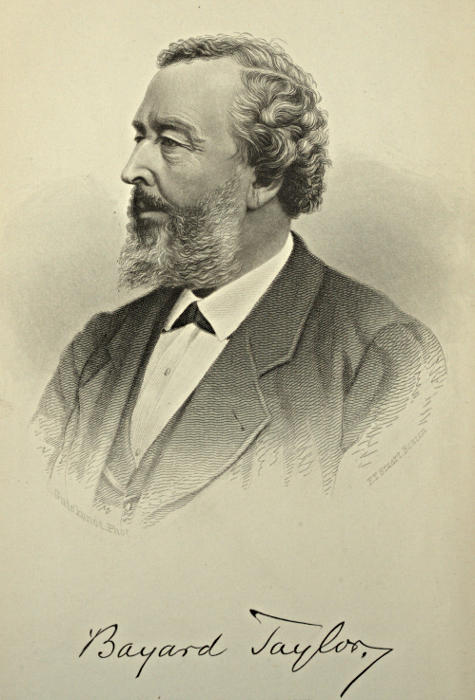
Grief at his Death.—Homage of the Great Men of Germany.—Tribute
from Auerbach.—Tributes from his Neighbors at Kennett
Square.—Extracts from Addresses.—The Great Memorial
Gathering at Boston.—The Great Assembly.—Speeches and
Letters.—Address of Dr. Oliver Wendell Holmes.—Henry W.
Longfellow’s Poem.—Letters from John G. Whittier, George
William Curtis, W. D. Howells, T. B. Aldrich, James T. Fields,
Whitelaw Reid, E. P. Whipple.—Tributes from his Near
Friends.—Closing Quotations from Mr. Taylor’s Writings.
The news of Bayard Taylor’s death called forth
universal expressions of regret. The press, secular
and religious, mentioned his decease with extended
editorial comment upon his useful and honorable life.
Public meetings were held to pay tribute to his memory,
and the Congress of the United States passed a
bill making Mrs. Taylor a gift of seven thousand dollars,
as a mark of the nation’s appreciation of Mr.
Taylor’s services.
In Germany, memorial services were held, at which
the greatest literary men of that empire made addresses,
showing their appreciation of Mr. Taylor’s
friendship and scholarship. But one of the most
touching tributes which Germany has given to the
memory of the deceased poet, was uttered by the celebrated
Berthold Auerbach, whose books are now found
in the libraries of many different nations, and who was
for many years the intimate companion of Mr. Taylor.
In his address made at Mr. Taylor’s funeral in Berlin,
where were gathered a large number of such men as
Dr. Joseph P. Thompson, Prof. Lepsius, Paul Lindau,
Julius Rodenberg, Prof. Gneist, Dr. Lowe, Count
Lehndorff, and numerous government officials, he thus
addressed the mourning friends:—
“Here, under flowers which have grown on German soil,
rests the perishable encasing wherein for fifty-three years
was enshrined the richly-endowed spirit which bore the name
of Bayard Taylor. Coming races will name thee who never
looked into thy kindly countenance, never grasped thy honest
hand, never heard a word from thy mouth. And yet no,
the breath of the lips fadeth away, but thy words, thy
words of song, will endure. In exhortation to thy surviving
dear ones, from the impulse of my heart as thine oldest
friend in the Old World, as thou were wont to call me, and
as representing German literature, I bid thee now a parting
farewell. What thou hast become and art to remain in the
empire of mind history will determine. To-day our hearts
do quake with grief and sorrow, and yet they are exalted.
Thou wert born in the fatherland of Benjamin Franklin, and
like him, to thine honor, raised thyself from a state of
manual labor to be an apostle of the spirit of purity and
freedom, and to be a representative of thy people among an
alien nation. No, not in a land of strangers, for thou wert
at home among us; thou hast died in the land of Goethe, to
whose high spirit thou didst always with devotion turn;
thou hast raised him up a monument before thine own people,
and wouldst erect him yet another in presence of all
men; but that design has disappeared with thee. But thou
thyself hast been, and art still, one of them whose coming
he announced—a disciple of the universal literature, in the
free and boundless air of which the everlasting element in
man, scorning the limits of nationality, mounts on bold,
adventurous flights and ever on new poetic fancies sunwards
soars. In thy very latest work thou didst show thou livedst
in that religion which embraces in it all creeds, and in the
name of no one separates one from another. Nature gifted
thee with grace and strength, with a soul clear and full of
chaste enjoyment, with melody and the tuneful voice to
search and proclaim the workings of nature in the eternal
and unexhausted region of being, as well as to sing the
earthly and ever-new joys of married and filial love, of
friendship, truth, and patriotism, and the ever higher ascending
revelations of the history of man. Born in the New
World, travelled in the Old, and oh, so soon torn from the
tree of life, thou hast taught thy country the history of the
German people, so that they know each other as brothers,
and of this let us remain mindful. In tuneful words didst
thou for thy people utter the jubilee acclaim of their anniversary.
When it returns, and the husks of our souls do lie
like this one here, then will the lips of millions yet unborn
pronounce the name of Bayard Taylor. May thy memory
be blessed.”
In one of his poems Mr. Taylor wrote, in 1862,—
“Fame won at home is of all fame the best,”
And how gratifying has it been to all of Mr. Taylor’s
friends to hear of the memorial gathering held in his
native Kennett, where young and old vied with each
other to do their townsman honor. With a modesty
and sincerity characteristic of the quiet community,
they assembled and talked of the virtues and achievements
of their deceased neighbor.
One townsman (Edwin Brosius) referred to Mr.
Taylor’s life, and in his remarks spoke thus:—
“Locating in Kennett Square about the time he returned
from his first visit to Europe, I remember him as a bright,
blushing, diffident youth, just entering manhood; and with
him I always associate that gentle and beautiful girl, with
matchless eyes, who inspired many of his early lyrics, and
whose death ‘filled the nest of love with snow.’ He was
the pride of the community then, and as years passed on
his course was silently watched with a quiet joy, like that a
parent feels for a child that seems to follow instinctively the
true path. His appointment as Minister to Germany created
a feeling that could be silent no longer, and here in this hall
we gave him the first ovation. No one thought that when
we said ‘Kennett rejoices that the world acknowledges her
son,’ that it would so soon be meet to say that Kennett
mourns that her son is dead. Yes, mourns with a grief like
that which he felt when he wrote ‘Moan, ye wild winds!
around the pane.’
“The weariness that oppressed him while being fêted
on every hand, which he thought was only temporary,
proved to be the shadow of the coming change. A few
more months and a few more warnings, and all was over.
“The strings are silent: who shall dare to wake them;
Though later deeds demand their living powers?
Silent in other lands, what hand shall make them
Leap as of old to shape the songs of ours?”
“Perhaps I have now said enough; but permit me to
speak briefly of one, still mentally bright under the weight
of fourscore years, the mother of Bayard Taylor, to whom
we must be indebted for much of the honor her son has
given us. The latent genius of the mother was more fully
developed in the son, and guarded, strengthened, and encouraged
by her watchful mind, he became all that she could
desire. When here at school, I remember how bright I
thought she was, and my admiration was not lessened when
she called me one of her boys. The voices of two of her
sons are now silent in the tomb. One taken when full of
hope, in the bloom of youth, while defending his country’s
flag. The other in the full fruitage of mature life, bearing
many honors, and the pillar of the family, a loss to her
which she cannot tell. We may speak or write our grief,
but no human pen or tongue can express hers; words cannot
tell how nearly the light of hope goes out when such
treasures are taken from a mother’s sight and heart.”
Another friend (Wm. B. Preston) contributed a
poem, in which two stanzas read as follows:—
“Though to the learned thy lofty works
Like mighty hosts appear;
The tale of her own neighborhood
Bids Kennett hold the dear.
And Cedarcroft! thy name will shine
Through ages long to come,
With Stratford and with Abbotsford,
The monarch minstrel’s home.”
Another neighbor (William W. Polk) gave an
extended sketch of Mr. Taylor’s career, and another
neighbor (Edward Swayne) contributed the second
poem, opening with,—
“On the margin of the Spree
Rests his body, is it he?
Is it all? or only part?
Questions still my doubting heart.
Traveller! in what realm, elate,
Dost thou read the book of fate?
Poet! in what finer mood
Singest thou infinitude?
Dost thou know the path we tend?
The beginning and the end?
Backward through the twilight past
What evolved us from the vast?
Forward, to what things afar,
We shall mount from star to star?
Canst thou see beyond the brink
What we faintly dare to think?
Though our thoughts are wrung with pain
Yet we question but in vain.
Still no sound the silence breaks,
Not to us the dead awakes.”
Numerous friends addressed the gathering; there were
hymns, quotations, and letters from others, and the
whole people exhibited an interest in honoring his
memory.
At Boston, Mass., there was held, shortly after Mr.
Taylor’s death, one of the most notable gatherings ever
seen in America, so spontaneous and universal was
the desire to do honor to their deceased countryman.
The gathering was in Tremont Temple, and was under
the auspices of a literary association known as “The
Boston Young Men’s Congress.” The young men
studiously avoided any arrangement or announcement
which would give the gathering any appearance of
display or ceremony, and the friends of Mr. Taylor in
that city came together in such numbers, that long
before the hour appointed for the opening of the meeting,
that great hall was crowded in every part, while
immense crowds so choked the entrances that the
police were obliged to close the gates and shut out the
throng. The great majority of the audience consisted
of literary persons and of officials of the State and
nation. Russell H. Conwell presided, and opened the
exercises by giving a brief sketch of Mr. Taylor’s
early life, after which there followed other informal
addresses by Dr. Oliver Wendell Holmes; Richard
Frothingham, the historian; A. B. Alcott, the author;
J. Boyle O’Reilly, the poet; Hon. J. B. D. Cogswell,
the president of the Massachusetts Senate;
Curtis Guild, the author; Dr. William M. Cornell, and
others. Letters were read from James T. Fields,
George William Curtis, W. D. Howells, E. P. Whipple,
John G. Whittier, T. B. Aldrich, and regrets
for their inability to be present expressed by President
Rutherford B. Hayes, Hon. Charles Devens, ex-Governor
Henry Howard, of Rhode Island, General B. F.
Butler, Richard H. Dana, Sr., W. A. Simmons, W.
F. Warren, D. D., Mrs. Louise Chandler Moulton,
Governor Thomas Talbot, of Massachusetts, and many
other distinguished men.
The crowning feature of the evening’s exercises consisted
in the reading of Longfellow’s poem, “Bayard
Taylor,” by Dr. Oliver Wendell Holmes. The audience,
hushed into almost breathless silence, hung upon
Dr. Holmes’s introductory remarks, with a fascination
seldom seen, and when that sweet poem was reached,
and its reading began, tears were seen in many eyes,
so pathetic and solemn was the impression.
The grand chorus of the Boston Mendelssohn Choral
Union, under the direction of Prof. Stephen A. Emery,
of the New England Conservatory of Music, sang in
a most artistic and impressive manner some of those
charming old German chorals which Mr. Taylor loved
so much, and pleased the audience much with its rendition
of “Oh, for the wings of a Dove,” with Mr.
Wilkie and Miss Fisher as soloists.
Nothing can show the regard in which Mr. Taylor
was held, better than the contributions to that informal
gathering, and we cannot do less than preserve some
of them for the benefit of posterity, especially as it
was that gathering which suggested this book.
Dr. Holmes’s address was nearly as follows:—
“I can hardly ask your attention to the lines which Mr.
Longfellow has written, and done me the honor of asking
me to read, without a few words of introduction. The poem
should have flowed from his own lips in those winning
accents too rarely heard in any assembly, and never forgotten
by those who have listened to him. But its tenderness
and sweetness are such that no imperfection of utterance
can quite spoil its harmonies. There are tones in the contralto
of our beloved poet’s melodious song that were born
with it, and must die with it when its music is silenced.
“A tribute from such a singer would honor the obsequies
of the proudest sovereign, would add freshness to the laurels
of the mightiest conqueror. But he who this evening has
this tribute laid upon his hearse, wore no crown save that
which the sisterhood of the Muses wove for him. His victories
were all peaceful ones, and there has been no heartache
after any of them. His life was a journey through
many lands of men, through many realms of knowledge.
He left his humble door in boyhood, poor, untrained,
unknown, unheralded, unattended. He found himself, once
at least, as I well remember his telling me, hungry and well-nigh
penniless in the streets of an European city, feasting
his eyes at a baker’s window and tightening his girdle in
place of a repast. Once more he left his native land, now
in the strength of manhood, known and honored throughout
the world of letters, the sovereignty of the nation investing
him with its mantle of dignity, the laws of civilization surrounding
him with the halo of their inviolable sanctity,—the
boy who went forth to view the world afoot, now on
equal footing with, the potentates and princes who, by right
of birth or by the might of intellect, swayed the destinies
of great empires.
“He returns to us no more as we remember him, but his
career, his example, the truly American story of a grand,
cheerful, active, self-developing, self-sustaining life, remains
as an enduring inheritance for all coming generations.”
Mr. Longfellow’s poem, as read by Dr. Holmes,
was as follows:—
“Bayard Taylor.
“Dead he lay among his books!
The peace of God was in his looks.
As the statues
[2] in the gloom,
Watch o’er Maximilian’s tomb,
So those volumes from their shelves
Watched him, silent as themselves.
Ah! his hand will never more
Turn their storied pages o’er;
Never more his lips repeat
Songs of theirs, however sweet.
Let the lifeless body rest!
He is gone who was its guest.
Gone as travellers haste to leave
An inn, nor tarry until eve.
Traveller! in what realms afar,
In what planet, in what star,
In what vast aerial space,
Shines the light upon thy face?
In what gardens of delight
Rest thy weary feet to-night?
Poet! thou whose latest verse
Was a garland on thy hearse,
Thou hast sung with organ tone
In Deukalion’s life thine own.
On the ruins of the Past
Blooms the perfect flower, at last.
Friend! but yesterday the bells
Rang for thee their loud farewells;
And to-day they toll for thee,
Lying dead beyond the sea;
Lying dead among thy books;
The peace of God in all thy looks.”
—Henry Wadsworth Longfellow.
We also insert a part of Dr. Wm. M. Cornell’s
address:—
‘Mr. President:—As you have introduced me as ‘The
Historian of Pennsylvania,’ or, ‘Penn’s Woods,’ as you
know the term means, you will allow me to say something
of that good old noble Commonwealth which gave birth to
Bayard Taylor, whose recent and sudden demise has called
us together. As he was a worthy son of that Quaker land,
something about it may be expected of their historian. I
know the Quakers have never had much love for Boston,
and I do not think they are to blame for it either; for
if you had treated me as they were treated in this vicinity,
with all the grace given me I don’t think my love for
you would superabound. But we will not revive, on this
solemn occasion, the bigotry and illiberality of the past,
especially as this vast audience, assembled in this old Pilgrim
city to honor the memory of a gifted son of Quakerdom,
looks very much like ‘bringing forth fruits meet for
repentance’ of those deeds of yore.
“Grand old Pennsylvania! the keystone of the nation;
for you all know the old proverb, ‘As goes Pennsylvania,
so goes the Union,—I honor thy name! Thy sons are
patriots! The Indian sachem said to the first ‘pale faces’
who came here (understand, I speak as a Pennsylvanian, in
accordance with my introduction), ‘This is our ground.
We came up right out of this ground, and it is our ground.
You came up out of ground away beyond the big waters,
and that’s your ground.’
“Bayard Taylor, the poet, the traveller, the biographer,
the botanist, the patriot, the plenipotentiary, whom we so
justly mourn, came up out of this land. He was a true son
of our soil, which has always produced patriots. Think you
President Hayes did not know this when he appointed him
Minister to that grand old nation, Germany,—the land of
Emperor William, and Minister Bismarck,—the most learned
in the world? The President did honor to himself by this
appointment, and Bayard Taylor did honor to our nation,
and is mourned by the whole world.”
Omitting the address of the letters for sake of
brevity, we insert several:—
“Dear Sir:—Will you have the kindness to express to
the committee of arrangements my deep regret at not being
able to attend the meeting at Tremont Temple in honor of
Bayard Taylor’s memory. I sail from New York for
Europe on the 8th instant. I also regret that the pressure
of private matters will not allow me to prepare a tribute to
my old friend. You will understand how nearly his death
touches me, when I say that it breaks an unclouded intimacy
of twenty-four years. If it should be in order, perhaps
some one will read the poem which I printed in the New
York ‘Tribune’ on Christmas morning. I enclose a copy.
“Yours, very respectfully,
“Thomas Bailey Aldrich.”
To which was attached the following poem:—
“In other years—lost youth’s enchanted years
Seen now and evermore, through blinding tears
And empty longing for what may not be
—
The Desert gave him back to us; the Sea
Yielded him up; the icy Northland strand
Lured him not long, nor that soft German air
He loved could keep him. Ever his own land
Fettered his heart and brought him back again.
What sounds are those of farewell and despair
Blown by the winds across the wintry main?
What unknown way is this that he has gone,
Our Bayard, in such silence, and alone?
What new, strange guest has tempted him once more
To leave us? Vainly standing by the shore
We strain our eyes. But patience ... when the soft
Spring gales are blowing over Cedarcroft,
Whitening the hawthorn; when violets bloom
Among the Brandywine, and overhead
The sky is blue as Italy’s—he will come;
Ay, he will come. I cannot make him dead.”
“Dear Friend:—I am not able to attend the memorial
meeting in Tremont Temple on the 10th instant, but my
heart responds to any testimonial appreciative of the intellectual
achievements and the noble and manly life of Bayard
Taylor. More than thirty years have intervened between
my first meeting him in the fresh bloom of his youth and
hope and honorable ambition, and my last parting with him
under the elms of Boston Common after our visit to Richard
H. Dana, on the occasion of the 90th anniversary of that
honored father of American poetry, still living to lament the
death of his younger disciple and friend. How much he has
accomplished in these years! The most industrious of men,
slowly, patiently, under many disadvantages, he built up his
splendid reputation. Traveller, editor, novelist, translator,
diplomatist, and through all and above all poet, what he was
he owed wholly to himself. His native honesty was satisfied
with no half tasks. He finished as he went, and always said
and did his best.
“It is perhaps too early to assign him his place in American
literature. His picturesque books of travel, his Oriental
lyrics, his Pennsylvanian idyls, his Centennial ode, the
pastoral beauty and Christian sweetness of ‘Lars,’ and the
high arguments and rhythmic marvel of ‘Deukalion,’ are
sureties of the permanence of his reputation. But at this
moment my thoughts dwell rather upon the man than author.
The calamity of his death, felt in both hemispheres, is to me
and to all who intimately knew and loved him, a heavy personal
loss. Under the shadow of this bereavement, in the
inner circle of mourning, we sorrow most of all that we shall
see his face no more, and long for ‘the touch of a vanished
hand and the sound of a voice that is still.’
“Thy friend,
“John G. Whittier.”
“Dear Sir:—I very much regret that I shall not be
able to accept the invitation of the Young Men’s Congress
for Friday evening of next week. At the same time I wish
in heartiest sympathy to unite with them in honoring the
memory of Bayard Taylor, whom I not only valued as a man
of the highest intellectual qualities, but in whose loss I have
to lament a dear friend. I beg you to convey to the committee
of arrangements my deep sense of honor done me.
“Very truly yours,
“W. D. Howells.”
“My Dear Sir:—An illness which confines me to the
house will prevent my being present at the meeting of the
19th instant. I regret the circumstance very deeply, as it
pains me to be absent on any occasion in which the memory
of Bayard Taylor is to be honored.
“Very sincerely yours,
“E. P. Whipple.”
“Gentlemen of the Committee of the Taylor Memorial:—An
imperative duty calls me to a distant county of
the State on the evening set apart for the meeting at Tremont
Temple. But even if I were not obliged to be absent from
our city on that night, I doubt if I should have the courage
to be present and trust my voice with any words fitting to
such an occasion. The departure of my dear Bayard Taylor
is so recent, his loss so unexpected, that my lips could only
falter out a few broken expressions of individual sorrow,
and I should be wholly incapable of any adequate public
tribute to his memory. So many years of exceptional and
near relationship with him—a brotherly intercourse, unclouded
from early manhood onward through his life—would
incapacitate me from taking part before an audience assembled
to honor his genius and his virtues, and I should
probably be able only to stammer through tears an apology
for my inability to speak his praises. These tender words
by Halleck better convey my meaning:—
‘While memory bids me weep thee,
Nor thoughts nor words are free,
The grief is fixed too deeply
That mourns a man like thee.’
“James T. Fields.”
“Dear Sir:—I am very sorry that my engagements
compel me to decline your invitation to attend the meeting
in memory of Bayard Taylor. But no one will say any word
of praise of his manly and generous character, or of gratitude
for his noble example of faithful industry, to which my
heart will not respond. I knew him well for nearly thirty
years, and when I said good-by to him last May, as he departed,
amid universal applause and satisfaction, upon a
mission to Germany, he was as frank and simple and earnest
as the youth whom I remember long ago. He died in the
fulness of his activity and hope; but the death of a man so
true and upright leaves us a sorrow wholly unmixed with the
wish that his life might have been different, or with regret
that it was only a promise. Like the knight-at-arms, whose
name he bore, he was a gentle knight of letters, without fear
and without reproach, and by those of us who personally
knew him well he will be long and tenderly remembered.
“Truly yours,
“George William Curtis.”
“Dear Sir:—Nothing but an imperative engagement
elsewhere could keep me from uniting with those friends of
my friend—Bayard Taylor—who propose next Friday, in
Boston, to commemorate his life and virtues. From our
professional association, I could not but know him intimately,
and he was one of the few men of distinction with
whom every added year of intimacy continued to brighten,
not merely your affection, but also your respect. The
essential characteristic alike of his life, and his work, was
its inherent honesty. He described what he saw; he wrote
what he thought; he meant friendship if he gave you his
hand. I never knew him to shrink from expressing an
opinion, merely because it was unpopular; and, I am sure,
he never sought a man merely because the man was powerful.
He had an honest pride in what he had done,—a pride
that made him eager to share his good fame and fortune
with his earliest and humblest friends. He had the genius
of hard work. He did many things; he came to do most
of them extremely well, and not a few of them easily; but
he never undertook any task, however familiar, or however
humble, without doing his best. Those who did not know
him, have sometimes described him as more German than
American; but if these be German qualities, we may well
be eager to see them naturalized.
“Quick to the praise of his old Quaker friends, nothing
touched him more than the praise of Boston; and to those
that prize his memory, nothing now can be more grateful
than the sympathetic appreciation of your meeting.
“I am, very respectfully,
“Whitelaw Reid.”
“My Dear Conwell:—I acknowledge the courtesy
of your invitation to do myself the honor to take part in
honoring my deceased friend,—the late Minister at Berlin.
“I am grieved beyond expression that the necessities of
public duty require my leaving so early for Washington,
that, in making my arrangements, it is impossible for me to
be in town overnight.
“Independent of the public relations of duty, it is well to
pause to do honor to one who has so faithfully and well
served his country, and his kind. I have the deepest sensibilities
of remembrance of Bayard Taylor’s personal kindness
to me on many occasions, and especially as his guest,
to incite me to be present.
“I am glad that Massachusetts, in the meeting you assemble,
will show her appreciation of his character and services,
and regret, with more than ordinary emotion, that I am
prevented from taking part in it.
“Please represent me as wishing to say and do all that I
might in that behalf, and believe me,
“Yours truly,
“Benj. F. Butler.”
Mr. Taylor had been a great favorite at the Century
Club, in New York, and a frequent visitor at the Lotus
Club of the same city. He was usually accompanied
by some one or two of his intimate friends, and at the
time Mr. Taylor’s death was announced, several of
them who had been known to be his close companions
were requested to give to the “Tribune” letters of
“reminiscences” for publication. Among these thus
hastily collected tributes were several of those which
follow. Mr. Richard H. Stoddard said:—
“I have known Mr. Bayard Taylor so long that I hardly
know when our acquaintance began. It was at least thirty
years ago, during his first year’s residence in New York, after
his tour in Europe and the publication of his ‘Views Afoot.’
The occasion of our acquaintance was a magazine which had
lately been started here, and which was edited by Mrs.
Caroline M. Kirkland, one of my earliest and best literary
friends. I had contributed to this periodical, which was
entitled ‘The Union Magazine,’ and on her departure
for Europe she recommended me to call upon her young
friend, Mr. Taylor, who was to take care of it for her during
her absence. She was sure I would like him, for we
were Arcades ambo. I called upon him, and liked him, as
she had foreseen I would. I found him in the editorial
room of the ‘Tribune,’ a dingy, dusty, comfortless den on
the same floor with the composing-room, if I remember
rightly. He was seated on the hither side of an old ink-stained
desk, which was surrounded by a railing, over which
newspapers were flung, and was writing rapidly. He looked
up when I addressed him and stated my errand—a bright,
joyous, handsome man of twenty-five, with a world of
animation in his sparkling dark eyes. I have no recollection
of what passed between us, except that the poem which
was in his hands was accepted, and that we had taken a
fancy to each other. I went away feeling happy, for I felt
that I had made a friend, and one who could sympathize
with me. There were two bonds between us—love of verse,
and equality of years. He was the first man of letters who
had treated me like one of the craft, and I was grateful to
him, as I should have been, for I was weary of the intellectual
snobbery I had undergone from others.
“It was not long before we were what Burns calls ‘bosom
cronies.’ We used, I remember, to spend our Saturday
evenings together, generally at his rooms, which were within
a stone’s throw of the ‘Tribune’ office, at a boardinghouse
in Warren Street, not far from Broadway. He lived
in a sky parlor, which is present before me now, as if I had
seen it but an hour ago. I remember just where his table
stood, and the little desk upon which he afterward wrote
so many books, and upon which he was then writing so
many charming poems. I took up the collected edition of
his poetical works this afternoon in my library, and turning
over the leaves sorrowfully, felt the weight of thirty years
roll from me—not lightly, as it would have done a few
weeks ago, but with a pain for which I have no words.
They were all there, the poems which I remembered so well—‘Ariel
in the Cloven Pine’ (which I read in MS. before
it saw the light of print), ‘The Metempsychosis of the
Pine,’ ‘Mon-da-min’ (which was written years before the
‘Song of Hiawatha’), ‘Kubleh,’and, saddest of all, the
solemn dirge beginning ‘Moan, ye wild winds! around the
pane.” As I read, I saw the eager face, the glowing eyes,
the kindly smile of the enthusiastic young poet, whom the
world preferred to consider as a traveller merely, and who
knew so many things of which I was profoundly ignorant.
My nature is not a reverent one, I fear, but I looked up to
Bayard Taylor, and admired his beautiful genius. We read
and criticised each other’s verse a good deal too lightly and
generously, I have since thought, and talked of the poets
whom we were studying. It was his fancy that there was
something in his genius which was allied to that of Shelley,
and I hoped that I might claim some relationship with Keats,
enough at least to make me a ‘poor relation.’ We talked
long and late; we smoked mild cigars; and, once in a while
when our exchequers were replenished, we indulged in the
sweet luxury of stewed oysters, over which we had more
talk, of present plans and future renown. I was, I believe,
Bayard Taylor’s most intimate friend at this time, and the
one with whom he most consorted, though he had, of course,
a large literary acquaintance among the young writers of
the period, whose name was Legion, and whose works are
now forgotten. I have spent many happy nights with my
dead friend, but none which were so happy as those. I
looked forward to them as young men look forward to holidays
which they have planned. I look back upon them as
old men look back to their past delights, with pity and
regret.
“The world, as I have said, considered Bayard Taylor as
a traveller, and it was his pleasure, as well as his profit,
during the first years of our friendship, to travel largely in
California, in Egypt, in Japan, and elsewhere in the Old
World. I read his letters of travel as they appeared in the
‘Tribune,’ and I read these letters again which he collected
thus in books after his return. I saw that they were good
of their kind; I felt that his prose was admirable for its
simplicity and correctness; but, with a waywardness which
I could not help, I slighted them for his poetry. I thought
then, and think still, that his ‘California Ballads’ and
‘Poems of Travel’ are masterly examples of spirited, picturesque
writing, and I am sure that his ‘Poems of the
Orient’ are superior to anything of the kind in the English
language. They have a local color which is absent from
‘Lalla Rookh.’ The ‘Bedouin Song,’ for instance, is
instinct with the fiery, passionate life of the East, and is a
worthy companion-piece to Shelley’s ‘Lines to an Indian
Air.’ The ‘Poems of the Orient’ were dedicated to me, I
shall always be happy to remember, in a poetical ‘Epistle
from Tmolus.’
“Bayard Taylor had a sunny nature, which delighted in
simple pleasures, and he had the happy art of putting
trouble away from him. One trouble, however, he could
not put away, as those who are familiar with his life and
poems are aware. I have spoken of one of his early poems
(‘Moan, ye wild winds! around the pane’), which embodied
the first great sorrow of his young manhood. It was written
after the death of his first wife, whose memory it embalms,
and whose tender presence haunted him later in
‘The Mystery’ and ‘The Phantom.’ Among the literary
acquaintances of Bayard Taylor and myself, I must not forget
to mention the late Fitz James O’Brien, whose promise
was greater than his performance, and who, clever as he
was in prose, was at his best a graceful poet. Taylor and
O’Brien were in the habit of meeting in my rooms at night,
about twenty-five years ago, and of fighting triangular
poetical duels. We used to sit at the same table, with the
names of poetical subjects on slips of paper, and drawing
out one at random, see which of us would soonest write a
poem upon it. This practice of ours, which is well enough
as practice merely, was the origin of Bayard Taylor’s ‘Echo
Club.’
“Always a charming companion, Bayard Taylor was
delightful in his own home at Cedarcroft. I remember visiting
him there when he gave his ‘house-warming,’ and the
merriment we had over a play which we wrote together,
speech by speech, and scene by scene, and which we performed
to the great delectation of his friends and neighbors.
Many of the latter had never seen a theatrical performance
before, and, I dare say, have never seen one since. Our
play was a great success, and ought to have been, for there
was not a word in it which had not done duty a thousand
times before! We called it ‘Love in a Hotel.’ ‘Miller
Redivivus’ would have answered just as well, if not better.
“The recollections of thirty years cannot be recalled at
will, and seldom while those who shared them with us are
overshadowed by death.” I remember merry days and nights
without number, and I remember sorrows which are better
forgotten. One of my sorrows was deeply felt by Bayard
Taylor, who, fresh from the reading of the second part of
‘Faust,’ saw in my loss a vision of Goethe’s ‘Euphorion.’
“The last time, but one, when I saw my friend alone
was three or four nights before his departure for Berlin. It
was one night at my own house, at a little gathering to
which I had invited our common friends, comrades of ten
and twenty years’ standing, poets, artists, and good fellows
of both sexes. It was notable on one account, for our
great poet Bryant came thither to do honor to his younger
brother, Bayard Taylor. I cannot say that it was a happy
night, for it was to be followed by an absence which was
close at hand,—an absence which was to endure forever.
Before two months had passed, the Nestor of our poets was
gathered to his fathers in the fullness of his renown. His
sons bewailed their father; my good friend Stedman, in a
noble poem in the ‘Atlantic Monthly,’ and Bayard Taylor in
a solemn ‘Epicedium’ in ‘Scribner’s Monthly.’ And now
Bayard Taylor is gone!
“‘Insatiate archer, could not one suffice?’ The world
of American letters has lost a poet in Bayard Taylor; but
we who knew and loved him—have lost a friend.
“R. H. Stoddard.”
“New York, Dec. 19, 1878.”
Mr. Edmund C. Stedman, the poet, who enjoyed
a very close intimacy with Mr. Taylor, spoke of him
to the editor as follows:—
“The causes which led to his death at this time, date back
several years. When he returned from Europe then, he
found his real estate and personal property largely depreciated
and encumbered, and though near the age of fifty, he again
found himself forced to tolerable hard work to support his
family and position. It was this hard work, coupled with
his resolute purpose, however other work might engross him,
to keep up his more serious contributions to permanent
literature, that ultimately led to his death. He took great
pride in his home and broad acres, at Kennett Square, Penn.,
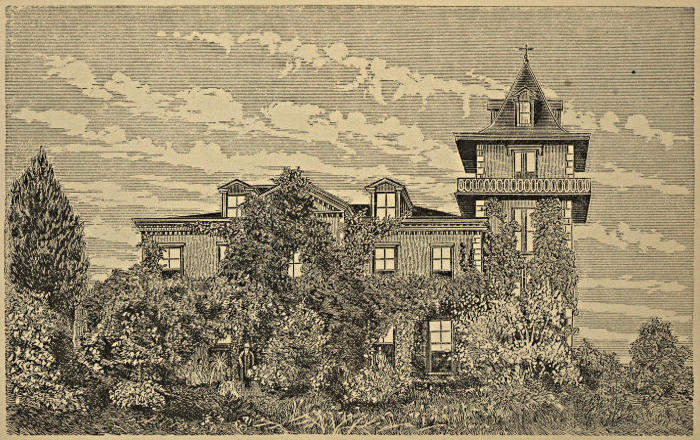
his native place. He designed his own house, ‘Cedarcroft,’
and spent a great deal of money in its erection, and
that, with the two hundred acres of land, which he owned
and had greatly improved, was a source of expense rather
than income to him. He had a handsome competence when
he went abroad, all of which he earned as a journalist,
author, and lecturer, never having earned any money except
by his pen. He decided to maintain his property in Kennett
Square, and he set to work immediately to pay off the
debt. During the last four years, he has accomplished this, his
income amounting to from $12,000 to $18,000 a year; but
he obtained it by very hard work. In fact, he had worked
harder and accomplished more in that time than perhaps any
other living literary man. He lectured each winter, in all sorts
of weather, and in different parts of the country. He contributed
largely to magazines and reviews, and never more
brilliantly, besides doing a great amount of regular work
for the ‘Tribune.’ He came from a long-lived family, and
his strength was very great, but he undertook too much. He
did the work of two able-bodied men every day, and his
health gave way under the great strain on one or two
occasions. He was compelled to go to the White Sulphur
Springs, and other places for recuperation; but he forced
himself to work again before he had fully recovered. During
this time he wrote his last and most important poem,
‘Prince Deukalion.’ It was a source of great trial to himself,
and of regret to his friends, that he was unable to go
on with his ‘Life of Goethe,’ for which he had secured material
during his last sojourn in Germany. The great trouble
with him was his inability, owing to his excessive labors, to
take sufficient social recreation. His enemies, very few in
number, have falsely attempted to make a point against him
on this account, charging him with excessive beer-drinking.
It was his want of recreation and rest that killed him. He
was forced to take some stimulus to support himself under
exhausting labor; but he was not an excessive beer-drinker
as he has been charged, though what he did take may have
helped to develop his disease.
“No man in the country could do so much journalistic
work, and do it so well in a given time, as could Mr. Taylor.
He was remarkable in brilliant off-hand feats of literary
criticism. As an illustration, I might mention that
about a year ago two large octavo volumes, containing
poems by Victor Hugo, in the French, arrived by steamer, and
were placed in Mr. Taylor’s hands on Thursday evening. For
some reason it was desirable that the criticism should appear
in the ‘Tribune’ of the following Saturday, and, of course,
the copy had to be in the printers’ hands early on Friday
night. Mr. Taylor’s health was bad at the time, and he
also had in the meantime to deliver a lecture in Brooklyn,
and another in New York. He finished his review in time
on Friday night, and it appeared in the ‘Tribune’ the following
morning, covering more than two-thirds of a page.
It was equal to any of his literary criticisms, and surpassed
any analysis of Hugo’s genius that I have ever seen. One
remarkable feature of the review was over a column of
translation into English poetry from the original, including
several lyrics and idyls so beautifully done that they seemed
like original poems in the English.
“Mr. Taylor was a man of wide and thorough learning,
and was a much more exact scholar than would be supposed,
considering that he was never at college, and spent
a great deal of time in travel and observation. He had a
smattering of all languages. He was familiar with Latin
and Greek, spoke French well, and German like a native;
he also conversed in Russian, Norse, Arabic, Italian, and
knew something of modern Greek. His knowledge of
Greek was increased by his classical feeling, which, as with
Keats, amounted almost to a passion. He was a good
botanist, and somewhat of a geologist, and was an established
authority on geographical questions. He was greatly
interested in all scientific studies.
“As a man he was a peer among his fellows. He was
the most simple, generous-hearted man of letters I ever
knew. He was the first literary man I met in New York,
my acquaintance dating from the time he came and took me
by the hand in 1860, after the publication of one of my
articles. He was never so happy as when surrounded by
his friends in his own house. He had unbounded hospitality,
and made his house the centre of literary life in the city.
New York will greatly miss him, and just such a leader was
needed to give encouragement to our literary life. He was
accused sometimes of egotism; but he was not egotistical
in the proper sense of the term. He was frank and out-spoken,
and showed his feelings plainly, which gave rise to
that charge. He always denounced shams and humbugs;
but I do not believe he ever did a mean act, and he never
grew angry except on account of the meanness of others.
“His private letters, of which I had a great number, were
far more delightful than his published ones. He was very
careful in his published letters not to say anything that
might wound the feelings of distinguished persons from
whom he received hospitality abroad. His private letters
are full of the most interesting anecdotes and conversations
with leading authors and magnates of other lands, and are
charming in their clearness and esprit. His faults, and we
all have them, were rather of a lovable nature. He cared
most for his reputation as a poet, and his books on travel
and novels were a secondary matter with him.
“Mr. Taylor did not seek the appointment as Minister to
Germany, but other positions were tendered him which he
declined, and this was offered rather in obedience to popular
demand. Mr. Taylor, Mr. Boker, and Mr. Stoddard
started together in literary life thirty years ago, and they
have always worked together, and have been firm friends.
It was a rather curious coincidence that Mr. Boker should
follow as Minister Mr. Taylor as Charge d’Affairs in Russia,
and that just as Boker returned from Russia, Mr. Taylor
should be sent as Minister to Germany.”
Mr. Samuel Coleman, the artist, said of him:—
“I first knew Mr. Taylor nearly twenty years ago, and
my acquaintance with him has always been of the pleasantest
kind. I shall never forget a visit that I made to his home
at Kennett Square, in 1861, in company with a brother
artist. Much of our conversation was on art subjects, and
in the evening Mr. Taylor read to me with great gusto some
poems written by an extravagant Southern writer. He read
the poems in a manner that showed his keen appreciation of
’ the comic element, and kept us laughing at the passages
which the author had intended to be most dramatic. Mr.
Taylor was a most genial host, and knew how to keep a
room full of persons in the happiest mood. His speeches
and his manner at such times cannot be described.
“In art matters Mr. Taylor was thoroughly at home.
He could not only write a good criticism of a painting, but
he was also proficient in the use of brush and pencil. He
began sketching when he was a boy, and he executed many
paintings in water-colors. He was made one of the members
of the Water-Color Society soon after the society was
started. Several of his works were shown at the annual
exhibitions of the society, and were much admired. I met
Mr. Taylor by appointment at Florence, Italy, in the spring
of 1873, and visited with him for a short time in that city.
We had talked of making a journey to Egypt together. I
was to do some sketching there, while he was to glean
materials for a book. Ill-health prevented me from making
the proposed journey at that time, and I left him in
Florence. He there occupied the rooms where Mrs.
Browning had lived.
“In later years I had not seen so much of Mr. Taylor as
I had wished. I remember the brilliant part he played in
the Twelfth Night entertainment of the Century Club last
winter, when he put on a high conical cap and marched
about the room beating a large drum. As on many other
occasions, his wit was displayed in comical speeches and
retorts that kept his listeners laughing by the hour. I saw
him for the last time at the house of a friend, when he
spoke earnestly of the many happy associations he was
about to leave. His heart was in this country, however
much his interests might lie abroad.”
Mr. Charles T. Congdon, an associate on the
“Tribune,” wrote:—
“Everybody in the office knew how high Mr. Taylor
stood in the estimation of Mr. Greeley. A man who had
worked his way up; who, beginning as a printer, had come
to be an admired writer, who was ambitious of excellence,
and not afraid of toil to attain it, Mr. Greeley was naturally
fond of. So, when the monument of the great journalist
was to be dedicated, Mr. Taylor was properly selected to
make one of the principal addresses on the occasion. How
good that address was, how well conceived and arranged
and delivered, need not be said to those who had the satisfaction
of hearing it. It was indeed an impressive occasion
when, standing above the tomb of his old master, surrounded
by those to whom that noble man was dear, with the liberal
sky stretched over the earnest speaker, and the great, busy
city in the distance, Mr. Taylor, in manly words and
sonorous voice, paid those glowing tributes to which all our
hearts responded. Somebody now must speak for him; but
his memory will lack no eulogist. There is enough to say
of such a vigorous and wise career; something, too, there
is, alas! which must be left unsaid. Of any of us who
remain, had our fate been his, he would have spoken kind
and generous words; nor should he go to his grave ‘without
the meed of one melodious tear.’
“After many years had gone by, Mr. Taylor came back
to do regular daily work in the ‘Tribune’ office, and this he
continued until his departure for Germany. I was near
him, and, if there were any need of it, I could speak again of
his unflagging industry, and of his excellent qualities as a
journalist. He had the faculty which every newspaper
writer should possess, of writing fairly well upon any topic
confided to him. Of course his special skill was displayed
in literary labor; but when he saw fit to write upon what
may be called secular themes, he did so in an able and
judicious way. He was thoroughly kind and obliging, and
always willing to lend his help, or to give his advice when
it was asked for, as it often was. Somehow, I cannot get
away from the impression of his untiring assiduity. He
seemed to have always a great variety of work in hand—work
at home and in the office—as if he had caught something
of the power of toiling from that great German upon
whose biography he was then engaged. If he was somewhat
proud of his accomplishments—thinking over the matter
more, I see that he had a right to be—he had done much,
and he had done it well, and he was entitled to the indulgence
of some complacency.
“When the rumor came that Mr. Taylor was to be taken
away from us for a time and advanced to high diplomatic
honors, I think that we were all as proud of it as he was,
and felt it to be a recognition, not perhaps made too soon,
of the importance of journalism. It was something to send
forth from among ourselves an Ambassador to the German
Empire, and we were personally grateful to the powers at
Washington, though we thought them also the obliged party.
In our own way, and in our own place, and with a small
token of our good-will, we bade Mr. Taylor farewell on that
April afternoon, and spoke jestingly of the time when, his
court-dress put off, we should welcome him back to his old
desk. There came a statelier leave-taking afterward, when
so many of the best and most distinguished of our citizens
met to take leave of him in a more formal manner; but I
think that he prized our little demonstration quite as highly,
and thought of it afterward on the sea and in foreign lands
quite as often.
“A man must be judged by what is best in him, by what
he has really done, and not by the accidents of his
character. Few Americans have written more, and
more variously, than Mr. Taylor, and few have written
better. Those of us who know how he owed nothing to
chance, how methodical and painstaking he was, how he
conquered difficulties which would have dismayed a weaker
man, are in a position to judge of his merits, and to accord
to him words of praise, little as he needs them, which have
a specific meaning.”
James T. Fields, in the tributes published in the
“Tribune,” gave this sketch of the acquaintance and
friendship existing between Mr. Taylor and himself:—
“The death of a man like Bayard Taylor, awakens universal
sorrow. Throughout the land of his birth a tearful
grief has overspread the nation, and he is mourned everywhere,
far and wide, in America. There never lived a public
man of greater bonhomie, or of a franker disposition. He
had many honors to bear, but he bore them meekly, and like
an unspoiled child. Cynicism and vulgar egotism were
strangers to his truthful nature; there were no jarring
chords either in his understanding or his heart, and so he
became his country’s favorite, as well as her pride.
“Thirty-two years ago, on a bright spring morning, a
young man of twenty-three held out his hand to me, and introduced
himself as Bayard Taylor. We had corresponded
at intervals since his first little volume was published in 1844,
but we had never met until then. He had come to Boston,
rather unexpectedly, he said, to see Longfellow, and Holmes,
and Whipple, and some others, who had expressed an interest
in his ‘Views Afoot,’ then recently printed in book-form.
No one could possibly look upon the manly young
fellow at that time without loving him. He was tall and
slight, with the bloom of youth mantling a face full of eager,
joyous expectation. Health of that buoyant nature which
betokens delight in existence, was visible in every feature of
the youthful traveller.
‘The fresh air lodged within his cheek
As light within a cloud.’
“We all flocked about him like a swarm of brothers, heartily
welcoming him to Boston. When we told him how charmed
we all were with his travels, he blushed like a girl, and tears
filled his sensitive eyes. ‘It is one of the most absorbingly
interesting books I ever read!’ cried one of our number,
heightening the remark with an expletive savoring more of
strength that of early piety. Taylor looked up, full of happiness
at the opinion so earnestly expressed, and asked, with
that simple naivete which always belonged to his character,
‘Do you really think so? Well, I am so glad.’
“Then we began to lay out plans for a week’s holiday with
him; to-morrow we would go to such a place down the harbor;
next day to another point of interest; after that we
would all assemble at a supper party in his honor, at Parker’s
(at that time a subterranean eating-house in Court
Street), and following that festivity we would take him to
see old Booth in Richard. We went on filling up the seven
days with our designs upon him, when he protested, with an
explosive shout of laughter, that he must be back again in
New York the next day. Then we showered warm exhortations
upon him to postpone his exit, but he assured us that
go back he must, for he had promised to do so. Well, then,
if that were the case, and we saw by his countenance that
he meant what he said, we must adjourn at once to ‘Webster’s,’
a famous beefsteak house in those ancient days, and,
as Whipple facetiously remarked, quoting the old ballad:
‘Put a steak in his inside
Where the four cross-roads did meet.’
“So thitherward we rollicked along into Washington Street,
and performed that pleasant duty, Taylor all the while
brimming over with radiant spirits, his young heart already
illumined with the delight of recognition and praise.
“In the afternoon we handed him over to Longfellow, whom
he was anxious to meet, and who gave him such a welcome
as he never forgot. In one of the last conversations I had
with Taylor, a few weeks before he sailed for the Embassy,
he said, with deep feeling: ‘From the first, Longfellow has
been to me the truest and most affectionate friend that ever
man had. He always gives me courage to go on, and never
fails to lift me forward into hopeful regions whenever I meet
him. He is the dearest soul in the world, and my love for
him is unbounded.’
“Whittier, Holmes, Emerson, Hawthorne, among many
others in New England, always rejoiced to see Taylor’s welcome
face returning to us. Whenever he came to lecture in
Boston or Cambridge, it was the signal for happy dinners
and merry meetings at each other’s houses. His fiftieth birthday
occurring during one of these visits to Boston, was celebrated
by an informal dinner in my own house, at which
Longfellow proposed his health, and Holmes garlanded him
with pleasurable words of friendship and praise.
“When Taylor came here to give his lectures on German
literature, at the ‘Lowell Institute,’ the crowd was so great
that hundreds were unable to gain admittance. Those
masterly delineations of the genius and character of Goethe,
Schiller, Klopstock, Lessing, and other famous men of Germany,
will long be remembered here, and we were all looking
forward to no remote period when we should again hear
his voice on kindred topics in the same place. No discourses
have ever been listened to in Boston with more enthusiasm,
or have been oftener referred to with delight, since they were
delivered. Bayard Taylor was not only honored and respected
here for his genius,—he was everywhere beloved.
His death saddens our city, and is the absorbing topic in
every circle.”
Mr. Taylor’s body arrived in New York on the thirteenth
day of March, about three months after his death,
and was received with imposing ceremonies of respect.
Committees from distinguished citizens and prominent
associations received the remains at the steamship
wharf and a large procession followed the elegant
funeral-car to the City Hall. The coffin was placed in
the Governor’s room in the City Hall, where an address
was delivered by the Hon. Algernon S. Sullivan.
Delegations were present from the Grand Army of the
Republic; from the Delta Kappa Epsilon societies;
the German singing societies; from the State Legislature;
the National Congress, and hundreds of men
and women distinguished more or less in literary and
official life. Salutes were fired from the fort, dirges
were sung by German associations, flags were placed
at half-mast, and the immense crowd of people seeking
admittance to City Hall, showed the esteem in which
the distinguished minister was held.
The body lay in state at the City Hall, with a guard
from the Grand Army of the Republic, until noon of
the 14th, when the body was removed, amid touching
and imposing ceremonies, to the railway train
which conveyed it to Kennett Square.
There have been but few incidents of American life
more pathetic and remarkable than the spontaneous
exhibition of love and admiration by the people of Mr.
Taylor’s native town, when his body was taken there
for burial. The silent and uncovered crowds, the
tears, the regrets, the stories of his kindness, the
honest acts of deference, the noble reception of any
one who had been his friend, all served to make up a
most unusual tribute to the memory of a great man.
In many places the funeral of Mr. Taylor had not
attracted the attention which his friends have felt was
due to his memory. But at his old home, among his
own kin, in the circle of those who knew him best, old
and young came forth to do him honor. Aged men
and women, whose white hairs floated in the chilly
breezes, and young children, whose hats and bonnets
were held so modestly behind them, bowed their heads
as the sombre procession passed them.
The services at Cedarcroft on the 15th were short
and simple, being conducted by the Rev. W. H. Furness,
D. D., after which Dr. Franklin Taylor made a
brief address.
At the grave in Longwood Cemetery, about a mile
and a half from Cedarcroft, there were gathered thousands
of mourning acquaintances, who listened in solemn
silence to the addresses which were there delivered
by Dr. Furness, and by Mr. Edmund C. Stedman,
and the reading of the burial service according to the
rites of the Protestant Episcopal Church, by the Rev.
H. N. Powers. The pall-bearers consisted of eight
persons: George H. Boker, of Philadelphia; Richard
H. Stoddard, of New York; Edmund C. Stedman, of
New York; Whitelaw Reid, of New York; J. Taylor
Gause, of Wilmington, Delaware; Jacob P. Cox, of
Kennett; James M. Phillips, of Kennett; Marshall
Swayne, of Kennett, and Edward Needles of West
Chester, Pa. Governor Hoyt of Pennsylvania, a delegation
from the Legislature of Pennsylvania, representatives
of the Delta Kappa Epsilon Society, and
kindred associations were present, with a large number
of friends from distant parts of the country.
It was an impressive scene. The aged father, the sisters,
the brothers, the officials, and the throng of other
friends around the open grave! From that neighborhood
he went forth into life, a frail farmer-boy, less
promising than many of his playmates. Now, after
twoscore of years, in which he had made for himself
friends in every clime, and a name in literature, oratory
and diplomacy, his body is laid to rest amid universal
grief, and bearing on its coffin-lid the floral
tributes from the Empress, and from the greatest men
of Germany, and from the most gifted men and
women of his own land.
Beside the grave stood his intimate friend and loved
companion, Edmund C. Stedman, who, perhaps, more
than any other living man had enjoyed the deceased
poet’s confidence. It was fitting that he should pay
the closing tribute to his friend’s career. Then a choir
of neighbors sang a burial ode, the words and music
being written for the occasion, the former by Mrs. S.
L. Oberholtzer, and the latter by John E. Sweney.
Slowly and reverently amid sobs and tears,—a multitude
weeping,—they laid him tenderly in his last
resting-place, near the grave of his brave brother, and
beside the remains of his first love.
The address of Mr. Stedman was nearly as follows:—
Three months have gone since we heard from a distant
land that the spirit of our comrade had departed. His life
was eager, noble, wide-renowned. It lasted for more than
half a century, yet ceased prematurely, and we say, “He
should have died hereafter!” Here, to-day, at this very
spot, the mould which held that spirit returns to the self-same
earth which nurtured it. Here the mortal journeyings
are forever ended. The seas, the deserts, the mountain-ranges,
shall be crossed no more; the joyous eyes are
veiled; the near, warm heart can throb no longer; the stalwart
frame has fallen, and henceforth lies at rest. For us
the record is closed; but is it ended without a continuance?
This is the question, which here, at this moment, in this
place, so strongly comes to each one of those who were his
comrades, whom he loved with all his generous nature, to
whom he was ever stanch and true, for whom he would at
all times have given all he had, from whom only his dust
now can receive the love, the tender utterance, the ceaseless
remembrance which they seek to offer in return. Are the
travels then in truth forever ended? Shall there be, for our
brother, no more insatiable thirst for knowledge, no more
high poetic speech, no more looking toward the stars? For
one, I try to answer from his own lips, since they so often
foretokened it. If ever a longing for eternal life, a resolve
not to be deprived of action, a beautiful and absolute faith
that the Power which governs all had decreed that these
should not surcease—if these ever have given a mortal a
hold on immortality, then our Bayard still is living, though
above and beyond us. For however dimmed may be the
vision wherewith some of us strive in vain, whatever our
hopes, to look behind the veil, for him there was neither
doubt nor darkness. He could not, would not, tolerate the
idea of one-sided individuality. I have never known a man
whose trust in this one thing was so absolutely and always
unshaken, or who had a more abiding, sustaining faith in
the perfection of the universal plan and in the beneficence
of its Designer.
Such was his religion, and I say that it was constant and
most beautiful. Possibly it was something of the Quaker
breed within him that made him so conscious of the Spirit,
and so natural and unfailing a believer in direct inspiration.
In this age of questionings and searchings, how few of
those who profess the most have his perfect faith in that
immortality whose promise animates the creeds! For this
alone the most rigid may revere his religion, and even without
this his spotless life of purity, philanthropy, heroic
deeds, has been a model for those who seek to become the
disciples of whom the Teacher said, “By their fruits ye
shall know them.” This is the one statement which I desire
to make. This much, at this final place and hour, I am
moved to affirm. Joyous poet, loyal comrade, patient and
generous brother in toil and song—Farewell! Farewell!
With two quotations from Bayard Taylor’s writings,
one of prose and one of poetry, the writer will lay
down his pen (weary with rapid writing), and with
the feeling that the subject of this volume is too vast
to be adequately or comprehensively treated so soon
after his death; and hoping that a lack of completeness
in this book, may not argue a lack of affection on
the part of the writer. These are Bayard Taylor’s
words. How like a benediction they come to us as
we close this book.
“These are the rules which I have always accepted:
First, labor; nothing can be had for nothing; whatever a
man achieves, he must pay for; and no favor of fortune
can absolve him from his duty. Secondly, patience and
forbearance, which is simply dependent on the slow justice
of time. Thirdly, and most important, faith. Unless a
man believe in something far higher than himself; something
infinitely purer and grander than he can ever become—unless
he has an instinct of an order beyond his dreams; of
laws beyond his comprehension; of beauty and goodness
and justice, beside which his own ideals are dark, he will
fail in every loftier form of ambition, and ought to fail.”
“Upon the world’s great battle-field, the brave
Struggle, and win, and fall. They proudly go,
Some to unnoticed graves, and some to stand
With earth’s bright catalogue of great and good.
Who, urged by consciousness of noble aims,
Stands breast to breast with every evil thought,
Subduing until stricken down, shall pass
In warrior glory to his long repose,
And his good deeds rest like a banner-pall—
Telling the faith he fought for to the world—
Upon his memory, for all coming time!”