The Middle Ages are usually considered to have closed between 1490
and 1500, only one century previous to the birth of that Marquis
of Worcester to whom posterity is indebted for his ever memorable
publication, the “Century of Inventions,” of which a reprint is now
before the reader. It records the earliest full, though brief, sketch
of a practically working Steam-Engine; an invention which, whether in
relation to the age in which it was produced, or the difficulties under
which it was wrought out, cannot be considered otherwise than as a
marvellous effort of ingenuity. The literature and science of that era,
as compared with the progressive stages of improvement distinguishing
the two succeeding centuries, were barren and meagre indeed. Hallam
justly observes: “Learning, which is held pusillanimous by the soldier,
unprofitable by the merchant, and pedantic by the courtier, stands in
need of some countenance from the ruling powers before whom all three
bow down.” But even at that early period Leonardo da Vinci, born 1452,
had anticipated Lord Bacon in the universally accepted principle, that
experiment and observation must ever be the only sure guides to the
forming of just theories in the investigation of nature.
The “Century of Inventions” derives its name rather from the
circumstance of the work containing one hundred articles, than the
same number of inventions. Its noble author may have had in mind the
Centuria di Secreti Politici, Cimichi, e Naturali, by Francesco
Scarioni of Parma, duodecimo, printed at Venice in 1626, when he fixed
on the quaint title of his own remarkable production.
Among the Harleian Manuscripts in the British Museum Library is
a manuscript copy of the “Century,” the title of which omits the
words “at the instance of a powerful friend,” also the motto, date,
dedications, and author’s name. It also differs in other respects from
the printed edition, by introducing “A stamping Engine” as the 88th
article, in place of which its author has printed his account of “A
Brazen Head;” the concluding article likewise varies, especially in
closing with a short notice of “three sorts” of other inventions “set
down in cypher,” but which do not appear. The top of the title page has
written on it “From August ye 29th to Sept. ye 21st 1659,” probably
by the copyist, to notify the time occupied in writing.
The first edition was printed in 1663, during the author’s lifetime,
as he died in 1667; and the last edition, with notes by Mr. C. F.
Partington, is dated 1825. This last edition professes on the title
page to be “from the Original Manuscript”; and, at page 6, alludes
to “a manuscript in the Marquis’s handwriting, having been preserved
in the Harleian Collection, appended to an original copy of the
Century of Inventions.” Now, as no other manuscript is known to exist,
it is important to state distinctly that the Manuscript Century in
question is neither original nor yet in the handwriting of the Marquis;
it is evidently no more than one of those copies, which it was then
a common practice to circulate; and the MS. bound up in the same
volume with this interesting document, relating to a method of “Cypher
writing,” is not in the Marquis’s handwriting.
So far, therefore,
from “The Century of Inventions of the Marquis of Worcester, from
the Original MS.” being what it thus distinctly professes, it is an
amalgamation of the Harleian MS. copy, and the first printed edition.
This obliges the introduction of two Nos. 88; but unfortunately there
is neither mark, note, nor observation to guide or guard the reader
even as to the editor’s numerous emendations; and the result has been
such as to render this the most unreliable of all the reprints of the
“Century,” which will appear more evident by the unauthorised readings,
marked P, in the notes.
The “Century” remained in manuscript from 1655, the period of its
author’s release from the Tower, until 1663, the date of the first
printed edition; the title page of which repeats the date of its
composition, adding, “my former notes being lost;” as he was, however,
the inventor of many ciphers or kinds of short-hand, it is probable his
lost notes would be written so as to be unreadable without the key. It
was printed soon after the passing of the Act for his “Water-commanding
Engine,” which is mentioned in the Dedication to the Houses of
Parliament.
It has been frequently reprinted singly, as well as produced entire in
larger works, of all which publications a list is hereunto annexed.
We subjoin the title pages of the “Century”:—
From the Harleian MS. in the British
Museum.
“From August ye 29th to Sept. ye 21st, 1659.
From the printed edition of 1663.
“A Century of the names
and scantlings of such Inventions
as att present I
can call to mynde to have
tryed, and perfected; (my
former notes being lost) I
have endeavoured to sett
these downe in such a way,
as may sufficiently instruct
me to putt any of them
in practice havinge wherewith
to doe it.”
“A Century of the Names
and Scantlings of such Inventions,
As at present I
can call to mind to have
tried and perfected, which
(my former notes being lost)
I have, at the instance
of a powerful Friend, endeavoured
now in the year
1655, to set them down in
such a way as may sufficiently
instruct me to put
any of them in practice.”
“Artis et Naturæ prole.”
The peculiar term “Scantlings,” here employed, is no doubt derived from
eschantillon, a pattern or quantity cut for a particular purpose,
a certain small quantity serving as a sample of some similar larger
piece of work; the “Century” being intended by its author as but the
precursor of his proposed ample, finished, descriptive and illustrated
production.
No one unacquainted with the state of scientific knowledge between
1601 and 1667, can justly estimate the character and value of the
Marquis’s labours. Properly to understand him the reader must place
himself as much as possible in his actual condition, peruse the books
that he might have read, and consider the existing state of society and
science. No commentator has yet done this, and consequently a serious
difficulty has been thrown in the way of the purely classical scholar,
who, though he might fairly estimate the Marquis’s character on points
of history, learning, or theology, could in no way turn to account
his one hundred extraordinary inventions. When Walpole composed his
“Catalogue of Royal and Noble Authors,” the capricious cynic was sorely
perplexed how to treat such a literary production as the “Century.” It
has been said of the wit that he had so disparaged all things in his
own eyes, that nothing appeared to him worthy of admiration, respect,
or emulation; and it is no wonder, therefore, that he should cover his
own ignorance on scientific matters by declaring the book he affected
to criticise, “an amazing piece of folly;” closing his flippant
strictures with the sapient remark, “But perhaps too much has been said
on so fantastic a man; no wonder he believed transubstantiation, when
he believed that himself could work impossibilities!”
David Hume was equally at fault in comprehending the mechanical skill
of the Marquis of Worcester, for we find the eloquent historian, in his
History of England, in perfect simplicity and ignorance, observing,
“That the King judged aright of this nobleman’s character, appears from
his Century of arts or scantling of inventions, which is a ridiculous
compound of lies, chimeras and impossibilities, and shows what might
be expected from such a man!” That the “Century” shows “what might be
expected from such a man,” as its author, all must willingly admit; but
that Hume’s pungent tirade presents any logical sequence, all must as
strenuously deny. Never surely did two talented writers, in different
departments of our literature, figure so unfortunately and contemptibly
as Walpole and Hume in their unseemly efforts thus to misrepresent and
malign their country’s noblest mechanical genius.
Verstegan, in his “Restitution of decayed Intelligence,” printed at
Antwerp in 1605, treating in the second chapter of Germany as it was
of old, exclaims: “And as touching the knowledge of the people, what
learning or skill is there among men that they exceed not in.” And
proceeds—“Sundry most rare inventions have had their original and
birth among them. Whereof the noble art of printing, and the use of
Artillery, are of most note.” He then goes on to enumerate “the heaven
of silver,” a piece of exquisite workmanship which it took twelve men
to carry; and the wonderful flying “eagle made of wood.”
We in the 19th century are ever liable to misunderstand the inventions
of the 17th century. Either the inventions often appear puerile, or
their authors seem perplexed on very small occasions of difficulty.
Many have no doubt hastily formed opinions in regard to the automata
and other curiosities of the “Century.” But such judgments can only
emanate from persons not versed in our history and literature from
Elizabeth to Charles the Second’s reign. A few brief illustrations
may be advantageously offered here, to show that within a very short
period after the death of the Marquis of Worcester, scientific
men, in mechanical matters, not only seldom rose above very slight
improvements, but were at the same time delighted with every species of
amusing mechanical device.[A]
The late Marquis’s nephew, then Lord Herbert, being on the Continent,
writes from Blois, 18th July, 1674:[B] —“We are again settled here
for this summer. In our passage from Aix we saw at Lyons the most
curious closets of Monsieur Cervier, which for mathematical Inventions
and Machines (all his own handywork) are the most surprising and
astonishing, I believe, in the world. His many pretended Perpetual
Motions, Hydraulic Dials, various Clocks and Hour-glasses, his Engines
of Sympathy and Antipathy; but above all his device to discover the
most predominant quality in every spectator, are past my comprehension
and conception. These, and a hundred other things
there, might be well worthy a journey in this long
vacation for one of your experimentators.”
In the 21st volume of the Royal Society’s Transactions, for 1685, Dr.
Papin, describes the external appearance, and the performance, of a
small hydro-pneumatic fountain, which is represented in an engraving,
as being enclosed by a cylindrical glass, under a glass shade. The
Doctor states that it might be seen at his house, in operation on his
mantel-piece, where Dr. Hook had watched it for half an hour, and other
visitors for four hours together. The secret had been communicated
to Mr. Boyle, but, with a view to excite the speculations of the
ingenious, was not made public; for it was the pleasure of the learned
to puzzle each other with such paradoxes.
The Diaries of John Evelyn and of Samuel Pepys offer numerous instances
of the possession of similar cabinets of mechanical curiosities.
In the Life of Baron Guilford,[C] we have a fuller notice of scientific
society about the same period, of which the following extracts will
suffice to give a clear idea. It is evident that, except as relates
to the most ancient, approved appliances, then in common use in the
mechanical arts, all mechanical improvement beyond these was in its
non-age; so much indeed was this the case, that no invention was too
simple, and scarcely any too outrageous or absurd, to be esteemed
unworthy of being submitted to the attention of the learned.
“His Lordship was no concealed virtuoso; for his diffused acquaintance
and manner of conversation, made him known and esteemed, as a
professor of most polite arts, and given to scientific inquiries. This
brought upon him an importunity to be admitted a member of the Royal
Society. But his Lordship never countenanced the proposal; and at
length, gave his positive denial. He esteemed it a species of vanity
for one, as he was, of a grave profession, to list himself of a society
which, at that time, was made very free with by the ridiculers of the
town: and he could not discover what advantage of knowledge could come
to him that way, which he could not arrive at otherwise.”
Among his acquaintance were “Sir John Werden—very far gone in the
mystery of algebra and mathematics.—
“One Mr. Aubrey of Surrey, a professed virtuoso, and always replete
with new discoveries.
“One Mr. Weld, a rich philosopher, lived in Bloomsbury. He was single,
and his house a sort of knick-knack-atary. Most of the ingenious
persons about town, sometimes visited him; and, among the rest, (his
Lordship) did suit and service there.
“His Lordship was once invited to a philosophical meal, at the house of
Mr. Evelyn at Deptford. The house was low, but elegantly set off with
ornaments and quaint mottos at most turns; but, above all, his garden
was exquisite, being all boscoresque.
“He had a great value for Sir Jonas Moor, a capital mathematician,
knowing well his worth and honesty, ... (he) once invited his Lordship
to dine with him in the Tower, and, after dinner, presented Mr.
Flamstead ... the star-gazer (who was) invited to come and see him.”
He “had another virtuoso acquaintance in the Temple, one Mr. Ball
... one in the list of his Lordship’s ingenious acquaintance.”
“And once, upon an invitation, his Lordship dined with Sir Samuel
(Morland) at his house; and though his entertainment was exquisite,
the greatest pleasure was to observe his devices; for every thing
showed art and mechanism, as—1. A fountain in the room.—2. A cistern
in his garret—supplying all parts of the house.—3. His coach was
most particular.—4. A portable engine, moved by watch-work—it had a
fire-place and grate,—cost £30. He took it with him in his own coach,
and, at inns, he was his own cook.”
These notices afford a glimpse of the early progress of mechanical
science. To return to our remarks on the “Century;” two of the articles
the Marquis borrowed, No. 21, “A Bucket fountain,” of which he obtained
information at Rome; and No. 26, “A to and fro Lever,” which he saw at
Venice. A great number refer to Cipher writing and means of holding
secret correspondence, many of which contrivances depend on very
slight modifications, so that, although only twenty-three are set
down, he might very easily have enlarged this one subject tenfold,
only to arrive at still more extended conclusions. His engine is noted
under the articles Nos. 68, 98, and 100, as, a fire water-work;
a semi-omnipotent engine; and a stupendous water-work. So that
discarding 2, and reducing these three to one, will leave 96 inventions
emanating from the Marquis. But a further reduction might be made, if
we strike out the additions made to the list, thus: No. 9 is “a ship
destroying engine,” but No. 10 is only the means whereby to fasten it;
and No. 11, a mode of preventing the operation of the engine, in the
hands of an enemy. Now in strictness the whole can only be considered
as one invention. So likewise, in his improvements on Fire-arms;
No. 61, is a way for Muskets, No. 62, for Harquebusses, and No. 63,
for Sakers, &c. which again can but be taken as representing one
invention variously applied. These examples would remove four other
inventions from the list, thereby reducing the number of inventions,
due to the Marquis of Worcester in the Century, to 92. But this rather
explains the plan adopted in indicating the several inventions, and in
no way detracts from the value of the work.
The Inventions may be thus classified:
3 refer to Seals and Watches.
2 . . . Games.
2 . . . Arithmetic and Perspective.
6 . . . Automata.
23 . . . Ciphers, Correspondence, and Signals.
10 . . . Domestic affairs.
9 . . . Mechanical appliances.
32 . . . Naval and Military affairs.
13 . . . Hydraulics and the Water Engine.
—–
100
The very incongruous character of these matters is suggestive of their
having occurred to the inventive mind of the Marquis at very different
times, at remote intervals, and under varied circumstances; they might
occasionally have resulted from his reading, his studies, or his
experiments. He evidently availed himself of every suggestion that
either reading, accident, experience, or travel threw in his way. His
domestic life led to light, amusive, and mechanical exercises; while
his military operations drew him to consider improvements in ordnance,
fire-arms, and military and naval affairs generally.
All we know regarding the origin of the work itself is derived from the
author’s title page, wherein he states that it was written in 1655, his
“former notes” then “being lost.” He consequently sets down “at the
instance of a powerful friend,” only those inventions he “can call to
mind to have tried and perfected.” This explicit language admits of
no doubtful construction, yet he has been maligned by the envious as
recording dreams and fancies. The Century closes with the remarkable
declaration of his “meaning to leave to posterity a book, wherein under
each of these heads the means to put in execution and visible trial all
and every of these inventions, with the shape and form of all things
belonging to them, shall be printed by brass-plates.” An intention
which his premature decease rendered unavailing, yet sarcastic
writers have not been wanting to stigmatize the “Century” as though
its author had offered it to public approbation as a complete work;
making no allowance for the circumstances under which it was produced,
as a mere syllabus of the intellectual treasures he possessed, or
the sad occurrence to which alone the non-completion of his promised
publication with engravings of his several designs can be attributed.
Some of his inventions he specially notices to signify their practical
development. Thus No. 56, he performs at the Tower before Charles I,
most of his Court, and the Lieutenant, Sir William Balfour.
No. 64, an improvement on fire-arms, was “tried and approved before the
King (Charles I.), and an hundred Lords and Commons.”
Nos. 59 to 67, further improvements on fire-arms and cannon, occasion
his particularly stating that:—“by several trials and much charge I
have perfectly tried all these.”
No. 77, his scheme for flying, whatever it might have been, whether
a balloon, wings, or a machine, yet even of this he says—“which I
have tried with a little boy of ten years old.”
Lastly, No. 100,
a water-work is spoken of as “by many years experience and labour,
advantageously contrived.” And connected with this water-raising
subject we may take No. 68, of which he says:—“I have seen the water
run like a constant fountain-stream forty feet high.” This is not the
language of a speculative theorist. It is experimental, practical, and
demonstrative.
Considering the vast sums expended by the Marquis on his experimental
and on his practical works, the immense variety of his inventions, and
the extreme novelty and singularity of many, it is rather surprising
that no account of any of them has come down to our time, through some
of the many channels of information then open to receive any accounts
of the marvellous. Our next surprise is that none of the many cabinets
of the curious seem to have possessed any model or any curious work
of his production; not even the indefatigable Tradescant, although
his museum was at Lambeth, bought by Ashmole, and given by him to
the Bodleian Museum at Oxford. The Marquis did, however, present a
peculiarly constructed box to Charles the Second, and he offered an
improvement on it to the Earl of Lotherdale,[D] remarking:—“I promise
your Lordship a box, with such conveniences and rarities as that which
you saw had,—though it were a presumption in me to say, I would give
a subject a better qualified present than I gave my Sovereign.” The
invention might refer to the Cabinet mentioned in article No. 79, of
the Century, as well as include some of his ingenious escutcheons,
keys, and locks.
We cannot but suppose that the Marquis was intimately acquainted with
the published works of the renowned Roger Bacon, born in 1212, and who
died at Oxford in 1292, celebrated for his proficiency in mathematics,
mechanics, and chemistry. In his “Discovery of miracles of Art,”
published 1659, there occurs the following passage:—“A man may easily
make an instrument, whereby one man may, in despite of all opposition,
draw a thousand men to himself, or any other thing, which is tractable.”
The Marquis has left in manuscript a list of nine inventions, due to
the “Quint-essence of Motion,” by means of which, he says in the 8th
section,—“I can stop any other man’s motion, and render it null, since
from any point of the compass, I can forcibly and effectually cause
a counter-buff, or absolute obstruction to such motion, which way I
please; all ways being indifferent to me, to work a perfect resistance,
and to countermine their intentions, or to force their motions a clear
contrary way.”[E]
What may be the meaning of either statement it is difficult to imagine;
or even to decide whether they be really allied to each other, for
although in some respects alike, each is very enigmatical.
We have also given in the “Life,” at page 216, a copy of a MS. list
of heads of some inventions, among which occurs:—“Intelligence at a
distance communicative, and not limited to distance, nor by it the
time prolonged.” The wording of which article as clearly as possible
expresses what in modern times has actually been attained by the
magnetic and the electric telegraph. The “not limited to distance,”
and the “time not prolonged” appear conclusive. Wires, tubes, or other
mechanical means of communication would necessarily be “limited to
distance;” and that which alone we believe to be illimitable through,
any human agency is electricity. Truly the Marquis of Worcester was a
man of no ordinary stretch of mind.
The “Century” has but slender claims to our notice as a literary
performance. Some persons have even imagined that it would have been
fortunate for the character of its noble author had it never been
written. This is a mistaken view of the subject. In the absence of his
elaborated work, it is fortunate that this precious relic has come
down unmutilated to our time. It is but as a sketch compared with the
finished picture, but we realize the master-hand in the brief outline,
and feel conscious of the intelligence and versatile genius of the mind
that could conceive, work out, and minutely register the forming of
alphabets, automata, ordnance, and finally “a semi-omnipotent engine.”
His work has two dedications, one addressed to Charles the Second, the
other to both Houses of Parliament, composed in a quaint but courtly
style. He mingles classic lore with every-day proverbs. He re-entitles
his book as a “summary collection,” and a “Century of summary heads
of wonderful things,” as “experiments extant and comprised under
these heads practicable with my directions,” and is convinced of “The
treasures buried under these heads both for War, Peace and Pleasure
being inexhaustible;” concluding that it is a “Century of Experiences
perhaps dearly purchased” by him.
He also touches on his pecuniary position, offering, in case he is
assisted with the patronage and support sought, “to outgo the £6 or
£700,000 already sacrificed;” alludes to “the melancholy which hath
lately seized” upon him; and to his work-place at “great expenses made
fit for public service,” amounting to about £10,000, “yet lately like
to be taken” from him.
He assures Parliament that his several inventions are “practicable
with my directions, by the unparalleled workman both for trust and
skill, Caspar Kaltoff’s hand, who hath been these five and thirty
years as in a school under me employed.” So that, dating from 1663,
when he made this statement, we are thus carried back to the year
1628, about the period of his first marriage, and the whole comprises
a space of time from the 27th to the 62nd year of his age. How had he
employed the peaceable portion of those 35 years? It seems to have
been peculiar to the noble experimenter to keep his favourite workman
fully employed in putting into practice whatever was known, and in that
way establish his own improvements. We can find some analogous device
in old scientific writings for the greater part of the subjects he
investigated; and it is no disparagement of his ingenuity to say that
his refinements may often be traced to the crude efforts made by others
to attain similar results. Italy, Germany, Holland, and France abounded
in authors whose works we may easily imagine formed a favourite portion
of his library; Vitruvius, Vegetius, Hero, Ramelli, Branca, De Caus,
Fludd, Besson, Van Etten, Schwenter, Porta, Lana, and other similar
tomes replete with engraved brass, copper, and wood-engravings. But the
English press likewise produced such works, as Bourne’s Inventions,
1578; Lucar’s Lucar-solace, 1590; Bate’s Mysteries of Art, 1634;
Wilkins’ Mathematical Magick; Porta’s Natural Magick, 1658; De Caus’
New and Rare Inventions, 1659, &c. Of all these we are disposed to
think that Bate’s Mysteries of Nature and Art was an early favourite;
the second edition appeared in 1635, when the Marquis was 34 years of
age. The first portion of the work on “Water-works” opens with the
observation: “It hath beene an old saying amongst Philosophers, and
experience doth prove it to bee true,
Non datur vacuum, that is
to say, Nature will not admit of any vacuity or emptinesse. For some
or other of the Elements, but especially Ayre and Water, doe insert
themselves into all manner of concavities, or hollownesses, in, or
upon the earth, whether they are such as are formed either by Art or
Nature.” Through 82 pages the same subject of Water-works is carefully
examined, and at page 57, is a description with engravings of “the
Watermill or Engine neare the North end of London Bridge.”
In the composition of the “Century,” we notice several peculiarities
which may sometimes be accounted for by the writer having caught
the style of certain English authors. In a letter dated 30th of
August, 1646, he quotes the proverb, “a child burned dreads the
fire,” and in the “Century” we find the word “child” occurring
six times to indicate little power or strength being required. The
word “conceited” is used three times in the sense of ingeniously
contrived. All these modes of expression are also peculiar to Bate,
Plat, and the translation of Van Etten. The “twinkling of an eye”
is an expression used twice. The article No. 15, is “A boat driving
against wind and tide;” in Humane Industry, 1661, appears—“a way to
drive their ships without oar.” The term “admirable” is common to
Bate and to the Marquis; and so is another, that of the word “force,”
peculiarly used in article No. 68, when he speaks of the “vessels”
being “strengthened by the force within them:” really meaning no
more, as appears, than some kind of pump-force or plunger acting the
part of a valve to diminish any superabundant steam pressure; and not,
as is perplexingly supposed, that he had some contrivance for making
the expansive force of the steam within the boiler act of itself to
strengthen the vessel!
When we read in article No. 56, the expression,
“A most incredible thing if not seen,” and find Dr. Dee, in his preface
to Euclid, expressing himself on a kindred subject, that it is—“A
thing almost incredible,” we cannot refuse to believe from internal
evidence that the author was from natural inclination well acquainted
with that early English translation. The range of such studies as
he delighted in, taken from the reign of Elizabeth to the troubled
times of Charles the First, or even later, was very restricted;
therefore a course of scientific reading would soon be exhausted by an
indefatigable inquirer, who would then probably settle down to being
satisfied with a small but chosen collection of his favourite authors.
It is not only in traits of language that we see a resemblance in such
early authors, but equally do we find a certain agreement in their
matter. John Bate, for example, mingles the great with the small, the
serious with the ludicrous; he has philosophical experiments, a great
water-work, amusive toys, pyrotechny, drawing, and medical recipes
arranged in four books; and the several editions appear to have enjoyed
an amount of popularity which has made any of them very scarce in a
perfect form.
A careful perusal of the “Century” will satisfy the reader that
its contents relate principally to the practical and useful,
notwithstanding that some appear of doubtful value, and some even
paradoxical. The variety of cannon and musquetry is singular, the
improvements in ships and fortifications quite surprising, and in
various mechanical appliances remarkably ingenious. But, after all,
what was the special design of its author; what was he principally
seeking to establish through this wide course of investigation? It is
evident he sought some mechanical power to supersede ordinary wind,
water, and animal power. He tried weights and springs, screws and
levers, and finally he filled a piece of a cannon three-quarters
full of water, which, after making a fire under it, “burst and made a
great crack.” The aim and object of all his laborious experiments was
now attained, and from the day when he thus burst the cannon, steam
power was realized, its application pursued, various kinds of machines
constructed, and the strangeness, novelty, and power of the new engine
were such that he declared, as in an ecstacy of delight, “I call
this A Semi-omnipotent Engine, and do intend that a model thereof
be buried with me.” Nay, more, he bowed down in adoration before his
Maker, rendering him most humble thanks for vouchsafing him “an insight
in so great a secret of nature.”
It is worth remarking, that the very form of the “Century” was rather
due to a custom among scientific inventors than to any whim on the part
of its author. In the 13th century, Wilars de Honecort had given a
statement of fourteen inventions. In like manner Leonardo da Vinci, of
ten various schemes for bridges, ditches, fortifications, and others,
military and naval. So again Ralph Rabbards in 1574, Edmund Jentill
in 1594, and Henry Marshall in 1595, gave notices of their several
discoveries in medical waters, fire-works, and mechanical devices.
In 1583, appears a MS. note of twenty “sundry sorts of engynes.” In
1596, Lord Napier wrote concerning his four “secret inventions,”
concluding:—“These inventions, besides devices of sailing under water,
with divers other devices and stratagems for harming of the enemies, by
the grace of God, and work of expert craftsmen, I hope to perform.” In
James the First’s reign was published a tract entitled, “Cornu-Copia:
a miscellaneum of lucriferous and most fructiferous experiments,
observations, and discoveries, immethodically distributed; to be really
demonstrated and communicated in all sincerity.” The suggestions,
amounting to seventeen, are chemical, medicinal, agricultural, and
mechanical. In 1632, Thomas Grent patented six inventions, not one
of which is otherwise described than after this manner:—“First. An
instrument very profitable when common windes doe fail, for a more
speedy passage of calmed shipps, or other vessels upon the sea or great
rivers, which may be called the wind’s mate.” In 1636, Sir John C. Van
Berg patented eight inventions, specified after this manner:—(First)
“Diverse mechanicke instruments and frames operating by waights, soe
to bee fitted and ordered that the force and strength of them may bee
augmented or diminished either in regard of the instruments themselves,
or in respecte of the number of workmen to be employed aboute them
accordinge as occasion or necessitie shall require; &c.” In 1646,
Captain Bulmer gave Emanuel College, Cambridge, a certificate of four
hydraulic and mechanical inventions. In 1659, an account of Roger
Bacon’s “admirable artificial instruments” was published, relating to
ships, chariots, flying, scaling ladders, diving bell, &c. So that
there was no lack of precedents for the form adopted in treating the
multifarious subjects recorded in the “Century.” But, indeed, had
no other existed, he had a sufficient example in the vague patent
specifications that his predecessors, and he himself (in 1661), lodged
as sufficient and valid instruments to secure a right in the matters
therein specified. And in confirmation of this we have only to place in
juxta-position the fore-named patent of 1661, and the “Century,” to see
at once the close resemblance between the two; thus No. 1, is the 78th
article, No. 2, the 58th, No. 3, the 19th, and No. 4, the 15th article
of the “Century,” copied almost verbatim.[F] We, therefore,
find that the one hundred articles are as explicit as any of the patent
specifications of, and prior to, the reign of Charles the Second. Yet
men of unquestionable literary taste, but unacquainted with these
simple facts, have charged the Marquis of Worcester with mystifying
his statements, by writing too enigmatically, without considering
his promise, had he lived, “to leave to posterity a book” containing
“the means to put in execution all these inventions;” and without the
indulgence of awarding him at least the merit of writing his very
syllabus with all the amplification required by law for the enrolment
of a Patent Specification.
While the Marquis was struggling to obtain royal and state patronage,
he had a powerful rival in Sir Samuel Morland, a gentleman of the Privy
Chamber and Master of Mechanics, to Charles the Second. It has never
been noticed that, simultaneously with the Marquis, he was projecting
plans of novel means for draining mines, and it is very improbable
that, while so engaged, he could view disinterestedly the various
efforts of the Marquis of Worcester. In the “Calendar of State Papers,
Domestic Series for 1661–1662, edited by Mrs. M. A. E. Green,” octavo,
1861, we find the following particulars under the respective dates,
viz:—
“Dec? 1661. No. 36. Petition of [Sir] Samuel Morland to the King, for
a patent for the sole use of his invention of an Engine for
raising water out of mines or pits, quicker and better than before
practised.
“Dec. 11. Whitehall. Warrant for a grant to Sir Sam. Morland of the
sole use for 14 years of his invention for raising water out of
pits, &c. to a reasonable height, “by the force of powder and air
conjointly.”
“Dec. Whitehall. Vol. 46. No. 49. Warrant for a grant
to Sir Sam. Morland of the sole making of an Engine invented by him
for raising water in mines or pits, draining marshes, or supplying
buildings with water.”
The annexed reprinted title page is a facsimile for size and
letter-press within the gothic frame, employed to enlarge it. The
smallness of the work was by no means unusual, indeed the first
edition, in the British Museum, is bound in a volume uniform with the
discourses of Sir William Petty, and of Dr. Grew, before the Royal
Society, in 1674, issued by its own printer. Although more than ten
years later the quaint style reminds one of the Dedications to the
“Century,” as when Sir William says he was commanded to print his
discourse—“Because, as drapers cut patterns of their whole cloth out
of an end, not because the end is better than the rest, but because
it may be best spared; so (I suppose) the Society are content, that
this exercise pass for a sample, pro tanto, of what they are doing.”
And of his second part he observes that it is “To excite the world to
the study of a little Mathematics, by showing the use of Duplicate
Proportions in some of the most weighty of human affairs, which notion
a child of 12 years[G] old may learn in an hour.” Lastly, the Epistle
Dedicatory informs us that:—“Falsity, disproportion, and inconsistence
cannot be rectified by any sermocinations, though made all of figurate
and measured periods, pronounced in tune and cadence, through the most
advantageous organs; much less by grandiosonous or euphonical nonsense
farded with formality; no more than vicious wines can be remedied with
brandy and honey, or ill cookery with enormous proportions of spice
and sugar: Nam Res nolunt malè administrari.” One example from Dr.
Grew’s epistle to his discourse will suffice, where he says:—“I know,
my Lord, that there are some men, who have just so much understanding,
as only to teach them how to be ambitious: the flattering of whom, is
somewhat like the tickling of children, till they fall a dancing.”
The annexed Commentary has for its object to show the several
sources from which it is not less probable than possible that the
Marquis derived a certain amount of information for his guidance in
endeavouring to advance and refine on the same by his own efforts at
improvement. Many intelligent persons, particularly classical scholars,
and men of purely literary tastes, whose reading has not embraced the
study of the literature of science, have supposed that the whole or
greater part of the Marquis of Worcester’s inventions emanated solely
from his own unguided inventive skill; and not a few may have imagined
it would be derogatory to the originality of an inventor to suppose
him walking in the steps of others, however much he might outstrip
their attainments in the same branch of inquiry. But all invention is
progressive—first, laws of nature are discovered, then applications
are invented, and last follow divisions and sub-divisions of endless
great, small, and minute improvements. The Marquis originated many
improvements, but assuredly only one pre-eminent invention, his
great “fire water-work.” It would have been easy for us to make the
commentary consist of essays on modern improvements, more or less
traceable to the suggestive character of the “Century.” But we stop
where the Marquis laid down his pen, preferring rather to show that
materials existed from which he might derive the several classes of
subjects therein noted, which many have so far doubted as to believe
they originated wholly with himself; as by adopting the other course,
we should only satisfy the public of the great use the “Century” has
been to others, a matter which has never been doubted.
We thus see that the “Century” is but the epitome of a greater work,
designed to have been published with suitable explanatory engravings,
which the premature decease of the author alone frustrated. During two
hundred years the subjects of the various inventions and improvements
it calendars have been long superseded, so that there is not one,
perhaps, that would in the least assist the modern engineer, however
minutely it could be described. Yet the history of the Steam Engine,
of Inventions, and of Inventors would be incomplete indeed without a
Memoir of the Marquis of Worcester, and some account of his inimitable
“Century of Inventions.”
Much might be written on the conflicting opinions expressed by
historical, biographical, and scientific writers, regarding the
intellectual capacity and ingenuity of the Marquis as well as of
their adverse statements on various historical points. But instead
of adopting such a thoroughly controversial strain, which after all
would only lead to a very doubtful result, another and very different
course has been adopted in the present work, by supplying facts in
place of conjecture. The writer, who is strongly imbued with political,
theological, or scientific views, cannot write otherwise than as
directed by the natural effect of such influences. But as a rule the
arena of scientific discussion is neutral ground; and the biographer
and commentator, in the present instance, does not feel swayed by
any party prejudice, and certainly not by any peculiar scientific
views. It has been his wish to associate himself as much as possible
with the Marquis and with his times, irrespective of modern taste,
changed customs, and enlarged knowledge, as contrasted with a period
about the middle of the seventeenth century. Here the critic rises in
importance with the information he possesses of a bygone age. But it
has been so uniformly the misfortune of the Marquis of Worcester to be
examined solely through a modern medium, that it is almost surprising
his antiquated costume, and style of writing, should have escaped the
generally reckless course of censure bestowed on the precious relics
that alone remain to attest his amazing genius.
Every work descriptive of the Steam-engine, gives some historical
notice, awarding a certain amount of dubious merit to the Marquis of
Worcester, among other early inventors, but it would be impossible
to point to a single instance savouring of any national pride in the
inquiry. It seems incredible, and might be believed to be so, had we
not the fact before our eyes, that the true history of the origin of
the Steam-engine is only now emerging into light in the form best
calculated to place the fact beyond dispute.
Like all other great inventions, the improvements in the Steam-engine
have been progressing from 1663 to the present day. Its history
presents three eras:—1st, the period when the parent engine and
its immediate successors were called “fire engines;”—2nd, from
Newcomen’s time, when that stage of improvement was designated
the “atmospheric-engine;” and, 3rdly, its last form, the true
“steam-engine” of Watt. We cannot destroy one link in this mystic chain
without serious hazard, without deranging the natural consanguinity of
these children of the brain. But while we consider it unnecessary to
deal singly with each work contributing an apocryphal history to the
origin of the steam-engine, a solitary instance occurs, within the last
five years, the publication of which demands special notice.
Nowhere should we less expect to find a want of sympathy with the
amiable character and astonishing scientific abilities of the Marquis
of Worcester than in the pages recording the life of James Watt; for
there we might hope to be supplied, as from a fountain-head, with the
pure stream of most authentic information; an elaborate, careful,
and comprehensive digest of the best materials that learning and
influence could accumulate; at once clearing up many doubts, and for
ever dissipating the groundless surmises of a multitude of superficial
writers. We should never expect a less careful procedure, or in its
absence other than the most respectful allusion to the true inventor of
the steam-engine—that engine from which Watt’s is lineally descended.
Had the Marquis of Worcester and his “Century,” together with his
Engine, been unknown, and consequently also his untiring representation
and advocacy of its wonderful properties, where would have been the
justly-admired models of Savery, Newcomen, and Watt? The inveterate
prejudice against the employment of any new engine with which the
Marquis had to contend, was not wholly extinct even in the days of
Watt’s early career; and it was the all-powerful influence of large
capital alone that secured for him what Charles the Second blindly
withheld from the great engineer’s noble predecessor.
We are far from advocating any undue devotion either to a theory or
to a hero. But, certainly, if the rhetorical flourishes of M. Arago
can justly be summoned to eulogize the hot-water fountain of De Caus,
in preference to producing his own clear, simple description; then,
assuredly, in common fairness Mr. Muirhead should have felt bound to a
somewhat similar advocacy of the Marquis of Worcester’s invention. If
M. Arago’s example is to be quoted, showing how much could be advanced
in favour of De Caus’s little metal sphere, then surely Mr. Muirhead
should have exerted himself to represent and distinguish the superior
properties of the Marquis’s Water-commanding Engine, raising four
vessels of water, forty feet high, through a tube a span wide.[H]
But Mr. Muirhead hazards no opinion decidedly favourable to either the
Marquis or his inventions; while, on the contrary, his observations
suggest unfounded difficulties, and raise unnecessary doubts,
contributing to increase the existing confusion found in our current
literature, in relation to the great inventor and his projects; an
instance is even adduced of the pseudonymous writer, Robert Stuart,
who, in his “Anecdotes,” and his “History,” flatly contradicts himself;
and frequently what one compiler only conjectures, another takes up
as a fact. But this vicious system of writing is not to be corrected
by following in the same track and proposing new speculative views,
offered too in a strain seriously derogating from the Marquis’s
character for honour, integrity, consistency, and consummate ingenuity.
In quoting the “Century” Mr. Muirhead notices that it concludes with
the promise of a more finished work, which only elicits the sinister
remark: “that he either was unable, or never seriously intended to
make such a further publication.” This is indeed unjust, and severe
enough. And what he quotes from the “Century” about the Engine, is
only to tell what “posterity supposes” about it; and to note that,
in respect to it, “there has always prevailed a great diversity of
opinion.” But here is no attempt made to trace and analyse that
“diversity of opinion,” or to dissipate the cloud. The Marquis’s
captivity in the Tower is mis-stated; and the luckless “pot-lid” story
enlarged and improved upon, for it is concluded that hence—“so runs
the story—arose the ‘Century of Inventions,’ with its steam-engine
all ready—made and acting;—at least in the mind of its contriver!”
This undignified view of the case of the imprisoned, ruined, neglected
inventor of the steam-engine, never deserved to be enrolled in the
volume devoted to the life of his glorious but remote successor.[I]
Although, however, we have been presented with a view of De Caus
as elevated through the medium of Arago’s eloquent Eloge, when
endeavouring with true national zeal to claim the honour of the
invention of the steam-engine (even on this slender proof) for his own
country; this position seems only to have been assigned to him in the
present instance, to make his downfall the more signally complete;
for Mr. Muirhead most dispassionately observes:—“Considering the
uselessness of the contrivance of De Caus, and the doubtfulness
existing as to that of the Marquis, it is, perhaps, rather surprising
that ‘the invention of the steam-engine’ should have been attributed
to either of them, with such great confidence as both English and
French writers have alternately shown.” Unfortunately for this
antithesis, the one invention is not “worthless,” and the other is not
properly to be charged with “doubtfulness.” It may be justly said, in
one sense, that all the engines preceding those made in Watt’s time
are “worthless,”—but we have here a wide range. In 1615 De Caus’s
invention was not “worthless,” although its worth was limited to
its demonstrating one simple mode of applying an important elementary
principle. And the vast amount of accumulated evidence relating to the
Marquis of Worcester’s Engine indisputably removes all “doubtfulness”
as to its actual accomplishment and general construction, so far
as words, irrespective of absolute models and drawings, can supply
information; and the absence of these latter accessories is traceable
solely to the lapse of time, combined with the indifference of the
public to designs that went beyond general information on such matters,
as well as from their exceeding the common manufacturing skill, and
not captivating the small commercial enterprize of that age.
We must
estimate the Marquis of Worcester by his general character. His natural
taste and domestic habits led him into mechanical studies, while his
large fortune enabled him to retain a paid mechanic in his service for
nearly forty years, expending many thousands of pounds in experimental
and practical trials of engines, machines, automata, naval and military
works, and great guns and fire-arms. In his private life he was
strictly honourable, virtuous, consistent, and free from all narrow or
bigoted views, either in politics or religion. So adverse, however, did
the course of events prove to him, that his loyalty and his religion
combined, can alone be named against him as his greatest misfortune.
His “Century” has been preserved to these times, but all his other
works which might have thrown a fuller light on his inventions have
perished. Whether books and papers belonging to him were procured and
burnt, according to the story relating to such an incident, is now past
discovery; but it is abundantly evident that the great scarcity of
information which exists, has led to the propagation of many unfounded
statements, and given undue weight to others purely conjectural.
That which cannot be established by producing positive evidence, is
too often only complicated by hazarding opinions irrespective of
reasonable evidence, or worse, in the face of reasonable grounds for
contrary statements. The “Century” stands alone in the languages of
the civilized world, the strange monument of a strong mind, seeking
its full development in a prejudiced age, striking into new paths
which society could not comprehend, and which it therefore would not
patronise.
H. D.
Blackheath, Kent, November, 1864.
EDITIONS OF THE CENTURY.
London, sold by R. Triphook, 37, St. James’s Street; J. Major,
West Smithfield; and R. Priestley, 143, High Holborn.
[12mo. price 4s. sewed; 100 copies printed, 1813.]
Reprinted in the following Works: viz.—
TO THE
KINGS
Most Excellent MAJESTY.
Sir,
Your Majesty’s
Passionately-devoted, or
otherwise dis-interested
Subject and Servant,
WORCESTER.
To the Right Honourable
The Lords Spiritual and Temporal;
And to the Knights, Citizens, and Burgesses of the
Honourable House of Commons; now assembled in Parliament.
My Lords and Gentlemen,
Be not startled if I address to all, and every of you, this Century
of Summary Heads of wonderful things, even after the Dedication of
them to His most Excellent Majesty, since it is with His most gracious
and particular consent, as well as indeed no wayes derogating from my
duty to His Sacred Self, but rather in further order unto it, since
your Lordships, who are His great Council, and you Gentlemen His whole
Kingdoms Representatives (most worthily welcome unto Him) may fitly
receive into your wise and serious considerations what doth or may
publickly concern both His Majesty and His tenderly-beloved People.
Pardon me if I say (my Lords and Gentlemen) that it is joyntly your
parts to digest to His hand these ensuing particulars, fitting them
to His palate, and ordering how to reduce them into practice in a way
useful and beneficial both to His Majesty and His Kingdom.
Neither do I esteem it less proper for me to present them to you in
order to His Majesty’s service, then it is to give into the hands of
a faithful and provident Steward whatsoever dainties and provisions
are intended for the Masters diet; the knowing and faithful Steward
being best able to make use thereof to his Masters contentment and
greatest profit, keeping for the morrow whatever should be overplus or
needless for the present day, or at least to save something else in
lieu thereof. In a word, (my Lords and Gentlemen) I humbly conceive
this Simile not improper, since you are His Majesty’s provident
Stewards, into whose hands I commit my self, with all properties fit to
obey you; that is to say, with a heart harbouring no ambition, but an
endless aim to serve my King and Countrey: And if my endeavours prove
effectual, (as I am confident they will) His Majesty shall not onely
become rich, but His People likewise, as Treasurers unto Him; and His
Pierless Majesty, our King, shall become both belov’d at home, and
fear’d abroad; deeming the riches of a King to consist in the plenty
enjoyed by His People.
And the way to render him to be feared abroad, is to content his
People at home, who then with heart and hand are ready to assist
him; and whatsoever God blesseth me with to contribute towards the
increase of His Revenues in any considerable way, I desire it may be
imployed to the use of His People; that is, for the taking off such
Taxes or Burthens from them as they chiefly groane under, and by a
Temporary necessity onely imposed on them; which being thus supplied
will certainly best content the King, and satisfie His People; which,
I dare say, is the continual Tend of all your indefatigable pains,
and the perfect demonstrations of your Zele to His Majesty, and an
evidence that the Kingdoms Trust is justly and deservedly reposed in
you. And if ever Parliament acquitted themselves thereof, it is this
of yours, composed of most deserving and qualified Persons; qualified,
I say, with your affection to your Prince, and with a tenderness to
His People; with a bountiful heart towards Him, yet a frugality in
their behalfs.
Go on therefore chearfully (my Lords and Gentlemen)
and not onely our gracious King, but the King of Kings, will reward
you, the Prayers of the People will attend you, and His Majesty will
with thankful arms embrace you. And be pleased to make use of me and
my endeavours to enrich them, not my self; such being my onely request
unto you, spare me not in what your Wisdoms shall find me useful,
who do esteem my self not onely by the Act of the Water-commanding
Engine (which so chearfully you have past) sufficiently rewarded, but
likewise with courage enabled to do ten times more for the future;
and my Debts being paid, and a competency to live according to my
Birth and Quality setled, the rest shall I dedicate to the service of
our King and Countrey by your disposals: and esteem me not the more,
or rather any more, by what is past, but what’s to come; professing
really from my heart, that my Intentions are to out-go the six or
seven hundred thousand pounds already sacrificed, if countenanced and
encouraged by you, ingenuously confessing that the melancholy which
hath lately seized upon me (the cause whereof none of you but may
easily guess) hath, I dare say, retarded more advantages to the public
service than modesty will permit me to utter: And now revived by your
promising favours, I shall infallibly be enabled thereunto in the
Experiments extant, and comprised under these heads practicable with
my directions by the unparallel’d Workman both for trust and skill,
Caspar Kaltoff’s hand, who hath been these five-and-thirty years as
in a school under me imployed, and still at my disposal, in a place by
my great expences made fit for publick service, yet lately like to be
taken from me, and consequently from the service of King and Kingdom,
without the least regard of above ten thousand pounds expended by me,
and through my Zele to the Common good; my Zele, I say, a field large
enough for you (my Lords and Gentlemen) to work upon.
The Treasures buried under these heads, both for War, Peace, and
Pleasure, being inexhaustible; I beseech you pardon me if I say so;
it seems a Vanity, but comprehends a Truth; since no good Spring but
becomes the more plentiful by how much more it is drawn, and the
Spinner to weave his web is never stinted but further inforc’d. The
more then that you shall be pleased to make use of my Inventions, the
more Inventive shall you ever find me, one Invention begetting still
another, and more and more improving my ability to serve my King and
you; and as to my heartiness therein there needs no addition, nor to my
readiness a spur. And therefore (my Lords and Gentlemen) be pleased to
begin, and desist not from commanding me till I flag in my obedience
and endeavours to serve my King and Country.
For certainly you’l find me breathless first t’ expire,
Before my hands grow weary, or my legs do tire.
Yet abstracting from any Interest of my own, but as a Fellow-Subject
and Compatriot will I ever labour in the Vineyard, most heartily and
readily obeying the least summons from you, by putting faithfully in
execution, what your Judgments shall think fit to pitch upon amongst
this Century of Experiences, perhaps dearly purchased by me, but now
frankly and gratis offered to you. Since my heart (methinks) cannot
be satisfied in serving my King and Country, if it should cost them
any thing; As I confess when I had the honour to be neare so obliging
a Master as His late Majesty of happy memory, who never refused me his
Ear to any reasonable motion: And as for unreasonable ones, or such
as were not fitting for him to grant, I would rather to have dyed a
thousand deaths, then ever to have made any one unto him.
Yet whatever I was so happy as to obtain for any deserving Person, my
Pains, Breath and Interest imployed therein satisfied me not, unless I
likewise satisfied the Fees; but that was in my Golden Age.
And even now, though my ability and means are shortened, the world
knows why my heart remains still the same; and be you pleased (my Lords
and Gentlemen) to rest most assured, that the very complacency that I
shall take in the executing your Commands shall be unto me a sufficient
and an abundantly-satisfactory reward.
Vouchsafe therefore to dispose freely of me, and whatever lieth in my
power to perform; first, in order to His Majesty’s service; secondly,
for the good and advantage of the Kingdom; thirdly, to all your
satisfactions, for particular profit and pleasure to your individual
selves, professing that in all and each of the three respects I will
ever demean my self as it best becomes,
My Lords and Gentlemen,
Your most passionately-bent Fellow-Subject in
His Majesty’s service, Compatriot for the
publick good and advantage, and a most
humble Servant to all and every of you,
WORCESTER.
A CENTURY
OF THE
Names and Scantlings of
Inventions by me already
practised.
[*** The numerals refer to variations in the reading,
afforded by the Harleian MS.; except when marked P, to distinguish
the unauthorised and other alterations made by Mr. Partington, in his
edition of 1825.]
I.
Several sorts of Seals, some shewing by scrues, others by
gages, fastening or unfastening all the marks at once; others
by additional points and imaginary places, proportionable
to ordinary[1] Escocheons
[2][3] and Seals at Arms, each way
palpably and punctually setting down (yet private from all
others, but the Owner, and by his assent) the day of the
Moneth, the day of the Week, the Moneth of the Year, the Year
of our Lord, the names of the Witnesses, and the individual
place where anything was sealed, though in ten thousand several
places, together with the very number of lines contained in
a Contract, whereby falsification may be discovered, and
manifestly proved, being upon good grounds suspected.
Upon any of these Seals a man may keep Accompts of Receipts
and disbursments from one Farthing to an hundred millions,
punctually shewing each pound, shilling, peny or farthing.
By these seals likewise any Letter, though written but in
English, may be read and understood in eight several languages,
and in English it self to clean contrary and different sense,
unknown to any but the Correspondent, and not to be read or[4]
understood by him neither, if opened before it arrive unto
him; so that neither Threats, nor hopes of Reward, can make
him reveal the secret, the Letter having been intercepted, and
first opened by the Enemy.
[Seals abundantly-significant.] Under this
title the present article is referred to in the “Index,” given by the
Marquis, at the end of the first edition of his “Century,” while the
articles themselves are only distinguished by consecutive numerals.
Therefore, without deranging the original form of the “Century,” the
designation of the several articles will appear throughout, as above,
at the head of each comment.
The author, never having met with any attempt to elucidate the
mechanical arrangement here suggested, communicated a plan that
occurred to him in 1829, soon after reading the foregoing, which was as
follows:—
A Cipher Seal. Amidst the variety of inventions for giving security
to property, few improvements have been made in seals or signets. I
shall proceed to describe a cipher seal, which, though not, perhaps,
so “abundantly significant” as those described by the Marquis of
Worcester, might, nevertheless, be applied to very important uses,
inasmuch as the face of the seal may be varied at pleasure.
Fig. 1. A, the seal handle; B, the seal made moveable on the pivots at
c c.
Fig. 2. Is a section of the seal. It consists of two metal plates, B
B, and D D, having a number of corresponding holes drilled through
them, as at a a a a, and b b b b, into which the ends of small
rollers, a b, a b, are made to fit and turn exactly. When all the
holes are supplied with rollers, the plates, B B, D D, are retained at
a proper distance by a metal rim, soldered to the edges of the plates.
The ends of the rollers being thus exposed, and ground level with the
surface of each plate, are to have a groove cut in each, similar to a
screw head; this is to be effected by cutting lines from end to end
of the plate, as shown at e e, e e, Fig. 1. With a graver a small
dot is next to be made, all to the right on one plate, and all to the
left on the other; or, vice versa, of each line occupying the small
circular end of each roller. It is now evident that, by using a small
chisel-shaped steel instrument, or key, with which to turn the roller,
the small dotted line on its end, may be so varied as to form any
alphabetical arrangement.
The position of the dotted line admits of sufficient variety to take
in 24 letters, distinct enough to the eye, without increasing the size
of the seal. In this alphabet only three variations are supposed to be
made from the horizontal and perpendicular, one very slight on either
side, the other greater, and the third at an angle of 45°. It only
requires a transposition of the letters to produce a correspondence
which shall be private between two persons. The use of two faces to the
seal is obvious, one serving to compose on, and the other, being a
reverse, to make an impression on the wax. Were this not the case, a
sentence would have to be written from right to left. Its use might be
multiplied by making each cipher refer to an entire word or sentence;
as, if a, stood for men; b, for horses; c, food; d, money; and
so forth: a mode which it would be next to impossible for any third
party to decipher.—See Mechanics’ Mag. vol. x.
2.
How ten thousand Persons may use these seals to all and every
of the purposes aforesaid, and yet keep their secrets[5] from
any but whom they please.
[Seals private and particular to each owner.] The present is one of
those articles of a nature already noticed in the introduction, which
can scarcely be classed as an independent invention; it is in fact
little, if any, more than some intricate application of the foregoing,
a mere step beyond the more obvious employment of such seals. We may
consider the first as the instrument, and No. 2 as an ingenious table,
by the aid of which to construct alphabets, words, or sentences.
3.
A Cypher and Character so contrived, that one line, without
returns and[6] circumflexes, stands for each and every of the
24. Letters; and as ready to be made for the one letter as the
other.
[An one-line Cypher.] A line to be continuous, and yet capable of
signifying a series of letters, must be curved. A method of performing
this occurred to the author some years ago, which affords a very
simple key, being composed from the Circle and the Ellipsis, and can
be, therefore, very readily kept in mind. The first affords only one
figure, the second can be varied to one vertical and two inclined
figures, and all can be again varied as to size, but for convenience
only three gradations are recommended, as four or more would increase
the difficulty of writing accurately. These varieties are shown in the
annexed diagram—
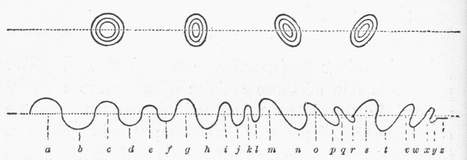
where each is described three-fold, with a horizontal line through
the centre. Each figure thus affords three varieties of size above,
and three below the line, making six figures each, or twenty-four in
all, as curvilinear signs for letters. These taken in rotation, may be
extended as above, or in any arbitrary order, and each employed, as in
short-hand, to signify letters, syllables, or words. In practice it
is only requisite to bear in mind the three gradations of size, so as
never to mistake the middle semicircle for the outer ones. This is to
be avoided by invariably making the small figure as small as possible,
and the greater figure as large as space will permit.
4.
This invention refined, and so abreviated that a point onely
sheweth distinctly and significantly any of the 24. letters;
and these very points to be made with two pens, so that no
time will be lost, but as one finger riseth the other may make
the following letter, never clogging the memory with several
figures for words, and combination[7] of letters; which with
ease, and void of confusion, are thus speedily and punctually,
letter for letter, set down by naked and not multiplied
points. And nothing can be less then a point, the Mathematical
definition of[8] being Cujus pars nulla. And of a motion[9]
no swifter imaginable then[1] Semiquavers or Releshes, yet
applicable to this manner of writing.
[Reduced to a Point.] A man of the Marquis of Worcester’s ingenious
cast of mind could readily have made up the entire “Century” out
of these systems of alphabets and secret writing. He may have been
acquainted with “Traicté des Chiffres, ou Secretes Manieres d’escrire,
par Blaise de Vigenere, Bourbonnois.” 4to. Paris, 1586—now very
scarce; but indeed there were many learned works on the subject, among
which Trithemius’s “Libri Polygraphia VI,” 1600, was conspicuous. The
long disuse of such methods of secretly conveying information, has
reduced the cleverest of these systems of Cryptographia in public
estimation. But, at the same time, these inventions were quite
consistent with the early times in which the Marquis flourished. We
shall see, in the next article, what probably illustrates this proposed
use of a mere point or dot.
5.
A way by a Circular motion, either along a Rule or Ring-wise,
to vary any Alphabet, even this of Points, so that the
self-same Point individually placed, without the least
additional mark or variation of place, shall stand for all the
24. letters, and not for the same letter twice in ten sheets
writing; yet as easily and certainly read and known, as if it
stood but for one and the self-same letter constantly signified.
[Varied significantly to all the 24. letters.] This and the former
article may certainly be taken in connection with each other; and the
cipher engraved in No. 3, would seem to anticipate the present proposal
of “a circular motion along a rule.” The “ring-wise” method may have
been no more than a substitution for the octagon or any other figure.
We fortunately find among the Harleian MSS. in the British Museum,
No. 2428, a probable clue to this particular method of writing, which
we shall give entire. It forms the first portion of the small oblong
folio volume containing the Manuscript Century at the end, with many
intervening blank pages between them. It is as follows:—
“An explanation of the most exact and most compendious way of short
writing. And an example given by way of Questions, and Resolves upon
each significant point, proving how, and why, it stands for such and
such a letter, in order Alphabetically placed in every page.
“A. Q. How is a point made to signifie an A. Resol. By being placed between
the constant center of the square and the right side thereof in a
streight line not touching it. [See diagram at the end].
It is proved by drawing a line from the said center towards, and
not to touch the right side line, and then you will finde the line
placed under an A of the Alphabett in each page.
“B. Q. How is a point made to signifie a B. Res. By being placed
between the center of the square, towards the right corner upper angle
of the Octagon, or square devided in to eight Angles, not touching the
line thereof.
It is proved by drawing an oblique line from the center, towards
the right corner upper angle, yett not touching the line thereof,
and then you will finde it to bee the line placed under a B, in
the Alphabett of each page.
In like manner lett there be a Question, and a Proofe made of all the
other Letters in order and you will finde—
“C. The C. to bee placed in a streight line from the center upwards,
but not arriving to the upper side line of the square.
“D. The D. in an oblique line towards the left upper corner line but
not touching it.
“E. The E. in a streight line between the center of the left side line,
butt not touching it.
“F. The F. in an oblique line downwards, towards the left angle line,
butt not touching it.
“G. The G. in a streight line downwards from the center, likewise
towards the lower line of the square not touching it.
“H. The H. in an
oblique line downwards towards the right angle line, butt not touching
it.
“I. The I. in a streight line from the center to the midle of the right
side line.
“K. The K. in an oblique line from the center to the right upper angle
touching it.
“L. The L. in a streight line from the center upwards, and touching the
upper line.
“M. The M. in an oblique line from the center towards the left upper
corner line touching it.
“N. The N. in a streight line from the center to the midle of the left
side line.
“O. The O. in an oblique line from the center downwards, towards the
left corner touching the line thereof.
“P. The P. in a right line from the center downwards touching the lower
side line.
“Q. The Q. in an oblique line downwards towards the right corner
touching the line thereof.
“R. The R. in a streight line from the center to the outside, and
furthest line of the right midle and opposite chequer touching it.
“S. The S. in an oblique line from the center, and passing the right
upper corner line.
“T. The T. in a streight line from the center and passing the
upper-side line of the square.
“V. The V. in an oblique line from the center upwards passing the left
upper corner line.
“W. The W. in a streight line from the centre to the left outside and
furthest line of the left midle and opposite chequer.
“X. The X. in an oblique line downwards passing the left lower corner
line.
“Y. The Y. in a streight line downwards passing the lower side or
bottome line.
“Z. The Z. in an oblique line downwards passing the
right corner line of the square.
“The Chequers are five in number, which of either outside show the
vowells, and each Chequer haveing two corners inwards of each side
make tenn, those towards the preceding square may conteyne of the
24 letters, and the opposite corners as many Alphabetically, and
the centers of the two upper Chequers square, and of the two lower
shew the other 4 letters; The 20 in the Chequers are noted by a
separation of a corner in the printed Alphabett, and the 4 by the
midde points.
“It is for curiosity and secresy to bee deservedly observed that
whether in squares or chequers single points only stand for letters,
and they being varyed att pleasure, it is in any ones power to
keepe his secrett from me or any other not made acquainted with the
denominations by him given to the severall points, and accordingly
by him marked in the 24 blank squares, and rowes of chequers placed
under the Alphabett in his private explanation easily to be framed by
him mutatis mutandis, only that is making the questions and resolves
according to his points as they represent the letters to his owne fancy
keept private from others without his consent.
“The points are to bee written, and reade as they precede, or as they
are the one above the other, unlesse they have a sequell distinction
made by takeing the penn of the paper thus ✓ without further
losse of tyme, and such as are soe marked, must be written and read as
the others they being soe made, but for husbanding of paper, the word
being soe conteyned in lesse roome, the e at the end of most words
prolonging butt the sillable, and all needlesse and unsounding letters
are to bee omitted; I will not trouble you with more rules leaving the
rest to practice.”
The preceding description is written on small oblong pages, which
measure 11¼ by 7¼ inches, the whole surface of the unwritten
portions being covered with an engraved pattern, of which Fig. 1 is
but a portion of the top left-hand corner, and therefore proceeds no
further than letter h, which ends the application of that particular
figure.
Fig. 2. Gives the next form for 8 other similar situations, commencing
at i. And—
Fig. 3. Is again 8 more, commencing at r; making in all 24 characters
or letters.
We thus see how, whether by a dot, or a short line of three gradations
in length, an entire alphabet may be obtained.
On page 180 of “The Life of the Marquis of Worcester,” is the facsimile
of a letter written by his Lordship about 1646–7, apparently adopting
this very cipher. It occurs in a volume, entitled “Carte Papers,
1634–57. Ireland, No. 63,” in the Bodleian Library.
It is worth remarking here, that the foregoing description, with
its accompanying brass-plate engravings, looks exceedingly like an
instalment of his promise, conveyed to us in the concluding lines of
the 100th Article.
6.
How at a Window, far as Eye can discover[2] black from white,
a man may hold discourse with his Correspondent, without noise
made or notice[3] taken; being, according to occasion given
and means afforded, Ex re natâ, and no need of Provision
before-hand; though much better if foreseen, and means prepared
for it, and a premeditated course taken by mutual consent of
parties.
7.
A way to do it by night as well as by day, though as dark as
Pitch is black.
[A mute and perfect discourse by colours.]
[To hold the same by night.]
These two may be ranked as the same system, the one used by day, the
other illuminated to be conspicuous at night. As early as 1658, John
Baptista Porta, in his “Natural Magick,” entitled the last chapter of
his 16th Book, “By night we may make signs by fire.”
We have here a simple system of telegraphy, the only examples afforded
by the “Century,” of this particular mode of correspondence.
8.
A way how to level and shoot Cannon by night as well as by day,
and as directly; without a platform or measures taken by day,
yet by a plain and infallible rule.
[To Level Cannons by Night.] In 1587 was published, “The Arte of
shooting in great Ordnaunce,” by William Bourne. Among other matters
in the table of contents are the following:—
“The 10th Chapter showeth how to mount a mortar piece, for to lay the
shot at any distance appointed.
“The 13th Chapter is, how to give level at a mark upon a hill or valley
with a quadrant.
“The 24th Chapter is, how for to batter the walls of any town, as well
by night as by day.
“The 25th Chapter doth declare how to plant ordnance by night, to
batter the walls of any town, or displace any ordnance in any bulwarks,
or any such other like, as well by night as by day.” And—
“The 26th Chapter doth declare how for to keep a haven, or river, on
the sea coast, for to sink a ship, as well by night as by day in all
points.”
On the subject of levelling great guns, Fludd’s “Historia Macrosmi,”
1618, would afford abundant suggestions, with three copper-plate
engravings, showing the operation of using the quadrant.
9.
An Engine, portable in ones Pocket, which may be carried and
fastened on the inside[4] of the greatest Ship, Tanquam aliud
agens, and at any appointed minute, though a week after,
either of day or night, it shall irrecoverably sink that Ship.
[A Ship-destroying Engine.] In 1578, William Bourne, in his
“Inventions or Devices,” had in the 17th article, suggested, “How for
to sink a ship that hath laid you aboard, without shooting of ordnance.”
And again in his “Arte of shooting in great ordnaunce,” published in
1587, the 56th Chapter, suggests a mode “to sink a ship.”
The whole passage in the “Century” is abundantly obscure. The smallness
of the Engine suggests some explosive missile, connected with
clock-work, as the only means to insure its being compact and operating
on a precise day at a stated point of time. But his inventive faculty
once stimulated, even by the notices of Bourne, would speedily lead him
to many ingenious contrivances.
10.
A way from a mile off to dive and fasten a like Engine to any
Ship, so as it may punctually work the same effect either for
time or execution.
[How to be fastened from aloof and under water.] The wording of this
article so far differs from the title as to allude only to diving, or a
kind of submarine navigation, but gives no intimation of the fastening
“aloof;” so that this latter may refer to any part of the ship’s sides
above her water-line.
“Mersennius,” observes Bishop Wilkins, “doth largely and pleasantly
descant concerning the making of a ship, wherein men may safely
swim under water.” He further declares, that “such a contrivance is
feasible, and may be effected, is beyond all question, because it hath
been already experimented here in England by Cornelius Dreble.” He
next considers various schemes, and mentions as one of the advantages
of such a submarine vessel, that, “It may be of very great advantage
against a navy of enemies, who by this means may be undermined in the
water and blown up.”—Math. Magick, 1648, p. 178.
Among the Sloane MSS. No. 4159, in the British Museum, is one for a
means of destroying an entire fleet with one ship. It is endorsed, “A
proposition sent to Mr. Augier, from Paris,” and the following is a
copy:—“A person who makes profession of honour, and saith he hath had
the good [fortune?] to have been known of Sir Oliver Flemming during
his public employments abroad, doth propound to a friend of yours that
by a secret he hath he can, with one ship alone, break what naval army
or fleet, &c.”
In 1596, the celebrated John Napier, of Merchiston, wrote a statement
of four “Secret Inventions,” concluding with the remark: “These
inventions, besides devices of sailing under the water, with divers
other devices and stratagems for harming of the enemies, by the grace
of God, and work of expert craftsmen, I hope to perform.” The original
MS. anno 1596, is in the Lambeth Library, No. 658.
There is an article in Tilloch’s “Philosophical Magazine,” Vol. 18,
for 1804, reviewing a Memoir of Lord Napier of Merchiston. On his
device for sailing under water, the writer observes:—“The famous Dutch
philosopher, Cornelius Drebell, the reputed inventor of the microscope
and the thermometer, constructed for James I. a subaqueous vessel,
which he tried on the Thames, and which carried twelve rowers, besides
some passengers, for whom the effete air was again rendered respirable
by a liquor, the composition of which Drebell never would communicate
to more than one person, and that person told Mr. Boyle what it
was.” The Marquis, might, likewise, even be acquainted with Napier’s
statement of his secret inventions.
Evelyn, in his Diary, informs us on the 1st of August, 1666, “I went
to Dr. Keffler, who married the daughter of the famous chymist,
Drebbell, inventor of the bodied scarlet.” On which his editor, Mr.
Bray, remarks, “Cornelius Van Drebbell, born at Alkmaar, in Holland,
in 1572; but in the reign of Charles I. settled in London, where he
died in 1634. He was famous for other discoveries in science—the most
important of which was the thermometer. He also made improvements in
microscopes and telescopes; and though, like many of his scientific
contemporaries, something of an empiric, possessed a considerable
knowledge of chemistry, and of different branches of natural
philosophy.”—Diary, vol. ii. p. 9.
Pepys, in his Diary, under date the 14th of March, 1662, says: “This
afternoon came the German, Dr. Knuffler, to discourse with us about his
engine to blow up ships. We doubted not the matter of fact, it being
tried in Cromwell’s time, but the safety of carrying them in ships;
but he do tell us, that when he comes to tell the King his secret, for
none but the Kings, successively, and their heirs must know it, it will
appear to be of no danger at all.”—Pepys’ Diary, ed. 1858, vol. i. p.
264.
Dr. Robert Hooke, in his “Philosophical Collections,” published in
1679, has “an account of Jo. Alphon. Borellius’s De Mo. Animalium,”
two volumes quarto, containing, among other things, “A way to make a
submarine vessel, whereby several persons may pass together from place
to place under water, accommodated with two ways to move it to and fro,
and to make it rise and sink in the water, &c. It is supposed it may be
much like that which Mersennus long since published.”
The American engineer, Robert Fulton, turned his attention to this
subject, and published “Torpedo War, and Sub-marine Explosions,” 4to.
New York, 1810.
11.
How to prevent and safeguard any Ship from such an attempt by
day or night.
[How to prevent both.] Some armour or alarum is probably proposed,
which should be either invulnerable, or when struck indicate
the presence of the enemy’s “portable pocket engine,” intended
“irrecoverably to sink the ship;” not by merely perforating a single
hole, but by a powerful disruptive explosion, rending asunder all
the timbers. But the whole passage is so abundantly obscure that all
opinion on the matter goes for very little.
12.
A way to make a Ship not possible to be sunk though shot[4] an
hundred times betwixt wind and water by Cannon, and should[5]
lose a whole Plank, yet in half an hours time should be made as
fit to sail as before.
[An unsinkable Ship.] As early as 1583, appeared “A Note of sundry
sorts of Engines,” without the author’s name. The 20th and last of
these is:—“To preserve a boat from drowning and the people that be
therein.” See J. O. Halliwell’s Rara Mathematica.
Considering the state of ship-building in 1655, the foregoing plan
must have been some very primitive scheme; but, rendering vessels
unsinkable, has long been a favourite subject with inventors.
13.
How to make such false Decks as in a moment should kill and
take prisoners as many as should board the Ship, without
blowing the[6] Decks up, or destroying them from being
reducible, and in a quarrer[7] of an hours time should recover
their former shape, and be made fit for any imployment without
discovering the secret.
[False destroying Decks.] William Bourne, in his “Inventions of
Devices,” 1578, devotes the “Third device” to show—“How to use a plain
or open deck hatches, that it is not possible to enter the ship without
spoiling of the enemies.”
14.
How to bring a force to weigh up an Anchor, or to do any
forcible exploit in the narrowest or[8] lowest room in any
Ship, where few hands shall do the work of many; and many hands
applicable to the same force, some standing, others sitting,
and[9] by virtue of their several helps a great force augmented
in little room, as effectual as if there were sufficient space
to go about with an Axle-tree, and work far from the Centre.
[Multiplied strength in little room.] We shall have to allude to the
ambiguous use of the word “force” in the same sentence, as indicating
“strength, power, &c.” or, “a pump, or pump plunger,” in John Bate’s,
and other old works on mechanics. Now if we were to read this, “How to
bring the force [or plunger of a pump] to weigh up an anchor, &c., and
many hands applicable to the same force [or pump], &c.”—we should have
a statement strongly indicating the modern contrivance of the hydraulic
press. The concluding portion of the sentence only serves to strengthen
this suggestion. See “force” used in No. 21.
In 1594, Edmund Jentill, writing to Lord Burghley, mentions, as
his fourth invention:—“A devise whereby two men may be sufficient
to weigh the weightiest anchor in her Majesty’s navy, with greater
expedition than it is now done with the number now used.” Also, “The
like device is found for the hoisting of the main-yard with the like
expedition.”—MS. Lansdown, 113, Art. 4: and, “Letters on Scientific
Subjects,” edited by J. O. Halliwell, F.R.S. 8vo. 1841.
15.
A way[1] how to make a Boat work it self against Wind and Tide,
yea both without the help of man or beast; yet[2] so that the
Wind or Tide, though directly opposite, shall force the Ship or
Boat against it self; and in no point of the Compass, but it
shall be as effectual, as if the wind were in the Pupp,[3] or
the stream actually with the course it is to steer, according
to which the Oars shall row, and necessary motions work and
move towards the desired Port or point of the Compass.
[A Boat driving against wind and tide.] The wording of this article
is varied as follows in the MS. of certain of his Inventions. See
Appendix A. He therein states:—
“By this (his quintessence of motion), I can make a vessel, of as
great burden as the river can bear, to go against the stream; which,
the more rapid it is, the faster it shall advance. And the moveable
part that works it, may be, by one man, still guided, to take the best
advantage of the stream; and yet to steer the boat to any point. And
this engine is applicable to any vessel or boat, whatsoever, without
being, therefore, made on purpose; and work these effects:—It roweth;
it draweth; it driveth, if need be, to pass London bridge against the
stream, at low water. And a boat lying at anchor, the engine may be
used for loading or unloading.”
He made this invention one of the four subjects in his Patent of 1661
(see Appendix B), which again varies the reading; but this last plainly
indicates the motive power as having been a mill. He proposes in his
patent specification:—“To make a boat that roweth, draweth, or setteth
even against wind or stream, yea, both, and to any part of the compass
which way soever the stream runs or wind blows, and yet the force of
the wind or stream causeth its motion, nothing being required but a
steersman; and whilest the boat stayeth to be loaded or unloaded, the
stream or wind shall perform such work as any water-mill or wind-mill
is capable of.”
Among the Harleian MSS. in the British Museum, there is an Italian book
of sketches on parchment, No. 3281, attributed to the 15th century,
entitled, “Delineationes Machinarum;” from one of the pen and ink
drawings of which the annexed engraving is a reduced copy. It is a
paddle boat of a very primitive form, to be operated by men working
at two crank handles. The Marquis seems to have had a very similar
idea, only employing the mechanical arrangements of a suitable wind or
water-mill.
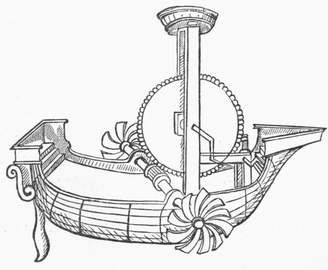
In that fine work, “Vitruvia de Architectura,” folio,
Como, 1521, there is an engraving of a large vessel propelled by
paddles, worked by animal power; therefore, so far as such a mode of
propulsion is concerned, paddle-wheels are of very ancient origin.
In 1574, Ralph Rabbards[J] presented to Queen Elizabeth, through
the medium of the venerable Lord Burghley, a list of twenty-five
inventions. The 24th is:—“The rarest engine that was ever invented
for sea service. A vessel in manner of a galley or galliotte to pass
upon the seas and rivers without oars or sail, against wind and tide,
swifter than any that ever hath been seen; of wonderful effect both
for intelligence, and many other admirable exploits, almost beyond the
expectation of man.”
William Bourne, in his “Inventions or Devices,” published in 1578, most
of which he claims to be his own projects, yet acknowledging some to
have been borrowed, offers the following in the 19th Device without
comment:—“And furthermore you may make a boat to go without oars or
sayle, by the placing of certain wheels on the outside of the boat, in
that sort, that the arms of the wheels may go into the water, and so
turning the wheels by some provision, and so the wheels shall make the
boat to go.”
This is followed by another application, being the 20th Device:—“And
also, they make a water-mill in a boat, for when that it rideth at an
anchor, the tide or stream will turn the wheels with great force, and
these mills are used in France, &c.”
In 1583, proposals were made for 20 different inventions, but the
author’s name does not appear. The 19th is:—“To make a boat to go
fast on the water without oar or saile;” but this is all we learn of
his project. See “Rara Mathematica,” edited by J. O. Halliwell, F.R.S.
&c. 8vo. 1841.
In 1594, Edmund Jentill addressed to Lord Burghley two communications
respecting his inventions. The last he names thus:—“A device wonderful
strange is also found out, whereby a vessel of burden may easily and
safely be guided both against wind and tide.” MS. Lansdown, 113, Art.
4; and “Letters on Scientific Subjects,” edited by J. O. Halliwell,
F.R.S. &c. 8vo. 1841.
Cressy Dymock, in his letter published by Hartlib in the “Legacie; or
an enlargement of the Discourse of Husbandry,” 4to. 1651, describing
what he saw at Wicklesen, mentions—“a pretty kind of Pinnace with
ordinance, somewhat like a close litter, but flat-bottomed; which
rowed with wheeles instead of oares, imployed it seemes formerly with
admirable successe, for the taking in of Crowland, and which gave me
a proofe of what I for many years have thought possible, and of very
great use and service, and still think it of unknowne value, if it were
skilfully indeed framed, and applyed as it might be.” [p. 110.]
Samuel Cotton, on the 28th of January, 1619, obtained a patent for
making and erecting mills upon barges or lighters in the river Thames.
David Ramsey and Thomas Wildgoose, on the 17th of January, 1618,
patented, among various other inventions, one “to make boats for the
carriage of burthens and passengers run upon the water as swift in
calms and more safe in storms than boats full sailed in great winds.”
David Ramsey includes in his patent of 21st of January, 1630, his
invention “to make boats, ships, and barges to go against the wind and
tide.”
And Dr. Thomas Grent, on the 20th of July, 1632, patented a
plan “for a more speedy passage of calmed ships.”
In 1640, Edward Ford, patented his invention, whereby he can make all
boats, &c. “go faster against wind and tide than now they use to do,
with half the men they have formerly used.”
It is stated in “Frier Bacon’s discovery of the Miracles of Art, &c.”
published in 12mo. 1659, that—“It is possible to make engines to sail
withal, as that either fresh or salt water vessels may be guided by the
help of one man, and made sail with a greater swiftness, than others
will which are full of men to help them.” Chap. iv. p. 17.
In “Humane Industry,” 1661, chap. 10, p. 154, it is noticed—“The
ancients had a way to drive their ships without oar or sail, so that
they could never be wind bound.” And at page 155, it is observed
that—“Scaliger doth aver, that he could make a ship that could steer
herself.”
Thomas Togood and James Heyes, in 1662, patented their invention for
the making of ships to sail without the assistance of wind or tide.
16.
How to make a Sea-castle or Fortification Cannon-proof, and[4]
capable of a thousand men, yet sailable at pleasure to defend
a passage, or in an hours time to divide it self into three
Ships as fit and trimm’d to sail as before: And even whilest
it is a Fort or Castle they shall be unanimously steered, and
effectually be driven by an indifferent strong wind.
[A Sea-sailing Fort.] Vitruvius, Vegetius, and many ancient writers
supply a variety of schemes to direct an inventor’s ingenuity. The idea
of such a construction, to divide into three or more sailing vessels
is likewise suggested, in many early designs, although no doubt very
different in some details. But the peculiarity hitherto unnoticed, of
the present invention, consists in the propelling and steering by means
of an artificial current of air. It is very clear that the Marquis had
discovered some pneumatic mode of propulsion. There is no inconsistency
in the idea of the same means being adapted for both steering and
propelling alternately. Even within the last few years extensive
experiments have been made, in which air-pumps were used to compress
the air beneath an inclined plane under the stern, which in flowing
upwards gave motion to the vessel.
17.
How to make upon the Thames a floting Garden of pleasure,
with Trees, Flowers, Banquetting-Houses, and Fountains, Stews
for all kind of fishes, a reserve for Snow to keep Wine in,
delicate Bathing-places, and the like; with musick made with[5]
Mills: and all in the middest of the stream, where it is most
rapid.
[A pleasant floating Garden.] There appears to be little more
invention here than in the contrivance of so much variety, and the
selecting of “the stream where it is most rapid,” to give motion to
the water-mills to work the bellows for producing the promised music;
as well as to raise water high enough to obtain a pressure of it for
making the snow. The whole offers one of those raree-show designs in
which our great-grandfathers delighted, and the descriptions of which
formed the staple of their scientific discussions in polite society.
18.
An Artificial Fountain, to be turned like an Hour-glass by
a child, in the twinkling of an eye, it[6] holding great
quantity[7] of water, and of force sufficient to make snow,
ice and thunder, with a[8] chirping and singing of birds, and
shewing of several shapes and effects usual to Fountains of
pleasure.
[An Hour-glasse Fountain.] In a MS. among the Marquis’s papers,
the foregoing appears to be the invention indicated under the
title:—“Fountains of pleasure, with artificial snow or hail, or
thunder, and quantity not limited.” [See p. 316.]
Kircher, Schottus, and others give descriptions, with engravings of
fountains, having the external appearance of the hour-glass. The
process of turning may have been facilitated by the machine resting
on two central pivots. But it must have been of considerable size to
produce an efficient hydraulic pressure engine to give forth snow
and ice. The thunder, &c., would depend on plans well understood for
producing stage effects, and their introduction here, with the music of
birds, &c. [see Article 46.] is similar to other automatic arrangements
which were the wonder and delight of that age, and a much later period.
In 1755, an engine of peculiar construction, to raise water from an
Hungarian mine, was erected by M. Hoel, at Chemnitz, which generated
intense cold as the water and air rushed out together, under great
columnar pressure, causing the formation of artificial hail, projected
with amazing force; the effect being very analogous to the suggestions
offered by the present articles, Nos. 17 and 18.
19.
A little engine within a Coach, whereby a child may stop it,
and secure all persons within it, and the Coachman himself,
though the horses be never so unruly[9] in a full career; a
child being sufficiently capable to loosen[1] them in what
posture soever they should have put themselves, turning never
so short; for a child can do it in the twinkling of an eye.
[A Coach-saving Engine.] We have two other readings of this article;
the first is the 5th article in his list of a portion of his
Inventions, (see Appendix A.) as follows:—“By this (his quintessence
of motion) I can make a child, in a coach, to stop the horses (running
away), and shall be able to secure himself, and those that be in the
coach; having a little engine placed therein, which shall not be
perceived, in what posture soever the horses draw. A child’s force
shall be able to disengage them, from overturning the coach, or
prejudicing anybody in it.”
The second reading is in his patent of 1661, (see Appendix B.) wherein
he offers:—“To make an engine applicable to any coach, by which a
child of six years old may secure from danger all in the coach, and
even the coachman himself, though the horses become never so unruly,
the child being able in the twinkling of an eye to loosen them from the
coach, in what posture soever they draw or turn, be it ever so short,
or to either hand.” By means of a T-ended lever, two or four bolts
could be simultaneously drawn inwards, and the horses thereby released
with the greatest possible ease and certainty.
20.
How to bring up water Balance-wise, so that as little weight
or force as will turn a Balance will be onely needful, more
then the weight of the water within the Buckets, which
counterpoised[2] empty themselves one into the other, the
uppermost yielding its water (how great a quantity soever it
holds) at the self[3]-
same time the lower-most taketh it in,
though it be an hundred fathom high.
[A Balance Water-work.] It is to be regretted that we have nothing
at present to aid us in offering a description at all approaching the
singular construction of this hydraulic machine. There are some curious
designs given in the description of M. Grollier de Servière’s cabinet,
1719, but we have never seen any plan fully realizing the effect above
indicated.
21.
How to raise water constantly with two Buckets onely day and
night, without any other force then its own motion, using not
so much as any force, wheel, or sucker, nor more pullies then
one, on which the cord or chain rolleth with a Bucket fastened
at each end. This, I confess,[4] I have seen and learned[5]
of the great Mathematician Claudius[6] [7] his studies at
Rome, he having made a Present thereof unto a Cardinal; and
I desire not to own any other mens[8] inventions, but if I set
down any, to nominate likewise the inventor.
[A Bucket-fountain.] In the present
and preceding articles the water is elevated by means of buckets, and
it was only while these pages were passing through the press that the
author perceived those precise marks of distinction between the two
methods of employing the buckets which enables him now to offer the
following explanation of each.
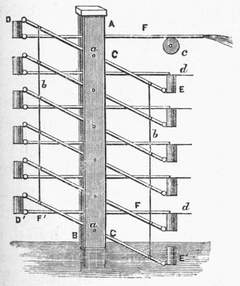
As regards No. 20, it seems, at first, absurd to expect to raise water
which is to be in a balance and pass from one bucket to the other. But
let us suppose an arrangement, as in the subjoined engraving, where
A, B, is a strong vertical wooden frame carrying six metal or wooden
pipes C, C, which can be moved simultaneously up and down on centres,
a, a, being connected by the iron rods, b, b; these pipes are
united with the top of six buckets at D, D', and with the bottom of six
other buckets at E, E'. The buckets D, D', are also connected at the
bottom with six other pipes F, F, each open at the end F, F, and so
arranged that the topmost pipe passes over a pulley c, but the other
five pipes with guide rods d, d, at their ends, enter the top end
of the five uppermost buckets on the side E; the pipe F, passing over
c, delivers the contents of bucket D, while the lower-most bucket E',
is being replenished, “thus the uppermost yielding its water at the
same time when the lower-most taketh it in.” In the present position
of the machine the pipes C, C, are inclined, and the pipes F, F, are
horizontal, but when the bucket E' is elevated, then these pipes will
all reverse their positions, being connected with the buckets by means
of flexible leather hose, or suitable jointed metal tubing.
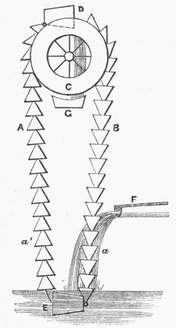
We have next to consider the present article No. 21. The conditions
stated require the use of but one pulley, one cord, and two buckets,
without any “force” or pump plunger, or “any wheel, or sucker.” An
arrangement so simple seems only possible to be attained by some such
plan as that exhibited in the illustration given below. We have here an
endless chain or cord, A B, passing over the pulley C, with a bucket
D, at the upper end; and another bucket E, at the lower end; the first
in the act of discharging its contents into the trough G, the second
re-charging with water at the level E. This endless chain is further
supplied with a series of conical or other shaped buckets, a, a',
set on the endless cord in a reverse direction, so as to receive water
conveyed from an upper stream by the spout F, by which means the side
B, of the cord will descend, and the side A, ascend, “without any
other force than its own motion,” and that “with two buckets only, day
and night.” On the side a', the conical buckets reverse and empty
themselves, thereby lightening the ascending side A, of the endless
chain or cord.
22.
To make a River in a Garden to ebbe and flow constantly, though
twenty foot over, with a childs force, in some private room or
place out of sight, and a competent distance from it.
[An ebbing and flowing River.] In reference to this invention Mr.
Partington has quoted Peter Bogaerts’ ingenious method of a canal lock,
so contrived that, in a model, a weight of seven pounds was made to
raise ten hundred weight of water more than four feet in a few seconds.
But still the process of ebbing and flowing is not made out; it does
appear, however, that its operation requires the constant services of
a boy or other attendant, probably to keep alternately opening and
closing certain sluice arrangements, placed somewhere concealed from
view; the whole affording a water-work to amuse and surprise, and
forming a variety on the usual strange schemes attached to grottos,
caves, &c. spouting water in every variety of form.
See further the comments on article No. 57, which very probably
includes the principle here employed by the Marquis.
There is no communication in this article of facts requisite to direct
an engineer or inventor in the adjustment of any special kind of
machinery to obtain the desired ebbing and flowing river; which is
a novelty, in this respect, peculiar to the Marquis of Worcester’s
ingenuity. He was evidently not copying or improving any anterior
system of water-work. The next article is but an application of this
new system; and it is not until he has taken us through descriptive
hints of thirty-three totally different designs or devices, that in
No. 57, he offers “A constant water-flowing and ebbing motion.” We
think the three may be taken together, that is, No. 57, refers to the
principle and mechanism, of which Nos. 22 and 23, are mere simple
applications.
Thus, referring to what we have stated under No. 57, the
purpose named in the present article might be attained by means of two
domed or bell-shaped vessels, placed like gasometers, but otherwise
immoveable, partially immersed in a pond, or other artificial piece of
water; which being arranged so that, by admitting a steam pipe into
each, the contained air could be driven out thereby, condensation would
naturally follow, or might be accelerated; and one vessel immediately
filling with water, while the other was emptying, the surface of the
pond or river would be kept in a continual state of agitation, and the
water might be said to “ebb and flow constantly, though 20 feet over.”
No reason is assigned for proposing this modification of water work,
no advantage is pointed out, the Marquis doubtless depending on its
apparent impossibility for its exciting and stimulating inquiry. He
knew how the promulgation of such a wonder would have affected his
own mind, and never imagined but that the public would feel equally
inquisitive. His incomprehensible truths are, however, often denounced,
without investigation, as though they were false.
23.
To set a Clock in[9] a Castle, the[1] water filling the
Trenches about it;[2] it[3] shall shew by ebbing and flowing
the Hours, Minutes and Seconds, and all the comprehensible
motions of the Heavens, and Counterlibation[4] of the Earth,
according to Copernicus.
[An ebbing and flowing Castle-clock.] John Bate, in his “Mysteries
of Nature and Art,” 1635, at p. 45, describes—“A water-clock, or a
glasse showing the hour of the day,” by three different arrangements.
This article is further noticed in commenting on No. 57.
24.
How to increase the strength of a Spring to such an height,[5]
as to shoot Bumbasses and Bullets of an hundred pound weight
a Steeple-height, and a quarter of a mile off and more,
Stone-bow-wise, admirable for Fire-works and astonishing of
besieged Cities, when without warning given by noise they find
themselves so forcibly and dangerously surprised.
[A Strength-increasing Spring.] The technical term
Bumbasses, or probably bombasses, here used, has escaped the
attention of all compilers of Archaic Dictionaries. By the context
we may presume it was applied to the large stones usually fired from
bombards, and differing only from bullets in these last being made of
lead or iron.
Ancient cannon appear to have consisted of two kinds; a large one for
discharging stones, called a Bombard, and a lesser one for darts. In
1388, a stone bullet, weighing 195 pounds, is related, according to
Meyrick, to have been discharged from a Bombard, called the Trevisan.
Such stone missiles may have been of the kind called by the Marquis
“bumbasses,” and would be perhaps more properly named bombasses. The
Stone-bow was the Prodd; probably the Slurbowe was furnished with a
barrel through a slit, in which the string slided, when the trigger
was pulled. Three kinds are mentioned by Du Cange. See Fosbroke’s
Encyclopædia of Antiquities, 8vo. 1840.
Bishop Wilkins, treating on Catapultæ in his Mathematicall Magick,
1648, observes that their usual form was “after the manner of great
bows placed on carriages, and wound up by the strength of several
persons;” adding: “These were sometimes framed for the discharging of
two or three arrows together.”
As the Marquis wrote the Century in 1655, only seven years after
Wilkins’ publication, it is not at all unlikely that he seriously
contemplated the contriving of a most useful warlike implement; and
this appears the more reasonable when we find the worthy and learned
prelate advancing, as it appeared to him, cogent reasons in his 19th
chapter, in favour of the “Military offensive engines used amongst the
ancients,” as compared to cannon; gravely summing up his observations
with the remark—“that the force of these Engines does rather exceed
than come short of our gun-powder inventions.” Then again on the ground
of expense he shows an advantage in favour of Ballistæ and Catapultæ.
Thus: “the price of these gun-powder instruments is extremely
expensive.” This is proved from “a whole Cannon weighing commonly 8,000
pounds, a half Cannon 5,000, a Culverin 4,500, a Demi-culverin 3,000,”
which “must needs be very costly,” amounting “to several hundred
pounds,” for which sum “at least 10 of the ancient timber made engines
might be purchased”!
Then their transport was a serious matter, for “a whole Cannon does
require at the least 90 men, or 16 horses,” and so in proportion for
others. But the timber made engines are light, and their “materials to
be found everywhere.”
Then the gun-powder is costly; “a whole Cannon requiring for every
charge 40 pound of powder, and a bullet of 64 pounds,” and in
proportion for lesser cannon; whereas those other engines may be
charged only with stones. So that only for the superior force of cannon
“those ancient inventions” he conceives to be “much more commodious
than these later inventions.”
Among questions propounded and agreed upon, in January, 1660, to be
sent to Teneriffe by the Lord Brouncker and Mr. Boyle, the fifth
was,—“Try the power of a stone bow, or other spring, both above and
below (the hill), and note well the difference.”—Weld’s Hist. Royal
Society, Vol. i. p. 98.
25.
How to make a Weight that cannot take up an hundred pound, and
yet shall take up two hundred pound, and[6] at the self-same
distance from the Centre; and so proportionally to millions of
pounds.
[A double-drawing Engine for weights.] The articles Nos. 25, 27,
and 29 can only be taken as descriptive of elucidatory models,
demonstrative of the applications of a certain principle, the result
of condensation. For some unaccountable reason there has been a
prevalent opinion that the Marquis was ignorant of condensation. If
such an opinion is grounded on his not expressly alluding to it in
the “Century,” then by the same rule it might be doubted whether he
understood anything about steam! But as the “Century” was written to
remind himself, and not to inform others of the modus operandi, it
was sufficient for his purpose to particularise only the results. We
can usually distinguish where he treads a beaten track, the result
of reading, and where his course deviates into his “fire-water-work”
experiments. The former generally has its parallel in some old author;
but when the same rule is attempted to be applied to measure the
others, we find we are dealing either with a new order of things, or
else with sheer paradoxes of the most chimerical character. While,
on the other hand, follow him in his own new track of experimental
research, and we are rewarded at every step with a full and clear
exposition of the wonderfully ingenious processes of inquiry by which
he attained the perfection ascribed by him to his “Water-commanding
Engine.”
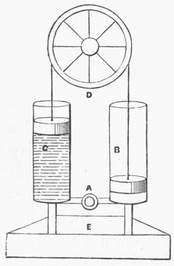
In the present article it is required that a weight shall take up
double its own weight, not by the old rule of leverage, but “at the
self-same distance from the centre.” In the subjoined diagram we have
two cylinders C, B, connected at the lower end with a steam pipe,
supplied with the steam-cock A. A cord passing over the drum wheel D,
is connected at its ends with the pistons B, C; and the whole stands
in a trough E. Steam having been admitted to B, and then cut off,
condensation has ensued, the piston B has descended and C has been
raised, and along with it a quantity of water. Here we may take the
two pistons as representing “one hundred pound” each, and although
they balance, yet we thus find “how to make a weight” under such
circumstances, nevertheless, take up “two hundred pounds,” that is,
including the water.
A very similar kind of piston to the one here shown, is suggested by
Fludd, Besson, and others, to be worked by a spiral spring, which being
drawn to the bottom of a cylindrical vessel, water may be poured in
above it, and being then tightly covered, with a lid having either an
open jet or a tap in the centre, on releasing the spiral spring, the
false bottom rising, and pressing the liquid, causes it to escape in a
jet d’eau, gradually diminishing as the spring relaxes. The contrivance
is elaborately illustrated in the 18th folio engraving of Besson’s
“Theatrum Instrumentorum et Machinarum,” 1578; the Marquis, therefore,
had only to substitute steam for the spiral spring.
26.
To raise weight as[7] well and as forcibly with the drawing
back of the Lever, as with the thrusting it[8] forwards; and by
that means to lose no time in motion or strength. This I saw in
the Arcenal at Venice.[9]
[A to and fro Lever.] William Bourne offers the following as his
112th Device, “touching the making of engines to thrust from or pull
to you with great force or strength.” He says, “And furthermore, you
may make an engine to thrust from you or to pull unto you, to lift vp
or to presse downe with great force, eyther to goe with wheeles as
before is declared, or else to goe with skrewes or to goe with both,
as to thrust open huge and strong gates, or else you taking good hold,
to pull them open vnto you wards, and will make but little noyse in
the doyng thereof, but you must be sure to set the engine fast, if to
thrust from, to be strongly and well backed, and to pull to them it
must be strongly bolstered before, sufficient to be of force to scrue
the turne.”
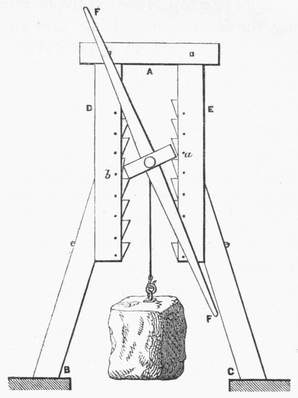
The Venetian arrangement may be described, as shown in the annexed
engraving, where A, B, C, is a frame, the two upright sides of which D
E, are provided with a series of clicks, appearing in the drawing like
the serrated edge of a saw, and each is so placed secured by a pin on
which it moves, as always to incline to fall outwards. F, F, is a long
lever, having a stout short cross bar in the centre, and is represented
on the point of taking up on a click at a, while it leaves one on the
opposite b, such being the to and fro motion required, thereby
losing “no time in motion or strength.”
27.
A way to remove to and fro huge weights with a most
inconsiderable strength from place to place. For example, Ten
Tunne with ten pounds, and less; the said ten pounds not to
fall lower then it makes the ten Tunne to advance or retreat
upon a Level.
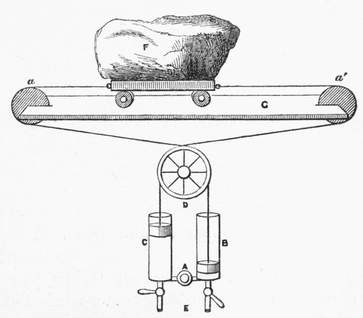
[A most easie level Draught.] The weight is in this case to be moved
“with a most inconsiderable strength.” Ten pounds, or less, are to be
capable of moving 22,400 pounds. And the precise conditions are—“the
said ten pounds not to fall lower than it makes the ten ton to
advance.” The annexed engraving shows, as in No. 25, two cylinders B,
C, with their steam-pipe and valve at A, having above a platform G, on
which is a loaded truck F, attached by a cord a, at one end passing
over a pulley, and the drum wheel D, to the piston B; and a second
cord at the other end passing over a pulley at a', attached in like
manner to the other piston C. Steam having been admitted to B, on its
condensation the piston descending draws along with it the weighted
truck F, while the piston C, ascends, drawing in air at E.
We thus attain the strict letter of the conditions set down, the fall
and the advance being equal.
28.
A Bridge portable in[1] a Cart with six horses, which in a
few hours time may be placed over a River half a mile broad,
whereon with much expedition may[2] be transported Horse, Foot
and Cannon.
[A portable Bridge.] The great painter, Leonardo da Vinci, born in
1452, and who died at 67 years of age in 1520, was a man of singularly
inventive talent. Among his other projects, he declares:—“I have the
means of constructing light bridges, easy of carriage, and equally
adapted to pursue or escape an enemy, secure from fire; and as easy to
remove as to replace; and also the means of destroying those of the
enemy.” See an interesting Memoir of him by J. W. Brown. 12mo. 1828.
Bourne’s 94th Device promises, “How you may make a bridge upon a
sudden, that a whole army of men and their carriages may pass over any
river or haven, if that it be of not too great breadth.”—See his
Inventions or Devices, 1578.
Sir Hugh Plat, in his “Jewel House of Art and Nature,” 1653, shows, in
article No. 22, “How to erect or build over any brook, or small river,
a cheap and wooden bridge of 40 or 50 feet in length, without fastening
any timber work within the water.”
29.
A portable Fortification able to contain five hundred fighting
men, and yet[3] in six hours time may[4] be set up, and made
Cannon-proof, upon the side of a River or Pass, with Cannon
mounted upon it, and as complete as a regular Fortification,
with Half-moons and Counterscarps.
[A moveable Fortification.] Vegetius, in “De re militari,” 1535,
offers many similar schemes but less ambitious than the present
one; which is, after all, little if any more than an extension and
improvement on what had previously been more or less practised.
In his “Naturæ simia seu technica,” dated 1618, Robert Fludd, at page
421, gives a folio engraving of a triangular fort, with six pieces of
cannon and three gunners. It appears to be on wheels, and is pushed
along by a beam running on three wheels, having four horses yoked to
it; literally the cart before the horse.
30.
A way in one nights time to raise a Bulwork twenty or thirty
foot high, Cannon-proof, and Cannon mounted upon it, with men
to overlook, command and batter a Towne; for though it contain
but four Pieces, they shall be able to discharge two hundred
Bullets each hour.
[A Rising Bulwork.] Grose, in his “Military Antiquities,” Vol. I.
Page 355, notices a moveable tower, the use of which was revived by the
Royalists in their attack on Gloucester, during the Civil War.
In 1644, Edmond Felton, gentleman, published a pamphlet entitled,
“Engins invented to save blood and moneys;” the nature of which he
“discovered unto the Committee for the fortifications of the City of
London.” The Honourable Major General Skippon attested in respect of
it, that the engine “was of three tiers of ten muskets in a tier, to
shoot arrows withal.” The inventor satisfied the Committee, “how an
engine will secure the foot from the horse, and the soldiers from
musket shot, which engine in fair ways two men may manage at pleasure.”
He complains of a piracy of his invention, observing, “There was about
twenty of the said engines made at Oxford, and from thence carried
to Gloucester, to go up to the walls. And had not his Excellency the
Earl of Essex so happily arrived to raise the siege as he did, it was
reported by some of the army, the city was in great fear to be taken
thereby; most of which said engines the besiegers burnt, because
they should not be taken.”
In the second volume of “Bibliotheca
Gloucestrensis: a collection of scarce and curious tracts, by John
Washbourn, jun. Gloucester. 4to. 1825,” there is a reprint of “Corbet’s
Historicall relation of the Military Government of Gloucester, 1645,”
which contains this passage: “Wherefore besides their mine and battery,
they framed great store of those unperfect and troublesome engines to
assault the lower parts of the city. Those engines ran upon wheels,
with planks musket-proof placed on the axle-tree, with holes for
musket-shot and a bridge before it, the end whereof (the wheels falling
into the ditch) was to rest upon our breast works.” Page 54.
And in the reprint of “A briefe and exact diurnall of the siege
before Gloucester, by John Dorney, Esquire, 1643,” we meet with the
following:—“Munday, September 4. We understood likewise that the
enemy had by the direction of that Jesuitticall Doctor Chillingworth,
provided great store of engines after the manner of the Romane
Testudines cum Pluteis, with which they intended to have assaulted the
parts of the city, between the south and west gates. These engines ran
upon cart wheeles, with a blinde of plankes musquet proofe, and holes
for foure musquetiers to play out of, placed upon the axeltree to
defend the musquetiers and those that thrust it forward, and carrying
a bridge before it; the wheeles were to fall into the ditch, and the
end of the bridge to rest upon our brest-workes, so making severall
compleat bridges to enter the city. After the raising of the siege, we
tooke all these engines, and brought them into the towne.”—Page 225.
In the first volume of this work there is a note on the two preceding
passages, in which the editor observes:—“The plan of these machines
was borrowed from the ancients. Various contrivances of this kind
were also employed in the middle ages, before and for a considerable
time after the invention of fire-arms. Sometimes they used them for
undermining the walls. At the siege of Ribadavia in Spain, during
the reign of Richard II. similar moveable machines were used. See
Froissart, viii. c. 26. Such an engine is also mentioned by the Marquis
of Worcester in his Century of Inventions.”
31.
A way how safely and speedily to make an approach to a Castle
or Town-wall, and over the very Ditch at Noon-day.
[An approaching Blinde.] Vegetius, in “De re militari,” 1535, depicts
and describes several kinds of these ancient military blinds, screens,
and other contrivances and machines for protecting the attacking party.
At page 15 he shows a ponderous advancing screen or shield on four
wheels, and at two pages further a side view of the same, covering
a large body of soldiers. Some have raised, hinged platforms, to be
lowered for crossing a ditch.
Grose says:—“The cattus, cat-house, gattus or cat, was a covered shed,
occasionally fixed on wheels, and used for covering soldiers employed
in filling up the ditch, &c.”—Military Antiquities, 4to. 1801.
32.
How to compose an universal Character methodical and easie to
be written, yet intelligible in any Language; so that if an
English-man write it in English, a French-man,[5] Italian,
Spaniard, Irish,[6] Welsh,[7] being Scholars; yea, Grecian
or Hebritian shall as perfectly understand it in their owne
Tongue, as if they were perfect[8] English, distinguishing the
Verbs from the Nouns, the Numbers, Tenses and Cases as properly
expressed in their own Language as it was written in English.
[An universall Character.] In 1668, the Royal Society ordered the
printing of “An Essay towards a real Character, and a philosophical
language; by John Wilkins, D. D. Dean of Ripon, and F. R. S.,” folio.
It is dedicated to the president, William Lord Viscount Brouncker, and
consists of a treatise of 454 pages, to which is appended a dictionary
of 155 pages. The very extent of such a work is almost fatal to its
acceptance, and we must admit that it is questionable whether, with
all its learning and ingenuity, it affords a single hint calculated to
promote the intended object.
In relation to this subject, the reader, desirous of enlarged
information, could not do better than consult the recently published
“Lectures on the Science of Language,” by Professor Max Müller, M. A.
It would be highly interesting to possess any clue whatever to the
ideas of the Marquis on this subject. He was so truthful in his
statements, that he must have made a considerable advance in the
discovery of means for obtaining the end proposed, although he may have
over-estimated its application, according to our judgment.
Of early publications on this topic we would especially notice, “Le
Caractère universel, par lequel toutes Nations peuvent comprendre les
conceptions l’une de l’autre en lisant par une escriture commune, à
toutes leur propre langage maternelle. Par Cave Beck. M. A.” London,
1657, 12mo. Also “Joh. J. Becheri Spirensis character, pro Notitia
Linguarum Universali.” Francfort, 1661. And “Ars signorum, vulgo
character universalis et lingua philosophica,” by Georgius Dalgarno: a
small 12mo. volume in Latin. 1661.
A system of a universal alphabet has been recently proposed for
telegraphic purposes, by means of which it is believed all the sounds
of the human speech may be recorded and transmitted; mastering all the
sounds which the human voice is capable of uttering in any language.
The proposed scheme is even said to have been severely tested by many
eminent linguists. It is to be hoped that the announced discovery will
be found to realize all it promises, and remunerate the ingenious
inventor.
33.
To write with a Needle and Thred, white, or any[9] colour upon
white, or[1] any other[2] colour, so that one stitch shall
significantly shew any letter, and as readily and[3] as easily
shew the one letter as the other, and fit for any Language.
[A Needle-alphabet.]
34.
To write by a knotted Silk string, so that every knot shall
signifie any letter with Comma, Full point, or Interrogation,
and as legible as with Pen and Ink upon white Paper.
[A knotted String-alphabet.]
35.
The like, by the fringe of Gloves.
[A Fringe-alphabet.]
36.
By stringing of Bracelets.
[A Bracelet-alphabet.]
37.
By Pinck’d Gloves.
[A Pinck’d Glove-alphabet.]
38.
By holes in the bottom of a Sieve.
[A Sieve-alphabet.]
39.
By a Lattin or[4] Plate Lanthorn.[5]
[A Lanthorn-alphabet.]
40.
By the Smell.
41.
By the Taste.
42.
By the Touch.
By these three Senses as perfectly, distinctly and unconfusedly,
yea as readily as by the sight.
[An alphabet by the—Smell; Taste; Touch.]
43.
How to vary each of these, so that ten thousand may know them,
and yet[6] keep the understanding part from any but their
Correspondent.
[A variation of all and each of these.] We have here ten Alphabets,
concluding with a variation on each, which, had it been given, would
have at least increased the number to twenty, but that was by no means
the limit. Cipher Alphabets are the least interesting portion of the
“Century;” we imagine we trace in them some of the Marquis’s earliest
studies, and fancy that later in life they were retained from fond
recollections of the past.
These secret methods of corresponding are no longer of any service, and
have no interest beyond what may attach to them in connection with the
history of short-hand writing, wherein the object is rather dispatch
than secrecy. Among early writers on the art of Senigraphy, and
Stenography, are Bright, 1588, Bales 1590, Arnold Bostius, Trithemius
1600, Willis 1618, Dix 1633, Wilkins 1641, Cartwright 1652, Rich 1654,
Falconer (“The Art of Secret Information,”) 1685, with others.
John Baptista Porta, a Neapolitan of considerable eminence, born 1445,
and who died in 1515, wrote “De Occultis Literarium Notis, Libri
quinque,” Argent. 1608, octavo, in which he gives no less than 180
different methods of secret writing.
The learned and ingenious Bishop Wilkins in 1641, published his
“Mercury, or the Secret and Swift Messenger.”
Of line alphabets he says—“Who would mistrust any private news or
treachery to lie hid in a thread, wherein there was nothing to be
discerned, but sundry confused knots or other the like marks?” It is,
however, easily effected by each party having like tablets marked at
top with the alphabet, and having hooks down each side for the passing
and holding of a thread worked backwards and forwards, in which action
it is to have a knot made on it for the desired letter above; making
altogether words and sentences.
Chapter 6, is on “Secret writing with the common letters, by changing
of their places.”
In chapter 11, “Of writing by invented characters,” he says: “There
have been some other inventions of writing by points, or lines, or
figures.”
Chapter 13 is, “concerning an universal character that may be legible
to all nations and languages,” concluding with observations on “The
benefit and possibility of this.”
In chapter 17, we are told “of secret and swift informations by the
species of sound.” Among others he names “Bells,” as a species which
“may be a sufficient means, whereby to communicate the thoughts;” and
in chapter 18, he treats “concerning a language that may consist only
of tunes and musical notes, without any articulate sound.” And lastly,
in chapter 20, we have “Of informations by significatory fires and
smokes.”
Among the “variations” the sense of Seeing may be employed, as proposed
by Sir Hugh Plat in his “Jewel House of Art and Nature,” 1653, in
which he describes “How to speak by signs only without uttering of any
word”—using the fingers and motions with them and the hands, which he
calls a “conceited alphabet.”—Page 38.
Those who are curious in such matters, may see more at large in Dr.
W. Hooper’s Rational Recreations, ed. 1794, 8vo. different methods of
writing in cipher, commencing at p. 143, of 1st Vol.—thus:—
To communicate intelligence by a pack of piquet cards.—The musical
dial.—The corresponding spaces.—The musical cipher.—Rules for
deciphering.—Example of a cipher written in arbitrary characters,
and the words separate from each other.—Visual correspondence; and,
Correspondence by bells.
44.
To make a Key of a Chamber door, which to your sight hath its
Wards and Rose-pipe but Paper-thick, and yet at pleasure in a
minute of an hour shall become a perfect Pistol, capable to
shoot through a Brest-plate commonly of Carabine-proof, with
Prime, Powder and Firelock, undiscoverable in a strangers hand.
[A Key-Pistol.] This mere piece of ingenuity, so pleasing to certain
mechanics in working out mechanical trinkets, might be effected by
causing the removal of the key handle to expose a sufficiently strong
pistol barrel, while the “rose pipe but paper thick” would answer to
receive, and perform the office of retaining the key handle securely,
by which to hold it while firing this key-pistol. The next part of
the contrivance would be, to make the “wards” serve to conceal the
pistol pan, cock, &c. The description is well calculated to mislead
the reader, under the impression that the barrel itself is “but
paper-thick.”
45.
How to light a Fire and a Candle at what hour of the night
one awaketh, without rising or putting ones hand out of the
bed. And the same thing[7] becomes[8] a serviceable Pistol at
pleasure; yet by a stranger, not knowing the secret, seemeth
but a dexterous Tinder-box.
[A most conceited Tinder-box.] The following note from “Humane
Industry,” 1661, appears highly suggestive of such an instrument,
although the Marquis’s invention is more elaborate. “Andrew Alciat the
great Civilian of France, had a kind of Clock in his chamber, that
should awake him at any hour of the night that he determined, and when
it struck the determined hour, it struck fire likewise out of a flint,
which fell among tinder, to light him a candle: it was the invention of
one Caravagio of Sienna in Italy.”
46.
How to make an artificial Bird to fly which way and as long as
one pleaseth, by or against the wind, sometimes chirping, other
times hovering, still tending the way it is designed for.
[An artificial Bird.] The third article in his list of a portion
of his inventions supplies a different reading, thus: “By this (his
‘quint-essence of motion’) I can make an artificial bird to fly which
way, and as long as I please.” [Appendix A.]
The Marquis, not to be behind the curious and ingenious men of ancient
times, has here and in article No. 18, emulated John Muller of
Nuremberg, better known as Regiomontanus, who was born in 1436. He is
celebrated for this species of rara avis; a self-moving and flying
eagle, and an iron fly have afforded much matter for romantic and
no doubt exaggerated accounts of their performances; the one flying
a good way in the open air and returning; the other flying from the
philosopher round a table and coming back to his hand. He evinced a
genius of the first order as a great inventor, and also as a promoter
of the advancement of science.
In Ramelli’s great work on various machines, folio, 1588, the 187th
figure offers a detailed representation of a handsomely furnished
apartment, in which a large carved sideboard sustains a gigantic vase
containing a flowering shrub, in the branches of which six birds appear
in the act of singing. The vase being a sectional drawing, various
pipes can be seen, also the performer behind, who is blowing through a
single pipe into the body of the vase.
But the highly popular work of
Hero of Alexandria promulgated several similar schemes. He shows how to
make an artificial bird sing by flowing water, or alternately sing and
be silent. See Mr. Woodcroft’s handsome edition of Hero’s Pneumatics,
4to. 1851.
William Bourne, also, in his “Inventions or Devices,” 1578, treats of
“birds of wood or metal made by art to fly,” and of others, “to sing
sweetly at certain hours appointed.”
Bate, in his “Mysteries of Nature and Art,” 1635, treats, at page
24, “How to make that a bird sitting on a basis, shall make a noise,
and drink out of a cup of water, being held to the mouth of it;” and
further, “Advice whereby several voices of birds chirping may be heard.”
So again Isaac De Caus, in his “Rare Inventions of Water Works,” folio,
1659, at page 20, gives instructions—“To counterfeit the voice of
small birds by means of water and air.” And in Plate XIV. “To represent
divers birds which shall sing diversly when an owl turns towards them;
and when the said owl turns back again they shall cease their singing.”
These later examples show that the Marquis was neither altogether
original nor singular in attempting improvements in these automatic
toys, which from the time of Hero of Alexandria were accounted
sufficiently wonderful evidence of mechanical ingenuity to attract
the serious attention of even the most talented engineers of the last
century. Of such mechanical achievements of the ingenious a full
account may be read in Montucla’s edition of Ozanam’s “Mathematical
Recreations.”
Volant automata, as he calls them, did not escape the attentive
consideration of Bishop Wilkins, and he says enough on this class of
mechanical curiosities to have stimulated the mechanical ingenuity of
even a less enthusiastic inventor than the Marquis of Worcester, as
of the wooden dove of Archytas, and the wooden eagle and iron fly of
Regiomontanus.
The Marquis, if he ever perused the little treatise just quoted, would
be keenly alive to the truthfulness of the remark that—“it is none
of the meanest discouragements, that any strange inventions are so
generally derided by common opinion, being esteemed only as the dreams
of a melancholy and distempered fancy; for that saying of Virgil,
“Demens qui nimbos et non imitabile fulmen,” &c.
“hath been an old censure applied unto such as ventured upon any
strange or incredible attempt.”—See Math. Magick, 1648, p. 198.
The Rev. Dr. Powell, in the last chapter of his “Humane Industry,”
1661, treats of various minute automata as—“Certain sports and
extravagancies of art,” for which he offers an ingenious apology,
observing: “As nature hath her ludicra, so art hath hers too; that
is, some pretty knacks that are made, not so much for use, as to show
subtilty of wit, being made de Gaieté de Cœur, and for pastime
as it were; yet the workmanship and elegancy of these may justly
deserve admiration;” concluding—“art, as well as nature, is never
more wonderful than in smaller pieces.” After describing small chains,
locks, chariots, ships, clocks, and insects, he remarks:—“though
these knacks are but little useful, and take up more time than needed
to be lost, yet they discover a marvellous pregnancy of wit in the
artificers; and may be experimenta lucifera, if not frugifera hints
of greater matters.”
It will not appear strange to find the inventor of the steam engine
engaged toying with an artificial bird, an imprisoning chair, a brazen
head, or a riding horse, when it is remembered that for a hundred
years later such automata were highly prized by the nobility and
gentry, and proved extemely lucrative to the public exhibitors of such
mechanical imitations of life. M. Vaucanson’s inventions were of this
chararcter, attracting admiring audiences among the learned and the
vulgar, on the Continent and in England. A learned society received
his communication in Paris, while in London it had the unquestionable
honour of being translated by Dr. Desaguliers, who says in his preface,
“In giving this paper an English dress, I am still acting in my
province, which has been for many years to explain the works of art, as
well as the phenomena of nature;” and his translation is given under
the following elaborate title:—
“An account of the mechanism of an automaton or image playing on the
German Flute: as it was presented in a memoire, to the gentlemen of the
Royal Academy of Sciences at Paris. By M. Vaucanson, Inventor and maker
of the said machine. Together with a description of an artificial Duck,
eating, drinking, macerating the food, &c. As also that of another
image, no less wonderful than the first, playing on the tabor and
pipe; as he has given an account of them since the memoir was written.
Translated out of the French original, by J. T. Desaguliers, LL.D.,
F.R.S., Chaplain to his Royal Highness the Prince of Wales, 4to. 1742.”
[24 pages, and an engraved frontispiece.]
47.
To make a Ball of any metal, which thrown into a Pool or Pail
of water shall presently rise from the bottom, and constantly
shew by the superficies of the water the hour of the day
or night, never rising more out of the water then just to the
minute it sheweth of each quarter of the hour; and if by force
kept under water, yet the time is not lost, but recovered as
soon as it is permitted to rise to the superficies[9] of the
water.
[An Hour Water-ball.] The 4th article of his selected list of his
inventions supplies the following varied reading:—
“By these (his quintessence of Motion) I can make a ball of silver or
gold, which thrown into a pail, or poole of water, shall arise again
to the perfect hour of any day or night. The superficies of the water
shall still show the hour distinctly; even the minutes, if I please.”
See Appendix A.
Many curious specimens of these Horologies occur in the description of
M. Grollier de Servière’s cabinet, published 1719.
48.
A scrued Ascent, instead of Stairs, with fit landing places to
the best Chambers of each Story, with Back-stairs within the
Noell[1] of it, convenient for Servants to pass up and down to
the inward Rooms of them unseen and private.
[A scru’d ascent of Stairs.] This title does not strictly agree
with the text, for there is a material difference between “a screwed
ascent, instead of stairs,” and “a screwed ascent of stairs;”
the former altogether dispenses with stairs, giving the idea of an
inclined ascent without steps, such as is employed in the construction
of the Observatory of Copenhagen; the width being sufficient and the
ascent so gradual, that a carriage and four may easily be driven up to
the top circular gallery.
According to this improvement there are “back-stairs within the
noell,” that is, the Noel, Nowel, Noyau, or Newell, a term applied
to the centre round which the stairs of a circular staircase wind, and
which may be either a solid column, or an open space. Such stairs are
said to be neweled.
The great labour and expense bestowed on some kinds of staircases is
well exemplified by Evelyn in his tour of France, who describes going
to Blois, in 1664, and seeing there a palace built by Francis the
First, the staircase of which, consisting of 274 steps, is mentioned
by Palladio; he notices it as a wonderful piece of work, from its
construction having occupied 1800 workmen during twelve years. “The
stayre-case (he says) is devised with four entries or ascents, which
cross one another, so that though four persons meet, they never come
in sight, but by small loopholes, till they land.”—Memoirs of John
Evelyn, 2nd edit. 4to. vol. i. page 59.
49.
A portable Engine, in way of a Tobacco-tongs, whereby a man may
get over a wall, or get up again being come down, finding the
coast proving[2] [3] unsecure unto him.
[A Tobacco-tongs Engine.] The designation here given, when published
in 1663, was doubtless generally understood, but the smallness of the
“engine,” its very nature, and not less, its long discontinuance of
use, now renders the passage obscure. It so happens, however, that a
scientific experiment, in which this humble instrument was employed
by the Honourable Robert Boyle, has preserved, for our information
in this matter, the true figure of the “tobacco-tongs.” In the 3rd
Volume of Boyle’s Works, folio, published in 1744, is recorded his
pneumatical experiments on the falling of bodies in vacuo. Treating
of “New experiments physico-mechanical, touching the spring of the
air,” illustrated by the well-known experiment of dropping at the same
time a guinea and a feather within an exhausted glass receiver, he
says: “We so fastened a small pair of tobacco-tongs to the inside
of the receiver’s brass cover, that by moving a turning key, we might
by a string tied to one part of them open the tongs, which else their
own spring would keep shut.”
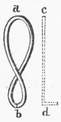
In an illustrative engraved plate,
accompanying his description, the fourth figure therein is designed to
show the “tobacco-tongs,” which appear in the form of a figure of 8, as
in the annexed diagram, where a, is the top or hand portion, being
the largest oval, while the lower oval b, is not above one third its
size, at which point this steel spring instrument was cut through, to
form the tong or nippers. We imagine that a side view would be like the
dotted figure c, d, where d, shows how the ends of these nippers
were probably elongated a little, the more readily to take up and part
with the tobacco or other material. The least pressure on the outside
of the large oval, will extend the nippers b, d, which again close
when such pressure is removed.
But there may have been another form of such tongs, like the letter X,
or two such figures combined; and by increasing the series we should
produce the instrument known as the lazy-tongs, which collapse into a
very small space, yet will extend to a great distance.
50.
A complete light portable Ladder, which taken out of ones
Pocket, may be by himself fastened an hundred foot[4] high to
get up by from the ground.
[A Pocket-ladder.] There are many curious and ingenious designs for
portable scaling ladders, offered by Vegetius in “De re militari,”
1535, but which would require to be very considerably modified to
become pocketable; however, they occur in every variety at page 35,
in short pieces, each with a screw at one end, and a socket at the
other; at p. 59, as a neat rope ladder; at p. 113, on the principle of
the lazy-tongs; and at p. 162, a method of connecting short poles is
exhibited.
Robert Fludd, in the second book of his works, published in 1617 and
1618, folio, Page 384, gives a large copper-plate engraving of a very
ingenious form of ladder. Each step is of wood, and the two sides of
rope. The ingenuity of the invention consists in each step having
a ferrule at one end, and the opposite end tapered sufficiently to
fit into each ferrule of the adjoining step; by this means the whole
can be put together like an ordinary fishing rod, and the top step
terminating with a hook, it can easily be attached to any elevated
place, and on pulling the pole, each part separates, falling at once
into the form of a ladder with rope sides. Bourne’s 62nd Device, in his
“Inventions, or Devices,” 1578, is—“How for to make a scaling ladder.”
Van Etten, 1653, gives for his 111th Problem, “To make a Ladder of
Cords, which may be carried in ones pocket: by which one may easily
mount up a wall, or tree alone.” It consists simply of two pulleys,
with “a cord of an half inch thick (which may be of silk, because it
is for the pocket),” having a staff at one end to sit upon. The author
gravely concludes, “This secret is most excellent in warre, and for
lovers, its supportablenesse avoids suspition.” See page 248.
Among Friar Bacon’s inventions, the following is recorded in the
fourth chapter of his “Discovery of the Miracles of Art, Nature and
Magick,” 12mo. published in 1659:—“It is possible to invent an Engine
of a little bulk, yet of great efficacy, either to the depressing
or elevation of the very greatest weight; which would be of much
consequence in several accidents; for hereby a man may either ascend or
descend any walls, delivering himself or comrades from prison; and this
engine is only three fingers high and four broad.”
51.
A Rule of Gradation, which with ease and method reduceth all
things to a private correspondence, most useful for secret
Intelligence.
[A Rule of Gradation.] Probably some scheme which appeared to
be capable of indefinite multiplication, the object of the secret
correspondent always being to elude the utmost skill of an expert
decipherer. Twenty-six lines of 26 letters of the alphabet each, would
form a square; and supposing the letters placed in different order
on each line, we might produce 26 linear alphabets, and 26 columnar
alphabets; or change these by diagonal or other lines. These, and
similar variations appear interminable, but it is questionable whether
they would not delay rather than defy detection.
52.
How to signifie words and a perfect Discourse by[5] jangling
of[6] Bells of any Parish-Church, or by any Musical Instrument
within hearing, in a seeming way of tuning it; or of an
unskilful beginner.
[A mysticall jangling of Bells.] There occurs at page 185, of Van
Etten’s Math. Recreat. 1653, among the several heads of Problem 84,
“Of changes in Bells.” He inquires: “Is it not an admirable thing
to consider how the skill of numbers doth easily furnish us with
the knowledge of mysterious hidden things?” He says: “It is often
debated—what number of changes there might be made in 5, 6, 7, 8, or
more bells;” observing thereon, “that a childe which can but multiply
one number by another, may easily resolve it.” Not only have we here
a kindred subject discussed, but also in language very analogous to
that employed by the Marquis, particularly in the use of the words
“mysterious,” “admirable,” and “a child;” the latter being a favourite
similitude.
53.
A way how to make hollow and cover a Water-scrue as big and as
long as one pleaseth in an easie and cheap way.
[An hollowing of a Water-scrue.] This was probably no more than an
ingenious piece of carpentry, to obtain an object which was then most
likely of considerable importance. Three of his inventions refer to the
Archimedian screw, so that the Marquis seems to have given the subject
more than ordinary attention.
54.
How to make a Water-scrue tite, and yet transparent, and free
from breaking; but so clear, that one may palpably see the
water or any heavy thing how and why it is mounted by turning.
[A transparent Water-scrue.] This invention does not appear to be
offered as one of any other use than for pleasure and instruction, to
“see the water or any heavy thing, how and why it mounteth by turning.”
Was it not by such models that he had early informed his own mind?
If the transparent covering was not to be glass or horn, the Marquis
may have used the material proposed by Sir Hugh Plat in his “Jewel
House of Art and Nature,” 1653, in which is given, at page 72, a
recipe: “To make parchment clear and transparent to serve for divers
purposes. This I commend, (he says) before oiled paper, because it is
more lasting”—when employed for windows.
55.
A double Water-scrue, the innermost to mount the water, and
the outermost for it to descend more in number of threds, and
consequently in quantity of water, though much shorter then
the innermost scrue, by which the water ascendeth, a most
extraordinary help for the turning of the scrue to make the
water rise.
[A double Water-scrue.] The arrangement of this simple invention is
so clearly and amply set forth, that it is a wonder it could ever have
been misunderstood; yet it so baffled Mr. Partington, that he classes
it among “extraordinary sleight of hand discoveries.”
M. Pattu, a French engineer, in 1815, published his account of a double
water-screw of this description which he had invented, capable of
being applied in three different ways, the construction, however, in
all being the same. In one arrangement, the enlarged end of the screw
is about one-eighth part that of the entire length of the internal
or lesser screw, and it surrounds the “innermost” screw, the spirals
winding in a reversed direction. The top of the shorter or “outermost”
screw may be on a level with a stream of water “for it to descend”
therein, to promote “the turning of the screw” (of greater length and
smaller diameter) “to make the water rise,” from a lower stream.
In a second application, the long screw may be used to propel the short one,
to raise water a moderate height.
Or, thirdly, the enlargement may form the upper end, and be used to
propel from above, instead of from below, as at first described.
56.
To provide and make that all the Weights of the descending side
of a Wheel shall be perpetually further from the Centre, then
those of the mounting side, and yet equal in number and heft
to[7] the one side as the other. A most incredible thing, if
not seen, but tried before the late king (of[8] blessed memory)
in the Tower, by my directions, two Extraordinary Embassadors
accompanying His Majesty, and the Duke of Richmond and
Duke[9] Hamilton, with[1] most[2] of the Court, attending
Him. The Wheel was 14. Foot[3] over, and 40. Weights of 50.
pounds apiece. Sir William Balfore,[4][K] then Lieutenant
of the Tower,[5] can justifie[6] it, with several others.
They all saw, that no sooner these great Weights passed the
Diameter-line of the lower[7] side, but they hung a foot
further from the Centre, nor no sooner passed the Diameter-line
of the upper[8] side, but they hung a foot nearer. Be pleased
to judge the consequence.
[An advantageous change of Centres.] This is the most minutely as
well as circumstantially noted of all the Marquis’s inventions; yet we
have no evidence of his ever afterwards recurring to it. The mention of
Sir William Balfour makes it probable that the exhibition of this great
weighted wheel took place between 1638 and 1641. [See Life, Times,
&c., page 25.] Dr. John Dee, in his celebrated preface to Sir Henry
Billingsley’s first English edition of Euclid, published in folio,
1570, speaks of such a machine, as not only possible, but as having
been actually constructed, and “a thing most incredible if not seen;”
this, compared with the language used by the Marquis, would lead to the
supposition that he had not only read but copied the passage.
It is difficult to reconcile the statement he has here made, with the
declaration on the title page, of his inventions having been “tried
and perfected.” In this single instance, he leaves the reader to “Be
pleased to judge the consequence.”
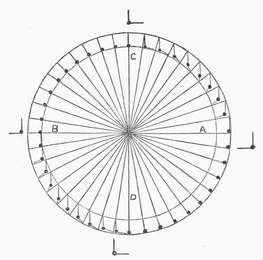
Dr. Desaguliers, in a memoir, published by the Royal Society, vol.
31, 1720–21, quoting the foregoing article, ventures the reply: “Now
the consequence of this, and such like machines [assuming them to be
as above described,] is nothing less than a perpetual motion.” Of
course he does not admit even the possibility of such an arrangements
of parts, he only allows that if that could be executed, the other
would follow. But Desaguliers admitted too much, for it may easily be
demonstrated that the conditions stated may be mechanically produced,
without any resulting motion. Let the annexed diagram represent a
wheel of 14 feet in diameter, having 40 spokes, seven feet each, and
with an inner rim coinciding with the periphery, at one foot distance,
all round. Next provide 40 balls or weights, hanging in the centre
of cords or chains two feet long. Now fasten one end of this cord at
the top of the centre spoke C, and the other end of the cord to the
next right hand spoke one foot below the upper end, or on the inner
ring; proceed in like manner with every other spoke in succession;
and it will be found, that, at A, the cord will have the position
shown outside the wheel; while at B, C, and D, it will also take the
respective positions, as shown on the outside. The result in this
case will be, that, all the weights on the side A, C, D, hang to the
great, or outer circle, while on the side B, C, D, all the weights
are suspended from the lesser or inner circle. And if we reverse the
motion of the wheel, turning it from the right hand to the left hand,
we shall reverse these positions also, (the lower end of the cord
sliding in a groove towards a left hand spoke) but without the wheel
having any tendency to move of itself.
His notice of this exhibition was not written by the Marquis until
1655, from 14 to 17 years after its occurrence, and he may have then
hesitated to say that it was not a success; but he may have persuaded
himself that he was at last in possession of the secret that was at
first wanting. Besides, we are not to infer that the company described
as being present had gone to the Tower purposely to see the Marquis’s
wheel; it being far more probable that, Charles the First and the
foreign ambassadors were there to view that fortress with all its
treasures and curiosities.
According to the state of knowledge in 1663, the Marquis of Worcester
was not singular in entertaining this subject, and all we can make of
the present article is, that he has left it open to doubt whether he
himself did not consider that his experiment required confirmation.
“Perpetuum Mobile; or a history of the search for self-motive power,”
1862, is a work which may be taken as an elaborate note on this
article, for it was the perusal of it that led the author, to commence
the compilation of that work, more than thirty years ago.
Before the publication of the “Century” Samuel Hartlib had, (on the
10th of August, 1658,) written to Mr. Boyle on the subject of a
perpetual motion invented by the ingenious and celebrated John Joachim
Becher, an account of which was to be printed at Frankfort.—Boyle’s
Works, fol. 1744, p. 280.
Charles the Second was favoured with the exhibition of another scheme
of this sort, by John Evelyn, a Fellow of the Royal Society at the
time, and therefore not likely to participate in any matter which the
scientific world of his day repudiated. But learned men of his time
rather approved of all wonder-working automata than otherwise. Evelyn
says in his Diary, under the date of 14th July, 1668, that during an
interview with the King:—“I showed his Majesty the perpetual motion
sent to me by Dr. Stokes from Cologne.”—Vol. ii. p. 37, ed. 1859.
57.
An ebbing and flowing Water-work in two Vessels, into either
of which the water standing at a level, if a Globe be cast in,
instead of rising it presently ebbeth, and so remaineth untill
a like Globe be cast into the other Vessel, which the water is
no sooner sensible of, but[9] that[1] Vessel presently ebbeth,
and the other floweth, and so continueth ebbing and flowing
untill one or both of[2] the Globes be taken out, working some
little effect besides its own motion, without the help of
any man within sight or hearing: But if either of the Globes
be taken out with ever so swift or easie a motion, at[3] the
very instant the ebbing and flowing ceaseth; for if during
the[4]
ebbing you take out the Globe, the water of that Vessel
presently returneth to flow, and never ebbeth after, until[5]
the Globe be returned into it, and then the motion beginneth as
before.
[A constant Water-flowing and ebbing motion.] We are very much
mistaken if this is not the result of one of the Marquis’s early
experimental model demonstrations, and a happy illustrative example for
the lecture-table of raising water by the condensation of steam.
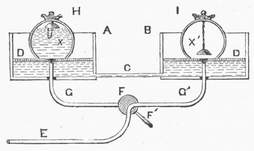
A, B, represents two water tanks or cisterns, permanently connected
by the water-pipe C, and having within, D, D, two perforated shelves
or false bottoms; E, is a main steam-pipe, with a four-way steam cock
at F, branching into the form shown at G, G', and passing through
the bottom of each tank, rises vertically to the level of the false
bottoms, where each is supplied with a valve at the top end, to prevent
the ingress of water. G', is shown receiving steam from E. H, I, are
two hollow metal globes, surmounted with a small crown ornament to
conceal a spring valve, to which a floating weight is suspended by a
chain, as at X'; but floated upwards at X, where it operates to open
the spring valve within the crown. In the above diagram, it is obvious
that water placed in A, will flow onward to B, and stand at the same
level in both cisterns. The valve in each globe requires to be so
arranged, that when forced open its spring will prevent its closing
until acted on by a weight, which weight must hang to the inside of the
valve by means of a chain, and be able to float on the surface of the
water, and it will be requisite to adjust the chain to such a length
that when the water is at a certain level it shall have no influence on
the float-weight of the valve, which will then close.
With this apparatus, the operator can conceal the connection between
the two cisterns, and that between the bottoms to admit steam. The
water is now seen at the same level in “two vessels,” and with a
perforated shelf about an inch below the surface of each. We may
now find, “if a globe be cast in,” the water “instead of rising, it
presently ebbeth, and so remaineth,” doing nothing further “until
a like globe be cast into the other vessel; which the water is no
sooner sensible of, but that vessel presently ebbeth, and the other
floweth.” For it must be observed, the first globe was placed in the
centre, over a steam pipe, its nozzle protected with a valve, and on
letting in the steam, being otherwise empty and the valve purposely
opened for the escape of steam and air, but which its weight closed
as soon as permitted to act, and thereon condensation followed, the
water flowed into that vessel, but ebbed in the other. We then insert a
second globe, in the second cistern, under like conditions; and as soon
as the rising water has opened the top valve of the first globe, this
second globe will repeat the operation, “and so continueth ebbing and
flowing until one or both the globes be taken out.” And this ebbing and
flowing, this rising, and these changing heights in the water in the
two tanks or cisterns, may easily be adapted for “working some little
effect besides its own motion, without the help of any man within sight
or hearing,” and of course too far off to be the acting agent in such
additional “working of some little effect,” some see-sawing action,
to work automata or like “little effects” for the delectation of the
ingenious and the delight of all the lovers of the marvellous. And
note “if during the ebbing,” when that globe and that cistern is all
but empty, “you take out the globe, the water of that vessel presently
returneth to flow,” showing that the globe thus removed was quite
empty; and therefore would be shown as part of the miracle, the same
empty globe had been performing such strange motions in the water.
But let “the globe be returned (empty as it was before) into it [the
cistern], and then the motion beginneth as before.”
If we are correct in this conjecture, the principle involved would
easily account for the inventions couched in the terms of articles No.
22, An ebbing and flowing river; and No. 23, An ebbing and flowing
Castle Clock.
The present article, viewed in any other light than as illustrative
of the peculiar properties of the great principle with which he was
operating, and which he was incessantly investigating, and varying its
applications, is altogether incomprehensible. But it was very natural
for him to preserve in this simple but striking form the sure signs of
greater applications. In the present example, we have no attempt, in
this philosophical demonstrative model, to cater to the popular taste,
although the fertile genius of the noble inventor could not permit
the suggestion to escape his pen that the rise and the fall of the
water might be made to operate—shall we say bellows, mills and the
like, and cause birds to chirp, and fountains to play? Thus “working
some little effect besides its own motion” of soberly ebbing and
flowing. But this is a mere parenthetical, gratuitous offer to dash the
concealed purpose, and give colour to the supposition that it had no
higher design. There is generally something to serve for amusement, or
to answer some practical purpose, observable in all the 100 articles,
but who could assign the use of two globes, in two vessels of water,
causing the same to flow and ebb? Viewed independent of the object here
suggested, it bears a most purposeless character; and in no other way
than as illustrative of the results of the condensation of steam, set
forth in a merely experimental apparatus, can we conceive it possible
of receiving either a scientific or any other reasonable explanation.
For adjusting the apparatus it would be necessary to fill the troughs
or cisterns until the water was level with the perforated false
bottom, and next to add as much more water as would be equal to the
contents of one globe, when the water altogether would cover the false
bottoms. The globes should be heavy enough not to overturn either on
the admission of the steam, or the expulsion of steam and air from
beneath. While steam is entering, the top spring-valve is kept closed
by the float-weight, but when condensation commences, the external
pressure performs the same duty; so soon, however, as the rising water
has elevated the float to the underside of the spring-valve, its
pressure against it and the action of the spring, cause it to open,
and then the column of water will at once commence descending. As a
matter of detail, the float would require a guide rod, or some similar
contrivance to direct and keep its course uniformly under the valve, so
as to open it.
The whole experiment is one of mere matter of fact and not of
excellence. It is simply to develope a principle and not to carry out
any express piece of curious workmanship; there is not, therefore, any
statement of its possessing surprising qualities, the utmost proposed
is “a constant water-flowing and ebbing motion,” without any condition
as to degree, quantity, or extent of its effect. This and no more would
the apparatus here described demonstrate on its trial.
This article of the “Century” strikingly illustrates how truly the
Marquis wrote it as he says—“in a way, as may sufficiently instruct
me to put any of them in practice;” or, rather to repeat the practice
of them, for he has only a line or two before told us, they are such
of his inventions as “I can call to mind to have tried and
perfected;” and what he wrote he meant, let sceptics and
superficial critics pervert his words as they may to uphold their own
narrow conceits. The reader of articles, Nos. 22 and 23, is informed
of effects without the least intimation of a means; he is then amused
with springs, weights, levers, portable bridges, fortifications,
stenography, keys, automata, stairs, ladders, cochlea, and so forth, to
the number of 33 inventions, and then, after losing sight of No. 22,
and No. 23, he is invited to examine the machine by which the “ebbing
and flowing” effects are produced. All this is perfectly legitimate,
but, nevertheless, well worthy of notice, as opening to view the
peculiar tact and skill of the writer; and the extreme necessity of
exercising cautious judgment in our estimate of “The treasures buried
under these heads, both for war, peace, and pleasure.”
It is when we refer back to No. 22, that we become convinced, beyond
what No. 57 alone might persuade us of, that by no means short of
the condensation of steam could the proposed ebbing and flowing be
effected on a river “twenty feet over,” and be managed by “a child’s
force,” as in article No. 100.
58.
How to make a Pistol to discharge a dozen times with one
loading, and without so much as once new Priming requisite, or
to change it out of one hand into the other, or stop ones horse.
[An often-discharging Pistol.] About the year 1575, a description
was given of the operation and advantages of a certain newly invented
engine of war, whereby twenty-four bullets could be discharged from one
piece at a time. And it appears that at that period there were in the
Tower 200 of the engines and 3000 bullets.—Cal. State Papers, Vol. 106.
About 1580 (?) John the Almain wrote to Walsyngham, recommends one of
his countrymen, who had invented an harquebuse, “that shall contain
ten balls or pelletes of lead, all the which shall go off, one after
another, having once given fire; so that with one harquebuse one may
kill ten thieves or other enemies without recharging.”—Cal. State
Papers, Vol. 146.
Porta, in his “Natural Magick,” folio, English edition, 1658, gives an
account, in the 12th Book, how “A brass gun once fired, may discharge
ten times.” He says, “It is a new invention, that a great brass-gun, or
hand-gun, may discharge 10 or more bullets one after another without
intermission. Make a dark powder, such as I used in the precedent part,
and fill it thus:—First, put in a certain measure of gunpowder, that
being put in, may discharge the ball, but a small one, that it may go
in loosely, and that the powder put in upon it may come to touch the
gunpowder: then pour in this dark powder two or three fingers deep;
then put in your gunpowder and your bullet; and thus in order, one
after the other, until the gun seems to be full to the very mouth.
Lastly pour in some of your dark clammy powder: and when you have
levelled your gun to the place appointed, put fire to the mouth of
it; for it will cast out the bullets, and then fire for so long time
as a man may discharge a hand-gun at divers shoots. And thus with one
brass-gun you may discharge many times.”—(p. 293.)
59.
Another way as fast and[6] effectual, but more proper for
Carabines.
[An especial way for Carbines.] The Carabine or Carbine was a short
gun for bullets of twenty-four to the pound.
60.
A way with a Flask appropriated unto it, which will furnish
either Pistol or Carabine with a dozen Charges in three minutes
time, to do the whole execution of[7] a dozen shots, as soon as
one pleaseth, proportionably.
[A Flask-charger.] His patent of 1661 gives the following altered
reading to his improvements applying to guns, thus:—“To make certain
guns or pistols, which in the tenth part of one minute or an hour, may,
with a flask contrived to that purpose, be recharged, the fourth part
of one turn of the barrel, which remains still fixed, fastening it as
forcibly and effectually as a dozen threads of any screw, which in the
ordinary and usual way require as many turns.”—See Appendix B.
61.
A third way, and[8] particular[9] for Musquets, without taking
them from their Rests to charge or prime, to a like execution,
and as fast as the Flask, the musquet containing but one Charge
at a time.
[A way for Musquets.] The heavy firearms of the seventeenth century
afforded the Marquis fine scope for the exercise of his versatile
ingenuity. Muskets were originally matchlocks; long, heavy, and
requiring a tall forked rest to steady them in firing. Eventually
their bore was reduced for bullets of eighteen to the pound. It is
curious to observe the difference between the drill practice of those
times compared with the present. In “The compleat Gentleman,” by
Henry Peacham, M.A., published in 1627, among his other “Military
Observations,” he gives the following: “The postures of the Musquet.
1. March with your Musquet and Rest shouldred; 2. Prepare your Rest;
3. Slipp your Musket; 4. Pease your Musket; 5. Joyne your Rest and
Musquet; 6. Take out your Match; 7. Blow your Match; 8. Cock your
Match; 9. Try your Match; 10. Guard your Pann; 11. Blow your Match;
12. Open your Pann; 13. Present; 14. Give Fire,” &c.
Then, “25. Open your Charge; 26. Charge your Musket; 27. Draw out your
Scouring Sticke; 28. Shorten your Scouring Sticke; 29. Ram your Powder;
30. Withdraw your Scouring Sticke;” &c.
Thomas Smith, in his “Additions to the Book of Gunnery, both pleasant
and profitable,” published in quarto, 1643, black letter, mentions
“certain short muskets of an inch, or very near an inch bore, out of
which you may shoot either chained bullets, or half a score pistol
bullets, or half a dozen harquebus bullets at one shot, or you may
shoot out of the same fire arrows made with strong shafts, feathered
with horn, or with common feathers, glued and bound on with thread.
When you are to shoot a fire arrow out of any of these pieces, you must
not give the piece her full loading of powder.” He further notices that
“The string made fast to the end of the fire-work is to keep the arrow
straight in his passage.”
A graphical sketch of the soldier accompanies
these remarks (as in the facsimile annexed), which appears almost
a caricature, but it must have been seriously approved as a good
illustration, by our author, the “Souldier of Berwick-upon-Tweed.”
Mr. Hewett gives the following table in his “Ancient Armour and
Weapons,” page 715.
|
Length of Barrel. |
Number of Bullets to the pound. |
Nature of lock. |
| Musquet.. |
4 ft. |
10 |
Match |
| Harquebus . |
2½ ft. |
17 |
Wheel |
| Carbine .. |
2½ ft. |
24 |
Flint |
62.
A way for a Harquebuss, a Crock, or Ship-musquet, six upon a
Carriage, shooting with such expedition, as[1] without danger
one may charge, level, and discharge[2] them sixty times in a
minute of an hour, two or three together.
[A way for a Harquebus, a Crock.] Arquebuse, corrupted to
Harquebus—a firearm requiring a forked rest placed in the ground, on
which to steady the heavy barrel, which carried a ball of 2 ounces, or
for fortresses 3½ ounces.
Arquebuse à croc—a small piece of ordnance placed on a stock or club,
fired by a match. We find among the records of the State Paper Office
the following notice in the Calendars, viz.:—John the Almain[L] writes to
Walsyngham, recommending one of his countrymen, who had invented an
harquebuse “that shall containe ten balls or pellets of lead, all the
which shall goe off, one after another, having once given fire, so that
with one harquebuse one may kill ten theeves or other enemies without
recharging.”—Cal. State Papers, Dom. Series, 1547–1580. Edited by R.
Lemon, F.S.A., 8vo. 1856, p. 696. No. 45.
63.
A sixth way,[3] most excellent for Sakers, differing from the
other, yet as swift.
[For Sakers and Minyons.] Sakers were cannon, 5 to 8 pounders; and
Minion, long 4 pounders, or short 3 pounders.
64.
A seventh, tried and approved before the late King (of ever
blessed memory) and an hundred Lords and Commons, in a Cannon
of 8. inches half quarter,[4] to shoot Bullets of 64. pounds
weight, and 24. pounds of pouder, twenty times in six minutes;
so clear from danger, that after all were discharged, a Pound
of Butter did not melt being laid upon the Cannon-britch, nor
the green Oile discoloured that was first anointed[5] and used
between the Barrel thereof, and the Engine, having never in it,
nor within six foot, but one charge at a time.
[For the biggest Cannon.] This article affords a further example of
the practical working out of another invention of the Marquis, and
possibly at the Tower, previous to 1641.
As early as the 16th century cannon had been undergoing gradual
although slight improvements. The Marquis had many opportunities for
obtaining the best information, and his active mind must have long been
on the alert, both at home and abroad, to ascertain all that was then
known on the subject of their manufacture, with their best form and
dimensions. We have very early intelligence on the subject of Engines
of War among the valuable records of our State Paper Office, from which
we have selected the following:—
1575? No. 74. Description of the operation and advantages of a certain
newly invented engine of war, whereby twenty-four bullets can be
discharged from one piece at a time.
No. 75. Notes by the inventor touching the engines of war, with the
expense of making a few at a time. It would require above 100 engines
to be employed at once. Desires a yearly pension in consideration of
his invention.
No. 76. A note of the effects already performed by the engine of war;
of which there are 200 engines and 3000 bullets already delivered into
the Tower for service.—Cal. State Papers, Dom. Series, 1547–1580.
Edited by R. Lemon, F.S.A., 8vo. 1856, page 513.
In the Bodleian
Library there is a folio volume of the MS. papers of General Mountagu,
or the Earl of Sandwich, lettered on the back “Carte Papers, 1604–1684.
Letters to Earl of Sandwich, &c. 74,” in which is the following:
“Invention for Cannon to doe extraordinary execution. (No. 123.) Canon
that shall shute more then 400 paces, a bulett of four fadem longe to
destroy the Riggings of any ship, the which bulett must necessarily goe
a twart, and cannot come perpendicularly, as other chayne buletts, and
other such like, who by that means may misse the intended effect and
passe through the cordage or Riggings.”
Among the Sloane MSS. in the British Museum is one, No. 2497, with
rude drawings of cannon, &c. viz.: a fauconet; a faucon; a minnion;
a saker; a demi-culveringe; a culvering; a demi-cannon; a cannon; a
cannon-peuterer; a cannon-rial; each with its proper ball, ramrods, &c.
Robert Norton, Engineer and Gunner in “The gunners dialogue with the
art of great Artillery,” a black letter quarto, accompanying “The Arte
of shooting in great ordnance,” by William Bourne, 1643, gives the
names, &c. of ordnance, thus:—
Cannon of 8 weighing 8,000 lbs.
—〃— of 7 7,000
Demi-Cannon 6,000
Culvering 4,500
Demi-Culvering 2,500
Saker 1,500
Minion 1,200
Among other inquiries in the course of the dialogue occur the
following:—“If you were to make a shot in the night, at a mark showed
you in the day, how would you prepare for it?” And:—“How would you
make a shot at an enemies light, in a dark night, not having any
candle, lanthorn, or other light by you?”
David Papillon, in his “Practical Art of Fortification,” 4to. 1645,
enumerating the ordnance and ammunition of a garrison, observes:—“for
a towne of two English miles circumference, of these sorts, six
cannons, six demi-cannons, six long culverins [or double for a
sea-port], twentie sacres [or less for a sea-port], and twelve drakes,
and one hundred thousand [pounds?] weight of powder.”—P. 97.
In “Mathematical Magick,” 1648, Bishop Wilkins incidentally
remarks—“the greatest cannon in use, does not carry above 64 pound
weight,” page 126. And in the 19th chapter of the same work he states
the charge to be 40 lbs. of powder.
John Greaves, Geometry Professor of Gresham College, who was born in
1602, and died in October, 1652, made experiments for trying the force
of great guns, at Woolwich, 18th of March, 1651, which were published
in the 15th volume of the Philosophical Transactions, 1685.
The following extracts are given, from their specifying the
description, weight, and sometimes the size of the cannon used, with
the charge of powder and weight of shot.
The great ordnance tried were:—
1. “An iron demy Canon, of 3500 lbs. weight, and having a cylinder
bore, the bullet 32 lb. of iron, the powder 10 lb.
2. “An iron demy Canon, having a taper bore, and being 3600 lbs. in
weight, and 4 inches longer than the former, the iron bullet 32 lb.
3. “Experiment with a whole Culverin in brass, of 5300 lbs. in weight,
11 foot one inch in length, with a taper bore, being intended for a
chase piece to the frigate called the Speaker; the iron bullet was 18
lbs. in weight, the powder 10 lbs.
4. “A whole Culverin in brass, made at Amsterdam, for the French, with
this mark 3580, being 10 foot long, and not very thick in the breech,
18 lb. bullet, and 9 lb. of powder.
5. “An iron Demy Culverin, 9 lbs. iron bullet, and 4 lb. of powder.
This half Culverin was shot eight times.
6. “A brass Demy Culverin, the breech 13-5/8 inches, the mouth 9-5/8, 9
lb. iron bullet, 4 lb. of powder.”
65.
A way that one man in the Cabin may govern the[6] whole side of
Ship-musquets, to the number (if need require) of 2. or 3000.
shots.
[For a whole side of Ship-musquets.] The list of five inventions,
which appears in the “Life, Times, &c.,” page 316, refers to a similar
improvement, viz.: “Oft shooting peards, controlable in one plane,
either for number or time.”
The 43rd Device, given by Bourne in his “Inventions or Devices,” 1578,
is entitled, “How to make any piece of Ordnance go off at any hour or
time appointed, by itself, and no person there.”
Again, in the 44th Device, we have, “How to make a piece go off when
you list, and no person there.”
66.
A way that against[7] several Advenues[8] to a Fort or Castle,
one man
may charge fifty Cannons playing, and stopping when he
pleaseth, though out of sight of the Cannon.
[For guarding several advenues to a Town.] This would appear to be no
more than an extended application of the preceding invention. We can
imagine that Caspar Kaltoff executed a very beautiful model of this
piece of machinery, with its 50 little brass guns, 50 ramrods, &c., all
worked simultaneously by a man below, “out of sight of the cannon;”
but it is very unlikely that the Marquis would have recommended its
adoption; it shows, however, how he persevered in endeavours to abridge
human labour.
67.
A rare way likewise for musquettoons fastened to the Pummel of
the Saddle, so that a Common Trooper cannot misse to charge
them, with twenty or thirty Bullets at a time, even in full
career.
When first I gave my thoughts to make Guns shoot often, I
thought there had been but one only exquisite way inventible,
yet by several trials and much charge I have perfectly tried
all these.
[For Musquettoons on horseback.] The remark which forms a postscript
to this article, naturally leads to the conclusion that the
improvements in guns were among the later inventions of the Marquis,
perhaps about or after 1641, when his own active services promised
soon to be required in the field. His improved firearms are chiefly
recommended for effecting rapid firing. It may have been one of the
results of his experiments, that Caspar Kaltoff became engaged at
Vauxhall in such manufactures for the government.
The Marquis would obtain little assistance from Vegetius, although he
would find some extraordinary applications of “Mirabilis Machina.” We
see there the “Tormentum,” with its great stone ball, and fire issuing
from muzzle and touch-hole, manipulated after an extraordinary fashion,
bristling down the sides of an angular frame; whirled round on a
circular table like a capstan; eight placed crosswise; or two placed
breech to breech, one horizontal, the other vertical, to be fired from
behind a goodly target. But the Marquis went far beyond these ancient
military weapons, for gunpowder was then beginning to be understood and
applied with a degree of effect that startled and surprised the enemy,
while it only disgusted the humane portion of our forefathers of that
day, who, in case of dire necessity alone, favoured the use of balista,
catapulta, bows, and pikes, in the conduct of military and naval
engagements.
Musketoons were the same as the blunderbuss, being of large bore to
fire with a charge of twenty or more pistol bullets, of from seven to
seven and a half ounces of lead, among a multitude, to disperse the
crowd.
The arms offensive and defensive of the old militia, described by
Grose, in his “Military Antiquities,” 1801, as applying to a trooper,
with the furniture for his horse, were as follows:—“The defensive
armour, a breast, back, and pot (or scull cap without vizor or bever),
pistol proof; the offensive arms, a sword, and a case of pistols,
the barrels not under 14 inches in length; the furniture for the
horse, a great saddle, or pad, with burs and straps for affixing the
holsters, a bit and bridle, with a pectoral and crupper: for the foot,
a musketeer had a musket, the barrel, not under three feet in
length, and the guage of the bore for 12 bullets to the pound, a collar
of bandileers, with a sword.” (Vol. 1.)
Abraham Hill, a Fellow of the Royal Society, patented, 3rd of March,
1664, among other inventions, one for guns and pistols, with several
devices for the speedier and more effectual discharge of them; also a
new kind of powder horn.
We shall close these observations on improvements in firearms with the
following miscellaneous illustrations respecting the several kinds then
in use.
In “The Exercise of Armes for Calivers, Musketts, and Pikes, after the
order of his excellence Maurits Prince of Orange, &c. Sett forth in
the figures by Jacob de Gheyn. Printed at the Hage,” folio, 1607:—the
instructions commence with an engraved illustration of the soldier,
showing how he should stand and “carry his caliver, matche, and
rapier;” and proceeds to observe, “he shall also hold the match burning
or kindled at both the endes, betwixt the two least fingers of the same
left hand.” He is thus represented, holding a piece of smouldering
touch-rope of two or three feet long, lighted at both ends, and has
other similar reserve cords at his belt.
In the splendid work on “Ancient Armour and Arms,” by Sir S. R.
Meyrick, 2 vols. folio, 1830, numerous illustrative plates of
firearms occur in the following order:—Arquebus, plate 114, figure
5.—Blunderbuss, a snaphaunce, from the Dutch donderbus, thunder-gun,
p. 119, f. 10.—Carabine, a wheel-lock, p. 116, f. 1.—117, and 119,
f. 9.—Carabineers, p. 43.—Cross bow, p. 94; 95; 98.—Flask for
powder, p. 123; 124.—Musket, p. 117; 119.—Musketeer, p. 36.
68.
An admirable and most forcible way to drive up water by[9]
fire, not by drawing or sucking it upwards, for that must be as
the Philosopher calleth it, Intra[1] sphæram activitatis,
which is but at such a distance. But this way hath no Bounder,
if the Vessels be strong enough; for I have taken a piece of a
whole Cannon, whereof the end was burst, and filled it three
quarters full of water,[2] stopping and scruing up the[3]
broken end; as also the Touch-hole; and making a constant
fire under it, within 24. hours it burst and made a great
crack: So that having a[4] way to make my Vessels, so that
they are strengthened by the force within them, and the one
to fill after the other.[5] I have seen the water run[6] like
a constant Fountaine-stream forty foot[7] high; one Vessel
of water rarified by fire driveth[8] up forty of cold water.
And a man that tends the work is but to turn two Cocks, that
one Vessel of water being consumed, another begins to force
and[9] re-fill with cold water, and so successively, the fire
being tended and kept constant, which the self-same Person
may likewise abundantly perform in the interim between the
necessity of[1] turning the said Cocks.
[A Fire Water-work.] This is that great invention which has
popularized and preserved the fame of the Marquis of Worcester in the
public mind. Had the whole of the Century been destroyed, with the
exception of this 68th article, enough would have remained to satisfy
any engineer, that the Marquis had achieved a grand discovery.
We shall proceed to notice what information books and the patent
records would afford, to stimulate his inquiries into the possible
practical application of the effects, resulting from the action of fire
on water in close vessels.
The work which has, from being often quoted, acquired especial notice
on this subject is, “Les Raisons des forces Mouvantes avec diverses
Machines. Par Salomon de Caus,” folio, published at Frankfort, 1615, in
which, at page 4, theorem V, under the title, “L’eau montera par aide
du feu, plus haut que son niveau,” it is illustrated and described
as follows:—“Le troisiesme moyen de faire monter, est par l’aide du
feu, dont il se peut faire diverses machines, i’en donneray icy la
demonstration d’une. Soit une balle de cuiure marquee A. bien soudee
tout a lentour, à laquelle il y aura un souspiral marqué D, par ou lon
mettra leau, et aussi un tuyau marqué B, C, qui sera soudé en haut de
la balle, et le bout C, aprochera pres du fond, sans y toucher, apres
faut emplir ladite balle d’eau par le souspiral, puis le bien reboucher
et le mettre sur le feu, alors la chaleur donnant contre ladite
balle, fera monter toute leau, par le tuyau B, C.” See also Figuier’s
“Exposition et Histoire des principales découvertes Scientifiques
Modernes.” Tome premier. Paris, 1862, p. 25.
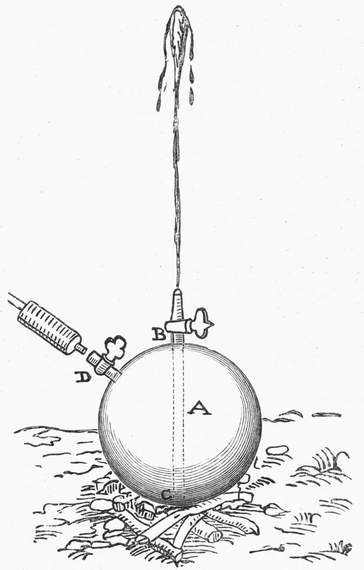
De Caus’ Fountain.
The adjoining engraving is exactly traced from the original, of which
it is, in every respect, a faithful copy. It represents a globular
metallic vessel A, with a jet and stop-cock at B, and another stop-cock
at D, through which water can be injected by means of a syringe. The
jet B, is the top end of a pipe C, which nearly touches the bottom of
the inside of the hollow sphere. Supposing the globe to be half or two
thirds full of water, and placed on a fire, the heat will presently
raise a quantity of steam, which, as it increases in quantity, will
occupy the upper empty space of the sphere, and by its pressure on the
surface of the boiling water, cause the same to rise rapidly up the
vertical pipe C, and produce the jet-d’eau above B, the instant the
stop-cock is opened. And this operation will continue so long as any
water remains for the bottom end of the pipe C, to dip into; after
which it can only be renewed by refilling the vessel, and re-boiling
the fresh supply of water.
De Caus, in his large folio work, in which varieties of fountains
are explained by elaborate copper-plates, and minute descriptions,
satisfies himself with the above brief explanation of the simple
woodcut figure, which we have here reproduced; from which we infer
that he laid no claim to its being his own invention, or at all events
that he presented it to his readers as a gratuitous offering, for
its curious and amusing results. It is not likely that the author
of a considerable work, amidst recondite descriptions and sumptuous
engravings of comparatively common affairs would consign his own most
valuable contribution to a few lines of bare description and a coarsely
engraved diagram. It is obvious, therefore, that De Caus himself, set
no great store by this toy fountain; he saw no great scope in its
application, and certainly never assumed it to be of greater value than
as an amusing experimental fountain. To claim more for an Inventor,
than an Inventor claims for himself is mere infatuation. To say that
De Caus had only to add another pipe, and only to make another
arrangement or two, and then this petite fontaine would somewhat
resemble a steam engine, is neither sound nor admissible. An inventor
must be judged by his own aim and object, and the example he offers
us, without any additions or subtractions at other hands. What De Caus
desribes, therefore, is not a continuous but an intermittent fountain;
not self-feeding, but to be refilled by a syringe; not emitting cold,
but boiling hot water; and the difficulties and delays in the use of
which materially increased in proportion with its dimensions.
But there was shortly afterwards published another highly suggestive
work, on a mechanical application of steam, in “Le Machine,” by
Giovanni Branca, 4to. 1628; in which the 25th figure represents the
operation of pounding, the pestles being acted on by pulleys and
cog-wheels set in motion by a jet of steam issuing from a pipe against
the vanes of a horizontal wheel. The boiler is in the fanciful form of
the bust of a negro, with the steam pipe issuing from the mouth.
On the 21st of January, 1630, a patent was granted to David Ramsey,
for, among other inventions, one “to raise water from low pits by
fire.” But unfortunately, like all patents of that period, it is
unaccompanied by any description.
John Bate, in his “Mysteries of Art and Nature,” 1635, 4to. has “a
conceited lamp, for forcing water or air through the figure of a bird.”
A minute description is given for constructing a small boiler in the
form of a crown, surmounted by a bird, and enclosing various perforated
pipes and valves, capable of being turned in various directions; the
whole is set over a circular lamp, with several cotton wicks. Water
being put in the boiler, Bate observes—“Then the water being by little
and little converted into ayre, by the heate of the lights that are
underneath, will breathe forth at the mouth of the cock;” but, on being
partially turned, “then there being no vent for the ayre to breath out
at, it will presse the water, and force it to ascend the pipe, and
issue out where the air breathed before.” In conclusion he shrewdly
remarks:—“Other devices and those more strange in their effects, may
be contrived from hence.” (p. 33, 34.)
In the “Recreation Mathematique” of H. van Etten, 1629, 12mo. of
which there were translations in several editions, as 1633, 1653, and
others, the 67th problem is descriptive “Of the properties of Æolipiles
or bowels to blow the fire.” In the course of the article on this
subject it is observed: “Vitruvius, in his first book of Architecture,
cap. 8, approves from these engines, that winde is no other thing
than a quantity of vapours and exhalations agitated with the aire by
rarefaction and condensation;” a remark curious enough, if only for the
last word “condensation.” The article concludes—“Now it is cunning
and subtiltie to fill one of these Æolipiles with water at so little a
hole, and therefore requires the knowledge of a philosopher to finde
it out; and the way is thus:—Heat the Æolipiles being empty, and the
aire which is within it will become extreamely rarefied; then being
thus hot throw it into water, and the aire will begin to be condensed:
by which meanes it will occupie lesse roome, therefore the water will
immediately enter in at the hole to avoide vacuitie: thus you have some
practicall speculation upon the Æolipile.”
Here we have “condensation” a second time adverted to, while the whole
experiment proves the folly of attributing to Savery a similar result
as a novelty leading for the first time to a knowledge of the property
of “condensation,” to the disparagement of the Marquis and his
predecessors, assuming their total ignorance of what is here so clearly
and graphically described.
Again, Van Etten in the fifth section of Problem LXXXV. treats—“Of a
fine fountaine which spouts water very high, and with great violence by
turning of a cock.” page 193. “Let there be a vessel made close in all
its parts, in the middle of which let a pipe open neare the bottome;
and then with a squirt squirt in the water (stopped above by the cock
or faucet) with as great violence as possible you can, and turne the
cock immediately. Now there being an indifferent quantity of water and
aire in the vessel, the water keeps itself in the bottom, and the aire
which was greatly pressed, seeks for more place, that turning the cock
the water issueth forth at the pipe, and flyes very high, and that
especially if the vessell be a little heated.” The concluding sentence
would no doubt afford a mind like that of the Marquis of Worcester’s
abundant matter for experimental trial, if ever consulted by him,
either in the original, or in the translation of 1633.
The following extract from Van Etten’s 83rd Problem, “Of Cannons or
great Artillery,” affords strong presumptive evidence (taken along
with other extracts) of the Marquis’s acquaintance with the work.
The Problem is divided into two parts, of which the first alone need
be noticed, namely,—“How to charge a cannon without powder.” It is
observed—“This may be done with aire and water, only having thrown
cold water into the cannon, which might be squirted forceably in by the
closure of the mouth of the piece, that so by this pressure the aire
might more condense, then having a round piece of wood very just, and
oiled well for the better to slide, and thrust the bullet when it shall
be time. This piece of wood may be held fast with some pole, for feare
it be not thrust out before his time: then let fire be made about the
trunnion or hinder part of the piece to heat the aire and water, and
then when one would shoot it let the pole be quickly loosened, for then
the aire searching a greater place, and having way now offered, will
thrust out the wood and the bullet very quick: the experiment which
we have in long trunkes [tubes] shooting out pellats with aire only,
sheweth the verity of this Probleme.” (page 173.)
The words italicised are a complete description of the Marquis’s
experiment, although made with a widely different object, but both
afford evidence of the force obtainable from a small quantity of
heated water, the one in an imperfectly closed, the other in a well
closed cannon. It is remarkable how near this experiment comes to the
steam-engine cylinder, piston, and safety valve; and we can scarcely
believe that such applications would escape the Marquis’s observation,
when repeated and varied as was his customary course in pursuing his
own inquiries.
We have thus, from 1615 to 1653, shown, what sources were open to
afford suggestions to the Marquis of Worcester’s wakeful and watchful
mind, alive and on the alert to seize on every hint promising some
enlarged and useful application. We come next to that part of his
own statement, where he says: “so that having found a way to make
my vessels, so that they are strengthened by the force
within them, and the one to fill after the other, &c.” “Vessels” may
here apply to cisterns, receivers, boilers, &c., in short whatever
appliances were used. But it is usually supposed to mean the boiler
only, and hence the difficulty to understand how its safety should
increase with the increased internal expansive force of the steam.
But allowance must be made for the general vagueness throughout the
“Century,” and we must bear in mind that its language was not arranged
to inform the public in respect to construction, but, as its author
explicitly states, the several inventions are “set down in such a way
as may sufficiently instruct me to put any of them in practice.”
Now there is good ground for believing that the Marquis had a special
meaning for the word “force,” as here applied, a word then used
indifferently in its ordinary and in a technical sense, in the same
sentence. This is particularly worth illustrating; firstly, because it
shows a probability that the Marquis had, before 1655, designed some
kind of safety-valve; and secondly, to remove the common supposition of
the foregoing invention being utterly paradoxical.
It has already been stated, that there is sufficient evidence to prove,
that John Bate’s “Mysteries of Nature and Art,” had attracted the
especial notice of the Marquis. He would be about 33 years of age on
its first publication, and he wrote his Century about 20 years after
its appearance, we may, therefore, readily see how likely it would be
for him to adopt even its very style and language. John Bate says, at
page 11:—
“A forcer is a plug of wood exactly turned and leathered about; the
end that goeth into the barrel, is semicircularly concave; p. 57.
Forces may be made to move either horizontally or perpendicularly,
according unto the convenience of the work, or the invention of the
artist and engineer; p. 59. (Describing ‘the water mill or engine near
the north end of London Bridge.’) These two barrels must be bound fast
unto two posts of the frame, with two strong iron bands, as T T; unto
each of these must be fitted a force well leathered, and in the tops
of the forces must be set two pieces of wood.”
Then again, at page
66:—“K K, L L, the barrels of the forces, which force the water;” p.
67. “E, a barrel of brass or wood fastened in the well, K, a force
fitted into it.” Again, “the force must be very heavy;” p. 71. “B,
a barrel of iron or brass, fastened in the midst of the cistern, with
a force fitted unto it;” p. 72. “The force is linked, and it is
noted with the letter D,” (in the engraving.) Again, “F, the barrel of
the force, fastened within two or three inches of the bottom of the
cistern;” p. 73, “C, a force, D, the forces barrel.” Again, “the
force draweth the water out of the cistern B, into the barrel D;”
p. 74, “another strong iron bar as I I, unto each end whereof must be
linked a force; K K, the two barrels of the aforesaid forces.”
In the 21st volume of Philosophical Transactions, published in 1700,
there is a description, with an engraving,[M] being, “An account of
Mr. Thomas Savery’s engine for raising water by the help of fire.” It
states that Mr. Savery, on the 14th of June, 1699:—“Entertained the
Royal Society with shewing a model of his Engine for raising water by
the help of fire, which he set to work before them; the experiment
succeeded according to expectation, and to their satisfaction. The
Engine may be understood by the draughts of it, where Fig. 1 is the
front of the Engine for raising water by fire; and Fig. 2, the side
prospect of the Engine.
“A, is the furnace; B, the boiler; C, two cocks which convey the steam
from the bottom in order to discharge it again at the top; D, which
convey the steam by turns, to the vessel D. the vessels which receive
the water from the bottom in order to discharge it again at the top; E,
valves; F, cocks which keep up
the water, while the valves on occasion are cleaned; G, the force pipe;
H, the sucking pipe; and I, the water.”
Neither at the time nor afterwards does the invention appear to have
attracted any further notice in that quarter. The next account we have
of it is afforded by “The Miners Friend, or an Engine to raise Water by
Fire,” by Thomas Savery, Gent., 1702; in which the invention appears
with two furnaces, instead of one, and with other details. In his
description he refers to two vessels, marked P, No. 1, and P, No. 2,
which correspond with the two receivers above, marked D, D.
Remarking on these, in “The Miners Friend,”
Savery says:—“So that P, No. 1, is by
the external pressure of the atmosphere, immediately
refilled, while P, No. 2, is emptying; which being done,
you push the handle of the regulator from you, and throw
the force on P, No. 1, pulling the condensing pipe over P, No.
2, causing the steam in that vessel to condense, so that it
fills while the other empties. The labour of turning these
two parts of the engine, viz. the regulator and water-cock,
and tending the fire, being no more that what a boy’s
strength can perform for a day together * * * yet, after all, I
would have men. * * *”
In the above 68th Article, the Marquis of Worcester says:—“A
man that tends the work is but to turn two cocks, that one
vessel of water being consumed, another begins to force and
refil with cold water, and so successively, the fire being
tended and kept constant, which the self-same person may
likewise abundantly perform between the necessity of
turning the said cocks.”
And in No. 100, he says, “a child’s force bringeth up an
hundred feet high, an incredible quantity of water.”
We do not purpose to press any charge against Savery, but simply to
relate what is on record respecting the engine he put forward; and to
notice here the remarkable coincidence between his description, and
that given by the Marquis 32 years before. The Marquis writes in the
singular number of “the fire,” thereby indicating a single furnace;
and in Savery’s first drawing we find the model represented with
one furnace. Then in “The Miners Friend,” we have parts described
agreeing precisely with the preceding article, No. 68. And at the
particular point just quoted, we have even a closer analogy, in the
use of the very same words in reference to the same parts—turning
and tending. And while, in No. 100, the Marquis informs us what
“a child’s force” can perform; here Savery speaks of “a boy’s
strength,” which is enlarged on, however, by recommending a man’s
services.
The next earliest notice we find of this engine is given by Richard
Bradley, F.R.S., in his “New Improvements of Planting and Gardening,”
8vo. 1718, who, in the third part, at page 175, supplies an engraving
of “the late Mr. Savory, F.R.S.,”[N] his engine, as set up by him “for
that curious gentleman Mr. Balle of Cambden House.” It is represented
as a spherical boiler, capable of holding forty gallons, supported on
a tripod, with a fire on the ground underneath. It is connected with
a bell-shaped receiver of thirteen gallons capacity, supplied below
with a pipe sixteen feet long, and above with a pipe to elevate the
water, forty-two feet. The steam pressure is stated to be capable of
discharging fifty-two gallons per minute, the pipes being of three
inches bore; and the original cost of the whole was £50.
In 1729, Stephen Switzer published his “Introduction to a general
system of Hydrostaticks,” in two volumes quarto. He says:—
“Amongst the several Engines which have been contrived for the raising
of water for the supply of houses and gardens, none has been more
justly surprising than that of the raising of water by fire; the
particular contrivance and sole invention of a gentleman,
with whom
I had the honour long since to be well acquainted; I mean the ingenious
Captain Savery, some time since deceased, but then a most noted
engineer, and one of the Commissioners of the Sick and Wounded. This
gentleman’s thoughts (as appears by a preface of his to a little book,
entitled, ‘The Miners’ Friend’), were always employed in Hydrostatics
and Hydraulics; and the first hint from which it is said he took his
engine, was from a tobacco pipe, which he immersed to wash or cool
it, as is sometimes done; he discovered by the rarefaction of the air
in the tube by the heat or steam of the water, and the gravitation
or impulse of the exterior air, that the water was made to spring
through the tube of the pipe in a wonderful surprising manner; though
others say, that the learned Marquis of Worcester, in his ‘Century of
Inventions,’ (which book I have not seen), see page 68, gave the first
hint for this raising water by fire.”—Vol. ii. p. 325.
Thirty-four years later, Dr. J. T. Desaguliers, F.R.S., and Chaplain to
His Royal Highness, Frederick, late Prince of Wales, &c., published his
“Course of Experimental Philosophy,” in two volumes, quarto, 1763. His
13th section is a discourse on the “Fire-engine,” as the steam-engine
was then designated. And the following lecture treats largely on the
Marquis of Worcester’s present article in the “Century,” which he
quotes and then observes:—
“Captain Savery, having read the Marquis of Worcester’s book, was the
first who put in practice the raising Water by Fire, which he proposed
for the draining of mines. His Engine is described in Harris’s Lexicon
(on the word Engine), which being compared with the Marquis of
Worcester’s description, will easily appear to have been taken from
him; though Captain Savery denied it, and the better to conceal the
matter, bought up all the Marquis of Worcester’s books that he could
purchase in Pater-Noster-Row, and elsewhere, and burned them in the
presence of the gentleman his friend, who told me this. He said that
he found out the power of steam by chance, and invented the following
story to persuade people to believe it, viz., that having drank a flask
of Florence at a tavern, and thrown the empty flask upon the fire, he
called for a bason of water to wash his hands, and perceiving that
the little wine left in the flask had filled up the flask with steam,
he took the flask by the neck, and plunged the mouth of it under the
surface of the water in the bason, and the water of the bason was
immediately driven up into the flask by the pressure of the air.”
Desaguliers doubts the veracity of this bottle story, and we may well
agree with him, when we find that in another version the discovery is
attributed to a tobacco-pipe.
He proceeds:—“Captain Savery made a great many experiments to bring
this machine to perfection, and did erect several, which raised water
very well for gentlemen’s seats; but could not succeed for mines, or
supplying towns, where the water was to be raised very high, and in
great quantities: for then the steam required being boiled up to such
a strength, as to be ready to tear all the vessels to pieces. I have
known Captain Savery, at York-Buildings, make steam eight or ten times
stronger than common air; and then its heat was so great, that it would
melt common soft solder; and its strength so great as to blow open
several of the joints of his machine: so that he was forced to be at
the pains and charge to have all his joints soldered with spelter or
hard solder.”—Pp. 464–467.
The serious accusation made against Savery of deriving all his
information from the Marquis of Worcester’s invention, and destroying
all he could procure relating to the Marquis, rests solely on the
authority of Desaguliers, to whom it was related by one of Savery’s
friends! In 1699, the Marquis’s Act had yet 63 years unexpired, had
the Duke of Beaufort felt disposed to investigate how far Savery’s
engine interfered with his father’s invention; but no such interest was
excited, nor had Savery at any time so much success as to induce such
an inquiry. But, in 1699, the Marquis had only been dead 32 years, and
we have proof that his engine was in existence in 1670, reducing the
space of time to 29 years; by no means an unlikely period for Savery to
find parts of the large engine, or models of a small one, or drawings,
or MS. descriptions, or verbal details from eye-witnesses, from among
some of the many visitants to Vauxhall, if, indeed, not directly from
descendants of the “incomparable workman,” Kaltoff.
Savery’s connection with the mining interests of the country would
appear to have first drawn his attention to the value of a scheme,
proposing to raise vast bodies of water by the aid of a most stupendous
power. He might, when a mere youth, have heard enough of the Marquis’s
invention, however vaguely communicated, to excite his curiosity, and
decide him on a course of action whenever an opportunity should occur.
After a lapse of more than a century and a half, Savery’s claim is
not likely to be materially disturbed; but it will always be a matter
of interest to observe the close similarity there is between the
simple model he exhibited before the Royal Society, and the Marquis of
Worcester’s brief summary of the parts and nature of his own engine.
And it is not very favourable to a belief in Savery’s independence of
the Marquis’s invention, that the former should be the sole inventor
of a single marvellous production of ingenuity, without producing any
novelty either before or afterwards, or displaying any particular
inventive ability to improve on this early effort, which he left as at
first produced.
“The Miners Friend” is not unlike an imitation of the “Exact and
true definition of the most Stupendous Water-commanding Engine;” for
example:—
The Marquis’s invention is recommended “to every
individual, if he either have surrounded Marsh-ground to drain, or dry land to improve.”
Savery recommends the Engine he proposes:—
4. “As for draining fens and marshes,” &c.
“Thus whole cities may be kept clean, delightful, and wholesome.”
3. “Nothing can be more fit for serving cities and towns with water.”
“Or, if he have (I further say), Mines wherewith to enrich himself withal.”
6. “For draining of mines and coal pits, the use of the engine
will sufficiently recommend itself in raising water so easy and cheap.”
“Houses to be served, or gardens to be beautified by plentiful
fountains, with little charge, yet certain in ever so dry a Summer.”
2. “It may be of great use for palaces, for the nobilities, or gentlemen’s houses; for
by a cistern on the top of a house * * * which water in its fall makes you what sorts of
fountains you please.”
Savery says:—“And though my thoughts have been long imployed about
water-works, I should never have pretended to any invention of that
kind, had I not happily found out this new, but yet a much stronger
and cheaper force or cause of motion than any before made use of.
But finding this of rarefaction by fire, the consideration of the
difficulties the miners and colliers labour under by the frequent
disorders, cumbersomness, and in general of water-engines, incouraged
me to invent engines to work by this new force, that tho’ I was obliged
to incounter the oddest and almost insuperable difficulties, I spared
neither time, pains, nor money till I had absolutely conquer’d them.”
Savery is reputed to have died in 1715, therefore he was very probably
between 40 and 50 years of age in 1699; and he might have commenced his
investigations into the existence of the Marquis’s inventions, models,
books, papers, drawings, and traditional statements at 25 or 30 years
of age, still leaving him from 15 to 20 years to complete his search
for information. If he died at 60 years of age, he would be 12 years
old when the Marquis died. At all events he had ample leisure, and the
period was promising for such an inquiry.
In his time neither writers nor inventors were very scrupulous in their
adoption of the labours of others; the wholesale literary plunder then
practised by compilers, would not be permitted in modern times, nor
would it be attempted by any author of moderate reputation. Invention,
on the contrary, has always been a doubtful sort of preserve, the
rights of which have been contested with fearless impunity by every
poacher down to the present period. In the 16th and 17th centuries
particularly, no rights were so ill defined as those of the inventor,
even in the face of patents, and Acts of Parliament. But the rights of
a deceased inventor were still less sacred in public opinion, and there
never has been, at any time, an organized body interested in detecting
and exposing unjust assumptions of being a true and first inventor.
Savery claimed perfect independence of the Marquis of Worcester, and
promulgated a story to parallel that of the pot-lid, usually related
in reference to his predecessor’s invention, while (as is pretended)
he was a prisoner in the Tower. Let us now compare certain dates and
circumstances to see how far they favour Dr. Desaguliers’ charge.
On the 25th of July, 1698, Thomas Savery, Gentleman, had granted to
him a 14 years’ patent for “A new Invention for raising of Water and
occasioning motion to all sorts of Mill Work by the impellent force of
fire.”
Within six months afterwards, on the 21st of January, 1699, died the
only son and heir of the Marquis of Worcester, Henry Duke of Beaufort,
at 70 years of age.
Within three months after his Grace’s decease Savery had a Bill brought
into the House of Lords, which, on the 6th of April, was reported to
the House of Commons, and passed on the 25th of the same month. This
private Act extended the patent privilege over 21 years further, making
35 years.
On the 14th of June following, it is stated in the Royal Society’s
Transactions, “Mr. Savery entertained the Society with shewing the
model of his engine for raising water by the help of fire.” (See page
485.)
Dr. Hook was then living, but died on the 3rd of March, 1702. Above
38 years had elapsed since his visit to Kaltoff, to see the engine at
Vauxhall; and he could have spoken to the merits of Savery’s engine,
as compared with what he had earlier seen, had his age and health
permitted, or his inclination prompted him so to act.
On the decease
of Dr. Hook, there was published “The Miners Friend,” (1702), by Thomas
Savery,[O] Gentleman. He there speaks of his model shown to the Royal
Society, “June the 14th, 1699,” thanking the Society for “your kindness
in countenancing this invention in its first appearance in the
world;” that is, within six months after the death of the Duke of
Beaufort.
The Patent of 1698, like all patents of that period, contains no more
account of Savery’s engine than the mere title, or designation of
the nature and intention of the invention; therefore, when the Act
of Parliament was applied for and obtained, there had still been no
publication indicating the modus operandi. It was not until the 14th
of June, 1699, that the Invention made its first appearance in the
world, in the rooms of the Royal Society. And it was not until 1702,
that Savery published any account of his invention, and we then expect
to learn something interesting in regard to the wonderful discovery.
But all he has to say on the matter is in these few lines “And though
my thoughts have been long employed about water-works, I should
never have pretended to any invention of that kind, had I not happily
found out this new, but yet a much stronger and cheaper force or cause
of motion than any before made use of. But finding
this of rarefaction by fire, the consideration of the difficulties
the miners and colliers labour under by the frequent disorders,
cumbersomeness, and in general of water-engines, encouraged me to
invent engines to work by this new force, that though I was obliged to
encounter the oddest and almost insuperable difficulties, I spared
neither time, pains, nor money, till I had absolutely conquered
them.”
This stoicism and total absence of the least ray of mental enthusiasm
are the first remarkable circumstances to strike our observation.
Here, after a lapse of three years, some encouragement, and writing
on the matter of a great discovery, the precious jewel is treated as
if it were of the nature of the most ordinary pump. “And though my
thoughts have been long employed about water-works,” yet we are to
presume that he never heard of the great “Water-commanding Engine”
at Vauxhall, 30 years previous. He believes in his having “found out
this new, but yet a much stronger and cheaper force than any before
made use of,” yet never, even remotely, declares how or in what way
he came by it. “But finding this of rarefaction by fire,” as he
says, we on our part naturally ask, And pray where and how did you
find it? He names the considerations that “encouraged him to invent
engines to work by this new force;” but from the time of producing
the model of 1699 to the last improvement of 1702, there was no
essential difference; the invention remained the same throughout. The
only difficulties in his way were, in his own words, “the oddest and
most insuperable,” but we are left to guess in what their oddness
consisted.
He finally states, in his first chapter:—“I may modestly affirm
that the adventurer or supervisor of the mine will be freed from
that perpetual charge, expence, and trouble of repairs which all
other engines ever yet employed in mines for the raising of water are
continually liable unto.”
In Article No. 100, of the “Century,” however, it is shortly but
expressly urged, as one important point, that the engine works, “with
little charge, to drain all sorts of mines, &c.”
It appears from documents dated 1664, relating to Vauxhall, that Caspar
Kaltoff is named therein as “lately deceased.”[P] So that in 1699
Thomas Savery was left in full possession of the field he had entered
upon. The facts and dates now furnished, are not very favourable to the
genuineness of Savery’s Invention. For it is not likely that all trace
of the “Water-commanding Engine” would have been lost between 1670 and
1699, when Kaltoff’s family were still living, as also many persons
who had witnessed the performance of the great engine at Vauxhall. It
is true that the last we hear of it is not later than 1670, but it was
then the property of the Dowager Marchioness, who died in 1681, and
her Ladyship would most likely, from respect, as well as from personal
interest in the matter, not permit the engine to be sold or destroyed.
Then from 1681 to 1699, reduces the probability of its existence up
to a period within 18 years, taking the dates to the uttermost limit,
although we can easily understand that for the whole or a large portion
of those 18 years Savery was in possession of all the facts he would
require for coming before the public on the decease of Kaltoff, the
Dowager Marchioness of Worcester, and the Duke of Beaufort; the latter
being the last party interested in the invention, and likely, during
his life, to frustrate such a design.
But what papers could he procure at Paternoster Row for destruction?
1. There was a pamphlet, being the Definition and Act, the latter
printed in black letter. 2. There was the “Definition” itself, printed
in the form of a posting bill. And, 3, there was the “Century.” All
these were printed 1663 to 1664, and are editions which are now
remarkably scarce. There are only about three copies of the Act,
and one of the “Definition,” known to exist, while the few copies
of the “Century” of 1663, are rarely indeed to be found in private
collections. But, besides these, it was quite possible to procure,
within 15 or 20 years after his decease, even manuscripts, drawings,
and books, the property of the deceased Marquis, more or less
referring to his great invention.
Even admitting that Savery was an independent inventor in 1699,
notwithstanding so many conflicting circumstances pointing to a
different conclusion, he could not have been working many years at York
Buildings in the Strand, without hearing of the Engine at Vauxhall,
invented by the proprietor of Worcester House in the Strand. This
very propinquity alone was sufficient to excite in the mind of some
intelligent, inquisitive, and observant visitor the fact, which so
singular a coincidence would obviously suggest.
While, however, everybody else is viewing the engine of Savery’s
reputed invention with astonishment, Savery himself is present to our
mind only as a cold calculating man, proud, not of being a Captain
over Mines, but of being designated “Gentleman;” and while thus
precise to inform the world of his gentility, he leaves us in perfect
ignorance of his mental acquirements, or the origin of the marvellous
engine. It may appear to some, that his exhibiting of the model before
the Royal Society is at once evidence of straightforwardness and
uprightness of conduct. But this view is open to the objection, that
he had never before shown the model, and he thanks the Royal Society
for “countenancing this Invention on its first appearance in the
world.” From the 25th of July 1698, to the 14th of June 1699, he had
been nursing the invention in secret. What doubts could remain in his
mind, when all persons likely to be most interested were no longer in
existence? Men of science alone remained, who might possibly disturb
his claims, and what means could be found more likely to set this doubt
at rest, than a bold appeal to that learned body? And come of it what
might, there would still remain to him the question of improvements;
supposing the grand claim to originality to become a matter of dispute.
But to Savery’s great satisfaction, if not to his greater surprise, so
far from a word of dissent being raised, there was (contrary to all
precedent) a certificate given in favour of the invention at Savery’s
request.
Savery’s career may be taken as commencing in 1699, thirty-two years
after the decease of the Marquis of Worcester, thirty-six years from
the date of the “Century of Inventions,” or thirty-nine years after
the establishment of the Royal Society, and yet his operations made
slight impression on the public, and scarcely any on scientific
society. This circumstance removes much of the surprise we might
otherwise seriously entertain respecting the occasion of the Marquis of
Worcester’s own publications and personal labours, during four arduous
years of excessive mental and physical activity, leaving little behind
to attest the extent of his operations and the precise nature of the
difficulties with which he had to contend. Great strides must have been
made in arts, manufactures and trade, during the intervening thirty-two
years, all in favour of Savery’s progress, and yet, with the exception
of Dr. Papin, scientific men were not attracted by the remarkable
results which Savery prominently placed before the public; and Savery’s
own exposition before the Royal Society is abridged to a single
copper-plate engraving, and the shortest possible printed reference to
its several details. Thus was this true mechanical prodigy of the age
treated as though it were of little or no interest.
When we compare this long continued apathetic feeling, this absence
of forecast to form some strikingly favourable judgment of the value
of the novelty thus published, although in its earliest stage, with
the superior knowledge on the subject evinced by the writings, labour,
and conduct of the Marquis of Worcester, at least thirty-six years
before Savery; it is then, and then only, perhaps, that we become fully
alive to his almost prescient judgment, that could, as if inspired,
prognosticate so truthfully as he did the future benefits of his
invention to mankind.
69.
A way how a little triangle[2] scrued Key, not weighing a
Shilling, shall[3] be capable and strong enough to bolt and
unbolt round about a great Chest an hundred Bolts through fifty
Staples, two in each, with a direct contrary motion, and as
many more from both sides and ends, and at the self-same time
shall fasten it to a place beyond a mans natural strength to
take it away: and in one and the same turn both locketh and
openeth it.
[A triangle Key.] This ingenious trifle may be really only one part
of another instrument, just as we see in the cutting portion of a
centre bit, which, if its operation were attempted to be described
after the same fashion, would afford a perplexing and seemingly
paradoxical statement. Yet no doubt the little triangle key was
capable to the full of performing the duty here stated.
70.
A Key with a Rose-turning pipe, and two Roses pierced through
endwise[4] the Bit thereof,[5] with several handsomly-contriv’d
Wards, which may likewise do the same effects.[6]
[A Rose-Key.]
71.
A key perfectly square, with a Scrue turning within it, and
more conceited then any[7] of the rest,[8] and no heavier then
the triangle-scrued Key, and doth the same effects.
[A square Key with a turning scrue.] These two contrivances are
simply variations on Article No. 69, and may depend for sufficient
leverage on some source purposely kept out of view.
72.
An Escocheon[9] to be placed before any of these Locks with
these properties.
1. The owner (though a woman) may with her delicate hand vary
the wayes of coming to open the Lock ten millions of times,
beyond the knowledge of the Smith that made it, or of me who
invented it.
2. If a stranger open it, it setteth an Alarm a-going, which
the stranger cannot stop from running out; and besides, though
none should be within hearing, yet it catcheth his hand,
as a Trap doth a Fox; and though far from maiming him, yet
it leaveth such a mark behind it, as will discover him if
suspected; the Escocheon[9] or[1]. Lock plainly shewing what
monies[2] he hath taken out of the Box to a farthing, and how
many times opened since the owner hath been in[3] it.
[An Escocheon for all Locks.] Stow, in his Annals of Queen Elizabeth,
has particularly distinguished Mark Scaliot as a clever blacksmith;
and Dr. Robert Plot, in his “Natural History of Staffordshire,” 1684,
especially notices the elaborate, ingenious, and expensive locks
made by several eminent Staffordshire locksmiths. He observes:—“The
greatest excellency of the blacksmith’s profession, that I could hear
of in this county, lies in their making locks.” He then explains at
large a certain kind of locks with a master’s key, and inferior keys
for the servants; and supposing any servant to trifle with such locks,
the master or mistress can “certainly tell how many times that servant
has been in, at any distance of time; or how many times the lock has
been shot for a whole year together.” He also says: “I was told of a
very fine lock made in this town (Stafford) sold for twenty pounds,
that had a set of chimes in it, that would go at any hour the owner
should think fit.”
73.
A transmittible Gallery over any Ditch or Breach in a
Town-wall, with a Blinde and Parapit Cannon-proof.
[A transmittible Gallery.] The perusal of the elaborately illustrated
works of Vegetius, Vitruvius, Fludd, and other writers of the sixteenth
and seventeenth centuries, would abundantly furnish the Marquis of
Worcester with hints to show what had been done in such warlike
machinery, and to stimulate him to make improvements. Such an invention
as the present one, with others of a like magnitude, he probably never
proved practically beyond satisfying himself by means of well made
models, that whatever modifications he proposed to introduce were
mechanically practicable.
74.
A Door, whereof the turning of a Key, with the help and motion
of the handle, makes the hinges to be of either side, and to
open either inward or outward, as one is to enter or to[4] go
out, or to open in half.
[A conceited Door.] Van Etten, in his Mathematical Recreations,
offers as Problem XV. “How to make a Door or Gate, which shall open
on both sides.” It is represented that “All the skill and subtilty
of this, rests in the artificiall disposer of four plates of iron.”
The description, which is very imperfect, concludes—“the gate will
open upon one side with the aforesaid plates, or hooks of iron; and
by the help of the other two plates, will open upon the other side.”
[Oughtred’s ed. 1653, page 30.] The Marquis may have conceived his own
plan to be a most decided improvement upon this primitive design.
75.
How a Tape or Ribbon-weaver[5] may set down a whole discourse,
without knowing a letter, or interweaving any thing suspicious
of other secret then a new-fashioned Ribbon.[6]
[A Discourse woven in Tape or Ribbon.] This article should
have followed article No. 43, of which it seems to be one of the
“variations” therein contemplated.
76.
How to write in the dark as streight as by day or candle-light.
[To write in the dark.] This would appear only to require a box of
any form, the top or lid of which being of ground glass, it could be
illuminated by means of a small night-light placed below, within the
box; when it would be possible to write on paper laid on the glass,
in a totally dark room. Such a device might be useful to an inexpert
artist for making a tracing of any drawing.
77.
How to make a man to fly; which I have tried with a little Boy
of ten years old in a Barn, from one end to the other, on a
Hay-mow.
[A flying man.] One feels disposed to believe, on reading this
article, that the Marquis, in multiplying his experiments with fire and
water, might have tried in different ways the effects of heating air,
and actually gone far to anticipate Montgolfier in producing a balloon.
However, it was confidently believed in the 17th century that flying
was possible, provided proper machinery could be invented. There is
a curious little work on this subject, “De arte Volandi,” by Frid.
Hermannus Flayder, small 12mo. 1627.
Milton, in his “History of Britain,” 1670, speaking of the
prognostications of Elmer, a monk of Malmsbury, during the reign of
Harold, mentions that—“He in his youth strangely aspiring, had made
and fitted wings to his hands and feet; with these on the top of a
tower, spread out to gather air, he flew more than a furlong; but the
wind being too high, came fluttering down, to the maiming of all his
limbs; yet so conceited of his art, that he attributed the cause of his
fall to the want of a tail, as birds have, which he forgot to make to
his hinder parts.” See also Kennet’s History of England, 1st vol. 1706,
fol.
In “Friar Bacon’s discovery of the miracles of Art, Nature,
&c.” published in 12mo. 1659, treating “Of admirable artificial
instruments,” the following occurs among other inventions: “It is
possible to make engines for flying, a man sitting in the midst
whereof, by turning only about an instrument, which moves artificial
wings made to beat the air, much after the fashion of a bird’s flight.”
Chap. iv. page 17. He states that he has seen all his other named
inventions, “excepting only that instrument of flying, which I never
saw, or know any who hath seen it, though I am exceedingly acquainted
with a very prudent man, who hath invented the whole artifice.”
The learned Dr. Robert Hooke, Professor of Geometry at Gresham College,
in 1655, made many ineffectual trials to accomplish this object, which
he communicated to the celebrated Bishop Wilkins, who considered his
plans were very ingenious.
Lord Bacon was not above recommending experimental investigation of
means for flying. And Bishop Wilkins suggests, that the most obvious
way for effecting the desired purpose is “by wings fastened immediately
to the body, this coming nearest to the imitation of nature;” and
further, “this is that way which Fredericus Hermannus [Flayder], in his
little discourse, De Arte volandi, doth only mention and insist upon.”
In 1679, Dr. Robert Hooke, while Secretary of the Royal Society,
published “Lectiones Cutlerianæ, a collection of Lectures made before
the Royal Society,” 4to. consisting of a series of pamphlets, among
which, No. 1 of the “Philosophical Collections,” contains eleven
articles, the fourth being, “An account of the Sieur Bernier’s way of
Flying,” as follows:—
“Having lately seen an account from France of a person there, who,
with some considerable success, has attempted to raise and sustain
himself, and so to move and fly in the air by the help of mechanical
or artificial wings, agitated only by his own strength, without the
assistance of any other either animate or inanimate power; I thought
it might not be unacceptable to the curious to receive some (though
imperfect) account thereof.
“It is, I confess, no new design, since there has hardly been an age
wherein some one or other of these Dædalian engineers have not been
trying the strength of their invention about it. The story of Dædalus
and Icarus might have its ground from the attempts of some persons
about this matter, though poetic relations have made it seem romantic.
What the performances of Simon Magus were is uncertain; they might have
[been] somewhat mechanical. That attempt of one of our English kings
is delivered to us for true history: whether so or no, I determine
not. But without doubt, it was believed possible, and attempted also
in the time of our famous Friar Roger Bacon, who lived about 500 years
since. Now, though he was believed a magician or conjuror, and to have
performed what was related of him by the help of diabolical magic,
yet from the perusal of several of his excellent works yet extant,
I esteem him no such person; but I rather find him to have been a
good mathematician, a knowing mechanic, a rare chemist, and a most
accomplished experimental philosopher, which was a miracle for that
dark age. This man affirms the art of flying possible, and that he
himself knew how to make an engine,[Q] in which a man sitting, might
be able to carry himself through the air like a bird. And affirms that
there was then another person who had actually tried it with good
success. The stories of Architas his wooden dove, and Regiomontanus
his wooden eagle, are not much doubted of.
Questionless, those persons did make some kind of engines to perform
what was considerable in this art of flying. Busbequius his story of
the Turk at Constantinople, that attempted to fly, is not doubted. Nor
are other relations of late attempts made in Germany, and elsewhere
disbelieved. We have not wanted late instances, even here in England,
of several ingenious men who have employed their wits and time about
this design. Particularly, I have been credibly informed, that one Mr.
Gascoyn did about 40 years since try it with good effect; though he
since dying, the thing also died with him. And even now there are not
wanting some in England who affirm themselves able to do it, and that
they have proved as much by experiment.
“But of all these, we have little or no account of the ways they
have taken to effect their designs, and therefore conjectures will
be much at random; only we may conclude them defective in somewhat
or other, since we do not find them brought into common use, which
the desirableness and usefulness of any one that should succeed would
certainly cause it to be. I shall desist therefore from inquiry further
concerning them, and acquaint you with two ways lately published
in print, and more particularly described, which pretended to some
considerable performance of this kind.”
The first is inserted in the “Journal des Scavans” of the year 1678.
Then follow a letter on the subject, and an account of Lana’s flying
chariot. The latter is like a boat with wheels and sails; the former
was the invention of Sieur Besnier, a smith of Sable in the county
of Maine. The engraving represents a nude figure with two poles held
horizontally on each shoulder, about the centre, and having at each end
flags or wings, in form of folio book backs, with the two back ends of
the poles attached by strings to the feet; affording altogether a very
feeble attempt to obtain the desired object.
The privilege of flight by any mechanical means is denied to man;
his figure, weight, muscular constitution, all operate against his
imitating the bird, which, admirably proportioned, light in frame, yet
concentrating powerful muscular strength in its wings, well adapt it
for enduring prolonged aerial flight, although the medium in which it
floats is eight-hundred times lighter than water.
If flight in the air is ever to be mechanically attained, it will be by
a machine, worked independently of man’s power, and which possibly will
neither be so safe nor so manageable as the common balloon, with all
its hazards and wayward guideless journeyings.
78.
A Watch to go constantly, and yet needs no other winding from
the first setting on the Cord or Chain, unless it be broken,
requiring no other care from one then to be now and then
consulted with concerning the hour of the day or night; and if
it be laid by a week together, it will not erre much, but the
oftener looked upon, the more exact it sheweth the time of the
day or night.
[A continually-going Watch.] A watch having the dial enclosed under a
metal case, as in hunting watches, is no doubt to be so contrived that
the opening and closing of such case, to ascertain the time, shall act
more or less to wind it up. A room door has been thus made to transmit
power through attached levers to keep a clock constantly wound little
by little, every time on opening and closing the door.
His list of certain of his inventions gives a different reading to
this article; as follows:—“I can render an ordinary watch, which,
being once wound up, will go constantly during a man’s life, being
used but once in 24 hours; and, though oftener looked on, it is still
the same; and though not looked on for a week, still the same, if not
bruised.”—See Appendix A.
And in his patent of 1660, we have again a third reading, viz:—“To
make a watch or clock without string or chain, or any other kind of
winding up but what of necessity must follow, if the owner or keeper of
the said watch or clock will know the hour of day or night; and yet if
he lay it aside several days or weeks without looking or meddling with
it, it shall go very well, and as justly as most watches that ever were
made.”—See Appendix B.
In “Humane Industry,” chapter I, occur the following remarks, “On
Dials,” page 8:—“The wit of man hath been luxuriant and wanton in the
inventions of late years; some have made watches so small and light,
that ladies hang them at their ears like pendants and jewels; the
smallness and variety of tools that are used about these small engines,
seem to me no less admirable than the engines themselves; and there
is more art and dexterity in placing so many wheels and axles in so
small a compass (for some French watches do not exceed the compass of a
farthing) than in making clocks and great machines.” It is also stated
at page 9, that “In some towns of Germany and Italy, there are very
rare and elaborate clocks to be seen in their Town Halls; wherein a
man may read Astronomy, and never look up to the skies.” We are next
informed: “But the exactest clocks and watches that are, are defective,
and want correction; for in watches, the first half hour goes faster
than the last half, and the second hour is slower than the first, and
the third then the second.” Page 12.
79.
A way to lock all the Boxes of a Cabinet, (though never so
many) at one time, which were by particular Keys appropriated
to each Lock opened severally, and independent[7] the one of
the other, as much as concerneth the opening of them, and by
these[8] means cannot be left opened unawares.
[A total locking of Cabinet-boxes.] The fact that by this means no
one of the several cabinets can “be left opened unawares,” exposes the
source of security, namely something like a long key-rod to take hold
of each, or a bar extending down one side to overlap, when each cabinet
drawer or door is closed.
80.
How to make a Pistol Barrel no thicker then a Shilling, and yet
able to endure a Musquet proof of Powder and Bullet.
[Light Pistol-barrels.] One might almost suppose the Marquis
contemplated a method similar to that recently introduced by Mr.
Longridge, of winding the barrel with wire.
See also article No. 44, which may, or not, refer to the same
description of barrel.
81.
A Combe-conveyance carrying of[9] Letters without suspicion,
the head being opened with a Needle-scrue drawing a Spring
towards them[1]; the Comb being made but after an usual form
carried in ones Pocket.
[A Comb-conveyance for Letters.] The entire ingenuity of the kind of
conveyance proposed consists in the skill of the workman to provide a
receptacle in so small an article, not open to suspicion when handled
by a spy.
82.
A Knife, Spoon or Fork in an usual portable Case, may have the
like conveyances in their handles.
[A Knife, Spoon or Fork-conveyance.] William Bourne’s 73rd Device
is—“How for to convey letters secretly.” One means is to be found in
a Dog’s collar. Another in a water-tight metal case, to be inserted
within a bottle of wine. “Inventions or Devices,” 1578.
83.
A Rasping-mill for Harts-horn, whereby a child may do the work
of half a dozen men, commonly taken up with that work.
[A Rasping-mill.] This description of mill is largely in use for
rasping dye-woods, and has undergone a great variety of modifications.
84.
An Instrument whereby persons[2] ignorant in Arithmetick may
perfectly observe Numerations and Substractions[3] of all
Summes and Fractions.
[An arithmetical Instrument.] There is in the British Museum a
manuscript description, with a large engraving, of the serpentine
scale invented by Thomas Browne, of Fenchurch Street, London, in 1631,
by means of which “instrument all kinde of questions in Arithmetike,
Geometry, &c. are speedily resolved.” Brit. Mus. Birch MS. No. 4407.
Sir Samuel Morland, in 1672–3, published a small treatise, being—“The
description and use of two arithmetick Instruments;” a second
title mentions, “A new and most useful Instrument for Addition and
Substraction of pounds, shillings, pence, and farthings,” which he
“invented and presented to his most excellent Majesty, Charles II.
1666.”
85.
A little Ball made in the shape of a Plum or Pear,[4] being
dexterously conveyed or forced into a bodies mouth, shall
presently shoot forth such and so many Bolts of each side and
at both ends, as[5] without the owners Key can neither be
opened or[6] filed off, being made of tempered Steel, and as
effectually locked as an Iron Chest.
[An untoothsome Pear.] It is difficult to understand the intended
use of this proposed instrument, but it is more likely to have been
suggested from a feeling of humanity than from any other motive. A
desperate and ferocious enemy, thus rendered helpless before being
manacled, would assuredly be less dangerous than he could otherwise be
considered; and it would not, therefore, be requisite to take his life,
for personal safety; once thus secured he would be likely to listen to
any terms of mercy.
86.
A Chair made a-la-mode, and yet a stranger being perswaded to
sit in’t, shall have immediately his armes and thighs lock’d up
beyond his own power to loosen them.
[An imprisoning Chair.] In the “Memoirs, illustrative of the life
and Writings of John Evelyn, F.R.S.” &c., edited by William Bray, 2
vols. 4to. 1819, occurs the Diary of his continental travels in 1644.
On the 17th Nov., Evelyn being at Rome went to the “Villa Borghese, a
house and ample garden on Mons Pincius.” In one of the chambers, he
says, “are divers sorts of instruments of music; amongst other toys
that of a satyr with so artificially expressed a human voice, with the
motion of eyes and head, that it might easily affright one who was not
prepared for that most extravagant sight. He showed us also a chair
which catches any one who sits down in it so as not to be able to stir
out, by certain springs concealed in the arms and back thereof, which
at sitting down surprises a man on the sudden, locking him in by the
arms and thighs, after a true treacherous Italian guise.”—Vol. i. p.
106–107.
M. de Blainville, in his travels, 1757, relates, in passing through
Italy, and describing the Villa Borghese, raised under the Popedom of
Paul V. uncle of Cardinal Scipio Borghese, that, “In the fourth room of
the apartment, on the south side, called the room of the Three Graces,
there stands a remarkable chair, said to have been formerly used to
very evil purposes, by one of the Borghese family. The machine is very
artfully contrived, and strangers who are not acquainted with the trick
are infallibly caught, as in a trap, when they are prevailed upon
to sit in this chair. By this stratagem the housekeeper gets a good
many fees, which the enticed people are obliged to pay him for their
deliverance out of captivity. In all appearance, these innocent deceits
were the only thing intended by this piece of machinery.”—Vol. iii.
page 34.
87.
A Brass Mold to cast Candles, in which a man may make 500.
dozen in a day, and adde an Ingredient to the tallow which will
make it cheaper, and yet so that the Candles shall look whiter
and last longer.
[A Candle-mold.] This invention seems to include some recipe to
whiten the tallow. When the idea of improving candle-moulds suggested
itself, the Marquis had probably been over some manufactory, and on
seeing the customary mode of candle-making, the present suggestion may
have occurred to him. We have placed it among the few others (only nine
in number), in his numerous list, as belonging to the Domestic Class,
of which it is the last.
88.[R]
How to make a Brazen or Stone-head, in the midst of a great
Field or Garden, so artificial and natural, that though a man
speak never so softly, and even whispers into the ear thereof,
it will presently open its mouth, and resolve the Question in
French, Latine, Welsh, Irish or English, in good terms uttering
it out of his mouth, and then shut it untill the next Question
be asked.
[A Brazen head.] In a MS. list of five Inventions,
“Life, Times, &c.” page 316, the present
article is briefly stated to be:—“A brass head capable to receive
at the ear a whisper, and the mouth thereof to render answer in any
language to the interrogator.”
In “The famous History of Frier Bacon,” [1630?] a black letter quarto
of 24 leaves unpaged, the fifth article relates, “How Frier Bacon made
a brazen head to speak, by the which he would have walled England about
with brass.” He and Friar Bungey, it is stated, “with great study and
pains so framed a head of brass, that in the inward parts thereof there
was all things like as in a natural man’s head.”
The same account may be read at length in the modernised edition of
“Early English Prose Romances,” edited by W. J. Thoms, F.S.A., first
volume, 12mo. 1858, page 205. The unfortunate head only survived to
speak thrice, and then fell to pieces!
See also “Miscellanea Antiqua Anglicana,” London, Printed for Robert
Triphook, 1816, 4to. Vol. I.
In the “Inventions or Devices,” by William Bourne, 1578, “The 113th
Device is, as touching the making of strange works, as the brazen
head that did seem to speak, or birds of wood or metal made by art
to fly, and birds made of wood or metal to sing sweetly at certain
hours appointed, &c., which the common people doth marvel at.” He then
proceeds to say:—
“As touching the making of any strange works that the world hath
marvelled at, as the brazen head that did seem to speak: and the
serpent of brass for to hiss: or a dove of wood for to fly: or an eagle
made by art of wood and other metal to fly; and birds made of brass,
tin, or other metal to sing sweetly, and such other like devices, some
have thought that it hath been done by enchantment, which is no such
thing, but that it hath been done by wheels, as you may see by clocks,
that do keep time, some going with plummets, and some with springs, as
those small clocks that be used in tablets to hang about men’s necks.
And as the brazen head, that seemed for to speak, might be made by such
wheel work, to go either by plummets or by springs, and might have time
given unto it, that at so many hours’ end, then the wheels and other
engines should be set to work: and the voice that they did hear may go
with bellows in some trunk of brass or other metal, with stops to alter
the sound, may be made to seem to speak some words, according unto the
fancy of the inventor, so that the simple people will marvel at it. And
for to make a bird or fowl, made of wood or metal, with other things
made by art, to fly, it is to be done to go with springs, and so to
beat the air with the wings, as other birds or fowls do, being of a
reasonable lightness, it may fly: and also to make birds of metal to
sing very sweetly, and good music, it may be done with wheels, to go at
any hour or time appointed by plummets, and then to have pipes of tin
or other fine metal, to go with bellows, and the pipes to have stops,
and to go with a barrel, or other such like device, and may be made to
play or sing what note that the inventor shall think good when he doth
make it; and also there may be divers helps to make it to seem pleasant
unto the ears of the hearers, by letting the sound or wind of the pipes
pass through or into water, for that will make a quavering as birds do,
&c. And also you may make a small puppet, either like a man or woman,
to seem to go by wheels and springs, and shall turn and go circular,
according unto the setting of the wheels and springs, and also the
birds made to fly by art, to fly circularly, as it shall please the
inventor, by the placing of the wheels and springs, and such other like
inventions, which the common people would marvel at, thinking that it
is done by enchantment, and yet is done by no other means but by good
arts and lawful.”
Thomas Tymme, in 1612, published “A Dialogue Philosophicall,” written
in the form of a Dialogue between Philadelph and Theophrast. In the
third chapter, the former observes:—“I have heard and read of many
strange motions artificiall, as were the inventions of Boetius, in
whose commendation Cassiodorus writeth thus: you know profound things
and shew mervailes, by the disposition of your Art, mettals doe lowe in
sundrie formes: Diomedes picture of brasse, doth sound a trumpet loude:
a brasen serpent hisseth: birds artificiall, sing sweetly. Very strange
also was the moving of the Images of Mercurie: The brasen head which
seemed to speake, made by Albertus Magnus: the Dove of wood, which
the Mathematician Architas, did make to flie, as Agellius reporteth.
Dedalus strange Images, which Plato speaketh of: Vulcans selfe-movers,
whereof Homer hath written: the Iron fly, made at Noremberge, which
being let out of the Artificers hand, did as it were flie about by
the guests that were at the Table, and at the last, as though it were
weary, returned to his masters hand againe. In which Citie also an
artificiall Eagle was so ordered to flie aloft in the ayre toward the
Emperour coming thither, that it did accompany him a mighty way.”—Page
63.
It is mentioned in Evelyn’s Memoirs, that when in Italy, in 1644,
he visited the Villa Borghese at Rome, where he saw the figure of a
satyr, that “artfully expressed a human voice.”—See Note, Article
86. And in his Diary, he records:—“13 July, 1654. We all dined at
that most obliging and universally curious Dr. Wilkins’s, at Wadham
College [Oxford]. He had contrived a hollow statue, which gave a voice,
and uttered words by a long concealed pipe that went to its mouth,
whilst one speaks through it at a good distance.” He also entertained
his visitors with “many other artificial, mathematical, and magical
curiosities.”
Bishop Wilkins, in his “Mathematicall Magick,” 1648, observes:—“There
have been some inventions also which have been able for the utterance
of articulate sounds, as the speaking of certain words. Such are some
of the Egyptian idols related to be. Such was the brazen head made by
Friar Bacon, and that statue, in the framing of which Albertus Magnus
bestowed thirty years, broken by Aquinas, who came to see it, purposely
that he might boast, how in one minute he had ruined the labour of so
many years.” Proceeding further to consider such inventions, he says,
“Walchius thinks it possible entirely to preserve the voice, or any
words spoken, in a hollow trunk, or pipe.”—P. 176, 177.
Dr. W. Hooper, in the second volume of his “Rational Recreations,” has
an article on “The Conversive Statue,” requiring the employment of
two concave mirrors, a statue, and an interlocutor. In regard to this
arrangement, it is remarked:—“This recreation appears to be taken from
the Century of Inventions of the Marquis of Worcester; one of those men
of sublime genius, who are able to perform actions infinitely superior
to the capacity, or even the comprehension, of the mere scholar or man
of business; and though his designs, at the time they were published,
were treated with ridicule and neglect, by the great and little vulgar,
who, judging by their own abilities, are ever ready to condemn what
they cannot comprehend, yet they are now known to be generally, if not
universally, practicable.”—Edit. 1794, pp. 220–223.
The “Athenæum” of the 6th December, 1862, announced that—“A very
remarkable talking automaton is exciting the curiosity of the
Parisians. It has been constructed by M. Faber, late Professor of
Mathematics at a German university, and is stated by our contemporary,
‘Cosmos,’ to be by far the most successful effort that has been yet
made to imitate the human voice. The figure, which is that of a woman,
is exhibited on the Boulevard Magenta.”
We may here add the following comment on—
[A Stamping Engine.] “An engine, without ye least noyse, knock, or
use of fyre, to coyne and stamp 100 lb. in an houre, by one man.”—See
Harleian MS. No. 2428.
In “Humane Industry,” published 1661, at page 36, it is observed, that,
“At the Mint of Segovia, in Spain, an engine that moves by water,
distendeth an ingot of gold.”
The Coining Mill, or Press, was first introduced from France into
England during Elizabeth’s reign, but was shortly after abandoned for
the old hammer process of stamping with two dies. The invention of
the mill is ascribed to an engraver, who used it in 1553 for coining
the French king’s counters. The new process of coining was completely
established in France in 1645, but not in England until 1662, the year
before the “Century” was published, which sufficiently accounts for
its author not printing the present article.
According to the Rev. Rogers Ruding, in his “Annals of the Coinage,”
1840, no improvement was attempted for upwards of a century, the modern
coining-mill having been invented by Mr. Boulton, in 1788.
89.
White Silk knotted in the fingers[8] of a Pair of white Gloves,
and so contrived without suspicion, that playing at Primero
at Cards, one may without clogging his memory keep reckoning of
all Sixes, Sevens and Aces which he hath discarded.[9]
[Primero Gloves.] Although we cannot give a clue to this contrivance
for registering reckonings in card-playing, it is worth noticing the
old game indicated:—
Primero, according to Dr. Johnson, is derived from the Spanish, which
Minsheu, coupling with the Italian, thus explains, “primum et primum
visum, that is, first, and first seen, because he that can show such
an order of cards, wins the game.” He then quotes as examples:—
“I left him at primero with the Duke of Suffolk.”—Henry
VIII.
“The Spaniard is generally given to gaming, and that in excess;
their common game at cards is primera.”—Howell’s Letters,
i. iii. 32.
“Give me your honest trick, yet, at primero, or gleek.”—Ben
Jonson’s Alchemist.
Mr. S. W. Singer affords some curious information on Primero, in his
excellent “Researches into the History of Cards,” quarto, 1816. It
appears to be uncertain whether it is of Italian or Spanish origin.
Primero, prime, and primavista, are the same game, differently
designated. It was very popular in the reign of Queen Elizabeth; and,
as we have seen, is mentioned by Shakespeare; indeed, it is supposed to
have been one of the earliest played card games in England.
90.
A most dexterous Dicing Box, with holes transparent, after the
usual fashion, with a Device so dexterous, that with a knock of
it against the Table the four good Dice are fastened, and it[1]
looseneth four false Dice made fit for his[2] purpose.
[A Dicing-box.] It would be doing deep injustice to the Marquis of
Worcester, to judge him in all respects rigidly by modern fashions,
customs, and habits of thought. The modern critic, in simple
ignorance of the age, might exclaim with just indignation against the
promulgating an invention to cheat at dice. We have many examples to
prove, that the Marquis was not singular in proposing so questionable
an invention, and we can only consider such schemes put forth as
marvels in themselves and warnings to the unwary.
We find, as early as 1594, that Sir Hugh Plat, in his “Jewel House of
Art and Nature,” describes “A perspective ring that will discover all
the cards that are neere him that weareth it on his finger;” an effect
produced by a hollow crystal stone or glass, with a good foil on the
concave part, to act as a mirror. The apology he offers for publishing
this scheme, will well apply also in the present instance; he says:—“I
have discovered this secret rather to discorage yong novesses from
card-play, who by one experiment may easily ghesse, how mannie sleights
and cousenages, are dayly practised in our dicing and gaming houses,
not doubting but that the general publication thereof will make the
same so familiar with al men, as that I shall not justly be charged
of anie to have taught old knaves new-schoole pointes.”
John Bate,
in his “Mysteries of Nature and Art,” 1634, page 151, or the edition
of 1635, page 242, gives directions, “How to make five or six dice of
the ordinary bigness of dice, such as you may game withal, and such as
would be taken by their looks to be ordinary dice, and yet all of them
to weigh not above one grain.” To effect this:—“Take a piece of elder,
and pith it, lay the pith to dry, and then make thereof with a sharp
knife five or six dice, and you shall find it true that I have said.”
So far as the deceptive part goes, we have an example in reference to
another game, afforded by Van Etten, in his “Mathematical Recreations,”
Problem XVII. “Of a deceitfull Bowle to play withall.” The whole trick
consists simply in producing an undue bias by means of a secretly
inserted pellet of lead.
Walpole says of the “Century,” that—“It is a very small piece—in
which he (the Marquis) affirms having, in the presence of Charles the
First, performed many of the feats mentioned in the Book.” As however
only two are named, No. 56 and No. 64, the foregoing mis-statement
requires no stronger refutation. He proceeds:—“The work itself, which
is but a table of contents; being a list of one hundred projects, most
of them impossibilities, but all of which he affirms having discovered
the art of performing.” Consequently, either the Marquis, or Walpole
occupies a most unenviable position: for one or the other, alone speaks
the truth. “Some of the easiest (he adds) seem, (among others) how
to form an universal character; how to converse by jangling of bells
out of tune; how to take towns, or prevent their being taken; how to
write in the dark; how to cheat with dice; and in short how to fly.”
He then proceeds to comment on them, observing:—“Of these wonderful
inventions (but why wonderful if the easiest?), the last but one [how
to cheat at dice] seems the only one of which his Lordship has left
the secret; and, by two others [the universal character, and flying],
it appears that the renowned Bishop Wilkins was but the Marquis’s
disciple. But, perhaps, too much has been said on so fantastic a man.”
It was by such unmeaning causticity that the accomplished Walpole could
degrade his pen, display his own sterility in scientific acquirements,
and perpetuate his incapacity to judge aright of the mathematical and
mechanical acumen of the Marquis of Worcester.
91.
An artificial Horse, with Saddle and Caparizons fit for running
at[3] the Ring, on which a man being mounted, with his Lance
in his hand, he can at pleasure make him start, and swiftly to
run his career, using the decent posture[4] with bon grace,
may take the Ring as handsomly, and running as swiftly as if he
rode upon a Barbe.
[An artificiall Ring-horse.] The nearest approach to this automaton
was that of a mechanical horse, the invention of Colonel De Hamel, of
the Wurtemberg Cavalry. This was, until lately, exhibited at Mason’s
establishment, Piccadilly, but is now in Germany. It is made of wood,
covered with a natural skin, and contains machinery which can be
operated by a lever to produce any variety of action, from that of
the most gentle to the fiercest of an unruly horse. But the animal
possesses no locomotive power, being restrained to one spot by a strong
pillar underneath, working at the centre in a cup-and-ball joint, so
that it can fall sideways, backwards, or forwards, unless prevented
by equestrian skill; it was, however, more than master of the greater
number of many excellent horsemen who subjected themselves to its
astonishing gambols.
The Marquis’s automaton was possibly intended for a kind of circus, and
we may suppose that a strong post being in the centre, a long wooden
bar was so placed across it as to revolve—with the horse attached to
one end, and a weight or counterpoise on the other extremity, motion
being given to the horse’s legs by internal machinery, and acting to
propel it so long as the rider pleased, or the mechanism permitted.
92.
A scrue made like a Water-scrue, but the bottom made of
Iron-plate Spade-wise, which at the side of a Boat emptieth the
mud of a Pond, or raiseth Gravel.
[A Gravel Engine.] The principle of the modern dredging machine is
to be seen in Besson’s “Theatrum Instrumentorum et Machinarum,” 1578,
where about 25 hampers or buckets are attached to two endless chains
passing over two drums, one at the bottom of two strong inclined poles,
the other at the top of the same, where a workman turns it by means of
an ordinary winch applied to an endless screw; while labourers below
are actively filling the ascending vessels. The Marquis may have had in
view to make each bucket dig up its own supply of gravel, &c. as indeed
is the present practice.
This antiquated dredging machine, in some other form, had been
contemplated in 1558. The Petition of George Cobham, Tomazo Chanata,
and others, was presented to Queen Elizabeth, for the sole use of an
engine to cleanse and carry away all shelves of sand, banks, &c. out of
all rivers, creeks, and havens.—See Cal. State Papers, Dom. Series,
1547–1580. Edited by R. Lemon, F.S.A. 8vo. 1856, page 119, No. 56.
In 1583, an inventor, whose name does not appear, proposed, as one out
of twenty inventions:—“An engine for cleansing or taking away of any
shelves or shallow places in the river of Thames, or any such river;
the same device may serve for cleansing of ditches about cities or
towns, ponds, or any such like standing waters.”—Rara Mathematica,
edited by J. O. Halliwell, F.R.S., &c. 8vo. 1841.
John Gilbert obtained a patent, dated 16th July, 1618, for a water
plough, for the taking up of sands or banks out of the river Thames or
other places. And the same John Gilbert, with James Freese, obtained a
patent, dated 8th July, 1631, for engines or instruments, called water
ploughs, for the taking up of sands, gravel, shelves, and banks out of
the Thames and other havens. Also Symon Hill, on the 30th May, 1633,
patented his invention for taking away of beds of sand and gravel from
rivers.
93.
An Engine whereby one man may take out of the water a Ship
of 500. Tun, so that it may be calked, trimmed and repaired
without need of the usual way of stocks, and as easily let it
down again.
[A Ship-raising Engine.] We find in Besson’s admirably illustrated
folio work on Instruments and Machines, 1578, many means delineated
for raising vessels; for taking them bodily out of the water; or, for
laying them high and dry on shore for repairs, as in plates 55, 56, and
58. All such methods are naturally, however, not only very rude and
imperfect, but are at best only applicable for small craft.
In 1636, Sir John Christopher Van Berg, Moravian Knight, dispossessed
of all his property “by the devouring wars in Germany,” patented eleven
inventions; the fifth being—“An assured way how the very greatest ship
may be drawn up again, though it be sunk 80 fathoms deep.”
94.
A little Engine portable in ones Pocket, which placed to any
door, without any noise, but one crack, openeth any door or
gate.
[A Pocket Engine to open any door.] Doppelmayr gives an account of
the screw-jack invented by Leonard Danner in 1550. It must have been
well known in the following century, and we can readily understand
how the principle of its action may have occurred to the Marquis for
application to a pocket instrument that would exactly accord with his
statement.
Bishop Wilkins, in his “Mathematical Magick,” 1648, treating on the
employment of multiplied wheels, refers to Ramelli, Figure 160,
observing:—“Hither also should be referred the force of racks, which
serve for bending of the strongest bows, as also that little pocket
engine wherewith a man may break or wrench open any door, together with
divers the like instruments in common use.”—Chap. 13, pages 91, 92.
95.
A double Cross-bow, neate, handsome and strong, to shoot two
Arrows, either together, or one after the other, so immediately
that a Deer cannot run two steps but, if he miss[5] of one
Arrow, he may be reach’d with the other, whether the Deer run
forward, sideward, or start backward.
[A double Cross-bow.] The employment of the cross-bow still lingered
when this was first published in 1663. The invention is so obvious
that any particular description would be superfluous, the whole effect
consisting in either shooting the two arrows singly, or together.
In an article on Cross-bows, in Fosbroke’s Encyclopedia of Antiquities,
1840, it is stated that—“In a letter remissory, dated 1420, it is
said, ‘lequel Haquinet a chevauchie tendu crenequins et arbalestes
a croc’—that is, which Haquinet rode along with crenequins bent,
and arbalestes on the hook. By the croc or crook is meant the
hook, into which the trigger caught; of use both in bending the bow and
shooting.”
96.
A way to make a Sea-bank so firm and Geometrically-strong, that
a stream can have no power over it; excellent likewise to save
the Pillar of a Bridge, being far cheaper and stronger then
Stone-walls.
[A way for Sea-banks.] This article stands alone in the “Century” as
an example of a singular divergence from its author’s main course of
pursuits. It is more than likely that his idea in the present instance
was the mere use of loose stones, laid down at such a curvature as to
break rather than resist the force of heavy seas and rapid torrents,
for such a plan would be decidedly “cheaper and stronger” than any
masonry, especially if presenting a vertical surface to the surging sea.
97.
An Instrument whereby an ignorant person may take any thing in
Perspective, as justly, and more[5] then the skilfullest[6]
Painter can do by his eye.
[A perspective Instrument.] John Bate, in his “Mysteries of Nature
and Art,” 1635, gives, at page 155, “A very easie way to describe a
Towne, or Castle: being within the full sight thereof.” A vertical
square frame is divided by means of a number of threads, crossing each
other at equal distances. A vertical pillar opposite, has a spy-hole at
the top, through which the town, or other prospect is to be viewed, and
to be drawn square by square, on paper placed on the table below, until
the whole is completed, as shown in a wood-engraved illustration. No
doubt the Marquis had refined on this, or some like invention.
98.
An Engine so contrived, that working the Primum mobile
forward or backward, upward or downward,[7] circularly or
cornerwise, to and fro, streight, upright or downright, yet
the pretended Operation continueth, and advanceth none of
the motions above-mentioned, hindering, much less stopping
the other; but unanimously, and with harmony agreeing they
all augment and contribute strength unto the intended work
and operation: And therefore I call this A Semi-omnipotent
Engine, and do intend that a Model thereof be buried with me.
[A Semi-omnipotent Engine.] The Marquis, previous to the publication
of this article, had permitted a written notification of a few of this
inventions to be circulated, which is given at length, in Appendix A.
In the commencement of this MS. we recognize an earlier reading of the
foregoing, as follows:—“The quintessence of motion, or a collection of
all kinds of mouvements, to wit; circular, to and fro, perpendicular,
upwards and downwards; side-motions, to the right and left; straight
motions, forwards and backwards, with a circular vehiculum, to which
any of these may be applicable, or moveable to all the points of the
compass; at each of which, it will be as powerful as if it were fixed
to one place or centre.
“All and every of these, by height of Art, Industry, and Experiment,
working the same individual and intrinsical effect, without disturbance
one to the other; and yet by these absolutely contrary motions, so
performed, most strange and incredible effects may be brought to pass,
to the admiration of even the greatest mathematicians.
“The knowledge of these things rendering all things as feasible to
him that is master of this art, as it is to make a circle with a pair
of compasses, or a straight line with a square or ruler; they being a
direct abstract of arithmetic contrived by me.”
No. 98 may be read as a second notice of his steam engine; No. 68,
developing the broad principle of its source of action, while the
above indicates the working parts. He may allude to the facility of
communicating motion to levers, forces, pistons, or plungers, in any
direction, by turning on steam to variously arranged pipes, so that to
his mind it appeared as though it were something of super-human origin.
While the beauty, novelty, and success of his new design overawed his
own mind, it was a matter of infinite surprise to him that he could
not immediately impress others with a sense of the immense value and
unbounded importance of an invention which superseded animal power:
placing at man’s disposal a greater and more controllable mechanical
agent than even the elements of nature, under the most favourable
circumstances, had ever supplied.
He expressed his own solemn impression, on seeing the successful issue
of this great work, when he said—“I call this a semi-omnipotent
engine, and do intend that a model thereof be buried with me.”
99.
How to make one pound weight to raise an hundred as high as one
pound falleth, and yet the hundred pound[8] descending doth[9]
what nothing less then one hundred pound[8] can effect.
[A most admirable way to raise Weights.] In his MS. of a select
number of his inventions, we have, in No. 6, the following earlier
reading of the above:—
“By these (his quintessence of motions) I can make one pound raise an
hundred, as high as the pound falls; and the one pound taken off the
112 pounds shall again descend, performing the entire effect of an
hundred weight, that is, have the force which nothing less than 112
pounds can have any other way. An incredible effect till seen, but true
as strange.”—See Appendix A.
Keeping in view Nos. 25 and 27, we have here a third application of
the same principle, by which it is proposed with one pound to raise
a hundred “as high as one pound falleth.” In the engraved figure
of this demonstrative model, one steam cylinder B, is shown, with its
steam pipe and valve at A; one end of a cord is attached to the piston
B, and passing over the drum wheel D, is attached to the weight X. As
condensation ensues, the descent of B, will raise X; and it may be
reset for another lift by drawing off the condensed water at E, and
readmitting steam.
Here we are required “to make one pound weight” so that it shall be
able to raise 100 times its own weight, always bearing in mind—“as
high as one falleth.” This being no Archimedian experiment would be
unintelligible to any man ignorant of steam, and some mode of applying
its property of condensation.
James Rollock,[S] in his doggerel verses, attempts some description of
this principle as applied to raising water, when he says:—
“Here little David curbs the Giant’s brood,
Small drops of Rain contend with Noah’s flood;
One weighs a thousand coming down apace,
Weighs but himself when he hath ran his race.
The Heavens admire, the Centre stands amaz’d,
To see such Streams by so small Forces rais’d.
Great is the Work, but greater is the Fame
Of that great Peer who did invent the same.”
The plain English of Rollock’s feeble lines is, that a stream of water
falling like “small drops of rain,” on the steam cylinder, caused
the elevation of a hundred or more gallons, which he likens to “Noah’s
flood,” in illustration of the greatness of the result; while the steam
“weighs but itself,” being condensed. “Here little David,” is no more
than the single attendant on the “Giant’s brood,”—the Water-commanding
Engine.
The distribution of the three articles, Nos. 25, 27, and 99, is
evidently adopted to conceal their connection; as we have already seen
in the instance of Nos. 22, 23, and 58, which, although related to each
other, are yet separated, as though they were quite independent.
100.
Upon so potent a help as these two last mentioned Inventions
a Waterwork is by many years experience[1] and labour so
advantageously by me[2] contrived, that a Child’s force
bringeth up an hundred foot[3] high an incredible quantity of
water, even two foot[3] Diameter, [4]so naturally, that the
work will not be heard even into the next Room; and with so
great ease and Geometrical Symmetry, that though it work day
and night from one end of the year to the other, it will not
require forty shillings reparation to the whole Engine, nor
hinder ones day-work.[4] And I may boldly call it The most
stupendious Work in the whole world: not onely with little
charge to drein all sorts of Mines, and furnish Cities with
water, though never so high seated, as well to keep them sweet,
running through several streets, and so performing the work
of Scavengers, as well as furnishing the Inhabitants with
sufficient water for their private occasions; but likewise
supplying Rivers[5]
with sufficient to maintaine and make them
portable[6] from Towne to Towne, and for the bettering of Lands
all the way it runs; with many more advantageous, and yet
greater effects of Profit, Admiration, and Consequence. So that
deservedly I deem this Invention to crown my Labours, to reward
my Expences, and make my Thoughts acquiesce in way of further
Inventions: This making up the whole Century, and preventing
any further trouble to the Reader for the present, meaning to
leave to Posterity a Book, wherein under each of these Heads
the means to put in execution and visible trial all and every
of these Inventions, with the shape and form of all things
belonging to them, shall be Printed by Brass-plates.[7]
In Bonum Publicum
&
Ad Majorem Dei Gloriam.[T]
[A stupendious Water-work.] The present article concludes the
Marquis of Worcester’s own observations on his Water-commanding
Engine. His engagements in hydraulic engineering, as we have already
seen, commenced about, or before, 1628; but we have later and more
satisfactory evidence of his having had the invention, which is here
indicated, absolutely at work, under the management of his engineer
Kaltoff, at Vauxhall. Hitherto we have confined our notice of any
express date to the period of the passing of the Act in 1663, securing
to him the profits in his invention for 99 years. We are, however, now
prepared to show that, during the reign of Charles the First, in and
before 1647, the Marquis was occupied on the mechanical arrangements
of his engine, when one William Lambert, a brass-founder, was engaged
under him at Vauxhall, in providing material “founded in brass,”
expressly for “water-work.” This evidence, being afforded under
circumstances very different from any attempt to establish the present
statement, is all the more trustworthy, coming as a mere evidence
of personal employment in the Marquis’s service, while soliciting
from Charles the Second, after his restoration, to be reinstated at
Vauxhall, in accordance with an order from the late king.
We shall now give entire the exceedingly interesting and important
petition and royal order, from the original in the State Paper
Office:—[U]
“To the King’s most excellent Majesty,
“Humbly sheweth,
“That your Majesty was graciously pleased at Brussels to grant your
petitioner the place of founder for your Majesty’s works at Ffoxhall,
upon your Majesty’s happy restoration, whereupon your Petr. depended;
and deserted the King of Spain’s service; yet, nevertheless, the house
was disposed to one Mr. Calthoofe, now deceased.
“Your Petitioner most humbly prayeth, That your sacred Majesty
would be graciously pleased to confer upon your Petitioner some
part of your Majesty’s house at Ffoxhall, to make a Founding-house
for your Majesty’s use and service.
“And your Petitioner (as in duty bound) shall pray, &c.”
The following is the grant above named:—
“Charles R.
“Given at our Court at Oatlands, the 20th day of August, 1647.”[V]
These documents are highly interesting, as they establish, beyond a
doubt, the Marquis’s early connection with gunnery and with water-work
operations at Vauxhall, and account for the practical character of
inventions mentioned in the “Century,” which might reasonably be
thought to be beyond the scope of a private individual.
Kaltoff died in, or before, the year 1664, and it is not unlikely,
therefore, that the Marquis countenanced Lambert’s present application.
For more on Vauxhall and Kaltoff, see Appendix G.
The Marquis of Worcester had principally in view, in this invention,
raising water for private and public purposes, and the general
draining of mines or other inundated property. Its great value was
evidently to supply cities and towns with water, and to drain mines
of their superfluous quantity. The mineral wealth of this country was
drowned treasure, until the steam engine’s powerful aid placed it
within the power of man to eject the water in greater volume than it
entered. Until the 17th century, this apparently obvious application
of the steam engine was entirely overlooked, and had Savery done
no more than impress on public notice its applicability for that
invaluable purpose, he would still deserve the highest commendations
of posterity. Many remarkable works were, no doubt, effected even with
ordinary appliances, and men do not willingly abandon the experience
of generations. We find that in the middle of the 16th century,
viz.—July 2, 1565, Wm. Humfrey wrote to Sir William Cecil, concerning
the working of copper mines; recommending an Almain engineer, who,
he represents, can raise water one hundred fathoms high, by a newly
invented engine.—Cal. State Papers, Dom. Series, 1547–1580. Edited by
R. Lemon, F.S.A., 8vo. 1856, page 254. No. 73.
That the ordinary draining of land had made no material progress in
the 17th century, we gather from the correspondence collected in
“Samuel Hartlib his Legacie: or an enlargement of the Discourse of
Husbandry,” 4to. 1651; where there is a letter written by Cressy
Dymock, in which he remarks—“I went into the Isle of Ely, to see
one of the Holland-mills, for dreyning; though set up there and kept
by certain Frenchmen. The Invention seemed to me but mean and rude,
and Mr. Wheeler’s way much more ingenious.” “I saw at Wicklesen the
manner of your Holland sluices. The ruines also of a cochlea, for the
emptying and dreining of water, of which Ubaldus hath writ a whole
treatise.”—Pages 109, 110.
The Act of Parliament, of May, 1663, states in regard to the Marquis’s
Invention, that he “hath by long and indefatigable pains and study,
and with great and vast expenses, invented and found out a Secret in
Nature, never heretofore discovered, being a Water-commanding engine,
of greater force and advantage than hitherto hath been known; and being
no pump or force now in use, nor working by any suckers, barrels,
or bellows heretofore used for the raising and conveying of water;
which said Engine will yield very great benefit and advantage to the
Commonwealth, by draining of all sorts of Mines, Marish, Oazie, or
overflown Grounds, by furnishing of Rivers and Cutts with water to make
them Navigable and Portable from Town to Town; by improving of Lands
wanting water; by the supplying and bringing in of water into the City
of London, or into any other places; and by divers other ways and means
whereby great Encouragement will be given to the People of the Nation,
to undertake to work rich Mines, to drain and gain in many Marish,
Oazie, and surrounded Grounds, which hitherto they have been deterred
to endeavour the improvements of, by reason of the vast sums of money
which must be necessarily expended by the draining and conveying away
the water out of the same. * * * * * And that a Model thereof be
delivered by the said Marquis, or his Assignes, to the Lord Treasurer,
or Commissioner for the Treasury, for the time being, at or before the
29th of September, 1663.”—See Appendix C.
We trace the early use of steam in some of the simple apparatus of
various forms, called Æolipile, to a period anterior to the Christian
era. Greece and Rome, France, Holland, and Germany, have each
contributed some instrument or other indicative of a knowledge of the
expansive property of steam, pent up in close vessels, to give slight
motions to, or force water from small delicately constructed apparatus,
designed for amusement, or at most only to occasion a strong blast for
blowing a fire, as figured in “Vitruvio de Architectura,” folio, 1521.
Some of these early stages of progress we shall further notice here.
Besson, in his folio work on Instruments and Machines, 1578, among
other contrivances shows, in plate XVIII, a cylindrical vessel,
containing a coiled spring, above which is a close fitting disc,
secured underneath to a cord, which, passing through the coiled spring,
passes out at the bottom of the vessel, by which means it can be used
to pull down the disc, so as to compress the spring, while the vessel
is being filled with water, and its cover, with a jet in the centre,
secured; on releasing the spring, we have here a piston acting from
below upwards, to produce a fountain.
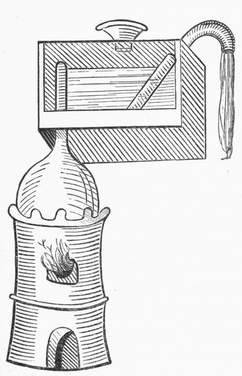
John Baptista Porta, in his “Spiritalia,” quarto, 1606, gives a rude
wood engraving, as here exactly represented, a metal flask-shaped
boiler, fitting the top of a small furnace, while its neck proceeds
through the bottom of a cistern of water, within which there is a
syphon on the right hand side, and an aperture at the top through which
the cistern can be refilled. By this arrangement, the steam presses on
the surface of the water, when all is closed, except the syphon, from
which the water will rush with increased velocity.
In the 16th century, motive and other Æolipile were well known, and
are described and illustrated by Vitruvius, Hero, and other early
writers. In 1606, Porta made a slight advance, and John Rovinson,
patentee of improvements in the manufacture of iron, in his “Treatise
of Metallica,” 1613, among other necessary parts of his invention,
describes the following:—“A new-devised vetible, round and hollow,
with a long spout, to be made of some mettall or potter’s earth,
wherein water being put, and the same placed on a fire, as it heateth,
and the water evaporateth by the spout, it maketh a continuall
blast to kindle, or increase the fire in furnaces, or fire-workes,
and may be converted to many other excellent uses; and same may be
made in severall peeces with the top or upper part removeable at
pleasure, so as the lower part being made to stand on feet, may serrve
at pleasure for a possenet, skellet or boylatory; and when the top is
put on, and when fastened and luted, it may then serve for the ventible
to make the blast.”
In 1615, De Caus invented, or at all events published an account
of a small hot-water fountain; in 1617, Robert Fludd published his
voluminous work, “Historia Macrosmi,” containing descriptive and
engraved illustrations of the effects produced on water heated in close
flask-shaped vessels.
In 1629, Branca suggested the rotating of a wheel, acted on by a jet
of steam, as a simple kind of stamping or pounding mill. But the
author, who seems to have taken a more practical and enlightened view
of the subject, and to have considerably contributed to the Marquis’s
enthusiasm, was John Bate, who, in 1634 and 1635, published editions of
his “Mysteries of Nature and Art.” His treatise, “The first Booke of
Water-workes,” contains, as stated at the commencement, “Experiments of
drawing water by the crane (syphon), and by engines; of forcing water
by ayre compressed, and by engines; of producing sounds by ayre and
water; by evaporation of water by fire, and by engines; of motions
by evaporating water, and by rarifying ayre.”
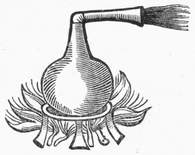
Among his “Experiments of producing sounds by evaporation of water by
ayer,” the following is given:—“Prepare a round vessell of brasse, or
lattin, having a crooked pipe or necke, whereunto fasten a pipe: put
this vessell upon a trevet over the fire, and it will make a shrill
whistling noyse.”—Page 27.
He figures a blow-pipe for glass-working,
as in the annexed engraving, which he thus describes:—
“Let there be a vessell of copper about the bignesse of a common
foot-ball, as A; let it have a long pipe at the top as D, which must
be made so that you may upon occasion screw on lesser, or bigger vents
made for the purpose. Fill this one-third part with water, and set it
over a furnace of coals, as E, G, H, I, and when the water beginneth to
heat, there will come a strong breath out of the nose of the vessel,
that will force the flame of a lampe placed at a convenient distance as
K.”—Page 158.
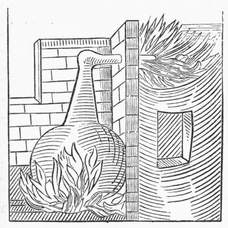
Sir Hugh Plat, in his “Jewel House of Art and Nature,” 1594, gives an
account of the ordinary fire-blowing Æolipile. He says:—“A round ball
of copper or lattin, that will blow the fire very strongly, only by the
attenuation of water into air; which device will also serve to perfume
with.—A round ball of copper or lattin, of the bigness of a small
bowl—a round pipe or neck, of 3 or 4 inches in length, less than a
goose quill—and an elbow of a less pipe no bigger than a straw, whose
vent in the end must be no bigger than a pinhole.” “Heat the same well
in the fire, and then put it into a vessel of cold water, and it will
suck some of the water into it, you may heat the same so often, till by
the peize (poise?) thereof you may be assured that it is more than half
full. Then set this ball on a few glowing coals, and you shall find
the same to give a very strong blast.... I make no question but that
the same may be made so large as that they will blow one whole hour
together without any intermission.”—Page 25.
In the second edition of Dr. French’s “Art of Destillation,” 1653,
page 150, he describes the “Philosophicall Bellowes:” one is to blow a
furnace fire; another a candle, serving as a blow-pipe; and the third
for a common fire. He notes “that these kind of vessels must be made of
copper, and be exceedingly well closed, that they may have no vent but
at their noses.” He recommends, in preparing them for use, that “you
must first heat them very hot, then put the noses thereof (which must
have a very small hole in them, no bigger than a pin’s head may go in)
into a vessel of cold water, and they will presently suck in the water,
of which being then full turne the noses thereof towards the candle or
fire which you would have blown.”
The third figure, instead of being a copper ball is formed like the
human face, and is held by a long stick or handle attached to the
back. It is represented and described by Schwenteri, in his “Deliciæ
Physico-Mathematicæ,” 1638, along with two tubulated balls for similar
use.
Such then were the suggestions the Marquis had before him to excite his
experimental inquiries, independent of other sources. But whatever he
may have known on the subject of these applications of steam, however
much he may have experimented on them, there are two things, of
which no one has yet given him the credit of possessing any knowledge
whatever, the one is, condensation; the other, a piston. How the
Marquis of Worcester could have been experimenting at the cost of
£50,000, and upwards, at Vauxhall, and been occupied in this particular
class of experiments during a large portion of thirty-eight years,
in perfect ignorance that cold water will condense steam, is past
all comprehension. Nay, such ignorance would be a greater matter of
surprise, than the exhibition of his utmost ingenuity in the mechanical
contrivances connected with his engine. Condensation was no mystery.
Every work on distillation spoke on the subject, and supplied the forms
of refrigeratory worms, and refrigerating heads for alembics. His very
allusion to the strength of his vessels must have had reference, first
to internal distension, as well as to collapse from external pressure.
John Bate, in his first book, “Of Water Works,” describes a kind of
weather glass, which he calls, “the moveable perpendicular glass;” for
the construction of which his directions are—“First prepare the glass
A, B, fill it almost top full of water, provide also the glass K, L,
having a loop at the top of it: divide it into so many equal parts as
you would have degrees, and on the mouth thereof fasten a thin board,
that will easily slip in and out of the bottom glass; make then a
weight of lead or brass somewhat heavier than both the glass and board
fastened thereunto; and then tie a little rope to the loop of the
glass A, B, and the weight at the other end thereof. Rarifie the air
contained in the glass L, and reverse it into the glass A, B, filled
with water, and hang the plummet over two little pulleys fastened in a
frame made for the purpose; and as the glass K, L, cooleth, the water
will ascend the same, and so by the change of the outward both the
glass and water will move accordingly.”—Pages 42–43.
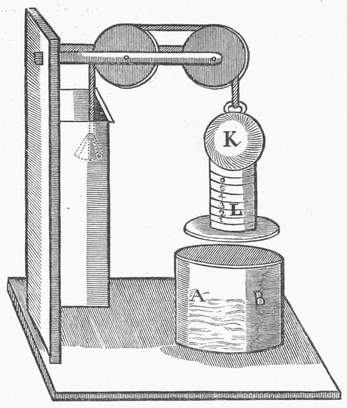
From all that has been advanced, an impartial reader must feel
satisfied that there existed abundant sources of popular information,
highly suggestive to such an inquisitive and inventive mind as the
Marquis possessed. Van Etten mentions the filling of a cannon with
water, the plugging it up, and exploding it by the action of fire
applied to its trunnion. And here John Bate suggests an experimental
apparatus on a small scale, which the Marquis would be almost certain
to test, and in so doing to vary the construction and application.
Rarefaction too is here recommended; and the effect of cooling or
condensation is particularly noted, the stated result being, “the
water will ascend.” We can readily imagine the Marquis varying such an
experiment with infinite delight, and modifying and enlarging it to
produce some practical application.
In considering these minuter points, we must never lose sight of the
extraordinary perseverance shown by the Marquis throughout a long life,
in conducting and varying his experimental inquiries. It was the one
pursuit of a studious life-time, the heaviest source of expenditure in
his private disbursements. Perhaps we should be very much under the
mark in saying that he must have expended above a hundred thousand
pounds in experiments alone; which would be represented by nearly
ten times that amount in our day. And not only was this outlay very
great, but he had for above thirty-five years kept his workman, Caspar
Kaltoff, constantly engaged on his models and on practical trials of
his variously constructed inventions.
The Act for his Water-commanding Engine received the Royal assent in
June, 1663, and the same year he published his “Century of Inventions”
(as here reprinted); a pamphlet was next issued, with no other title
than the following heading at the top of the first page—“An exact
and true definition of the most stupendous Water-commanding Engine,
invented by the Right Honourable (and deservedly to be praised and
admired) Edward Somerset, Lord Marquess of Worcester, and by his
Lordship himself presented to His most Excellent Majesty, Charles the
Second, our most gracious Sovereign.”—See Appendix C.
This pamphlet appears to have had some connection with means for
giving publicity to the formation of a public company for carrying out
the great design on a sufficiently large and remunerative scale. The
author, or editor, was James Rollock, who here flourishes in a poetical
vein, observing, “After the Act of Parliament, there is here set down
a Latin Elogium, and an English Panegirick, both of them composed
through duty and gratitude by an ancient servant of his Lordship’s.”
He afterwards adds: “This ancient servant of his Lordship’s, hath for
forty years been an eye witness of his great ingenuity, indefatigable
pains, and vast expences in perfecting for publique service, not
onely this most Stupendious Water-commanding Engine, but likewise
several other rare, useful, and never formerly heard of Mathematical
conclusions, of which he hath owned a Century, and thereunto I refer
you: though this alone were enough to eternalize his Name to all Ages
and future times.”
The “Definition” given in the pamphlet agrees with that which has
already appeared in the “Life, Times, &c.,” pages 224, 225, from
another source, and is here stated as follows:—
“The Engine consisteth of the following Particulars;
“1. A perfect Counterpoize for what Quantity soever of Water.
“2. A perfect Countervail for what Height soever it is to be brought
unto.
“3. A Primum Mobile commanding both Height and Quantity
Regulator-wise.
“4. A Vicegerent or Countervail supplying the place, and performing
the full force of a Man, Wind, Beast, or Mill.
“5. A Helm or Stern, with Bitt and Reins, wherewith any Child may
guide, order, and control the whole Operation.
“6. A particular Magazine for Water, according to the intended
Quantity or Height of Water.
“7. An Aquaduct capable of any intended Quantity or Height of Water.
“8. A place for the Original Fountain or even river to run into, and
naturally of its own accord incorporate itself with the rising Water,
and at the very bottom of the same Aquaduct, though never so big or
high.”
We cannot do otherwise than consider that the articles, Nos. 68, 98,
and 100, refer to descriptions of the several parts of his remarkable
steam engine. In No. 68, we have the two vessels, with two cocks,
connected with a furnace, and so arranged that “one vessel of water
being consumed, another begins to force and refil with cold water.” In
No. 98, we have intimation of “the primum mobile,” forming the 3rd
division of the particulars enumerated above; being some portion of the
engine capable of every variety of movement. And in No. 100, we have
no mechanical suggestions, but in their place a bare enumeration of
results, and of advantages to be derived from the employment of such
engines.
What then are we to understand by the preceding list of particulars?
“1. A perfect counterpoise,” would suggest that the Marquis had
contrived a complete system of pumping; “2. A perfect countervail,”
appears to be only a different kind of counterpoise, as though the
one were derived from weight, and the other from the action of the
steam; 4. “A vicegerent,” may be the force or piston; 5. “A helm or
stem, with bit and reins,” can hardly be mistaken for any other than
levers, acting on valves, and in some positions connected with chains
running over guide pulleys; while the parts 6, 7, and 8, refer wholly
to reservoirs, cisterns, and other external arrangements. But this
statement is simply made to remind the reader that the Marquis’s
Engine was not so entirely simple in its construction as to consist
only of a boiler and receiver, and to depend wholly on the effect
of the direct action of steam on a large surface of cold water, as
generally intimated. It is usual entirely to set aside this full and
clear statement of details. So indefinitely has the Marquis’s claim
hitherto been stated, that it is always assumed, that while using this
early steam engine, he was quite unacquainted with condensation; or,
at least, with any mode of employing it to produce a useful effect.
On the other hand, it is not only more rational to suppose that he
could not be otherwise than fully acquainted with it, but that, having
ascertained its various results, he finally succeeded in employing
condensation to produce a vacuum for refilling his vessels, and for
giving motion to a force or piston. Indeed, we find in the foregoing
statement—“6. A particular Magazine for Water, according to the
intended quantity or Height of Water.” A particular Magazine,
one for a special purpose, for which it was particular to have
such a supply; and for size, form, and situation, it had reference
“to the quantity and height of water,” for a small cistern would
supply sufficient water for condensation, but a larger cistern would
be required in proportion to more extended service. Then, “7. An
Aqueduct,” might be the vertical main pipe; and “8. A place for the
original fountain,” peculiarly arranged reservoirs, with suitable
valves, floats, &c.
Uniting his several descriptions, we readily make out a construction of
apparatus answering many of the conditions he has stated, as shown in
the engraving[W] on the opposite page from a sectional drawing designed
by the author.
In the “Life, Times, &c.,” page 20, we have a view of
the deep grooves cut in that side of the Citadel of Raglan Castle, on
which the Marquis of Worcester’s Water-works were situated. The grooves
would admit the insertion of pipes of about one foot external diameter,
either round, or square, and they would carry water nearly twenty-five
feet high. In the early use of his engine, he may have forced the water
direct from the boiler, or by the using of an independent boiler, as
employed by Porta, in 1606; but either way, the arrangement of his
Raglan works would seem to have been that of employing a main vertical
pipe for each boiler or receiver, instead of each receiver being
connected with a four-way cock with one vertical pipe, or “aquaduct.”
With these observations we close our comments on the various articles
of the “Century,” after having supplied a mass of most important
references to contemporary and earlier scientific authors; as well as
offered several entirely new solutions; and reduced the problematical
character of this singularly interesting work to one only, being No.
56, which alone remains open to the charge of being a paradox.
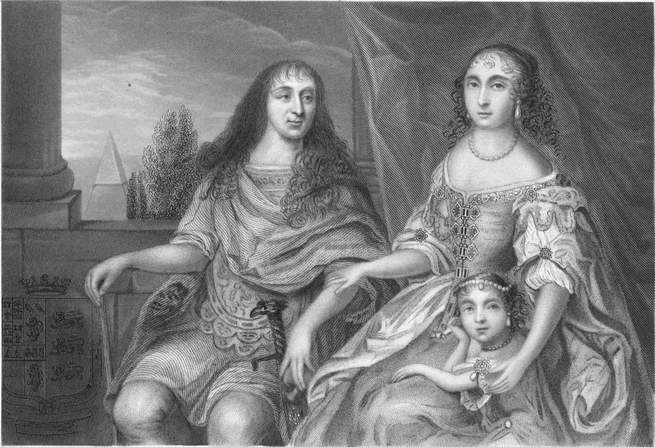 Engraved by J. Cochran.
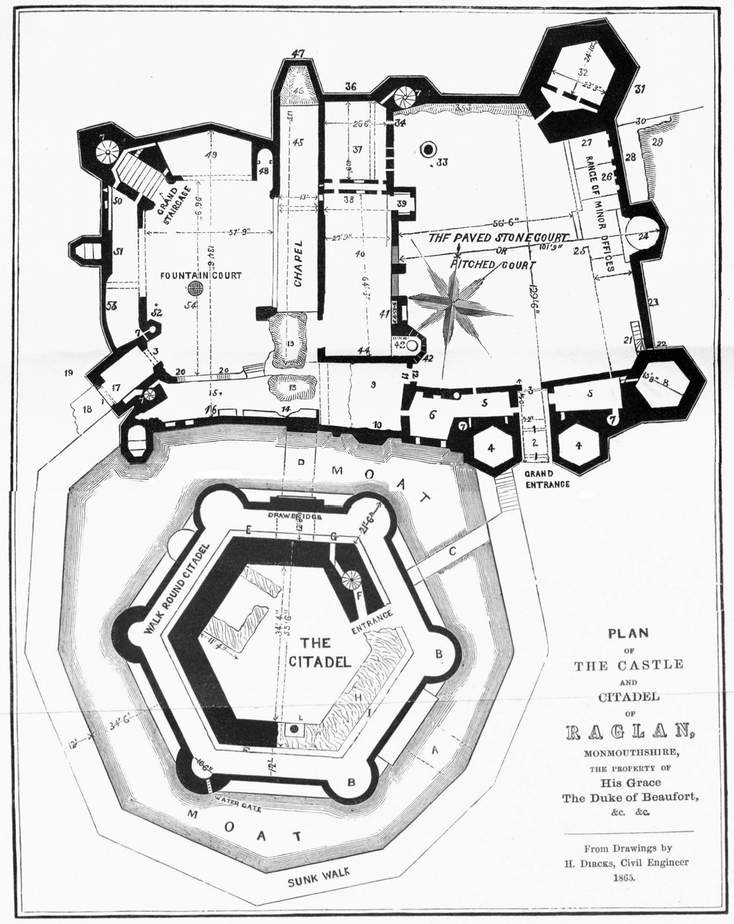 PLAN OF THE CASTLE AND CITADEL OF RAGLAN, MONMOUTHSHIRE, THE PROPERTY OF His Grace The Duke of Beaufort, &c. &c.
 BIRD’S-EYE VIEW FROM MAP OF LONDON, 1658.
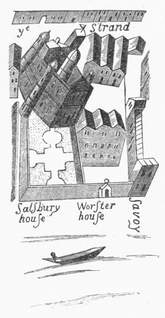 BIRD’S-EYE VIEW FROM MAP OF LONDON, 1658.
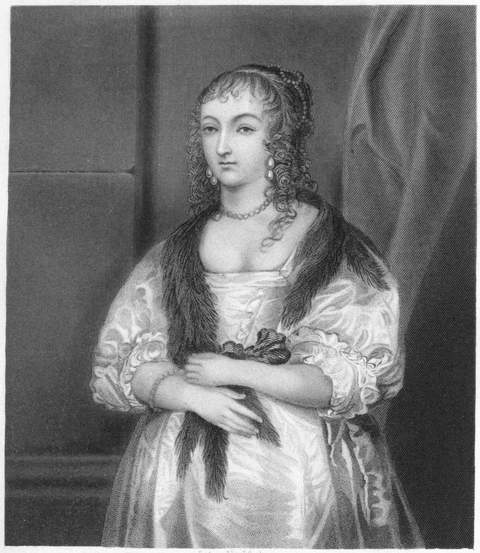 Engraved by J. Cochran.
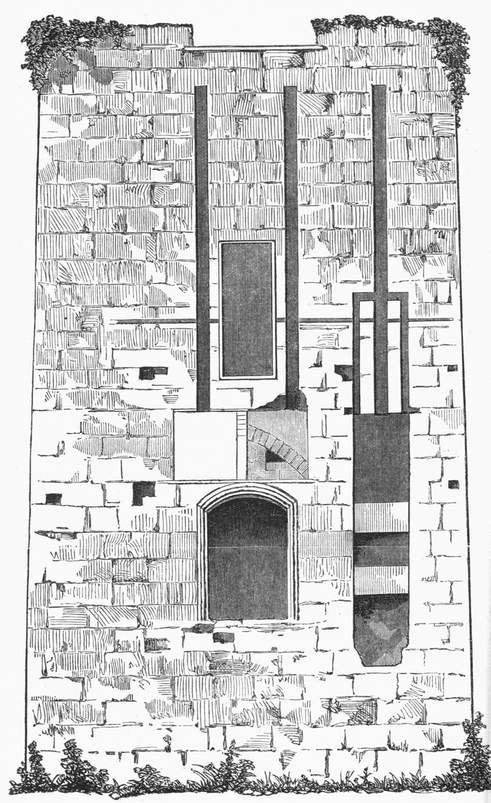
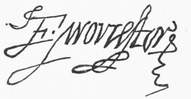
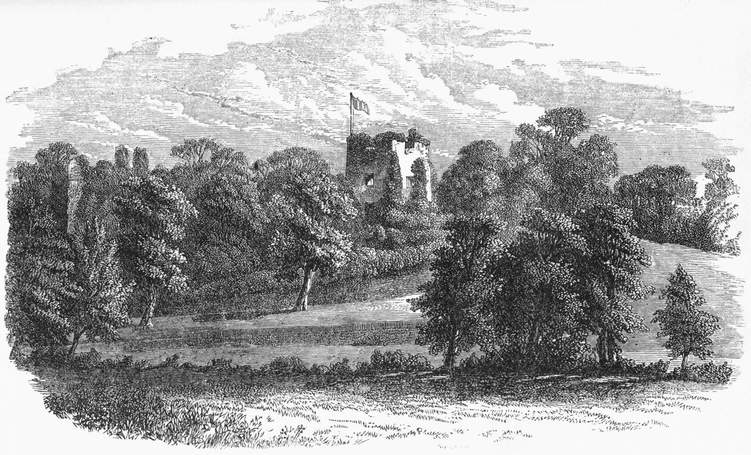 DISTANT VIEW OF RAGLAN CASTLE, MONMOUTHSHIRE.
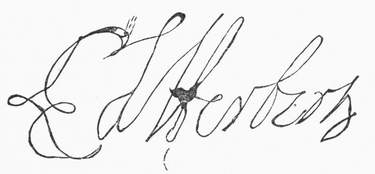
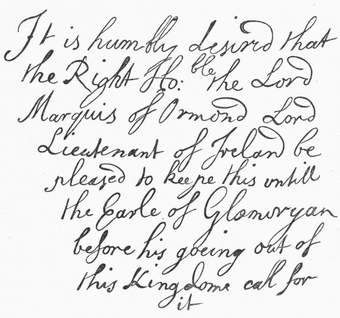
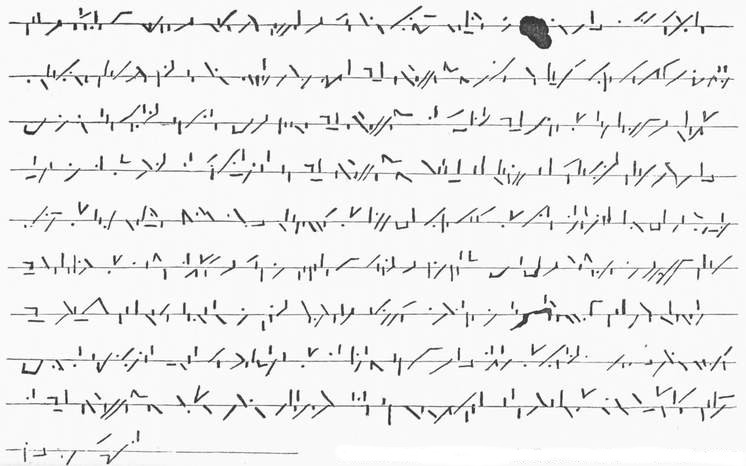 Facsimile of a letter written by the Earl of Glamorgan, September, 1646–7.
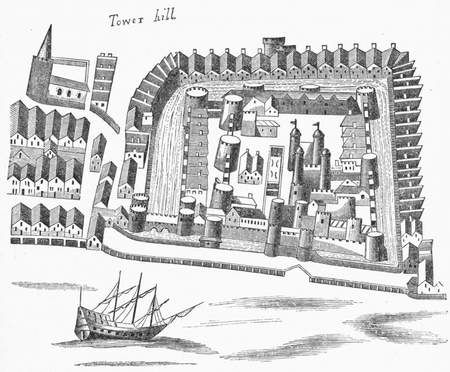 BIRD’S-EYE VIEW FROM MAP OF LONDON, 1658.
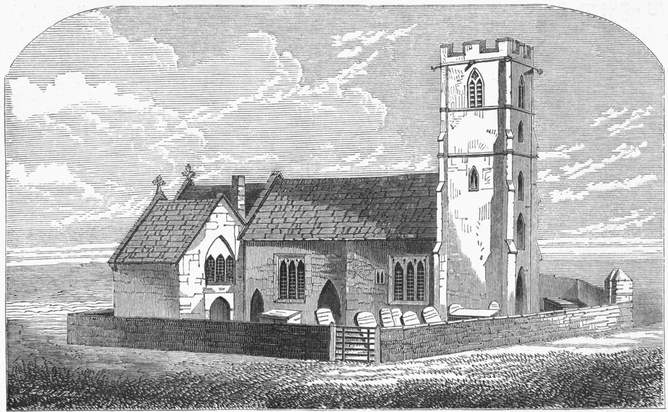
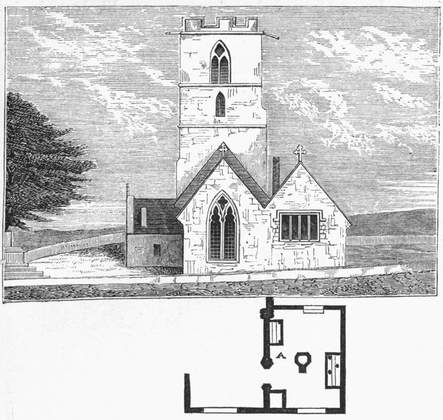 EAST END VIEW AND PLAN OF RAGLAN CHURCH.
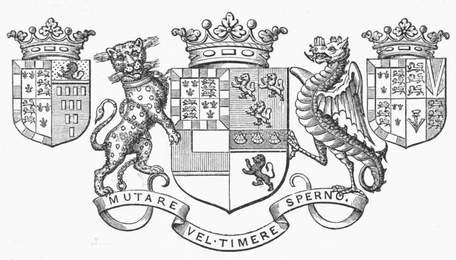
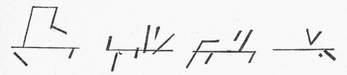
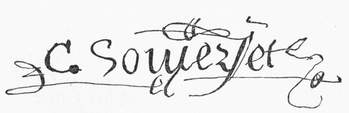
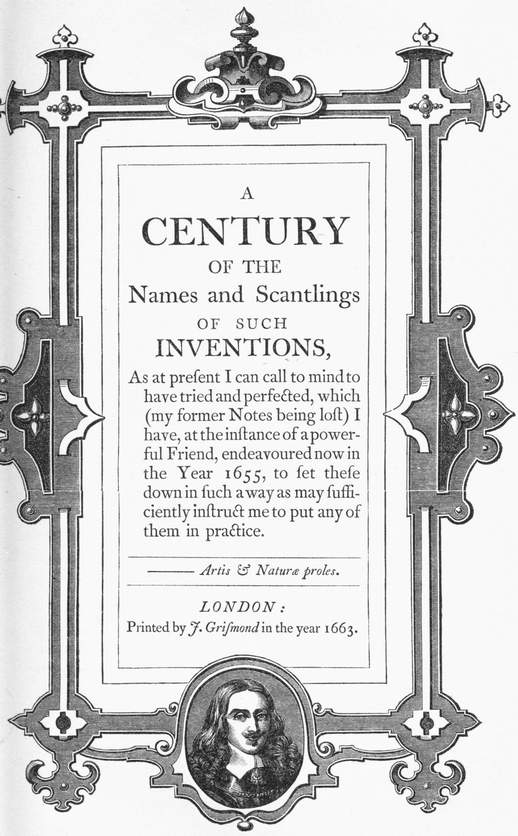
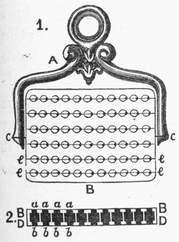
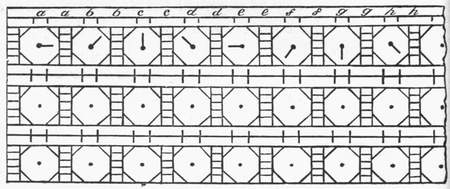
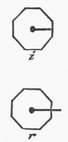
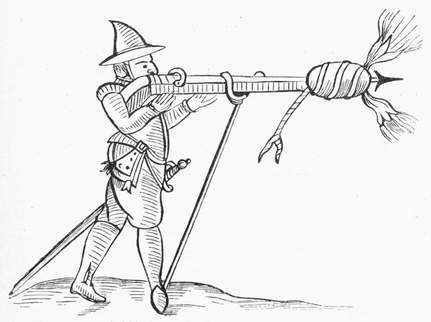
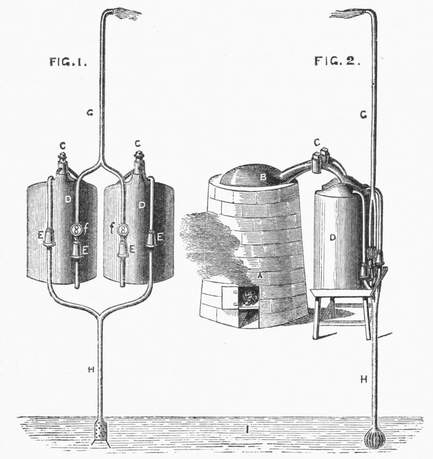
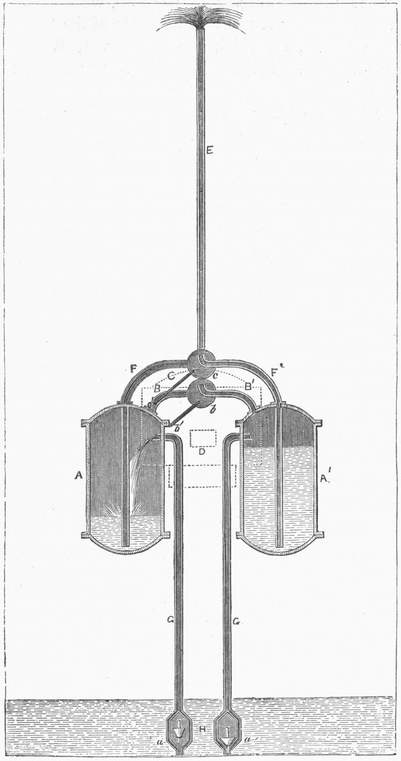


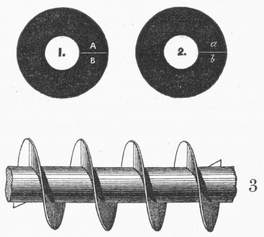
 abbreviates the word presents which is rendered as presents.
The final symbol also occurs in the words
 products and
 thoughts.
 Invenc̃ons, tilde above letter c,
 Mīa, macron above letter i,
 (run̄ing away) macron above first letter n.