Among the insects that undergo a complete transformation, there is, as
we have seen in the preceding chapter, an amount of inward change, of
dissolution and rebuilding of tissues, that varies in its completeness
in members of different orders. It is now advisable to consider the
various outward forms assumed by the larvae of these insects, or rather
by a few examples chosen from a vast array of well-nigh 'infinite
variety.'
In comparing the transformations of endopterygote insects of different
orders, it is worthy of notice that in some cases all the members of an
order have larvae remarkably constant in their main structural features,
while in others there is great variety of larval form within the order.
For example, the caterpillars of all Lepidoptera are fundamentally much
alike, while the grubs of beetles of different families diverge widely
from one another. A review of a selected series of beetle-larvae will
therefore serve well to introduce this branch of the subject.
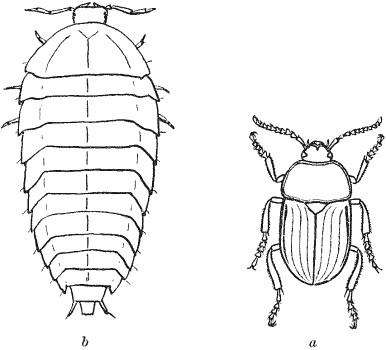
Fig. 12. a, Carrion-beetle (Silpha) with its larva,
b. Magnified, a 3 times, and b 4 times.
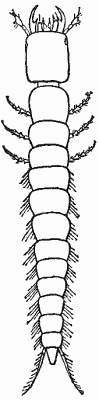
Fig. 13.
Larva of a Ground-beetle (Aepus). Magnified 6 times. After Westwood,
Modern Classification of Insects.
Beetles are as a rule remarkable among insects for the firm consistency
of their chitinous cuticle, the various pieces (sclerites) of which
are fitted together with admirable precision. In some families of
beetles the larva also is furnished with a complete chitinous armour,
the sclerites, both dorsal and ventral, of the successive body-segments
being hard and firm, while the relatively long legs possess well-defined
segments and are often spiny. Such a larva is evidently far less unlike
its parent beetle than a caterpillar is unlike a butterfly. Perhaps of
all beetle larvae, the woodlouse-like grub (fig. 12 b) of a
carrion-beetle (Silpha) or of a semi-aquatic dascillid such as Helodes
shows the least amount of difference from the typical adult, on account
of the conspicuous jointed feelers. The larval glow-worm, however, is of
the same woodlouse-like aspect, and in this case, where the female never
acquires wings, but becomes mature in a form which does not differ
markedly from that of the larva, the exceptional resemblance is closer
still. In all beetle-grubs the legs are simplified, there being only one
segment (a combined shin and foot) below the knee-joint, whereas in the
adult there is a shin followed by five, four, or at least three
distinct tarsal segments. The foot of an adult beetle bears two claws
at its tip, while the larval foot in the great majority of families has
only one claw. In one section of the order, however, the Adephaga
comprising the predaceous terrestrial and aquatic beetles, the larval
foot has, like that of the adult, two claws. Some adephagous larvae,
notably those of the large carnivorous water-beetles (Dyticus), often
destructive to tadpoles and young fish, have completely armoured bodies
as well as long jointed legs. More commonly, as with most of the
well-known Ground-beetles (Carabidae), the cuticle is less consistently
hard, firm sclerites segmentally arranged alternating with considerable
tracts of cuticle which remain feebly chitinised and flexible. Most of
the adephagous larvae (fig. 13) have a pair of stiff processes on the
ninth abdominal segment, and the insect, from its general likeness to a
bristle-tail of the genus Campodea, is often called a campodeiform
larva (Brauer, 1869). From such as these, a series of forms can be
traced among larvae of beetles, showing an increasing divergence from
the imago. The well-known wireworms—grubs of the Click-beetles
(Elateridae)—that eat the roots of farm crops, have well-armoured
bodies, but their shape is elongate, cylindrical, worm-like; and their
legs are relatively short, the build of the insect being adapted for
rapid motion through the soil. The grubs of the Chafers (Scarabaeidae)
are also root-eaters, but they are less active in their habits than the
wireworms, and the cuticle of their somewhat stout bodies is, for the
most part, pale and flexible; only the head and legs are hard and horny.
Usually an evident correspondence can be traced between the outward form
of any larva and its mode of life. For example, in the family of the
Leaf-beetles (Chrysomelidae) some larvae feed openly on the foliage of
trees or herbs, while others burrow into the plant tissues. The exposed
larvae of the Willow-beetles (Phyllodecta, fig. 14) have their somewhat
abbreviated body segments protected by numerous spine-bearing, firm
tubercles. But the grub of the 'Turnip Fly' (Phyllotreta) which feeds
between the upper and lower skins of a leaf, or of Psylliodes
chrysocephala (fig. 15), which burrows in stalks, has a pale, soft
cuticle like that of a caterpillar.
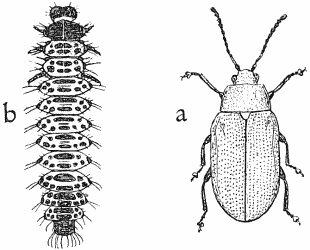
Fig. 14. (a) Willow-beetle (Phyllodecta vulgatissima)
and its larva (b). Magnified 5 times. After Carpenter, Econ. Proc. R.
Dublin Soc. vol. I.
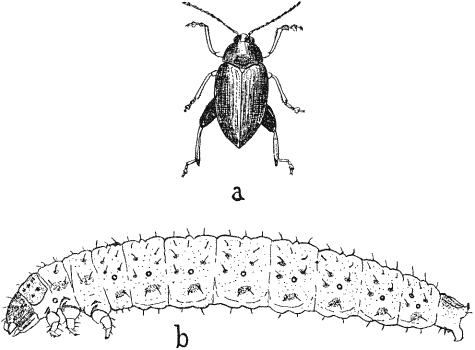
Fig. 15. (a) Cabbage-beetle
(Psylliodes chrysocephala) magnified 5 times, and its larva (b)
magnified 12 times.
In the larvae of the little timber-beetles and their allies (Ptinidae),
including the 'death-watches' whose tapping in old furniture is often
heard, a marked shortening of the legs and reduction in the size of the
head accompany the whitening and softening of the cuticle. This
shortening of the legs is still more marked in the larvae of the
Longhorn Beetles (Cerambycidae) burrowing in the wood of trees or felled
trunks; here the legs are reduced to small vestiges.
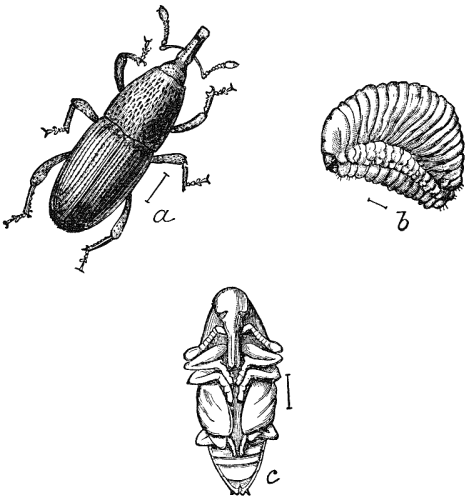
Fig. 16. a, Grain Weevil (Calandra granaria); b,
larva; c, pupa. Magnified 7 times. After Chittenden, Yearbook U.S.
Dept. Agric. 1894.
Finally in the large family of the Weevils
(Curculionidae, fig. 16) and the Bark-beetles (Scolytidae), the grubs,
eating underground root or stem structures, mining in leaves or seeds,
or tunnelling beneath the bark of trees, have no legs at all, the place
of these limbs being indicated only by tiny tubercles on the thoracic
segments. Such larvae as these latter are examples of the type called
eruciform by A. S. Packard (1898) who as well as other writers has laid
stress on the series of transitional steps from the campodeiform to the
eruciform type afforded by the larvae of the Coleoptera.
A fact of much importance in the transformations of beetles as pointed
out by Brauer (1869) is that in a few families, the first larval instar
is campodeiform, while the subsequent instars are eruciform. We may take
as an example of such 'hypermetamorphosis' the life-story of the Oil or
Blister-beetles (Meloidae) as first described by J. H. Fabre (1857), and
later with more elaboration by H. Beaurégard (1890). From the egg of one
of these beetles is hatched a minute armoured larva, with long feelers,
legs, and cerci, whose task is, for example, to seize hold of a bee in
order that the latter may carry it, an uninvited guest, to her nest.
Safely within the nest, the little 'triungulin' beetle-grub moults; the
second instar has a soft cuticle and relatively shorter legs, which, as
the larva, now living as a cuckoo-parasite, proceeds to gorge itself
with honey, soon appear still further abbreviated. Later comes a stage
during which legs are entirely wanting, the larva then resting and
taking no food. The last larval instar again has short legs like the
grub of the second period. In connection with this life-history we
notice that the newly-hatched larva is not in the neighbourhood of its
appropriate food. Hence the preliminary armoured and active instar is
necessary in order to reach the feeding place; this journey
accomplished, the eruciform condition is at once assumed.
In all cases indeed we may say that the particular larval form is
adapted to the special conditions of life. A few examples from other
orders of endopterygote insects will illustrate this point. The
campodeiform type is relatively unusual, but most of the Neuroptera have
larvae of this kind, active, armoured creatures with long legs, though
devoid of the tail-processes often associated with similar larvae among
the Coleoptera. Such are the 'Ant-lions,' larvae of the exotic lacewing
flies, which hunt small insects, digging a sandy pit for their unwary
steps in the case of the best-known members of the group, some of which
are found as far north as Paris. In our own islands the 'Aphis-lions,'
larvae of Hemerobius and Chrysopa, prowl on plants infested with
'green-fly' which they impale on their sharp grooved mandibles, sucking
out the victims' juices, and then, in some cases, using the dried
cuticle to furnish a clothing for their own bodies. Among these insects,
while the mouth of the imago is of the normal mandibulate type adapted
for eating solid food, the larval mouth is constricted and the slender
mandibles are grooved for the transmission of liquid food.
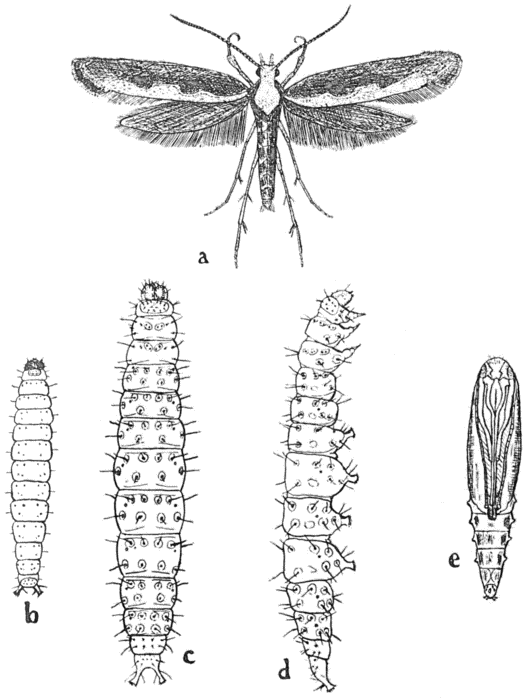
Turning to eruciform types of larva, we find the caterpillar (fig. 1
b, c, d) distinguished by its elongate, usually cylindrical body
with feeble cuticle, short thoracic legs and a variable number of pairs
of abdominal pro-legs, universal among the moths and butterflies forming
the great order Lepidoptera, and usual among the saw-flies, which belong
to the Hymenoptera. The vast majority of caterpillars feed on the leaves
of plants and their long worm-like bodies with the series of paired
pro-legs, are excellently adapted for their habit of clinging to twigs,
and crawling along shoots or the edges of leaves as they go in search of
food. Of great importance to a caterpillar is its power of spinning
silk, consisting of fine threads solidified from the secretion of
specially modified salivary glands whose ducts open in the insect's
mouth at the tip of the tubular tongue which forms a spinneret.
On the same bush caterpillars of moths and of saw-flies may often be
seen feeding together. The lepidopterous caterpillar, in our countries
at least, has never more than five pairs of pro-legs, situated on the
third, fourth, fifth, sixth, and tenth abdominal segments; each of these
pro-legs bears a number of minute hooklets, arranged in a circular or
crescentic pattern, which assist the caterpillar in clinging to its
food-plant. The saw-fly caterpillar, on the other hand, may have as many
as eight pairs of pro-legs, the series beginning on the second abdominal
segment; here, however, the pro-legs have no hooklets. Among the
Lepidoptera, we notice a reduction in the number of pro-legs in the
'looper' caterpillars of Geometrid moths. Here only two pairs are
present, those on the sixth and tenth abdominal segments. Consequently,
as the caterpillar can cling only by the thorax and by the hinder region
of the abdomen, the middle region of the body is first straightened out
and then bent into an arch-like form, as the insect makes its progress
by alternate movements of stretching and 'looping.'
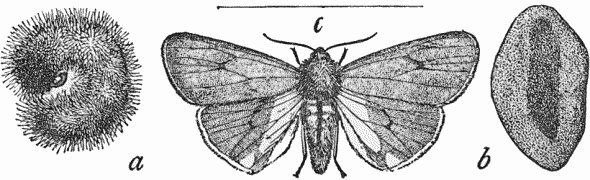
Fig. 17. c, Ruby Tiger Moth (Phragmatobia
fuliginosa); a, caterpillar; b, cocoon. After Lugger, Insect
Life, vol. II.
Caterpillars, with their relatively soft bodies, feeding openly on the
leaves of plants, are exposed to the attacks of many enemies, and the
various ways in which they obtain protection are well worth studying. A
clothing of hairs[7] or spines is often present, and it is interesting
to find that many species of our native Tiger and Eggar Moths (Arctiadae
and Lasiocampidae) which pass the winter in the larval stage, have
caterpillars with an especially dense hairy covering (fig. 17).
Experiments have shown that hairy and spiny insects are distasteful to
birds and other creatures that prey readily on smooth-skinned species, a
conclusion that might well have been expected. Certain smooth
caterpillars however appear to be protected by producing some nauseous
secretion, which renders them unpalatable. Many of these, as the
familiar cream yellow and black larva of the Magpie Moth (Abraxas
grossulariata), are very conspicuously adorned, and furnish examples of
what is known as 'warning coloration,' on the supposition that the gaudy
aspect of such insects serves as an advertisement that they are not fit
to eat, and that birds and other possible devourers thus learn to leave
them alone. On the other hand, smooth caterpillars which are readily
eaten by birds are usually 'protectively' coloured, so as to resemble
their surroundings and remain hidden except to careful seekers. Many
such caterpillars are green, the upper surface, which is naturally
exposed to the light, being darker than the lower which is in shadow.
When the caterpillar is large, the green area is often broken up by pale
lines, longitudinal as on the larvae of many Owl Moths (Noctuidae) or
oblique, as on the great caterpillars of most Hawk Moths (Sphingidae).
Such an arrangement tends to make the insect less easily seen than were
it to display a continuous area of the same colour. The 'looper'
caterpillars mentioned above afford remarkable examples of 'protective'
resemblance, for many of them show a marvellous likeness to the twigs of
their food-plant, tubercles on the insect's body resembling closely the
little outgrowths of the plant's cortex. It has been shown by E. B.
Poulton (1892) that many caterpillars are, in their early stages,
directly responsive to their surroundings as regards colour. Usually
green when hatched, they remain green if kept among leaves or young
shoots of plants, while they turn red, brown, or blackish if placed
among twigs of these respective hues. This effect appears to be due to a
direct response of the subcutaneous tissue to the rays of light
reflected from the surrounding objects. The sensitiveness dies away as
the caterpillar grows older, since little or no change of hue in
response to a change of environment could be induced after the
penultimate moult.
Among those families of the Lepidoptera which are usually regarded as
low in the scale of organisation, caterpillars are very generally
protected by the habit of feeding in some concealed situation. For
example, the great larvae of the Goat Moth (Cossus) and the whitish
caterpillars of the Clearwing Moths (Sesiidae) burrow through the wood
of trees, eating the timber as they go. The little irritable
caterpillars of the Bell Moths (Tortricidae) roll leaves, fastening the
edges together with silk, and thus make for themselves a shelter; or
they bore their way into seeds or fruits, like the larva of the Codling
Moth that is the cause of 'worm-eaten' apples, too well-known to
orchard-keepers. Very many small caterpillars mine between the two skins
of a leaf, eating out the soft green tissue, and giving rise to a
characteristic blister in form of a spreading patch or a narrow sinuous
track through the leaf. The caterpillars of the Clothes-moths (Tineidae)
make for themselves garments out of their own excrement, the particles
fastened together by silk. In such curious cylindrical cases they wander
over the wool or fur, feeding and indirectly supplying themselves with
clothing at the same time.
The case-forming habit of the Clothes-moth caterpillars leads us
naturally to consider the similar habit adopted by their allies the
Caddis-larvae which live in the waters of ponds and streams, for the
Caddis-flies (Trichoptera) have much in common with the more primitive
Lepidoptera. The caddis-larva is as a rule of the eruciform type, but
with well-developed thoracic legs, and with hook-like tail-appendages;
by means of the latter it anchors itself to the extremity of its curious
'house.' It is of interest to note that in the earlier stages of some
caddises lately described and figured by A. J. Siltala (1907), the legs
are relatively very long, and the larva is quite campodeiform in aspect.
Some of these caddis-grubs retain the campodeiform condition and do not
shelter permanently in cases, as their relations do. Different genera of
caddises differ in their mode of building. Some fasten together
fragments of water-weeds and plant refuse, others take tiny particles of
stone, of which they make firmly compacted walls, others again lay hold
of water-snail shells, which may even contain live inhabitants, and bind
these into a limy rampart behind which their bodies are in safe hiding.
The silk with which the 'caddis-worms' fasten together the materials for
their houses is produced from spinning-glands which like those of the
Lepidoptera open into the mouth.
The survey of the various types of beetle-larvae enumerated above (pp.
50-56) concluded with a short description of the legless grub, which
is the young form of a weevil or a bark-beetle. This is a larva in which
the head alone has its cuticle firm and hard; the rest of the body is
covered with a pale, flexible cuticle, so that the grub is often
described as 'fleshy.' This type of larva is by no means confined to
certain families of the beetles, it is frequently met with, in more or
less modified form, in two other important orders of insects, the
Hymenoptera and the Diptera. Among the Hymenoptera this is indeed the
predominant larval type. We have just seen that a caterpillar is the
usual form of larva among the saw-flies, but in all other families of
the Hymenoptera we find the legless grub. A grub of this order may
usually be distinguished from the larva of a weevil or other beetle, by
its relatively smaller head and smoother, less wrinkled cuticle; it
strikes the observer as a feebler, more helpless creature than a
beetle-grub. And it is of interest to note that this somewhat degraded
type of larva is remarkably constant through a great series of
families—gall-flies, ichneumon-flies, wasps, bees (fig. 18), ants—that
vary widely in the details of their structure and in their habits and
mode of life. Almost without exception, however, they make in some way
abundant provision for their young. The feeble, helpless, larva is in
every case well sheltered and well fed; it has not to make its own way
in the world, as the active armoured larva of a ground-beetle or the
caterpillar of a butterfly is obliged to do.
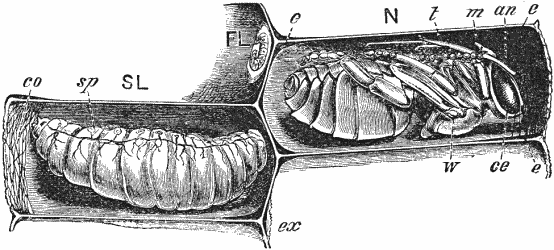
Fig. 18. Young Larva (FL), Full-grown Larva (SL) and
Pupa (N) of Hive-bee (Apis mellifica). co, cocoon; sp,
spiracles; ce, eye; an, feeler; m, mandible; l, labium.
Magnified 4 times. After Cheshire, Bees.
Among those saw-flies whose larvae feed throughout life in a concealed
situation, we find an interesting transition between the caterpillar
and the legless grub. For example, the giant saw-flies (so called
'Wood-wasps') have larvae that burrow in timber, and these larvae
possess relatively large heads, somewhat flattened bodies with pointed
tail-end, and very greatly reduced legs. The feeble legless grub,
characteristic of the remaining families of the Hymenoptera, is provided
for in a well-nigh endless variety of ways. The female imago among these
insects is furnished with an elaborate and beautifully formed
ovipositor, and the act of egg-laying is usually in itself a provision
for the offspring. Gall-flies pierce plant-tissues within which their
grubs find shelter and food, the plant responding to the irritation due
to the presence of the larva by forming a characteristic growth, the
gall, pathological but often regular and shapely, in whose hollow
chamber the grub lives and eats. Ichneumon-flies and their allies pierce
the skin of caterpillars and other insect-larvae, laying their eggs
within the victims' bodies, which their grubs proceed to devour
internally. Some very small members of these families are content to lay
their eggs within the eggs of larger insects, thus obtaining rich
food-supply and effective protection for their tiny larvae. In
Platygaster and other genera of the family Proctotrypidae, M. Ganin
(1869) showed the occurrence of hypermetamorphosis somewhat like that
already described as occurring among the Oil-beetles (Meloidae). The
larva of Platygaster is at first rather like a small Copepod crustacean,
with prominent spiny tail-processes; after a moult this form changes
into the legless grub characteristic of the Hymenoptera, among which
larvae even approaching the campodeiform type are very exceptional. The
species of Platygaster pass their larval stages within the larvae of
gall-midges.
Wasps, bees and ants, have the ovipositor of the female modified into a
sting, which is often used for the purpose of providing food for the
helpless grubs. Thus the digging wasps (Sphegidae and Pompilidae) hunt
for caterpillars, spiders, and other creatures which they can paralyse
with their stings, and bury them alongside their eggs to furnish a
food-supply for the newly-hatched young. The social wasps and many ants
sting and kill flies and other insects, which they break up so as to
feed their grubs within the nest. It is well known that the labour of
tending the larvae in these insect societies is performed for the most
part not by the mother ('Queen') but by the modified infertile females
or 'workers.' Other ants and the bees feed their grubs (fig. 18), also
sheltered in well-constructed nests, on honey elaborated from nectar
within their own digestive canals. In all cases we see that the
helplessness of the grub is associated with some kind of parental care.
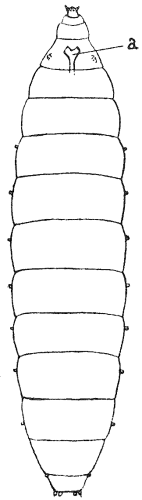
Fig. 19. Larva of Gall-midge (Contarinia nasturtii),
ventral view showing anchor process (a), and spiracles projecting at
sides. Magnified 30 times. From Carpenter, Journ. Econ. Biol, vol.
VI.
From the Hymenoptera we may pass on to the Diptera or Two-winged Flies,
an order of which the vast number of species and in many cases the
myriads of individuals force themselves on the observer's notice. F.
Brauer (1863) divided the Diptera into two sub-orders[8]; of the first
of these a Crane-fly or 'Daddy-long-legs' may be taken as typical, of
the second an ordinary House-fly or Bluebottle. All the larvae of the
Diptera are legless, those of the Crane-fly group have well-developed
hard heads, with biting mandibles, but in the House-fly section the
larva is of the degraded vermiculiform type known as the maggot,
not only legless, but without a definite head, the front end of the
creature usually tapering to the mouth, where there are a pair of strong
hooks, used for tearing up the food. A few examples of each of these
types must suffice in the present brief survey. A few pages back (p. 66)
reference was made to the production of galls on various plants, through
the activity of larvae of the hymenopterous family Cynipidae. Many
plant-galls are due, however, to the presence of grubs of tiny dipterous
insects, the Cecidomyidae or Gall-midges. A cecid grub (fig. 19) has an
elongate body with flexible, wrinkled cuticle, tapering somewhat at the
two ends. The head, if rather narrow, is distinct, and beneath the
prothorax is a characteristic sclerite known as the 'anchor process' or
'breast bone.' Along either side of the body is a series of paired
spiracles, each usually situated at the tip of a little tubular
outgrowth of the cuticle; the hindmost spiracles are often larger than
the others. These little grubs live in family communities, their
presence leading to some deformation of the plant that serves to shelter
them. A shrivelled fruit or an arrested and swollen shoot, such as may
be due respectively to the Pear-midge (Diplosis pyrivora) or the
Osier-midge (Rhabdophaga heterobia), is a frequent result of the
irritation set up by these little grubs. In a larva of the crane-fly
family (Tipulidae, fig. 20) living underground and eating plant-roots,
like the well-known 'leather-jacket' grubs of the large
'Daddy-long-legs' (Tipula) or burrowing into a rotting turnip or swollen
fungus, like the more slender grub of a 'Winter Gnat' (Trichocera), the
student notices a somewhat tough cuticle, a relatively small but
distinct head, and frequently prominent finger-like processes on the
tail-segment. Further examination shows a striking modification in the
arrangement of the spiracles. Instead of a paired series on most of the
body-segments, as in caterpillars and the vast majority of insects
whether larval or adult, there are two large spiracles surrounded by the
prominent tail-processes, and a pair of very small ones on the
prothorax, the latter possibly closed up and useless. This restriction
of the breathing-holes to a front and hind pair (amphipneustic
condition) or to a hind pair only (metapneustic type) is highly
characteristic of the larvae of Two-winged flies.
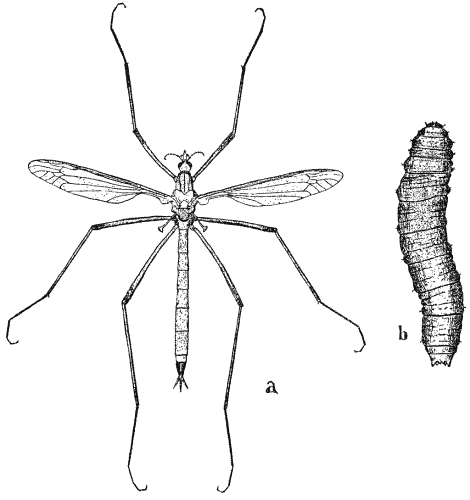
Fig. 20. Crane-fly (Tipula oleracea), a, female; b,
larva ('leather-jacket' grub). Magnified twice.
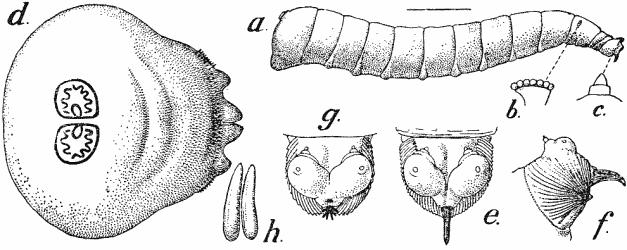
Fig. 21. Maggot of House-fly (Musca domestica), a,
side-view, magnified 5 times; b, prothoracic spiracle; c, feeler;
d, hind-region with posterior spiracles; e, f, head-region with
mouth-hooks; g, head-region of young maggot; h, eggs. All magnified.
After Howard, Entom. Bull. 4, U.S. Dept. Agric.
Turning now to the maggot, characteristic of the House-fly section
(fig. 21) of the Diptera, we see the greatest contrast between the larva
and the imago that can be found throughout the whole class of the
insects. The Bluebottle's eggs, the well-known 'fly blow' laid in summer
time on exposed meat, not unnaturally arouse feelings of disgust, yet
they are the prelude to one of the most marvellous of all insect
life-stories. The fly—with its large globular head, bearing the
extensive compound eyes, the highly modified feelers with their
exquisitely feathered slender sensory tips, and the complex suctorial
jaws; with its compact thorax bearing the glassy fore-wings alone used
for flight, though the hind-wings modified into tiny drumstick-like
'halters' are the organs of a fine equilibrating sense—is perhaps the
most specialised, structurally the 'highest' of all insects. Yet in a
week or two this swift, alert, winged creature is developed from the
degraded maggot, white, legless, headless, that buries itself in putrid
flesh, 'feeding on corruption.'
The broad end of the maggot is the tail, while the narrow extremity
marks the position of the mouth. Above this are a pair of very short
feelers (fig. 21 c), while from the aperture project the tips of the
mouth-hooks (fig. 21 e, f), formidable, black, claw-like structures,
articulated to the strong pharyngeal sclerites and moved by powerful
muscles, tearing up the fibres of the flesh. On either side of the
prothorax is an anterior spiracle, a curious branching or fan-like
outgrowth (fig. 21 b), with a variable number of tiny openings which
are probably of little use for the admission of air to the tubes. In
many maggots the mouth-hooks and the front spiracles become more and
more complex in form in the successive instars. The cuticle, white and
smooth to the unaided eye, is seen on microscopic study to be set with
rows of tiny spines which assist the maggot's movements through its
food-mass. At the tail-end the large hind spiracles are conspicuous on a
flattened dorsal area of the ninth abdominal segment; each shows a hard
brown plate, traversed by three slits. And as we watch this curious
degraded larva thrusting its narrow head-end into the depths of its
ofttimes loathsome food-supply, we understand the advantage of access to
the air-tube system being mainly confined to the hinder end of the body.
Maggots, differing from that of the Bluebottle only in minor details,
are the larval forms of a vast multitude of allied species and display
great variation in the nature of their food. Most, however, hide their
soft defenceless bodies in some substance which affords shelter as well
as food. The Bluebottle maggot burrows into flesh, that of the House-fly
into horse-dung or vegetable refuse. The maggot of the Cabbage-fly eats
its way into the roots of cruciferous plants, that of the Mangel-fly
works out a broad blister between the two skins of a leaf, into which
the newly-hatched larva crawls directly from the egg. A large number of
species, forming an entire subfamily (the Tachininae) have larvae that
feed as parasites within the bodies of other insects.
The habit of parasitism by maggots in back-boned animals has led to some
remarkable modifications of the larva and to curious adventures in the
course of the life-story. The Bot-fly of the Horse (Gastrophilus equi)
and the Warble-fly of the Ox (Hypoderma bovis, fig. 22) lay eggs
attached to the hairs of grazing animals, which, at least in the case of
Gastrophilus, lick the newly-hatched larvae into their mouths. The
'bot,' or maggot of Gastrophilus, comes to rest in the horse's stomach;
often a whole family attach themselves by their mouth-hooks to a small
patch of the mucous coat of that organ. The maggot is relatively short
and stout, with rows of strong spicules surrounding the segments, and
with spiracles capable of withdrawal through a cup-like inpushing of the
tail-region of the body, so that the parasite is preserved from drowning
when the host drinks water. The young maggot of Hypoderma (fig. 22 e)
is elongate and slender, spends its first two stages burrowing in the
gullet wall and then wandering through the dorsal tissues of its host;
ultimately it arrives beneath the skin of the back and assumes for its
third and fourth instars a broad barrel-like form (fig. 22 b). The
supply of free oxygen within the ox's tissues being now insufficient,
the warble-maggot bores a circular hole through the skin and rests with
the tail spiracles directed upwards towards the outer air. When fully
grown the maggot works its way through the hole in the host's skin, and
falling to the ground pupates in some sheltered spot, the life cycle
occupying about a year. Similarly the Horse-bot escapes from the host's
intestine with the excrement, and pupates on the ground.
A curious modification of the maggot is noticeable in the larva of the
Hover-flies (Syrphus). These, unlike most of their allies, live exposed
on the foliage of plants, where they feed by preying on aphids.
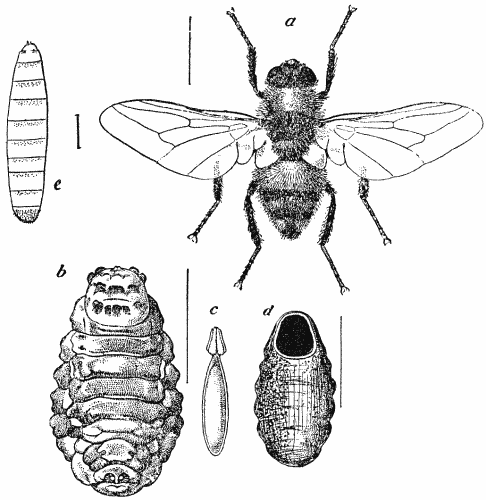
Fig. 22. Ox Warble-fly (Hypoderma bovis), a, female;
b, full-grown maggot from back of ox, dorsal view; c, egg; d,
empty puparium, ventral view; e, young maggot from gullet, ventral
view. Magnified (lines show natural size). a-d, after Theobald, 2nd
Report Econ. Zool. (Brit. Mus.).
In agreement with this manner of life, the cuticle is roughly
granulated, often greenish or reddish in hue, and the maggot, despite
its want of definite head and sense organs, moves actively and
purposefully about, often rearing up on its broad tail-end with an aphid
victim impaled on its mouth-hooks.
In a previous chapter reference was made to the exopterygote insects,
stone-flies, dragon-flies, and may-flies, whose preparatory stages live
in the water. Among the endopterygote orders many Neuroptera and
Coleoptera, all Trichoptera, a very few Lepidoptera and many Diptera,
have aquatic larvae. One or two examples of the adaptations of dipteran
larvae to life in the water may well bring the present chapter to a
close. Many members of the hover-fly family (Syrphidae) have maggots
with the tail-spiracles situated at the end of a prominent tubular
process. Among the best-known of syrphid flies are the drone-flies
(Eristalis), often seen hovering over flowers, and presenting a curious
likeness to hairy bees. The larva of Eristalis is one of the most
remarkable in the whole order, the 'Rat-tailed maggot' found in the
stagnant water of ditches and pools. It has a cylindrical body with the
hinder end drawn out into a long telescopic tube, a more slender
terminal section being capable of withdrawal into, or protrusion from, a
thicker basal portion. At the extremity of the slender tube is a crown
of sharp processes, forming a stellate guard to the spiracles. These
processes can pierce the surface-film of the water, and place the
tracheal system of the maggot in touch with the pure upper air; while
its mouth may be far down, feeding among the foul refuse of the ditch,
it can still reach out to the medium in which the end of its life-story
must be wrought out.
Reverting to the first great division of the Diptera, we find varied
adaptations to aquatic life among many grubs that possess a definite
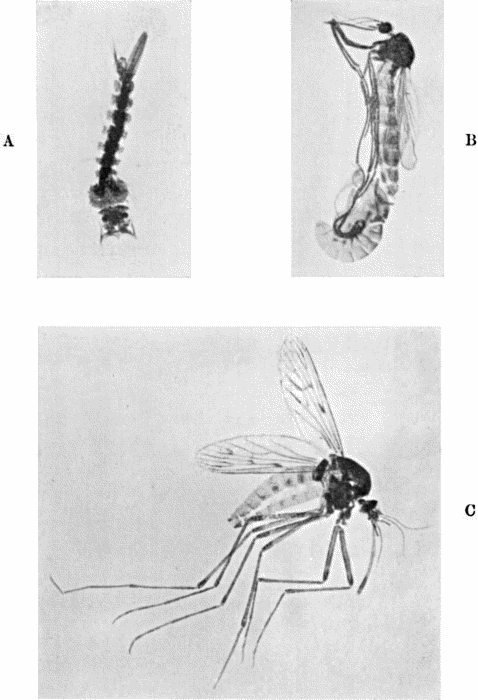
head. The larva of a Gnat (Culex[9]) has projecting from the hind region
of the abdomen a long tubular outgrowth, at the end of which are the
spiracles, guarded by three pointed flaps forming a valve. When closed
these pierce the surface-film of the water in which the larva lives;
when opened a little cup-like depression is formed in the surface-film,
from which the larva hangs. Or having accumulated a supply of air, it
can disengage itself from the surface-film and dive through the water,
its tracheal system safely closed. Another mode of breathing is found in
the 'Blood-worms' and allied larvae of the Harlequin-midges
(Chironomidae) whose transformations are described in detail by Miall
and Hammond (1900). These larvae have two pairs of cylindrical,
spine-bearing pro-legs—one on the prothorax and the other on the
hindmost abdominal segment; the latter structures serve to fix the
larva in the muddy tube which it inhabits at the bottom of its native
pond. The penultimate abdominal segment has four long hollow outgrowths,
which contain blood, and have the function of gills, while the hindmost
segment has four shorter outgrowths of the same nature. Enabled thus to
breathe dissolved air, the Chironomus larva needs not, like the Culex or
the Eristalis, to find contact with the atmosphere beyond the
surface-film.
Most remarkable, in many respects, of all aquatic larvae are the grubs
of the Sand-midges (Simulium). These live entirely submerged and, having
no special gills, carry out an exchange of gases through the general
surface of the cuticle between the dissolved air in the water and the
cavities of the air-tube system. The body is shaped like a flask swollen
slightly at the hinder end and possesses a median pro-leg just behind
the head, also another at the tail, which serves to attach the larva to
a stone or to the leaf of an aquatic plant. The head has, in addition to
feelers and jaws, a pair of processes with wonderful fringes which by
their motion set up currents in the water, and bring food particles
within reach of the mouth. A number of the larvae usually live in a
community. Their power of spinning silken threads by which they can work
their way back when accidentally dislodged from their resting-place, has
been vividly described by Miall (1895).
Examples might be multiplied, but enough have been given to enforce the
conclusion that the forms of insect-larvae are wondrously varied, and
that frequently, within the limits of the same order or even family,
modifications of type may be found which are suited to various modes of
life adopted by different insects. A survey of the multitudes of insect
larvae—grubs, caterpillars, maggots—living on land, on plants,
underground, in the water; feeding on leaves, in stems, on roots, on
carrion, on refuse; by hunting or by lurking after prey; as parasites or
as scavengers, brings home to us most strongly the conclusion that each
larva is fitted to some little niche in the vast temple of life, each is
specially adapted to its part in the great drama of being.