THE LIFE STORY OF A SQUIRREL — CHAPTER I MY FIRST ADVENTURE
It was a perfect June morning, not a breath
stirring, and the sun fairly baking down till the
whole air was full of the hot resinous scent of pine-needles;
but, warm as it was, I was shivering as I
lay out on the tip of a larch-bough and looked
down. I was not giddy—a squirrel never is. But
that next bough below me, where my mother was
sitting, seemed very far away, and I could not help
thinking what a tremendous fall it would be to the
ground, supposing I happened to miss my landing-place.
I am too old now to blush at the recollection
of it, and I don’t mind confessing that at the
time I was in what I have since heard called a
blue funk.
The fact is, it was my first jumping and climbing
lesson. Even squirrels have to learn to climb, just
as birds have to be taught by their parents to fly.
My mother called me by my name, Scud, sitting
up straight, and looking at me encouragingly with
her pretty black eyes. But I still hesitated,
crouching low on my branch and clinging tight
to it with all four sets of small sharp claws.
Mother grew a trifle impatient, and called to my
brother Rusty to take my place.
This was too much for me. I took my courage
in both fore-paws, set my teeth, and launched
myself desperately into the air. I came down flat
on my little white stomach, but as at that time
I weighed rather less than four ounces, and
the bough below was soft and springy, I did not
knock the wind out of myself, as one of you
humans would have done if you had fallen in the
same way.
Mother gave a little snort. She did not
approve of my methods, and told me I should
spread my legs wider and make more use of my
tail. Then she turned and gave a low call to
Rusty to follow.
Even at that early age—we were barely a month
old—Rusty was a heavier and rather slower-going
squirrel than I. But he already showed that
bull-dog courage which was so strong a trait all
through his after-life. He crawled deliberately to
the very end of the branch, then simply let go and
tumbled all in a heap right on the top of us. It
was extremely lucky for him that mother was so
quick as she was. She made a rapid bound forward,
and caught her blundering son by the loose
skin at the back of his neck just in time to save
him from going headlong to the ground, quite
fifty feet below.
She panted with fright as she lifted him to a
place of safety with a little shake.
Rusty looked a trifle sulky, and mother gave
him an affectionate pat to soothe him down.
Then she told us to follow her back along the
branch, and she would show us how to climb up
the trunk home again. She sent me first.
I had hardly reached the trunk end of the bough
when I heard mother utter a cry which I had never
heard her give before. It was a low sharp call.
Oddly enough, I seemed to know exactly what
it meant. At once I lay flat upon the bough,
here quite thick enough to hide my small body,
and crouched down, making myself as small as
possible. At the same instant mother seized Rusty
by the scruff of his neck, and with one splendid
leap sprang right up on to the wide, thick bough
on the flat surface of which our home was built.
In a few seconds she came back for me, and before
I knew what was the matter I, too, was safe in the
nest, alongside Rusty and my sister, little Hazel.
Mother gave a low note of warning that none of
us should move or make any noise; and you may
be sure we all obeyed, for something in her manner
frightened us greatly. Presently we heard heavy
footfalls down below rustling in the dry pine-needles.
We sat closer than ever, hardly daring
to breathe. The footsteps stopped just below
our tree, and a loud rough voice, that made
every nerve in my body quiver, shouted out
something. From the sound of it we could tell
that the speaker was peering right up between the
boughs into our tree, and we knew without the
slightest doubt he had discovered our drey. He
must have spoken loud, even for a human, for his
companion gave a sharp ‘S-s-sh!’ as if he were
afraid that some one else might overhear and come
down upon them. It could not have been of us
he was afraid, for we, poor trembling, palpitating
little things, lay huddled together, hardly daring
to breathe.
The two tormentors turned away a few paces
after a few lower-toned remarks, and I began to
think they had gone, when——
Crash, a great jagged lump of stone came hurtling
up within a yard of our home, frightening us
all abominably.
Mother crouched with us closer than ever into
our frail little house of sticks, which was not made
to stand the force of stones.
Almost immediately there fell another mass of
whizzing stone, even nearer than the first. It
shore away a large tassel from the bough just
overhead, and this fell right on the top of us,
frightening Hazel so much that she jumped completely
out of the nest, and, if mother had not
been after her as quick as lightning, she must have
fallen over the edge and probably tumbled right
down to the ground and been killed at once.
Even a squirrel, particularly a young one, cannot
fall fifty feet in safety.
Mother saved her from this fate, but the mischief
was done. The quick eyes of our enemies below
had caught a glimpse of red fur among the pale
green foliage, and they roared out in triumph, the
louder and noisier making such a row, I thought
that anyone within hearing must come rushing
to see what was the matter. Then they began
disputing together, perhaps as to which of them
should carry us away.
We lay there nestling under mother’s thick fur,
shaking with fright.
The two fellows down below argued like angry
magpies for several minutes, and at last it was
decided that the quieter one should do the climbing.
I peeped over timidly and saw him throw off his
coat, and drew back to make myself as small as
possible. Presently I heard a bough creak, and
then there followed a scraping and grinding as his
heavy hobnailed boots clawed the trunk in an effort
to reach the first branch. Once on that, he came
up with dreadful rapidity. The boughs of the
larch were so close together that even such a great
clumsy animal, with his hind-paws all covered up
with leather and iron, could climb it as easily as
a ladder. We heard him coughing and making
queer noises as the thick green dust, which always
covers an old larch, got into his throat, and the
little sharp dry twigs switched his face. But he
kept on steadily, and soon he was only three or
four branches below us, and making the whole
top of the tree quiver and shake with his clumsy
struggles. But as he got higher the branches were
thinner, and he stopped, evidently not daring to
trust his weight to them, and called out something
to his companion. All the answer he got was
a jeering laugh, and this probably decided him, for,
with a growl, he came on again. The tree really
was thin up near our bough, at least for a great
giant like this. The trunk itself bent, and the
shaking was so tremendous that I began to think
that our whole home would be jerked loose from
its platform and go tumbling down in ruins with
us inside it.
Suddenly the fellow’s great rough head was
pushed up through the branches just below. His
fat cheeks were crimson, and his hair all plastered
down on his forehead with perspiration. I stared
at him in a sort of horrible fascination. I could
not have moved for the life of me, and, as Rusty
and Hazel told me afterwards, they felt just the
same. But mother kept her head. She was
sitting up straight, with her bright black eyes
fairly snapping with rage and excitement.
The man made a desperate scramble, and up
came a large dirty paw and grasped the very
branch on which we lived. This was too much
for mother. Her fur fairly bristled as she made
a sudden dash out of the nest by the entrance
nearest to the trunk, and went straight for that
grasping fist. Next instant her sharp teeth met
deep in his first finger. He gave one yell and let
go. All his weight came on his other hand, there
was a loud snap, and his large red face disappeared
with startling suddenness.
For a moment our tree felt just as it does when
a strong gust of wind catches and sways it. Our
enemy, luckily for himself, had fallen upon a wide-spreading
bough not far below, had caught hold
of it, and so saved himself from a tumble right
down to the bottom.
I heard his companion cry out in a frightened
voice. For a moment there was no reply, and
then a torrent of language so angry that I am
sure no respectable squirrel would have used
anything so bad even when talking to a weasel.
The man who had fallen was dancing about,
holding his hand in his mouth, and taking it out
to show his comrade. I watched him excitedly,
hoping that now he had been hurt he would go
away; but no, picking himself up he began again
clumsily climbing up towards us. He came more
slowly than before, trying each branch carefully
before he put his weight on it. Presently I saw his
furious face rising up again through the branches,
and now he had something shining and sharp, like
a long tooth, clutched between his lips. I did not
know then what a knife was, but I thought it
looked particularly unpleasant. There was a nasty
shine, too, in his pale blue eyes. I could feel my
heart throbbing as if it would burst. Again his
great ugly paw came clutching up at our bough.
Fortunately he could not quite reach it. Having
broken off the branch just below us, he had nothing
to hold on to. However, he was so angry that
there was no stopping him. He got his arms
and legs round the trunk and began to swarm up.
It looked as if nothing could save us now.
Mother herself was too frightened of that long
gleaming tooth to try to bite our enemy again.
She jumped out of the nest by the entrance on
the far side, and did her best to persuade us to
follow her out to the end of the branch where
we had been having our jumping lessons. But
we were much too frightened to move. We lay
shivering in the moss at the bottom of the nest,
and made ourselves as small as we knew how.
The man’s head was level with the bough; he
was stretching out for a good hand-hold, when
suddenly I heard the sharp clatter of a blackbird
from the hedge at the border of the spinny, and
immediately afterwards the crash of dry twigs
under a heavy boot.
A sharp hiss came from below in warning. Bill’s
hand stopped in mid-air, just as I once saw a rabbit
stop at the moment the shot struck it. His cheeks,
which had been almost as red as my tail, went the
colour of a sheep’s fleece. He listened for a
moment, then suddenly dropped to the bough
below, and began clambering down a good deal
more quickly than he had come up.
We guessed it was the keeper, who had always
left us alone, though we had often seen him about.
The steady tramp of his boots suddenly changed
to a quick thud, thud; and when he saw the fellows
at the tree, he gave a deep roar, just like the bull
that lives in the meadow by the river when he gets
angry. He came running along at a tremendous
pace, making such a tramping among the leaves
and pine-needles that the blackbird, though she had
flown far away, started up again with a louder
scream than ever.
The man on the ground did not wait. Deserting
his companion, he made off at top speed. But old
Crump, the keeper, knew better than to waste his
time in catching him. He had seen the boughs
shaking and he came straight for our tree, and
shouted triumphantly as he caught sight of the
other one, who was by this time only a few boughs
from the ground.
In his hurry and fright the fellow missed his
hold. Next moment there was a tremendous
thump, and a worse row even than when he had
taken his first tumble.
I peeped out of the nest again more confidently,
and I thought they were fighting. But what had
happened was that the poacher had fallen right on
the top of Crump’s head, flooring him completely,
and, I should think, knocking all the breath out of
him. Then, before the keeper, who was as fat as a
dormouse, could gain his feet, the other had
picked himself up and gone off full tilt after his
friend.
The keeper growled and muttered to himself
as he rose slowly. He picked up his gun and
walked round the tree, looking up, evidently
puzzled as to what the men had been after.
Then he caught sight of us, and shook his head, as
if he would have much liked to capture us himself
He certainly could not have had any friendly feeling
for us, as we bit the tips off his young larches.
But he must have had orders to let us alone, for he
did not attempt to molest us, and presently, to our
great relief, he too stumped off and left us undisturbed.
We lay very still for a long time, slowly getting
over our fright. Suddenly mother gave a pleased
little squeak and jumped out of the nest. I
crawled out too, as boldly as you please, and
looked down. Here came father running along
over the thick brown carpet of pine-needles which
covered the ground. I know some of you humans
laugh at a squirrel on the ground. But it is not
our fault that we do not look so well there as in our
proper place—a tree. Why, even the swan, supposed
to be the most graceful thing in the world,
waddles in the clumsiest fashion imaginable when
it is on dry land! At any rate, even over flat
ground a squirrel can move at a good pace.
Father was lopping along with his fore-paws very
wide apart, and stopping now and then to sniff or
burrow a little among the pine and larch needles.
In one place he evidently found something good—possibly
a nice fat grub—for he stopped, sat up
on his hind-legs, and, holding whatever it was in his
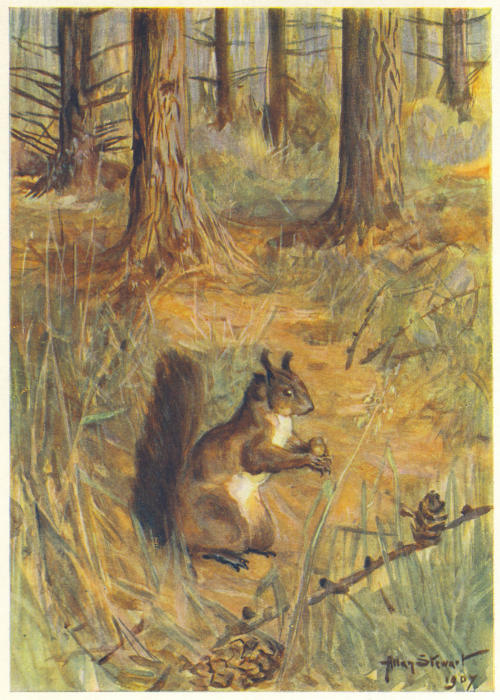
fore-paws, began to nibble at it daintily. How
handsome he looked sitting there, with his beautiful
sharp ears cocked, his splendid brush hoisted
straight up, and the rich, ruddy fur of his back
just touched by a stray gleam of sunshine, contrasting
beautifully with the snowy whiteness of his
waistcoat! It has always been my opinion that he
was the handsomest squirrel I ever saw, and I was
never more pleased in my life than when mother
once told me that she thought I was more like him
than any of her other children.
Mother called again. Father looked up, caught
sight of her, gave a quick flick of his tail and an
answering call. Next instant we heard the rattle
of his claws on the rough bark, and almost before
I could look round here he was with us.
He was full of good-humour, for he had been
over to the beech copse, and the mast, he told us,
was the finest crop he had seen for years. We
must collect a good store as soon as it got ripe.
But he suddenly noticed that mother was quivering
all over, and he had not time to ask what had
upset her before she burst into an account of all
the dreadful things that had happened that morning.
Then he looked very grave.
‘We must go,’ he said. ‘It means building a
new house. And this tree has suited us so admirably.
I do not think that I have ever seen a
weasel near it; then, too, we are so capitally
sheltered from bad weather by all these thick evergreens.
In any case I shall not leave the plantation,
but I suppose we must look out for another
tree. We cannot do anything to-day; it is too
late. Now I will mount guard over the youngsters
while you go and get some dinner.’
And rather uneasily she went off.
The heat of the day was over, but the sun was
still warm. A little breeze was talking gently
up in the murmurous tops of the trees, causing the
shadows to sway and dance in dappled lights on
the lower branches. You humans, who never go
anywhere without stamping, and running, and talking
loudly, and lighting pipes with crackly matches,
have no idea what the real life of the woods is like,
especially on a fine June afternoon such as this one
was. Though our larch was one of a thick clump,
yet from the great height of our nest we could see
right across into the belt of oaks, beeches, and old
thorn-trees which lay along the slope below, and
could even catch a glimpse of the tall hedge and
bank, and of the sandy turf beyond where the
rabbit-warren lay.
One by one the rabbits lopped silently out of
their burrows and began to feed till the close turf
was almost as brown as green. Stupid fellows,
rabbits, I always think, but I like to watch them,
especially when the young ones play, jumping over
and over one another, or when some old buck, with
a sudden idea that a fox or weasel is on the prowl,
whacks the ground with one hind-leg, and then all
scuttle helter-skelter back into their holes.
A pompous old cock pheasant came strutting
down a ride in the young bracken, the sun shining
full on his glossy plumage and black-barred tail.
Presently his wife followed him, and behind her
came a dozen chicks flitting noiselessly over the
ground like so many small brown shadows. A
pair of wood-pigeons were raising their second
brood in a fir-tree, not far away from where we
lived, and every now and then, with a rapid clatter
of wings, one of the old birds came flapping through
the aisles of the plantation with food for their two
ugly, half-fledged young ones. I wonder, by the
by, why a wood-pigeon is so amazingly careless
about its nest building. I never can understand
how it is that the young ones do not fall off the
rough platform of sticks which is their apology for
a nest. And it must be shockingly cold and
draughty, too. Birds are supposed to be ahead of
all other nest-builders, but I can tell you there are
a good many besides the wood-pigeon who might
take a few pointers in architecture from us squirrels,
to say nothing of our distant cousin the door-mouse.
A sharp rat-a-tat just behind startled me, and
there was a big green woodpecker hanging on tight
against the trunk of our own larch with his strong
claws, and pounding the bark with his hammer-like
beak. Father looked at him with interest.
‘Ah,’ he observed, ‘it’s about time we did move.
The old tree must be getting rotten, or we shouldn’t
have a visit from him.’
It was all most pleasant and peaceful as we sat
there—Rusty, Hazel, and I—enjoying the gentle
swinging in the soft west wind, and waiting for
mother to come home.
It was a very fine summer, that one. I have
never seen one like it since. We had very little
rain and no storms for weeks on end, and the crops
of mast and nuts were splendid.
But I am running ahead too fast. The very
next day after our narrow escape from the two
loafers, father set to work to make a new house in
the fir-tree he had spoken of. Luckily for him,
there was an old carrion crow’s nest handy in the
top branches, and he got plenty of sticks out of
this for the framework. Mother helped him to
gather some moss—nice dry stuff from the roots of
a beech, and he made a tidy job of it within three
days. Of course, he did not build so elaborately
as if he had been constructing a winter nest—we
squirrels never do. But all the same, he put a
good water-tight roof over it.
Meantime mother had been keeping us
youngsters hard at work with our climbing and
jumping lessons. We all got on very well, and
the day before we were to move she actually let
me come down to the ground. It was the funniest
feeling coming down so low, and at first I cannot
say that I liked it. There was no spring in the
earth, and one did not seem able to get a good
hold for one’s claws. The pine-needles slipped
away when one tried to jump. However, after the
first novelty wore off, I enjoyed the new sensation
hugely, and my joy was complete when mother
showed me a little fat brown beetle which she said
I might eat. I tried it, and really it might have
been a nut, it was so crisp and plump.
Rusty and Hazel were sitting on a bough overhead,
and as full of envy as ever they could be, for
mother had said that she really could not have
more than one of us at a time down among the
dangers of the ground, and that I was the only
one quick enough to look after myself if anything
happened.
My quickness was fated to be tested. While
mother was scratching about the tree-roots, having
a hunt for any stray nuts of last autumn’s store
that might hitherto have been overlooked, I moved
off to see if I could not discover another of those
tasty beetles. At a little distance lay a great log,
the slowly-rotting remains of a tall tree that had
been torn up by the roots in some winter gale
many years before, and was now half buried in the
ground. On its far side was a perfect thicket of
bracken, and a great bramble grew in the hollow
where the roots of the tree had once been, and hid
the fast decaying trunk. There was a curious
earthy smell about the place which somehow
attracted me. I know now that it was from a sort
of fungus which grows in the rotten wood, and is
quite good to eat, but at that time I was still too
young to understand this. However, I went gaily
grubbing about, and at last ventured on the very top
of the log and pattered down it towards the trunk
end. Near the butt was a hollow in the worm-eaten
wood. The bramble was thick on all sides,
but there was an opening above through which a
patch of bright sunlight leaked down. In the
middle of this dry, warm cavity was a small coil of
something of almost the same colour as the wood
on which it lay. At first I took it for a twisted
stick, but it attracted me strangely, and I gradually
moved nearer. It was not until I came to the
very edge of the hollow and sat up on my hind-legs
that I suddenly became aware that the odd
coil had a little diamond-shaped head, in which
were set two beady eyes. There was a horrible
cold, cruel look in those unwinking eyes which had
a strange effect upon me. I turned cold and stiff,
and felt as if, for the very life of me, I could not
move. Suddenly a forked tongue flickered out,
the dead coil took life, I saw the muscles ripple
below the ashen skin. It was that movement which
saved me. As the horrid head flashed forward, I
leaped high into the air. The narrow head and
two thin, keen fangs gleaming white passed less
than my own length below me, and I fell into the
thick of the bramble, the worst scared squirrel in
the wood. How I scrambled out I have no idea,
but in another instant I was scuttling back to my
mother, full of my direful tale.
When I told her what had happened she looked
very grave.
‘It was an adder,’ she said, shivering. ‘If it
had bitten you, you would have been dead before
sunset. Keep close to me, Scud.’
The next day we moved into our new quarters
in the fir-tree. Personally, I never liked a fir so
well as most other trees. It is so dark and gloomy,
and you get so little sun. My own preference has
always been for a beech. An old beech has such
delightful nooks and crannies, and often deep holes,
sometimes deep and large enough to build a winter
home in—always capital for the storage of nuts.
There was no doubt, however, that the fir which
father had chosen had many points to recommend
it. It was an immensely tall tree, and thick as a
hedge, yet there were no branches close to the
ground to tempt evil-minded young humans like our
recent invaders to climb up. What was still better,
so cunningly had father chosen his site that it was
quite impossible for any evil-minded, two-legged
creatures to see us from below. Our nest was
founded on a large, flat-topped branch close in to
the thick red trunk, and only about two-thirds of
the way up to the top. Another branch almost
equally thick formed a roof over our heads, so that
we were very snug and comfortable.
CHAPTER II THE GREAT DISASTER
The day on which the great disaster befell us was
wet in the early morning, and when the sun rose a
thick, soft mist, white like cotton-wool, hung over
the country-side. Not a breath of air was stirring,
and it was so intensely still that it seemed as though
one could hear everything that moved from one end
of the wood to the other. The plop of a water-rat
diving into a pool in the stream on the far side of
the coppice came as clearly to my ears as though
the water had been at the bottom of our own tree
instead of several hundred yards away, and when
the wood-pigeons began to move unseen in the
smother, the clatter of their wings was positively
startling.
We squirrel folk are not fond of wet, so we lay
still and snug in our cosy retreat until the sun
began to eat up the mist. Soon the grey smother
thinned and sank, leaving the tree-tops bathed in
brilliant light, every twig dripping with moisture,
and every drop sparkling with intense brilliance.
Then we crept out one by one, and, sitting up
straight upon our haunches, began our morning
toilet. No other woodland creature is so careful
and tidy in its habits as a squirrel, and mother had
already thoroughly instructed us in the proper
methods of using our paws as brushes and our
tongues as sponges, and in making ourselves neat
and smart as self-respecting, healthy squirrels
should be.
Suddenly a peal of distant bells came clanging
through the moist, calm air with such a vibrating
note that they made us all start. Father sat up
sharply, and mother asked him what was the
matter.
He explained to us that he had learnt by experience
that when those bells rang out it was a
dangerous time for us, for all the mischievous boys
and rough fellows in the neighbourhood seemed to
appear in the woods, and the keeper was never
seen. He did not know why this should be, but
from long custom he had grown to be uneasy at the
sound.
Mother shuddered sympathetically, and rubbed
against him caressingly, with a movement that told
him not to worry, and she reminded him consolingly
that even if our tormentors did take it into
their heads to come into the wood they would not
be likely to find us, since we had moved.
But father, instead of responding, suddenly
pricked up his ears, and, signalling to us to be
quiet, listened eagerly to some sound which the
rest of us had not yet caught. For a moment he
sat up straight, as still as though stuffed; then he
turned and spoke sharply, with a warning sound
that told us to lie as still as mice, for some danger
was approaching.
Sure enough, a minute later we all heard the
warning cry of a frightened blackbird, and immediately
afterwards the brushing and trampling of
a number of heavy boots through the wet grass
and fern in the distance. At once we all stretched
ourselves out tight as bark along the flat bough
which formed the foundation of our nest, and lay
there still as so many sleeping dormice.
The steps came rapidly nearer, and soon voices
sounded plainly through the hush of the quiet
wood. Imagine how I shuddered when I recognized
the coarse tones of our former enemies mixed
with others equally harsh and unpleasant! They
were making straight for our part of the
wood.
Shaking though I was in every limb, curiosity
drove me to peep cautiously over the edge of the
bough. The mist was all gone now, and there,
below the tall larch-tree which had been our old
home and the scene of our recent narrow escape,
stood four young louts, our old enemies and two
others about the same size and age, all craning
their necks and staring upwards through the thick,
pale-green branches. Each was carrying in his
right hand a short, flexible stick with a heavy head.
These were not long enough for walking-sticks, such
as Crump, the keeper, and other humans who sometimes
came through the wood carried; and, in spite
of my fright, I wondered greatly what they were
for. Alas! it was not long before I learnt the
terrible powers of the cruel ‘squailer.’
After a good deal of argument and dispute one
of the new-comers swung himself up on to the
lowest bough. He climbed far better and faster
than the one who had tried before, and in a very
short time had reached a bough close below our old
drey.
By this time I was getting over my fright a
little. I turned to Rusty, who was next me.
‘What a sell for them when they find no one at
home!’ I whispered in his ear.
But Rusty only grunted, and a sharp signal for
silence came from father.
The bough which had been broken before
stopped the climber for a few moments, but
presently he managed to swarm up the trunk and
seat himself astride of the very branch upon which
our former home was founded.
They shouted to him from below to be careful.
The fellow in the tree paid no heed, but, clutching
the trunk with one hand to steady himself, boldly
thrust the other into the nest. There was a sharp
exclamation of disgust; and he cried out furiously
that there was nothing there.
They were all in great excitement, and kept
urging him to look further and to make sure we
weren’t hiding. He felt in every crevice of the
nest, and peered about in the boughs, and then,
having evidently made up his mind we had really
gone, prepared to descend.
But the others called to him to look again,
so, steadying himself once more upon the bough,
he peered upward. Then he solemnly declared,
shaking his head, that there was nothing in the
tree. To prove it, with a sweep of his great
red paw, he carelessly ripped our old home from its
perch and sent it tumbling to the ground. I heard
mother give a little gasp as she saw destroyed in
an instant the results of so many hours of careful
and loving toil; but my own thoughts and eyes
were so concentrated upon the invader of our
rightful domain that I am afraid I hardly considered
her injured feelings. Still they would not
allow him to come down; and now came in a very
real danger. From the ground it would have been
quite impossible for them to spy us out in our new
quarters, but up the tree this fellow was on a level
with us, and had only to get a clear look between
the boughs to spy our little red bodies, which,
however much we crouched together, made a
considerable ball of fur.
Climbing to his feet, he stood upright on the
bough, clinging with one arm to the trunk. It
was this movement which proved our undoing.
Standing thus, his head was clear of the dwindling
foliage near the spire-like summit of the larch, and
from his lofty perch his eye commanded the tree-tops
in the neighbourhood. A moment later his
gaze fell upon us, five small scared balls of red fur,
and his roar of triumph struck terror to our quaking
hearts.
Without paying the slightest attention to the
shouted questions of his friends below, he swung
himself down hand over hand, and in a very short
time had dropped to the ground, and was running
across towards our fir-tree, with the others yelping
at his heels like a pack of harriers after a
hare.
Mother and father exchanged a few hurried
words, but what they said I in my excitement had
not the faintest idea. Next moment father had
me by the scruff of the neck, and darted away
up into the thick and almost impenetrable top
of the giant fir. Mother, with Hazel between her
teeth, came after him like a flash.
The fir-trunk forked near the summit; it was to
this point that father carried me, and dropped me
in the niche between the two boughs. Instantly
he was off again to fetch Rusty. Before our
enemies had noticed what was happening, and
while they were still arguing as to which of them
should do the climbing, all we three youngsters
had been deposited together in our lofty refuge.
A scuffling noise and the sound of heavy breathing
came from below. One of the gang had begun
the ascent of the tree. Mother looked at father in
a sort of dumb agony. She was palpitating with
fright, and her dark eyes were large and brilliant
with terror.
‘Can we reach another tree, Redskin?’ she asked
tremblingly.
But father knew better, and signified, ‘No.’
They two might have done it themselves, but
carrying us the jump would be too long to risk.
From far below the bumping, scuffling noise
slowly grew louder and nearer. It was a long
way up to the first bough of the fir-tree, and the
climber—it was the same one again—was obliged
to swarm the scaly red trunk. We could not, of
course, see anything of him, for the matted tangle
of crooked branches below, with their foliage of
thick, dark green needles, formed an impenetrable
screen.
I cannot even now remember that long wait in
the sunny tree-top, while ever from below the unseen
danger crept upon us, without an unpleasant
thrill, and I know that both my brother and my
sister shared my feelings. The worst part of it all
was the sight of the terror of our father, who had
always been to us a pattern of bravery. The fact
was that he realized the position, which we younger
ones did not do fully. He was only too well aware
that we were trapped. He and mother might have
easily escaped by descending to the longer branches
below, and thence jumping into a spruce which
grew close by; but they would not desert us, and
both remained clinging tightly to the main trunk
just beside us.
The hollow in which my brother and sister and
I were placed gave us complete shelter from below,
but there was only just room for the three of us.
Father and mother were forced to expose themselves.
The fir was, as I have said before, a very
large tree—quite seventy feet high—old, thick, and
gnarled, and the boughs were of considerable thickness
near to its very summit. Father no doubt
understood that our bulky enemy would, if he had
the pluck, be able to pursue us right up to our
lofty perch, and was aware of our almost hopeless
position.
Slowly, very slowly, our persecutor came upwards.
The branches, once he was among them,
were so close and thick that he evidently found
it difficult to force his way between them. Every
now and then he would stop and puff and blow;
then the creaking of large boughs and the cracking
of small twigs announced a fresh effort on his part.
At last he was only separated from our second
nest by a very small interval. Yet he had not
discovered it was empty. The others kept yelling
out questions to him, but he made no reply, only
forced his way through the tree, which, I am
bound to say, was very thick indeed.
More scrambling. Then he caught sight of the
nest and redoubled his efforts. But when he was
nearly up to it he reached up his arm, and without
the slightest fear that he might be bitten as his
companion had been, thrust his huge hand into it.
The result was a savage exclamation. Angrily
he seized the empty nest, tore it out, and sent it
flying down as he had done the other.
By this time the others were a little tired of
waiting, and began to scatter out from the tree
to try to spy us themselves. Common sense must
have told them that we had only left the nest
when we heard them, and could not be far, and
that we could probably be seen somewhere in the
surrounding boughs. A few moments’ suspense,
and then the awful warning shout again told us
we were discovered. The man was still in the
tree, though some way below, and by pointing and
gesticulations they directed him where to go to
find us. So he came panting up again, the
thinner branches swaying and rustling beneath his
weight. After a very few moments his head
appeared in the greenery below. He was of a
different type from the others, taller, black-haired,
and sallow-faced. It did not take him many
seconds to see us, and he quickly pulled himself
up towards us.
With his eyes fixed on mother, he came rapidly
upwards. Mother crouched where she was on a
small branch, very close to the extreme summit
of the tree, watching our enemy’s every movement.
By a lucky chance the main stem hid us three
youngsters from his sight. I think that father
and mother must have purposely placed themselves
on the other side from us with the express
object of drawing the boy’s attention away from
their helpless babies.
When he drew near he paused, and pulling a
red cotton handkerchief from his pocket, deliberately
wrapped it round one hand. Then,
getting a good grip with the other, he edged outwards
and made a sudden rapid grasp at mother.
My heart almost stopped as I saw the great hand
extended. But quick as he was, no human can
hope to rival the lightning action of a squirrel’s
muscles, and before the grasping hand touched
her the little lithe red body flew into the air as
though driven by a spring, and, flashing downwards,
landed fully twenty feet below, and disappeared
into the thickest part of the tree.
With a violent exclamation the tormentor
turned his attention to father, who was only a foot
or two further away, and crouching on the extreme
outer end of a bough. Evidently he intended
to make sure of him, for he worked himself round
so as to get between father and the tree, and
managed it so well that he seemed to me to have
cut off all chance of escape. I think he must
have actually touched father’s tail, when the most
unexpected thing happened. Instead of jumping
outwards, which, as the bough tip projected
a good way, would in all probability have ended
in a fall to the ground, into the very hands of
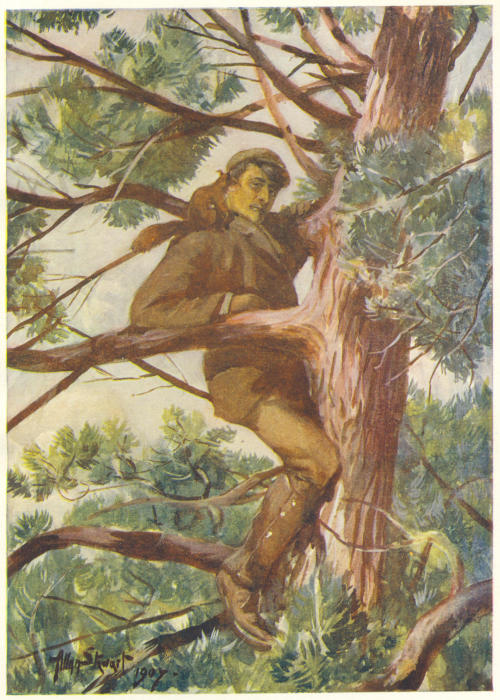
the three watchers below, father leaped straight
towards the boy, landing actually on his shoulder.
This startled him so much that he very nearly
let go altogether, and if I had not been in such
a panic I could have laughed at his fright. Then,
before the boy could recover himself, another quick
bound, and father was out on another branch, ten
feet away, quite out of reach of his would-be
captor.
FATHER LEAPED STRAIGHT TOWARDS THE BOY LANDING ACTUALLY ON HIS SHOULDER
A torrent of language worse than any magpie’s
burst from the fellow’s lips, as he turned and
scrambled after father again. He might as well
have tried to catch a will-o’-the-wisp. Every
time he got near enough to make a snatch, father
would make another nimble jump, all the time
artfully luring his pursuer lower down the tree
and away from our hiding-place.
The game went on for a good ten minutes, and
by the end of that time the enemy was dripping
with perspiration and speechless with fury. His
rage was increased by the jeers of his friends
below. At last he gave it up, having made up
his mind it was not much of a game to be made
a fool of by a squirrel and mocked by the
onlookers.
He dropped quickly from bough to bough, and
presently I heard his heavy boots thud on the
ground. But before he had reached the foot of
the tree, both our parents were back with us.
Then the sound of loud wrangling came up to
us. Surely now they would go; but no! we were
not safe yet.
There was further talk, and then the whole four
spread out in a circle round the fir-tree. Presently,
with a loud whizzing sound, some heavy
object came hurtling up past us. It struck a twig
near the summit of the tree and clipped it like
a bullet. Thud! Another struck the main stem
just below us with a force that sent the bark
flying in a shower. Then we saw what those
lead-weighted canes were for.
A third squailer passed only a few inches above
father’s head. He called to mother:
‘They’ll kill us if we stop here. Come along;
take Hazel and follow me.’
In an instant he had snatched me up and was
scuttling down the trunk. It was wonderful how
exactly he knew which branch-end stretched
furthest towards the spruce which was our next
neighbour. Out along it he ran, and using the
natural spring of the bough to help him, made a
gallant leap outwards and downwards, legs and
tail wide spread to assist him in his flight.
The air hissed past my ears, and then with a
little thud we landed safely in the spruce. But
his gallant jump had been seen by those greedy
eyes, and excited shouts came from below.
Then—ah, even now I can hardly bear to speak
of it! As father was in the very act of running
up the branch towards the thick centre of the tree
and comparative safety, there came a cruel thud,
and he and I together were whirling through
the air.
Crash! we came to the ground with a shock
that knocked my small senses out of me, and before
I could pick myself up a hard hand had closed
over me. I turned and, with the instinct of
despair, fixed my teeth deep in a horny finger.
There was a yell, and I was again flung to the
ground with a force that almost killed me. I knew
no more for many minutes, and when I woke again
to stunned and aching misery, I was lying helpless
in a sort of bag, which smelt horribly of something
which I now know to have been tobacco. The
bag was being shaken up and down with a steady
swing; but I, almost beside myself with pain and
flight, did not attempt to move or free myself.
Suddenly the motion stopped abruptly, and the
hand was poked cautiously into the bag. It was
carefully protected this time by a handkerchief, but
I had no longer spirit left to bite. Out I was
pulled and held up before the gaze of all the four
robbers, who were seated at ease on a mossy bank
on the outer side of the hedge close by the gate of
our coppice. The very first thing that my eyes fell
upon was the body of my poor father lying limp
upon the bank, his white waistcoat dabbled with
crimson stains and his brilliant black eyes closed in
death. I felt a cold shiver run through me, and
the stupor of despair clutched my beating heart.
I hardly even had strength left to wonder what
had become of my dear mother and my brother
and sister.
They passed me from one coarse hot hand to
another, and their voices grew louder and louder as
they disputed who should have possession of me.
They then went on to blows, when suddenly the
quarrel was brought to an abrupt end in a most
startling fashion.
Leaping over the hedge out of the coppice
behind came two tall, smart-looking boys, a startling
contrast to the four loutish hobbledehoys
around poor little me.
One of them, pointing at me, demanded in a
ringing voice where they had got me from.
Three of the four cads stood sheepishly regarding
the new-comers, and said never a word; but the
one who had climbed the tree faced them boldly
enough, answering impudently.
The new-comer strode up to him. He was
evidently master here, and the others were trespassing,
and they knew it, for they slunk back.
Yet, in reply to his reiterated commands, the
lout who was boldest snatched me up and refused
to part with me. He was so big and strong that
he seemed a giant, and I felt I should die there
and then. I closed my eyes and gave myself up,
but in a minute I was down on the bank once
more, and the two—the new-comer and the great
rough fellow—were fighting hard, with coats off
and red faces.
The sound of the blows that followed, the
tramping of feet, the hard breathing of the combatants,
nearly deprived me of the few senses that
remained to me, and I noticed little of the details
of the fight—only it seemed to last a long time,
and once I saw the schoolboy flat on his back.
But he was up almost as soon as down, and they
were at it again hammer and tongs.
The giant made a rush head down, like a bull,
but the other jumped back, and there followed a
rattle of blows as my champion’s fists got home on
the lout’s hard head. But the squire’s son did not
wholly escape. The huge fist that had grasped me
so roughly caught him on the right cheek and
drove him back.
One of my champion’s eyes was closing, his
right cheek was turning livid, and there was blood
on his broad white collar when they faced one
another again. But the ruffian for his part, though
not so badly marked, was breathing like a fat pug
dog and seemed unsteady on his legs. To do the
fellow justice, he had pluck, for he wasted no time
in making a last attempt to rush his opponent.
For a few moments it was all that the other could
do to guard his head against the swinging fists.
Then—it was all so quick that one could hardly
see what happened—there was a crack like the
sound two rams make when they charge one
another, and the giant tottered for a moment, his
arms waving wildly, then fell like a log and lay
quite still.
The other new-comer counted loud and slowly
‘One—two—three—four’—up to ten. But the
fellow on the ground did not move.
‘That’s the finish,’ he said.
He turned to where I lay, with hardly a breath
in me, a little limp body, and picking me up,
handled me tenderly.
Terrified as I was, the change was grateful to my
miserable, aching little body. He offered me to
the victor in the fight, who had by this time got
into his coat again, but he declined.
‘Put him in your pocket, Harry,’ he said to his
brother. ‘My hands are too hot to hold him.’
He was quite right. Let me here give a word of
advice to all those humans who keep any of my
race as pets. Don’t hold us in your hands. In the
first place, it frightens us desperately, and in the
second, it is bad for us. A squirrel rarely lives
long in captivity if he is constantly handled. I
speak from experience, and I can assure you that,
much as I grew to love my dear master and my
other human friends, I was never happy in their
hands, though I never minded being kept in their
pockets.
Harry put me carefully in the inside pocket of
his jacket. It was dark and warm, and, utterly
exhausted, I curled up and lay quiet, and so I was
carried away and left the home of my babyhood.
It was long before I saw it again.
CHAPTER III THE PLEASURES OF IMPRISONMENT
I was aroused from a sort of stupor between sleep
and exhaustion by being picked out of my snug
retreat and held up for inspection before a third
person, a sweet-faced lady, whom I afterwards came
to know well and love as the mother of my dear
master, Jack Fortescue, and his brother Harry.
She looked at me pitifully when her son had
quickly explained the events of the morning.
Her fingers were long and slim and cool, and, poor
limp little rag that I was, I never offered the
slightest resistance to her gentle grasp. She took
me straight through a side door into a long, low,
shady building with wood-lined walls, and in a
minute or two I was placed in a nest of soft hay in
a good-sized box covered in front with close wire-netting.
Too worn out to trouble my head about
the amazing and perplexing change in my circumstances,
I simply curled up with my tail over my
nose and went sound asleep.
It was Jack who woke me. I must have been
asleep for a long time, for now the sun was pouring
in through the western windows. The first thing
I realized was that I was desperately hungry, and
that the little saucer which the boy had pushed
gently into the cage had a most appetizing odour.
But my sleep had given me fresh life and strength,
and quiet as his movements were, I remember that
I was desperately frightened, and cowered down,
shivering, burrowing close in the hay.
Jack seemed to understand perfectly, for he
closed the door again very softly and moved away.
Presently the silence restored my confidence a
little, and I ventured to peep out. The saucer was
quite close to my nose, and, hunger overpowering
my fright, I crawled up and tasted the mixture. It
was bread and milk, soft and well cooked. I
finished it very rapidly, and then, feeling much
refreshed, went to sleep for a second time.
Once again before dark Jack came and fed me,
and this time brought me a couple of ready cracked
nuts, as well as the bread and milk.
Well fed and cared for as I was, I shall never
forget the misery of that first night. I don’t
suppose that at that very early age I actually
remembered much of what had happened during
the past eventful day. What I did feel was a sort
of horror of loneliness. Instead of the whole five
of us snuggling warmly together in our well-lined
drey, I was here in this box, which was many times
larger than our nest, absolutely alone. Every
time I went to sleep I would wake up again with
a start, vaguely feeling round for my mother and
the rest, and shivering miserably in my unaccustomed
solitude.
At last morning came, and it was hardly broad
daylight before Jack arrived in his nightshirt and
carried me off, cage and all, to his bedroom, where
he put me on the window-ledge in the sun and
offered me nuts. At first I was much alarmed;
but he was so gentle that I gradually got over my
terror, and sat up and nibbled the nuts fairly
happily.
I will pass over the next few days. My new
master fed me assiduously, and very soon I lost all
fear of him, and the minute I saw him would make
for the door of my comfortable little prison, and
wait eagerly for the dainties which were sure to be
forthcoming. Every morning he changed my bed
and gave me fresh hay, which makes far the best
bedding for any of our tribe. During the day my
cage was brought down into the bowling-alley,
where several other pets were kept, and at night
Jack took me up to his room, so that I might not
be frightened by servants dusting in the morning.
At last there came a morning when Jack’s hand,
instead of offering me the usual nut, gently grasped
me. Frightened, I turned at once and bit him
sharply. I don’t suppose my small teeth did much
damage, for he only laughed, and, lifting me right
out of the cage, placed me on his bed. The white
counterpane was so very different from anything
which I had ever felt under my claws before, that
at first I was too much surprised to move, and
remained perfectly still. Presently, however, Jack
popped a nut down in front of me. That, at any
rate, I understood, so I sat up on my hind-quarters,
cracked it, and, first carefully removing the brown
skin from the kernel, made short work of the
dainty.
Hoping for more, I gained confidence and proceeded
to explore. First I caught my claws in the
little projecting tufts of the counterpane, and heard
Jack laughing gently as I shook myself impatiently
free, giving a little squeak of disgust. Presently I
discovered a cavity that looked dark and inviting.
You know a squirrel’s besetting sin is curiosity.
He always wants to know the ins and outs of
everything. Any object which he has not seen
before fascinates him, and I am afraid to say how
many of my friends have paid for their inquisitiveness
by getting into serious trouble. So I crawled
down, and finding it delightfully warm and dark,
made my way under the clothes to the very foot of
the bed, where, as I was very comfortable, I went
sound asleep.
On the next morning my master turned me loose
again, this time on the floor, and after a fresh access
of timidity I again found nuts. There were more
than I wanted, so, obeying a natural instinct, I
ate what I could, and hid the rest in various convenient
receptacles.
Soon I began to look forward to my daily outing,
and took great delight in exploring every corner
of the room. I well recollect what a shock I got
the first time I reached the window-sill. Outside
was a great elm-tree, whose branches reached
within a few yards of the window, and the sight
of the green leaves waving gently in the early
morning breeze roused in me strange longings. I
made one jump, and striking full against the glass,
fell back half stunned and terrified almost out of
my wits at the strange transparent barrier. Jack
picked me up at once, and placed me safe in the
darkness and warmth under the bedclothes, where
I had time to recover from my fright.
Soon he took to letting me out at bedtime, and
I had a grand scamper before the light was put
out. The window-curtains were my favourite
resort. They were so easy to climb, and had such
splendid folds and crannies for hiding nuts in. I
would race across the curtain-pole, rattling the
rings as I went, down the other curtain, round the
room full tilt, and finish up with a good hunt in
all the corners for nuts which I had concealed the
day before and forgotten all about. I rarely went
back to my cage to sleep, though it was always
open and ready for me. A fold in the window-curtain
was my usual place of repose, and another
pet perch was an old band-box on the top of the
wardrobe. It was half full of tissue paper, which
possessed a strange fascination for my young mind.
I tore it all up fine with my sharp teeth, and made
a most delicious nest with the bits.
When the night was chilly I generally snuggled
under Jack’s bedclothes, and always, first thing in
the morning, so soon as daylight came, I would
make for the bed, and working my way gently
down between the sheets, curl up close against
Jack’s toes. Sometimes he was so sleepy that he
would not wake up and play when I wanted him
to; then I would emerge on to the pillow and
gently nibble the tip of his nose.
This never failed. ‘Confound you, Nipper!’
(he always called me Nipper), he would mutter
drowsily, and then make a lazy grab, which I
always eluded with the greatest ease, and with two
bounds would land on the end of the bedstead,
and, perched there, scold him until he sat up and
threw a sock at me.
He was never rough, and never lost his temper
with me, although I am sure that I was aggravating
enough at times. It must have been trying when
he pulled on his boots in a hurry and found a
couple of nuts wedged tight in each toe. I do not
think that a boy and a squirrel ever became better
chums. We were simply devoted to one another.
The only dull times for me were when Jack and
Harry were busy with their tutor, during which
hours I was usually in my box in the bowling-alley.
There, as I think I mentioned before, the
Fortescue boys kept several other pets. There
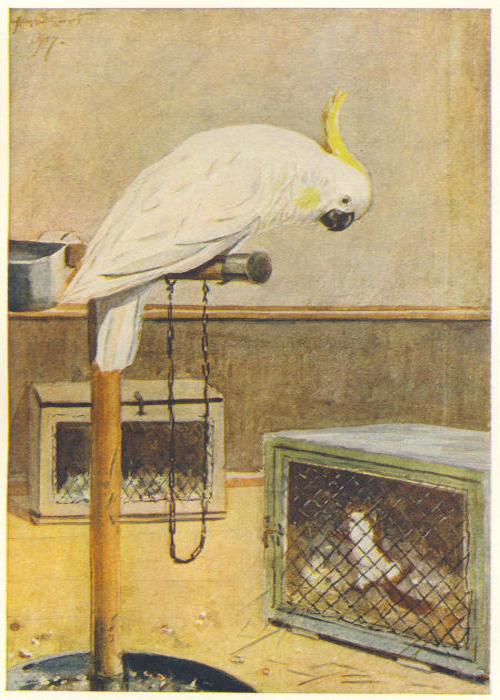
was a large white cockatoo with a lemon crest,
named Joey, which frightened and puzzled me
horribly until I came to understand its odd faculty
of imitating every person and animal about the
place. It would ‘miaouw’ like a cat, a most disturbing
sound, for every squirrel hates cats next
to hawks and weasels; would bark so realistically
that Mrs. Fortescue’s white Pomeranian was always
stirred up to reply, and the two would go on and
on, the wily old bird always starting up afresh
whenever the dog stopped, until poor Pom nearly
had a fit and grew quite hoarse. I shall never
forget the first time he imitated me to my face.
It gave me a most severe shock, for he did it so
well that for a moment I believed that one of my
relations was actually in the room. One thing I
liked him for: he was devoted to Jack, and invariably
bade him a grave ‘good morning’ when
he brought my cage down before breakfast. He
lived on a perch, to which he was chained by one
leg, and up and down this he would sidle by the
hour, with one eye cocked for mischief. Sometimes,
when all was quiet, he would talk to himself
in a language quite unlike that which my master
and his family used. The boys said it was some
African lingo which Joey had learnt ages ago in
his native land. Altogether a most uncanny
bird!
Harry had a number of pet mice in wire cages.
They were not the least atom like any of the mice
I had ever seen in the wood. These were of the
queerest colours—piebald—and some of them had
marks on their backs just the shape of a saddle.
Uninteresting I called them, but Harry was very
fond of them, and used to take them out and let
them run all over him.
In the darkest corner of the long, low room was
the one creature that, from the first moment I saw
it, interested me more than all the others put
together. All day long it lay hidden in its hay
bed and never moved, but slept quietly as a dormouse
in its winter nest. In fact, I never set eyes
on it at all until one night in August, when the
evenings had begun to draw in and I happened to
be left a little later than usual in the bowling-alley.
No sooner had the room become dusk than
I heard from the tiny cage a little twittering, more
like a young bird’s voice than anything else, and
presently caught sight of a dainty little head poked
out of the hay, with two of the largest, most liquid
black eyes I ever saw. I gazed in wonder, for the
animal was so like myself that I felt sure it was a
squirrel, though I had never dreamed that any
squirrel existed so tiny as this.
Just then in came the two boys together.
HE IMITATED ME TO MY FACE
‘Hulloa!’ cried Harry, ‘Lops is awake. Bring
Nipper to have a look at him, Jack.’
Jack took me out of my cage, and I jumped as
usual on to his shoulder and nibbled his ear by way
of a kiss. He walked across to the other cage and
set me down in front of it.
‘Mr. Lops,’ he said with mock gravity, ‘allow
me to introduce Mr. Nipper. This is a small
cousin of yours, Nipper, and he comes from Mexico.
As you see yourself, he’s a sad character—sleeps
all day and only wakes up at night.’
I was so lost in surprise that I sat quite still,
gazing through the fine wire mesh at my new
acquaintance. I have always had a fairly good
opinion of my own looks, as every well-bred
squirrel should have, but, upon my word, he put me
out of all conceit with myself. He was the tiniest,
daintiest, quaintest creature I ever set eyes on.
No bright red about him, but though his coat was
darker and greyer than mine, it was as soft as fine
velvet, and beautifully groomed. His head was
perfectly shaped, his ears pricked like my own, and
his eyes very large and amazingly bright. But the
oddest thing about him were the folds of loose skin
which extended in a thin membrane from all his
four legs back to his body. When he jumped from
the upper, story of his cage to the lower, they
spread out almost like the wings of a bat; but when
he was sitting still, they folded up so that they did
not in the least spoil his beautiful shape. I must
say that I felt quite envious, for I thoroughly
understood that a squirrel built like that could
jump ever so much further than I or any of my
family could. We English squirrels can, at a pinch,
clear as much as three yards in a straight line. We
always spread our legs wide when we jump as well
as keeping our tails stretched straight out, and that
is why we can leap from great heights and reach
the ground unhurt, for we drop parachute fashion.
But as for these American cousins of ours, the
flying squirrels, they can jump from the top of one
tree, and sliding through the air like a soaring
hawk, reach another tree fifty feet or more away at
a height from the ground only slightly less than
that of their starting-point.
Lops—which Jack said was short for Nyctalops,
or ‘seer by night’—and I had many a chat afterwards.
He told me of his old home in sunny
Mexico, not a nest such as I was born in, but a
cavity in the trunk of a vast live oak or ilex, from
whose boughs long weepers of grey Spanish moss
trailed towards the brown palmetto-stained water
below; of the hot sun and of the furious tropical
storms which lashed the deep river into white
foam; of the paroquets, with their brilliant plumage
of green and red and blue, which screamed harshly
among the upper branches at dawn; of the rusty-hued
water-vipers which coiled sluggishly on the
steaming mud in summer. He told, too, of the
perils from great hawks three times as large as any
we know in England, from long, thin tree-snakes
wrapped unseen round the branches; and I
shuddered when he talked of fierce wild-cats as
much at home among the tree-tops as on the
ground. It must have been a wonderful country
and a wonderful life, so different from our
northern island as to be almost beyond my imagination
to picture it. All day the land slept breathless
beneath the blazing sun, with nothing moving
except the birds, the fox-squirrels, and the lizards;
and during those hours Lops and his family slept in
the dark recesses of their wood-walled fortress; but
when the sun set the forest woke to life. Deer
came down to the river to drink; peccaries rooted in
droves among the bases of the mighty trees; sometimes
a great bear came prowling along, uttering
now and then a deep ‘woof’ when any unaccustomed
sound disturbed him. Up above opossums and
racoons moved silently to and fro among the tree-tops;
great owls whirled on soft wings, hooting
dismally; while all night long—especially in the hot
season—the endless chirr of crickets, the pipe of
tree-frogs and the deep booming of bull-frogs filled
the air with a never-ending concert. Other sounds
there were, rarer, but far more terrifying. Enormous
bull-alligators, floating like logs with only their
gnarled heads and the ridges of their rugged backs
above the water, would bellow with a roar that
shook the forest; or, again, from some hidden
recess of the deepest woods the blood-curdling
shriek of the tawny puma would ring hideously
through the night.
Poor Lops! Though cared for as few pets are—fed
with dainty pecan-nuts and other delicacies
from his far-off home across the ocean, and though
he loved his mistress Mabel, Jack’s sister, devotedly—yet
he was never happy as I was. The damp
and cold of our climate oppressed him, and most of
his time he spent curled up tightly among the soft
bedding of his cage. Then, too, he was a creature
of the night, and it was only after dark that he
would wake and want to play—and at that time,
except for an hour or two, there was no one to play
with. I felt very sorry for him, and so, too, were
Mabel and the boys. I am sure that if they could
they would have set him free again among the great
tropical forests that he loved so well, and always
mourned for, though only I knew how deeply.
As for me, life ran most pleasantly. I grew
plump on the good food I was supplied with. My
coat became long and sleek, and my tail, which had
been a mere furry appendage like that of a little
colt, grew into a glorious brush of richest red-brown,
long enough and thick enough to cover me
completely when I curled up to sleep. Jack was
very proud of my looks, and used to groom me all
over with a little brush—a process which I soon
grew very fond of. We two came to understand
one another most marvellously. I could always
tell him what I wanted, whether it was food, or a
game, or to be allowed to creep into his coat-pocket
and go to sleep there.
One day he opened my cage, slipped me into his
pocket, and walked off, and when he took me out
again I was out of doors once more!
I cannot tell you how it affected me. You know,
we wild creatures—born wild, I mean—never quite
forget our rightful heritage of freedom, and here, for
the first time for many weeks, I found myself out in
the open.
Jack was seated on a wooden bench under a
clump of evergreen shrubs in the midst of a great
expanse of smooth-shaven lawn. It was August
now, and the sun poured down hotter than ever it
had been in those June days in the wood. Big
bumble-bees droned lazily by; a robin was perched
on the bare ground at the foot of an arbor vitæ,
cocking a soft round eye at us; all the subtle,
fascinating odours of summer were in my nostrils.
I gave one spring from his knee on to the back of
the bench, and sat there, head high, snuffing the
sweet air, and quivering all over with excitement.
Jack never moved, and for the moment he passed
completely out of my remembrance. My brain
was crammed to bursting with half-forgotten
instincts and remembrances which crowded in
upon me.
So I sat for perhaps half a minute; then a little
breath of summer breeze swayed a bough above me,
and on the impulse I sprang. Oh, the delight of feeling
it yield and swing beneath me! I darted inwards
to the trunk, and with one clattering dash was up
at its slender summit twenty feet above the turf
gazing round in wild delight. When the first
ecstasy had worn off, I set myself to explore, and,
clambering down a little, jumped into the next
tree. So for many minutes I exercised my new-found
powers, taking longer and longer leaps, and
enjoying myself to the top of my bent.
But the clump of shrubs was small, and soon I
had exhausted its resources in the way of jumps. I
looked around, and a little way off was a giant elm.
Ah! that would give more scope; and with my
head full of its possibilities, I turned and came
down head foremost. Then, and not till then, did
my eyes fall upon my master, who sat where I had
left him, still as ever. He looked at me, but I
would not heed, and dashed off across the lawn.
‘Hulloa, Jack! what price Nipper?’ came Harry’s
voice from a distance. ‘You’ll never see him
again.’
But the other only said, ‘You wait!’ and still
sat stubbornly in his place.
With a rattle of claws on rough bark I was up
the elm like a flash, and, half crazy with joy, went
leaping and corkscrewing round and round, sending
a couple of tree-creepers off in a terrible fright.
I think they must have taken me for a cat. I
played for a long time, and still Jack sat on the
bench. He seemed to be deep in a book, and after
a time I got quite cross at his apparent lack of
interest in my proceedings. It was getting late,
and the trees threw long, dark shadows across the
lawn. The breeze had died down, and, except for
the chirping of sparrows in the ivy and the low
whistle of some starlings in the distance, all was
very still. A sense of loneliness began to oppress
me, and at last I came creeping down, and, reaching
the lower branch, once more looked across towards
my master.
‘Nipper!’ he called softly; and in a trice I was
on the ground and lopping across towards him.
Suddenly, and without the slightest warning,
there was a sharp ‘yap-yap,’ and a dirty white-and-tan
beast rushed out of the shrubbery behind me.
On the instant I was running for dear life.
I saw Jack bound to his feet and come tearing
across towards me. But instead of running straight
to him, I made for the nearest tree—a small ornamental
evergreen. The dog—it was the gardener’s
terrier—wheeled, and was after me like a shot.
He was travelling nearly twice as fast as I, and his
feet were drumming so close behind me that it
seemed nothing could save me. Each instant I
expected to feel those snapping teeth close upon
me.
There was a sudden crash, and the sharp ‘yap-yap,’
changed to a terrified howl. Jack had hurled his
book with all his might and with such good aim
that the dog, hit full in the side, had been bowled
completely over, giving me time to gain the shrub
and safety.
‘Poor old Nipper!’ said Jack softly, as he picked
me shivering out of the little tree and stowed me
safely inside the breast of his coat. ‘We won’t
run any more risks of that sort, will we, old chap?’
Indeed, the fright was so severe that I did not
get over it for some time. It gave me a good
lesson, and the next time my master let me out
I did not venture far from him.
Soon after this I had another adventure which
came very near to closing my career abruptly.
One dull rainy morning I was loose as usual in
Jack’s bedroom. Just as he had almost finished
dressing, his brother, whose room was on the same
floor, opened the door and called to my master to
come and help him to find one of his mice which
had got loose and disappeared. Jack ran out,
carefully closing the door behind him, and leaving
me to play by myself. A few minutes afterwards
one of the maids, thinking no doubt that Jack had
finished dressing and had gone down to his early
morning lesson with his tutor, came in to turn the
bed down and tidy up. She never saw me, and I
paid no attention to her, for I was busy under the
dressing-table with some nuts.
It was some minutes after she had gone away
that I became conscious of an animal moving softly
about the room, and a spasm of terror seized me,
for though I could not see it owing to the hangings
of the dressing-table, instinct—that sixth sense
which informs us of danger—gave me warning of
desperate peril.
Crouching back as near to the wall as possible, I
lay there absolutely still, listening with beating
heart to the almost noiseless footsteps which came
gradually nearer and nearer. I could tell by the
soft snuffing that the animal scented me, and terror
almost paralysed me. Closer and even closer came
the creature, and presently the hangings of the
table rustled, and as they were pushed aside a
whiskered head appeared, and two eyes that glowed
luminous green in the dim light glared upon me.
Stiffened in my corner I watched the cat crouch
for a spring, her gleaming eyes fixed greedily upon
me, while her tail waving quickly from side to side,
made a soft tattoo on the carpet. Those cruel
green eyes absolutely fascinated me, and for the
moment I could not have moved even to save my
life.
Suddenly came a loud crash. The door left
open by the maid had blown to in the strong
draught from the open window. The noise startled
the cat almost as much as it did me, and for the
moment she took her eyes off me. The spell was
broken and I ran for dear life. As I passed under
the hangings and out into the open I heard her
heavier, larger body strike the very spot where
I been crouching, and with another spring she
came out from under the table and landed barely
her own length behind me. One wild bound to
the right and I was inside the fender; another,
and my enemy’s outstretched paw actually grazed
my tail as I bolted clean up the chimney, and a
snarl of disappointed rage gave me the glad tidings
that I was for the moment safe.
It was lucky, indeed, for me that the chimneys
of the Hall were of the wide, old-fashioned brick
type unprovided with dampers. Had it not been
so, and had my refuge been the modern, narrow,
perpendicular form of grate, it is certain that I
should never have been alive now. As it was, the
worn, old brickwork gave me footing of a kind,
and I never stopped until I had reached the
chimney-pot, which barred further progress. The
soot nearly choked me, and made me cough and
sneeze violently. My foothold was most precarious
and I was in deadly terror that I might slip and go
tumbling right back into the jaws of my enemy.
Indeed, I have rarely spent a worse quarter of an
hour than I did then.
Suddenly I heard the door below open. Sounds
came to me almost as clearly as if I had been in
the room.
‘Nipper! Nipper!’ I heard Jack call, but I was
too frightened to come down.
‘Why, where on earth has he got to?’ my master
continued in a surprised tone, and then I heard
him moving about the room looking for me.
The cat, no doubt, had taken refuge under the
dressing-table again when she heard the door open,
for she knew as well as possible that she had no right
in the bedrooms, her proper place being the kitchen.
There was a rustle as Jack raised the hangings, and
then he saw her.
For the moment there is no doubt but that
he thought she had killed and eaten me, and grief
and fury possessed him. I heard a smothered
squawk of terror, and even in my plight rejoiced
that my enemy was feeling a little of the fright she
had given me. Then there was a crash. Jack had
flung the beast clean out of the window into the
elm opposite. I heard him go to the door again,
and there was something in his voice as he shouted
to his brother to come that made me shiver all
over, but not with fright.
Harry came rushing into the room, and I am
bound to say his voice was almost as queer as that
of my master.
I was recovering slowly from my terror, and the
sound of Jack’s voice was giving me confidence.
Also my present refuge was horribly uncomfortable,
and the black soot making me feel perfectly
miserable, so I turned with the intention of making
my way downwards again. You know we
squirrels always descend head foremost, holding
on with our hind-claws. But I had hardly begun
my descent when a bit of hardened soot or plaster
gave way beneath me. I made a desperate but
quite useless effort to recover myself, and next
thing I was sliding helplessly down the steep slope
at a pace which increased with every foot I fell.
Thud! And I landed in the grate amid a perfect
avalanche of soot. Jack, who was sitting on
the bed looking more miserable than I had ever
seen him before, sprang to his feet as if electrified,
and cleared the intervening space with a bound.
‘Nipper, Nipper, is it you?’ he shouted, and
regardless of his smart, clean flannel suit picked
me up and positively hugged me in a transport
of delight. Then he examined me all over to
make sure that I was not hurt, and after that I
was only too glad to be allowed to crawl into his
pocket and feel that there, at any rate, I was safe.
The worst of it came after breakfast, for I was
too filthy to be able to clean myself. Such a
miserable, draggled little object I was, black as
any sweep! My master got a basin of warm
water and washed me all over—a process which
I remember I strongly objected to, and resented
by nipping his fingers sharply. But he was firm,
and presently I was back again in my cage, which
was placed before the kitchen fire, and Jack
himself kept watch over me until, once more dry
and clean, I was fit to return to the bowling-alley.
CHAPTER IV A DAY IN RAT LAND
It was about this time that an unaccustomed
quiet seemed to be settling upon the Hall and the
demesne. There were less people about, no
visitors, and some familiar faces among the servants
were missed. I had never seen much of the
Squire himself, but in these days he seldom came
into the bowling-alley at all, as he had been used
to do in the earlier days of my captivity. Even
the boys seemed to have grown quieter. They
laughed less often, and frequently I saw them
talking to one another with grave faces.
At times I had an uneasy conviction of something
wrong, but it was only a passing impression,
for I, at least, never suffered in any way. Every
fine day Jack took me out of doors, and I had
a scamper in the clump of shrubs to which,
ever since my narrow escape from the terrier, I
was careful to confine myself. And as for food,
no squirrel could have fared better. My master
was always bringing me fresh delicacies. One day
it would be a cob of Indian corn, which grew to
perfection under the south wall of the kitchen
garden, and which I enjoyed vastly, ripping off
the thick green husks and pulling the kernels out
one by one. Another morning he would pick me
a fine summer apple, its sunny side delicately
tinged with streaky red, while he was always discovering
new nuts for my delectation. Once, I
remember, I made myself quite ill with the rich
greasy kernel of a huge Brazil-nut. A very pet
delicacy of mine in which I was often indulged was
a piece of hard ship’s biscuit. There were few
other eatables which I enjoyed so much. Now
and then I was given a morsel of banana, and
perhaps my greatest treat of all was a few of the
black, oily seeds of the sunflower.
So things went on until the time that the blackberries
began to ripen. Then, one warm sunny
morning Jack got up very early and dressed
quickly. I wanted to play as usual, but he
seemed to have no time, and I was quite hurt at
his apparent neglect. As he took me in my cage
to the bowling-alley the Squire was in the hall.
I had never seen him there so early. He looked
old, and worn, and there were new lines in his
face, while his hair and beard seemed greyer than
I had thought them.
‘Be quick and have your breakfast, Jack,’ I
heard him say. ‘Your train goes at nine,
remember.’
‘All right, dad,’ returned the boy. ‘Take care
of Nipper while I’m gone.’
Then, when he had put me in my place in the
bowling-alley just opposite old Joey’s perch, he
did a very unusual thing—took me out again and
stroked me. Then he put me back very gently
and hurried away.
The morning passed; but when afternoon came
and I looked for my master, as usual, there was no
sign of him. I scratched vehemently at my cage-door,
but no one came. Only old Joey made rude
remarks and began to mimic me, so at last I
retired in a very bad temper, and curling up in
my hay began to wonder whether Jack had forgotten
me. You see we had never been separated
for a single day, and I could not in the least understand
his absence.
At last some one came in, and I jumped out
eagerly. But, to my great disappointment, it was
Harry, not Jack, who came up and opened the
door of my cage. ‘Poor old Nipper!’ he said,
and held out his hand, inviting me to come with
him.
I came eagerly enough, for I had the idea that
he would take me to my master. The two brothers
were so nearly inseparable that I could not imagine
one being long away from the other. He did not,
however, carry me out of doors, but up to his own
room, where he turned me loose and offered me
biscuit. But I am afraid he found me a dull
companion, for I was listening the whole time for
Jack’s familiar footstep, and did not pay much
attention to his friendly overtures. At last he
took me back to the bowling-alley and shut me
up again, and there I moped sulkily for the rest of
the day.
Night came on, and no Jack. I could not eat,
but sat awake all night, hoping for and expecting
my master. Next morning Harry came to feed
me, and was horrified when he found that I had
not eaten my supper. He brought me every
delicacy that he could think of, and at last, just
to please him, I ate a nut or two. That evening
he was taking me up to his room again, but as we
got to the door I hopped out of his pocket and
scampered off to Jack’s door. He let me in, and
though it was a fresh and bitter disappointment
not to find my master, yet I felt a little happier
among the familiar surroundings, and plucked up
spirit enough to dig out a nut which I had hidden
in his big bath-sponge and eat it. So that night
Harry turned me loose in his brother’s room. I
went to bed in a pocket of one of Jack’s old coats
which hung against the door, and tried hard to
imagine that my master was wearing it.
It was morning when I poked my head out.
There was the smooth, white, empty bed, and still no
sign of Jack. Presently the maid came in, and not
seeing me, opened the window to air the room.
After she had gone I clambered out of the coat-pocket
and began aimlessly wandering about the
room. Presently I found myself on the window-sill,
and, catching sight of the elm branches waving
close by, with one spring I was in the tree, and,
running down the trunk, rapidly reached the grass.
Outside the shadow of the tree the wide, smooth
lawn sparkled with thick dew. I had never been
out so early before, and I greatly disliked the cold
wetness of the grass. But so anxious was I to find
Jack that I hardly thought of the discomfort, and I
made my way with all speed to the bench where he
so often sat.
But he was not there. All was deserted and
strangely quiet; only the thrushes hopped past
searching for their breakfast of worms, and a robin
sang from the sunny summit of a clump of evergreens.
Often I had perched upon Jack’s shoulder as he
strolled round to the stables to see his pony Tarbrush.
To visit the stable was the next idea that
came to me, and keeping as close as possible to the
friendly shrubs and trees, I worked quickly round
through the garden till I came to the belt of
laurels which lay between the back premises and
the stables.
I felt happier when I was off the ground and
among the branches of the shrubs, and climbing
quickly through them, soon came to the gate of the
stable-yard.
There were cats here. I had seen them on my
previous visits, and under any other circumstances
nothing would have induced me to venture alone
into the long, paved yard. But anxiety to find my
master swallowed up all other considerations, and
dropping from the laurels, I made straight for the
door of Tarbrush’s stall.
There was no one in sight. Only from a stall on
the other side came the hissing of a groom busy
about a horse.
Imagine my dismay to find Tarbrush’s loose-box
empty! So, too, were the other boxes in the same
building. The place was absolutely deserted and
deathly still. Feeling more lonely and miserable
than ever, I turned uncertainly. I did not know
where to go or what to do next; then I remembered
that there was one other place where Jack
had sometimes taken me—an old and long-disused
stable at the far end of the yard, where his sister
Mabel kept her hutches of tame rabbits.
The place was large and cool and dark. The
windows had long ago been boarded up, and the
back was shaded by thick shrubbery, through which
the early sun had not yet pierced. I moved just
inside the door, and sat up, listening keenly. But
all that I could hear was the munch, munch of the
rabbits’ teeth as they ate their breakfast of crisp
leaves and roots. There was no human in the
place.
At that moment a new sound broke upon my
ear, a slight rustling, brushing noise. Then, before
I could even turn, a large tabby cat came round
the corner of the doorway. It was my old enemy,
the same who had so nearly caught me in Jack’s
bedroom. She was walking very slowly, rubbing
her arched back against the wall as she went, and,
terrified as I was, I had sense enough to see that
she had not yet noticed me. I did the only thing
I could—crouched down close against the wall and
remained there still as a hare in her forme, hardly
even breathing.
For a moment I fancied that she would pass on.
But I had forgotten her keen sense of smell.
Suddenly she threw her head up and began snuffing
the air; then with one quick bound leaped inside
the doorway, and stood there perfectly still glaring
about her with great, round green eyes.
I did not wait, but ran for dear life. As I started
so did she, and to the best of my belief she jumped
clean over me. I certainly felt the wind of her
paw as she struck at my head.
In the old stable the mangers and racks were
still in place and the ruinous remains of the
partitions of the stalls. More by good luck than
anything else, I chanced upon a worm-eaten oak
post at the end of one partition and bolted up it.
It led straight up through a gap in the ceiling,
and I thought I was safe. I was sadly mistaken.
This cat was almost as good a climber as I, and
up she came at my very brush.
Scuttling up the wall of the loft, I reached a
cross rafter, not twice my own length ahead of my
hunter. The cat was not quite so quick in getting
on to the rafter as I was, and that gave me a short
start.
A patch of sunlight came through a glassless
window under the gable at the far end, and instinctively
I made for this, jumping frantically
from rafter to rafter. There was no time for plans.
It was just one wild dash for any chance of safety.
The rafters were not very wide apart, not too
far for me to jump from one to another with fair
ease. But they were rough-hewn and narrow at
the top, and the heavier cat could not get a foothold
so quickly as I; so I gained all the way to
the window. The second rafter from the window
was a very narrow and awkward one. Even I
found it hard to balance myself upon it. As I did
so, I caught a glimpse of something hanging from
the last rafter, the only one left between me and
the window. It was a peculiar-looking, pear-shaped
object, grey in colour, rough in texture,
and in size rather larger than my body. I knew
well enough what it was, though in my fright I
barely noticed it. Next instant I had landed just
above it, then, gathering all my powers for a longer
leap than any before, launched myself towards the
window-sill. I just succeeded in reaching it, only
to find that the opening was covered with wire
netting. I was hopelessly trapped.
Hot-foot after me came the cat. She could
jump as well or better than I, but, as I said before,
the narrowness of the beams bothered her. When
she reached the narrowest, the second from the
window, she had all she could do to keep her
balance. The result was that her next jump was
a trifle short. Her fore-paws clutched the beam,
but her hind-feet failed to reach it, and struggling
desperately to pull herself up, she drove her hind-claws
deep into the pear-shaped object which hung
exactly below her.
Instantly there arose a deep-toned buzzing, and
the air was thick with a cloud of furious wasps.
There followed a perfect squeal of pain and terror,
and my enemy, covered with a swarm of the fierce
little stinging insects, dropped with a resounding
thump on to the boards below, and fled like a mad
thing, pursued by scores of angry wasps.
The wasps rose to the very roof; they were all
round me. I made one frantic scramble up the
rusty netting, found a hole, squeezed through anyhow,
and just as the first wasp landed on my back
and drove a vicious sting through my thick fur, took
a wild jump in the direction of the nearest shrub.
The distance was too much for me. My fore-paws
just touched the leaves, and I went sailing
downwards into the deep shadows beneath. Down,
down into absolute blackness, to land at last with
a shock that for the moment completely deprived
me of my few remaining senses. Fortunately for
us squirrel folk and all other animals except man,
we never remain insensible for long. I was all
awake again in a very few moments, and found
myself lying on a thick bed of damp, decaying
leaves. It was almost pitch dark, but a little light
which leaked down from somewhere high above
showed me that I was at the bottom of a deep hole,
with perpendicular sides of mouldering brickwork.
But this was not what set my heart beating
again almost as thickly as a moment previously.
It was a peculiar, musty, unpleasant odour, which
made me instinctively spring up against the side
of the hole and struggle hard to climb back to
daylight. But rough as the walls of my prison
were, my claws could get no grip, and I fell back
panting and helpless to the bottom. Again and
again I tried. The brickwork was very old,
covered with close green moss and riddled with
holes, and more than once I succeeded in climbing
a good distance up the sides. But I always came
at last to some place where I could find no foothold,
and went sliding helplessly down to the
bottom again.
Soon I was quite exhausted. I had eaten hardly
anything since Jack left, and the escape from the
cat and the shock of my long fall had taken it out
of me badly. At last I was forced to give it up
and lay at full length breathing hard upon the
sodden leaves.
Presently came a soft rustling sound, then a
slight squeak. By this time my eyes were well
accustomed to the gloom, and looking upwards,
there at the mouth of one of the holes a sharp
black nose appeared and a pair of beady, black
eyes which stared at me fixedly. A moment
later another nose showed from another hole, then
a third, and a fourth. More and more came out,
until the whole of the slimy old wall seemed alive
with them, and all with their keen unwinking eyes
fixed upon me as I crouched helpless in the bottom
of the old dry well.
THE WHOLE OF THE SLIMY OLD WALL SEEMED ALIVE WITH THEM.
In the woods we squirrels seldom trouble about
rats. In some of the old banks and hedgerows
there are hundreds of them, but they don’t interfere
with us as they do with the earth-livers and
with the birds that nest on the ground. They
cannot harm us tree-dwellers. But we do not
trust them, any more than do the rest of the woodland
folk. Cruel, cunning and treacherous, the
grey Hanoverian rat is the most detested and despised
of all the animals, and the vile odour of
his unclean body at once drives away all other
creatures from his neighbourhood. For myself, I
have and always had a perfect horror of rats.
Mother once told us a ghastly story of how one of
our people, accidentally caught in a steel trap, was
literally eaten alive by rats. And here I was, in
an almost equally helpless case, at the mercy of a
score of the carrion brutes.
If there had been only one of them, I should not
have been afraid. A solitary rat is always a coward,
but in packs they are as fierce as weasels. For a
long time they watched me without moving. The
musty carrion odour grew worse and worse.
Presently there was more rustling, and I saw the
heads pushed out farther and farther from the dark
recesses in the sides of the well. Then they began
to squeak. They were talking, asking one another
if it was safe to attack me. Suddenly one great
brute, as big again as I, dropped from his hole
almost on top of me. Fright gave me strength to
make a last bid for life. I made another wild dash
at the side of my prison, and instantly the rats all
vanished. This time I was lucky enough to find a
piece of wall rough enough to give me foothold,
and though my claws slipped again and again, yet
each time I managed somehow to save myself, and
at last reached a deep, square niche in the wall
where a number of bricks seemed to have fallen
out. Here there was room to sit, and I had sense
enough to stay where I was and rest before trying
anything else.
My rush had only frightened the rats for the
moment. Very soon the rustling and squeaking
began again, and louder than before. The heads
reappeared, and as each came out the keen nose
was turned upwards and the beady eyes fixed upon
me again. Two or three sprang down into the
bottom of the well and began snuffing about. I
saw several little ones appear. All the rats were
very quiet and leisurely in their movements.
Evidently they felt perfectly certain that I could
not escape. I could see them licking their greasy
lips in anticipation of their meal.
Certainly I was better off in one way. I had
climbed so high that now I was above their ring of
holes. But above me the brickwork was less decayed.
There was no foothold at all. Plainly I
could not possibly climb any higher. Even if the
rats did not come after me where I was, it was
only a matter of time before I was starved out and
dropped down amongst them.
A long time passed, and though the rats still
moved about at the bottom of the well, none came
near me. I saw the sunlight begin to pierce
through the shrubs above, and patches of light
shone on the rusty iron railings which surrounded
the top of the old well, and even gleamed on the
green moss which coated its sides. But none
reached me where I crouched, shivering in the cold
and damp.
A dog barked somewhere up above, and then at
last I heard human footsteps pass across the crackling
leaves close to the well mouth. They were
Harry’s. I shivered all over with excitement, and
gave the little bark which was my call to Jack; but
evidently he did not hear me, and the steps passed
on, and all was quiet again. Even the rats had
stopped squeaking, and most of them had gone
back to their holes. Only the old buck who had
jumped down at first was sitting in front of his
hole below and opposite me, seemingly half asleep,
but really keeping a watchful eye upon me.
The sunlight slowly faded, and the shadow of the
stable fell across the mouth of the well. Night
was coming—night, when the rats would surely
attack me. I was desperately hungry, though I
do not think that just then I could have eaten the
finest nut in the coppice. At last the first star
twinkled overhead. For some time the rats had
been moving again. I could hear them, though I
could not see them. The bustle increased with the
darkness, and there was more squeaking.
Presently I heard something climbing towards
me. It was the father rat. Of that I was certain,
though I could not see him. He came up slowly
but steadily, and I shook all over with fresh
panic.
All day I had sat quite still in my nook, staring
upwards in the hope of seeing Jack’s head up above.
I had not even once taken a look round my place of
refuge. Now, as my enemy came stealthily nearer
I backed into the recess. The hole ran in further
than I had supposed, and I went in twice my own
length before touching the brickwork.
Suddenly there was a slight snuffing sound. The
rat was over the edge, and right upon me. What
happened next I hardly know. I made a blind,
panic-stricken rush, and found myself wedged
between two bricks. The rat’s jaws closed upon
my brush. I struggled madly, and suddenly I was
free and scuttling away down a sort of tunnel.
Away I went, bumping against the top and sides,
but still finding room to run.
Seemingly the great rat had been unable to
squeeze through the narrow aperture in which even
my small self had been caught for the moment,
but at the time I do not think that I knew that.
My one idea was to run, and run I did, plunging
blindly on and on through the black dark like a
rabbit with a stoat at its scut. I remember very
little about that horrible tunnel or how I got
through it. I only know that it was wet and
slimy in places, and that it seemed as though I
could not breathe. If it had not been for the fear
of the rat I should never have been able to go on.
But I fully believed that the bloodthirsty monster
was behind me all the time, and each instant
expected to feel the sharp teeth close upon me;
so, breathless and suffocating, I kept on, until at
last there was a break in the darkness, and next
instant I tumbled headlong out of the mouth of a
drain-pipe into the muddy bed of a dried-up pool.
I was so absolutely exhausted that there I lay,
quite unable to stir brush or claw. If any prowling
cat or weasel had happened upon me I could not
have lifted a paw to get away. But nothing did
molest me, and after a long time I managed to
struggle out of the mud and up the bank on to a
patch of grass. When I looked round I found that
I was in the Hall kitchen-garden.
I knew my way from there to the house, and
slowly and wearily dragged myself back. I made
for the elm by Jack’s window, climbed up it, and,
finding a nook in a fork between two boughs,
curled up, and was fast asleep in a moment.
In the morning I saw that the window was wide
open, so, jumping in, I climbed upon Jack’s bed
and curled my muddy little body up on the
pillow.
There Harry found me, and I am bound to say
that Jack himself never made as much fuss about
me as his brother did on that occasion.
CHAPTER V BACK TO THE WOODLANDS
About four in the afternoon of the next day I was
lying half-asleep in my cage in the bowling-alley
when a sound in the distance made me spring up,
quivering all over with excitement. Next moment
the door burst open, and in rushed Jack. He
never even waited to take off his hat or gloves, but
ran up the long room, and flung open my cage
door. With one bound I was on his shoulder,
nosing him and biting his ears and hair in a perfect
transport of delight, and I think he was just as glad
as I was.
Presently his sister’s voice called him from
behind. He turned and kissed her, and with me
still on his shoulder, followed her to the Hall, where
the Squire and Mrs. Fortescue were at tea.
After this Jack and I became more inseparable
than ever. He had holidays—these days—and I
simply lived in his pocket. The next afternoon
there was great excitement. I heard every one
congratulating Jack, though of course I did not in
the least comprehend why his mother and sister
hugged and kissed him, and the Squire solemnly
shook hands with him. It was just as well for me
that I did not realize what had happened, or those
lovely September days would have been the most
miserable instead of the happiest in the whole of
my life; for Jack had passed an examination with
the result that in a few weeks he would have to go
and live and work in London—a dreadful place, I
understand—where it is all houses and no trees,
where the sun never shines, and where the only
wild creatures that exist are those cheeky, chattering
thieves, the sparrows.
Harry, too, was always with his brother at this
time, and they talked more than I had ever known
them to do before.
The two were very serious one day, lying on
their backs beneath the trees on the lawn while I ran
all over them both impartially. And from the way
in which they turned to me and caught me up every
now and then, as well as because I heard my own
name frequently spoken, I came to the conclusion
the conversation had something to do with my fate.
And there was no doubt it had, for it was after this
time they all left the Hall, and when I visited it
again there were strangers—but I mustn’t go on
too fast. I fancy Jack urged Harry to keep me
while he himself was away, and Harry shook his
head; perhaps he was afraid I might mope away, as
I did before in Jack’s absence, and end by dying.
Anyway, a gloomy silence settled again between
the brothers. At last Jack started up and waved
his hand energetically in the direction of the wood;
then, springing to his feet, he called to me to come
to him. I had leaped away in affright at his sudden
movements, to which I never could get accustomed,
but I returned again at once. Jack had quite
sense enough to know squirrels mate for life, and the
young ones usually stay with their parents all the
winter; and he knew, what I did not, that mother
and Hazel and Rusty would still be in the coppice
to greet me, and teach me all the wild-wood lore,
even though my father was dead.
The brothers argued for some time over my
prospective fate, but I did not really understand
until later, when their actions showed me what they
meant. I had leaped from Jack’s shoulder during
this weighty conversation, and was enjoying myself
hugely, tearing round and round the two boys, and
making an occasional dive into Jack’s pocket after
the nuts and grains of wheat and maize which
were always to be found there. But, after all,
I was not taken away to the woodlands at once.
Three or four days later Jack again got up very
early, and as he dressed I could hear out on the
drive a great grinding of heavy wheels. As Jack
hurried down he took me on his shoulder instead of
putting me in my cage. His brother joined him on
the stairs, and they walked down side by side, as
solemnly as two old crows.
The hall was full of crates and matting, and
men in green baize aprons were turning everything
upside down. Outside, in the ring, were great
vans almost as big as cottages. The boys hardly
wasted a glance on these things, but hurried past,
and next moment were striding away across the
dewy grass of the lawn.
I was amazed at being taken out so early, but
all the same very much delighted, and sat on my
master’s shoulder chattering with joy. Neither
brother spoke, but walked steadily on under the
long morning shadows of the tall elms until they
reached the ha-ha which cut the garden off from
the park. Jumping down the sunk fence, they
turned to the right, passed under the shadow of the
wall of the kitchen-garden, and along beside the
laurel plantation beyond. A wicket-gate led
through the park fence and into a large field, in
which red cattle were grazing.
Strange memories began to stir in my breast as a
line of tall, thick timber came in sight on the far
side of the meadow; and when my master jumped
the little brook and walked up over some broken,
sandy ground where the white scuts of rabbits
bobbed among the bracken, towards the tall magpie
hedge beyond, my heart was beating so violently
that I could only sit quite still upon his shoulder
and stare about me in a sort of mazed bewilderment.
On through the gate, and at once we were
plunged into deep, damp coolness. All the half-forgotten
odours of moss and bracken and rotting
wood, and a hundred other woodland scents, rose to
my distended nostrils and almost overpowered me.
Just then I could not have moved for the life of me.
Harry was the first to break the silence.
‘That’s where I saw the little beggars the other
day, Jack,’ he said softly, and pointed to a tall beech-tree
whose leaves, just beginning to yellow with the
first chill of autumn, hung motionless in the still
morning air.
Then they both seated themselves on a mossy log
and waited, still as two dormice. The wild things
of the woods, frightened into silence at these early
morning intruders, gradually regained confidence.
A rabbit popped out of his hole and began feeding
on the close turf, on which the autumn dew-spangles
gleamed in a patch of sunshine which
struck through the leafy canopy overhead. A
shrew-mouse, intent on some business of his own,
bustled noiselessly across the path; a woodpecker
started his tap, tap, tap, as he industriously probed
a rotten branch for his breakfast of fat grubs; two
jays began calling harshly, and presently the flicker
of their brilliant blue plumage glanced through the
greenery. As for me, I had crept off Jack’s
shoulder, and, sitting up straight on one end of
the log, was struggling desperately to take it all in.
The boys never moved nor spoke, but presently
Harry touched his brother gently, and pointed very
cautiously towards the beech-tree. I, too, was
gazing with all my eyes up into the tree, my heart
throbbing more violently than ever, for down the
smooth grey bark a patch of red-brown fur was
softly stealing with slow, deliberate steps, clutching
tightly at unseen footholds with outstretched claws.
The boys saw him, and so did I, but we none of us
moved. As for me, my feelings were beyond
words.
Nearer he came, and now I saw that he was
almost my own double. His head was stretched
out at right angles to his body, and his eyes, bright
as two jewels, were fixed upon me with intensest
curiosity. Presently he reached the lowest bough,
and there stood motionless as I was, and staring at
me with a strange intensity. The calls of kindred
were clamouring in my veins, and all of a sudden
the spell was broken. Without one backward look
at my dear master, I jumped from the log, raced
across the ground between it and the tree, and
with one rattle of claws was up on the huge, lowest
branch.
But behold! the apparition which had attracted
me had disappeared, and I stared round in fresh
wonder. Suddenly came a little sharp cry, and
down from the leaves above me dropped—my
mother herself! She gave a sharp bark of astonishment.
Then I remembered! A mad transport of joy
thrilled me through and through, and with one wild
dash I tore away up the tree, corkscrewing madly
round and round the huge trunk in the way we
squirrels have when joy is beyond expression.
Mother was with me, and next instant a third
squirrel joined in our mad frolic. It was my
brother Rusty, the squirrel whom I had seen first
of all, and had failed to recognize after our long
separation. Before I reached the top, yet a fourth
frantic dot of red fur was flashing round and round,
barking madly, and I knew her for my sister Hazel.
I think we were all quite mad with joy for the
time being, and we never ceased our crazy scamperings
until, quite out of breath, we landed all
together in a fork among the branches high up
in the leafy summit of the tall beech-tree. There
we sat and began a talk that lasted I don’t know
how long. It was the most curious thing. I had
been away from them all so long, and become so
accustomed to human talk, that I could hardly
make my family understand my adventures, and
they, on their part, were surprised beyond measure
that any of the humans, whom they had so long
looked upon as their hereditary enemies, could
possibly have been so kind to me. But at last they
had all my story, and then, and not till then, did
the recollection of Jack come back to me.
When I announced my intention of going down
again to find my master, mother evidently thought
I was quite out of my senses.
‘But you have escaped. Surely you do not
want to go back to live in your prison!’ she urged.
THE BOYS NEVER MOVED OR SPOKE.
I explained all over again what a good friend he
had been to me, how he had saved my life, how he
had fed me with all sorts of dainties; indeed, I
strongly recommended her and my brother and
sister to come with me. There was plenty of
room, I said, and I waxed enthusiastic over the
unlimited supplies of nuts, and fruit, and grain
without any trouble in looking for them.
It was not the slightest good. Mother declared
that the notion of living inside burrows—for that
was her idea of a house and its rooms—was altogether
detestable, and only fit for rabbits and humans, and
would most certainly kill her in a very short time.
All I could do, after much urging, was to persuade
my family to come down to the lower branch and
watch me go and talk to Jack.
Rusty was quite ready—he always had a bold,
determined streak about him; but mother and
Hazel hung back. When we got down, there was
my dear master sitting where I had left him, all
alone. Harry had left. His face lighted up when
he saw me hopping along the branch above him,
and he gave the little whistle I knew so well, and
stood up. Running to the pendent tip of the
branch, I made a flying leap, and landed clean on
the top of his cap.
‘Why, Nipper, Nipper,’ he said, taking me on
his hand and stroking me fondly, ‘I almost thought
you had forgotten me!’
I nibbled his finger lovingly by way of apology,
and signified that I was quite ready for a nut. It
was promptly forthcoming, and then as I ate it
he put me down on the log, and walking softly
towards the tree, turned out two pockets stuffed
with the finest hazel-nuts, and piled them by
handfuls into a hollow as high as he could
reach.
Then he sat down again beside me, took me up
and talked to me, and petted me for a long time.
At last, very slowly and reluctantly, he put me
back on the branch from which I had leaped down.
‘Good-bye, old chap,’ he said in a queer, unsteady
voice, and suddenly turned and walked
quickly away.
To say that I was astonished would be putting
it mildly. I was absolutely thunderstruck, but
after a minute made up my mind it was some new
kind of game, and prepared to follow.
‘Scud! Scud!’ I heard mother call, but I paid
no attention. Running along the branch as far as
it would bear, I made a flying leap into the next
tree. It had been my dear father’s boast that he
could travel from one end of our coppice to the
other without once touching ground, and indeed I
found no difficulty in doing the same. I was so
excited that I thought nothing of jumps of six
times my own length, for Jack was walking very
fast, and I was in a dreadful fright that I might be
left behind.
At the gate he turned and saw me. He stood a
moment irresolute, then quickly vaulted the gate
and started off across the field. At this I grew
quite desperate, and dropping into the hedge
scuttled along it, reached the gate-post, and sitting
straight up gave one sharp bark. At that my
master turned again and hurried back.
‘Oh, Nipper, why can’t you go home?’ he
muttered, and picking me up, walked very fast
back to the big beech-tree.
‘Good-bye, once more, old fellow,’ he said stooping
over me, and suddenly I was startled by a drop
like rain falling on my head.
Looking up in amazement, I saw my dear
master’s face twisted as though in pain; but before
I could make up my mind what was the matter,
he suddenly pitched me gently back into the
hollow where he had put me before, and brushing
his sleeve across his face, fairly ran away down the
path. Before I well realized what had happened,
he was lost to sight among the trees.
As soon as I recovered a little from my
astonishment, I started a second time for the gate;
but before I reached it Jack was half-way across
the field, and travelling so fast that I knew I could
never catch him; and besides, I had always been
terribly afraid of the ground ever since my escape
from the terrier.
I don’t think that ever in my life have I felt so
utterly miserable as when I realized that my master
had abandoned me. You see, I could not understand
it at all, and my one sensation was an utter
and overwhelming loneliness. Gradually, too, I
became frightened. I had never been alone out of
doors before, and this was all so different to the
Hall garden. The field seemed a vast green desert,
and behind me the wood an illimitable rustling
mystery full of unseen perils. How long I sat
there straining my eyes after the vanished form of
my master I do not know, but what roused me at
last was a sudden rustle behind, which made me
start violently. However, it was only Rusty, who
had followed me, and was seated on a swinging
hazel-bough in the hedge, staring at me in a perplexed
fashion.
‘What’s the matter, Scud?’ he asked at last.
I told him I felt very forlorn now that my
master had left me. My brother could not believe
that I wanted to follow him; such a thing was
quite beyond his comprehension.
When I assured him it was true, Rusty looked as
solemn as if he was now certain that I had quite
taken leave of my senses.
‘What! You want to go back and live in those
burrows when you’ve got all the wood to roam in!’
he exclaimed. ‘I’ll be shot if I can understand
you! Do you mean that you’d rather spend your
time all alone in a place you can’t get out of than
go foraging round with us all day as free as—as’—Rusty’s
imagination failed him, and he paused—‘well—as
free as a squirrel, for there’s no other
creature in the woods that is as free as we are.’
I reminded him that I was used to being protected,
and had never experienced anything but the
utmost gentleness from Jack and his family.
‘Yes, I know. I’m sure he is quite different
from those red-faced brutes who broke our nest
down and killed poor father,’ replied Rusty. ‘And
he has left us nuts enough for a month. But all
his kind are so big and so dull. They can’t climb
trees like us, or jump;’ and my brother made a
splendid spring down to my side just to show what
he could do. ‘It’s no kind of life for a squirrel.
My brush, but I should have taken the first chance
to run off and come back home!’
Then he gave a sudden low cry of warning, and
instinctively I followed him as he bounded back
into the thick of the hedge just as a hen sparrow-hawk
stooped like a falling stone out of the blue
above, reaching the grass by a tuft of gorse a
little way out in the field. There was a sharp cry,
cut short almost before it was uttered, and then
the feathered robber rose again, bearing in her
crooked talons the struggling form of a linnet. A
few small feathers floated away through the still,
warm air, and all was over. The hawk sailed
away towards a distant tree with her meal tight
clutched between her claws.
It was long since I had seen one of these everyday
woodland tragedies, and it made me realize with
a shock that now I had myself only to depend upon,
with no strong human hand to aid me. Frightened
and unhappy, I followed Rusty quietly back into
the heart of the coppice, and that night saw me
one of a furry ball of four, curled in a hole in the
heart of the great beech.
CHAPTER VI A NARROW ESCAPE
I did not forget my master and settle down to
my old out-door life at once. Every morning
for many days I visited the gate at the end of
the wood-path, and sat there or in the hedge beside
it, straining my eyes across the meadow in the
hope that Jack might come back once more. But
never a sign of him or Harry did I see, and
though, as the leaves began to fall, it was quite
easy to view the roof of the Hall across the
shrubberies, no smoke rose from the tall, twisted
red-brick chimney-stacks.
How good mother was to me in those days I
well remember. She encouraged me to tell her
all I could of the Hall and its people, and all
the incidents of my captivity, and she alone of
my family seemed thoroughly to sympathize with
me in my longing for my lost master.
Hazel, too, was very dear and good, and would
listen with the greatest interest to my long yarns.
She was a sweet little thing in those days, very
small, but extremely well built and active, and,
for a young squirrel, of a peculiarly rich colour.
Rusty, however, had little sympathy with my
longings. He was already a large, powerful
squirrel of an extremely independent turn of mind,
and most extraordinarily bold and fearless. Mother
was in a constant state of anxiety about him, for
he would go off on long expeditions quite alone,
sometimes not coming home till nearly sunset,
and ever since father’s death mother had been
nervous as a hare when any of her children were
out of her sight.
As for me, I soon became thoroughly at home
in the wood, and could climb as well as either
my brother or my sister, though I was at first by
no means so adept at taking shelter as the other
two. I had grown so accustomed to many sights
and sounds ordinarily alarming to one of our tribe,
that mother had often to scold me for exposing
myself heedlessly to view on the rare occasions
when people walked through the wood, and she
had to show me all over again the tricks of
lying out flat on a bough so that I could not be
seen by passers-by, or of supporting myself
on a trunk beneath a sheltering branch when
danger in the shape of a hawk threatened from
above.
The good and plentiful food with which I had
always been supplied at the Hall had made me fat
and strong beyond what squirrels usually are at
my age. There was very little difference now
between me and Rusty, though originally I had
been smaller. It was lucky for me that I had
been turned loose just at this special time of year,
for autumn is, of course, the squirrel’s harvest,
and food was particularly plentiful that season.
Nuts were ripening among the yellowing leaves;
acorns were to be had for the picking; the beech-trees
were full of mast, and when we tired of
these there were spruce-seeds and berries of every
description.
Earlier in the year larch, fir, pine, and spruce
tips had been our main sustenance, but these were
now getting dry and old, for it was past the
season of evergreen growth, and so we left them
alone and fed almost entirely on nuts and seeds.
About this time we had several days of soft
warm rain, and after them part of the horse pasture
which adjoined the coppice on the other side from
the Hall was thickly dotted each morning with
little white buttons, which mother explained to me
were mushrooms. We used to steal down across
the wet grass in the mornings, brushing through
the gossamer spiders’ webs till our chests and paws
were white with them, and feast royally on the
tenderest and daintiest of the mushrooms, sometimes
getting terrible frights when the village
children who came to fill their baskets saw us, and
clapped their hands to make us run.
Mother was a wonderful forager. I remember
one morning how she stopped on the bank where
the beech-trees grow thickest, and after snuffing a
moment or two, began to dig rapidly in the soft,
black, loamy soil. Presently she nosed out some
little round objects covered with a dark skin, and
pushed one over to me. Never have I eaten anything
more delectable than my first truffle. I can
find them myself now as well as anyone.
Other fungi too were plentiful after that rain.
Some grew under the trees, some on rotten logs,
others out in the open. Some were good to eat—better
even than mushrooms—but others were
poisonous. Mother never passed a new one without
showing us which were fit to eat and which
were not. There was a brilliant scarlet kind which
she warned us against strongly; well I remember
how she scolded me one day because just for fun I
pulled one up, and stuck it stalk down in a fork of
a tree. I did not repeat the experiment, for it
left a bad taste in my mouth for hours afterwards.
About this time my coat began to change.
Squirrels that are born early in the spring have fur
of a greyish-brown hue very like the coats that old
squirrels put on in winter, but we, being June
kittens, had summer suits of red-brown without
any ear tufts, or any hair on the palms of our
hands. First, my tail changed and grew darker,
much heavier and more bushy. It turned to a
blackish-brown, quite different from its previous
bright chestnut-red hue. My coat, too, began, but
more slowly, to lose its ruddy tint, and to assume
its winter colouring. I became dark brownish-red
on the head and back. My white under parts
changed to grey, which spread along my sides.
It also grew longer, softer and warmer, and my
ear tufts began to show. During the summer a
squirrel has but a few hairs on the points of the ears,
but winter brings a thick tuft a full inch in length.
We squirrels have a strange peculiarity. We
are the only living creatures, so far as I know, who
change our coats twice a year and our tails once
only. As I have said, we change our coats in
spring and again before the cold weather, but our
tails once only—in autumn. A healthy squirrel
looks at his best in late September and early
October, for at that time his new brush is extremely
bright, while his new grey-brown coat is rich and
long. Both fade during the cold weather, the fur
especially becoming during long frosts of a yellowish
rusty hue. There are, I believe, some squirrels,
near relatives of our own, living in Canada, who
turn almost white in winter. But as—luckily for
ourselves—all we squirrels have the sense to sleep
away most of the cold weather, we have not the
same need to conceal ourselves by assuming the
colour of the snow, as have Arctic hares and foxes
and many other animals which are obliged to work
and forage for a living during the hard weather.
But I was talking about the good times we had
that autumn and the various delicacies we used to
hunt. After the rain which brought such a crop
of mushrooms, we had a week of wonderfully
warm, soft, hazy weather, but then the wind
switched round into the east, and for the first time
in my life I understood what cold was. It blew
bitterly, with a hard grey sky, and the trees being
still full of leaves, the noise of the gale through
the coppice was one long roar, the great boughs
swaying, creaking, and complaining bitterly. Very
glad we were, when night fell, to snuggle all four
close together in the hollow in the beech hole which
mother had selected as our abode after the destruction
of our second nest! It was a very
convenient residence, considering that it was a
ready-made one. Some winter storm of years long
past had torn away a large branch at its junction
with the trunk, and rain and weather had rotted
the scar till at last a hollow was left large enough
to hold a dozen of us. Once it had been full of
water, but a green woodpecker boring its nest in
the trunk below, the moisture had drained away
through the rotten fibres, and now it was dry as a
bone, and formed as convenient and comfortable a
retreat as any dreyless family of squirrels could
possibly desire.
The gale lasted two whole days and nights, and
then it cleared and left a hard blue sky from which
the small white flecks of wind-cloud vanished one
by one, and on the fourth morning we woke to find
the grass white with hoar frost and a keen tang in
the air which filled us with a wild delight in the
mere fact of being alive. Rusty, Hazel and I
sallied forth and tore round and round like three
mad things, flinging ourselves from bough to bough,
rattling up and down the huge trunk and wide-spreading
branches, playing all manner of practical
jokes on one another.
Mother watched us indulgently, but when, quite
out of breath, we at last came back to her, she
announced that the time had arrived to begin the
collection of our winter stores.
‘Now that you have no father,’ she said, ‘you
must help me in the work, for remember there is
nothing worse than to be caught by bad weather
unprepared, and without many stores of food.’
That was the first real work that I ever did.
It seemed odd, when we reached the nut bushes
at the edge of the coppice, not to choose the
plumpest nuts, and sit and eat them on the spot.
I think, indeed, that we all began by doing so, and
mother did not interfere until we had each had
a good breakfast; but afterwards she kept us
steadily to work. I am afraid that we needed a
good deal of superintendence to keep us up to the
mark, but mother set us such a good example that
we were shamed into doing our best. At first I
was under the impression that we were to carry
all the nuts back to our beech-tree home, but
mother laughed when I suggested this, and told
me that it was quite unnecessary to do anything
of the kind. After looking about a little, she
chose a long hollow under a gnarled old blackthorn
trunk at the bottom of the hedge, and here,
and in other similar cavities, we stored a goodly
supply. Towards noon mother told us that that
was enough for the day, and while she and Hazel
went back home, Rusty and I decided to go for
a little round on our own account.
Working down the hedge, we came upon a
patch of thick brambles from which the blackberries
were falling from over-ripeness. A greedy
cock pheasant below was simply stuffing himself
with the fallen berries and those near the ground.
For a joke Rusty crept up quietly, and then,
making a sudden bound, alighted almost on the
handsome bird’s head. Off he went with a terrific
whirr and flutter across the big meadow, and
Rusty, with a malicious gleam in his eyes, sprang
back to my side.
Presently we found ourselves at the coppice
gate, and instinctively I stopped and gazed across
the meadow towards the Hall. The wind had
brought many leaves down, and the long, low, red-brick
building with its steep tiled roofs, stood
strongly outlined behind the thinning fringe of its
oaks and elms.
I don’t know whether it was the keen, brisk air,
or what, but suddenly the idea came to me to
visit the old place once more, and on the spur
of the moment I suggested it to Rusty.
For a moment my brother looked blank. Adventurous
as he was, the idea of crossing more
than a quarter of a mile of open grass land rather
staggered him. You know we squirrels will make
journeys of any length provided we can travel
through the tree tops, and so long as a tree is
handy we have no objection to short trips across
country from one to another; but none of us care
about open ground. We can run at a good speed
for a short distance, but there is no cover in grass.
There we are absolutely at the mercy of any
hungry hawk, while weasels have a nasty trick of
popping out suddenly from rabbit earths or drains.
Then, too, there is no escape from the gun or
rabbit rifle of any pot-hunting man or boy, while
poaching dogs or cats are another source of really
desperate peril.
However, Rusty was not the sort to think twice
of danger, or to be outdared by the brother whom
he had secretly despised as a ‘tame’ squirrel. I
saw his teeth set and a sudden sparkle in his eye.
‘All right,’ he remarked, and that was all. He
was out of the hedge and over the ditch before
me, and leading the way at a great pace across
the pasture.
We did not keep to the path, but made off to
the left, where an irregular fringe of trees grew
along inside the hedge which cut off the pasture
from the road leading between the Hall and the
village. Great luck attended us. Beyond a few
rabbits we saw no sign of life, and when we got
close enough to the trees to take refuge if any
danger approached I breathed more freely, and I
feel sure that Rusty was equally relieved. Racing
along among the rustling dead leaves, we crossed
the brook near the culvert under the road. The
rivulet was so small that it was no trouble to
jump. Then we found ourselves in the park, and
here we had to take to the open again. The fine
clumps of timber which dotted it here and there
were our islands of refuge, and we ran from one
to the other, the same good fortune attending us
during our whole journey. From the last tree we
steered for the kitchen-garden wall, and keeping
along the bottom of this, reached the sunk
fence. Once up this, and I was on familiar
ground.
A long narrow plantation of Kentish cob-nuts
bordered the wall which divided the kitchen-garden
from the lawns, and in this we were soon snugly
ensconced.
‘My teeth! Did you ever see such nuts?’ exclaimed
Rusty, staring in wide-eyed amazement at
the great russet-coloured cobs which hung in profusion
among the brilliantly tinted leaves.
‘Oh yes, I’ve eaten lots of them,’ replied I, with
conscious superiority. ‘Try them. They’re uncommon
good.’
Rusty needed no second bidding, but set to
work, and cutting the tip off one of the largest
nuts, was soon discussing its fat, white kernel with
a gusto which proved that he thoroughly agreed
with me in my estimate of the quality of cobs.
I joined in, and we made a most delicious luncheon.
From where we sat the lawn and part of the house
were in full sight, and all the time I kept a watch
fill eye upon the clump of evergreens where I had
been used to play, in the hope that I might see
the familiar figure of my dear master in his rough
tweeds, and his cap on the back of his head,
sauntering across the lawn.
Alas! there was no sign of him nor of any of
the Fortescues. Had I known it, half the length
of England separated me from the nearest of my
old friends. After a time, however, some one did
stroll out upon the terrace walk. He was a complete
stranger—a short, fat man, with red cheeks
and mutton-chop whiskers. He wore a grey
bowler, tipped far back upon his head, his thumbs
were stuck in the armholes of his gaudy waistcoat,
and a long, black cigar was held between his thick
lips. He was gazing round him with a complacent
air of proprietorship which in some indefinable
fashion annoyed me intensely.
Suddenly he took the cigar from his lips and
shouted loudly, ‘Simpson!’ A man with a bill-hook
in his hand came hurrying round from the
shrubbery behind the house.
The stout man pointed to Jack’s and my pet
clump of evergreens. ‘Those shrubs are untidy,
Simpson. They want clipping up. Get to work
on ’em at once!’ And, to my horror and disgust,
Simpson began chopping and carving away at the
deodars and arbor vitæ, lopping all the boughs up a
man’s height from the ground, and turning the
pretty shrubs into the stiff, unnatural likeness of
the toy trees in Jack’s youngest brother’s Noah’s
Ark.
Then, as I looked about me, I began to see that
many things had been changed. The laurels were
cut close and flat; a number of fine limbs had been
sawn from the elms; several new beds of weird
pattern had been cut in the splendid century-old
turf of the lawn; the gravel paths were all fresh
swept; everything had a painfully overtidy appearance.
Presently one of the drawing-room French
windows was pushed open, and a third person
appeared on the scene—a boy about Jack’s age,
but how strangely different! He was short, like
the elder man, and had the appearance of having
but just stepped out of a band-box. His cord
riding-breeches were as immaculate as his white
cuffs and tall white collar; his brown boots quite
gleamed in the autumn sun, and he wore new
dogskin gloves. Strolling over towards his father,
he began to talk, but we were too far away to hear
what they said. After a short time they both
turned and came across the lawn towards the
kitchen-garden door.
‘I say, Scud, hadn’t we better hook it?’ suggested
Rusty. But I was so interested in these
new people, who seemed to have usurped the place
of my dear Fortescues, that foolishly I replied:
‘No; they’re not coming near us. Keep still,
and they’ll never see us.’
The pair had nearly reached the garden door
when I heard the boy exclaim something, and they
changed the direction of their walk in the direction
of the hazels. A swish of bent branches shortly
followed.
The distance from the garden door down to the
angle of the garden wall was not more than thirty
yards, and I knew very well that, thick as the
bushes were, there was not a ghost of a chance of
our remaining undetected if they came poking
about in this fashion.
‘Come on, Rusty!’ I muttered, and we at once
made off as quietly as we could. Unluckily for
us, while the stout man was poking his head among
the branches, puffing and blowing as he did so like
a broken-winded horse, the boy had walked on
down the path, and next moment his shrill voice
rang out:
‘I say, father, here are two beastly squirrels
stealing nuts. Keep an eye on ’em while I get
my gun.’
He was off across the grass at a pace one would
not have credited him with, and we, aware that
any attempt at further concealment was useless,
went off also at top speed.
What we both dreaded was the long open space
at the bottom of the kitchen-garden wall, where it
abutted on the park. However, there was no
shirking it. If we stayed where we were we would
be caught like rats in a trap. It was Rusty who
made the jump first out of the bushes and down
the sunk fence, and as I followed him I heard the
fat man shouting hoarsely: ‘Quick, they’re running
away!’
How we scuttled! Even a terrier would have
had his work cut out to catch us. There was no
cover at all until we reached the far end of the
long line of wall, and we strained every nerve to
gain the hedge which ran at right angles from the
end of it, separating the park from the road. The
distance was not much more than seventy yards,
but it seemed like a mile as we tore along. Fresh
shouts behind us spurred us to almost super-squirrel
efforts. Hardly five yards were left when suddenly—bang,
and a sound like hail pattering on the
ground behind us. Next second, and with simultaneous
bounds we were in the hedge, but before
we could get through it and into shelter on the far
side the sound of another shot rang through the
calm autumn air, and this time with better aim.
Leaves flew in the hedge, and a sharp blow on the
head sent me staggering, nearly causing me to lose
my foothold.
‘Come on, Scud. We must cross the road,’
called Rusty at that moment; and with a fine
jump he was across the ditch and out on the white,
dusty surface.
Recovering myself, I followed, and found that,
though my head was singing, I could still run as
well as ever.
Luckily there was not a soul in sight, so we
crossed the road in safety, plunged through the
opposite hedge, and found ourselves in a plantation
of young larches about twenty feet high. Through
these we went as hard as ever we could pelt, until,
quite exhausted, we came to rest somewhere in the
thickest depths, and, climbing into one of the
largest trees, lay panting and tired out on an
upper bough. For a minute neither of us could
move; then suddenly Rusty, glancing at me,
exclaimed:
‘Why, Scud, you’re hurt!’
‘Yes, something hit me,’ I answered faintly.
In a moment the good fellow was licking my
wounded head. A pellet of shot, it seemed, had
glanced along my skull, cutting the skin and going
right through one of my ears. The wound bled a
good deal, but it was not a serious one, and after I
had got my breath back, and after my heart had
ceased thumping as though it would burst, I felt
very little the worse, and announced that I was
quite ready to start home. But Rusty, more
cautious, refused to move.
‘That fellow with the gun may be waiting in the
road for us,’ he said. ‘Much better stay here a
bit. The shadows are still short, and we shall have
plenty of light for our journey home.’
His advice seemed good, so we waited where we
were for an hour or more. My wound stopped
bleeding, but my head was very sore. It was not,
however, so badly hurt as my feelings. That I
should have been shot at and nearly killed in the
garden of the Hall seemed beyond belief, and what
made it worse was that I had impressed on Rusty
over and over again that whatever the dangers in
our coppice, the Hall grounds, at any rate, were a
safe refuge. One thing I was deeply grateful for—that
he had not been harmed. With all the intensity
of my squirrel nature I hated the intruders who
had put the insult upon me. How I longed that
Jack might have been there to take vengeance on
our persecutors!
CLIMBING INTO ONE OF THE LARGEST TREES, WE LAY PANTING AND TIRED OUT.
Rusty, good fellow that he was, forebore to add
to my self-reproaches by any remarks about what
had happened. When I made some sort of apology
for bringing him into trouble, he merely smiled,
and, licking his lips, said:
‘I shan’t forget those nuts in a hurry. Wouldn’t
mother like a few of them!’
At last, when the shadows were beginning to
lengthen towards the east, we made a move.
Under Rusty’s direction we worked back very
quietly through the plantation to the edge of the
road, and took a careful survey from the top of the
tallest tree. All was still, the only sounds that
broke the quiet of the windless autumn afternoon
being the scrape of Simpson’s saw as he lopped
away branches from the Hall trees, and the distant
‘Gee!’ and ‘Haw!’ of a ploughman at work in a
field to the right of the larch plantation.
We crossed the road again, and resolved that
though the distance was considerably greater, we
would stick to the hedge all the way, and not trust
ourselves again to the open grass. Fortunately for
our peace of mind, the road along the side of which
we were forced to travel was quite deserted, and,
keeping as much as possible in the centre of the
hedge, we slipped along at best pace. Of course,
it was not by any means easy travelling, for in
places the quickset was so thick and close that we
were forced to take to the ground for short distances.
Ground near a hedge is always most
dangerous, for an old hedgerow, especially one
with high banks either of earth or stone, is the
chosen home of the stoat and the weasel, and both
these bloodthirsty little terrors are quite as much at
home among the branches of a thick hedge as even
a squirrel.
More than half of our journey was covered in
safety, and when we reached and crossed the brook
we began to feel as though we were almost home.
But we were not to escape without further adventure.
A little way past the brook, just as we were
nearing the timber which I have mentioned as
running in an irregular row along the inside of this
part of the hedge, there came a piece of holly so
thick and close-cropped as to be quite impenetrable
except very close to the ground. It would really
have been wiser to have cut out across the field to
the nearest of the trees, but we had had such a
scare that we shirked the open. Rusty, leading as
before, had got half-way through the holly, when I
saw him stop short, and then, with a little warning
cry, make a quick bound upwards into the thickest
heart of the holly. At the same moment the
tangled ivy which covered the bank below became
alive with little beady eyes and snake-like, sinuous
forms. We had run right into a whole pack of
weasels hunting together, as is their custom on
autumn afternoons.
I was after him like a flash, but the brutes had
seen us, and came swarming up the close-set stems,
hard at our heels. Under ordinary circumstances
we could have cleared them in half a dozen
bounds, but here we were at a shocking disadvantage.
Above our heads the holly was like
a wall, and it was all we could do to force our way
through the stiff, glistening, dark-green leaves. I
remember plunging along desperately, almost mad
with fright, my eyes half-shut to protect them
from the sharp prickles, and my nostrils full of the
horrible, musky odour of our eager pursuers.
Then suddenly I was out of the darkness and on
the top of the hedge, scratched, breathless, my
wounded ear bleeding again. But where was
Rusty? I could not see him, and a horrible fear
almost numbed me. Just in front the branches
were shaking, but it was too thick to see what was
happening below. Anxiety overcoming terror, I
made a dive forward into the tangle from which I
had just escaped with much difficulty, and almost as
I did so there came Rusty’s head out of the thicket.
His eyes were bright with fright, and he dragged
himself forward slowly, as if something were pulling
him back. Instantly I saw that a weasel had him
by the tail, its sharp teeth buried in the thick, long
hairs. Without thinking twice, I plunged down
and snapped with all my might at the fierce brute’s
head. My long front teeth sank deep into the back
of his neck, and I felt them grate on his skull. His
jaws opened and he fell backwards, knocking over
the next of the pack in his fall.
Relieved of the weight, Rusty shot upwards, and
with half a dozen tremendous bounds was out of
danger. As I followed him, a third weasel gained
the top of the hedge, and, throwing its long body
high into the air, like a snake in the act of striking,
tried its best to seize me. I heard its needle-like,
white teeth snap and caught a glimpse of its red eyes
gleaming fiercely; but I was too quick for it, and,
as it fell back disappointed, I was off in Rusty’s
wake at a speed that defied pursuit. Regardless of
concealment, we tore along the top of the hedge
until level with the trees, then, turning off to the
left, reached the timber, and so from tree to tree
towards the coppice.
The sun was just setting when two worn-out,
scratched, frightened, and very disreputable-looking
squirrels reached the old beech and made humble
confession to their mother of all that had happened
to them during that adventurous day, and, after a
thorough good scolding, were at last forgiven and
permitted to sup on beech-mast and curl up with
the rest of their family snug in the heart of the
great beech trunk.
After this day I found that Rusty treated me
with far more consideration than he had ever
shown before. He dropped his jeers about ‘tame’
squirrels, and showed in his silent way that he was
pleased to have my company in his wanderings
abroad. I forgot to say that, though his brush
looked a little lopsided for a time, the hair soon
grew again, while my wound healed rapidly; but
I still have a small hole through the left ear
where the shot passed, to remind me of my narrow
escape.
For the next few weeks mother kept us very
busy, helping her to collect winter stores. These
consisted almost entirely of hazel-nuts, acorns, and
beech-mast, all of which were very plentiful. We
made small hoards in many different places, a very
necessary precaution, for if—to use Jack’s expression—we
were to put all our eggs in one basket, we
should stand a very good chance of starving in hard
weather. There are plenty of thieves in the woods.
Rats and mice are the worst—absolutely conscienceless,
both of them. Then there are the nut-hatches,
who have a wonderful trick of ferreting out nuts
hidden in holes in timber. Again, snow may cover
a ground-hoard too deep to reach it, or even hide it
altogether, so that it is impossible to find it at all.
People who abuse us, because we occasionally do a
little pruning among the tips of the evergreens,
should remember that we are the greatest planters
in the country. I suppose that quite one in three
of the ancient oaks that England is so proud of have
sprung from acorns hidden by squirrels in autumn,
and either lost or not needed during the winter.
So, too, have countless beech-trees and nut-bushes,
and not a few pines and firs into the bargain.
As we worked at our stores we often met others
of our race intent upon similar business. The nuts
of our coppice were famous for a long way round,
and were so plentiful that there was enough for
fifty families if they cared to come for them. We
enjoyed seeing these visitors, and had great games
with them.
And so day by day, as the leaves fell and the
night frosts became more frequent and more sharp,
we worked and played and generally enjoyed life
quite undisturbed by any outside interference.
CHAPTER VII THE GREY TERROR
Gales and cold rain prevailing, we spent much of
our time indoors, while the wind roared through
the coppice, and clouds of dead leaves whirled
through the air, settling in rustling drifts in every
hollow. The bracken was long ago brown and
dead, but the blackberry leaves, though purpled by
the frost, still clung with their accustomed obstinacy
to the stalks, and provided thick cover for the
pheasants. The old beech-trees were nearly bare,
and, indeed, all the trees except the evergreens,
especially those on the west side of the wood, had
lost their leaves; only the oaks had foliage still
to boast of, and most of this was brown and
withered.
But it was only November, and we young ones
had as yet no idea of retiring for the winter. On
fine days, especially when frost was in the air, we
were as frisky as ever, and had magnificent games
among the heaps of dead leaves. It was the
greatest fun possible to take running headers from
the long, bare tips of the beech boughs, falling on
the soft, elastic cushion of leaves, in which one
completely disappeared, just as a water-rat does in
a pond. Under the leaves the ground was still
thick with ripe beech-mast, so there was no need as
yet to infringe upon our winter stores. There
were pine-cones, too, by way of change, and fallen
hazel-nuts, though these were getting scarce now
that not only we but our distant cousins, the
dormice, had been getting in winter stores.
Our own preparations for winter were quite
complete. The last piece of work had been to line
our home thoroughly with dry moss, and partially
to stop up the entrance which had been so large
that, when the wind blew that way, it made cold
draughts whistle round inside. For this work we
young ones collected the material while mother did
the building, and Rusty and I gathered useful hints
for the future.
All these days, when the air was still, or the
wind blew from the direction of the Hall, we could
hear in the distance the clink, clink of axes—a novel
sound in this country-side, where the Squire and his
forebears before him had had the true Englishman’s
love of timber, and thought not twice but many
times before cutting down a single tree. But for
a long time our solitude was not invaded, except by
a few school-children picking late blackberries or
nuts, or a labourer returning from his work along
the wood-path. Then, one fine morning early in
November, when Rusty and I were having our
usual morning scramble, the sharp report of a gun
sent us skurrying to the nearest refuge, which
happened to be a tall fir-tree not far from the
coppice gate. Bang again!—this time closer. Rusty
looked out but dodged back with great rapidity.
He intimated to me that the young murderer from
the Hall had appeared and that he, Rusty, didn’t
mean to move until he disappeared.
Bang again! A cock pheasant came whirring up
past us, rocketing high over the tops of the trees,
and a second dose of shot, hopelessly too late, sent
a shower of twigs scattering from the tree just over
our heads, and made us cower the closer against
the trunk.
Steps came trampling past beneath us, and the
firing became fast and furious. Every living thing
took cover, or, if it had wings, departed as fast as
they would carry it. The racket did not last long,
and, as we found out later, the bag was not a large
one. The Hall’s new tenants were not good shots,
and their new keeper, who had supplanted old
Crump, did not know his business. As soon as the
noise had died away we made the best of our way
home, and found mother and Hazel, who had been
lying close at home, extremely relieved to see us
safe back once more.
Several times again before the winter the solitude
of our coppice was invaded by the same party—the
little stout man with the mutton-chop whiskers, his
white-collared, pasty-faced son, and a tall keeper
with a ginger beard. But after their first two visits
none of the coppice people paid much attention to
them beyond sitting tight in cover. The very
pheasants—stupid fellows as they are—made jeering
remarks about their inability to kill anything
unless it happened to be fool enough to sit still to
be fired at.
What did cause much more serious alarm was
the rumour of a new and most dangerous enemy.
The news came to us through a strange squirrel
whom Rusty and I met one cold bright morning
rummaging among the deep beech-leaves for a
breakfast of mast. The poor fellow had a nasty
wound at the back of his neck, and looked thin and
miserable. He was so nervous that when he heard
us coming he bolted wildly up a tree. We called
to him, and, looking rather ashamed of himself, he
came back and met us.
‘What’s up?’ inquired I. ‘We’re not going to
eat you. Come down and finish your breakfast.’
‘Ugh! don’t talk of eating!’ he answered in
trembling tones. ‘You wouldn’t if you’d been so
nearly eaten as I was three days ago;’ and he
showed us his wound.
‘Weasel?’ Rusty asked.
‘No—much worse.’
‘What, not a fox?’
‘I’m not quite fool enough to sit on the ground
and let a fox catch me,’ retorted the stranger. ‘It
was a wild-cat.’
‘Wild-cat!’ exclaimed I. ‘Why, I’d no idea
there were any left in these parts!’
‘No more had I,’ put in Rusty. ‘Mother says
that a very old squirrel once told her that his father
had seen a wild-cat, but that’s ever so many years
ago. There are none left now.’
‘None left!’ returned the other angrily. ‘Very
well; all I say is, wait. Your turn will come.’
He was clearing out in a huff when I stopped
him.
‘Wait a minute. I want to hear all about
it. Anyone can see you’ve been badly mauled.
Come with us up into our beech-tree, and I’ll find
you a better breakfast than this half-rotten stuff;
then you can tell us all about it.’
After a little more persuasion, he cooled down
and accompanied us, and we all heard his story. It
appeared that a week before he and one of his
brothers had visited a Spanish chestnut they knew
of at some distance from their home, which was in
a large wood about a mile away, when, without the
slightest warning, a great cat had sprung out of a
patch of dead bracken close by, and with two quick
swings of her terrible paws bowled them both over.
Our new acquaintance owed his life to the fact that
he had seen the enemy coming just in time to duck,
and, consequently, had received the full force of the
blow upon his neck instead of his head. But even
so he had been stunned, and had recovered his
senses only in time to see the savage beast running
rapidly away among the underbrush with the dead
body of his brother swinging limp between her
powerful jaws. Knowing that she would come
back for him, he had summoned all his remaining
energies, and succeeded in climbing into a pollard
oak and hiding in a knot-hole in its spreading top.
From there he watched the robber return, moving
noiselessly across the dead grass and leaves on
velvet-cushioned paws; noted the grey coat, stiff
and coarse, the short tail, broad head, and small,
close-rounded ears; had seen her search snuffing
among the dead leaves, moving round and
round in impatient circles, and shivered in his
terror. But fortune was good to him, for after
a time, which seemed endless, the cat, tired of
her vain search, had at last turned, and with tail
straight up padded softly back the way she had
come. But it was not until nearly sunset that the
wounded squirrel had made shift to crawl home,
sore and aching, and there he had lain for two
whole days. Alas! the tale of his sorrows was not
yet told. On the third day his mother went out
about midday to bring in some food, and never
came back! Towards evening his father had gone
to search for her, and returned at dark with the
terrible tidings that the same stealthy fiend had
captured her too. He had found some gnawed
bones and her brush—that was all!
By this time the whole wood was in a state of
panic. Rabbits, pheasants, and squirrels, all had
suffered alike. The cat, it was said, was only one
of a family who had taken up their abode in an
immense hollow hornbeam in the centre of the
wood. A regular reign of terror set in, and our
new friend, whose name was Cob, together with his
father and his sister, the only survivors of the
family, had decided to emigrate before worse
happened.
We were all very sorry for the unfortunates. A
worse time for squirrels to emigrate could hardly be
imagined, for, of course, they had been forced to
abandon all their winter stores and their nest, which
had been strengthened against the cold weather. It
was now too late in the season to collect a proper provision,
and they stood a very good chance of starving
if the winter should turn out a severe one.
You will understand that we young ones, who had
never yet been through a winter, were not able to
realize quite how serious the misfortune was; but
mother, who had seen the snows of three years,
thoroughly comprehended the situation, and at
once bade Rusty and myself do all we could to
assist the unlucky family. Next morning we paid
a visit to their temporary quarters, a large untidy
hole in a hollow oak, and after first showing them
where the last few nuts were to be found in the
ditch below the hazel-bushes, set to work to discover
better quarters for them. Of course, by this
time we knew our coppice from end to end. There
was not a tree we were not familiar with from root
to topmost branch. But after a good deal of consideration
and discussion, we decided that the best
refuge was another hole lower down in our own
tree. It was one that mother had thought of
seriously, after father’s death, as a residence for
ourselves, but had decided against as being rather too
small. However, we found on making a thorough
examination that the wood on one side of it was so
rotten that it could easily be dug out, and then the
hollow would be amply large enough to accommodate
the three wanderers. They, on their part, were
devoutly grateful for the trouble we had taken on
their behalf, and thanked us most cordially. Cob’s
sister, whose name was Sable, a little, dark-furred
creature, quite touched me by her shyly-expressed
gratitude.
Autumn was now far advanced, and we had had
several very sharp frosts. Except for the oaks, to
which their dead, dry leaves still clung, the trees
were bare. Rusty and I took our morning exercise
among the denser foliage of the evergreen firs and
larches, of which there were fortunately a good
number in our coppice. I say fortunately because,
where these trees are handy a squirrel need never
starve even in the hardest weather. Not that
squirrels are given to starving. Unless owing to
some quite unforeseen and unusual accident we are
as well able to fend for ourselves even in the
hardest winters as any inhabitants of the woodland.
The migrant birds had all left long ago, and the
woods were quieter than of old. Not that there
was not plenty of life remaining. The wood-pigeons
still pecked among the beech leaves for mast; great
tits and tomtits moved restlessly among the branches
of our beech; flights of long-tail tits talked softly
in the tops of the evergreens. Finches of many
kinds—greenfinch, chaffinch, bullfinch, and even a
few hawfinches, feasted on the hawthorn berries
which hung thickly on the bare hedges, and began
to take their toll of the fast-reddening holly. The
privet and mountain-ash berries were gone long
ago. These form the pet dessert of bird life, and
are always cleaned up almost before they are ripe.
So, too, was the sticky scarlet fruit of three gnarled
old yews which stood in a little group all by themselves
just beyond the rabbit-warren where the
ground sloped towards the brook. Thrushes and
blackbirds still visited their’ dark recesses, but more
from habit than for any other reason.
Redwings and fieldfares fed in small flocks
across the open ground, and shared with the
starlings and rooks the insect food of which they
are so fond. The grass, no longer green but
browned at the tips by frost and sodden from lack
of sun, had ceased to grow, and feed was becoming
short. I noticed that the cattle had taken to the
higher ground instead of feeding along the brook;
and that in the mornings when the frost-dew hung
thick on the meadows, they wandered along the
hedgerows, picking drier mouthfuls from the
bank.
Some of our acquaintances had already retired
for the winter. The hedgehogs were no longer to
be seen making leisurely progress along the hedge-banks;
they had all gone to sleep deep in leaf-lined
crevices under the blackthorn roots; the
dormice had followed their example, and curled
themselves up for the winter in their delicately
woven globes of grass and fibre. Mr. Dormouse is
a heavier sleeper than we are, yet not above
rousing for a square meal if the sun comes out
warm and bright on a January morning. Snakes,
slow-worms and lizards had all disappeared long
ago, and would not move again for more than four
months. I had not seen a bat for a fortnight, and
I fancy the last of them had joined his comrades
hung up in the church-tower or in Farmer Martin’s
thatched barn, stiff and motionless like dead game
in the Hall larder.
Field-mice showed when the sun came out,
dodging about on the surface of the dead leaves,
apparently very busy, and yet never appearing to
accomplish anything in particular. But they
would soon follow most of the four-legged denizens
of the coppice into winter-quarters, and leave the
bare woods to the birds, the rabbits, and the
cunning, hungry fox.
Of the wild-cat, the terror of the neighbouring
wood, we heard nothing at all; and though I often
talked of her with Cob and his sister, we did not
imagine that there was much chance of her raiding
so far from home. Cob gradually recovered from
his wound, and, as food was still fairly plentiful, he
grew fat and strong again.
Nothing occurred to disturb the even tenor of
those last few days before winter set in in earnest;
and the silence that reigned in the coppice was
broken only by the cheery song of the robin, the
low twitter of the tits, and occasionally the clear
pipe of the missel-thrush. Then came a day
when the wind turned to the north-east, and a
new biting, penetrating chill filled the bleak
air.
For the first time in my experience mother absolutely
refused to leave the nest.
‘Children,’ she said drowsily, ‘it’s going to snow.
I feel it in my bones. Close the door with moss
and let us sleep.’
Pushing a bunch of moss into the opening, she
curled herself into the deepest, darkest corner of
our snug retreat, and almost instantly fell into a
sleep deeper than ever we had seen or dreamed of.
Squirrels, you must know, are never still for more
than a few minutes at a time in their ordinary
sleep. I know that, whenever I wake at night,
and that is very often, especially now that I am
no longer young, some of my family are always
moving their legs, twitching about like a dog that
lies before the fire and hunts rabbits in its dreams.
But this was a different thing, this sleep of mother’s—she
lay like a dead thing on her side, her splendid
brush curled round and over her, and, as we
watched, her breathing seemed to slow until it
became almost imperceptible.
We, too, felt strangely drowsy; but yet, with all
the curiosity of youth, would not yield to it, so
anxious were we to see this snow of which we had
heard so often. The wind whistled in stronger and
stronger gusts, making weird wailing sounds among
the bare branches; the sky, already one uniform
mass of greyish cloud, grew duller and thicker,
while up to windward a darkness like that of the
winter twilight began to cover the land. Rusty
and I, peering out through a small hole in the
moss, saw the great trees bending and swaying
in the increasing blast, while the dead leaves raised
by the wind rustled and rattled in brown clouds
along the ground below. Then suddenly, and as if
by magic, the whole air was swarming with little
white atoms, which whirled and fluttered silently
in a mad dance. Thicker and thicker they came
till the sky was blotted out, and even the trees
close by were nearly hidden behind the waving
white veil. All along the eastern edges of the
beech-tree limbs lines of pure white appeared and
grew, while the dry leaves below stopped their
rustling as they vanished, hidden beneath a carpet
whiter than fallen hawthorn petals. To us, who
had never seen the like before, it was a wonderful
sight, and we gazed and gazed as if we should never
tire. But gradually the drowsiness of the snow-sleep
came upon us and mastered us, and, whether
we would or no, closed our eyes. Rusty slipped
limply back, and lay like a dead thing beside the
quiet forms of Hazel and my mother. I remember
vaguely pushing back the plug of moss into position,
and then I, too, fell back and sank away into a
long, delicious, dreamless slumber.
It may have been a day, or a week, or, for all I
know, a month before I woke again. My sleep
had been so deep that for a full minute I was
quite unable to realize where I was or what had
happened, and I lay contentedly still in that
pleasant, dreamy state between sleep and wakefulness.
Then my eye was caught by a tiny brilliant
sunbeam, which, striking through some minute
interstice in the mossy door, made a little path of
golden light in which little motes of dust danced
gaily across our hollow retreat.
Slowly recollection returned, and with it a feeling
of perfectly ravenous hunger. Struggling up out
of the deep hollow in my mossy bed into which I
had sunk, I stretched, yawned, and, looking round,
saw Rusty with one eye open gazing at me with a
drowsy, puzzled expression. Mother and Hazel
were still wrapped in deepest sleep.
I barked to wake Rusty; but he only blinked at
me without speaking, until at last I leant over and
nipped his ear. That woke him.
‘Weasel take you, Scud!’ he growled, starting
up. ‘Your teeth are sharp.’
I told him I was simply starving.
‘Come to think of it, so am I,’ he said, stretching
and yawning in his turn. ‘Let’s go and get some
grub.’
‘Hadn’t we better wake mother and Hazel?’ I
suggested. But Rusty thought not, since they
were so sound asleep. Standing up on my hind-legs,
I pulled away the plug of moss that closed the
entrance, and sprang out, with Rusty close at my
heels. What a sight met our eyes! Even hunger
was forgotten in amazement. The rays of the
morning sun shining from a sky of clearest, palest
blue were reflected back from one universal dazzle
of white. Below us the ground was an even plain
of snow, which had covered up and hidden grass,
dead fern, fallen branches, ant and mole heaps—all
the irregularities to which our eyes were accustomed—under
its deep smooth carpet. From the bare
branches of the beeches and oaks the snow had
melted and fallen away, but the evergreen boughs
still bent under heavy loads, from which in places
long, transparent icicles drooped. It was freezing
hard, for the surface of the snow sparkled with
crystals of ice, which shone more brilliantly even
than dewdrops in the slanting rays. No breath of
air stirred under the cloudless heavens, and the
wood had a new stillness which was almost awe-inspiring.
But, oh, the air! Cold as it was, it had a dry
tingle which set the blood fairly racing in our
veins, and every moment increased our already
ravenous hunger. Recovering from our amazement
at the strange novelty of all around us, we
bounded off together, intent on a store of beech-mast
which lay beneath a twisted root of our own
old beech.
It was a queer sensation, that first landing upon
the snow. So hard frozen was it that our light
weights made no impression upon it whatsoever.
You would have needed the skill of a fox to find
our tracks. Rusty was the first to reach the spot
where we had made our store.
‘Snakes’ eyes and adders’ tongues!’ he exclaimed—Rusty
was sadly given to the use of
bad language—‘this white stuff has covered it all
up, and I’m hungry enough to eat a sprouting
acorn.’
‘Dig, you duffer!’ I answered him, and together
we set to work, our sharp claws sending the crisp
snow flying in clouds behind us. Suddenly the
crust gave way, and we both tumbled through,
one on top of the other, into a good sized hollow
beneath. At first Rusty was much annoyed, considering
it all my fault. However, as soon as he
discovered that we were actually on top of our
larder, he recovered, and began with all speed to
scratch out the mast from the nooks and corners in
which it had been stored.
Some people will tell you that a squirrel never
hides two nuts in the same place, but this is not
quite the fact. As I have said before, we all have
a very natural objection to piling a whole score of
nuts or other provender together in one place; for
then, if any marauder does come along, he naturally
gets the whole lot. But it must not be imagined
that a separate hiding-place is made for each single
nut or acorn. No; when we discover a good place
for a larder, such as the hollow I am now speaking
of, we often put quite a quantity of food into it,
poking each separate morsel into a different crack
or corner.
That was a royal feast. I am quite certain that
neither Rusty nor I had ever been so hungry before
in the whole of our short lives; and this makes me
suspect that we had been asleep for at least a fortnight,
or possibly more. At last Rusty, after a
vain rummage in the furthest corner of the hollow,
turned on me:
‘You greedy pig, Scud, you’ve eaten the last bit
of mast!’
‘Well, you are a good one!’ I retorted, laughing.
‘I don’t mind betting you a chestnut that you’ve
eaten more than me.’
‘Anyhow, there’s nothing left here,’ replied Rusty
in a very aggrieved tone. ‘At this rate our stores
won’t last long.’
‘There is any amount left,’ I told him, ‘and it
seems to me that travelling is safer and better than
ever. We’ll go round and hunt up some of those
hazel-nuts under the hedge next time.’
‘All very well if this weather lasts,’ grumbled
my brother, who always loved a grievance. ‘But
suppose it melts. Mother said it often did. Then
the grass will be all wet and beastly, and the ditch
probably full of water. Or suppose more snow
falls; then everything will be covered up.’
‘’Pon my fur, you’re as bad as a frog!’ I retorted.
‘Never was such a squirrel to croak. Come along
out of this dark hole. I want some exercise.’
As we crawled out a bark hailed us from above,
and there was Cob sitting out on a low branch over
our heads.
‘I say, you fellows,’ he cried, ‘this is jolly, isn’t it?
‘Ripping!’ I answered. ‘Have you had a feed?’
‘Yes, I’ve had some mast; but we haven’t much,
so I thought of going over to the fir-trees and
looking for some cones.’
‘Right you are. We’ll come too. I’m still
hungry enough to eat the most turpentiny cone
in the coppice.’
So the three of us scuttled off across the crisp
surface, and after satisfying ourselves with pine-kernels
and a little of the inner bark from the
branch tips by way of dessert, proceeded to rouse
the wood with a thorough good scamper. We
had the whole place quite to ourselves except for
the birds. The wood-pigeons seemed as cheerful
as usual, and the tits were busy pecking along the
branches. But I must say I felt sorry for the
robins, the thrushes, and blackbirds, and most of
the other feathered creatures. The poor things
seemed to have no life left in them. They sat
huddled up in the sunshine with their feathers all
fluffed out, till they looked twice as big as usual,
but evidently they were all pretty hungry. Birds,
you know, do not suffer much from cold directly,
but when there is hard frost, and especially when
frozen snow covers the ground, they have to go on
very short commons. Those that feed on the
grubs that live in tree trunks do well enough, and,
of course, the sparrows and finches visit the rick
and farm yards, and so provide for themselves. It
is the berry and worm-eating birds who are worst
off in weather of this kind. The hips and haws
do not last long, and in really severe frost the
holly berries also disappear, leaving only such
untempting food as the hard dark ivy berries.
Worse than all is the lack of water, and I fancy
as many birds perish from thirst during a long
frost as from all other causes put together.
When the low sun began to drop towards the
west the cold increased, and we three hurried
home and went to sleep again. But a day or two
later the same brilliant sun called us again, and
this time we resolved to pay our promised visit
to the hedge by the hazel bushes, where we had
buried the first of our nuts. At our special
request Cob accompanied us. He, good fellow,
as I discovered, was half-starving himself, in order
to keep a supply for his sister and father, in case
they woke up, so I consulted Rusty, and we
agreed that we would take him with us and stand
him a good feed out of our nut-store.
When we reached the place, we found, much
to our disgust, that the ditch was quite full of
snow, which had drifted in from the field. There
was nothing for it but to begin a regular quarrying
job, and very hard work we found it. Cob worked
like a mole, and but for his useful assistance we
should hardly have succeeded in reaching the
treasure stored beneath the old thorn stump. As
it was, we must have been digging fully two hours
before we at last hit upon the right spot, and
what with the keen air and the hard work we
were pretty sharp-set by the time the plump
brown beauties were unearthed.
‘Great water rats!’ exclaimed Rusty, driving
his strong front teeth through the glossy shell of
his first nut, and jerking away the pieces with
quick, hungry tugs. ‘This is fine! All the sun
and none of the wind. Just the place for a good
feed and a rest.’
‘All the same, I hate being on the ground,’ said
Cob, uneasily glancing round at the steep walls
of snow which surrounded the little white pit
which we had dug, and at the bottom of which
we sat feasting.
Rusty uttered a disdainful snort.
‘What’s to hurt us here? A weasel wouldn’t
trust himself in this dazzle of snow, and foxes
don’t prowl in the daytime, let alone in a sun
like this.’
‘Oh, I know it’s foolish,’ answered Cob humbly.
‘But I’ve been that way ever since the time that
I had that escape from——’
His voice died away in a sharp choking gasp.
Looking round in some surprise, I saw him staring
upwards, a frozen horror in his wide eyes. Following
his glance, I saw glaring down upon us
through the hedge two cruel green orbs set in a
wide grey face. It did not need the short ears,
the stiff whiskers, or the rows of sharp white
teeth, bared in a hungry grin, to tell me that I
was looking upon the terror of the woods, the
wild-cat of Merton Spinney.
The awful head was hardly a yard away. Its
owner had crawled up unseen on the far side of
the hedge—that is, inside the coppice, for we were
in the ditch outside—and having got wind of us,
was endeavouring to creep through unseen and
unheard, so as to pounce upon us unawares. It
was the lucky chance of our having Cob with us,
whose hearing was acute beyond either Rusty’s or
my own, that gave us that needful second’s warning.
Without it there is no possible doubt but that I
should never have been alive to tell this story.
One often says ‘quick as a cat,’ but it would be
just as correct or more so to say ‘quick as a
squirrel’; and I am quite certain that hardly half
a second elapsed between the moment I set eyes on
the cat’s head emerging from the briers and the
bound which landed me six feet out of the hole
along the ditch to the left. With the best intentions
in the world no one of us could have helped
the others, but would only have sacrificed his life
uselessly if he had tried to. Thinking over the
matter since, I have often wondered why the cat
did not pounce straight upon Cob, who has confessed
that he was so badly frightened that he never
jumped until both Rusty and I were clear out of
the hole. The fact remains that she did not do so.
A rustle of quickly moved branches, and then a
series of soft, padding sounds behind me, proved
that I had been selected as her dinner—an attention
which, as you may imagine, I could very well have
dispensed with.
TWO CRUEL GREEN ORBS SET IN A WIDE GREY FACE.
I was badly frightened—there is no use denying
it—but I did succeed in keeping my wits about me.
In the open, of course, I was no match for her.
Her springs were of tremendous length, far greater
than mine, for a cat—like all her tribe—can travel
at tremendous speed for a short distance. Aware
of this, I turned sharp back through the hedge to
my right—only just in time, for her cruel teeth
snapped not an inch from my brush as I dived
through the heart of the hedge. Being smaller than
she, I gained a few yards in the passage through the
close-set branches, and tore off across the frozen
snow at top speed towards the nearest tree. There
was no time to pick or choose; I had to take the
first that came, and here luck was against me, for it
was a tall but slender birch which happened to stand
some little distance apart, the nearest tree to it
being a beech some fifty feet away.
Up I went with a rush, again missing death by a
sort of miracle, for my enemy launched herself at
me like a shot from a catapult, striking the bark not
the length of my body below my brush. She clung
there a moment, and then fell back with a baffled
snarl, and for a moment I thought she had given it
up. But I suppose she was very hungry, or perhaps
too enraged at her first failure to abandon the chase,
for the next moment she drew off a few yards, and,
coming at the tree with a rush, clattered up it, her
sharp talons ringing against the rough bark.
Naturally my first impulse was to run out towards
the beech and jump into it. Could I have done
this I should have been safe, for the cat would have
had to return to the ground in order to reach the
beech-tree. But when I gained the outer end of
the birch branch I found to my horror that the gap
was full three yards—a terrible jump to risk at any
time, but almost certainly fatal if I missed my footing,
for before I could recover myself the hungry
brute would most infallibly have leaped down
upon me.
Now I was in a tight place indeed, for already
the lithe, grey form of my cruel foe was stealing
out along the branch to which I clung, her heavier
body causing it to sway and vibrate beneath me.
It seemed as though I must take the jump, and
chance it. Suddenly I noticed that the cat had
stopped. She was lying close along the branch,
her hungry eyes glaring at me, her pink tongue
slowly licking her lips. It was clear that she was
afraid that if she came further the bough would not
bear her weight.
This gave me a moment’s breathing-space, time
to glance round and see if any other avenue of
escape was open. At once I noticed another birch
bough to my left, and a little higher, but still within
fairly easy distance; and on the impulse I sprang,
landing full upon it. At this the cat, with another
blood-curdling snarl, turned quickly back towards
the trunk, but before she could reach it I was off
into the very topmost twigs of the birch. Here I
felt sure that I was safe, at any rate for the time,
for I did not believe the cat would venture so high.
To my horror she set herself to follow, and, taking
such risks as I never dreamed she would dare, she
came slowly but stealthily on my track. All I
could do was to crawl out to the thinnest tip that
would bear me, cling there, and wait.
With horrible pertinacity she followed to the
very top of the trunk, and, stationing herself
in the last fork that would bear her, crouched
there, apparently determined to wait and starve
me out.
I was at my wits’ end, for there seemed no possible
avenue of escape. I might remain where I was,
you will say, and trust to tiring her out. True;
but supposing she refused to be tired out? Remember,
it was freezing hard. She could endure
the cold; I could not. Sooner or later my muscles
would grow numb, and I should fall either on to
the ground or right into her jaws. Another thing
(I may as well confess it), I was frightened—so
badly frightened that this in itself was actually
paralysing my powers. After a few minutes I
began to feel as though some unexplainable impulse
was forcing me to turn and gaze into those
fierce green eyes. I had sense enough to be aware
that, once I did this, it was all up. I should
become fascinated, and drop right into the cruel
jaws that waited so hungrily below.
Against this suicidal impulse I fought with all
my might, but in spite of my best efforts it grew
upon me until I began to feel that I could endure
the torture no longer. It seemed as though it
would be a relief to put an end to it, even if it
meant ending my life at the same time. The cat
seemed to know this, too, and lay below me,
stretched at full length, still as the leafless branch
on which she crouched.
I was actually turning; in another second I
should have yielded as weakly as a miserable house
mouse, when suddenly a sharp bark resounded
from the beech-tree near by. The cat stirred, and
for the moment I was saved.
I looked in the direction of the sound. There
was Rusty only a few yards away in the beech.
Cob was close behind him. Rusty cried out to
me sharply:
‘Do you see that bough-tip straight below you?’
‘Yes,’ I answered dully.
‘Can you drop to it?’
‘I’ll try.’
‘Don’t be a fool! You’ve done much bigger
things than that. Here’s our plan: We’ll start
barking at the cat and take her attention off you
while you drop. It’s a possible jump from the
bough below across to this tree, and you’ll have
plenty of time, for the cat will have to climb down
the trunk. Do you understand?’
‘Yes,’ I replied faintly.
I had been in such a queer dazed condition that
I had never even noticed the possible avenue of
escape which Rusty pointed out. Looking down,
it seemed a perfectly terrific drop. Indeed, it was
something like twenty feet, and if I missed it
there was another thirty to the frozen snow
beneath.
‘Are you ready?’ came Rusty’s voice, sharp and
threatening.
‘Yes,’ I said again.
A chorus of perfectly frantic barks and squeaks
broke out at once. I heard my enemy move
uneasily, and, summoning all my courage, I let
myself go and dropped.
I struck the branch beneath, fair and square.
Alas! its twigs were thin, elastic, and slippery with
frozen snow. A wild grasp with all four paws
failed to stop me. Down I went to the ground
below.
Oddly enough, this was where my luck turned.
If I had fallen on to the hard frozen surface I
should almost certainly have been too stunned to
move at once. As it was, I alighted on a spot
where only a thin coating of powdery snow
covered a deep soft cushion of dead leaves. Before
the cat was half-way down the birch trunk I was
in the beech-tree.
Rusty and Cob were awaiting me.
‘Good squirrel, Scud!’ cried my brother, in
tones of such warm praise as absolutely astonished
me, for I was intensely ashamed of myself for my
cowardice, and for having had such a tumble.
However, there was no time to waste. With
Rusty leading, we were away through the beech
into the next tree, and so across the coppice at
full speed. The cat, lashing her tail with rage,
followed for a while across the snow beneath, and
once or twice started climbing again after us. But
we were most careful to keep in the thickest part
of the wood, and whenever she climbed we merely
jumped to the next tree. Soon she tired of this—for
her—unprofitable pursuit, and stole softly
away.
Not until we had watched her out of the coppice
and away along the hedges in the direction of
Merton Spinney did we venture to return to our
respective homes, where we shut ourselves up
snugly and went to sleep again.
CHAPTER VIII I FIND A WIFE
After the coming of the grey terror you may
imagine how careful we were. We took no more
risks of any kind, and when we went out for food
invariably took the precaution first to post a
sentinel in the nearest tall tree to give good notice
of danger. The cat came no more, but all the
same, this precaution in all probability saved the
lives of Rusty and myself. The snow had lasted
a long time, but as the weather was sunny and
bright we were out most days. One morning, as
my brother and I were hunting out some nuts
in the centre of a thick part of the hedge, we
heard Cob’s cry of warning from an oak near by.
Neither of us had any idea from which direction
the danger was approaching, but we both were at
the top of the hedge in the twinkling of an eye.
Only just in time, for almost as we left the ground
a gaunt red beast bounded on to the very spot
which we had left. He was so close that I distinctly
heard his sharp teeth click together like
the snapping of a steel trap. He looked up with
a hungry gleam in his eyes, but quickly recognizing
that he had missed his meal, Master Reynard
wasted no time in vain regrets, and trotting
sharply off down along the hedge, soon disappeared
in the distance. A fox is not particular
in snowy weather. All is nuts that comes to his
hungry maw.
Yet we were fated to hear once more of our
deadliest foe. The snow had gone; cold rain and
heavy gales succeeded it, and then one day dawned
so mild and soft and sunshiny that even mother
and Hazel woke.
‘Come, children,’ said mother; ‘we will go and
get some breakfast. Open the door, Scud.’
I was in the very act of doing so, when the
heavy report of a gun at some distance made us all
jump back. A minute later there was a rattle of
heavy claws up the trunk of our beech-tree. The
sound was unmistakable.
‘The cat!’ I muttered; and we all sank back
shivering with fright.
Right past our closed door came the sound, and
up into the boughs above. We could only crouch as
still as four mice. If the grey terror found the
nest—and her keen nose would tell her that quickly
enough—we were absolutely at her mercy.
‘Shall we make a bolt for it?’ muttered Rusty in
my ear.
‘What’s the good? She’s above us. She’d be
certain to get one of us before we could clear,’ I
answered.
All was quiet again, but our suspense was almost
unendurable. Ha! what was that? I could distinctly
hear heavy footsteps on the ground
below. They seemed to be circling round the base
of the tree. Then they stopped, and absolute
silence reigned.
Crash! A tremendously heavy report, followed
by an unearthly scream. Bump, bump! Something
was falling from bough to bough above;
then a heavy thud.
‘Ha! ye poaching rascal!’ came a voice from
beneath.
Curiosity could be restrained no longer, and,
lifting the moss a little, I poked my nose through.
I could have barked for sheer joy, for there was the
tall, ginger-whiskered keeper in the very act of
picking up a blood-stained grey form which lay
limp and lifeless on the dead leaves at the foot of
the tree. The grey terror was no more!
Nothing worth chronicling happened during the
rest of that winter. Early March, I remember,
was cold out of the common, so we did not emerge
from our winter home until later than usual. At
last the frost departed, and one morning I woke up,
and, instead of waiting as usual for Rusty, sallied
out alone. It was exquisitely bright and sunny,
with a soft feeling in the air. A gentle westerly
breeze stirred the twigs, all red at the tips with new
buds, and drove across the blue sky soft rolls of
light, smoky cloud. Tiny spikes of green were
pushing out through the withered tufts of last
year’s grass, and the birds were singing as I had
never heard them sing before.
As I ran along the lowest branch of the beech,
whom should I meet quite suddenly but Cob’s
sister, little Sable. She looked at me in her pretty
shy way, murmuring a gentle ‘Good morning,’ and
it suddenly occurred to me how extremely pretty
she was. I wondered vaguely why I had never
before noticed the dainty grace of her shape, the
softness of her coat, and the jewel-like brilliancy of
her eyes. We sat still, gazing at one another for
quite a minute; and then suddenly, with a roguish
flick of her brush, she bounded past me and away
to another branch, where she stopped short and
looked back over her shoulder with a mischievous
twinkle in her eyes. After her I dashed in full
pursuit, but she was gone again before I could
reach her.
In those days I rather fancied myself at running
and jumping, but I don’t mind saying that I never
had a harder chase to catch any squirrel in my life.
She was so extraordinarily quick at dodging and
turning that we were both quite out of breath
when at last I came up with her.
That was the beginning of my courting of my
dear wife, but I can tell you that I had no easy
task before me. She was the most coquettish little
thing, and just when I was beginning to whisper
tender speeches in her pretty pointed ears, off she
would go with a flick and a spring, and lead me
such a dance that I would angrily declare to myself
that she did not care a bit for me. You see, I was
very young in those days, and not learned in the
ways of the fair sex. At other times she would
hide herself in some cleft or knot-hole, and leave
me to search for her by the hour; then, when at
last I found her, she would say with an air of the
greatest surprise:
‘Were you looking for me, Scud? Oh, I didn’t
know. What a pity!’
There was worse to follow. One fine morning,
some days later, Sable actually consented to come
and play down on the grass. We were enjoying
a fine game when, all of a sudden, a strange
squirrel, one I had hardly seen before—he came
from a family who lived quite at the other end
of the coppice—appeared on the scene, and,
running up to my lady as coolly as you please—
‘Good morning, Sable,’ he said, without so
much as looking at me. ‘Won’t you come up
to the fir-trees? I know where there are some
specially tender shoots.’
This was a little too much for me.
‘Who in hazel-nuts are you?’ I inquired, coming
up with my brush straight over my head and
all my teeth showing. The beggar pretended not
to see me, and began talking to Sable again.
Well, if he didn’t see me he felt me, and pretty
quickly, too. I went for him on the spot, rolled
him over, and got my front teeth well home in
his ear. For a minute it was hammer and tongs.
We whirled round and round, the fur flying in
every direction. He was strong, and snapped
viciously, but I never let go, and though he
marked me once, the end of it was that he was
only too glad to break away and run. I chased
him for some distance, and then came back, only
to find that Sable had calmly gone home. I was
so cross with her that I left her alone for the
rest of that day, sulking by myself up in the fir-trees.
What made it worse was that Rusty came
and laughed at me mercilessly.
‘You don’t catch me playing the fool like that,’
he jeered. ‘A bachelor life’s good enough for me,
thank you.’
Next day Sable was as sweet as sugar, and we
agreed to be married and set up house together.
The next great question was the location of our
future home. During the past winter I had seen
so plainly how great were the advantages of a
hole in a trunk that I quite determined to find
similar quarters. As I have said before, I knew
the coppice from end to end, and it struck me
that there was a beech-tree not far from the gate
which might suit us. So off we went to have a
look at it.
On the way we noticed two squirrels fighting
savagely on the ground, with a third sitting demurely
by, and watching the combat. I had seen
half a dozen such fights in the past few days, and
did not pay much attention, but Sable suddenly
stopped and sat up straight.
‘Don’t you see who it is, Scud?’ she exclaimed,
intensely amused.
I looked again, and to my utter astonishment,
who should the topmost of the two be but my
brother Rusty.
‘My whiskers, but I’m sorry for the other!’ I
laughed.
Rusty was a terrific fighter, and, indeed, we had
not long to wait before his rival broke and ran
for dear life, Rusty after him.
Everything went well that happy day. We
found a hole high up in the beech-tree bole which,
with a little hollowing out, made a simply perfect
residence. It was close under a large branch,
which gave splendid protection from the weather.
We wasted no time in setting to work, and by
evening had scraped out enough of its rotten sides
to make a chamber about nine inches each way.
Next day we lined it with dry leaves and grey
moss, which we stripped from the lower part of
the trunk.
But our labours were by no means at an end.
Squirrels are rarely content with one residence,
and my experience, short as it had been, had made
me plainly understand the advantage of having
several. Crossing over into a larch on the opposite
side of the path, we built a drey on a large flat
bough at a good height above the ground. This
was all of selected sticks, and was well roofed in.
It had a hollow floor and a conical roof, the sticks
composing the roof being carefully interlaced in
order to keep out the rain. It had an entrance
on the east side and a bolt-hole on the west, and
to close the doors at night, or in cold weather, we
provided plenty of moss and soft grass fibre to
make stoppers. The only incident of note during
these pleasant days was my getting a horrid fright
through accidentally digging up a slow-worm
which had not yet left its winter-quarters in the
hedge bank where I was pulling up grass roots.
Ever since my adventure with the viper I have
had a perfect horror of snakes. Not, of course,
that a slow-worm is a snake, or in any way
dangerous, but still, it looks detestably like one.
It seemed odd at first, only two of us in our
new home, instead of the four who had snuggled
together during the long winter in the old beech-tree.
But we were far too busy to be dull, and
we often saw mother and the rest of our relations.
Mother was very pleased with our match, and
equally so with the two others in our family,
for not only had Rusty found a wife, but Cob
and my sister Hazel had set up housekeeping
together.
It used to amuse me, the air of proprietorship
which Sable exhibited in our tree. I really believe
that she considered the whole of it belonged to
her, root, trunk, and branch. Any stranger
squirrel who ventured to intrude had a bad time
indeed. He or she was promptly chased off the
premises without any ceremony whatever.
It was one day in April that our four babies
were born. Ugly little beasts, I called them, quite
hairless, blind and helpless. But when I ventured
to remark as much to my wife there was a regular
upset. You might hardly believe it, but she turned
me out neck and crop, and for the next few days
I never ventured home for more than a few minutes
at a time. It was difficult even to persuade Sable
to leave the little beggars long enough to take her
meals. Early spring is none too easy a time for
squirrels to find food in any case, and we were forced
to subsist principally on the young shoots and bark of
pine and fir trees. It is this habit which gets us such
a bad name with keepers and foresters, but we do not
do half so much damage as we are credited with.
One day, when I was out alone foraging, I met
Rusty looking very fat and happy.
‘Hulloa, Scud,’ he said. ‘You’re getting thin.
Cares of matrimony, eh?’
‘They don’t appear to worry you very much, anyhow,’
I retorted. ‘How do you keep so fat?’
‘Oh, I find plenty of food,’ he answered lightly;
but there was a sort of guilty air about him which
puzzled me at the time.
A day or two later, when I caught him devouring
a nestful of the little blue eggs of the hedge-sparrow,
I understood.
Now, eating eggs is a thing which is considered
by well-bred squirrels to be thoroughly bad form;
but, after all, it was no business of mine. Rusty
was old enough to take his own course, so I said
nothing about it. I have often blamed myself
since, for one bad habit leads to another; and no
doubt my brother’s indulgence in eggs that spring
was the first step which led to the sad end which
afterwards befell him.
To return to my own affairs—our kittens grew
with astonishing rapidity, and once they opened their
eyes began to prove decidedly more interesting.
They were three bucks and a doe. In a month
they were half as big as myself, and their hair
had grown to quite a respectable length. Being
April kittens, their coats were entirely different
from the one which I had worn during my first
summer. Mine had been reddish-brown, and I had
had no tufts on my ears, but our young ones had
greyish-brown coats like the winter one which I
was just beginning to discard, and they wore smart
little tufts on each ear as well as hair on their palms.
One of them, however, was much darker than the
other three.
Sable was the best of mothers, and took the
greatest care of her young family, keeping them
beautifully neat and clean. Before long they grew
big enough to be taken out of the nest, and then
began a very busy time for their mother and myself.
Jumping and climbing lessons were the order of
the day. Remembering how well my mother had
instructed me, I took the greatest pains to show
them how to spring from one branch to another,
how to swing by one hand or foot, to fall without
hurting themselves, and how to hide instantly
when any danger approached. Sometimes we took
them down on to the turf below, which was always
kept close cropped by the rabbits, and the children
enjoyed nothing better than rolling about there,
tumbling head over heels, and indulging in all kinds
of wild antics.
It amused me to see how inquisitive they all
were. Curiosity is, of course, the besetting sin of
the whole of our tribe, and many a one of us has it
brought to grief. Anything the least bit out of the
way had to be examined at once, and no amount
of reproof ever seemed to restrain them. Curiosity
very nearly cost Walnut—for so I called the little
dark chap, who was my special favourite—his life.
One morning I had been over to the other end
of the coppice, to a horse-chestnut tree which I
knew of. Young horse-chestnut buds, I may
remark, make as good a breakfast as almost anything
I know of. When I came back I found
Sable running about on the ground in a most
distracted fashion. So soon as she caught sight of
me she came flying to tell me that Walnut was
missing. She was so excited that I had some difficulty
at first in making out the facts of the case.
It appeared that she had had the whole family
out for a game on the grassy sward which bordered
the wood path when, all of a sudden, she became
conscious that only three of them were in sight.
Walnut had completely disappeared. The others
explained that they had been playing hide and
seek, and that Walnut had been hiding. They
had looked everywhere for him, but could neither
find nor hear him.
Sending them all three back home out of mischief,
their mother had set to work to make a vigorous
search, but after half an hour’s hard hunting, had
found no sign of her missing son. I joined her; and
we began to quarter out the ground systematically,
she taking one side of the path, I the other. But
not so much as a hair of Walnut’s brush could we
see; and when the shadows had nearly reached their
shortest, I began to feel almost certain that some
prowling weasel had caught our poor son. At last
it occurred to me that the adventurous young rascal
might have gone through the hedge into the open
field, and I myself crossed the hedge and ditch. I
think I have mentioned before that near the coppice
gate on the meadow side was a strip of sandy
ground with patches of hawthorn, blackberry
bushes, and gorse, which was riddled with rabbit
holes. As I wandered sadly across this, occasionally
stopping to give a slight bark or a stamp, I suddenly
heard a distinct reply. In great delight I hurried
forward to a thick clump of gorse from which the
sound seemed to come. But when I reached the
spot there was no sign of life. I stamped again,
and this time there was no doubt whatever about
the answer. But it came from underground!
Then I knew what had happened. Walnut had
evidently tumbled into a rabbit-earth and was unable
to get out. Very soon I found the hole, and there,
sure enough, in the darkness some feet below me I
saw my son’s eyes.
The burrow was a wide and very steep one, and
its sides were of extremely soft and loose sand. It
was quite plain that Walnut, having once fallen in,
could get no footing to jump or scramble out;
indeed, so he told me in tones that shook with
fatigue and fright.
I called up Sable at once, and she, clever creature
that she is, suggested that the best thing to do was
to throw down pieces of grass and stick in order to
give Walnut a footing from which he might jump.
It was a long operation, but we finished it at last,
and our foolish son once more emerged to the light
of day.
‘How, in the name of pine-cones, did you ever
come to get into such a place?’ was my first angry
question.
‘I saw something white sticking out of it,
father,’ he replied very coolly, ‘and I wanted to
find out what it was.’
I burst out laughing.
‘Haven’t you ever seen a rabbit’s scut before?’
Walnut looked rather foolish.
‘I suppose I have,’ he answered, ‘but it didn’t
strike me at the time.’
Things went very quietly and peacefully during
the early part of that summer. There were no
human intruders whatever. As I found out afterwards,
the new people at the Hall had stopped all
the old footpaths, including the field-path which
led to the coppice gate. They had great ideas on
the subject of high-farming and high-preserving,
but for the present we luckily lived in comparative
ignorance of these. One or two things certainly
seemed strange. Almost all the hedges in the
neighbourhood had been cut down and pleached
during the winter, making the country-side look
singularly bare. Also several grass fields had been
ploughed up and planted with roots or wheat.
The ginger-haired keeper and a boy—his son, I
believe—were often in the coppice, messing about
among the undergrowth and collecting whole
baskets full of pheasants’ eggs. Mother was horrified
at this performance, but, as we found out later,
they took them to the Hall to be hatched in
incubators. I have spoken of the amount of
timber-cutting which went on around the Hall.
One day in the early spring a number of men
invaded the coppice and cut away the underbrush
and tree branches, so as to make several open rides
across the wood from end to end. We were
annoyed to see so many good hazel-bushes destroyed,
but as they did not cut down the heavy
timber we were not particularly inconvenienced.
We owed that ginger-whiskered keeper a debt of
gratitude for slaying our enemy, the grey cat, but
some of his performances no self-respecting coppice-dweller
could approve of. He began to set horrible
gins and snares in every direction. So far as killing
off the stoats and weasels went, this was all very
well; but it was a sad and dreadful thing to see an
unlucky brown owl, the foe of nothing except mice
and such-like vermin, struggling miserably half the
night in the foul jaws of a pole-trap, with both its
legs broken. Jays and magpies suffered also. I
had seen traps at the Hall, and took particular
pains to point them out to my youngsters as
objects to be avoided with the utmost care.
Other young families were not so fortunate. One
of Rusty’s promising sons was missed one day, and
found by his mother with his head crushed between
cruel iron teeth, stone dead. There is nothing in
the world so barbarous as the steel-spring trap.
That spring and all the early summer were extraordinarily
dry. The hay-crop was very short, but
of excellent quality, while the grain was curiously
dwarfed. Many of the flowers came out before
their time, particularly the white convolvulus and
the purple scabious. The brook in the field, I
remember, ran altogether dry, and failed to fill a
large excavation which the new tenant of the Hall
had had dug with the intention of making a fish-pond.
I went to look at it one day, and found it
a bare expanse of red clay, netted all over with deep
cracks, in the largest and dampest of which a few
small, unhappy frogs had found precarious refuge.
Mother told us that she had never seen weather
like it before, and shook her head a good deal,
prophesying that food would be as scanty during
the coming autumn as it had been plentiful the
previous year. Certainly there seemed good ground
for her forebodings, for the oaks had hardly set any
acorns, and there was little sign of mast upon the
beech-trees. It looked as though the birds, also,
would be likely to suffer, for the hips and haws
dropped before setting from the drought, the
hollies and yews had no berries, and the blackberry
crop seemed as though it would be a complete
failure.
Towards the end of July we had a spell of
intense heat. We all took up our abode in our
summer drey, opening both doors in order to let
the draught, when there was any, blow through,
and never stirred out except in the early morning
and late evening. We felt the heat severely; but,
after all, were far better off than the ground
creatures. The grass in the meadows outside the
gate had turned quite brown, and the unlucky
rabbits were forced to travel long distances to
find grazing.
There are few things, by the bye, which a rabbit
dislikes more greatly than venturing any considerable
distance from his home. The poor young
ones paid a heavy toll to the stoats and weasels
during that famine-time, for the vermin had them
at their mercy when the little chaps visited the
hedgerows to look for a little greenstuff.
The birds ceased singing almost completely, and
the only place where much bird-life was still to be
seen in our neighbourhood was around the pool
down at the end of the coppice. This was almost
dry, but a few square yards of stagnant, shallow
water still remained in the centre, surrounded by a
wide space of mud dotted all over with the footprints
of dozens of different species of birds, and
not a few four-legged creatures as well.
It must have been about the twelfth day of the
heat, which turned out the most sultry I ever
experienced in my life. The sun rose crimson in a
crimson sky. No breath of air was abroad, and
the leaves hung down straight without a flicker
of movement. The coppice was uncannily silent,
a silence broken only by the hum of insects, which
rose drowsily through the foliage; the only moving
things were butterflies, flaunting on painted wings,
and a few lizards and snakes—reptiles for which no
weather seems too hot.
All six of us lay out on the branches under the
thickest shade we could find, tongues lolling out,
too listless to trouble about food or even to talk. As
the afternoon drew on, and the shadows lengthened
towards the east, I suggested to Sable that we
should go off in search of supper. I mentioned an
oat-field just across the road, where I had an idea
that the grain would be ripe enough to provide an
easily-won meal.
But Sable said no; that it was still too hot for
the children. That I had better go alone. If the
oats were really ripe, we would all journey there
next morning for breakfast. I never argue with
my wife. My first week of wedded life taught me
that such a proceeding is an entire waste of time
and energy. So answering, ‘Very well, my dear,’
I rose, stretching and yawning lazily, and went
leisurely away towards my destination. After all,
Sable was quite right When I reached the open,
the sun still stung with hardly abated power, and
the heat mist shimmered over the baking ground.
The oat-field had turned quite golden in the past
few days, but it was pitiful to see how short was
the straw, how light the heads, and how small
the grain. I had it all to myself, and wandered
about, picking out the heaviest heads and nibbling
in leisurely fashion. Suddenly a low distant mutter
of thunder boomed through the stagnant air, and it
struck me that it might be wise to make for home.
But before I could even reach the hedge there
sounded a second and louder peal, and to my
amazement a quarter of the northern sky was
already swallowed by a huge mass of vapour,
purplish-black in colour, and rimmed with a
tumbling edge of boiling mist white as snow. The
cloud was advancing with amazing rapidity, and as
I sprang into a pollard oak at the corner of the
hedge, to get a better view, it swallowed up
the sun, and a sudden darkness fell upon the
thirsty land. Then I saw that the deep bosom
of the ponderous storm-cloud was laced by constant
streaks of blue and silver fire. Such a sight
is not seen once in a generation of squirrels, and it
so deeply interested me that for the moment I
entirely forgot my intention of returning home,
and sat there watching the gathering tempest with
fascinated eyes.
A great tongue of blue flame licked downwards,
and a moment later the thunder crashed in real
earnest. There was a hoarse murmur in the far
distance, and I saw the tree-tops, fields away across
the level country-side, bend their tall heads as the
first gust struck them. Presently a breath of air,
cold, damp, and delicious, ruffled my fur, and, as
the lightning flared again through the gloom, the
first drop of rain, the size of a wren’s egg, struck
me full in the face.
With a sudden start I realized that it was now
too late to dream of returning, and that, if I
wished to avoid the worst ducking of my life, I
must seek shelter of some kind. Racing round
the club-like top of the pollard I discovered a knot
hole just large enough to hold me, and into this
I forced my way—barely in time, for almost
instantaneously the full force of the tempest was
upon me. One gust of wind, so fierce that I felt
the sturdy old oak quiver to its very roots, then a
smashing downpour of hail. Not ordinary hail,
but lumps of ice as large as walnuts, which almost
instantaneously levelled the field of oats flat with
the ground, stripped the foliage from the trees, and
danced into white drifts which lay inches deep
against the hedge bank.
In between the hail clouds pennons of blue and
white electric fire sprang and vanished; but the
clamour of the pounding ice and the roar of the
wind almost drowned the bellowing thunder.
Closer and closer glared the lightning. The hail
turned to rain, which fell in solid sheets. The
sharp alternations between darkness and intense
white light dazzled me so greatly that I could
hardly see. I felt stunned, deafened, and horribly
frightened.
Of a sudden the rain ceased absolutely. Instantly
the whole world was bathed in white fire, and
simultaneously the very heavens seemed to crack
with a crash that, I think, actually stunned me for
the moment. When I came to myself again it
was raining almost as fiercely as ever. Flash and
crash still followed for some minutes with hardly
abated rapidity and intensity, but very soon it
began to grow lighter. The storm, like most
such, was of small area, and travelling so rapidly
that it passed almost as quickly as it had come.
DOWN THE NEAR SIDE OF THE TRUNK WAS A DEEP AND WIDE NEW SCAR
‘My poor Sable!’ I thought as I started
hurriedly homewards. ‘What a terrible fright
she and the kittens will have had!’ As I crossed
the road into the coppice signs of the storm were
everywhere visible. The ground was covered with
green leaves, among which the fast-melting hail-drifts
gleamed oddly white. Every puddle brimmed,
every branch dripped, and from the meadow below
the voice of the swollen brook rose hoarsely.
I made along the hedge, crossed into the coppice
trees, and rattled rapidly homewards among the
soaking foliage. A slight smoke rising in the
distance startled me, but it was without the
slightest premonition of coming misfortune that
I quickened my pace, uttering a slight bark to
signal my approach.
There was no reply, and the last part of my way
I covered at full speed. Reaching the nearest side
of the path, I stopped, stared, staggered, and nearly
lost my hold. It was from our own beech-tree
that the smoke was rising. The ground below
was strewn with white fragments of splintered
wood. Down the near side of the trunk was a
deep and wide new scar, blackened in the centre.
Shaking and trembling all over, I crept up.
But, no, I cannot tell you what I saw. They had
all taken refuge in the nest, and their death must
have been mercifully instantaneous.
CHAPTER IX WAR DECLARED AGAINST OUR RACE
I think the shock of the disaster which robbed me
at one fell swoop of wife, family, and home must
have so completely stunned all my faculties that for
a time I was unable to realize fully what had happened.
I vaguely remember wandering round and
about the still faintly-steaming ruins of the beech-tree,
and calling piteously for Sable. Lucky for
me that no enemy came near. Even a boy with a
catapult could have made an easy prey of me, for
all my senses were strangely dulled.
What first brought me to myself again was a low
but familiar call which came from a small larch
near by. Looking up, I could hardly believe my
eyes when I caught sight of a small dark squirrel
crouching on a branch at no great height from the
ground shivering piteously.
‘Walnut!’ I exclaimed in absolute amazement.
I had felt so certain that the poor charred
remains in my broken home comprised the whole
of my family. Was it possible that one of them
had escaped, after all?
The poor little chap was so shockingly frightened
that it was a long time before he could give me
any clear account of how he had escaped. It
appears that when my poor Sable saw the storm
coming she at once set to work to take her family
from the summer drey in the larch back to the
hollow in the beech-trunk. She had been afraid,
Walnut said, that the wind might blow the drey
away. The jump across the path from tree to tree
being too much for the youngsters, their mother
had led the way down to the ground, ordering them
all to follow her closely. Walnut, however, who
had never seen a thunderstorm, and who, of course,
did not realize the danger, thought it would be a
fine joke to remain behind. In the hurry of the
moment Sable, no doubt, never noticed until too
late that he was not with the others, and when the
storm broke the darkness at once became almost
impenetrable.
When the hail began, Walnut, terrified almost
out of his senses, wished most devoutly that he
had not been such a fool, for great lumps of ice
beat through the roof of the drey, and the tree
swayed so frightfully that he expected every
moment the whole nest would be torn away and
sent flying in fragments to the ground. However,
it was too late for useful repentance, so he was
forced to stay where he was. Then came the final
fearful crash, and he remembered nothing more
until he found himself clinging desperately to a
bough a long way below the drey. When the
weather cleared a little he had gone across to the
beech-tree, but the smoke frightened him so that
he had not dared to climb.
That night we two spent amid the dripping
ruins in the larch. After the great heat the night
breeze struck bitter cold, and we lay chilled and
shivering, though too miserable to care much one
way or the other. As soon as ever it grew light
we left that part of the coppice for ever. I took
my son to the extreme opposite end of the wood,
and there had the good luck to stumble almost
immediately upon possible quarters. These were
in a vast oak, the boughs of which were beginning
to decay from sheer old age. In the end of one
branch, broken short off by some long past gale,
was a deep hole which had evidently been formerly
the habitation of a pair of stock-doves, for the
remains of their nest were mouldering just inside
the entrance. I had no spirit to build new
quarters, so with sore hearts we took possession of
this shelter. Later, when I recovered my energies
a little, I collected moss to line it, and made a
dry and fairly comfortable residence.
Of the time that followed I will not speak.
But for Walnut I should not have cared to live.
As it was, I hardly took the trouble to eat, but
sat and moped from day to day, until I grew
thin and bony; my coat stared, and I looked like
an old squirrel.
But time cures all sorrows, and happily for us,
just as a squirrel’s life is shorter than a man’s, so
much the more rapidly do his griefs pass away.
Walnut grew from day to day, and became a
strong, handsome fellow, well able to take care
of himself. I was very proud and fond of him,
and gradually his bright companionship did me
good, and amid new scenes I began slowly to take
a fresh interest in life.
Our new home was very near to the far end
of the wood path, close to the other gate, which
opened on to the road; the same road which ran
past the Hall, across the brook, to the village
beyond. As I have, I think, mentioned before,
the new people at the Hall had closed this path,
padlocked the gates, and posted notices forbidding
anyone from using the short cut. This course
caused intense dissatisfaction among the villagers,
and more than once I saw a passing labourer shake
his fist in silent anger as he tramped along the
dusty road past the locked, iron-spiked gate.
It was not long before we began to realize the
reason of this proceeding. One day the ginger-whiskered
keeper appeared outside the gate with
a cart loaded with coops. Unlocking the gate, he
and another man carried in the coops one by one.
All our curiosity aroused, Walnut and I followed
cautiously, and watched them lay the coops down
in an open glade, not far from our oak tree, open
them, and let loose dozens of young pheasants,
which scuttled about without attempting to fly,
tame as so many barn-door fowls. Next came a
proceeding which interested me far more. Taking
two bags from the cart, the keeper proceeded to
scatter a quantity of Indian corn and other food
about in the grass, then, picking up the coops, he
departed.
So soon as ever they were gone, down swooped
Walnut and myself, and, sending the frightened
young pheasants scuttling in every direction, set
to work on the corn. It was nearly a year since
I had tasted this delicacy, which Jack Fortescue
used to give me as a treat in the old, quiet days
at the Hall. The food was a godsend to us, for,
as I have said, the supply of nuts, mast, and
acorns, was of the shortest in our neighbourhood
that season. I let my mother know, and she as
well as Cob and my sister and their young ones
were very soon on the spot. The pheasants got
precious little of that meal, or of many subsequent
ones which the keeper carefully brought day by
day. However, they were not much to be pitied,
for the supply of ants’ eggs was plentiful all over
the coppice, and pheasants do better on ants’ eggs
than on almost any artificial food they can be given.
I noticed that Rusty never troubled to come down
to the pheasant food, though his wife and family
of three sturdy sons regularly attended our daily
free feed. I had my own suspicions, and these were
confirmed when his wife told me that he was often
away for whole days together. When she remonstrated
with him he only laughed, and this made
her seriously uneasy. Rusty had grown to be the
largest and most powerful squirrel that I have
ever seen in my life. No other in the wood could
have stood up to him for a minute. He was also
astonishingly brave and independent, and would
venture across open fields for any distance.
One day he said to me:
‘Hulloa, Scud! why don’t you ever come to the
Hall nowadays? I believe you’re scared. Don’t
you want another taste of those cob-nuts?’
‘You don’t mean to say you go there?’ exclaimed
I.
‘Of course I do. Great polecats! do you think
I’ve got nothing better to do than mess about here
all day picking up a few rotten grains of corn or
green acorns?’
‘You ran fast enough on the day you and I got
shot at,’ I retorted, rather annoyed at his insinuations.
‘A precious pair of young idiots we were!’ he
returned scornfully. ‘I take jolly good care they
don’t see me nowadays.’
‘How do you manage that?’
‘Why, in the first place I go at dawn, before any
one is about; in the second, I don’t cut across the
lawn, but round to the right of the house. Are
you game to come to-morrow morning?’
A longing to see the old place once more came
over me. I was also anxious to find out what
Rusty was about, for I did not believe for a
moment that the attraction lay in the cob-nuts. I
hesitated.
‘Very well,’ said Rusty, taking my silence for
consent. ‘Meet me at sun-up by the pool at the
other end of the wood.’
I won’t describe how we reached the Hall, except
to say that, instead of working down the road-hedge
to the left, as we had done on the previous
occasion, we struck boldly out down the right-hand
side to the large meadow. Rusty guided me round
to the home farm-buildings, which lay some quarter
of a mile to the right of the Hall. The farm and
rick-yards were surrounded on two sides by a stone
wall, outside which was a strip of laurel shrubbery.
‘Now, you wait here,’ said Rusty with a patronizing
air which I could not help resenting. ‘I’m
going over the wall for my breakfast. You needn’t
watch if you don’t like.’
‘Don’t be a fool, Rusty!’ exclaimed I angrily,
for I thought it sheer bravado on his part. ‘There’s
nothing to eat there, except the chicken grain you
profess to despise.’
‘Oh! isn’t there?’ jeered my brother; and before
I could say another word he had leaped on to the
wall, and with another bold spring was down in the
yard.
It was still very early, a bright cloudless August
morning, and everything dripping with dew. The
place appeared to be deserted, although from the
kitchen chimney of the farm-house a slight blue
smoke was rising. Climbing into the top of a
laurel, I got a good view of the whole yard, and
watched Rusty nimbly scuttle across towards the
further buddings. Behind these he was lost to
sight.
Suddenly arose the wild cackling of a frightened
hen, and next moment, to my utter horror, there
came Rusty round the corner of a shed, head up,
as bold as brass, with a young chicken swinging by
the neck between his sharp teeth. At the same
moment I saw—what he failed to notice—a man,
who raised his head cautiously over the half-door
of a cowshed on the far side of the yard, and the
level rays of the rising sun glinting on the barrels
of a gun. I gave one sharp bark of warning. Too
late! A puff of smoke sprang from the muzzle,
the heavy report sent the sparrows up in a chattering
cloud, and of my brother no more remained
than a little red rag of broken fur stretched on the
cobbles which paved the yard.
I suppose the man with the gun could not have
heard my attempted warning. If he had, nothing
could have saved me, for I was too horror-stricken
for the moment to move at all. I sat like a stuffed
squirrel and watched him walk across to where
Rusty lay. ‘Well, I never would ha’ believed it!’
he said wonderingly, holding the small bunch of
mangled fur out at arm’s length. ‘If one of them
chicks has gone I’ve lost a dozen; and to think it
was this here little red rascal!’ He turned and
called loudly, ‘Jim, bring me a hammer and a
nail.’
A tousle-headed boy came out of the back door
of the farm-house with the required implements.
The man took the hammer, and deliberately nailed
the dead body of my brother against the tarred
wooden wall of one of the barns. ‘You’ll do for a
warning,’ he remarked grimly as he turned away.
And, sick at heart, I dropped out of sight and
made the best of my way back to the coppice.
Such was the end of the strongest and bravest
squirrel whom I ever knew. You must not imagine
for one moment that such a crime as he was guilty
of is a common one among squirrels. It is, indeed,
very rare for one of our family to take to a carnivorous
diet, but when he does fall into such a
habit he never abandons it. They say that there
is a kind of parrot in New Zealand, called the kea,
which in old days, before sheep were imported into
the islands, lived entirely upon seeds and insects.
But the bird found it was easier to pick at the raw
skins of newly-killed sheep, hung out on the fences,
than to hunt food for itself; and, once it acquired
a taste for blood, there was no more caterpillar-hunting
for the kea! Next thing the shepherds
knew, sheep were found dying or dead all over the
ranges, the fat above the kidneys torn out by the
powerful hooked beak of this goblin bird. Now
the Government has set a price upon the head
of the kea, and the outlaw lives a proscribed and
hunted life.
Far be it from the squirrels that, as a race, they
should take to the evil habit of flesh eating. But
from time immemorial a few in each generation
have begun with devouring birds’ eggs; from that
gone on to eating young hedge-sparrows, redstarts,
and the like; and finally, like my poor brother,
taken to larger game, such as young pheasants,
ducks, or chickens. But they seldom have the
chance of long continuing such raids, for, unlike
foxes, rats, polecats, and other enemies of the
poultry yard, they do not hunt by night, but boldly
in broad daylight. Consequently they almost
inevitably meet fate in the shape of a charge of
lead.
‘AND TO THINK IT WAS THIS HERE LITTLE RED RASCAL’
Whether the man who shot Rusty told the story
to the ginger-whiskered keeper, or whether the
latter himself surprised some of us feasting on his
pheasant food in the coppice I do not know, but from
that very day dated the war against the squirrels
on the Hall estate.
That same afternoon, having discharged the
unpleasant duty of telling poor Rusty’s widow of
the sad event of the morning, I was roaming sadly
about our oak-tree, searching under the bark for
the insects which inhabited the rotten wood, when
I heard a gun fired twice at the other end of the
coppice. At first I hardly moved, for I took it
that the keeper was merely killing a weasel or some
such vermin. But when two more shots followed
quickly, and immediately afterwards the vicious
crack, crack of a lighter weapon, I was amazed, for,
like all other woodland dwellers, I was perfectly
well aware that the shooting season had not yet
commenced. When the double barrel spoke again,
and this time nearer, I called Walnut, who was up
in the top branches, and together we took hasty
refuge in our hole.
We had not been there five minutes before there
came a quick scuttering of claws up the rough
bark, and simultaneously the tramping of heavy
feet through the bracken at a little distance.
I was moving to the entrance to find out what
was going on when something fairly shot into the
hole, knocking me back to its farthest end. When
I had picked myself up, there was Cob lying panting,
almost too much exhausted to speak.
‘They’re after us, Scud!’ he gasped at last.
‘Who? What?’
‘The keeper and a boy. They’ve shot three of
us already, and I’m frightened to death about
Hazel. I was away from home and couldn’t get
back. I saw three dead bodies.’
Here a gruff human voice broke in from below.
‘Where’s the dratted little beggar got to? I
seed him jump into this here oak. He can’t be
far off.’
‘He’s sure to be in one of the holes in the trunk,’
replied more sharply pitched tones which I recognized
at once as those of the high-collared boy
whose mark I still bore in the shape of a shot hole
in one ear. ‘Climb up, Tompkins, and see.’
‘Climb! Thank’ee, sir. I wasn’t engaged to
break my neck climbing trees—not at my age.
Tell you what, sir. I’ll go on with the gun. You
can wait here quietly, and after a bit he’s sure to
come out, and then you can shoot him.’
‘All right,’ answered the boy, and we plainly
heard Tompkins stamping off. Cob was crazy to get
away and go in search of his wife and family, but
the boy below, who had about as much idea of woodcraft
as a frog has of flying, made such a noise
moving from one foot to the other, breathing hard
and shifting his rifle about, that even a hedgehog
would have known better than to take the chances
of showing himself.
His patience was about on a par with his other
performances, for in less than five minutes he
became tired of waiting, and moved off after the
keeper.
But we heard no more shots. Bad news spreads
like magic in a wood, and by this time every
squirrel of the forty or fifty who inhabited our
coppice was snug under cover, and it would have
taken better eyes than those of Ginger or his
young friend to find us. After another half hour or so
we heard the far gate slam to, and knew that danger
was over—at least, for the present. Then Cob
went off as hard as his legs would carry him,
and later on I was delighted to hear that he had
found Hazel and his two young ones quite safe and
unhurt.
To say that we were furious at this wanton
massacre is to put our feelings very mildly. From
time out of mind the lives of the squirrels on the
Hall estate had been sacred, and except when
trespassing louts—such as those who had caused
the death of my father—had attacked us we had
lived safe and happy from one generation to another.
As a race, we squirrels are very conservative and
home loving. So long as we are not molested, the
same families and their children remain in the
same wood year after year, never emigrating unless
driven to do so by over-population or lack of food.
If, on the other hand, the squirrels in any particular
locality are regularly persecuted by man, always
their worst enemy, the survivors will very soon
clear out completely. There are to-day whole
tracts of beautiful beech woods in Buckinghamshire,
where, though food is perhaps as plentiful
as anywhere else in England, yet hardly a squirrel
is to be seen. Our race has been so harried that
they have left altogether. Modern high preserving
is what we unlucky squirrels cannot stand. Where
the owner’s one idea is to get as large a head of
pheasants as the coverts can possibly carry, every
other woodland creature goes to the wall, and the
keepers shoot us down as mercilessly as they kill
kestrels, owls, jays, hedgehogs, and a dozen other
harmless birds and beasts.
Very soon it became clear that the new tenant
of the Hall had declared war against us. The
pheasants, of which an immense number had been
turned down, were his only care. He used to
come and strut about while Tompkins was feeding
them. As Walnut said, he only needed a long
tail and a few feathers to resemble exactly a stupid
old, stuck-up cock-pheasant himself.
Again and again during that August Tompkins
with his twelve bore, and the band-box boy with a
small repeating rifle, invaded the wood and fired
indiscriminately at every squirrel they could set
eyes on. But, as you may imagine, we very soon
learnt caution, and when news of their approach
was signalled from tree to tree, every squirrel in
the coppice took instant cover. Still, our enemies
occasionally succeeded in cutting off one of our
number in some tree where total concealment was
impossible, and then the cruel little brute of a boy
would make him a target for his tiny bullets, often
inflicting half a dozen wounds before a vital spot
was struck. Then at last the tightly-clutching
claws would slowly relax, and the poor, bleeding
little body come thudding down from bough to
bough, to be pounced on by the young murderer
with a yell of fiendish glee.
In those days I kept Walnut very close at home.
Except at dawn or just before dusk we never ventured
far from cover, with the result that neither
was ever shot at. It was uncommonly lucky for
us that this was the time of most plentiful food,
for otherwise, being afraid to roam far in search of
provender, we must often have gone hungry. But
though, as I have already mentioned, the early
drought had caused a famine in nuts, acorns, and
mast, yet there was plenty else to eat. It was as
wet now as it had been dry in the earlier part of
the year, and the steamy heat had produced amazing
crops of mushrooms and other fungi. The
hedgerows, too, which before the rain had looked
thin and brown, were now full of rank, new growth,
while as for insects of all kinds, they fairly swarmed.
On the pheasant food, too, we levied regular toll.
In any case, the fool of a keeper threw down twice
as much as the birds cared to eat.
In those days our enemy was busy with other
weapons beside the gun. Men were constantly at
work lopping the underbrush to keep the rides open,
while much spading went on to clear the water-logged
ditches.
September was three parts gone, and the
pheasants were nearly full grown, but as yet so
tame that they had almost to be kicked before they
would use their wings. They were still fed in the
small glade close below the oak, when Walnut and
I, peeping out cautiously from the end of the hollow
branch, would watch our enemy with the ginger
whiskers strewing the wheat, and then, as soon as
he was safely out of the gate, make a wild rush
down and eat our fill. Pheasants are quite the
most utter fools of any birds that I know. With
their great weight and strong beaks we could have
done nothing to resist had they chosen to attack
us when we raided their larder. But this never
seemed to occur to them. You have only to look
very fierce and rush at him for the largest cock-pheasant
to run for dear life.
More often than before, the new master of the
Hall began to accompany his keeper and watch
the feeding process. Great hazel-sticks! the man
was as fussy as a hen with ducklings.
However, there’s many a slip ’twixt the nut and
the teeth, and our pompous friend was not destined
to have things all his own way after all.
CHAPTER X POACHERS AND A BATTUE
One still night about ten days before the end of
September, Walnut and I were roused by a light
which, flashing across the opening to our retreat,
was reflected into our eyes. It passed immediately,
but not before we were both broad awake.
Several men were trampling about close underneath
the oak.
‘Lie still, Walnut,’ I ordered uneasily, for this
was something new to me. I had never before
heard men moving in the wood so late at night, and
I was at first inclined to think that there might be
some new plot of Tompkins or his satellites a-foot.
Very cautiously I peered out. There was a young
moon somewhere behind the soft veil of cloud,
which covered the sky so that it was not too dark
to see the figures of three men moving cautiously
across the glade in which the pheasants fed. One
carried a dark lantern, the tiny beam of light from
which was what had roused us the moment before.
‘They’ll be in them young beeches,’ said one in
a hoarse whisper. ‘There ain’t any in the oak.’
I saw them all three move cautiously across into
a clump of young beeches which stood just across
the glade. There they stopped, and the lantern
was flashed upwards into the low branches, its light
gleaming golden upon the yellowing leaves. A
slight rustle followed, and a voice muttered:
‘I sees ’em. Shut the lantern an’ help me fix
the smudge.’
The three now stooped together on the ground
and appeared to be gathering dry leaves and heaping
them together in a little pile. Presently I
heard the faint scratching of a match, and a small
blue flame illuminated three eager faces. Two of
them were men whom I had never seen before; the
third I recognized as a labourer whom I had more
than once watched shake his fist fiercely as he
passed the locked gate of the coppice.
The man who held the match touched it to the
leaves, but before they could burst into bright
flame the two others penned the little fire by
holding a couple of sacks round it.
One of the men threw a handful of powder over
the fire which at once choked it down, making it
burn with a sickly blue flame. Then they all three
stood perfectly still, hiding the fire with their sacks,
but keeping their heads turned as far as possible
away from the smoke which went wreathing up in
thick columns into the foliage above them.
Before many moments had passed there came a
slight whirr, the sound of wings beating on leaves,
and with a flop, down fell a great pheasant almost
on the heads of the watchers. Quick as a cat, one
of the men reached out one arm, seized the bird,
and wrung its neck. He had hardly done so when
there was another rustle and thud, and a second of
our oppressor’s pets shared the fate of the first.
It was evident that from the stuff they put in
the flame there arose poisonous fumes that stupefied
the roosting birds.
Very soon even we could smell the noisome stuff,
and Walnut wrinkled up his nose in disgust.
Even a human being, let alone a squirrel, whose
sense of smell is fifty times more acute, could easily
have perceived it.
A SMALL BLUE FLAME ILLUMINATED THREE EAGER FACES.
Presently the poachers lifted up the whole fire,
which we now saw had been built upon a small
square of sheet-iron, and removed it bodily to a
fresh spot, under another tree. Here no fewer than
four pheasants were secured one after another, and
then the fire was moved again. So they went on
for two hours or more, working round and round
the glade. As nearly all the pheasants roosted in
this part of the coppice there was no need to go
further afield. At last, when their sack was fairly
bulging with dead game, they took their departure.
Twice during the next three nights did the gang
of poachers return, and each time went home with
a score or more of long-tails. Tompkins at last
began to miss his birds at feeding-time, and to
suspect that something was wrong. Walnut and I
sat secure in our retreat overhead, and jeered at the
man’s utter stupidity. Why, even if he had no
nose for the brimstone, of which the whole place
fairly reeked, there were great footprints all over
the place telling their story in large type to anyone
who had eyes! Yet the keeper absolutely walked
over them without looking at them. The very
idea of poachers never seemed to occur to him. I
verily believe he thought that we had something
to do with the disappearance of his precious
pheasants, for as he left the coppice he fired at and
killed a poor young cousin of ours.
The leaves had begun to fall once more, when
one day the pompous little fat man accompanied
Tompkins through the coppice. They stopped
in the glade below us, and it was evident the
new tenant was uneasy. He began peering and
pointing, and questioning the keeper as if he were
only half satisfied.
‘Oh, they’re all right, sir,’ replied the keeper
hastily, in answer to his questions. ‘You see, sir,
they’ve got so big now they don’t need the grain.
They’re round in the bracken finding their own
feed.’
The master swallowed his story like a thrush
swallowing a worm. Indeed, he was evidently
rather pleased, for he thought the birds would be
wild and strong on the wing for next day.
That same night I was wakened by gunshots.
Never before had I heard a gun fired at
night, and the sound was most alarming. I
thought at first that the firing was at a distance,
but just as I looked out the darkness was lit by a
flash quite close at hand. The report was, however,
strangely slight. As a matter of fact, the
guns were loaded with reduced charges.
Immediately at the report down flopped a
pheasant to the ground. The poacher gang were
at work, and as time was short were shooting the
pheasants as they roosted. Pop, pop, pop! The
pheasants were falling at the rate of one a minute.
There would be very few left for our stout friend
at the Hall and his swell city friends next day.
Two sacks were full.
‘Just a dozen more,’ we heard one of them say.
‘Right oh!’ answered another. He spoke out
loud, for by this time the gang had been so long
undisturbed that they had become quite reckless,
and neglected the precautions which they had at
first observed.
The words were hardly out of his mouth before
there was a sudden rush of feet, and there came
the keeper, his son, another man, and the fourth
was no other than the new tenant himself.
Ginger recklessly rushed forward shouting. Next
instant a gun cracked—I never saw who fired the
shot—and Ginger, with a hideous yell, fell forward
on his face, and lay twitching in a horrid fashion
on the ground.
I saw Ginger’s son charge forward, swinging his
stick, with the other man close behind him. I
saw the poachers run for their lives, leaving the
spoil behind them. But what was the new Squire
about? He never budged, but stood there like a
stuck pig; and even in the dim light it was easy
to see his legs quaking and the shivers that shook
his podgy frame.
Not until poachers and pursuers had vanished
through the trees, and the crashing sound of their
running feet had almost died in the distance, did
the cowardly little man move slowly up to where
his keeper lay.
‘Are—you—much—hurt, Tompkins?’ he stammered,
in shaking accents.
Tompkins only groaned, and the stout man,
kneeling beside him, fairly wrung his hands in hopeless
incompetency. At last he seemed to remember
something, and pulling out a flask from his pocket,
put it to Tompkins’s lips just as the keeper’s son
and the other man returned empty-handed.
The new Squire turned on them, storming at
them for having allowed the poachers to escape,
without seeming to heed the fact that his keeper
still lay unconscious at his feet. He stamped and
swore and almost shrieked in his impotent anger.
Presently his son and the other man hoisted up
Tompkins, who seemed to have got the charge in
his legs, and between them carried him off, the
little stout man stalking growling along in the
rear. Then, at last, Walnut and I were left to get
some sleep.
However, there was no peace for us. By ten
o’clock next day the coppice was full of beaters,
making noise enough to rouse a dormouse, and
scaring the remaining pheasants nearly out of their
feathers. Instead of running or hiding, the silly
birds immediately rose and flew up over the trees,
and then began such a salvo of firing as none of
us had ever heard in our lives before. The whole
coppice was full of the sharp, sour smell of smokeless
powder, and as for us and the other coppice
dwellers, we cowered in the very deepest corners of
our various refuges, and waited with shaking bodies
and aching heads for the din to cease. At last it did
stop, but only to break out afresh at the next spinney,
and so on all day round the whole country-side.
In the afternoon, after it was all over, and just
as Walnut and I were starting out to find our
evening meal, there came a fresh invasion. It was
headed by the stout new tenant, gorgeously arrayed
in a check shooting suit, which in itself was enough
to scare any self-respecting squirrel out of his wits,
and with him walked five others like unto himself.
He was evidently giving them all an account, a
glorified account, of what had happened. By the
way he pointed and ran a few steps, and let fly
with his fist, it seemed as if he personally must
have killed the whole gang of poachers, and they
all listened attentively, though one or two laughed
behind his back.
I learnt afterwards from Cob that he had seen
a man going about with the sacks full of dead
pheasants the poachers had dropped. He had scattered
them here and there throughout the wood.
This had puzzled him much, and he had watched to
see if they were left there; but, no; when the shoot
was over the pheasants were picked up again
with those that had really been shot by the guests,
and in this way they made up quite a big bag.
All this poaching business does not seem to have
much to do with my life. Indirectly, however, it
had, for the new tenant of the Hall was so angry
about the poaching that on the very day after the
battue he set a whole gang to work to run barbed
wire—of all awful things!—round the whole of the
coppice. Other men were put to lop the hedges
close, and two new keepers engaged. The latter
were worse than Tompkins. I suppose it was by
way of justifying their existence that they walked
about all day with their guns, firing at almost
everything they could see that was not game. It
became almost impossible to show our noses outside
our homes during daylight, and many an
evening Walnut and I went hungry to bed. Life
became one prolonged dodging, for even when the
new keepers were not about the workmen would
take pot shots with stones at any of us they could
view. Incidentally, too, they knocked over many
a fat rabbit and dozens of the remaining pheasants.
But of these proceedings their employer, intent
on saving his coverts from the village poachers,
remained in blissful ignorance.
At last there came a crisis. Walnut and I had
taken advantage of the quiet of the midday hour—the
men being at their dinner—to steal out and
get some beech-mast, when suddenly a missile of
some sort hissed just above my head, cutting away
a twig close above. I paused an instant in utter
amazement, for I had heard no report, when—ping!
another bullet whacked on the bark close
below my feet, and there was a brute of a boy in
corduroys, his head peering from behind a trunk,
and in the very act of stretching the elastic of a
heavy catapult. One quick bark to Walnut, and
we were both away as hard as we could lay legs to
the branches. A third buckshot whizzed close
behind my brush as I fled. The boy, seeing us
run, at once followed and began positively showering
shot after us. It was impossible to reach home
under the bombardment, and if we had not been
lucky enough to find a knot-hole in a beech just
large enough to shelter the two of us, one or other—both,
perhaps—would have been maimed or
killed.
This was the last straw. For some days a vague
resolution had been forming slowly in my brain.
That night, as we crouched, almost too hungry to
sleep, in our oak-tree home, I told Walnut we
could stay there no longer, but must leave the
coppice where we had so long sheltered.
He seemed rather to like the idea than otherwise,
being young and ready for adventure.
Very early next morning I slipped across to the
old beech and told my mother. I was anxious that
she and the others should accompany us, but this
she would not do.
‘No, Scud; I am too old to leave my home. I
shall stay here and take my chances. But you, I
think, are wise to go. Waste no time in getting
off, for you must be well away before the men come
to their work.’
A few minutes later Walnut and I had crossed
the road and were hastening away across an open
field bound due north. We went that way because
we could go no other—a squirrel migrating invariably
travels north. I do not know the reason,
but some instinct implanted in us ages and ages
ago, perhaps even before men began to walk erect,
tells us to do so, and we obey it, and shall obey
it, thousands of years hence. In just the same
way the Norwegian lemmings march in their
myriads towards the sea, and are drowned in the
salt waves in a vain, instinctive effort to reach
some place that has long disappeared beneath
the waves.
I cannot tell you all our wanderings or the perils
that we encountered by the way. Twice Walnut
was very nearly caught by a weasel; once a wide-winged
hen sparrow-hawk came whistling down out
of the blue as we were crossing an open field, and
we escaped only by a happy accident into an old
drain-tile which happened to lie near by. In this
narrow refuge we both squeezed our trembling
bodies until the bird of prey had departed in
disgust.
We travelled very slowly, stopping sometimes
for a whole day in any coppice in which we happened
to find ourselves. Several times we almost
made up our minds to remain for good in one or
other of these woods, but always the same difficulty
stood in our way. The scarcity of food was universal.
All the country-side had suffered alike
from the great drought of the early summer, and
mast, acorns, and nuts alike were conspicuous by
their absence. As far as the present went, we did
well enough. In autumn a squirrel can always find
food of some kind or another.
The love of wandering was like a fever. In the
course of a week or so we two had become regular
vagabonds. There was an absolute fascination in
new scenes each day and new quarters each night;
and, feeling that we had cut ourselves off for ever
from all our ties, there seemed no special object in
stopping anywhere in particular.
And yet at times I was anxious. I knew well
enough that winter was coming, and that we must
settle down and find a home and collect stores
before the cold weather.
There came a morning when the sky was full of
high wind cloud, but the air so clear that distant
objects seemed but a few fields away, and, leaving
a small fir-plantation on the flank of a hill where we
had spent the night, we looked down upon a deep
valley, along the bottom of which was a long line
of timber, wide in some places, narrow in others.
Between the thinning autumn foliage one caught
here and there the sparkle of running water. A
mile or more down the valley, and on the far side
of the river, a large old-fashioned house, that
vaguely reminded me of the Hall, lay against the
steep side of the opposite slope, with gardens
terraced to the water-edge.
The wood behind it was all that we could have
hoped, and more. Ancient trees of enormous
girth and size grew so thick and close that the sun
seldom if ever reached the thickets of undergrowth
beneath their spreading tops. Hardly a sign was
to be seen of the interfering hand of man, and
though the place was full of wild life—rabbits, wood-pigeons,
and the like—pheasants were conspicuous
by their absence. A peculiarity of the wood, no
doubt on account of its damp, sheltered position,
was the immense amount of ivy which covered the
massive trunks with clinging tendrils and dark
green leaves. There was food too, for the oaks
whose roots no doubt penetrated far below the
level of the stream, had a fair crop of acorns, and,
better still, there were hazel-bushes close along the
water’s edge which were still fairly full of ripe nuts.
The place was a perfect Paradise from a squirrel’s
point of view, and my half-joking suggestion of
spending the winter in it speedily became a fixed
idea.
The first thing to do was to find a residence.
This was an easy task, for there were dozens to
choose from. Walnut was very keen upon an old
magpie’s nest which he found in a huge thorn-tree,
and which was still in excellent repair even to the
roof; but I had had enough of built nests, and
preferred a knot-hole in a beech. Once a squirrel
takes to living in holes in trees, he usually sticks to
the same description of residence to the end of his
days.
One fact which struck me as odd during our first
day’s exploration of the river-side wood was the
almost entire absence of our own tribe. We only
saw two squirrels besides ourselves, and they were
young and anything but friendly. In fact, they
both bolted before we could have a word with
them.
It was the drumming of heavy rain among the
dying foliage above that woke us at daylight next
morning. The sky was one uniform grey, and
everything was soaking and dripping. We had
reason indeed to be thankful that we had found a
warm dry home, for this weather looked like
lasting.
Last it did, all day long, and as there was nothing
else to do we curled up and slept. Evening came,
and still it rained—harder if anything than before.
It was too wet to go out and forage, and so we
went hungry to bed. It is a fortunate dispensation
that we squirrel folk can go for long periods without
food if we can find a dry place to sleep in, for
I have seldom known a squirrel who would not
sooner be hungry than wet.
Next morning it was still raining, though not so
hard. Large pools lay in every depression, and the
hoarse roar of the swollen river echoed through
the soaking woods. Rain had now been falling
for thirty-six hours straight on end, and we had
been all that time without a meal.
Walnut told me he was simply starving, and
must go out and find a few acorns.
I let him go, but, being sleepy, I did not accompany
him.
I was not at all uneasy about him, for the wood
seemed safe enough, and Walnut, now more than
six months old, was well able to take care of himself.
As for me, I drowsed until about midday,
and then looking out again found that the downpour
had at last ceased and the sun was shining
once more. I missed Walnut, for I was so much
accustomed to his nestling beside me; and, stretching
lazily, I sallied forth to look for him, stepping
daintily along the soaking boughs in order to avoid
bringing down upon myself the great drops of
moisture which hung on every yellowing leaf. I
made straight for the hazel-bushes, which we had
found on the first day near to the water’s edge; but
when I came in sight of the river I could hardly
believe my eyes, so tremendous a change had the
great rain wrought. In place of the shallow stream
that purled across pebble beds from pool to pool, a
broad torrent, red with the clay of the upland
fields, was raging down with appalling force and
fury. Even where the banks had been highest the
flood was level with their tops, and in many places
it had overflowed them so that the nut-bushes
stood up like islands among wide backwaters where
the current eddied lazily, swinging on its discoloured
surface millions of dead leaves and sticks.
The sight fairly fascinated me, and for the
moment I forgot my hunger, Walnut, and everything
else in watching the irresistible force of the
rushing torrent and noticing the speed at which
the logs and sticks which it had tom from its banks
were carried downwards.
ANOTHER MOMENT FOUND ME COMFORTABLY PERCHED IN THE BRANCHES OF THE HAZEL-BUSHES.
But hunger soon reasserted its claims, and I
began to reconnoitre for the best means of reaching
the nut-bushes and breakfast. A little further
down the stream a low, flat-topped oak extended
its spreading branches more than half-way across
the flooded river, and I saw that from the point of
one of its long limbs it would be easy to drop into
a good-sized clump of hazel-bush below. No
sooner seen than done, and another minute found
me comfortably perched in the branches of the
hazel-bushes cracking nuts and eating them with
a naturally fine appetite sharpened by forty hours
abstinence.
That I was on an island completely cut off on all
sides by water troubled me not at all. I was much
too hungry to worry about that, for I felt sure that
I could jump back on to my oak bough, which
formed a bridge to bring me back to land again,
and so I worked steadily downwards from branch
to branch.
I was only a foot or two from the ground when
a rustle among the thick, mossy stumps below
attracted my attention. Glancing down, the sight
that met my eyes almost paralysed me with
horror.
CHAPTER XI MY LAST ADVENTURE
The animal which had just pushed its way out of
the hollow recesses of the hazel-roots resembled
nothing so much as a weasel, but a weasel of such
giant proportions as I had never before dreamed of.
From nose to tip of tail it was nearly two feet long.
The creature had a domed head, with prominent
eyes and widely arched eyebrows, giving it a
strangely sinister appearance. It was, in fact,
though I did not realize this at the time, no other
than the rare and dreaded polecat, which keepers
call the foumart.
When I first caught sight of this monster I was
sitting on a bough barely a couple of feet from the
ground, and so great was my amazement and
fright that for an instant I sat staring down into
the glaring yellow eyes, unable to collect my senses
at all. Of a sudden the creature launched itself
upwards with almost the quickness and ferocity of
a striking snake. Its thin lips, curled back, showed
two rows of close-set white teeth, sharp as needles,
and at the same instant an abominable odour, like
that of a stoat, but far more fœtid, nearly suffocated
me.
Recovering myself just in time, I made one
desperate spring, and succeeded in reaching a twig
out of reach of the brute’s jaws. But the foumart
had no idea of being so easily cheated of his meal.
The branches, thick and close-set, offered him an
easy ladder, and to my horror and alarm, he came
after me with unexpected and startling speed. I
completely lost my head, and dashed away up
to the top of the hazel-bush with a recklessness
inspired by terror.
In my haste I found that I had ascended, not the
main stalk of the clump, but another not so tall.
The result was that the oak branch from which I
had dropped was now a long way above me. But
a rustle in the foliage below told me that my enemy
was at my heels, and nerved me to attempt the
jump.
My claws just grazed the under side of the oak
bough. I fell back, and next moment had plunged
with a splash into the swirling waters of the swollen
torrent.
The fall carried me far below the muddy surface,
but next moment I rose, gasping for breath, and
struck out vehemently. I know that it is popularly
supposed that a squirrel cannot swim, but that
when he wishes to cross a river he launches himself
upon a piece of floating bark, and using his tail as a
sail, ferries himself across. A squirrel, as a matter
of fact, is a very fair swimmer, and can, and does at
a pinch, cross wide rivers in this way. Though I
had never tried it before, yet I found myself quite
able to keep my head above water; but a very
short struggle convinced me that it was foolishness
to attempt to make head against the fierce current
of the flooded stream.
For I had fallen not into the placid backwater
behind the nut-bush island, but out into the edge
of the main stream, and a cross current catching
me, had sent me swinging out into the very centre
of the racing river. For a few moments I beat
the water desperately with all four paws in a
frantic effort to get back to the shore which I had
left; but very soon I exhausted myself so completely
that I could fight no longer, and, paddling
feebly, was swept down-stream at a positively
terrifying speed.
It was now late in October, and the water was
very cold. Soon I began to feel quite numbed.
Besides this, I was horribly frightened, while the
pace at which the small whirlpools into which I
was constantly flung, spun me around, made me
giddy, and added to the hopelessness of my feelings.
The whole experience was so horrifying that
I may be forgiven for confessing the terror I felt.
Once or twice I saw tree-roots or projecting points
of high banks forming promontories which extended
out into the flood, and so long as strength lasted
I made fierce efforts to reach them. But in each
case the current, rendered the more irresistible by
opposition, mocked my puny efforts and whirled
me away out into the centre again. Once a small
log, floating almost submerged, overtook me as I
battled with the stream, and, catching me across
the neck, pushed me quite under water and drove
over me. When I rose once more, my strength
was almost spent, and I felt that I could not much
longer continue the useless struggle.
I was sinking lower and lower in the water; my
strokes were becoming more feeble every moment,
and it was only a question of a few minutes before
I must have sunk for good, when I suddenly caught
sight of a long narrow plank, evidently torn from
some paling by the flood, sweeping down, end on,
beside me. With a last despairing effort I struck
out for it, and just before it had passed quite out
of my reach, succeeded in scrambling upon one end
of it. It dipped beneath my water-logged weight,
and the current almost snatched me away. But,
clinging with all my claws, I managed to crawl
along to its centre, and found to my joy that it
would support me.
But, even so, my position was extremely perilous.
The way in which the banks flew by showed how
rapid was the rush of the flooded river. Suppose
the plank caught against any obstacle, it must at
once roll over and plunge me again into the water.
Happily, however, this did not happen, and though
time and again it checked and quivered, I managed
to retain my hold, and so was swept along almost
as fast as a man could run.
I passed the large house down the valley, and
beyond it the river broadened, but still ran with
almost unabated speed. Soon I had cleared the
wood, and was driving along between pastures
which sloped steeply upwards from bluff-like banks.
Once I saw a drowned sheep caught in the
brambles under a curve, and shuddered to think
how soon the same fate might befall me. Field
after field flew by, and once more the river plunged
into the shadow of thick trees, and then a new and
terrifying sound came to my ears. It was the
deep, sullen roar of falling water.
Sweeping round a wide curve, I became aware
of a long weir in front penning the brimming river
which foamed along its top, while through the open
sluice-gates the main stream plunged in a mass of
yellow foam. Now, indeed, I gave myself up for
lost, for I saw that I could not hope to survive the
passage down that fierce fall. On like an arrow
sped the plank, straight for the centre of the opening,
and all hope that it might drift against the
weir was gone, when, suddenly, with a jar that
almost flung me from my insecure perch, the front
end of the plank struck something hidden below
the muddy water, probably a sunken stake, and
instantly was swung side on, jamming across the
very mouth of the gates. Gathering all my few
remaining energies, I made a feeble leap, and more
by good luck than good management reached the
top of the weir. Even then my troubles were not
over, for the weir was old and broken, and in places
the flood was actually foaming over its top. But
after waiting a little to recover my strength, I
succeeded in jumping these gaps, and at last
struggled safely ashore once more.
I was soaked as I had never been in my life
before, chilled to the bone, so exhausted that I
could hardly move, and yet intensely grateful to
be once more on firm ground. Luckily for me,
the sun was still shining, and the air mild and
warm for the time of year; so I crawled up into
a small tree, and lying out on a branch on the
sunny side, waited for my dripping fur to dry a
little.
My position was far from an enviable one. Here
I was, in a strange wood, far away from our winter-quarters,
and separated from Walnut, without food,
friends, or a home. However, Walnut was luckily
well able to look after himself, and there was no
doubt about finding food of some sort, so I consoled
myself with the thought that I would start as soon
as possible and make my way back to the river
wood.
While I sat there sunning myself I was surprised
and pleased to hear a familiar gnawing sound in a
neighbouring beech-tree, and suddenly there came
into view another squirrel, a handsome fellow with
an uncommonly light coat. I called to him, and
he came across in a most friendly way.
He remarked on my dripping coat civilly, and I
told him the story of my misfortunes.
‘Ugh!’ he shuddered, with a glance at the foaming
river, ‘I wouldn’t take a swim in that—not for
a coppice full of cob-nuts!’
We chatted for a while, and my new friend was
good enough to show me a nice lot of fir-cones, on
which I made a much-needed meal. Then I told
him that I meant to go back up-stream to the
river wood, and I suppose I must have dilated on
its attractiveness, for suddenly he proposed accompanying
me.
‘Like you,’ he said sadly, ‘I have lost my wife
and all my family. I don’t know what became of
them. I was out one day feeding, and when I
came home they were all gone. There were footsteps
below the tree, so no doubt I have some
ruffianly man to thank for stealing them.’
I was anxious to start at once, but the pale
squirrel, who told me that his name was Crab,
begged me to share his quarters for the night and
put off my departure till the morning. Oddly
enough, though very tired, I was singularly unwilling
to defer my start. However, he over-persuaded
me. And for him the delay proved sad
indeed, though fortunate enough for me.
Crab’s quarters were in a very odd place—in the
hollow head of a large pollard willow not far from
the water’s edge. I told him that I had never
before seen a squirrel live in a willow, and he
explained that he had adopted this refuge because
the ground beneath was so wet and swampy that it
choked off human intruders. By degrees I found
out that this wood was simply at the mercy of
tramps and other vagabonds who camped there in
numbers. Crab showed me the ashes of their fires
alongside of the rough cart-track which ran through
the coppice, and the places where they had cut wood
to burn; evidently here was the other extreme from
the Hall grounds—a country utterly neglected by
its owners. Not a rabbit was to be seen, and Crab
told me that, except for wood-pigeons and small
birds, there was hardly a living thing in the wood.
‘The gipsies even catch the hedgehogs, roast
them in clay, and eat them,’ he said with a
shudder.
‘And who are gipsies?’ I inquired, puzzled. I
had never heard the word before.
Crab shuddered.
‘Brown men with traps and snares, and black-haired
women with red handkerchiefs and shining
earrings. Terrible people! Cleverer than keepers,
and much more greedy. Pray you may not see
any,’ he ended.
What Crab told me made me the more anxious to
clear out of this ill-omened spot, and next morning,
as soon as the dew was a little off the grass, we
started. Crab did not know much about the way
we had to travel, but the river was our guide.
What we both were chiefly afraid of were open
meadows over which we knew that we had to pass.
However, I was by now such a hardened wanderer
that the risks of such a journey did not trouble me
greatly.
It was an ideal autumn morning, calm, with a
warm sun shining out of a blue sky, and the rain-washed
air marvellously clear. Small birds chirped
and twittered in every hedge, but I could see for
myself that what Crab had told me was true. There
was no game left in the whole country-side. Even
rabbits were very scarce. The fields, too, were
neglected. They were not half drained, so that the
grass was rough, and patchy with clumps of reeds.
The hedges were untrimmed, immensely high, and
yet full of gaps. The lane running parallel with the
river was scored with deep ruts which brimmed
with muddy puddles.
The tall hedges offered us excellent travelling,
and we saw nobody except a couple of farm-labourers
striding along through the mud, their
corduroy trousers tied below their knees with
string, and their short clay pipes leaving a trail of
strong-smelling blue smoke in their wake.
For half a mile or so we kept the hedge alongside
the lane. Then the road turned abruptly away from
the river, so we left it, crossed a meadow, and got
into another hedge which seemed to lead us in the
right direction. It brought us after a time into a
large leasowe sloping to the river. This leasowe I
remember as one of the most beautiful places which
I have ever seen. The ground, dropping sharply,
was thickly studded with clumps of alder and hazel,
the tops of which had been cut at irregular interval,
while the roots had grown to enormous dimensions.
Each clump was surrounded by a tangle of blackberry
and brier, making a thick, impenetrable
shelter. The leaves of these various trees were all
in the full splendour of late autumn tints, and
contrasted brilliantly with the green of the grass
and the myriads of scarlet hips and haws; while
there were dotted about the leasowe a number of
crab-apple trees whose scarlet leaves and red and
golden fruit gave a last touch of gorgeous colouring
to the whole scene.
There were a good many nuts, and we crossed
leisurely from clump to clump, now stopping to
shell a nut, now to sample the crimson side of a
crab apple. I was tasting some over-ripe blackberries,
many of which contained the most delicious
little white grubs, when Crab suggested that it
was time to push on, as we still had a long way
to go, and the shadows were almost at their
shortest.
Between us and the far hedge was a widish
interval of fairly open grass, bounded on the upper
side by a regular thicket of hazel. As we crossed
this open space Crab suddenly drew my attention
to a very odd-looking erection which stood in a sort
of bay in the hazel-brush. I had never seen anything
quite like it before, and, our curiosity
thoroughly aroused, we moved slowly and cautiously
towards it.
‘’Pon my claws, I believe it’s a pheasant coop,’ I
said at last.
‘There are no pheasants here,’ replied Crab.
‘Besides, it’s got no sides.’
No more it had. I saw that plainly as we
approached it more closely. It appeared to be a
sort of sloping roof made of pieces of rough planking,
and propped above a hole in the ground.
Suddenly Crab stopped short. ‘What’s this?’
he exclaimed. I did not wait to explain. A
delicious morsel of white bread lay before me, and
I fell upon it and gobbled it up promptly. It was
more than a year since I had tasted such a luxury.
‘Is it good?’ inquired Crab curiously.
‘Bet your back teeth it is,’ I said.
‘Why, here’s another piece! I’ll try it,’ exclaimed
my friend. He did so, and approved
greatly. I found a third, and presently we were
racing in short dashes up the queer-looking erection
to which a trail of bread led directly.
Inside the dug-out hollow below the sloping
roof the ground was white with crumbs.
‘Crab,’ I said, after a good stare at the whole
thing, ‘I don’t quite like the look of it.’
‘Why, what’s the matter?’
‘I don’t know,’ I answered. ‘All I can say is, I
don’t like it. I wouldn’t go under the roof if I
were you.’
‘Nonsense! Why should I chuck away the
chance of a feed like this?’
Before I could object again he had jumped down
and was busily engaged with the bread. My mouth
watered. I could see no sign of danger. There
was nothing to suggest a trap. Why should not I
also enjoy the delicacies? I was on the very verge
of following Crab’s example; another second and I
should have been alongside of him, when suddenly,
and without the slightest warning, thump! down
came the wooden roof, and Crab was a prisoner
beneath it. At the same instant there was a crash
among the hazel-bushes, a sharp yelp, and a brown-faced,
bare-legged boy, accompanied by a large
mongrel, dashed down upon me.
I was off like a flash, and by a desperate effort
gained the nearest tree—an ancient pollard oak—which
stood quite by itself at some distance both
from the hedge and the hazel-bushes. The dog
bounded high against the rough trunk, but I was
safely out of his reach, and, curling myself into the
smallest possible compass, crouched in the gnarled
top of the club-like head of the tree.
‘Watch him, Tige!’ shouted the boy, and the
dog at once crouched silently at the foot of the
tree, while his master walked to the trap. From
my elevated position I could watch it all, and,
what was more, see plainly an old sand-pit behind
the hazel-bushes, with a tent at the bottom of it,
two children playing outside, and a couple of ponies
grazing near by.
Wrapping his hand in his cap, the boy cautiously
seized hold of my poor friend. I, of course, supposed
that he meant to make a captive of him, but,
to my horror, the young fiend wrung the unhappy
Crab’s neck, and marched off with him back to the
camp.
‘Wot you got, Zeke?’ came a gruff voice from
the tent. ‘A partridge?’
‘’Tain’t no partridge. ’Tis a squir’l. ’E’ll ait
fine.’
I saw the elder ruffian seize poor Crab’s dead
body, and then, ‘Pity us ain’t got another,’ he said.
‘Two on ’em ’ud mek a nutty stew.’
‘There’s another atop o’ oak—tree. Tige’s
watchin’ un.’
‘Get un down!’ was the father’s order.
‘You’ll ’ave to come an’ ’elp me,’ said the boy.
‘’Tis too ’igh for me to climb.’
‘Mother, you skin this un,’ called the elder man.
A sallow-faced woman took Crab’s body from
him, and then he and his son came up out of the pit
towards the oak.
THE DOG BOUNDED HIGH, BUT I WAS SAFELY OUT OF HIS REACH.
I gave myself up for lost. Remember, the tree
was a pollard, and, having been lopped not more
than four or five years before, its branches were
thin and straight. They provided no cover at all.
The crown from which they sprung was not more
than twenty feet above the ground. Once my
enemies climbed it, there was no escape; for if I
ran out to the end of a branch and dropped I
should undoubtedly fall into the yawning jaws of
Tige the dog. But the instinct of self-preservation
is strong. Casting round me desperately, I saw a
small crevice in the knotted trunk-top. At first it
seemed far too small to hold me, but somehow or
other I forced myself through, though I scored my
sides as I did so. My claws met no foothold, I
made a grasp at thin air, and fell flop half a dozen
feet, landing upon a bed of soft, rotten wood.
When my eyes became accustomed to the gloom,
I saw that the trunk was completely hollow for
a man’s height from the top. It was not quite
dark, for the daylight leaked through various small
crevices, but there was no hole large enough for a
man to put his hand through.
The scraping of boots on the rough outside
bark jarred the whole hollow trunk. Presently
I heard a voice from below: ‘Where be ’e, Zeke?’
‘Can’t see un, vather!’ cried the boy, who was
by the sound on the crown of the oak.
‘That vool Tige’s let ’im go.’
‘I’ll lay ’e ain’t,’ piped the boy.
‘Where be ’e, then?’
Silence and more groping up above. I began to
hope that the hole through which I had passed
might escape the sharp eyes of the boy.
No such luck.
‘’E’s down inside, vather. ’Ere be th’ ’ole.’
‘Put thy ’and down an’ pull un out.’
The light was cut off from above.
‘Her’s all ’ollow inside,’ cried the boy. ‘I can’t
reach un.’
‘Cut a stick an’ put un through.’
A pause, and presently a long bough came poking
down, which I easily avoided. But—worse luck!—the
boy’s quick ears heard me moving.
‘He’s here, vather. I heard un. Tell ee what.
Us’ll smoke un out.’
Memory flashed back to the poachers and the
suffocated pheasants. Now, indeed, I was lost.
In helpless terror I heard them piling leaves and
twigs below the tree, and then the click of a
striking match.
Blue fumes began to eddy through a knot-hole,
but the bed of rotten wood below me was so
thick and damp that they passed over my head
and I was still able to breathe.
I heard the man swearing, and then he called to
his boy:
‘Zeke, fetch t’ chopper. Us ’ll have to cut un
out.’
Soon there came a pounding on the outside of
the trunk which reverberated through the hollow,
jarring me horribly. The outer crust was of no
great thickness, and could not resist their blows for
very long.
Rotten wood, bits of rubbish of all kinds began
to rain down upon me through the smoke which
still hung about the hollow interior of the tree.
Thinking any fate better than dying like a rat in a
trap, I climbed back up the wall of my refuge in
an attempt to reach the knot-hole again. Half
suffocated and completely dazed, I did manage to
struggle up to it, got my paws on either side and
tried to force my way through. Alas! A splinter
broke away from the rough wood at the edge of
the hole, and pinned me helplessly. I could get
neither forward nor back.
Fate was too strong for me. I gave up all hope,
and ceased to struggle. In another minute at
most the boy would find me, and I should share
poor Crab’s fate. I heard a crash as the chopper
broke through the bark below, and Zeke’s voice:
‘Vather, ’e be up top again.’
Then it seemed to me that a miracle happened.
Instead of the old fellow’s voice, the crisp, curt
tones that cut the air were those of my one-time
master, Jack.
‘Hi, you fellows, what are you about?’
Down dropped Zeke. There followed a crash
among the bushes. A short interval. Would
Jack find me? I struggled again furiously, but in
vain. The splinter held me tight, and the only
result of my efforts was exquisite pain.
‘I wonder what those gipsy chaps were after?’
came Jack’s voice. ‘I’d better have a look.’
Fresh sounds of scrambling, and all of a sudden
my master’s face over the edge of the gnarled oak
crown.
‘Why, it’s a squirrel!’
Summoning all my remaining energies I gave a
pitiful choked squeak, a feeble attempt at the cry
I used to call him with in the long-gone days at
the Hall.
‘What! No, it can’t be! It’s absurd! And
yet’—Jack’s voice rose to a shout—‘by Jove, it is
Nipper!’ I felt his hand round me, his touch as
gentle as ever. ‘You poor little chap, how did
you come here? And stuck tight, too! Never
mind, poor old Nipper boy. I’ll get you out all
right. Just wait a jiffy.’
Out came his knife, and with the utmost gentleness
he cut the wood away all round. In another
minute I was free, and safe in his hand.
‘What, hurt, old chap? I must get it out.’
With wonderful tenderness and deftness he
pulled out the sharp splinter. ‘There, it’s not
much. Only a skin wound. How in the name
of all that’s wonderful, did you come here, half a
county away from the Hall?’
As he spoke he slipped me into the pocket of his
Norfolk jacket and dropped quickly out of the tree.
When he took me out again we were in the
terraced garden of the house which I had seen by
the river. Jack ran up the drive and burst into the
house, shouting at the top of his voice:
‘Harry, where are you?’
Next minute out ran his brother.
If ever I longed to be able to talk man-talk,
then was the time! How astonished they all were,
for Mabel and Mrs. Fortescue soon joined the boys,
and were full of the same amazement at what they
considered my strange and mysterious reappearance.
I always wonder if they knew how much stranger
I thought it at the time.
And yet it was simple enough. The house belonged
to Mrs. Fortescue’s brother, a wealthy
bachelor whose hobby it was to travel all over the
world. It was he who had brought Lops, the
flying squirrel, home from Mexico, and Joey, the
cockatoo, from West Africa. He had lent the
Fortescues his house, and there they were living,
and there Jack had joined them for one of his brief
holidays.
As my old master took me up to his room that
night, ‘Old chap,’ he said, ‘you and I are not
going to part any more, even if I have to take you
back to London town.’
No more we have. He did take me back to
London, but it was only for a few weeks. For the
Fortescues came into some money unexpectedly.
That is two years ago. Now we are back at the
dear old Hall. The new tenant with his band-box
son, his ginger-whiskered keeper, his tame
pheasants and his barbed wire, are things of the
evil past. As for me, I live in honoured liberty in
the Hall grounds. Last year I married again, and
I have three fine sons who are all nearly as fond of
Jack and his family as their father. Visitors come
from a distance to see Jack’s ‘furry family,’ as they
call us. We run in a body at his approach down
from the elm-trees to smother him with caresses.
Indeed, he deserves our love. Would that all
other humans were as good to squirrels as he is.
BILLING AND SONS, LTD., PRINTERS, GUILDFORD
UNIFORM WITH THIS VOLUME
ANIMAL
AUTOBIOGRAPHIES
EDITED BY
G. E. MITTON
EACH CONTAINING 12 FULL-PAGE ILLUSTRATIONS
IN COLOUR
SQUARE CROWN 8VO., CLOTH, GILT TOP
PRICE 6/= EACH
THE LIFE STORY OF A BLACK BEAR
BY H. PERRY ROBINSON
With 12 full-page Illustrations in Colour by J. Van Oort
THE LIFE STORY OF A FOX
BY J. C. TREGARTHEN
With 12 full-page Illustrations in Colour by Countess Helena Gleichen
THE LIFE STORY OF A CAT
BY VIOLET HUNT
With 12 full-page Illustrations in Colour by Adolph Birkenruth
THE LIFE STORY OF A RAT
BY G. M. A. HEWETT
With 12 full-page Illustrations in Colour by Stephen Baghot de la Bere
THE LIFE STORY OF A DOG
BY G. E. MITTON
With 12 full-page Illustrations in Colour by John Williamson
THE LIFE STORY OF A SQUIRREL
BY T. C. BRIDGES
With 12 full-page Illustrations in Colour by Allan Stewart
PUBLISHED BY
A. & C. BLACK, 4, 5, & 6, SOHO SQUARE, LONDON, W.
WHAT THE PRESS SAYS OF
ANIMAL AUTOBIOGRAPHIES
(For volumes, prices, etc., see previous page)
‘Embodies a realistic and highly-interesting life story of the fox as
told by the fox himself. Mr. Tregarthen knows his subject, and he
knows how to write about it. From the first page to the dramatic and
pitiful closing incident, when the hunter leaves the fox to his well-earned
rest, the interest in his sorrows and joys, his adventures, flights,
and escapes, never flags.’—Literary World.
‘The story is a really fine one, full of true feeling for the wild, easy
to read, and hard to put down. It has several excellent coloured illustrations,
and will rank as one of the most desirable gift-books of the
season.’—Guardian.
‘Miss Hunt undoubtedly understands cats as well as women, and she
uses her intimate knowledge with discretion; she chastens her revelations
of feline inwardness with a commendable economy and sense of
fitness. Loki, the smoke-blue Persian who unfolds the tale, is distinctly
attractive. Towards the close, indeed, the story almost rises to
a problem novel.’—Athenaum.
‘He is a delightful creature, and his autobiography will appeal to
cat-lovers, as it has more than a touch of feline nature in it.’—Spectator.
‘Will charm many children.’—Athenaum.
‘Mr. Robinson’s work is excellent.... Any parent who wishes to
find out whether his children take an interest in animals should place
this book in their hands; the boy who can stop reading it without reluctance
may at once be declared to have no interest in natural history.
The illustrations are good, and add much to the attractiveness of the
book.’—Aberdeen Journal.
‘A work which we commend to young and old alike.’—Athenaum.
‘A wonderfully interesting story—one which boys will devour with
eagerness, while their elders may learn from it much that will be new to
them.’—Scotsman.
‘A curious and varied story. Will be read with unfailing interest.’—Educational
Times.
‘No book could give more delight to a dog-lover than this beautiful
volume.’—World.
The Observer says: ‘That a great many children, and their elders, too,
take a continuous interest in the life stories of animals has been proved
again and again, and therefore the idea of this series is one which is
sure to commend itself to a large circle of readers. These volumes
show that the happy idea has been very happily carried out.’
PUBLISHED BY
A. & C. BLACK, 4, 5, & 6, SOHO SQUARE, LONDON, W.