Fet's poem. Franco-Prussian war. Studies Greek. Effect
on health. Railways. Koumýs cure in Samára. Mouhamet-Dzhan.
An expedition. 'Milk-loving Scythians.' Buys
estate. Molokáns. Tourgénef's interest. ABC Book.
House enlarged. On future life. Re-starts school. Preparation
of ABC Book. Astronomy. A Prisoner in the
Caucasus. God Sees the Truth. Ceremonial rites. Stráhof
and the ABC Book. Samára. Bull kills keeper. Teachers'
Congress at Yásnaya. A letter in verse. Peter the Great.
A suicide. Anna Karénina. Mouhamed Shah. Samára
famine. Kramskóy's portrait. Death of son, Peter.
Addresses Moscow Society of Literacy. A practical
demonstration. Test schools. The Fatherland Journal: On
the Education of the People. Mihaylóvsky. 'A University
in bark shoes.' Toúla Zémstvo Education Committee.
Tourgénef translates Tolstoy. Birth of a son. Death of
Aunt Tatiána. ABC Book approved. Wife's health. Anna
Karénina. Death of a son. Tourgénef on Tolstoy's writings.
Samára. Primitive agriculture. Fête and horse races.
Bashkír life. Education of his children. Exercises and
playfulness. Croquet. 'Numidian cavalry.' Birth and
death of a daughter. Aunt P. I. Úshkof dies. Letters to
Fet. Nirvana and Sansara. Anna Karénina. 'Summer
condition.' Horse-breeding. Loss of Gouneba. Music.
P. I. Tschaikóvsky. At the Conservatoire. Folk-songs.
Beethoven. Tolstoy on art. Approach of war. Rupture
with Katkóf. The Evangelicals. An epitaph. Professor
Boutleróf. The Deity. Óptin Monastery. A folk-story
teller. Turkish prisoners. Son, Andrew, born. Ill-health.
The Decembrists. 'Martha is troubled.' Reconciliation with
Tourgénef. Samára. Tourgénef at Yásnaya. Their relations
still not cordial. Pilgrims. N. Tchaykóvsky. Mihaylóvsky's
forecast. V. I. Alexéyef.
As he grew older Tolstoy's love of outdoor exercise tended
more towards activity serving a useful productive
purpose, and one finds a hint of this in the following
letter to Fet, dated 11th May 1870:
I received your letter, dear friend, when returning perspiring
home from work, with axe and spade, and when therefore
I was a thousand miles from things artistic in general,
and from our business in particular. On opening the letter
I first read the poem and felt a sensation in my nose. On
coming home to my wife I tried to read it to her, but could not
do so for tears of emotion. The poem is one of those rare ones
in which not a word could be added or subtracted or altered:
it is a live thing, and admirable....
I have just served for a week as juryman, and found it very
interesting and instructive.
The next letter refers to the fact that Tolstoy did his
best literary work in winter, when he often spent almost
the whole day, and sometimes part of the night, at it; that
was the time when his 'sap flowed':
2 Oct. 1870.
It is long since we met, and in my winter condition, which
I am now entering, I am specially glad to see you. I have been
shooting; but the sap is beginning to flow, and I am collecting
it as it drips. Whether it be good or bad sap, it is pleasant to
let it flow in these long wonderful autumn evenings.... A
grief has befallen me; the mare is ill. The veterinary says her
wind has been broken, but I cannot have broken it.
The Franco-Prussian war, which commenced at this time,
interested Tolstoy keenly. He had come into contact with
the French, in the Crimea, before the Napoleonic autocracy
had long held sway; and he had visited France in 1857
and 1860, before the effect of that putrescent influence had
become fully apparent. Neither the idea of German national
unity, nor Bismarck's and Moltke's ideal of efficient organisation
and discipline, were things that much appealed to
Tolstoy. So it happened that not only were all his sympathies
on the side of the French, but he also felt assured
of their triumph. His friend Prince Ouroúsof used to
write letters to Katkóf's Moscow Gazette demonstrating
by analogies with games of chess, that the French were
continually drawing the German armies into more and
more desperate positions in which they must soon be quite
destroyed. When, on the contrary, the French were utterly
defeated, it came to him as a complete surprise; which all
tends to illustrate the fact that men of great intellectual
power, living isolated on their country estates, may at times
go very considerably wrong in their estimate of the trend
of some of the forces that influence the world.
On 12 February 1871 a daughter was born, who was
christened Mary. In later life she, of all his children, was
the one most deeply influenced by her father's teaching.
The Countess, who, as already mentioned, made a point of
nursing her own children, owing to the neglect of an
attendant, became unable to do so in this instance before
the child was many weeks old, and a wet-nurse was engaged;
but as soon as the mother saw her child at a stranger's
breast she burst into a flood of jealous tears, dismissed the
nurse on the spot, and ordered the child to be fed with
a bottle. Tolstoy, when he heard what had happened,
declared that his wife had only shown the jealous affection
natural to a true mother.
During that winter Tolstoy devoted himself strenuously
to the study of Greek. On hearing of this, Fet felt so
sure that Tolstoy would not succeed, that he
announced his readiness to devote his own skin
for parchment for Tolstoy's diploma of proficiency when
the latter should have qualified himself to receive it.
Accordingly, in December, Tolstoy wrote him as follows:
I received your letter a week ago, but have not answered
because from morning to night I am learning Greek. I am
writing nothing, only learning; and to judge by information
reaching me through Borísof, your skin (to be used as parchment
for my diploma in Greek) is in some danger. Improbable
and astounding as it may seem, I have read Xenophon, and can
now read him at sight. For Homer, a dictionary and some
effort is still necessary. I eagerly await a chance of showing
this new trick to some one. But how glad I am that God sent
this folly upon me! In the first place I enjoy it; and secondly,
I have become convinced that of all that human language has
produced truly beautiful and simply beautiful, I knew nothing
(like all the others who know but do not understand); and
thirdly, because I have ceased to write, and never more will
write, wordy rubbish. I am guilty of having done so; but by
God I won't do it any more! Explain to me, for Heaven's
sake, why no one knows Esop's fables, or even delightful
Xenophon, not to mention Plato and Homer, whom I still have
before me? In so far as I can as yet judge, our translations,
made on German models, only spoil Homer. To use a banal
but involuntary comparison: they are like boiled and distilled
water, while he is like water fresh from the spring, striking the
teeth with its sun-lit sparkle: even its specks only making it
seem still clearer and fresher.... You may triumph: without
a knowledge of Greek, there is no education. But what kind
of knowledge? How is it to be got? What is the use of it?
To this I have replies clear as daylight.
S. A. Behrs tells us, 'I know for a fact that he learnt
the language and read Herodotus in three months.' While
in Moscow that winter, he visited Leóntief, then
Professor of Greek at the Katkóf Lyceum, to talk
about Greek literature. Leóntief did not wish to believe
in the possibility of his having learnt Greek so rapidly,
and proposed that they should read something at sight.
It happened that they differed as to the meaning of
three passages; but after a little discussion the Professor
admitted that the Count's interpretations were right.
Tolstoy felt the charm of the literary art of the ancient
world, and so keen was his power of entering into the minds
of those of whom he read, and so different to his own was
the Greek outlook upon life, that the contradiction produced
in him a feeling of melancholy and apathy profound
enough to affect his health.
What clash of ideals it was that produced this result we
may guess when we consider how from his earliest years
he had been attracted by the Christian ideal of meekness,
humility, and self-sacrifice, and how little this accords
with the outlook on life of the ancient Greeks. In a book
written nearly forty years later, Tolstoy tells us that 'If, as
was the case among the Greeks, religion places the meaning
of life in earthly happiness, in beauty and in strength, then
art successfully transmitting the joy and energy of life,
would be considered good art' [good, that is, in its subject-matter
of feeling conveyed] but art transmitting the opposite
feelings would be bad art.[51] Again in the same work he
says that the esthetic theory he is combating, seeks to make
it appear 'that the very best that can be done by the art
of nations after 1900 years of Christian teaching, is to
choose as the ideal of life the ideal held by a small, semi-savage,
slave-holding people who lived 2000 years ago,
imitated the nude human body extremely well, and erected
buildings pleasant to look at.'[52]
To wean him from his absorption in Greek literature, his
wife at first urged him to take up some fresh literary work;
and finally, becoming seriously alarmed for his health, induced
him to go eastward for a koumýs cure. He wrote to
Fet at this time:
10 June 1871.
Dear Friend,—I have long not written to you, nor been to
see you, because I was, and still am, ill. I don't myself know
what is the matter with me, but it seems like something bad or
good, according to the name we give to our exit. Loss of
strength, and a feeling that one needs nothing and wants
nothing but quiet, which one has not got. My wife is sending
me to Samára or Sarátof for two months for a koumýs cure.
I leave for Moscow to-day, and shall there learn where I am to
go to.
In Moscow it was decided that he should go to the part
of Samára he had visited before.
Railways have always been an affliction to Tolstoy.
Civilisation has forced them on him without his wish, and,
as he argued in his educational articles, to the detriment of
the peasant population. Personally, he complained of disagreeable
sensations he experienced when travelling by rail,
and compared these discomforts with the pleasure of riding
on horseback. He objected both to the officious politeness of
the conductors and to the way in which the passengers suspiciously
shun one another. (This latter complaint is not one
a Westerner would bring against Russians, for they appear
to us the most friendly and sociable of fellow-travellers.)
He used to insist on his wife always travelling first class.
He himself went either first or third, but seldom second.
To travel third is a more serious matter in Russia than in
England; and he used purposely to choose a car in which
there were peasants, and talked to all whom he met.
On this outward journey he went third class, by rail to
Nízhni Nóvgorod and by steamer down the Vólga to the
town of Samára. On the boat he took the opportunity to
study the manners and customs of his fellow-passengers,
natives of the Vólga district, and displayed his remarkable
gift of making friends with people of all kinds. Before
he had been two days on the boat he was on the friendliest
terms with everybody, including the sailors, among whom
he slept each night in the fore part of the vessel. Even
when he met reserved or surly characters, it was not long
before he drew them out of their shells, and set them
chatting at their ease. One secret of this success was the
unaffected interest he took in learning about other people's
lives and affairs.
From Samára Tolstoy went eastward for eighty miles on
horseback, following the banks of the river Karalýk till he
reached the village of that name. He had lived there
in 1862, and was welcomed as an old acquaintance and
friend by the Bashkírs, who always spoke of him as 'The
Count.' The reader will remember that at the University
Tolstoy had studied oriental languages. His knowledge of
Tartar no doubt increased his popularity with the Bashkírs.
He had with him a man-servant, and his brother-in-law,
Stepán Andréyevitch Behrs, then a lad of about sixteen,
who subsequently in his Recollections gave many particulars
about this outing. They lived, not in the 'winter
village' of Karalýk, but about one-and-a-half miles away, in
a kotchévka on the open steppe. A kotchévka is a conical
tent, made of a collapsible wooden frame covered with
large sheets of felt. It has a small painted door, and is
usually carpeted with soft feather grass. The one in which
Tolstoy's party lived, was a very large one which he hired
from the Mullah (priest). It had formerly been used as a
mosque, but had the practical disadvantage of not being
rain-proof. There were four kotchévki in the neighbourhood,
one of which was occupied by the Mullah.
On first arriving at Karalýk, Tolstoy for some days felt
very depressed and unwell. He complained that he lacked
capacity to feel either mental or physical pleasure, and
looked at everything 'as though he were a corpse': a characteristic
usually most foreign to him, and which in other
people always evoked his dislike. It was, however, not long
before he recovered his spirits and energy.
There were other visitors at Karalýk, who had also come
to benefit by a koumýs cure. They neither associated with
the Bashkír nomads, nor adopted their customs; but Tolstoy
was extremely fond of the Bashkírs, associated much with
them, and strictly followed their diet: avoiding all vegetable
foods and restricting himself to meat and animal products.
Dinner every day consisted chiefly of mutton eaten with
the fingers out of wooden bowls.
Some of the Russian visitors lived in one of the kotchévki,
but most of them lodged in the 'winter village.' Tolstoy
soon made friends with them all, and thanks to his genial
influence the whole place grew gay and lively. A professor of
Greek from a Seminary for the education of priests might be
seen trying a skipping-rope match with him; a procureur's
assistant discussed legal and other questions, and there was
a young Samára farmer who became his devoted follower.
Among those who specially interested Tolstoy was
Mouhamet-Dzhan, the Bashkír Elder, whom the Russian
peasants called Michael Ivánovitch. This man was very
nimble and active, full of humour, fond of a joke, and a
very strong player at draughts.
Accompanied by Behrs and two of their new acquaintances,
and taking a supply of guns and presents, Tolstoy
went for a four days' drive through the neighbouring villages.
The party had splendid duck-shooting by the lakes they
passed; and they were entertained and treated to koumýs
by the Bashkírs at the kotchévkas in which they rested. As
opportunity presented itself, they made suitable acknowledgment
for their entertainment by giving presents to
their hosts. One serious drawback to the hospitality they
enjoyed was the fact that their hosts insisted on feeding
them with mutton and fat with their own hands, without
the intermediacy of fork or spoon, and it was out of the
question to insult them by refusing such well-meant though
quite undesired attentions.
On one occasion Tolstoy happened to admire a horse that
had separated from its herd, and remarked to Behrs, 'See
what a beautiful specimen of milking mare that is.' When,
an hour later, they were taking leave, their host tied this
animal to their conveyance, thus presenting it to his visitor.
Of course, on the return journey, Tolstoy had to make an
equivalent present in return.
Another incident of this stay in the Government of
Samára, was a visit to the Petróvsky Fair, which is held once
a year at Bouzouloúk, a small town some fifty miles from
Karalýk. Here Russians, Bashkírs, Oural Cossacks, and
Kirghiz mingled with one another; and Tolstoy was soon on
a friendly footing with them all. He would chat and laugh
with them even when they were drunk; but when one in
that condition took it into his head to embrace the Count,
Tolstoy's look was so stern and impressive that the fellow
drew back his hands and let them fall, saying, 'No, never
mind, it's all right!'
The following letter of 18th July 1871, to Fet, relates to
Tolstoy's experience of the nomadic Bashkírs:
Thank you for your letter, dear friend! It seems that my
wife gave a false alarm when she packed me off for a koumýs
cure and persuaded me that I was ill. At any rate now, after
four weeks, I seem to have quite recovered. And as is proper
when one is taking a koumýs cure, I am drunk and sweat from
morn to night, and find pleasure in it. It is very good here,
and were it not for family home-sickness, I should be quite
happy. Were I to begin describing, I should fill a hundred
pages with this country and my own occupations. I am reading
Herodotus, who describes in detail and with great accuracy
these same galactophagous [gluttonous-for-milk] Scythians
among whom I am living.
I began this letter yesterday, and wrote that I was well.
To-day my side aches again. I do not myself know in how far
I am ill, but it is bad that I am obliged to think—and cannot
help thinking—about my side and my chest. This is the third
day that the heat has been terrible. In the kibítka [tent] it is as
hot as on the shelf of a Russian bath, but I like it. The country
here is beautiful—in its age just emerging from virginity, in its
richness, its health, and especially in its simplicity and its unperverted
population. Here as everywhere I am looking round
for an estate to buy. This affords me an occupation, and is the
best excuse for getting to know the real condition of the district.
After a six weeks' stay Tolstoy returned to Yásnaya,
travelling first class on the return journey.
His search for an estate had been successful, and after
persuading his wife that the investment was a sound one,
he purchased two thousand acres on his return to Moscow.
The change of scene, or some other influence, weakened
Tolstoy's absorption in Greek literature; and a huge dictionary
he had taken with him, was used by his brother-in-law
to press a collection of local wildflowers.
During his wanderings on the steppe, Tolstoy met many
Molokáns, members of a kind of Bible-Christian peasant
sect. They base their faith on the Bible, reject the Greek
Church with its traditions, priesthood, dogmas, ritual,
sacraments, and icons. The name Molokán, or Milk-Drinker,
probably arose from the fact that, not observing
the Russian fasts, these people do not scruple to drink milk
in Lent. They are said to be distinguished by an honesty
and industry not found among their Orthodox neighbours;
and they abstain from all intoxicants.
It interested Tolstoy to mix with these people, and he
liked to discuss their beliefs, especially with a venerable
leader of theirs, named Aggéy. It so happened that in
the neighbouring village of Pátrovka there was a very
worthy young Russian priest, who was eager to convert the
Molokáns, and occasionally arranged debates with them
on religious subjects. Tolstoy sometimes attended these
debates: his object being not so much to convert the
Molokáns, as to understand the points on which they
differed from the Russo-Greek Church. He also took an
interest in the Mohammedan faith of his Bashkír friends,
and on his return to Yásnaya read through a French translation
of the Koran.
A few years later Tolstoy associated much with the
representatives of various sects and faiths, being then
profoundly interested in their beliefs; but at this time,
his interest in such matters was only beginning to make
itself felt.
A letter of Tourgénef's written at this period, indicates
how little he allowed his quarrel with Tolstoy the man, to
warp his appreciation of Tolstoy the artist. Writing to
Fet on 2nd July 1871, he says:
Your letter again grieves me—I refer to what you write
about L. Tolstoy. I have great fears on his account, for two
of his brothers died of consumption, and I am very glad he is
taking a koumýs cure, in the reality and efficacy of which I
have faith. L. Tolstoy is the only hope of our orphaned literature;
he cannot and must not vanish from the face of the earth
as prematurely as his predecessors: Poúshkin, Lérmontof and
Gógol.
Again in November, writing from Paris, he says:
I am very glad that Tolstoy's health is now satisfactory and
that he is at work. Whatever he does will be good, if only he
does not himself mutilate his own handiwork. Philosophy,
which he hates, has revenged herself on him in a strange way:
she has infected him, and the enemy of rationalising has
plunged head over ears into rationalisation! But perhaps all
that has fallen away from him by now, and left only the pure
and powerful artist.
On returning home from Samára improved in health,
Tolstoy turned his thoughts once more to matters educational:
especially to the crying want of good primers for
those beginning to read. We have seen how strongly, in
1862, he had felt the need of well-written books simple
enough for beginners and peasant readers, and how he
resented the monopolisation of knowledge by the cultured
classes entrenched behind barriers of pedantry. We have
seen, too, how under the influence of Homer he swore he
would no more write 'wordy rubbish'; and the time had
now come for this feeling to bear fruit. The task to which
he devoted his powers at their zenith, was the production
of an ABC Book for beginners, which was to be as
simple, sincere and perfect in form and in subject-matter
as possible.
We know from the writings of the American Consul, Mr.
Eugene Schuyler, who visited Tolstoy in 1868, and at his
request obtained for him a collection of American school
primers, that Tolstoy was even then meditating a work of
the kind to which he now devoted himself ardently for
a whole year. By September he was hard at work, the
Countess as usual acting as his amanuensis.
Of her we hear that in an impulsive, kind-hearted way, she
often rendered assistance to the poor, not merely among the
Yásnaya Polyána peasants, but to others from a distance as
well; and that the neighbouring peasants thought well of
her.
The increase in the Tolstoy family was met this year by
a considerable enlargement of their domicile. By way of a
house-warming to celebrate the completion of the building,
a masquerade was arranged at Christmas, at which Tolstoy
evoked great enthusiasm by appearing as a goat.
About this time, at the age of sixteen, Behrs and a school
friend of his became sorely troubled as to the state of their
souls, and thought of entering a monastery. This is what
he tells us of Tolstoy's relation to the matter:
His attitude towards my inclination was a most cautious one.
I often went to him with my doubts and questions, but he
always managed to avoid expressing his opinion, knowing how
very great an influence it would have with me. He left it to
me to work out my own convictions. Once, however, he spoke
out with sufficient plainness. We were riding past the village
church where his parents lie buried. Two horses were grazing
in the churchyard. We had been talking over the only subject
that then interested me.
'How can a man live in peace,' I asked, 'so long as he has
not solved the question of a future life?'
'You see those two horses grazing there,' he answered; 'are
they not laying up for a future life?'
'But I am speaking of our spiritual, not our earthly life.'
'Indeed? Well, about that, I neither know nor can know
anything.'
Immediately after New Year he re-started his school; and
the children (who often numbered thirty to thirty-five) met,
not as formerly in another building, but in the hall
of the Tolstoys' enlarged house. In the mornings the
Countess taught her own children, and in the afternoon she,
her husband, and even seven-year-old Tánya and eight-year-old
Sergius, taught the peasant children, who came only
then, but yet made satisfactory progress, being stimulated
by the personal interest the Tolstoys took in them, by the
pedagogic genius of the Count, and by a perception that
education is a rare and valuable luxury, which seldom comes
within the reach of Russian peasants.
In the ABC Book Tolstoy gives several autobiographical
stories of how he learned to ride, and of his dogs Milton
and Boúlka. Easy as these are, they are admirably written,
and combine brevity and simplicity with sincerity; though
their sincerity lies not in telling the facts just as they
occurred, but in the truth of the feeling conveyed to the
reader. Besides these and other stories, popular historical
sketches, and a number of translations and adaptations
from Esop's Fables and from Indian, Hebrew and Arabic
sources, the work contains some popular ballads or folk-stories
in verse. To get these poems as perfect as possible,
he studied and collated all the versions of them he could
collect.
The section on Arithmetic gave him an immense amount
of work, for he would not content himself with the usual
explanations of the various operations, but devised explanations
of his own.
The book contains some elementary natural science, and
for the preparation of this, Tolstoy, besides examining all
sorts of text-books, consulted specialists on the various
subjects, and himself carefully performed most of the
experiments he described.
To select the readings in the Church-Slavonic language,
he perused the monkish chronicles and the Lives of the
Saints.
Intending to include some readings on astronomy, he
took up that study himself, and became so interested in it
that he sometimes sat up all night examining the stars.
When the news spread that Tolstoy was writing stories
for his ABC Book, the magazine editors besieged him with
demands, and the first bits of the book to see the light were
A Prisoner in the Caucasus, which appeared in one of the
monthlies in February, and God Sees the Truth, which came
out in another monthly in March.
Owing to some mismanagement, Tolstoy received nothing
for the periodical rights of either of these stories, which in
What is Art? he names as the best of all his works. They
(as well as The Bear Hunt, also from the ABC Book) are
given in English in Twenty-three Tales, previously referred
to. In rendering them, I did my best to retain the brief
simplicity of the originals; but where Russian customs were
alluded to, some of that simplicity was inevitably lost.
With what pleasure Tolstoy looks back to this part of his
life's work, was indicated by a remark he made to me in 1902.
Speaking of the popularity of A Prisoner in the Caucasus
for public readings to the peasants, he added with evident
satisfaction, that when A Prisoner in the Caucasus is now
mentioned, it is always taken for granted that it is his little
story, and not Poúshkin's famous poem of the same name,
that is referred to.
Since their first appearance, these two stories have sold
by hundreds of thousands in separate editions at three to
ten copecks (about a penny or twopence) each, besides
appearing in the Readers and among Tolstoy's collected
works.
In the following letter to Fet we get a vivid glimpse of
the thoughts on life's deepest problems, which were before
long to fill Tolstoy's mind completely.
30 Jan. 1872.
It is some days since I received your kind but sad letter, and
not till to-day do I settle down to answer it.
It is a sad letter, for you write that Tútchef is dying, and
that there is a rumour that Tourgénef is dead; and about yourself
you say the machine is wearing out and you want quietly
to think of Nirvana. Please let me know quickly whether this
is a false alarm. I hope it is, and that, in the absence of Márya
Petróvna, you have taken slight symptoms for a return of your
terrible illness.
In Nirvana there is nothing to laugh at; still less is there
cause for anger. We all (I, at least) feel that it is much more
interesting than life; but I agree that however much I may
think about it, I can think of nothing else than that Nirvana is
nothingness. I only stand up for one thing: religious reverence—awe
of that Nirvana.
There is, at any rate, nothing more important than it.
What do I mean by religious reverence? I mean this: I
lately went to see my brother, and a child of his had died and
was being buried. The priests were there, and a small pink
coffin, and everything as it should be. My brother and I involuntarily
confessed to one another that we felt something
like repulsion towards ceremonial rites. But afterwards I
thought, 'Well, but what should my brother do to remove the
putrefying body of the child from the house? How is one to
finish the matter decently?' There is no better way (at least, I
could devise none) than to do it with a requiem and incense.
How is it to be when we grow weak and die? Is nature to
take her course, are we to ... and nothing else? That would
not be well. One wishes fully to express the gravity and importance,
the solemnity and religious awe of that occurrence,
the most important in every man's life. And I also can devise
nothing more seemly for people of all ages and all degrees of
development, than a religious observance. For me at least
those Slavonic words evoke quite the same metaphysical ecstasy
as one experiences when one thinks of Nirvana. Religion is
wonderful, in that she has for so many ages rendered to so
many millions of people these same services—the greatest anything
human can render in this matter. With such a task, how
can she be logical? Yes—there is something in her. Only to
you do I allow myself to write such letters; but I wished to
write, and I feel sad, especially after your letter.
Please write soon about your health.—Your
Leo Tolstoy.
I am terribly dispirited. The work I have begun is fearfully
hard, there is no end to the preparatory study necessary. The
plan of the work is ever increasing, and my strength, I feel,
grows less and less. One day I am well, and three days I
am ill.
The work here referred to as 'fearfully hard' was a study
of the reign of Peter the Great, in preparation for a novel
treating of that period.
On 20th February he again wrote to Fet:
I may not correspond with my friends for years at a time,
but when my friend is in trouble, it is terribly shameful and
painful not to know of it.... Now, being in Moscow, I
wished to call on the Bótkins to hear about you, but I fell ill
myself, took to my bed, and it was all I could do to get home.
Now I am better. At home all is well; but you will not
recognise our house: we have been using the new extension
all winter. Another novelty is that I have again started a
school. My wife and children and I all teach and are all
contented. I have finished my ABC Book and am printing
it....
The next letter shows that his hope that he had finished
the ABC Book was premature:
16 March 1872.
How I wish to see you; but I cannot come, I am still ill....
My ABC Book gives me no peace for any other occupation.
The printing advances on the feet of a tortoise, and the
deuce knows when it will be finished, and I am still adding and
omitting and altering. What will come of it I know not;
but I have put my whole soul into it.
In May 1872 the Countess gave birth to another boy,
who was christened Peter.
The Moscow firm who were printing the book for Tolstoy
were not able to give him satisfaction. Not only was the
printing a matter of difficulty owing to the variety of type
required for a school-book of this kind, but Tolstoy, in
accord with his invariable practice, revised the work time
after time while it was going through the press. At last, in
May, he wrote to his trusty friend and admirer, N. Stráhof,
saying that after four months' labour the printing was
'not only not finished, but had not even begun,' and begging
Stráhof to have the book printed in Petersburg, and to take
on himself for ample payment the whole task of revising the
proofs. After some correspondence matters were arranged,
though Stráhof declined to accept any payment for the help
he rendered.
Tolstoy explained to his friend that he wanted to make a
profit on the book if possible. As a rule, all Tolstoy's later
teaching seems to grow out of his experience of life; but
it would be hard for any one to work more conscientiously
than Tolstoy laboured over this book, and yet in later life
he speaks as though any admixture of mercenary motives is
sure to be fatal to good literary work. We here seem, therefore,
to come upon an exception to that rule.
Stráhof's assistance enabled Tolstoy (though he continued
to give most careful instructions with regard to the treatment
of the various sections of the book) to get a much
needed change; and after having as usual worked during
the winter and spring up to the very limit of his strength,
he went for a short visit to his Samára estate, where
he arranged about building, and about breaking up the
virgin soil. A peasant from Yásnaya village was appointed
steward of the new estate, and was instructed to see to the
building of the house there. Being far away from home
Tolstoy was anxious about his ABC Book; so he cut
short his stay, and returned to Yásnaya before the end of
July. There he learned that a fine young bull of his had
gored its keeper to death. The unpleasantness of such an
occurrence and of the legal investigation consequent on the
man's death, was greatly increased by the fact that the
Investigating Magistrate, an incompetent and arrogant young
official, wrongly held Tolstoy responsible for 'careless holding
of cattle,' and, besides commencing criminal proceedings
against him, obliged him to give a written undertaking
not to leave Yásnaya. Prince D. D. Obolénsky tells how
Tolstoy arrived one day at a meet at the Prince's estate of
Schahovskóy (some thirty miles from Yásnaya) late and
much upset, and told of an examination he had that morning
undergone at the hands of the Investigating Magistrate,
whose duties included those of Coroner. 'Being an excit
able
man,' says Obolénsky, 'Tolstoy was extremely indignant
at the Magistrate's conduct, and told how the latter had kept
a Yásno-Polyána peasant in prison for a year-and-a-half on
suspicion of having stolen a cow, which then turned out to
have been stolen by some one else. "He will confine me
for a year," added Tolstoy. "It is absurd, and shows how
utterly arbitrary these gentlemen are. I shall sell all I
have in Russia and go to England, where every man's
person is respected. Here every police-officer, if one does
not grovel at his feet, can play one the dirtiest tricks!"'
P. F. Samárin, who had also come to the hunt, opposed
Tolstoy with animation, arguing that the death or even
the mutilation of a man, was so serious a matter that it
could not be left without judicial investigation. After long
argument Samárin more or less convinced Tolstoy, and the
latter before retiring to rest remarked to Obolénsky, 'What
a wonderful power of calming people Samárin has!'
The judicial proceedings dragged on for more than a
month, and it was not till late in September that Tolstoy
was again free to take a journey to Moscow. The proceedings,
first against him and then against his steward,
were abandoned; but not before the newspapers had taken
the matter up and made a fuss about it.
At last, in November, the ABC Book was published. It
sold slowly, and was attacked by some of the papers. Tolstoy
however was not discouraged, but held to his belief that
(as he expressed it to Stráhof) he had 'erected a monument'—a
conviction amply justified by the ultimate success of the
work. He had indeed produced a reading-book far superior
to anything that had previously existed in Russia, and that
is probably unmatched in any language. With certain
modifications to be mentioned later on, it continues to
circulate throughout Russia to the present day.
In connection with his other efforts to popularise his
system of instruction, Tolstoy, in October 1872, invited
a dozen teachers from neighbouring schools to visit him for
a week at Yásnaya. They were accommodated in his second
house (called, as is customary in Russian when speaking
of a subsidiary residence, 'the wing'); and a number of
illiterate boys were collected from villages within reach,
to be taught on Tolstoy's lines. He also formed a project
of establishing a 'University in bark shoes' [the country
peasants wear bark shoes] or in other words, a training college
in which peasants could become teachers without ceasing
to be peasants. This plan occupied his attention, off
and on, for some years; but (owing to causes which will be
related later) never came to fruition.
In December Tourgénef writes from Paris, to Fet:
I got a copy of L. Tolstoy's ABC, but except the beautiful
story, A Prisoner in the Caucasus, I did not find anything interesting
in it. And the price is absurdly dear for a work of
that kind.
The price of the first edition of 3000 copies of the ABC
was Rs. 2 (about 5s. 6d.). Tourgénef probably had no idea
of the immense labour, or of the typographical difficulties,
involved in its production. The subsequent editions were
much cheaper.
About this time Fet sent Tolstoy a letter in rhyme, to
which the latter replied as follows:
12 November 1872.
The causeless shame felt by the onion
Before the sweetly-scented rose,
My dearest Fet, I should be feeling,
Were I to answer you in prose.
And yet in maiden verse replying,
By sad misgivings I'm beset:
The when and where, yourself please settle—
But come and visit us, dear Fet.
Tho' drought may parch the rye and barley.
Yet still I shall not feel upset
If I but spend a day enjoying
Your conversation, dearest Fet!
Too apt we often are to worry;
O'er future ills let us not fret:
Sufficient for the day, its evil—
It's best to think so, dearest Fet!
Joking apart, write quickly and let me know when to send
horses to the station to meet you. I want to see you terribly.
Having at last got his ABC off his hands, Tolstoy resumed
his preliminary labours for a large novel, which was
to deal with the period of Peter the Great. On 19th November
1872 the Countess wrote to her brother:
Our life just now is very, very serious. All day we are
occupied. Leo sits surrounded by a pile of portraits, pictures
and books, engrossed in reading, marking passages and taking
notes. In the evening, when the children have gone to bed,
he tells me his plans, and what he means to write. At times
he is quite discouraged, falls into despair, and thinks nothing
will ever come of it. At other times he is on the point of
setting ardently to work; but as yet I cannot say he has actually
written anything, he is still preparing.
A month later she wrote:
As usual we are all of us very busy. The winter is the working
time for us proprietors, just as much as summer is for the
peasants. Leo is still reading historical books of the time of
Peter the Great, and is much interested in them. He notes
down the characters of various people, their traits, as well as the
way of life of the boyars and the peasants, and Peter's activity.
He does not yet know what will come of it all, but it seems
to me we shall have another prose poem like War and Peace;
but of the time of Peter the Great.
A few months later he definitely abandoned the project.
His opinion of Peter the Great ran directly counter to
the popular one, and he felt out of sympathy with the whole
epoch. He declared there was nothing great about
the personality or activity of Peter, whose qualities
were all bad. His so-called reforms, far from aiming at the
welfare of the people, aimed simply at his own personal
advantage. He founded Petersburg because the boyars,
who were influential and consequently dangerous to him,
disapproved of the changes he made, and because he wished
to be free to follow an immoral mode of life. The changes
and reforms he introduced were borrowed from Saxony,
where the laws were most cruel, and the morals most
dissolute—all of which particularly pleased him. This,
Tolstoy holds, explains Peter's friendship with the Elector
of Saxony, who was among the most immoral of rulers.
He also considers that Peter's intimacy with the pieman
Ménshikof and with the Swiss deserter Lefort, is explained
by the contempt in which Peter was held by
all the boyars, among whom he could not find men willing
to share his dissolute life. Most of all, Tolstoy was
revolted by the murder of Peter's son Alexis, in which
crime Tolstoy's own ancestor had played a very prominent
part.
Almost simultaneously with the abandonment of the project
to which he had devoted so much time and attention,
Tolstoy, without any special preparation, began to write his
second great novel, Anna Karénina.
The year before, a lady named Anna who lived with
Bíbikof, a neighbouring squire mentioned on a previous
page, had committed suicide by throwing herself under
a train, out of jealousy of Bíbikof's attentions to their
governess. Tolstoy knew all the details of the affair, and
had been present at the post-mortem. This supplied him
with a theme; but it was not till March 1873, and then as
it were by accident, that he actually began to write the
book. One day a volume of Poúshkin happened to be lying
open at the commencement of A Fragment, which begins
with the words, 'The guests had arrived at the country
house.' Tolstoy, noticing this, remarked to those present
that these words, plunging at once into the midst of things,
are a model of how a story should begin. Some one then
laughingly suggested that he should begin a novel in that
way; and Tolstoy at once started on Anna Karénina, the
second sentence, and first narrative sentence, of which is,
'All was in confusion in the Oblónskys' house.'
In May Tolstoy and his whole family went for a three
months' visit to Samára, where he had recently purchased
some more land.
This summer he hired a Bashkír named Mouhamed Shah,
who owned and brought with him a herd of milking mares.
This Mouhamed Shah, or Románovitch as he was called in
Russian, was polite, punctual, and dignified. He had a
workman to drive the herd, and a wife (who retired behind
a curtain in his kotchévka when visitors came to see him) to
wait upon him. In subsequent years this worthy man
repeatedly resumed his engagement with the Tolstoys.
This was the first year the whole estate had been ploughed
up and sown. It was fortunate for the district that some
one who had the ear of the public, happened to be there;
for the crops in the whole neighbourhood failed utterly, and
a famine ensued. So out-of-the-world were the people and
so cut off from civilisation, that they might have suffered
and died without the rest of Russia hearing anything about
it, had not Tolstoy been at hand to make their plight known
in good time by an appeal for help, which the Countess
prompted him to draw up, and which appeared on 17th
August, in Katkóf's paper, the Moscow Gazette.
In this article on the Samára Famine, Tolstoy describes
how the complete failure of the harvest, following as it did
on two previous poor harvests, had brought nearly nine-tenths
of the population to destitution and hunger.
To ascertain the real state of things Tolstoy took an
inventory at every tenth house in the village of Gavrílovka—the
one nearest his estate; and of the twenty-three
families so examined, all but one were found to be in
debt, and none of them knew how they were to get
through the winter. Most of the men had left home to
look for work, but the harvest being bad everywhere, and
so many people being in search of work, the price of labour
had fallen to one-eighth of what it had previously been.
Tolstoy visited several villages and found a similar
state of things everywhere. Together with his article,
he sent Rs. 100 (then equal to about £14) as a first subscription
to a Famine Fund. This was only a small part
of what he spent in relief of the impoverished peasants,
for when Prougávin (well known for his valuable descriptions
of Russian sects) visited the district in 1881, many
of the inhabitants spoke to him of Tolstoy's personal
kindness to the afflicted, and of his gifts of corn and money
during the famine.
The subscription proved a success. Tolstoy's aunt, the
Countess A. A. Tolstoy (who had charge of the education of
Marie Alexándrovna, subsequently Duchess of Edinburgh),
mentioned the matter to the Empress, who was one of the first
to contribute. Her example was largely followed, and altogether,
in money and in kind, something like Rs. 2,000,000,
or about £270,000, was contributed during 1873-4. Within
a year or two, good harvests again completely changed the
whole appearance of the district.
This was the first, but neither the last nor the worst, of
the famines in which Tolstoy rendered help.
Before the end of August 1873 he was back at Yásnaya,
and wrote to Fet:
On the 22nd we arrived safely from Samára.... In spite of
the drought, the losses and the inconvenience, we all, even my
wife, are satisfied with our visit, and yet more satisfied to be
back in the old frame of our life; and we are now taking up
our respective labours....
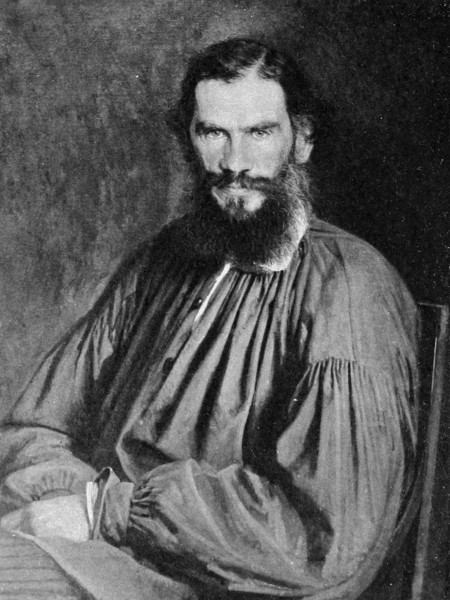
A month later he writes again, referring to Kramskóy's
portrait of himself, a photogravure of which forms the
frontispiece of this volume, and shows the blouse which even
in those days, before his Conversion, he wore when at home,
instead of a tailor-made coat:
25 September 1873.
I am beginning to write.... The children are learning; my
wife is busy and teaches. Every day for a week Kramskóy has
been painting my portrait for Tretyakóf's Gallery, and I sit and
chat with him, and try to convert him from the Petersburg
faith to the faith of the baptized. I agreed to this, because
Kramskóy came personally, and offered to paint a second
portrait for us very cheaply, and because my wife persuaded
me.
Up to this time Tolstoy, sensitive about his personal
appearance, and instinctively disliking any personal advertisement,
had always had an objection to having his portrait
painted; and if he ever allowed himself to be photographed,
was careful to have the negative destroyed that copies might
not be multiplied. This prejudice he abandoned in later
life; and after Kramskóy had broken the ice, portraits and
photographs of Tolstoy became more and more common.
Kramskóy's acquaintance with the Tolstoys came about
in this way. He was commissioned to paint a portrait of
the great novelist, for the collection of famous Russians in
Tretyakóf's picture gallery in Moscow; but sought in vain
in that town for his photograph, and was too modest to ask
Tolstoy (who, he knew, was living a secluded life at Yásnaya)
to give him sittings. He therefore hired a dátcha,
some three miles from Yásnaya, with the intention of
painting Tolstoy, who often rode past on horseback. His
intention, however, became known, and the Tolstoys at
once sent him a friendly invitation to visit them. Of the
two very similar portraits of Tolstoy which Kramskóy
painted, one has remained at Yásnaya.
Before Tolstoy's next letter to Fet, the angel of death
had crossed the threshold of his house for the first time in
his married life. On 11th November he wrote:
We are in trouble: Peter, our youngest, fell ill with croup
and died in two days. It is the first death in our family in
eleven years, and my wife feels it very deeply. One may
console oneself by saying that if one had to choose one of our
eight, this loss is lighter than any other would have been; but
the heart, especially the mother's heart—that wonderful and
highest manifestation of Divinity on earth—does not reason,
and my wife grieves.
During the whole of 1874 Tolstoy made strenuous efforts
to get his system of education more generally adopted. On
15th January, overcoming his dislike of speaking in
public, he addressed the Moscow Society of Literacy
on the subject of the best way to teach children to read.
The details of his argument need not here detain us, as it
will fall to the lot of few of my readers to teach Russian
children to read Russian; but briefly, the German Lautiermethode
had been adopted by Russian pedagogues in a
way that Tolstoy considered arbitrary and pedantic, and his
appeal, which in the main has not carried conviction to the
educationalists, was against that method.
The large hall in which the meeting took place was
crowded. The President of the Society, Mr. Shatílof,
invited Tolstoy to open the debate, but Tolstoy preferred
to reply to what questions and remarks the other speakers
might put. In the course of the animated proceedings,
in which several men well known in the Russian educational
world took part, the discussion widened out till it
covered the question of the whole direction of elementary
education; and Tolstoy, from the standpoint of his belief
that it is harmful to force upon the people a culture they
do not demand and are not prepared for—and much of
which, though considered by us to be science, may yet turn
out to be no better than the alchemy and astrology of the
Middle Ages—denounced the education forced upon the
children in elementary schools, and declared that this should
be confined in the first place to teaching the Russian language
and arithmetic, leaving natural science and history
alone. To prove the advantage of his way of teaching
reading, Tolstoy offered to give a practical demonstration
in one of the schools attached to some of the Moscow mills.
Accordingly it was arranged that this should take place
the next day and the day after, at the mills owned by Mr.
Ganéshin, on the Devítche Pólye just outside Moscow. On
the morrow Tolstoy was unwell, and did not appear; but he
gave his demonstration on the evening of the following day,
with the result that, on the suggestion of Mr. Shatílof, the
Society of Literacy decided to start two temporary schools
for the express purpose of testing the rival methods during
a period of seven weeks. The one school was taught by
Mr. M. E. Protopópof, an expert in the Lautiermethode,
while in the other school Tolstoy's method was taught by
Mr. P. V. Morózof. After seven weeks the children were
examined by a Committee, which had to report to the
Society at a meeting held on 13th April. The members of
the Committee however could not agree, and handed in
separate and contradictory reports. At the meeting of the
Society there was again a great divergence of opinion; and
Tolstoy, who considered that the test had not been made
under proper conditions (most of the pupils being too young,
and the continual presence of visitors preventing the teacher
from holding the children's attention), but that nevertheless
his method had shown its superiority, decided to appeal to
a wider public, and did so in the form of a letter addressed
to Mr. Shatílof.
A full account of what happened from the time the
dispute passed into the press, has been given by that powerful
and popular critic and essayest, N. K. Mihaylóvsky,
who was at this time a colleague of Nekrásof. In 1866 the
Contemporary had been prohibited, as a punishment for its
too Liberal tendencies. In 1868 Nekrásof and Saltykóf
(Stchedrín) had taken over the management of the Fatherland
Journal. Tolstoy, who had long dropped out of touch
with Nekrásof, now addressed to him a request that the
Fatherland Journal should take a hand in his fight with the
pedagogic specialists, and should interest a wider public in
his educational reforms. As an inducement, he held out a
prospect (never fulfilled) that he would contribute some of
his works of fiction to their magazine. The outcome of his
correspondence with Nekrásof was, that though the whole
question of elementary education was somewhat foreign to
a literary magazine such as the Fatherland Journal, a long
article by Tolstoy (his letter to Shatílof) appeared in the
September number, under the title of On the Education of
the People.
Tolstoy's educational articles in 1862, when he issued
them in his own magazine, had fallen quite flat and
attracted no attention, but this article, by the author of
War and Peace, in a leading Petersburg magazine, though
expressing very similar views, received very much attention,
and was criticised, favourably or adversely, in a large number
of other publications. Though his views were only adopted
to a small extent, yet the severe shock which he administered
to the professional pedagogues who looked on school-children
as 'a flock existing for the sake of its shepherds,' had
a most healthy influence, and that it did not pass without
some immediate practical effect is indicated by the rejection
from the Moscow Teachers' Seminary of one of the text-books
Tolstoy attacked most fiercely.
Following on the storm raised in the press by Tolstoy's
article, Mihaylóvsky, in the Fatherland Journal for January
1875, published a long article entitled An Outsider's Notes,
in which he took Tolstoy's part against the pedagogues,
and said: 'Though I am one of the profane in philosophy
and pedagogics, and am writing simply a feuilleton, I nevertheless
advise my readers to peruse this feuilleton with great
attention, not for my sake, but for Tolstoy's, and for the
sake of those fine shades of thought on which I do but
comment.'
Before this, however, Tolstoy had made another attempt
to improve the state of elementary education, by promoting
the establishment of that 'University in bark shoes' to
which I have already alluded.
He had found some of the boys in the Yásno-Polyána
school anxious to continue their studies after finishing the
school course; and an experiment in teaching these lads
algebra had been highly successful.
In his last article on Education, Tolstoy had pointed out
that a great obstacle to the spread of efficient elementary
instruction lay in the fact that the peasants could not
afford the salaries (extremely modest as these sound to
Western ears) demanded by Russian teachers of the non-peasant
classes. It was therefore quite natural that he
should now devise a scheme for preparing teachers from
among the peasants themselves; and he drew up a project
for a training college to be established at Yásnaya, under
his own direction and control.
In the summer of this year Tolstoy paid a brief visit to
his Samára estate to look after its management; and he
took his son Sergius with him.
On 20th November 1874 the Countess wrote to her
brother:
Our usual serious winter work is now in full swing. Leo
is quite taken up with popular education, schools, and colleges
for teachers, where teachers for the peasants' schools are to be
trained. All this keeps him busy from morning till night.
I have my doubts about all this. I am sorry his strength should
be spent on these things instead of on writing a novel; and I
don't know in how far it will be of use, since all this activity
will extend only to one small corner of Russia.
P. F. Samárin, the Marshal of the Nobility of Toúla
Government, backed Tolstoy cordially, and pointed out that
the Zémstvo (County Council) had a sum of Rs. 30,000
available for educational purposes, and that this might be
devoted to starting a teachers' Training College. To attain
this end Tolstoy, who heretofore had always refused to
stand for election, consented to enter the Zémstvo, and after
being returned to that body, was unanimously chosen to
serve on its Education Committee.
He presented a report in the sense indicated above, which
was at first favourably discussed; but unfortunately one of
the oldest members rose, and alluding to the fact that a
collection was being made all over Russia for a monument
to Catherine the Great, and that it was the centenary of the
decree by which she had created the Government of Toúla,
proposed that the money should be devoted to the monument
of their Benefactress. This loyal sentiment met with
approval, and though Tolstoy did not at once abandon his
plan, the means to carry it out were never forthcoming, and
we do not hear much more of it.
If one did not know how stupidly reactionary the governing
classes of Russia were at this period, it would seem
extraordinary that the central and the local authorities
alike should have so constantly balked and hindered Tolstoy's
disinterested projects: forbidding the publication of his
newspaper for soldiers, mutilating his stories, sending
gendarmes to search his schools, looking askance at his
school magazine, and defeating his project for a Training
College. Can it be wondered at, that he came more and
more to identify Government with all that is most opposed
to enlightenment? We know that similar causes were, at
that very time, driving men and women of a younger generation
to undertake dangerous propaganda work, in more
or less definite opposition to the existing order of society,
among factory workmen and country peasants.
His devotion to educational matters did not entirely
supersede, though no doubt it delayed, his activity as a
novelist. In the spring of 1874 he had taken the commencement
of Anna Karénina to Moscow, but for some
reason none of it appeared that year.
Tourgénef, in collaboration with Madame Viardot, was at
this time translating some of Tolstoy's best stories into
French. Writing to Fet in March 1874, he says:
The season is now almost over, but all the same I will try to
place his [Tolstoy's] Three Deaths in the Revue des Deux Mondes
or in the Temps, and in autumn I will without fail get out
The Cossacks. The more often I read that story, the more
convinced I am that it is the chef d'œuvre of Tolstoy and of all
Russian narrative literature.
Meanwhile life and death pursued their course. In April
a son was born and christened Nicholas; and before long,
death, having a few months previously taken the youngest,
returned to claim the oldest members of the household.
The first of them to go was his dearly-loved Aunty Tatiána
Alexándrovna, to whose good influence through life he owed
so much. She died on 20th June, and next year his other
aunt followed her.
Tolstoy never refers to his aunt Tatiána without letting
us see how he cherishes her memory. Here for instance are
one or two of his notes relating to her:
When already beginning to grow feeble, having waited her
opportunity, one day when I was in her room she said to us,
turning away (I saw that she was ready to cry), 'Look here,
mes chers amis, my room is a good one and you will want it. If
I die in it,' and her voice trembled, 'the recollection will be
unpleasant to you; so move me somewhere else, that I may
not die here.' Such she always was, from my earliest childhood,
before I was able to understand her goodness.
Again referring to her death, and to the love for his
father which had played so large a part in her life, he adds:
She died peacefully, gradually falling asleep; and died as
she desired, not in the room that had been hers, lest it should
be spoilt for us.
She died recognising hardly any one. But me she always
recognised, smiling and brightening up as an electric lamp does
when one touches the knob, and sometimes she moved her lips
trying to pronounce the name Nicholas: thus in death completely
and inseparably uniting me with him she had loved all
her life.
The opinion the peasants had of her, was shown by the
fact that when her coffin was carried through the village,
there was not one hut out of the sixty in Yásnaya Polyána,
from which the people did not come out asking to have the
procession stopped and a requiem sung for her soul. 'She
was a kind lady and did nobody any harm,' said they.
Tolstoy adds:
On that account they loved her, and loved her very much.
Lao-Tsze says things are valuable for what is not in them. So
it is with a life. It is most valuable if there is nothing bad in
it; and in the life of Tatiána Alexándrovna there was nothing
bad.
Except in the case of his brother Nicholas, Tolstoy has
usually not been greatly upset even by the deaths of those
near and dear to him. The following letter to Fet shows
how he took Tatiána's death:
24 June 1874.
Two days ago we buried Aunt Tatiána Alexándrovna. She
died slowly and gradually, and I had grown accustomed to the
process; yet her death was, as the death of a near and dear
one always is, a quite new, isolated and unexpectedly-stirring
event. The others are well, and our house is full. The
delightful heat, the bathing and the fruit have brought me to
the state of mental laziness I love, with only enough mental
life remaining to enable me to remember my friends and think
of them.
The next letter, dated the 22nd October, tells its own tale:
Dear Afanásy Afanásyevitch,—I have planned to buy, and
must buy, some land at Nikólsky, and for that purpose must
borrow Rs. 10,000 for one year on mortgage. It may be that
you have money you want to place. If so, write to Iván
Ivánovitch Orlóf, Nikólsky village, and he will arrange the
affair with you independently of our relations to one another....
How gladly would I come to see you, were I not so overwhelmed
with the school, family and estate business, that I
have not even time to go out shooting.... I hope to be free
when winter comes.
A small second edition of Tolstoy's ABC Book, in twelve
paper-bound parts, was printed this year; but he did not
yet feel quite satisfied with that work, and towards the close
of the year he revised it, abbreviating, omitting the arithmetic,
and introducing graduated reading exercises. As soon as
the pupil has mastered a few of the most necessary letters
and can put these together, Tolstoy contrives out of the
very simplest syllables to construct sentences that have a
meaning and an interest. The New ABC Book, apart from
the more advanced Readers, and consisting of ninety-two pages
of elementary matter, was issued in 1875, at the low
price of 14 copecks (about 4d.). Since Tolstoy's
efforts have seldom been favoured by the Government, it is
worth noting that this edition was 'Approved and recommended
by the Scholarly Committee of the Ministry of
Popular Education.' Between one and two million copies
of it have since been sold. The reading matter from his
first ABC Book was subsequently graded into four cheap
Readers costing 3d. to 4d. each, and though not honoured
by the Ministry of Education, they have from that time to
this circulated in increasing quantities, being printed of late
years in edition after edition of 50,000 at a time.
The Countess has in general enjoyed good health and
worn her years and the cares of her large family very lightly;
but during the winter of 1874-5 her condition gave her
husband much concern. In January he was able to write
to Fet: 'I have ceased to fear for my wife's health'; but
in fact for some time longer she continued to be ailing.
The commencement of Anna Karénina, appeared in the
first four monthly numbers of the Russian Messenger for
1875.
By far the best English version of that novel (as also of
War and Peace) is Mrs. Constance Garnett's, though I do
not like her alteration of the title of the book to Anna
Karénin, nor am I quite satisfied with her treatment of
some of the conversations in it; but unquestionably we have
much to thank her for.
In February the baby, Nicholas, died of inflammation of
the brain, and on 4th March 1875[53] Tolstoy wrote to Fet:
We have one grief after another; you and Márya Petróvna
will certainly be sorry for us, especially for Sónya. Our
youngest son, ten months old, fell ill three weeks ago with
the dreadful illness called 'water on the brain,' and after three
weeks' terrible torture died three days ago, and we have buried
him to-day. I feel it hard through my wife; but for her, who
was nursing him herself, it is very hard.
In the same letter he mentions Anna Karénina, and immediately
afterwards he makes an allusion to the first idea
of his Confession, which was not actually written till 1879:
It pleases me very much that you praise Karénina and I hear
that she gets praised; but assuredly never was writer so indifferent
to his success as I am!
On the one hand what preoccupies me are the school affairs,
and on the other, strange to say, the subject of a new work,
which took possession of me just at the worst time of the boy's
illness,—and that illness itself and death....
From Tourgénef I have received the translation, printed in
the Temps, of my Two Hussars, and a letter written in the
third person asking to be informed that I have received it, and
saying that other stories are being translated by Madame Viardot
and Tourgénef,—both of which were unnecessary. [Tolstoy
means that they need neither have sent him the translation,
nor informed him of what they were doing.]
The commencement of Anna Karénina did not find favour
with Tourgénef, who on 14th March wrote from Paris to
A. S. Souvórin, the novelist and proprietor of the Nóvoye
Vrémya (New Times):
His [Tolstoy's] talent is quite extraordinary, but in Anna
Karénina he, as one says here, a fait fausse route; one feels the
influence of Moscow, Slavophil nobility, Orthodox old maids,
his own isolation, and the absence of real artistic freedom.
Part II is simply dull and shallow—that's what's the matter.
And writing in similar strains to Polónsky the poet,
Tourgénef said:
Anna Karénina does not please me, though there are some
truly splendid pages (the steeplechase, the mowing, and the
hunt). But it is all sour: smells of Moscow, holy oil,
old maidishness, Slavophilism, and the aristocracy, etc.
The cordiality of Tourgénef's appreciation of Tolstoy's
writings in general, is sufficient guarantee that it was no
personal prejudice that led him to speak in this way of a
book which is one of Tolstoy's three most important novels,
and which many people hold to be the best of them all.
What really caused his harsh judgment, is a matter I will
deal with later on.
This summer the whole Tolstoy family went to the
Samára estates, which had already been considerably increased
by the last purchase, and which ultimately exceeded
16,000 acres. Mouhamed Shah with his herd of mares and
his kotchévka—which Tolstoy called 'our saloon'—again
appeared on the scene. A second kotchévka was set up
for the use of the Tolstoys themselves, and was so much in
favour that all the members of the family were eager to
occupy it.
The novelty and the peculiarities of steppe farming
interested Tolstoy, and he, as well as other members of his
household, took an active part in harvesting and winnowing.
How primitive were the Samára methods of agriculture may
be shown by mentioning their manner of threshing. A ring
of horses was formed, tied head to tail. In the centre of
the ring stood a driver with a long lash, and the horses
were set trotting round a corresponding circle of sheaves, out
of which they trod the grain.
The virgin soil was ploughed up by five or even six pair
of oxen, wearing round their necks deep-toned bells, sounding
in a minor key. These things, together with the pipes
of the boys who watched the herds, the sultry days, and the
marvellously clear moonlit nights, had a wonderful charm
for the whole party, and this charm was increased by Tolstoy's
capacity to notice and direct attention to whatever
was interesting or beautiful.
The whole family became interested, Behrs tells us, in
their new farming, and some of them went with Tolstoy
as far afield as Orenbourg to purchase cattle and horses.
He bought about a hundred Bashkír mares and crossed
them with an English trotter and with horses of other breeds,
hoping to obtain a good new type.
One evening his whole herd, and Mouhamed Shah's as
well, were very nearly driven off by some Kirghiz nomads
who were passing. The invaders were, however, pursued
and driven off by two mounted Bashkír labourers.
Tolstoy declared farming in Samára to be a game of
chance. It cost nearly three times as much to plough up
the land, sow it, and gather in a harvest, as it did to purchase
the freehold of the estate; and if during May and
June there was not at least one good fall of rain, everything
perished; whereas if it rained several times, the
harvest yielded thirty to forty-fold.
One day, at harvest time, a poor wandering Tartar, drawing
two little children in a tiny cart, came up to the balcony
on which the Tolstoys were sitting, and asked to be hired
as a labourer. He was allowed to set up his wigwam in a
field close by, and the Tolstoy children used to go there
every day to feed the little Tartars.
In the neighbouring village lived several well-to-do
Russian peasants with whom Tolstoy was on very good
terms. Either because they were economically independent
and lived in a province where serfdom had not prevailed,
or as a result of Tolstoy's tact and ability to set people
at their ease, these peasants always behaved with dignity
and self-respect. They shook hands when they said 'How
do you do?' and seemed quite at home with the Count.
He used to notice with pleasure the good relations and
complete religious toleration that existed in those parts
between the Orthodox peasants and their Mohammedan
neighbours; and he was also delighted that the priest at
Pátrovka was on friendly terms with the Molokáns he was
trying to convert.
One rainy night, after staying late at this priest's house,
Tolstoy and his brother-in-law completely lost their way.
It was so dark that they could not see their horses' heads.
Behrs was riding an old working horse, which kept pulling
to the left. Tolstoy, on hearing this, told him to let the
horse follow its bent. Behrs therefore tied his reins so
that they hung loose, and wrapping himself in his cloak
from the drenching rain, allowed the horse to go where
it liked. Carefully avoiding the ploughed land, it soon
brought them out on to the road, and, curiously enough, to
just the one part of it which was distinguishable from the
extraordinary sameness of the rest, so that the riders knew
just where they were.
The most striking event of this year's stay in Samára was
a horse race, arranged by Tolstoy. Mouhamed Shah was
authorised to announce to the peasants and neighbours that
races would be held on the Count's estate; and invitations
were sent to all likely to take part. Bashkírs and Kirghiz
assembled, bringing with them tents, portable copper boilers,
plenty of koumýs, and even sheep. Oural Cossacks and
Russian peasants also came from the whole surrounding
neighbourhood. In preparation for the race, says Behrs:
We ourselves chose a level place, measured out a huge circle
three miles in circumference, marked it by running a plough
round, and set up posts. Sheep and even one horse were
prepared with which to regale visitors. By the appointed day
some thousands of people had collected. On the wild steppe,
covered with feather grass, a row of tents appeared, and soon
a motley crowd enlivened it. On the conical hillocks (locally
called 'cones') felt and other carpets were spread, on which
the Bashkírs sat in circles, their legs tucked under them. In
the centre of the circle, out of a large toursouk [a leather bottle
made of an animal's leg] a young Bashkír poured koumýs,
handing the cup to each of the company in turn. Their songs,
and the tunes played on their pipes and reeds, sounded somewhat
dreary to a European ear. Wrestling, at which the
Bashkírs are particularly skilful, could be seen here and there.
Thirty trained horses were entered for the chief race. The
riders were boys of about ten years, who rode without saddles.
This race was for thirty-three miles, and it took exactly
an hour and forty minutes; consequently it was run at the
rate of three minutes a mile. Of the thirty horses, ten ran
the whole distance, the others giving up. The principal
prizes were a horse, an ox, a gun, a clock, and a dressing-gown.
The festival lasted two days, and passed off in
perfect order and very gaily. To Tolstoy's delight no
police were present. The guests all politely thanked their
host and departed highly satisfied. 'Even in the crowd,'
says Behrs, 'it seemed to me that Leo Nikoláyevitch
knew how to evoke entrain combined with respect for good
order.'
Tolstoy visited the Petróvsky Fair, as was his yearly
custom, and stayed at the Bouzouloúk Monastery, where a
hermit resided who was 'saving his soul' by a solitary and
ascetic life. This man lived in an underground catacomb.
When he came out he walked about the garden and showed
his visitors an apple-tree he had planted forty years before,
under which it was his custom to sit when receiving pilgrims.
He spoke to Tolstoy about the Scriptures, and showed him
his catacomb-home, the coffin in which he slept, and the
large crucifix before which he prayed.
Tolstoy considered that the respect paid to this man by
pilgrims and other visitors, was the outcome of genuine
religious feeling, and proved that the hermit, by giving the
example of a pure, unworldly life, supplied a real want.
Readers of Tolstoy's short stories will be aware of the use
to which he subsequently put his knowledge of the Bashkírs
and of the hermit.
On 26th August, after reaching Yásnaya, he wrote to Fet:
Two days ago we arrived home safely....
We have had an average harvest, but the price of labour has
been enormous, so that finally ends only just meet. For two
months I have not soiled my hands with ink nor my heart
with thoughts. Now I am settling down again to dull, common-place
Anna Karénina with the sole desire to clear a space
quickly, and obtain leisure for other occupations—only not for
the educational work I love but wish to abandon. It takes too
much time.
His Samára experiences confirmed in him the feeling that
not the civilisation and progress and political struggles of
the Western world and of the small Westernised section of
Russians, were really important, but the great primitive
struggle of plain people to obtain a subsistence in healthy
natural conditions; and he adds in the same letter:
Why fate took me there [to Samára] I do not know; but I
know that I have listened to speeches in the English Parliament,
which is considered very important, and it seemed to me
dull and insignificant; but there, are flies, dirt, and Bashkír
peasants, and I, watching them with intense respect and
anxiety, became absorbed in listening to them and watching
them, and felt it all to be very important.
One must live as we lived, in a healthy out-of-the-way part
of Samára, and see the struggle going on before one's eyes of
the nomadic life (of millions of people on an immense territory)
with the primitive agricultural life, in order to realise all the
importance of that struggle.
After their return from the Government of Samára, all
the children got hooping-cough. The Countess caught it
from them, and, being in the sixth month of pregnancy, was
very ill. This resulted in the premature birth of a girl,
Varvára, who lived less than two hours.
Tolstoy's eldest son, Sergius, had now reached the age of
twelve. Besides their English governess and a Swiss lady, the
children had at different times a Swiss, a Frenchman, and
a German as tutors for modern languages. Tutors and
students who acted as tutors, also lodged at Yásnaya and
taught other subjects. A music master came over from
Toúla. The eldest boy had considerable musical talent,
and the family as a whole were musical. As soon as they
had mastered their finger exercises, the Count insisted on
their at once being allowed to learn serious pieces.
Every effort was made to awaken and foster the talent
for drawing and painting which some of the children, and
especially the eldest daughter, Tatiána, possessed; but lessons
in these subjects were only given to those who showed real
capacity for them.
Much as Tolstoy disliked the curriculum of the Grammar
Schools ('Gymnasiums,' as they are called in Russia), he did,
not wish to make it impossible for his sons to enter the
University, and they followed the usual classical course.
Sergius passed his examinations each year in Toúla
Gymnasium, being carefully coached at home.
In his Recollections Behrs tells us of Tolstoy's enlivening
influence in the family:
I cannot sufficiently describe the joyous and happy frame
of mind that usually reigned at Yásnaya Polyána. Its source
was always Leo Nikoláyevitch. In conversation about abstract
questions, about the education of children, about outside
matters—his opinion was always most interesting. When playing
croquet, or during our walks, he enlivened us all by his
humour and his participation, taking a real part in the game
or the walk.
With me, he liked to mow, or use the rake; to do gymnastics,
to race, and occasionally to play leap-frog or gorodkí [a
game in which a stick is thrown at some other shorter sticks
placed in a pattern], etc. Though far inferior to him in strength,
for he could lift 180 lbs. with one hand, I could easily match
him in a race, but seldom passed him, for I was always laughing.
That mood accompanied all our exercises. Whenever we
happened to pass where mowers were at work, he would go up
to them and borrow a scythe from the one who seemed most
tired. I of course imitated his example. He would then ask
me, Why we, with well-developed muscles, cannot mow six
days on end, though a peasant does it on rye-bread, and
sleeping on damp earth? 'You just try to do it under such
conditions,' he would add in conclusion. When leaving the
meadow, he would take a handful of hay from the haycock and
sniff it, keenly enjoying its smell.
Children and grown-ups alike played croquet at Yásnaya.
The game generally began after dinner in the evening, and
only finished by candlelight. Behrs says that, having
played it with Tolstoy, he considers croquet to be a game of
chance. Tolstoy's commendation of a good shot always
pleased the player and aroused the emulation of his opponents.
The kindly irony of his comments on a miss, also
acted as a spur. A simple word from him, uttered just
at the right moment and in the right tone, produced that
entrain which makes any occupation interesting and infects
all who come under its influence.
The sincerity of Tolstoy's nature showed itself in the
frank expression of his passing mood. If, when driving to
the station, he saw that they had missed the train, he would
exclaim, 'Ach! we've missed it!' with such intensity that
every one within earshot would first feel as though a calamity
had occurred, and would then join in the hearty laughter
which his own vehement exclamation evoked in Tolstoy.
It was the same when he made a bad miss at croquet; and
also if, when sitting at home, he suddenly remembered some
engagement he had forgotten to keep. If, as sometimes
happened, his exclamation alarmed his wife, he would half-jokingly
add, like a scolded child, 'I'll never do it again!'
His laughter, which began on a high note, had something
wonderfully infectious about it. His head would hang over
on one side, and his whole body would shake.
His good-natured irony constantly acted as a stimulant to
those about him. If, for instance, some one was in the
dumps about the weather, Tolstoy would say: 'Is your
weather behaving badly?' Or when Behrs was sitting
comfortably listening to a conversation, he would say to
him: 'As you are on the move, you might please bring
me so-and-so.'
When he felt it wise to reject an extra cigar or a second
helping of some favourite dish, he would remark to those
present: 'Wait till I am grown up, and then I will have
two helpings,' or 'two cigars,' as the case might be.
If, says Behrs, 'he noticed any of the children making a
wry or affected face, he generally called out, "Now then, no
grimacing; you'll only spoil your phiz."'
Behrs also tells us that.
What he called 'the Numidian cavalry' evoked our noisiest
applause. He would unexpectedly spring up from his place
and, raising one arm in the air with its hand hanging quite loose
from the wrist, he would run lightly through the rooms. All
the children, and sometimes the grown-ups also, would follow
his example with the same suddenness.
Tolstoy read aloud very well, and would often read to
the family or to visitors.
His contempt for doctors and medicine is plainly indicated
both in War and Peace and Anna Karénina. Like
Rousseau he considered that the practice of medicine should
be general and not confined to one profession; and this
opinion inclined him to approve of the folk-remedies used
by the peasants. But he did not go the length of refusing
to call in a doctor when one of the family was seriously ill.
Before the year closed, Tolstoy's aunt, Pelagéya Ilýnishna
Úshkof, with whom he had lived in his young days in Kazán,
also passed away. She had been separated from her husband
before his death in 1869, and had long not even seen him,
though they remained quite friendly towards one another.
She was very religious in an Orthodox Church way, and after
her husband's death retired to the Óptin nunnery. Subsequently
she moved to the Toúla nunnery, but arranged to
spend much of her time at Yásnaya; where in her eightieth
year she fell ill and died. She was in general a good-tempered
though not clever woman, and all her life long
strictly observed the ceremonies of the Church and thought
that she firmly believed its teaching about redemption and
resurrection; yet she was so afraid of death that on her
death-bed she was reluctant to receive the eucharist, because
it brought home to her mind the fact that she was dying;
and as a consequence of the sufferings caused by the fear
of death, she became irritable with all about her.
A servant who lived in the house at the time, tells that
while at Yásnaya she used, on the first of each month, to
send for a priest. As soon as he arrived, and began the
usual ceremony of blessing with holy water, Tolstoy would
escape and hide himself. Not till the gardener, Semyón—whom
he used to send into the conservatory to reconnoitre—brought
him word that the priest had gone, would
Tolstoy reappear in the house.
About that time, however, his attitude towards Church
ceremonies altered. His man-servant Sergéy Arboúzof (who
saw only the external signs of the complex inner struggle
going on in Tolstoy) tells us:
Suddenly a wonderful change came over him, of which I was
a witness. In 1875 a priest, Vasíly Ivánovitch, from the Toúla
Seminary, used to come to teach theology to Tolstoy's children.
At first, Leo Nikoláyevitch hardly ever talked to him, but it
once happened that a snow-storm obliged Vasíly Ivánovitch to
stop the night at our house. The Count began a conversation
with him, and they did not go to bed till daylight. They talked
the whole night.
From that day Leo Nikoláyevitch became very thoughtful,
and always talked with Vasíly Ivánovitch. When Lent came
round, the Count got up one morning and said, 'I am going to
do my devotions, and prepare to receive communion. You can
go back to bed, but first tell the coachman not to get up.
I will saddle Kalmýk (his favourite horse at that time) myself.
Forgive me, Sergéy, if I have ever offended you!' and he went
off to church.
From that day for a couple of years he always went to church,
seldom missing a Sunday. The whole village was surprised,
and asked, 'What has the priest told the Count, that has
suddenly made him so fond of church-going?'
It used to happen that the Count would come into my hut
when I was teaching my little boy religion.
'What are you teaching him?' he would ask.
And I used to say, 'To pray.'
'Ah!' said he, 'that is right. A man who does not pray to
God is not a real man.'
The publication of Anna Karénina was renewed in the first
four numbers of the Russian Messenger for 1876.
On 1st March Tolstoy writes to Fet:
Things are still not all right with us. My wife does not get
over her last illness, coughs, gets thin, and has first fever and
then headaches. And therefore the house lacks well-being,
and I lack mental tranquillity, which I now particularly need
for my work. The end of winter and beginning of spring is
always my chief time for work, and I must finish my novel,
which now wearies me.... I always hope a tooth will come
loose in your jaw, or in your thrashing machine, and cause you
to go to Moscow. Then I shall spin a cobweb at Kozlóvka [the
nearest station to Yásnaya] and catch you.
In April Fet wrote to Tolstoy to say that he had been
seriously ill, had thought he was dying, and 'wished to call
you to see how I departed.' On 29th April Tolstoy replies
in a letter notable because it gives us a glimpse of the progress
he had made in the fierce five-year inner struggle with
doubt which preceded the production of his Confession:
I am grateful to you for thinking of calling me to see your
departure, when you supposed it was near. I will do the same
when I get ready to go thither, if I am able to think. No one
will be so necessary to me at that moment as you and my
brother. When death draws near, intercourse with people who
in this life look beyond its bounds, is precious and cheering;
and you and those rare real people I have met in life, always
stand on the very verge and see clearly, just because they look
now at Nirvana—the illimitable, the unknown—and now at
Sansara; and that glance at Nirvana strengthens their sight.
But worldly people, however much they may talk about God,
are unpleasant to you and me, and must be a torment when
one is dying, for they do not see what we see, namely the God
who 'is more indefinite and distant, but loftier and more
indubitable,' as was said in that article.
You are ill and think of death, and I am alive and do not
cease thinking of and preparing for the same thing.... Much
that I have thought, I have tried to express in the last chapter
of the April number of the Russian Messenger [Anna Karénina,
Part I, Chap. XX].
The passage referred to, telling of the death of Lévin's
brother, is evidently based on the death of Tolstoy's own
brother Demetrius; and it may here be mentioned that
many characters in Anna Karénina are drawn more or less
closely from life. For instance, Agáfya Miháylovna, the
servant, was a real person, and that was her real name. She
died at Yásnaya only a few years ago. Yásnaya Polyána
itself, in many of its details, is also described in the novel.
On 12th May Tolstoy again writes to Fet:
It is already five days since I received the horse, and every
day I prepare but never make time to write to you. Here the
spring and summer life has begun, and our house is full of
guests and of bustle. This summer life seems to me like a
dream: it contains some slight remains of my real, winter life,
but consists chiefly of visions, now pleasant and now unpleasant,
from some absurd world not ruled by sane sense. Among
these visions came your beautiful stallion. I am very much
obliged to you for it. Where am I to send the money to?...
An event which occupies me very much at present is
Sergey's examinations, which begin on the 27th.... What
a terrible summer! Here it is dreadful and mournful to look at
the wood, especially at the young trees. They have all perished.
On 18th May he wrote again:
I have been slow in answering your long and cordial letter
because I have been unwell and dispirited, as I still am, but I
will write at least a few lines. Our house is full of people: my
niece Nagórnaya with two children, the Kouzmínskys with four
children; and Sónya [the Countess] is still poorly, and I dejected
and dull-minded. Our one hope was for good weather, and
that we have not got. As you and I resemble one another,
you must know the condition in which one feels oneself to be,
now a God from whom nothing is hid, and now stupider than
a horse. In that state I am at present. So do not be exacting.
Till next letter, yours,
L. Tolstoy.
The Kouzmínskys referred to above were Tánya, her
husband, and their family. They spent every summer at
Yásnaya, in the 'wing' house. When discussing any
excursion or other undertaking with Mr. Kouzmínsky,
Tolstoy would often say, 'But we must hear what the
Authorities have to say about it,' the Authorities being
their wives.
Passing into his 'summer condition,' Tolstoy's attention
to Anna Karénina slackened; but before the end of the
year he set energetically to work to finish it. The interest
aroused by the book was extreme, and the story goes that
Moscow ladies used to send to the establishment where the
novel was being printed, to try to find out what the continuation
would be.
On 21st July Tolstoy writes inviting Fet's brother, Peter
Afánasyevitch, a great lover of horses, to accompany him to
Samára; and in the same letter he makes an allusion to the
troubles of the Slavs in Turkey, where fighting had already
been going on for a twelvemonth with the Herzegovinians.
Peter Afanásyevitch had gone as a volunteer, and had returned
after the failure of the insurrection.
21 July 1876.
I am very much to blame, dear Afanásy Afanásyevitch, for
having been so slow in writing to you. I prepare to write
every day, but cannot find time because I am doing nothing....
Stráhof was here a week ago, and we philosophised to the
point of weariness....
I press the hand of Peter Afanásyevitch. I should like to
hear his stories about Herzegovina, in the existence of which I
do not believe!
I am arranging to go to Samára in September. If Peter
Afanásyevitch has no plans for September, will not he go
with me to see the Kirghiz and their horses? How jolly it
would be!
Mention has already been made of the fact that Tolstoy,
who understood horses very well, was at this time interested
in horse-breeding as a source of revenue. To buy them he
visited Orenbourg, where he met General Kryzhanóvsky,
a friend who had been one of his superior officers in
Sevastopol and was now Governor-General of this northern
Province. They spent the time together very pleasantly
recalling their past experiences.
To his wife, who had found it hard to consent to his
absence, he wrote in September:
I know that it is hard for you, and that you are afraid; but
I saw the effort you made to control yourself and not to hinder
me and, were it possible, I loved you yet more on that account.
If only God grants you to spend the time well, healthily,
energetically and usefully!... Lord have mercy on me and
on thee!
In a letter of 13th November Tolstoy writes to Fet:
Pity me for two things: (1) a good-for-nothing coachman
took the stallions to Samára and, wishing to take a short cut,
drowned Gouneba in a bog within ten miles of the estate; (2)
I sleep and cannot write; I despise myself for laziness and do
not allow myself to take up any other work.
Twenty-eight years after the loss of Gouneba, the
Countess, in speaking to me of her husband's qualities as a
man of affairs, remarked that his schemes were very good,
but that he generally spoilt them by lack of care in details.
'For instance,' she remarked, 'it was quite a good idea of
his to send a very fine stallion which cost Rs. 2000 [about
£260] to our estate in Samára. There were no such
horses in the district; but he must needs entrust it to a
drunken Tartar who made away with it and said he had
lost it.'
On 7th December 1876 Tolstoy wrote to Fet acknowledging
a poem, 'Among the Stars,' which the latter had
sent him:
That poem is not only worthy of you, but is specially,
specially good, with that philosophic-poetic character which I
expect from you. It is excellent that it is said by the stars....
It is also good, as my wife remarked, that on the same sheet on
which the poem is written, you pour out your grief that the
price of kerosene has risen to 12 copecks. That is an indirect
but sure sign of a poet.
The reader is by this time well aware of Tolstoy's devotion
to music. Though it was at times crowded out of his
life by other interests, he always returned to it with ardour
when opportunity offered. Behrs tells us that Tolstoy
generally, when playing, chose serious music.
He often sat down to the piano before beginning to work....
He always accompanied my youngest sister [Tánya] and enjoyed
her singing very much. I noticed that the sensation
music evoked in him expressed itself by a slight pallor and a
scarcely perceptible grimace, suggestive of something like
terror. Hardly a day passed in summer without my sister singing
and without the piano being played. Occasionally we all
sang together, and he always played the accompaniments.
As Tolstoy's spiritual crisis approached, the attraction of
music for him seemed to increase, and it was about this
period, that is to say in December 1876, that he made
acquaintance with the composer P. I. Tschaikóvsky, who had
held the post of Director of the Moscow Conservatoire, the
first seeds of which Tolstoy had helped to plant nearly
twenty years before.
Tschaikóvsky had from his youth up been a devoted
admirer of Tolstoy, whose skill in reading the human heart
appeared to him almost superhuman. He was therefore
highly gratified when Tolstoy of his own accord sought his
acquaintance. At first their personal intercourse did not
appear to lessen the composer's reverence for the author,
for on 23rd December 1876 he wrote to a friend:
Count L. N. Tolstoy spent some time here recently. He
visited me several times and spent two whole evenings with me.
I am tremendously flattered, and proud of the interest I have
inspired in him, and for my part am completely enchanted by
his ideal personality.
Tschaikóvsky induced Nicholas Rubinstein, then Director
of the Moscow Conservatoire, to arrange a musical
evening solely for Tolstoy, and at this concert, Rubinstein,
Fitzenhagen, and Adolph Bródsky, who is now Principal
of the Manchester College of Music, were among the chief
performers.
One of the pieces performed by a quartet was Tschaikóvsky's
'Andante in D Major,' which so affected Tolstoy that
he wept. 'Never, perhaps, in my life,' says Tschaikóvsky,
'was I so flattered, or my vanity as a composer so touched,
as when Leo Nikoláyevitch, sitting next to me and listening
to the quartet performing my Andante, burst into tears.'
After Tolstoy had returned to Yásnaya he wrote to
Tschaikóvsky, sending him a collection of folk-songs, and
saying:
I send you the songs, dear Peter Ilyítch. I have again looked
them through. They will be a wonderful treasure in your
hands. But for God's sake work them up and use them in a
Mozart-Haydn style, and not in a Beethoven-Schumann-Berlioz,
artificial way, seeking the unexpected. How much I left unsaid
to you. I really said nothing of what I wanted to say.
There was no time. I was enjoying myself. This last stay of
mine in Moscow will remain one of the best of my reminiscences.
Never have I received so precious a reward for my
literary labours as on that wonderful evening.
Tschaikóvsky replied:
Count, I am sincerely grateful to you for sending the songs.
I must tell you candidly that they have been taken down by an
unskilful hand, and bear only traces of their pristine beauty.
The chief defect is that they have been artificially squeezed
and forced into a regular, measured form. Only Russian dance
music has a rhythm and a regular and equally accentuated
beat; but folk-ballads have of course nothing in common with
dance songs. Moreover, most of these songs are, arbitrarily
it seems, written in a solemn D Major, which again does not
suit a real Russian song, which almost always has an indefinite
tonality approximating nearest of all to ancient Church music.
In general, the songs you have sent me cannot be worked up
in a regular and systematic way: that is to say, one cannot
make a collection of them, because for that they would have to be
taken down as nearly as possible in the way in which the people
perform them. That is an extremely difficult matter, demanding
fine musical feeling and great historico-musical erudition.
Except Balakíref, and to some extent Prokoúnin, I do not know
any one competent for the task. But as material for symphonic
treatment, your songs can be of use, and are even very good
material, which I certainly will avail myself of in one way
or other.
It is rather disappointing to find that the intercourse between
these two men, each so great in his own way, and each
such an admirer of the other's genius, was not continued.
Tschaikóvsky's expectations had been pitched too high,
and he felt a certain disappointment that his 'demigod'
was, after all, but human. He had dreaded to meet the
novelist lest the latter should penetrate the secret recesses
of his soul; but, says Tschaikóvsky:
He who in his writings was the deepest of heart-seers,
proved in personal contact to be a man of simple, whole, and
frank nature, showing very little of the omniscience I had
feared.... It was plain he did not at all regard me as a
subject for his observation, but simply wanted to chat about
music, in which he was then interested. He took a pleasure
in denying Beethoven, and plainly expressed doubts of his
genius. This was a trait not at all worthy of a great man.
To pull down a universally acknowledged genius to the level
of one's own intelligence, is characteristic of small people.
Feeling thus, Tschaikóvsky purposely avoided meeting
Tolstoy again, and even took a temporary aversion to Anna
Karénina, though eventually he returned to his former
admiration of Tolstoy's novels.
Tschaikóvsky was not aware of the reasons Tolstoy had
for the unorthodox position he held on art generally and
music in particular: reasons which it will be more in place
to deal with later on, and which I have in fact already
treated of at some length in a previous work, Tolstoy and
his Problems. Here let it suffice to say that there is plenty
of evidence to show that Tolstoy can enjoy Beethoven, and
enjoy even the works of Beethoven's last period, which are
the ones he criticises. There is, for instance, the episode
with Mlle. Oberlender, which will be recounted later on,
and we have his own statement in What is Art?:
I should mention that whatever other people understand of
the productions of Beethoven's later period, I, being very susceptible
to music, equally understand. For a long time I used
to attune myself so as to delight in those shapeless improvisations
which form the subject-matter of the works of Beethoven's
later period; but I had only to consider the question of art
seriously, and to compare the impression I received from
Beethoven's later works with those pleasant, clear, and strong
musical impressions which are transmitted, for instance, by the
melodies of Bach (his arias), Haydn, Mozart, Chopin (when his
melodies are not overloaded with complications and ornamentation),
and of Beethoven himself in his earlier period, and above
all, with the impressions produced by folk-songs,—Italian,
Norwegian, or Russian,—by the Hungarian tzardas, and other
such simple, clear, and powerful music, and the obscure, almost
unhealthy excitement from Beethoven's later pieces that I had
artificially evoked in myself was destroyed.
His work among peasant children has convinced him
that the normal human being possesses capacities for the
enjoyment of art; and that in most unexpected places the
capacity to produce admirable art is now lying latent.
That is why he sets up Brevity, Simplicity, and Sincerity as
the criterions of art, and why he believes that folk-tales
and folk-songs and folk-dances, the Gospel parables, such Old
Testament stories as the history of Joseph, the Arabian
Nights and the Christmas Carol; and music such as the
tzardas, the Swanee River, the Old Hundredth, and Bach's
arias, are infinitely more important to the life and well-being
of humanity than King Lear or the Ninth Symphony.
Tolstoy—who had boasted of not reading newspapers, and
who had lived so detached from politics and the events of
contemporary history—began at this time to feel keenly
interested in a question closely connected with Russia's
foreign policy.
Following the insurrection in Herzegovina, another had
broken out in Bulgaria in May 1876, but had been quickly
suppressed by the Turks, who burnt some sixty-five villages;
the Bashi-Bazouks committing unspeakable atrocities on
the defenceless inhabitants. At the commencement of July,
Servia and Montenegro declared war against Turkey; but,
in spite of help rendered by numerous Russian volunteers,
they were soon crushed by the Turks, and would have been
completely at their mercy had not Russia, on 31st October,
issued an ultimatum demanding an armistice, which Turkey
conceded. On 10th November Alexander II made a speech
in the Moscow Krémlin, in which he declared that he would
act independently of the other powers unless satisfactory
guarantees of reform were obtained forthwith from the
Sultan. These events gradually led to the war which broke
out between Russia and Turkey in April 1877.
Before this, however, in the letter of 13th November
1876, already quoted, Tolstoy wrote to Fet:
I went to Moscow to hear about the war. This whole affair
agitates me greatly. It is well for those to whom it is clear;
but I am frightened when I begin to reflect on all the complexity
of the conditions amid which history is made, and how
some Madame A.—with her vanity—becomes an indispensable
cog in the whole machine!
The Russo-Turkish imbroglio led, early in 1877, to
a split between Tolstoy and Katkóf. Tolstoy, at bottom
and in his own original way, was certainly a reformer; and
his alliance with Katkóf, who was quite reactionary, had
always been rather like the yoking of an ox with an ass.
At this time Katkóf was ardent for the liberation of the
Slavs from Turkish tyranny, laudatory of those who volunteered
for the war, and eager for the aggrandisement of
Russia. Tolstoy, with his knowledge of the realities of war
and his insight into the motives that actuate the men who
fight, had his doubts about the heroic and self-sacrificing
character of the volunteers and the purity of the patriotism
of the press; and he expressed these doubts very plainly
in some of the concluding chapters of Anna Karénina: as,
for instance, where he makes Lévin say of 'the unanimity
of the press':
'That's been explained to me: as soon as there's a war
their incomes are doubled. So how can they help believing in
the destinies of the people and the Slavonic races ... and
all the rest of it?'
The result was that when the final chapters of the
novel were appearing in the Russian Messenger during the
first months of 1877, Katkóf returned some of the MS.
to Tolstoy with numerous corrections and a letter saying
that he could not print it unless his corrections were
accepted.
Tolstoy was furious that a journalist should dare to
alter a single word in his book, and in reply sent a sharp
letter to Katkóf, which resulted in a rupture. Tolstoy
issued the last part of Anna Karénina separately in book
form and not in the magazine, besides, of course, issuing
the whole work in book form, as usual; and, in the May
number of his Russian Messenger, Katkóf had to wind up
the story as best he could, by giving a brief summary of
the concluding part.
These events throw light on the following letter to
Fet:
23 March 1877.
You can't imagine how glad I am to have your approval of
my writings, dear Afanásy Afanásyevitch, and in general to
receive your letter. You write that the Russian Messenger has
printed some one else's poem, while your Temptation lies waiting.
It is the dullest and deadest editorial office in existence.
They have become terribly repulsive to me, not on my own
account, but for the sake of others....
My head is now better, but as it gets better it has to work
that much harder. March and the beginning of April are the
months when I work most, and I still continue to be under the
delusion that what I am writing is very important, though I
know that in a month's time I shall be ashamed to remember
that I thought so. Have you noticed that a new line has now
been started, and that everybody is writing poetry: very
bad poetry, but they all do it. Some five new poets have
introduced themselves to me lately.
The dislike Tolstoy felt of the artificially stimulated war
fever (though, to do Katkóf and his friends justice, one must
admit that no European Power during the last fifty years
has had more justification for war than Russia had for
intervening in defence of the Slav population of Turkey)
was connected with the religious impulse that was beginning
to reshape his whole life; but it does not appear that he
actually disapproved of the war after Russia had officially
commenced it. What he primarily objected to was, that
private individuals should push the Government into a war.
An influence which has left its traces in the latter part of
Anna Karénina (particularly Part VII, Chap. 21) was
Tolstoy's intercourse, about this time, with some of the
most prominent followers of Lord Radstock, who frequently
visited Russia and obtained considerable influence with a
number of people in certain aristocratic Petersburg circles.
One of these people, Count A. P. Bóbrinsky, who had been
Minister of Ways of Communication, made Tolstoy's
acquaintance and had animated religious discussions with
him. Both Bóbrinsky and Colonel Páshkof (another very
prominent Radstockite) for a while cherished hopes of
winning Tolstoy over to Evangelical Christianity, and
making him the spokesman of their cause. Tolstoy, as the
event proved, was quite capable of throwing himself whole-heartedly
into a religious movement; but he needed a faith
much more clear-cut than the scheme of Redemption by the
blood of Jesus: one that faced the facts of life, dealt
explicitly with the bread-and-butter problem, and told men
how to regard the fact that some people have to overtax
their strength without ever reaching an assured maintenance,
while others have a superabundance provided for them
from their birth without ever needing to do a stroke of
work. His profound contempt for Evangelical doctrines
flashed out twenty years later, in the 17th Chapter of
Book II of Resurrection.
It was a little before this that Fet told Tolstoy the
following story. Sauntering in a churchyard, he had come
upon an inscription which touched him more than any
epitaph he had ever read. The tombstone was in the form
of an obelisk of plain grey sandstone. On one of its four
sides were deeply cut the words:
Here is buried the body of the peasant girl Mary;
on another side:
Here also is buried an infant of the female sex.
On the side opposite the name of the deceased stood these
words ill-spelt:
This, my dear, is the last adornment I can give thee;
and below stood the name of
Retired non-commissioned officer So-and-so.
In his next letter Tolstoy writes:
18 October 1876.
This, my dear, is the last adornment I can give thee is
charming! I have told it twice, and each time my voice
has broken with tears.
In Tolstoy's next letter to Fet, dated 11th January, we
get a glimpse of one of the reasons that led this
strenuous worker to prefer a country life:
Dear Afanásy Afanásyevitch,—One does not strike or cut
off the head that owns its fault! I confess that I am quite at
fault towards you. But truly, in Moscow I am in a condition of
irresponsibility; my nerves are out of order, the hours turn to
minutes, and as though on purpose, the people I do not want
turn up and prevent my seeing those whom I do want.
Among the people whom in his search for truth Tolstoy
did want to know, were some of the leading scientists of
that day—a day when many men thought that Darwin had
opened the gateway to a knowledge which would gradually
solve the mysteries of life and death, the here and the
hereafter. The great literary fame Tolstoy now enjoyed
made it an easy matter to make such acquaintances.
One of the scientists he got to know, was a celebrated
professor of Chemistry, A. M. Boutleróf, whom to his amazement
he found to be much concerned with table-turning and
spiritualism; occupations Tolstoy held in contempt.
A letter to Fet, dated 14th April, gives some inkling of
what was going on in Tolstoy's mind at this time:
I value every letter of yours, especially such as this last!
You would hardly believe how pleased I am at what you write
'On the existence of the Deity.' I agree with it all, and
should like to say much about it, but cannot in a letter, and am
too busy. It is the first time you have spoken to me about the
Deity—God. And I have long been thinking unceasingly about
that chief problem. Do not say that one cannot think about
it! One not only can, but must! In all ages the best, the
real people, have thought about it. And if we cannot think of
it as they did, we must find out how. Have you read Pensées
de Pascal—i.e. have you read it recently with a mature head-piece?
When (which God grant) you come to see me, we will
talk of many things, and I will give you that book. Were I
free from my novel—of which the end is already in type and I
am correcting the proofs—I would at once on receipt of your
letter have come to you.
In the middle of this summer Tolstoy, bringing with him
N. Stráhof, paid Fet an unexpected visit. The latter
had at this time engaged as governess a Mlle. Oberlender,
an excellent pianist, and in his Recollections he tells us that
on this visit:
The Count, a sensitive esthete by nature, was greatly taken
by the piano playing of Mlle. Oberlender. He sat down to play
duets with her, and they played through almost the whole of
Beethoven.
Fet quotes Tolstoy's comment on the lady's performance:
'When we were young, such pianists travelled across Europe
giving concerts. She reads any piece of music as you read
poetry, finding just the suitable expression for each note.'
Towards the end of July, Tolstoy, accompanied by
N. Stráhof, visited for the first time the Monastery of
Óptin, which is situated in the Kaloúga Government, and is
about 135 miles to the west of Yásnaya. A very prominent
figure in the monastic world at that time was the Staretz
Father Ambrose, with whom Tolstoy had some long conversations.
Among others whose acquaintance Tolstoy made
there, was a monk who had formerly been an officer in
the Horse Guards. One of the most important of the
works Tolstoy left for publication after his death, is a remarkable
novel called Father Sergius, the hero of which is a
man of the world who becomes a monk, acquires a reputation
for sanctity, and then yields to temptation and ends as
an outcast. His visits to the Óptin Monastery, which
were repeated three times, supplied Tolstoy with material
which many years later he utilised in that work.
At Óptin, Tolstoy had met his friend Prince Obolénsky,
to whom on his return journey he paid a visit at the latter's
estate of Beryósino. Here he renewed acquaintance with
N. Rubinstein, who was staying with Obolénsky, and whose
pianoforte playing he enjoyed intensely.
A visit which much interested Tolstoy was paid him
about this time by an itinerant story-teller, expert in
folk-lore, wielding beautifully the simple language of
the people, such as Tolstoy loves and has utilised in his
stories. He took down in writing some of this traveller's
tales, and from them subsequently worked up into literary
form What Men Live By, The Three Hermits (included
in Twenty-three Tales), and some others. The root idea
of What Men Live By is that of an angel sent by God
to do penance on earth for a well-intentioned act of disobedience.
It seems that it is one of the most widely disseminated
of the world's legends, appearing and reappearing
in the literature of many countries through many centuries.
In the latter part of 1877 a number of Turkish prisoners
of war were located in an abandoned sugar-factory between
Toúla and Yásnaya. Tolstoy visited them there, and found
that they were fairly well treated. Being himself greatly
concerned about religion, he naturally talked to them on
that subject, and was much impressed when he found that
each of them had a copy of the Koran in his kit.
On 6th December another son, Andrew (Andréy), was born.
All through this year, amid bustle and activity of various
kinds, spiritual problems continued to torment Tolstoy, and
his physical health began to show signs of the strain. Here
is a note to Fet, dated 2nd September:
Just now I am constantly out hunting and am busy arranging
how to place our educational staff for the winter. I have been
to Moscow looking for a teacher and a tutor. To-day I feel
quite ill.
Nor did matters improve as the months went on,
for on 27th January he again writes:
Most unfortunately your suppositions, dear Afanásy Afanásyevitch,
are wrong. Not only am I not at work, but the reason I
failed to answer you was because I have been ill all this time.
Lately I have even been in bed for some days. A chill in
various forms: teeth and side, and the result is that time goes
by—my best time—and I do no work.
Then follows a touch showing how, in many matters, his
wife's mind was still attuned to his own, though she was not
sharing his spiritual struggles, and in the matter of the
education of the children there was already some disagreement
between them:
On reading it I said to my wife, 'Fet's poem is charming, but
there is one word that is wrong.' She was nursing and bustling
about at the time; but at tea, having quieted down, she took up
the poem to read, and at once pointed out the words 'as the
Gods'—which I considered bad.
On 25th March 1878 he writes to Fet:
Last week, after seventeen years' absence, I went to Petersburg
to purchase some land in Samára from General B....
There I met a pair of Orlóf Generals who made me shudder:
it was just as though one were standing between two sets of
rails with goods trains passing. To enter into the minds of
these Generals, I had to recall the rare days of drunkenness
I have experienced, or the days of my very earliest childhood.
After completing Anna Karénina Tolstoy again took up
The Decembrists, which he had put aside in favour of War
and Peace fourteen years before. As already mentioned, a
second cousin of Tolstoy's mother, Prince S. G. Volkónsky,
had been a prominent Decembrist; and Tolstoy had at his
disposal a number of family diaries and journals throwing
much light on the subject of that conspiracy. While in
Petersburg he made personal acquaintance with some of the
survivors of the movement, and also applied to the Commandant
of the Petropávlof Fortress—who happened to
be an officer under whom he had served in the Crimea—for
permission to see the Alexis dungeons, in which the Decembrists
had been confined. The Commandant received him
very politely, allowed him to see over other parts of the
fortress, but told him that, though any one could enter the
dungeons, only three persons in the whole Empire—the
Emperor, the Commandant, and the Chief of the Gendarmes—having
once entered them, could again leave them.
Finally, after writing three fragments of it, Tolstoy
abandoned this novel, to which he had devoted much
time. The subject was one he could hardly have dealt
with frankly without getting into trouble with the Censor;
and he had been refused permission to study the State
Archives; but in the following passage Behrs gives another,
and a curiously characteristic, reason for Tolstoy's decision:
He affirmed that the Decembrist insurrection was a result
of the influence of French nobles, a large number of whom had
emigrated to Russia after the French Revolution. As tutors
in aristocratic families, they educated the whole Russian
nobility, which explains the fact that many of the Decembrists
were Catholics. The belief that the movement was due to
foreign influence, and was not a purely national one, sufficed to
prevent Tolstoy from sympathising with it.
Another letter to Fet again shows the direction in which
Tolstoy's mind was working:
6 April 1878.
I have received your delightful and long letter, dear Afanásy
Afanásyevitch. Do not praise me. Really you see in me too
much good, and in others too much bad. One thing in me is
good: that I understand you and therefore love you. But
though I love you as you are, I am always angry with you for
this, that 'Martha is anxious about many things; but one thing
is needful.' And in you that one thing is very strong, but
somehow you disdain it and are more concerned about arranging
a billiard room. Don't suppose that I refer to poems: though
I expect them to come too! But it is not of them I speak;
they will come in spite of the billiards; I am speaking of a conception
of the world which would make it unnecessary to be
angry at the stupidity of mortals. Were you and I to be pounded
together in a mortar and moulded into two people, we should
make a capital pair. But at present you are so attached to
the things of this life, that should they some day fail you, it
will go hard with you; while I am so indifferent to them, that
life becomes uninteresting, and I depress others by an eternal
pouring 'from void into vacuum'! Do not suppose that I have
gone mad; I am merely out of sorts, but hope you will love me
though I be black.
The prolonged mental struggle through which Tolstoy
passed with great suffering during the years 1874-78, was
quite evident to those about him, at least from 1876 onward.
Not merely did he go regularly to church, and shut himself
up in his study morning and evening to pray, but his
former high spirits subsided, and his desire to become meek
and humble was plainly noticeable. One result of his
altered attitude was, that he felt keenly that it was wrong
to have an enemy. Accordingly he wrote Tourgénef to
that effect, and held out to him the right hand of friendship.
To this Tourgénef replied:
Paris, 8 May 1878.
Dear Leo Nikoláyevitch,—I only to-day received your letter,
addressed poste-restante. It gladdened and touched me very
much. With the greatest readiness will I renew our former
friendship, and I warmly press the hand you hold out to me.
You are quite right in supposing me to have no hostile
feelings towards you. If ever they existed they have long
since disappeared, and the recollection of you only remains as
of a man to whom I am sincerely attached, and of a writer
whose first steps it was my good fortune to be the first to hail,
and each new work from whom has always aroused in me the
liveliest interest. I am heartily glad of the cessation of the
misunderstandings that arose between us.
I hope this summer to be in the Government of Orlóf, and in
that case we shall of course see one another. Till then, I wish
you all that is good, and once more press your hand in friendship.
On 13th June, on the point of starting for Samára with
the elder children and their tutor, Tolstoy writes to Fet:
I have seldom so enjoyed a summer as this year, but a week
ago I caught cold and fell ill, and only to-day have I come to
life again.
Somewhat later in the summer the Countess, with the
younger children, joined her husband in Samára.
Hardly were the Tolstoys back from Samára before
Tourgénef wrote from Moscow that he would be in Toúla
on the following Monday, 7th August. Tolstoy, accompanied
by his brother-in-law, drove thither to meet him, and
brought him to Yásnaya, where he passed a couple of days.
Both writers were delighted to feel that their seventeen-year
disagreement was ended; and the Countess, who when
a girl had known Tourgénef well, was equally pleased to
welcome him to the house.
A lady who was there at the time, tells us that the two
writers spent much of their time in philosophic and religious
conversation in Tolstoy's study, but:
When they came out into the sitting-room their conversation
became general and took a different turn. Tourgénef told
with pleasure of the villa Bougival which he had just bought
near Paris, and of its comfort and arrangements, saying, 'We
have built a charming conservatory, costing ten thousand
francs,' and 'we' did so-and-so and so-and-so, meaning by 'we,'
the Viardot family and himself.
'Of an evening we often play vint [a game similar to bridge]—do
you?' he asked Tolstoy.
'No, we never play cards,' replied the Count, and turned the
conversation to another topic.
Knowing that he was fond of chess, the Countess Tolstoy
asked him to play a game with her eldest son, a lad of fifteen,
saying, 'He will all his life remember having played with
Tourgénef.'
Tourgénef condescendingly agreed, and began a game, while
continuing to talk to us.
'In Paris I often used to play chess and was considered a
good player. They called me le chevalier de pion. I am fond
of pawns.... Do you know the new phrase now in fashion
among the French—vieux jeu? Whatever you say, a Frenchman
replies, "Vieux jeu!"'
'Eh! but one must not joke with you,' he exclaimed suddenly,
turning to his youthful opponent. 'You have all but done for me.'
And he began to play carefully, and only won the game with
difficulty, for young Tolstoy really played chess excellently.
At evening tea Tourgénef told how he had played the part
of a satyr at Mme Viardot's private theatricals, and how some
of the audience had gazed at him with amazement. We knew
that he had himself written the piece (a sort of operetta)
for those theatricals, and knew also that Russians, both
abroad and at home, disapproved of his playing the fool for
Mme Viardot's amusement; and we all felt uncomfortable. In
telling it he seemed to be trying to justify himself, but he soon
passed on to another theme, and we breathed more freely.
He had the gift of words and spoke readily and smoothly,
but seemed to prefer narrating to conversing. He told us
of his confinement in the Hauptwerk of the Spássky Police-station
in Petersburg, for his article on the death of Gógol,
and he described how dull it was....
Tolstoy also narrated, and I liked his stories better: they
were more strongly sketched, often humorous, and always
original. In them much was simple, unexpected and touching....
I. S. Aksákof used to say, with reference to Tolstoy's
gigantic power, that he had 'a bear-like talent,' but I will add
that his soul is as meek 'as a dove,' and as enthusiastic as a
youth; and that the union of those two qualities explains the
new direction he has since taken, a direction which so distressed
Tourgénef.
An hour before midnight Tourgénef rose.
'It is time for me to go to the station,' said he.
We all rose. The railway station was one-and-a-half miles
away, and Count Leo Nikoláyevitch drove with him, to see him
off.
Behrs also writes of the same visit:
At dinner Tourgénef told many stories, and to the delight of
the younger folk mimicked not only persons, but animals also.
Thus, placing one hand under the other, he depicted a fowl
waddling in the soup, and then imitated a hunting dog at a
loss. As I listened to him and watched his tricks I couldn't
help thinking that he evidently inherited something of the
talent for which one of his ancestors under Peter the Great
enjoyed no little fame.
This was the last summer Behrs, now a young man of
twenty-three, passed with Tolstoy before taking up official
work in the Caucasus. His evidence fully supports that
of others who have seen Tolstoy in contact with children,
peasants or native races: to all of these Tolstoy extends
his charm of comprehension, consideration, and sympathy.
Whenever Tolstoy went out with his gun and his dogs,
Behrs used to accompany him; and together they would
ride twenty-four miles from Yásnaya to visit Count Sergius
Tolstoy at Pirogóvo. Leo Tolstoy took his brother-in-law
on these visits, Behrs says, 'for my sake, if not for
his own, since he knew what pleasure it gave me to be
with him.' The remark he made when he heard that
Behrs had obtained an official appointment in the Caucasus
is characteristic: 'You are too late for the Caucasus. The
whole country already stinks of officials.' Characteristic
too of the feeling Tolstoy inspires among those who know
him most intimately, is Behrs's concluding remark: 'I at
least am aware of nothing in his life that needs to be concealed.'
At the beginning of September Tourgénef, on his return
from his estate, again visited Yásnaya, but he arrived at an
unfortunate time, when there was illness in the house, and
he paid but a short visit.
One sees by a letter to Fet on 5th September that Tolstoy
still found himself unable to be quite intimate with his
fellow novelist:
Tourgénef on his return journey came to see us and was
glad to receive your letter. He is still the same, and we know
the degree of nearness possible between us.
I have a terrible desire to write something, but feel a depressing
doubt whether this is a false or a true appetite.
The last sentence must refer to the Confession, most of
which was not written till the next year.
In October he again wrote to Fet:
I do not know how or in what spirit to begin to write to you,
dear Afanásy Afanásyevitch; any way, there are no words for
it but, 'I am to blame, I am to blame, and I am altogether to
blame!' Though it is always superfluous for apologisers to
explain their reasons, I will yet write mine because they are
true and explain my condition. For a month past, if not
more, I have been living amid the fumes not of external occurrences
(on the contrary we are by ourselves, living quietly) but
of what is going on inside: something I know not how to name.
I go out shooting, read, reply to questions put to me, eat, and
sleep, but can do nothing, not even write a letter, a score of
which have collected.
Apparently while in bad spirits, he wrote to Tourgénef
asking him not to refer to his (Tolstoy's) writings—for the
latter replies on 15th October, saying: 'I am glad you are
all physically well, and hope the "mental sickness" of which
you write has now passed.' He then continues:
Although you ask me not to speak of your writings, I must
still remark that it has never happened to me to laugh at you
'even a little.' Some of your things pleased me very much;
others did not please me at all; while others again, such as
The Cossacks for instance, afforded me great pleasure and
excited my wonder. But what ground was there for laughter?
I thought you had long since got rid of such 'reflexive'
feelings. Why are they current only among authors, and not
among musicians, painters, and other artists? Probably because
in literary work more of that part of the soul is exposed, which
it is not quite convenient to show. But at our (already mature)
age as authors, it is time we were accustomed to it.
This displeased Tolstoy, who in his next letter to Fet
expressed his vexation with Tourgénef who, I imagine, had
not intended to give offence:
22 November 1878.
Dear Afanásy Afanásyevitch,—I will go to Moscow and
have 'I am to blame' printed on my notepaper. But I don't
think I am to blame for not replying to the letter in which you
promised to come and see us. I remember my joy at that news,
and that I replied immediately. If not, still please don't punish
me, but come....
Yesterday I received a letter from Tourgénef; and do you
know, I have decided that it will be better to 'keep further
away from him and from sin' [A common Russian saying]. He
is an unpleasant sort of quarrel-maker.
My congratulations to you on your birthday. I will not in
future omit to congratulate you on the 23rd, and hope not to
forget it for the next dozen times. That will be enough for
either of us. Au revoir!
Fet was destined to live four years beyond the span
Tolstoy allotted him, and Tolstoy himself is still with us,
though more than thirty years have passed since that letter
was written; and what strenuous years they have been!
How he has wrestled with life's greatest problems one after
another, and how he has flung down before the world his
opinions (right, wrong, or motley) on dogmatic theology,
Christ's Christianity, religion in general, economic and social
problems, famine, the employment of violence, war, conscription,
Government, patriotism, the sex problem, art,
science, food-reform and the use of stimulants and narcotics,
besides producing a series of simple stories for the people,
as well as more complex ones for the rest of society, three
plays, one great novel, and a stream of weighty and interesting
essays and letters which have poured forth from Yásnaya
in an increasing stream as the years went by; not to mention
works kept back for posthumous publication, at the mention
of which the literary world pricks up its ears!
On 1st October 1878 Tourgénef wrote to Fet from
Bougival, again saying that he intended to translate The
Cossacks into French, and adding, 'It will give me great
pleasure to assist in acquainting the French public with the
best story that has been written in our language.'
In another letter from Bougival in December, he
remarked:
I was very glad to come together with Tolstoy, and I spent
three pleasant days with him; his whole family are very
sympathetic, and his wife is charming. He has grown very
quiet and has matured. His name begins to gain European
celebrity: we Russians have long known that he has no
rivals.
The course of the story has swept me a little past
Tolstoy's fiftieth birthday—the point at which I intended
to close this first part of my work. Besides giving some
brief survey of his writings during his first twenty-five years
of authorship, all that now remains is to give a summary
of that remarkable work, his Confession, which shows us
vividly, though with some amount of involuntary artistic
heightening, what had been going on in his mind and soul
from 1874 to 1879, the year in which it was written.
By way of brief preface to his Confession, it will be in
place to say a few words about two different tendencies
which, each in its own way, influenced Tolstoy. On the
one hand there was the religious life of the people, with all
its Medieval traditions. Tolstoy had only to go a short
walk from his house to reach the highroad, on which pilgrims
going afoot to the shrines of the Saints could always
be met; and he had many a conversation with these pilgrims
at the rest-house they frequented. Among them there
were many to whom the things of this world were certainly
less precious than obedience to the will of God as they
understood it; and Tolstoy's stories show us how closely he
observed these people, and how near some of them came to
his soul. On the other hand he was influenced by the
quite modern and very remarkable movement that was at
this time beginning to make itself felt in Russia; a movement
having its roots in conditions of life which greatly
disturbed Tolstoy's own mind, and which took as one of
its watchwords the motto 'Towards the People'—a sentiment
quite in harmony with his own attitude.
In 1875 public attention was aroused by the trial of the
Dolgoúshin group of propagandists; and the trial of 'The
Moscow 50,' in March 1877, revealed the fact that a number
of girls of wealthy families were voluntarily leading the life
of factory hands working fourteen hours a day in over-crowded
factories, that they might come into touch with
working people, to teach them, and to carry on a social
and political propaganda among them. Then followed the
historic trial of 'The 193' in 1878.
These and many other indications showed that in spite of
the repressive measures of the Government, a steadily increasing
number of Russians felt (what Tolstoy also felt
strongly) that the existing order of society results in the
mass of the people having to live in conditions of blighting
ignorance and grinding poverty; while the parasitic minority
who live in plenty and sometimes in extravagant superfluity,
render no service at all equivalent to the cost of their
maintenance. The mere statement that those who had
received an education thanks to the work of the masses,
owe service to the masses in return, sufficed to rouse to
action some of the young men and women of that day.
They left their wealthy homes, lived the simplest lives, ran
fearful risks, and according to their lights—sometimes not
very clear ones—devoted themselves to the service of the
people.
While this was going on around him, a man with such
a temperament as Tolstoy's, could not be at rest.
Already in 1875 Mihaylóvsky had published a remarkable
series of articles on The Right and Left Hand of Count
Tolstoy, in which he pointed out that that author's works
reveal the clash of contrary ideals and tendencies in the
writer's soul, and that especially his educational articles
contain ideas quite in conflict with certain tendencies
noticeable in War and Peace. With remarkable prevision
Mihaylóvsky predicted an inevitable crisis in Tolstoy's life,
and added:
One asks oneself what such a man is to do, and how he is to
live?... I think an ordinary man in such a position would end
by suicide or drunkenness; but a man of worth will seek for
other issues—and of these there are several.
One of these he suggested would be, to write for the people
(Tolstoy's Readers had already been published) or to write so
as to remind 'Society' that its pleasures and amusements
are not those of the mass of mankind, and thus to arouse
the latent feelings of justice in some who now forget the
debt they owe to their fellows.
In fact, the trial of 'The 193' or the movement from
which it arose, had a vital, though indirect, influence on
Tolstoy, who at this time had engaged V. I. Alexéyef,
a graduate of Petersburg University, as mathematical
master for his son. Alexéyef had been a member of the
Tchaykóvsky group which carried on an educational propaganda
in elementary Socialism in the early '70's. The
activities of this group were so restricted, and they were so
hampered by the police, that some of its members, feeling
a need of freer activity, migrated to Kansas, where for two
years they carried on an agricultural colony. Dissensions
arose among them, and their experiment failed. Alexéyef
returned to Russia; Tchaykóvsky settled in England,
where he spent many years, and only returned to Russia
after the amnesty of 1905, to be again arrested and to
spend more than a year in prison awaiting a trial which
ended in his acquittal. Tolstoy noticed that Alexéyef
was a man who shaped his life in accord with his beliefs,
and he respected him accordingly, and through him made
acquaintance with some of the best representatives of
the immature Socialist movement then brewing in Russia.
We have here a remarkable example of the indirect
way in which thoughts influence the world. Auguste
Comte wrote a philosophy. Having filtered through the
minds of G. H. Lewes and J. S. Mill, it reached Nicholas
Tchaykóvsky when he was a schoolboy of fourteen in the
Seventh Gymnasium in Petersburg. 'It fascinated me to
such an extent,' says he in the reminiscences contributed to
G. H. Perris's interesting book, Russia in Revolution, 'that,
while sitting in school, I longed to get back to our lodgings
and to my chosen reading. The more I progressed, the more
I was absorbed. This study powerfully affected my mind
and systematised my ideas.' A few years later Tchaykóvsky,
having read much meanwhile, formed his group, which
sowed the seeds of changes yet to come. Progress, however,
was very slow, and he felt 'the ineffectiveness of ordinary
political and socialistic propaganda among a deeply religious
peasantry, still hopeful of benefits from above.' This
forced him to reconsider the whole situation. 'I met,'
adds he, 'some friends with whom I began to work upon
the rather Utopian idea of formulating a new religion,
and, for the sake of more effective experiment, we were
soon compelled to transfer ourselves with this stupendous
mission, to the steppes of Kansas.'
Wishing to transform society, Tchaykóvsky had seen the
need of some systematic outlook on life—'a new religion,' in
fact. Dissatisfied with his own outlook on life, Tolstoy
was seeking a new religion, and when he found it, it led
him to demand great changes in society. The mature
novelist and the young propagandist, who have never met in
the flesh, had therefore much in common; though Tolstoy
dislikes the works of Comte and Mill, which had done so
much for Tchaykóvsky, and can hardly speak of them with
tolerance (except Mill's Autobiography, which interests him).
Detesting the methods of violence to which those who
succeeded Tchaykóvsky felt themselves driven, Tolstoy could
still not doubt the sincerity of the faith that actuated most
of them; for they had all to lose and nothing to gain by
joining the revolutionary movement. Sophie Peróvsky,
one of 'the 193' (subsequently hanged in Petersburg for
taking part in the assassination of Alexander II), was the
daughter of the Governor-General of that city, and
was a niece of the Minister of Education. Demetrius
Lisogoúb, a landowner, devoted his whole fortune of
some £40,000 to the movement; and was hanged in
Odessa. Prince Peter Kropótkin risked his all to give
lessons to workmen; and escaped abroad, having lost
position, fortune, and the right to live in his native land.
Tolstoy, an older man, with a strong character and
definite views of his own on many points, could not join
the Socialist movement, but that he was influenced by it
is beyond doubt.
The state of Russian life was indeed such that men of sensitive
consciences could not be at rest (as, indeed, when and
where in the wide world can they?), and the work Tolstoy
had already done, marked him out as one in whose soul the
struggle which was moving others, would assuredly be
fought out strenuously. No one however, and certainly not
he himself, as yet knew what effect that crisis would have
upon him, or what his course of life would be in the years
that were to come.
Besides books mentioned in last chapter, information relating to
this period is contained in a number of magazines and newspaper
articles, of which the following are the most important.
On the Education dispute see:
Moskov. Eparhial. Ved., October 1874.
Rousskiya Vedomosti, 1894, No. 31.
N. K. Mihaylovsky's Zapiski Profana, and
E. Schuyler in Rousskaya Starina, October 1870, and in Scribner's
Magazine, May and June, 1889.
About Samara Famine, etc., see:
A. S. Prougavin in Obrazovaniye, Nov. 1902.
On Tourgenef's visit to Yasnaya see:
Tobolskiya Goubern. Vedomosti, 1893, No. 26.
The Rousskoye Obozreniye, 1896, contains a letter from Tolstoy to
Fet.
The Vestnik Evropy, June 1904, contains M. Zaharina's Vospominaniya
gr. A. A. Tolstaya.
Zhisn P. I. Tschaikovskavo.
Pervoe Sobranie pisem Tourgeneva, 1840-1883; Petersburg, 1884.
P. A. Sergeyenko in Niva, No. 8, 1906.