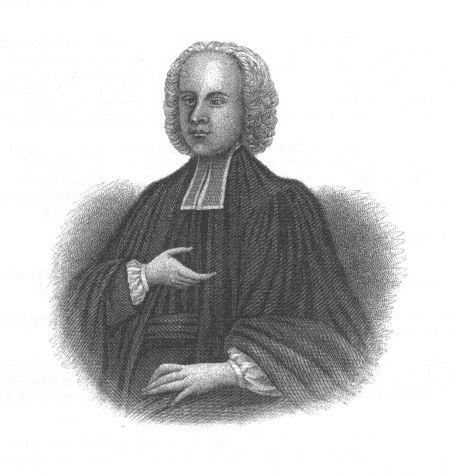
Whitefield began the new year as gloriously as
he ended that which had just expired. He received
the sacrament, preached twice, expounded twice, attended a
Moravian love-feast in Fetter Lane, where he "spent the
whole night in prayer, psalms, and thanksgivings;" and then
pronounced "this to be the happiest New Year's Day he
had ever seen."
The love-feast at Fetter Lane was a memorable one.
Besides about sixty Moravians, there were present not fewer
than seven of the Oxford Methodists, namely, John and
Charles Wesley, George Whitefield, Westley Hall, Benjamin
Ingham, Charles Kinchin, and Richard Hutchins,—all of
them ordained clergymen of the Church of England. Wesley
writes: "About three in the morning, as we were continuing
instant in prayer, the power of God came mightily upon us,
insomuch that many cried out for exceeding joy, and many
fell to the ground. As soon as we were recovered a little
from that awe and amazement at the presence of His majesty,
we broke out with one voice, 'We praise Thee, O God; we
acknowledge Thee to be the Lord.'" This Pentecost on
New Year's Day could never be forgotten. It was a
glorious preparation for the herculean work on which
Whitefield and the Wesleys were about to enter. No
wonder that the year thus begun should be the most remarkable
in Methodistic history.
Only four hours after this overwhelming visitation in
Fetter Lane, Whitefield was employed in another kind of
work. He writes: "January 2. From seven in the morning
till three in the afternoon, people came, some telling me
what God had done for their souls, and others crying out,
'What shall we do to be saved?'"
Three days afterwards, the seven Oxford Methodists, just
mentioned, "held a Conference at Islington, concerning
several things of great importance." Whitefield says: "What
we were in doubt about, after prayer, we determined by lot,
and everything else was carried on with great love, meekness,
and devotion. We continued in fasting and prayer
till three o'clock, and then parted with a full conviction that
God was going to do great things among us."
With the exception of the question whether Charles
Wesley ought "to settle at Oxford,"[152] the matters, which
were discussed at this the first Methodist Conference, are
utterly unknown; but that the members of it were intensely
earnest, and that their conviction that something marvellous
was about to happen was not the whim of presumptuous
fanatics, no one can seriously doubt.
During this momentous week—the first in the year 1739—Whitefield
preached six times, and expounded twice or
thrice every night. On the first Sunday of the year, January
7, he preached twice, expounded to three Societies, and
spent the whole night in prayer and thanksgiving at Fetter
Lane. The next day he writes:—
"Monday, January 8. Though I sat up all night, yet God carried me
through the work of the day with about an hour's sleep. Expounded in
the evening, and confuted a virulent opposer of the doctrine of the new
birth, and justification by faith only. Spent the remainder of the evening
with our Bands, which are little combinations of six or more Christians
meeting together to compare their experiences."
From such extracts, the reader may learn, 1. That Whitefield's
labours were gigantic. 2. That he had now fully embraced
the doctrine of justification by faith only. 3. That
he was in close communion with the Religious Societies, and
especially with the Moravian brotherhood.
Though most of the London churches were closed against
him, he was enormously popular, and his preaching more
powerful than ever. On January 10, after his sermon at
Great St. Helen's, £33 were collected towards erecting a
church for the Saltzburghers in Georgia; and he himself
testifies, concerning his ministry in general, "The Holy
Ghost so powerfully worked upon my hearers, pricking their
hearts, and melting them into floods of tears, that a spiritual
man said, 'He never saw the like before.'"
The time had now arrived for Whitefield to be ordained
a priest. Soon after his arrival from Georgia, he wrote as
follows, to his friend Harris at Gloucester:—
"London, December 30, 1738.
"I am appointed by the Trustees to be minister of Savannah. The
Bishop of London (Doctor Gibson) accepts the title, and has given me
letters demissory to any other bishop. I have waited also on Doctor
Secker, Bishop of Oxford, who acquaints me that our worthy diocesan,
good Bishop Benson, ordains for him to-morrow fortnight at Oxford, and
that he will give me letters demissory to him. God be praised! I was
praying night and day, whilst on ship-board, that good Bishop Benson,
who laid hands on me as a deacon, might now make me a priest. And
now my prayer is answered."
In accordance with this arrangement, Whitefield, on
January the 10th, set out for Oxford, where he spent the
next four days. His Journal of this brief interval is too
racy to be omitted. He writes:—
"Friday, January 12. Breakfasted with sixteen or seventeen Christian
brethren; expounded and read prayers at the Castle to many devout souls.
Afterwards, I waited on the Bishop of Gloucester, who received me very
kindly. Waited on the Master of Pembroke; afterwards on the archdeacon.
Went to public worship at Pembroke. Supped, prayed, and
sung psalms, with a room full of brethren at Mr. F——'s;[153] then adjourned
to Corpus Christi College, where God assisted me to talk clearly of the
new birth, and justification by faith alone, with one that opposed it.
"Saturday, January 13. Received the holy sacrament at St. Mary's;
expounded at F——'s; went with the other candidates for holy orders to
subscribe to the Articles, and secretly prayed that we all might have our
names written in the book of life. Drank tea with a well-disposed gentleman
commoner, and had close conversation with many others at Corpus
Christi College.
Sunday, January 14. This, blessed be God, has been a day of fat
things. Rose in the morning, and prayed and sung psalms lustily, and
with a good courage; and afterwards was ordained priest at Christ's
Church. Before, I was a little dissipated, but, at imposition of hands,
my mind was in an humble frame, and I received grace in the holy
sacrament. That I might begin to make proof of my ministry, I preached
and administered the sacrament at the Castle; and preached in the
afternoon at St. Alban's, to a crowded congregation. The church was
surrounded by gownsmen of all degrees, who stood attentive at the windows
during my sermon. God enabled me to preach with the demonstration
of the Spirit, and with power, and quite took away my hoarseness, so
that I could lift up my voice like a trumpet. After sermon, I joined in
giving thanks to our good God for all the mercies He had conferred upon
me. Then I read prayers at Carfax; expounded to a large and devout
company at a private house; and spent the remainder of the evening with
thirteen more, where God gave me great cheerfulness of spirit."
Whitefield was ordained a priest. It is more than possible,
if he had waited until the next Ember-days, he would
never have been ordained a priest at all. Bishop Benson,
from the first, had been a friend to him. Though he had
publicly declared he would not ordain any one a deacon
under the age of three-and-twenty, he, without solicitation,
ordained Whitefield when he was only twenty-one years and
a half. He gave him five guineas to assist him in defraying
the expenses of taking his B.A. degree at Oxford, and
twenty pounds for the poor of Georgia. He ordained him
a priest when, with few exceptions, the clergy of the land
were beginning to indulge in clamorous complaints against
him; and, three weeks after his ordination, gave him another
"liberal benefaction for Georgia."[154] And yet, even "the good
bishop," as Whitefield so often calls him, was not absolutely
contented with him. Hence the following extract from a
letter addressed to the Earl of Huntingdon. After giving
an account of Whitefield's ordination, the bishop proceeds
to say:—
"I hope this will give some satisfaction to my lady, and that she will
not have occasion to find fault with your lordship's old tutor. Though
mistaken on some points, I think Mr. Whitefield a very pious, well-meaning
young man, with good abilities and great zeal. I find his Grace of Canterbury[155]
thinks highly of him. I pray God to grant him great success in all
his undertakings for the good of mankind, and the revival of true religion
and holiness among us in these degenerate days; in which prayer, I am
sure, your lordship and my kind good Lady Huntington will most heartily
join."[156]
This letter introduces a name which will occupy a prominent
place throughout the whole of Whitefield's remaining
history. When and where the Countess of Huntingdon first
became acquainted with Whitefield we are not informed; but
it is evident that already she was interested in the man, and
desirous of his ordination. Her well-informed biographer,
in his "Life and Times of Selina, Countess of Huntingdon,"
has crowded his pages with facts, racy, rich, and important;
but he sorely tries the patience of his readers by his neglect
of dates, and by his consequent chronological confusion. He
states, however, that, among the nobility, Lady Townshend,
the eccentric mother of George, the first Marquis Townshend,
"was the first who extolled the preaching of Whitefield,
whom she alternately liked and disliked."[157]
Further, one of the earliest fruits of Whitefield's ministry
among the nobility in the metropolis was Lady Anne
Frankland, daughter of the Earl of Scarborough, and second
wife of Frederick Frankland, Esq., M.P. for Thirsk. For
many years, Lady Anne held the situation of Lady of the
Bedchamber to the Princess Anne, and to the Princesses
Amelia and Caroline. By the influence of Lady Frankland,
her sisters, the Lady Barbara Leigh and the Lady Henrietta
Lumley, were induced to attend Whitefield's preaching, from
which they received much spiritual good. This so exasperated
Mr. Frankland, that he treated his wife with the utmost
cruelty, declared she was the object of his aversion, and
threatened to murder her. The result was, a separation
followed, and, not long afterwards, Lady Frankland died.[158]
The Earl of Huntingdon and his illustrious wife constantly
attended wherever Whitefield preached. Among others
whom, at this early period, the Countess of Huntingdon
interested in Whitefield's remarkable career, was Sarah,
Duchess of Marlborough, famed for her beauty, dignity,
sprightliness, wit, petulance, pride, and vanity, and of whom
it has been said that, by her influence in the Cabinet, she
swayed the destinies of Europe with as great effect as did
her husband, by his talents, in the field. The great duchess
wrote as follows:—
"My dear Lady Huntingdon is always so very good to me, that I must
accept your very obliging invitation to accompany you to hear Mr.
Whitefield. I do hope that I shall be all the better for all your excellent
advice. God knows we all need mending, and none more than myself.
I have lived to see great changes in the world, have acted a conspicuous
part myself, and now hope, in my old days,[159] to obtain mercy from God, as
I never expect any at the hands of my fellow-creatures. The Duchess of
Ancaster, Lady Townshend, and Lady Cobham were exceedingly pleased
with many observations in Mr. Whitefield's sermon at St. Sepulchre's
Church, which has made me lament ever since that I did not hear it, as
it might have been the means of doing me some good; for good, alas!
I do want, but where among the corrupt sons and daughters of Adam am
I to find it?"[160]
Another aristocratic lady, who, in these early days of
Methodism, attended the preaching of Whitefield and the
Wesleys, was the proud Duchess of Buckingham, a natural
daughter of King James the Second, whose first husband was
the Earl of Anglesey (from whom she was divorced), and
her second, John Sheffield, Duke of Buckingham, in whose
house (now Buckingham Palace) she died, in 1742. This
quasi-royal duchess heard the Methodists, but disliked their
doctrines. Writing to the Countess of Huntingdon, she
said:—
"I thank your ladyship for the information concerning the Methodist
preachers. Their doctrines are most repulsive, and strongly tinctured
with impertinence and disrespect towards their superiors, in perpetually
endeavouring to level all ranks, and do away with all distinctions. It is
monstrous to be told that you have a heart as sinful as the common
wretches that crawl on the earth. This is highly offensive and insulting;
and I cannot but wonder that your ladyship should relish any sentiments
so much at variance with high rank and good breeding. However, I shall
be most happy to accept your kind offer of accompanying me to hear your
favourite preacher, and shall wait your arrival. The Duchess of Queensbury
insists on my patronising her on this occasion; consequently, she
will be an addition to our party."[161]
The Duchess of Queensbury, to whom allusion has
just been made, was the second daughter of the Earl of
Clarendon, and was celebrated for extraordinary beauty,
humour, and vivacity, by Pope, Swift, and other poets,
particularly by Prior, in one of his well-known ballads. For
a time, she constantly attended the ministry of Whitefield
and his brother Methodists, and was specially partial to the
preaching of Charles Wesley and Benjamin Ingham.[162]
Other distinguished hearers might be mentioned. Lady
Lisburne, for example, was a frequent attendant on the
preaching of the first Methodists, and was roused, by their
powerful ministry, to a lively concern for eternal things.
Also, Lady Hinchinbroke, grand-daughter of the Duke of
Montague, and mother of the celebrated John George
Montague, fourth Earl of Sandwich. This noble lady was
deeply affected by the sermons of Whitefield and Wesley,
and wrote as follows to the Countess of Huntingdon:—
"I am extremely sensible of the honour your ladyship has done me by
the book which you have sent. Indeed, I stand in need of all your sympathy
and all your unwearied exertions; for I feel myself utterly helpless,
miserable, and guilty in the sight of heaven; and, were it not for the ray
of hope which I have in the atoning sacrifice of Christ, would be driven to
despair and ruin. Have you heard where Mr. Whitefield and Mr. Wesley
are to preach this week?"[163]
But, leaving his aristocratic hearers, it is time to return to
Whitefield himself. On the day after his ordination at
Oxford, he came back to London, where he spent the next
three weeks. An immense amount of work was thrust into
this brief interval. He gave Charles Wesley "so promising
an account of Oxford," that Charles felt "strongly inclined"
to settle there, as he had been urged to do at the recently
held conference of Oxford Methodists.[164] He transacted
business with the Trustees of Georgia, who presented him
to the living of Savannah, and granted him five hundred
acres of land for his projected Orphan House. He was frequent
in his attendance at the Moravian meetings in Fetter
Lane, "where," says he, "we sometimes spent whole nights
in prayer, and where I have often seen the people overwhelmed
with the Divine Presence, and crying out, 'Will
God indeed dwell with men upon earth?'" He spent an
"afternoon in visiting some Dissenting brethren, who were
Christians indeed,"—an act of courtesy which his friend
Wesley carefully avoided. He went even to Stoke Newington,
to have an interview with the arch-Dissenter of the
day—the celebrated Dr. Watts—who, though in great
debility and suffering, was actively employed in publishing
a pamphlet on one of the most debateable of topics, "Civil
Power in Things Sacred."[165] During his three weeks' stay in
London, Whitefield preached more than twenty times, and
expounded almost fifty. He began to make collections for
his Orphan House in Georgia. He had a long conference
with an opposing clergyman, who objected to private
Societies and extempore prayer, grounding his objection on
the authority of the Canons and the Act of Uniformity.
Whitefield replied that the Canons and the Act of Uniformity
referred to public worship only, whereas that of the
Societies was not public worship, but only "an imitation of the
primitive Christians, who continued daily with one accord in
the temple, and yet exhorted one another from house to house."
He had another conference, which lasted till after midnight,
with two Church of England clergymen, who were "strong
opposers of the doctrine of the new birth." Whitefield says,
"God enabled me, with great simplicity, to declare what He
had done for my soul, which made them look upon me as a
madman." Besides his work in London, Whitefield went to
Bexley, where he preached, and spent two delightful evenings
with the Delamottes. He also went to Gravesend,
where he preached in the churches twice, and in private
houses expounded thrice; his journey there and back being
performed by boat on the river Thames—a six hours' sail in
the depth of winter, begun from London at three o'clock in
the morning, and from Gravesend at eleven o'clock at night.
The churches in London that he was allowed to occupy
were: St. Helen's in Bishopsgate Street, where his friend
Broughton was minister; Christ Church, in Spitalfields; St.
Catherine's; Islington; Wapping; St. George's-in-the-East;
and St. Margaret's, Westminster.
"I sleep but little, very little," said he, in a letter dated January 27,
1739. "Had I a thousand hands, I could employ them all. I scare know
what it is to have an idle moment. I thank you for blessing God on my
behalf. I want a thousand tongues to praise Him. He still works by me
more and more. Subscriptions for erecting an orphan house come in
apace. On Monday seven-night, God willing, I set out for Bristol, with
Mr. Seward. Mr. Howel Harris and I are correspondents, blessed be
God! May I follow him as he does Jesus Christ! How he outstrips
me!"
As Messrs. Seward and Harris will occupy a somewhat
prominent position in the ensuing pages, a brief account of
them may be acceptable.
William Seward, together with his brothers, Thomas,
Benjamin, and Henry, were natives of Badsey, a hamlet
about two and a half miles from Evesham, and were men of
independent property. Thomas was a clergyman of the
Church of England, and will be mentioned hereafter. Little
is known respecting Benjamin, excepting that he spent some
years at Cambridge, was unimpeachable in his morals, was
converted in the spring of 1739,[166] and occasionally employed
himself in composing hymns. The following was appended
to an 8vo. pamphlet, published in the year of his conversion,
and entitled "The Conduct and Doctrine of the Rev. Mr.
Whitefield vindicated." Though lacking poetic merit, it is
not without interest as exhibiting the spirit of one of Whitefield's
great admirers:—
"Come, blessed Jesus, quickly come,
And mark the bright celestial way;
Within my breast erect Thy throne,
Nor let me faint through long delay.
I'm weary of these earthly toys,
The world, and all its flattering charms;
My heart pants after purer joys,
And Christ alone my bosom warms.
With coldness and contempt, I view
These vain, these transitory scenes;
Since faith hath form'd my soul anew,
And wak'd me from Egyptian dreams.
Methinks a ray of heavenly light
Already darts upon my soul;
Methinks the promis'd land's in sight;
My heart's the needle, Christ the pole.
What though, for pageantry and state,
Others to earthly treasures trust,
And, aiming falsely to be great,
Like the vile serpents lick the dust:
My hope, my treasure, and my rest—
My all-sufficiency's above;
The kingdoms of the world possess'd
Are vain without my Saviour's love."
Henry Seward, the eldest of the brothers, was married
to a Baptist wife, and was, as will be seen, a violent opposer
of the Methodists.
William was drawn to seek after God and serve Him
as early as the year 1728. He laboured hard and successfully
in reviving the charity schools in London, particularly
those in Langbourn Ward, Castle Baynard Ward,
Billingsgate Ward, Vintry Ward, in the parish of St. George
the Martyr, and in Hackney. For the school at the last-mentioned
place, he raised, by subscriptions and public collections,
an income of £150 per annum, and that notwithstanding
the "opposition of the minister, the churchwardens,
and the vestrymen of the parish."[167]
In the year 1738, he became acquainted with Charles
Wesley and the Methodists, and, in the month of November,
found peace with God through faith in Christ. Oddly
enough, he was allowed to be present at the Conference
of Oxford Methodists, already mentioned, on January
5, 1739.[168] A few weeks afterwards, he became Whitefield's
travelling companion; and went with him to America in
August, 1739.
William Seward returned to England, not to stay in it, but,
1. To induce Mr. Hutchins, the Oxford Methodist, to take
the management of Whitefield's Orphan House in Georgia.
2. To convince the Trustees of Georgia that three things were
necessary to establish the Colony, viz.: "an allowance of
negroes, a free title to the lands, and an independent
magistracy." 3. To collect subscriptions for a negro school
in Pennsylvania. And, 4. To bring the money, lodged in the
hands of the trustees, for building the church at Savannah.
These were the public reasons why Mr. Seward returned
to England; but there were also private reasons. Mr. Seward
had bought five thousand acres of land on the forks of
Delaware, for which he had paid £2,200 sterling; and he
hoped to beg this amount of money in England, and then to
give the land for the erection of a negro school, and also a
location for a number of "English friends, where," to use
Seward's words, "they might worship God in their own
way, without being thought Enthusiasts for so doing."
He also intended to buy a ship in England for the purpose
of conveying the refugees to their foreign home.
The place was to be a sort of "Hernhuth" in America.
Besides this, William Seward seems to have been a widower
with an only daughter, who was being educated by a
private governess. He was now desirous to remove his
daughter to Georgia, and to complete her education in
Whitefield's Orphan House. With reference to this, he
wished to buy of the Trustees of Georgia five hundred acres
of land adjoining the Orphan House estate, provided he
could have a perfect title to leave it to the Orphan House, if
he thought desirable.
From this concise statement it will be seen that Mr.
Seward had abundance of business to transact in England;
but besides all this, there was a family quarrel exceedingly
unpleasant. The elder brother, Henry Seward, was wroth
at his brothers becoming Methodists. Three months before
William's return to England, Benjamin Seward was seriously
ill. "His fever was called madness." His letters were intercepted,
and his servants set over him as spies. Charles
Wesley went to see him, but was not admitted to his presence,
and wrote:—"Henry Seward fell upon me without
preface or ceremony. I was the downfall of his brother,
had picked his pocket, ruined his family, come now to get
more money, was a scoundrel, rascal, and so forth, and
deserved to have my gown stripped over my ears. He concluded
with threatening how he would beat me, if he could
but catch me on Bengeworth Common." On the day after
this angry interview, Charles Wesley attempted to preach.
Henry Seward came and said, "Four constables are ordered
to apprehend you if you come near my brother's wall," the
place appointed for preaching; "so come at your peril."
Charles writes:—
"I walked towards the place. Mr. Henry met me with threats and
revilings. I began singing—
'Shall I, for fear of feeble man,
Thy Spirit's course in me restrain?'
He ran about raving like a madman, and quickly got some men for his
purpose, who laid hold on me. Henry cried, 'Take him away, and duck
him.' I broke out into singing with T. Maxfield, and let them carry me
whither they would. At the bridge in the lane, they left me. There I
stood out of the liberty of the corporation, and gave out—
'Angel of God, whate'er betide,
Thy summons I obey!'"
Charles then proceeded to preach to a congregation of
some hundreds, from the words, "If God be for us, who can
be against us?"
Eight days after this, Charles Wesley and Henry Seward
had another altercation. The country squire again lost his
manners, and after calling the poor Methodist preacher,
"rogue, rascal, villain, and pickpocket," actually wrung his
nose. Charles departed, rejoicing that he was counted
worthy to suffer shame in the cause of Christ.[169]
Three months after this disreputable scene, William Seward
arrived in England, and most likely visited his brothers at
Badsey. Be that as it may, when William and Charles
Wesley met at Bristol, in the month of September following,
William was evidently prejudiced against his friend. Charles
writes:—
"1740, September 23. Mr. W. Seward came, and was very cordial. We
prayed, rejoiced, and gave thanks. If I did not love him the better for his
opinion, I am sure it made me more industrious to confirm my old love
towards him. I carried him to our colliers. He spoke a few words to
them, which did not convince me of his call to preach. In our return, he
told me Mrs. Grevil and others had urged him to claim the Room in the
Horse-fair,[170] but he abhorred their baseness. Next day, he told me he was
in a mist, the Baptists last night having laboured hard to make him
oppose me publicly. Before we parted, all was set right again; but a few
hours after, he came from the Baptists, and utterly renounced both me
and my brother, in bitter words of hatred, which they had put into his
mouth."[171]
William Seward's work was nearly ended. Immediately
after this painful interview in Bristol, he proceeded to Wales,
where he joined Howell Harris, and met with most brutal
treatment. At Caerleon, where he preached, he was "pelted
with dung and dirt, eggs and plumbstones." Some hard
substance hit him on the eye, the result of the blow being a
total loss of sight. But even this was not the worst. At
Hay, a man struck him so severely on the head, that, a few
days afterwards, on October 22, 1740,[172] his life was ended at
the early age of thirty-eight. On hearing of his death,
Wesley wrote:—
"1740, October 27. The surprising news of poor Mr. Seward's death
was confirmed. Surely God will maintain His own cause. Righteous art
Thou, O Lord!"
On the same occasion, Charles Wesley wrote:—
"1740, October 28. I was exceedingly shocked with the news of Mr.
Seward's death; but he is taken from the evil; rescued out of the hands of
wicked men."
This is a long account of Seward and his brothers; but
their names have always been so prominent in the early
career of Whitefield and the Wesleys, that the writer hopes
to be forgiven for collecting the hitherto scattered scraps of
information concerning them, and presenting that information
in a connected form.
After William Seward's death, his brothers are never mentioned
in Methodistic annals.
The account of Howell Harris shall be shorter. It is
taken from a document written by himself. This memorable
Welshman was born at Trevecka, on January 23, 1714, and
was, therefore, a few months older than his friend Whitefield.
In 1732, when his father died, Harris took charge
of a country school. In 1735, he found peace with God,
through faith in Jesus Christ. Converted himself, he had an
intense desire to convert others. He writes:—
"Swearing, lying, reviling, drunkenness, fighting, and gaming overspread
the country. Ministers were not in earnest, and their instructions,
delivered in an unfeeling and indifferent manner, seemed to have no effect
upon their hearers. I could not help making it my business to speak to
all I came near of their danger. Death and judgment, and the necessity
of praying and receiving the sacrament, were the principal subjects of my
conversation. I set up family worship in my mother's house, and on
Sunday mornings some of the neighbours would come to hear me read the
lessons and psalms, etc."
He proceeds to relate how he also commenced meetings
on Sunday evenings, and exhorted the poor people who
flocked to hear him. "Thus," he says, "I spent that summer,
1735."
In November following, he relinquished his school, and
entered himself at St. Mary's Hall, Oxford; but the "irregularities
and immoralities which surrounded" him were such,
that he kept only a single term, and returned to Wales. He
again set up a school at Trevecka. He visited from house
to house, until he had visited the greatest part of his native
parish. His congregation increased, and the houses in which
they met could not contain them. Many of his hearers
became penitent, and cried to God for the pardon of their
sins. Family worship in numerous instances was begun.
The churches were soon crowded, and likewise the Lord's
table. Then persecution arose. The magistrates threatened
him with fines for holding meetings in private houses. The
clergy did their utmost to discourage him, and, at the end of
the year 1737, expelled him from his school.
Up to the present, in the day-time he had taught his
scholars, and at night had held meetings. Now he had both
days and nights at his disposal, and preached to crowded
congregations thirty or forty times every week. The magistrates
threatened him more furiously than ever; and the
clergy preached against him, and branded him as a deceiver;
but, in several counties, a general reformation was witnessed.
Public diversions became unfashionable, and religion became
the common talk. Places of worship were everywhere
thronged, and, in many places, Societies were set up. The
Rev. Griffith Jones began his charity schools. The Rev.
Daniel Rowlands and some other young clergymen began to
preach in the same extemporary manner as Harris did.
The work grew, and so also did the persecution. In Montgomeryshire,
"a knight, a clergyman, two justices, a constable,
and a mob," came while Harris was preaching, and
charged him with a breach of the Conventicle Act. The
preacher told the magistrates that he was a Conformist, and
therefore not subject to the penalties of the Act in question.
At Machynlleth he was surrounded by a mob, "threatening,
swearing, and flinging stones," the leaders of the gang being
a clergyman and a lawyer. He writes:—
"By the trials through which I often passed, I was at length so accustomed
to them that I was daily in expectation of them. I became more
acquainted with the world and myself, and could attest the truth of that
expression which at first seems harsh, 'Man is a mixture of beast and
devil.'"
It is a remarkable fact, that, up to this date, Howell Harris
had never seen either Whitefield or the Wesleys. Whitefield,
on his return from Georgia, heard that the young
evangelist, without episcopal ordination or any sort of
ecclesiastical authority whatever, was preaching in the towns
and villages of Wales thirty or forty times every week; and,
notwithstanding the opposition and the violence of clergymen,
magistrates, and mobs, had already been the means of
accomplishing a marvellous reformation. The results were
quite sufficient to constrain Whitefield to recognize the
Welsh itinerant as a fellow-labourer in the same great work.
Hence, only a few days after his arrival in England, Whitefield
wrote to Howell Harris as follows:—
"London, December 20, 1738.
"My dear Brother,—Though I am unknown to you in person, I
have long been united to you in spirit, and have been rejoiced to hear how
the good pleasure of the Lord prospered in your hand. Go on, my dear
brother, go on. Be strong in the Lord, and in the power of His might.
There have been, and will be, many adversaries; but be not afraid. He
who sent you will assist, comfort, and protect you, and make you more
than conqueror through His great love. I am a living monument of this,
for the Divine strength has often been magnified in my weakness. I have
tasted that the Lord is gracious; I have felt His power; and, from experience,
can say that, in doing or suffering the will of Jesus Christ, there is
great reward.
"Blessed be His holy name! There seems to be a great pouring out
of the Spirit in London, and we walk in the comfort of the Holy Ghost,
and are edified.
"You see, my dear Brother, the freedom I have taken in writing to
you. If you would favour me with a line or two, by way of answer, you
would greatly rejoice both me and many others. Why should we not tell
one another what God has done for our souls?
"My dear Brother, I love you in the bowels of Jesus Christ, and wish
you may be the spiritual father of thousands, and shine, as the sun in the
firmament, in the kingdom of your heavenly Father.
"Your affectionate, though unworthy brother in Christ,
"George Whitefield."[173]
Such was Whitefield's warm-hearted salutation to the
young lay-preacher in the principality of Wales. Harris's
reply was equally cordial. The following is an extract from
it:—
"Glamorgan, January 8, 1739.
"Dear Brother,—I was most agreeably surprised last night by a
letter from you. Though this is the first time of our correspondence, I am
no stranger to you. When I first heard of your labours and success, my
soul was united to you, and engaged to send addresses to heaven on your
behalf. When I read your Diary, I had uncommon influence of the Divine
Presence shining on my soul almost continually, but I little thought our
good Lord and Master intended I should ever see your handwriting.
Oh how ravishing it is to hear of such demonstrations of the Divine love
and favour to London! And, to make your joy greater still, I have some
good news to send you from Wales. There is a great revival in Cardiganshire,
through Mr. D. Rowlands, a Church minister, who has been
much owned and blessed in Carmarthenshire also. We have also a sweet
prospect in Breckonshire and part of Monmouthshire. And the revival
prospers in this county where I am now. There is also here a very useful
young dissenting minister, who is a man of great charity. There is
another of the same character in Montgomeryshire. There are two or
three young curates in Glamorganshire, who are well-wishers to the cause
of God; and we have an exceedingly valuable clergyman in Breckonshire.
But enemies are many and powerful. Oh that I had more love in my soul,
more humble zeal, and spiritual boldness!"[174]
After this long but not useless digression, it is time to
return to Whitefield.
He was detained in England much longer than he expected,
but he was not unmindful of his flock in Georgia.
In a letter "to the inhabitants of Savannah," dated January
19, 1739, he says:—
"You are upon my heart, so that I am ready to live and die with you.
As soon as my affairs are finished in England, I shall return to you. The
trustees have now appointed me minister of Savannah, and granted
all I desired of them, so that I have nothing to do but to watch over
your souls, that I may present you blameless at the coming of our Lord
Jesus Christ. Be steadfast, therefore, my brethren, be unmoveable. Carefully
attend to the words spoken by your present pastor. Let love be
without dissimulation. Let not slander so much as be named amongst
you, as becometh saints. Be not slothful in business, yet take heed that
you are fervent in spirit, serving the Lord. Pray without ceasing; in
everything give thanks; and assure yourselves you are continually remembered
by your most affectionate pastor,
"George Whitefield."[174]
Before leaving for the West of England, Whitefield's last
Sunday in London was a memorable one. He shall relate
his own story.
"1739. Sunday, February 4. Preached in the morning at St. George's
in the East; collected £18 for the Orphan House; and had, I believe, six
hundred communicants, which highly offended the officiating curate.
Preached again at Christ Church, Spitalfields; and gave thanks and sang
psalms at a private house. Went thence to St. Margaret's Westminster;
but, something breaking belonging to the coach, could not get thither till
the middle of the prayers. Went through the people to the minister's
pew, but, finding it locked, I returned to the vestry till the sexton could be
found. Being there informed that another minister intended to preach,
I desired several times that I might go home. My friends would by no
means consent, telling me I was appointed by the trustees to preach; and
that, if I did not, the people would go out of the church. At my request,
some went to the trustees, churchwardens, and minister; and, whilst I
was waiting for an answer, and the last psalm was being sung, a man
came, with a wand in his hand, whom I took for the proper church officer,
and told me I was to preach. I, not doubting but the minister was satisfied,
followed him to the pulpit, and God enabled me to preach with
greater power than I had done all the day before.
"After this, I prayed with and gave an exhortation to a company that
waited for me. Then I went to Fetter Lane, where I spent the whole
night in watching unto prayer, and discussing several important points
with many truly Christian friends. About four in the morning, we went
all together, and broke bread at a poor sick sister's room; and so we parted,
I hope, in a spirit not unlike that of the primitive Christians."
This is soon related, but the service at St. Margaret's
must have further notice. It engendered a rancorous controversy,
which cannot, in fairness, be omitted.
In a long leading article in the Weekly Miscellany of
February 10, 1739, the following account was published:—
"On Sunday last, our new Methodists discovered a more violent temper
than is consistent with their great pretensions to meekness and sanctity.
The story is as follows, and it was related to me by the gentleman that
read the prayers:—
"At St. Margaret's, Westminster, there is a Society Evening Lecture;
and when the Reader came, he found in the churchyard, at the west door,
a number of people singing psalms. When he got into the church, he
was affronted by some unknown persons as he passed through a great
crowd to the vestry. As soon as the clergyman appointed to preach came,
he was solicited (if an overbearing importunity may be so called) to resign
the pulpit to Mr. Whitefield, who (as is supposed by his not appearing at
the prayers) was waiting at some neighbouring house to know the issue of
their application. But the preacher continuing as determined to do his
duty as Mr. Whitefield was to do it for him, they at last effected that by
force which they could not gain by treaty. So the preacher was safely
confined in his pew, which was locked (the sexton being appointed by the
Society, and in Mr. Whitefield's interest), and guarded by several lusty
fellows; while another party conveyed the unlicensed intruder triumphantly
up into the pulpit, and kept sentry on the stairs for fear he should be
taken down in as forcible a manner as he got up."
Mr. Venn, the writer of this account, then adds:—
"There are many instances of these unauthorised teachers using
fraudulent and unfair means of getting into pulpits against the inclination
of the proper minister or appointed preacher. Sometimes they ask the
pulpit for a friend, and then send Mr. Whitefield or some other Methodist.
Another method has been by slipping up into the pulpit as soon as the
prayers are over, without asking any leave at all. And all these disorders,
irregularities, and artifices are practised by persons who have no warrant,
but their pretended call from heaven, to preach in any church in the
diocese."
The reader has thus before him the two conflicting statements.
A fortnight afterwards, in the same newspaper, Mr.
Bennett, one of the stewards of the Society, whose evening
lecture at St. Margaret's had caused so much uproar, declared
that the simple facts were these:—
"On Sunday, February 4, Mr. Whitefield, at the desire of the Friendly
Society, came from Spitalfields Church to St. Margaret's, of Westminster.
He would have gone into the minister's seat, but could not, there being no
one to unlock the door. He then went into the vestry, and stayed there
during prayers. The usual preacher before the Society[175] was out of town,
otherwise they would have acquainted him with their desire of Mr. Whitefield
preaching, which they doubt not but he would have complied with.
That he had desired another to preach, they knew not, when they asked
Mr. Whitefield to do it; but when he was come, in compliance with their
frequently repeated desire, they did insist upon his preaching."
Mr. Bennett adds, that all the rest of Mr. Venn's letter,
relating to the affront offered to the Reader of Prayers, the
Rev. Mr. Durant; the "overbearing importunity" brought to
bear upon the Rev. J. Majendie, the gentleman who had
promised to preach for the absent lecturer; the assumed
waiting of Whitefield in a neighbouring house; the employment
of the sexton in Whitefield's interest; the taking of
the pulpit by "force;" and the sentry of lusty fellows on
the pulpit stairs, were not facts, but fiction, created by the
writer's "own ingenuity, purely to heighten and embellish his
story."
Much more was printed respecting the St. Margaret's
fracas; but the case, in brief, was this: The Rev. Mr.
Morgan, the Lecturer, having to be out of town, asked the
Rev. J. Majendie to supply his place on February 4, at St.
Margaret's, and Mr. Majendie readily consented to do so.
Meanwhile, the officers of the Friendly Society, ascertaining
that their "usual lecturer" would be from home, and very
improperly taking it for granted that he had provided no one
to occupy the pulpit for him, rashly went to Whitefield, and
obtained from him a promise to preach in Mr. Morgan's
stead. When Whitefield found that Mr. Majendie was
present, as Mr. Morgan's properly engaged substitute, he
wished to retire, and would have done so, if, to use Mr.
Bennett's own expression, the officers of the Society had not
"insisted upon his preaching."
This is all that can be said about this disreputable brawling
in St. Margaret's. Mr. Morgan and Mr. Majendie were
blameless. Mr. Bennett and his friends were highly culpable
in setting aside the arrangement made by their absent
Lecturer; and Whitefield, when he had ascertained that Mr.
Majendie had come to preach, would have acted a more
courteous and less ignoble part, if, instead of taking Mr.
Morgan's pulpit, he had at once retired to the Moravian
Meeting House in Fetter Lane.
Some will think that more space has been devoted to this
unhappy affair than its importance merits; but those who
have had the perseverance to make themselves acquainted
with all the Methodist facts of the year 1739, will think
otherwise, as there can be no doubt that this unfortunate
contretemps in Westminster was the real or pretended occasion
of much of the clerical opposition which Whitefield
soon encountered in Bristol, Bath, and other places; and it
certainly was the beginning of the furious onslaughts upon
Methodism and the Methodists, which, for so many months,
disgraced the Weekly Miscellany and Dr. Hooker, its
trenchant editor. Several of these attacks will be noticed
hereafter; but one must be introduced now, inasmuch as its
date is nearly the same as that of the imbroglio at St.
Margaret's. In his leading article of February 10, 1739,
Mr. Hooker[176] wrote:—
"At first, we only looked upon the Methodists as well-meaning, zealous
people, whom the irreligious boldness of these wicked times had driven
somewhat too far into the contrary extreme of infidelity. They were a
sort of Protestant supererogators, that would be righteous over-much;
and there were hopes that, when this devotional effervescence had boiled
over, they would return to that proper medium where true piety and Christian
prudence fix the centre. But, instead of that, they have proceeded so far
as to eject the Liturgy and the usual Expositors out of their meetings, and
have declared for extemporary effusions both in their prayers and expoundings.
The laity are allowed to be teachers, and even women, as I am
informed, begin to usurp public offices. They pretend to a sort of sinless
perfection, and boast of inward joys above other Christians. They distinguish
themselves from others by having received the faith, with which,
and other cant phrases, they are united together like a sect of Religious
Freemasons. In general, they seem to be practising over the lesson set
them by the old Puritans before the beginning of the grand rebellion."
Three days after he preached at St. Margaret's, Whitefield,
accompanied by William Seward, set out for Bristol.
"I never was more opposed," says he, "and never met with so great
success. I hope I shall learn more and more every day, that no place is
amiss for preaching the Gospel. God forbid that the word of God should
be bound because some deny the use of their churches! The more I am
bid to hold my peace, the more earnestly will I lift up my voice like a
trumpet, and tell the people what must be done in them before they can
be finally saved by Jesus Christ."[177]
Even while travelling, Whitefield could not refrain from
preaching. At Windsor, he "expounded in the school-house
to a great number of people with freedom and
power." At Basingstoke, he preached for an hour in a large
room thronged with people, while a mob outside shouted
and threw stones at the windows. The next day, three
large rooms were filled. Some began to interrupt: but
"God," says he, "enabled me to speak with such power that
they were quite struck dumb and confounded. Near twenty
came to converse with me, and to hear the word of God.
How thankful ought I to be to my dear Master for sending
me hither! A vestry, I find, was called to stop my proceedings,
and I hear I am to be presented to the Diocesan."
At Basingstoke, also, he wrote a letter to a friend, which
contains a paragraph too valuable to be omitted.
"Basingstoke, February 8, 1739.
"Just now God has brought us to Basingstoke, where I hope an
effectual door will be opened before we leave. Oh, my dear friend, more
and more do I see the benefit of confessing our blessed Lord before men.
He has begun, He will carry on, He will finish the good work in our
souls. We have nothing to do, but to lay hold on Him by faith, and to
depend on Him for wisdom, righteousness, sanctification, and redemption.
Not but we must be workers together with Him; for a true faith in Jesus
Christ will not suffer us to be idle. No: it is an active, lively, restless
principle; it fills the heart, so that it cannot be easy till it is doing something
for Jesus Christ."
At Dummer, the little parish where he once was curate,
Whitefield met his old Oxford friends, Messrs. Kinchin and
Hutchins, with whom he took sweet counsel, sung psalms,
and prayed.
At Salisbury, he writes, "I paid a visit to an old disciple,
my brother Wesley's mother," at that time visiting her son-in-law,
Westley Hall.[178] Here also he sought an interview
with the well-known sceptic, Thomas Chubb, resident in an
adjoining village, respecting his "True Gospel of Jesus
Christ asserted;" but the "free-thinker," (who, by the
way, regularly attended the services of his parish church,)
happened not to be at home.
On February 14th, Whitefield arrived at Bath, and immediately
waited upon Dr. C., desiring the use of the Abbey
Church, to preach a sermon for the Orphan House, the
Trustees of Georgia having obtained the consent of the
bishop more than twelve months before. "But," he writes,
"Dr. C. was pleased to give me an absolute refusal to
preach either on that or on any other occasion, without a
positive order from the king or bishop. I asked him his
reasons. He said he was not obliged to give me any.
Upon which, I took my leave and retired with my friends,
and prayed for him most fervently." On the evening of the
same day, Whitefield came to Bristol, where his old friends
welcomed him with the utmost joy; but his chief pleasure,
on his arrival, was, not the greetings of his friends, but the
calumny of his enemies. He writes: "Who can express
the joy with which I was received? To add to my comfort,
many letters came to my hands from London friends. But
the chiefest pleasure was, some one had thought me considerable
enough to write a letter in the Weekly Miscellany against
me, and containing several untruths about my preaching at
St. Margaret's, Westminster. Thou shalt answer for me,
my Lord and my God! Yet a little while, and we shall all
appear at the judgment-seat of Christ!"
Next morning, Whitefield first of all waited upon the
Rev. Mr. Gibbs, Vicar of St. Mary Redcliffe, and asked the
loan of his church, to preach a sermon on behalf of the contemplated
Orphan House in Georgia. Mr. Gibbs refused,
saying, "he could not lend his church without a special
order from the chancellor." Nothing daunted, Whitefield
went at once to the chancellor, who declined to issue an
order for Mr. Gibbs, but stated that if any clergyman
thought proper to lend his church to Whitefield, he (the
chancellor) would not prohibit it; nevertheless, he advised
Whitefield to go to some other town until the bishop had
been consulted. Whitefield was far too ardent and impetuous
to wait for the bishop's leave, and, hence, from the
chancellor, he proceeded direct to the residence of the dean.
Having shewn him his "Georgia Accounts," he asked, "Can
there be any just objection against my preaching in churches
for the Orphan House?" "I cannot tell," replied the
dean, "but I will give you an answer some other time;
now I am expecting company." "Will you be pleased to
fix a time, sir?" "I will send to you," said the dean;
and so ended Whitefield's interview, number three.
It cannot be denied, that, in all this, there was a display
of more self-confidence than is commendable. Whitefield
was a young man, not yet twenty-five; he had neither high
rank, nor special scholarship to recommend him to the
Church dignitaries of the day; his ecclesiastical standing was
extremely insignificant—only incumbent of the distant and
small settlement of Savannah. It is true, he had, a year and
a half ago, moved both Bristol and the metropolis by his
earnest, startling, godly eloquence; but, during the interval,
his injudicious friends had published his Journals, written
with the utmost artlessness, but containing much never
meant for the public eye; and, within the last few days,
by the rash proceedings of certain of his admirers, he had
been placed in an equivocal position at St. Margaret's,
Westminster. Remembering all this, it was doubtless a bold—some
would call it a presumptuous—act to ask the loan
of the Abbey Church, at Bath, and, next to the Cathedral, of
the finest church in Bristol; and further, it is hardly surprising
that his well-intentioned applications were refused.
Whitefield was baffled, but not discomfited. Churches,
for the present, might be closed against him, but there
was Bristol prison; there were the rooms of the Religious
Societies; and there was Kingswood Hill.
In the afternoon of the very day, when his diplomacy
with three of the principal ecclesiastics in Bristol was such
a mortifying failure, he tried his skill with another functionary
of a more humble order. At this period, the keeper of
Bristol Prison was a Mr. Dagge, whom Dr. Johnson has
immortalized in his Life of the poet Savage.[179] Mr. Dagge
had been amongst the firstfruits of Whitefield's ministry in
Bristol prison, in 1737,[180] and Whitefield's application to him
was more successful than those he had made to the vicar,
the chancellor, and the dean. He writes:—
"About three in the afternoon, God having given me great favour in the
gaoler's eyes, I preached a sermon on the Penitent Thief, to the poor
prisoners in Newgate, and collected fifteen shillings for them."
This was the beginning. Next morning, he made an
arrangement, that, while he remained in Bristol, he would
read prayers and preach to the prisoners every day, an
arrangement which was faithfully fulfilled, until the 12th of
March, when the mayor and the sheriffs thought it their
duty to interfere, and absolutely commanded Mr. Dagge not
to allow Whitefield to preach in the prison-house again,
alleging, as their reason, that he insisted upon the necessity
of our being born again—a thing which those custodians, if
not regenerators, of outcast men, were unable to understand.
Whitefield's preaching to the prisoners, however, was but
a small part of his public labours in Bristol and in the
neighbourhood. His present sojourn here lasted between six
and seven weeks, during which he preached above sixty
times, and expounded fifty.
Closing the churches against him was not the way to
silence him. His "heart was hot within him;" while he
mused "the fire burned;" and to speak with his tongue became
almost a necessity of life. For the present, he had the
use of the city prison; but fancy a man like Whitefield being
satisfied with a cure of souls all under a single roof! The
opportunity of preaching to Mr. Dagge's domestics was important,
and doubtless useful; but it was not enough; and,
hence, as Whitefield had no other place in which to preach,
away he went, and, for the first time in England, in the
bleak month of February, preached out of doors, to a congregation
of colliers, on Kingswood Hill. He writes:—
"1739. February 17, Saturday. About one in the afternoon, I went
with my brother (William) Seward, and another friend to Kingswood, and
was most delightfully entertained by an old disciple of the Lord. My
bowels have long yearned toward the poor colliers, who are very numerous,
and as sheep having no shepherd. After dinner, therefore, I went
upon a mount, and spake to as many people as came unto me. They
were upwards of two hundred. Blessed be God that I have now broken
the ice! I believe I was never more acceptable to my Master than when
I was standing to teach those hearers in the open fields. Some may
censure me; but if I thus pleased men, I should not be the servant of
Christ."[181]
Thus began, apparently without intention, the marvellous
outdoor services which distinguished the career of Whitefield
and the Wesleys. This was only three days after
Whitefield came to Bristol. He would have preferred the
churches; but, even in the midst of winter, was thankful
for the open fields. It is a remarkable fact, however, that,
though when he arrived in Bristol, every church was closed
against him, on the very day immediately succeeding that
on which he set his pulpit on Kingswood Hill, the pulpits of
three of the Bristol churches were freely offered him. Hear
what he says:—
"1739. February 18, Sunday. Arose this morning about six, being
called up by near fifty young persons, whom I appointed to meet at my
sister's house, and with whom I spent above an hour in prayer, psalm-singing,
and a warm exhortation. Soon after this, I read prayers and
preached at Newgate, to a large and very attentive congregation. At ten,
I preached at St. Werburg's, to a large audience. I thought yesterday I
should not have the use of any pulpit; but God, who has the hearts of all
men in His hands, disposed the Rev. Mr. Penrose to lend me his; and
the Rev. Mr. Gibbs sent to me and offered me the use both of St. Thomas's
and St. Mary Redcliffe. I accepted the latter of these, and preached to
such a congregation as my eyes never yet saw. Many went away for want
of room, and Mr. Gibbs and his lady were exceeding civil both to me and
Mr. Seward."
On the following day, Whitefield had the use of another
church, the parish church of St. Philip and Jacob, where
he preached, to a great multitude, in the afternoon, and
collected £18 for the Orphan House in Georgia. "Thousands,"
says he, "went away, because there was no room for
them within."
This was too much for the equanimity of the Chancellor
of the Bristol Diocese. Only four days before, he had
virtually prohibited Whitefield preaching in any of the Bristol
churches, without the bishop's leave being first obtained;
and yet already had the young preacher had the hardihood
to occupy three of the city churches, and was not at
all unlikely to preach in others. Official patience with the
ordained upstart was exhausted, and the apparitor was sent
to summons Whitefield to the court of the Rev. Mr. R——l,
the ecclesiastical lawyer of the Bishop of Bristol, versed in
civil and canon law, and solemnly appointed to direct the
bishop in the criminal and civil causes of the Church.
The summons was served on Tuesday, February 20,
and was immediately obeyed. On Whitefield's appearance,
the chancellor informed him that he intended "to stop his
proceedings;" and that the registrar of the court was present
to take down his answers.
Chancellor. "By what authority do you preach in the diocese of Bristol
without a license?"
Whitefield. "I thought that custom was grown obsolete. Pray, sir,
why did you not ask the Irish clergyman this question, who preached for
you last Thursday?"
C. "That is nothing to you." Then, reading part of the Ordination
Office, and the canons forbidding ministers to preach in private houses,
he asked, "What do you say to these?"
W. "I apprehend these canons do not belong to professed ministers of
the Church of England."
C. "But they do."
W. "There is a canon forbidding all clergymen to frequent taverns,
and play at cards. Why is not that put in execution?"
C. "Why does not somebody lodge complaints? In such a case it
would."
Referring to his printed sermons for his principles, Whitefield asked,
"Why am I singled out?"
C. "You preach false doctrine."
W. "I cannot but speak the things that I know, and am resolved to
proceed as usual."
C. "Mr. Registrar, observe his answer." Then turning to Whitefield,
"I am resolved, sir, if you preach or expound anywhere in this diocese,
till you have a license, I will first suspend, and then excommunicate
you."
Upon this, Whitefield says, "I took my leave. He
waited upon me very civilly to the door, and told me, 'What
I do is in the name of the clergy and laity of the city of
Bristol;' and so we parted."
With this ended Whitefield's ministry in Bristol churches.
Meanwhile, however, he had written both to the Bishop of
Bristol, and the Bishop of Bath and Wells. From the
former, the celebrated Dr. Butler, author of the well-known
"Analogy of Religion," etc., he received an answer
on February 24, with which he again waited on the chancellor;
but without success. Bishop Butler's letter is not
preserved; but Whitefield's reply was as follows:—
"Bristol, February 24, 1739.
"My Lord,—I humbly thank your lordship for the favour of your lordship's
letter. It gave abundant satisfaction to me, and many others, who
have not failed to pray in a particular manner for your lordship's temporal
and eternal welfare. To-day, I shewed your lordship's letter to the
chancellor, who (notwithstanding he promised not to prohibit my preaching
for the Orphan House if your lordship was only neutral in the affair) has
influenced most of the clergy to deny me their pulpits, either on that or
any other occasion. Last week, he was pleased to charge me with false
doctrine. To-day, he has forgotten that he said so. He also threatened
to excommunicate me for preaching in your lordship's diocese. I offered
to take a license, but was denied.
"If your lordship should ask, What evil have I done? I answer, None,
save that I visit the Religious Societies, preach to the prisoners in Newgate,
and to the poor colliers in Kingswood, who, I am told, are little better
than heathens. I am charged with being a Dissenter; though many are
brought to the Church by my preaching, not one taken from it. The
chancellor is pleased to tell me my conduct is contrary to the canons;
but I told him that the canons, which he produced, were not intended
against such meetings as mine are, where His Majesty is constantly prayed
for, and every one is free to see what is done.
"I am sorry to give your lordship this trouble; but I thought it proper
to mention these particulars, that I might know wherein my conduct is
exceptionable.
"I heartily thank your lordship for your intended benefaction. I think
the design is truly good, and will meet with success, because so much
opposed.
"God knows my heart. I desire only to promote His glory. If I am
spoken evil of, for His sake, I rejoice in it. My Master was long since
spoken evil of before me. But I intrude on your lordship's patience.
"I am, with all possible thanks, my lord, your lordship's dutiful son
and servant,
"George Whitefield."
So the matter ended. Curiosity would like to know what
a man so eminent as Bishop Butler thought of the young
Methodist, and what he said to him; but, unfortunately, the
bishop's sentiments are not producible.
What was Whitefield to do next? He might at once
have gone back to Georgia; but he wanted money
to erect his Orphan House, and was not content to return
without it. Besides, he seemed to consider the prohibition
to preach in churches a kind of call to preach elsewhere.
Preach he must. God had called him to the work. By the
Bishop of Gloucester, he had been ordained to it. If churches
were inaccessible, his only alternative was to make use of
private houses, public rooms, and open fields.
The Religious Societies gladly accepted his services. He
speaks of the Room of the Baldwin Street Society, together
with the stairs and the court below, being crowded with
people, profoundly attentive and powerfully affected. Here
his expositions, more than once, were of two hours' duration;
and, at one of the meetings, upwards of £5 was collected for
his Orphan House. At his farewell service, the crowd about
the place was such, that he had to climb a ladder, and go
over the roof of an adjoining house, in order to get into the
Room. The meeting-place of the Nicholas Street Society
was quite as thronged as that of Baldwin Street; and here,
by his recommendation, a charity school was opened, for
which, he says, "I collected at the door myself, and few
passed by without throwing in their mites." The Room of
the Society without Lawford's Gate seems to have been
connected with the parish poorhouse, and was sometimes so
crowded, that Whitefield had to preach from the steps leading
to the door, and sometimes to stand at the window, and there
preach to those outside and those within. On one occasion,
at the poorhouse, he made a collection for his contemplated
orphanage; "and the poor people," says he, "so loaded my
hat, that I wanted some one to hold up my hands. The
cheerfulness with which they gave was inexpressible; and
the many prayers they joined with their alms will, I hope,
lay a good foundation for the house intended to be built."
When Newgate was closed against him, he wrote:—
"1739, March 14. Being forbid preaching in the prison, and, withal,
being resolved not to give place to my adversaries, no, not for an hour, I
preached at Baptist Mills, a place very near to the city, to three or four
thousand people. Blessed be God! all things happen for the furtherance
of the Gospel. I now preach to ten times more people than I should if
I had been confined to the churches. Surely the devil is blind, and so
are his emissaries, or otherwise they would not thus confound themselves.
Every day I am invited to fresh places. I will go to as many as I can;
the rest I must leave unvisited till it shall please God to bring me back
from Georgia."
In this way, Whitefield became an itinerant outdoor
preacher. At four different times, he went to Bath. Here
he met the Rev. Griffith Jones, a devoted clergyman, who,
two years before, had instituted his locomotive schools for
educating the children of the poor in Wales, and who gave
to Whitefield "an account of the many obstructions" he had
encountered in his ministry, and convinced his visitor that
he "was but a young soldier just entering the field." Here
also he was introduced to the Rev. George Thompson, Vicar
of St. Gennys, Cornwall, from the first a hearty friend of
the Oxford Methodists.[182] He read prayers at the hospital;
and, in the midst of a storm of snow, preached on the
"Town Common." On another occasion, he preached out
of doors to a congregation of four or five thousand, "of high
and low, rich and poor." He writes: "As I went along, I
observed many scoffers; and, when I got upon the table to
preach, many laughed; but, before I had finished my prayer,
all were hushed and silent; and, ere I had concluded my
discourse, God, by His word, seemed to impress a great awe
upon their minds; for all were deeply attentive, and appeared
much affected with what had been spoken."
Whitefield went to Brislington, "a village," says he,
"about two miles from Bristol, where was such a vast
congregation, that, after I had read prayers in the church,
I thought proper to preach in the churchyard,[183] that
none might be sent empty away. The people were exceedingly
attentive, and God gave me great utterance; and,
what was best of all, by the leave of the minister who
invited me thither, we had a sacrament, and I hope it was
a communion of saints indeed."
He writes again:—
"1739, Friday, March 16. Being much entreated by the people, and
horses being sent for me, I went and preached at Elberton, a village
about nine miles from Bristol. The clergyman denied me the pulpit; so
I preached on a little ascent on which the May-pole was fixed. The
weather being cold, and the adjacent villages having but little notice, I
had not above two hundred hearers.[184] After dinner, I hastened to Thornbury,
and preached to a great part of my morning congregation, and
many hundreds besides. Mr. Willis, the incumbent, lent me the church,
and used me with great civility, as did two other clergymen who were
there present."
Whitefield also preached at Keynsham, where "great
numbers of horsemen from Bristol" met him, "besides several
thousands from the neighbouring villages." "The church
being refused, he preached on a mount."
He likewise went to Publow, "a village about five miles
from Bristol. The church was offered; but, not being
sufficient to contain a third part of the audience," he preached
in the open air.
At Coal-pit Heath, seven miles from Bristol, his congregation
numbered above two thousand. The yard of the
Glass-house, Bristol, was another of his preaching places.
Here his "congregation consisted of many thousands."
While he was preaching, "a gentleman (being drunk)" called
him a dog, and said he "ought to be whipped at the cart's
tail, and offered money to any that would pelt" him; but
"the boys and people," instead of pelting the preacher,
"began to cast stones and dirt" at the inebriated gentleman.
In Bristol, also, a large bowling-green was lent to Whitefield,
where he preached twice in the last week in the month
of March. On the first occasion, he says, he had a congregation
of "about five thousand people, and made a collection
for his poor orphans, till his hands were quite weary." On
the second, he writes, "I believe seven or eight thousand
people were present. The sun shone bright, and the windows
and balconies of the adjoining houses were filled with hearers.
I again collected for the Orphan House, and it was near an
hour and a half before the people could go out. Many were
very faint because of the throng, which was so exceeding
great that they trod one upon another."
Strangely enough, at Winterbourne, and at Frenchay,
he had, in private, friendly meetings with the Quakers; but,
he says, he was not at all convinced by their arguments
against paying tithes, an outward call to the ministry, and
baptism, and the Lord's supper, though he admits that "their
notions about walking and being led by the Spirit were right
and good."
On the 6th of March, he and William Seward went off to
Wales; the Rev. Richard Hutchins, afterwards Rector of
Lincoln College, taking his place at Bristol. This, in its
ultimate results, was an important visit; and, though only
of four days' duration, was full of incident.
Here, however, an extract from a letter written by William
Seward may be interjected.
"New Passage, Bristol-side, March 6, 1739.
"Reverend and dear Brother,—Our dear brother Whitefield
goes on from conquering to conquer. Thousands and ten thousands
flock to hear the word. He has been in but three churches, and that
was at his first coming. The chancellor threatened excommunication, but
soon dropt it. However, the glory of God was to be promoted another
way; for, being thrust out of the synagogues, our brother has settled a
lecture or exposition at Newgate every morning; the place being more
convenient than Oxford Castle Chapel. He generally expounds to one,
two, or three Societies every night; and has preached seven or eight times
on a mount, about two miles from Bristol, where have been from fifteen
hundred to fifteen thousand hearers. Last Sunday evening, we sung the
hundredth psalm, and all could hear. It is much like singing at a scaffold
or stake with multitudes around. At another place, the church not being
big enough, he preached from the cross. He preaches once a week on
the steps of a workhouse, with a hall behind, and a courtyard almost full
before. He has preached in two other parts of Kingswood, among the
colliers; and thousands come—horsemen, coaches, chaises, etc. Thus
the gospel spreads round the country, for divers come from far—some
twenty miles. You may be sure we are set up for being stark mad.
We are now going to meet our brother Howell Harris at Cardiff, the
minister of which place being here will not even go over in the passage-boat
with us. He says our brother shall not have the church; so I hope
the fields will be white at Cardiff, as well as at Bristol. There is also a
Society there who long for our coming. Our brother Hutchins is at Bristol,
and stays till brother Kinchin comes to supply his place. Our dear
brother Whitefield would have none of you ('the Oxford Methodists')
hidden, but wishes that you would all come out, and be itinerant. The
harvest is great, and great encouragement there is to spend and be spent
for the good of souls. I hear brother J. Wesley is at Oxford; and that
forty gownsmen were lately to hear brother Kinchin expound. O praise
the Lord for these His great mercies!
"I am, etc.,
"William Seward."
At the New Passage, where Whitefield and Seward had a
twelve hours' detention, the Cardiff clergyman, who refused
to go in the "passage-boat" because Whitefield was going,
employed his enforced leisure in "shaking his elbows over
a gaming table." Whitefield's Journal, published about four
months afterwards, contained this incident, and also Whitefield's
reflections on it. The clergyman became very wroth,
and wrote a letter, dated "Cardiff, July 17, 1739," and
signed "Nath. Well," which filled nearly two folio pages of
the Weekly Miscellany. Mr. Well calls Whitefield's Journals
"rhapsodies, and repetitions of spiritual pride, vanity, and
nonsense." He says Whitefield's statement respecting his
refusal to go in the passage-boat is not correct, for he
actually went in it. Mr. Well's assertion is both true and
false. At first he refused to go, as Whitefield says he did;
but, during the long detention at the New Passage, Mr.
Well changed his mind and went.[185] Mr. Well further states
that Whitefield and William Seward "sang hymns the best
part of the passage, till the pilot, hindered by their noise
from hearing the man appointed to look out, obliged them
to give over." He also adds, that Whitefield had advised
Howell Harris not to offer himself for holy orders, alleging
the "fanatical argument, 'that the success with which the
Holy Spirit had blessed his labours was a sufficient evidence
and proof of his divine commission, and he needed
no other.' And yet his boasted success is this: he has
alienated the affections of ignorant people from their parish
ministers, and sent most of them to dissenting meeting-houses."
Whitefield's account of his trip to Wales shall be given
in his own language. After relating the incident respecting
Mr. Well at the New Passage, he writes as follows:—
"1739, Wednesday, March 8. Arose before twelve at night, sung
psalms, and prayed; and, the wind being fair, we had a speedy passage
over to the Welsh shore. Our business being in haste, and one being
sent to guide us, we rode all night, and reached Cardiff about eleven in
the morning.
"Whilst I was giving a word of exhortation to some poor people at
the inn, Mr. Seward went to ask for the pulpit; but, being denied, we
pitched on the Town Hall, which Mr. Seward got by his interest; and,
at four in the afternoon, I preached from the judge's seat to about four
hundred hearers. Most were very attentive; but some mocked.
"After I came from the seat, I was much refreshed with the sight of
my dear brother, Howell Harris.[186] A burning and shining light has he
been in those parts; a barrier against profaneness and immorality, and
an indefatigable promoter of the true gospel of Jesus Christ. About three
or four years God has inclined him to go about doing good. He is now
above twenty-five years of age. Twice he has applied (being every way
qualified) for holy orders; but he was refused, under a false pretence that
he was not of age, though he was then twenty-two years and six months.
About a month ago he offered himself again, but was put off. Upon this,
he was, and is still, resolved to go on in his work. For these three years,
he has discoursed almost twice every day for three or four hours together,
not authoritatively as a minister, but as a private person exhorting his
Christian brethren. He has been in seven counties, and has made it his
business to go to wakes, etc., to turn people from such lying vanities.
Many alehouse people, fiddlers, and harpers sadly cry out against him
for spoiling their business. He has been made the subject of numbers
of sermons; has been threatened with public prosecutions; and had
constables sent to apprehend him. But God has blessed him with inflexible
courage; and he still continues to go on from conquering to conquer.
He is of a most catholic spirit, and loves all who love our Lord Jesus
Christ; and therefore he is styled by bigots a Dissenter. Many call him
their spiritual father, and, I believe, would lay down their lives for his
sake. He discourses generally in a field; but at other times in a house,
from a wall, a table, or anything else. He has established near thirty
Societies, and still his sphere of action is enlarged daily. He is full of
faith and the Holy Ghost.
"When I first saw him, my heart was knit closely to him. I wanted to
catch some of his fire, and gave him the right hand of fellowship with my
whole heart. We spent the evening in telling one another what God had
done for our souls, and took an account of the several Societies, and
agreed on such measures as seemed most conducive to promote the
common interest of our Lord. I doubt not but Satan envied our happiness;
but I hope by the help of God we shall make his kingdom shake.
God loves to do great things by weak instruments, that the power may be
of God, and not of man. The partition wall of bigotry and party zeal is
broken down in Wales, and ministers and teachers of different communions
join with one heart and one mind to carry on the kingdom of Jesus
Christ. The Lord make all the Christian world thus minded! For till
this is done, I fear, we must despair of any great reformation in the Church
of God.
"Thursday, March 9. Spent the beginning of the morning in prayer
and private discourse with the members of the Religious Society. About
ten, I went to the Town Hall, and preached for about an hour and a half
to a large assembly of people. My dear brother, Howell Harris, sat close
by me. I did not observe any scoffers within; but without some were
pleased to honour me so far as to trail a dead fox, and hunt it round about
the hall. After I had concluded, I went with many of my hearers, amongst
whom were two worthy dissenting ministers and my brother Howell
Harris, to public worship. In the Second Lesson were these remarkable
words, 'And the high priest, and the scribes, and the chief of the people
sought to destroy Him; but they could not find what they might do to
Him: for all the people were attentive to hear Him.' In the afternoon, I
preached again to the people, without any scoffing or disturbance; and, at
six in the evening, I talked for above an hour and a half, and prayed with
the Religious Society, whose room was quite thronged.
"Friday, March 10. Left Cardiff about six in the morning, and reached
Newport about ten, where many came from Pontypool and other parts to
hear me. The minister having readily granted us the pulpit, I preached
to about a thousand people. Wales is excellently well prepared for the
Gospel of Christ. They have many burning and shining lights both
among the Dissenting and Church ministers, amongst whom Mr. Griffith
Jones shines in particular.[187] No less than fifty charity schools have been
erected by his means, without any settled visible fund, and fresh ones are
setting up every day. People make nothing of coming twenty miles to
hear a sermon, and great numbers there are who have not only been
hearers, but doers also of the word.
"Saturday, March 11. Got safe to Bristol, with my dear fellow-travellers,
about eleven at night."
These extracts from Whitefield's Journal are important, as
shewing the work which had been begun, and which was
prospering in Wales before Whitefield and the Wesleys
commenced their great itinerant mission. The reader also
has here the beginning of the warm-hearted friendship between
Whitefield and Howell Harris, and of their evangelical
co-operation, which issued in the founding of the Societies of
the Welsh Calvinistic Methodists, and in other results which
cannot now be noticed. What the "measures" were which
Whitefield and Harris agreed upon for further promoting
the work of God in Wales, it is impossible to determine;
but henceforth the two were fellow-workers, and lived in the
happiest amity.
Whitefield's labours during the seven weeks he spent
at Bristol and in its neighbourhood were marvellous; but
the most picturesque were those among the Kingswood
colliers. It would be superfluous, it would be wearisome,
to describe Kingswood and its ignorant and rude inhabitants,
at the period now in question. This has been
done so often, that Methodist readers already know all that
Methodist writers have to tell on such a subject. Still,
Whitefield's first services in this benighted neighbourhood
cannot be omitted; for, in reality, Kingswood was the
rough cradle in which Methodism was first rocked and
nursed.
Here it was, on February 17, that Whitefield, for the first
time, dared to be so irregular as to preach in the open air,
his congregation consisting of upwards of two hundred
persons. Altogether he preached about twenty sermons,
from February 17 to April 2, in different parts of Kingswood,
including Hannam Mount, Rose Green, and the Fish
Ponds. Most of these were scenes of solemn grandeur.
On February 23, when he estimated his congregation at
from four to five thousand, he writes: "The sun shone very
bright, and the people, standing in such an awful manner
round the mount, in the profoundest silence, filled me with
holy admiration." Two days later, he says: "At a moderate
computation, there were above ten thousand people present.
The trees and hedges were full. All was hush when I
began, and God enabled me to preach for an hour, with
great power, and so loud that all (I was told) could hear
me. Blessed be God! Mr. B——n spoke right when he
said, 'The fire is kindled in the country, and all the devils
in hell shall not be able to quench it.'" On March 18,[188] at
Rose Green, he calculated his congregation at not less than
twenty thousand, and remarks, "To behold such crowds
stand about us in such awful silence, and to hear the echo of
their singing, is very solemn and surprising. My discourse
continued for near an hour and a half." At the same place,
on April 1, "There were twenty-four coaches and an exceeding
great number of other people, besides the colliers,
both on foot and horseback." Such was his success among
the begrimed Kingswood colliers, that, before he left, they
gave him £20 in money, and promised £40 in subscriptions,
towards the erection of a Charity School, which he wished
to build for the instruction of their children. He writes:—
"March 29. Were I to continue here, I would endeavour to settle
schools all over the Wood, and also in other places, as Mr. Griffith Jones
has done in Wales. I have but just time to set it on foot. I hope God
will bless the ministry of my honoured friend, Mr. John Wesley, and
enable him to bring it to good effect. It is a pity so many little ones as
there are in Kingswood should perish for lack of knowledge."
Whitefield had requested Wesley to visit Bristol. The
latter writes:—
"March, 1739. During my stay in London, I was fully employed,
between our own Society in Fetter Lane, and many others, where I was
continually desired to expound; so that I had no thought of leaving
London when I received, after several others, a letter from Mr. Whitefield,
and another from Mr. Seward, entreating me in the most pressing manner
to come to Bristol without delay. This I was not at all forward to do, and
perhaps the less inclined to it (though I trust I do not count my life dear
unto myself, so I may finish my course with joy), because of the remarkable
scriptures which offered as often as we enquired, touching the consequence
of this removal—probably permitted for the trial of our faith:
Deut. xxxii. 49, 50; Deut. xxxiv. 8; Acts ix. 16, and Acts viii. 2.
"March 28. My journey was proposed to our Society in Fetter Lane, but
my brother Charles would scarce bear the mention of it; till, appealing to
the oracles of God, he received those words as spoken to himself, and
answered not again: 'Son of man, behold,' etc. (Ezek. xxiv. 16). Our
other brethren, however, continuing the dispute, without any probability of
their coming to a conclusion, we at length all agreed to decide it by lot.
And by this it was determined that I should go. Several afterwards
desiring we might open the Bible, concerning the issue of this, we did so
on the several portions of Scripture, which I shall set down without any
reflection on them. They were 2 Sam. iii. 1; 2 Sam. iv. 11; and 2 Chron.
xxviii. 27."
This narrative, of combined bibliomancy and sortilege, is
a curious one, but let it pass. Fortunately, by the kindness
of Mr. G. Stampe, of Grimsby, I am able to furnish the
reader with Whitefield's letter, never before published. It
was as follows:—
"Bristol, March 22, 1739.
"Reverend Sir,—I rejoice at the success which God has given you at
Oxford and elsewhere. I immediately kneeled down and prayed that you
may go on from conquering to conquer.
"I thank you most heartily for your kind rebuke. I can only say it was
too tender. I beseech you, whenever you see me do wrong, rebuke me
sharply. I have still a word or two to offer in defence of my behaviour,
but shall defer it till I come to town. If I have offended, I humbly ask
pardon, and desire the brethren to pray that I may be such as God would
have me be.
"If the brethren, after prayer for direction, think proper, I wish you
would be here the latter end of next week. Brother Hutchins sets out
to-morrow for Dummer. Mr. Chapman brings a horse to London, which
you may ride. I go away, God willing, next Monday sennight. If you
were here, before my departure, it might be best. Many are ripe for bands.
I leave that entirely to you. I am but a novice; you are acquainted with
the great things of God. Come, I beseech you; come quickly. I have
promised not to leave this people till you or somebody come to supply
my place. I am resigned to Brother Hutton's coming hither. The good
Lord direct him!
"Desire the brethren's advice in the following case. Joseph is arrived.
Because he would not submit to a lot, whether he should go with me to
England or not, I said he never should return if he went. On board, he
behaved well, exceeding well. What shall I do? Shall I keep to my
vow that he should not return? or shall I break it? I am indifferent.
I will do as the brethren shall direct.
"Great comfort and joy in the Holy Ghost does God, of His free grace,
give me. I find myself strengthened in the inner man day by day. I feel
an intenseness of love, and long that all should be partakers of it. I hope
I grow in grace. To free grace be all the glory!
"God will fight for our dear brother Charles. I thank him for his letter.
Blessed be God that both of you are not so brief as usual. God will bring
light out of darkness. All these things are not against, but for us.
"Be pleased to bring the Account of my Temptations with you; and,
though unworthy, permit me to subscribe myself, Reverend Sir,
"Your dutiful son and servant,
"George Whitefield.
"P.S. March 23. I beseech you come next week; it is advertised in
this day's journal. I pray for a blessing on your journey, and in our meetings.
The people expect you much. Though you come after, I heartily
wish you may be preferred before me. Even so, Lord Jesus. Amen.
Our brethren are here together. They advise you should go through
Basingstoke, and call at Dummer, and there take the horse Brother
Hutchins rides thither. Whosoever you may appoint shall ride Brother
Chapman's. The Lord direct us all in all things!
"The Rev. Mr. John Wesley, at Mr. John Bray's, a Brazier, in Little
Britain, in Aldersgate Street, London."
There are many points in this deeply interesting letter
which deserve attention; such as the fact, that, notwithstanding
Whitefield's taunt on Wesley, within two years
afterwards, respecting the practice of sortilege, he himself
now believed in it, and was in favour of its being used.
Want of space, however, prevents enlargement.
Eight days after the date of Whitefield's letter, Wesley
arrived in Bristol, to prosecute the wondrous work which his
young friend had been honoured to begin; and, on April 2nd,
Whitefield took his leave; and, with the exception of one
day's visit in the month of July following, for the next two
years the Bristol and Kingswood congregations were entrusted
solely to the care of the Wesley brothers and of the
lay evangelists who became their fellow-labourers. Whitefield
shall give his own account of his departure from
Methodism's cradle:—
"1739. Monday, April 2. Spent a good part of the morning in talking
with those who came to take their leave; and tongue cannot express what
a sorrowful parting we had. My heart was so melted, that I prayed for
them with strong cryings and many tears. About one, I was obliged to
force myself away. Crowds were waiting at the door to give me a last
farewell, and near twenty friends accompanied me on horseback. Blessed
be God for the marvellous great kindness He hath shewn me in Bristol!
Many sinners, I believe, have been effectually converted; numbers have
come to me under convictions; and all the children of God have been
exceedingly comforted. Several thousands of little books have been
dispersed among the people. About £200 have been collected for the
Orphan House, and many poor families have been relieved by the bounty
of my friend Mr. Seward. What gives me the greater comfort is the consideration
that my dear and honoured friend, Mr. Wesley, is left behind
to confirm those that are awakened, so that, when I return from Georgia,
I hope to see many bold soldiers of Jesus Christ.[189]
"Having taken my leave, and passed through the people of Bristol, I
came about two to Kingswood, where the colliers, unknown to me, had
prepared an hospitable entertainment, and were very forward for me to lay
the first stone of their school. A man giving me a piece of ground (in
case Mr. C—— should refuse to grant them any), I laid a stone, and then
kneeled down on it, and prayed that the gates of hell might not prevail
against our design. The colliers said a hearty Amen, and, after I had
given them a word of exhortation suitable to the occasion, I took my
leave, promising that I would come amongst them again, if ever God
should bring me back to England. I hope a reformation will be carried
on amongst them. For my own part, I had rather preach the gospel to
the unprejudiced ignorant colliers, than to the bigotted, self-righteous,
formal Christians. The colliers will enter into the kingdom of God
before them."
Thus, by kneeling on a loose stone, deposited in a piece
of ground, provisionally promised as a site for the erection,
was begun the memorable Kingswood School. This is not
the place to relate the details of the ministry of Wesley and
his brother, nor to dwell upon the history of Kingswood
School. Suffice it to say, that, on the 12th of May next
ensuing, Wesley, in Bristol, laid the foundation-stone of his
first Methodist meeting-house; and that, in the month of
June, he began to build the School in Kingswood. The
following extract, also, from Wesley's Journal, is full of
interest, and perfectly appropriate. It was written eight
months after Wesley became Whitefield's successor in Bristol
and its neighbourhood:—
"Few persons have lived long in the west of England, who have not
heard of the colliers of Kingswood; a people famous, from the beginning
hitherto, for neither fearing God nor regarding man; so ignorant of the
things of God, that they seemed but one remove from the beasts that
perish; and, therefore, utterly without desire of instruction, as well as
without the means of it.
"Many, last winter, used tauntingly to say of Mr. Whitefield, 'If he
will convert heathens, why does he not go to the colliers of Kingswood?'
In spring, he did so; and as there were thousands who resorted to no
place of public worship, he went after them into their own wilderness,
'to seek and save that which was lost.' When he was called away, others
went into 'the highways and hedges, to compel them to come in.' And,
by the grace of God, their labour was not in vain. The scene is already
changed. Kingswood does not now, as a year ago, resound with cursing
and blasphemy. It is no more filled with drunkenness and uncleanness,
and the idle diversions that naturally lead thereto. It is no longer full of
wars and fightings, of clamour and bitterness, of wrath and envyings.
Peace and love are there. Great numbers of the people are mild, gentle,
and easy to be entreated. They 'do not cry, neither strive;' and hardly
is their 'voice heard in the streets,' or indeed in their own wood, unless
when they are at their usual evening diversion,—singing praise unto God
their Saviour."
Leaving Wesley at Bristol, Whitefield again went off to
Wales, preaching in the open air at Thornbury and at the
Old Passage on his way. At Usk, on April 4th, he met
Howell Harris; and, being refused the use of the pulpit in
the church, a table was placed under a large tree, upon
which he discoursed "to some hundreds" of attentive
listeners. Attended by a cavalcade of nearly fifty persons,
he proceeded to Pontypool, and preached first in the church,
and then, to the overflowings of his congregations, out of
doors. Thirty horsemen accompanied him to Abergavenny,
where, at "the backside of a garden," he addressed "about
two thousand people, and did not spare the polite scoffers in
the least." About forty on horseback went with him to
Comihoy, where the minister of the church was "a hearty
friend," but the congregation was so large that the churchyard
had to be used as Whitefield's preaching place. "I
could spend some months very profitably in Wales," he
writes; "the longer I am in it, the more I like it. The
people are simple and artless. They have left bigotry more
than the generality of our Englishmen; and, through the
exhortations of Howell Harris, and the ministry of others,
they are hungering and thirsting after the righteousness of
Jesus Christ."
On April 6th, in company with about sixty equestrians,
he reached Caerleon, "a town," says he, "famous for having
thirty British kings buried in it, and for producing three
noble Christian martyrs. I chose particularly to come hither,
because when my brother Howell Harris was here last, some
of the baser sort beat a drum, and huzzaed around him, for
the purpose of disturbing him. But God suffered them not
to move a tongue now, though I preached from the very
same place, and prayed for him by name, as I have in every
place where I have preached in Wales. God forbid I should
be ashamed either of my Master or His servants! Many
thousands were there from all parts, and God gave me such
extraordinary assistance, that I was carried out beyond
myself."
At Trelegg, Whitefield preached "upon the horse-block
before the inn;" at Chepstow, in the church; and at
Coleford, in the market-house. On April 9th, he arrived at
Gloucester, in the neighbourhood of which he spent the
next eight days. Howell Harris, as well as William
Seward, was his travelling companion. The following is
taken from the Gloucester Journal of April 24, 1739:—
"On the 9th inst., the Rev. Mr. Whitefield came to this city (the place
of his nativity) from Wales; having preached in Usk Street; in Pontypool
Church and field; in Abergavenny, from a place built on purpose, against
a gentleman's wall; in Caerleon field, from a pulpit built for the famous
Mr. Howell Harris, who came with him hither, and goes with him to
London. He was attended from Usk to Pontypool, and from thence to
Abergavenny, and to Caerleon, by sixty or seventy horse, so great was the
love of the people to his person, and to his doctrine of the new birth," etc.
Whitefield's ministry in Gloucester and its vicinity was
quite as irregular and as remarkable as it had been in
Wales. On April 10, besides visiting three Religious
Societies in the city, he also preached in St. Michael's
Church; but, on the day following, at the conclusion of his
sermon, the same church was closed against him, on the
ground that "the greatness of his congregations" seriously
interfered with public business. With the exception of
another instance, to be mentioned shortly, these were the
only services that Whitefield was allowed to hold in the
Gloucester churches. The result was, he began to preach, to
assembled thousands, in the Booth Hall, and in a field
attached to the Bell Inn, and belonging to his brother. The
newspaper just quoted says:—
"On Tuesday and Wednesday, he preached at the parish church of St.
Michael's; but that, as well as one other pulpit, being afterwards denied,
and having no prospect of better success with the rest of his brethren, he,
on Thursday, Friday, Sunday, and Monday, preached to some thousands
in a field belonging to the Bell Inn; also on Saturday, Sunday, and
Monday nights, in the Booth Hall, to about three or four thousand each
time. Great power has attended his preaching; great numbers have been
strengthened in their Christian faith, and are exceedingly sorrowful at
his departure from them."
Whitefield's views and feelings will be best expressed in
his own words. He writes:—
"1739, Thursday, April 12th. Preached to nearly three thousand
hearers in a field belonging to my brother. Cry out who will against this
my frowardness, I cannot see my dear countrymen and fellow-Christians
everywhere ready to perish, through ignorance and unbelief, and not
endeavour to convince them of both. I call upon them who forbid me to
speak to these poor baptized heathens, to give a reason for their so doing—a
reason which may satisfy not man only, but God. I am, and profess
myself, a member of the Church of England. I have received no
prohibition from any of the bishops; and, having had no fault found by
them with my life or doctrine, have the same general license to preach
which the rectors are willing to think sufficient for their curates; nor can
any of them produce one instance of their having refused the assistance
of a stranger clergyman, because he had not a written license. And have
their lordships, the bishops, insisted that no person shall ever preach
occasionally without such special license? Is not our producing our
Letters of Orders always judged sufficient? Have not some of us been
allowed to preach in Georgia and other places, by no other than our
general commission? His lordship of London allowed of my preaching
in Georgia, even when I had only received Deacon's Orders; and I have
never been charged by his lordship with teaching or living otherwise
than as a true minister of the Church of England. I keep close to her
Articles and Homilies, which, if my opposers did, we should not have
so many dissenters from her. But it is most notorious that for the
iniquity of the priests the land mourns. We have preached and lived
many sincere persons out of our communion. I have now conversed with
several of the best of all denominations; and many of them solemnly
protest that they went from the church because they could not find food
for their souls. They stayed among us till they were starved out. I
know this declaration will expose me to the ill-will, not of all my brethren,
but of all my indolent, earthly-minded, pleasure-taking brethren. But
were I not to speak, the very stones would cry out against them. Speak,
therefore, I must, and will, and will not spare. God look to the event!"
No doubt all this is true; but still, the clergy had a
right to refuse the use of their churches to the young
evangelist; and it must also be admitted that there is
throughout Whitefield's statement a strain of egotism
scarcely modest, and at the end of it a tone of censoriousness
hardly in harmony with Christian courtesy. Unfortunately,
this was not the only imprudent attack of Whitefield
on the indolence, the earthly-mindedness, and pleasure-taking
habits of his brethren in the ministry. There were
ample grounds for it; but the attack was not politic. It
resulted in no good, and not unreasonably exposed Whitefield
to retaliatory critiques. But more of this anon.
Besides his preaching in the Booth Hall and in his
brother's field, Whitefield preached out of doors at Painswick,
Chalford, Stroud, Stonehouse, and Oxenhall. Strangely
enough, his last service, for the present, was performed in
the church he attended in the days of his boyhood. He
writes:—
"1739, April 17, Tuesday. About eleven, by the bishop's permission,
I baptized, in the Church of St. Mary de Crypt, Mr. Thomas W——d, a
professed Quaker, about sixty years of age, who was convinced of the
necessity of being born again of water as well as of the Spirit. Many of
Christ's faithful servants attended on the prayers around him; and, I
believe, the Holy Ghost was with us of a truth. After the solemnity was
over, I gave a word of exhortation from the font; and, being the place
where I myself not long since had been baptized, it gave me an
opportunity of reflecting on the frequent breaches of my baptismal vow,
and of proving the necessity of the new birth from the office of our
Church.
"After this, and having dined, I prayed with and took leave of my
weeping friends. When I came to the city, I found the devil had painted
me in most horrible colours; for it was currently reported that I was
really mad, that I had said I was the Holy Ghost, and that I had walked
bare-headed through Bristol streets, singing psalms. But God was
pleased to shew the people that the devil was a liar, and that the words I
spoke were not those of a madman, but the words of soberness and
truth."
Having baptized the old Quaker, and unnecessarily repudiated
the stupid charge of being mad, because he
had sung with uncovered head in the streets of Bristol,
he set out for Cheltenham, accompanied by about a
dozen of his friends. Until recently, Cheltenham had
been a poor, straggling hamlet of a few thatched cottages,
sheltered by the Cotswold Hills. The first Spa was discovered
in 1716, and since then, during a period of twenty
years, the insignificant village had been full of bustle, for
its site was in the process of being transformed into
the squares, crescents, terraces, and promenades of the
fashionable Cheltenham of the present day. As Whitefield
and his friends passed along, the rustic inhabitants,
at the doors of their humble cottages, stood and stared.
Whitefield applied for the use of the parish church.
His application was refused; and therefore he preached,
he says, "to near two thousand people,"[190] on the Plough
Inn bowling-green. He adds, "Many were convicted.
One woman wept greatly, because she had said I was
crazy; and some were so filled with the Holy Ghost, that
they were almost unable to support themselves under it."
From Cheltenham, Whitefield proceeded to Evesham, in
the neighbourhood of which he spent three days among the
relatives of his friend William Seward. He shall relate
his own story.
"1739, April 18, Wednesday. Got safe to Evesham (where Mr.
Seward's relations live) about seven at night. Several persons came to
see me, amongst whom was Mr. Benjamin Seward, whom God has been
pleased to call by His free grace very lately. For some years he had been
at Cambridge. As touching the law, so far as outward morality went, he
was blameless; but he disliked my proceedings, and once had a mind, he
said, to write against Mr. Law's enthusiastic notions in his 'Christian
Perfection.' Lately, however, he has had an eight days' sickness; in
which time he scarce ever ate, or drank, or slept, and underwent great
inward agonies and tortures. After this, God sent a poor travelling
woman, who came to sell straw toys, to instruct him in the nature of the
second birth; and now he is resolved to prepare for Holy Orders. He is
a gentleman of very large fortune, which he has devoted to God. I write
this to shew how far a man may go, and yet know nothing of Jesus Christ.
Here is one who constantly attended on the means of grace, exact in his
morals, humane and courteous in his conversation, who gave much in
alms, was frequent in private duties; and yet, till about six weeks ago,
was as destitute of any saving, experimental knowledge of Jesus Christ,
as those on whom His name was never called, and who still sit in darkness
and in the shadow of death. How often has my companion and honoured
friend, Mr. William Seward, been deemed a madman, even by this very
brother, for going to Georgia; but now God has made him an instrument
of converting his brother. This, more and more, convinces me that we
must be despised before we can be vessels fit for God's use.
"April 19, Thursday. Went to Badsey, about two miles from Evesham,
where Mr. Seward's eldest brother lives. We were most kindly received.
About four in the afternoon, the churches at Evesham, Bengeworth, and
Badsey being denied, I preached from the cross, in the middle of Evesham
street, to a great congregation; and then went to Badsey, and preached
in Mr. Seward's brother's yard.
"April 20, Friday. Preached about nine in the morning at the cross
in Evesham, went to public worship, and received the sacrament.
Preached at Badsey at five in the evening, and returned and expounded
in the town hall, which was quite thronged. The recorder himself procured
the keys for us.
"April 21, Saturday. Preached in the morning at Badsey, to a
weeping audience, and set out for Oxford, which I reached at about ten
at night."
At Oxford, Whitefield was thrown into amusing perturbation
by an event which might have been expected to secure
his warm approval. Charles Kinchin, one of the most
zealous of the Oxford Methodists, was Rector of Dummer
and Fellow and Dean of Corpus Christi College. Greatly
to Whitefield's distress of mind, Kinchin had resolved to
declare himself a Dissenter. He had left the college, intended
to resign his living, and purposed, as soon as he was really
converted, to become an itinerant preacher.[191] Whitefield
himself was already an itinerant, either by necessity, or
choice, or both; and yet he seems to have been ridiculously
horrified at the probability of Kinchin following his example.
He writes:—
"The step taken by Mr. Kinchin gave me a great shock. For I knew
what dreadful consequences would attend a needless separation from the
Established Church. For my own part, I can see no reason for my
leaving the Church, however I am treated by the corrupt members and
ministers of it. I judge of the state of a church, not from the practice of
its members, but its primitive and public constitutions; and so long as I
think the Articles of the Church of England are agreeable to Scripture,
I am resolved to preach them up without either bigotry or party zeal."
Already Hervey, another of the Oxford Methodists, had
written to Kinchin a letter, of more than a dozen printed
octavo pages,[192] and had strongly and lovingly entreated him
not to leave the Church. Whitefield wrote to the same
effect. His letter is thoroughly characteristic, and abbreviation
would injure it.
"Oxon, April 22, 1739.
"Dearest Mr. Kinchin,—Just now I have received the blessed sacrament,
and have been praying for you. Let me exhort you, by the mercies of
God in Christ Jesus, not to resign your parsonage till you have consulted
your friends in London. It is undoubtedly true that all is not right when
we are afraid to be open to our dear brethren.
"Satan has desired to sift you as wheat. He is dealing with you as he
did with me some years ago, when he kept me in my closet near six weeks,
because I could not do anything with a single intention. So he would
have you not to preach till you have received the Holy Ghost in the full
assurance of it; and that is the way never to have it at all. God will be
found in the use of means; and our Lord sent out His disciples to preach
before[193] they had received the Holy Ghost in that most plentiful manner at
the day of Pentecost.
"Besides, consider, my dear brother, what confusion your separation
from the Church will occasion. The prison doors" (at Oxford) "are
already shut" (against us). "Our Society is stopped; and most are
afraid almost to converse with us. I can assure you, that my being a minister
of the Church of England, and preaching its articles, is a means, under
God, of drawing so many after me.
"As for objecting about habits, robes, etc., good God! I thought we
long since knew that the kingdom of God did not consist in any externals,
but in righteousness, and peace, and joy in the Holy Ghost.
"Oh! my dear brother, I travail in pain for you. Never was I more
shocked at anything than at your proceedings. I doubt not that you will
pray to God to be kept from delusion at the reading of this. I am not
ignorant of Satan's devices, and I know he never more successfully
tempts us, than when he turns himself into an angel of light. Oh! my
dearest Mr. Kinchin, do nothing rashly. Consult your friends, and do
not break the heart of your most affectionate, though unworthy brother
in Christ,
"George Whitefield."
Though it is not necessary to pursue the subject, it may
be added, 1. That Kinchin was prompted to act as he did
chiefly by three Moravian brethren;[194] 2. Though there can
be little doubt that he resigned his Fellowship and his office
of Dean of Corpus Christi College, it is not certain that he
resigned his living; 3. When he died, on January 4, 1742,
he left behind him a young widow of the age of thirty,
who, ten months afterwards, was one of the enrolled members
of "the Congregation of the Lamb, in London;" and,
within eighteen months after that, became the wife of
Ludolph Ernest Schlicht,[195] who officiated as one of the
principal Moravian ministers in London, Dublin, and other
places.
Whitefield spent two days at Oxford, trying to put wrong
things right. Of course, he was not allowed the use of any
of the Oxford churches; but he says:—
"I visited two Societies, at the first of which many gownsmen did me
the honour of coming to hear. Before I began, I desired them to behave
like gentlemen and Christians. I also prayed particularly for them, and
applied myself in meekness and love to them at the end of my discourse.
They behaved quietly; but afterwards followed me to my inn, and came
uninvited up into my room. I took that opportunity to give them a second
exhortation; and though some, no doubt, mocked, yet, I believe, some
will remember what was said. Blessed be God for sending me hither!
Our dear brother Kinchin, falling into such an error, has given such a
shock, that, unless I had come, in all probability the brethren would have
been scattered abroad like sheep having no shepherd."
Next morning, before setting out for London, Whitefield
conducted another religious service; during which the Vice-Chancellor
of the University came and sent a message,
requesting Whitefield to come downstairs to see him.[196] As
soon as the young preacher presented himself, the learned
Don angrily exclaimed, "Have you, sir, a name in any book
here?" "Yes, sir," said Whitefield, "but I intend to take it
out soon." "Yes," replied the wrathful magnate, "and you
had best take yourself out too, or otherwise I will lay you up
by the heels. What do you mean by going about, alienating
the people's affections from their proper pastors? Your works
are full of vanity and nonsense. You pretend to inspiration.
If you ever come again in this manner among these people,
I will lay you first by the heels, and these shall follow."
Having delivered himself of this official threat, the Vice-Chancellor
"turned his back, and went away." "I exhorted
the brethren," says Whitefield, "not to forsake the assembling
of themselves together, though no pastor should be permitted
to come amongst them; for, so long as they continued
steadfast in the communion of the Established Church, I
told them, no power on earth could justify hindering them
continuing in fellowship, as the primitive Christians did, in
order to build up each other in the knowledge and fear of
God. Oh, what advantage has Satan gained over us by our
brother Kinchin putting off his gown!"
The ungentlemanly menace of the Vice-Chancellor was
an empty one, and yet it evidently caused Whitefield some
anxiety. Hence, on the same day, he wrote as follows to
his friend Harris:—
"I rejoice to hear Mr. Cole[197] builds you up in your most holy faith. Who
knows but you may, under God, keep up religion in Gloucester? Mr.
Kinchin's conduct, in leaving the Church and giving up the parsonage, has
sadly grieved the spirit of many good people here. My heart is drawn
towards London most strangely. Perhaps you may hear of your friend's
imprisonment. I expect no other preferment. God grant I may behave
so, that when I suffer, it may not be for my own imprudencies, but for
righteousness' sake! Then, I am sure, the spirit of Christ and of glory
will rest upon my soul."
On April 25th, Whitefield and his friends, William Seward
and Howell Harris, arrived in London, where (excepting one
or two brief excursions made to other places) he continued
until the end of June. This was a most important epoch in
Whitefield's history, and must be carefully examined.
It is a significant fact, that, though it was through three
Moravians that Charles Kinchin was (as Whitefield thought)
so disastrously led astray, Whitefield still maintained a close
connection with the Moravian Society in Fetter Lane, and,
up to the time of his second embarkation for Georgia,
attended their assemblies, and assisted in their services. He
was really, if not nominally, one of their brotherhood; and,
on Sunday, May 20, made the following entry in his
Journal: "Went with our brethren of Fetter Lane Society
to St. Paul's, and received the holy sacrament, as a testimony
that we adhered to the Church of England."
It was not, however, as a Moravian that Whitefield became
so notable; but as an outdoor preacher, whose congregations,
voice, and oratory were unparalleled.
At this period, the vicar of Islington was the Rev. George
Stonehouse, who had recently been converted, chiefly by
means of Charles Wesley; and who, like Whitefield and the
Wesley brothers, evinced great affection for the Moravian
fraternity. In fact, he soon afterwards so identified himself
with the Brethren, that he sold his living, and retired to
Sherborne, in the west of England, where he fitted up a
Moravian meeting house capable of accommodating five
hundred people.
Mr. Stonehouse was now the only clergyman in London
willing to lend his pulpit to poor outcast Whitefield; and
even he was not able to carry out his wishes. Whitefield,
the day after he reached London, wrote as follows:—
"Thursday, April 26. Assisted in administering the blessed sacrament
at Islington, where the vicar, in conformity to the rubric, takes care to
observe the octaves of Easter.
"Friday, April 27. Went this morning to Islington to preach, according
to the appointment of my dear brother in Christ, the Reverend Mr. Stonehouse;
but, in the midst of the prayers, the churchwarden came, demanding
me to produce my license, or otherwise he forbad my preaching in that
pulpit. I believe I might have insisted upon my right to preach, being in
priest's orders, and having the presentation of the living at Savannah,
which is in the Bishop of London's diocese,—a stronger license than that
implicit one by which hundreds of the inferior clergy are by his lordship
permitted to preach. However, for the sake of peace, I declined preaching
in the church; but, after the communion service was over, I preached in
the churchyard, being assured my Master now called me out here, as well
as in Bristol.[198] God was pleased so to assist me in preaching, and so
wonderfully to affect the hearers, that, I believe, we could have gone singing
of hymns to prison. Let not the adversaries say I have thrust myself out
of their synagogues. No, they have thrust me out. And since the self-righteous
men of this generation count themselves unworthy, I go out into
the highways and hedges, and compel harlots, publicans, and sinners to
come in, that my Master's house may be filled. They who are sincere
will follow after me to hear the word of God."[199]
Thus was Whitefield driven to outdoor preaching in
London, as well as in Bristol. Perhaps he would have
preferred a church; but now he must either preach out of
doors, or not at all. His spirit might be vexed, but was not
depressed. On the very day when the imperious churchwarden
thrust him out of Islington Church into the churchyard,
he wrote to his friend Harris at Gloucester:—
"To-day, my Master, by His providence and Spirit, compelled me to
preach in the churchyard at Islington. To-morrow, I am to repeat that
mad trick, and, on Sunday, to go out into Moorfields. The word of the
Lord runs and is glorified. People's hearts seem quite broken. God
strengthens me exceedingly. I preach till I sweat through and through.
Innumerable blessings does God pour down upon me. Oh that I had a
thankful heart!"
When Sunday came, Whitefield, not surprisingly, did more
than he intended. He writes:—
"Sunday, April 29. Preached in the morning at Moorfields, to an
exceeding great multitude. At ten, went to Christ Church, and heard
Doctor Trapp preach most virulently against me and my friends, upon
these words, 'Be not righteous over-much: why shouldest thou destroy
thyself?' God gave me great serenity of mind; but, alas! the preacher
was not so calm as I wished him. His sermon was founded upon wrong
suppositions, not to say that there were many direct untruths in it. And
he argued so strenuously against all inward feelings, that he plainly
proved that, with all his learning, he knew nothing yet as he ought to
know. At five, I preached at Kennington Common, about two miles from
London, where thirty thousand people were supposed to be present. The
wind carried my voice to the extremest part of the audience. All stood
attentive, and joined in the Psalm and the Lord's Prayer most regularly.
I scarce ever preached more quietly in any church. The word came with
power. The people were much affected. All agreed it was never seen on
this wise before. I hope a good inroad has been made into the devil's
kingdom this day.[200]
"Monday, April 30. Declined preaching to-day, that I might have
leisure to write to some of my correspondents, and make preparations for
my poor orphans in Georgia. Heard that Mr. Kinchin had got over his
scruples, and of the wonderful success of my honoured friend Mr. John
Wesley's ministry in Bristol, and of much opposition at Oxford. Certainly
God is about to bring mighty things to pass."
So ended this eventful month of April. Wesley, whom
Whitefield had left as his successor, was preaching to thousands
upon thousands in Bristol and its vicinity, and already
numbers were falling on the ground as if "thunderstruck,"
and in the greatest excitement calling upon God for mercy.
Whitefield had prepared Wesley's way in Bristol, and he was
now doing the same in London. Moorfields—a park laid
out in grass plots, intersected by broad gravel walks, and
shaded by rows of well-grown elms—was "the city mall."
Kennington Common—a mile beyond the small hamlet of
Newington, and situated at the end of a vast conglomerated
garden which extended to what is now Westminster Bridge—was
the rendezvous of London riff-raffs, and the ghostly locale
where hundreds of condemned felons had been hanged
and gibbeted. These, henceforth, were two of Whitefield's
grand cathedrals.[201]
Doctor Trapp has just been mentioned. This gentleman,
like Whitefield, was born in Gloucestershire, and educated at
Oxford; but he was thirty-six years Whitefield's senior. He
was a culpable pluralist. In 1721, he became vicar of Christ
Church, Newgate Street, and rector of St. Leonard's, Foster
Lane. In 1733, the famous Lord Bolingbroke made him
rector of Harlington, in Middlesex; and, a year later, he was
elected a joint lecturer of St. Martin's-in-the-Fields. These
were the church-preferments of the fervent ecclesiastic, who
deemed it his high duty to belabour the poor Methodists.
Turbulence was an element in which Dr. Trapp liked to live.
He had acted as manager for Dr. Sacheverell on his memorable
trial in 1709. Several of his principal publications had
been of a controversial character. There can be no question
that he had a keen relish for a scuffle. He was a man of
extensive learning, and Bishop Pearce pronounced him to be
of all English students the most diligent. His wit was considerable,
but his temper hasty. The one sharpened the other,
and made it more gashing.
The sermon by Trapp, which Whitefield heard in Christ
Church, on Sunday, April 29th, was probably the first of the
series. At all events, the Gentleman's Magazine announced
that the "fourth and last sermon against Mr. Whitefield and
the Methodists" was "preached on Sunday, May 20th," and
that the sermons were to "be printed at the earnest request
of the audience."[202]
Dr. Trapp, in compliance with "the earnest request" of
his hearers, immediately issued an octavo pamphlet of sixty-nine
pages, with the title, "The Nature, Folly, Sin, and
Danger of being Righteous over-much; with a particular
view to the Doctrines and Practices of certain Modern
Enthusiasts. Being the Substance of Four Discourses lately
preached in the Parish Churches of Christ Church, and St.
Lawrence Jewry, London, and St. Martin's-in-the-Fields,
Westminster. By Joseph Trapp, D.D." Before the end of
the year, the work reached a third edition. A few extracts,
obviously aimed at Whitefield, may be useful.
In a paragraph censuring "ignorant, illiterate people who
presume to expound the Scriptures," the learned Doctor
says:—
"Suppose another, though in holy orders, yet a raw novice very lately
initiated into them, shall take upon him, at his first setting out, to execute,
as it were, the office of an apostle,—to be a teacher, not only of all the laity
in all parts of the kingdom, but of the teachers themselves, the learned
clergy, many of them learned before he was born,—to reflect upon and
censure them as if they did not know their duty, or would not do it without
being instructed and reproved by him,—what is this but an outrage upon
common decency and common sense? the height of presumption, confidence,
and self-sufficiency; so ridiculous as to create the greatest
laughter, were it not so deplorable and detestable as to create the
greatest grief and abhorrence; especially if vast multitudes are so sottish,
and wicked too, as, in a tumultuous manner, to run madding after him?
Surely it is shocking and prodigious for so young a son of Levi to take
much upon him."
Such seems to have been the winding-up of the first
sermon—the one which Whitefield himself heard in Christ
Church. No wonder Whitefield wrote, "The preacher was
not so calm as I wished him."
The next extract is equally personal and offensive.
"There is a mighty difference between appearance and reality. There
is often the deepest pride where there is no high or lofty look, and the
height of confidence and self-sufficiency under the guise of the greatest
modesty. But how shall we distinguish? 'By their fruits ye shall know
them.' A pharisaical ostentation, and outward show of piety, praying, or
singing psalms in the corners of the streets, to be seen of men, is one
undoubted sign of pride, and that the worst sort of it—spiritual pride.
Again, he is proud who 'exercises himself in great matters which are too
high for him,'—who pretends to be more than ordinarily knowing in things
which he knows nothing of,—who peremptorily censures his betters, and
takes upon him to teach his teachers. All this is contrary to the spirit
and genius of the Gospel, to the modesty and humility of the Christian
religion. These are indications of the worst sort of pride; or if not pride,
it is a folly that approaches very near to madness."
In reference to the Moravian and other Religious Societies,
in whose meetings Whitefield so frequently expounded, the
zealous, censorious preacher says:—
"The Church itself is, by these irregular, upstart Societies, even by the
best of them, and much more by the worst, greatly weakened and impaired.
For though they do constantly attend divine service, as prescribed in the
public offices, yet I appeal to all discerning and judicious persons, whether,
in the nature of things, they are not likely to set a greater value upon
their own particular meetings and exercises, set up purely by their own
fancies, and commanded by no authority of God or man. To be plain, if
what I am informed of these meetings be true, they are schismatical, in
their tendency at least, though not so designed; for there may be a schism
in the Church, as well as a schism from the Church. If it be true that
they consist of considerable numbers, that they have prayers (some, too,
extemporary ones), and preaching, or something like it, I do not see how
they can be deemed legal assemblies. The public meetings of Protestant
Dissenters from the Church are tolerated by law, and licensed by authority;
but I never heard that these are either. If they should be, I doubt there
would be more danger to the Church from a kind of half-dissenters in
it, than from those who are total dissenters from it."
Whitefield's open-air preaching occasioned great disquietude
to the minister of three churches in London and
one in the country. Dr. Trapp remarks:—
"We have heard of Field-Conventicles in Scotland, among the enthusiasts
of that country; which yet, I think, were there always suppressed by the
authority of Church or State, or both. We have had, in former times,
something of this nature in England, as practised by Brownists, Anabaptists,
Quakers, Ranters, or such like. But for a clergyman of the
Church of England to pray and preach in the fields in the country, or in
the streets in the city, is perfectly new; never heard of before; a fresh
honour to the blessed age, in which we have the happiness to live. To
pray, preach, and sing psalms in the streets and fields is worse, if
possible, than intruding into pulpits by downright violence and breach of
the peace; and then denying the plain fact with the most infamous prevarication.[203]
I could say much here; but am quite ashamed to speak
upon a subject which is a shame and reproach, not only to our Church and
country, but to human nature itself. Can it promote the Christian
religion, to turn it into riot, tumult, and confusion?—to make it ridiculous
and contemptible, and expose it to the scorn and scoffs of infidels and
atheists? If it be alleged, as I think it is, that Christ and His apostles
prayed and preached in the fields, on mountains, and on the sea-shore,—I
ask, Have these creatures the same spirit and power that they had? Is
Christianity now in its infancy, as it was then? Was the Church then
established as it is now? Are we now to be converted to Christianity,
from Judaism or heathenism, as people were in those days? Or if
we were, are such false and spurious apostles as these able to convert us?
I might here very properly urge the canons of the Church of England,
and the laws of the civil state. But the thing, though detestable and of
most pernicious tendency, is, in another view, too contemptible to be
longer insisted upon. It would likewise be endless, as well as nauseous,
to make reflections upon that rhapsody of madness, spiritual pride, and
little less than blasphemy, if not quite so, which this field preacher calls his
Journal; and so I say no more of it. Go not after these impostors and
seducers; but shun them as you would the plague. Those who run after
them are the enemies of our religion and Church. These Protestant
enthusiasts, with all Protestant heretics, schismaticks, and false teachers,
on the one hand; and the free-thinkers, infidels, deists, and atheists, on
the other, are doing the work of Papists for them, to their hearts' desire."
In this fit of nausea and disgust Dr. Trapp might be
dismissed; but, before parting with him, another of his
virulent outpourings must be noticed.
Three months later in the year, the following was published:—"The
Nature, Usefulness, and Regulation of
Religious Zeal. A Sermon preached at St. Mary's, Oxon;
before the Right Honourable Mr. Justice Fortescue Aland
and Mr. Baron Thompson; and before the University of
Oxford; at the Assizes held there, on Thursday, August
2nd, 1739. By Joseph Trapp, D.D., Minister of Christ
Church and St. Leonard's, Foster Lane, London. Published
at the desire of the Judges and the Vice-Chancellor."
(8vo. 32 pp.)
One extract from this highly patronized sermon must
suffice.
"No false zeal is more abusive than that of our modern infidels, on the
one hand, and our modern enthusiasts, pretending to be the only true
believers, on the other: Christianity and Christians by the former, and
our Established Church and clergy by both; being outraged with such
virulence and malice, such insolence and contempt, as was never heard of
before; and would not be endured by any Christian nation under heaven,
but this in which we live. Some emotion in the affections, and in the
blood and spirits, is both becoming and useful; but rage and fury is
neither. The good Christian may have, and should have, some warmth
and even heat; but not be like a red-hot iron, hissing and sparkling from
the forge, and dropping fire wherever it reaches. A brisk gale at sea is
one thing, but a storm is another. Let false zealots be like raging waves
of the sea, foaming out their own shame; but let the truly zealous
Christian carefully avoid these exorbitances. Let Popery and Protestant
enthusiasm, infidelity, and atheism, all leagued against Christianity in
general and the Church of England in particular, rage like a possessed
pythoness; but let every good Christian know and consider what manner
of spirit he is of, which is not such a manner of spirit as that."
Public attacks like these were hard to bear; especially in
the case of a young man of twenty-four, ardent, enthusiastic,
ambitious, and somewhat overweening, like Whitefield. In
his sermon on "The Marriage of Cana," Whitefield writes:—
"What a sad inference one of our masters of Israel, in a printed
sermon, has lately drawn from this commendation of the bridegroom!
His words are these: 'Our blessed Saviour came eating and drinking,
was present at weddings, and other entertainments; nay, at one of them,
worked a miracle to make wine, when it is plain there had been more
drank than was absolutely necessary for the support of nature; and consequently
something had been indulged to pleasure and cheerfulness.'[204]
"I am sorry such words should come from the mouth and pen of
a dignified clergyman of the Church of England. Alas! how is she
fallen! or, at least, in what danger must her tottering ark be, when such
unhallowed hands are stretched out to support it! Well may I bear
patiently to be styled a blasphemer, and a setter forth of strange
doctrines, when my dear Lord Jesus is thus traduced, and when those
who pretend to preach in His name urge this example to patronise
licentiousness and excess!"
A more lengthy and less temperate critique by Whitefield
will be mentioned shortly. Meanwhile, a reply was published
by the Rev. Robert Seagrave, M.A., in an octavo
pamphlet of 32 pages, with the title, "An Answer to the
Reverend Dr. Trapp's four Sermons against Mr. Whitefield,
shewing the Sin and Folly of being Angry over-much."
The title-page also bore the following text from the Apocrypha:
"He was made to reprove our thoughts. He
is grievous unto us even to behold; for His life is not like
other men's; His ways are of another fashion (Wisdom ii.
14, 15)." This pamphlet passed through two editions in
the year 1739.
Mr. Seagrave was born on November 22, 1693, at
Twyford, in Leicestershire, where his father was vicar from
1687 to 1720. At the age of seventeen, he was admitted
sizar of Clare Hall, Cambridge, where he subsequently took
the degrees of B.A. and M.A.[205] He heartily sympathised
with Whitefield; and failing to obtain a church, or, perhaps,
not desiring to be the minister of one, he became, in 1739,
a sort of extra parochial clergyman, and occupied the
Lorimers' or Leather-Cutters' Hall, situated at the north
end of Basinghall Street. This hall, for at least forty
years, had been used as a dissenting meeting-house, first
by the Particular Baptists, and next by a Society of Independents.
Here, in 1706, the celebrated Dr. Daniel Neal
was ordained, and officiated as minister, until his increasing
congregation rendered it necessary to remove to a larger
meeting-house in Jewin Street.[206]
For some years, Mr. Seagrave preached in Lorimers' Hall
with much success. "He was a good minister of Jesus
Christ, a workman who needed not to be ashamed. He
was a man of eminent piety, great humility, and remarkable
zeal and diligence, and very exemplary in the whole of
his conversation. Besides his Answer to Dr. Trapp, he was
the author of "Observations upon the Conduct of the Clergy
in Relation to the Thirty-Nine Articles, with an Essay
towards a Real Protestant Establishment;" also "A Letter
to the People of England;"[207] and likewise "Hymns for
Christian Worship, 1742." He was also the author of about
half a dozen other pamphlets, tracts, and sermons.
Want of space makes it impossible to give an outline
of Mr. Seagrave's reply to Dr. Trapp; but three brief
extracts from this scarce production may be welcome.
"Little or nothing was objected to the Methodists, by the clergy, while
they continued in our churches, excepting some disorders and inconveniences
arising, by their means, to our places of worship; but, from the
time they unexpectedly undertook to preach in fields, and in a manner
not altogether favourable to ecclesiastical maxims and church authority,
they have commenced impostors, enthusiasts, and novelists. They have
likewise acquired very additional blame for asserting that they discern
several valuable and worthy Christians amongst Dissenters of every
branch. To which I reply: (1) Does preaching in a field annul that
character or commission of a minister, in all respects ordained like the
rest, which divines themselves call an indelible character? A discovery
seems to be made, that the exercise of a minister's function subsists no
longer than he shall absolutely coincide with the majority of his brethren,
or shall think as his diocesan thinks. (2) The Dissenters have mostly
kept the old truths which now begin to be discovered. Why should we
confine all religion, and all learning, and all knowledge to our own
Church? The Methodists think they see more religion and real knowledge
at present amongst the Dissenters than (I am sorry to say it) is commonly
seen in our own Church; and they have the impartiality not to deny it."
"I shall not deny that instances of folly are imputable to the
Methodists. Persons have sung psalms in streets and corners; an indiscretion
this, but no crime. We ought to balance the bad part with the
good. Nothing but obstinacy and envy can deny that a great reformation
has arisen upon the manners of the age by the itinerant's preaching. If
the gospel be preached in the church, it is well and desirable; but, when
our clergy leave the old truths, and are fallen into the scheme of Deism,
though they may not discern it, men have a right to hear the truth in the
field, or in a meeting-house, supposing they can find it nowhere else."
One more extract, partly aimed at Dr. Trapp as a
pluralist, must suffice.
"Nothing can weaken the credit of any clergy so much as their own
indiscretions and exorbitancy of ambition. When they afford suspicion
of their being lovers of themselves, and negligent of their respective
flocks; when they break the regularity of their own church by pluralities,
dispensations, and other enormities; and, above all, when they are
actually fallen aside from their foundation by departing from their own
constituent articles, a solemn subscription notwithstanding,—this really
may and ought to weaken and impair, if not the Church, yet certainly the
reputation of such in it, who harbour the present rash and overbearing
principles.[208]
It is time to return to Whitefield on the playground
of the London rabble, Kennington Common. He writes:—
"1739, Wednesday, May 2. Preached this evening to above ten
thousand, at Kennington Common, and spent the remainder of the
evening in conference with our brethren in Fetter Lane Society. Our
brethren, who have fallen into errors, have left us voluntarily.
"Thursday, May 3. Preached, at six in the evening, at Kennington,
and great power was amongst us. The audience was more numerous and
silent than yesterday.
"Saturday, May 5. Preached yesterday and to-day at Kennington
Common, to about twenty thousand hearers, who were very much
affected.
"Sunday, May 6. Preached this morning in Moorfields, to about
twenty thousand people, who were very quiet and attentive, and much
affected. Went to public worship morning and evening; and, at six,
preached at Kennington. Such a sight I never saw before. I believe
there were no less than fifty thousand people, near four-score coaches,
besides great numbers of horses. There was an awful silence among the
people. God gave me great enlargement of heart. I continued my
discourse for an hour and a half.
"Tuesday, May 8. Preached in the evening, as usual, on Kennington
Common. Before I set out from town, it rained very hard; but when I
came to the Common, I saw, to my great surprise, above twenty thousand
people. Except for a few moments, the sun shone out upon us; and
I trust the Sun of righteousness arose on some with healing in His
wings.
"Wednesday, May 9. Waited at noon upon the trustees for Georgia.
They received me with the utmost civility, agreed to everything I asked,
and gave a grant of five hundred acres of land, to me and my successors
for ever, for the use of the Orphan House. At night, God enabled me to
preach to about twenty thousand, for above an hour, at Kennington. The
hearers contributed most cheerfully and liberally towards the Orphan
House. I was one of the collectors. It would have delighted any one to
see with what eagerness and cheerfulness the people came up both sides
of the eminence on which I stood, and afterwards to the coach doors, to
throw in their mites. When we came home, we found we had collected
above £47, amongst which were £16 in halfpence.
"Thursday, May 10. Preached at Kennington, but it rained most
part of the day. There were not above ten thousand people, and thirty
coaches.
"Friday, May 11. Preached at Kennington to a larger audience than
last night, and collected £26 15s. 6d. for the Orphan House.
"Saturday, May 12. Agreed to-day, for myself and eleven others, to go
on board the Elizabeth, Captain Allen, to Pennsylvania, where I design to
preach the gospel in my way to Georgia, and to buy provisions for my
Orphan House. Many came to me in the morning, telling me what God
had done for their souls by my preaching in the fields. In the evening, I
preached to about twenty thousand at Kennington. I offered Jesus Christ
to all that could apply Him to their hearts by faith.
"Sunday, May 13. Preached this morning to a prodigious number of
people in Moorfields, and collected for the orphans £52 19s. 6d., above
£20 of which was in halfpence. Indeed, they almost wearied me in
receiving their mites, and they were more than one man could carry home.
Went to public worship twice, and preached in the evening to near sixty
thousand people.[209] Many went away because they could not hear. After
sermon, I made another collection of £29 17s. 8d.
"Monday, May 14. Spent most of this day in visiting some friends, and
settling my Georgia affairs. Spent the evening very agreeably with several
Quakers. How much comfort do those lose who converse with none but
such as are of their own communion!
"Tuesday, May 15. Preached this evening at Kennington. Notwithstanding
the rain, the people stood very attentive.
"Wednesday, May 16. Sent a Quaker to be baptized by my dear
brother, Mr. Stonehouse. Waited upon the honourable trustees, who still
treated me with the utmost civility. Dined with some serious Quakers,
and preached at Kennington, and have reason to bless God, more and
more, for the order and devotion of those that come to hear the word.[210]
"Thursday, May 17. Preached, after several invitations thither, at
Hampstead Heath, about five miles from London. The audience was of
the politer sort. Most were attentive, but some mocked.
"Friday, May 18. Dined with several of the Moravian Church, and
could not avoid admiring their great simplicity, and deep experience in
the inward life. At six, I preached in a very large open place in Shadwell,
being much pressed by many to go thither. I believe there were upwards
of twenty thousand people. At first, through the greatness of the throng,
there was a little hurry; but afterwards all was hushed and silent. Near
£20 was collected for the Orphan House. Received an excellent letter
from Mr. Ralph Erskine, a field-preacher of the Scots Church, a noble
soldier of the Lord Jesus Christ.
"Saturday, May 19. Dined at Clapham with a Quaker. Preached in
the evening at Kennington Common, to about fifteen thousand people, who
were very attentive and affected.[211] Afterwards, I spent two hours at Fetter
Lane Society, where we had a most useful conference concerning the
necessity of every Christian to have some particular calling, whereby he
may be a useful member of the society to which he belongs. We all agreed
to this. For my own part, I think if a man will not labour, neither ought
he to eat. To be so intent on pursuing the one thing needful, as to
neglect providing for those of our own households, is to be righteous
over-much.
"Sunday, May 20. Went with our brethren of Fetter Lane Society to
St. Paul's, and received the holy sacrament, as a testimony that we adhered
to the Church of England. Preached at Moorfields[212] and Kennington
Common, and, at both places, collected near £50 for the Orphan House.
A visible alteration is made in the behaviour of the people; for, though
there were near fifteen thousand in the morning, and double the number
in the afternoon, they were as quiet as though there had not been above
fifty persons present. I did not meet with a moment's interruption. I
could say of the assembly, as Jacob did on another occasion, 'Surely God
is in this place.'"
On Monday, May 21st, Whitefield set out on a short preaching
excursion into the three counties of Hertford, Buckingham,
and Northampton; but, before following him, it may be
useful to pause, and to ponder these marvellous extracts from
the young preacher's Journal. Are they not unique? Is
there any other man, except Whitefield, whose diary, for nineteen
consecutive days, contains a series of statements like the
foregoing? There can be little doubt that Whitefield was
always in danger of over-estimating the number of his hearers.
It is one of the peculiarities of his Journal and letters to say
there were nearly a certain number, rather than to say there
were more than a lower number. But, after making ample
deductions on this account, the crowds attending his ministry
were enormous. Dr. Trapp, during these three weeks, was
doing his utmost, in his three metropolitan churches, to bring
upon Whitefield the ridicule and contempt of the London
populace; but his priestly effort was a failure. The more
Trapp denounced the preacher, the greater were the congregations
that ran to hear him. Dr. Trapp was vigorously
assisted by Dr. Hooker, the conductor of the Weekly Miscellany,
which was then the principal newspaper of the Church of
England. On May 5th, one of its columns was filled with
"Queries to Mr. Whitefield," concerning "Principles, Doctrines,
Articles of Faith, Motives, and Extraordinary Light," full of
banter and ridicule. On May 12, nearly two pages of the
comparatively small newspaper were used in denouncing
Whitefield and his proceedings. Speaking of Whitefield, it
says:—
"Immediately after his ordination to the priesthood; without a license
from any bishop; contrary to all the rules of the Christian Church; contrary
to the canons and constitutions of our own Church, which so lately
gave him his orders; contrary to the laws of the land,—he goes strolling
about the kingdom, shewing the greatest contempt for our excellent liturgy,
and all forms of prayer, and using extemporary effusions; preaching doctrines
different from those which he subscribed before the bishop, with an
unparalleled degree of vanity and vainglory; extolling himself, and, with
the most unchristian spirit of censoriousness, undervaluing and blaming
the established clergy."
In reference to the immense congregations daily assembled
on Kennington Common, the same article remarks:—
"If Whitefield and the Wesleys are permitted to hold their conventicles
at pleasure, and to ramble up and down, singing psalms, and preaching in
the open streets, or in the more open fields, wanton curiosity will carry
thousands to hear them; hundreds of the ignorant multitude will innocently
be corrupted; and the preachers' vanity and enthusiasm, if possible,
will be still more inflamed by a fond imagination that their hearers are all
admirers, whereas most of them would as eagerly attend any other monster
equally as strange as that of a clergyman preaching in a gown and cassock
on a common."
On May 26, nearly two pages of the same newspaper
were again filled with virulent abuse of Whitefield. The
following is an extract:—
"I am told that this unfortunate young man is forced upon this method
of preaching. Hard, indeed, if it be so; but I take it to be much harder
upon us that we must be forced to answer such impertinence. Have the
bishops, from whom alone he ought to take directions, commanded him to
turn mountebank? Is he compelled by military force, or by the violence
of the people, to mount the stage? On the contrary, does he not put out
bills in the daily papers, and invite people to assemble together contrary
to law? I know of no force but an internal one—an impetuous impulse,
from a degree of pride and vanity that is equalled by nothing but his
weakness and folly."
This turbid wrathfulness was far from pleasant; but it
failed in its purpose to put an end to Whitefield's preaching
in the open air, and equally failed in diminishing the
number of Whitefield's hearers. No doubt his action was
irregular; perhaps, also, in his impetuous zeal, he sometimes
indulged in censorious remarks respecting the clergy of the
Established Church. As yet he was not a Dissenter; but
his open connection with the Moravian brotherhood in
Fetter Lane, and his repeated interviews with Quakers,
fairly exposed him to the reasonable suspicion of his enemies,
that he had Dissenting proclivities. He himself seems to
have seen and felt this, and hence the somewhat ostentatious
sacramental attendance at St. Paul's on May 20th. All this
must be conceded; and it must likewise be allowed, that one
of Whitefield's besetting sins, or rather one of his infirmities,
was an unconsciously indulged inflatedness of mind, which
led him (innocently enough on his own part) to the employment
of bombastic expressions, and to the utterance of
sentiments often silly, sometimes fanatical, and generally
such as a more prudent and worldly wise man would not
have used. It would be idle, it would be dishonest, to deny
that his published Journals abound in such-like faults, though
they have not in the present work been quoted. But what
then? Was it right, was it fair, to treat him with so much
contempt and ridicule? His moral character was without a
speck. His intellect and literary attainments, though not
equal to those of his friend Wesley, made him immensely
superior to scores and hundreds who were enjoying rich
livings in the Established Church. He had no wish to share
their ecclesiastical emoluments, but was quite content with
his mongrel parish among the swamps of far-distant Georgia.
It is true, he desired to have the use of some of their churches,
to which he was not at all entitled; but he desired even this
not for his own benefit, but rather that he might have the
opportunity of proclaiming, trumpet-tongued, some of the
forgotten truths of the word of God, and that he might
collect a little money for the orphans in Georgia. The
clergy had a perfect right to deny him the use of their
churches. Perhaps, being so young a man, it was hardly
modest for him to expect the privilege of using them; but,
having no other place in which to preach, why should he
not be allowed to preach in Kingswood, at Rose Green, on
Hannam Mount, in Moorfields, on Kennington Common, and
Hampstead Heath? His zeal in the cause of Christ, and his
love for the souls of men, were not fictitious. They were
divinely implanted principles, the results of a genuine conversion,
and which ought not to be repressed. Wherever
Whitefield met a man, he met a sinner redeemed by the
sacrificial death of his Divine Redeemer. As yet he had not
become a Calvinist. On Kennington Common, he felt no
restraint in "offering Jesus Christ to all" the thousands
there assembled. Christ had died for them. Whitefield
longed to save them. Why should doctors of divinity, and
the writers of anonymous articles in the Church of England
newspaper, dare to hinder him?
Whitefield has mentioned his collections for the Orphan
House in Georgia; and some, considering the hugeness of
his congregations, may think them scarcely worth recording;
but two other facts must be borne in mind. The age in
which Whitefield lived was not one remarkable for its
charitable contributions; and, further, money then was at
least three or four times more valuable than money now.
Multiply by such a number the amount of Whitefield's
collections, and their comparison with some of the Methodist
collections of the present day will not dishonour them.
It may reasonably be asked, what was there in this
youthful evangelist to draw around him such prodigious
congregations? His warmest friends must admit that he
was far from being perfect. Not only Churchmen, but
Dissenters, saw his faults. It is a curious fact, that Dr.
Doddridge, in some respects the most distinguished Nonconformist
of the age, was present at one of the Kennington
Common meetings which have been already mentioned.
In a letter dated "Epsom, May 24, 1739," he writes:—
"I saw Mr. Whitefield preaching on Kennington Common, last week,
to an attentive multitude, and heard much of him at Bath; but, supposing
him sincere and in good earnest, I still fancy that he is but a weak man,—much
too positive, says rash things, and is bold and enthusiastic. I think,
what he says and does comes but little short of an assumption of inspiration
or infallibility."[213]
In this unfavourable opinion, Dr. Doddridge was not
alone. Dr. Watts, the other great Dissenter then living,
in a letter dated "August 15, 1739," wrote as follows:—
"I wish Mr. Whitefield would not have risen above any pretences to
the ordinary influences of the Holy Spirit, unless he could have given
some better evidences of it. He has acknowledged to me in conversation
that he knows an impression on his mind to be divine, though he cannot
give me any convincing proofs of it. I said many things to warn him of
the danger of delusion, and to guard him against the irregularities and
imprudences which youth and zeal might lead him into; and told him
plainly that, though I believed him very sincere, and desirous to do good
to souls, yet I was not convinced of any extraordinary call he had to some
parts of his conduct. He seemed to take this free discourse in a very
candid and modest manner."[214]
A witness of another kind may be introduced. Samuel
Johnson was nearly of the same age as Whitefield. Both
had been students in Pembroke College, Oxford. Johnson
was fallible, faulty, and full of personal prejudices; but
he was a man of great ability, and of unblemished truthfulness.
He knew Whitefield, and was not unqualified to
pronounce an opinion concerning him. That opinion must
be judged by its own merits; but being expressed by a
distinguished contemporary, it deserves attention. Boswell,
Johnson's biographer, writes:—
"Of his fellow-collegian, the celebrated Mr. George Whitefield, he
said: 'Whitefield's popularity is chiefly owing to the peculiarity of his
manner. He would be followed by crowds, were he to wear a night-cap
in the pulpit, or were he to preach from a tree."[215] "He never drew
as much attention as a mountebank does; he did not draw attention by
doing better than others, but by doing what was strange. Were Astley
to preach a sermon standing upon his head on a horse's back, he would
collect a multitude to hear him; but no wise man would say he made a
better sermon for that. I never treated Whitefield's ministry with contempt:
I believe he did good. He devoted himself to the lower classes
of mankind, and among them he was of use. But when familiarity and
noise claim the praise due to knowledge, art, and elegance, we must beat
down such pretensions.'"[216]
Doubtless there is truth in Johnson's opinion, that, one
reason why Whitefield had such crowds to hear him was
because it was a perfect novelty to have a clergyman of the
Church of England preaching, in gown and cassock, in the
open air. It was a further novelty to see such a clergyman
standing up to preach without reading the appointed liturgy
of the Church, and using extemporaneous prayers in lieu of
it. It is also probable that Whitefield created considerable
sensation by employing language such as the clergy in their
churches were not wont to use. All this may be conceded;
and it might likewise be allowed, that, to a large extent,
Dr. Trapp and the editor of the Weekly Miscellany defeated
their own purposes, and that, by their virulent attempts
to dishonour Whitefield, they helped to make him more
popular. On the other hand, however, it must be borne
in mind that opinions like those of Doddridge and Watts
were widely entertained both by Churchmen and Dissenters,
and that such a fact was not likely to contribute to the
largeness of Whitefield's congregations. The reasons above
assigned, for Whitefield's popularity, may be perfectly correct,
but they are not complete; for to them must be added the
following: (1) Whatever his faults might be, Whitefield was a
natural orator of the highest order. (2) The truths which
distinguished his preaching were truths exactly adapted to
the wants and yearnings of human nature,—such as meet
the necessities of human beings of all classes, in all lands,
and belonging to all ages. (3) Speaking generally, these
truths, until recently, had been forgotten, and were not
preached in the churches and chapels of England. (4)
Whitefield preached them with a fervour which shewed that
he believed them. (5) Above all, in answer to the long-continued
prayers of the Religious Societies, and by the
sovereign grace of God, the Holy Ghost, the Comforter, was
now moving the masses of the people, and making them
anxious concerning their personal salvation; and, further, He
was connecting with Whitefield's ministry a "power from on
high," like that which distinguished the Apostles' ministry
at Pentecost, and making it the means of turning men
"from sin to holiness, and from the power of Satan unto
God." Let the reader ponder such facts as these, and,
perhaps, his wonder will cease at the tens of thousands who
tramped from London to Kennington Common to hear
the unpolished and imperfect sermons of this youthful
Methodist, whose years had not yet reached twenty-five.
While Whitefield was preaching to his large congregations
on Kennington Common and in Moorfields, Wesley was
similarly employed at Bristol and Kingswood. It is a
curious fact that, though Whitefield was forbidden to preach
in Newgate Prison, Bristol, Wesley was admitted. Another
notable incident must be mentioned. In Bristol and its
neighbourhood, Wesley was daily witnessing the most remarkable
conversions,—conversions accompanied by those
mysterious convulsions that have perplexed all his biographers.
In London, Whitefield had prodigious congregations,
and his oratorical powers were far greater than
those of his friend Wesley; but where were his conversions?
His congregations were often powerfully affected; and, on
May 12th, he speaks of "many" coming to him, and telling
him "what God had done for their souls by his preaching
in the fields;" but this, in substance, is all that he himself
records. Perhaps this difference in ministerial results may
be accounted for by the fact, that nearly the whole of the
conversions under Wesley's ministry took place in the
meetings of the Religious Societies, where united prayer was
always joined to scriptural exposition. On the other hand,
during this month of May, Whitefield devoted himself
almost exclusively to the work of preaching to vast crowds
in the open air, where private spiritual enquiries and united
prayers for penitents were impracticable. Besides, at the
first, Whitefield strongly objected to such conversions as
his friend Wesley was witnessing; and plainly told him
that, though he doubted not that God was in the work, yet
he equally believed the devil was interposing. He wrote:—
"Were I to give so much encouragement to those convulsions as you
have given, how many would cry out every night? I think it is tempting
God to require such signs."[217]
Whitefield, however, was not without conversions; and
two notable instances must be mentioned here.
Wesley, a few months before he died, said, "Joseph
Humphreys was the first lay preacher that assisted me in
England, in the year 1738."[218] Who was Joseph Humphreys?
The following particulars are gleaned from a pamphlet of
forty-four pages, published in 1742, and entitled, "An
Account of Joseph Humphreys' Experience of the Work of
Grace upon his Heart. Bristol: printed by Felix Farley."
Joseph Humphreys was born at Burford, in Oxfordshire,
October 28, 1720, where his father, for nearly thirty years,
was the minister of a Dissenting congregation. Joseph was
educated at a grammar school at Fairford, in Gloucestershire.
His father died in 1733; and being, says Joseph,
"uncommonly zealous in his day both for faith and holiness,
he was almost universally despised both by Church-people
and Dissenters." After his father's death, Joseph was sent
to a school in London, "where young men were trained for
the ministry." At this early period of his life, he had
determined to be a minister, and says, "I used to write sermons
of my own composing, thundering exceedingly against
all unrepenting sinners." "The pupils every evening took
their turns in prayer;" and Joseph thought himself "highly
blessed in having his lot cast with such pious, serious young
men." He was soon shocked, however, by the fact "that
these same young men indulged in light and foolish talking
and jesting, playing at draughts, fives, blindman's buff, hunt
the shoe, and such-like ludicrous games, quite unbecoming
such as professed godliness." By degrees, Joseph grew to
be as light-hearted as the rest, and, without confessing it,
became an infidel. After indulging in a frightful excess
of wickedness, he again began to be religious; and
writes:—
"I was for joining the Papists, Church-people, and Dissenters of all
denominations in one; I was for reconciling the Arians, Socinians,
Arminians, and Calvinists altogether; I would have had them lay aside
all disputable points, and harmonize in those things wherein they were
all agreed. I liked those men who were for reducing the Christian
Articles to a few; and if any one called the Pope Antichrist, I thought
he was very ignorant and uncharitable."
In the year 1737, Joseph became a member of the
Independent Church, in London, presided over by the
Rev. Dr. Guyse; but was still unconverted. Notwithstanding
this, however, on June 18, 1738, he began to
preach. Six months afterwards, Whitefield returned to
England, and Humphreys writes:—
"About this time there was great talk of Mr. Whitefield; and, accordingly,
on May 2, 1739, I went to hear him on Kennington Common. I
liked him, because he so affectionately invited poor guilty sinners to come
to Jesus Christ by faith. I afterwards heard him several times. I felt
the power of the Lord to be with him; and was much affected to see the
seriousness and tears of many in the congregations. The flocking of the
multitudes to hear the word made me think and say, 'It was never so
seen in Israel.' One evening, as I was coming home from hearing him,
I wept exceedingly, thinking what a hearty, pious minister he was (though
educated at such a wicked place as Oxford) in comparison of what any of
us at our academy were like to be. I earnestly sought his acquaintance;
and, accordingly, one evening I supped with him and Mr. Howell Harris,
and several more brethren, at a public-house on Blackheath, just after his
preaching to a most numerous congregation. The public-house seemed
to be turned into a church; and to me it was like heaven upon earth.
One Sabbath-day, I think it was June 3, as we were singing a hymn at
the academy, I had such a taste of the dying love of Christ as I never had
before. My heart was quite melted, and my eyes were a fountain of tears.
When I came forth, one of the pupils asked me what was the matter with
me? I told him I was happy. When another enquired the same, I
signified that I felt more than I could express."
Humphreys was still a student in the Dissenting Academy
(which had been removed to Deptford), and, though he was
not nineteen years of age, yet, being intended for the
ministry, he began, in the month of the ensuing August, to
preach in "a large dancing room." He had crowded congregations,
and soon formed a Religious Society consisting
of a hundred and forty members. He writes:—
"I insisted chiefly upon a sinner's justification before God, through the
Redeemer's merits; and shewed the nature, necessity, and blessedness of
it. For this, I was soon violently opposed. I became the butt of the
common people; I was singular in the school; was threatened by my
tutor; dropped by most of my old friends; deemed beside myself by
some; and at last, December 25, 1739, was expelled the academy, for no
other crime but this."
For about a year, Humphreys found a refuge in the
academy of Mr. J. Eames, in Moorfields; and, while pursuing
his studies, ministered to the Religious Societies of
Deptford, Greenwich, and Ratcliffe. The clergy preached
against him; and two pamphlets were published, which, says
he, "were not worth reading, much less answering."
"The rude mob," he writes, "treated both me and the people most
roughly; haling us about, throwing us upon the ground, beating us, and
pelting us with stones or brickbats, rotten eggs, apples, dung, and fireworks.
Officers sent their men to press me. I was hooted at along the
streets; spit upon; called names; threatened, reviled, and belied; hated
of all, and counted the filth of the world, and the offscouring of all things.
I was frequently in danger, not only of having my eyes, but also my
brains, beat out by the large flints that were continually thrown upon the
roof of the barn where I preached."
Often while young Humphreys was preaching, numbers of
his hearers were thrown into convulsions similar to those
which occurred under Wesley's ministry at Bristol. Humphreys
writes:—
"Their bodies were strangely agitated; their bones would sometimes
seem to be out of joint; their breasts would heave prodigiously; some
would bite, tear, and beat themselves, and do mischief to others also,
unless they were forcibly held down; and some would roar hideously,
crying out that the devil was coming to fetch them, or to torment them.
That it was no feigned thing, at least in most of them, is most certain.
That it was occasioned in some by sympathy, I will not deny; but I do
really believe that in others it was occasioned by a discovery of their
undone condition; and was followed by true conversion to the Lord. I
own that the cases of some who were thus affected was so unaccountable,
to this day, I am at a stand to determine how or what it was. For
what I know, they might be torn by the devil. God might suffer Satan
to be let loose upon them for a season; generally, however, it was so
awful, that the beholders durst not make game of it. I only relate matters
of fact; and do not pretend to say that all were renewed or converted who
were thus affected, for I believe no such thing, but the contrary. Neither
could I ever look upon these things as signs from heaven for the establishment
or confirmation of any particular doctrine. I rather think the
case was often this: the word of God would come with a convincing
light and power into the consciences of sinners, whereby they were so far
awakened, as to be seized with dreadful terrors. The rebellion of their
natures would be raised; the peace of the strong man armed would be
disturbed; hell within would begin to roar; the devil, that before, being
unmolested, lay quiet in their hearts, would now be stirred up, and be
most outrageously angry, because of this convincing light and power of
the word. Hence, I believe, proceeded some of these agonies of body.
And all this might be, and perhaps frequently was, without any real
change of heart; for I depend upon no such things as proofs of a person's
conversion to God. Rather let this be made manifest by the fruits of
righteousness, in all gracious tempers and conversation, with perseverance
therein unto the end.
"September 1, 1740. I began to preach at the Foundery in London,
to Mr. Wesley's congregation, and many a powerful opportunity there
was. In the private society also we had many sweet meetings. At this
time, I had a very great intimacy with the Rev. Mr. John Wesley. We
were together almost continually night and day. There were many
things very exemplary in him—worthy, indeed, of every minister's and
every Christian's imitation. But, on account of some important doctrines
of grace wherein we differed, I was obliged, on April 25, 1741, to separate
from him.
Space forbids further details respecting Joseph Humphreys.
Suffice it to say that, in the month of May, 1741, he joined
himself to Whitefield, and acted as one of his itinerant
preachers. Such he was in the twenty-first year of his age.
In the pamphlet, from which these facts are taken, he
declares himself a Dissenter. In some respects, he was a
remarkable man; and the reader will meet with him again.
The following is Wesley's summary of his life:—
"1790. September 9. I read over the experience of Joseph Humphreys,
the first lay teacher that assisted me in England, in the year
1738. From his own mouth, I learn that he was perfected in love, and so
continued for at least a twelvemonth. Afterwards, he turned Calvinist,
and joined Mr. Whitefield, and published an invective against my brother
and me in the newspaper. In a while, he renounced Mr. Whitefield, and
was ordained a Presbyterian minister. At last he received Episcopal
ordination. He then scoffed at inward religion, and when reminded of
his own experience, replied, 'That was one of the foolish things which I
wrote in the time of my madness.'"
At the risk of wearying the reader, another of Whitefield's
converts, belonging to this period, must be introduced.
Joseph Periam was the son of respectable parents, who
appear to have resided at Bethnal Green. Joseph had been
articled to an attorney, and intended to devote himself to
the legal profession. He read Whitefield's sermon on the
New Birth, and was converted. The change in him was so
great, that his father and friends thought him mad. The
"symptoms" or proofs of his madness were three. 1. He
had fasted for a fortnight. 2. He had prayed loud enough
to be heard all over a house four storeys high. 3. He had
sold his clothes and given the money to the poor. The first
of these allegations was probably a fact exaggerated. The
second, in all likelihood, was perfectly correct. The third
also was literally true; for, says Whitefield,—
"Joseph ingenuously confessed to me, that, under his first awakenings, he
was one day reading the story of the young man whom our Lord commanded
to sell all he had, and to give to the poor, and, thinking it must
be taken in the literal sense, out of love, to Jesus Christ, he sold his clothes,
and gave the money to the poor."
For such reasons, Joseph Periam was put into the general
receptacle of all London lunatics—Bethlehem Hospital; an
old edifice founded in 1547, and standing in St. George's
Fields, Lambeth. The institution was a disgrace to all
connected with it. The miserable inmates were treated
most brutally. Their terrible affliction was turned into
pecuniary profit, and the hospital received about £400 a
year, in the form of fees, collected by exhibiting the poor
maniacs, chiefly naked, and uniformly chained to the walls
of their respective dungeons. The practice of entertaining
the outside public by thus shewing the inside patients of
this infernal prison house was not abolished until the year
1770; and, even then, the abolition was unaccompanied
by any other improvement of the usage of the unhappy
sufferers.[219] If men were not mad when they entered, there
was enough to make them mad before they left.
Joseph Periam became the occupant of No. 50 in this
dismal dungeon, miscalled an hospital. "His room," says
Whitefield, "was a cold place, without windows, and had a
damp cellar under it." On entering, Joseph's first refection
was a dose of physic. Whitefield writes:—
'Being sensible that he wanted no physic, Joseph was unwilling at first
to take it; upon which four or five men took hold of him, cursed him
most heartily, put a key into his mouth, threw him upon the bed, and
said, 'You are one of Whitefield's gang,' and so drenched him."
Poor Periam wrote to Whitefield as follows:—
"Bethlehem Hospital, No. 50.
"Dear Sir,—I have read your sermon on the New Birth, and hope I
shall always have a due sense of my dear Redeemer's goodness to me.
May Almighty God bless and preserve you, and prosper your ministerial
function! I wish, sir, I could have some explanatory notes upon the New
Testament, to enlighten the darkness of my understanding, to make me
capable of becoming a good soldier of Jesus Christ; but, above all, I
should like to see you.
"I am, dear Sir, yours affectionately with my whole heart,
"Joseph Periam."
Whitefield writes:—
"According to his request, I paid him a visit, and found him in perfect
health both in body and mind."
On the 5th of May, 1739, in the midst of his marvellous
services on Kennington Common, Whitefield received another
letter from Periam, stating that he was "surrounded with
nothing but profaneness and wickedness;" that he had to go
into his "cell at seven or eight o'clock at night, and was not
let out till six or seven in the morning;" and that, being
"debarred the use of candles, and consequently books, all
that time, except what was spent in prayer and meditation,
was lost; and though these exercises were good, yet by
constant repetition, and for want of change, they were
deadened." He also asked whether his objections to being thus
"imprisoned were inconsistent or wicked, and whether he might
not, without offence to God, make use of endeavours to be
discharged?" He likewise wished to know whether, being
discharged, he might, "without offence to the gospel of Jesus
Christ, follow the business of an attorney?" And, finally,
the poor fellow asked, "If I cannot be discharged by proper
application, how can I best spend my time to the glory of
God and my own and my brethren's welfare?"
To this lengthened letter, Whitefield sent the following
reply:—
"May 7, 1739.
"Dear Sir,—The way to salvation is by Jesus Christ, who is the Way,
the Truth, and the Life. The way to Christ is by faith. 'Whosoever liveth
and believeth in me,' says our Lord, 'though he were dead, yet shall he
live.' But this faith, if it is saving faith, will work by love. Come, then,
to Jesus Christ as a poor sinner, and He will make you a rich saint.
This, I think, serves as an answer to your first query.
"It is, no doubt, your duty, whilst you are in the house, to submit to
the rules of it; but, then, you may use all lawful means to get yourself
out. I have just now been with your sister, and will see what can be done
further. Watch and pray.
"As for the business of an attorney, I think it unlawful for a Christian;
at least, exceeding dangerous. Avoid it, therefore, and glorify God in some
other station.
"I am, dear Sir, your affectionate friend and servant,
"George Whitefield."
On May 9, Periam wrote again to Whitefield as follows:—
"My father was with me last night, when I shewed him your letter. I
told him, I utterly renounced the business, of an attorney. He then asked
me what profession I chose; which I submitted to him, on condition it
might prove agreeable to the will of God. He was pleased to say, he
thought me not mad, but very well in my senses, and would take me out,
if Doctor Monro and the committee were of his opinion. Then he varied
again, and thought it convenient for me to stay the summer, and to take
physic twice a week, fearing a relapse. I told him, as a father, he should
be obeyed; but when, at parting, he mentioned my leaving religion, I
was somewhat stirred in my spirit, and told him nothing should prevail
upon me to leave Jesus Christ.
"This is the substance of what passed between us. Upon the whole
matter, sir, God gives me perfect resignation, and, I trust, when He shall
see fit, will discharge me. I find His love daily more and more shed
abroad in my heart. All things will work together for my good. If
opportunity will let you, I should be glad to see you before you set out for
America. May Almighty God, in His infinite goodness, prosper, guide,
and protect you through this transitory life, and hereafter receive you
triumphantly into the heavenly Jerusalem, there to converse with, and see
the ever-blessed Jesus!"
Your loving and sincere friend,
"Joseph Periam."
"Upon reading this," says Whitefield, "I was sensibly touched with a
fellow-feeling of his misery; and, at my request, Mr. Seward and two
more friends waited upon the committee. But, alas! they esteemed my
friends as much mad as the young man, and frankly told them, both I and
my followers were insane. My friend Seward urged the examples of the
young persons, who called the prophet, that was sent to anoint Jehu king,
a mad fellow; of our Lord, whom His own relations, and the scribes and
Pharisees, took to be mad; and of Festus's opinion of St. Paul. He further
urged, that, when young people were under their first awakenings,
they were usually tempted by the devil to run into some extremes. In the
midst of the conference, the committee mentioned Periam's going to
Georgia, and said, if I would take him with me, they would engage that
his father should give leave to have him released. A day or two after,
Mr. Seward waited upon his father, who gave his son an excellent character,
and consented to his going abroad. After this, he waited upon the
doctor, who pronounced him well; and, on May 19th, he waited again
upon the committee, who behaved very civilly, and gave the young man
a discharge. He is now with me, and I hope he will be an instrument of
doing good. The hardships he has endured at Bethlehem will, I hope,
prepare him for what he must undergo abroad."
Thus was Joseph Periam put into an execrable madhouse;
and thus was he taken out. It is not necessary to trace his
subsequent career; and this apparently long digression will
be pardoned, when it is remembered that, at the time, Periam's
case caused great excitement, and that it occupied a prominent
position in a hostile pamphlet, of ninety-six pages,
entitled "The Life of the Rev. Mr. George Whitefield, by an
Impartial Hand."
It is time to return to Whitefield in London. In the
midst of his unequalled popularity, he wrote to his friend
Harris, of Gloucester, as follows:—
"London, May 10, 1739.
"Dear Mr. Harris,—The hour for my imprisonment is not yet come.
I am not fit as yet to be so highly honoured. God only knows the treachery
of my heart; but, amidst all my late success, I have scarce felt one self-complacent
thought. I speak this to the honour of God's free grace.
"In about three weeks, God willing, we embark for Pennsylvania. The
trustees have granted to me land, and everything upon my own terms.
The officers and general are exceeding kind to my friend Habersham,
upon my account, so that all things succeed beyond my expectations.
"Ever, ever yours,
"George Whitefield."
Whitefield's expectation of sailing so soon was not realized.
On May 21, he left London, and reached Hertford, between
eight and nine o'clock at night. His fame had gone before
him, and, late as was the hour, he preached, on a common
near the town, to four or five thousand hearers. Next
morning, he preached in the same place, to nearly as large a
congregation; then he breakfasted with a Dissenting minister;
and then proceeded to Olney, where he arrived about ten
p.m. Being denied the use of the church pulpit, he, on the
day following, "preached in a field, near the town, to about
two thousand people." At five in the evening, he reached
Northampton, and "was most courteously received by Doctor
Doddrige," the famous Dissenting minister; and, "at seven,
according to appointment, preached, on a common, to about
three thousand hearers." On Thursday, May 24, he "preached
again in the same place, at about eight in the morning, but
to a much larger audience." He then hastened back to
Olney, and, in the midst of an incessant rain, preached
"upon an eminence in the street." At seven in the evening,
he got to Bedford, and says, "I found the town fully alarmed.
About eight, I preached from the stairs of a windmill (the
pulpit of my dear brother and fellow-labourer, Mr. Rogers),[220]
to about three thousand people. Friday, May 25, preached
at seven in the morning to rather a larger congregation than
before. Reached Hitchin about one o'clock; and, at two,
got upon a table in the market-place, near the church; but
some were pleased to ring the bells in order to disturb us.
Upon this, we removed into the fields; but, the sun beating
intensely on my head, I became exceedingly sick, and was
obliged, in a short time, to break off. I lay down for about
two hours, and then came and preached near the same place,
and God was with us. It was surprising to see how the
hearts of the people were knit to me. I could have continued
longer with them; but, being under an engagement
to go to St. Albans, I hastened thither, but could not preach
on account of my coming in so late. Great numbers had
been there expecting me; and it grieved me to think how
little I could do for Christ." The people of St. Albans,
however, were not wholly disappointed; for, at seven next
morning, he preached, in a field, to about fifteen hundred
people; and then "got safe to London by two in the afternoon."
In the evening of the same day, his congregation on
Kennington Common numbered "about fifteen thousand."
Thus did Whitefield spend the six days between Sunday,
May 20, and Sunday, May 27. The toil of travelling was
not a trifle; but, besides this, a dozen sermons were delivered,
and all in the open air. Whitefield writes:—
"Blessed be God! this has been a week of fat things: many sinners
convicted; and many saints much comforted, and established in their
most holy faith. I find there are some thousands of secret ones yet living
amongst us, who have not bowed the knee to Baal; and this public way
of acting brings them out. It much comforts me, wherever I go, to see
so many of God's children, of all communions, come and wish me good
luck in the name of the Lord. I perceive the people would be everywhere
willing to hear, if the ministers were ready to teach them the truth
as it is in Jesus. Lord, do Thou spirit up more of my dear friends and
fellow-labourers to go out into the highways and hedges, to compel poor
sinners to come in! Amen!"
The Weekly Miscellany—the recognized newspaper of the
Church of England—could not allow even this brief country
excursion to pass unnoticed. On June 2, it had a short
article to the following effect:—
"On Tuesday last week, Mr. Whitefield called at Hitchin, on his way to
Bedford, and, at the desire of several Dissenters, was prevailed on to return
there on Friday last, at which time several hundred Dissenters of that
parish, and the neighbouring Dissenters, attended him; but, being denied
the use of the church, he mounted a table in the market-place, on which
the bells were set a-ringing. He afterwards returned to the place of execution,
and, according to his usual method, sung a psalm, and began to
harangue his auditors from, 'We would see Jesus;' but, being overcharged——,
he was obliged to break off abruptly."
There can be no doubt, that, not only at Hitchin, but
throughout the whole of this week's tour, the Dissenters were
Whitefield's chief auditors; but the sneer at the end of the
extract just given, was a foul and filthy falsehood, altogether
unworthy of the Church of England's chief newspaper.
Being returned to London, Whitefield resumed his field-preaching
with as much zest as ever. On Sunday morning,
May 27, he preached, for nearly two hours, "to about twenty
thousand at Moorfields." During the day, he "went twice
to public worship, and received the blessed sacrament." In
the evening, at Kennington Common, he addressed a congregation
of thirty thousand.
The following are extracts from his Journal:—
"Monday, May 28. Preached, after earnest and frequent invitation, at
Hackney, in a field belonging to Mr. Rudge, to about ten thousand hearers.
I insisted much upon the reasonableness of the doctrine of the new birth,
and the necessity of our receiving the Holy Ghost, in His sanctifying gifts
and graces, as well now as formerly; and I could not help exposing the
impiety of those letter-learned teachers, who say, we are not now to receive
the Holy Ghost, and who count the doctrine of the new birth, enthusiasm.
Out of your own mouths will I condemn you, you wicked blind guides.
Did you not, at the time of ordination, tell the bishop, that you were
inwardly moved by the Holy Ghost, to take upon you the administration
of the Church? Surely, at that time, you acted the crime of Ananias and
Sapphira over again. You lied, not unto man, but, unto God."
Thus did Whitefield openly attack the clergy of his own
Church; for the Journal containing this was immediately
published, and, before the end of the year 1739, passed
through three editions. No wonder that there were clerical
replies of an angry sort. It was unwise, for so young a
man, to make such assaults; and, in many instances, the
castigations he received were not unmerited. His business
was not to annoy and irritate the clergy; but to preach forgotten
truths, and to convert sinners.
"Tuesday, May 29. Went to public service at Westminster Abbey.
Afterwards despatched business for my orphans, and preached, at Kennington,
to a most devout auditory, with much sweetness and power.
"Wednesday, May 30. Waited upon the Bishop of Bristol,[221] (who
treated me with the utmost civility,) and received his lordship's benefaction
for Georgia. At the request of many, I preached, in the evening, at
Newington Common, to about fifteen thousand people. The word came
with power; and, seeing a great multitude, I thought proper to collect for
the Orphan House; and £16 9s. 4d. were gathered on that occasion.
"Thursday, May 31. I preached at Kennington, to my usual congregation;
and three of my brethren in the ministry were pleased to accompany
me, which filled the people with exceeding great joy.
"Friday, June 1. Dined at Old Ford, and gave a short exhortation to
a few people in a field. In the evening, preached at a place called Mayfair,
near Hyde Park Corner. The congregation, I believe, consisted of
near eighty thousand people. It was, by far, the largest I ever preached
to yet. In the time of my prayer, there was a little noise; but they kept
a deep silence during my whole discourse. A high and very commodious
scaffold was erected for me to stand upon; and God strengthened me to
speak so loud, that most could hear, and so powerfully, that most, I believe,
could feel. All love, all glory be to God through Christ!
"Saturday, June 2. Sent another Quaker to be baptized by Mr. Stonehouse.
Collected, by private contributions, nearly £50 for the orphans.
In the evening, preached at Hackney to about ten thousand; and
£20 12s. 4d. were gathered for the same objects.
"Sunday, June 3. Preached at Moorfields to a larger congregation than
ever, and collected £29 17s. 9d. for the Orphan House. Went twice to
public worship, and received the sacrament. Preached in the evening at
Kennington Common, to the most numerous audience I ever yet saw in
that place, and collected £34 5s."[222]
This, for the present, was Whitefield's farewell sermon
on Kennington Common. During the last five weeks, he
had preached twenty-one times in this open-air cathedral;
the crowds who had flocked to hear him were marvellous;
upon the whole there had been no disturbances worth mentioning;
God had abundantly blessed the young preachers'
labours; and the services throughout had astonished, not only
Whitefield, but likewise Whitefield's friends and enemies.
The scene, when, on June 3, he took his leave of this
memorable spot, was profoundly affecting. He writes:—
"When I mentioned my departure from them, the people were melted
into tears. Thousands of ejaculations and fervent prayers were poured
out to God on my behalf, which gave me abundant reason to be thankful
to my dear Master. O what marvellous great kindness has God shewn
me in this great city! Indeed, I have seen the kingdom of God come
with power."
At this point, Whitefield concluded his "Journal from his
Arrival at London to his Departure from thence on his way
to Georgia." This, as already stated, was immediately
published. All the important facts in it have been narrated.
Many juvenile reflections on passing occurrences, and imprudent
remarks respecting himself, have been omitted. They
were perfectly artless, and in an unpublished journal would
have been innocent. It is difficult to determine whether
Whitefield did right or wrong by giving his Journals to the
public. No doubt, they were read with the utmost avidity
by his friends; and it can hardly be questioned that they
were, in many instances, the means of arousing slumbering
piety. They are also of essential service to Whitefield's
biographers, and no adequate life of the great preacher can
be written without a liberal use of them. On the other
hand, however, they created enormous prejudices against the
Methodists in general, and, as will soon be seen, brought upon
Whitefield in particular an amount of personal abuse almost
without parallel.
Before leaving the subject, it must be added that Whitefield's
two Journals of his "Voyage from London to Savannah
in Georgia," extending from December 28, 1737, to
May 7, 1738, were printed by his injudicious friends, without
his knowledge, in 1738. During the year 1739, three
other Journals were published by himself. 1. The "Journal
from his Arrival at Savannah to his Return to London." (8vo.
38 pp.) 2. His "Journal from his Arrival at London to
his Departure from thence on his Way to Georgia." (8vo. 115
pp.) In both instances the printer was James Hutton, the
Moravian. The title of the last mentioned, however, is not
correct, for (through no fault of his) Whitefield did not
embark for Georgia until ten weeks after he preached his
farewell sermon on Kennington Common. Hence, 3. During
the same year, appeared the following: "A Continuation
of the Reverend Mr. Whitefield's Journal during the Time
he was detained in England by the Embargo." (8vo. 40 pp.)
This extended from June 4 to August 3, 1739; and from it
and from other sources of information the following facts
are gleaned.
It has been already stated that Dr. Trapp's "fourth and
last Sermon against Mr. Whitefield and the Methodists," was
preached on Sunday, May 20. Soon after this, Whitefield
published the following: "A Preservative against unsettled
Notions, and want of Principles, in regard to Righteousness
and Christian Perfection. An explanatory Sermon
on that mistaken text, 'Be not righteous over-much, neither
make thyself over-wise: why shouldest thou destroy
thyself?' Being a more particular Answer to Dr. Trapp's
four Sermons upon the same text than have yet been published.
By George Whitefield, A.B., of Pembroke College,
Oxford. London: printed for G. Whitefield, in the year
1739." (12mo. 33 pp.)
In all respects, this was an unwise publication. Prefixed
to it is a somewhat egotistic and ostentatious address, "To
all the true members of Christ's holy Church," in which
Whitefield says:—
"As the whole of this great nation seems now more than ever in danger
of being hurried into one or other of these equally pernicious extremes—irreligion
or fanaticism—I thought myself more than ordinarily obliged to
rouse your, perhaps, drowsy vigilance, by warning you of the nearness of
your peril. Take the friendly caution I give you in good part, and endeavour
to profit by it. Be mindless of me, and attend wholly to the saving
truths I here deliver to you from the mouth of God Himself. Of this only
be persuaded, that they are uttered by one who has your eternal salvation
as much at heart as his own."
The chief faults, however, of this sermonic pamphlet are
its pious, but personal abuse of Dr. Trapp. The minister of
the four churches of St. Leonard's, St. Martin's-in-the-Fields,
Christ Church, and Harlington, merited rebuke; but Whitefield's
epithets and strictures were of greater service to
Dr. Trapp than to the man who wrote them. With all his
faults, Dr. Trapp was a distinguished man. At different
periods of his life, he had been Fellow of Wadham College,
Oxford; in the same college he had been appointed to the
first Birkhead professorship of poetry; he had filled the
office of chaplain to Sir Constantine Phipps, Lord Chancellor
of Ireland; and he had published several poetical and other
works, of one of which the University of Oxford had marked
their approval, by conferring upon him the degree of D.D.
Further, he was now in his sixtieth year, and therefore much
more than twice the age of Whitefield. His attack on young
Whitefield had been fierce, almost savage; Whitefield's
retaliatory attack was what? The reader must judge for
himself. Whitefield writes:—
"This earthly-minded minister of a new gospel has taken a text which
seems to favour his naughty purpose of weaning the well-disposed little
ones of Christ from that perfect purity of heart and spirit which is necessary
to all such as mean to live in our Lord Jesus. O Lord, what shall
become of the flock when their shepherds betray them into the hands of
the ravenous wolf! when a minister of Thy word perverts it to overthrow
Thy kingdom, and to destroy Scripture with Scripture! Solomon, in the
person of a desponding, ignorant, indolent liver, says to the man of
righteousness: 'Be not righteous over-much, neither make thyself over-wise.
Why shouldest thou destroy thyself?' But must my poor, angry,
over-sighted brother Trapp, therefore, personate a character so unbecoming
his function, merely to overthrow the express injunction of the
Lord to us, which obliges us never to give over pursuing and thirsting
after the perfect righteousness of Christ till we rest in Him? Father,
forgive him, for he knows not what he says! Oh, what advantage might
not Satan gain over the elect, if the false construction put upon this text
by that unseeing teacher should prevail! Yet though he blushes not to
assist Satan to bruise our heel, I shall endeavour to bruise the heads of
both, by shewing the genuine sense of the text in question."
Having given what he conceives to be "the genuine
sense," Whitefield proceeds:—
"This is the true, genuine sense of the text, and every other sense put
upon it is false and groundless, and wrested rather to pervert than to
explain the truth. O Christian simplicity, whither art thou fled? Why
will not the clergy speak the truth? And why must this false prophet
suffer thy people to believe a lie, because they have held the truth in
unrighteousness? Raise up, I beseech Thee, O Lord, some true pastors,
who may acquaint them with the nature and necessity of perfect righteousness,
and lead them to that love of Christian perfection which the
angry-minded, pleasure-taking Dr. Trapp labours to divert them from, by
teaching that 'all Christians must have to do with some vanities.' Lord,
open his eyes, and touch his heart, and convert him, and all those erring
ministers who 'have seen vain and foolish things for Thy people, and
have not discovered their iniquity to turn away their captivity.' For
'they have erred through wine, and through strong drink are out of the
way; the priest and the prophet have erred through strong drink, they
are swallowed up of wine, they are out of the way through strong drink,
they err in vision, they stumble in judgment.'"
"It is not surprising to see a man of this cast of mind making a vain
ostentation of his little superficial acquaintance with the ancient Greeks
and Romans. What is this but acting conformably to his principle, that
all Christians must have to do with some vanities? And shall we wonder
to hear such an one prefer their writings, to those of an apostle; or be
astonished to see him wound the apostle with raillery for wishing to
'know nothing but Jesus Christ, and Him crucified'? No; with him it is
consistency to laugh and reprove you out of the perfection of righteousness,
which, however he may play with terms, is with him the same as being
righteous over-much. What will not men advance who are drunk with
passion, and intoxicated with self-love! To such lengths does the love of
the world hurry these self-fond, merry-making worldlings. What wonder
is it that lovers and strugglers after the perfect righteousness of Christ
should be charged with enthusiasm, with folly, with fanaticism and madness?
Can you be amazed at it, in an age 'when all manner of vice abounds
to a degree almost unheard of'? when 'the land is full of adulterers,'
and when, 'because of swearing, the land mourneth'? Oh, how is the
faithful city become a harlot! Oh, how 'my heart within me is broken!'
Because of the clergy, 'all my bones shake! I am like a drunken man,
and like a man whom wine hath overcome; because of the Lord, and
because of the words of His holiness,' perverted by this deluded clergyman.
When the clergy become teachers of worldly maxims, what can be
expected from the laity?"
"Such is the language which the indolent, earthly-minded, pleasure-taking
clergy of the Church of England use to strengthen the hands of evil-doers.
Such is the doctrine of the letter-learned divine, who has dipped his
pen in gall to decry perfect righteousness. But suffer not yourselves to be
deluded by him. As I have already shewn you, he is grossly (Lord, grant
he was not maliciously!) mistaken in his manner of explaining this
text. He acts the character of a vain libertine, full of self-love and
earthly desires. May I not—yea, must I not—warn you, that this man is
an enemy to perfect righteousness in men through Christ Jesus, and therefore
no friend to Christ? Oh that my head were an ocean, and my eyes
fountains of tears, to weep night and day for this poor creature, this hoodwinked
member of the clergy!"
This is quite enough. It is a painful task to adduce such
extracts; but it would not be honest to withhold them.
Whitefield's impetuous character, and the immense number
and extreme violence of the publications against him and
against the Methodists in general, cannot be understood
without them. Whitefield's "Answer to Dr. Trapp's Four
Sermons" was unworthy of him. It was an outburst of
petulant irritation, all the more offensive because arrayed in
the garb of piety. It did no good either to Whitefield or
the cause of Christ. It, and similar attacks, to be noticed
shortly, brought upon him and his fellow-Methodists an
enormous amount of personal abuse. No doubt, many of
the clergy of the Church of England were "indolent, earthly-minded,
and pleasure-taking;" but this was not the way to
mend them. Whitefield's mission was not to rail against
the clergy, but to convert sinners. The only excuses that
can be made for him are, that he was young; that he was
naturally impetuous and imprudent; that he had been
greatly irritated; and that, perhaps, he was somewhat thrown
off his balance by the unequalled popularity to which he
had attained.
Having taken a formal leave of his congregations on
Kennington Common, Whitefield, on June 4, proceeded to
Blackheath. He writes: There was nearly as large a
congregation as there was at Kennington yesterday. My
discourse was nearly two hours long, and the people were
so melted down, and wept so loud, that they almost drowned
my voice. I could not but cry out, 'Come, ye Pharisees,
come and see the Lord Jesus getting Himself the victory.'"
Next morning, Whitefield preached on Bexley Common,
"to about three hundred people; and, in the evening, near
Woolwich, to several thousands;" and spent the night with
Mr. Delamotte, of Blendon.
On June 6, he did what he had not been allowed to do
for some time past,—read prayers, and preached in two
churches; in the morning, at Bexley, by invitation of the
vicar, the Rev. Henry Piers; and in the evening, in a
church adjoining Gravesend. "I have no objection," he
writes, "against the excellent Liturgy of our Church, but
highly approve of it, if ministers would lend me their
churches to use it in. If not, let them blame themselves,
that I pray and preach in the fields."
During these three days spent at Blackheath, Blendon,
Bexley, and Gravesend, Whitefield was accompanied by
Charles Wesley, who says:—
"Monday, June 4. I stood by G. Whitefield while he preached on the
mount in Blackheath. The cries of the wounded were heard on every
side. What has Satan gained by turning him out of the churches?
"Tuesday, June 5. I was with him at Blendon. Bowers and Bray"
(two prominent Moravians) "followed us thither, drunk with the spirit of
delusion. George honestly said, 'They were two grand enthusiasts.'
"Wednesday, June 6. Above sixty of the poor people had passed the
night in Mr. Delamotte's barn, singing and rejoicing. I sang and prayed
with them before the door. George's exhortations left them all in tears."
These were strange scenes, but want of space forbids
comment.
Charles Wesley returned to London, and had a tussle
with the Moravians. Two men, John Shaw and William
Fish, were insolently zealous. "Shaw pleaded for his spirit
of prophecy;" and accused Charles "with love of preeminence,"
and "with making proselytes twofold more
children of the devil than before." Fish said Charles was
delivered over unto Satan; and both he and Shaw declared
themselves no longer members of the Church of England.
Charles was also greatly annoyed by a mad prophetess, who
had sprung up among the brethren. Whitefield heard of all
this, and wrote as follows to the London Moravians:—
"Blendon, June 12, 1739.
"My dear Brethren in Christ,—I am jealous over you with a godly
jealousy. I find more and more that Satan has desired to have some of
you in particular, that he may sift you as wheat, and, if possible, divide
and separate you all. I hear there is a woman among you, who pretends
to the spirit of prophecy; and, what is more unaccountable, I hear that
Brother B—— (Bray?) seems to approve of her. You have great need,
therefore, to try the spirits, whether they be of God. The devil is beginning
to mimic God's work, and is now transforming himself into an angel
of light, in order more effectually to gain his point. I cannot but think
that Brother —— is at present under a spirit of delusion. He, as well as
Brother ——, I believe, imagines there will be a power given to work
miracles, and that now Christ is coming to reign a thousand years upon
the earth. But what need is there of miracles, such as healing sick
bodies, when we see greater miracles every day done by the power of
God's Word? Why should we tempt God in requiring further signs? As
for our Lord's coming at this time to reign upon the earth, I answer, 'It is
not for us to know the times and seasons, which the Father hath put in
His own power.' That a great work is begun is evident; that it will be
carried on, I doubt not; but how it will end, I know not, neither do I
desire to know. It is sufficient for me to do the work of the day in its
day, and to rest satisfied in this, that all end in God's glory.
"My dear brethren, be not offended at this plainness of speech. I
would all the Lord's servants were prophets; but then, I would not have
people think themselves prophets of the Lord, when they are only enthusiasts.
If Mr. —— is actuated by a good spirit, why is he not patient of
reproof? Why does he fly into a passion when contradicted? Why does
he pretend to be infallible, and that God always speaks in him?
"Pure unfeigned love causes me to use this freedom. Many of you
God has worked upon by my ministry, and, therefore, I would not have
you ignorant of Satan's devices. O beware of him at this time. Do not
conceive prejudices against each other. Do not dispute, but love. Purge
out the old leaven from amongst you. Build up each other in your most
holy faith. My dear brethren, I am your common servant in our dear
Lord Jesus,
"George Whitefield."
This is not the place to detail, at greater length, the
wranglings between the Moravians and the Methodists; but,
after this, with the exception of attending a Moravian love-feast
on June 25, and a Society meeting on August 1,
Whitefield seems to have had no further connection with
the Brethren.
On June 7, Whitefield preached again in the church near
Gravesend, and in Mr. Piers's church at Bexley; and, on
the two following days, at Bexley, Charlton, and Dulwich.
He was invited to Charlton by the Earl and Countess of
Egmont, who entertained him "with the utmost civility."
On June 10, Whitsunday, he writes:—
"Preached with more power than ever, and assisted in administering
the sacrament to about two hundred communicants in Bexley Church.[223]
Dined, gave thanks, and sang hymns at Mr. Delamotte's. Preached with
great power, in the evening, on Blackheath, to above twenty thousand
people, and collected £16 7s. for the orphans. After sermon, I went to
the Green Man, near the place where I preached, and continued till
midnight instant in prayer, praise, thanksgiving, and Christian communion.
I believe there were fifty or sixty of us in all; and numbers stood by as
spectators. Many of them watched unto prayer and praise all night."
This was a unique scene, in a public house, on the night
of Whitsunday; but Whitefield writes:—
"I think it every Christian's duty to be particularly careful to glorify
God in places where He is most dishonoured. Some can sing the songs
of the drunkard in public houses; others can spend whole nights in
chambering and wantonness; why should Christians be ashamed to sing
songs of the Lamb, and spend nights in devotion?"
The sermon preached at Bexley was founded upon John
vii. 37-39, and soon after was published with the following
title: "The Indwelling of the Spirit, the Common Privilege
of all Believers. A Sermon preached at the Parish Church
of Bexley, in Kent, on Whitsunday, 1739. By George
Whitefield, A.B., of Pembroke College, Oxford. London:
printed for C. Whitefield, in the year 1739." (12mo. 26
pp.) Two or three extracts from it will help to convey
an idea of the style of Whitefield's preaching at this important
period of his history, and of his apparent severity
towards the clergy of the Established Church.
Having laid down the doctrine, that the indwelling of
the "Holy Spirit is the common privilege and portion of
believers in all ages," he proceeds:—
"I am astonished that any who call themselves members, much more,
that many who are preachers of the Church of England, should dare so
much as open their lips against this. And yet, with grief I speak it,
persons of the Established Church seem to be more generally ignorant of
it than any Dissenters whatsoever. But, good God! my dear brethren,
what have you been doing? How often have your hearts given your lips
the lie! How often have you offered God the sacrifice of fools, and had
your prayers turned into sin, if you approve of, and use our excellent
Church Liturgy, and yet deny the Holy Spirit to be the portion of all
believers! Oh that I had no reason to speak it! but many, who use
our forms, talk and preach against the necessity of receiving the Holy
Ghost now, as well as formerly; and not only so, but cry out against
those who do insist upon it, as madmen, enthusiasts, schismatics, and
underminers of the Established Constitution.
"But you are the schismatics, you are the bane of the Church of
England, who are always crying out, 'the temple of the Lord, the temple
of the Lord;' and yet starve the people out of our communion, by feeding
them only with the dry husks of dead morality. We subscribe to our
Articles, and make them serve for a key to get into Church preferment,
and then preach contrary to these very Articles to which we have subscribed.
Far be it from me to charge all the clergy with this hateful
hypocrisy. No, blessed be God! there are some left among us who dare
maintain the doctrines of the Reformation, and preach the truth as it is
in Jesus. But the generality of the clergy are fallen from our Articles,
and do not speak agreeable to them, or to the form of sound words,
delivered in the Scriptures. Woe be unto such blind leaders of the blind!
How can you escape the damnation of hell? Not all your learning (falsely
so called), nor all your preferments, can keep you from the just judgment
of God. Yet a little while, and we all shall appear before the tribunal of
Christ. There, there will I meet you. There Jesus Christ, that great
shepherd and bishop of souls, shall determine who are the false prophets,
who are the wolves in sheeps' clothing. But I can no more. It is an
unpleasing task to censure any order of men, especially those who are in
the ministry; nor would anything excuse it but necessity; that necessity
which extorted from our Lord Himself so many woes against the scribes
and Pharisees, the letter-learned rulers and teachers of the Jewish Church.
And surely if I could bear to see people perish for lack of knowledge, and
yet be silent towards those who keep from them the key of true knowledge,
the very stones would cry out."
Whitefield brought upon himself great opprobrium by
frequently designating the carnal and unconverted man "a
motley mixture of brute and devil." One of the earliest
uses of this strong expression occurs in the sermon from
which the foregoing extract has been selected; and, as
the following is a good specimen of the plain, powerful
language the young preacher used, no excuse is needed for
its insertion.
"O man! whosoever thou art that deniest the doctrine of original sin,
if thy conscience be not scared as with a hot iron, tell me if thou dost not
find thyself, by nature, to be a motley mixture of brute and devil? I
know these terms will stir up the whole Pharisee in thy heart; but stop
a little, and let us reason together. Dost thou not find that, by nature,
thou art prone to pride? Otherwise, wherefore art thou now offended?
Again, dost not thou find in thyself the seeds of malice, revenge, and all
uncharitableness? And what are these but the very tempers of the devil?
Again, do we not all, by nature, suffer ourselves to be led by our natural
appetites, always looking downwards, never looking upwards to that God,
in whom we live, move, and have our being? And what is this but the
very nature of the beasts that perish? Out of thy own heart, therefore,
will I oblige thee to confess, what an inspired apostle has long since told
us, that the whole world, by nature, lies in the wicked one, that is, the
devil; and that we are no better than those whom St. Jude calls brute
beasts; for we have tempers, by nature, that prove to a demonstration
that we are altogether earthly, sensual, and devilish."
One more extract must suffice. It presents Whitefield in
another aspect,—pathetically and lovingly entreating sinners
to be reconciled to God:—
"When Joseph was called out of the prison-house to Pharaoh's court,
we are told, he stayed some time to prepare himself; but do you come
with all your prison clothes about you. Come, poor, and miserable, and
blind, and naked, as you are; and God will receive you, with open arms, as
He did the prodigal. O let there be joy in heaven over some of you
believing. Let me not go back to my Master, and say, Lord, they will not
believe my report. Believe me, I am willing to go to prison or death for
you; but I am not willing to go to heaven without you. The love of
Christ constrains me to lift up my voice like a trumpet. My heart is now
full. Out of the abundance of the love which I have for your precious
and immortal souls, my mouth now speaketh. Why should I despair of
any? No, I can despair of no one, when I consider Jesus Christ has had
mercy on such a wretch as I am. However you may think of yourselves,
I know that, by nature, I am but half a devil, and half a beast. The free
grace of Christ prevented me. He saw me in my blood; He passed by;
and said unto me, 'Live!' And the same grace, which was sufficient
for me, is sufficient for you also. Come, then, my guilty brethren, come
and believe on the Lord who brought you with His precious blood. Look
up by faith, and see Him whom you have pierced. Behold Him bleeding,
panting, dying. Behold Him with arms stretched out ready to receive
you all."
Remembering that these are perfectly fair specimens of
Whitefield's preaching, it is difficult to account for his
enormous popularity. There is no genius, no poetry, no
learning, no elaborate exposition, no profundity of thought,
no embellishment of language, no anecdotes, no dramatic
illustrations. There is much that is familiar, a little that
is coarse, and more of egotism than is seemly in a young
man of twenty-four. But, notwithstanding all this, Whitefield's
popularity was unequalled.
The visit to Blackheath and its neighbourhood—in all
respects a pleasant one—extended to nearly a fortnight,
and Whitefield's principal home was the house of Mr.
Delamotte at Blendon. Of course, he preached daily, sometimes
in Mr. Piers's church at Bexley, occasionally at Dulwich,
often at Blackheath, and two or three times to a few
"gentlemen and ladies," in Mrs. S——'s house, at Lewisham.
On one occasion, after he had preached in Bexley Church,
he helped to administer the sacrament to nearly three
hundred communicants, most of whom had followed him
from London. Again and again, on Blackheath, his congregations
consisted of twenty thousand people. Here, on
Thursday, June 14, John and Charles Wesley came to see
him. John Wesley had been preaching out of doors, at
Bristol and at Kingswood; but, up to the present, he had
avoided such an ecclesiastical irregularity in London. He
writes:—
"June 14. I went with Mr. Whitefield to Blackheath, where were, I
believe, twelve or fourteen thousand people. He a little surprised me,
by desiring me to preach in his stead; which I did (though nature
recoiled) on my favourite subject, 'Jesus Christ, who of God is made
unto us wisdom, righteousness, sanctification, and redemption.' I was
greatly moved with compassion for the rich that were there, to whom I
made a particular application. Some of them seemed to attend, while
others drove away their coaches from so uncouth a preacher."
Whitefield was delighted that Wesley had dared to copy
his example, not only in Bristol, but in London. "I went
to bed," says he, "rejoicing that a fresh inroad was made
into Satan's territories, by Mr. Wesley's following me in
field-preaching as well in London as in Bristol. The Lord
give him ten thousand times more success than He has given
me!"
The step was taken. Three days afterwards, Wesley
began his wondrous outdoor ministry in Moorfields and at
Kennington Common; and, a week after that, urged by
Whitefield, Charles Wesley "broke down the bridge, became
desperate," went forth in the name of Jesus Christ, found
near ten thousand helpless sinners waiting for the word, in
Moorfields, and preached to them from Matt. xi. 28. At
night, on Kennington Common, he "cried to multitudes upon
multitudes, 'Repent ye, and believe the gospel.'" "The
Lord," says high-church Charles, "was my strength, and my
mouth, and my wisdom."
Thus did the three great Methodists become outdoor
preachers. Whitefield was not with his friends on either of
the Sundays when they commenced to preach in Moorfields
and at Kennington. On the first Sunday, June 17, he had
a glorious day among his friends in Kent. He began by
preaching in Bexley Church. Then he assisted in administering
the Lord's supper. Next, he baptized an adult,
twenty-eight years of age. Then he dined with the Delamottes
at Blendon, "and took sweet counsel with many
Christian friends." After this, he "preached to above twenty
thousand people at Blackheath;" and, Sunday though it
was, finished up by again having supper, and holding a meeting
at the Green Man public-house. He writes: "There
were nearly three hundred in the room. I continued in
exhortation and prayer till eleven o'clock, and then retired
to bed, much pleased to think that religion, which had long
been skulking in corners, and was almost laughed out of the
world, should now begin to appear abroad, and openly shew
herself at noonday."
Thus was Whitefield occupied on the day when Wesley,
for the first time, preached in Moorfields and at Kennington
Common. And what about the ensuing Sunday, June 24,
when Charles Wesley dared to copy John's example?
Whitefield shall tell his own story. He writes:—
"Sunday, June 24. Read prayers, and assisted in administering the
sacrament at Bexley Church. Many came from far, and expected to hear
me preach; but the diocesan had been pleased to insist on the vicar's
denying me the pulpit. Whether for just cause, God shall judge at the
last day. If we have done anything worthy of the censures of the Church,
why do not the Right Reverend the Bishops call us to a public account?
If not, why do they not confess and own us? They say it is not regular,
our going out into the highways and hedges, and compelling poor sinners
to come in. We ought not so to beseech them to be reconciled to God.
They desire to know by what authority we preach, and ask, What sign
shewest thou that thou doest these things? Alas! what further sign
would they require? We went not into the fields till we were excluded
the churches. And has not God set His seal to our ministry in an
extraordinary manner? Have not many that were spiritually blind received
their sight? Have not the deaf heard? the lepers been cleansed?
the dead been raised? That these notable miracles have been wrought,
not in our own names, or by our own powers, but in the name and by the
power of Jesus Christ, cannot be denied—and yet they require a sign!
But verily there shall no other sign be given to this evil and adulterous
generation!
"Preached in the afternoon to about three hundred people, in Justice
Delamotte's yard; and, in the evening, on Blackheath, to upwards of
twenty thousand, on these words, 'And they cast him out.' God grant we
may learn, when we are reviled, not to revile again! When we suffer,
may we threaten not, but commit our souls into the hands of Him that
judgeth righteously! Lord, endue us with the spirit of Thy first martyr,
St. Stephen, that we may pray most earnestly for our very murderers!"
The sermon just mentioned was probably the same as one
which was soon after published, with the following title:—"The
Spirit, Doctrines, and Lives of our Modern Clergy, not
conformable to the Spirit of Christ. A Sermon preached
at Islington and Bexley. By George Whitefield, A.B., of
Pembroke College, Oxford. London: printed for C. Whitefield,
in the year 1739." (12mo. 33 pp.) The text was,
Luke iv. 29, "And they thrust him out of the city."
Rightly to understand Whitefield's position, a few extracts
from this notable sermon are necessary.
"My brethren, if we will live godly, we must suffer persecution. We
must no more expect to go to heaven without being persecuted, than to
be happy without being holy. If you lead godly lives, all the sons of
Belial, all the scribes and Pharisees, will hate you, and have you in reproach.
They will point at you, and cry, 'See, yonder comes another troop of his
followers! There are more of his gang!' You are counted as a parcel
of ignorant people, poor rabble, who are deceived by a vain young upstart
babbler, by a madman, one who is running into enthusiastic notions, and
endeavours to lead all his followers into his mad way of thinking. The
Pharisees may wonder what I mean by talking of persecution in a Christian
country; but, if they had their will, they would as willingly put our feet
in the stocks, shut us up in prison, and take away our lives, as they have
thrust us out of their synagogues. But let not that discourage you from
hearing the word of God; for Jesus Christ can meet us as well in a field,
as between church walls."
"If you were of the world—if you would conform to the ways, manners,
and customs of the world—if you would go to a play, or ball, or masquerade,
the world would then love you, because you would be its own.
But, because you despise their polite entertainments, and go to hear a
sermon in the field, and will not run into the same excess of riot as others,
they esteem you as methodically mad, and fit only for Bedlam. If you
would frequent horse-racing, assemblies, and cock-fighting, then you would
be caressed and admired by our gay gentlemen; but your despising these
innocent diversions, (as the world calls them,) makes them esteem you as
a parcel of rabble, of no taste, who are going to destroy yourselves by
being over-righteous. If you would join them in singing the song of the
drunkard, they would think you a good companion; but because you are
for singing hymns, and praising the Lord Jesus Christ, they think you enthusiasts.
Indeed, our polite gentry would like religion very well, if it did
but countenance an assembly, or allow them to read novels, plays, and
romances; if they might go a-visiting on Sundays, or to a play or ball
whenever they pleased. In short, they would like to live a fashionable,
polite life, to take their full swing of pleasures, and go to heaven when
they die. But, if they were to be admitted to heaven without a purification
of heart and life, they would be unhappy there. It would be a hell
to them. Angels and all good men would be esteemed enthusiasts and
madmen. Heaven might be agreeable, if there were the same polite
entertainments there, as they seem so much pleased with here; but there
is never a horse-course or cock-pit all over heaven."
The same sermon contains a violent philippic against the
clergy of the Established Church. Whitefield accuses them
of thrusting him out of their churches, and of depriving him
"of the rights and privileges which" he "ought to enjoy."
This was petulance. He had no right to preach in other
men's churches. The clergy might be discourteous in closing
their churches against a young man recently appointed to
the living of Savannah in Georgia; but it is difficult to conceive
how such an act deprived him of his "rights and
privileges." No doubt, many of the clergy were unconverted;
their lives worldly; and their sermons short, jejune, and often
heterodox; but Whitefield's preaching at and against them
was not the best way to make them better. He proceeds:—
"Is it becoming a minister of the Church of England to frequent those
places of polite entertainment, which are condemned by all serious and
good men? Is it not inconsistent with all goodness for ministers to frequent
play-houses, balls, masquerades? Would it not better become them
to visit the poor of their flock, to pray with them, and to examine how it
stands with God and their souls? Would it not be more agreeable to the
temper of the blessed Jesus, to be going about doing good, than going
about setting evil examples? How frequent is it for the poor and illiterate
people to be drawn away more by example than by precept? How frequent
is it for them to say, 'Sure there can be no crime in going to a
play, or to an ale-house,—no crime in gaming and drinking, when a
minister of our own Church does this.' This is the common talk of poor,
ignorant people, who are too willing to follow the examples of their
teachers. The examples of the generality of the clergy occasion many
persons, committed to their charge, to run to the devil's entertainments.
Good God! are these the men who are charging others with making too
great a noise about religion?"
Enough! It is a curious fact that the sermon, from which
these extracts are taken, is not included in Whitefield's
collected works. Perhaps it was wisely omitted. It would
have done no honour to its author, and been no benefit to
its reader. Still it was preached, printed, published, sold,
and read in 1739, and was one of the things which contributed
to bring upon Whitefield and the Methodists the
rage of both the pulpit and the press of that period.
It has been already stated, that, on the same day that this
sermon was delivered on Blackheath, Whitefield also preached
"to about three hundred people in Justice Delamotte's yard."
His text in the "yard" was Hebrews iv. 9. The sermon, or
rather incoherent address, founded upon this scripture, was
likewise published, with the following title: "An Exhortation
to the People of God not to be discouraged in their
way, by the Scoffs and Contempt of Wicked Men. A
Sermon preached in Mr. Delamotte's Yard, at Blendon Hall,
near Bexley. By George Whitefield, A.B., of Pembroke
College, Oxford. London: printed for C. Whitefield, in the
year 1739." (12mo. 12 pp.) The general tone of the
"Exhortation" is the same as that of the sermon on Blackheath.
It was an unwise act to commit such productions
to the press; but, being published, they must be noticed.
Under the shadow of the magistrate's mansion, the excited
young orator exclaimed:—
"Here we are scoffed and derided; but be not discouraged. Though
we are here the scorn and offscouring of all things, we are as a gazing-stock
to men and angels. They put us out of their synagogues, and look upon
us as persons unfit for their company; but in that rest, which is prepared
for you, we shall be gazed at for our glory, and they be shut out of the
church of saints, and separated from us, whether they will or no, unless
the Lord Jesus Christ, by His free, rich, and sovereign grace, brings them
unto Himself. The letter-learned scribes and Pharisees of the day look
on us as madmen and enthusiasts. They think it strange that we run
not with them into all excess of riot, and speak evil of us because we will
not go to the devil's diversions with them. We cannot go along the street,
but every one is pointing out his finger with scorn, and crying, 'Here
comes another of his followers.' 'What! are you, too, become one of his
disciples?' Let none of these things move you. Though you are thus
treated here, you will have no discouraging company in heaven. You
will have no scoffer there. You will not be counted enthusiasts, madmen,
and rabble there. Undergo a few reproaches here patiently. Do not
revile them again. Let them say what they please of me; the reproaches,
and scorn, and contempt of this world will no ways hurt me, but will
turn upon their own heads. Therefore, I beseech you, do not answer
them again; but leave it to the Lord, who knows what is best for you
and me."
During his visit to the Delamotte family at Blendon Hall,
Whitefield had a run into Herts and Essex. His five days'
evangelistic tour was full of incidents. He went to Hertford
at the earnest request of many of the people there.
The "Baptist teacher" of the town sent his horse to
London to bring him. He was visited by Quakers. He
"breakfasted, dined, prayed, and sung hymns with Mr. S——,
a Dissenting minister." He preached thrice, his respective
congregations numbering from three to five thousand people
each.
By invitation, also, he "hasted to Broad-Oaks, about
twenty miles from Hertford." Here a family resided divided
against itself. Some of the family were converted, and were
"most violently opposed and persecuted," by others who
were not. The clergyman had been employed by the opponents
to cure the religionists of their madness, and, among
other things, he had preached against them. Whitefield
went to strengthen and to comfort the new converts; and
says, "I spent the most heavenly night I have known for a
long while. We found the sweets of opposition, and rejoiced
greatly in the prospect of suffering for Christ's sake.
I believe the saints of old had never so much comfort as
when they were obliged to shut the doors for fear of the
Jews, and to hide themselves in dens and caves of the earth."
While at Broad-Oaks, Whitefield was visited by William
Delamotte, son of the magistrate residing at Blendon Hall.
William had become a Moravian, and was now a student in
Cambridge University. The following account of him and of
his family will be read with interest. Whitefield writes:—
"To increase our satisfaction," at Broad-Oaks, "Mr. Delamotte, a
convert of Mr. Ingham's, came from Cambridge to meet us. He is
scandalously opposed at that University. The students make him a
proverb of reproach, and abuse him in the rudest manner. He has been
forbid coming into one college; and two or three who associate with him
have been threatened by their tutors for keeping him company. And
here I cannot but remark what wonderful mercies God has shewn this
Mr. Delamotte's family. About three or four years ago, God was pleased
to touch the heart of his brother Charles, who, hearing that Mr. Wesley
was going to Georgia, (though his father would have settled him in a very
handsome way,) offered to go abroad with him as a servant. His parents'
consent was asked; but they, and almost all their relations, opposed it
strenuously. However, the young man being resolute, and convinced that
God called him, they at length somewhat consented. He went abroad,
lived with Mr. Wesley, served under him as a son in the gospel, did much
good, and endured great hardships for the sake of Jesus Christ. Behold
how God rewarded him for leaving all. While he was absent, God was
pleased to make use of the ministry of Mr. Ingham and Mr. Charles
Wesley in converting his mother, two sisters, and this young gentleman
at Cambridge; who, I pray God, may stand as a barrier against the profaneness,
debauchery, lukewarmness, and deism of that seat of learning,
and prove both a Barnabas and Boanerges in the Church of England."
Whitefield's prayerful anticipations respecting William
Delamotte were scarcely realized. Within four years after
this, the young man died.[224]
Whitefield spent two happy nights at Broad-Oaks; and
during the day-time preached twice at Saffron-Walden,
once at Thaxted, and once at Bishop-Stortford. He returned
to the Delamotte's at Blendon in sufficient time to
preach his famous sermon against the clergy on June 24th.
In most, probably in all, of these journeys and open-air
services, Mr. William Seward was Whitefield's companion.
The following extract from a long letter written to the
Rev. Thomas Seward, at Genoa, will be welcome:—
"Blendon, in Kent, June 16, 1739.
"Reverend and dear Brother,—By God's providence, we are
not yet embarked for Georgia, so I have had the pleasure of receiving
your kind and well-meant answer. I knew my letter would surprise you.
I should have been surprised myself, had I been in your circumstances.
Before long, I hope we shall all be of one mind. My brother Benjamin
once opposed, as you do; but, blessed be God, he is now become a fool for
Christ's sake.
"On my own behalf, I cannot sufficiently praise God for bringing me
out of that darkness in which you left me, into His marvellous light. I
know you imagined me to be a true Christian before you embarked, and
so I thought myself. But I was almost a stranger to the doctrines of the
Spirit of God, of regeneration, and of justification by faith only; nor do I
remember to have heard any of them preached or explained by our clergy.
I prayed, went to church, and gave alms; but why and wherefore I knew
not. I knew little or nothing of a vital faith in Jesus Christ. I obeyed
God and Christ in part, but not universally. I hated sin, but had not
dominion over it. You say, my dear brother, that 'if a man who believes
in Christ, and obeys God, is not a Christian, what is Christianity?' But
the question is, what this belief may be? Not a bare historical assent to
the truths and facts recorded in the Scripture, (for this is only the faith of
devils,) but a vital faith wrought in the heart by the blessed Spirit of God,
and productive of good works. This is a faith I never fully felt before
Mr. Charles Wesley expounded the seventh of Romans, and I cannot but
always honour him as an instrument in God's hand of shewing me the
true way of salvation by Jesus Christ. You may call this Quakerism, or
what you please; but I know it is the faith which Christ and His apostles
preached.
"You pray, my dear brother, that we may return to the Church of
England. We are not dissenting from it; neither are the Methodists, as
the world, in derision, calls them. They constantly preach up the articles,
collects, homilies, and liturgies of our own Church. But here lies the
truth of the matter. The doctrines of the Reformation have lain a long
while dormant. The generality of our English clergy have sadly fallen
from them. God has raised up some to preach the truth as it is in Jesus,
and as held by our Church. He has set His seal to their ministry. They
have made abundantly more converts than those zealous atheists you
mentioned. The pleasure, preferment-loving clergy envy their success,
and, therefore, are confederate against them. Perhaps you may think this
uncharitable; but I think I speak the truth in Christ.
"I am far from being bigotted to the Methodists, or to Mr. Whitefield in
particular, out of a blind zeal. I will follow him no farther than he
follows Christ. I believe him to be a sincere good minister of Jesus
Christ. You do not seem to think so. Who wants charity, you or
I? 'By their fruits ye shall know them,' says our Lord. Do the other
clergy bring forth such fruit? You seem to reflect on me for going round
the kingdom with such a knight-errant as Whitefield. I wish you had
used milder terms. But, my dear brother, may I not justly turn the tables
upon yourself, and reflect on you for leaving your flock, and travelling
merely for profit, or little else? Perhaps you may answer, you have
committed your flock to the care of a curate. But may I not reply to you,
as St. Bernard did once on a like occasion, 'Will your curate be damned
for you?' Do not charge others with being righteous over-much, before
you can prove you are righteous enough yourself. Return home, my dear
brother; watch diligently that flock committed to your care; catechize
and visit from house to house; live as Christ lived; teach as He taught;
leave off hunting after preferment, and cease to please the polite world;
and then I will think you a proper person to judge whether the Methodists
are enthusiasts or not.
"Excuse me, my dear brother, this seeming severity. Love for God,
love for you, constrains me to use this freedom. Yet a little while, and I
embark for Georgia. I have settled my worldly affairs, and have taken
care of my dear child. God has begun a good work in our house. I
believe He will carry it on. He has given me my brother Benjamin, and
will He not give me my brother Thomas also? I am, your affectionate,
though weak and unworthy brother in Christ,
"William Seward."
It has been already stated that, on the 14th of June,
Wesley was with Whitefield on Blackheath, and preached to
Whitefield's congregation. Four days afterwards, Wesley
returned to Bristol, and, a week later, Whitefield addressed to
him the following important letter. The two friends on some
points differed in their opinions. Whitefield disapproved of
the "convulsions" of Wesley's converts in Bristol. And
again, though no Calvinism can be found in any of the
sermons which Whitefield as yet had published, it is evident,
from the subjoined epistle, that already he was inclined to
the predestinarian creed.
"London, June 25, 1739.
"Honoured Sir,—I cannot think it right in you to give so much
encouragement to those convulsions which people have been thrown into
under your ministry. Were I to do so, how many would cry out every
night! I think it is tempting God to require such signs. That there is
something of God in it, I doubt not. But the devil, I believe, does interpose.
I think it will encourage the French Prophets,[225] take people from
the written word, and make them depend on visions, convulsions, etc.,
more than on the promises and precepts of the gospel.
"Honoured sir, how could you tell that some who came to you 'were in
a good measure sanctified?' What fruits could be produced in one night's
time? 'By their fruits,' says our Lord, 'shall ye know them.'
"I hear, honoured sir, that you are about to print a sermon against
predestination.[226] It shocks me to think of it. What will be the consequences
but controversy? If people ask my opinion, what shall I do?
I have a critical part to act. God enable me to behave aright! Silence
on both sides will be best. It is noised abroad already that there is a
division between you and me, and my heart within me is grieved. Providence
to-morrow calls me to Gloucester. If you will be pleased to come
next week to London, I think, God willing, to stay a few days at Bristol.
Your brother Charles goes to Oxon. I believe we shall be excommunicated
soon. May the Lord enable us to stand fast in the faith, and stir
up your heart to watch over the soul of, honoured sir, your dutiful son and
servant,
"George Whitefield."[227]
Wesley did not come to London; but, as will soon be
seen, Whitefield went to Bristol. Meanwhile, the young
Georgian clergyman was one of the most notorious men in
England. Even the Gentleman's Magazine, in its number
for the month of June, inserted a laudatory poem "on
Mr. Whitefield's preaching," in which Whitefield's sermons
are contrasted with the sermons of the Arians, and wonder is
expressed that the people should object to Whitefield's
doctrines. With indignant feeling the versifier writes:—
"No words for such a preacher are too bad;
Enthusiast, babbler, and a fool run mad!"
The Weekly Miscellany hardly allowed a week to pass
without fulminating its wrath against the open-air preacher.
In the month of May, the Rev. Josiah Tucker,[228] a young man
of eight-and-twenty, curate of All Saints', Bristol, but afterwards
a doctor of divinity, and Dean of Gloucester, proposed
three "queries" to Whitefield. In the month of
June, an anonymous friend deigned to answer them. This
increased the young curate's angry indignation, and he
immediately replied, accusing Whitefield of propagating
"blasphemous and enthusiastic notions which struck at the
root of all religion, and made it the jest of those who sat in
the seat of the scornful." He also related, rightly or wrongly,
that "Whitefield, by his friends, prevented the printing of
his" (Tucker's) "queries in the Bristol Journal;" and,
instead of replying to them, wrote a letter telling the querist
"very lordly and laconically, 'My motto is, Answer him not
a word.'" Mr. Tucker continues, "He has, likewise, pronounced
sentence against me, 'That while I remain in this
way of thinking, he absolutely despairs of meeting me in
heaven;' and says he can produce two cobblers in Bristol
who know more of true Christianity than all the clergy in
the city put together."
Whitefield had dared to preach at Charlton, in close
proximity to Greenwich, and this aroused Dr. Skerret, who
published a corrective sermon, for the safety of his flock, with
the following title: "The Nature and Proper Evidence of
Regeneration; or, the New and Second Birth: considered
in a Sermon preached in the Parish Churches of East
Greenwich, in the County of Kent, upon Whitsunday, and
St. Peter the Poor, London, on Trinity-Sunday, 1739. By
Ralph Skerret, D.D., Chaplain to the Right Honourable
Henry Earl of Grantham. London, 1739." (8vo, 36 pp.)
In his preface, Dr. Skerret accuses Whitefield and his friends
as "restless deceivers of the people;" as "subtle and
designing men;" and says "they break in upon all relative
duties, and the benefits of social life, by daily assembling
themselves in troops, upon hills and the neighbouring
commons, under a vain pretence of serving God more
acceptably. But all such service is contrary to common
decency, unanimity, and good order, and is a contempt of
the established places of worship in their own parishes."
The celebrated Dr. Byrom met Whitefield in London, at
the end of June; and, in a letter to his wife, observed:—
"While we were at Cousin W. Chad's last night, the so much talked
of Mr. Whitefield came in. He stayed about a quarter of an hour and
then took coach to Gloucestershire. I am surprised at the progress which
he has made, to which the weakness of his printing adversaries does not
a little contribute. He had lords, dukes, etc., to hear him at Blackheath,
who gave guineas and half-guineas for his Orphan House. He
does surprising things, and has a great number of followers, both curious
and real. This field-preaching, they say, is got into France, as well as
Germany, England, Scotland, Wales, etc. People are more and more
alarmed at the wonder of it, but none offer to stop it, that I hear of."[229]
Scraps like these are useful as helping to exhibit young
Whitefield's notoriety. He must now be tracked to the
west of England.
One of the kindest and most faithful friends of Whitefield
and the Wesleys was Mr. Ebenezer Blackwell, a banker
in Lombard Street, London. Mr. Blackwell had already
joined the Methodists; and Whitefield, on arriving at
Cirencester, wrote to him the following characteristic letter,
now for the first time published:—
"Cirencester, June 27, 1739.
"Dear Mr. Blackwell,—Last night, God brought us hither in
safety. I have now a few moments' leisure. How can I employ them
better than in writing you? I almost envy you, because, when I left you,
you were sick. Glorious lessons, dear sir, may you learn from such a
visitation. It may remind you of the much greater sickness and disorder
of your soul, and give you an excellent opportunity of retiring in order to
prepare yourself for the buffetings of a ridiculing world. Ere I return, I
expect to hear you are stigmatized, not only in Lombard Street, but, in all
the places round about. For Christ's servants have always been the
world's fools. And, if you will live godly in Christ Jesus, you, even you,
must suffer persecution. But you know in whom you have believed. He
is able and willing to deliver you. Go on, therefore, my dear friend, in
the strength of Christ. Make mention of His righteousness only. Give
Him your heart—your whole heart. Cleave to Him by faith in His
blood; and then you may bid men and devils defiance. Oh! Mr.
Blackwell, I would not have you a Demas for the world. But away with
all such thoughts. I cannot bear them. Dearest Mr. Blackwell, I am ever
yours in our Lord Jesus Christ,
"George Whitefield.
"P.S.—My most hearty love to Brother Sparks, Horn, etc."
This, probably, was the first Methodist letter received by
the Lombard-street banker.
Whitefield's proceedings, during the next few days, are
sketched in the following extracts from his Journal:—
"Wednesday, June 27. I waited on the minister of Cirencester,
and asked him for the use of his pulpit; but he refused it, because I
had not my letters of orders. Went to public worship at eleven; and
preached to about three thousand people, in a field near the town,
at twelve. Was afterwards visited by several gracious souls of the
Baptist congregation, who brought me five guineas for the Orphan
House. About seven in the evening, I reached Gloucester, and visited
the Society, and expounded for an hour to more people than the room
would contain.
"Thursday, June 28. Preached in the morning to about a thousand
people in my brother's field. Went to public prayers at the cathedral.
Waited upon the bishop, who received me very civilly. Visited some
sick persons in the afternoon. Preached at night to upwards of three
thousand.
"Friday, June 29. Preached in my brother's field in the morning to a
large and very affected congregation. Went to the cathedral service.
Visited some religious friends; and preached to above three thousand
souls in the street at Painswick.[230] All was hushed and silent. The Divine
Presence was amongst us.
"Saturday, June 30. Preached in the morning, in the bowling-green at
Stroud, to near two thousand people; and in the evening, at Gloucester,
to a larger and more affected congregation than ever.
Thus ended another eventful month. On Sunday, July 1,
Whitefield preached not fewer than four times. First, in his
brother's field at Gloucester, at seven o'clock in the morning;
and next at Randwick, a village about seven miles
from Gloucester, where he was allowed to preach, both
forenoon and afternoon, in the parish church. "The church,"
says he, "was quite full, and about two thousand were in the
churchyard, who, by taking down the window behind the
pulpit, had the conveniency of hearing. Many wept sorely."
At the conclusion of the afternoon service, he hastened to
Hampton Common, where, he writes, "To my great surprise,
I found no fewer than twenty thousand, on horseback and
foot, ready to hear me. I spoke with greater freedom than
I had done all the day before. About twelve at night, I
reached Gloucester, much fresher than when I left it in the
morning."
Notwithstanding his hard day's work, Whitefield preached
next morning, in his "brother's field, to a larger audience
than ever." He then went off to Tewkesbury. As soon
as he arrived, four constables, sent by the bailiff of the
town, came either to arrest or frighten him. One of Whitefield's
friends, a lawyer, requested the constables to shew
their warrant. The officious quaternion had no warrant to
exhibit, and hence the lawyer "sent them about their
business;" and Whitefield, notwithstanding their threats,
preached in a field to a congregation of two or three
thousand people. Next morning, the preacher waited upon
the bailiff, and asked him why he had sent the constables,
with their staves, to arrest him. The bailiff threw the
responsibility of his foolish act upon the town council; but
added, that "a certain judge" had threatened to apprehend
Whitefield "as a vagrant," if he dared to preach near the
place where he resided. "The judge," said Whitefield,
"is welcome to do as he pleases; but no magistrate, I conceive,
has power to stop my preaching, even in the streets."
"No, sir," replied the bailiff; "and if you preach here to-morrow,
you shall have the constables to attend you."
"After this," says Whitefield, "I took my leave, telling him
to be careful to appoint constables to attend at the next
horse-races, balls, and assemblies."
From Tewkesbury, Whitefield proceeded to Evesham.
Here again the magistrates threatened to apprehend him if
he "preached within their liberties." Accordingly, to prevent
this, he preached thrice from a wall near Benjamin Seward's
house, his congregations consisting of thousands.
On Wednesday, July 4, after breakfasting with a Quaker,
Whitefield, accompanied by about thirty of his friends, left
Evesham for Pershore, whither he had been invited by the
incumbent, the Rev. Mr. Parks. Having read prayers and
preached in Mr. Parks's church, Whitefield writes: "About
five in the evening, I took an affectionate leave of Evesham
friends, and, in company with about one hundred and twenty
on horseback, went to Tewkesbury, and never saw a town so
much alarmed. The streets were crowded with people from
all parts. I rode immediately through the town, and preached
to about six thousand hearers in a field, but saw no constables
either to molest or attend on me. Immediately after sermon,
I took horse, and reached Gloucester near midnight."
This was a marvellous scene, in a quiet country town of
between three and four thousand inhabitants. Think of a
cavalcade, numbering more than a hundred persons, with a
young clergyman at their head, riding, on a fine evening in
summer, from ten to twelve miles—from Evesham to Tewkesbury—and
all the way making the welkin ring with the
singing of "psalms, and hymns, and spiritual songs." No
wonder that Tewkesbury was, if not "alarmed," yet excited;
and no wonder that the Christian equestrians drew after
them a congregation of six thousand people.
Whitefield had preached thrice, and had ridden between
thirty and forty miles, and had not reached Gloucester till
nearly midnight; but, notwithstanding this, he preached
again at Gloucester next morning, and then set out to join
his friend Wesley at Bristol. Arriving in the evening at
Chafford Common, about eight miles from Gloucester, he
found a congregation of more than ten thousand people
awaiting him, and preached to them about two hours, "till it
was nearly dark."
On the following morning, July 6, he resumed his journey;
and, when approaching Bristol, was met by numbers of his
friends. As he entered, the bells of the city were set
a-ringing. "I was received," says he, "as an angel of God;
and, at seven in the evening, preached at Baptist Mills to
about six or seven thousand people."
Three months had elapsed since he left Bristol and Kingswood
to the care of Wesley; and in the interval strange
scenes had been witnessed. Wesley, the high-churchman,
had followed Whitefield's example, by regularly preaching
in the open-air. Under his ministry, large numbers had been
convinced of sin. Many of them had been thrown into
violent convulsions, and not a few had found peace with
God. Wesley had been permitted to preach in Newgate,
from which Whitefield had virtually been expelled. He had
commenced building, in the Horse Fair, Bristol, the first
Methodist meeting house. He had conveyed the property
to eleven trustees; but, at Whitefield's remonstrance, and
by mutual consent, the trust deed had been destroyed, and
the management of the building was now entirely in Wesley's
own hands. He had also begun to build the school at
Kingswood, for which, on March 29, Whitefield had made
the first collection; and the site of which, on April 2,
Whitefield had consecrated, by kneeling upon a loose stone,
and praying "that the gates of hell might not prevail against
the colliers' design."
Of course, Wesley met Whitefield, and went with him to
Baptist Mills, where, says the former, "he preached concerning
'the Holy Ghost, which all who believe are to receive;'
not without a just, though severe, censure of those who
preach as if there were no Holy Ghost." Wesley continues:—
"Saturday, July 7. I had an opportunity to talk with Mr. Whitefield of
those outward signs which had so often accompanied the inward work of
God. I found his objections were chiefly grounded on gross misrepresentations
of matter of fact. But the next day, he had an opportunity of informing
himself better; for no sooner had he begun, in the application of his
sermon, to invite all sinners to believe in Christ, than four persons sunk
down close to him, almost in the same moment. One of them lay without
either sense or motion. A second trembled exceedingly. A third had
strong convulsions all over his body, but made no noise, unless by groans.
The fourth, equally convulsed, called upon God with strong cries and tears.
From this time, I trust, we shall all suffer God to carry on His own work
in the way that pleaseth Him."
So much as it respects Wesley. What did Whitefield
say? He writes:—
"Saturday, July 7. Settled some affairs concerning our brethren, and
had a useful conversation about many things with my honoured friend
Mr. John Wesley. Dined at my sister's. Preached at Baptist Mills, to
near the same number of people as last night, and found that Bristol had
great reason to bless God for the ministry of Mr. John Wesley. The
congregations I observed to be much more serious and affected than when
I left them; and their loud and repeated Amens, which they put up to
every petition, as well as the exemplariness of their conversation in common
life, plainly shew that they have not received the grace of God in vain.
That good, great good, is done is evident. Either this is done by an evil
or good spirit. If you say by an evil spirit, I answer in our Lord's own
words, 'If Satan be divided against Satan, how can his kingdom stand?'
If by a good Spirit, why do not the clergy and the rest of the Pharisees
believe our report? It is little less than blasphemy against the Holy Ghost
to impute the great work, that has been in so short a time wrought in this
kingdom, to delusion and the power of the devil."
On Sunday, July 8, Whitefield preached thrice—first, at
the Bowling Green, Bristol, "to about ten thousand people;"
next, at Hannam Mount, to nearly the same number; and,
in the evening, at Rose Green, to about twenty thousand.
On Tuesday, July 10, he writes:—
"Preached yesterday evening, at the Brick-yard, to about eight thousand
people. Dined to-day with my honoured fellow-labourer, Mr. Wesley,
and many other friends, at Two-mile Hill, in Kingswood, and preached
afterwards to several thousand people and colliers, in the school-house,
which has been carried on so successfully, that the roof is ready to be put
up. The design, I think, is good. Old as well as young are to be instructed.
A great and visible alteration is made in the behaviour of the colliers.
Instead of cursing and swearing, they are heard to sing hymns about the
woods; and the rising generation, I hope, will be a generation of Christians.
They seem much affected by the word, and are observed to attend the
churches and societies, when Mr. Wesley is absent from them. Went
immediately after sermon was ended, with Mr. Wesley and several other
friends, to Bath, and preached to about three thousand people. It rained
a little all the while, but the people were patient and attentive. Heard
to-day, also, that the town clerk of Bristol did my brother Wesley and
me the honour to desire the grand jury, at their quarter-sessions, to
present our meetings, and to have the Riot Act read, but they did not
regard him. Nay, one, who was called to serve on the petty jury, offered
to submit to any fine rather than do anything against us; who, he said,
were true servants of Jesus Christ.
"Wednesday, July 11. Preached" (at Bath) "in the morning, to a
larger audience than last night. Hastened to Bristol, and preached, in
the evening, at Baptist Mills. After this, my brother Wesley and I went
to the Women and Men's Societies, settled some affairs, and united the
two leading Societies together.
"Thursday, July 12. Was busy most of the day in preparing a sermon
for the press, on 'The Indwelling of the Spirit,' which I would recommend
to all. Preached, in the evening, to eight or nine thousand people, in the
Bowling Green.
"Friday, July 13. Preached my farewell sermon, at seven in the morning,
to a weeping audience. My heart was full, and I continued near two
hours in prayer and preaching. The poor people shed many tears, and
sent up thousands of prayers on my behalf. Their mites they most
cheerfully contributed to the school-house at Kingswood. Retired after
sermon to vent my heart, which was ready to burst with a sense of God's
special, distinguishing, repeated mercies."
Thus, for the present, ended Whitefield's ministry in
Bristol, for he was not there again until nearly two years
afterwards. Wesley writes:—
"July 13. In the afternoon, I left Bristol with Mr. Whitefield, in the
midst of heavy rain. But the clouds soon dispersed, so that we had a
fair, calm evening, and a serious congregation at Thornbury."
Before following the two friends, an important incident must
be mentioned. The reader has already learned, that, from
the first, good Bishop Benson had been Whitefield's friend;
but, on the day Whitefield left Gloucester for Bristol, he received
a letter from the bishop, "in which," says he, "his
lordship affectionately admonished me, and expressed the
opinion that I ought to preach the Gospel only in the congregation
to which I was lawfully appointed."
To this affectionate admonition, Whitefield returned the
following answer:—
"Bristol, July 9, 1739.
"My Lord,—I thank your lordship for your lordship's kind letter.
My frequent removes from place to place prevented my answering it
sooner.
"I am greatly obliged to your lordship, in that you are pleased to
watch over my soul, and to caution me against acting contrary to the
commission given me at ordination. But, if the commission we then
receive obliges us to preach nowhere but in that parish which is committed
to our care, then all persons act contrary to their commission when they
preach occasionally in any strange place; and, consequently, your lordship
equally offends when you preach out of your own diocese.
"As for inveighing against the clergy, without a cause, I deny the
charge. What I say, I am ready to make good whenever your lordship
pleases. Let those, who bring reports to your lordship about my preaching,
be brought face to face, and I am ready to give them an answer. St.
Paul exhorts Timothy not to receive an accusation against an elder under
two or three witnesses. And even Nicodemus could say, the law suffered
no man to be condemned unheard. I shall only add, that I hope your
lordship will inspect the lives of your other clergy, and censure them for
being over-remiss, as much as you censure me for being over-righteous.
It is their falling from their Articles, and not preaching the truth as it is
in Jesus, that has excited the present zeal of those, whom they, in derision,
call the Methodist preachers.
"Dr. Stebbing's sermon[231] (for which I thank your lordship) confirms
me more and more in my opinion, that I ought to be instant in season
and out of season; for, to me, he seems to know no more of the true
nature of regeneration than Nicodemus did when he came to Jesus by
night. Your lordship may observe that he does not speak a word of
original sin, or the dreadful consequences of our fall in Adam, upon which
the doctrine of the new birth is entirely founded. No; like other polite
preachers, he seems to think that St. Paul's description of the wickedness
of the heathen is only to be referred to those of past ages: whereas I
affirm, we are all included as much under the guilt and consequences of
sin as they were.
"Again, my lord, the doctor entirely mistakes us when we talk of the
sensible operations of the Holy Ghost. I know not that we use the word
sensible; but, if we do, we do not mean that God's Spirit manifests itself
to our senses, but that it may be perceived by the soul, as really as any
sensible impression made upon the body. Although the operations
of the Spirit of God can no more be accounted for than how the wind
cometh and goeth, yet may they be as easily felt by the soul as the
wind may be felt by the body. My lord, indeed, we speak what we
know.
"But, says the doctor, 'These men have no proof to offer for their
inward manifestations.' What proof, my lord, does the doctor require?
Would he have us raise dead bodies? Have we not done greater things
than these? I speak with all humility. Has not God, by our ministry,
raised many dead souls to a spiritual life? Verily, if men will not believe
the evidence God has given that He sent us, neither would they believe
though one rose from the dead.
"Besides, my lord, the doctor charges us with things we are entire
strangers to,—such as denying men the use of God's creatures; and
encouraging abstinence and prayer to the neglect of the duties of our
station. Lord, lay not this sin to his charge!
"But, the doctor, and the rest of my reverend brethren, are welcome
to judge me as they please. Yet a little while, and we shall all appear
before the great Shepherd of our souls. There, there, my lord, shall it
be determined who are His true ministers, and who are only wolves in
sheep's clothing. Our Lord, I believe, will not be ashamed to confess us
publicly in that day. I pray God, we all may approve ourselves such
faithful ministers of the New Testament, that we may be able to lift up our
heads with boldness!
"As for declining the work in which I am engaged, my blood runs chill
at the very thought of it. I am as much convinced it is my duty to act as
I do, as I am that the sun shines at noonday. I can foresee the consequences
very well. They have already, in one sense, thrust us out of the
synagogues. By-and-by, they will think it is doing God service to kill
us. But, my lord, if you and the rest of the bishops cast us out, our
great and common Master will take us up. However you may censure
us as evil-doers and disturbers of the peace, yet, if we suffer for our present
way of acting, your lordship, at the great day, will find that we
suffer only for righteousness' sake. In patience, therefore, do I possess
my soul. I will willingly tarry the Lord's leisure. In the meanwhile, I
shall continually bear your lordship's favours upon my heart, and endeavour
to behave, so as to subscribe myself,
"My lord, your lordship's obedient son and obliged servant,
"George Whitefield."
This was a bold letter to the venerable prelate, who had
always been Whitefield's friend, and who, only six months
before, had admitted him to the orders of a priest. But
to return, let us follow the young evangelist in his wanderings.
He writes:—
"Saturday, July 14. Preached" (at Thornbury) "at eight this morning,
to an attentive congregation. Breakfasted at a Quaker's, and reached
Gloucester, with my honoured friend, Mr. John Wesley, and some others,
in the afternoon. Went to the cathedral prayers, and afterwards preached
to a congregation a third part larger than I have had in this place before.
Whitefield merely mentions the Quaker at Thornbury—Wesley
gives a more detailed account, and takes the opportunity
of lashing the pretended teachers of the people. He
writes as follows:—
"July 14. We breakfasted" (at Thornbury) "with a Quaker, who had
been brought up in the Church of England; but, being under strong
convictions of inward sin, and applying to several persons for advice, they
all judged him to be under a disorder of body, and gave advice accordingly.
Some Quakers, with whom he met about the same time, told him
it was the hand of God upon his soul; and advised him to seek another
sort of relief than those miserable comforters had recommended. 'Woe
unto you, ye blind leaders of the blind!' How long will ye pervert the
right ways of the Lord? Ye, who tell the mourners in Zion, 'Much
religion hath made you mad!' Ye, who send them, whom God hath
wounded, to the devil for cure; to company, idle books, or diversions!
Thus shall they perish in their iniquity; but their blood shall God require
at your hands."
Next morning the two friends parted, not to meet again
until the year 1741, when, unfortunately, there was a rupture
between them, which, hereafter, will demand attention.
Leaving Wesley to preach to assembled thousands in
Gloucester, Whitefield set out for London. He writes:—
"Sunday, July 15. Left my honoured friend, Mr. Wesley, to preach
to about seven thousand souls in Gloucester. Preached twice in Randwick
Church, and assisted in administering the sacrament to two hundred
and seventy communicants. In the evening, at Hampton Common, I was
enabled to preach to about twenty thousand.
"July 16. Preached, at noon, at Tedbury, to about four thousand
people. Many, of divers denominations, came to meet me, with whom I
took sweet counsel. Visited, in the afternoon, Mr. O——, a Baptist teacher.
At seven, in the evening, preached to about three thousand people at
Malmesbury. Much opposition had been made, by the Pharisees, against
my coming; and the minister, in particular, had written to the churchwarden
to stop me.
"July 17. Preached to about two thousand, at eight in the morning;
and reached Cirencester at six in the evening. Here also men breathed
out threatenings against me. Numbers came from neighbouring towns.
My congregation was as large again as when I preached here last.
"July 18. Preached at seven in the morning. I stood in the valley,
and the people on an ascent, that formed a most beautiful amphitheatre.
I reached Abingdon about seven in the evening, and preached to several
thousands. Much opposition had been made against my coming. The
landlord, whose house we offered to put up at, genteelly told us he had not
room for us.
"July 19. At the request of several well-disposed people, preached
again this morning, though not to so great a number as before. Reached
Basingstoke about seven at night. Being languid and weary, I lay down
soon after our coming to the inn; but was shortly told the landlord
would not let us stay under his roof. Upon this, I immediately went to
another inn. The people made a mock of both me and my friends, as we
passed along, and fire-rockets were thrown around the door. About
an hour after, I received the following letter, by the hands of the constable,
from the mayor:—
"'Basingstoke, July 19, 1739.
"'Sir,—Being a civil magistrate in this town, I thought it my duty, for
the preservation of the peace, to forbid you, or, at least, dissuade you,
from preaching here. If you persist in it, in all probability it may occasion
a disturbance, which, I think, it is your duty, as a clergyman, as well
as mine, to prevent. If any mischief should ensue, (whatever pretence
you may afterwards make in your own behalf,) I am satisfied it will fall
on your own head, being timely cautioned by me, who am, sir, your most
humble servant,
"'John Abbot.
"'P.S.—The Legislature has wisely made laws for the preservation of
the peace; therefore, I hope no clergyman lives in defiance of them.'"
Thus wrote Mr. Abbot, mayor of Basingstoke—a butcher
by business, but a stickler for peace. Whitefield immediately
answered Mr. Abbot's letter, with a high-sounding courtesy,
more due to Mr. Abbot's mayoralty than to his business:—
"Honoured Sir,—I thank you for your kind letter, and I humbly
hope a sense of duty, and not a fear of man, caused you to write it.
"If so, give me leave to remind you, honoured sir, that you ought to
be, not only a terror of evil-doers, but a praise to them that do well. I
know of no law against such meetings as mine. If any such law exists,
I believe you will think it your duty, honoured sir, to apprise me of it,
that I may not offend against it. If no law can be produced, I think it
my duty to inform you that you ought to protect an assembly of people
meeting together purely to worship God.
"To-morrow, honoured sir, I hear there is to be an assembly of another
nature. Be pleased to be as careful to have the public peace preserved
at that; and to prevent profane cursing and swearing, and persons bruising
each other's bodies by cudgelling and wrestling. If you do not this, I
shall rise up against you at the great day, and be a swift witness against
your partiality.
"I am, honoured sir, your very humble servant,
"George Whitefield."
Next morning, Whitefield waited upon the magisterial
butcher, to enquire about the law against his preaching.
The mayor was unable to answer the preacher's enquiry, but
said, "Sir, you ought to preach in a church." "So I
would," replied Whitefield, "if your minister would give me
leave." "Sir," said Mr. Abbot, "I believe you have some
sinister ends in view. Why do you go about making a
disturbance?" "I make no disturbance," answered Whitefield.
"It was hard I could not come into your town without
being insulted. It was your business, sir, to wait, and, if
there was any riot in my meetings, then, and not till then,
to interpose." "Sir," continued the zealous mayor, "you
wrote to me about the revel to-day." "Yes," rejoined
Whitefield, "you ought to go, and read the riot act, and put
a stop to it."
Here the mayor and the preacher parted; but the contention
was not ended. On the same day, the angry official,
with a fair amount of scholarship for a man who handled the
cleaver, as well as mace, sent to Whitefield a polished epistle,
as follows:—
"Basingstoke, July 20, 1739.
"Rev. Sir,—I received your extraordinary letter, and could expect no
other from so uncommon a genius.
"I apprehend your meetings to be unlawful, having no toleration to
protect you in it. My apprehension of religion always was, and I hope
always will be, that God is to be worshipped in places consecrated and
set apart for His service; and not in brothels, and places where all manner
of debauchery may have been committed; but how far this is consistent
with your actions, I leave you to judge.
"As for the other assembly you are pleased to mention, 'tis contrary to
my will, having never given my consent to it, nor approved of it, but discouraged
it before your reverendship came to this town; and, if these
cudgellers persist in it, I shall set them upon the same level with you, and
think you all breakers of the public peace. You very well know there
are penal laws against cursing and swearing, and I could wish there were
the same against deceit and hypocrisy.
"Your appearing against me as a swift witness, at the day of judgment,
I must own, is a most terrible thing, and may serve as a bugbear for
children, or people of weak minds; but, believe me, reverend sir, those
disguises will have but little weight amongst men of common understanding.
"Yours,
"John Abbot."
To this Whitefield returned the following reply:—
"Basingstoke, July 20, 1739.
"Honoured Sir—Does Mr. Mayor do well to be angry? Alas!
what evil have I done? I honour you as a magistrate; but, as a minister,
I am obliged to have no respect of persons. Your apprehending my
meetings to be unlawful, does not make them so. There is no need of a
toleration to protect me, when I do not act unconformable to any law,
civil or ecclesiastical. Be pleased to prove that my meetings are schismatical,
seditious, or riotous, and then I will submit.
"But you say they are upon unconsecrated ground. Honoured sir,
give me leave to inform you, that God is not now confined to places.
Where two or three are gathered together in Christ's name, there will
Christ be in the midst of them. The Church, by our ministers in their
prayer before their sermons, is defined to be, not the church walls, but a
congregation of Christian people. Such is mine.
"As for judging me, to my own Master I stand or fall. At His dreadful
tribunal I will meet you; and then you shall see what is in the heart of,
honoured sir, your very humble servant,
"George Whitefield."
Notwithstanding the mayor's fulminated wrath, Whitefield
went into a field, and began to preach. He suffered no
interruption worth mentioning. Returning to the inn, he
"prayed and sung psalms with a few disciples, and then
took his leave." Passing along, however, he saw the "stage
built for the cudgellers and wrestlers, and met divers coming
to the revel." He was already a mile from Basingstoke;
but, "seeing so many souls, for whom Christ died, ready to
perish, and no minister or magistrate to interpose," he at
once returned, mounted the stage, and began to shew the
wrestlers, and cudgellers, and their friends "the error of their
ways." The boys huzzaed. One of the "cudgellers" struck
him with a cudgel. The crowd thronged and pushed him.
To obtain a hearing was impossible; and, hence, the intrepid
evangelist again set out for London. Perhaps it was well
he did; hence the following from a letter written to him by
a Quaker:—
"Basingstoke, July 21, 1739.
"My dear Friend,—When I yesterday went up to thy inn, and
found thee just gone, I was sorry that I missed an opportunity of taking
my leave of thee, and of expressing the sense I had of the presence and
power of God with thee, especially in the latter part of thy sermon, and
in thy prayer after it. However, I am truly glad that thou wert preserved
out of the hands of cruel men. Thou heardest of the threatenings of
many; but the malice of some went further. There were ten or twelve
men lying in wait to do thee a private mischief. I know this, by the
testimony of one of these very men, who boasted to me, 'We would have
given him a secret blow, and prevented his making disturbances.'
"O thy noble testimony against the profaneness and vanity of the age!
It rejoiced me not a little. But when thou earnest to the necessity, the
nature, and the rewards of the new birth, thou wert carried beyond
thyself. The fountain of life was opened, and flowed around amongst the
living. I, for one, am a monument of free grace and mercy. O God,
how boundless is Thy love!
"My dear friend, may we finally be received up into the mansions of
glory, there to live with all the righteous generations, and to sing with
them, hallelujahs, glory, and praise, for ever and ever. May the Ancient
of Days keep thee in His arms, direct thee by His Spirit, support, comfort,
and watch over thee, is the fervent prayer of thine in great sincerity,
"J. Portsmouth."
Whitefield arrived in London on Saturday, July 21, and,
in the evening of the same day, "preached to upwards
of ten thousand at Kennington Common." During his
absence, Moorfields and Kennington Common had been
supplied by Charles Wesley, and Whitefield writes: "Blessed
be God for what has been done here, since I left London, by
my honoured friend and fellow-labourer, Mr. Charles Wesley.
All love, all glory be to God for giving so great an increase!"
"Sunday, July 22. Received a letter from Mr. Ralph Erskine, of
Scotland. Some may be offended at my corresponding with him, but I
dare not but confess my Lord's disciples. Preached, at seven in the
morning, to about twenty thousand in Moorfields, and collected £24 17s.
for the school-house at Kingswood. Ye scoffers, ye blind Pharisees,
come and see, and then call these tumultuous, seditious assemblies, if
you can. Would to God, they behaved so decently in any church
in London! Went to St. Paul's, and received the blessed sacrament.
Preached in the evening, at Kennington Common, to about thirty thousand
hearers, and collected £15 15s. 6d. for the colliers. God gave me great
power, and I never opened my mouth so freely against the letter-learned
clergymen of the Church of England. Every day do I see the necessity
of speaking out more and more. God knows my heart, I do not speak
out of resentment. I heartily wish the Church of England was the joy of
the whole earth; but I cannot see her sinking into papistical ignorance,
and refined Deism, and not open my mouth against those who, by their
sensual, lukewarm lives, and unscriptural, superficial doctrines, thus cause
her to err."
Every day Whitefield was becoming more and more a
Dissenter. The Rev. Ralph Erskine was the head of a sect
of Dissenters who had recently seceded from the Church of
Scotland. He and Whitefield were already friendly correspondents.
Erskine's letter to Whitefield (mentioned in the
above extract) is lost, but Whitefield's answer is preserved.
The following is a part of it:—
"London, July 23, 1739.
"Reverend and Dear Sir,—Yesterday, with great pleasure, I received
your kind letter. I was afraid lest I should have offended you. If
this should be the case at any time, reprove me sharply, and I shall thank
you with my whole heart. I bless God that my sermons are approved of
by you. I am but a novice in the school of Christ; but my Master
enlightens me more and more every day to know the exceeding great
riches and freedom of His grace to all who believe in Jesus Christ.
"By this time, I hope you have seen my journal, and have given thanks
for what great things God has done for my soul. An appendix will be
printed shortly. The success of the gospel increases daily. Opposition, also,
increases daily; but as opposition abounds, so does my inward consolation.
A sermon of mine is now being printed, which will disturb the pleasure
of preferment-loving clergy, more than ever. Mr. Wesley has not yet
received your letter. He will readily correspond with you. He fights the
Lord's battles, as doth his brother, most courageously. A noble reformation
is begun among Kingswood colliers, near Bristol. I am now collecting
money for building them a school-house. My tenderest affections await
all the Associate Presbytery.[232] I am opposed for owning you; but to deny
our Lord's disciples, in my opinion, is denying Christ Himself. Providence
detains me here. Pray write, by next post, to, rev. and dear sir, yours
most affectionately in the bowels of Christ,
"George Whitefield."[233]
Mr. Erskine's reply was of enormous length, filling ten
printed octavo pages. Brief extracts from it must suffice
here.
"Dunfermline, August 21, 1739.
"Reverend and very dear Sir,—I have now read your journals
and sermons, and I can assure you, with reference to the whole work in
general, and the main scope of it, my soul has been made to magnify the
Lord for the very great things He has done for you and by you. If I speak
of any things wherein we differ, it shall only be to shew the greatness of
my love to you, and also to prevent after mistakes."
Erskine then proceeds to express a hope that there will be
"a happy union in the Lord" between the Oxford Methodists
and the Associate Presbytery, "not only in a private and
personal, but even in a more public and general way." He
affirms, truly enough, that "England's reformation from
Popery, and its superstitious and ceremonial services, however
great and glorious, was far from being so full as that of
Scotland;" and he trusts, that "when a new and general
reformation shall be set on foot, more of the rags of the
Romish Church will be dropped, such as many useless rites
and customs relating to worship, which have no scriptural
foundation."
Erskine next criticises Whitefield's Journal. In reference
to his fellowship with Quakers, the Scotch Reformer says:
"Whatever duties of love you perform towards these men, I
will never believe you mean or intend to justify their principles
and delusive notions."
On the subject of secession, Erskine writes:—
"You say that so long as the Articles of the Church of England are
agreeable to Scripture, you resolve to preach them up, without either
bigotry or party zeal. This is the case with us. We preach up and
defend, doctrinally and judicially, those Articles of the Church of Scotland,
agreeable to the Scriptures, which the judicatories are letting go. Hence,
I conclude, you are just of our mind, as to separation from an established
Church. We never declared a secession from the Church of Scotland, but
only a secession from the judicatories, in their course of defection from
the primitive and covenanted constitution, to which we stood bound by
our ordination engagements."
Whitefield's sermons are next examined, and objectionable
sentiments and sentences pointed out. Erskine concludes
his long letter thus:—
"I see much of the glory and majesty of God, and many of the stately
steps and goings of our mighty king Jesus, in your sermons and journals;
and have, with tears of joy, adored His name for what He is doing for you
and by you. When I consider how you and your brethren are stirred up
of God to such a remarkable way of witnessing for Him in England, against
the corruptions and defections of that Church; and when we of the
Associate Presbytery have been called forth in a judicial way to witness
against the corruptions and defections of the Church of Scotland; and
both at a juncture, when Popish powers are combining together against us,
and desolating judgments are justly threatened from heaven, there is,
perhaps, more in the womb of Providence relating to our several situations,
and successes therein, than we are aware of. What He doth we know not
now, but we may know hereafter.
"We have lately been attending several sacramental solemnities in our
brethren's congregations, where vast multitudes of people were assembled
at the tents without doors, as well as in the church; and I never found
more of the presence of God than on some of these occasions. The Spirit
of God was sometimes remarkably poured out. Enemies gnash with their
teeth, but the Lord carries on His work. My brethren salute you most
affectionately. They love and respect you in the Lord. I salute the worthy
Sewards and Wesleys in the Lord.
"I am, rev. and dear sir, yours most affectionately in our blessed
Immanuel,
"Ralph Erskine."[234]
To return to Whitefield's Journal. He writes:—
"Monday, July 23. Preached this evening at Hackney Marsh, to about
two thousand people. I prayed and discoursed for above two hours, and
with greater demonstration of the Spirit than ever. Every day have I
more and more reason to rejoice in what God has done for my own and
others' souls. Thousands at the great day will have reason to bless God
for field-preaching.
"Tuesday, July 24. Despatched my private affairs, and preached in
the evening at Kennington Common, to about fifteen thousand.
"Wednesday, July 25. Preached this evening at Edmonton. The
congregation was large and attentive, and I rejoiced in having an opportunity
of offering salvation freely to the rich.
"Thursday, July 26. Preached to upwards of ten thousand at Hackney
Marsh, in a field where was to be a horse-race. I had the opportunity
of bearing my testimony against such unchristian entertainments. Very
few left the sermon to see the race, and some of those soon returned.
By the help of God, I will still go on to attack the devil in his strongest
holds. The common people go to these diversions for want of knowing
better.
"Friday, July 27. Preached at Kennington Common, to my usual
number of hearers. Went to Lewisham.
"Saturday, July 28. Visited the family of Justice Delamotte at Blendon,
where we exhorted and built up each other in the knowledge and fear
of God. Preached at Blackheath in the evening, and came home rejoicing.
"Sunday, July 29. Preached this morning in Moorfields, to a much
larger congregation than we had last Sunday,[235] and collected £24 9s.[236] for
the school at Kingswood. Received the sacrament at St. Paul's, and
preached at Kennington Common in the evening, where £20 was collected.
God sent us a little rain, but that only washed away the curious hearers.
Nearly thirty thousand stood their ground.
"Monday, July 30. Was busied all the morning in directing those
to believe in Jesus Christ, who came asking me what they should do
to be saved? Preached at Plaistow. An uncommon power was in the
congregation.
"Tuesday, July 31. Preached at Newington, near Hackney, to about
twenty thousand people.
"Wednesday, August 1. Preached this evening at Marylebone Fields,
to near thirty thousand, and went afterwards to take my leave of Fetter
Lane Society. We parted in love.
"Thursday, August 2. Preached at Newington, to upwards of twenty
thousand people, and came home rejoicing to see what a great work God
has done in this city.
"Friday, August 3. Spent the day in completing my affairs and
taking leave of my dear friends. Preached in the evening, to near twenty
thousand, at Kennington Common. I chose to discourse on St. Paul's
parting speech to the elders at Ephesus, and concluded with a suitable
hymn; but could scarce get to the coach, for the people's thronging me,
to take me by the hand, and give me a parting blessing.
"Saturday, August 4. Went in the morning to Deptford; prayed,
sung psalms, and gave a word of exhortation at two or three houses.
Preached at Blackheath, to about ten thousand, and went to Blendon.
"Sunday, August 5. Expounded, prayed, and sung psalms at Mr.
Delamotte's door, with many who came last night from London. Read
prayers and assisted in administering the sacrament to several hundred
communicants in Bexley Church. Preached in the afternoon, to about
fifteen hundred, in Justice Delamotte's yard; and again in the evening, to
about twenty thousand, at Blackheath.
"Monday, August 6. Preached in the evening at Chatham, to near ten
thousand people.
"Tuesday, August 7. Preached in the evening at Blackheath. It
rained very much the whole day; but there were about two thousand
present. I discoursed on the conversion of Zaccheus the publican.
"Wednesday, August 8. At Deptford, went on board the ship;
which we now hallowed by the word of God, and prayer. Preached at
Blackheath, to near twenty thousand people, on the Pharisee and the
Publican.
"Thursday, August 9. Preached at Blackheath, to a very large congregation,
and went and lay on board the ship, in order to be ready to
finish my affairs in the morning.
"Friday, August 10. Finished my ship business, and preached in the
evening at Blackheath, to a yet greater congregation than ever.
"Saturday, August 11. Began in the spirit of meekness to answer the
Bishop of London's Pastoral Letter. Preached in the evening at Blackheath.
"Sunday, August 12. Preached, early in the morning, to some
hundreds, in Justice Delamotte's yard, most of whom came thither last
night, singing and praising God. Read prayers, heard a truly Christian
sermon from Mr. Piers, and assisted him in administering the blessed
sacrament, in his own church, to near six hundred communicants.
Preached at three in the afternoon, to near three thousand, in Mr. Delamotte's
yard, and to about twenty thousand at Blackheath. At each
place, the people were exceedingly affected; and, at Blackheath, when I
said, 'Finally, brethren, farewell!' thousands immediately burst into
strong crying and tears. I continued my discourse till it was nearly dark,
and collected nearly £15 for Kingswood School.
"Monday, August 13. Finished, and sent to the press, my answer to
his lordship's Pastoral Letter. Rode with many of my dear weeping
friends to Erith; took my final and sorrowful farewell, and went from
thence in a boat, with my dear fellow-travellers to Gravesend, where
our ship was fallen down. Blessed be God for detaining me in England
by the embargo. Many others, as well as myself, I hope, have reason to
rejoice thereat.
"Tuesday, August 14. About eight last night, got on board the Elizabeth,
Captain Stevenson commander, bound from England to Philadelphia.
After much entreaty, went to Gravesend, and read prayers, and
preached in Mitton Church, near the town. Returned to the ship by eight
in the evening, and was much rejoiced at retiring from the world."
And well he might. Eight months had elapsed since his
return from America to England. Strange had been his
history. Unquestionably, it is without a parallel. Much
has been related; but much remains untold. In the above
condensed extracts from his journal, the reader has seen
how Whitefield spent his last few weeks in England. He
was full of joy, thankfulness, and hope; though all the while
most bitterly attacked both by the pulpit and the press.
In his letters he writes:—
"Matters go on most bravely in London. I think people are ten times
more affected than ever.[237] A great work of God is doing here. The Lord
Jesus gets Himself the victory everyday. Free grace compels poor sinners
to come in. As for my own soul, God often gives me such foretastes of
His love, that I am almost continually wishing to be dissolved, that I
may be with Christ.[238] Had I a hundred hands, I could employ them all.
The harvest is very great. I am ashamed I can do no more for Him
who hath done so much for me. Every day affords fresh instances of
the power of His word. I am now about to attack Satan in one of his
strongholds, if I perish. To-night I preach, God willing, where a horse-race
is to be. I find my Master strengthens me for the work.[239] Methinks,
I could now sing my Nunc Dimittis with pleasure, if my eyes could see my
dear brother's salvation. I hope you have conversed with Mr. Wesley.
It will require some degree of boldness to own either of us before men.
God vouchsafes to honour us: no wonder our names are cast out as evil.[240]
I rejoice there is a revival of true religion in Scotland. The Spirit of God
is moving thousands of souls in England. God will work, and all oppositions
must forward, but not hinder it. I am no friend to sinless perfection.
I believe the being (though not the dominion) of sin remains in the
hearts of the greatest believers. At the call of Christ, I am now going
abroad, and expect to suffer many things before I return home."[241]
It is a remarkable fact, that, in Whitefield's sermons, the
first time he prominently refers to his doctrine of election, is
in the sermon he preached at Stoke Newington, on July 31,
from Genesis iii. 15.[242] In the same sermon, he also alludes
to what, in the extract just given, he designates "sinless
perfection." These were the principal points on which he
and his friend Wesley afterwards differed. Perhaps it is
difficult to determine, with certainty, the cause of his adopting
these Calvinistic tenets; but it is a curious coincidence,
that he had recently entered into a hearty correspondence
with the Rev. Ralph Erskine, and that, within the last two
months, he had read Erskine's sermons.[243] In the "Life of
Sir Richard Hill," it is stated that Whitefield was not a
Calvinist until he went to America, in 1739. It was there,
"he caught the tone and imbibed the opinions of the great,
the searching, but too gloomy Jonathan Edwards. His
'Treatise on the Will' was too deep a book for Whitefield,
and the probability is, that the author himself was somewhat
out of his own depth when he wrote it.[244] No wonder
that when Whitefield first came into contact with Edwards,
he 'winced a little under his metaphysical probe;' but, at
last, he adopted his Calvinistic views, though it may be fairly
doubted if he ever fully understood them."[245] This is partly,
but not perfectly correct. There can be no doubt that, in
America, Whitefield "caught the tone and imbibed the
opinions of Edwards;" but Whitefield was inclined to
Calvinistic doctrines before he met with Edwards, and it is
almost certain that he "imbibed" these from the sermons of
his friends in Scotland, Ralph and Ebenezer Erskine. Whitefield's
Calvinism was suddenly born in England, about the
month of June, 1739; but it was cradled and greatly
strengthened in America, during the year 1740. From first
to last, it was a confused sort of thing. Even the Calvinistic
author of the "Life of Sir Richard Hill" justly acknowledges
that "it may be fairly doubted" whether Whitefield
ever fully understood the Calvinism which he preached.
To the end of life, his theological erudition was comparatively
small. His forte was, not to discuss and defend "the five
points," but, with a full heart, to warn the wicked of their
sin and danger, and to lead and bring them to the all-sufficient
Saviour. His throne was the pulpit, not the professor's
chair. He missed his way when he became the
defender of the philosophical niceties of the Calvinian creed.
Like Jonathan Edwards, he "was somewhat out of his own
depth." I must be excused for saying, once for all, he was
led into error. I totally disbelieve his Calvinian doctrines.
But, having said as much as this, and whilst sorrowing that
his embracing those doctrines should have occasioned a
temporary breach of the friendship existing between him
and Wesley, it is an unquestionable fact that this opened to
Whitefield a wide field of usefulness, which, without it,
neither he nor Wesley could have occupied. Without this,
Whitefield could not have had the sympathy and co-operation
of the Presbyterians and Independents of America. It
was this that prepared the way for his popularity in Scotland.
But for this, he would have lacked the important
patronage of the Countess of Huntingdon. This was one of
the prime sources of the immense influence he exercised
over Hervey, Berridge, Romaine, Venn, and many other
contemporaneous clergymen of the Church of England;
and it also, to an untold extent, enabled him to move and
quicken the Dissenting ministers and congregations of the
land.
In the foregoing extracts from Whitefield's Journals, some
of the sermons he preached are specified. Most of these
were published; and a few brief selections from them will,
perhaps, best convey an idea of the peculiarities of Whitefield's
ministry at this important period of his life.
On July 31, at Stoke Newington, his text was Genesis
iii. 15, and the following are two extracts from the
sermon:—
"We must take care of healing before we see sinners wounded.
Sinners must hear the thunderings of Mount Sinai, before we bring them
to Mount Zion. They who never preach the law, it is to be feared, are
unskilful in delivering the glad tidings of the gospel. Every minister
should be a Boanerges, a son of thunder, as well as a Barnabas, a son of
consolation. There was an earthquake and a whirlwind before the still
small voice came to Elijah. We must first shew people they are condemned,
and then shew them how they must be saved."
The next quotation is a good specimen of Whitefield's
fiery denunciation:—
"Are there any enemies of God here? The promise of the text
encourages me to bid you defiance. What signifies all your malice? You
are only raging waves of the sea, foaming out your own shame. For you,
without repentance, is reserved the blackness of darkness for ever. The
Lord Jesus sits in heaven, ruling over all, and causing all things to work
for His children's good. He laughs you to scorn. He hath you in the
utmost derision, and therefore, so will I. Who are you that persecute
the children of the ever-blessed God? Though a poor stripling, the Lord
Jesus, the seed of the woman, will enable me to bruise your heads."
In the sermon, at Blackheath, on August 7, respecting
the conversion of Zaccheus, the following passages occur:—
"I should think it no scandal to hear it affirmed, that none but the
poor attended my ministry. Their souls are as precious to our Lord
Jesus Christ as the souls of the greatest men. They were the poor that
attended Him in the days of His flesh; these are they whom He hath
chosen to be rich in faith, and to be the greatest in the kingdom of
heaven. Were the rich in this world's goods generally to speak well of
me, woe be unto me! I should think it a dreadful sign that I was only a
wolf in sheep's clothing; that I spoke peace, peace, when there was no
peace; and prophesied smoother things than the gospel would allow.
Hear ye this, O ye rich! Let who will dare to do it, God forbid that I
should despise the poor! In doing so, I should reproach my Maker.
The poor are dear to my soul."
The next paragraph is an ample reply to the accusation
that Whitefield's preaching led to licentiousness:—
"What has been said of Zaccheus may serve as a rule whereby to
judge whether you have faith or not. You say you have faith; but how
do you prove it? Are you influenced by the faith, you say you have, to
stand up and confess the Lord Jesus before men? Were you ever made
willing to own, and humble yourselves for, your past offences? Does your
faith work by love, so that you conscientiously lay up, according as God
hath prospered you, for the support of the poor? Do you give alms of
all things that you possess? And have you made due restitution to those
you have wronged? If you are not thus minded, do not deceive yourselves.
Though you may talk of justification, like angels, it will do you no good;
it will only increase your damnation. You hold the truth, but it is
in unrighteousness. Your faith, being without works, is dead. You have
the devil, not Abraham, for your father. Unless you get a faith of the
heart, a faith working by love, with devils and damned spirits shall you
dwell for evermore."
On August 8, at Blackheath, Whitefield preached on
the Pharisee and Publican. Three extracts must suffice.
The first contains Whitefield's views on the use of forms of
prayer, and praying extemporary. Speaking of the Pharisee,
he says:—
"He did not pray by form. His was an extempore prayer; for there are
many Pharisees who pray, and preach too, extempore. I do not see why
these may not be acquired, as well as other arts and sciences. A man
with a good elocution, ready turn of thought, and good memory, may
repeat his own and other men's sermons, and may pray seemingly excellently
well, and yet not have the least grain of true grace in his heart. I
speak this, not to cry down extempore prayer, or to discourage those who
really pray by the Spirit. I would only hereby give a word of reproof to
those who are so bigoted to extempore prayer, that they condemn all
who use forms, as though not so holy and heavenly, as others who pray
without them. Alas! this is wrong. Not every one that prays extempore
is a spiritual, nor every one that prays with a form, a formal man. Let
us not judge one another. Let not him who uses a form judge him who
prays extempore, on that account; and let not him who prays extempore
despise him who uses a form."
The next quotation is on the prayer of the Publican, and
is a good example of the pith and point of Whitefield's
preaching:—
"Methinks, I see him standing afar off, pensive, oppressed, and even
overwhelmed with sorrow. He smites upon his breast, his treacherous,
ungrateful, desperately wicked breast—a breast now ready to burst; and
at length, out of the abundance of his heart, and with many tears, cries
out, 'God be merciful to me a sinner!' Not, God be merciful to yonder
proud Pharisee! Not, God be merciful to me a saint! for he knew 'all his
righteousnesses were as filthy rags.' Not, God be merciful to such or such
an one; God be merciful to me, even to me a sinner,—a sinner by birth,—a
sinner by thought, word, and deed,—a sinner as to my person,—a
sinner as to all my performances,—a sinner in whom is no health, in whom
dwelleth no good thing,—a sinner, poor, miserable, blind, and naked,—a
self-accused, self-condemned sinner. What think you? Would this
publican have been offended, if any minister had told him he deserved to
be damned? Would he have been angry, if any one had told him, that,
by nature, he was half a devil and half a beast? No; he would have
confessed a thousand hells to have been his due; and that he was an
earthly, devilish sinner."
The next extract is one of Whitefield's terrible declamations;—
"Hear this, all ye self-justiciaries, tremble, and behold your doom! a
dreadful doom, more dreadful than words can express, or thoughts conceive!
If you refuse to humble yourselves, after hearing this parable, I
call heaven and earth to witness against you this day, that God shall visit
you with all His storms, and pour all the vials of His wrath upon your
rebellious heads. You exalted yourselves here, and God shall abase you
hereafter. You are as proud as the devil, and with devils shall you dwell
to all eternity. Notwithstanding you come up to the temple to pray,
your prayers are turned into sin, and you go down to your houses unjustified.
And, if you are unjustified, the wrath of God abideth upon you.
You are in your blood. All the curses of the law belong to you. Cursed
are you when you go out; cursed are you when you come in; cursed are
your thoughts; cursed are your words; cursed are your deeds. Everything
you do, say, or think, from morning to night, is only one continued
series of sin. However highly you may be honoured in the Church
militant, you will have no place in the Church triumphant. 'Humble
yourselves, therefore, under the mighty hand of God.' Pull down every
self-righteous thought, and every proud imagination, that now exalteth
itself against the perfect, personal, imputed righteousness of the dear Lord
Jesus. 'For he,' and he alone, 'that humbleth himself, shall be exalted.'"
No wonder that fiery eloquence like this attracted notice;
and no wonder that it brought upon the preacher the fierce
censures of his enemies. The Weekly Miscellany was more
furious than ever. The following are specimens of its outpourings:—
On July 7, there was a long letter "to the Rev. Mr.
Seagrave," in which Whitefield and his friends were accused
of causing "all the miseries attending those poor, weak
wretches and their families, who, by the woes and curses
denounced on them in default of raising their imagination to
the pitch of enthusiasm, had been driven into a belief of
their certain damnation, and, consequently, into all the
horrors of despair and distraction."
On July 21, the leading article, filling nearly two folio
pages, says:—
"The novelist in religion passes with me either for a fool or a knave.
These things frequently begin in want of sense, but always end in want
of honesty. To keep attention and prevent satiety, false religion is continually
changing its dress, as in masquerades, varying its voice, and
accommodating its motions, according to all the mazes of error and
sportive turns of madness and folly. It gives the rein to every licentious
humour, or practises amazing austerities; it distorts the limbs, and screws
the features; it laughs, it sings, it weeps, it screams, it groans, it raves
in streets, bawls on commons, preaches from walls, and carts, and stools,
and windows; expounds, prays, exclaims. The enthusiast is now a
quietist, and does nothing; and, anon, in perpetual motion, and never at
rest. Sometimes, he is a meteor, which just flashes and disappears; and,
sometimes, a direful comet, seen for a long time, and carrying mischief
and destruction in the sweep of his tail."
The article proceeds to stigmatise Whitefield as follows:—
"Behold, on yonder eminence, the preacher, with admiring, subscribing
crowds about him. 'He is young.' Good! 'How innocent he looks.'
Better! 'He has no human learning.' Best of all! 'He knows everything
without labour, without study.' Prodigious! See! he spreads his
hands, and opens his lips as wide as possible. Hark! Hark! he talks
of a sensible new birth! Then, belike, he is in labour, and the good
women around him are come to his assistance. He dilates himself,—cries
out,—the hill swells into a mountain,—and parturiunt montes,
nascetur ridiculus mus. Well: he is, at last, delivered; he has felt the
new birth; and damns all that have not."
The learned lampooner calls Whitefield "a modern prating
youth," "a visionary Anticle, in a gown and cassock;" and
proceeds to say:—
"It is quite impossible to be serious with buffoons in religion, and
mountebanks in theology; to dispute with a creature, who disclaims sense,
and is below argument. He holds forth from the stairs of a wind-mill,
and never was exceeded, but by the Knight of de la Mancha flying on
the sails of it. He has formed a society of females, who are to confess
their love affairs one to another, and to take care there shall be a supply
of new Methodists for future generations. He has collected, without
letters, patents, license, or protection, larger sums than usually appear
upon any gaming table; and, yet, has incurred no penalty by it. If this
fund be employed for the purpose given out, the Orphan House is like to
exceed all the palaces in Europe. Supposing this humour to go on, I
know nothing the growling clergy have to do, but to leave sense and
honesty, their little pulpits and less incomes; and to bawl profitable
exclamations, with great enlargement, on commons, and get thousands by
it. In short, we must put a stop to this sharping trade of the Methodists;
or we must all, man, woman, and child, join in the plunder with them."
On August 4, nearly an entire page was used in defending
Dr. Trapp, and abusing Whitefield. In reference to
Whitefield's exclamation, "O that my head were waters,"
etc., the writer sneeringly remarks:—
"If his eyes were as full of tears as his heart could wish, what a glorious
man he would be to preach a funeral sermon! And if his head were an
ocean, he would certainly drown all his congregation, even though he were
to preach on Kennington Common."
On August 11, the editor, Mr. Hooker, wrote nearly two
pages, in defence of Dr. Stebbing and Dr. Hammond, on the
new birth, and, of course, in denouncing Whitefield and his
friends:—
"Some Methodists," says he, "have made their boasts that they are
become fools for Christ's sake, in which there is something of truth that
they do not intend. But, if they think it commendable to be fools for
Christ, I hope they will never think it tolerable to be knaves for Him too."
The Weekly Miscellany continued, almost without interruption,
these coarse attacks, to the end of 1739; but one
added extract must suffice. On December 29, nearly
two pages of the newspaper were filled with a violent
philippic against Whitefield as a Dissenter. The writer
says:—
"Whitefield has been attacked as an enthusiast, and often as a teacher
of false and pestilent doctrine; but not often as a Dissenter."
Having adduced proofs that Whitefield was ipso facto a
Dissenter, the article proceeds:—
"He runs about the world, preaches, prays, exhorts, expounds, and
does what he lists, where he lists, and how he lists; sets at nought
his diocesan wherever he comes; and does all, not only independently,
but, in defiance of him. This is your Church of England minister! An
independent churchman! A perfect original! The first of the kind!
He has thrown off the liturgy of the Church of England, and gives the
people nothing but his extempore effusions in its stead. He not only
uses, but magnifies and extols, at a great rate, extempore prayer, to beget
in people a disesteem of all forms."
The writer then adverts to Whitefield's patronising the
preaching of Howell Harris, the layman, and says:—
"The Dissenters are fond of him; but not a man among them has the
grace to go out into the highways and hedges, and compel poor sinners
to come in. None of them ever would, or will now, supply, in his
absence, his place, in Moorfields, or on Kennington Common. Not they.
They would never so much as sit, like some of ours, in their proper habits,
while he was preaching, some on his right hand and some on his left,
to do him honour before the people. But they would breakfast, dine, and
eat a little supper with him. They would partake of his entertainments,
or entertain him themselves in their own houses, and treat him most
courteously, not only to engage him to speak handsomely of them in his
journals, but to encourage him; to clap him on the back, and bid him go
on in the glorious work he had undertaken. But let them take care.
Proximus ardet. Enthusiasm runs like wildfire, and, though it begins in
the Church of God Established, it may not stop there, but may run among, and
consume their own churches."
Among the London newspapers, the Weekly Miscellany
was the most rabid of Whitefield's opponents; but, occasionally,
others of them had slashing articles against the
young evangelist. For instance, the Craftsman, of September
8, in a serio-comic article, propounds "A Scheme of a
new Court of Judicature, in which Methodists are to preside."
The members of the court were to be four-and-twenty in
number, "with an archon at the head of them: the first
archon to be the most excellent and industrious Mr. Whitefield,
or, in his absence, the ingenious Mr. Wesley; and the
four-and-twenty to be chosen from among the Methodists
on Kennington Common." They were to be provided with
food and clothing; the clothing of each member was to cost
£2 6s. 81⁄2d. per year; the diet 23⁄4d. per day; and the stipend
was to be £2 a year, which would "be sufficient to buy
them books of devotion."
Besides attacks like these in the public papers, Whitefield
was severely censured in private conversation and correspondence.
The Rev. William Law was a man of distinguished
piety and talent; and his writings had been of eminent
service to Whitefield and his friends. Again and again, they
sought his counsel; and, speaking generally, he had always
shewn them kindness. But even Mr. Law now turned
against the young evangelist. On August 10, Charles
Wesley waited upon him, and wrote:—
"He blamed Mr. Whitefield's journals, and way of proceeding; said he
had had great hopes that the Methodists would have been dispersed, by
little and little, into livings, and have leavened the whole lump. Among
other things, he said, 'Were I so talked of as Mr. Whitefield is, I should
run away, and hide myself entirely.' 'You might,' I answered, 'but God
would bring you back like Jonah.'"[246]
Dr. Warburton, an attorney's son, born at Newark-upon-Trent,
was now rising into fame. He had recently published
the first volume of his great work on "The Divine Legation
of Moses," and, twenty years afterwards, was made bishop
of Gloucester. In two letters, to the Rev. Mr. Birch, one
dated "September 16, 1738," and the other, "September
10, 1739," Warburton says:—
"I have seen Whitefield's Journal, and read it with great curiosity. The
poor man is quite mad. His honesty, as you say, is very conspicuous.
The best way of exposing these idle fanatics would be to print passages
out of George Fox's Journal, and Ignatius Loyola, and Whitefield's
Journals, in parallel columns.[247] Their conformity in folly is amazing. One
thing was extremely singular in Loyola: he became, from the modestest
fanatic that ever was, the most cold-hearted knave, by the time his Society
was thoroughly established. The same natural temperament, that set
his brains on a heat, worked off the ferment. The case was so uncommon
that his adversaries thought all his fanaticism pretended. But, in this,
they were certainly mistaken. The surprising part of all was, that his
folly and knavery concurred so perfectly to promote his end. If I be not
mistaken in Whitefield, he bids fair for acting the second part of Loyola,
as he has done the first."[248]
Another private letter, by a very different personage, will
be read with interest. The celebrated Countess of Hertford,
afterwards Duchess of Somerset, writing to the Countess of
Pomfret, then on the continent, remarks:—
"I do not know whether you have heard of our new sect, who call
themselves Methodists. There is one Whitefield at the head of them, a
young man under five-and-twenty, who has, for some months, gone about
preaching in the fields and market-places of the country; and in London,
at Mayfair and Moorfields, to ten or twelve thousand people at a time.
He went to Georgia, and returned to take priest's orders, which he did;
and, I believe, since that time, hardly a day has passed that he has not
preached, and generally twice. At first, he and some of his brethren
seemed only to aim at restoring the practice of the primitive Christians,
as to daily sacraments, stated fasts, frequent prayers, relieving prisoners,
visiting the sick, and giving alms to the poor; but, upon sound ministers
refusing these men their pulpits, they have betaken themselves to preaching
in the fields; and they have such crowds of followers, that they have
set in a flame all the clergy of the kingdom, who represent them as
hypocrites and enthusiasts. As to the latter epithet, some passages in
Mr. Whitefield's latest journals seem to countenance the accusation; but,
I think, their manner of living has not afforded any grounds to suspect
them of hypocrisy. The Bishop of London, however, has thought it
necessary to write a pastoral letter, to warn the people of his diocese
against being led away by them; though, at the same time, he treats
them personally with great tenderness and moderation. I cannot say,
Dr. Trapp has done the same, in a sermon which he has published,
entitled, 'The Great Folly and Danger of being Righteous over-much,' a
doctrine which does not seem absolutely necessary to be preached to the
people of the present age."[249]
The pamphlets published, for and against Whitefield, were
more than ordinary people had time to read. The following
is as complete a list, for the year 1739, as, perhaps, it is
possible to furnish:—
1. "A Defence of the Rev. Mr. Whitefield."
2. "An Expostulatory Letter to the Rev. Mr. Whitefield."
3. "A Letter to the Rev. Mr. Whitefield. Designed to correct his
mistaken Account of Regeneration, or the New Birth." By Tristram Land,
M.A.
4. "The Nature, Folly, Sin, and Danger of being Righteous over-much."
By Joseph Trapp, D.D.
5. "The Nature, Usefulness, and Regulation of Religious Zeal." By
Joseph Trapp, D.D.
6. "Dr. Trapp Tried and Cast; and allowed to the 10th of May next to
Recant." By Jonathan Warne.
7. "An Answer to the Rev. Dr. Trapp's four Sermons against Mr.
Whitefield." By Robert Seagrave, M.A.
8. "A Congratulatory Letter to the Rev. Dr. Trapp: occasioned by his
four Sermons against Enthusiasm." By T. S——y, Esq.
9. "A Caution against Religious Delusion. A Sermon on the New
Birth: occasioned by the Pretensions of the Methodists." By Henry
Stebbing, D.D.
10. "The Doctrine of Assurance: a Sermon, by Arthur Bedford, M.A."
11. "The Nature and Proper Evidence of Regeneration." By Ralph
Skerret, D.D.
12. "The Trial of the Spirits; or, a Caution against Enthusiasm, or
Religious Delusion, in opposition to the Methodists. A Sermon preached
before the University of Oxford, by John Wilder, M.A."
13. "St. John's Test of knowing Christ, and being born of Him. A
Sermon preached in St. Paul's Cathedral, London, by Charles Wheatley,
M.A."
14. "A Letter to the Bishops, in relation to Mr. Whitefield."
15. "True Character of Mr. Whitefield."
16. "Enthusiasm Explained."
17. "Narrative of the Life of Mr. Whitefield."
18. "A Dialogue between Mr. Whitefield and Mr. Garnor."
19. "The Mock Preacher."
20. "Enthusiasm no Novelty; or, the Spirit of the Methodists in the
years 1641 and 1642."
21. "The Conduct of the Rev. Mr. Whitefield vindicated from the
Aspersions and Malicious Invectives of his Enemies."
22. "The Pious Youth. Addressed to Mr. Whitefield."
23. "The Accomplished Methodist."
24. "An Earnest Appeal to the Public in relation to Mr. Whitefield."
25. "The Case between Mr. Whitefield and Dr. Stebbing."
26. "The Bishop of London's Pastoral Letter to the People of his
Diocese, by way of Caution against Lukewarmness on the one hand,
and Enthusiasm on the other."
27. "A Supplement to the Rev. Mr. Whitefield's Answer to the Bishop
of London's last Pastoral Letter." By a Presbyter of the Church of
England.
28. "Observations on the Rev. Mr. Whitefield's Answer to the Bishop
of London's last Pastoral Letter." By a Curate in the country.
29. "Remarks on the Bishop of London's Pastoral Letter." By Robert
Seagrave.
30. "Letter to the Bishop of London, on his late Pastoral Letter and
Mr. Whitefield's Answer."
31. "Methodism Displayed; or, Remarks on Mr. Whitefield's Answer
to the Bishop of London's last Pastoral Letter. In a Letter to Mr. Whitefield;
or, in his absence, to any of his Abettors." By James Bate, M.A.
32. "An Earnest Appeal to the Public; on occasion of Mr. Whitefield's
extraordinary Answer to the Pastoral Letter of the Bishop of London:
Intended to vindicate his Lordship from the extravagant charges, and
mean evasions contained in the said pretended Answer; and to detect
the true spirit and design of its Author, from his notorious inconsistence
with himself, his disregard of the Church by whose authority he preaches,
and his treatment of those whom that Church hath constituted his superiors.
Addressed to the Rev. Mr. John Wesley (Mr. Whitefield being
absent)."
33. "A short Preservative against the Doctrines revived by Mr. Whitefield
and his Adherents: being a Supplement to the Bishop of London's
late Pastoral Letter." By a Curate of London.
34. "A Letter to the Right Rev. the Lord Bishop of London, occasioned
by his Lordship's late Pastoral Letter and Mr. Whitefield's Answer." By
Philalethes.
35. "Anti-Methodism Displayed."
36. "A Compleat Account of the Conduct of that eminent Enthusiast,
Mr. Whitefield."
37. "A Letter to Robert Seagrave, M.A." By Timothy Scrubb.
38. "A Letter, from an English Brother of the Moravian Persuasion,
to the English Methodists."
39. "A Plain Address to the Followers and Favourites of the Methodists."
40. "The Amorous Humours of one Whitefield."
41. "The Methodists: a Humorous Burlesque Poem; addressed to
the Rev. Mr. Whitefield and his Followers: proper to be bound up with
his Sermons, and the Journals of his Voyage to Georgia," etc.
42. "The Life and particular Proceedings of the Rev. Mr. George
Whitefield. By an Impartial Hand."
43. "Observations on the Remarks of the Rev. Mr. Whitefield's Journal,
and on the Rev. Mr. Tristram Land's Letters," etc.
44. "The Dreadful Degeneracy of a great part of the Clergy, the Means
to promote Irreligion, Atheism, and Popery; to which is prefixed a Letter
to the Rev. Mr. George Whitefield."
45. "Judging for Ourselves; or, Free-thinking, the great Duty of
Religion. Displayed in two Lectures, by P. Annet. Addressed to the
New Sect of Methodists, all Faith-mongers, and Bigots. With a Poem
to the Rev. Mr. Whitefield."
46. "Observations and Remarks on Mr. Seagrave's Conduct and
Writings. In which his Answer to the Rev. Dr. Trapp's four Sermons
is more particularly considered."
47. "A faithful Narrative of the Life and Character of the Rev. Mr.
Whitefield, B.D., from his Birth to the Present Time: containing an
Account of his Doctrines and Morals, his motives for going to Georgia,
and his Travels through several parts of England."
48. "An expostulatory Letter to the Rev. Mr. Whitefield, and the rest
of his Brethren, the Methodists of the Church of England; wherein the
Rites and Ceremonies of that Church are considered; and the partiality
of those Gentlemen, with regard to the practice of them, condemned."
49. "A Defence of the Rev. Mr. Whitefield's Doctrine of Regeneration,
in Answer to the Rev. Mr. Land. Designed to correct his Mistakes, to
wipe off his Aspersions, and to prevent his doing Mischief among the
People. By a Member of one of the Religious Societies."
This long list of publications, all issued in the year 1739,
is abundant proof of the commotion created by young
Whitefield and the Methodists. A few, but only a few, were
written in defence of Whitefield. The last mentioned was
one. In the same category must be placed the two pamphlets
by Mr. Seagrave, one of which has been already noticed.
No. 47 in the list is also favourable to Whitefield, and is a
well-written production. No. 21 is an extravagant eulogium
on Whitefield, and a violent attack on the clergy of the
Established Church. "Whitefield," says the writer, "has set
them an example, which they must, in some measure, follow.
But for him, they could have gone on in their old way as
well as ever; and their corn, and their wine, and their pigs,
and their eggs, and their apples would have come in as usual.
All besides is unnecessary trouble; and they detest the
man who has put them upon it." No. 27 also is favourable,
but contains little that is worth noticing. "Dr. Trapp Tried
and Cast," by Jonathan Warne, tells the Doctor that "there
is more profound divinity in one of Whitefield's sermons,
than in the whole of his four discourses." "The Letter to
the Bishop of London," by Philalethes, was also a mild, but
not remarkable, defence of Whitefield. No. 43 is a rather
elaborate apology for some of Whitefield's unguarded sayings,
and is ably written. "The Dreadful Degeneracy of a great
part of the Clergy," by Jonathan Warne, is a long production
of more than a hundred octavo pages. It is, however, more
a defence of the doctrines Whitefield preached, than of
Whitefield himself.
Out of the forty-nine publications, whose titles have been
given, not more than about ten can be regarded as at all
favourable to the young preacher. The rest were antagonistic,
and, in many instances, extremely virulent. In illustration
of this, a few extracts, almost promiscuously selected,
must suffice.
Tristram Land, after declaring that Whitefield "cannot be
exceeded by the warmest-headed Quaker in the kingdom,"
proceeds to say: "It is commonly reported you seldom
converse with the clergy of the Church of England, though
you are pleased to visit Dissenting teachers, and often mix
with the younger part of the laity of all denominations."
Mr. Land further accuses Whitefield of "rudeness to the
whole body of" the Clergy; of "bringing contempt upon the
Liturgy;" of "creating misunderstandings between the
parochial clergy and their people;" of "raising causeless
doubts and scruples in the minds of some well-disposed
Christians;" and of "encouraging the practice of conventicling
in several parts of London."
Dr. Stebbing, in his Sermon on the New Birth, sneeringly
observes:—
"Mr. Whitefield, who had his orders among us, and still professes
himself a member of the Church of England, tells us of some conversations
he had with Quakers, in his journeyings. It seems they could not agree
about the use of the sacraments and the payment of tithes; but, says
he, 'I think their notions about walking and being led by the Spirit are
right and good.' The young man, you perceive, is in a very hopeful
way! He is a Quaker already in the first and leading principle of that
sect; and, as to his scruples about tithes, etc., they may abate as he
grows better acquainted with his associates."
In "the Life of Whitefield, by an Impartial Hand," the
young preacher is accused, by the Rev. J. Tucker, of "propagating
blasphemous and enthusiastical notions." Mr. Tucker
dolorously adds:—
"Some of Mr. Whitefield's followers have insulted and reviled me in
passing along the streets; and declared that they looked upon me as the
enemy of God and His religion. This was owing to Mr. Whitefield's
pointing at me so often in his prayers, and describing me in his harangues
to the populace." Mr. Tucker further relates, that, "to gain credit with
the populace, Whitefield often had in his mouth at Bristol this dreadful
imprecation, 'If what I say be not strictly true, may all that ever heard
me, may you that now hear me, and all that shall hear me hereafter, rise
up in judgment against me, and rejoice at my damnation!'"
Mr. Wilder, in his Sermon "preached before the University
of Oxford, August 5, 1739," abounds in abusive epithets,
which need not be quoted; but two or three extracts will
be useful as displaying the fiery, fuming spirit of this university
preacher; and the animosity with which Whitefield was
regarded.
"I cannot dismiss this point, without taking notice of the indecent, false,
unchristian reflections cast on the clergy of our Church, charging them
with popery and perjury, than which nothing is more unjust, except
the cruel mercies of those, who pass sentence of damnation upon all
who have not the same spiritual pride, vanity, and enthusiasm as themselves."
"He" (Whitefield) "is but a young son of the prophets, yet, if we will
take his word for it, he is as much inspired, and felt the Holy Ghost at
imposition of hands, as much as Elisha did, when Elijah dropped his
mantle. Nay, he has the modesty to compare himself, in his labours and
afflictions, with the great apostle of the Gentiles, and even with the Son of
God Himself."
"Let us hear what this inspired man saith of the new birth. We find,
from his writings, that the new birth is a conversion and change wrought
in the mind of a man, by a sensible operation of the Spirit of God; and
that those who have not experienced some such sensible change, in their
hearts, are not born again, nor in a state of salvation. If this be true, how
few of all the millions of the professors of Christianity are there, that have
been, or will be saved! Scarce any but the itinerant preacher, a few of
his followers, and some Quakers. If this doctrine be true, how is the
God of all mercy and goodness, the God of love, comfort, and joy, turned
into a cruel and tyrannical being, that delights not to save, but to destroy
mankind!"
"That they" (the Methodists) "teach doctrines inconsistent with, and
destructive of Christianity, appears from their encouraging religious
exercises, to the neglect of other Christian duties. How many, while
they run gaping after the spiritual food which these rambling teachers
pretend to distribute to them from heaven, leave their business at random,
and their families to want the necessary food of this life; not considering
that it is their duty to attend, at the appointed seasons, on the services and
ordinances of God, under their proper pastors, not in highways, in fields,
or commons, but in those places which are set apart for, and dedicated to,
God's honour and worship."
"His" (Whitefield's) "boasting of the Lord's assisting him to lift up his
voice like a trumpet, makes me believe, that, rather than return to a sober
mind, and leave the field, to preach sound doctrine in our churches, he is
resolved to make his voice the trumpet of war; and reduce, if possible,
this Church and State to anarchy and confusion: as it was effected once
in the last century, when by a successful rebellion begun, fomented, and
carried on, by the like spiritual enthusiasts, the life of the best of kings
was barbarously taken away; the best of monarchies changed into a
democracy; and this truly apostolical Church wounded, mangled, and,
by papists and puritans, crucified, like our Saviour, between two thieves."
Such are fair specimens of the sermon which Mr. Wilder[250]
"preached before the University of Oxford." Young Whitefield
was far from perfect; and, certainly, the same may
be said respecting his rebukers.
The Rev. Charles Wheatley, in St. Paul's Cathedral,
London, was less violent in his language than Mr. Wilder;
but, in foot-notes, gives unguarded extracts from Whitefield's
Journals, and exclaims, "Was there ever such a medley of
vanity, and nonsense, and blasphemy jumbled together?" In
his sermon, also, he speaks of the Methodists, as "assuming
to themselves, upon all occasions, the peculiar language of
the Holy Ghost; equalling themselves, in everything they
do, to prophets and apostles; and boasting of immediate
inspirations and extraordinary communications with God;
and, in proof of it, laying a blasphemous claim to greater
miracles than ever were performed by our blessed Saviour
Himself." Mr. Wheatley's sermon and foot-notes were almost
altogether levelled against Whitefield.
In another pamphlet (No. 28), "A Curate in the Country"
writes:—
"I believe Mr. Whitefield set out with a zeal for God, though a mistaken
one. The pulpits were then open to him, in confidence that he would
preach nothing contrary to the Gospel; but when his mistakes were more
known, and when his errors were so notorious that even charity could not
but see them; and when, to propagate these errors, he claimed the chair,
visiting every church, and violently taking possession of their pulpits, it
was the duty of the clergy to check the spreading evil, and refuse him the
liberty of misleading their people in their own churches. This he calls
being turned out of our synagogues, and complains of it as a hardship.
Who made him universal pastor? Who committed to him the care of all
the churches? Do such complaints become a meek disciple of Christ?
Is such behaviour the mark of a dutiful and true son of the Church of
England? What ill consequences may we not dread from so bold an
invader, from so unreasonable a separatist?"
"A Curate in London" (in Pamphlet No. 33) writes:—
"Let us not be carried away by pretences—'tis hard to say to what.
Pretences! of weak and heated men, such as have, in all the different ages
of the Church, built up a faith of their own, always to the prejudice,
frequently to the ruin, of that once delivered to the saints."
In "Methodism Displayed," by the Rev. James Bate,
M.A., Rector of St. Paul's, Deptford, there is an almost
unceasing reiteration of charges of pride, pertness, and impudence.
The "Compleat Account of that eminent Enthusiast, Mr.
Whitefield" (No. 36) tells its readers, that this "extraordinary
itinerant had lately made a progress into the
western parts of England, and some parts of Wales, where,
from tombstones, and market-crosses, on commons and mountains,
he had preached to vast numbers of ignorant people, and,
since his return to London, in a wide place near a building"
(Bedlam) "which would suit him much better." "He had
succeeded the mountebank in Moorfields, pretty near the
place where the White Bear exhibits himself to public view
every day (but Sundays). From the wall, instead of a stage,
he harangued his congregation, and, by the choice of his
text, most blasphemously compared himself, after his usual
custom, to our blessed Saviour."
From Pamphlet No. 46 the following is taken:—
"Mr. Whitefield behaved at first in part like a clergyman, but never
altogether so. Then he was looked upon as an impudent bold man; but
since as a wicked man. When, though an ecclesiastic, he opposed all
ecclesiastical maxims, and ran counter to all authority of the Church, he
was deemed a novelist; but when he daringly pleaded the impulse of the
Holy Spirit for these irregular proceedings, he was then, with equal
justice, deemed an enthusiast. Whether he is an impostor, God only
knows."
After asserting that Whitefield has "sunk the house of
God below a play-house, and turned religion into a farce,"
the writer adds:—
"I think it beyond all contradiction that he is in practice a Dissenter.
He has long thought fit to renounce the Liturgy of the Church of England,
and to pray extempore in his own words. The more we consider his
words and works, the more will he appear an enthusiast, a blasphemer,
and a wavering, wandering preacher of no establishment. He at first
touched upon the Church, but transgressed its order, so as not to continue
in it. At present, he seems near attached to the Dissenting communion,
though he does not omit to blend his notions with a good spice both of the
Roman Catholic and the Mahometan."
All this wrathful outpouring was bad enough; but one
of the most ribald publications against Whitefield was (No.
41) "The Methodists: an Humorous Burlesque Poem,
addressed to the Rev. Mr. Whitefield and his Followers."
Some parts of this foul production cannot be quoted with
decency. Two extracts, both relating to Whitefield, must
suffice. After describing the devil's journey from Rome to
Oxford, the scurrilous poetaster writes:—
"On holy Pembroke's ragged top
He first of all did choose to stop;
There spread his dusky dew around,
To quite unconsecrate the ground;
Then to his fav'rite Whitefield flies;
But first, because he'd not surprise
One to his heart and mind so dear,
He chose his horrid form to clear.
He straightway shod his cloven foot,
Pull'd off his horns and all to boot;
Then dress'd him in a student's gown,
And, thus equipp'd, to George went down.
He found the dinner on the table,
All eating fast as they were able,
(For Methodists still love to eat,
And always fondly praise a treat.)"
The following are the last lines of this disgraceful production:—
"Hail, O saint Whitefield, ape of grace,
Thou holy sinner, with a formal face;
Like a young pelican, with stomach good,
Prey on thy mother's vital blood;
The place that foster'd thee despise,
And by enthusiasm rise;
Content thyself to lead the throng,
And charm the vulgar right or wrong.
When Trapp, with solid, lasting sense,
Displays thy fatal influence,
Stare thou the reverend preacher in the face,
And squint and fleer at all he says:
Let boys and girls thy foll'wers be,
While men of sense thy converse flee:
Religion's sacred name degrade,
And sink thy calling to a trade.
For orphans, charity—always,
By fictitious means the money raise;
Rob masters of their servants' time,
And rifle beauty in its prime;
Make wives their husbands rob, and then
Sing them a hymn, and rob ag'n.
Preach, chatter, throw thy arms, and prate,
Be formal as thou canst, and cheat;
But know, howe'er you've form'd your plan,
The moral is the honest man."
More than enough of this. Only one other of the attacks
on Whitefield can be noticed. This, however, was the most
authoritative and serious. Edmund Gibson, D.D., was a
man of great ability and learning, a laborious student, and
one whose piety, it is said, was equal to his erudition. He
had now reached the age of three-score years and ten, was
Bishop of London, and Whitefield's diocesan. It is no mean
proof of the enormous excitement created by young Whitefield
and his friends, that this venerable and distinguished
man deemed it his duty to enter the lists against them.
He had already published three Pastoral Letters, "in defence
of the Gospel-revelation, and by way of preservative against
the late writings in favour of Infidelity." He now, on
August 1, issued a fourth, with the title, "The Bishop of
London's Pastoral Letter to the People of his Diocese;
especially those of the two great Cities of London and
Westminster; by way of Caution, against Lukewarmness on
one hand, and Enthusiasm on the other." (8vo. 55 pp.)
Before the year was ended, this letter passed, at least, through
three editions. Nineteen pages were devoted to "lukewarmness;"
the remainder to "enthusiasm." The charges brought
against the Methodists are nine in number; and it is a
remarkable fact, that all of them are supported, exclusively,
by quotations from Whitefield's loosely worded Journals.
The charges against Whitefield and his friends are these:—1.
A claim to extraordinary communications with God, and
more than ordinary assurances of a special presence with them.
2. Talking in the language of those who have a special and
immediate mission from God. 3. Professing to think and
act under the immediate guidance of a Divine inspiration.
4. Speaking of their preaching and expounding, and the
effects of them, as the sole work of a Divine power. 5. Boasting
of sudden and surprising effects as wrought by the Holy
Ghost, in consequence of their preaching. 6. Claiming the
spirit of prophecy. 7. Speaking of themselves in the language,
and under the character, of apostles of Christ, and even of
Christ Himself. 8. Professing to plant and propagate a new
Gospel, as unknown to the generality of ministers and people,
in a Christian country. 9. Endeavouring to justify their own
extraordinary methods of teaching, by casting unworthy
reflections upon the parochial clergy, as deficient in the
discharge of their duty, and not instructing their people in
the true doctrines of Christianity.
In support of these accusations, not fewer than ninety
quotations are made from Whitefield's Journals; but,
excepting one in proof of the last-mentioned allegation,
there are none which are not capable of an interpretation
widely different from that supplied by Bishop Gibson. No
doubt, many are unfortunately expressed.[251] In not a few,
there is a semblance of ostentation, and even of religious pride,
which all educated and sober-minded Christians will condemn.
But, while honestly admitting such facts as these, it is preposterous
to affirm that either Whitefield or the Wesleys
ever made pretensions like those ascribed to them by the
conscientious bishop of the London diocese. He thought
they did; but he was prejudiced and mistaken.
Whitefield was impulsive, and pre-eminently a man of
action. The Bishop's Pastoral Letter is dated, "August 1,
1739." On August 11, Whitefield began his answer to the
bishop's pamphlet; and, two days afterwards, sent it to the
press. It was composed at Blendon, and is one of the
smartest productions of his pen; its style firm, but quiet
and respectful; its language pure, pointed, forcible, and
without the diffusiveness which often characterised Whitefield's
writings. He had no assistance from the Wesleys, for John
was in the west of England, and Charles in London. The
celerity with which it was written deserves notice; for, during
the two days and a half devoted to it, Whitefield preached four
sermons, read prayers once, and, in Bexley church, assisted
in administering the sacrament to nearly six hundred persons.
The title was, "The Rev. Mr. Whitefield's Answer to the
Bishop of London's last Pastoral Letter." (8vo. 28 pp.) Want
of space precludes the insertion here of copious extracts.
It is enough to say, 1. That, Whitefield distinctly and
truthfully affirms, "I never did pretend to the extraordinary
operations of the Holy Spirit. I only lay claim to His
ordinary gifts and influences." 2. That, so far from setting
aside the teaching of the Established Church, he says, "My
constant way of preaching is, first, to prove my propositions
by Scripture, and then to illustrate them by the Articles
and Collects of the Church of England. Those who have
heard me can witness how often I have exhorted them to be
constant at the public service of the Church; I attend on it
myself; and would read the public Liturgy every day, if
your lordship's clergy would give me leave."
It is only fair to add, that, Whitefield honestly meets all
the charges brought against him; and that, upon the whole,
his "Answer" is complete and victorious.
This was Whitefield's only reply to the scores of antagonistic
pamphlets published during the year 1739. In the
same year, however, he issued a considerable number of other
publications, of which the following is a list:—
1. "A Journal of a Voyage from London to Savannah in Georgia. In
two parts. Part I. From London to Gibraltar. Part II. From Gibraltar
to Savannah. With a short Preface, shewing the reason of its publication."
8vo. 55 pp.
2. "A Continuation of the Rev. Mr. Whitefield's Journal, from his
Arrival at Savannah to his return to London." 8vo. 38 pp.
3. "A Continuation of the Rev. Mr. Whitefield's Journal, from his
Arrival at London to his Departure thence on his way to Georgia." 8vo.
115 pp.
4. "A Continuation of the Rev. Mr. Whitefield's Journal, during the
time he was detained in England by the Embargo." 8vo. 40 pp.
5. "An Account of Money, received and expended by the Rev. Mr.
Whitefield, for the Poor of Georgia." 8vo. 23 pp.[252]
These five publications have been so freely used in the
foregoing pages as to render further description unnecessary.
In the same year, 1739, appeared, 1. "Sermons on
Various Subjects. In two Volumes." (12mo. 161 and 150
pp.) And, 2. "The Christian's Companion; or, Sermons
on Several Subjects." (12mo. 335 pp.) The sermons, however,
contained in these volumes were partly sermons already
published in the years 1737 and 1738; and partly sermons
found in the following list,[253] and published separately.
1. "Directions how to hear Sermons. A Sermon preached at Christ's
Church in Spitalfields, London." 8vo. 18 pp.
2. "Worldly Business no Plea for the Neglect of Religion. A Sermon
preached at the Parish Church of St. Lawrence, Old Jewry, London."
8vo. 17 pp.
3. "Satan's Devices. A Sermon preached at Great St. Helen's,
London." 8vo. 25 pp.
4. "The Marks of the New Birth. A Sermon preached at the Parish
Church of St. Mary, Whitechapel, London." 8vo. 23 pp.
5. "The Knowledge of Jesus Christ, the best Knowledge. A Sermon
preached at Great St. Helen's, London." 8vo. 18 pp.
6. "The Power of Christ's Resurrection. A Sermon preached at Werburgh's,
in the city of Bristol." 8vo. 20 pp.
7. "The Duty of Searching the Scriptures. A Sermon preached at
St. Michael, Cornhill." 8vo. 19 pp.
8. "The Folly and Danger of being not Righteous enough. A Sermon
preached at Kennington Common, Moorfields, and Blackheath." 8vo.
34 pp.
9. "The Necessity of the Righteousness of Christ. A Farewell Sermon
preached at Moorfields, June 3, 1739." 8vo. 25 pp.
10. "The Care of the Soul urged as the One Thing Needful. A Sermon
preached on Kennington Common, May 19, 1739." 8vo. 35 pp.
11. "Watching, the peculiar Duty of a Christian.[254] A Sermon preached
at Mary-le-bone, Moorfields, and Kennington Common." 8vo. 25 pp.
12. "An Exhortation to come and see Jesus.[255] A Sermon preached at
Moorfields, May 20, 1739." 8vo. 14 pp.
13. "Jesus Christ the only Way to Salvation. A Sermon preached on
Kennington Common." 8vo. 24 pp.
14. "Prayers on Several Occasions."[256] 8vo. 24 pp.
15.[257] "Faith acts above Reason, proved from the Example of Abraham,
in offering up Isaac. And the great Folly of Races. A Sermon preached
at Hackney-Marsh, during the time of the Horse-Races."[258] 8vo. 19 pp.
16. "Christ the Support of the Tempted. A Sermon preached at Blackheath."
8vo. 23 pp.
17. "Christ the only Rest for the Weary and Heavy-laden. A Sermon
preached at Kennington Common." 8vo. 21 pp.
18. "God's free Grace in the Salvation of Sinners, proved from the
Conversion of St. Paul. A Sermon preached at Newington."[259] 8vo.
34 pp.
19. "The Polite and Fashionable Diversions of the Age, destructive to
Soul and Body. A Sermon preached at Blackheath." 8vo. 31 pp.
20. "The Observation of the Birth of Christ, the Duty of all Christians;
or, the true way of keeping Christmas. A Sermon preached at Bristol."
8vo. 21 pp.
21. "A New Heart, the best New Year's Gift, and Repentance the
only Way to obtain it. A Sermon preached at Bristol." 8vo. 35 pp.
22. "The great Duty of Charity recommended, particularly to all who
profess Christianity. A Sermon preached at Kennington Common, and
at Gloucester," etc. 8vo. 25 pp.
23. "Christ the only Preservative against a Reprobate Spirit. A Sermon
preached at Blackheath." 8vo. 29 pp.
24. "The Serpent's Beguiling Eve explained, considered, and applied
to all under Temptation. A Sermon preached at Blackheath, Newington,"
etc.[260] 8vo. 29 pp.
25. "The Folly and Danger of Parting with Christ for the Pleasures
and Profits of Life. A Sermon preached at Kennington Common." 8vo.
33 pp.
26. "Christ the best Husband: or, an earnest Invitation to Young
Women to come and see Christ. A Sermon preached to a Society of
Young Women in Fetter Lane." 8vo. 28 pp.
27. "The Danger of Man resulting from Sin, and his Remedy by Christ
considered. A Sermon preached on Kennington Common." 8vo. 34 pp.[261]
The whole of these twenty-seven publications were "printed
for C. Whitefield, London."
From an account book, in which Whitefield entered the
times and places of his ministerial labours, it appears that,
during his remarkable career, he preached upwards of eighteen
thousand sermons.[262] Of these, only eighty-one have been
printed; and even this number includes eighteen preached
during the last seven years of Whitefield's life, and which
can hardly be regarded as authentic, inasmuch as they were
taken in shorthand as delivered from the pulpit, and were
printed without Whitefield's revision, consent, or knowledge.
This reduces the number of his authentic discourses to sixty-three.
By these, the public have been accustomed to form
their opinions of Whitefield as a theologian and a preacher;
and, because the sermons are, in many respects, exceedingly
defective, the judgments pronounced respecting Whitefield's
intellectual culture, biblical learning, and literary skill, have
not been favourable. This is an unintended injustice to his
character and fame. How stands the case?
During his lifetime, Whitefield prepared about sixty-three
of his sermons for the public press. Of these, twenty have
been already noticed in the foregoing pages. Add to these
the twenty-six sermons, included in the list just given, and
all preached during the year 1739, and it will be found,
that, of the sixty-three authentic sermons, printed in Whitefield's
collected works, at least forty-six were preached, and
committed to the press, before he was twenty-five years of
age. Is it fair that Whitefield's sermonising abilities should
be determined by these juvenile productions?
Want of space renders it impossible to enlarge upon the
remaining twenty-six sermons not already noticed; and yet,
as the year, in which these sermons were delivered, was, in
many respects, the most important period of Whitefield's
life, a few extracts, even at the expense of wearying the
reader, must be given.
Spiritual Pride.—"To check all suggestions to spiritual pride, let us
consider that we did not apprehend Christ, but were apprehended of Him;
that we have nothing but what we have received; that the free grace of
God has alone made the difference between us and others; that were God
to leave us to the deceitfulness of our own hearts, but one moment, we
should become weak and wicked like other men; that being proud of
grace is the most ready way to lose it; and that were we endowed with
the perfections of seraphims, if we were proud of those perfections, they
would but render us more accomplished devils." (Sermon on Satan's
Devices.)
Catholic Spirit.—"When we confine the Spirit of God to this or that
particular church, and are not willing to converse with any but those of
the same communion, this is to be righteous over-much with a witness;
and so it is to confine our communion within church walls, and to think
that Jesus could not be in a field, as well as on consecrated ground. This
is Judaism; this is bigotry; this is like Peter, who would not go to preach
the gospel to the Gentiles, till he had a vision sent from God. The Spirit
of God is the centre of unity; and wherever I see the image of my Master,
I never enquire of them their opinions: I ask them not what they are, so
they love Jesus Christ in sincerity and truth; but embrace them as my
brother, my sister, and my spouse. This is the spirit of Christianity.
Many persons who are bigots to this or that opinion, when one of a
different way of thinking has come where they were, have left the room or
place on that account. This is the spirit of the devil; and, if it were
possible that these persons could be admitted into heaven with these
tempers, that very place would be a hell to them. Christianity will never
flourish till we are all of one heart and of one mind. This may be esteemed
as enthusiasm and madness, and as a design to undermine the Established
Church: no, God is my judge, I should rejoice to see all the world adhere
to her Articles. I am a friend to her Articles. I am a friend to her
Homilies. I am a friend to her Liturgy; and, if they did not thrust me
out of their churches, I would read them every day; but I do not confine
the Spirit of God there, for, I say it again, I love all that love the Lord
Jesus Christ." (Sermon on the Folly and Danger of not being Righteous
enough.)
Innocent Diversions.—"They talk of innocent diversions and recreations.
For my part, I know of no diversion but that of doing good. If
you can find any diversion which is not contrary to your baptismal vow,
of renouncing the pomps and vanities of this wicked world; if you can
find any diversion which tends to the glory of God; if you can find
any diversion which you would be willing to be found at by the Lord
Jesus Christ, I give you my free license to go to them. But if, on the
contrary, they are found to keep sinners from coming to the Lord Jesus
Christ; if they are a means to harden the heart, and such as you would
not willingly be found in when you come to die, then, my dear brethren,
keep from them. Many of you may think I have gone too far, but I shall
go a great deal farther yet. I will attack the devil in his strongest holds,
and bear my testimony against our fashionable and polite entertainments.
What pleasure is there in spending several hours at cards? Is it not
misspending your precious time, which should be spent in working out
your salvation with fear and trembling? Do play-houses, horse-racing,
balls, and assemblies tend to promote the glory of God? Would you be
willing to have your souls demanded of you while you are at one of those
places? What good can come from a horse-race, from abusing God
Almighty's creatures, and putting them to a use He never designed them?
The play-houses are nurseries of debauchery, and the supporters of them
are encouragers and promoters of all the evil that is done there. They
are the bane of the age, and will be the destruction of the frequenters of
them. Is it not high time for the true ministers of Jesus Christ to lift up
their voices as a trumpet, and cry aloud against the diversions of the age?
If you have tasted of the love of God, and have felt His power upon your
souls, you would no more go to a play than you would run your heads
into a furnace. And what occasions these places to be so much frequented
is the clergy's making no scruple to be at these polite entertainments themselves.
They frequent play-houses; they go to horse-races; they go to
balls and assemblies; they frequent taverns, and follow all the entertainments
that the age affords; and, yet, these are the persons who should
advise their hearers to refrain from them. They always go disguised, for
they are afraid of being seen in their gowns and cassocks; for their consciences
inform them that it is not an example fit for the ministers of the
gospel to set." (Ibid.)
"Those, my brethren, are not weary and heavy-laden with a sense of
their sins, who can delight themselves in the polite entertainments of the
age. Now they can go to balls and assemblies, play-houses and horse-racing.
They have no thought of their sins. They know not what it is
to weep for sin, or humble themselves under the mighty hand of God.
They can laugh away their sorrows, and sing away their cares. They are
too polite to entertain any sad thoughts, and the talk of death and judgment
is irksome to them, because it damps their mirth. They could not
go to a play, and think of hell. They could not go quietly to a masquerade,
and think of their danger. They could not go to a ball, if they thought
of their sins. But, at the day of judgment, all will be over. All their
carnal mirth, all their pleasure, all their delight, will be gone for ever.
They think now that if they were to fast, or to pray, and meditate and
mourn, they would be righteous over-much. Their lives would be a continual
trouble, and it would make them mad. Alas! my brethren, what
misery must that life be, where there are no more pleasant days, no more
balls, or plays, no cards, or dice, no horse-racing, and cock-fighting! How
miserable will your life be when all your joys are over, when your pleasures
are all past, no more mirth, or pastime! Do you think, my brethren,
there is one merry heart in hell? one pleasing countenance? or jesting,
scoffing, swearing tongue? A sermon now is irksome. The offer of
salvation, by the blood of Jesus Christ, is now termed enthusiasm; but
there you would give a thousand worlds for one offer of mercy, which now
you so much despise. Now you are not weary of your diversions, nor
heavy-laden with the sins with which they are accompanied; but then you
will be weary of your punishments. Your cards and dice, your hawks and
hounds, your bowls and pleasant sports, will then be over! What mirth
will you have in remembering them!" (Sermon on Christ the only Rest
for the Weary and Heavy-laden.)
"What good can proceed from play-houses, where God is profaned, the
devil honoured, your time misspent, your souls endangered? Dare any
of you who profess Christianity, frequent these places? Would you be
willing to be found at a play, or reading one, when God demands your
souls? If so, why do not you, when upon a sick or dying bed, instead of
sending for a minister to pray with you, send for a comedian to comfort
you through the dark valley of the shadow of death? But though these
things are so destructive, our learned Rabbins do not warn the people of
their danger. No; they are too great frequenters of them themselves. If
you come to hear a sermon, your families are ruined, they are neglected.
This is the cry of the Pharisees of this generation; but if you spend six
times the time at a play-house, at a ball, at an assembly, at cards, dice, or
any of their polite entertainments, nothing is said then against ruining
your families, or losing your business. But, my brethren, ask yourselves
which will be best, at a dying hour, to think you spent so much time at a
play, a ball, or a neighbouring place of vanity;[263] or of hearing the word of
God from a poor despised field-preacher? from a mountebank? from a
babbler, as the world is pleased to term me? You may call this enthusiasm,
if you like; but I speak the truth, I lie not; these diversions, these
innocent, polite, fashionable entertainments of the age, are only hurrying
the infidels, who attend them, faster to hell. What is the common language
of these polite entertainments, but the language of hell? What are their frequent
prayers, but for damnation? Will these polite and fashionable entertainments
bring you to Jesus Christ? Will they make you sensible of the
need you have of Him? Can you see the necessity of being born again,
by following horse-racing, and by seeing a poor abused creature carrying
its rider faster into hell? But what makes these places to be the more
frequented, is, the clergy make no scruple about being there themselves.
They neglect the work of their calling. Their sermons are but a week's
study to please the ears of the people, or to advance their own reputation.
If they were here, I, a boy, would tell them to their face that they do not
preach the doctrines of the Reformation; that they feed not their hearers
with food convenient for them. No: Seneca, Cicero, Plato, or any of the
heathen philosophers would preach as good doctrine as we hear in most
of our churches. Our ministers subscribe to their Articles, and think no
more about them. They use them as a key to get preferment; and, when
they have got it, they put the key into their pockets. Many, very many
of our clergy, know no more of regeneration than Nicodemus did, when
he came to Christ by night. To talk of feeling the Spirit of God, is esteemed
as nonsense; and persons have been forbidden the sacrament
only for reading my books; but, as my books and sermons are agreeable
to the doctrines of Jesus Christ, I dare venture my salvation on the truth
of them." (Sermon on the Polite and Fashionable Diversions of the Age.)[264]
"The clergy charge us with being over-righteous; but let them take
care lest they are not over-remiss. Let them examine their own lives
before they condemn others for enthusiasts. It is manifest that their
actions are unbecoming of Christians, and more especially of ministers of
the Church of England. They make no scruple of frequenting taverns
and public-houses. They make no conscience of playing several hours
at billiards, bowls, and other unlawful games, which they esteem as innocent
diversions. Plurality of livings, and not the salvation of your souls,
is the aim, the chief aim, of many, very many, of our present clergy.
They have quite forsaken the good old way, and brought up a new one
which their fathers knew not. They don't catechise. They don't visit
from house to house. They don't watch over their flocks, by examining
their lives. They keep up no constant religious conversation in families
under their care. No, my brethren, these things are neglected; and if
they were to be acted by any one, the person would be esteemed as an
enthusiast, and as righteous over-much. We may justly cry to my letter-learned
brethren, 'Physicians, heal yourselves.' Don't flatter yourselves
that a long gown, and great preferment, authorise you to speak, write, or
preach against the doctrines of our Lord Jesus Christ. No, my letter-learned,
pleasure-seeking brethren, Jesus Christ, at the day of judgment,
will judge you, not as doctors and rulers, but by the deeds done in the
body, whether they be good, or whether they be evil. At the great day,
we shall all be upon a level. No distinction there! No difference there!
If they had preached Jesus Christ in sincerity and truth, I would not
have opened my mouth against them; but when they exclaim, 'The
temple of the Lord! the temple of the Lord!' and are building up the
temple of the devil, if I were not to preach, the very stones would cry out.
They may thrust me out of their churches, but they cannot thrust me from
the Church of Christ. They are welcome to say what they please of me.
They may cast me out, and say all manner of evil against me; yea, they
may put me to death; but as my day is, so my strength shall be. I have
a gracious Master, and into His hands I commit myself, and leave all my
affairs to His wise discretion." (Sermon on Jesus Christ the only Way of
Salvation.)[265]
It would be easy to multiply extracts like these; but, to
exhibit more fully the character of Whitefield's preaching, a
few of another kind must be introduced.
Self-Righteousness.—"How many are there who go to church, and say
their prayers, and receive the sacrament, and give alms to the poor, and
then think themselves good Christians, because they have done so; and
when we tell them that all this will not do, they immediately cry out, we
are preaching them to despair. But, O good God! Thou knowest that I
wish I could bring all men off from this undoing delusion, that will but
betray them into everlasting misery. It is because I know such persons
are more odious, in the sight of God, than the vilest sinners, that makes
me so earnest in warning them of their guilt and danger; for I have more
hope of common swearers, drunkards, fornicators, Sabbath-breakers, and
harlots, and of deists and infidels, than I have of such self-righteous
Pharisees. It is against these that almost all our Saviour's parables are
levelled. If you depend upon your own duties, you are but Pharisees and
hypocrites, for hypocrites may do all this as the Pharisees did. There is
no doubt that you are to do your duty; but, if you depend upon your
duties, you make a Saviour of them, and deny the righteousness of our
Lord Jesus Christ. You may go in an easy, decent, and polite way of
religion, and obtain a reputation in the sight of men; but you are odious
in the sight of God, and incarnate devils within." (Sermon on the
Necessity of the Righteousness of Christ.)[266]
"O ye Pharisees, what fruits do ye bring forth? Why, you are moral,
polite creatures. You do your endeavours, and Jesus is to make up the
rest. You esteem yourselves fine, rational, and polite beings, and think
it is too unfashionable to pray. It is not polite enough. Perhaps you
have read some prayers, but knew not how to pray from your hearts. No,
by no means! That was being righteous over-much! But if once, my
brethren, you were sensible of your being lost, damned creatures, and
see hell gaping ready to receive you, then, O then, you would cry earnestly
unto the Lord to receive you, to open the door of mercy unto you. Your
tones would then be changed. You would no more flatter yourselves with
your abilities and good wishes. No: you would see how unable you were
to save yourselves; that there is no fitness, no free-will in you: no fitness
but for eternal damnation; and no free-will but that of doing evil. Ye
Pharisees, who are going about to establish your own righteousness; who
are too polite to follow the Lord Jesus Christ in sincerity and truth; who
are all for a little show, a little outside work; who lead moral, civil, decent
lives, Christ will not know you at the great day, but will say unto you,
'Depart from me, ye workers of iniquity, unto that place of torment, prepared
for the devil and his angels.' Good God! and must these discreet,
polite creatures, who never did any one harm, but led such civil, decent
lives, must they suffer the vengeance of eternal fire? Cannot their
righteous souls be saved? Where then must the sinner and the ungodly
appear?" (Sermon on Christ the only Rest for the Weary.)
Warnings.—"O the folly and madness of this sensual world! O consider
this, you who think it no crime to swear, whore, drink, or scoff and
jeer at the people of God,—consider how your voices will then be changed,
and how you will howl and lament at your own madness and folly. He,
who is now your merciful Saviour, will then be your inexorable Judge.
Now He is easy to be entreated; then all your tears and prayers will be
in vain. Your wealth and grandeur will stand you in no stead. You can
carry nothing of these into the other world. What horror and astonishment
will then possess your souls! Then all your lies and oaths, your
scoffs and jeers at the people of God, all your filthy and unclean thoughts
and actions, will be brought at once to your remembrance, and at once
be charged upon your guilty souls." (Sermon on a New Heart, the best
New-Year's Gift.)
"Alas! our great men had much rather spend their money in a play-house,
at a ball, an assembly, or a masquerade, than in relieving a poor
distressed servant of Jesus Christ. They had rather spend their estates on
their hawks and hounds, on their whores, and on their earthly, sensual, and
devilish pleasures, than in comforting, nourishing, or relieving one of their
distressed fellow-creatures. But what difference is there between the king
on the throne and the beggar on the dunghill, when God demands their
breath? There is no difference in the grave. There will be none at the
day of judgment. You will not be excused because you have had a great
estate, and a fine house, and have lived in all the pleasures that earth
could afford you. You will be judged not according to the largeness of
your estate, but according to the use you have made of it." (Sermon on
the great Duty of Charity recommended.)
"Sinners! how fearful soever you may be of appearing before this
tribunal, you will be obliged to do it. Then you will call for the rocks
and mountains to fall upon you, to hide you from the face of the Lord
God. Then you will see Him whom your sins have pierced. Then you
will be called to answer for your revilings and mockings against the people
of God. Then it will plainly appear who are the enthusiasts, and who the
madmen. Then we shall see who have been fools, and who were the fitter
for Bedlam." (Sermon on the Serpent's beguiling Eve.)
"Oh! brethren, it is a certain, but an awful truth, that your souls will
be thinking and immortal beings, even in spite of themselves. They may
indeed torment, but they cannot destroy themselves. They can no more
suspend their power of thought and perception, than a mirror its property
of reflecting rays that fall upon its surface. Do you suspect the contrary?
Make the trial immediately. Command your minds to cease from thinking
but for one quarter of an hour. Can you succeed in that attempt? Or
rather, does not thought press in with a more sensible violence on that
resistance; just as an anxious desire to sleep makes us so much the more
wakeful? Thus will thought follow you beyond the grave. Thus will it,
as an unwelcome guest, force itself upon you, when it can serve only to
perplex and distress you. It will for ever upbraid you, that notwithstanding
the kind expostulations of God and man, notwithstanding the keen
remonstrances of conscience, and the pleadings of the blood of Christ,
you have gone on in your folly, till heaven is lost, and damnation incurred;
and all for what? for a shadow and a dream!" (Sermon on the Care of
the Soul urged as the One Thing Needful.)
Entreaties.—"You all, my brethren, must be born again. You must
feel yourselves lost and undone in yourselves, or there is no salvation for
you in the Lord Jesus Christ. Men may be angry with me for telling you
these things, and may come and carry me to prison, or to death; but my
inward satisfaction at having been made instrumental of bringing any
poor sinners home to Jesus Christ, I esteem more than a balance for all
that I can suffer: If this is to be vile, I beg of God I may be yet more
vile. If this is to be mad, I pray God I may be yet more mad, in my
Master's cause. Let His own will be done in me, with me, by me, and
upon me, so I may not be brought as a witness against you in the great
day. As this is my last time of speaking to you, in this place, I would
invite you the more earnestly to come to the Lord Jesus Christ. O do
not lay the blame of your perishing upon our doctrine. Do not lay the
fault upon us; for the Lord now sends His servants to call and invite you
to Him; and if you still refuse both Him and us, what must I say? I
must appear in judgment against you; and, oh! what shall I say? The
very thought, methinks, chills my blood." (Sermon on the Necessity of
the Righteousness of Christ.)
"I come to you, not with the enticing words of man's wisdom, but with
plainness of speech. Perhaps many may slight me for this way of preaching;
but I am not willing to go without you to Christ. It is a love for
your better part that constrains me. O that I had ten thousand lives to
give away, that I might win you to Christ! Had I the tongue of an angel,
that I might speak so loud that the whole world could hear me, I would
bid the Christian world preach a common salvation, a common Saviour,
unto all who lay hold on Him by faith. Are you seeking where to wash?
I tell you not to go to the river Jordan, but to the blood of Christ. You
need not fear to go. Though He has given His grace to thousands, He
has still enough. Come, ye publicans; come, ye harlots; come to Jesus
Christ. O do not let me go without my errand. Do not force me to say,
'Who has believed my report?' I cannot bear the thought of it. I must
lift up my voice, like a trumpet, begging you to lay down your arms, and
to return home, that your loving Father may dress you in His spotless
robe. Come and see whether Christ will make ample recompence for all,
for more than all this world can give. Consider, if you do not, your
damnation is from yourselves. Must I weep over you, as our Saviour did
over Jerusalem? I beseech you, by all that is good and dear to you, do
not cast away your souls for ever. O mind, in this your day, the things
that belong to your peace, before they are for ever hidden from your eyes.
Could I speak with the tongues of men or angels, with all the rhetoric
possible, I could never tell the worth of Christ. He is a good Master;
indeed He is. I wish all that hear me this day would lay hold on Him,
by faith, and take Him on His own terms. Do not be angry with me for
my love. How glad would I be to bring some of you to God! Come!
He calls you by His ministers. Bring your sins with you, that He may
make you saints. He will sanctify all who believe on Him." (Sermon on
Watching, the peculiar Duty of a Christian.)
"Come, come unto Him. If your souls were not immortal, and you in
danger of losing them, I would not thus speak unto you; but the love of
your souls constrains me to speak. Methinks, this would constrain me to
speak unto you for ever. Come, all ye drunkards, swearers, Sabbath-breakers,
adulterers, fornicators! Come, all ye scoffers, harlots, thieves,
and murderers; and Jesus Christ will save you. He will give you rest, if
you are weary of your sins." (Sermon on Christ the only Rest for the
Weary.)
"O fly, fly unto the Lord Jesus Christ. I invite you all to accept of
Him. I offer Jesus Christ to the greatest profligate on earth. Surely,
there are none can say, I preach damnation now. They cannot say I am
sending you to hell now. No, my brethren, I preach salvation to all of
you, who will come and accept the Lord Jesus Christ. Oh! I know not
how to leave you, without some hopes of your coming to Him." (Sermon
on Polite and Fashionable Diversions.)
"The devil shews men the bait, but hides the hook. He promises
great wages; but his wages are really death here, and eternal damnation
hereafter. If you want to know more what wages the devil gives his
servants, you need not stir from the place where you now are. Look
yonder,[267] and there you will see how he pays them. He seeks your souls
to destroy them; but, my brethren, fear him not. Though he is your
enemy, he is a chained one. He can go no farther than he is permitted.
He could not hurt a herd of swine, till he had leave of Jesus Christ."
(Sermon on the Danger of Man resulting from Sin.)
These are long extracts, at the end of an inconveniently
long chapter; but, it must be borne in mind, that, the fame
of Whitefield chiefly rests on his character as a preacher;
and that there are only thirty-five of his published sermons
which belong to dates subsequent to the year 1739; and
that even more than half of these were taken from his lips,
in shorthand, and printed without his revision or consent.
It is scarcely necessary to enlarge upon the foregoing
extracts. The reader can form his own opinions of Whitefield's
oratory, courage, tenderness, earnestness, and fidelity.
He can also judge of the young preacher's imprudence,
perhaps rudeness, in using language so violent concerning
the clergy of the Established Church. One fact, however,
must be noted. These sermons, as originally published,
contain scarcely any allusion whatever to Calvinian tenets.
Whitefield, no doubt, became a Calvinist; but this change in
his theology did not occur, until he was about to embark, the
second time, for Georgia. Indeed, though, in the seventeen
sermons which remain unnoticed, and which were written
and revised by Whitefield himself, there are passages embodying
the doctrines of election and final perseverance;
also passages on imputed righteousness and sinless perfection,
propounding views not in harmony with those of his friend
Wesley; yet such passages, comparatively speaking, are few
in number, and are totally exempt from bitterness. It is
also right to add, that, Whitefield's Calvinism never interfered
with his warmhearted declarations concerning the
universality of redeeming love, and the willingness of Christ
to save all who come to Him. Doubtless there was some
degree of inconsistency in this; but it only shews that the
man's heart was larger than his creed.
Excepting two or three, there is nothing in the remaining
seventeen sermons just mentioned which requires further
notice. They are, however, in most respects, his ablest and
his best. There is less incoherency of thought and language.
There is an entire absence of attacks on the clergy of the
Church of England. The style is more polished; the sentences
more finished. There is more biblical and anecdotal
illustration. And there is a greater depth of religious feeling
and experience.
Excellent, however, as these sermons are, they necessarily
fail to convey a full idea of Whitefield's marvellous preaching
power. His words could be printed, but not his intonations,
action, tears, smiles, solemnity, and pathos. Whitefield was
born an orator. His oratory was the gift of his Creator.
He could not be natural without using it. To have laid
it aside would have been affectation. His oratory, however,
is a thing not to be seen in his published sermons, but to be
imagined. There was eloquence in his very attitudes, in the
accents of his voice, in his gestures, in the features of his
face, and in the motions of his hands. These things could
not be printed. To say nothing of his almost unequalled
voice, his versatility was wonderful. At will, he could be a
Boanerges, or a Barnabas. One moment, he would thunder
on Mount Sinai; the next, would whisper mercy on Mount
Calvary. At all times, he was inexpressibly earnest, and his
hearers felt he believed the truths he uttered. A writer, in
the New York Observer, eloquently observes:—
"We read Whitefield's printed sermons, and they disappoint us. Of
all men in the world, he was the last who should have published his
sermons. So much did he owe to physical temperament, to the volume
and varied intonations of his voice, to the irrepressible fires of a soul all
alive to the grand and overpowering visions of divine truth, to a sort of
inspiration kindled by the sight of thousands whose eyes were ready to
weep and whose hearts were ready to break the moment his clarion voice
rang out on their expectant ears—so much did he owe to these circumstances,
that his eloquence cannot be appreciated by any account of it
which can be given verbally, or be delineated on paper. Vain is it, therefore,
to look into his printed sermons to find his power. His power as a
pulpit orator, also, cannot be separated from his pious emotions, nor from
his religious views. Had he embraced a theory of religion less emotional,
more after the pattern of rationalists or ritualists, his eloquence would
have been lost to the world. Never would his soul have taken fire, nor
his lips glowed with the burning coal of enthusiastic passion. But he
believed in man's ruin by sin, in the certain interminable woe that awaited
the impenitent; in the mercy of God through Jesus Christ, and the free
offer of salvation through faith in the cross. Such were his views, and,
under these convictions, he looked upon his audiences. He saw but one
hope set before them, and with his whole soul moved and melted by the
love of Christ on the one hand, and the love of souls on the other, he
pressed every hearer, with all the energy of a dying man speaking to
dying men, to accept the great salvation. Nor do we think that the pulpit
can reach its appropriate power, nor for any length of time retain it, unless
these grand cardinal doctrines of grace are the inspiring themes."
These remarks are as just as they are eloquent; but it
is now time to follow Whitefield in his transatlantic wanderings.