The advertisement which was at the front of the book has been placed at the end.
THE LIFE OF THE EMPEROR FRANCIS JOSEPH
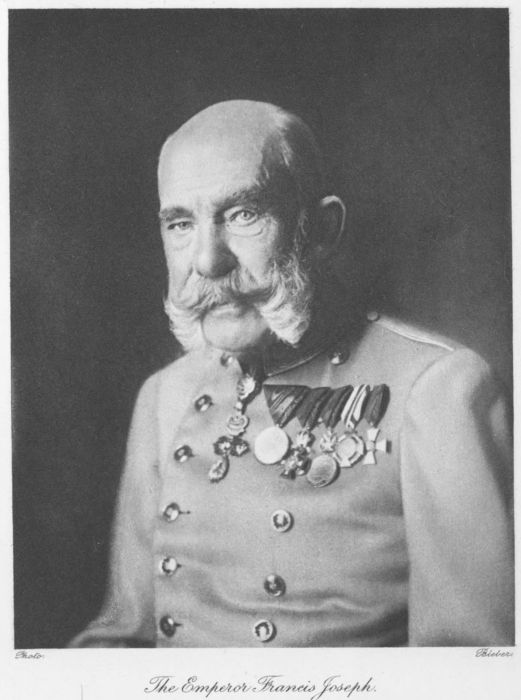
PhotoBieber
THE EMPEROR FRANCIS JOSEPH
THE LIFE OF THE
EMPEROR
FRANCIS JOSEPH
BY
FRANCIS GRIBBLE
LONDON
EVELEIGH NASH
1914
PREFACE
There exist plenty of surveys of the modern
history and political conditions of Austria. Mr.
Henry Wickham Steed’s “The Habsburg Monarchy”
is the most recent, and probably the best,
though Mr. R. P. Mahaffy’s “Francis Joseph I.:
His Life and Times”—a smaller and less pretentious
book—is also very good. One knows
equally well where to turn for gossipy compilations—some
of them authoritative, and others
devoid of authority—dealing with the inner life
of the Austrian Court. Sir Horace Rumbold has
treated the subject with the dutiful reticence of a
diplomatist in “The Austrian Court of the Nineteenth
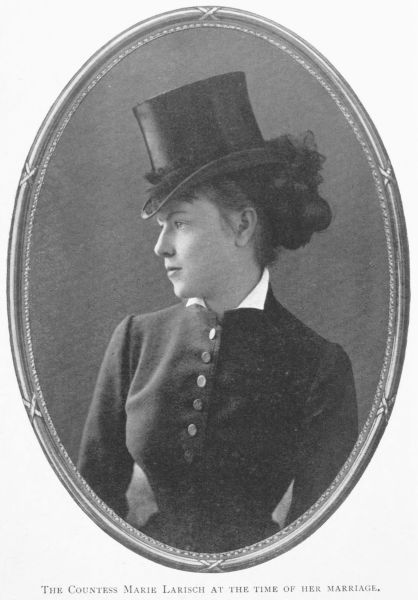
Century”; Countess Marie Larisch and
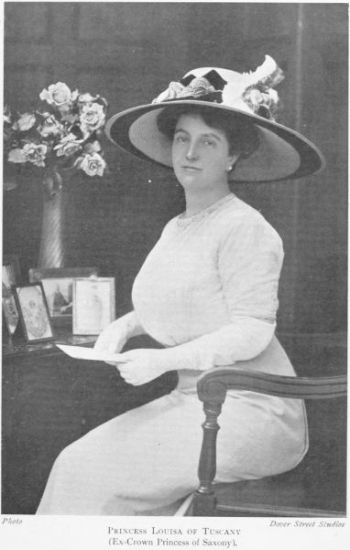
Princess Louisa of Tuscany, occupying positions
of greater freedom and less responsibility, have
in “My Past” and “My Own Story” lifted
the veil with indignant gestures, and pointed
fingers of scorn at the intimate pictures which they
have revealed. M. H. de Weindel, again, has
written of “François-Joseph Intime”; while the
enterprise of an American journalist has contributed
“The Keystone of Empire,” “The Martyrdom of
an Empress,” and “The Private Life of Two
Emperors—William II. of Germany and Francis
Joseph of Austria.”
This bibliographical list—to which additions
could easily be made—might seem to indicate that
the ground has already been well covered; but that
is not the case. There exists no life of Francis
Joseph, and no History of Austria, in which the
personal and political aspects of the subject are
considered in their relation to each other. The
assumption of writers who have previously treated
the theme has been that tittle-tattle is tittle-tattle,
and that history is history, and that the two can never
meet. The two things, however, are liable to meet
anywhere; and in the country and period here under
review they are continually meeting. Austria is not
one of the “inevitable” countries, like England and
Spain, bound to have a separate existence under
some form of government or other because of their
geographical situation and the national characteristics
of their inhabitants. There is no Austrian
nation: only a medley of races which detest each
other, bound (but by no means welded) together for
the supposed convenience of the rest of Europe,
and unified only by the fact that its component parts
all appertain to the dominions of the House of
Habsburg.
It follows that the personality of the Habsburgs
matters in a sense in which the personalities of
rulers who are mere figure-heads does not matter;
and that personality—the collective personality as
well as the separate personalities of individual
members of the House—can only be gauged by
those who study their private lives in conjunction
with their public performances. The history of the
property (seeing that it comprises peoples as well
as lands) includes and implies the history of the
owners of the property. Our spectacle, in so far
as one can sum it up in a sentence, is that of an
Empire continually threatened with dissolution
under the control of an historic family continually
displaying all the symptoms of decadence. The
political and the personal factors in the problem are
perpetually interacting; and one of the questions
which the political prophet has to consider is: Will
not the decadence of the family hasten the dissolution
of the Empire?
Whence it follows, as a secondary sequence, that,
in the history of modern Austria, tittle-tattle matters;
for it is only by the careful study of the tittle-tattle
that we can hope to discover whether the Habsburgs
of to-day are true or false to the proud and impressive
traditions of their House. In their case, as in
that of any other House, a stray story of a romantic
or scandalous character might properly be ignored
as appertaining to the domain of idle gossip; but
when stories of that kind meet us at every turn—and
meet us with increasing frequency as time
proceeds—we are no longer entitled to dismiss
them with superior indifference. They are
significant; the key to the situation is to be found
in them. Tittle-tattle, in short, when one encounters
it, not in sample but in bulk, ceases to be tittle-tattle,
but attains to the dignity of history, and
furnishes the raw material for the generalisations of
the political philosopher.
The annals of the House of Habsburg furnish a
case in point—the best of all possible cases. There
is no House in Europe whose annals are richer in
incident and eccentricity; and the eccentricities,
whether romantic or scandalous, are such as to
challenge the scientific investigator—whether he be
a student of eugenics or of politics—to group them
and see what inferences he can draw. The present
writer has decided to take up the challenge; and,
in order to take it up, he will be obliged to deal
with a good many matters besides the political
manœuvres of the Emperor and his Ministers.
“John Orth” pelting the Emperor with the insignia
of the Order of the Golden Fleece; “Herr Wulfling”
cracking nuts in a tree with Fräulein Adamovics;
Princess Louisa of Tuscany, first bicycling with the
dentist in the Dresden Park, and then appealing to
her son’s tutor to come and “compromise” her in
Switzerland—all these are matters which may
suggest reflections quite as far-reaching as anything
that we read about Francis Joseph’s skill in extricating
his country from embarrassments with rival
Powers and keeping the peace (in so far as it has
been kept) between Ruthenians and Galicians.
It would be presumption, of course, to represent
this biography as the full and final portrait of
Francis Joseph as he really is. The complete
material for such a definite portrait of a sovereign
is never made available during the sovereign’s life-time;
and the portraits drawn by people who have
occupied privileged positions at Court are generally
the most colourless of all: misleading—and, as a
rule, designed to mislead—by excess of eulogy.
Discretion, in such cases, takes the place of criticism;
the “selection” is not that of the artist, but of
the courtier. The illustrious personage thus officially
or semi-officially portrayed “comes out” not as an
individual, but as a type: as conventional and as
unconvincing as the stock “heavy father” or “gentlemanly
villain” of melodrama. Sir Horace Rumbold’s
polite portrait of Francis Joseph is one of
many marked by those limitations. The popular
Austrian portraits are still more distinctly marked
by them.
One need not wonder, and one must not complain.
The path to candour was blocked by the obligations,
in the one case of hospitality, and, in the other, of
loyalty; but there is no reason why the historian who
is not under such obligations should not criticise
more freely. His object is neither depreciation nor
flattery, but truth—as much of the truth as is attainable
at the given moment; and he must therefore
resist the common tendency of the biographers of
contemporary rulers to credit their subjects, not only
with their own particular virtues, but with all other
people’s virtues as well. The only result, in moral
portraiture, of attributing virtues with too heavy a
hand is to produce a picture in which the wood
cannot be seen for the trees.
That error must be avoided, as much in the
interest of the subject of the portrait as in that of
the public to which it is to be submitted. The real
virtues will be more conspicuous if no imaginary
virtues are allowed to block our view of them, and
if other miscellaneous qualities which contrast with
them are given their due tribute of attention.
Cromwell, it will be remembered, insisted that the
artist should paint him “warts and all,”; and if the
Life of an Emperor is not to be written in that spirit,
one might just as well refrain from writing it, for
there would be nothing to be learnt from it when
it was written.
FRANCIS GRIBBLE.
CONTENTS
PAGE
Chapter I
The collapse of the Holy Roman Empire—The impossibility
of reviving it—The German Federation—The Holy
Alliance—The policy of sitting on the safety valve—The
consequent explosions—The problems consequently prepared
for Francis Joseph—The Head of the House of
Habsburg—Inseparable connection between the events
of his public and private life
The House of Habsburg from the standpoint of Eugenics—The
“Habsburg jaw”—Degeneracy the consequence of
consanguineous marriages—Sound physiological instinct
of King Cophetua—And of those Habsburgs who have
followed his example—Morganatic marriages—The
family organism fighting for its life—Has Francis Joseph
understood?—Indications that he has understood in part
Francis Joseph’s ancestors—Francis, Duke of Lorraine—Francis
II.—Leopold II.—Collaterals—The Spanish
marriages of the Habsburgs—Their alliances with Portugal,
the various Bourbons, and the Wittelsbachs of
Bavaria—Moral and mental defects thus perpetuated
and emphasised—Francis Joseph as the sane champion
of a mad family
Francis Joseph’s childhood—The severe education which
prepared him for his rôle—Difficulties of that rôle—The
Liberal revolt against the Metternich system—The idea
of nationality—Hübner’s surprise that anyone should
object to Austrian rule—Every Austrian a policeman
at heart—The Italian rising of 1848—Francis Joseph in
action—Radetzky’s remonstrances—Francis Joseph’s
return to his studies
The risings of 1848—Princess Mélanie Metternich’s excited
account of it—Disorderly flight of Metternich from
Vienna—The House of Habsburg saved by “three
mutinous soldiers”—Abdication of the Emperor Ferdinand
in favour of his nephew, Francis Joseph—Hübner’s
description of the ceremony
Attitude of the Hungarians towards Francis Joseph—They
denounce him as a traitor, and banish him from
Hungary—Contempt of Austrians for Hungarians—The
conquest of Hungary with Russian help—Repression and
atrocities—Women flogged by order of Marshal Haynau—Marshal
Haynau himself flogged by Barclay and
Perkins’ draymen in London, and spat upon by women
in Brussels—Popular song written on that occasion
Why Francis Joseph was called “The child of the gallows”—His
affront to Napoleon III., and its consequences—The
Bach system and the objections to it—Francis
Joseph’s bonhomie—The attempt on his life—Impressions
formed of him by the King of the Belgians, and Lady
Westmorland—The story of his romantic marriage
The failure of the marriage—Difficulty of explaining it—The
two conflicting personalities—Francis Joseph’s
personality obvious—The Empress Elizabeth’s personality
mysterious—Her sympathy with the Hungarians,
and its political importance—Her confession of melancholy
Francis Joseph’s Egeria—Elizabeth’s mother-in-law—Elizabeth’s
quarrels with etiquette—The beginnings of
estrangement—The functions of Countess Marie Larisch
in the imperial household—Captain “Bay” Middleton—Nicholas
Esterhazy—Elizabeth’s fairy story—Her cynical
attitude towards life
“The Martyrdom of an Empress”—Correction of inaccuracies
contained in that popular work—Francis Joseph’s friends—“A
Polish Countess”—Frau Katti Schratt—Enduring
attachment—Rumour of morganatic marriage—Interview
with Frau Schratt on that subject—“Darby and Joan”
Francis Joseph’s passion for field sports—Enthusiasm of a
nation of sportsmen for a sportsman Emperor—Anecdotes
of sport—Estrangement of the Emperor and the
Empress—The Empress’s departure for Madeira—Her
wanderjahre—Her attitude towards life—The keeping
up of appearances
Francis Joseph’s snub to Napoleon III.—Proposal to address
him as “Sir” instead of “Brother”—The consequences—Napoleon
asks: “What can one do for Italy?”—Austria
at war with France and Italy—The crimes committed
by Austria in Italy—Battles of Magenta and
Solferino—Francis Joseph compelled to surrender Lombardy,
but allowed to retain Venetia
An interval of peace—Beginnings of trouble with Prussia—Habsburg
pride precedes a Habsburg fall—Refusal to
sell Venetia to Italy—Italy joins Prussia—The war of
1866—The disaster of Sadowa—Benedek’s failure—Shameful
treatment of Benedek by the Empire—Vain
attempts to conciliate him—His widow’s comments
Francis Joseph comes to terms with Hungary—His famous
interview with Francis Deák—“Well, Deák, what does
Hungary demand?”—Dualism—The objection of the
Slavs to Dualism—Coronation at Buda—Andrassy,
whom he had hanged in effigy, becomes his Prime
Minister
Attitude of Austria in the Franco-German War—Proposed
alliance of France, Italy, and Austria against Prussia—General
Türr’s interview with Francis Joseph—Victor
Emmanuel’s conditions—The bargain concluded—The
French plan of campaign drafted by the Archduke
Albert—Beust’s fetter to Richard Metternich—Reasons
why the Austrian promises were not fulfilled
Austrian expansion in the Balkans—Occupation of Bosnia—Problem
of Servia Irredenta—Postponement of the day
of reckoning—Luck of the Habsburgs in public life—Calamities
dog them in private life—List of Habsburg
fatalities during Francis Joseph’s reign
Francis Joseph’s brother Maximilian—Invited to be Emperor
of Mexico—Hesitates, but consents to please his wife—Resignation
of his rights as a Habsburg—The Pacte de
Famille and the quarrel about it—The compromise—The
last meeting of the brothers—Maximilian’s melancholy—He
composes poetry—He receives the benediction of
the Pope and departs for his Empire
Vanity and nervousness of the Empress Charlotte—Evil
omens which frightened—Her journey to Europe to seek
help for Maximilian—Her cold reception by Napoleon
III.—Symptoms of approaching insanity—Her madness—Maximilian
abandoned by the French—Attacked by
the Republicans—Captured at Queretaro—Francis
Joseph’s vain attempt to save him—His trial and execution
Habsburgs and Wittelsbachs—Which is the madder House?—Insanity
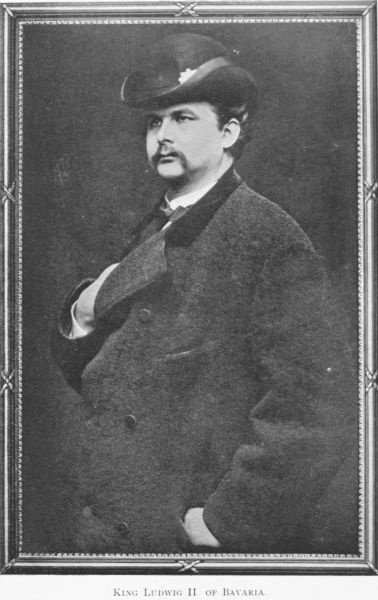
of the Empress Elizabeth’s cousin, Ludwig II. of Bavaria—His
eccentricities—His tragic death—Grief of the Empress—Suicide of
Elizabeth’s brother-in-law, the Comte de Trani—Tragic death of the
Archduchess Elizabeth
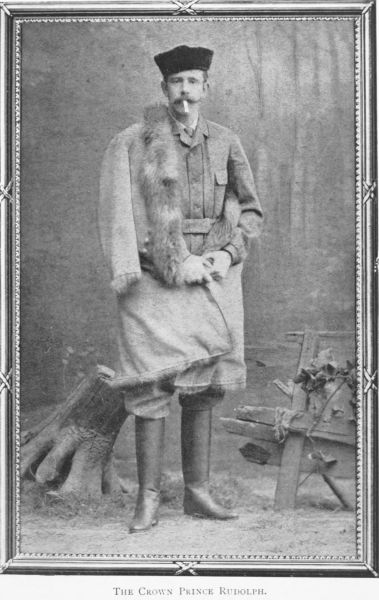
The Crown Prince Rudolph—His quarrel with the German
Emperor—His affability and his hauteur—A spoiled
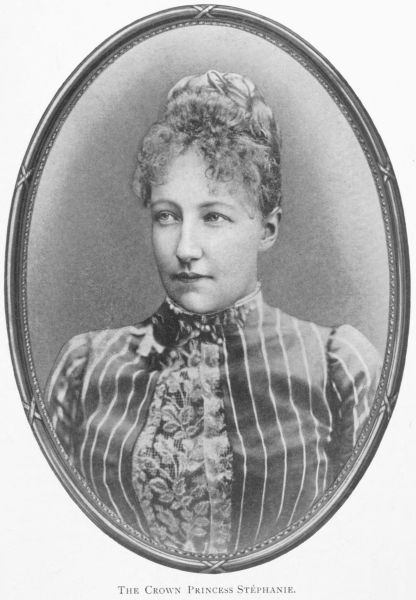
child—His search for a wife—Marriage to Princess
Stéphanie—Disappointment and disillusion—Stéphanie’s
book—“A long, long, terrible night has gone by for me”—Mary
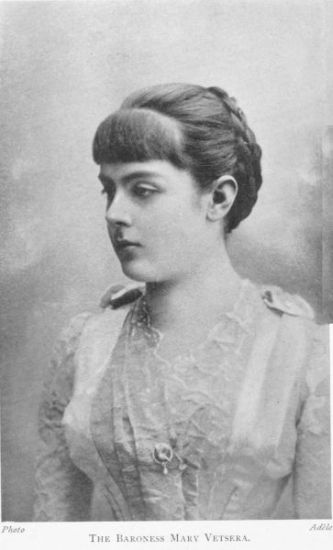
Vetsera and her family—How Mary Vetsera
was taken first to the Hofburg and thence to Meyerling
What the Archduchess Stéphanie knew—What Rudolph
knew that she knew—The search for Mary Vetsera by
her relatives—The news of the Meyerling tragedy—The
two official versions—The many unofficial versions—The
attempt to hush the matter up—Mary Vetsera’s letter
to Countess Marie Larisch
Fantastic legends of the Meyerling tragedy—Talks with the
Crown Prince’s valet—Foolish story given by Berliner
Lokal Anzeiger—What the Grand Duke of Tuscany
knew—What Count Nigra knew—What Countess Marie
Larisch tells—Her story confirmed from a contemporary
source—Doubts which remain in spite of it—Was it
suicide or murder?
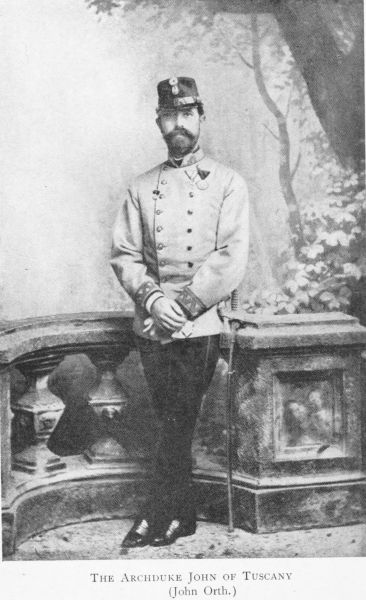
The Archduke John Salvator—His many accomplishments—His
criticisms of his superiors—His disgrace at Court—His
love affair with an English lady—“Your darling
Archduckling”—His proposal to abandon his rank and
earn his living as a teacher of languages—His love
affair with Milly Stübel—He quarrels with Francis
Joseph, takes the name of John Orth, and leaves
Austria
John Orth—Had he been plotting with Rudolph?—Indirect
confirmation of story told by Countess Marie Larisch—Did
John Orth really marry Milly Stübel?—Failure to
find the proofs of the marriage—John Orth’s letters
written on the eve of his departure for America—Disappearance
of his ship off Cape Horn—Is John Orth
really dead?—Examination of the reasons for believing
that he is still alive
The revolt of the Archdukes—Instructive analogies—Later
years of the Empress Elizabeth—Her manner of life
described by M. Paoli, the Corsican detective—Her fearlessness—Her
superstitions—Various evil omens—The
last excursion—Assassination of the Empress at Geneva—How
Francis Joseph received the news
“Austria’s idiot Archdukes”—A catalogue raisonné—The
Emperor’s brothers—The Archduke Rainer—The Archduke
Henry and the actress—The Archduke Louis Salvator,
the Hermit of the Balearic Islands—The Archduke
Charles Salvator—The Archduke Joseph—The Archduke
Eugène and his vow to be “as chaste as possible”—The
Archduke William and his courtship in the café—The
Archduke Leopold—The awful Archduke Otto and his
manifold vagaries
The centrifugal marriages of the Habsburgs—Francis
Joseph’s attitude towards them—His attitude towards
Baron Walburg, the Habsburg who had come down in
the world—Where he draws the line—His refusal to
sanction the marriage of the Archduke Ferdinand
Charles to the daughter of a high-school teacher—The
Archduke resigns his rank and becomes Charles Burg—Marriage
of the daughter of Archduchess Gisela to
Baron Otto von Seefried zu Buttenheim
The marriage of Archduchess Stéphanie to Count Lonyay—Attitude
of the King of the Belgians towards that marriage—Attitude
of Francis Joseph—He sanctions the
union, but snubs the bridegroom—Marriage of the
Archduchess Elizabeth to Otto von Windischgraetz—Francis
Joseph’s approval—The Windischgraetzes
raised to the rank of Serene Highnesses
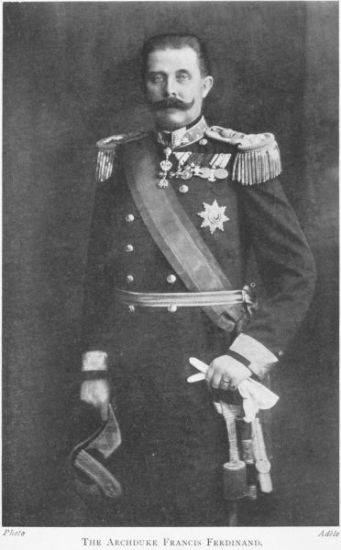
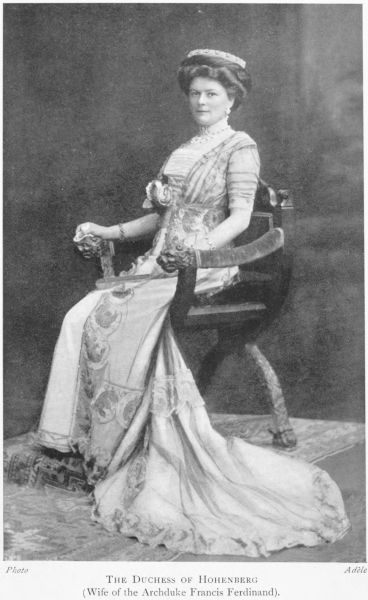
The Archduke Francis Ferdinand—An invalid who delayed
to marry—Report of his betrothal to the Archduchess
Gabrielle—Announcement of his betrothal to Countess
Sophie Chotek—Anecdotes of the courtship—Indignation
of the Archduchess Gabrielle’s mother—Attitude of
Francis Joseph—He permits the marriage on condition
that it shall be morganatic—Francis Ferdinand compelled
to swear a solemn oath that he is marrying
beneath him, and that his children will be unworthy to
succeed him—Reason for doubting whether he will
eventually be bound by his oath
The “terrible year” of the Habsburg annals—Proceedings of
Princess Louisa of Tuscany—The taint inherited from
the Bourbons of Parma—Princess Louisa’s suitors—Her
marriage to Prince Frederick August of Saxony—She
bicycles with the dentist—She runs away to Switzerland
with her brother, the Archduke Leopold, and her
children’s tutor—Attitude of the Courts towards her
escapade—Official notice on the subject in the Wiener
Zeitung
The romantic Quadruple Alliance—The jarring notes—Princess
Louisa’s objections to her brother’s companion
Fräulein Adamovics—The sentimental life of the Archduke
Leopold—He becomes “Herr Wulfling,” and
marries Fräulein Adamovics—Herr and Frau Wulfling
run wild in woods—Herr Wulfling divorces his wife and
marries again—His confidences to Signor Toselli—Princess
Louisa’s conception of the Simple Life—Her
manners shock the Swiss—She dismisses M. Giron—Her
marriage to Signor Toselli
The summing up—The probable future of Austria—The probable
future of the House of Habsburg—Questions both
personal and political which will be raised when Francis
Joseph dies—The extent to which he has been “in the
movement”—The faithful companion of his old age
The collapse of the Holy Roman Empire—The impossibility
of reviving it—The German Federation—The Holy
Alliance—The policy of sitting on the safety valve—The
consequent explosions—The problems consequently prepared
for Francis Joseph—The Head of the House of
Habsburg—Inseparable connection between the events
of his public and private life.
In order to clear the way, and set the stage for
the drama of the Emperor Francis Joseph’s life,
we must go back to the dissolution of that Holy
Roman Empire of which the Emperor of Austria
was, at the end, the titular head. Happily, we have
not very far to go.
The Holy Roman Empire—in fact, as a cynic has
said, neither Holy nor Roman, and scarcely worthy
to be called an Empire—collapsed in the Napoleonic
wars. The Battle of the Nations at Leipzig,
the “world’s earthquake” at Waterloo, the Congress
of Vienna: none of these things availed to
set the Holy Roman Empire on its feet again.
Perhaps a really great man might even then have
been able to restore it and make something of it,
using it as a decorative setting for glorious achievements;
perhaps not. The experiment was not tried,
because there was no great man available to try it.
The sovereigns of those days, with the sole exception
of Alexander of Russia, were pitifully lacking
in personal prestige. Whatever Napoleon had failed
to do, he had at least succeeded in destroying the
prestige of the hereditary representatives of ancient
dynasties. The House of Habsburg, in spite of
Napoleon’s marriage to a daughter of the House,
had suffered as much indignity as any other royal
family, and more than most. That marriage, indeed,
was itself esteemed an indignity; even the old
friends of the House were doubtful whether it still
deserved respect.
Moreover, while Austria was rather weak, Prussia
was very jealous—not altogether without reason. In
the earlier stages of the final combination against
Napoleon, Prussia had borne the burden and heat of
the day, while Austria sat, with a double face, shilly-shallying
on the fence. Now, it might be said, Austria
represented the Past and Prussia the Future of
the German world; and the Future was in no mood
to tolerate proud airs or lofty pretensions from
the Past. In the absence, therefore, of a commanding
personality among the sovereigns, the revival of
the Holy Roman Empire was impossible; and the
centre of gravity of the German world was shifting.
Still, something had to be done; some organisation
had to be contrived to give cohesion to the
medley and provide the Continental Concert with
a reasonable prospect of a quiet life. So there
sprang into being two organisations which concern
us:—
1. The German Federation.
2. The Holy Alliance.
Their detailed history need not delay us; but we
must pause to see how they created the difficulties
with which Francis Joseph, coming to throne as a
boy of eighteen, had to cope, and posed the
problems which he would have either to solve for
himself or to see roughly, and even violently, solved
for him by others.
Just as the Holy Roman Empire was scarcely
worthy to be called an Empire, so the German
Federation was scarcely worthy to be called a
Federation. It was loose and cumbrous, inefficient
and inert. There was no Federal Tribunal, no
Federal army, no Federal diplomatic machinery; in
all these matters the component States—ruled by
thirty-eight separate sovereigns—retained their independence.
The Federal Assembly, which met at
Frankfurt, was, in effect, only a Congress of the
Ambassadors of those States, with the Austrian
Ambassador in the chair. No important step could
be taken without the unanimous consent of the Ambassadors;
and there was no important piece of business
on which they were all of one mind. The
position of Austria at the head of the Assembly was
one of dignity without authority, conferring little
more actual power than falls to the president of a
debating society.
So loose an arrangement obviously could not
endure. One of two things was bound to happen;
the bonds of union must, in the course of time,
either be tightened or be broken. The seeds
of destruction were present in the organisation from
the first in the shape of Austro-Prussian jealousy:
that jealousy between the Past and the Future to
which we have referred. The interests and aspirations
of these two dominant States conflicted. Neither of
them was strong enough to bring the other to heel;
neither of them was weak enough, or humble enough,
to acquiesce in the other’s hegemony. It remained
only for one of them to turn the other out of the
Federation, and fashion a real Federation—a real
Empire, perhaps—out of the remaining constituents.
That inevitable process—delayed for more than
fifty years, but eventually altering the whole outlook
of Austrian policy—was to provide the central
problem of Francis Joseph’s reign; but many other
problems, hardly of less significance, were first to
arise out of the programme of the Holy Alliance.
The Holy Alliance, of course, was, in fact, no
more Holy than the Holy Roman Empire, and was,
perhaps, hardly worthy to be called an Alliance. It
was an agreement, or mutual understanding, rather
than an Alliance, inspired by hatred and terror of
the new ideas disseminated by the French Revolution;
and those are hardly unjust who describe it
as a conspiracy, suggested by Metternich, and
acquiesced in by the principal Continental sovereigns,
for keeping all subject peoples in the places
which the Congress of Vienna had assigned to them.
And that in a double sense. In the first place, autocratic
forms of government were to be maintained
in all countries which the Holy Three regarded as
within their sphere of influence. In the second place,
subject nationalities were to be kept in subjection to
the Powers which the Settlement of 1815 had placed
in authority over them.
It follows that the policy of the Holy Alliance
was a policy of sitting on safety valves; and its
history is the history of a series of Conferences and
Congresses held to decide who should sit on which
safety valve in the name of all. It was agreed, for
instance, that Austria should sit on the safety valve
in Naples, and that France should sit on it in
Spain; and there was much talk—though also
much difference of opinion—about sitting on the
safety valves in Portugal and Greece. The Holy
Alliance fell to pieces, after a much shorter life
than that of the Holy Roman Empire, because
Russia maintained against Austria, and England
maintained against France, that certain safety
valves should not be sat upon.
Moreover, safety valves were many, and the
upward pressure was of a continually increasing
force. If Metternich and Castlereagh, and
the Emperors of Austria and Russia, and the
King of Prussia, had, like the Bourbons, “learnt
nothing” from the French Revolution and its
sequel, the common people, from university professors
to artisans, had learnt much. They might
desire a breathing-time before committing themselves
to desperate courses. The breathing-time
might be protracted because the despotisms were
reasonably benevolent towards people who did not
meddle with politics; because the administration was
honest, and the taxes were not oppressive. Still,
sooner or later intelligent men were bound to tire
of submission, and clamour for Parliaments and
the recognition of “nationalities.” Byron—the
friend of the Carbonari before he was the friend
of Greece—was hounding them on to do so.
In England Byron was notorious for his indecorum;
but, on the Continent, he was famous for
his audacity. The improprieties of “Don Juan”
did not shock Continental Liberals; but its courageous
political criticisms stirred them. The lines
over which they gloated—though they must have
had a difficulty in translating them—were such lines
as these:—
Lock up the billy bald-coot, Alexander!
Ship off the Holy Three to Senegal!
Teach them that sauce for goose is sauce for gander,
And ask them how they like to be in thrall!
Such passages—and there are plenty of them—express
the temper to which the Continental Liberals
were gradually coming. When they came to it, and
found such men as Metternich, and Bomba of
Naples, and Charles X. of France, sitting on the
safety valves, explosions could by no means be prevented.
The political history of the period is the
history of those explosions and their consequences;
and we all know that there were two principal series
of such explosions—the explosions of 1830, and the
explosions of 1848. The noise of the first detonations
was, as it were, a salute fired in the year of
Francis Joseph’s birth; the louder roar of the second
greeted his accession.
First Italy and then Hungary exploded; and
Francis Joseph, as a boy of eighteen, had to face the
confusion and try to calm it. The story of his bearing
in the presence of the turmoil must not be
anticipated; but we may look sufficiently ahead to
note that a new Austria, differently constituted, and
looking out of a new window in a new direction, had
gradually to be re-created out of what might very
well have been a wreck. The old Austria over which
Francis Joseph began to reign in 1848 was a
Teuton Power holding the most prosperous provinces
of Italy in its iron grip. That grip has been reluctantly
relaxed until only the pressure of one little
finger remains; and the new Austria over which
Francis Joseph rules to-day has only a small Teuton
nucleus, associated with a Magyar nucleus nearly
as large, trying in conjunction with it to assert predominant
partnership in a large and increasing
community of Slavs, and casting envious, but not
very hopeful, glances across the Danube towards the
Balkan States and the Ægean harbours.
So great has been the evolution accomplished
within the reign of a single ruler: a ruler who, at
the beginning of his reign, did not dare to set his foot
in his own capital, and, long before the end of it,
had come to be regarded as the one indispensable
man in the Empire—the one man whose life must
be preserved and prolonged at all hazards, for fear
lest his death should entail the collapse of the edifice
which he had reared—the one man who sometimes
appeared to command the affection of all his subjects.
It would be a striking story, even if one
related the Emperor’s political achievements without
reference to his personal life; but the two things,
though commonly separated by political historians,
are not really separable.
Certainly they are not so separated by his own
subjects. They not only admire the statesman who
has acquired a prestige to which he was not born,
and has used it to recover by diplomacy what he has
lost in war; they also cherish an affectionate sympathy
for the man at whom calamity has dealt blow
after blow, whom no blow, however cruel, has
struck down, and who, in spite of innumerable
sorrows, has continued to confront the world
with a dignified, if melancholy, composure. He
has had, they perceive, no less trouble with
his family than with his Empire; and they have
sometimes thought of him—or at least been tempted
to think of him—as the one splendidly sane member
of an eccentric and decadent House.
It follows that one must write of Francis Joseph,
not only as an Emperor, but also as a Habsburg—the
head of the most interesting of all the royal
houses: a House whose members, unpredictable in
their insurgent extravagances, have, again and again,
moved the Courts and Chancelleries of Europe
to consternation. Our picture must be, not only of
a great and successful ruler, but also of a brave old
man, tried in the fire but not consumed by it, bowed
down by sorrows but not broken by them, maintaining
the mediæval majesty of royal caste in the
presence of his peers, at a time when other Habsburgs—one
Habsburg after another—were flinging
the prejudices of royal caste to the winds and making,
as it must have seemed to him, sad messes of their
lives, after the manner of those reprobate relatives
who, even in middle-class families, are spoken of, if
at all, with bated breath.
That being our theme—or a portion of it—we
may next speak of the Habsburgs collectively; and
we will begin by considering what the eugenists
have to say about them.
CHAPTER II
The House of Habsburg from the standpoint of Eugenics—The
“Habsburg jaw”—Degeneracy the consequence of
consanguineous marriages—Sound physiological instinct
of King Cophetua—And of those Habsburgs who have
followed his example—Morganatic marriages—The
family organism fighting for its life—Has Francis Joseph
understood?—Indications that he has understood in part.
The House of Habsburg furnishes the “horrible
examples” in two recent works on the new science
of Eugenics: L’hérédité des Stigmates de Dégénérescence,
by Dr. Galippe, and L’Origine du
Type familial de la Maison de Habsburg, by Dr.
Oswald Rubbrecht. The arguments in both cases
are based, not only on a study of history, but also
on a collation of portraits; and though the writers
differ on some points of detail, their general conclusions
are identical. For both of them the
Habsburgs are “degenerates”; both of them
attribute the degeneracy to the same cause. It is,
they agree, the cumulative effect of what is technically
called “in-breeding”—of a long succession of
inter-marriages among comparatively near relatives.
One hears of the physiological law thus violated,
whenever the question of a marriage between cousins
is mooted. The tendency of such a marriage,
we are always told, is to perpetuate and accentuate
typical characteristics and weaknesses, both physical
and moral. A single marriage between cousins
may produce no perceptible evil result; and one
can cite cases in which it appears to have produced
remarkably brilliant results.[1] But a series of such
marriages, continued through generation after
generation, invariably and inevitably tells. The
family, or the community, in which such unions are
the rule, loses vigour and develops peculiarities—a
special, readily recognisable, physiognomy, and an
unstable mental equilibrium. The transmitted
eccentricities—more particularly the mental eccentricities—may
skip a generation or leave an individual
exempt; but they are always lurking in the
background—always to be expected to reappear.
[1] Darwin married his first cousin, and all his sons were
men of remarkable ability.
It has been so, and is so, according to Drs.
Rubbrecht and Galippe, with the Habsburgs. We
have all heard of the “Habsburg jaw”; and Dr.
Rubbrecht traces it to its mediæval source, and,
standing before a long row of family portraits,
carefully and scientifically depicts the Habsburg
face:—
“In addition to the underhung lower jaw and the
large lower lip, the Habsburg physiognomy presents
the following characteristic features: excessive
length, and, sometimes, excessive size of the nose;
‘exorbitism,’ more or less pronounced, with a forehead
often of considerable height. One would say
that the head, squeezed in by lateral pressure, had
undergone a concomitant vertical allongation, and
had been stretched, and pulled up and down at the
same time. According to Dr. Galippe, the lateral
flattening of the skull is the fundamental characteristic,
and all the other abnormalities follow
from it.”
That is what Dr. Rubbrecht makes of the portraits.
He generalises only as a student of physiognomy,
and does not discuss mental and moral issues,
or presume to predict the future. Dr. Galippe is
more outspoken:—
“The Habsburgs” (he writes), “having, by their
intermarriages, developed a degenerate taint, and
having transmitted it, either separately or in conjunction
with other taints, both physical and
psychical, to the families matrimonially allied with
them, have brought into existence a specific type
of human animal, by the same means which the
breeders of dogs and horses employ for the creation
of a new sub-species.”
As for the general consequences of such in-breeding,
he continues:—
“Even those aristocratic families which present
no original mark of degeneracy disappear quickly.
It follows, a fortiori, that those families which,
possessing such characteristics, perpetuate them by
contracting marriages within the degrees of consanguinity,
are doomed to a still more speedy
extinction.”
As for the case of the Habsburgs in particular,
he concludes:—
“The Habsburgs of Spain have long since been
swept off the stage of history, disappearing in
sterility or insanity. The Habsburgs of Austria,
numerous though the representatives of the House
are at the present time, will end by disappearing in
their turn as an historic family, if they persist in
their errors,—that is to say, in their marriages with
blood relations.”
It is a new way of looking at an old problem,—a
new thought suggested by the latest of the sciences;
and it opens the door to reflections of great and
urgent moment to many other royal houses besides
that of Habsburg. In a general way, it has long
been held to be almost as improper for Kings and
Queens to marry their subjects as for angels to marry
the daughters of men. A purer and bluer blood
ran in their veins than in the veins of their subjects;
and to adulterate that blue blood with red blood
was to degrade it. They must, therefore, seek their
brides and bridegrooms within the magic circle.
Kings must marry Queens, and Princes must marry
Princesses; and the distinctive exclusiveness of
reigning houses must be maintained by a succession
of unions between cousins.
That view of the matter has continued to prevail
in royal circles—and also in high political and
diplomatic circles—long after the students of
heredity have established conclusions unfavourable
to such courses. The arguments can hardly
have failed to reach the ears of those whom
they concerned; and the feeling—tacit, if not
avowed—has presumably been that Kings, and
Queens, and Princes and Princesses are so great
and good and glorious that the laws of Nature do
not apply to them. But that is not the case. Science
shows that Kings cannot override the laws of Nature
even in the countries in which they are permitted
to override the laws of the land; that the price which
Nature exacts for exclusiveness is degeneracy; that
hardly any royal family anywhere has failed to pay
that price; that the percentage of insanity has,
through the ages, been higher among hereditary
rulers whose blue blood has thus been protected
from admixture than in any other class of the community;
and that the sound physiological instinct is
that on which King Cophetua acted in the legend,
when the bare-footed beggar-maid appeared before
him:—
As shines the moon in clouded skies,
She in her poor attire was seen;
One praised her ankles, one her eyes,
One her dark hair and lovesome mien.
So sweet a face, such angel grace,
In all that land had never been:
Cophetua swore a royal oath:
“This beggar maid shall be my queen.”
It is this example of King Cophetua—and the
moral which the eugenists read into it—that we shall
need to bear in mind when we endeavour to appreciate
those incidents in the latter-day history of the
House of Habsburg which are commonly supposed,
whether rightly or wrongly, to have been most distressing
to the head of the family. That history
has largely, and indeed mainly, if not quite entirely,
been a history of revolt on the part of the sons—and
even the daughters—of the House against the
splendid restrictions and inherited obligations which
hedged them about as members of an uniquely illustrious
race.
The revolt has expressed itself in many ways:
some of them, in the world’s view, creditable and
even honourable; others in a greater or less degree
scandalous. We have seen—and we shall see yet
again in these pages—one Habsburg throwing off the
panoply of state, to live his own mysterious life
in the remote Balearic Isles, and another Habsburg
disappearing for ever—unless those are right who
assure us that he bides his time, in hiding, for some
dark political reason, and will “come again”—as
the navigating officer of a merchant vessel. There
have also been intrigues which have ended in
tragedy, and morganatic marriages with actresses
and other persons deemed “impossible” in imperial
circles; and there has been at least one elopement
of a Habsburg Princess, who, having failed to live
harmoniously with a Crown Prince, found that even
a professional pianist could not permanently satisfy
her craving for romance.
One knows the ordinary comment on these proceedings:
“All the Habsburgs are mad,—all of
them except Francis Joseph; and here is another
Habsburg proving himself (or herself) as mad as
the others, if not madder.” The remark is not
profound; but it is often, in a rough way, true.
John Orth, “Herr Wulfling,” Princess Louisa of
Tuscany:—all these (and not these only) have done
strange things,—things which one would hesitate to
put forward as the sole and unsupported proofs of
the possession of well-balanced minds. This is
not the page for the detailed account of such proceedings;
but it is pertinent and proper, even here,
to remark the startling frequency of their occurrence.
It is not a case of the discovery of a single
skeleton in a single cupboard—a phenomenon which
any research into any family history is apt to bring
to light. The impression, when one reviews the
recent annals of the House of Habsburg, is of
continuous rattling of skeletons in all the cupboards,
and of one sane and strong man—the accepted and
now the hereditary Head of the House—going
gravely through his troubled life, not unmoved,
indeed, by the ghostly noises, but, at least, without
allowing his composure to be too visibly disturbed
by them: a man of whom one may say, giving a
somewhat new sense to old and hackneyed lines:—
Si fractus illabatur orbis,
Impavidum ferient ruinae.
But that is not the only view of the matter which
it is permissible to take. One may also, with the
conclusions of science to back one, regard the
eccentricities of the more eccentric Habsburgs, if
not as the best proofs of sanity that they are capable
of giving, then as instinctive and desperate, if not
always very intelligent, endeavours to escape from
the imminent fate which the eugenists have foretold
for them. The family, we may take it, no less
than the individual, is an “organism,” albeit only
partly conscious of itself; and our spectacle, we
may add, is that of an organism blindly fighting for
its life. The fight may not be very wisely conducted,
not having been begun until the work of
destruction was too far advanced; but it is nevertheless
a fight worth fighting, and one of which we
should follow the vicissitudes, not with horror or
with merriment, but with intelligent sympathy.
For degeneracy is too high a price to pay for
haughty exclusiveness; and it is better to flee from
the City of Destruction late in the day, followed
and attended by the cry of scandal, than to remain
in it and be overwhelmed.
That, at any rate, is the appreciation of the
Habsburg scandals—or of a good many of them—which
will commend itself to eugenists and sociologists,
who will esteem the revolts sound in principle,
even though they allow them to be occasionally extravagant
in detail. The individual makers of the
scandals need not be assumed to have acted from
any higher or deeper motive than the satisfaction of
what has more than once proved to be only a passing
inclination. The whole circumstances of their upbringing,
and the precepts of duty and propriety
impressed upon them from childhood, make that
unlikely. But the physiological instinct behind the
admitted motive has been a sound one. Looked at
from the viewpoint of the individual, it had been
the instinct of King Cophetua; looked at from the
point of view of the race, it has been the instinct
of self-preservation.
It has been the tragedy—or one of the tragedies—of
Francis Joseph that the years of his reign have
coincided with the years of this stage in the
Habsburg struggle for continued existence. Chosen
for his august and exalted post as the sanest and
healthiest Habsburg available—albeit the son of an
epileptic father and the nephew of an epileptic
uncle—he has looked down from above on the
exciting incidents and varying vicissitudes of that
struggle. One does not know whether to regard his
tragedy as the greater on the assumption that he
understood the inner meaning of the spectacle or
on the assumption that he did not understand it.
In the former case there would be more of pathos,
in the latter case more of irony, in the drama; but
it is impossible to say for certain whether he has
understood or not.
The probability, in the lack of direct evidence, is
that he has understood in part. One might draw
that inference from his occasional indulgence, as
well as from his occasional severity, towards the
rebels against the laws, both written and unwritten,
of his House; and one has no right to infer the
contrary from the fact that he himself has not
rebelled. He is a Habsburg as well as an Emperor,
and may very well have felt the impulses which
appear to have become common to the race, though
he has had both exceptional reasons and exceptional
facilities for repressing them. One knows, at any
rate, that he, like so many other members of his
family, has sought, and won, the friendship of
women outside the charmed circle of the royal
families, and that the lady in whose company he
seems, in the last years of his long life, to find the
most agreeable respite from the cares of State, is
not an Archduchess, and was once an actress. That
fact must surely have helped him to understand.
But these are matters for subsequent consideration.
The ground is now clear; and we may proceed,
without further delay, to genealogy and
biography.
CHAPTER III
Francis Joseph’s ancestors—Francis, Duke of Lorraine—Francis
II.—Leopold II.—Collaterals—The Spanish
marriages of the Habsburgs—Their alliances with Portugal,
the various Bourbons, and the Wittelsbachs of
Bavaria—Moral and mental defects thus perpetuated
and emphasised—Francis Joseph as the sane champion
of a mad family.
The Habsburgs can be traced back to the seventh
century before we lose them in the crowd of common
men. The branch of the family to which the
Emperor Francis Joseph belongs is that known as
the House of Habsburg-Lorraine, founded by the
marriage of the Empress Maria Theresa to Francis,
Duke of Lorraine, in 1736; and the House of
Lorraine has an independent genealogy, only less
ancient and illustrious than that of Habsburg itself,
being descended, through the House of Anjou,
from Hugues Capet, the ancestor of the royal house
of France. Anjou was given, in 1246, by Saint
Louis, to his younger brother Charles, whose grand-daughter
married her cousin, Charles de Valois;
and the House of Anjou kept the Duchy of Lorraine
until Francis abdicated on the occasion of his
marriage, in favour of Stanilas Lecszinski, whose
daughter married Louis XV.
This Francis seems to have been a mixed character,
not entirely commendable. He is credited with
virtue in his private life; but it is also related of
him that he farmed taxes, lent money at usurious
rates of interest, and acted as a kind of army contractor
to Frederick the Great, at a time when that
monarch was at war with Austria. He was the father
of Marie-Antoinette, and also of the Emperors
Joseph II. and Leopold II. Joseph left no issue,
but Leopold, who married Marie-Louise, daughter
of Charles III. of Spain, had a large family, only
two members of which need be mentioned here:
1. Francis II., who became Emperor in 1792, and
was on the throne when Napoleon broke up the
Holy Roman Empire.
2. The Archduke John, whose romantic marriage
with the daughter of a postmaster set a precedent
for those morganatic unions which have recently
become so frequent in the House of Habsburg.
Leopold II. is described by the historians as a
benevolent despot—a reformer according to his
lights—who displayed great intolerance in religious
matters, and died young through the unbridled
indulgence of his amorous proclivities.
Francis II. is an Emperor of whom it would be
necessary to speak evil at length, if he, and not
his grandson, were the subject of this narrative: a
double-faced and incompetent ruler, who needed
all the help he got from Metternich; a petty
domestic tyrant, who behaved abominably towards
his daughter Marie-Louise, his son-in-law Napoleon,
and his grandson the Duc de Reichstadt. How he
deliberately threw Neipperg at his daughter’s head
for the express purpose of undermining the affection
which her husband had, to his disgust, inspired in
her, is a story which belongs to other pages than
these. Here we will merely note that he married
four wives, and by the second of them—Marie-Thérèse-Caroline-Josephine
de Bourbon—had
two sons, who now concern us:—
1. The Emperor Ferdinand, who succeeded to
the throne in 1835, but bowed his head before the
storm and abdicated in 1848, though he did not die
until 1875.
2. The Archduke Francis Charles, who, as
Ferdinand had no children, should have succeeded
him, but whom his wife, the Archduchess Sophie,
daughter of Maximilian I. of Bavaria, persuaded
to resign his rights in favour of his eldest son, the
present Emperor, Francis Joseph.
That is all the genealogy which we need for the
moment. It shows us the Habsburgs as a feeble
folk—getting feebler as times got more tempestuous;
and it also shows us Francis Joseph
launched upon his stormy political career at the age
of eighteen—launched upon it as the rising hope
of a decadent family—a youth of energy and
promise, with no sign of decadence about him,
supple but strong, exempt, as far as could be judged,
from the family taints of physique and character,
and designed to restore the threatened dignity of
the Austrian Empire, by confronting the new era
in a new spirit. His accession will be our historical
starting point; but, before we come to it, we must
turn aside for a brief glance at some of those
collateral ancestors whose traits, if there be anything
in heredity, we may expect to see reappearing—not
invariably, but here and there, and now and
then—in their descendants, the Habsburgs of the
nineteenth and twentieth centuries.
The list of the allied houses includes, of course,
practically the whole of Catholic Europe, and a
portion of Protestant Europe as well. To attempt
to review them all would be to lose oneself in an
interminable maze; but the collateral sources of
particular contamination can be noted, and we shall
see house after house contributing—some of them
only on one, but some of them on several occasions—its
strain of madness to the great family with
which it was its privilege to intermarry. We may
begin with the House of Burgundy, and end with
that of Bavaria, taking on our way the Houses of
Spain, Portugal, Medicis, and Bourbon Parma.
Charles the Bold of Burgundy fell into a melancholy
madness after his defeat by the Swiss at
Morat, and died a madman. His daughter Marie,
Duchess of Brabant and Countess of Flanders,
married Archduke Maximilian of Austria, son of the
Emperor Frederick IV. Their son, Philippe le
Bel, married that daughter of Ferdinand of
Arragon who is known to history as Joanna the
Mad. Those are the unfavourable circumstances in
which we see Habsburg blood introduced into the
royal family of Spain; and the subsequent history
of the family presents two features pertinent to
our survey:—
1. A long series of degenerates among the Kings
and Infants of Spain.
2. A long series of marriages between Spanish
and Austrian Habsburgs.
No full account of the manifestations of the madness
of Spanish rulers, Princes, and Princesses can
be given here; they are too numerous, and also too
gross for general reading. The briefest of summaries
must suffice. Joanna the Mad travelled all
over Spain with her husband’s coffin, wailing and
lamenting, at the top of her shrill voice, whenever
the funeral procession halted. Joanna’s
son, the great Emperor Charles V., lived on
the border-line which separates genius from
insanity, and was, at any rate, an epileptic, like
that Archduke Charles whose campaigns against
Napoleon were punctuated by untimely fits. His
son, Philip II.—known to English history as the
husband of our Bloody Mary—is described by the
historians as “half-mad”; and Philip’s brother
Charles was notoriously a homicidal maniac.
Philip III. was comparatively sane; but even he
tried to poison his sister. Charles II. was nicknamed
“the bewitched,” and was so afraid of the dark
that three monks had to sit every night at his bedside,
in order that he might sleep in peace.
Philip V. was, for years, a bedridden imbecile; and
Ferdinand VI. was a victim of religious melancholia,
Etc. The catalogue is far from complete;
but it may suffice as a preface to the statement
that one finds eight or nine Spanish marriages in
the Habsburg matrimonial annals.
One encounters a very similar list of lunatics in
the annals of the royal House of Portugal; and
with that house also the Habsburgs have again
and again intermarried. The pathology of the
Medicis and the multitudinous Italian Bourbons,
whose blood also runs in the Habsburg veins, is
hardly better; and it can scarcely have been in the
expectation of introducing a healthier strain that they
sought alliances with the Wittelsbachs of Bavaria.
Sanity, in that house, is represented by the King
who sacrificed his kingdom to the beautiful eyes of
Lola Montez; madness by the Kings Louis and
Otto, whose extravagances and eccentricities have
been related in innumerable volumes of memoirs
and newspaper articles, and who are Francis
Joseph’s cousins.
Assuredly no Eugenist will assert that that
heredity is good. On the contrary, the impression
derived from a close examination of it is that of
several strains of insanity and decadence converging,
much in the way in which a multitude of Swiss
mountain torrents converge to form the Rhone. But
even that analogy is unduly favourable; for the
sources from which fresh blood has been introduced
into the family have not been indefinitely numerous.
The same source has been tapped over and over
again by the renewal of consanguineous marriages
in one generation after another, with the result that
the Habsburg type—with all its peculiar physical,
mental, and moral characteristics—has been perpetuated
and emphasised.
The physical characteristics were long ago recognised
by the family itself with pride, and by outsiders
with a curious wonder akin to envy and
admiration. Napoleon so remarked it at the time
of his betrothal to Marie-Louise, as M. Frédéric
Masson relates:—
“When” (M. Masson writes) “Lejeune, who had
just arrived from Vienna, showed him a sketch of
the Archduchess which he had made at the theatre,
‘Ah!’ he exclaimed in delight, ‘I see she has the
Austrian lip.’”
In Brantôme, again, we find a much earlier
reference to the feature. He tells us how Eleanor
of Austria, the wife of Francis I. of France,
examined the sculptured tombs of her ancestors at
Dijon; and he proceeds:—
“Some of the bodies were in so good a state of
preservation that she could distinguish many of
their features, and, among other things, the shapes
of their mouths. Whereupon she suddenly exclaimed,
‘Ah! I always thought we got our mouths
from our Austrian ancestors; but I now see that
we get them from Marie of Burgundy and the other
Burgundians. If ever I see my brother the Emperor
I will tell him so. Indeed, I think I will write to
him on the subject.’ The lady who informed me
of this told me that the Queen spoke as one who
took pride in the characteristic; wherein she was
quite right.”
That this physical peculiarity was, in the case of
the Habsburgs, the outward sign of mental and
moral divergences from the healthy norm was
evidently as little suspected by Napoleon as by
Brantôme. It is the discovery of the students of a
comparatively new science; and it is a discovery of
which the biographer must be careful to make
neither too little nor too much. Eugenics is not
yet an exact science; and the laws of heredity
remain obscure. They are laws, it would seem,
which, though generally true, cannot be relied upon
to operate in any particular way in any particular
case. The life of a family almost invariably confirms
them, whereas the life of an individual may
often appear to confute them; and we may often
see genius flowering on the same plant as insanity.
The history of the Habsburgs in general—and
the life of Francis Joseph in particular—supports
that view of the matter. The Archduke Charles,
who was so nearly a match for Napoleon, and
actually beat him at Aspern, was not a very distant
relative of the Archduke Otto who used to dance
in a Vienna café, attired only in a képi, a pair
of gloves, and a sword-belt. The Archduchess
Christina, who proved such an admirable mother to
the little King of Spain—though she has transmitted
a double portion of the Habsburg jaw to
him—was no less a Habsburg than the Princess who
so signally and so publicly failed to find happiness
in the love of Signor Toselli. And so on, and
so forth; for the contrasts of the kind to which one
could point are endless. One is left with the
impression that the family, taken as a family, is
mad, but that certain isolated members of it have
been as sane as the rest of us, and abler than the
majority; and one needs the impression before one
can justly appreciate the drama of Francis Joseph’s
life.
He has stood before Europe, for more than sixty
years, as the picked champion of the Habsburgs:
picked not only for his ability, but also for his
strength of character and conciliatory tact—for all
those qualities, in short, which one looks for from
a sane man in an exalted station. He started, as
we have seen, under the burden of a singularly bad
heredity; and he has carried that burden through
life with patient endurance—and with an air of
dignity—as if personally unconscious of the taint,
while the lives of those nearest and dearest to him
were furnishing undeniable proofs of it at every
turn. He has shown himself, to conclude, the true
head of the house, by nature as well as by pragmatic
sanction.
So much made clear, we may proceed to chronicle
the bald facts of his birth and childhood.
CHAPTER IV
Francis Joseph’s childhood—The severe education which
prepared him for his rôle—Difficulties of that rôle—The
Liberal revolt against the Metternich system—The idea
of nationality—Hübner’s surprise that anyone should
object to Austrian rule—Every Austrian a policeman
at heart—The Italian rising of 1848—Francis Joseph in
action—Radetzky’s remonstrances—Francis Joseph’s
return to his studies.
Francis Joseph was born at Schönnbrunn on
August 18, 1830. His father was the Archduke
Francis Charles, and his mother the Archduchess
Sophie, daughter of Maxmilian I. of Bavaria. He
grew up and was educated in the period of peace
between the two great revolutionary storms which
shook Europe free from the Metternich system: a
period which begins with Metternich supreme,
and ends with Metternich in flight from an
angry mob. He owed his throne, the steps
of which he mounted, as a lad of eighteen, in
the midst of the second epoch of turmoil, to his
mother’s influence. She was an able and imperious
woman; she made up her mind that her son would
make a better Emperor than either her brother-in-law
or her husband; she pulled the wires and
got her way.
The boy’s education was thorough and practical:
just the sort of education which he would have been
given if his destiny had been in view from his birth.
He was taught the whole duty of a soldier in each
of the several branches of the service: to point a
cannon as well as he could mount a horse; to dig
a trench as well as he could handle a sabre
or a rifle. He was also taken through complete
courses of history, literature, mathematics, chemistry,
astronomy, and natural history, instructed weekly in
the maxims of statecraft by Metternich himself, and
compelled to acquire innumerable modern languages:
Hungarian, Czech, and Polish, as well as
French, Italian, and, to a limited extent, English.
It was an intellectual preparation which might easily
have addled his brain, and does appear to have made
him prematurely serious. Even before the troubles
of his family compelled him to shoulder its responsibilities,
he was remarked as being grave, earnest, and
reserved: the good boy of his family, it was thought—and
as clever as he was good.
Of course, there are anecdotes indicating that he
loved his people—and, above all, loved his army—from
his earliest years. The most famous of them
shows him to us, moved to pity by the sight of
a sentry sweltering in the August sun, stealing up
behind him, and dropping a small coin into his
cartridge-box, to the delight and admiration of his
aged grandfather: a subject picture by Kriehuber
keeps the memory of that incident alive. “Poor
man! But now he is not a poor man any longer,”
he is said to have said, jumping about with joy at
the thought that he had made someone happy. Very
likely it is true; very likely it is also true that he,
who was soon to be one of the best horsemen in his
dominions, began life with a horror of horses. Those
about him knew what sort of a man they wanted
him to be, and did their best to make him such a
man. There was a regular Habsburg system of
education, though not all the Habsburgs have done
credit to it. The great Maria Theresa had laid it
down that “they must not be coddled or spoiled”;
and the Emperor Joseph had expressed similar
sentiments in emphatic language:—
“It may be enough for one of my subjects to say
that, whereas his son will be of service to the State
if he is well educated, the neglect to educate him
does not matter, as he will have no public functions
to perform. The case of an Archduke—a possible
heir to the throne—is very different. The most important
of all public functions—the government of
the State—is absolutely incumbent on him. The
question, therefore, whether he is or is not well educated,
is one which it should be impossible to raise.
He must be well educated; for there is no branch
of the administration in which he might not do infinite
harm if he had not the necessary knowledge to cope
with his task and were unprovided with fixed principles
of conduct.”
It is a prescription as admirable as any to be
found in the copy-book; though the rigid application
of it has not prevented a good many Habsburgs
from turning out, from the Habsburg point of view,
badly. It is a call to every Habsburg in turn to
“be a Habsburg,” in the sense in which George III.’s
mother appealed to him to “be a King”; and it rests
upon a conception of the House of Habsburg as
a house specially and divinely called into being in
order to practise the art of government in central
Europe. One may almost say that it assumes a
caste of anointed rulers differing from their subjects
as angels differ from the children of men; but it
stops short of the corollary that rulers are born, not
made. It lays down, rather, that the caste, in order
to retain and exalt its qualities as a caste, must
always be specialising from infancy to age. In that
way, and in that way alone, its members might
dispense with genius.
On the whole, they have had to dispense with it:
their figures do not tower above the figures of their
ministers, like those of Alexander I. of Russia and
Frederick the Great of Prussia. Metternich is not
the only Austrian minister who has been infinitely
greater than any of the Emperors whom he served.
Not all of them, again, have continued to specialise
a day after the compulsion of tutors was withdrawn.
A great many of them, on the contrary—a constantly
increasing number of them in these latter times—have
openly revolted against every restriction which
made the caste characteristic. But the caste has
continued, buttressed by the system, an object of
regard, and almost of veneration, thanks to certain
model Habsburgs, who have consented to the restrictions,
and profited by them. Francis Joseph steps
on to the stage of history as such a one: a specialised
Habsburg, approaching nearer to genius than the
others, but also gifted with a tactful adaptability
which has enabled him to realise that the dead past
must be allowed to bury its dead from time to time.
Let us indicate the political troubles which called
him into activity.
The revolutions of 1830 had been, in the main,
abortive: a symptom of general discontent, but not
its complete and successful expression. The work
done at the Resettlement of 1815 had been shaken
by it, but had not, except here and there—in
Belgium, for instance—been upset; and that resettlement
had been planned in the interest of
reigning houses, not of peoples. The reigning
houses continued to sit on the safety valve; and
the steam which was trying to find vent through the
safety valve consisted of:—
1. Liberal ideas in general.
2. The idea of nationality in particular.
To both those groups of ideas the Austrian
Government was bitterly opposed; with both of
them it was to have trouble. Its political prisons
were famous throughout Europe as the homes of
distinguished men, and its subject populations
seethed with discontent. The idea of nationality
was particularly obnoxious to it because it did not
itself repose upon a national basis. “Austria,” said
Mazzini, with a gesture of disdain, “is not a country,
but a bureaucracy”; and Austria was, in fact—what
Metternich said that Italy was—a geographical ex-pression.
It simply comprised the possessions of the
House of Habsburg, which had, for generations,
added field to field by means of prosperous marriages,[2]
or accepted territory as the recompense of
services rendered in war. The Emperor of Austria
was also King of Hungary, King of Lombardy,
King of Bohemia, etc., etc.: the head, as it were,
of an ancient firm formed to carry on the general
purposes of government in central Europe, and
regarding men and women merely as material to
be governed.
[2] The idea was set forth in the famous hexameter line:
Bella gerant alii: tu, felix Austria, nube.
The system had its advantages—it kept the peace
provisionally in what might otherwise have been one
of the cockpits of Europe. That was what the
French diplomatist meant when he said that, if the
Austrian Empire had not existed it would have been
necessary to invent it. But it was not popular, and
it tended to make every Austrian statesman a policeman
at heart. Even Metternich was a policeman at
heart: a policeman of genius—a policeman of wide
culture and charming manners—but still a policeman.
He and his subordinates simply could not
understand that people of other races might object
to being policed by Germans. The Germans, they
considered, were the best policemen in the world;
and that should be an end of the matter. Count
Hübner—a most intelligent Austrian—threw up his
hands in amazement at the obstinate prevalence of
the contrary opinion:—
“To-day” (we find him writing in his diary) “the
magic word which moves the masses—not the proletariate,
but the intelligent public—is nationality.
Germans, Italians, Poles, Magyars, Slavs! It is a
formula capable of throwing the universe off its
hinges—the lever which Archimedes sought in vain.
The ringleaders have discovered it. With this lever
they have, in the course of a few days, upset the old
social system, and dazzled the eyes of the purblind
with the deceptive promise of the perpetual happiness
of the human race.”
The peoples of central Europe, in Hübner’s
opinion, should have been as proud of their subjection
to the House of Habsburg as the domestic servants
whom Thackeray met on the top of the coach
were of their position as the flunkeys of the
Duke of Richmond. Italian national aspirations,
in particular, seemed to him merely comical.
He derided the Italians as mongrels—a medley of
Gauls, Celts, Goths, Germans, Greeks, Normans,
and Arabs; he recalled the internecine strife which
had raged among their Republics in the Middle
Ages. He comforted himself with the reflection that
they spoke different dialects in different parts of the
Peninsula, and he concluded: “I cannot believe in
a United Italy.”
Yet Italy was being united—and the Austrian
Empire was apparently crumbling into its component
parts—at the moment when he wrote, in July, 1848.
Already, from the beginning of that year, anxiety
had been widespread; and, in February, events in
France had given a signal of unmistakable
significance. “If Guizot falls,” Mélanie Metternich
exclaimed, “then we are all lost.” Guizot did
fall; and Louis-Philippe fell with him. The news
reached Vienna; and it seemed as if Austria was in
the melting-pot, though the trouble began, not in
Vienna, but at Milan, where an Archduke reigned
as Viceroy, and that sturdy octogenarian Radetzky
commanded the army of occupation.
Charles Albert, King of Sardinia—the great-grandfather
of the present King of Italy—had
promised to be “the sword of Italy,” on one condition.
He would not collaborate with mere conspirators,
but if there were an insurrection he would
march to the aid of the insurgents. His terms were
accepted, and there was a riot which became a revolution,
though, in its inception, it presented some
of the distinguishing characteristics of comic opera.
The revolutionists began by decreeing that as
the Austrian Government depended largely for its
revenues on the tobacco monopoly, no one in
Italy should smoke. Austrian soldiers retorted by
swaggering through the streets of Milan, smoking
several cigars at once. Female patriots knocked the
cigars out of their mouths, and pelted them from
the house-tops with flower-pots and other missiles;
while male patriots, armed with various weapons,
molested them in other ways. There was street
fighting, and there were killed and wounded. The
patriots were many; the garrison was small; Charles
Albert was known to be coming. Radetzky had no
choice but to withdraw his troops within the famous
Quadrilateral of Fortresses, leaving the provisional
government set up by the revolutionists in possession.
It seemed to the sapient Hübner a case of
black ingratitude towards the admirable Austrian
police.
But Austria was not, this time, to be beaten.
Within the Quadrilateral Radetzky was safe; and,
in due course, he marched out and defeated Charles
Albert at Custozza. Few reinforcements had
reached him, but they sufficed; and among the
officers who came to serve under him was included
Francis Joseph—not yet eighteen years of age. It
was his first appearance in the field; and Radetzky
was not particularly glad to see him. The scene
which passed between the stripling and the veteran
is best described in the Life of Radetzky included
in General Ambert’s Cinq Epées:—
“Radetzky addressed the new arrival in peremptory
military language. ‘Imperial Highness,’ he
said, ‘your presence here is exceedingly embarrassing
for me. Consider my responsibility in case anything
should happen to you! If you should be
taken prisoner, for instance, the accident would
annihilate at a stroke any advantage which the
Austrian army might have gained.’ ‘Marshal,’ replied
Francis Joseph, ‘it is quite possible that it
was unwise to send me here; but, as I am here,
honour forbids me to depart without facing the
enemy’s fire’; and his eyes filled with tears as he
spoke.
“No objection could be taken to an explanation
so simple and gallant; and it was agreed that the
Archduke should take part in the next battle, which
was fought a few days later (the battle of May 6,
at Santa Lucia). Here are the precise words of the
report, addressed by Radetzky, immediately after
that sanguinary struggle, to the Minister of War:
‘I was myself an eye-witness of the intrepidity displayed
by the Archduke, when one of the enemy’s
shells burst quite close to him.’”
“Austria does not lack Archdukes,” he said gallantly,
when implored not to expose himself to
danger; but his battle was only of the nature of a
holiday treat. He was still in statu pupillari—occupied
with the severe studies by which he was
preparing himself for his great rôle; and when
he had done enough for honour, he returned to
them. It was then, or soon afterwards, that he was
confidentially informed of the great trust about to
be reposed in him; but the intimation neither puffed
him up with pride nor disturbed his diligence. He
brought out his books again—immense tomes dealing
with Roman, civil, criminal, and canonical law—and
resumed his reading, almost as if everything
depended upon his passing an examination in high
honours. Not if he could help it should the arrival
of his hour find him unready for it.
And his hour was near, for the times were critical.
Trouble at home had followed hard on the heels of
the trouble in Lombardy, and, being more complicated,
had been more difficult to deal with.
CHAPTER V
The risings of 1848—Princess Mélanie Metternich’s excited
account of it—Disorderly flight of Metternich from
Vienna—The House of Habsburg saved by “three
mutinous soldiers”—Abdication of the Emperor Ferdinand
in favour of his nephew, Francis Joseph—Hübner’s
description of the ceremony.
If we want to look at the disturbances which broke
up the old order in Austria through contemporary
eyes, our most helpful document will be the Diary
of Metternich’s wife, Princess Mélanie—so called,
tout court, as an indication that she ranked, like
the Archduchesses, as one of the Olympian goddesses
of Viennese Society. One seems, as one
reads it, to be listening to the shrieks of a fluttered
bird; for Princess Mélanie understood as little as
a bird would have understood, the true significance
of the uprising. Sheer wantonness was, for her,
the sole motive of the revolutionists; black ingratitude
towards good rulers was their distinguishing
characteristic; and the outcome of the agitation
could only be “the end of all.” All that because
the students and the artisans had announced that
they desired a “Constitution.”
Already we have seen Princess Mélanie predicting
that, if Guizot fell, all was lost; and, after
the events of February, 1848, in Paris, she saw
horrors accumulating on horror’s head:—
“Poor Germany is already in a blaze. Never
were times graver or more solemn. Every hour
brings forth a fresh event, and fresh troubles are
perpetually being added to those already in existence.”
All the thrones in Germany were, in truth, being
shaken, though they were all eventually to recover;
and now the privileges of the Austrian throne itself
were being challenged:—
“Kossuth has moved a resolution which the
Chamber of Deputies has approved. These people
actually demand nothing less than a Constitution for
Austria!... The agitation is general, and the
terror is great. People are so alarmed—especially
the great financiers—that they propose concessions
to the popular demand, and see no chance of safety
except in making them. One would say that Hell
had broken loose. God alone can dam the torrent
which threatens to swallow up everything.”
At first, the trouble was confined to Hungary;
but the contagion spread:—
“Here, too, the public is very much disposed to
ask for a Constitution, and our various provincial
assemblies are beginning to pass the most regrettable
resolutions. May God enlighten us and
give us the strength to be firm! That is all that
I pray for.”
And then:—
“The news from Germany gets worse and
worse. There no longer is any Germany in the
true sense of the word, for all the German sovereigns
have been compelled to make concessions....
One really needs superhuman moral force to
withstand this popular agitation.”
So the trouble came nearer and nearer; and it
became clear that Metternich himself was the object
of popular hostility. Threatening letters were
received. A piece of paper was found affixed to
Metternich’s door, bearing the words: “Down with
Metternich. We want concessions!” Princess
Mélanie herself received a significant warning,
at one of her own receptions, from Félicie
Esterhazy:—
“She let fall the following laconic remark: ‘Is
it true that you are going away to-morrow?’
‘Why?’ I asked her. ‘Because we were told that
we had better buy candles in order to be able to
illuminate to-morrow, as a great event was about
to happen.’”
A great event did happen on the morrow—though
not the event which Félicie Esterhazy had in view;
and Princess Mélanie witnessed it. She saw a
demonstration on the Ballplatz, and heard an
agitator, lifted on to the shoulders of his companions,
shouting:—
“Long live the imperial house! We want concessions
in conformity with the spirit of the times
(cheers). Give us freedom of the press (cheers);
let justice be administered publicly (cheers); let
there be freedom of thought (cheers)! Let those
who have outlived their usefulness resign and go
(tremendous acclamations)!”
And Princess Mélanie complains that “no one
interfered with this indecent demonstration,” and
that “no one attempted to silence the brawlers.”
She called the demonstrations “indecent” because
they were obviously aimed at her husband,
who, far more than the Emperor, symbolised that
ancien régime which the students and artisans were
resolved to end. The Emperor, indeed, was merely
a weak-minded, good-natured old gentleman to
whom no one wished any harm. He was as ready
to grant concessions as to give alms; and his
subjects knew it, cheered him when he drove
through the streets, and decorated their barricades
with his portraits. Their objection was not to him,
but to his police, who took Princess Mélanie’s old-fashioned
view of concessions: notably, therefore,
to Metternich, the policeman of genius.
It was idle for Metternich to protest, as he sometimes
did, in after years, that, though he might
sometimes have governed Europe, he certainly
had never governed Austria. The people knew—or
thought that they knew—better. The chief
article in their simple creed was that Metternich
must go; and the sole question for Ferdinand and
his Court and Ministers was whether Metternich
should or should not be thrown overboard as a
Jonah who brought ill luck to the Austrian ship
of state. The upshot appears from these entries
in Princess Mélanie’s Journal:—
“At half-past six, Clement was sent for to the
Palace.”
“Yes, Clement has resigned.”
The circumstances of the interview in which
he did so were afterwards related by him to
Hübner:—
“The Archduke Louis came to me and said:
‘These gentlemen tell me that, if you could make
up your mind to resign, order could be re-established.’
I asked, ‘What is it that your Highness
desires me to do?’ He replied, ‘It is for you to
decide what to do.’ Thereupon I instantly resigned
the office of Chancellor, and went into the adjoining
apartment to inform the Delegates of the States
that I had done so. One of these gentlemen spoke
of generosity, and said that my resignation put a
worthy coping-stone upon a long career. ‘No, no,’
I said. ‘It is merely a concession to the revolution.’”
But he not only had to quit office; he also had
to leave Vienna, where his life, in spite of his
resignation, was not safe. He could not even leave
at his leisure, but had to depart in a hurry without
packing, dining with his friends, the Taaffes, and
then driving off, in great haste, to Feldsberg,
whence he made his way through Germany and
Holland to England, where he landed just in time
for his son Richard to be sworn in as a special
constable, and bludgeon the Chartists, shoulder to
shoulder with the future Napoleon III. The
fluttered Diary records it all in a succession of shrill
screams: What has Metternich—once the policeman
of Europe—done to deserve such treatment!
How black is the ingratitude of man! But Princess
Mélanie might as well have exclaimed against
the black ingratitude of water, which, under the
exciting influence of heat, expands into steam, and
blows up the man who sits on the safety-valve,
without the least regard to his personal charm and
intellectual culture.
So ironical is fate; and there was a still more
cruel irony in the fact that the House of Habsburg,
which owed so much to Metternich, seemed rather
relieved to be rid of him, regarding his policy
as an asset but his personality as an incubus. Alone
among the members of the Imperial House, Francis
Joseph’s mother remembered to write a polite letter,
inquiring how he was getting on, and confiding to
him the hopes which were concentrated in her son,
his political pupil:—
“My poor Franzi has been my sole consolation in
our hours of trouble. In the midst of my anguish
and despair, I have continued to bless God for
giving me such a boy. His courage, his firmness,
his judgment have been unshaken—altogether
beyond what one would expect from a lad of his
age—and have encouraged the hope that God will
grant him a great career, since He has given him
the strength to face all the risks of life.”
But though the Archduchess Sophie wrote in
that charming vein, she was herself one of those
who had agreed that Metternich had better be
sacrificed, as he was so inconveniently unpopular;
and Metternich replied, not without a sense of
bitterness, that he thought very highly of Francis
Joseph, and had a great affection for him, and was
quite confident that he would succeed in life as well
as his mother could wish, if only he remembered
and applied the maxims of statecraft which he himself
had taught him. But he also, at the same time,
chuckled through his tears, observing that the
jettisoning of the Jonah did not seem to have saved
the ship.
For order did not yet reign in Vienna; on the
contrary, the revolution was going from bad to
worse, and the Court had to leave the capital. First
it went to loyal Innsbruck, in loyal Tyrol—whence
Francis Joseph paid his visit, already mentioned, to
the Army of Italy. Then it returned, under the
illusion that things were going better; and then it
went off again to Olmütz. Hungary and Bohemia,
as well as Italy, were in open rebellion; and Vienna
continued to throw up barricades from time to time.
Unwelcome Ministers were forced on the Emperor,
made concessions, and then gave place to others
who promised still more concessions. The conditions
of 1789, said the people who knew history,
were giving place to the conditions of 1793. At
any moment they might expect to see the guillotine
“going always,” and the Emperor’s head rolling
from the block into a basket.
Nor did the House of Habsburg, in that dark
hour, save itself. On the contrary. “The
monarchy,” as Felix Schwarzenberg put it, “was
saved by three mutinous soldiers”: Radetzky, the
octogenarian who would not grow old; Alfred von
Windischgraetz, the unbending aristocrat, who was
vastly more imperialist than the Emperor; Jellaçiç,
the swaggering and self-sufficient Ban of Croatia.
They agreed, to put it bluntly, that the Emperor
Ferdinand was an old fool who had been
bounced by his Ministers into giving orders which
it behoved them to disobey. So Radetzky, being
ordered to evacuate Lombardy, remained there; and
Windischgraetz, being ordered to hold a portion of
his forces at the disposition of the War Minister,
replied that he could not spare them; and Jellaçiç,
being dismissed from his command, refused to give
it up. In that way, they collared the situation and
saved it.
The Hungarians, marching on Vienna, were met
by Jellaçiç and driven back. Windischgraetz, after
first putting down the rising in Bohemia, marched
down to Vienna and laid siege to it. Radetzky
reinforced him, and then the end was near.
Windischgraetz, in truth, had other reasons besides
his loyalty to make him furious. His own wife had
been one of the victims of the insurrection—shot
while she stood at an open window to watch the
rioting; so that it was not in the least likely that
he would hesitate to shoot, or allow the insurgents
to surrender otherwise than at discretion. First,
therefore, he bombarded Vienna; and then he
forced the gates and stormed the barricades. There
was a certain show of resistance, but then, after a
few military executions, order did really reign, and
the House of Habsburg was really saved, except in
so far as the Hungarians were still a menace to it.
And the Emperor Ferdinand’s first act, when his
safety was assured, was to abdicate in favour of his
nephew, Francis Joseph.
It was an abdication which had, long since, been
contemplated, and even arranged. Metternich, the
Empress, and the Archduchess Sophie had put
their heads together and settled it. None of them
had any illusions about the Emperor, and it does
not appear that the Emperor had any illusions about
himself. None the less, the secret had been well
kept. Hübner, Schwarzenberg, and Windischgraetz
were the only people who knew what was going to
happen, or for what purpose the members of the
royal family, and the functionaries connected with
the Court, were suddenly summoned to assemble in
the imperial residence at Olmütz at eight o’clock
in the morning:—
“At half-past seven” (writes Hübner, whose
function it was to take the minutes of the meeting)
“the apartments adjoining the throne room were
gorgeous with civil and military uniforms. There
were present all the Archdukes and Archduchesses,
with their ladies and gentlemen in waiting, the
Canons of the Chapter of Olmütz, and a few ladies
belonging to the aristocracy. Intense curiosity was
imprinted on every countenance. The most remarkable
guesses passed from mouth to mouth at this
brilliant gathering, but—strange to say—no one
guessed the truth. The Archduke Maximilian
asked me what it was all about. The Archduke
Ferdinand of Este addressed the same question to
the War Minister, and received, as did the brother
of the future Emperor, an evasive answer.”
Soon the proceedings began:—
“Punctually at eight o’clock, the folding doors
of the throne-room were thrown open to give admission
to the Archdukes Maximilian, Charles Louis,
and Ferdinand of Este, to the Archduchesses Maria
Dorothea, widow of the Archduke Joseph, and
Elizabeth, wife of the Archduke Ferdinand, to the
Ministers, to Marshal Windischgraetz, to the Ban
of Croatia, and to Count Grunne, Master of the
Horse of the Archduke Francis Joseph.... When
the door was closed on us, their Majesties, followed
by the Landgrave Frederick of Furstenberg, Prince
Lobkowitz, the Emperor’s aide-de-camp, and the
Landgravine of Furstenberg, grand mistress to
the Empress, together with the Archduke Francis
Charles, the Archduchess Sophia, and their son,
the Archduke Francis Joseph, entered. Their
Majesties took their places on two armchairs in front
of the throne, and the Archdukes and Archduchesses
took theirs on chairs arranged in the form of a
rectangle on either side of the throne. The Ministers,
Marshal Windischgraetz, and Ban Jellaçiç
stood facing the Emperor. There was a deep and
solemn silence.”
The silence was broken by the Emperor himself,
reading the statement prepared for him: the simple
statement that important considerations had decided
him to transmit his crown to his nephew. Then it
was the turn of Felix Schwarzenberg. Ordinarily
an impassive man, he now read, in a voice shaking
with emotion, the three documents which gave legal
validity to the transaction: the declaration that
Francis Joseph had attained his majority; the
declaration that Francis Joseph’s father renounced
his own rights in his son’s favour; the Emperor’s
formal act of abdication. One after the other, the
three documents were signed by those whom they
concerned; and Francis Joseph knelt—for the last
time—to Ferdinand, to receive his blessing.
Sei brav, es ist gerne geschehen, were Ferdinand’s
words. Literally it means: “Be good; I did it
willingly.” Practically it meant: “Never mind me.
I don’t feel hurt in the least. On the contrary, I’m
well out of it.” He ceased, and the retiring
Empress embraced the boy Emperor. According
to Hübner, the Archduchesses sobbed aloud, and
there was not a dry eye in the room; and while the
eyes of the company were still moist, the door was
once more opened, and the courtiers, assembled in
the ante-chamber, were informed of what had passed.
That done, Francis Joseph rode out to review the
troops, and receive their acclamations; while the
Emperor Ferdinand and the Empress Marianna
quietly took the afternoon train to Prague.
Thus the change was effected, quite simply, and
almost without ceremony. It almost looks as
though everything was done in a hurry, so that no one
might have time to question the wisdom of doing it.
“Farewell to my youth!” said Francis Joseph when,
addressed for the first time as “Your Majesty,” he
realised the change in his condition, and the responsibilities
to which he was committed, so soon after
his eighteenth birthday. But he had never known
what it was to be young, as boys of humbler station
know it; and his opportunities of unbending, as
some monarchs unbend, were to be few. He was
the sole hope of the Habsburgs; he had to shoulder
the whole burden of the Habsburgs; and he was
to find it heavy. Princess Mélanie, when the news
of his accession reached her, trembled for him:
“How is an Emperor of eighteen years of age to
steer his course amid such conflicting currents? I
shudder when I think of him—the last hope which
now remains to us. May God bless him, and give
him energy, while giving his counsellors the wisdom
which they will need!”
The grounds of her anxiety—particular as well
as general—appear on the same page of her Diary:
“They tell me that a Republic has been proclaimed
in Hungary, with Kossuth as Dictator.”
Which meant that Ferdinand had indeed reason
to regard himself as “well out of it,” and that
Francis Joseph had not ascended an undisputed
throne, but one for the defence of which he would
have to fight desperately hard.
CHAPTER VI
Attitude of the Hungarians towards Francis Joseph—They
denounce him as a traitor, and banish him from
Hungary—Contempt of Austrians for Hungarians—The
conquest of Hungary with Russian help—Repression and
atrocities—Women flogged by order of Marshal Haynau—Marshal
Haynau himself flogged by Barclay and
Perkins’ draymen in London, and spat upon by women
in Brussels—Popular song written on that occasion.
The state of things which Francis Joseph found
on his accession was this: In Vienna, all was over
except the shooting and the shouting. Tyrol—the
Vendée of Austria—was, as it always had been,
loyal. In Bohemia, Windischgraetz had crushed the
insurrection as he might have cracked a nut. But
Italy and Hungary were still formidable, and had to
be reconquered.
In Italy there was a renewal of the fighting; and
the work done at Custozza had to be done over
again at Novara—Charles Albert then taking
a leaf out of the book of the Emperor Ferdinand
and abdicating in favour of his son, the
famous Victor Emmanuel. In Hungary, the work
of conquest had hardly even been begun; and
though Jellaçiç had held the Hungarians up at the
gates of Vienna, they were in a position to hold him
up many times before he could get to the gates of
Buda-Pesth. So that the position was extremely
critical.
It had been hastily assumed that Francis Joseph
would be popular in Hungary. He had once been
sent there, as a boy, to represent the Emperor at
some public function, had made a fluent speech in
the Hungarian language, and had been vociferously
cheered. No doubt the precocious bonhomie of
his manner had made a favourable impression; but
that was not enough at a time when the old Hungarian
privileges and the new Hungarian constitution
were at issue. The affability of the sovereign
was no substitute for the rights of his subjects; and
the Hungarians would only consent to love, and
be loyal to, the Austrian Emperor “on terms.”
And those terms could not be granted. Francis
Joseph, brought up in the school of Metternich,
would hardly have been disposed to grant
them if his hands had been free; and the men
who stood by him—and over him—such men as
Windischgraetz and Felix Schwarzenberg—would
not have let him grant them if he had wanted to.
As they had already saved Vienna for him, so they
now proposed to save Austria and Hungary for
him—but in their own way, and not in his. Knowing
what they wanted, they told him what he
wanted; and they had control of the machinery. In
order to understand their proceedings, we must
define their attitude, noting that they were, in the
first place, aristocrats, and, in the second place,
Teutons.
THE EMPEROR FRANCIS JOSEPH AT THE TIME OF HIS ACCESSION
IN 1848.
As aristocrats, they held that, as Windischgraetz
put it, “mankind begins with the baron,” and that
no men except the nobly born had any rights which
it was proper to take seriously—that they themselves
belonged, in short, to a divinely designated ruling
caste. As Teutons they regarded themselves as
belonging to a divinely designated ruling race—the
natural superiors of Italians, Hungarians, and
Croats. Their conception of a sound imperial
policy was, therefore, to employ the Hungarians to
cut the throats of the Italians, and the Croats to
cut the throats of the Hungarians; while they,
directing operations, unified and Germanised the
Empire.
The Hungarians, however, were a stubborn race
who had no desire to be Germanised. They were,
they urged, an independent people whose relations
to the Habsburgs were defined by the Statutes of
1723; and they should not recognise Francis
Joseph as their ruler until he had been crowned
by their Archbishop at Pesth, and had sworn to
obey the laws of the Kingdom of St. Stephen.
That was the reply which they flung in Francis
Joseph’s teeth when he issued a proclamation indicating
his intention to “unite all the countries
and tribes of the monarchy into one integral
State.” Hungary, they maintained, was not
part of a State, but a State in itself, and should
remain one. The Habsburgs, in trying to incorporate
them in Austria, were “traitors to the liberties
of Hungary,” and should be banished from
Hungarian soil for evermore. On those pleas
issue was joined, and the Hungarian war of 1849
began.
It is one of the forgotten wars of European history:
a particularly savage war, and one of which
the issue hung for a long time in the balance. The
heroic Georgei, whose name was then a household
word, proved himself very nearly a match for the
swaggering Ban of Croatia; and it looked, for a
time, as though, even if Francis Joseph did reconquer
his Kingdom, the days of Austria as a first-class
Power were numbered. Palmerston, for one,
thought so, and said so, declaring, in the House of
Commons, that “if, the war being fought out to the
uttermost, Hungary should, by superior forces, be
utterly crushed, Austria, in that battle, will have
crushed her own right arm.”
But Palmerston was wrong; and Austria, neither
for the first nor for the last time in her history, defeated
the predictions of the prophets. She has
been called the Sick Woman, as Turkey used to
be called the Sick Man, of Europe; but the Sick
Woman has had a wonderfully elastic constitution,
and has been wonderfully favoured by the
chapter of accidents. Again and again in her history
we have a vision of disjecta membra re-attaching
themselves, as it were, to the disabled trunk, so
that it could once more get up and walk. It was
so in 1849, when, the Poles having risen to help
the Hungarians, the Russians, knowing what they
themselves might have to fear from victorious Poles,
crossed the frontier to Francis Joseph’s rescue.
That accident—happy or unhappy as one likes to
regard it—turned the scale in the nick of time; and
the rest was butchery, akin to that of the White
Terror in France, but worse—a blood bath which
scandalised Europe: the campaign of Haynau—called
the Hyaena because of his grim chuckles at
the sufferings which he caused—against the defenceless.
Certain excesses had been committed, in the
early days of the revolutionary excitement—the
War Minister, Latour, among others, had fallen a
victim to mob violence. Those excesses were now
avenged, not merely on the mob, but on the middle
classes and on the Magnates. Croatian soldiers
were turned loose on Hungarian towns, with a free
hand to loot and ravish. Hungarian officers—officers
who were also noblemen—were impressed
as private soldiers, and placed in Austrian regiments,
with the deliberate purpose of breaking their
spirits. That was the treatment meted out even to
some members of the great Hungarian houses of
Esterhazy and Batthyany; and a Baron Podanitzky,
who had been impressed in the artillery, was actually
flogged in the streets of a Hungarian town on some
absurd charge of having lost part of a bag of corn
entrusted to his care.
Even women were flogged. Here is the deposition
of one of them, published at the time in every
newspaper in Europe—the truth of the story being
confirmed, after inquiry on the spot, by the special
correspondent of The Times:—
“Some imperialist troops entered Ruskby. It is
probable that my enviable family happiness had
created enemies at Ruskby, and that they were
resolved to destroy it, for I am not aware that any
of us had committed any fault. I was suddenly,
without a previous trial or examination, taken from
my husband and children. I was dragged into a
square formed by the troops, and in the place in
which I reside, and in the presence of its population,
which had been accustomed to honour me, not
because I was the Lady of the Manor, but because
the whole tenor of my life deserved it, I was flogged
with rods. You see I can write the words without
dying of shame; but my husband took his own life.
Deprived of all other weapons, he shot himself
with a small cannon.”
The story was contradicted, on the ground that
no such place as Ruskby could be found on the
map; but the only error was the printer’s. The
scene of the outrage was Ruskberg. The punishment
was inflicted by the orders of a Captain
Graber; and its victim was Mme. de Madersbach,
the widow of a partner in the ironworks of Hoffmann
and Madersbach. It was, of course, only
one of the informal, and, as it were, accidental
outrages. The formal outrages took the form
of military executions. Generals and Colonels of
the Hungarian Army, and Members of the Hungarian
Chamber of Deputies were put to death—some
of them hanged and others shot—until hardly
one of them was left; and most of those who were
left were sentenced to long terms of imprisonment
in irons; while diplomatic machinery was set in
motion—happily in vain—to obtain the extradition
of the few fugitives who had succeeded in taking
refuge with the Turks. The demand for their surrender,
addressed to the Sultan, on behalf of the
Austrians, by the Tsar, gave the Moslem an opportunity
which he did not miss of administering a
rebuke to the Christian:
“Your adjutant” (the Sultan wrote), “has demanded
the extradition of the Hungarian refugees.
The demand being made to excite hate against
yourself as well as against me, I desire Your
Majesty will not insist on carrying that point.”
The most cruel of all the cruelties—the one, at
all events, which made the greatest stir in the world—was
the execution of Louis Batthyany, some time
Prime Minister of Hungary. He was the grandson
of the Batthyany who had saved the great Maria
Theresa, when Frederick the Great chased her on to
Hungarian soil, raising the cry—it was raised in
Latin—Moriamur pro rege nostro; but the memory
of that great service did not save him; and Countess
Marie Larisch’s statement, in “My Past,” that “he
eluded the executioner by poisoning himself in
prison,” is incorrect. He attempted to cut his throat
with a blunt penknife, and failed; and was only
shot, instead of hanged, because the dragging of a
wounded man to the gibbet might have made too
great a scandal. His widow made his son swear
an oath that never, in any circumstances, would he
speak to Francis Joseph, or in any way acknowledge
his existence; and the handsome young Elemar
Batthyany kept his oath, and long years afterwards
used to cut the Emperor in the hunting field, while
making love to the Empress behind his back.
If one could hold Francis Joseph personally
responsible for these atrocities, one would, indeed,
have to regard him as a sinister youth who has
since grown into a sinister old man. One must
hope, on the contrary—and one may fairly hope,
as he was less than nineteen at the time—that he
was only the dummy of a sanguinary camarilla,
and the obedient son of a hard-hearted, ambitious,
and self-righteous mother. But he assumed the posture
of a sinister youth, whether he assumed it consciously
or not, by refusing mercy even when mothers,
who had succeeded in obtaining audience, knelt
weeping at his feet, and pleaded for the lives of their
sons, and replying cynically to a remonstrance
against Louis Batthyany’s execution that “the Imperial
word had been pledged that every Austrian
subject without distinction should be equal in the
eye of the law.” So that the Vienna correspondent
of the Kölner Zeitung wrote:—
“Hanging and shooting—shooting and hanging.
Such is at present the manner in which the men in
power say good morning and good night to the
nations of Austria. The strong hand in Austria
is a bloody hand, and the slaughter once begun is
so tempting that our rulers cannot think of leaving
off. The whole of the civilised world protests
against the present doings in Hungary. Schwarzenberg
and his fellows cause public opinion to
extend its imprecation to a greater person—to the
Emperor whom the people ought not to be taught to
associate with cruelties and deeds of blood, violence,
and vengeance. Under the absolute government of
former times, the people of Austria were fond of
their Emperor; for whatever they suffered they
threw the blame on the aristocracy and the bureaucracy.
They said: ‘If the Emperor could but know
of it, he would help us.’ At present nobody thinks
of saying such a thing. They say, ‘The Emperor
knows it and he does it.’”
Cynicism reached its height—one cannot say
whether it was Francis Joseph’s own cynicism or
not—in the attempt to maintain the gaiety of the
Court in the midst of this Reign of Terror. As
Baroness von Beck puts it:—
“Ball followed ball, soirées were announced, and
assemblies were held, but Rachel wept still for her
children, and refused to be comforted. The Lloyd
published day after day the most magniloquent reports
of the Court festivals, long lists of the beauties
who assisted at them, descriptions of the gorgeous
costumes with which they were adorned; but they
were read without any emotion. It would not do;
the city was in mourning; such fantastic attempts at
mirth were out of season. They jarred upon the
public feeling. If they ever won a moment of public
approbation, it was like a smile upon a widow’s
countenance, speedily followed by a blush of reproach
at her momentary forgetfulness of the one
great sorrow.”
When the Archduchess Sophia drove out, in fact,
the common people often surrounded her carriage,
in order to shout the names of the murdered Hungarians
in her ear; and Countess Karolyi, whose
son had been one of the victims of the repression,
cursed Francis Joseph in scathing words which seem
to sum up all the possibilities of human hate:—
“May Heaven and Hell blast his happiness!
May his family be exterminated!
May he be smitten in the persons of those
he loves! May his life be wrecked, and
may his children be brought to ruin!”
A memorable curse truly, and one which one
might, if one chose, take for the text of this biography,
showing how time has brought the fulfilment
of it, drawing the punishment out slowly, relentlessly,
unceasingly. The tragedy of the Square of
Queretaro, where Francis Joseph’s brother faced a
firing party of Republican executioners; the tragedy
of the Vatican, where his sister-in-law lost her
reason; the tragedy of Meyerling, where his only son
perished in his shame; the tragedy of Geneva, where
his wife was struck down by the dagger of the
assassin—all these things, and many others also,
might be represented as so many stages in the untiring
and undeviating march of Nemesis—fulfilments
of the curse, and illustrations of the familiar
lines:—
Raro antecedentem scelestumDeseruit pede poena claudo.
Perhaps; but, if Francis Joseph’s punishment was
to come slowly, that of his instrument, Marshal
Haynau, was to come quickly.
The day soon arrived when the Emperor realised
that he must break his instrument. The butchery
could not go on for ever, and the butcher—this
Hyaena of Brescia—could not always be kept in
evidence. When he had served his purpose, he must
go. So his command was withdrawn from him; and
he retired into private life, and went upon his
travels. His travels took him to London, whither
his reputation had preceded him. He called upon
the banker Rothschild, who gave him an introduction
to the brewers Barclay and Perkins,
whose brewery he had expressed a desire to “go
over.”
Whether the banker deliberately set a trap
for a hyaena or merely wished to oblige a
client remains uncertain, even after a careful
perusal of the letters of explanation which he sent
to The Times. What is quite certain is that the draymen
employed by Messrs. Barclay and Perkins knew
that Haynau was coming, knew that he was responsible
for the public flogging of women, and
resolved to deal with him accordingly. Hardly
had the brewery gates closed on him, when a truss
of straw fell on his head from above, and then the
trouble began.
A coherent account of the adventure might be
difficult to give; but there are certain details of it
concerning which all the witnesses are agreed.
Marshal Haynau was beaten with rods, as his
victims had been beaten, and some of the rods were
broken across his back. He fled for refuge into
a dustbin, and was pulled out of it by the beard.
Somehow or other, he escaped from the brewery
and ran like a hare down the street; but he
was caught, knocked over, and dragged along
the ground by his fierce moustaches. A woman
threw a pair of scissors out of the window of an
upper chamber, appealing to the men to cut those
moustaches off. Ultimately he ran into a public
house, and there managed to evade his pursuers
until the police delivered him.
The story was a nine days’ wonder. The Times
arose in its majesty and rebuked the draymen for
their presumption in imagining that the misdeeds
of people of importance were any concern of theirs;
and The Times might as well have rebuked a volcano
for forgetting its dignity and giving way to eruptions.
The general sentiment found expression in
a public meeting—also reported by The Times—whereat
a vote of thanks to the draymen was carried
unanimously, and Messrs. Barclay and Perkins
themselves were warned that, if any one of their
employees was punished for his part in the transaction,
no British workman, from Land’s End to John
o’ Groat’s House, would ever again drink a glass
of Barclay and Perkins’s beer.
Then the writers of popular songs took the
matter up, and this sort of thing was circulated on
broad-sheets:—
There was an Austrian General strong,
Who flogged the ladies with a thong;
He had a beard twelve inches long,
His name was Marshal Haynau.
He from his country had to run:
He loved the knife, the cat, the gun,
And cruel deeds of late was done
By this old Marshal Haynau.
From Barclay’s brew-house he did scout;
The women bawled, the men did shout;
His hat fell off, and his shirt hung out,
Oh, poor old Marshal Haynau!
At length he found a place to hide,
All at the George by Bankside,
But not till they’d well tann’d his hide,—
Barclay and Perkins’s draymen.
Then for Barclay’s men we’ll give a cheer.
May they live long to brew our beer!
And from their masters nothing fear,—
Barclay and Perkins’s draymen.
Nor was it in England only that Marshal Haynau
was visited by public opprobrium. His offences
were still remembered, two years afterwards, when
he ventured to visit Brussels. There also, at the
Vauxhall Gardens, the police had to protect him
from the mob; and public opinion did not allow
the punishment of the women who spat in his face
in public, hissing at him the word “Hyaena.” So
intensely had the Austrian excesses stirred the indignation
of Europe; and the only way in which
Francis Joseph was able to express his resentment
at the rough handling of the butcher who had done
his dirty work was by refusing to send a representative
to London to attend the funeral of the Duke
of Wellington.
CHAPTER VII
Why Francis Joseph was called “The child of the gallows”—His
affront to Napoleon III. and its consequences—The
Bach system and the objections to it—Francis
Joseph’s bonhomie—The attempt on his life—Impressions
formed of him by the King of the Belgians, and
Lady Westmorland—The story of his romantic marriage.
It is a curious fact that Francis Joseph, who was
to find the hangman so much work to do, was given,
at his birth, the nickname of “the child of the
gallows.”
The story is that his mother, in the later days of
her confinement, threw the scalding contents of a
coffee-cup in her husband’s face, and declared
that she could be safely delivered of a child on
one condition only—that a free pardon were
granted to some criminal lying under sentence
of death; and there was nothing for it but to satisfy
her whim. The only Austrian subject fulfilling the
conditions was clearly guilty of the blackest crimes;
but he was let out of prison, to his amazement, at
the hysterical request of the Archduchess Sophia,
whose bowels of compassion then closed, never to
be reopened.
Assuredly neither she nor anyone else prompted
her son to compassion when Italy and Hungary lay
helpless at his feet. The clemency accorded to a
vulgar criminal was not to be extended to political
offenders until the heads of all the tallest poppies
had been cut off for the greater glory of the Habsburgs
and their bureaucrats; and the policy of repression
enjoyed an illusory success. If the strong hand
was a bloody hand, the bloody hand was a strong
hand; and Austria did not “muddle through” her
difficulties, but carved her way through them. She
had nothing as yet to fear from Prussia; she strode
with jack-boots through Hungary and northern
Italy; and the House of Habsburg—bankrupt, but
with the most effective army in Europe—could once
more afford to be arrogant. So that we find Francis
Joseph, as soon as his position was secure, manifesting
his family pride by a proposal that
Napoleon III. should be insulted.
Napoleon—the triumph of his coup d’état having
been confirmed by a plebiscite—had written to his
royal and imperial cousins to announce his accession;
and the question arose whether he should be
welcomed as a member of the family, or snubbed
as a parvenu intruding in exclusive circles. Should
he be saluted, according to the time-honoured
formula, as “Sir and Brother,” or should he be rebuffed
by a cold and contemptuous mode of address?
Francis Joseph and his advisers favoured the latter
course. The Emperor, that is to say, who had waded
to his throne through the blood and slaughter of his
subjects, despised the Emperor whose subjects had
merely elected him, and proposed to keep him in
his place by addressing him curtly as “Sir.”
It was to have been a concerted insult, simultaneously
administered by the Heads of the Houses
of Habsburg, Hohenzollern, and Romanoff; and the
Foreign Ministers of the three countries exchanged
despatches on the subject. In the end, however,
only the Romanoff showed the courage
of his arrogance; and the Habsburg, after going
far enough to offend, allowed himself to be intimidated
into an appearance of courtesy. But
Napoleon was not conciliated. He bided his time,
resolved that the cousin who had devised the affront
should pay for it. We shall see him presently exacting
payment on the fields of Magenta and Solferino;
but we must first follow Francis Joseph as he enters
upon the path of reconstruction at home. It was
the period in which his personality began to
count.
He introduced what is called the Bach System—Bach
being Schwarzenberg’s successor in the
Ministry of the Interior, a bureaucrat, who wanted
to Germanise everybody and everything, as German
bureaucrats always do: a process which pleased
the Czechs and Croats as little as the Hungarians.
“This is good,” chuckled a Hungarian, in conversation
with a Croat. “The Austrians give to
you as a reward what they give to us as a
punishment.” That, clearly, was a frame of mind
symptomatic of trouble to come; but two things
staved off the trouble for the moment. Austria
was strong, and Francis Joseph was affable, and
could give the impression that his bonhomie was
his own and that his severities were his ministers’.
He travelled about his dominions, making himself
as pleasant as he could; he released two thousand
political prisoners, and reduced the sentences of
others. The mere possibility of such a magnanimous
act shows how terribly cruel the previous repression
had been; but the clemency produced a certain
effect. No doubt Francis Joseph’s reception in
Hungary was, to some extent, stage-managed;
but it was at least possible to pretend that it had
been enthusiastic. The fact that he sat his horse
like a centaur and spoke Hungarian like a native
produced its effect; and he knew what to ignore,
and how to turn a compliment. “I have met
many Hungarians,” he said on his return from his
first journey, “and every one of them was a man
of heart.” It was what the French call le mot de la
situation; and it helped.
Another thing which helped was the attempt made
on his life at about this time by the journeyman
tailor Libenyi, who tried to stab him in the back of
the neck while he was walking on the Vienna ramparts,
but struck a bone at the base of the skull,
which turned the edge of the blade. He bore himself
gallantly on the occasion, making light of the
wound. “Do not be frightened, dear mother. My
neck is merely a little stiff,” he said to the Archduchess
Sophia. “It is no great matter,” he said
to his officers. “After all, I was in no greater peril
than my brave soldiers in Italy.” These, again,
were mots de la situation, appealing to the
imagination. The Hungarians had a chivalry
of their own which bade them repudiate the
dagger as a weapon. Batthyany’s widow and
Karolyi’s mother—she who had uttered the curse—would
no doubt have been equally ready to pray
God to smite the Emperor, and to thank God for
sparing him, in order that he might suffer; but the
Empire as a whole—not the Austrian section of it
only—saw him as a gallant young man who had
had a fortunate escape. Deputations came from
the remotest parts of his dominions to congratulate
him.
He was making a good impression, too, on
shrewd observers. Bismarck, then a young man,
being sent on some mission to him, spoke of
“the fire of his twenty years joined to the dignity
and thoughtfulness of a riper age,” adding: “Were
he not an Emperor, he would seem to me almost
too grave for his years.” The King of the Belgians,
a little later, reported very favourably of him to
Queen Victoria:—
“The young Emperor” (he wrote), “I confess I
like very much, there is much sense and courage in
his warm blue eye, and it is not without a very
amiable merriment when there is occasion for it. He
is slight and very graceful, but even in the mêlée
of dancers and Archdukes, he may always be distinguished
as the Chef.... He keeps everyone
in great order without requiring for this an
outré appearance, merely because he is the
master, and there is that about him which gives
authority, and which sometimes those who have theauthority cannot succeed in getting accepted or in
practising. I think he may be severe si l’occasion se
présente: he has something very _muthig_. We were
several times surrounded by people of all classes,
and he certainly quite at their mercy, but I never saw
his little _muthig_ expression changed either by being
pleased or alarmed.”
Lady Westmorland also wrote, at about the same
time, to Mr. Hood:—
“I am very much pleased with the young Emperor,
and especially with his tender affection for
his mother, and his tender and respectful manner
to her. He looks even younger than he is, and is
not handsome, but has a well-built, active figure and
a most intelligent and expressive face. He has a
thoughtful face, and is perfectly unaffected. His
mother is a very interesting person, and is wrapped
up in this son, who seems likely to justify the pride
she takes in him. The father is a very poor creature,
who cares for nothing but having his leisure unmolested.”
The picture, save for the reference to the inadequate
Archduke Francis Charles, is a pleasant
one. The portrait of Francis Joseph is the
portrait of a man whose personality was already
a great asset to his country; not at all the
portrait of a man who was conscious of having
been cursed by the woman whose son he had slain,
and feared that the blows of fate would smite him—blow
after blow from youth to age—in untiring
fulfilment of that curse. On the contrary, it is the
portrait of a fairly strong man who is also a decidedly
cheerful man, with a mind conscious of
rectitude; and no doubt it is accurate as far as
it goes, for one cannot expect portraits to be prophetic.
But the years were nevertheless to be full
of trouble: political trouble was soon to strip the
Habsburgs of treasured territorial possessions;
while family troubles were to make their name a
by-word as that of the most tragic house in Europe.
The political troubles were to begin with the
bungling of Austrian policy in connection with
the Crimean war, when Austria tried to run with
the hare and hunt with the hounds, and gave
offence to both. The Tsar, having saved
Francis Joseph’s throne in 1849, now thought
himself entitled to more gratitude than was
shown to him. “The two stupidest Kings of
Poland,” he said to Valentine Esterhazy, “were
John Sobieski and myself”; for both of them
had helped Austria in her hour of need, and been
deserted by Austria when they were themselves embarrassed.
Austro-Russian enmity in the Near East
dates from that desertion; but the desertion was not
complete enough to gain Austria the compensating
friendship of France. So that presently, in 1859,
France would help Sardinia to deprive Austria of
the province of Lombardy, and Russia would stand
by, chuckling at her discomfiture. But that, again,
is an anticipation.
For the moment, indeed, all seemed well.
Neither the political troubles nor the family
troubles were as yet in sight; and it must have appeared,
to any who gave a thought to the matter,
that the Countess Karolyi had pronounced her curse
in vain. Francis Joseph was the most eligible parti
in Europe; and the time having come for him to seek
a wife, he was not to have his marriage arranged
for him by statesmen, to suit their policy, but to
fall in love, almost as Princes do in fairy tales, in very
romantic circumstances, though the romance, unlike
so many of the Habsburg romances, was to be consonant
with Habsburg dignity and self-respect.
It was not, of course, a Cophetua story. The
Habsburgs are very fond of imitating King
Cophetua; but they do so to their disgrace, and at
their peril. Their names—unless good reason to
the contrary can be shown—are changed. They
cease to be Archdukes, become mere Orths or Wulflings,
or Burgs, and are bowed, or kicked, as the
case may be, out of the imperial circle. But a Cinderella
story—that is another matter; and the story
of Francis Joseph’s marriage is one of the most
famous Cinderella stories of modern times. Every
fresh narrator of it adds some fresh detail, whether
romantic or picturesque; but the essential facts in
all the versions of the story are the same. It is
always a story of a match arranged by a match-making
mother, and of Prince Charming himself
taking the matter into his hands at the eleventh
hour, preferring Cinderella to her sisters, insisting
upon his own way, and getting it, amid loud popular
acclamations.
The Archduchess Sophia flattered herself that
she had settled everything over her son’s head. She
wished to do a good turn to her poor relations—the
Wittelsbachs, Dukes in Bavaria, and cousins of the
reigning Bavarian House to which she herself belonged.
There was a strain of insanity in the House
of Bavaria—in both branches of it, in fact—as well
as in the House of Habsburg; but the Archduchess
Sophia did not think of that. The eugenists had
not yet spoken, and she might not have listened to
them if they had. Insanity, in those days, was regarded—especially
in royal circles—as the accidental
misfortune of the individual. “Tendencies”
to insanity did not count; and any royal personage
who was not mad enough to be locked up was
thought sane enough to be married. Moreover,
the Bavarian insanity was not, at the moment, very
pronounced. Ludwig I. was not accounted mad
because of his subjection to Lola Montez; and the
vagaries of Ludwig II. and the raving mania of Otto
still belonged to the future. It seemed to the Archduchess
Sophia as right and reasonable as anything
could be that the House of Bavaria and the House
of Habsburg should intermarry yet again.
She talked the matter over with her cousin, Maximilian,
Duke in Bavaria. He had a daughter,
Princess Helen, of a suitable age—a very beautiful
and charming girl; and it was settled between them
that Princess Helen should become Empress of
Austria. She was trained for that position as carefully
as Francis Joseph was trained for the position
of Emperor; and Francis Joseph quite approved of
the plans which were being made for him—quite
understood that his dignity limited his choice—quite
believed that all was being contrived for the best
by the best of all possible matrimonial agents. It
was arranged that Princess Helen should be brought
to Ischl to meet him; the subsequent announcement
of his betrothal to her was, as it were, on the order
of the day.
He went to Ischl, and met Princess Helen. She
was very charming, but—still more charming, as
it seemed to Francis Joseph, was her younger sister,
Princess Elizabeth: the Cinderella who was kept
in the background.
Elizabeth had not been trained for any great
position. She was only sixteen: a madcap and a
child of nature—accustomed, in so far as anyone in
her station might be, to the untrammelled freedom
of a highlander. She roamed the woods and the
mountains—though not, as the author of “The
Martyrdom of an Empress” tells us, with a gun in
her hand, in pursuit of game. There are stories
of her playing the zither, at the doors of cottages
in remote Bavarian valleys, while peasant children
danced to the music; and she was strangely beautiful,
with haunting eyes and a wonderful wealth of
hair. Depths of meaning looked out of those eyes:
indications of those mysteries of her soul through
which she was presently to figure as an unfathomable
conundrum challenging a curious world.
Francis Joseph—tall, handsome, blond, blue-eyed, a
proud soldier and a gallant man, with no mystery or
semblance of a mystery about him—looked into the
girl’s eyes, and was conquered.
Elizabeth was not formally presented—it was
almost by accident that Francis Joseph first saw her.
He was alone in a room when she entered, in a
simple white dress, with flowers in her hair, and
greeted him with a “Good morning, cousin.” He
kept her talking—and, of course, as he was the
Emperor, she could not possibly run away and leave
him, however shy she felt—for quite a long time;
and he ended by saying that he hoped to resume
the conversation at dinner, or at the dance which
was to follow. But Elizabeth feared not. She was
still “in the schoolroom”—not yet “out”—had
“nothing to wear.” “Still if your Majesty
insists ...” she hesitated. “I do insist,” said
Francis Joseph. “Listen! We’ll play a comedy.
Say nothing to anyone, but dress for the party, and
come down to it.” “But I shall be scolded.”
“No, you won’t. I’ll see to that—you can trust
me.”
So the comedy was played; and, of course, when
the Emperor expressed his pleasure at seeing the
unexpected guest, the scolding flickered out;
and, after that, matters progressed at a great
pace, to the great chagrin, as one cannot doubt, of
Sister Helen. The Emperor outraged all the proprieties
by dancing half the night with the school-girl.
When the dance was interrupted for tea to be
served, he showed her an album containing coloured
illustrations of the various national costumes worn
in the eighteen States of Austria. “There,” he said.
“These are my subjects. I wonder if you would
like them to be your subjects, too.” Then they
danced again; and when the cotillon came, he presented
his little Cinderella with a bouquet of edelweiss,
gathered with his own hands, with the result
that everyone except Cinderella herself began to
suspect that his intentions were serious.
His Cinderella, indeed, could hardly believe that
his intentions were serious, even when her mother
told her so. “What! Me an Empress! But I am
nobody!” she exclaimed sceptically; but she had
not long to wait before the sense of her importance
was brought home to her, for at ten o’clock the next
morning, Francis Joseph’s carriage rattled up to the
door of her hotel. “Is the Princess Elizabeth up?”
he asked; and the reply was that Princess Elizabeth
had not finished dressing. “Then I will see the
Duchess,” he said; and he went up and made his
formal demand for his Cinderella’s hand, with the
result that, half an hour later, all the members of
the Imperial family then in Ischl were summoned to
the little parish church, and there, to the strains of
the Austrian national anthem, the betrothal was
solemnly celebrated. His words to his affianced
bride, as he came out of the church, are said to have
been:—
“This is the happiest day of my life. I owe my
happiness to you, and I thank you for the light which
you have brought into my life.”
It was very sad, of course, for Sister Helen, who
afterwards sought consolation—but perhaps failed
to find it—by marrying the Prince of Thurn and
Taxis. It was not altogether satisfactory to Duke
Maximilian, who raised such objections as Laban
raised when Jacob proposed to marry Rachel and
leave Leah a spinster. It did not altogether please
the Archduchess Sophia, who was a masterful
woman, and would rather have got her own way than
see her son insist successfully upon his. But it
was a love match; and that, after all, is the main
thing in royal as in other marriages. There was no
need for the Court and Society journalists to rack
their brains for reasons for describing the union as
“romantic.” It was romantic on the face of it—as
romantic as anything in any fairy-tale.
And yet——
And yet, as it proved, things were not exactly what
they seemed to be; and that marriage, so romantically
contrived and concluded, was to be the starting-point
of tragedies; the beginning—if one is superstitious
and takes that view of things—of the fulfilment
of Countess Karolyi’s curse.
CHAPTER VIII
The failure of the marriage—Difficulty of explaining it—The
two conflicting personalities—Francis Joseph’s
personality obvious—The Empress Elizabeth’s personality
mysterious—Her sympathy with the Hungarians,
and its political importance—Her confession of melancholy.
The failure of a marriage—of a royal marriage
as of any other—is necessarily wrapped in mystery.
The full facts are never made known; and one
always feels that the facts kept secret were probably
more important than the facts disclosed.
Moreover, personality—that mysterious thing which
none of us ever reveals completely to any one observer—inevitably
counts for more than the tangible
events on which we can lay our fingers. So with this
marriage of Francis Joseph’s. The outcome of it—what
the world has been allowed to see of its outcome—can
only be understood, in so far as it is
intelligible at all, if we examine it in the light of a
personality which perplexed Europe for a generation,
perplexing it more and more as years went on.
Not two personalities, be it observed, but one.
There are some personalities which fail to create
an atmosphere of mystery even behind an impenetrable
screen; and Francis Joseph’s personality is of
that type. One always feels that, beyond what one
knows of him, there is very little to be known. It
is characteristic of all the Habsburgs that they
cannot cross the road without striking an attitude
which shows us exactly where they stand and what
they think of things; and it is easy enough to accept
the present Emperor as typical of the Habsburgs at
their best. He comes before us, frank and brave,
adaptable and affable, but, at the same time, proud
as Lucifer; infinitely gracious to those who do not
presume—readily regarded by such as a gallant
soldier who has grown into a genial old gentleman,
anxious to make things pleasant for everybody—yet
seeming, at some crises of his fate, to mistake himself
for God, and the Archdukes for the archangels;
not because they behave as such, but because they
are Habsburgs and ought to.
That is a perfectly simple type; one does not
complicate it when one adds that Francis Joseph
has always been a punctual observer of Roman
Catholic ritual, and, taking the métier of Emperor
seriously, has risen early throughout a long life in
order to work at it with all the diligence of a
devoted civil servant. All that—down to and
including the occasional ceremonial washing of the
feet of the poor, in imitation of his Master Christ—has
been the straightforward fulfilment of an intelligible
programme. If Francis Joseph had washed
the feet of the poor because he had felt that they
needed washing, and would not otherwise get
washed, the case would have been different, and
one would have suspected subtlety in his character.
But he has only washed them gingerly—after
servants had seen to it that they were already clean—in
the manner of an actor aiming at spectacular
display; and one no more finds anything subtle or
elusive in that piece of symbolism than in anything
else that he has done.
About the Empress, on the other hand, it is impossible
to read a page from any pen—whether
that page be written by an intimate or by a stranger—without
feeling oneself in the presence of a
mystery which the most favourably placed
chroniclers have failed to penetrate. A novelist
of genius might perhaps have invented her—Mr.
Maurice Barrès, for one, is a little prone to write
as if he had invented her; but she was not to be
understood by courtiers, secretaries, and ladies-in-waiting.
They recite her traits at great length, but
almost in vain; telling us of her kindnesses, her
eccentricities, her vanities, but still leaving us at sea—puzzled
by the melancholy which preceded the
apparent occasions for melancholy, and by the restlessness
which chased her, like a gadfly, from the
haunts of men, unless it was that she herself pursued—she
knew not exactly what—and never found it.
Countess Marie Larisch seems to have been more in
her confidence than anyone else; but Countess
Marie Larisch only saw what she was capable of
seeing—which assuredly was not all. One may
admit all Countess Marie Larisch’s facts, and yet
doubt the completeness of her portrait.
And if Elizabeth’s confidante, in so far as she
had one, did not understand, how was her husband—a
mere man—a mere soldier—a mere Habsburg—to
do so? He, being, as the French say, tout
en dehors, could not possibly comprehend her who
was tout en dedans. His happiness in marriage—as
long as he actually was happy in it—must have
depended on the assumption that his wife was as
simple and translucent as himself: as simple and
translucent as Cinderella or the Sleeping Beauty.
He fell in love with her in that belief, as any other
gallant young soldier might have done; and there is
no doubt whatever that he was very passionately in
love. “As much in love as any lieutenant in my
army,” was his own way of putting it; and when
his bride came down the Danube to join him, he
ran to greet her on her boat before the gangway
was made secure, and very nearly fell into the
water.
That, as he did not actually slip in, was an
auspicious beginning; and it is on record that
Emperor and Empress and everybody else said, and
sincerely meant, the right and proper and auspicious
things. “The bride,” said the Austrian people—and
the Hungarian people too—“is the most beautiful
woman in all Christendom.” “I am glad,”
Elizabeth wrote in the veteran Radetzky’s album,
“that I am about to belong to a country which possesses
an Emperor who is so great and good, and a
hero of Radetzky’s valour.” “Never before,” said
Francis Joseph to O’Donnell—the officer who had
grappled with the tailor Libenyi, on the day of the
attempted assassination—“did I feel so grateful to
you for saving my life, for never before did I
value my life so much”; and he showed his joy by
pardoning prisoners and giving 200,000 florins to
the poor; while the sympathies of the whole people
followed the young couple when they departed
on their honeymoon, and gathered edelweiss together,
like any other honeymooning couple:—
“The recollection of that April day,” wrote a
witness of the scene, “will never be effaced from
my mind. The old among us felt themselves young
again, the sorrowful became glad, the sick forgot
their pains, and the poor their poverty. All alike
were eager to see the companion whom the Emperor
had chosen as the partner of his life. God only knows
how many tears of joy ran down our cheeks, and
what ardent prayers were uttered by our lips.”
It is easy to say, in the light of subsequent events,
that the joy was too bright to last, and that the
hope arose, only to be overcast; but it is difficult,
setting superstition aside, to say why it was so,
though it is not impossible to trace some of the steps
by which it came to be so. In this exalted household
two factors which are often seen at work in
humbler households were presently, though not quite
immediately, to play their part: a mother-in-law
and an Egeria.
The pity was the greater because, from the point
of view of politics and the dynasty, the Emperor’s
beautiful bride promised to be, and indeed was, an
asset of great value. The popularity for which he
had to work hard she achieved without an effort by
the indefinable charm of her youth and loveliness,
especially among the romantic and chivalrous Hungarians,
who had not yet forgiven Francis Joseph
for the severities of 1849. She had Hungarian
blood in her veins, though her Hungarian ancestors
were remote; and she had no responsibility for the
atrocities of the repression. On the contrary, she
made it clear to Hungarians that she sympathised
with their sufferings and delighted in their country:
its vast spaces and its heroic patriots, indomitable
even though conquered.
Amnesties, as we have seen, attended her arrival
among them—amnesties which she may or may not
have inspired, but of which she certainly got all the
credit. Whatever she was or was not, she was,
at any rate, tender-hearted and impulsive with the
impulsiveness of a generous girl who feels instinctively
that all the people who are locked up ought
to be let out and given a second chance, unless they
are really dangerous criminals. The Hungarians,
in consequence, fell in love with her to a man, with
a passion different from, but more enduring than, her
husband’s; and one of them—Count Alexander von
Bertha—wrote of her marriage:—
“It was the installation on the throne, under the
ægis of beauty and charm, of the guardian angel
of the Magyars, to whom the young Empress felt
herself specially attracted by the memory of her
patron saint who belonged to the House of Arpad.”
THE EMPRESS ELIZABETH OF AUSTRIA.
The allusion is, of course, to the Empress’s namesake,
Saint Elizabeth of Hungary; and the sentiment stirred
by the association bore practical political
fruit. It is no depreciation of the work done
in later years by Deák and Beust to say that their
task would have been vastly more difficult if Elizabeth
had not charmed the spirits of the Hungarians,
and that it was largely owing to the spell which she
had thrown upon them that Deák was able to
announce, when asked to name his terms after the
disasters of 1866, that Hungary demanded no more
after Sadowa than she had asked before.
That was a great achievement—not to be
made the less of because it was due to no
conscious statesmanship, but merely came about
through the idealisation of a beautiful and sympathetic
woman by a childlike and romantic race,
too long accustomed to be treated as pariahs by
the domineering Teutons. If the laws of romance
had governed the business of the world, it would
have set the seal on the happiness of a marriage
which had begun so happily; but it seems that, as
a matter of fact, the happiness had taken wings and
fled long before Elizabeth’s charm had conciliated
her husband’s enemies to this good purpose—long,
also, before the occurrence of those specially tragic
events which were to make their reign memorable
for tragedy.
At first, no doubt, she showed a naïve delight at
her sudden elevation to imperial dignity. The
dramatic change in her fortunes appealed to her
imagination; and it seemed as if all the glories of
the world were hers. But—vanity of vanities!
The years passed—a few years only—and Elizabeth
had learnt the Preacher’s lesson. Even then, one
suspects, the desires which haunted her were vague.
She did not know exactly what it was that she
wanted; but she knew only too well that, whatever
it was, neither her marriage nor her exalted rank
had given it to her; and we soon begin to hear of
her long journeys in pursuit of the fugitive shadow,
and of the mysterious melancholy which had visibly
settled on her. She was still a young woman when
she said to a confidante, apropos of what one is left
to guess: “I feel as if something had died in me.”
She was not yet thirty when Countess Marie Larisch—a
child who had climbed a tree—saw her in
tears in circumstances which she has graphically
described:—
“I nearly fell out of the tree when I recognised
the Empress, who had apparently given up the idea
of riding, and was walking quite unattended....
Elizabeth came slowly to my tree, under which was
a stone seat. She sat down, clasped her hands in
a despairing kind of way, and began to cry silently.
I could see that she was greatly distressed, for her
face wore a hopeless expression, and occasionally
a sob shook her. She then wept unrestrainedly, and
at last I wondered whether I dared attempt to comfort
her. I bent down, and as the leaves rustled
with my sudden movement, the Empress looked up
and saw me.”
That is, perhaps, the most typical of all the
pictures of her melancholy, though one could take
many others from the writings of other chroniclers.
She told the child she had been crying because her
little daughter had been unwell during the night,
but the child did not believe her. She told the child
not to tell anyone that she had seen her cry, which
she would hardly have troubled to do if her tears
had had such a simple source. Some speeches
attributed to her at other times would seem to
indicate that she cried sometimes for lost illusions,
like a child for a broken toy:—
“The happiness which men seek in sincerity and
ask from it is controlled by tragic laws. We all
live on the edge of an abysm of grief and pain, dug
for us by the falsehood of social morality. That is
the abysm which separates our actual condition from
the condition in which we ought to find ourselves.
An abysm is always an abysm. The moment we
try to cross it, we fall and break our limbs.”
That is her own confession of melancholy; and
we must make what we can of it in the light of what
we know. It is not, perhaps, a melancholy of which
we shall be able to discover all the causes, but we
may be able to arrive at some of them. The quest
will bring us back to certain matters already touched
upon, and lead us on to other matters. We shall
have to speak of the Egeria, the mother-in-law, the
formal rigidity of Court etiquette, and the way in
which Emperor and Empress endeavoured to escape
in different directions from what they were both, in
their several ways, coming to regard as irksome
imprisoning restraints.
CHAPTER IX
Francis Joseph’s Egeria—Elizabeth’s mother-in-law—Elizabeth’s
quarrels with etiquette—The beginnings of
estrangement—The functions of Countess Marie Larisch
in the imperial household—Captain “Bay” Middleton—Nicholas
Esterhazy—Elizabeth’s fairy story—Her
cynical attitude towards life.
Francis Joseph’s Egeria was the Archduchess
Elizabeth, grandmother of the present King of
Spain. It has been written that she “set her cap”
at him; but she was a widow, and it was held that
a widow was no proper bride for a Habsburg
Emperor. So she became his Egeria, and a source
of discord. The Empress could not get on with
her; nor could the Empress get on with her mother-in-law.
The Archduchess Sophia was jealous to see this
chit of a child winning the affection of the very
people by whom she had herself been hooted in the
streets of Vienna; jealous, too, because the child’s
influence over the Emperor promised to be greater—as
it was indubitably more salutary—than her own.
Moreover, she was a woman with many old-fashioned
prejudices; and she disapproved of Elizabeth,
pretty much in the way in which Victorian mothers
disapproved of revolting daughters, and for somewhat
the same reasons. She saw this chit of a child—abominably
brought up, as it seemed to her, in
free-and-easy Bavaria—not only chafing under the
fetters of immemorial etiquette, but actually tossing
those fetters off with gestures of defiance. War
between them was inevitable—war not the less
deadly because it was not openly declared, but was
waged by means of shuns and slights. Naturally,
too, while the common people were in favour of the
Empress, the courtiers of the old school sided with
the Archduchess. Let us cite a few of the details.
Just as Marie-Antoinette had once scandalised
the French Court by riding a donkey, so Elizabeth
scandalised the Austrian Court by calling
for beer—the excellent beer of Munich—and,
according to some chroniclers, also for sausages, at
the imperial luncheon table. She scandalised it a
second time by refusing to throw her shoes away
after she had worn them once; a third time by going
shopping on foot, attended only by a single lady-in-waiting;
a fourth time by taking off her gloves
at a banquet at which etiquette prescribed that
gloves should be worn, and laughing at the regulation
when her attention was called to it. The anecdotes,
thus summarised, seem trivial; but they have
an inner significance as a record of an embittered
conflict on that eternal theme: Which are the
things that matter?
For the Archduchess Sophia the things that
mattered were those rites and ceremonies which
distinguished Habsburgs from inferior members
of the human family. Whatever were the things
that mattered to Elizabeth—and she might have
found it difficult to say what they were—they certainly
were not these things. So that her case
which, at the beginning, recalled the story of Cinderella,
comes also to remind us, after the lapse of
a little time, of the story of that Village Maiden, who
was wooed and married by the Lord of Burleigh;
and one thinks of the lines which tell us how
her gentle mind was such
That she grew a noble lady,
And the people loved her much.
But a trouble weighed upon her,
And perplex’d her, night and morn,
With the burthen of an honour
Unto which she was not born.
Faint she grew, and ever fainter,
And she murmured, “Oh, that he
Were once more that landscape painter,
Who did win my heart from me!”
So she droop’d and droop’d before him,
Fading slowly from his side:
Three fair children first she bore him,
Then, before her time, she died.
Or rather, as Elizabeth herself put it in the
quotation from her table-talk already given, something
died within her.
Mme. de Boigne, it will be remembered, commenting
on the story of the Lord of Burleigh, said
that the fate of the Village Maiden served her right,
and was a just and proper vindication of class
distinctions. The Archduchess Sophia’s attitude
towards Elizabeth was very similar. Just as
the haughty Windischgraetz laid it down that
“mankind begins with the baron,” so the Archduchess
Sophia would seem to have held that
mankind began at the confines of the imperial
circle, and that the traditional manners and tone
of that circle depended upon first principles and
universal laws. So she had no sympathy for Village
Maidens who set up their own likes and dislikes
against the prescriptions of Habsburg ritual.
Gossip charges her with doing more than scold—of
throwing a mistress at the head of her son, and
a lover at the head of her daughter-in-law, in order
to estrange them from each other; but those who
knew her declare her to have been too pious a
woman to engage in such intrigues. Mischief-makers
are often pious; and pious people are often
mischief-makers; so it may have been so. But
estrangement nevertheless soon succeeded to
enthusiasm; and the present writer has the
word of Countess Marie Larisch for the fact that
Francis Joseph was the first—whether his mother’s
promptings had any influence in the matter or not—to
feel that the marriage had not yielded all that had
been hoped for from it.
He, at any rate, had felt the coup de foudre. The
Empress had been too young to feel it, and had
accepted an offer of marriage very much in the spirit
in which she would have accepted an invitation to
a ball. So she was not responsive, for they were
not born to understand each other; and he, in his
disappointment—keenly conscious of the very real,
but impalpable, barrier between them—let his fancy
stray. Then she, in the course of time, did the
same; with the result that, even at the end of their
married life, they were “strangers yet,” not openly,
nor even privately, so far as anyone knows, at
variance, but drifting apart, and each ceasing to take
an interest in the other’s inner life.
The process had already begun when Countess
Marie Larisch saw the Empress weeping under a
tree in the Bavarian Highlands. It had reached a
further stage when the Empress sent for Countess
Marie Larisch to live with her and be her confidante,
and initiated her into her delicate duties at Gödöllo,
her Hungarian hunting-box, with the significant
warning:—
“Listen, my child. At Gödöllo there is one
thing to remember every hour of the day: You must
not speak of anything which you hear or see, and
your answers to questions must be ‘Yes,’ and ‘No,’
or ‘I don’t know.’”
The time has since come when it has seemed good
to Countess Marie Larisch to disregard that injunction,
in her own defence, and to give the world
rather a full account—albeit in the form of hints
and insinuations—of a good many of the things
which she heard and saw. She had, as she admits,
her own very definite and somewhat delicate functions
at Gödöllo; functions with the performance
of which the Crown Prince Rudolph was, some
years later, when she quarrelled with him, to reproach her:
“You are a fine one” (Rudolph was to say) “to
talk of honour or morality. You have been the go-between
for my mother since you were a girl. And
yet you dare to mention morality to me, when you
have not scrupled to stand by and see my father
deceived.”
That was the outburst. Of course Countess
Marie Larisch protested; but the general trend of
her book shows that the protest was due to anger
rather than to the indignation of outraged
innocence. This being the Life, not of the
Empress, but of the Emperor, there is no need to
go into the matter at great length; but some of the
scenes pictured and some of the facts set forth
have a symbolic value, which forbids their omission.
Even before Countess Marie was in attendance—as
early as Elizabeth’s long sojourn in Madeira—people
seem to have found occasion to talk:—
“Count Hunyadi” (writes Countess Marie) “was
one of her suite, and I do not know what actually
happened, but I do know that the Chamberlain spied
most effectually on my aunt. The Count was recalled
to Vienna, and Elizabeth’s stay in Madeira
came to an abrupt conclusion.”
Evidently it was for the purpose of throwing
dust in the argus eyes of Chamberlains and the like
that Countess Marie was enlisted in the Empress’s
service. She portrays herself, more than once—though
always with apparent care not to say either
too little or too much—in the act of throwing the
dust. The great occasion was the day on which
Captain “Bay” Middleton—sometimes called
William Tell because he was something less than
a model of reticence—who had been on a visit to
the Austrian Court, had to say good-bye. Elizabeth
(Countess Marie tells us) “made no attempt to disguise
her liking” for the celebrated English sportsman,
whose good looks, athletic prowess, and
popularity with ladies have furnished the theme of
many chapters of many volumes of social gossip.
At all events the Empress’s eyes were swollen
with weeping on the day of Captain Middleton’s
departure; and the Emperor came to pay a most
inopportune visit to her apartments at the time when
the adieux were being said. Elizabeth appealed to
Countess Marie to find an excuse to keep him out;
and Countess Marie’s powers of invention did not
fail her:—
“I ran forward. ‘Who is there?’ I asked. ‘The
Emperor,’ replied a voice; ‘can I come in?’ ‘Oh,
Majestat,’ I stammered, ‘how unfortunate that Aunt
Cissi is not able to see you! She is trying on some
riding habits.’ ‘Oh, then I’ll return later,’ answered
Francis Joseph, and I heard the sound of his retreating
footsteps in the corridor.”
Whereupon Countess Marie was congratulated by
the Empress on “unusual tact”; and we encounter,
a few pages further on, the following significant
paragraph:—
“The Emperor’s rooms were far away from Aunt
Cissi’s, and her doors were always guarded by
soldiers. Francis Joseph, who was very much in
love with his wife, was often kept at a distance when
Elizabeth’s love of solitude obsessed her, and then
she was never seen by anyone except the members
of her immediate entourage.”
Another passage of a different kind of significance
is that in which Countess Marie tells us how
she herself received a proposal of marriage from
Count Nicholas Esterhazy, and informed the Empress,
and subsequently was visited by the Empress
in her bedroom at the dead of night:—
“Elizabeth was all in white; her hair was wrapped
about her like a heavy mantle, and her eyes shone
like a panther’s; in fact, she seemed so strange
that I was quite frightened, and waited, trembling,
for her to speak.
“‘Are you awake, Marie?’
“‘Yes, Aunt Cissi.’
“‘Well, sit up and listen to what I have to say.’
“I sat up obediently, and she continued in cold,
decisive tones:
“‘It is my duty to tell you that Count Esterhazy
has a liaison with a married woman, who loves him.
After hearing this, will you accept his proposal?’”
What Countess Marie means us to think is clear
enough, though she does not tell us; and equally
clear is the inner meaning of that Fairy Story which
she says that the Empress told her by the side of a
mountain tarn at Possenhofen. Countess Marie’s
reviewers, occupied mainly with her new facts about
the Meyerling tragedy, seem to have thought that
Fairy Story unworthy of comment; but when one
comes to read it carefully, one finds it a consummate
example of the art of conveying a suggestion without
making a definite statement. Observe: it is
Elizabeth who is represented as speaking:—
“Once there was an unhappy young Queen, who
had married a King who ruled over two countries.
They had one son, but they wanted another to
succeed to the other kingdom, which was a lovely
land of mountains and forests, where the people
were romantic and high-spirited. No child came,
and the young Queen used to wander alone in the
woods, and sit by just such another lake. One day
she suddenly saw the still surface move, the lilies
parted, and then a handsome man appeared, who
swam towards her, and presently stood by her side.”
And now let us see how the dots drop by themselves
on to the i’s. Austro-Hungary is known to
all of us as “the dual monarchy”; and Hungary—or
a portion of it—is justly described as “a lovely
land of mountains and forests.” Elizabeth bore
only one son—the Crown Prince Rudolph. The
date of Prince Rudolph’s birth was 1858; and, for
a period of ten years, Elizabeth had no other child.
Those indications given, we return to our Fairy
Story.
It relates how the stranger—who announced himself
as “the spirit of the lake”—carried the young
Queen down “a crystal staircase” to a mysterious
palace, where she “sat beside her lover on his
crystal throne, and slept in his arms on a bed of
lily leaves,” but afterwards “returned to the King’s
palace”; and so we are led along the paths of
poetry and fantasy to this conclusion:—
“Some months passed, and the Queen knew that
she would have a child, and she longed for a son
like the Water Spirit, who would reign over the
romantic country of mountains and forests which
she loved.
“But no son came, for when the child was born,
the young Queen pressed to her heart a little
daughter, with her Fairy father’s large black eyes.
“‘Did she ever see him again,’ I asked, much
interested.
“‘I do not think so,’ replied the Empress, ‘when
you have more experience of the world you will
realise that a baby is the end of many love-affairs.’
“‘What did the King say?’ I queried.
“‘He had too much vanity to say anything, whatever
he may have suspected,’ said Elizabeth; she
laughed her mocking laugh, and was her cynical
self again.”
All this, Countess Marie would have us think,
is an allegory; but it is safer to leave the veil
hanging over the facts, or alleged facts, which she
means it to allegorise. Fairy Stories are not
evidence—least of all when one only gets them, as
in this case, at second hand; but, if this Fairy
Story cannot be trusted for facts, at least it can be
trusted for atmosphere, and both Elizabeth’s and
Francis Joseph’s attitudes towards life seem to be
displayed in it.
Of his attitude we will speak at the appropriate
time; hers strikes one as that of a woman who
could not escape from her emotions and her
longings, and yet never got any lasting satisfaction
from the indulgence of them. Her life, on its sentimental
side, one feels, was not continuous but
episodical; not an epic poem, nor even a drama,
but a series of short stories,—each of them ending,
as Guy be Maupassant’s short stories so often do,
in anti-climax. Hence the importance which she
attached—and Countess Marie accumulates details
about that—to the preservation of her beauty; for
the dwindling of beauty necessarily made those
“beginnings” which Mme. de Staël tells us “are
always happy,” more difficult. Hence also those
frequent journeys, apparently so meaningless, which
give one the impression, not of a cultivated tourist
eager to see the world, but of a shadow pursuing
shadows, and brought to melancholy by the repeated
failure to capture and hold them, and then continuing
to travel as a means of escape from herself.
Countess Marie quotes a speech which indicates that
mood:—
“Marie, sometimes I believe that I’m enchanted,
and that after my death I shall turn into a seagull
and live on the great spaces of the ocean, or sheltered
in the crevice of some frowning rock; then I,
the fettered Elizabeth, shall be free at last, for my
soul shall have known the way of escape.”
THE COUNTESS MARIE LARISCH AT THE TIME OF HER MARRIAGE.
Hence, again, the superstition which led her to
consult fortune-tellers, and look for omens in
glasses of water. Hence finally that cynicism
already remarked, and further exemplified in
another speech which Countess Marie reports:—
“What I do not mind doing, nobody else need
cavil at,” she often said. “Love is no sin,” she
would remark. “God created love, and morality
is entirely a question for oneself. So long as you
do not hurt anyone else through love, no one ought
to presume to judge you.”
There shall be no attempt to judge her here; the
attempt is only to portray.
A good deal would have to be added to make the
portrait complete; not merely those details of the
toilette which Countess Marie gives in such abundance;
not merely particulars of the daring horse-woman’s
delight in the tricks of the haute école—a
delight so intense that Elizabeth once followed the
circus-rider Elisa to Paris, and brought her back to
Austria, paying the forfeit on her broken engagement;
but facts which show her compassion
with the sufferings of humanity. Sustained philanthropic
endeavour was not, indeed, much in her
way; but she was easily stirred to those élans of
sympathy which are far more effective than systematic
philanthropy in winning the hearts of the
humble. When she visited the hospitals after
Sadowa, the wounded blessed her on their deathbeds.
Still, these facts, though necessary to completeness,
are not of the essence of the portrait. The
essence of the picture lies in Elizabeth’s unavailing
pursuit of happiness, and her unavailing flight from
herself—on horseback as long as her health let her
ride, and always with a volume of Heine’s poems
in her pocket. It was not, perhaps, a very sane
proceeding; but she came, as we know, of a family
which was not very sane. One of her sisters—the
Duchesse d’Alençon—was for some time under
observation in a private asylum at Graetz, known
as le rendezvous des Princes, on account of the
number of its royal inmates; and the sister whom
Francis Joseph jilted in order to marry her, became,
as Princess of Thurn and Taxis, a victim of
religious mania. Her own eccentricities must not
be estimated without reference to these facts.
Estimate them as we may, however, one thing is
certain. Between Elizabeth, with her fancies and
vague cravings for she knew not exactly what, and
Francis Joseph, with his direct, straightforward,
soldierly outlook on life, no enduring bond of sympathy
was possible. Fate forbade it, and ordained
that they should drift apart; and Fate had its way
with its playthings. How Francis Joseph’s fancy
strayed—and how Elizabeth, instead of opposing
its divagations, encouraged them—we shall see in
the course of a few pages.
CHAPTER X
“The Martyrdom of an Empress”—Correction of inaccuracies
contained in that popular work—Francis Joseph’s
friends—“A Polish Countess”—Frau Katti Schratt—Enduring
attachment—Rumour of morganatic marriage—Interview
with Frau Schratt on that subject—“Darby
and Joan.”
Of the many Lives of the Empress Elizabeth
the most widely circulated has been the one entitled
“The Martyrdom of an Empress”—a work which
purports to give an authoritative “inside” view of
the Habsburg Court. Even M. Jacques La Faye,
the author of the very latest of the Lives, appears
to have accepted it as a source of trustworthy
information. The writer, who is known in
America as a journalist, and implies that she was
on terms of intimacy with the Empress, has
doubtless raked together a good deal of floating
Viennese gossip, but she nevertheless makes, on
nearly every page, statements which it is hard to
believe that she would have made if she had ever
conversed with Elizabeth, or even been in the same
room with her.
A copy of “The Martyrdom of an Empress,”
annotated in pencil by a lady once attached to the
Austrian Court, is now lying on the writer’s table.
“To read this book,” runs the first note, “is a
martyrdom for one who knows”; and corrections
of points of detail follow quickly—corrections,
in many cases, of statements of little importance in
themselves, but none the less completely destructive
of the claim of the writer corrected to have
studied the life of the Hofburg, or even of Gödöllo,
from within. The Empress’s eyes, according to
the author of “The Martyrdom of an Empress,”
were “glorious dark blue orbs”—or, in another
passage, “luminous sapphire-hued”: her eyes were
actually brown. The Empress, according to the
same authority, stamped “her little foot”; she
actually had large feet, as became an energetic
pedestrian, and is reputed to have been very jealous
of the tiny feet of that rival beauty, the Empress
Eugénie. Bismarck’s reptile Press, at one time,
derided her for the size of her feet.
And so forth. A few further passages of text,
with the annotator’s gloss appended to each of
them, will most effectually show the claim to inside
knowledge evaporating under the incisive examination
of one whose knowledge was really acquired
inside:—
AUTHOR: “The Duke (in Bavaria) was by no
means a wealthy man, and all his disposable means
were lavished upon the education of his older
daughters.”
COMMENTATOR: “There was only one older
daughter, Helen, Princess of Thurn and Taxis.”
AUTHOR: “She hunted and shot with her
brothers.”
COMMENTATOR: “The Empress never took a gun
in her hand—never touched one.”
AUTHOR: “All her love became centred upon
little Archduchess Gisela, who had made her
appearance in the world in 1856.”
COMMENTATOR: “She never looked at the baby,
and Archduchess Sophia took care of it.”
AUTHOR: “A very unpalatable adventure of
which her husband was the hero ... broke the last
restraint upon her indignation, and, without informing
anybody of her intentions, she hurriedly left the
imperial palace of Vienna for Trieste, and set sail
for the Ionian Islands on board her yacht, fully
resolved never to allow her husband to approach her
or to speak to her again.”
COMMENTATOR: “She had no yacht of her own
at that time, and travelled with the consent of the
Emperor. Her brother accompanied her to Trieste.”
AUTHOR: “In the summer following Baby
Valérie’s birth, the Empress spent several months
with the Crown Prince and his two sisters.”
COMMENTATOR: “Baby Valérie was quite
separated from the others, the Empress being
very jealous about Valérie. Gisela and Rudolph
were mostly kept in Laxenburg.”
AUTHOR: “Elizabeth walked over to a large
harmonium which stood near the open window. She
sat down before it, and after striking a few chords
which echoed through the stillness of the chamber,
she sang Schubert’s ‘Serenade.’ She was a great
musician.”
COMMENTATOR: “The Empress never touched a
harmonium nor a piano. She was not a bit musical,
and never sang.”
AUTHOR: “‘Rudi,’ who was watching them, said
suddenly——”
COMMENTATOR: “The Crown Prince was never
called ‘Rudi,’ always ‘Rudolph.’ His pet name
was ‘Nazi.’”
AUTHOR: “‘Mutzerl,’ as Baby Valérie was
called——”
COMMENTATOR: “Valérie was never called
‘Mutzerl,’ but ‘Shedvesen,’ by her mother. It
means ‘darling.’”
AUTHOR: “Valérie ... swam like an otter, rode
almost as well as her mother, fenced and shot with
great skill.”
COMMENTATOR: “Valérie never learnt to ride, as
the Empress would not allow it, and never fenced
or shot.”
AUTHOR: “She was riding alone on that day.”
COMMENTATOR: “The Empress never went out
riding alone.”
AUTHOR: “‘My poor boy! my poor boy!’ she
kept repeating. ‘I am afraid you do not realise
what misery such a marriage as that which you are
about to make can bring about!’”
COMMENTATOR: “To me the Empress said, ‘Let
him marry whom he likes. I don’t mix myself up
in Rudolph’s affairs.’”
AUTHOR: “That Rudolph met Marie Vetsera
and her mother in London and called upon them
several times is quite certain.”
COMMENTATOR: “Rudolph never met the Vetseras
in London.”
AUTHOR: “Mademoiselle Ferenzy read to her
from English, French, and Hungarian books.”
COMMENTATOR: “Mademoiselle Ferenzy could
only read Hungarian.”
That may suffice; but any reader who has skipped
the quotations should turn back to them. They may
not matter very much in themselves—except to those
to whom everything connected with royalty matters;
but they do show us how Court history is sometimes
written by journalists, and what is the historical value
of the “revelations” of anonymous pretenders to the
intimacy of Sovereigns. It was worth while, as the
opportunity offered, to elaborate the demonstration,
because the book containing the statements confuted—together
with many others of an equally untrustworthy
character—was for a time accepted as
authoritative by the readers of two continents, and
passed through several editions, on the assumption
that it presented the authentic depositions of one
who had really been behind the scenes.
The author was, in fact, so little behind the scenes—and
so little qualified in other respects for her
task—that she did not even know her way through
the Almanach de Gotha, or remember elementary
facts which anyone without special sources of
information could easily ascertain. She places the
scene of the imperial betrothal at Possenhofen,
whereas it actually occurred at Ischl; and she states
that the Empress was not of “royal” birth, whereas
she was the granddaughter of a King. These things
being so, it obviously is not to her writings that one
must turn for details of the secret history of the
estrangement between the Empress and the Emperor.
That secret history, in so far as the
Emperor’s flirtations are concerned, would not, in
the opinion of those who are nearest to knowing it,
make a very startling tale even if one could know
it all.
It is not the rule, of course, for Emperors in
the prime of life, estranged from their consorts,
to deny themselves, on principle, all alternative
attachments; and there is no reason to suppose that
Francis Joseph did so. But his volatility was only
comparative, and did not last long. The witnesses
who attest the volatility also assure us that, taking
his imperial grandeur as seriously as it deserved to
be taken, he soon “settled down” and became, in
the language of less exalted circles, “steady.”
There was a certain Polish Countess; but that is
too old and unimportant a story to be revived. The
one lady whose name it is imperative to mention in
connection with this branch of the subject is, of
course, Frau Katti Schratt; and the circumstances in
which the Emperor made Frau Schratt’s acquaintance
shed an illuminating light upon the terms on
which he and the Empress came to live.
It was in 1885, when the Empress was about to
depart upon one of her frequent journeys. “Her
kind heart,” writes Countess Marie Larisch, “reproached
her when she thought that her husband
would perhaps be lonely during her absence.” So
she inquired whether any of the ladies about her
knew of any other lady who would be willing to
“entertain” the Emperor while she was away, but
could be trusted not to exercise any undue influence
over him:—
“I mentioned several ladies” (Countess Marie
continues) “who, I felt sure, would only be too
delighted to console the imperial grass widower,
but Aunt Cissi did not approve of them, and the
matter dropped until she suddenly told me one day
that she had discovered the right person in the
actress Katrina Schratt, who was always considered
to be more interesting off the Burg Theatre than
on it.... People rather disapproved of Elizabeth’s
attitude, but she was quite right in thinking
well of the actress, who has, since the death of my
aunt, proved herself to be a devoted friend to
Francis Joseph.”
That, assuredly, sounds as improbable as anything
in “The Martyrdom of an Empress.” An Empress
sallying into the highways and byways to seek a
guardian angel for the Emperor, and finally extracting
one from the coulisses, and presenting her, with
the result that she becomes the friend of the family
as well as the Emperor, and the Emperor takes a
continual delight in her society for thirty years—that,
indeed, is an amazing picture, not to be accepted,
even on Countess Marie Larisch’s authority,
without corroborative evidence. But the story
seems, nevertheless, to be literally true. The
corroborative testimony is available, and shall
be produced.
In the main, indeed, the Emperor’s attachment is
as notorious as his marriage, and stands in as little
need of proof. Frau Schratt at once became, and has
ever since remained, a national institution—related
to Court circles, though not exactly of them. It
became the recognised thing that, when the Emperor
went to Ischl, she should go to Ischl too; that she
should have a cottage there, and that the Emperor
should take tea at that cottage daily—entertained by
Frau Schratt, but not by her husband, of whom one
hears little, though it is understood that he was
given an appointment which kept him usefully and
profitably occupied at a distance from the tea-parties.
Nor was it at tea-time only that Francis Joseph
was to be heard of at Frau Schratt’s domicile. He
was occasionally an evening visitor as well; and
one of his evening visits concluded with a dramatic
incident. He had stayed into the small hours, and
desired, in consideration for the feelings of others,
to depart without disturbing the household. Being
unaccustomed, however, to stealthy movements, he
stumbled over the furniture and disturbed the cook,
who, suspecting that a burglar had intruded, came
courageously downstairs, attired in her nightgown,
and carrying a bedroom candle. Her impulse was
to scream, but Francis Joseph checked it. “Don’t
you see that I’m the Emperor, you silly woman?”
he said in a stage whisper. Whereupon the cook,
profoundly loyal, but not knowing exactly what
course of conduct a manual of etiquette would
prescribe in the situation, fell on her knees
at her Sovereign’s feet, and began to sing at
the top of her voice: Gott erhalte Franz den
Kaiser!
Such was life in the early days of this interesting
relationship, which settled down, as the years
passed, into a very peaceable and comfortable
domestic alliance. That there have never been any
unfavourable comments is more, of course, than can
truthfully be said. Rebellious members of the
House of Habsburg, anxious to go their own
amorous ways without reference to the Habsburg
rules, have sometimes felt that the state of the
affections of the head of the house gave them a
handle, and have sometimes pulled that handle. If
the Emperor flaunted his attachment to Frau
Schratt, why should not the Archduke Leopold
permit himself to love Fräulein Adamovics, and the
Archduke John permit himself to love Fräulein
Stübel—these ladies, at any rate, not being married
women? So they have argued; and the former
Archduke once, on a very dramatic occasion,
brought the vials of the Emperor’s wrath down
upon his head by calling him “Herr Schratt” to
his face.
But Francis Joseph, being a strong man and a
loyal friend, was not to be moved by such affronts,
or turned from the path which he chose to pursue,
by the fear of scandal; and presently there was a
battle royal on the subject in the House of Habsburg.
The Emperor’s daughters—the Archduchesses
Valérie and Gisela—expressed themselves
as scandalised and shocked, and conceived it
to be their duty to wean their aged father, who was
now more than seventy years of age, from the society
which gave him so much pleasure. They so far
succeeded that Frau Schratt left Ischl in a hurry
for Brussels, and a wag braved the perils of lèse-majesté
by inserting in the “agony colum” of the
Neue Freie Presse an advertisement in conspicuous
type, running: Katti, come back to your sorrowing
Franz.
And she came back, albeit by a circuitous route,
honourably attended, and in triumph. The first hint
that she was about to do so appeared as exclusive
information in the Paris Le Siècle:—
“Everyone in Austria knows of the affectionate
relations which bind Frau Schratt, formerly of the
Burg Theatre, to the Imperial Family. Some time
ago Vienna learned with surprise that she was about
to retire, and make a journey from Bavaria that
would end in Rome. The journals soon after
announced that she had come back from Rome, and
that the Pope had given her a lasting benediction.
Now it appears, though the affair is not yet wholly
unveiled, that the Pope not only vouchsafed to
Frau Schratt, who was accompanied by the Comtesse
de Trani, sister of the late Empress, a paternal
reception, but even yielded to pressing instances,
supported by diplomatic action, in granting her
prayer to declare the nullity of her marriage with
Baron Kisch, by whom she has a son.”
Rumour added that these proceedings were only
preliminary to the celebration of a morganatic
marriage between the Emperor and the actress;
morganatic marriages being, as is well known, contrivances
for reconciling the human passion which
over-rides the barriers of rank with that family pride
which does not over-ride them. But rumour, for
once, was wrong. A Berlin paper—the Lokal
Anzeiger—sent its representative to ascertain what
Frau Schratt had to say on the subject; and Frau
Schratt opened her heart freely to the reporter, and,
in doing so, supplied the confirmation of the story
which we have quoted, with provisional scepticism,
from Countess Marie Larisch. All this talk about
her marriage with the Emperor, she said, was
“nonsense.” Those who engaged in such talk
knew neither her nor the Emperor. And then
came the allusion, for which we have been
looking, to the part played in the matter by the
Empress:—
“That high-minded and noble lady was my most
gracious patroness and friend. In the unrest caused
by the mental and bodily pains which drove her
from one place to another, it was a comfort to her
to know that a good-tempered, light-hearted
woman cheered up her husband, and gave him many
a pleasant, harmless hour by chatting with him and
relating all sorts of anecdotes and stories; attending
him in his morning walks in the Schönbrunn
Gardens whilst he was taking his Carlsbad water,
and never abusing her extraordinary position for
intrigues or to push protégés. It was the Empress
herself who, hating the stiff Court life and Court
dignitaries and ladies-in-waiting, had created my
position, which I then maintained owing to the
gracious confidence and gratitude of the Emperor.
Every spring I was the first to bring the late
Empress, wherever she was staying, the first violets,
and I always spent a few days with her. An
Empress, however magnanimous and high-minded
she may be, remains in certain questions above
everything a woman. And is it, therefore, really
possible to believe that the Empress would have
honoured me with her grace and confidence in such
an extraordinary way if even the possibility had
existed in her thoughts that, after her death, I might
marry the Emperor?”
It is really a remarkable interview. One is not, of
course, entitled to say that the whole of Mme. Katti
Schratt’s soul is revealed in it. One may take the
liberty of doubting whether her respect for the
memory of her friend, the Empress, was the sole
reason why the proposed morganatic marriage was
not concluded. There must also have been representations
from many quarters—from the Emperor’s
Ministers as well as from his daughters—that while
such a marriage would cause a public and family
scandal, it would hardly, in the circumstances, add
anything appreciable to the happiness and privileges
of either party. On that point one is certainly
entitled to prefer one’s own judgment to the lady’s
account of the self-denying ordinance. But Frau
Schratt’s tacit assumption that the society of
frivolous actresses is, of all kinds of society, the
most agreeable to men, is a very delightful trait,
and, though not a universal truth, does appear to
have been supported by the facts of the particular
case she was discussing. The assumption, too, that
she was, naturally and necessarily, a good deal more
to the Emperor than the Emperor could ever hope
to be to her, is a pleasing example of the proper
pride of the ladies who achieve distinction on the
stage and leave it because they are even more admirable
off the stage than on it.
On the episode of the divorce—and perhaps even
on the whole story—a stern, unbending moralist
might have something to say. Such a one might
even contend that the Pope himself does not come
out of the story very well. But then Popes have
almost invariably, throughout the course of history,
proceeded on the assumption that the ordinary rules
of morality may properly be waived in favour of
Catholic potentates; and a distinguished French
moralist has laid down the rule that a liaison may
acquire the dignity of marriage if it lasts long
enough.
And this particular alliance has certainly endured
for an extraordinary length of time. It still endures
at the time at which these lines are written; and
when one contemplates it, one finds oneself thinking,
not of frivolous gallantries or passionate romances,
but of domestic idylls, such as those of Darby and
Joan, Philemon and Baucis, and John Anderson,
my Jo.
One does not know, of course, whether Frau
Katti Schratt ever, at any of her tête-à-tête tea-parties,
sings the Emperor the sentimental ballads
which consecrate those legends, but there is no
reason why she should not—unless it be that she
does not know them—and there are many reasons
why she should. An unruffled fidelity extending
over a period of nearly thirty years, and lasting
until extreme old age, has surely earned both him
and her a full title to the enjoyment of the emotions
which they express.
CHAPTER XI
Francis Joseph’s passion for field sports—Enthusiasm of a
nation of sportsmen for a sportsman Emperor—Anecdotes
of sport—Estrangement of the Emperor and the
Empress—The Empress’s departure for Madeira—Her
wanderjahre—Her attitude towards life—The keeping
up of appearances.
It seemed better to defy chronology, and speak
of Frau Schratt at once. We do not want her continually
flitting across the stage, to the interruption of
grave historical discourses; but we do want to realise
that she is there—a fixed domestic institution, bringing
Francis Joseph, in a sense, into line even with
the Habsburgs whose vagaries have caused him
consternation. If she had predecessors, she has
had no rivals; and no story arises out of the invitations
to the imperial alcove of which certain
other theatrical ladies used to boast in the earlier
years of the reign. We will leave those matters,
therefore, and next give the necessary passing
glance at the Emperor’s notorious passion for
field sports—a passion which has contributed more
than a little towards his popularity.
It often is so; such tastes being held to contribute
the touch of nature which makes the whole world
kin, and the belief that a good shot is sure to be
a good fellow being deeply rooted in the human
breast—especially if the sportsman respects the
rights of property, and compensates agriculturists
for damage done in the pursuit of game. To some
extent, indeed, the mere fact that an Emperor does
not go shooting in his crown and royal robes, but
in a costume similar to that worn by the peasants
themselves, conveys to the bucolic mind a pleasant
impression of condescending affability. Moreover,
rustics like to be employed as beaters, and enjoy
hearing and handing on stories of imperial sportsmen
wandering, and losing themselves, and being mistaken
for other people, and keeping up the illusion,
and laughing at the mistake.
There has been a good deal of that sort of thing
in Francis Joseph’s reign; and his most popular
portraits are those which exhibit him, alike as a
young man, an old man, and a man of middle age,
attired in knickerbockers, heavily nailed boots, and
a picturesquely plumed Tyrolese hat. A certain
rapport seems to be established by those portraits
between a sportsman Emperor and a nation of
sportsmen. Habited in the costume indicated,
Francis Joseph has sometimes in the mountains,
and even in his own parks, played the part of
Haroun-al-Raschid; and many anecdotes are
told about his adventures in that character.
Not all of them, of course, are true; and we
will hope that the more malicious stories are false.
The story, for instance, that Francis Joseph, taking
part in a battue in the midst of the troubles of 1866,
asked an aged peasant for a light for his pipe, and
was told the aged peasant’s candid opinion of Emperors
who amused themselves by pursuing game
when their subjects were dying for them on the
stricken field, is probably the invention of a political
malcontent. A more agreeable story—and one at
which the Emperor himself may chuckle—is that of
his encounter with the farmer who took him for an
ordinary trespasser and threatened that, if he did
not clear off his land at once, he would first shoot
him in the posterior parts as a mark of identification
and then inform the police; and he is, no
doubt, as pleased as his people are to remember
how he once arrested poachers with his own hand
in one of his own parks, and having satisfied himself
of the truth of their representation that they were
honest old soldiers who had come to poverty through
no fault of their own, gave orders that they should
be given appointments as gamekeepers. A ruler
of whom stories of that last kind are told never fails
to be popular with the sporting classes of the community;
and the parade of gamekeepers from all
parts of the Empire, which was one of the most
picturesque features of Francis Joseph’s Jubilee celebrations,
impresses one as a most proper sequel
thereto. These stories, however, though necessary
to atmosphere, are only incidental. It is enough to
glance at them, just as it is enough to glance at
the story of those world-wide wanderings of the
Empress which began, long before she had provided
Frau Schratt to “entertain” the Emperor
during her absence, with her sudden departure for
Madeira, in 1860.
Legend has crystallised round that departure: it
has been called a “flight,” and attributed to the
cumulative effect of three distinct domestic disturbances.
First of all, we are told, there was a disturbance
caused by the terrible Archduchess Sophia,
who would not allow the Empress to bring up the
infant Crown Prince in her own way: a trouble
which may have been bitter at the time, in spite of
Countess Marie Larisch’s assurance that the matter
presently became one of absolute indifference to
her. In the second place, we are informed, there
was a disturbance because Francis Joseph made too
public a display of his affectionate regard for a
certain Fräulein Roll, of one of the Viennese
theatres; and finally, if the reports may be trusted,
the quarrel reached its climax because Francis
Joseph suffered himself to be fascinated by a peasant
girl whom he met when out shooting.
Francis Joseph, on that occasion, according to the
story which was current, stayed out all night after
dismissing his retainers; and one of the retainers
told his wife what had happened; and the lady
repeated the story to other ladies of the Court at
one of Elizabeth’s receptions; and Elizabeth overheard,
and acted on the impulse of the moment.
She dismissed her ladies, and called her maid,
announcing her intention of setting out at once,
secretly, for a long journey. The maid did her
bidding; and she got as far as Trieste, where a
functionary, sent in pursuit, overtook her and induced
her to return—a course to which she consented
only on the understanding that, after appearances
had been saved, she should be allowed to set
out again, with the Emperor’s express approval.
Whether things really happened just like that;
whether it is true that the flight was only hindered
by the discretion of the captain of the yacht, who
opportunely discovered that his engines were out
of repair; whether it is also true that Francis Joseph
threw himself at Elizabeth’s feet, confessing his
fault, imploring her pardon, and ascribing the
blame to his mother—all these are points on which
a conscientious investigator would hesitate to commit
himself. The story—given in M. Weindel’s
François-Joseph Intime—is more than fifty years
old; and no authoritative correspondence or procès
verbal relating to it has been published. All that
is positively established is that the doctor was called
in, and certified that Elizabeth was suffering from
a pulmonary weakness which necessitated her removal
to a warmer climate. So she set out for
Madeira; and Francis Joseph accompanied her a
part of the way. How she left Madeira in a hurry,
in consequence of reports sent home concerning her
manner of life there, has already been set forth on
the authority of Countess Marie Larisch.
That was the beginning of her wanderjahre; and
there was to be no end to them until her death.
Elizabeth had learnt the importance of keeping up
appearances; and she did not forget it. Francis
Joseph did not need to learn it; for he has always
stood out among the backsliding Habsburgs as a
great actor-manager, so to say, keeping up the imperilled
dignity of the House by playing a great
part on a great stage in a manner worthy of the great
traditions to which so many members of his family
have proved unfaithful. Noblesse oblige has been
his motto, though not theirs—though he may only
have given it a limited, spectacular application;
and, if Elizabeth did not meet him half way in the
matter, at least she went a part of the way to meet
him.
The result is known. On great ceremonial occasions
Elizabeth consented to appear, as she put it,
“in harness,” and performed imperial functions with
splendid, though perhaps absent-minded, dignity.
She was as beautiful as the Empress Eugénie. She
had a grander—a less skittish—manner; and she
quite understood that the frame in which her beauty
and grandeur were set at Schönbrunn and the Hofburg
threw a halo of glory about her head, quite
different from that which adorned the rival beauty
who was Queen of the Revels at the Tuileries, Fontainebleau,
Saint-Cloud, and Compiègne. But she
was, nevertheless, always glad when the functions
were over and the harness could be taken off. She
was like Little Nell’s grandfather, whose one desire
was to be “further away.” She never lost that impulse;
and, if it ever slackened, something was
always sure to happen to renew it. It received a
great impetus from the Tragedy of Meyerling;
perhaps—it is hardly doubtful—an earlier impetus
from the incident which drew from her the bitter
remark that “a baby is the end of many love affairs.”
So she wandered as much as she could—though
she returned to Vienna when she felt that she must—and
a detailed relation of her wanderings would
almost read like a chapter from a road-book. She
saw the Isles of Greece and the Norwegian Fiords.
She bathed on the coast of Norfolk, and hunted in
Ireland and in the Shires. She sojourned, for a
season, at Steephill Castle near Ventnor in the Isle
of Wight—the present dwelling of an American
gentleman who sells medicines reputed to be beneficial
to the liver; and a red-brick house in which
she passed another season is pointed out at
Cromer. She also went to Amsterdam for massage,
and to Cap Martin to sit in the sun; and she
visited her home in Bavaria, and her sisters’ homes
in Paris, and stayed at Claridge’s in London, and
drank the waters at Kissingen. It was sometimes
thought that she deliberately courted death by her
daring feats of horsemanship. Her manner became
that of a woman for whom life had nothing left,
except what converse with Nature could offer. She
even spoke of Nature as her “sole mediator with
God”; and the scattered fragments of her table talk
which those who knew her have preserved, are full of
detached sentiments of a kind of poetic pessimism:
“We must try to make islands of ourselves.”
“When we cannot be happy in the way that we
desire, there is nothing for it but to fall in love
with our sorrows.”
“In the life of every man there comes a time
when his inner life becomes extinct.”
“I know that he who revolts suffers a hundred
times more than he who is resigned; but resignation
is a thing of which I am not capable.”
“I should like to be buried near the sea, so that
the waves might beat against my coffin. Then all
the stars in Heaven would shine on me, and the
cypresses would lament for me far longer than
either men or women.”
Such phrases sound, as it were, the leit motif
of the mystery of Elizabeth’s life. She seems to
have thrown them out, without telling anyone what
sorrow or disappointment had inspired them. Each
reporter who tries to guess at their meaning
offers a different conjecture. The unkindness of
Francis Joseph, who was not unkind—the unkindness
of some lover, who was—the tragic
deaths of her son, her cousin, her brother-in-law,
and her sister—all these things have been
cited, by one chronicler or another, as explanations
of her funereal gloom. But, as she confided in no
one, no one need pretend to know, or to do more
than draw the picture of a woman as unhappy as
she was beautiful—clinging to her unhappiness as
she clung to her beauty—wandering restlessly
through Europe like a shadow pursuing shadows,
but running home from time to time to keep up
appearances.
And the picture, to be complete, should also show
the figure of Francis Joseph, doing his full share
in the keeping up of those appearances, and taking
long journeys in order to pay periodical visits to
the Empress, who was making it so clear, to all who
cared to look, that she was happiest away from home,
and always wearing on his countenance that look
of bland and imperturbable serenity with which his
innumerable portraits have made Europe familiar.
It is a picture full of lights and shadows and strange
contrasts; but we must not dwell upon it any more.
Our attention is claimed by the supplementary spectacle
of the Emperor at odds with fate, confronting
the difficulties which threatened to tear his Empire
to tatters, and gradually getting that Empire into
some sort of order.
CHAPTER XII
Francis Joseph’s snub to Napoleon III.—Proposal to address
him as “Sir” instead of “Brother”—The consequences—Napoleon
asks: “What can one do for Italy?”—Austria
at war with France and Italy—The crimes committed
by Austria in Italy—Battles of Magenta and
Solferino—Francis Joseph compelled to surrender Lombardy,
but allowed to retain Venetia.
Other things besides his wife’s secret sorrows—or
even his own—claimed Francis Joseph’s attention
through the ’fifties, ’sixties, and ’seventies. The
hour for the fulfilment of Countess Karolyi’s
curse had not yet sounded; but it did seem as if
that “break-up” of Austria which statesmen think
about when they lie awake at night was imminent.
Hungary was sullen; Prussia was ambitious and
jealous; the Italian subjects of the Habsburgs hated
them. It was the Italians who were destined to
speak first.
They had already spoken in 1848; but then they
had been silenced, because Radetzky had been a
good general, and Charles Albert a bad one. But
Victor Emmanuel was a greater man than Charles
Albert, and he had Cavour to guide him. Italia fara
da se—Italy will work out her own destiny—had
been Charles Albert’s motto. Victor Emmanuel
and Cavour played a more subtle game, and looked
out for allies; and in Napoleon III. they found an
ally who was quite willing to help them; a sympathetic
man who had once been involved in the
Carbonari movement; a sensitive man whom the
head of the House of Habsburg had snubbed as a
parvenu by proposing to address him as “Sir”
instead of “Brother.”
So Napoleon’s sympathies were worked upon,
and the wires were pulled. It is said that
the beautiful Countess Castiglioni helped to pull
them, adding the influence of her charms to that
of her arguments; and the statement is probable
enough, for the Emperor of the French was
susceptible. At any rate, he presently asked Cavour
the point-blank question: “What can one do for
Italy?” and a little later, in July, 1858, he had a
quiet talk with Cavour at the Baths of Plombières,
and arranged what should be done, and what should
be his own share of the plunder.
Francis Joseph may have guessed what was
coming when he read the reports of Victor
Emmanuel’s speech at the opening of his Parliament,
in January, 1859, containing the pregnant
declaration that, “while respecting treaties, we
cannot disregard the cry of grief which rises to us
from so many parts of Italy.” His guesses must
have become certainties when, at the New Year’s
reception of the corps diplomatique, Napoleon remarked,
with chilly politeness, to Hübner, now
Austrian Ambassador, in the hearing of all the other
Ambassadors:—
“I regret that our relations with your Government
are not so good as they have been; but I beg
you to assure your Emperor that my personal sentiments
towards him have undergone no change.”
A double-edged saying; for his feelings were
hardly likely to be friendly towards the originator
of the scheme for snubbing him as “Sir” instead
of saluting him as “Brother.” In any case it was
a saying which meant war; and war was not long
delayed. Francis Joseph, in fact, anticipated the
inevitable by summoning Sardinia to disarm within
three days; but Sardinia refused to disarm, and
the French came over the Alps, beat Francis Joseph
at Magenta and Solferino, and turned him out of
Lombardy, though allowing him to retain Venetia.
That was the beginning of the end; and the
event contains an important moral,—the moral that
the one permanent peril to European peace arises
out of the hatred invariably felt for persons of
German nationality by the races subjected to their
rule.
The trouble with the German, whether of the
North or of the South, is always this: that he
regards himself as a heaven-sent ruler of men, but
can, as a matter of fact, only govern in a state of
siege. He can win battles, and organise a civil
service; but he can neither conciliate nor assimilate
his subjects. The German Empire is sometimes
compared (by Germans) to the Roman Empire; but
the difference between the two things is wide. The
Romans, when they conquered the world, made it
contentedly Roman. The French, similarly, when
they took over Savoy from Italy, made it contentedly
French. But no German dependency is
ever contentedly German. Alsace is not; nor is
Schleswig-Holstein, or Prussian Poland. In all
these places, the German, in his jack-boots, strides
about among a people who find his language barbarous,
his culture ridiculous, and himself an odious
interloper. And it has been the same thing in
Austrian Italy, where, even to this day, the few
Italians who remain “unredeemed” refuse so much
as to join the Austrian Alpine Club, but have preferred
to form a smaller Alpine Club of their own.
In the days of which we are speaking, Austria
ruled Lombardy and Venetia as subject provinces.
At the same time, other Habsburgs reigned in
Modena and Tuscany, while the abominable Bomba
of Naples was the Empress Elizabeth’s brother-in-law.
Not in his own provinces only, but throughout
Italy, popular representation was roughly refused.
Italy, it was held, was “a geographical expression,”
and must behave as such. If it did not, then leading
Italian citizens must be hanged; and, if there
were any difficulty in getting evidence to hang them
on, it must be obtained by torture.
It is a fact, incredible as it may seem, that the
Austrians used, in the ‘fifties, to torture their Italian
subjects in prison. It is a fact that they flogged,
and sometimes executed, Italian civilians for “failing
in outward respect” towards the Austrian
soldiery. It is a fact that they flogged women for
the comments which they passed on such proceedings.
It is a fact that they shot a butcher, found
in possession of a butcher’s knife, for carrying forbidden
arms, and a lunatic for going through the
motions of drill in a public thoroughfare. It is a
fact, finally, that, exasperated at the manner in
which every official Austrian institution was boycotted,
they notified the public that “if anybody by
criminal political obstinacy persisted in not frequenting
the theatre, such conduct would be
regarded as the silent demonstration of a criminal
disposition, which merited to be sought out and
punished.” The policy was as childish as it was
savage, and as savage as it was childish. Gladstone
had it in mind when he made his famous remark
that nowhere on the map of Europe could one lay
one’s finger and say: “Here Austria has done
good.” His mistake lay not in offering that criticism,
but in afterwards apologising for having
offered it. What the Italians themselves thought
of the matter is best shown by the written declaration
which one of their victims handed in to his
judges after his condemnation to death:—
“I declare” (he said) “that, rather than deny the
sacred principles on which the cause of Italian
liberty and independence repose, rather than adhere
to the rapacious policy of Austria, rather than sanction
its claims by any act which might seem to
concede them, or by any submission to its authority,
I, Pietro Fortunato Calvi, once officer of the
Austrian Army, and late Colonel of the Italian
Army during the War of Independence, now condemned
to death for the crime of high treason, go
joyfully to this death, declaring from the scaffold
that what I have done I have done knowingly, and
that I would be ready to do it again in order to
drive the Austrians out of the States which they
have infamously usurped.”
His judges asked him, in their arrogance, whether
he would ask the pardon of the Austrians for his
disloyalty to them. His reply was that he desired
neither their pardon nor any other favour:
“I hate, and will always hate, the Austrians, until
the end of my life, for all the ill they have done
to Italy.”
The Austrians, that is to say, behaved as shamefully
in Italy as in Hungary; and this time Francis
Joseph was held responsible. When he took his
bride to pay his Italian dominions a ceremonial
visit, the Italians made it clear to him, as they subsequently
made it clear to the Archduke Maximilian
and the Archduchess Charlotte, that what was desired
was not his condescension, or that of any
member of his family, but both his and their
ejection.
They made it clear in various ingeniously offensive
ways. When the Archduke Maximilian appeared,
with the Archduchess, in the Piazza at
Venice, the whole population withdrew, leaving
them alone there, as if they were lepers who might
spread contamination. When Francis Joseph, accompanied
by the Empress Elizabeth, drove through
the streets of Milan, not a head was uncovered, and
not a cheer was heard; all the acclamations being
pointedly reserved for the Italian Syndic, who was
compelled, as an official, to follow in the procession.
The Italian ladies, at the same time, dressed so as
to display, by a cunning arrangement of stuffs, the
colours of the Italian flag; and, when the “Guerra,
guerra” chorus, from Norma, was sung in the Scala,
the audience applauded it as if they would never
stop.
It seemed, therefore, to be Victor Emmanuel’s
clear mission to help the Italians to fulfil an
obvious destiny; and Victor Emmanuel’s mission
was Napoleon’s opportunity to show Francis
Joseph, as he had already shown the Tsar, that
Emperors who treated him as a parvenu did so
at their peril. So he and Victor Emmanuel
fought shoulder to shoulder, and made a typical
little bit of Austrian history: typical because, as we
shall see when we proceed, Italia Irredenta is only
one of many districts whose inhabitants regard
themselves as “unredeemed,” and desire to work
out their salvation with the help of their “nationals”
over the border. There is also, as we shall note
presently, a Servia Irredenta and a Roumania
Irredenta, of which we are likely to hear a good deal
in the immediate future, though this is not the place
for speaking of them. Here we will merely note
that Francis Joseph himself took part in the Italian
campaign, heading a charge with the cry: “Forward,
my lads! I, too, am a married man with a
family!”—an exclamation not without its irony for
those, if there were any, among his hearers who
knew the particulars of his married life.
Though a brave soldier, however, he was by no
means a soldier of genius. Apparently, indeed, it
is only as a linguist and a figure-head—the sublime
figure-head of the Habsburgs who need a figure-head
so badly—that he possesses genius; in other
respects he seems to have been, as Herr Wulfling
was, at a later date, to the Princess Louisa of
Tuscany, “a very ordinary man.” In any case, he
proved himself a very ordinary general, whom very
ordinary generals were able to defeat—partly, perhaps,
because his Hungarian soldiers showed great
alacrity in deserting him; but he sulked, with characteristic
Habsburg sullenness, over the terms of
peace. In particular, he sulked over the following
article:—
“The Emperor of Austria cedes his rights over
Lombardy to the Emperor of the French, who, in
accordance with the wishes of the population, will
hand them over to the King of Sardinia.”
What, he asked Prince Napoleon, who was
charged with the negotiations, was the meaning of
that odd expression—“the wishes of the population”?
Prince Napoleon replied that it meant just
what it seemed to mean—that there was not an
Italian in Lombardy who was not eager to see the
Austrians turned out of that province. Whereupon
Francis Joseph smote the table and raised his voice:
“For my own part” (he said) “I recognise no
rights except those which are incorporated in
treaties. According to the treaties, Lombardy
belongs to me. My arms having been unfortunate,
I am quite willing to cede the territory to the
Emperor Napoleon; but I cannot recognise the
wishes of the population, for that is only another
phrase for the right of revolution. Use the phrase
if you must in your treaty with the King of Sardinia,
and in your proclamations to the Italian
people—that is no business of mine; but you must
clearly understand that I, the Emperor of Austria,
emphatically refuse to put my signature to such a
form of words.”
It did not matter; so Napoleon did not insist.
The Head of the Habsburgs was quite welcome to
make the gestures of pride while munching the
pie of humility—a way of keeping up their dignity
in depressing circumstances in which the Habsburgs
are the worthy rivals of the Bourbons, and Francis
Joseph in particular is the worthy rival of
Louis XVIII., who treated the allied sovereigns as
his lackeys when they restored him to his throne.
A more important matter was that, though Francis
Joseph had been given his lesson, he had not learnt
it, and that Napoleon, owing to dangers near home,
had not been able to make the lesson as complete
as he would have liked.
Napoleon had promised that Italy should be
free “from the Alps to the Adriatic”; but he
heard that Prussia was mobilising on the
Rhine, and left his work unfinished. Not only
was Venetia left to Austria; but Habsburg Dukes
of Tuscany and Modena were also restored to the
States from which their subjects had expelled them,
though the latter had actually shot his political
prisoners, after first flogging them, before taking to
flight. Whence, of course, two consequences followed.
In the first place Francis Joseph was confirmed
in his stubborn view that he did really possess
the right of ruling over Italians who loathed him.
In the second place, the Italians continued to loathe
him; and it was as certain as anything could be
that, when his struggle with Prussia for the German
hegemony came to a head, he would have to face a
second day of reckoning with Victor Emmanuel.
CHAPTER XIII
An interval of peace—Beginnings of trouble with Prussia—Habsburg
pride precedes a Habsburg fall—Refusal to
sell Venetia to Italy—Italy joins Prussia—The war of
1866—The disaster of Sadowa—Benedek’s failure—Shameful
treatment of Benedek by the Empire—Vain
attempts to conciliate him—His widow’s comments.
Between 1859 and 1866 Francis Joseph had a
seven years’ respite in which to solve his problems;
but 1866 found them still unsolved. At home
he had advanced a little way towards Liberalism,
and then withdrawn; abroad, he had let himself
become entangled in the net spread by Bismarck.
Nor can the two mistakes be separated;
for it was largely because he had failed to conciliate
his subjects that he could not face his
enemies. The fact that the Hungarians were
still sullen made it comparatively easy for Prussia
to turn Austria out of the German Confederation.
Space forbids one to say more of the difficulty
between Austria and Prussia than that it was the
difficulty which arises when two men have to ride
the same horse, and both of them want to ride in
front. It was brought to a head by dissensions over
the settlement of that complicated Schleswig-Holstein
question concerning which a British statesman
once remarked that only two men had ever
understood it, and that one of the two was dead
and the other in a lunatic asylum. An agreement
on the question, concluded at a personal interview
between Francis Joseph and the King of Prussia,
was described by Bismarck as “no better than a
piece of sticking plaster”; and no doubt Bismarck
made it his business to see that the sticking-plaster
did not stick. He first secured French neutrality
at a famous interview at Biarritz; and then he proceeded
to negotiate with Italy.
Here again we see an instructive example of
Habsburg pride preceding a Habsburg fall. Italy
had recently proposed to buy Venetia from Austria.
Francis Joseph, knowing that the Venetians loathed
him to a man, had nevertheless replied, in a scornful
communication, that Austria’s military honour and
dignity as a first-class Power required him to retain
them as his subjects:—
“She would be unaffected by an offer of money
or by any kind of moral pressure. She could only
abandon the territory of her own free will in the
event, not specially desired by her, of a war which
terminated gloriously for Austrian arms, and facilitated
the extension of the Austrian Empire in the
direction of Germany.”
In one and the same despatch, that is to say,
Austria insulted Italy, and invited Italy to help
her in despoiling Prussia. That was a rash temptation
of Providence; and the result of it was that
an Italian envoy went to Berlin to negotiate a treaty.
Then Austria was frightened, and offered to eat her
words and cede Venetia, if only Italy would leave
her free to deal separately with Prussia. It was a
tardy and clumsy piece of suppleness, and it did
not answer. Victor Emmanuel liked fighting, had
promised to fight, and fought.
We all know what happened: how the defeat of
the Italians at Custozza by the Archduke Albert
was more than counterbalanced by the defeat of the
Austrians at Sadowa; and how Austria had to accept
her humiliation, submit to be turned out of the
German Federation, and surrender Venetia to Italy,
after a plébiscite had been taken to ascertain those
“wishes of the population” which Francis Joseph
had so haughtily refused to recognise. The figures
give eloquent evidence of the feelings of alien
races towards Austrian rule. They were as follows:
For annexation 640,000 Against 40 ————— Majority for 639,960 —————
The result, one may be sure, would have been
pretty much the same if a plébiscite had been taken
in the Trentino, and South Tyrol. There also
Austrian rule was unsympathetic; and that sore still
remains open, with the result that, though Austria
and Italy are now nominally allied, they are very
far from being friends, and Italy still awaits her
chance of responding to the lamentations which continue
to reach her from the Purgatory of the Unredeemed.
We shall see what we shall see in this
connection when Austria is next embarrassed; but
meanwhile we must return to Francis Joseph’s
part in this great drama of 1866. His sphere
of action was not the battlefield, but the council
chamber; but there his prestige was felt, even in
the hour of his discomfiture. Europe was still,
to some extent, a family party in which the
sentiment prevailed that Kings and Emperors
must not be too hard on each other; and German
Europe, at any rate, was still fascinated by the
spectacle of the magnificent façade of the House of
Habsburg, and reluctant to damage it in the spirit
of Goths and Vandals. Even Bismarck’s “realistic
politics” had to allow for that sentiment; and it
was a sentiment of which Francis Joseph, on his
part, instinctively perceived the value. His perception
of it is the solid fact at the back of the strange
story of his shameful behaviour towards General
Benedek: a story in which he figures as the Jesuit
convinced that the end justifies the means and that
individuals must be sacrificed ruthlessly to the
interests of the Order.
“One cannot expect much of a man who has been
educated by the Jesuits,” said the late Prince Consort,
summing him up with curt scorn; and there
will be no pleasant disappointment of expectations
in the story which is to follow.
The interest of the Order, in this instance, meant
the interest of the dynasty: whatever happened to
Austria, the House of Habsburg must not suffer.
Francis Joseph did not enter upon the struggle
in a spirit of blind confidence: the Prussians, he
knew, were armed with the new needle-gun, which
might work surprising wonders. Defeat was
possible; and if defeat occurred, a scapegoat
would be wanted. Francis Joseph, as a young
soldier, had been ready to take risks, and had
gallantly assured Radetzky that “Austria had
no lack of Archdukes.” But Francis Joseph in his
maturity did not want it to be possible for anyone
to say that an Archduke had led the Austrian army
to disaster, lest his subjects should lose their
illusions about his House, and the revolutionary
spirit should revive.
His best general was the Archduke Albert;
and he dared not risk him in conflict with
Von Moltke. That Archduke had played an
odious part, not yet forgotten, in the street fighting
at Vienna. His men might follow him with reluctance;
his defeat would disgust Austria with the
dynasty itself; and the interest of the dynasty was,
in Francis Joseph’s view, “the thing.” So the
Archduke was given a comparatively easy task in
Italy, and the really difficult work in Bohemia was
forced upon General Benedek, who knew that he
was unfit for it, and said so. He was too old,
he pleaded; he did not know the country in which
he would have to fight. As the Prussian General
von Schlictling afterwards put it:—
“His experience was like that of a pilot who has
all his life guided small boats over the shallows and
by the rocks of his native bay with unsurpassable
skill and knowledge of the locality, and has now for
the first time to take a warship of the first class across
strange seas and through cyclones of which he has
no experience.”
It was a perilous, and almost a hopeless attempt;
but Francis Joseph insisted upon his making it.
He wanted to be sure, in case of disaster, of
a scapegoat, who could be sent out into the wilderness,
leaving the honour and dignity of the Habsburgs
intact. So he sent Benedek a message through
Adjutant-General Count Crenneville, begging him
to accept the command as a personal favour, saying
that, if he refused it, and the war turned out badly,
his own abdication would probably be forced upon
him. “In such circumstances,” wrote Benedek, “I
should have acted very wrongly if I had refused
the command”; and no doubt the dictates of discipline
did necessitate his acceptance of it.
So Benedek marched to Sadowa: the battle which
hit Austria as hard as Sedan was afterwards to
hit France. His losses there were 7 flags, 160 guns,
4,861 killed, 13,920 wounded, and about 20,000
prisoners. He was “broken like an old sword,” and
there was nothing for him to say, except:—
“How could we face the Prussians? They are
men of study, and we have learned little.”
Or rather, though there was a good deal more
which he might have said, he was persuaded not to
say it either before the Military Court which reviewed
his conduct, or elsewhere. As Adjutant-General
Count Crenneville had been sent to him before, so
the Archduke Albert was sent to him now, at Graetz,
in Styria, whither he had retired after being deprived
of his command. He was asked to give a written
promise that he would not publish any of the
correspondence which had passed between himself
and his generals or himself and the Emperor, or publicly
vindicate himself in any way. He gave that
promise; and the proceedings begun against him
were suspended. But then—we come to Francis
Joseph’s perfidy.
Francis Joseph wanted a scapegoat badly; and he
paid Benedek the compliment of believing him to be
a more honourable man than himself. He acted
indirectly instead of directly—semi-officially instead
of officially; hitting at the man who was down, and
had promised to make no attempt to rise, by
means of an article in the Wiener Zeitung. The
article began by stating that there was no law in
Austria which punished incompetence; and it continued:—
“For the rest, the loss of the confidence of his
imperial master, the destruction of his military
reputation before the world of to-day and of the
future, the recognition of the immeasurable misfortune
that, under his command, has befallen the army,
and, through its defect, has befallen the whole
monarchy, must be a heavier penalty for the high-minded
man that Benedek always was, than any
punishment that could have come upon him by the
continuation of legal proceedings.”
THE EMPEROR FRANCIS JOSEPH IN 1866.
One can imagine Benedek’s anger at this black
treachery; but he did not allow it to sting him into
the retractation of his pledged word. He maintained
to the end the attitude of an honourable man
whom a dishonourable Emperor had tricked; and
he bore contumely in silence. It was only in his
will that he spoke out; but then he gave full vent
to the indignation which he had so long suppressed.
This is his last word on the matter:—
“That the Austrian Government, having in its
hand my promise of silence (given to the Archduke
Albert on November 19, 1866) and believing in the
honourableness of my promise, should publish this
strange article, in which my whole past was
ignored, and that this Government article, which
it is impossible to qualify, was conceived in
the presidential chancellery of the General
Staff, corrected and improved by Field-Marshal
Lieutenant Baron John, Field-Marshal Archduke
Albert and others, and finally published
by order of the Government in all its peculiar
features—all this surpasses my ideas of right,
decency, and propriety. I suffered it in silence, and
I have now, for seven years, borne my hard lot as
a soldier with philosophy and self-denial. I take
credit to myself that, in spite of it all, I feel no anger
against anybody and am not soured. I am at peace
with myself and the whole world and have a clear
conscience; but it has cost me all my poetic feeling
for soldiering. I should like to be borne to my
grave with the utmost simplicity and without any
military honours. A plain stone, or an iron cross,
without any epitaph, must be put over my grave.”
Meanwhile Benedek refused ever again to put on
his uniform, and lived as a lodger in a boarding-house
at Graetz. Francis Joseph did not like it—it
was a reflection on him, especially after Von
Moltke had complimented Benedek as a commander
of courage and merit; but all the overtures which
Francis Joseph’s pride permitted him to make were
met in a spirit of sullen resentment. When the
Archduke Albert was directed to write to Benedek
as to an “old campaigner and a brother-in-arms,”
he replied “with cold respect.” The Crown Prince
Rudolph was then directed to write to him; but he
neither asked for an audience, as he was expected to
do, nor even answered the letter, merely permitting
the Crown Prince’s military tutor to fabricate and
carry a message, thanking the Emperor “for the
graceful way in which he has remembered me.”
“I am an isolated man” (he then said). “I need
no external honour, and I feel that my internal
honour is unstained. In this matter I acknowledge
no earthly judge.”
Not long afterwards he died of cancer of the
larynx; and even then the memory of the wrong
lingered. This is what his widow wrote to her
nephew in reference to the letters of condolence
which she had received:—
“Bismarck’s letter, written throughout with his
own hand, was the only one from a high personage
which touched me; the telegrams from the Emperor
and the Archduke left me very cold. When the
Emperor sent the Crown Prince to us in 1873 as an
apostle of conciliation, Benedek had suffered so
much during the seven years that he refused everything
and begged that they would not disturb the
repose he had at last attained. The Emperor,
always generous, had at least the goodness to ask
if there was nothing he could do for me. He is
generous. I thanked him sincerely: I need
nothing.”
So the story ends; and it has been necessary to tell
it at some length because of the luminous light which
it throws on Francis Joseph’s character. Some historians
have spoken of it as an isolated stain upon
an otherwise blameless personality; but it is, in
fact, of a piece with the whole personality, though the
occasions which have called for such disagreeable
manifestations of the personality have happily been
rare. Francis Joseph was always able to give his
equals, and has gradually learnt to be able to give
his inferiors, the impression that he is genial affability
incarnate. It is not natural to him to be mean
or paltry—he very much prefers to be splendid. But
there is, and has always been, at the bottom of his
mind, a certain confusion of thought. If he has
not mistaken himself for God, at least he has mistaken
the interests of the House of Habsburg for
that Higher Law to which the ordinary laws of
honour and morality which bind ordinary men must
be subordinated.
In the case under review the interests of the House
of Habsburg needed a scapegoat; and therefore
Benedek had to go out into the wilderness. He did
not go out of his own accord; he was not driven
out; he was tricked out by false pretences, and then
pointed at with the finger of scorn. His widow’s
letter, which we have just read, reads like a quiet,
measured echo of Countess Karolyi’s curse, to
the various fulfilments of which we shall come
in the course of a few chapters. If she had less
reason than Countess Karolyi to curse Francis
Joseph, at least she had reason enough.
CHAPTER XIV
Francis Joseph comes to terms with Hungary—His famous
interview with Francis Deák—“Well, Deák, what does
Hungary demand?”—Dualism—The objection of the
Slavs to Dualism—Coronation at Buda—Andrassy,
whom he had hanged in effigy, becomes his Prime
Minister.
Defeated by the Prussians, Francis Joseph felt
that he must come to terms with the Hungarians.
Their sullen and enduring disaffection had been one
of the causes of his discomfiture. They seemed to
be looking on, rather pleased than otherwise, at the
spectacle of the Habsburg Empire in the melting-pot,
and there were even Hungarian exiles helping
the enemies of the Habsburgs. It was necessary to
win them over, even at the cost of giving them what
they wanted.
The popularity of the Empress helped to make
them approachable. It would be an exaggeration
to say that the Hungarians loved the Emperor
because they had first loved the Empress, and loved
the Empress because of her friendship for Nicholas
Esterhazy; but that, nevertheless, was the trend
of Hungarian sentiment. Elizabeth was, at all
events, a friend at Court, and since she had been
Empress there had been far more Hungarians
about the Court than previously. So now, after
Sadowa, but before his acceptance of the Prussian
terms, Francis Joseph sent for the Hungarian leader,
Francis Deák: a stubborn man, but moderate, and
with a statesman’s eye for the practical.
Deák obeyed the summons, and was ushered into
a room in which he saw the Emperor alone, absorbed
in thought. After a short silence, a short dialogue
passed between them:—
“Well, Deák, what does Hungary demand?”
“No more than she demanded before Sadowa—but
no less.”
“And what have I to do now?”
“Your Majesty must first make peace, and then
give Hungary her rights.”
“If I give Hungary a constitution at once, will
the Hungarian Parliament vote me money to carry
on this war?”
“No, your Majesty, the Hungarian Parliament
will do nothing of the kind.”
For two reasons: because Hungary had no
quarrel with Prussia, and because the hour of
Francis Joseph’s embarrassment was the hour in
which it would be easiest to bargain with him. So
Francis Joseph realised that Deák had him at an
advantage. He remained silent for a few moments,
and then said simply: “Very well. I suppose it
must be as you insist.”
That was the quiet origin of the present Austro-Hungarian
constitution—the system known as
Dualism. It solved one Austrian problem with a
stroke of the pen; but there were a good many other
problems which it left unsolved. Notably it left
unsolved the pressing problem of the Slavs, whom
the Hungarians, no less than the Austrians, regarded
as inferior people, only fit to be oppressed. What
the Hungarians had wanted—and now obtained—was
not equal rights all round, but an invitation to
go into partnership with the oppressors, and Magyarise
one-half of the Empire while the Austrians
were Germanising the other half. Whereupon there
came a furious protest from a Slav historian:—
“If it is decided” (wrote Palacky) “to reverse
the natural policy of Austria; if this Empire, composed
of a medley of different nationalities, refuses
to accord equal rights to all, and organises the
supremacy of certain races over the others; if the
Slavs are to be treated as an inferior people, and
handed over to two dominant peoples as mere
material to be governed by them; then Nature will
assert herself and resume her rights. An inflexible
resistance will transform hope into despair, and a
peaceful into a warlike spirit; and there will be a
series of conflicts and struggles of which it will be
impossible to foresee the end. We Slavs existed
before Austria; and we shall continue to exist after
Austria has disappeared.”
That is hardly doubtful. “Imprison a Slav
idea,” it has been written, “in the deepest dungeon
of a fortress, and it will blow up the fortress in
order to get out.” But that peril belonged to the
future. For the moment Austria was once more
saved; and the Emperor’s coronation in the cathedral,
in 1867, was a magnificent ceremony, every
detail of it fraught with significance to those who
knew their history. We have to picture Francis
Joseph, mounted on a snow-white horse, ascending
the ancient hill, and brandishing his sword to the
four points of Heaven as a sign that he would confound
his subjects’ enemies, whether they came
from north, south, east, or west; a very different experience
truly from that of the days when Milan had
received him and the Empress, with their heads
covered, in stony silence, and the people of Venice
had shunned the Archduke Maximilian and the
Archduchess Charlotte as if they were lepers who
had escaped from quarantine. A part of the ceremony
consisted in the presentation to him of
a purse of money, and he ordered its contents to
be distributed among the families of those who had
fallen fighting against him in 1849. It was one of
those magnificent gestures which, like kind words,
are worth much and cost little.
So that Francis Joseph, having turned a rebuff to
his advantage, was stronger after Sadowa than
before it; and he soon showed his skill in conciliating
individuals by bestowing the office of Prime Minister
upon the Count Andrassy who had been condemned
to death, and hanged in effigy, for his share in the
Hungarian rebellion. “I am so glad I didn’t really
hang you,” he said genially, “for, in that case, I
should have deprived myself of the most capable
and amiable of my Prime Ministers”; and he did as
good a day’s work when he said that as when he
promoted the old soldiers whom he had caught
poaching to be game-keepers. Moreover, he displayed
a similar readiness to let bygones be bygones
and to fight shoulder to shoulder with his old
enemies when Prussia fell out with France in 1870.
That, however, is an intricate story, and demands
a separate chapter.
CHAPTER XV
Attitude of Austria in the Franco-German War—Proposed
alliance of France, Italy, and Austria against Prussia—General
Türr’s interview with Francis Joseph—Victor
Emmanuel’s conditions—The bargain concluded—The
French plan of campaign drafted by the Archduke
Albert—Beust’s letter to Richard Metternich—Reasons
why the Austrian promises were not fulfilled.
What was Austria doing in 1870? What did she
mean to do? What did she promise to do? Was
there a sudden right-about face? And, if so, why?
Those are our problems, and the solution of them
is supposed to be one of the secrets of the political
coulisses. Doors and windows have been opened
here and there, however, affording peeps at the mystery;
and enough can be seen to make it clear that,
just as Austria astonished the world with her ingratitude
in 1854, so, if the full truth had been made
known, she would have astonished the world with
her perfidy in 1870.
There is, of course, an official Austrian version of
the events: that any promises made were contingent
upon conditions which were not fulfilled. There is
also an official French version: that France was
lured on, and treacherously left in the lurch. By
no means all the documents bearing on the matter
have been made public,—there may still be surprises
in store for us; but future revelations are likely to
throw light upon motives rather than facts. This
much, at any rate, is certain: that an Austrian
Archduke—Archduke Albert, the victor of Custozza—drafted
the French plan of campaign against
Prussia for the French War Office, on the assumption
that Austria would take part in that campaign,
and that the Austrian pledge of assistance was only
withdrawn at the eleventh hour.
Now let us go back and note the circumstances
and atmosphere in which the plot was laid.
Long before the Franco-Prussian War came, the
feeling that it was bound to come was in the air.
It was understood that Prussia, having fought
Austria for the hegemony of Germany, would fight
France for the hegemony of Europe. What the
pretext would be was doubtful, but it was certain
that a pretext would be found. The quarrel about
Luxembourg was a symptom of a deeply-seated
rivalry. Napoleon foresaw the peril, and determined
to anticipate it by forming an irresistible
Triple Alliance with Italy and Austria for his
partners. The story of that alliance—and of its
failure—can be pieced together from the “indiscretions”
of various persons charged with the
negotiations.
It was in 1869 that Napoleon began to negotiate
with both Victor Emmanuel and Francis Joseph;
and Francis Joseph and Victor Emmanuel, either
simultaneously or soon afterwards, entered into
negotiations with each other. The actual phrase
Triple Alliance occurs in this connection in a letter
from Victor Emmanuel to Napoleon, first printed
in the Giornale d’Italia. This is the essential
passage:—
“I cannot possibly refuse to give my adherence
to the idea of a Triple Alliance between France,
Austria, and Italy; for the union of these Powers
will present a strong barrier against unjust pretensions,
and so help to establish the peace of
Europe on a more solid basis.”
Peace, of course, is always the ostensible object
of alliances of the kind. It is very seldom their
real object; and it was not in this case. Victor
Emmanuel desired as little as Napoleon to limit it
in that way. What was at the back of Victor
Emmanuel’s mind appears from his negotiations
with Francis Joseph—negotiations which he entrusted
to General Türr, a Hungarian officer in
the Italian service. General Türr is one of those
who have been indiscreet. He eventually told the
correspondent of a German newspaper what had
passed between him and Francis Joseph, and how,
after reviewing the subject in its general aspects,
he went into details from the Italian point of view,
and raised the inevitable question of Italia Irredenta:—
“I mentioned the Trentino to Francis Joseph,
and he interrupted me.
“‘Ah!’ he objected, ‘it is always I who am
expected to give something up.’
“‘Naturally,’ I replied. ‘But it is also clearly
understood that your Majesty will obtain compensation
for the surrender in some other quarter.’”
It was a proposal by which Francis Joseph
might very well have been tempted, especially as he
had not yet realised that the future of Austria was
in the Balkans. We have already seen him hinting
that he might be able to give up Venetia if he could
obtain “an extension of the Empire in the direction
of Germany”; and the same bribe might very well
have induced him to part with the Trentino. Of
course, too, the memory of Sadowa rankled; and,
with the French and the Italians for his allies, he
could hardly fail to avenge that humiliation. The
chance of thus playing off his various enemies
against each other was not one to be scoffed at.
He did not scoff at it, but the three-cornered bargain
was too intricate to be settled in a hurry. In
particular, Victor Emmanuel was in no hurry, but
was hanging back in order to make conditions with
France as well as with Austria. With him, the
position of the Pope was the obstacle. He wanted
the Pope’s temporal dominions in order that he
might fix his capital at Rome; and the Pope was
protected in those temporal dominions by French
bayonets. Victor Emmanuel, therefore, stipulated
that the French troops should be withdrawn from
Rome.
Napoleon himself was willing enough to withdraw
them, but the Clericals, with the Empress
Eugénie at their head, objected. He was afraid of
the Clericals; and so the negotiations hung fire.
When he did recall his troops, because he wanted
them in the field, it was too late. Victor Emmanuel
had heard the news of the French defeat at Wörth,
and he uttered the memorable words:—
“The poor Emperor! I am very sorry for him;
but I have had a narrow escape.”
Even so, however, Victor Emmanuel would have
signed the proposed treaty if his Ministers would
have let him, as he told the German Emperor
frankly when he met him in 1873:—
“Your Majesty knows, no doubt, that if it had not
been for these gentlemen (Minghetti and Visconti-Venosta)
I should have declared war on you in
1870.”
But “these gentlemen” had only held Victor
Emmanuel back because they were themselves held
back by the counsels of the Austrian Cabinet.
“Too late!” was their verdict; for they, too, had
heard of Wörth. But if they drew back when Victor
Emmanuel was willing to go on, they could also be
reproached for having pledged themselves more
deeply than he: a piece of secret history which
those who held the secret have only recently
revealed.
The essential “new fact” is that already set forth
in this chapter: that on the eve of the declaration
of war the Archduke Albert, whose success at Custozza
had gained him the reputation of a great
strategist, was sent to Paris by Francis Joseph to
concert a joint plan of campaign against Prussia.
He conferred there with Lebœuf, Lebrun, Frossard,
Jarras, and other leading French soldiers, and
Lebrun was sent off to pursue the negotiations at
Vienna.
France, it transpired in the course of the discussions,
was much readier to take the field than either
of her allies. She claimed to be able to mobilise in
a fortnight, whereas it was admitted that it would
take both Austria and Italy about six weeks to
mobilise. The Archduke proposed, therefore, that
the three Powers should begin their mobilisation
simultaneously, but that Austria, instead of declaring
war before she was ready, should affect
neutrality while concentrating two army corps at
Pilsen and Olmütz. Lebrun did not altogether like
the arrangement. He smelt a rat, and suspected
a disposition on the part of the Austrians to wait and
see which way the cat would jump. Still, there was
something to be said for it; for it could be no
advantage to France that her ally should be
crushed while in the act of mobilising. So a formal
agreement between France and Austria was concluded
on June 13th, 1870.
That was the occasion on which the Archduke
Albert drafted the plan of campaign: not merely
a general scheme of joint action between the two
Powers, but a detailed plan of campaign for the
distribution and employment of the French army.
His draft still lies in the archives of the French
War Office, though naturally it is not shown to
everyone; and the plan itself conforms in almost
every particular to the plan which Napoleon
adopted. The criticism passed on it by the few
military experts who have since reviewed it is this:
that it was an excellent plan on paper—excellent
on the assumption that the French generals could
direct the enemy’s movements as well as their own,
but that it was composed without regard to the
actual conditions of the case, allowing nothing for
independent Prussian initiative, and therefore was,
on the whole, a bad plan.
The premature attack on Saarbrücken—the first
skirmish of the war—was undertaken in accordance
with the plan. It was a good move on the assumption
that the French were ready to follow it up;
but they were not ready to follow it up, and therefore
it was a bad move. The failure to follow it up was
as fatal in the diplomatic as in the military sense,
for it gave point to the Archduke Albert’s report
that the French army did not seem to him as strong
as he had been led to expect. It served, consequently,
as a starting-point for hesitations; but
Austria was nevertheless committed, though she
drew back from her commitments; and the Archduke’s
visit to Paris and his proceedings there give
special point to Grammont’s grandiloquent words,
addressed on July 15th to the Finance Commission,
which he had kept waiting:—
“If I have kept the members of the Commission
waiting, my excuse is that I had with me, at the
Ministry for Foreign Affairs, the Austrian Ambassador
and the Italian Minister. I am confident that
the Commission will not require me to say any
more.”
Grammont, when he spoke thus, believed, and had
reason to believe, that the proposed Triple Alliance
was a real thing. The Austrian contention is that
he had mistaken courteous expressions of sympathy
for specific pledges; but that view can hardly be
maintained in the face of the facts disclosed as to
the Archduke Albert’s mission; and other correspondence
which has been published is equally at
variance with it.
Only two days after his speech to the Finance
Commission, Grammont wrote a request to Austria
for the help promised. He asked that 70,000 or
80,000 Italian troops should be allowed to march
through Austria to Bavaria, and that Austria should
herself send 150,000 men to Bohemia. If that were
done, he said, the peace would be signed in Berlin,
and the memories of 1866 would be effaced. But
everything depended upon promptitude:—
“Never again” (Grammont concluded) “will such
an opportunity present itself. Never again will you
obtain such effective support. Never will France
be so strong as she is to-day, or better armed and
equipped, or animated by a more intense enthusiasm.”
Whereto Beust replied in a letter addressed to
Count Richard Metternich, the Austrian Ambassador,
in Paris:—
“Be so good as to assure the Emperor and his
Ministers once again that, faithful to the engagements
defined in the letters exchanged by the two
Sovereigns at the end of last year, we consider the
cause of France our own, and shall contribute in
every way possible to the success of French arms.
Our neutrality is only a means towards the true end
of our policy: the sole means of completing our
armaments without exposing ourselves to a premature
attack on the part of Prussia or Russia.”
“Or Russia”: those are the words which hold the
key to the position.
Austria, acting in conjunction with France and
Italy, had no reason to be afraid of Prussia; but
if Russia should side with Prussia, she might have
a good deal to be afraid of. Count Nigra has
specifically stated that Russia intimated her intention
of doing so, and that it was by that intimation
that the Triple Alliance was brought to nothing.
Its collapse, it must be added, was a triumph not
only for Prussia, but also for Hungary. Up to the
last hour Austria was willing to take the risks, but
Hungary declined them. An extension of the
Austrian Empire in the direction of Germany was
the last thing which the Hungarians desired, for
its result would obviously be to increase German,
at the expense of Magyar, influence in the dual
monarchy. Moreover, the Hungarians, owing to
their geographical position, had more to fear than
the Austrians from a Russian invasion.
So Andrássy argued, putting his foot down, and
Francis Joseph gave way to him. Our chapter,
therefore, concludes with the ironical spectacle of
Francis Joseph reversing his foreign policy and
breaking his word to a friendly Power in deference
to the wishes of a rebel whom he had hanged in
effigy: a spectacle which we may view as a humiliation
or a proof of sagacious flexibility, as we prefer.
CHAPTER XVI
Austrian expansion in the Balkans—Occupation of Bosnia—Problem
of Servia Irredenta—Postponement of the day
of reckoning—Luck of the Habsburgs in public life—Calamities
dog them in private life—List of Habsburg
fatalities during Francis Joseph’s reign.
The four great dates in modern Austrian history
are 1859, 1866, 1870, and 1878—the year of the
Russo-Turkish war. The events of those years
gradually made it clear that the future of Austria was
not in Italy, nor in Germany, but in the Balkans:
that the real rival of Austria was Russia, and that
the real contest would be for the hegemony, not
of Germany, but of the Slav subjects of the Sultan
of Turkey. Thenceforward the central principle of
Austrian foreign policy was that, for every step
which Russia took towards Constantinople, Austria
should take a corresponding step towards Salonica;
and its first tangible expression was the secret treaty
which, in 1878, allowed Austria to occupy Bosnia
as the price of her neutrality.
It took an army of 200,000 men, with 480 guns,
to pacify that little strip of land; and the occupation,
and the subsequent events in the peninsula,
have brought Austria up against another problem,
uncommonly like the old one which disturbed the
beginning of Francis Joseph’s reign. For the
inhabitants of Bosnia are of Servian race; and there
are many other Servians in other parts of the
Austrian dominions; and there is a Kingdom of
Servia, full of fiercely patriotic men, from whom the
cry of Servia Irredenta is going up. Austria once
despised them, as she once despised the Italians;
but they have proved, like the Italians, that they
can fight; and they demand, as loudly as the
Italians, to be taken seriously. So that Austria, in
spite of her losses and gains, retains her essential
character as the Purgatory of the Unredeemed.
It is not a quiet purgatory—perhaps no purgatory
is ever quiet—but a purgatory in which order is only
kept by the strenuousness of the police, and the
frequent declaration of martial law. Consequently
it is a purgatory in which startling things may
happen at any time; but speculation as to what will
happen there may be deferred until a later chapter.
Probably nothing in particular will happen during
Francis Joseph’s lifetime; but the matter needs
nevertheless to be mentioned here as a part of the
spectacle of trouble perpetually dogging Francis
Joseph’s footsteps alike in public and in private
life. People speak of him as a lover of peace;
and it is likely enough that he has learnt to love
peace through sheer weariness of war and rumours
of war. But it is none the less true that, whenever
he has sought to extend his paternal sway, he has
not brought peace but a sword; and it was mainly
with reference to the events of his reign that Gladstone
said: “Nowhere on the map of Europe can
you lay your finger and say: ‘Here Austria has done
good.’” It has already been demonstrated to him,
more than once, that the Servians are of Gladstone’s
opinion; and the demonstration will not become
less emphatic with the lapse of time.
We must let that pass, however, though we shall
have to return to it. The day of reckoning is not
yet; and it will not come in Francis Joseph’s life-time
if either he or his Ministers can help it. One’s
continual impression, when reading modern Austrian
history, is of a day of reckoning always imminent,
yet repeatedly by some happy hazard adjourned.
In public affairs, that is to say, Francis Joseph
has enjoyed, and continues to enjoy, a luck
like that which is said to attend the British
Army and save it from the consequences of its
blunders. It is only in his private life that misfortune
has pursued him so closely and incessantly
that, when the news of the assassination of the
Empress Elizabeth was broken to him, he covered
his face with his hands and broke down, exclaiming:
“What! Is there no sorrow possible to man which
I am to be spared?”
The time has come to speak of these sorrows; and
the black series began, curiously enough, in the
very year in which Francis Joseph achieved his most
signal triumph as a ruler. It was in 1867, as we
have seen, that he pulled his Empire out of the fire
after the disaster of Sadowa, conciliated Hungary,
and was crowned with gorgeous and impressive
ceremony in the Buda Cathedral. It was also
in 1867 that his brother, the Archduke Maximilian,
was shot for pretending to be Emperor of
Mexico; and that execution was the first of the
series of tragedies which never fail to strike one
as due to happen in fulfilment of Countess Károlyi’s
curse. Since we have come to the theme, we must
have the text of that curse before us once again:
the curse of a mother whose son had forfeited his
life as a rebel:—
“=May Heaven and Hell blast his happiness!
May his family be exterminated!
May he be smitten in the persons of those
he loves! May his life be wrecked, and
may his children be brought to ruin!=”
And now let us set beside that curse a newspaper
cutting, taken from one of the Vienna journals at
the time of the assassination of the Empress
Elizabeth. It is a bald summary, headed “The
Sorrows of the House of Habsburg,” and it runs
thus:—
“On January 30, 1889, Crown Prince Rudolph
took his own life in his hunting-box at Meyerling.
In May, 1897, Sophie, Duchess d’Alençon, at one
time the affianced bride of Ludwig II. of Bavaria,
was burnt to death, in Paris. On June 16, 1867,
the Emperor Maximilian of Mexico, the Empress’s
brother-in-law, was shot by a firing-party at
Queretaro. His consort, the Belgian Princess Marie-Charlotte,
lost her reason, and has been, for the last
thirty years, under restraint at the Château of
Bouchout. Archduke William Francis Charles
died, in the summer of 1894, at Baden near Vienna,
from injuries sustained through a fall from his
horse. Archduke John of Tuscany, who had resigned
his rank and taken the name of John Orth,
disappeared on the high seas off the coast of South
America. King Ludwig II. of Bavaria, the Empress’s
cousin, committed suicide on June 13, 1886,
drowning himself in the Lake of Starnberg in a fit
of insanity. Count Ludwig of Trani, Prince of the
Two Sicilies, husband of Duchess Matilda in
Bavaria, and sister of the Empress, committed
suicide at Zurich. Archduchess Matilda, daughter
of Field-Marshal Archduke Albert, was burnt to
death in her father’s palace as the result of a blazing
log from the fire having set alight to her ball
dress. Archduke Ladislas, son of the Archduke
Joseph, came to grief while hunting by an accidental
discharge of his gun. And now we learn that the
Empress Elizabeth has been murdered.”
A mere list, it will be seen, eloquent in his simplicity:
a list which takes cognisance of nothing
except violent deaths, but enumerates ten such
deaths among the near relatives of the Emperor
and Empress. It is a list which we shall have to
lengthen by the inclusion of calamities of other
kinds: scandals due to the proceedings of those
whom Bismarck styled “Austria’s idiot Archdukes,”
and of more than one Archduchess; and outrageous
marriages, as they generally seemed to Francis
Joseph, on the part of scions of his house—some
of them quite close to the throne—who made light
jests about his agreeable relations with Katti
Schratt, and left him alone in his glory, turning their
backs upon the exclusive magnificence which seemed
to him essential to the time-honoured grandeur of
the House of Habsburg, and quitting imperial for
theatrical and bourgeois circles, not reluctantly, but
with an eagerness which suggested a hurried flight
from a plague-stricken city.
All these catastrophes will have to be reviewed;
and we will speak first of the bitter fate of that
young Archduke Maximilian, who, at the very time
when his brother was adding a kingdom to an
Empire in Europe, was led out into the Square of
Queretaro and shot for pretending to be an Emperor
in Mexico.
CHAPTER XVII
Francis Joseph’s brother Maximilian—Invited to be Emperor
of Mexico—Hesitates, but consents to please his wife—Resignation
of his rights as a Habsburg—The Pacte de
Famille and the quarrel about it—The compromise—The
last meeting of the brothers—Maximilian’s melancholy—He
composes poetry—He receives the benediction of
the Pope and departs for his Empire.
The tragic circumstances of the death of the
Emperor Maximilian—pulled off his imperial pinnacle
to be shot to death in a public square—have
encircled his memory with a halo to which the bald
facts of his case do not entitle him. The word
“martyr” has even been used in the connection;
and a letter has been published in which his wife,
quoting Scripture, compares him to “the Good
Shepherd who lays down his life for the sheep.” He
was, in truth, if metaphor be wanted, merely the
titular leader of a pack of wolves who came to a
violent end in conflict with another pack of wolves;
and, if metaphor be dropped, the best that can
be said for him is that he was a weak and vain man
who allowed himself to be fooled into undertaking
a task for which he had no qualifications except an
agreeable manner and an historic name.
If an ornamental Emperor had been all that
Mexico wanted, Maximilian might have filled the
post and shone in it; but he was grossly unfit, both
intellectually and temperamentally, to be an Emperor
of any other kind. He seems to have felt
that, and to have tried to turn back before even
setting his hand to the plough; but various considerations
impelled him to the hopeless enterprise. He
was jealous of Francis Joseph, who had snubbed
him in Italy, and made his position in Austria unpleasant.
His wife, the Archduchess Charlotte,
daughter of the King of the Belgians, was ambitious,
and urged him on. Napoleon, and the Mexican
exiles of the clerical party, flattered him; and
he allowed himself to be made their tool. He
did not understand that Napoleon himself had only
interfered in Mexico as the tool of unscrupulous
cosmopolitan financiers—notably the notorious
Baron Jecker, who had bribed de Morny—and was
now chiefly anxious to build a golden bridge over
which he could withdraw from an untenable position.
We have met Maximilian already as Francis
Joseph’s Viceroy in Lombardy and Venetia. We
have seen the Italians turning their backs on him,
and leaving him and the Archduchess to stand alone,
like lepers, in the Square of Saint Mark at Venice;
and we have seen Francis Joseph dismissing him
from his governorship, because, trying to be sympathetic
towards the Italians, he did not govern with
a sufficiently high hand. He felt his disgrace, and
retired to sulk on his estate, at Miramar, on the
Adriatic, where, like so many of the Austrian Arch-dukes,
he abandoned himself to the composition of
poetry and political pamphlets. He was far more
a dreamer than a man of action; but action—or, at
least, the attempt at action—was the inevitable outcome
of his dreams. The Archduchess Charlotte,
being vain and ambitious, saw to that.
Legend—for she has passed into legend, though
she is still alive—represents Charlotte as Maximilian’s
superior in energy and capacity,—the
sort of woman who is resolved to keep her husband
up to the mark and make a man of him; but it is
hard to see upon what evidence that estimate of her
rests. Assuredly, she was more anxious to be an
Empress than Maximilian was to be an Emperor;
but that proves nothing. She merely egged her husband
on in the spirit in which the wife of a city
magnate urges her husband to accept a knighthood
which he does not particularly want. She foresaw
the glory; she did not foresee the responsibilities
and the danger. When she did perceive the danger
it frightened her, quite literally, out of her wits
whereas Maximilian, however incompetent, at least
contrived to be calm and dignified in the extreme
hour when the penalty of his error was exacted.
Then, though hardly till then, he showed himself
worthy of the great House which, when it does not
defy appearances, keeps them up with admirable
magnificence.
MAXIMILIAN, EMPEROR OF MEXICO.
There is no need to relate the story of his many
interviews with the Mexican delegates who, at
Napoleon’s instance, lured him from his retreat at
Miramar. It is merely, in brief, the story of Maximilian’s
“I dare not” overcome by Charlotte’s “I
would.” In the first place, he said that he would
go to Mexico if it were the unanimous wish of the
Mexicans that he should do so, but not otherwise.
In the second place, he accepted ridiculously inadequate
evidence of Mexican unanimity. The pressure
of Charlotte, who appears to have desired an Imperial
crown as ardently as humbler women desire
gorgeous hats, had evidently intervened. So Maximilian
learnt Spanish, and toured Europe, to ascertain
what potentates thought of his enterprise, and
concluded a treaty with Napoleon, and entered into
negotiations with Francis Joseph with regard to his
future status as a Habsburg.
The text of his Treaty with Napoleon is sufficient
proof of Maximilian’s knowledge that he was called
to the throne by a faction, and not by a nation. He
stipulated for the support of French bayonets, which
he obviously would not have needed if the Mexicans
had been unanimous in their desire that he should
rule over them: a fact which it will be important
to bear in mind when the question whether he should
be regarded as a usurper or a rightful sovereign,
dethroned by murderous rebels, comes to be considered.
Meanwhile, his negotiations with his
brother resulted in something uncommonly like a
family quarrel. It was a question there of the text
of the Family Compact which he should be required
to sign, before he could be allowed to set out for
Mexico with his brother’s blessing.
They were not brothers between whom there had
latterly been any superfluity of affection. On the
contrary, Maximilian had been making himself
popular at Francis Joseph’s expense in Austria
as well as Italy. The citizens who cried
“Hurrah for Maximilian!” were taken to mean
“Down with Francis Joseph!”; and if the
Crown Prince Rudolph, who was a delicate child,
had died, Maximilian would have been Francis
Joseph’s heir. It suited Francis Joseph perfectly,
therefore, that Maximilian’s name should be
erased from the list of members of the royal family.
The Family Compact was drafted so as to erase it,
depriving Maximilian of all his rights as an agnate
of the House of Habsburg; and the matter was
debated with great heat and violence—to the amazement
of the Mexican delegates, who protested that
what they required was a permanent Emperor, not
an Emperor leased to them for a term of years.
Never, said Maximilian, would he put his signature
to that degrading document. Very well, replied
Francis Joseph. Maximilian could sign it or leave
it unsigned as he preferred; but, if he did not sign
it, then he would not receive the sanction of his
sovereign to go to Mexico. In that case, rejoined
Maximilian, he should dispense with his sovereign’s
sanction, and start from Antwerp on a French boat.
The answer to that, retorted Francis Joseph, would
be a message to the Austrian Parliament, charging
him with disloyalty, and formally depriving him of
all the rights which he now declined to renounce.
So the domestic battle raged: and various people
were dragged into it. Maximilian complained to
his mother, who took his side; but the Archduchess
Sophia, once so influential, could obtain no concession
from the Emperor, and left his cabinet,
slamming the door behind her. Maximilian
threatened to appeal to the Pope; and the Archduchess
Charlotte appealed to Napoleon, who
sent General Frossard to Vienna with an autograph
letter for Francis Joseph. Then Charlotte
went to Vienna, saw Francis Joseph, herself,
and arranged something which could be called a
compromise. The Pact must be signed—there could
be no question of that; but Francis Joseph consented
to express his regret for the necessity which compelled
him to insist upon its signature, and proposed
that the ceremony should take place at Miramar,
“where the Emperor of Austria would only be the
guest of the Emperor of Mexico.” Those were the
terms which Maximilian and Charlotte accepted.
Maximilian did not really care, and made no secret
of his indifference. The dream of Empire had
dazzled him; but the prospect of the realisation of
that dream alarmed him. While his wife rushed to
and fro, sending off and receiving telegrams, negotiating
with feverish excitement, he, on his part,
sat at Miramar, writing poetry which gave eloquent
utterance to his apprehensions and regrets:—
What! Must I quit my fatherland for ever,—
The country where my first delights were seen?
Those sacred ties am I condemned to sever,
Which link the present with the might-have-been?
And so on and so forth through six stanzas, in which
Maximilian expresses deep disdain for sceptres and
crowns and palaces, and a marked preference for the
tranquil paths of literature, science, and art. It is
not a mood in which a man enters with much prospect
of success upon such an enterprise as that of founding
a European Empire in Central America, in the
face of opposition from blood-thirsty Republicans;
and it is to be noted that what Maximilian said
to himself in verse he also said to his intimates in
prose:—
“For my own part,” he is reported to have told
one of them, “if anyone came and told me that the
negotiations had been broken off, I should lock
myself up in my room and dance with joy. But
Charlotte...?”
It is his admission that he was accepting the
Empire, as men profess to accept knighthoods, for
his wife’s sake, rather than his own. Charlotte had
made up her mind that the Imperial crown would
suit her, and she meant to wear it. She stirred
Maximilian up, if not to enthusiasm, at least to the
point of saying:—
“The establishment of an Empire in Mexico is
an enterprise which may possibly fail; but the experiment
is one worth trying.”
So the die was cast; and Francis Joseph fulfilled
his promise with the affability which distinguishes
him when he has got his own way in essentials. He
repaired to Miramar with Archdukes, Ministers,
Chancellors, Vice-Chancellors, Chamberlains, Vice-Chamberlains,
Aides-de-camp, Field-Marshals,
Governors, Lieutenant-Governors—all the dramatis
personæ of ceremony. After the Pact had been
signed, the lunch was served; and then the two
Emperors parted in the dignified manner of Emperors,
neither embracing nor shaking hands, but
merely exchanging military salutes—albeit, it is
said, with the red eyes of men who found it difficult
to pay their tribute to appearances, and whose hearts
harboured dark forebodings.
Maximilian’s heart, at all events, harboured them.
At the very time when the Mexican flag was flying
from the topmost tower of Miramar, his emotions
proved too much for him, and he broke down.
His emotions prevented him from appearing at the
lunch which he gave to his Mexican supporters; and
the Empress had to preside at it in his place, while
he paced moodily up and down an arbour in the
remotest corner of the garden. A congratulatory
telegram from Napoleon which Charlotte brought to
him was the cause of a nervous explosion. “I
forbid you to speak to me of Mexico,” he snapped
out; and the date of his departure had to be postponed,
to give him time to recover his composure.
Even so, he wept as the coast of Austria sank out
of sight, first weeping in public on the deck, and
then retiring to his cabin to weep unobserved.
Assuredly Maximilian had his full share—if not
more than his full share—of that neurosis which the
Habsburgs inherit.
And so, in the first instance, to Rome, where
Pius IX. bestowed a benediction on his enterprise:
a benediction which has an ominous ring in the ears
of those who read it in the light of subsequent
events:—
“Behold the Lamb of God, who taketh away the
sins of the world! It is through Him that Kings
reign and govern. It is through Him that Kings
do justice; and if He sometimes permits Kings to
pass through sore trials, He is the source of their
power.
“I recommend to you in His name the happiness
of the Catholic peoples who are confided to you.
Great are the rights of peoples, and they should be
satisfied, but greater and far more sacred are the
rights of the Church, the immaculate bride of Jesus
Christ, who has redeemed us with His precious
blood.”
An exhortation, it will be observed, to Maximilian
to go to Mexico as the elect, not of the nation, but
of the clericals: those clericals whose prevailing
principle of conduct was that money ought to be
taken away from laymen and given to clergymen;
who had introduced ridiculous laws to the effect that
no one must work on a Sunday without the permission
of a priest, and that, when the Host was carried
through the streets, everyone must kneel, and remain
kneeling until the clerical procession was
out of sight, and the tinkling of the clerical bell
could no longer be heard. A prediction, further, that
the clerical policy which the Pope pressed upon the
Emperor might get the Emperor into trouble; so
that Maximilian went to his mission with shaky
nerves, and in the spirit of a missionary who fears
that his cross will prove too heavy for him.
Charlotte, it seems, kept up his spirits during the
voyage. She was going to be an Empress—that was
enough for her. She knew nothing about Mexico,
except that El Dorado lay thereabouts—nothing of
the imperial status, except that it was outwardly
splendid. She believed the people who told her that
she was going to lie in a bed of roses in a gold mine.
The things to which she looked forward were the
banquets, the levées, the drawing-rooms, and the
Court balls. Her talk—and Maximilian’s talk also
when she launched him on the subject—was of rules
of precedence, the creation of new Orders of
Nobility, and new and lucrative offices for the
benefit of personal friends. In short, as Emmanuel
Domenech puts it in his History of Mexico:—
“One saw renewed on the Novara the story of
the Frenchman who, having decided to open up
trade with the Redskins of North America, stocked
his shop with ostrich feathers, the most delicate linen
of Belfast, and a number of costly porcelain tea-services.”
But the reality was widely different from the
dreams; and disillusion followed quickly. Maximilian,
like Charlotte, was puffed up with pride. He
was even proud at Charlotte’s expense, and told her
that, now that he was an Emperor, it would be unbecoming
for her to enter his presence, without first
asking permission, unless he sent for her; but that
regulation was of no service to him in the practical
conduct of Mexican affairs. His actual business as
an Emperor consisted, and had to consist, in the
waging of a civil war. So long as he had Bazaine
and the French Army of Occupation to help him,
he was able to wage his civil war successfully; but
it was not long before Napoleon heard the voice
of the President of the United States drawing his
attention to the Monroe doctrine. Breaking his word
to Maximilian, he withdrew his troops; and, after
that, Maximilian’s position was hopeless.
So that we see misfortune and peril assailing the
two Emperors of the House of Habsburg simultaneously:
Maximilian fighting for his throne in
every corner of his Empire in the very year in which
Francis Joseph had to fight for his throne at Sadowa
and Custozza. Only there was an important difference
between the two cases. Francis Joseph’s
enemies wished him no particular harm. They had
certain affairs of honour and precedence to settle
with him, and they meant to settle them; but, when
those affairs were settled, they meant to shake hands
and be friends. They did not thirst for his blood,
but regarded his position as rather a convenience
to Europe than otherwise, provided that he did not
presume on it. He might suffer, but he would be
left strong, and—above all—safe.
His brother Maximilian, on the contrary, was in
personal peril, and knew it. Civil wars in Mexico
were waged in a very different spirit from dynastic
wars in Europe. There had once before been an
Emperor of Mexico—the adventurer Iturbide—and
he had been shot. There was a large party in
Mexico—the party of Benito Juarez and Porfirio
Diaz—which refused to recognise Maximilian, declaring
that he was only pretending to be an Emperor,
and that the real Government of the country
was still Republican. The French had never quite
subdued that party; and it began to lift its head
again as fast as the French retired. If Maximilian
was a nervous man, he had every reason to feel
frightened.
He was a nervous man, and he did feel frightened.
Charlotte was a nervous woman, and she was
frightened too. It does not seem to have occurred
to either of them that, if they could not maintain
themselves in Mexico without French bayonets, they
had no business there—ideas of that sort do not occur
to Habsburgs who have tasted power: their accumulated
pride—which is their substitute for strength—forbids.
The idea was rather that, if they could not
maintain themselves without French bayonets, those
bayonets must be supplied; and it was agreed that
Charlotte should go to Europe and lay that view
of the matter before the Emperor of the French.
Her journey, in the year of Sadowa, was the occasion
of the first of those blows which have since
fallen, almost without cessation, on Francis Joseph’s
head.
CHAPTER XVIII
Vanity and nervousness of the Empress Charlotte—Evil
omens which frightened—Her journey to Europe to seek
help for Maximilian—Her cold reception by Napoleon
III.—Symptoms of approaching insanity—Her madness—Maximilian
abandoned by the French—Attacked by
the Republicans—Captured at Queretaro—Francis
Joseph’s vain attempt to save him—His trial and execution.
It must be repeated that the common view of the
Empress Charlotte as a valiant woman who took
matters into her own hands when the Emperor
Maximilian was timorous and hesitating cannot
stand. She was, in the first place, a vain woman
who took purely frivolous views of Imperial responsibilities;
in the second place, a woman who
lost her mental balance when she discovered that
the position for which she had longed had its duties
as well as its pleasures, and its perils as well as its
privileges.
The legend has grown up that she came to Europe
to plead for the life of a husband who was in the
hands of his enemies, and lost her reason in despair
at Napoleon’s decision to leave him to his fate;
but that is not the case. At the time when she
started for Europe, Maximilian was still free to walk
out of Mexico at any moment; and her purpose in
coming to Europe was to ask Napoleon for more
soldiers to keep him there against the will of the
majority of the Mexican people. Moreover, the
first signs of insanity had already shown themselves
before her embarkation at Puebla, where,
no one could imagine why, she woke up the whole
of her escort in the middle of the night and insisted
upon their all going with her to call upon the
Prefect. That assuredly was the action of a woman
whose wits were already taking flight through terror!
It used to be whispered that her Mexican enemies
tried to poison her, and that the drug, though it
failed to kill, drove her mad; but that is another
story unsupported by any shred of evidence. Charlotte
was simply scared; one needs—and one can
find—no other explanation. Warnings to which she
attached no importance at the time now rang like
alarm-bells in her ear. There was the warning of
Louis-Philippe’s consort, Queen Marie-Amélie, who
was Charlotte’s grandmother. “They will be
assassinated,” Marie-Amélie had said, and repeated
daily to her little Court, when she heard of her
granddaughter’s adventure. There was the warning
of the Archduchess Sophia. “Remember, my son,”
she had said to Maximilian—forgetting what she
had previously said to the Emperor Ferdinand—when
bidding him farewell, “one does not descend
from a throne except to mount a scaffold.”
Charlotte remembered these things, and remembered
also the stories she had heard of the savage
temper of the Mexicans: Indians and half-breeds
who had no bowels of compassion, but were capable
of torture as well as murder. Those memories, and
the apprehensions roused by them, were so many
haunting phantoms; and the news which Charlotte
heard when she landed at St. Nazaire, and the circumstances
of her reception at Paris, were like a
further series of evil omens. At Saint-Nazaire she
was told of the catastrophe of Sadowa; and at Saint-Lazare
she found no representative of the French
Court awaiting her on the platform—an omission
not the less painful because it was due to a misunderstanding.
There would have been no such
misunderstanding if Napoleon had not been indifferent.
An Empress whose regard Napoleon
valued would not have been left to drive to the
Grand Hotel and ask for a bed in that great caravanserai.
The Empress Eugénie, hearing of her arrival,
hurried to see her at the Grand Hotel, and the
two women cried together. General Castelnau,
who was in attendance on the Empress, tells us
that when she left Charlotte’s apartment her eyes
were red. The interview with Napoleon himself
followed; but, though he kissed Charlotte’s hand
with proper gallantry, he would do nothing for her.
He was “gentle but obstinate,” as his mother, Queen
Hortense, had always declared him to be. When
Charlotte knelt at his feet, sobbing and supplicating,
he was moved to kind words, but he would make no
promises. The Mexican expedition, he pointed out,
had become unpopular in France. It had already
cost him too much money and too many men. He
must get out of it—as he probably had always meant
to do from the hour at which he had inveigled
Maximilian and Charlotte into their false position:—
“Then we shall abdicate,” said Charlotte, believing
that this menace would intimidate the
Emperor.
“Yes, I suppose you had better abdicate,” was
Napoleon’s polite reply.
That was all she could get out of him; and she
got still less out of his Ministers. One of these,
indeed, begged her to grant him permission to retire,
“lest your Majesty’s eloquence should induce me
to make promises incompatible with my position as
a Cabinet Minister.” It was Maximilian’s sentence
of death if he still insisted upon obeying his mother’s
injunction: never to descend from his throne unless
pulled off it to mount a scaffold. Charlotte, in full
flight from her terror, hurried to her old home at
Miramar; and Miramar was only a halting-place on
the road to Rome.
What comfort she expected to find at Rome it
might be difficult to say. The Pope, so far as his
temporal power went, was the mere creature of
Napoleon; even more dependent on the support of
Napoleon’s bayonets than Maximilian himself.
Perhaps Charlotte expected him to intercede with
Napoleon; perhaps she expected him to work a
miracle—she was quite mad enough by this time to
take the pastoral staff for a magician’s wand. At
Miramar, as at Puebla, her proceedings betokened
irresponsible frivolity. She paused there to give a
fête in celebration of the anniversary of Mexican
independence: that independence for which the
Mexicans were, at that very hour, fighting against
her husband. She told the President of the Trieste
Chamber of Commerce that Maximilian might, in
the course of the next year, “take a little trip to
Europe,” in which case he would not fail to pay a
visit to Trieste. Francis Joseph sent his brother,
the Archduke Louis Victor, to see her there; but
sympathy was all that he could offer. He lay at the
proud foot of the Prussian conqueror, and was
helpless.
So Charlotte at last went on to Rome, and there
the crisis came. There was no lack of ceremony,
no lack of consideration. The Pope received her
in a manner befitting her rank, and went to her hotel
to return her visit. She went to see him again, and
then, in a Vatican ante-chamber, broke out into a
violence of word and action which permitted of no
doubt as to her mental state, though the attempt
was made to mask the truth:—
“The words ‘mental alienation,’” wrote an
official, “have been pronounced. The truth is that
the Empress is in a state of excitement which indicates
serious nervous agitation, but does not preclude
the exercise of her reasoning faculties. This
excitement is specially remarked whenever Mexico
and the Mexicans are mentioned in her presence.”
CHARLOTTE, WIFE OF MAXIMILIAN, EMPEROR OF MEXICO.
“The crisis demands rest—mental as well as
bodily; and the Pope has, for that reason, assigned
the Empress an apartment in the Vatican, close to
his own, while awaiting the arrival of the Comte de
Flandre, who will conduct his august sister to
Miramar.”
But rest was of no avail. Charlotte was not only
mad, but a monomaniac. She had the delusion that
there was a conspiracy to poison her; she was
insisting upon trying all her food on the cat before
she would touch it. A telegram had to be sent to
Maximilian:—
“Her Majesty the Empress Charlotte was seized,
on October 4th, at Rome, by a cerebral congestion
of the gravest character. The august Princess has
been taken back to Miramar.”
That was the end of Charlotte’s tragical odyssey;
and Maximilian’s struggle was also nearing its close.
No one wanted to prevent him from abdicating, and
one may fairly say that nothing but Habsburg pride
stood in the way of his abdication. He had
all that pride without any of the strength of
character which ought to go with it. It was
the creed of the family—the creed, in particular,
as we have seen, of the Archduchess Sophia—that
a Habsburg might yield his throne of his
own free will to another Habsburg, but must on no
account resign it for the paltry reason that his people
did not want him to rule over them. Maximilian
decided to be true to the tradition—to throw himself
into the arms of the Clericals, and with their help,
and in conformity with the simple Papal doctrine
that the rights of the Church were more sacred than
the rights of peoples, make a fight for it.
So long as the French were with him, he could
not do everything that the Clericals would have liked
him to do; for France, while remaining Catholic,
had ceased to be ultramontane and obscurantist.
Now he could embrace them, and even restore the
Inquisition if he chose—on the one condition that
he defeated the Republicans. On the day of the
departure of the French from the city of Mexico
he shut himself up in his Palace, with all the blinds
drawn, peeping out from behind the blinds to watch
them march away, while remaining himself unseen.
When the last of them had gone, he reopened the
blinds and the windows, exclaiming dramatically:
“Now at last I am free!”
Free to do what?
Free to give orders that if Benito Juarez and
certain other Republican leaders were caught in
arms against him, a court-martial should sentence
them to be shot; but not free to carry out his
threat, for the order never reached General Miramon,
to whom it was addressed, but fell into the hands
of Juarez himself, to be produced against Maximilian
at his own trial by court-martial. Free to
march, with his Clerical host, into Queretaro, but not
free to get out again; for it was on Queretaro that
Juarez, and Diaz, and Escobedo, and Corona, and
Regules, and Riva Palacio converged to take him
prisoner, and bring him to judgment in the Theatre
of Iturbide—that name of evil omen—on the charge
of pretending to be an Emperor.
It all happened quickly—almost in the twinkling
of an eye. The date of the departure of the last
French detachment was February 5th, 1867; and
it was on the following day that Maximilian
dispatched his letter instructing Miramon to condemn
Juarez to death. On February 13th, he left
the city of Mexico, and on February 17 he entered
Queretaro amid the acclamations of the Clerical
inhabitants. On February 26th he decreed a forced
loan, and actually got the money; but on March 2nd
his enemies began to arrive. Roughly speaking,
there were 40,000 Republicans against 7,000 Imperialists;
and, after sustaining a siege of rather
more than two months’ duration, Maximilian had to
surrender in the early morning of May 15th.
The news came to Europe. A Habsburg—the
brother of the head of the House of Habsburg—was
in the hands of Indians and half-breeds, who
threatened to treat him as he himself had threatened
to treat their leaders, under that notorious Black
Decree which his own hand had signed. It was
an urgent question for Francis Joseph what steps,
if any, he should take in order to try to save his
brother’s life.
He could have made excuses to himself if he had
decided to take no steps at all; for he, no less than
the Mexicans, had his grievances against Maximilian.
At a time when Francis Joseph seemed to
have been compromised by disaster, Maximilian had
been cheered in the streets of Vienna. There had
been a party in Vienna which had entertained the
idea of putting Maximilian on Francis Joseph’s
throne. Maximilian had himself spoken imprudent
words on that occasion; and the imprudent words
had been reported. Moreover, even after Maximilian’s
elevation to the throne of Mexico there had
been stormy diplomatic passages-at-arms between
the brothers.
Maximilian had resented Francis Joseph’s allusion,
in his speech at the opening of the Reichsrath,
to his resignation of his Austrian privileges, and had
addressed an indignant protest to his diplomatic
representative at Vienna: a protest in which he set
forth that he had consulted the most eminent jurists
of the day about the Family Compact which he had
been induced to sign, and that they had unanimously
advised him to treat it as null and void. The protest
had been published in the Viennese newspapers, but
had not been formally presented at the Austrian
Foreign Office. The Austrian Foreign Minister,
taking unofficial cognisance of it, had unofficially
intimated that if it were so presented, the Mexican
Minister would be conducted to the frontier. It
would have been easy, therefore, for Francis Joseph
to excuse himself for bearing malice and leaving
Maximilian to his fate.
He bore no malice, and he did what he could.
The Austrian Minister at Washington was instantly
instructed to solicit the intercession of the Government
of the United States. As a guarantee that,
if Maximilian were spared, he would definitely
abandon his ambitions, it was proposed to offer
formally to restore him to his old status as a Habsburg,
and a family council was convoked for that
purpose. One of the Archdukes present raised
objections, recalling Maximilian’s ambitions as an
Austrian Pretender, and predicting trouble; but
Francis Joseph would not listen. “That question,”
he said, “is not before us. Our only question is:
how to save human life.”
But Maximilian’s life was not to be saved. The
man who had him in his power was a man whose life
he had threatened. Juarez might play with Maximilian
as a cat with a mouse, but he would not let
go. He used fine phrases about it—“high considerations
of justice,” and the like; he most punctiliously
accorded Maximilian the benefit of all the forms
of law. But the law was against Maximilian;
there was no way through that Black Decree which
he himself had promulgated. Legally and morally
alike, Juarez had as good a title to execute him
as he had ever had to execute Juarez; and Juarez
stood upon his rights. He laughed—or rather the
President of the court-martial laughed on his behalf—at
Maximilian’s naïve invocation of “the immunities
and privileges which appertain in all circumstances
to an Austrian Archduke.” The
Indians and half-breeds knew nothing and cared
nothing for those privileges and immunities. The
Austrian Archduke had pretended to be their Emperor,
and had killed some of them and threatened
to kill others, and for those offences he should be
shot. They shot him in the early morning of June
19th, 1867. For Charlotte, who still had occasional
glimmerings of sanity, he was “the good Shepherd
who gave his life for the sheep”; but for his Mexican
subjects he was merely the foreigner who had
presumed to come among them and pretend to be
an Emperor.
Such was the first of the long series of tragedies
which were to punctuate Francis Joseph’s personal
life; and there is a moving irony in the fact of its
occurrence in the very year of his first great political
triumph. One can imagine that the shame of it was
an even heavier blow to him than the sorrow. A
Habsburg, close to the Habsburg throne, tried like a
criminal and shot like a dog by Indians and half-breeds;
the head of the House of Habsburg unable
to help him, and curtly told, almost without the
formula of politeness, that his attempt to interfere
was an outrage on “high considerations of justice”!
Truly Francis Joseph must have felt in that hour
that the curse of Countess Karolyi, called forth
because he too had tried his enemies like criminals
and shot them like dogs, had not been unavailing.
CHAPTER XIX
Habsburgs and Wittelsbachs—Which is the madder House?—Insanity
of the Empress Elizabeth’s cousin, Ludwig
II. of Bavaria—His eccentricities—His tragic death—Grief
of the Empress—Suicide of Elizabeth’s brother-in-law,
the Comte de Trani—Tragic death of the Archduchess
Elizabeth.
Archduke Maximilian was dead, and Francis
Joseph had to humble himself to the Indians and
half-breeds, and beg their permission to fetch his
brother’s body to Europe and bury it in the tombs
of the Habsburgs. Archduchess Charlotte was
stark, staring mad, and all hope of the restoration of
her reason had been abandoned. There was to be
no other tragedy quite so tragic, or quite so intimate,
until that of Meyerling, to which we shall quickly
come; but there were intervening tragedies, tragic
and intimate enough, which hit Francis Joseph
through his cousins of Bavaria. Notably there was
the tragedy of Elizabeth’s cousin—who was also
Francis Joseph’s cousin—King Ludwig II.
It is a question sometimes debated by the members
of the two families, whether the Wittelsbachs
are madder than the Habsburgs, or the Habsburgs
madder than the Wittelsbachs. According to
Countess Marie Larisch, who speaks for the Wittelsbachs,
the difference is that “with the Habsburgs
insanity usually shows itself in depravity, self-effacement,
and common marriages, while, in the
case of the Wittelsbachs, it transforms the sufferer
into a romantic being who is quite above the
banalities of everyday life, but who occasionally
deteriorates and becomes a gross feeder”; but that
is not quite a true antithesis. Common marriages,
as Countess Marie calls them—and the marriage of
her own father, the brother of the Empress Elizabeth,
to the actress, Henrietta Mendel, falls in the
category—are not necessarily unromantic; and
Wittelsbachs, as well as Habsburgs, have contracted
them. Still, as an introduction to the story of the
career of Ludwig II., the contrast is not without its
point. Ludwig was as mad as a hatter; and he
has also been spoken of as “the last of the
Romantics”—the last, at all events, of the Romantics
who have sat on thrones.
The beginning of his tragedy was the breaking
off of his engagement to the Empress Elizabeth’s
sister, Sophie; and the ease with which he was
manœuvred out of that engagement, as the result
of a Court intrigue, is, in itself, a sufficient proof
that his intelligence was none too strong. It was
represented to him, quite untruly, that his affianced
bride had been flirting with his Master of the Horse,
Count Holnstein. The Count and the Princess
were inveigled into being photographed together;
and this testimony of “the camera which cannot
lie” was brought to Ludwig’s notice. There was
also some story of a ring which Count Holnstein
was observed to be wearing, and which was believed
to have been given him by the Princess, though,
as a matter of fact, it had been given to him by an
actress who had stolen it from the Princess.
That was the bait; and Ludwig walked into the
trap and took it. He made no inquiries, and asked
for no explanations. Instead of doing so, he made
unsatisfactory excuses for postponing his wedding-day;
and when Duke Maximilian charged him with
trifling with his affianced bride’s affections, he
lost his temper, smashed Sophie’s bust, tore up
Sophie’s portraits, and declared that Sophie was
welcome to marry anyone she liked provided that
she did not marry him. So all was over, and they
were both unhappy; and it does not seem that
Sophie found perfect bliss in her subsequent union
to the Duc d’Alençon. The day came when Sophie
clamoured for a divorce: not because she had any
tangible grievances, but because she had conceived
the idea that she would like to marry a doctor in
practice at Munich, and devote herself to philanthropic
activities. She had to be kept under restraint
for a season at a private asylum at Graetz, already
referred to as “the rendezvous of princes,” because
of the large number of august lunatics whom it harboured:
among others, the Duchess of Augustenburg,
Pedro of Saxe-Coburg, whose mania was a
dread of poison, and Charles of Lichtenstein, who
had gone mad on account of his failure to meet the
woman of his dreams.
And Ludwig, meanwhile, was so mad that there
could be no mistake about his madness, though it
was a kind of madness which gained him, as has
been said, the title of the Last of the Romantics.
He lived, like William Beckford, in a solitude of
fantastic splendour. He had the table laid, in an
empty banqueting hall, for ghostly guests, and
fancied that he was entertaining Marie-Antoinette,
and Catherine of Russia, and Hamlet, and Julius
Cæsar. He caused command performances of the
best operas to be given to himself alone in an empty
theatre. He sailed about the Starnberg Lake in
a gondola, towed by a swan. He caused eminent
actors to recite to him while he ate, and he went
on eating, and kept them reciting, until five o’clock
in the morning. He outraged the feelings of the
Court by bestowing titles of nobility on his tailor
and his barber; and the end of it all was that
keepers took the place of courtiers, and a Regent
was appointed.
KING LUDWIG II. OF BAVARIA
The story goes that Elizabeth refused to believe
that he was mad, and, after vainly imploring Francis
Joseph to insist upon his release, engaged in a plot
to rescue him. The King was to dive into the lake,
and swim across it, and a carriage, with swift horses,
ready harnessed, was to be waiting to carry him
far away from his keepers to a place of safety. It
sounds like a story built on a foundation of careless
emotional talk; and the end, at any rate, came
differently, and somewhat mysteriously. Ludwig
persuaded his doctor to send the keepers away,
declaring that their presence worried him; and the
doctor was a muscular man who believed that he
could trust himself to cope with any emergency.
Strong as he was, however, Ludwig was still
stronger; and when the keepers returned, they
found that both the King and the physician had
been drowned, after a struggle, of which there was
abundant evidence. Whether the King had murdered
his physician, in order that he might be free
to escape, or the physician had perished in attempting
to frustrate the King’s attempt at suicide, remains
to this hour uncertain.
There is a further story to the effect that the
Empress Elizabeth saw the tragedy in a dream, and
awoke, screaming, to learn that her dream was a
true vision; but though the dream itself is well
accredited, one may suspect that legend has taken
a liberty with the date. There is something characteristic,
however, and therefore probably true, in the
report of the words which the Empress is declared
to have spoken as she bent over her cousin’s corpse:
“Leave the King here! Leave him in his mortuary
chapel! He is not dead. He is only pretending
to be dead, in order that he may be left in
peace, and that no one may be able to torture him
any more.”
The conception of life as a torture which must
be stoically endured had, by that time, grown upon
the Empress; and there were still other trials in
store for her, which were to confirm it, even before
the tragic day on which her sister was to meet her
death in the fire at the Bazaar de la Charité at Paris.
There was to be another suicide in the family, that
of the Comte de Trani, at Geneva. The Archduke
Joseph’s son, Archduke Ladislas, was to be killed,
accidentally, while shooting. The Archduchess
Elizabeth, daughter of the Archduke Albert, and
granddaughter of the Archduke Charles, who had
fought so well against Napoleon, was to perish in
a still more tragic accident.
She was in her ball-dress of lace and muslin,
leaning out of one of the windows at Schönnbrunn,
smoking a cigarette. It was a forbidden pleasure;
and hearing her father’s footstep, she made haste
to hide the cigarette, first covering it with her hand,
and placing it behind her. The Archduke stopped
to talk to her, and a moment later the ball-dress was
in flames. He could not reach her, and so could
do nothing to help her. She ran, shrieking, down
the corridor, and the draught fanned the flames.
Before they could be extinguished, she was burnt
almost to death; and though they placed her in a
bath of oil, and took her to Vienna, the best
physicians could do nothing for her, and she died
in agony a few days later.
There we have another example of the poignant
sorrows to which Francis Joseph has been condemned
through the sufferings of members of his
family; and now we come to the greatest tragedy
of all—the tragedy which was to deprive him of his
only son, the Crown Prince Rudolph.
CHAPTER XX
The Crown Prince Rudolph—His quarrel with the German
Emperor—His affability and his hauteur—A spoiled
child—His search for a wife—Marriage to Princess
Stéphanie—Disappointment and disillusion—Stéphanie’s
book—“A long, long, terrible night has gone by for me”—Mary
Vetsera and her family—How Mary Vetsera
was taken first to the Hofburg and thence to Meyerling.
The name Rudolph had not been borne by a
Habsburg ruler for five hundred years. A curious
fatality seemed to attach to it, and probably had
inspired a superstitious fear of it. Rudolph II. had
died mad. Rudolph III. and Rudolph IV. had
died young—the one at twenty-seven and the other
at twenty-six. But people had ceased, as it seemed
with good reason, to think of such ominous things;
and the Crown Prince Rudolph inspired great hopes
as well as great affection.
That he was really a degenerate, touched by the
hereditary taint, is hardly, indeed, to be doubted;
but the symptoms of degeneracy were not conspicuous,
and, on the whole, passed unobserved.
He must be classed with the brilliant Habsburgs,
or, at least, among those who had literary and
artistic tastes, which they cultivated, and were proud
of. He travelled, and wrote a book about his
travels; he edited a monumental work on the scenic
beauties of the Austrian Empire; he consorted, on
very affable terms, with artists and men of letters.
He was also one of the friends of the late King
Edward, who remarked of him that he was a good
German—“at all events in the sense of being anti-Prussian”;
and he showed character in a passage-at-arms
with the German Emperor, who spoke contemptuously
of his preoccupation with the fine arts:
“Nonsense of that sort,” the Emperor is reported
to have said, “is unworthy of a soldier and a Crown
Prince.”
“There is only one thing,” Rudolph is reported
to have replied, “which is unworthy of a Crown
Prince, and that is to aspire to the throne during
his father’s life-time.”
And yet, when Countess Marie Larisch came to
tell what she knew of the Meyerling tragedy, her
“secret” was to the effect that Rudolph himself had
not only aspired to, but also conspired for, the
throne of Hungary during Francis Joseph’s life-time.
But neither story can be said to disprove the
other; for one can discover no grounds for crediting
Rudolph with firm and consistent principles.
He was capable of affability; but he was also
capable of hauteur. One might compare him, as
one might compare a good many of the Habsburgs,
to a poker which will unbend itself, but declines to
be unbent by others. Some workmen employed in
the Palace discovered that, when he came among
them, as a child, and talked to them while they were
engaged in decorations and repairs. “Well, what
is your name, young fellow?” they presumed to
ask him; and the little boy drew himself up. “Papa
and mamma call me Rudolph,” he answered.
“Other people call me Monseigneur.” He was
young enough for the snub to amuse without giving
pain. Most likely the workmen declared him to be
whatever is the German for “a chip off the old
block.” At any rate he grew up to be popular with
people who did not know him, or only knew him
slightly. He was “unser Rudi,” just as the German
Emperor Frederick was “unser Fritz.”
Still, he was a spoiled child, and precociously
cynical; and perhaps, in view of the way in which
he was brought up, it would have been hard for him
to be anything else. The legend of his mother’s
devotion to him is found at the circumference of his
circle, but cannot be traced to its centre. From an
early age, he saw and understood too much for
innocence. Among other things he saw the “go-between,”
and knew for what purpose she went
between. There was no example before his eyes to
lead him to look upon happiness in marriage as an
easily attainable ideal; and he held women cheap,
because so many of them made themselves cheap
with him. One of Countess Marie’s stories is to
the effect that she boxed his ears for laughing at
“love-sick girls,” and boasting of his conquests,
and saying of a certain Elizabeth T——: “The
silly goose thinks I adore her, and so I can do anything
I like with her.”
It was, therefore, as a young man who had already
lost his illusions that Rudolph set out in search of
a wife. The story has been told that another lady
travelled with him as a provisional companion while
he was looking for a wife, and was, at least once,
caught in his company in compromising circumstances
by his prospective mother-in-law. He was
too eligible a parti for any prospective mother-in-law
to attach more importance than she could
help to such a contretemps; and after Rudolph
had rejected the suit of Princess Mathilde of
Saxony, on the ground that her style of beauty
was of too luxuriant an effulgence, then, “weary,”
to quote Countess Marie, “of a choice of many
evils, he decided to take the least of them, as represented
by the Princess Stéphanie of Belgium.”
And Stéphanie said, or is said to have said, “He
asked me for my hand so prettily that I could not
possibly refuse it to him.”
THE CROWN PRINCE RUDOLPH.
That in spite of the compromising discovery of
the provisional lady companion in his rooms. His
manner must indeed have been charming if
it removed the impression of that surprise; but
Rudolph could be fascinating when he chose, and
his ready wit may have prompted a plausible
explanation. Moreover, Stéphanie was little more
than a child—too young to understand; and her
father, Leopold II., was not a man into whose calculations
either sentiment or morality entered. We
all know him as the King who neglected the Austrian
Archduchess to whom he was married for such
persons as Cléo de Mérode and the Baroness
Vaughan; and he may well have said to himself
that he saw no reason why his daughter should
expect to be any happier in her marriage than his
wife, or why his younger daughter should expect
to be any happier in her marriage than her elder
sister.
It is notorious, at any rate, that no love was ever
lost between Leopold and either of his daughters.
The marriages of both of them were failures; and
anyone who has ever lived in Brussels knows how
many stories are current there as to his callous indifference
to their matrimonial calamities. Again
and again the story ran round Brussels that Princess
Louise of Saxe-Coburg had run away from her
husband and taken refuge at Laeken, and that her
eyes were not only red but black: that Philip of
Saxe-Coburg, in fact, had been knocking her about,
and that she had vowed, with tears streaming down
her cheeks, that nothing would induce her to return
to him. But Leopold always sent her back; for
why—one pictures him asking—should his daughter
Louise expect to be any happier than his wife
Henrietta, and why should his son-in-law be expected
to behave any better than he himself behaved?
No doubt there was logic of a kind—though
not of the best kind—in the argument. No doubt,
too, the same logic was brought into play when
Stéphanie’s marriage was arranged.
Countess Marie protests that Stéphanie was plain,
and had no style. She speaks of her red arms, her
deplorable figure, her unbecomingly dressed hair;
but that is not the verdict of contemporary Brussels,
where she was to be seen daily in the Park and the
streets. What Brussels remembers is a little girl—a
“flapper,” as people say nowadays—simple and
exceedingly attractive: a little girl who reminded
Brussels of a Dresden china statuette; a little girl
in short frocks, with her hair hanging down her
back. She was not grown up, Brussels declares,
when she was married; she was only dressed to
look as if she were grown up. She was put into
long skirts, and her hair was done up, du jour au
lendemain, before the proper time, because this
chance of a brilliant marriage had suddenly come
her way.
Presumably there was something of the gawkiness
of the schoolgirl about her when she was thus first
dressed as a woman. Presumably that gawkiness
did not entirely vanish in the course of the journey
from Brussels to Vienna, where she was certain, as
a foreigner, to encounter far more captious criticism;
Vienna being nearly as chic as Paris, quite as quizzical
in a heavier way, and decidedly less disposed
to make smooth the path of the stranger. Stéphanie,
in short, must at first have seemed a little “provincial”
to the Viennese; and there were plenty of
Viennese ladies—Palast Damen and others—whose
cue it was to make the worst of her, and to rejoice
that, as Rudolph had married such a wife, “there
was no possibility,” to quote Countess Marie, “of
his ever becoming a model husband.”
Assuredly he did not become one, and there does
not even seem to have been an interlude of sunshine
before the gathering of the clouds. Even the
daughter presently born to the Archduke and the
Archduchess is said to have been a cause of contention
between them; and Stéphanie, with that
passion for self-expression which she shared with
almost every member of the House of Habsburg
except Francis Joseph, has written out and published
a confession of the emotions which her experiences
of marriage brought her, and the lessons
which she drew from them. This is the essential
passage:—
“Two quite young persons see each other for the
first time, know each other a quarter of an hour, and
speak the binding word which death alone can untie.
“If there is something beautiful in the thought
that two human beings who love and respect one
another are joined before God in holy matrimony,
so there is something uncommonly repulsive in the
idea that such a union can be formed without any
preparation and remain a lie from the altar to the
grave.
“I regret I was not born in humble circumstances
in some fisherman’s hamlet on the seashore. There
one is nearer to happiness and peace than in our
high positions and in our complex society. Happiness
depends on living naturally, and what increases
our distance from nature decreases our happiness.
“Is it possible? A long, long, terrible night has
gone by for me, and I see a rosy dawn of hope on
the clouded sky, a ray of light which tells of the
rising sun of joy. Will the sun rise in full glory?
Will he warm me with his rays, and dry the tears
from my cheeks? Come, my sun, come! You find
a poor faded flower whose freshness has been
destroyed by the hard frost of fate.”
So Stéphanie wrote, after the tragedy had set her
free, and at the hour when she was about to make
use of her freedom and seek in a marriage of her
own choice the happiness of which she had not
enjoyed even the illusory semblance in the marriage
into which she was hurried “without any preparation”—suddenly
transformed from a schoolgirl into
a grown woman—by a father to whom no sacrifice
was too precious to be offered up on the altar of the
Mammon of Unrighteousness. She was too young
and innocent—too bourgeoise, perhaps—to enter
into the spirit of the sacrifice. It was idle for anyone
to tell her that Crown Princes would be Crown
Princes, and that Crown Princesses who raised
jealous objections to their doing so only made themselves
ridiculous; that her splendid position was
the substance, and love only the shadow. Taught
by instinct, she knew better. She was too simple
to wear a mask—or, if she did sometimes wear one,
it was continually falling off; and she was too proud
to pretend not to see the things which were happening
under her nose. Moreover, just as there were
women whose cue it was to make her feel provincial,
so there were women—in many cases the same
women—whose cue it was to make her feel neglected.
The list of the women for whom Rudolph neglected
Stéphanie would be long and difficult to make
out; but Mary Vetsera is the only one who matters.
All the world knows—and knew at the time—that
Mary Vetsera died with Rudolph on the day of the
mysterious Meyerling tragedy; but there was a good
deal of unnecessary reticence about her in the narratives
written at the time. She figured as “Marie
V——,” as “a beautiful Jewess,” etc., etc.; but she
was, as a matter of fact, a well-known member of a
family which was at that time very well known
indeed in Vienna.
Her mother, the Baroness Vetsera, was née
Baltazzi; and the Baltazzis were people who were
in Viennese society without being of it. Their precise
position in that society may be fixed by the fact
that they received invitations to the bal beim Hof,
but not to the more intimate and exclusive bal am
Hof. The people who did not like them called them
“rastas,” meaning that they cut a dash, but that the
account which they gave of their antecedents was
not quite satisfactory to inquisitive aristocrats.
They came from Constantinople by way of London,
and they threw their money about. One always
finds such people even in the most exclusive societies:
people whom Society accepts, without taking
them to its bosom.
Some of the brothers were—and still are—tolerably
well known in England, as well as in their
own country. Alexander Baltazzi won the Derby
with the Hungarian horse Kisber in 1876. Hector
Baltazzi is now connected with the picture-dealing
business, and is sometimes to be met at the Ritz
Hotel in London—a dapper little man, standing
with his hands in his pockets. One of the brothers
is prosperously engaged in some mercantile undertaking
in Roumania; and both the sisters made good
marriages. Evelyn married Count George Stockau;
and Helen, with whom we are more immediately
concerned, married Baron Vetsera. But the reputation
of Helen, Baroness Vetsera, was not without its
flaws; and Viennese society did not always exercise
charity in determining its attitude towards her. It
frequented her entertainments; but it also called
her la Baronne Cardinal.
Readers of Halévy’s M. et Madame Cardinal
and Les petites Cardinal will understand the significance
of that sobriquet. The Madame Cardinal of
fiction was the typical mère d’actrice: a well-known
French type, distinguished by taking a purely
business-like view of a daughter’s attraction for
wealthy patrons of the drama. Countess Marie
Larisch, who was everybody’s confidante in the
matter, depicts the Baroness Vetsera as a woman of
exactly that character—albeit, of course, on a more
exalted plane. She was not rich, she says, but was
living on her capital, relying on her daughters as
her assets. They must make wealthy marriages, or
failing that——
“Will you,” she asked Countess Marie, “undertake
a very difficult mission for me? I want you
to talk plainly to the Prince about Mary. You
might even give him a hint that matters might be
arranged if he is really desperately in love with
her. At any rate, I’ve no objection to discussing
the matter with the Crown Prince.”
There we have the dots on the i’s in so far as
Mary’s mother is concerned. Mary, for her, was an
article of merchandise; and Countess Marie was,
for her as for the Empress, a heaven-sent “go-between.”
Unfortunately, however, from the
mother’s point of view, Mary was not an ideal
daughter. It is not impossible, Countess Marie
thinks, that she might, in cold blood, have fallen in
with her mother’s plans. It is certainly not by
considerations of morality, Countess Marie maintains,
that she would have been restrained from
doing so; for those considerations had already gone
by the board in the course of an “affair” with an
English cavalry officer in Cairo. But Mary’s blood
was, at the moment, anything but cold. She was at
once infatuated, and vain, and wilful; and all
three emotions—wilfulness, and vanity, and infatuation—had
combined to prompt her to the same rash
course of action. She had a chance—or, at all
events, believed that she had one—of marrying
Miguel of Braganza; but she preferred Rudolph.
She threw herself at Rudolph’s head, and stuck to
him like a leech. Rudolph himself declared that
she was not like the others—she could not be shaken
off.
She had begun by writing to Rudolph, imploring
him to see her; and he had plunged into the adventure,
as he had plunged into so many previous
adventures, with a light heart, not guessing whither
it would lead him. She had gone on to insult the
Crown Princess—staring her full in the face, and
not recognising her presence in a ball-room. Her
mother, crimson with anger—for her own social
position was obviously imperilled by such behaviour
on her daughter’s part—had hurried her off and
locked her up in her room; and then Rudolph,
hearing what had happened, went to see Countess
Marie, and required a service of her:
“Listen. I want you to bring Mary to me at the
Hofburg.”
“I assure you it is necessary for me to see Mary.
Besides, I myself am in great danger.”
“I must speak to Mary alone; it may possibly
help me to escape the trouble which threatens me.”
Those are the essential sentences; and they strike
one as madly inconsequent. For why should a
private interview with Mary be necessitated by the
fact that Rudolph was “in danger”? How could
such an interview help him to escape the trouble
which threatened him,—that trouble being, as he
went on to explain to Countess Marie, political?
Countess Marie does not answer these questions;
she writes as if she did not even perceive them to
be questions which a sceptical critic of her narrative
would inevitably ask. She goes on, instead, to speak
of Rudolph’s political troubles, and of the part
which he called upon her to play in covering them
up:
“‘Listen!’ he said. ‘If I were to confide in the
Emperor, I should sign my own death warrant.’
My heart nearly stopped beating at this dreadful
disclosure, and I could say nothing.”
THE HOFBURG, VIENNA.
Then Rudolph handed Countess Marie a steel
casket which he asked her to take charge of, saying:
“It is imperative that it should not be found in
my possession, for at any moment the Emperor may
order my personal belongings to be seized.”
And then:—
“How long am I to keep this dreadful thing in
my possession?”
“Until I ask for it,” answered Rudolph, “or
until someone else asks for it. If it should come
to that,” he added gravely, “you must know how
to act. There is one person who knows the secret
of this casket, and he alone has the right (failing
me) to ask for its return.”
“His name?”
“Never mind his name. You can deliver it to
the person who can tell you four letters. Write
them down now, and repeat them after me. Listen:
R.I.U.O.”
It is as mysterious, and apparently as meaningless,
as any conspiracy in a melodrama or a comic
opera; and it may be permissible to mention here
that Countess Marie was warned, before her story
was printed, that nobody would believe it. She
nevertheless insisted. She could not be positive
that the casket was of steel, because it was wrapped
up in a covering which she did not undo. But it
was a casket—or at any rate a box of some kind;
and it was heavy. She afterwards handed it over,
in circumstances to which we shall come, to the
mysterious person who gave the mysterious password;
and she related all this in London in a very
matter-of-fact manner, which gave her interlocutors
the impression that, if her story were not true, it
would have been absolutely beyond her capacity
to invent it. But, true or false, what relation did
it bear to the necessity for a private interview with
Mary at the Hofburg?
That is what Countess Marie does not explain;
and her failure to see that any explanation is
required and will be demanded may perhaps be
taken as an indirect proof of her bona fides. An
inventor would not have failed to supply the missing
link, which neither a criminal investigator nor
a sensational novelist would have any difficulty in
conjecturing. Granted that Rudolph had involved
himself in a political plot—whether to get himself
crowned King of Hungary or for any other purpose—then
the whole of the evidence relating to the
plot cannot have been contained in the mysterious
steel casket. Some further evidence—a letter or
some other scrap of paper—must have been in Mary
Vetsera’s possession. She must have been holding
it over Rudolph’s head as an instrument of blackmail—demanding,
perhaps, that he should divorce
his wife and marry her; or, at all events, he must
have suspected her of the intention to do so, and
have wanted to get the document back from her.
On that assumption—but on no other—the political
necessity of the interview on which Rudolph insisted
is clear.
In any case, he did insist; and Countess Marie
yielded to his entreaties. The allegation has been
made that he offered her a pecuniary inducement
to do so; but there is no reason for believing that.
It would have been worth his while; but it can
hardly have been necessary. So she found a
pretext, drove Mary to the Hofburg, and left her
there. “I want,” Rudolph said, “to keep Mary
with me for two days, in order to come to an easy
understanding with the Baroness over her.” He
also said, alluding to the political trouble: “A great
deal may happen in two days, and I want Mary to
be with me”—for what reason (seeing that, according
to the same narrator, he had spoken of Mary
as a woman who refused to be shaken off) we are
left to guess.
And so Mary was whisked away to Meyerling;
whence the telegraph presently sped the first intimation
of the famous and mysterious tragedy.
CHAPTER XXI
What the Archduchess Stéphanie knew—What Rudolph
knew that she knew—The search for Mary Vetsera by
her relatives—The news of the Meyerling tragedy—The
two official versions—The many unofficial versions—The
attempt to hush the matter up—Mary Vetsera’s letter
to Countess Marie Larisch.
Meyerling was Rudolph’s hunting-box in the
forest, not many miles from Vienna: a hunting-box
not used for purposes of sport alone. The Crown
Prince had his boon companions, as well as his
artistic and intellectual friends; and he used to
revel and drink deep with them in this secluded and
beautiful resort. It was also whispered that his
hunting-box was his Parc-aux-Cerfs: the place, at
all events, at which he made romantic assignations.
Rumour credited him with a good many of these:
assignations with society ladies, assignations with
gamekeepers’ daughters, &c., &c. It may be, of
course, that rumour exaggerated, but there certainly
was fire as well as smoke.
Stéphanie had been taken to Meyerling, and had
admired its beauties. “What a lovely place to live
in!” she had exclaimed. “Yes, and what a lovely
place to die in!” Rudolph had replied, speaking
morbidly, but without any deliberately ominous
intention. That in the course of the honeymoon,
and before estrangement had begun; but estrangement
had come quickly, and had continued without
intermission. Rudolph complained that the love-light
had never shone in Stéphanie’s eyes; but it
does not seem that he tried very hard or very long
to kindle it. Those eyes, he confided to a friend,
“seemed incapable of expressing any feelings save
those of wariness and suspicion”; and the time came
when Stéphanie, as little in love with him as he with
her, but more obedient to duty, not only suspected,
but knew.
And Rudolph knew that she knew. The ball-room
scene, described in the last chapter, would
have proved that to him, even if there had been no
other evidence; but he was aware, as a matter of
fact, that Stéphanie had been not only watching
him, but following him. There was a day when
Rudolph went to visit Mary Vetsera in a hired carriage,
and Stéphanie drove behind him, but unseen
by him, in a carriage from the Imperial stables. She
stopped outside the house which he had entered,
and there changed carriages, returning to the Palace
in his hired conveyance, and instructing the driver
of the Imperial carriage to wait for him. It was
quite impossible for Rudolph, after that, to flatter
himself that his wife was ignorant of his proceedings;
but there is no reason for supposing that he
cared very much whether she was ignorant of them
or not.
People have said that he wanted Stéphanie to
divorce him in order that he might be free to marry
Mary Vetsera. The story is also told—we have
already spoken of it—that he was plotting for the
throne of Hungary in the belief that the Hungarians,
who loved him, would have been willing to accept
Mary Vetsera as their Queen; but Countess Marie
Larisch, who is our sole first-hand authority for the
plot, disclaims all personal knowledge of it. She
was pressed on the point before her much-discussed
book appeared, and her replies to the questions put
to her were explicit. “No,” she said, “I have no
first-hand knowledge of the matter. I only repeat
what I was told—what I heard from the Archduke
John Salvator—what Julius Andrassy hinted—what
was current among those who were in a position to
know. The existence of a plot to seize the throne
of Hungary was the only possible inference from
their confidences.”
THE CROWN PRINCESS STÉPHANIE.
That is very indirect evidence, and, in the strict
sense of the word, it is not evidence at all; but we
shall have to return to the story when the Archduke
John Salvator comes upon the scene. Most likely
there was, at any rate, some loose talk on the subject;
most likely Mary Vetsera herself had heard
the talk and been impressed by it. A man will
sometimes, as we all know, confide to a slip of a girl
secrets which he jealously withholds from his most
intimate male friends; and such a girl is very prone
to believe anything which she wishes to believe—her
imagination quickly transforming a vague possibility
into a precise certainty. There is nothing, therefore,
absurd on the face of it in the theory that Mary
Vetsera went to Meyerling in the belief that she
would presently leave Meyerling to be crowned at
Buda. Nor is it unlikely—for reasons given in the
last chapter—that her hopes, and her disposition to
chatter about them, made it urgently necessary for
Rudolph to see her on the subject and find a means
of putting a bridle on her tongue.
At any rate, Mary Vetsera did go to Meyerling;
and Countess Marie Larisch, who had taken her to
the Hofburg and lost her there, had to explain her
disappearance to the members of her family, and
see if she could put them in the way of finding her.
She describes a family gathering at which the
Baroness Vetsera, justifying the sobriquet of
Baronne Cardinal, displayed complete indifference
to her daughter’s adventures, but her brother,
Alexander Baltazzi, was furious, and insisted that
Countess Marie should accompany him to the prefecture
of police. She complied; and she describes
that interview too: a remarkable interview at which
Alexander Baltazzi inquired indignantly whether
the Habsburgs were to be “allowed to behave like
common ravishers,” and the Chief of the Secret
Police replied that it was no part of his constabulary
duty to interfere with the Crown Prince’s amours.
And then:—
“But perhaps you don’t realise,” said I, “that
this young lady belongs to the aristocracy?”
“Then it’s not one of the bourgeoisie? Oh, that’s
quite another story,” replied the functionary. “Very
well, I will see what I can do.”
For the policeman, as for Windischgraetz, mankind
evidently began with the baron; and he gave
the information. “His Imperial Highness is at
Alland,”[3] he announced; but the announcement
came too late. It had hardly been made—and no
action had yet been taken on account of it—when
the telegraph flashed its startling news from Meyerling
to Vienna. The Crown Prince had died suddenly
at Meyerling—of apoplexy.
That was the first story, officially given out; but
it was found that it could not be maintained. People
did not believe it—naturally enough, seeing that it
is almost an unknown thing for a man of Rudolph’s
age to die of apoplexy. It might have obtained
credence—or, at all events, it might have been
upheld in the face of scepticism—if it could have
been substantiated by a medical certificate; but
that certificate could not be procured. The
doctors were asked to draft and sign it; but they
refused to do so. They were then asked at least to
give a certificate of death from heart failure on the
ground that failure of the heart’s action played its
part in every death; but they would not do that
either. So that violence had to be admitted; and an
amended official version of the story was issued to the
effect that the Crown Prince had committed suicide
by shooting himself.
Even so, public opinion was not satisfied. The
medical certificates were called for; and when they
were published they were severely criticised. There
were two such certificates, and they contradicted
each other; and neither of them would have been
accepted in an English criminal court as compatible
with the theory of suicide. According to one certificate,
the bullet entered the head behind the ear
and carried off the top part of the skull; according
to the other, it had entered by the left temple and
issued by the right temple. The critics pointed out
that Rudolph was most unlikely to have shot himself
in the left temple, because he was not left-handed,
and that it was materially impossible for him to have
shot himself from behind.
The inference was clear. If Rudolph had been
shot, and had not shot himself, then he must have
been shot by some other person. That is to say,
either there had been an accident or he had been
murdered. But if there had been an accident, there
would have been no need to envelop it in mystery
or tell certificated lies about it; so the hypothesis
of murder held the field. But who could have murdered
him, and why should he have been murdered?
Conjecture fastened itself on those problems, and
found solution for them: solutions which varied
accordingly, as the speculators knew, or did not
know, that Mary Vetsera, as well as the Crown
Prince, was involved in the tragedy, and that her
death, as well as his, had to be accounted for. The
theories which obtained the widest credence were
the following:—
1. Rudolph had been killed in the course of a
drunken quarrel by one of his boon companions.
2. Rudolph had been pursuing the daughter of a
gamekeeper with his attentions. The gamekeeper
had caught him in flagrante delicto, and had shot
him without waiting to ascertain who he was. His
body had been carried into his bedroom in the
hunting-box, and the suicide tableau had been
arranged in order to cover up the scandal.
3. One of the Baltazzis, jealous of his niece’s
honour, had tracked Mary Vetsera to Meyerling,
and had there committed the double murder.
Not one of these three theories will hold water,
in view of the facts which have since been brought
to light. The first and second may be set aside on
the ground that there is nothing in either of them
to account for the death of Mary Vetsera. The
third theory is incompatible with statements, the
truth of which there is no reason to doubt, made by
Countess Marie Larisch in “My Past.”
That, in Countess Marie’s book, we have “the
secret of Meyerling disclosed” is an exaggerated
claim; and there are weak points in her narrative
which it is important to enumerate. She was
not at Meyerling at the time of the tragedy, nor
was she present when the dead bodies were discovered.
All that she tells us on that branch of
the subject is second-hand evidence, derived from
Count George Stockau and the Court physician, Dr.
Wiederhofer. But there were two things, not known
to the general public, which she did know. She
knew:—
1. That the Baltazzis had tried in vain to discover
Mary Vetsera’s whereabouts.
2. That they knew nothing of the tragedy until
Alexander Baltazzi and his brother-in-law, Count
George Stockau, were ordered to proceed to Meyerling,
in a closed carriage, accompanied by a member
of the secret police, and remove Mary Vetsera’s
body for secret burial in the cemetery of the
Cistercian Abbey of Heiligenkreuz.
“And,” said the policeman, “you are to support
the body between you in such a way as to make it
appear that the Baroness still lives.”
The purpose of that order was clear enough. The
matter was to be hushed up and the truth to be concealed,
no matter whose feelings suffered in the
process, in order that scandal might be avoided and
the remnants of the Crown Prince’s reputation be
preserved. Mary Vetsera’s name was not to be
mentioned in connection with the Meyerling affair,
but it was to be given out—all her relatives being
parties to the deception—that she had died a natural
death elsewhere. But that end was not achieved.
It leaked out—as such things do leak out—that
Mary Vetsera and the Crown Prince had died
together; and the next thing to be done was to get
rid of the theory of murder, and produce evidence
in support of the theory of suicide. And here it is
important to note that we are faced by a direct conflict
of testimony.
The medical certificates, as we have seen, demonstrate
that Rudolph did not shoot himself, but was
shot; but the inference which they compel was never
formally drawn from them in any court of investigation;
and presently letters were handed to the Press,
in which both Rudolph and Mary Vetsera appeared
to have announced their intention of taking their
own lives. The first letter was from Rudolph to the
Duke of Braganza:—
“DEAR FRIEND,
“It is necessary that I should die. No
other course is open to me. I hope you are well.
“I remain,
At your service,
RUDOLPH.”
The other letter was from Mary Vetsera to her
mother:—
“DEAR MOTHER,
“I am going to die with Rudolph. We
love each other too much. I ask your forgiveness
and say farewell.
“Your very unhappy
MARY.”
Nobody has ever regarded those letters—or other
similar letters which have been circulated—as anything
but forgeries. They impress one, indeed, not
only as forgeries, but as clumsy forgeries. But here
again Countess Marie Larisch makes a new contribution
to the inquiry. Three weeks after Mary
Vetsera’s death, she says, she received the following
letter, found on the bedside table at Meyerling, but
held back by the police:—
“DEAR MARIE,
“Forgive me all the trouble I have caused.
I thank you so much for everything you have done
for me. If life becomes hard for you, and I fear it
will after what we have done, follow us. It is the
best thing you can do.
“Your
MARY.”
It is a thousand pities that Countess Marie
Larisch did not reproduce that letter in facsimile;
for that is clearly the manner in which such documents
should be put in evidence. Had that course
been adopted, the critic, in attempting to reconstruct
the story, would have been able to treat the scrap of
manuscript as the sole authoritative deposition. As
it has not been adopted, other critics would be
entitled to deny his right to do so; and he can only
give it its due place together with other evidence
derived from other sources. Perhaps the ultimate
result will be pretty much the same; but we will see.
CHAPTER XXII
Fantastic legends of the Meyerling tragedy—Talks with the
Crown Prince’s valet—Foolish story given by Berliner
Lokal Anzeiger—What the Grand Duke of Tuscany
knew—What Count Nigra knew—What Countess Marie
Larisch tells—Her story confirmed from a contemporary
source—Doubts which remain in spite of it—Was it
suicide or murder?
There are, as has been said, innumerable Meyerling
legends, most of them fantastic, and not all of
them of contemporaneous origin. The mystery has
continued to fascinate the world; fresh solutions
of it are continually turning up. In every newspaper
office some stranger presents himself, from time to
time, offering to tell the truth, as he has heard it
from one of the very few who knew it; now and
again the stranger’s offer is accepted. But, as a
matter of fact, all the queer stories thus circulated
can be traced to one of two sources,—neither of them
sources in which any confidence can be placed.
The boon companions who were with Rudolph at
Meyerling were Prince Philip of Saxe-Coburg,
Count Hoyos, and Count Bombelles; and they, at
any rate, have never taken the newspapers into their
confidence. There were also present the Crown
Prince’s confidential valet, Loschek, and the coachman
nicknamed Bratfisch (or Fried Fish), who had
endeared himself to the Crown Prince by his talents
as a whistler. It has been stated that Bratfisch was
sent to America, and died in a lunatic asylum in
New York; but, as a matter of fact, he died of
pneumonia in Vienna, in 1892. It is possible that
he talked; but no specific statement can be traced
to him. The case of Loschek is different.
Loschek was indubitably a babbler. The world
is full of men who claim to have heard the truth
about the Meyerling tragedy from Loschek. The
late Robert Barr, the novelist, told the present writer
that he had heard the truth about Meyerling from
Loschek while walking over an Alpine pass with
him. The happy thought has often occurred to
journalists of all nations that, if they could make
Loschek drunk, they might extract the truth from
him. But Loschek was wise in his generation, and
discreet in a manner of his own. He knew that he
could not trust himself to hold his tongue under the
combined influence of good cheer and genial company;
so he adopted the alternative policy of telling
a different story to every interlocutor. It is possible
that one of his stories may have been true; but it
naturally passed the wit of journalists to decide
which of them to credit. The testimony of Loschek,
therefore, may be dismissed.
One story in particular in which Loschek’s name
appears may be dismissed with Countess Marie
Larisch’s assistance. It was telegraphed from
Vienna to the Berliner Lokal Anzeiger, and purported
to be based upon statements contained in a
letter received from “Baron Louis Vetsera, brother
of Mary Vetsera, who recently died in Venezuela.”
This Louis Vetsera, it was set forth, was one of those
who forced the door, and discovered the dead bodies.
The newspaper cutting was shown to Countess
Marie, who courteously supplied the following comment:—
“Mary Vetsera’s brother was not called Louis, but
Ferenz (Ferry). Her eldest brother, Laszlo, was one
of those burnt, many years ago, in the Ring Theatre.
Ferry Vetsera was, at the time of the tragedy, only
a boy of fourteen or fifteen years of age. He was
not at Meyerling, nor was he one of those summoned
there afterwards.”
That is conclusive, and shows us how history is
sometimes made. Our other sources of information—trustworthy
as far as they go—are in the so-called
“confidences” of Count Nigra, the Italian Ambassador
at Vienna, and Princess Louisa of Tuscany’s
father, the Grand Duke Ferdinand. They both saw
Rudolph’s body when laid out for burial; and they
both brought from the spectacle, if not a story, at
least a theory, and the material for a story.
“Papa said” (writes Princess Louisa), “that when
he arrived at Vienna, Rudolph had been dead barely
eight hours. He went into the room at the Hofburg
where the body lay, and was horrified to see that
the skull was smashed in, and that pieces of broken
bottle-glass protruded from it.”
With which account we may compare the longer
and more detailed story of Count Nigra, communicated
to a representative of the Italian Corriera della
Sera:—
“He was killed—and in the most awful manner.
I had the good or bad fortune—I do not know which
to call it—to be the first of the ambassadors to arrive
at Meyerling on that fatal morning. The Emperor
was not yet there. The Prince was laid out on his
bed; a large white bandage covered his forehead and
temples. At the sound of my footsteps, his valet
Loschek ran up and led me close to the dead body.
With looks rather than with words, I interrogated
him as to the cause of this tragedy; and the faithful
servant, in order to give the lie to the rumour of
suicide which had already been spread, lifted up
the bandage. Inside either the right or the left
temple—my recollection on that point is vague—there
was a hole so large that you could have thrust
your fist into it.
“The skull appeared to be smashed—shattered as
if from a blow of a bottle or a big stick. It was
horrible. The hair, the fragments of bone, had been
driven into the brain. The wound gaped open
beneath and behind the ear in such a fashion that
it seemed materially impossible that it could have
been self-inflicted. A suicide? Surely not! It was
an assassination—I am absolutely positive of that.”
Count Nigra, it will be observed, confirms the
medical certificate with regard to the position of the
wound, but does not confirm the Grand Duke’s statement
that broken bottle-glass protruded from it.
Yet Count Nigra could hardly have failed to mention
the bottle-glass if he had seen it. Probably it was
not there; probably the reference to it is due to
Princess Louisa’s conjectural emendation of her
father’s story—or it may be that her father came to
believe that he had seen it, because it fitted in with
the popular legend which had become current.
That legend was, as is well known, that Rudolph
had been killed with a blow from a champagne bottle
in a quarrel which broke out in the course of a
drunken orgy. According to some witnesses—if one
can call them witnesses—the blow was struck by one
of the boon companions. According to others, it was
struck by Mary Vetsera herself, after a scene of
jealousy; and the part which the boon companions
played in the drama was to shoot Mary Vetsera.
It cannot be said that Count Nigra’s description of
the wound really confirms either version of the story.
He made no scientific examination of the skull, but
only glanced at it hurriedly; and the inferences
which he drew from his hurried inspection may very
well have been mistaken. But he talked; and his
talk was obviously the ultimate source of all the
various versions of the champagne bottle legend.
They are all based upon that talk; and one can find
no corroborative evidence of any one of them.
There is, in particular, no evidence that there was
any drunken orgy whatsoever at Meyerling, or that,
if there was, either Rudolph or Mary Vetsera took
part in it. On the contrary, it was alleged by the
boon companions, and assumed by the physicians,
that the tragedy took place behind closed doors:
that Rudolph, declaring himself to be fatigued, retired
early to the apartment in which Mary—of whose
presence at Meyerling the boon companions were
unaware—was awaiting him. That is what Countess
Marie Larisch says—her informant being Professor
Wiederhofer; and her narrative corresponds,
in all essentials, with the story told by the special
investigator of the French paper L’Eclair. This is
what the latter inquirer tells us:—
“The guests came home late from shooting, and
soon retired to their several rooms, the Crown Prince
having complained of fatigue. He left them to go
to his own room, where Mary Vetsera had been
brought, without their knowledge, by the coachman
Bratfisch. The party did not sup together, and no
one else was at Meyerling that night.
“In the morning the Duke and the Count,
astonished that the Archduke did not come down,
and feeling uneasy because there was no response
when they knocked at his door, caused the door to
be forced. They saw the two corpses lying on the
bed. The double suicide was evident. In their
amazement, and in the hope of avoiding scandal,
they wished to hush the matter up. They wished it
to be believed that there had been an accident in
the hunting field; so they spread a report to that
effect, and, in order to gain credence for it, they
caused Mary Vetsera’s body, fully dressed, to be
removed in circumstances of mystery.”
The differences between this narrative and that
of Countess Marie Larisch are of minor importance;
the resemblances are striking. In particular it is to
be noted that we get from the French journalist a
contemporary confirmation of Countess Marie’s
account of the mysterious disposal and burial of
Mary Vetsera’s body.[4] Countess Marie adds many
gruesome details; but the story which she supports
is one which had already been published, albeit in
an obscure quarter and without attracting attention.
Even the detail that the body was dressed for removal
was, as we have seen, in the Frenchman’s
narrative.
[4] The same story was also told, long ago, in Paris, to
Mrs. Clarence Andrews, by Alexander Baltazzi.
We may take it as established, therefore, that the
tragedy—whether murder or suicide—did, in fact,
take place behind closed doors. There were no witnesses
of what happened there; and the circumstantial
evidence is, as we have seen, conflicting—the
considerations which have to be balanced
against each other being these:—
1. Both Rudolph and Mary Vetsera are said to
have written letters announcing their intention of
dying together.
2. The description of Rudolph’s wound, given in
the medical certificates, indicates that it could not
have been self-inflicted; and this view is confirmed
by the testimony of Count Nigra.
On the whole it is the medical testimony which
inspires the greater confidence. The certificates
were challenged at the time; and the doctors
then pledged their professional honour that they
had signed nothing which was not in accordance with
the facts—though they had no responsibility for the
inferences drawn from the facts. The letters, on
the other hand, are not all genuine; and even
Countess Marie Larisch’s letter is, at the most, only
evidence of what the lovers intended, or of what
Mary Vetsera wished to be believed, but not conclusive
proof of the way in which things actually
happened. So that we are obliged to consider a
possible alternative to the theory of double suicide.
Did Mary Vetsera kill her lover and then take
her own life—after first writing a letter to throw
dust in the eyes of the world? Can we find any
motive which might have induced her to do so?
PhotoAdèle
THE BARONESS MARY VETSERA.
A motive can be found; and it is in Countess
Marie Larisch’s narrative that one finds it. That
story which she tells of a conspiracy to usurp
the throne of Hungary may perhaps supply the
clue.
Suppose there had been, if not a plot in the full
sense of the word, at least some loose talk and some
compromising correspondence. Suppose Mary was
“in it,” and really believed what she wished to believe—that
the conspirators meant business, and
that Rudolph was really working to have her
crowned Queen of Hungary. Suppose Rudolph
had said things—and written things—which gave
some encouragement to that belief. Suppose
Rudolph had realised the impossibility of the
enterprise before finally embarking on it, and had
contrived this secret interview for the purpose of
telling Mary that he could not keep his promise—that
she could only be his mistress on the same footing
as any other mistress—and of recovering from
her any documentary proof of his disloyal designs
which she may have held.
If we may make those suppositions—and we need
them all if we are to attach any meaning to
Rudolph’s representation to Countess Marie that an
interview with Mary might help him to avoid a
mysterious peril—then we have all the material for
a credible reconstruction of the drama. We picture
Mary going to the rendez-vous with gloriously ambitious
hopes, only to find the promised cup of happiness
dashed from her lips; and we picture love
momentarily turned to hate by the bitter blow of
the disappointment. We see her pleading with
Rudolph and reproaching him, and Rudolph, on his
part, protesting his affection, but nevertheless opposing
a sullen resistance to her entreaties. The rest
of the scene proceeds as in a melodrama.
On the table by the bedside lies Rudolph’s pistol—the
pistol which Rudolph always carried. Mary
picks it up in an access of frenzy—or possibly of
jealousy, for it is quite possible that she, as well
as Stéphanie, had grounds for jealousy—vows that
she will be avenged, and pulls the trigger. Rudolph
falls, and she is horrified at the spectacle of her
crime. She had forgotten—but now she realises—all
that it means and all the consequences which it
must entail for her. Love and fear impel her in
the same direction, and drive her to the same act.
She feels that she has no choice but to follow
Rudolph into eternity, whether by firing a second
shot or by swallowing a dose of poison. That
assuredly is how a Juge d’Instruction, given the facts
which we have had before us, would be tempted to
“reconstitute the crime”—and also to explain the
letter.
A melodramatic reconstitution doubtless; but
that fact does not deprive it of credibility. Melodramas
do happen, in real life as well as on the
stage. We read of them in newspapers nearly as
often as we witness them in theatres. Moreover,
in this case, the whole story is melodramatic,
and no interpretation of it is so improbable that it
must necessarily be rejected. There are, of course,
alternative possibilities. The first shot may have
been fired by accident; and Mary Vetsera may have
fired it as the first act in a concerted double suicide.
But that she did fire it—whether by accident or by
design—whether in a fit of passion or deliberately by
agreement—seems as certain, if we believe the
medical procès-verbaux, as anything connected with
the mystery can ever be.
That is all that there is to be said about it; and
perhaps it is all that can ever be known about it.
What happened behind closed doors can, in the
nature of the case, only be a matter of inference;
and one is bound to come back to the fact that all
the documentary evidence indirectly bearing on the
tragedy is open to suspicion. The evidential difficulties,
in short, may be summed up thus:—
1. Two medical certificates give two different descriptions
of the wound.
2. The description of the wound given in both
medical certificates differs from the description of it
by Count Nigra, who, at any rate, had no motive
for deceiving anyone.
3. While the descriptions of the wound are incompatible
with the theory of suicide, correspondence
in which the intention to commit suicide is
clearly set forth has been published; but
4. The only one of those letters of the authenticity
of which there is any evidence, may have been
written with deliberate intent to deceive.
5. There is no agreement among those who quote
the letters as to their exact text. The versions of
the letters given in these pages are by no means the
only versions which have been current. There are
other longer versions, and versions which differ from
those here preferred in various particulars. Even,
therefore, if we could be sure that we had to do
with genuine documents, the question would still
remain whether the documents had not been
doctored.
So we must leave the mystery, offering our own
reconstruction of the drama for what it may be
worth, but, at the same time, declining to accept
without reserve the story currently told that the full
and final solution of the secret is locked up, at the
Hofburg, in an iron chest, which is to be opened after
the lapse of fifty years. And yet even that story
is not quite impossible; for there are two secrets,
indicated by rumour, which may conceivably be
guarded thus, with a view to disclosure at a time
when the events to which they relate are remote
enough to be treated as history:—
1. It was whispered, at one time, that the tragedy
of Meyerling was due to the discovery that Rudolph
and Mary were really brother and sister: that is to
say, that Francis Joseph was really Mary’s father.
The alleged iron chest might conceivably contain
Francis Joseph’s acknowledgment of that relationship/
2. There is the rumour of which Countess Marie
Larisch makes so much, of the plot to seize the
Hungarian throne; and it is not inconceivable that
the alleged iron chest may contain some secret
police report bearing upon that subject.
Those are the possibilities—one can think of no
others; and they are, both of them, exceedingly
remote. The former of the two rumours, which is
not, in any case, at all well accredited, strikes one
as incompatible with the Baroness Vetsera’s alleged
willingness that a liaison between her daughter and
the Crown Prince should be “arranged.” Not only
might the idea of such a thing have been expected
to revolt her, she would also have felt that she had
“claims” on the Emperor which dispensed her from
the necessity of exploiting her daughter by such
means. The latter rumour must be regarded as
improbable on the ground that, if the alleged conspiracy
had really existed, the secret would hardly
have been so well kept for so long.
And yet the suggestion, though improbable, is not
quite impossible. The secret police of Vienna are
very suspicious and acute; and they are also as
unscrupulous as they are polite. The idea that there
ever was an actual plot worthy to be called a plot
must indeed be discarded for the reasons already
set forth; but the idea that there was loose talk and
compromising correspondence of a quasi-seditious
character is not so fantastic. The secret police may
have opened letters, or overheard conversations, or
even received information. If they had done so, they
would naturally have reported their discoveries, even
if these were rather intangible; and if it be true that
there is, at the Hofburg, an iron chest, to be opened
in the fulness of time, bearing upon the Meyerling
affair, a report of the kind indicated is, after all, the
thing most likely to be found in it.
The blow, however—whatever he knew or did not
know—was bound, in any case to be a terrible one
to Francis Joseph. When Count Hoyos drove up
in a sleigh in the early morning with the news, he
broke down and sobbed. Then he mastered himself,
and gave the necessary orders, and presently
issued this proclamation to his people:—
“Deeply moved by a sorrow too profound for
words, I humbly bow before the inscrutable decrees
of a Providence which has chosen to afflict myself
and my people, and I pray to Almighty God to grant
to us all the courage to bear the load of our irreparable
loss.”
And to his Hungarian Prime Minister Tisza, he
wrote:—
“I have lost everything. I had placed my hope
and my faith in my son. There remains to me now
nothing but the sentiment of duty, to which I hope
to remain faithful as long as my aged bones support
me.”
He must have thought, indeed, at that hour, that
the cup of his sorrows was full, and that the curse
at last had done with him. But it was not so.
In spite of that devotion to duty to which he had
pledged himself, calamity after calamity was still
to be heaped upon his head. Our story of the
Tragedy of Meyerling has to be followed by the
story of the tragic disappearance of John Orth.
CHAPTER XXIII
The Archduke John Salvator—His many accomplishments—His
criticisms of his superiors—His disgrace at Court—His
love affair with an English lady—“Your darling
Archduckling”—His proposal to abandon his rank and
earn his living as a teacher of languages—His love
affair with Milly Stübel—He quarrels with Francis
Joseph, takes the name of John Orth, and leaves
Austria.
“John Orth,” as we shall have to call him, was
the Archduke John Salvator: the brother of the
Grand Duke of Tuscany—the uncle of the Archduke
who was to become “Herr Wulfling,” and of
the Princess who was to marry Signor Toselli. This
is the branch of the House of Habsburg which has
been most conspicuous in its revolt against the
Habsburg traditions; and the Archduke John
Salvator’s place among them is that of the first of
the family rebels. He was not only a rebel in love;
he also caused trouble, and got into trouble, as
soldier and politician.
He was a man of many accomplishments: one
who “fancied himself,” not only as a soldier, and
a sailor, and a pamphleteer, but also as a musical
composer. He composed a waltz, which enjoyed a
great vogue, not only in Vienna; and then, suspecting
that its popularity might be due to his
rank, he decided to compose something more ambitious,
and produce it anonymously. The great
work was a ballet—Les Assassins—which was duly
staged at the Vienna Opera as the production of a
new and unknown man. Its anonymity would not
have impaired its prospects if the Vienna Opera had
had a Press agent who knew his business as the
modern Press agents know theirs. Dark hints, mysteriously
whispered, would then have stimulated the
curiosity of the public and invited the applause of
the connoisseurs and leaders of opinion. But the
Press agents did not know their business—perhaps
there were no Press agents in those days; and the
ballet itself, though pretty good for an Archduke,
did not come up to the standard of professional
musicians. Its reception was chilly, and its run
was short; so the Archduke John Salvator turned
his activity into other channels.
While little more than a boy he became a
military critic and a political agitator, publishing his
first pamphlet on the organisation of the Austrian
army when he was no more than twenty-one. The
gist of his remarks was that the Austrian military
system had got into a rut, and that the Austrian
artillery was defective. Incidentally, too, he
criticised the conduct of the Austrian Foreign
Office; and the Foreign Minister made representations,
with the result that the Archduke was sent to
Cracow, to be out of the way. In his exile, however,
he wrote more pamphlets, setting forth that the
frontier fortifications were valueless, and that the
War Minister did not know his business. He also
lectured at the Military Club on the Austrian system
of military education, which he declared to be
wooden, and to deprive the soldiers of all initiative
and resource. That lecture was a veiled attack
upon the Archduke Albert, the victor of Custozza; so
the Archduke John Salvator was once more politely
exiled—this time to a command at Linz.
Decidedly this Archduke was frondeur, with
inclinations towards Liberalism; and there were
precedents for those inclinations in his family. He
was the grandson of that Grand Duke of Tuscany
who put an end to the Inquisition in his dominions;
and an ancestor of his had been the first legitimate
potentate to recognise the French Republic after
the Revolution. Nothing was more natural, therefore,
than that he should have a good word to say for
the Austrian rebels of 1848; though it was inevitable
that his praise of them should shock conservative
circles. So he sulked at Linz, while officialdom
sulked at Vienna; and there was further commotion
when he posed his candidature, without asking the
Emperor’s leave, for the vacant throne of Bulgaria.
The Crown Prince was sent to him, to inform him
that he had incurred Francis Joseph’s displeasure;
and he was stripped even of his rights over his own
regiment of artillery.
If he and Rudolph did, as Countess Marie
Larisch suggests, put their heads together and talk
about a coup d’état and the usurpation of the throne
of Hungary, that punishment may well have furnished
the starting point of their treasonable confabulations.
The two Archdukes were close friends
and kindred spirits: among other enterprises, they
had combined to expose the spiritualistic medium,
Harry Bastian, to the horror and disgust of the
superstitious sections of Viennese society. Moreover,
the Archduke John Salvator may be supposed
to have sympathised with Rudolph’s love affairs, for
he had, as we are about to see, a very similar love
affair of his own. These facts no doubt furnish
a prelude, more or less fitting, to his appearance in
Countess Marie Larisch’s narrative as the mysterious
stranger to whom she handed Rudolph’s steel casket
of compromising documents; and if Countess
Marie’s recollection of what he said to her on that
occasion is correct, he was himself the principal
person whom those documents might have compromised:—
“Never mind,” she reports him as saying.
“Things have happened for the best; you could
not save a coward like Rudolph, but you’ve saved
my life.”
And he added that he was going to “die without
dying,” because he was “tired of the hollow things
of life”; and her comment is:—
“Has he died without dying? I think so. And
I believe that the Archduke, despite all evidence
to the contrary, will return in his own good time.”
And Princess Louisa of Tuscany, it is to be noted,
says pretty much the same. To her also, and to her
brother Leopold, the Archduke John Salvator announced
his intentions:—
“I am about to disappear, my dear children, and
I shall do so in such a manner that no one will ever
find me. When the Emperor is dead I will return,
for then Austria will require my services.”
And her comment is:—
“Papa was convinced to the day of his death that
his brother was alive; and, as time proves all things,
the Emperor’s death will perhaps solve the mystery,
for Austria may then require the services of John
Orth in the international complications which will
no doubt follow.”
But all that is mere conjecture; and the conjectures
belong to a later stage of the story. The
solid fact to be set down here is that the Archduke
John Salvator, having received the signification of
Francis Joseph’s displeasure, sought and obtained
Francis Joseph’s permission to quit the Austrian
army, and retired to live quietly at his Castle of
Orth, on the shores of the Lake of Gmunden. But
his position and aspirations had, meanwhile, been
complicated by a love affair with a fascinating nymph
of the ballet.
It was not his first love affair: the woman who first
taught the Archduke John Salvator to love was
English. He met her, when he was only a lieutenant
of hussars, on an Austrian Lloyd steamer,
in the course of a journey from Port Said to
Trieste. One of his letters to her has got into
the hands of those who collect such things; and it
shows us the Archduke already cherishing the dream
dreamt by so many Habsburgs of flying from pomp
in order to indulge an honourable passion, and proving
himself as capable as any meaner man of supporting
a family by honest toil. It will be seen that
he expresses his contempt for his illustrious title by
a pretty play upon words. This is the communication:—
“Most darlingest of angel girls. I must lavish on
you terms of endearment. You are my loveliest
love, mia cara carissima, ma petite chérie, my own
sweet rose of Kent. I thought myself often in love
before I had the happiness to meet you, but was
mistaken. You fill my soul as nobody else has ever
done. I am in despair at being told I must not
pay you further attention. My Imperial rank stands
in the way, say you and your honoured mother, of
courtship pour le bon motif. It should, did I not
realise the utter vanity of being penned up with a
tribe of seventy relatives on an isolated peak. I
hate my position, and am determined to live as a
man should, and not like a poor creature who must
be spoon-fed from the cradle to the grave. It
depends on you whether I shall go on as an ‘arch-duckling’
or not. You spoke of the sad life of
Penny Smith. Yes, it was a sad one; but why?
The Prince of Capua had not the manliness to go
and work for a living for himself and his wife. My
courage is equal to emigrating to Australia, where
I am sure I should fall on my feet. I could be a
manager of a theatre, a teacher of French, German,
Italian, or the curator of a zoo or a botanical garden,
or I could be a riding-master or a stock-rider.
Without going so far as Australia, I might get
married in Italy to the girl of my choice. I was
born a Tuscan, and the statutes of the grand-ducal
family are dead letters there. As you can
never be an Archduchess, I shall be only too happy
to cease to be an Archduke, but hope ever to be
counted your darling Archduckling.
“JOHANN.
“——or, since you like my soft Italian name,
Giovanni—but not on any account (Don) Juan.”
It is, in very truth, a remarkable document; but
it is the sort of document which never surprises one
when emanating from a Habsburg pen—and perhaps
ought not to surprise one when emanating from any
royal or imperial pen. In the House of Habsburg,
as in many other royal and imperial houses—and
notably those of the Wittelsbachs and the Neapolitan
Bourbons—we find many men and women who
have combined great ardour in love with a passionate
desire for the domestic tranquillity of the common
lot, and the lives of obscure citizens of the middle
classes. Examples which occur on the spur of the
moment are those of Queen Cristina of Spain, who
married ex-Private Muñoz, the son of a Madrid
tobacconist, and played parlour games in the Palace
with that tobacconist and his family; of Queen Cristina’s
sister, the Duchesse de Berry, who married,
en secondes noces, the impecunious young diplomat,
Lucchesi-Palli, and bore him innumerable children;
of that Archduke John, who was united so happily to
the daughter of the village postmaster; of that Archduke
Henry, whose wife, Leopoldine Hoffmann, the
actress, was created Countess of Waldeck.
Such were the exemplars—though one could name
many more—whose temperament and tastes the
Archduke John Salvator shared; but his advances,
as both the letter and the sequel show, did not this
time inspire confidence. The lady, it seems, did not
love him for himself alone—saw no beauty in the
prospect of becoming the bride of a teacher of
languages, or a riding-master, or the curator of the
Zoological Gardens at Sydney or Melbourne; and
perhaps she was, from the worldly point of view,
wise. Habsburgs who are ready to turn their hands
to anything have sometimes had to turn their hands
to very menial occupations. Within the last few
years an appeal was made to Francis Joseph to do
something for a Habsburg—a descendant of the
Archduke Ernest—who had fallen (or risen) to be
head waiter in a café at Buda-Pesth. The lady
whom the Archduke John Salvator had once proposed
to support in modest comfort by means of
honest toil may since perhaps have heard of that
incident with curiously mixed emotions.
At all events, she did not marry the Archduke—her
mother, as appears from the letter, intervening;
and he, on his part, did not keep single for her sake—or,
at all events, did not keep unattached.
Princess Louisa tells us that he wanted to marry her,
his niece, the future bride of Signor Toselli; but
that is as it may be. His desire to do so was, at
any rate, kept under control. One thinks of him
rather as one of those Habsburgs whom the bare
idea of consanguineous marriage revolts; and one
knows that he met his fate, in a sentimental sense,
while shooting with some of his brother officers in
the Semmering district. One cannot do better than
borrow the poetical picture of the scene presented
to us by his biographer, Mme. de Faucigny-Lucinge:—
“It was one of those moments when the human
soul feels the need of fusion and communion with
the mysteries of nature. The Prince was walking in
a favourite path of his—a discreet refuge in which
his companions had always been accustomed to leave
him alone. Of a sudden he found himself in the
presence of a girl whose delicate features and pensive
gaze attracted his attention. Her eyes were
gentle, and her lips were lighted with a smile. As
he overheard her talking with her parents, it seemed
to the Archduke that he had long been familiar with
that melodious voice, so fraught with enchantment
to all who listened to it; for the things which most
delight us always seem like reminiscences of some
previous life.”
Nothing happened, however, at the moment. The
Archduke passed by without speaking—too shy to
speak, perhaps, though that, in the light of the letter
which we have just read, is not very easy to believe;
but he did not forget. To quote the same narrator:—
“His thoughts came back, again and again, to the
girl who had appeared to him in such poetical circumstances,
in an Autumn twilight. He wanted to
know who she was; and having learnt that her home
was in Vienna, where she lived with her parents, and
that her name was Milly Stübel, and that she was
one of the artistes employed at the Opera, he sought
and found an opportunity of meeting her again.
Every time that he met her, it was a fresh pleasure
to him to remark the originality and the attractive
complexity of her gifted nature. Soon they were
passing long hours in each other’s society; and it
was the unspeakable joy of musical harmony which
attached him, for ever more, to Milly; for music is
far more eloquent than words.”
One has no difficulty in believing it; for that is
what the Habsburgs are like. One after another,
they find their way to the common lot by taking a
perfectly sincere and simple interest in the ordinary
occupations and amusements of ordinary people.
Sometimes those interests are domestic, as in the
case of the Archduke Charles Ferdinand, who is
said to have proposed marriage in the kitchen; they
sometimes are artistic, as in the case of Princess
Louisa of Tuscany, who was at the piano when she
first spoke of love to Signor Toselli. So that it
was quite in conformity with the family traits that
the Archduke John Salvator should forget his rank,
in order to talk musical criticism with the ballet-girl;
and it was equally in accordance with the
family traits that the talk should soon become
affectionately intimate.
They talked of marriage: to the Austrian ballet-girl,
as to the English lady, the Archduke spoke
of his ability to earn a competence by the sweat of
his brow—not, this time, as a teacher of languages
or a keeper of wild beasts, but as a skipper in the
merchant service. In a sense it was idle talk, for
he had money enough in the bank to keep both
himself and a wife in comfort; but he wanted the
common lot, and labour, as well as matrimony, was
a part of it. Nor was he making an empty boast;
for he had passed the tests, and held a master
mariner’s certificate. That was the condition of
things with him when, not long after the Meyerling
tragedy, he had his final quarrel with Francis
Joseph.
The ultimate grounds and the immediate occasion
of that quarrel remain uncertain. From Countess
Marie Larisch’s narrative one would gather that,
whatever the proximate cause may have been, the
final cause was the Hungarian plot. Princess
Louisa, on the other hand, has a story that Francis
Joseph ordered him to apologise for language which
he had used to the Archduke Albert, and that he
refused to do so. Both stories may be true; and
the Archduke’s determination to marry an opera
nymph may also have been a contributory cause of
disagreement. The actual scene is described by
Princess Louisa, who may be supposed to have had
her information from the Archduke himself:—
“Uncle John” (she tells us) “said in his bold way
that he would leave the army and the Court rather
than be dictated to, and he concluded by declaring
that he did not care in the least whether he was a
member of the Imperial House. A storm followed
this rank apostasy, and my uncle, in a fit of ungovernable
rage, tore off his Order of the Golden
Fleece, and flung it at the Emperor.”
The Emperor, as may be supposed, was not
melted, but rather hardened, by that appeal to his
feelings; so that, when the Archduke presently
announced his desire to resign his rank and
titles, take the name of “John Orth,” and leave
Austria, Francis Joseph replied that he might take
any name he chose, and go where he liked, but that,
if he ever attempted to return, he would find that
the Austrian police had orders to arrest him as soon
as he crossed the frontier. Those were the circumstances
in which he departed; and Milly Stübel
departed with him. He could not marry her in
Austria, but he had promised to marry her in
London.
CHAPTER XXIV
John Orth—Had he been plotting with Rudolph?—Indirect
confirmation of story told by Countess Marie Larisch—Did
John Orth really marry Milly Stübel—Failure to
find the proofs of the marriage—John Orth’s letters
written on the eve of his departure for America—Disappearance
of his ship off Cape Horn—Is John Orth
really dead—Examination of the reasons for believing
that he is still alive.
We will now definitely call John of Tuscany
John Orth; but a cloud of uncertainty overhangs
both his assumption of that name and his subsequent
adventures. Ostensibly he assumed the
name, and shook the dust of Austria off his feet,
to please himself; but there are not wanting those
who declare that, if he had not resigned his rank,
he would have been deprived of it, and that he
only banished himself because the Emperor had
threatened to banish him.
The narrative of Princess Louisa does not help
us much. Princess Louisa only knows what her
uncle told her, and he evidently told her very little.
It is reasonable to trust her for the passionate scene
in Francis Joseph’s cabinet; but that is all. She
was only a girl of twenty when she heard of it,
and there was no reason why the hidden causes of
the scene should be confided to her. Nor does
one get much light from Countess Marie Larisch’s
story of the plot to seize the throne of Hungary, if
one accepts her version of that story; for, if all
the evidence relating to that plot was contained in
the mysterious steel casket, then Francis Joseph
would have known nothing of it, and John Orth
would have had nothing to fear when once the
casket was in his hands.
But was all the evidence of that plot contained
in that steel casket? Had not a portion of it found
its way, by some means or other, into the hands of
the Austrian secret police? That is our problem;
and it will be useful to turn back to the half-forgotten
gossip of the time, and see if we can find
in it any indications that Countess Marie Larisch’s
“revelation” has, at least, “something in it.”
We can. It was assumed by Countess Marie’s
reviewers, when her book appeared, that her story
connecting John Orth’s departure with the Meyerling
tragedy was, whether true or not, at all events
quite new. But that assumption was erroneous.
Countess Marie was only putting the dots on the i’s—whether
she put the right dots on the right i’s or
not—of a contemporaneous rumour. One may find
the rumour in a work entitled The Private Life of
Two Emperors—William II. of Germany and
Francis Joseph of Austria—published in the United
States, nine years ago, and written, as the publisher’s
note states, as far back at 1899. It possesses
no sort of authority; one dares not go to it
for “inside information”; but it does reflect—for
what it is worth—the gossip of the hour. This is
what the writer says:—
“There is, it may be added also, a story as to
the Archduke’s disappearance which I have never
yet seen in print. It connects his exile and his disappearance
from the ranks of the members of the
Imperial family of Austria with the tragedy of
Meyerling and the death of Crown Prince Rudolph.
It is difficult to account for the origin thereof, except
for the fact which I have just mentioned that the
two Archdukes had already once quarrelled, and
had been prevented from fighting a duel only by
the intervention of the Emperor. There could,
therefore, be no longer any love lost between them.
Moreover, Archduke Rudolph died at Meyerling in
the early part of 1889; Archduke John left Austria
and relinquished his military and imperial dignities
during that same year, after having been suspended
from his divisional command just about the time of
the tragedy at Meyerling.”
What is important here is the rumour itself; the
inferences drawn from it by the writer do not matter.
The suggestion that John Orth was directly concerned
with Rudolph’s death is obviously no more
than a conjectural explanation of the rumour. How,
people were evidently asking themselves, could
John Orth’s departure be associated with Rudolph’s
death except on the assumption that he had done,
or procured, a deed of violence? Countess Marie’s
story at least accounts for the association without
invoking that hypothesis; and it also accounts for
the quarrel between the two Archdukes. It was a
quarrel, according to her, between conspirators—the
one eager to press forward, and the other frightened
into wishing to hang back; and though one gathers
from one page of Countess Marie’s book that the
secret of the conspiracy was locked up in the steel
casket, one reads on another page that the Ministers
had an inkling of it. That fact transpires in her
account of her interview with Count Julius
Andrassy:
“Count Andrassy” (she writes) “said plainly that
something beyond a love drama was responsible for
the tragedy; the Archduke John corroborated this
statement, and the affair of the steel box makes me
absolutely certain of it.”
Count Andrassy, that is to say, knew something,
but did not choose to tell Countess Marie how much
he knew. What was known to him was presumably
known to the Emperor too; and their joint knowledge
may have been enough to induce them
to drive John Orth into exile with menaces. Still,
though the conjecture is plausible, certainty is
unattainable.
Nor is certainty attainable with regard to John
Orth’s alleged marriage to the ballet-girl, Milly
Stübel. The stock statement is to the effect that
he married her in London; but none of those who
make the statement have seen the “marriage lines.”
They have been sought for; but the search has been
unavailing.[5] One suspects that a ceremony of some
sort was performed somewhere—pour acquit de
conscience—but that it was a ceremony without
legal value. One only gets back to certainty when
one comes to speak of John Orth’s voyage to the
New World, whither he set sail, on his own ship, the
Sainte-Marguerite, on March 26, 1890. But he
had passed by way of Switzerland; and it was while
he was in Switzerland that he and Francis Joseph
exchanged their last communications. That story
has been told, in the Berliner Tagblatt, by Marshal
Czanadez, at that time attached to the Emperor’s
military cabinet:—
[5] Mr. Eveleigh Nash, the publisher, assures the author that
he has himself engaged in the investigation very carefully, but
with purely negative results.
“John Orth” (Marshal Czanadez wrote) “had
hardly left the Empire for Switzerland when the
Emperor instructed me to follow him, to deliver a
letter to him, and to induce him to return to Vienna.
I fulfilled my mission; but I could not influence the
Archduke. He told me that he wished to live on
his private means in accordance with his tastes.
He said that he had a capital sum of 70,000 florins,
and proposed to lay it out to the best advantage.
Seeing that he would not listen to my arguments,
I took Francis Joseph’s letter from my pocket and
handed it to him. He ran his eyes over it and
turned pale. Trembling with emotion, he handed
the letter back to me and pointed to a passage in
which the Emperor told him that his renunciation
of the title of Archduke was accepted, but that he
must never set foot in Austria-Hungary again. My
mission was terminated. I returned to Vienna. I
told the Emperor its result, and informed him of
the details of my conversation with the Archduke.
The Emperor made no remark.”
It seems a little confused. The bearer of a letter
forbidding John Orth to return to Austria can
hardly have been instructed to try to persuade
him to return there; so one scents inaccuracy. All
that is established is that there were negotiations
of some sort, even after John Orth had passed the
frontier. We must make what we can of that imperfect
information; and we must also make what
we can—which is not much—of the letters in which
John Orth himself bade his friends farewell. In a
letter written to Herr Heinrich, on December 8,
1889, we find him protesting against constructions
which have been placed upon his conduct:—
“I give you my word of honour” (he writes)
“that my relations with our illustrious and benevolent
sovereign have undergone no change. The
impossibility of my return to the army must not,
any more than my own resolution, be attributed to
him....
“Francis Joseph’s behaviour in the matter
has been that of a magnanimous, just, and noble
monarch. I have received from the hands of
M. Csanadez of the Military Chancellery, the letter
granting my request; but that letter forbade me to
return to my own country without special permission.
Hard as I find that condition, I recognise
that it is not an act of excessive or exaggerated
severity. No dynasty can allow one of its members
to live the life of a bourgeois in his own country
without his Emperor’s leave.
“What really troubled me was the order intimated
to me by the order of the Minister of the
Imperial Household to get myself naturalised in
Switzerland. What a cruel dilemma was that!
On the one hand I should have liked to demonstrate
my gratitude and affection to the Emperor
by acting in accordance with his wishes. On the
other hand I was anxious to continue to be his subject,
partly on account of my admiration for his
august person, and partly on account of my passionate
desire to continue to be a citizen of my
beloved fatherland. I made an appeal, therefore,
to the Emperor’s gracious kindness; and I have
been a whole month without a reply letting me know
whether I am or am not to be permitted to be an
Austrian.”
The letter, which was published, was obviously
written for publication. It was a manifesto rather
than a confidence—designed to tell Austria, not the
truth, but what John Orth wished to be accepted
as the truth. We seem to see the writer laying his
hand upon his heart and bowing, as he makes his
exit speech. He goes on to speak of his intention
to obtain a master mariner’s certificate; and then
he becomes poetically vague:—
“My longings and my dreams will doubtless disappear
among the ocean waves: not so the ideal
which I cherish in my heart. Shall I be happy?
I do not know; but at least I am satisfied that I
have no reason to blush for anything that I have
done. What will become of me if I do adopt the
Swiss nationality? That, too, I do not know. The
time for idle and empty dreams is past....
“... Need I add that, even if I have to become
Swiss, my heart and soul will continue to be entirely
Austrian?
“Perhaps my words are the outcome of morbid
excitement. However that may be, I hide my
thoughts from no one, and cling to the hope
that, some day, I shall be able to seal my
fidelity to my country by my actions. In truth, my
impatience to do so is great—especially great in
view of the impossibility of bringing my plans
to realisation.”
There are also a few later letters. In one of
them, written on the eve of departure, we read:—
“To-day I bid farewell to Europe—the quarter
of the globe in which the first years of my life have
been passed; and I am now beginning to realise, in
the shadow of my old flag, my project of a voyage
to the New World. The tug which awaits me
will slowly and silently tow my ship out to sea,
without any firing of salutes. And so we shall float
down the Thames—the golden Thames; and, in a
few hours’ time, we shall be unfurling our sails in
the midst of fog and rain.”
The last letter is written after the arrival in
South America:—
“Once away from Vienna, I find everything
peaceful. My loyalty to my fatherland cannot be
shaken. Across the wide waters I waft it a salute.”
That is the final gesture; and one can get little
out of it beyond the fact that John Orth was a true
Habsburg, who must needs strike an attitude. His
exit speeches to Herr Heinrich are, mutatis
mutandis, in the same tone as his exit speeches to
Countess Marie Larisch and Princess Louisa. We
have already given a portion of his farewell speech
to the latter; and the rest of it may be quoted
here:—
“My uncle looked at us tenderly, for we were on
the verge of tears at the idea of losing our kind
and brilliant kinsman, and he then said, with calm
gravity: ‘I am about to disappear, my dear children,
and I shall do so in such a manner that no one will
ever find me. When the Emperor is dead, I will
return, for then Austria will require my services.
“‘I wish, Louisa and Leopold, that you could
come with me, for we three should live the life best
suited to us. It cannot be, however, and our ways
must part here. You are both, like myself, individualities,
and, like me, you will work out your
destinies. But we shall become forces that will
eventually be felt.’”
One suspects here, of course, that Princess
Louisa’s self-consciousness has impaired the exactitude
of her recollections. She wants us to believe
that the seal of mystery was imprinted, at an early
age, on her own brow, and that the Man of Mystery
among the Habsburgs recognised her, even in her
childhood, as a kindred spirit. Perhaps he did,
and perhaps he did not—it matters very little.
What really matters is the impression which John
Orth left behind him—the impression of a man
with dark secrets and deep designs, which he hinted
at but would not communicate; one who meant to
evaporate like a subtle essence—to be materialised
again when there once more was work for him to do
in the flesh. That was how he impressed Countess
Marie Larisch, when he kissed her hand and left
her standing alone on that dark night in the
Ring:—
“I watched John of Tuscany as he passed into
the fog and disappeared in the gloom of the night.
And, when I read later that he had been drowned
at sea, I thought of that evening in Vienna when
he bade me farewell. Has he died without dying?
I think so. And I believe that the Archduke, despite
all evidence to the contrary, will return in his
own good time.”
But what became of him?
The actual known facts are very few. The
Sainte-Marguerite, navigated, not, as Princess
Louisa says, by John Orth, but by Captain Sodich,
set sail on March 26, 1890, and duly reached La
Plata. There she took a fresh crew, and started,
with John Orth himself in command and Milly
Stübel on board, on a voyage to Valparaiso.
Furious gales were raging round the Horn at the
time of her passage; and she never reached her
destination. The presumption that she had gone
down, with her captain and all hands, was very
strong; but still hope was not abandoned. There
was just a chance that she might have been wrecked
on one of the desolate islands off the coast of Chili—islands
which have no harbours and no means of
communication with the rest of the world. The
thing had happened to other ships, and it was just
possible that it might have happened to the Sainte-Marguerite.
So Don Agostino Aroyo, Minister of
the Argentine Republic at Vienna, argued; and
Francis Joseph sent an Austrian cruiser to search
the coast, in accordance with his suggestions. But
without result. The cruiser searched diligently,
and found nothing. The sea guarded its secret,
and the mystery was as deep as ever.
And then legend got to work, and refused
to be stifled, alleging that John Orth was still
alive.
There were those who declared that the Sainte-Marguerite
had not been lost at sea, but had been
given another name, and had either been marooned
or entered another port than that for which she was
cleared; but that is quite incredible, if not materially
impossible. The ship could hardly have been
marooned anywhere where she would not, by this
time, have been found; and one can imagine no
means whereby the silence of the survivors could
have been secured. Moreover, the police of the
seas and the ports does its work very effectively;
and every sailor man is a potential detective
who boasts that he can recognise any ship
known to him, without needing to read the name
painted on her stern. This first theory, therefore,
will not by any means hold water; and it was quickly
supplanted by the second theory that, though the
Sainte-Marguerite was lost, with all hands, John
Orth was not on board of her. That is the theory
to which Princess Louisa adheres:—
“The chief officer of this vessel” (she writes)
“came to Salzburg expressly to see papa, and this
man told me he was positive John Orth was alive,
and had never gone to Valparaiso. He described
how, as the old crew stood watching the Margherita
disappear into the evening mists, the person who
stood on the bridge, enveloped in a great-coat, and
muffled to the eyes, was NOT John Orth, but some
one impersonating him. The crew in question returned
to Trieste, and one and all believed the evidence
of their own eyes at La Plata, and refused
to put any credence in the report that their captain
had been drowned at sea.”
THE ARCHDUKE JOHN OF TUSCANY
(John Orth.)
That was the starting-point of the legend; and
it was soon embroidered, as such legends always
are. From this, that, and the other source came
reports that this, that, and the other traveller had
met John Orth and recognised him. One may as
well make out a list of these stories:—
1. A visitor to a Spanish convent recognised John
Orth there in the garb of a monk.
2. A French immigrant to the Argentine Republic,
returning to France in 1893, declared that
he had met John Orth at Buenos Ayres, and again
at Rio Quarto.
3. A citizen of Trieste claimed to have met John
Orth at Buenos Ayres in 1894.
4. An explorer of the Polar regions related that
he had encountered John Orth in the midst of the
eternal snow and ice, carrying a pocket-book on
which the arms of the House of Habsburg were
emblazoned in gold.
5. An explorer of the Chaco discovered John
Orth, living in a lonely hut, sixteen miles from the
nearest house, in the disputed territory close to
the Chilian frontier. The man, who spoke
German, called himself Frederick Otten; but
the traveller was not to be deceived by his false
name.
Some of these stories are more plausible than
others; and the one of them which has stuck in
the minds of men is that which identifies John Orth
with Frederick Otten, or, as some versions of the
story style him, Baron Ott. But another story,
never before printed, may be added here. A gentleman
who spoke English fluently with a German
accent, was in England a little while ago,
attended by a well-known London solicitor, and
prepared to negotiate with publishers. The
solicitor invited Mr. Eveleigh Nash to meet him;
and he dropped the hint which gave the opening
for overtures, by saying something about “my
niece.” “Then you,” said Mr. Nash, “must be
the Archduke John of Tuscany.” “I am,” replied
the mysterious stranger; and then the conversation
turned on literary matters. “I can’t write my life
under my own name,” said the stranger, “but if you
want reminiscences of the House of Habsburg, I can
provide you with plenty of them.”
There, for the moment, the matter was left; but
presently there was a sequel. Information was received
that the same traveller had also visited Paris,
and, there also, had been invited to a little dinner in
a restaurant; but, in Paris, the inquiry into his representations
was pursued more carefully. Princess
Louise of Saxe-Coburg, who was then in Paris, and
who had known John of Tuscany well, consented
to come to the restaurant, and look at the stranger,
without making herself known to him. He did not
recognise her, and she did not recognise him.
“That man,” she said, “is no more John of Tuscany
than I am”; and when Mr. Nash subsequently
tried to get into communication with his mysterious
acquaintance at the address which had been given
to him, his letter was returned to him.
So that that identification falls to the ground; and,
indeed, the plausibility of the most plausible of the
identifications weighs but little in the balance when
set against the difficulty of vanishing, as John Orth
is supposed to have vanished, from human ken.
What Jabez Balfour failed to do, in the same part
of the world, with considerably stronger motives
for doing it, John Orth is not in the least likely to
have done. Nor need his melodramatic exit
speeches—if he really delivered them—influence
our judgment in the matter; for there is nothing
in a determination to “die without dying”
which can avail to save a sailor from the perils of
the sea.
Nor is anything proved by the fact that John
Orth’s mother, believing one or other of the stories,
suddenly ceased to wear mourning for her son.
Her case, in that respect, was only like that of the
mother of Sir Roger Tichborne; and, like the mother
of Sir Roger Tichborne, she gave large sums of
money to an impostor who claimed to be her son.
So we may take it as proved beyond all reasonable
doubt that John Orth is really and truly dead; and
the law courts recently took that view, and gave
leave to presume his death, to the advantage of
his heirs. His death is the second of the major
tragedies of Francis Joseph’s reign. The assassination
of the Empress was to be the third.
CHAPTER XXV
The revolt of the Archdukes—Instructive analogies—Later
years of the Empress Elizabeth—Her manner of life
described by M. Paoli, the Corsican detective—Her fearlessness—Her
superstitions—Various evil omens—The
last excursion—Assassination of the Empress at Geneva—How
Francis Joseph received the news.
Many Archdukes besides John Orth were destined
to surprise and shock Francis Joseph by their
aspirations after the common lot, and their repudiation
of family pride in their conduct of the affairs
of their hearts. We shall see them all in a moment—Archdukes
and Archduchesses as well—placing
love on the pedestal which the Head of their House
assigned to rank, and rising, like a cloud of witnesses,
to testify against the Habsburg principles
and system.
The revolt is instinctive, though the vast number
of the rebels sometimes gives it the appearance of
being concerted. There are no precedents for it
in history, and the most luminous analogies are
religious ones. One may be reminded of the case
of those Essayists and Reviewers who, in the
‘sixties, split the tight vestments of the Church of
England by the impatient movements of their
broad shoulders, and were denounced as the
Seven against Christ; or of the case of those
Modernists of the Roman Catholic Church whom
Pius X. from time to time rebukes for bringing
scholarship and intelligence to bear upon theological
propositions. In any case, the attack is, and
has been, an attack from within,—the deadliest
kind of attack; and the resulting spectacle is strange,
and, to many, painful.
Here, it seems, is the House of Habsburg
betrayed by the members of the household;
here are the very pillars of the temple, getting up,
one after the other, and walking—or even running—away,
careless whether the roof falls in, so
long as they are not involved in the ruin; while
Francis Joseph is left to sit almost alone in the
midst of the scene of desolation: a pathetic
figure, like Marius alone among the ruins of
Carthage—or perhaps an heroic figure, like that
strong man of whom Horace wrote that even the
collapse of the universe would find him undismayed.
We are coming to that spectacle in a moment; but
the time for ringing up the curtain on it is not quite
yet. The tableau must be preceded by the scene
of the assassination of the Empress.
We are told that the Empress wrote Reminiscences,
which will some day be published. Until
they appear—if they ever do appear—the full
history of her inner life cannot be written; and it
may be impossible to write it even then. The gift
of self-revelation is as rare as genius, if it is not,
indeed, a kind of genius; and the men and women
who have the art of communicating the secrets of
their souls are far fewer than those who have secrets
to communicate. It often happens that the world,
asking for bread, is given a stone; asking, that is
to say, for a confession, is given dark hints, and
trivial tittle-tattle. It may prove to be so in this
case; but no one knows.
For Elizabeth guarded her secret to the end;
and the world has no real knowledge of her, but
only an impression, arising out of dark sayings,
and a curious way of life. She was restless, and
she sought solitude—one can say little more of her
than that. What gadfly stung her, and drove her
continually from place to place, one can but guess;
and one is tempted, from time to time, to contradictory
guesses. Perhaps the contradictions could
be reconciled; perhaps more than one gadfly tortured
her. She spoke of herself as a woman who
dreaded death and yet saw nothing in life worth
clinging to. She said that she had religious beliefs,
and yet her favourite poet was Heine, who had
none; and when Countess Starztay spoke to her
of a peace beyond all understanding awaiting her
when death had done its worst, she turned on her
with the retort:
“What do you know about that? No traveller
who has taken that journey has ever returned to
tell us what he found at the end of it.”
That is hardly the language of Pantheism; and
yet there were pompous believers who pointed at
Elizabeth reproachfully as a Pantheist. One may
conjecture that she tried to be a Pantheist, and
succeeded sometimes, for a little while, and relapsed,
from time to time, into uneasiness, and the sense
of her personality as an Old Man of the Sea always
on her back, and by no means to be thrown off. It
often happens so when personalities are very pronounced,
and experiences have been vividly individual.
Inherited superstitions naturally confirm
the tendency; and Elizabeth—sceptic though she
seemed in orthodox circles—must have inherited
more superstitions than she abandoned.
She evidently felt herself to be—and, in a sense,
doubtless was—a woman who had survived herself.
Something, as she said, had died in her; and life,
after that death, was no more than a mechanical
physiological round. Ill health may have helped
to fix a sensation which, in good health, would
only have been transitory; she was an invalid—albeit
rather a vigorous invalid—during her later
years. Her knowledge that there was madness in
her family—the consequent sense of doom impending—may
have conjured up the picture of Nemesis
in pursuit of her; and she was not without reasons
for telling herself that her failure in life had been
signal. Even if she did not know just what it
was that she had wanted, she must have been quite
sure that, whatever it had been, she had failed to
get it. There had been no happiness for her in
family life, and as little happiness in love. In the
former she had had the sense of tragedy without
the compensation of affection; and, if the obvious
interpretation of Countess Marie Larisch’s story be
the true one, she had known what it was for a lover
to ride away, leaving her to cynical reflections.
So she went through life wearing a mask, and
letting everyone see that she was wearing it.
So far as externals go, the picture can, of course,
be given more detail. M. Xavier Paoli, of the
Sûreté, whose function it was to shadow royalties
in France, and protect them from assassins, has
recorded many particulars of her eccentricities.
She resented his attentions at first, and wanted to
be left alone. “We shan’t want anybody,” were
General Berzeviczy’s words to M. Paoli when he
first introduced himself, and offered his services;
but M. Paoli was a discreet man who knew how
to make himself acceptable, always there when
wanted, and never in the way when not wanted;
and he observed what he saw with the keen eye of
a detective for whom nothing is too minute to be
remarked. From him we learn that the Empress
bathed daily in distilled water, and took only one
biscuit with her tea at breakfast, and refreshed herself
later in the morning with “meat juice extracted
daily from several pounds of fillet of beef by means
of a special apparatus which she always carried
with her,” and dined off iced milk, raw eggs, and a
glass of Tokay.
M. Paoli also speaks of her long walks; for
these, of course, were occasions on which the burden
of his responsibilities weighed heavily upon him.
Elizabeth often walked as much as fifteen or twenty
miles in a day, with no one but her “Greek Reader”—some
student, as a rule, of the University of
Athens—in attendance. His function was not only
to read Greek, but also to carry the Empress’s spare
skirt. She walked “clad in a black serge gown of
so simple a character that no well-to-do trades-woman
would have cared to be seen in it”; and
she often changed her skirt in the midst of her
perambulations, behind trees, or any other screen
which the landscape afforded, while the reader dutifully
looked the other way. Sometimes, too, she
perambulated the streets of Paris with equal recklessness.
Once, M. Paoli recalls, she went to see
Notre Dame by moonlight, and insisted upon being
taken afterwards to eat onion soup in a popular café.
Biarritz and the Riviera, however, were the places
at which M. Paoli saw most of her. At both resorts
she was known as “the lady in black” who went
about with a full purse, dispensing charity when
the fit came upon her. Whenever she visited
Biarritz, she never failed to buy a cow, to be sent
to her farm in Hungary. At Cap Martin, where
the Empress Eugénie recommended her an hotel,
Francis Joseph sometimes came to see her; but
he does not seem to have seen very much of her
when he did come. Elizabeth “sometimes,” but
by no means always, dined with him; and she invariably
lunched alone. The visits, one cannot
help feeling, were little more than tributes to those
appearances which are so terribly important in
imperial circles. It is added that the billiard-room
was consecrated as a chapel; and perhaps in that
act also a regard for appearances may be discerned.
A more important fact, from M. Paoli’s point of
view, was Elizabeth’s reluctance to let him know
where she was going, when she started for one of
her walks. He generally managed to find out; but
he nevertheless remonstrated, and received a characteristic
reply:
“Set your mind at rest, my dear M. Paoli.
Nothing will happen to me! what would you have
them do to a poor woman? Besides, not one of us
is more than the petal of a poppy or a ripple on
the water.”
He assured her that there really was danger—that
he had heard rumours; but she still refused to
let herself be scared:
“What!” she exclaimed. “Still more of your
fears. I repeat, I am not afraid; and, mind, I
make no promises.”
But there were omens which others noticed even
if Elizabeth herself was blind to them. It was
observed that, while her reader was reading aloud
from Marion Crawford’s Corleone—a romance
dealing with the crimes of the Mafia—a raven
wheeled and circled round the Empress, returning
as often as it was driven away; and she told her
suite, one morning, that the moon, seen at midnight
from her bedroom window, had looked like the face
of a woman weeping. Moreover, the Parisian
sorceress who prophesied under the name of the
Angel Gabriel had made a significant prediction:
that one of the sensational events of the year would
be—l’assassinat d’une souveraine au cœur malade.
No Queen or Empress of the time was known to
be suffering from physical heart disease; but Elizabeth
was living as a woman whose heart was bowed
by grief and sickened by disappointments. It must
be to her, the superstitious whispered to each other,
that the warning of the Angel Gabriel pointed.
The fatal year was spent, as usual, in whirling
about Europe: from Biarritz to San Remo; from
San Remo to Caux; from Caux to Kissingen; from
Kissingen to Bruckenau; from Bruckenau to
Vienna—where Elizabeth shut herself up, and
refused even to receive a newly-accredited ambassador;
from Vienna to Lainz; from Lainz to Ischl;
from Ischl to Nauheim; and from Nauheim back
again to Switzerland, where she established herself
in one of the hotels at Caux. At Caux she had, or
thought she had, a vision which foreboded evil.
A mysterious woman in white appeared in the hotel
grounds, when the Empress was sitting on her
balcony, and stared up at her with a fixed and
menacing gaze. The sight made her nervous, and
she told one of her retinue to send the woman away;
but though every path in the hotel grounds was
searched, and every bush was beaten, no woman in
white could be discovered anywhere, and people
remembered and recalled an old Austrian legend:
that a woman in white always appeared on the eve
of a Habsburg tragedy—had appeared at Schönnbrunn
in 1867, and again in 1889, on the eve of
the tragedies of Queretaro and Meyerling.
Whether the suite believed in that legend none
can say; the normal attitude of unphilosophic mankind
towards such a legend is to discredit it, and
yet, at the same time, to wonder whether there may
not be “something in it.” The thing really to be
dreaded was its possible effect on the Empress’s
mind, already impressed by the omen of the circling
raven, and the resemblance of the midnight moon
to the countenance of a weeping woman. It was
thought unwise, in the circumstances, to let her
pay a promised visit to Baroness Adolphe
Rothschild, in her villa at Prégny, near Geneva.
But, though she was nervous, she was also obstinate.
She spoke, as it was her habit to speak, as a fatalist:
“I am always on the march,” she said, “to meet
my fate. Nothing can prevent me from meeting
it on the day on which it is written that I must do
so. Fate often closes its eyes; but, sooner or
later, it always opens them again, and sees us. The
steps which one ought to avoid in order that one
may not encounter Fate are precisely those which
one inevitably takes. I am well aware that I am
taking such steps every day of my life.”
So she insisted, and set out; and, this time, Fate
was indeed waiting on the road which she chose to
travel. She met Fate, just as one may meet any
chance acquaintance when going on any journey.
She was not the object of any individual hatred;
she was merely the tallest poppy in the path of one
of those anarchists who conceive it to be their
function to lay the tallest poppies low. The
assassin said as much to M. Paoli, who went to see
him in prison:
“I struck” (he said) “at the first crowned head
that came along. I don’t care. I wanted to make
a demonstration, and I succeeded.”
His name was Luccheni; he made his demonstration
while Elizabeth was walking along the
Quai du Mont Blanc towards the landing-stage
of the steamer. His weapon was a shoemaker’s
awl, sharpened to a deadly point; he sprang like
a panther, and drove it into her heart; then he ran
for his life—soon to be overtaken, and caught, and
held. It was all done so quickly that no one—not
even the victim—realised what had happened. She
could still speak, and supposed that she had been
hustled by a pickpocket with a view to theft.
“What is it?” she asked, with rather a dazed
manner; and it was not until she had got on board
the boat that she first sat down, and then fainted.
There was only a single spot of blood—the weapon
having closed the wound it made; but Elizabeth
was now unconscious—dying of internal hæmorrhage.
The steamer, which had started, was put
back; a litter was improvised with the oars and
sail of one of the boats; but it was all over by that
time, and the doctors could do nothing. Luccheni,
in custody, was already boasting cynically:
“I struck well. I feel sure I must have killed
her. I hope I didn’t bungle it. I hope she’s really
dead.”
Such was her end: as sudden and tragic as her
son’s, though not, like his, enveloped in any shroud
of mystery. It only remained to break the news to
Francis Joseph; and Countess Starztay despatched
two telegrams to Count Paar. The first ran thus:
“Her Majesty has sustained a serious injury. I
hope you will announce the fact to the Emperor
with all possible consideration for his feelings.”
The second despatch added that the injuries had
proved fatal; but the two arrived simultaneously.
Count Paar had them both in his hands when he
waited on the Emperor, who gathered from his
face the nature of the news he bore. He read the
messages, and sank into his chair like a man stunned.
When he mastered himself, and looked up, he saw
the Archduke Francis Ferdinand standing beside
him. “What!” he cried to him bitterly. “Is there
no calamity known to this world which is to be
spared to me?”
None, it would seem; and the accumulation of
tragedies on the bent white head may well have
seemed the more rather than the less overwhelming,
because of the dearth, in each case, of those endearing
memories which can be relied upon to mellow
grief after the first sharp shock of calamity has
passed. The brother who had been shot for pretending
to be Emperor of Mexico had been, in
Austria, the leader of a hostile faction. The son
who took his own life so ignobly at Meyerling had
at least toyed with treason. The more distant
relative who died at sea had defied him and insulted
him. Between him and the memory of his early
romantic love for his wife there loomed other interrupting
memories. So that it was in a double sense
that time had brought the fulfilment of the curse
of the mother who prayed God to punish the
Emperor for taking the life of her son by smiting
him in the person of every member of his family.
His language, nevertheless, was that of a man
who had really loved the wife whom he had lost.
One of his intimates has reported it:
“No one” (he said) “can ever know how great
is the loss which I have sustained. I can never tell
you how much I owe to my well-beloved wife, the
Empress, and how great a support she was to me
during the years in which I endured so much. I
never can thank God sufficiently for having given
me such a companion in life. Repeat what I say
to you; tell every one; I shall be grateful.”
The speech may seem, indeed, an unnatural
sequel to some of the facts related in these pages:
an unnatural sequel, in particular, to the account
given of the Empress’s restless wanderings—her
ceaseless search for something which she could
neither discover nor define—and her long and
frequent absences from the home of her adoption.
But we need not, for all that, read it with any
suspicion of insincerity. Francis Joseph, it is quite
clear, set forth in it, not only what he wished to be
believed, but also what he wished to believe. He
had dreamed love’s young dream in his youth, and
had not merely pretended that he was dreaming
it. It had seemed to him, in those years of illusion,
that the dreaming of it was not incompatible with
the Habsburg system of consanguineous marriages
with the members of houses as tainted as their
own.
Nor was it through any overt act of his that incompatibilities
irreconcilable with that dream had
come to light. The handsome young man, united
to a beautiful young woman, had only by degrees
discovered that his case was also that of a simple
man of soldierly directness, united to a woman who
was a mysterious enigma, living an inner life into
which it was impossible for him to penetrate. He
had done his best, and hoped against hope that the
dream which he had dreamed would come true.
There is no reason to suppose that he abandoned
the hope because he found himself taking a keen
pleasure in the society of Frau Schratt; and there
is every reason to believe that he liked to recall the
dream, and live in it again, and deceive himself.
But his marriage had, nevertheless, been a proof
of the failure of the Habsburg matrimonial system;
and further proofs of its failure, together with many
instances of revolt against it, were to be pressed
upon his notice in the years immediately in front
of him. His future trouble with the Archdukes and
the Archduchesses was to be trouble mainly of that
kind.
CHAPTER XXVI
“Austria’s idiot Archdukes”—A catalogue raisonné—The
Emperor’s brothers—The Archduke Rainer—The Archduke
Henry and the actress—The Archduke Louis Salvator,
the Hermit of the Balearic Islands—The Archduke
Charles Salvator—The Archduke Joseph—The Archduke
Eugéne and his vow to be “as chaste as possible”—The
Archduke William and his courtship in the café—The
Archduke Leopold—The awful Archduke Otto and his
manifold vagaries.
“Austria’s idiot Archdukes”—that is the scornful
phrase in which Bismarck summed up the pillars
of the House of Habsburg; but we must neither
adopt it as a definition nor discard it as an insult.
Archdukes, it is true, have been bred to deviate
from the normal human type; but they have not all
deviated from it in the same direction. Brilliance,
as well as beauty, may go with decadence. Genius
and madness are allied, and eccentricity is the
cousin of both of them; the diseased fruit of a
diseased stock may sometimes seem to make up in
splendour for what it lacks in strength. We shall
see how the various cases of the Archdukes and
Archduchesses confirm that truth—Francis Joseph
alone among them combining a fair endowment of
ability with a plausible resemblance to the average
man.
Indeed, we have already seen him doing so. In
his married life we have seen him as the average
man puzzled by the exceptional woman—puzzled
but pursuing to the last. In his political life we
have seen him flexible rather than strong, wise in
his selection of counsellors, but sometimes knowing
better than they did, and always, in later years at
least, cutting the right figure in the eyes of
the world: an Emperor, indeed—“something like
an Emperor,” as people say—magnificent, authoritative,
genial, and affable, though of an affability
on which none must venture to presume. It may
be, of course, that there is more here of appearance,
carefully kept up, than of the reality which compels
appearance to conform to it; but one’s impression,
in any case, is of an Emperor whom the discipline
of a strict education and early responsibilities has,
as it were, standardised.
But, if the Emperor has been standardised, the
Archdukes have not. They have gone as they have
pleased, differing from other people as Habsburgs
must, but not differing from them in the pursuit of
any uniform ideal—often, indeed, striking extraordinary
attitudes in their strenuous endeavours
to get back to the manners and methods of
ordinary mankind. Already we have met a few
of them: the Crown Prince Rudolph, a man of
letters, a rake, and perhaps a potential rebel;
“John Orth,” a musician, a pamphleteer, and a hot-tempered
visionary pelting the Emperor with the
insignia of the Golden Fleece. It remains, leaving
those stories behind us, to complete our picture of
the Habsburg Court with a review of the proceedings
of some of the others.
We may even go back a little way for the
purpose; for, though the memory of the more
distant events has been effaced by recent excitements,
Francis Joseph has had trouble with
his brothers as well as his son, his grandchildren,
his nephews and nieces, and his cousins.
Maximilian, as we have seen, wounded his feelings
by more than one offensively pointed bid for
popularity at his expense. Charles Louis is described
by Countess Marie Larisch as “a fat old
man with brutish instincts,” and accused by her of
ill-treating his wife, who, on her part, was understood
to be in love with her Chamberlain. The
proceedings of the third brother, Louis Victor,
are still wrapped in a shroud of mystery which
it might be indiscreet to try to tear; but his
career as a butterfly of fashion was cut suddenly
short by Francis Joseph’s peremptory command
to him to leave Vienna for Salzburg and stay
there.
That is the end of the list of brothers, but only
the beginning of the list of eccentric or otherwise
unsatisfactory Archdukes. Whether any general
impression of an abstract Archduke will result from
an enumeration of the performances of several concrete
Archdukes is dubious; but it will nevertheless
be worth while to make out a list in the hope that
the figures will somehow group themselves into a
subject picture.
1. The Archduke Rainer, a second cousin, was
long the most brilliant representative of Habsburg
culture: a Doctor of Philosophy of the University
of Vienna, the Head, for fifty years, of the Imperial
Academy of Sciences, the organiser of more than
one International Exhibition, and a collector who
ransacked the Coptic monasteries of the Lybian
Desert for papyri, and brought two entire ship-loads
of them home with him to Trieste—a collection
which Orientalists have not yet finished sorting,
though they have been at the task for half a century.
His marriage caused no trouble, for he was united in
time to an Archduchess who shared his simple tastes.
He always, indeed, had his aspirations after the
simple life and the common lot; but his manifestations
of those longings did not cause much
inconvenience. Just as the Empress Elizabeth
once startled the company at a Court banquet
by calling for a slice of sausage and a glass of
beer, so the Archduke Rainer is said to have
expressed a desire, on a similar occasion, for boiled
mutton and caper sauce—a dish first served to him
by the landlady of a Brighton lodging-house. But
there certainly was no harm in that; nor was there
any harm in the Archduke’s passion for travelling
in Switzerland under an assumed name, dining at
table d’hôte, and so hearing at first hand the gossip
current about his more lively relatives. The Archduke
Rainer was an Archduke for whom his collection
of papyri was Archdukedom large enough; and
he was an ornament to the House of Habsburg, as
he would have been an ornament of any house of
which he was a member.
2. The Archduke Henry—Archduke Rainer’s
brother—was chiefly distinguished for his morganatic
marriage with the actress, Leopoldine Hoffmann;
and that story is chiefly interesting for the
light which it throws upon the gradual evolution of
Francis Joseph’s attitude towards such marriages.
He accepted such a union in the case of
the brother of the Empress who married the actress
Henrietta Mendel; but Bavarian mésalliances were,
of course, outside his purview. Habsburgs, he considered,
should maintain a higher standard of
matrimonial exclusiveness than Wittelsbachs. He
expressly forbade the Archduke Henry’s marriage;
and the priest who performed it is said only to have
been entrapped into doing so by a trick played on
him at a luncheon party. However that may have
been, the Archduke fell into disgrace, and was
absent from Vienna for fifteen years, spending most
of the time in Switzerland. Then he was recalled,
and pardoned, and restored to the dignities of which
he had been deprived. A title of nobility was, at
the same time, bestowed upon his wife; and
when both he and she died, as they did almost
immediately afterwards, the Archduke Rainer,
who had no children of his own, adopted
their orphaned daughter. The promotion of
the “unclassed” bride and her child—unclassed,
of course, only from the haughty Habsburg viewpoint—may
be said in some measure to have
foreshadowed events which were to befall thereafter.
3. The Archduke Louis Salvator—John Orth’s
elder brother—has acquired for himself a kind of
renown as the student hermit of the Balearic Islands.
He lives the simple life there, attired, according to
his niece, Princess Louisa, in “sandals and loose
linen trousers,” toiling like a labourer, with a sunburnt
visage, in a vineyard of his own, with a yacht
always at hand, ready to take him to sea whenever
a fit of restlessness comes upon him. They speak
of him as a pagan in his tastes, a worshipper of
the sun, and of what else one knows not—perhaps
of houris, for he is a bachelor, and perhaps not.
He has erected statues in his mysterious grounds
to a private secretary, to whom he was attached;
he has been shipwrecked, and he has written books.
The Empress Elizabeth was the only member of
the House who showed much sympathy with him,
sharing, as she did, his love of solitude, his aversion
from splendour, and his detestation of the well-dressed
crowd which has so little to do, except to
be well-dressed. What the Russian novelists—or
their French critics—call impuissance de vivre
would seem to be the note of his passion for undisturbed
seclusion; and he has written of his yacht as
his sole place of refuge:
“It was the only place which I could call my
home—the only place in which I really felt at home.
In all my palaces and places of residence in Austria
and Hungary, and even on my beloved Island of
Majorca, I feel just as if I were in a hotel, and
almost as if I were in a prison. There is no sense
of home in such places—no sense of home whatsoever.”
4. The Archduke Charles Salvator—another of
John Orth’s brothers—also fled from splendour,
but fled in another direction. His manner of
seeking the common lot was to mingle with the
common people; and he mingled with them in third-class
railway carriages, and on the tops of omnibuses
and tram-cars. He also taught himself a trade—Louis
XVI.’s favourite trade of locksmith—and is
said to have excelled at it. The police did not
like him, for his habits gave them trouble; but the
accidents which they feared never happened. A
traitor to the Archducal ideal, perhaps, he was a
traitor to nothing else; and he lived and died
harmlessly.
5. The Archduke Joseph—one of the Emperor’s
cousins—was clever in more ways than one, being a
man of learning and also a man of business. He
counted among the authorities on the folk-lore of
the Hungarian gypsies; and he was a valuable administrator
of commercial and industrial concerns.
His name figured on the official list of registered
licensed victuallers; and he distilled an admirable
brandy. Moreover, he was the titular head of a
Casino on the Danube near Buda-Pesth: a versatile
Archduke, in short, who made himself generally
useful, and was appreciated.
6. The Archduke Eugène—the Archduke Joseph’s
brother—has specialised in religion, though he was
educated as a soldier, and was, at one and the same
time, a colonel of cavalry and a doctor of divinity.
At one time he was anxious to resign his commission
in the hussars in order to become an Archbishop,
like Beethoven’s patron, the Archduke Rudolph;
but Francis Joseph would not permit the transformation.
As a compromise, he undertook to make
him Grand Master of the Teutonic Order, as soon
as that office fell vacant: an office the taking up of
which is preluded by the singular vow to be “as
chaste as possible.” It is said that the Archduke
Eugène, who looks his part to the life, has taken the
vow as well as the office seriously.
7. The Archduke William—the uncle of the
Archduke Eugène—preceded him in the Grandmastership;
but, in his case, the possibilities of
chastity appear to have been limited. The stories
of his assignations with ladies in the cabinets
particuliers of restaurants are numerous, and some
of them are diverting. The landlord, on one occasion,
was so proud of his patronage that he could
not keep the secret of it. Not realising what the
consequences might be, he whispered to a friend
that the Archduke William was, at that moment,
doing him the honour of pursuing a courtship in
an upper chamber. The consequence was that,
when the Archduke descended with the lady from
the upper chamber, to take his carriage, he found
a vast crowd of loyal supporters assembled on the
pavement, to receive him with musical honours.
His case must have been even more embarrassing
than that of Francis Joseph, when the cook knelt
at his feet and sang the national anthem, in the
small hours of the morning, in Frau Schratt’s
villa.
8. The Archduke Leopold—brother of the Archduke
Rainer—was, at one time, commander-in-chief
of the corps of engineers; but he suddenly disappeared,
and people wondered what had become of
him. Epilepsy—that curse of the House of Habsburg—had
struck him down. He was removed to
the remote castle of Hornstein, where he had to be
kept in the seclusion of a mental invalid until he
died.
9. The Archduke Otto—brother of the present
heir-apparent, and consequently Francis Joseph’s
nephew—was the most amazing of all the Archdukes,
and the one whose case most fittingly illustrates
the usual generalisations about Habsburg
degeneracy. The common people rather liked him;
for he had the negative merit of not being proud,
and was, in the main, the sort of gay and festive
buffoon to whom the hearts of the common people,
when untrammelled by considerations of morality,
go out. But people who were not so common took
a different view of him; and Austria was filled with
stories of his misdeeds and the discomfiture which
they brought him.
Meeting a funeral procession, when he was out
riding, he insisted that the coffin should be laid upon
the ground in order that he might leap his horse
over it. Getting drunk in a fashionable café, he
more than once executed a dance, apparelled in
nothing except a képi, a sword-belt, and a pair of
gloves; and once, in order to express his contempt
for things in general and Habsburgs in particular,
he poured the contents of a dish of spinach over
the Emperor’s bust. A furious lady cyclist once
assailed him with a whip for breaking up a cycle
race on the high road on which he was driving; and
the Austrian journalists who aspersed his private
character were acquitted by the juries when he
ventured to take proceedings against them.
The worst thing that he ever did was to invite his
boon companions to pay a surprise visit to his wife’s
bedchamber, at two o’clock in the morning, at a time
when she was just about to become a mother, and
to strike the one boon companion who was sober
enough to draw his sword and protect the Archduchess
from the indignity. The matter was reported;
and, as it was impossible for the offended
officer to avenge his honour by challenging a member
of the Imperial house, the Emperor took the matter
under his own hands. He thanked the officer, it
is said, in Otto’s presence for the service which he
had rendered; he smacked Otto’s face in the officer’s
presence; and he put Otto under arrest.
And so on, and so forth; for the scandalous stories
about Otto are endless. It need only be added that
he died young, as the result of his dissipations—the
structure of his once handsome nose having first
collapsed.
There we may end our catalogue raisonné of those
Archdukes whose connection with this biography is
only incidental. Decidedly it is difficult to
generalise about them, for they are, and have been,
no more like each other than like other people.
There have been good Archdukes as well as bad;
clever Archdukes as well as stupid ones; and, at
the end of the list, one finds oneself asking: Is
there any single trait on which we can lay our
fingers, declaring that it is common to them all?
At the first blush one would be disposed to say
that there is none; that the recluses, and the rowdies,
and the students, and the men of business of the
House of Habsburg are like a fortuitous collection
of incongruous atoms. But when one looks again,
and looks more carefully, one becomes conscious of
a common force which is at work among them all.
One may describe it, in the language of the
physicists, as a centrifugal force: Nature’s reply, as
it were, to that centripetal force which has been at
work from a distant past through the media of the
doctrine of divine right, and the systems of
specialised princely education, and consanguineous
marriages. There is, to sum the matter up, a
Habsburg ideal, forming the centre of the circle—an
ideal to which Francis Joseph himself has
remained as faithful as possible for as long a time
as possible; but there is also that centrifugal force
whirling all the individual Habsburgs away from
that centre in all imaginable directions.
Most of them, as we know, have been whirled into
marriages incompatible with the ideal; but there
have been exceptions to that rule, as to any rule
which one might endeavour to lay down. The only
feature really common to their very various adventures
and ways of life is that the force has affected,
and the whirl has caught, each one of them. Otto
stripping himself in public; Charles Salvator boarding
the tram; Louis Salvator hiding his face in the
Balearic Islands; Eugène clamouring for an archbishopric;
and Rainer sighing for boiled mutton and
caper sauce—all these are multifarious manifestations
of an identical phenomenon; that phenomenon
being Nature’s centrifugal force which is making,
and will continue to make, havoc of the imposing
Habsburg system.
It is in the matter of matrimony, however, that the
manifestations of that force have excited most
attention, and promise to be most fruitful of consequences;
and it is of those matrimonial divagations
from the central ideal that we shall next have to
speak in detail.
CHAPTER XXVII
The centrifugal marriages of the Habsburgs—Francis
Joseph’s attitude towards them—His attitude towards
Baron Walburg, the Habsburg who had come down in
the world—Where he draws the line—His refusal to
sanction the marriage of the Archduke Ferdinand
Charles to the daughter of a high-school teacher—The
Archduke resigns his rank and becomes Charles Burg—Marriage
of the daughter of Archduchess Gisela to
Baron Otto von Seefried zu Buttenheim.
In one’s survey of the centrifugal marriages
of the Habsburgs it matters little with which
marriage one begins. There can be no orderly
scheme of progression in the narrative; and though
one sometimes finds the Emperor, in his later years,
unbending, resigning himself to the inevitable, and
even going half-way to meet it, his condescension
has been neither continuous nor graduated, but has
proceeded by fits and starts and spasms. At one
moment we seem to see good nature triumphing over
pride; at another, the supple back once more stiffens
itself to the rigidity of the days of old. Conflicting
considerations have done battle in his mind. Did
he dare resist? Could he afford to yield? Had
he any tender feelings towards the individuals who
pleaded for the concession? Only by considering
how these several questions presented themselves
to him can one discover unity of principle in
his contradictory responses to the innumerable
appeals.
The rule, theoretically absolute, is modifiable by
the Emperor’s caprice. Francis Joseph is the Head
of the House as well as the Sovereign Ruler of the
Empire; his judgment seat is, in all family
matters, the ultimate tribunal. He can grant dispensations,
like the Pope; and he sits without
assessors—to decide whether hallowed principles or
personal inclinations constitute the Higher Law.
There are times when he feels that he would like
to yield but must not; times when he yields, against
his will, to a pressure which wears down his resistance;
times when, though there is no particular
reason why he should not yield, he simply does
not choose to. One can easily adduce both earlier
and later examples of each of the three attitudes;
but one can trace through them all a gradual weakening,
due, in part, no doubt, to advancing age, but
in part also to a dawning perception of the deleterious
effect of the Habsburg system upon human
happiness.
Marriage after marriage, arranged in accordance
with the prescriptions of the system, has resulted in
misery—sometimes to the point of making the
welkin ring with scandal. The failure of Rudolph’s
marriage was notorious; the failure of Otto’s
marriage was hardly repaired by his wife’s dutiful
attention to him when he came back to her, a mental
and moral, as well as a physical, wreck. There
were rumours that the Archduchess Augustine—Francis
Joseph’s granddaughter, the daughter of
the Archduchess Gisela—suffered violence at her
husband’s hands; and the union of the Archduchess
Maria Dorothea to the Duc d’Orléans was equally
unsatisfactory. That son of St. Louis had in his
youth been tracked to a hotel in Paris by the
outraged husband of a Queen of Song, attended by
a French commissary of police; and he and the
Duchesse d’Orléans have sometimes lived separately
and talked about divorce. Yet another Archduchess—the
consort of Leopold II., King of the
Belgians—had reason to complain that she was forsaken
for the French dancer, Cléo de Mérode, and
many other ladies mostly of low degree and light
repute.
Assuredly there is food for reflection on the
Habsburg system in this array of connubial
facts; and one cannot doubt that it has produced
a cumulative effect upon Francis Joseph’s mind and
conscience. None the less, it has found other preconceptions
and prejudices firmly entrenched in that
mind and conscience; and the campaign between
the two sets of ideas and points of view has been
long and violent—the victory inclining sometimes
to the one side and sometimes to the other. Quite
recently, for instance—at a date subsequent to
several remarkable concessions of which we shall
be speaking in a moment—Europe heard of the
morganatic principle being discountenanced with
such severe success that seven Habsburgs (though
they were no longer entitled to call themselves
Habsburgs) came, as we say in England, “on the
rates.” This is how a Viennese correspondent
chronicles the incident:
“Great sympathy has been aroused here by the
sad condition of Baron Ernest Walburg, son of
the late Archduke Ernest, the Emperor’s uncle, by
a morganatic marriage with a tradesman’s daughter.
His father gave him £2,000 a year while he lived,
but these payments ceased on his death. Baron
Walburg was an officer in the Austrian army, but
he resigned his commission when he married a poor
work-girl. He applied for an audience of the
Emperor, who declined to see him. He then
stopped the Emperor in the street at Buda-Pesth,
and described his sad situation. His creditors had
distrained on all his belongings, leaving the Baron,
his wife, and six children absolutely destitute. The
whole family of eight persons, seven of them having
Habsburg blood in their veins, are now dependent
on the public poor rate.”
One of them, it was added, in a subsequent communication,
obtained a situation as head-waiter in
a café at Buda-Pesth.
The story,[6] it must be admitted, does not display
Francis Joseph in a sympathetic light; and
there are several other stories of the same sort
concerning which the same thing may be said.
One observes him, as it were, drawn this way and
that by his feeling that an Emperor—especially if
he be a Habsburg—must draw the line somewhere,
and his doubts as to the precise point at which he
ought to draw it. Presumably, too, he draws it in
different places on different occasions, relating the
drawing of it, whether wittingly or unwittingly, to
the state of his temper and affections. The Archduchess
Maria Henrietta was, of course, well on the
right side of it when she married Prince Gottfried
zu Hohenlohe Schillingfurst; and so, though by no
means so much as a matter of course, was the Archduchess
Eleanor when she married Naval Lieutenant
Alfons von Kloss. On the other hand, the
Archduke Ferdinand Charles—nephew of the
Emperor and brother to the Archdukes Otto and
Francis Ferdinand—found himself decidedly on the
wrong side of it when he announced his desire to
marry Fräulein Czuber, daughter of a teacher of
mathematics in the Technical High School of
Vienna.
[6] The responsibility for the story rests with the Vienna
correspondent of the Daily Mail. It was not contradicted.
His case is perhaps of all our cases the most
provocative of sympathy; even respectable people
of the upper middle classes may properly permit
themselves to be moved by it. It was no case, this
time, of a precociously dissipated youth haunting
the stage doors of the theatres given over to musical
comedy, and suffering his inexperience to be
beguiled by the meretricious attractions of a
minx. The daughter of a high-school teacher is—the
daughter of a high-school teacher; one need
add nothing, for the rest is understood. The
description implies culture conjoined with decorum,
and set in a frame of homeliness—a high moral
tone, and an atmosphere of useful respectability.
Whatever one may think of the theatrical ladies
whose fascinations have been so fatal to the Habsburg
system, one cannot but admire and respect
a lady who induces an Archduke to prefer an educational
environment to the purposeless frivolities of
the gayest Court in Europe.
And that was what Fräulein Czuber achieved.
For some time Viennese Society had been diverted
by the rumours which reached it of Archduke Ferdinand
Charles’s homely tastes and habits. He
liked, it was said, to mix with the middle classes—not
condescendingly, but as if he were one of them;
he liked to retire to a middle-class kitchen, and help
a homely girl to shell the peas or make the jam; he
did not mind being seen looking out of the window
of a middle-class flat, with his arm round a homely
girl’s waist. So gossip whispered; and presently
gossip was reinforced by the solid fact that the Archduke,
taking his middle-class friends as seriously
as he took himself and the Imperial family, had
sworn King Cophetua’s royal oath that the homely
girl should be his bride, and had asked her father’s
permission, just like any middle-class suitor, to pay
his addresses to her.
Nothing, surely, could be more admirable; and
yet Francis Joseph did not admire. He had not
always drawn the line at actresses, though he knew
that he ought to have done so. He had been on
terms of personal friendship with more than one
actress; and it is not unlikely that his particular
friend Frau Schratt found occasional opportunities
of putting in a good word for the ornaments of an
unjustly aspersed profession. But the daughter of
a high school teacher—a lady who was not even
notorious—in whose favour there was nothing to be
said except that she was well bred, well brought up,
well educated, modest, domesticated, and respectable—that
was another matter altogether. There are
men, as we all know, to whom the open scandal of
marriage with a woman of the town seems less discreditable
than the commonplace ignominy of union
to a well-conducted social inferior; and Francis
Joseph seems to have analogous habits of thought.
At all events, in this particular case, he put his
foot down. One must draw the line somewhere—that
was generally admitted; and he proposed to
draw it at the daughters of high-school teachers.
They might come of healthier stock than Archdukes
and Archduchesses; their blood might be freer from
the taint of insanity; and they might be less likely
to leap their horses over poor people’s coffins when
they were sober and undress to dance in cafés when
they were drunk. Nevertheless they were unfit—grossly
and impossibly unfit—to be married by Archdukes;
and if the Archduke Francis Charles did not
take that view of the matter, then he should be
an Archduke no longer, but should depart—an imperial
castaway—and hide his shame in a foreign
land.
But the Archduke Ferdinand Charles had not
Francis Joseph’s reverence for caste, and was not
to be browbeaten. His rights as a man and a lover
were more to him than his rights as an Archduke
and a possible heir to the throne; and his instinct
told him that he was choosing the better part. Fräulein
Czuber had never hoped to be an Archduchess;
and he would be delighted to relieve her of awkward
embarrassment by ceasing to be an Archduke. If
he needed a new name, he had a little property
at Burg which would supply one. Fräulein Czuber
would love him as Charles Burg just as much as
she had loved him as Archduke Ferdinand Charles—better,
perhaps, seeing that he would have made a
sacrifice for her sake. As Herr and Frau Burg,
therefore, he and she would face the world together.
So he spoke; and the thing which he said that he
would do he did—renouncing, and then disappearing.
He passes out of our narrative as an ordinary
passenger, driving in an ordinary cab to catch an
ordinary train, bound for the Riviera—starting
without even a crowd to note whether rice fell
when he shook himself or luck-bearing slippers pursued
him. May all good things attend him in the
middle-class retreat which he has found! His demonstration
against the Habsburg system has been a
fine one, and has been made in time: a safe escape
from decadence before the doom was yet in sight;
a sane escape, and not one of those—too frequent
among the Habsburgs—of which the true nature and
underlying motive have been obscured by bizarre
eccentricities and crying scandals. Whether Francis
Joseph classes the case among those in which
Nemesis has smitten him through the members of
his family is more than one can presume to say. We
will pass from it to some of those cases in which
Francis Joseph has given his consent—sometimes
with his blessing, and sometimes without it.
The first case was that of Princess Elizabeth, his
granddaughter—the eldest daughter of the Archduchess
Gisela, and the sister of that Princess
Augustine, already mentioned as the wife of the
Archduke Joseph. She sought a private interview
with her grandfather, in order to tell him a secret
which she had not ventured to tell her mother; and
the secret was that she had given her heart to Baron
Otto von Seefried zu Buttenheim, a dashing young
lieutenant of cavalry in the Bavarian army. It was
very objectionable—the more so because love, in
this instance, was laughing not only at rank, but also
at religion. Otto von Seefried zu Buttenheim was
a Protestant; and the Houses of Wittelsbach and
Habsburg resemble each other, not only in their
liability to mental derangement, but also in the
soundness of their Catholic principles.
Still the case was one in which excuses and allowances
could be made. Princess Elizabeth, though a
granddaughter, was not an Archduchess; the disgrace,
if disgrace there was, would fall not on
Austria, but on Bavaria. Moreover, Otto von Seefried
zu Buttenheim, though a subaltern, was a
baron; and we have several times noted the ancient
maxim of the Austrian aristocracy that “mankind
begins with the baron.” Creed may count for more
than lineage in church, and before the throne of
grace; but lineage counts for more than creed at
Court and in Society. If principles might be tampered
with at all, this was a proper time for tampering
with them—especially as Princess Elizabeth
pleaded very pitifully and prettily. So Francis
Joseph tampered—showing, as it were, that the
Habsburgs could afford to be more tolerant than the
Wittelsbachs because they were greater and grander.
He not only consented to the marriage, but gave
the young Bavarian bridegroom a refuge in his
dominions and a commission in his army. Nor has
he had any reason to regret his indulgence; for this
is one of the happy marriages which have no history.
And what one says of that marriage—the one
which made the first effective breach in the wall of
Habsburg pride and prejudices—one may say of the
marriages of various other bridal couples who presently
insisted on following through the breach which
had been made: the marriage of Archduchess
Stéphanie to Count Lonyay; of Stéphanie’s
daughter, the Archduchess Elizabeth, to Otto von
Windischgraetz; and of the Archduke Francis Ferdinand
to Countess Sophie Chotek.
Even against those marriages—or against some
of them—the breach which Princess Elizabeth and
Otto von Seefried zu Buttenheim had made was to
be defended; but the stories are of sufficient interest
and importance to be related separately.
CHAPTER XXVIII
The marriage of Archduchess Stéphanie to Count Lonyay—Attitude
of the King of the Belgians towards that marriage—Attitude
of Francis Joseph—He sanctions the
union, but snubs the bridegroom—Marriage of the
Archduchess Elizabeth to Otto von Windischgraetz—Francis
Joseph’s approval—The Windischgraetzes
raised to the rank of Serene Highnesses.
Through the breach which Princess Elizabeth
had made the Archduchess Stéphanie presently
insisted upon marching; and it would indeed have
been cruel to have hindered her from doing so.
Her life had been an unhappy and a lonely one;
she had been made to feel that, wherever she might
be, she was not really wanted. She wished, after
Rudolph’s death, to return to Brussels; but the
King of the Belgians would not have her there—his
treatment of her being only less shameful than
his treatment of her sister, Princess Louise of Saxe-Coburg.
Remaining in Austria, she realised that
neither the Emperor nor the Empress liked her,
though they had no grievance against her beyond
the fact that she had not attracted Rudolph sufficiently
to save him from himself. Her estrangement
from Rudolph was perpetuated after his death
by the discovery that his will deprived her of the
guardianship of her only child.
Of course there was talk to the effect that she was
consoling herself—there always is such talk in such
cases, and there is no need to attach importance to
it. Presently all the other rumours were silenced
by the announcement that she loved, and was resolved
to marry, Count Lonyay, a gentleman of her
household. His quarterings were few; but experience
had not taught Stéphanie to associate blue
blood with devotion and fidelity. Nothing was
more natural than her desire to make a dash for
happiness without reference to equality of rank;
and as her imperial relatives were treating her as
a person of no importance, there was no particular
reason why they should object. As a matter of
fact Francis Joseph did object, and did defend the
breach; but his resistance was weakened, and his
surrender precipitated, by the uninvited appearance
of Stéphanie’s father as his ally.
For who, after all, was this King of the Belgians
that he should make himself the champion of royal
and imperial exclusiveness? He was a mere
parvenu among Kings: one whose territory had,
within quite recent times, formed a portion of the
Austrian dominions, and whose subjects were such
aggressive democrats that they did not even allow
him to possess a crown; a scandalous King, too,
whose ostentatious intrigues with dancing girls were
derided in all the comic papers of Europe, and who
punished no one for lèse-majesté when his portrait
and theirs were offered for sale side by side in the
kiosks at Ostend. How could the Head of the
House of Habsburg stand shoulder to shoulder in
support of his caste with such a man as that? The
cause was obviously compromised by the alliance,
and the dignified course for Francis Joseph was to
show that he could afford to be magnanimous, even
if Leopold II. could not.
He took that dignified course, and made that
magnanimous gesture. “In the name of tradition,”
Leopold II. stopped his daughter’s allowance—it
was only £2,000 a year—and deprived her of her
title of Royal Highness. Francis Joseph retorted
by giving his daughter-in-law a considerable sum
of money, and announcing that she might retain
her imperial dignities. He cut the nobler figure of
the two; and praise of his magnanimity rewarded
him. But his pride nevertheless had to find utterance;
he had to make it clear that, though he consented,
he did not approve, but regarded Count
Lonyay as an intruder in a family infinitely above
him. When Stéphanie came to Court, she had to
come without her husband; and when Stéphanie’s
daughter was married, Count Lonyay, though
suffered to be present in the crowd at the religious
ceremony, received no invitation to the subsequent
luncheon.
It sounds petty; and one need not suppose that
Stéphanie did not care. But if Francis Joseph
could make her unhappy for a day, he could not
make her unhappy on the whole. One cannot leave
the subject of her marriage without quoting once
again her own joyous anticipation of it:—
“Is it possible? A long, long terrible night has
gone by for me, and I see a rosy dawn of hope on
the clouded sky, a ray of light which tells of the
rising sun of joy. Will the sun rise in full glory?
Will he warm me with his rays, and dry the tears
from my cheeks? Come, my sun, come! You
find a poor faded flower whose freshness has been
destroyed by the hard frost of fate.”
With that we may leave Stéphanie, and pass to
the story of her daughter’s marriage—the marriage
to which Count Lonyay received no invitation.
Of all his relatives the Archduchess Elizabeth was
probably the one whom the Emperor loved the best.
She saw but little of her mother, who travelled a
great deal, both before her marriage to Count
Lonyay and afterwards. Her principal companions
were the daughters of the Archduchess
Isabella; and her tastes are said to have been
simple. She was fond of gardening—selling vegetables,
to give the proceeds to the poor; and a
pleasant story is told of her devotion to her foxterrier.
The place was the Schönnbrunn Park,
and the time was winter; her only attendant was
a footman:—
“The lively little dog jumped on the fresh ice
of a fountain, which broke under him. The little
animal struggled in the water, and Princess Elizabeth
called to the footman to save it. The man
found an excuse and did not move a hand. Then
the Princess screamed at the top of her voice:
‘You nasty coward! I’m not half so big as you,
but I’ll go in, even if I get drowned.’ The man
held her fast, although she shrieked and struggled,
and, a gardener coming to the rescue, the little dog
was saved. But Princess Elizabeth dislikes all
footmen and flunkeys since that day.”
It seemed as if a destiny of great distinction was
in store for her. There was even talk of marrying her
to the German Emperor’s son, Prince Eitel Fritz, and
raising her to the Austrian throne. Whether that
plan would have proved agreeable to public opinion
is doubtful; but a circumstance soon occurred which
removed it from the sphere of practical matrimonial
projects. At her very first ball Elizabeth met
young Otto von Windischgraetz, a lieutenant in the
lancers. She met him again at tennis-parties at
Laxenburg; and presently she announced to one of
her aunts that she meant to marry Otto von
Windischgraetz, and that, if she were not allowed
to marry him, she should spend the rest of her days
in a convent. “Tell your grandfather about it,”
said her aunt; and she went into the next room
and told him.
Otto von Windischgraetz was one of the
Windischgraetzes, and Francis Joseph owed a great
deal to them. To Alfred von Windischgraetz, indeed,
as was shown in an earlier chapter, he may
almost be said to have owed his throne. But no
one expected that fact to count with Francis Joseph—especially
as Otto only belonged to a junior
branch of the family; and it is quite likely that it
did not count with him. What did count was his
affection for his granddaughter. As a rule he inspired
his relatives with awe rather than affection;
but Elizabeth was really fond of him, and he was
fond of her, and could not bear to see her cry. So
he listened patiently, and promised to see what
could be done. For the sequel we may quote Sir
Horace Rumbold’s “Austrian Court in the Nineteenth
Century”:—
“A few days later he sent for the father, Prince
Ernest Windischgraetz, and talked the matter over
with him, ending what must have been a somewhat
trying conversation for the parent of the aspiring
young man, by telling him that he trusted his granddaughter
would receive as kindly a welcome ‘im
Windischgraetzchen Hause’ as Prince Otto might
be assured of from him and the Imperial family.
On the occasion of the marriage, the entire junior
branch of this old Bohemian house to which the
bridegroom belonged was given the rank of
‘Durchlaucht,’ or Serene Highness.”
So love triumphed again, and triumphed, this
time, not only without opposition, but also without
the accompaniment of petty annoyances. One
would be glad if it were possible to leave this matrimonial
branch of the subject on that note; but it
is not. We have already seen that the measure
meted out to the Archduchess who loved the
lancer was by no means meted out to the
Archduke who loved the daughter of the professor
of mathematics. The story of Francis
Joseph’s severe attitude towards the romances of
“Herr Wulfling” and Princess Louisa of Tuscany
has still to come; and before we reach those stories
we have to hark back, and consider the case of the
Archduke Francis Ferdinand and Countess Sophie
Chotek. That, of all the matrimonial encounters,
has been the most interesting and the most important.
It was not a single battle, but a prolonged
campaign, in which we see Francis Joseph giving
ground step by step. The final result of the conflict
is still uncertain; and the full consequences of
the victory gained by human affection over the
Habsburg system cannot be measured and known
until after Francis Joseph’s death.
CHAPTER XXIX
The Archduke Francis Ferdinand—An invalid who delayed
to marry—Report of his betrothal to the Archduchess
Gabrielle—Announcement of his betrothal to Countess
Sophie Chotek—Anecdotes of the courtship—Indignation
of the Archduchess Gabrielle’s mother—Attitude of
Francis Joseph—-He permits the marriage on condition
that it shall be morganatic—Francis Ferdinand compelled
to swear a solemn oath that he is marrying
beneath him, and that his children will be unworthy to
succeed him—Reasons for doubting whether he will
eventually be bound by his oath.
Francis Ferdinand is the son of Francis Joseph’s
brother, Charles Louis, and himself the brother of
the Archduke Otto whose outrageous eccentricities
we have reviewed, and of the Archduke Frederick
Charles who wooed and won the homely daughter
of the mathematical master, after helping her to
shell the peas. He was not classed in his youth
with the Archdukes who matter, for he was a delicate
boy, and it seemed unlikely that he would live
to grow up. Though he grew up, he remained
delicate, and it was still assumed that he would die
young. Hence the talk, which came to nothing, of
marrying the Archduchess Elizabeth to Prince Eitel
Fritz, and securing the succession to the throne to
her by a fresh Pragmatic Sanction.
Whether we regard him as having been well or
badly brought up depends upon our educational
ideals. If it be good to be a Catholic, and better
still to be a bigoted Catholic, then his upbringing
was admirable. From his earliest years he was
taught to walk, if not with God, at least with the
Jesuits: the worthy son of a father of limited intelligence,
who combined (if his portraits are to be
trusted) the smug appearance of a sinister family
solicitor with the fanaticism of an Ultramontane
reactionary. There are those, to this day, who sum
him up with the statement that he is “in the hands
of the Jesuits”; but that is a phrase which may, in
practice, mean anything or nothing. When princes
and priests form a Holy Alliance, the wisdom of
the serpent is quite as likely to be found in one
partner of the combination as in the other. Their
interests are seldom identical, and exploitation is a
game at which two can play.
PhotoAdèle
THE ARCHDUKE FRANCIS FERDINAND.
It mattered little as long as Francis Ferdinand
was expected to die, at any instant, of consumption;
but he did not die of that disease, and perhaps he
never really had it. He wintered in warm climates;
he took cod liver oil; he travelled. Treatment and
medicine produced the desired effect. Francis
Ferdinand became as well able as any of his
relatives to take his place in public life, and had to
be reckoned with. The question of finding a wife
for him became urgent. There were plenty of
Archduchesses available; why did he not choose one
of them and beget an heir? That was what Francis
Joseph wanted to know when he saw his nephew
thirty-five or more, and still a bachelor. The
resulting dialogues are said to have been rather
heated.
Presently rumour began to whisper that Francis
Joseph had got his way. It was observed that
Francis Ferdinand paid frequent visits to the
house of the Archduke Frederick and the Archduchess
Isabella at Presburg. They had charming
daughters—the Archduchess Gabrielle was particularly
charming. Here, it was felt, well within the
Habsburg ring-fence, was the opportunity of an
ideal betrothal; and here, at any rate, was the
journalist’s opportunity for the intelligent anticipation
of events before they occurred. Various newspapers,
though not the official ones, grasped that
opportunity and announced the betrothal. Official
confirmation, they did not doubt, would come later,
enabling them to boast: “I told you so.” But
those readers of the newspapers who had been
admitted to the Archduchess Isabella’s family
circle shook their heads. They had seen what
they had seen, and they anticipated quite other
eventualities.
The Archduchess Isabella had a lady-in-waiting—Countess
Sophie Chotek: a member of a
Bohemian family, which, though old, was poor,
and not of the highest order of nobility. Her
father had held a governorship in Bohemia; her
brother was a provincial official of moderate, but not
excessive, dignity. But Francis Ferdinand, while
charmingly polite to the Archduchess Gabrielle, was
more often to be seen sitting in cosy corners with
Countess Sophie Chotek. Often and often he sat
a whole evening with her in a cosy corner, talking
gloomily about his health, and complaining of the
rigorous prescriptions of the doctors. Cod-liver oil,
he said, was horrid stuff. It did him no good;
he should stop taking it.
And Countess Sophie Chotek reasoned and
pleaded with him, as womanly women do. Of
course, cod-liver oil was good for him—he mustn’t
be silly, and pretend that he knew better than the
doctors; a peppermint lozenge would take away the
taste. Anyhow, take it he really must, not only for
his own sake, but for the sake of those to whom his
life was precious.
“For my sake—to please me,” she concluded
coaxingly; and Francis Ferdinand promised, and
found that the medicine did work the promised
miracle. He got better and better, until he was
quite well; and there was joy in the House of
Habsburg, and all the Archdukes and Archduchesses
were grateful to Countess Sophie Chotek. It delighted
the Archduchess Isabella in particular to
see that her lady-in-waiting had such a good influence
over the heir-apparent, and had succeeded,
after everyone else had failed, in modifying his
attitude towards his medicine. It did not occur to
her that cod-liver oil was a potion which could
operate as a love philtre, or that the conversations
conducted in the cosy corners might have run on
from cod-liver oil to other and more intimate themes.
But so it was; and while the Archduchess Isabella
was giving Countess Sophie Chotek great credit
for her tact, Countess Sophie Chotek was, in truth,
displaying even more tact than the Archduchess
was giving her credit for. For it came to this: that
while the Archduke Francis Ferdinand was supposed
to be nursing himself with a view to proposing
marriage to the Archduchess’s daughter, he was, in
fact, offering the devotion of a lifetime to the Archduchess’s
lady-in-waiting. He was not only taking
his oil three times a day for her sake; he was also
declaring that, if it cured him, he should feel that
he owed his life to her, and should show his gratitude
by begging her to unite her life to his. It was
understood between them that, when he did ask her
to do this, she would not refuse; but meanwhile
they kept their counsel until an accident disclosed
their secret.
That secret came to light because Francis
Ferdinand—or perhaps his valet—was a careless
packer. He had been at Halbthurn on a visit to
the Archduke Frederick; and when he had taken
his departure, a servant came to the Archduchess
Isabella and told her that he had left a quantity of
jewellery behind him on the dressing-table. It had,
of course, to be sent after him; and the Archduchess
thought it better to see to the matter herself. She
went to the bedroom, therefore, to collect and review
the jewellery, and the inspection gave her a shock.
She spoke to a servant:
“Tell Countess Chotek I desire to see her immediately.”
Countess Sophie Chotek obeyed her summons,
and was greeted with:
“This calls for an explanation, miss. Pray, what
have you to say for yourself?”
“This” being a medallion portrait of the Countess
discovered among Francis Ferdinand’s personal
effects.
One can imagine that the blow was a severe one
to an Imperial mother who had cherished the hope
of marrying her Imperial daughter to the heir-apparent.
One can further easily believe that the
explanation, if any, which was offered was unacceptable.
One can almost fancy that one hears
the climax of the dialogue:
“That will do. You need say nothing more;
but you will leave my house at once. I give you
half an hour in which to pack.”
Of course, Countess Sophie could not pack in
half an hour, but had to go without her luggage; of
course, too, the discovery of a portion of her secret
entailed the revelation of the whole of it, though so
far as the public were concerned it was only made
known by degrees. First came the report that
Francis Joseph and Francis Ferdinand were, for
some unknown reason, not on speaking terms, and
that the Court officials were snubbing Francis Ferdinand
with educated insolence. Then came the
rumour that Francis Ferdinand was going to renounce
his archducal rights, marry Countess Sophie
Chotek, leave Austria, and take up his residence
with her at the Villa d’Este, at Rome. Finally
came the official notification that the marriage would
take place—that the Emperor had sanctioned it—but
on terms.
And the nature of those terms?
This is not a Court history, and there is no need
to gloss them over,—they shall be described with
absolute frankness, and in plain language. The
stipulation which the prestige of the House of
Habsburg was held to require was this: that
affronts should be publicly put on the bride before,
during, and after the ceremony. The view officially
taken of her may be said to be summed up in the
carefully worded speech which the Emperor, gorgeously
attired in his Field-Marshal’s uniform, read
at a special meeting of his Privy Council. Every
phrase in it should be noted with care:—
“I have invited the members of my House, my
Privy Councillors, and my Ministers to attend to-day’s
ceremony because the declaration which will
be made is of the highest importance to the
monarchy. Inspired by the wish always to provide
as best I can for the members of my high House,
and to give my nephew a new proof of special love,
I have consented to his marriage with Countess
Sophie Chotek. The Countess descends, it is true,
from noble lineage; but her family is not one of
those which, according to the customs of our House,
we regard as our equals. Now, as only women from
equal Houses can be regarded as equal in birth, this
marriage must be regarded in the light of a morganatic
marriage, and the children which, with
God’s blessing, will spring from it cannot be given
the rights of members of the Imperial House. The
Archduke will, therefore, to make this certain for
all time, to-day take an oath to the effect that he
recognises all this, that he recognises his marriage
with Countess Chotek to be a morganatic one,
that the consequences are that the marriage cannot
be regarded as one between equals, and that the
children springing from it can never be regarded
as rightful children, entitled to the rights of
members of our House. I beg the Minister of my
Imperial House to read the oath which the Archduke
will swear.”
The Emperor’s voice is said to have been “full
of emotion” while he recited this solemn manifesto.
One would like to attribute at least a little
of the emotion to regret that his family pride required
him to insult a woman who, far from doing
him any harm, had saved his nephew’s life by
coaxing him to obey his physicians; but it is difficult
to picture Francis Joseph as melted to tenderness
by the idyll of the cod-liver oil. In any case, his
emotion, whatever it may have been, was not allowed
to interfere with the ceremony, which was continued
with an ecclesiastical pomp indicating that Francis
Joseph does, indeed, at times, mistake himself for
God and the Archdukes for archangels, who are
failing to behave as such.
It was Francis Ferdinand’s turn. Bowing to the
Emperor, he advanced to the table, on which stood
a crucifix, laid his first and middle fingers on the
Testament which was held up to him by the Archbishop
of Vienna, and read the oath from a paper
which he held in his left hand. This is the remarkable
text of it:—
“I, Francis Ferdinand, by the grace of God,
Archduke of Austria, swear to God the Almighty
that I recognise the House Laws always, and, in
the case of my marriage with Sophie, Countess
Chotek, specially; that I accept the oath read to
me, with all its clauses, and therefore recognise that
my marriage with Sophie Chotek is a morganatic
one; that the children which, with God’s blessing,
may spring from this marriage, will not be equal in
birth, and, according to the Pragmatic sanction, will
not be entitled to succeed to the throne, either in
Austria or in Hungary.”
The two speeches sound like the last lingering
echoes of mediævalism; and Francis Joseph, in
spite of the successive shocks which experience has
given him, probably retains more mediæval ideas
than any other contemporary ruler. The superiority
of the Habsburgs to the rest of mankind—at all
events, of Austrian mankind—is not, for him, a proposition
which needs to be demonstrated; it is a
law of thought. He does not argue about it, or
expect others to argue about it, but finds it in his
consciousness together with his conceptions of space
and time. What others may do counts for nothing
in comparison with what the Habsburgs are; and
that though a simple-minded seeker after truth who
should ask what they are, could be told little in
reply except that they are the Habsburgs. Gold
similarly is esteemed a nobler metal than iron,
though it cannot be fashioned into such effective
swords or ploughshares.
On that principle, therefore—the principle that
to be is more than to do, and that the function of
those who can do is to serve those who are—Francis
Joseph took his stand: thoroughly believing in it—himself
at once the worshipper and the worshipped;
no more regarding his declaration of his own immeasurable
superiority to other men as an insult to
those to whom he declared himself superior than
the judge so regards his admonition of the convicted
prisoner in the dock. One can only insult one’s
equals. Any day on which the Head of the House
of Habsburg decides a point of precedence takes
rank as a Judgment Day—a day on which there
can be only one answer to the question: Shall
not the Judge of All the Earth do right? It
was a matter of course that the prelates of the
State Church lent themselves to the doctrine;
for that is what the prelates of a State Church
are for.
So that it was a matter of course that Francis
Ferdinand should be required to proclaim urbi et
orbi that he was marrying beneath him; that the
marriage should be condemned to be a hole-and-corner
affair which even the bridegroom’s brothers
did not attend; that the bride’s status should be
left so undignified that it was not permissible to her
to attend the opera with her husband, or to sit in the
Imperial stand with him at the races. But though that
was Francis Joseph’s official attitude as an Emperor
and a Habsburg, he was also a man and a brother,
capable of tolerance and condescension—increasingly
capable of it as the years went by. Flexibility,
good nature, weariness of the long struggle with
the Zeit Geist—one does not know to which of
these things to attribute the modification of his tone;
but he has modified it. Francis Ferdinand has been
taken back into favour and allowed to hold the
highest offices suitable for him; and Countess Sophie
Chotek has been promoted to be Duchess of Hohenberg.
She does not yet rank with the Archduchesses,
but she does take her place in the hierarchy immediately
after them.
How will she rank eventually, after the inevitable
day on which Francis Joseph is gathered to his
fathers? That is a question which must soon, in
the course of nature, present itself; and it would
be a great mistake to suppose that it was settled,
once and for all, when Francis Ferdinand stood
before the crucifix and swore that his wife was, and
that his children would be, inferior persons, unworthy
to be related to him. It is not merely that
“Jove laughs at lovers’ perjuries,” or that Francis
Ferdinand’s heart rejects the Habsburg superstition
to which we have seen him rendering lip service.
One must also remember that knots of this kind
can never be tied so tightly that no way of
untying them can be found by adroit and willing
hands.
No doubt the Archduke is a religious man who
understands the nature of an oath; but he was
“brought up by the Jesuits,” and one suspects that
he has not been brought up by them for nothing.
All Catholics are addicted to casuistry, and the
Jesuits specialise in it; nor does one need any extra-ordinary
shrewdness to divine the insidious questions
which may be invoked as solvents of a situation
which Francis Joseph believed himself to have
made hard and fast. Let us set them forth in
order:—
1. Granted that Francis Ferdinand had the right
to swear away his own rights, had he any right to
swear away the potential rights of persons still
unborn?
2. Granted that Francis Ferdinand is personally
bound by his oath, on what grounds can that oath
fetter the freedom of action of the Hungarian and
Austrian Parliaments?
3. Cannot the Pope, to whom God has given the
power to loose and bind, free any man from any
obligation, even though he has sworn by bell, book,
and candle to bow to it?
4. Would it not be right and reasonable for the
Pope to accord that dispensation to such a religious
man as Francis Ferdinand? Would it not be to
the interest of the Church that he should do so?
5. Is there any particular reason why the Austrian
and Hungarian Parliaments should not petition him
to take that course?
PhotoAdèle
THE DUCHESS OF HOHENBERG
(Wife of the Archduke Francis Ferdinand).
Upon the answers given to those questions, and
not upon the text of the oath which Francis Ferdinand
swore, the ultimate inheritance of the Empire
will depend. They are questions to which, so far
as logic goes, one answer is as good as another;
which means that the answer actually given to them
will be dictated by expediency and the wishes of
the influential. Those who picture Francis Ferdinand
dutifully abiding by his pledges because he
is a religious man not only misjudge him, but misjudge
religious people generally. There is always
a Higher Law—the universe is full of Higher
Laws. One can always appeal to them; and, if
one is an Emperor, one may have the advantage
of being judge in one’s own case. Francis Ferdinand
will enjoy that advantage presently; and
it remains to be seen what use he will make of
it. The issue is not yet, though it cannot be long
delayed.
Meanwhile, one may salute Francis Ferdinand
respectfully as one who has fought a good fight, and
has not been content with half successes. His wife
is a clever woman who knows how to bide her time,
and does not go out of her way to make unnecessary
enemies. He himself has his party, which looks
likely to be the party of the future. The blow
which he has struck at the Habsburg system is the
hardest blow which that system has yet sustained,
because he has struck it with dignity and self-restraint,
gratifying the instinctive Habsburg craving
for the infusion of fresh blood without provoking
any of those scandals which give the enemy occasion
to blaspheme. If the Papacy was in
earnest when it admonished the Habsburgs for
their consanguineous unions, then he may fairly
claim that the Pope is his ally in the battle.
One cannot say the same of the acts of rebellion
which have to be reviewed next, though they too
have served their purpose as object-lessons: crowning
proofs to be cited in support of the thesis that
the Habsburg system of in-breeding in order to
develop an unique type of man and woman is a
failure, and that nature, expelled with a pitchfork,
is apt to return—an old friend with a new face,
exaggerating even to the point of grotesqueness the
normal man and woman’s passion for romance.
CHAPTER XXX
The “terrible year” of the Habsburg annals—Proceedings of
Princess Louisa of Tuscany—The taint inherited from
the Bourbons of Parma—Princess Louisa’s suitors—Her
Marriage to Prince Frederick August of Saxony—She
bicycles with the dentist—She runs away to Switzerland
with her brother, the Archduke Leopold, and her
children’s tutor—Attitude of the Courts towards her
escapade—Official notice on the subject in the Wiener
Zeitung.
The “terrible year” in the family annals of the
House of Habsburg began towards the end of 1902.
Before then, though many Archdukes and Archduchesses
had caused trouble, they had raised the
flag of rebellion independently—one at a time. Now
we see a brother and a sister making a simultaneous
and concerted demonstration; Princess Louisa of
Tuscany embarking on the adventure which united
her, for a season (and still legally unites her) to
Signor Toselli, and the Archduke Leopold Ferdinand
adopting the style of “Herr Wulfling” in
order to be free to follow the promptings of an
impulsive heart.
Princess Louisa has told her own story. It is the
story, of course, of a woman placed on her defence,
replying to charges, making out a case for herself,
and it therefore requires to be read critically;
but the holes which criticism can pick in it do not
affect the general verisimilitude of the picture. Most
of the facts, after all, were too notorious to be disputed.
All that was possible was a manifesto of
motives; and Princess Louisa’s exposition of these
was entitled to an attentive and respectful hearing.
She, at least, might be supposed to know why she
did the things which the whole world knew her to
have done. It may be, indeed, that she wrote some
of her pages as one who desired to deceive; but
that desire only related, at the most, to a few points
of detail. The net impression of the narrative is one
of winning candour. Princess Louisa could not,
of course, criticise herself from a detached stand-point;
but she explained herself.
There seems, at the first blush, to be a certain
confusion of thought in her explanations. One
cannot always make out whether she is excusing her
conduct on the ground that she is a Habsburg and
therefore mad, or patting herself on the back for
having followed the sane and sensible, as well as
the romantic course; but it is also a little difficult
to make out which of the two lines would have
been the proper one for her to take. There is a
point of view—it has already been expounded in
these pages—from which her precipitate descent
from dizzy heights of grandeur presents some of the
aspects of Christian’s flight from the City of Destruction;
but it must in justice be added that Princess
Louisa, having been born in the City of Destruction,
and having spent her impressionable years in it,
had herself acquired some of the characteristics of
the inhabitants. The true picture, perhaps, is that
of an abnormal character stimulated by a sane instinct
to sudden, unexpected, and eccentric action.
It was not on her father’s side only that there was
insanity in her house. Her mother was a Bourbon
Parma; and about the Bourbons of Parma, Princess
Louisa neither has, nor affects to have, any illusions.
They are madder than the Habsburgs, and have
none of their redeeming qualities. The character
sketches which Princess Louisa gives us of her
maternal great-grandfather, Duke Charles of Parma,
and Lucca, and of her uncle, Duke Robert of Parma,
are sketches of lunatics; though the instinctive perception
that the royal family party was a City of
Destruction from which it was imperative to escape
for self-realisation in the atmosphere of romance
appears in her account of his relations with his
Duchess, who “bored him to tears”:—
“She was dévote and excessively plain, and whenever
he returned from a visit to Parma, he was wont
to exclaim: ‘Il faut absolument que j’aille me
retremper auprès d’une jolie femme après ce tombeau
de mon illustre compagne.’”
Nor is that all; for Princess Louisa does not exhaust
the subject. She might also have spoken of
certain Parma cousins—nineteen children of a single
father. Some sixteen of them are said to be, or to
have been, of feeble intellect. One hears of one
of them wandering about in the pathetic belief that
she is Marie-Antoinette, carrying an orange with her,
and insisting that it is her head which has recently
been cut off. It is not difficult to picture Princess
Louisa thinking her way to the conclusion that to
be of royal birth was to come of tainted stock. She
would be more likely to come to that conclusion if
one may assume that the seeds of morbidity were
latent in her even when her youthful high spirits
concealed them.
It would not have mattered—or, at any rate, it
would have mattered less—if the truths of eugenics
had been revealed to her in time, and she had fought,
while still a girl, for the right to dispose of her
heart as she chose. That is to say that a genuine
romance, at that age, might have saved her from a
great deal. But love did not come; and she was
only a girl, and a sufficiently “good girl” to do as
she was told, though not without a high-spirited
girl’s disposition to laugh at uncongenial suitors.
She laughed at Ferdinand of Saxe-Coburg, now
King of Bulgaria, though she would probably have
married him if there had not been a division of
opinion in her family as to the desirability of the
alliance; and she sums up the matter in retrospect
thus:—
“I do not wish to imply that a princess is forced
to accept the first suitor who presents himself. She
can choose her future husband within certain limits,
but as most princes and kings are very much alike,
choice is not a difficult matter after all. Part of our
education is to accept without question whatever lies
upon the knees of the gods, and although every princess
doubtless at some time dreams of an ideal
Prince Charming, she rarely meets him, and she
usually marries someone quite different from the
hero of her girlhood’s dreams.”
There was some talk of marrying Princess Louisa
to Dom Pedro—a sort of a cousin, the nephew of
the Empress of Brazil; and she tells us what became
of that suitor:—
“Poor Dom Pedro! Three years after our meeting
he went mad, and he is now under restraint in
a castle somewhere in Austria.”
Then Frederick August of Saxony—the present
King of Saxony—was presented. Princess Louisa
rather liked him, and she married him; and it is
noteworthy that, though she ran away from him—impelled
by something not herself which made for
liberty—she speaks of him in her book without any
trace of bitterness. He meant well, one gathers, but
was not intelligent enough to understand his wife,
who certainly appears to have had many perplexing
characteristics, and allowed the well of his natural
affection to be poisoned by evil counsellors. The
details are set forth in “My Own Story”; but it is,
of course, necessary to remember, when reviewing
them, that, though Princess Louisa has told her
story, the King of Saxony has not yet told his.
One’s first impression is of a conflict between
natural instincts and artificial conventions. What
with their devotion to religion and etiquette—and
their inability to distinguish the one thing from the
other—the Heads of the Saxon House were doubtless
difficult companions for an impulsive child of
nature. They were stiff and pompous out of all
proportion to their importance—as if they had all
swallowed pokers in the cradle; and Princess Louisa
came among them like a Daughter of Heth, and
behaved accordingly—but more so. It would be
hopeless to attempt to make separate catalogues of
the things which she did and the things which she
is only said to have done; but it is clear that she
was a romp deficient in veneration for the common
objects of worship in royal and Catholic circles.
She had a gallery to play to. The common people
admired and applauded; and there have, from time
to time, been many indications that Princess Louisa’s
passion for publicity is not less strong and instinctive
than her passion for romance. In a Protestant
country ruled over by Catholic sovereigns, her obstinate
refusal to confess to a Jesuit was naturally
a popular demonstration. Protestants everywhere
regard Jesuits as the most odious of all ecclesiastics,
and confession as the most ridiculous of all modes
of religious activity. In advanced democratic circles,
too, enthusiasm was naturally aroused by the report
that she had chosen a dentist for the companion of
her bicycle rides in the Dresden Park. It was high
time, in view of the democrats, that the royal family
accepted the dentist as a man and a brother; for
whereas several civilised countries had contrived to
get on without Kings, a country without dentists
would be intolerable.
The royal family, however, blinded by superstitious
prejudices, declined to take that view of the
matter. Whether friendship for dentists or dislike
of Jesuits was the more reprehensible trait in Princess
Louisa’s character, they either did not know or
did not think it worth while to say. They summed
the matter up by declaring that that was what came
of reading Nietzsche; and one hears of an attempt
to stem the tide of evil influence by tearing up Princess
Louisa’s copy of “Thus Spake Zarathustra.”
It was about as effective as the famous attempt to
stop an earthquake by taking a pill; and the drama
was quickly advanced another stage. The members
of the royal family, putting their heads together,
came to the conclusion that a woman who preferred
bicycling with dentists to confessing her sins to
Jesuits must be mad, and must, without delay, be
locked up in a lunatic asylum. Whereupon Princess
Louisa, having got an inkling of what was about
to happen, took to flight.
No one will blame her; for no one will believe that
her fears were illusory. If there is one circumstance
which suggests scepticism of the fact that the percentage
of insanity is higher in royal than in other
families, it is the fact that members of royal families
are unscrupulously ready to accuse each other of
insanity, and place each other under restraint.
The case of Princess Louise of Saxe-Coburg, whom
Count Mattatich rescued from her prison like a
gallant knight of old, is only one of many cases of
which Princess Louisa of Tuscany may have bethought
herself. Bethinking herself of it, she fled
to her father’s house at Salzburg; and when her
father refused to help her—being one of those
stupid old men to whom it is too much trouble
to do anything definite—she fled, yet again,
to Switzerland. But not alone, and not, it
must be added, with the dentist. With her went
her brother, the Archduke Leopold; after her
came her son’s tutor, M. Giron. We will say what
needs to be said about M. Giron in a moment; but
a word about the Archduke Leopold must come first.
Leopold, like Louisa, was, at that hour the hero
of a romance; though it was not his first romance,
and was not to be his last. His first love had been
Elvira, the daughter of the Spanish Pretender, Don
Carlos. The proposed marriage had, for some
reason, fallen through; and Elvira had consoled herself
for her disappointment by eloping with a
married man. Now, Leopold was determined to
marry Wilhelmina Adamovics, the daughter of a
post office official at Iglau: a minor lady of the
theatre, with two sisters, one of them on the stage,
and the other married to an unimportant employé
in one of the State tobacco factories. He had been
sent to Egypt, to be out of the way of temptation;
but he had returned to the temptation as soon as
he got back to Austria. For the sake of Wilhelmina
Adamovics he was prepared, not only to take the
humble name of Herr Wulfling, but also to sacrifice
his allowance of forty thousand crowns a year and
his pay as a colonel in the Austrian army. He and
she, and Princess Louisa, and M. Giron—a most
respectable young man, and the nephew of the Professor
of Public and Administrative Law at Brussels—were
to face the cold world together as a Romantic
Quadruple Alliance. And, meanwhile, Princess
Louisa was being pursued with Olympian thunders
from the various homes which she had left: thunders
which took the various forms of denunciation,
punishment, and prayer.
First of all, there was the official notification of
her departure. It said nothing about the peril of the
lunatic asylum from which she had escaped, but
simply charged her with having “ignored all her
family ties and proceeded abroad.” Then came the
Court Chaplain, who, similarly avoiding all reference
to the essential fact, invited the prayers of the congregation
for the Princess’s return to “virtuous
courses.” He must have known that she could only
return to those courses at the peril of her liberty;
but he may be assumed to have taken the view that
it is the function of a Court Chaplain to pray as
he is told. Next followed the intimation that the
Crown Prince of Saxony was considering by what
means he could obtain the divorce to which, according
to the law of his Church, he clearly was not
entitled; and there also came a telegram from Grand
Duke Ferdinand—“Nous avons d’autres enfants,
nous ne pouvons nous occuper de toi”—and finally
Francis Joseph himself took the steps which he considered
incumbent on him. The following notice
appeared in the Wiener Zeitung on January 28,
1903:—
“We learn that the Emperor, in virtue of the
powers vested in him as Head of the Reigning
House, has considered it incumbent on him to direct
that all the rights, honours, and privileges hitherto
appertaining to the Consort of the Crown Prince of
Saxony as an Archduchess of Austria by birth shall
be suspended, and that this suspension shall also
be maintained in the event of the impending divorce
proceedings leading to the results provided for in
paragraph 1577 of the Civil Code for the Empire;
that the Princess shall again receive her original
family names, and that she shall accordingly be
prohibited henceforth from making use of the title
of Imperial Princess, Archduchess, or Royal Princess
of Hungary, etc., and from using her ancestral
archducal arms with the archducal emblems. Furthermore,
she shall no longer have any claim to the
title of Imperial and Royal Highness, and all rights
connected with such title shall in future be relinquished
by her.”
What does it all amount to?
On cold analysis it amounts to this: that, if Princess
Louisa could have been caught, she would have
been placed in an asylum on the assumption that she
was mad, and that, as she could not be caught, she was
to be punished, in contumaciam, on the assumption
that she was sane. Whether she was actually sane
or mad may be a point which it is beyond the province
of Francis Joseph’s biographer to settle; but he
may, at least, permit himself to point out that
she cannot have been, at one and the same time, both
responsible and irresponsible for her actions, and
that the readiness of the heads of both her own and
her adopted family to pass from the one assumption
to the other, to suit their convenience, betokens
a shiftiness incompatible with the doctrine that
Kings, Princes, and Emperors are necessarily upright,
honest, or honourable men.
We will let that point go, however, and turn back
to follow the fortunes of the members of the Romantic
Quadruple Alliance in Switzerland, where their war
against the House of Habsburg was witnessed by
innumerable war correspondents from two hemispheres.
CHAPTER XXXI
The romantic Quadruple Alliance—The jarring notes—Princess
Louisa’s objections to her brother’s companion
Fräulein Adamovics—The sentimental life of the Archduke
Leopold—He becomes “Herr Wulfling,” and
marries Fräulein Adamovics—Herr and Frau Wulfling
run wild in woods—Herr Wulfling divorces his wife and
marries again—His confidences to Signor Toselli—Princess
Louisa’s conception of the Simple Life—Her
manners shock the Swiss—She dismisses M. Giron—Her
marriage to Signor Toselli.
There were wheels within wheels; and the members
of the Romantic Quadruple Alliance were not
absolutely united. They could hold together in
the presence of alarums and excursions; but intimacy
and reflection discovered weak points in the
combination. The dissidence was not quite so
sudden or pronounced as in the case of those Balkan
States which temporarily made common cause
against Turkey; but lines of cleavage were nevertheless
soon revealed, impairing the solidity of the
entente, and introducing an appearance of comedy,
not to say farce, into what should have been a drama
of sustained and purely serious interest.
The first jarring note was struck when Princess
Louisa made the acquaintance of Wilhelmina
Adamovics. The ex-actress ran into the bedroom
of the ex-Archduchess at Zurich, bursting with affection,
and eager to take a new sister to her arms;
but the ex-Archduchess was not so democratic as
all that. Though she had bicycled with the dentist
and made assignations with the tutor, she could
not forget that she was a Habsburg, but retained
enough family pride to feel that it should have
been left to her to take the initiative in emotional
demonstration. “The newcomer,” she tells us,
“was obviously not of my world”; and she
continues:—
“I was taken aback. I had not expected this,
and I did not want it. I knew, indeed, that Leopold
had fallen in love with a beautiful girl of the people,
but it never crossed my mind that he intended to
marry her, and I felt instinctively that her arrival
in our midst would upset all our plans.
“I tried, however, to disguise my annoyance, and
to put some warmth into my greeting, but she was
quite impossible, and I subsequently discovered that
she had not even been trained in the rudiments of
the art of behaving at table.”
It was a bad beginning; and it was not made any
better by the representations of the Vienna newspapers
that “the flight of the Crown Princess was
exclusively due to her brother Leopold’s influence.”
Their cue seems to have been to depreciate Leopold;
and this is the place in which to reproduce the
character sketch of him printed in the Neue Freie
Presse:—
“Archduke Leopold Ferdinand” (we there read)
“is a very intelligent man, but somewhat eccentric,
whimsical in a high degree, and difficult to manage.
A prominent feature of his character is irony and
sarcasm. He has in this way given much displeasure
to officers of high rank, and this is the only
reason why, in spite of his jovial and agreeable
manner, he has made no friends in the army. While
at Iglau he was constantly in conflict with the commander
of the regiment. Thus, one day he went out
riding disguised as a lady, in company with another
officer, and was seen and recognised by his commanding
officer, who, of course, took him to task.
He hates etiquette, loves free and easy manners,
and has always had little intercourse with the aristocracy,
preferring lively young people of the middle
class.”
The free-and-easiness of the Archduke’s manners
had, indeed, manifested itself in the presence of
Francis Joseph himself, on the day on which
he was summoned to the Emperor’s presence to be
told that his way of life was dissolute and indecorous.
He did not, like John Orth, pelt the
Emperor with the insignia of his Orders; but he
found another means, not less effective, of carrying
the war into the enemy’s camp, bowing politely and
responding:
“I hear what you say, sir, but I fail to see why
I should pay any attention to it. If there is a mote
in my eye, there is a beam in yours. When you
speak of such matters as these, I do not regard you
as the Emperor of Austria—I merely regard you
as Herr Schratt.”
And so saying, he ceremoniously bowed himself
out before Francis Joseph could lay his finger on
the electric button which would have summoned the
secret police.
Thus, by that tu quoque, he justified his own
preference for “lively young people of the middle-class”;
but it nevertheless seems that, in Switzerland,
the particular liveliness of Fräulein Adamovics,
after jarring from the first upon his sister’s
taste, came eventually to jar upon his own. It
transpired in the course of time—in the course of
a very short time, in fact—that the tastes, manners,
and customs of Fräulein Adamovics deviated from
the healthy norm no less than those of the more
eccentric of the Habsburgs, albeit in a different
direction. Her passion for the simple life and the
return to nature lured her on to proceedings hardly
compatible with sanity. The goal of self-realisation,
it seemed to her, could only be attained if men
and women divested themselves of their clothing,
and climbed trees in order to crack nuts.
A strange doctrine truly, and one to be condemned
by those pragmatists who bid us test every doctrine
by the touchstone question: “Will it work?” It
found its condemnation in this case, when “Herr
Wulfling” began to translate theory into practice.
After running wild in woods for a season, he was
persuaded by the jeers of a passer-by to visit a
barber’s shop; and the sudden sight which he got of
himself in the barber’s mirror—the spectacle of a
hirsute savage suggesting a Wild Man from
Borneo—decided him to return to civilisation by
the shortest cut available. He ran to the nearest
slop-shop, put himself into a reach-me-down check-suit,
engaged rooms in a pension, and shortly afterwards
divorced the wife who had lured him
into his amazing courses, and sought another wife
of a more commonplace kind.
His second wife was a Swiss lady—Fräulein
Ritter—and his union to her appears to have been
more fortunate. He acquired the rights of citizenship
in the Canton of Zug; and he presently obtained
damages in a Swiss Court of Law against a
journalist, who circulated the report that he had
always lived, and was still living, a disorderly life,
and had refused to pay his rates. The dispute
about the rates was only a dispute about an assessment;
and the tribunal endorsed counsel’s favourable
estimate of Herr Wulfling’s personal worth. It
is interesting to compare that estimate with the depreciatory
paragraph quoted from the Neue Freie
Presse; and we may borrow the report of the Indépendance
Belge:—
“In Austria” (we there read) “M. Leopold
Wulfling was indifferent to the attractions of
fashionable life, but enjoyed himself in middle-class
society. He was understood to be one of the
most cultivated members of the archducal house.
He speaks and writes ten or a dozen languages
correctly, and has a knowledge of mathematics and
astronomy which would qualify him to occupy a
professorial chair in any University in the world.
He is also an experienced navigator of the seas.
At Salzburg, where he lived for a long time, he
became very popular. His superiors considered
him too considerate to the soldiers serving under
his orders. His relations with his father continued
to be extremely cordial even after he had retired
from the army. It is absolutely untrue to say that
he has been compelled to abandon the profession
of arms; but the resignation of his titles involved
the resignation of his commission. Note that of all
his Orders he has kept only the modest Cross of
Merit bestowed upon the young Archduke by the
Emperor himself for saving two men from drowning.”
Decidedly the Archduke Leopold had the beau
rôle on that occasion. Not only did he leave the
Swiss Court without a stain on his character, but
his calumniator narrowly escaped imprisonment for
defamation, and had to pay a heavy fine. It
was at about this date that Signor Toselli made his
acquaintance, and was inspired to the following pen
portrait of the Archduke:—
“He was a tall, fine man, fair, stout, loud-voiced,
and genial. He lived in an English boarding-house,
where he did exactly as he liked. He
trailed about most of the day in carpet slippers.”
Some may think that that was carrying liberty to
the verge of licence; but it is perhaps not less natural
for an Archduke unwittingly to infringe the etiquette
of boarding-houses than for a parvenu to infringe
the etiquette of Courts. In Austria, it has been
said, the aristocracy dare not ask the professors to
dinner for fear lest, if they were worldly enough to
dress for the banquet, they should wear green ties
with their dress clothes. Herr Wulfling, at any
rate, spoke his mind about Courts and Kings—and
also about his sister:—
“Court life is stupid, dull, and wretched. Everything
about it is insufferable. I cannot breathe at
Court. A free man has the world at his feet, but
a Prince or King is the puppet of his surroundings.”
And also, on another occasion:—
“Kings are just like other men. Not one in a
hundred is worth a cent; perhaps even that is an
exaggerated estimate. As for my sister, she is a
crazy creature. At her age she might surely keep
out of mischief.”
That was rather an unkind criticism, especially
so soon after he and Princess Louisa had made the
plunge into the simple life together; but it appears
that, though Princess Louisa had, like her brother,
the courage of her convictions, she was more a
creature of impulse, more inclined to pose, and less
consistent in her view of the obligations of simplicity.
Half the journalists of Europe had assembled
at Geneva, as we have seen, to give her a
gallery to play to; and she played to that gallery
like an operatic star, taking the air with M. Giron
daily, amid the applause of the collected populace,
and thereby somewhat shocking the opinion of the
rigid City of Calvin. This is how, speaking to the
wife of an artist who called on her, she manifested
her joy in her emancipation:—
“What a happy woman you must be to be married
to an artist who has a high standard, and tries to
make his life square with it! Then you are free
to do as you please, to dress as you like, to wear
out your clothes. I have often to dress six times
a day.”
Perhaps. But Princess Louisa had engaged the
whole of the first floor of the Hotel d’Angleterre for
herself and her suite; and it was remarked that this
proceeding seemed to reflect an Archduchess’s rather
than an ascetic’s conception of simplicity. It was
remarked, too, that her literary tastes, in so far as
these could be inferred from the books which she
borrowed from the Geneva libraries, appeared to be
of a decadent modernity. Her favourite authors
were discovered to be Gérard de Nerval and
Baudelaire: excellent authors, indeed, but not
authors whose message is for the simple and unsophisticated.
But let that pass: this work is not the life of
Princess Louisa of Tuscany. Nor need we dwell
upon the withdrawal of M. Giron from the Princess’s
entourage, or upon her own nervous breakdown and
consequent retreat into a maison de santé. Very
possibly the two events had some connection with
each other; but it does not matter. Nor does the
behaviour of M. Giron himself matter, though it is
impossible not to commend him, before one dismisses
him, for the chivalry with which he has
kept silence. At the height of the romantic battle,
indeed, he was no more discreet than the rest, and
could hardly be expected to be so. He was very
young; and he evidently believed that great things
had happened, and that still greater things were
about to happen. If he and Princess Louisa were
going to defy the Habsburg system by living happily
together ever afterwards, there was no reason why
their gestures should not be as defiant as their
actions; but that, as it turned out, was not to be.
Once more there were wheels within wheels; once
more there was an interposition of some sort which
threw the machinery out of gear. There is some
reason to believe that the interposition was of a
pecuniary character, though none for believing that
M. Giron himself was “bought off.” But the day
nevertheless came when M. Giron discovered that
his mission was terminated. As Princess Louisa
puts it:—
“M. Giron did not remain long in Switzerland.
My reputation being thoroughly compromised by
his presence, my object was achieved, and he therefore
returned to Brussels.”
It is rather a cold-blooded way of putting it.
M. Giron may well have felt that Princess Louisa
was resuming as a woman all the rights which she
had forfeited as an Archduchess. But he raised no
public protest at the time, and he has raised none
since, though the wealthy proprietors of sensational
newspapers have often tempted him to do so. One
need seek no other explanation than the fact that he
was a gentleman, too chivalrous to bear malice if
there was any to be borne, conscious that his chivalry
had led him into mistaken courses, and only
anxious that the world should forget his error.
After all, how many private tutors of his tender
age, however respectably connected, can lay their
hands upon their hearts and vow that they, in his
place, would have been irresponsive to the appeal
of a fascinating Crown Princess?
But let that pass too; for our business is only
with Princess Louisa, and with her only in so far
as her case illustrates the failure of the Habsburg
system, and the impulse of the family to revolt, as it
were, against itself. No theory of her possessing
a double dose of original sin can justly be invoked
to account for her proceedings. The impulse to
revolt was as physiologically sound in her case as
in any of the others; but it was stirred in her too
late. She was too radically affected to be saved by
it. There is something pathetic in the picture of
her efforts to recover her balance—so desperate, yet
so unavailing.
In her restlessness, if in nothing else, she reminds
one a little of the Empress Elizabeth. One sees
her, as one sees the Empress, driven continually
from place to place, seeking she knows not exactly
what, but always failing to find it; but one does
not see her, as one sees the Empress, guarding her
secret like a delicate flame which must at all costs
be sheltered from the wind. Her disposition is,
rather, to expose the flame to all the winds which
blow, in the hope that one or other of them may
fan it to a blaze. For she is, after all, a Habsburg;
and that is how the Habsburgs differ from the
Wittelsbachs. The contrast has been pointed out
already; but the point may be made again—in
French, because there is no exact equivalent in
English for the French phrases. The typical
Wittelsbach, sane or insane, is tout en dedans; the
typical Habsburg, conventional or unconventional,
is tout en dehors.
Princess Louisa’s career exemplified the distinction
when she bicycled in the Park with the dentist,
and when she summoned M. Giron to Switzerland
to compromise her. A further illustration of it was
furnished when she affianced herself to that promising
young pianist, Signor Toselli. The contrast
leaps to the eyes in Signor Toselli’s report of the
first compliments which she paid him:—
“I love the society of artists. Their views are
so noble and so generous. They are far above the
petty prejudices of other men. Their conversation
is stimulating and inspiring. You cannot imagine
how badly they are treated at the Court of Dresden.
They are simply paid their fee and dismissed.”
Even M. Paderewski, the Princess added, would
have been simply paid his fee and dismissed, if she
had not herself run forward, with tears in her eyes,
and clasped him by the hand.
The Wittelsbachs do not talk like that, but, entertaining
similar sentiments, act on them more quietly,
and more as a matter of course. Nor does one hear
of the Wittelsbachs making their declarations of
love with that dramatic directness with which, if one
may trust Signor Toselli, who has not M. Giron’s
instinct for reticence, Princess Louisa made hers.
One does not picture a Wittelsbach putting to
a comparative stranger the straight questions:
“Have you ever loved?... Tell me, do you feel
capable of love?” Nor could one readily credit a
Wittelsbach with the naïve vanity of the following
announcement of artistic aims and gifts:—
“I shall write the words to your music. I feel
a hitherto unused talent stirring within me. I can
also do sculpture.”
What wonder if Signor Toselli, being only twenty-four,
was persuaded by such exclamations that all
the fairy-tales were coming true? And that though
he was warned.
“Do you really know the Crown Princess of
Saxony, sir?” said Countess Fugger to him. “Do
you realise her character and the life she has led?
Rather than commit such folly I would advise you
to go into the garden, this very instant, and put a
bullet through your brain.”
But the warning fell upon deaf ears; and it is
impossible to feel surprise at its having done so—not
only because a child was about to be born, but
also for a good many other reasons. Rank does
not cease to dazzle because the high-born condescend,
but often dazzles all the more effectively,
by causing the lowly-born to feel at ease in their
preferment, as well as proud of it. The chances
of really romantic adventure, too, are rare in modern
life; and a young musician is even less likely than
most other young men to turn his back on them in
a calculating spirit of sober self-restraint. The
blaze of publicity is not a thing from which the
conditions of his calling have taught him to shrink.
Signor Toselli did not shrink from it, and
doubtless he enjoyed his hour of rapture.
He and his bride changed their names with the
rapidity of genius. At the office of the London
Registrar, they were, of course, Signor Toselli and
Princess Louisa of Tuscany; but at the Hotel Cecil
they were Signor and Signora San Marcellino, and
at the Norfolk Hotel they were M. and Mme.
Dubois. When they started for their honeymoon,
their railway carriage was besieged by reporters;
and they may well have believed that the acclamations
of the world’s Press saluted their definite
entrance into the joys of an earthly Paradise.
But, if that was their belief, then they were mistaken
in it. In Princess Louisa’s case, as we have
said, the hour of revolt had struck too late. Her
spiritual revolution was, in some respects, rather like
the great French Revolution, which continued to
proceed from excess to excess, and from extravagance
to extravagance, long after its ostensible
purpose had been achieved. She might be able to
“do sculpture”; but there were certain other things,
more important than sculpture, which she found it
impossible to do. Above all, she could not settle
down and keep her allegiance fixed. She had no
sooner settled down in one place than she wanted
to move on and settle down somewhere else. Like
Little Joe, she was “allus a-moving on”; and the
meaningless migrations were a weariness of the flesh
to her husband, and a hindrance to his professional
prospects. “You are killing the artist in me,” he
said to the woman who had once assured him that
artists were, of all men, the noblest and the worthiest
to be loved.
PhotoDover Street Studios
PRINCESS LOUISA OF TUSCANY
(Ex-Crown Princess of Saxony).
After that there was estrangement, culminating
in separation, but mitigated by collaboration in a
comic opera—the plot of it based upon Princess
Louisa’s recollection of certain incidents in her
career as Crown Princess of Saxony. The proof is
clear that, in her case—if not also in his—the passion
for publicity has survived the passion for romance;
but the end is not yet, and is not likely to prove of
a significance which would warrant the suspension
of the publication of this work until it occurs.
Princess Louisa’s story has been an excursus, albeit
a necessary one, seeing that it illustrates, even to
the point of absurdity, the Habsburg habit of doing
melodramatic things melodramatically, as if they
felt conscious that, whether they sat on thrones or
slid off them, they owed at once an entertainment
and an object lesson to the admiring curiosity of
the world.
And that, of course, is the reason why the
Habsburgs have been at once so interesting and so
troublesome to the Head of their House. When
they have sinned, as he would account it—offended,
at all events, against the ancient traditions of the
House—they have not been contented to go out
and sin quietly. They have, on the contrary,
sinned, if not strongly, at least demonstratively, as
if their business was everybody’s business, and it
behoved both the Courts and the peoples to take
note. And Francis Joseph, on his part, has not
failed to take note, protesting, as it were, against
Habsburg side-shows, and re-asserting those Habsburg
principles which the rebels have rejected, with
a vigour which sometimes reminds one of the last
roar of a dying lion.
We must return to him, though, in truth, there
remains but little to be said.
CHAPTER XXXII
The summing up—The probable future of Austria—The probable
future of the House of Habsburg—Questions both
personal and political which will be raised when Francis
Joseph dies—The extent to which he has been “in the
movement”—The faithful companion of his old age.
Francis Joseph, at the moment of writing, has
passed not only his eighty-third birthday, but the
sixty-fifth anniversary of his accession. Since the
death of the late Regent of Bavaria, he has been
the doyen of European rulers; and his reign has
been longer than that of any modern monarch except
Louis XIV., who came to the throne as a small
child. His health is naturally the subject of constant
preoccupation and infinite precaution on the
part of his entourage; and last year he was kept
indoors at Schönnbrunn from the middle of October
until the middle of April. To what extent he is
now able to govern, as well as to reign, only his
Ministers know; but it is understood that, while
they mobilise the army, he prays that there may be
peace in his time.
Most likely he will get his way. There prevails
throughout Europe, as well as throughout Austria,
a sentimental feeling that he has suffered enough,
and that it would be cruel to disturb his last
days with war or civil commotion. That sentiment
may be expected to count for more than
the impatience of those Ruthenian deputies who
have taken to silencing their German rivals in the
Reichsrath by banging gongs and sounding motor-horns.
It might not be so if the problems to the
discussion of which the sounding of those motor-horns
is an emotional contribution were quite ripe
for settlement; but the day of reckoning must still
be deferred a little. It is not before the blowing
of motor-horns that the walls of Jericho will fall
down flat; and it is improbable that Francis Joseph
will live to see the solution of the problem which
their tumult heralds.
Still, there the problem is; and we must
take a final glance at it before we quit the
subject. It is an old problem in a new
form: a fresh presentation of the problem propounded
by that Resettlement of Europe in 1815,
which served as our historical starting-point—the
problem arising out of the claims of ignored but
inextinguishable nationalities. The shifting of the
orientation of the Austrian outlook from the Italian
to the Balkan peninsula, so often acclaimed as an
act of wise statesmanship, has only restated that
problem in a fresh shape. For the Italia Irredenta
which was a thorn in the side of Austria in the past,
it has substituted a Servia Irredenta which will prove
a thorn in the side of Austria in the future.
In the days when the change was effected, the
Servians were a despised people; and the Austrians
and Hungarians believed the Turks, who declared
that, in their many battles with the Servians, they
had only seen their backs. They took that view
alike of the Servians within the Empire—the Servians
of Illyria, Dalmatia, Croatia, and other regions—and
of the Servians of the independent kingdom
of Servia. The former, it seemed to them, were
naturally their slaves; the latter were a feeble folk,
incapable, and never likely to be capable, of delivering
those slaves from servitude. But now they are
not so sure. Their Bosnian war established the
unexpected truth that men of Servian race not only
hated Austrian domination, but could make a good
fight for their independence. The recent Balkan
war has renewed the warning; and it remains to be
seen what will happen now that there is a strong
Servia—at least as strong as the old kingdom of
Sardinia—to which the unredeemed Servians can
look for their redemption. The situation, in short,
reproduces in almost every particular the conditions
which led to the formation of the kingdom of United
Italy.
It is a situation in which there is one incalculable
factor: the internal dissensions of the Balkan
peoples. Those enmities are undeniably acute;
and Austria is clearly determined to foment them, in
order to postpone, if not to frustrate, the welding
together of a formidable Balkan Confederation.
That is the obvious inwardness of her recent support
of Bulgaria and Albania. The plan may answer
for the moment; but it can hardly avail in the long
run, for two reasons. Albania is too disorganised
to count; Bulgaria is too weak to have any future
except as a member of a Balkan Confederation;
and there is also Roumania to be reckoned with—Roumania,
which may prove to be at once a consolidating
influence in the Balkans, and an influence
hostile to Austria.
The fact that there is a Roumania Irredenta as
well as a Servia Irredenta may be expected to draw
the Servians and the Roumanians together; and
their ultimate purpose in drawing together would
obviously be to raise the questions of the two unredeemed
territories simultaneously. If that should
happen, the history of United Italy can hardly fail
to repeat itself in the Danubian States. That it
would so repeat itself there was one of Mazzini’s
political predictions; and he exhorted his countrymen,
when the day came, to go over to Macedonia
and help the Slavs. If they should ever do so,
they will certainly want to help themselves to the
Trentino at the same time; and they might alternatively—Triple
Alliance or no Triple Alliance—demand
the Trentino as the price of their
neutrality.
The danger is perceived, of course, in Vienna;
and there are those in Vienna who have their plan
for meeting it. The Archduke Francis Ferdinand
himself is generally understood to have a plan: the
transformation of the Dual Monarchy into a Triple
Monarchy—the third of his Trinity of Kingdoms to
be a Kingdom of Slavs. To some the idea seems
a brilliant inspiration; to others a counsel of despair.
It derives most of the value which it has from the
fact that a majority of the Slavs within the Empire
are Catholics, whereas a majority of the Slavs without
the Empire belong to the Orthodox Church, and
that the Catholics despise the Orthodox as their inferiors
in piety and civilisation. The Archduke, as
a very religious man—the sort of man whom people
speak of as being “in the hands of the Jesuits”—relies,
apparently, upon differences of creed to keep
the Slavs divided and weak, in spite of the brotherhood
of race.
He may be right; but there are not wanting indications
that he is wrong. Even in the Balkans
religious fanaticism is no longer the force that it
used to be; and the Austrian police has recently had
all its work cut out to prevent inopportune explosions
of sympathy with Servian successes, in Croatia.
There, and in Bosnia, and in Dalmatia, just as of
old in Lombardy and in Venetia, explosions have
only been prevented—perhaps one should say have
only been deferred—by the policy of sitting on the
safety-valve; and when that policy has to be adopted,
things never fail to happen which make the oppressed
difficult to reconcile. Moreover, there
is a further difficulty, already indicated on a
previous page: the difficulty which has its double
root in Slav numbers and Austro-Hungarian
pride.
Of all the races which make up the composite
Empire, the Slavs are the most numerous. Admitted
to the Empire on equal terms, they will be in a
position to control it—to control, that is to say, the
Austrians and Hungarians who have hitherto controlled
them. If that were allowed to happen, the
condition of things created might be as intolerable
to the Austrians and Hungarians as is the existing
state of things to the Slavs. Foreseeing this, they
will be reluctant to take the step which will compel
them to bow their necks; and, if they do take it, yet
another “unredeemed” question will be raised: the
question whether the Teutonic portion of the Habsburg
dominions should not be regarded as Germania
Irredenta. The Pangermanists of Prussia
already, as we know, take that view of it; and
Slav predominance might easily create a Pangermanist
party in Austria also. Indeed, the
nucleus of a Pangermanist party already exists
there.
One doubts, therefore, whether the plan of the
Archduke Francis Ferdinand—bold though the
conception is—will prove to be a panacea. It strikes
one as an artifice—a piece of diplomatic jugglery;
and the forces which really determine the course of
history are forces which mere juggling is powerless
to control. The real rivalry of the Europe of to-day
and to-morrow is the rivalry between Teuton and
Slav; and that is a rivalry which has its origin, not
merely in conflicting material interests, but in fundamental
antipathies of character. As long as Teutons
are anywhere ruling over Slavs, no policy of “live
and let live” is feasible; and as the Slavs increase
in numbers and in racial self-consciousness, the clash
is bound to come. When it does come—when the
unredeemed Slavs, assisted by the unredeemed
Roumanians, insist upon their redemption—Austria
will have played her part on the stage of
European history, and the curtain may be rung
down.
That is one of the predictions with which we may
leave our subject; but there is also another speculation
which it would be difficult to avoid. What of
that House of Habsburg which has so long been
the personal incarnation of the Austrian Empire?
Whither is it tending? On what will its ultimate
destiny depend? Will the family problems prove
to be more easily soluble than those of the Empire
itself? Will it still be in the future, as it has been
in the past, the unifying principle of a complex
political system? One doubts it—one cannot help
doubting it—for various reasons.
The question before us—before Austria, rather—is
the question of the importance which the world of
the immediate future will attach to family pride
and the exclusiveness of an imperial caste; and that
is a question about which the world of to-day does
not quite seem to have made up its mind. It has
gained a little knowledge without losing an equal
proportion of prejudice, and has reached a point at
which it finds it equally difficult to live either with
its superstitions or without them. It is moved—it
cannot help being moved—by the formidable array
of facts by which the Eugenists demonstrate that the
path to degeneracy is paved with consanguineous
marriages; but, at the same time, it cannot easily
shake off its instinctive reluctance to accord imperial
dignity to the offspring of a healthy young woman of
what it regards as the “lower orders.” It is, the
world feels, very embarrassing to have to choose
between a degenerate and a person of inferior
social status.
That, nevertheless, is the choice which lies before
Austria in the immediate future. Francis Ferdinand,
as we have seen, has married beneath him; his marriage
is “morganatic.” That is to say that, when
he comes to the throne, the heir to the throne will
not be his son, but his nephew. That nephew is a
young man about whom comparatively little is
known; but when Francis Ferdinand goes into the
matter, he will do so with the following facts before
him:—
1. The heir to the throne is the son of the family
scapegrace, who used to dance in cafés in puris
naturalibus.
2. This heir is married to a lady who comes of
the decadent Bourbon Parma stock.
3. This young man, and his wife, and his family
are taking precedence of his own wife, whom he
loves, and the healthy[7] children whom she has borne
him.
[7] Apparently healthy, though there is, unhappily, a strain
of insanity in the Chotek family also. Nothing was known
or suspected of it at the time of the marriage; but the
Duchess of Hohenberg’s father had to be placed under
restraint before his death. One may hope that the weakness
was developed too late in life to be transmitted.
The superstition of caste would, indeed, be strong
in Francis Ferdinand if he regarded that as a right
and proper state of things; and the mere fact that
he married as he did, in the face of the opposition
which he encountered, shows clearly that, whatever
superstitions may still retain a hold on him, that
particular superstition has relaxed its grip. Is he
likely—human nature being what we know it to be—to
accept an affront inflicted in the name of a superstition
which he has abandoned? Can we expect his wife and his
children to press him to do so?
Obviously we cannot. The thing might have
happened in bygone ages—or even in comparatively
recent ages—when universal opinion drew a religious
as well as a social distinction between hereditary
sovereigns and their subjects, and the personal
dignity of the individual counted for nothing in
comparison with that great impersonal principle. It
cannot happen now that all impersonal principles
are in the melting-pot and so many postulates which
men used to grant as they now grant the law of
gravitation are being brought to the bar of opinion
to be cross-examined. The postulate which bids the
progeny of an Emperor who married for love take
a lower seat than the son and grandsons of the family
scapegrace will assuredly be questioned by the next
Emperor of Austria; and it will be found that it
has nothing to say for itself. It may die fighting;
but it will die; and the whole of the Habsburg superstition
will die with it. What will happen then lies
in the lap of the Gods.
It is, however, precisely because of its gradual
approach to such problems as these that one finds the
reign of Francis Joseph such an intensely interesting
period of history. It is interesting from the personal
point of view as the story of Nemesis overtaking
the oppressor; the story which we have presented
symbolically as the story of the fulfilment of
Countess Karolyi’s curse. Philosophically it is interesting
as the age of transition from mediæval
to modern ideas: the age in which both nationalities
and individuals have stormily asserted their right to
live their own lives in their own way. In both
these matters we see, in Austria more clearly than
anywhere else, the hungry generations treading down
the past.
It is seldom that so complete an evolution of
outlook is co-extensive with the life of a single
sovereign; perhaps, indeed, Francis Joseph’s reign
has been unique in that respect. In any case, he
has witnessed all these changes, and lived through
all these intellectual and emotional experiences.
His rôle, while doing so, has been to keep up
appearances; but, if we could penetrate to the
realities behind the appearances, we should assuredly
find that he had not himself been unaffected
by the transformations going on around him. That
is the true moral of the story of his affection for
Frau Schratt, and of the rumour of his desire to
give that lady his left hand in marriage. He felt
what the other Habsburgs felt, though he controlled
his feelings better. Seeing what the other Habsburgs
were doing, he had the impulse to be “in
the movement,” though he resisted it. He, like the
rest, has sometimes had the intuition that happiness
lay in living one’s own life rather than the corporate
life of one’s country; and there are moments when
his biographer feels that, in spite of all the pomp
and glory which have attended his public career, the
day of days for him must have been the day on
which he met Frau Schratt, who, after twenty-eight
years of mutual devotion, now totters down the hill
with him at the journey’s end.
PhotoAdèle
FRAU SCHRATT.
Daily, for a little while, when health permits, he
sits with her and wonders.... We will leave him
wondering.
popular with the people, a spoiled child and precociously cynical, 195;
whilst seeking a wife had a lady as provisional companion travelling with him—rejects the suit of Princess Mathilde of Saxony and asks the hand of Princess Stéphanie of Belgium, 196;
MADAME DE STAEL AND HER LOVERS. [8]GEORGE SAND AND HER LOVERS. ROUSSEAU AND THE WOMEN HE LOVED. CHATEAUBRIAND AND HIS COURT OF WOMEN. THE PASSIONS OF THE FRENCH ROMANTICS. THE LOVE AFFAIRS OF LORD BYRON. RACHEL: HER STAGE LIFE AND HER REAL LIFE. THE ROMANTIC LIFE OF SHELLEY. THE COMEDY OF CATHERINE THE GREAT. ROMANCES OF THE FRENCH THEATRE. THE TRAGEDY OF ISABELLA II. THE COURT OF CHRISTINA OF SWEDEN AND THE LATER ADVENTURES OF THE QUEEN IN EXILE.