BY
J. B. BURY, M.A. HON. D.LITT., OXON.; HON. LITT.D., DURHAM; HON. LL.D., EDIN., GLASGOW, AND ABERDEEN;
CORRESPONDING MEMBER OF THE IMPERIAL ACADEMY OF SCIENCES, ST. PETERSBURG;
FORMERLY FELLOW OF TRINITY COLLEGE, DUBLIN; REGIUS PROFESSOR
OF MODERN HISTORY, AND FELLOW OF KING’S COLLEGE,
IN THE UNIVERSITY OF CAMBRIDGE
London MACMILLAN AND CO., Limited NEW YORK: THE MACMILLAN COMPANY
1905
All rights reserved
PREFACE
Perhaps the scope of this book will be best
understood if I explain that the subject attracted
my attention, not as an important crisis in the
history of Ireland, but, in the first place, as an
appendix to the history of the Roman Empire,
illustrating the emanations of its influence beyond
its own frontiers; and, in the second place, as a
notable episode in the series of conversions which
spread over northern Europe the religion which
prevails to-day. Studying the work of the
Slavonic apostles, Cyril and Methodius, I was led
to compare them with other European missionaries,
Wulfilas, for instance, and Augustine, Boniface,
and Otto of Bamberg. When I came to Patrick,
I found it impossible to gain any clear conception
of the man and his work. The subject was wrapt
in obscurity, and this obscurity was encircled by
an atmosphere of controversy and conjecture.
Doubts of the very existence of St. Patrick had
been entertained, and other views almost amounted
to the thesis that if he did exist, he was not himself,
but a namesake. It was at once evident that
the material had never been critically sifted, and
that it would be necessary to begin at the beginning,
almost as if nothing had been done, in a field
where much had been written.
This may seem unfair to the work of Todd,
which in learning and critical acumen stands out
pre-eminent from the mass of historical literature
which has gathered round St. Patrick. And I
should like unreservedly to acknowledge that I
found it an excellent introduction to the subject.
But it left me doubtful about every fact connected
with Patrick’s life. The radical vice of the book
is that the indispensable substructure is lacking.
The preliminary task of criticising the sources
methodically had never been performed. Todd
showed his scholarship and historical insight in
dealing with this particular passage or that particular
statement, but such sporadic criticism was
no substitute for methodical Quellenkritik. Hence
his results might be right or wrong, but they could
not be convincing.
It is a minor defect in Todd’s St. Patrick that
he is not impartial. By this I mean that he wrote
with an unmistakable ecclesiastical bias. It is not
implied that he would have ever stooped to a
misrepresentation of the evidence for the purpose
of proving a particular thesis. No reader would
accuse him of that. But it is clear that he was
anxious to establish a particular thesis. He does
not conceal that the conclusions to which the
evidence, as he interpreted it, conducted him were
conclusions which he wished to reach. In other
words, he approached a historical problem, with a
distinct preference for one solution rather than
another; and this preference was due to an interest
totally irrelevant to mere historical truth. The
business of a historian is to ascertain facts. There
is something essentially absurd in his wishing that
any alleged fact should turn out to be true or
should turn out to be false. So far as he entertains
a wish of the kind, his attitude is not critical.
The justification of the present biography is
that it rests upon a methodical examination of the
sources, and that the conclusions, whether right or
wrong, were reached without any prepossession.
For one whose interest in the subject is purely
intellectual, it was a matter of unmixed indifference
what answer might be found to any one of the
vexed questions. I will not anticipate my conclusions
here, but I may say that they tend to show
that the Roman Catholic conception of St. Patrick’s
work is, generally, nearer to historical fact than
the views of some anti-Papal divines.
The fragmentary material, presenting endless
difficulties and problems, might have been treated
with much less trouble to myself if I had been
content to weave, as Todd has done, technical
discussions into the story. It was less easy to do
what I have attempted, to cast matter of this kind
into the literary shape of a biography—a choice
which necessitated long appendices supplying the
justifications and groundwork. These appendices
represent the work which belongs to the science
of history; the text is an effort in the art of
historiography.[1]
It should be needless to say that, in dealing with
such fragmentary material, reconstructions and
hypotheses are inevitable. In ancient and mediaeval
history, as in physical science, hypotheses, founded
on a critical examination of the data, are necessary
for the advancement of knowledge. The reconstructions
may fall to-morrow, but, if they are
legitimate, they will not have been useless.
The future historian of Ireland will have much
to discover about the political and social state of
the island, which is still but vaguely understood,
and the religion of the Scots, about which it may be
affirmed that we know little more than nothing.
These subjects await systematic investigation, and
I have only attempted a slight sketch (Chapter IV.),
confining myself to what it seemed possible to say
with tolerable safety on the chief points immediately
relevant to the scope of this monograph. But,
notwithstanding the dimness of the background, I
venture to hope that some new light has been
thrown on the foreground, and that this study will
supply a firmer basis for the life and work of
Patrick, even if some of the superstructures should
fall.
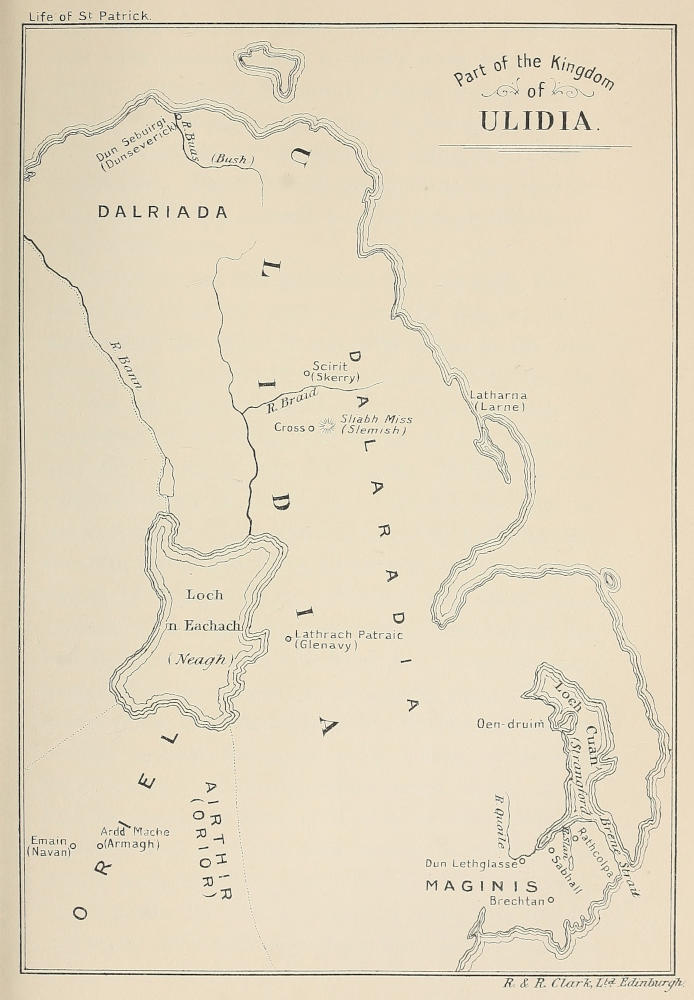
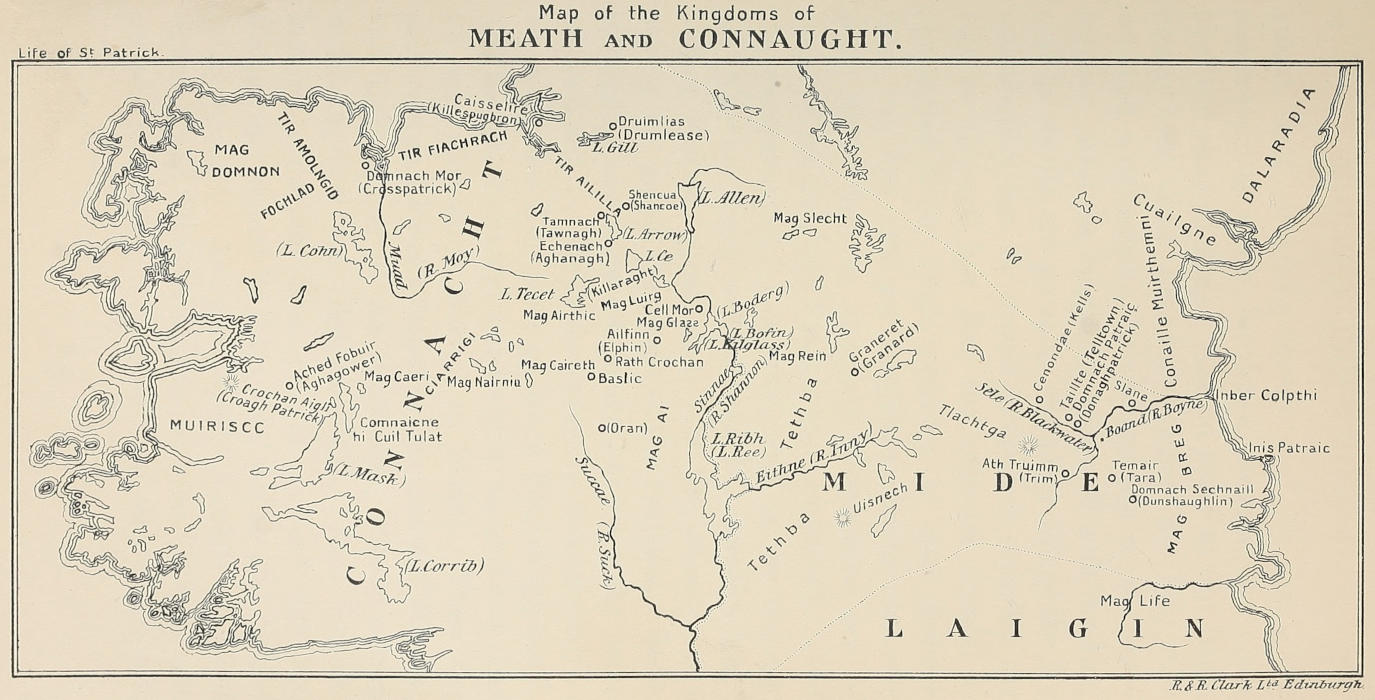
The two maps are merely intended to help the
reader to see the whereabouts of some places
which he might not easily find without reference to
the Ordnance Survey. I consulted Mr. Orpen’s
valuable map of Early Ireland (unfortunately on a
small scale) in Poole’s Historical Atlas of Modern
Europe. But he has used material which applies to
a later period, and I have not ventured to follow
him, for instance, in marking the boundary between
the northern frontiers of the kingdoms of Connaught
and Meath.
It was fortunate for me that my friend Professor
Gwynn was engaged at the same time on a
“diplomatic” edition of the records contained in
the Codex Armachanus, which constitute the
principal body of evidence. With a generosity
which has placed me under a deep obligation, he
put the results of his labour on the difficult text at
my disposal, and I have had the invaluable help and
stimulus of constant communication with him on
many critical problems arising out of the text of
the documents.
Since the book was in type I have received some
communications from my friend Professor Rhŷs
which suggest a hope that the mysterious Bannauenta,
St. Patrick’s home, may perhaps be
identified at last. I had conjectured that it should
be sought near the Severn or the Bristol Channel.
The existence of three places named Banwen
(which may represent Bannauenta) in Glamorganshire
opens a prospect that the solution may
possibly lie there.
CHAPTER I ON THE DIFFUSION OF CHRISTIANITY BEYOND THE ROMAN EMPIRE
The series of movements and wanderings, settlements
and conquests, which may be most fitly
described as the expansion of the German and
Slavonic races, began in the second century A.D.,
and continued for well-nigh a thousand years,
reshaping the political geography and changing
the ethnical character of Europe. The latest stage
in the process was the expansion of the northern
Germans of Scandinavia and Denmark, which led
to the settlements of the Vikings and Danes in the
west and to the creation of the Russian State by
Swedes in the east. The general movement of
European history is not grasped if we fail to recognise
that the invasions and conquests of the
Norsemen which began towards the close of the
eighth century are the continuation of the earlier
German expansion which we are accustomed to
designate as the Wandering of the Peoples. It
was not till this last stage that Ireland came within
range of this general transformation, when, in the
ninth century, Teutonic settlements were made on
her coasts and a Teutonic kingdom was formed
within her borders. Till then she had escaped the
stress of the political vicissitudes of Europe. But,
four centuries before, a force of another kind had
drawn her into union with the continent and made
her a part of the Roman world, so far as the Roman
world represented Christendom. Remaining still
politically aloof, still impervious to the influence of
higher social organisation, the island was swept
into the spiritual federation, which, through the act
of Constantine, had become closely identified with
the Roman State. This was what the Roman
Empire did for Ireland, not directly or designedly,
but automatically, one might say, through the
circumstances of its geographical position. The
foundation of a church in Ireland was not accomplished
till the very hour when the Empire was
beginning to fall gradually asunder in the west;
and so it happens that when Europe, in the fifth
century, is acquiring a new form and feature, the
establishment of the Christian faith in the outlying
island appears as a distinct, though modest, part of
the general transformation. Ab integro saeclorum
nascitur ordo, and Ireland, too, has its small place
in the great change.
PROGRESS OF CHRISTIANITY
To understand the conversion of Ireland, which
we are here considering as an episode in the history
of Europe, we must glance at the general conditions
of the early propagation of the Christian idea.
It would not be easy to determine how much
Christianity owes to the Roman Empire, and we
can hardly imagine what the rate and the mode of
its progress through southern and western Europe
would have been if these lands had not been united
and organised by the might of Rome. It is perhaps
not an exaggeration to say that the existence of the
Empire was a condition of the success of a universal
religion in Europe; and it is assuredly true that the
hindrances which the Roman Government, for two
centuries and a half, opposed to its diffusion, by
treating it as the one foreign religion which could
not be tolerated by the State, were more than compensated
by the facilities of steady and safe intercourse
and communication, which not only helped
the new idea to travel, but enabled its preachers
and adherents to organise their work and keep in
constant touch with one another.
The manner in which this faith spread in the
west, and the steps in its progress, are entirely
hidden from us; we can only mark, in a general
way, some stages in the process.[2] We know that
there were organised communities in Gaul in the
second century, and organised communities in
Britain at the end of the third; but in neither of
these countries, it would seem, did the religion begin
to spread widely till after its official recognition by
the Emperor Constantine. At the end of the fourth
century there were still large districts in Gaul,
especially in the Belgic provinces, which were
entirely heathen. In this respect Gaul and Britain
present a notable contrast to the other great Atlantic
country of the Empire. In the Spanish peninsula
Christianity made such rapid strides, and the
Spaniards adapted it so skilfully to their pagan
habits, that before the time of Constantine Spain
had become, throughout its length and breadth, a
Christian land.
CAPTIVES
It could not be expected that, while there were
still within the Roman frontiers many outlying districts
where the new religion had not penetrated,
the western churches could conceive the design of
making any systematic attempt to convert the folks
who lived beyond the borders of the Empire. The
first duty of the bishops of Gaul and the bishops of
Britain, if they undertook any missionary work, was
to extend their faith in the still heathen parts of
their own provinces. The single conspicuous case
in which it reached a northern people, independent
of the Empire, is significant, for it exhibits the kind
of circumstances which helped this religion to travel.
The conversion of the West Goths in Dacia was not
inaugurated by any missionary zeal on the part of
the Church, but came to pass through the means of
Christian captives whom the people had carried off
in their invasions of Asia Minor in the middle of the
third century. The “apostle” Wulfilas, whose work
led to the general conversion of the Goths, sprang
from a Cappadocian family which had thus been led
into captivity, and had lived for two generations in
Gothic land. Gothic in spirit and sentiment, as he
was Gothic in name, he devoted himself to spreading
the gospel of the Christians among his people. His
work was recognised and supported at Constantinople,
but the fact remains that the conversion of
the Goths was due to the hostilities which had
brought Christian captives to their land, and not
to missionary enterprise of the Church. The part
which captives played in diffusing a knowledge of
their religion is, in this instance, strikingly exemplified.
The conversion of the kingdom of Iberia
under Mount Caucasus is another case. The story
that it became Christian in the reign of Constantine
through the bond-slave Nino, who is still revered
there as the “enlightener and apostle of Georgia,”
rests upon evidence only two generations later, and
must have a foundation in fact.[3] And even if the
tale is not accepted literally, its existence illustrates
the important part which Christian captives played
in the diffusion of their creed. This is expressly
observed by the author of the treatise On the Calling
of the Gentiles. “Sons of the Church led captive
by enemies made their masters serve the gospel of
Christ, and taught the faith to those to whom the
fortune of war had enslaved them.”[4]
The same nameless writer, who composed his
work in the fifth century, notices another channel
by which knowledge of his religion was conveyed
to the barbarians. Foreign soldiers, who enlisted
in the army of the Empire, sometimes came under
Christian influences in their garrison stations, and
when they returned to their own homes beyond the
Imperial frontier they carried the faith with them.[5]
That the silent and constant intercourse of commerce
was also a means of propagation beyond the
limits of the Empire cannot be doubted, though
commercial relations and conditions in ancient and
mediaeval history are among the hardest to realise
because ancient and mediaeval writers never thought
of describing them. The foundation of the Abyssinian
church, however, exhibits the part which merchants,
as well as the part which captives, might take in
propagating a religious faith; and fortunately we
possess an account which was derived directly from
one of the captives who was concerned in the
matter.[6]
A party of Greek explorers who had been sailing
in southern seas landed on the coast of Abyssinia
and were slaughtered by the natives, with the exception
of two youths who were spared to become slaves
of the king. One served him as cup-bearer, the
other, whose name was Frumentius, as secretary;
and after the king’s death his son’s education was
entrusted to these two men. Frumentius used his
influence to help the Roman merchants who traded
with Abyssinia to found a Christian church. He
was afterwards permitted to return to his own
country, but he resolved to dedicate his life
to the propagation of Christianity in Abyssinia,
and having been consecrated by Athanasius at
Alexandria as Bishop of Axum, the Abyssinian
capital town, he returned thither to foster the new
church.
TRADERS
This course of events illustrates both the way in
which captives helped to spread Christianity abroad,
and also how the intercourse of trade could lead to
the planting of Christian communities in lands outside
the Empire. It illustrates the fact that up to
the sixth century the extension of that faith to the
barbarians was not due to direct efforts or deliberate
design on the part of the Church, but to chapters of
accidents which arose through the relations, hostile
and pacific, of the Empire with its neighbours.
The “mission” to the Gentiles was, in practice,
limited by the Church to the Roman world, though
the heads of the Church were always ready to recognise,
welcome, and affiliate Christian communities
which might be planted on barbarian ground by the
accidents of private enterprise.
PRESTIGE OF ROME
It was only after the Roman Empire had become
officially Christian through the memorable decision
of Constantine, that the conversion of neighbouring
states (with the striking exception of Armenia)[7]
really began; just after that change the victorious
religion began to spread generally in Gaul and Britain.
The work of Frumentius and the work of Wulfilas
were alike subsequent to the revolution of Constantine.
It would be difficult to estimate how great
was the impetus which this religion derived, for the
acceleration of its progress, from its acceptance by
the head of the Roman State. But while it is
evident that the Church gained immeasurably within
the Empire by her sudden exaltation, it is perhaps
generally overlooked how her changed position aided
Christianity to pass out beyond the Empire’s
borders. We touch here on a fact of supreme
importance—not less important, but more likely to
escape notice, because it cannot be stated in terms
of definite occurrences:—the enormous prestige
which the Roman Empire possessed in the minds of
the barbarian peoples who dwelt beyond it. The
observant student who follows with care the history
of the expansion of Germany and the strange
process by which the German kingdoms were established
within the Empire in western Europe, is
struck at every step by the profound respect which
the barbarians evinced for the Empire and the
Roman name throughout all their hostilities and
injuries. While they were unconsciously dismembering
it, they believed in its impregnable stability;
Europe without the Empire was unimaginable; the
dominion of Rome seemed to them part of the
universal order, as eternal as the great globe itself.
If we take into account this immeasurable reverence
for Rome, which is one of the governing psychical
facts in the history of the “wandering of the
nations,” we can discern what prestige a religion
would acquire for neighbouring peoples when it
became the religion of the Roman people and the
Roman State. We can understand with what different
eyes the barbarians must have regarded
Christianity when it was a forbidden and persecuted
doctrine and when it was raised to be a State
religion. It at once acquired a claim on their attention;
it was no longer merely one among many
rival doctrines current in the Empire. Considerations
of political advantage came in; and political
motives could sway barbarians, no less than
Constantine himself, in determining their attitude
to a religious creed. And the fact that the Christian
God was the God of that great Empire was in itself
a persuasive argument in his favour. Could a
people find any more powerful protector than the
Deity who was worshipped and feared by the
greatest “nation” on earth? So it seemed to the
Burgundians, who embraced the Roman religion, we
are told,[8] because they conceived that “the God of
the Romans is a strong helper to those who fear
Him.” The simple barbarians did not reason too
curiously. It did not occur to them that the
Eternal City had achieved her greatness and built
her empire under the auspices of Jupiter and Mars.
There can be little doubt that, if the step taken by
Constantine had been postponed for a hundred
years, we should not find the Goths and the Vandals
professing Christianity at the beginning of the fifth
century.
IRELAND NOT ISOLATED
Among the independent neighbours of the
Roman Empire, Ireland occupies a singular place
as the only part of the Celtic world which had not
been gathered under the sceptre of Rome.[9] It may
be suspected that an erroneous opinion is prevalent,
just because it lay outside the Empire, that this
outlying island was in early times more separate
and aloof from Europe than its geographical position
would lead us to suppose. The truth is that
we have but lately begun to realise the frequency
and prevalence of intercourse by sea before historical
records begin. It has been but recently brought
home to us that hundreds and hundreds of years
before the Homeric poems were created, the lands
of the Mediterranean were bound together by
maritime communication. The same thing is true
of the northern seas at a later period. It is absurd
to suppose that the Celtic conquerors of Britain and
of Iverne burned their ships when they had reached
the island shores and cut themselves off from intercourse
with the mainland from which they had
crossed. And we may be sure that it was not they
who first established regular communications. We
may be sure that the pre-Celtic peoples of south
Britain and the Ivernians, who gave its name to
Ireland, knew the waterways to the coasts of the
continent. The intimate connexion of the Celts of
Britain with their kinsfolk across the Channel is
amply attested in Caesar’s history of the conquest
of Gaul; and in the ordinary histories of Britain
the political connexion, which even took the shape
of a Gallo-British kingdom, has hardly been duly
emphasised. Ireland was further, but not far.
Constant relations between this island and Britain
were inevitable through mere proximity, but there
is no doubt that regular communication was also
maintained with Gaul[10] and with Spain. Whatever
weight may be allowed to the Irish semi-mythical
traditions which point to ancient bonds between
Ireland and Spain—and in judging them we must
remember that the Ivernians are of the same
Mediterranean race as the Iberians—it is, for the
Celtic period, highly significant to find Roman
geographers regarding Ireland as midway between
Spain and Britain,[11] a conception which seems to
point unmistakably to direct intercourse between
Irish and Spanish ports. But the trade of Ireland
with the Empire is noticed by Tacitus,[12] and is
illustrated by the knowledge which Romans could
acquire of its geography. Ptolemy, in the second
century, gives an account of the island, which,
disfigured though it is, and in many parts
undecipherable through the corruption of the place-names,
can be tested sufficiently to show that it is
based upon genuine information.
IRELAND AND BRITAIN
It does not surprise us that in our Roman records
we hear no syllable of any relations with Ireland,
when we remember how meagre and sporadic are the
literary records of Roman rule in Britain from the
time of Domitian to the premature close. We know,
indeed, that at the very outset the question had
been considered whether Ireland should be occupied
or not. A general of Domitian thought the conquest
ought to be attempted, but the government
decided against his opinion.[13] The question has been
asked why the Romans never annexed it? The
answer is simple. After the time of Augustus no
additions were made to Roman dominion except
under the stress of political necessity. Britain was
annexed by the generals of Claudius for the same
reason which prompted Julius to invade it,—political
necessity, arising from the dangerously close bonds
which united the Britons with the Gauls. The
inference is that in the case of Ireland there was no
such pressing political necessity. The Goidels of
Ireland were a different branch of the Celtic race,
and the Britons could find in Ireland no such
support as the Gauls found in Britain. This
explanation accords with the fact that till the middle
of the fourth century the Irish or Scots are not
named among the dangerous invaders of the British
province; they are not named at all.
But it would be a false inference from this
silence to suppose that the government in Britain
had not to take political account of their western
neighbours. Ireland was well on the horizon of
the Roman governors, and Irish affairs must from
time to time have claimed their attention. The
exile, of whom Agricola made much, was not, we
might surmise, the last Irish prince who sought in
Britain a refuge from enemies at home. But one
important measure of policy has escaped oblivion,
though not through Roman records. In the third
century, it would seem, an Irish tribe which dwelled
in the kingdom of Meath was driven from its land.
The name of this tribe, the Dessi, still lives in their
ancient home—the district of Deece.[14] Some of
them migrated southward to the lands of the Suir
and the Blackwater, where their name likewise
survives in the districts of Decies.[15] But others
sought new abodes beyond the sea, and they settled
largely in South Wales. The migration of the
Dessi rests on the records of Irish tradition, but it
is confirmed by the clear evidence of inscribed
stones which attest the presence of a Goidelic
population in south-western Britain. Here we have
to do with an act of policy on the part of the
Roman Government similar to the policy pursued
in other parts of the Empire. A foreign people was
allowed to settle, perhaps under certain conditions
of military service,[16] on the south-western sea-board.
Nor need these Goidelic settlers have consisted only
of the Dessi, or the settlements have all been made
at one time, and there seem to have been other
settlements in Somerset, Devonshire, and Cornwall.[17]
IRELAND AND THE EMPIRE
General considerations, then, supported by
particular fragments of evidence which exist, would
prepare us to learn, as something not surprising, but
rather to be expected, that, by the end of the fourth
century, Christians, and some knowledge of the
Christian worship, should have found their way to
the Irish shores. Beyond the regular intercourse
with Britain, Gaul, and Spain there was the special
circumstances of the Irish settlements in south-west
Britain—a highroad for the new creed to travel;[18]
and the great invasion in the middle of the fourth
century, which will be mentioned in the next
chapter, must have conveyed Christian captives to
Ireland. In the conversion of this island, as elsewhere,
captives played the part of missionaries. It
will not then amaze us to find, when we reach the
fifth century, that men go forth from Ireland to be
trained in the Christian theology. It will not
astonish us to learn that Christian communities
exist which are ripe for organisation, or to find this
religion penetrating into the house of the High
Kings. We shall see reasons for supposing that
the Latin alphabet had already made its way to
Ireland,[19] and the reception of an alphabet generally
means the reception of other influences from the
same source.[20] For the present it is enough to
have brought the relations of the Empire to Ireland
somewhat into line with its relations to other independent
neighbours.
CHAPTER II THE CAPTIVITY AND ESCAPE OF PATRICK — § 1. Parentage and Capture — § 2. Captivity and Escape
The conversion of Ireland to Christianity has, as we
have seen, its modest place among those manifold
changes by which a new Europe was being formed
in the fifth century. The beginnings of the work
had been noiseless and dateless, due to the play of
accident and the obscure zeal of nameless pioneers;
but it was organised and established, so that it
could never be undone, mainly by the efforts of one
man, a Roman citizen of Britain, who devoted his
life to the task.
HOME OF PATRICK
The child who was destined to play this part in the
shaping of a new Europe was born before the close
of the fourth century, perhaps in the year 389 A.D.
His father, Calpurnius, was a Briton; like all free
subjects of the Empire, he was a Roman citizen;
and, like his father Potitus before him, he bore a
Roman name. He belonged to the middle class of
landed proprietors, and was a decurion or member
of the municipal council of a Roman town. His
home was in a village named Bannaventa, but
we cannot with any certainty identify its locality.[21]
The only Bannaventa that we know lay near
Daventry, but this position does not agree with an
ancient indication that the village of Calpurnius was
close to the western sea. As the two elements of
the name Bannaventa were probably not uncommon
in British geographical nomenclature, it is not a rash
assumption that there were other small places so
called besides the only Bannaventa which happens
to appear in Roman geographical sources, and we
may be inclined to look for the Bannaventa of
Calpurnius in south-western Britain, perhaps in the
regions of the lower Severn. The village must
have been in the neighbourhood of a town possessing
a municipal council of decurions, to which
Calpurnius belonged. It would not be right to infer
that it was a town with the rank of a colonia, like
Gloucester, or of a municipium, like St. Albans;
for smaller Roman towns, such as were technically
known as praefecturae, fora, and conciliabula, might
be managed by municipal councils.[22]
To be a decurion, or member of the governing
council, of a Roman town in the days of Calpurnius
and his father was, throughout the greater part of
the Roman dominion, an unenvied dignity. Every
landowner in a municipality who did not belong
to the senatorial class was obliged to be a decurion,
provided he possessed sixteen acres or upwards;
and on these landowners the chief burden of
imperial taxation fell. They were in this sense
“the sinews of the republic.” They were bound
to deliver to the officials of the imperial treasury
the amount of taxation levied upon their community;
it was their duty both to collect the tax
and to assess the proportion payable by the
individual proprietor. In the fourth century, while
the class of great landed proprietors, who were
mainly senators and entirely free from municipal
obligations, was increasing, the class of small
landowners diminished in numbers and declined in
prosperity. This decline progressed rapidly, and
the imperial laws which sought to arrest it
suggest an appalling picture of economic decay
and hopeless misery throughout the provinces.
The evils of perverse legislation were aggravated
by the corruption and tyranny of the treasury
officials, which the Emperors, with the best
purposes, seemed powerless to prevent. Men
devised and sought all possible means of escaping
from the sad fate of a decurion’s dignity. Many
a harassed taxpayer abandoned his land, surrendered
his freedom, and became a labourer on
the estate of a rich landlord to escape the miseries
of a decayed decurion’s life. We find the Emperor
Maxentius punishing Christians by promoting them
to the dignity of a decurion.
It is unknown to us whether the municipal
classes in Britain suffered as cruelly as their
brethren in other parts of the Empire. The
history of this island throughout the last century
of Roman rule is almost a blank. It would be
hazardous to draw any inferences from the agricultural
prosperity of Britain, whose corn-fields,
notwithstanding the fact that large tracts of land
which is now under tillage were then woodland,
sometimes supplied the Roman legions on the
Rhine with their daily bread. But it is possible,
for all we know, that members of the British
municipalities may have enjoyed a less dreary lot
than the downtrodden decurions of other provinces.
DECURIONS
There was one class of decurions which seems
to have caused the Emperors considerable perplexity.
It was those who, whether from a
genuine religious motive or in order to shirk the
municipal burdens, took orders in the Christian
Church. A pagan Emperor like Julian had no
scruple in recalling them sternly to their civil
duties, but Christian Emperors found it difficult
to assert such a principle. They had to sustain
the curial system at all costs, and yet avoid
giving offence to the Church. Theodosius the
Great laid down that the estates of decurions
who had become presbyters or deacons before
a certain year should be exempt from municipal
obligations, but that those who had taken orders
after that year should forfeit their lands to the State.
He qualified this law, however, by a later enactment,
which provided that if the presbyter or
deacon had a son who was not in orders, the son
might keep the paternal property and perform
the accompanying duties.
Now Calpurnius belonged to this class of
decurions who had sought ordination. He was
a Christian deacon, and his father before him
had been a Christian presbyter. And it would
seem as if they had found it feasible to combine
their spiritual with their worldly duties. In any
case, we may assume that the property remained
in the family; it was not forfeited to the State.
INVASIONS OF BRITAIN
Whether the burdens laid upon them from Milan
or Constantinople were heavy or light, Calpurnius
and his fellows in the northern island were keenly
conscious that the rule of their Roman lords had
its compensations. For Britain was beset by
three bold and ruthless foes.[23] The northern
frontier of the province was ever threatened by
the Picts of Caledonia. Her western shores
dreaded the descents of the Gaels and Scots of
Ireland, while the south and east were exposed
to those Saxon freebooters who were ultimately
to conquer the island. Against these enemies,
ever watching for a favourable opportunity to
spoil their rich neighbour, the Roman garrison
was usually a strong and sure protection for the
peaceful Britons. But favourable opportunities
sometimes came. Potitus, at least, if not
Calpurnius, must have shared in the agonies
which Britain felt in those two terrible years
when she was attacked on all sides, by Pict,
by Scot, and by Saxon, when Theodosius, the
great Emperor’s father, had to come in haste and
put forth all his strength to deliver the province
from the barbarians. In the valley of the Severn
the foes whom men had to dread now were Irish
freebooters, and we need not doubt that in those
years their pirate crafts sailed up the river and
brought death and ruin to many. Theodosius
defeated Saxon, Pict, and Scot, and it would
seem that he pursued the Scots across the sea,
driving them back to their own shores. The Court
poet of his grandson sings how icebound Hiverne
wept for the heaps of her slain children. After
this, the land had peace for a space. Serious and
thoroughgoing measures were taken for its defence,
and an adequate army was left under a capable
commander. Men could breathe freely once more.
But the breathing space lasted less than fifteen
years. The usurpation of the tyrant Maximus
brought new calamities to Britain. Maximus
assumed the purple (A.D. 383) by the will of the
soldiers, who were ill-satisfied with the government
of Gratian; and if the provincials approved of this
rash act, they perhaps hoped that Maximus would
be content with exercising authority in their own
island. But even if Maximus did not desire a
more spacious field for his ambition, such a course
was perhaps impracticable. It would have been
difficult for any usurper to maintain himself, with
the adhesion of Britain alone, against the power
of the lord of the West. Probably the best chance
of success, the best chance of life, for the tyrant
lay in winning Gaul. And so Maximus crossed
the Channel, taking the army, or a part of it, with
him. His own safety was at stake; he recked
not of the safety of the province; and whatever
forces he left on the shores and on the northern
frontier were unequal to the task of protecting the
island against the foes who were ever awaiting
a propitious hour to pounce upon their prey.
Bitterly were the Britons destined to rue the
day when Maximus was invested with the purple.
Denuded of defenders, they had again to bear the
inroads of Pict, Saxon, and Scot. Rescue came
after the fall of Maximus (A.D. 388), and the son
of their former defender, the Emperor Theodosius,
empowered his most trusted general, Stilicho, to
make all needed provision for the defence of
the remote province. The enemies seem to
have escaped, safe and sated, from the shores of
Britain before the return of the army; no fighting
devolved on Stilicho; he had only to see to works
of fortification and defence. But it was high time
for legions to return; Britain, says a contemporary
poet, was well-nigh done to death.
BIRTH OF PATRICK
The woes and distresses of these years must
have been witnessed and felt by Calpurnius and his
household, and they must have experienced profoundly
the joy of relief when their country was
once more defended by an adequate army. It was
probably just before or just after this new period
of security had begun that a son was born to
Calpurnius and his wife Concessa.[24] It may have
been the habit of the native provincials to give their
children two names, a Latin name, which stamped
them as Romans, as well as a British name, which
would naturally be used in home life. Calpurnius
called his son Patricius.[25] But if Patricius talked as
a child with his father and mother the Brythonic
tongue of his forefathers, he bore the name of Sucat.
He was thus double-named, like the Apostle Paul,
who bore a Roman as well as a Jewish name from
his youth up.[26] But another Roman name, Magonus,
is also ascribed to Patrick; and possibly his full
style—as it would appear in the town registry when
he should come of age to exercise the rights of a
citizen—was Patricius Magonus Sucatus. Such a
name would be strictly analogous to that of
a Roman historian of Gothic family who lived in a
later generation, Renatus Profuturus Frigeridus.[27]
As the son of a deacon, Patrick was educated in
the Christian faith, and was taught the Christian
scriptures. And we may be sure that he was
brought up to feel a deep reverence for the Empire
in which he was born a freeman and citizen, and to
regard Rome as the mighty bulwark of the world—
qua nihil in terris complectitur altius aether.
This feeling comes out in his writings; it may have
been strengthened by the experiences of his life, but
the idea must have been with him from his very
cradle. Peaceful folk in Britain in those days could
have imagined no more terrible disaster than to be
sundered from the Empire; Rome was the symbol
of peace and civilisation, and to Rome they passionately
clung. The worst thing they had to dread
from year to year was that the Roman army should
be summoned to meet some sudden need in another
province.
But as Patrick grew up, the waves were already
gathering, to close slowly over the island, and to
sweep the whole of western Europe. The great
Theodosius died, and his two feeble successors
slumbered at Milan and Constantinople, while along
all the borders, or even pressing through the gates,
were the barbarians, armed and ready, impressed by
the majesty of Rome, but hungry for the spoils of
the world. Hardly was Theodosius at rest in his
tomb when Greece was laid waste by the Goths,
and Athens trembled at the presence of Alaric. But
men did not yet realise, even in their dreams, the
strange things to come, whereof this was the menace
and the presage. When the rumour of Alaric and
his Goths reached the homesteads of Britain, it
must have struck men’s ears as a thing far off, a
trouble in which they could have no part. And the
danger that stole upon the Empire was muffled and
disguised. Alaric was a Goth, but at the same time
he was an imperial general, a Master of Soldiers, a
servant of the Roman State, profoundly loyal to the
Empire, the integrity of which he was undermining.
A few years later Britain was startled by sudden
tidings. Alaric and his Goths had entered Italy
itself; the Emperor Honorius was trembling on his
throne, and the armies of the west must hasten to
defend him. The message came from Stilicho, the
general on whose strength and craft the safety of
western Europe in these years depended, and one
Britannic legion obeyed the summons to Italy.
The islanders must again have been sick at heart
in daily expectation of the assaults of their old
enemies.
KING NIALL’S INVASION
Those enemies were not asleep, and they rose
up presently to take advantage of the favourable
time. At this point we encounter an Irish king,
whose name is famous in the obscure history of his
own land. King Niall was the High-king of
Ireland in the days of the rebellion of Maximus,
and may possibly have joined in the marauding
expeditions which vexed Britain during those years.
His deeds are enveloped in legend, but the exalted
notion which his countrymen formed of his prowess
is expressed in the vain tale that he invaded Gaul
and conquered as far as the Alps. To the annals
of the Empire king Niall is as unknown as the
princelings of remotest Scythia, but in Britain his
name must have been a familiar word. The tradition
that he died out of his own country, but slain
by the hand of a fellow-countryman, can hardly fail
to be founded on fact; and when the Irish annals
tell us that he met his death “by the Sea of Wight,”
there is nothing in the circumstances of the time
which forbids us to believe the record. If the date
assigned to his death, A.D. 405, is roughly correct,
this last hosting of Niall was made before the
Roman army had finally left the island, but during
the disorders which preceded its departure.
It may have been at this crisis[28] in the history of
Britain that the event happened which shaped the
whole life of the son of Calpurnius, who had now
reached the age of sixteen, in his home near the
western sea. A fleet of Irish freebooters came to
the coasts or river-banks in the neighbourhood seeking
plunder and loading their vessels with captives.
Patrick was at his father’s farmstead, and was
one of the victims. Men-servants and maid-servants
were taken, but his parents escaped; perhaps they
were not there, or perhaps the pirates could not
carry more than a certain number of slaves, and
chose the young.
Thus was Patrick, in his seventeenth year, carried
into captivity in Ireland—“to the ultimate places of
the earth,” as he says himself, as if Ireland were
severed by half the globe from Britain. The
phrase shows how thoroughly, how touchingly
Roman was Patrick’s geographical view. The
Roman Empire was the world, and all outside its
fringe was in darkness, the ultimate places of the
earth.
CAPTURE OF PATRICK
Of all that befell Patrick during his captivity in
Ireland we know little, yet the little knowledge we
possess is more immediate and authentic than our
acquaintance with any other episode of his life,
because it comes from his own pen. But at the
outset we encounter a puzzling contradiction between
Patrick’s own words and the tradition which was
afterwards current in Ireland as to the place of his
bondage.[29]
When the boats of his captors reached their
haven, Patrick was led—so we should conclude
from his own story—across the island into the
kingdom of Connaught, to serve a master in the
very furthest parts of the “ultimate land.” His
master dwelled near the wood of Fochlad, “nigh to
the western sea,” in north-western Connaught, to
this day a wild and desolate land, though the forest
has long since been cleared away. A part of this
bleak country belonged to Amolngaid, who afterwards
became king of Connaught, and it is still
called by his name, Tirawley, “the land of Amolngaid.”
But the wood of Fochlad was probably of
larger extent than the district of Tirawley; it may
have stretched over Mayo to the western promontory
of Murrisk. Here, we should perhaps suppose,
close to Crochan Aigli, the mount which has been
immemorially associated with Patrick’s name,[30] the
British slave served his master for six years.
But our other records transport us to a distant
part of Ireland, far away from the forest of Fochlad,
to Pictish soil near the eastern coast of Ulster.
Here in the lands east of Lough Neagh, the old
race, driven eastward from central Ulster, still held
out. The name Ulaid, which originally designated
the whole of northern Ireland—even as now in its
Danish form of Ulster—had come to be specially
applied to the eastern corner, whither the true
Ulidians had been driven. It seemed now to be
the true Ulaid. Within the borders of Ulidia, in this
restricted sense, there was a marked division. In
the extreme north were the Scots, and in the south
were the Picts. The small land of the Scots was
known as Dal-riada, and the larger land of the
Picts as Dal-aradia.[31] It is supposed that both
peoples, those known as Scots and those known as
Picts, represented the older races, which possessed
Ireland before the coming of the Goidelic invaders,
whose language ultimately prevailed throughout the
whole island.
PLACE OF CAPTIVITY
Here, it was believed and recorded, Patrick
served a master whose name was Miliucc. His
lands and his homestead were in northern Dalaradia,
and Patrick herded his droves of pigs on
Mount Miss. The name of this mountain still
abides unchanged, though by coalescing with sliabh,
the Gaelic word for “mountain,” it is slightly disguised
in the form Slemish. Not really lofty, and
not visible at a distance of many miles, yet, when
you come within its range, Mount Miss dominates
the whole scene and produces the impression of
a massive mountain. Its curious, striking shape,
like an inverted bowl, round and wide-brimmed,
exercises a sort of charm on the eye, and haunts
one who is walking in the valley of the Braid,
somewhat as the triangular form of Pentelicus,
clear-cut like the pediment of a temple, follows one
about in the plain of Athens.
It was in this valley of the Braid and on the
slopes of Miss that, according to the common
tradition and general belief, Patrick for six years
did the bidding of his lord.[32] But it is certain,
from his own words, that he served near the
forest of Fochlad. An attempt may be made
to reconcile the contradiction by assuming that
he changed masters, and that, having dwelled at
first in the west, he was sold to another master
in Dalaradia;[33] but his own description of his bondage
seems hardly compatible with such a conjecture.
The simplest solution seems to be a frank rejection
of the story which connected his captivity with
Mount Miss in the land of the Picts.
While he ate the bitter bread of bondage in a
foreign land, a profound spiritual change came
over him. He had never given much thought to
his religion, but now that he was a thrall amid
strangers, “the Lord,” he says, “opened the sense
of my unbelief.” The ardour of religious emotion,
“the love and fear of God,” so fully consumed his
soul that in a single day or night he would offer a
hundred prayers; and he describes himself, in
woodland or on mountain-side, rising from his bed
before dawn and going forth to pray in hail, or rain,
or snow.
His contemplation was above the earth,
And fixed on spiritual object.
Thus the years of his bondage were also the years
of his “conversion,” and he looked back upon this
stage in his spiritual development as the most important
and critical in his life.
THE ESCAPE
But he was homesick, and he was too young to
abandon hope of deliverance and escape from the
wild outland into which fate had cast him. He
longed and hoped, and we may be sure that he
prayed, to win his way back within the borders
of the Roman Empire. His waking hopes came
back to him at night as responsive voices in his
dreams. He heard a voice that said to him in his
sleep, “Thou doest well to fast; thou shalt soon
return to thy native land.” And another night it
said, “Behold, thy ship is ready.” Patrick took
these dream-voices for divine intimations, and they
heartened him to make an attempt to escape.
Escape was not easy, and was beset with many
perils. For the port where he might hope to find
a foreign vessel was about a hundred and eighty
miles from his master’s house. Patrick, in describing
his escape, does not name the port, but
we may conjecture that it was Inver-dea, at the
mouth of the stream, which is now called the Vartry,
and reaches the sea near the town of Wicklow.
The resolution of attempting this long flight, with
the danger of falling into the hands of some other
master, if not of being overtaken by his own, is
ascribed by Patrick to the promptings of a higher
will than his. He escaped all dangers and
reached the port, where he knew no man. But at
all events he had chosen the season of his flight
well. The ship of his dreams was there, and was
soon to sail. It was a ship of traders; their cargo
was aboard, and part of the cargo consisted of
dogs, probably Irish wolf-hounds. Patrick spoke
to some of the crew, and made a proposal of service.
He was willing to work his passage to the port to
which the vessel was bound. The proposal seems
to have been at first entertained, but afterwards
the shipmaster objected, and said sharply, “Nay,
in no wise shalt thou come with us.” The disappointment,
as safety seemed within grasp, must
have been bitter, and Patrick turned away from
the mariners to seek the lodging where he had
found shelter. As he went he prayed, and before
he finished his prayer he heard one of the crew
shouting behind him, “Come quickly, for they are
calling you.” The shipmaster had been persuaded
to forego his objections, and Patrick set sail from
the shores of Ireland with this rough company.
To what country or race the crew belonged we
are not told; we learn only that they were heathen.
They wished to enter into some solemn compact
of abiding friendship with Patrick, but he refused
to be adopted by them. “I would not,” he says,
using a quaint phrase,[34] “suck their breasts because
of the fear of God. Nevertheless I hoped of them
that they might come to the faith of Christ, for they
were heathen, and therefore I held on with them.”
They sailed for three days before they made land.
The name of the coast which they reached is hidden
from us, and there is something very strange about
the whole story. The voyage was clearly uneventful.
They were not driven by storm or stress
of weather out of their course to some undesired
shore. There is nothing in the tale, as Patrick
tells it himself, to suggest that the ship did not
reach the port to which it was bound. Yet when
they landed, their way lay through a desert, and
they journeyed through the desert for eight and
twenty days in all. Their food ran short, and at
last starvation threatened them; many of their dogs
were exhausted and left to die on the wayside.
Then the shipmaster said to Patrick, “Now, O
Christian, thou sayest thy God is great and
almighty. Why then dost thou not pray for us?
For we are in danger of starvation, and there is
no likelihood of our seeing any man.” And Patrick,
in the spirit of the missionary, replied, “Nothing is
impossible to the Lord, my God. Turn to him
truly, that he may send you food in your path this
day till ye are filled, for he has plenty in all places.”
Presently a drove of pigs appeared on the road, and
the starving wayfarers killed many, and rested there
two nights, and were refreshed. They were as
ready as Patrick himself to believe that the appearance
of the swine was a miraculous answer to his
prayer, and he won high esteem in their eyes.
As Patrick slept here, his body satisfied, after
long privation, by a plenteous meal, he had a dream,
which he remembered vividly as long as he lived.
He dreamed that a great stone fell upon him, and
that he could not move his limbs. Then he called
upon Elias,[35] and the beams of the rising sun awoke
him, and the feeling of heaviness fell away. Patrick
regarded this nightmare as a temptation of Satan,
and imagined that Christ had come to his aid.
The incident has a ridiculous side, but it shows
the intense religious excitement of Patrick at this
period, ready to see in the most trivial occurrence
a direct interposition from heaven; and we must
remember how in those days dreams were universally
invested with a certain mystery and dread.
For nine days more Patrick and his companions
travelled through deserted places, but were not in
want of food or shelter; on the tenth they came to
the habitations of men. Patrick had no thoughts
of remaining with them longer than he needed. He
had heard in a dream a divine voice answering his
thoughts and saying, “Thou shalt remain with
them two months.” This dream naturally guided
him in choosing the time of his escape. At the end
of two months he succeeded in releasing himself
from his masters.
JOURNEY IN GAUL
In his description of this strange adventure he
leaves us to divine the geography as best we may,
for he relates it as if it had happened in some nameless
land beyond the borders of the known world.
But the circumstances enable us to determine that
the ship made for the coast of Gaul. It can be
shown that its destination was not Britain, and
Gaul is the only other land which could have been
reached in three days or thereabouts. The aim of
the traders with their Irish dogs must have been to
reach southern Europe, and the place of disembarkation
would naturally have been Nantes or Bordeaux.
The story of the long faring through a wilderness
might be taken to illustrate the condition of western
and south-western Gaul at this period.[36] For much
about the time at which Patrick’s adventures
happened, Gallic poets were writing heartbreaking
descriptions of the desolation which had been
brought upon this country by the great invasion of
Vandals and Sueves and other barbarous peoples.
The Vandals and Sueves had indeed already left
it to pass into Spain, but they had left it waste.
Strong castles, walled cities, sings one poet, could
not escape; the hands of the barbarians reached
even lonely lodges in dismal wilds and the very
caves in the hills. “If the whole ocean,” cries
another, “had poured its waters into the fields of
Gaul, its vasty waves would have spared more than
the invaders.”
But even in the exceptional conditions of the
time, it is surprising that a party, starting from a
port on the west coast and travelling to the Mediterranean,
should have walked for four weeks without
seeing a human abode and in dire peril of
starvation. We must suppose that they avoided,
deliberately and carefully, beaten roads, and perhaps
made considerable halts, in order to avoid encounters
with roaming bands of the Teutonic barbarians.
Though Patrick did not mention the scene of his
journey in the narrative which he left behind him,
he used to tell his disciples how he had “the fear of
God as a guide in his journey through Gaul and
Italy.” This confirms the conclusion, to which the
other evidence points, that Gaul was the destination
of the crew, and also intimates that he travelled with
his companions through Gaul to Italy. It was in
Italy, then, we must suppose, that he succeeded in
escaping from them.
The book in which he described this episode
was written by Patrick, as we shall see hereafter,
when he was an old man. He rigidly omitted all
details which did not bear upon his special purpose
in writing it. The whole tale of his captivity and
escape, undefined or vaguely defined by landmarks
or seamarks, as if the places of the adventures had
no name or lay beyond the range of all human
charts, is designed to display exclusively the
spiritual significance of those experiences. That
the land of his captivity was Ireland, this was indeed
significant; but otherwise names of men and places
were of no concern and might be allowed to drop
away. Patrick, in reviewing this critical period of
his life, reproduces the select incidents as they
impressed him at the moment, contributing, as he
believed, to his own spiritual development, or illustrating
the wonderful ways in which Heaven had
dealt with him.
CHAPTER III IN GAUL AND BRITAIN — § 1. At Lérins — § 2. At Home in Britain — § 3. At Auxerre — § 4. Palladius in Ireland ( A.D. 431-2) — § 5. Consecration of Patrick ( A.D. 432)
Patrick has not told us where, or in what circumstances,
he parted from his companions, nor has he
related his subsequent adventures. When he found
himself free his first thought would have been, we
should suppose, to make his way back to his home
in Britain. We saw that he probably succeeded in
escaping from his fellow-travellers in Italy, and his
easiest way home might in that case have been by
the coast road through Liguria and Provence to
Marseilles. From whatever quarter he started, he
seems to have reached the coast of Provence. For
here at length, amid perplexing, broken clues, we
have a definite trace of his path; here at length we
can fix an episode in his life to a small plot of
ground.
MONASTERY OF LERINUS
In the later part of the fourth century the influence
of the Eastern on the Western mind had displayed
itself not only in theological thought, but also
in the spread of asceticism and the foundation of
monastic societies, especially through the influence
of men like Ambrose, Martin of Tours, and Jerome.
In choosing their lonely dwelling-places, the eyes of
anchorets did not overlook the little deserted islands
which lay here and there off the coast in the western
Mediterranean. Island cloisters studded the coast
of Italy “like a necklace” before the end of the
fourth century, and soon they began to appear off
the coast of Provence. It was perhaps while Patrick
was a slave in Ireland that a traveller, weary of the
world, came back from the east to his native Gaul,
and, seeking a spot where he might found a little
society of monks who desired to live far from the
turmoil of cities, he was directed to the uncouth
islet of Lerinus, which no man tilled or approached
because it was infested by snakes. Honoratus took
possession of it and reclaimed it for cultivation.
Wells were dug, and sweet water flowed “in the
midst of the bitterness of the sea.” Vines were
planted and cells were built, and a little monastic
community gathered round Honoratus, destined
within a few years to be more illustrious than any
of the older island cloisters. Lerinus is the outermost
of the two islands which lie opposite to the
cape of Cannes, smaller and lower than its fellow
Lero, which screens it from view, bearing at the
present day the name of the man who made it significant
in history.[37] It is difficult to realise as one
walks round it to-day and sees a few stones, relics
of its ancient monks, that at one time it exercised
a great if unobtrusive influence in southern Gaul.
Its peaceful, sequestered cells, “withdrawn into the
great sea,” in mare magnum recedentia, had a
wonderful attraction for men who had been shipwrecked
in the tumbling world, or who desired
unbroken hours for contemplation—vacare et videre.
Patrick found a refuge in the island cloister of
Honoratus, and in that island we are for the first
time treading ground where we have reason to think
that he lived for a considerable time. We should
like to know the circumstances of his admission to
this community, but his own picture of the state of
his mind enables us to understand how easily he could
have been moved by the ascetic attractions of the
monastery to interrupt his homeward journey and
lead a religious life in the sacrae solitudines of
Lerinus for a few years.
Among the men of some note who sojourned in
the monastery in its early days was Hilary, who
afterwards became Bishop of Arelate; Maximus,
who was the second abbot, and then Bishop of Reii;
Lupus, who subsequently held the see of Trecasses;
Vincentius, who taught and wrote in the cloister;
and Eucherius, who composed, among other works,
a treatise in praise of the hermit’s life. Eucherius
had built a hut for himself and his wife Galla, aloof
from the rest of the brotherhood, in the larger
island of Lero. It was remembered how one day
Honoratus sent a messenger across in a boat with
a letter on a wax tablet, and Eucherius, seeing the
abbot’s writing, said, “To the wax you have restored
its honey.”
As the monastic spirit grew and spread, many a
stranger set his face to Lerinus, hoping, as men
hoped greatly in those days, that “he might
break through the wall of the passions and ascend
by violence to the kingdom of heaven.” Among
those who joined the new society was Faustus, a
compatriot of Patrick. But it is unknown whether
he was at Lérins at this time; perhaps he was still
only a child, for we first hear of him in the abbotship
of Maximus, who succeeded Honoratus,[38] and
whom he himself was destined to succeed.[39] Faustus
had enjoyed an education such as Patrick never
acquired. He was a student of ancient philosophy,
and a master of style, as style was then understood.
He was afterwards the valued friend and correspondent
of the greatest man of letters of that century,
Sidonius Apollinaris. Crude and rustic must Patrick
have seemed to his fellow-countryman, if they met
at Lérins. Yet to-day the name of Faustus has
passed out of men’s memory, and Patrick’s is familiar
in the households of western Christendom, and in
far-western Christendom beyond the ocean.
RETURN TO BRITAIN
There can be no doubt that the years which he
spent at Lérins exercised an abiding influence on
Patrick. He was brought under the spell of the
monastic ideal; and though his life was not to
be sequestered, but out in the active world of
men, monastic societies became a principal and
indispensable element in his idea of a Christian
Church. It is improbable that during these years
of seclusion he was stirred, even faintly, by the idea
of devoting himself to the work of spreading
Christianity in the barbarous land associated with
his slavery and shame. But he was profoundly
convinced that during the years of his bondage he
had been held as in the hollow of God’s hand; whatever
hopes or ambitions he may have cherished in
his boyhood must have been driven from his heart
by the stress of his experience, and in such a frame
of mind the instinct of a man of that age was to turn
to a religious life. At Lérins, perhaps, his desire,
so far as he understood it, was to remain a monk;
uenire ad eremum summa perfectio est. But there
were energies and feelings in him which such a life
would not have contented. At the end of a few years
he left the monastery to visit his kinsfolk in Britain,
and there he became conscious of the true destiny of
his life.
PATRICK’S DREAM
When Patrick returned to his old home, his
kinsfolk welcomed him “as a son,”[40] and implored
him to stay and not part from them again. But if
he had any thought of yielding to their persuasions,
it was dismissed when he became aware, all at once,
that the aim of his life was determined. The idea
of labouring among the heathen, which may have
been gradually, though quite unconsciously, gathering
force and secretly winning possession of his
brain, suddenly stood full-grown, as it were, face to
face with him in a sensible shape. In a vision of
the night it seemed to him that he saw a man standing
by his side. It was a certain Victoricus. We
may suppose that Patrick had made this man’s
acquaintance in Gaul, and that he was interested in
Ireland, but his only appearance in history is in
Patrick’s dream. To the dreamer he seemed to have
come from Ireland, and in his hand he held a bundle
of letters. “And he gave me one of these, and I
read the beginning of the letter, which contained
‘the voice of the Irish.’ And as I read the beginning
of it, I fancied that I heard the voice of the folk who
were near the wood of Fochlad, nigh to the western
sea. And this was the cry: ‘We pray thee, holy
youth, to come and again walk amongst us as before.’
I was pierced to the heart and could read no more;
and thereupon I awoke.” This is the dreamer’s
description of his dream. But, as the story was
told in later days, the cry that pierced his heart was
uttered by the young children of Fochlad, even by
the children still unborn. There is nothing of this
in Patrick’s words, yet the tradition betrays a true
instinct of the significance of the dream. It brings
out more intensely and pathetically how the forlorn
condition of the helpless unbaptized, condemned to
everlasting punishment by the doctrine of the Church,
could appeal irresistibly to the pity of a Christian
who held that rigorous doctrine.
PELAGIUS
This doctrine was closely connected with the
question which, at this time, above all other questions,
was agitating western Christendom; and, strange to
say, the controversy had been opened by a man of
Irish descent. It is possible that, as some claim,
Pelagius was born in Ireland, but the evidence
rather points to the conclusion that he belonged to
an Irish family settled in western Britain. His
name represents, doubtless, some Irish sea-name such
as Muirchu, “hound of the sea.” While Patrick was
serving in Ireland, Pelagius was in Rome, thinking
out one of the great problems which has constantly
perplexed the meditations of men, and promulgating
a view which arrested the interest or compelled the
attention of leaders of theological opinion from York
to Carthage, from Carthage to Jerusalem. For some
years the Roman Empire echoed with his fame.
Pelagianism is not one of those dull, lifeless
heresies which have no more interest than the fact
that they once possessed for a short space the minds
of men a long while dead. At this period the
onward movement of human thought was confined
within the lines of theology, couched in theological
language, and we must distinguish those questions
which, like the Arian and Pelagian, involve speculations
of perpetual human interest from controversies
which touch merely the formulae of a special
theology. We need not enter upon the actual
course of the debate in which Pelagius and Augustine
represented two opposed tendencies of religious
and philosophic thought, destined to reappear in the
time of the Reformation, but we are concerned
with the general significance of the questions involved.
The chief and central principle of Pelagius
was the recognition of freewill as an inalienable
property of human nature. In every action a man
is free to choose between good and evil, and his
choice is not determined, and has not been predetermined,
by the Deity who originally gave to
man that power of choosing. Pelagius regarded
freewill as the palladium and surrogate of the dignity
of human nature. This view logically excluded the
doctrine of original sin, inherited from Adam, as well
as the doctrine of predestination; it implied that
infants are born sinless, and that baptism is not
necessary to save them from hell; it implied that it
was perfectly possible, however difficult, for a man
who had not embraced the Christian faith, or been
bathed in the mystical waters of baptism, to lead a
sinless life. It is clear that this thesis, as the
opponents of Pelagius saw and said, struck at the
very root of the theory of the “Atonement”—at
least as the “Atonement” was crudely conceived by
the Church in dependence on the old Jewish story
of the fall of Adam. Pelagius does not seem to
have succeeded in really working his theory of
human nature into the Christian system, which
he fully accepted, and this was the logical weakness
of his position in the theological debate.
Pelagius was not a mere speculator. Himself a
monk and rigorous liver, he had in view the practical
aim of raising the morality of Christians, and his
particular view of human nature and “sin” bore
directly on this practical aim. For if the purpose of
religion is to realise the ideal of holiness and draw
men up, above the level of commonplace sensual
life, to high and heavenly things, and if the doctrine
of sin was framed by the Church with this view, it
might well have seemed to an observer that there
lay a practical danger in such a doctrine. There
was a danger that, if men were taught that they
were born evil and impotent to resist evil by efforts
of their own nature, the moral consciousness would
be stifled and paralysed by a belief so dishonouring
to humanity. The assertion of the freedom of the
will by Pelagius, and his denial of innate sin, represent
a reaction of the moral consciousness against the
dominance of the religious consciousness, and
although he speaks within the Church, he is really
asserting the man against the Christian, defending
the honour of the “reasonable creature.”[41]
To the surveyor of the history of humanity this
is the interest which Pelagius possesses, an interest
which is generally obscured in the dust of controversy.
He was the champion of human nature as such,
which the Christian Church, in pursuance of its
high objects, dishonoured and branded as essentially
depraved. He was the champion of all the good
men who lived “on the ridge of the world,” as men
of his own race would have said, before ever Jesus
was born, of all those whose minds were fixed
on invisible things, of all the noble and sinless
pagans, were they many or few. This was the merit
of Pelagius, to have attempted to rescue the dignity
of human nature oppressed by the doctrine of sin;
and we who realise how much our race owes to the
peoples of antiquity may feel particular sympathy
with him who dared to say that, before Jesus, sinless
men had lived upon earth.[42] Of few men have the
Celts of Ireland or Britain better reason to be proud
than of the bold thinker who went forth to speak
holy words for humanity against the inhuman side
of the Christian faith. He was ranged against the
authorities of Augustine and Jerome, but he was not
fond of fighting; he wished to keep the whole
question out of the region of dogma, and let it
remain a matter of opinion; he never sought to get
his own views sanctioned by a council of the Church.
But the strife and the defeat are of subordinate
interest. What interests us is that Pelagius, himself
originally stimulated by Rufinus, stimulated thinking
men throughout the West, and induced many to
modify their views about freewill and congenital
sin.
The repose of Lérins was not uninvaded by the
sounds of this debate, and some of its more notable
monks showed hereafter that they had been profoundly
influenced by the arguments of Pelagius.
The subject therefore must have been familiar to
Patrick; and the terrible doctrine, impugned by the
Scottish heretic, that infants, being sinful at their
birth, incur the everlasting punishment of the wicked
until they are redeemed through the mysterious
rite of baptism, might well affect his imagination.
Nothing could have done more to quicken his
concern for the unbaptized people by the western
sea than a vivid realisation of this doctrine.
PATRICK’S RESOLVE
The self-revealing dream convinced Patrick that
he was destined to go as missioner and helper to
Ireland—ad ultimum terrae, to the limit of the
world. Yet he felt hesitation and uncertainty, distrusting
his own fitness for such an enterprise, conscious
of the defective education of his youth; and
he felt a natural repugnance to return to the land
of captivity. His self-questionings and diffidence
were in the end overcome by the mastering instinct
of his soul; and to his religious imagination
the instinct seemed to speak within him, like an
inner voice, confirming his purpose. Such experiences
befall men of a certain cast and mould when
an impulse, which they can hardly justify when they
weigh it in the scales of the understanding, affects
them so strongly that it seems the objective compulsion
or admonition of some external intelligence.
It is probable that when he was finally convinced
of the destination of his life, and knew that he must
seek the woods of Fochlad, Patrick did not tarry
long in Britain, but returned to Gaul in order
to prepare himself for carrying out his task. It
was necessary not only to train himself, but to win
support and countenance for his enterprise from influential
authorities in the Church. Even if Patrick
had been already in clerical orders, it would have
been the mere adventure of a wild fanatic, and
would have excited general disapprobation, to set
sail in the first ship that left the mouth of the
Severn for the Irish coast, and, trusting simply in
his own zeal and the divine protection, set out to
convert the heathen of Connaught. Such were not
the conditions of the task which he aspired to perform.
He knew that, if he was to succeed, he must
come with support and resources and fellow-workers,
accredited and in touch with the Christian communities
which already existed in Ireland. He
needed not only theological study and the counsels
of men of leading and light, but material support
and official recognition.
STUDY AT AUXERRE
At this time the church of Autissiodorum seems
to have already won a high position in northern
Gaul through the virtues of its bishop, Amator. It
was soon to win a higher fame still through the
greater talents of Amator’s successor. The town
of Autissiodorum, situated on the river Yonne, is
no exception to the general rule that the towns of
Gaul have preserved the old Gallic names, whether
place-names or tribe-names, throughout Roman and
German domination alike; and Auxerre, like most
towns in Gaul, unlike most towns in Britain, has
had a continuous life through all changes since the
days when it was Patrick’s home in the reign of
Honorius and Valentinian. For it was Auxerre
that Patrick chose as the place of his study;
perhaps he was introduced to Amator by British
ecclesiastics. It may be that there was some special
link or intimacy between the church of Auxerre
and one of the British sees. But it is not unlikely
that there was a further motive in determining
Patrick’s choice. Perhaps some particular interest
had been exhibited at Auxerre in the Christian communities
of Ireland. There is, in fact, evidence
which points to the conclusion that Auxerre was
a resort of Irish Christians for theological study.
Patrick was ordained deacon by Bishop Amator
before long, and it would seem that two other
young men, who were afterwards to help the spread
of Christianity in Ireland, were ordained at the
same time. One of them was a native of south
Ireland; his Irish name was Fith, but he took
the name of Iserninus. The nationality of his
companion, Auxilius, which the Irish made into
Ausaille, is unknown.
Fourteen years passed, at the smallest computation,
from the ordination of Patrick till the day
came for setting forth to his chosen task. This
long delay can hardly be accounted for by the
necessities of an ecclesiastical training. There
must have been other impediments and difficulties.
He intimates himself that he was not encouraged.
Those to whom he looked up for counsel considered
his project rash and himself unqualified for such a
work. His rusticitas, or want of liberal education,
was urged against him; and perhaps a failure to
win support is a sufficient explanation of the delay.
BISHOP GERMANUS
At all events Patrick, one would suppose, had a
discreet, if not a sympathetic, guide in the head of
the church of Auxerre. Amator had been succeeded
by one who was to bear a more illustrious name in
the ecclesiastical annals of Gaul. Germanus is a
case, common in Gaul and elsewhere at this period,
of a distinguished layman who held office in the
State exchanging secular for ecclesiastical office.
In the year 429 it devolved upon him to visit
Britain, and this enterprise must have had a
particular interest for Patrick. The poison of the
serpent Pelagius, as his opponents named him, had
been spreading, in a diluted form, in the island;
some of the writings of its British advocates are
still extant. The orthodox pillars of the British
Church were alarmed, and they sent pressing messages
across the sea to invite their Gallic brethren
to send able champions over to overcome the
heresy. It was probably to Auxerre and Troyes,
in the first instance, that they made their appeal,
and it is recorded that at a synod held at Troyes
it was decided that Germanus should proceed to
Britain along with Lupus, Bishop of Troyes, who
had been formerly a monk of Lérins. Whatever
may be the truth about this alleged Gallic synod,
Germanus went with higher authority and prestige;
for he went under the direct sanction of Celestine,
the Bishop of Rome. We learn that this sanction
was gained by the influence of the deacon Palladius,
who may possibly have been a deacon of Germanus.
The authoritative mission from Gaul seems to have
crushed the heretics, and their doctrine was compelled
to hide its head in Britain for a few years to
come.
Celestine was approached soon afterwards on a
subject which touched Patrick more closely than the
suppression of heresy in Britain. His attention
was drawn to the position of the Christian communities
in Ireland. The man who interested himself
in this matter was the same deacon, Palladius,
who had interested himself in the extirpation of
British Pelagianism. It is remarkable that this
first appearance of Irish Christianity in ecclesiastical
history should be associated, both chronologically
and in the person of Palladius, with the Pelagian
question. Now we may be sure that some overture
or message had come from the Christian bodies in
Ireland, whether to Britain, or Gaul, or to Rome
itself; for the Bishop of Rome would hardly have
sent them a bishop unless they had intimated that
they wanted one.[43] It is, then, not impossible,
though it is not proven, that the motive of the Irish
Christians in taking such a step at this moment
may have been the same Pelagian difficulty
which had caused the appeal from Britain.[44] The
question, which must have occurred sooner or later,
of organising the small Christian societies of Ireland
may possibly have been brought to a head by the
Pelagian debate. And if the Pelagian heresy had
gained any ground in Ireland, nothing would have
been more natural than that the fact should have
come before the notice of Germanus while he was
dealing with the same question in Britain.
THE IRISH CHRISTIANS
This conjecture, which is suggested unconstrainedly
by the general situation, may supply us with
the key for reading between the lines of a passage
in Patrick’s autobiographical sketch. He complains
of the treachery of a most intimate friend, whom he
does not name, but who seems, from the circumstances,
to have been an ecclesiastic, whether of
Britain or Gaul. To this friend he had communicated
his inmost thoughts,—credidi etiam animam,—and
had evidently received sympathy from him in
regard to his cherished plan of working in Ireland.
His friend had told him emphatically that he must
be made a bishop. And afterwards, when the
question of choosing a bishop for Ireland practically
arose, his friend was active in urging his claims.
Now it was in Britain that the matter was discussed
when Patrick’s friend, though Patrick himself was
not there, showed such loyal zeal in his behalf.
Here, then, we have an incident which exactly fits
into the situation when Germanus was fighting
against heresy in Britain in A.D. 429. If this
heresy existed in Ireland, it was an element in the
problem with which Germanus had to deal, even
with regard to British interests solely; for, if the
false doctrine were permitted to spread unchecked
in the Irish communities, it might constitute a
serious danger to the neighbouring church in
Britain. If, as was most likely to occur, orthodox
members of the Irish communities sent representatives
to Germanus while he was in Britain and
asked for some intervention, the question of sending
a bishop to guide the Irish Christians in the
right path and organise their society became at
once practical and urgent. This then, it seems
reasonable to suggest, may have been the occasion
on which Patrick’s friend designated him as the
suitable man for the post.
The opportunity for which Patrick had been
waiting long seemed to have come at last. Probably
a certain interest in Irish Christianity had been
already felt in Gaul, and especially at Auxerre; but
it was now brought under the notice of the head of
Christendom. There seemed a prospect now for
Patrick to undertake the work on which he had set
his heart under high sanction and with sufficient
support. But Celestine’s choice fell on another.
The deacon Palladius, who had been active in
these affairs, was prepared to go to Ireland, and
Celestine consecrated him bishop for the purpose
(A.D. 431). The choice, if it was Celestine’s own,
was perfectly natural. We must remember that the
first and chief consideration of Celestine was the
welfare and orthodoxy of Irish believers, not the
conversion of Irish unbelievers. He was called
upon to meet the need of the Christian communities;
the further spreading of the faith among
the heathen was an ulterior consideration. The
qualification, therefore, which he sought in the new
bishop may not have been burning zeal for preaching
to pagans, but rather experience and capacity
for dealing with the Pelagian heresy. Palladius had
taken a prominent part in coping with this heresy
in Britain, and it is a probable conjecture that
he had accompanied Germanus thither. Possibly
representatives of the Irish Christians may have
intimated that they wished for his appointment.
PALLADIUS
The brief chronicle of the visit of Palladius to
Ireland is that he came and went within a year. It
is generally assumed that he had not the strength
or tact to deal with the situation; that he departed
in despair; that his mission was a failure. But our
evidence hardly warrants this conclusion. We are
told that he proceeded from Ireland to the land of
the Picts in north Britain, and died there. But we
cannot be sure that he did not intend to return. It
is with north Leinster[45] and the hills of Wicklow that
tradition associates the brief episode of Palladius.
But we may be tempted to suspect that the expedition
of Palladius to the country of the Picts was not
an abandonment of Ireland, but was, on the contrary,
part of his work in Ireland, and that it was not the
Picts of north Britain, but some Christian communities
existing among the Picts of Dalaradia in
north Ireland, who were the object of his concern.
The most probable conclusion seems that the episcopate
of Palladius in Ireland was cut short, not by a
voluntary desertion of his post, but by death.
CHURCHES OF PALLADIUS
We should like to know where were the dwelling-places
of the Christians to whom Palladius was sent.
Between the port where Wicklow of the Vikings
now is, the port where Palladius landed, and the
lonely glen of the two lakes by whose shores a cluster
of churches was afterwards to spring up, stretched
the lands of the children of Garrchu, and tradition
said that the chief of this tribe regarded Palladius
with disfavour. But his short sojourn is also
associated with the foundation of three churches.
It is possible that we may seek the site of a little
house for praying, built by him or his disciples, on
a high wooded hill that rises sheer enough on the
left bank of the river Avoca, close to a long slanting
hollow, down which, over grass or bushes, the
eye catches the glimmer of the stream winding in
the vale below, and rises beyond to the higher hills
which bound the horizon. Here may have been
the “House of the Romans,” Tech na Rómán, and
Tigroney, the shape in which this name is concealed,
may be a memorial of the first missioner of Rome.
But farther west, beyond the hills, we can determine
with less uncertainty another place which tradition
associated with the activity of Palladius, in the
neighbourhood of one of the royal seats of the lords
of Leinster. From the high rath of Dunlavin those
kings had a wide survey of their realm. Standing
there, one can see westward to Mount Bladma,
and northward, across the Plain of Liffey, into the
kingdom of Meath. More than a league eastward
from this fortress Palladius is said to have founded
a church which was known as the “domnach” or
“Lord’s house” of the High-field, Domnach Airte,
in a hilly region which is strewn with the remnants
of ancient generations. The original church of this
place has long since vanished, and its precise site
cannot be guessed with certainty, but it gave a
permanent name to the place. At Donard we feel
with some assurance that we are at one of the
earliest homes of the Christian faith in Ireland, not
the earliest that existed, but the earliest to which
we can give a name.
There was a third church, seemingly the most
important of those which Palladius is said to have
founded, Cell Fine, “the Church of the Tribes,”
in which his tablets and certain books and relics
which he had brought from Rome were preserved.
Here, and perhaps here only, in the place, unknown
to us, where his relics lay, was preserved the
memory of Palladius, a mere name. Whatever his
qualities may have been, he was too short a time in
Ireland to have produced a permanent impression.
The historical significance of his appearance there
does not lie in any slight ecclesiastical or theological
successes he may have accomplished. It is significant
because it was the first manifestation in Ireland
of the authority of Rome. The secular arm of
Rome, in days when Rome was mightier—the arm
of Agricola, the arm of Theodosius—had never
reached the Scottic coast; it was not till after
the mother of the Empire had been besieged and
despoiled by barbarian invaders that her new spiritual
dominion began to reach out to those remote shores
which her worldly power had never sought to
gain. The coming of Palladius was the first link
in the chain which bound Ireland—for some
centuries loosely—to the spiritual centre of western
Europe.
But when, seeking vainly for traces of this first
comer in the vales of the children of Garrchu or on
the holy hill of Donard, we see the memorials in
earth and stone of days before Palladius, we are
reminded that, if his coming is significant, it is a
fact more important still that no secular messengers
of Rome had come before him. The superstitious
and primitive customs of the island were protected
and secured, pure and uncontaminated, by the barrier
of sundering seas. If one of the early Roman
Emperors had annexed Ireland to their British
provinces, ideas of city life and civil government
and administration would have been introduced
which might have proved a more powerful solvent
than Christianity of Celtic and Iberian barbarism.
A Roman colonia, a number of Roman towns with
municipal organisation, might, in a couple of hundred
years, have produced a greater change in civilisation
than all the little clerical communities which sprang
up in the three or four centuries after the coming of
Palladius. It would have been the task of the
Roman government to put an end to the incessant
petty wars between the kingdoms and tribes, pacisque
imponere morem. But the absence of such civilising
influence protected and preserved the native traditions,
and the curiosity of those who study the
development of the human mind may be glad that
Ireland lay safe and undisturbed at the end of the
world, and that Palladius, nearly a hundred years
after the death of Constantine, was the first emissary
from Rome.
CONSECRATION OF PATRICK
The appointment of Palladius as bishop for the
Scots had naturally affected the plans of Patrick.
There was no longer any motive for delay in setting
about the accomplishment of his project. There
was no reason why, with the support of Auxerre
and Bishop Germanus, he should not set forth, along
with whatever coadjutors he could muster, and,
under the auspices of the new bishop, begin the
conversion of the heathen. All was arranged for his
enterprise in the following year (A.D. 432), and the
tradition is that he had already set out from Auxerre,
accompanied by Segitius, an elderly presbyter, when
the news reached Gaul that Palladius was dead.
The announcement was brought by some of the
companions of Palladius, and Patrick’s plans were
once more interrupted. But only for a moment.
The circumstances seem to imply that there was
a distinct understanding that he was to be the
successor of Palladius, and Germanus consecrated
him bishop immediately. And so it came about
that, in the end, he started for the field of his work
invested with the authority and office which would
render his labours most effective.[46]
Considerable preparations had, doubtless, been
necessary. To carry out the ambitious scheme of
converting heathen lands, there was needed not
only a company of fellow-workers, but a cargo of
“spiritual treasures” and ecclesiastical gear for the
equipment of the new communities which were to be
founded.[47] Money and treasure were indispensable,
and however simple Patrick’s faith may have been
in the intrinsic potency of the gospel which he was
inspired to preach, he was a man of thoroughly
practical mind, and he knew that silver and gold
and worldly wealth would be needed in dealing with
pagan princes, and in the effective establishment of
clerical communities.
The foregoing account of Patrick’s setting forth
for the field of his labours is based on a critical
examination of the oldest sources. In later times
men wished to believe that he, too, like Palladius,
was consecrated by Celestine.[48] Such a consecration
seemed both to add a halo of dignity to the national
saint and to link his church more closely to the
apostolic seat. We have no means of knowing
whether Patrick set out before or after the death of
Celestine,[49] but in any case the pious story is inconsistent
with the oldest testimonies. Nor, even if
there were room for doubt, would the question
involve any point of theoretical or practical importance.
By virtue of what had already happened,
Ireland was, in principle, as closely linked to Rome
as any western church. The circumstances of the consecration
and mission of Palladius were significant;
but whether his successor was ordained at Rome or
at Auxerre, whether he was personally known to
the Roman pontiff or not, was a matter of little
moment. It will not be amiss, however, to dwell
more fully on the situation.
AUTHORITY OF ROMAN SEE
The position of the Roman see at this period in
the Western Church is often wrongly represented,
or vaguely understood. At the end of the fourth
century the bishops of Rome, beyond their acknowledged
primacy in Christendom, possessed at least
two important rights which secured them a large
influence in the ecclesiastical affairs of the western
provinces of the Empire.[50] The Roman see was
recognised by imperial decrees of Valentinian I. and
Gratian as a court to which clergy might appeal
from the decisions of provincial councils in any part
of the western portion of the Empire. Of not
less practical importance was another distinctive
prerogative, which, though not recognised by any
formal enactment, was admitted and acted upon by
the churches of the west. The Roman Church was
regarded as the model church, and when doubtful
points of discipline arose, the bishops of the Gallic or
other provinces used to consult the Bishop of Rome
for guidance, not as to a particular case, but as to a
general principle. The answers of the Roman
bishops to such questions are what are called
decretals. No decretals are preserved older than
those of Damasus,[51] and perhaps it was in his
pontificate that the practice of such applications for
advice became general. The motive of the custom
is evident. It was to preserve uniformity of
discipline throughout the Church and prevent the
upgrowth of divergent practices. But those who
consulted the Roman pontiff were not in any way
bound to accept his ruling. The decretal was an
answer to a question; it was not a command. Those
who accepted it were merely imitating the Roman
see; they were not obeying it.
The appellate jurisdiction, and the decretals which
were gradually to be converted from letters of advice
into letters of command, were the chief foundations
on which the spiritual empire of Rome grew up.
But in the latter part of the fourth century its
nascent authority was confronted by a serious
danger in the shape of a rival. When Milan instead
of Rome became the imperial residence in Italy, the
see of Milan assumed immediately a new importance
and prestige. Its bishop soon came to be regarded
as an authority to which appeals might be addressed,
as well as to the Bishop of Rome. This new dignity
was justified by the personality of Ambrose, who
then occupied the see, but it was due to the presence
of the Augustus. If his presence had been lasting,
it is possible that Mediolanum would have become
in regard to Rome what Constantinople became,
because it was the Imperial city, in regard to
Alexandria and Antioch. But the danger passed
away when the Emperor Honorius migrated to
Ravenna, though the consequences of the transient
rivalry of Milan with Rome can be traced for a few
years longer.
For the further development of the spiritual
authority of Rome two things were necessary—tact
and imperial support. Bishop Zosimus possessed
neither, and his brief pontificate did as much as could
be done within two short years to injure the prestige
of the apostolic seat. He was smitten on one cheek
by the synods of Africa, he was smitten on the other
by the Gallic bishops at the Council of Turin.[52] He
intervened in the Pelagian controversy, and was
obliged to eat his own words. But his inglorious
pontificate remains a landmark,[53] because he was the
first to make a strenuous attempt to exercise sovran
rights which the western churches had never
admitted or been asked to admit—rights which a
more competent pontiff afterwards secured. The
indiscretions of Zosimus were atoned for by more
moderate successors, but the most consummate tact
and adroitness would never have won the powers
of intervention which he had claimed and the Gallic
bishops had repudiated, if Pope Leo had not gained
the ear of the Emperor. In A.D. 445, one of the
greatest dates in the history of the growth of the
papal power, the Emperor Valentinian III. conferred
on the Bishop of Rome sovran authority in the
western provinces which were still under imperial
sway.[54]
But in the meantime, though southern Gaul
might resist Zosimus and disregard Celestine when
they attempted to assert a right of control, though
Celestine might discern in the power of the see of
Arles and in the tendencies of the monks of Lérins
forces adverse to Roman influence, no Gallic bishop
would have thought of questioning the appellate
jurisdiction or the moral authority of the Roman
see, as exercised before the days of Zosimus.
Germanus of Auxerre might sympathise with Hilary
of Arles in his struggle with Pope Leo, but in
dealing with heresy in Britain he had acted cordially
with Pope Celestine. No one could ascribe more
importance than Vincentius of Lérins to the decisions
of the “apostolic seat.”[55] It would be a grave
mistake to infer from the disputes which cluster
round Arles that the bishops of Gaul had ceased in
any way to acknowledge the older claims of Rome
or to reverence it as the head of Christendom.
THE ROMAN SEE
When a new ecclesiastical province was to be
added to western Christendom, it was to Rome,
naturally, that an appeal would be made. It was to
the Bishop of Rome, as representing the unity of the
Church, that the Christians of Ireland, desiring to be
an organised portion of that unity, would naturally
look to speed them on their way. His recognition
of Ireland as a province of the spiritual federation
of which he was the acknowledged head, would be
the most direct and effective means of securing for
it an established place among the western churches.
If, then, they asked Celestine either to choose a
bishop for them, or to confirm their own choice and
consecrate a bishop of their choosing, they adopted
exactly the course which we might expect. But
once this step was taken, once the Roman bishop
had given his countenance and sanction, it was a
matter of indifference who consecrated his successor.
There was significance in the consecration at Rome
of the first bishop of the new province; there would
have been no particular significance in such a consecration
in the case of the second any more than in
the case of the third. It was an accident that
Patrick was consecrated in Gaul. If Palladius had
not been cut off, and if Patrick had proceeded, as
he intended, to Ireland in the capacity of a simple
deacon, he might afterwards have been called to succeed
Palladius by the choice of the Irish Christians
and received episcopal ordination wherever it was
most convenient. The essential point is that by
the sending of Palladius, Ireland had become one of
the western churches, and therefore, like its fellows,
looked to the see of Rome as the highest authority
in Christendom. Unless, at the very moment of
incorporation, they were to repudiate the unity of
the Church, the Christians of Ireland could not look
with other eyes than the Christians of Gaul at the
appellate jurisdiction of the Roman bishop, and the
moral weight of his decretals.
CHAPTER IV POLITICAL AND SOCIAL CONDITION OF IRELAND
Nowhere more conspicuously than in Ireland have
secular institutions determined the manner in which
the Christian religion spread and increased. The
introduction of that religion effected no social
revolution; it introduced new ideas and a new
profession, but society steadily remained in the
primitive stage of tribal organisation for more than
a thousand years after the island had become part
of Christendom.[56]
Ireland was divided into a large number of
small districts, each of which was owned by a tribe,[57]
the aggregate of a number of clans or families which
believed that they were descended from a common
ancestor. At the head of the tribe was a “king,”
who was elected from a certain family. Below the
king were four social grades within the tribe. There
were the nobles,[58] who were distinguished by the
possession of land. These were the only members
of the tribe, besides the king, who had land of their
own. After them came those who had wealth in
cattle and other movable property,[59] but were only
tenants of the land on which they lived. Below
these were freemen, who had no property either in
soil or in cattle, but farmed lands for which they
paid rent. The lowest grade consisted of herds and
labourers of various kinds, who were not freemen,
but were regarded as members of the tribe and
entitled to its protection. There was also another
class of slaves who did not belong to the tribe,
consisting of strangers—such as fugitives, bought
slaves, and captives. Patrick belonged to this
class, fudirs as they were called, in the days of his
bondage.
Originally all the land must have belonged to
the tribe. But at the time with which we are
concerned, part of the arable land was the private
property of the king and the nobles. There were,
however, certain restrictions on this proprietorship
which show that, theoretically, all the land was
still considered as in a certain sense tribal. The
chief of these was that the proprietor could not
alienate his land without the consent of the tribe.
IRISH TRIBES AND KINGDOMS
The limits of these small tribal kingdoms can be
still approximately traced, for they are represented,
for the most part, by the baronies of the modern
map, and the names of the baronies in many cases
preserve the names of the tribes. The inspection
of a map on which the baronies are marked will
convey a general idea of the number and size of the
small kingdoms which formed the political units of
the island. These kingdoms varied greatly in size;
the tribes varied in numbers and importance. But
each kingdom, whether large or small, managed its
own affairs. The self-government of the tribes, and
the complicated organisation of the clans and families
within them, were the most important and fundamental
social facts. But the tribal units were
grouped together loosely in a political organisation
of an elaborate kind, consisting in degrees of overlordship.
Thus the king of Cashel was king over all the
kingdoms of Munster; the under-kings owed him
tribute and service in war, and he had certain
obligations to them.[60] The king of Connaught and
the king of Laigin held the same position in regard
to the kings of those provinces, and the King of
Tara exercised similar overlordship over the kings
of Meath. But the king of Tara was also overlord
of all the kings of Ireland, and his superior position
was designated by the title “Árd-rí,” High King.
The kings of Cashel, Connaught, and Laigin are
usually described as provincial kings. For the
island was regarded as consisting of five provinces
or “fifths.” Connaught, Mumen, and “Ultonia”
corresponded, with some minor differences, to
Connaught, Munster, and Ulster of the modern
map; while Leinster represents the two remaining
fifths, Laigin in the south and Meath in the north.
But it does not appear that in historical times there
was any king who held the same position in the
province of Ulster which the king of Cashel held in
Munster. The northern province consisted of three
large kingdoms, which seem to have been wholly
independent, Aileach, Oriel, and Ulaid.[61] The
kings of these territories were all alike overlords
of under-kings; they were all alike subject to the
High King; but they were as independent of one
another as they were of the king of Connaught.
The king of Ulaid was not under the king of
Aileach, as the king of Thomond or the king of
Ossory was under the king of Cashel.[62]
SYSTEM OF IRISH KINGDOMS
Ireland then was organised, theoretically, in an
ascending scale of kings and over-kings. There was
the High King at the head of all. Below him were
six over-kings, the king of Cashel, the king of
Connaught, the king of Laigin, the king of Aileach,
the king of Ulaid, and the king of Oriel. Below
these were the tribal kings, but in some cases
there were intermediate grades, kings who were
overlords of several small territories. For example,
several of the small kingdoms in north Munster
formed an intermediate group, the kingdom of
Thomond. It is clear that this system must have
grown up by degrees through conquest, and one
remarkable practice illustrates its origin. It was
the habit of the over-kings to take hostages from the
under-kings, as a surety for the fulfilment of their
obligations. This was such an important feature of
the political system that a house for the custody of
hostages was an almost indispensable addition to
a royal palace. The “mound of the hostages” is
still shown at Tara.[63]
But though the general theory of the system is
clear, it would be difficult to say how far it was a
reality at any particular period, or how far the
elaborate scheme of obligations and counter-obligations,
binding on the kings of all ranks, was intended
to be enforced. The ceaseless warfare which
marks the annals of Ireland suggests that these
bonds were a cause of trouble rather than a source
of union.
INFLUENCE OF THE KINGS
Of the political relations existing in Ireland in
the fifth century we know practically nothing. The
most important fact seems to be that the descendants
of King Eochaid,[64] and particularly the family of his
son Niall, both of whom had been High Kings, were
winning a decided preponderance in the northern
half of the island. When Patrick came to Ireland,
a son of Niall was on the throne of Tara; his cousin
was king of Connaught; one of his sons gave an
abiding name to a large territory in north Ulster;[65]
other sons were kings of lesser kingdoms in Meath.
Family connexions of this kind were no permanent,
or even immediate, guarantee of union; but it is
probable that at this time, through the predominance
of his near kindred, a prudent High King, such as
Loigaire, son of Niall, seems to have been, may have
been able to exert more effectual and far-reaching
influence than many of his forerunners and successors.
We shall have occasion to observe that
his reign seems to have been a relatively peaceful
period, if such an epithet can be applied to any
epoch of Irish history. Whatever may have been
the measure of the High King’s authority, it was
unquestionably desirable for the new bishop, in pursuing
his designs, to secure his favour or neutrality.
But the political situation and the mutual relations of
the higher potentates had, we may fairly surmise,
no decisive or serious effect on the prospects of
the religion which was now about to become firmly
established in the land. Those prospects depended
mainly, if not entirely, upon gaining the tribal kings
and the heads of families. The king of Ulidia, or the
King of Ireland himself, might suffer or encourage
the strange worship in his own immediate territory,
might himself embrace the faith, but beyond that
he could only recommend it; and though his
example might indeed do much, he could not
force any under-king and his tribe to tolerate the
presence of a Christian community in their borders.
It was not political relations but the tribal system
and economic conditions that claimed the study of
a bishop who came not merely to make individual
converts, but to build up a sacerdotal society. A
church and a priesthood must have means of support,
and in a country where wealth consisted in
land and cattle it was plain that, if the church was
to become a stable and powerful institution, its
priests and ministers must have lands secured for
their use. But land could be obtained only through
the goodwill of those who possessed it, and therefore
it was impossible to plant a church in any
territory until some noble who owned a private
estate had been persuaded to accept the Christian
baptism and to make a grant of land for ecclesiastical
use, with his tribe’s consent. The conversion of the
landless classes, slaves, or farmers, or even the lords
of herds, could not lead to the foundation of churches
and the maintenance of sacerdotal institutions. The
success of Patrick’s enterprise depended on the kings
of the tribes and the chiefs of the clans.
There was another reason also why Christianity
could not hope to make considerable progress until
the heads of society had been converted. Strong
tribal sentiment, expressed in the devotion of the
tribesmen to the king of the tribe, of the clansmen
to the chief of the clan, was the most powerful social
bond; and while, if a chief accepted the new faith,
his clan would generally follow his example, it was
not likely that if he rejected it many of his followers
would dissociate themselves from his action. Thus
on every account the process of establishing the
Christian worship and priesthood in Ireland must
begin from above and not from below.
We know little of the religious beliefs and cults
in Ireland which the Christian faith aspired to displace.
If there was any one divinity who was
revered and worshipped throughout the land it was
probably the sun. There seem to have been no
temples, but there were altars in the open air, and
idols were worshipped, especially in the form of
pillar-stones. Various gods and goddesses play a
part in the tales of Irish mythology, but it is not
known whether any of these beings was honoured
by a cult. There was no priesthood, and it seems
certain that there was no organised religion which
could be described as national.
HEATHEN CULTS
Heathenism of such a kind could oppose no
formidable resistance to the weapons of such a
force as the organised religion which had swept
the Roman Empire. Heathenism is naturally
tolerant; and, when there is no powerful sacerdotal
order jealous of its privileges and monopoly,
a new superstition is readily entertained. It must
be admitted as probable that the morality which the
Christian faith enjoins, and the hopes which it offers,
would hardly have appealed to heathen peoples or
taken possession of their minds if it had not engaged
their imaginations by mysteries and rites. It was,
above all, these mysterious rites—baptism, without
which the body and soul were condemned to everlasting
torment, and the mystical ceremony which is
known as the Eucharist—that stamped the religion
as genuine in the eyes of barbarians. And it is to
be observed that Christianity, while it demanded
that its converts should abandon heathen observances
and heathen cults, did not require them to
surrender their belief in the existence of the beings
whom they were forbidden to worship. They were
only required to regard those beings in a new light,
as maleficent demons. For the Christians themselves,
even the highest authorities in the Church,
were as superstitious as the heathen. The belief in
the sidhe, or fairies, which was universal in Ireland,
was not affected by Christianity, and survives at the
present day. Thus the spreading of the new religion
was facilitated by the circumstance that it made no
attempt to root out the heathen superstitions as intellectual
absurdities, but only aimed at transcending
and transforming them, so that fear of deities should
be turned into hatred of demons.
DRUIDISM AND SORCERY
The chief pretenders to the possession of wizardry
and powers of divination in Ireland were the Druids,[66]
who correspond, but not in all respects, to the Druids
of Gaul. They joined to their supernatural lore
innocent secular learning, skill in poetry, and knowledge
of the laws and history of their country.
They gave the kings advice and educated their
children. The high value which was attached to
their counsels rested naturally on their prophetic
powers. They practised divination in various forms,
with inscribed rods of yew, for instance, or by
means of magic wheels.[67] They could raise the
winds, cover the plains with darkness, create
envelopes of vapour,[68] which rendered those who
moved therein invisible. Though learned in things
divine, they did not form a sacerdotal class; and in
their religious functions they might be compared
rather to augurs than to priests. It was their habit
to shave their heads in front from ear to ear and to
wear white garments. It was inevitable that these
men should be unfriendly to the introduction of new
beliefs which threatened their own position, since it
condemned the practice of divination and those
kindred arts on which their eminent power was
based. But their opposition could not be effective,
because they had no organisation.
The fact, then, that the Christian Church, by its
recognition of demons as an actual power with
which it had to cope, stood in this respect on the
same intellectual plane as the heathen, was an
advantage in the task of diffusing the religion.
The belief in demons as a foe with which the Church
had to deal was expressed officially in the institution
of a clerical order called exorcists, whose duty
it was, by means of formulae, to exorcise devils at
baptism.[69] Patrick had exorcists in his train, and it
was not unimportant that the Christian, going forth
to persuade the heathen, had such equipments of
superstition. He was able to meet the heathen
sorcerer on common ground because he believed
in the sorceries which he condemned.[70] He was as
fully convinced as the pagan that the powers of
magicians were real, but he knew that those powers
were strictly limited, whereas the power of his own
God was limitless. Patrick could never have said
to an Irish wizard, as children of enlightenment
would now say, “Your magic is imposture; your
spells cannot really raise spirits or control the forces
of nature; you cannot foretell what is to come.”
He would have said, “Yes, you can do such miracles
by the aid of evil powers, but those powers are
subject to a good power whose religion I preach,
and are impotent except through his permission.”
This point of mental agreement between the
Christian priest and the heathen whom he regarded
as benighted, their common belief in the efficacy of
sorcery, though they put different interpretations on
its conditions,[71] was probably not an insignificant aid
in the propagation of the Christian religion. It
may be said, more generally, that if Christianity had
offered to men only its new theological doctrine with
the hope of immortal life and its new ethical ideals,
if it had come simple and unadorned, without an
armoury of mysteries, miracles, and rites, if it had
risen to the height of rejecting magic not because
it was wicked but because it was absurd, it could
never have won half the world.
PROPHECY OF THE DRUIDS
It was natural that the spread of new religious
ideas should excite the misgivings of the Druids, but
so long as the new doctrine was professed only here
and there in isolated households, they could hardly
gauge its force or estimate the danger. It is not
unlikely that shortly before the coming of Palladius
they awoke to the fact that a faith, opposed to their
own interests, was gaining ground, for, at the same
time, the Christian communities were discovering
that they deserved and required a bishop and an
ecclesiastical organisation. The apprehension of
the Druids may be reflected in a prophecy attributed
to the wizards of the High King. They foretold
that a foreign doctrine would seduce the people,
overthrow kings, and subvert the old order of
things, and they designated the preacher of the
doctrine in these oracular words:[72] “Adzehead will
come with a crook-head staff; in his house, with
hole-head robe, he will chant impiety from his table;
from the front (eastern) part of his house all his
household will respond, So be it, so be it.” It
would not be legitimate to build any theory on an
alleged prophecy, when we cannot control its date.
But we may admit, without hesitation, that this
ancient verse, which was assuredly composed by a
pagan, contains nothing inconsistent with the tradition
that it was current before the coming of Patrick.
There is nothing to stamp it as an oracle post eventum.
The knowledge which it shows of Christian usages
was accessible to the Druids, inasmuch as Christianity
was already known, had already won converts, in
Ireland. And if, as we have seen reason to believe,
the Christians of Ireland negotiated for the appointment
of a bishop a year or two before the sending of
Palladius, there would be no difficulty in supposing
that the Druids at this juncture, aware that a leader
was expected, expressed their apprehensions in this
form. But whatever be the truth about the oracle,
whether it circulated in the mouths of men before
the appearance of Palladius and Patrick, or was first
declared at a later period, it possesses historical
significance as reflecting the agitation of heathenism,
roused at length to alarm at the growth of the
foreign worship.
CHAPTER V IN THE ISLAND-PLAIN, IN DALARADIA
The spot where the river Vartry, once the Dee,
reaches the coast, just north of the long ness which
runs out into the sea at Wicklow, has a historical
interest because this little river mouth, now of no
account, was a chief port of the island in ancient
times for mariners from south Britain and Gaul, a
place where strangers and traders landed, and where
the natives could perhaps most often have sight of
outlandish ships and foreign faces. It was the port
where Patrick would most naturally land coming
from south Britain; but in any case he could
hardly do otherwise than first seek the region
where Palladius had briefly laboured. This would
naturally be the starting-point, the place for studying
the situation, forming plans, perhaps opening
negotiations. But there is no record of this first
indispensable stage in the new bishop’s work,
and our ignorance of his relations to these communities
in southern Ireland is one of the most
unhappy gaps in our meagre knowledge of his
life. He has no sooner landed in the kingdom
of Leinster than tradition transports him to the
kingdom of Ulidia.
VOYAGE TO ULIDIA
We must see where this tradition—this Ulidian
tradition—would lead, though we cannot allow it to
guide us blindly. There are two connected narratives
professing to describe important passages of Patrick’s
work in Ireland. One of these[73] contains some
genuine, unvarnished records as to Christian communities
which he founded. The other[74] is compact of
stories which it is difficult to utilise for historical
purposes, though it be admitted that they have
elements of historical value. The most striking
parts of it are pure legend, but they are framed in a
setting which might include some literal facts. And
the historical background is there, though we have
to allow for some distortion by anti-pagan motives.
But the difficulty which meets the critic here is due
to the circumstance that he has no sufficient records
of a genuine historical kind to guide him in dealing
with this mixed material. Most of those who have
undertaken to deal with it have adopted the crude
and vain method of retaining as historical what is
not miraculous. There is much which we can securely
reject at once, but there are other things which,
while we are not at liberty to accept them, we must
regard as possibly resting on some authentic basis.
We have not the data for a definite solution. It has
seemed best, then, to reproduce the story, to criticise
it, and point out what may be its implications.
IN DALARADIA
If we stand on the steep headland which towers
above the sea halfway between the Danish towns of
Wicklow and Dublin, the eye reaches from the long
low hill prominence under which the southern town
is built, northward to the island of Lambay. A
little beyond, hidden from the view and close to the
coast, are some small islets which in ancient days
were known as the isles of the Children of Cor. If
we could see these minute points of land, we should
be able to take in, with a sweep of the eye, the first
stage of St. Patrick’s traditional journey when he
steered his boat northward from the mouth of the
Dee to bear his message to the woods and glens of
Ulidia. The story tells that he landed on one of
these islets, which has ever since been known as
Inis Patrick. The name attests an association with
the apostle. It might be said that, if he travelled to
Ulidia by sea, as he may well have done, it was a
natural precaution, in days when travellers might be
suspected as outlaws or robbers, to land for a night’s
halt on a desert island rather than on the coast,
where churlish inhabitants might give a stranger no
pleasant welcome. From the island which bears his
name he continued his course along the coast of
Meath, past the mouth of the Boyne, and along the
shores of Conaille Muirthemni, which formed the
southern part of the Ulidian kingdom. This was
the country where in old days Setanta,[75] the lord of
the march, is said to have kept watch and ward over
the gates of Ulster. But it was in more northern
parts of the Pictish kingdom that Patrick’s purpose
lay, and he steered on past the inlet which was not
yet the fiord of the Carlings, past the mountainous
region of southern Dalaradia, till he came to a little
land-locked bay, which in shape, though on a far
smaller scale, and not flanked by mountains,
resembles the Bay of Pagasae. But the sea-portal
to Lake Strangford, as it is now called, is a much
narrower strait[76] than the mouth of the Greek gulf.
Patrick rowed into this water, and landed, he and
those that were with him, on the southern shore of
the bay at the mouth of the Slan stream, which till
recent years was known by its old name.[77] They
hid their boat, we are told, and went a short
distance inward from the shore to find a place
of rest. Had they rowed farther westward and
followed, past salt marshes, the banks of the winding
river Quoile, they would have soon come to a
great fortress, Dún Lethglasse. But of the country
and the country’s folk the tale supposes that they
knew nought. A swineherd espied the strangers
from his hut, and, supposing them to be thieves and
robbers, went forth and told his master. The
region is embossed, as it were, with small hills, and
one of the higher of these hills was the master’s
abode. Dichu was the name of this man of substance,
and he was one of those “naturally good”
men whom Patrick, though he was not a Pelagian,
may have been prepared to find among pagan folk.
At the tidings of his herd, Dichu was prepared
to slay the strangers, but when he looked upon the
face of Patrick he changed his mind and offered
hospitality. Then Patrick preached to him and he
believed, the first convert won by the apostle in the
land of the Scots.
Part of the Kingdom of ULIDIA.
R. & R. Clark, Ltd. Edinburgh.
Before we ask the questions that naturally rise in
the mind when we hear a tale like this, we must
accompany the saint on a further stage in his progress.
He tarried with Dichu only a few days, for
he was impatient to carry out a purpose which he
cherished of revisiting the scene of his thraldom
and the home of his old master Miliucc in the
extreme north of Dalaradia. He left his boat in
the keeping of Dichu and journeyed by land through
the country of the Picts till he saw once more the
slopes of Mount Miss. Miliucc still lived, and
Patrick wished to pay the master from whom he
had fled the price of his freedom. It is not suggested
that he deemed it necessary, even after so
many years, thus to legalise his liberty and secure
himself against the claim of a master to seize a
fugitive slave. The suggestion seems rather to be
that he hoped to convert Miliucc to the Christian
doctrine, and that the best means of conciliation
was to recognise his right. But the heathen chief,
hearing that he was approaching with this intent,
and seized with a strange alarm lest his former slave
should by some irresistible spell constrain him to
embrace a new religion against his will, resorted to
an extreme device. Having gathered all his substance
together into his wooden house, he set fire to
the building, and perished with it. The flames of
the unexpected pyre met Patrick’s eyes as he stood
on the south-western side of Mount Miss,[78] and his
biographer pictures him standing for two or three
hours dumb with surprise and grief. “I know not,
God knows,” he said, using a favourite phrase,
“whether the posterity of this man shall not serve
others for ever, and no king arise from his seed.”
Then he turned back and retraced his steps to the
habitation of Dichu.
The funeral pyre of Mount Miss[79] sends our
thoughts over sea and land to a more famous pyre
at Sardis. The self-immolation of the obscure
Dalaradian kingling belongs to the same cycle of
lore as that of the great Lydian monarch whose
name became a proverb for luxury and wealth.
Croesus built a timber death-pile in the court of his
palace to escape the shame of servitude to an
earthly conqueror; Miliucc sought the flames to
avoid the peril of thraldom under a ghostly master.
But in both cases the idea of a king dying solemnly
by fire is taken from some old religious usage and
introduced by legendary fancy into an historical
situation. And in this case fancy has wrought
well and fitly. The desperate pyre of Miliucc is
a pathetic symbol of the protest of a doomed
religion.
IN THE ISLAND-PLAIN
The “island-plain”[80] of Dalaradia and the districts
about Dún Lethglasse claimed to have been
the part of Ireland in which Patrick began his work
of preaching and baptizing heathen men. He abode
there and his religion grew; and inhabitants of those
places in later days, when his memory had been
glorified, pleased themselves by the thought that he
“chose out and loved” this plain. He established
himself securely here with the help of his friend
Dichu, who, though apparently not the lord of
Dún Lethglasse, was clearly a chieftain of influence
and authority in that region. Dichu granted
Patrick a site for a Christian establishment on a hill
not far from the fortress, and a wooden barn was
said to have been turned into a place of Christian
worship. The rustic association has been preserved
in the name, which has remained ever since, Sabhall
or Saul, a word said to be borrowed[81] from the
Latin stabulum—cattle-stall or sheepfold.
We cannot suppose that the history of St.
Patrick’s first plunge into his missionary work was
so simple, or so fully left to the play of chance, as
this naive tale represents. It belongs to a class of
tales which are characteristic of history in its
uncritical stage, tales which invert the perspective
and magnify some subordinate incident to be the
main motive and purpose of the actors, ignoring the
true motive or depressing it to the level of an
accident. Such tales, which abounded, for instance,
in the records of Hellas, are often accepted as
literally true if they hang together superficially, and
if the particular incidents are natural or even possible.
A deeper criticism displays their incredibility.
The epic simplicity of Patrick’s journey may be true
to outward circumstances, but it is not possible to
believe that he went out so purely at a venture, like
one in a romance who fares forth, on a quest indeed
and with a purpose, yet content to leave his course
to be guided by fortune, without previous plan or
calculation. The sole motive of Patrick’s northern
journey is represented here as the hope of persuading
his old master to become a Christian,
whereas its actual and important result, the
missionary work in southern Ulidia, appears almost
as an accidental consequence. The hard historic
fact which underlies the story is the work of Patrick
in Ulidia and the foundation of Saul; and the story
is evidently the Ulidian legend of this beginning of
a new epoch in Ulidian history. Recognising this,
we are unable to trust the story even so far as to
infer that Ulidia was the first scene of Patrick’s
missionary activity, as the Ulidians claimed. We
can neither affirm this nor deny it; but we must
observe that, according to another tradition, which
has just as much authority, he began his work in
the kingdom of Meath. We have already seen
reason to reject the tradition that the place of
Patrick’s captivity was in north-eastern Ireland,
and we may now see this record in a new light, as
part of an attempt of the Ulidian Christians to
appropriate, as it were, Patrick to themselves, to
associate with their own land the bondage of his
boyhood and to make it the stage of his earliest
labours.
There is one point in the story which can be
accepted. It can be shown that Dichu, the proprietor
of Saul, was a real person. He was the
son of Trechim, and his brother Rus was a man
of influence who lived at Brechtan, which is still
Bright, a few miles south of Saul. But was this
region so completely unprepared for the reception
of the new faith as the legend represents? Was
the Christian idea a new revelation to the chieftains
of Dalaradia, borne for the first time by Patrick to
those shores? It seems more probable that there
were some Christian communities there already
and that the land was ripe for conversion. It has
been pointed out above that it was perhaps in
this land of the Picts that Palladius died. If this
were so—but we are treading on ground where
certainty is unattainable—we might accept without
much hesitation the Ulidian claim that, when
Patrick left Leinster, his first destination was
Ulidia. For it would be the first duty of the
new bishop of the Christians in Ireland to visit
and confirm the Christian communities which
existed. The force of the argument depends on
the fact that two different lines converge to a
fixed point. The action of Palladius, the first
bishop of Ireland, in leaving Leinster and sailing
“to the land of the Picts,” and the Ulidian
tradition that Patrick also travelled directly from
Leinster to the land of the Picts, may find a
common solution in the hypothesis that the
Christian faith had already taken root in Dalaradia.
Other churches in the neighbourhood of Saul
claimed to have been planted by Patrick, one at
Brechtan, the place of Dichu’s brother, another at
Rathcolpa, which is still Raholp. Brechtan was
the church of his disciple, Bishop Loarn; and
Tassach, his artificer, who made altars and other
things which were needed for his religious rites
and the furnishing forth of his oratories, was
installed at Rathcolpa. These three places,
associated intimately with the first growth of
Christianity in the Ulidian kingdom, Saul,
Brechtan, and Rathcolpa, are ranged, within a
short distance, on the eastern side of the Dún,
which, a place of some note in Ireland’s secular
history, was destined to win importance as a
religious centre. But no church was founded
there by St. Patrick, though his name was afterwards
to become permanently attached to it.
The most interesting remains of past ages at
Downpatrick are not ecclesiastical, but the “down”
or dún itself, a great mound encircled by three
broad ramparts on the banks of the Quoile,
one of the most impressive of ancient Irish earthworks.
ULIDIAN LEGENDS
The most irreproachable contemporary evidence
could hardly testify more clearly to the deep impression
that St. Patrick made upon the dwellers
of the Island-plain than the fact that their
mythopoeic instinct was stirred, at a very early
stage, to explain one of the natural features of
their country by the miraculous powers of their
teacher. According to one story an uncivil and
grasping neighbour seized two oxen of St. Patrick,
which were at pasture. The saint cursed him:
“Mudebrod! thou hast done ill. Thy land shall
never profit thee.” And on the same day the
sea rushed in and covered it, and the fruitful soil
was changed into a salt marsh. The motive of
such tales is to account for the origin of the salt
marshes which mark the northern border of the
island-plain on the shores of Lake Strangford,[82]
and they show that the figure of St. Patrick had
inspired popular imagination in those regions at
an early period.
CHAPTER VI IN MEATH — § 1. King Loigaire’s Policy — § 2. Legend of Patrick’s Contest with the Druids — § 3. Loigaire’s Code — § 4. Ecclesiastical Foundations in Meath
It has been already pointed out that the Roman
terminus did not mark the limit of Roman influence.
That influence extended beyond the bounds
of the Empire. The existence of the majestic
Empire was a fact of which its free neighbours
had to take cognisance, and which impressed itself
on their minds as one of the great facts of the
universe. They were forced into intercourse,
whether hostile or peaceful, with the Roman
republic. We have seen that it must have
affected the folks of Ireland who were the
neighbours of the British and Gallic provinces,
though severed by narrow seas. The soil of
that island had indeed never been trodden by
Roman legions, but its ports were not sealed to
the outer world, and from the first century the
outer world practically meant the Roman world.
The men of Ireland in the fourth century must
have conceived their island as lying just outside
the threshold of a complex of land and sea, over
which the power of Rome stretched to bounds
almost inaccessible to their imagination. When
the grasp of Rome relaxed or her power grew
weak in the neighbouring provinces of Britain,
the Irish speedily became aware, and, like the
Germans, failed not to seize opportunities for
winning spoil and plunder; but, though they appear
in Roman records as wasters and enemies,
this does not imply that they had no respect and
veneration for Rome and her civilisation. The
compatibility of veneration with hostile behaviour
on the part of barbarians is shown by the attitude
of the Germans in all their dealings with the
Empire which they dismembered. We may be
sure that the Iberians and Celts of Ireland, who
were certainly not inferior in intelligence to the
Germans or less open to new ideas, were qualified
to admire the majesty of the Roman name and to
feel curiosity about the immense empire which
dominated their horizon. Some of their own folk,
as we saw, had found new habitations in Roman
territory,[83] and thus formed a special channel
for Roman influence to trickle into the free
island.
The chief influence was the infiltration of the
Christian religion. The adoption of this religion
by the Imperial government in the fourth century
must have had, as we have seen, a sensible effect
in conferring prestige on Christianity beyond the
boundaries of the Empire. It became inevitable
that the favoured creed should henceforth be
closely associated with the Empire in the idea of
barbarians and regarded as the Roman religion.
Hence that religion acquired, on political grounds,
a higher claim on their attention.
KING LOIGAIRE
We must realise the force of these general considerations
in order to understand the policy of the
High King who sat on the throne of Ireland
throughout the whole period of Patrick’s work in
the island. Loigaire had succeeded about five
years before Patrick’s arrival (A.D. 428). He was
son of King Niall, who had been slain in Britain,
perhaps in the very year in which Patrick had
been carried into captivity. Niall’s immediate
successor was his nephew, Dathi, who reigned for
twenty-three years, and likewise found death beyond
the sea.[84] But Dathi, it would seem, went forth as
a friend, not as a foe, of Rome. He led a host to
help the Roman general Aetius to drive back the
Franks from the frontiers of eastern Gaul, and he
was struck by lightning. The expedition of Dathi
has an interest not only from the Irish, but also
from the Roman point of view. It illustrates the
wide view of Aetius. It shows us how he looked
to all quarters for mercenary help; if he relied on
the Huns, whom he was hereafter to smite so
hard, he also invited auxiliaries from Scottia.
From the Irish side, it illustrates the fact that
Ireland was within the Roman horizon.
REIGN OF KING LOIGAIRE
The reign of Loigaire lasted thirty-six years,
and it marks a new epoch in Irish history. The
part which Loigaire himself played in bringing
about this change has been underrated. His statesmanship
has been obscured by tradition, but is
revealed by interrogation of the scanty evidence.
The first difficulty is one which meets us at all
stages of early Irish history. It is impossible to
determine the compass of the power and authority
of the High Kings in the under-kingdoms. It
seems probable that Loigaire was able to exercise
as much influence, at least in northern Ireland,
as was permitted to any king by the political
and social organisation of the country. We have
seen that the efforts of his grandfather, Eochaid,
and his father, Niall, had extended the power of
the family throughout a great part of north Ireland.
His cousin, Amolngaid, was king of Connaught.
His brothers and half-brothers were petty kings.[85]
Whatever the authority of Loigaire was, he
seems to have used it in the interests of peace.
So far as we can judge from the evidence of the
Annals, his reign was a period of peace. He
was indeed the perpetual enemy of the king of
Leinster, and on three occasions at least there was
war between them. On the first, Loigaire was
victorious; on the second, he was taken prisoner;
on the third, he was slain. But apart from this
fatal feud we do not hear of wars, and we do not
hear that he ventured upon expeditions over sea or
took advantage of the difficulties of Britain, engaged
then in her struggle with the invaders who were to
conquer her.
A pacific policy harmonises with the record—though
a warlike policy would not contradict it—that
in his reign and under his auspices a code of
native laws was constructed. This code, entitled
the Senchus Mór, still exists, changed and enlarged,
and something will be said of it in another place.
It seems probable that the idea of this national
work was due to the example and influence of the
Roman Empire. There is no direct evidence that
this was so, but it is a remarkable coincidence that
the reign of the king to whom the Irish code is
ascribed concurs with the reign of the Emperor
Theodosius, whose lawyers gathered the imperial
edicts into the code called by his name. It cannot
be thought improbable that this coincidence is
significant, and that the influence of Rome is
responsible for the earlier code of the Scot no
less than for the later codes of Goth, Burgundian,
and Frank. The synchronism struck the native
annalists, and they expressed it in a clumsy way
by placing the composition of the Irish law-book
in the very year in which the Code of Theodosius
was issued (A.D. 438). That may be taken as a
naive unhistorical expression of a true discernment
that the idea of the Code of Loigaire and his
colleagues came directly or indirectly from the
Empire.
ROMAN INFLUENCE
The way in which the Roman world made its
influence felt in Ireland should be compared with
the ways in which it exerted influence over other
adjacent countries. Let us take, for instance,
Russia. Neither Russia nor Ireland ever passed
for a moment under the rule of Caesar. Both
states were neighbours of the Empire, and for the
kings of Tara as for the princes of Kiev the
Empire was the eminent fact in the political
worlds with which they were acquainted. In both
cases the intercourse of trade, varied by warfare,
prepared the way for the ultimate reception of
some of the ideas of the higher culture of Rome.
But there was one essential difference, due to
political geography. Ireland was of little consequence
or account in the eyes of the Caesars
of Old Rome, and it was only now and then, as
in the days of Valentinian I., that they were called
upon to give it a thought; whereas for the Caesars
of the New Rome the existence of the Russian
state, from its creation in the ninth century, was
an important fact which entered permanently into
the calculations of their foreign policy. The contrast
between the presence of political relations in
one case and their almost complete absence in the
other is reflected in the contrast between the
circumstances of the victory of Christianity in
Russia and in Ireland. In Russia the faith of
the Empire made, as it were, a solemn entry through
the public portals of the State; in Ireland it entered
privately through postern gates, and conquered from
within. In Russia it was imposed upon his subjects
by their prince Vladimir, who at the same time
married a sister of the Roman Augusti; in Ireland
it was only tolerated, when its success had begun,
by the chief king, whose very name most probably
never fell upon the ears of the Augustus at Ravenna.
But in both cases the introduction of the religion
was only a part, though the most important and
effective part, of a wider influence diffused from
the Empire.
The great question with which Loigaire had to
deal was the spread of Christianity in his dominion,
a question which confronted barbarian kings just as
it confronted Roman Emperors, and might be as
embarrassing and critical for Loigaire in his small
sphere as it had proved for the ecumenical statesmen
Diocletian and Constantine. It is clear that
in the days of Theodosius II. the moment had
come when the High King of Ireland was constrained
to adopt a definite attitude. If, as seems
possible, it was in the south of Ireland, in the
realms of Leinster and Munster, that this religion
had hitherto made most progress, then, so long as
it was tolerated by the sovereigns of those kingdoms,
the High King might ignore it. But once
it began to spread sensibly in his own immediate
kingdom of Meath, as king of Meath he could not
ignore what in other parts of Ireland the lord of
all Ireland might pass over; the time had come
when he had to decide whether he would oppose
or recognise Christian communities and Christian
priests.
LOIGAIRE’S TOLERATION
For most barbarian kings this question would be
equivalent to another, Shall I myself adopt the
foreign faith? It argues in Loigaire exceptional
ability and objectivity of vision that he was capable
of separating his own personal view from his kingly
policy. He was not drawn himself to the creed of
Christ; he held fast to the pagan faith and customs
of his fathers; but this did not hinder him from
recognising the great and growing strength of the
religion which had overflowed from the Empire into
his island. He saw that it had already taken root,
and we may be certain that its close identification
with the great Empire, the union of Christ with
Caesar, was an imposing argument.[86] But if King
Loigaire resolved on a policy of toleration, and was
ultimately prepared to “regularise” the position of
the Christian clerics, it is not unlikely that at first
he may have been inclined to adopt a different attitude.
It must have been difficult for him to withstand
the influence of the Druids, who naturally put
forth all their efforts to check the advance of the
dangerous doctrine which had come from over seas
to destroy their profession, their religion, and their
gods. Tradition recorded their prophecies that the
new faith, if it were admitted, would subvert kings
and kingdoms. In legend, as we shall see, Loigaire
appears as following the counsels of his Druids,
resolving to slay Patrick, and yielding only when
the sorcery of the Christian proved stronger than
the sorcery of the heathen magicians. It is possible
that this tale may reflect facts in so far as Loigaire
may have been inclined to persecute before he
adopted his policy of even-handed toleration. We
must not leave out of our account the circumstance
that, as in the case of Frankish Chlodwig and
English Ethelbert, there were probably friends of
the Christian religion in the king’s own household.
Ethelbert indeed was not like Loigaire. He, too,
began with the resolve to remain true to his own
gods, while he granted licence to the priests of his
wife’s creed to do their will in his realm. Before
two years had passed, however, the English king
forsook the old way himself and was initiated in the
Christian rites, while the Irish king never abandoned
the faith of his fathers. But Ethelbert’s wife,
like Chlodwig’s, was a Christian, while of Loigaire’s
we cannot say what gods she worshipped; we have
only the record that she was a native of Britain,
and, for all we know, she may have been dead when
Patrick arrived on the scene. Yet the fact that he
had a British wife may supply a point of contact
between the Irish king and the Empire and help
to explain his tolerant attitude to the Roman
religion. But he had also a British daughter-in-law,
and here, if the main facts of the following
story are true, we may fairly seek a co-operating
influence.
FOUNDATION OF TRIM
In mid Meath, on the banks of the river Boyne,
where it winds in one of its loveliest curves through
the plain to the west of the royal hill of Tara, a
small Christian settlement arose, perhaps soon after
Patrick’s arrival in Ireland. The place was called
the “ford of the alder,” and the name of the tree,
Trim, still clings to it. In this spot Fedilmid, son
of King Loigaire, had his dwelling, and his wife was
a lady of Britain, who, if not already a Christian,
must have had some knowledge of the established
religion of the Empire of which Britain was still in
name a province. Trim, according to its own
tradition, was the scene of one of Patrick’s most
important successes.
The naive story relates that Lomman, one of
Patrick’s British fellow-workers, sailed up the Boyne
and landed at the Ford of the Alder. In the morning
Fedilmid’s young son, Fortchernn,[87] sallied forth
and found Lomman reading the Gospel. Immediately
the boy believed and was baptized, and
remained with Lomman till his mother came out
to seek him. She was delighted to meet a fellow-countryman,
and she, too, believed and returned to
her house and told Fedilmid all that had befallen
their son. Then Fedilmid conversed with Lomman
in the British tongue, and believed with all his
household. He consigned Fortchernn to the care
of Lomman, to be his pupil and spiritual foster-child,
and made a donation of his estate at Trim
to Patrick and Lomman and Fortchernn.
Though the details of this story cannot be taken
literally, it may probably preserve correctly some of
the main facts—that Fortchernn became a pupil of
Lomman and embraced the spiritual life; that
Fedilmid made the donation, and that the British
princess played a part in the episode. But tales of
this kind are prone to represent circumstances,
which were really due to design, as the effect of
chance. It is possible that the British princess was
already a Christian, and that, just as Augustine
travelled to Kent by the invitation of its Gallic
queen, so Lomman rowed to Trim at the call of its
British mistress. In any case we may be sure that
Lomman’s coming to the Ford of the Alder was
not fortuitous, but was arranged by him and Patrick
with forethought and purpose. The result was of
high importance. It gave Patrick a strong position
and prestige in Meath by establishing a Christian
community with which the son and grandson of the
High King were so closely associated.
THE EASTER LEGEND
The bitter hostility of the Druids and the relations
of Loigaire to Patrick were worked up by Irish
imagination into a legend which ushers in the saint
upon the scene of his work with great spectacular
effect. The story represents him as resolving to
celebrate the first Easter after his landing in Ireland
on the hill of Slane, which rises high above the left
bank of the Boyne at about twelve miles from its
mouth. On the night of Easter eve he and his
companions lit the Paschal fire, and on that self-same
night it so chanced that the King of Ireland
held a high and solemn festival in his palace at
Tara where the kings and nobles of the land
gathered together. It was the custom that on that
night of the year no fire should be lit until a fire
had been kindled with solemn ritual in the royal
house. Suddenly the company assembled at Tara
saw a light shining across the plain of Breg from
the hill of Slane.[88] King Loigaire, in surprise and
alarm, consulted his magicians, and they said, “O
king, unless this fire which you see be quenched
this same night, it will never be quenched; and the
kindler of it will overcome us all and seduce all the
folk of your realm.” And the king replied, “It
shall not be, but we will go to see the issue of the
matter, and we will put to death those who do such
sin against our kingdom.” So he had nine chariots
yoked, and, with the queen and his two chief
sorcerers and others, he drove through the night
over the plain of Breg. And in order to win magic
power over them who had kindled the fire, they
wheeled lefthandwise, or contrariwise to the sun’s
course. And the magicians arranged with the king
that he should not go up to the place where the fire
was kindled, lest he should afterwards worship the
kindler thereof, but that the offender should be
summoned to the king’s presence at some distance
from the fire, and the magicians should converse
with him. So the company dismounted out of
range of the fire, and Patrick was summoned. And
the sorcerers said, “Let none arise at his coming,
for whoever rises will afterwards worship him.”
When Patrick came and saw the chariots and
horses, he quoted the words of the Psalmist, “Some
in chariots and some on horses, but we in the name
of the Lord.” One of the company, and one only—his
name was Erc—rose up when Patrick appeared,
and he was converted and Patrick blessed him (and
he was afterwards buried at Slane). Then the
sorcerers and Patrick began to converse and dispute;
and Lochru, one of the enchanters, uttered strong
words against the Christian faith. And Patrick,
looking grimly at him, prayed to God that the
blasphemer should be flung into the air and dashed
to the ground. And so it befell. Lochru was lifted
upwards and fell upon a stone, so that his head was
dashed in pieces. Then the king was wroth and
said, “Lay hands upon the fellow.” And Patrick,
seeing the heathen about to attack him, cried in a
loud voice, “Let God arise, and let his enemies be
scattered.” Then a great darkness fell and the
earth quaked, and in the tumult the heathen fell
upon each other, and the horses fled over the plain,
and of all that company only the king and queen,
and Lucetmael, the other sorcerer, and a few others
survived. Then the queen went to Patrick and
besought him, saying, “O mighty and just man, do
not destroy the king! He will come and kneel and
worship your god.” And the king, constrained by
fear, bent his knee to Patrick and pretended to
worship God. But afterwards he bade Patrick to
him, purposing to slay him; but Patrick knew his
thoughts, and he went before the king with his
eight companions, one of whom was a boy. But
as the king counted them, lo! they were no longer
there, but he saw in the distance eight deer and a
fawn making for the wilds. And the king returned
in the morning twilight to Tara, disheartened and
ashamed.
Map of the Kingdoms of MEATH and CONNAUGHT.
R. & R. Clark Ltd Edinburgh
MOTIF OF EASTER LEGEND
The framers of this legend had an instinct for
scenic effect. The bold and brilliant idea of the first
Easter fire flashing defiance across the plain of
Meath to the heathen powers of Tara, and the vision
of the king with his queen and sorcerers setting
forth from their palace in the depth of night with
chariots and horses, and careering over the plain, as
Ailill and Maeve of pagan story might have suddenly
driven in headlong course against the Hound of
Ulaid, is a picture not unworthy of the best of those
nameless story-makers who in all lands, working one
cannot tell where or how, transfigure the facts of
history. The calendar is disregarded. The idea is
that Easter is to replace Beltane, the Christian to
overcome the heathen fire; and it is a matter of no
import that the day of Beltane was the first day of
summer, which could never fall on Easter Eve.[89]
But incongruous though the circumstances are, the
scene is well conceived to express the triumph of
the new faith, and certain general historical facts
are embodied, namely, the hostility of the Druids and
the personal distaste of the king for the foreign
creed.
And the imaginary coincidence of the pagan with
the Christian festival has a historical interest of its
own. Down to modern times we find the ancient
heathen customs of Europe observed in different
countries on different days. In some regions they
were transferred to Christian feasts like Easter and
Pentecost, elsewhere the old heathen days were
preserved. When the old practice was adapted to
the frame of the new faith, the change was silent
and unrecorded, but this Irish legend, by its impossible
junction of the two festivals, may be said to
embody unconsciously a record of such a change.
We can detect here, in the very act as it were, the
process by which pagan superstitions which insisted
on surviving were sometimes adopted into the
Christian calendar.
CONTEST WITH THE DRUID
The story has a sequel which tells how Patrick
strove with the other enchanter. On the morrow,
that is, Easter day, Loigaire, with kings and princes
and nobles, was feasting in his palace, when Patrick
with five companions suddenly appeared among
them, though the door was shut.[90] He came to
preach the Word, and the king invited him to sit at
meat. Lucetmael, the Druid, in order to prove him,
poured a noxious drop into the cup of Patrick, and
the saint blessed the cup, and the liquor was frozen
to ice, except the drop of poison, which remained
liquid, and fell out when the cup was turned upside
down. Then he blessed the cup again, and the
drink returned into its natural state.
Then the magician said, “Let us work miracles
on the plain; let us bring down snow upon the
land.” Patrick said, “I will not bring down aught
against the will of God.” And the magician by his
incantations brought snow waist-high upon the plain.
“Now remove it,” said the saint. “I cannot,” said
the Druid, “till this hour upon the morrow.” “You
can do evil,” answered the saint, “but not good,”
and he blessed the plain, and the snow vanished
without rain, or mist, or wind. And all applauded
and marvelled. Then in the same way the Druid
brought darkness down over the plain, but he could
not dissipate it, and Patrick dissipated it.
Then said the king, “Dip your books in the
water, and we will worship him whose books come
out unspoiled.” Patrick was willing to accept this
test, but the sorcerer refused on the ground that
Patrick worshipped water as a god, meaning its use
in baptism. Then the king proposed the same test
with fire instead of water; but the Druid said, “No,
this man worships fire and water alternately.” But
all these parleyings were only preliminary, leading
up to the main issue, which is closely connected with
the events of the previous night. Patrick proposed
an ordeal, which was accepted. His pupil Benignus
and the magician were placed in a hut built half of
green and half of dry wood. Benignus, clothed in
the magician’s garment, was placed in the dry part,
and Lucetmael, wearing the garment of Patrick, in
the green part. And the hut was set on fire in the
presence of all. Then Patrick prayed, and the fire
consumed the magician, leaving Patrick’s robe
unburnt, but it did not hurt Benignus, though it
burnt the magician’s robe from about him. Then
Loigaire was fain to kill Patrick, but he was afraid.
BELTANE CUSTOMS
Having discerned that one of the motives of the
whole legend is the adoption in the Christian Church,
in connexion with the Easter festival, of those fire-customs
and sun-charms which were associated
throughout Celtic, as throughout Teutonic, Europe
with certain days in spring or early summer, we can
hardly avoid recognising in this ordeal a memory of
the custom of burning a victim on those days. This
victim was thought to represent the spirit of vegetation,
and its ashes were carried forth and scattered
in the fields to make them fruitful. Originally the
victim was human, but as time went on, either a
mock victim, such as a straw man, was substituted,
or he who was chosen to die and decked out for
sacrifice was rescued at the brink of the fire. In the
Eiffel country, by the Rhine, for instance, the custom
was long maintained of heaping brushwood round a
tall beech-tree, and forming a framework known as
the “burg” or the “hut,” and a straw man was
sometimes burned in it.[91] We can hardly doubt that
the chief ceremonial of the Beltane celebration, the
burning of the spirit of growth—whether represented
by a man or by a mock man, whether in a dress of
leaves or in a framework of green or dry wood—was
the motive which suggested the story of this
ordeal. In the story the motive has lost its particular
significance, and but for its connexion with the
opposition between Easter and Beltane might escape
detection.
The envelopment of a motive of somewhat the
same kind in a setting which purposes to be historical,
and in which the motive entirely loses its meaning,
has an instructive parallel in the famous story of the
funeral pyre of king Croesus. The fundamental
motive of that story is the burning of the god
Sandan,[92] but the incident has been wrought into a
historical context so as to disguise its origin, and the
tale was largely accepted as literal fact. But Cyrus
was as innocent of dooming his defeated foe to a
cruel death as Patrick was of burning his Druid rival.
In both cases the true victims of the legendary flames
were spirits of popular imagination.
The story bears the stamp of an early origin. It
is a common fallacy that legends attach themselves
to a figure only after a long lapse of time, and that
the antiquity of biographies may always be measured
by the presence or absence of miracles. The truth
is that those men who are destined to become the
subjects of myth evoke the mythopoeic instinct in
their fellows while they are still alive, or before they
are cold in their graves. When once the tale is set
rolling it may gather up as time goes on many conventional
and insignificant accretions of fiction, and
the presence or absence of these may indeed be a
guide in determining the age of a document. But the
myths which are significant and characteristic are
nearly contemporary; they arise within the radius
of the personality to which they relate. The tale of
Patrick’s first Easter in Ireland and his dealings
with the king is eminently a creation of this
kind.
In this legend of Patrick’s dealings with the High
King there is one implication which harmonises with
other records,[93] and which, we cannot doubt, reflects,
while it distorts, a fact. Patrick visited Loigaire in
his palace at Tara, but he went as a guest in peace,
not as a hostile magician and a destroyer of life.
The position which the Christian creed had won
rendered a conference no less desirable for the High
King than for the bishop who represented the Church
of the Empire. Loigaire agreed to protect Patrick
in his own kingdom, though he resisted any attempts
that were made to convert him. No cross should
be raised over his sepulchre; he should be buried,
like his forefathers, standing and accoutred in his
arms.
But the place of the Christian communities in the
society of Ireland, their rights and obligations, and
the modifications of existing customs and laws which
the principles and doctrines of their religion demanded,
raised questions which could not well be
settled except in a general conclave of the kings and
chief men of the island. Now it was a custom of
the High Kings to hold occasionally a great celebration,
called the Feast of Tara, to which the
under-kings were invited. It was an opportunity for
discussing the common affairs of the realm. Such
an occasion is evidently contemplated in the legend,
and the Annals record that a Feast of Tara was held
towards the close of Loigaire’s reign. It is therefore
possible that at such an assembly the religious
question was marked as a subject of deliberation,
and the bishop was invited to be present. If so, the
general issue of the debate must have been that
Christian communities were recognised as social
units on the same footing as families, but that
Christian principles could not alter the general
principles of Irish law. This brings us to the chief
monument of Loigaire’s reign, the legal code, the
construction of which may well have been discussed
and resolved on at one of the general assemblages
at Tara.
IRISH LEGISLATION
Loigaire did for Ireland what Euric did for
the Visigoths, Gundobad for the Burgundians,
Chlodwig for the Salian Franks; and we have
already observed that to him probably, as to them,
the idea of compiling a written legal code came from
the Roman Empire. The Senchus Mór, as the
code was called, has not come down in its primitive
form; it has been remodelled, worked over, and
overlaid with additions by subsequent lawyers; but
a critical examination of the evidence leaves little
room for doubt that in its original shape it was,
as tradition held, composed under the auspices of
Loigaire. As it was to be valid for Ireland, and
not merely for Meath, it was necessary for the High
King to act in consort with the provincial kings, and
tradition mentions as his coadjutors Corc, king of
Munster, and Daire of Orior.[94]
If the view is right that the initiation of such a
code was due to the influence of Roman ideas, it
would be not unnatural or surprising that the
Christian bishop and Roman citizen, who represented
more than any other man in Ireland the
ideas of Roman civilisation, should have been consulted,
though the construction of the law-book was
a matter for native experts. But there was another
reason why Patrick would naturally have been taken
into the counsels of the kings and lawyers. The
spread of Christianity and the foundation of Christian
communities throughout the land rendered it imperative
for the secular authorities to define the
status of the clergy and fix the law which should be
binding on all. A new society had been established,
recognising laws of its own, which differed from the
laws of the country; and this threatened to create a
double system, which would have been fatal to order.
Either the spirit of the Mosaic law must be allowed
to transform the ancient customs of the land, or the
Christians must resign themselves to living under
principles opposed to ecclesiastical teaching.
THE IRISH LAW CODE
It is possible that Patrick made an attempt to
revolutionise the Irish system of dealing with cases
of manslaughter, to abolish the customs of composition
by fine and private retaliation, and make it
an offence punishable by death. But if he made
such an attempt it was unsuccessful, and it would
probably have received little support from his native
converts. The principle of primitive societies that
bloodshedding was a private offence which could be
atoned for by payment of a composition—a principle
which Greek societies were discarding in the seventh
century B.C.—prevailed in Ireland so long as Ireland
was independent, and the Irish Church was perfectly
content.
Among the experts who are said to have taken
part in compiling the code was the poet Dubthach,
of Leinster, who is said to have been one of the
most eminent poets in the reign of Loigaire. Tradition
says that he became a Christian, and his pupil
Fíacc, whom he had trained in the art of poetry, was
consecrated a bishop by Patrick. Of the poets of
Ireland at this early age we know nothing. One
wonders what manner of poems were sung by that
bard whose sepulchral stone, old but of unknown
age, has preserved his bare name and calling, written
in the character which the Irish of those days used
to inscribe upon their tombstones: VELITAS LUGUTTI,
“(This is the tomb) of the poet Lugut.”[95] The
poets were men of dignity and consequence in the
society of their tribes and country. They were
not only poets but judges, for they possessed the
legal lore which was perhaps preserved in poetical
form. The administration of justice depended on
their knowledge; their arbitrations were the substitute
for a court of justice. Such was the position
of Dubthach, lawyer at once and poet, like Charondas
of Catana, whose laws, cast in poetical form, were
sung, we are told, at banquets. He was a native of
Leinster, and if he was one of the commission which
drew up the Senchus Mór, we may take it that he
represented that kingdom, for the name of the King
of Leinster, Loigaire’s enemy, does not appear.
The legend of Patrick’s visit to Tara, when he
entered through closed doors, relates that when he
appeared in the hall Dubthach alone of the company
rose from his seat to salute the stranger. This
seems to be a genuine fragment of tradition.[96] That
there had been a friendship between Patrick and
Dubthach was believed in later times at Sletty, in
Leinster, of which Fíacc, pupil of Dubthach, was the
first bishop.
The early traditions of Patrick’s work in founding
new communities claim our notice, for though we
cannot control them in any particular case, the
probability is that many of them have a basis in
fact, and collectively they illustrate this side of his
activity.
HYMN OF SECUNDINUS
Within Loigaire’s own immediate kingdom not
a few churches claimed to have been founded by
Patrick, one or two of them in the neighbourhood
of the royal hill. But though the names of the
places where these churches were built are recorded,
they are in most cases for us mere names; the sites
cannot be identified, or can only be guessed at. In
a few places in the land of Meath we can localise
the literary traditions. We may begin with a church
which was founded not by the bishop himself, but by
a disciple and, it was believed, a relative. Not far
south from Tara lies Dunshaughlin, and the name,
which represents[97] Domnach Sechnaill, “the church
of Sechnall,” is supposed to preserve the name of
Sechnall or Secundinus, said to have been Patrick’s
nephew. Here Secundinus is related to have composed
the first Latin hymn that was composed in
Ireland, and the theme of the hymn was the apostolic
work of his master. This hymn is undoubtedly contemporary,
and there is no reason either to deny or
to assert the authenticity of the tradition which
ascribes it to Secundinus, but there are considerations
which make it very difficult to accept his
alleged relationship to Patrick.[98] It is composed in
trochaic rhythm, but with almost complete disregard
of metrical quantity,[99] and its twenty-three quatrains
begin with the successive letters of the alphabet.
Literary merit it has none, and the historian deplores
that, instead of singing the general praises of
Patrick’s virtues and weaving round him a mesh of
religious phrases describing his work as pastor,
messenger, and preacher, the author had thought
well to mention some of his particular actions. But
the hymn has its value. It is among the earliest
memorials that we possess of his work; and if it
was composed by Secundinus, it was written before
Patrick had been fourteen years in Ireland, and is
thus older than the greater memorial which he
wrote himself before he died. And the writer may
have derived his inspiration from Patrick’s own
impressions about his work. We may suspect that
some of the verses echo words which had fallen from
Patrick’s lips in the hearing of his disciple, as when
the master is compared to Paul,[100] or described as a
fisherman setting his nets for the heathen, or called
the light of the world, or a witness of God in lege
catholica. But Secundinus, if he was the hymnographer,
did not live to see the fuller realisation of
Patrick’s claims to the fulsome laudations of his
hymn. The disciple died long before the master
had finished his “perfect life.”[101]
WORK IN MEATH
In another district of Meath, Donagh-Patrick,
near the banks of the Blackwater, seems to mark a
spot associated with an important success of the
apostle. Here Conall, son of Niall, and brother of
king Loigaire, had his dwelling, still marked by
the foundations of an ancient fort, and he was less
deaf than his greater brother to the persuasions of
Patrick’s teaching. He submitted to the rite of
baptism, and he granted a place, close to his own
house, for the building of a church. Patrick measured
out the ground, and a church of unusual size arose,
twenty yards from end to end, and it was known as
the Great Church of Patrick. Such was the scale
of the early houses of Christian worship in Ireland.
The conversion of Conall was an important
achievement, but it is related that there were other
sons of Niall, who were so bitterly adverse to the
new doctrine, that they were fain to take the life of
its teacher. Not far from the place where he won
the friendship of Conall, Patrick had been in danger
of his life at the hands of Coirpre, Conall’s brother.
At a little distance above the confluence of the
Blackwater with the Boyne, the village of Telltown
recalls the memory of Taillte,[102] a place of great note
and fame in ancient Meath. Here a fair was held
and a feast celebrated at the beginning of autumn,
and people gathered together to witness the games
which were held there, perhaps under the presidency
of the High King. The record of the visit of
Patrick to Taillte mentions the games as the “royal
agon,” and the Greek word sends our thoughts to
those more illustrious contests which were held at
the same season of the year on the banks of the
Alpheus in honour of Zeus. It is not clear whether
Patrick is supposed to have timed his visit to see
and denounce the heathen usages of the festival.
Perhaps he would have avoided such an occasion
with the same discretion which Otto, the apostle of
the Pomeranians, exercised when he waited outside
the town of Pyritz till the pagan folk had finished
the celebration of a religious feast.[103] The story is
that Coirpre, son of King Niall, wished to put
Patrick to death at Taillte, and scourged his servants
because they would not betray their master into his
hands.
But if the bishop was in danger from a son of
Niall at Taillte, he is said to have fared worse at
the hands of a grandson of Niall[104] at another place
of high repute in the kingdom of Meath. The hill
of Uisnech, in south-western Meath, was believed to
mark the centre of the island, and was a scene of
pagan worship. Patrick visited the hill town, and a
stone known as the “stone of Coithrige”—perhaps
a sacred stone on which he inscribed a cross—commemorated
his name and his visit. The stone has
disappeared, but the traveller is reminded of it by
the stone enclosure which is known as “St. Patrick’s
bed.” While he was there, a grandson of Niall
slew some of his foreign companions. Patrick
cursed both this man and Coirpre, and foretold that
no king should ever spring from their seed, but that
their posterity would serve the posterity of their
brethren. Tradition consistently represents Patrick
as finding in malediction an instrument not to be
disdained.
It is recorded that, proceeding from Donagh-Patrick
up the Blackwater, he came to the Ford of
the Quern,[105] and planted there another Christian
settlement. This place was probably near the old
town of Kells, then called Cenondae. Unlike Trim,
Kells has some traces of the early age of Christian
Ireland, though nothing that can claim association
with the age of Patrick. The ancient stone house
which is preserved there, is connected by tradition
with the name of the great saint who a hundred
years after Patrick’s death went forth from Ireland
to convert north Britain.[106]
Some churches are said to have been established
by Patrick in the north-western region of Meath,
which was known by a name, now obsolete, as the
kingdom of the two Tethbias.[107] The river Ethne,
which is now pronounced Inny, flows through this
region to contribute its waters to a swelling of the
Shannon, and divides it into two parts, the northern
and the southern Tethbia. Perhaps the only place
here that we have any ground for associating with
Patrick is Granard. We are told that from the hill
of Granard he pointed out to one of his followers
the spot where a church should be founded. This
church, Cell Raithin, may have been the origin of
the settlement which grew into the town of Granard.
Among the inmates of the monastery established
here is said to have been one who had a specially
interesting connexion with Patrick’s life. Gosact,
described as the son of his old master, was, according
to the tradition, here ordained a priest by the
captive stranger who had once kept his father’s
droves. There cannot be any reasonable doubt
that the tomb of Gosact was in later times to be
seen at Granard,[108] and that the tradition of the place
represented him as the son of Miliucc. Nor should
we have any good reason to question that Gosact,
who was buried there, was a son of Miliucc. But
we have seen grounds for believing that the story
of Patrick’s servitude under Miliucc of Dalaradia
was an error; and it would follow that Gosact, son
of Miliucc, was not the son of Patrick’s master.
Nevertheless, Gosact may have been connected
with the years of bondage, and may perhaps supply
us with the clue which we desire for explaining how
it came about that it ever occurred to any one to
place the scene of the captivity in the land of Miliucc.
In the earliest notice of Gosact that is preserved,
he is said to have been fostered by Patrick during
the servitude of seven years. This suggests the
conjecture that, in conformity with a custom which
prevailed in Ireland, Miliucc had sent his son from
home to be brought up by Patrick’s master in
Connaught, and that through this accident, happening
at the time of the captivity, Patrick had associated
with Gosact. The record of this bond between
Patrick and Miliucc’s son might have originated the
error that Miliucc was Patrick’s master.
IDOL OF MAG SLECHT
It is said that, having done what he could do
towards planting his religion here and there in
Tethbia, Patrick bent his steps northward to one
of the chief strongholds and sanctuaries of pagan
worship in Ireland.[109] In the plain of Slecht, in a
region which belonged then to the kingdom of
Connaught, but falls now within the province of
Ulster, there was a famous idol. It was apparently
a stone, covered with silver and gold, standing in a
sacred circuit, surrounded by twelve pillar stones.
This idol was known as Cenn Cruaich or Crom
Cruaich, and it has been suggested that a fossilised
memory of the same worship is found in a name
among the British Celts beyond the sea, Pennicrucium.
We may suspect that either later generations
exalted unduly the importance of the precinct in
Mag Slecht as a national centre of religion, or that
its importance had dwindled before the days of
Patrick. It was told in later times that the firstlings,
even of human offspring, used to be offered to this
idol, in order to secure a plenteous yield of corn and
milk, and that the High Kings of Ireland themselves
used to come at the beginning of winter to do worship
in the plain of Slecht. If the cult in that plain
possessed such national significance as was in later
times believed, it would have been one of Patrick’s
greatest feats if he assaulted and conquered the
power of heathendom in one of its chief fastnesses.
The story tells, with a simplicity which defeats
itself, that he came and struck down the idol with
his staff. If this was done, if the golden pillar of
the older god was thus cast down by the servant
of the new divinity, it must have been done
with the consent of secular powers. It would thus
have marked, perhaps more than any other single
event, the formal success of Christian aggression
against the pagan spirit of Ireland, and it would
inevitably have stood out in the earliest records as
one of the decisive victories, if not the supreme
triumph. The blow struck by Patrick at the stone of
Mag Slecht would be as the stroke of Boniface at
the oak of Geismar. The fall of Cenn Cruaich
should be as illustrious in the story of the spreading
of Christianity in the island of the Scots as was the
fall of the Irmin pillar on a Westphalian hill in
the advance of Christendom from the Rhine to the
Elbe, under the banner of Charles the Great. The
apostle of the Irish might as justly and proudly
have sent some fragment of the fallen image to the
Roman pontiff, a trophy of the victory of their faith,
as in a later age the apostle of the Baltic Slavs sent
to Rome the three-headed god which he took from
the temple of Stettin to show the head of the Church
how a new land was being won for Christ. But the
truth is that the episode of Cenn Cruaich, though
the incident rests on an ancient tradition, held no
prominent place in the oldest records. Perhaps we
shall be near the mark if we infer that the story
is based on a genuine fact, but that the later
accounts impute to it a significance which it did not
possess.[110] We may suppose that the worship of the
idol was of interest only to the surrounding regions,
and had no national import for the whole island. If
Patrick went to the place and with the help of
secular authority suppressed the worship and cast
down the god, it was simply one of his local successes,
one of many victories in his struggle with
heathenism, not a crowning or typical triumph.
CHAPTER VII IN CONNAUGHT
It is uncertain how long Patrick had been in the
island before he set forth to accomplish the thing
which had been the dream of his life, the preaching
of his gospel in the western parts of Connaught,
ubi nemo ultra erat, by the utmost margin of
European land. We remember how the cry of the
children of Fochlad, heard in the visions of the
night, was the supreme call which he felt as
irresistible. And although his outlook must have
widened as he came face to face with facts, and
new tasks of great worth and moment, presenting
themselves, transformed and enlarged the conception
of his work as he had originally grasped it,
we cannot doubt that to bear light to the forest
of Fochlad was the most cherished wish of his
heart. Nor is it likely that, however much he
found to do in Ulidia and Meath, he would
have deferred this purpose long, unless some
grave obstacle had constrained him to delay.
The necessary condition of success was the consent
of the king of the land; the decisive
hindrance would have been his disapprobation and
opposition.
WORK IN CONNAUGHT
Now there was one district close to the woods
of Fochlad where Patrick was unable to fulfil his
wishes till after the lapse of thirteen or fourteen
years. This was the land of Amolngaid, in north
Mayo, the land which is still called by that king’s
name—Tír Amolngid, which is pronounced Tirawley.
It was not till after his death that the Christian
bishop visited those regions, and it may be inferred,
perhaps, that Amolngaid could not be persuaded
to look with favour on the strange religion which
his sons afterwards accepted. According to the
common view, the forest of Fochlad was restricted
to this corner of Connaught, and in that case
Patrick’s fulfilment of his original purpose would
have been thus long delayed. But it has been
pointed out in a previous chapter that Fochlad had
possibly a wider compass, stretching across Mayo
towards the neighbourhood of Murrisk, and that
the scene of Patrick’s bondage was in that neighbourhood.
If so, our records allow us to suppose,
though certainty cannot be attained, that he may
have visited the southern limits of Fochlad at an
earlier period. We are told that he crossed the
Shannon and visited Connaught three times. One
of these occasions was shortly after the death of
king Amolngaid;[111] but one or both of the other
visits may have been earlier, and on such an earlier
occasion he may have made his way to the region
which he had known of old as a bond-slave. In
our records, events which belong to different
journeys are thrown together, and it is not possible,
except at some particular points, to distinguish
them; but this chronological uncertainty will not
seriously affect the general view of Patrick’s labours
in Connaught as remembered there. In the following
account of some of his acts it is assumed that
his first two journeys were in the lifetime of
Amolngaid; but while this assumption is adopted
for the purpose of the narrative, it will be understood
that it is only tentative.[112]
IN TIRERRILL
The field of Patrick’s work in his first journey
beyond the Shannon seems to have been, partly,
in the land of the children of Ailill. Their country
covered a large part of the county of Sligo, and
perhaps extended southward into Roscommon to the
neighbourhood of Elphin. As in the case of other
Irish kingdoms, its memory is still preserved in
the name of a small portion of its original compass.
The barony of Tirerrill is a remnant of the land
of Ailill, son of king Eochaidh, and brother of
king Niall.
In the north of this kingdom, on the west side
of Lough Arrow, Patrick founded a church in a
district which still bears the old name of Aghanagh;
and east of the same lake, at the extreme border
of Tirerrill, the parish of Shancoe enables us to
fix the whereabouts of another church which he
established at Senchua. There is a curious piece
of evidence which suggests that Christianity had
already made an attempt to win a footing in these
regions. When Patrick ordained[113] a certain Ailbe,
who belonged to the family of Ailill, to the rank of
priest, he told him of the existence of a “wonderful”
subterranean stone altar in the Mountain of the
Children of Ailill. There were four glass chalices
at the four corners of the altar, and Patrick warned
Ailbe to beware of breaking the edges of the
excavation. As Shancoe was Ailbe’s church, we
are entitled to infer that the altar was somewhere
in the Bralieve hills, which are in that district.[114] It
is clear that, if the tradition is genuine, Patrick had
seen the place himself, and the story implies that it
was not he who had set the altar in the lonely spot
on the mountains, but that it had been used in older
days and abandoned.
No commemorative name has survived to mark
the place of another church in the same regions
which owed its origin to Patrick, the Cell Angle;[115]
but what seems to have been the most important
foundation of all was farther north, in the parish
of Tawnagh,[116] still called as it was called when he
first gave it a place on the ecclesiastical map of
Ireland.
It seems probable that in his first journey Patrick
also visited the north of Sligo, and consecrated
Brón bishop for a church founded at Caisselire.
This place was on the sea-shore, under the massive
hill of Knocknaree, which dominates on the west
the modern town of Sligo, and the name Killespugbrone[117]
still preserves the memory of the fifth-century
bishop.
He also worked in the regions south of Lake
Gara, where Sachall, whom we shall presently meet
as a bishop, became his pupil.[118] Thence he may
have journeyed southward through the plains and
wilds of Kerry,[119] founding some churches on his
way, till he came to the lake country on the confines
of Mayo and Galway. Then he turned westward
through Carra and founded the church of Achad-fobuir.
The old name has clung to the place—Aghagower,
and in ancient times it had ecclesiastical
importance.[120] It marks clearly a stage in the
apostle’s progress to the famous mountain to which
his visit gave a new name.
CROCHAN AIGLI
If we are right in supposing that this was the
region in which Patrick spent the years of his
captivity, that this was the home of the children of
Fochlad who called to him in his dreams, the church
of Aghagower would possess a singular interest
among all the churches which he founded in Ireland,
as fulfilling the wish which had first impelled him to
make the great resolve of his life. Here he revisited
the scenes where he had herded his master’s
flocks and prayed at night in the woods in snow
and rain. Here he climbed again the mountain
which he mentions in his own description of the
days of bondage, and which was always henceforward
to be linked with his own name. Crochan Aigli
rises high and prominent on the north shore of the
wild desolate promontory, which is girt on three
sides by the sea, and is known as the “sea-land.”[121]
To the summit of this peak Patrick is said to have
retired for lonely contemplation and prayer. It is
said that he remained there fasting forty days
and forty nights, like the Jewish teachers, Moses,
Elias, and Jesus. It may be thought that this
report arose from the pious inclination of later
admirers to seek in his life similitudes to the lives of
Moses and other holy men of the Christian Scriptures.
But it is conceivable that the similitude was
designed by Patrick himself. It is not unlikely
that, if he desired a season of isolation to commune
with his own soul and meditate on things invisible,
he should have fixed the term of his retreat by the
highest examples. The forty days and forty nights
may be the literal truth, and may have helped to
move the imagination of his disciples to create a
legend. For in after days men pictured the saint
encompassed by the company of the saints of Ireland.
God said to the souls of the saints, not only
of the dead and living, but of the still unborn, “Go
up, O ye saints, to the top of the mountain which is
higher[122] than all the other mountains of the west,
and bless the folks of Ireland.” Then the souls
mounted, and they flitted round the lofty peak in
the form of birds, darkening the air, so great was
their multitude. Thus God heartened Patrick by
revealing to him the fruit of his labours.
Ever since, this western mount has been associated
with the foreign teacher, not only bearing his
name, but drawing to it multitudes of pilgrims, who
every year, as the anniversary of his death comes
round, toil up the steep ascent of Croagh Patrick,
imbued still with the same superstitious feelings
which moved the minds of Christian and heathen,
of clerk and lay alike, in the days of Patrick. The
confined space of its summit is the one spot where
we feel some assurance that we can stand literally
in his footsteps and realise that, as we look southward
over the desolate moors and tarns of Murrisk,
northward across the bay to the hills of Burrishoole
and Erris, and then westward beyond the islets to
the spaces of the ocean, we are viewing a scene on
which Patrick for many days looked forth with the
bodily eye. But the spot has a greater interest if
it is associated not only with the ground of solitary
retreat in his later years, but with the servitude of
his boyhood. For if this was so, the meditations
on the mount were interfused with emotions intelligible
to the children of reason, who do not understand
the need of “saints” for fasting and prayer.
It requires little imagination to realise in some sort
what the man’s feelings must have been when he returned
to the places of his thraldom, conscious that he
was now a “light among the Gentiles,” and that his
bitter captivity had led to such great results. It was a
human as well as a saintly impulse to seek isolation on
the mountain where he had first turned to thoughts
of religion amidst the herds of his heathen lord.
In the case of what we may suppose to have
been another and later journey in Connaught some
genuine tradition of the line of advance appears to
have been preserved. The bishop is said to have
travelled westward through the southern corner of
Leitrim to the banks of the Shannon. That river
sweeps to the east below the town of the Rock,[123]
and then, continuing its southward course, widens
into a series of swellings, which, though small compared
with the greater sheets of water into which it
afterwards expands, are striking in their peculiar
form. The stream flows through Lake Nanoge,
Lake Tap, Lake Boderg, and Lake Bofin, but the
special feature is the long arm of water which it
flings south-westward, known as Lake Kilglass.
The effect of this is that the river seems to bifurcate,
and a promontory is formed by the true stream and
Lake Bofin on the east, and by the blind water
passage of Lake Kilglass on the west. It was to
these river-lakes that Patrick bent his way, and the
place of his crossing, though not designated by any
name that is still used, is yet so clearly defined that
we cannot mistake it, and can hardly doubt that the
tradition is true. He first crossed over a river-swelling,
and then found a second swelling in front
of him, which he also passed. The only place in
the course of the Shannon which satisfies these
conditions is the place which has been described.
When he was rowed across Lake Bofin, Patrick
found himself on the water-girt promontory which
is washed on the west by Lake Kilglass. In order
to reach the district of Moyglass, which was his
first destination, he took the shortest and most
direct way, and crossed this second lake (perhaps
near the modern Carnado Bridge) instead of making
half-a-day’s journey round its shores.
IN EASTERN CONNAUGHT
On reaching the other bank he was in the plain
of Glass,[124] and here again we find that the name of
a large district has been preserved in the name of
a small part. The little townland of Moyglass is
adjacent to Lake Tap, but the ancient plain of Glass
extended, we may be confident, from the banks of
the river Shannon to the foot of the western hills,
which screen the river here from the great plain of
Roscommon. In this district the bishop established
a Cell Mór or great church, and his visit gave the
place its abiding name. It can be inferred that
Patrick’s church was close to the village of Kilmore.
From the small plain of Glass Patrick made
his way into the great plain, known as Mag Ái,
which extends over the central part of the county of
Roscommon. It is divided from the Shannon by a
screen of low hills, and only from some of the
ridges in the south of it can one descry, shimmering
far away, the waters of Lake Ree. When he
crossed that chain of hills, Patrick found himself in
the land of the Corcu Ochland, and he was
welcomed by a certain Hono, who is described as
a Druid, and was evidently a man of wealth and
influence. There is good reason to believe that
Hono was prepared for Patrick’s coming, for two
of Patrick’s disciples, Assicus and his nephew
Bitteus, along with Cipia, the mother of Bitteus,
were already with Hono when Patrick arrived.
We may probably infer that Christianity had already
made some way here, and that, on Patrick’s coming,
no persuasions were necessary to induce Hono to
co-operate in founding a church and monastery.
They went together to the place which still bears
the name of the White Rock—Ailfinn, and there
founded together one of the most important of
Patrick’s ecclesiastical foundations, which in later
times, when the great dioceses were formed, was to
become the seat of a diocesan bishop. The community
of Elphin was to be under the headship of
Hono’s descendants, but its first members were
Assicus, Betheus, and Cipia. Bishop Assicus, whose
name has not been forgotten at Elphin, was a
skilful worker in bronze, and used to make for
Patrick altars and cases for books. Square patens
of his workmanship were long preserved as treasures
at Armagh and at his own Elphin.
The next station of the bishop’s journey was the
seat of the kings of Connaught, the fortress of
Crochan, famous in story. On one of the highest
and broadest of the low ridges which mark the
plain of Ái stood the royal palace, and though, as
in the case of the other palaces of the kings of
Ireland, no remains of the habitation survive except
the earthen structure, it is something even to stand
on the site of Rathcrochan, where queen Maeve
and her lord lived—if they lived at all. Around
the royal fort itself the ground is covered with
other mounds and raths and memorials of ancient
history, so that one can hardly fancy what appearance
Crochan presented to Patrick. Near at hand
was the place of sepulchres, to which the kings
went down from their stronghold, as the kings of
Mycenae went down from their citadel to the tombs
below. In that field of the dead one red stone
stands conspicuous to the present day, and the
ill-certified tradition is that it marks the tomb of
Dathi, the successor and nephew of Niall. If there
were any truth in that tradition, the pillar would be
an interesting link with the age of Patrick, for it
would have been set up not many years before he
visited the place.[125]
RATHCROCHAN
Imagination peopled many spots in Ireland with
supernatural beings—not only with fairies, but also
with an earth-folk[126] that was once at least human, a
conquered population who had formerly held the
island, and, driven by invaders from the surface of
the ground, had found new homes in chambered
mounds, where they practised their magic crafts.
But no spot was more closely associated with these
fabled beings than the hill of Rathcrochan. On
ground so alive with legend, in a place which stimulated
fancy, it was hardly possible that the incident
of Patrick’s visit should be handed down in the
sober colours of history or that it should escape
the meshes of fable. But the legend-shaping
instinct of some Christian poet wrought here with
signal grace, and the story must have been invented
not many decads of years after the visit to
Rathcrochan.
RATHCROCHAN LEGEND
Patrick, the tale tells, and the bishops who
accompanied him, had assembled together at a
fountain[127] near Rathcrochan to hold a council before
sunrise, when two maidens came down, after the
fashion of women, to wash at the fountain. They
were the daughters of the High King of Ireland,
and their names were Ethne the White and Fedelm
the Red. They lived at Crochan, to be fostered
and educated by two Druids, Mael and Caplait.
These Druids had been deeply alarmed when they
heard that Patrick was about to cross the Shannon,
and by their sorceries they had brought down darkness
and mist over the plain of Ái to hinder him
from entering the land. The darkness of night
prevailed for three days, but was dispelled by the
saint’s prayers.
When the princesses beheld the bishops and
priests sitting round the fountain, they were amazed at
their strange garb, and knew not what to think of them.
Were they fairies—men of the side; or were they
of the earth-folk—the Tuatha De Danann; or were
they an illusion, an unreal vision? So they accosted
and asked the strangers, “Whence have ye come,
and where is your home?” And Patrick answered,
“It were better for you to believe in the true God
whom we worship than to ask questions about our
race.” Then the elder girl said, “Who is God, and
where is God, and of whom is he God? Where is
his dwelling? Has he sons and daughters, your
God, and has he gold and silver? Is he immortal?
Is he fair? Has his Son been fostered by many?
Are his daughters dear to the men of the world,
and fair in their eyes? Is he in heaven or in earth?
in the sea, in the rivers, in the hill places, in the
valleys? Tell us how we may know him, in
whatwise he will appear. How is he discovered?
Is he found in youth or in old age?”
To these greetings Patrick replied: “Our God
is the God of all men, the God of heaven and earth,
of sea and rivers, of sun and moon and stars, of the
lofty mountain and the lowly valleys, the God above
heaven and in heaven, and under heaven; he has
his dwelling around heaven and earth and sea and
all that in them is. He inspires all, he quickens
all, he dominates all, he supports all. He lights
the light of the sun; he furnishes the light of the
night; he has made springs in the dry land, and
has set stars to minister to the greater lights. He
has a Son co-eternal with himself, and like unto
himself. The Son is not younger than the Father,
nor the Father older than the Son. And the Holy
Spirit breathes in them. The Father, the Son,
and the Spirit are not divided. I wish to unite you
with the heavenly King, as ye are daughters of an
earthly king. Believe.”
With one voice and with one heart the two king’s
daughters said, “Tell us with all diligence how we
may believe in the heavenly King that we may see
Him face to face, and we will do as thou sayest.”
Patrick said, “Do ye believe that by baptism ye
can cast away the sin of your father and mother?”
They said, “We believe.” “Do ye believe in
repentance after sin?” “We believe.” “Do ye
believe in life after death?” “We believe.” “Do
ye believe in the resurrection in the day of Judgment?”
“We believe.” “Do ye believe in the
unity of the Church?” “We believe.”
Then Patrick baptized them in the fountain and
placed a white veil on their heads, and they begged
that they might behold the face of Christ. And
Patrick said, “Until ye shall taste of death, ye
cannot see the face of Christ, and unless ye shall
receive the sacrifice.” They answered, “Give us
the sacrifice that we may see the Son, our bridegroom.”
And they received the Eucharist, and fell
asleep in death. And they were placed in one bed,
and their friends mourned them.
Then Caplait the Druid came, and Patrick
preached to him, and he believed and became a
monk. His brother Mael was wroth at his falling
away, and hoped to recall him to the old faith, but
on hearing Patrick’s teaching he too became a
Christian and his head was tonsured.
When the prescribed days of lamentation were
over, the maidens were buried in a round tomb near
the fountain. Their grave was dedicated to God
and to Patrick and his heirs after him, and he
constructed a church of earth in that place.
In this curious legend is embedded some matter
of historical significance. In the first place we
must treat the story of the brother Druids separately
from the story of the maidens, for they are bound
together only by an external link, and their motives
are distinct. The motive of the legend of the two
virgins who died in the hour of their conversion
recurs in other tales,[128] and the solid basis of fact
was their tomb by the spring at Rathcrochan. At
that tomb the story grew up that when they were
baptized, their desire for the heavenly vision was
fulfilled immediately by their death. This legend
was then worked up artificially, and the dialogue was
composed and written down in Irish, partly in verse.[129]
The freshness and simplicity, which are so striking,
and some particular traits, justify us in surmising
that this happened at an early date, within the
first generation after the saint’s death. The naive
wonder of the maidens at the appearance of the
clerks, the brief view which Patrick unfolds of the
articles of his religion, the emphasis laid upon the
unity of the Church, point to the conclusion that
the story took shape when Patrick’s ways of
teaching, and the first impressions made upon
pagans by the apostles of the new faith, were within
the memory of the Church. The dialogue is
artificial, for the questions of the damsels are
arranged so as to lead up to the bishop’s exposition
of his creed. And, on the other hand, the
baptismal questions of Patrick assume a knowledge
on the part of the princesses which is inconsistent
with their previous ignorance.
Now if we are right in the view that the legend
originated at an early date and was cast into literary
shape—at least before the end of the fifth century—we
can hardly escape the inference that the maidens
whose memory was preserved at Crochan were in
truth daughters of Loigaire. Such an identification
was not at all likely to have been invented by
popular legend, nor by any recorder of Patrick’s
acts, living within a generation of his death. In
sending children to be brought up away from their
home, king Loigaire would have followed the
general practice of the country, and that he should
send them to the royal residence of Connaught
would have been natural enough. The fathers of
king Amolngaid and king Loigaire were brothers,
and it would not be surprising that Loigaire should
send his daughters to Rathcrochan to be educated
by the Druids of Amolngaid.
IRISH AND ROMAN TONSURES
But the episode of these brethren has an independent
motive of its own. One brother, Mael,
has an Irish name, designating the native tonsure,
by which only the front part of the head was shaven
from ear to ear; while Caplait, his fellow, has a
Latin name (Capillatus), which signifies the removal
of all the hair in the fashion already largely adopted
in the western Empire, and subsequently known as
the Roman tonsure.[130] Both Druids alike were
tonsured by Patrick according to the story; both
alike, it is implied, wore the native tonsure before
they were converted. The name Caplait could
not have been applied to either till after his
conversion. But when they became monks it
applied equally to both, just as Mael was equally
applicable to both when they were still pagans.
Thus the story, taken literally, does not hang
together, and the transparent names suggest that it
arose from some circumstance connected with the
Christian tonsure. Fortunately, the narrative
supplies us with the clue. The writer who tells
the tale observes that the incident gave rise to an
Irish maxim, cosmail Mael do Chaplait, “Mael is
like unto Caplait.” It is manifest that here, as in
other cases of the same kind, the story originated
from the proverb, not the proverb from the story.
The story was told to explain the existence of the
proverb, but the existence of the proverb itself
is the ultimate fact. It happens to be a fact of
historical significance. We may infer that the
Christian tonsure had been introduced and enforced
by Patrick, but that his rule was relaxed and disregarded
after his death, the native clergy adopting
the old native tonsure of the Druids. The two
fashions subsisted for a time side by side, then
the Roman fell completely out of use till it was
restored in the seventh century. But the proverb
“Mael is like unto Caplait” arose when the two
tonsures were in use together, and expressed the
claim that the native mode was as legitimate for a
monk as the foreign.
From Rathcrochan, Patrick and his company
proceeded westward and planted religious foundations
in the region which is now most easily
described as the barony of Castlereagh. A number
of Gallic clergy were with him, and these he
dispersed to found churches in various places.
One of these places stands out in interest, though
it is of small account now. Baslic survives as the
name of a parish, and preserves the memory of the
foreign clerks who thought of the greater basilicae
of the Empire when they built their little sanctuary
in the wilds of Connaught and gave it the high-sounding
name of Basilica sanctorum. No place-name,
due to Christianity, in Ireland has a greater
interest than Basilica, west of Rathcrochan.
Another church founded in this region, near the
banks of the river Suck, was Cell Garad, which
is perhaps to be sought at Oran, where an old
burial-ground and the fragment of a belfry mark
an ancient ecclesiastical site. Both Baslic and
Cell Garad were the seats of bishops.
INSCRIPTION AT SELCE
Patrick then went northward to Selce,[131] in the
land of Brian. Here the sons of Brian welcomed
him and were baptized, and he founded a church
close to Lake Selce. On a hill hard by, where
he and his companions encamped, a memorial of
their visit was preserved for centuries. They
wrote upon some stones in the place, and it was
probably their own names that they recorded, so
that posterity knew who were of Patrick’s company
when the sons of Brian were baptized at the hill
of Selce. Two bishops were with him, Brón,
whose home, as we saw, was in the north, on the
sea-shore under Knocknaree, and Sachall, bishop
of the new church of Baslic; eight priests, including
Benignus, his favourite pupil; and two women. It
may have been that the names of the company
were inscribed on three stones severally consecrated
by the names Iesus, Christus, Soter.
From here Patrick may have proceeded westward
to Lake Tecet—Lake Tecet of Ireland,
bearing the same name as the more famous Lake
Tecet of Britain, which the stranger knows as the
Lake of Bala. The boggy soil makes the waters
dark, and if we look down from one of the hills
which partly gird it, the form of the lake, with its
many corners and inlets, eludes the eye. It was
probably near the western or northern shore that
Adrochta, who took the veil from Patrick’s hand,
founded a church. Nor is she forgotten to-day,
for as we walk on the eastern bank of the lake, we
are in the parish of “Adrochta’s Church.”[132]
We now come to a journey of Patrick for which
we have a definite chronological indication, since we
know that it was undertaken soon after the death
of king Amolngaid, and that king probably died
about thirteen years after Patrick’s arrival in
Ireland. The story represents the land of
Amolngaid as the particular region of Fochlad
which had been the goal of Patrick’s desires, and
describes the occasion of his setting forth as if it
had been brought about by a pure chance. Near
the palace of king Loigaire at Tara he overheard
a conversation between two noblemen, one of whom
informed the other that he was Endae, son of
Amolngaid, and had come from the far west, “from
Mag Domnon[133] and the wood of Fochlad.” Then
Patrick, hearing the magic name of his dream, was
thrilled with joy, and, turning round, he cried to
Endae, “Thither I will go with thee, if I live, for
God bade me go.” But Endae replied, “Thou
shalt not come with me, lest we be slain together.”
“Yet,” said the saint, “thou shalt never reach thy
home alive if I come not with thee, nor shalt
thou have eternal life. For it is on my account
that thou hast come hither.” And Endae said,
“Baptize my son, for he is young. But I and
my brethren may not believe in thee till we come
to our own folk, lest they mock us.” And Patrick
baptized his son Conall.
THE SONS OF AMOLNGAID
It appears that Endae and his six brethren had
come to Tara to invoke the judgment of the High
King in a dispute about the inheritance of their
father’s property. The claim of Endae and his son
was opposed to the claims of the other six. In
giving judgment king Loigaire is said to have
invited the aid of Patrick, and they decided that
the inheritance should be divided among the
claimants in seven parts. This doom was in
favour of Endae’s brethren, if, as we may suppose,
Endae’s claim was that the division of the
property should be eightfold, his son Conall
receiving a separate portion for himself. But
however this may have been, Endae is said to
have dedicated his seventh portion and his son
Conall to Patrick and Patrick’s God.
When the award was given, Patrick and a
company of ecclesiastics prepared to set forth
with Endae. But they took the precaution of
making a formal agreement with Endae and his
brothers, and we may be certain that whatever the
other terms may have been, the bodily safety of the
Christians was expressly ensured. The most
significant circumstance concerning this treaty is
that it was made under the warranty of king
Loigaire. This is an important piece of evidence
as to the attitude of that king to the Christian
teachers. It exhibits his policy of enlightened
toleration, and shows that, though personally he
clung to the beliefs of his fathers, yet in his capacity
of king of Ireland he was willing to assist the
diffusion of a doctrine subversive of those beliefs.
Patrick set out with Endae and his brethren, and
having crossed the river Moy, perhaps at a ford
where the “town of the ford” stands to-day,[134] they
entered the territory of Amolngaid, where were the
woods of Fochlad, and beyond, to westward, the
wild Mag Domnon. That the baptism of Conall
and the coming of the Christian teacher in the company
of the chiefs should arouse wrath and disgust
among the Druids is not surprising, and there may
be some historical foundation for the legend which
tells how the chief Druid, Rechrad, sought to kill
Patrick. Along with nine Druids, arrayed in
white, he advanced to meet Endae and his company.
When Endae saw them, he snatched up his
arms to drive them off, but Patrick raised his left
hand and cursed the wizard, and Rechrad fell dead,
and was burned up before the eyes of all. The other
Druids fled into Mag Domnon. And when the folk
saw this miracle, many were baptized on that day.
IN TIRAWLEY
It was in this way, according to the legend,
that Christianity entered the northern regions of
Fochlad. Near the forest, and close to the sea-shore,
was founded a church,[135] and not far from it
a cross was set up, of which the memory is
preserved in the local name Crosspatrick.[136] The
church, built doubtless of timber, was afterwards to
be overshadowed by the neighbouring foundation
of Killala, conspicuous by its lofty belfry. Elsewhere
Patrick caused a square church of earth
to be constructed, at the gathering-place of the
sons of Amolngaid, which has been identified with
Mullaghfarry, “the hill of the meeting-place.”
CHAPTER VIII FOUNDATION OF ARMAGH AND ECCLESIASTICAL ORGANISATION — § 1. Visit to Rome (circa A.D. 441-3) — § 2. Foundation of Armagh ( A.D. 444) — § 3. In South Ireland — § 4. Church Discipline — § 5. Ecclesiastical Organisation
It is possible that Patrick had intended in earlier
years to visit Rome long before he began his
labours in Ireland. If he entertained such a
thought, it would seem that circumstances hindered
him from realising it.[137] But it would not have been
unnatural if he continued to cherish the idea of
repairing to the centre of western Christendom;
and we might expect that when he had spent some
years in the toils, afflictions, and disappointments,
the alternating hopes and fears, the successes and
defeats, incident to missionary work in a barbarous
land, he would have wished to receive some recognition
of his work and sympathy with his efforts
from the head of the western churches. He might
count upon sympathy and encouragement; the
interest which the Roman see was prepared to take
in the remote island had been shown by the sending
of Palladius; whether Patrick had ever himself
received a message from the successor of Celestine
is unknown.
RELICS
In addition to the object of directing the attention
of the Roman bishop to the growth of the Church in
Ireland—an object which would at that time appeal
strongly to Patrick or to any one else in his place—there
was another motive for visiting Rome, which,
though subordinate, must not be passed over.
Patrick was the son of his age, and it would display
a complete ignorance of the spirit of the Church,
in Gaul and elsewhere at that time, if we failed to
recognise the high importance which he must have
attributed to the relics of holy men, especially of the
early apostles, and the value which he would have
set on acquiring such parcels of matter for his new
churches in Ireland. The religious estimation of
relics had become general in the fourth century.
Such a learned man as Gregory of Nyssa set great
store by them. The subject might be illustrated at
great length, but it will be enough to remind the
reader of the excitement which was caused in the
religious world in the year 386 A.D., when Ambrose
of Milan discovered the tombs of St. Gervasius and
St. Protasius. The bishops of the west vied for
shares in the remains. In Gaul, three cities, Tours,
Rouen, and Vienne, were fortunate enough to receive
scraps of linen or particles of blood-stained
dust which had touched the precious bodies. The
estimation of relics in Gaul will be best understood
by reading the work of Victricius, Bishop of Rouen
and missionary of Belgica, “in praise of the saints.”[138]
It is certain that Patrick could not have helped
sharing in this universal reverence for relics, and
could not have failed to deem it an object of high
importance to secure things of such value for his
church. The hope of winning a fragment of a
cerement cloth or some grains of dust—pulvisculum
nescio quod in modico vasculo pretioso linteamine
circumdatum[139]—would have been no small inducement
to visit Rome, the city of many martyrs.
Patrick had been eight years in Ireland when a
greater than Celestine or Xystus was elected to the
see of Rome.[140] The pontificate of Leo the Great
marks an eminent station in the progress of the
Roman bishops to that commanding position which
they were ultimately to occupy in Europe. His
path had been prepared by his forerunners, but it
is he who induces the Emperor to accord a formal
and imperial sanction to the sovran authority of
the Roman see in the west,[141] and he plays a more
leading and decisive part than any of his predecessors
in moulding Christian theology by his famous
Epistle on the occasion of the Council of Chalcedon.
That Leo should have taken as direct and energetic
an interest in the extension of the borders of Christendom
as the less eminent bishops before him is
what we should expect.
VISIT TO ROME
It was in the year after his elevation that Patrick,
according to the conclusion to which our evidence
points, betook himself to Rome.[142] No step could
have been more natural, and none could have been
more politic. It was equally wise whether he was
assured of the goodwill of Leo or, as is possible, had
reason to believe that his work had been misrepresented.
To report the success of his labours to the
head of the western churches, of which Ireland was
the youngest, to enlist his personal sympathy, to gain
his formal approbation, his moral support, and his
advice, were objects which would well repay a visit
to Rome, and an absence of some length from
Ireland. It is indeed hardly too much to say that
nothing was more likely to further his success than
an express approbation of his work by the highest
authority in Christendom.
But it is possible that he may have had a more
particular motive, which may explain why he chose
just this time for his visit. Hitherto, active in
different parts of the island, he had established no
central seat, no primatial or “metropolitan” church
for the chief bishop. Not long after his return, he
founded, as we shall see presently, the church of
Armagh, fixing his own see there, and establishing
it as the primatial church. This was a step of the
highest importance in the progress of ecclesiastical
organisation, and it is not a very daring conjecture
to suppose that Patrick may have wished to consult
the Roman bishop concerning this design and
obtain his approbation.
The result of the visit to Rome is briefly stated
in words which are probably a contemporary record,
“he was approved in the Catholic faith.” He may
well have received practical advice from Leo—such
advice as a later pontiff gave to Augustine for the
conversion of the English. But Patrick bore back
with him to Ireland visible and material proofs of
the goodwill of Rome. He received gifts which, to
Christians of his day, seemed the most precious of
all gifts, relics not of any lesser martyrs, but of
the apostles Peter and Paul. They were gifts
particularly opportune for bestowing prestige upon
the new church which he was about to found, and
where they were afterwards preserved.
No act of Patrick had more decisive consequences
for the ecclesiastical history of the island than the
foundation, soon after his return from Rome, of the
church and monastery of Ardd Mache, in the kingdom
of Oriel. King Daire, through whose goodwill
this community was established, dwelled in the
neighbourhood of the ancient fortress of Emain,
which his own ancestors had destroyed a hundred
years agone, when they had come from the south to
wrest the land from the Ulidians and sack the palace
of its lords. The conquerors did not set up their own
abode in the stronghold of the old kings of Ulster;
they burned the timber buildings and left the place
desolate, as it were under a curse. The ample
earth structures of this royal stronghold are still
there, attesting that Emain, famous in legend, was a
place of historical importance in the days when
Ulster belonged to one of the elder peoples of the
island.[143] Once and again, long after the days of St.
Patrick, the Picts from their home in Dalaradia
made vain attempts to recover their storied palace,
but it was not destined to become a place of human
habitation again until, more than a thousand years
after its desolation, a house seems to have been built
there by an Ulster king “for the entertainment
of the learned men of Ireland.”
KING DAIRE
The abode of king Daire was somewhere in the
neighbourhood. It seems possible that he was the
king of Oriel, though it may be held that he was
only king of one of the tribes which belonged to
the Oriel kingdom.[144] Daire was not ill disposed
towards the foreign religion, and he was persuaded
to grant Patrick a site for a monastic foundation not
far from his own dwelling. Eastward from Emain,
concealed from the eye by two high ridges, rises the
hill known as Ardd Mache, “the height of Macha,”
bearing the name, it is said, of some heroine of
legend. At the eastern foot of this hill, Daire
apportioned a small tract of ground to Patrick, and
this was the beginning of what was to become the
chief ecclesiastical city of Ireland. The simple
houses which were needed for a small society of
monks were built, and there is a record, which
appears to be ancient and credible, concerning these
primitive buildings. A circular space was marked
out, one hundred and forty feet in diameter, and
enclosed by a rampart of earth. Within this less, as
it was called, were erected, doubtless of wood, a
Great House to be the dwelling of the monks, a
kitchen, and a small oratory.[145] This record has an
interest beyond this particular monastery, as we
may believe that it represents the typical scheme of
the monastic establishments of Patrick and his
companions.
STORY OF DAIRE’S HORSE
We know not how long Patrick and his household
abode under the hill of Macha, but this
settlement was not to be final.[146] It seems that the
bishop ultimately won great influence over the king,
who evidently embraced the Christian faith; and
then Daire resolved that the monastery should be
raised from its lowly place to a loftier and safer
site. A curious story, with the marks of antiquity
about it, has come down, showing how all this befell,
and it would be difficult to say how much is fable
and what was the underlying fact. Patrick, so the
tale relates, had from the very first cast his eyes
upon the hill of Macha. But Daire refused to
grant it, and gave him instead the land below. One
day a squire of the king drove a horse to feed in a
field of grass which belonged to the monastery.
Patrick remonstrated, but the squire made no
answer, and when he returned to the field on the
morrow, he found the horse dead. He told his
master that the Christian had killed the horse, and
Daire said to his men, Go and kill him. But as the
men were on their way to do his bidding, an illness
unto death suddenly fell on Daire, and his wife said,
“It is the sake of the Christian. Let some one go
quickly, and let his blessing be brought to us, and
thou shalt be well; and let those who went to slay
him be stopped.” Then two men went to Patrick
and told him that Daire was ill, and asked him for a
remedy. Patrick gave him some water which he
had consecrated. With this water they first sprinkled
the dead horse, and it was restored to life; and then,
returning to Daire’s house, they found it no less
potent in restoring their lord to health.
FOUNDATION OF ARMAGH
Then Daire visited the monastery to pay respect
to Patrick, and offered him a large bronze vessel,
imported from over seas. The bishop acknowledged
the gift by a simple “I thank thee,” in Latin. The
king looked for some more elaborate and impressive
acknowledgment; he was annoyed that the cauldron
should be received with no greater sign of satisfaction
than a gratzacham, as the Latin phrase
gratias agamus sounded in rapid colloquial pronunciation.
And on returning home he sent his
servants to bring back the bronze, as a thing which
the Christian was unable to appreciate. When
they came back with the vessel, Daire asked them
what Patrick said, and they replied, “He said gratzacham.”
“What,” said Daire, “gratzacham when
it was given, gratzacham when it was taken away!
It is a good word, and for his gratzacham he shall
have his cauldron.” Then Daire went himself with
the cauldron to Patrick, and said, “Keep thy
cauldron, for thou art a steadfast and unchangeful
man.” And he gave him, besides, the land which
he had before desired.
Whatever may be thought of the anecdotes of
the horse and the cauldron, we may believe that
Patrick won the respect of Daire as a man of firm
character, and that for this reason Daire was induced
to promote him to the higher site, granting him the
land on the hill, with the usual reservation of the
rights of the tribe.[147] So it came about that Patrick
and his household went up from their home at the
foot of the hill and made another home on its
summit. The new settlement was probably constructed
on the same plan, though the close may
have been larger, to suit the area of the hill-top.[148]
The old settlement below was perhaps devoted to
the uses of a graveyard,[149] and in later days a cloister
was to arise there, known as the Temple of the
Graveyard.
THE CHOICE OF ARMAGH
Such, according to ancient tradition, was the
founding of Armagh, which rose to be the supreme
ecclesiastical city in Ireland. Though we have no
record of Patrick’s own views, it is hardly possible
to escape the conclusion that he consciously and
deliberately laid the foundations of this pre-eminence.
It is true that some of his successors
in the see supported and enhanced its claim to
supremacy and domination by misrepresentations
and forgeries, just as in a larger sphere the later
bishops of Rome made use of fabricated documents
and accepted falsifications of history in order to
establish their extravagant pretensions. But as in
the case of Rome, so in the case of Armagh, misrepresentation
of history could only avail to increase
or confirm an authority which was already acknowledged
and to extend the limits of a power which
had been otherwise established. If the church of
Armagh had been originally on the same footing as
any of the other churches which were founded by
Patrick, it is inconceivable that it could have
acquired the pre-eminence which it enjoyed in the
seventh century merely by means of the false assertion
that the founder had made it supreme over all his
other churches. Now we know of no political
circumstances or historical events between the age of
Patrick and the seventh century which would have
served to elevate the church of Armagh above the
churches of northern Ireland and invest it with an
authority and prestige which did not originally
belong to it. The only tenable explanation of the
commanding position which Armagh occupied is that
the tradition is substantially true, and that Patrick
made this foundation, near the derelict palace of the
ancient Ulster kings, his own special seat and
residence, from which he exercised, and intended
that his successors should exercise, in Ireland an
authority similar to that which a metropolitan
bishop exercised in his province on the continent.[150]
The choice of Armagh may seem strange. It may
be said that if his “province” was conterminous with
the whole island, the hill of Macha was hardly a well-chosen
spot as an ecclesiastical centre. We might
expect him to have sought a site somewhere in the
kingdom of Meath, somewhere less distant from the
hill of Uisnech, which the islanders regarded as the
navel of their country. Trim, for instance, would
seem to be a far more suitable seat for a bishop
whose duties of supervision extended to Desmond
as much as to Dalriada. There are two points here
which may be taken into consideration. If we
confine our view to the sphere of Patrick’s own
missionary activity, namely, northern Ireland,
Armagh was a sufficiently convenient centre.
Meath and Connaught and the kingdoms of Ulster,
the lands in which Patrick had himself chiefly
worked, might seem to require closer supervision,
and it may have been a matter of policy not to
attempt to press his authority too strictly over the
churches of the south. We shall see presently that
though he visited southern Ireland, his work there
was relatively slight. The evidence suggests that
while the whole island formed a single ecclesiastical
province, in which Patrick occupied the position of
“metropolitan,” there was actually, though not
officially, a province within a province. He exerted
a more direct and minute control over the northern
part of the island. But, in any case, the position
of an ecclesiastical metropolis cannot be entirely
determined by compasses; geographical convenience
cannot be always decisive. Here we come to a
second consideration. The circumstance that king
Loigaire was not a Christian may have weighed
with Patrick against choosing a place in Meath.
He may have thought it expedient to fix the chief
seat of ecclesiastical authority in the territory and
near the palace of a Christian king. If Daire was
king of Oriel, his conversion to Christianity, in
contrast with the obduracy of Loigaire, will go far
to explain the choice of Armagh. It counted for
much to have a secure position near the gates of a
powerful king, and his conversion would have been
the greatest single triumph that Patrick had yet
achieved.
Our oldest records do not describe Patrick’s work
in the kingdoms of Ulster with the same details or at
the same length as his work in Connaught. But
they indicate that he preached and founded churches
in the kingdoms of Ailech and Oriel, as well as in
Ulidia; and there is reason to believe that fuller
records existed at an early period and were used by
one of the later biographers. It may be noted that
he is said to have consecrated the site of a church at
Coleraine, and that a stone on which he sat was
shown at Dunseveric, on the shore of the northern
sea. In the land of the Condiri, who gave their name
to the diocese of Connor, many churches attributed
their origin to him, for instance, Glenavy,[151] near the
banks of Lake Neagh, and Glore, the church of
Glenarm.
While Patrick’s sphere of immediate activity
seems to have been mainly the northern half of the
island, there is not much room for serious doubts
that he claimed to hold a position of ecclesiastical
authority over the southern provinces also. His
own description of himself not as bishop in a particular
province, but as bishop in Ireland generally,[152]
is sufficient to make this clear; and there are not
wanting ancient records of his visits to Leinster and
Munster. He is said to have baptized the sons of
Dunlang, king of Leinster, and Crimthann, king of
the Hy Ceinselaich; he is recorded to have visited
the royal palace at the hill of Cashel and baptized
the sons of Natfraich, king of Munster. It was
remembered that he had passed through Ossory,
and worked in the regions of Muskerry. If, as is
possible, Christianity had made greater way in the
southern kingdoms, he had less to do as a pioneer,
but the task of organisation must have devolved
upon him here as in the north. It is easy to understand
why comparatively scanty traditions should
have been preserved of his work in the south. His
special association with the see of Armagh did not
dispose the communities of Munster and Leinster to
remember a connexion which supported the claims
of that see to a superior jurisdiction.
IN LEINSTER
In Leinster, Patrick had two fellow-workers who
occupied a special position. Auxilius and Iserninus,
whom he had known at Auxerre, had been sent to
Ireland about six years after his own coming.[153] The
origin of Auxilius is unknown. His name is still
commemorated by a church which he founded,
Killossy,[154] not far from Naas, one of the chief abodes
of the kings of Leinster. Iserninus was of Irish
birth. His native name was Fith. He was born in
the neighbourhood of Clonmore,[155] on the borders of
Carlow and Wicklow. Here, in the land of his clan,
he first set up a church, but his ultimate establishment
was at Aghade,[156] on the Slaney. These regions
formed part of a considerable kingdom which was at
this time ruled over by Endae Cennsalach, who
seems to have founded the political importance of
his tribe, for the land came to be known by the name
of the Children of Cennsalach. This king did what
lay in his power to oppose the diffusion of the new
faith, and Iserninus found it prudent to withdraw
beyond the borders of his kingdom. Perhaps he
found a refuge at Kilcullen,[157] close to Dún Aillinn, one
of the strongholds of the kings of Leinster. But
Crimthann, the son and successor of Endae, was
converted and baptized by Patrick at his dwelling in
Rathvilly, on the banks of the Slaney, where earthworks
still mark a seat of the kings of the Children
of Cennsalach. This case is similar to the case of
the sons of Amolngaid, and illustrates the general
fact that while the older generation was still,
fervently or patiently, clinging to the old beliefs,
the younger generation was steadily turning to the
new. The conversion of Crimthann enabled Iserninus
to return to his own land, and he established
himself at Aghade, a crossing-place on the Slaney,
about nine miles below Rathvilly.
Among the acts which are ascribed to Patrick in
Leinster, the consecration of Fíacc, the Fair, a pupil
of the poet Dubthach, and himself a poet, deserve
mention.[158] The conversion of the poet into the
Christian bishop reminds us of the more illustrious
contemporary case of Sidonius Apollinaris. There
seems no reason to doubt the truth of this tradition,
and perhaps the bell, the staff, the writing tablet, and
the cup and paten, which Patrick is said to have
given to Fíacc, were preserved at the church where
his memory was specially cherished. He was first
settled at a church which was called after himself,
Domnach Féicc, the situation of which is not improbably
supposed to have been east of the Slaney,
not far from Tallow.[159] But he afterwards became
bishop of Slébte, on the western bank of the Barrow,
under the hills of Margy,[160] and ended his days there.
In the early middle ages Slébte was a notable place
on the ecclesiastical map, but the desolate site shows
no vestiges of its ancient importance. At the end
of the seventh century Slébte renewed the ties
which bound it to Armagh in the days of Fíacc and
Patrick, and we possess a monument of this reconciliation
in the earliest biography of Patrick that has
come down to us, written by a clerk of Fíacc’s
church.[161]
It is not clear whether Auxilius and Iserninus
were already invested with episcopal rank when
they left Gaul, or were consecrated in Leinster by
Patrick.[162] But in any case, they seem, along with
Secundinus, who came with them from Gaul, to
have held an exceptional position of weight as
counsellors and coadjutors. Coming, perhaps, from
the episcopal city where Patrick himself had been
trained, they corroborated the Gallic influence, we
might say the influence of Auxerre, which presided
at the organisation of the Church in Ireland. It
was natural that Patrick should take special
counsel with these men for laying down rules of
ecclesiastical discipline, and, on the occasion,
perhaps, of one of his visits to Leinster, a body
of rules was drawn up in the form of a circular
letter, addressed by Patrick, Auxilius, and Iserninus
to all the clergy of Ireland.[163] The miscellaneous
regulations are arranged in a haphazard manner,
and were evidently prompted by abuses or practical
difficulties which had come to the notice of the
framers. Most of the rules deal with the discipline
of the clergy. They testify to such irregularities as
a bishop interfering in his neighbour’s diocese;
vagabond clerks going from place to place;
churches founded without the permission of the
bishop. It is ordained that no cleric from Britain
shall minister in Ireland, unless he has brought a
letter from his superior. All the clergy, from the
priest to the doorkeeper, are to wear the complete
Roman tonsure, and their wives are to veil their
heads. A monk and a consecrated virgin are not
to drive from house to house in the same car, or
indulge in protracted conversations. Provision is
made for the stringent enforcement of sentences of
excommunication. One of the most important
duties of Irish Christians at this period was the
redemption of Christian captives from slavery;[164]
and this furnished an opportunity for imposture
and deception. It is provided that no one shall
privately and without permission make a collection
for this purpose, and that, if there be any surplus
from a collection, it shall be placed on the altar
and kept for another’s need.
It is interesting to observe a prohibition of the
acceptance of alms from pagans. It points to the
comprehensive religious view of some, perhaps
many, of the still unconverted—Loigaire himself
may have been an instance,—who, though not
prepared to abandon their own cults, were ready
to pay some homage to the new deity whose reality
and power they did not question.
In a church growing up in a heathen land, it
seems to have been found inexpedient and impracticable
to enforce long periods of penitence
for transgressions which were regarded more
lightly in Ireland than in the Roman Empire.
Accordingly we find that only a year of penance
is imposed on those who commit manslaughter or
fornication or consult a soothsayer,[165] and only half a
year for an act of theft.
APPEAL TO ROME
The provisions contained in this circular letter
cannot represent all the rules which Patrick, with
his coadjutors, must have made for ecclesiastical
order in Ireland. A number of other canons were
ascribed to him, and though we cannot be sure that
they are all authentic, it cannot be proved that they
are all of later origin.[166] One of them, not the least
important, is a provision which, without any express
evidence, we might surmise that Patrick would
have ordained. It required no special discernment
to foresee that in a young church difficult
questions would inevitably arise which might lead
to grave controversy and dissension. How were
such to be decided? Could they safely be left to
local councils, with no higher court of appeal?
The obvious resource was to follow the common
practice of other western churches and request the
Bishop of Rome to lay down a ruling. For
Patrick, as for his contemporaries, this was simply
a matter of course. To consult the Roman see,
and obtain a ruling in the form of a decretal,
was the universally recognised means in the
western provinces of securing unity and uniformity
in the Church. The position which the Roman
see occupied, by common consent, in the days of
Patrick has been sufficiently explained in a previous
chapter;[167] and if this position is rightly understood,
it becomes evident that, when Ireland entered into
the ecclesiastical confederation of the west, it was
merely a direct and inevitable consequence that,
for the church in Ireland, just as for the churches
in Gaul or in Spain, the Roman see was both a
court of appeal, and also the one authority to which
recourse could be had, whenever recourse to an
authority beyond Ireland itself seemed desirable.
This was so axiomatic that, if we are told that
Patrick expressly prescribed resort to Rome in
case of necessity, the only thing which might
surprise us is that he should have thought it
needful to formulate it at all. But in a new
church, unfamiliar with the traditions of the older
churches within the Empire, it was clearly desirable
to define and enact some things which were
observed in Gaul and Spain and Italy without
express definition or enactment. We are therefore
fully entitled to accept as authentic the canon which
lays down, “If any questions (of difficulty) arise in
this island, let them be referred to the apostolic
seat.”[168] Not to have recognised the Roman see as
the source of authoritative responses would have
been almost equivalent to a repudiation of the unity
of the Church.
That Patrick should have prescribed to Irish
monks the form of tonsure which was usual in
western monasteries was a matter of course. It
was more significant that he introduced, as seems
to be the case, the Paschal reckoning which was at
that time approved by Rome. It would appear
that an older system for the determination of
Easter was in use among the Christian communities
which existed in Ireland before his
coming. He brought with him a table of Easter
days based on the system then accepted at Rome,
so that in the celebration of this feast the new
province might be in harmony with western
Christendom.[169]
Though we have no direct testimony as to the
liturgy which Patrick introduced, we cannot doubt
that it was the Gallican. The Gallican liturgy,
which differs from the Roman by its oriental
character, prevailed in Ireland and Britain up to
the end of the seventh century; and we are
entitled to conjecture, in the absence of evidence
to the contrary, that Patrick, trained at Auxerre,
introduced the usage to which he was accustomed
in that church.
FEATURES OF HIS WORK
St. Patrick has himself briefly described some of
the features of his work, and his description bears
out and supplements the general impression which
we derive from the details recorded by tradition.
In the first place, he indicates the double character
of his work. On the one hand he created an
ecclesiastical organisation, he chose and ordained
clergy, for a people which had been recently turning
to the Christian faith.[170] On the other hand, he
planted that faith in regions which were wholly
heathen, in the extreme parts of the island, as he
repeatedly insists.[171] He spread his nets that a large
multitude “might be caught for God,” and that
there might be clergy everywhere to baptize and
exhort a folk needing and craving their service.[172]
He says that he baptized thousands, and this need
not be a figure of hyperbole,[173] and ordained ministers
of religion everywhere. The foundation of monastic
communities is borne out by his incidental observation
that young natives have become monks, and
daughters of chieftains “virgins of Christ.”[174] These
maidens, he says, generally took their vows against
the will of their fathers, and were ready to suffer
persecution from their parents. He mentions
especially a beautiful woman of noble birth whom
he baptized. A few days after the ceremony she
came to him and intimated that she had received a
direct warning from God that she should become
a “virgin of Christ.” It is not suggested that
the opposition of the parents was due to heathen
obduracy; it would rather appear that, in the cases
which are here contemplated, the parents themselves
had likewise embraced Christianity. But
they had a natural repugnance to seeing their
children withdrawn from the claims of the family
and the world. The triumph on which Patrick in
this passage complacently dwells is not the triumph
of Christian doctrine but of the monastic ideal.
Patrick refers to perils through which he passed
in the prosecution of his work. He says that
divine aid “delivered me often from bondage and
from twelve dangers by which my life was
endangered.”[175] He mentions one occasion on
which he and his companions were seized, and
his captors wished to slay him. His belongings
were taken from him and he was kept in fetters
for a fortnight, but then, through the intervention
of influential friends, he was set free and his
property restored.[176]
FEATURES OF HIS POLICY
Such experiences would probably have been more
frequent if he had not resorted to a policy which
stood him in good stead. He used to purchase the
goodwill and protection of the kings by giving
them presents.[177] In the same way he provided for
the security of the clergy in those districts which he
most frequently visited, by paying large sums to the
judges or brehons. It is easily conceived that their
goodwill was of high importance for harmonising
the new communities and their new ideal of life with
the general conditions of society. Patrick claims to
have distributed among the judges at least “the
value of fifteen men.” All these expenses were
defrayed from his own purse.[178]
Another feature in his policy, on which he prided
himself, was plain dealing and sincerity towards the
Irish. He never went back from his word, and
never resorted to tricks, in order to win some advantage
for “God and the Church.” He believed that
by adhering strictly to this policy of straightforwardness
he averted persecutions.[179]
While Patrick was assisted by many foreign
fellow-workers, it was his aim to create a native
clergy; and it was a matter of the utmost importance
to find likely youths and educate them for ecclesiastical
work. Our records do not omit to illustrate
this side of his policy. Benignus, who afterwards
succeeded him in Armagh, was said to have been
adopted by him as a young boy soon after his
coming to Ireland,[180] and Sachall, who accompanied
him to Rome, was another instance. A similar
policy was contemplated by Pope Gregory the
Great for England. We have a letter which he
wrote to a presbyter, bidding him purchase in Gaul
English boy slaves of seventeen or eighteen years,
for the purpose of educating them in monasteries.[181]
MONASTIC FOUNDATIONS
The churches and cloisters which were founded
by Patrick and his companions seem in most cases
to have been established on land which was devoted
to the purpose by chieftains or nobles from their
own private property. But the interests of the
tribe to which the proprietor belonged, and the
interests of the proprietor’s descendants, had to be
considered, and the consideration of these interests
seems to have led to a peculiar system. We find
that in some cases the proprietor did not make over
all his rights to the ecclesiastical community which
was founded on his estate, but retained, and transmitted
to his descendants, a certain control over it,
side by side with the control which the abbot, a
spiritual head of the community, exercised. There
were thus two lines of succession—the secular line,
in which the descent was hereditary, and the ecclesiastical
line, which was sometimes regularly connected
by blood with the founder. This dual
system kept the ecclesiastical community in close
touch with the tribe, and it has been pointed out
that the tendency ultimately was “to throw the
ecclesiastical succession into the hands of the lay
succession, and so to defeat the object of the founder
by transferring the endowment to the laity.”[182]
Armagh and Trim are conspicuous instances of this
dual succession.
In other cases the connexion of the monastery
with the tribe was secured, and the interests of the
proprietor’s family were consulted by establishing
a family right of inheritance to the abbacy. There
was only a spiritual succession; the undivided
authority lay with the abbot; but the abbots could
be chosen only from the founder’s kin.[183] Such a
provision might be made conditionally or unconditionally.
It might be provided that preference
should be given to members of the founder’s family,
if a person suitable for such a spiritual office could
be found among them. The monastery of Drumlease
in Leitrim, which was founded by one Fethfió,
furnishes an instructive example.[184] Fethfió laid
down that the inheritance to Drumlease should
not be confined unconditionally to his own family.
His family should inherit the succession, if there
were any member pious and good and conscientious.
If not, the abbot should be chosen from the community
or monks of Drumlease.
But in other cases the original proprietor seems
to have alienated his land and placed it entirely in
the hands of an ecclesiastical founder, who was either
a member of another tribe or a foreigner. But the
tribe within whose territory the land lay had a
word to say. It seems to have been a general
rule that the privilege of succession belonged to the
founder’s tribe, but that if no suitable successor
could be found in that tribe, the abbacy should pass
to the tribe within whose territory the monastery
stood.[185]
In our earliest records we find some ecclesiastical
foundations expressly distinguished as “free,” which
would seem to imply a release from restrictions and
obligations which were usually imposed, and a
greater measure of independence of the tribe.[186]
Thus in Sligo a large district was offered by its
owners “to God and Patrick,” and we are told that
the king, who seems to be acting as representative
of the tribe, “made it free to God and Patrick.”[187]
But it is impossible to determine what were the
limits of this immunity.
TRIBAL INFLUENCE
The Church in the Roman Empire has been
described as an imperium in imperio, and the typical
ecclesiastical community in Ireland may be described
as a tribe within a tribe. The abbot, or, where the
dual system prevailed, his lay coadjutor, exercised
over the lay folk settled on the lands of the community
a control similar to that which the tribal
king exercised over the tribe. But though the community
was thus constituted as an independent body
and formed a sort of tribe itself, not subject to the
king, it was nevertheless bound by certain obligations
to the tribe within whose borders it lay. We
have seen that the right of eventual succession to
the abbacy was often reserved to the tribe. But in
general the monastery was bound not only to furnish
the religious services which the tribe required, but
to rear and educate without cost the offspring of
any tribesman who chose to devote his son to a religious
life.[188] The tribesman, on his part, was bound,
when he had once consigned his child to the care of
the monks, not to withdraw him, on pain of paying
a forfeit.[189] A monastery might welcome novices
from other tribes, if their parents chose to pay the
cost of their education; its attachment by a closer
bond to what might be called its lay tribe was
expressed in this right of the tribesmen to a free
training for an ecclesiastical career.
It is also to be observed that the member of a
religious house, though he belonged to a society
which managed its affairs independently of the tribe,
did not altogether cease to be a tribesman.[190] If he
was slain, the compensation was due not to the
church but to his tribe. It is uncertain how far he
continued to share any of the secular liabilities of
his lay tribesmen. On his father’s death he inherited
his portion of the family property, like any
of his brethren; but we cannot say how far, in early
times, the tribe permitted a monastic community to
exercise rights over land thus inherited by one of
its members. In later times the Church assumed
possession, perhaps allowing the monk to hold his
inheritance as a tenant, and furnishing him with
stock.[191] But this custom may not have been introduced
until the Church had waxed in power and
cupidity. It is uncertain, too, what claims the newborn
monasteries ventured to press, in their early
years, upon the liberality of those who had permitted
their foundation. At a subsequent period
they claimed[192] not only first-fruits and tithes and the
firstlings of animals, but also first-born sons, and
when a man had ten sons, another as well as the
eldest. We may doubt whether such claims,
modelled on the law of Moses, and exceeding in
audacity the claims of any other church, were often
admitted[193] or seriously pressed; but it is certain
that rights of such a kind were not and could not
have been sought by Patrick and his fellows.
MONASTIC SYSTEM
This sketch of the conditions under which the
new religious settlements were planted in Ireland is
necessarily vague and slight, and is presented with
the reserve which is due when the material for
reconstruction is fragmentary and we have to argue
back from circumstances which prevailed at a later
period. But the evidence at least shows clearly that
the organisation was conditioned and moulded by
the nature of the secular society. On one hand
there was a bond, of various degrees of intimacy,
connecting the religious community with the tribe,
in the midst of which it was established; and on
the other hand, the community took upon itself the
form and likeness of a tribe or clan, its members
being regarded as the family or followers of its
head.
There is no reason to suppose that all Patrick’s
ecclesiastical foundations took the shape of monastic
societies. Many of the churches which he founded
were served, doubtless, by only one or two clerics,
and furnished with only enough land to support
them. But the monastic foundations were a leading
feature of the organisation. They were to be centres
for propagating Christianity and schools for educating
the clergy. But they also served the religious
needs of the immediate district. A staff of clergy
was attached, and the abbot was frequently also a
bishop. It is not difficult to conjecture the reason
and purpose of this remarkable union of the monastic
institution with general church organisation. It was
probably due to the circumstance that there were no
cities in Ireland; centres had to be created for
ecclesiastical purposes, and it was almost a matter
of course that these ecclesiastical towns should be
constructed on the monastic principle. If towns had
existed, they would have been the ecclesiastical
centres, the seats of the bishops; the bishops would
not have been abbots or attached to monasteries.
The fact that the word civitas, “city,” was used to
designate these double-sided communities illustrates
the motive of this singular organisation.
DIOCESAN SYSTEM
But the peculiarity must not mislead us into the
error of supposing that there was no diocesan
organisation, or that the bishops whom Patrick
ordained had not definite and distinct sees.[194] It is
inconceivable that in instituting bishops he should
not have been guided by geographical considerations,
or that in organising a clerical body he should
not have submitted them to the jurisdiction of the
bishops whom he ordained. The limits of the
bishoprics would naturally have corresponded to
the limits of tribal territories; this was not only
the simplest scheme, but was also dictated by
obvious political expedience. The anomalous state
of things which presently arose, the multiplication
of bishops without sees, was assuredly never anticipated
by Patrick. It was due to the extravagant
growth of monasticism. When new monasteries
were founded, they determined to have bishops of
their own, and to be quite independent of the
bishops of the dioceses in which they were situated.
This practice was not indeed confined to Ireland.
There are several notable instances in Gaul.[195] But
whereas elsewhere it was the exception, in Ireland
it seems to have become the rule. The desire of
new foundations to be self-sufficient and completely
independent of the diocesan bishop would not perhaps
have been so strong if the diocesan bishop had
not usually been associated with one of the older
monasteries. But once the practice of bishops
without sees was introduced, bishops multiplied
like flies. A new and narrow conception of the
episcopal office prevailed, and when it was recognised
that bishops need not have sees, there was
no reason to set a limit to their number. The
order of bishop became a dignity to which any man
of piety might aspire.
There is no evidence that Patrick consecrated
bishops without sees, and perhaps it would not be rash
to say that he never did so. It cannot be seriously
doubted that he established a diocesan organisation,
which, in the course of the subsequent development
of religious institutions, largely broke down. The
maintenance of the diocesan structure could not be
secured without control from above, and unless we
refuse to believe that Patrick attempted anything in
the way of organisation, it is evident that he must
have founded a superior archdiocesan or metropolitan
jurisdiction. He exercised this higher authority
himself, and it is difficult to doubt that he attached
it to the see which he occupied, the see of Armagh.
The position of this see has already engaged our
attention. But the centrifugal tendencies which
marked the secular society of Ireland made themselves
felt no less acutely in the Church; the ecclesiastical
communities were animated by the same
impulse to independence as the tribes; and it was
hard for the Bishop of Armagh, as for the King of
Ireland, to exert effectual authority. The independent
tribal spirit was not flexible or readily
obedient to the distant control of a prelate who
was a member of another tribe; there was no
secular power able or willing to enforce submission
to the higher jurisdiction. Thus it was a continual
struggle for the bishops of Armagh to maintain the
position which Patrick had bequeathed to them;
and the rise within their province, during the sixth
century, of new and powerful communities, owing
them no obedience, and outstripping their church
in zeal, learning, and reputation, conduced to the
decline of their influence. It was not till the end
of the seventh century that the church of Armagh
began to succeed in re-establishing its power. In the
meantime the interests of religion had perhaps not
suffered through the absence of ecclesiastical unity.
At no time were the churchmen of Ireland more
conspicuous, and famous in other lands, for learning
and piety than in the sixth and seventh centuries.
CHANGES AFTER PATRICK
The difficulties and errors which have arisen as
to the spirit and principles of Patrick’s ecclesiastical
policy are due to the circumstance that after his
death his work was partly undone, and the Irish
Church developed on lines which were quite from
the purpose of his design. The old Easter reckoning
survived his reform and lasted till the seventh
century.[196] Irish monks abandoned the recognised
mode of shaving the head which he had enjoined,
and adopted the native tonsure of the pagan Druids.[197]
The central authority at Armagh could not maintain
itself against the centrifugal spirit of the land
or resist the love of local independence which
operated in ecclesiastical exactly as in political
affairs. Monasticism, an institution which appears
to have been intensely attractive to the temper of
the people, ran riot, we might say, at the expense
of ecclesiastical organisation. Abbots became of
more account than bishops. The political changes
in Gaul and Italy, connected with the dismemberment
of the Empire, tended to keep Ireland out of
touch with the continental churches in the later part
of the fifth and in the sixth century. The injunction
to appeal to Rome, though no one would have
thought of repudiating it, was a dead letter. Looking
at Irish Christianity as it appears in the seventh
century, when the movement set in to bring it into
line with the rest of the western Church, students
have been inclined to assume that Patrick inaugurated
the peculiar features which were really
alien to the spirit of his work. Whatever concessions
and modifications he may have found it
necessary or politic to make in view of the social
conditions of Ireland, he certainly did not anticipate,
far less intend, such a development as that which
actually ensued.
But though his organisation partially collapsed,
and though the Irish Christians did not live up to
his ideal of the unitas ecclesiae, there was one feature
of his policy which was never undone. He made
Latin the ecclesiastical language of Ireland. The
significance of this will claim our consideration when
we come to examine his historical position. It was
remembered in the traditions of his work that he
used to write alphabets for youths who were chosen
for a clerical career; it was the first step in teaching
them Latin.
INTRODUCTION OF LATIN
Some knowledge of the Latin alphabet must have
penetrated to Ireland at an earlier period. It must
have been known in the scattered Christian communities,
and it may have been known much more
widely. It was not a new thing when Patrick
arrived, but his work seems to have secured it a new
position. Yet we cannot say exactly what happened.
We cannot say whether the introduction of the Latin
script originated a written Irish literature, or only
displaced an older form of writing in which a literature
already existed. In the mist which rests over
the early history of Ireland this is one of the darkest
points. It would be out of place to discuss the
question here at large, but one or two considerations
may be briefly noted. The mode of writing which
the early Irish possessed—though how long before
the fifth century we know not—and seem to have
mainly used for engraving names on sepulchral
monuments, is alphabetic. The characters, which
are called ogams, consisting of strokes and points,
were probably a native invention, since such inscriptions
are found only in Ireland and in regions of the
British islands which came within the range of Irish
influence. But it will not be maintained that the
alphabet itself was a native product, an independent
discovery. It is simply the Latin alphabet,[198] with
the last three letters left out and two letters added.[199]
And a cipher representing the Latin alphabet can
hardly fail to imply that when it was invented the
Latin alphabet was in use. No positive evidence
has yet been discovered to show that the Irish
ever employed, besides their monumental script, a
less cumbersome system of symbols, suitable for
literature and the business of life, other than the
Roman. A few statements which may be gathered
from their own later traditions are not sufficiently
clear or authentic to carry much weight. The
absence of evidence, however, is not decisive. It
is to be remembered that writing was in use among
the Celtic Iberians of Spain and the Celts of Gaul
before the Roman Conquest. The Iberians had
their own script, and some of the Spanish peoples
had a considerable literature.[200] In Gaul, we are told
by Caesar, the lore of the Druids was not written
down, but Greek writing was used for public and
private purposes.[201] This means that the Gallic
tongue was written in Greek characters, and some
examples of such writing are preserved.[202] These
facts show at least that the art of writing might have
reached Ireland at an early period. But there is no
proof that it did. If any pre-Roman alphabet was
ever used it has left no traces of its presence. But
the Roman alphabet was introduced, perhaps much
sooner than is generally supposed, after the Roman
occupation of Britain. And from it some learned
man in Ireland constructed the ogam cipher for
sepulchral uses. The diffusion of Christianity tended,
doubtless, to diffuse the use of writing, but Latin
letters were a gift which the pagans of Ireland
received from the Empire, independently of the gift
of Christianity.
CHAPTER IX WRITINGS OF PATRICK, AND HIS DEATH — § 1. The Denunciation of Coroticus — § 2. The Confession — § 3. Patrick’s Death and Burial ( A.D. 461)
Christianity had been introduced among the Picts
of Galloway at the beginning of the fifth century by
the labours of a Briton, who is little more than a
name. Ninian, educated at Rome, had probably
come under the influence of St. Martin of Tours,
and had then devoted himself to the task of preaching
his faith in the wilds of Galloway, where, on the
inner promontory which runs out towards the Isle of
Man, he built a stone church. As the only stone
building in this uncivilised land it became known as
the White House (Candida Casa), and its place is
marked by Whitern. An important monastic establishment
grew around it, which enjoyed a high
reputation in Ireland in the sixth century, and was
known there as the “Great Monastery.” The work
of Ninian was, in one way, like the work of his
contemporary Victricius in Gaul, being missionary
work within the Roman Empire, if Galloway and
its inhabitants belonged to the Roman province of
Valentia. The Roman power may the more easily
have controlled these barbarous subjects since they
were severed from their kinsmen, the Picts of the
north beyond the Clyde, by the British population
of Strathclyde.
FIFTH-CENTURY BRITAIN
After the Roman legions were withdrawn from
Britain, and the island was cut off from the central control
of the Empire, the task of maintaining order in
the western part of the “province of Valentia” seems
to have been undertaken by one of those rulers who
sprang up in various parts of the island, and are
variously styled as “kings” or “tyrants.” A word
must be said as to the condition of Britain in the
fifth century, because it is very generally misunderstood.
There can be no greater error than to suppose
that the withdrawal of the Roman legions from
Britain in 407, and the rescript of the Emperor
Honorius, three or four years later, permitting the
citizens of Britain to arm themselves and provide
for their own defence, meant the instant departure
of all things Roman from British shores, the death
of Roman traditions, the end of Roman civilisation.
The idea that the island almost immediately relapsed
into something resembling its pre-Roman condition
is due partly to the scanty nature of our evidence,
partly to a misreading of the famous work of Gildas
“on the decline and fall of Britain,” partly to a
mistaken idea of the isolation of Britain from the
continent, and largely to that anachronistic habit, into
which it is so easy to fall, of judging men’s acts and
thoughts as if they could have foreseen the future.
It cannot be too strongly enforced that in those
years which mark for us the Roman surrender of
Britain, and for many years after, no man—emperor
or imperial minister or British provincial—could
have thought or realised that the events which they
were witnessing meant a final dismemberment of the
Empire in the west, that Britain was really cut off
for ever. The Empire had weathered storms before,
and emerged stable and strong; to the contemporaries
of Honorius and Valentinian the Empire was part of
the established order of things, and a suspension of
its control in any particular portion of its dominion
was something temporary and passing. The British
provincials did not and could not for a moment
regard themselves and their province as finally
severed from Rome; they still considered themselves
part of the Empire; for a hundred and fifty years
some of them at least considered themselves Roman
citizens. From this point of view alone it is not
conceivable that the traditions and machinery of the
Roman administration should have disappeared at
once, the moment the central authorities ceased to
control it. What could the provincials have deliberately
put in its place? All the circumstances
seem to enforce the conclusion that the administration,
in its general lines, continued, but was gradually
modified, and ultimately decayed, through three
main causes—financial necessities which must have
soon led to a reduction of the elaborate machinery
of administration, the organisation of new methods
of self-help, and the development of local interests
promoted by the ambition of private persons who
won power and supremacy in various districts. There
was doubtless a Celtic revival, but for many years
after the rescript of Honorius, Roman institutions
must have continued to exist alongside of, or controlled
by, the local potentates, who are described
as “kings” or “tyrants.” And in the later years of
the fifth century the great successes won by the
British against the English invaders were achieved
by generals—Ambrosius Aurelianus, and Arthur—who
were not “kings” or “tyrants,” but rather, in
some sense, national leaders, and whose position can
be best explained by supposing that they represent
the traditions of Roman rule, and are, in fact,
successors of the Roman dukes and counts of
Britain. If in some cases the tyrants may have
combined their own irregular position with the title
of a Roman official it is what we should expect.
COROTICUS
The man whom we find in the reign of Valentinian
III. ruling in Strathclyde, and maintaining
such law and order as might be maintained, was
named Coroticus or Ceretic, and he founded a line
of kings who were still reigning at the end of the
following century. His seat was the Rock of Clyde.[203]
As the seat of a British ruler, amid surrounding
Scots and Picts, this stronghold came to be known
as Dún na m-Bretan, “the fort of the Britons,”
which was corrupted into the modern Dumbarton.
The continuity of the rule of Coroticus with the
military organisation of the Empire is strongly
suggested by the circumstance that his power was
maintained by “soldiers”;[204] and his position seems
thus marked as distinct from that of pre-Roman
chiefs of British tribes. His soldiers may well be
the successors of the Roman troops who defended
the north. His position—whether he assumed any
Roman military title or not—may be compared to
that of the general Aegidius, who maintained the
name of the Empire in north Gaul when it had
been cut off from the rest of the Empire. Aegidius
transmitted his authority to his son Syagrius, as
Coroticus transmitted his to his son Cinuit; and if
Syagrius had not been overthrown by the Franks,
a state would have been formed in Belgica which
would have resembled in origin the state which
Coroticus formed in Strathclyde. Of course the
Gallo-Roman generals Aegidius and Syagrius, while
their authority was practically uncontrolled, were
in touch with the Empire, maintained the Imperial
machinery, and had a position totally different from
the irregular position of the semi-barbarous Briton
on his rock by the Clyde; but we may be sure that
Coroticus was careful to make the most of his claim
to represent the Imperial tradition and rule over
Roman citizens. And while the contrast is obvious,
it is not uninstructive to observe the analogy, which
is less obvious, between the position of Britain and
its rulers, still attached in theory, name, and tradition
to the Empire, though cut off from it, and the
position of those parts of the Belgic and Lyonnese
provinces, which, aloof from the rest of Imperial
territory, maintained themselves under Aegidius and
his son Syagrius for a few years amid the surrounding
German kingdoms.
OUTRAGE ON NEOPHYTES
Coroticus, then, was the ruler of Strathclyde in
the days of Patrick. We can easily understand
that he may sometimes have found it difficult to pay
his soldiers and retainers, and that for this purpose
he may have been forced to plunder his neighbours.
However this may be, he fitted out a marauding
expedition; it does not appear that he led it himself,
but it crossed the channel, and descended on
the coast of Ireland, probably in Dalaradia or Dalriada.
Perhaps it was an act of reprisal for raids
which the Scots and Picts of these lands may have
made upon his dominion; it may have been, for all
we know, an episode in a regular war. At all
events he was supported in his enterprise by the
Picts of Galloway, who had relapsed into heathenism,
and by some of those heathen Scots who had come
over from Ireland and settled in the region north-west
of the Clyde. In the course of their devastation
these heathen allies of Coroticus appeared on
the scene of a Christian ceremony. Neophytes,
who had just been baptized and anointed with the
baptismal chrism, were standing in white raiment;
the sign of the cross was still “fragrant on their
foreheads” when the heathen rushed upon them,
put some to the sword and carried others captive.
Patrick, whether he had himself performed the ceremony
or not, must have been near the spot of this
outrage, for he was informed of it so soon, that on
the next day he despatched one of his most trusted
priests—one whom he had trained from childhood—to
the soldiers of Coroticus, requesting them to
send back the booty and release the captives. The
message, which must have reached them before
they left Ireland, was received with mockery,
though the soldiers of Coroticus were Christians
and “Romans,” and it was not they but their
heathen allies who had massacred the defenceless
Christians. It is not clear whether Coroticus himself
was present when the message was delivered,
but it is certain that Patrick regarded him as responsible,
and we must suppose that he had declined
to interfere before Patrick wrote the letter which is
our record of this event. The only thing which the
indignant bishop could do for the release of his
“sons and daughters” was to bring the public
opinion of the Christians in Strathclyde to bear
upon Coroticus and his soldiers. He wrote a
strong letter, addressing it apparently to the general
Christian community in the dominion of Coroticus,
and requiring them to have no dealings with the
guilty “tyrant” and his soldiers, “not to take food
or drink with them, not to receive alms from them,
nor show respect to them, until they should repent
in tears and make satisfaction to God by releasing
the Christian captives.” He asks that the letter
should be read before all the people in the presence
of Coroticus. The guilt of the outrage is laid, in
this communication, entirely upon Coroticus; it is
ascribed to his orders; he is called a betrayer of
Christians into the hands of Scots and Picts.
Apostrophising him the bishop writes: “It is the
custom of Roman Christians in Gaul to send good
men to the Franks and other heathens to redeem
captives for so many thousand pieces of gold; you,
on the contrary, slay Christians and sell them to a
foreign nation that knows not God; you deliver
members of Christ as it were into a house of ill
fame.”
The sequel of this episode is unknown. We
have no record whether the letter of Patrick had
any effect on the obstinate hearts of Coroticus and
his soldiers, or whether those to whom it was
addressed applied the pressure of excommunication,
which he begged them to put in force. The Irish
legend that the king was turned into a fox by the
prayers of the saint is based on the idea that he
declined to release the captives; but it may have
no other foundation than the letter which we possess.
LETTER OF PATRICK
But this letter has an interest for the biographer
of Patrick beyond the details of the occurrence
which evoked it. Beside, and distinct from, the
wrathful indignation which animates his language,
there is a strain of bitterness which had another
motive. He is clearly afraid that his message will
not be received with friendship or sympathy by the
British Christians to whom it is sent. He complains
expressly that his work in Ireland is regarded
in Britain—in his own country—with envy and uncharitableness.
“If my own do not know me—well,
‘a prophet has no honour in his own country.’ We
do not belong, peradventure, to one sheepfold, nor
have we one God for our father.” He refers to his
own biography, to his birth as a Roman citizen, to
his unselfish motives in undertaking the toil of a
preacher of the Gospel in a barbarous land where
he lives a stranger and exile; as if he had to justify
himself against the envy and injustice of jealous
detractors. “I am envied”; “some despise me.”
This bitterness is a note of the letter, and almost
suggests that in Patrick’s opinion the envy and
dislike with which his successful work in Ireland
was regarded in north Britain was partly responsible
for the outrage itself.
There is no extant evidence to fix the date of
this episode, but the dominance of the same bitter
note in the other extant writing of Patrick, which
was written in the author’s old age, makes it not
improbable that the letter belongs to the later rather
than to the earlier period of his labours in Ireland.
To that other document, the Confession, we may
now pass.
Men of action who help to change the face of
the world by impressing upon it ideas which others
have originated, have seldom the time, and seldom,
unless they have received in their youth a literary
training, the inclination, to record their work in writing.
The great apostles of Europe illustrate this
fact. None of them, from Wulfilas to Otto of Bamberg,
has left a relation of his own apostolic labours.
We are lucky if a disciple took thought for posterity
by writing a brief narrative of his master’s acts.
But in the case of the apostle of the Scots, as in the
case of the apostles of the Slavs, no disciple wrote
down what he could aver of his own certain knowledge.
If Benignus, his pupil and successor, had
done for Patrick what Auxentius did for Wulfilas,
what Willibald did for Boniface, we should have
certainty on many things where it is now only
possible to note our ignorance. But although
neither Patrick nor any of the other apostles who
preached to Celt, German, or Slav wrote the story
of his own life, some of them have left literary
records which bear on their work. The most conspicuous
example is the correspondence of our
West-Saxon Boniface, the apostle of the Germans;
but fortunately in Patrick’s case, too, circumstances
occasionally forced him to write. The Confession
is of far greater interest and value than the
letter against Coroticus; for, though not an autobiography,
it contains highly important autobiographical
passages, to which reference has been
made in the foregoing pages.
THE CONFESSION
This work was written in Patrick’s old age, at a
time when he felt that death might not be very far
off. “This,” he says, “is my confession before I
die,” and accordingly the work is known as the
Confession. This title, however, might easily
convey a false idea. The writer has occasion to
confess certain sins, he has occasion also to make
a brief confession of the articles of his faith, but it
is in neither of these senses that he calls the work
as a whole his Confession. Neither his sins nor
his theological creed are his main theme, but the
wonderful ways of God in dealing with his own life.
“I must not hide the gift of God”; this is what he
“confesses”; this is the refrain which pervades the
Confession and emphatically marks its purpose.
Of miracles, in the sense of violations of natural
laws, the Confession says nothing; but his own
strange life seemed to Patrick more marvellous than
any miracle in that special meaning of the word.
The Confession reveals vividly his intense wondering
consciousness of the fact that it had fallen just
to him, out of the multitude of all his fellows who
might have seemed fitter for the task, to carry out
a great work for the extension of the borders of
Christendom. As he looked back on his past life,
it seemed unutterably strange that the careless boy
in the British town should have shone forth as a
light to the Gentiles, and the ways by which this
strange thing had been compassed made it seem
more mysterious still. But what impressed him
above all as a divine miracle was that he should
have felt assured of success beforehand. What we,
in a matter-of-fact way, might describe as a man’s
overruling imperative desire, accompanied by a
secret consciousness of his own capacity, to attempt
a great and difficult task seemed to Patrick a direct
revelation from one who had foreknowledge of the
future—qui novit omnia etiam ante tempora secularia.
The express motive of the Confession is to declare
the wonderful dealings of God with himself, as a
sort of repayment—retributio—or thanksgiving.[205]
PATRICK’S ILLITERACY
But it would hardly have been necessary to make
such a declaration in writing if it had not seemed
to him that his life and work were partly misunderstood.
It was inevitable that a man of Patrick’s
force of character and achievements should have
aroused some feelings of jealousy and voices of
detraction; and the Confession is evidently a reply
to things that were said to belittle him. One charge
that was brought against him was his lack of literary
education. His deficiency in this respect was probably
urged as a disqualification for the eminent
position of authority which he had won by his
practical labours. Compared with most of the
many bishops in Gaul, compared perhaps with
most of the few bishops in Britain, Patrick might
well have been described as illiterate. In the eyes
of his countryman, Faustus, in the eyes of Sidonius
Apollinaris, the Bishop of Armagh would have
seemed, so far as style is concerned, unworthy
to hold a pen. On this count Patrick disarms
criticism by a full admission of his rusticitas, his
lack of culture, and acknowledges that as he grows
old he feels his deficiency more and more. It was
even this consciousness of literary incompetence
that had hitherto withheld him from drawing up
the Confession which he has at length resolved to
write. Then he goes on to explain by passages
from his life how it was that, though he missed the
early training which is to be desired in a religious
apostle, he had nevertheless presumed to take in
hand the work of converting heathen lands. His
narrative is designed to show that it was entirely
God’s doing, who singled him out, untrained and
unskilled though he was; that there were no worldly
inducements to support the divine command, which
he obeyed simply without any ulterior motive, and
in opposition to the wish of his kinsfolk. Here he
is meeting another imputation, which stung him
more than the true taunt of illiteracy. His detractors
must have hinted that it was not with
perfectly pure and unworldly motives that he had
gone forth to preach among the Scots. He does
not conceal that the island in which he had toiled
as a captive slave had no attraction for him; he
implies that he always felt there as a stranger in a
strange land.[206] “I testify,” he says, summing up,
“in truth and in exultation of heart, before God
and His holy angels, that I never had any motive
save the gospel and promises of God, to return at
any time to that people from which I had formerly
escaped.”[207] He repudiates especially the imputation
that he won any personal profit in worldly goods
from those whom he converted, or that he sought
in any way to overreach the folk among whom he
lived. To show how discreetly he ordered his
ways, how careful he was to avoid all scandalous
suspicion, he mentions that when men and women
of his flock sent him gifts, or laid ornaments on
the altar, he always restored them, at the risk of
offending the givers.
PATRICK’S DETRACTORS
It is easy enough to read between the lines the
kind of detraction that wounded St. Patrick; it
may seem less easy to determine in what quarter
the unfriendly voices were raised. But there are
certain indications which enable us to suspect that
it was in his own country and by his own countrymen
that the charges to which he obliquely refers
were brought against him. At the end of the
composition he says that he wrote it “in Ireland”;
and this gives us a reasonable ground for supposing
that it was addressed mainly to people outside
Ireland. When he speaks of “those peoples
amidst whom I dwell,” when he mentions “women
of our race” (not “women of my race”), in contrast
with women of Scottish birth,[208] we can hardly be
wrong in thinking that he is addressing not his
Irish disciples, but some of his British fellow-countrymen.
And we may well believe that if this
“apology” for his life had been meant in the first
place for Ireland, he would have taken some care
to veil his feeling of homelessness; he would not
have shown so clearly that he felt as an alien on
outlandish soil, and that he was abiding there only
from a sense of duty, doing despite to the longings
of his heart. This inference is borne out by the
writer’s express statement that he wishes his
“brethren and kinsfolk” to know his character and
nature.[209] Nor is it contradicted by the fact that
he closely associates those whom he addresses
with his own work.[210] On the contrary, this enables
us to identify more precisely the origin of the
detraction which evoked the Confession. The
unfriends who disparaged him were clearly some
of those British fellow-workers who had laboured
with him in propagating the Christian faith in
Ireland. That jealousy and friction should occur
between the chief apostle and some of his helpers
is only what we might expect, as in any similar
case; and it may be that some of those who felt
themselves aggrieved returned in disgust to Britain,
and indulged their ill-will by spreading evil reports
about Patrick’s conduct of the Irish mission. It
was for the communities in Britain where such
reports were circulated, it was to refute those who
set them afloat, that the Confession was in the first
instance intended.
ATTACKS ON PATRICK
But Patrick had been exposed to one direct
attack, which seems to have caused him more
distress and agitation of spirit than any experience
during his work in Ireland. Before he was
ordained deacon, he had confessed to a trusted
friend a fault which he had committed at the age
of fifteen. His friend evidently did not consider
it an obstacle to ordination, and subsequently
supported the proposal that Patrick should be
consecrated bishop for Ireland.[211] But afterwards
he betrayed the secret, and the youthful indiscretion
came to the ears of persons whom we
may perhaps identify with some of Patrick’s foreign
coadjutors.[212] “They came,” he says in his rude
style, “and urged my sins against my laborious
episcopate.” The words prove that he had already
laboured for some years—other indications suggest
fifteen or sixteen years[213]—when this attack was
made. He does not tell us how he met or
weathered the danger; he ascribes his escape from
stain and opprobrium to Divine assistance. We
can sympathise with him in his deep resentment
of an attack so manifestly unjust, of a friend’s
treachery apparently so inexcusable; but the incident
clearly shows that there existed a party
distinctly hostile to him, men who were ready to
seize on any handle against him. His want of
culture had been hitherto the chief reproach which
they could fling; when they discovered a moral
delinquency, though it was more than forty years
old, the opportunity was irresistible.
But while the vindication was addressed to an
audience beyond Ireland, it was intended also for
the Irish. It might almost be described as an
open letter to his brethren in Britain, published in
Ireland. He describes it himself as “a bequest
to my brethren, and to my children whom I
baptized,” for the purpose of making known “the
gift of God,” donum Dei.
The spirit and tone of this work are so consistently
humble from first to last, that it almost
lends itself to a misconstruction, in the sense that
the measure of Patrick’s achievements was smaller
and the sphere of his work more restricted than
our other sources give us to suppose. It has even
been said that the Confession is a confession of a
life’s failure.[214] Any such interpretation misreads
the document entirely. On the contrary, the main
argument, as we have already seen, is that the
success which Patrick had been led to hope and
expect—through divine intimations as he believed—had
been brought to pass. If success is not
proved by vaunting, failure assuredly is not proved
by the absence of boasts. But the proud consciousness
of the writer that his life had been
fruitful and prosperous comes out more subtly in
the implied comparison which he suggests between
himself and the first Apostle of the Gentiles, by
quotations and echoes from Paul’s epistles.[215]
It is pathetic to read how the exile would fain
visit Britain, his home, and Gaul, where he had
many friends, but feels himself bound by the spirit
to spend the rest of his life (residuum aetatis meae)
in his self-chosen banishment, to maintain his work,
and especially to protect by his influence the
Christians, whom dangers constantly threatened.
His energy and undismayed perseverance had
accomplished a great work, and he decided not to
desert it till death compelled him.
REAL AND MYTHICAL PATRICK
His two writings furnish the only evidence we
possess for forming an idea of his character. The
other documents, on which we depend for the outline
of his life and work, preserve genuine records
of events, but reflect the picture of a man who
must not be mistaken for the historical Patrick.
The bishop, of British birth and Roman education,
is gradually transformed into a typical Irish saint,
dear to popular imagination, who curses men and
even inanimate things which incur his displeasure.
He arranges with the Deity that he shall be deputed
to judge the Irish on the day of doom.
The forcefulness of the real Patrick’s nature is
coarsened by degrees into caricature, until he
becomes the dictator who coerces an angel into
making a bargain with him on the Mount of
Murrisk.[216] The stories of the Lives, so far as
they characterise Patrick, present the conception
which the Irish formed of a hero saint. The
accounts of his acts were not written from any
historical interest, but simply for edification; and
the monks, who dramatised both actual and
legendary incidents, were not concerned to regard,
even if they had known, what manner of man he
really was, but were guided by their knowledge of
what popular taste demanded. The mediaeval
hagiographer may be compared to the modern
novelist; he provided literary recreation for the
public, and he had to consider the public taste.
In regard to the process by which Patrick was
Hibernicised, or adapted to an Irish ideal, it is
significant that the earliest literature relating to
his life seems to have been written in Irish. This
literature must have been current in the sixth
century, and on it the earliest Latin records are
largely based.
The writings of Patrick do not enable us to delineate
his character, but they reveal unmistakably
a strong personality and a spiritual nature. The
man who wrote the Confession and the Letter had
strength of will, energy in action, resolution without
over-confidence, and the capacity for resisting
pressure from without. It might be inferred, too,
that he was affectionate and sensitive; subtle
analysis might disclose other traits. But it is
probable that few readers will escape the impression
that he possessed besides enthusiasm the practical
qualities most essential for carrying through the
task which he undertook in the belief that he had
been divinely inspired to fulfil it. A rueful consciousness
of the deficiencies of his education
weighed upon him throughout his career; we can
feel this in his almost wearisome insistence upon
his rusticitas. Nor has he exaggerated the defects
of his culture; he writes in the style of an ill-educated
man. His Latin is as “rustic” as the
Greek of St. Mark and St. Matthew. He was a
homo unius libri; but with that book, the Christian
Scriptures, he was extraordinarily familiar. His
writings are crowded with Scriptural sentences and
phrases, most of them probably quoted from memory.
HIS DEATH
It would appear that some years before his
death Patrick resigned his position as head of the
church of Armagh, and was succeeded by his
disciple Benignus.[217] If this is so, it seems probable
that he retired to Dalaradia, and spent the last
three or four years of his life at Saul, in the Island-plain.
Here he may possibly have written his
Confession; here he certainly died. His death is
encircled with legends which reflect the rival
interests of Armagh and Downpatrick, but attest
the fact that he died and was buried at the barn
of Dichu. It was a disappointment to Armagh
not to possess his body, and it was a stimulating
motive for mythopoeic ingenuity to explain how this
came to pass.
When the day of his death drew nigh, an angel
came and warned him. Forthwith he made preparations,
and started for Armagh, which he loved
above all places. But as he went, a thorn-bush
burst into flame on the wayside and was not consumed.
And an angel spoke—not Victor, the
angel who was accustomed to visit Patrick, but
another sent by Victor—and turned him back,
bidding him return to Saul, and granting him four
petitions, as a consolation for the disappointment.
Of these petitions two are significant. One was
that the jurisdiction of his church should remain in
Armagh; the other that the posterity of Dichu
should not die out. The first represents the
interests of Armagh; the second clearly originated
in the Island-plain.
Patrick obeyed the command of the angel, who
also predicted that his death would “set a boundary
against night.” The rite of the Eucharist was
administered to him at Saul by Bishop Tassach
of Raholp, and at Saul he died[218] and was buried.
After his death there was no night for twelve days,
and folk said that for a whole year the nights were
less dark than usually. And other wonders were
recorded. Men told how angels kept watch over
his body and diffused, as they travelled back to
heaven, sweet odours as of wine and honey.
BURIAL LEGENDS
But miracles of this kind were not the only
legends which gathered round the passing of the
saint whom Armagh and Ulidia were alike eager to
appropriate. The old strife between the kingdom of
Ulidia and the kingdom of Orior[219] blazed up anew,
in story, over Patrick’s grave. The men of Orior
advanced into the island-plain, and blood would
have been shed on the southern banks of Lake
Strangford if a Divine interposition had not stirred
the waves of the bay, which by a sudden inundation
dispersed the hosts and prevented a battle.[220] This
was before the burial; but after the coveted body
had been entombed, the men of Orior came again,
resolved to snatch it from the grave.[221] Finding a
waggon drawn by two oxen, they imagined the
body was inside, and drove off, to discover, when
they were near Armagh, that no body was there.
They had been the victims of an illusion, designed,
like the rising of the waters, to prevent the shedding
of blood.
From these two myths an inference of a negative
kind can be drawn with certainty. It is plain
that, whatever controversy may have arisen concerning
the burial of Patrick, there was no armed
conflict. For the common motive of both legends
is to account for the circumstance that the event did
not lead to a war between the two peoples. But it
would not be equally legitimate to draw the positive
inference that the stories preserve the memory of a
dispute, though not with arms, on the occasion of
the saint’s death. They point undoubtedly to a
controversy and dispute, but this controversy and
dispute may have arisen in subsequent years. The
story of the angel’s appearance reflects a conciliation
between the claims of Saul and the claims of
Armagh, and the two legends of the frustrated
attempts of the men of Orior embody the same
motive of peace and concord. Armagh had to
acquiesce in the fact that Saul possessed Patrick’s
body; Saul acquiesced in the assertion that it was
Patrick’s own wish to lie at Armagh.
But this was not the only rivalry aroused by the
desire of possessing the saint’s mortal remains.
When in later years a church was founded on the
hill beside Dún Lethglasse, and overshadowed the
older foundations of the neighbourhood, it was
alleged that Patrick was buried in its precincts, and
that the church was founded on that account. The
story was invented that the angel gave him directions
as to the fashion of his sepulture. “Let two untamed
oxen be chosen, and left to go where they
will.” This was done. The oxen, drawing the
body in a waggon, rested at Dún Lethglasse, and
there it was buried.[222]
It is clear that all these tales must have taken
shape at a considerable time after the saint’s death.
If his burial had actually caused any such commotion
as the legends suppose, his tomb would assuredly
have been conspicuous or well known, and no doubt
could have arisen as to the place where he was laid.
There would have been no room for the double claim
of Saul and Dún Lethglasse. But so great was the
uncertainty that it suggested a resemblance with
Moses, whose grave was unknown. It is recorded,
though it is not a record which we can implicitly
trust, that St. Columba investigated and discovered
the place of Patrick’s sepulchre at Saul. These
doubts and uncertainties justify us in concluding
that Patrick was buried quietly in an unmarked
grave, and that the pious excitement about his bones
arose long after his death. And we can feel little
hesitation in deciding that the obscure grave was at
Saul. Of the three places which come into the story,
Saul alone needs no mythical support for its claim,
a claim in which Armagh itself acquiesces. Legend
is called in to explain why the saint was not buried at
Armagh; legend is called in to explain why he should
be buried at Downpatrick; no legend is required to
account for his burial at Saul.
RELICS OF PATRICK
No visible memorial of Patrick has escaped the
chances of time, with one possible exception. In
the Middle Ages the church of Armagh cherished
with superstitious veneration two treasures which
were believed to have belonged to him, a pastoral
staff and a hand-bell. The crozier was deliberately
destroyed in the war of sixteenth-century zealots
against mediaeval superstition, but the four-sided
iron hand-bell still exists.[223] Both relics were very
ancient, but to say that the bell was certainly
Patrick’s would be to go beyond our evidence, which
only establishes a probability that it existed at
Armagh a hundred years or so after his death.
CHAPTER X PATRICK’S PLACE IN HISTORY
Two extreme and opposite views have been held
as to the scope and dimensions of St. Patrick’s
work in Ireland. There is the old view that
he first introduced the Christian religion and converted
the whole island, and there is the view,
propounded the other day, that the sphere of his
activity was merely a small district in Leinster.
The second opinion is refuted by a critical examination
of the sources and by its own incapacity
to explain the facts,[224] while the first cannot be sustained
because clear evidence exists that there were
Christian communities in Ireland before Patrick
arrived.
But the fact that foundations had been laid
sporadically here and there does not deprive Patrick
of his eminent significance. He did three things.
He organised the Christianity which already existed;
he converted kingdoms which were still pagan,
especially in the west; and he brought Ireland into
connexion with the Church of the Empire, and made
it formally part of universal Christendom.
These three aspects of his work have been
illustrated in the foregoing pages. His achievements
as organiser of a church and as propagator of his
faith made Christianity a living force in Ireland
which could never be extinguished. Before him, it
might have been in danger of extinction through
predominant paganism; after him, it became the
religion of Ireland, though paganism did not disappear.
He did not introduce Christianity, but he
secured its permanence, shaped its course, and made
it a power in the land.
Not less significant, though more easily overlooked,
is the rôle which he played by bringing
Ireland into a new connexion with Rome and the
Empire. Ordinary intercourse, as we have seen,
had been maintained for ages with Britain, Gaul,
and Spain; but now the island was brought into a
more direct and intimate association with western
Europe by becoming an organised part of the
Christian world. There had been constant contact
before, but this was the first link.
The historical importance of this new bond, which
marks an epoch in the history of Ireland as a
European country, has been somewhat obscured
through the circumstance that after Patrick’s death
the Irish Church, though it did not sever the link
which he had forged, or dream of repudiating its
incorporation as a part of Christendom, went a way of
its own and developed on eccentric lines. Relations
with the centre were suspended, and this suspension
seems to have been due to two causes. The instinct
of tribal independence, co-operating with the powerful
attraction which the Irish found in monasticism,
promoted individualism and disorganisation; monastic
institutions tended to over-ride the episcopal
organisation founded by Patrick, and the resulting
lack of unity and general order was not favourable
to the practical maintenance of that solidarity with
Christendom which was inaugurated by the sending
of Palladius. But it was not entirely due to the
self-will and self-confidence of the Irish themselves
that they drifted from his moorings. The political
changes on the continent must also be taken into
account. We can hardly doubt that but for the
decline of the Imperial power and the dismemberment
of the Empire in western Europe, the isolation[225]
and eccentricity of the Irish Church in the sixth
century would not have been so marked. The
bishops of Rome, between Leo I. and Gregory the
Great, were not in a position to concern themselves
with the drift of ecclesiastical affairs in the islands of
the north. But no sooner has Gregory accomplished
his great revival and augmentation of the authority
of the Roman see in western lands than the movement
begins which gradually brings Ireland back
within the confederation from which it had practically,
though never formally or intentionally, been severed.
The renewal of the union with continental Christianity
in the seventh century was simply a return to
the system established by Patrick and his coadjutors,
and it would not be surprising if, in that period,
men looked back with intenser interest to his work
and exalted his memory more than ever.
It seems probable, as we saw, that the tendencies
which asserted themselves after Patrick’s death were
partly of the nature of a relapse. Men went back
to some practices which had been adopted in the
Christian communities existent before his arrival on
the scene. An old Easter reckoning, which he had
attempted to supersede, was resumed. Perhaps,
too, the Druidical tonsure from ear to ear had been
used by earlier Irish Christians, and when it afterwards
prevailed over the continental tonsure which
he introduced, this was also a reversion to a pre-Patrician
practice.
The work of Patrick may be illustrated by comparing
him with other bearers of the same religion
to peoples of northern and central Europe. He
did not go among a folk entirely heathen, like
Willibrord among the Frisians, or Adalbert among
the western Slavs, or Bruno of Querfurt among
the Patzinaks. The circumstances of his mission
have some resemblance to those of Columba’s
mission in Caledonia. Columba went to organise
and maintain Christianity among the Irish
Dalriadan settlers and to convert the neighbouring
Pictish heathen, just as Patrick went to
organise as well as to propagate his faith. But while
the conditions of their tasks had this similarity,
their works are contrasted. It was the aim of
Patrick to draw Ireland into close intimacy with continental
Christianity, but Columba, who represented
in Ireland tendencies opposed to the Patrician
tradition, had no such aim, and he established a
church in north Britain which offered a strenuous,
though not long-protracted, resistance to unity.
The nearest likeness to Patrick will perhaps be
found in St. Boniface, the Saxon Winfrith. He,
too, like Patrick and Columba, had both to order
and further his faith in regions where it was not
unknown, and to introduce it into regions where
it had never penetrated. But, like Patrick, and
unlike Columba, he was in touch with the rest
of western Christendom. The political and
geographical circumstances were indeed different.
Boniface was backed by the Frank monarchy; he
was nearer Rome, in frequent communication with
the Popes, and the Popes of that day had an
authority far greater than the Popes before
Gregory the Great. If Patrick looked with reverence
to Rome as the apostolic seat, Boniface
looked to Rome far more intently. In Patrick’s
day the Roman Empire meant a great deal more
than the Roman see; in the days of Boniface the
Pope was still a subject of the Emperor, but the
Emperor was far away in Constantinople, and to a
bishop in Gaul or Britain it was the Bishop of Old
Rome who, apart from the authority of his see,
seemed to represent the traditions of Roman
Christendom. But the work of Boniface and
Patrick alike was to draw new lands within the
pale of Christian unity, which was closely identified
with the Roman name.
St. Patrick did not do for the Scots what
Wulfilas did for the Goths, and the Slavonic
apostles for the Slavs; he did not translate the
sacred books of his religion into Irish or found a
national church literature. It is upon their literary
achievements, more than on their successes in
converting barbarians, that the fame of Wulfilas
rests, and the fame of Cyril. The Gothic Bible of
Wulfilas was available for the Vandals and other
Germans whose speech was closely akin to Gothic.
The importance of the Slavonic apostles, Cyril
and his brother Methodius, is due to the fact that
the literature which they initiated was available,
not for the lands in which they laboured—Moravia
and Pannonia, which no longer know them—but for
Bulgaria and Russia. What Patrick, on the other
hand, and his foreign fellow-workers did was to
diffuse a knowledge of Latin in Ireland. To the
circumstance that he adopted this line of policy, and
did not attempt to create a national ecclesiastical
language, must be ascribed the rise of the schools
of learning which distinguished Ireland in the sixth
and seventh centuries. From a national point of
view the policy may be criticised; from a theologian’s
point of view the advantage may be urged
of opening to the native clergy the whole body of
patristic literature, and saving the trouble of
translation and the chances of error. But the
point is that the policy was entirely consonant
with the development of western, as contrasted
with eastern, Christianity. In the time of Patrick
there was within the realm of the Emperor
Theodosius II. a Syrian, as well as a Greek,
ecclesiastical literature; in Armenia there was an
Armenian; even in Egypt there was a Coptic;
whereas in the realm of his cousin and colleague
Valentinian III. there was only one ecclesiastical
language, the speech of Rome itself. The reason
was that Latin had become the universal language,
not a mere lingua franca, in the western provinces,
a fact which conditioned the whole growth of
western Christendom. In the East, where this
unity of tongue did not exist, no policy was
adopted of imposing Greek on any new people
which might be brought into ecclesiastical connexion
with the Church of Constantinople. In the
West the ideal of a common church language was
formed, just because, within the Empire, there were
no rivals to Latin, and so it was a matter of course,
and not, at first, the result of a deliberate policy,
that the Latin language and literature should
accompany the Gospel. And this community of
language powerfully conduced to the realisation of
the unitas ecclesiae. The case of Ireland shows
how potent this influence was. If Patrick had
called into being for the Scots a sacred literature
such as Cyril initiated for the Slavs, we may be
sure that the tendencies in the Irish Church to
strike out paths of development for itself, which
were so strongly marked in the sixth century,
would have been more effective and permanent in
promoting isolation and aloofness, and that the
successful movement of the following century which
drew Ireland back into outward harmony and more
active communion with the Western Church would
have been beset by far greater difficulties and
might have been a failure. Even if the reform
movement had been carried through in such conditions,
there would have been the danger of a
grave schism, like that which rent the Russian
world in the seventeenth century when the reforms
of Nicon the Patriarch were carried, but at the cost
of dividing the Church for ever by the great raskol.
The history of that episode illustrates the formidable
resistance which a national sacred literature,
partly consisting of, partly based on, translations,
can offer to the ideal unity of a universal religion.
If Greek had been originally established as the
ecclesiastical language of Russia in the days of
Vladimir, we may surmise that in the days of
Alexius all national peculiarities and deviations
which had been introduced in the meantime could
have easily been corrected without causing the
great split. On the other hand, if Gaelic had been
established by Patrick as the ecclesiastical tongue
of Ireland, the reformers who in the seventh century
sought to abolish idiosyncrasies and restore uniformity
might have caused a rupture in the Irish
Church, which would have needed long years to
heal. The Latin language is one of the arcana
imperii of the Catholic Church.
It is true that the Irish Church moved on certain
lines which Patrick did not contemplate and would
not have approved. The development of the
organisation which it was his task to institute was
largely modified in colouring and conformation by
the genius terrae. But it would be untrue to say
that his work was undone. The schools of learning,
for which the Scots became famous a few generations
after his death, learning which contrasts with
his own illiterateness, owe their rise to the contact
with Roman ideas and the acquaintance with
Roman literature which his labours, more than
anything else, lifted within the horizon of Ireland.
It was not only the religion, but also the language
which was attached to it, that inaugurated a new
period of culture for the island, and opened a wider
outlook on the universe. The Irish were soon
busily engaged in trying to work their own past
into the woof of ecumenical history, to synchronise
their insular memories with the annals of Rome
and Greece, and find a nook for their remote land
in the story of the world.
These considerations may help to bring into
relief the place which Patrick holds in the history
of Europe. Judged by what he actually compassed,
he must be placed along with the most efficient of
those who took part in spreading the Christian faith
beyond the boundaries of the Roman Empire. He
was endowed in abundant measure with the quality
of enthusiasm, and stands in quite a different rank
from the apostle of England, in whom this victorious
energy of enthusiasm was lacking, Augustine, the
messenger and instrument of Gregory the Great.
Patrick was no mere messenger or instrument. He
had a strong personality and the power of initiative;
he depended on himself, or, as he would have said,
on divine guidance. He was not in constant communication
with Xystus, or Leo, or any superior;
he was thrown upon the resources of his own judgment.
Yet no less than Augustine, no less than
Boniface, he was the bearer of the Roman idea.
But we must remember that it was the Roman idea
of days when the Church was still closely bound up
in the Empire, and owed her high prestige to the
older institution which had served as the model for
her external organisation. The Pope had not yet
become a spiritual Caesar Augustus, as he is at the
present day. In the universal order, he was still
for generations to be overshadowed by the Emperor.
The Roman idea at this stage meant not the idea of
subjection to the Roman see, but of Christianity as
the religion of the Roman Empire. It was as impossible
for Patrick as it was impossible for the
High King of Ireland to divorce the idea of the
Church from the idea of the Empire. Christianity
was marked off from all other religions as the
religion of the Romans in the wider political sense
of that Imperial name. If Christianity aspired in
theory to be ecumenical, Rome had aspired in
theory to realise universal sway before Christianity
appeared. The poet Claudian, in his brilliant sketch—written
when Patrick was a boy—of the amazing
career of Rome, expresses her ecumenical aspiration
in the line—
That aspiration was destined to be fulfilled more
completely in another sense after her political
decline. The dismemberment of the Empire and
the upgrowth of the German kingdoms brought
about an evolution which enabled the elder Rome to
reassert her influence in a new way and a new order.
But it was the same idea, at different stages of
development, which was borne by Patrick, by
Augustine, by Boniface, and by Otto.
In this book an attempt has been made to complete
the picture of the transformation which was
wrought in Europe, during the century succeeding
the death of the great Theodosius, by showing how,
while the visible fabric of the Empire was being
undermined and disjointed, one corner of Europe
which its peace had never reached was brought
within the invisible sway of its influence. We must
remember that the phrase “dismemberment of the
Empire” is far from embracing all the aspects of the
momentous events which distinguish that eventful
age. The process of Romanising was going forward
actively at the same time. The German peoples
who settled in the western provinces, at first as
unwelcome subjects, soon to become independent
nations, were submitted there to the influences of
Roman culture, which were never more active and
efficacious than when the political power of Rome
was waning. As the Roman conquest of the
Hellenic world had signified also that the Hellenic
idea entered into a new phase of its influence, so
the Teutonic occupation of western Europe meant
a new sphere and a new mode of operation for the
ideas which it was Rome’s function and privilege to
bestow upon mankind. And while Goths and
Burgundians, and Franks and Suevians and Vandals,
were passing on Roman soil, in greater or lesser
degree, under the ascendency of an influence which
was to be the making of some and perhaps the
marring of others,—an influence which had begun
before, but now became more intense,—the folks of
Hiverne were reached by the same ineluctable force.
But, while the Teutons came themselves into
Rome’s domain to claim and make good their rights
in the imperial inheritance, the smaller share which
was to fall to the Scots of Ireland was conveyed to
their own gates. It was Patrick with his auxiliaries
who bore to their shores the vessel of Rome’s influence,
along with the sacred mysteries of Rome’s
faith. No wonder that his labours should have been
almost unobserved in the days of ecumenical stress
and struggle, when the Germans by land and by sea
were engaging the world’s attention, and the Huns
were rearing their vast though transient empire. But
he was labouring for the Roman idea no less than
the great Aetius himself, though in another way and
on a smaller scene. He brought a new land into
the spiritual federation which was so closely bound
up with Rome, nexuque pio longinqua reuinxit.
APPENDIX A SOURCES — Bibliographical Note — I — 1. The Confession — 2. The Letter against Coroticus — 3. Dicta Patricii — 4. Ecclesiastical Canons of St. Patrick — [Note on the Liber de Abusionibus Saeculi ] — 5. Irish Hymn ascribed to Patrick — 6. Hymn of St. Sechnall — 7. Life of Germanus, by Constantius — II — 1. Memoir of Patrick, by Tírechán — 2. Additional Notices in the “Liber Armachanus” — 3. Life of Patrick, by Muirchu — (4) Hymn Genair Patraicc — 5. Early Acts in Irish — 6. Vita Secunda (V₂) and Vita Quarta (V₄) — 7. Vita Tripartita — 8. Vita Tertia — 9. Life by Probus — 10. Notice of Patrick in the Historia Brittonum — III — 1. The Irish Annals — 2. The Catalogus Sanctorum — 3. Liber Angueli
The most important sources for St. Patrick’s Life are contained in
a manuscript known as the Liber Armachanus (preserved in the
library of Trinity College, Dublin), to which frequent reference
will be made in Appendix A. For a full account of this Codex
I must refer to the Introduction to Dr. Gwynn’s definitive,
“diplomatic” edition of all the documents which it contains.
It is enough to say here that it was written in the first half of the
ninth century, part of it at least before A.D. 807-8 by Ferdomnach,
a scribe of Armagh, who died in A.D. 846. He wrote by the
direction of the Abbot Torbach, and Dr. Gwynn has shown
reasons for believing that the documents relating to Patrick were
executed after Torbach’s death (A.D. 807). These documents
were printed by Dr. W. Stokes in the Rolls edition of The
Tripartite Life of St. Patrick, Part ii. (1887); and I have given
my references, for the most part, to the pages of this edition
because it is the most convenient and accessible. The quotations,
however, are always taken from Dr. Gwynn’s reproduction
of the text of the MS. Another edition of these Patrician documents
by Dr. E. Hogan was published in vols. i. and ii. of the
Analecta Bollandiana, 1882-3; see App. A, ii. 3, p. 263. The
Irish parts, and the Latin passages containing Irish names, have
been included in the Thesaurus Palaeohibernicus of Dr. Stokes
and Professor Strachan, vol. ii. 238 sqq., 259 sqq.
Our most important sources, the only first-hand sources we
possess, for the life of St. Patrick are his own writings, two in
number, namely, the document which is fitly known as his
Confession (from its last words, haec est confessio mea antequam
moriar), and his Letter against Coroticus. The motive and
contents of the Confession are dealt with in the text and in
subsequent notes. Its tradition and genuineness may be considered
here.
The Confession is preserved in the Codex Armachanus (ff. 22-24)
along with other Patrician documents which will claim our
attention. But the text is not complete. Considerable portions
are missing, which are found in later MSS. There is nothing in
these portions to excite suspicion of their genuineness; in fact we
have positive evidence that one of these missing parts was read in
the text of the Confession in the seventh century, for Tírechán
(310₅) refers to a passage (372₃₃) which is not found in the
Armagh MS., and on the other hand there is not the slightest
reason to suppose that the text of these later MSS. does not
represent the full extent of the original work.[227] The question
arises, How are the omissions in the oldest MS. to be accounted
for? The theory that the scribe omitted passages which were
illegible in his exemplar cannot be seriously entertained, as there
are no proofs to support it. The statements made by Todd,[228]
Haddan and Stubbs,[229] and Zimmer[230]
as to the obscurity or defectiveness
of the copy used by the Armagh scribe are not borne
out by the alleged evidence.[231] The nature and subject of the
omitted passages give us no clue, for, though it might be just
conceivable that one passage was deliberately left out because it
refers to a fault committed by Patrick in his boyhood, the omission
of the other portions cannot be similarly explained; and an
explanation which does not apply to them all will carry no
conviction. It seems that the imperfect state of this text of the
Confession may be due to no more recondite cause than the haste
and impatience of the scribe to finish his task. There may have
been some external motive for such haste and carelessness; and as
a matter of fact there is positive evidence that he stopped before
his proposed task was finished. The heading of the Confession
is: Incipiunt Libri Sancti Patricii Episcopi. This shows, as has
often been observed, that the scribe intended to copy both the
Confession and the Letter against Coroticus. But he did not
fulfil his purpose; he never copied the Letter. The Confession
ends on f. 24 vᵒ b; the second column is a blank; and therefore
it is certain that the Letter was never included in this MS.
Further, the paragraph[232] which the scribe has attached to the end
of the Confession ought, possibly, to have followed the Letter,
though of course the autograph volumen may have contained
only the Confession. It seems then most simple to suppose that
the scribe was hurried, and that in writing out the Confession he
“scamped” his work for the same reason which impelled him to
omit copying the Letter.
It is perhaps superfluous now to defend the genuineness of the
Confession, especially as Professor Zimmer, the most important
critic who impugned it, now admits it. Two considerations are
decisive. (1) There is nothing in the shape of an anachronism in
the document, nothing inconsistent with its composition about
the middle of the fifth century. (2) As a forgery it would be
unintelligible. Spurious documents in the Middle Ages were
manufactured either to promote some interest, political, ecclesiastical,
local, or simply as rhetorical exercises. But the Confession
does not betray a vestige of any ulterior motive; there is no reference
to Armagh, no reference to Rome, no implication of any
interest which could prompt falsification. And what Irish writer
in the sixth century[233] would have composed as a rhetorical exercise,
and attributed to Patrick, a work written in such a rude
style? But besides these considerations, which are decisive, the
emotion of the writer is unmistakable; and I cannot imagine
how any reader could fail to recognise its genuineness.[234]
A critical edition (the first accurate text) has been published
by Rev. N. J. D. White in the Proceedings of the Royal Irish
Academy, 1904, to which I may refer for an account of the
MSS. and previous editions.
The other extant work of St. Patrick is the Letter, which may
be most conveniently called the “Letter against Coroticus.” It
is addressed to Christian subjects of Coroticus, a ruler in north
Britain; its motive and contents will be dealt with App. B, p. 316.
It is not contained in the Armagh MS., but it was known to
Muirchu in the seventh century; and that the scribe of the
Armagh MS. knew it and intended to copy it may (as pointed
out above, p. 226) be justly inferred from the heading before the
Confession: incipiunt libri sancti Patricii episcopi. The document
is preserved in a St. Vaast MS., from which it was printed in
the Acta Sanctorum (March 17); in two Fell MSS., which were
collated for the edition of Haddan and Stubbs (Councils, ii.
314 sqq.); and in a Cottonian MS. (Nero EI), the text of which
is given in Stokes’s edition (Trip. vol. ii. 375 sqq.).
The genuineness of the document[235] seems to be written on
its face, as in the case of the Confession; that a falsification
should have taken this form would be inexplicable. An analysis
of the language and style points clearly to the same authorship as
the Confession; and the occurrence of such phrases in both
documents as certissime reor or the favourite utique is characteristic
of a writer who was indoctus and had no great command of
language. It is noteworthy, and need not excite suspicion, that in
both documents he uses the same formula in describing himself:—
Confession, 374₃₆, Patricias peccator indoctus scilicet Hiberione
conscripsit.
Letter, 375₁₁, Patricias peccator indoctus scilicet Hiberione
constitutus episcopum me esse fateor.
[Critical edition by Rev. N. J. D. White, in Proc. of R.I.A.
1904.]
Besides these two works of St. Patrick, there is preserved (in
the Liber Armachanus) a brief section entitled Dicta Patricii,
consisting of the three following utterances:—
I. Timorem Dei habui ducem itineris[236] mei per Gallias atque
Italiam etiam in insolis quae sunt in mari Tyrreno.[237]
II. De saeculo recessistis[238] ad paradisum,[239] Deo gratias.
III. Ecclesia[240] Scotorum, immo Romanorum, ut Christiani ita ut
Romani sitis, ut decantetur uobiscum oportet, omni hora orationis,
uox illa laudabilis Cyrie[241] lession,[242]
Christe lession.[243] Omnis ecclesia[244]
quae sequitur me cantet Cyrie lession, Christe lession. Deo gratias.
In considering the question of the authenticity of these
dicta we must take into account their position in the Liber
Armachanus. The section occurs between Muirchu’s life and
Tírechán’s Memoir (see below), immediately before the beginning
of the latter, and consequently I used to think that the scribe
(Ferdomnach) had found them at the end of the book from which
he copied Muirchu’s Life. This assumption, however, falls to the
ground through a brilliant discovery of Dr. Gwynn. Immediately
before the Dicta Patricii, occupying the upper and middle part of
the same column (fol. 9 rᵒ a), is a paragraph (Patricius uenit ...
aeclessiae uestrae) describing acts of Patrick in Connaught. Dr.
Gwynn recognised this as a section belonging to Tírechán’s
Memoir (see below, p. 250), and drew the conclusion that it had
been accidentally omitted from its context by the scribe of the
exemplar of Tírechán which Ferdomnach used, and had been
afterwards inserted by that scribe at the beginning of his MS.,
whence it was copied by Ferdomnach just as he found it. The
external indications fully confirm Dr. Gwynn’s discovery. (1)
The text of the preceding column (fol. 8 vᵒ b), containing the
end of Muirchu’s Life and some brief additions (obviously
entered at the end of the Muirchu exemplar), terminates before
the foot of the column, leaving seven lines blank. (2) The
first word, Patricius, in fol. 9 rᵒ a, has an enormous initial (the
type in Dr. Gwynn’s edition fails to do justice to its size),
evidently marking the commencement of a new document.
It follows that the section of the Dicta Patricii was copied
into the Liber Armachanus from the Tírechán exemplar. We
must suppose it to have been written, in that exemplar, on the
first page, in a blank space which still remained after the scribe
had written the omitted paragraph of Tírechán. Now the entry
of these Dicta in the book containing Tírechán’s Memoir may
not be without significance, for a passage in this Memoir furnishes
direct evidence bearing upon the first Dictum.
Tírechán (see below, Appendix A, ii. 1) consulted a book
which was lent to him by Bishop Ultan of Ardbraccan, and from
it he derived a number of details regarding Patrick’s life before
he came as a missionary to Ireland. We may refer to this book
as the Liber apud Ultanum,[245] and its great importance lies in the
fact that it is (after the Confession) the earliest work bearing on
Patrick’s life for which we have a direct testimony. In it
Tírechán found Patrick’s four names, and doubtless the summary
sketch which he gives of his captivity and travels,[246] and probably
the date of his death. This book existed in Ardbraccan in the
first half of the seventh century.
The account of the captivity in this book depended partly on
the Confession. The notice of Patrick’s travels on the Continent
is as follows:—
Uii aliis annis ambulauit et nauigauit in fluctibus et in campistribus
locis et in conuallibus montanis per Gallias atque Italiam totam
atque in insolis quae sunt in mari Terreno, ut ipse dixit in commemoratione
laborum.
The italicised words are identical with words in the first of the
Dicta Patricii; and the expression ut ipse dixit permits us to
infer that this Dictum Patricii was accepted before the Liber
apud Ultanum was written (latest date, first half of seventh
century).
It has been suggested that the words in commemoratione
laborum refer to some lost work of Patrick. Such an assumption
is quite unnecessary. The words admit of two other
explanations. (1) I formerly suggested[247] that in the Liber apud
Ultanum the phrase commemoratio laborum occurred in reference
to the autobiographical details in the Confession, and that
Tírechán, not knowing the Confession at first hand, thought that
all the biographical facts furnished by his source were derived
from Patrick’s own account. But (2) I now think that the words
ut ipse ... laborum, “as he said himself in describing his
labours,” merely refer to the utterance preserved in the Dicta
Patricii, and that the first Dictum was the source of the compiler
of the Liber apud Ultanum.
I think we may go a step farther, and attempt to answer the
question, How did the Dicta Patricii get into the copy of
Tírechán’s Memoir? It seems not unlikely that they were preserved
in the very Liber apud Ultanum which Tírechán used.
One would judge from Tírechán’s extracts that it contained
miscellaneous entries about Patrick’s life, and it may well have
contained the Dicta Patricii. If so, we can easily understand
that they might have been copied at Ardbraccan from the
Ardbraccan book into a MS. of Tírechán—possibly by Tírechán
himself.
It is obvious that these dicta could in no case be correctly
described as a work of Patrick. So far as they were genuine
utterances they must have been remembered, and handed down,
or put on paper, by one of his disciples. The second dictum is
certainly Patrician, for it occurs in the Letter against Coroticus
(379₂₂, Deo gratias: creduli baptizati de seculo recessistis ad
paradisum). It may be said that it was simply transcribed from
this context. But this assumption is in the highest degree
improbable. If any one conceived the idea of making a collection
of dicta, why should he have included only this particular
excerpt?[248] It seems far more likely that these words were a
favourite phrase of Patrick, and that he made use of his favourite
phrase in the Letter.
The first dictum is, I have no doubt, genuine also. It is not
at all the sort of thing that any one would think of inventing;
there was no motive. And perhaps readers of the Confession
and Letter will not think me fanciful if I detect a Patrician ring
in the words timorem Dei habui ducem itineris mei.[249]
The third saying presents more difficulty. The genuineness
of the first two does not establish any strong presumption in
favour of the third; because if any one desired to father the
introduction of a liturgical practice on Patrick, nothing would
have been more natural than to attach it to the two genuine dicta.
(In any case, we should be inclined to reject the second part of
the dictum, which repeats the first; the expression omnis aeclessia
quae sequitur me suggests a period when Patrician were strongly
contrasted with non-Patrician communities.) The question turns
on the date of the introduction of the Kyrie eleison into the
liturgy. We know that it was not introduced into Gaul till not
long before the Council of Vaison in 529. Its use is enacted by
the third canon of this Council, where it is stated that the custom
of saying the Kyrie had been already introduced (est intromissa)
tam in sede apostolica quam etiam per totas orientales atque Italiae
provincias. This shows that if Patrick introduced it, he got it
not from Gaul but from Rome.[250] Now M. Duchesne observes
(Origines du culte chrétien, 3rd ed. p. 165, note 2) that the
Council seems to regard the chant as having been recently introduced
in Rome and Italy. “Recently” is vague, but the
inference cannot be pressed, since the same phrase est intromissa
embraces the Eastern Churches, where the Kyrie was in use
before the end of the fourth century. The question of the
introduction of the Kyrie in the west has been discussed by
Mr. Edmund Bishop, in two papers in the Downside Review
(December 1899, March 1900), to which Mr. Brightman kindly
called my attention. His general conclusion is that “it spread
to the west through Italy, its introduction into Italy falling in
the fifth century at the earliest; probably in the second half
rather than in the first.” The truth is that there is no evidence
what the Roman divine service was, in its details, in the fifth
century; and therefore it is possible to hold that the dictum of
Patrick may be genuine, and a testimony that the Kyrie was used
at Rome in the first half of that century.
But while we admit this possibility, we can hardly build upon
it. It must be acknowledged that the expression aeclessia
Scotorum immo Romanorum suggests seventh or eighth century.
If it is Patrician, Romanorum ought to mean the Church of the
Roman Empire. For it is very difficult to conceive Patrick
associating the Irish Church with Rome as opposed to Gaul and
the rest of western Christendom. But in this context Romanorum
(and Romani) supplies the ground for using the Kyrie, and would
therefore logically stand in contradistinction to Gaul and other
parts of the Empire where the Kyrie was not in use.
Again, the tenor of this dictum is in marked contrast to the
other two. It is not an emotional expression of Patrick’s experience,
but an ecclesiastical injunction. The Deo gratias at the
end is out of place.
On the whole I am strongly disposed to think that the third
dictum is spurious and was added, perhaps, after A.D. 700, to
the two genuine dicta.
I may refer in this connexion to the important discussion of
the Stowe Missal by Dr. B. MacCarthy in the Transactions of
the Royal Irish Academy, 1886, vol. xxvii. 135 sqq., a paper which
seems to have entirely escaped the notice of M. Duchesne. His
general conclusion is that the mass, which is the oldest part of
the MS.—and which he separates as Bₐ—is as old as the first
half of the fifth century (pp. 164-5), and he considers it to be
the mass introduced by Patrick. He dates the transcription to
the seventh century (after A.D. 628).
It would be strange if the organisers of the Church in Ireland
in the fifth century had not held synods, or some substitute for
synods, and committed their resolutions to writing;[251] and if so,
there would be every probability that the Acta or canons would
have been extant in the eighth century, and would have been
perfectly well known to the bishops and clergy who sat in the
synods of the seventh and eighth centuries; for it was not till
the ninth century that the destruction of books began through
the devastations of the Northmen.
It was clearly one of Patrick’s duties to take measures to
establish and secure harmony and unity of ecclesiastical
administration between the north of Ireland, the special field of
his own activity, and the south, which lay outside his immediate
sphere of operations.
As a matter of fact, we possess evidence which, if it is
genuine, records a “synod” or meeting in which Patrick was
concerned; but it has been called in question, and is generally
rejected. Nevertheless the last word has not been said.
The evidence is twofold.
(1) We have thirty canons preserved in a MS. which once
belonged to the cathedral library of Worcester, and is now MS.
279 in the library of Corpus Christi College, Cambridge. It
was written on the continent in the ninth or tenth century, and
an account of it and its contents will be found in The Early
Collection of Canons known as the Hibernensis, two Unfinished
Papers, by Henry Bradshaw, 1893. These canons are usually
described as the acts of a synod—Synodus I. Patricii—and
were printed inaccurately in the collections of Spelman (i. 52
sqq.) and Wilkins (i. 2-3). An accurate text is given in Haddan
and Stubbs, Councils, ii. 328-30.
The document begins thus:
Gratias agimus Deo patri et filio et spiritui sancto. Presbiteris et
diaconibus et omni clero Patricius Auxilius Isserninus episcopi
salutem.
Satius nobis negligentes praemonere [quam] culpare que facta
sunt, Solamone dicente, Melius est arguere quam irasci. Exempla
difinitionis nostrae inferius conscripta sunt et sic inchoant.
The canons follow.
Thus the document professes to be a circular letter addressed
by Patricius, Auxilius, and Iserninus to the clergy, and embodying
ecclesiastical rules and penalties on which the three bishops
agreed. It seems misleading to describe these rules as the
canons of a synod; they are canons laid down by a conclave of
three bishops whose authority was acknowledged, and a conclave
of three bishops is not a synod in the usual sense of the term.
It may be observed, before going farther, that the preface,
instead of arousing suspicion, prepossesses us in favour of the
genuineness of the document. Conferences and co-operation
between Patrick and the southern bishops Auxilius and
Iserninus are, as I hinted above, just what we should expect;
and a forger who, say in the eighth century, desired to foist upon
Patrick canons of later origin would have been much less likely
to associate Patrick with these two bishops than with others,
such as Benignus, who appeared more conspicuously in the
story of his life. We may fairly argue that, if the canons themselves
should turn out to be spurious, at all events the forger
must have founded his superscription on the fact that genuine
canons had been issued by the three bishops. Consequently,
the superscription seems to me, in any case, to be evidence for
the co-operation of Patricius, Auxilius, and Iserninus in
organising the Church in Ireland.
The early date of the canons was rejected by Todd, who
assigned them to the ninth or tenth century (pp. 486-8), by
Haddan and Stubbs, who place their origin between A.D. 716
and A.D. 777 or 809 (ii. 331, z), and by Wasserschleben (Die
irische Kanonensammlung, ed. 2, p. 1.). Todd brought forward
three arguments: (1) the injunction in canon 6 that clergy
should wear the Roman tonsure; (2) the implication of “a
more near approach to diocesan jurisdiction, as well as a more
settled state of Christianity in the country than was possible in
the days of St. Patrick”; (3) the reference in canon 25 to the
offerings made to the bishop (pontificialia dona) as a mos antiquus.
Haddan and Stubbs add as another argument a point noticed by
Todd, but not pressed by him as an objection, that (4) canon 33
must have been enacted “when the Britons and the Irish had
become estranged, scil. by the adoption of Roman customs by the
latter (north as well as south) while the former retained the
Celtic ones”; and hence they derive their limits of date
mentioned above.
Now, if we admit that all these objections are valid, it would
not necessarily follow that the whole document is spurious.
There is the alternative possibility that the document as a whole
is genuine, but interpolated. The interpolations would amount
to canons 25, 30, 33, 34, and a clause in canon 6.
Before I proceed to criticise the arguments of Todd, and
Haddan and Stubbs against the genuineness of the document,
it will be convenient to state the other evidence for Patrick’s
activity in the shaping of ecclesiastical canons, as it has a close
and immediate bearing on the present question.
(2) The Collectio Canonum Hibernensis, which has been
admirably edited by Wasserschleben (Die irische Kanonensammlung,
ed. 2, 1885), was put together, it is generally agreed,
at the end of the seventh or in the first years of the eighth
century. The external evidence is that two of the thirteen
manuscripts which contain the collection were written in the
eighth century. The internal evidence is that the latest authors
cited are Theodore of Tarsus (ob. 690) and Adamnan (ob. 704);[252]
none of Bede’s works are cited. As for the place of its origin,
Wasserschleben and Bradshaw, though they differed otherwise,
agreed that it originated in Ireland, while Loofs (De antiqua
Britonum Scotorumque ecclesia, p. 76) argued for Northumbria on
the insufficient grounds that the headings Hibernenses, Synodus
Hibernensis, implied an origin outside Ireland, and that an Irish
compiler would hardly have been acquainted with the Penitential
of Theodore. A rubric in a Paris MS. (which came from Corbie
and was written in Brittany) may contain a clue:
Hucusq; Nuben et cv. cuiminiae & du rinis.
Bradshaw infers that the collection was compiled by “an Irish
monk or abbot of Dairinis” near Youghal. Dr. W. Stokes
acutely saw that the name of Cucummne, a learned ecclesiastic
(ob. 742 or 747, Ann. Ult.) is concealed in the corruption; and
also amended Ruben (Academy, July 14, 1888). Mr. Nicholson,
in an ingenious article in the Zeitschr. für kelt. Philologie, iii.
99 sqq. (1899), amends thus:
Hucusq; Ruben et cucuimini iae et durinis,
and finds the names of Rubin (ob. 725) and “Cucuimne of Ia”
(Hy). He concludes that the collection was compiled in Hy
and probably by Adamnan. The question need not be discussed
here, since for the present purpose it is indifferent whether the
compilation was made in Ireland or in Hy.
The Collection has been characterised by Bradshaw as “an
attempt, and there seems good ground for looking upon it
as a first attempt, to form a digest of all available authorities,
from Holy Scripture, from the decisions of Councils, native and
foreign, and from Church writers, native and foreign, arranged
methodically under sixty-five several titles; though the method
has not been carried out so fully as to produce an arrangement
of the titles themselves in any but the most accidental sequence”
(Early Collection of Canons, p. 6).
A survey of the sources will be found in Wasserschleben’s
Introduction. Native sources are referred to under the headings
Hibernenses, Sinodus Hibernensis, Patricius, and also with other
superscriptions which will be mentioned below.
Among the canons attributed to Patricius we find fourteen
items which are contained in the circular epistle of Patricius,
Auxilius, and Iserninus:
Patr., Aux., Is.
Hibernensis.
Preface
66. 18. a, b
1
42. 25. c
4
42. 26. a
5
42. 26. a
6 b
52. 7
8
34. 2. b
11
39. 10. b
12
40. 8
14
28. 10. c
20
33. 1. e
24
43. 4
28
40. 9
31
10. x
34 b (cp. 3)
39. 11
It is to be observed that 43. 4 = 24 is quoted as from Sinodus
Patricii. Another canon of the Patrician conclave is also cited
in the Hibernensis, but under a different title, which will be
noticed below.
Thus the evidence of the Hibernensis establishes that a considerable
portion of the matter in the circular letter of the three
bishops was held to be of Patrician origin (c.A.D. 700), and
consequently it would be impossible to accept the date assigned
by Haddan and Stubbs for the circular letter except in the sense
that some interpolations might have been introduced in the course
of the eighth century.
The question now arises as to how far we can, prima facie,
trust the compiler of the Hibernensis as to the Patrician origin
of the canons which he labels Patrician, and which are also found
in the circular letter. In estimating the value of his evidence,
one consideration, it seems to me, is very important. There is
another set of canons (extant in more than one MS.) ascribed to
Patrick, and generally referred to as Synodus II. Patricii.[253] Of
these thirty-one canons, nine are quoted in the Hibernensis, but
in no case attributed to Patrick; three others are quoted in one
MS. of the later recension (B-text) of the Hibernensis, namely,
in the Valicellanus (tenth century), and one of them is there
ascribed to Patrick. The correspondence is shown in the
following table:—[254]
Syn. II. Patricii.
Hibernensis.
2
2. 23:
Sinodus Romana
3
47. 8. d:
Romani
4
40. 1. c:
Sinodus Romana
8
28. 14. d:
Sinodus Romanorum
[10
11. 1. b:
Sinodus]
[11
47. 20:
Sinodus Romana]
14
12. 15. c:
Sinodus
[17
47. 20:
Paterius (Patricius)]
23
35. 3:
Dominus in evangelio
24
16. 4:
Sinodus Romana
25
46. 35. b:
Romani
30
36. 8:
Sinodus
The circumstance that the Hibernensis ascribes to Patricius the
canons (with one exception) which it quotes from “Synodus I.,”
and does not ascribe to him the canons which it quotes from
“Synodus II.,” is a fact which places the two “Synods” on a
different footing, and furnishes a certain prima facie evidence in
favour of the circular letter known as Synodus I. For the claim
of Synodus II. to authenticity is invalidated by the fact that one
canon (27) is in direct contradiction with a passage in Patrick’s
Confession.[255]
It will be observed that most of the quotations in the Hibernensis
which correspond to canons of Synodus II. are ascribed to
Romani or Sinodus Romana. These headings are frequent in the
Hibernensis, and it is important to determine what they mean.
There are, I think, twelve quotations of this kind[256] which have
been identified in non-Irish sources, mostly in the Statuta
ecclesiae antiqua. There are, as shown in the above table, six
quotations corresponding to canons of Irish origin included in
Synodus II. There is one quotation under Sinodus Romana,
33. 1. e, which is found in the circular letter of the three bishops.
There are twenty-two (25) quotations which cannot be controlled.[257]
There seems to be no case in which a canon referred to as
Sinodus Romana can be discovered in the Acts of a synod held
at Rome.
Thus out of forty-two (45) “Roman” headings, it is remarkable
that only twelve can be identified in non-Irish sources, and of these
four are from non-Roman councils, six from the Statuta eccl. ant.,
two from the decrees of a bishop of Rome. Seven others are
from Irish sources. It seems, on the face of it, much more
likely that most of the remaining quotations which have not been
identified were derived from native sources, seeing that the Acts
of the Irish synods before A.D. 700 have not been preserved;
it is hardly likely that so many as twenty-two (25) citations of
this kind from foreign sources would remain unidentified.
There is a particular indication which seems to me of some
significance; 33. 1. e cites a canon found in the circular letter
of the three bishops (can. 20), as from Sinodus Romana. 33. 1. f
follows with a quotation, evidently from the same context and
under the heading item, but not found in the circular letter.[258]
The inference, I submit, is that both sections are quoted from
the Acts of an Irish synod, in which the canon found in the
circular letter was adopted, but without a reference to its origin.
The only theory which seems to me to cover all the facts is
that in the Hibernensis, Sinodus Romana (or Romani) designates
synods held in Ireland[259] in the seventh century in the interest of
Roman reform, and under the influence of its advocates. This
view will explain the two categories of canons which can be
identified as of Irish origin, and canons which are unidentified.
It is also perfectly consistent with the fact that twelve canons
have been identified in foreign sources, only that we have to
suppose that the compiler took them, not from the original
sources, but from the Acts of Irish synods at which they were
adopted.
We may infer that the document known as Synodus II. Patricii
was taken from the Acts of an Irish synod of the seventh century.
Before we leave the Hibernensis, it must be mentioned that
it contains a number of other canons ascribed to Patrick which
do not appear in the circular letter. They are fourteen in
number,[260] besides two which are found only in one or two MSS.[261]
The two most remarkable of these quotations (chapters entitled
de eo quod malorum regum opera destruantur and de eo quod
bonorum regum opera aedificent)[262] are found in the pseudo-Patrician
treatise De Abusionibus Saeculi, c. 9.[263] The most important is
20. 5. b, ordaining an appeal to Rome (cp. chap. iii. § A, and
App. C, 16).
The question has now to be considered whether the objections
which have been urged against the circular letter of Patricius,
Auxilius, and Iserninus amount to a valid proof that it is
spurious or has been interpolated.
(1) The sixth canon of this letter enjoins, under penalty of
separation from the Church, that the tonsure of clerics be more
Romano. We know that in the seventh century the Celtic
tonsure de aure ad aurem prevailed in the Irish, as in the British,
Church, and this was one of the chief questions in the Roman
controversy. The conclusion has been generally drawn that this
was the tonsure of Irish clerics in the fifth century, and that the
Roman tonsure, the corona (supposed to be an imitation of the
spinea Christi corona), was not known in Ireland until the victory
of the Roman party in the seventh century. This conclusion
relies on the support of a text in the Catalogus Sanctorum
Hiberniae, where it is said that in the first period of the Irish
Church, including the time of Patrick, one tonsure ab aure usque
ad aurem was worn (H. and S., Councils, ii. p. 292). The
particular statements, however, of this document are not decisive.
If this statement were entirely true, it would follow that Patrick
permitted or acquiesced in the native form of tonsure, and cannot
have promulgated the canon in question.
Another possibility, however, must be considered. It is
equally conceivable that (as Ussher held)[264] the native tonsure
might have been condemned by Patrick, Auxilius, and Iserninus—men
who had been trained on the continent, under Gallic and
Roman influences—and that after their time the prepossession of
the Irish in favour of the native pagan tonsure prevailed, and the
prohibition of the three bishops became a dead letter.
It might therefore be argued that, if no other evidence is
forthcoming, and if there are no other insuperable objections to
the circular letter, the canon concerning the tonsure cannot be
declared non-Patrician, but that, on the contrary, we are entitled
to appeal to it as a proof that the foreign tonsure was introduced
in the days of Patrick.
There is, however, a striking and interesting piece of positive
evidence which has been quite overlooked because it requires
some interpretation. It occurs in the Memoir of Tírechán, who,
it is to be remembered, belonged to the north of Ireland, and
wrote before that part of the island adopted Roman usages (see
below, p. 248). The passage occurs in Lib. Arm. f. 12 rᵒ a
(Rolls ed. p. 317). The conversion and tonsure of the two
brothers Caplait and Mael is there recounted. Caplait believed
first, et capilli eius ablati sunt. Then Mael was converted:
Et ablati sunt capilli capitis illius id norma magica in capite
uidebatur airbacc ut dicitur giunnae.
This passage seems slightly corrupt, and it is not known what
exactly the norma magica, called in Irish airbacc giunne, was.
This, however, does not concern our present purpose. Mael,
like Caplait, was shorn of his hair. As both Mael and Caplait
were magicians or Druids, they already bore the native tonsure
from ear to ear (the name Mael, tonsured one, implies this), and
the Christian tonsuring must evidently have removed the hair
from the back part of their head. Thus the story as told by
Tírechán and his source implies the tradition of a distinction
between the native and the Christian tonsure of Ireland in the
time of St. Patrick.
But the explanatory remark which Tírechán adds to his story
throws new light on the whole matter. He says:
De hoc est uerbum quod clarius est omnib[us] uerbis Scoticis:
similis est caluus contra caplit.
The Tripartite Life (Rolls ed. 104₆) gives the proverb in the
Irish form: “cosmail Mael do Chaplait.”
A moment’s consideration will show that Tírechán cannot be
right in supposing that this saw “Mael is like to Caplait” arose
out of the story which he tells. Both Mael and Caplait were
magicians converted to Christianity and tonsured under Patrick’s
direction; in this they resembled each other; but how could such
a resemblance become enshrined in a popular saying, unless there
were some typical contrast to give it a point? There is, however,
no contrast in the story, except that Mael was more obstinate and
aggressive, and was converted subsequently to his brother. We
cannot hesitate to conclude that the saying did not arise from
the story, but, as we should a priori expect, the story was
invented (or adapted) to account for the saying. What was the
origin of the saying?
The clue lies in our hands. Caplait is a loan word from the
Latin capillatus “de-capillated, shorn”; and a proverb declaring
that the mael is like to the caplait proves that the two were not
the same. The mael being the man with the native tonsure, the
caplait was the man with a foreign tonsure, as his foreign name
implies. This proverb, which was current in the seventh century,
preserves the memory of a Christian tonsure (distinct from the
native) formerly used in Ireland.
But the proverb gives us still more information than this. It
directly confirms the view, which I suggested above as possible,
that the foreign tonsure was at first (in Patrick’s time) enforced,
and afterwards yielded to the native one. The proverb is
evidently a surviving witness of the struggle (probably in the
latter part of the fifth century) between the two forms of tonsure.
The clerics who clung to native customs cried: There is no
distinction between a mael and a caplait—that is, the old
national tonsure is as good a mark of his calling for the Christian
cleric as the foreign tonsure which removes all the hair from the
crown.
The story of the conversion of the two magicians, as told by
Tírechán, was evidently designed to illustrate this proverb, but
without any comprehension of the proverb’s real significance.
In other words, it was invented, or reshaped, at a time when the
native tonsure had so completely ousted its rival that men almost
forgot that there had been a rival. The story indeed bears upon
it an obvious mark of manufacture, in that it represents one of
the Druids as named Caplait. He could not have borne this
name till after his conversion. That the story was entirely
invented for the purpose of explaining the proverb is extremely
unlikely. I suggest as probable that in the original story there
was only one Druid, who on his conversion received the Christian
tonsure, and thus from being Mael became Caplait. The proverb
suggested the duplication of Mael-Caplait into two brethren.
It is another question—and for the present purpose does not
matter—whether the Christian tonsure of the fifth century was
the tonsure of the seventh century, the corona, or not. It may
have been a total shaving of the head, no fringe being left. The
earliest mention of the corona seems to occur in Gregory of
Tours, Liber Vitae Patrum, xvii. 1 (p. 728, ed. M.G.H.), and it
may not have become general before the sixth century. We
have no particulars as to the exact nature of the tonsure referred
to in Socrates, H.E., 3. 1. 9, or in Salvian, De gub. Dei, 8. 21.
Once the coronal tonsure was introduced in the west,[265] the total
tonsure was distinguished as the Greek or St. Paul’s tonsure (see
Bede, H.E., iv. 1); but it seems not improbable that the total
tonsure was universal in the early part, at all events, of the fifth
century. There is a passage in Tírechán which seems to me to
preserve the memory of the practice of total tonsure in the days
of St. Patrick. It is the name of Patrick’s charioteer, fol. 13 vᵒ b
(322)₂₆:
Et sepiliuit illum aurigam totum id totmael caluum.
The hybrid name Tot-mael contrasts the Christian tonsure with
the native semi-tonsure, but it suggests total rather than coronal
tonsure. It is, in any case, another undesigned testimony to the
difference between the ecclesiastical and the native tonsures in
Patrick’s time; while it possibly indicates that the mos Romanus
introduced into Ireland in the fifth century may have been
partially different from the mos Romanus which was reintroduced
in the seventh.
But the passage in Tírechán on which I have commented
appears to me to demonstrate that the foreign tonsure had at one
time been customary for clerics in Ireland; and therefore the
objection to the genuineness of the circular letter, which has
been founded on the inclusion of a canon on this subject, falls to
the ground.
(2) The second objection urged by Todd is that some of the
canons imply a nearer approach to diocesan jurisdiction, and a
more settled state of Christianity, than was possible in the days
of St. Patrick. (So far as a relatively settled state of Christianity
is concerned, it must be remembered that Todd did not realise
how far Christianity had spread in Ireland before St. Patrick;
and if we take into account that the letter of the three bishops is
designed both for those parts of the island where Christian communities
had existed many years before, as well as for those (like
Connaught) where churches had only recently been planted,
there is nothing in the canons that need surprise us on this
head).
The canons which imply spheres of ecclesiastical jurisdiction
are 30 and 34:—
30. Aepiscopus quislibet qui de sua in alteram progreditur
parruchiam nec ordinare praesumat nisi permissionem acceperit ab
eo qui in suo principatu[m] est; die dominica offerat tantum
susceptione et obsequi hic contentus sit.
34. Diaconus nobiscum similiter qui inconsultu suo abbate sine
litteris in aliam parruchiam absentat [MS. adsentiat] nec cibum
ministrare decet et a suo presbitero quem contempsit per penitentiam
uindicetur.
The first of these canons implies that a bishop has a defined
paruchia and that he cannot perform episcopal acts in another
paruchia without the permission of its princeps. The second deals
with the case of a deacon belonging to a monastic community,
the head of which is not a bishop but a presbyter; he is
forbidden to betake himself to another district without a letter
from his abbot.
Canon 30 corresponds to the 22nd canon of the Council of
Antioch (A.D. 341, Mansi, Conc., ii. 649), ἐπίσκοπον μὴ ἐπιβαίνειν
ἀλλοτρίᾳ πόλει ... εἰ μὴ ἄρα μετὰ γνώμης τοῦ οἰκείου τής χώρας
ἐπισκόπου.[266]Paruchia means an episcopal diocese[267] as in
Eusebius, Hist. ecc. v. 33, 1 and 3. For the considerations
which show that Patrick must have defined spheres of episcopal
jurisdiction, I must refer to Excursus 18 in Appendix C on the
Patrician Episcopate.
In canon 34 paruchia seems to have a different meaning, and
refer to the district which the church of the abbot’s monastery
served. It is the district of a presbyter, not of a bishop. This
ambiguity would not be fatal to the genuineness of the canon.
In the passage of Eusebius, cited above, παροικίαι also occurs in
the sense of rural districts, several of which were under one bishop,
as Duchesne has pointed out.[268] But the canon may well be a
later addition to the genuine document, belonging to an age
when the monastic communities had acquired greater importance.
(3) The mos antiquus of canon 25 may refer not to Ireland
but to the Christian Church generally.
(4) Another objection is founded on canon 33, which enjoins:
Clericus qui de Britanis ad nos ueniat sine epistola etsi habitet in
plebe non licitum ministrare.
It is suggested that this must belong to a period when the British
and Irish churches were estranged by the latter’s adoption of
Roman customs, that is, not earlier than A.D. 716. I cannot see
the cogency of this argument. The canon does not seem to me
to imply hostility to the British Church, but to be a natural precaution
and safeguard against unauthorised and possibly heretical
clerics coming over from Britain. It is an application to Irish
circumstances of the 7th canon of the Council of Antioch (Mansi,
ii. 644), μηδένα ἄνευ εἰρηνικῶν δέχεσθαι τῶν ξένων.[269] In Patrick’s
time, when there was Pelagianism in Britain, some such precaution
may have been specially necessary; and it is conceivable that a
case of a heretic coming over to Ireland and attempting to propagate
his views may have occurred and called forth this ordinance.
The words sine epistola (ἄνευ εἰρηνικῶν) show that no hostility to
the British Church is implied.
The outcome of this investigation is that the case for rejecting
the circular letter of the three bishops on internal evidence breaks
down; and otherwise an early date is suggested, as Todd admits
when he says that some of the canons “were certainly written
during the predominance of paganism in the country.” Hence,
the external evidence being in its favour, we need not hesitate to
accept the document as authentic.
This treatise[270] is ascribed to Patrick in some MSS., but the
authorship has been generally rejected, on account of the Latin
style, which is very different from that of the Confession and
the Letter, and on account of the Scriptural quotations, which
are taken from St. Jerome’s version. In itself, the difference
in the quality of the Latin might not be decisive, for we have
a conspicuous example of similar difference in style between
the Historia Francorum and the Gloria Martyrum of Gregory of
Tours.
In MSS. this treatise is variously ascribed to Cyprian and
Augustine. The external evidence for Cyprian is best, because
Jonas of Orleans, who lived in the first half of the ninth century,
quotes it as Cyprian’s: De institutione regia, c. 3, Migne, P.L.
106, 288-9. This testimony and the testimonies of the MSS.
are directly contradicted by the internal evidence, namely, by the
Scriptural citations from the Vulgate, which render the authorship
of Cyprian or Augustine untenable.
There is earlier evidence which points in a different direction.
In the eighth century the tract was regarded as the work of
Patrick both in Ireland and in Gaul. (1) The ninth Abuse is
quoted almost entirely in the Hibernensis (above, p. 239) and
ascribed to Patricius. (2) Extracts from the same section are
quoted in a letter of Cathuulfus (apparently otherwise unknown),
addressed c.A.D. 775 to King Charles the Great, and preserved
in a ninth-century MS. (Epp. Karolini Aevi, ii. p. 503. The
editor, E. Dümmler, leaves the quotation unidentified).
This evidence proves that the treatise is older than A.D. 700,
and strongly suggests that its origin is Irish, that it was ascribed
in Ireland to Patrick, and travelled to Gaul under his name.
The twelfth Abuse, populus sine lege, is consonant with the origin
of the work outside the Roman Empire.
The Lorica of St. Patrick is an unmetrical quasi-poetical
composition of great antiquity. It is called the Faeth Fiada,
interpreted the “Deer’s Cry,” and hence the Preface in the Liber
Hymnorum connects the hymn with the story of the deer
metamorphosis in Muirchu (p. 282). But it seems (cp. Atkinson,
Lib. Hymn. ii. 209) that the phrase really meant a spell or charm
which had the power of rendering invisible, and that the story of
the deer arose from a popular etymology.
We need not hesitate to identify this work with the canticum
Scotticum which was current before the ninth century under
Patrick’s name, as we learn from a note in the Liber Armachanus
(p. 333₁₀). Whether Patrick was really the author was another
question. The verdict of Professor Atkinson is as follows:—
“It is probably a genuine relic of St. Patrick. Its uncouthness
of grammatical forms is in favour of its antiquity. We
know that Patrick used very strange Irish, some of which has
been preserved; and the historians who handed down mudebroth
as an ejaculation of his would probably take care to copy as
faithfully as they could the other curious Irish forms which the
saint had consecrated by his use” (Lib. Hymn. ii. p. lviii).
If it can be proved that some of the forms in the Lorica could
not have been used by a native Irish writer, this would be a very
strong argument for its composition by Patrick. It seems possible
that Patrick’s expression mudebroth was remembered as the solecism
of a foreigner. “The oath dar mo De broth is mere jargon; De
broth ought to mean something like ‘God’s doom-day’; but even
then there would be a difficulty, because the genitive Dé could
not precede its governing noun” (Atkinson, ib. ii. 179).
It may be said, then, that the Lorica may have been composed
by Patrick; but in any case it is an interesting document for the
spirit of early Christianity in Ireland.
The latest editions are Atkinson’s in the Liber Hymnorum
(i. 133 sqq.) with translation (ii. 49 sqq.), and that of Stokes and
Strachan in Thesaurus Palaeohibernicus, vol. ii. 353 sqq.
The Latin Hymn of St. Sechnall or Secundinus, the coadjutor
of Patrick,[271] preserved in the MSS. of the Liber Hymnorum, is
certainly very ancient. It might be rash to affirm that its ascription
to Secundinus is correct; but Patrick is spoken of throughout
as if he were alive, and the absence of all references to
particular acts of the saint or episodes in his life confirms the
view that it was composed before his death; hymnographers of
later times would hardly have omitted such references. There is
no mention of miracles. As the author thus confined himself to
generalities, the hymn supplies no material for Patrick’s biography.
It is worth while noticing that, if the hymn is contemporary, as
it seems to be, the verse
Testis Domini fidelis in lege Catholica
may be allusive to the event commemorated in Ann. Ult. s.a.
441 (see below, p. 367).
The hymn, in trochaic metre, is unrhymed, and does not
exhibit the characteristics of later Latin hymns composed in
Ireland. It takes no account of elision, or quantity, except in
the penultimate syllable of the verse, which is always short.[272]
The best text will be found in Bernard and Atkinson, Liber
Hymnorum, i. 3 sqq. On the metre see Atkinson, ib. xiii., xiv.
Constantius, who wrote the Life of Germanus of Auxerre, has
a place in literary history, for Sidonius Apollinaris published his
Letters at his suggestion and dedicated them to him. Constantius
(for whose character see Sidonius, iii. 2) composed the
Life at the wish of Patiens, Bishop of Lyons (who also appears
in the correspondence of Sidonius), and one of the two letters
which are prefixed to the Life is addressed to Patiens. The
other is addressed to a Bishop Censurius (see Sidonius, vi. 10).
The episcopate of Patiens gives the years 450 and c. 490 as the
limits for the composition of the work, but the author implies in
the first prefatory letter that some time had elapsed since the
death of Germanus. W. Levison (Neues Archiv 29, pp. 97 sqq.
1903) suggests (p. 112) c. 480 or some years later as the
probable date.
The editions of the Life in the collection of Surius (iv. 405
sqq., ed. 1573) and the Acta Sanctorum (July 7, p. 200 sqq.) do
not represent the original work, but a text with extensive additions.
The older text of Mombritius (Sanctuarium, i. 319 sqq. 1480)
comes much nearer to the original (Levison, p. 101). The
original work is preserved, without the later interpolations, in
various MSS., and its extent was recently defined by the
Bollandists, Bibl. hagiographica Latina, i. 515, n. 3453, cp. ii.
1354. A critical edition is promised in the last volume of the
Scriptores rerum Merovingicarum (M.G.H.), but in the meantime
Dr. Levison has given not only the results of his researches on the
MSS., but also a study of the Life in the important monograph
cited above. The compass of the original work, and the subsequent
additions, are set out clearly in tabular form on p. 113.
The motive of the Life—its main interest for its author—was
to represent Germanus as a miracle-worker; he states as his
object (in the letter to Patiens) profectui omnium mirabilium
exempla largiri. The Life accordingly is full of miracles, and
largely of typical miracles, some of which have a pronounced
family likeness to some recorded in the Life of St. Martin by
Sulpicius Severus (Levison, pp. 114 sqq.). Constantius forms
no exception to the general rule that authors of hagiographies did
not condescend to trouble themselves with chronology; there is
not a single date in the book. But the main outline of the
biography—though there may be inaccuracies in detail (cp. note,
p. 297)—seems to be trustworthy, and has sustained the detailed
criticism to which it has been subjected by Levison.
The earliest extant document that gives an account of St.
Patrick’s life is a memoir written in the second half of the
seventh century by Tírechán, a bishop, who had been the
alumnus or disciple of Bishop Ultan of Ardbraccan in Meath.
He speaks of Ultan as no longer living,[273] so that his work was
compiled after A.D. 657, the year of Ultan’s death.[274] The
mention of the recent plague (mortalitates novissimae) suggests
that Tírechán was engaged on his memoir soon after the disastrous
years A.D. 664-668.[275] The presumption is that it was
compiled in the late sixties or the seventies; and as there is a
presumption that Muirchu’s biography (see below) was composed
in the eighties or nineties, there is a presumption that Tírechán’s
work is earlier than Muirchu’s. At all events, we may take it as
highly probable that it was not later.
Tírechán was attached to some community in north Connaught,
probably in Tirawley.[276] His memoir, which is incomplete,[277]
is divided into two books, of which the first (after a
preliminary summary of Patrick’s early life) deals with the saint’s
work in Meath, the second mainly with his work in Connaught.
The first was probably compiled in Meath, the second
certainly in Connaught.[278] The author wrote in the interests of
the paruchia Patricii (diocese of Patrician communities), of
which Armagh claimed to be the head. He speaks of attacks
and encroachments made upon that paruchia, and asserts the
theory that by divine donation almost the whole island belongs to
it.[279] The object of his work is to set forth the circumstances of
the foundations of communities of Patrician origin, and for this
purpose he collected material. Much of it he may have collected
“on the spot,” and he may have travelled to gather local
traditions with a view to his work.[280] We know from his own
statements that he had visited Armagh, Tara, Alofind, Saeoli,
L. Selce, Baslick.[281] We know that he derived information not
only from Bishop Ultan but from many seniores[282] whom he consulted,
presumably, in different places.
But he used written sources as well as oral traditions.
1. For his prefatory account of Patrick’s early life he refers
to a book in the possession of Bishop Ultan,[283] of which I have
spoken above (p. 229). It is uncertain whether his reference to the
Confession in another place (310₅, in scriptione sua) implies a first-hand
acquaintance with that document; the reference might
have been derived from the book of Ultan, which contained
matter based on the Confession.
2. Certain passages in Tírechán are based on common sources
with corresponding passages in Muirchu.[284] These sources were in
Irish (see below, p. 258).
3. Two chronological passages imply written sources.[285]
4. Epigraphic source: inscribed stones near L. Selce.[286]
5. The confusion which I have traced in Tírechán (see
Appendix C, 13) between different journeys of Patrick in
Connaught can be most easily explained by assuming that he had
some older written notes before him.
6. In the same paper in which I pointed out the use of Irish
poetical sources by Muirchu (“Sources of the Early Patrician
Documents,” E.H.R., July 1904) I showed that the story of the
conversion of Loigaire’s daughters is a Latin reproduction of an
Irish poetical source, the evidence being of the same nature as in
the case of the Muirchu passages, namely, graphic indications in
the Liber Armachanus, combined with the rhythmic, assonant,
quasi-poetical character of the Latin. There is perhaps some
room for doubt whether it was Latinised by Tírechán himself or
by an intervener.
7. Written sources are implied by the author’s uncertainty as
to numerals in three passages (302₃₀, 321₁, 300₂₇ [see next
paragraph]).
The work of Tírechán stops abruptly, and is almost certainly
incomplete—that is, it was left unfinished by the author.[287] But it
has recently received a new accession by the convincing discovery
of Dr. Gwynn that an isolated anonymous paragraph which
precedes the Memoir in the Lib. Arm. (f. 9, rᵒ a, Patricius uenit—aeclessiae
uestrae) is really part of the Memoir. Its place in the
text can be approximately determined (it must come in f. 12, vᵒ 2,
before the arrival at Selce). For proof and details I must refer to
Dr. Gwynn’s Introduction to Book of Armagh, chap. iii. (and see
above, p. 229).
The Memoir was put together without any regard to literary
style. In this respect it contrasts with the Life by Muirchu, as also
by the fact that Tírechán supplies a number of chronological indications,
while Muirchu’s work furnishes no dates. In regard to
contents, while the two works have a few incidents in common,
Tírechán is mainly concerned with Patrick’s work in parts of Ireland,
especially Connaught, on which Muirchu does not touch at all.
It is also to be observed (a point first emphasised by Dr. Gwynn)
that Tírechán assumes on the part of his readers familiarity with
the general story of the saint’s life. For instance, he refers to the
call of the children of Fochlad as a familiar fact. We infer that
the outline of the Patrician story was current in north Ireland in
the time of Tírechán.
Though Tírechán had little idea of literary form, he has
endeavoured to string together his information as to Patrick’s
activity in various places on a geographical thread. Critical
examination shows (as I pointed out in a paper on Patrick’s
Itinerary,[288] and show more fully in a separate note, Appendix C, 13)
that he has thrown the events of several journeys into one circulus
or circular journey (setting out from Tara and returning to Meath)
through Meath, Connaught, and Ulster.[289] It may be noted that
Tírechán conceives all the events related in his Memoir as having
happened during the year or two immediately following Patrick’s
arrival in Ireland, long before the foundation of Armagh;[290] and
the fact that he makes Patrick, starting from Tara, return finito
circulo to Loigaire and Conall seems to show that he conceived
the bishop making his central quarters in Meath before he set up
in Armagh.
An analysis, as well as criticism, of the Memoir will be found
in Dr. Gwynn’s Introduction, c. iii.
Additions to Tírechán.—In the Lib. Arm. a few notices are
appended to the Memoir of Tírechán (ff. 15 vᵒ 2, 16 rᵒ a). They
are the subject of a minute and careful discussion in Dr. Gwynn’s
Introduction, chap. vi. The first, on the three Petitions, was probably
found in the MS. from which Ferdomnach copied the Memoir.
It is separated by the word Dairenne, which has not been explained,
from a number of notices which are probably (as Dr. Gwynn shows)
due to Ferdomnach himself: (1) Patrick’s age and the periods of
his life; (2) comparison with Moses; (3) the contest for his body
and Colombcille’s discovery of his grave; (4) Patrick’s mission
by Celestine; Palladius also called Patricius; (5) Patrick’s fourfold
honour in Ireland; (6) a table of contents to “this breviarium”
(I pointed out that this table refers not only to Tírechán’s
Memoir, but also to Muirchu’s Life, Eng. Hist. Rev. April 1902,
p. 237). Dr. Gwynn has shown in detail that these notes were
suggested by passages in the preceding documents in the MS.
(Muirchu and Tírechán), to which they may be regarded as
editorial observations.
These notices (ff. 16-19) are described by Ferdomnach as
serotinis temporibus inuenta, and collected “by the diligence of
the heirs”—that is, of Patrick’s successors at Armagh. First comes
the foundation of the Church of Trim, in Latin, but with Irish
names and phrases; then a few notices, chiefly of grants to Patrick
in Connaught, Sligo, and Leitrim, also in Latin strewn with Irish
forms; then the text suddenly changes into Irish (338₅), diversified
here and there by a Latin sentence, describing ecclesiastical
grants, and acts of Patrick, in Connaught and Leinster. Then the
scribe concludes with this apology:—
Finiunt haec pauca per Scotticam imperfecte scripta, non quod
ego non potuissem Romana condere lingua, sed quod uix in sua
Scotia hae fabulae agnosci possunt. Sin autem alias per Latinam
degestae fuissent, non tam incertus fuisset aliquis in eis quam
imperitus quid legisset aut quam linguam sonasset pro habundantia
Scotaicorum nominum non habentium qualitatem.
He adds four Latin hexameters (with several false quantities),
evidently of his own composition, formally declaring the completion
of his task, and asking his readers to pray for him.
The scribe’s explanation as to the language of his material is
worthy of attention. It is clear that he had Irish material before
him. Part of this material he translated into Latin, including the
foundation of Trim, and the following notices up to 338₅; but at
this point, coming to a passage in which there were so many
irreducible Irish words that there seemed little use in translating
the few that could be translated, he simply transcribed his original.
And he continued to do this to the end, although the same consideration
does not apply to all the remaining text, with the
exception of one or two passages which he turned into Latin
(340₂₋₁₀, 342₁₋₁₁).
The importance of this lies in the fact that it reflects light on
Tírechán. The similarity in character between these notices and
those which Tírechán has wrought into his Itinerary is unmistakable,
and points to the conclusion that he made use of Irish
material, resembling in form and style that which the Armagh
scribe partly translated and partly transcribed. The scribe, in
fact, performed, though more slavishly, a task similar to that of
Tírechán.
The scribe’s own description of his additional material as
serotinis temporibus inuenta, “discovered in late times,” naturally
suggests a doubt whether these notices were not inuenta in a more
pregnant sense than he intended to convey. We cannot control
their antiquity, but their character is quite consistent with the
supposition that they had escaped Tírechán when he was collecting
local material, and had more recently been brought to the
knowledge of Armagh, or collected by the care of the abbots.
One passage (337₂₂) shows Armagh editing, and the whole collection
is, like Tírechán’s Memoir, in the interest of the Paruchia
Patricii. But it is wholly different in character from the Armagh
(eighth century) fiction, the Liber Angueli, and we can hardly be
mistaken in supposing that genuine local records are here transcribed
or translated.
(1) The Trim narrative is evidently translated from an Irish
document. It contains a list of the lay succession at Trim from
Fergus, grandson of Loigaire, and the last name is Sechnassach,
tenth in succession from Loigaire. This, Dr. Gwynn observes,
points to the later part of the eighth century as the date of
Sechnassach, so that “this record was written at (or up to) a date
which was almost recent when Ferdomnach used it.” Probably
the date of Sechnassach represents the time at which the record
was obtained from Trim by an abbot of Armagh.
(2) The series of Connaught records and copies of grants
begins a new leaf in the MS., and are evidently copied from a
distinct batch of documents. An analysis of them will be found
in Dr. Gwynn’s Introduction, chap. vi.
(3) The Leinster records also begin a new leaf, the second
half column of the preceding page being left blank. It may be
conjectured that these notices were communicated to Armagh by
Bishop Aed of Slébte (cp. below, p. 255) towards the close of the
seventh century. This is strongly suggested by the circumstance
that a notice of Aed’s visit to Armagh immediately follows (346₂₁).
The juxtaposition is almost irresistible. Dr. Gwynn (Introduction,
chap, vi.) arrived independently at the same conclusion.
It would seem that after finishing his work the Armagh scribe
gained access to a collection of Irish material describing St.
Patrick’s acts. He did not undertake the task of transcribing or
translating it, but simply indexed it. This long list of abbreviated
memoranda, which he has appended in small script, consists of
names of places and people, associated with acts of St. Patrick,
not recorded in the preceding documents. The traditions which
these headings represent—they are almost entirely in Irish—are
for the most part found in the Vita Tripartita (see below, p. 272);
and Dr. Gwynn, who has made a careful study of the material,
has pointed out that it is disposed in groups corresponding more
or less to geographical regions (see his Introduction, chap. vi.).
Probably, however, he did not index the whole of his document.
It may be shown, I think, that the scribe had before him
part of the same material which Tírechán used, and that the
object was to note those parts of it which Tírechán had not
incorporated in his Memoir. The ground for this conclusion is
that he has, through inadvertence, inserted references to a few
acts which are found in Tírechán. Thus the first two jottings[291]
correspond to Tírechán 313₄ and 314₁₃₋₂₂. Dr. Gwynn, however,
has made (ib.) the important suggestion that Ferdomnach
simply transcribed memoranda which were left among the papers
of the Abbot Torbach, under whose direction he undertook the
task of copying and putting together the Patrician documents.
If he completed the MS., as is probable, after his master’s death,
he would feel bound to include the matter, collected by Torbach,
as he found it, however obscure. This hypothesis seems very
probable. If it is true, my view would still hold, with the
substitution of Torbach for Ferdomnach.
An interesting proof of the antiquity of this material has been
discovered by the acuteness of Dr. MacCarthy. Patrick’s dealings
with the sons of Forat in Múscraige Tíre are described in
Vit. Trip. 210, and indicated in Lib. Arm. f. 19 rᵒ b (351₃:
Fuirg Muindech Mechar, f. Forat). Patrick is alleged to have
given a lasting blessing to Mechar, who believed, whereas Fuirg,
who did not believe in him, is “to be in misery till doom.”
Dr. MacCarthy has pointed out that these prophecies are
inconsistent with the history of the descendants of both brothers.
The seed of Mechar did not survive. We learn this from the
Genealogy of Múscraige Tíre (in Book of Ballymote, 141 b, and
Book of Leinster, 323 f.; extracts in MacCarthy’s paper).[292] Dr.
MacCarthy thinks that the extinction of the line is to be placed
about the middle of the sixth century. On the other hand, the
descendants of Fuirg prospered; they were a distinguished and
important clan in the ninth and tenth centuries (see the evidence
which Dr. MacCarthy has collected from the Annals, Note D.).
The inference is that the record of Patrick’s dealings with the
sons of Forat had taken shape before the respective destinies of
the posterities of Mechar and Fuirg could be foreseen.
The first formal biography that we possess, perhaps the first
formal biography that was written, was composed by Muirchu
towards the end of the seventh century. Muirchu is designated
as maccu Machtheni, son or descendant of Machthene. He
refers to his father Coguitosus,[293] and there may be room for doubt
whether a natural or spiritual father is meant. If the suggestion[294]
that Coguitosus is a Latin rendering of Machthene (as connected
with machtnaigim, “I consider with wonder”) is correct, Cogitosus
was Muirchu’s father in the flesh.
There can be no doubt that Muirchu lived in North Laigin,
and perhaps he may be specially associated with Co. Wicklow.
The evidence is (1) his close association with Bishop Aed of
Slébte (on the borders of Co. Carlow), to whom he dedicated
his book, addressing him mi domine Aido, and from whom he
derived material for it; (2) the existence of Kilmurchon
“Church of Muirchu” in Co. Wicklow;[295] and, we may add (3),
the connexion of Muirchu’s “father” Cogitosus with this part
of Ireland, a connexion fairly to be inferred from his writing a
Life of Brigit of Kildare.
The fact that Muirchu lived and wrote in the latter part of
the seventh century is established by the date of his friend
Bishop Aed’s death, which is recorded in the Annals as A.D.
700,[296] and by the circumstance that he as well as Aed attended
the Synod known as “Adamnan’s,” which met shortly before that
date (A.D. 697, Ann. Ult.).[297]
As Muirchu’s book is dedicated to
Aed (as still living), A.D. 699 is the lower limit for its composition.
Or perhaps more strictly for the composition of Book I. For
Muirchu has divided his work into two Books. The ground of
the division is not quite evident. One might have thought that
Book I. would naturally have terminated with the episode of
Loigaire, where the chronological order ceases. Now at the
end of the Table of Contents to Book I. there occurs a notice (of
which more will be said below) that Aed helped him; and it
might be held that the distinction between Book I. and Book II.
was based on the fact that he had Aed’s co-operation in Book I.
and not in Book II. In that case Book I. might have been composed
before, and Book II. after, Aed’s death.[298] If so, the Preface
was written before Book II.
In this interesting dedicatory preface, written in a most turgid
style, and partly modelled on the opening verses of St. Luke’s
Gospel, Muirchu declares, or seems to declare, that he is
venturing upon a novel experiment, which had been tried before
(in Ireland) only by his father Cogitosus. It is of considerable
importance to know on Muirchu’s authority that the Life of
Brigit by Cogitosus[299] was a new departure in hagiography in
Ireland. As Cogitosus must have written in the seventh
century, it follows that before the seventh century hagiographical
literature in Ireland must have differed materially in character
from the works of Cogitosus and his son. One difference
possibly was that the earlier writings, some of which Muirchu
used (see below), consisted of acta and memorabilia, and were not
regular biographies; but there are grounds, as will be shown,
for inferring a more important difference, namely, that they were
written in Irish.
Muirchu aspired to do for Patrick what his father had done for
Brigit. But in venturing into what he calls the “deep and perilous
sea of sacred story,” he may have been helped by Aed. From
the lemma[300] which is found at the end of the Table of Contents
to Book I., one might think that Aed has even more claim to be
considered the author than Muirchu. Haec ... Muirchu ... dictante
Aiduo ... conscripsit. Taken by itself, this might almost suggest
that Muirchu’s share in the work was little more than that of a
scribe. But such an inference is completely contradicted by the
dedicatory preface, in which Muirchu takes upon himself the
whole responsibility, though he acknowledges that he had undertaken
the work in obedience to a wish of Aed.[301] If, then, the
lemma has any good authority,—it may be doubted whether it
is due to the author himself,[302]—we must interpret it to mean that
Aed furnished Muirchu with some of the material. But it is
possible that the note has no good authority, and merely
expresses the misconception of a copyist.
Muirchu used written sources. He refers to them in his
Preface in the phrase incertis auctoribus, which seems rather to
imply that the documents were anonymous than that he was
sceptical about their statements. In regard to the character of
the sources, it is important to observe that there is a strongly
marked contrast between the early portion of the biography up to
Patrick’s arrival in Ireland and the rest of the book. The early
portion is free from the mythical element; whereas the narrative
of Patrick’s work in Ireland is characterised by its legendary
setting. These two parts must therefore be carefully distinguished.
In the first part, the best of all authorities, the Confession, is
followed (though not without errors in interpretation[303]) so far as
it goes; then another source succeeds, dealing with Patrick’s
studies on the Continent and his ordination, and including a
notice of Palladius. It seems, however, not unlikely that for
Muirchu these two sources may have been one; that he may
not have used the Confession itself, but a document in which the
Confession and the other source had been already condensed. In
any case, that other source is marked by the absence of mythical
elements and stamps itself as dependent on early and credible
records.[304] Nor are other possible traces of this source entirely
lacking. It may well be that it was also utilised by the author
of the liber apud Ultanum which was consulted by Tírechán.
But when Muirchu’s story passes to Ireland it assumes a
different complexion. We enter a world beset by legends. But
here too Muirchu used written sources. A legendary narrative
had been shaped and written down before his time. The evidence
that he used written material here is as follows:—
(1) He refers to writings himself (295₁₆): miracula tanta quae
alibi scripta sunt et quae ore fideli mundus celebrat. This seems
to imply some stories that were known to him only by oral
tradition.
(2) The accounts given by Muirchu and Tírechán of the
destruction of the magician who was shot into the air depend on
a common written source;[305] and their notices of the angel’s footsteps
at Scirte point in the same direction.[306] A comparison of
these passages suggests that they are independent translations of
a common Irish original.
(3) I have shown[307] that the Lives which are known as Vita
Secunda and Vita Quarta depend on a document (W), whose
compiler probably used not only Muirchu but Muirchu’s source,
which must have been written in Irish.
(4) This conclusion is confirmed by the evidence which I
collected in a paper on “Sources of the Early Patrician Documents”
(Eng. Hist. Review, July 1904). It is there shown that
(a) the prophecy of the magicians (p. 274), and (b) the description
of MacCuill’s character (p. 286) reproduce Irish poetical
sources. The proof lies in the tabular (columnar) arrangement
of these passages in the Liber Armachanus, combined with their
rhythmic and assonant character. In that article I also pointed
out that the Irish material used by Muirchu began with the
account of Patrick’s ordination (if not at an earlier point), the
proof being the form Amathorege for Amator of Auxerre.
“Muirchu’s Amatorege represents Amathorig and betrays that his
source was in Irish.” (On the form compare Zimmer, Nennius
Vindicatus, p. 123 note).
The question arises whether part of the written material used
by Muirchu, under Aed’s guidance, originated at Sletty (Slébte).
There is nothing decisive on this point in the text of Muirchu; for
the notice of Fíacc’s presence at Tara may have been inserted
by him, from Sletty tradition, in a narrative which did not otherwise
depend on Sletty tradition. That this was really the case seems
to me to be shown by the fact that (as mentioned above) Tírechán
used the same source as Muirchu for an incident in the
Tara episode. This fact makes it difficult to suppose that
Muirchu’s account of that episode was based on Sletty tradition
derived from Fíacc. The legend naturally arose in the regions
of Tara and Slane.
There is, however, another fact which must be considered.
There is a presumption that the hymn Genair Patraicc, ascribed
to Fíacc, was composed at Sletty, and this presumption is
strengthened by the remarkable correspondence of the argument
of the hymn with the argument of Muirchu’s biography. The
hymn will be discussed below, and it will be pointed out that its
author used either Muirchu or (part of) Muirchu’s material. In
the latter case it would follow that this material existed at Sletty.
But even then it need not have been derived from Fíacc or Sletty
traditions contemporary with Patrick. Sletty might in the meantime
have obtained copies of records existing at Armagh or
elsewhere.
For these reasons I do not feel able to speak of a Sletty
tradition with as much confidence as Dr. Gwynn. He traces
this, or at least Leinster, tradition, not only in the narrative of
Slane and Tara, but also in the Gallic portion.[308]
On the other hand, there can be no doubt that the Ulidian
portions of Muirchu depend on a Ulidian or Down tradition.
This has been set forth fully and lucidly by Dr. Gwynn. I
think, however, that it must remain an open question whether
Muirchu, as Dr. Gwynn is disposed to believe, visited Down and
collected information on the spot. The local colouring might
have been taken from a written source. In any case he used a
written source (also used by Tírechán) for the Slemish episode.
For a full running analysis of Muirchu’s work I may refer to
Dr. Gwynn’s Introduction (chaps, ii. and iii.); but I must indicate
the remarkable construction of Book II., which he was the first to
explain. The theme with which it opens is Patrick’s diligence in
prayer (sect. 1), which is illustrated (sect. 2) by the story of the
dead man and the cross, which leads to another story (sect. 3)
told on the authority of the auriga of Patrick. Then the narrative
passes to the circumstances connected with Patrick’s death
and burial; after which there is a final section in which the
author (with the words Iterum recurrat oratio) recurs to the initial
subject, De diligentia orationis.[309] The sections which recount the
saint’s death and burial form a separate unity within the framework,
and there is external evidence which Dr. Gwynn has with
great probability interpreted as showing that this narrative was a
distinct document which Muirchu incorporated. The evidence
consists in two numerals (ui and uiii) which occur in the MS.
(fol. 8, rᵒ b), and must be explained as two of an original series
of numbers which occurred in the exemplar which the scribe
Ferdomnach had before him. These numbers could not have
represented the numbers of the sections of the whole Book (as
given in the Table of Contents), but they correspond exactly to
the sections of the narrative of the death and burial. This will
be best shown by a tabular arrangement.
Sections of Book II.
De Patr. delig. orationis
1
De mortuo ad se loquente
2
De inluminata dom. nocte, etc.
3
Sections of incorporated document.
De eo quod anguelus, etc.
4
=
[i]
De rubo ardente, etc.
5
=
[ii]
De quatuor Patr. petitionibus
6
=
[iii]
De die mortis, etc.
7
=
[iiii]
De termino contra noctem possito
}
8
=
[u]
De caligine xii. noctium abstersa
}
[De sacrificio accepto]
9
=
ui
De vigilis primae noctis, etc.
10
=
[uii]
De consilio sepulturae, etc.
11
=
uiii
De igne de sepulchro, etc.
12
=
[ix]
De freto sussum surgente, etc.
13
=
[x]
De felici seductione populorum
14
=
[xi]
De diligentia orationis
15
This incorporated document, however, with its signs of
distinct numbering of its chapters, was composed (as the style
testifies) by Muirchu himself; it was not a mere transcription.
I therefore think that the sectional numberings did not belong to
Muirchu’s source; but rather that this narrative was compiled
first by Muirchu with the intention that it should form Book II.
and that he numbered its sections accordingly; so that its
opening words, Post uero miracula tanta, etc., were the transition
from Book I. to Book II. Afterwards he changed his arrangement,
by the introduction of the three chapters, which he made
the beginning of Book II.; this altered the numbering of the
chapters, and in transcribing his narrative of the death and burial
he was obliged to leave out the numbers; but he transcribed
two of them by inadvertence, and they were faithfully
retranscribed by Ferdomnach.
In regard to the Tables of Contents, it might perhaps be
suggested that they may have been added by an editor, and not
drawn up by Muirchu himself. It is important to show that such
a suggestion is untenable. A definite proof that Muirchu is
responsible may be found in the last heading of the Table of
Book I. There we read aduersum Coirthech regem Aloo, whereas
in the text of the corresponding section, though the Irish form of
the name Coroticus (MS. Corictic) occurs, he is not described as
rex Aloo. Obviously the title is not due to an editor summarising
the contents of the Latin text, but to Muirchu himself, who had
before him an Irish document containing the legend of the
metamorphosis of Coroticus. This is sufficient to establish
Muirchu’s authorship for the Tables.
Muirchu belonged to that part of Ireland which had conformed
to Roman usage since c. A.D. 634, and in this interest
he took part in Adamnan’s Synod which brought about the
conformity of the north. It would indeed be erroneous to
suppose that these facts are required to explain the expression
which he uses of the Roman see (caput omnium ecclesiarum totius
mundi)—an expression which he might readily have used even if
he had been an adherent of the Celtic celebration of Easter.
But it may be asked whether the Life which Muirchu wrote at
the wish of Aed had any tendency beyond its mere
hagiographical interest. There is, I think, some reason for
supposing that it had a particular motive. When Muirchu
wrote, the church of Slébte had just been brought into close
connexion with Armagh. The record stands thus in the Liber
Armachanus (fol. 18, rᵒ b; p. 346 Rolls ed.), as translated by
Stokes:—
Bishop Aed was in Slébte. He went to Armagh. He
brought a bequest to Segéne of Armagh. Segéne gave another
bequest to Aed, and Aed offered a bequest and his kin and his
church to Patrick for ever.
We cannot hesitate to bring this visit of Aed to Armagh, and
his dedication of Slébte to Patrick, into connexion with the
Muirchu to undertake the biography. So much seems clear.
It is another question what was the motive of policy which drew
interest which he evinced in Patrick’s life, when he stimulated
Aed so closely to Armagh; and it is yet another whether we can
discover any reflexion of such a motive in Muirchu’s work.
Segéne, the abbot of Armagh, died in A.D. 688,[310] so that Aed’s
visit must have occurred before that date. During the penultimate
decade of the century many must have been trying to
prepare the way for bringing about uniformity between northern
and southern Ireland, by inducing the north to accept the Roman
usages which had, more than a generation ago, been accepted by
the south. It is a reasonable conjecture that Aed, who took
part in the Synod which afterwards brought about this result, was
working towards it in his dealings with Armagh. And it certainly
is not impossible that, in giving such a prominent place in his
narrative to the legend of Patrick’s first Easter in Ireland,
Muirchu was thinking of the Easter controversy.[311]
In any case, it is significant that just at the time, or just on
the eve, of the reconciliation of north and south, an ecclesiastic
of south Ireland, whose name is associated with that reconciliation,
should have given to the world a Life of Patrick, which, if it
had come down to us anonymously, we should assuredly suppose
to have been written in the north, and perhaps guess to have
emanated from Armagh. No mention is made of traditions connecting
Patrick with south-eastern Ireland—with the country of
Muirchu—though such traditions existed. The notice of Fíacc’s
relics at Slébte is indeed a local touch, but one which could
never have suggested a clew, since there is a precisely similar
notice of Ercc’s relics at Slane. Muirchu was eclectic; he had
much more material than he used; so he expressly tells us,
pauca haec de multis sancti Patricii gestis. It is to be noticed
that apart from the events connected with the celebration of the
first Easter, and apart from a number of unlocalised miracles,
the gesta of Patrick which Muirchu describes are entirely laid in
Ulster—at Armagh and in Ulidia. The tradition of Daire was,
of course, preserved at Armagh; and the legend of the appearance
of the angel to Patrick before his death bears on the face of
it its Armagh origin. It seems probable, therefore, that some of
Muirchu’s written material was derived directly from Armagh;
and we can hardly be charged with going beyond our data if we
regard Muirchu’s biography as setting a seal upon the new
relation which had been established between Slébte and St.
Patrick’s church.
Muirchu’s Life had a marked influence on all subsequent
Patrician biographies. It established a framework of narrative
which later compilers adopted, fitting in material from other
sources.
The text of Muirchu is preserved incompletely in A, the
missing parts are supplied by a late MS. preserved at Brussels;[312]
and later compilations (Vita Secunda, Vita Quarta, Probus)
furnish help for criticising the text. See Bury, “The Tradition
of Muirchu’s Text,” cit. supra.
An Irish hymn on the life of St. Patrick, generally known as
the Hymn of Fíacc, or (from its first words) the hymn Genair
Patraicc, is included in the collections of Irish hymns preserved
in two MSS. of the eleventh (Trinity College, Dublin, E, 4, 2)
and eleventh or twelfth (Library of Franciscan Convent, Dublin)
century. The MSS. ascribe the authorship to the poet Fíacc,
who lived in the time of Patrick and became bishop of Slébte
(Muirchu, 283₃); but this ascription is clearly false, not only
from philological considerations, since the language points to a
date which could not be much anterior to A.D. 800, but also
from the evidence of the first verse—
Patrick was born in Nemthur, this is what he narrates in stories,
and the 12th verse—
He read the Canon with Germanus, this is what writings narrate,
expressions which show that the sources of the author were
written documents, and that he could not have been a contemporary.
There is also in v. 44 a reference to an event which
occurred in A.D. 561, the abandonment of Tara, but this (see
below) was probably not part of the original poem.[313]
The hymn was acutely analysed by Professor Zimmer in his
Keltische Studien, ii. 162 sqq.,[314] and more soberly and judiciously
by Professor Atkinson in the Introduction to the Liber
Hymnorum (ed. Bernard and Atkinson, vol. ii.), pp. xl. sqq.
Professor Atkinson submits it to a careful criticism from the
metrical side, dealing also with linguistic points and the literary
construction, and his analysis leads to the same general conclusion
as Professor Zimmer’s, namely, that the hymn has been
largely interpolated, and that its original compass was very much
smaller. I examined the work independently, from the literary
side, and found that most of the stanzas which from this point of
view arouse suspicion are those which Professor Atkinson,
applying his objective metrical tests, branded as interpolations.
It may be useful to give here the original uninterpolated hymn,
as it emerges from these criticisms. It contained 15, instead of
34, stanzas.[315] I have adopted Professor Atkinson’s translation,
but with some changes, using the new lights furnished in the
version of Dr. Stokes and Professor Strachan.
Hymn Genair Patraicc
1. Patrick was born in Nemthur, this is what he narrates in stories;
A youth of sixteen years, when he was brought under tears.
2. [Sucat his name, it was said; what his father was, were worth knowing;
Son of Calpurn, son of Potid, grandson of deacon Odisse.]
3. He was six years in bondage; men’s good cheer he shared not.
Many were they whom he served, Cothraige (servant) of four households.
4. Said Victor to Milchu’s bondsman, that he should go over the waves:
He struck his foot on the stone, its trace remains, it fades not.
5. (The angel) sent him across all Britain—great God, it was a marvel of a course!
So that he left him with Germanus in the south, in the southern part of Letha.
6. In the isles of the Tyrrhene Sea he fasted, in them he computed,
He read the Canon with Germanus, that is what writings narrate.
7. A help to Ireland was Patrick’s coming, which was expected;
Far away was heard the sound of the call of the children of Fochlad wood.
8. His druids from Loigaire hid not Patrick’s coming;
The prophecy was fulfilled of the prince of which they spoke.
9. Hymns and Apocalypse, the Three Fifties, he used to sing them;
He preached, baptized, prayed; from God’s praise he ceased not.
10. Patrick preached to the Scots, he suffered great labour widely.
That around him they may come to Judgement, every one whom he brought to life.[316]
11. When Patrick was ailing, he longed to go to Armagh:
An angel went to meet him on the road at mid-day.
12. He said, “(Leave thy) dignity to Armagh, to Christ give thanks;
To heaven thou shalt soon go: thy prayers have been granted thee.”
13. (Patrick) set a boundary against night that no light might be wasted with him:
Up to the end of a year there was light; that was a long day of peace!
14. Patrick’s soul from his body after labours was severed;
God’s angels on the first night kept watch thereon unceasingly.
15. Patrick, without sign of pride, much good he meditated;
To be in the service of Mary’s son, it was a pious fortune to which he was born.
It has been supposed that the author of the hymn made use
of Muirchu’s Life. This was suggested by Loofs (Ant. Britonum
Scotorumque Ecclesiae, 42 sqq.), and seems plausible not only
on account of the resemblances, but also because Muirchu
was connected with Aed of Slébte, and the attribution of the
hymn to Fíacc of Slébte suggests that it was composed there.
But there are some statements which are not found in Muirchu
(I have indicated them by italics in the foregoing text), so that
Muirchu’s Life cannot, in any case, have been the only source.
There is no reason why the author might not have used some of
the documents which supplied Muirchu himself with information.[317]
If so, the hymn would be an independent testimony for that lost
material (whereas if it is based on Muirchu it has no historical
importance whatever, except in so far as the few statements not
found in Muirchu might depend on an older source than any
that we possess). In support of this view it may be urged
that, if the writer’s main source was Muirchu, it is strange that
he has not embodied any of the portions of Muirchu which rest
on Ulidian tradition. This circumstance suggests that he used the
documents on which the other parts of Muirchu’s Life were based.
It is perhaps significant that the statements concerning Cothraige
in 3 and the Tyrrhene islands in 6 are found in Tírechán,
in connexion with the fact that one source of Muirchu had also
been used by Tírechán.
[It may be noted that, in the interpolated stanza 26, the hymn,
which is to be a lorica (lurech) to every one, is not the Hymn of
Secundinus, as has been generally held, but, as Professor Atkinson
has pointed out (Lib. Hymn. ii. xliv.) the “lorica” of Patrick.]
The most recent editions of the Hymn with the glosses are
that of Atkinson (Liber Hymnorum, i. 96 sqq.; English version in
ii. 31 sqq.), and that of Stokes and Strachan (Thesaurus Palaeohibernicus,
ii. 307 sqq.), who date the hymn about A.D. 800.
It has appeared in the foregoing pages that an analysis of
Tírechán, Muirchu, and the Additional Notices discloses the
existence of an early Patrician literature in Irish, of which a
writer in the seventh century could avail himself; and it may be
useful to emphasise this important conclusion by stating it under
a distinct heading.
The Preface to Muirchu’s Life is weighty in this connexion.
The novel movement of which he designates his father Cogitosus
and himself as pioneers was the writing of hagiography (narratio
sancta) in Latin. Hagiography already existed in Ireland; he
implies, and refers to, written documents; and analysis shows
that he used Irish documents. Thus before the seventh century
the hagiographical literature which entertained the pious in
Ireland was composed in their own language; and it was not till
the age of Cogitosus and Tírechán that a new departure was
made, and men began to write Latin works on Irish saints. But
the demand for Irish Lives, for the mass of the folk who could not
understand Latin, continued; and the Vita Tripartita (see
below) may be regarded as a descendant from the early Irish
acta.
Some of these acta, such as the account of the episode of Slane
and Tara, may have had wide circulation in different kingdoms;
and there may have been different versions. Others may have
had only local circulation, such as the Ulidian stories garnered
by Muirchu, and the Connaught traditions collected by Tírechán.
Besides, many communities which ascribed their foundation to
Patrick seem to have preserved written records of grants, which,
whether genuine or not, were old and drafted in Irish.
The Acts of Patrick which circulated in the sixth century
supplied the public with what they liked—miraculous legends in a
historical setting. But the legends which Muirchu derived from
this source differ strikingly from the ordinary apparatus of the
hagiographer—from the miracles, for instance, so colourless and
monotonous which Adamnan has strung together in his wearisome
Life of Columba. The Patrician legends, to which I refer, were
worked up in the cells of ecclesiastics; but the arguments of the
stories, which they moulded, were created by popular imagination,
and suggested by the motives of “folklore.” Such, for instance, is
the story of the first Easter, inspired by a transference of Beltane
customs to Easter Eve. Such are the Ulidian stories associated
with the salt marshes at Lake Strangford. Such, we may conjecture,
is the story of the ogre MacCuill, who tempts Patrick, is
converted, and then, sent to drift in a boat of skin, without oar or
helm, reaches the Isle of Man, of which he becomes bishop.
Some old legend, connecting Man with the coast of Dalaradia,
seems here to have been hooked on to Patrick; and perhaps
MacCuill, of Cyclopean type, may be the mythical MacCuill,
“son of hazel,” husband of Banba. But in any case we may
take it that the name of a mythical ogre, familiar in the folklore
of the regions of Lake Strangford, supplied popular imagination
with a motif for a story of Patrick’s power.
But historical tradition was also present, determining and
contributing. The Ulidian legends were determined by the
memory of Patrick’s actual and close association with Ulidia;
the legend of his appearance at Tara, by the memory of an actual
visit; the whole story of his relations with Loigaire, by Loigaire’s
loyalty to paganism. And we can detect genuine details, handed
down by tradition, and embedded, like metallic particles, in the
myth. Such is the notice of the presence of the poet Dubthach
at Tara, when Patrick was there. It has all the appearance of
being a true historical tradition, like the incident of Simon
of Cyrene in the story of the Crucifixion of Jesus.
The character as well as the language of the hagiographical
stories, which were doubtless read aloud in the pulpit, was determined
by the needs of the public for which they were intended.
The excellent remarks of Professor W. Meyer, in the introduction
to Die Legende des h. Albanus (1904), apply here. The chief
object in these compositions was to produce “a strong impression”
on the faithful (ein starker Eindruck auf die Glaubensgenossen).
“Die Legenden wurden christliche Unterhaltungsliteratur.
Solche Literatur schmiegt sich dem Empfinden des Volkes an und
das Volk schafft selbst dabei mit. Die glänzenden Gedanken
und die glänzende Darstellung der Caecilialegende entspricht der
feinen Kultur Roms im 5. Jahrhundert; die phrasenhafte oder die
unbeholfene Darstellung, mit welcher die so verschiedenen
Freunde Fortunat und Gregor von Tours platte Kleinigkeiten
umhüllen, entspricht ihrer Zeit, wo der Massstab des Schönen
gänzlich fehlte” (p. 5).
The two anonymous Lives, most conveniently distinguished
by their order in the Trias Thaumaturga of Colgan, who first
published them,[318] are closely related, and taken together have considerable
importance for the criticism of Muirchu’s Life. A full
comparison between the two documents will be found in my
paper on the “Tradition of Muirchu’s Text” (Hermathena, 1902,
186 sqq.). Both follow the order of Muirchu up to the end of
the Tara episode, and at this point our text of V₂ stops abruptly.
There is a close parallelism throughout. V₄ is rather more prolix,
and has some notices which are not in V₂; but V₂ has also
notices which are not in V₄, and has some Irish sentences which
do not appear, or appear in a Latin equivalent, in V₄.[319] In the
parts dependent on Muirchu, V₂ is closer to Muirchu. The
comparison shows that neither document depends on the other,
but both on a common source which I have designated W, the tenor
of which can be, almost mechanically, reconstructed. It can
then be shown that W was not simply a MS. of Muirchu, but “a
document which was sometimes a free paraphrase, sometimes
a close copy” of Muirchu (but derived from a MS. of Muirchu
of different lineage from that contained in the Lib. Arm.). But
it must have been something more. For there are a number of
passages in V₂ and V₄ which are not in Muirchu, and “the close
parallelism between V₂ and V₄ throughout, and not merely in the
Muirchu portions, makes it practically certain that, in the other
portions too, they were both following” the same source, namely
W. Thus W was a compilation based on Muirchu and some
other source (or sources).
The antiquity of this source is proved by the following facts:
(1) Cothraige, the Goidelic form of Patricius, appears in an older
form with initial q (Quadriga, Quotirche), which points to a
document older than the seventh century (since Tírechán
has initial c); (2) this Goidelic name, not Patricius, appears in
the part of W which related Patrick’s dealings with Miliucc; (3)
the name Succet takes the place of “Quadriga” where his sister
Lupita recognises him, as it is the name by which she would have
known him: such traits of verisimilitude are not likely to have
been introduced by late compilers. It is probable that this
source was in Irish. This would account for the Irish bits in W
preserved in V₂. And the Irish source, from which W supplemented
Muirchu, probably resembled (being based on the same
material) the Irish source which Muirchu used for his Life. In
this connexion it is to be observed that W and Muirchu give
variant renderings of the prophecy of the Druids, pointing to
variant versions of the Irish original.
As for the latter part of V₄, where V₂ fails us, it seems probable
that W was also a source, though there may have been
other sources (cp. Bury, Tradition, etc., p. 195).[320]
A Life of Patrick written in Irish (but largely interspersed with
Latin passages and clauses) is extant. A Latin translation of it
was published by Colgan, who named it the Vita Tripartita
because it is divided into three parts. This translation represents
a different text from that preserved in the two existing MSS. from
which Dr. Stokes published the editio princeps of the Irish text
(Rolls Series, 1887). This edition can hardly claim to be
critical, as no attempt whatever is made to establish the
mutual relations of the MSS.[321] It is clear, even on a superficial
examination, that the two extant MSS. imply an archetype
representing a tradition different from the text which Colgan
followed.
A study of the language of the Life, which is full of “Middle-Irish”
forms, led Dr. Stokes to conclude that it was compiled in
the eleventh century (Introd. pp. lxiv sqq.). The text contains
several references to events of the ninth century (ib. p. lxiii);
and Joseph, bishop of Armagh, who is mentioned at the end of
Part III. (p. 266), is evidently identified rightly by Stokes with
the bishop who died A.D. 936.[322] But this passage has further
significance. The writer, having enumerated the members of
Patrick’s household, says: “and that is the number that should
be in Joseph’s company.” It is a clear inference that he was a
contemporary of Joseph, and that this appendix (found in the
Egerton MS. and in Colgan’s version) was written in the first
half of the tenth century. This consideration suggests that, if
the linguistic forms prove that the Life could not have assumed
its present shape before A.D. 1000, then the work of the eleventh-century
compiler was practically confined to “modernising” an
older compilation and substituting new for ancient forms. In
its older shape the Life existed in the time of Bishop Joseph,
when the enumeration of Patrick’s household was appended.
But there is nothing to show that the Life as a whole was not
put together at an earlier period. The references to events and
persons of the ninth century may be significant. There is one
passage which especially suggests the second half of the ninth
century. “Quod probavimus: Connacán son of Colman came
into the land with a host” (p. 174). Connacán’s death fell in
A.D. 855; he was killed in Ulster.[323] The expression quod
probavimus, instead of “which was fulfilled,” suggests that the
event was within the recollection of the writer. This, taken along
with the reference to Cenngecán, king of Cashel (ob. 897), may
raise a presumption that the Life took shape in the latter part of
the ninth century. It may, of course, be argued by those who
would ascribe greater antiquity to the work that these references
were posterior insertions, not due to the original compiler. I am
inclined to think, however, that this involves an unnecessary
multiplication of hypotheses. The material used by the compiler
was older than the ninth century, but there is no positive indication
to suggest that the compilation was older.
The tendency of the work is strongly marked. Like Tírechán’s
Memoir, it is intended to support the claims of Armagh. Dr.
M’Carthy even describes it as, in its present form, “rather a
plea for the privileges of the primatial See than a eulogy of the
apostle of Ireland.”[324]
It is to be observed, indeed, that the tendency is entirely
absent from Part I. This, however, would hardly justify us in
assuming a different authorship or date for the composition of
Part I.; inasmuch as the subject matter of this part (Patrick’s
childhood, youth, arrival in Ireland, and the Tara legend) did
not offer opportunities for urging the Armagh claims. It may
also be observed that all the references to events later than A.D.
800 occur in Parts II. and III.
The last paragraphs of Part I. (pp. 60-62), which are omitted
in the Rawlinson MS., have clearly been inserted here from the
end of Part III. (pp. 256-8). The motive of this repetition is,
doubtless, supplied by a remark of Dr. M’Carthy: “That upon
the recurrence of his festival a sketch of the life and labours of
St. Patrick should be delivered in the churches of Ireland would
be a procedure in mere conformity with ecclesiastical usage.”
The Tripartite Life was practically used as material for sermons,
though we may not feel warranted to go so far as to say that it
represents sermons reduced to literary form. The particular
paragraphs in question were added to Part I. as a “wind-up”
for pulpit purposes. There is a similar but shorter wind-up to
Part II.
Among these added paragraphs (p. 60 = p. 256) occurs a
bibliographical notice:—
“These are the miracles which the elders of Ireland declared
and connected with a thread of narration. Colombcille, son of
Fedlimid, first declared Patrick’s miracles and composed them.
Then Ultan, son of Conchobar’s descendant; Adamnan, grandson
of Tinne; Eleran of the wisdom; Ciarán of Belach Duin;
Bishop Ermedach of Clochar; Colman Uamach;[325] presbyter
Collait of Druim Roilgech” (trans. Stokes).
Of these works we know nothing, though we may suspect
that “Ultan” may refer either to the memoir of Tírechán (cp. the
lemma in the Lib. Arm.) or to the book which Ultan lent to
Tírechán. Observe that no mention is made of Muirchu’s Life.
But Muirchu was certainly a source of the Tripartite. If,
therefore, this list represents the works which were used in the
compilation, the compiler did not use Muirchu’s Life directly,
but some later work in which it had been wholly or partly incorporated.
This agrees with a conclusion which I had entertained
on other grounds, namely, that the compiler used W (the
common source of V₂ and V₄) in which the Muirchu narrative
had been incorporated with non-Muirchu material. The inference
would be that the author of W is to be sought in the list.
For instance, Ciarán of Belach Duin, who died A.D. 775,[326] would
suit chronologically.
The material of Tírechán appears almost entirely in Parts II.
and III. But there are considerations which suggest that it was
not derived merely from Tírechán, but from the older written
material from which Tírechán himself selected the memoranda
which he has recorded. The compiler certainly used Tírechán’s
memoir, which was accessible to him if he wrote at Armagh;
but he has added supplements which produce the impression
of having belonged to the original records and not of being later
interpolations. (Cp., for example, the account of the altar in
Sliab Húa-n-Ailella, p. 94, and of the inscriptions at Selce, p.
106.) It would, perhaps, be impossible to prove this directly,
but there is another fact connected with the sources of the Life
which enables us to establish the probability indirectly.
The Life contains a great number of notices of acts of Patrick
in various parts of Ireland which are not recorded by Tírechán,
but which are closely similar in character and style to the acts
which he records. Now we know that this material existed in
the eighth century. For in the Additional Notices in the Liber
Armachanus (ff. 18 vᵒ b, 19 rᵒ), as we have already seen (above,
p. 254), we find the greater part of it indicated by a series of
memorial words (names of men and places), most of which (not
all) are explained in the Tripartite Life, Parts II. and III.
The Tripartite Life, therefore, contains a considerable body
of ancient material, homogeneous with the material which
Tírechán worked into his memoir, and not to be found elsewhere.
We have a means for controlling it in the collection of
jottings in the Liber Armachanus, and an attempt to discriminate
later accretions might be successful within certain limits.
For an analysis of the Tripartite Life in connexion with the
jottings, see Dr. Gwynn’s Introduction, chap, vi., with Appendix.
An anonymous Life of Patrick, dating perhaps from the ninth
century, is preserved in MSS. representing two different recensions,
which I have investigated and attempted to reconstruct in
“A Life of St. Patrick” (Transactions of R.I.A. xxxii. C, Part iii.)
1903. A corrupt text, with large accretions at beginning and
end, was published by Colgan in the Trias Thaum. as his “Tertia
Vita,” and this designation may be conveniently retained. The
Life was written in Ireland by an Irishman, but the archetype
of our MSS. was written in West Britain, as is shown by
Brythonic (Welsh or Cornish) interpolations. One interpolation,
which has led to vain speculation, must be noticed here. The
passage in c. 21, alleging a visit of Patrick to Martin, can be
shown to have been intruded into the context (which otherwise
depends on Muirchu) and caused confusion in the sense. The
interpolator states that an angel told Martin to go to the insula
Tamarensis; modern biographers have supposed that the command
was given to Patrick, though it can hardly be held that
there is any ambiguity in the Latin, and have conjectured many
things about the mysterious island. The island is St. Nicholas
at the mouth of the Tamar in Plymouth Sound, as Mr. C. J.
Bates discerned. St. Martin was popular in south-west Britain;
and this interpolation enables us to connect the archetype
specially with south-west Britain. From it was derived a lost
Glastonbury copy which is the parent of two of our existing
MSS., which contain an interpolation claiming Glastonbury as
Patrick’s burial-place.
The author of the Life used the Confession, Muirchu, Tírechán;
but he also incorporated a number of stories and incidents not
found in any of the documents in the Liber Armachanus. Some
of these stories are also found in the Vita Tripartita or the Vita
Quarta, but others are not found elsewhere (see my enumeration,
op. cit. 221-2).
[The Vita Patricii, in the Sanctilogium of John of Tinmouth
(see Text in Horstman’s Nova Legenda Anglie, vol. ii.) is an
abridgment of the Vita Tertia; cp. Bury, op. cit. 223-4.]
A Life of St. Patrick, published in the Basel edition of Bede’s
works 1563, and reprinted by Colgan as the Vita Quinta, has
for author a certain Probus, who compiled the work at the request
of a certain Paulinus (Ecce habes, frater Pauline, a me humili Probo,
etc. ii. 41). Of Probus we know nothing otherwise. Colgan
(p. 219) conjectures that he is to be identified with Cœnachair
of Slane, whose death by the Northmen is noticed in the Annals
of the Four Masters, sub a. 948. Paulinus, he suggests (p. 64),
may be the Mael Póil who is described in the same chronicle as
bishop, anchorite, scribe, and abbot of Indedhnen (near Slane),
sub a. 920, where his obit is noticed. If these conjectures were
right the date of the Life would be prior to 920. But the conjectures
have no basis, the identification of Probus resting merely
on the possibility that this name might have been chosen as a
Latin equivalent of Cœnachair. There is internal evidence that
the author was Irish (see Colgan’s note, p. 61), but the only
indication of date is the prophecy that Patrick should baptize
Scotiam atque Britaniam, Angliam et Normanniam caeterasque
gentes insulanorum (i. 10). Colgan supposes that Gallic Normandy
is meant, and if so the Life could hardly be much earlier than the
middle of the tenth century.
Probus made use of Muirchu’s Life, but reconstructed certain
parts of it, introducing matter from other sources. Thus he
adopts the two captivities in Ireland from Muirchu, but while he
identifies the first with the captivity of the Confession, he connects
Miliucc with the second. His story of the second captivity is
that Patrick’s parents and family were in Armorica when it was
devastated by the sons of Rethmitus (read Sethmiti) king of
Britain. Patrick, his brother Ructi, and a sister were carried
captive to Ireland, where Patrick served Miliucc. [Ructi was
married by another chief to his sister. This incident is obviously
the same as Miliucc’s attempt to marry Patrick to his sister, as
recounted in the W document (V₂ and V₄); so it may be inferred
that Ructi is an error for Sucti, and that Sucat-Patrick has been
split by Probus or his source into two brothers.] But Miliucc’s
abode is placed near Mount Egli (instead of Mount Miss).
On escaping Patrick is taken to Gaul by a man who sells him
there into slavery,[327] but at “Trajectus” he is redeemed by
Christians.
The story of the fictitious second captivity is thus composed of
(1) matter derived from the true story of the first captivity, as told
in Muirchu and the Confession; (2) the Armoric legend; (3) the
story of the marriage of the brother and sister; and (4) the escape
to Gaul, with the mention of two towns: Venit cum Gallis ad
Brotgalum, inde Trajectum. Brotgalum, Colgan suggests, is
meant to represent Burdigalam, Bordeaux (cp. Appendix C, 6).
After this Patrick goes through a number of experiences before
he comes to sit at the feet of Germanus; or, in other words,
Probus, before he resumes the narrative of Muirchu, interjects
material derived from other sources. Patrick goes
(1) to St. Martin of Tours, who tonsures him;
(2) to the plebs Dei, who are barefooted hermits;
(3) to an “island between mountains and sea” where a great
beast infested a fountain;
(4) to St. Senior, bishop, in monte Hermon in dextro latere
maris Oceani et vallata est civitas eius septem muris; this bishop
ordained Patrick in sacerdotem, and he read with him for a long
time; here Patrick heard in a vision the voice of children
summoning him to Ireland; then he went with nine men, and
held converse with the Lord, who made him three promises;
(5) to Ireland, where he is unsuccessful;
(6) to Rome; whence having received the apostolic blessing
reversus est itinere quo venerat illuc (c. 20).
At this point the narrative of Muirchu is resumed most
awkwardly. The author might have made Patrick visit Germanus
on his way back through Gaul, but, instead, he proceeds: transnavigato
vero mari Britannico, following Muirchu literally, without
any attempt to make the extraneous matter fit in speciously to
Muirchu’s story.
Some of these incidents are also found in the Vita Tertia,
namely, the visit to Martin, the visit to Rome, and the visit to
Mons Arnon; besides which the visit to a hermit who gives
Patrick the staff of Jesus is recorded.
Now the author of the Vita Tertia and Probus undertook the
same problem of working these incidents into the main thread of
the Muirchu story, and they solved it in different ways. Probus
solved it by a single interpolation, grouping all the new matter
together and finding a place for it before the sojourn with
Germanus. In the Vita Tertia there are three distinct interpolations
arranged as follows:—
(Muirchu) Reads with Germanus.
(Interp.) Sojourns with Martin.
(Muirchu) Germanus sends Segitius with him to Rome.
(Interp.) Visits a hermit in quodam loco and receives staff of
Jesus.
(Muirchu) Is ordained bishop by Amator.
(Interp.) Visits Rome, and goes thence ad montem Arnon
when he salutes the Lord.
It is difficult to say which of the arrangements is the more
unskilful. The same matter is found in a more expanded and
“advanced” form in the Tripartite Life, where the arrangement is
as follows (Rolls ed. p. 25 sqq.):—
(1) Patrick reads with Germanus; (2) is tonsured by Martin;
(3) visits a cave, in the Tyrrhenian sea, “between mountain and
sea,” where there were three other Patricks, and a beast infested a
fountain; (4) Victor bids him go to Ireland, and Germanus sends
Segitius with him; (5) Patrick goes to sea, with nine, and visits
an island, where he found a young married couple who had lived
there since the time of Christ; and (6) goes thence to Mount
Hermon, near the island, where the Lord gives him the staff of
Jesus and grants him three requests; (7) goes to Rome.
In these three documents we have the same matter differently
combined, variously modified and augmented. Probus presents
it in a more advanced stage than the Vita Tertia, the Tripartite
in a more advanced stage than Probus. The matter, however, is
not homogeneous. The visit to Pope Celestine at Rome has no
legendary superstructure, and is found in the W document
(V₂ and V₄) which does not contain any of the other incidents.
The rest of the common material depends on three motives: (1)
the association of Patrick with Martin; (2) the staff of Jesus;
(3) converse with the Lord. The Vita Tertia presents these
motives in their simplest form: (1) it is not stated that Patrick
was tonsured by Martin; (2) the staff of Jesus is received from a
hermit, not from the Lord; (3) there is no account of the conversation,
we are simply told salutavit Dominum ut Moyses. The
Tripartite Life brings the second and third motives into the same
setting.
In this legendary material the only thing which, for our
purpose, requires investigation is the description of the place in
or near which Patrick saluted the Lord. In the Vita Tertia it is
designated: montem Amon ar mair Lethe supra petram maris
Tyrreni in civitate quae vocatur Capua, where the Irish words,
ar mair Lethe are equivalent to super mare Latinum, that is, super
mare Tyrrhenum. Probus has in monte Hermon in dextro latere
maris Oceani et vallata est civitas septem muris. The Tripartite
has hisliab Hermóin, “to mount Hermon.”
What was the name of the mountain? The MSS. of the Vita
Tertia give Arnon, Probus and Trip. Hermon. As the form
Hermon may well have had a scriptural motive, we might suppose
that the original name was Arnon. But the description in the
Vita Tertia points in another direction. Supra petram maris
Tyrrheni is clearly intended to represent the Irish words preceding.
But why petram? It points to montem ar maen ar mair Lethe.
And so, in view of Hermon, Hermóin in the other sources, it looks
as if Arnon is a corruption of Armóin or Armain, which the writer
took to mean the Irish ar maen = supra petram.[328]
The account in Probus of Patrick’s visit to this place deserves
attention. The city on the mountain is the seat of a bishop, who
ordains Patrick priest. While he is there he hears the voices of
children in a vision, and the angel bids him go to Ireland. Now
here we have happening in the city of the bishop on Mount
Hermon exactly what, according to the narrative of Muirchu
(271-2), happened at Auxerre, the city of Germanus.
The conclusion is strongly suggested that the sanctus senior
episcopus of Mount Hermon is simply a double of Germanus. In
the transference of Germanus from Auxerre to the shores of the
Mediterranean we have a step in the Tripartite Life where he
instructs Patrick in the Aralanensis insula (p. 26 Rolls ed.).
That, however, is a conscious combination of known sources;
but, if the bishop of Mount Hermon masks Germanus, we have
the Germanus episode coming down to us through a different
channel of tradition.
Is it possible that this channel was British? There is a place,
Llanarman in Wales, which means the church of Germanus.
“Pen-arman” would mean the mountain of Germanus; and it is
worth considering whether the presumable mons Armain of Vita
Tertia, and mons Hermon of Probus, may not be explained as the
“mountain of Germanus,” being derived from a British source.
The rest of the work of Probus is based, entirely or almost
entirely, on Muirchu and Tírechán.
It is unnecessary to discuss here the complicated question of
the gradual evolution of the Historia Brittonum through
successive recensions. In its oldest form it seems to have
been mainly founded on a lost legendary Life of Germanus of
Auxerre, in which the British chief Vortigern played a prominent
part. This, the oldest form to which we can get back, though
there may have been a still older text behind it, can be fixed to
the year 679, and there can be no doubt that it contained the
Arthurian chapter (c. 56).[329] In the course of the following
century a recension of this, with some additions, was executed,
and we possess it in an incomplete form in a MS. preserved at
Chartres. Then towards the year 800 the work was rehandled
and considerable additions were made to it by Nennius, a native
of Wales. All our MSS., except that of Chartres, are derived
from the compilation of Nennius, but represent different
recensions.
Among the other additions which Nennius, pupil of Elbodug,
Bishop of Bangor,[330] made to the Historia Brittonum, was a sketch
of the life of St. Patrick (caps. 50-55). It is to be observed that
in another interpolation concerning the migrations of the Scotti
(c. 15) Nennius refers to oral information which he received
from Irish scholars (sic mihi peritissimi Scottorum nuntiauerunt),
and it is possible that for the Patrician section also he may have
received help from the same source. (1) The account of the
mission of Palladius, the ordination of Patrick, and his departure
for Ireland, is derived directly from Muirchu, but with some
additions.[331] (2) The description of Patrick’s experience on
“Cruachan Eile” seems not to be derived directly from
Tírechán, but to depend on another source, in which the
words ut uideret fructum sui laboris occurred (Hist. Britt. 197₁₈,
Tírechán, 323₅), and some other expressions common to both.
The date of the fifth year of Loigaire (196₆) might have been,
but need not have been, taken from Tírechán. (3) The three
petitions of Patrick (197) are identical with and correspond
verbally to those which are added in the Liber Armachanus to
the incomplete text of Tírechán (331); and the four points of
comparison with Moses (198) are also found in the same order
among these Additions to Tírechán (332).
The dates in c. 55 do not correspond to the dates in the
Additions to Tírechán. The statement that he was ordained in
his twenty-fifth year seems to stand alone. But the period of
eighty-five years assigned to his preaching in Ireland has arisen,
we may surmise, from a confusion of numerals (lxxii. and lxxxu.).
It is unnecessary to deal here with the notices of Patrick in
the Chronicles of Marianus Scotus (ob.A.D. 1083: text in Pertz,
M.G.H., V., and Migne, P. L. 107, but these are superseded by
MacCarthy’s Codex Palatino-Vaticanus, No. 830, 1892 [Todd
Lecture Series III.], to which I may refer for a discussion of the
dates). Nor need I speak of Jocelin’s biography (twelfth cent.)
since it is founded on sources which we possess, and the only
value which it may have for Patrician researches is that a minute
examination might conceivably show that Jocelin used different
recensions of some of our documents. For the purpose of the
present biography, such pieces as the Homily on St. Patrick in
the Lebar Brecc (printed by Stokes in Vit. Trip. vol. ii.), or the
prefaces to the Hymns of Sechnall and Fíacc, do not demand
particular notice.
The extant chronicles which supply material for the history in
the fifth century are: (1) Annales Ultonienses, or Annals of Ulster,
compiled by Cathal MacManus of the island of Shanad (Bellisle)
in Lough Erne, who died 1498. The chronicle begins at A.D. 431,
and comes down to the compiler’s own time (continued to 1504).
For the early Middle Age, at least, it is the most valuable of the
extant Irish Annals. Its greatest merit consists in the fact that
the compiler did not attempt to solve chronological difficulties, but
copied the data which he found. In his introduction to the Rolls
series ed. of the work (vol. iv. p. ix.) Dr. MacCarthy says: “The
sustained similarity between these and the other native Annals
proves that the work of MacManus consisted in selection, mainly
with reference to Ulster events, from the chronicles he had
collected.... Unlike O’Clery and his associates [the ‘Four
Masters’], he neither tampered with the text, vitiated the dating,
nor omitted the solar and lunar notation, but, side by side with
the chronological errors he was unable to correct, preserved the
criteria whereby they can with certainty be rectified.”
The years are distinguished by the ferial incidence, and the
lunar epact, of January 1, as well as by the A.D. and the Annus
Mundi. Up to the year 486 the A.D. corresponds correctly to
the other criteria, but from this point on up to A.D. 1014, it lags
one year behind. Dr. MacCarthy was the first to fix the precise
point at which the error arises and to explain its cause. It was
due to the accidental omission of a blank year, corresponding to
A.D. 486, before the A.D. numeration was inserted. The Kal.
which represented 486 having fallen out, 486 was annexed to the
Kal. which really represented 487, (Introduction, pp. xcvi.-ix.).
Thus it is only the A.D. data that are wrong; the ferial, lunar, and
mundane data are right.
(2) Annals of Inisfallen (in Kerry). The entries in this
chronicle are much fewer than in the Ann. Ult., and the ferial and
lunar data have been very imperfectly preserved in the only extant
copy. Dr. MacCarthy, who has shown how the fifth-century
portion can be reconstructed (Cod. Pal.-Vat. 830, pp. 352-3),
regards it as “the most ancient body of chronicles we possess”
(p. 369). He has shown that the early part was based on the
Victorian cycle.
(3) Tigernach (ob. 1088) composed a chronicle at Clonmacnois,
beginning in the remotest ages, of which only portions
are preserved. They have been published by Dr. W. Stokes in
the Revue celtique (vols. v. and vi.). The second fragment ends at
A.D. 361, and the third begins at A.D. 489, so that his record of
the Patrician period is lost. His incompetence in chronology
has been shown by Dr. MacCarthy.[332] He drew mainly from the
same sources as the compiler of Ann. Ult., but as he was not
influenced in his selection by the same Ultonian interest, his work
contains many additional records.
(a) The Chronicon Scotorum is an abridgment of Tigernach.
This was disputed by its editor (Hennessy, Rolls series), but
has been established by Dr. MacCarthy,[333] who has at the same
time shown the incompetence of the abbreviator (MacFirbis).
For the fifth century its value consists in showing what entries
were to be found in Tigernach.
(4) The Annals of the Four Masters, a chronicle in Irish
from the earliest times, compiled in Donegal by O’Clery and three
others in the seventeenth century, has some value for the early
Middle Ages, because it preserves notices derived from older
chronicles that are not extant. But its dates are untrustworthy
because the compilers had no skill in chronological computation.
This has been shown by Dr. MacCarthy (op. cit. p. 370 sqq.).
One of their sources was the Annals of Ulster, which supplies a
means of correcting their mistakes. Among their other authorities
were the Book of Clonmacnois (Tigernach?) and the Book of
the Island of Saints (in Lake Ree).
From these compilations it might be possible to reconstruct
the common annalistic structure on which they are based; with
the help of the chronological tracts and poems which are contained
in the Book of Leinster, the Book of Ballymote, etc. It
is clear that for such a reconstruction the Annals of Ulster would
supply the clearest traces of the plan.
The Irish seem to have had a special taste and faculty for
chronological computations,[334] and in the early part of the seventh
century, if not sooner, they were laying the foundations for
national Annals on the model of the Roman Annals. In the
Annals of Ulster a number of entries, ranging from A.D. 467
to A.D. 628, are justified by references to the Liber Cuanach.
Zimmer, with great probability, identifies Cuana, the author of
this lost work, with Cuana mac Ailcene, a king of Fermoy,
whose death is noted in Chron. Scot. and in Annals of F. M.
under A.D. 640.[335] The references under the year 482 show
that the Book of Cuana dealt with (the chronology at least of)
the pre-Christian period. The authorship of a south Irish
prince is consistent with the circumstance that many of the
entries in question relate to the affairs of South Ireland.[336] For
chronological studies I may refer also to the evidence of
Tírechán, on which I have dwelt in Eng. Hist. Rev. April
1902, 244-5.
The Annals of Ulster (and Tigernach) have some entries
in Latin and others in Irish. Of the Latin entries, some relate
to Roman history, others to native history. So far as the fifth
and sixth centuries are concerned, it is reasonable to conjecture
that the Latin entries represent an early and generally accepted
synchronistic reconstruction, which had been made with the
help of Roman annals, and especially the Chronicle of Marcellinus.
It has been proved by Dr. MacCarthy, from the synchronistic
treatises which he has studied in connexion with Tigernach,
that the chronology of pre-Patrician history was based on
Jerome’s edition of the Chronicle of Eusebius. For the fifth and
sixth centuries Isidore and Bede are referred to, as well as
Marcellinus; but most of the foreign entries are taken verbally
from Marcellinus. The difficulties and uncertainties of the synchronisers
seem to be reflected in the alternative dates of the
Annals of Ulster, where an event given under one year often
appears in another place, with the addition hic alii dicunt, or
something of the kind.
In regard to the few and brief entries relating to Patrick,
the internal evidence testifies to the antiquity of the tradition,
and excludes any suspicion of fabrication on the part of the
annalistic compilers. While the legendary date of Patrick’s
death, which had become vulgar in the seventh century, was
admitted and emphasised, the true date, notwithstanding the
inconsistency, was allowed to remain; and in the second place,
not a single notice based on the assumption that Patrick was
still alive appears in the interval between the true date and
the false date. A fabricator who was concerned to invent
notices about Patrick would not have been likely to leave
thirty years a complete blank. Thus if the few Patrician
entries prior to A.D. 461 were fabrications, it would seem that
they must have been invented before the legendary date of his
death in A.D. 493 had become current. This consideration
establishes a strong presumption of their antiquity; if they are
not genuine, they must have been very early inventions. But
intrinsically they offer nothing to arouse suspicion; on the
contrary, it is incredible that a fabricator, producing annalistic
records in the interest of a “Patrician legend,” would have
confined himself to the interpolation of just these slender
notices. These entries will be found under the years 432,
439, 441, 443, 444, 461; the notices of the deaths of Secundinus,
447 (Ann. Inisf. 448), and Auxilius, 459, may perhaps be
added.
Dr. MacCarthy has made it highly probable that the Paschal
Table formed the nucleus or framework of the early (from
A.D. 432) portion of the original Annals (loc. cit. p. c. sqq.).
On this hypothesis he is able to give so satisfactory an explanation
of the notice of Patrick’s advent, that the truth of
the hypothesis may almost be said to be demonstrated. The
mission of Palladius is recorded, in the words of Prosper,
under A.D. 431, with which the Inisfallen and Ulster Annals
begin. But it is assigned to the wrong consuls in Ann. Ult.;
A.D. 431 was the year of Bassus and Antiochus; but it is here
described as the year of Aetius and Valerius, who were consuls
in A.D. 432. Obviously, therefore, the words Aetio et Valerio
consulibus have been erroneously transferred from the notice
s.a. 432 to the preceding year; as is borne out by a passage
in a chronological tract in the Book of Ballymote, where we
read: “The year after that [the sending of Palladius], Patrick
went to preach the gospel to Ireland. Etius and Valerianus
were the two consuls of that year” (loc. cit. p. cix. note). Now,
seeing that the advent of Patrick is not recorded in any Roman
chronicle, and that Irish events are not dated in the Irish Annals
by consular years, the question arises how the advent of Patrick
came to be associated with the consuls of the year. Dr. MacCarthy
solves the problem, simply and I think convincingly, by pointing
out that Patrick drew up (before he left Gaul) and took with him
to Ireland a prospective Paschal Table, which, like other western
Paschal tables, would have had its initial year distinguished by
the consuls. Even if we had no definite testimony that Patrick
took with him a Paschal Table, we could have no doubt that he
must have done so;[337] it was an inevitable precaution. But
we have the definite testimony of Cummian, who mentions
the 84 Paschal cycle, “quem sanctus Patricius, papa noster,
tulit et fecit.”[338] The initial year in this table would naturally
be the year in which Patrick started for Ireland, A.D. 432; and
thus the year of his advent was recorded with a consular
date.
As for the other Patrician notices in the Annals enumerated
above, the most probable origin seems to be that they were
derived from brief entries made in the margin of this or another
Paschal Table dating from the fifth century.[339] This view best
accords with the paucity and the nature of the notices, which
were certainly not composed by any one wishing to work the
incidents of St. Patrick’s life into existing Annals.
The old Welsh Annals (Annales Cambriae: the edition in the
Rolls series has been superseded by that of Mr. E. Phillimore
in Y Cymmrodor, ix. p. 141 sqq. 1888) contain a few notices of
Irish ecclesiastical history. This chronicle extends from A.D.
444 to 977, but the first entry is under 453 and the last under
954, the preceding and the following years being respectively
blank. Mr. Phillimore gives reasons for supposing that the
Annals in their present form were finished in 954 or 955
(p. 144).
Now it is to be observed that before the year 516 (to which
the battle of Badon is falsely assigned) there is no entry bearing
on British history. Before this year there are only five entries, of
which four relate to Ireland, and the fifth to the celebration of
Easter. They are as follows:—
an’ [A.D. 453] Pasca commutatur super diem dominicum
cum[340] papa leone episcopo rome.
an’ [A.D. 454] Brigida sancta nascitur.
an’ [A.D. 457] Sanctus Patricius ad dominum migratur.
an’ [A.D. 468] quies benigni episcopi.
an’ [A.D. 501] Episcopus ebur pausat in christo anno. cccl.
etatis suae.
The Irish dates do not coincide exactly with those of the Irish
Annals. In Ann. Ult. 452 and 456 are given as alternative
dates for the birth of Brigit; 467 for the death of Benignus;
and the death of Ibar appears under three years, 500, 501, and
504. Tigernach gives 502, and adds the legendary age (cuius
etas ccciii. annorum erat). The date of Patrick’s death corresponds
to the entry in Ann. Ult.A.D. 457. Quies senis Patricii
ut alii libri dicunt.
In these (and one or two other Irish dates in the sixth
century) there is nothing to suggest a British chronological
tradition independent of the Irish Annals. The dates were
clearly taken from Irish books, just like the Irish dates in the
Historia Brittonum; and throw no additional light on the
chronology.[341]
Leaving out the Irish dates, which were certainly inserted at a
late period in the growth of the chronicle,[342] we have a long and
empty enumeration of years, unrelieved except by the notice of
Pope Leo’s decision as to the celebration of Easter in 455.
This notice, which appears under 453, properly belongs either
to 454 or 455. (It might appear under 454, because in that
year Leo notified his decision to the bishops of the west).[343]
This blank table of years, with one Paschal notice, seems a
confirmation of Dr. MacCarthy’s theory, and suggests that the
original basis of the Cambrian Annals was a Paschal Table.
If this be so, the circumstance that the initial year is A.D. 444
should have some significance. I hazard the guess that it may
have some connexion with the second visit of Germanus to
Britain. In A.D. 444 Germanus was at Arles, where he took
part in the deposition of Bishop Celidonius.[344] The investigation
of Levison shows that the second visit probably occurred between
this year and the death of Germanus, which happened before
A.D. 450.[345] If, as is possible, 445 is the date, a Paschal Table
with 444 as initial year might have been brought to Britain by
Germanus.
The Catalogus sanctorum Hiberniae secundum diversa tempora
is a very brief sketch of the ecclesiastical history of Ireland from
the time of St. Patrick to the year 665 A.D. Its composition
may belong to the first half of the eighth century, but is generally
admitted not to be later. The text has been printed by Ussher,
Brit. Eccl. Ant., 913 sqq. ed. 1639 = Works, vi. 477 sqq. (from
two MSS.), and by Fleming, Collectanea, 430-1 (from a MS.
which is supposed to be a Codex Salmanticensis at Brussels).
From these two texts it has been printed by Haddan and Stubbs,
Councils, ii. 292-4. There is a translation in Todd’s St. Patrick, 88-9.
The framework of this sketch is patently artificial. Three
definite periods are distinguished, and to each is assigned a
different category of saints. The chronology is marked by the
reigns of the kings of Ireland, and the three periods are as
follows:—(1) 432-544 A.D.ordo sanctissimus; (2) 544-598 A.D.ordo sanctior or sanctus sanctorum; (3) 598-665 A.D.ordo sanctus.
There is thus a decline in saintliness in the second order of
saints, and a further decline in the third.
The distinctive features of the first period, which includes the
time of St. Patrick, are noted as follows:—(1) All the saints
were bishops; (2) There was unity in the Church, one liturgy,
one tonsure (the Celtic), one mode of observing Easter, and all
obeyed the guidance of Patrick; (3) The saints did not disdain
the ministration and society of women.
The second period differed in all three respects from the
first: (1) This order of saints consisted chiefly of presbyters,
there were few bishops; (2) The unity of the Church was not
wholly maintained; it was maintained in regard to the tonsure
and the Paschal cycle, but different liturgies were introduced,
and different monastic rules; it could no longer be said that
unum ducem Patricium habebant; (3) Women were separated
from the monasteries.
The third order consisted of presbyters and only few bishops.
The conversion of the south of Ireland to Roman usages falls
into this period, so that it is marked by still more diversity than
the second, since two different modes of tonsure and of the
determination of Easter prevailed in Ireland. There was, moreover,
a tendency among the saints to betake themselves to the
solitary life of hermits.
The artificiality of this arrangement is emphasised by the
circumstance that the author conceives each period to be
coincident with exactly four reigns. This is contrary to fact
in the case of periods 1 and 3. In period 1 the reign of
Muirchertach, which lasted twenty years, is omitted; in period 3,
three reigns are omitted.
Thus historical accuracy has been sacrificed to symmetry.
But there is also a fundamental chronological error. The
author’s date for the beginning of his second period is too late,
for the activity of some of the leading saints whom he places in
it, such as Ciarán of Clonmacnois and Finian of Clonard, began
earlier than A.D. 544.[346]
These examples of looseness do not predispose us to accept
the author’s particular statements without further evidence. But
the most important point in his conception of the development,
namely, the decline from uniformity and the rise of individualism
after the Patrician period (though he puts the beginning of this
movement too late), is in consonance with probability and with
other evidence.
This document, contained in the Liber Armachanus (printed
in Rolls ed., 352 sqq.), is a clumsy invention, fabricated at
Armagh, probably early in the eighth century, in the interests of
the Armagh jurisdiction. It has importance for the ecclesiastical
history of Ireland, but none for the acts of Patrick. Its motive,
however, illustrates the confessed motive of Tírechán’s Memoir,
the interest of the Paruchia Patricii. It has been, for the first
time, critically treated by Dr. Gwynn, who makes it highly
probable that it consists of two different compositions: (1) the
Colloquy with the angel, and (2) Decrees concerning the rights of
Armagh. These parts are separated by a space in the MS. at the
top of fol. 21 rᵒ a (Part ii. begins de speciali reuerantia), and Dr.
Gwynn shows by a careful comparison that they are probably of
distinct origin, the Decrees being the older, and the Colloquy
being composed as a sort of introduction to them with the view
of supporting their validity by divine authority (see Gwynn,
Introduction to the Book of Armagh, chap. vi.).
For the mention of the appeal to the Roman see in last
instance, see App. C, 16.
APPENDIX B NOTES — Chapter I — Chapter II — Chapter III — Chapter IV — Chapter V — Chapter VI — Chapter VII — Chapter VIII — Chapter IX — Chapter X
P. 12.—The intercourse of Ireland with the Roman provinces
is illustrated by coins found in the island. See Proceedings of
Royal Irish Academy, ii. 184-8 (1843), on a find of coins (early
imperial, from Vespasian to the Antonines) in Faugh Mountain,
near Pleaskin, Giant’s Causeway, Co. Antrim; cp. also ib. 186-7;
ib. vi. 441 sqq. (1856), a paper by Petrie on coins of the
Republic found near Rathfarnham, Co. Dublin; ib. 525, on
eight coins (imperial, from Tiberius to Constantine) found near
Downpatrick; Proc. of Royal Soc. of Antiquaries of Ireland, xxx.
p. 176 (1900), fifteen coins (Constantine) at Tara.
P. 14.—Gaelic settlements in S.-W. Britain. Sources:
Cormac’s Glossary, s.v. mogeime (ed. Stokes); the text (of
which an extract was printed by Zimmer in Nennius Vindicatus,
p. 85) from Bodleian MSS. Rawlinson, B. 502 f. 72 c., and Laud
610 f. 100 a. 1, edited with translation by Kuno Meyer
(Y Cymmrodor, 14, 101, sqq.). Cp. also Historia Brittonum, § 14,
p. 156, ed. Mommsen. See Zimmer, ib. on these settlements.
He determines the date of the composition of the Rawlinson-Laud
document as about A.D. 750. The question as to the
survival in West Britain of the descendants of an ancient pre-British
Goidelic population (maintained by Professor Rhŷs,
combated by Professor K. Meyer, see Transactions of Hon. Soc.
of Cymmrodorion, 1895-6, p. 55 sqq.) does not affect the reality
of a later Goidelic settlement in historical times. On the Dessi
cp. Rhŷs, Studies in Early Irish History, p. 56; Origin of Welsh
Englyn, pp. 26, 73, 179 (in Y Cymmrodor xviii. 1905); Celtic
Britain (ed. 3), p. 247 sqq.
P. 10.—The statement that Man was never conquered by
Rome might have to be modified if, as has occurred to me, the
words of Tacitus at the beginning of Agricola 24, naue prima
transgressus ignotas ad id tempus gentes crebris simul ac praeliis
domuit, record a descent of Agricola on that island. In the
context an expedition to Caledonia seems excluded. [Prima is
unintelligible. It may be an instance of the common confusion
of un with im, ima (for una) having been taken as an abbreviation
of prima.]
P. 14.—“Perhaps were conditions of military service.” A
stone of Killorglin (now in the Dublin Museum) bears the ogam
inscription Galeatos, which Professor Rhŷs explains as genitive
of Latin galeatus, a helmed soldier. He thinks that it was a
name “first given to a Goidel who had worn the Roman galea,
that is one who had served in the Roman army. For one
cannot help comparing it with Qoeddoran-i as connected with
Petrianae, and the name Sagittarius, of which the genitive
Saggitari was found in ogam on a stone discovered at Burnfort,
in the neighbourhood of Mallow, in Co. Cork. All three names
are presumably to be explained on the supposition of Goidelic
touch with Roman institutions, especially the military system;
not to mention such Latin names as Marianas, Latinus, and
Columbanus, or their significance, so to say, in this context”
(reprint from Proceedings of Royal Society of Antiquaries of
Ireland, Part i. vol. xxxii. 1902, p. 16).
P. 16.—Calpurnius: Confession, 357₄ (Armagh MS. has
Calpornum; Cotton MS. Calpornium; Brussels MS. of Muirchu,
Cualfarni, 495₇). Properly a nomen, but, like other nomina,
adopted as a cognomen. As such, however, it does not seem to
occur often. Cp. C.I.L. xiv. 570; iii. Suppl. Pars post. 14354²⁸;
viii. 9157.
Ib.—Potitus: Confession, 357₅ (Armagh MS. Potiti presbyteri,
and in the margin filii Odissi added in the same hand. It is to
be noted that the copy of the Confession used by Muirchu seems
to have had simply Potiti presbyteri, 494₇. Hence the inference
is suggested that filii Odissi was not in the original text of St.
Patrick’s work, but was added in the margin from some other
source, and inserted by the scribe of the Cotton MS. in the
wrong place—before, instead of after, presbyteri. Potitus, not
Odissus, was the presbyter. In the hymn Genair Patraicc, l. 4,
Odissus is described as a deacon). Potitus was a common
cognomen in the Roman empire; examples will be found in
almost any volume of the C.I.L. (e.g. v. 834, 970, 6125, 7436;
ii. 1172, 3799, 4006; xiv. 1332₁₁,₇, 3964, etc.).
P. 16.—Calpurnius a decurion: Corot. 377₂₀ decorione patre
nascor. That Patrick’s family were British provincials and lived
in Britain there can be no question: Confession, 370₁₀,₁₂, and
364₁,₂ (cp. Corot. 375₂₃), passages which prove that Patrick
regarded Britain as his native land, and that his family lived
there continuously from the time of his captivity till his old age.
There is no evidence whatever that they had come and settled in
Britain during his boyhood, and his biographer in the seventh
century writes unhesitatingly that he was Brito natione, in
Britannis natus (Muirchu, 494, 6). Patrick does not say himself
that he was of British descent, but the presumption that his
family was British is confirmed by his Celtic name Sucat (see
below, 291).
P. 17.—Decurions in smaller towns. The evidence is
collected in Kübler’s article Decurio in Pauly-Wissowa, Real-Encyclopädie
der classischen Altertumswissenschaft. The canabae
which grew up at military stations sometimes received self-governing
privileges and had decurions (the evidence is for
Apulum in Dacia, Moguntiacum, and Brigetio). There is also
evidence for decurions in pagi, but only for Africa. Vici and
castella were attributed to the larger towns near which they were
situated, and had no ordo decurionum (see Cod. Just. 5. 27. 3. 1;
10. 19. 8). We can therefore infer that Calpurnius was a member
of the municipal senate of some town in the neighbourhood
of the vicus Bannaventa.
Ib.—The condition of decurions or curiales in the fourth
and fifth centuries. Chief source: Codex Theodosianus,
esp. xii. 1. The subject is well treated and elucidated in
Professor Dill’s Roman Society in the Last Century of the
Western Empire, Bk. iii. chap. 2 (On the Decay of the Middle
Class).
P. 18.—“Sixteen acres or upwards”: ultra uiginti quinque
iugera priuato dominio possidens, Cod. Th. xii. 1, 33.
Ib.—“Sinews of the republic”: nerui reipublicae, Novell.
Maioriani, vii. 1.
P. 19.—Curials who took orders. Julian’s rescript: Cod.
Th. xii. i, 50. Enactments of Theodosius I., ib. 121 (A.D. 390);
123 (A.D. 391; cp. esp. § 5).
P. 20.—Married clergy. Calpurnius and his father are instances
of married clergy, belonging to the period of transition, before the
principle of celibacy had been generally recognised. Enjoined
by the Spanish Council of Elvira in A.D. 305, this principle had
not been universally accepted even in Spain, for it was in answer
to an appeal from a Spanish bishop that Pope Siricius wrote his
Decretal of A.D. 385, laying down the necessity of celibacy.
This ruling expressed the rapidly growing tendency in the western
churches, yet at a much later time Gallic councils found it
necessary to legislate against married clergy. There is therefore
nothing surprising in finding married deacons and presbyters in
Britain in the fourth century. It is open to any one who
chooses to believe that Calpurnius and Potitus gave up family
ties before they took orders; but such a belief would be a pure
act of faith, superfluous and ungrounded.
P. 23.—The names Patricius and Sucat. The statement of
medieval biographers that the name Patricius was first assumed on
the occasion of ordination must be regarded as a conjecture to
explain the tradition that he had four names. The earliest mention
of the four names (Sucat, Magonus, Cothrige, and Patricius) is in
Tírechán (p. 302), who found them in a written source. There
is no difficulty about Cothrige; it has been recognised (by Todd,
Rhŷs, Thurneysen, Zimmer) that it is simply an Irish equivalent
for Patricius, with the regular mutation of p to c, which we find
in early loan words from the British language (e.g.casc = pascha,
cruimthir = premter for presbyter, cp. Zimmer, Early Celtic
Church, p. 25). I have pointed out traces of an older (labio-velar)
form: Qatrige (“Tradition of Muirchu’s Text,” p. 200). I
have also shown (ib. p. 201) that, in early tradition, this name
was specially connected with Patrick’s captivity, and this supports
the view that he was named Patricius as a child (his Irish captors
rendered it Qatrige or Qotrige). The genuineness of the name
Sucatus (also recorded by Muirchu, Sochet, p. 494), which corresponds
to the modern Welsh hygad, “warlike” (cp. Stokes, Trip.
p. 616, and the explanation in the scholia on the hymn Genair
Patraicc, l. 3), is generally admitted and derives some support
from a similar consideration (Bury, ib. p. 201). It is probable
that when Patricius went to Ireland as a bishop his name was
generally rendered Patraicc (with p), because it now came in its
Latin form, and not as a Brythonic word (Patric?). But we have
traces of the use of the other form in petra Coithrigi at Uisnech
(Tír. 310₂₅) and petra Coithirgi at Cashel (ib. 331). Before the
seventh century, the Sprachgefühl for the mutation of foreign
p to c had so completely disappeared that the equation Cothrige
= Patricius was not recognised, and an absurd derivation for
Cothrige was invented (Tír. 302); but it is significant that this
etymology was connected with the captivity.
The fourth name Magonus (Tír.: Magonius in later documents)
appears in the Historia Brittonum as Maun. It seems to me to
be simply the Roman cognomen Magonus (see C.I.L. v. 4609;
viii. 9515).[347]
P. 23.—Concessa. There is no reason to doubt the tradition
(Muirchu, p. 494) that this was the name of Patrick’s mother.
No credit can be attached to the names or existence of numerous
sisters (Lupita, etc.) mentioned in later documents. The tradition
that Secundinus (Sechnall) was his sister’s son might be
regarded as a ground for assuming that he had at least one sister.
But it is to be observed that the tradition appears in an extremely
suspicious form. In the preface to the Hymn which is called by
his name (Lib. Hymnorum, i. p. 3), Secundinus is described as
“son of Restitutus of the Lombards of Letha and of Darerca,
Patrick’s sister.” But a woman named Dar-erca must have been
an Irishwoman, not a Briton; and the expression “Lombards
of Letha” for Italy suggests that the statement was not derived
from a very ancient source. Secundinus does not appear in
Muirchu; in Tírechán he is only mentioned in a list of bishops
ordained by Patrick; and in the Additional Notices (p. 346),
where he occurs once, nothing is said of kinship. But he is
mentioned twice in the Annals.[348] In A.D. 439 (Ann. Ult.) he
arrives in Ireland, already a bishop, to help Patrick; and this
record must be preferred to Tírechán’s statement that Patrick
ordained him. Under A.D. 447 his death is recorded (Ann. Ult.A.D. 448, Ann. Inisf.), in the seventy-fifth year of his age. At that
time Patrick cannot have been much more than fifty-eight (see
Appendix C, 3), so that he would have been about seventeen years
younger than his nephew. This is impossible, except on the
supposition that the mother of Secundinus was half-sister of
Patrick, daughter of a former wife of Calpurnius.
In Add. Notices Lomman (p. 335) is described as his sister’s
son, and four brothers of Lomman are named as bishops in
Ireland; and (p. 340) a brother of Patrick is mentioned as father
of Náo and Naí. It is to be observed that none of the names
are Latin. Does Patrick’s statement in the Letter against Corot.
377₁₅ (quis me compulit—alligatus spiritu—ut non uideam
aliquem de cognatione mea?) justify the inference that none of
his cognati were in Ireland?
[The story which places Patrick’s capture in Armorica (Vit.
Trip. p. 16; Probus, i. 12; Schol. on hymn Gen. P., etc.) has
obviously no historical value, being clearly prompted by the
motive of connecting Patrick with Brittany. It has an interest,
however, in preserving the name “Sechtmaide, king of the
Britons”—a reminiscence apparently of the Emperor Septimius
Severus.]
P. 26.—Men-servants and maid-servants. This addition to
the data of the Confession comes from the Letter against
Coroticus, 377₁₉.
P. 31.—Port to which Patrick escaped. He mentions the
distance himself: ducenta milia passus (Conf. 361₃₃). Wicklow
would suit either theory of the place of captivity. Of
course the distance must not be pressed too closely, but it is to
be remembered that Patrick wrote when he had fuller knowledge
of the geography than he can have had at the time of his escape.
The reason for conjecturing Wicklow is that it seems to have
been a port where foreign ships might be looked for; both
Palladius and Patrick landed there. Muirchu calls it portum
apud nos clarum (275₁₂).
P. 32.—Suck their breasts: sugere mammellas eorum, Conf.
362₁₈. I conjecture that the origin of this remarkable phrase,
which clearly means to enter into a close intimacy, was a primitive
ceremony of adoption. Among some peoples, when a child is
adopted, a rite of mock-birth is performed; for instance, the child
is placed under the dress of the adoptive mother, and creeps out.
For the custom of mock-suckling see Frazer’s Golden Bough,²
vol. iii. p. 380, note. The make-believe suckling is analogous
to, and has the same emblematic meaning as, a make-believe
parturition; and it will be admitted that this explanation satisfies
perfectly the present context: “I declined to let myself be
adopted by them.” It is not necessary to infer that a literal
adoption was proposed to Patrick by any of the crew; the
expression is merely figurative for a close and abiding intimacy
(just as we use colloquially the phrase “to be adopted”).
It has been thought that the expression is taken from the
Vulgate rendering of Isaiah lx. 16: suges lac gentium et mamilla
regum lactaberis. Even if it were so, the point of the phrase
would not be explained, but Mr. White has shown on other
grounds the improbability of such a reference. There are no
other vestiges of the use of the Vulgate in Patrick’s citations from
the O.T., whereas there is unmistakable evidence of his use of
an Old-Latin version (see White, Proc. of R.I.A. 1905, p. 231,
and the note on the passage).
P. 34.—They came to the habitations of men: Conf.
363₃₁,₃₄ ad homines. This is certainly the right reading, and
stood in the MS. used by Muirchu (495₃₂). The Cod. Arm.
gives omnes, which is unsuitable in the context.
Ib.—“Thou shalt remain with them two months.” Patrick
refers here to a second captivity (363₂₅), and his words
(which are not lucid) misled his biographers (beginning with
Muirchu) into supposing that he was captured on some later
occasion. But I cannot think that his words: et iterum post annos
multos adhuc capturam dedi, refer to the two months which he
spent with the traders. They come in curiously after the incident
of the dream, and before the mention of the two months. Post
annos multos cannot naturally be taken of the six years of his
captivity in Ireland, but must mean a term of years after his
escape. I believe that the sentence is a parenthetical reference
to his life-work in Ireland, conceived as a second captivity. “And
again, after many years, my captivity was continued.” The motive
of this abrupt observation was the preceding dream, to which he
attributes great significance; it furnishes, in fact, the interpretation
of the dream. The second banishment to Ireland is prefigured
by the great stone which lay upon his body, and which
he could not resist; the sun which lightened its weight is the
divine guiding which made that banishment endurable.
P. 37.—Patrick at Lérins. Dictum Patricii, see above, App.
A, i. 3; Tírechán, 302₂₃ erat hautem in una ex insolis quae
dicitur Aralanensis annis xxx, mihi testante Ultano episcopo.
It seems obvious that the Bollandists and Todd were right in
supposing that Aralanensis arose from Lerinensis. The more
recent view that Arelate is meant seems very improbable; though
the name Arelate may conceivably have influenced the corruption
(cp. App. C, 6, ad fin.).
P. 38.—Island monasteries: Gallinaria, Gorgon, Capraria,
Palmaria. See Ambrose, Hexaem. 3, c. 5, insulas uelut monilia;
Jerome, Epist. 73 § 6 (Migne, 22, 694) [c. 400 A.D.]; Sulp.
Severus, V. Mart. 6, 5 (Gallinaria). For Capraria, see Rutilius
Namatianus, De reditu suo [c. A.D. 417], i., 439 sqq.—
squalet lucifugis insula plena uiris,
and for Gorgon ib. 517 sqq. For cloisters in the Dalmatian
Islands see Jerome, Epist. 92. For the Stoechades: Cassian,
Coll. 18, Praef. (Migne, 49, p. 1089); Ennodius, v. Epiphanii,
93, medianas insulas Stoechadas (so Sirmond and Vogel; cycladas,
MSS.) Lerum ipsamque nutricem summorum montium planam
Lerinum, described as sanctarum habitationum loca.
P. 38.—Monastery of Lérins. For the names Lero, Lerina
(Lirinus is the form in the best MSS. of Sidonius), see Pliny,
Nat. Hist. 3, 5. Strabo, 4, 1, 10 gives the names Planasia
and Leron.
The exact date of the foundation of the monastery by
Honoratus is unknown, but it cannot have been later than the
first years of the fifth century. The earliest reference seems to
be in a letter of Paulinus of Nola in A.D. 410, or a few years
later (Ep. 51 to Eucherius and Galla in island of Lero; this
letter seems to show that the foundation was recent). Tillemont
in his note on the question (Mém. ecc. xii. p. 675) quotes and
contests the statement of Baronius and Barralis, that the monastery
was founded in A.D. 375 (so Alliez), but he does not give the
source for this statement. So far as I can discover, the only
foundation for it is indicated by Barralis (Chronologia sanctorum
... monasterii sacrae insulae Lerinensis, 1613), p. 190, where he
says he found it in quodam membr. codice perantiquo Lerin. MS.
We cannot attach any importance to this. Tillemont points out
the objections to this date, and founds one of his arguments on
the age of Saint Caprasius.
The chief sources for the history of the monastery during the
first forty years of its existence are: Hilary, Sermo de vita s.
Honorati; Eucherius, De laude eremi, cp. also his other writings;
Vincentius, Commonitorium primum et secundum; Honoratus, Vita
s. Hilarii. All these works will be found in Migne, P.L. vol. l.
Further information is to be gathered in Paulinus, Ep. 51;
Faustus, Epp. ed. Krusch (M.G.H.), and ed. Engelbrecht
(Vienna Corp. Scr. Ecc.); Homilia de S. Maximo in Eusebii
Emiseni ep. homeliae, p. 84, vᵒ sqq. (ed. Gagneius, 1589);
Sidonius Apollinaris, Carmen, 16.
Consult Barralis, op. cit.; Silfverberg, Hist. Mon. Lerinensis
usque ad ann. 731 (Copenhagen, 1834); Tillemont, Mém. eccl.
(xii. art. on Saint Honoratus, with notes; ib. xv. arts. on
Hilary, Eucherius, Vincentius, Maximus of Riez; ib. xvi. art.
on Faustus); Alliez, Les îles de Lérins, Cannes, et rivages (1860),
and Histoire du monastère de Lérins, vol. i. 1862; the articles on
Honoratus, Hilary, etc. in the Dict. of Christian Biography;
Krusch’s and Engelbrecht’s prefaces to their editions of
Faustus.
Pp. 38-9.—Snakes at Lerinus: Hilary, Sermo, c. 3 (1257, ed.
Migne).—Fresh water flows in media maris amaritudine, ib. 1258.—In
mare magnum recedentia: Eucherius, De laude eremi, c. 1
(701 ed. Migne).—Vines, etc., ib. c. 42.—Anecdote of the tablet
of Honoratus: Hilary, Sermo, c. 4, 1261 (mel suum ceris
reddidisti).—“Break through the wall of the passions.” etc.:
Eucherius, Hom. ii. 836.—Venire ad eremum, etc., Id., Hom. iv.
842.—Manual work was practised at Lérins, Gennadius, de scr.
ecc. lxix.
P. 40.—Faustus. Engelbrecht (preface to his ed.) gives
reasons for placing the birth of Faustus not long before 410;
but they are not absolutely decisive.
P. 47.—Semi-Pelagianism at Lerinus.—Vincentius, author
of the Commonitorium (which Neander justly describes as “ein
für die Geschichte des Begriffs von der Tradition epochemachendes
Buch,” Kirchengeschichte, iii. 262), held semi-Pelagian views
(cp. ib. iv. 405). Faustus was also a strong exponent of modified
Pelagianism, though severe in condemnation of Pelagianism; his
work, De gratia dei et libero arbitrio, is extant (Opp. ed Engelbrecht;
Migne, 58, 783 sqq.). On the other hand, Hilary of
Arles was a follower of Augustine, and Lupus a decided anti-Pelagian.
Cp. Duchesne, Fastes épiscopaux de l’ancienne Gaule,
pp. 129-30.
P. 42.—Victoricus: appears transformed into an angel in
Muirchu; and in later biographers the name is changed to
Victor. In Tírechán (330₂₂) we meet a Victoricus whom Patrick
ordained bishop for Domnach Maigen.
P. 43.—Pelagius, a Scot, but probably born in Britain. See
Bury, “The Origin of Pelagius,” in Hermathena, xxx. p. 26 sqq.,
where the evidence is set out. Zimmer holds that he was born
in Ireland (Pelagius in Ireland, pp. 18-20). For a general
account of the Pelagian theory and the course of the controversy,
see Harnack, History of Dogma, vol. x.
P. 47.—Patrick’s reluctance to go to Ireland: cp. esp. Conf.
365₁₉, contra, Hiberione non sponte pergebam donec prope deficiebam
(cp. Ps. 18.37, White).
P. 49.—Autissiodorum.—For the connexion of Patrick with
Auxerre see Muirchu, pp. 496, 272; cp. Hymn Gen. Patr. 19, 20
(p. 98, Lib. Hymn. vol. i.). The authenticity of the record that
Patrick received his theological training in Gaul is borne out by
the desire to visit the brethren in Gaul which he expresses in
the Confession, 370₁₂.—For Amator, see Appendix C, 9. For
Iserninus and Auxilius: Muirchu, p. 273; Add. Notices, p. 342
(Patricius et Isserninus, 1. epscop Fith, cum Germano fuerunt in
Olsiodra ciuitate, etc., a passage which shows that Iserninus was
an Irishman); and Appendix C, 9. The notice in Ann. Ult.
s.a. 439 might seem to imply that Iserninus was already a
bishop when he went to Ireland in that year; but Tírechán
says that Patrick ordained Eserninus at Killcullen. See below,
p. 310.
Pp. 49-50.—Patrick ordained deacon: Confession, 365₁₂ (see
Appendix C, 9). Patrick discouraged in his enterprise: Conf.
371₁₁, multi hanc legationem prohibebant, etc.
P. 50.—Germanus: see Appendix A, i. 7, on the Vita
Germani of Constantius, and W. Levison’s monograph there
cited. On the apparent inconsistency of the statement that he
held a military command with the fact of his civil career (see
Levison, op. cit. p. 117).
P. 51.—Germanus in Britain: Prosper, Chron.s.a. 429—the
source for the fact that Germanus was sent by Celestine as
his representative ad insinuationem Palladii diaconi. We are not
told whether Palladius was a deacon of Rome or of Auxerre. It
is to be observed that this notice is strictly contemporary; the
first edition of the Chronicle was published only four years later.
Constantius, in the V. Germani, does not mention the part
played by Celestine. He represents the mission of Germanus,
with whom Lupus of Troyes was associated, as decided by a
synod of Gallic bishops which assembled in response to an
appeal from Britain (c. 12). It is difficult to say how far we
should be justified in accepting the statement of Constantius and
reconciling it with Prosper’s, in the sense that a Gallic synod
decreed the mission and Celestine sanctioned and approved it
(so Tillemont, Mém. ecc. xv. 15, and others). But it may be so
far correct, that an appeal was made from Britain to Gaul,
probably to Auxerre, and that Auxerre enlisted the intervention
of Rome. The question is discussed in Levison, op. cit.
pp. 120-2.
Ib.—British Pelagians: Agricola was prominent. Writings
of a British Pelagian are edited by Caspari, Briefe, Abhandlungen
und Predigten aus den zwei letzten Jahrhunderten des kirchlichen
Alterthums (1890), who ascribes them to Agricola. For Fastidius
cp. Tillemont, xv. 16, 17; but Mr. H. Williams seeks to defend
him against the charge of heresy (Transactions of Society of
Cymmrodorion, 1893-4, p. 71 sqq.).
P. 52.—Pelagianism in Ireland: see Zimmer, Pelagius in
Ireland, 22-24.
Ib.—Patrick’s false friend: Confession, p. 365, 366: esp.
366₁₃, et comperi ab aliquantis fratribus ante defensionem
illam [see below, note on p. 202], quod ego non interfui nec in
Brittanniis eram, nec a me orietur [I would read oriebatur:
“without any prompting from me”], ut et ille in mea absentia
pro me pulsaret.
P. 54.—Mission of Palladius: Prosper, Epit. s.a. 431, ad
Scottos in Christum credentes ordinatus a papa Celestino Palladius
primus episcopus mittitur. It has been pointed out by Zimmer
that this notice probably owes its insertion in the Chronicle to
the circumstance that Prosper was at Rome in this year (Celtic
Church, p. 32). The mission of Palladius is also referred to
rhetorically by Prosper in his Contra Coll. c. xxi.; Migne, P.L.
li. p. 271: ordinato Scotis episcopo dum Romanam insulam studet
seruare catholicam, fecit etiam barbaram Christianam (sc.
Caelestinus).
P. 56.—Churches said to have been founded by Palladius:
See V₂24 = V₄28 (= W source) = V. Trip. p. 30. In Cell Fine
“he left his books and the casket with relics of Paul and Peter,
and the board on which he used to write” (V. Trip. trans.
Stokes). In Donard were preserved the relics of “Sylvester and
Solinus” (V₄; Solonius, V. Trip.). Acc. to V₄ the Tech na
Romhan was founded by the disciples of Palladius. For the
identification of this name with Tigroney, see Shearman, Loca
Patriciana, p. 27. Shearman has attempted to identify the site
of Cell Fine with the ancient cemetery of Killeen Cormac (near
Colbinstown in Kildare on the borders of Wicklow). He supposed
that Killeen has not here its usual sense of “little church,”
but stands for “Kill Fhine,” so that the name would mean “the
church of the clan of Cormac”; and he supposes that the saint
Abbán maccu Cormaic was buried here. It cannot be said that
he has made out his case. His argument largely depends on his
view that the remarkable bilingual inscription preserved in the
graveyard is connected with the poet Dubthach maccu Lugair—a
view which must be rejected (see below, p. 305). The same
sources mention the landing-place of Palladius. Muirchu
(p. 272) has no local details, and only notes his failure in general
terms. The feri et inmites homines, who would not receive his
doctrine, evidently mean especially Nathi son of Garrchu, who is
mentioned in other sources as opposing Palladius.
P. 59.—Patrick’s preparations. Cp. Muirchu, 275₁₀.
P. 59.—Companions of Palladius: Augustinus et Benedictus,
Muirchu, 272₃₁. The thought strikes one that they might have
brought some intimation from Ireland that Patrick would be
acceptable as successor to Palladius. If Palladius died in
Dalaradia, and these companions came with a message from
Dalaradian Christians, this might have been a motive for Patrick’s
special connexion with that region of Ireland.
Pp. 61 sqq.—Position of the Roman see. For what I have said
on this subject I must acknowledge my particular obligations to
the important study of M. E.-Ch. Babut, Le Concile de Turin,
1904. His chief object is to determine the date and circumstances
of the Council of Turin (Sept. 417), but the book is of
much wider scope. For the position of the apostolic see in the
latter half of the fourth century, Rade’s Damasus, Bischof von
Rom, 1882, is important.
P. 70.—Kingdom of Cashel. Cp. the remarks of Rhŷs,
Studies in Early Irish History, p. 31.
P. 74.—Solar worship. Patrick, Confession, p. 374. Cormac’s
Glossary, s.v. indelba. It has been suggested that a
circle on an inscribed (ogam) stone, which seems to be oriented,
at Drumlusk, near Kenmare, is connected with solar worship
(Macalister, Studies in Irish Epigraphy, ii. 116-7). Cp. H.
Gaidoz, “Le dieu gaulois du soleil et le symbolisme de la roue,”
Rev. arch. 1884 and 1885.
Ib.—Pillar worship. Patrick, ib. p. 369. For the idol
Cromm Cruach, see p. 306. Cp. the stone of worship (ail
adrada) in Ancient laws, iv. 142.
P. 76.—For white dress of Druids, see Tírechán, p. 325-6.
For their tonsure see Appendix A, i. 4.
P. 79.—Muirchu, 273-4. “Adzehead” was evidently meant
as a nickname for the tonsured monk. I have given the oracle
as it is found in Muirchu’s Latin rendering. He must have
known the prophecy in a different form from the Irish version
which is preserved in the glosses on the Hymn Genair Patraicc
(Liber Hymnorum, i. p. 100): “Adzehead will come, over the
mad-crested sea, his cloak hole-head, his staff crook-head, his
table in the west of his house; all his household will answer
Amen, Amen.” See Atkinson, ib. ii. 181-2, and my article on
the “Tradition of Muirchu’s Text,” p. 203 (in Hermathena, 28,
1902).
P. 81.—Patrick’s landing-place in Ireland. Muirchu, p.
275. Palladius had landed at the same place (Vit. Trip. p. 30;
V₂, 24 and 25). Todd (St. Patrick, 338 sqq.) thought that the
circumstances of the landing of Palladius were transferred to
Patrick, it being unreasonable to suppose that both missionaries
should have landed at the same place. This is a bad argument.
For, in the first place, Inber Dee may have been the usual port
for ships from South Britain; and, in the second place, nothing
was more natural than that Patrick should first go to the region
in which his predecessor had been active. And if this is admitted
there is nothing unreasonable (Todd’s second objection)
in supposing that the chieftain Nathi MacGarrchon, who (according
to Vit. Trip. p. 30, V₂, 24) opposed Palladius, should also
have opposed Patrick (V₂, 25). It is more to the purpose that
Muirchu says nothing of Nathi, but it may be observed that his
opposition might help to explain why both bishops remained
such a short time in Wicklow.
P. 83.—Sea-journey from Wicklow to Ulidia. Dr. Gwynn
suggests that Muirchu (who seems to have visited Ulidia, see
Appendix A, ii. 3) made this journey himself. Patrick’s visit to
Inis Patrick is also mentioned by Tírechán (p. 303), who seems
almost to imply that it was the first place he visited in Ireland.
According to Tírechán’s account he proceeded from the islands
off Skerries directly to the plain of Breg (the visit to Ulidia is
not mentioned). Here we have a Meath tradition, at variance
with the Ulidian tradition reproduced by Muirchu. It is perhaps
impossible to decide between them. There can be no doubt
that Patrick was active both in Down and in Meath; the question
at issue is only one of chronological order. Muirchu
worked the Ulidian episode into a narrative which originated in
Meath, but this proves nothing for the superior authenticity of
either. And on the other hand, the motive which probably
influenced Muirchu in accepting the Down tradition that Mag
Inis in Ulidia was the first field of Patrick’s labours—namely the
bishop’s desire to visit and convert his old master, and pay him
the price of his freedom—cannot have very much weight, even if
we accept the tradition that Patrick was a captive in north
Dalaradia. In my narrative I have adopted Muirchu’s order,
but without any decided opinion that it is right. If, as I think,
Dalaradia was the destination of Palladius when he left Wicklow,
there may have been a good reason for Patrick’s proceeding
thither first. If the tradition that his first Easter in Ireland A.D.
433 was celebrated at Slane is accepted, very little time is left
for his labours in Ulidia.
P. 84.—Patrick’s landing-place in Dalaradia. Muirchu, p.
275. The ostium Slain was identified by J.W. Hanna in a
rare tract, An Enquiry into the True Landing-place of St. Patrick
in Ulster, printed at Downpatrick in 1858. The river flows into
the lake at Ringban, about two miles from Saul, dividing the
townlands of Ringban and Ballintogher (see Ordnance Map).
Mr. Hanna discovered that the name Slaney was still in use for
the river, and this furnished him with the identification. Since
he wrote, the name has been forgotten. The church of Ballintogher
is called the church of Bally-bren in the Taxation of Pope
Nicholas; offering the same word by which the mouth of Strangford
Lough, fretum quod est Brene, was known to Muirchu
(see further on the locality, O’Laverty, Diocese of Down and
Connor, i. 216 sqq.).
Ib.—Dún Lethglasse. For the striking remains of the
fort, also called Rathceltchair, see Mr. Westropp’s valuable study
on the forts of Ireland in Transactions of R.I.A. vol. xxxi. p.
586, where it is cited as an instance of the mote type of fort. It
has a platform separate from the central mound, and the mound
is surrounded by three ramparts thirty feet wide.
Ib.—Dichu. The proof of Dichu’s reality[349] is supplied
by the petition (Muirchu 296₁₀) ut nepotes Dichon qui te benigne
susceperunt misericordiam mereantur et non pereant. Nepotes
Dichon means the Hy Dichon, Dichu’s tribe; and, though
susceperunt may be an error for suscepit, the text is not inconsistent
with the story. There is further confirmation in the
independent testimony to the existence of Rus or Ros, son of
Trechim, said to have been Dichu’s brother. (See Appendix,
C, 12; on the Senchus Mór.) Rus is said to have lived at Derlus
(V₂ c. 31 = V₄ c. 37, Vit. Trip. p. 38, cp. V₃ c. 33), which was at
Mrechtan, now Bright. It has been conjectured that the Castle
of Bright stands on the site of Derlus (O’Laverty, op. cit. i. p.
148), and the Protestant church is supposed to be on the site of
the ancient church (ib. 147).
P. 86.—For Skerry, cp. Reeves, Eccl. Ant. pp. 83-4.
P. 87.—Sabul, Saul (see Reeves, op. cit. pp. 220 sqq.).
P. 90.—Tassach at Raholp. That he was stationed in the
neighbourhood of Saul is implied in Muirchu 297₁₀. For his
connexion with Rathcolpa see Mart. Dung. April 14; schol.
on Genair Patraicc hymn, l. 53 (Lib. Hymn. i. p. 102). There
are ruins of an ancient church, known as Church-Moyley,
described in Reeves, Eccl. Antiq. p. 39.
P. 90.—Loarn at Bright. V. Trip. p. 38, V₄ c. 37, V₂ c. 31.
It was recorded in a common source of V. Trip. (p. 40) and V₂
(c. 32) that near Bright Patrick converted Mochae, who afterwards
founded a church at Noendrum, now Mahee island in L.
Strangford (ob. 497, Ann. Ult. and Tigernach). O’Laverty has
much to say on this, op. cit. i. 143-4. For Bright, cp. Reeves,
op. cit. p. 35; for Noendrum, ib. pp. 10, 148 sqq., 187 sqq. It is
a legitimate inference from the silence of our authorities, that no
church at Dún Lethglasse was founded by Patrick. For its
history see Reeves, op. cit. 141 sqq., 220 sqq. The first bishop
recorded is Fergus, whose death is placed in Ann. Ult. at A.D.
584 or 590.
P. 91.—Mudebroth. Dr. W. Stokes interprets Dei mei indicium
(Trip. p. 289), but cp. Atkinson, Lib. Hymn. ii. p. 179.
Ib.—Druimbo, Collum bouis. Cp. O’Laverty, op. cit. p. 228
note.
P. 102.—Foundation of Trim. Additional Notes, 334-6
(translation with notes in Todd’s St. Patrick, 257 sqq.). The
name of the wife of Fedilmid is given as Scoth Noe (= flos
recens). Lomman is said to have been a son of a sister of Patrick
(335₁₃). The legendary character of the story is obvious; but
there seems no reason to doubt the Trim traditions which it involves—the
co-operation of the Briton Lomman with Fedilmid
and his British wife and their son Fortchernn. Lomman’s name
appears in the Martyrologies (Tallaght and Donegal) under
October 11.
P. 104.—The legend of the Easter fire at Slane and Patrick’s
visit to Tara is told in the text after Muirchu, who used an older
(probably Irish) source. It is very briefly summarised in
Tírechán (p. 306); he differs from Muirchu as to the number
and names of the Druids. Todd has the merit of having seen
that the whole story is unhistorical and that it is absurd to draw
any chronological inferences or treat seriously its chronological
implications. On the other hand, historical motives clearly
underlie the story, as I have sought to show in the text. It may
be said that the celebration of Patrick’s first Easter at Slane may
be a historical fact. It is evident that this was a tradition at
Slane; and it is quite possible that Patrick may have spent his
first Easter there for the purpose of baptizing converts, as Easter
was at that time one of the chief occasions for that ceremony.
We may regard this as a possibility; but we are only entitled to
say that there must have been some motive for the location of
the fire at Slane. It is a nice problem whether the scriptural
parallels (the contest between Moses and the magicians, and the
Book of Daniel), which pervade Muirchu’s account, were first
introduced by Muirchu himself, or presided at the original composition
of the legend. I am inclined to adopt the second
alternative; and to hold, with Todd (though he does not clearly
distinguish Muirchu from Muirchu’s source), that Patrick’s contest
with the Druids took place “at the first Christian passover
or Easter celebrated by him in Ireland,” because the similar
contest of Moses occurred shortly before the first passover of
the children of Israel, in the land of Goshen (as Muirchu—following
his source?—points out). Zimmer’s view, that the
motive of Muirchu in giving prominence to the story of Patrick’s
first Easter was connected with the Easter controversy in the
seventh century (Celtic Church, p. 81), has been noticed above,
Appendix A, ii. 3; but if Muirchu was specially interested in
it on that account, the Easter question had certainly nothing to
do with the origin of the legend, which must be far older than
the seventh century. For Beltane fires cp. Frazer, Golden
Bough, iii. 259 sqq.; for fires on Easter Eve, ib. 247 sqq.
[There is a remarkable notice in the Calendar of Oengus that
on April 5 “on the great feast of Beccan MacCula, with a
victory of piety excellent Patrick’s baptism was kindled in
Ireland” (transl. Stokes, p. lxvii.). This obviously refers to
the Slane legend, but the date April 5 must have a different
origin, as Easter did not fall on that day in 433. During
Patrick’s episcopate it fell only once on April 5, viz., in A.D.
459, whether on the 84 or 84 (12) cycle. The notice therefore
suggests that in that year there was a baptismal ceremony which
was remembered; and it might be conjectured that it was the
occasion of the raid of Coroticus, which probably occurred
towards the end of Patrick’s life. See cap. ix. and notes.]
P. 104.—High festival at Tara (Feis Temrach). The holding
of such an assemblage by Loigaire is recorded in Ann. Ult. s.a.
454 (cp. s.a. 461), and by his successor Ailill Molt, s.a. 467
(alternative dates 469, 470). According to the Book of Rights
(p. 7), such conventions were held every seventh year; other
traditions represent them as triennial (cp. Todd, St. Patrick, p.
416). But these notices in the Annals suggest that they were
not held at stated periods in the fifth century, but were summoned
at the pleasure of the High King for special purposes. This is
especially suggested by the notice (Ann. Ult. s.a. 461) that
Loigaire lived seven years and seven months after the Feast of
Tara, as if it were a unique, not a recurring, event in his reign;
and the statement is inconsistent with a septennial as well as
with a triennial period. The periodic convention contemplated
by the Book of Rights was held at Samhain (Nov. 1).
P. 105.—The company driving over the plain of Breg might
possibly contain a reminiscence of the custom of a Flurumritt,
as described by Mannhardt, Der Baumkultus der Germanen und
ihrer Nachbarstämme, 397 sqq. In the Archduchy of Austria
it was the custom for the sons and servants of the house to ride
round the fields at Easter, vor Sonnenaufgang im schnellsten Laufe.
Other instances of such early processions are cited. The custom
of proceeding ad laevam against the sun with malicious intent,
seems still to exist near Lough Case in Mayo. There is a pile
of stones near the lake “round which stations are made desiul
[rightward], except in the case of maliciously disposed persons,
who occasionally come on the sly in the dead of night, and go
round widdershins in order to raise storms to destroy crops and
kill cattle” (Professor Rhŷs, Proceedings of Royal Society of
Antiquaries of Ireland, Part iii. vol. viii. 5th series, 1898,
p. 233).
P. 110.—The Burg in Eiffel district (on first Sunday in Lent):
Mannhardt, Baumkultus, p. 501. Compare also the practice of
the Gallic Druids described by Caesar, B.G. vi. 16, and the
material collected by Mr. Frazer, Golden Bough, iii. 319 sqq.
P. 111.—Burning of Sandan. Cp. Frazer, Golden Bough, iii.
168 sqq.
P. 112.—Mode of burial of Loigaire. Tírechán, 308₄: the
text should be read as follows:—
“Nam Neel pater meus non siniuit mihi credere sed ut sepeliar
in cacuminibus Temro” (quasi uiris consistentibus in bello, quia
utuntur gentiles, etc.), “ego filius Neill, et filius Dunlinge [sc.
sepeliatur] im Maistin in campo Liphi pro duritate odi(u)i.”
Dr. Gwynn saw that ego is to be construed with sepeliar. It
seems best to suppose that quasi—bello is not part of Loigaire’s
declaration. As Mr. Stokes points out, odiui can be translated
as a perfect (the relative being omitted), but odii proposed by
Todd furnishes better sense. The two foes were still to face
each other in their tombs, standing in their armour, Loigaire
looking southward and the King of Laigin northward.
P. 115.—Dubthach. Muirchu 283₂ Dubthoch maccu-Lugil
poetam optimum; Add. Notices 344, Dubthach maccu-Lugair.
Material about the Hy Lugair of Leinster is collected in Shearman’s
Loca Patriciana. Shearman’s theory that the Killeen
Cormac bilingual stone commemorates Dubthach and three of
his sons cannot be maintained. The ogam inscription means
“(monument) of Ovanus, descendant of Ivacattus,” and the
Latin inscription reads Ivvere Drvvides, which Professor Rhŷs
interprets “of the Druid of Ivvera (= Ireland).” Thus the stone
would commemorate one Ovanus, a Druid. It certainly belongs
to the Christian period, and may probably be dated to the sixth
century. Professor Rhŷs thinks it is by no means impossible
that this Druid was of the race of Dubthach maccu-Lugair
(Studies in Early Irish History, p. 7). But there can hardly be
much ground for such a supposition, especially as Dubthach was
a poet, not a Druid. The inscription illustrates the survival of
Druidism.
The presence of Dubthach, a Leinster poet, at Tara, in the
legend, is remarkable. Was the incident inserted by Muirchu
himself, from Slébte tradition, or is Muirchu only responsible
for the reference to Fíacc, Dubthach’s pupil? It seems probable
that Dubthach’s presence appeared in the legend in its original
form, and was a genuine reminiscence (cp. Appendix A, ii. 5),
and if so, it betrays that Patrick’s legendary appearance at Tara
was suggested by an actual visit, in very different circumstances,
for the purpose of consulting with Loigaire and representatives
from various parts of Ireland, one of whom would have been
Dubthach, about the status, etc., of Christian communities. For
the file, poet and lawyer, cp. D’Arbois de Jubainville, Droit
celtique, i. 321 sqq.
P. 117.—For the foundations in Meath, see Tírechán, 307 sqq.
P. 118.—Donaghpatrick. The place is marked by a fine
earth-fort of the mote type, with a crescent platform, separated
from the mound by a ditch. See Westropp, Trans. of R.I.A.
xxxi. p. 714.
P. 119.—Taillte: burning of the first-born offspring. Cp.
Book of Leinster, 201 a. 15, and O’Curry, Manners and Customs,
vol. i. p. dcxl.
P. 120.—Uisnech. For the plan of this hill-town, see Westropp,
ib. p. 688.
P. 123.—The account of Patrick’s visit to Mag Slecht (which
was near Ballymagauran in Co. Cavan) is found in later lives
(Vita Tertia, c. 46, and Tripartite, p. 90). But there is reason
to suppose that an account of the visit has fallen out of Tírechán’s
text (p. 311): see Bury, Itinerary of Patrick in Connaught,
pp. 154-6.
P. 123.—Cend Cruaich, Tripart.; ceneroth or cencroth (corruption
of cencroch?), Vit. Tert.; Cromm Cruach, Book of Leinster,
16 b. 30, and cp. 213 b. 38 sqq.; Crom Cróich, Rennes Dindsenchas
(ed. Stokes), in Rev. Celt. 16, 35-6. See Rhŷs, Celtic
Religion, pp. 200 sqq. In the Vita Tertia, c. 46, it is said that
Loigaire used to adore in Mag Slecht; but we cannot attribute
much importance to this statement.
P. 127.—Amolngaid. The name occurs on a gravestone at
Breastagh, north of Killala, in King Amolngaid’s country: maq(i)
Corrbri maq(i) Ammllongatt—“(monument of ...) of the son
of Corpri, son of Amolngaid” (Rhŷs, Proceedings of R.S.A.I.
Part iii. vol. vii. 5th series, p. 235, 1898). The Genealogy of
the Hy Fiachrach (ed. O’Donovan, p. 11) gives Coirpre as the
name of a son of King Amolngaid; likewise a notice in the
Book of Lecan (fol. 46, see O’Donovan, ib. p. 12, note a). There
is thus ground for supposing that the person commemorated
was a descendant of the king.
P. 129.—Mathona was connected with Tamnach. Tírechán
calls her sister of Benignus, Patrick’s successor. He probably
confounded the famous Benignus with an obscure namesake whom
he mentions in another place (319₁₅): Benignus frater Cethiaci
de genere Ailello. We should expect Mathona, in Tirerrill, to be
de genere Ailello.
P. 134.—For the place of crossing the Shannon (Sinona) indicated
by Tírechán, see my Itinerary of Patrick in Connaught,
where it is shown that the view which placed it near Clonmacnois
is untenable.
P. 136.—On Rathcrochan and the various mounds around it,
see O’Donovan’s long note, Annals of Four Masters, s.a. 1223,
vol. iii. pp. 204-6; and cp. Westropp, Trans. of R.I.A. xxxi.
p. 687. On the red stone: O’Donovan, Hy Fiachrach, pp. 24-5,
note (no mention of this stone is found before the seventeenth
century).
P. 139.—Baptismal queries. Three questions were put in the
Roman usage:—
Credis in Deum Patrem omnipotentem?
Credis et in Iesum Christum, Filium eius unicum, dominum
nostrum, natum et passum?
Credis et in Spiritum sanctum, sanctam ecclesiam, remissionem
peccatorum, carnis resurrectionem?
(Duchesne, Origines du culte chrétien, p. 313.)
P. 140.—Death of Ethne and Fedelm after their baptism.
The same thing is told in Muirchu’s story de Morte Moneisen
Saxonissae (p. 496). Monesan, daughter of a king in Britain,
cannot be induced by her parents to marry, but persists in asking
her mother and her nurse cosmic questions. Her parents, hearing
that Patrick received weekly visits from God, took her to
Ireland, and besought the saint to allow their daughter to see
God. He baptized her, and she immediately committed her
spirit to the hands of the angels: moritur ibi et adunatur. She
was buried at a church which Muirchu does not name, but her
relics were venerated there in his time. Compare also the
story of Ros, brother of Dichu, and the instance in the life of
St. Brendan, cited by Todd (St. Patrick, p. 459 and note). The
other cases which he quotes (p. 125 and note 2) are not so
closely parallel.
P. 145.—Inscription at Selce. Tírechán, p. 319; Bury,
“Supplementary Notes” in Eng. Hist. Review, October 1902.
Bishop Brón MacIcni was consecrated by Patrick (Tír. 305₁₀),
and his name appeared as bishop on the Selce inscription (319₇).
The inference is that Patrick’s visit to Killespugbrone (327₁₉)
was on the first journey; but of course he may have been there
twice. Brón is commemorated in the Martyrologies of Tallaght
and Donegal at June 8, and in the latter his death is assigned
to A.D. 511.
P. 148.—Patrick’s foundations in Tirawley. I may refer to
two papers by Bishop Healy in the Irish Eccl. Record, 1889 (673
sqq. and 906 sqq.), giving an account of an antiquarian visit
which he made to the neighbourhood of Killala.
P. 151.—Relics. For the notices in Tírechán see App. C, 16.
The relics at Armagh are also mentioned in Liber Angueli, 354.
A ridiculous story was afterwards invented that Patrick threw all
the inhabitants of Rome into a miraculous sleep, and then
plundered the city of its most precious relics (Vit. Trip. p. 238).
It illustrates the moral ideals of medieval Irish ecclesiastics, but
hardly proves, as Todd suggests (p. 481), “the unscrupulous
manner in which the lives were interpolated to prop up later
superstitions.” For the extension of the cult of relics from the
seventh century forward see Zimmer, Celtic Church, pp. 119 sqq.;
but his thesis that relics were unknown before in Ireland is highly
improbable.
P. 155.—Emain, Navan. For a description and plan of the
remains see M. d’Arbois de Jubainville, Rev. Celt. xvi. p. 1 sqq.;
and cp. Westropp, Trans. of R.I.A. xxxi. p. 684.
Ib.—House of entertainment at Navan: Ann. of Four
Masters, s.a. 1387.
Ib.—If Daire was King of Oriel, one is surprised at the way
he is introduced by Muirchu (290) as quidam homo dives et
honorabilis in regionibus Orientalium (i.e. in Orior = Airthir, the
eastern part of Oriel = Oirgialla. This passage proves that Orior
extended further westward than the regions comprised in the two
modern baronies of Orior). This looks as if he were only an
under-king, perhaps King of the Hy-Nialláin (O’Neill-land) cp.
Book of Rights, p. 146, for he was a descendant of Niallán,
cp. Trip. p. 228, and Todd, p. 481. On the other hand, if the
tradition that Daire co-operated with Loigaire and Corc in
initiating the Senchus Mór is correct, it looks as if he may have
been King of Oriel. In a tract in the Lebor na hUidre (edited
by Stokes in his Tripartite Life, pp. 562 sqq.) he is called rí Ulad
(p. 564) by an anachronism. It seems that he was in any case
chief of the Hy-Nialláin, and probable that he was also King of
Oriel. The mere fact that Armagh was chosen by Patrick as his
chief seat seems to me (as I have indicated in the text) an
argument in favour of this conclusion.
P. 156.—Date of foundation of Armagh, A.D. 444. We must
here follow the Annals (see Appendix A, iii. 1). In the story of
the foundation of Trim in the Additional Notices, it is stated that
Trim was founded immediately on Patrick’s arrival in Ireland,
i.e.A.D. 432, “in the twenty-fifth year before the foundation of
Armagh.” This would place the foundation of Armagh in 457—a
date which is obviously too late, and has been rightly rejected
by Todd (St. P. p. 470). Is it possible that there had been
a pre-Patrician foundation at Trim, twenty-four years older than
Armagh, and that the statement is due to a confusion between
this and Patrick’s second founding?
P. 159.—Northern Church at Armagh. The church which
Patrick founded on the hill is called by Muirchu “northern
church,” sinistralis aeclessia; hence Reeves supposes it “to have
stood somewhere near the extremity of the north transept of the
present cathedral” (p. 15). On the other hand, it has been
suggested that the adjective means that the church was built
north and south (cp. Todd, St. P. p. 412, and Stokes, note on
Muirchu, p. 292). The argument for this interpretation is that
the church was called the sabhall, and that the other church
which bore the same name (at Saul) lay north and south (transverse)
according to the Vita Tertia, c. 31; hence it is suggested
that churches with this peculiarity were called sabhalls. Reeves
had taken this view in an earlier work, Antiquities of Down and
Connor, pp. 220-1.
P. 159.—Graveyard. Vit. Trip. 228, “the place where is the
ferta to-day” (Stokes), not as Colgan (so Reeves and Todd), “the
place where are the two graves, da ferta.”
P. 162.—Clogher (in Tyrone). No connexion of Patrick with
Clochar is mentioned in the Lib. Arm., but there is a good deal
about it in the Vit. Trip. 174 sqq. The Bishop of Clochar, macc
Cairthinn, is described as Patrick’s champion. (It is not clear that
he is the same as filius Cairthin in Add. Notices, 338₃). The Domnach
Airgit was preserved at Clochar, at the time when the Part
III. of the Vit. Trip. was compiled (p. 176), and afterwards transferred
to Clones. It is now in the Dublin Museum, and its history
will be found in the papers of Dr. Petrie (Trans. of R.I.A. vol.
xviii. 1838), and Dr. Bernard (ib. vol. xxx. Pt. vii., 1893). An
inner box of yew is protected by a silver-plated copper cover, which
is enclosed in an outer case of gold-plated silver, richly ornamented.
It contained, but not originally, a copy of the Latin gospels, of
which mutilated fragments are preserved. It used to be thought
that this MS. dated from the fifth century, and belonged to
Patrick, but Dr. Bernard’s careful examination proves that it
can hardly be earlier than the eighth century. As for the box,
which was probably meant for relics, not for a MS., it may be
identified with the Domnach Airgit of the Vita Trip., and is
therefore at least as old as the tenth century; but more cannot
be said.
It may be observed that Clochar is called Clochar macc
nDoimni (Vit. Trip. p. 178), and one of the bishops whose
consecration Tírechán notices (304) is Iustianus mac hu
Daiméne.
Ib.—Ardpatrick. The tradition that Patrick founded Ard
Patric east of Louth, though not in the Lib. Arm., deserves
mention, because Mochtae, whom Patrick established there
according to Vit. Trip. 226-8, is mentioned in Adamnan’s
Vita Columbae in the only passage where Adamnan refers to
Patrick (Preface):—
quidam proselytus Brito, homo sanctus, sancti Patricii episcopi
discipulus, Maucteus nomine.
According to Ann. Ult. Maucteus died in A.D. 535 or 537. If
he was a pupil of Patrick, he must have been very old when he
died. A work by Mochtae was quoted in the Liber Cuanach:
Ann. Ult., s.a. 471; and the opening words of a letter of his are
given s.a. 535: Maucteus peccator prespiter sancti Patricii discipulus
in Domino salutem.
P. 163.—Patrick in Leinster. Sources: Tírechán 330-1;
Add. Notices, 342-6 and 349-50 (with corresponding passages in
Vit. Trip.). For Munster and Ossory, see Tír. 331. The Muskerry
of Co. Cork is indicated in Add. Notices, p. 351₂ = Vit. Trip.
220. For North Munster (Thomond) see 350₃₁ = Vit. Trip. 200.
Tírechán notices the foundation of Domus Martyrum (Martortech)
at Druimm Urchaille (in Co. Kildare). For its site compare
Shearman’s conjectures, Loc. Patr. p. 112.
Ib.—Consecration of Auxilius and Iserninus.—The evidence
for their consecration by Patrick is Tírechán, 331₃: et
ordinarit Auxilium puerum Patricii exorcistam et Eserninum et
Mactaleum in Cellola Cuilinn. It may be questioned whether
the text is sound; there is certainly some mistake about Auxilius,
who could not be described as puer Patricii exorcista, and it is
not stated to what order they were ordained. In Tírechán’s
list of bishops ordained by Patrick (304), Auxilius and Mactaleus
appear, but not Iserninus. In the corresponding passage in the
Vit. Trip. (186) nothing is said of ordaining (“he left Auxilius in
Killossy, and Iserninus and MaccTail in Kilcullen”). In the
Add. Notices in Lib. Arm. (p. 342) it seems to be implied that
Iserninus was already a bishop. See above, p. 310.
P. 164.—Birth of Iserninus in Cliu (Add. Notices, p. 342).
For the locality see Shearman, Loca Patriciana, p. 141 note.
P. 165.—Fíacc. Memoranda in Lib. Arm. (Trip. 344); cp.
Muirchu, 283. The story represents Fíacc as consecrated bishop
per saltum. This may be an error. It is possible that he did
not become a bishop till he went to Slébte, and that at Domnach
Féicc he was in inferior orders.
Ib.—Domnach Féicc. Shearman, 186-8; the argument is
at least plausible, that it lay in the region between Clonmore
and Aghowle. He would fix it more precisely in the townland
of Kilabeg.
P. 170.—The liturgy used by Patrick. Compare Duchesne,
Origines du culte chrétien, 3rd ed. (1903), chap. iii. p. 88 sqq.
The Antiphonary of Bangor is an example of a Gallican liturgy
unmodified by Roman influence, and according to Dr. MacCarthy
we have another in the oldest part of the Stowe missal (see above
Appendix A, i. 3, ad fin.). For Celtic liturgies see Warren,
Liturgy and Ritual of the Celtic Church (1881), the chief book
on the subject. A missa Patricii (mass of Patrick) is mentioned
in Tírechán (322₁₉). I cannot say what attention should be
paid to the statements about the Scottic liturgy in the Cursus
Romanus printed in Warren 77 sqq. (Haddan and Stubbs,
Councils, i. 138). Cp. Ussher, Brit. eccl. ant. (Works, vi.
p. 480).
P. 176.—It is worth while to collect the notices of grants to
Patrick and free churches mentioned in the Liber Armachanus.
Muirchu, 291₃₁, (Armagh) partem illam agri—do tibi nunc
quantum habeo.
Tírechán, 320₂₁ (Drummut Cerrigi) immolauerunt agrum et
bona patris eorum Patricio. Ib. 309₃₀ (Endeus).
Ib. 321₇, aeclessiam liberam; 330₂₉, sed libere semper.
Add. Notices 338 (offering of Caichán’s fifth: note liberauit
Deo et Patricio).
Ib. 337, (sons of Conlaid offered) octo campi pondera id est
uaccas campi octo (8 ballyboes) in hereditate sua ... Deo et
Patricio in sempiterna saecula.
Ib. 340₃₋₁₀;344₁.
Ib. 335₂₋₆ (Trim.).
P. 184.—Alphabets (abgitoria or elementa): Tír. 308₁₃, 320₂₈,
322₁₅, 326₃₀, 327₂₀, 328₂₈. The suggestion that these were
figurative alphabets, “the A B C of the Christian doctrine”
(tentatively put forward by Stokes, Vit. Trip. p. cliii.), can hardly
be entertained, unless it is shown that abgitir was used in this
sense without the addition of crabaith (= fidei). Tírechán saw
a psalter written by Patrick for Sachall—doubtless at Baslick
(301₈). Justus, a deacon of Patrick, is said to have possessed a
baptismal liturgy which Patrick gave him, libros baptismatis (ib.
318). He gave Mucneus libros legis septem, which seems to
mean the Heptateuch? ib. 326₁₇.
Tírechán has a story that in a district of Connaught Patrick
and his companions had tablets, written more Mosaico, in their
hands, and that pagans took them for swords, saying that they
seemed to be wooden in the day-time, but were really of iron for
shedding blood. It is inferred that these tablets were wooden
staves, roughly resembling in shape the short swords of the
ancient Irish: compare Graves, Hermathena, iii. 237 and 228
sqq., and Todd, St. Patrick, 509. [It may be noted that in this
passage of Tírechán cum uiii aut uiiii uiris points to the use of
a written source; the numeral was not clear in the MS.]
P. 185.—The ogam alphabet. A word must be said on its
structure, as it bears upon my contention that Latin letters must
have been used in Ireland before the fifth century. The twenty-one
ogam scores form four groups of five, with one letter (p) as
a supernumerary. The vowels form one group; the other groups
are (2) h d t c q; (3) b l v s n; (4) m g ng f r. It has been
suggested with great probability that the elements of the second
group were selected as being the initials of the first five Irish
numerals; but the principle of arrangement in groups 3 and 4
has not been discovered. The choice of p as the letter to be
excluded from the groups and treated separately must have
depended on that principle. The supposition that the inventor
of the cipher contemplated only twenty symbols, and that the
symbol for p was subsequently added when found indispensable,
is in itself unlikely (for why should he have fixed the number
twenty?), and breaks down on the fact that, while ng might have
been treated by a shift, p was required for the archaic word poi,
which occurs on several of the extant sepulchral inscriptions.[350]
Including p, and excluding ng, which was clearly a native invention,
we have simply a cipher of the Latin alphabet up to u,
with a single modification. The symbol u, which did double
duty in Latin as both consonant and vowel, is represented by
two symbols, one for each function. The fact that only the last
three letters (x y z) of the Latin alphabet are discarded, and
that all the others are represented, renders this explanation of
the ogam cipher very much simpler than a derivation from Greek
or Iberian (or Runic, which has been suggested).
That the cipher implies that the alphabet for which its symbols
are substituted was in use can hardly be questioned. As the
date of the oldest ogam stones cannot be determined, we cannot
fix a date for the introduction of Roman writing. But there
can be no question that the older stones are pagan, and the inference
is clear that this writing was introduced independently of
Christianity.
P. 187.—Bishop Nynias, generally called Ninian, see Bede,
H. E. iii. 4. This passage in Bede furnishes the only trustworthy
tradition about Nynias. His expression ut perhibent shows that his
information was oral. Bede does not fix the date of Nynias
further than by the vague multo tempore before St. Columba, and
by the statement that the church which Nynias built was dedicated
to St. Martin. The usually accepted date, c. 400 A.D.,
depends on the statement in Ailred’s Vita Niniani, c. 2, that
Nynias visited St. Martin (and obtained at Tours masons to
build his stone church). There is no evidence that the Life
composed by Ailred, abbot of Rievaulx in the twelfth century,
was based on any ancient documents unknown to Bede; Ailred
seems to have drawn his material, mainly legendary, from traditions
in Galloway, and, with the exception of the visit to Martin,
he adds nothing that can pretend to be a historical fact to the
brief notice of Bede. The personal contact of Nynias with
Martin, however, may be a genuine tradition; and it furnishes
the most probable explanation of the connexion of Martin’s name
with Candida Casa. But we have an independent testimony
that the conversion of the Picts of Galloway must have been at
least early in the fifth century—namely, their description as apostatae
in Patrick’s Letter against Coroticus, which shows that they
had been converted and fallen away before the middle of the
fifth century. [The fullest collection of everything bearing on
Nynias is Forbes’s Lives of St. Ninian and St. Kentigern, 1874.
A more recent edition of Ailred’s Vita will be found in Pinkerton’s
Lives of the Scottish Saints, revised by W. M. Metcalfe,
vol. i. 1889. For a criticism on Ailred, see J. Mackinnon,
Ninian und sein Einfluss auf die Ausbreitung der Christenthums
in Nord-Britannien, 1891. See also Plummer’s note on Bede,
H.E. iii. 4.]
Ib.—Candida Casa, Whitern, was known in Ireland in the
sixth century as Magnum Monasterium or Rosnat, and had a high
reputation as a monastic school: see passages in Colgan, Acta
Sanctorum Hib. i. p. 438. This reputation led to the rise of a
legend that Nynias founded a church in Ireland and died there.
A lost Irish life, known to Ussher (Brit. Eccl. vi. 209) contained
this story, and Nynias appears in Irish Martyrologies under the
name of Moinenn “my Nynias” (Mart. of Tallaght, ed. Kelly,
p. xxxiv.; Mart. Dung. ed. Todd, p. 249).
P. 190.—Ceretic or Coroticus. The only source for the
following events is Patrick’s Letter (see below); but the
identification of Coroticus, who is the subject of the Letter,
depends on other considerations which seem quite conclusive.
The Table of Contents to Muirchu’s Life describes the section
which Muirchu devoted to him as de conflictu sancti Patricii
adversum Coirthech regem Aloo[351] (p. 271; in Muirchu’s text he
is simply described as cuiusdam regis Britannici, p. 498). Aloo
at once suggests the Rock (Ail) of Clyde, Bede’s Alcluith (ciuitas
Brettonum munitissima usque hodie quae uocatur Alcluith,
H.E. i. 1), Adamnan’s Petra Cloithe; and this identification
agrees with the close association of Patrick’s Coroticus with the
Picts and Scots, which shows that he must have ruled in Northern
Britain. But the determination of Coroticus as ruling at Alcluith
is demonstrated (as has been most clearly shown by Zimmer,
Celtic Church, p. 54, cp. Skene, Celtic Scotland, i. 158, note) by a
genealogy of the kings of that place, preserved in a Welsh source.
In the last quarter of the sixth century, in the time of Columba,
Rodercus, or Rhydderch, reigned at Alcluith (Adamnan, V. Col.
i. 15: Rodercus filius Tothail qui in petra Cloithe regnavit), and
we find him also as Riderch hen (Rhydderch the Old) in the
Historia Brittonum (ed. Mommsen, p. 206). Now the pedigree
of this Rhydderch is found in a Welsh genealogy (ed. Phillimore,
in Y Cymmrodor, 9, 173): he was son of Tutagual (cp.
Adamnan, filius Tothail), who was son of Clinoch, who was son
of Dumngnal, who was son of Cinuit, who was son of Ceretic
guletic. It is evident that Ceretic, from whom Rhydderch was
sixth, corresponds chronologically to Coroticus, the contemporary
of St. Patrick, reckoning a generation—thirty years—to each
king. The identification so completely fits with all the data that
we can have no doubt of its truth. Thus Zimmer fixes the date
of Ceretic or Coroticus as 420-450 A.D. But it is better to say
that the reigns of Ceretic and his son Cinuit probably fell more
or less between 420 and 480.
Zimmer thinks that the description of Ceretic as guletic in the
Welsh source points to his position as claiming to be a successor of
the Roman dux Britanniarum. I do not feel certain that we can
go so far, but I have no doubt that Ceretic and his milites
represented the Roman defence of North Britain. That these
milites were Roman citizens is clear from Patrick’s words
(Letter, p. 375₂₃, militibus—non dico ciuibus meis atque ciuibus
sanctorum Romanorum sed ciuibus demoniorum—the sting of
this reproach is that they professed to be Roman). Coroticus
was a tyrannus for Patrick (per tirannidem Corotici, p. 376₁₉).
It is not clear whether the reges and tyranni who arose in various
parts of Britain in the fifth century (for example, Vortigern) bore
Roman official titles: the fact that there were also generals who
were not reges and who seem to correspond to the Roman
commanders (Ambrosius Aurelianus; Arthurius) cannot be considered
decisive. For the continuance of Roman civilisation in
Britain after the rescript of Honorius (A.D. 410), see Mr. Haverfield’s
observations in “Early British Christianity” in Eng. Hist.
Rev., July 1896, pp. 428-30; and on the other hand for a Celtic
revival, his paper on “The Last Days of Silchester,” ib. Oct.
1904, pp. 628-9.
[It is hardly necessary to mention the old view in Rees,
Welsh Saints, p. 135, followed by Todd, St. Patrick, p. 352, that
Coroticus was Caredig, of Cardigan, son of the Welsh chief
Cynedda.]
P. 192.—That the scene of the outrage was in North
Ireland, in Down or Antrim, is only a probable conjecture:
(1) these coasts were the most likely destination of an expedition
from Strathclyde; and (2) the circumstance that Patrick happened
at the time to be close to the place suggests Ulster. Zimmer
says nothing as to this; but his theory would evidently compel
him to assume that the outrage was committed in South Ireland,
for otherwise the Letter of St. Patrick would imply that his
activity was not confined, as Zimmer contends that it was, to
North Leinster. For a conjecture that the date may have been
A.D. 459, see above, App. B, p. 303.
Ib.—Heathen Scots. Scottorum atque Pictorum apostatarum
(Patrick, Letter, p. 375₂₆). The Picts, not the Scots, are apostates
(cp. p. 379₇); the natural inference is that the Scots (of
Britain) were still heathen. Zimmer’s inference that they were
Christians (p. 55) seems extraordinarily perverse. He asks us to
observe that the Scots “are not reproached with paganism.”
The implication is inadmissible. Their paganism is taken
for granted; in fact, it is their excuse. If they had been professing
Christians their guilt would have been greater even than that
of the Picts, who had fallen away from Christianity. The fact
that it is on the Picts, not on the Scots, that Patrick’s reproaches
fell, proves that the Scots were heathen and therefore might not
be expected to know better.
The mention of the Scots in this document is important,
because it proves that Scottish settlements in North-Western
Britain had begun before the middle of the fifth century. This
must be taken into account in criticising the notice in Bede,
H.E. i. 1, of the origin of the British Dalriada.
P. 193.—The outrage on the neophytes: Letter against
Coroticus, 375₂₂₋₃₂. The language of Patrick implies that it was
the Scots and Picts, not the milites Corotici, who slaughtered
some of the Christians:
socii Scottorum atque Pictorum apostatarum quasi sanguine uolentes
saginari [see White’s ed.] sanguine innocentium Christianorum quos
ego innumerum [? leg. innumerum numerum; Boll. innumeros] Deo
genui atque in Christo confirmaui.
The text of the Letter is full of corruptions, some of which
may be easily corrected. In the following sentence we should
perhaps read:
Postera die <quam> qua crismati neophiti in ueste candida, dum
flagrabat in fronte ipsorum <crux>, crudeliter trucidati atque
mactati gladio <a> supradictis, <..> et misi epistolam, etc.
Crux or crucis signum may have fallen out before crudeliter.
For the sign of the cross and white chrism at baptism, see
Warren, Liturgy and Ritual of the Celtic Church, p. 65; cp.
p. 217. It was laid down by Innocent I. (Ep. xxv., Migne,
P.L. xx. 555) that chrism in pectore might be performed by
presbyters, chrism in fronte only by bishops. For the Roman
and Gallican baptismal ceremonies see Duchesne, Origines du
culte chrétien, cap. ix.
P. 194.—There is a difficulty, perhaps only superficial, in
Patrick’s narrative in his Letter. He makes Coroticus fully
responsible for the outrage, but his language suggests that the
message which he had sent to demand the captives before the
plunderers left Ireland was not addressed to Coroticus personally;
the ruler’s name is not mentioned, and the plural is used
(cachinnos fecerunt de illis, 376₄). It is possible, however, that
something has fallen out (see last note) before the words et misi
epistolam.
Ib.—The persons in Strathclyde to whom the Letter
against Coroticus was transmitted and who were asked to excommunicate
the tyrant are not designated by a more precise
expression than sancti et humiles corde (376₂₃). They were, no
doubt, the whole Christian community; but there is no indication
who was to receive the letter in the first instance. There is
apparently a reference to the contemplated transmission of the
letter from one place to another in Britain (certainly from
Ireland to Britain) by the hands of some famulus Dei in 380₁₉,
and the writer is afraid that it might possibly be abstracted.
The inference seems to be that it was not to go direct to
Alcluith, but to some other place (could it possibly have been
Whitern?).
P. 194.—The reference to the redemption of captives from
the Franks is an illustration from Patrick’s own writings of his
knowledge of Gaul. An untenable inference has been drawn
from this passage by Sir S. Ferguson and Dr. Stokes, namely,
that it must have been written before the Franks “crossed the
Rhine and settled in Gaul, i.e. before A.D. 428” (Introduction to
Tripartite Life, p. ci). The argument is based on ignorance of
Frank history. The Salian Franks in question had been settled
west of the Rhine since the time of Julian. Consequently if
there was any validity in the argument it would prove that the
Letter must have been written before 358 A.D. But the reasoning
is invalid. It is not clear whether the Salians are meant; but if
they are meant, as they well may be, there is no reason in the
world why they should not have carried off captives to their
territory in Lower Germany, on the Gallic side of the Rhine,
early in the fifth century, whether in the days of Chlojo or
before; in fact it is what we should expect in those troubled
years from 407 to the campaigns of Aetius in the late twenties.
The argument that the Franks must have carried their captives
beyond the Rhine is to me unintelligible.
Ib.—Legend of the transformation of Ceretic into a fox:
Muirchu, p. 498: ilico uulpeculi (sic legendum) miserabiliter
arrepta forma. The curious expression (ib.₁₉), ex illo die illaque
hora uelut fluxus aquae transiens nusquam comparuit, may possibly
have been suggested by the words in the Letter 380₇ referring to
Coroticus: miserum regnum temporale quod utique in momento
transeat sicut nubes uel fumus qui utique uento dispergitur: ita
peccatores et fraudulenti a facie Domini peribunt. Muirchu found
that story in an Irish written source (see above, App. A,
ii. 3).
P. 195.—Bitter phrases and self-justification in the Letter:
see 375₂₀₋₂₁; 376₁₆ (non usurpo aliena); 377₁₄₋378₂; 379₁₂₋₁₈.
For similar phrases in the Confession and the Letter, cp. Mr.
White’s list of recurrent phrases (Proc. of R.I.A. 1905, p. 299),
to which may be added the use of utique.
P. 197.—“Confession.” What Patrick meant by confessio is
made clear by the last sentences of the work (374₂₈₋375₅), and
borne out by the general tenor. Compare esp. 358₄₋₁₀
(confiteremur), 361₁₇, 366₂₀, 370₃₄.
P. 202.—The attack on Patrick, on account of the youthful
fault (Conf. 365₂, etc.):
et quando temptatus sum ab aliquantis senioribus meis qui uenerunt
et peccata mea contra laboriosum episcopatum meum <..>,
utique in illo die fortiter impulsus sum ut caderem [cp. Ps. 118, 38]
hic et in aeternum, sed Dominus pepercit proselito et peregrino, etc.
It is clear that the attack was made in Ireland (cp. App. C, 5).
It seems probable that the persons described as seniores mei were
ecclesiastics in Ireland, and this view has been adopted in the
text. But in another passage we read that aliquanti de senioribus
meis were offended by his persistence in the determination to go
to Ireland (367₂₉), and this might suggest the view that they
came from Britain (uenerunt) for the purpose of attacking him.
It seems impossible to decide. The vision which Patrick saw
the night after an interview with the seniores has caused some
difficulty; he tells it so badly. “That night I saw in a vision of
the night a writing which had been written against me,[352] dishonouring
me.[353] And at the same time I heard the answer of
God saying to me, ‘We have seen with displeasure the face of’
the person aforesaid [viz. the friend], revealing his name.”[354]
The passage immediately following deserves attention. The
writer gives thanks for two things:
[1] ut non me (sc. Deus) inpediret a profectione quam statueram,
et [2] de mea quoque opera quod a Christo Domino meo dediceram,
sed magis ex eo sensi in me uirtutem non paruam.
Here he designates as two great crises the attempts to dissuade
him from his missionary purpose, and the attack afterwards made
upon him, to which ex eo refers.
P. 206.—Patrick regrets his want of education (Conf. 359₂₆):
quatinus modo ipse adpeto in senectute mea quod in iuuentute
non conparaui; quod obstiterunt peccata mea ut confirmarem quod
antea perlegeram (sc. the rudiments he had learned before his
captivity).
P. 206.—Scriptural quotations in the Confession and Letter.
A full conspectus of these has been furnished by Rev. N. J. D.
White in his edition. His results as to the text used by Patrick
may be summed up as follows. For the Old Testament there is
no evidence that he used the Vulgate (cp. above, p. 293ad fin.),
while there are distinctively Old Latin citations. The New
Testament citations are not so clear: some passages seem certainly
to imply the Vulgate; others have Old Latin support. As there
can be little doubt that Patrick quoted largely from memory, I
am inclined to conjecture that he had been trained on an Old
Latin version in Gaul, but that he possessed in Ireland a copy of
the New Testament Vulgate, in which he looked up some of his
references. This would explain the twofold character of the
New Testament quotations, but I put forward the conjecture with
great diffidence.
Ib.—Succession of Armagh bishops. See the four lists in
Todd, St. Patrick, p. 174 sqq. All these lists interpolate Sechnall,
and three of them the fictitious Sen Patraic, between Patrick
and Benignus. But the breviarium in the Book of Leinster
(f. 12, vᵒ A; see my paper in E.H.R., October 1902) recognises
that Iarlathus (the successor of Benignus) was the third bishop.
I cannot, however, consider it certain that Benignus succeeded
Patrick before his death in 461, because the ten years which the
lists assign to Benignus may have been based on the Sen Patraic
interpolation, “Sen Patraic” being supposed to have died
in 457, and ten years (467-457) being thus obtained for
Benignus.
P. 207.—Day of St. Patrick’s death. It is recorded in the
Calendar of Luxeuil (Martene et Durand, Thesaurus Novus
Anecdotorum, iii. c. 1592 (1717); Stokes, Tripartite Life, ii.
493).
Ib.—Two distinct sets of petitiones granted to Patrick are
recorded, one in Muirchu, the other in the Lib. Arm. at the end
of Tírechán’s Memoir. (1) Of the four petitions mentioned by
Muirchu as granted by the angel before Patrick’s death, two
have obvious motives: one (a) is of Ulidian origin, and the other
(b) is in the interest of Armagh (see above, p. 207). The other
two are: (c) that whoever sings the hymn concerning St. Patrick
(Sechnall’s hymn) on the day of his death shall be saved; and
(d) that Patrick shall himself judge all the Irish on the day of
judgment. One wonders what Patrick would have thought of
such petitions, especially of the latter. It seems clear that (c)
and (d) were first invented, and had become current before (a)
and (b) were added.[355] (2) The other set consists of three (tres
petitiones ut nobis traditae sunt Hibernensibus, p. 331, Rolls ed.),
and the Vita Tertia (c. 85) connects them with the sojourn for
prayer on Mount Crochan. They are (a) that none of the Irish
who repents, even on his death-bed, shall be shut up in hell; (b)
that barbarous peoples shall not rule the Irish for ever; (c) that
seven years before the last day Ireland shall be overwhelmed by
the sea, and none of the Irish survive. These petitions are given
in the Historia Brittonum, and must have been current in the
eighth century.[356] The point of the second petition is not clear.
Possibly it refers to invasions from Britain.
We may conjecture that the stories of the petitions grew out of
an early legend that, through their saint’s intercession, the men of
Ireland were to have a privileged position at the Last Judgment.
P. 211.—St. Patrick’s crozier. The history of the crozier
known as baculus Iesu, which existed in Armagh in the eleventh
century (see the obscure notices in Tighernach, s.a. 1027 and
1030), was transferred in the latter half of the twelfth century to
the Cathedral Church of Dublin, and was publicly burnt as an
object of superstition in 1538, will be found set out in Todd’s
Introduction (pp. viii. sqq.) to the Book of Obits and Martyrology
of the Cathedral Church of the Holy Trinity, Dublin, ed. by J. C.
Crosthwaite, 1844. The veneration with which it was regarded
in the eleventh century shows that it was an ancient relic, and it
can hardly be doubted that it was the existence of this relic at
Armagh which occasioned the story that Jesus gave a staff to
Patrick. This story occurs in the Vita Tertia, c. 23, which
probably goes back to the ninth century; and even if the story
was not invented till that period, the object which suggested it
must have been older. It seems very probable that the staff was
one of the insignia consecrata mentioned in the Liber Angueli
(355₂₉, 356₄), and this would take us back to the eighth century.
There is therefore reason for thinking that the crozier which
perished in 1538 may have been extremely ancient, but there is
no positive proof that the tradition which assigned it to Patrick
is correct, or that it was as old as the fifth century.
Ib.—St. Patrick’s bell. In Ann. Ult. s.a. 553, there is a
notice, derived from the Book of Cuana, to the effect that in
that year St. Columba placed the relics of Patrick in a shrine.
Three relics had been found in Patrick’s tomb, “the cup, the
gospel of the angel, and the bell of the will,” and an angel
instructed Columba how to distribute them: the cup was to go
to Down, the bell to Armagh, and he was to keep the gospel
himself.[357] If this notice stood in the Book of Cuana, it would
show that early in the seventh century the “bell of the will”
existed at Armagh, and was believed to belong to Patrick. The
bell has been described, and its history traced, by Bishop Reeves
in Transactions of the R.I.A. xxvii. pp. 1 sqq. (1877). It is a
four-sided bell, weighing 3 lbs. 8 oz., made “of two plates of
sheet-iron, which are bent over so as to meet, and are fastened by
large-headed iron rivets.” The handle is of iron. A shrine,
which is also preserved in the Dublin Museum, was made for it,
c.A.D. 1100. Bishop Reeves believed that the tradition which
ascribed the bell to Patrick is sound. He seems to have thought
that there is no room for reasonable doubt. But it is to be
observed that the statement cited from the Liber Cuana opens
the door to possibilities of fraud. We may infer from it with
certainty that for nearly a century after Patrick’s death this bell
was not at Armagh. Its genuineness therefore depends on the
truth of the story of the opening of Patrick’s tomb (at Saul), and
the discovery of the bell in the tomb. But if the relic was a
forgery, just such a story might have been invented.
P. 218.—Latin the ecclesiastical language in the west. Since
these remarks were written, I came across two short but valuable
papers on the subject: P. Frédéricq, “Les conséquences de
l’évangélisation par Rome et par Byzance sur le développement
de la langue maternelle des peuples convertis” in the Bull. de
l’Académie royale de Belgique, Classe des lettres, 1903, n. 11,
738-751; F. Cumont, “Pourquoi le latin fut la seule langue
liturgique de l’occident?” in Mélanges Paul Frédéricq, 1904,
63-66.
APPENDIX C EXCURSUS — 1. The Home of St. Patrick (Bannauenta) — 2. Irish Invasions of Britain — 3. The Dates of Patrick’s Birth and Captivity — 4. The Place of Patrick’s Captivity — 5. Tentative Chronology from the Escape to the Consecration as Bishop — 6. The Escape to Gaul. The State of Gaul, A.D. 409-416 — 7. Palladius — 8. Patrick’s Alleged Visit (or Interrupted Journey) to Rome in A.D. 432 — 9. Patrick’s Consecration — 10. Evidence for Christianity in Ireland before St. Patrick — 11. King Loigaire and King Dathi — 12. The Senchus Mór — 13. Patrick’s Visits to Connaught — 14. King Amolngaid: Date of his Reign — 15. Patrick at Rome — 16. Appeal to the Roman See — 17. Patrick’s Paschal Table — 18. The Organisation of the Episcopate [430] — 19. The Place of Patrick’s Burial — 20. Legendary Date of Patrick’s Death — 21. Professor Zimmer’s Theory
Confession, 357₅: qui (may refer either to Calpurnius or to
Potitus) fuit [in] uico Bannauem taberniae. uillulam enim prope
habuit, ubi ego capturam dedi. We are justified in inferring that
the uillula or farmhouse was on the estate of Calpurnius, and
that he resided permanently here or in the neighbourhood. The
analysis and identification of Bannauemtaberniae (or Bannauemtaberniae[358])
have caused great difficulty. In the first place, the
question arises whether it represents the name of the vicus, or is
the name of the vicus (in the ablative) followed by a genitive
representing the region or district. Now it has been observed
(by Mr. Haverfield, Eng. Historical Review, v. 711, and Mr.
Nicholson, Academy, May 11, 1895) that in the Itinerarium
Antonini Bannaventa appears as the name of a station on Watling
Street, probably three or four miles from Daventry. The idea
that this Bannaventa is the place designated by Patrick has one
considerable difficulty. For the only early evidence we have as
to the situation of Bannauemtaberniae is inconsistent with it.
Muirchu states that Bannauemtaberniae was haut[359] procul a mari
nostro (495₉), and his next words show that in his time a distinct
view was current as to its identification: quem uicum constanter
indubitanterque comperimus esse uentre.[360] Muirchu’s indication
that the place was near the Irish Channel is the less lightly
to be neglected, since it would best accord with the circumstances
of the capture of Patrick, though of course it is not impossible
that the Irish invaders might have penetrated to Northamptonshire.
I therefore think that probabilities are distinctly against
the Daventry theory unless it can be shown to involve a satisfactory
explanation of the mysterious bernie or burnie.[361] But that
Bannaventa is the name there can, I think, be no doubt,[362] and
there is no objection to supposing that there was another Bannaventa
near the sea-coast. The recurrence of place-names needs
no illustration. Of the two parts of this compound name, we
have more than one Venta in Britain; and Mr. Haverfield has
drawn attention to Banna (loc. cit.), “an unidentified spot in the
north, probably a dozen miles east of Carlisle, near the Wall.”
berniae, however, remains unexplained. It must represent the
name of a district (or perhaps river), added to distinguish
Bannaventa from other places of the same name.
Muirchu’s statement that the vicus was in or at Nentria (if
this is the authentic reading) does not help us. But we can
hardly doubt that he means by Nentria the same place which
the Hymn of Fíacc means by Nemthur: l. 1, “Patrick was born
in Nemthur.” This name might correspond to an old Celtic
Nemetoduron (a name preserved in Nanterre near Paris).[363] This
British Nemetodurum was, we may presume, in the same region
as Bannaventa.
The glossator in the oldest (eleventh century) MS. of the
Hymn of Fíacc identified Nemthur with Ail Clúade, the Rock of
Clyde, at Dumbarton. We are ignorant of his authority for this
statement, which does not appear in any earlier source. The fact,
however, that it is not inconsistent with the direct statements of
earlier sources has procured credence for it. But it is inconsistent
with the probabilities of the case. Patrick’s father was a
decurion, and he must have lived in civilised Britain. We have
no evidence that there were Roman towns with municipal constitutions
in Strathclyde. The truth is that north Britain was
little more than a large military frontier. It is generally supposed
that Theodosius in A.D. 369 restored Roman rule, which had
fallen back in the north as far as the Wall of Antoninus, and
that the district which he recovered (recuperata provincia,
Ammianus, 28, 3, 7), and which was renamed Valentia (by
Valentinian, in compliment to his brother Valens), included the
country between the Walls of Hadrian and Antonine. There
is, strictly speaking, no direct authority for this conclusion;
Ammianus does not indicate the position of Valentia. The supposition
that it was in the north, and that Theodosius restored
fortresses as far as the line of the northern wall, is, however,
not improbable. But there is no probability that it was
colonised[364] or became in the last half century of Roman rule anything
more than a military district. The Rock of Clyde, at the
extreme end of the Northern Wall, is the last place we should
expect to find the uillula of a Roman decurion; and the opinion
that the home of Calpurnius was in that remote spot cannot be
accepted without better evidence than an anonymous statement
which we cannot trace to any trustworthy source.
But it is not likely that the identification offered by the
glossator was his own invention; it is much more probable that
it was an idea of considerably older date, and we cannot avoid
asking the question how it could have arisen. It might be conjectured
that the idea of connecting Patrick personally with north
Britain arose there, naturally enough, as a consequence of the
influence of the Irish Church on north Britain. But whether
the idea first arose there or in Ireland, a delusive support for it
might have been found in Corot. 375₂₃. Patrick’s expression
there, civibus meis, in speaking of the soldiers of Coroticus, might
have suggested that he belonged to the same place as Coroticus,
and it was known that Coroticus was King of Ail (Clúade).
Hence a narrow interpretation of Patrick’s expression civibus meis
was sufficient to generate the theory that Patrick’s British home
was there, and that Nemthur was identical with Ail Clúade.
This is the case against the vulgar view. On the other hand
it might be argued that some things in the Letter of Patrick
against Coroticus—especially his quotation “a prophet has no
honour in his own country”—have more point if he was a native
of that part of Britain which the letter concerns, namely, Strathclyde.
It might be said that the existence of some small towns,
fora or conciliabula, with municipal councils, in the province
assumed to be Valentia, is not impossible, and that the existence
of “Roman citizens” and Christian communities in Strathclyde
is proved by Patrick’s Letter for the middle of the fifth century.
And it might be suggested that bernie could be readily explained
as a corruption of Berni<ci>e (remembering Bede’s description
of Whitern in Galloway as ad provinciam Berniciam pertinens, iii.
4, which, though referring to the political geography of his own
time, may correspond to the original extension of this obscure
name).
Nevertheless, in the absence of any trace of a Bannaventa (or
a Nemthur) in north British regions, we must, I think, give decisive
weight to the general probabilities of the case and suppose that
Bannaventa was south of the Wall of Hadrian, somewhere in
western Britain, not very far from the coast. See further, Preface.
(1) Pacification and fortification of Britain by Theodosius, A.D.
368, 369. Chief source: Ammianus, 27, 8, and 28, 3, who
mentions five enemies; Picti and Attacotti; Scotti; Franci and
Saxones (27, 8, 5). Two passages in Claudian illustrate the
campaigns of Theodosius. In the Panegyric on the Third Consulship
of Honorius (A.D. 395) we read, vv. 54-6:—
Ille leues Mauros nec falso nomine Pictos
Edomuit Scottumque uago mucrone secutus
Fregit Hyperboreas remis audacibus undas,
and in the Panegyric on the Fourth Consulship (A.D. 397), vv. 28
sqq.:—
debellatorque Britanni
Litoris ac pariter Boreae uastator et Austri.
Quid rigor aeternus, caeli quid frigora prosunt
Ignotumque fretum? maduerunt Saxone fuso
Orcades; incaluit Pictorum sanguine Thyle;
Scottorum cumulos fleuit glacialis Hiuerne.
The first of these passages suggests that Theodosius pursued the
Scots across the sea, or at least made a naval demonstration in
the Irish Channel, and this is perhaps supported by the passage
in Pacatus, Panegyric, c. 5: attritam pedestribus praeliis Britanniam
referam? Saxo consumptus bellis naualibus offeretur. redactum
ad paludes suas Scotum loquar?
(2) Troubles brought on Britain through the revolt of Maximus,
and pacification by Stilicho. Zosimus (source: doubtless
Eunapius), 4, 35: the soldiers, having crowned Maximus, παραχρῆμα
τὸν Ὠκεανὸν ναυσὶ διαβάντες landed at the mouth of the
Rhine. Cp. Orosius 7, 34, 9. (While Zosimus imputes the
blame of the insurrection to Maximus, Orosius says that he was
created Emperor inuitus propemodum.) The rebellion was
brought to an end by the death of Maximus in A.D. 388 (Idatius
and Prosper Tiro, ad ann.), so that it cannot have been before
that year that the Britannic legions returned to Britain.
Now the only contemporary evidence as to the fortunes of
Britain during the fifteen years which followed the revolt of
Maximus consists of two passages of Claudian: (1) In Eutropium,
i. 393 (composed A.D. 399, June to Sept.)—
fracto secura Britannia Picto,
where the context implies that this was accomplished during the
reign of Honorius (te principe, 391); (2) De Consulatu Stilichonis,
ii. 247 sqq. (composed end of A.D. 399):—
Inde Caledonio uelata Britannia monstro,
Ferro picta genas, cuius uestigia uerrit
Caerulus Oceanique aestum mentitur amictus:
“Me quoque uicinis pereuntem gentibus” inquit
“Muniuit Stilicho, totam cum Scottus Hiuernen
Mouit et infesto spumauit remige Tethys.
Illius effectum curis ne tela timerem
Scottica, ne Pictum tremerem, ne litore toto
Prospicerem dubiis uenturum Saxona uentis.”
The second passage evidently suits the situation in which
Britain would have almost inevitably found herself on the
departure of Maximus with the legions. Two questions arise.
In what year did Stilicho take measures for the defence of
Britain? and did he visit the island in person? Keller supposes
that the date was A.D. 385 and denies that he went to Britain
(Stilicho, p. 17). As to the latter point it is possible that Keller
may be right. The phrase illius effectum curis suggests this
conclusion; if Stilicho had visited Britain and provided for its
security on the spot, Claudian would perhaps have used some
more vivid and graphic phrase, leaving the reader in no doubt
that his hero had appeared on the scene of danger.
Before criticising Keller’s date, A.D. 385, it will be well to define
the reference in the other passage, which distinctly states that the
defeat of the Picts which is mentioned, was accomplished while
Honorius was Emperor. This might mean one of two things.
It might mean: since Honorius succeeded his father as sole
Augustus in the west (Jan. A.D. 395); or it might mean: since
Honorius was created Augustus (Jan. A.D. 393). The words
cannot assuredly be interpreted of the Caesarship of Honorius
(he appears with the title Caesar in his first consulship, A.D. 386).
In the absence of any other counter-indication, we are, I think,
fully entitled to assume that te principe bears its most obvious and
natural meaning, and that the defeat of the Picts occurred while
Honorius (and not his father Theodosius) was solely responsible
for the government of the west. We may therefore assign as limits
to the date of this event, Jan. 395-June 399 A.D..
Now Keller has made the mistake of associating these two
passages of Claudian closely together. While the first emphasises
a defeat of the Picts and does not refer to the other foes of
Britain, the second describes the serious dangers which beset the
island on three sides, and states that measures of defence were
taken by Stilicho, but makes no mention of an actual defeat of
the Picts, or indeed of any other enemy. There is therefore no
reason for supposing that both passages refer precisely to the
same events; and it may be argued with some force that if
Claudian was thinking of the same achievements he would not
have omitted, in rehearsing the military successes in the reign of
Honorius, to mention the Scot and the Saxon as well as the Pict,
especially as his description in the second passage conveys the
idea that the Scot and the Saxon were the most formidable.
We may therefore refer the events mentioned in the poem
“On Stilicho’s Second Consulship” to a date prior to A.D. 395, and
may return to consider and reject Keller’s suggestion of A.D. 385.
It does not need much consideration, for it is wholly inconsistent
with the political situation. After Gratian’s death in A.D. 383
Maximus was recognised as Augustus by Theodosius (A.D. 384
or 385, cp. Schiller, Gesch. der röm. Kaiserzeit, ii. 405), who
was not then in a position to advance against the usurper
(Zosimus, 4, 37). From that time until he marched upon Italy in
A.D. 387, there were no hostile dealings between Maximus and
Theodosius. Maximus ruled over Britain, Gaul, and Spain from
his headquarters at Trier, and it cannot for a moment be supposed
that Theodosius or any general of his interfered in the administration
of those provinces. Stilicho was a general of Theodosius,[365]
and he cannot possibly have had to do with Britain till after
Theodosius came to the rescue of the young Valentinian in A.D. 388.
Thus Keller’s date is excluded.
The true date can easily be surmised. After the execution of
Maximus in summer A.D. 388 Theodosius remained in Italy,
ordering the affairs of the west for the young Valentinian, and did
not return to Constantinople till summer A.D. 391. No part of the
Gallic Prefecture probably demanded his attention more than
Britain, and we cannot be far wrong in supposing that the
measures of Stilicho, recorded by Claudian, belong to these three
years. As was observed, the words of Claudian rather suggest
that Stilicho did not himself pass into Britain. But we may
assume that Theodosius sent him into Gaul, and that from there
he ordered what was necessary to be done.
It seems probable that Maximus retained in Gaul a considerable
part of the Britannic army; and if so, it was doubtless one
of the cares of Stilicho to restore to Britain these contingents.
We may assume that from A.D. 390 two legions (IInd and VIth),
if not the XXth also, were in Britain.
(3) At the end of 401 Alaric entered Italy (for the chronology
see Appendix 17 to Bury’s edition of Gibbon, vol. iii.), and
a legion was summoned for the defence of Italy. Claudian is
again our source, De Bello Gothico, 416-8:—
Venit et extremis legio praetenta Britannis
Quae Scotto dat frena truci ferroque notatas
Perlegit exanimes Picto moriente figuras.
This description of a legion which might be called upon to act
against both Irish and Pict certainly suggests the legion which
was stationed in the northern military district, of which the
headquarters was York.[366] Now in the Notitia Dignitatum, which
represents the state of the civil and military service in the Empire
in the first years of the fifth century, we find two legions in
Britain, the VIth in the northern districts under the dux
Britanniarum, the IInd in the south-eastern district under the
comes litoris Saxonici per Britannias. No legion appears in the
western district under the comes Britanniae. It has therefore
been supposed that it was the XXth legion, stationed in the west,
which was summoned to Italy; and the fact that this legion does
not appear in the Notitia at all has suggested that this document
was drawn up after it had left Britain, but before it had been
permanently assigned to any other station. Claudian’s words need
not be fatal to this theory, for the legion whose headquarters was
at Chester would have to defend Britain against the Scots, and
might have to defend it against Picts if they broke through the
wall; and in any case the words of the poet in such a matter
could not be precisely pressed. But the argument cannot be
regarded as conclusive. It is perfectly possible that the XXth
legion had been broken up before this time, that there were only
two legions in Britain, and that it was the VIth which went to
Italy. Its departure, it should be remembered, did not leave
north Britain defenceless; there were large forces, cohorts,
and alae, distinct from the legion. It is, moreover, possible that
the British section of the Not. is of much older date.
(4) The elevation of the tyrant Constantine and his crossing
into Gaul would seem to have happened in the first half of A.D. 407.
This seems to follow from the account in Olympiodorus (fr. 12,
ed. Müller). The second half of A.D. 406 is filled by the episodes
of Constantine’s predecessors, Marcus and Gratian. Zosimus
(who, in regard to the dating, misunderstood Olympiodorus, as
was pointed out by Freeman[367]) says that the invasion of Gaul by
the Vandals and their fellows was one of the causes of the
rebellion in Britain (vi. 3, 1). This cannot be true, if the text is
sound in the entry of Prosper Tiro, which states that the Vandals
and Alans crossed the Rhine at the end of December A.D. 406.[368]
On the other hand, two considerations might tempt us to suspect
this notice, namely, the unlikelihood of a migration in the middle
of winter, and the existence of two edicts for a levée of provincials
contra hostiles impetus dated April 18 and 20 at Ravenna
(cp. Hodgkin, i. 739). But neither of these considerations is
weighty enough to justify us in assuming without further evidence
anything inconsistent with the testimony of Prosper’s MSS. In
any case, the crossing of Constantine into Gaul will fall in the
year A.D. 407.[369] We can have no doubt that most of the soldiers
in Britain accompanied Constantine when he departed to secure
Gaul. But he must have left garrisons; it was important for him
to retain his hold on the island if, as is probable, his corn supply
depended on it. Mr. Freeman has summed up the event thus
in its consequences for Britain: “Britain might be saved by a
campaign in Gaul. But if this was the motive, the thought of
saving Britain must soon have passed away from the minds of
Constantine and his soldiers. Whether they cared for such an
object or not, the course of things on the mainland soon made it
hopeless for them to think of keeping up any relations with the
great island. The crossing of Constantine into Gaul thus became
the end of the Roman power in Britain” (p. 56).
It is possible that Constantine, before he departed, may have
set up a colleague, named Carausius, to safeguard his interests in
Britain. This at least is the inference drawn by Mr. A. J. Evans
from a coin found at Richborough (see Numismatic Chronicle,
third series, vii. 191 sqq. 1887, and App. 19 to Bury’s edition of
Gibbon, vol. iii.).
(5) We may now briefly consider the account of this last
period of Roman domination which is given in the Epistle of
Gildas, De excidio et conquestu Britanniae. Gildas, a native of
west Britain, wrote in the first half of the sixth century, and his
description in cc. 13-20 represents the confused memories of
that troubled time, surviving in his own day. As Mommsen[370]
says: “haec ut in universum rerum statum in Britannia qui
tum fuit recte repraesentare videntur, sic ut narrantur magis
famam incertam reddunt quam sinceram rerum gestarum
narrationem.”
In this account three great devastations are distinguished,
and each is attributed to the withdrawal of the Roman garrison.
The first was caused by the revolt of Maximus (cc. 13, 14); the
island was devastated by Scots and Picts;[371] and it was not until
the islanders sent an embassy with letters to Rome that “a
legion,” praeteriti mali (the disloyalty of Britain) immemor, was
sent to Britain, defeated the enemy, and built a wall across the
island. The details are of course inaccurate, but the general
fact that the rebellion of Maximus brought invasion upon Britain,
and after his fall measures were taken (by Stilicho) for fortifying
it, is correct.
But Gildas conceived that the “legion” when it had done its
work did not remain in the island, but returned triumphantly to
Rome; and then the old foes began their ravages anew (c. 16).
Again an embassy repairs to Rome and begs aid; aid is again
given, and the invaders are punished. The soldiers, having given
good advice to the timid natives and erected new fortifications,
valedicunt tamquam ultra non reversuri. Then follows the third
devastation, and the famous futile message of the “groans of the
Britons” is sent to Aetius.
Now this narrative does not correspond to the course of
events as we gather it from the scanty contemporary sources, but
we can see how it is based on actual occurrences. The third
devastation, from A.D. 407, when the army finally departed, to
A.D. 446 (the third consulship of Aetius), must represent truly
enough the situation of Britain in those years. The circumstance
that one legion was withdrawn in A.D. 402, and that the rest
departed five years later, in A.D. 407, may have been the
historical motive for distinguishing a second period of devastation,
which would have to fall before A.D. 407.
But a further fact may underlie this tradition of a second
devastation. There is no reason to reject the statement in the
Irish Annals that King Niall was slain by the Ictian Sea (Sea of
Wight), that is, the English Channel, while he was invading
Britain, nor is there any reason to question the date assigned to
his death, A.D. 405. And if the date is right, even within a
year or so, then his last incursion into Britain may be regarded
as the historical foundation of the “second devastation” of
Gildas.
For the legend of the Slaying of Niall of the Nine Hostages
(orcuin Néill nóigíallaig) see the version edited by Professor
Kuno Meyer (in Otia Merseiana, ii. 84 sqq.).
The High Kings of Ireland who may have been concerned in
the “Scotic” invasions of Britain from the middle of the fourth
century to the year A.D. 427 were as follows, according to the
Irish tradition:—
Eochaidh Muighmeadhoin, A.D. 358-366.
Crimthann, A.D. 366-379.
Niall (son of Eochaidh), A.D. 379-405.
Dathi (nephew of Niall), A.D. 405-428.
The chronological framework of Patrick’s life is determined by
two certain dates: the year of his coming to Ireland, which rests
upon clear and unvarying tradition, A.D. 432, and the year of his
death, A.D. 461. This last date is supplied by the earliest source
we have (excepting Patrick’s own writings), Tírechán (302₂₉),
and it is supported by the independent evidence of the Annals.
For although the false, vulgar date (A.D. 493) established itself in
the Annals, the true date remained inconsistently side by side with
it. I must refer the reader to my discussion of the passage of
Tírechán in the English Historical Review, xvii. p. 239 sqq. (1902),
where I have shown that the date there given, A.D. 461, is
supported by the Annals of Ulster,[372] the Annals of Inisfallen,[373]
and
probably by a chronological notice in the Historia Brittonum.[374]
But though these data are decisive, the vulgar date 493 has become
so generally current that it may not be amiss to point to one or
two further considerations which make against it; especially as it is
possible to dissociate it from the tradition that Patrick died at an
age which is, to use a moderate expression, unusual—120, by
supposing that he was born in the first years of the fifth century,
was ordained bishop at the age of 30, and lived to the age of 90.
This view would involve a forced explanation of the dates (see
below) supplied by the Confession. It is to be observed (1) that
the Annals and older sources do not furnish a single notice of
any event in Patrick’s life between 461 and 493; these thirty-two
years are a blank. (2) Negative evidence is also furnished by the
oldest Life of St. Brigit (by Cogitosus), which does not mention
Patrick, or make any attempt to bring Brigit into connexion with
him (as the latter Lives do, on the ground of the supposed date
of his death in 493). Further (3), Benignus, Patrick’s successor
at Armagh, died in 467 (Ann. Ult. sub a.; Annals in the Book of
Leinster, f. 12, vᵒ A, see my extract in English Historical Review,
xvii. pp. 700-1, 1902); and it will be allowed to be supremely
improbable that Patrick should have resigned his bishopric when
he was 60 years old or thereabouts, and survived his resignation
30 years. The question of the origin of the date 493, and of
the two fabulous ages of Patrick (120 and 132) are treated in a
separate Excursus.
Our other data depend upon the Confession. He had committed
some fault when he was about 15 years old;[375] he had
confessed it to a friend before he was ordained deacon;[376] and
through the treachery of his friend[377] it was afterwards urged
against him. These machinations against him occurred post annos
triginta,[378] which has been generally interpreted to mean 30 years
after the commission of the fault.[379] It is also generally assumed
that the hostile machinations of which Patrick complains occurred
in connexion with his consecration as bishop. I will show that
the first of these two assumptions is not certain, and that the
second is erroneous; but, as they are usually accepted, I may
first explain the chronological reconstruction which could be
based on them. If Patrick’s fault committed at the age of 15
was urged against him 30 years later when he was consecrated
bishop in A.D. 432, we at once get his age in that year as 45, and
the date of his birth as A.D. 387, and the date of his captivity
(= 387 + 16/17) as A.D. 403/4. This would follow, if we took the
two numbers mentioned by Patrick as strictly precise. But it is
to be observed that he gives the number 15 as approximate
(nescio, Deus scit, si habebam tunc annos quindecim), and that 30
may be a round number. When he says that he does not think
he was more than 15 when the delinquency was committed, we
may presume that he was at least 15; on the other hand, we may
take it that the number 30 is more likely to be slightly an over-statement
than an under-statement. We should have, therefore,
to consider it quite possible that the two numbers taken together
might represent a period of somewhat less than 45 years—43 or
44; and it would not be safe to draw a more precise inference
than that the birth date fell between 387 and 390, and the
captivity between 403/4 and 406/7.
But the basis on which this reconstruction is built is unsound.
(1) So far from its being clear that the 30 years are reckoned
from the date of the fault, the words suggest a different view.
Occasionem post annos triginta inuenerunt[380] et aduersus uerbum
quod confessus fueram antequam essem diaconus. These words seem
naturally to imply 30 years, not after the fault (which has not
been yet mentioned), but after the confession of the fault.[381] (2)
It is quite clear that the occasion on which the fault was urged
against him by aliquanti seniores was not the occasion of his consecration,
but later, probably much later. The writer’s language
so obviously implies this that I find it difficult to conceive how
it could have been otherwise interpreted. He says:—
Et quando temptatus sum ab aliquantis senioribus meis qui
uenerunt et peccata mea contra laboriosum episcopatum meum,
etc. ... sed Dominus pepercit proselito et peregrino (365₂₋₇).
The significant word laboriosum shows conclusively that the
intervention of the seniores did not occur till Patrick had
already been working in Ireland long enough to describe his
bishopric as “laborious”; and the words proselito et peregrino,
describing his position in Ireland, manifestly confirm this interpretation.
If the seniores had intervened at the time of his
consecration, it would be quite inappropriate and pointless to
describe their action as aimed contra laboriosum episcopatum
meum.
Hence the chronological reconstruction falls to the ground,
being based on an erroneous determination of the limits of the
period of 30 years. The anterior limit most probably corresponds
to the date of the confession of the fault before ordination,
while the posterior limit is certainly subsequent to A.D. 432.
It follows that these data of the Confession furnish us with no
precise dates, as we have no fixed year to reckon from. They
may, however, give an approximate indication. The words quod
confessus fueram antequam essem diaconus strongly suggest that
the confession was made not long before Patrick’s ordination as
deacon. In another Excursus (9) it is shown that he was
probably ordained before A.D. 418. Hence we should infer
that the intervention of the seniores occurred before the year
A.D. 448. More than this we are not entitled to infer. We have
no means of determining precisely Patrick’s age at the date of his
consecration.
There are nevertheless two indications which suggest that 389
may have been the year of Patrick’s birth: (1) the conjecture
that he was taken captive on the occasion of King Niall’s invasion
in A.D. 405 is in harmony with our data; it is a value of x
which satisfies our indeterminate equation, though it is not the
only value. It implies A.D. 389 as the birth date. (2) I show
in another Excursus (20) that one of the traditions as to Patrick’s
age at his death can be accounted for by supposing that he died
at the age of 72; but 461 - 72 = 389.
Speaking, then, with every reserve, I think we may say that
389 is the only year which is particularly indicated by any data
we possess, and that if we assume it hypothetically as our starting-point
we obtain a framework into which our data fit consistently,
and without constraint. More than this cannot be said.
Confession, 367₂₄, in siluis et monte; 362₃, inter-missi hominem
cum quo fueram ui annis; 364₁₀₋₁₃, putabam—audire uocem
ipsorum qui erant iuxta siluam Focluti quae est prope mare
occidentals, et sic exclamauerunt quasi ex uno ore Rogamus
te, sancte puer, ut uenias et adhuc ambulas inter nos. The last
passage shows indisputably that Patrick, during his captivity,
had “walked” near the wood of Fochlad; and otherwise it
would be difficult to understand why he should have been so
specially moved by thoughts of the people of Fochlad if he had
known nothing of them personally. The obvious conclusion
from the Confession, if we had no other data, would be that
he spent six years of captivity with the master to whom he refers
in western Connaught.
The authorities for the association of Patrick’s captivity with
north Dalaradia and Mount Miss are Tírechán, 329₂₈-330₁₉,
311₁,₂, and Muirchu, 275₁₅₋₁₉, 276₆₋277₆, 300₁₀₋₁₃. I have
pointed out that parts of these passages of Tírechán and
Muirchu depend on a common source (see above, p. 258). It
is to be observed that, in these our earliest sources (1), the
identification of Patrick’s master with Miliucc of Mount Miss
is introduced, not in connexion with the story of the captivity,
but à propos of visits to that region after he had come as a
missionary; and (2) the notices in both writers are characterised
by legends—Miliucc’s self-immolation, the footsteps of the angel,
the flames from Patrick’s mouth.
The rejection of Mount Miss as the scene of Patrick’s servitude
involves the rejection of Miliucc as his master; for the
passage in Tírechán makes it clear that Miliucc was really
connected with that region (ascendit autem ad montem Miss
Boonrigi quia nutriuit ibi filium Milcon Maccu-Buain, 329₂₈;
the region was called from the name of Búan, Miliucc’s ancestor).
That the forest of Fochlad was not confined to north-western
Mayo, the barony of Tirawley, but extended southward to Murrisk,
is, I think, a probable conclusion from the passage in Tírechán,
310₃₋₁₂, where Crochan Aigli (Croagh Patrick) is closely connected
with the Silua Fochlithi. It seems highly probable that Crochan
Aigli, which has always been associated with Patrick in living
tradition, is the mountain of the Confession. And in one
document we have a distinct statement that this was so. It
is remarkable that Probus, though he follows the narrative of
Muirchu, nevertheless substitutes Crochan Aigli for Mount Miss
(see above, p. 274). He must have had some motive for doing
so; he must have had another tradition before him.
The question arises, what was the origin of the error (which
evidently prevailed before the seventh century) that Patrick
spent his captivity in north Dalaradia. Tírechán has a notice
that a certain Gosactus (Guasacht),[382] whom Patrick ordained
near Granard, was son of Miliucc (311), and his tomb was
shown at Granard in later days, Vita Secunda, c. 15. This
seems to bring Miliucc into touch with reality. He further
states that Patrick, when a captive, had “nurtured Gosactus.”
Our first idea would be that this was an inference from the
Miliucc legend; but it seems just possible that it might account
for the rise of the legend, in the way explained above, p. 123
(cap. vi.).
There are two ways in which an attempt might be made to
reconcile the tradition of the captivity near Mount Miss with the
passage in the Confession. (1) It might be held that Patrick
changed masters, and served as a slave in both regions. But
the passage in which he describes his captivity seems incompatible
with such a conjecture. He says that he had been six years with
the man from whom he escaped, and his narrative distinctly conveys
the impression that he had been in the same place since his
arrival in Ireland. (2) It might be suggested that he escaped
from Antrim to a port in Mayo, near the wood of Fochlad, and
thus became acquainted with that district, though he could not
have been very long there (cp. White, Proc. of R.I.A. 1905, p.
224). But the words of the dream et adhuc[383] ambulas inter nos
are not satisfied by this hypothesis. “We beg you to come and
continue to walk amongst us”; this implies a previous sojourning
far more protracted than the day or two spent at the port in
waiting for the vessel to sail. It may be added that a flight from
the west to an eastern port is what we should rather expect than
a flight from the east coast to a western harbour.
[The following discussion is founded on the working hypothesis
(see Excursus 3) that Patrick was born c.A.D. 389, and carried
captive c.A.D. 405.]
In the twenty years intervening between Patrick’s escape,
c.A.D. 411-412, and his consecration as bishop, A.D. 432, we
know that he visited Britain, that he was attached to the church
of Auxerre and studied there, and that he sojourned for some
time in the monastery of Lérins. But our data do not permit
us to arrange this part of his life with certainty, and various
reconstructions are possible. The two indications which we
possess are:—
(1) His own statement that he was again in Britain, post
paucos annos (after his escape), Confession, 364₁.
(2) His association with Bishop Amator of Auxerre, who
probably ordained him deacon (the grounds of this probability
will be shown in Excursus 9); the death of Amator probably
happened in A.D. 418.
Our view will partly depend on the latitude we may feel
justified in giving to the expression post paucos annos. It might
be held that his ordination by Amator preceded his return to
Britain; or it might be held that he was not ordained at Auxerre
till after his visit to Britain, so that he would have returned to
Gaul before A.D. 418. The second alternative seems the more
probable,[384] and it agrees with the tradition (Muirchu) that he
went to Auxerre to study after his visit to Britain. His choice
of Auxerre, combined with the circumstance that it was a bishop
of Auxerre who afterwards took a prominent part in helping the
orthodox British against Pelagianism, suggests that relations of
some intimacy were maintained between Auxerre and some of
the British sees. When Patrick, in Britain, made up his mind as
to the destination of his life, he would have gone to Auxerre with
recommendations from his friends. It seems most likely that his
connexion with Auxerre should have originated in this way.
The tradition as embodied in Muirchu represents him as
remaining at Auxerre till his departure for Ireland, and though
it might easily be erroneous, it is, so far as it goes, against the
possible theory that Patrick’s sojourn at Lérins is to be placed
after his visit to Britain. But we have another piece of evidence
which seems to me decisive, namely, one of the so-called Dicta
Patricii. See Excursus 6, ad fin.
The argument for placing the sojourn at Lérins before the
return to Britain may be summed up thus: (1) the reminiscence
of Patrick’s wanderings almost certainly refers to his wanderings
after his escape, and there can hardly be any doubt that the
“islands in the Tyrrhenian Sea” mean the islands of Lérins, in
view of the definite tradition (Tírechán, 302₂₄) that he stayed in
the insola Aralanensis; (2) this date for the retreat to Lérins
supplies the much-needed explanation of his delay in returning
home.
The following chronology, then, may be a rough approximation:—
A.D. 411/2 escape from his ship-companions;
A.D. 411/2-414/5 at Lérins;
A.D. 414/5 returns to Britain;
A.D. 415/6 goes to Auxerre;
A.D. 416-8 is ordained by Amator;
A.D. 418 death of Amator, who is succeeded by Germanus;
A.D. 418-432 Patrick remains at Auxerre, as deacon;
A.D. 429 Germanus goes to Britain to suppress the Pelagian
heresy;
A.D. 431 Palladius consecrated bishop for the Irish Church;
A.D. 432 Patrick consecrated bishop by Germanus.
The Vandals, Sueves, and Alans, who entered Gaul at the
end of A.D. 406, remained in the land, devastating, slaying, and
burning until A.D. 409, in which year they crossed the Pyrenees,
to find homes in Spain. The extent of their ravages is indicated
by Jerome, in a letter of A.D. 411, in which he mentions the
devastation of Aquitania, Lugdunensis, and Narbonensis, and
the destruction of Mainz, Rheims, and Speyer.[385] It is also
described by Salvian, writing at a much later date,[386] in the De
Gubernatione Dei, who tells[387] how the Vandals, gens ignavissima,
de loco ad locum pergens de urbe in urbem transiens laid all
things waste. Arsit regio Belgarum deinde opes Aquitanorum
luxuriantium et posthaec corpus omnium Galliarum. But more
valuable as genuine pictures by eye-witnesses, men who had
themselves suffered with the sufferings of Gaul, are the Commonitorium
of Orientius, and an anonymous poem entitled De
Providentia Divina. Both these poems can be approximately
dated to A.D. 415-416, and they describe the condition of the
country at the time, enabling us to realise the long misery and
desolation produced by the scourge of the years A.D. 407-409
Nor had Gaul, at least southern Gaul, been allowed a respite of
peace to recover from the effects of that scourge, for the provincials
had hardly become conscious that the Vandals had
passed into Spain when Athaulf and his Visigoths entered Gaul.
Moreover, a large body of Alans had remained behind, instead of
accompanying their fellows across the Pyrenees. We derive a
vivid picture of the unsettled state of Aquitaine from the
Eucharisticon of Paulinus of Pella.[388]
Some passages in Orientius, the De Providentia Divina, and
another anonymous poem Ad Uxorem, of the same period,
illustrate the condition of the Gallic provinces.[389]
(1) Orientius (ed. Ellis, in the Corpus Scriptorum Ecclesiasticorum),
ii. 165 sqq.:—
(2) De Providentia Dei, in Migne, Patr. Gr. lxi. c. 617:—
Si totus Gallos, etc.
(3) Ad Uxorem, in Migne, ib. c. 611.
Non idem status est agris, etc.
It is possible, but I can find no direct evidence to show that
the devastation had extended down the Loire. It might be
considered whether the words of Orientius invia non pelago, which
imply that the invaders attacked islands, allude to the islands of
Noirmoutier, Rhé, etc.
Thus considerable regions of Gaul were a desolate wilderness,
according to contemporary, rhetorical and poetical, evidence, from
A.D. 408-409 to 416; and therefore, it might be argued, Gaul
suits the narrative of St. Patrick in his Confession (362₂₂₋363₃₄).
He and his companions reached land three days (post triduum)
after they left the coast of Ireland, so that our choice lies
between Britain and Gaul. The data do not suit Britain. We
cannot imagine what inland part of Britain they could have
wished to reach, which would have necessitated a journey of
twenty-eight days per disertum. Suppose that the crew disembarked
on the south coast of Britain, and that the southern
regions had been recently ravaged by the Saxons, yet a journey of
a few days would have brought them to Londinium or any other
place they could have desired to reach from a south-coast port.
Moreover, if they had landed in Britain, Patrick, when he once
escaped from their company, could have reached the home of
his parents in a few days; whereas he did not return home for a
few years (ib. 364). His own words exclude Britain. Having
mentioned his final escape from the traders, he proceeds: Et
iterum post paucos annos in Britannis eram cum parentibus meis.
I believe that post paucos annos has been interpreted by some
in the sense “a few years after my capture.” But this is an
unnatural explanation. The words naturally refer to what
immediately precedes, viz. his escape. The only thing which
can be alleged in favour of Britain is the intimation in the
dream that he would “quickly come to his native land” (cito
iturus ad patriam tuam). This of course represents his expectation
at the time of his escape. But the very fact that he fails to
say that the promise was literally fulfilled, and glides over intervening
years in silence, strongly suggests that his expectation
was not realised.
I observe that Mr. T. Olden, in his short history of The
Church of Ireland, arrived at the conclusion that Patrick’s
disertum must be placed in Gaul. His subject, as a whole, lies
outside my knowledge, but his chapters on Patrick would not
lead one to form a favourable opinion of his work. His whole
argument and narrative are vitiated by his astonishing ignorance
of Imperial history. He quotes[391] a passage of Jerome to prove
barbarian devastations in Gaul. He quotes it not from the
original text, but at second hand from Montalembert’s Les moines
d’occident, a book which should be used with extreme caution.
The passage cited by Mr. Olden has no bearing on Gaul at the
time at which Mr. Olden sets St. Patrick’s escape from his
captivity, A.D. 395. The devastations did not begin till A.D. 407.
This gross ignorance of the superficial facts of the general
history of the period damages Mr. Olden’s credit.
Mr. Olden, however, has made one useful contribution to the
question—the only good thing in his account of St. Patrick.[392]
He has brought out the significance of the dogs, which are mentioned
incidentally in Patrick’s narrative. He has pointed out
that the dogs—which, it is implied, were numerous and valuable—must
have been part of the merchandise which the traders
shipped in Ireland. Celtic hounds were highly valued in the
south,[393] and it would be probable a priori that they were exported
from Ireland as well as from Britain. The route of this trade
would have been overland through Gaul, from the north of the
Loire or Garonne to a port on the coast of Provence, or to
Italy.[394] Mr. Olden acutely suggests that Patrick, so long
the servant of an Irish chieftain, had become skilled in the
management of wolf-hounds, and that this consideration may
have determined the traders to take him on board.
Thus the cargo of dogs seems to support the conclusion that
it was to Gaul, not to Britain, that the traders sailed. They
might have landed at either Nantes or Bordeaux. Now the
only positive statement that we find anywhere as to the landing-place
is in the Life by Probus (see above, Appendix A, ii. 9), where
it is said to be Brotgalum. Bordeaux is obviously meant, and the
form should probably be Bortgalum, as the Irish was Bordgal. See
the instructive passage in Vit. Trip. p. 238, where Patrick, intending
to visit Rome, is said to have waited for a ship o Bordgail
Letha (from Bordeaux in Gaul). Probus did not invent the
statement; the form of the name shows that he got it from a
source of Irish origin. He adds, evidently from the same source,
that the company then went to Trajectus, but we cannot identify
the Gallic “Utrecht” which is intended. It is of course
impossible to say whether there was any positive tradition at the
back of this statement, or if it was only a deduction from the
fact that Bordeaux was a regular port for travellers from Ireland
to south Gaul.
Admitting, then, as a conclusion from which we can hardly
escape that the landing-place was on the west coast of Gaul, it
follows that if the traders marched for four weeks per disertum,
they must have designedly avoided the beaten routes and the
habitations of men. Aquitaine was at the time in an unsettled
condition, on account of the barbarian invasion; but no devastations
would account for a month’s wandering in a wilderness,
unless such wandering was deliberate.
The corroboration of our general conclusion is supplied by
Patrick himself. It was inferred above from his Confession that
Britain was excluded; one of his Sayings, which we saw reason
to believe genuine, points distinctly to Gaul (Dicta, i., see above,
Appendix A, i. 3). It is clear that the “journey through Gaul
and Italy” must have been one beset by particular dangers and
hardships; and a little reflexion will show that we are justified in
identifying it with the journey described in the Confession. It is
a case where the argument from silence is valid. The motive of
the Confession is to set forth the crises in his life at which the
writer conceived that he was conspicuously guided by Heaven.
It is clear that the “journey through Gaul and Italy,” in which
he used to tell his companions that he had “the fear of God as
a guide,” was one of those crises which had made a deep
impression upon his mind, and which we should expect to find
mentioned in the Confession. It is therefore fair to identify it
with his perilous journey in the company of the traders,
especially as it is not easy to imagine that at a later period, when
he was at Auxerre, a journey which he might have made through
Gaul would have been so memorable or exceptional. The
Dictum, in conjunction with the other considerations which point
to Gaul, justifies the conclusion that, having travelled with the
traders through Gaul into Italy, he escaped from them in Italy.
The last words of the Dictum, “in islands in the Mediterranean,”
taken in conjunction with Tírechán, 302₂₄, point to his
having gone to Lérins after his escape, and a protracted stay at
Lérins[395] would account for the few years which elapsed before
his return to Britain.
There were two readings in the MSS. of Muirchu as to the
place of the death of Palladius: in Britonum finibus and in
Pictorum finibus. It seems probable (see my “Tradition of
Muirchu’s Text,” p. 205) that the author wrote Britonum (so Lib.
Arm.), but that in one copy this was corrected to Pictorum from
another source, presumably the same source which supplied
W and Vit. Trip. with the details about Palladius. We
may conclude, I think, that Pictorum represents the genuine
tradition, and that Muirchu, taking it to refer to the Picts of
north Britain—as was natural—substituted Britonum. But it
seems most extraordinary that Palladius should have sailed off to
the Picts of north Britain, seeing that he was ordained bishop
for Ireland. I think we should interpret the land of the Picts or
Cruithne (V. Trip. loc. cit., hitírib Cruithnech) to mean Dalaradia,
the land of the Picts in Ireland. As I have pointed out in
cap. iv., the assumption that there were Christian communities in
this part of the island makes Patrick’s work there at the
beginning of his bishopric more intelligible.[396]
Professor Zimmer’s theory that Palladius and Patrick were one
and the same person (a theory which had been already maintained
by Schoell and Loofs[397]) is at variance with the distinct
tradition, and does not account for the change of name.[398] It is
based upon a paragraph which was added, probably by the
Armagh scribe Ferdomnach, to his copy of Tírechán (Rolls ed.
p. 333), where it is stated that Palladius was also called
Patricius. It is also stated that Palladius suffered martyrdom
among the Scots, ut tradunt sancti antiqui. This is at variance
with W and V. Trip. which state that he died of disease.
Muirchu says simply “died.” The same notice says that Patrick
was sent by Celestine. This paragraph cannot carry any weight;
it is not supported by the earlier sources.
But why, we must ask, should any one have invented the
assertion that Palladius was also called Patricius? The answer
seems to be that the two dates for Patrick’s death, the true 461
and the false 493, led, in the eighth century, to the belief in a
second Patricius. This phantom is called “the other Patrick”
in one of the interpolated stanzas in the hymn Genair Patraicc;
and he came to be distinguished as senex Patricius (Ann. Ult.
and Chron. Scot. 457) or Sen Patraicc (Calendar of Oengus,
August 24).[399] One attempt to give this fictitious personage a
reality may have been to identify him with Palladius.[400] Many
wild and worthless speculations have been founded on this
duplication of Patrick (see, for instance, Shearman’s chapter on
the “History of the Three Patricks” in Loc. Patr. pp. 395 sqq.;
Olden, Church of Ireland, Appendix A, and the article on
Patrick in the Dictionary of National Biography, which is
vitiated by the Sen Patraicc delusion). Another attempt to
place the second Patrick was to connect him with Glastonbury,
and thus account for the mediaeval Glastonbury tradition that the
true Patrick was an abbot of that monastery (so Ussher, followed
by Petrie, Tara Hill, p. 73).[401] But there is no evidence that the
Glastonbury story has any foundation or is older than the tenth
century. It is to be observed that the date August 24, given in
martyrologies as the day of Old Patrick, cannot be alleged as an
argument for his existence. In the Mart. of Tallaght (ed. Kelly),
p. xxxii, we find two Patricks under this date:
Patricii Abb. ocus Ep. Ruisdela.
Patricii hostiarii ocus Abb. Airdmacha.
It is clear that there was an obscure but historical Patrick,
abbot of Rosdela (near Durrow), whose day was August 24;
and that his name was the motive for placing “Old Patrick”
here. Compare the glosses in the Calendar of Oengus.[402]
Armagh also wanted to appropriate “Old Patrick,” and so he
appears in some of the lists of its abbots.
Muirchu’s account of the events preceding Patrick’s ordination
as bishop has certain difficulties which involve an important
question. Patrick, we are told, had left his home in Britain for
the purpose of visiting Rome (ad sedem apostolicam uisitandam,
etc.), to receive instruction there for his life-work in Ireland.
But he halted on his way at Auxerre, and remained there “at
the feet” of Germanus. Then when the right time came and
new visions warned him: coeptum ingreditur iter ad opus in quod
ollim praeparatus fuerat utique aeuangelii (272₁₀). What is the
meaning of coeptum iter? The journey which Patrick had begun
was the journey to Rome, which had been interrupted at Auxerre.
Germanus sends with him a presbyter, Segitius, as a companion
and “witness.” Then comes a notice of the unsuccessful
mission of Palladius by Pope Celestine; but the transition to
this is curious. Certe enim erat quod Palladius, etc., is the text
of the Armagh MS., while it seems probable that other MSS.
had certi enim errant[403] which gives sense.
Having heard of the death of Palladius, Patrick and those
who were with him declinauerunt iter to be ordained by
“Amatorex.” Assuming that they were on their way to Rome,
it is clear that Muirchu did not suppose that they ever reached
Rome; for, if he did, he could not have failed to say so.
Accordingly, on this view, we have to suppose that the decisive
news overtook Patrick somewhere between Auxerre and Rome,
and that Patrick turned about and retraced his steps, making a
divagation for the purpose of being ordained by “Amatorex.”
But if we read the whole narrative carefully up to the embarkation,
we can hardly fail to see that in the writer’s conception of
what happened there was no reversal of direction. The only
natural interpretation of Muirchu’s meaning is that, met by the
news about Palladius, Patrick turned from his direct route for
the sake of ordination, and then resumed it. In other words, he
was on his way to Ireland.
But it can be proved definitely that this was Muirchu’s conception.
In his table of contents to bk. i. we find a statement
which throws light on coeptum iter. We find the items:
De inuentione sancti Germani in Galliis et ideo non exiuit ultra:
De reuersione eius de Galliis et ordinatione Palladii et mox morte
eius.
Here it is (1) expressly stated that Patrick did not proceed
beyond Gaul (as he had intended), and (2) implied that the
journey which he undertook in the company of Segitius was a
reuersio to Britain or Ireland.
In the light of these headings, we are compelled to interpret
the words coeptum ingreditur iter ... aeuangelii as meaning not
the interrupted journey to Rome but the missionary journey to
Ireland, which had been begun, in a sense, by the coming to Auxerre
and the religious preparation there. With this interpretation,
the words certi enim erant (which seems the probable reading:
“for they knew,” or “were informed”) are intelligible. This
explains the preceding statement that Patrick, although setting forth
for Ireland, had not yet received episcopal ordination. They
knew at Auxerre that Palladius had been ordained bishop and
sent to Ireland by Celestine, and therefore Patrick was not
ordained bishop. It was therefore on his way to the mare
Britannicum that he received news of the death of Palladius.
“Ebmoria,” or whatever may be concealed under this form, must
be sought north of Auxerre.
I have elsewhere (in the next Excursus) pointed out that
Patrick was consecrated bishop by Germanus, and that Muirchu
used inconsistent sources. This note aims only at showing what
Muirchu intended to convey. [It may indeed be held that the
ambiguity is due to his own misinterpretation of an older
document. Coeptum iter may have occurred in his source, and
there meant a journey to Rome; and he may have misunderstood
the meaning. If it were possible to locate Ebmoria with
certainty anywhere between Auxerre and Rome, this, I believe,
would be the solution.]
It is, then, quite clear that, according to Muirchu’s information,
Patrick intended to visit Rome and study there, but that
instead of doing so he was induced to study at Auxerre, and
consequently did not go to Rome. It is obvious that such a
statement about Patrick’s purposes cannot be accepted without
every reserve. Statements about a man’s unfulfilled intentions,
unless they can be traced clearly to himself or to an intimate
friend, are in quite a different position, as historical evidence,
from statements about his acts and deeds. It is equally obvious
that if Muirchu had known of any evidence, oral or written, of an
actual visit to Rome in A.D. 432, he would not have suppressed
it. He would have had every reason to emphasise anything like
a mission from the Roman see; for in the Roman controversy
of his day he was on the Roman side. The stress he lays
upon the unfulfilled intention only sets his silence in a stronger
light.
Tírechán records a visit to Rome in later years (see below,
Excursus 15), but he knows nothing of a visit in A.D. 432, and
evidently did not find any notice of such a visit in the Liber apud
Ultanum, from which he drew information about Patrick’s early
life. The earliest text which can be quoted for the alleged
visit is the note of the ninth-century scribe of the Liber
Armachanus (332₁₉), and even that note (a Celestino—mittitur),
which, in view of the silence of the seventh-century documents,
has no value, does not strictly involve the idea of a journey
to Rome.
There is a difficulty as to the circumstances of Patrick’s
ordination as bishop which has a direct bearing on the determination
of the chronology of his life. The oldest evidence—and
we have no independent source to supplement it—is the
account in Muirchu’s Life (pp. 272-3). It is there stated that
Patrick, learning at Ebmoria[404] of the death of Palladius, interrupted
his journey (northwards) and went to a certain bishop,
who conferred upon him episcopal ordination. This bishop is
designated aepiscopum Amatho rege, and is described in terms
which imply that he was eminent and well known. Now we
know of no Gallic bishop called Amathorex, and we know of no
Gallic bishop alive in the year 432 whose name at all resembles
Amatho regem. But we do know of an eminent Gallic bishop
named Amator, whose episcopal seat was at Auxerre, where
Patrick received part at least of his ecclesiastical training. Only
Amator died in 418,[405] and therefore could not have ordained
Patrick bishop in 432.
Nevertheless there can hardly be a doubt that Amator is
meant, for he is the only Gallic bishop, of similar name, in
Patrick’s time. He could be described as mirabilis homo summus
aepiscopus; and he was bishop of Auxerre, with which, under his
successor Germanus, we know that Patrick was connected. This
high probability was raised into certainty when Zimmer showed
that Amatho rege is perfectly intelligible as an Irish form.[406] The
Latin colloquial casus communis Amatore was treated in Irish on
the analogy of a name like Ainmire, Dat. Acc. Ainmirig; so
that Amatorege represents Amatorig, re-Latinised (see above,
Appendix A, ii. 3).
Amator, then, is meant. The inconsistency in the chronology
can be explained as due to a perfectly intelligible confusion of
two different occasions. For when we come to examine closely
the narrative of Muirchu we find a statement which is inconsistent
with the assertion that Patrick was ordained bishop ab
Amatho rege. We are told that when he started from Auxerre
for Ireland in the company of Segitius the presbyter, he had
“not yet been ordained bishop by Germanus.” This clearly
implies that the prelate who ordained him bishop was no other
than Germanus.[407] And this is just what we should expect. If
Patrick heard of the death of Palladius at some place on the
road from Auxerre to the Channel, his natural course was to
return to Auxerre and receive ordination from his master Germanus.
How came it, then, to be stated categorically that he was
ordained ab Amatho rege? This admits of a very simple explanation.
We have only to suppose that Muirchu confounded his
ordination as bishop with his ordination as deacon. This solution
fits in perfectly with the interpretation of Amatho rege as
equivalent to Amatore. Amator ordained Patrick deacon before
(or in) A.D. 418.
A further criticism of Muirchu’s text supplies a remarkable
confirmation of this solution of the inconsistency of his statements.
He tells us that not only was Patrick consecrated bishop,
but that others, including Auxilius and Iserninus, received lesser
orders ab Amatho rege. It is necessarily implied that Auxilius
and Iserninus were of Patrick’s company, and were on their way
with him to Ireland. But we may ask in the first place why
their ordination, whether as deacons or priests, should have been
deferred till this occasion—should have depended (like Patrick’s
ordination as bishop) on the death of Palladius? In the second
place, we have the distinct record in the Irish Annals that
Auxilius and Iserninus arrived in Ireland seven years after
Patrick’s coming.[408] There is no reason to question that record,
and the inference is that they did not accompany Patrick.
This error confirms the truth of the hypothesis that under
Muirchu’s account there lies a confusion between Patrick’s
ordination to the diaconate and his elevation to the episcopate.
The authentic record was that Amator ordained Patrick, Auxilius,
and Iserninus (Patrick as deacon, the others perhaps as deacons
also). When this was taken to refer to Patrick’s episcopal ordination,
the association of Auxilius and Iserninus was still retained,
and they were represented as accompanying Patrick.
The result of this criticism is in accordance with the general
probability that Patrick had a continued connexion with one
church—namely, the church of Auxerre, a connexion begun in
the time of Amator and protracted in the time of Amator’s successor
Germanus. And it suits the chronological data derived
from the Confession (as shown above).
The circumstances which render it antecedently probable that
Christianity should have penetrated to Ireland before A.D. 430
have been set forth in the introductory chapter. The positive
evidence which shows that this occurred is Prosper’s notice of
the mission of Palladius. It is supported by other evidence, but
is in itself fully sufficient to establish the fact.
1. Prosper, Chron. s.a., 431:—
Ad Scottos in Christum credentes ordinatus a papa Caelestino
Palladius primus episcopus mittitur.
It is important to observe that, if the express words in Christum
credentes were absent, this record would establish the existence
of Christian communities in Ireland. For neither Rome
nor any other church would have ordained a bishop for Ireland
unless there had been Christian communities there to be submitted
to his authority. If all parts of Ireland had been still as
entirely heathen as Scandinavia, a missionary might have been
sent, but he would not have been a bishop.
Nothing can shake the inference from this record of Prosper,
but some have attempted to weaken it by a statement in a later
work of Prosper concerning Christianity in Ireland. In the
contra Collatorem, written c.A.D. 437, Prosper, praising Celestine,
says, et ordinato Scottis episcopo dum Romanam insulam studet
servare catholicam fecit etiam barbaram Christianam (Migne, 51,
274). The expression is obviously rhetorical, and is not inconsistent
with the statement in the Chronicle. It is quite possible
that it is based on information which had reached Prosper of the
progress of Christianity in the years 433-436; and, in a eulogy
of Celestine, it was plausible to ascribe this success to his initiative
in ordaining the first bishop. To infer that Prosper did not
know of the death of Palladius would be unwarranted. Prosper
was evidently interested in the mission of Palladius; he probably
knew him personally, as there is reason to think that he was at
Rome, engaged on ecclesiastical business with the Roman see,
in the year 431; and these considerations render it highly improbable
that he would not have been aware of his death. But
it was not Prosper’s purpose to record the details of missionary
work; he was merely concerned to notice, and not to minimise,
what Celestine had done. The passage, therefore, must not be
used to support the theory that Palladius and Patricius were
one and the same person (Zimmer, Early Celtic Church, p. 33).
On the other hand, it may be added to the other evidence which
shows that Patrick was not ordained by Celestine; for in that
case Prosper would not have omitted to notice that the Pope had
ordained two bishops.
2. It has been generally overlooked that Patrick’s expression
ad plebem nuper uenientem ad credulitatem (Conf. 368₉) suggests,
in its most natural interpretation, a spreading of Christianity
before his arrival. Otherwise we should expect primum rather
than nuper.
3. If Pelagius, as Zimmer holds, was born in Ireland, we
might consider it probable, almost certain, that he belonged to
a Christian community, and thus we should have a confirmation
of the existence of such communities before the end of the
fourth century. But the evidence rather points, as I have shown
(see note in App. B, p. 296), to Pelagius belonging to one of
the Scottic settlements in western Britain. There is, however,
another piece of evidence of the same kind. An Irishman, named
Fith, better known under his ecclesiastical name of Iserninus, was
with Patrick at Auxerre, and was ordained by Amator (see the
evidence in App. B, p. 297).
4. Certain linguistic facts are best explained, as Zimmer has
ably pointed out, by the unofficial introduction of Christianity
from Britain. A number of Irish ecclesiastical loan-words have
forms which are “not such as we should expect if they had been
borrowed straight from Latin,” but can only be explained by
intermediate Brythonic forms.[409] Zimmer says: “It is altogether
incredible that the Latin loan-words in Old Irish should have been
introduced by Patrick and his Romance-speaking companions
from the Continent after A.D. 432. On the other hand, their
linguistic form is easily explained if Christianity was gradually
spread throughout Ireland in the fourth century by Irish-speaking
Britons.” The words, “gradually spread throughout Ireland,”
are far too strong, and are not required for the argument; but
it is clear that the linguistic facts in question harmonise with the
testimony of Prosper, and enable us to draw the further inference
that the introduction of Christianity was due to intercourse with
Britain. We may go further and conjecture that the transformation
of the Brythonic Latin loan-words into Irish equivalents was
made in the Irish settlements in western Britain, which must
have been the most effective channel for the transmission of the
Christian faith to Ireland.
5. The attitude of king Loigaire (see below, Appendix C, 11)
to Christianity shows that it had become a force with which he
had to come to terms. If it had been first brought by Patrick,
he could easily have stopped its spreading in his own kingdom,
and would doubtless have done so, since personally he was not
well disposed to it, and the Druids were strongly against it. His
policy implies that it had already taken root.
6. The circumstance that Patrick’s missionary work was in
the north and west of Ireland suggests that Christianity had made
considerable progress in the south, and an apostle was not needed
there in the same way. As Zimmer says (ib. 18), south-eastern
Ireland in the kingdom of Laigin was “the district whence,
thanks to the intercourse with the south-west of Britain, the first
diffusion of Christianity in Ireland must naturally have taken
place.” As for the Lives of alleged pre-Patrician saints (Ailbe,
Ibar, Declan, Ciarán), they are so full of contradictions and
inconsistencies, as Todd demonstrated, that they are useless for
historical purposes. The only hypothesis on which any significance
could be ascribed to them is that there was a confusion
between earlier and later men of the same name. This hypothesis
is too uncertain to build on; but we should have to entertain it
if we accepted Zimmer’s remark that the contradictions in the
Lives “are the natural result of attempting to varnish facts derived
from genuine local tradition with the views universally accepted at
the time when the Lives were compiled.”
7. Patrick’s particular interest in west Connaught is probably
to be explained by his captivity there; but the appeal which this
region made to him suggests that it was a specially benighted
part (in a Christian’s view), in contrast with other parts of the
island where Christianity was known.
8. I cannot ascribe much weight to particular passages in
Tírechán which Petrie (History of Tara Hill, p. 23) and others
have cited as evidence for pre-Patrician Christianity. (1) Tír.
321₂, et fuit quidam spiritu sancto plenus, etc.; (2) 329₆, et in quo
loco quidam episcopus venit, etc. We do not know enough of the
circumstances to draw any conclusion; we do not know (assuming
the records to be correct) that Patrick’s acquaintance with
these men began on these occasions. (3) The altare mirabile
lapideum in monte nepotum Ailello, 313₅; supposed to be the altar
of a pre-Patrician community. To these may be added (4) the
signaculum crucis Christi, said to have been found by Patrick in
a graveyard in Roscommon (325₃), a story told also by Muirchu
(294); and (5) the implied existence of pre-Patrician Irish
Christians in the expression, Hiberniae sanctis omnibus praeteritis
praesentatis futuris, 323₂. There is also (6) a passage in the
Additions to Tírechán, 337, cited by Petrie to prove pre-Patrician
bishops (Colman, Bishop of Clonkeen). The story of the cross,
common to Tírechán and Muirchu, and evidently a pretty early
legend, has, I think, some significance, in so far as it implies
that, at the time when it was invented, the existence of Christian
crosses and Christian sepultures in Ireland before Patrick’s
preaching was taken for granted.
9. If the view put forward below in Excursus 17 as to the
Paschal cycles in Ireland is correct, it is further evidence for pre-Patrician
Christianity.
10. The prophecy of the Druids, which was probably not
post eventum (see above, Chap. iv.ad fin.), suggests the existence
of Christian worship in Ireland. If it stood alone, it
would not be of much significance; but it fits in with the
other evidence.
The view which I have put forward of the significance of
king Loigaire’s reign in Irish history, and his claims to the title
of statesman, is based on inferences. That his policy was pacific
is an inference which may be fairly drawn from the rare mentions,
in the Annals, of wars and battles during his reign of thirty-six
years. The Ulster Annals record only three battles with Leinster
(a victory in 453; the battle of Áth Dara, in which he was
captured, in 458; and the engagement in which he met his
death, s.a. 462). No expeditions beyond the sea are attributed
to him, though the condition of Britain might have been tempting
to a monarch ambitious of conquest. The great achievement of
his reign was the codification of the laws of Ireland (see Excursus
12 on Senchus Mór), and the other feature for which his reign was
remarkable was the spread of Christianity favoured by his attitude
towards it. The record of Tírechán (308₃), that he did not
personally adopt the new faith (non potuit credere), is obviously
true, for it explains the coolness of ecclesiastical tradition in
regard to him; and the conflicting statement of Muirchu (285₂₇,
credidit, etc.), which is in a legendary context, must be rejected.
It bears indeed a mark of internal inconsistency; for if the High
King had been converted, it is hardly credible that Patrick would
have dwelt only on his previous opposition, and prophesied that
no kings of his seed would inherit the kingdom—a prophecy
which was not verified. These words ascribed to Patrick in the
legend (quia resististi doctrinae meae, etc., 285₂₉) seem to reflect the
true tradition that Loigaire remained a pagan. If he had become
a Christian, the Irish Church would have been as loud in his
praises as the Roman Church in the praises of Constantine. The
legend told by Muirchu represents him finally converted through
fear (melius est me credere quam mort), as the crown and culmination
of Patrick’s triumphs at Slane and Tara; but at the same
time it refutes itself by the cold indifference which it manifests
towards the converted king.
The statesmanlike policy of Loigaire in coming to terms with
Christianity is proved by the official recognition of it in the
Senchus Mór (see Excursus 12), and by the toleration of it in his
kingdom: see the record in Tírechán, which seems trustworthy
(308₂), apud illum [Loigairium] foedus pepigit [Patricius] ut non
occideretur in regno illius. (We can hardly attach much credit to
the story that Patrick acted along with Loigaire in adjudicating on
the inheritance of Amolngaid; Tír. 309₂₈. This might have been
an invention for the purpose of magnifying Patrick’s importance.)
The circumstance that members of Loigaire’s family were baptized
(see the conversion of Fedilmid and Fortchernn, Add. Notices,
334-5) was an element in the situation.
In connexion with the conclusion that Loigaire was influenced
by the prestige of the Empire, I referred to his predecessor
Dathi’s expedition to Gaul. Dathi, son of Fiachra, and nephew
of king Niall, succeeded Niall as king of Ireland in 405, and was
killed by lightning near the Alps, according to the Irish Annals, in
428 (see Ann. Ult. s.a. 445: through some error the entry has
been inserted under a wrong year). There is a notice of his death
in the Lebor na hUidre, p. 38, where he is said to have been
killed in Gaul, while besieging a town of king Fermenus (rí Tracia),
whose name suggests (as others have pointed out) the Faramund of
the Merovingian genealogy.[410] Zimmer (Nennius Vindicatus, p. 85)
dismisses the story as a reminiscence of the death of an Attacottic
chief in Roman service. But this does not account for the data,
and for the consistent tradition that Dathi met his death on the
continent; I can see no reason to doubt the tradition, there was
no motive for its invention. Accepting it, we are obliged to infer
that Dathi went, with Irish troops, by the invitation of the Romans.
The date of the Annals for Dathi’s death and Loigaire’s succession,
A.D. 428, harmonises with the inference; for just in this year the
General Aetius, on whom the defence of Gaul at this time rested,
was engaged in war with the Franks. Prosper, s.a. 428, pars
Galliarum propinqua Rheno quam Franci possidendam occupaverant
Aetii armis recepta. The name Fermenus supplies a remarkable
confirmation. As has been said, it seems to represent Faramund,
the father and predecessor of Chlojo, according to Merovingian
tradition. Chlojo, who appears a year or two later on the scene,
is the first Merovingian monarch who has a clear place in history.
Faramund has always been regarded as shadowy. The independent
survival of his name in Irish tradition in connection with an
event of 428, shortly before the first appearance of his son Chlojo,
may be fairly brought forward as a piece of evidence for his
historical reality. The transference of the scene from the lower
Rhine to the regions of the Alps (due originally to vague knowledge
of Gallic geography) makes the evidence more valuable, as
it shows that the name Fermenus was not introduced into the
story from Merovingian sources; the Alps would not have
suggested to any antiquarian a connexion with a war against the
Franks in north-eastern Gaul.
It is said that the corpse of Dathi was brought back by his
companions to Ireland and buried in the cemetery of Rathcrochan.
See the poem of Torna-Éices on the famous men and women
who lay there, published by M. d’Arbois de Jubainville in Revue
Celtique, 17, 280 sqq.
Under thee is the king of the men of Fail [Ireland], Dathi son of Fiachra, the good;
Croghan, you have hidden him from the Galls, from the Goidels.
Under thee is Dungalach the swift who led the king [Dathi] beyond the sea of seas.
The Irish code of law, entitled the Senchus Mór, preserved
only in late MSS., is a work which contains a very ancient code
embedded in glosses, commentaries, and accretions. Passages
are quoted from it in Cormac’s glossary, a work of the tenth
century, and these quotations appear to be the earliest testimonia.
In the tenth century it was believed that the original code was
drawn up in the reign of king Loigaire in the fifth century.
Here is the note in Cormac’s glossary, in Dr. W. Stokes’s translation
(Trip. p. 570).
Nós (customary law), the knowledge of nine [nofis], to wit three
kings and three bishops and three sages, namely, a sage of poetry
and a sage of literature and a sage of the language of the Féni. All
these were composing the Senchus Mór. Thence it is said:—
Loiguire, Corc, dour Daire,
Patrick, Benén, just Cairnech,
Ross, Dubthach, Fergus with goodness,
Nine props, those of the Senchus Mór.
The same account is found in the Introduction which was prefixed
in late times to the Senchus, and professes to record the circumstances
of its compilation.
Was this tradition, which was current in the tenth century,
genuine, or was it an invention made for the purpose of enhancing
the prestige of Patrick? In deciding this question, there are two
considerations which seem to me important. (1) If the code,
which evidently held such a high place in public esteem in the
tenth century, had been drawn up in the seventh or eighth
centuries, it is inconceivable that an event of such interest and
importance as its publication should not have been recorded in
the Annals. In my opinion this argument applies also to the
sixth century. But in any case, if it be admitted that the silence
of the Annals forbids a date later than A.D. 600 at the latest, all
the probabilities are in favour of the correctness of the tradition.
The entries in the Annals for the fifth century are extremely
meagre, so that the omission of a notice of the Senchus Mór
would not be surprising.
It may be said, however, that as a matter of fact, the Annals
do notice the composition of the Senchus Mór. Under A.D. 438
we find: Senchus mor do scribunn, “the Senchus Mór was written.”
But in the first place, this entry is in Irish; if it had been a contemporary
record, it would have been preserved in Latin; it is
clearly an addition, and perhaps a comparatively late addition.
In the second place, the date is suspicious. The year A.D. 438
is the very year in which the Theodosian Code was issued; and
therefore we can hardly doubt that the motive of the insertion of
the Irish entry under this year was a desire to synchronise the
issue of the native with that of the great Roman Code. These
considerations force us to reject the entry in the Annals as
evidence of independent value.
(2) If the story of the compilation of the Senchus in the reign
of Loigaire had been a deliberate invention, say of the ninth
century, it could hardly have assumed its actual shape. The
persons alleged to have taken part in the compilation would
naturally be those who play a prominent or well-marked part in the
Patrician story. Now, leaving out Patrick and Loigaire, of the
other seven only three, Daire, Benignus, and Dubthach, are conspicuous
in the lives and legends of Patrick. Of the other four,
Ros appears indeed, but not so conspicuously as his brother
Dichu, while Corc, Cairnech, and Fergus are not mentioned at
all. The case of Corc, king of Munster, is particularly to be noted,
because Oengus (Corc’s second successor) comes into the Patrician
story, and would naturally have been selected as Patrick’s
colleague if the record were a pure invention.
The record, I therefore conclude, has a genuine and ancient
basis. It would be rash to be confident that the number nine,
and the arrangement in three classes, may not be an improvement
upon the original record; in other words, some names (e.g.
Benignus and Daire) may conceivably be additions. The number
nine was considered a number of virtue by the Gaels; and it is
conceivable that a savant of a later age might have added to the
tradition in order to make up that number. But the argument is
double-edged. For it is equally likely that, for just the same
reason, the number of the real commission should have been fixed
at nine.
The story that the occasion of the composition of the Senchus
was the slaying of Odhran, Patrick’s charioteer, in order to test
Patrick’s doctrine of forgiveness, is told in the Introduction to the
Senchus (pp. 4 sqq.) and in the Lehor na hUidre (text and translation,
in Stokes, Tripartite, 562 sqq.). A different story of the
death of Odhran at the hands of Foilge is told in Vita Quarta,
c. 77, and Vita Tertia, c. 59 (where the charioteer’s name is not
mentioned): according to this version the missile was aimed at
Patrick. This version, but without reference to Foilge, is likewise
noticed in the Introduction to the Senchus (p. 6).
The simplest explanation maybe that a driver of Patrick was slain
by an enemy, and that the incident was used by Patrick for raising
the question of criminal justice; mythopoeic instinct then attributed
the murder to a deliberate intention of raising the question.
The story as told in the Introduction seems to preserve a
tradition that an attempt was made by Patrick to change the
penalty of eric fine for murder into a penalty for death. This is
the motive of the poem which is fathered upon Dubthach: “I
pronounce the judgment of death, of death for his crime to
every one who kills” (p. 13). This is to be reconciled with the
Christian doctrine of perfect forgiveness by considering that the
body only is killed, the soul is forgiven: the “murderer is adjudged
to heaven, and it is not to death he is adjudged” (ib.). The
commentator notices the disagreement between this principle,
which in the story Patrick is assumed to have established, and
the custom of eric fine which actually prevailed, and explains it
on the ground that Patrick’s successors had no power of bestowing
heaven, hence the death penalty was discontinued, and “no
one is put to death for his intentional crimes, as long as ‘eric’-fine
is obtained.”
The historical fact underlying this story is, I submit, that the
Church in Patrick’s day attempted, unsuccessfully, to supersede
the system of composition for manslaughter and private retaliation
by making the act a public offence punishable by death.
[The questions connected with the material of the laws, and
the Feine, lie quite outside my competence, and do not concern
the scope of this book. I may refer to Atkinson’s article
“Feine,” in his glossary (Ancient Laws, vol. vi.); Rhŷs, Studies
in Early Irish History, pp. 52-55 (Proc, of Brit. Acad. vol. i.).
For the legal processes and customs, the chief work is M. d’Arbois
de Jubainville’s Études sur le droit celtique, 2 vols. 1895; see
also the Prefaces to the volumes of the Ancient Laws, and Sir
H. Maine’s Early Institutions.]
An analysis of the itinerary which Tírechán has traced for Patrick
through Connaught shows that he compressed into a single
journey events which must have belonged to different visits. I
pointed this out in a paper on the “Itinerary of Patrick in
Connaught” (Proc. of R.I.A. xxiv. c. 2, 1903). It was remembered
that Patrick visited Connaught three times (Tír. 329₁₂),
and we may probably suppose that on the two later occasions he
would have not only worked in new fields, but revisited the scenes
of his earlier work. Tírechán, who used written material as
well as oral information, worked all his records into the compass
of a single journey. This is betrayed by a number of inconsistencies
in the narrative, and it is possible to show that
certain events which he ascribes to the same journey must have
happened on different occasions.
1. It is clear that the expedition to Tirawley with the sons
of Amolngaid was the principal motive of one visit, and that
Patrick must have proceeded direct from Tara to Tirawley.
Tírechán’s naive reconstruction implies that having left Tara for
this purpose he engaged in a round of missionary activity, not
only in Connaught, but in Meath—performing labours which
would have occupied years—before he finally reached Tirawley.
I have pointed out at length the absurdities involved in the story,
op. cit. 166-7.
2. The description of the visit to Elphin implies earlier work
in the same district: (a) perhaps the previous foundation of
Senella Cella; (b) the presence of Assicus and Betheus, who had
been settled there (loc. cit. 163-4).
As to Senella Cella, however, Dr. Gwynn has made a very
plausible suggestion, that Tírechán confused it with Senchua = Shancough,
in Sligo. The information which he gives about Senella
Cella—its location in the land of the Hy Ailella, its association
with Mathona, and connexion with Tawnagh—suits Senchua much
better. And this comparison would account for the introduction
of the statement et exiit per montem filiorum Ailello, etc., in 314₁₈,
as well as in 328₁. If this view is right, it is another illustration
of Tírechán’s use of written sources. The difficulty is that we
should expect Tírechán to have been sufficiently acquainted with
the geography of Connaught as to know whether Senella Cella
was in the land of the Hy Ailella or not. Can Senella Cella
Dumiche be distinct from both Shankill at Elphin and Shancough?
3. An earlier visit to Tirerrill is implied by (a) Patrick’s
knowledge of the stone altar (Tír. 313₅); and (b) the fact that
Tamnach had already been founded (314₁₅). Here indeed we can
extricate a piece of Tírechán’s written material, relating to Patrick’s
work in Tirerrill, and showing that he entered that territory from
Leitrim, crossing the Bralieve hills, 314₁₈:—
Et exiit per montem filiorum Ailello et plantavit aeclessiam liberam
hi Tamnuch,
and 328, et exiit ... cell Senchuae. See Bury, loc. cit. 164-6.
4. In the passage in the Liber Armachanus, f. 9, rᵒ (301),
which Dr. Gwynn has shown (see above, p. 250) to belong to the
work of Tírechán, the baptism of Hercaith and the dedication
of his son Feradach = Sachellus to the church are noticed; and
it is recorded that Patrick ordained Sachellus at Rome. But
immediately afterwards at Selce (319) Sachellus is already a
bishop (of Baslic, Trip. 108). Thus two visits, separated by an
interval of years, are here implied. If the statement is correct
that Patrick took Sachellus with him to Rome, then our conjectural
chronology for his visit to Rome (see Appendix C, 15)
would give a lower limit for one of his journeys to Connaught.
5. An earlier visit to north Sligo is implied—but without
inconsistency—in the account of the visit to that region (327),
as well as in the presence of bishop Brón at Selce (and cp. 313₈).
6. The notice of the visit to Ardd Senlis seems to imply an
earlier foundation there (317).
7. Sanctus Iarnascus in Mag-n-Airniu (320₂₆) is introduced
as if Christianity had already been planted there. It may be
noticed that in this passage the words uiris uiiii. aut xii. show
that Tírechán was using a written source; he was doubtful about
the reading.
8. Entering Tirawley, Patrick crosses the Moy. This
implies that he came from the east, not from the south, as
Tírechán’s itinerary would imply.
If we assume as probable the correctness of the statement that
Patrick’s work in Connaught belongs to three different visits, we
may draw tentatively the following conclusions:—
1. In the first visit, which was prior to A.D. 441, he worked
(a) in Tirerrill, and (b) in north Sligo, where Brón was ordained
bishop for his church (Killespugbrone) under Knocknaree.
Perhaps he also visited (c) the neighbourhood of Elphin. He
visited (d) Mag Airthic and (e) the district of the Ciarrigi, and (f)
Mag-n-Airniu. In these regions he converted the father of
Sachellus.
It is possible that on this occasion he extended his journey
to Mount Aigli, and fulfilled the special aim of his missionary
ambition by planting a church (Ached Fobuir) near the southern
limits of the forest of Fochlad.
2. On another occasion he crossed the Shannon, as described
by Tírechán, at Lake Bofin; worked in Mag Glais and Mag Ái;
revisited the Elphin district; founded Baslic, proceeded to Lake
Tecet, revisited Mag Airthic and the Ciarrigi, etc.
3. On a third occasion, he proceeded straight (from Tara) to
Tirawley in the company of Endae and the sons of Amolngaid.
After his plantation of his faith in Tirawley he may have revisited
other parts of Connaught. The visit falls soon after Amolngaid’s
death, which may have been c. 445 A.D.
It seems not at all unlikely that the second and third visits
thus distinguished occurred chronologically in reverse order. It
must also be borne in mind that he would have probably revisited
many places in the course of the two later visits.
Conclusions very similar to mine have been reached by Dr.
Gwynn, who discusses the subject in a “Supplemental Note to
Chapter V.” of his Introduction to the Book of Armagh. There
are in the abbreviated memoranda (which has been described above
in Appendix A, ii. 2) vestiges of the material used by Tírechán,
and Dr. Gwynn points out that the first group supplies evidence
of the existence of a tradition as to Patrick’s work in Tirerrill,
independent of the rest of the itinerary which Tírechán sketched.
The first group is:—
Here, Dr. Gwynn observes, is a memorandum combining in
continuous form several unconnected passages in Tírechán. “It
is reasonable to infer that the tradition condensed into this
memorandum was known to Tírechán; that he endeavoured to
work it into his history by breaking it up into pieces and inserting
them where he judged best.”
The death of Amolngaid, king of Connaught, is not noticed
in the Ann. Ult., but is recorded s.a. 449 in the Annals of the
Four Masters, and must have been derived from older Annals.
Probably it was given by Tigernach (this part of his work is not
preserved), who generally records the changes in the succession in
Connaught. We cannot indeed infer that A.D. 449 was the precise
year designated in the source of the Four Masters, because
at this period their dates are not very accurate, as can be shown
by a comparison with the Annals of Ulster. But we can consider
it as an approximation to the date assigned by the older Annals.
The extant lists of the kings of Connaught, from Amolngaid
to Aed (son of Eochaid Tirmcharna), ob. A.D. 577, are hopelessly
confused. The material which I have examined consists of (1)
the names and dates in the Annals (Ann. Ult. and Tigernach);
(2) List in Book of Leinster, 41a; (3) List in MS. Laud, 610, f.
116 rᵒ b; (4) (a) prose list, (b) poetical catalogue by O’Duinn,
in Book of Ballymote, 57a, 58a. I owe the translation of
O’Duinn’s poem to the kindness of Mr. E. J. Gwynn.
These sources generally agree (with the exception of 3,
which seems to be worthless) that the three kings following
Amolngaid were, in order, Ailill Molt, Duach, and Eogan Bel.
It is in regard to Duach that the chief difficulty occurs, for he
appears again in the lists as the second (or third) king after Eogan
Bel. He was son of Fergus, and is distinguished as Tenga Uma,
and is said to have fallen in the battle of Segais. The Annals
give the date of the Battle of Segais as A.D. 502 (Ann. Ult.,
Ann. Inisf.) or 500 (Tigernach); but Tigernach has a notice
of Duach Tenga Uma under 550 (p. 139, ed. Stokes), and of
his death under 556 (as well as under 500). The list of O’Duinn
distinguishes clearly two Duachs: Duach Galach, son of Brian,
who succeeded Ailill Molt, and Duach son of Fergus, seventh in
the list, who fell at the battle of Segais. (The list in the Book
of Leinster also distinguishes the two Duachs, designating the
first as Galach and the second as Tenga Uma).[411] This would
put the battle of Segais about 550. The earlier date of that
battle must be accepted, as Muirchertach MacErca was the victor
in it, and the notice of it in the Annals is undoubtedly independent
of the lists of Connaught kings. It is also clear that
there was a fixed tradition that Duach Tenga Uma fell at
Segais, since O’Duinn, placing his reign at a later period, has to
transfer the battle of Segais along with him. We may therefore
conclude that Duach Tenga Uma preceded Eogan Bel, and fell
in the battle of Segais A.D. 500/502. Now all the lists agree in
giving to the first Duach, who succeeded Ailill Molt, nineteen
or twenty years. This agrees with the circumstance that Ailill
Molt fell in the battle of Ocha A.D. 482.
Eogan Bel, the sources consent, fell in the battle of Sligech.
The date assigned to this battle in the Annals is A.D. 543 or
547 (both dates in Ann. Ult. and Tigernach). The length of
his reign is given in the lists as thirty-seven (or thirty-four: the
variation is obviously due to confusion of uII and IIII); which
is not long enough for either of the obituary dates if he followed
Duach in A.D. 500-2. Tigernach, however, s.a. 503, gives his
regnal years as forty-two; which would be consistent with A.D. 543
for the battle of Sligech.
Ailill, the Womanly, Eogan Bel’s son and successor, was
slain in the battle of Cuil Conaire, which is noticed in the Annals
s.a. 550.
The remaining years up to A.D. 577, the year of Aed’s death,
would be just accounted for by Eochaid Tirmcharna’s reign of
one year and Aed’s reign of twenty-five years (twenty-two years in
lists 2 and 4; a confusion here too of II and u). But at this
point, after Ailill, occurs the repetition of Duach Tenga Uma:
he appears in Tigernach as well as in the lists (except 4); and
seven years are assigned to him. Further, the catalogue of
O’Duinn inserts Eogan Srem between this second Duach and
Eochaid Tirmcharna, and gives him twenty-seven years. Eogan
Srem also appears in the prose list in the Book of Ballymote, but
before Ailill.
If we take as fixed points the death of Ailill in 550 and that
of Aed in 577, it is obvious that, even if Aed reigned only twenty-two
years, there is no room for a second Duach and Eogan Srem
in this period.
On the other hand, if we take the sum total of all the regnal
years as given in O’Duinn’s poem up to Aed’s death, and reckon
back from A.D. 577, we find that we are taken back to the
neighbourhood of the death of king Dathi. It will be best to
give O’Duinn’s list:—
Amolngaid
reigned
20
years
Ailill Molt
”
11
”
Duach, son of Brian
”
20
”
Eogan
”
37
”
Ailill
”
5
”
Eogan Srem
”
27
”
Duach, son of Fergus
”
7
”
Eochaid
”
1
”
Aed
”
25
”
Total
153
”
Reckoning back 153 years from A.D. 577, we reach A.D. 424.
The date of Dathi’s death was A.D. 428, but if we take into
account the conditions of such a calculation, where incomplete
years may be set down as full years, the divergence might be
consistent with the conclusion that the list was constructed on
the initial assumption that Amolngaid succeeded Dathi in 428—which
implies that Dathi was king of Connaught (but see below).
We can now see how the chronology was constructed in
O’Duinn’s source. It will be simplest, for the purpose of
criticism, to tabulate the dates (approximately) implied by that
construction:—
Amolngaid
ceased to reign
444
Ailill I.
”
455
Duach I.
”
475
Eogan I.
”
512
Ailill II.
”
517
Eogan II.
”
544
Duach II.
”
551
Eochaid
”
552
Aed
”
577
These dates are entirely at variance with the chronology of
the Annals. We are entitled to criticise them on the assumption
that the dates of the Annals for the battles of Segais,
Sligech, and Cuil Conaire are approximately correct. O’Duinn’s
figures would place Segais c. 475 instead of 502 (or 500),
Sligech c. 512 instead of 543 (or 547), Cuil Conaire c. 517
instead of 550. But if we omit from his list Eogan II. and
Duach II., and then reckon back from 577, we get approximately
dates assigned in the Annals to the second and third of these
three battles, namely, 551 for Cuil Conaire, 546 for Sligech;
while the contradiction between the duration of Eogan Bel’s
reign and the date of Segais is the same here as in the other
sources. If Segais was fought in 502 and Sligech in 546/7, and
Eogan Bel reigned thirty-seven years, then seven or eight years
are left unaccounted for, and the reign of the second Duach
serves to fill this interval. But there is no room for Eogan Srem
between the battle of Segais and the death of Aed.
Again, if we take Duach I.’s death at Segais in 502 as a
fixed point, and reckon backward with O’Duinn’s figures, we find
482 for the accession of Duach I., 471 for the accession of Ailill
Molt, and 451 for the accession of Amolngaid. If Amolngaid
followed Dathi in 428, this would imply an error of about twenty-four
years.
We have now the clue to the construction of O’Duinn’s list.
A period of c. 153 years from the accession of Amolngaid to the
death of Aed had to be accounted for. The recorded regnal
years were insufficient, and the defect was supplied by an impossible
interpolation in the sixth century, whereas it was in the
fifth century, in the period anterior to Duach, that the supplement
was chiefly needed. Having established this point, we
need not consider further the succession of kings subsequent to
Duach Tenga Uma.
It is clear that there was a definite tradition assigning to
Amolngaid twenty years, to Ailill Molt eleven years, and Duach
twenty years; and that the chronologer, whom O’Duinn
followed, did not venture to tamper with these numbers in order
to account for the missing years. As for Ailill Molt, twenty
years are assigned to him in the list in the Book of Leinster.
But this may be at once rejected; for twenty years represent
the duration of his reign as king of Ireland (462-482), and it is
highly improbable that the throne of Connaught became vacant
at the same moment as the throne of Ireland. Accepting then
eleven years as the genuine tradition, he must have succeeded to
Connaught c. 471, as he died in 482, and there is no reason to
suppose that he resigned the kingship of Connaught before his
death. The interval from 482 to 502 is exactly covered by the
twenty years assigned to Duach Tenga Uma. If Amolngaid
followed Dathi in 428 and reigned for twenty years, the end of
his reign would fall c. 448, which would correspond to the record
in the Annals of the Four Masters (449). Thus we should
arrive at an interval of about twenty-four years between
Amolngaid’s death and Ailill Molt’s succession (448-471), which
is unaccounted for. [The confusion of Ailill Molt’s regnal years
in Connaught with his twenty regnal years in Ireland served to
shorten this period by nine years; and in the list of the Book of
Leinster the residue of the chronological error is “corrected”
by adding fourteen years to the reign of Amolngaid, to whom
thirty-four years are assigned.]
The question therefore is, who reigned in Connaught between
Amolngaid and Ailill Molt? Now I think it can hardly be insignificant
that in the Annals as well as in the lists Duach Tenga
Uma is reduplicated. This must have had some motive, and the
most probable explanation seems to be that two Duachs did
reign in Connaught, and that O’Duinn is right in distinguishing
Duach son of Brian from Duach son of Fergus, though he confuses
the order and chronology. For it is clear that he had
knowledge of Duach Galach son of Brian, whom he describes as
falling in battle with the Cinel Eogain. His notice of this king
is as follows (I use the text and translation furnished by Mr. E.
J. Gwynn):—
Duach mac Briain abus
XX bliadan a flaithus,
fuair a brath, ba tennel tair,
’sa cath re ceinel Eogain.
Duach son of Brian next
was sovereign 20 years;
he met his betrayal—he was a prince in the east—in
battle with the cinel Eogain.
Ced ri cloindi Briain na mbladh
Duach galach gargg dargiallsad,
bladh don duine os gach dine
gurgab uile in airdrige.
The first of the family of Brian the famed
was Duach valiant (Galach) fierce to whom men gave obedience;
fame the man had beyond all generations
so that he took the entire overkingship.
secht oshein rochuala
secht ndeich da bliadan buadha
co Seagais in Coraind cain
co har Conaill is Eogain.
77 years from thence I have heard
years of victory
to Segais of fair Corand
to the battle of Conall and Eogan.
The last stanza presents a difficulty. The battle of Segais was
not the “battle of Conall and Eogan,” so that the preposition
co “to” either in v. 3 or in v. 4 must be a mistake for ó “from.”
O’Curry, in his Manuscript Material, refers to this poem, and
evidently assumes that ó should be read in v. 4; for he infers
that the battle in which Duach son of Brian was killed was
fought 79 [sic] years before the battle of Segais (which he dates
A.D. 504 after the Four Masters), thus obtaining 425 for Duach’s
death, and placing his reign before Amolngaid.
Now it is to be observed that the 77 years exactly correspond
to the sum total of the regnal years between the death of the first
Duach and that of the second Duach, according to O’Duinn’s
own incorrect arrangement (37 + 5 + 27 + 7 = 76). The question
therefore arises: is the statement as to the period of 77 years an
inference from the arrangement, or is the arrangement determined
by an independent record that 77 years elapsed between the two
battles in question? The former alternative seems less probable;
for it does not appear why this particular interval, if it were only
an inference from the arrangement, should be selected for special
mention. It seems much more probable that (as is suggested by
the expression “I have heard”) the stanza embodies a tradition
independent of this particular reconstruction of the regnal list.
If so, O’Curry’s inference was correct, and we get (502 - 77 =)
425 as the date of the battle in which Duach MacBriain fell.
There would be no difficulty in this date for Duach’s death; his
father, Brian, was son of Eochaid and brother of Niall; he was
himself cousin of Loigaire and Amolngaid.[412] In this case, one of
the causes of the contradictions in the Connaught succession was
a confusion of the Duach who reigned towards the beginning of
the fifth century with the Duach who reigned at the end.
If then the first Duach died c. 425, it seems probable that
he was succeeded by Amolngaid. There seems to be no clear
evidence that Dathi was king of Connaught while he was king of
Ireland. It is stated in the Genealogy of the Hy Fiachrach (p. 90)
that he ruled Connaught and Ireland. It is quite conceivable
that he was king of Connaught before 405, and that in that year
he secured the succession to the throne of Ireland by agreeing to
transfer the kingship of Connaught to his cousin Duach. The
hypothesis that Amolngaid immediately followed Duach c. 425
is supported by two considerations.
1. Provisionally assuming, for the purpose of the argument,
that Amolngaid might have succeeded Dathi, I pointed out that
the sum total of regnal years in O’Duinn’s list, from Amolngaid’s
accession to Aed’s death, would take us back to the close
neighbourhood of Dathi’s death in 428. But there is actually
a difference of four years (577 - 153 = 424). If Amolngaid
succeeded Duach in 424/5, we may say that the agreement of
this date with the total of years in O’Duinn’s reckoning is
precise.
2. On this hypothesis we are able to solve the main problem—the
interval between Amolngaid and Ailill Molt.
For if Amolngaid succeeded in 424/5, and reigned 20 years, his
death would fall in 444/5. There would consequently be an
interval of 26 or 27 years between his death and the accession
of Ailill Molt in 471. Now if Duach mac Briain had a son,
we might expect to find him elected to the throne. The prose
list in the Book of Ballymote designates Eogan Srem as the son
of Duach Galach (that is, Duach mac Briain); and the regnal
years assigned to Eogan Srem in O’Duinn’s poem are precisely
the number required to fill up the interval between Amolngaid
and Ailill Molt. The inference therefore would be that Amolngaid
was followed by Eogan, Duach’s son, c. 444/5.
In order to show the force of the argument, I may say, at the
risk of tautology, that it consists of three converging considerations.
(a) Eogan Srem is introduced, in the lists in the Book of Ballymote,
among the Kings of Connaught in the sixth century in defiance of
chronology. His appearance in these lists has to be explained,
and is most naturally explained by supposing that he was at one
time King of Connaught, though not at the time implied in the
lists. If the conclusion is right that Duach mac Briain died in
425, then his son Eogan Srem must be moved back into the fifth
century. (b) The 27 regnal years assigned to Eogan Srem
exactly occupy the vacant interval between Amolngaid and Ailill
Molt. (c) The succession of Eogan Srem, son of Amolngaid’s
predecessor, is just what we might expect; it is exactly parallel
to the successions in the fifth century to the throne of Ireland.
Thus: Niall, Dathi, Loigaire son of Niall; Dathi, Loigaire, Ailill
son of Dathi; Loigaire, Ailill, Lugaid son of Loigaire.
These considerations seem to me to outweigh the circumstance
that Amolngaid’s death is assigned in the Annals of the
Four Masters to A.D. 449. It would be otherwise if the date
were recorded in the Annals of Ulster. But a comparison of the
Four Masters with the other Annals shows that the former compilation
constantly deviates by several years, and, for the early
period at least, a date which is found only in it, cannot be
accepted as accurate with any confidence.
I have presented this investigation so as to show the steps by
which I reached the conclusion, as I believe that thus it will be
easier to criticise it. The reconstruction which I propose seems
at least to satisfy the conditions of the problem. It may be
convenient to tabulate the list of the kings, in accordance with
these results, as follows:—
Duach Galach, mac Briain
d. 424/5
Amolngaid
d. 444/5.
Eogan Srem, son of Duach
d. 471.
Ailill Molt
d. 482.
Duach Tenga Uma
d. 502.
The evidence for a visit of Patrick to Rome A.D. 441
depends upon two records, one in the Annals, the other in
Tírechán.
(1) Ann. Ult. sub a. 441: Leo ordinatus est xlii<i> Romane
ecclesie episcopus et probatus est in fide catolica Patricius episcopus.
Et exiuit [sc. Sachellus] cum Patricio ad legendum xxx annis et
ordinauit ilium in urbe Roma et dedit illi nomen nouum Sachellum
et scripsit illi librum psalmorum quern uidi [sc. Tírechán], et portauit
[sc. Sachellus] ab illo partem de reliquis Petri et Pauli Laurentii et
Stefani quae sunt in Machi.
[Cp. Tírechán, 329₂₄, where Patrick is said to have given to
Olcan (ordained bishop at Dunseverick) partem de reliquiis Petri
et Pauli et aliorum et uclum quod custodiuit reliquias].
The ordination of Leo is wrongly placed in the Annals in
441; it belongs to 440. But its close association with the notice of
St. Patrick’s probatio shows the meaning of the words probatus est;[413]
and in fact there is no other conceivable meaning than formal
approval by the Church, and the only form which that approval
was likely to take in such a case was the approval of the Church’s
chief representative, the Bishop of Rome. Such approval might
have come in the shape of a formal epistle from the Roman
bishop to the bishop in Ireland. But when we find in our
seventh-century authority, Tírechán, a statement that Patrick was
in Rome accompanied by Sachellus, and when we find that in his
time there were relics of Peter and Paul and other martyrs at
Armagh procured by St. Patrick; and seeing that there is nothing
improbable in these records, and that, on the contrary, a visit of
Patrick to Rome is antecedently probable; we may venture, I
think, to combine these testimonies and conclude that Patrick did
visit Rome at the beginning of Leo’s pontificate. The tradition of
Sachall has all the appearance of being genuine; and Tírechán in
this passage was using an older written document, as is proved by
his uncertainty about a numeral (cum uiris uiii aut uiiii, 300₂₇;
cp. above, App. A, ii. 1).
The notice in the Annals probatus est in fide Catholica is, by
its brief formal character, stamped, in my judgment, as a contemporary
entry, made probably in a fifth-century calendar. If it
had been concocted in the sixth century, or at any later period, it
could never have taken this shape; it would have been expressed
more clearly. It implies and assumes contemporary knowledge—the
knowledge, as I contend, of the visit to Rome.
There is another remarkable notice in the Annals, two years
later, which it seems to me may bear on the subject—Ann. Ult.
sub a. 443: Patricius episcopus ardore fidei et doctrina Christi
florens in nostra provincia.[414]
Ann. Inisf.: Patricius in Christi doctrina floruit.
It is clear that the Ulster Annals give the entry in its original
form, which is abbreviated (and translated into the past tense) by
the Annalist of Inisfallen. It has never been explained why a
notice of this kind should be entered under this particular year.
Such a notice, attached to a certain year, must have had a motive
in some particular occurrence which happened at that date. It
belongs unquestionably to that small group of contemporary
entries which, preserved in calendars, found their way into the
later annalistic compilations (see above, p. 282). Now Patrick’s
visit to Rome supplies an explanation which would fully account
for it. His return from Rome, with the new prestige and authority
with which the Roman bishop’s approbation would have invested
him, furnishes a motive which would explain a formal entry
recording his activity and success at this juncture.[415]
The passage in Tírechán quoted above calls for a remark.
There is obviously an error in ad legendum xxx annis. The error
probably arose from some combination of the genuine tradition
that Sachellus accompanied Patrick to Rome with the false idea
(which had arisen before Tírechán’s time through chronological
confusions about Patrick’s life) that Patrick studied for thirty years
abroad.
The genuineness of the canon prescribing reference to the
Roman see has been sufficiently indicated in the text (chap. viii. § 4);
but some observations may be added here by way of illustration.
It is clear that the attitude of the Irish Church to the see of
Rome in the sixth century has a very distinct value as evidence
from which inferences may be made in regard to its relation to
Rome in the fifth century. And for the feelings of Irish ecclesiastics
towards the Roman see in the sixth century, we can have
no better evidence than the letters of St. Columbanus, who was
born and educated in Ireland. For on the one hand Columbanus
identifies his own opinions with those of the Irish, and speaks as
if he were writing in Ireland; while, on the other, he admonishes
the bishops of Rome with such boldness and plainness that he
cannot be accused of “Romanising” tendencies. We are therefore
justified in taking the spirit which he displays towards the
Cathedra Petri as indicative of the spirit of the Irish Church.
In the three letters which are addressed to bishops of Rome
(Epp. 1, 3, 5) there is the fullest recognition of the Pope’s
auctoritas in the Western Church, and it is just this recognition
which makes Columban lay such solemn weight on his own
admonitions—an error (peruersitas, p. 175₄) committed by the
Pope being one of the most serious disasters that could befall the
Church. It is clear that Ireland is in no wise excluded from the
general auctoritas of the “Apostolic Fathers” (cp. pp. 164₃₁, 165₂₃),
for Pope Boniface is addressed as omnium totius Europae
Ecclesiarum capiti (Ep. 5, p. 170₁₀). In this letter Columbanus
writes: nos enim devincti sumus cathedrae sancti Petri (174₂₅), and
vos (the Popes) prope caelestes estis et Roma orbis terrarum
caput est ecclesiarum, salva loci dominicae resurrectionis singulari
praerogativa. The reservation (showing that the writer is expressing
his conviction and not merely using rhetorical phrases
of politeness) renders this evidence all the more telling; and the
same may be said of the reservation which he makes as to the
claim of the Popes as successors of the keeper of the keys of
heaven (175₈₋₁₉). The attitude of Columban is briefly expressed
in the wish: Rex regum, tu Petrum, te tota sequatur ecclesia (177₁₅).[416]
The unity of the Catholic Church is an axiom with Columbanus,
and there is not the smallest reason to doubt that this idea was
inculcated in Ireland. Unius enim sumus corporis commembra, sive
Galli sive Britanni sive Iberi sive quaeque gentes (164). It is not
without significance that in the story of the baptism of the
daughters of King Loigaire, preserved by Tírechán, one of the
five rudiments of Christianity in which the converts are required
to express their belief is the unitas aecclessiae (316₂, Rolls ed.).
The point is that its own solidarity with the rest of
Christendom, and consequent respect for the Bishop of Rome
as the head of Christendom, were axioms of theory, however
little they were acted on in the sixth century, in the Irish Church.
And such must have been the teaching of Patrick himself.
Patrick, spiritually reared in the Gallic Church, must (without
direct testimony to the contrary) be presumed to have shared in
the attitude of Gallic churchmen to the Roman see. It was not,
indeed, the attitude of unquestioning obedience and submission
of later ages. What it was has been fully explained in chap. iii.ad fin. and in chap. viii. § 4.
Reference must be made to another passage in Columbanus,
which might be thought to prove something more (Ep. 5, p. 171).
Nos enim sanctorum Petri et Pauli et omnium discipulorum
divinum canonem spiritu sancto scribentium discipuli sumus, toti
Iberi, ultimi habitatores mundi, nihil extra evangelicam et apostolicam
doctrinam recipientes: nullus hereticus, nullus iudaeus, nullus
scismaticus fuit; sed fides catholica, sicut a vobis primum, sanctorum
videlicet apostolorum successoribus, tradita est, inconcussa tenetur.
In this assertion of the orthodoxy of Ireland, the words which
I have italicised might be taken to imply that Ireland received
the Catholic faith directly from the Popes. This would be a
misinterpretation. The words can only refer generally to the
transmission and maintenance of orthodox doctrine at Rome.[417]
The text of the canon of appeal (Hibernensis, 20, 5, b) is as
follows:—
Si quae difficiles[418] questiones in hac insula oriantur, ad sedem
apostolicam referantur.
It is referred to in the Liber Angueli (356₁₁), where the claim
of Armagh to decide a causa ualde difficilis is laid down; but if
Armagh does not succeed in settling the question, then ad sedem
apostolicam decreuimus esse mittendam [sc. causam]. It is further
stated:
hii sunt qui de hoc decreuerunt id est Auxilius Patricius Secundinus
Benignus.
If these names are selected from the signatories of a synod at
which the canon was passed, the presence of Secundinus, who died
447-8 (see App. B, note p. 292), shows that the synod must
have been held before that year. Benignus would have been still
a presbyter.[419]
[See Dr. B. MacCarthy’s Introduction to the Annals of Ulster, vol. iv.]
The Paschal table drawn up by Dionysius (based on a cycle
of 19 years like the Alexandrine) superseded the Paschal canon
of Victorius of Aquitaine about 525 A.D. in the Roman Church.
The canon of Victorius (based on a cycle of 532 years) had
been introduced in 457 A.D. and continued to be used in Gaul
to the end of the eighth century. Before the reception of the
Victorian system, the date of Easter was calculated in the west
by a cycle of 84 years. In the time of St. Patrick, the terms
between which Easter could fluctuate, according to the supputatio
Romana based on this cycle, were the 16th and 22nd of
the lunar month, the 22nd March and 21st April of the calendar.
These terms were due to modifications (which had been introduced
in 312 and 343 A.D.) of an older computation, in which
the lunar limits were the 14th and 20th of the lunar month, the
calendar limits the 25th March and 21st April.[420]
There were thus four stages, from the end of the third century,
in the Paschal computation adopted at Rome:
1. 84 cycle: lunar terms, 14 × 20: cal. terms, M. 25 × A. 21
2. 84 cycle: lunar terms, 16 × 22: cal. terms, M. 22 × A. 21 [after 343 A.D.]
3. 532 cycle: lunar terms, 16 × 22: cal. terms, M. 22 × A. 24 [after 457 A.D.]
4. 19 cycle: lunar terms, 15 × 21: cal. terms, M. 22 × A. 25 [after 525 A.D.]
The Celtic Church in Britain and Ireland never adopted the
Victorian cycle, and the great question of the seventh-century
controversies was whether they should adopt the Dionysian computation,
and abandon their old system which was based on a
cycle of 84. There is no doubt that a cycle of 84 was used in
Ireland in the 6th and 7th centuries, for we have the clear and
express testimony of one of the great Irish churchmen of the
sixth century, Columbanus of Bobbio and Luxeuil. In a letter
addressed to a Gallic synod 603 or 604 A.D., he writes: plus credo
traditioni patriae meae, iuxta doctrinam et calculum octoginta
quatuor annorum.[421] The confirmation supplied by Bede, H.E.,
2, 2 and 5, 21, as well as by Aldhelm (ed. Dümmler, M.G.H.,
Epp. Mer. et Kar. Aeui, i. 233), is superfluous.
But what surprises us is that this Paschal reckoning which
prevailed in Ireland in the sixth and seventh centuries was not
the supputatio Romana of the fourth and fifth centuries. The
Paschal limits were different. The Irish celebrated Easter from
the 14th to the 20th of the moon, and not before 25th March.[422]
In other words, their system represented the oldest of the four stages
noted above. How is the survival of this system to be explained?
If we suppose that a table of Paschal computation was brought
by Patrick to Ireland in the first half of the fifth century, it is
not probable that he would have introduced any other than the
supputatio Romana. This inference does not depend on the
view which we adopt as to Patrick’s relations to the Church of
Rome. It depends upon his connexion with the Gallic Church.
There is no evidence, so far as I can discover,[423] that the Gallic
Church did not agree with the Roman in the fourth and fifth
centuries as to the Paschal limits. We should have to suppose
that Patrick rejected both the system prevailing in western
Europe, and the Alexandrine system, in favour of the older usage
prevailing in his native country, Britain; and this, in view of
the circumstances of his career, seems extremely unlikely.[424]
The evidence, in my opinion, suggests rather a different conclusion.
It suggests that the Paschal system which prevailed
in Britain in the fourth century and survived to the seventh had
been introduced from Britain into Ireland, and taken root among
the Christian communities there, before the arrival of Patrick.
This is what we should expect. It is in accordance with the
hypothesis of the British origin of pre-Patrician Christianity
in Ireland. It is easy to comprehend that Patrick, though
accustomed to the supputatio Romana, acquiesced in the continuance
of the other system or was unable to change it. It
would be not at all easy to comprehend that, if he had found
Ireland a tabula rasa ready to receive any Paschal calculation
that he might choose to inscribe, he should not have introduced
the system generally received in the Western Church unless it
were the system generally received in the Eastern Church. The
Paschal evidence appears to be another proof of pre-Patrician
Christianity in Ireland.
But if Patrick acquiesced in the continuance of the old system
and did not make the fixing of the Paschal feast a crucial
question in Ireland, it does not follow that he adopted it himself
or may not have made some attempt to introduce another canon.
There is no a priori objection to the possibility that, while the
old method continued in the old-established communities, he
may have sanctioned a different table in the new communities
which he founded. This brings us to the consideration of an
important piece of evidence contained in the letter of Cummian
addressed to Segéne, Abbot of Hy (probably in 632 A.D.[425]),
arguing for the Roman Easter. Cummian states definitely
that the Pasch of Patrick differed from the Pasch of the
Irish and Britons. He describes the cycle used by Patrick
thus:[426]
illum [cyclum] quem sanctus Patricius, papa noster, tulit et facit
(leg. fecit), in quo luna a xiv usque in xxi regulariter et aequinoctium
a xii Kl. April obseruatur.
The Paschal lunar limits in this text are those ascribed to
Theophilus and the Council of Caesarea, in the spurious Acta
composed by an Irish computist[427] (possibly towards the beginning
of the sixth century). The probability, however, seems to be
that the text of Cummian has suffered corruption in the numbers,
and the question is whether (1) xiv. is an error for xv.,[428] and the
Alexandrine cycle is implied, or (2) xiv. and xxi. are errors for
xvi. and xxii. respectively, and the supputatio Romana (with 84
cycle) is intended. Both these alternatives are possible, for,
though we should expect Patrick to have accepted the Gallic
usage, he might have been prepossessed in favour of the
Alexandrine system at Lérins, where there was probably Eastern
influence.
In any case, we can hardly feel prepared to reject the statement
of Cummian[429] that Patrick “brought” and sought to
introduce a different Paschal computation from that which
prevailed among the Celts in Cummian’s own time. We may
fairly cite in confirmation the express mention of his studies of
the calendar (at Auxerre) in the Hymn of Fíacc (l. 11, as interpreted
by Thurneysen, Rev. celt. vi. 233; see above, p. 264).
Todd showed in great detail that bishops without sees were
common in the Irish Church in the sixth, seventh, and eighth
centuries (St. Patrick, pp. 1 sqq.). Strictly speaking, he did not
prove it for the fifth century; nor did he show that there were no
bishops with sees, even in the times to which his instances and
illustrations apply. Loofs has maintained that both in Patrick’s
time and in later times there were “episcopi paruchiales” in
Ireland. I hardly think that the positive arguments which he
brings forward are very convincing; the inscription of the letter
of Pope John IV. (Bede, H.E. 2, 19) proves nothing. But the
passage which he cites from the letter of Columbanus (A.D. 603
or 604) to a synod of Gallic bishops and clergy may be quoted in
this connexion. The Irish monk writes:
Inde sanctus Hieronymus haec sciens iussit episcopos imitari
apostolos, monachos uero docuit sequi patres perfectos. Alia enim
sunt et alia clericorum et monachorum documenta, ea et longe ab
inuicem separata.[431]
Had the Abbot of Luxueil who writes with such approbation
of the separate functions and ideals of sequestered monks, and
active clergy (including bishops), whether regular or secular—had
he been accustomed in his native country to a system in which
there were no bishops who were not members of monasteries?
This bears on the question whether the Irish Church in the sixth
century was as exclusively monastic as it is generally represented.
It is quite inconceivable that Patrick and his foreign coadjutors
should have organised a purely monastic Church. Such a
Church might have grown into being by degrees, but it would
never have been deliberately organised in the fifth century;
there was no model for it. Nor is it conceivable that Patrick
would have introduced an order of bishops, none of whom were
bound to any defined sphere of activity, but who might go about
the island promiscuously, performing episcopal duties wherever
they liked. It is incredible that he was not guided by geographical
considerations in his ordination of bishops; and it is
not easy to see how a geographical distribution could have
been dispensed with.
There is indeed a total absence of evidence to suggest that
there were large episcopal dioceses, and this is perfectly consistent
with the tradition that Patrick ordained an immense number of
bishops, variously stated, with great exaggeration, at 450 and 350.[432]
Tírechán, who gives the former number, cannot mention the
names of more than about forty-five. But the fact that he can
record so many shows that the number of bishops under the
Patrician system was not small. It does not follow that they had
no dioceses; it only follows that the dioceses were comparatively
small. A priori, this is what we might expect. The number of
small tribal territories in Ireland could not fail to affect and
largely determine the ecclesiastical organisation. And when we
find in the records of Tírechán, concerning the foundations of St.
Patrick, that in some churches he placed presbyters, while for
others he consecrated bishops, we may be sure that in this
discrimination he was guided by considerations of secular
geography, and that he did not wish to multiply bishops beyond
necessity.
The evidence of the records and traditions preserved by
Tírechán has the more weight because it is quite undesigned;
and, so far as it goes, it seems to bear out the general view of the
Patrician organisation which has been indicated above. Here
are the bishops who were ordained by Patrick for certain churches
in Connaught:—
To these may perhaps be added the epis̃ prespiter bonus (whose
name is illegible in the MS.: fol. 13 rᵒ b, l. 12) who founded a
church in Imgoe Mair Cerrigi (in the barony of Costello, Mayo).
As many foundations in Connaught are recorded by Tírechán,
with which no bishop is connected, it is clear that, so far as this
evidence goes, Patrick proceeded on some principle in the distribution
of episcopal churches. There is one passage from which
it might be hastily concluded that he set two bishops in one
place. He installed Assicus and his nephew Bitteus at Elphin,
and both Assicus and Bitteus are described as bishops (313).
The true interpretation obviously is that, when Assicus left Elphin
(as described in 313₂₉, fecit profugam ad montem lapidis), he was
succeeded by Bitteus, as was natural; and that Bitteus is here
(313₂₂) described as a bishop proleptically. (This accords with
the part he took in the ordination of Cairell at a later time, in
connexion with which Assicus is not mentioned: 314₂₆, see
below.)
There is one interesting piece of evidence for the multiplication
of bishops after Patrick’s death. Under his arrangement
there was no bishop at Tamnach in Tirerrill; but
id cairellum
post haec autem posuerunt episcopos iuxta sanctam aeclessiam
hi Tamnuch quos ordinauerunt episcopi Patricii id est Bronus et
Bietheus.
The language is a little loose, but clearly means that afterwards
Cairellus was ordained a bishop for Tamnach by Bronus
of Caisselire and Bitteus (who had succeeded his uncle Assicus)
of Elphin, and that he was succeeded by a line of bishops. Why
was this innovation made? Clearly because the community of
Tamnach, founded by Mathona, had grown in importance and
aspired to have a bishop for itself. Here we may recognise a
distinct bit of evidence for the early introduction of the system,
which very soon became prevalent, of bishops without sees
attached to religious houses.
There seems then to be no evidence in support of the improbable
supposition that Patrick’s bishops had not episcopal
districts. Such districts would naturally have been determined
by the tribal divisions of the country. Nor is there any difficulty
in explaining the subsequent development of this episcopal church
into a church which was predominantly monastic. The double
position of the bishop is the clew to the development. For the
bishop was not only bishop for a certain diocese, which would
contain several churches and religious foundations, but he was
also head of a particular community. Thus Assicus presided
over a religious community at Elphin,[435] besides being episcopally
responsible for a certain district. This system was a natural
consequence of the condition of the country; there were no cities;
monastic establishments were the substitute. Hence Patrick’s
bishops were probably in most cases monks; we have references
to monachi Patricii,[436] from whom Patrick doubtless selected some
of his bishops, just as Lérins supplied some notable bishops for
the sees of Gaul. It is easy to conceive how in process of time
other religious communities might aspire to be self-sufficient and
have bishops of their own. If the bishop, whose jurisdiction
included a number of communities, had not been himself the
head of a similar community, such a tendency would not have
been likely to arise. But when there were a number of monastic
communities, A, B, C, etc., in one district, which was under the
episcopal jurisdiction of a bishop who was the princeps of A, one
can understand how this jurisdiction might have soon seemed to
B, C, etc., an intolerable claim to superiority on the part of a
neighbouring community. The bishop came to be regarded, and
perhaps came to act, less as the bishop of the paruchia than as
the princeps of his community. The double position of the
bishop exposed him to a jealousy which would not have been
aroused if he had stood outside all communities alike. The
consequence was the multiplication of bishops, many communities
wishing to be independent and to have bishops, each for itself.
Thus the diocesan system partly broke down, and the instance
of the ordination of Cairell for Tamnach seems to be an early
instance.
Was there any discriminating designation to distinguish those
religious settlements which were seats of bishops from those which
were not? I venture on the conjecture that the name civitas was
originally applied only to the former communities. In Gaul, in
Italy, in Roman Britain, the bishop’s seat was in a true civitas;
and we can understand that in a cityless land, civitas might have
been used in the special ecclesiastical sense of the settlement in
which the bishop lived.[437]
It is worth noticing that in the Memoir of Tírechán two
episcopal seats in Connaught seem to be distinguished as places
for the ordination of bishops: Aghagower in quo fiunt episcopi
(322₇) and perhaps Donaghmore in Fochlad.[438] Did Patrick
specially mark out certain episcopal residences as places where
bishops might be consecrated?
The outcome of this discussion is that Patrick’s organisation
was from one point of view monastic, from another episcopal.
It was monastic in so far as many of the churches in the various
regions were connected with religious communities of a monastic
character, and the clergy were largely monks. But this did not
prevent it being episcopal, in the sense that there were episcopal
districts or dioceses. There was not a body of bishops without
sees, who went round visiting churches promiscuously, but each
bishop had his own diocese.
There is another consideration which has not been noticed,
and which seems to me of great weight. It is the position which
bishops hold in the few laws in the Senchus Mór which touch
the Church. The bishop appears in these laws as the dignitary
in the Church who corresponds to the king in the State. There
is no mention of presbyter abbots as sharing the privileges of the
bishop, who has the same “dire” fine as a king.[439] Clearly a state
of things is contemplated in which the bishops are the important
administrators in the Church. Such rights could not have been
established from the sixth century forward, when the bishops
were of less account. This feature of the Senchus Mór seems to
me, therefore, to have a double significance, in establishing both
the antiquity of the code itself and the eminence of the episcopal
office in the fifth century; the two things hang together and
mutually support each other.
A corroboration is perhaps also supplied by the De Abusionibus
Seculi, a treatise of Irish origin, written before 700 A.D. (see
App. A, i. 4), where the tenth Abuse is the Episcopus negligens, in
which the pastoral duties of the bishop are insisted upon, and
his functions as a speculator. It seems by no means improbable
that the work is older than 600 A.D.
The decisive reasons for determining the vexed question of
Patrick’s burial-place in favour of Saul have been given in the
text; but something more may be said here in criticism of the
evidence. Among the miscellaneous notices appended to
Tírechán’s Memoir (p. 332) by the scribe Ferdomnach, occurs
a comparison of Patrick to Moses in four points, of which the
fourth is: ubi sunt ossa eius nemo nouit. The author of this
similitude has simply taken advantage, for his purpose, of the
fact that there were two rival claimants, Saul and Downpatrick.
It does not imply that there was no distinct and universally
accepted tradition placing his burial in this district; for if there
had been any room for doubt about that, Armagh could not
have failed to claim his bones.
Another notice follows, professing to tell how the place of
sepulture was revealed:—
Colombcille spiritu sancto instigante ostendit sepulturam Patricii,
ubi est confirmat., id est hi Sabul Patricii, id est in aeclessia iuxta mare
proxima, ubi est conductio martirum id est ossuum Coluimbcillae de
Britannia et conductio omnium sanctorum Hiberniae iudicii.
Whatever value we may attach to this passage as a record of an
opinion of Columba, it is good evidence for the existence of a
tradition that Patrick was buried at Saul. Todd (St. Patrick,
p. 494) thinks that Downpatrick is intended, and thereby
reconciles this passage (which he wrongly ascribes to Tírechán)
with the statement of Muirchu that he was buried there.[440] If it
were a case for reconciliation, it would be a more defensible
hypothesis that Muirchu used loose language, and said that
Patrick was buried at Dún, whereas he was really buried in its
neighbourhood. But the two statements should have been
protected against any such arbitrary attempt to reconcile them
by the existence of the third statement ubi sunt ossa eius nemo
nouit, for they afford us its explanation. Muirchu meant Dúnlethglasse,
as he said; and the writer of the notice of Columba’s
discovery meant Saul, as he said. There were two rival traditions,
the Saul tradition and the Dún tradition; and it was just the
existence of these two traditions which could enable a man to
say, “After all, we know not where the saint was buried; in that
too he was like Moses.”
The whole story, or collection of stories, related by Muirchu
(and reproduced in the text) contain obvious marks of their
growth, and internal inconsistency; though, as put together by
Muirchu, they represent the account accepted at Dúnlethglasse.
The first part, containing the interview with the angel, and the
death and exequiae (295₁₈₋297₂₅), does not contemplate Dúnlethglasse
at all. It only contemplates Saul: revertere ad locum unde
uenis, hoc est Sabul. It reflects, as I have said, a conciliation
between the claim, or rather disappointment, of Armagh, and the
actual burial at Saul; it is designed to protect, if I may say so,
the countenance of Armagh, and the compromise is reflected in
the two petitions representing the two interests.
After this comes the passage relating the burial at Dúnlethglasse
(298₁₋₂₀). It is quite evident that it has a distinct and
subsequent origin; it was manufactured in a different ecclesiastical
workshop. It adds, like a sort of postscript, a new piece, a new
command, to the discourse of the angel, in a new interest, namely
of Downpatrick. If the whole story had been of one piece, this
command would have formed part of the angel’s original address;
it would not be introduced as an appendix. This criticism is in
itself sufficient to exhibit the falsity of Downpatrick’s claim. It
is to be noted that this claim had the further purpose of establishing
an early date for the origin of the church of Downpatrick.
It could not claim to have been founded by the saint; it alleged
that it was founded in connexion with his burial.
The two stories, which Muirchu relates of the contention
between the Ulidians and the men of Orior (orientales), supply
an instructive illustration of the genesis of legends. When we
have two stories of this kind, one is generally subsequent to the
other, and suggested by it.[441] The common argument of both is
to show how hostilities were prevented. There can be no doubt
which was the genuine and primitive story. The inundation of
the sea, a motive (as I pointed out in the text) characteristic of
the district, furnishes a presumption in favour of the priority of
the first story. The second story obviously arose out of the
Dúnlethglasse legend of the oxen;[442] in fact, its point depends
upon that legend. Thus was myth added to myth in the workshops
of Irish ecclesiastics. The ecclesiastical origin is seen not
only in the incident of the burning bush, but in the invention of
the cart and two unyoked kine (1 Samuel vi. 7 sqq.).
The true year of Patrick’s death is furnished by our oldest
document, Tírechán (302₂₉, a passione Christi ... anni
ccccxxxiii [MS. ccccxxxui]); Ann. of Ulster, s.a. 461 (cp. Ann.
Inisf. s.a. 493); Nennius, Hist. Brit. 16 (pp. 158-9 ed. Mommsen).
See the criticism of this material in Bury, Tírechán’s Memoir,
pp. 239 sqq.
But side by side with the true tradition, we find in the
Annals another date, A.D. 493, which has been generally received
and is the vulgar era of the event. It is closely connected with
the legendary age of Patrick—120 years, which is as old as
Muirchu’s Life (296₁₉). The question arises, how came his age
to be raised from somewhat more than 70 to 120 years, and
why was A.D. 493 fixed on as the date of his death?
In the analogy which was drawn between Patrick and Moses,
one of the items of resemblance is the same length of life. But
the Mosaic motive cannot have been sufficient to determine
originally such a marked perversion of fact. On the contrary,
the age of 120 years must have been otherwise suggested and
have then, in its turn, contributed to suggest the Mosaic analogy.
It is to be noted that in the Liber Armachanus two divergent
subputations of Patrick’s age are found. One of these was
originally appended to the exemplar of Muirchu which was used
by the Armagh scribe; the other is among the notes which are
appended to his transcription of Tírechán.
In the first (300₂₁) it is stated that Patrick, having been
captured in his 20th year, was a slave for 15 years, studied for
40, and taught for 61. Hence it is inferred that his age was 111.
There must be errors in the figures.
In the second (331₂₂) we have the following statement:—baptized
in 7th year, captured in 10th, was a slave for 7 years,
studied for 30 years, and taught for 72. Hence his age at his
death is inferred as 120 (10 + 7 + 30 + 72 = 119), ut Moyses.
It is, I venture to think, of the greatest significance that in
both these cases the fictitious age is given as a total, and preceded
by a statement of the items which compose it. This fact
furnishes the clue. The Mosaic age, 120, was not handed down
as a legend, nor was the true age of somewhat over 70
audaciously raised to the Mosaic figure for the purpose of the
Mosaic comparison. The figure 120, or something approximate,
was reached by means of a computation of chronological items,
and it is these chronological items that we must examine in order
to discover the origin of the error.
In the two anonymous computations which I have quoted the
items disagree with each other, and also disagree with the data
in Patrick’s Confession. They cannot therefore form the basis
of our examination, because we may safely assume that the computation,
by which 120 years (exactly or approximately) was
reached and was generally accepted in Ireland, did not contravene
the data of the Confession—data which were rightly quoted
in Tírechán (302₁₇) from the Book of Ultan. We may safely
assume that the computators, who succeeded in establishing the
Mosaic age, started with the incontrovertible fact supplied by
the Confession that Patrick was either 22 years old, or in his
22nd year, when he escaped from captivity. It is equally
clear that the period which they assigned to his teaching
was 60 (rather 61 years)—for that is the period from his arrival
in Ireland, A.D. 433 (rather 432) to the alleged date of his death,
A.D. 493. This would leave 38 (rather 37) years to be
accounted for. Now Muirchu mentions two different records,
30 and 40 years, for the sojourn with Germanus (it is to be
observed that, of the two computations noticed above, one
reckons with 30, the other with 40 years). If either of these,
30 years must have been the period accepted in this computation
for St. Patrick’s studies, and an interval of 8 (or 7) years left,
which agrees remarkably with the notice of Tírechán (from the
Liber apud Ultanum, ib.): uii. aliis annis ambulauit, etc. The
sum worked out thus—
22 + 7 + 30 + 61 = 120.
Of these items 22 had the best authority, and 30 and 7
were independent records or traditions (as we know from
Muirchu and Tírechán). The problem is therefore reduced to
discovering the origin of the 61 or 60 years during which
the apostle is wrongly supposed to have taught. That it was
due to a misinterpretation and not to a deliberate invention,
there can, I think, be no question.
A list of the Armagh succession in the Book of Leinster
(printed in Stokes, Trip. pp. 542 sqq.) supplies a hint which
suggests an explanation of the error. The first entry is—
Patrick: 58 years from the coming of Patrick to Ireland till his
death.
The fact that a period of 58 years is given here instead of
the usual number (493-433/2) is remarkable. Now if we count
back 58 years from the true date of Patrick’s death, 461,
we reach the year 403-404, which was in the close vicinity of
the year in which, as we saw, he was probably taken into slavery.
Hence it seems probable that in an early record it was stated
correctly that 58 years elapsed between the coming of Patrick to
Ireland, meaning his first coming as a slave, and his death, and
that this notice was misinterpreted by subsequent computators
who referred it to his second coming as a teacher. They computed:
22 + 7 (ambulauit) + 30 (legit) + 58 (docuit) = 117. An
age so close to 120 could hardly fail to suggest Moses; the
figures clamoured for a slight manipulation, and the means
adopted was to increase the last period from 58 to 61. Thus
the date of the death was determined: 432 + 61 = 493.
By this computation the coming to Ireland divided the whole
life into two almost equal parts (59 + 61), which would naturally
come to be described in round numbers as each 60 years.
This probably led to the alternative date for the obit given in
the Ann. Ult. 492 (= 432 + 60).
The computation which established 120 years for the age
and A.D. 493 for the year of the death, thus involving 61 years
for the Irish period, was triumphant and became authoritative.
But the computations quoted above from the Liber Armachanus
show that other theories had been propounded based on the
addition of items. In the Vita Tertia the age is given as 132.
This figure seems to have been obtained by substituting 72
instead of the (round) 60 for the last item in the sum; this is
suggested by the fact that in the second computation in the
Liber Armachanus the last item is septuaginta duo annos docuit,
though the total 120 (119) is secured by erroneous dates for the
captivity. What is the origin of this number 72? It must have
come down in some form, it must have represented something,
when, in order to do justice to it, one computator felt compelled
to raise the Mosaic 120 to 132, and another, though holding fast
to 120, modified the authentic dates of the captivity.
I suggest that this number 72 represents an old and correct
record of Patrick’s age at the time of his death.
The general obscurity which surrounds the early history of
Ireland, the difficulties which have been found in making out the
period of Patrick’s career from indefinite and contradictory data,
the fact that while his death fell on any theory in the fifth
century, no mention of him in literature is found before the
seventh, these circumstances have led to a variety of theories
which beset and embarrass the student who approaches Patrician
literature. Patrick has been in turn eliminated and reduplicated;
and, in revenge for undue magnification, his rôle has been
reduced to something quite insignificant. We may say that his
writings, like the poems of Homer, have been taken away from him
to be ascribed to some one else of the same name. It is needless
to notice here theories which are fantastic or baseless, and
have never gained any general or wide acceptance, but the view
which has been recently developed by the brilliant Celtic philologist,
Professor Zimmer,[443] cannot be passed over without criticism.
In another note I have referred to Zimmer’s identification
of Patrick with Palladius. This is necessitated by, but would
not necessitate, his theory. If it were demonstrated to-morrow
that Patrick and Palladius were one and the same person, this
would be quite as compatible with the view of Patrick adopted
in the foregoing pages as with the view of Zimmer. Palladius
may provisionally be left out of account for the purpose of the
present criticism, though I shall have a few words to say on the
subject at the end of this excursus.
Zimmer fully admits, though he had once denied, the
genuineness of the Confession and the missive to the subjects of
Coroticus; that is, he admits that they were written by Patricius,
a bishop in Ireland in the fifth century. But he holds that the
activity of this bishop was entirely confined to south-eastern
Ireland (Laigin), that he accomplished nothing for the
evangelisation or ecclesiastical organisation of the rest of Ireland,
that he died (A.D. 459: Zimmer) conscious of failure, and for
nearly two centuries after his death had a merely local
reputation. The rejection of the traditional Patrick is, so far as
I understand, based chiefly on two arguments: (1) Zimmer’s
interpretation of the Confession; and (2), if Patrick’s work had
at all corresponded in scope, magnitude, and import to the
descriptions of it given by Irish writers of the seventh century, it
would have been noticed by Bede in his Ecclesiastical History.
As for the Confession I have said enough in the text, and have
shown, I think, that its note is not, as Zimmer holds,
consciousness of failure. As for the argument from the silence
of Bede,[444] on which he lays much stress, I may quote what I
said in reviewing his book: The value of arguments from silence
“depends entirely on the cases; in some cases an argument
from silence is conclusive. But can it be said to weigh much
here, if we reflect that a notice of Patrick and his work in Bede’s
book could have been simply a defensible digression? We can
place our finger on the unproven premiss in Zimmer’s argument;
he speaks of ‘Bede’s evidently keen interest in the early
beginnings of Christianity in the British isles’ (p. 11). Substitute
‘Britain’ for ‘the British isles’ and the cogency of the
argument disappears. Ninian and Columba are immediately
relevant to his subject, Patrick is not; and, assuming the
common tradition of Patrick’s work (as believed in Ireland c.A.D.
700) to be roughly true, it would be no more surprising to find
nothing about it in Bede than it would be to find no mention of
Augustine in an ecclesiastical history of Germany written on
the same lines as Bede’s.”—English Hist. Review, July 1903.[445]
Zimmer’s reason for restricting the sphere of work of his
Patricius to Laigin, or part of Laigin, seems to be the circumstance
that the author of the earliest biography, Muirchu, belonged to
this part of Ireland, being connected with Slébte. [It is possible,
though he does not allege it, that another reason may have been
the tradition which associates Palladius (whom he equates with
Patrick) with the territory corresponding to the county of
Wicklow.] The suggestion is that in this neighbourhood, at
Slébte, for instance, were preserved traditions and writings of
the obscure Patricius, who was in the seventh century to be
transformed into the great apostle of Ireland. It is obvious that
the argument, even if it were based on a correct statement of facts,
is quite insufficient to prove the thesis.
But the statement of facts is not correct. There is another
document which, though also dating from the second half of the
seventh century, may claim (see above, p. 248) to have some slight
advantage in point of priority over the Life of Muirchu. This is
the Memoir of Tírechán. He had nothing whatever to do with
Laigin; he was connected with Connaught and Meath. His
spiritual master, Ultan, was a bishop at Ardbraccan, and had in his
possession a book concerning the life of Patrick. We might therefore,
if we adopted Professor Zimmer’s method of argument, conclude
that the sphere of the true Patrick’s activity was confined
to a part of the kingdom of Meath. The mere existence of
Tírechán’s work forbids us to attach to the provenance of
Muirchu’s work any significance of the kind which Zimmer attributes
to it.
It must also be observed in what a strange light Zimmer’s
theory would place the work of Muirchu. We should have to
suppose that this writer, taking upon himself to be Patrick’s
biographer because he belonged to the province in which Patrick
had worked, ignores entirely Patrick’s connexion with that province
(merely mentioning that he landed on the coast of Laigin),
and devotes all his space to legendary adventures in other parts
of Ireland.[446] As a matter of fact, a critical analysis of his work
shows that a large amount of material depends on ancient local
traditions of the Island-Plain in Ulidia.
This brings us face to face with the great difficulty which
Zimmer has to meet. How, and why, and when was the obscure
Patricius of fact transmuted into the illustrious Patricius of tradition?
Zimmer’s answer to the question, when? has at least the
merit of precision. He finds the motive of the glorification of
Patrick in the Roman controversy of the seventh century, and he
dates the appearance of the legend about A.D. 625. His own
words must be quoted (Celtic Church, p. 80):—
It would not require a long stretch of imagination if we assume
that, about 625, Ireland’s pious wish of having an apostle of her own
was realised by reviving the memory of this Patricius, who had been
forgotten everywhere except in the south-east. It was in this way, I
think, that the Patrick legend sprang up with its two chief premisses:
first, that Ireland was entirely pagan in 432, as the lands of the Picts
and of the Saxons had been in 563 and 597 respectively; and
secondly, that Patrick converted Ireland within a short time and
introduced a Christian Church, overcoming all obstacles and winning
the favour of King Loigaire, incidents analogous to Columba’s conversion
of King Brude, or Augustine’s of Ethelbert of Kent.
Pointing out that the first mention of Patricius is in connexion
with a Paschal cycle, in Cummian’s letter to Segéne, Zimmer
proceeds:—
Thus the Patrick legend is characterised on its first appearance as
serving the endeavours of the Southern Irish to enter into the unitas
Catholica by yielding to Rome on the Easter question.
It is to be observed that Zimmer does not categorically allege
that the Patrick legend was invented by the Roman party in
south Ireland. He leaves this open. He says: “If this legend
was not expressly invented by an Irish member of the party in
favour of conformity, it was, at any rate, utilised at once by that
party.” Let us take in turn the two alternatives, (1) that it was
invented expressly by the Roman party, (2) that it was otherwise
invented, but precisely in time for them to utilise.
(1) This alternative implies that the legend was manufactured in
south-eastern Ireland (the only place where, ex hypothesi, Patricius
was remembered) for the purpose of bringing about the conformity
of the northern Irish. But the legend itself, as developed
in the seventh-century sources, as developed in Muirchu’s work,
on which Zimmer lays great stress, repudiates this origin.
Southern Ireland, south-eastern Ireland, do not appear in the
legend at all (except the single reference to Fíacc and the
mention of the landing in Wicklow); and it would require the
strongest direct evidence to prove that, in spite of this radical
fact, the legendary story originated there. The theory implies
that the south-eastern Irish, while they resuscitated Patricius,
made him over entirely, and transferred all their rights in him, to
the north of the island—severed him entirely from themselves.
So far as the single circumstance of the conversion of Loigaire
and the incidents of the first Easter is concerned, that might
pass; for in Loigaire, as High King, the south as well as the
north of Ireland had part. But the point is that the whole setting
connects Patrick with the north and not with the south. Zimmer’s
hesitation shows, I suspect, that he was to some extent conscious
of this difficulty; and so he leaves open
(2) The other possibility that the rise of the Patrick legend
may have had another origin. The only motive he suggests is
“Ireland’s pious wish of having an apostle of her own.” Now if
the origin of the Patrick legend was independent of the Roman
controversy, why need it be placed in A.D. 625? How are we to
determine its date? The answer, which seems to be implied by
Zimmer, is that it must have been subsequent to the times of
St. Columba and St. Augustine, the object being to set up a
primitive apostle, to be for Ireland what Columba and Augustine
were for Pictland and for England. This is, of course, the purest
speculation; but setting aside the question of date, we should
have to suppose—if we are not to fall into the same difficulty as
in the case of the first alternative—that the idea arose in north
Ireland, and that the legend was invented there. This would
imply that the northern ecclesiastical mytho-poets had recourse
to south-eastern Ireland to find an obscure ecclesiastic to glorify;
that they detached him ruthlessly from his home and appropriated
him entirely. We need not, however, consider this improbability,
as Zimmer himself does not contemplate it. His view is that
Patrick was resuscitated “in the district of his special activity,”
“with the help of his own writings and of documents about him.”
It would seem far more natural that if the Irish were in search
of a founder, they should seize on Palladius, whose mission was
recorded by Prosper. Zimmer therefore identifies Palladius with
Patricius; but the Irish had no idea of such an identity.[447] For
in the oldest Life, Patricius and Palladius are distinguished. If,
as Zimmer thinks, the creation of an apostle was due to a “specific
tendency,” namely, approximation to Rome, it would be strange
if Palladius, for whose direct mission from Rome there existed
the record of Prosper, were not chosen. The legend of the
conversion, the story of the first Paschal celebration, could as
easily have been spun round him as round the author of the
Confession. Zimmer avoids the difficulty by identifying them.
For his combination of the rise of the Patrick legend with the
Paschal question, Zimmer lays much stress on Muirchu. I have
pointed out above (Appendix A, ii. 3) that a certain indirect connexion
between Muirchu’s work and events connected with the
Roman controversy may be fairly inferred. But this inference
does not furnish any support for Zimmer’s daring theory. And it is
important to notice in this connexion that Muirchu did not believe
that Patrick went to Rome; he admits that he wished to do so,
but denies that he passed beyond Gaul. This in itself would
make us hesitate to believe that the story of Patrick, as expounded
by Muirchu, was a recent fabrication in the interests of the Roman
cause.
But we may waive all particular criticisms of Zimmer’s reconstruction,
and state the general and decisive objection to his or
any similar theory. It is this. The nature of the traditions
which are preserved in the two seventh-century compilations
written by Tírechán and Muirchu forbids the hypothesis of recent
fabrication. In the first place a critical examination of the texts
of these works enables us to conclude that they were largely
based on older written material. In the second place, it is perfectly
inconceivable that all the detailed traditions which Tírechán
collected both from written and from oral resources concerning
Patrick’s work in Connaught should have been deliberately
invented, between 625 and 660, in a region where Patrick’s
name was never known. In the third place, the really characteristic
Patrician stories, the death of Miliucc, the events of the
first Easter, the story of Daire, are not of the kind which are
fabricated, generations after the life of the hero, for a deliberate
purpose. They belong to the legends that spring up soon after
the death of their hero, or even during his lifetime. I may
refer to what I have said in the text (p. 111). If we had no other
evidence, the tale of the first Easter at Slane and Tara would be
in itself a guarantee that the “Patrick legend” could not have
been deliberately invented in the seventh century.
One more observation. It would be difficult to explain how it
came that, if the author of the Confession spent his life in
Leinster, and his name was sufficiently well remembered to make
his fortune in the seventh century, no particular church in that
region claimed him. Zimmer may get out of the difficulty
through his identification of Palladius with Patrick; he may say
that Patrick’s church was the Palladian Cell Fine, where
memorials of Palladius were preserved. But this explanation
would only serve to emphasise the improbability of the theory of
identity. It is impossible to understand how Cell Fine remembered
its founder as Palladius and not as Patricius, seeing
that (ex hypoth.) the name Patricius (as used by the author of the
Confession) had so completely superseded the name Palladius,
that the bishop was not only glorified as Patricius in the seventh
century, but even distinguished definitely from Palladius.
Again: either it was remembered in south Ireland or it was not
remembered at the beginning of that century, when the Patrician
legend is alleged to have taken shape, that Palladius and
Patricius were the same person. If it was remembered, then how
came it that Palladius-Patricius was differentiated into two,
when it was assuredly more in the interests of the Roman cause
to glorify an apostle sent by Celestine than to discriminate a
successful missionary who was not sent by a Pope, from an
unsuccessful missionary who was? If it was not remembered,
then the only passage which Zimmer can quote for the identification
(Lib. Arm. p. 332, see above, p. 389, note) can be at once
eliminated from the discussion, as resting on mere conjecture.
[The argument, which Zimmer adduces for his theory, from the
statement that Patrick’s burial-place was unknown, falls to the
ground when the evidence in regard to his burial-place is criticised
as a whole. See above, Appendix C, 19.]
FOOTNOTES
[1] I may be permitted to remark that in vindicating the claims of history to
be regarded as a science or Wissenchaft, I never meant to suggest a proposition
so indefensible as that the presentation of the results of historical research is
not an art, requiring the tact and skill in selection and arrangement which
belong to the literary faculty. The friendly criticisms of Mr. John Morley in
the Nineteenth Century and After, October 1904, and of Mr. S. H. Butcher
in Harvard Lectures on Greek Subjects (1904), Lecture VI., show me that I
did not sufficiently guard against this misapprehension.
[2] For the expansion of Christianity in the first three centuries see
Harnack’s invaluable work Die Mission und Ausbreitung des Christentums in
den ersten drei Jahrhunderten (1902).
[3] Rufinus, Hist. ecc. ii. 7. For the Georgian legend of Nino see Life of
St. Nino, translated by Marjory and J. O. Wardrop, in Oxford Studia
Biblica et Ecclesiastica, vol. v. (1900).
[5] On the other hand it may be questioned whether the army itself did
anything to diffuse Christianity within the Empire. In the west certainly its
chief significance in the history of religion was what it did to spread the solar,
Mithraic worship. Cp. Harnack, op. cit. 268, 388.
[9] The island of Man is indeed another exception. The Scottic colonisation
of north-western Britain (Argyle, etc.) was comparatively late, but
before the middle of the fifth century (see below, chap. ix. p. 192).
[10] Professor Rhŷs thinks that it was to Ireland, more than to Britain, that
the Gallic Druids went to learn their art, and that Caesar (in B. G. vi. 13) was
badly informed; and he has recently stated this view in Studies in Early
Irish History (Proceedings of British Academy, vol. i.), p. 35. It is
remarkable that, apart from Caesar’s assertion, the only evidence for Druidism
in southern Britain pertains to the island of Anglesey (Tacitus, Ann. xiv. 29),
and Professor Rhŷs holds that in the first century A.D. Anglesey (Mona) was
not yet Brythonic. Druidism in the Isle of Man is attested by a stone
inscribed Dovaidona maqi Droata “(the burial-place) of Dovaido, son of (the)
Druid.” See Professor Rhŷs in the Academy for August 15, 1890.
[11] Tacitus, Agricola, c. 24, medio inter Britanniam atque Hispaniam sita.
Cp. Caesar, B.G. v. 13. The notice in Orosius (Hist. i. 2, § 72) of the
lighthouse at Brigantia in north-western Spain as built ad speculam Britanniae
is noteworthy. Compare the remarks of Professor Rhŷs, op. cit. p. 47.
[12] Tacitus, ib. aditus portusque per commercia et negotiatores cogniti.
[13] Tacitus, ib. The policy recommended by Agricola, who considered one
legion sufficient to hold the island, was based partly on the ground of political
expedience. The conquest of Ireland, he thought, would have a similar
wholesome effect on Britain to that which the conquest of Britain had on
Gaul, by removing the spectacle of liberty (si Romance ubique arma et uelut e
conspectu libertas tolleretur).
[14] The baronies of Upper and Lower Deece, in Co. Meath.
[15] Decies within Drum, and Decies without Drum, in Co. Waterford.
[20] Un peuple n’emprunte pas l’alphabet des voisins s’il n’a pas à correspondre
avec eux.... Qui donc constate un emprunt de monnaie et d’alphabet, en
tous temps et en tous lieux, peut affirmer un échange de produits et d’idées
(V. Bérard, Les Phéniciens et l’Odyssée, i. p. 20).
[45] The old kingdom of Leinster, or Laigin, was south of the Liffey, and in
this book “Leinster” is used in this sense (not equivalent to the modern
province, which includes the old kingdom of Meath). See below, chap. iv.
[47] No better illustration of this can be found than Pope Gregory’s provision
for the mission of Augustine to England, as recorded in Bede, Hist. ecc. i. 29;
he sent, besides fellow-workers, “uniuersa quae ad cultum erant ac ministerium
ecclesiae necessaria, uasa videlicet sacra, et vestimenta altarium, ornamenta
quoque ecclesiarum, et sacerdotalia uel clericilia indumenta, sanctorum etiam
apostolorum ac martyrum reliquias, necnon et codices plurimos.”
[48] It has recently been held, more plausibly but erroneously, that Patrick
was on his way to Rome when the news of the death of Palladius overtook
him. See Appendix C, 8.
[49] Celestine probably died July 27, and Xystus succeeded July 31, 432.
These dates have been determined by M. Duchesne, Liber Pontificalis, i.
pp. ccli.-ii.
[50] It is probable that excommunication by a Roman bishop was also recognised
as universally binding. The question whether the popes had the right
of annulling sentences pronounced by provincial councils on bishops, depends
on the question of the authenticity of the Council of Sardica. See J. Friedrich,
Sitzungsber. of the Bavarian Academy, 1901, 417 sqq.; E. Babut, Le concile
de Turin, 75.
[56] The chief source for the social and economic conditions of ancient
Ireland is the collection of the Ancient Laws of Ireland (6 vols., 1865-1901).
A clear account of the general framework of society, with interesting details
and illustrations, will be found in Dr. Joyce’s Social History of Ireland, vol. i.
[60] The tributes and presents which are due from the under-kings to the over-kings,
the donations which the over-kings owe to the under-kings, the privileges
which the various kings possess, are the subject of the Book of Rights (edited
and translated by O’Donovan, 1847), which still awaits a critical investigation.
It is easy to see that it was compiled in Munster in the tenth century,
but it was based on older material of high antiquity, and clearly reproduces
the general character of the mutual relations which theoretically bound
together the Irish kingdoms.
[61] The king of Aileach was so called because his palace was at Aileach,
near Londonderry. His territory was north Ulster to the Bann. Ulaid was
east Ulster; Oriel, south Ulster.
[62] This is clearly to be inferred from the Book of Rights, where no relations
or mutual obligations are mentioned as existing between the three Ulster kings.
Nor was there, since the destruction of the old Ulidian kingdom in the third
century, any name to designate the whole province, for Ulaid was confined to
the kingdom in the east of Ulster. The use of Ultonia to describe the
province, as distinguished from Ulidia = Ulaid, is of course merely a literary
convention.
[64] His date, according to the Annals, was A.D. 358-366; Niall reigned
A.D. 379-405; his nephew, Dathi, 405-428; and then his son, Loigaire,
428-463. For Amolngaid (Dathi’s brother), king of Connaught, see Appendix
C, 14.
[66] The derivation of the word druid (nom. drui, gen. druad) is uncertain.
Perhaps, as Professor Rhŷs holds, Druidism was not of Celtic origin, and the
word “was adopted by the Celts from some earlier population conquered by
them” (see his “Studies in Early Irish History,” in Proceedings of the British
Academy, vol. i. p. 8). Druidecht is the Irish for magic. For the functions
and powers of the Druids some excellent pages in Dr. Joyce’s Social History,
I. c. ix., may be recommended; illustrations and references will be found
there.
[67] Mug Ruith, servant of the wheel, was the name of a mythical Druid.
[69] For these superstitious ceremonies at baptism cp. Duchesne, Origines
du culte chrétien, pp. 296-7 (the exorcism of salt), 299, 317; cp. 349.
[70] In the remarkable ancient Irish Christian incantation, the Lorica, ascribed
to St. Patrick (see Appendix A, 5), the Trinity, Angels, Prophets, and other
Christian powers are invoked, but also “might of heaven, brightness of sun,
brilliance of moon, splendour of fire, speed of light, swiftness of wind, depth of
sea, stability of earth, firmness of rock,” to intervene between him who
repeats the spell when he arises in the morning and “every fierce merciless
force that may come upon my body and soul; against incantations of false
prophets, against black laws of paganism, against false laws of heresy, against
deceit of idolatry, against spells of women and smiths and druids, against all
knowledge that is forbidden [so Atkinson] the human soul.”
[71] M. Réville, dealing with the third century, puts this very well.
“Chacun croit sans le moindre difficulté à toutes les merveilles et à toutes les
folies. On dirait même que plus une pratique est merveilleuse, plus elle a de
chance d’être admise sans contestation. Chose singulière! les adeptes des
religions opposées ne contestent pas la réalité des miracles allégués par leurs
adversaires: Celse admet les miracles des chrétiens, et ceux-ci ne se refusent
pas à admettre les miracles païens; des deux parts on attribue aux mauvais
esprits les merveilles invoquées par les adversaires” (La Religion à Rome sous
les Sévères, p. 131).
[78] It has been conjectured that the stronghold of Miliucc was on the hill of
Skerry, north of Slemish, on the other side of the Braid valley. Muirchu
says that Patrick saw the conflagration from the south side of Slemish. We
may interpret south to mean south-west. A cross, mentioned by Muirchu,
was erected on the spot where the legend supposed Patrick to have stood,
and the memory of this is still preserved in the name of the townland of
Cross, on a hill to the west of Slemish.
[79] Dr. W. Stokes, taking the story literally, suggests that Miliucc committed
self-destruction as “a mode of vengeance” (Book of Lismore, p. 295).
[80]Mag-inis, later known as Lecale (Leath Cathail), now the baronies of
Lower and Upper Lecale. It is accurately described as a peninsular plain.
[82] There is a second story (also recorded by Muirchu), clearly inspired by
the same motive. Patrick was resting near Druimbo (in the north of Mag
Inis, and close to a salt marsh), and he heard the noise of pagans who were
busily engaged in making an earthwork. It was Sunday and he commanded
them to cease from work. When they refused he cursed them: “Mudebrod!
may your work not profit you!” and the sea rushed in, as in the other story,
and the work was destroyed. The curse mudebrod (or mudebroth) has not
been explained.
[87] This name is the same as the British Vortigern (Welsh Gwrtheyrn), and
the original Goidelic form was similar. It occurs in Ogam inscriptions, thus: ... Maqi
Vorrtigern<i>, on a stone of Ballyhank (near Cork), now in the
Dublin Museum (Rhŷs, Proc. of R.S.A.I., pt. i. vol. xxxii. p. 9, 1902).
[88] The distance of Tara from Slane is about ten miles.
[89] Yet more remote from the Paschal season was the feast of Samhain at
the close of autumn (November 1), when on the hill of Tlachtga, not far from
Trim, a fire was kindled, from which, tradition says, all hearths in Ireland
were lit. It was at Samhain too, according to tradition, that the High Kings
used to hold such high festivals at Tara as are designated in the story. See
note, Appendix B.
[90] This incident is obviously suggested by St. John xx. 19, 26. When St.
Columba went to the palace of King Brude the closed gates opened of their
own accord (Adamnan, V. Col. ii. 35).
[93] Tírechán, p. 308, perrexitque ad civitatem Temro ad Loigairium filium
Neill iterum quia apud illum foedus pepigit ut non occideretur in regno illius.
[97] It should be Donagh-shaughlin, for Donagh is domnach, a church,
whereas dún is a fort. There is no doubt that Dún here is a corruption, as
we get the form Donnaclsacheling in a document of A.D. 1216 (Reeves, Eccl.
Ant. p. 128).
[100] The Confession shows that this comparison was sometimes in Patrick’s
mind.
[101] Perfectam vitam, Hymn v. 4. Secundinus died A.D. 447, acc. to
Ann. Ult.
[102] Telltown comes by popular etymology from the genitive Taillteann.
The site is marked by a round rath. O’Donovan said in 1856 that it had
been in recent times a resort for the men of Meath for hurling, wrestling,
and other sports (Four Masters, i. p. 22).
[103] Herbord, Vit. Ott. ii. 14. The silence of early authorities is decisive
against the isolated statement that Patrick preached at Taillte against the
“burning of the first-born offspring.” (See Appendix B, note.)
[106] St. Colomb’s House. For its description and measurements see Petrie
(Round Towers, 430-31), who compares it with St. Kevin’s House at
Glendalough, and Dunraven’s Notes on Irish Architecture, vol. ii. p. 50
(plans and photograph).
[110] It may be observed that if the idol of Mag Slecht had been eminently
important for all Ireland, and had been destroyed at a period subsequent to
St. Patrick, there could hardly fail to be a Christian record of its fall. In the
Annals of the Four Masters, s.a. 464, it is said that Conall, son of Niall,
ancestor of the lords of Tyrconnell, was done to death by the “old Folks” of
Mag Slecht, who caught him unprotected. The thought occurs that Conall
had supported the attack on the worship of Cenn Cruaich, and that his death
was an act of vengeance wreaked by people of the plain who still clung to the
old faith.
[115] May the name be the same as that of the tribe of the Anghaile (Annaly),
who extended their power subsequently into Tethbia (cp. O’Donovan, Book of
Rights, p. 11, note)?
[119] Ciarrigi. Through the baronies of Costello, Clanmorris, and Kilmaine.
Possibly Aghamore, south of Kilkelly, may lie on the supposed route. It has
been conjectured that the church in campo Nairniu (Tírechán, 321) was there.
[121] Muiriscc (Muir = sea) Aigli. (The promontory dominated by Knocknaree
in Sligo Bay was also called Muiriscc, Tír. 327.) The promontory
was also known as Umail. This name is preserved in the Owles, designating
the regions on both sides of Clew Bay, now the baronies of Murrisk and
Burris-hoole; the latter word also contains the name Umail.
[122] Its height is 2510 feet. Mount Nephin, close to Lake Conn, is higher.
[124] He first went to a place called Duma Graid, and ordained there the
arch-presbyter Ailbe, who resided at Shancoe (as mentioned above). It may
be suspected that the name Duma Graid (for which we expect a modern
Doogary) is preserved in Dockery’s Island, near the mouth of Lake Kilglass.
[126] Tuatha De Danann, people of the goddess Danann. They are said, in
the mythical history of Ireland, to have colonised the country and to have
been conquered by the Milesians.
[135] It was one of the many Donaghmores, “great churches,” which Patrick
is said to have founded. He consigned it to the care of Mucneus.
[136] The name of a townland, in which there is an old churchyard and traces
of ruins, to the right of the road from Ballina to Killala, a mile south of
Killala. For Donaghmore and Mullaghfarry (farry = forrach = foirrgea, Tír.
327) see O’Donovan, Hy Fiachrach, pp. 466 and 467, notes.
[145] The dimensions of these houses are given, Vit. Trip. p. 226:—“27 feet in
the Great House, 17 feet in the kitchen, 7 feet in the oratory [aregal, supposed
to be derived from oraculum]; and it was thus that he used always to found
the congbala” [i.e. the sacred enclosures, or cloisters]. If these houses were
circular, the numbers represent the diameters. For the topography of
Armagh see the paper of Reeves, The Ancient Churches of Armagh (Lusk,
1860), with a plan. The locality of the first settlement, ubi nunc est Fertae
martyrum, “the grave of the relics” (Muirchu, 290), he fixes, by means of
the monastery of Temple-fertagh, which existed at the beginning of the
seventeenth century, to the land south of Scotch St., near Scotch St. river
(p. 10).
[146] The two stages, first below, and then on the hill, are doubtless historical.
We may conjecture that the second and final foundation is that which is
recorded in the Annals, and that the first settlement had been made before
the visit to Rome.
[147] This is expressed by quantum habeo, “so far as it is mine,” in Muirchu,
292₃₁.
[150] There can be little question that the (contemporary) expression in
provincia nostra in Ann. Ult., A.D. 443, means “in Ireland,” conceived as a
single ecclesiastical province, like the province of a metropolitan.
[151] Láthrach Patricc (Trip. 349₈). Cp. Reeves, Antiquities of Down and
Connor, pp. 47 and 236; for Glore, ib. 87, 338; for Dunseveric, ib. 286.
For Clogher and Ard-Patrick (Louth) see note, Appendix B.
[163] Generally described inaccurately as the Acts of a Synod. The genuineness
of the document is vindicated in Appendix A, 4.
[164] For this sphere of Christian activity in the early Church see Harnack,
Mission und Ausbreitung des Christentums, p. 120.
[165] A Christian who believes in a supernatural female form (lamia quae
interpretatur striga) seen in a mirror is to be anathematised. One is
reminded of
[168] Collection of Irish Canons, 20. 5. b (ed.² Wasserschleben, p. 61). For
the possible date of the canon, and for some further illustration of the subject,
see Appendix C, 16.
[173] Otto of Bamberg is said to have baptized 22,156 converts in Pomerania
during his first journey! Mon. Prieflingensis, V. Ott. ii. 20; Ebbo, V. Ott.
ii. 11.
[183] The early abbots of Hi (Iona) were almost entirely chosen from a branch
of the family of Tirconnell (Reeves, Adamnan, genealogical table, p. 342).
[184] See the bequest of Fith Fio in Lib. Arm. (Trip. 338). It is added that
if there be no suitable person in the community of Drumlease, some one from
Patrick’s community (Armagh, or any Patrician community?) should be chosen.
[185]Corus Bescna, p. 73 (Ancient Laws of Ireland, vol. iii.).
[186] Tírechán, 330₂₉, fecit alteram (aeclessiam) hi Tortena orientali in qua gens
oThig Cirpani, sed libere semper. Cp. 321₇.
[187]Additional Notices in Lib. Arm. (338₄, liberauit rex Deo et Patricio).
The exact boundaries of the land are given, as if from the original document.
Two interests were concerned here, that of Caichán and that of MacCairthin,
and the land is described as “Caichán’s Fifth.” The two men are designated
as flaith (lord) and aithech (tenant-farmer?), and they jointly devoted the
land to ecclesiastical use.
[198] It has twenty-one letters, a b c d e f g h i l m n o p q r s t u v, and ng (a
guttural nasal, which occurs in the name Amolngaid; cp. the Greek double
gamma). If the Goidels had originally invented an alphabet to suit their
own language they would never have constructed this. They had to resort to
various devices to represent their sounds by its means. See further note,
Appendix B.
[199] More strictly, a new letter was added, and u was differentiated into two,
to represent its two sounds. It is as well to say that in describing the ogams
as a cipher it is not intended to imply that they were cryptic, but only that
they were not an independent alphabet.
[200] For the Iberian alphabet see Hübner’s Monumenta linguae Ibericae (1893).
Cp. Strabo, 3. 1. 6.
[208]Conf. 370₂. The passage 373₅₋₉ also supports the view in the text. In
that passage the oldest MS. has ab aliquo uestro; and we should probably
read uestrum with the later MSS.
[215] The Second Letter to the Corinthians seems to have been especially
before him. This was natural. In it Paul was vindicating his character.
[216] The legend will be found in Vit. Trip. pp. 112 sqq.
[217] The old lists of the Armagh succession agree in assigning to Benignus
ten years as bishop, so that, as Benignus died in 467 (Ann. Ult., sub anno),
he would have succeeded in 457.
[219] Oirthir, not to be confounded with the kingdom of Oriel (Oirgéill), of
which it formed the eastern portion.
[220] Inundations are a recurring motive in the legends of the Island-plain.
See the salt-marsh stories, above, p. 91.
[221] This second incident can be shown to be a subsequent invention. See
Appendix C, 19.
[222] This story is also told by Muirchu, but not in immediate connexion
with the story of the waggon and oxen seized by the men of Orior. It seems
probable that the latter was suggested by the former. We meet the duplicate
waggon and oxen in the Life of St. Abban (Colgan, Acta Sanctorum, i.
March 16, cc. 41 sqq.), where the account of that saint’s death and burial and
the struggle between the north and the south Leinster men is obviously
borrowed from the stories about St. Patrick. Another story of wild bulls
drawing a saint’s body to its tomb will be found in the Life of St. Melorus of
Cornwall, Acta Sanctorum (Boll.), Jan. 1, vol. i. p. 136.
[223] It is to be seen in the National Museum at Dublin. For the evidence
as to the bell and the staff, see notes, Appendix B. For the copy of the gospels,
which used falsely to be supposed to be his, see note, Appendix B, on
chap. viii. p. 162.
[224] This theory of Professor Zimmer is examined at length in Appendix
C, 21.
[225] Except in regard to Britain, and the British Church was similarly
isolated.
[227] Zimmer put forward the theory that the original Confession contained
more biographical details than our texts (Celtic Church, p. 50). See my
criticism showing that his argument has no basis (Eng. Hist. Review, xviii.,
July 1903, pp. 544-6).
[232] Huc usque uolumen quod Patricius manu conscripsit sua: septima
decima Martii die translatus est Patricius ad caelos.
[233] Sixth century or not much later, because the writings of Muirchu and
Tírechán attest its existence in the second half of the seventh century.
[234] The attempt of Pflugk-Harttung (Die Schriften S. Patricks, in Neue
Heidelberger Jahrbücher, p. 71 sqq., 1893) to prove the Confession and Letter
spurious is a piece of extraordinarily bad criticism. He designates the Liber
Armachanus as “Irlands pseudoisidorische Fälschung.”
[235] Now fully admitted by Zimmer, who formerly doubted it.
[243] It may be well to translate this sentence. “Church of the Scots, nay of
the Romans, in order that ye may be Christians as well as Romans, it
behoves that there should be chanted in your churches (uobiscum) at every
hour of prayer the Kyrie eleison, Christe eleison.” Compare Mr. Jenkinson
in the Academy, Aug. 11, 1888.
[246] The assumption that all these details are taken from the book is confirmed
by the one explicit exception. The sojourn in the insula Aralanensis
is given on the oral authority of Bishop Ultan (302₂₄). This was evidently
Ultan’s explanatory comment on the text in insolis, etc.
[247] In a paper on Muirchu in the Guardian, Nov. 27, 1901.
[248] It may be pointed out that the small number of the dicta—three, or more
probably two—is in favour of their genuineness.
[249] Since writing this, I observe that the same thing struck Loofs (De ant.
Brit. Scot.que eccl. p. 50). He held the Dicta to be genuine, admitting the
possibility of later additions. So too B. Robert, Étude crit. sur la vie et
l’œuvre de St-Patrick (1883), p. 74.
[250] This is also shown by the addition of Christe eleison, as Mr. Brightman
has pointed out to me. Cp. Gregory the Great, Ep. ix. 12. Milan is also
excluded; the Milanese only use Kyrie. I have had the advantage of communicating
with Mr. Brightman on the subject; otherwise I should hardly
have ventured to deal with it, as I have no liturgical knowledge.
[251] So the missionary Boniface insists on the necessity of synods and
canonica iura in a letter to Pope Zacharias (Ep. 50, p. 299, ed. Duemmler
in M.G.H. Epp. iii.).
[252] Bradshaw has clearly distinguished two recensions of the collection,
which he designates as the A-text and the B-text. Theodore’s Penitential is
the latest work quoted in the A-text, Adamnan’s Canons the latest in the
B-text. See Bradshaw’s letter to Wasserschleben in Wasserschleben’s
edition of the Canons, p. lxx.
[253] Spelman i. 59 sq., Haddan and Stubbs, ii. 333 sqq.
[254] The canons which are cited in the Valicellane only are marked by
square brackets. The list of correspondences in Haddan and Stubbs, ii. 333,
a, is incomplete.
[256] 1. 8. b; 5. 2; 6. 2. b (two MSS. give Sin. Rom., one Sin. Rom. siue
Kartagin., the rest Sin. Kartagin.); 7. 3. a; 20. 3. b; 40. 13. a; 46.
35. c; 46. 38. a, b; 47. 12. b; 47. 12. c; 47. 20; 66. 19. a. There is
another case of Syn. Rom. uel Kart. in one MS.; 9. 1. a. The quotation
from Pope Symmachus, Ep. ad Caes. ep. Arel. c. 1, under the title Regula
canonica Romana in 17. 8 may stand on a different footing.
[257] 14. 2. c; 17. 7. b; 17. 9. b; 18. 2. a; 20. 3. a; 20. 3. c; 20. 5. a;
21. 2; 33. 1. f; 35. 4. c; 41. 6. a and b; 42. 7; 42. 25. a; 45. 13;
45. 14; 46. 29; 52. 2; 52. 3; 52. 6; 56. 4. a; 66. 16. To these may
be added three other items: 20. 6. a, institutio Romana; 28. 5. b and
33. 4, disputatio Romana. Also 42. 23 Sinodus Romana, but the chapter is
found only in one MS.; and in 3. 4 one MS. has an additional quotation
from Synodus Romanorum. I do not include 42. 24, because the heading
eadem sinodus may be referred to the heading of c. 22 Sinodus Hibernensis,
and not to the heading of 23 Sinodus Romana, which, as I have mentioned,
is found in only one MS. (Sangallensis).
e. Sinodus Romana: Omnis qui fraudat debitum fratris ritu gentilium excommunis sit
donec reddiderit. f. Item: Qua fronte rogas a Deo debitum tibi dimitti cum debitum
proximi tui non reddidisti?
[259] It may be observed that in the Valicellane MS. we find some instances
of Hibernensis uel Romana; 33. 4, 6, and 9.
[260] 11. 1. b; 20. 5. b; 21. 12; 21. 6. b; 25. 3; 25. 4; 29. 7; 37. 27;
37. 29; 42. 26. b; 44. 9; 46. 32. b; 47. 11. b; 67. 2. d. Of these
37. 29 has the curious heading Sinodus totius mundi et Patricius decreuit
(with the variants Sinodus Hibernensis et Pat. decr., and simply Sinodus
Hibernensis).
[261] 21. 25 occurs only in one MS., 37. 6 in two.
[268]Fastes épiscopaux de l’ancienne Gaule, vol. i. p. 41.
[269] Cp. also canon 27 of the Council of Hippo, A.D. 393 (Mansi, iii. 923):
ut episcopi non proficiscantur trans mare nisi consulto primae sedis episcopo
suae cuiusque prouinciae, ut ab eo praecipue possint formatas sumere.
[270] Printed by Pamelius in his edition of Cyprian; by Ware in his Opuscula
of St. Patrick (1656); by Migne, P.L. 40, 649 sqq.
[271] For his alleged relationship see below, p. 292.
[272] To this rule the MSS. present two exceptions, which should be
corrected: v. 70, praeuidit, which has been corrected to praeuidet (cp. Atkinson,
Lib. Hymn. ii. 13), and v. 66, qui ornatur uestimento nuptiale indūtus,
where we ought evidently to read inclŭtus.
[280] Bury, ib. 258. “His whole book is a practical service to the cause of the
claims of Armagh. It is virtually a list of the churches which claimed to
have been founded by Patrick. If it had been completed, it would have
exhibited the full extent of the paruchia Patricii.”
[287] It stops at p. 331, l. 9, in the Rolls ed. See my paper in E.H.R.ut
cit. p. 237.
[288]Proc. of R.I.A. (xxiv. sect. C, 3), 1903, p. 164 sqq.
[289] This has been fully recognised by Dr. Gwynn, loc. cit.
[290]Machia (330₂₂) probably means Domnach Maigen, not Armagh (Gwynn,
loc. cit.).
[291] 348₁₈, d.g. [= Duma Graid, Reeves, but this is far from certain]; Ailbe
i Senchui altáre; and Machet Cetchen Rodán Mathona. Compare also 350₈
with 331₄.
[292] The credibility of the Genealogy, as an independent record, is particularly
strong; the Ballymote scribe was acquainted with the Tripartite, and quotes
from it à propos of the sons of Forat, notwithstanding the contradiction. The
discrepancy with the Patrician tradition is, in fact, a guarantee that the record
is trustworthy.
[293] P. 269₁₃ Rolls ed.: patris mei Coguitosi, the brilliant correction of
Bishop Graves for the corrupt cognito si in A. On the passage, and on
Cogitosus, see his paper in the Proceedings R.I.A. viii. 269 sqq.
[294] See Graves, ib. The conjecture is accepted by Dr. Stokes (Trip. Life,
269, note 2).
[297] See Reeves, Adamnan, pp. l. li. Professor Kuno Meyer has just published
an old Irish treatise on the “Law of Adamnan” passed at this synod
(“Cáin Adamnáin,” in Anecdota Oxoniensia, 1905). The document contains
a list of the bishops, abbots, and kings present at the synod which was held
at Birr. Muirchu appears (p. 18): Murchu maccúi Machthéine. Muirchu
appears in the Martyrologies under June 8 (see Calendar of Oengus, ed. Stokes,
p. xciii.).
[298] I suggested this in the Guardian, Nov. 20, 1901, p. 1615, c. 2.
[299] Muirchu does not name his father’s work, but his expression ingenioli
mei (269₁₄) may be an echo of the rusticus sermo ingenioli mei in the prologue
to the Vita Brigidae.
[302] This is suggested by the use of the third person. In the Preface
Muirchu writes in the first person. The note is similar to the note which is
prefixed to the memoir of Tírechán and is obviously due to a copyist.
[303] See 495₃ Rolls ed. (ad Britanias nauigauit), and 495₂₆₋ (the second
captivity).
[304] Some mistakes have occurred in the course of compilation and transmission:
see below, p. 348.
[305] See Bury, Tírechán’s Memoir of St. Patrick, p. 16; but I did not see
then that the source was probably Irish.
[306] Tírechán, 330₁₅₋₁₉: Muirchu, 276₁₁₋₁₄, and 300₁₀₋₁₃: Bury, ib. p. 14.
[307] “The Tradition of Muirchu’s Text,” in Hermathena, xxviii. pp. 199 sqq.
[308] On account of the notice of Auxilius (of Killossy) and Iserninus (of Kilcullen).
It seems very probable that the notice of Iserninus in the Liber
Arm. (f. 18) may have been derived from information furnished by Bishop
Aed on the occasion of his visit to Armagh. See above p. 253.
[309] In the Table of Contents to Book II. this is the title of the first and the
last section alike; but the last item in the table was wrongly taken to be a
heading of sect. 1 (though there are no other headings to the sections), until
the true explanation was pointed out by Dr. Gwynn.
[311] This is the conjecture of Zimmer, Celtic Church, p. 81.
[312] These parts were first published by Rev. E. Hogan, Anal. Boll. vol. i.
I have had the advantage of using a photograph of the MS., kindly given
me by Dr. Gwynn.
[313] See also Todd, St. Patrick, 489; Stokes, Intr. to Tripartite, cxi. sq.;
Bernard and Atkinson, Liber Hymnorum, ii. 175-6.
[314] Criticised by Thurneysen, Revue celtique, 6, 326 sqq., who rejects the
theory of interpolation except in the case of stanza 17. So too Stokes and
Strachan.
[315] The stanzas which are abnormal, or defective, in metre, assonance, etc.,
are—2, 7, 9, 12, 14, 15, 17, 24, 26, 27, 29, 30, 31, 33 (for criticisms on
their subject-matter see Atkinson, ib. xliii. sqq.). Stanza 16 has a
“glossatorial” character (ib. xlviii.). The ejection of 10 on ground of subject-matter
may be confirmed by the abnormal endings (nua and tua, cp. Atkinson,
xlii.). 18 (rejected by Zimmer and Atkinson) is clearly an imitation of
18, and this is indicated by the repetition of the rhymes. The rejection of
19 and 20 depends on the subject-matter, and 21 repeats 19. The irrelevance
of 22 is obvious. I leave the second stanza as doubtful, for though there
is a metrical anomaly (daec a disyllable), there is no objection on the ground
of the subject-matter; but it could be dispensed with.
[319] I have shown, from misunderstandings in V₄ that its author was
ignorant of Irish, while the author of V₂ was an Irishman (op. cit. 197).
[320] Dr. W. Levison of Bonn kindly called my attention to a Vita preserved
at St. Omer which proves to be a copy of the Vita Secunda different from
that used by Colgan. It is contained in Cod. 716 (Legendarium beatae
Mariae de Claromarisco), a book of the thirteenth century, vol. ii. ff. 155-9.
For the text of Vita Quarta, the Stowe MS. 105A (Brit. Mus.) is important
(see my Tradition, etc., p. 186 note).
[321] Except so far as to show that neither of the two existing MSS. was used
by Colgan. The text is based on Rawlinson B. 512, but it is not explained
why this was chosen as the basis in preference to Egerton 93 (which—I speak
under correction—does not seem inferior).
[327] The narrative here (c. 14) is very confused, and perhaps there is interpolation.
[328] I observe that Lanigan wished to derive Hermon from her, “great,”
and maen, “rock.”—Todd, St. Patrick, 337 note.
[329] The literature which I have used in working through the Nennian
problem is as follows:—Zimmer, Nennius Vindicatus, a brilliant and indispensable
book, but too ingenious, and full of wiredrawn arguments;
many of the conclusions have been upset by the Chartres text (Mommsen’s Z)
which Zimmer left out of consideration. This text was published by
Duchesne, Nennius retractatus, in Revue celtique, xv. 173 sqq.; and was
used by Mommsen for his authoritative edition of the work in Chronica
Minora, vol. iii. (it is much to be regretted that he did not devote a separate
column to printing the text of Z in full). New light was then thrown on the
problem by Thurneysen, Ztsch. f. deutsche Philologie, xxviii. 80 sqq. His
interpretation of exberta in the title in the Chartres MS. as a mistake for
excerpta (Incipiunt excerpta filii Urbagen) seems probable (Dr. Traube’s
emendation experta has not convinced me); his identification of this son of
Urbagen with Run map Urbgen, who baptized the Northumbrians in 627
(Hist. Britt. c. 63), though plausible, cannot be considered certain.
Duchesne, in a judicious and instructive criticism with reference to
Mommsen’s edition and Thurneysen’s article, has summed up the conclusions
which may safely be drawn from the data: Revue celtique, xvii.
1 sqq. Mr. E. W. B. Nicholson, who had reached several of Professor
Thurneysen’s conclusions independently, published his views in Ztsch. f.
celtische Philologie, iii. 104 sqq. The most important point in this paper is
that the true reading of the important words in the title of the Chartres MS.
is: exberta fili vrba gen. See also L. Traube in Neues Archiv, xxiv.
721 sqq.
[330] Nennius, Preface, ed. Momms., p. 143; Elbodug died A.D. 809,
Zimmer, Nenn. Vind. 51.
[331] (1) Noteworthy is the explanation of sed prohibuit illum Deus quia nemo
etc. (Muirchu 272₂₀) by the insertion of per quasdam tempestates after Deus.
In the context this is incongruous, and it can hardly have been originated by
Nennius. Had he a MS. of Muirchu containing additions inserted from
Muirchu’s source? [Deus is in the Bruxellensis, but omitted in the
Armachanus.] (2) He changes Muirchu’s Victoricus into Victor angelus Dei.
(3) He says that Patrick’s first name was Maun (Magonus, Tírechán, 302₅).
(4) It is to be observed that while Muirchu mentions two views as to the
duration of Patrick’s sojourn with Germanus, namely, forty or thirty years,
Nennius gives a much smaller period, per annos septem. Thus Muirchu’s
Life does not explain Nennius, c. 52; he had some additional material.
Nennius agrees with Brux, and V₂ V₄ in recording that Palladius died
in terra Pictorum.
[332] Todd Lecture, Series iii. The Codex Palatino-Vaticanus, 830, p. 354
sqq., cp. 252 sqq.
[334] Cp. Columbanus, Epist. (M.G.H., Epp. iii.) 157, and the notice in the
Würzburg MS. of St. Matthew, quoted by Zimmer, Nenn. Vind. 252, note
(Scheps, Die ältesten Evangelienhandschriften der Würzburger Bibliothek, 27).
[335] A genealogy of Brito is ascribed by Gilla Coemgin to senior nobilis
Guanach, and Todd pointed out that the reference was to the Liber Cuanach
(Zimmer, Nenn. Vind. 250-1). Calling attention to the notice in Ann. Ult.
s.a. 616, usque hunc annum scripsit Isidorus cronicon suum, Zimmer observes
that the old recension (up to 616) of Isidore’s chronicle was known in Ireland,
and conjectures that its arrival may have been the stimulus which prompted
the work of Cuana.
[336] An older authority, Maucteus, was quoted by Cuana (Ann. Ult. s.a. 471).
[337] Dr. MacCarthy quotes appropriately the 20th canon of the Council of
Milevi, A.D. 416.
[339] For such entries in the blank spaces of a Paschal Table, compare, e.g. the
Paschale Campanum (Chron. Min., ed. Mommsen, i. 745 sqq.).
[340] Mr. Phillimore’s suggestion that cum is a misrendering of the Old-Welsh
cant = by, seems improbable, as the notice is not likely to be a translation. I
should say that cum is simply a dittogram of the last syllable of dominicum,
and has ousted a.
[341] We are indeed enabled to infer that before the tenth century A.D. 457
had been maintained by some to be the date of Patrick’s death.
[342] An examination of the dates in the sixth century suggests that the entries
of contemporary events did not begin before the seventh. Certainly the
erroneous date of the battle of Mons Badonis was a late insertion.
[343] For references see Tillemont, Mémoires, xv. 769. Leo had taken the
step of writing to the Emperor Marcian on the matter in 453.
[344]Vit. Hilarii. Arel. 16. See Levison, Neues Archiv, xxix. p. 99.
[347] Stokes (Urkeltischer Sprachschatz, 198) and Rhŷs seek a Celtic etymology
for Magonus. Rhŷs treats it as a derivation from Goidelic magus
(whence the Irish mug, “servant”), meaning perhaps originally a “boy.”
[348] His day was Nov. 27; Mart. of Donegal, p. 319.
[349] Dichu of Saul appears in the Martyrology of Donegal under April 29
(p. 114).
[350] Instances are collected by Professor Rhŷs in Proceedings of R.S.A.I.
Pt. i. vol. xxxii. p. 5; to which add the Donard stone (ib. Pt. ii. vol. xxxiii.
p. 114).
[351] This comes from Muirchu’s Irish source for the legend. See above,
App. A, ii. 3.
[352] For scriptum erat I would read scriptum quod scriptum erat.
[353]sine honore, supposed to mean “without recognition of my episcopal
title.”
[354]male uidimus faciem designati nudato nomine (365₂₉). This gives
much better sense than the ordinary rendering, which refers designati to
Patrick, and nud. nom. to the suppression of the episcopal title. I observe
that Mr. White, though he does not adopt it in his translation, gives it as an
alternative interpretation in his note.
[355] Another petition (which in V. Trip., p. 116, appears in connexion with
Mount Crochan) is added in V₃, c. 88. See Bury, Trans. of R.I.A. xxxii.
C. Part iii. p. 223.
[356] I retract the date “c.A.D. 850” in my note †, op. cit. p. 218. I have
abandoned a view of the relations of the Nennian MSS. which prompted me
to assign this date.
[357] The Armagh tradition, connecting Columba with St. Patrick’s tomb, is
referred to in the Additions to Tírechán (see Appendix C, 19).
[358] I have shown that this was possibly the original corruption, “Tradition
of Muirchu’s Text,” p. 196.
[359]haut has been restored for -cha ut of the Brussels MS. The restoration,
obviously right, is borne out by Probus (Colgan, Trias Thaum. 47), who here
transcribes Muirchu. See Stokes, ad loc.
[360] Probus here, using another but related MS. of Muirchu, gives Nentriae
prouinciae.
[361] Mr. Nicholson’s explanation that it is a corruption of Britanniae will
hardly be accepted. Palaeographically it has no probability; it was hardly
necessary, and we should rather expect Britanniarum.
[362] It is obvious how readily the corruption rose from bannauētabernie or -urnie.
[363] Stokes, Tripartite, Introduction, p. cxxxvii. He refers to Gregory of
Tours, Hist. Franc. x. 28, in uico Nemptudoro. Skene (Celtic Scotland, ii.
436, n.) identifies Nemthur with Neutur in the Black Book of Caermarthen
(Four Ancient Books of Wales, vol. ii. p. 3).
[364] It is perhaps hardly necessary to observe that Ammianus when he says
that Theodosius instaurabat urbes does not refer to Valentia (which he has not
yet mentioned) in particular, but to Britain in general.
[365] In A.D. 383 he was sent on an embassy to the Persians (whom Keller calls
“Parthians,” p. 15), and married Serena soon after (384 or 385). In A.D. 386
he was engaged in the campaign with the Gruthungi.
[366] This seems to me a just remark of Mr. Hodgkin, Italy and her Invaders,
vol. i. (2nd ed.), p. 716.
[367] “Tyrants of Britain, Gaul, and Spain,” Eng. Hist. Review, 1886, i. 55,
note 3. This is the chief study on the subject (republished in Western Europe
in the Fifth Century, 1905, chaps. ii., iii.). Cp. App. 20 to Bury’s edition
of Gibbon, vol. iii.
[379] So it is interpreted by Todd, St. Patrick, p. 392; by Neander, Allg.
Geschichte der christlichen Religion u. Kirche, iii. 185, note; by Zimmer,
Celtic Church, p. 43.
[380] I adopt the admirable correction of Dr. N. J. D. White for occasionum—inuenerunt
me (MSS.).
[381] The truth is that the length of time which elapsed since the wrongdoing
is not pertinent. The point is the interval between the confession of it to his
friend, who offered no obstacle to his ordination as deacon (nor later to his
ordination as bishop), and the occasion on which it was used against him. It
is this lapse of 30 years which makes his friend’s conduct so unaccountable.
[382] It is interesting to note that this name is found on three ogam stones,
in the genitive forms Gosoctas, Gossucttias, and Gosocteas (see Rhŷs, Ogam-inscribed
Stones, in reprint from Proc. of Royal Soc. of Antiquaries of Ireland,
Part i. vol. xxxii. 1902, p. 24).
[383] The force of adhuc here (not synonymous with iterum) is exactly like its
force in adhuc capturam dedi. See above, Appendix B, note on p. 34.
[384] Muirchu’s et erat annorum triginta (496₁) must not be alleged; it is
based on a misconception of the annos triginta of the Confession (365₁₀), and
influenced by the Scriptural parallel to which Muirchu refers.
[385] Jerome, Ep. cxxiii. (ad Ageruchiam), Migne’s ed. vol. i. 1057-8.
[387] vii. § 50. Orosius, vii. 38 and 40, gives no details of the devastations.
[388] Edited by Brandes in the Corp. Script. Eccl. 1889.
[389] Compare the sketch of Professor Dill, based on these poems, in Roman
Society, bk. iv. cap. 2 (p. 263, ed. 1).
[390] So I would amend the corrupt metuendis. Ellis reads tetricis, and
suggests mediis. But there is greater point in nudis; it implies “without
the crops, etc., which would naturally attract an enemy.”
[394] The nature of the cargo is another argument against the view that
Britain was the destination.
[395]Annis xxx. Tír. loc. cit. The numeral is less probably a mistake for
iii. than the result of a mistaken attempt to account for the chronology of
Patrick’s life on the hypothesis that he lived to the age of 120. Other
schemes assigned 30 or 40 years to the Auxerre period (Muirchu, 271₂₂).
[396] For the traditions and legends connecting Palladius with Scotland see
Skene, Celtic Scotland, ii. 29 sqq.
[397] Schoell, De ecclesiasticae Britonum Scotorumque historiae fontibus, 1851,
p. 77; Loofs, De antiqua Britonum Scotorumque ecclesia, p. 51 (1882).
Compare B. Robert’s criticisms on their arguments, Étude critique, etc.,
pp. 28 sqq.
[398] Professor Zimmer (Early Celtic Church, p. 38) regards Palladius as a
Roman rendering of Patrick’s name Sucatus (warlike), following a suggestion
of Mr. O’Brien (Irish. Eccl. Record, 1887, pp. 723 sqq.). This is quite
unconvincing, in the absence of any evidence that Palladius was a Briton.
Why should he not have belonged to the stirps Palladiorum of Bourges
(Apoll. Sidon. Epp. vii. 9, 24)? Cp. Duchesne, Fastes épisc. ii. p. 26, note.
[399] P. cxxv. ed. Stokes (1871). This calendar, Mr. Stokes has shown,
cannot be earlier than the end of the tenth century.
[400] The name of Palladius does not appear in any Irish calendar of saints.
It appears under July 6 in the Breviary of Aberdeen. See Todd, St. Patrick,
p. 299.
[401] Cp. Chron. Scot. pp. 24-25; Cormac’s Glossary sub Mogheime.
[402] M. d’Arbois de Jubainville has a note on Sen Patrick in Revue celtique,
ix. p. 111 sqq. He thinks a second Patricius came over to Ireland as a mere
name in a copy of the Hieronymian Martyrology towards end of sixth century;
and that of him were made the two Patricks of August 24 in Mart. of
Tallaght.
[403] See Bury, “Tradition of Muirchu’s Text,” p. 205.
[404] The name of this place, whether in the form Ebmoria (Lib. Arm.) or in
the variant form Euboria (for the variants see Bury, “Tradition of Muirchu’s
Text,” p. 185) is unknown. The context shows that it lay between Auxerre
and the north coast of Gaul. Ebroica = Evreux would be my guess. (It
probably became the seat of a bishop before the end of the fifth century, but
probably not long before. Cp. Duchesne, Fastes ép. ii. 226).
[405] On the evidence for this date see note 15 in my “Sources of Early Patrician
Documents” (E.H.R., July 1904), where I refer to the discussion of Dr.
W. Levison in his monograph cited above, Appendix A, i. 7.
[406]Nennius Vindicatus, p. 123, note. Later compilers divided Amatho rege.
In Irish conditions a rex episcopus would not sound so strange as in Gaul,
though I do not know of an instance before Cormac of Cashel at the beginning
of the tenth century. In Tripartite Life (p. 34) we get a further step in
the evolution; the bishop appears as Amatho rí Románach (King of the
Romans); and the final stage is reached when Patrick is ordained coram
Teodosio imperatore.
[407] I pointed out this inference in “Sources of Early Patrician Documents”
(cit. sup.).
[408]Ann. Ult. s.a. 439. For the separate coming of Iserninus see account
in Lib. Arm. f. 18 rᵒ a (342, Rolls ed.). It is there indeed supposed that
they started at the same time from Gaul, but were severed by storms, and so
arrived separately in Ireland. The motive for this tale is evidently the
genuine record that they did not come together.
1. Long ō instead of long ā: e.g.trindōit (= trinitatem); altōir (= altāre);
caindlōir (candelarius); notlaic (nātalicia); popa (papa). If the Latin forms
had come directly to Ireland, the ā would have been preserved; ō for ā is
characteristically British.
2. c for p: casc (pascha); crubthir (presbyter). Words of this kind must
have been “interpreted to the Irish by British mouths,” for if they had been
borrowed from Latin, p would have been preserved. The motive for the
change of British p to c in the loan-words was the observed fact that in native
words Gaelic c corresponded to British p (representing the velar q). The treatment
of Patrick’s name is a significant instance. From its British form we
get in Irish Coithrige, from its Latin form Patraicc. Caille, a veil (caillech, a
nun), is supposed to be another case (= pallium). Mr. Nicholson suggests
that it is Celtic, = capillia (Keltic Researches, p. 104).
3. sr for fr, sl for fl: e.g.slechtan (flectionem), srogell (flagellum). In
case of a direct borrowing, sr, sl would have been kept; but coming through
British they were treated on the analogy of Irish sruth = Br. frut.
[411] The prose list in the Book of Ballymote describes both Duachs as Tenga
Uma (and as slain by Muirchertach), but in the case of the first Duach Galach
is written above.
[412] Dai Galach is mentioned as Brian’s youngest son, and destined to reign
in Connaught, in the text printed, with translation, by Dr. W. Stokes, from
the Yellow Book of Lecan (col. 898), concerning the sons of Eochaid Muigmedoin,
in Rev. Celt. xxiv. (1903), p. 182.
[413] The notice is discussed by Todd, St. Patrick, pp. 469-70, but he does not
attempt any explanation of probatus est, and by omitting the first part of the
notice altogether he shows that he did not apprehend the significant association
of the probatio with Leo.
[414]Nostra provincia is ecclesiastical Ireland, or north Ireland—not a
particular district or kingdom.
[415] The Vit. Trip. (Part 3, p. 238) places the visit to Rome after the
foundation of Armagh. This order seems to be simply an inference from the
fact that the relics which Patrick got at Rome were brought to Armagh.
[416] The references are to Gundlach’s ed., Epp. Mer. et Kar. Aeui, vol. i.
[417] Mr. Warren rightly rejects the pregnant meaning found in this passage by
Döllinger (Liturgy and Ritual, p. 39).
[418]difficiles is in three MSS., including the Coloniensis (eighth century): it
is clearly wanted, and (if there was not some stronger and fuller phrase in
the original canon) it has a very pregnant meaning.
[419] I believe that the silence of Cummian in his letter to Segéne (Migne,
P.L. 87, 970) has been urged as an objection to the authenticity of the canon.
But the argument from silence in such a case as this has no cogency. It is
quite possible that he was not aware of the canon.
[420] See B. Krusch, Der 84jährige Ostercyclus und seine Quellen, 1880.
[421] Columbanus, Epp. ed. Gundlach, Ep. 4, p. 162.
[422]Ib. Ep. 1 (to Gregory I.), p. 157; Catal. Sanct. Hib., unum Pascha,
quarta decima luna post aequinoctium vernale (H. and S., Councils, ii. 292,
293).
[423] Dr. MacCarthy’s explanation (Introd. to Annals of Ulster, iv. p. lxxix)
of an entry in the Chronicle of Marius Aventicensis (ad ann. A.D. 560), as
implying a survival of the old 84 cycle in Gaul, does not seem tenable (see A.
Anscombe, Z. f. Celtische Philologie, iv. p. 333).
[424] I have omitted all reference to the abstruse technique of the computations,
and the question as to the difference between the two cycles of 84 (differing in
the number of the saltus), for which see MacCarthy, op. cit. pp. lxv. sqq.;
Krusch, op. cit.
[425] For dating, see MacCarthy, op. cit. cxl. cxli.
[429] Dr. MacCarthy shows that Cummian was uncritical (cxl.), but I cannot
go quite so far as he. He accepts, as genuine tradition, the statement that
Patrick brought a cycle with him (rightly observing that the addition of et
fecit cannot be pressed), but holds that it was identical with the Celtic cycle
of later times. It is with much diffidence that I venture to differ from him
on this point; but I owe it to his investigations that I have been able to
reach a definite conclusion.
[430] The learned Appendix A, pp. 123 sqq., in Reeves, Eccl. Ant., is valuable
still.
[431] Ed. Gundlach, M.G.H., Epp. Mer. et Kar. Aeui, i. p. 163. See Jerome,
Ep. 58 (Migne, 22, 583).
[432] 450 in Tírechán and one MS. of Catal. Sanctorum; 350 in other MSS.
of Cat. Sanct.
[433] It is not, of course, certain that Bishop Muirethachus qui fuit super
flumen Bratho, for whom Patrick and Bronus wrote an alphabet, is identical
with the epscop Muiredaig, “an aged man of Patrick’s household,” who is
said in Vit. Trip., p. 134, to have been left by Patrick in Cell Alaid. The
foundation of Cell Alaid is not mentioned by Tírechán.
[434] The text of Tírechán leaves it doubtful whether the foundation of Cellola
Tog was laid under Patrick’s auspices, and whether Patrick ordained Cainnech
bishop. He is not included in the author’s catalogue of bishops ordained by
Patrick (p. 304).
[435] For the monachi of Assicus, see 313₃₃ and 328₃₀.
[436] Cainnech was a monachus Patricii, 324₁₃. Another mon. P. is mentioned
329₉. The deacon Coimanus of Ardd Licce seems to have been another,
317₂₆. Gengen and Sannuch are described as mon. P. 305₁₇; and for the
foreigners Conleng and Ercleng, see 313₁₂.
[437] Thus Slébte, the seat of Bishop Fíacc, would have been a civitas. It is
called Slebtiensis civitas by Muirchu (271₁₉). See also Lib. Angeli, 355,
omnis aeclessia libera et civitas <quae> ab episcopali gradu uidetur esse fundata.
Cp. an Irish canon, ascribed to Patrick, in the Hibernensis, 29, c. 7 (p. 101
ed. Wasserschl.), aut a sancta ecclesia aut in civitate intus.
[438] 326₂₁, quia deus dixit illi ut legem relinquerent [?—et, as Stokes suggests]
et episcopos ordinaret ibi, et prespiteros et diaconos in illa regione. This
suggests, though it does not necessitate, the inference in the text.
[439]Senchus Mór, i. 40. See also the following passages: i. 54 (a false-judging
king and a stumbling bishop are placed on a level); i. 78, the king’s
testimony is valid against all except the man of learning, the bishop, and the
pilgrim.
[440] In his treatment of the Muirchu narrative Todd does not go below the
surface, but he recognises that the first part embodies a concession on the part
of Armagh. The question is discussed in Reeves, Eccl. Antiquities, 223 sq.
[441] The simplest case is when an incident is reduplicated, as in the Cyclops
story in the Odyssey (Book 9), where the second stone-casting of the Cyclops
at the escaping ship is a later addition by an expander who sought to outdo
the original incident but failed in his effect.
[442] I may note here that the river Cabcenne, where the Orior men discovered
the deception, has not been identified, but ought naturally to be sought near
their destination, Armagh. So Todd, p. 195.
[443] In his article “Keltische Kirche” in the Realencyklopädie für protestantische
Theologie u. Kirche, 1901; translated by Miss Meyer (The Celtic Church
in Britain and Ireland), 1902.
[444] In Bede’s Martyrology, under March 17, we find in Scotia S. Patricii
Confessionis. Zimmer (p. 10) accepts this, without question, as Bedan. I
should like to know how far we can distinguish in this document what is
Bede’s from later additions.
[445] There is, however, another consideration which may be taken into
account by those who wonder at the absence of any reference to Patrick in
Bede’s Ecclesiastical History. The Latin literature concerning St. Patrick
only began to appear in Bede’s time. Tírechán’s Memoir cannot have been
written long before his birth; and he was nearly thirty years old when
Muirchu’s Life was composed. The older Patrician literature, as we have
seen reason to believe, was in Irish, and inaccessible to Bede. The
Columban church in north Britain was not concerned to propagate the fame
of Patrick. There was rivalry between the Columban and Patrician communities
in Ireland (cp. Tírechán, 314₈).
[446] As I observed above (p. 262) if Muirchu’s work were anonymous and
nothing were said of Aed, we should never suspect that the author belonged to
the south of Ireland; we should certainly connect him with north Ireland.
[447] The particular passage on which Zimmer relies—the only positive evidence—is
in the “Additions” to Tírechán in the Liber Armachanus (p. 332, Rolls
ed.), where Palladius is said to have been called Patricius alio nomine, but is
distinguished from the second Patrick. But this can be otherwise explained.
The double date of Patrick’s death (see Appendix C, 7) led to a duplication—a
first and a second Patrick, and one attempt to fix the personality of the earlier
Patrick was to identify him with Palladius.
Library Edition. Revised. Two Volumes. 8vo. 25s. net
A History of Greece
To the Death of Alexander the Great
SOME PRESS NOTICES
GUARDIAN.—“Professor Bury may be heartily congratulated on the
successful performance of a most difficult task. He has written a thoroughly
satisfactory History of Greece in a single volume, and produced a book of
value not only for students at school and at the Universities, but also for
scholars of maturer years and judgment.”
SATURDAY REVIEW.—“Professor Bury has supplied a real want. At
last we have to hand in a single volume a History of Greece which is at once
comprehensive, critical, and up to date—a history, moreover, which may be read
not only with profit but with pleasure.... Will, no doubt, be found useful
even by specialists. To schoolmasters and tutors it is a veritable Godsend.”
SPECTATOR.—“Told with such clearness, fulness, and sense of proportion
that the book will stand as a model for a one-volume history, rivalled only by
J. R. Green’s similar work on the English people.... It has all the qualities
of accuracy, lucidity, and art in arrangement which are the special merits of
a short history. The book also contains numerous excellent illustrations.”
PILOT.—“Recognising in Professor Bury exceptional erudition, untiring
industry, brilliant scholarship, and a marked genius for historical study, we
expected much from his History of Greece. We may say in a word our expectations
are more than realised.”
Globe 8vo. 3s. 6d.
A History of Greece for Beginners
Two Volumes. 8vo. 32s.
A History of the Later
Roman Empire From Arcadius to Irene, A.D. 395-800
CLASSICAL REVIEW.—“Mr. Bury’s volumes are an important and
valuable contribution to our knowledge of a period the history of which has
been too much neglected by scholars.”
ATHENÆUM.—“This scholarly and vigorous work.”
EDINBURGH REVIEW.—“His illustrative matter is, on the whole,
ample and correct.”
OXFORD MAGAZINE.—“The bright and attractive chapters on literature
and on social life, which are scattered among the more solid matter, deserve
a word of special praise.”
EDITED by Professor BURY
HISTORY OF FEDERAL GOVERNMENT
IN GREECE AND ITALY. By Edward A.
Freeman. Second Edition. Extra Crown 8vo. 12s. 6d.
Prof. BURY’S EDITIONS OF PINDAR
THE NEMEAN ODES. 8vo. 12s.
THE ISTHMIAN ODES. 8vo. 10s. 6d.
FOREIGN STATESMEN
Edited by Professor BURY
Crown 8vo. 2s. 6d. each
CHARLES THE GREAT. By Thomas
Hodgkin, D.C.L.
PHILIP AUGUSTUS. By Rev. W. H.
Hutton.
COSIMO DE MEDICI. By Miss Ewart.
WILLIAM THE SILENT. By Frederic
Harrison.
PHILIP II. OF SPAIN. By Major Martin
Hume.
RICHELIEU. By Prof. R. Lodge.
MAZARIN. By Arthur Hassall.
MARIA THERESA. By Dr. J. Franck Bright.
JOSEPH II. By Dr. J. Franck
Bright.
CATHERINE II. By Prof. J. B. Bury. [In preparation