Our great interest in biography is due to the desire to see that
the “child is father to the man”; in other words, to see how,
from boyhood to manhood and from manhood to old age,
through all change of circumstances and all widening of intellectual
and practical interests, we can detect the same unique,
individual nature, and link each new expression of it in speech
and action with that which preceded it.
Edward Caird.
1
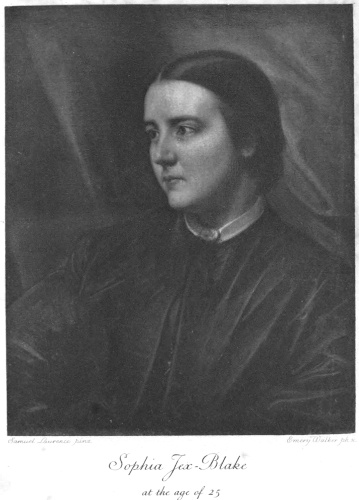
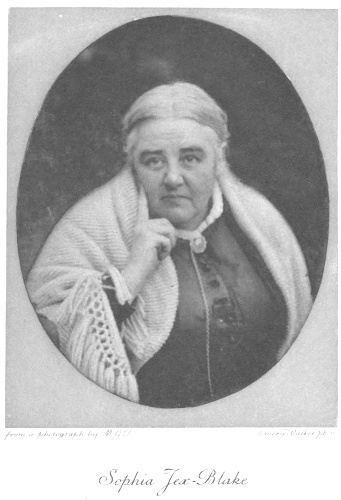
Sophia Jex-Blake was born on the 21st January, 1840.
“How happy I was with my Baby this time two and twenty
years ago!” writes Mrs. Jex-Blake on the 21st January, 1862,
and, if she had greater cause than some mothers for the
plaintive note that one seems to hear through the words,
she was the first to rejoice in her great compensations.
Certainly no baby ever had a warmer welcome into the
world. At the time of her birth, her father, Mr. Thomas
Jex-Blake, a proctor of Doctors’ Commons, was living the
life of a retired gentleman with his wife at 3 Croft Place,
Hastings. Both parents, though no longer young, and in
some ways older than their years, were devotedly fond of
children, and a number of disappointments had shadowed
their married life. In January, 1840, their son, Thomas
William, was eight years of age, and their daughter,
Caroline, a staid little maiden of six. The home was
crying out for a real baby, and all were prepared to treat
the newcomer as a little queen.
And most royally did the little queen step into the position
lying at her feet. There was no doubt at all that she
meant to live. She was vital to the finger-tips, a thoroughly
wholesome little animal, with a pair of great luminous eyes,
too mature for a baby, though they retained the child look
for three score years and ten.
The Baby came of an excellent stock.[1] On both sides she
was descended from well-known Norfolk families, whose
2lineage will be found in Burke’s Landed Gentry. Her father
was the son of William Jex-Blake of Swanton Abbots, and
her mother the daughter of Thomas Cubitt of Honing Hall.
It sounds old-world and picturesque, like Trollope’s novels
or a landscape by Constable.
On the other hand, the Baby—as in later years she never
tired of saying—“came in with the penny post.” New
ideas were surging up on every side. When one thinks of
her parentage, her heredity, and the tendencies of the world
outside, one can scarcely imagine a more varied lot of elements
from which to build up a life. Of the fairies who came to
her christening, some brought great gifts, and some great
opportunities, and, when the cradle was full, one can almost
hear them say,—“What now, little girl, will you make of
that?”
Of all the gifts we know well which she considered the
greatest. “No child ever had better parents than I!”
“How I wish you had known my Mother!” Such words
were constantly on her lips. Throughout life, when she was
making holiday, she loved to go back to old Hastings, to point
out to some intimate friend the house where she was born,
the church—St. Clement’s—where she was baptised; to
wander about the old castle, and note the very rocks which
had afforded the most delightful scrambling-ground when
she was a child. There was a special point in some country
walk associated with the picture of her Father bending his
tall figure to hold her hand, while he talked to her of “the
terrible things people were doing in France.”
“No one ever had a happier childhood than I.”
In many ways she was extraordinarily fortunate in her
parents. One cannot go through the long series of carefully
preserved letters written to their youngest child without
feeling tempted to say that better people never lived. Absolutely
upright in all their dealings, devoted and unselfish in
their affection, single-heartedly religious, regarding themselves
strictly as stewards of the wealth Providence had bestowed
on them, they really were the fine flower of old Evangelical
Anglicanism. One seldom sees a husband and wife so entirely
of one mind as to what are the things that matter.
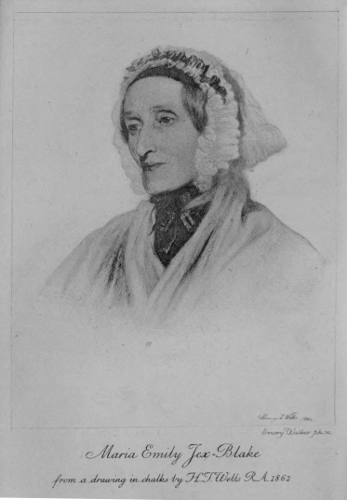
3And if the Mother—Maria Emily Cubitt—was the one to
bring to the union the keen wit, the happy humour, which
her children inherited and loved to recall, her husband was
the first to acknowledge and rejoice in her gifts. He was her
proud lover to the day of his death. Family tradition made
it a matter of course that they should have a luxurious home,
and that all the appointments of their life should be good,
but the note of self-denial was always telling resolutely and
unobtrusively. It was her younger daughter’s boast in later
years that Mrs. Jex-Blake “would have made a splendid
poor man’s wife;” and the vulgar criticism was significant
of their whole attitude towards life, that “the Jex-Blake’s
carriage was as fine as any in the place, but there was always
a poor person in it”.
What made this attitude all the finer was the fact that
neither husband nor wife was ever tempted to undervalue
social distinctions. It was noblesse oblige always,—the
noblesse of family as much as the noblesse of Christ.
Surely better people never lived, and yet, as human standards
go, the world which they built around them was scarcely a
spacious world. “I have learnt far more from my children
than they ever learned from me,” Mrs. Jex-Blake used to
say with characteristic generosity in her old age, and hers
was one of the minds that grow and develop up to the last:
but in some ways the Evangelicalism of her middle life—even
with the advantage of her most gracious representation
of its tenets—was a cramping thing. While Caroline and
Sophia were still in the nursery, their parents had resolved,
from the best of motives, to deny them the social advantages
which their mother had enjoyed before them. Dancing and
theatre-going were wrong; novels were mainly trash; Punch
was “vulgar”. “Christ’s kingdom” was the one thing
worth considering—Christ’s kingdom as represented by the
popular preachers of the day. “The mission field” was the
great object of enthusiasm. After reading much contemporary
correspondence one is tempted to say that the making
of pen-wipers and book-markers for missionary bazaars was
the work fitly to be expected of a Christian gentleman’s
daughter.
4From her cradle the elder sister seems to have accepted
this view of life. Her fine and massive intellect bowed to the
limitations imposed upon it. Her strong character asserted
itself in many ways, but never so as to give her parents the
proverbial “hour’s anxiety”.
And, for better or worse, into this atmosphere Sophia
Jex-Blake was born. One can scarcely wonder that she
came as a little queen. “Brother” was already at school,
his foot on the first step of a brilliant career; “Sweet Carrie”
was all that loving parents expected her to be; the new
thing came as a complete surprise. The freshness, the wilfulness,
the naughtiness of her were as the wine of life to these
staid, law-abiding people. It took their breath away sometimes,
but it was all on so small a scale, and were not all the
forces of religion in reserve to check any undue waywardness
as soon as she was old enough to understand?
The earliest samples of her handwriting are two letters
addressed to her brother,—undated, but written laboriously
in “half-text” between double lines. The quotation and
punctuation marks are added by another hand.
“dear Brother,
Your note was much ‘amiss,’
But as you sent sixpence,
I pardon the offence,
And kindly send you this.
S. L. J. B.”
and again:
“dear Brother,
I must say I think you very impertinent, however I condescend
to write to you. If you write a word more nonsense your head
shall be off. I am your humble servant grand mogul.”
“Entirely her own composition” is the postscript added in
her father’s handwriting.
No doubt they spoilt her, and she must still have been
very young when her audacity and wilfulness began to cause
her parents real anxiety. In January, 1847, her Mother writes:
“Dear Sophy,
I am very pleased with your marker, I think it nicely done
for you. I wish you many happy returns of your birthday—now
5you are seven years old I hope you will pray for the Holy Spirit
to keep you from sin, from disobedience, and from violence of temper.
I send you as a text for your birthday 16 Proverbs 32, and I trust
you will try hard to act upon it.... I hope you take all the care
you can of dear Papa—he says you are very good. Brother sends
love.
I am your affectionate Mother,
Maria Emily Jex-Blake.”
A day or two later she writes again:
“I am very glad to hear you had such a happy birthday—how
kind in Mary to give you that nice tea-pot. I hope you remember
to thank God for giving you so many kind friends. Be sure to take
all the care you can of dear Papa, and if he takes you for a walk do
not let him talk.
I miss Papa’s nice explaining God’s word every morning at prayers,
you must tell me what it has been about.
We like Brighton and I think I am stronger, but we shall be very
glad to be home again. I hope Mary takes care about the poor
people’s broth and the puddings for the sick children. I long to see
all my poor friends again, but I trust some one visits them and that
they do not miss me. Papa must go and read with Mrs. P. when he
is able and with Mrs. C.... Ask Mr. Macleane to bring you back
with him in his pocket, when he returns on Monday. Show him
how quiet you can be.”
It is clear the teaching of religion had already begun, if
indeed there was ever a time when it had not,—the teaching
of such genuine heartfelt religion!—under symbols that never
were suited to the mind of a sensitive child. So it is not
surprising that she was not always the Grand Mogul, poor
little soul! The next papers that survive are in a totally
different vein. They are written when she was seven or
eight years old, and the handwriting, though far from
beautiful, is much better formed.
“Dear Mrs. Blake,
I wish you would be so kind as to come and see me every
night in Bed-ford-shire at least tonight on Sunday Monday Tuesday
Wednesday Thursday Friday Saturday and next Sunday after
tomorrow. I require an answer to this note (letter) even if you do
come tonight. There are now so many railroads that you can get
to Bedfordshire in one minute. Please send ‘Madam Mary’ with
this and then come up.
Grandaflorer.”
6The true inwardness of this request appears in a private
paper probably of an earlier date, folded up and labelled
on the outside, “A Prayer to be Said After an unhappy
Night.”
“Oh Lord I beseech Thee take away my fears of a night, for
Thou alone knowest what miseries I this night have suffered. O
Lord, I beseech Thee this day enable me to behave as I ought.
O Lord, I beseech Thee to make me a Christain child ... take away
my doubts and fears....”
In the next letter—endorsed by her Mother, “7th May,
1848”—she says,
“I whant to tell you that I feel so much less fear of a night....
“I will never say again (as I fear I often have) that God does not
hear my prayer or that I do not derive comfort from it.... Please
(for you say please wins everything) do not show this to anybody
not even to dear Papa.
Clearly the child at this time was learning to read and
write. Of any formal teaching no record has been kept, but,
if anything of the kind existed, it can have made no great
demand on her brain power, which began at this time to find
expression in a somewhat unusual way.
In common with most children, she dreamed dreams, but
her dreams were not the random visions of an hour. They
were singularly coherent and consecutive, aiming at nothing
less than the construction of an ideal state ruled by a “despotic
emperor” in some wonderful islands lying in an unknown
sea. She was unable to throw the creations of her
brain into anything like literary form, but numberless papers
have been preserved, varying from large official-looking blue
foolscap sheets giving the “constitution” of the state, down
to tiny scraps about the minutest detail connected with it.
There are many maps of the islands, of which the largest,
Sackermena, gave its name to the group; and these are
supplemented by numberless poems in which she strove to
give expression to the feelings her Utopia aroused in her
mind. Poetry never came easy to her, dearly as she
loved it.
7She begins gallantly many times: (We all know the experience.)
“See how pretily the sunbeams dance
Upon the fair waves of Speed-the-lance
See the Waters of Gold!”
and again,
“See Lord Grandaflora brave
Fighting his country and life to save....”
and again,
“See how gently Mordisca rules
O’er Sackermena and her pooles....”
or is it “fooles”?—The writing is very bad.
On the whole the most delightful stanza is the one that
was probably the first,
“Sweet Sackermena and her isles
See how many yards and miles
It takes to go round Sackermena!”
No, poetry never came easy to her.
When she tackles the constitution of the state, however,
her work is on a totally different level. She gives us the
officers, “Military, Civil, and Judicial,” the standing army,
standing navy, Men of War and frigates, and vessels “in
rest, ready to be raised.” From this we go on to Prisons,
Castles, Laws, Parliament, Guards, etc. The population
varies greatly in different schemes. In one, by a stroke of
genius, all innocent of that terrible Woman Question in
which she was to play so prominent a part, she says:—Men,
7,000,000; Women, 5,000,000. Truly an ideal state!
There are many codes of laws, drawn up to meet one
contingency after another. The following are picked out
almost at random:
“The Despotic Emperor has authority that none may dispute
and none may appear in his presence without his gracious permission
save his sons and Lord Field Marshall, also the chief general the
high Admiral the high Treasurer, high Chancellor, Secretary of
state and the Chief Justice.”
“Succession to the Crown. It is at the option of the Reigning
Despotic Emperor to name his successor but if he dies without
8making any choice it descends to the eldest son but if he has no
son the crown is placed on the head of the eldest daughter unless
12 strong reasons can be urged to the contrary and accepted by
Parliament. If he has no offspring it does not descend to the next
relation but it is in the power of the parliament to give it to whoever
it pleases.”
“Robery shall always be punished by the culprits restoring fourfold
or if utterly unable to pay this as many days imprisonment
as there are shillings in the forfeit.”
“Intentional murder and personal injury shall be punished by
injuries precisely similar.”
“If any man conceals the persons mentioned in the preceding
laws he is punished half as much as the offender.”
“That every English or Scotchman that is travelling with a passport
shall be supplied with provisions cost free. And every Frenchman
shall have things for half and every Dutchman quarter price.
Any one infringing this law is liable to be forced into the army
with the possibility of advancement or to be imprisoned for two
years.”
“No judge shall ever condemn a man to death without the knowledge
of Lord Trican. An infringement of this law shall be visited
by confiscation of all his estates except (if he have it) 250 to
his wife and 300 to each of his children; besides his being degraded
from office and receiving 30 stripes in the public square
of St. Anhola.”
“All disobedience to officers shall be punished by flogging. 1st
offence 20 strokes, 2nd. 34, 3rd. 40, 4th. imprisonment 4 months,
5th. 14 months, 6th. Death.”
“If any sentinel be found asleep in the camp he shall be shot
with blank cartridges and imprised 15 months. The second offence
he shall be shot really.”
“Spirits or strong drink not being allowed in either army or navy
any person having any shall be shot with blank cartridges and the
second offence he shall receive 20 strokes and 1 months imprisonment,
3rd. 32 strokes and 4 months imprisonment. 4th. Death.”
“In time of war when the standing army is not sufficient to
resist the enemy’s forces 350 soldiers and 4 captains and 10 lieutenants
shall be sent to raise the ready militia to the amount required;
if this is not enough every man above 20 and under 80 compose
the Possiblees which is raised in great danger, but 2,500,000 must
be left (all able bodied men) to take care of the kingdom.”
In many respects this state was a primitive one. When
certain announcements were to be made, “a large bell is rung
which is heard to the distance of 23 miles,” or “an enormous
9bonfire is made in the palace gardens of Mt. Gilbow [!] which
is perhaps seen to a greater distance.”
This is fine:
“The Despotic Emperor is the grand Law-giver General Judge
Sage Physician and in short the Father of his vast dominions.”
In spite of the mass of prosaic detail as to dress, provisions,
etc., there is sometimes a hint of the supernatural about the
whole thing. The dotted lines between the islands in one
of the maps indicate “invisible bridges”, and in a request to
“Victoria and Prince Albert” that a governor may be sent
from England to “controll the foreigners who wilfully destroy
the peace and comfort of this happy and well-governed realm,”
we are told that “if this wish is complied with, the Most
Gracious Despotic Emperor, Phrampton Omail Grandiflora,[3]
will stand the friend of your kingdoms on earth and admit
20 of your subjects to his unearthly Kingdom.”
A great impetus to the whole conception may possibly
have been given by a tour which the child was fortunate
enough to make with her parents and sister to Warwickshire
and thence to Scotland in June, 1850, a tour of which further
particulars will be found in the next chapter. In the course
of her very conscientiously kept diary, she says, “We read
the Lady of the Lake aloud,” and she herself is reading
“Ivanhoe, one of the Waverley novels.”
There is no proof, however, that any part of her Utopia
was sketched after this tour, and a great part of it was certainly
written before.
On the whole, perhaps, the most remarkable thing in
connection with “Sackermena and her Isles” is the staying
power shown by the writer in developing her idea, and her
determination to get everything down on paper. In this
more than in anything else the child was father of the man.
S. J.-B. was a born chronicler.
As regards Sackermena, the idea certainly afforded no lack
of scope and variety. What with drawing maps, writing
10poetry, framing laws, adding up the totals of her army and
reserves, devising for the soldiery “A dark red long coat
with silver falcons, and thick leather buskins studden with
iron,” and many another guise equally picturesque,—she
certainly did not suffer from monotony in her self-chosen
occupation. And the above examples by no means exhaust
its possibilities. On a stray slip of paper we come upon a
formal complaint from a “justice,” who, “passing in disguise
through Pe,” was supplied with a loaf deficient in weight;
and a tiny booklet (laboriously stitched together by the
writer’s hot little hands) has the following title page:
THE SACKERMENEE’S
POCKET BOOK
Containing many Little Accounts
of their Customs
Published by S. L. Blake & Co.
Hastings 1848
Jan. 1850
The two dates seem to indicate that Sackermena flourished
for perhaps two years; but the Pocket Book itself was not
a hardy plant. The big foolscap sheets were clearly more
stimulating to the imagination.
The thing is child’s work throughout. From first to last
it bears no trace of grown-up criticism; nor is there then or
afterwards any note by her parents, teachers or friends,
referring in even the most distant way to the faerie region in
which the little girl must have spent so much of her time.
Another thing strikes one incidentally—considering the
atmosphere in which the child was brought up—as rather
curious. There is no mention of clergy at Sackermena, nor
of any form of church. We are not even told that nothing
of the kind existed.
Note again that the Despotic Emperor was the grand Lawgiver,
General, Judge, Sage, Physician, and, in short, the
Father, of his vast dominions.
11
“You often say how happy you were as a child,” an intimate
friend remarked once to Dr. Jex-Blake, “but you never talk
of your school life. I expect you were a terrible pickle?”
“Specs so,” was the laconic response, and the subject
dropped.
There is no getting round the fact that she was a terrible
pickle. If we bear in mind what the state of girls’ education
was in those days we shall see that it could scarcely have been
otherwise. If she could have gone to a boys’ school and
enjoyed its boisterous give and take, the little “despotic
emperor” would soon have found her level. One loves to
think how happy she would have been in the modern Girls’
High School: if she had but found the education of women
in the condition in which she left it, the difference in her whole
future would have been very great, but women of the present
day would not owe her the debt they owe her now. “The
breaker is gone up before them.”
As things were, she had, in a sense, got the upper hand of
her parents before she went to school at all. She was simply
overflowing with energy and vitality, and they found themselves,
while she was little more than a child, confronted with
a personality which ran right athwart their preconceived
notions and theories of life. They had not the right weapons
with which to meet the outbursts of her volcanic temperament,
and it must always be borne in mind that “when she was
good, she was very very good,” immeasurably more attractive
than the average child.
12The one effort of her teachers, of course, was to repress
her, to induce her to be “ladylike,” and, most unfortunately
of all, to make every childish act of disobedience, every outburst
of passion, the text for a homily on the necessity of
“coming to Jesus.” One cannot read the long series of
letters referred to above without wondering how it came
about that the germ of religion in the child’s heart was not
worn away altogether; and indeed its survival only becomes
comprehensible when one bears in mind the genuine goodness
of many of those who watched over her, and also the “unknown
quantity,”—that elusive unsearchable factor that is
present in every human equation.
The earliest references to her education are two letters from
her first governess, Miss B., to Mrs. Jex-Blake, of which the
first is dated November 24th, 1848:
“Sophy is a dear child, shewing daily advancement in her studies,
and often delighting me by a rectitude of principle emanating, I
trust ‘from the Father of lights’. A little native wildness (and that
gradually softening down) together with the want of promptitude in
setting about her duties, are the chief obstacles that could be picked
out from a much longer list of things most prized by an earnest
teacher. I have often thought of your wish that she should learn
the Latin grammar, and quite agree with your view of its probable
advantage; but I am afraid of breaking down in the long and short
syllables.... For the next few months it appears to me nothing
will be lost by our present system, in which I find parsing to be
generally a subject of interest.
I trust the time is not very distant when your little girl will successfully
strive to be both a help and comfort to her parents.”
The second letter is nearly two months later:
“Your kind letter with its agreeable suggestion reached me too
late for a reply by return of post. It would have given me a feeling
deeper than pleasure to continue the instruction of your very promising
child, but I have already engaged with one daily pupil and
have a half prospect of another, in addition to which God’s high
dispensation seems to allot to my keeping, as soon as He graciously
gives me the means, the eldest of four children belonging to
my Brother.... With our best love to Sophy, I am, dear Mrs.
Blake,
Yours in the Lord,
Mary B.”
13The first arrangement having fallen through, Sophy was
sent with her sister to Belmont, a school kept by Mrs. and
Miss Teed. The following letter seems to have been written
on the day they set out:
“29th January [1849].
Dear little So,
I hope you had a comfortable journey; I fear the cold wind
must have increased your cold. Now, dearest child, you must be
always going to Jesus for grace to overcome self-will and the desire
to be conspicuous. Strive to be a gentle child, in reality esteeming
others better than yourself. You cannot learn anything to any
purpose till you are obedient and have some self-command. Try to
be a comfort to dearest Carry, she has her trials, depend upon it,—do
you be obedient to her and thoughtful of her comfort, without
making a fuss about it. Carry likes kindness quietly done. Do
not give needless trouble to Miss Towers or anyone. Try to deserve
Dearest Mrs. Teed’s good opinion. Jesus will be sure to help you
whenever you ask Him. I forward a note that arrived from Aunt
Taylor. Papa sends best love.
I am your affectionate Mother,
Maria Emily Jex-Blake.”
Mrs. Jex-Blake’s health never was robust, and at this time
it was causing her husband and intimate friends some
uneasiness.
“Do you know, darling Sophy,” she writes on March 27th, “it
is sometimes quite a trial to me to write one letter to each of you,
and I should hardly do it, did I not know how ‘nice it is’ (as you
say) to hear from home at school. I so much like you to send me
the heads of Mr. Parker’s and of Mr. Taylor’s sermons. The one
on 23 Jer. 29 must have been very beautiful.... Papa has just
come in and says thank dear little So for her letter and tell her I
am particularly pleased with the clear way in which she sent me
the heads of the sermon.... I send you a few of our violets.”
And again,
“Be much in prayer, my sweet one, for grace to be obedient and
gentle. Hope whispers great things for our next meeting if God
grants us one.
I am comforting myself with the hope that you are waging constant
war against self-will and disobedience. You can hardly believe how
happy you will be when through God’s help upon your earnest
endeavours, you can obey at once and give up your own way. I
send my darling child a text which I wish her to learn and pray
14for grace to live up to. It is 1 Peter v. 5. I wish you to learn it
perfectly and make it part of your daily prayers. Tell me when
you write that you have done so. Bear it in mind all day long,
and try hard, very hard, to live up to it. I often fancy you all at
morning prayers and wish I could be there.[4] God gives you great
privileges, dear child, that you may live to Him.”
All the letters are in this vein, and all were read by the
recipient many times and carefully preserved.
In June, 1849, she went with her parents, brother and
sister to spend a long holiday in the Lake District, and one
is glad to think of her as being much in the open air, collecting
plants and stones, “shooting a good deal with bow and
arrows,” riding on the coach, and being allowed to drive for
a few minutes herself.[5]
Her holiday diary is as well written and as dull as that of
the average adult, and one is almost startled when one
comes upon such entries as “Played at horses and pretended
I was driving the mail”; and again, “A very wet day. I
had a very nice game with Papa and Carry, and another
with Carry in the afternoon and afterwards another alone
with Papa very nice indeed and I enjoyed it very much.”
On the other hand there was no lack of church-going, and
the texts are always carefully noted down:
“July 29th Sunday. Went to Keswick church in the morning
and the text was James 4. 8. Brother went to church at Thornthwaite.
Papa, Brother and Carry walked off to the Vale of St. John’s,
but there was no sermon—only prayers. Went to Keswick church
in the afternoon and the clergyman took his text from Ps. 119, 96.”
“Aug. 5th. Mama was very ill and I stopped at home both in the
morning and afternoon with her. Papa, Brother and Carry went
to Brougham-hall to church but there was no service. They went
again in the afternoon to Brougham-hall—no sermon. I went in
the evening to Penrith church and the text was Luke 16. 8.”
15She never seems to have drawn a blank, poor little soul!
A previous entry is even more characteristic of the world
she lived in:
“July 23rd.... Had a walk with Papa and Carry in the afternoon,
and afterwards bought tracts (for 6d.) with Carry.”
“24th. A rather wet morning. Went out with Papa and gave
away some tracts.”
Yet her Father was an excellent playfellow and at this
time her most indulgent critic. In the spring of 1850 he
writes—“It is a real pleasure to me to hear from you, and
I hear such pleasing accounts of you from others that I am
very glad”; but it must be admitted that this note of congratulation
is rare.
There is an amusing little joint note from her parents,
probably of an earlier date:
“Dear Sophy,
I send you the 1s. and I hope the yellow paper. I do not
know what you want of paste-board, therefore I fear I cannot send
it. I send the gingerbreads, and hope to do so on the 11th again.
Your affectionate Mother.”
Then follows in pencil:
“Dear child, I have got all the things for you and leave them
with 2 pounds of gingerbread. I think you want more than one
shilling for your purpose so I enclose 2s. for you.
Your affect. Papa,
T. J.-B.”
But it must not be supposed that her parents were ever
otherwise than of one mind concerning her. Like all well-constituted
husbands, Mr. Jex-Blake was quite prepared on
occasion to demolish the child who made his wife uncomfortable.
And it must be confessed that little Sophy had
rather a knack of making people “uncomfortable.” She
was so keen about everything: she staked her equanimity
so often on things which it might have been wiser to regard
as trifles, that those about her learned to live in a state of
some anxiety, never knowing when the eruption might
come.
The remedy for it all is painfully obvious as we read. More
16scope, more physical exercise, more fresh air; but, as already
pointed out, the girls’ schools of those days provided none
of these things; and, when the child came to her dearly
loved home, the Mother’s excessive fragility made it necessary
that her daughter should live the life of a grown up person.[6]
The most devoted mutual love could not devise a régime
suited to both. The lovely ailing Mother could not stand
noise and excitement. Sophy was often riotous, excitable,
“rough” yet always very loving with it all. On one occasion
when walking demurely along the pavement in a queue of
well-behaved girls, she caught sight of her father, and, without
a moment’s hesitation, deserted the ranks, and took a
flying leap on to his back!
No wonder that a contemporary friend of the family describes
him as saying very often, “My dear Sophy! My dear
child!” in tones of absolute bewilderment.
In the summer of 1850 Sophy made the tour referred to
in the preceding chapter, and a liberal education it must
have been. In April Mrs. Jex-Blake had written,
“I hardly allow myself to look forward to the treat of going to
Scotland; it seems almost too much pleasure,—and we shall be
sure to find people who love Jesus and love the Bible there and that
will add so very greatly to our pleasure.... Papa thanks you
for your letter, he is surprised and pleased to learn that you are in
Reduction.... Use daily as a prayer the substance of 1 Peter v. 5.”
“18th June. Left Belmont at 20 minutes to 10 with Miss
Teed, and met Papa and Mama at the Euston, and went to
Rugby to pick up Brother.” So Sophy’s own diary begins,
and an excellent conscientious piece of work it is. They
visited Leamington, Warwick, Kenilworth: thence to Edinburgh,
Stirling, Glasgow and the Lochs, Callander and the
Trossachs, stopping at York on the way south.
A pretty piece of doggerel shows the happy relations between
Father and daughter at this period. It is scribbled in pencil
17on the back of a hotel-keeper’s note. The Father begins in
his scholarly handwriting:
“My little child, You’re very wild,
Could you be still, And yet not ill,
Then, little So, This I do know,
You’d be a blessing, Worth possessing.”
Whereupon Sophy comes hobbling on:
“My dear Father, I had rather
You’d believe me, And relieve me,
When I say, As I may,
That I’ll be good, As I should.”
Of course it is she who recommences the game:
“My dear Papa, Aha, Aha,
Send me a letter, Then you can better
Tell when we go, Off to Tarbet Oh!
And all your wishes, With many kisses.”
And the scholarly handwriting closes the page:
“I kiss you! Why if I do
I kiss a wild, And teasing child.
But this short note, Papa has wrote
To say at ten, We start again.
Henceforth you should Be very good.”
In autumn the two sisters returned to Mrs. Teed’s school,
and things resumed their chequered course. I am told by
a schoolfellow of Sophy’s, who had an excellent influence
over her at that time, that Mrs. Teed managed the little girl
extremely well: and in any case she remained at Belmont
for two years, when Mrs. Jex-Blake removed her—evidently
to the child’s regret—on the curious ground that she was
being “extinguished.” The truth is that the younger pupils
were rationed according to age, and, as Sophy was physically
as well as mentally in advance of her contemporaries, she
was reduced to eating raw acorns to appease her hunger.
But Mrs. Jex-Blake was not aware of that detail till long
after.
In the meantime, the former teacher, Miss B., had settled
at Ramsgate with the pupils already referred to, and Sophy
was sent back to her. A more devoted and conscientious
18teacher one can scarcely imagine, but the arrangement was
in some ways a very unfortunate one. At home—and probably
also to some extent at Mrs. Teed’s—the religious atmosphere
was tempered by a sense of humour as regards the ordinary
affairs of life; but of this quality worthy Miss B. seems to
have possessed no trace. Henceforth the child lived in a
religious forcing house. One hopes that at times she escaped
to Sweet Sackermena and her Isles, but the moral atmosphere
at Ramsgate was not conducive to such pagan wanderings.
Her brain was pronounced excitable, and she was to have
but little head employment, but she was taken to church
several times a week, and encouraged—or instructed—to
write out the sermons to send home to her parents. Here
is an example of her work: (Miss B.’s trifling corrections
are omitted.)
“Mr. Dunbrain. John iii. 3.* April 2. 1851.
We live in days of deep interest,—the common topics of men
are thrown aside and everyone seems to be utterly absorbed in
religious controversies. The torpor which had overspread the
church has entirely dissolved, and now all around we hear nothing
but the perpetual strife jar and clamour of religious disputes. It
is a storm and a strong one too, but many think it precedes the
blessed peace and quiet of the Millennium. Like every storm it
did not come all at once, but it has been long in gathering; it began
with what men call trifles and rose gradually, gathering strength
as it rose, etc., etc.
Those marked * are Wednesday evening lectures.”
We are left to guess whether she wrote out the lecture
after supper the night it was delivered, or lay awake “remembering
it” till next morning.
Memory altogether was a faculty assiduously cultivated.
It was the custom for the family to gather round the fire on
Sunday evenings, and for one after the other to repeat a
sacred poem. When they had been separated for a time,
special interest attached to the items each had added in the
interval to his, or her, repertory. No doubt the custom
began with the learning of hymns, but they seem for the
most part to have been good hymns, and round this nucleus
there gathered an extraordinarily varied collection,—fine
passages from Isaiah and the Psalms, poems by Trench,
19Dean Alford, Longfellow, Wordsworth and many more. It
was said of the younger daughter in her later life that, if she
had been shipwrecked on a desert island with nothing but
pens and paper in addition to the actual means of livelihood,
she could gradually have provided a priceless library from
memory alone.
A few of her letters at this time have been preserved.
[1851].
“Dear Daddy,
A most extraordinary thing happened this morning; the
crew of a Portuguese ship put up in the masthead figures representing
Pontius Pilate and Judas and exactly as 10 struck on the pier clock
they thumped them down into the sea! Now was not this Popish
trash? A respectable English jolly tar told Miss B. all about it
and added how happy we were to be taught better; now I think
that’s a right good English spirit. The first grand steamer has
just come in. I have a very bad cold and have not been out. Miss
B. brought me some licorice for my cough and I am to have treacle
posset tonight so I could not possibly be taken more care of and
no doubt it will be quite well before 30th. You musn’t think Miss
B. had anything to do with my talking about tractarianism, indeed
afterwards she forbade it,—it was all my fault. I’m writing a history
of our family entitled ‘History of the illustrious family of Blakes
from 70 B.C. to 1080 A.D.’ Dear Daddy how I do love you, if I could
‘climb those knees and kiss that face’ I’d be happy enough, indeed
I’m very happy here but home sweet home is better than anything
else. S. B.
Do send me a large seal of your crest.”
Her Mother, however, is always her main confidant.
“I’m in a scrape just now Mama,” she writes on April 5th, 1851,
“I long to be at Home, home sweet home there’s no place like home,
no person like Mummy and no kiss like Mummy’s cuddle and no
knees like Papa’s and no player at Prisoner and Judge Selling or
any other game in the world like Papa, no one that can put me in a
good humour like Daddy and Mummy! Oh! nothing like what
everything is at home anywhere else, in all Europe Asia Africa and
America no place is like home, sweet sweet home.... Love to
dear Papa and yourself 3000000 kisses. I always kiss the envelope.
Please write very soon. I am your affectionate and I hope dutiful
Sophy.”
We know how fervently the Mother “hoped” the same!
20The child seems to have spent the first weeks of May in
her beloved home, and the following letter from Miss B.
gives us a graphic sketch of her return to school:
“My dear Mrs. Blake,
Dearest Sophy has laid her letter before me, and such a
burden of grief I can scarcely bear to send—but you will look at
my view of the picture likewise. The tears shed in writing that
were very nearly all we have had; for soon after parting from her
Papa the heavy clouds passed away, and, when established in the
fly I was glad to hear, ‘Well, I am not quite so sorry as I expected
to be,’ and then ‘Mummy says the air of Ramsgate will almost
make amends for the parting.’ We got home and found dinner
ready, but dear Sophy could only take a little rhubarb.... At
tea she seemed surprised at being able to express herself as ‘hungry,’
though the appetite was soon satisfied, and she is now sitting reading
in the garden, which she says is ‘delicious’. Dear Mrs. Blake do
not think I will tax her head with anything beyond beneficial employment.
It will be my study to get rid of that thin look which I
could scarcely have attributed to so short a change (!). I ought to tell
you that Sophy meant to say that she felt better when she got into
Ramsgate than for some time, but grief swallowed up all other
news.”
A week or two later her Father asks her in a rash moment
if she can tell him “Why it is wrong to oppose Papal Aggression?”
adding, “If you can’t, I will tell you.” The question
was a mere conundrum, but she takes it very seriously:
“Dear Father,
I am very very sorry to hear that dearest Mother is so unwell
(or I should say ill). I send her a marker as I have not many flowers
that will press well.[7] Please tell her that she must not give it away
to anyone. I am quite enchanted at Boy’s getting two poetry prizes;
it is charming.
Well, about the question, ‘Why it is wrong to oppose the Papal
Aggression?’ I really don’t see how it can be wrong and must
think it quite right. I can’t see how it can be wrong for any zealous
servant of God to oppose with all his might that which dishonours
God and his word, which (when the Bible says ‘none can come
unto the Father but by Me’) says that we must come by the Virgin
and the saints etc. People might say ‘We must not oppose it for
it is God’s will’ they might also say that ‘temptation was put before
the Jews and that was God’s will’ but they were told to put the
21accursed thing far from them and destroy it utterly and I think
the Papal Aggression is put in our way to try us and see if we will
oppose it unto death. But of course you know more about it than
I, so please tell me why it is wrong to oppose it.”
One can imagine that her Father was almost ashamed to
confess that the question was only a joke.
“Now for a word about the ‘bowing,’”‘bowing,’” he says in another letter.
“It is“It is of no importance in itself, and therefore I never tell my
children or servants either to bow or not to bow; but particular
circumstances may render it important, and if good and kind Miss
B. thinks that at Christ Church, you may honour God rather by
doing as she and others who are with her do, than by being singular
on this point, I not only wish you to obey her, but to do it with a
willing and ready mind, cheerfully, as a plain matter of duty. Which
it is. It is for her to judge, and for you to do, gladly, what she
tells you.”
Miss B. had the greatest admiration for her pupil’s gifts,
and in particular she considered her a budding poetess. These
are some of the effusions of the period:
“Oh Mother! thou that broughtest me forth
My sins gainst thee none, none can tell
For these alone I ought in sooth
To be e’en now in lowest hell.
But oh! my God still spares me on
To be a comfort to thy years
God grant I may e’er the sun goes down
Seal thee this promise with my tears.
Ne’er ne’er again what [e’er] betide,
(In Jesu’s strength alone I trust)
I’ll vex my mother, who did guide
My years of infancy now past.”
Another time after expatiating on her Mother’s virtues
and unmerited affection, she goes on to inform her that there
is One—
“Whose love surpasseth thine as far
As Sol excels the falling star.
My Mother ONE request I make
That thou wouldst pray for Jesu’s sake
That he would break this heart of stone
And mould it like my Saviour’s own.”
22Was it all mere humbug and “patter”? The question
can best be answered by quoting the following letter to her
Father. It is written impulsively in pencil on scraps of
paper,—the questions and answers being on different slips.
The wording of the questions has sometimes been altered and
corrected, so presumably she drafted them herself. The
little sheaf has been thrust “anyhow” into an envelope
(addressed to Mrs. T. Jex-Blake) which bears postmark
“Ramsgate, Ap. 21. 1851,” and Mrs. Jex-Blake has quaintly
endorsed it “very nice.”
“My dearest Father,
I fear you are very uneasy about me for I have indeed
manifested no visible proof of a new and clean heart, but I think
much of my soul too much for me to speak even to you of it. But
I cannot talk so whenever anyone tries to talk to me of it I always
turn it into jest but I must write (I cannot speak) to you about it
so I have written some questions down and endeavoured to answer
them as before God. So do believe each word.
S. B.
1. If you died this instant what would become of you? And
could you face death unflinchingly?
I know not what would become of me but I fear I should go
to eternal torments. And do not think I could face death
unflinchingly for this reason.
2. What would be your first emotion when you found yourself
in the presence of the Judge of quick and dead?
Fear I think but yet I think that I should claim Jesus’
promises to lost sinners.
3. If Christ came this night and asked you ‘Lovest thou me’
what would be your answer?
Yes Lord although I am very wicked and cold and dull yet
I could say without hesitation I do love thee very much I often
feel my heart warm towards thee and something tells me that
one day I shall love thee far better than I do now.
4. Could you before God say truly ‘I strive to live as I hope to
die’?
No I fear I could not although sometimes I do try to do
things to please Jesus.
5. Do you really in your heart know your religion to be a mere
form or do you really feel its life-giving influence on your heart?
I know I often say far more than I really believe, I even
have been tempted so far as to doubt in my heart the existence
23of a Diety but yet I have had a few bright moments in which
I could sincerely say Yes I know it I know that Christ is mine
and I am his but a deep gloom is generally over my spirit.
6. Do you in your heart believe yourself to be a new creature?
I know not but I fear not although at times I have been
fully convinced that I am God’s child.
7. Do you earnestly desire to be such?
Most earnestly whenever anything touches that chord in my
heart and sometimes I could weep bitterly but generally I feel
awfully indifferent as to my soul.
8. Do you think you have ever known what true prayer is?
Most certainly and have sometimes obtained very gracious
answers.
9. Where will you be 200 years hence?
In heaven I humbly hope and trust for I think the Lord has
begun a good work in me.”
Gallant honest heart!
Is there a single word in the whole confession that the
most devoted parent would have wished different?
24
“I think the Lord has begun a good work in me.” Is there
in the words a—very human and pardonable—suggestion of
St. Augustine’s “Timebam enim ne me cito exaudires”? In
any case, though doubtless the good work went on, it cannot
be denied that the tares flourished abundantly with the wheat.
It happened most unfortunately at this time that the
child’s physical health fell into a very unsatisfactory state:
we hear of great digestive trouble and functional weakness
of the joints. Modern hygiene would probably have made
short work of both complaints. As things were, the weakness
was “tinkered at,” and the child was encouraged to live
the life of an invalid. We are startled to learn incidentally
that she is going out in a bath chair!
Good Miss B. took her up to town to see a consultant, and
sent the parents long detailed reports on the child’s health.
We are not surprised to come upon the following under
date July, 1851:
“You must not suppose, dear Mrs. Blake, that I overlook the
self that you have rightly so much at heart. I see it too well, and
it is commented on to Sophy so frequently that I sometimes check
myself, ... but the punishment that I might inflict on another I
hold back in Sophy’s case, not only from my own knowledge of her
character, but because Mr. S. cautioned me if possible never to
disturb the even tenor of her brain.... Her case is peculiar and
such must be the ends to meet it: they will require patience and may
be long inin showing fruit, but we will not despair.”
The next vacation seems to have been disastrous. The
child had grown more indolent and self-centred, and no
25doubt the parents were unable to deny her the sweetmeats
which she loved and which the supposed weakness of her
joints made it impossible for her to “work off” as healthy
children should. Moreover, few houses are large enough to
contain two chronic invalids.
“I received your letter,” writes Mrs. Jex-Blake when the child
is gone, “and very glad we were to hear of your safe arrival,—but,
my own child, I could have cried over your words. They were nice
and affectionate, but the very opposite of your acts.... Either my
child means what she writes or she does not. Your conduct completely
contradicts your assertions. More sad and foolish behaviour
than yours it is difficult to imagine. You behaved so ill that I doubt
if I could have borne it another day without being laid on a bed of
sickness, and I might never have recovered. Your ever being with
us again for three weeks at a time is quite out of the question till you
have the good sense to understand (as other children of your age do)
that to be happy and comfortable and to enable me in my weak state
to have you at all, you must be good. When you seem really to feel
how ill you have behaved, we will some time hence have you home
for a week, and if I find you keep your word (which you do not now)
we will have you home very often; and Papa says that he shall
then think that he can never do enough to make you very very happy;
but you now destroy your happiness and my health, and the medical
men will not allow us to be together. Think of your great folly and
sin, my dear child. Pray to God for grace, and He will give it to
you for His dear Son’s sake....
When you have read this letter, I wish you to tear it up.”
As ill luck would have it, this most unusually severe indictment
found the poor little culprit seriously ill in bed. Her
penitent reply is not forthcoming, but five days later, her
Mother writes again:
“My own darling Child,
I trust this will find you much better; if you want me to be
happy you must make all possible haste to get well, and write to tell
me you are well.... I quite believe, my darling, that you are
sorry, and will, in God’s strength, take pains that the same shall
never happen again. I do particularly wish you to tear up my
last letter at once.”
She didn’t tear it up: she never could tear up “Mummy’s
letters.” She tied the two together with a piece of red
wool, and slipped in with them a Sunday School “ticket”
26bearing the words, “Children, obey your parents in the Lord;
for this is right.”
By the same post as the second of these letters her Father
writes:
“My darling Child,
We have been so grieved to hear of your illness, and do hope
that before you receive this, you will be much better. It will please
you to know that dear Mummy is much better for the quiet and
Norfolk air. Everybody is so kind and trying to get her quite
strong, and they all enquire so kindly after little Sophy, whom they
call ‘little Sophy’ still, everybody saying what a very sweet and
darling child you were six years ago; and I do trust that, when
you see them next, they will find you a more darling child, and more
loveable than ever. God grant it be so, dearest, for I want you to
be very happy.”
The next letter from Miss B. that has been preserved is
dated September, 1851, and is addressed to Mr. Jex-Blake.
“I ought not to express sorrow at the sudden removal of
your child, hoping and believing that it is ‘ordered by the
Lord.’ She bears away with her my affectionate love and
prayerful interest.”
No record has been kept of the precise steps that led to the
“sudden removal.”
For the next two years the child went to a boarding-school
in Brighton, where her parents had now gone to reside, and
there are, therefore, practically no letters of the period. Two
of her schoolfellows, however, have been good enough to
contribute their impressions of her. For better and for
worse, they call up a very vivid picture. Miss Lucy Portal
writes:
“Being the junior of Sophy, as we always called her, she and I
were not much in touch, though I never forgot her, for she had a
strong personality, and was so clever—in fact, far above our school-mistress
in natural intelligence, and she made a lasting impression
on those with whom she associated. Whenever I heard her name
in after life the vision of a young capable girl who asked questions
that bewildered her governess rose before me.
One day when we were walking on the ‘Downs’ with [an assistant
governess] in the rear, Sophy saw a large stone by the wayside and
seated herself on it. ‘What do you mean by this?’ said the governess.
‘I am tired and must rest,’ replied Sophy. ‘Get up at
27once,’ said Miss ——; ‘Do you suppose we are all going to wait
your pleasure in this way?’ ‘Impossible to do what is beyond
one’s capacity,’ was the rejoinder, and threats had no effect. At
last Miss —— lost her temper and said ‘Sophy, distinctly understand
that if you do not get up, I shall leave you here, and send a
policeman to fetch you.’ ‘Ah,’ said Sophy, ‘that is a kind thought.
I am sure he would prove of great assistance to me. But could
you manage to procure two policemen, for I don’t believe one would
be able to carry me, and two might do so.’ I need not say that
the battle of words was soon over after that.”
Knowing as one does how anomalous was the position of
an assistant teacher in those days, one can but admit that
the child must often have inflicted far greater suffering and
anxiety than she had the least idea of.
On the other hand, Mrs. Gover, widow of the late Canon
Gover of Worcester, writes:
“Sophie set us a good example at school, and I shall always think
of her as one of the most truthful girls I have ever known, the only
girl I ever knew who would not allow her drawings to be touched
up by her master. I had a very great respect for her high character.”
But nothing can show more clearly the futility of the
educational methods of that day than the following letter
from the headmistress herself:
“June, 1852.
Dearest Sophy,
I cannot tell you with what a feeling of anguish I heard the
door close after you on Saturday when you departed, and I had
not kissed or blessed you.... I saw you afterwards in the street,
tho’ I was unseen by you, and I could not stop you, my dear child,
lest the past should be renewed. On my return I saw your present
of fruit, it was not as gratifying to me as the scrap of paper, which
contained my Sophy’s acknowledgement of her fault.[8] Yet I thank
you for the kind thought, as I hope you know me too well to suppose
that any little gift can bribe me to forgive;—without that scrap,
my Sophy, I should have turned away from receiving your fruit.
The same afternoon at a friend’s house I read a portion of your
favourite Scott, and could not but think of you while I read the
account of the ‘evil and good’ trying for Mastery in Harold the
28Dauntless’ heart, remember his first act of forbearance was noted as
a step towards heaven. Beloved child! do I beseech you remember
the duty of a child, be gentle and tender to your dear Parents, then
the Lord will love you, and some day the Lion will give place to the
Lamb in your bosom. Dear Mary Bayly’s has turned to whooping-cough.
I hope yours is better. Until I find where to send her, I
cannot leave home. God’s will be done.”
For a year and a half Sophy remained under this lady’s
care, and then one or two equally unsuccessful experiments
were made. Meanwhile Mrs. Jex-Blake remained so ailing
that it was not possible for her to have the child at home
for the long vacation, and a “dear kind” lady invites the
refractory young person to visit her for part of the time.
Mr. Jex-Blake writes to inform Sophy of the fact, and adds,
“Now have we not in this great cause of thankfulness to our
kind God and Father who never forgets us?” This was
perhaps asking a little too much of the homesick child.
The truth is that the parents at this time were not growing
younger (as many parents do), and certainly they were
growing more staid and set in their ways. It was becoming
increasingly difficult to them to adapt themselves to this
riotous child. “Avoid excitement which is your great
enemy,” writes her Father, unaware perhaps that his own
weakness was a tendency to be rather too fussy and precise.
With hearts full of love they were demanding of her a standard
of excellence which for her was wholly artificial, and in the
half-hearted, or at least intermittent, effort to attain it, she
fell in the breach. And parents and child were not the only
factors in the difficult problem of home life. So long as
Sophy could by any stretch of charity be reckoned a child,
it was comparatively easy for her brother and sister to put
up with her volcanic ways. But from a schoolgirl one expects
some conformity to recognized standards, and Sophy’s elder
sister had been such a pattern in this respect that the contrast
was necessarily acute.
“I really don’t think you would enjoy [a visit from] Carry
much at school even if we could spare her,” Mrs. Jex-Blake
writes in reply to an eager request for this privilege. “You
would be tempted to be odd and excitable, and then Carry
29would be vexed and all would be uncomfortable” and no one
who knew the elder sister can doubt that such demonstrations
of affection would probably have “vexed” her more than
most. On the other hand “Brother” was now a young
man, and if his main desire for the child was that she should
grow up like the sisters of other men, he only shared the
attitude common at that time to the overwhelming majority
of his sex. One can see that his younger sister must have
tried him a good deal. The idea that she was plain and
even ugly had been firmly impressed upon her: the exhibition
of vanity in matters of dress had been discouraged
on every ground: and it was natural to her boyish temperament
to be careless of such things. When, in addition to
these shortcomings, she added a propensity for making people
“uncomfortable,” one can quite understand that her brother
did not feel specially proud of her, and the strength of her
character probably made it difficult for him to influence her
through the passionate affection and admiration she had
cherished for him all through her childhood. In any case
the relation between them became somewhat strained, and
it is not surprising if she sometimes attributed the strictures
of her parents to his influence and representations.
It is delightful to record that, in spite of countless differences
of opinion and much plain speaking on both sides, a fine
loyal camaraderie existed between the sisters throughout life.
I don’t know whether it ever occurred to the child to compare
her brother’s education with her own. If she had done so,
the reflection might well have made her bitter. In athletics
as in the schools he was bearing off laurels at every turn,
while she was being curbed and thwarted to meet the requirements
of pious and half-educated schoolmistresses. From
the best of motives her parents refused for her the outlet for
the “excitability” they constantly deprecated; in other
words they simply sat on the safety valve. In the summer
of 1854 she begged—probably not for the first time—to be
allowed to have riding lessons. The father replied
“I like to do anything in reason to please my own child, but you
are so very excitable and have at present so lamentably little self-command
that I should fear riding for you very much. It would
30do you no good and might be injurious to you in many ways. When
will you prove to me that my hopes and expectations of you are
not in vain?... You don’t know how the hearing you censured
goes to my heart, and the not being able to place the most unbounded
confidence in you is very trying to me and the dear Mother,—doubly
so to her in her weak state.”
Of course it is easy now to see that he was wrong as regards
the riding. Apart altogether from the physical exercise
involved, the discipline of it would have been excellent.
Big emergencies always braced her. She never lost her
temper with a horse, nor her presence of mind in an
accident.
Meanwhile the series of loving reproachful letters goes
steadily on.
“Do you think, darling,” her Father writes, “that by divine
grace you are less self-willed day by day? How earnestly do I
desire to see you a loving happy child. Everybody seems to deprecate
your presence as that which will spread discomfort all around....
God bless you and help you and give you His Holy Spirit to
guide you continually.”
“Everybody” was an overstatement. At no time was the
child without her own little circle of admiring friends. A
schoolfellow with whom she remained on terms of intimate
friendship throughout life says,—“At our house she was
always good and happy, and a very welcome guest. My
father thought very highly of her.”
A fortnight later Mrs. Jex-Blake writes:
“I rejoice at the nice accounts I have of you from school, and I
hope (against experience) that you will when we see you again, be
a pleasant child, the comfort you might so easily be to me.”
“Day and night,” her Father writes, “you are on my
heart. You know how I love you. Why will you thus be
your own enemy?”
The faith and perseverance of the parents is astounding:
not less so the fact that at bottom the affection and filial
piety of the child never flagged.
One has to remind oneself constantly—what the daughter
never forgot, though small trace of it appears in the letters of
this period—that Mrs. Jex-Blake had a keen sense of humour.
31When she and Sophy were together, they had many a good
joke in common. It was when the mesmerism of the child’s
presence was removed that the sense of responsibility asserted
itself in full force. It is impossible to read the long series
of letters without being profoundly convinced,—1. That the
parents were devotedly attached to their youngest child
(“Sophy was the favourite,” was the elder sister’s deliberate
comment some sixty years later). 2. That their affection
was returned with an intensity of which few children are
capable. 3. That the warning that she was injuring her
Mother’s health and must therefore be kept away from her
dearly-loved home did not provide a motive strong enough
to make the child run in harness like other people. The
inference is that no motive would have been strong enough.
Did she ever really make an honest effort? One comes
upon many impassioned scraps of prayer for grace to resist
temptation. “Oh, that when a word irritates me I may
remember how often I have said more unkind things and been
forgiven.” “Oh, Lord, punish me, reduce me to submission
in any way Thou seest fit, but oh, let me not alone, abandon
me not despite my wickedness.” And, although these
prayers are apt to run into conventional exaggerated language,
it is impossible to doubt their sincerity. Her tiny
booklets and papers were always kept with the strictest
secrecy, and it is all but certain that no eye but her own
ever saw them before her death.
Here is an isolated scrap of diary, recording probably a
time of special effort.
“Feb. 26th, 1854. Oh, keep Thou my foot when I go up into
Thy house of prayer. O how difficult it is to fix the mind for even
that short time! Miss X. will treat me unlike any other human
being, but that is no reason for transgressing the commandment of
my God. She says she does not like to hear me name the name of
Christ for I do not depart from iniquity, she thinks I had better not
hold conversations on sacred subjects.
A complaint having been made of rudeness from one of the girls,
Miss X. said it was just like one of Sophy’s tricks, heaven knows
with what ground. All these things have aggravated me, and I
fear I have sadly given way to temper and pride, not remembering
Him who bare the contradiction of sinners against Himself though
32He never offended in word or deed. If sometimes unjustly spoken
to, how often have I escaped my desert and how few are the
faults the strictest find compared with an all-seeing God. Oh, for
the charity that beareth all things....
27th Monday. I must expect trials this day, humiliating to my
pride and trying to my temper....
Nothing special, though I gave way sadly at different times and
again sinned in sending a letter to Mama [? Maria].
28th. Again, more and more against light, got sweets. Miss X.
in her prayer speaks at poor Agnes who is just come. She prays
that all may be kind to her, remembering the Fatherless and Widow
are His special care, etc. How could she harrow up poor Agnes’
feelings so! The poor child was weeping under the infliction....
And in the prayer she announced her intention of expelling anyone
who would make the others unhappy. O I could have knocked her
down, and after prayers she really spoke kindly to me about beginning
March afresh and any other time I could almost have promised
to try. As it was I could not kiss her even. Oh how much I think
of that which might and probably did proceed from a pure motive,
and do not consider my unkindness often which I know does not
do so.
March 1. Whole holiday. Gave way to passion to A. and B.
tho’ perhaps they were provoking I should better have striven to
retain my temper. Alas from my feelings since it seems as if it were
the letting in of water. O preserve me from being so awfully
passionate as I was. Overbearing and ordering in the afternoon. Oh
for the Charity which ‘is kind’ which ‘is not puffed up’ ‘seeketh
not her own’ and above all which ‘is not easily provoked’.”
She had no lack of self-control in other ways: why should
she have failed so conspicuously in this? When all due
weight is given to the reasons already assigned one is still
forced to the conclusion that there was something elemental
in her nature over which she not only had little control, but
of which she was to a great extent unconscious. As a mere
child she expresses her thankfulness in a letter to her Mother
that she is less “irritable,” and at rare intervals all through
life she would speak to intimate friends of the intolerable
way in which the blood rushed to her head at times, making
it all but impossible for her to weigh her words. But from
first to last she was far less conscious of the moral aspect of
the defect than one would have expected anyone of her sane
judgment and essential humility to be. The severe self-analysis
33of the above extracts are on the whole exceptional.
From childhood on, the thought that she had failed those
she loved or had caused them anxiety and suffering, in a way
that she understood, was a source of almost intolerable pain
and compunction; but she seems to have rarely and inadequately
realized the extent of the suffering she inflicted
by her wilful ways and passionate temper.
“And yet there was always something loveable with it
all,” a childhood’s friend reiterates. “She came bounding
into a room, bringing with her an atmosphere of gaiety and
glee that is indescribable.”
Nor are we as regards the judgments of contemporaries
confined to the possibly idealized picture of later years.
Fortunately for the accuracy of the picture, Sophy seems
about this time to have originated in the school a practice
of character-writing, in which the critics were encouraged
to be absolutely frank. This is what she brought upon
herself:
“Sophy is very affectionate and has more good in her than people
think, she is truthful and can be trusted. She has an immense
amount of self-conceit, self-sufficiency and pride. She will not be
led by anything but affection, or a desire to make much of herself,
and make herself well thought of. She has great talents and is
very clever. She wishes to be thought an out-of-the-way character
and is so. She lacks gentleness of feeling and manner.”
“Sophy is certainly excessively clever but unfortunately knows it,
and makes a point of showing it off upon every possible occasion.
She is truthfulness itself and can really be trusted. Very passionate
but very penitent afterwards. Affectionate.”
“Clever, passionate, affectionate. Many bad habits but tries
(lately at least) to get the better of them. Might be made a great
deal of. Rather too fond of her own opinion. I think true.”
It is rather staggering to find how much wiser the young
folks were in those days than were their elders!
Again Sophy propounds the question whether A. or E. is
“the greater pet.” The discussion goes on in writing, and
finally the originator ends it by saying:
“At any rate A. is the only friend I have got, and I don’t want
to lose her.”
34To which D. responds:
“You are wise, but she is not the only friend you might have.”
And Sophy all too proud:
“There are only one or two others I could have as a friend.”
And finally M.:
“As to your friends, I quite agree with D. I think you might have
had many. I know you might have had me long ere this, had
you tried.”
Of another schoolfellow under discussion Sophy explains
that she finds the young lady personally “aggravating,”
and adds:
“But I think she is very ingenuous, and would own to a thing,
even to a little one, which is a great thing considering her pride.
That is what I do admire so ardently.
Sophy.”
35
It will surprise no one who has read the extracts from Sophy’s
diary on page 32 to learn that, at the end of the summer
term, Miss X. announced her inability to keep her any longer
in the school. The culprit evidently declined to manifest
any proper sense of sin or even of humiliation; and the distress
of her parents may be imagined. They recognized no other
standard by which to judge her than the standard by which
poor Sophy had so egregiously failed.
In any case their kindness never faltered: they could not
face having the child at home, and for some months they did
not even see her; but some “kind ladies” were found to take
charge of her until she could be put temporarily in the care
of her old schoolmistress, Mrs. Teed.
Very soon a reassuring report came to relieve the anxious
parents. On July 10th, 1854, Mrs. Jex-Blake writes:
“I delight to think that my dear child is availing herself of this
great opportunity of redeeming her character. The past is so sad,
so disappointing, and the thinking of it is so sure to make me ill,
that I endeavour with my utmost power to forget it. I will not
dwell upon it, but look forward to a bright future when my own
dear child ... will see that determination and self-willedness can
only cause misery and discomfort to herself, and wellnigh shorten,
certainly embitter my old age.
I do feel greatly comforted by Mrs. Teed’s giving a favourable
account of you. She would like you to be less idle. Why do not
you write out some papers about your natural philosophy subjects
and zoology?”
“Well, darling,” her Father writes (July 17th), “I was very glad
to get your letter, though I should like you to write more wisely.
36I don’t at all mind your writing about ‘unkind lectures’ for I know
I never am and cannot be unkind to my own child; but I do earnestly
wish that you saw (as others do) how exceedingly foolish your
conduct has been, and that by nothing but a complete change can
you ever be comfortable.”
Meanwhile arrangements were being made for the child to
go to another school, and one is thankful to record that it was
at least a great improvement on its predecessors. On July
21st, 1854, Mr. Jex-Blake writes:
“We have had a letter from Mrs. H. this morning, and it is now
settled that G.W. you go to her the beginning of next month and
Mrs. T. will take you and kindly give you the benefit of her introduction.
You will go under the most advantageous circumstances
possible, and it will be solely and entirely your own fault, my darling
child, if everybody about you does not love you.”
A month later he writes again:
“My sweet Child,
I have just read your letter to the dear Mother.... Your
letter gives me great pleasure, it is so sensible, and the tone throughout
so like that of a dear dear child, who will never knowingly
again give a minute’s pain to the very best of Mothers, that I felt
I could not be happy without writing to my darling at once to tell
her how I look forward to her being a real comfort to dearest Mummy,
and a constant ‘sunbeam’ to me.... I believe the happy feeling
of confidence she has about you now is doing more for her than all
the doctors in the world.”
A fortnight later he paid the child a visit, to which she
refers in the following letter:
“11th Sept. 1854.
Darling Father,
You know what immense pleasure I had on Friday. I often
think of it even now it is past, I feel so glad to have seen you; but
Daddy I am so sorry about the boat. I cannot forget it and I am
very sorry,—will you forgive me?
Do come down tomorrow just to say goodbye. You know you
can come down by the omnibus you took on Friday and just sit for
an hour or so and then go back. You can be back by luncheon time
or nearly and it would be such a pleasure. I cannot get an answer
to this by letter but hope to secure one by ocular demonstration.
I saw Miss B. and gave your message, but I fear unless you do as
I hope you will that its fulfilment will be rather distant. We could
just go in the Crescent Gardens or even sit still together in the
37drawing-room for one hour (just one) and it would be so enjoyable.
I have so many things yet to say. You know we had so much
walking and eating and shopping to get through on Friday that I
was not able to tell you half the things I had to say.
If you have arranged for me to come home in 3 weeks time I will
try to reconcile myself to not seeing you if it is really impossible or
very inconvenient in joyful hope, but in that case I shall hope for
a nice long letter (but even then I should not be sorry to see your
darling face for an hour or so) on Wednesday. If not (but I hope
no ‘not’ will be in the question) I think you will yourself think
that considering that I have not seen you since about Jan. 26th,
except for 3½ hours and should not see you till Christmas that really
one hour would not be lost on your youngest little one. I am hourly
experiencing the comfort of your last visit (I am now writing with
some of the paper and a pen of your gift) and your face was like a
sunbeam in the way. I want to feel your rough cheek once more,
though I hope your Missis won’t let you come so unshaven and
unshorn as you did last time. I did delight in your beautiful flowers
which are even now on the chimney-piece—one flower I prized
above all the rest—I could almost fancy Mother picked it—a little
tiny bit of jasmine (I don’t know if that’s spelt right). It is so nice.
Will you remember to bring some stamps tomorrow.
Darling Father I am so anxious to see you again. About 11½ I
shall be on the tiptoe of hope. You won’t disappoint Sody?
You didn’t say it was impossible to come, and if it is possible you
will. Do bring a few more flowers please. Those stones of Cousin
Jane’s were lovely. Oh, I was so delighted with them.
Hoping very very soon to see you, I need not write a very long
letter but please give my best love to my darling darling Mother.
I am just taxing my small brain to make up a story of a martyrdom
in Pagan Rome,—a sort of martyrdom at least; it is meant to be
very affecting, but I don’t know if it is. I will show it you tomorrow
I hope.
If you have got leave for me to come home it will be so much
more if you come by yourself to tell me, and if not, if not it will
certainly need all your presence to comfort me.”
Among other little gifts, on the occasion of this visit, her
Father had given her a tiny note book, which she utilises at
once as a diary:
“Went to sleep with a sore throat ... and a bit of mignonette
on my bosom. Darling Mother, how I treasure her flowers.
3815th. Knew all my lessons better to-day, and kept my place as
2nd.... Had a note from Carry. Hurrah, people don’t know
how nice it is to get a note at school. Done all my algebra for
Mr. R. It strikes me we can do those problems in Kavanagh by
equations.”
The joy of this discovery! “Problems” became her
passion: she begged friends to send her some to solve, and
took a mischievous pleasure in sending them herself occasionally
to those who had not been so fortunate as to find the
master-key of the “unknown quantity.” Sister Carry
writes:
“Many thanks for your letters and numerous sums; I think the
latter are rather overwhelming to me. I think I ought to have a
little more instruction when you come, so please don’t send me
any more at present.”
The diary continues:
“Did Cousin Jane’s equation and am very glad I have got such
a sensible cousin. Made one to send her, and then couldn’t
answer it myself.”
As cricket, tennis and hockey were unheard of in the girls’
school of those days, and as the child was not allowed to ride
or to dance, it is scarcely surprising to learn that she was
again troubled with weakness of the joints. Mrs. H. took her
to one “Professor Georgii” and the school doctor met them at
his house. The patient’s account of the interview is interesting
in view of later developments:
“Then he went into another room which was rather dark. Dr.
L. said, ‘I suppose I may come too. I am the physician,’ and G.
said, ‘I suppose so’!”
The two men examined her spine—the headmistress, of
course, being present—
“and after about ten minutes I was allowed to dress with the 2 men
staring at me. I think they might have let us retire....
The room for exercises is hung all round with prints of skeletons
and flayed human beings, tho’ for a mercy they were covered with
sort of curtains and only partially visible.”
She was condemned to an hour’s remedial exercises every
day for six weeks, and as it took double that time to make
39the pilgrimage to and from the “Professor’s” house, three
fatiguing hours were taken out of her working day.
And all for want of a few games in due season.
The “sheer stuff of life” was proving educative enough
at this time, for Mrs. Jex-Blake and Sister Carry were both
alarmingly ill, the latter with some contagious fever, the
nature of which is not specified. It is touching to see the
Father’s letters to his schoolgirl daughter: the handwriting
has all at once become shaky and feeble, like that of an
old man.
“I write in the dear Mother’s room,” he says in November, 1854,
“in which and in sweet Carry’s I pass the greater part of the day.
They have both been very ill, but I think I may say that now both
are beginning to mend.... From the beginning of their illnesses
they have never been able to see each other.... Oh, my darling
child, I must not conceal from you the danger the best of Mothers
has been in. God give you to value her more than ever, and keep
you from ever, by disobedience of any kind, hurting her feelings
and giving her pain.”
Two days later he writes again in answer to her eager
enquiries,
“If, darling, I can buy anything with your money that I think
Mummy or Carry will be pleased with, be sure I will.”
And again, three weeks later,
“My dear child,—Your letters give me great pleasure, but, great
though it be, I will most willingly give it up to dearest Mother and
Sister when they are well enough to read and write letters.”
On Dec. 5th, 1854, his mind is sufficiently at ease to write
a truly delightful letter, though the handwriting is still
shaky:
“First and most substantially (if not principally) the “plum
pudding” plan. It is really a capital one—‘The Crimea Army
Fund’ or some such title it bears, and subscriptions are pouring in
to it from high and low—donations of hundreds of pounds down to
sixpences. It does not in any way interfere with the sending out
of what you rightly enough consider are things of still greater importance;
and which (much later than it ought to have been) the
government and the public are now despatching to the poor sufferers.
The intention is to send out vessel after vessel as quickly as possible,
40not only with materials for plum puddings and brown stout, but to
help our poor soldiers, officers and privates, to get through the great
hardships and privations of their severe winter campaign, as far
as that can be managed. Warm extra clothing, flannel shirts and
waistcoats, stockings, gloves, leather of various kinds, needles and
thread, tea, tobacco, sugar, preserved and potted meats, raisins,
sugar, wine, porter and a hundred other things in large quantities—enormous
quantities—for at least 40 or 50,000 men.
Noblemen are sending deer from their parks, and game to be
potted and preserved and sent over, and some have offered their
yachts to convey the good things; and tradespeople have come
forward to give liberally from the stocks in their shops and warehouses.
So I shall enclose 1s. and think you cannot do better than
give it as your mite in the good cause. There are as you say ‘such
hosts of things to subscribe to,’ and I am very thankful for the
privilege God gives me of being able to help. It is one of the greatest
luxuries we can enjoy, depend upon it, my own darling.... There
is no literally ‘war news,’ this week, but there have been terrible
disasters among the combined fleets in the Black Sea. A most
furious storm there the middle of last month has sadly damaged
many of the ships, and destroyed several—one went down laden
with the intended winter store (in many articles) for our whole army,—forty
thousand specially warm great coats, and numerous other
things in proportion, which cannot be replaced instanter, and it is
feared that very great suffering by thousands for some weeks must
be the consequence. The loss of that one vessel and cargo is estimated
at £1,000,000. But, worse than all the money loss, many
hundred people perished in that and other vessels. Your cousin
Robert, whom I don’t know that you ever saw even, embarks to-morrow
for the Crimea. He is a young lieutenant in the 18th foot.
I think if we keep of the same mind, we can manage a backgammon
board when you come home, cups and all; only, as I am
an old hand at it—having played, I should think almost half-a-century
ago—you will expect, please, to be soundly beaten if we
engage together. I have read ‘Patronage’—about the same period,
perhaps, as when we played that game of backgammon, but I do think
novels in general are very so-so things, and some so wondrous foolish
that it is worse than waste of time to read them....
There was a good deal at Worthing[9] that was very pleasant, my
sweet Sophy, and I can recollect it with satisfaction. If there was
anything otherwise, it never even crosses my mind, I assure you;
and do you get rid of all thoughts of it too. I have not the smallest
doubt that, by God’s blessing, you will be a great ‘comfort’ to me.
41I have said so a thousand times, and you won’t prove Daddy a false
prophet I know. I have nothing to ‘forgive’ my own child—nothing
whatever, darling. You have had childish faults enough, I
daresay, but they were ‘the faults of a child’ certainly, and I could
not remember a single one of them.
I won’t get a sore throat if I can help it, even for the sake of Sody’s
black-currant jam; but, if I do catch one, I know I may have a
whole jar if I want it, and I shall not perhaps like it the less that
you made it. Love from all. I will not forget to come for you
on the 23rd., my precious child. God keep you and bless you very
much.
Your affect. Father,
T. Jex-Blake.”
At last, on December 13th, comes a letter from her Mother:
“Darling So,
I feel very thankful to be once more able to enjoy a letter
from, and to write to you. I look forward with great pleasure to
Saturday week, but pray try to be quiet in your joy when I meet
you, because I am still weak and soon upset, and people will be very
vexed with you if I am the worse. Above all I could wish that you
did not get into trouble, and say and do what you should not, because
it agitates me to hear of it. If you, my own darling child, could but
once realise how trying you are by your impetuosity and restlessness,
and (must I still say?) roughness, even when you are not put out,
you would try very hard to conquer any outbreaking into extra
roughness.
And, indeed, dear So, God has bestowed upon you much wherewith
you might be agreeable, and help others, if you would but
avail yourself of it.”
Meanwhile the scrap of a diary goes on:
“Dec. 16th.... Got a letter from my precious sister. She says
she is nearly well, but she is so careless of self I half mistrust her
account, especially as I am told by Mummy and Tom she is very
thin and pale. She speaks of a chance of her being shaved. I
hope to goodness she won’t, the darling....
Thinking of darling Dad’s birthday tomorrow. I hope I shall
wake early and be first to wish him joy.... His last day to be
64! In his 66th year tomorrow. The darling. Sody hopes she’ll
make him so happy yet. This day week, heigh ho! I must try
and persuade Daddy to let me stay over Sunday. It will be but
one lesson lost and two days gained and one a Sunday....
17th. Dear Dad’s birthday. Woke up once I think, in the dark,
and again before it was light to wish him many happy returns.”
42The wishing must have been volcanic in its intensity to
judge by what follows:
“While dressing, Kate, who had not got up, woke up to ask if it
was not his birthday, she had been dreaming it was, and that he in
consequence was playing a duet on the piano with her, but would
play the bass first, not together with her.... Mrs. H. ill, not up
all day. No Mangnall.... I must have walked 6 miles at least.
Wonderful for me. Had a dispute about extempore sermons, I
saying it meant without written help, Mlle and Sarah saying people
might have notes and yet be extempore. Mlle as politely and
sapiently as usual called me nobody. She has neither sense nor
temper to dispute. It is foolish to entangle myself with her. My
dear Dad’s birthday nearly over.
18th.... [Mrs. H.] promised I should nurse her when I came
back, and I did, and after dinner played chess and backgammon
with Mrs. H. and Conny. Mrs. H. lent me Woodstock to read.
Nice, but not equal to some of Scott’s.
Turned out some of my letters from my pocket. Hope I have not
turned out any I want of Carry’s, but they are safe in my glazed box.
21st. At Georgii’s had a fuss with Conny in the dressing-room
because I was complaining of having only a week and asked her if
she would think a week enough with her Mother. She said no,
but her Mother was better than mine. I was silly enough to be
offended, and gave her two good slaps on her shoulders which were
convenient, as I was doing her frock, and then we had a regular
squabble.... I said it was very ungenerous. I should not have
said it if she had been my guest far away from her friends, and
I don’t believe I should, though my conscience smote me about
Mary Bayley.”
This reference to Mary Bayley is interesting, as Sophy had
been at no less than three schools since the days of their
companionship. The persistent recollection of some trifling
unkindness is a typical instance of the compunction she
suffered when she hurt anyone in a way she understood.
“Got such a jolly letter from Mummy as if she had half got back
her mischief. Two bits of French, too, we are getting on. She
certainly deserves a ‘satisfaisant’.”
When the Christmas holidays came on, Sophy’s course of
exercises from the “Professor” was not nearly over, and a
week’s interruption was the utmost that could be allowed.
The holidays were long enough, however, to allow of another
43week at home towards the end of January. Her birthday
fell in this second week, and suggestion was made that the
two sisters should have a party and a “Christmas” tree.
The correspondence about this little event is interesting as
showing something of the conditions in which Sophy would
be expected to settle down when her schooldays finally came
to an end. The preparations contrast curiously with what
young folk now-a-days, even in a much humbler walk of life,
consider necessary on these occasions.
“13 Sussex Square,
10th Jan.
Darling So,
I am so much better for the quiet I have had the last week
that I think I may authorize you to ask Mrs. H. to advance you 4,
or, if needful, 5 shillings to spend in little things for a Christmas
tree. I am very anxious to have it if possible, and I think it entirely
depends on the self-command you can exert over yourself; if you
and Carry will go about it quietly, and you yield at once if I say
I do not wish to add to our numbers, or if I object on any other
point....
One thing I must tell you that I cannot have a great many, neither
do I wish unnecessary expense,[10] when the daily calls from societies
where funds are failing and souls perishing for want are so numerous.”
Sister Carry writes with characteristic calm and reasonableness:
“13 Sussex Square,
January 11th.
Dear Sophy,
I suppose probabilities are now in favour of the Christmas
tree. I don’t think it need do Mummy much harm, supposing
affairs are conducted with very unusual prudence and quietness. We
shall defer buying any ready-made-sweetmeat-ornaments (this is
an 8-syllabled compound word) until you come home, and then I
think Mummy will quite like that we should get them without her
presence. I also think it will be very desirable (if possible) that we
should dress up the tree without troubling her much; but I don’t
know exactly how far we should be up to it. However, I think the
44most important points of all are that a certain friend of ours should
endeavour to live in, and diffuse around her, a certain atmosphere
of peace and calmness; and that the tree should be quite ready
in very good time, so that there should be no bustle or worry about
it towards the last.... I mean to try to provide (with pecuniary
assistance from Mummy) some supply of purses, penwipers and markers
for the tree; I think a couple of cut markers such as you gave
Daddy the other day, on broad ribbon, would be very good; of
course I mean them to be made by you. I suppose I shall probably
have a letter from you tomorrow or Saturday; I consider I ought
to have had one. With best love, I am, dear Sophy,
Your very affectionate sister,
C. A. Jex-Blake.”
Presumably the little festival took place in due course, but
there is no further reference to it among the papers. The
strain of loving parental homilies continues.
“Bear in mind that all our powers and faculties are perverted by
the fall, but my child cannot be rid of her responsibility; if you
say you cannot pray,—that is at once a subject for prayer. Down
on your knees and tell God so.”
“I exceedingly like a letter from you, and bustle down a little
earlier on Tuesday morning that I may have time to enjoy it before
breakfast.... Cousins Kate and Elinor Jex-Blake say they do
not at all delight in Mathematics, they are sorry to say.”
“We are very sorry to disappoint you, but indeed we cannot
sanction your going to see the ‘Wizard of the North.’ I do hope
and believe you will submit cheerfully to give up what it would
make me very sleepless and unhappy to have you go to. Now get
a victory and believe the disappointment all for the best.”
“Though I am most decidedly better, it arises, I think, from perfect
quiet, the least change or bustle brings on spasm or headache, or
both. Carry had Punch, and thought you sent it. I don’t like
it, I think it a vulgar paper, and don’t wish it sent. I don’t at all
object to the ‘Illustrated News’ occasionally.”
Apparently Sophy declined to sit down under this condemnation
of her beloved Punch, for a fortnight later Mrs.
Jex-Blake writes: “I will return both the Punches in the
hamper. The last was capital.”
In May, 1855, a family holiday in Wales was proposed,
and, as usual, the question was raised whether Sophy could
45be allowed to be of the party. There is no suggestion in all
the correspondence that her Father ever wished to be rid of
her company except on the ground of his wife’s health. On
May 23rd Mrs. Jex-Blake writes:
“Daddy and I have a strong wish that you should see Wales,
and it is truly painful to deny you such a pleasure and advantage
but you see, dear, I can’t help my health, and the being so easily
upset and made ill by worry. Indeed I am grieved to find you can
fully understand this, for you say your head aches if you get excited;
but, darling, strive to go on with your different duties and don’t get
excited.... Now, sweetest, assure me that you will try to be
controlled by me, and try to fall into our habits, not always restless
and having some grand scheme of your own that must be carried
out.... I do not ask you to promise, but if next week you feel
you can, looking to God, assure me you will to the utmost try to be
a comfort and not break out in these violent excitements, which
not only upset me at the time but haunt and disturb me at night,...
we are wonderfully anxious to give you the pleasure, but meanwhile
don’t be excited at school about it.
Shall we not be happy at Bettws-y-Coed if darling So is with us
and we all consider each other’s comfort?”
The microscopic school diary had for five months been
non-existent; the imperious demand of this glorious anticipation
called a fresh volume into being.
“Thursday, May 24th [1855.] My answer was to come about
Wales. When I got my letter I prayed God to help me to bear it,
for I was nearly sure it would be a refusal, and I was quite prepared
for it and determined to keep my promise not to worry about it.
I put my letter in my pocket and ran away from them all. Then
I burst it open and read, ‘Daddy and I have such a strong wish
you should see Wales, and it is truly painful to deny you such a
pleasure.’ There, thought I, but I had expected it and didn’t feel
so dreadfully disappointed. Then I read on and oh, I found it was
not so, that I should go. Oh, I got so excited and half began to cry.
Then came Mummy’s caution not to be excited, but it was impossible.
Dropped down there and thanked God. Oh, then I trust
He has granted my prayer. Glory to God in the highest. Oh, I
was so thankful.
25th.... Got a letter from Tom. How kind of him to write,
it really was, and he has got a first bachelor’s degree. G. told me
he saw his name in the paper.
Had a great shortness and pain in taking long breaths. G. said
46there was some irregularity in the heart, I believe. Laurie came in
afternoon and said my heart was wrong again. Left me some
medicine.
28th. Mrs. H. told me to lie down and sleep if I felt tired, but I
am much better.... K. seized on ‘Prince and Peasant’ and M.
on ‘Anecdotes of Animals’ the 2 books Miss Smith had left me. I
was very cross, I had nothing to do. I seized on Anecdotes after
Prayers to take up. M. was in high dudgeon, as if it was her right.
But I carried it off. But upstairs I thought it was not right. ‘In
honour preferring one another.’ So I took it her. But it was a
hard struggle.... I am glad I got that little victory.
Miss C. came to G.‘s for the last time. I was so sorry and so were
most folks. She gave me a little parcel, or at least put it in my
pocket on condition I should not open it till I got home. I thought
it was some mischief but took it. It was such a lovely gold pencil
case, ‘from a schoolgirl.’ Dear girl, it was very kind of her.
30th. Very difficult geometry problem. I doubt if I can do it.
Mortimer was home, and told us some very good stories of —— the
nurse of his ward. Mrs. H. said in the evening she would like to
be nurse there (!) She said how should I get on who so hate injustice,
and I said I thought such open acknowledged injustice was
not the hardest to bear. This brought down an awful storm of
wonder, reasoning, etc., till at length I got off to bed so tired.
June 1st. A little fracas with Mlle at G.’s. Little Henriquez is
here. It is strange to be with a Jew and a R. Catholic so closely.
Con rather worrying, and I not rather cross. Oh, dear, ‘Charity
never faileth.’ ‘The ornament of a meek and quiet spirit, which is
in the sight of God of great price.’
Laurie came and left me some more medicine.
4th. Miss Teed’s birthday. Many happy returns to her. Wonder
if Carry remembers.... I want so to know Minnie’s exact birthday.
know it is near....
Went in the gardens. K. and S. persecuted me with grass and I
can’t run after them. When I caught S. and when we were indoors
I gave it her rather roughly. She was very cross and would not
have any of [my] jam at tea, she never will when she is cross with me.
Got a sore throat.
5th. Throat very fairly bad, and very ‘cheval’ as M. would
say. Apropos it’s her birthday....
Just before prayers I was in the cupboard and someone shut the
door nearly on me. I threw it open again and half upset the great
slate. We had been rather uproarious all afternoon as M’s sisters
had been here and said holidays did begin on 18th. When I came
out of the cupboard I managed to tread on M’s toes, and Mlle
packed me off to bed. I said ‘All right,’ shook hands with her,
47kissed S. and went off. Mlle wasn’t very angry nor I very sorry and
so we were all very comfable. Seized on K. for a kiss as she came
up and she seemed forbidden to speak to me. However we had a
nice hug and she wasn’t very horrified.
6th. Found a handbill on my dressing-table from Mrs. H. ‘for
Sophy’ called Telling Jesus.”
This entry closes the school diary.
She seems to have remained at the Notting Hill school
till Easter, 1856, and to have carried away with her the
warm good will and genuine—if sorely tried—respect of her
headmistress, Mrs. H., with whom she kept up a correspondence
for some time. For another year and a half she seems
to have attended some school at Brighton within reach of
her home, but study here was discouraged, and she became
the patient of another doctor—or quack?—who prescribed a
course of rubbing.
“Under the new regulation of no study,” writes Mrs. H., “I
suppose you have plenty and to spare of the dolce far niente. I
smiled at the ‘few lessons,’ and wondered in what occupation you
might possibly spend your 24 hours.... Be assured, dear Sophy,
that so much trifling and frivolity is culpable in the sight of Heaven.
It is an unworthy waste of God’s gifts, and you are capable of something
so much better!”
That life, even now, was not all “trifling and frivolity” is
obvious from the following letter, which was written a few
weeks later:
“Monday, Sept. 8th. 1856.
My own darling Mother,
This subject of confirmation has come up again, and I really
must say I am positively shocked at the way it is settled and talked
about. It is ‘How old are you?’ ‘Does your Papa wish you to
be confirmed?’ and never, ‘Are you fit to be?’ or ‘Do you really
wish it?’ It is just as if it were a history lecture to be attended.
I really think it is wicked. Miss H. took it for granted that I should
be and stuck down my name. I said, ‘No thank you, Miss H.,’ to
her great indignation. I assured her you wished me to do exactly as
I liked on such a subject, which she did not choose to believe at all.
But I really do wish it, Mother. I think it would help me, and
I long to take the Lord’s Supper with you. Will you let me be
confirmed from home?—that is, spend the actual day of confirmation
at home, so that I may think of something besides how I
48am dressed and how good or bad an examination I passed, on the
day I take those solemn promises on myself. Mother, dear, I seem
less able to speak to you than anyone, but I do feel very much
about it. It is just,—‘I have gone astray like a lost sheep, seek
Thy servant, for I do not forget Thy commandments,’ I do hope.
No, I can’t write what I mean or anything else. Just write me one
line by return of post. Mr. E. is certainly not the minister I should
have chosen, nor Miss H.’s the place I should have preferred, but
I don’t think that ought to stand in the way, for it is not in respect
to them I stand.
I think I should have preferred waiting another year, but I don’t
think I can quite expect God’s blessing on His child while I defer
owning myself such.
Oh, Mother, Mother, how I wish you were here, but it seems as
if He had expressly left me to myself each time confirmation has
been spoken of. I do not think you will refuse either the permission
I ask, or your blessing on the step I take,—unless it would be too
great an excitement for you,—though it need not be, for you need
not go with me....
Well, darling, just tell me what you mean and think. But pray,
pray, don’t show any of this to anyone....
God bless and keep my darling Mother.
Farewell, precious.
“I like the idea of your being confirmed very much,” her
Father had written some months before. “God’s blessing
be with you. Look to Him and be happy.”
Sophy’s first schoolmistress, Mrs. Teed, took a different
view of the matter:
“10th Oct. 1856.
Dearest Sophy,
Your dear Mother tells me you are soon to be confirmed.
When I read her letter I thought to myself,—Confirmed!—in what?—in
following your own foolish ways? There needs no confirmation
in that....
You told me in a letter written to me on my last birthday that
you hoped you were one of Christ’s little ones. O dear Sophy, you
know better.... I do not say do not deceive yourself, but I say
never seek to deceive others,” and so on.
Those who have read with some sympathy the preceding
pages may well be inclined to doubt whether Sophy was
“seeking to deceive others,” or rather, perhaps, whether
49deception with her did not more readily take the form of
concealing the depth and reality of her religious life. Christ’s
lambs have not all been precisely of the type good Mrs. Teed
had in mind. The real difficulty, however, is to fit the child
into the categories of the pious people among whom she lived,
or indeed, into any category at all. For better or for worse,
she belonged to another plane of being.
If one were compelled to adopt the system of classification
current in those days, one could but fall back with thankfulness
on the remembrance of that “hasty image” of the Good
Shepherd in the Catacombs,
“And, on his shoulders, not a lamb, a kid.”
In any case the stormy chequered school career had now
come to a close. “I can’t fancy you, Sophy, with long
frocks,” an old school-friend writes, “taller than Hetty, a
regular grown-up young lady. Are you transformed yet?
Do let me see you first like your own old dear self!”
“Your own old dear self!” One almost weeps to think
of all the unnecessary friction and waste of energy in those
school days. Those of us who have been teachers know how
often the troublesome pupil proves to be the pick of the
basket,—the keen student and the loyal co-worker: and
perhaps more than one headmistress who reads these pages
will wish that she had been privileged to have the training of
Sophia Jex-Blake. Many admirable women prayed and wept
over her in those days, struggled to make her all they thought
she ought to be; and, if their perseverance and devotion
seemed to be inadequately rewarded, this was due to no fault
of theirs. They were what the Society of that day demanded,
what Society made them. They were wanting only in what
just chanced to be almost the one thing needful,—the modern
spirit. Rather behind their own day, their lot was to be the
trainers of a girl, who—unconsciously to herself—was far in
advance of her own day,—a girl who would have appreciated
to the utmost the free boyish education of our High Schools
for girls, and who—had it been her good fortune to have
lived under such auspices—might have written a somewhat
different page in the book of life.
50
It is with a definite sense of relief that one takes up the
thread of S. J.-B.’s life after she leaves school. She is still,
it is true, a problem and a perplexity to many, and sometimes
to those who loved her best: but at least she appeals
now to a wider tribunal: her qualities get a chance to tell,
even if they do not precisely conform to the pattern laboriously
cut out by an early Victorian schoolmistress.
Her health, unhappily, still left a good deal to be desired.
The doctors had much to say of the irritability of her brain.
The stethoscope was supposed, too, to reveal something
wrong with her heart, but this must have been functional, as
no trace of it was discoverable in after life. Riding, fortunately
was now allowed, and she entered into the enjoyment
of it with characteristic intensity; but beyond this, in
the early days of her—comparative—freedom, she certainly
took no pains to improve her physique. The enterprising
young women of those days had still so much to learn! It
seldom occurred to them to balance their physical expenditure
with their receipts.
Meanwhile it is not to be supposed that her parents had
gained greater control over her than when she was a child:
they remained quite uncompromising in the matter of dancing,
theatre-going, and other “worldly” amusements, but they
were unsuccessful in making her conform to the ordinary,
wholesome, old-fashioned routine of English family life.
Naturally her self-will in this respect annoyed both parents
very much, and Mrs. Jex-Blake must often have been sorely
51put to it to restrain her own impatience and to preserve any
semblance of peace.
To her credit be it said that she rose to a difficult situation
in a manner that makes praise an impertinence. One is glad
to gather from the records that her physical health was now
on a firmer basis than formerly, but that was only one element
in the case. Always a deeply religious woman, she seems to
have stepped now into the full freedom of her faith,—faith,
not only in God, but in the essential goodness and uprightness
of her wayward child. She seems to have realized fully for
the first time that the stormy ways which tried her so sorely
were not a mere matter of whim and wilfulness, but that they
arose from a definite strain in her daughter,—a strain that
caused no small suffering to the owner of that nature,—a
strain possibly fundamental in character, certainly far too
deeply imbedded to be easily eradicated. And, having realized
this, the Mother set herself, not as before to criticise the evil,
but to foster and rejoice in the good, to make life as easy as
might be, to reduce friction to a minimum, and, above all,
to surround her daughter with a real glow and radiance of
sympathy.
How sorely tried that sympathy must often have been, we
can partly understand when we compare the old-world
fragrance of the Mother’s personality with all that is suggested
to us now by the name of Sophia Jex-Blake. “When
I was young,” the Mother used to say, “it was not a question
of whether we should marry, but simply of whom we should
marry.” And to her lot fell a daughter who rarely thought
of marriage at all, whose brain was teeming with all sorts
of unfettered boyish ambitions, who made it clear to everyone
whom it might concern that she meant to live her own life,—to
“make good the faculties of herself” in the way that
pleased her best.
And yet there was something in all this audacious, spontaneous
life that found an answering chord in the Mother’s
heart. She was not a phlegmatic conventional person by
nature herself. She too, perhaps, long before, had beaten
eager wings against the bars. In any case from this time
on the friendship between the two was a sacred thing, never
52flagging, comparable with the most beautiful friendships in
history.
Fortunately we have S. J.-B.’s own account of those first
days at home:
“1857. Dec. 17th. Thursday. Came home for good. For
good? Who can tell? Oh, what would I give to look forward
ten, aye five, short years, and see what I shall be. Just 18; half my
life at school. Then 28. Dr. Moore says,—and there seems a
strange prophecy in his words,—that I shall be something, something
good if not great, but not in the way I hope;[11] that ‘on a ruin of
broken columns and shattered Grecian capitols, shall be laid the
foundation of a temple of God.’ There’s something comes home
to my heart in those shattered columns,—
‘The dearest idol I have known,
Whate’er that idol be,
Help me to tear it from Thy throne,
And worship only Thee.’
Oh, that I had the strength, the faith, to pray so honestly,—but
God help me! I have prayed little enough lately. I seem in such
a torpor, such a prostration of mind, body, and, I fear, soul. I
hope there is much physical in this.
That beautiful hymn,—‘What peaceful hours I once enjoyed!’
Once. So it is, and now. Never mind; I think God must have
some mercy, some hope, to me when He has given and preserved
to me my darling, my angel Mother. She seems a pledge of hope.
Well, shall I be a great authoress as my day and night dreams
prompt me to hope?... Shall I ever be a happy wife and mother?
Shall I ere ten years, or half ten years have passed, be dust?... I
sometimes think so. (June 1st. 1869. At any rate never thought of
being a sawbones.)
Dec. 25th. How awfully sentimental my first entries do look!...
Daddy says he is sorry I have anything that ‘wants a lock.’
Hm, how very well he understands me and my wants! Never
mind; dear old man, he is very loving and kind if not brilliant.
Oh, Mother, Mother, what should I do without you?... Just
said how earnestly I hoped never to see one dear to me die, that
I may die first. ‘Oh, don’t think of self at all, Sophy,’ she said,
‘Just see what good you can do.’ Right.
31st. Writing now in my own dear room, darling Mother, how
every article in it speaks of her love! They have gone to a New
53Year’s Eve prayer meeting at St. Mark’s School,—uncommonly
slow, I should think. I do think however ‘good’ I became,—or
rather I wonder whether I ever could like such very slow spiritualities.
Still there’s Bishop Wilberforce and his ‘scaffolding.’
Don’t cry ‘spirit’ and take away ‘means,’—remove the scaffolding
because its work is not accomplished.”
For some time she had been writing a story based on her
own school life at Mrs. Teed’s,—a story that was never
finished. It is very well written of course, but diffuse, and
interesting chiefly for its autobiographical touches. She is
intensely loyal to both school and schoolmistress, and one
feels on reading her descriptions a fresh sense of regret that
it should have been necessary to take her away from an
atmosphere that seems in many ways to have suited her
so well.
One episode is definitely autobiographical, and it is of
more than passing interest. The small schoolchildren in the
story, playing at “shop,” have helped themselves to a quantity
of “jewels” in the shape of scraps of coloured quartz, etc.,
from a grotto in the garden. The theft being discovered,
the heroine is called up first, and, in great fear and trembling,
owns to having taken one of the fragments. Questioned as
to a second, and fearing to add to her condemnation, she
falters, “I don’t know.” Due punishment follows (banishment
to bed and enforced reading of the chapter about Eli’s
sons), then a public scene in hall and forgiveness. Now comes
the point of the episode:
“But still there was one leaden weight on me,—the story I had
told [Mrs. Teed] the day before. It seemed as though the forgiveness
was not thorough, nor of full value while part of the offence
was concealed. How easy it would have been I now saw to confess
the whole offence at once, how difficult now! Remembrance, however,
of the sorrow of the day before, and some innate love of truth,
as I hope, urged me on, and when, after prayers [Mrs. Teed] passed
away through the door at the extreme end of the schoolroom, I
ran to meet her at the foot of the great staircase which she must
ascend to her private rooms, and said hurriedly, ‘Mothy, I think
I did not tell you quite the truth yesterday. I said I did not know
who picked out the bit of yellow quartz. I think I did know
I did.’
‘Thank God, my child,’ she said gently but solemnly, ‘that you
54have told me the truth now. It is better than a thousand pieces
of quartz.’...
Reward enough I certainly had at the time in my lightened heart
from that moment, but the effort I had made seemed hardly to merit
such rich recompense as it received some time after when I heard
that Mothy had said that she would believe everything told her
by [S. J.-B.] as if she had seen it herself.
Oh, how proud and happy was I at that moment, and the desire
fully to merit testimony so inexpressibly sweet to me had, I verily
believe, far more effect on the truthfulness of all my after life than
any suffering or punishment could have had; and it in great measure
saved me from sinking utterly in after time into that slough of deceit
into which almost all schoolgirls do fall at one time or another in
more difficult circumstances and in the midst of a lower tone than
that of Hertford House. And,—though many will deem, and
perhaps rightly, the distinction of little worth,—though often in
those after days, under less noble rule, guilty of equivocation, I do
not think I ever from that day told a lie.”
We return to the diary:
“1858. Jan. 7th.... I must begin to write again if I don’t mean
to lose the knack ... and so ought to go on with Hertford House
or write something.... I want partly to write for the money,—now
why, I wonder? Honestly, why? I have plenty of everything.
In a handsome if not luxurious home, 6 servants all much
at my orders, lots of rides, a most loving Mother, tender father,
almost every wish gratified, £30 a year clear, and lots of presents,
almost at will,—why I should write for money unless I am avaricious
or spendthrift I don’t exactly know. Partly for the pride of earning
it,—of knowing myself as well able to earn my bread as my inferiors.
Surely, though, I ought least of all in my list of comforts—blessing,
should I say?—to omit my most happy, most snug nutshell of a
room, with its handsome furniture, cosy fire, and thoroughly comfortable
arrangements. How truly loving my most precious pearl of
a Mother has been to me in this especially....
I have conceived a rather wild idea of writing to Miss M. for
counsel and sympathy.... But how get a letter to her? And,
if I did, would she think it a bore? I think not. Send the letter
to her publishers? Sure not to be opened? Then what to say
if I do write? What do I want? Don’t exactly know.
Well, leave it.
Now for the more important at least more solemn part of todays
journal. And I must make this some use. Just heard a sermon
from Mr. Vaughan on ‘Truth,’—Gehazi being the scape-goat of
warning. He spoke strongly of allowing ourselves to say more on
55religious subjects than we feel, calling it a dangerous deception and
leading to worse. But does that include speaking a word—earnest
and sincere at least—about the souls of others, tho’ our own may
not be safe? Often at school I have felt driven to speak very
solemnly to girls about their souls when I feel I am not worthy to
say a word, for mine is perhaps as lost as theirs,—and often and often
have risen in my throat,—‘Lest when I have preached to others I
myself become a castaway.’ Yet if I am,—oh, fearful word, I can
hardly write it,—if lost (oh, God, save me!) can it, would it not
console, if consolation were possible,—to know I had warned others
from the pit into which I fell. And I hope I may have done some
little good.... And how happy I have felt—and better in myself
too,—if I have even for a moment led some to think of Jesus else
forgotten....
Dearest Mrs. Teed is dead. ‘Blessed are the dead that die in the
Lord.’ ‘Let me die the death of the righteous, and let my last
end be like his!’...
Dear Carry! At a moment like this I can’t help thinking ‘The
righteous is more excellent than his neighbour.’ Oh, how far, far
more excellent than I am and yet I have sometimes almost despised
her because perhaps she has less intellectual power, for I do believe
God has given me some genius,—surely there is no pride in saying
so, remembering His grace, who gave thee all.
Jan. 8th. Feel very much as if I had been sentimentalizing last
night. I wish I could keep in one frame of mind.
Jan. 10th. Sunday. Just been reading the ch. on ‘Happy and
Unhappy Women’ in ‘Woman’s Thoughts.’ The Authoress speaks
strongly about a sort of repining and melancholy, and about
neglected health and almost voluntary sickness,—i.e. voluntary in
not taking proper remedies and safe-guards,—and I cannot but feel
much she says is not more than truth.
She urges action, usefulness.
Now I cannot but consider whether it does not become me to
attend to her hints, or rather to her arguments. Well I am not.
Over mental exertion may have had, and I believe has had, very
bad effects, still whether by my own fault directly or indirectly I
don’t make matters worse, is another question. And certainly my
Father and Mother are getting wretchedly anxious about me ...
perhaps, unless I make an effort, I may find life ebbing ere half its
purposes are accomplished....
At all events efforts are mine, though results are God’s. Yet
tho’ I try to draw brilliant pictures of the future, and to persuade
myself life is sweet, I can’t but feel that, if I were once assured of
peace with God, I could be well content, nay grateful, to escape the
waves of this troublesome world, and flee away and be at rest. Rest!
56Surely it is hardly natural at my age to be longing for it so....[12]
But coward! take God’s benefits and flee His service, His battle?
It should be our’s ‘to act and to suffer, to do and to pray.’ No, it
cannot be right to flee rather than to overcome.
Well, to return. If I am, and ought, to preserve my health, how?
Suppose I make some kind of plan for the day, not rigid but suggestive.
Rise, breakfast with the rest of the world. 8½.
Have for walk till 11.
Then either some master or work for myself,—writing, painting,
etc., till dinner. 1.
Afternoon will be sure to be taken up with driving. Come in
about 4. Then read till tea. After tea write, or read out downstairs.
And go to bed with the rest of the world.
That would be rather more rational than my present programme:
Rise and breakfast at 11 or later. Dawdle till dinner.
Drive. Read till tea. Read or write till 2 or 3 a.m. Well, that
does sound bad....
Mother and I were talking about my marrying,—the chances
pro and con. I said I did not fancy I should ever marry, for I thought
I should require too many qualities to meet in the man I could
think of as my husband, for it to be likely that I should ever meet
such a paragon who could be willing to marry me.
Let me see; the indispensables are I think:—A perfect gentleman,
a sincere Christian, a liberal-minded broad-churchman; a
lofty intellect to which it would be a pride to bow, a firm will which
it would be a pleasure to submit to and concur in; a nice-looking
fellow,—for I could not be happy with one whose face I could not
love and admire in beauty of expression if not of form, and one
whose means combined with mine would lift us above genteel
poverty at least....
Had another squabble with Carry because she told me my own
Hertford House, which I was looking over, was not fit for Sunday.
She does meddle awfully. Still, she’s a precious sight better than
I am.... Bother her slow blood! She’ll drive me mad, she and
Daddy between them. Never mind, I have got my jewel of a Mother,
bless her!
24th. Sunday. Talking in the evening about an old woman in
Carry’s district who came from the Barrack Ground, Hastings.
And that put it strong into my head how I wanted to go there.
I had on Saturday evening written a letter to Amelia about the
57treat, and then I thought how nice it would be to go and give the
treat myself.
30th. Saturday. Seven years today since I last saw old Hastings.
Isn’t it strange to return that day seven years! Pouring wet day.
Rather afraid of being disappointed in Hastings, I do love it so.
But I seemed so to have gone over and over every part in my dreams
that I could not be disappointed. I know it all so well.... After
dinner went to call on the Andrews. I thought I would go incog.
and see if they remembered me. Amelia opened the door. ‘I
think the Miss Andrews live here?’ ‘Yes, ma’am.ma’am.’ ‘Are you not
connected with the Infant School?’ ‘Yes, ma’am.’ I asked if
I might come and see the children. She assented quite soberly.
I couldn’t stand it, jumped at her, and pinned her to the wall for a
kiss. She knew me in a moment, seized my hands and dragged me
in in wild delight....
Then I went to No. 3 [Croft Place] and when Mrs. L. said she
did not know me, I said, ‘I wonder if the house does, for I was born
in it.’ Then she knew me instantly.”
All this gives a vivid picture of the warm heart and riotous
spirits that endeared her to her friends, but there are not
wanting indications of the mysterious depression and forebodings—the
dread of something worse than death—that are
part of the heritage of gifted youth.
“26th. Friday. I am afraid I don’t care near so much for—as
I did,—am I changeable or is she changed? or is my standard
altered?... I read once of a person whose physical condition
was such that he could not love one person intensely for long,—not
many years if thrown much together.... I sometimes fear I am
similarly constituted. For even those nearest and dearest I have
experienced those fluctuations.... It is like a frightful trance to
know that I cannot keep a warm deep love equal; and yet in
a manner the real undercurrent of love flows on even in these
estrangements,—I cannot in myself cease to love one who has ever
been the object of that wild adoring love, though in my outer mind
and heart this tormenting, fiendlike malady makes me hate and
shrink from them while its fearful influence reigns. God grant
there is no touch of insanity in it; no words can tell how I dread
and deprecate it. There is a loathsome horrible fear in my mind
of its coming ever and anon. My ..., my beautiful, whom I used
to think mysteriously close to my soul, it has come on her. Oh,
God pity me! I fear I shall go wild. Every action, every word of
her’s seems to anger me unreasonably,—I feel the fiend on me and
yet the wild resistless love will not quite be swept away, and comes
58back in floods of passing tenderness for a moment. And I can’t
tell her, make her understand, and she will lose her love for me
and—oh, dear I am very miserable. God grant in pity it may never
fall on my Mother! I have a horrible dread of it. I could not
live without her love,—my love for her. And I feel such wild
maddening love now, as if I knew it would soon be out of my power
to love her.”
This, of course, is morbid, and yet here again one is forced
to say that her depression is neither feigned nor wholly
without reason. Many people have experienced in some degree
the elemental fitfulness which she describes, and she probably
understood it better than most. And yet how many
can testify to her fundamental and self-sacrificing constancy!
But there is no doubt that at this period she was living far
too self-absorbed a life,—dreaming too much, thinking too
much of herself. It was time for something to happen,
and fortunately something did happen. Two breezy wholesome
girl cousins—half Irish, half Norfolk—came to Sussex
Square on a visit. They were the daughters of Ferrier
Jex-Blake, S. J.-B.’s uncle, but it chanced that she had
never met them before. She was out dining with friends
when they arrived.
“When I did come home, I went to take off my things, then to
the drawing-room, kissed them coolly enough, said, ‘How d’ye do,
cousins?’ and sat down to rattle. Tried hard to shock them with all
sorts of nonsense, and then carried them to see my room, and made
them some coffee. They, Elinor and Sarah, knew nothing of me,
and did not much admire me, I guess, that night.”night.”
By degrees, however, a very warm friendship sprang up.
“Oh, dear, those two girls!” she writes a fortnight later. “What
a flood of happiness they have brought into the house. And made
me behave a little too. Sarah makes me attend to my hair. Oh,
dear, home is a different place since they have been here. I am
so happy. All my gloom and troubles swept off like cobwebs.”
When they are gone, she writes pages of analysis of their
characters, and very able analysis it is. This is how it concludes:
“I feel as if I mean to love Ellie most, and Sarah forces me to
love her most. I love Ellie most in my mind, and Sarah most in
59my heart. Sarah clings to me so, leans on me. Ellie walks upright
beside me, a companion, a guide, and gives me a hand. There
certainly is something of the angel about Ellie, with much of the
woman. You don’t connect the idea of angel with Sarah.
Sarah will do almost anything for me. I do not think she has
refused me one thing since she loved me. She rode with me when no
one on earth could get her to mount a horse; she went in a boat
with me, though she never will enter one. Oh, she is so good, so
loving to me. I wish I had her always.
And I am going to them at Dunham, my darlings.”
When it became known that she was going on a visit to
Great Dunham, a number of Norfolk relatives on both sides
of the house asked her to visit them also, and the result was
that for the next two months she had quite a gay time,—beginning
with her Mother’s elder sister, Mrs. Taylor, and
going from her to the Ferrier Jex-Blakes, the Evans, the
Blake Humfreys, the Cubitts and others. As a rule—not
without exceptions—she captivated her girl cousins, proved
very attractive to her uncles and elderly male cousins, and
contrived to rub along with her aunts. “I never appreciated
my old Daddy till now,” she writes on one occasion, “I
really believe, as Mummy says, he never said an un-nice
thing in his life, or approached a coarse or ungentlemanly
joke. He is certainly a beau-ideal gentleman, ‘Chevalier
sans reproche.’”
Of one family she says, “Not very quiet and not specially
dutiful. Rather reminds me of us, only they are more good-tempered
over it.”
“Uncle Evans amused me exceedingly at lunch yesterday, giving
his opinion in quite energetic style, and as if he had studied the
subject, that not only I should marry, which I said I shouldn’t,
but very soon.... Heaven knows who it could be.... I never
saw the man I would have.”
At Wroxham she made the acquaintance of a cousin,
Robert Blake-Humfrey, who was deeply interested in questions
of pedigree, heraldry, etc., and he found in the creator
of Sackermena an apt pupil.
“Hurrah! Going in for a good morning’s work at the pedigree. 9¼.
Near one! well, well! I certainly have had pedigree to my
heart’s content. Been hard at work for 3½ hours till my back aches
60and I am properly tired. Never mind, I have learned a good deal
and secured a good deal. It is very kind of Robert to trust me with
his valuable pedigrees, so beautifully emblazoned.”
Mr. Blake-Humfrey was good enough to consider that he
too derived benefit from the lessons. “Your observant
eyes,” he writes when she is gone, “have done good service
in sundry ways towards the correction of errors, which
may atone in some measure for the mischief they are well-calculated
to cause in other ways.”
On May 28th she visited her Mother’s old home, Honing
Hall, and made the acquaintance of an elderly uncle who was
something of a character.
“He offered lunch, and then took us up to see the rooms. All
shutters up, and had to be re-opened and re-shut. In an upstairs
sitting-room I unluckily wanted to see a Family Bible, and said,
‘Is that the Family Bible with the names, etc.?’ ‘Yes, it is.
You leave it alone—unless you want to see it.’it.’ I persisted I did
and he took it down. Then out came Burke’s Gentry and alia....
I thought I should have been eaten up the way he roared at me.
I asked if he hadn’t a pedigree, and he almost roared again, wanting
to know what I could want better than Burke. I might have told
him there were no shields, no intermarriages, etc., but I held my
peace, he really frightened me. I got him to show me my dear
old Mother’s room as a girl, and kissed the bed and furniture.
Thought of her as a girl there, her fun and her troubles, her courting-days
perhaps and the letters and thought and hopes that room had
witnessed. My precious darling Mother!”
In July she returned to Brighton, “much better and better-tempered”
as she expresses it, for the outing. Richer, too,
she was, in her whole outlook on life, and particularly in the
knowledge of her girl-cousins, Elinor and Sarah Jex-Blake,
and Mary Evans, with all of whom the friendship was to
prove a lasting one.
A month later, to Sophy’s great joy, Cousin Ellie accompanied
the Sussex Square party on a holiday visit to Wales.
Primary education at Bettws-y-Coed was at a low ebb in
those days, the village school being in the hands of a cobbler
whose acquirements were not great, and whose idea of discipline
was primitive in the extreme. Caroline and Sophy
Jex-Blake became deeply interested in the children and
61gradually fell into the habit of taking a class in reading,
arithmetic, geography, etc. It was an arrangement that
gave great satisfaction to all concerned, and one into which
Sophy entered with whole-hearted enthusiasm. One is not
surprised to gather from the letters of the period that she
awakened a feeling deeper than interest in one of the professional
men with whom she was brought in contact, but
the diary makes no reference to the fact, and she may not
even have been aware of it.
“To me and to others as far as I can judge,” writes Cousin
Ellie about this date, “she is the warmest-hearted person
ever I came across.”
And six months later, reviewing the events of an eventful
year, S. J.-B. writes:
“But among the events of the old year, first and chief, my becoming
friends with my darlings, my stars, and getting acquainted with the
Evans and all the Norfolk folks.”
62
Meanwhile, in the world outside, the feminist movement
was beginning to make itself felt,—if one may describe by
so inadequate a name an uprising which is due perhaps as
much to the men as to the women who have taken part in
it. As regards the whole movement S. J.-B. was living as
completely in a backwater as was possible to a girl of her
position and natural gifts; but sooner or later a current
from the main river was bound to come in even to her little
creek.
In the spring of 1858 she had made the acquaintance of
Miss Benson, sister of the Archbishop. “Henry and Ada
Benson came,” is the brief record in her diary. “Pleasant,
jolly girl, Ada.” The wanderings of that pleasant summer
hindered the development of the friendship for the moment,
but the thread was happily taken up again in the autumn.
“Yesterday went with Ada to the Swedish minstrels. Very
strange and beautiful.... After concert went for a drive in the
pony-chaise. Just beyond the battery a carriage and pair drove
into us. Coachman got down and was very civil. Everyone said
it was no fault of mine; he was trying to cut in between two. I
was not the least frightened.
Speaking to Ada on Thursday night revived the idea of Queen’s
College. Her sister there. Wrote Friday for prospectus. Tried
to speak to Daddy last night. He very impracticable, I after a
while very undutiful. At last I went into hysterics[13] which frightened
63him dreadfully, poor old man. I shall certainly go, I think.
Michaelmas term begins 4th prox. I should very much like a year’s
or even less, good work, and a few certificates.
Very good last night Ada Benson’s story of the Bishop of ——
‘Opposed as I am to the Catholic faith, opposed, as I say I am to
the Catholic faith...’ on which a priest from the body of the meeting,
—‘Which faith except..., etc.’”etc.’”
How she always did delight in a good story! The most
strenuous passages of the diary are interspersed with pages
of jokes, riddles, anagrams, bon-mots, some very good, some
as she herself admits on reflection, very indifferent. She
used to say that a sense of humour had been her salvation,—that,
but for that, she never could have got through the
many struggles of her life.
And one is glad to think how often that sense of humour
must have come to relieve the intensity of that first conscious
struggle for freedom, when she herself felt that in venturing
forward she was renouncing a good deal,—that the life before
her was an uncharted sea.
“Worst thing about Queen’s College is—no Sarah till Christmas,”
she writes. “M. brought“M. brought me an invite to write for the Sunday School
Quarterly. Sat up till 2 a.m. Friday to write story on 18th after
Trinity. I wonder if I shall succeed, and, if so, how compatible
with Queen’s?
Sept. 25th. All settled for Queen’s. Mrs. Williams writes very
kindly.... Having rather hard work with Redknap, five lessons
a week. Must try for 2nd class in Mathematics, and, if I can, for
more.
Absurd panic at Dunham lest I should be a ‘governess’! Awful
phantom!”
It is difficult for girl students of the present day to imagine
all that was meant by the opening of Queen’s College in 1858.
The plan of establishing a college for women had been much
discussed by Alfred Tennyson, Charles Kingsley, and others;
and the work had been warmly taken up by Frederick Denison
Maurice, E. H. Plumptre (afterwards Dean of Wells) and R. C.
Trench (afterwards Archbishop of Dublin), all three of whom
were represented on the teaching staff.[14] We may imagine
64what it meant for S. J.-B. to pass from the hands of the average
schoolmistress of that day to teachers such as these.
On the 5th October she settled down to work, and three
days later she writes:
“Very delicious it is to be here. ‘Oh, if there be an Elysium on
earth, it is this, it is this!’ I am inclined to say. I am as happy
as a queen. Work and independence! What can be more charming?
Really perfection. So delicious in the present, what will it be to
look back upon?”
She was “fay” that night, as they say in Scotland: it
was scarcely lucky to be so happy. She little guessed, poor
child, “what it would be to look back upon” her life at
Queen’s. Much happiness she got from that life, no doubt,—a
rich harvest of education, contact with interesting temperaments
and able minds, friendships that were only broken
by death. But there are some people endowed for better or
worse, with the gift of taking what seem to be the side-issues
of life far too intensely, of living half-a-dozen lives in addition
to the one they have definitely chosen, of wringing out of an
average human lot an amount of joy, of experience and of
suffering that to their companions would seem simply incredible.
And S. J.-B. was essentially one of these. Incidentally
in the course of the day’s work she would develop fresh
interests, make unusual friendships, perhaps even incur
resentments that might well have demanded her whole
strength and energy; and all these threads had to be carried
on in addition to the recognized work of her life.
That the recognized work was in itself no sinecure may be
gathered from her report for the Michaelmas term. She has
“good,” sometimes “very good” reports in all her seven
classes,—four of them being signed by F. D. Maurice, E. H.
Plumptre and R. C. Trench. The classes were arithmetic,
geometry and algebra, English language and composition,
French, history, natural philosophy and astronomy, theology,
and church history.
She was popular with her fellow-students, and particularly
so with Miss Agnes Wodehouse (afterwards Mrs. Williams)
whom she greatly admired, and of whom she made, incidentally,
as profound a study as she did of her Euclid and history.
65“How few ladies there are!” she concludes. “Agnes
Wodehouse is thorough. So is my Mother. Few else.”
And again in this connection, “I believe I love women too
much ever to love a man. Yet who can tell? Well, S. J.-B.,
don’t get sentimental, for patience’ sake.”
Unfortunately she was not so appreciative of one of the
younger women who was more or less in authority over her.
The new student meant no harm, but she took playful liberties,
and no doubt, as formerly at school, amused the other girls
by her wit and audacity. After a good deal of sparring and
chaffing, things came to an impasse, and it was judged better
by all concerned that S. J.-B. should seek a home for herself
elsewhere. This was not an easy matter in those days
when hostels and homes of residence for women students
were unknown; and so, to the other work of her life, was
added the toil of tramping about in search of suitable
quarters.
She made a number of unfortunate ventures, sampling
experiences familiar enough to the middle-class bachelor
woman of the present day, though somewhat staggering to
the well-bred mid-Victorian girl. The bankrupt householder,
the drunken landlady, the undesirable male lodger, “and
other fauna,” formed part of the things that had to be taken—and
were taken most pluckily—in the day’s work. If S. J.-B.
was instrumental in bringing ill-fortune on herself—as was
not infrequently the case—she never sat down and howled,—she
never even thought of giving in: she simply put her
shoulder to the wheel and went on with what she had been
doing. And so it was now, under very difficult conditions,
for, once and again, hopes were raised, hopes were dashed,
and the weary struggle began afresh,—with many bad headaches
and occasional sore throats to complicate matters.
“Quite an experience of troubles,” writes Mrs. Jex-Blake,
“as much as if you had lived many years. I think no one
could have acted more wisely than you have done”: and
again, “I wish I were near, yet I don’t think I could be a real
help: it is not in my way.” And the same might have been
said by many other friends. Greater drawbacks were involved
then than now in leaving one’s own social groove.
66“You have behaved very sensibly through the whole trial,
which has not been a light one,” says her Father.
In her diary she writes,—
“Mummy says it is (my boarding-house troubles, she means)
quite an experience of life. Truly not in these alone. Many, I
believe, never live as much, and through as much, as I have done
already, in the whole course of life.”
Fortunately there was one house at least where she could
always take refuge, and never failed to find herself a welcome
guest,—the house of Mr. Cordery at Hampstead. Her brother
had married one of the daughters, Miss Henrietta Cordery,
in June 1857, but the friendship was of much longer standing
than that, and it would be difficult to exaggerate the comfort
and support she derived from it throughout life. With Mr.
James Cordery and his sisters Emma and Bertha (now
Mrs. S. R. Gardiner) in particular she remained in intimate
association, and always managed—even after years of separation—to
take up the threads again without a break. She
was always at her best in that Hampstead home, full of
gaiety and joie de vivre—never afraid to be her real audacious
young self.
Immediately after the extract from the diary given above,
she goes on light-heartedly:
“I am so thoroughly happy in this way of life, hardly any other
could suit me as well. So independent, yet so busy, so comfortable,
yet not luxurious. Plenty, yet no superfluity. It is certainly very
kind of the dear ‘old folks’ to let me have it so, and very wise. I
should never, at least at present, have settled at home. I should
have been ever longing for independence and work, and now I
have all I want and may yet do good. Having, as Maurice would
say, found my centre, other things will, I trust, grow up around it.
I trust most fervently I may yet be a real comfort to my precious
Mother and dear kind Father. As last year I computed my ‘worldly
estate,’ as quaint old Pepys, whose diary I am reading, would say;
I do it again. I have now for dress and private money £40 per year.
Henceforth I shall have tutor’s money as well. From my Father
I have, I think, as well as I can calculate, about £50 a term for all
expenses, besides all paid when at home, as well as travelling expenses
with them or anywhere (except while at College) and riding,
etc. So in actual money I have about £200 a year and in money’s
worth another £100. Therefore I conclude about £300 a year to
67be about the happy medium of wealth for a single woman. Dear
generous old Father! Few would, I think, give so much in so good
a way to their children. I believe as regards happiness and satisfaction
never was money better, if never more kindly, spent. I
must try to pay back the ‘labour of love,’ and ‘requite my parents,’
dear, dear old things! Bless them both.
I really believe as regards money I am honestly quite contented.
I wish for no more. And as this is, they say, a somewhat remarkable
fact, I specially note it down. Yet it sounds ludicrously
tempting to reply to myself, Contented! Shame on you if you were
not, I think. Yet for actual pocket money, I am horribly pinched
just now,—only 9s. 9d. till next quarter,—nearly four weeks hence.”
The reference to “tutor’s money” is interesting. She had
not been two months at College when she was asked to take
the post of mathematical tutor. The suggestion gave her
great pleasure, and she broached the subject to her parents
when she next went home. Though startled, they were on
the whole pleased at the honour done her, but things assumed
a different aspect when her father realized the conditions on
which the tutorship was to be held.
The correspondence seems well worth quoting in extenso:
“Jan. 28th.
Dearest, I have only this moment heard that you contemplate
being paid for the tutorship. It would be quite beneath you,
darling, and I cannot consent to it. Take the post as one of honour
and usefulness, and I shall be glad, and you will be no loser, be quite
sure. But to be paid for the work would be to alter the thing completely,
and would lower you sadly in the eyes of almost everybody.
Do not think about it, dearest, and you will rejoice greatly by and
bye with all who love you best.”
A few days later he writes again:
“My dear Sophy,—and you are very dear to me—you have been
much in my thoughts, and I have been grieved to know that you
have had so much real harass, and were so tried before you settled
down in your present peaceful domicile. Now all is well, I trust,
and you in peace and comfort, so, remembering the Appellant from
Philip drunk to Philip sober, make the application, giving me the
benefit of it, and bear with me, my own child, whilst I briefly tell
you what I think and hope. I heartily admire your readiness to
turn your talents to good account, and employ them in a way so
clearly beneficial to others, but believe me that if you take money
68payment, you will make a sad mistake, debase your standing, and
place yourself in a position that people in general, including many
relations and friends, will never as long as you live understand otherwise
than as greatly to your discredit. You would be considered
mean and illiberal,—tho’ I am sure you are neither the one or the
other—accepting wages that belong to a class beneath you in social
rank, and which (it would be said) you had no right, under any
circumstances, to appropriate to yourself....”
The reply to this came by return of post:
“Feb. 3rd ’59.
My own darling Daddy,
I got your kind old letter this morning, for which, thanks....
Well, as to this Tutorship. I have thought about it, and about
all the accompanying circumstances. If you will listen, I will try
to tell you what I think. I believe I am particularly suited for
teaching, my taste, and I fancy my talent, lies that way. I generally
succeed pretty well in making my pupils understand what I understand
myself and so far I suppose that proves my capability. Well,
there are so many who make teaching their profession, who do not
love it, and are not fond of it or fit for it, that I think anything
that can be done to raise the standard of teaching and teachers,
must be good. Well, this would be effectually done if everyone
who loved the business (and was therefore necessarily to a degree
fit for it) undertook it, and no others. I think this very College is
doing much to raise the standard, and I fancy they are particularly
anxious—the authorities, I mean—to get teachers of a somewhat
superior rank in society (as generally considered). Well, justly or not,
I am, I believe, supposed to be of rather higher class than the generality
of teachers, and therefore specially eligible. I suppose I
certainly have considerable talent for Mathematics, if for anything.
It is the one thing I know best and love best. Then—when the
Mathematical Tutorship is vacant,—surely I am right enough to
be anxious to obtain it. I was thought capable, and chosen.
Now remember, Father dear, I am not here taking the place from
anyone else, though if I were doing so, being myself the best fitted,
I do not think my conscience need be troubled,—but this Tutorship
has stood vacant for some months from sheer want of anyone capable
to fill it.
Well, the terms of the agreement are—do this work, and receive
this payment,—the payment contingent entirely on the work. The
conditions are, if the Tutor has four pupils, forming a college class,
she receives 5s. an hour. It is right and natural I think, I certainly
do work equivalent to the payment, and have fairly earned it. Why
should I not take it? You as a man, did your work and received
69your payment, and no one thought it any degradation, but a fair
exchange. Why should the difference of my sex alter the laws of
right and honour? Tom is doing on a large scale what I do on a
small one,—I cannot recognize any fundamental difference in the
matter. I cannot say ‘I do not want this money, I have no use
for it,’ for in truth, tho’ having an ample and generous allowance,
I should have plenty of use for it. Then there is the honest, and
I believe, perfectly justifiable pride of earning. Did you not feel
this when you received your first salary? Why should I be deprived
of it? Then again you offer to give me the money if I refuse to take
it from the College. But this would be a wholly false position,
to get credit for generosity in refusing what I yet receive. I could
not do this. In that case I must say to the Dean, not ‘I am willing
to work without payment,’ but ‘My Father prefers that I should
receive payment from him, not from the College,’ and I think the
Dean would think us both ridiculous, or at least foolish.
If I wrote a book I should receive payment for that, and I presume
even you would not object: why then now?
For mental work done in the school the reward was a prize which
cost money, you thought this honourable,—why should the reward
of labour at College, being money, be dishonourable?
Hitherto I have had a class of only 3, and therefore I have not
been officially entitled to this salary. The Dean wished to make
some arrangement for my payment last term, but I said at once,—‘The
money is not of much consequence to me—I had rather, not
having the official number, teach them as a friend and ex-officially,’
and so I have done. Here I think I was right, I could afford to teach
them gratis, and I did so. The Dean was gratified, the pupils
obliged, and I was satisfied. So it was last term. But if this term
I get the official number, I do not see any reason except pride for
declining the payment. My pupils would pay the College all the
same, why should not the College pay me? I really do not see
that I am doing anything either mean or dishonourable, and I hardly
think you can think so either. I am sure the College authorities
do not. I do not think the Dean would think the better of me
for declining the money, which I should be glad to receive, on
account of a scruple of pride. Do you honestly, Father, think any
lady lowered by the mere act of receiving money? Did you think
the less of Mrs. Teed because you paid her? Would you have
thought better of her for refusing payment? I am sure you would
not. You are too much of a gentleman to attach importance to
money.
Of course the question of right or wrong, honour or dishonour,
is the point. This once settled, people’s opinion is worth nothing.
I should be glad that my friends had the sense to see clearly and
70rightly in the matter, if they have not, I regret it for their own
sakes,—not for mine.
Of course I am speaking of indifferent people,—not of you or my
Mother. I care very much that you should think me right.
But even taking this lower view—of opinion—I do not believe
that many for whom I have any regard or esteem, would ultimately
think the worse of me for accepting well-earned wages. If I took
the post, and, even without accepting a salary, neglected my duty,
or did it not to the utmost of my power, I should be far more contemptible.
Mary Jane Evans, I know, for one, and she is one of the proudest
families of our relations, thinks me right. Miss Wodehouse, whose
family is older and better than mine, not only says I am right, but
showed she agreed with my opinion by her actions. She sees no
meanness in earning, but in those that think it mean. When
accepting Maurice’s school, she said to him, most nobly, I think,
‘If you think it better that I should work as a paid mistress, I will
take any salary you please; if not, I am willing to do the work
freely and for nothing.’ I think this more noble-minded than any
proud refusal of money could have been.
Well, darling Father, I have written you a very long letter, but
I wished to tell you honestly all I thought, and I trust you don’t
think my epistle too long....
Your loving child,
Sophy.”
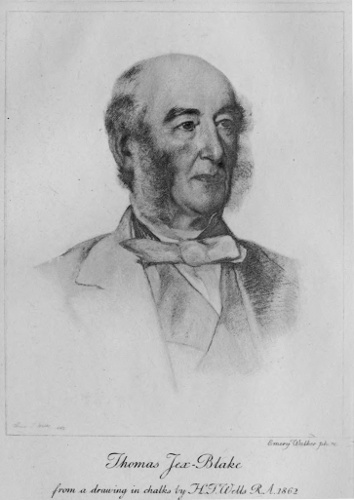
Thomas Jex-Blake
from a drawing in chalks by H. T. Wells, R.A. 1862
“4th Feb. 1859.
Dearest Sophy,
Your letter has given me unmixed pleasure....
About the tutorship, you write very ably, but your logic and
illustrations are not sound, as I hope to show you. I am sure you
are fit for, as you are fond of, teaching, and the desire to raise the
standard both of teaching and teachers is good, but your receiving
or not receiving wages for the work, can neither help or hinder the
matter. I agree to all you say in favour of working,—it is very
honourable, very right, and worthy of all praise, but what I object
to is your taking money for it. It is beneath you, and you will
be far happier to decline it, and let it flow into its proper channels,
to fructify widely and do real good.
The question is, as you say, one of right and wrong. In my
deliberate judgment it is wrong, in your position to receive pay for
what you do, to say nothing of the extent to which it would damage
you. The cases you cite, darling, are not to the point. I will
take each of them in the order you put them and then judge for
yourself. I never received a salary of any kind in my life. I was
71of a liberal profession—a particularly honourable branch of it—and
(chiefly) lived by it. This was ‘right’ beyond all doubt. T. W.
is doing the same sort of thing. He feels bound as a man, with
ability to do so, to support his wife and family, and his position
is a high one, which can only be filled by a first-class man of character,
and yielding him nearer two than one thousand a year. The third
case—Mrs. Teed’s—like the others has no analogy whatever to my
dear Sophy’s—Mrs. Teed had no means. She went out in early
life as a governess to earn an honourable livelihood. She did earn
it well and her talents, by God’s blessing, led to her after success,
enabling her to lay by something to support herself and sister in
their later years.
How entirely different is my darling’s case. You want for nothing,
and know that (humanly speaking) you will want for nothing. If
you married tomorrow to my liking—and I don’t believe you would
ever marry otherwise—I should give you a good fortune. What
temptation is there for your doing that which, at best, will be misunderstood
to your prejudice? I should say at all events wait a
bit till you are a little older, and can form a riper judgment. My
feeling is strong that you being a paid teacher would certainly
damage you, in what precise degree nobody can say. Do the work—it
is a good work and I rejoice in it, but don’t put a penny into
your purse for doing it. Let the gold go in some other direction.
This will give you a greater and more lasting satisfaction than you
could derive from any money payment.
Your loving Father,
T. Jex-Blake.”
“Feb. 5th ’59.
Dear Daddy,
Thanks for your letter. I do not know whether all my
reasoning was logical,—probably not—but I do not think that your
arguments respecting the relative position of (at least) Tom and
myself, are much better than ‘distinctions without differences.’
Refine it away as you may, Tom’s position and mine are considerably
analogous, though very unequal. As far as I can trace the
foundation of your asserted difference it is first his being a ‘man,’
which difference, as I said before, I cannot recognize as radical,—secondly,
that his position can only be filled by ‘a first-class man,’—and
I think, allowing, of course, for very great disparity of knowledge,
acquirements and requirements, the comparison holds, for it
is not easy, as has been proved by the length of time the office has
been vacant, to fill this Tutorship properly. I should say it is the
one the College finds hardest to fill, and therefore it is (in its degree)
as creditable a thing to hold as the mastership.
72Then I cannot think that you mean to urge the superior lucrativeness
of his post as any argument, for the principle must be identical
in receiving one penny or ‘nearer two than one thousand a year.’
Then I cannot say that I want for nothing,—I do want the money,
and am quite satisfied to earn it, quite knowing that my allowance
is enough. I do not really see that I am in any degree wrong, if I
am it is unconsciously and honestly.
Well, I don’t think it is of much use to argue any more—I have
told you honestly what I think.... Thank you anyhow for listening
to me patiently and answering me. I do not like to vex you after
all this—you have been and are very good to me. You ask me to
wait a little while and consider. I have considered well, and I do
not believe any further thought would alter my opinion. However
I will promise you for this term only (not ceding the principle) not
to take any fees, but if they come (which I do not yet know) to
return them as a free gift to the College. If at the end of this term
I still hold my opinion, I trust you not to oppose my determination
again. Remember and understand, Daddy, I do promise this
simply and only because you wish it, and not because in the least
degree my mind is one whit altered on the point. I trust you to
meet me half way, and not be in any degree grieved if I resume
my intention next term.
Goodbye darling,
Ever your loving child,
Sophy.”
“Saturday night. Feb. 5th 1859.
Dearest,
... Tom’s being a man makes all the difference, he has just
taken the plain path of duty. I am very pleased with the spirit in
which you write, darling, but I must be sincere, which I should not
be if I told you that I had the shadow of a doubt that you ought
not to be a paid teacher....
Ever, dearest,
Your affect. Father,
T. Jex-Blake.”
So closes this delightful correspondence. It was not to
be supposed that she should have no regrets. In her diary
she says:
“Feb. 13th.... Like a fool I have consented to give up the
fees for this term only—though I am miserably poor. I am sorry.
It was foolish. It only defers the struggle.”
The Norfolk cousins were not a little impressed by the new
life S. J.-B. was making for herself, though it was not to be
73expected that they should all take so enlightened a view of
it as Miss Evans did.
“You seem,” writes Cousin Ellie, “to be spending rather a jolly
time of it, but still it seems to me rather queer that a lot of girls
should walk about London when and where they please. I don’t
think you would come to any harm, but I am sure there are many
that would.”
And Sarah with whom “one does not connect the idea
of angel,”
“What glorious fun a girl might have if inclined, but you are
as steady as a rock. No fear of my dear old man doing anything
giddy. My dearest treasure, Goodnight.”
We gather from subsequent correspondence that the frivolity
of this letter brought down a very severe reprimand from its
recipient.
Elinor was the first to pay a visit to the unknown world,
and she writes a long account of it to the eager Sarah:
“When I first saw her that evening, I thought she did not look
so well, but since then I think the contrary—She is much thinner,
but in such good spirits, and so happy. I think she quite likes
everyone to know that she has been made mathematical tutor, for
it is considered a great honour.”
S. J.-B. would fain have seen more of these delightful
cousins, but their father held strict views as to the conditions
under which well-born girls might visit London.
“As to Ellie and Sarah,” writes Mrs. Jex-Blake in one of the
severe moods that had become so rare, “instead of being hurt they
do not accede to all you ask, you might well be proud of their warm
love. You have taken yourself out of your natural position, and
you cannot understand the need for their conforming to the proprieties
their Father so naturally and properly expects. Good-looking
girls do not needlessly go about London without chaperons.
Happily for them, their Father’s wish is sufficient to guide them.
There is a respect and duty to the position, however weak and
inferior you may judge a Parent to be.[15] Well, darling, God bless
and comfort you.”
Yet, judged by present-day standards, S. J.-B. would not
have been considered deficient in the spirit of compromise.
74Her letters to her Father on the subject of tutor’s fees is
evidence enough on that score, and those letters are in no
way at variance with her whole attitude.
“A triumph as to life!” she records in her diary. “Last Monday
told Mummy of my not going to the Opera without telling her, but
proclaimed my intention in the future. No interdiction. So I
talked a little about it to make all my ground sure, and coming
back on Tuesday found them going to Macbeth, Friday, and yesterday
told Mummy as a matter of course. She acquiesced if not consented,
and was glad we had so nice a party and hoped I shall not go often,
so entirely removing all interdiction....
Well, as to the Theatre! I believe I must confess myself disappointed.
Charles Kean as Macbeth did not satisfy me. Mrs.
C. Kean very good (I suppose) as Lady Macbeth. Yet not real,
as Shakespeare surely should be. After the murder of Duncan was
perhaps the grandest, most awful, most real.... The scene where
Macduff learns his loss more real than most. The fighting at the
end ludicrous.... I thought there would be decent fencing.”
A few months later she went (with Miss Wodehouse) to a
ritualistic church, and was moved to hot indignation.
“How can this man wear a priestly robe in the Church, and
subscribe to her 6th and 20th most scriptural articles? Well,
indeed, might we pray for the state of the Church Militant, when
within her walls are such teachers.
Yet was I right in not staying the sacrament because this sermon
so stirred my indignation? ‘The unworthiness of ministers hinders
not the effect of the Sacrament.’ Perhaps I was wrong. Yet I
could not have stayed in a peaceful or holy mind.
To the law and to the testimony! How precious is such unanswerable
decree!—so final a court of appeal!”
A note is inserted in the margin,—(“This May 1859. Sic
transit! Feb. 11, 1865!”1865!”).
Meanwhile her certificate examination was drawing near,
and mathematics absorbed most of her thoughts. On July 1st
she writes:
“Certificate examination nearly 4 hours. Out of 23 problems did
20½. So I trust I am pretty safe. I did get rather frightened as
the time drew on, but really have worked hard and I trust won.
Sent a telegram, ‘Success’ to Mother, though the declaration is
not yet made.
July 28th. My certificate won triumphantly and marked, ‘with
great credit’.”
75Of course she was working too hard.
“I have a great deal of work in College,” she confesses some time
later. I take 8 classes,—English Literature, English History,
Mental and Moral Philosophy, Theology, Church History, Algebra,
Geometry, and German Conversation; and have 7 pupils. I am
afraid it is too much altogether.”
And what about the ordinary traditional preoccupations
and vanities of a young girl’s life in the midst of these manifold
interests and claims?—what about thoughts of dress, of
personal appearance, of love and marriage? Well, obviously
there was little room left for any of these. S. J.-B. was
under the impression that she cared a good deal about dress,
and she would not have been flattered if anyone had expressed
a different opinion. As a matter of fact she never had
time to give the subject much more than a passing thought,
and the poor little remnant of an allowance that remained
when more pressing claims and numerous little charities
had been met, was barely sufficient to pay for the work
of an ordinary seamstress. The adaptable coat and skirt,
and the endless variety of cheap ready-made dress had
not then come to the aid of the educated working-girl, and
S. J.-B. did not realize the difficulty of the problem she had
to tackle.
“I should like to see your muslin at 3s. 6d. before I got one,” writes
honest Ellie. “You know you are the last person in the world I
should copy in dress, or who I would trust to get one for me, for
it is the only thing almost you know nothing about, and you have
very peculiar, and, I think, generally bad taste.”
The letter may have been written in a moment of irritation
about something else, or indeed about this very subject of
dress, for young folks are sensitive as to the appearance of
their valued friends; but it certainly contained more than a
germ of truth. Fortunately youth and a radiant personality
cover a multitude of shortcomings in this respect, and contemporary
correspondence often points to the extent to which
the Almighty had “favoured” S. J.-B. “in person as well
as in mind.” In this connection there is an interesting letter
of this period from an old schoolfellow, the daughter of a
former schoolmistress. After a graphic account of a lecture
76by Thackeray, at which the writer had the good fortune to
be present, she says:
“In face Thackeray is the image of—whom, do you think?
Guess. Someone you know,—of yourself. Yes, indeed, of you,
Sophy Blake. Mama and I were both struck, almost startled, by
the resemblance.”
It happened by a curious coincidence some years later that
Laurence was taking S. J.-B.’s portrait not very long after he
had taken Thackeray’s, and he expressed himself as greatly
struck by the similarity of the lines in the two faces. S. J.-B.’s
magnificent, speaking brown eyes, however, were hers alone.
“If they were taken out and laid on a plate,” said a forcible
young friend, “they would still be beautiful!”
As regards love and marriage, one can only say that, for
a girl in the middle of the last century she thought of them
surprisingly little. She speaks occasionally of her own
marriage as if it were as much a matter of course as her
coming of age, and, after enjoying some pleasant boy-and-girl
intercourse with an unknown “H.” at the house of her
cousins, she describes him as “the sort of man I may probably
marry in the end.” Visiting a newly-married girl
cousin, she frankly admits the charm of the comradeship,
for indeed, as a friend said of her (with more truth than
elegance of diction) a few years later than the point we have
reached: “You have taken on you a hard, hard vocation
from your youngest days,—and yet it is scarcely so hard for
anyone in the world to stand alone.”
In any case S. J.-B. went straight on her course, like many
of the finest girls of our own day, without giving any thought
to cross currents that might alter the course of her life. And
indeed her daily life was absorbing enough. It is scarcely
surprising if, among her many interests, her religious life was
somewhat smothered for the time, or that, at least she
thought so.
“Mrs. Thornton called my doing what I had done ‘noble’.
Yes, if for His sake, but, alas, much more—altogether—for my own.
Yet my loving the work is no disqualification for doing it for Him.
I trust I do do good a little. Surely honest intellectual help is something,
77if of lower class.... I have thought—I cannot take more
work, Sunday School, etc., but what I do is good in its degree; if
done in His name, surely He will accept it.”
More and more, as she looked back on her own school life
from the vantage-ground of a year at Queen’s College, she
felt how much the education of girls might be improved.
On the last night of the year she writes:
“In this year my idea of work in the cause of education has
developed itself into that of a resident College of the Holy Trinity.
Heaven knows if ever to be carried out. If good,—yes, doubtless,—if
not, God will raise up better. Little ‘religious’ as I fear I am,
I do feel this thoroughly....
‘And may the New Year cherish
All the hopes that now are bright.’
Such a happy loving Goodnight to and from Daddy and Mummy.
Very happy I am tonight.
‘And once more ere thou perish,
Old Year, Good night! Good night!’”
78
The great remain children to the last, and in this respect
S. J.-B. was essentially one of the great. To the end of her
life, for those who knew her well, she could be a delightful
child. But it was about the time we are considering—the age
of 20 to 21—that she may be said to have become a woman,
or, more truly, to have put on her manhood. She was too
busy at the time to describe or analyze in her diary the change
that was taking place—“Oh,” she says, “the little space of
time and paper! The mighty space of events ‘unheard’!”—she
was in no way self-conscious about it; but there are
indications, like straws on the surface of the water, that
show in what direction the current was setting. One sees
that she was beginning to look at life freshly and at first
hand, that the old traditional dogmatism was falling away
from her views of religion, of social questions, of the relation
between the sexes. To be sure this old husk was being
replaced by the even more acrid dogmatism of youth; but
in that very acridity one feels the promise of growth, of the
ripe wisdom of later years.
As far back as March 1859 one finds the following significant
passage:
“Had a long argument with Miss Wodehouse today. Two points
chiefly. 1. Are evil deeds, though always pernicious to the doer,
sometimes beneficial to mankind? I affirming: she denying.
2. Is it our first duty to seek our own salvation? She denying.
I cannot tell why I am so unable to argue with her. She seems
to get me into a maze. Yet I think she argues honestly. I sometimes
79shrink from ‘sacred’ subjects with her, yet she considers all
equally sacred.
‘What is truth’ indeed? Yet am I not somewhat like ‘jesting
Pilate’ who ‘would not stay for an answer’?”
“What is truth?” one finds her asking again and again,
and she at least had one grand qualification for the search,—the
habit of treating truth with respect even in its humblest
fragments.
Her Father, of course, was uneasy about her.
“I should like to see you much,” he writes, “but I feel that Sunday
would be a heavy day for you here (as I don’t frequent popish mass
houses or the like), so that if you could run down here on Monday
evening....”
And again:
“When I think of the (at best) half teaching you have, but that
I confide in our gracious covenant head, I should tremble for you
when I am gone. I have no doubt at all that Maurice is a most
amiable man, but I believe that to this hour he has never come
clear out of Unitarianism, and therefore does not see distinctly,
nor, of course, teach scripturally, any one of those fundamental
Christian truths (all connected together) original sin, Christ’s vicarious
work atoning for sin and fulfiling the law, justification by faith,
and salvation by grace. Read, darling, ...”
The following “passage of arms” with a Norfolk cousin,
a man some years older than herself, is interesting in this
connection:
“Hastings, March 12/60.
My dear Sophy,
I left Brighton on Friday with something of a heavy heart.
I saw I had grieved you where I had really no intention of doing so:
that was painful to me and I must regret it. I express to you my
strong regrets. But oh! tenthousandfold deeper was the sad conviction
forced upon me, that the advance you have made,—shall I
vex you if I say honestly and openly,—Romewards, since I last saw
you was very great. I believe you are as yet unconscious of your
own tendency. I told you so at Lyng. But in honesty I must tell
you, my dear Sophy, I tremble for you. It is such awfully slippery
ground. It is such a pleasant accommodation of religion to our
fallen nature. It so feeds our impulsiveness and fortifies our natural
religionism.
Will you forgive me if, with a cousin’s, I hope more than that,
80anxious love I beseech you to ‘consider your ways,’ and bring your
soul before God in this matter. Pray don’t starve your soul on gilded
husks while bread lies at your feet in your Father’s house.
I know more than one amiable creature who began as you have done,
and has landed in Rome....
Dear Sophy, don’t trust your head, much less your heart, much
less any fallen man or imperfect church under the sun. Trust
Jesus, Jesus only, Jesus wholly, Jesus exclusively.
I trust this note will not make you wrath against me.... Be
sure of one thing, I banter no more, where feeling is evidently so
deep. Henceforth I will try and pray fervently for your poor soul’s
conversion to God.”
“March 14th./60.
My dear ...
If I do not say that you have written me a most ridiculous
letter, it will be more from respect to its motive than its matter,—or
purport. I know people can work themselves up to any exaggerated
view of things, yet I can hardly believe that, if you have half
the sense people say you have, you can on sober reconsideration
really believe that there was the smallest ground for your tirade in
my objection to hear a Church—a house of God at least, spoken of
and criticised as if it were a right thing to visit it as you would a
theatre, and remain a looker-on while others were worshipping.
‘Seeking occasion against’ men was not the characteristic of the
followers of the Jesus whose name you reiterate so often. I believe
this was the whole feeling with which I spoke, exactly as I should
have done if it had been a Baptist Meeting-house you were commenting
on,—as I believe you would not have commented on a
Baptist Meeting-house.
You may, if you please, take my word for it that I am not going
over to Rome, among whose partisans, however, I must say that I
have never—no, nor I think from any other denomination under
the sun—heard the same virulent abuse of those who have at least
‘one Lord,’ if not ‘one faith and one baptism,’—that I have from
the Puritan portion of our own Church: and I am sure no God
and no Church was ever served by the one or the other....
What I have written is probably ill conceived and worse expressed.
Excuse all such deficiencies. If I have myself fallen into the error
I protest against, I need more than excuse—forgiveness. I have
not meant to be violent or uncourteous, but where I have felt strongly,
I doubt not I have so spoken.
For your cousinly care and affection I thank you heartily, as I
am ever
Your affectionate cousin,
S. L. J.-B.”
81And not only in matters of thought and principle was she
developing; she was beginning, too, to take her full share
of responsibility as regards her fellow-creatures, entering into
the meaning of brotherhood and citizenship. In addition to
her work at Queen’s College, she undertook to teach bookkeeping
gratuitously in connection with the Society for the
Employment of Women, and had a class of children at Great
Ormond Street. “I don’t know how I should like her,”
said a candid critic, “but it is a pleasure to see anyone do
anything so well as she does teach.”
Reference was made in a former chapter to her faculty for
taking the side-issues of life too intensely. It may not be
right to look on friendship as a side-issue—though many of
the world’s workers are more or less forced so to regard it:
in any case it is scarcely too much to say that—even when
one takes into account the endless philanthropic interests
and activities of her later years—friendship constituted for
S. J.-B. the main work of life. If she had been paid for the
sheer hard work she did simply as a friend, she would have
been a very rich woman. She was always giving out, and
from this time forward, she acted on the maxim, “Bis dat
qui cito dat.” If she arrived home, dead-tired, to find a letter
asking immediate advice or help, she would answer the letter
then and there and carry her answer to the post. If a friend
was passing through London, or coming to spend a few hours
with her, she would piece out a laborious journey by bus
between her classes to meet that friend at some far-off station
and make things easy for her. If a fellow-student or a
teacher seemed on the point of breaking down, S. J.-B.
would write three or four letters and call on half-a-dozen
people to arrange for a holiday, and, if necessary, for a substitute.
“Then home very tired,” she writes to her Mother
after such an experience, “but very content to write this
account to you.” (As not infrequently happened, the invalid
had found a refuge at 13 Sussex Square, and Mrs. Jex-Blake’s
kind heart was set on an extension of the holiday.)
“I do not think I ever did so good a Lord’s Day work in my life,—if,
that is, it is lawful to do good on the Sabbath Day,—to save life,
not to kill,—or let kill. I think I am very like a life-boat,—valueless
82in itself, yet useful enough in saving better things alive. That,
indeed, its whole use and work.”
“I am sure all that driving and running about with me on Thursday
made your eye and headache much worse,” writes Cousin Sarah,
“but you are such a dear kind old pet,—would half kill yourself
for anybody.”
A former school friend writes at the same date:
“I feel I ought not to trouble you, occupied as you are, but,
whenever I have asked you for anything, your kindness and sympathy
have been so readily given that I always think of you when I hear
of any wants.”
“Mama sends her very best love,” writes Miss M. J. Evans, “and
Papa too. Oddly enough, both like you. How can they?—such
a trumpery heartless girl!”
And one comes upon hundreds of tributes to the same effect.
Sometimes S. J.-B.’s willing assistance was of a kind that
involved no small labour and anxiety. If a friend was shy
and gifted and poor, capable of producing work not yet
recognized as marketable, S. J.-B. was always ready to be the
middleman. She would write round to well-to-do friends
enlisting their interest, do up samples of the work for inspection,
and (most serious of all!) undertake the responsibility of
receiving the samples safe back again. “Put the responsibility
on me,” she used to say cheerily in after life, “my
shoulders are broad enough”; and there is no doubt she
began to say this—if not in so many words—before the age
of 20. People got into the way of trusting her to see a thing
through, of assuming that it was her métier to be competent
and to organize, of leaving to her the heavy end of the stick:
and no doubt she enjoyed it all and learned much from it,
though, when taken in addition to her regular work, it was
terribly hard on her hasty temper and “irritable brain.”
“You must be very thankful to be a medium of helping
so many,” writes her Mother,—“a great honour, I consider
it, pleasure without alloy.” But in the same letter she says,
“Sad, sad weather for you to knock about in. Darling,
don’t risk your health.”
“I would not and could not speak” (after parting from you),
writes Ellie. “I wish I was not such a silly fool, but I could not
83help it and never can, if I have to leave you.... I wonder if you
have wished for me, if it was only to scold and fight with; but what
I wish most of all is that you would give up fighting. I would do
anything for you if I could only make even a slight alteration....
I do with all my heart wish that you would try to keep in that
temper of yours.”
Noble Ellie!—“Walks upright beside me, a companion, a
guide, and gives me a hand.”
S. J.-B. rarely, if ever, expected her friends to do her the
same kind of service; but, if they became very dear, she did
demand—more or less unconsciously to herself—a definite quid
pro quo. In her big masterful way she would proceed to
absorb their lives into her own; to establish a subtle growing
claim that was not easy to resist. She was splendidly loyal
herself, and the loyalty she exacted in return, though at
first glance an easier thing, involved more than she was in
any degree aware of. As life went on people found it increasingly
difficult to disagree with her: many simply ran
away—se sauvaient, as the French say; and yet it was only
when in the last resort one resisted her to the face for conscience
sake in some matter very dear to her heart,—that
one really gauged the greatness of her nature.
All this is taking us somewhat ahead of the early friendships
at Queen’s, but the frank recognition of this aspect of her
character is essential to an adequate understanding of her
life even in those days. A Queen’s College friend who, in
the most admirable and magnanimous spirit had accepted
what might be reckoned a heavy obligation to S. J.-B. and
her Father, writes as follows:
“I wish to tell you (I could not before, but think it right now)
that this ... will be more of a personal advantage and enjoyment
to me than anything else in the world....
With all my heart I rejoice to acknowledge an immense obligation
to you for your love to me at all times and for this particular way
of showing it, but not that sort of obligation which shall in any way
affect my words and doings with you for the future.”
If friendships are to be weighed, not counted, S. J.-B. was,
even at this period, fortunate in her possession of them.
The Norfolk cousins, the Cordery family, Miss Wodehouse,
84Miss Ada Benson, Miss Lucy Walker (afterwards Mrs. Unwin)
who was her junior at Queen’s, Miss Martha Heaton (Mrs.
Hilhouse) a fellow teacher,—are the names that occur to
one most readily. And at this time there came into her
life a friendship that was destined to make a deeper impression
on her than any of these,—the deepest impression, in
fact, of any in the whole of her life.
This is how it began:
“Jan. 26th. 1860. Just had a lesson in book-keeping from Miss
[Octavia] Hill. Clever, pleasant girl,—much nicer than I thought.
Dined with me. What and how the deuce am I to pay her? £1 1s.,
I suppose. Dear old Patty Heaton! How fond I am of her, and
what wonderfully good friends we are!”
“Jan. 27th. I am sure I am a good companion for her (Miss
Heaton) if only in amusing her. I think laughing does her a deal of
good—hearty fun. I rejoice in her exceedingly. And I hope for
another sort of friend, or ally at least, in Miss Hill who came and
taught me book-keeping yesterday evening. Nice, sensible, clever.
Very good worker, I expect.”
In the published Life of Miss Octavia Hill, one cannot but
observe how good this dawning friendship was for her also, how
beneficient was the sunshine that it brought into her somewhat
grey young life. On Feb. 5th, 1860, she writes to her sister:
“I am always thinking of you both, and longing to have you
home again that you may really know all our doings and lives.
Mine lately you would assuredly consider rather of the dissipated
kind. I have been giving some book-keeping lessons to Miss J.-B.
She is a bright, spirited, brave, generous young lady, living alone,
in true bachelor style. It took me three nights to teach her, and
she begged me to come to dinner each time. She has a friend who
is killing herself by hard work to support her younger sisters. I
gather she would gladly give her friend help, for she speaks most
sadly of the ‘modern fallacy’ ‘that the money must be earned.’
She thinks it might be given when people are dear friends: she
says they’ve given the most precious thing and what difference
can a little money make?”[16]
Almost from the first Miss Hill’s letters to S. J.-B. took a
serious tone. On March 18th she writes:
“I wonder whether you will think me very impertinent if I say
that I wonder you don’t see that, in turning away from so many
85important thoughts with a half joke, you are refusing God’s means
of grace as much as in staying away from ordained services. It
is no good my writing sermons, however.... I trust to live to see
some one or some sorrow do for you what I cannot, to see such a
peace as ‘passeth all understanding’ come over you, to see the
thankful, perfect dedication of all your powers to His service for
His sake....
I too long for a nice quiet talk with you. I enjoy it so, and
your magnificent energy does me such good.”
The talks were not always quiet. There are those still
living who remember some animated discussions, for the
two girls had stepped, as it were, out of totally different
worlds. Here is a typical passage:
S. J.-B. (hotly), “I never heard the game laws attacked!”
O. H. (calmly), “I never heard them defended!”
In the Easter holidays of that year both Miss Heaton and
Miss Hill were guests at 13 Sussex Square, and the friendship
between the latter and S. J.-B. was greatly deepened.
“My dear loving strong child,” writes S. J.-B. in her diary after
this visit. “I do love and reverence her.... Had a loving solemn
letter (not altogether pleasing to me) on my telling her we had had
a ‘row’ [at home]. Told her by return ‘Hang you,’ and bade her
remember she was neither nurse nor parson.
Dear, dear child, though. Mother calls it beautiful letter.”
It was so characteristic of S. J.-B. to show that letter to
her Mother!
On April 29th Miss Octavia Hill writes again to her sister:
“You dear old thing, I wish I had you here to give you a good
rest and rousing, and refreshing. I am as merry as a grig.... Miss
J.-B. and I are always doing things together—great companions I
am with her. You know she’s teaching me Euclid. We went to
see Holman Hunt’s picture,...”[17]
And again we quote from S. J.-B.’s diary:
“May 17th, Whitsunday. A most delicious day at Hurst with
Ruth[18] and Octa. Went down together second-class by 6 train....
Told Octa about Wales,—sitting in her room on the table, my heart
beating like a hammer. That Carry wanted to go to Wales and I too,
and most convenient about beginning of July, so ... ‘Put off my
86visit?’ said Octa. ‘No, I was going to say (slowly) if you wish
to see anything of me, you must come too, I think, and not put off
the mountains till heaven.’ She sunk her head on my lap silently,
raised it in tears, and then such a kiss!”
There is a happy letter about this Welsh tour:
“Bettws-Y-Coed,
July 26th/60.
Darling Mother,
We have decided rather in a hurry as there are to be no
prizes, ... to give a treat to all, which, however, Mr. Jones specially
stipulates is not to be a school treat.... It is just coming off today.
I ordered 60 lbs. of dough and etcs. from Catherine Owen,—rather
less rich than last year (that is, fewer eggs and less butter). It
makes 88 lbs. altogether. But it was only settled on Monday, and
as this is Thursday I am half afraid all may not know. But we have
tried hard to send scouts everywhere....
Please tell me as early as possible where you will be each day of
the week beginning Sunday, August the 12th. Now don’t let Tom
just prevent your remembering or caring[19] to meet your little one.
I do long to see you so....
Weymouth St. July 30th. All over, darling, now, and such a happy
time without a single blot I never remember in my life. Every
thing has been better than any anticipation of it. We have done
everything we wanted to do. We have been everywhere and have
had no mischance, no annoyance of any kind. Octa looks five
years younger, and as bright as a sunbeam. And I am in so
thoroughly happy a state of mind as hardly to know myself. I
really almost think I should be good-tempered now. We came
home by Llangollen on Saturday, 40 miles coach and 194 miles rail.
Not a bad journey for one day. We went up that morning to your
high mound. The view was glorious. I took poor old Ellen Jones
some squills for her cough, but she looks very ill indeed. She sent so
very much love to you, and wished she had something to send you.
The treat came off excellently on Thursday. It was grand fun
to see Octa playing with the children. At Hunt the Slipper once,
she, pretending she had the shoe, held up her boot toe, saying,
‘See, here it is,’ or something like it. Grace Owen, who was
seeking, seized hold of it as quick as light, crying ‘Let me have it
then,’ pulled away, and capsized Octa entirely amid roars of laughing.
Octa sprang up and chased her round and round the field till she
caught and tickled her. It was quite one of the bits of fun of the
evening.... The only contretemps was that poor little Hannah
87fell down and sprained her arm. However, Miss Hill’s surgical
powers came in grandly, and I do not suppose Hannah is any the
worse except for a few days inaction. Well, how strange it is to
find this all over, and probably never to return. I cannot say I am
glad our tour is over, for I do believe I was never so happy for so
long in my whole life, but neither can I say I am sorry to see dear
old London again,—I am sure I could come back to no other place—as
a place—with near so much pleasure....
Just fancy Octavia’s energy,—after that tremendous journey not
reaching home till 10.30, she was off to Lincoln’s Inn at 7 a.m. the
next morning for the early communion, and went again, and I with
her in the afternoon. Her Mother and sister were so delighted
with her account of all her doings, and a glorious one she gave certainly.
I had tea with them last night. Goodbye, my darling, for
the present. Not so very long now, I trust, before we meet.
Aug. 1st. Although this has been in a ‘Milan’ envelope all this
time, I suppose I must now send it to Chamounix, as I foolishly
forgot to post it yesterday.
Today quite forgotten to order any dinner, so just bought some
cheese and strawberries.
Tell Carry John Davis has sent her a letter to complain of me,
which was forwarded to me, and which I have answered. Goodbye
darling.
In August, when S. J.-B. and Miss Heaton were abroad
together, Miss Hill writes:
“London feels strangely desolate, the lamps looked as they used
to look, pitiless and unending as I walked home last night, and
knew I could not go to you.... I don’t the least suppose you’ll
go to Florence or see my sisters, but, if you should, pray take off your
‘spikes’ and remember ... how much they love England, and
everyone who is a friend of ours. I look forward to bright long
days in which I shall learn always more about you, and watch with
unending and unfathomable love and sympathy your upward growth,
and we may look back together on our lives, as I do often on my
own, and wonder how I could know and see so little, and wonder
more how, knowing so little, I should be led continually to deeper
truth.”
Here, one would have said, was the beginning of an ideal
friendship, and so it might have proved—allowing, of course,
for the necessary rubs between two such strong natures—had
the two girls been alone in the world. But each of the
88two belonged to a family that in different ways exacted a
great deal from each of its members, and particularly of the
member involved in the present friendship. It is doubtful
whether even the two girls could have made a success of
living together, for the diary refers occasionally to “cataracts
and breaks,” and on both sides there are letters of penitence
for hot temper or “coldness and pride.” Moreover, Miss Hill
loved peace more than do most, and, dearly as she loved
S. J.-B., she was almost bound in time to find her “more
stimulating than quotidian,” to quote a quaint phrase of
Carlyle’s.
It is therefore with no small sinking of heart that one
reads the following entry in S. J.-B.’s diary:
“Sept. 9th. Sunday [1860]. A plan on foot of my taking part
of a house with the Hills and having Alice for a servant. That
would be very jolly. But rents high about here,—least £120.”
Certainly a similar sinking of heart took possession of Mr.
and Mrs. Jex-Blake, and when they learned that the finding
of a tenant for the drawing-room floor was an essential part
of the scheme, it is not surprising that—short of stopping their
daughter’s allowance which had been increased some time
before—they did everything in their power to discourage
the arrangement. They were well aware that, here as everywhere,
the willing shoulders would take their full share of
work and responsibility. The reader will be prepared for
Mr. Jex-Blake’s point of view:
“Dearest Child,
You cannot surely mean to take a house and let lodgings in
direct opposition to your dear Mother and me. It would be quite
disgraceful and we never can consent to it. I will not believe, my
dear child, with all our love for you, that you will so directly disobey
us, or that Miss Hill, knowing our feelings on the subject, can be
a party to it.
When you spoke of the other house, you said a lawyer was to
look over the lease, and take care of the Hills, and I firmly believed,
till the last few days, that you were to hire rooms. I had no more
idea of your becoming a lodging-house keeper than of your keeping
a shop. You cannot suppose that I would assist Miss Hill in such
an exceedingly blameable transaction. I would with real pleasure
assist her in all possible ways ... but no Father or Mother who
89love their daughter, in your position, could consent to her joining
in it. I trust, dearest child, you will give up all idea of such a thing,
which, once done, you would repent as long as you lived.”
The response to this protest has not been preserved. On
October 18th Miss Hill writes:
“My darling Child,
Thanks for all the trouble that you are taking about the
houses, I am quite ashamed it should all fall to your share. Is
Harley Street house quite out of the question? I received a letter
from Mama, earnestly desiring that we should keep near the park;
she would not at all like Bentinck Street. Don’t weary yourself
with searching. I certainly will return on Thursday (probably
much before) then we will look together again.... If it would secure
the Harley Street house by all means let us pay all the taxes whatever
they may be. I am writing in the dark. Goodbye, my own
darling treasure.
I am,
Yours affectionately,
Octavia Hill.
Mama has an affection now for Harley Street.”
Finally, the house 14 Nottingham Place was taken, and
rather more than the customary number of difficulties had
to be worked through in connection with it. In addition to
this, illness broke out in the house, and there were several
invalids to be nursed.
The most forgiving of mothers writes after a visit to her
daughter:
“It is all your own choice and doubtless right, but it sometimes
grieves me to think how many discomforts you have, and how many
indulgences I have—only it is not my doing that you have them
not. I wish I did not think of you as worn and fagged. Do assure
me that you go to bed as early as you can and get good rest.”
Fortunately youth and friendship make all things easy, or
at least bearable. During S. J.-B.’s brief absence in December
Miss Hill writes:
“Oh, child, your letters are such a delight, but I miss you so
dreadfully. I wander like a lost thing about the house and long
for you intensely. Every place seems so desolate. Every witness
of your thought and active care of and for me contrasted vividly
with Z’s odd procrastination till I almost felt unjust and unkind.
90And yet I ought to glory in your kindness and goodness, and in
all that mighty and glorious energy that will help so many people in
this sad world, if it is spared to us. Your room, the fire, the thought
of all you had told me to provide for myself, fills my eyes with tears.
I mean to spend a very quiet and happy Sunday.” And again,
later,—“Do you know I get on very much more easily with strangers
than I used, all of which I owe to you. It is a great satisfaction to
me: it pleases one’s friends to have their friends like one.”
Up to this point the friendship had been an almost unqualified
gain, but, little by little, Miss Hill began to feel the
strain of dividing herself—so to speak—between her family,
her comrade and her work. In May 1861 she was called
away by the illness of her friend, Miss Harris,[20] and the change
to an ideally peaceful life was just what she needed. Her
own health had begun to suffer and she remained on at the
Lakes for some months to gain strength. In her absence,
S. J.-B. took on her own shoulders in great measure the
responsibilities of householder. Hitherto her acquaintance
with the other members of the Hill family had been slight,
but a warm friendship now sprang up between her and the
sister, Miranda, who often shared the meals made ready by the
devoted Alice and served by her in her young mistress’ room.
Few young people in the first glow of a new friendship have
sufficient tact, self-control and knowledge of life to avoid all
risk of wounding their elders, and such tact would scarcely
be possible in a nature like S. J.-B.’s. Little rubs and
frictions increased, and no doubt Octavia was the confidante
of all. In July she writes:
“I hold myself prepared to come when it seems right, sure to be
given strength to do my duty, but certainly not longing for anything
that will bring me again into a world of contention. I can’t
bear to think how pained you would be if you could know the strength
of this feeling, for I know you would feel it a failure of love. I tell
you all this because I am sure you will feel it in my letters, because
I am sure such a cloud hurts less when frankly confessed, because
I am sure such a friendship as yours and mine need not fear it,
remaining untouched and immoveable, based on what can neither
change nor know fear.... All my life long this dread and misery
about even the slightest contention or estrangement has taken the
form of misery, continually saying in itself, ‘I cannot bear it.’ Since
91physical strength has left me so far this wretched dread has increased
tenfold....
How delightfully kind and good you are to everybody. I can
fancy I see you, brightly kind, good and energetic, going about
among all the people, entertaining monitors, inviting my sisters to
tea, giving club dinners, learning about examinations, arranging
the play, talking to Miss Boucherett, delighting to plan work and
holiday for them all.... When I have thought, as I often have,
that it is probable that I may never have strength to work any more,
you cannot think how I have clung to the thought of your ever
ready and powerful help and care.”
Through all this tide of affection, one wonders whether
S. J.-B. in any way realized the very genuine apprehension her
friend felt about returning to the atmosphere of contention.
The probability is that she did not realize it at all, or rather
that she looked upon it as the expression of a transient
mood caused by physical weakness. No doubt she made a
generous resolve that “everything should be made easy for
Octa” when she returned; but she did not realize how
great was the need for resolve. She never saw her own
personality from the outside; and of course hers was not the
only “temperament” in the house. No member of the
family could have been described as a mere cabbage.
We all know how friction increases when the machinery is
out of gear: differences of opinion grew: Mr. and Mrs.
Jex-Blake protested against the imprudence of accepting a
banker’s reference only, in the case of a foreigner who was
in terms for the rooms, and for once their daughter upheld
their view with tenacity. Finally,—though this not till
October—the state of strain became so great that Octavia
was summoned home.
One can sympathize profoundly with her in the difficult
situation she was called upon to face. She knew by this
time what the faults were on both sides, knew in particular
that S. J.-B. was not a placid person; began to guess perhaps
that explosions of temper were as essential to that generous
nature as the thunderstorm is to a stretch of summer days.
Meanwhile everyone was counting on her to solve the difficulty
with a wave of her wand: and here was she, never very robust,
weary with a long journey, called away from a congenial
92holiday to the intimate association with a thousand and
one petty cares in addition to the special crisis that had
summoned her home.
The extracts given above are a mere gleaning from many
unpublished letters which bear witness to her devoted attachment
to S. J.-B., but although her sympathy with her
own mother was perhaps less fervent at this time than it
afterwards became—she had a strong sense of filial affection
and duty. Moreover she had her work in the world
to do—invaluable work we know it proved—and she felt
that she could only do it in an atmosphere of peace and
quiet.
Assuredly it was not an easy situation to face. Looking
back upon the whole story after more than half-a-century,
one cannot but wish that she had simply compelled S. J.-B.
to realize the truth,—that she found herself unable to live
and do her work unless she could have the peace that her
soul loved, that—much as she had profited up to a certain
point by the stimulating friendship of one so unlike herself—the
time had come when she found that friendship too stimulating
under present conditions. Surely—one fancies—some
arrangement might have been arrived at by which so mutually
beneficial a friendship might have been continued.
Miss Hill, however, decided otherwise. In the watches of
that first night, after a long talk with her Mother (a talk
that, in the nature of the case, can scarcely have emphasized
S. J.-B.’s point of view), before she had even seen her friend,
she resolved to forego even the semblance of an attempt to
reconcile these conflicting claims. Something must go, and
that something must not be the mother and sisters to whom
she had devoted most of her ardent young life, the mother
and sisters who depended on her wisdom and goodness more
even than they knew.
It was one thing to make the great resolve: it was quite
another to explain it to the friend whose one conscious desire
was to make Octa’s life an easy one.
So she set her face like a flint, and, for the first time in the
course of their friendship, she refused to see S. J.-B.’s side of
the question at all. Peace must be secured at all costs, and,
93if peace was to be secured, this delightful exacting friendship
must end. S. J.-B. might retain her rooms for the time as a
matter of business—
But neither S. J.-B. nor her indignant Mother would listen
to that.
Well, then, let it all go. The time for half measures—or
so Miss Hill thought—was over. All intercourse must cease.
“The relentless knife must cut sheer through.”
How much the effort cost her we gather from the extent to
which she overdid the part. She was at the end of her tether,
so to speak, and acting, doubtless, on an instinct of sheer self-preservation,
she would allow no discussion of any kind. She
set her face so flintily that S. J.-B. was driven in uttermost
bewilderment to the conclusion that the complete withdrawal
was due to some extraordinary aberration on the part of
her friend—an aberration for which so noble a being could
not be responsible, and which might therefore come to an
end as suddenly as it had begun. A thousand times she had
said to herself, “Everything will be right when Octavia
comes!” And now, behold, Octavia was here, and it was
no Octavia. It was a fairy changeling to whom the beautiful
past was a thing unknown. The rupture was so complete
that it was no rupture. It was a nightmare, an inexplicable
darkness at noonday, something so contrary to all known
laws of nature that it could not last. This hope, this attitude
of expectancy, was encouraged by the extraordinarily tender
and appreciative letters which, at intervals for some years,
broke through Miss Hill’s reserve. In one of these letters,
dated Nov. 5th, she writes:
“Oh, Sophy, how splendidly you and your Mother did act those
last days that now seem so far away.... When I see how deep your
forethought was, so loving as to have remembered the very slightest
things that might be the least trouble to us when you were no longer
near to take care of us, one feels as if an angel had (may I not say
still is taking) care of us.”
A generous letter indeed, but in the face of such letters
was it any wonder that S. J.-B. failed as of old to grasp the
extent of the difficulty,—that she refused to accept the situation
as final,—that she lived on in hope, and often all but
94intolerable suspense? “Did I want to learn constancy?”
she says.
If the lesson was needed, most assuredly it was learned.
Till the close of her life the friendship on her side remained
unbroken, although she ceased in time to speak of it even to
her most intimate friends; in repeated wills she left the
whole of her little property to Miss Hill,[21] and, although other
friends came in time to fill the empty place—although she
even wrote playfully in her diary some twenty years later of
her “fanciful faithfulness”—until the eve of her last illness
she would not extinguish the hope that “even in this life”
the friendship might be renewed.
One might say more than this. From the time of the
rupture, Octavia Hill became to S. J.-B. a pure ideal—something
of what the subject of the In Memoriam was to the
author of that wonderful threnody.
In any case the whole history of the friendship was destined
to lie on higher levels because Octavia Hill had felt bound
to break it off.
95
It has never been customary among students of human
nature to attach great importance to the outpourings of a
romantic friendship, save in the rare cases where these have
achieved consummate literary form. The religion of the
adolescent, too, is a thing that we are apt to take a good deal
for granted. In S. J.-B.’s case, however, the ideal—the
vision—to which this brief friendship gave rise throws a
light on potentialities of feeling and expression which we
should otherwise never have had. The fact that so apparently
transient a gleam should have given rise to a great
and lasting inspiration lifts the passages that follow quite
out of the category of the great mass of similar experiences.
The effect of one personality upon another is a thing we
can never predict and seldom explain. It is not a mere
question of addition or even of multiplication. The process
is a vital one which can never be mechanically reckoned out.
We all see over and over again in life how the receiver may
contribute as much as the giver—the pupil no less than the
teacher. When the word of God went forth from Sinai, we
are told, each man heard it in the tongue in which he was born.
In any case that strange and new experience came with the
force of a ferment to S. J.-B. “She was never the same
again,” says a lifelong friend, looking back on the whole
history after more than fifty years: “it cut her life in
two.” But the cutting in two—like the division of the
primordial cell—was the earnest, not of death, but of life on
a larger scale.
96“My Mother’s full glorious sympathy! What could I do
without that? God bless her, my darling,—mine for ever.”
So writes S. J.-B. in the first days of her trial. If anyone
knew the meaning of the words, “as one whom his mother
comforteth,” it was she.
And never did she need that comfort more than now.
She left the house in Nottingham Place at once, but she
gallantly finished her term at Queen’s College and then went
home to Brighton. “I must not get bitter and cynical,”
she says. “I don’t think I shall. And yet the crash has
been awful.”
As often before in lesser troubles she was thrown back on
her own deep religious faith.
“Bankrupt?” she asks herself. “No, by God’s grace, no! No
personal trouble, no trouble of any kind, can wreck a life in His
charge. Still His,—that the strong, the enduring thought.
From this very threshold of pain, whatever be its present issue,
shall go forth an earnest patient life,—to continue Christ’s faithful
soldier and servant to my life’s end.
Yes, I,—Christ’s soldier! Yes, earnestly, heartily, entirely,
though speculatively this Christ I know not,—though my mind asks
in all uncertainty What and Who?...
Dogmas are one thing; life is another.
Doing is clear; ‘doing the will,’—‘knowing the doctrine’ shall
come later. Not believing though. I mean understanding,—receiving
with reason and mind.”
So she prepared her altar, “and put no fire under,” but
the flash came.
“Dec. 13th. Sunday. 11.45 p.m. Who could have believed
what a happy holy evening has succeeded to all the pain, storm and
whirlwind of the morning?
Dr. Smith’s death.[22] The loss of Octavia’s day,—her visit of one
hour; the utter stupor of misery. Then, with all the pain, the
perfect feeling of content and assurance of Rightness in things.
Then this happy evening, lifting me altogether out of myself and my
pain into the trials and struggles and efforts and interests of Lucy
and Emily,—and, thank God, the power of helping both. Now
this calm perfect peace, which sends me to bed ‘resting.’... Oh,
God is most merciful, most bountiful. ‘Like as a Father pitieth
his children’.”
97
“12 p.m. Sunday night.
Don’t chide me for writing late, Mother. I must speak to you.
If I could give you an idea of the peaceful, happy evening I have
had,—sending me to bed with a heart full of love and joy and thankfulness.
No, nothing has changed in outer things. I have no
other news. But perfect peace has come. I can hardly tell you
how happy I am, Mother.
I have had such a happy, holy evening with two or three of the
girls.... And God seemed to give me such wonderful power to
help them, and I believe He has helped them. And in all this—I
know not how, but I wake up at their departing ... to find that
somehow God has rolled away my burden utterly.
I had forgotten it and myself altogether, and now I can find
neither. I can hardly believe in the pain and misery of the morning,
it seems a dim, far-off memory.
Is it not wonderful, Mother? Goodnight, my own darling.
Yours very very lovingly,
Sophy.
I do not know when I could so fully and entirely say, ‘I will lay
me down in peace and sleep, for Thou, Lord, only makest me to dwell
in safety.’safety.’”
Follows an undated fragment, probably written to her
Mother next morning:
“—passed other quiet wayfarers, just as heavily weighted. How
gentle it ought to make one,—to see how utterly ignorant one may
be of sorrow at one’s elbow,—how one can only be generally tender
to people, if one would escape striking down an already tottering
neighbour because one does not and cannot know his needs.
It is only God who sees which is the bruised reed, and cherishes
that specially,—or can do so.
I am thinking how near 4 o’clock is coming. It may bring me a
kiss and a word from my darling. I am sure tonight’s post will at
any rate.
Well, dear, I have you always and forever, and with you only I
could never be desolate. And I have her too,—though she doesn’t
know it now.
Yours very very lovingly,
Soph.”
“4.30 p.m. Thanks, many, darling, for your loving little note.
You will know before this that the cloud is not dispersing in the way
you mean,—that it has only more fully and certainly overspread
the sky. Yet there is—and will be more and more, please God,—a
light in it too.”
98
“Dec. 16th 1861. 8.30 p.m.
My own darling Mother,
Thanks so many for the loving little scrap of letter which I
knew would come to comfort me.
The sympathy is always delicious, but the active need for it is
utterly gone. You will have got my last night’s letter, so Mother
will not go to bed with a sad heart for her baby.
Yesterday I was wondering how it should be possible that I
should ever live out the next three days till I got home to you. Now
every sort of trouble seems to have fled utterly away. I never
knew before the meaning of the words, ‘the peace that passeth
understanding’....
I every now and then wake up with a kind of start of wonder to
find such a sunny smile of heart gladness all over my face. And
people see it too. It would be very odd if they didn’t when the
whole world is changed to me. It is the most wonderful separation
of the inner from the outer world that I ever knew. I suppose
nothing is changed in the physical world, but everything seems for
me bright and golden,—as in my Welsh tour with Octavia (I can
speak of it and her now with perfect quiet peace), as in those days
at Hurst.
Last night I thought it most glorious, but too delicious to last;
but it seems now the atmosphere of life, as if nothing can touch or
shake it....
Mother, a grand solemn wonder comes with it all, whether it is
that when we have actually and literally given up every will and
wish to God,—have rested utterly and entirely on Him with perfect
trust—whether then pain loses its power, and only blessing, even
now, can come.
... if so, what a glorious future one sees for all the sorrowful
here,—for all the tried and suffering. ‘For all the wanderers the
home is one’. The pain only till it has brought the bliss; the All-loving
Father that cannot wound but to heal.
Now my spirit is so perfectly at rest, all my strength seems to have
come back to me like Samson. I feel as if Edinbro’ or anything
else was nothing to me. ‘He hath set my heart at liberty’,—that
is the very truth. Mother, how naturally in every depth of sorrow
or joy one turns to those words about which verbally we quarrel,—not
really or deeply, Mother.
Goodnight, my own Darling,
Yours very lovingly,
Soph.”
From diary:
“Dec. 16th Monday. ‘For as soon as ever thou hast delivered
thyself to God with thy whole heart, and seekest not this or that
99for thine own pleasure or will, but fixest thyself wholly upon Him,
thou shalt find thyself united and at peace.’
Thomas A Kempis.”
“Dec. 22nd. Sunday, 11 p.m. The last thread actually broken,—the
parting over.
Left London on Thursday evening by the 8 p.m....
Well, it is all in hands that cannot err,—speculative sceptic as
I may be, practically my trust is as firm as the rock on which it rests.
My Father doth do all things well,—and even makes me feel it,—even
now. And surely, to take a lower ground, I have been an
inapt pupil if the lessons of the last few months have not taught
me the utter impossibility of calculating the possibilities of the
future.
Should I have believed from man or angel on Tuesday the first
the events of Thursday the last of October?
But we don’t want low ground. He is the rock,—His work is
perfect.
And He will care for my child.”
Of course this mood of exaltation could not go on unbroken,
except at the cost of sanity itself. Hours of reaction had
to come. “We might have done anything together, we
two!”
“Dec. 29th Sunday. Tonight the bitterness seemed doubled in
finding ‘my teachers removed out of my sight.’ I just feeling my
way to truth,—saved by her from so much doubt and possible
infidelity. Well, God will teach me, will He not, Himself,—so
Mother said. I cannot (or feel as if I could not: cannot is not a
word for ‘Christ’s soldier and servant’, is it?) put it all away.
I seem so physically weak and rotten, so unable to exert will and force
myself to be quiet.
But I have found something to do. I behave infamously to the
dear old man. Well! I mean to throw my whole being into being
a good child at home. I won’t be rude and bad to him!
Now record this vow for a week,—don’t be superstitious, Jack;
say ‘God helping me’ and go on,—forget yourself. Just do this
piece of work,—and wait.
So be it.
What was the ‘chief evil’ to which the suffering must be directed
to be sufficient?
‘Selfishness,’ said I.
Truly, Jack. And what is it but intolerable selfishness,—this
brooding over a ‘bootless bene’,—this expecting sympathy and all
sorts of kindness and excuse from my Mother and the rest, and
100talking about nerves and fiddle-de-dees,—instead of forgetting
myself and seeing to my work and to other people.
Well, God helping me, now for a new leaf—of strength and resolve
instead of whining self-pity.”
It was with this inspiration that she wrote to one of her
pupils:
“Dec. 31st. 1861.
Dear Lucy,
... My Modern History was all right, thank you,—I forgot
you had it. By the bye, your handwriting seems to me to have
‘suffered an improvement’—I must congratulate you.
I am very glad you think I have helped you, dear child,—my
life has been a very pleasant one in London,—its memory will be
pleasanter still if it has been too not quite useless to some of the
people who have helped to make it so. I could not easily count
the people who have helped me,—some directly,—some merely
‘by living.’ It is a glorious thing, is it not, to be a link in that
chain of help which encircles the world,—to pass on to another
what one has given us,—feeling how all our broken bits of help
and gift are gathered up in the perfection of the Great Giver and
‘Father of Lights.’
I do heartily hope that you will go back to Queen’s just to take
and hold your place in that chain. Only do quite resolutely take
your part for the highest and noblest,—remember ‘the soldier and
servant’, and remember how very far we are from helping when we
acquiesce in any wrong doing,—in any low standard of right and
wrong, even by silence.
I do not think it would be easy to over-estimate the importance
of a high pure tone among the leading girls at such a place as
Queen’s,—perhaps such as you and L. hardly know what a power
lies in your hands, for the very life of the College,—and mayn’t
we look higher than that, and say for our Master’s work?
And after all that is the true and simple way of looking at it,—for
consequences we can’t calculate,—but we always can know right
from wrong, and the rest is not our affair.
Well, dear child, God bless and guide you,—that is the true help.”
And, finally, she writes in her diary:
“Dec. 31st. 1861. The last day of the year! Now to ‘take
stock’. I have just finished, and balanced exactly my money matters
(within a deficit of 2s. 8d. with which I left London). Now for the
moral and historical. See the last volume for the beginning of the
year. How well I remember the last day last year. Does she? How
we did and sorted accounts till the chimes,—and then leant together
101out of the window in our new house fresh with plans and hopes,
saying so hopefully,
‘And may the New Year cherish
All the hopes that now are bright.’
And now truly almost,
‘For all my earthly hopes this (year) did kill.’
It is almost dreadful to look back and see how this book opens
with a jest. How full of joke and spirit all seems! The ‘deep
waters’ have come this year as never before. But it is a strange
wild comfort to find in myself so much capacity for suffering. I
had always despised myself as a weak shallow nature, to leave
others to suffer and escape with a laugh....
(Wrote one last letter to Frid[23] tonight—for her birthday tomorrow.
Weak? I think not.)
Well, now to ‘take stock’:
The opening of the year, bright, clear, hopeful. Octavia’s visit
to the north, but that no real break. Our delight in our new house,—its
quiet and peace. Some disappointment is not letting, but that
very endurable. No bar to happiness....
Then the return of Frid and Florence. My unwilling acquaintance
ripening gradually into love for Frid, called forth perhaps first by
her great love for me.
Then our glorious Whitsuntide at Hurst,—Octa and I. The few
days (Thursday to Tuesday) pure unmixed heart sunshine. Purer
and deeper if possible than that of Wales.
Then the strange double summons on May 21st., she to Mary
Harris, I to the O’Briens. Coming like a thunderbolt on our week,
but accepted by both obediently and willingly. Together to London.
Then my mission to Tufnell Park. The hurried tea, the night mail,
the parting hand pressure as the train moved, ‘in the sure and
certain hope’—is it blasphemous so to use the words? I think
not. There was a glorious churchlike solemnity always on our love.
Well!—then the five months’ parting,—hard it seemed then, but
painless—heaven—to what came after.
Perhaps I am not yet meant to see the ‘why’ of all that followed....
We seemed so helpful heavenwards to each other. Never
seemed our love truer, deeper, purer,—I know though now that mine
could be all three.
Yet with all this wondering, I do and have felt most solemnly.solemnly.
Surely it is best. ‘We shall see in Heaven why it could not be
otherwise.’
At least, Octavia, you have never had (in me at least) so true and
deep and leal a friend as now,—and yet quieter and so stronger.
102And for her—God have her in His holy keeping!
I feel some work has been done when I can say as deeply, truly
as now that no earthly blessing could seem to me (except relating
to my Mother) comparable to her restoration to me (for every feeling
of hurt or wound or injury seems merged in deep earnest love
‘beyond words’) yet I am ready, and God helping me able to go
through the world—darkened and lightless as it seemed a few weeks
ago—and feel it yet my Father’s own world, ‘very good’ yet:
ready in it manfully and cheerfully to take up my burden, and
again and forever as ‘Christ’s faithful soldier and servant’ to fight
manfully till my life’s end—so help me God!”
103
It is the great miracle of life—that first glow and uplifting
of the soul in touch with the Unseen. “The immediate
consciousness of the religious man,” said Hegel, “has in it an
infinite worth, because an infinite content.” For the moment
it seems as if all the difficulties of life were swept away, as
if nothing temporal could matter any more. But if the world
at large is to be ennobled and spiritualised by these individual
experiences, the inspiration has got to be worked out in
“the commonplace clay with which the world provides us.”
And here comes in an all-important point, to which, on
the whole, far too little significance has been attached. To
some of those who have the vision, Fate gives a tractable,
malleable lump of clay, limited in mass, fine in texture,
ready to respond to the lightest touch of the potter: and
so we get sweet and saintly characters whose lives will bear
the minutest inspection—such characters as Maurice and
Eugénie de Guérin, or the wonderful family described in
Le Récit d’une Soeur. But there are some to whose lot a
very different problem falls. The big and rough jobs of the
world-spirit have to be tackled somehow. There are unwieldy
masses of clay, full of grit and impurities, masses that do not
seem to respond to the creative impulse at all. Rough
handling, bold tunnelling may be required; and if it be
true,—as it is—that the first beauty of the spiritual vision
seems degraded in any attempt at realization, how much
more is this the case when the seer is baffled and thwarted
at every turn by the sheer inertness and stupidity of the
104lump, so to speak, when he is forced to resort to almost brutal
methods in order to get his idea expressed at all.
God gives man the vision and the lump of clay; and many
a man who escapes the censure of his fellows gives back the
two separately to God, like the talent wrapped in a napkin:
some men are privileged to return a piece of work that all
eyes can value in a trice: and some, “with aching hands
and bleeding feet” have merely blocked out a great conception,
have half-unconsciously drafted the rough outline of
one of the Almighty’s big schemes, an outline on the details
of which smaller souls will be abundantly occupied for
generations to come.
Before we judge of the finish of a man’s life, before we
judge of its correspondence with what he believes to be his
inspiration, let us ask—What was the extent of the problem
it had to grapple with?—What was the mass and what the
condition of the clay?—What, in a word, was the man’s
task?
There must, of course, be some sort of affinity, some mesmeric
attraction,—even if this should seem to show itself in an actual
distaste—between the man and the task. So far as human
stupidity makes this possible, we must believe that God
Almighty chooses His man, and the work of the Almighty
would be singularly limited in range if He chose for His
purpose only those whose natural endowments are such as
to make them an unqualified credit to any cause they may
espouse.
All this must be specially borne in mind in judging the
subsequent life of S. J.-B. We are bound, of course, to ask
how she worked out in life this beautiful vision of her adolescence—bound
to ask how she realized in practice the “infinite
(potential) worth and content” of that first radiant consciousness;
but before we attempt to answer the question, we must
take into full account the extent and the difficulty of the
task that fell to her share, and we must give full weight to
the natural attributes which were the tools placed at her
disposal.
It is clear that there was about her a doggedness, a high-handedness,
a disregard of tradition, an actual—if superficial—roughness,
105which are not common qualities among the highly-educated
of either sex, and which were never admired in her
own. On the other hand, the reader of the foregoing pages
will no longer need to be told of her tenderness and sensitiveness—of
a capacity for loving and for suffering only commensurate
with her power of inspiring love, of incurring suffering.
In a sense she was a born fighter, but it is a very nice question
how far she enjoyed a fight. Thousands of times throughout
life she might truly have repeated the extract from her diary
quoted on p. 46:
“This brought down an awful storm of wonder, reasoning, etc.,
till at length I got off to bed so tired.”
The diary continues after the extract quoted in the last
chapter:
“And now to turn to the outer facts of life.
Here I am, my London College life over, with all its pleasures,
all its cares, all its responsibilities, all its glorious delight at times.
Ten terms have I kept,—ten passed since the beginning of that
second volume of mine! How sorrowfully meagre seems the record.
Yet ‘the world could scarcely contain’ what might have been
written.
My rooms in Nottingham Place given up (first and second floors
let to Vs.). The world before me. Alice only bound to me. My
life in Scotland to begin whenever rested. Wants sufficient resolution
to make that ‘when.’ Yet I expect very needful.
I suppose the shock to my whole being of the last three months
could not be easily reckoned. Two months today since I left N.P.!
Again the burden has been lightened since my resolve (how inadequately
worked out!) of Sunday night. Not only Watch, but
Work and wait!...
By-the-bye, Frid’s lovely Christmas gift,—Christ on the Cross.
The Child Christ and verses (her’s?)
‘The love that brings salvation
Shall at last prevail!’
Amen.”
“My life in Scotland to begin whenever rested.”
It is not easy to say what induced S. J.-B. to seek
farther education in Scotland, except that she was anxious
to extend her experience in every possible way. A few
106years later, thanks to the efforts of Mrs. Crudelius, Professor
Masson, Miss Louisa Stevenson, and others, the University
Classes for Women at Shandwick Place were successfully
started, but in 1862 there is no reason to think women were
better off in Edinburgh than in any other town of the same
size. A report seems to have gone forth, however, of the
superior advantages offered by some institution, and S. J.-B.
went north—accompanied by her faithful maid, Alice—full
of hope and ambition. On her last night at home, by an
interesting coincidence, she heard a sermon that impressed
her on the text: “They have no changes: therefore they
fear not God.”
The link that bound her with the world on which she was
entering was of the slightest. Mrs. Burn Murdoch (née Miss
Dora Monck Mason) was an old schoolfellow, a contemporary
of Caroline Jex-Blake, and the traveller carried with her an
introduction to Miss Margaret Orr, sister of Captain (now
General) Orr who afterwards married one of the Norfolk
cousins, Miss Henrietta Cubitt. In these acquaintanceships—both
of which were to ripen into lifelong friendships—S.
J.-B. was very fortunate; but as far as the immediate
object of the pilgrimage was concerned, she was destined to
bitter disappointment.
Here is her own account of her first lesson:
“Then went in to the Arithmetic class. Found the first division
doing Proportion! And, oh, such teaching! First question:—‘If
cloth is bought for 2s. a yard, at what price must it be sold to
gain 25 per cent?’ ... exhortation following in this style,—‘Now
say and exameen carefully’ (broad Scotch) ‘I think ye’ll find it
need consideration, etc.’ ‘It’s not quite a deerect question, etc., etc.’
‘Now what will be the third terrm?’ ‘Stand up the ladies who
can answer. What, Miss McCreechie! I think ye’ll hardly tell me,
but ye can try, etc., etc.’ And, sure enough, long took this abstruse
question to solve.
And such a lesson! No explaining,—some scolding, some
shouting,—a good deal of cry and small wool. Then he came to me.
‘Can ye do proportion?’ ‘Yes (!) I want to do Algebra.’ ‘Ay,—but
that’ll be Friday. But do ye know Fractions?’ I intimated
an idea that I did. He didn’t seem at all to believe it,—‘did I
understand them?’ I felt rather absurd and hypocritical, and
again said I did rather decidedly. However not a bit would he
107believe me,—gave me (as a severe test, I suppose) ¾ x ⅝ to do and
explain. Well,—did it! ‘But why?’ I am sure I shall always
hereafter have pity on unfortunate examinees pounced upon. The
whole thing seemed so absurd,—I was so annoyed,annoyed,—it seemed so
silly standing up by that imp of a Sandy with a slate,—that I very
nearly failed to give any rational explanation. However I did somewhat,
and he had rather grudgingly to grant, ‘Ay, I see ye know it.’
Then, when I asked him about the Algebra, it seemed he had none
but quite beginners (don’t I pity them?) and ‘it wasn’t his subject’!
in fact, clearly enough he didn’t know as much as I did. Amazed
at my astounding erudition, ‘Where had I learned?’ ‘Oh, in
England.’ ‘Ay?’ (very surprised) ‘the English gairls generally
come very bad at Arithmetic,—we’ve one just now doesn’t know
her tables.’ I laughed out. ‘Well, you mustn’t take her for a
specimen.’ He seemed to think that the national average! ‘Ay,
but most we’ve had are very bad at it,’ very resolutely. He must
be a good judge by the specimen I saw. Well, he kept hovering
round me as a sort of strange animal, and told me how the girls
changed every year, and how he went through from the First Rules
to Decimals as the ne plus ultra.”
Clearly there was nothing to be gained here, so next morning
she “explained and apologised” to the Principal, and found
him “very nice and pleasant.” Her first impulse was to go
straight back to London (in fact arrangements were made
for her to live with Miss Wodehouse and study at Bedford
College) but in the end wiser counsels prevailed. That
arithmetic class was not the high-water mark of Edinburgh
achievement even as regarded the education of its women.
S. J.-B. made the acquaintance of Miss Blyth, who introduced
her to Mr. Begbie, Miss de Dreux and others, so she settled
down to a varied course of work, living comfortably in lodgings
with Alice to “do for her.” To Mr. Begbie she expresses her
gratitude over and over again.
“Mathematics not much with S. In answer to Miss de Dreux
told the truth. They so nice sensible and honest,—teachers born,
‘without respect of persons’. Mr. Begbie glad to hear truth,—promises
me a better far tomorrow. Mr. Weisse a good teacher,—right
good. German less formidable than I expected.”
One gathers from the letters that she made an extraordinarily
vivid impression on her teachers: several of them
refused to take fees, and Mr. Begbie persisted in his refusal.
108“Miss de Dreux said my coming and work had given her a
fresh impetus and help forward. Isn’t that nice?”
On the whole these first months in Edinburgh though she
talks afterwards of their “grey pain,” were perhaps the high-water
mark of S. J.-B.’s life as regards sheer balance and
beauty of living. She was having, it is true, no physical
recreation, but, apart from that, her faculties were all called
equally into play. She was working steadily and hard,
chiefly at her beloved mathematics: her wider reading
included Jane Eyre, Le Juif Errant and Aids to Faith: she
was profoundly interested in religious problems and conscientiously
attended the churches of the best-known Edinburgh
ministers: she was happy in her friendships, and still
more in the passing beauty of her relation to her Mother: above
all, the flame of her religious life—in which was almost merged
at this time her devotion to Miss Octavia Hill—was burning
with a clearness that made it easy to ignore the little jars and
frictions. Even politics were not crowded out. “Daddy is
here,” says Mrs. Jex-Blake in one of her letters, “and says,
‘Tell dearest Sophy I would not have the Times, which she
makes such excellent use of, given up on any account.’”
One cannot read the record of this period of her life without
feeling that it was mainly here and now that her character
was made,—that it was the resolute determination with which
she took to work and stuck to it as the remedy for intolerable
heartache—that enabled her in later years to bear the brunt
of all she came through.
It is interesting to hear what she herself has to say about
the various elements in her life referred to above:
“There never was such a book as Jane Eyre—of its kind. Talk
of ‘finding’—that finds me through and through continually. How
people dare speak ill of such a book,—I suppose they simply can’t
understand it. Its grand steadfastness and earnestness and purity,
is something glorious. I read and re-read it as I never could another
novel, and how it helps one!”
Again:
“Aids to Faith put into my trunk by that dear old Mother who
in her weaker moment entertains an uncomfortable kind of desire
to proselytize me,—and yet can’t be quite dissatisfied.
109Immensely interested in Aids to Faith. Read Cook’s Ideology
and Subscription, Brown’s ‘Inspiration,’ and am reading Mansel’s
‘Miracles.’ The last gives me a glimpse of light and clearness I
never had before. As far as I have read (and remember Essays and
Reviews, which I must get) I think this side has it. As to Ideology
I don’t understand it and don’t like to take the whole account from
the adverse side (though there seems great fairness and scholarlike
equity). As to subscription, I think Cook has it,—I never could
heartily sympathize with the other position, though I know it is
held by quite good and honest men. I suppose one real question
might arise,—Who is to determine the real sense of the Church?
For doubtless very grave doubts are found among equally good men.
As to ‘Inspiration,’ though I like the Essay, I hold more with
E. and R. a good deal. Most of all with Coleridge as quoted in
Aids,—‘what finds me’ is its own witness, but why impose upon
me what is not, because bound in the same covers?”
One finds among her papers brief notes of sermons by
Rainy, Candlish, Guthrie and Pulsford, of whom the last
appealed to her most.
“The prayers are what I can’t manage in the Scottish kirk.
‘Other people’s’ need too much effort to approve or disapprove
to leave your spirit free to pray. I find more and more the value
and rest of the Liturgy.... Saw Unitarian chapel. Shall I go?
Don’t expect to be in near such real sympathy as with Church of
England. Octa always said so. Bless her!”
For many reasons she was anxious to bring herself into
line with the orthodox; she accuses herself of being too
ready for an argument with her Calvinistic friends (what
earnest spirit is not too ready for an argument at her age?)
and at this time she read the Gospels carefully through
“with a fresh mind,” taking notes that might have a bearing
on dogma. If it distressed her to arrive at an unorthodox
conclusion, this was mainly because such a conclusion seemed
to separate her from those she loved best.
In the meantime she had made the acquaintance of Mr.
Pulsford, and had called to have a talk with him about her
difficulties.
“Much helpful sympathy and no horror of my questionings (how
helpful that is!) but not much direct word gain. I suppose it must
be lived out. He clearly does hold the Trinity, yet not, I think, as
some do. Certainly not the vicarious Atonement. He uses nearly
110Maurice’s words,—‘To present humanity perfect to God.’ (I think
they are Maurice’s.) He believes Christ the man to have been
God, but at first in His manhood unconscious of His Godhead. This
seems to me very questionable and not clear. However, as I said—and
he agreed thoroughly—not being a question of spirit but of
history, it is not vital to me now, and living and desiring to know,
we shall know.
He again spoke strongly of not talking to people who can’t understand.”
The contrast of the next paragraph in the diary is irresistible:
“A mouse caught at last. Odd, how it annoys me! ‘Shall I
drown it, ma’am?’ ‘Oh, let it eat its cheese first!’ How Octa’d
laugh! Faugh!—poor little thing, how it struggled for its life,—and
how my heart beat! It was some courage to resolve it shouldn’t
suffer longer than need be.”
About her friends she has much to say as usual. On
March 31st she writes to Cousin Ellie:
“Now for friends. I think I really may put that word to Dora
Burn Murdoch and Margaret Orr, short as the time seems in days
since I have known them; but then days sometimes go for weeks
and they have both been so kind to me. ‘I was a stranger and they
took me in.’ [Dora’s] charity for others is something quite beautiful,
her unconsciousness of other people’s inferiority to her,—her width
of thought, and power of understanding those differing most widely
from herself—most admirable. You never hear her by any chance
say a harsh thing, a spiteful thing or a narrow thing,—neither do
you ever hear a weak one.”
She speaks many times in her diary of the rest and refreshment
derived from visits to Mrs. Burn Murdoch. But she
was working too hard, and Mrs. Jex-Blake’s letters at this
time take on an even deeper note than usual of love, appreciation
and solicitude. Varieties of note-paper were not great
in those days, so S. J.-B. had possessed herself of a large
quantity of common brown envelopes (similar to those used
for the delivery of telegrams) in order that her Mother might
see at a glance—without putting on her spectacles!—whether
the postman had brought the all-important thing. Many are
Mrs. Jex-Blake’s references to “the precious brown envelope,”
“the dear brown letters”; and well might she prize them.
111Indeed one does not know which to admire more,—the painstaking
labour with which S. J.-B., at the end of a hard day’s
work, strove to keep her Mother informed of all she was
thinking and doing and trying to do—or the painstaking
labour with which her Mother strove to understand and
sympathize. She writes at great length about Jane Eyre,
about the higher education of women, and she enters into
her daughter’s religious arguments with a largeness of soul
that is simply uplifting:
“I expect,” she says, “I quoted in commas the very words you
wrote about the Atonement. The rest was, of course, my able and
learned commentary. I think I did take your words in your sense,
though I couldn’t help their expanding—you will perhaps say,
narrowing,—in my view. He will guide us both into all truth.”
The following extracts give some idea how these beautiful
letters go on:
May 6th. “I don’t think I ever had a letter from you that I
did not enjoy and enter into sympathy with, because I never will
open them till I can enjoy them. Sometimes one has come at dinner
time with others when Mr. O. has been here, and he has said,—‘Why
don’t you open the brown letter? I know it interests you.’
I answer, ‘Just because I can’t fully enjoy it’.”
May 7th. “You have a glorious field of usefulness before you. No
one can guess to what extent you may be permitted to be useful to
the generations to come. Plod on; expect rough waves that seem
ready to overwhelm your best energies, and almost quench life;
but One sitteth above the water floods Who will always bear you
through.”
May 8th. “My heart’s desire is that you should know the truth of
God, whether it be what I believe or not, and that I should know
it too.” (Previously she had written,—“I was thinking today how
surely God would guide you into all truth,—this text confirming
the thought,—‘If any man will do His will, he shall know of the
doctrine whether it be of God.’)
I think my cup of blessing would be fuller than I could bear did
we two fully agree on that which must be all-absorbing and by far
the most interesting of subjects. Though C. and I essentially agree,
we cannot communicate with each other—our natures are so different.
I don’t think I do her justice or fully understand her.”
May 9th. “We“We do well to struggle against that weary powerless
feeling, because, given way to, it might overcome all power of energy,
112but I quite believe it is sometimes part of appointed discipline, and
it is no use to quarrel with ourselves for it. Still I do incline to
believe in your present case it proceeds from exhaustion of the
nervous system, occasioned by a shock struggled against with all
your power. You will be better when Dora is back, and you get
real interchange of thought and loving sympathy. God bless her
for giving it to my darling. Try not to allow yourself to think on
getting up,—‘How long will it be before I lie down to rest again?’
Remember you desire to give yourself to service, though not so
active just now, for others. Remember as a help how many bless
you for having sped them on their way. Your want just now is
someone to be helped and braced for usefulness.”
(“Never fail,” writes Mr. Jex-Blake, “to tell me of any
case you know of like that of the suffering governess; it is
blessed to receive in such cases, but doubly blessed to give.”)
May 10th. “Own darling, you write me such charming long
letters, you quite spoil me.... I suppose your work in Edinburgh
has been very intense while it lasted, and proportionately exhausting,—and
then you don’t, as a schoolboy does, get any reaction the
other way. You have no one to play with,—no positive recreation.
I always think the games and perpetual ‘outings’ in public schools
such a fine arrangement; and then an Oxonian or Cantab. has his
boat or his ride, My darling has positively nothing. Don’t little
one overwork herself: such concentration of thought as you give
in one hour is very exhausting.”
May 11th. “I fear it is impossible for me fully to appreciate your
child, and, even had you done differently, I question whether she
and I ever would have got at each other, but I quite believe in the
noble-heartedness you speak of. I would with avidity seize any
opening she offered, but I fear she will not make it. In the present
distortion of vision, she is more likely to suppose I am inclined to
alienate you from her. Had your’s been a common friendship, I
should have thought it possible that ‘Art might conceal too much,’
but she knows you in spite of all your faults and independently of
them,—and surely the wine was a messenger of love. You dared
not have sent it had you not been bound up in her.”
On a previous occasion Mrs. Jex-Blake had written on this
subject:
“How very remarkable and interesting is Mr. Pulsford’s statement
about valued friends apparently lost for a time. I had no idea
that your’s was a case that ever occurred,—I mean of increased love—a
stronger, deeper, truer love: it is really very grand.” “I
113fancy I like ‘Sorrow’ better than ‘Fidelis,’[24] but the latter is
wonderfully your picture. I can scarcely grasp it, though I wonder
and admire.”
May 13th. “I have nearly finished Jane Eyre, and like much of
it exceedingly. What I object to is the personal handling she
allows ... and, grand as her conduct is, she marries a man of very
exceptionable conduct, and who to the last had a relish for
swearing.... I think she makes St. John very unfairly disagreeable,—his
icy coldness very unnatural....”
May 15th. “Well, darling, you and I must wait to talk it out
about Jane Eyre. I shall never be able to write it out. It appears
to me you have built up a wall to knock down.[25] I don’t at all ask
a different code of morals for men and women. But I do wish a
woman to be refined and pure, not because I am conventional, but
because I think it essential to self-respect and dignity.... I don’t
believe high-toned governesses fall in love with their employers....
I think it very cruel upon the race of governesses to put it into
people’s heads they are to fall in love. I always, since I took a
district in 1836 felt the tenderest, most motherly pity for any misguided
girl.... I certainly never did or will read impure things
in books or newspapers. I consider familiarity with impurity rubs
the bloom off the plum, which never can be restored. Minds differ,
some almost enjoy to read queer things. Impurity does not seem
to me to find any response in you: you can come in contact and it
runs off like quicksilver—leaves no print. I don’t think that is
common.”
“A letter from Elinor. She talks of enjoying your letters so much....
I am very glad Plumptre has sent you a testimonial you like.
I fully expected he would send (if asked) a very handsome one.
The world has many kind hearts, has it not?—none like my
own child.”
And again, talking of a sermon she had heard:
“I thought of my precious child when he pictured a strong
character with exceeding depth of tenderness and gentleness.”
One understands more and more fully the fervour with
which S. J.-B. was wont to say in her later years,—“No one
ever had such parents as mine!” “How I wish you had
known my mother!”
One naturally treats S. J.-B.’s religious life at this time as
something apart from her questionings about dogma, for
114indeed the two belonged to different categories of her being.
The following is one of the few letters of this period that
have been preserved:
8 p.m. March 17th, 1862.
“Darling Mother,—I know you care to hear all your child’s
thoughts and hopes and feelings,—I know you will not condemn
for conceit and egotism what might seem so to other people.
I want to talk to you,—I feel so sure you want to hear. I want
to tell you what a glorious Strength and Power has come out of all
the sharp pain,—how I feel that I am a better person, a stronger
and more real one, than I ever was before....
Some one says that it is ‘not pain undergone but pain accepted’
that bears fruit an hundredfold. You know the acceptance has
not been easy,—you know sometimes the flints have cut my feet
deep enough, but thank God for two things—I never for any single
moment lost the absolute certainty of Infinite Love and Wisdom
‘brooding over the face of the waters,’—the certainty of my Father’s
arms around me,—and secondly that no suffering or pain could
shake the love that has never been half so strong, so real, so ideal, so
unselfish as now. I doubt if I ever half knew what being a friend
was before,—I think I have earned the knowledge now—some
of it.
And, Mother, about my work. I cannot tell you the strong
exulting feeling that seems to set God’s seal to my work, in that
through all the personal agony I have held firm to that: at no moment,
I believe, would I have purchased what I longed for most on earth
at the price of that,—that I have felt through all ‘The light may
be taken out of my life (and thank God how far that is from being
so!) but the object never can!’ Don’t you know how the lines
that reminded us of the oath upon our head, that bade us ‘never
again our loins untie, or let our torches waste or die’ was the strong
helpful thing through it all.
And though I did believe in myself—and thou ever didst believe
in me, Mother!—yet so long as my work ‘walked in silken shoon’
and lay side by side with the pleasantest life possible for me, there
was a certain thought about fair weather sailing,—a certain (not
doubt, but) diffidence in looking on to the time of breakers,—a
feeling as of David, ‘I have not proved them.’ But now I feel that
I have come to the proof,—that my armour has not failed in the
battle,—something the sure happy confidence (farthest of all from
presumption) ‘I can do all things through Christ which strengtheneth
me.’ You can’t think how it ‘heartened’ me (you know that nice
old word?) to find that truly as well as verbally my work does hold
the first place....
115I am beginning to have hope, Mother! If I only suffer enough—and
I don’t believe mine will ever be a smooth or easy life—I may
yet be fit to be the head for which I am looking so earnestly....earnestly....
But all seems centred in the one thought, ‘Lead Thou me on!’—or
rather, not ‘me’ but ‘us,’—all the wanderers.
Yours very lovingly,
Soph.”
Not that S. J.-B. was ever conventional even in her religion.
Here is a characteristic extract from the diary of the same
period:
“You never have the common honesty, Jack, in this most private
journal (they say hardly anyone has) to put down the thought if it
crosses your mind ‘Well, I think I am rather a fine fellow’ or its
equivalent. Because it never comes? Oh, dear your precious
‘humility’! I wish Miss W. could look into you:—do you? Not
you, you humbug!
‘Well, but,’ (retorts S. J.-B. accused) ‘I do work with a single
purpose,—I have tried very hard, and, am sure, succeeded somewhat
in this hard battle of these months,—what is the good of pretending
to call myself names? Did not Job ‘maintain his integrity’?
You coward! You must skulk behind Job. Looks respectable,
does it? Say honestly ‘I do try harder than some people do,’ for
in truth I believe that is all your conceit does amount to.
I know from my heart I do recognize and reverence holiness and
purity as far above mine as Snowden to a mole-hill. And is that
conceit? I don’t believe it is. No,—‘Not guilty, S. J.-B.’ Plead
boldly, and don’t give in for shamefacedness. And besides you
have no right to deny His triumph ‘Who giveth us the victory,’—by
fighting modest on the sham. You have won some victories.
Thank God quietly, and pressing on to the things before. ‘I press
towards the mark.’ God knows—and you know—there are enough
to win. Oh, how far away lies doing even what is our ‘duty to do.’
But I don’t know that the realest soundest life limits itself to calling
itself ‘miserable sinner.’ Zacchaeus told Christ what he tried to
do. He did not rebuke him as man does and say, ‘No, believe
yourself utterly vile (for the glory of your Maker?)’
There,—go to bed, S. J.-B.”
A few days later she recurs—as often—to the broken
friendship:
“... Well, I note markedly how, with all this light, all this
growth,—respecting the suffering—(and I think all this would have
brought a ‘right judgement’ too) I do not swerve one iota from my
116judgement of facts. I cannot conceive it one hairsbreadth more
possible that any but a mental cloud can have worked in the way
it has,—that under any possible circumstances my child, with her
glorious nature and heart, can have acted as her image has....[26]
But while I have at last manfully and honestly and cheerily
faced the possibility of never seeing her again on earth—while I
believe my loins are girded for the way quite irrespective of any
future fate regarding her and me—while, having put my hand to
the plough, God shall grant me grace never to look back even for
her (who, God knows, is far enough before me) never to linger irresolute
with thoughts that should and shall urge me to double speed,—yet
it is curious how the whole fashion of my life shapes itself with
the arrière-pensée of being ready for her ‘at midnight or cock-crowing
or in the morning,’—saving with the thought of her as well as
myself,—looking at every path as it opens to see that it is wide
enough to tread together if she joins me ere its end,—making the
most of the working time now that a pause of rest may fall due
whenever she comes to claim the ‘moon.’
And I think, could she see my thoughts, my plans, my work, my
resolves, she would not have them otherwise.”
117
It was perhaps well that an interesting new factor came
into S. J.-B.’s life at this moment. Miss Elizabeth Garrett
(afterwards Mrs. Garrett Anderson, M.D.) had made up her
mind to be a doctor, and, in the teeth of many difficulties and
much opposition, was striving to obtain the requisite education
and prospect of examination. A great effort had been
made to get the examinations of London University opened
to women, but the resolution (brought forward by Mr. Grote)
had been negatived by the casting vote of the chairman—the
vehement feeling shown by the opposition being, in the
opinion of the proposer, quite out of proportion with the
cogency of the arguments brought forward.
Miss Garrett had been in correspondence with S. J.-B. for
some time as to the nature of the prospects in Edinburgh,
in case London University should fail, and after talking the
matter over with Mr. Begbie and other friends, S. J.-B. urged
her to “come and see.” Small prevision had anyone concerned
of all that they were to see in Edinburgh a few
years later.
“Miss Garrett and her strength!” writes S. J.-B. in her diary on
May 19th, “making me break the 10th commandment. She doing
Trigonometry, Optics, etc. Running where I crawl!”
And on the 20th:
“Today Miss Garrett’s business. Wrote about ‘Commission.’
Twice to [Royal] Circus with very sore feet. Mrs. Darts, friend of
Lord Ardmillan. Lady Monteith (Lord Advocate). Argyle. Hope she
will come. It will be everything to have her to help a little if I can.”
118“May 29th. E. G. coming tomorrow,—sent her off a telegram this
afternoon in case she might stay another day for the report I promised,
and so lose tomorrow’s appointment with Balfour, whom I saw
today with that splendid man, Begbie, who went down last night
and this morning with me, and is to arrange with Newbiggin tonight
for an appointment for her. My sore foot quite lame and not helpful
for this bustle. However I believe I shall have done a bit of real
work for her, and, as I said to Begbie, if there are such people, ready
to face such an ordeal let’s help them in God’s name. One great
obstacle the (sometimes) ‘faux air’ of consideration for ladies’
delicacy. People don’t seem to see how that is her affair. Besides
she has faced it: it’s a day too late.”
How familiar all this talk was to become some half dozen
years later!
Miss Garrett remained in Edinburgh for a fortnight, and
during that period the canvassing went on. Mr. Burn Murdoch
used to say that, when the two young women went
about, interviewing great ladies and important citizens,
considerable surprise was expressed that Miss Jex-Blake was
not the applicant. She was so tall and high-spirited, with
great flashing dark eyes, while the real heroine was small
and almost pretty, and fair.
Strangely enough, S. J.-B. was not at all fired at this time
by Miss Garrett’s example. She meant to be a teacher,
and medicine as a profession did not tempt her in the least.
She had her doubts even about the value to herself of a
University degree in Arts (supposing it could be had!)
although Miss Garrett and Miss Emily Davies were both
anxious that she should be of their number. “Chiefly I
want you to make up your mind to obtain the University
degree,” writes Miss Garrett. “You are one of the few who
could do so pretty soon, and it would take most women a
year and a half or two years to prepare for the Matriculation.”
In any case the opportunity did not arise. The following
letter to Mrs. Burn Murdoch explains the situation:
“June 21st, 1862.
Dearest Dora,
I do not know whether we are to look upon the result of the
Physicians’ meeting most as a defeat or as a triumph,—the motion
‘to consider the question of admitting Miss Garrett’ was negatived
119by 18 votes to 16,—very disappointing as regards immediate results,
but very much as a victory for the principle, just as at London
University. You see they have not refused to admit,—only postponed
the question indefinitely, so that, when time and opinion
have been brought to bear, they can again entertain it without
inconsistency.
In the meantime the expedition to St. Andrews was very successful,—Dr.
Day and Principal Tulloch were both warmly favourable,
and it seems quite probable that Miss Garrett would be admitted
to the University there,—only unfortunately you see there is no
medical school there, and so it would be but half a solution to the
difficulties as she couldn’t get ‘nice little subjects’[27] there....
I have only just come to anchor after some 36 hours’ incessant
trotting about, etc., so I daresay my intellects are ‘even weaker
than usual’ as C. A. would say.
I suppose I may now thank you again on paper for all your help,
dear Dora. You can’t cough me down so conveniently. You don’t
know how much you have helped me through.
Previously to this decision, S. J.-B. had published sensible
letters on the subject in The Scotsman, The Daily Review and
other papers. She also drafted an amusing letter in reply to
her own, supposed to have been written by one of the retrogressive
“unco guid.”
“Well, it was grand fun,” she says in her diary, “and, if it had
got in, might have played very well; but the chief temptation
was the immense fun it would be. E. G. and I both thought we
could command our faces. Her sister opposed, but we agreed,
‘No harm. We don’t sign to it,—and it’s what some might say;
and, if the Review puts it in, it’s their look-out. It’s so weak, it
can’t do harm that way.’way.’ She said, ‘Don’t let me know about it.’
I said she was very much like ‘Tom, steal the apple, and I’ll have
half.’
Well, we agreed to send it and no harm done. I went to bed.
I wasn’t quite content, yet I didn’t see any exact wrong,—and it
was such fun!...
Then somehow those dear eyes fixed themselves on me and I felt
their sad grieved look. I can’t, I can’t,—they would grieve,—‘Oh,
Sophy!’
120For a minute I went back,—‘Nonsense, no harm,’—then—
‘Let all thy converse be sincere,
Thy conscience as the noonday clear,’
and those words ‘righteous altogether’ rang in my ears....
I went out to the sitting-room and sat down to write, and my
first words to E. G. were, ‘Oh, I’ve annihilated the Review paper;
it’s not righteous altogether.’ She said instantly, ‘No, I’ve been
thinking in the night. I was going to advise you not to send it.’
My darling would be glad. God bless her!”
“‘Let all thy converse be sincere’: ‘and righteous altogether’.”
A real fighting life lay before S. J.-B.—a life in which she
received and gave hard blows, and lost sight sometimes in
the dust and turmoil—as a fighter must—of the right on the
adversary’s side; but the words quoted above were the rock
on which she built her achievement. One sees now that often
when lawyers and other well-wishers thought her candid to the
point of stupidity, she was simply determined that her converse
should be sincere, simply striving to be righteous altogether.
Her great desire for years had been to fit herself for the
work of a teacher, to found—or assist at the founding of—a
wonderful college and (as the very height of her ambition)
to be perhaps herself the headmistress. As she had planned
Sackermena of old, so now she drafted detailed schemes of
work, organization, finance. Such schemes, however, have
been so much more than realized by the work of others that
it is useless to quote them. She took a keen interest in the
school at Bettws-y-Coed, offered prizes, set delightful examination
papers in general knowledge, and wrote stimulating
letters to some of the elder girls. Long before this she had
written in her diary:
“Read the account of the College in Ohio for both sexes. Well,
‘Be thou but fit for the wall, and thou shalt not be left in the way.’
I do trust some day to graduate there or elsewhere. But still the
great thing is to be able; the actual fact matters little.”
The reader will recall, too, the letter to her Mother:
“I am beginning to have hope, Mother! If I only suffer enough,—and
I don’t believe mine will ever be a smooth or easy life,—I may
yet some day be fit to be the head for which I am looking so earnestly.”
121Any girl in the present day who was fired with such enthusiasm
would have countless advisers ready and anxious to
give the necessary guidance. How different things were in
S. J.-B.’s girlhood may be gathered from the facts of her
pilgrimage to Edinburgh and search for education there.
She wanted now to go farther afield—to study the state of
women’s education in France and Germany, and—after some
considerable hesitation—her Mother supported her in this
desire. To her father, however, the feminist point of view
remained a sealed book—“Truly to him,” she says at this
time, “my whole life is as the ‘sight of dancers to him who
heareth not the music,’”—and many objections on his part
had to be overcome. Germany was so far away, and France
was peopled with Roman Catholics on the look-out to pervert
Protestant girls.
“While you are so young,” writes Mrs. Jex-Blake, “there will be
a fearful struggle to make Daddy bear your going abroad. We
belong to a Society for Governesses to protect them when they go
for the language,—young women have been sorely tried by bad R.C.s
to make them perverts or corrupt them. And he has heard so much
of this that Germany would be less terrible to him than Paris.”
“Written to Mummy at length about Germany,” she says. “Oh,
the weary kind of languor that deprecates work and talk! It seems
almost too much to have to do what is so hard, and to have, too,
to justify it to others.”
The letter to her Mother has been preserved:
“May 1st 1862.
Darling Mother,
... I had hoped that Germany was an accepted fact,—not
only to you, but to my Father, as at his (or your ?) wish I took that
before France, and at your’s before America.
I believe, my darling, that I am trying to look simply and earnestly
at my life simply as an instrument for my work,—and shaping the
one to serve the other.
I have long formed the conviction (which daily experience and
the opinion of others strengthens) that best of all now for my object
will be the devotion of years to the observation of other systems
and the endeavour to glean everywhere materials for my future
edifice. I believe that my work has come definitely before me as
early as it did, with the express intention that I should make this
use of years which later I could never recall.
122It seems to me the simplest verbal expression of the presenting
our lives a holy sacrifice, as is our reasonable service, to say,—God
has, I believe, given me this work. I have certain qualifications
and facilities for it. I will give up my life first to perfect
those qualifications and then to use them as He shows me how.
So now my whole intention and bent is to go anywhere in the world
where, as it seems to me on sufficient grounds, I may expect to learn
most for my work,—to learn what will make me myself a better
scholar and to learn what will most help me to organize (if organization
falls to my lot) a better system here in England.
If I am myself to be the head, I will make myself as good a one,
God helping me, as He has put in my nature the material to make,—if
I am to be a servant I will certainly be as thorough and complete
a one as is in my utmost power. I do from the bottom of my heart
pray God that on no failure may be written, ‘Had I worked more
earnestly, more wisely, more diligently,—this had been avoided.’
You know, Mother, the purpose of my life,—you know the consecration,
as I trust, of every power to one aim,—you have helped
me nobly, gloriously to keep it in view,—you have told me that
‘manfully to fight under His banner’ is more blessed than ‘dreaming
out life even on Mother’s shoulder’....
Well, Mother, you know my object, you know my hope. Look
for yourself and tell me if you see for its fulfilment any course to be
adopted rather than the one which seems to me marked out. Look
at the work and that alone. Look at my life merely as the instrument,—see
how it may best be turned to account,—most solemnly
it is my deepest desire to arrive at a true answer.
What could I be doing that would as readily and as really forward
my aim? In what way could I as usefully devote my time and
power?
I believe most earnestly that it is not to any one plan or scheme of
my own that I cling,—show me anything better for my work—show
me anything even that you yourself think as good for it (looking
at it only) and I am willing, renouncing every present thought, to
take the new into deep consideration, and trust to the guidance of
the Light to show me which is my appointed path.
But take the question by itself,—satisfy yourself whether you
think I have judged rightly, as at least I have striven to judge
honestly,—and, if you arrive at my own conclusion I think you will
feel that that is the only important thing,—that if we are enabled
to ‘perceive and know what things we ought to do’ we shall also
surely be given ‘power faithfully to fulfil the same.’
As I have said often before, if you and my Father ever need me
at home,—ever even desire my presence there,—I will relinquish
for the time everything to that which I am sure God would have
123me hold my highest and dearest duty,—But I believe nothing else
on earth must be suffered to come between me and my work, and,
please God, nothing shall.
I see ‘my Father’s business’ clearly before me,—help me, Mother,
wholly to consecrate my life as I would wish, to it.
As to all questions of detail, I think, darling, you need not be
disturbed or anxious. Acting rightly, I am quite sure I shall be
always cared for far more than I deserve. I think you have, and
may have entire confidence in my practical common sense,—I
think I have already shown that I am not very likely to get into
difficulties. You have trusted me a great deal, Mother, have you
had to repent it?
You may be sure that I shall strive my utmost to do wisely as
well as rightly—indeed the one cannot be without the other. I
think, moreover, you will be almost certainly satisfied with my
plans and arrangements,—I am sure I have ‘caution’ strongly
developed. And, though it may seem more new to you, I am very
unlikely to find in my new life as difficult circumstances as those
in which I have already had to act. I think that you may have
confidence that I know you trust me, and that I shall not fail your
trust. I think you may believe that I shall know and think of your
wishes.
Then, as to any anxiety for myself. You have said much to me
in the trials of the last months which I would ask you to repeat
to yourself. You have told me to trust my darling in perfect faith
to ‘Him who keepeth Israel’ and whose love you tell me is deeper
and truer than mine. Can you not trust me to Him too?
I think there were some circumstances which there are not here,
which did not make it easier.
And in truth, Mother, what is there to fear? If God (as I believe)
needs my life to do a work for Him, He will surely keep it safely
till that work is accomplished. If He does not, wherefore should
one live? Could you regret for anyone you loved that they ‘in
youth should find their rest’? When one feels completely how
each of us is a link in God’s great chain,—how individual life and
care sink out of sight, as hardly worthy notice. How one feels the
whole object and end of life to be that God’s will should be done
in us and by us in life and in death.
And whether in one or the other matters so little....
You see, Mother, I have had very much lately to realise all this;—that
time and distance,—that all severance—are things of time—and
shall be cast into the lake of fire. That now we have to do God’s
work, ... that here we are not even to look for the fruition....
I have to cling very very earnestly now to principles,—I cannot
see for myself,—my teachers are removed out of my sight,—I can
124only cling to the belief which is above and beyond all that that
very sight and those very teachers were but instruments of the
great Guide,—and that now without them, as before with them,
‘the Lord alone doth lead him.’ As I said this morning, so it seems
to me tonight the root and fountain of everything ‘The Lord reigneth,—let
the earth rejoice.’
Yours very lovingly,
Soph.”
It is not to be supposed—nor desired—that all her letters
to her Mother were on such a plane. Doubtless the weary
flesh and spirit found expression often enough.
Of course that wonderful mother-heart never failed in
sympathy, though naturally the Mother’s mind did not
know what the strain of a modern woman’s life meant in those
early days when circumstances were all unadapted to meet
the new demand. “Little darling shall have all the rest
I can help her to,” she writes about this time, “for greatly
does her troubled spirit need it.”
And for a few weeks S. J.-B. really settled down to a restful
time at home. “I am just now chiefly living in the garden
and stable in my waking life,” she writes to Miss Lucy Walker,
“but there is a sufficient portion not included in that.”
Meanwhile Miss de Dreux had recommended a family at
Göttingen, who would be glad to have an English boarder,
and S. J.-B. arranged to go to them. To the last moment
before leaving home she was occupied in trying to persuade
the mother of a sick friend to let the invalid accompany her,
in the hope that change of air and scene might check the course
of a mortal malady. One cannot be altogether sorry—nor
surprised—that the mother refused.
So S. J.-B. started alone on July 21st, and crossed from
London to Antwerp. “Delicious, cool and pleasant passage—smooth
and comfortable. Beds on deck in a kind of room
knocked up under the ‘bridge.’ Quaint night,—with
crashing machinery, flashing lights, rough voices,—altogether
weird and quaint.”
The choice of adjectives is curious, as it was not till many
years later that “weird” and “quaint” became the stock
adjectives in the vocabulary of the young.
125She spent the night at Cologne, and went on next day to
Hanover and thence to Göttingen. She was pleased with
her quarters, her hostess, and her reception. What the
family thought of her is another question, to which the
records furnish no answer; for she was still feeling worn-out
in body and mind, and nature simply insisted on a rest cure.
She seems to have made little effort even to learn the language,
much to the amazement of the elder daughter, who had enjoyed
the advantage of a conscientious visit to England. So weary,
indeed, was S. J.-B. that she actually chronicles the “great
blessing” of being freed from Sundays for a while—of having
rest all days, and “Calvinism, separation, none.”
“How peacefully came over me today ‘One sweetly solemn thought’
as they sat talking (I knew but a word or two) of someone found dead.
How uncongenial A.P.’s remark, ‘I find these so sudden deaths
awful.’ What she thought I don’t know, but I could not but say,
‘Oh, no!—going home?’
August 18th. Everybody going ‘zu reisen,’—Rhine, Harz, everywhere.
Ah, childie, if you would only come quickly, we could have
such a tour!—Alps,—Mont Blanc,—Geneva,—Venice, wherever you
would; in a few weeks it will be too late. Too late! For that.
But truly all is ‘in the fulness of time,’ and could we see and know,
even our restless impatience would not hurry it....
As to money, well enough. I really expect to clear £20 of my
allowance this quarter. I have that and about £1. 15s. in hand for
stamps, washing and wine to the end of the quarter, besides £9 for
rent. How jealously I do watch it! Really between my tour, my
E.E.U.,[28] and my distant college, I must look out that I don’t turn
into a miser in earnest! I get such a trick of watching and scraping
halfpence! And yet I don’t believe I should grudge them either
if need were.
And one must look to pence if one would do anything with
pounds.
Still, I believe of the two I have really more to look out against
‘nearness’ than extravagance. I was right enough when I told
Frid (that poor little darling, I am sure her’s are ‘vicarious
sufferings’)[29] that she need never fear my spending 1/2d. I did not see
my way to.
126I expect, with my work, this is perhaps a fitness for it,—a
surety against a great danger....
“Today Lina and I reading English. Frau brought a young
man out, and Lina shut up all books at once—for the benefit of his
remarks, I suppose. I, rather wrath, took up Rawlinson.”
During these weeks of comparative idleness, S. J.-B. was
making enquiries as to a place where she could profitably study
the position of the education of girls in Germany. Finally she
applied for the post of English teacher in the Grand Ducal
Institute at Mannheim.
As the Institution had embarked on a policy of strict
retrenchment and economy, this was refused, but she had
quite made up her mind to become an inmate in some
capacity (as an ordinary pupil if necessary) and finally she
set out without announcing her intention, in a fashion that
recalls an adventure in the life of Lucy Snow in Villette.[30]
The condensed account of this in her diary could scarcely be
bettered:
“Sept. 13th. Saturday.[31] Left Göttingen at 5 a.m. with pleasant
gifts from the children, and the famous glass knife from Frau B.
The morning cold, dank and misty,—darker than mornings are
here even yet, I think. As we came south, perceptible increase of
heat, till, leaving a cold autumn at Göttingen, we found a hot summer
at Frankfurt. Went to Pfälzer Hof,—clean, cheap, and civil. Had
a bedroom opening on a balcony, and very good night considering,—though,
as I lay down, the venture rose strongly before me,—quite
alone,—without counsel,—having come 200 miles to a place which
had already refused me,—with the slender chance of personal representation
prevailing,—uncertain, even if accepted, whether I could
do the work,—in fact feeling strongly ‘not knowing whither I went’
yet trusting, like Abraham, I ‘went forth’. So fell asleep, seeing
all perplexities, yet laying my head very softly on the pillow, ‘Oh,
Lord, in Thee have I trusted: let me never be confounded!’
127Well, I slept long,—breakfasted deliciously in my room,—dressed
in black silk, etc., with no end of care, wrote a little note to Mother,
almost to the beating of my own heart all the time.
Frl. E. had promised to come at 11. I waited till 12,—then came
Frl. H. and Frl. M. Walked with them to the Institut,—was shown
into the ‘parloir’ and left. They fetched me again,—walked
round the square garden with its high convent walls[32] (oh, how I
remember those white berries!) Then out came Frl. von Palaus with
her fine port and clear good eyes, and round hat. I told her how I
wanted to study German education, and wished so much to enter here.
She asked ‘mes conditions’. ‘Moi, je n’en ai pas, Mlle.’ She
would ‘parler aux autres dames.’
Marie M. was to show me the house. Then in Miss von Palaus’
room:—
‘Would I come again at four?’ ‘Certainly’. Then a series of
warnings for my own comfort:—‘ Very simple here.’ ‘I most
happy to hear it.’ ‘Very plain little room.’ ‘I am no sybarite.’
‘Mixed communions.’ ‘I only ask toleration for myself, and am
most willing to give it.’ ‘But as to money!’ I leave it entirely
to them,—any arrangement of theirs I agree to. Enfin I said I
was sure to be more than content. I had no fears.
‘Would I stay and dine?’ ‘Very gladly.’ ‘Very plain food.’
I was no epicure, and sure to be pleased. So the result was, in fine,
that I have never dined anywhere else since, and find my prophecy
well fulfilled.
After dinner talked to the governesses; they said how comfortable
they were. I thought, ‘I only wish I were in your shoes,’ for I had
only asked to come anyhow, as pupil or anything. Then Frl. von
Gruben came from Frl. von Palaus:—A teacher (a Frl. von Endert)
was absent from illness for 6 months (was it not wonderful?) would
I take her place?—but (as the Institution was only just struggling
straight again after its shocks) without salary? ‘Very gladly.’
How my heart leaped, though I spoke very quietly. What a chance
for saving, if not gaining, money,—literally to earn my bread. Now
I could hope for money for my E.E.U., for the £50 for Christmas
/63,—perhaps for Bettws school,—perhaps for a tour!
Well, again I saw Frl. von Palaus,—her face had satisfied me
from the first. ‘Did I quite understand? Was I willing to have
no salary and no expense?’ ‘Very gladly.’
So off I went at 4 p.m., gay as a lark. Settled my bill, got a cab,
and by 5 p.m. (less than 24 hours from my arrival) was established
in my little cell at the G.D.I., Mannheim!—‘au comble de mes
voeux.’ Thank God!
128And now I have been here nearly a month,—already established
as if for years, in full sunshine of content.
At work again! And, thank God, with such strength for it! A
new sap and strength in all my veins,—my heart in songs of gladness.
The heavy burden seems to have rolled away,—the sting and
bitterness quite gone; strength and power returned to my hand,—colour
and brightness to my life. Again I understand ‘the thrill,
the leap, the gladness’—again the sunshine has broken over earth.
Now I go up and down the long corridors, catching with my hand
at a great beam, in ‘superfluous energy’ again, (my darling!)—a
smile over my whole face as I think I will tell her of my life in this
weird old monastery—young bounding life all around—I myself no
longer ‘going softly’.
‘Thank God! Thank God!’ I can say nothing else.”
129
To her Mother she writes:
“Sept. 15th, 1862.
My own Darling,
Though I must now be rather more economical of space (for
I can send but 1/4 instead of 1/2 oz) I cannot resist beginning a fresh
letter to you, having but just posted my last, with one also to Daddy.
I am afraid Mr. Bevan must be again disappointed to learn that
there is still no kind of prospect of starvation for me,—quite the
contrary.
I will tell you our plans as far as I know them yet. We get up,
as you know, at 5.30 a.m., breakfast at 6.30, begin work at 7. At
10 we have bread handed round, then at one we dine, very well, I
think.... At 3 we teachers (!) have cups of coffee, and at 5 or
6 some grapes before going out for a walk. At 6 tea (or perhaps
at 7) and then at 8.30 a regular meat supper. So you see we are
not so very badly off,—indeed it seems to me to be something going
all day almost!...
Mother, I can’t lie down without telling you of the very beautiful,
soothing influence one thing has (perhaps unexpectedly) over me.
I mean the perfect lovingness and charity in which we all of such
opposite faiths live together, and have just knelt and prayed together.
There seems to me something so inexpressibly touching and happy
in it,—everyone seems so loving to the rest, so far from cavilling
for ‘words and names’: each so absolutely free and all so far from
seeking to proselytize. At meals we stand round the table,—‘Nous
voulons prier, mesdemoiselles,’ and in silence everyone
together thanks God ‘in his own tongue’,—one marking only
that some cross themselves silently and some do not. Then at
night we kneel together,—we have a fine loving German hymn, and
a text for us all,—words lovingly pronounced by our Roman Catholic
head that yet every Presbyterian minister might say. There seems
130to me something so inexpressibly soothing in this union,—so far
stronger than all differences. I can hardly tell you the rest and
refreshment it is to me now, worn and weary as my spirit is. It
struck me very much in its beauty tonight as Miss von Palaus
pronounced,—‘There is but one name given under heaven among
men whereby we may be saved’, and we all received it on our knees,—Protestants
and Romanists, Unitarians and Trinitarians,—each
‘in his own tongue.’ Was it not beautiful how just that name
bound us all together,—Christians,—seeking at least the spirit of
Christ who loved us all,—our Master,—that we might ‘love one
another’....
I am charmed to learn the Scotch girl, Janet McDonald, has
learned both Latin and Algebra,—both wonderful acquirements
here,—and I look forward to perhaps doing some work with her,
if she gets on well enough with other things.
2 p.m. Tuesday. The politeness of these girls is really quite
refreshing. Last night, going up to my room after dark, there
were several girls at the candle-stand, and, when I asked for a candle,
one of them lighted one, and, with a reverence and ‘Permettez-moi,
mademoiselle,’ carried it the whole way upstairs for me in spite of
my efforts to get hold of it,—it being quite out of her way....
7 p.m. Well, Mother darling, I wonder if you can sympathize in
my intense exaltation and delight at the—for the first time in my
life—literally earning my bread,—something like ‘My First Penny’,
you know. I have had my ‘surveillance de musique’, but am
longing quite childishly for the commencement of my special work,—I
see teaching all around, and am just wild to be at it. Can Mother
understand and sympathize?
Thursday 18th. My letter at last. I have been several times
to the post in hopes of it.... Today I have had one lesson,
and am just going to give another,—delicious! It’s really like
oats to a horse who has been kept a year on hay. Miss Garrett
was right enough when she said, ‘Get teaching!’ I quite laugh
at myself to feel how radiant I am with delight at being again in
harness.”
To Miss Walker she writes:
“Sept. 22nd. 1862.
Mannheim.
Dear Lucy,
You will, I think, already have heard from my Mother that I
cannot now offer myself to accompany L. to Paris. I do not know
if you are aware that three weeks ago I wrote to Mrs. B., urging her,
as strongly as I knew how, to entrust L. to me for the winter, and
131offering to take her to any part of Europe which was thought best.
I believe, at Mrs. Z.’s entreaty, Mrs. B. did consult some medical
man on the subject, but I am sorry to say they confirmed her
resolution of ‘keeping her under her own eye’—of course not understanding,
as you and I think we do, all the circumstances.
I therefore got so decided a refusal that even I felt further entreaty
to be useless, and, giving up the point, I entered at once into a six
months’ engagement as English Teacher at the Grand Ducal Institution
at Mannheim, where I have now been just a week, and therefore,
of course, no further change is now in my power as regards
my own movements....
I am much pleased on the whole with the kind of tone I find
between teachers and pupils, and with the general principles, which,
if not the very highest, are yet greatly superior to what you find
in most English boarding schools.
By the bye, before I say Goodbye, I must tell you what horror
my open window at night (even now) occasions the natives! Having
violent headache some time back, an old servant assured me it was
‘the window’, and since I have been here I have been entertained
with the account of a gentleman who went mad, as I understand,
entirely from sleeping with an open window! So now you see the
fate before you as well as me! Besides that, the doctor here (more
shame for him) assures me I shall get a fever!
Goodbye, dear Lucy. Remember me to the B.s when you write.
Yours very sincerely,
S. L. Jex-Blake.”
And again to her Mother:
“Sept. 30th. 1862.
My own Darling,
... It amuses me very much as a proof of how soon a habit
is acquired (and also, I think, an evidence that it suits me very
well indeed) to find that now, and indeed for a week past at least,
I always wake of myself just at 5.30 a.m.,—usually just 5 or 10
minutes before I am called.[33] I wasn’t wrong about my power of
adaptability, was I, Mother? Indeed I thrive greatly on hours,
fare and all other circumstances; I have not been so strong for many
months,—indeed now it is just a year. What a strange, grey,
weird year!...
132You see idleness and listlessness is about the worst thing possible
(I was feeling that in Göttingen): now my days are full, not only
materially, but really, for it is the kind of employment that does
fill and satisfy me. And, I suppose, next to idleness, the worst
thing would be over mental fatigue.... It is, too, another advantage,
which anybody else can hardly appreciate, to have my day
mapped out for me with military exactness,—to find my work always
ready before me, and quite definite and imperative,—yet making
no demand on my strength almost—always pleasant and always
changing.
It would have been impossible to have planned a life suiting me
personally more exactly to my finest need,—and the glory is that
at the same time it is part of my work, and serving it very really
and materially. I don’t suppose in that point of view either it would
be possible to put my time to better advantage....
You see, Mother, how you get my sunny day-dreams now, as you
used to get the weary ones. I don’t know if everyone has words
running all day long in their head as I have,—it makes a glorious
song sometimes—silently enough, but running like a golden thread
through daily work and labour, raising it all till ‘the parapets of
heaven with angels leaning’ come full in view.... Do you remember
George Herbert’s delicious poem—?
‘My Joy! my Life! my Crown!
My heart was meaning all the day
Something it fain would say,—
And yet it runneth muttering up and down
With only this,—
My Joy! my Life! my Crown!’
It is to me so exquisitely significant of the joy and peace that floods
one’s whole being, but does not very readily find words, except in
those already familiar to it, like those Psalm utterances,—or like
sometimes fragments of our own dear Liturgy or hymns;—and I
think that is perhaps one of the greatest uses and values of such
things. In the deep struggle times, one of the things that helped
me most of all was always those glorious words of consecration that
reminded me of the cross on the brow ‘In token that thou shalt not
be ashamed to confess the faith of Christ crucified, and manfully
to fight under His banner against the world, the flesh, and the devil,
and to continue Christ’s faithful Soldier and servant unto thy life’s
end!’ And again, the Communion words about ‘ourselves, our
souls and bodies’.
Oh, dear, how one does write on! But I think it pleases Mother,
and I’m sure it helps me....
I fancy my darling will be pleased to get a kiss from her little one
133to welcome her in London, as she cannot see her knight at Shoreditch!—dear
old lady,—would she could! But, Mother, you would
let Daddy go with you if you really wished for anyone? I tell you,
as I have told you a hundred times before, how gladly your child
will stay at home altogether if ever Mother really wishes for and
wants her there, or will come from anywhere at any moment as
rapidly as trains can bring her, if only Mother wishes for her for
any purpose or none.”
It is very unlikely that she gave those about her the impression
of being dévote: that never was her way. The “spikes”
Miss Octavia Hill referred to were probably in full evidence.
In her diary she writes,—
“A talk with Miss E. and Miss H. about the sacraments, and
‘preparation’. Miss Gruben instanced with horror,—‘In England
a party the night before.’ I said, ‘The theatre, with all my heart.’
Exclamations. ‘If I could not take the Communion half an hour
after leaving the theatre, I would never enter it.’ Then found myself
in the disagreeable position of apparent Pharasaism. ‘Wish
I were so good, etc!’ or hints like that. Yet surely, Octa? If
there is a time when we cannot kneel for the Communion, that time
should be blotted out. ‘Living to God’,—how that blends and
binds all life!
Today dear Mrs. Teed. God bless her! Yes, surely,—now she
would not be hard on ‘prayer for the dead’. Yet what a noble soul!
Ah, if she had lived,—if I could have justified myself to her whom
I so respected. But, as Dora says, she knows it all now! Perhaps
her spirit sees and sympathises with mine that looks with such love
to her footsteps gone before. In life she would have disapproved
of some things,—now at least she will see motives. ‘I believe in
the communion of saints.’...
Just been reading C. Brontë. Moved me almost to tears. What
honour and blessing to have dried some of those tears,—filled some
void in that heart. And yet doubtless ‘He has fixed it well’. At
least she and I and a multitude that no man can number all form
portions of the Hosts of the Lord.... And it is the work—not our
pleasure. The scattering is part of the benefit.
Ah, the Land of the Leal! The banishment past,—the solitude,—the
tears,—the struggle. In hoc signo. ‘The Lord shall wipe away
all tears from off all faces’.”
At this time she was extraordinarily happy in her work.
“How can people paint a teacher’s life as always such a suffering
one! My room now quite a little Paradise. Frl. von Palaus up
134about it again this morning.... Now only some ivy and a tin pot
wanted!
My Schematism [?] very light. Certainly they take a generously
liberal view of ‘earning my bread’. Well, at all events it shall be
well earned, if not largely. I’m half afraid of myself now that I
have the responsibility of 25 English pupils. I am really very
anxious to get them on so well and so rapidly as to convince the
world of the wisdom of having an English teacher!”
How thoroughly she succeeded in this aim may be gathered
from the letter of one of her pupils written a few months
later,—
“We now have an English mistress. Miss Blake, and she gives us
so many things to do that I am already too fatigued to entertain
me any longer with you: she is an inhabitant of your land, and,
if all people are so diligent there, it is a wonder that you are not
all philosophers.”
Her diary abounds with shrewd and genial criticisms of her
fellow-teachers. Of one whom she rather disliked, she says:
“Miss D. has greatly laughed herself into my good books,—such
a cheery simple merry laugh. I don’t think anything very bad
could hide under such a laugh at her age.”
And again,—
“That good Frl. von Palaus! Well might I today liken her to a
sunbeam! How she lights up the very house,—how bright burns
her lamp,—yet how simply!”
No wonder her letters were a joy to the Mother watching
at home.
“Your letter has cheered me and done me good,” she writes on
Christmas day, “taking away the clouds in a great measure, that
would hang over a day that owed so much of its brightness to your
dear presence; but truly, as you say, we have a far truer unity and
a sympathy which I fear might never have come but through trial
and separation.”
Life was not all spent on the mountain heights, of course.
Even at this time she had her ups and downs like other
people. Here is one of the “downs”:
“Who is sufficient for these things? seems my whole cry today.
I don’t know why especially, but I seem so oppressed with a sense
of the greatness, the weight of my work,—and of my own miserable
135insufficiency for it. Oh, so weak and stupid and unfit! And it
isn’t humility,—it’s just truth.
I’m horribly showy,—always (voluntarily or not) deceiving people
into a belief into talents I haven’t. Then I’ve will enough and
would work, but no health or strength for it. That’s not your
doing, S. J-B. ‘Hath not the Potter—?’
Besides, you’ll never be called upon to do what you can’t. God
will give you power or send another in your stead.... And ‘who
is sufficient?’ ‘My Grace is sufficient’.
Yet I am thankful, too, for even this fit of despair or at least
downheartedness,—for I was fearing horribly, lest, my whole heart
being bent on one hope and plan, I might be too far identifying
my success with it, lest I might be seeking to win something for myself,—not
simply to see God’s will done by me or without me. And
from the bottom of my heart did go up, ‘Lord, put me aside utterly
if need be!—and here, perhaps, the answer.’”answer.’”
She did not always take her reactions so seriously:
“Cold. Therefore rather cross and grumbling. Prowling about
the corridors with shoulders nearly up to my ears, mind do. And
I fool and sybarite enough to conjure up pictures of a certain dainty
little room with blazing fire.... ‘Shame on ye, Gallants, wha ride
not readily!’... Well, well, indeed it was not really a grumble,—only
a John Bull growl. You don’t think I really give in an inch
for such nonsense?
No. Well, there, that’ll do.
As well to grumble to my book as to poor small folk downstairs,
who want bracing not enervating.
Granted. But why either?
Oh, now you’re infringing the liberty of the press! I may write
anything that wells up.
There, there!—pax.”
This is one of the many dialogues between “The Infantine”
and “The Estimable,” as she called them. Greatly did her
Mother appreciate the titles.
A few weeks later, after some words of yearning for a
“comprehending ear,” a “sympathetic hand,” she breaks
off abruptly with,—“Heigh ho! Shut up Grumbles! ‘a
cussin’ and a swearin’ like that,’ as long coz would say.”
Greater troubles were in store than those constituted by
cold dark mornings. No mention is made in the prospectus
given above of holidays, and Mrs. Jex-Blake in her letters
complains much of the “No holiday” system. Apparently
136the boarders only went home for a few days at a time, and
for months together S. J.-B. does not seem to have slept
away from the Institut for a single night. It was no
wonder if, under these conditions, teachers and pupils “got
on each other’s nerves,” and among Frl. von Palaus’ many
qualifications was not that of being a strict disciplinarian.
When the novelty wore off, the girls, after the fashion of
their kind, began to try how far they could go with the English
governess. As may be imagined from her previous history,
S. J.-B., though an admirable teacher, did not show herself
particularly strong in the matter of keeping order. The
pupils found out their power of “tormenting” her, and
the delicacy of their feeling may be gauged by the fact that
on one occasion they gaily charged her with having “weeped
in church” (“False, by the bye, in fact,” she says in her
diary). With delightful naïveté they summed up the things
she could not do. She could not sing, nor play, nor dance,
nor paint, nor embroider?—“What can you do, Miss Blake?”
Of course she would have thought it unworthy of her to
mention the things she had done and could do. Moreover,
for reasons given above, she was spending a minimum of
money, and vulgar schoolgirls drew their own conclusions.
She sometimes admits with remorse that she was hasty and
unjust in little things,[34] and, although there is no indication
that she ever fell into the tempests of passion that characterized
her girlhood, she owns that she often assumed a stony
indifference, which, of course, though she did not know it,
was a great deal worse. All the time (so her diary shows)
she was almost agonizing over these children, longing really
to get into touch and fire them with her own zeal; she did
not scruple to talk to them seriously and individually about
the great issues of life; but when the magnetic influence of
the interview was over, they felt a certain inconsistency in
her, a hastiness, a failure to conform to conventional standards
of right and wrong, a want of equity, or at least of equableness,
137of which she herself was almost unaware. “But oh,
where is the special flaw?” she cries in her diary. “Lord
help me! ‘Thou wilt not pity us the less’—that fault of my
own forms my cross.”
In any case her pupils felt the flaw. Her conscientiousness,
her zeal, her fine uprightness were more or less lost on them,
or so it seemed. A cheaper form of goodness would have
appealed to them more.
She never spoke of her home life and circumstances, and
probably even Frl. von Palaus had very little idea that the
English governess was a woman of family and position.
“Oh, how weary I am after those hours of struggle internal and
external!” writes S. J.-B. in her diary. “Almost like being tied to
a stake,—so suffering, so helpless. And this I?—who used to fancy
I had power to rule! Two months more will see me well nigh home
I trust. Some faint foreshadowing of ‘Then are they glad because
they are at rest.’ The thoughts of my green nest, and of the ruddy
firelight, and the hymns at Mother’s knee very frequent in these
days of struggle.”
She poured out the story of her failure to her Mother, and
delightful were the letters she got in reply:
“(Miss v. Palaus) will miss my darling and her unselfish love
terribly when she leaves.... Without any great vanity you must
know that your hearty ready help must be most refreshing to her,
and your wide-awake state must have a great influence over the
Girls.”
“I cannot believe that your work has been done as indifferently
as you think. I believe you have always done what you could,
and fought hard against feelings and every form of indolence or
selfishness. Surely you could somehow raise some response to fun;
only perhaps a good deal arises from your being English and they
not understanding.”
In spite of all, however, the trouble went deep, and she
chronicles sadly in her diary that “neither moon nor stars
for many days appeared.” Oddly enough, she never seems
to have entertained the idea of simply giving in her resignation
and going home. She entirely meant to serve her time,—nay
more,—to hold the position until some suitable person was
found to carry on her work. Certainly it was not the acquisition
of the language that served as an inducement to
138remain, for, throughout her stay, she learned almost incredibly
little. The whole of her very limited energy was thrown
into her teaching.
“The hearty praise pouring in for the girls’ progress,progress,
ought to comfort me there,” she says. “I suppose they
almost certainly have got on more rapidly than with 9 teachers
out of 10.”
One is glad to learn that months before she left Mannheim,
the tide of popularity turned; and, although even she attributed
the change in great part to the fact of her having worn
a “ravissant” gown at the School Carnival Ball (a gown
which she had worn as a bridesmaid in England) she was
glad to respond by expanding good spirits to the diminished
pressure. So the pretty frock served its turn. “There’s no
doubt about it that opinion altogether has veered round
widely about me. I think I am rather popular now,—I
certainly was thoroughly the contrary.”
She was, until the later years of her life, wanting in sympathy
with the more or less innocent and pardonable vanities of
youth, and yet during this period she did sometimes cry out
for a more vivid life,—or rather for days and hours of greater
vividness to break the monotony of the working life she had
deliberately chosen. It was one of her ambitions to be duly
presented to Queen Victoria, for whom throughout life she
had a great admiration, but the ambition was never realized.
“Darling,” writes her Mother, in answer to a very human
cry, “your young bright days are nobly spent for the Lord.
Shall we offer Him that which costs us nothing?... There
always has been (though probably not necessarily) so much
that is false, impure and hollow connected with most of
what are termed amusements that you would soon loathe
them, and feel work and even discipline more satisfying.”
But never for one moment from her twentieth year onwards
did S. J.-B. ask for amusement and vividness in place of
work and discipline.
She might have found recreation and stimulus in the music
of Germany, but her chief limitation was on the side of Art.
Music did not appeal to her, and, although one of her greatest
gifts was the possession of a beautiful speaking voice, with
139a perfect natural production, she could not sing and had no
ear for music at all. She argues with herself on the subject,—“Surely
singing, for instance, is a wholesome and good amusement.
Surely it is right that some should contribute it for
others? Yet, perhaps, mere amusement, even for others,
is not a life-work for anyone? At least unless as a duty.
So few sing, as Fra Bartolomeo painted, ‘on their knees’.”
This is estimable enough so far as it goes, but artistic perception
is wanting, and throughout life she never got much
farther in this direction, though she always loved to hear a
simple congenial song sung by one she loved. “Do you
care for the ‘unlearned praise’?” she used to say. When
she quoted, as she sometimes did, “’Tis we musicians who
know,”—it was not of music she was thinking.
All through this period her main preoccupation was with
religion. She was reading, among other things, the In
Memoriam and Robertson’s Sermons, and she continued to
read them till the end of her life. Her volumes of Robertson
are falling to pieces with sheer honest careful lifelong use,
and many of the sermons are marked with a date and with
initials to remind her of the times when she shared her treasure
with some special friend. Assuredly, in the words of her
loved quotation, Robertson “found her.” Living, as she
was at this time however, mainly among Roman Catholics,
she felt—as so many have felt—a real desire to share their
communion.
“I mean to study Romanism as thoroughly as I can,”
she says. “Hitherto I have not by any means found, as
C. Brontë, my repugnance to Roman Catholicism increased
by close view.”
She was anxious to get a proper breviary or missal, and
apparently finding this difficult in Mannheim, she wrote to
her Mother to send her one. That wonderful old lady! She
can’t have enjoyed the commission, but she set about the
fulfilment of it most loyally. And, oddly enough, she too
met with many difficulties. She declined to be put off with
The Garden of the Soul, and finally she writes:
“I despair of getting a satisfactory breviary, unless you can send
me definite orders for Treacher to procure one. Marvellous rubbish
140at the only R.C. shop. They were very anxious to fetch the R.C.
priest!—to help me,—‘were sure he was within.’ Fancy if Daddy
had come by, with the carriage at the door and I inside in deep
conversation with said Priest!...”
No, there never was such a Mother! Her openness of mind
shows itself in a hundred extracts. “I do not fairly know
Thomas à Kempis,” she says. “The passage you quoted was
very grand and beautiful.” “I wonder if you will care for
my extract from Pusey in the ‘Times’. I always think
there is such a chastened, disciplined spirit in what he writes,—no
pepper, nor vinegar.” “If I were obliged to have a
great deal of company, I should, I doubt not, feel ‘Lent’ a
grand repose and comfort; as it is, I am disposed to kick at
it as artificial.”
And she is no longer afraid to express her loving appreciation.
“I don’t call you so much a ‘sweet-tempered’ as an ‘excellent-natured’
girl,—most unselfish, energetic, and at all times ready in
the behalf of others. A regular ‘sweet temper’ is rarely found with
very strong deep feelings.... I don’t think there ever was such
true love as your’s—unless it be her’s under disguise. You would
not now be able to stand alone as you do had circumstances not
separated you. God has two great works,—one for her, one for you.”
“I am quite sure, by pouring out your heart to me, you help me
on as well as yourself. You bring before me such strengthening
texts and poetry, and our hearts get so very closely knit. It may
seem selfish to say so, but your sorrows have greatly enhanced
my joys by bringing us close, and, as it were, entwining us
inseparably.”
In a fine sermon on Old and Young, the late Bishop of
Oxford dwells on the “tragedy going on in the life of many
a home, ... as father and son or mother and daughter grow
conscious, sometimes with silent pain, and sometimes with
scarcely veiled resentment, of an ever-widening severance, a
perpetual and almost irrevocable ebbing of sympathy and
trust.” If any further proof were needed than has already
been given of the wholeheartedness with which this mother
and daughter resisted that tendency to severance and realized
the sympathy and trust, it may be found in the correspondence
that follows:
141
“Jan. 23rd, 1863. Friday night.
and Jan. 24th.
My own Darling Mother,—I’m right sorry you didn’t get your
baby’s first morning greeting,—I went out on purpose to post the
letter on Friday that you might. It’s very tiresome too that the
other little messenger didn’t reach you,—however Mother knows
it was sent, and it’s useless to risk sending more the same way;
you shall get it in duplicate when I come home,—whenever that is.
Sometimes I think I ought to stay here till I have mastered my
difficulties and learned to rule,—then again I see that years and
years of my life will be but a learning of that lesson, and the great
thing is to see how to dispose of them most wisely, not in obstinacy
or in self-consenting even on a point like that. Besides month after
month of unbroken work does come to tell on one, specially if one
starts not over strong; and I feel myself looking forward with
significant expectation to the coming rest (and still more, refreshment
time) again,—to say nothing of seeing faces and hearing voices that
I fancy may too not be sorry to see and hear mine again. I am
watching the now really lengthening days almost like a schoolchild,—indeed
I am tremendously much of a child yet, Mother,—and
thinking how the days and weeks roll on and bring the homecoming
nearer. Even if I returned here, I must have a holiday and
not a very short one,—for I have got a good deal used one way or
another,—though now I am again delightfully cheery and strong,—and
able to work twice as well among the children when a laughing
word comes instead of a weary one; and they feel it too, I am sure.
I shall be very curious to read Colenso’s book,—will you send me
its name, please? It is so very easy a way to get up a laugh (which
somebody calls the Devil’s keenest sword) against opinions or people
you don’t agree with, by such a jest as that Colenso wants to turn
‘the Bible into Rule of Three sums’,—so much more easy than
justifiable or Christian. It’s just a word which, said of a great
Mathematician, is sure to ‘take’ whether there is any or no sense
in it. People like to laugh and repeat what sounds sharp, and
prove their own superiority (?) to such men as they can’t hope to
get within 100 miles of in attainments.
Besides in a certain non-sneering sense, it may really be true
without inferring any blame. (I wonder if you like me to discuss
the question or not? If not, just tear up the next page or two
unread, that’s all.)
The Rule of Three (as it is most absurdly called) is perhaps the
purest form of development of the principle of Cause and Effect,—the
principle that rules the world and lies at the root of all science
and all logic. You see an effect,—it must have a corresponding
cause. You are aware of a cause,—you imply with certainty
142answering effect. ‘To look through Nature up to Nature’s God’—is
strictly (if you choose so to call it) a Rule of Three sum. Again,—‘These
are Thy works, Parent of Good,—Thyself how wondrous
then!’—a pure syllogism,—or, if you please, Rule of Three sum—thus:
| I. |
The author must be greater than his works. |
| II. |
God’s works are great beyond our conception. |
| III. |
How infinite then their Maker! |
Or, more beautiful and more sacred than all,—‘He that spared
not His own Son ... how shall He not with Him freely give us all
things?’
The form of reasoning that St. Paul did not disdain to use need
hardly be a reproach to Colenso.
God Himself does give us minds and does bid us use them,—He
is not afraid of His truth standing in the sunlight, though some of
His people are. Robertson draws out very beautifully how the
Christ never sought blind credence,—superstitious belief even in
His words because they were His. He never said ‘I say so,—there’s
an end,’ (as so many of His followers like to put in His mouth).
‘If I say the Truth, why do ye not believe me?’—again, more exquisite
still in its loving humility,—‘Though ye believe not me,
believe the works’,—‘Search the Scriptures’ etc. etc.,—always
praying them to test Him by His works, by the voice of their own
conscience, by the testimony of their sacred books,—continually
protesting against the idea of His own assumption of sovereign
power, ‘I know nothing of Myself.’ But here I’m getting on another
subject, and I’ll stop.
But I always get greatly interested in a discussion about the
Bible,—people seem to me often so hopelessly superstitious and
illogical about it, and so to miss its truest, most blessed meaning.
It always seems to me that the question divides itself into two
perfectly distinct parts,—regarding, so to speak, the spiritual and
temporal part of the Bible. The first is entirely without the province
of the intellect or the reason,—‘Eye hath not seen, nor ear heard, ...
but God hath revealed them unto us by His spirit.’ As Colani
says (I think, indeed, it was him I quoted before) it is not a question
of logic or of evidence whether we believe ‘the sacrifices of God are
a broken spirit, a broken and a contrite heart, O God Thou wilt
not despise!’,—the certainty of its truth is self-evident to us; we
are absolutely sure the moment we hear the words that the All-Good
rejoices in repentance and not in blood. It is the word of
God from without speaking to the Spirit of God within us ‘whose
temples we are.’ In Coleridge’s forcible words, ‘it finds us’,—it
pierces through ear and brain irresistibly to the spirit of every man.
Yes, every man; there is not one in the world however debased who
143could doubt whether God preferred a broken heart or a costly gift.
He may not think about it, he may let the words pass by him, but,
receiving them at all into his mind, he cannot doubt....
Feel,—suffer, and words like those bring their own proof; let
them once enter and you need not ask whether their truth is received
or not. ‘Blessed are the pure in heart for they shall see God.’
We know it is so; no one in the world could really doubt for one
second whether holiness or impurity brings the man to God,—to
see Him....
In all this the whole mass of ‘Evidence’ goes for absolutely
nothing. If the Bible had never been heard of to this moment,
and I picked it off a dunghill, those words and truths would just as
irresistibly transfix and ‘find’ me as a two-edged sword.
But since, as Pulsford says, ‘Most people get their faith through
their heart, not through their head,’—there are thousands of God’s
children who, seeing and feeling the infinite beauty and pricelessness
of these words and truths,—but not seeing fully their infinite omnipotence,
their absolute impregnability,—fancy that to preserve
from the slightest danger what is to them so infinitely precious, it
is necessary to claim for the whole casket the same authority and
value that the jewel claims for itself: and then, because this claim
does not and cannot maintain itself, they rush to arms for it and
brand as ‘rejectors of the Bible’ some who, like your child, find in
its words the very deepest blessings of existence....
I don’t know enough about it to have an opinion worth anything,
but as far as I can judge, it seems to me the result of open fair
criticism rather establishes than disturbs the veracity of all Jewish
history as given in the Bible since the time of Moses, while it does not
seem to me possible satisfactorily to defend the authenticity of the
account of the Creation and probably the first few centuries,—both
from the certainties of Geology and probabilities of history, and also
from the internal evidence.
But what is the leading point to me is the folly of trying to arrest
honest investigation about anything,—and the especial mistake of
fancying that any result arrived at could touch the real standing
and position of the Bible. For myself, I can say in all sincerity
that if not one fraction only but the whole biblical history were
proved to be utterly unreliable and mistaken, it would not make
the difference of a straw’s weight either to my life or my faith,—it
is not as a rival of Herodotus that I have valued the Bible,—the
destruction of the historical credit of the one would matter just as
much to me as that of the other. We might lose some grand
illustrations of God’s love and care, but the truths would remain,
and the history of any century, of any land, of any man, leaves
Him not ‘without a witness’....
144Well, Mother, it has indeed been more than a page or two,—if
it pains or wearies you do but burn it; but I am glad from the
bottom of my heart to tell you honestly what and why I believe on
a subject where I fear Mother is a little afraid of me;—to put at
least calmly and clearly before you other thoughts and words than
those you hear oftenest,—not that you may accept, but that you
may consider them. For you as for me, Mother, God ‘shall lead us
into all truth’.
Sunday. You asked me about Miss v. Palaus. She isn’t ill now,
but I think she suffers altogether from this terrible ‘no holiday’
system. Think what it is to go on for 26 years!—with only a week’s
break at a time, and that perhaps once a year.
Dear, I broke off abruptly, it occurring to me to apply the principle
of how bad it was to go on without change and how one was bound
to get all one could; also that it was a bright day and that I was
no use where I was, so had better go to Heidelberg....
The sermon was about sorrow and bereavement, commonplace
enough and disagreeable sometimes, but chiming in in bits with some
thoughts of mine. For one thing he said it was a duty to rouse
oneself after a time and go back to one’s daily work. Now, Mother,
you know better than anyone how I have strained every sinew to
take up my tool again and work on, from the very first months
even. But there is a certain state of things which I can’t honestly
conceal from myself which makes the struggle in some ways a very
terrible one.
I am sure ‘what is is best’, and I don’t say one word in the form
even of sorrow, only of perplexity. But, Mother, I haven’t the
least the mind I had,—I have waited and waited to see if they would
not waken but now for nearly 18 months my mental powers seem
struck with stupor. It’s no use urging them,—they don’t answer
the call. The love and power of mental work seem to have faded
away. I just jog on from day to day with sense enough for daily
life perhaps,—but I don’t seem to get any nearer any return of
intellects. I won’t say it would have been better—because if it would,
it would have been so—but I don’t doubt if I had had a crushing
physical illness last Xmas, the agony would have exhausted itself
and I probably risen from a brain fever as strong as ever,—but no
physical relief coming in this form, the whole weight seems to have
fallen on my brain and paralyzed it. My whole mind sometimes
seems a blank,—the children ask me simple questions and I know
nothing. Sometimes it’s hard work to crush back the tears when
it is so.
You know those terrible (they did frighten me horribly) kinds of
delusions that showed me a white dog or a wheelbarrow just when
I was going to pull up when driving you.
145Well, Mother, it’s no use to go on,—no use even to say ‘What
am I to do?’ One feels sure in truth that God ‘will find a way’
and show it to me....
But the time goes on and on, very many months already, and
yet no streak of light comes from any quarter. One does not see
the faintest sign of change, and yet one cannot see how things are
permanently possible as they are.
You don’t think it is any want of will or effort in me, Mother?
Surely God ‘reaps not where He has not strawed’.
Oh, Mother, Mother, what it will be to rest the tired stupid old
head on your bosom again.
80 lessons a week is too much I’m afraid for Ruth, but I can’t pretend
to look after her when I’m in Germany,—and perhaps nobody
gets on much the worse for that fact. It’s a very forcible rebuke
to one’s vanity to find how little anybody is missed from anywhere,
(except in their Mother’s hearts, darling) and one or two others
perhaps. Yet that’s a hasty way to speak. I believe I do have a
great deal of love from more people than I deserve....
Yours lovingly ever,
Soph.
Please tell me by what post this arrives.”
An able letter surely, for one whose “intellects” were worn
out. Of course she fails to realize how different her whole
outlook on life would have been if she had found the Bible
for the first time accidentally in mature life, “on a dunghill”
or elsewhere. The Mother’s reply is surely at least as able:
“Thursday, Jany. 29th.
My own Darling,
Your letter did not reach me till first post this morning.
I quite believe Truth will in itself bear coming to the light, without
suffering. But I do fear there are many minds, heads and hearts
without one sentence of heavenly truth upon which to fall back for
comfort, which may be irreparably injured by the doubt and contemptcontempt
thrown upon historical parts; and thence deduce, ‘All is
false, and cannot do me good or help me in any way.’ I think I
must send you the last ‘Cornhill’ come in this afternoon. I imagine
the critique in it is from a man who would favour free enquiry,—a
son of Dr. Arnold’s,—Matthew Arnold. He says, ‘I censure
Colenso’s book because, while it impresses strongly on the reader
that the Pentateuch is not to be read as an authentic narrative;
it so entirely fails to make him feel that it is a narrative full of divine
instruction in morals and religion, etc., etc.’ I ought to have stated
that all this comes in in a critique upon Stanley’s ‘Lectures on the
146Jews’, which Arnold greatly admires. Now that February is at
hand, I find that the January! Macmillan has an actual critique
upon Colenso. Shall I send it to you? I have not read it. I
asked Hetty if she had. She considers it severe on Colenso. I
think I shall send it.
Your long dissertation did not annoy or weary me at all, indeed
it rejoiced mother’s heart. You seem to have all you want to live
and die upon. What can you need more? Certainly I have individually
great comfort and enjoyment from seeing Christ as my
Substitute in a manner that I apprehend you do not. If it be, as
I suppose, needful, I am sure your loving Father will give it you in
His good time. As to your mental powers, it is very strange. We
can only wait patiently and say, ‘It is the Lord. Let Him do what
seemeth Him right’. I don’t suppose the important precious
discipline you are going through could have been produced in time
of full mental vigor. That will assuredly return if for your real
good. Meanwhile you may well trust Him who has done such
great things for you. I long as much as you to have you resting
on my bosom. Rest you must have: refreshment of spirit I pray
you may have.... Nothing, as you say, invalidates the grand
truths responded to from within. At all times the Eternal God is
thy refuge and underneath are the everlasting arms.
Your loving Mother,
M. E. Jex-Blake.”
A fortnight later she writes:
“Only fancy, Daddy has been reading Colenso’s book!”
147
“Rest you must have: refreshment of spirit I pray you
may have.”
So wrote Mrs. Jex-Blake in the end of January; but even
the physical rest was destined to be long delayed. As explained
in the previous chapter, S. J.-B. did not at all draw
to the idea of deserting her post before a suitable person
arrived to supply it, and that suitable person was not easy
to find. So the months went by, and it was not till April
was well advanced that all arrangements were made for her
departure within a fortnight. She was wild with delight at
the prospect of getting home, but the fates were unkind.
On May 3rd she writes in her diary:
“Well, I do feel most uncommonly seedy,—no doubt about that,—having
just waded through my packing somehow, and ‘bitterly
thought of the morrow’, and how many leagues and hours lie between
me and a snug bed, clean sheets and beef tea. But, somehow or
other I do mean to push through and trust my luck for falling as
usual on my feet, catlike. Specially anxious, by the bye, not to be
spied out here or it’ll all go down to the baths”—she had been
bathing in the Rhine before breakfast—“as I daresay this heavy
cold may, which reduces me to, or below, the level of the inferior
animals.
Well, three days hence! Who can’t hold out that time?”
She certainly did her best to “hold out,” dragged herself
out of bed, and went downstairs looking like “une déterrée,” so
Frl. v. Palaus said. She refused to see the school doctor,
believing that he would prevent her going home, and also
that he would insist upon her keeping her window shut. For
148some reason unknown Frl. v. Palaus resolutely declined to
have an English doctor sent for, and so things went on for
a day or two till the patient agreed that the German doctor
should be allowed to say whether her throat was “of importance.”
Whether he was allowed adequate means of
arriving at a diagnosis we have no means of knowing. In
any case his answer was in the negative. Two days later
the patient was obviously suffering from a sharp and typical
attack of scarlet fever.
It really was a blow, poor child! She was so longing for
her Mother, “My year’s work just done so painfully,—and
now my cruse snatched from my lips. It is hard, hard! I
didn’t one moment doubt it was right,—only very hard.”
Then like an audible voice came the reminder of the inner
light, and all pain went.
It does not necessarily follow that she proved a very easy
patient, though she tried hard to be reasonable, and even to
keep her window shut at night, which was quite unreasonable.
The whole situation was sufficiently trying for Frl. v.
Palaus; and S. J.-B., although she and her nurse became
attached to each other, got little of the petting which
throughout life she so greatly valued when just the right
person bestowed it. Her Mother’s letters as usual were an
infinite comfort, and her Father was with difficulty prevented
from sending out a London physician to look after
her, and, in due time, bring her home.
She made a good recovery, and was allowed to start for
England on the 27th, when an English lady was engaged to
accompany her. “Very like getting out of purgatory into
heaven,” she says. “The dear old folks!”
Her Father was nervous about infection, and, fortunately
for him, a trifling driving accident some four or five days
after her return forced her to consult “Sam Scott.” “He
couldn’t swear me free of fever, but said, ‘If you meet my
children on the cliff, you may kiss them.’”
So S. J.-B. settled down once more to the old life at home,
not without occasional “cataracts and breaks,” for her
Father did not advance with the times, and hers was not the
149only hasty temper in the family. But she never doubted
that a definite work was in store for her somewhere.
Her diary is sometimes amusing reading. To an acquaintance
who—after visiting at Sussex Square and hearing the
intimate fireside names—wrote to her as “My dear Jack,”
she replies,
“Dear Miss D.,
Firstly I don’t like being called names, and secondly I have
been overwhelmingly busy,—which two reasons must excuse my
not having earlier sent you the address.”
“I agree with Macdonald,” is her connotation. “The only argument
some people understand is being knocked down, and it’s cruel
to withhold it from them.
And a very mild knocking down this time.”
“July 8th. Annette’s Sunday School. ‘The outward and visible
sign in baptism?’
‘Please, ma’am, the baby, ma’am.’”
That her lamp was not burning dim one gathers from the
letter that follows. It relates to the young invalid college
friend whom she had wished to take with her to Germany:
“Nov. 15th. 1863.
Dear Lucy,
Though I know you will have heard before this of dear L.’s
going home to her rest, I think you will like to have a few lines from
me, as I believe E. was not able to write to you herself.
You heard probably of her breaking a blood vessel last month
soon after her return to London, and it was very soon after that that
I saw her for the last time alive. She was very gentle and quiet
then, and I have since thought that she more entirely realised how
near the end was than I and others did,—for there was no immediate
danger then as far as anyone could know. When I told her again
how much a duty I thought it for her to take the utmost care of
her life for His service Who gave it, and added ‘Not that I want
you or anyone to fear death,—that is the last thought one should
have of the Home-going’,—she said,—‘Oh, yes,—I never did, and
I never understood why people do.’ I told her Mother of this afterwards,
and it is a very pleasant memory, among others.
Well, it was on Thursday, November 3rd. that this terrible spasmodic
asthma came on, and I am afraid the struggle was sore for
just the week,—but there was mercy in that too, for it made her
Mother glad to see her at rest after it. Just a week later she died,
150very peacefully,—passing in sleep into the rest that remaineth. I
heard of it on Thursday and went up to London directly, and I
never was more heartily glad of having done anything in my life,
for both Mrs. B. and E. seemed so glad to see me, and you can hardly
believe the peaceful happy few hours we had together,—indeed
there came to me (and I think to them too in some degree) such an
intense realization of what the joy and light was into which she had
entered, that no room seemed left for any pain even for oneself.
I did love L. very much,—more perhaps than any of you knew,—but
when I stood looking down on that calm pale face, the only
words that would come into my mind were,—‘He was not, for God
took him’. It seemed quite impossible even for a moment to
identify her with that chill silence,—one felt she was already in the
everlasting arms. Dear child! She left altogether a very happy
memory,—of a bright clear life, and a calm peaceful death. We
‘thank God for this our dear sister departed....’
The funeral is to be next Wednesday,—I know that you will not
be absent in spirit, though you cannot be there in presence as I hope
to be. Mr. Plumptre will read the service at Kensal Green.
I do not know if I helped dear L. in her life. I know that she has
helped me in her death almost beyond my conception. I ‘never
feared’ death, and I always felt theoretically how it was the ‘going
home’ and that only, but I never felt it with the practical intensity
of this week. I never entered before into half its beauty and its
holiness,—I feel almost as if I could never associate sadness with the
idea again. Let it come in what form it may,—‘God giveth us
the Victory’.
Just before she died, L. finished a story at which she had been
working to compete for some magazine prize,—if it does not win
this, we hope to get it published separately, as a memorial that will
be beloved of many,—and indeed I hope it may come out in this
form. I have offered to undertake the whole business. It is very
pleasant to me that she has left this,—is it not to you?
Goodbye, dear Lucy,—my letter is already enormous, but I don’t
fear your criticisms.
Yours affectionately,
S. L. Jex-Blake.”
The monotony of the life that followed was broken by one
or two visits to Paris and one to Germany, and she had a
great scheme of going to America to study the education of
girls there. Here again, of course, she was met by the strong
opposition of her Father, and again she was forced to put
forward all the good and attractive points in her plan while
151herself profoundly convinced of its vagueness and of her own
physical inadequacy. She saw a good deal at this time of
Mrs. Ballantyne (afterwards Lady Jenkinson) whom she met
first in Edinburgh at the house of her sister, Mrs. Burn
Murdoch. This was the beginning of another lifelong friendship,
most refreshing to both,—a friendship characterized
almost equally by playful camaraderie and jesting, and by
many long talks about the things that lie deep.
“She is just good and true and ‘clear’,” S. J.-B. had
written in her diary some months before. She records how
they went together to an evening Holy Communion, what
they felt and said,—and goes on without a break:
“Then, again she so delicious about my bonnet (not calculated
‘To take upon it
The guilt of her wandering soul’.)
The first time. I saw you in it, nearly disliked you for it—only
it was past that.
Not your taste?—Then you oughtn’t to wear what isn’t,—nor to
get 14s. 9d. bonnets!
Poke into omnibuses?—Poke away, but wear proper bonnets.
Tottenham Court Road?—No business to go there for bonnets.
No money?—Then you must manage very badly! [Badly!—poor
generous child,—counting every halfpenny that she might
have the more to give away!]
Your sister?—No, I have nothing to do with her, but I have
with you. Buy proper bonnets,—then get them altered—
Whereon I vowed that if she didn’t come to London and choose
one, I’d buy the ugliest in Tottenham Court Road.
My compliments to Mrs. Heath, and she oughtn’t to compromise
her taste by letting you buy such bonnets, etc., etc.
So very very refreshingly, and with such bright arch eyes.”
It was certainly no lack of appreciation in the ordinary
relationships of life that urged S. J.-B. to find her vocation.
There are many indications of her popularity at this time
among cousins and friends.
“Dearest Sophy,” writes the mistress of Honing Hall,—“It will
be delightful to see you here. How often have I said to myself lately
(having no one else to address my remarks to,—your Uncle being
entirely taken up with his harvest, and more bothered than ever by
it). ‘I do wish Sophy would offer her company for a few days.’
So, well pleased was I to see your handwriting this morning.
152I can meet you anywhere within reasonable distance. On Thursdays
I have only your old friend, Little Grey, and on Tuesday, 30th.,
some of the Catfield people are coming over. Should you be here
then, it would be an additional pleasure to all.”
And here is a characteristic note:
“Dear Miss Blake,
... Pray bring back from America a few more such good
stories as you told me yesterday. I say this not ‘hoping I should
see your face no more’.
Yours very truly,
Frances P. Cobbe.”
On November 11th S. J.-B. received a letter that pleased
her much from the Revd. T. D. C. Morse, rector of Stretford,
Manchester:
“Madam,
I have had some correspondence with Professor Plumptre
of Queen’s College about establishing a Ladies’ College in this locality,
and he has referred me to you as likely to help me in this good work.
Notwithstanding the fact that the movement for the improvement
of female education has now been for some time set on foot, this
populous neighbourhood is still very destitute in this respect. I
have two girls, 12 and 13 years of age, and after making enquiries
in very competent quarters, I have been told that there is only one
Ladies’ School ‘worth a farthing’ in or near Manchester, and that is
the Ladies’ College on the north side of the city at Higher Broughton.
We are living on the south side and are surrounded by a large number
of wealthy people who must necessarily miss such educational
facilities. I wish therefore to try whether a good Ladies’ College
can be founded on this side of Manchester, and I would be glad to
know whether you could introduce me to a lady qualified to act as
Principal of such an Institution. Mr. Plumptre was not quite sure
whether you might be disposed to undertake such a work yourself
or not, but, if you were so, I feel sure from what he has told me
that the matter could not be in better hands.... You will
understand, of course, that the matter at present is only in the
phase of a project.”
“Plum, I owe thee one!” is S. J.-B.’s irreverent comment,—“good
old Plum!”
“Such a real ‘call’ it sounds—and what a field to learn
in!... Now America seems put in the background with a
vengeance.”
153She plunged at once into plans and arrangements, timetables,
lists of tutors, etc., and on November 17th she writes
in her diary:
“On Tuesday and today received letters from Mr. Morse, telling
me of the Bishop’s support, and thus answering my question ...
asking me for ‘any suggestions’. I feel little more is to be done
without an interview, but write somewhat on essential heads ‘with
great diffidence’:
I am sure that no one can give their really best work to any scheme
which does not stand on foundation principles with which they are
in sympathy, and, bearing in mind the proposition you hinted at
in your first letter, I am bound both for your sake and for my own
to ascertain as far as possible how far the harmony of our views
would allow me to be a really efficient worker in your cause. I
have a great belief in the superiority of rule by Law over that of
individual will, and should as Director of any such College be very
anxious to have as little as possible left to my own choice and judgment;
but, having once been able to acquiesce in the spirit of
established regulations, would deem it essential to have absolute
authority to see them carried out alike by teachers and pupils. I
am sure that to have such questions ill-defined at first is one of the
most fruitful sources of after disturbance and failure in a college....
I believe that really good women teachers are more able to
measure the power of a girl’s mind, and force her to do a certain
amount of good work than men, who are in my experience very apt
to let young pupils slip between their fingers, as it were.
At the same time, after a thorough groundwork has been laid,
I think first-rate lecturers (almost useless till then) become quite
invaluable.
Meaning—I want an interview.
“Dec. 1st. 1864. Reached Manchester yesterday. Staying now
with the Morses.
Capital man he,—clear, energetic and practical; a little ‘trammelled’
by clerical bonds, but in the main wide and satisfactory.
Spite of the double assurance of Minnie and Ruth that I need not
talk of my Unitarianism,—I could not be quite silent, and so tonight,
naturally enough, and I think truthfully, gave in my half-declaration.
Mr. Morse said (in answer to my question whether we might not
be ‘too episcopal’) that, without wishing to exclude any, he wished
to have the College decidedly of Church origin, and should be sorry
to have other than Church main workers.
I said, ‘Then perhaps you had better not have me.’
‘But do you not belong to the Church?’
154‘Well, I was baptized and confirmed in it.’
‘But you go there rather than Chapel?’
‘Well, I don’t know. I go there pretty often. I go where helps
me most.’
‘Where else?’
‘Oh, mainly Unitarian’, adding ‘I have not, however, any intention
of joining the Unitarians, but they have helped me’, and, in answer
to a farther remark ‘that I ought to make up my mind clearly
black or white’.
‘That I can’t do.... However on the whole, though very unorthodox,
I believe I am on the whole most of a Churchwoman, and
certainly non-proselytizing, nor, I believe in the least likely to
originate any religious difficulty.’
Still he was evidently ‘stumped’, and I daresay I shall hear
more of it.
Yet, on the whole, feeling as I do, I cannot regret speaking.
‘Be true to every honest thought
And as thy thought thy speech.’
[35]
She visited the Principal of Owens’ College, however, and
the Headmaster of the Grammar School, drew up a tentative
list of names for Council, and had a long talk with Mrs.
Gaskell, who promised to be a “Lady Visitor” if the College
was founded. (“I explaining it to mean ‘right to visit’.”)
“As to my contumacy (it’s really that and not the heresy!),
W. and G. to be consulted. I said how I wished him to do only
what he thought right,—yet believing they would be wise to have
me(!)
I think he surely wishes it, and, as I should guess he would find
his consultees not otherwise inclined, a very small push would
decide him that way.
(Stories,—‘The fool hath said in his heart,’ etc. Old sexton loq.
‘I can’t but think, sir, there is a God after all’).”
“Dec. 4th. Came to Rugby last night. The music in chapel
again and again bringing me well-nigh to tears,—so weak and thin
is one worn.
155(Yet should surely notice the good Miss Garrett’s medicine does
me—taken about a fortnight now.)...
And how the conviction came (when first this Manchester scheme)
‘Yes,—“be thou but fit for the wall, and thou shalt not be left in
the way.” It is true!...
Is Minnie far wrong in her ‘Men have the best of it’? Easiest,—yes!—
Fancy the pleasure of going through School,—College,—returning
hallmarked, for good happy well-paid work here.
Yet is the easiest ‘Best’?
Must there not be pioneers?—can their work be easy?
Yet is there not (in many tongues and roads) a ‘noble army of
martyrs’?
Shall we like Erasmus ‘not aspire to that honour’?
But, oh, dear, when the heart’s light and brain clear and life sunny,
it’s easy to ‘scorn delights’ (having plenty of the reallest) but when
the ‘laborious days’ fail and only weary and dim ones remain—when
the tunnel narrows and darkens, and nearly all the light and
strength seems to have leaked out—
Then—?
‘My Grace is sufficient for thee’. No other help,—‘none other
fighteth for us’—and what need?—‘Only Thou, O God.’”
How little her friends could guess the attitude of her mind
may be gathered from the entry that follows:
“Dec. 5th. M.’s and my mutual objection to family prayers
evidenced by staying out tonight. Justified?
I say, prayer continual and interjectional rather than formal and
obligatory.
But follow out logically? Public worship, etc.”
Meanwhile she was hard at work, drawing up schemes for the
proposed College, visiting schools and colleges for men, and
striving to fit herself for the new work. Mr. Morse must have
felt that Mr. Plumptre had recommended a worker of remarkable
talents, fine sincerity and most unusual enthusiasm, one
whose knowledge of life and of the world was far in advance
of what might have been expected from her years. Such
qualities have to be paid for, of course. Nature has a rather
staggering way of throwing in counterbalancing asperities,
and, when S. J.-B. proposed to foster a religious spirit in the
college without the formality of daily prayers, he must have
begun to realize the inflexibility of the person he was dealing
156with. He would probably have sympathized with the
dictum of Cousin Ellie,—“I would do anything for you if
I could only make even a slight alteration”!
All we actually know is that he showed no indication of
wishing to draw back; and at least one public meeting in
support of the scheme was duly held and reported at length
in the local papers. Public opinion, however, on the subject,
needed more fundamental education than Mr. Morse had
allowed for, and—although S. J.-B.’s budget was characterized
by the splendid economy that was one of her most striking
talents—the project failed for want of adequate financial
support.
“Feb. 22nd. Manchester scheme obiit. R.I.P.! I must be
really in a bad way to be able to find so few mental tears for this!
It does practically close up my foreground again. Heu mihi!
Why mayn’t useless people be smothered out of the way if there’s
no possibility of being or doing or having?
‘Because you’ve got to learn’, as that good Miss Harry said
last night.”
In the midst of these varied personal interests, S. J.-B. did
not lose touch with her old girls at Queen’s College. Indeed,
when one realizes the intensity of her own experiences, it is
rather refreshing to see how whole-heartedly she could enter
into those of others.
“Feb. 23rd. 1864.
Brighton.
My dear Lucy,
I feel rather guilty in not having written to you before this,
but I do not think that you will attribute the omission to any want
of interest in one of my dear old ‘children’.... I have to send
you my hearty congratulations and good wishes for the life that
seems opening so happily before you. Happiness is a wonderfully
solemn thing,—a thing to go down on one’s knees and thank God
for....
‘So pray they, bowed with sorrow down,—
While we whom love and gladness crown
Bend lower yet in prayer;
With hearts so full we need to pray,
“Oh, make us worthy, Lord, alway,
This weight of love to bear....”’
157Don’t be too self-distrustful, dear child,—I don’t believe that
you are at all ‘unfit to be a help to anyone’.... Send me as long
a letter as your indolence will admit of, and tell me all about your
prospects, and whether your engagement is likely to be a short or
long one.”
“Dec. 13th. 1864.
... Having heard from E. B. of your marriage last month, I was
not quite so bewildered as I might have been at receiving an epistle
from a certain mysterious ‘Lucy Unwin’—
... I am so glad to hear of your being so happy, dear child (dear
me, I suppose I ought to be more respectful to so venerable a matron!)
I daresay if I heard the other side of the question it would not be
so full of wailings over your incompetencies general and particular
as yours is.... I should like exceedingly to see you in your new
sphere ... and please thank your husband very much for taking
me so much on trust as to want to see me,—though perhaps, after
all, the real compliment is to you! It will be a great pleasure for
me to come to you for a few days when I am next in the North.”North.”
[Received May 10th, 1865.]
I had hoped to pay you a visit before this, and I am afraid you
will be disappointed as well as myself when I tell you it must now,
I fear, be indefinitely deferred, for circumstances have made me
decide rather hurriedly to pay a long-planned visit to America for
the purpose of learning something about the schools and colleges
there.
I am to start from Liverpool on Saturday the 27th., and am going
to take with me a girl whom you will perhaps hardly remember at
Qu: College:—indeed I think she was after your time,—Isabel Bain.
“May 14th., 1865.
Dear Lucy,
I should like exceedingly to see you if it were possible before
sailing for America, and your letter has made me wish more than
ever to do so.
If I found it just possible to come to you for one day and night,
would you think it worth while to have me? I do not know what
the possibilities are,—are you in the town?—or would it be an
undertaking to get to you from the station? Would it upset you
all terribly if I came and went at unearthly hours as I might have
to do?
I should like to see you exceedingly, and I should like very much
to see your husband,—if my coming in such a rush and making such
a fuss wouldn’t make him hate me.
Thank you very much for your photograph. There are no decent
ones of me, but I will see if I can find you up one of the least bad.”
158The visit was paid in due course, and proved successful in
every way. Mr. Unwin frankly shared his wife’s admiration
for the character and gifts of her old college friend, and this
was by no means the last visit she paid to their Yorkshire home.
In the meantime S. J.-B. had carried out another idea that
had been simmering in her mind for long. It may be remembered
how in her childhood she had “bought tracts
(for 6d) with Carry,” and had even, apparently, been
encouraged by her Father to give them away. The distribution
of evangelical tracts was a great feature of the religious
world in which she had been brought up, and, with the
hopefulness of youth, she felt how much good might be done
by circulating helpful religious pamphlets of a non-doctrinal
kind. As a first step towards the realization of this scheme,
she herself wrote three tracts,[36] and had them printed at her
own expense. The most remarkable thing about them—in
view of the writer’s youth—is their non-controversial spirit.
A Father of the Church could not have written more
simply. With proper machinery for distribution they might
have met with some considerable success: as it was the
poor little booklets crept timidly into the world only to
be pronounced sadly wanting in essentials by most of those
who read them.
“Very harmless, but very useless,” said Mrs. Jex-Blake,
and she at least knew enough of tracts to be an authority on
the subject. She had evaded reading these as long as possible,
and, of course it was not to the dearly-loved writer of them
that she made the crushing comment.
The Guardian, strangely enough, reviewed them rather
favourably, and a few total strangers wrote to say that this
was the thing for which they had long been looking; but on
the whole appreciation was rare.
“Frankly, I call them Cobbe and water,” said Mr. Morse.
For the Kingdom of Heaven is a treasure hid in a field, and
S. J.-B. never realized how few can avail themselves of the
treasure without first buying the field.
159
“I have such a feeling that with the new world, a new life
will open.”
So S. J.-B. had written in October 1864, and, seven months
later, she sailed for Boston. This crossing of the Atlantic
was another considerable venture for the young woman of
those days; and, although S. J.-B. took with her a number
of introductions, she knew no one on the other side. She
was fortunate, however, in her travelling companion, Miss
Isabel Bain (now Mrs. James Brander, H.M. Inspectress of
Schools for Madras, retired), a young girl of exceptional
charm and promise, in whose education S. J.-B. and her
parents had taken a deep and active interest.
It is scarcely necessary to say that both Mr. and Mrs. Jex-Blake
regarded the new enterprise with profound misgiving:
a few days before the parting Mrs. Jex-Blake had written
to Mrs. Ballantyne:
“I was so sadly selfish and engrossed about America the few hours
you were here, that I must write a line to tell you how grateful
I feel for all your kindness to Sophy, and how thankful I am
that she has such a friend to consult with in this hour of need.
I hope you did not suffer for the way in which you were plagued
here: it really was very hard: though I quite believe you don’t
think so.
Tuesday. Sophy’s letter has just come, and I do indeed need
your prayers and sympathy. The wrench it is to me to have her
go is indescribable, but I hope and believe my view will be more
reasonable as time goes on. Any way, I know I shall have strength
to bear. It is quite a panic, and I feel as if I must run away from
160it. Yet I would not prevent it if I could. I should have been very
thankful for an older companion....
I ought not to plague you, her good kind friend.
May God bless you and all dear to you.
Yours affectionately,
M. E. J.-B.
I hope to write you a less selfish letter another time. I am hardly
myself now. Is it not curious,—I have such a prejudice against
Americans that I hardly ever will read a book describing American
manners. I hate descriptions of low life.”
Surely the frequent twinkle was returning to her eye when
she wrote the closing words of the postscript? In any case
there is no doubt about it a short time later when a question
arose about Miss Bain’s leaving S. J.-B. and becoming a
student in one of the colleges they had visited together:
“I think Daddy has a terror of only your bleached bones(!)
being found, if you went about without a companion.”
The two girls left Liverpool on May 27th, and, after experiencing
some rough weather which confined them to their
berths, they staggered gallantly up on deck to enjoy the
voyage and to make the acquaintance of their fellow-passengers.
“A very nice Scotch Independent, Dr. Raleigh
of Canonbury,” is specially noted.
The great excitement of the voyage is described in a letter
to her Mother:
“After I had done writing to you, we were summoned by a cry
of ‘Icebergs!’ and up we ran to see a bright white light on the
horizon, just visible, right on our track. Soon another came in sight
and it was really grand the next hour. The evening hardly beginning
to close in, but the cold intense, yet so beautiful.... On went the
ship, tearing on to the icebergs, that grew whiter and larger every
minute,—great cliffs of white rearing themselves out of the waves
that beat into spray at their base,—looking so strong and grim
and beautiful.”
On June 8th the Africa reached Boston about midnight,
and next morning the two young women went on shore to
begin the new life. The weather was very warm and most
of the people to whom they had introductions were out of
town. The travellers suffered a good deal from the heat and
161from various minor inconveniences due mainly to the strangeness
and expensiveness of life in general; but S. J.-B.
does not fail to put on record how much they enjoyed
the ice-cream!
Dr. Lucy Sewall was at her post, but Mrs. Peter Taylor, in
providing this introduction had given the wrong address,
and it was a couple of days before they succeeded in finding
her. The meeting was destined to be full of significance in
determining S. J.-B.’s future career.
It was an interesting moment in which to visit the States.
The war was over, but feeling still ran high, and, although
the travellers met with much kindness and hospitality, they
were not a little surprised to find themselves in an atmosphere
of deep resentment against England.
“Oh, dear, How they turned on the tap, and talked right on end
when they got near politics, only pausing to wonder at our ‘ignorance’
in England (that being, of course, the only source of difference of
opinion with them). Finally, after listening with the utmost patience
indefinitely—only devoutly wishing to kick over the table—I got
mentally [sic] collared by Miss Peabody with an accusation of being
‘still incredulous’, to which I replied very frankly, that ‘certainly
till I heard both sides I could form no definite opinion.’
Emerson was refreshing after the rest, inasmuch as, after speaking,
he would allow you to answer.... A Miss Elizabeth Hoar told
me she had seen Carlyle in London in 1862, and that he had said to
her,—‘So you’re quarrelling out there? Why don’t you let the
Southerners go to the devil with their niggers if they like, and you
go to Heaven with your virtues if you can?’ Rather sensible, I
thought,—from one point of view at any rate.”
There is a pleasant little letter from Emerson, written after
this meeting:
“Concord.
Monday 14th June.
[1865.]
Dear Miss Blake,
I am sorry to be so very slow in sending you the address of
Mr. Fields’ good farmer in the White Mountains region. It is
Selden C. Willey, Compton Village, 6 miles from Plymouth, New
Hampshire. I looked for it immediately on my return from Mrs.
Mann’s, but could not find it, and now today have stumbled on it
in looking for something else. Tis probable that you may have
162seen Mr. Fields himself before this time. When I have found my
right correspondent at Oberlin, I shall hope to bring you my letter
in person.
With great regard,
R. W. Emerson.
Miss Blake.”
The diary continues:
“Everyone most wonderfully kind and helpful to us personally—lots
of offers of introductions, etc. That nice Dr. Sewall very anxious
that I should not tire myself out and ‘get sick’. By the bye one
really can converse with her, I think.”
There is a kind little note from Dr. Sewall also:
“My dear Miss Blake,
As usual this evening I enjoyed your society so much that
I forgot to say half that I wanted to....
If you call on Mr. Emerson today, I think you had better call in
the afternoon, as he told me he was engaged Wednesday and Saturday
forenoons.
Don’t have any neuralgia when you come to the Hospital today,
or I may want to try my Electromagnetic machine on your face.
I have not seen Dr. Zakrzewska yet, but I want you to come early.
Yours sincerely,
Lucy C. Sewall.”
Dr. Lucy Sewall was at this time a young woman of 28, a
worthy descendant of “a long line of truly noble ancestry.”[37]
She held the appointment of Resident Physician to the New
England Hospital for Women and Children (an institution
which had been founded in great measure through the exertions
of her father, the Hon. Samuel Sewall), but there was nothing
about her to suggest that she had adopted what was at that
time an unusual line of life for a woman. Singularly girlish
in appearance, she was and remained throughout life so gentle
and womanly that, until one knew her well, her reserves of
strength were a source of repeated surprise. “So simple and
humble and kindly,” writes S. J.-B. at this time,—“said
she ‘could not succeed in learning to think enough before
she spoke about a case.’”
No wonder S. J.-B. was attracted. A warm friendship
sprang up between the two young women, a friendship by
163means of which S. J.-B. was introduced primarily to the world
of Medicine, and, secondarily, to the wide question of Feminism.
She had been living, of course, in a feminist world at home,
and a very choice world of its kind; but here the movement
had become more explicit, its aims were clearly defined and
partially realized. It had, no doubt, lost a certain amount
of charm in the process, but that is the fate of all movements
the world over. They too have to be worked out “in the
commonplace clay with which the world provides us.”
In any case S. J.-B. was profoundly influenced by the
change of atmosphere. Her conception of woman’s work
and woman’s sphere began to widen out. On June 22nd
she writes to her Mother:
“We saw Miss Crocker the other day,—late Mathematical professor
at Antioch,—and she impressed me extremely with her quiet dignity
and wisdom, and her tremendous Mathematics,—I should so like to
study under her some day. I felt like an uppish dwarf beside some
strong quiet giant.”
And a few days later:
“By the way that wonderful astronomer, Maria Mitchell, whom
I told you we were going to see, is a very nice woman—grand and
able and strong and kindly.... She is to be a professor at Poughkeepsie,
and, if we go there, I shall certainly hope to learn of her,—though
I did not know that Astronomy would ever have come into
my life. Any way it will be a great pleasure to know such a woman.”
On the same day she records in her diary:
“Sat for a couple of hours in Dr. Sewall’s dispensary this morning.
Some 36 cases heard and helped more or less. Some coming with
bright faces,—‘So much better, Doctor,’—some in pain enough,
poor souls. Dr. Sewall with such a kindly ready sympathy, and
such clear firm treatment for them all. Certainly the right woman
in the right place, except in as far as she herself gets to look sadly
fagged and tired sometimes.”
The state of S. J.-B.’s own health continued very unsatisfactory.
“What is one to do,” she says, “when one has
alternate days of ‘feeling like a tallow candle,’ and days of
feeling rather grand and energetic, like yesterday, when my
‘book’ was begun with a bounce?” After watching her
for some weeks, Dr. Sewall pronounced her “worn out in
164mind and body,” and advised a holiday among the hills until
the excessive heat was over. So she paid a delightful visit
to Professor and Mrs. Rogers at Lunenburg, and then went
on to West Compton near the White Mountains. “The
railway (a single line) cut through delicious woods with no
fence or wall, just through the wildest glades full of ferns
and pyrolas,—vistas of sun on fir and maple boles,—then
again by the side of one lovely lake after another, a perfect
prodigality of beauty.”
“Aug. 18th 1865.
West Compton.
Darling Mother,—I don’t think I shall be able to write by the
next mail, as we are going for a few days’ excursion round the
mountains, so I must send you off now as long a letter as I can
manage, telling you what we have been doing just lately.
First and foremost, I have been coming in useful as ‘teamster’, in
Yankee parlance, having been chiefly employed in driving my neighbours
all about the country lately. You would have laughed, I
think, had you seen my ‘span’ (pair of horses) the other day,—one
brown, pretty high,—the other mouse coloured and some three
inches lower, the most delightful variety prevailing in the harnessing
and general appearance of the two. Behind these beauties came
six of us in a big rough country ‘wagon’, all of painted wood,—two
big seats fixed in a sort of open cart.
We went through such a ford,—the Penningewassett River, and
(when the horses didn’t bite each other) we got on grandly....”grandly....”
“You haven’t the least idea what that word ‘woods’ means,—in
England there are just a few acres of carefully preserved trees
and ‘no trespassers allowed’. Here you plunge into a vast forest,
miles and miles every way,—lucky if you can find a path at all, else
guiding yourself by sun and stream and taking hours and hours to
get a mile or two,—yet all through so grand, so green, and so delicious!
If you could just have been with us yesterday! Every
few minutes we found some great tree fallen across our path, or some
black bog of decayed cedar or pine,—oh, the scents of those!—perfectly
delicious;—and then round we had to go, creeping, jumping
or gliding round the obstruction. Then we would come to some
little clearing, and catch such views of the mountains we were shut
in with,—then on again and hardly see daylight through the dense
trees. And such mosses, such ferns, such berries!
Then over the river somehow from rock to rock, and such a
scramble up among the cascades which came leaping down like
liquid silver in the sunlight, and such pools we did so want to bathe
165in, and had to [refrain] for lack of time and towels! They called
the distance 2½ or 3 miles, but we took just 3 hours to get there,—and
then coming back pretty sharply in about half the time. The
only grief to me was—what perhaps you will hardly sympathize in—that
we didn’t come across any bear. There are a good many
left in the woods and one hears every now and then of their being
met, but they are getting few, and they are proportionately timid
and modest, running off full speed if they see you. Wouldn’t it
have been fun to see one?...
I think hardly anything strikes an Englisher more than the no-value
of wood here. Over the water it’s half high treason to hurt
a tree;—here, if you want a napkin-ring, you strip the bark off the
first birch you come to and make a lot; or, if you take it into your
head, set fire to the woods anywhere and have a bonfire of a dozen
trees, and no one says a word. We have seen woods on fire over and
over again, and no one says more than,—‘Oh, somebody’s fired the
wood’; and the odd thing is it doesn’t seem to spread as one would
expect.
One comes continually to clearings full of blackened stumps not
yet grubbed up,—the beginning of a garden or house place perhaps.
I want to see a great big forest fire some day,—and I only wish I
might see a prairie on fire too; only that is said to be horribly
dangerous. It is so funny to hear here, as when I was asking about
a certain road (from St. Louis to California), ‘Yes, it’s the shortest,
but the Indians are cross just now and have been scalping a lot of
people there’!
Well, darling, we had such a drive home by starlight last night,
and all enjoyed our day hugely. When we got in I suppose I walked
slightly lame or something, for my greeting was,—‘I guess you’re
tired, an’t you? You’re kind o’ waggling’!”
One is quite sorry to see the Boston postmark again; but
the high spirits do not flag. “You don’t know,” she writes
to her Mother, “what an immense thing it is for us to have
got free admission to the Woman’s Hospital life here,—we
are always doing something jolly together with the students
and doctors,—all women, by the way.
Dr. Sewall is resident Physician, and is always asking us to spend
jolly evenings there,—or to join them in going to theatres, etc.
Yesterday we made an expedition in the evening to a famous place
for ice-cream, 8 of us there were—4 M.D.s (one of whom is a splendid
surgeon,—the first female surgeon I have heard of) two students
and we two. After the ices we went back to the Hospital, and
played a most ridiculous game of cards called ‘Muggins’, keeping
166us in roars of laughter half the time. Then Dr. Tyng (the surgeon)
sang, and, among other things gave us a specimen of the ‘Shaker’
singing—with its very peculiar religious dance,—have you heard
about the Shakers? I hope to see them and then I will tell you.
But can’t you understand how refreshing it is to slip into the
bright life of all these working people—working hard all day, and then
so ready for fun when work’s over? It reminds me of the full
colour and life of the old London times when all we working women
were together.”
So she utilised every opportunity of getting information
likely to help in her study of the conditions of Women’s
education. She regretted in after life that her dislike of
‘lion-hunting’ had prevented her from making—or cultivating—the
acquaintance of well-known people who did not
seem likely to be of direct help in her work. Not that she
disdained the opportunities when they actually came within
reach. Here is an interesting episode in the course of her
wanderings:
“Sept. 9th. Went over to Concord, Mass. by 11 a.m. train. At
the station found Waldo Emerson just fetching his wife and friends.
I spoke to him and he very cordially asked us to ‘take our dinner’
with him. We accepted, first paying a visit to Mrs. Horace Mann
and Miss Peabody. Mrs. Mann gave me a letter to Mr. Pennel (her
nephew) at St. Louis, whither I am advised to go after Oberlin and
Antioch perhaps. Poughkeepsie we must visit later, by wish of
the President, Dr. Raymond.
Went on to Emerson’s to dinner. Was received by one of the
daughters, Ellen,—simple and kindly, the ‘housekeeper’, I should
think—and shown into a room with several people.... About
3 p.m. dinner served, more English-wise than most, though with a
new Irish maid for waiter, who looked anxiously to ‘Ellen’ for
orders. Another daughter, Edith (about to be married) and a son,
Edward. They had sherry on the table, which I have only seen at
the Rogers’ besides,... Pears and grapes,—partly the queer sage
grapes with tarry flavour,—on a pretty basket, large and shallow.
Mr. Emerson struck me as having one of the sweetest expressions
I have ever seen on a man’s mouth. He was very kind in offering
help. We talked besides a little about Swedenborg, for whom he
seemed to have some admiration. ‘To be read as one reads a poet’s
ideas,—not critically,’ he said, and spoke of the pre-inspiration
works on science, etc., as really valuable.
Mrs. Emerson talked a little about ‘women’s questions’, female
franchise, etc.—and spoke of the wonderful blinding power of habit,—as
167in slavery question,—looking to Christianity in its advance to
set all to rights.
I remarked that few had done more harm to the cause than St.
Paul by some of his words. She replied very truly that the fault
lay rather in those who would rigidly apply such words and consider
them binding out of all connection of time and place.”place.”
It was left to a later friend to point out that St. Paul
showed himself in this respect the John Stuart Mill of his
day when he asserted that ‘in Jesus Christ is neither male
nor female.’
“Speaking a little to an old schoolfellow of Emerson’s he told me
it was hard for anyone to say what Emerson’s opinions were. I
said I had heard of him as a pantheist; he said at any rate he was
one of the best of men and had been from boyhood up.”
A few days later she visited Niagara,—“the only ‘pleasure’
thing” she tells her Mother, “I resolved to do if possible.
We hope to spend next Sunday there,—not a bad church,
will it be?”be?” From Niagara she writes to Mrs. Unwin:
“Sept. 17th. 1865.
Niagara.
My dear Lucy,
I congratulate you with all my heart on the birth of your
little son! I think by this time you will have forgotten all doubts
and difficulties, and all but pleasant feelings of responsibility, in
your great content, have you not? God very seldom sends us
either duties or blessings without showing us how to fulfil and enjoy
and use them, and I do not doubt but you will have found in your
own case all sorts of new powers and instincts develop with the need
of them, and will have by this time a pretty definite idea ‘What to
do with a baby’—Is it not so?...
I wish there existed a visual telegraph (if such a phrase may be
coined) and that I could give you a glimpse of the scene I have in
front of me, and which is continually stealing my eyes from my
paper. No less than Niagara in its full glory!—and what that
glory is I don’t think any but eyes can tell. I have seen a good deal
of beauty and grandeur in my life, in Great Britain, Italy, Switzerland,
etc., but I think never anything so wonderfully, bewitchingly,
grandly beautifullybeautifully as this. People talk of being disappointed in
Niagara, but I think it can only be because, for the first moment,
the enormous width of the Falls (900 feet in one case, 2000 in the
other,—separated by an island) prevents their recognizing their
height as well, or else they have not got the right natures to
168admire with! (and I think that last is oftener the case than people
think).
It gives one most wonderfully the feeling of power and immensity,—the
sort of feeling that was [expressed] long ago, ‘When I consider
the work of Thy fingers, what is man that Thou are mindful of him?’—and
yet the feeling of infinite beauty and harmony too. Before
leaving we go under the Falls, and into the ‘Cave of the Winds’
behind a vast curtain of water, and that I think must give one
almost more strongly still the impression of might and vastness.
It is very little use to talk about it any more, I wish you could
see it!
Thank you very much for writing to my Mother about A. I
hope she will get away from her present uncomfortable place,—it
would give me great pleasure if she came to you. Only I warn you
I shall claim her some day!
Goodbye, dear child. With all good wishes for you and yours,
I am ever
Yours very sincerely,
S. L. Jex-Blake.”
From Niagara she went via Cleveland to Oberlin, and so
began the tour which she afterwards described in A Visit to
some American Schools and Colleges (published by Macmillan
in 1867). She had been very kindly advised by Dr. Hill,
the President of Harvard, as to the Colleges best worth
visiting, and the experience proved both interesting and
useful. At Oberlin the two sexes were almost equally represented,
and “coloured” students formed about a third of
the whole number. “In the year of my visit,” she writes,
“it so happened that the only woman who graduated was a
coloured girl, originally a slave, who had not even then paid
her full ransom to her former owners.” A considerable proportion
of students of both sexes supported themselves
wholly or in part by doing the domestic work of the establishment.
Manners were rather rough even for the America of
those days, but the standard of behaviour was high, and the
religious atmosphere almost overwhelming.
From Oberlin she went on to Hillsdale, St. Louis, and
Antioch (at Yellow Springs in Ohio) spending a few days or
weeks at each; and afterwards she visited a number of
schools. What impressed her perhaps more than anything
else was the success with which the joint education of men
169and women was carried on, and this impression was destined
to play its part in the later struggles of her life.
“If anyone asks you again about my views of comparative
English and American teaching,” she writes to her Mother,
“I suppose I may say that I believe on the whole American
girls are more thoroughly, and especially more universally,
taught fundamental things. They learn Mathematics more
thoroughly, and Latin more invariably; their knowledge of
modern languages is decidedly inferior (very naturally, being
so far from France, Germany, etc.) and their English and
their manners both less polished. But I should think a
decidedly smaller number of them are able to manage to grow
up quite ignorant!” It annoyed her a good deal that, in
the matter of pronunciation, an American will always ask
you “what dictionary you go by,” and seems quite unable
to understand the unwritten law of language which in England
reigns supreme, and from which, if a dictionary differs, it
simply condemns itself.
Her birthday inspired a breezy letter from her brother:
“13 Sussex Square, Brighton.
Jan. 21. 1866.
My dear Sophy,
Many happy returns of your 26th birthday, as they would
say in Ireland: and may they ache find you younger and fresher!
We have been enjoying three very fresh but windy weeks here;
and are now leaving tomorrow for Rugby. We leave Violet, Katharine
and Netta here, however, as they are only half through measles....
We have ridden a good deal, been with the hounds more than
usual; and not read much. Lecky on Rationalism is the best book
I have read lately, of the fairly solid sort; Swinburne’s Atalanta
the best new poem; Citoyenne Jacqueline the best new novel;
Mr. ——’s the worst stale sermons. Is there anything good out in
American literature of late? Artemus Ward is good in his line,
but his line is audacious.
I should like six months in America immensely; locomotive, with
introductions, I don’t know the politics of the people you are with
or have been with; but I was always a Northerner.... I wonder
how the Mexican business will end: and cannot pretend to guess:
but I hope Louis Napoleon ... will soon withdraw his troops, and
Maximilian will collapse. We are on the eve of a noisy session, I
expect; Home Office stung by reform into a queer tarantula, and
Colonial secretaries badgered about Jamaica by both sides of the
170House. I cannot pretend to judge till we get more evidence: but
as yet none has turned up which in my eyes justifies the execution
of Gordon—who for all that was probably deep.... Have I
wearied you out with politics? or have you not read so far?
With love from us all,
I am your affecte brother,
T. W. Jex-Blake.”
She answered the letter while the stimulus of it was fresh:
“Dear Tom,
Many thanks for your birthday letter. Though they came
rather late, I got quite a budget at last.
I quite agree that you ought to come and see America,—both its
people and its scenery. It’s a queer study in all ways, one finds
so much to like and respect, and so much that one is inclined to
laugh at. People are certainly less tied and bound by the chain
of ‘on dit’, on this side the water, and that tells more for good
than for evil, I think; but on the other hand it lets people who are
so inclined fall into overgrown eccentricities, and set at nought to
an alarming extent all rules of grammar and etiquette when they
don’t suit. In fact I have not found more than three or four Americans
altogether who talk what we should consider cultivated English, or
behave as if they had been in what we call cultivated society. They’ll
pick their teeth while they talk to you (so will the shopmen—‘store
clerks’, if you please,—while they serve you) spit within an inch
of you, eat things in the streets while walking with you, perhaps
whistle and sing ditto; talk about what they ‘had ought to do’,
say they should ‘admire to do so and so for you’ or ask if they
shall ‘turn out the tea,’ etc. And all this from men who have been
through College, and women who know more Mathematics, Latin,
Greek and Philosophy than I dare think about. In fact there’s a
very curious contrast in the much higher level of learning and the
much lower level of outward signs of refinement in American as
compared with English averages.
I’m afraid that while we may have some few hundreds better
educated,—more ‘elegant scholars’—than any in America, we must
confess that there is here a very much higher percentage of fairly
well read and well educated people than with us. I notice this
specially among the girls—as to the men I know less. But almost
all girls here have studied a good deal things few English girls go
much into—specially Mathematics and natural science.
Then I am sure no one ought to speak more highly than I of
American kindness and hospitality,—I am very much afraid few
foreigners would have found in England such a welcome as I met
with here. People were so cordially kind in helping me in all sorts
171of ways.... There seems to me much less of the spirit of ‘pride
of office,’ etc., much more readiness to admit one everywhere to see
everything, and to be ready to help without standing too much on
one’s dignity. I found this specially in the case of Dr. Hill, President
of Harvard University, the first in America—and the same in the
case of the presidents of the colleges for both sexes, Oberlin, Hillsdale,
and Antioch.
I don’t know whether you will care for all these results of my
observations, but your mention of America and wish to see it drew
them out.
As to politics, I knew very little about them before I came, and
had a faint sort of prejudice in favour of the South, believing the
North to be very insincere about slavery, etc. I now think that the
Anti-slavery cry has been used most shamelessly for private and
political ends by some, but that there is at the heart of Yankeedom
a strong true heart beating earnestly in favour of liberty for negroes
as well as whites, and that there are and have been very many
most sincerely bent on very unselfish ends, and a great deal of real
patriotism (on both sides probably) evolved by the war.
I am chiefly with some of the very best of the Anti-slavery people.
The Sewalls used to shelter escaped negroes when to do so was a
penal offence.
I saw Lecky’s Rationalism (which ought rather to be called the
History of Reasonableness) before I left England, but only read part
of it. I first found it on Miss Cobbe’s table, and liked it very much.
I don’t know of any great American books lately,—they pirate
almost everything English.
I think the English here must be feeling pretty badly about
Jamaican affairs,—I am. They say the French troops are certainly
to evacuate Mexico now....
I hope Hetty got thanked for her note a little while ago,—this
letter is meant as much for her as for you, though I forgot to begin
it so. Love to the bairns. I suppose I shall scarcely know them
when I get back.
Your aff. sister,
S. L. J.-B.”
172
When S. J.-B. left England her plan had been to spend at
least part of the winter with an old school-friend, now married
to the Revd. Addington Venables—afterwards Bishop—of
Nassau in the West Indies; but life in Boston proved too
attractive. She liked the women doctors and they liked
her; possibly they had designs on her; in any case Dr.
Sewall was anxious to get her health up to such a level
as would make professional life a possibility; and, for the
furtherance of this end, it was arranged that she should
share the resident’s little house in connection with the
hospital. Miss Isabel Bain had gone to pursue her education
in one of the good girls’ schools. Already in October one had
heard of S. J.-B. “helping the doctor through oceans of
figures in hospital reports,” and one can well believe that
she was an efficient member of the little community. The
very day after she took up her residence in the hospital
precincts the “student” who did the dispensing was summoned
away, and as—of course!—there was a run of arduous cases
at the same time, S. J.-B. cheerfully volunteered to do the
dispensing,—“and was very thankfully accepted” to fill the
gap! Within a week she writes to her Mother:
“It’s very amusing, dear, to learn to write and make up prescriptions
so easily,—I shall be up to the doctors in future you see! I
have just been making one up for myself under the doctor’s directions,
to my great amusement,— ... and precious nasty it is!
It’s a great comfort to be of some sort of use to these people who
are so frightfully overworked just now.... Besides being apothecary,
I’m general secretary,—write all the business letters (which
173the doctor hates) and post up the hospital records of cases, etc.;
and besides this I requested to be and got appointed what I call
‘chaplain’ with discretionary powers. The only people who visit
in the hospital (besides friends at visiting hours) are the Lady
Managers, each of whom has a month on duty, and besides that
Mr. Barnard comes and holds a short service and preaches every
Sunday afternoon. So I thought that the patients would like some
reading, etc., sometimes, and Dr. Sewall gave me leave to do all I
liked.... You can’t think how pleased they were all of them, and
how heartily they asked me to come again, which I shall do pretty
often.”
A week later (Nov. 24th) she writes again:
“At present I am so exceedingly content in my quaint pleasant
quarters in the midst of so new a working world, that I hardly feel
the need of anything beyond; and I do greatly want quiet and rest
to ‘recuperate’ as the new word goes. I can’t tell you when I have
found so much chance of rest of mind and quiet interest in things
wholly unconnected with the old pain,—not for years, I am sure,
and I have ready to hand just as much work as I feel able for, and
yet no strain on me to do it if I am not able. I can’t tell you the
pleasure it gives one simply to see Dr. Sewall in her hospital and
especially among her poor patients. She is such a true Healer;—so
infinitely compassionate and sympathetic, with blue eyes sometimes
quite full of sorrow for the people’s pain, yet such strong firm
hand and will to remedy even through pain. I say a dozen times a
day,—‘Were I not a teacher, I would be a doctor’—if I could.
(Nov. 27th.) This hospital life is simply charming. So busy,
so simple, so quaint and so interesting! I am entering more and
more fully into it daily, and finding more and more nooks which I
can fill ... sometimes giving mechanical aid in operations where
they want an extra hand, etc.
Darling, one very unexpected result is coming out of this new life
which I embraced simply for its rest and comfort,—I find myself
getting desperately in love with medicine as a science and as an art,
to an extent I could not have believed possible. I always associated
so much that is repulsive and nasty with it in my mind, but I find
that one really loses all sense of that in close contact,—that the
beauty of nature’s arrangements and of art’s contrivances absorb
one’s mind from everything less pleasant, and I find myself saying
to myself a dozen times a day that, did I not feel my life devoted
to another object, I would be a doctor straightway. As it is, I mean
to use all the time I have in gaining all I can, by observation (for
which one so rarely has such a chance) even more than by study,
though I find myself devouring all sorts of medical works too, and
174am quite amazed to find how far even in this little time I am able
to understand to a certain extent all sorts of things going on around
me, and how very interesting they all become in the new light.... Of
course one has access to an enormous medical library here, and the
junior doctors are all as ready to help or show me all I want as
possible. I in my turn do all I can to take extra work which I can
do off their hands. Today the hospital note-book was handed over
to me, and I went round with the physicians taking down directions
for food, medicines, etc., and then making up the latter and taking
them to the wards: all of which was very little for me to do, and
very interesting, but a great deal saved for the over-worked junior
doctor of the wards. I am really a great deal stronger and healthier
than I have been for a long time.”
“Nov. 27th. We get up at 6.30 a.m.,—breakfast at 7, then go
round the wards with the doctors, then I make up the hospital
medicines and see what drugs need to be ordered into the dispensary.
The Dispensary opens at 9, or two days in the week at 10, and on
Mondays and Thursdays (Dr. Sewall’s days) I am there all the
morning, making up prescriptions as fast as she writes them (two
of us generally have our hands full, but sometimes I am alone), and
very often we have not got through our work when the dinner-bell
rings at 1 p.m. Dr. Sewall always has an enormous number of
patients—from 60 to 70, and if I go down into the Dispensary
waiting-room I get seized on so eagerly,—‘Is Dr. Sewall here herself?’
as she is occasionally obliged to be absent part of the time.
I think anyone who passed a couple of mornings in this dispensary
would go away pretty well convinced of the enormous advantage
of women doctors; and one sees daily how the poor women feel it
by the crowds that come on the four days in the week when the
lady physicians are in charge, and the handful that comes on the
two days when a man presides.... They say that they have cases
again and again of long-standing diseases which the women have
borne rather than go to a man with their troubles,—and I don’t
wonder at it.”
15th.15th.I have just begun to have a little Sunday service in
the wards where there was none before. Dr. Sewall is very good in
letting me make such plans if I like, and comes herself to the service.
Of course we have a very mixed multitude, but I think we manage
to worship our ‘Father in Heaven’ and look forward to the ‘One
fold’ some day, when neither ‘Jerusalem nor this mountain’ shall
be the vital thing.”
“(Dec. 19th.) My chaplain’s work has rather fallen into abeyance
now from the crush of other things,—the only thing I do regularly
being the Sunday service, writing a weekly sermon for which, by the
175bye, is not to be omitted in one’s list of work. It’s all but impossible
to find any printed ones one could read,—one needs to be so absolutely
non-doctrinal and non-combative; and besides the doctors
and people will come to hear mine when they’d think twice about
anything else.
The young surgeon I told you about has a splendid voice, and
last Sunday she brought a sort of large accordion and played all our
hymn tunes, so we are getting quite grand. Wouldn’t you like,
darling, to peep in at us and see all our busy doings?—I wish you
could.”
To say that the young doctors who came to her services
were frankly critical of her and her beliefs is an understatement
of the facts. Some of their remarks have survived,—clever
and flippant for the most part; but the following letter from
an intimate friend, whom she had persuaded to accompany
her to church, is worth quoting:
“Sunday evening, 11 o’clock.
My dear Baby, I cannot sleep for thinking of the rude speeches
I made to you this evening. I am so sorry that I said them, but at
the same time I could not help it,—the whole service and the going
to church of most all the people there was such a farce that it roused
the devil in my nature.
Besides all this, my Baby answered me so sweetly and truly that
it did me good to make her talk, and raised my faith in human goodness
which was getting almost extinguished by that man’s sermon.
If I ever get into such a disagreeable mood again, and say ugly
things to tease you, you must give me a good moral box on the ear
so as to bring me to my senses.
I do not believe that going to church is good for me.
Don’t think me foolish for writing this, and don’t let anything I
said today trouble you, but be as good to me as you have been.”
In the midst of all this busy life, S. J.-B. never forgot the
family festivals at home, the birthdays of parents and friends,
the date when such an one was to be married, or another to
sail for India. This was a striking gift, more of the heart
than of the head, that she retained throughout life. “I was
thinking in bed this morning of the faithful few who would
remember my poor old birthday,” wrote her childhood’s
schoolmistress, Miss Teed, at this time, “And a little bird
whispered, ‘You will get a letter from Sophy.’”
176Not that she ever felt bound to say the thing that was
expected of her.
“I suppose you don’t expect me to say much about Uncle’s
death, darling,” she writes to her Mother. “It cannot seem
to me sad for anyone concerned. I do not think he would
have learned much more here; doubtless he will hereafter.”
Three weeks before the anniversary of her parents’ wedding,
she writes to her sister:
“Dear old Charlie,—Please keep the enclosed very secret till
the morning of May 12th.
Get a grand plant of some sort—full of blossom, geranium or
fuchsia or something,—any price up to 5s.—and put the letter in its
leaves on Mother’s plate at breakfast. Mind you get a glorious
plant....
Your aff. sis.,
S. L. J.-B.”
From a letter written to her Mother at Christmas 1865 one
realizes what a child she was still:
“Our rooms did get so prettily decorated,—Dr. Sewall is clever
that way,—and I took holly round to all the wards that everybody
might have some bits to look at. We had quite a rush of babies
just then—four born on Christmas Eve and Christmas Day.—When
we were going round the wards on Christmas Day Dr. Sewall
ordered of course ‘light diet’ for the new Mothers,—so I said laughingly
to console them, ‘Well, I guessed the babies were worth losing
a dinner for, weren’t they?’ ‘Humph!’ says one of the Mothers,
‘a good dinner’s worth more to poor folks!’
To tell the truth I was too much taken aback to reflect what a
sensible woman she was!—What would you have said, dear?
Darling, I come more and more to the conclusion that anyone
who wishes to preserve intact all romantic ideas about ‘Mother’s
love,’ etc., had better not live in a Lying-in Hospital. It’s a grand
and blessed thing when it does come, but that isn’t always. We
had two of the babies born here found deserted in the streets a few
days ago,—the day after their mothers were discharged.”
On March 4th, 1866, she writes to her Mother:
“I have given up my Sunday service, or at least have resigned it
into the hands of a minister who already had a service in the medical
wards. I found it very hard to find time to prepare properly for
it, and sometimes it tried my nerves very much, and besides it got
to be a great weight upon me in the way of responsibility and absolute
177honesty in what I said. Things seem so very un-clear to my own
mind that it rather weighs upon me and worries me to be trying
to say much about them to others. Perhaps this state may just
pass away again, but in the meantime I like best to ‘be true to every
honest thought’ and, till I’m sure, to be silent.
Much love to Daddy and Carry, and such a lot of kisses for my
darling.
To understand the inner history of this change one must
revert to the diary,—the most intimate friend of all—and
this takes us back for a moment to the time of her arrival
in America.
“June 18th. How thoughts and plans and possibilities rush upon
me! The opening of the bar to women here,—Mr. Sewall’s wish
for a female pupil. ‘Ah,’ as I said to L.E.S. last night, ‘if I had been
an American, I believe I should not have doubted to be a lawyer.’
She thinks one should be, if one has the powers and will.
Yes, but is the ‘dedication’ and vocation of years nothing? Have
I believed rightly or wrongly that God meant me to do something
for teaching,—and that in England,—to the almost certain exclusion
of all other life-work? Rightly, I think.
Then, again, the ministry. What seems to draw me so irresistibly
that way? Is it pride or wish of note, or is it vocation? Is it
partly Dr. Arnold’s belief that Headmaster ought also to be chaplain?...
One seems at crossways,—‘the tide’ perhaps. Well, look,—and
surely the kindly Light will lead.”
Anyone who had gone through all S.J.-B.’s papers up to
this date with an open mind would have said that the choice
really lay between teaching and preaching. All her life she
had been more interested in religious subjects than in any
others, and her gifts of exposition and of public speaking were
far above the average in either sex. In later years, when she
was addressing thousands of people, she could make all hear
without seeming to raise her voice; it remained full, mellow,
easy, perfectly controlled, just as when she sat at the head
of her own dinner-table. She might have spent some considerable
part of the day in “wishing somebody would shoot
her,” but no one would have guessed it when the moment
came. “My mind is perfectly at ease when she rises to speak,”
178said one of her patients in Edinburgh, many years later, “one
feels then that humanly speaking nothing can go wrong.”
As a matter of fact it was when she was addressing a large
audience that she looked most radiantly happy.
In many ways, then, she would have made a good minister;
we know that she wrote a number of sermons that were
appreciated by her colleagues, and she went so far as to preach
at Weymouth (Mass.) for the Rev. Olympia Brown. “On
seeing Him who is invisible” was the subject she chose, and,
judged by ordinary standards, the sermon seems to have
been a success.
The main reason why she did not follow it up was (as
indicated in the last-quoted letter to her Mother) the change
that took place in her religious views after she had lived some
time in America. In England she had been considered an
advanced thinker on religious subjects: in America—the
America in which her lot happened to be thrown—she was
amazingly orthodox and conservative. For the first time
she found herself among people who really did not care about
religion as she understood it.
“July 2nd. Very nice these people are,” she writes in her diary,
“and very nice Mrs. Rogers’ deep clear interest about the poor and
wicked,—refuges, etc.
Yet is there not in them the sort of un-religiousness which half
jars on one in Unitarians? I wonder why. I hope I shan’t get into
it. ‘More of reverence in us dwell.’ Yet so difficult in throwing
off old bonds of sentiment not to lose something of the real feeling,—and,
as Miss Cobbe says, if our religion is not a synthesis of all the
good and beauty we know, we are less, not more, by rejecting
errors.”
And again:
“A new psychical study in the shape of Mrs. F., who ‘can believe
in Providence but not in God,’ and who ‘means to say that there
is absolute right and wrong, but not good and bad people. People
were born with certain notions and acted accordingly; they did
the best they could and could do no more.’
Mr. F. allowing and accepting the consequence that men differed
no more from brutes than by finer organization, no more than the
elephant from the fish! It is really good to contrast opposite
extremes of thought,—it gives one a certain sense of stability and
179reality to have to defend one’s castle on both sides, and so to feel
sure that it is one’s own at least....
Talking of struggle as the only root of good, I quoted ‘perfect
through suffering,’ and spoke of my belief in Christ’s struggle in those
30 years as the only possible root of his accordance of will with
God’s.
July 16th. Curious how the things most living to me are just
simple absurdities to another. Talking of tombstones, Mrs. H.
doesn’t like them, as preventing the dead rising—in idea. Mrs.
F.—‘Well, you don’t expect them to, do you?’ (as a sort of reductio
ad absurdum). ‘Certainly I do: the Bible says so.’ ‘Oh—aw—ah!’
with such a face,—‘if I thought so, I’d take to Banting at
once.’”
Curious how none of them seem to have seen that the
frivolous remark involved a great principle!
There were many stories and jokes on biblical themes, and—though
S. J.-B. even at this time was a touchstone in the
matter of jokes, never allowing one to pass which was not
funny enough or clever enough to justify its breadth or its
seeming irreverence—her sense of humour was keen.
“Suggestion to read the prayer for fair weather,—‘Lor, sir,—not
a bit of good with the wind in this quarter.’”
But she was constantly reverting to the old religious intensity:
“How reading of any spiritual conflict—even such an ‘ébauche’
as in Agnes of Sorrento—rouses one’s whole nature in a sort of
enthusiasm of longing and half prophecy!...
Sometimes I feel such intense sympathy and pity for Christ because
of his very deification. That after spending his whole life to learn
and tell men about his Father, he should find them, after his death,
trying to set him up himself to obscure that Father,—making God
a foil to Christ!”
With that extraordinary frankness that does such credit to
both, she writes to her Mother at this time,—“I was thinking
the other day how curious it was that I really never read one
Unitarian book till I was altogether Unitarian,[38]—never one
but the Bible at least, if that counts.”
“It is strange,” says someone, “that, in all our talk of the
180evolution of the individual, we fail to recognize the evolution
of the medium.” S. J.-B. seems to have thought—as so many
earnest spirits thought in those days—that she stood practically
alone. “It has so been,” she says in the same letter
to her Mother, “(I can’t say chanced) that I have had next
to no human sympathy or help on my way. I do not remember
that anyone but Mrs. Ballantyne has given me much
of either in this one strife, and before I knew her the worst
was over.”
One must bear this in mind in reading the passage that
follows:
“To realize more and more that my life will be one—for years if
not to the end—of struggle and perhaps obloquy, certainly outcasting
from the synagogue,—struggle theological and social: and
will it even succeed at last? Yes, surely,—inasmuch as Robertson
says how to fall in the gap is success,—to be one of the conquering
army, if not of the conquerors.”conquerors.”
The next entry in the diary is the quotation of a flippant
joke about the Californians who “when they go to a certain
warm abode have yet to send back for their blankets.”
“July 30th. A very interesting talk with the Fs. ... trying
hard to show Mrs. F., who longs so to believe in a loving God, ‘Thou
wouldst not seek me, hadst thou not found me,’—and that to long
is almost to believe. Also to show her that Christ’s Christianity is
a strong true manly thing,—that what she deprecates is the letter
not the spirit, and that her willingness to live, and yet fear to die,
without Christianity is of the essence of Calvinism.
With him, still more interesting, (except that one pities and longs
to help her) about origin of evil, free will, etc. I arguing that God
could not give men the possibility of virtue without the possibility
of evil,—he arguing a higher state where evil not possible. I say—then
you exclude the idea of goodness from God.
With some effort cleared ideas so far as to detect the ‘undistributed
middle term,’ to distinguish between the possibility of evil and the
wish toward evil. Saying that the very truth we prized in Unitarianism
was that it said ‘Christ, if God, was no example’ and that
Christ’s very goodness consisted in that he had the possibility of
evil and no wish for evil.
Illustrating with May forbidden sugar, in a room with and without
it. In one case unable to disobey, in the other restrained from the
wish to disobey.
181The two, confused in one, being absolute opposites.
Is this all part of my training ‘for the ministry’? Please God.
One does so gain a clearness never, one trusts, to be lost.
He asked me tonight if I did not find I had a clearness of thought
and language very rare; and she said I was the first person who had
made her feel the intense reality of the invisible and long after it.
Please God, a prophecy.
I said I had won through infinite struggle—almost ‘to blood’—a
certainty to which the visibility of the outer was nothing. And,
please God, it is deeply true.”
Ah me, Prometheus! The audacity of us small mortals
all!
But the words that follow are indeed ‘a prophecy.’
“I have such a conviction of infinite struggle and contest in the
future,—yet please God, of earnest, on-pressing struggle, and in
the end, victory and Rest....
Oh, dear, the ‘religious’ people and their effects!—very nearly
making L. E. S. hate the name. So far from all good being ‘in the
name of our Lord Jesus Christ’ or rather in God’s, there is actually
room for the reverse to be said;—not wholly truly, I trust though.
But she said, ‘If I want help for those poor things in or out of
hospital, I never go near the pious people. I have and I know
them. Go to atheists, and you are never refused.’
Oh, dear!”
Knowing the spiritual history of earnest souls in that
generation, one is not surprised to come a couple of months
later upon the entry:
“I am wonderfully unsettled and uneasy somehow.... I do
believe this terrible sort of logical doubt of Theism that enters in—not
un-faith, but a failure of the abiding surety—an entrance of the
admission how possibly reasonable Atheism may be—hurts horribly.
And then isn’t the whole world void?
Oh for the ‘I have prayed for thee that thy faith fail not‘!—and
doubtless one has it,—both in ’Neither pray I for these alone,’ and
also in those who live and love one, Mother and Octa....
L.’s absence of sympathy weighs heavily. Hitherto all my friends
have met me here,—she does not. ‘All the help she ever got, she
got from herself and her will.’ Not from the Bible or hymns, etc.
She calls herself a theist, but it seems to me to run close to practical
atheism....”atheism....”
“Oct. 29th. She is so good! Told her something of today’s
pain, she so sympathizing and good! Believed that the struggle
182was part of the sequence of early training and later reaction into
‘wider faith’—what many had to go through one time or another.
I spoke of herself,—asked her what practical difference she would
find if an atheist. ‘Not much generally,’ she thought, but in
trouble she did pray. She couldn’t help it, and believed it was good,
and when her friends died she was happier. ‘When she thought
of it, she felt very sure about God, but very seldom did stop to
think. She was sure her first duty was her work, etc. and then she
had small time and sense left.
I said lives not continually lived as seeing Him who is invisible
would be worth but little; she said Then her’s was so, and many
others. So I retracted hastily. ‘At least mine would be.’
Perhaps her’s is actually higher and more childlike. ‘He will
care for my soul,’[39] as it were.”
“Nov. 13th. Looking at p. 253, ‘the Ministry?’, I ask whether
the sort of spiritual speechlessness—almost deadness—is not perhaps
a merciful answer to that question. Clearly I can’t preach
now.”
“Nov. 24th. This temptation to medicine is pretty strong in some
ways, both as to present study and future life.... But ‘not each
on all’ come the claims,—this is surely already responded to, and
will surely grow without me.
I feel as if my work would not [how little she knew!] as if, at least,
it was given me to do and needed most of all my labour.
So ’Traveller, hold thy cloak’!
While it was identical with life interests and labour am I to claim
‘vocation,’ and then when others open, forsake it?
‘Shalt not excel.’”
“Nov. 25th. I cannot but believe that if God enables me ...
to do my work as I have believed and planned it, it will do wider,
deeper good for England than the addition of one woman doctor
can.[40]
183And then if I say,—‘Ah, but see how my theology will impede
me!—well, would you have everyone give up working but those who
hold the popular views?—is it not just those whose views have
changed who need to work and justify them, and not hide light
under a bushel at call of indolence or cowardice? You know that
you believe in the horrible harm of leaving education to Calvinists,
downtreading and hardening earth round the root,—that you
believe in children being taught ‘the two commandments’ and no
more,—and yet, because you would so teach them, you half shrink
from the battle through which you must do it.
L. E. S. says, ‘If you feel you can and wish to be a doctor, you
ought.’ Ah, but I can do the other too. And if it is only selfish or
worldly considerations that sway you to medicine—if it is the
interest or the power or the success, mainly or wholly—if it is the
difficulties present or future that make you half yearn to turn from
the other—surely these are no reasons.
Surely, having presented ourselves, our souls and bodies, a reasonable
sacrifice, these things no longer enter in.”
In view of all that was to follow, it is interesting that, in
turning to Medicine, she should suspect herself of ‘half
shrinking from the battle.’ Here is proof, if proof were
needed, that while half of her enjoyed the fray, the other half
had to be dragged, an unwilling captive, begging always to
lie down and be at peace.
“The Medicine fascinates me.... If I resume teaching, it will
be grand to have an M.D. for head of College: if not, why Medicine
is a ‘good work,’ and if I am led up to it, it may be mine after all.
But won’t E.G. be cross?”
Here are two pleasant little sidelights on the situation—from
letters to her Mother:
“(Jan. 21st. 1866.) And, darling, do you know that the doctor
has such a splendid temper, and is so infinitely gentle, that I really
believe she is improving mine,—because I’m absolutely ashamed
to be cross to anybody so good. Suppose I come home angelic,
dear?”
Her best friends would have said there was no great cause
for anxiety on that score.
“(Feb. 6th.) Yes, dear, I mean to be a thoroughly good nurse
for you at any rate, if ever you need me; as to ‘Doctor too,’ I
can’t say. I should like to be enough of one at least to know how
184to save you some pain. I listen to and learn specially everything
that I think can ever help my darling,—it would be grand to be
of some use and comfort to her if she was ill.”
A few weeks later she wrote to Mrs. Unwin:
“13 Pleasant Street, Boston.
March 3rd. 1866.
My dear Lucy,
I hope you are quite prepared to renew your invitation to me
for next summer, for I’m beginning to think seriously of my visit
home, and I want very much to see you! I say my ‘visit’ for I
have been so well and strong since I came to America, and have
found so much to interest me, that I think it very likely I may come
back here after seeing all my home folks....
I am so glad to hear that you have got Alice with you, and expect
to like her. She is a real friend of mine, and a very true and valuable
one.... I only hope you will let her take as good care of you as
she used to do of me....
Whenever you feel energetic enough to enjoy a chat by pen and
paper, I shall be very pleased to hear of your doings. Pray tell me
all about the Baby—of course the most wonderful of his kind—and
be sure, dear child, that I shall care very much to hear and know
about everything that concerns you.
Please give the enclosed lines to A. I shall enjoin her to feed you
up no end, and whenever we do meet, be sure I shall ask if you let
yourself be taken proper and sensible care of. I believe in food and
rest as just the best doctors in creation—with all my new medical
lights!
Goodbye, dear child. With every good wish for you in the New
Year, I am,
Yours affectionately,
S. L. J.-B.”
All through this time her happy letters had been giving no
small pleasure to the “old folks” at home.
“Brighton. 18th Dec. 1865.
Dearest,
Your welcome letter arrived a day or two before the 17th.,
but dear Mother kept it back till the morning. Thanks for all your
good wishes. One thing you can always do,—pray for me,—and
that, I trust, you will do daily. I have constant faith in prayer
simply offered up to our heavenly Father through the one mediator
between God and man. I believe it never fails.
I am rejoiced you are so quiet at Boston, and have employment
that interests you, but even that work will hurt you, remember,
185if you have too much of it. You want rest, dearest child, and only
light agreeable work on your hands. I wish I could see Dr. Sewall,
to give her a Father’s heartfelt thanks for all her loving kindness
to you. She is indeed an invaluable friend. If I am to see her,
she must come to Europe, for I shall never cross the Atlantic....
I am very glad you are so well, and your letters are so cheery that
they are a great pleasure.
We are all, thank God, fairly well, and are to have Tom and his
wife, and four (I think) of the children here after Christmas. On
Thursday last, at 2 a.m. their house was on fire, and till 2.30 a.m.
he did not expect to save the house; and had there been a high
wind, nothing could have saved it probably. Mercifully it was a
still night and everything went well. Two engines were on the
spot rapidly, in perfect order,—plenty of water close by, and the
superintendent very active and intelligent. No crowd, and the
entrances kept clear by respectable known men: and by three
o’clock every spark was out.
The children were sent off rapidly to the school-house, and all
five (baby being put elsewhere) put in Miss Temple’s bed! Nobody
has been hurt,—a few colds and that seems all. Our God be praised.
How different it might have been!
Your affecte Father,
T. Jex-Blake.”
And the Mother writes:
“Jan. 29th. 1866.... You were very good and very right not
to attempt to enter yet as a student....
I had much rather know you well and happy there than see you
ill and know you worried here. If they would only have the Cable,
I think Boston no distance. I should certainly like the Cable,—but
I don’t hear a word about it. Couldn’t you apply to Government?”
“Feb. 20th. I hope your medical education is progressing, and
that you don’t addle your brains. I shall expect you to make
something on the way home by your medical knowledge.”
“Mar. 5th. It is such a repose and joy to me to hear of your
being occupied so usefully and happily, and feeling comparatively
well, though I suspect sometimes my little one is a wee overdone.”
The medical study was more or less of a joke so far to her
friends at home, and many are the enquiries as to when she
means to return and go on with her life after this interesting
digression.
“I am very glad you find things and people pleasant in America,”
writes Mrs. Unwin. “I hope they won’t be so nice that they will
186tempt you to stay there very long, for I shall be very glad when I
can think of you again without that great sea between us. I do
so want a long talk with you about no end of things. I don’t think
I ever wanted you more than when I was ill.”
And Mr. Unwin expressed the view of many when he wrote:
“If I told you of the estimate in which I hold the purpose to which
you are devoting your life, you would suspect me of flattery, so
I abstain; but, barring all that, your friends in England are in
great need of you, and I think it is very horrid that you should leave
them all, to whom you would be of infinite service, on God knows
what outlandish errand. They all grudge you to Boston entirely,
so pray be quick and come back.”
Dr. Sewall, on the other hand, had become not a little
dependent on her competent helper, and, although this
friendship too was not without the “cataracts and breaks”
to which S. J.-B. so often refers in her diary, there is no doubt
that the older and gentler woman found it not only a pleasure
but a great asset. “How I wish I had you here: I do so
want your strength! So few people are strong,” is a sentiment
that recurs in her letters many times from now to the end
of her life.
So in June 1866, S. J.-B. returned to England to see her
parents, and to talk over the whole question of her future
career with them and with other friends.
“Most people are much more in favour of Medicine than I expected,”
she writes, “except Miss Garrett, who thinks me not
specially suited, and E. S. M., who thinks it indecent of unmarried
women knowing all about these things.”
“July 8th. Sunday. ‘Taller,’ say Laurence, Mother and self.
‘More firmly knit,’ say do. ‘Muscles like iron, as if rowing all
morning and prize-fighting all afternoon,’ says Nigger.
Well done America and L. E. S.!—bless her.”her.”
Almost at the same moment Dr. Sewall was writing:
“I really feel quite well satisfied with the increase in my practice,
and if it continues to increase for the next two years as well, we
shall be able to take a fine house and live in style. I cannot tell
you how much pleasure I get out of anticipating our house-keeping.
When I am too tired to do anything, I lay on the sofa and plan
and plan and think what a good time we are going to have, and
am as happy as a cricket.”
187So America won the day, though not without many questionings.
“August 12th. Sunday. On Sunday last at Mrs. Hyde’s
suggestion wrote to Macmillan. On Tuesday heard from him, and
had a ‘book—not too short’ warmly accepted by him, at ‘no risks
and half profits.’
So we gradually come to our wishes when we have ceased to look
for them. I accept it almost as I did the preaching,—because I
had so longed for it.
This day three weeks on the Atlantic,—5 weeks, home to L. E. S.,
I trust. Study Medicine? ... or push on in literary career now
opening apparently?
How about conflicting interests and powers hereafter? If my
book—inter alia—brings me to notice of Commission,[41] etc.,—cry
off from my chance because too busy as a doctor?
Ah, well,—long way off yet! Do the work ‘lies nearest thee’
and leave the rest!”
188
On September 1st, 1866, S. J.-B. sailed again for America. A
warm welcome awaited her, and she speedily fell back into
her niche at the Women’s Hospital. Her main interest for
the first month or two was the writing of her book on A
Visit to Some American Schools and Colleges, the manuscript
of which was duly despatched to Macmillan in November.
Based though it avowedly was on somewhat limited observations,
and dealing with a transient stage of a great subject,
the book was extraordinarily fair and clear, and was greeted
with genuine respect by those who were qualified to form an
opinion. What was equally important, it made really excellent
reading. At the close of a four column review the
Athenaeum said:
“An English teacher, whose special avocations enabled her to
gain prompt attention from American instructors, and qualified
her to detect the true worth and significance of the facts brought
under her notice, Miss Jex-Blake has written a sensible and entertaining
book upon an important subject; and, while we thank her
for some valuable information, we venture to thank her also for the
very agreeable manner in which she imparts it.”
“Redolent with common sense and practical suggestions,” said
The Stationer.
How sane a view she took of the whole subject may be
gathered from the quotations given in the appendix.[42]
Having happily despatched her book, she was free to give
her whole mind to the subject of Medicine, and she seems
189now to have enrolled formally as a medical student. In any
case we hear of her dissecting—when material could be got—and
finding, in the stimulus this gave to her work, a new
interest and fascination.
Excellent work was done at that Women’s Hospital in
Boston, as a number of our English women doctors have had
reason to testify: sickness was relieved, and—what is quite
as much to the point—competent and able doctors were
turned out year by year. But of course the scholastic side
of the work was on a very different level. Even for those
days, the practical scientific education, and, above all, the
sheer supply of material, were inadequate in the extreme.
Then as now, of course, it was true that “la carrière ouverte
aux talents,” and when women doctors were so rare there
was little doubt that a competent woman would make her
way. Certainly it was not the hallmark of a good University
degree that helped her, for good Universities existed for the
male sex only. Graduation in America to this day may
mean a great deal or it may mean just nothing at all. It was
not the fault of the woman doctor of that period if her
“degree” was one that failed to inspire the enthusiasm of
those that understood.
Now S. J.-B.’s entry on any new sphere in life could seldom
be fitly described as the addition of a little more of the same
stuff. For better or worse, she was apt to come somewhat
as the yeast comes to the dough, and yet that metaphor, too,
falls short, for the medium reacted upon her as intensely
perhaps as she acted on the medium. In the present case
she had drifted into medical work all uncritical and full of
admiration[43]; but a visit to England brought her back as
an outsider with her critical faculty fully awake. She saw
that the need of adequate Graduation—urgent though it
might be—was as nothing compared to the need of adequate
190Education. It was hard to make bricks without straw. In
America women doctors had proved, against heavy odds,
that women doctors were wanted. Why not give them a
fair field? One heard on every side of the splendid advantages
laid, so to speak, at the feet of men students at
Harvard.
Why should not women be admitted to Harvard?
Why not ask?
In April, 1867, the following correspondence was published
in The Boston Daily Advertiser:
“March 11th. 1867.
Gentlemen,
Finding it impossible to obtain elsewhere in New England
a thoroughly competent medical education, we hereby request
permission to enter the Harvard Medical School on the same terms
and under the same conditions as other students, there being, as
we understand, no university statute to the contrary.
On applying for tickets for the course, we were informed by the
Dean of the Medical Faculty that he and his coadjutors were unable
to grant them to us in consequence of some previous action taken
by the corporation, to whom now therefore we make request to remove
any such existing disability. In full faith in the words recently
spoken with reference to the University of Harvard,—‘American
colleges are not cloisters for the education of a few persons, but
seats of learning whose hospitable doors should be always open to
every seeker after knowledge’—we place our petition in your hands
and subscribe ourselves,
Your obedient servants,
Sophia Jex-Blake.
To the President and Fellows of the University of Harvard.”
“Harvard University. April 8th. 1867.
My dear Madam,
After consultation with the faculty of the Medical College,
the corporation direct me to inform you and Miss Dimock that there
is no provision for the education of women in any department of
this university.
Neither the corporation nor the faculty wish to express any
opinion as to the right or expediency of the medical education of
191women, but simply to state the fact that in our school no provision
for that purpose has been made, or is at present contemplated.
Very respectfully yours,
Thomas Hill.
Miss S. Jex-Blake.”
A few days later the following paragraph appeared in The
Advocate:
“The Beginning of the End. A correspondence between the
President and two lady applicants for admission to the Medical
School was published some days since in the ‘Boston Advertiser.’
We understand that the friends of female education have no notion
of resting satisfied with their first rebuff; and that prominent
Alumni of Boston are already taking measures for the prolonged
agitation of the question.”
A month later S.J.-B. had obtained introductions to each
of the professors in the Medical Faculty at Harvard, and to
each member of the staff of the Massachusetts General Hospital
and of the Eye and Ear Infirmary: as well as to many people
of standing connected with these various institutions: and
she now proceeded to canvass them systematically. In
addition to a number of influential friends, she was ably
supported by Miss Dimock.
On the whole their reception was encouraging. The individual
letters, indeed, are so favourable, that the hopes of
the inexperienced young applicants must have run high.
The following from Dr. Oliver Wendell Holmes is typical of
some half dozen at least:
“I should not only be willing, but I should be much pleased, to
lecture to any number of ladies for whom we can find accommodation
in the anatomical lecture room, always provided that any special
subject which seemed not adapted for an audience of both sexes
should be delivered to the male students alone.”
Dr. Brown-Séquard is even more emphatic in a letter to
Dr. Holmes:
“My dear Professor,
Miss Blake, who will hand you this note, wishes me to say
that I am strongly in favour of the admission of persons of her sex
at the Medical College. As such is my decided opinion, I write
very willingly.
192The corporation of Harvard, however, exerted its power to
veto any such inclinations on the part of individual professors.
S. J.-B. quotes the above and a number of similar letters
in the diary, and adds the comment:
“All which ends in ... smoke!”
There were always flashes of humour to temper the various
disappointments.
“Those wise men of Gotham at the Eye and Ear think it ‘the
kindest and most gentlemanly thing’ to shut us out after all!”
“Dr.“Dr. A. ‘not afraid of responsibility, of course’—only—he’d
rather not admit us till other people do”!
Here is the official letter from the wise men of Gotham:
“Massachusetts Charitable Eye and Ear Infirmary.
June 18th, 1867.
Dear Madam,
The surgeons of this Infirmary are, at the same time, members
of the Massachusetts Medical Society, and are bound to respect the
opinion of its Councillors. And in view of the recent action of that
Board, we are of opinion that we cannot continue to allow female
students to attend our cliniques. Ungracious as is the task, we
therefore feel compelled to ask you to suspend your visits.
We have no hesitation in adding that our intercourse with yourself
and companions has been throughout most pleasant to us
personally.
Very truly yours,
Hasket Derby,
for the Surgeons.
Miss Sophia Jex-Blake.”
A certain amount of clinical teaching in the Massachusetts
General Hospital the women did obtain, and for this they
were duly grateful, though it only made them feel more
keenly the deficiencies of their lecture-room and laboratory
training. And, even in hospital, they walked with a constant
sense of insecurity, as one member of the staff was keenly
opposed to the presence of women, and was on the look-out
for causes of offence. Little by little S. J.-B. began to feel
the wear and tear.
“July 5th. Rest yesterday, but altogether weighed down yesterday
and today with the fear and horror of this irritability which
seems so fatally unconquerable,” she writes in her diary.
And one knows how terrible an enemy that irritability was.
193Fortunately, a few weeks later, she and Dr. Sewall got away
together for a holiday; and this, apparently, was the first
of the long series of driving-tours which were to prove the
great joy and recreation of an arduous life.
“Tuesday. July 30th. Atlantic House,
‘Town of Wells,’ Maine.
Darling Mother,
As I have a spare hour, I may as well use it to chat a little
to you about the oddities of our journey.
I wrote to you from Newbury where we stayed one night at the
Merrimac House,—having slept the previous night at the Agawam
House, Ipswich (!)—both Indian names, of course. Yesterday we
drove (as I told you at the end of my last letter) from Newbury port
to Portsmouth, and were uncertain when I wrote whether to stay or
go farther. It had been a hot day, but, after posting your letter,
a violent rainstorm came up, deluging the streets for about 20
minutes about 5½ p.m.
After it was over, everything looked so cool and clear that Dr.
Sewall was anxious to get on, though I was a little afraid of the
heavy roads. So we set out soon after six, and had a most delicious
drive at first. By-and-bye, however, we came to terribly wet clay
roads and could only go at a walk. Our horse got tired and it
began to get dark, and we found that the distance to go was even
longer than we had been told.
It’s hard for you to understand the sort of society in these country
places,—no gentry and no peasantry—almost all small farmers
doing their own work and owning house and land, with some education
but no polish. We stopped at two or three houses, scattered
at wide intervals,—and enquired for lodgings, but with no success
till after dark when we got to a house belonging to a widow woman
who informed us we could come in and have bed and food, but there
was ‘no one in the house but her,—no one for the horse.’ However,
I was perfectly ready to act groom, so in we drove to such a queer
loose sort of yard, where I unharnessed by very uncertain lantern
light, and then the doctor and I had a tremendous job getting our
phaeton into a queer coach-house up a sort of hillock!
Then the lantern led on to the ‘barn,’ which (here as usual) meant
also stable, and soon I found myself plunging in the dark through
soft masses which proved to be long wet grass, leading my horse by
the halter. Then up among big loose stones, and up a step more
than 1½ foot high into a barn so low that my horse all but hit his
head. Then over some boards set edgewise to divide off stalls ... the
good woman being amazed at my venturing in ‘with the horse’!
Then a queer hunt in the half darkness for a pail for water and
194wooden box for Indian meal (which, stirred with water, often replaces
oats here), and then to bed, tired enough!
This morning I groomed the horse, and, so doing, found a stone
in his foot, fed him, and we between us washed the carriage. You
may tell Daddy I had no idea what hard work it was before! We
washed a long while at it, and somehow it wouldn’t look quite clean
at last.
(N.B. Why will water dry muddy on to a carriage?)
Then we drove on again some distance and found a place for
dinner,—one of the big boarding-houses like what I was in at Compton,—and
then on again. Dr. Sewall began to get tired when we
were still 5 or 6 miles from our next point, Kennebunk,—and seeing
a notice on a bye-road, ‘Atlantic House 3/4 mile’—we drove down,—found
a charming inn almost on the sands, close to the Atlantic,—fresh
and bright and airy, and settled here for the night. If you only
knew what my afflictions are in American country inns,—I have
hardly seen decent food in one since I left Boston—you may
imagine my satisfaction at getting here the best supper I have had
yet,—excellent fresh fish, lobsters, etc., and currants, and nice
bread, and milk. Altogether the best table we’ve found yet.
It sounds natural, too, to hear the roar of the Atlantic as I write,—only
it seems sometimes to murmur, ‘Over the sea!’
But then it always makes me feel nearer home to see the actual
water which is the only thing between us,—of which you at Brighton
see but another part.
Wednesday.... We have spent the day quietly here, and shall
very likely drive to Portland in one day tomorrow,—30 miles is not
much for a rested horse. He has not been out today, except for a
short drive on the broad smooth sands which stretch for miles here.
It is deliciously cool here by the ocean,—Dr. Sewall says ‘cold,’
and borrows my old blue jacket.
It is very pleasant and restful after Boston. If Portland is hot,
we may return here for a few days on our way back.
Goodbye, darling. Yours lovingly,
Soph.”
“Atlantic House,
August 9th. 1867.
Darling Mother,
Here we are staying again on the very verge of the Atlantic,
having found Portland more gay than restful, and desiring some
perfect quiet before we get home again.
Your letter of July 25th has been forwarded to me with a long
one from Carry, and one from an old schoolfellow of mine who had
seen and liked my book, and so bethought herself to write to me
and say so. She is a governess now.
195I should like to see that review in the Pall Mall,—perhaps some
of you will send it to me,—and any others of which you hear....
“August 11th. Sunday evening. We have been spending the
afternoon ‘camping out’ in the midst of some woods (Haywards
Heath fashion) letting our horse graze and enjoying the cool and
quiet. We have one more day here and then go on towards home,
and expect to get there on Friday. Soon after—in September
probably—we shall make another attempt, aided by Mr. Loring,
and, I hope, by Prof. Rogers (have you seen him?) to get into
Harvard or to get some advantages out of them; and I suppose
on our success will depend a good deal what we do in the winter....
The Doctor begs me to send her love. I do hope you may know
her by this time next year. Don’t you?
Love to all. Tell Carry I’ll write soon in answer to hers.
Yours lovingly, Soph.”
“I think what you say is true about the difficulties of ‘Joint
Education’ in England,” she writes to her brother in answer to a
criticism of her book. “Myself, I care very little about it if both
sexes can somehow get all the education they want or wish for.”
There is little record of the winter’s work, though the
following rough draft—in S.J.-B.’s handwriting—of an appeal
to Harvard has been preserved:
“Jan. 1868.
Gentlemen,
Having during the past year been granted access to the
clinical advantages of the Massachusetts General Hospital, but
finding it impossible anywhere in New England to obtain adequate
theoretical instruction in Medicine, we now earnestly entreat you to
reconsider the subject of the admission of women to the lectures at
Harvard Medical School,—such admission being, as we understand,
forbidden by no past or present statute of the University.
We do not wish to enter on the vexed question of the capability
or non-capability of women for the practice of Medicine, as we
believe that time and experience only can furnish its true answer,
but we now present our urgent petition that some opportunity may
be afforded us for the thorough study of the medical science and
art, that we may be granted at least some of the advantages that
are not denied to every man, and allowed to show whether we are
or are not worthy to make use of them.
We are willing, Gentlemen, to submit to any required examination,
to qualify ourselves according to any given standard, to furnish any
personal references, and to abide by any restrictions and regulations
which may seem proper to the Corporation or to the Faculty.
196Several of the Professors having expressed their personal willingness
to allow us to attend their lectures, we earnestly request that
the Corporation will authorize our admission to those classes into
which the respective Professors do not object to receive us, and that,
in any case where the Professors does so object, we may be allowed
to receive private instruction from some medical gentleman approved
by the Faculty, whose lectures shall in our case be held equivalent
to those given to the College classes in the same subject.”
“Fighting on for Harvard with a sort of dull persistency,” she
records in her diary in March 1868, “expecting another answer
from the Corporation on the 11th.
Well, having been in Mass. Hospital for 8 months is something.
With all my dull atheism, I do believe somehow the Best will be,—if
not this, another. ‘And so far have brought me—to put me
to shame’?”
Many entries in the diary about this time prove that she
was passing through that veritable “dark night of the soul”
that has lain in the path of so many bright spirits of her
generation.
“I suppose it isn’t till the whole world—and oneself—breaks away
under one that one does know what rubbish one is made of,—‘dust
and ashes.... And what fine things I started with! Sir Launfal[45]
and gilded armour, etc. To conquer all the giants and beam Christian
charity everywhere.
I believe old folks do ‘know young folks to be fools.’
A nice result at near 28—Chaos!—with a possible sawbones in
futuro!”
“Jan. 21st. 1868. ‘Quid sum miser tunc dicturus’!
Eight and twenty!—‘and a sinner!’”
One must bear in mind always, of course, that a diary is
apt to reflect the graver side of a character, the side that
associates, and even friends, would scarcely guess at. Certainly
the letters to “the dear old folks” bear small witness to this
stress and strain. They recount all sorts of innocent adventures
and happy doings which were quite as real—one is glad
to believe—as the strong crying and tears of the night watches.
197
“13 Pleasant Street,
Boston, U.S.
Monday, Jan. 27th. 68.
Darling Mother
Such a sleigh ride as we had yesterday I hope you’ll never
have,—and indeed I don’t care about repeating the dose myself!
I drove the doctor eight or nine miles in a pelting snow-storm, partly
across open country, long bridges and marshes, etc., the thermometer
somewhere about 10° or 15°, a good deal of wind, which always
makes it feel much colder, and the sharp crystals of snow cutting
into our faces and eyes like so many pin points and causing actual
pain. Towards the end I found it rather hard to see,—some white
things seemed to get in front of my eyes;—what do you think they
were? Solid icicles hanging from all my eye-lashes on the side
exposed to the wind,—frozen together into three or four solid little
balls as big as small peas, and partly freezing the lids together!
When I got in I called Eliza to see them,—you should have heard
her ‘Gracious goodness!’
Even sealskin gloves fail one in such stormy cold,—one’s hands
freeze and have to be thawed out as regards sensation several times
in a drive! So we carry hot bottles to do it with, and Dr. Sewall
laughed at the figure I cut yesterday, driving with one hand, the
other grasping a big two-quart bottle upright on my lap, and my
head bent on one side like a lapwing’s to see out of the one eye that
wasn’t frozen up!
She herself offered to drive again and again, but speed was my
object, and I always make the horse go half as fast again as she does.
He did gallantly yesterday,—the roads and streets were clear, and
we spun over the white frozen surface at eight or ten miles an hour.
When it is not actually snowing, sleighing is very exhilarating,—the
horse has a light load and is generally in good spirits,—sleigh-bells
jangling merrily, etc.”
“March 6th.
... A few days ago one of the women who had been confined
here was fetched home by her husband, and with him came a rather
big dog of the setter or lurcher kind, I think, or rather a cross on
one of them. The folks went away, and so did the dog, but in half
an hour he was back again, scratching at the Hospital door. He
was fetched again by the man and again ran back, no one having,
so far as I know, petted or enticed him at all. Then he was refused
admission or turned out on the street, and when his master came
again for him I believe he found him on the street; but in the evening
there came a scratching at our hall door—not the Hospital,—and in
walked the same dog again! I knew nothing of the previous story,
but remembered having seen him with the man who came to our
198house to see Dr. Sewall, so I took him in. From that moment he
attached himself to me, so that he follows every step I take, and
whines at any door I enter without him. As the man didn’t come
again for him, I drove to his house this morning,—the dog following
close to the sleigh all the way (some two miles), and when he got
there the dog greeted his master certainly, but directly I rose to go,
up he jumped after me. So, as his choice seemed to be made, I
offered the man $5 (15s. 6d.) for him, and now am undisputed owner
of my loyal friend!
It is rather queer, for I had been wishing for a dog of my own,
and, though he is not a great beauty, he has a nice face, is very
obedient, clean, and, I think, intelligent,—though Dr. Sewall professes
to disdain him for being ‘so big’!—and then one can’t help
liking even a dog who so plainly declares ‘elective affinity.’”[46]
In the midst of all these new interests she had not forgotten
the question of education at Bettws-y-Coed, and she was
deeply interested in the maturing plans for a new school
there. She writes to her Mother:
“I am glad to understand that you have bought, not the first
bit of ground, but another near it. I hope Carry will soon send me
some idea of her plans, though, of course, we can’t build for some
months. I enclose a very rough sketch of what would be my own
idea of a schoolroom with gallery at one end and with classroom at
the other,—and besides the class room a sort of lobby with second
entrance and with stairs leading to the rooms above for Anne. The
porch to have places to hang hats, etc., as also under the gallery
(as at Hastings).
I can’t remember about dimensions, though I have a sort of idea
that, when we spoke of building before, we planned our schoolroom
at 18 ft. by 28, and 10 ft. or 11 ft. high, the class room to be perhaps
11 ft. by 8.
Ask Carry to see how that agrees with the standard space for
100 children.”
The school was actually built in 1869, everything being
done in a fashion characteristic of the Jex-Blake family.
They gave what was needed, but not in such a spirit as to
discourage the generosity of others. The landlord gave the
site—for a purely nominal rent,—together with permission to
take what stone was needed from a neighbouring quarry.
Farmers and others did the carting for love. For years the
199Jex-Blakes had been educating a competent girl—a former
pupil—as mistress. Local sympathy and appreciation, combined
with the persevering interest of the founders, were the
very life-blood of the school. How much finer this than the
building of an ornamental edifice that should hand down the
name of the donor to future generations.
In March 1868 S. J.-B. gave up Boston in despair for the
moment, and went to New York, where she had the support
of Dr. Elizabeth Blackwell and her sister Emily, both of
whom had plans for the more adequate medical education
of women, and were organizing special classes. S. J.-B. also
persuaded the Head Demonstrator of Anatomy at Bellevue
to give her and another woman student a course of private
lessons in Dissecting and Practical Anatomy.
“March 28th. Saturday. Began dissecting with Dr. Moseley ...
oh, dear, isn’t it good to have some real teaching at last!
By-the-bye, the Blackwells think they could get us into Bellevue
if Harvard refuses. New York for 3 winters? Shall I bring Alice
or what? They want English ladies to come and make a class, and
offer to receive them into the Infirmary. (But English ladies are
not given to dine in kitchens on poor kitchen fare, etc.)
Is my old idea ever to work out by O. H. studying medicine?
Wouldn’t she be a good doctor!
By-the-bye, challenged by the Blackwells as ‘to whose management
(in re English Female University) would inspire me with £1000
confidence,’ I say, O. H., Miss M., etc.”
She wrote delightful long letters to Dr. Sewall about the
minutiae of her work, and was somewhat concerned as to how
the little Boston world was getting on without her.
“I am glad that you find out (as I told you you would) that I did
do one or two little things while you wondered how I spent my
time. I wish, however, that you had someone to do them now,—I
am afraid you will get so tired. I shall ask Eliza if you eat properly.
Tell her that I mean to write to her next time.
The little book of your bills is on my shelf in my secretary,—a
small account book. Don’t muddle the things in looking for it.
Be sure and put down in it all the bills you send out. Can’t you
get Miss Call to write them for you? She really can write (unusual
in the N.E.H.)....
200Tell me if Eliza does nicely,—tell her I asked after her and her
housekeeping and Robert.
I am glad that my son Turk behaves better as he grows older.
Give him an extra bone with my blessing.”
To her Mother she writes a long account of her difficulty
in finding rooms at a reasonable price.
“So living in New York is neither easy nor cheap, you see, ... I
hardly know how I shall manage if I go to a medical college this
winter, and have to pay all lecture expenses, etc., besides living,—for
women have to incur extra expense in all sorts of ways, because
they can’t share the arrangements of some sorts made for men....
... while studying, Miss Garrett had, I know, to spend lots of
money,—paying £50 for a single course of lectures which the men got
(in class) for £5 each.
When there was an idea of my taking the Manchester College,
Daddy was willing to advance me £1000 or £2000 for the start,
instead of part of the income he allowed me;—do you think he would
be willing to do some such thing now? I suppose it is hard for you
at home who don’t realize exactly the hard battle we are fighting
(especially to get into the good medical colleges) to see how very
important it is not to be stopped from seizing every bit of advantage
obtainable for want of money. And it unfortunately happens that
most of the women who are studying Medicine really cannot get
money even when most necessary.
When I began I had no idea of going into any of this,—but somehow
one gets talking to Mother of what is uppermost in one’s mind
sometimes.
And I know Mother wants to hear all my bothers and perplexities.
Much love, darling, to Daddy and Carry.
“April 12th. Notwithstanding all the discomforts in the way
of board, I have been gaining greatly by my stay here. I have had
a better opportunity for dissecting, etc., than ever before, and besides
have learnt a good deal at the daily medical lessons which take
place at Dr. Blackwell’s every afternoon. If I am to be a doctor
at all, I mean to be a thoroughly good one, and now that I have
gone so far in medical study, I mean to go right through, unless some
very unforeseen obstacle comes. And then the future may decide
what use my knowledge may come to. I sometimes think that a
woman doctor could find very useful work in teaching Anatomy
and Physiology,—or at least something of them—to women and
girls, who are apt to be so terribly ignorant of them.
201Lately I have been spending an hour or so of an evening (for rest)
in hearing a nice ‘daughter of the house’ read French to me, she
having very few chances of help, poor child.”
On the eve of sailing for England, she sums up the situation
in her diary with her usual relentless truthfulness:
“April 11th.... Within three weeks of leaving for home,—what
balance sheet?
Nearly three years in America.
In that time complete health regained,—probably better than
ever before,—real strength and power of study. A profession
opening calmly and clearly before me,—its sciences already ‘as
trees walking,’ becoming clearer daily. The edge of pain all gone.
But with it vivid faith and life in many directions—belief in all
invisible and much reaching after the heroic. A sort of passive
‘quo fata vocant,’—a sort of ceasing to demand the very good or
very true, perhaps,—a sort of coldbloodedness that is not peace,—a
nil admirari that only ‘will do for it.’ My vocation given up or
laid aside, and I quietly learning knowledge chiefly because it is
power,—hardly yet shaping out any end; but what does come,
selfish enough. Professor of Anatomy? Surgeon? Doctor-Teacher?
Sometimes a sharp pain rushes across,—‘Ah, if Mother shouldn’t
live to see me succeed!’—She does seem woven in with the heartstrings,—my
old darling who cannot forget.
All this health and new life—more than ever hoped for—comes
mediately from L.E.S.”
If this estimate of herself is just, one can only say that the
lulling for the time of her higher emotional nature was probably
a blessing in disguise. It helped her to make her
foundation of knowledge sure. She had in her measure to
learn—what every true scientist must learn—that “the
natural is the rational and the divine,” that “there is no
real break between the natural and the supernatural.”
“A man that looks on glass,
On it may stay his eye—”
and if his eye be single his whole body may yet be full of
light.
In any case the closing words of S. J.-B.’s ‘balance sheet’
are significant enough,—
“Comes—mediately—from L.E.S.”!
202
It was in the course of this summer of 1868 that S. J.-B.
realized her earnest wish to welcome her friend Dr. Lucy
Sewall in England. She had raised great expectations among
her friends, but, notwithstanding this, the visitor’s sweetness
and grace won all hearts. “That woman is fit to be the
apostle of a great movement,” Dr. T. W. Jex-Blake had said
when he first saw her photograph, “with a face at once so
strong and so tender.” And a closer acquaintance only
served to confirm this judgment.
It is impossible to exaggerate the pride with which S. J.-B.
took “the Doctor” everywhere, in a world that knew not
the “sweet girl graduate” of the present day, and showed
her off—for choice in a pretty pale-blue frock—with secret
triumph to the friends who were expecting something very
masculine and aggressive. Quite a number of sick people—Mrs.
Unwin among the number—were eagerly waiting to
consult her: and many were the requests that she would
come and settle in England.
What Mr. Jex-Blake thought of her may be gathered from
the following most characteristic note written a month or
two later to his daughter:
“13 Sussex Square,
Brighton.
2nd August 1868.
Dearest,
It is so much in my head and heart, and in the dear Mother’s,
to have the privilege of presenting your most valued friend with some
203memento of her visit, that I beg you to use all your influence, and
entreat Dr. Lucy Sewall to accept a carriage, or any other thing
that she would value, as a remembrance of your dear Mother and
myself, when she has returned home. She can little imagine how
much she would please us both by doing so.
Your affectionate Father,
T. Jex-Blake.”
Two other happenings specially marked the holiday,—a
visit from Mrs. Jenkinson (Mrs. Ballantyne), and a delightful
rapprochement between S. J.-B. and her Father.
Of Mrs. Jenkinson she writes in her diary:
“So good, so fascinating and dainty! I haven’t had so much
wide and deep talk with anyone for three years at least....
The proposal of her driving them to church ending in my doing
so. Somehow the service moved me greatly. ‘Gethsemane, can
I forget,’ etc....
‘What is truth?’—no jesting Pilate,—yet do I stay for an
answer? Oh, dear, the certainties of p. [181], etc., and now! Yet I
think the wheel is beginning to sway upwards again. Please God!
Yes, surely the Ephesians stretched wise earnest hands (or may
have done) to the Unknown God. ‘Strenuous souls ... to stand in
the dark on the lowest stair.’”
“May 31st. Wonderful how content everyone is with my medical
prospects. Daddy decides our residence (!) for Mount Street,
Grosvenor Square. I say now pretty definitely,—in 4 more years
England, three years study, and one of practice.
Meanwhile a quiet satisfactory holiday must have. No one can
tell how many more with the old folks, and this must be what will
be good to remember.”
“June 20th. Maurice’s lecture. ‘Miss Jex-Blake’s investigations
in America might help much to the solution of the problem’ [of mixed
education, presumably]. And after the lecture he thanked me for
my book. I’m cock a hoop now!”
“June 24th. On the whole my resolve well kept till now,—one
month’s success in no (or few and light) ‘cataracts and breaks.’
Somehow I have a solemn sort of feeling about it this year, as if it
would be the last with one or other.”
“Ah, darling,” she writes to her Mother on the voyage, “it was
such hard work to say Goodbye last week! Do you know for one
little minute I wondered whether after all the price wasn’t too hard
to pay, and whether after all I shouldn’t give up doctor, hospital,
M.D. and all and just stay with the old Mother.”Mother.”
204“Sept. 29th. Boston. I am sorry to say that Harvard has refused
me again, so I must go to New York!—Ah, well,—‘all things are
less dreadful than they seem’!”
In that autumn of 1868 the Blackwells carried out their
project of starting a medical school for women in New York.
Two class-tickets are extant admitting Miss S. L. Jex-Blake
to the classes of Practical Anatomy and of the Principles and
Practice of Medicine at the Women’s Medical College of the
New York Infirmary; and there is also a letter from Dr.
Elizabeth Blackwell giving advice about rooms:
“With regard to your winter’s work, we will discuss it when you
come. We shall be glad to meet your views in any way we can.
There are other matters connected with the school itself we shall
be glad to talk over with you, one in particular, which I think would
interest you, and in which, from your exceptional position in the
class, I think you could help us in our organisation; but I shall
leave its discussion till you come.
I hope you will allow time to get thoroughly settled and through
with the trouble of it before November.”
“Oct. 23rd. Friday. Came to New York.... Went 137 Avenue
for a week to hunt for rooms,—oh, dear!... At length decided
on 222 East Tenth [Street]—two back parlours and two above,—gas
and all $55. Alice arrived on Monday 26th.”
“222 East 10th Street,
New York. Nov. 1st. 68.
Darling Mother,
The term begins tomorrow, and I am glad to say that Alice
and I have just succeeded in getting things into some sort of order
in time. Besides laying down carpets, buying a stove and kitchen
pots and pans, a bedstead and chairs, etc., I have been providing
winter stores in American fashion, and yesterday bought two barrels
of potatoes, 30 lbs. of butter, etc. etc., to say nothing of flour and
wine. My money is running terribly low,—I have only about £20
left when this month’s rent is paid; but then most of my things
are bought now, and besides I can borrow from Dr. Sewall if needful.
Besides the Hospital owes me about £10 or £11 for duties paid, so
I can probably get on till my next quarter comes....
I know Mother will be thinking of me on my own hook in New
York. This last week has been a pretty hard time, but now things
are falling into shape. Alice has been invaluable. I know that
having her, with the proper food, will just make all the difference to
me of being able to work on all winter without breaking down. The
205Blackwells are very pleasant, and, though I have no special friends
here, I shall be so busy and cosy that I expect to get on capitally.
I am afraid the poor little Doctor gets the worst of it,—she will
really miss my help in many ways, besides mutual loss of company,—and
I am sadly afraid she won’t take due care of herself. I can’t
tell you and Daddy how thankful I am that he has given her that
charming little carriage,—it is such a relief to my mind to know
that she will not be forced to drive herself when weary and half
frozen: and I believe it will make a real difference in her health.
Her Father was very pleased with it, though I believe he made
very careful enquiries as to whether the Doctor was sure Daddy
‘could afford to give her such a splendid present.’ Of course he
didn’t ask me that, but I took an opportunity of telling him that I
knew you both felt that the carriage represented only a small part
of your feeling of real gratitude to her for all the good she has done
me medically and otherwise. Wasn’t I right?...”right?...”
“Darling Mother,—I wrote the two other sheets on purpose
that you may pass them on to Daddy, and I mean to try to do so
as much as I can, and put anything private on a separate bit for you,
for I think the dear old man really likes to see my letters, and I am
sure I want to give him all the pleasure I can.
His Goodbye was so very kind and loving,—I often think of it.”
“Nov. 3rd.
Yesterday was the opening of our College, at which Dr. Elizabeth
Blackwell made a speech which I was asked to report for the chief
medical paper here. I have done so, and will send you the paragraph
when it appears....
My rooms are not far from the College and other places where I
have to go daily, and altogether I may consider myself well off.
I have managed to buy as little furniture as possible, having brought
carpets from Boston, and having hired two tables, a bed and a stove,
from the landlady here. I have not yet bought more than £12
worth, and I mean to try to get on with as little more as possible.
I am very glad to hear of Miss Garrett’s good news. I shall send
her note on to the Doctor. I know it will please her so much.”
“222 East 10th Street.
New York. Nov. 8th. 68.
Darling Mother,
I enclose two letters which you can read and forward respectivelyrespectively
to ‘Mr. H. 69 Jermyn Street, S.W.’ and to ‘Sam. Laurence,
Esq. 6 Wells Street, W.’ Don’t transpose them!
I have now got fairly settled in my new abode, and am really
very comfortable in it,—thanks to Alice. Our rooms are so situated
206that we can keep quite to ourselves,—having even a back staircase
almost of our own,—and we get on famously. My daily routine
is pretty regular throughout the week. I go to the dissecting room
at 9 a.m. and work till about 11.15. At 11.30 comes a lecture on
Anatomy and Physiology on alternate days,—and I get home to
lunch a little before one. Alice always has things ready and nice
for me, and I rest for about half an hour after lunch, before going
to the afternoon lectures which begin at 2 p.m. and continue (except
on Saturday) till 5,—three lectures of an hour each. I have just
put in a petition to Dr. Emily Blackwell (who manages everything
and is very nice) for five minutes space between each two lectures,
for opening windows and a walk up and down the corridors,—to
which she instantly assented as desirable.
Pleasant as it was to live with the Doctor, and extremely grateful
as I feel for the very great good she has done me, I confess now to
rather enjoying a completely independent nest once more,—for a
while at least. You see it was inevitable that at Boston everything
had to be shaped to suit Hospital work, and that was sometimes a
nuisance.
I can study and write and read in a much more thoroughly undisturbed
way here than I could there,—in fact it would have been
simply impossible while living there to work as I am doing now,—there
were so very many inevitable interruptions.
And yet, but for my two years there, I never could have been
strong enough for my work here,—I believe that I never was so
strong in my life before—isn’t that grand?”
“222 East 10th Street,
Nov. 13th. 1868.
Darling Mother,
Yesterday your letter (containing the one from the Times
agent) was brought to me in the dissecting-room, and wasn’t I
pleased to get it!... It is quaint sometimes to think of the
different scenes in which letters are written and read! I am really
very much grieved to hear of Daddy’s having been so ill,—I did
not understand fully before how serious his attack had been. I
comfort myself, however, with hoping that while the news is coming
here, he is really getting better daily. Give him much love from
me and a big kiss on each cheek.... I hope my old lady takes
care of herself. Do for my sake.
Darling, I ought sooner to have answered your enquiries about
the Colleges, etc. Harvard (Boston) is a University for men, and
we couldn’t get in there, because they wouldn’t have any women.
I was anxious to go there because the degree is considered a valuable
one. Here in New York the College I am at is just opened by Dr.
207Elizabeth Blackwell for women only,—or at least only women
attend it, though I believe men would be admitted.
The teachers are 9 in number,—7 men and 2 women professors,
as you will see by the circular. In the actual classes we are all
women students; in going to hospitals, dispensaries, etc., we mix
with the men. The teaching is really very good and I am getting
on capitally.
Capitally in every way indeed....
I see it is now a little past nine, and I shall soon be off to bed and
sleep like a top till about 6 a.m.
I have never worked so hard in my life (for a continuance), and I
have never been in such good health. I am absolutely well, (and
what a blessing that is after all these years!) I eat and walk and
sleep perfectly, have no pains and aches, and the sweetest of tempers!
I only wish Mother could peep in and see me in my little den!—dog
and Alice and all.
With very much love, darling, to Daddy and Carry,
“Saturday. Nov. 14th. [Diary.] In sober fact I get on grandly.
Better and stronger than I have ever been.”
“Monday, Nov. 16th. Oh, why, why didn’t they telegraph at
any rate? If people only would do as they are asked! Carry’s
note just come after Chemistry. ‘I believe if you could start from
New York today, you would have no prospect whatever of seeing
him alive’.”
“Sunday, Nov. 29th. Brighton. Reached home about 10.30
a.m. yesterday (after a rush through Dublin, Cork, etc.) to find that
he had died ten days even before that letter arrived. Nov. 6th.
9.50 a.m.”
It seems a pity for her own sake that S. J.-B. could not
have been with her Father during those last days of his life,
for his was certainly one of the cases in which
“The soul’s dark cottage, battered and decayed,
Lets in new light through chinks that Time has made.”
It is no very uncommon experience to see people go through
their last illness without a word of complaint, but Mr. Jex-Blake
rose to a higher level than that. He had felt the end
approaching for some months, and had set his house in perfect
order, even to the refinement of writing farewell letters—beautiful
letters they are—to be delivered to those nearest
208him after he had left them. There was nothing now to be
done save to gather himself together for the great ordination
of death. “I suppose this is about as bad as can be,” he
said to the surgeon who attended him. “Nothing more
can be done, I take it.”
One complaint he did make in the early days of his illness,—that
he “could not collect his thoughts to pray,”—he whose
“whole life,” in the words of his son, “had been a prayer
and thanksgiving.” It was a great joy and comfort to
have that son at hand. “I am very happy, very comfortable,”
he said. “You cannot tell how happy I am.... God
is so good to me.”
When the end drew near, he wanted to be lifted out of bed,
but they dared not move him, except as to pillows. About
11.30 Mr. H. [the surgeon] moved him a little in bed, and he
said, “Beautiful, beautiful,” and never spoke again.
One can imagine the feelings with which his ardent wayward
“youngest little one” arrived in England to hear all this,
and to hear it through the transfiguring medium of bereaved
affection. With passionate intensity she recalls every detail
of the parting which had so lingered in her mind, and which
had proved to be the last:
“He had not risen. I went and lay on the bed by him and kissed
him, and he told me how they had enjoyed having me,—‘never had
so pleasant a summer together,’ etc.
I said I had tried hard and yet I hadn’t fully succeeded. I was
sorry I had been cross sometimes. ‘No, no,’ he said, stopping me,
‘I hadn’t failed,—there was nothing to forgive.’ And then I told
him I would try and do them credit in my profession, and then he
took my hands in his and prayed for me. And then I kissed him
again and got off the bed,—but he (very unlike him) sprang out after
me and embraced me again and again,—and so we parted very
lovingly,—I telling him, I think, that ‘next time’ it should be all
right. And so, please God, it shall,—if there is a God and a ‘next
time’!”
In the darkest hour she admitted that it might have been
worse: it might have been her Mother who was taken. One
could almost have foretold how she would act. Cancelling
209the golden prospects in America with a stroke of her pen,—cheerfully
sacrificing the very considerable financial outlay,—the
class fees, the “snug little nest,” and “two barrels of
potatoes,”—she resolved that never again should the Atlantic
divide her from the life that was most dear.
It was not easy for Dr. Sewall to let her go thus finally,
and her first letters are not a little pathetic, but—born friend
of heroes as she was—she helped to fasten the armour on.
“If you don’t come back to America,” she said, “you won’t
give up the work. You will open the profession to women in
England.”
And so it came about that Sophia Jex-Blake sought a
medical education in her native land.