Collieries of the North of England.—Fire-damp.—The dreadful
explosion at Felling Colliery described.—Letters from the Bishop
of Bristol to the Author.—A Society is established at Bishop-Wearmouth
for preventing accidents in coal mines.—Various
projects for ensuring the miner's safety.—The Reverend Dr.
Gray, the present Bishop of Bristol, addresses a letter to Sir H.
Davy, and invites his attention to the subject.—Sir H. Davy's
reply.—Farther correspondence upon the possibility of devising
means of security.—Sir H. Davy proposes four different kinds
of lamp for the purpose.—The Safe-lamp—The Blowing-lamp—The
Piston-lamp—The Charcoal-lamp.—His investigation of
the properties of fire-damp leads to the discovery of a new principle
of safety.—His views developed in a paper read before the
Royal Society on the 9th of November 1815.—The first Safety-lamp.
—Safety-tubes superseded by Safety-canals.—Flame
Sieves.—Wire-gauze lamp.—The phenomenon of slow Combustion,
and its curious application.—The invention of the Safety-lamp
claimed by a Mr. Stephenson.—A deputation of Coal-owners
wait upon Sir H. Davy, in order to express to him the
thanks of the Proprietors for his discovery.—Mr. Buddle announces
to Dr. Gray (now Bishop of Bristol) the intention of
the Coal trade to present him with a service of plate.—The Resolutions
are opposed, and the claims of Stephenson urged, by
Mr. W. Brandling.—A dinner is given to Sir Humphry, at which
the plate is presented to him.—The President and Council of
the Royal Society protest against the claims still urged by Mr.
Stephenson's friends.—Mr. Buddle's letter in answer to several
queries submitted to him by the Author.—Davy's Researches on
Flame.—He receives from the Royal Society the Rumford Medals.—Is
created a Baronet.—Some observations on the apathy
of the State in rewarding scientific merit.—The Geological
Society of Cornwall receives the patronage and support of Sir
Humphry.
A few months after the return of Sir Humphry
Davy to England, his talents were put in requisition
to discover some remedy for an evil which had
hitherto defied the skill of the best practical engineers
and mechanics of the kingdom, and which
continued to scatter misery and death amidst an
important and laborious class of our countrymen.
To collect and publish a detailed account of the
numerous and awful accidents which have occurred
within the last few years, from the explosion of inflammable
air, or fire-damp, in the coal mines of the
North of England, would present a picture of the
most appalling nature. It appears from a statement
by Dr. Clanny, in the year 1813,[22] that, in the space
of seven years, upwards of three hundred pitmen
had been suddenly deprived of their lives, besides a
considerable number who had been severely wounded;
and that more than three hundred women and
children had been left in a state of the greatest
distress and poverty; since which period the mines
have increased in depth, and until the happy discovery
of Davy, the accidents continued to increase
in number.
It may well be asked how it can possibly have
happened that, in a country so enlightened by
science and so distinguished for humanity, an evil
of such fearful magnitude, and of such frequent
recurrence, should for so long a period have excited
but little sympathy, beyond the immediate scene of
the catastrophe. It would seem that a certain degree
of doubt and mystery, or novelty, is essentially
necessary to create that species of dramatic interest
by which the passions are excited through the medium
of the imagination: it is thus that the philanthropist
penetrates unknown regions, in search of
objects for his compassion, while he passes unheeded
the miserable groups who crowd his threshold; it is
thus that the statesman pleads the injuries of the
Negro with an eloquence that shakes the thrones
of kings, while he bestows not a thought upon the
intrepid labourers in his own country, who for a
miserable pittance pass their days in the caverns of
the earth, to procure for him the means of defying
the severity of winter, and of chasing away the
gloom of his climate by an artificial sunshine.
That the benefits conferred upon mankind by the
labours of Sir H. Davy may be properly appreciated,
it is necessary to describe the magnitude of
the evil which his genius has removed, as well as
the numerous difficulties which opposed his efforts
and counteracted his designs.
The great coal field,[23] the scene of those awful
accidents which will be hereafter described, extends
over a considerable part of the counties of Northumberland
and Durham. The whole surface has
been calculated at a hundred and eighty square
miles, and the number of different beds of coal has
been stated to exceed forty; many of which, however,
are insignificant in point of dimensions. The
two most important are about six feet in thickness,
and are distinguished by the names of High main,
and Low main, the former being about sixty fathoms
above the latter.
From this statement, some idea may be formed
of the great extent of the excavations, and of the
consequent difficulty of successfully ventilating the
mines. In some collieries, they are continued for
many miles, forming numerous windings and turnings,
along which the pitmen have frequently to
walk for forty or fifty minutes, before they arrive
at the workings; during which time, as well as
when at work, they have no direct communication
with the surface of the earth. The most ingenious
machinery, however, has been contrived for conducting
pure air through every part of the mine,
and for even ventilating the old excavations, which
are technically called Wastes; and unless some obstruction
occur, the plan[24] so far answers, as to
furnish wholesome air to the pitmen, and to diminish,
although, for reasons to be hereafter stated, it
can never wholly prevent, the dangers of fire-damp;
the nature of which it will be necessary to consider.
The coal appears to part with a portion of carburetted
hydrogen, when newly exposed to the atmosphere;
a fact which explains the well-known circumstance
of the coal being more inflammable when
fresh from the pit, than after long exposure to the
air. We are informed by the Rev. Mr. Hodgson,
that, on pounding some common Newcastle coal
fresh from the mine, in a cask furnished with a
small aperture, he found the gas which issued from
it to be inflammable; and Davy, on breaking some
lumps of coal under water, also ascertained that they
gave off inflammable gas. The supposition that the
coal strata have been formed under a pressure greater
than that of the atmosphere, may furnish a clue to
the comprehension of this phenomenon.
On some occasions the pitmen have opened with
their picks crevices, or fissures, in the coal or shale,
which have emitted as much as seven hundred hogsheads
of fire-damp in a minute. These Blowers, as
they are technically termed, have been known to
continue in a state of activity for many months, or
even years together;[25] a phenomenon which clearly
shows that the carburetted hydrogen must have existed
in the cavities of the strata in a very highly
compressed, if not actually in a liquid state, and
which, on the diminution of pressure, has resumed
its elastic form.
All the sources of carburetted hydrogen would
appear to unite in the deep and valuable collieries
situated between the great North road and the sea.
Their air courses are thirty or forty miles in length;
and here, as might be expected, the most tremendous
explosions have happened. Old workings, likewise,
upon being broken into, have not unfrequently
been found filled with this gas, and which, by mingling
itself with the common air, has converted the
whole atmosphere of the mine into a magazine of
fire-damp.
On the approach of a candle, it is in an instant
kindled: the expanding fluid drives before it a roaring
whirlwind of flaming air, which tears up every
thing in its progress, scorching some of the miners
to a cinder, and burying others under enormous ruins
shaken from the roof; when thundering to the
shafts, it converts the mine, as it were, into an enormous
piece of artillery, and wastes its fury in a discharge
of thick clouds of coal-dust, stones, and timber,
together with the limbs and mangled bodies of
men and horses.
But this first, though apparently the most appalling,
is not the most destructive effect of these subterraneous
combustions. All the stoppings and trapdoors
of the mine being blown down by the violence
of the concussion, and the atmospheric current
entirely excluded from the workings, such of the
miners as may have survived the discharge are doomed
to the more painful and lingering death of suffocation
from the after-damp, or stythe, as it is termed,
which immediately results from the combustion, and
occupies the vacuum necessarily produced by it.
As the phenomena accompanying these explosions
are always of the same description, to relate the numerous
recorded histories of such accidents would be
only to multiply pictures of death and human suffering,
without an adequate object: it is, however,
essential to the just comprehension of the subject,
that the reader should receive at least one well-authenticated
account, in all its terrific details; and
I have accordingly selected that which was originally
drawn up with much accuracy and feeling by
the Reverend John Hodgson, and which is prefixed
to the funeral sermon preached on the occasion, and
subsequently published by that gentleman.
The accident occurred at Felling Colliery, near
Sunderland, on the 25th of May, in the year 1812.
This mine was considered by the workmen as a
model of perfection, both with regard to the purity
of its air, and the arrangements of its machinery.
The concern was in the highest degree prosperous;
and no accident, except a trifling explosion which
slightly scorched two or three pitmen, had ever
occurred.
Two shifts, or sets of men, were constantly employed,
the first of which entered the mine at four,
and were relieved at their working posts by the next
set at eleven o'clock in the morning; but such was
the confidence of the pitmen in the safety of this
mine, that the second shift of men were often at
their posts before the first set had left them; and
such happened to be the case on the following unhappy
occasion.
About half past eleven, on the morning of the
25th of May, the neighbouring villages were alarmed
by a tremendous explosion. The subterraneous fire
broke forth with two heavy discharges from the
shaft called the 'John Pit,' which was one hundred
and two fathoms deep, and were almost immediately
followed by one from that termed the 'William pit,'
A slight trembling, as if from an earthquake, was
felt for about half a mile around the workings; and
the noise of the explosion, though dull, was heard to
the distance of three or four miles, and greatly resembled
an unsteady fire of infantry.
Immense quantities of dust and small coal accompanied
these blasts, and rose high into the air, in
the form of an inverted cone. The heaviest part of
the ejected matter, such as masses of timber, and
fragments of coal, fell near the pit, but the dust,
borne away by a strong west wind, fell in a continued
shower to the distance of a mile and a half;
and in the village of Heworth, it caused a gloom,
like that of early twilight, and so covered the roads
that the footsteps of passengers were strongly imprinted
on them.
As soon as the explosion had been heard, the
wives and children of the pitmen rushed to the
working pit. Wildness and terror were pictured
in every countenance. The crowd thickened from
every side, and in a very short period several hundred
persons had collected together; and the air
resounded with exclamations of despair for the fate
of husbands, parents, and children.
The machinery having been rendered useless by
the eruption, the rope of the gin was sent down the
shaft with all possible expedition. In the absence of
horses, a number of men, who seemed to acquire
strength as the necessity for it increased, applied
their shoulders to the starts, or shafts of the gin, and
worked it with astonishing expedition.
By twelve o'clock, thirty-two persons, all that
survived this dreadful catastrophe, had been brought
to daylight, but of these three boys lived only a
few hours. The dead bodies of two boys, miserably
scorched and shattered, were also brought up at the
same time. Twenty-nine persons, then, were all
who were left to relate what they had observed of
the appearances and effect of the explosion. One
hundred and twenty-one were in the mine when it
happened, eighty-seven of whom remained in the
workings. Eight persons had fortunately come up
a short time before the accident.
Those who had their friends restored, hastened
with them from the scene of destruction, and for
a while appeared to suffer as much from an excess
of joy, as they had a short time before from the
depth of despair; while those who were yet in
the agony of suspense, filled the air with shrieks
and howlings, and ran about wringing their hands
and throwing their bodies into the most frantic and
extravagant gestures.
As not one of the pitmen had escaped from the
mine by the only avenue open to them, the apprehension
for their safety momentarily increased, and
at a quarter after twelve o'clock, nine persons descended
the John pit, with the faint hope that some
might still survive.
As the fire-damp would have been instantly ignited
by candles, they lighted their way by steel-mills;[26]
and knowing that a great number of the
miners must have been at the crane when the
explosion happened, they at once attempted to
reach that spot: their progress, however, was very
soon intercepted by the prevalence of choak damp,
and the sparks from their steel-mill fell into it like
dark drops of blood: deprived therefore of light,
and nearly suffocated by the noxious atmosphere,
they retraced their steps towards the shaft, but they
were shortly stopped by a thick smoke which stood
like a wall before them. Here their steel-mills
became entirely useless, and the chance of their ever
finding any of their companions alive entirely hopeless;
to which should also be added the horror arising
from the conviction of the mine being on fire,
and the probability of a second explosion occurring
at the next moment, and of their being buried in
the ruins it would occasion.
At two o'clock, five of the intrepid persons who
had thus nobly volunteered their assistance, ascended;
two were still in the shaft, and the other two
remained below, when a second explosion, much
less severe, however, than the first, excited amongst
the relatives of those entombed in the mine still
more frightful expressions of grief and despair.
The persons in the shaft experienced but little inconvenience
from this fresh eruption, while those
below, on hearing the distant growlings, immediately
threw themselves flat on their faces, and in
this posture, by keeping a firm hold on a strong
wooden prop, they felt no other annoyance from
the blast than that of having their bodies tossed in
various directions, in the manner that a buoy is
heaved by the waves of the sea. As soon as the
atmospheric current returned down the shaft, they
were safely drawn to the light.
As each came up, he was surrounded by a group
of anxious enquirers; but not a ray of hope could
be elicited; and the second explosion so strongly
corroborated their account of the impure state of
the mine, that their assertions for the present seemed
to obtain credit. This impression, however, was but
of short duration,—hope still lingered; they recollected
that persons had survived similar accidents,
and that, upon opening the mine, they had been
found alive after considerable intervals. Three miners,
for instance, had been shut up for forty days
in a pit near Byker, and during the whole of that
period had subsisted on candles and horse-beans.
Persons too were not wanting to agitate the minds
of the relatives with disbelief in the report of the
pitmen who had lately descended to explore the
mine. It was suggested to them, that want of
courage, or bribery, might have induced them to
magnify the danger, and to represent the impossibility
of reaching the bodies of the unfortunate
sufferers. By this species of wicked industry, the
grief of the neighbourhood began to change its
gloomy, for an irritable aspect. The proposition to
exclude the atmospheric air from the mine, in order
to extinguish the fire, was received with the cries
of Murder!—and with the determination to oppose
such a proceeding by violence.
Many of the widows lingered about the mouth of
the pit during the whole of the night with the hope
of hearing the cries of a husband or a son.
On Tuesday the 26th, that natural propensity in
the human mind to derive gratification from spectacles
of horror, was exemplified in a very striking
manner. An immense crowd of colliers from
various parts, but more especially from the banks of
the river Wear, assembled around the pit, and were
clamorous in their reproaches of the persons concerned
in the management of the mine, accusing
them of want of perseverance in their attempts to
rescue the unhappy sufferers. Every one had some
successful adventure to relate; all were liberal in
their professions of readiness to give assistance; but
not one was found hardy enough to enter the jaws
of the burning cavern.
The leaders of this outcry, however, who had
been led into error by an impulse which did honour
to their hearts, were soon brought to listen with
patience to a relation of all the circumstances of the
explosion, and of the reasons for concluding that the
mine was then actually on fire, and the persons enclosed
in it beyond the hope of recovery. They
very candidly allowed, after this explanation, the
impracticability of any attempt to reach the bodies
of the sufferers, until the fire was extinguished; and
they accordingly urged the propriety of excluding
from the mine the access of air, as the only means of
accomplishing the object. At the same time, the
proprietors gave the strongest assurances to the multitude,
that if any project could be devised for the
recovery of their friends, no cost or labour should be
spared in executing it; that, if any person could be
found willing to enter the mine, every facility and
assistance should be afforded him; but, as they were
assured by the most eminent Viewers that the workings
were inaccessible, they would not hold out any
reward for the attempt,—they would not be accessary
to the death of any one, either by persuasion or
bribery.
At the clamorous solicitation, however, of the
populace, two persons again descended the shaft, and
very nearly lost their lives in the attempt. The report
of these last adventurers, in a great measure,
convinced the people of the impossibility of their
friends' survival in so deadly an atmosphere, and
reconciled them to the plan of excluding the air.
The operation was accordingly commenced, and it
proceeded without interruption; but from various
accidents, more than a month elapsed before the
mine was in a state to admit of examination; and
during this interval, numerous were the idle tales
which had been circulated throughout the country.
Several of the sufferers, it was said, had found their
way to the shafts, and been recovered. Their number
even had been circumstantially told—how they
had subsisted on candles, oats, and beans, and how
they had heard the different persons who explored
the mine in the hope of rescuing them.
Some conjuror too, it was said, had set his spells
and divinations to work, and had penetrated all the
secrets of the mine. He had discovered one famishing
group receiving drops of water from the roof,
another eating their shoes and clothes, and many
other similar pictures of horror. These inventions
were carefully related to the widows, and they produced
the effect of daily harrowing up afresh their
sorrows; indeed, it seemed the chief employment of
some to indulge in a kind of insane sport with their
own and their neighbours' calamity.
The morning of Wednesday the 8th of July
having been appointed for exploring the workings,
the distress of the neighbourhood was again renewed
at an early hour: a great concourse of people
assembled; some, out of curiosity, to witness the
commencement of an undertaking full of sadness
and danger,—some to excite the revenge, or to aggravate
the sorrows, of the relatives by calumnies
and reproaches, for the sole purpose of mischief; but
the greater part came with broken hearts and streaming
eyes, in expectation of seeing the mangled
corpse of a father, brother, husband, or son.
The shifts of men employed in this doleful and
unwholesome work were generally about eight in
number. They were four hours in, and eight hours
out of the mine; so that each individual wrought
two shifts every twenty-four hours.
When the first shift of men came up, a message
was dispatched for a number of coffins to be in
readiness at the mouth of the pit. Ninety-two had
been prepared, and they had to pass by the village
of Low Felling, in their way to the mine. As
soon as a cart-load of them was seen, the howling
of the women, who, hitherto secluded in their
dwellings, had now begun to assemble about their
doors, came on the breeze in slow fitful gusts, which
presaged a scene of the greatest distress and confusion.
The bodies were found under various circumstances:
one miner, from his position, must have
been sleeping when the explosion happened, and
had never opened his eyes. In one spot were found
twenty-one bodies in ghastly confusion,—some like
mummies, scorched as dry as if they had been
baked; one wanted its head, another an arm—the
scene was most terrific: the power of the fire was
visible upon all, but its effects were very various;
while some were almost torn to pieces, there were
others who appeared as if they had sunk down overpowered
by sleep.
Every family had made arrangements for receiving
the dead bodies of their kindred; but Dr.
Ramsay having given his opinion, that such a proceeding
might spread a putrid fever through the
neighbourhood, and the first body when exposed
to observation having presented a most horrid and
corrupt appearance, the people very properly consented
to have each body interred as soon as it was
discovered, on condition that the hearse, in its way
to the chapel-yard, should pass by the door of the
deceased.
From the 8th of July to the 19th of September,
the heart-rending scene of mothers and widows examining
the putrid bodies of their sons and husbands,
for marks by which to identify them, was
daily renewed; but very few of them were recognised
by any personal mark—they were too much
mangled and scorched to retain any of their features:
their clothes, tobacco-boxes, and shoes, were
therefore the only indications by which they could
be identified.
The total loss from this terrible accident was
ninety-two pitmen; while forty widows, sixty girls,
and twenty-six boys, comprising in all one hundred
and twenty six persons, were thrown upon the benevolence
of the public.
It was impossible that an event of such awful
magnitude should not have deeply affected every
humane person resident in the district. Nothing,
in short, could exceed the anxiety which was manifested
on the occasion; but, most unfortunately,
there existed an invincible prejudice against every
proposition that could be offered, from a general impression
as to the utter hopelessness of any attempt to
discover a remedy. A few philosophic individuals,
however, did form themselves, as we shall presently
learn, into an association for the laudable purpose of
inviting the attention of scientific men to the subject,
and of obtaining from them any suggestions
which might lead to a more secure method of lighting
the mines.
To the Reverend Dr. Gray, the present Lord
Bishop of Bristol, who, at the period to which I
allude, was the Rector of Bishop-Wearmouth, and
one of the most zealous and intelligent members of
the association, I beg to offer my public acknowledgments
and thanks for the several highly interesting
communications and letters with which his
Lordship has obliged me, and by means of which I
have been enabled to present to the scientific world
a complete history of those proceedings which have
so happily led to a discovery, of which it is not too
much to say that it is, at once, the pride of science,
the triumph of humanity, and the glory of the age
in which we live.
In a letter I had lately the honour of receiving
from that learned prelate, his Lordship says, "It was
at a time when all relief was deemed hopeless, that
Mr. Wilkinson, a barrister in London, and a gentleman
distinguished for the humanity of his disposition,
suggested the expediency of establishing a
society for the purpose of enquiring whether any,
and what, methods of security might be adopted
for the prevention of those accidents so frequently
occurring in the collieries of Northumberland and
Durham.
"In consequence of this benevolent suggestion, a
society was established at Bishop-Wearmouth, on
the 1st of October 1813, by Sir Ralph Milbanke,
afterwards Sir Ralph Noel, Dr. Gray, Dr. Pemberton,
Mr. Robinson, Mr. Stephenson, and several
other gentlemen. It was entitled, 'A Society for
preventing Accidents in Coal-Mines;' and it immediately
obtained the patronage of the Bishop of
Durham, the Duke of Northumberland, and other
noblemen and gentlemen.
"A very few days before the first meeting, twenty-seven
persons had been killed in a colliery in
which Sir Ralph Milbanke had an interest, and he
was called upon at the meeting to state the particulars
of the accident. At that time there was such
little expectation that any means could be devised
to prevent the occurrence of these explosions, that
the object of the gentlemen who convened the
meeting, however humane in principle, was considered
by the persons present as chimerical and visionary.
The Society, however, amidst many difficulties
and considerable discouragement, and a perpetual
harass by the offer of impracticable schemes
from every quarter, nevertheless persevered in their
meetings, and succeeded in establishing a communication
and correspondence with other Societies in
different parts of the kingdom."[27]
"One of the projects offered was, that electrical
machines should be employed, with ramifications to
extend through all the departments of the collieries,
and which were to be excited in discharging their
fluid in constant succession, in order gradually to
destroy the inflammable air. Many other suggestions
were proposed, the principal of which were
formed with the intention of purifying the air of
the pits by chemical processes, or by forcing in large
quantities of atmospheric air, through pipes and
tunnels, &c.
"The Society, although it received some distinguished
patronage, was not furnished with means
sufficiently ample for exciting emulation by premiums,
or even for defraying the expenses of
intelligent artisans; and it unfortunately lost a
considerable portion of its funds by the failure of
the Wear Bank.
"Amongst the applications which more particularly
excited the attention of the Society, was that
of Mr. Ryan of Donegal, who objected to the principle
upon which the working of collieries was carried
on. He conceived that they should be originally
constructed at the commencement of the working,
with a view to admit the escape of the hydrogen
gas to the highest parts of the colliery. He
proposed to ventilate even the foulest pits, and the
attention of the gentlemen proprietors, or occupiers
of collieries, in the neighbourhood of Newcastle, was
called upon at public meetings, and an enquiry set
on foot with respect to the validity of his pretensions.
Some gentlemen were even deputed to proceed
into Staffordshire to ascertain the nature and
extent of his services in that county, where he had
been for some time employed. An offer was also
made to place under his management the Hecton
pit, at Hepburn, which was particularly foul; but a
difference of opinion having arisen as to the efficacy
of his plan, he did not consider himself sufficiently
encouraged to proceed, and he left the country dissatisfied.
He afterwards received the gold medal
from the Society for promoting the Arts and
Sciences."
The Society having as yet effected but little towards
the great object of their deliberations, the
chairman of the committee, Dr. Gray, who was
generally acquainted with Sir Humphry Davy,
judged it expedient to direct his attention to a
subject, upon which, of all men of science, he appeared
to be the best calculated to bring his extensive
stores of chemical knowledge to a practical
bearing.
As the life of this valuable man is now closed,
and as every incident in it is interesting as connected
with the advancement of philosophical knowledge,
and especially of chemical discoveries important
to the welfare of mankind, it may be worth
while to enter into a review of the proceedings
which were adopted upon this occasion, in order to
trace the progress of the discoveries which were
made, and the methods by which he arrived at his
conclusions.
Dr. Gray, the chairman of the committee, having
addressed to him a letter with a view to engage him
in an investigation so important to society, received
from him the following answer.
TO THE REVEREND DR. GRAY.
August 3, 1815.
SIR,
I had the honour of receiving the letter which
you addressed to me in London, at this place, and I
am much obliged to you for calling my attention to
so important a subject.
It will give me great satisfaction if my chemical
knowledge can be of any use in an enquiry so interesting
to humanity, and I beg you will assure the
Committee of my readiness to co-operate with them
in any experiments or investigations on the subject.
If you think my visiting the mines can be of any
use, I will cheerfully do so.
There appears to me to be several modes of destroying
the fire-damp without danger; but the difficulty
is to ascertain when it is present, without introducing
lights which may inflame it. I have thought
of two species of lights which have no power of inflaming
the gas which is the cause of the fire-damp,
but I have not here the means of ascertaining whether
they will be sufficiently luminous to enable the
workmen to carry on their business. They can be
easily procured, and at a cheaper rate than candles.
I do not recollect any thing of Mr. Ryan's plan:
it is possible that it has been mentioned to me in
general conversation, and that I have forgotten it.
If it has been communicated to me in any other
way, it has made no impression on my memory.
I shall be here for ten days longer, and on my return
South, will visit any place you will be kind
enough to point out to me, where I may be able to
acquire information on the subject of the coal gas.
Should the Bishop of Durham be at Auckland, I
shall pay my respects to his Lordship on my return.
I have the honour to be, dear Sir, with much respect,
your obedient humble servant,
H. Davy.
At Lord Somerville's, near Melrose, N. B.
TO THE SAME.
Melrose, August 18, 1815.
SIR,
I received your letter, which followed me to
the Moors, where I have been shooting with Lord
Somerville. I should have replied to it before this
time, but we were in a part of the Highlands where
there was no post. I am very grateful to you for
the obliging invitation it contains.
I propose to leave the Tweed side on Tuesday or
Wednesday, so that I shall be at Newcastle either
on Wednesday or Thursday. If you will have the
kindness to inform me by a letter, addressed at the
Post Office, where I can find the gentleman you
mention, I will call upon him, and do any thing in
my power to assist the investigation in that neighbourhood.
I regret that I cannot say positively whether I
shall be at Newcastle on Wednesday or Thursday;
for I have some business at Kelso which may detain
me for a night, or it may be finished immediately.
I am travelling as a bachelor, and will do myself
the honour of paying my respects to you at Bishop-Wearmouth
towards the end of the week.
I am, Sir, with much respect,
Your obedient humble servant,
H. Davy.
The gentleman alluded to in the preceding letter,
and to whom Dr. Gray wished Sir H. Davy to apply,
was Mr. Buddle, a person whose extensive practical
knowledge has justly entitled him to be considered
as the highest authority on all subjects connected
with the art of mining, and who has conferred
inestimable benefits on the mining interests
by the introduction of successful methods of ventilation.
The account of his interview with Sir H.
Davy is communicated in the following letter.
MR. BUDDLE TO DR. GRAY.
Wall's-end Colliery, August 24, 1815.
SIR,
Permit me to offer my best acknowledgments
for the opportunity which your attention to the
cause of humanity has afforded me of being introduced
to Sir Humphry Davy.
I was this morning favoured with a call from him,
and he was accompanied by the Rev. Mr. Hodgson.
He made particular enquiries into the nature of the
danger arising from the discharge of the inflammable
gas in our mines. I shall supply him with a
quantity of the gas to analyze; and he has given
me reason to expect that a substitute may be found
for the steel mill, which will not fire the gas. He
seems also to think it possible to generate a gas, at a
moderate expense, which, by mixing with the atmospheric
current, will so far neutralize the inflammable
air, as to prevent it firing at the candles of
the workmen.
If he should be so fortunate as to succeed in
either the one or the other of these points, he will
render the most essential benefit to the mining interest
of this country, and to the cause of humanity
in particular.
I have little doubt but it will be gratifying to
you to be informed, that progress is making towards
the establishment of a permanent fund for the relief
of sufferers by accident and sickness in the collieries
of this district.
I have the pleasure to remain, with great respect,
Sir, your most obedient, humble servant,
John Buddle.
Sir H. Davy on his return to London, having
been supplied by Mr. Buddle with various specimens
of fire-damp, proceeded, in the first instance,
to submit to a minute chemical examination the
substance with which he had to contend.
In less than a fortnight, he informed Dr. Gray by
letter, that he had discovered some new and unexpected
properties in the gas, which had led to no
less than four different plans for lighting the mines
with safety.
TO THE REVEREND DR. GRAY.
Royal Institution, Oct. 30.
MY DEAR SIR,
As it was the consequence of your invitation that
I endeavoured to investigate the nature of the fire-damp,
I owe to you the first notice of the progress
of my experiments.
My results have been successful far beyond my
expectations. I shall enclose a little sketch of my
views on the subject; and I hope in a few days to
be able to send a paper with the apparatus for the
committee.
I trust the Safe lamp will answer all the objects
of the collier.
I consider this at present as a private communication.
I wish you to examine the lamps I have had
constructed, before you give any account of my
labours to the committee.
I have never received so much pleasure from the
result of any of my chemical labours; for I trust
the cause of humanity will gain something by it.
I beg of you to present my best respects to Mrs.
Gray, and to remember me to your son.
I am, my dear Sir, with many thanks for your
hospitality and kindness when I was at Sunderland,
your obliged servant,
H. Davy.
TO THE SAME.
London, October 31, 1815.
MY DEAR SIR,
I sent yesterday a sketch of my results on the
fire-damp. We have lately heard so much of East[28]
Shields, that by a strange accident I confounded it
with Bishop-Wearmouth, and addressed your letter
to East Shields.
I could not find any body to frank it, and you
will find it a heavy packet; however, I could not
lose a moment in giving you an account of results
which I hope may be useful to humanity.
If my letter has not reached you, it will be found
at the Post Office, East Shields.
With respects to Mrs. Gray, I am, my dear Sir,
very sincerely yours,
H. Davy.
The sketch alluded to in the foregoing letter, has
been kindly placed in my hands by the Bishop of
Bristol; it possesses considerable interest as an original
document, displaying his earliest views, and
tending to illustrate the history of their progress.
"The fire-damp I find, by chemical analysis, to
be (as it has been always supposed) a hydro-carbonate.
It is a chemical combination of hydrogen gas
and carbon, in the proportion of 4 by weight of hydrogen
gas, and 11-1/2 of charcoal.
"I find it will not explode, if mixed with less
than six times, or more than fourteen times its volume
of atmospheric air. Air, when rendered impure
by the combustion of a candle, but in which
the candle will still burn, will not explode the gas
from the mines; and when a lamp or candle is made
to burn in a close vessel having apertures only above
and below, an explosive mixture of gas admitted
merely enlarges the light, and then gradually extinguishes
it without explosion. Again,—the gas
mixed in any proportion with common air, I have
discovered, will not explode in a small tube, the diameter
of which is less than 1/8th of an inch, or even a
larger tube, if there is a mechanical force urging the
gas through this tube.
"Explosive mixtures of this gas with air require
much stronger heat for their explosion than mixtures
of common inflammable gas.[29] Red-hot charcoal,
made so as not to flame, if blown up by a mixture
of the mine gas and common air, does not explode
it, but gives light in it; and iron, to cause the
explosion of mixtures of this gas with air, must be
made white-hot.
"The discovery of these curious and unexpected
properties of the gas, leads to several practical methods
of lighting the mines without any danger of
explosion.
"The first and simplest is what I shall call the
Safe lamp, in which a candle or a lamp burns in a
safe lantern which is air-tight in the sides, which
has tubes below for admitting air, a chamber above,
and a chimney for the foul air to pass through; and
this is as portable as a common lantern, and not
much more expensive. In this, the light never
burns in its full quantity of air, and therefore is
more feeble than that of the common candle.
"The second is the Blowing lamp. In this, the
candle or lamp burns in a close lantern, having a
tube below of small diameter for admitting air,
which is thrown in by a small pair of bellows, and a
tube above of the same diameter, furnished with a
cup filled with oil. This burns brighter than the
simple safe lamp, and is extinguished by explosive
mixtures of the fire-damp. In this apparatus the
candle may be made to burn as bright as in the air;
and supposing an explosion to be made in it, it cannot
reach to the external air.
"The third is the Piston lamp, in which the candle
is made to burn in a small glass lantern furnished
with a piston, so constructed as to admit of air
being supplied and thrown into it without any communication
between the burner and the external air:
this apparatus is not larger than the steel-mill, but
it is more expensive than the other, costing from
twenty-two to twenty-four shillings.
"These lamps are all extinguished when the air
becomes so polluted with fire-damp as to be explosive.
"There is a fourth lamp, by means of which any
blowers may be examined in air in which respiration
cannot be carried on: that is, the Charcoal lamp.
This consists of a small iron cage on a stand, containing
small pieces of very well burnt charcoal blown
up to a red heat. This light will not inflame any
mixtures of air with fire-damp.[30]
"Of these inventions, the Safe lamp, which is
the simplest, is likewise the one which affords the
most perfect security, and requires no more care
or attention than the common candle, and when the
air in mines becomes improper for respiration, it is
extinguished, and the workmen ought immediately
to leave the place till a proper quantity of atmospheric
air can be supplied by ventilation.
"I have made many experiments on these lamps
with the genuine fire-damp taken from a blower in
the Hepburn Colliery, collected under the inspection
of Mr. Dunn, and sent to me by the Reverend
Mr. Hodgson. My results have been always unequivocal.
"I shall immediately send models of the different
lamps to such of the mines as are exposed to danger
from explosion; and it will be the highest gratification
to me to have assisted by my efforts a cause
so interesting to humanity."
Contrary to the wish expressed by Sir Humphry
Davy, the foregoing communication was inadvertently
read at a public meeting of the Coal-trade,
which was held at Newcastle on the 3rd of November:
a circumstance which occasioned some embarrassment
at the time, but is satisfactorily explained
in the following letter from Sir Humphry.
TO THE REVEREND DR. GRAY.
23, Grosvenor Street, Dec. 14, 1815.
MY DEAR SIR,
My communication to —— was, like that I
made to you, intended to be private; he has however
written to me to apologize for having made
it known at Newcastle, stating, that having seen a
notice of my results in the paper, the motive, as he
conceived, for withholding it was at an end, as he
considered my only reason for wishing to keep back
my results from the public eye was the conviction
that they might be rendered more perfect, and this
I have now fully proved.
I trust I shall be able in a very few days to send
you a model of a lantern nearly as simple as a common
glass lantern, and which cannot communicate
explosion to the fire-damp. I will send another to
Newcastle, and I will likewise send you the copy
of my paper, which you may reprint in any form
you please; you will find my acknowledgments to
you publicly stated.
My principles are these: First, a certain mixture
of azote and carbonic acid prevents the explosion
of the fire-damp, and this mixture is necessarily
formed in the safe lantern;—Secondly, the fire-damp
will not explode in tubes or feeders of a certain
small diameter. The ingress into, and egress of
air from my lantern is through such tubes or feeders;
and therefore, when an explosion is artificially
made in the safe lantern, it does not communicate
to the external air.
I have made two or three lanterns of different
forms. Experience must determine which will be
the most convenient.
Should there be a little delay in sending them,
it will be the fault of the manufacturer. It is impossible
to conceive the difficulty of getting any
thing made in London which is not in the common
routine of business; and I should be very sorry to
send you any thing imperfectly executed.
With best respects to Mrs. Gray, I am, my dear Sir,
Very sincerely your obliged servant,
H. Davy.
The paper alluded to in the preceding letter, entitled,
"On the Fire-damp of Coal Mines, and on
methods of lighting the mine so as to prevent its
explosion," was read before the Royal Society on
the 9th of November, 1815.
In this memoir he communicates the results of
some chemical experiments upon the nature of the
fire-damp, and announces the existence of certain
properties in that gas, which had previously escaped
observation, and which leads to very simple methods
of lighting the mines without danger.
He confirms the opinion of Dr. Henry, and
other chemists, as to the fire-damp being light carburetted
hydrogen gas, and analogous to the inflammable
gas of marshes; but he found that the
degree of its combustibility differed most materially
from that of the other common inflammable gases,
which it is well known will explode by the contact
of both red-hot iron and charcoal; whereas well-burned
charcoal, ignited to the strongest red heat,
did not explode any mixture of the air and of the
fire-damp; and a fire made of well-burned charcoal,
that is to say, of charcoal that will burn without
flame, was actually blown up to whiteness by an
explosive mixture containing the fire-damp without
producing its inflammation.[31] An iron rod also, at
the highest degree of red heat, and even at the common
degree of white heat, did not inflame explosive
mixtures of the fire-damp; but when in brilliant
combustion, it produced the effect.
He moreover found that the heat produced by
the combustion of the fire-damp was much less than
that occasioned by most other inflammable gases
under similar circumstances; and hence its explosion
was accompanied with comparatively less expansion:
a circumstance of obvious importance in
connection with the propagation of its flame.
Numerous experiments were likewise instituted
by him with a view to determine the proportions of
air with which the fire-damp required to be mixed,
in order to produce an explosive atmosphere; and
he found the quantity necessary for that purpose to
be very considerable; even when mixed with three
or nearly four times its bulk of air, it burnt quietly
in the atmosphere, and extinguished a taper. When
mixed with between five and six times its volume of
air, it exploded freely. The mixture which seemed
to possess the greatest explosive power was that of
seven or eight parts of air to one of gas.
On adding azote and carbonic acid in different
proportions to explosive mixtures of fire-damp, it
was observed that, even in very small quantities,
these gases diminished the velocity of the inflammation,
or altogether destroyed it. In this stage of
the enquiry, the important fact was discovered, that
explosive mixtures could not be fired in metallic
tubes of certain lengths and diameters.[32] In exploding,
for instance, a mixture of one part of gas
from the distillation of coal, and eight parts of air,
in a tube of a quarter of an inch in diameter and A
foot long, more than a second was required before
the flame reached from one end of the tube to the
other; and not any mixture could be made to explode
in a glass tube of one-seventh of an inch in
diameter. In pursuing these experiments, he found
that, by diminishing its diameter, he might in the
same ratio shorten the tube without danger; and
that the same principle of security was obtained by
diminishing the length and increasing the number
of the tubes, so that a great number of small apertures
would not pass explosion when their depth
was equal to their diameter. This fact led him to
trials upon sieves made of wire-gauze, or metallic
plates perforated with numerous small holes, and he
found that it was impossible to pass explosions
through them.[33]
In reasoning upon these several phenomena, it
occurred to him, that as a high temperature was required
for the inflammation of the fire-damp, and as
it produced in burning, comparatively, a small degree
of heat, the effect of carbonic acid and azote,
as well as that of the surfaces of small tubes, in preventing
its explosion, depended upon their cooling
powers; that is to say, upon their lowering the temperature
of the exploding mixture to such a degree,
that it was no longer sufficient for its continuous inflammation.
In support of this theory, he ascertained
that metallic tubes resisted the passage of the
flame more powerfully than glass tubes of similar
lengths and diameters, metal being the better conductor
of heat; and that carbonic acid was more effective
than azote in depriving the fire-damp of its
explosive power, in consequence, as he considered,
of its greater capacity for heat, and likewise of a
higher conducting power connected with its greater
density.
In this short statement, the reader is presented
with the whole theory and operation of the Safety-lamp,
which is nothing more than an apparatus by
which the inflammable air, upon exploding in its interior,
cannot pass out without being so far cooled,
as to deprive it of the power of communicating inflammation
to the surrounding atmosphere. The
principle having been once discovered, it was easy
to adopt and multiply practical applications of it.
From the result of these researches, it became at
once evident, that to light mines infested with fire-damp,
with perfect security, it was only necessary to
use an air-tight lantern, supplied with air from tubes
of small diameter, through which explosions cannot
pass, and with a chimney, on a similar principle, at
the upper part, to carry off the foul air. A common
lantern, to be adapted to the purpose, merely
required to be made air-tight in the door and sides,
and to be furnished with the chimney, and the system
of safety apertures below and above the flame
of the lamp. Such, in fact, was Davy's first Safety-lamp;
and having afterwards varied the arrangement
of the tubes in different ways, he at length
exchanged them for canals, which consisted of close
concentric hollow metallic cylinders of different diameter,
so placed together as to form circular canals
of the diameter of from one-twenty-fifth to one
fortieth of an inch; and of an inch and seven-tenths
in length; by which air is admitted in much larger
quantities than by the small tubes, and they are
moreover much superior to the latter in practical application.
He also found, that longitudinal air-canals
of metal might be employed with the same security
as circular canals; and that a few pieces of tin
plate, soldered together with wires to regulate the
diameter of the canal, answered the purpose of the
feeder or safe chimney, as well as drawn cylinders
of brass.
The subjoined explanatory sketches will assist in
rendering the scheme intelligible, and obviate the
possibility of any misconception of the subject.
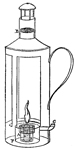
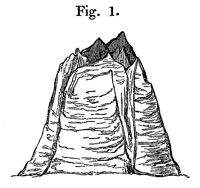
Fig. 1. represents the first Safe
lantern, with its air-feeder and chimney
furnished with safety metallic
canals. The sides are of horn or
glass, made air-tight by putty or cement.
A. is the lamp through
which the circular air-feeding canals
pass. B. is the chimney containing
four such canals; above it is a hollow
cylinder, with a cap to prevent dust
from passing into the chimney. C.
is the hole for admitting oil. F. is
the rim round the bottom of the lantern,
to enable it to bear motion.
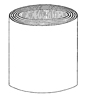
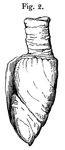
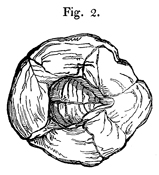
Fig. 2. exhibits an enlarged
view of the safety concentric
canals, which, if one-twenty-fifth
of an inch in diameter,
must not be less than two inches
in exterior circumference, and
one-seventh of an inch high.
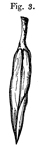
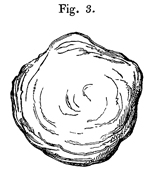
Fig. 3. exhibits the longitudinal
safety canals.
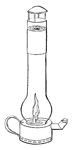
Fig. 4. represents a Safety-lamp
having a glass chimney, covered with
tin-plate, and the safety apertures in a
cylinder with a covering above: the
lower part is the same as in the lantern.
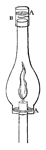
Fig. 5. A glass tube furnished
with flame sieves, in which a common
candle may be burnt. A A. the flame
sieves. B. a little plate of metal to
prevent the upper flame sieve from
being acted on by the current of hot
air.
During the short visit of Sir Humphry Davy at
Bishop Wearmouth, he saw the lamp which Dr.
Clanny was then engaged in perfecting. It has
been already observed, that it was secured against
the effects of fire-damp by being supplied with atmospheric
air previously conveyed through water.[34]
The machinery of this lamp was far too cumbrous
to be of general use; but its inventor was justly
commended by Davy for his ingenuity and perseverance.
It unfortunately happened that, in consequence
of some erroneous representations made
to Dr. Clanny, he received the impression that Sir
Humphry had not been disposed to treat his invention
with sufficient respect, nor had given him
the credit to which he was so justly entitled. This
suspicion, which had been long industriously kept
alive, was however ultimately removed.
The following letter refers to this unfortunate
circumstance. I have adverted to it in these memoirs,
for the purpose of showing what an unfair
spirit of rivalry, and what a succession of petty jealousies
were excited by those generous and disinterested
labours of Davy, which ought to have
called forth nothing but the most lively expressions
of gratitude for his services, and admiration of his
genius.
TO THE REVEREND DR. GRAY.
23, Grosvenor Street, December 13.
MY DEAR SIR,
A Friend of mine has sent me a newspaper—the
Tyne Mercury, containing a very foolish libel
upon me. It states, amongst other things, that I
did not mention Dr. Clanny, or his lamp, in my late
paper read before the Royal Society; whereas I
mentioned his lamp as a very ingenious contrivance,
and named him amongst the gentlemen who obligingly
furnished me with information upon the
subject.
It will be needless for me to point out to you
that my lamp has no one principle in common with
that of Dr. Clanny. He forces in his air through
water by bellows. In mine, the air passes through
safety canals without any mechanical assistance.
Mine is a common lantern made close, and furnished
with safety canals.
I hope I shall not hear that Dr. Clanny has in
any way authorized or promoted so improper a statement
as that in the Tyne Mercury; indeed, I do
not think it possible.
I have at last obtained a complete model of my
lamp, after many disappointments from the instrument-maker.
I hope in a few days to send you a
Safe lantern, as portable as a common-made one, and
the perfect security of which is demonstrable.
I am, my dear Sir, your sincerely obliged,
H. Davy.
TO THE SAME.
Grosvenor Street, December 15.
MY DEAR SIR,
I shall inclose the first sheet of my paper, and
shall be glad to preface it by some observations
when you reprint it.
I shall forward my lanterns and lamps to you in
a few days. They are absolutely safe; and if the
miners have any more explosions from their light,
it will be their own fault.
You will find, when you see my construction,
that the principles as well as the execution are entirely
new.
You will find in the second sheet of my paper,
which I hope to be able to send to-morrow, the
principles of security, and its limits unfolded.
I am, my dear Sir, very sincerely yours,
H. Davy.
TO THE SAME.
London, January 1, 1816.
MY DEAR SIR,
I fear you will have accused me of procrastination
in delaying to send you my papers and my
lamps.
The papers read to the Royal Society have been
printed; but during the period that has elapsed
since I last wrote to you, I have made a discovery
much more important than those which I have already
had the honour of communicating to you.
I have made very simple and economical lanterns,
and candle guards, which are not only absolutely
safe, but which give light by means of the fire-damp,
and which, while they disarm this destructive
agent, make it useful to the miner.
This discovery is a consequence of that which I
communicated to you in my last letter on the wire
sieves. I hope to be able to send you on Wednesday
the printed account of my results, together
with models of lamps which will burn and consume
all explosive mixtures of the fire-damp.
I have at last finished my enquiries with perfect
satisfaction to myself, and I feel highly obliged to
you for having called my attention to a subject
where my labours will, I hope, be of some use.
I am, my dear Sir, very sincerely yours,
H. Davy.
It is impossible to approach the consideration of
this last, the most signal and splendid of his triumphs,
without feelings of the highest satisfaction.
He had already, as we have seen, disarmed the fire-damp
of its terrors, it only remained for him to enlist
it into his service. The simple means by which
this was effected are as interesting as their results
are important.[35]
Davy had previously arrived at the fact, that
wire-gauze might be substituted as air-feeders to
the lamp, in the place of his tubes or safety canals;
but not until after the lapse of several weeks, did
the happy idea of constructing the lamp entirely of
wire-gauze occur to him:—the history of this elaborate
enquiry affords a striking proof of the inability
of the human mind to apprehend simplicities,
without a process of complication which works
as the grappling machinery of truth.
His original lamp with tubes or canals, as already
described, was perfectly safe in the most explosive
atmosphere, but its light was necessarily extinguished
by it; whereas in the wire-gauze cage, the fire-damp
itself continues to burn, and thus to afford to
the miner a useful light, while he is equally secured
from the fatal effects of explosion.
All then required for his guidance and
protection in the darkness of the mine, are
candles or lamps surrounded by small wire
cages, which will at once supply air to the
flame, and light to the miner; they may
be obtained for a few pence, and be variously
modified as circumstances may render
necessary.
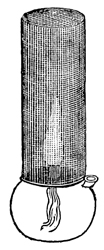
The reader is here presented with a
sketch of the gauze instrument, in its first and simplest
form. The original lamp is preserved in the
laboratory of the Royal Institution.
Nothing now remained but to ascertain the degree
of fineness which the wire-gauze ought to possess,
in order to form a secure barrier against the
passage of flame. For this purpose, Davy placed
his lighted lamps in a glass receiver, through which
there was a current of atmospherical air, and by
means of a gasometer filled with coal gas, he made
the current of air which passed into the lamp more
or less explosive, and caused it to change rapidly or
slowly at pleasure, so as to produce all possible varieties
of inflammable and explosive mixtures; and
he found that iron wire-gauze composed of wires
from one-fortieth to one-sixtieth of an inch in diameter,
and containing twenty-eight wires, or seven
hundred and eighty-four apertures to the inch, was
safe under all circumstances in atmospheres of this
kind; and he consequently employed that material
in guarding lamps for the coal mines, where, in
January 1816, they were immediately adopted, and
have long been in general use.
Observations upon them in their working state,
and upon the circumstances to which they are exposed,
have led to a few improvements or alterations,
merely connected with the modes of increasing light
or diminishing heat, which were obvious from the
original construction.
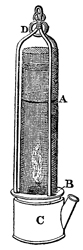
The annexed woodcut represents the
lamp which is in present use. A is a cylinder
of wire-gauze, with a double top,
securely and carefully fastened, by doubling
over, to the brass rim B, which screws
on to the lamp C. The whole is protected
by strong iron supports D, to which a ring
is affixed for the convenience of carrying it.
In a paper read before the Royal Society,
on the 23rd of January 1817, entitled,
"Some new Experiments and Observations
on the Combustion of Gaseous
Mixtures, with an Account of a method of preserving
a continued Light in mixtures of inflammable
Gases and Air without Flame," Sir H. Davy announces
the application of a principle which he had
discovered in the progress of his researches for increasing
the utility of the Safety-lamp, and which, a
century ago, would have unquestionably exposed its
author to the charge of witchcraft.
Having ascertained that the temperature of flame
is infinitely higher than that necessary for the ignition
of solid bodies, it appeared to him probable
that, in certain combinations of gaseous bodies,
although the increase of temperature might not be
sufficient to render the gaseous matters themselves
luminous, they might nevertheless be adequate to
ignite solid matters exposed to them. During his
experiments on this subject, he was led to the discovery
of the curious phenomenon of slow combustion
without flame. He observes, that there cannot
be a better mode of illustrating the fact, than by an
experiment on the vapour of ether or of alcohol.
Let a few coils of wire of platinum of the one-sixtieth
or one-seventieth of an inch be heated by a
hot poker or candle, and let it be brought into the
glass; it will presently become glowing, almost
white hot, and will continue so, as long as a sufficient
quantity of vapour and of air remain in the
glass.[36]
This experiment on the slow combustion of ether
is accompanied with the formation of a peculiar
acrid and volatile substance possessed of acid properties,
which has been particularly examined by
Mr. Daniell, who, having at first regarded it as a
new acid, proposed for it the name of Lampic acid,
in allusion to the researches which led to its discovery;
he has, however, since ascertained that its
acidity is owing to the acetic acid, which is combined
with some compound of carbon and hydrogen,
different both from ether and alcohol.
The phenomena of slow combustion, as exhibited
in certain states of the mine, by the Safety-lamp,
are highly curious and interesting.
By suspending some coils of fine wire of platinum[37]
above the wick of his lamp, the miner will
be supplied with light in mixtures of fire-damp no
longer explosive; for should his flame be extinguished
by the quantity of fire-damp, the little coil
of platinum will begin to glow with a light sufficiently
bright to guide him in what would otherwise
be impenetrable darkness, and to lead him into
a purer atmosphere, when the heat thus increased
will very frequently be sufficient to rekindle his
lamp!
In this case it will be readily perceived, that the
combustion of the fire-damp is continued so slowly,
and at so low a temperature, as not to be adequate
to that ignition of gaseous matter which constitutes
flame, although it excites a temperature sufficient to
render platinum wire luminous.
Sir Humphry Davy observes, that there never
can be any danger with respect to respiration, whenever
the wire continues ignited; for even this phenomenon
ceases when the foul air forms about two-fifths
of the volume of the atmosphere.
The experiment, as originally performed by the
illustrious chemist, is so interesting and instructive,
that I shall here relate it in his own words.
"I introduced into a wire-gauze Safe lamp a
small cage made of fine wire of platinum of one-seventieth
of an inch in thickness, and fixed it by
means of a thick wire of the same metal about two
inches above the wick which was lighted. I placed
the whole apparatus in a large receiver, in which, by
means of a gas-holder, the air could be contaminated
to any extent with coal gas. As soon as
there was a slight admixture of coal gas, the platinum
became ignited; the ignition continued to
increase till the flame of the wick was extinguished,
and till the whole cylinder became filled with flame;
it then diminished. When the quantity of coal gas
was increased, so as to extinguish the flame, at the
moment of the extinction the cage of platinum became
white hot, and presented a most brilliant light.
By increasing the quantity of the coal gas still farther,
the ignition of the platinum became less vivid:
when its light was barely sensible, small quantities
of air were admitted, its heat speedily increased;
and by regulating the admission of coal gas and air,
it again became white hot, and soon after lighted
the flame in the cylinder, which as usual, by the
addition of more atmospherical air, rekindled the
flame of the wick."
I have thus related, somewhat in detail, the history
of a discovery, which, whether considered in
relation to its scientific importance, or to its great
practical value, must be regarded as one of the most
splendid triumphs of human genius. It was the
fruit of elaborate experiment and close induction;
chance, or accident, which comes in for so large a
share of the credit of human invention, has no
claims to prefer upon this occasion; step by step,
may he be followed throughout the whole progress
of his research, and so obviously does the discovery
of each new fact spring from those that preceded it,
that we never for a moment lose sight of our philosopher,
but keep pace with him during the whole
of his curious enquiry.
He commenced, as we have seen, with ascertaining
the degree of combustibility of the fire-damp,
and the limits in which the proportions of
atmospheric air and carburetted hydrogen can be
combined, so as to afford an explosive mixture. He
was then led to examine the effects of the admixture
of azote and carbonic acid gas; and the result
of those experiments furnished him with the basis
of his first plan of security. His next step was
to enquire whether explosions of gas would pass
through tubes; and on finding that this did not
happen, if the tubes were of certain lengths and
diameters, he proceeded to examine the limits of
such conditions, and by shortening the tubes, diminishing
their diameters, and multiplying their
number, he at length arrived at the conclusion, that
a simple tissue of wire-gauze afforded all the means
of perfect security; and he constructed a lamp,
which has been truly declared to be as marvellous
in its operation, as the storied lamp of Aladdin,
realizing its fabled powers of conducting in safety,
through "fiends of combustion," to the hidden treasures
of the earth. We behold a power which, in
its effects, seemed to emulate the violence of the
volcano and the earthquake, at once restrained by
an almost invisible and impalpable barrier of network—we
behold, as it were, the dæmon of fire
taken captive by Science, and ministering to the
convenience of the miner, while harmlessly fluttering
in an iron cage.
And yet, wonderful as the phenomenon may appear,
his experiments and reasonings have demonstrated,
that the interruption of flame by solid tissues
permeable to light and air, depends upon no
recondite or mysterious cause, but simply upon
their cooling powers, which must always be proportional
to the smallness of the mesh, and the mass
of the metal.
When it is remembered that the security thus
conferred upon the labouring community, is not
merely the privilege of the age in which the discovery
was effected, but must be extended to future
times, and continue to preserve human life as long
as coal is dug from our mines, can there be found
in the whole compass of art or science, an invention
more useful and glorious?
The wire-gauze lamp has now been several years
extensively used in the mines, and the most satisfactory
and unequivocal testimonies have been published
of the complete security which it affords.
They have amongst the miners obtained the name of
Davys; and such is the confidence of the work men
in their efficacy, that by their aid they enter the
most explosive atmospheres, and explore the most
remote caverns, without the least dread of their old
enemy the fire-damp.
Into the mines of foreign countries the Safety-lamp
has been introduced with similar success; and
the illustrious discoverer has been repeatedly gratified
by accounts of the enthusiasm with which
his invention has been adopted in various parts of
Europe.[38]
Nor is the utility of this invention limited to the
operations of mining. In gas manufactories, spirit
warehouses,[39] or druggists' laboratories, and in various
other situations, where the existence of an explosive
atmosphere[40] may expose persons to danger,
the Safety-lamp may be advantageously used; and
as science proceeds in multiplying the resources of
art, this instrument will no doubt be found capable
of many new applications.
By the permission of the President and Council
of the Royal Society, several accounts of these researches,
and of the invention and use of the Safety-lamp
were printed, and circulated through the coal
districts.
It might have been fairly expected that, in a district
which had been so continually and so awfully
visited by explosions, against which no human foresight
had as yet been able to provide a remedy, the
disinterested services of the greatest chemist of the
age would at least have been received without a dissentient
voice, and that his invention of security
would have escaped the common fate of all great
discoveries, and been accepted with every homage
of respect and gratitude; but the inventor of the
Safety-lamp was doomed to encounter a bitter hostility
from persons whom a spirit of rivalry, or a feeling
of hopeless emulation, had cemented into a faction.
From the period of the first announcement of the
Safety-lamp, a prejudice against its use was industriously
circulated amongst the miners; and some
persons even maintained the monstrous proposition,
that any protection against the explosions of fire-damp
would injure more than it could serve the
collier, by inducing him to resume abandoned works,
and thus continually to inhale a noxious atmosphere.
The utility of the lamp having been established,
in spite of every opposition, the claims of Sir H.
Davy to its invention were next publicly challenged.
It will hereafter be scarcely believed that an invention
so eminently philosophic, and which could
never have been derived but from the sterling treasury
of science, should have been claimed in behalf
of an engine-wright of Killingworth, of the name of
Stephenson—a person not even professing a knowledge
of the elements of chemistry. As the controversy
to which this claim gave birth has long since
subsided, I would willingly have treated it as a
passing cloud, had not its shadow remained. The
circumstances, however, of the transaction stand
recorded in the Magazines of the day, and the biographer
of Davy would compromise his rights, by
omitting to notice the attempts that have been made
to invalidate them.
The claims which were made for the priority of
Mr. Stephenson's invention of the Safety-lamp were
urged in several communications in the Newcastle
Courant. It has been said in reply, that if dates
were taken as evidence, not merely of priority, but
of originality of invention, it must follow that Mr.
Stephenson's lamp was derived from that of Sir H.
Davy. With regard to the first of Stephenson's
lamps, the only one upon which the shadow even of
a claim can be founded, it is unnecessary for the
friends of truth to adopt such a line of defence; indeed,
after a deliberate examination of all that has
been published on the subject, I am very willing to
believe that Mr. Stephenson did construct the lamp
which dates its origin from the 21st of October
1815, without any previous knowledge of the conclusions
at which Davy had arrived; for it was first
announced to the Coal-trade by Mr. R. Lambert on
the 3rd of November, to the very meeting at which
Sir H. Davy's private letter was inadvertently read.—But
what were the principles, and what the construction
of this lamp?
It would appear that Mr. Stephenson had entertained
some vague notion of the practicability of
consuming the fire-damp as fast as it entered the
lamp, and that if admitted only in small quantities, it
would not explode the surrounding atmosphere: for
effecting this object, he constructed a lamp with an
orifice, over which was placed a slide, by the movement
of which the opening could be enlarged, or
diminished, and the volume of fire-damp to be admitted
into the lamp regulated according to circumstances.
Now such a lamp could be nothing else
than an exploding lamp; for to make it burn in common
air, the orifice must have been so wide that, on
going into an explosive atmosphere, the combustion
in the interior could not have failed to pass it, and
to have exploded the mine. Here then is a safety-lamp,
which as long as it is safe, will not burn, and
the moment it begins to burn, it becomes unsafe!
The testimonies in favour of the security afforded
by this lamp were evidently procured from persons
who were not only ignorant of the principles of its
construction, but of the methods to be pursued for
ascertaining its safety. I am surely justified in such
a statement, when, instead of an explosive mixture, I
find them throwing in pure fire-damp, which will
always extinguish flame, whether burning in a safe
or unsafe lamp.
The importance and utility of Davy's lamp having
been completely established by the severest ordeals,
the general gratitude of the country began more
publicly to display itself, and a very strong feeling
prevailed, that some tribute of respect should be
paid to its inventor; in accordance with which, a
deputation of the Coal-owners of the rivers Tyne
and Wear, and of the ports of Hartley and Blyth,
requested the honour of an interview with Sir H.
Davy; upon which occasion they presented him
with the following letter, containing an expression
of the thanks of the Coal-owners.
TO SIR HUMPHRY DAVY, LL.D. &c.
Newcastle, March 25, 1816.
SIR,
As chairman of the general meeting of proprietors
of coal-mines upon the rivers Tyne and Wear,
held in the Assembly-rooms at Newcastle, on the
18th instant, I was requested to express to you
their united thanks and approbation for the great
and important discovery of your Safety-lamp for exploring
mines charged with inflammable gas, which
they consider admirably calculated to obviate those
dreadful calamities, and the lamentable sacrifice of
human life, which of late years have so frequently
occurred in the mines of this country.
They are most powerfully impressed with admiration
and gratitude towards the splendid talents and
brilliant acquirements that have achieved so momentous
and important a discovery, unparalleled in
the history of mining, and not surpassed by any discovery
of the present age; and they hope that,
whilst the tribute of applause and glory is showered
down upon those who invent the weapons of destruction,
this great and unrivalled discovery for
preserving the lives of our fellow-creatures, will be
rewarded by some mark of national distinction and
honour. I am, Sir,
Your most obedient humble Servant,
George Waldie, Chairman.
A plan, however, was under consideration for recording
the admiration and gratitude of the Coal-owners,
by a more permanent and solid memorial.
The nature of this proposition will be best disclosed
by inserting the following letter from Mr. Buddle.
TO THE REV. DR. GRAY.
Wall's-End Colliery, August 27, 1816.
SIR,
As I know that you feel much interest in all
matters relating to Sir H. Davy's Safety-lamp, I
trust you will excuse the liberty I take in informing
you, that the Committee of the Tyne, approving
highly of the suggestion, that some mark of acknowledgment
and respect should be presented to
Sir Humphry by the Coal-trade of this country, for
the happy invention of his lamp, have convened a
general meeting of Coal-owners, to be holden at my
office in Newcastle, on Saturday next the 31st instant,
at twelve o'clock, to take the subject into
consideration.
I should have sooner informed you of this proposed
meeting, had I not been detained in Cumberland
until yesterday; but I shall have the pleasure
of transmitting to you a copy of its resolutions.
I am sure that you will be gratified to learn that
the lamps continue to go on as well as possible.
We now have twelve dozen of them in daily use at
this place. I have the pleasure to remain, with the
greatest respect, Sir,
Your most obedient humble Servant,
John Buddle.
TO THE SAME.
Newcastle, September 7, 1816.
SIR,
I now have the pleasure of sending you a copy of
the Resolutions of the general meeting of Coal-owners
on the 31st instant, and shall take the liberty
of informing you of the future progress of this affair.
Sir Humphry did me the honour yesterday to
accompany me through the workings of a coal-pit at
Wall's-End, when I had an opportunity of witnessing
several interesting experiments on his Safety-lamp;
and I have the satisfaction to add, that I
believe he has now advanced it to the highest degree
of perfection.
I am, respectfully, Sir,
Your humble Servant,
John Buddle.
The satisfactory result of this visit Sir Humphry
communicated to Mr. Lambton, now Lord Durham;
and I shall take this opportunity to state, that
for this as well as for several other letters I shall
hereafter have occasion to introduce, I am indebted
to that noble Lord, through the kind application of
my friend Sir Cuthbert Sharp.
TO J. G. LAMBTON, ESQ. M.P.
Newcastle, September 9, 1816.
MY DEAR SIR,
Since I last had the pleasure of seeing you, I
have examined the workings in the Wall's-End collieries
by the lamps, and have tried them in various
explosive mixtures.
On Sunday, I went with Mr. Buddle to your
blower, with the single lamps furnished with small
tin reflectors. This simple modification rendered
them perfectly safe, even in the furious blow-pipe,
and at the same time increased their light. Nothing
could be more satisfactory than all the trials.
I have left a paper in the hands of the Rev. J.
Hodgson, which will be printed in a day or two;
and I have desired him to send you ten copies, or as
many more as you may like to have.
I trust I have now left nothing undone as to the
perfect security of the lamps, under every possible
circumstance.
I feel highly gratified that it was at your mines I
effected the only object that remained to be accomplished—that
of guarding against blowers meeting
fresh currents of air.
I thank you very sincerely for the interest you
have taken in the lamps, connected with my efforts
to render them applicable in all cases. I remain, &c.
H. Davy.
On the 19th of October 1816, a letter appeared in
the Durham County Advertiser, dated "Gosforth,
August 22nd, 1816," in the name of Mr. W. Brandling,
in which, alluding to the Resolutions of the
Coal-owners of the 31st of August, he expresses a
wish that a strict examination should take place
previous to the adoption of a measure which might
convey a decided opinion to the public, as to the
person to whom the invaluable discovery of the
Safety-lamp is actually due. "The conviction,"
says he, "upon my mind is, that Mr. George Stephenson,
of Killingworth Colliery, is the person
who first discovered and applied the principle upon
which safe lamps may be constructed; for, whether
the hydrogen gas is admitted through capillary
tubes, or through the apertures of wire-gauze, which
may be considered as merely the orifices of capillary
tubes, does not, as I conceive, in the least affect the
principle.
"In the communications I have seen from Sir H.
Davy, no dates are mentioned; and it is by a reference
to them only that the question can be fairly
decided. For the information of the Meeting,
therefore, I shall take the liberty of enclosing some
which I received from Mr. Stephenson, to the correctness
of which, as far as I am concerned, I can
bear testimony; at the same time I beg leave to
add, that the principle of admitting hydrogen gas
in such small detached portions that it would be
consumed by combustion,[41] was, I understand, stated
by him to several gentlemen, as the idea he had embraced
two months before his lamp was originally
constructed."
Mr. Brandling then proceeds to state, that the
Killingworth lamp, with a tube to admit the air,
and a slide at the bottom of such tube to regulate
the quantity to be admitted, was first tried in the
Killingworth pits on Saturday October the 21st,
1815; but not being found to burn well, another
was ordered the same day with three capillary tubes
to admit the air; and on being tried in the mine on
the 4th of November following, was found to burn
better and to be perfectly safe.[42] On the 17th of
November, it was tried[43] at Killingworth office with
inflammable air before Richard Lambert, Esq.; and
on the 24th of the same month, before C. J. Brandling,
Esq. and Mr. Murray.
"On the 30th of November," he says, "a lamp
was tried in the mine, in which the air was admitted
by means of a double row of small perforations, and
found to be perfectly safe, and to burn extremely
well."[44]
At an adjourned Meeting of the Coal-owners,
held on the 11th of October 1816, J. G. Lambton,
Esq. M.P. in the chair; Mr. William Brandling
moved—"That the meeting do adjourn, until, by
a comparison of dates, it shall be ascertained whether
the merit of the Safety-lamp belongs to Sir
Humphry Davy or to Mr. George Stephenson."
On the question being put thereon, THE SAME
PASSED IN THE NEGATIVE.
A great number of the Coal-owners, instead of
pursuing the idea which had at first been suggested,
of a general contribution on the vend, immediately
commenced a subscription of individual proprietors
of coal-mines; a measure which, it was thought,
would express more distinctly and unequivocally
the opinion of the trade as to the merit of the invention.
The plan is developed in the following
letter.
TO THE REVEREND DR. GRAY.
Wall's-End Colliery, October 27, 1816.
SIR,
It is the anxious wish of almost every individual
in the trade to compliment Sir Humphry
Davy, in that way which may be most grateful to
his feelings.
It has been suggested that the object will be best
attained by substituting an individual (colliery) subscription,
instead of the proposed contribution on
the vend; and it will at the same time show more
distinctly the real opinion of the trade as to the
merit of the invention.
This idea was not suggested till yesterday afternoon,
and of course there has been but little time to
communicate it to the several Coal-owners; but all
who have heard of the plan approve of it.
To facilitate the business, the committee have
formed the annexed scale of contribution.[45]
I trust, Sir, you will excuse the trouble which I
have given you on this subject; but I am aware
that you must feel interested in it; and I hope,
Sir, you will allow me to add, that I am fully sensible
of the obligation which the Coal trade is under
to yourself, for having drawn Sir H. Davy's attention
to that particular line of investigation, which
has led to the important discovery of the Safety-lamp.
I am, Sir, with the greatest respect, your
most obedient humble servant,
John Buddle.
Some slight alterations were afterwards made
in this scheme, in consequence of a wish having
been expressed that the Bishop of Durham and
the Duke of Northumberland should take the lead
in a subscription. The following letter conveys
some farther information upon this subject.
TO THE REVEREND DR. GRAY.
Newcastle, January 11, 1817.
SIR,
I have to acknowledge the receipt of your letter
of the 9th instant, communicating the intention of
the Reverend the Dean and Chapter of Durham,
to subscribe fifty guineas towards the plate to be
presented to Sir H. Davy, which, together with
two hundred guineas from the Coal-owners of the
Wear, makes the subscription amount to nearly
£1500, and I shall expect some farther subscriptions.
I am sure it will afford you satisfaction to learn
that the lamps still continue to give the most gratifying
proofs of the advantages resulting from their
invention, and that not a single inch of human
skin has been lost by fire, wherever they have
been used.
Sir Humphry has just made another important
improvement in the lamp, by constructing the cylinder
of twisted wire-gauze. Lamps thus constructed,
possess the singular property of not
becoming red-hot, under any circumstances of exposure
to explosive mixtures, whether urged by a
blast, or in a state of rest. I am with great respect,
Sir, your most obedient humble servant,
John Buddle.
It may be collected from the following letter,
that the Committee, in announcing to Sir H. Davy
the intended present of plate, delicately sounded
him as to the form in which it would be most
agreeable to him.
TO N. CLAYTON, ESQ.
Grosvenor Street, March 23, 1817.
SIR,
On my return to town, after an absence of some
days, I found the letter of March the 13th, with
which you honoured me, at the Royal Institution.
I shall not lose a moment in replying to it, and in
expressing my grateful feelings for the very flattering
communication it contains.
The gentlemen interested in the coal-mines of the
two rivers Tyne and Wear, cannot offer me any testimony
of their kindness, which I shall not receive
with infinite pleasure.
I hardly know how to explain myself on the particular
subject of your letter; but as the Committee
express themselves satisfied as to the utility of the
Safety-lamp, I can only desire that their present, as
it is highly honourable to me, should be likewise
useful to my friends, and a small social circle, which
it would be as a dinner-service for ten or twelve
persons.
I wish that even the plate from which I eat should
awaken my remembrance of their liberality, and put
me in mind of an event which marks one of the happiest
periods of my life.
I cannot find any language sufficiently strong to
express my thanks to the gentlemen for the manner
in which they have distinguished my exertions in
their cause, and in the cause of humanity. I have
the honour to remain, &c.
H. Davy.
To revert once again to the faction—for such I
must denominate it—which, in opposition to the
most unequivocal evidence, continued to support
the unjust claims of Mr. Stephenson; it would appear
from various letters in my possession, that the
feelings of Davy were greatly exasperated by this
ungenerous conduct.
I shall introduce one of these letters, playful in
the midst of its wrath, addressed to Mr. Lambton,
the friend[46] of his youth, and the manly and kind
supporter of his scientific character, in the hour of
persecution.
TO J. G. LAMBTON, ESQ. M.P.
Queen Square, Bath, Oct. 29, 1816.
MY DEAR SIR,
The severe indisposition of my wife has altered
my plans. Your letter slowly followed me here.
Mr. —— is one of the persons who, after I
had advanced a principle of security for a lamp,
came upon the ground to endeavour to jockey me.
I was not looking to a prize, I merely came forward
to show an animal, the breed of which might be
useful, when Mr. ——, Dr. ——, &c. brought their
sorry jades, which had never before been seen or
heard of, to kick at my blood mare.
I never heard a word of George Stephenson and
his lamps till six weeks after my principle of security
had been published; and the general impression of
the scientific men in London, which is confirmed by
what I heard at Newcastle, is, that Stephenson had
some loose idea floating in his mind, which he had
unsuccessfully attempted to put in practice till after
my labours were made known;—then, he made
something like a safe lamp, except that it is not safe,
for the apertures below are four times, and those
above, twenty times too large; but, even if Stephenson's
plans had not been posterior to my principles,
still there is no analogy between his glass exploding
machine, and my metallic tissue, permeable to light
and air, and impermeable to flame.
I am very glad that you attended the meeting;
your conduct at no very distant period will be contrasted
with that of some great coal-proprietors, who
find reasons for their indifference, as to a benefit
conferred upon them, in insinuations respecting the
claims of Dr. Clanny, Mr. Stephenson, and others.
Where men resolve to be ungrateful, it is natural
that they should be illiberal; and illiberality often
hardens into malignity.
I shall receive any present of plate under your
auspices, and those of the Committee over which
you preside, with peculiar satisfaction. It will prove
to me that my labours have not been disregarded by
men of whose good opinion I am proud.
I hope you will not blame me for not taking any
notice of the attacks of my enemies in the North.
I have no desire to go out of my way to crush gnats
that buzz at a distance, and do not bite me, or to
quarrel with persons who shoot arrows at the moon,
and believe, because they have for an instant intercepted
a portion of her light, that they have hit their
mark. I am sensible to the circumstances under
which you attended the meeting.
I offer you my sincere congratulations, and ardent
wishes that you may enjoy all possible happiness.
Believe me, &c.
H. Davy.
On the 13th of September 1817, Sir Humphry
Davy being expected to pass through Newcastle on
his return from Scotland, preparations were made,
and notice given of a dinner which it was proposed
should take place on the 25th instant, for the purpose
of presenting to the illustrious philosopher the
service of plate which had been prepared for his
acceptance.
Upon this gratifying occasion, a very large party
assembled at the Queen's Head, consisting of a numerous
and respectable body of Coal-owners, and
such other gentlemen as had interested themselves
during the progress of the investigation, or taken an
active part in promoting the introduction of the
lamp into the mines.
After the dinner had concluded, and certain toasts
of form had been drunk, Mr. Lambton, who filled
the chair on the occasion, rose, and on presenting
the service of plate to the illustrious guest, addressed
him, in a tone of great animation and feeling,
in nearly the following terms:
"Sir Humphry,—It now becomes my duty to
fulfill the object of the meeting, in presenting to
you this service of plate, from the Coal-owners of
the Tyne and Wear, as a testimony of their gratitude
for the services you have rendered to them
and to humanity.
"Your brilliant genius, which has been so long
employed in an unparalleled manner, in extending
the boundaries of chemical knowledge, never accomplished
a higher object, nor obtained a nobler
triumph.
"You had to contend with an element of destruction
which seemed uncontrollable by human power;
which not only rendered the property of the coal-owner
insecure, but kept him in perpetual alarm for
the safety of the intrepid miner in his service, and
often exhibited to him the most appalling scenes of
death, and heart-sickening misery.
"You have increased the value of an important
branch of productive industry; and, what is of infinitely
greater importance, you have contributed to
the lives and persons of multitudes of your fellow-creatures.
"It is now nearly two years that your Safety-lamp
has been used by hundreds of miners in the
most dangerous recesses of the earth, and under the
most trying circumstances. Not a single failure has
occurred—its absolute security is demonstrated. I
have, indeed, deeply to lament more than one catastrophe,
produced by fool-hardiness and ignorance,
in neglecting to use the safeguard you have supplied;
but these dreadful accidents even, if possible,
exalt its importance.
"If your fame had needed any thing to make it
immortal, this discovery alone would have carried it
down to future ages, and connected it with benefits
and blessings.
"Receive, Sir Humphry, this permanent memorial
of our profound respect and high admiration—a
testimony, we trust, equally honourable to you and
to us. We hope you will have as much pleasure in
receiving, as we feel in offering it. Long may you
live to use it—long may you live to pursue your
splendid career of scientific discovery, and to give
new claims to the gratitude and praise of the world!"
Sir Humphry having received the plate, replied
as follows:
"Gentlemen,—I feel it impossible to reply, in
an appropriate manner, to the very eloquent and
flattering address of your distinguished Chairman.
Eloquence, or even accuracy of language, is incompatible
with strong feeling; and on an occasion like
the present, you will give me credit for no small
degree of emotion.
"I have been informed that my labours have
been useful to an important branch of human industry
connected with our arts, our manufactures,
commerce, and national wealth. To learn this from
such practical authority is the highest gratification
to a person whose ardent desire has always been to
apply science to purposes of utility.
"It has been also stated, that the invention which
you are this day so highly honouring, has been subservient
to the preservation of the lives and persons
of a most useful and laborious class of men: this,
coming from your own knowledge, founded upon
such ample experience, affords me a pleasure still
more exalted—for the highest ambition of my life
has been to deserve the name of a friend to humanity.
"To crown all, you have, as it were, embodied
these sentiments in a permanent and magnificent
memorial of your good opinion. I can make only
imperfect and inadequate efforts to thank you.
"Under all circumstances of my future life,
the recollection of this day will warm my heart;
and this noble expression of your kindness will
awaken my gratitude to the latest moment of my
existence."
Sir Humphry having sat down, and the cheering
of the company subsided, the Chairman proposed
the health of the illustrious Chemist, in three times
three.
"Gentlemen," said Sir Humphry, "I am overpowered
by these reiterated proofs of your approbation.
You have overrated my merits. My success
in your cause must be attributed to my having
followed the path of experiment and induction discovered
by philosophers who have preceded me:
willingly would I divide your plaudits with other
men of science, and claim much for the general
glory of scientific discovery in a long course of
ages.
"Gentlemen, I might dwell at some length upon
the great increase of wealth and power to the country,
within the last half century, by scientific invention,
which never could have existed without coal-mines:—I
shall refer only to the improvement in
the potteries, to the steam-engine, and to the discovery
of the gas lights.
"What an immense impulse has the steam-engine
given to the arts and manufactures! How much
has it diminished labour, and increased the real
strength of the country, far beyond a mere increase
of population! By giving facilities to a number of
other inventions, it has produced even a moral effect
in rendering capital necessary for the perfection
of labour, credit essential to capital, and ingenuity
and mental energy a secure and dignified species
of property.
"Science, Gentlemen, is of infinitely more importance
to a state than may at first sight appear
possible; for no source of wealth and power can be
entirely independent of it; and no class of men are
so well able to appreciate its advantages as that to
which I am now addressing myself. You have not
only derived from it the means of raising your subterraneous
wealth, but those also of rendering it
available to the public.
"Science alone has made pit-coal such an instrument
in the hands of the chemist and mechanic; it
has made the elements of fire and water perform
operations which formerly demanded human labour,
and it has converted the productions of the earth
into a thousand new forms of use and beauty.
"Gentlemen, allow me to observe, in conclusion,
that it was in pursuing those methods of analogy
and experiment, by which mystery had become
science, that I was fortunately led to the invention
of the Safety-lamp. The whole progress of my researches
has been registered in the Transactions of
the Royal Society, in papers which that illustrious
body has honoured by their biennial medal;[47] in
which I can conscientiously assert, that I have gratefully
acknowledged even the slightest hints or offers
of assistance which I have received during their
composition.
"I state this, Gentlemen, not from vain-glory,
but on account of certain calumnious insinuations
which have arisen—not in the scientific world, for
to that the whole progress of my researches is well
known, but in a colliery. I must ever treat these
insinuations with contempt; and after the honest
indignation which has been expressed against them
by the Coal-owners in general, I cannot feel any
anxiety on the subject, nor should I have referred
to it at all, did I not believe that the very persons
amongst whom these insinuations originated, were
extensively benefited by, and were constantly using
the invention they would seek to disparage. I
could never have expected that such persons would
have engaged their respectable connexions in mean
attempts to impeach the originality of a discovery,
given to them in the most disinterested manner,
and for which no return was required but an honest
acknowledgment of the benefit, founded upon truth
and justice.
"I do not envy them their feelings, particularly
at the present moment: I do not wish to enquire
into their motives: I do hope, however, that their
conduct has been prompted by ignorance rather
than by malevolence, by misapprehension rather
than by ingratitude.
"It was a new circumstance to me, that attempts
to preserve human life, and to prevent human misery,
should create hostile feelings in persons who
professed to have similar objects in view.
"Gentlemen, I have had some opposition, much
labour, and more anxiety, during the course of these
researches; but had the opposition, the labour, and
the anxiety been a thousand times as great, the
events of this day would have been more than a
compensation."
Sir Humphry, after drinking the health and happiness
of the company, proposed as a sentiment—"Prosperity
to the Coal-trade."
The healths of the Duke of Northumberland, the
Bishop of Durham, and the Reverend Dr. Gray,
were drunk in succession.
At ten o'clock, Sir Humphry, accompanied by
the chairman, retired amidst the enthusiastic plaudits
of a meeting, the object of which being one of
convivial benevolence, the effect was that of unclouded
hilarity.
The party which had supported the claims of
Mr. Stephenson had also their meeting; and it was
held on the 1st of November. At this meeting it
was resolved," That it was the opinion of the persons
present, that Mr. G. Stephenson having discovered
the fact, that explosions of hydrogen gas will not
pass through tubes and apertures of small dimensions,
and having been the first to apply the principle
to the construction of a Safety-lamp, is entitled
to some reward."
A committee was accordingly formed to carry
this resolution into effect, at the head of which was
placed the name of the Earl of Strathmore.
The respectable body of Coal-owners, under whose
auspices the invention of Sir Humphry Davy had
been introduced and rewarded, felt that they owed
it to their own characters to repel assertions which
amounted to a charge against themselves of ingratitude
and injustice: a general meeting was accordingly
summoned, at the Assembly-rooms in Newcastle,
on the 26th of November 1817, J. G. Lambton,
Esq. M.P. in the chair—when it was resolved,
"That the Resolutions passed at the Meeting of
the friends of Mr. G. Stephenson on the 5th instant,
impugn the justice and propriety of the proceedings
of a meeting of the Coal-trade on the 31st of August
1816:
"That the present meeting, therefore, feel themselves
called upon, as an act of justice to the character
of their great and disinterested benefactor,
Sir Humphry Davy, and as a proof that the Coal-trade
of the North in no way sanctions the resolutions
of Mr. Stephenson's friends, to state their decided
conviction, that the merit of having discovered
the fact, that explosions of fire-damp will not pass
through tubes and apertures of small dimensions,
and of having applied that principle to the construction
of a Safety-lamp, belongs to Sir Humphry
Davy alone.
"That this meeting is also decidedly of opinion,
from the evidence produced in various publications
by Mr. George Stephenson and his friends, subsequently
to the meeting of the Coal-trade which was
held on the 18th of March 1816, as well as from the
documents which have been read at this meeting,
that Mr. Stephenson did not discover the fact, that
explosions of fire-damp will not pass through tubes
and apertures of small dimensions; and that he did
not apply that principle to the construction of a
Safety-lamp; and that the latest lamps made by
Mr. Stephenson are evident imitations of those of
Sir Humphry Davy, and that, even with that advantage,
they are so imperfectly constructed as to be
actually unsafe.
"That the above resolutions be published thrice
in the Newcastle papers, and in the Courier, Morning
Chronicle, and Edinburgh Courant; and that
printed copies thereof be sent to the Lords Lieutenants
of the two counties, to the Lord Bishop of
Durham, and to the principal owners and lessors of
collieries upon the Tyne and Wear."
The following letter from Sir Humphry Davy
announces the farther measures which he also had
thought proper to pursue, in order to counteract
the impression which the meeting of Mr. Stephenson's
friends might have produced on the less informed
part of the public.
TO J. G. LAMBTON, ESQ. M.P.
November 21, 1817.
MY DEAR SIR,
I shall send off by this post a copy of the resolutions,
which will appear to-morrow in the Chronicle
and Courier.
The men of science who have signed these resolutions
are the first chemists and natural philosophers
of the country, with the President of the Royal
Society, the most illustrious body in Europe, at
their head.
It is disagreeable to be thus obliged to use artillery
for the destruction of bats and owls; but it
was necessary that something should be done.
The Messrs. —— have for a long time been endeavouring
to destroy my peace of mind; my offence
being that of conferring a benefit.
The only persons I knew in Newcastle, before I
gave the Safety-lamp to the Coal-owners, were Dr.
Headlam and Mr. Bigge, so that friends I had none;
and the few persons with whom I had a slight acquaintance,
and who were civil to me before I discovered
the Safety-lamp, became my enemies. It
requires a deep metaphysician to explain this—Can
it be that I did not make them the medium of communication
to the colliers?—But I quit a subject to
which I have no desire to return, and shall only recollect
that day when your eloquence touched my
feelings more than it flattered my self-love.
Believe me, &c. &c.
H. Davy.
The following are the Resolutions of a Meeting
adverted to in the preceding letter, and which was
held "for considering the Facts relating to the Discovery
of the Lamp of Safety."
Soho Square, Nov. 20, 1817.
"An advertisement having been inserted in the
Newcastle Courant, of Saturday, November 7, 1817,
purporting to contain the Resolutions of 'A Meeting
held for the purpose of remunerating Mr. George
Stephenson, for the valuable service he has rendered
mankind by the invention of his Safety-lamp, which
is calculated for the preservation of human life in
situations of the greatest danger,'
"We have considered the evidence produced in
various publications by Mr. Stephenson and his
friends, in support of his claims; and having examined
his lamps, and enquired into their effects
in explosive mixtures, are clearly of opinion—
"First,—That Mr. George Stephenson is not the
author of the discovery of the fact, that an explosion
of inflammable gas will not pass through
tubes and apertures of small dimensions.
"Secondly,—That Mr. George Stephenson was
not the first to apply that principle to the construction
of a Safety-lamp, none of the lamps which he
made in the year 1815 having been safe, and there
being no evidence even of their having been made
upon that principle.
"Thirdly,—That Sir Humphry Davy not only
discovered, independently of all others, and without
any knowledge of the unpublished experiments of
the late Mr. Tennant on Flame, the principle of
the non-communication of explosions through small
apertures, but that he has also the sole merit of
having first applied it to the very important purpose
of a Safety-lamp, which has evidently been
imitated in the latest lamps of Mr. George Stephenson.
(Signed)"Joseph Banks, P.R.S.
"William Thomas Brande,
"Charles Hatchett,
"William Hyde Wollaston."
Thus terminated a controversy, the discussion of
which, I am well aware, many of my readers will
consider as having been protracted to a tedious, and
perhaps to an unnecessary extent; but the biographer
had no alternative. In passing it by without
a notice, he would have violated his faith to the
public, have given a tacit acknowledgment of the
claims of Stephenson, and, in his judgment, have
committed an act of gross injustice to the illustrious
subject of his history; while by giving only an
abridged statement, he would have furnished a pretext
for doubt, and an opportunity for malevolence.
It is due also to Sir Humphry Davy to observe,
that had he practised more reserve in the communication
of his results, the spirit of rivalry would
have expired without a struggle,—for it derived its
only support and power from the generosity of its
victim. Had he secured for himself the advantages
of his invention by patent, he might have realized
wealth to almost any extent; but to barter the
products of his intellectual exertions for pecuniary
profit, was a course wholly at variance with every
feeling of Davy's mind; and we therefore find him,
in the advancement, as at the commencement of his
fleeting career, spurning the golden apples from his
feet, and hastening to the goal for that prize which
could alone reward all his labours—the meed of
immortal fame.
From a letter dated Newcastle, August 1830,
which I had the pleasure to receive from Mr. Buddle,
I extract the following interesting passage:—
"In the autumn of 1815, Sir Humphry Davy
accompanied me into some of our fiery mines, to
prove the efficacy of his lamp. Nothing could be
more gratifying than the result of those experiments,
as they inspired every body with perfect
confidence in the security which his invention had
afforded.
"Sir Humphry was delighted, and I was overpowered
with feelings of gratitude to that great
genius which had produced it.
"I felt, however, that he did not contemplate
any pecuniary reward; and, in a private conversation,
I remonstrated with him on the subject. I
said, 'You might as well have secured this invention
by a patent, and received your five or ten thousand
a-year from it.' The reply of this great and
noble-minded man was,—'No, my good friend, I
never thought of such a thing; my sole object was
to serve the cause of humanity; and, if I have succeeded,
I am amply rewarded in the gratifying reflection
of having done so.' I expostulated, saying,
that his ideas were much too philosophic and refined
for the occasion. He replied, 'I have enough for
all my views and purposes; more wealth might be
troublesome, and distract my attention from those
pursuits in which I delight;—more wealth,' he
added, 'could not increase either my fame or my
happiness. It might, undoubtedly, enable me to
put four horses to my carriage; but what would it
avail me to have it said that Sir Humphry drives
his carriage-and-four?'"
The present Bishop of Bristol, to whom the world
is so greatly indebted for having first called the
attention of Sir Humphry Davy to the subject of
explosions from fire-damp, and who has kindly interested
himself in my arduous and anxious undertaking,
was desirous to obtain for me the latest
accounts with respect to the Safety-lamp, as to the
constancy of its use, and the extent of its security;
and his Lordship informs me, that having applied to
Mr. Buddle and Mr. Fenwick for information upon
these points, their answers have been most satisfactory;
at the same time, his Lordship transmitted
me much valuable information, which was accompanied
by the following letter from Mr. Buddle.
TO THE RIGHT REVEREND THE LORD BISHOP
OF BRISTOL.
Wall's-End, August 11, 1830.
MY LORD,
I have the honour to acknowledge the receipt
of your Lordship's letter of yesterday's date. I
am glad your Lordship has interested yourself in
Doctor Paris's work, and I hope that he will be
enabled, through the assistance of Sir Humphry's
friends, to do ample justice to the genius and worth
of that excellent man.
I should be very happy if any letters of mine
could assist Dr. Paris in doing justice to his merits
in the invention of the Safety-lamp; and I shall
with pleasure submit to your Lordship's better
judgment and discretion the selection of such of
them as may seem to be conducive to that object.
I do not find that any improvement whatever has
been made, either in the principle or construction of
the original lamp, as presented to us by Sir Humphry.
His transcendent genius seems to have anticipated
every thing belonging to the subject, and
has left nothing more to be done.
I have the honour to be,
My Lord, with great respect,
Your Lordship's most obedient,
Humble servant,
John Buddle.
In consequence of some late reports of accidents in
the mines, I requested my friend Sir Cuthbert Sharp
to make certain enquiries in the mining districts;
and for this purpose, I sent him a string of queries,
to which I begged him to obtain answers. These
questions were submitted to Mr. Buddle, and they
produced the following letter.
TO SIR CUTHBERT SHARP.
Newcastle, August 28, 1830.
MY DEAR SIR CUTHBERT,
I return Dr. Paris's letter, and shall briefly
answer his enquiries.
If the Davy lamp was exclusively used, and due
care taken in its management, it is certain that few
accidents would occur in our coal mines; but the exclusive
use of the "Davy" is not compatible with the
working of many of our mines, in consequence of
their not being workable without the aid of gunpowder.
In such mines, where every collier must necessarily
fire, on the average, two shots a-day, we are exposed
to the risk of explosion from the ignition of
the gunpowder, even if no naked lights were used in
carrying on the ordinary operations of the mine.
This was the case in Jarrow Colliery, at the time
the late accident happened. As the use of gunpowder
was indispensable, naked lights were generally
used, and the accident was occasioned by a 'bag' of
inflammable air forcing out a large block of coal, in
the face of a drift, from a fissure in which it had
been pent up, perhaps from the Creation, and firing
at the first naked light with which it came in contact,
after having been diluted down to the combustible
point by a due admixture of atmospheric air.
As to the number of old collieries and old workings
which have been renovated, and as to the quantity
of coal which has been, and will be saved to the
public by the invention of the "Davy," it is scarcely
possible to give an account, or to form an estimate.
In this part of the country, 'Walker's Colliery,'
after having been completely worked out, according
to the former system, with candles and steel-mills,
and after having been abandoned in 1811, was reopened
in 1818 by the aid of the "Davy" and has
been worked on an extensive scale ever since, and
may continue to be worked for an almost indefinite
period.
Great part of the formerly relinquished workings
of Wall's-end, Willington, Percy-main, Hebburn,
Jarrow, Elswick, Benwell, &c. &c., as well as several
collieries on the Wear, have been recovered,
and are continued in work by the invention of the
"Davy."
If I had only what you know perfectly well I have
not—Time, I could write a volume on this subject.
I shall shortly, through the medium of a friend,
get an important paper on the subject of the "Davy,"
put into Dr. Paris's hands.
Believe me, my dear Sir Cuthbert,
To remain yours very faithfully,
John Buddle.
The Bishop of Bristol has placed at my disposal
a communication from Mr. Fenwick, a gentleman
of much practical ability, which affords additional
evidence of the utility of the lamp; from
which the following is an extract.
"Sir H. Davy's safety-lamp has afforded much
security in the general working of mines, particularly
by enabling the coal-owner to work, in several
situations, the pillars of coal formerly left therein,
which, under the system of working by candles,
or open flame, was deemed hazardous and impracticable;
and, in consequence, one-sixth part more
of coal may be estimated as obtainable from those
mines which are subject to hydrogen gas. Also
in the working of the pillars of coal, (commonly
called the second working,) great advantages and
securities, as well as saving of expenses, have resulted
from the use of this lamp, not only to the
lessees of collieries, inasmuch as more coal is obtained
from a given space than before, (particularly
in collieries subject to fire-damp,) but also to the
lessor of such mines, by their being more productive,
and of course more durable than heretofore.
"Another advantage results from the use of this
Safety-lamp, and in the working of the pillars in
particular. It is found now, through experience,
that the changeable state of the atmosphere, which
our barometers daily indicate, has a most powerful
effect on the noxious air in mines; as, from a
sudden change in the atmosphere, indicated by the
rapid fall of the mercury in the barometrical tube, a
rapid discharge of noxious gas into the workings
and excavations of the mine is the consequence,
caused by the want of the atmospheric equilibrium:[48]
in which case the mine becomes suddenly surcharged
with hydrogen, and if worked by the light of
open flame, an explosion may take place before the
possibility of such a circumstance can even be suspected;
but if worked by the Safety-lamp, it is
only shown by the gas in the lamp becoming a
pillar of harmless flame. This circumstance frequently
takes place when any atmospheric change
causes the mercury in the barometer to sink to
twenty-eight inches and a half or thereabouts."
In the year 1825, Sir Humphry Davy had the
honour to receive from the Emperor Alexander of
Russia, a superb silver gilt vase, standing in a circular
tray enriched with medallions. On the cover
was a figure, of about sixteen or eighteen inches in
height, representing the God of Fire, weeping over
his extinguished torch.
The circumstances under which this vase was presented
have been communicated to me by Mr. Smirnove,
Secretary to the Embassy.
TO J. A. PARIS, M.D.
Wigmore Street, May 29, 1830.
DEAR SIR,
It was in the month of April, or May, 1815, that
the late Sir Humphry Davy expressed to Prince,
then Count, Lieven, his wish to offer to the Emperor
of Russia a model of his Safety-lamp, which he
had recently improved, accompanied by an explanatory
pamphlet on the subject.
Prince Lieven of course complied with this request;
and the Emperor having been pleased to
accept it, ordered the Ambassador, in November of
the same year, to thank Sir Humphry for it in his
Majesty's name, and to assure him how much his
Majesty appreciated the merit of an invention, the
double effect of which was to favour the progress of
more than one branch of industry, and to ensure the
safety of persons employed in the coal-mines, against
those fatal accidents which had hitherto so frequently
occurred. The Ambassador, at the same time, delivered
to Sir Humphry a silver-gilt Vase,[49] in the
name of the Emperor, in testimony of the high satisfaction
with which that sovereign had been pleased
to accept the object in question. I beg you to believe
me, with regard and esteem,
Your faithful servant,
John Smirnove.
It is well known to the friends of Davy, that in
his conversation as well as in his correspondence, he
always dwelt with peculiar satisfaction and delight
upon the invention of his Safety-lamp.
Mr. Poole, in a letter lately addressed to me, observes—"How
often have I heard him express the
satisfaction which this discovery had given him. 'I
value it,' said he, 'more than any thing I ever did.
It was the result of a great deal of investigation and
labour; but, if my directions be only attended to, it
will save the lives of thousands of poor labourers.
I was never more affected,' he added, 'than by a
written address which I received from the working
colliers, when I was in the North, thanking me, in
behalf of themselves and their families, for the preservation
of their lives.' I remember how delighted
he was when he showed me the service of plate
presented to him by those very men and their
employers, as a testimony of their gratitude."
The following letter evinces a similar feeling.
TO THOMAS POOLE, ESQ.
Queen's Square, Bath, Oct. 29, 1816.
MY DEAR POOLE,
It is very long since any letters have passed between
us. The affections and recollections of friendly
intercourse are of a very adhesive nature; and I
think you will not be displeased at being put in
mind that there is an old friend not very far from
you, who will be very glad to see you.
Bath does not suit me much, nor should I remain
here, but my wife has been indisposed, and the
waters seem to benefit her, and promise to render
her permanent service, and if that happens, I shall
be pleased even with this uninteresting city.
I have seen many countries and nations since we
met.
I have just come from the North of England,
where it has pleased Providence to make me an instrument
for preserving the lives of some of my fellow-creatures.
You, I know, are of that complexion
of mind that the civic crown will please you more
than even the victor's laurel wreath.
I have a bed, though a small one, at your service;
if you can come here for two or three days, I assure
you we shall be most happy to see you. We shall
remain in Bath about three weeks. I shall be absent
for a few days in the beginning of next week,
and after that I shall be stationary till the middle of
November. Give me a few lines, and say when we
may expect you.
I am, my dear Poole, very sincerely yours,
H. Davy.
TO THE SAME.
Grosvenor Street, Dec. 3, 1817.
MY DEAR POOLE,
The late melancholy event[50] has thrown a gloom
over London, and indeed over England. The public
feeling is highly creditable to the moral tone of
the people.
The loss of a Princess, known only by good
qualities, living in a pure and happy state of domestic
peace, is in itself affecting; but when it is
recollected that two generations of sovereigns of
the first people in the world have been lost at
the same moment, the event becomes almost an
awful one.
I go on always labouring in my vocation. I am
now at work on a subject almost as interesting as
the last which I undertook. It is too much to hope
for the same success; at least I will deserve it.
When you come to town in the spring, which I
trust you will do, I shall show you my service of
plate. I do not think you will like it the less for
the cause of the gift.
I am not sure whether I shall not take a run
down to Nether Stowey and the west for a few
days, if you encourage me with any hopes of the
estate[51] and of woodcocks. You will fix my plans.
I shall be disengaged between the 15th and Christmas,
and shall like to revisit Lymouth, and above all
to shake you by the hand.
Lady D. is in better health than I have ever known
her to possess. She begs her kind remembrances.
I am, my dear Poole, most affectionately yours,
H. Davy.
In a strictly scientific point of view, the most interesting
results which have arisen out of the investigation
for constructing a Safety-lamp, are perhaps
those which have made us better acquainted with the
true nature of flame, and the circumstances by
which it is modified; and which have led to some
practical views connected with the useful arts.
It is, I think, impossible to enter into the details
of those curious investigations[52] which, under the
title of "Some Researches on Flame," were communicated
to the Royal Society, and read before that
body on the 16th of January 1817, without being
forcibly struck with the address by which Davy, in
the first instance, brought abstract science to promote
and extend practical knowledge; and then, as
it were by a species of multiplied reflection, applied
the new facts thus elicited for the farther extension
of speculative truth; which in its wider range became
again instrumental in disclosing a fresh store of
useful facts. It may be said to have been the power
of dexterously combining such methods which constituted
the felicity of his genius; for, in general,
each of them requires for its successful application
a mind of quite a distinct order and construction.
Mr. Babbage has very justly observed, that those
intellectual qualifications which give birth to new
principles or to new methods, are of quite a different
order from those which are necessary for their practical
application. Davy furnished the exception
that was necessary to make good the rule.
He detects, in the first instance, the general principle
of inflammable gas, in a state of combustion,
being arrested in its progress by capillary tubes; he
next applies it to the construction of a Safety-lamp,
and then, by observing the phenomena which this
lamp exhibits, is led to novel views respecting the
nature and properties of flame.—I shall endeavour
to offer a popular view of the curious and interesting
truths disclosed by this latter research.
He had observed that, when the coal gas burnt in
the iron cage, its colour was pale, and its light
feeble; whereas the fact is rendered familiar to us
all by the flame of the gas lights, that in the open
air carburetted hydrogen burns with great brilliancy.
Upon reflecting on the circumstances of the two
species of combustion, he was led to believe that the
cause of the superiority of the light in the latter
case might be owing to a decomposition of a part of
the gas towards the interior of the flame, where the
air was in the smallest quantity; and that the consequent
deposition of charcoal might first by its ignition,
and afterwards by its combustion, contribute to
this increase of light. A conjecture which he immediately
verified by experiment.[53]
The intensity therefore of the light of flames depends
principally upon the production and ignition
of solid matter in combustion, so that heat and light
are in this process independent phenomena.
These facts, Davy observes, appear to admit of
many applications; in explaining, for instance, the
appearance of different flames—in suggesting the
means of increasing or diminishing their light, and
in deducing from their characters a knowledge of
the composition of their constituent parts.
The point of the inner blue flame of a candle or
lamp urged by the blow-pipe, where the heat is the
greatest and the light the least, is the point where
the whole of the charcoal is burnt in its gaseous combinations,
without previous ignition. The flames of
phosphorus and of zinc in oxygen, and that of potassium
in chlorine, afford examples of intensity of
light depending upon the production of fixed solid
matter in combustion; while on the contrary, the feebleness
of the light of those flames, in which gaseous
and volatile matter is alone produced, is well illustrated
by those of hydrogen and sulphur in oxygen,
or by that of phosphorus in chlorine.
From such facts, he is inclined to think that the
luminous appearance of shooting stars and meteors
cannot be owing to any inflammation of gas, but
must depend upon the ignition of solid matter. Dr.
Halley calculated the height of a meteor at ninety
miles, and the great American meteor, which threw
down showers of stones, was estimated at only seventeen
miles high. The velocity of the motion of such
bodies must in all cases be immensely great, and the
heat thus produced by the compression of the most
rarefied air, Davy thinks, must be sufficient to ignite
the mass; and that all the phenomena may be
explained by assuming that falling stars are small
solid bodies moving round the earth in very eccentric
orbits, which become ignited only when they
pass with immense velocity through the upper regions
of the atmosphere, and which, when they contain
either combustible or elastic matter, throw out
stones with explosion.
By the application of such a principle did he also
infer the composition of a body from the character
of its flame: thus, says he, Ether, during its combustion,
would appear to indicate the presence of
olefiant gas. Alcohol burns with a flame similar to
that of a mixture of carbonic oxide and hydrogen;
so that the first is probably a binary compound of
olefiant gas and water, and the second of carbonic
oxide and hydrogen.
When the proto-chloride of copper is introduced
into the flame of a candle or lamp, it affords a peculiar
dense and brilliant red light, tinged with green
and blue towards the edges, which seems to depend
upon the separation of the chlorine from the copper
by the hydrogen, and the ignition and combustion
of the solid copper and charcoal.
The acknowledged fact of the brightest flames
yielding the least heat is easily reconciled, when
we learn that the light depends upon fixed matter
which carries off the heat. It is equally obvious,
that by art we may, for practical purposes, easily
modify these phenomena.
In the next place, having observed that wire-gauze
cooled down flame beyond its combustible
point, he was led to enquire into the nature of pure
flame; and he readily demonstrated it to be gaseous
matter heated so highly as to be luminous; and that
the temperature necessary for such an effect was
much greater than had been imagined, varying,
however, in different cases. The flame of a common
lamp he proved, by a very simple experiment,
to exceed even the white heat of solid bodies, and
which is easily shown by the simple fact of heating
a piece of platinum wire over the chimney of an
Argand lamp fed with spirit of wine; when it will
be seen that air, which is not of sufficient temperature
to appear luminous, is still sufficiently hot
to impart a white heat to a solid body immersed
in it.
The fact of different gaseous bodies requiring different
degrees of heat to raise them into flame, was
an inference immediately deducible from the phenomena
of his safety gauze. A tissue of one hundred
apertures to the square inch, made of wire of
one-sixtieth, will, at common temperatures, intercept
the flame of a spirit-lamp, but not that of
hydrogen; and, when strongly heated, it will no
longer arrest the flame of the spirit-lamp. A
tissue which, when red-hot, will not interrupt the
flame of hydrogen, will still intercept that of olefiant
gas; and a heated tissue, which would communicate
explosion from a mixture of olefiant gas
and air, will stop an explosion of fire-damp. Fortunately
for the success of the Safety-lamp, carburetted
hydrogen requires so high a temperature to
carry on its combustion, that even metal, when
white-hot, is far below it; and hence red-hot gauze,
in sufficient quantity, and of the proper degree of
fineness, will abstract heat enough from the flame
to extinguish it.
The discovery of the high temperature which is
necessary for the maintenance of flame, suggested
to the philosopher the reason of its extinction under
various circumstances. He considers, that the common
operation of blowing out a candle principally
depends upon the cooling power of the current of
air projected into the flame;[54] and he observes, that
the hottest flames are those which are least easily
blown out. He farther illustrated this subject by
surrounding a very small flame with a ring of metal,
which had the effect of cooling it so far as to extinguish
it; but a ring of glass, of similar dimensions
and diameter, being a less perfect conductor of heat,
produced no such effect.
It had been long known that flame ceased to
burn in highly rarefied air; but the degree of rarefaction
necessary for this effect had been very differently
stated. The cause of the phenomenon was
generally supposed to depend upon a deficiency of
oxygen.
In the commencement of his enquiry into this
subject, Davy observed that the flame of hydrogen
gas, the degree of rarefaction and the quantity of
air being the same, burnt longer when it issued
from a larger than a smaller jet,—a fact the very
reverse of that which must have happened had the
flame expired for want of oxygen; he moreover
observed, that when the larger jet was used, the
point of the glass tube became white-hot, and continued
red-hot till the flame was extinguished: he
therefore concluded, that the heat communicated to
the gas by this tube was the cause of its protracted
combustion, and that flame expired in rarefied air,
not for want of nourishment from oxygen, but for
want of heat, and that if its temperature could be
preserved by some supplementary aid, the flame might
be kept burning. The experiment by which he confirmed
this theory was as beautiful as it was satisfactory.
He burnt a piece of camphor in a glass tube,
under the receiver of an air-pump, so as to make
the upper part of the tube red-hot; its inflammation
was found to continue when the rarefaction
was nine times; but by repeating the experiment
in a metallic tube, which could not be so considerably
heated by it, it ceased after the rarefaction exceeded
six times.
It follows then that by artificially imparting
heat,[55] bodies may be made to burn in a rarefied air,
when under other circumstances they would be extinguished.
The following may be considered as an experimentum
crucis, in proof of the fact that combustibility
is neither increased nor diminished by rarefaction.
He introduced the flame of hydrogen, in which
was inserted a platinum wire, into a receiver of rarefied
air, and he found that, as long as the metal remained
at a dull red-heat, the flame continued to
burn: now it so happens that the temperature, at
which platinum approaches a red-heat, is precisely
that at which hydrogen inflames under the ordinary
pressure of the atmosphere; whence it follows,
that its combustibility is not altered by rarefaction.
The same law was found to apply to the flames
of other bodies; those requiring the least heat for
their combustion always sustaining the greater rarefaction
without being extinguished.[56]
Hitherto he had only considered the effects of
rarefaction, when produced by the diminution of
pressure; he had next to investigate the phenomena
of rarefaction when occasioned by expansion
from heat.
The experiments of M. de Grotthus had apparently
shown that rarefaction by heat destroys the
combustibility of gaseous mixtures; those of Davy,
however, proved that it enables them to explode at
a lower temperature.
In the progress of this research, while passing
mixtures of hydrogen and oxygen through heated
tubes, the heat being still below redness, he observed
that steam was formed without any combustion.
Here was a slow combination without combustion,
as long since observed with respect to hydrogen and
chlorine, and oxygen and metals; and he believes
that such a phenomenon will happen at certain temperatures
with most substances that unite by heat.
On trying charcoal, he found that at a temperature
which appeared to be a little above the boiling
point of quicksilver, it converted oxygen pretty
rapidly into carbonic acid, without any luminous
appearance, and that, at a dull red-heat, the elements
of olefiant gas combined in a similar manner with
oxygen, slowly and without explosion.
It occurred to Davy, in the progress of these experiments,
that, during this species of slow combination,
although the increase of temperature might
not be sufficient to render the gaseous matters luminous,
or to produce flame, it might still be adequate
to ignite solid matters exposed to them. It was
while engaged in devising experiments to ascertain
this fact, that he was accidentally led to the discovery
of the continued ignition of platinum wire,
during the slow combination of coal gas with atmospheric
air; the circumstances of which have been
already related, as well as the curious invention to
which the application of the fact gave origin.[57]
For this and his preceding papers on the subjects
of flame and combustion, the President and Council
of the Royal Society adjudged to Sir Humphry
Davy the gold and silver medals, on the donation
of Count Rumford;[58] and never, I will venture say,
did a society in awarding a prize more faithfully
comply with the intentions of its founder.
On the completion of these laborious enquiries, it
was thought expedient to give a wider circulation
to their results than the publication of them in the
Philosophical Transactions was calculated to afford;
and Sir Humphry Davy was therefore induced to reprint
his principal memoirs, so as to form an octavo
volume,[59] which might be accessible to the practical
parts of the community.
The enlightened friends of science very reasonably
expected that a service of such importance to society
as the invention of the Safety-lamp, would
have commanded the gratitude of the State, and obtained
for its author a high parliamentary reward;
nor were there wanting zealous and disinterested
persons to urge the claims of the Philosopher: but a
Government which had bestowed a splendid pension
upon the contriver of an engine[60] for the destruction
of human life, refused to listen to any proposition
for the reward of one who had invented a machine
for its preservation. It is true that, in consideration
of various scientific services, they tardily and
inadequately acknowledged the claims of Davy, by
bestowing upon him the dignity of Baronetcy[61]—a
reward, it must be confessed, that neither displayed
any regard to his condition, nor implied the just estimate
of his merits. The measure of value, however,
enables us to judge of the standard by which
the State rates the various services to society; and
deeply is it to be lamented that the disproportioned
exaltation of military achievement, crowned with
the highest honours, depresses respect for science,
and raises a false and fruitless object of ambition.
The passion for arms is a relict of barbarity derived
from the feudal ages; the progress of civilization,
and the cultivation of the mind, should
have led us to prefer intellectual to physical superiority,
and to recognise in the successes of science
the chief titles to honour. This reversal of the objects
of importance can never be redressed until the
aristocracy shall be possessed of a competent share
of scientific knowledge, and instructed to appreciate
its value. To effect such a change, the system of
education so blindly and obstinately continued in
our great public schools, must be altered; for
minds exclusively applied to classical pursuits, and
trained to recognise no other objects of liberal study,
are indisposed and indeed disqualified for enquiries
ministering to the arts of life, and arrogantly despised
for their very connexion with utility. It is
in the early ignorance of the rudiments of science
that the after negligence of science has its source.
The instances in proof of the extent of the ignorance
and indifference I have noted, and of their
pernicious effects upon the most important interests
of society, especially legislation, and the administration
of justice, are abundant. In Parliament, how
is a question of science treated? In our courts of
law, and criminal investigation, it is lamentable to
observe the frequent defeat of justice, arising from
erroneous conception, or from the utter absence of
the requisite knowledge. In the ordinary affairs
of life, we see conspicuous, amongst the dupes of
quackery and imposture, those whose stations should
imply the best instruction, and whose conduct, unfortunately,
has the effect of example.
A contempt far-spreading, and proceeding from
the well-springs of truth, is rapidly rising against
this exalted ignorance; the industrious classes of
society are daily becoming more imbued with knowledge
upon scientific subjects, and the nobility, if
they would preserve their superiority in social consideration,
must descend to the popular improvement.
Before concluding the present chapter, I must
carry back my history to the year 1815, for the
purpose of recording a circumstance in the life of
Davy, which, while it exemplifies his general love
of science, evinces the local attachment he retained
for the town of his birth.
In the year 1813, the Geological Society of
Cornwall was established at Penzance. Its objects
are to cultivate the sciences of Mineralogy and
Geology, in a district better calculated perhaps for
such pursuits than any other spot in Europe,—to
register the new facts which are continually presenting
themselves in the mines, and to place upon
permanent record, the history of phenomena which
had hitherto been entrusted to oral tradition; but,
above all, its object was to bring science in alliance
with art; to prevent the accidents which had so
frequently occurred from explosion in the operation
of blasting rocks; and, in short, to render all
the resources of speculative truth subservient to the
ends of practical improvement.
No sooner had the establishment of so useful an
institution been communicated to Davy, than he
testified his zeal for its welfare by a handsome donation
to its funds; which was followed by a present
of a very extensive suite of specimens, illustrative
of the volcanic district of Naples, and which
had been collected by himself. He also afterwards
communicated to the Society a memoir on the Geology
of Cornwall, which has been published in the
first volume of its Transactions.
In this paper, he discusses several of the more
difficult questions connected with the origin of
veins.
He first observed the granitic veins, which have
called forth so much attention from geologists,
about the year 1797; probably before they had excited
much scientific notice: he is disposed to regard
them as peculiar to the low metalliferous granite
and mica formations; he had seen several cases
of granite veins near Dublin, in the Isle of Arran,
and in other parts of Scotland; he had also observed
several instances near Morlaix in Brittany,
but he had in vain searched for them in the points
of junction of the schist and granite, both in the
Maritime, Savoy, Swiss, and Tyrolese Alps, and
likewise in the Oriental Pyrenees.
The serpentine district of Cornwall, he thinks, has
not yet met with the attention it deserves. "I
have seen no formation," says he, "in which the
nature of serpentine is so distinctly displayed. The
true constituent parts of this rock appear to be resplendent
hornblende and felspar; it appears to differ
from sienite only in the nature of the hornblende,
and in the chemical composition of its parts, and in
being intersected by numerous veins of steatite and
calcareous spar."
The nature and origin of the veins of steatite in
serpentine, he considers as offering a very curious
subject for enquiry. "Were they originally crystallized,"
he asks, "and the result of chemical deposition?
or have they been, as for the most part they
are now found, mere mechanical deposits?" He is
inclined to the latter opinion. The felspar in serpentine,
he observes, is very liable to decomposition,
probably from the action of carbonic acid and water
on its alkaline, calcareous, and magnesian elements;
and its parts washed down by water and deposited
in the chasms of the rocks, he thinks would necessarily
gain that kind of loose aggregation belonging
to steatite.
He had some years before made a rude, comparative
analysis of the felspar in serpentine, and of the
soap-rock, when he found the same constituents in
both of them, except that there was not any alkali
or calcareous earth in the latter substance. It is
very difficult to conceive, he says, that steatite was
originally a crystallized substance which has been
since decomposed; for, in that case, it ought to be
found in its primitive state in veins which are excluded
from the action of air and water; whereas it
is easy to account for the hardness of some species
of steatite on the former hypothesis; for mere mechanical
deposits, when very finely divided, and very
slowly made, adhere with a very considerable degree
of force. A remarkable instance of this kind occurred
to him amongst the chemical preparations of
the late Mr. Cavendish, which, on the decease of
that illustrious philosopher, had been presented to
him by Lord George Cavendish: there was a bottle
which had originally contained a solution of silica
by potash; the cork, during the lapse of years, had
become decayed, and the carbonic acid of the atmosphere
had gradually precipitated the earth, so
that it was found in a state of solid cohesion; the
upper part was as soft as the steatite, but the lower
portion was extremely hard, was broken with some
difficulty, and presented an appearance similar to
that of chalcedony.
In speaking generally of the mineralogical interest
of Cornwall, he observes, that "it may be regarded,
κατ' εξοχην, as the country of veins; and that
it is in veins that the most useful as well as the
most valuable minerals generally exist, that the
pure specimens are found which serve to determine
the mineralogical species, and that the appearances
seem most interesting in their connexion with geological
theory. Thus veins, which now may be
considered in the light of the most valuable cabinets
of nature, were once her most active laboratories;
and they are equally important to the practical
miner, and to the mineralogical philosopher."
With regard to the general conformation of Cornwall,
he states it to be in the highest degree curious,
and he considers that the facts which it offers are
illustrative of many important points of geological
theory. "It exhibits very extraordinary instances
of rocks broken in almost every direction, but principally
from east to west, and filled with veins again
broken in, diversified by cross lines, and filled with
other veins, and exhibiting marks of various successive
phenomena of this kind.
"Respecting the agents that produced the chasms
in the primary strata, and the power by which they
were filled with stony and metallic matter, it would
be easy to speculate, but very difficult to reason by
legitimate philosophical induction."
In the concluding passage, however, he very freely
admits his preference for the doctrine of fire.
"It is amongst extinct volcanoes, the surfaces of
which have been removed by the action of air and
water, and in which the interior parts of strata of
lavas are exposed, that the most instructive examples
of the operation of slow cooling upon heated masses
are to be found. It is difficult to conceive that water
could have been the solvent of the different granitic
and porphyritic formations; for, in that case, some
combinations of water with the pure earths ought to
be found in them. Quartz ought to exist in a state
of hydrate, and Wavellite, not Corundum, ought to
be the state of alumina in granite.
"To suppose the primary rocks, in general, to have
been produced by the slow cooling of a mass formed
by the combustion of the metallic bases of the earths,
appears to me the most reasonable hypothesis; yet
aqueous agency must not be entirely excluded from
our geological views. In many cases of crystallization,
even in volcanic countries, this cause operates;
thus in Ischia, siliceous tufas are formed from hot
springs; and in the lake Albula, or the lake of Solfaterra,
near Tivoli, crystals of calcareous spar and of
sulphur separate from water impregnated with carbonic
acid and hepatic gas; and large strata of calcareous
rocks, formed evidently in late times by
water impregnated with carbonic acid, exist in various
parts of Europe. The Travertine marble
(Marmor Tiburtinum) is a production of this kind;
and it is of this species of stone that the Colosseum at
Rome, and the cathedral of St. Peter, are built. It
is likewise employed in the ancient temple of Pæstum,
and it rivals in durability, if not in beauty, the
primary marble of Paris and Carrara."